株探米国株
英語
エドガーで原本を確認する
6-K 1 bancolombiasasubmits2024an.htm 6-K Document
cib-20240315x6k002858.jpg
cib-20240315x6k001.jpg
UNITED STATES
SECURITIES AND EXCHANGE COMMISSION
Washington D.C. 20549
FORM 6-K
REPORT OF FOREIGN PRIVATE ISSUER
PURSUANT TO RULE 13a-16 OR 15d-16 OF
THE SECURITIES EXCHANGE ACT OF 1934
For the month of April, 2025
Commission File Number 001-32535
Bancolombia S.A.
(Translation of registrant’s name into English)
Cra. 48 # 26-85
Medellín, Colombia
(Address of principal executive offices)
Indicate by check mark whether the registrant files or will file annual reports under cover of Form 20-F or Form 40-F.
Form 20-F þ
Form 40-F o
Indicate by check mark if the registrant is submitting the Form 6-K in paper as permitted by Regulation S-T Rule 101(b)(1):___
Indicate by check mark if the registrant is submitting the Form 6-K in paper as permitted by Regulation S-T Rule 101(b)(2):___
Indicate by check mark whether the registrant by furnishing the information contained in this form is also thereby furnishing the information to the Commission pursuant to Rule 12g3-2(b) under the Securities Exchange Act of 1934.
Yes o
No þ
If “Yes” is marked, indicate below the file number assigned to the registrant in connection with Rule 12g3-2(b): 82-___________ .

EXHIBIT INDEX
1

cib-20240315x6k002858.jpg
cib-20240315x6k001.jpg
SIGNATURE
Pursuant to the requirements of the Securities Exchange Act of 1934, the registrant has duly caused this report to be signed on its behalf by the undersigned, thereunto duly authorized.
BANCOLOMBIA S.A.
(Registrant)
Date April 4, 2025 By: /s/ MAURICIO BOTERO WOLFF.
Name: Mauricio Botero Wolff
Title: Vice President of Strategy and Finance
April 4, 2025
Medellin, Colombia


BANCOLOMBIA S.A. SUBMITS 2024 ANNUAL REPORT

Bancolombia S.A. (“Bancolombia”) hereby announces that it has published its annual report for the year ended December 31, 2024 (the “Annual Report”).

This report on Form 6-K is being furnished for the purpose of providing a copy of the 2024 Annual Report of the Company as filed on the Company’s website.

Contacts
Mauricio Botero Wolff Catalina Tobón Rivera
Strategy and Financial VP IR Director
Tel.: (57 604) 4040858 Tel.: (57 601) 4885950
2
EX-99.1 2 ex991-annualreportofbancol.htm EX-99.1 Document

MANAGEMENT REPORT
(INCORPORATES THE 2024 REGULAR FISCAL YEAR-END REPORT)
image_0a.jpgBANCOLOMBIA S.A.
CARRERA 48 No. 26-85, MEDELLÍN, COLOMBIA
*Information on the issuer's outstanding securities can be found in section Our Shareholders
The legal representative of the issuer certifies that the information below includes all material aspects of the company. 


Table of Contents
2


2024 REPORT DEVELOPMENT

In this report, we cover the key topics of our management in 2024. We report on the main achievements aligned with the strategy and the goals to be met.
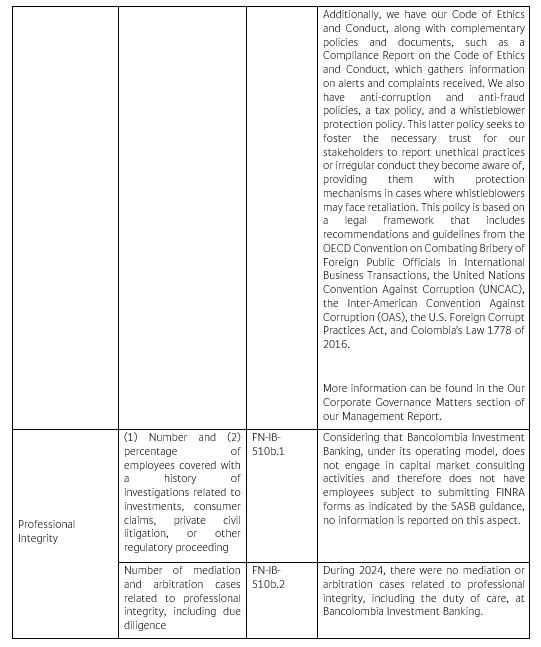
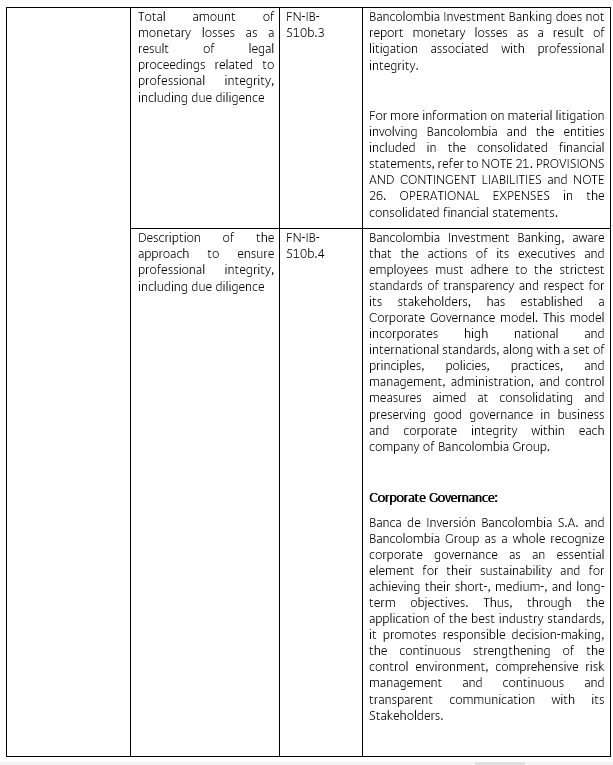
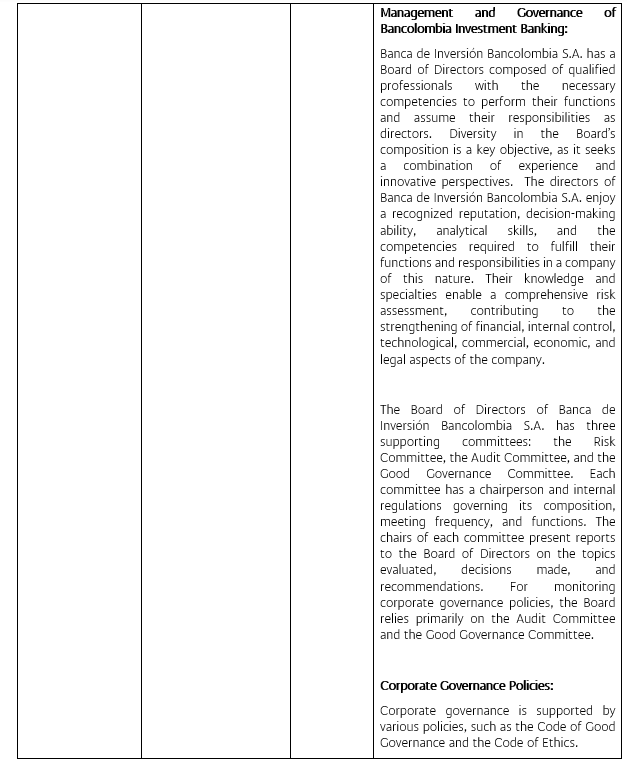
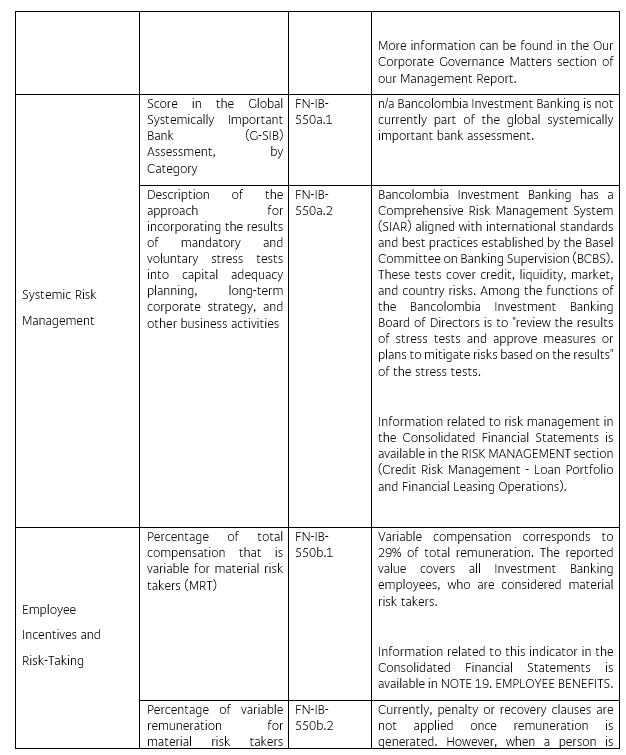
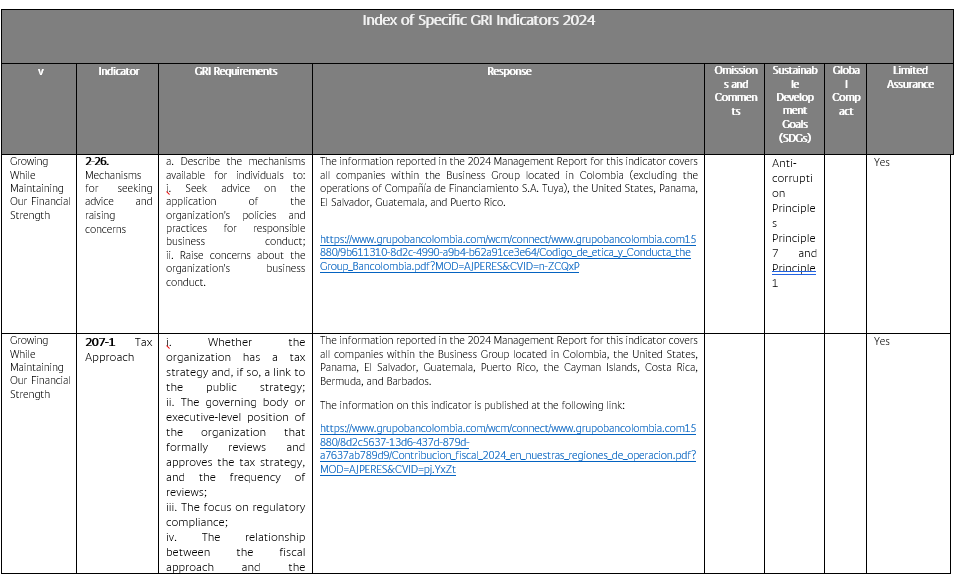
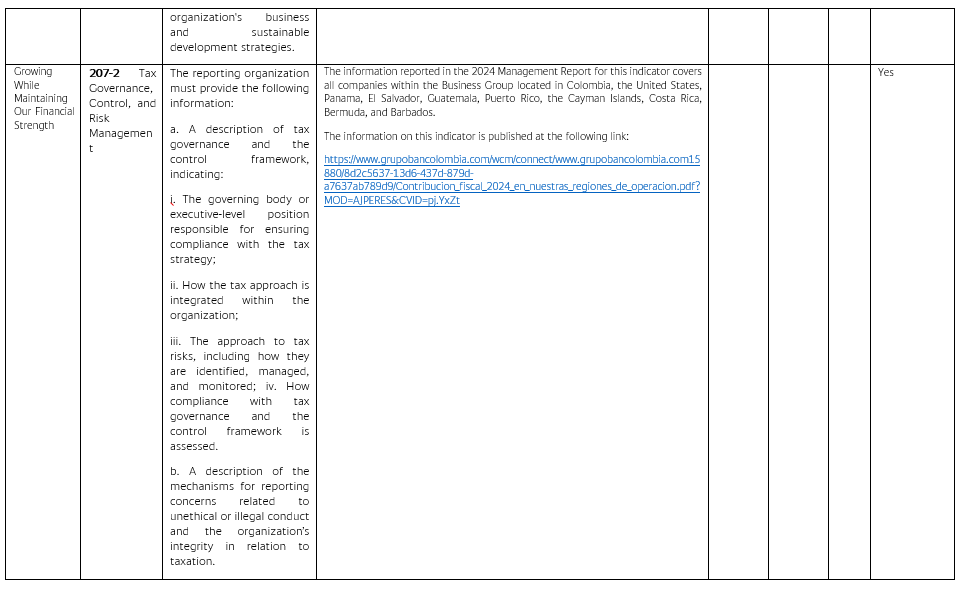
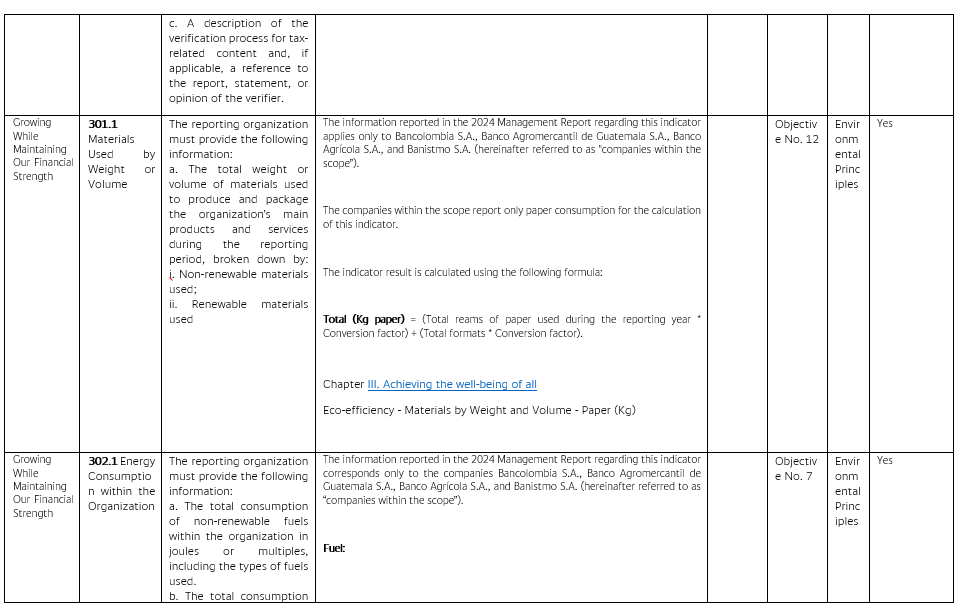
In the final segment, we present the GRI (Global Reporting Initiative) content index, the economic, environmental, and social indicators that contribute to the compilation of a sustainability report. We also present the SASB (Sustainability Accounting Standards Board) indicator index. Additionally, we have a chapter that complies with Notice 031 of the Financial Superintendency of Colombia, through which we disclose our TCFD (Taskforce on Climate-Related Financial Disclosures) and SASB reports.
This document has been prepared in accordance with the GRI Standards Core option. We will continue to use this methodology to deliver a management report increasingly tailored to different stakeholders. This report was verified by a third party who reviewed its content adaptation to the Global Reporting Initiative's Sustainability Reporting Standard (GRI Standard).
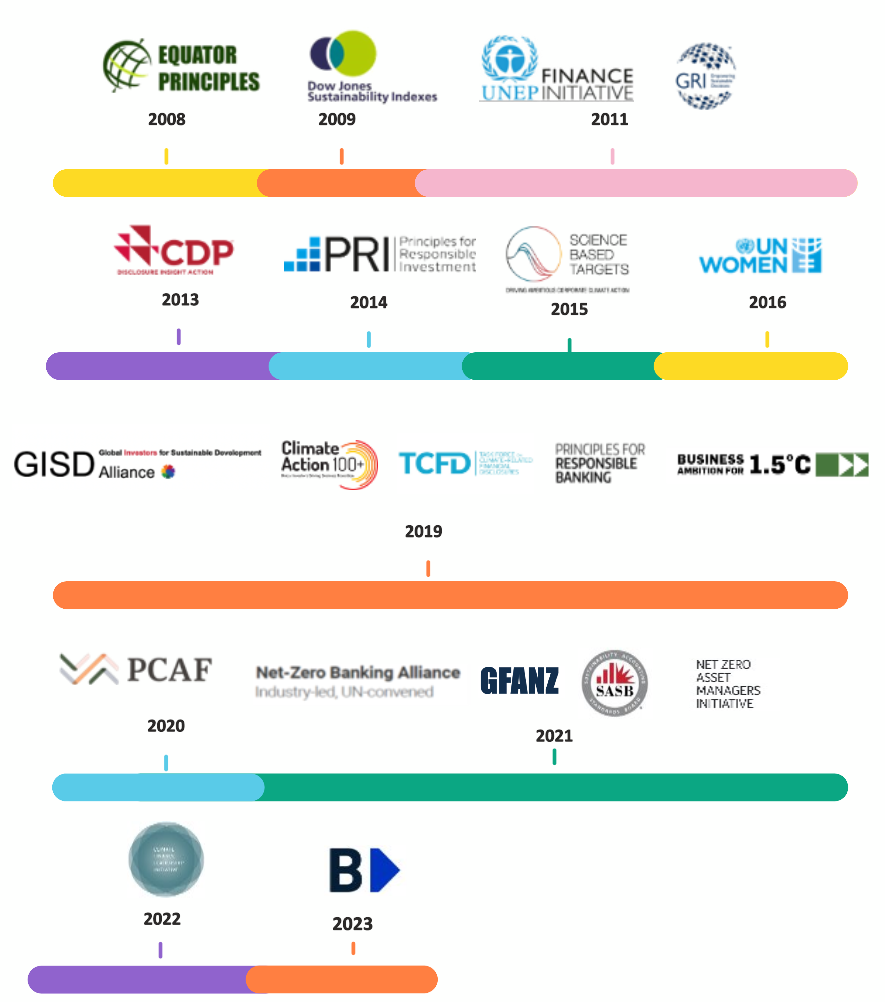
Likewise, we demonstrate our commitment to sustainability by showcasing our efforts in voluntarily managing the 10 Global Compact Principles, our contribution to the fulfillment of the Sustainable Development Goals (SDGs), the commitments of the Paris Agreement, and participation in frameworks such as the Dow Jones Sustainability Index (DJSI), Equator Principles, United Nations Environmental Program – Financial Initiative (UNEP FI), Carbon Disclosure Project (CDP), Principles for Responsible Investment (PRI), Principles for Responsible Banking (PRB), Partnership for Carbon Accounting Financials (PCAF), Net Zero Banking Alliance (NZBA), Task Force on Climate-Related Financial Disclosure (TCFD), the Global Investors for Sustainable Development (GISD) Alliance, and the Glasgow Financial Alliance for NetZero (GFANZ), among others.


OUR PURPOSE
We promote sustainable development to achieve the well-being of all
3


ig1a.jpg
I.ABOUT BANCOLOMBIA GROUP

About us

Bancolombia Group celebrates 150 years of operation, marking a perfect occasion to reaffirm our commitment to promoting sustainable development to achieve the well-being of ALL.
For more than a century and a half we have been witnesses and protagonists of the growth of the countries in which we operate, understanding that our success is determined by the positive impact we generate on the economy, society and the environment.
We are more than 34,000 employees in Colombia, Panama, Guatemala, El Salvador, among other countries, who work under a culture of ethics and integrity towards all our stakeholders.
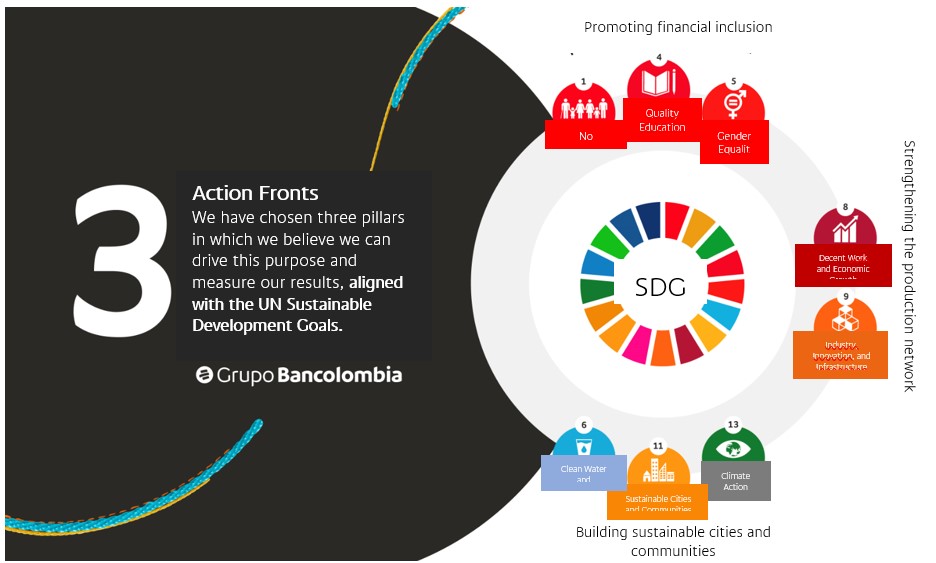
Our experience, financial strength and knowledge allow us to accompany countries to strengthen the production network, build sustainable cities and communities, and promote financial inclusion.
This is possible thanks to a wide range of financial and non-financial solutions and the largest physical and digital network in the countries where we operate, serving more than 33 million people and companies that trust us. We strive to make interactions easy, timely, reliable and close, always aiming for financial well-being.
In 15 decades, we have developed capabilities on different fronts of financial activity. Banking (accounts, deposits, transactional services, consumer, commercial, and mortgage loans, microloans, and our platforms A la Mano and Nequi), leasing, renting, brokerage, trust services, investment banking, and capital market solutions are some of the offerings designed to meet the needs of households, businesses, and governments.
4


We are known in the market with brands such as Bancolombia, Plink, Wompi, Nequi, Sufi, Renting, among others, in Colombia, Banistmo in Panama, BAM in Guatemala, and Banco Agrícola in El Salvador.
We evolve at the pace of people and businesses. That’s why we expand our capabilities alongside partners, fintechs, and other industries, aiming to become a platform that provides comprehensive solutions. Our goal is also to integrate our products and services into third-party platforms.
We are also celebrating 30 years of listing our shares on the New York Stock Exchange (NYSE), which, together with our continued presence in the Colombian Stock Exchange, has ensured us permanent access to the local and international capital markets, as well as a continuous improvement in our corporate governance.
For several years, we have been the company with the best reputation in the country, the one with the best corporate governance, the one with the best ESG responsibility and the one with the best capacity to attract and retain talent, according to the Merco monitor.
Our commitment goes beyond the countries where we operate. We engage beyond our borders, as we are aligned with the United Nations Sustainable Development Goals and work with global actors to find solutions to the environmental and social challenges facing the world.
These 150 years of history allow us to look to the future with optimism. We believe that our growth should translate into both profitability and dynamism for the economy and a better quality of life for people. Our vision is long term, because we seek to continue contributing to the construction of our countries for the well-being of ALL.

Strategy

Under our purpose of promoting sustainable development for the well-being of all, at Bancolombia Group we transform ourselves every day to face the economic, environmental and social challenges we face, and to accompany more than 30 million customers in their daily lives.
From this purpose we derive the strategic priorities and vision of success that allow us to ensure our sustainability as an organization and our positive impact on the well-being of society.
Our strategic objectives are based on the following premises:
Maintaining financial stability through responsible growth
We are adequately managing risk, taking care of soundness, while expecting moderate growth in the economy and a good performance in the quality of our portfolio. We support our growth with pre-approvals, instant answers and personalized offers from our portfolio of products and services according to our customers' needs. We take care of our level of efficiency, proactively managing the organization's expenses and focusing on being more productive.
5


Achieving the well-being of all
We offer services that generate well-being and development in the communities where we operate, to be the ally that allows them to take advantage of opportunities and better manage their resources on a daily basis. We strengthen the competitiveness of companies, promote financial inclusion to integrate more people and companies into economic development, and offer solutions that contribute to building more sustainable cities and communities, while contributing to a cleaner planet.
Achieving customer loyalty and preference
We are a customer-focused organization. We stand out by providing reliable, approachable, timely, and user-friendly experiences for our customers. We want to earn their loyalty by being their top choice for recommendations. To achieve this, we are working to offer them a better service, with greater speed and reduced friction, with more and more digital solutions to make their processes faster and simpler.
Building culture and talent to foster competitiveness
Our team of more than 34,000 employees works under a culture based on ethics, integrity, customer focus and sustainable growth, seeking to achieve extraordinary performance. Talent is one of our competitive advantages, which is why we prioritize its well-being and development. We foster a culture of inclusivity, closeness, and empathy, ensuring our team embraces the behaviors that define our organization and connect with our customers’ realities. In addition, we develop leadership with programs that enable employees to acquire leadership skills and assume greater responsibility. This strengthens our organization, ensuring that we have leaders prepared to take on the challenges.
Ensuring operational excellence
In our constant quest to improve and adapt to the needs of the environment, we have incorporated the objective of achieving operational excellence. This objective focuses on the automation of processes and services, which will allow us to be more efficient and reduce human errors. In addition, we have focused on ensuring the availability of key channels, so that our customers can access our services. We also work to minimize the impact on customers affected by mass events, implementing proactive and reactive measures to maintain service continuity and customer satisfaction.
6


Our Shareholders
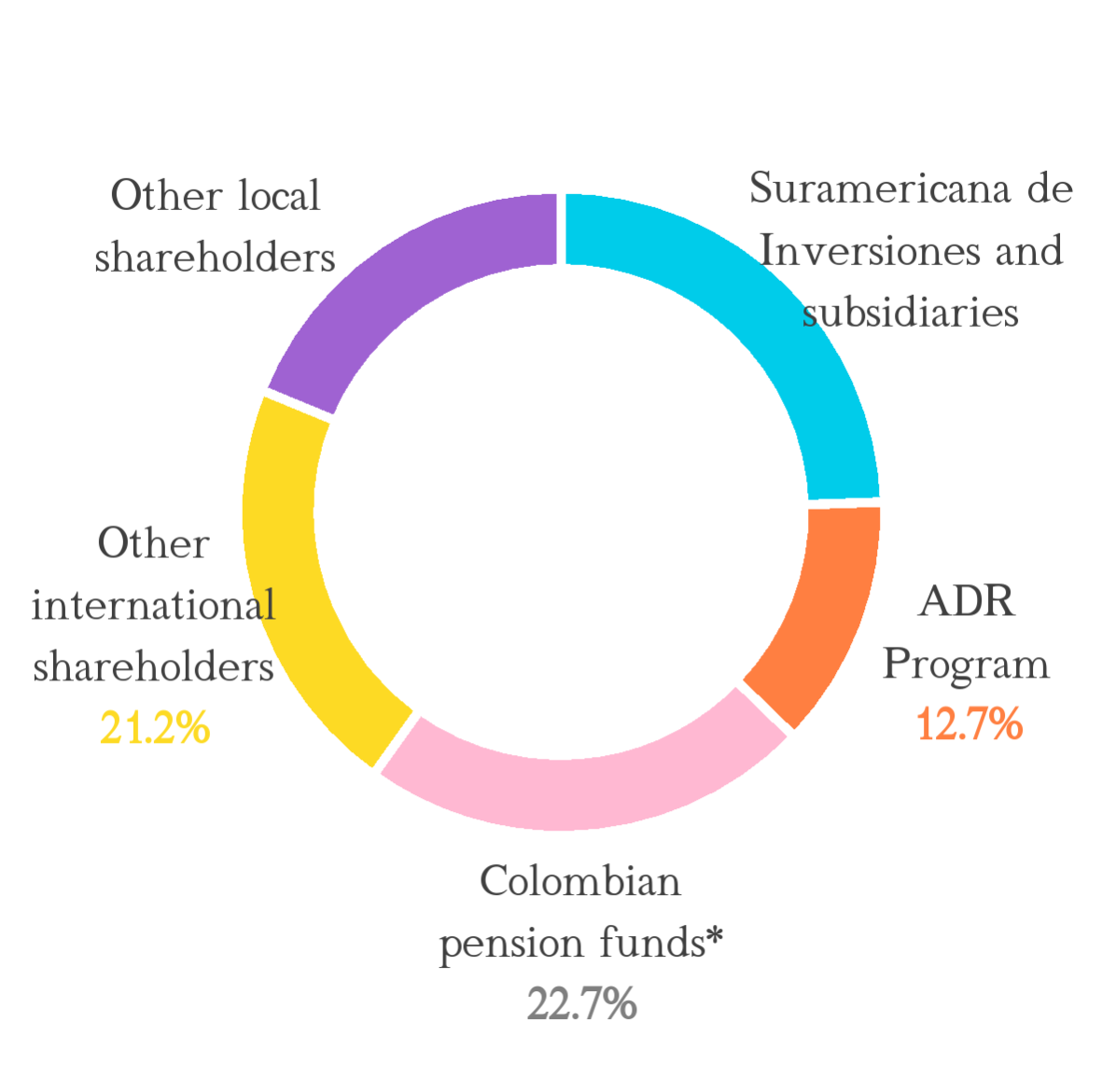
image_15a.jpg


Common Preferred Total
Suramericana de Inversiones and Subsidiaries 46.2% 0.0% 24.5%
ADR program 0.0% 27.0% 12.7%
Colombian Pension Funds* 22.0% 23.4% 22.7%
Other International Shareholders 17.9% 25.0% 21.2%
Other Local Shareholders 13.9% 24.6% 18.9%
*Private Funding    
                
Asset Type Common Shares Preferred Shares
Trading System Stock Exchange Stock Exchange
Stock Exchange Colombian Stock Exchange (BVC) Colombian Stock Exchange (BVC)
Outstanding Shares (12/31/2024) 509,704,584  452,122,416 
7


Number of Shareholders 17,822 28,888
Amount Issued  509,704,584 452,122,416
Amount Placed 509,704,584 452,122,416
Bancolombia has a Level III ADR listed on the New York Stock Exchange. Each ADR is equivalent to four preferred shares.
Type of Shares Number of Outstanding Shares Number of Shareholders owning the Exclusive Types of Shares Percentage of Participation in Share Capital for Each Type of Share
Common 509,704,584 14,634 52.99%
Preferred 452,122,416 25,700 47.01%
Total 961,827,000 43,522* 100%
*3,188 shareholders have common and preferred shares.
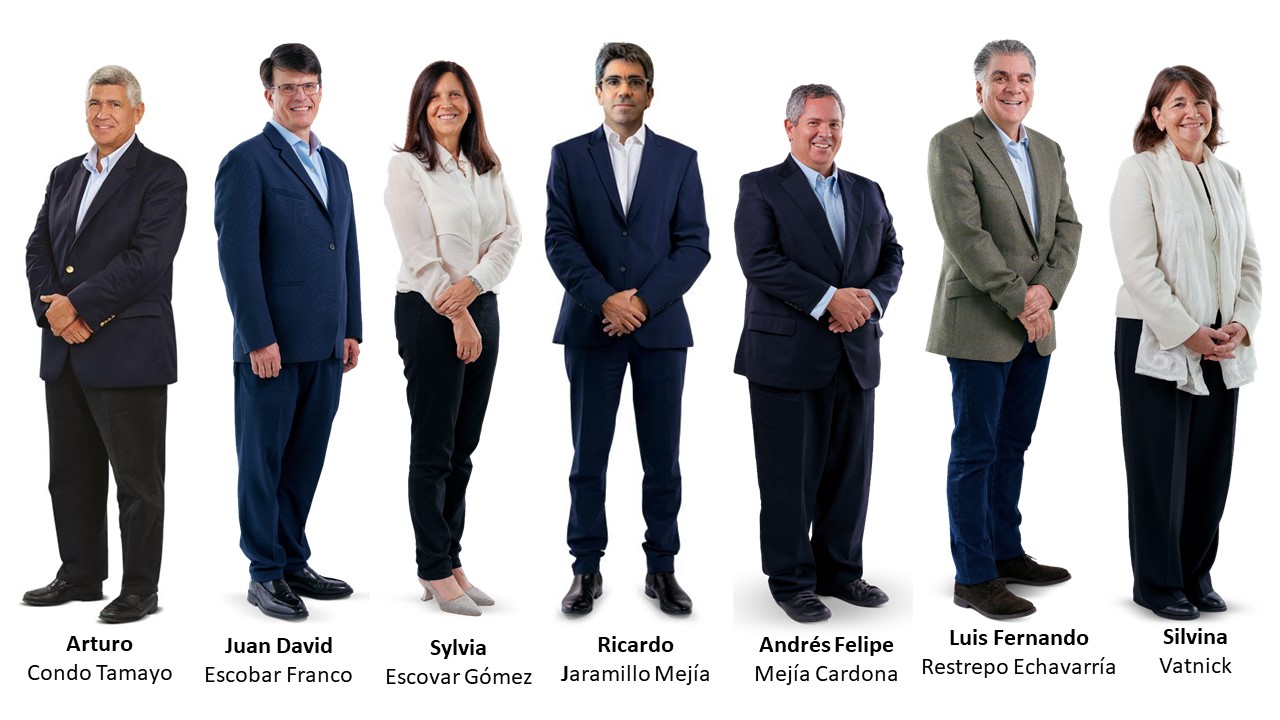
Board of Directors

image_16a.jpg
8


Steering Committ

image_21a.jpg
ig2a.jpg

Acknowledgments
Corporate
-Bancolombia completed a decade as the company with the best reputation in the country, according to Merco Empresas.
-TIME magazine and Statista highlighted Bancolombia as one of the 1,000 best companies in the world, with a consolidated score of 84.18 out of 100.
-In the Dow Jones Sustainability Index, Bancolombia consolidated its position as the most sustainable bank in the Americas and the tenth most sustainable in the world.
-Bancolombia was the only Colombian company in TIME and Statista's ranking of companies with the highest sustainable growth, where it ranked 33rd out of 500 organizations.
-Bancolombia was, for the fifth consecutive year, the company with the highest environmental, social and corporate governance responsibility in the country, according to Merco ESG.
9


-Bancolombia is a success story in circular finance for the Ellen MacArthur Foundation.
-Bancolombia is the best company to work for in the financial sector, and has the best human resources team in the country, according to Merco Talento.
-Banistmo was recognized as the Bank of the Year 2024 in Panama by The Banker.
-For its work with startups, Bancolombia received the Startup Friendly corporate recognition from Andi.
-Best private bank and best digital bank for individuals and businesses in Colombia, according to Global Finance.
-Best investment banking in Colombia, according to LatinFinance.
-Banistmo received the 2024 Central America Infrastructure Financing of the Year award from LatinFinance for financing the Fourth Bridge over the Panama Canal.
-Bancolombia was recognized by Euromoney for its digital solutions, diversity, equity and inclusion, ESG, investment banking and SME banking.
-The Latin American Stock Exchange Latinex awarded Banistmo three recognitions for its ESG management.
-For its efforts to contribute to closing gender gaps, Camacol awarded the company the Construimos a la Par prize.
-Bancolombia ranked fifth in the Inclusive Companies in Latin America – Chamber of Diversity ranking.
-“De Colombia pa'l mundo", a documentary created and developed by Bancolombia, which portrays a journey through the different regions of the country to rediscover the agriculture and identity of Colombian cuisine, received the award for Best Branded Audiovisual Content at the India Catalina Awards.
Leadership
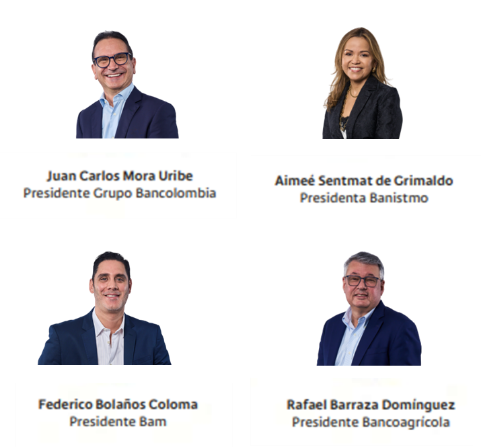
-Juan Carlos Mora is the second business leader with the best reputation, according to Merco Líderes.
-She is and the Fundación Juanfe recognized the president of Bancolombia as a business leader and a male ally of gender equality.

Stakeholders Relations
We implement communication and engagement strategies with our different stakeholders to identify how we are generating shared value through the most relevant economic, social, and environmental actions. At the time of writing this report, we had the 2023 materiality assessment. However, in December 2024 we started an update of our materiality by consulting new stakeholder groups. To learn more, click here.

II.MAINTAINING FINANCIAL STRENGTH
Economic context
Main Trends in the Region (LAC)
In 2024, Latin America experienced moderate growth, shaped by challenges stemming from the economic slowdown of some of its main trading partners, persistently tight financial conditions due to a delayed easing cycle in advanced economies, and a rebound in inflation in several countries.
10


According to the International Monetary Fund (IMF), the region grew by 2.1% in 2024, following a 2.2% expansion in 2023. This performance reflected moderate growth in various sectors, with a behavior similar to that of the global economy, where growth was driven by the tertiary sector, while industrial production lagged behind.
Globally, the monetary easing process began in advanced economies in 2024, boosting global liquidity, except in Japan. The U.S. Federal Reserve (FED) cut its interest rate by 50 basis points (bps) in September, followed by two 25 bps cuts in November and December. The European Central Bank cut its rate four times, bringing it from 4.0% to 3.0%. The Bank of England cut its rate by 50 bps, while Japan raised its rates in March and held them steady at 0.25% since July.
The increase in global liquidity led to a rise in capital flows. However, due to the strengthening of the dollar and the uncertainty caused by geopolitical conflicts and the U.S. electoral process, capital flows shifted toward assets considered risk-free. This caused emerging markets to experience a net outflow of capital, as more positions were liquidated than received.
At the same time, rate cuts in advanced economies allowed for the continued normalization of monetary policy in the region, aiming to stimulate growth while maintaining a cautious stance toward local risks and the volatility of international financial markets. However, currency depreciation, among other factors, limited the magnitude of the cuts and, in cases such as Brazil, led the Issuer to raise its interest rates in the latter part of the year.
Otherwise, the political agenda in the region included presidential elections in Mexico, El Salvador, Venezuela, Panama, Dominican Republic, Uruguay and Puerto Rico. In particular, no political changes were observed in Venezuela, El Salvador, Puerto Rico, or the Dominican Republic, while in Mexico, Uruguay, and Panama, the election results predict some changes for the next government term. In Mexico, Claudia Sheinbaum's victory made her the first woman to hold the position. Her proposals suggest a strong focus on social policies, expanded education, poverty eradication, reducing inequality, and new measures to promote the energy transition. In Uruguay, Yamandú Orsi's victory marked the return of the left-wing to power, driven by a predominantly progressive agenda. In Panama, legislative fragmentation and the need for political agreements suggest a shift towards a model of greater negotiation, breaking with a tradition of clear majorities in Congress.
Finally, the main challenge for the Latin American region remains fiscal policy. As a consequence of the pandemic, Latin American economies experienced an increase in public debt, which has been difficult to manage due to the higher cost of financing. This has made it clear that the sustainability of public finances is a factor of vulnerability for the region.
Performance of the main Latin American economies
Among the region's major economies, Mexico experienced a sharp slowdown, from 3.2% growth in 2023 to 1.4% in 2024. Meanwhile, Chile and Peru moved toward a path of recovery after Chile’s consumption was affected in 2023 by the depletion of pandemic-related aid, while various supply shocks impacted production in Peru. The Chilean economy expanded by 2.5% in 2024, while Peru's GDP grew by 3.0%.
11


In Colombia, a moderate recovery took hold following a 0.6% expansion in 2023, with an estimated growth of 1.8% in 2024. The local regulatory environment remains uncertain for investment decisions, but the economy is being driven by the reduction in the monetary policy interest rate. In contrast, fiscal stimulus in Brazil led to a consistent upward revision of growth expectations, despite adverse weather conditions. As a result, the economy grew at a similar pace to 2023 (3.0%).
Colombia
Recent economic history has been marked by a gradual process of convergence towards lower inflation and higher growth rates. The Colombian economy reached the lowest growth of the post-Pandemic era during 2023 (0.6%), and from there accelerated to levels closer to 1.8% during 2024. Likewise, inflation went from 9.3% at the end of 2023 to 5.2% at the end of last year. This enabled the Colombian Central Bank to continue lowering the repo rate, bringing it down to 9.50%.
In terms of GDP growth, the economy showed tremendous signs of resilience, with the agricultural, entertainment and recreation and public administration sectors showing pronounced progress. In the first case, despite the occurrence of the El Niño climate phenomenon in the first part of the year, the good performance of harvests, together with favorable international coffee prices, resulted in double-digit GDP growth for agricultural activities. In parallel, the boost in household consumption, which coincided with higher remittances, a resilient labor market and lower interest rates, led the growth of some service activities.
The public sector played a key role in 2024 due to the sharp increase in real government spending. This was reflected in the rapid expansion of the public administration sector, which saw higher GDP growth in the first half of the year compared to the private sector. However, in the second half of the year, this trend reversed due to reduced fiscal space, which forced the National Government to curb government spending in order to uphold its commitment to the Fiscal Rule. Negative tax collection dynamics led the government to make budget cuts during the second half of last year.
Meanwhile, inflation consolidated its convergence process towards levels increasingly consistent with Colombian Central Bank's objectives. All components of the consumer basket slowed down in 2024, resulting in the lowest inflation since late 2021. Food and goods drove the decline, while the services and regulated categories slowed at a more moderate pace due to indexation and lingering inflation in fuel, electricity, and tolls. The risks associated with the convergence of inflation led the Issuer's Board of Directors to adopt a cautious approach to the rate-cutting cycle, resulting in a 350-basis-point reduction in the repo rate, bringing it to its lowest level since August 2022.
Finally, in external terms, the current account reached its lowest external deficit in fifteen years, at -1.7% of GDP. This was possible due to an increase in current transfers and lower factor income outflows, which compensated for the increase in the trade imbalance. Despite reduced external account vulnerabilities, the exchange rate depreciated in the second half of the year due to a stronger U.S. dollar globally and an increase in Colombia’s sovereign risk premium.
El Salvador
12


The first half of 2024 was marked by a slowdown in growth, as the completion of major infrastructure projects led to a drop in investment and a less dynamic public sector, whose fiscal consolidation efforts accelerated the negotiations of the agreement with the IMF. Additionally, starting in the second quarter, the normalization of remittance growth was reflected in a slowdown in private consumption. Despite the boom in the tourism sector due to the increased perception of security, El Salvador's GDP showed modest growth during the year (3.4% in 1Q24, 1.5% in 2Q24 and 1.6% in 3Q24).
During the first four months of the year, inflation was close to 1% due to lower price increases in food, restaurants and hotels, and lower prices for transportation, recreation and household goods. However, by mid-2024, supply-side inflationary pressures—such as the El Niño climate phenomenon and heavy rainfall in several regions—drove price growth up to 1.8% annually in July. The measures taken by the government to contain food inflation, together with the decrease in fuel prices, resulted in an inflation rate of 0.3% at the end of the year, after two consecutive months of deflation.
In the fiscal environment, 2024 was characterized by mixed signals. First, the multiple debt bond repurchase processes by the government sent a message of responsibility and commitment to the sustainability of public finances in view of the negotiations for an agreement with the IMF (reached in December). In addition, the approved 2025 state budget is the first fully funded budget in several decades. However, the elimination of tariffs on imported food and taxes on foreign investment and remittances put extra pressure on the fiscal balance.
Finally, as for the external sector, the boom in tourism (which increased by 14.7% in 2024 compared to 2023) and its boost to service exports, allowed the current account to be in surplus during the second quarter of the year. However, the fall in the services surplus during the third quarter brought the current account back into deficit territory (-0.9% of GDP in that period).
Guatemala
During 2024, economic activity in Guatemala stood out for its good dynamics, driven by the robustness of consumption and investment, growing 3.1%, 3.7% and 3.5% annually in the first three quarters of the year. The performance of consumption is explained by increases in labor income and remittance inflows (which represent close to 20% of GDP), as well as by the dynamism of the credit portfolio. Meanwhile, investment growth was concentrated in machinery and equipment. Thus, we estimate that the economy closed 2024 with a growth rate of 3.5%, in line with the strong performance of the vast majority of activities.
Regarding prices, the disinflationary process observed since November 2023 was temporarily interrupted in mid-2024 due to rising food prices, which offset declines in the housing, fuel, and utilities segments. As a result, annual inflation stood at 3.8% in July. In the second half of the year, inflation resumed its decline once food pressures were overcome, closing 2024 at 1.7%, well below the Banco de Guatemala's tolerance range (4.0% +/- 1pp).
Regarding monetary policy, the Banco de Guatemala implemented two 25-bps cuts to its benchmark interest rate, one in September and another in November, bringing it down from 5.00%—which had been in place for 17 months—to 4.50%. The Monetary Board indicated in the communications that its members took into consideration the recent low inflation records, growth data in line with its projections and the coordination of its monetary policy with that of the FED.
13


Regarding the fiscal environment, Guatemala has been characterized by low levels of indebtedness and fiscal deficits. Despite the budget expansion that took effect in September, the Government has restrained public spending by eliminating exceptional expenses and slowing the pace of execution. Thus, throughout 2024 the fiscal deficit remained consistently below 1% of GDP and ended the year close to 1.2% of GDP.
Finally, the current account balance benefited from the strength of remittance inflows due to the robust U.S. labor market. This contained the deficit in other areas, especially the widening of the trade deficit in goods. Thus, the current account surplus stood at 1.9%, 4.6% and 3.2% of GDP in the first three quarters of the year.
Panama
The Panamanian economy experienced a sharp slowdown in 2024, compared to its 7.4% growth in 2023. The factors that had the greatest impact were: (1) the impact of the closure of the Cobre Panamá mine, which was estimated to contribute around 5% to GDP; (2) the decline in vessel traffic through the Panama Canal due to the effects of El Niño; and (3) the decrease in housing demand, which affected the construction sector. However, the good performance of sectors such as tourism, commerce and finance contributed to better results than anticipated, such that in the first three quarters of the year, the Panamanian economy grew 1.8%, 2.5% and 2.0% annually. Given this, we estimate that growth in 2024 was 2.5%.
The rapid disinflationary process was driven by falling food and fuel prices, as was the case in the other Central American countries. For this reason, in September, Panama entered deflation territory, mainly due to price controls on basic food basket items and fuel. This trend persisted until the end of the year, with 2024 likely closing at around 0.2%, despite a slight annual increase in food prices.
In the external environment, the elimination of copper production hit Panamanian exports particularly hard, widening the deficit in the balance of trade in goods. Despite a 73.3% annual drop in exports during the first 11 months of 2024, the gradual restructuring of the goods export basket and the strong performance of tourism, which boosted the services balance, allowed the current account to remain in surplus during the first three quarters of the year.
Finally, the fiscal outlook remains one of the challenges. Greater spending pressures, driven by high debt interest payments, increased country risk perception (reflected in the loss of investment grade by Fitch Ratings and the credit rating downgrade by S&P), and lower government revenues, have significantly eroded the country's public finances. Thus, we estimate that the fiscal deficit widened to 4.5% of GDP during 2024.
2025 Economic Outlook
By 2025, we anticipate a gradual desynchronization of economic growth and monetary policy across countries. In the midst of this scenario, the risks associated with geopolitical conflicts, the arrival of Donald Trump to the U.S. presidency and a more cautious FED in its monetary easing process will continue to mark the feeling of uncertainty and volatility in global financial markets.
We anticipate modest growth for the global economy, a continuation of gradual cuts in monetary policy interest rates, a convergence of inflation toward the central banks' target and increased investor appetite for safe-haven assets. Likewise, the unpredictable application of protectionist economic measures by the new Trump administration will lead emerging countries to face a hostile international scenario, which could exacerbate near-shoring trends and migrant employment.
14


Colombia
By 2025, we anticipate higher economic growth of 2.6%. At the same time, we expect inflation to continue its convergence process towards lower levels, with a year-end forecast of 4.0%. Meanwhile, since there are some upside risks to inflation—driven by the increase in the minimum wage, depreciation, the rise in the risk premium, and lingering inflation in certain regulated goods and services—Colombian Central Bank is expected to continue its rate-cutting process at a slower pace, bringing the monetary policy rate to 6.50% by year-end.
In terms of economic growth, acceleration to 2.6% would be possible due to a gradual recovery of the construction and manufacturing areas, an outstanding performance of the agricultural macro-sector and a gradual recovery of key service activities, such as commerce, transportation, accommodation and food. All of this would be driven by lower interest rates, lower inflation and a relatively resilient labor market. Additionally, we expect fixed investment to play a more significant role in growth, consistent with further advances in private consumption, which will continue to accelerate, supported by strong remittance flows and a resilient labor market.
Second, we expect the disinflation process to continue, but at a slower pace and with upside risks. We estimate that annual inflation will end 2025 at 4.0%, within Colombian Central Bank's tolerance range. Despite this, we highlight the presence of upside risks, such as the sharp increase in the minimum wage above inflation, the recent devaluation of the Colombian peso and its effect on the prices of imported goods, as well as the increase in the costs of inputs, raw materials and international transportation due to geopolitical tensions and the adjustment in the price of ACPM (Diesel oil).
As a result, the monetary policy interest rate will continue its downward trend, amid the caution demanded by inflationary persistence and international financial conditions. The moderation in the pace of cuts revealed by Colombian Central Bank in its December 2024 decision leads us to believe that in 2025 a marked bias towards caution will prevail in the process of interest rate cuts.
El Salvador
We expect the slowdown to continue, driven by lower government spending, lower private consumption due to the normalization of emittance inflows, lower external demand due to the expected slowdown in the U.S. economy (El Salvador's main trading partner) and the consequences for agriculture, transportation and infrastructure that could result from the La Niña climate phenomenon. Thus, we expect 2025 growth to be 2.4%.
As for inflation, we expect it to return to a level of 1.8% in 2025. This would be possible due to the lower pressures derived from the consolidation process of public finances and the country's dollarization. However, we recognize that the Trump administration's shift in energy transition priorities could put pressure on fuel prices, while a protectionist trade policy would put pressures on other goods and services.
Likewise, reaching a technical agreement with the IMF for USD 1,400 million in December would allow the Government to increase its credibility, as long as it meets the fiscal adjustment targets and strengthens its international reserves holdings. This would allow a recovery of El Salvador's integration with international capital markets, which would strengthen its integration with the region and attract investment to the country.
15


Guatemala
We anticipate that strong macroeconomic fundamentals will allow Guatemala to maintain 3.5% growth in 2025. However, there are risks that put downward pressure on this projection, such as the expected slowdown in the U.S. economy or the anti-immigration and protectionist policy that could be adopted by the Trump administration, factors that would reduce the flow of remittances, consumption and exports.
At the same time, we expect inflation to converge towards the Banco de Guatemala's tolerance range (4.0% +/- 1pp), reaching 3.8% in 2025, due to the volatility in oil prices and the effect that adverse weather events may have on food prices. In this context, the Monetary Board will continue with monetary easing, bringing its interest rate to 3.25% at the end of the year.
The main risk is in the fiscal environment. We expect the government to continue its efforts to improve fiscal transparency and combat corruption under an environment of strong political opposition. However, we anticipate that spending pressures will continue to be relevant due to the priority given by the government to social spending within its budget.
Panama
We expect the economic dynamics to flourish again, supported by the recovery of the logistics and transportation sector, and by investment driven by new public infrastructure works. It is worth noting that, despite the downgrade in its credit rating, Panama continues to be an attractive destination for foreign investment thanks to its location and its consolidation as a strategic logistics center in the region. Thus, we project growth to accelerate to 3.5% in 2025. Favorable economic activity would also boost prices, despite downward pressures from the Federal Reserve's tighter monetary policy. As a result, the year ended with inflation close to 1.5%.
As for the external sector, new public works would increase imports of intermediate goods for construction, while the improved dynamics of domestic demand would boost imports of consumer goods. As a result, we expect the current account deficit to widen to 3.8% of GDP.
Finally, the economic recovery in 2025, along with the government's efforts to improve the fiscal situation—reflected in the approval of a budget lower than that of 2024—would help increase fiscal revenues throughout the year and, consequently, reduce the deficit to 3.5% of GDP.
GDP Growth in Latin America (Annual Variation %)
Country 2022 2023 2024 2025
Latin America* 3.9% 2.2% 1.8% 2.2%
Peru* 2.8% -0.4% 2.9% 2.8%
Mexico* 3.7% 3.3% 1.5% 1.3%
Chile* 2.1% 0.2% 2.3% 2.2%
16


Brazil* 3.0% 2.9% 3.0% 2.0%
Colombia 7.3% 0.6% 1.8% 2.6%
Panama 10.8% 7.4% 2.5% 3.5%
Costa Rica* 4.6% 5.1% 3.9% 3.5%
Guatemala 4.2% 3.5% 3.5% 3.5%
Honduras* 4.1% 3.6% 3.4% 3.2%
Nicaragua* 3.8% 4.6% 3.5% 3.0%
El Salvador 2.8% 3.5% 2.6% 2.4%
Source: Bancolombia Group, FocusEconomics.
*Focus Economics forecasts.

Trends, events or uncertainties that have the capacity to materially impact the issuer's operations, financial position or changes in its financial position; as well as the assumptions used to prepare these analyses

2024 was characterized by a macroeconomic context in which the decrease in inflation allowed for a sustained decrease in interest rates. This resulted in a lower cost of credit, due to less pressure on customers' ability to pay.
Similarly, the unemployment rate during the year showed a moderate recovery trajectory, reflecting a gradual improvement in Colombia's economic activity.
During this same period, the Colombian economy showed progress in its recovery during the year, with GDP growth higher than the previous year, which was driven mainly by the services and agricultural sectors. Finally, the Colombian peso depreciated throughout the year as a result of geopolitical conflicts, U.S. elections and a moderate global economic growth.
For 2025, economic growth is expected to surpass that of the previous year, accompanied by gradual interest rate cuts throughout the year and steady progress toward the inflation target. However, certain events such as a greater fiscal deterioration may impact risk perception, generate pressure on the Representative Market Rate (TRM, by its Spanish acronym) and cause a possible increase in inflation, which could also be affected by the increase in the minimum wage, which was higher than expected by the market.
These events may materially influence the moderate inflation expected by the Colombian Central Bank for 2025, which, if it materializes, could translate into an increase in the cost of credit, due to the impact on the payment capacity of our customers, as well as an increase in operating expenses, generating greater pressures on the Bancolombia Group's income.
17


Moreover, the fall in interest rates could generate negative effects on the net interest margin, due to the bank's greater sensitivity on the asset side.
Bancolombia Group Consolidated Results

BANCOLOMBIA GROUP          
CONSOLIDATED FINANCIAL RESULTS          
           
RESULTS AND BALANCE          
(Amounts in millions of Colombian pesos, as of year-end) December     2023 vs 2022
  2024 2023 2022 Var $ Var %
Operational Income        46,379,617        48,316,872        35,456,762         -1,937,255 -4.01%
Net Operational Result          8,757,917          8,147,526          9,744,786             610,391 7.49%
Net Profit (Attributable to Shareholders)
         6,267,744
         6,116,936          6,783,490             150,808 2.47%
Total Assets      372,215,382      342,928,809      352,814,733        29,286,573 8.54%
Credit Portfolio and Financial Leasing, Net
     263,274,170
     237,728,544      254,444,099        25,545,626 10.75%
Investments, Net        40,499,254        28,671,798        30,855,773        11,827,456 41.25%
Total Liabilities      327,631,107      303,879,080      312,817,182        23,752,027 7.82%
Deposits
(Current Accounts, Savings Accounts, and Term Deposits)
     279,059,401
     247,941,180      250,992,323        31,118,221 12.55%
Equity        44,584,275        39,049,729        39,997,551          5,534,546 14.17%
     

EFFICIENCY AND PROFITABILITY      
December    
  2024 2023 2022
Net interest margin 6.85% 6.99% 6.80%
Financial efficiency 48.96% 45.33% 44.58%
Operational efficiency 3.90% 3.77% 3.45%
Average return on total assets 1.79% 1.78% 2.15%
Average return on equity 15.77% 16.14% 19.80%
Portfolio quality
(Past-due portfolio / Gross portfolio)
4.78% 5.01% 3.24%
Total past due portfolio coverage
(Provisions / Past-due portfolio)
112.39% 120.04% 168.73%
Basic solvency 11.89% 11.42% 10.37%
Total solvency 13.75% 13.40% 12.79%
       
Framework of accounting accounts according to the board of directors’ report and press release.

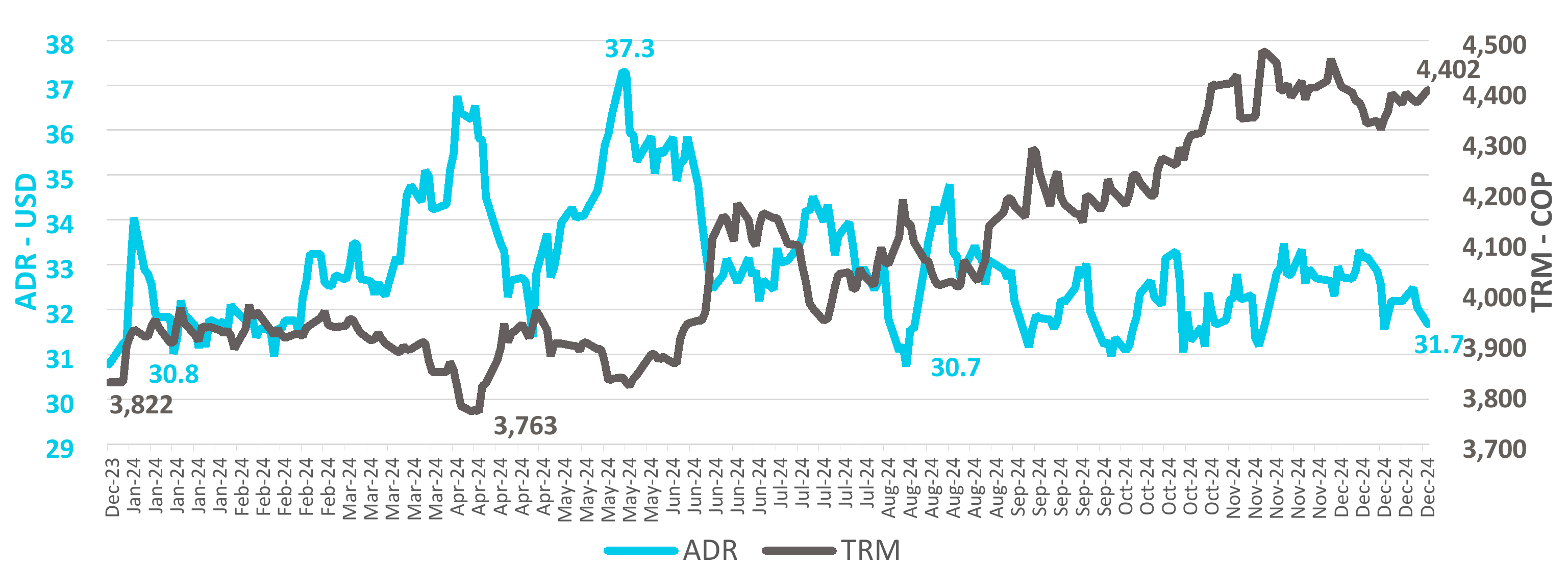
During 2024 the Colombian peso depreciated against the dollar, with a devaluation of COP 587.10 (15.36%) in the Representative Market Rate, which went from COP 3,822.05 at the end of 2023 to COP 4,409.15 at the end of 2024. This factor influenced the annual variations in the organization's consolidated Statement of Financial Position, given our operation in Central America and the exposure of some local book balances that are denominated in foreign currency (USD).
18


Our total assets at the end of 2024 stood at COP 372.22 trillion, reflecting an increase of COP 29.29 trillion (8.54%) compared to the previous year. This growth was driven by a COP 25.55 trillion (10.75%) increase in net loans and a COP 11.83 trillion (41.25%) rise in net investments. This expansion was supported by the continued growth of customer deposits and the use of liquid assets, which led to a COP 8.09 trillion (10.57%) decline in other assets.
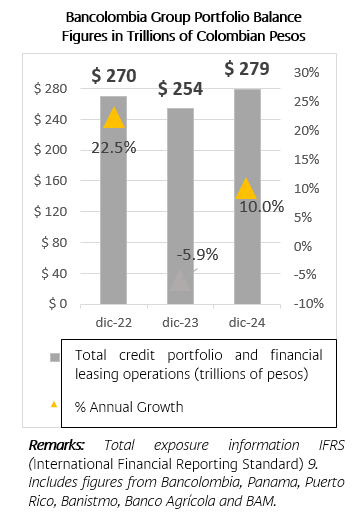
The gross loan portfolio grew by COP 25.50 trillion (10.04%), with the commercial loan portfolio increasing by COP 18.57 trillion (11.47%), driven mainly by the corporate segment in Colombia. The mortgage portfolio recorded a growth of COP 5.49 trillion (15.15%), reflecting improved sector dynamics compared to the previous year, supported by the “Housing for All” strategy in Colombia. Likewise, the consumer loan portfolio increased by COP 1.23 trillion (2.26%), where the currency devaluation helped offset the lower disbursements in this segment throughout the year.
Loan and financial leasing provisions decreased by COP 43,365 million, ending the year at COP 16.18 trillion, primarily due to lower provisions for individuals. Meanwhile, the loan coverage for accounts past-due over 30 days closed at 159.48%, reflecting our strength in facing potential future impairments.
Other assets contracted during the year, mainly due to movements in cash and cash equivalents, which decreased by COP 6.96 trillion. Likewise, trading derivatives declined by COP 3.31 trillion, partially offset by a COP 1.20 trillion increase in goodwill, driven by exchange rate fluctuations.
We ended 2024 with total liabilities for the Group amounting to COP 327.63 trillion, reflecting an annual increase of COP 23.75 trillion (7.82%). Customer deposits grew by COP 31.12 trillion (12.55%), closing the year at COP 279.06 trillion, driven by our customers' preference for our deposit portfolio. The savings account showed the largest increase, rising by COP 15.67 trillion, followed by term deposits with an increase of COP 11.07 trillion, while the checking account grew by COP 3.04 trillion.
Debt securities issued ended 2024 with a balance of COP 11.28 trillion, decreasing by COP 3.39 trillion (23.11%), in line with maturities during the year and the restructuring of the funding structure, in accordance with the Bancolombia Group's liquidity management.
Equity attributable to shareholders increased by COP 5.46 trillion (14.32%), closing the year at COP 43.54 trillion, supported by profit generation and the restatement of the financial statements of foreign subsidiaries. As a result, we maintained solvency levels above the regulatory requirements, achieving a core solvency ratio of 11.89%, 47 basis points (hereinafter referred to as bps) higher than the figure reported in 2023, driven by equity strengthening to support the expected operational growth in 2025.
Net interest income grew by COP 142,446 million (0.70%), mainly due to a decrease in financial expenses of COP 1.64 trillion (9.87%), in line with the funding restructuring strategy in response to the economic cycle and macroeconomic conditions.
Loan income decreased by COP 2.63 trillion due to the reduction in the monetary policy rate and lower activity in the consumer loan portfolio. However, this was partially offset by a COP 1.13 trillion increase in interest income from debt instruments and the valuation of financial instruments.
19


As a result, total interest income declined by COP 1.50 trillion (4.05%). Meanwhile, net commissions grew COP 193,446 million (4.86%), mainly due to the net income obtained from our clients' transactional activities.
The provision expense for loans and net leasing decreased by COP 2.01 trillion (26.93%), due to lower impairment provisions in the individual portfolio in Colombia and an improved economic outlook, which has led to better customer performance in meeting their financial obligations.
Operating expenses increased by COP 691,481 million (5.34%), remaining below observed inflation, in line with efficient resource management. Labor expenses grew by COP 277,828 million (5.19%), mainly due to salary increases. Similarly, general expenses rose by COP 413,653 million (5.45%), with the most significant contributors being technology expenses—driven primarily by maintenance and licensing costs—payment method expenses, and regulatory expenses related to deposit insurance.
Operating income before provisions decreased by COP 707,365 million (2.48%), which, when compared to the increase in operating expenses, led to a deterioration in financial efficiency of 364 bps, closing at 48.96%.
During the year, the income tax provision reached COP 2.39 trillion, a significant contribution that reinforces our commitment to the country's development through national revenue collection.
We achieved net income attributable to shareholders of COP 6.27 trillion in 2024, reflecting an increase of COP 150,808 million. This result allowed us to maintain a return on assets of 1.79% and a return on equity attributable to shareholders of 15.77%, with the latter registering a decline of 37 bps due to the increase in equity, in line with our growth strategy for 2025.
Bancolombia Banco Comercial    

Bancolombia's results at year-end 2024 reflect our commitment to financial strength and sustainable development, fundamental pillars that have allowed us to face the challenges of a changing and competitive economic environment, while consolidating our market position.
In 2024, we achieved a 4.37% growth in our assets, representing an increase of COP 10.99 trillion compared to the end of 2023. This performance was driven by several factors: the gross loan portfolio, which grew by 4.92% during the year (COP 9.01 trillion), in line with economic growth; and the investment portfolio, which recorded an annual variation of 58.13% (COP 8.00 trillion), resulting from greater use of liquidity and a continuous increase in our deposits (COP 5.1 trillion).
The growth in loan portfolio balances was largely driven by the commercial segment, which increased by 7.54% (COP 7.21 trillion), mainly due to new interest rate strategies that incentivized loan placements. Similarly, the mortgage portfolio closed the year with an annual growth of 15.21% (COP 3.32 trillion), aligned with the “Housing for All” strategy, through which we reduced interest rates in this segment. Meanwhile, the consumer loan portfolio experienced a significant slowdown during the year, ending with a decline of 4.46% (COP 1.73 trillion), due to restrictions in risk appetite, which led to the adoption of more conservative policies regarding exposure to certain sectors and customer profiles, thereby limiting portfolio growth.
20


Investments in subsidiaries recorded an annual appreciation of 16.02%, equivalent to COP 3.97 trillion. This result was mainly driven by investments in foreign subsidiaries and is largely explained by the restatement effect due to the variation in the TRM, which increased from COP 3,822.05 at the end of 2023 to COP 4,409.15 at the end of 2024, reflecting a 15.36% depreciation of the Colombian peso.
We closed 2024 with a total deposit balance of COP 185.80 trillion, representing an increase of COP 15.57 trillion (9.15%) compared to the previous year. This dynamic was mainly driven by demand accounts, which grew by COP 11.66 trillion (11.20%), while term deposits recorded an annual increase of 4.14% (COP 2.53 trillion). This reflects a shift in the funding structure, where demand accounts are gaining greater share, thereby strengthening Bancolombia's competitive advantage in terms of deposit costs.
Debt securities issued (bonds) closed at COP 7.80 trillion, reflecting a decrease of COP 3.16 trillion (28.82%), due to bond repurchase operations in U.S. dollars carried out during the year, along with maturities in Colombian pesos totaling approximately COP 1.60 trillion.
Equity increased by COP 5.19 trillion (14.00%), driven by profit generation during the period and the restatement of investments in associates and subsidiaries due to a higher TRM.
Net interest income increased by COP 442,454 million (2.86%) in a context of declining interest rates in Colombia, where the Colombian Central Bank’s benchmark rate dropped by 350 bps, leading to a COP 2.53 trillion (8.94%) decrease in interest income from the loan portfolio. This was offset by a larger reduction in financial expenses of COP 1.91 trillion (13.77%), driven by an optimization of the liability structure, along with a favorable performance in interest income and investment valuation, which grew by COP 1.05 trillion (125.09%). This growth was mainly due to the dollar-denominated portfolio, which benefited from a COP 587 depreciation in the TRM during the year.
The risk dynamics led to a decrease in provisioning expenses of COP 834,399 million, primarily driven by an improved performance in the consumer loan portfolio, which experienced lower impairment compared to the previous year, particularly in unsecured loans and credit cards. As for the commercial loan portfolio, provisioning remained stable in line with the balance growth. In the mortgage portfolio, provisioning expenses were also lower due to reduced impairment.
Net fee and other service income closed with a positive variation of 0.96% (COP 25,749 million), with revenues growing by 7.61% (COP 405,855 million), mainly driven by higher transaction volumes in payment methods and electronic services. Meanwhile, expenses increased by 14.39% (COP 380,106 million) due to a higher number of operations conducted through banking correspondents.
Other net operating income closed with a negative variation of 33.56% (COP 974,314 million), explained by the performance of foreign exchange differences and foreign exchange derivatives, which registered declines of 72.34% (COP 593,686 million) and 50.22% (COP 170,198 million), respectively.
Additionally, income from the equity method closed at COP 1.88 trillion, with an annual decrease of COP 156,852 million, driven by lower earnings from subsidiary investments, mainly Banistmo and Bancolombia Panama.
21


In 2024, an impairment loss of COP 121,788 million was recorded for Tuya.
All of the above led to a net total income (Operating Income) annual increase of COP 58,251 million.
Operating expenses increased by 7.03% (COP 617,573 million), exceeding the growth of total net income, which grew 0.35% (COP 58.251 million), leading to a deterioration in the financial efficiency ratio, which stood at 41.98%.
Finally, we closed 2024 with a net income of COP 5.58 trillion, representing an annual decrease of 6.71%, equivalent to COP 401,510 million, leading to a decline in return on equity by 171 bps, reaching 14.06%.
22


Material changes related to the issuer's liquidity and solvency position
NOTE: In this section, as well as in all those that come from the 20F, the figures mentioned in the texts are expressed in billions. We have decided not to standardize them with the other figures in the report (which are expressed in trillions or millions) to ensure that the content of these items, especially the figures, remains consistent with their English version as recorded in the 20F.
Liquid assets
One of the Bank’s main guidelines is to maintain a strong liquidity position. Therefore, the Asset and Liability Management (ALM) Committee has established a minimum level of liquid assets based on the financing needs of the parent company and each subsidiary. The objective is to ensure, as far as possible, that there will always be sufficient liquidity to meet its liabilities as they mature. This is both in normal conditions and stress scenarios without incurring significant losses or risking damage to the Bank's reputation.
As mentioned earlier, the Bank aims to maintain the optimal level of liquid assets to ensure not only smooth operation under normal conditions but also to operate under stress scenarios in the markets. During 2024, we maintained a solid liquidity position, with high levels of liquidity during the second half of the year.
The following table shows the distribution of liquid assets in the last two years:
Liquid assets (1)
December 31, 2024 December 31, 2023
High-quality liquid assets*
Cash 27,931,834 25,273,317
High-quality liquid marketable securities 24,862,860 19,951,771
Other liquid assets
Other marketable securities** 6,823,145 5,455,735
Total liquid assets 59,617,839 50,680,823
(1)Cash and liquid assets are those assets readily accepted as collateral by central banks in Colombia and other jurisdictions for monetary expansion or contraction operations. Liquid assets are adjusted by a haircut. Liquid assets include cash, repos held for trading, and investments held for trading in stocks listed on the Colombian Stock Exchange, units of investment funds, or other debt trading instruments.
*High-quality liquid assets: cash and shares that are eligible for reportable or repo operations, in addition to those liquid assets that the Central Bank receives for its monetary expansion and contraction operations described in paragraph 3.1.1 of the Circular Regulatoria Extranjera (Foreign Regulatory Notice) DODM-142 of Colombian Central Bank.
**Other marketable securities: Securities issued by financial and corporate entities.
As of December 31, 2024, liquid assets grew by COP 8,937 billion, mainly due to the increase in high-quality liquid securities. This change stems from increased deposits and excess liquidity managed through the treasury portfolio with purchases of liquid securities.
23


Liquid assets are measured daily and this result is compared with a target established by the Risk Committee. Under this rule, daily liquid assets must be equal to or greater than the target. In case the limit is not reached, there is a period of five days to increase liquidity levels.
Cash is important to ensure branch and ATM operations. Our expansion across Colombia requires significant cash levels; however, cash levels are monitored daily to minimize opportunity costs. In addition, cash is considered in the mandatory bank reserve established by the Central Bank.
Marketable securities comprising liquid assets are reviewed by the ALM Committee considering the Bank's liquidity objective. Although available-for-sale and held-to-maturity debt securities cannot be sold, they can be pledged as collateral in repurchase agreements. Some of them are mandatory investments that can be sent to the Central Bank as collateral.
The Financial Superintendency of Colombia requires financial institutions to have liquid assets greater than the contractual one-month accumulated liquidity gap. This contractual gap reflects the maturity of current asset and liability positions and does not reflect projections of future operations. The maturity of the loan portfolio for this purpose is affected by the historical default indicator and the maturity of deposits is modeled in accordance with regulation.
We believe that the current liquidity level is adequate and will aim to maintain a strong deposit base while ensuring access to alternative funding sources, such as loans from national and international development and commercial banks, repurchase agreements, bond issuances, overnight funds, and Central Bank funding. This approach takes into account market conditions, interest rates, and the desired maturity profile of liabilities.
Financing Structure
As of December 31, 2024, the Bank's liabilities reached COP 327,631 billion, an increase of 7.82% compared to December 31, 2023. Liabilities in COP increased by 3.75%, and liabilities in USD increased by 15.38%. This change is mainly due to the growth of term deposits in COP and USD, and savings accounts in COP. However, although liabilities in USD increased by 15.38%, this increase was affected by the depreciation of the USD/COP exchange rate (15.36% in 2024).
As of December 31,
2024 2023
In millions of COP
Total financing  
In COP 204,977,765 197,575,174
In USD 122,653,342 106,303,906
   Total liabilities 327,631,107 303,879,080

24


In 2024, our deposits reached a balance of COP 279,059 billion at year-end, an increase of COP 31,118 billion, or 12.55% compared to 2023. Deposits in COP increased by 8.86%, mainly explained by the increase in savings accounts; while deposits in USD increased by 20.06%, as a result of the increase in term deposits and the effect of exchange rate variations. The ratio between deposits and total assets was 75%. This represented an increase of 267 basis points compared to 2023.
As of December 31,
2024 2023
In millions of COP
Total deposits 279,059,401 247,941,180

The following table shows checking accounts, savings accounts, and term deposits as a percentage of the Bank's total liabilities for 2024 and 2023:
  2024 2023
Savings deposits 38.1 % 35.8 %
Fixed-term deposits 33.5 % 32.5 %
Check deposits 11.6 % 11.6 %
Other deposits 2.0 % 1.7 %
Percentage of total liabilities 85.2 % 81.6 %

Our main sources of funding are deposits, which are mainly composed of checking accounts, term deposits and savings accounts. During 2024, savings accounts and term deposits played a key role in the balance sheet funding structure. As inflation began to decline during 2024, the Central Bank began to gradually reduce its monetary policy rate. As a result, the cost of funds was positively affected due to lower interest rates and growth in savings accounts.
Deposits as a percentage of the Bank's total liabilities in 2024 were 85.2%. This percentage increased compared to the 81.6% of total liabilities at the end of the 2023 fiscal year.
The ratio of the net loan portfolio to deposits (including loans from other entities) was 89.32% at the end of 2024. This figure decreased from 90.19% compared to 2023. This change is mainly explained by the increase in net loans and advances to customers, which went from COP 237,728 billion in 2023 to COP 263,274 billion in 2024, which was lower compared to the variation in deposits (the increase was COP 31,159 billion, reaching an amount of COP 294,748 billion in 2024).
25


As of December 31,
2024 2023
Net Portfolio / Deposits 89.32 %  90.19 %

We also finance our operations with loans from financial institutions. However, the main source of funding during 2024 was savings accounts and term deposits, as interest rates tended to decline during the year. In addition, our term deposits and loans with financial institutions are indexed to different market rates / indexes such as IBR (a short-term reference interest rate of the Colombian money market liquidity that reflects the price at which banks are willing to lend or borrow funds from the financial market), DTF (Colombia’s fixed-term deposit rate), CPI (Consumer Price Index, certified by the National Administrative Department of Statistics - DANE) and SOFR.

Outstanding debt instruments
In 2024, we issued USD 1,005 million in securities, distributed as follows: Bancolombia issued securities for USD 800 million, Banistmo for USD 173.2 million, Banagrícola for USD 21.3 million and Bancolombia Puerto Rico for USD 14.7 million. However, a prepayment of USD 1,320 million of bonds was executed during 2024. Consequently, the carrying amount of issued obligations decreased by COP 3,388 billion.
As of December 31, 2024, the total outstanding aggregate principal amount of bonds issued by the Bank was COP 11,275 billion.
The following table shows the maturity profile of the Bank's debt securities in issue:
2025 2026 2027 2028 2029 2030 and later Total
In millions of COP
Bonds issued 1,297,811 1,052,776 4,461,862 - 360,713 4,102,054 11,275,216

The following table shows the components of the Bank's liabilities for fiscal years 2024 and 2023:
  At the end of December
  2024 % of total financing 2023 % of total financing
  (In millions of COP, except percentages)
Savings accounts  
26


In COP 93,938,152 28.7% 83,053,422 27.3%
In USD 30,698,842 9.4% 25,917,912 8.5%
Total 124,636,994 38.1% 108,971,334 35.8%
Fixed-term deposits  
In COP 60,608,350 18.5% 59,146,972 19.5%
In USD 49,152,372 15.0% 39,539,544 13.0%
Total 109,760,722 33.5% 98,686,516 32.5%
Checking accounts  
In COP 20,567,300 6.3% 19,712,279 6.5%
In USD 17,466,396 5.3% 15,280,787 5.1%
Total 38,033,696 11.6% 34,993,066 11.6%
Other deposits  
In COP 5,863,094 1.8% 4,336,318 1.4%
In USD 764,895 0.2% 953,946 0.3%
Total 6,627,989 2.0% 5,290,264 1.7%
Interbank deposits  
In COP 0 0.0% 0 0.0%
In USD 716,493 0.2% 606,141 0.2%
Total 716,493 0.2% 606,141 0.2%
Derivative financial instrument-Liabilities  
In COP 2,642,149 0.8% 6,635,034 2.2%
In USD 37,494 0.0% 75,330 0.0%
Total 2,679,643 0.8% 6,710,364 2.2%
Borrowings from other financial institutions (1)  
In COP 5,055,039 1.5% 6,488,331 2.1%
In USD 10,634,493 3.3% 9,160,275 3.0%
Total 15,689,532 4.8% 15,648,606 5.1%
Bonds issued  
In COP 2,241,026 0.7% 4,097,729 1.3%
In USD 9,034,190 2.8% 10,565,847 3.5%
27


Total 11,275,216 3.5% 14,663,576 4.8%
Repurchase agreements and other similar secured borrowings  
In COP 679,878 0.2% 308,711 0.1%
In USD 380,594 0.1% 161,584 0.1%
Total 1,060,472 0.3% 470,295 0.2%
Leases  
In COP 1,141,239 0.4% 1,107,405 0.4%
In USD 748,125 0.2% 666,205 0.2%
Total 1,889,364 0.6% 1,773,610 0.6%
Other liabilities  
In COP 12,241,538 3.7% 12,688,973 4.2%
In USD 3,019,448 0.9% 3,376,335 1.1%
Total 15,260,986 4.6% 16,065,308 5.3%
Total financing  
In COP 204,977,765 62.6% 197,575,174 65.0%
In USD 122,653,342 37.4% 106,303,906 35.0%
Total liabilities 327,631,107 100% 303,879,080 100%
(1) Includes borrowings from commercial banks and other non-financial entities.

Consolidated Cash Flow Statement
The following table displays the net cash provided by operating activities, net cash used in investing activities, and net cash used in financing activities for the years ended December 31, 2024, 2023, and 2022:
2024 2023 2022
In millions of COP
Operational activities 435,895 19,153,084 6,339,438
Investment activities (559,196) (159,689) (4,654,502)
Financing activities (9,244,376) (5,430,672) 853436
Increase (decrease) in cash and cash equivalents (9,367,677) 13,562,723 2,538,372

28


Operational Activities
In 2024, operating activities generated positive net cash flow as a result of an increase of COP 18,329 billion in customer deposits, compared to an increase of COP 17,025 billion in 2023, and COP 33,225 billion in interest received in 2024, compared to COP 34,702 billion in 2023.
The increase in loans and advances to customers and financial institutions was COP 21,622 billion in 2024, compared to COP 10,554 billion and COP 37,593 billion in 2023 and 2022, respectively. Interest paid generated a use of cash of COP 14,982 billion in 2024, COP 15,978 billion in 2023 and COP 7,508 billion in 2022. The net change in the value of investment securities recognized at fair value through profit and loss was negative COP 8,401 billion in 2024, compared to 2023 where the net variation was COP 1,988 billion.
Investment activities
In 2024, we purchased debt securities at amortized cost for COP 2,114 billion, COP 3,629 billion in 2023 and COP 4,915 billion in 2022. The maturity of debt securities at amortized cost contributed cash of COP 1,622 billion in 2024, COP 4,738 billion in 2023 and COP 4,260 billion in 2022.
Investing activities related to debt instruments at fair value through OCI provided net cash of COP 1,858 billion during 2024 and COP 1,415 billion during 2023. Furthermore, investing activities related to equity securities and interests in associates used net cash of COP 93,892 billion in 2024, compared to COP 106 billion used in 2023. Likewise, investing activities related to purchases and sales of premises, equipment and investment properties used net cash of COP 1,628 billion, compared to COP 2,226 billion in 2023 and COP 3,117 billion in 2022.
Financing activities
Proceeds from loans with other financial institutions contributed COP 9,416 billion in 2024, COP 9,855 billion in 2023 and COP 14,374 billion in 2022. The placement of outstanding debt securities provided COP 4,155 billion in 2024, COP 1,781 billion in 2023 and COP 2,138 billion in 2022. On the one hand, loan repayments used COP 10,496 billion in 2024, compared to COP 9,921 billion in 2023 and COP 5,874 billion in 2022. On the other hand, payments of debt securities in issue used COP 9,276 billion in 2024, COP 3,928 billion in 2023 and COP 6,699 billion in 2022. Cash was also used to pay dividends to shareholders of COP 3,398 billion in 2024, while in 2023 and 2022 this amount was COP 3,298 billion and COP 2,310 billion, respectively.
The increase in repurchase agreements provided cash of COP 550 billion in 2024, compared to COP 304 billion used in 2023 and COP 579 billion used in 2022.

Seasonality of deposits
Historically, we have experienced some seasonality in our demand deposits, with low levels of liquidity during the first months of the year and high levels of liquidity at the end of the year. This behavior is mainly explained by the increase in liquidity due to the monetary expansion operations carried out by Colombian Central Bank and the National Government injecting liquidity to the market in response to the greater dynamics in the economic activity and the high transaction rate.
29


During 2024, the Central Bank began to gradually reduce its monetary policy rate as inflation began to decline and approach its target. However, it has maintained a moderate monetary policy. This has led to low credit demand, which, combined with deposit growth, has resulted in excess liquidity throughout the year.
However, we believe that the seasonality in deposits does not have a significant impact on the operation of the business, as the excess/shortage of liquidity is managed through the treasury portfolio.
UNINSURED DEPOSITS
NOTE: In this section, as well as in all those that come from the 20F, the figures mentioned in the texts are expressed in billions. We have decided not to standardize them with the other figures in the report (which are expressed in trillions or millions) to ensure that the content of these items, especially the figures, remains consistent with their English version as recorded in the 20F.
An uninsured deposit is defined as any deposit that does not have a mechanism to protect and guarantee the resources of the depositors (individual or legal entity) in the event of insolvency or liquidation of any financial institution.
The amount of uninsured deposits for 2024 and 2023 are COP 190,359,916 and COP 164,601,948, respectively.
The following table shows the uninsured term deposits held by the Bancolombia Group as of December 31, 2024, and 2023:
As of December 31, 2024
December 31, 2024
Denominated in
Uninsured
Denominated in
Total
Pesos Foreign Currency
In millions of Colombian pesos
Less than 3 months 17,810,529 10,773,646 28,584,175
Between 3 and 6 months 7,967,231 6,678,490 14,645,721
Between 6 and 12 months 5,179,422 8,418,227 13,597,649
More than 12 months 15,895,727 1,545,271 17,440,998
Total Term Deposits 46,852,909 27,415,634 74,268,543

As of December 31, 2023
30


December 31, 2023
Denominated in
Uninsured
Denominated in
Total
Pesos Foreign Currency
In millions of Colombian pesos
Less than 3 months 14,028,847 5,592,275 19,621,122
Between 3 and 6 months 5,856,589 4,632,261 10,488,850
Between 6 and 12 months 7,986,745 8,756,038 16,742,783
More than 12 months 18,798,384 3,279,197 22,077,581
Total Term Deposits 46,670,565 22,259,771 68,930,336

For more information on customer deposits, see Consolidated Financial Statements, Note 15. Customer Deposits.
Impact of economic and monetary policies on Bancolombia's results
Bancolombia's operational results are affected by macroeconomic factors, mainly in Colombia, but also in the other countries where the bank operates. The key variables include GDP growth, interest rates, inflation, and exchange rates, mainly the USD to COP exchange rate. The trends of these variables for Colombia in 2024 are summarized below.
Economic activity
Colombia's real GDP growth in the first three quarters of 2024 was 1.6% per annum (national accounts data for the fourth quarter of 2024 are not yet available at the time of writing). Therefore, based on the figures available so far, 2024 was a period of strengthening of the country's economic dynamics, after the low growth in 2023 (0.6%). The acceleration in GDP growth has been part of a cycle in which the central bank has gradually reduced the policy rate in a context in which inflation has declined significantly. Consequently, the gradual reductions in high interest rates have eased pressure on household and business budgets, reactivating consumption and investment momentum. At the same time, the Government increased its contribution to economic growth by accelerating public spending.
The performance of the key components of GDP in the first three quarters of 2024, compared to the same period of 2023 and in real terms (constant prices), was as follows: fixed investment grew by 0.6% annually, private consumption grew by 1.0%, government spending increased by 0.1%, imports advanced by 1.4% and exports strengthened by 5.0%. As a reference to understand the growth of each GDP component over the past year, in 2023, gross fixed capital formation accounted for 17.4% of nominal GDP, private consumption represented 76.5%, government spending 14.8%, exports 17.8%, and imports 22.7%.
31


The sectors with the greatest dynamism in the first three quarters of 2024, compared to the same period in 2023, were the arts, entertainment and recreation activities, with an annual growth of 9.8%; agriculture, with 8.9%; and the public administration, defense, health and education macro-sector, with 4.2%.
Monetary policy interest rate
As of December 31, 2024, Colombian Central Bank's reference interest rate stood at 9.50%, after a reduction of 350 basis points during the year. At the eight interest rate decision meetings, the Board decided to cut the repo rate. However, after six consecutive meetings with 50 bp cuts, at the December meeting the Board decided to moderate the pace of easing and opted for a 25 bp cut.
Despite the cuts to the benchmark interest rate, the monetary policy stance remains highly contractionary. The Central Bank has significant room to continue to advance in the process of cutting interest rates without abandoning the contractionary stance of the policy, which will allow inflation to continue to approach its target throughout 2025.
Inflation
Annual consumer inflation (measured by CPI) stood at 5.2% at the end of 2024, significantly below the 9.28% recorded in 2023. The components that contributed the most to the rise in inflation in 2024 were rent (with an annual increase of 7.30% for imputed rent and 7.56% for actual rent), dining out (up 8.12%), and urban transportation (up 8.21%). In contrast, prices of eggs (down 2.72% year-over-year), vehicles (down 9.84%) and telephone equipment (down 14.96%) contributed the most to the decline.
During the latter part of 2024, annual inflation maintained a consistent but gradual downward trend, a behavior that is expected to persist during 2025. This trend will allow Colombian Central Bank's interest rate to continue decreasing at a moderate pace throughout the year.
Exchange type
The Colombian peso depreciated by 15.4% against the U.S. dollar in 2024, bringing the USD/COP exchange rate to COP 4,409 at the end of the year. This sharply contrasts with the 20.5% appreciation that the pair experienced in 2023, which resulted in a year-end exchange rate of COP 3,822. Therefore, 2024 was a year of decline for the Colombian peso, after the recovery experienced in 2023. Several signs of institutional and fiscal uncertainty were added to an international environment that exacerbated investors' risk aversion globally, causing emerging currencies to lose value against the dollar. In the case of Colombia, fiscal setbacks reinforced this trend, leaving the Colombian peso as the third most devalued currency in the Latin American region at the end of 2024.
Outlooks
The future dynamics of the Colombian economy, the financial sector at large, and Bancolombia in particular are expected to be influenced by the following factors:
32


Positive factors for the Colombian economy in the medium term Challenges for the Colombian economy in the medium term
Rapid economic recovery after the sustained increase in local and global interest rates.
The country is expected to continue to pursue responsible monetary policies.
Institutional strength will continue to be a guarantee of a stable political environment.
Colombia's democracy, the division of power and checks and balances underpin the predictability of policy measures and economic pragmatism.
A sharp drop in the current account deficit in 2024 to levels between 1% and 2% of GDP from 6.1% in 2022 means lower external vulnerabilities in the short term.
Colombian Central Bank continues to adhere to its institutional tradition of targeting inflation and allowing the currency to float freely.
The country’s ample international reserves help mitigate external vulnerabilities arising from the checking account deficit. Despite a decrease, this deficit remains relatively high compared to peer countries.
Private investment remains low, which will limit medium-term economic growth.
Persistently low investor confidence could affect private investment and translate into risks to the expectation that GDP growth will return to its potential level, slightly above 3%, in the coming years.
A low medium-term potential growth could lead to challenges for public finances or increased external vulnerabilities.
Colombia is exposed to the adverse effects of climate change, especially flooding. With over 80% of its population and economic activity concentrated in roughly 20% of its territory, the country is vulnerable to natural disasters.
In terms of revenue, public finances could be affected if commodity prices decline in international markets.
The country is exposed to significant volatility in terms of international trade due to its dependence on hydrocarbons.
A low level of trade openness and an commodity-dependent export base imply high vulnerability to price shocks.
High spending expectations for 2025, relative to revenues, represent risks to compliance with the Fiscal Rule.
The risk of civil unrest will remain high throughout the forecast period of 2024-2028, reflecting deep divisions within Colombian society. Likewise, the fragmentation in Congress will hinder rapid progress in addressing issues such as poverty and low-quality education.


33


Capital investments and divestments
NOTE: In this section, as well as in all those that come from the 20F, the figures mentioned in the texts are expressed in billions. We have decided not to standardize them with the other figures in the report (which are expressed in trillions or millions) to ensure that the content of these items, especially the figures, remains consistent with their English version as recorded in the 20F.
In 2024, the Bancolombia Group's investment amounted to COP 714.7 billion, with investments in channel development and technology assets (COP 603.6 billion), followed by investment in digital evolution and fixed assets (COP 111.1 billion).
By 2025, the Bank expects to invest around COP 763.9 billion, which represents a 7% variation compared to 2024. The investment will focus mainly on channels, driving the evolution of the portfolio of financial and non-financial digital experiences. It will also include new capabilities for fraud management, such as facial biometrics and behavioral analytics. In addition, resources will be allocated to the Product Core to ensure the speed, timeliness and scalability of the operation of channels and services.
It is likely that in the medium term, investments associated with channels, cybersecurity, cloud migration and digital offerings will continue to be a priority for Bancolombia in order to maintain operational excellence and customer experience.
Equities Performance
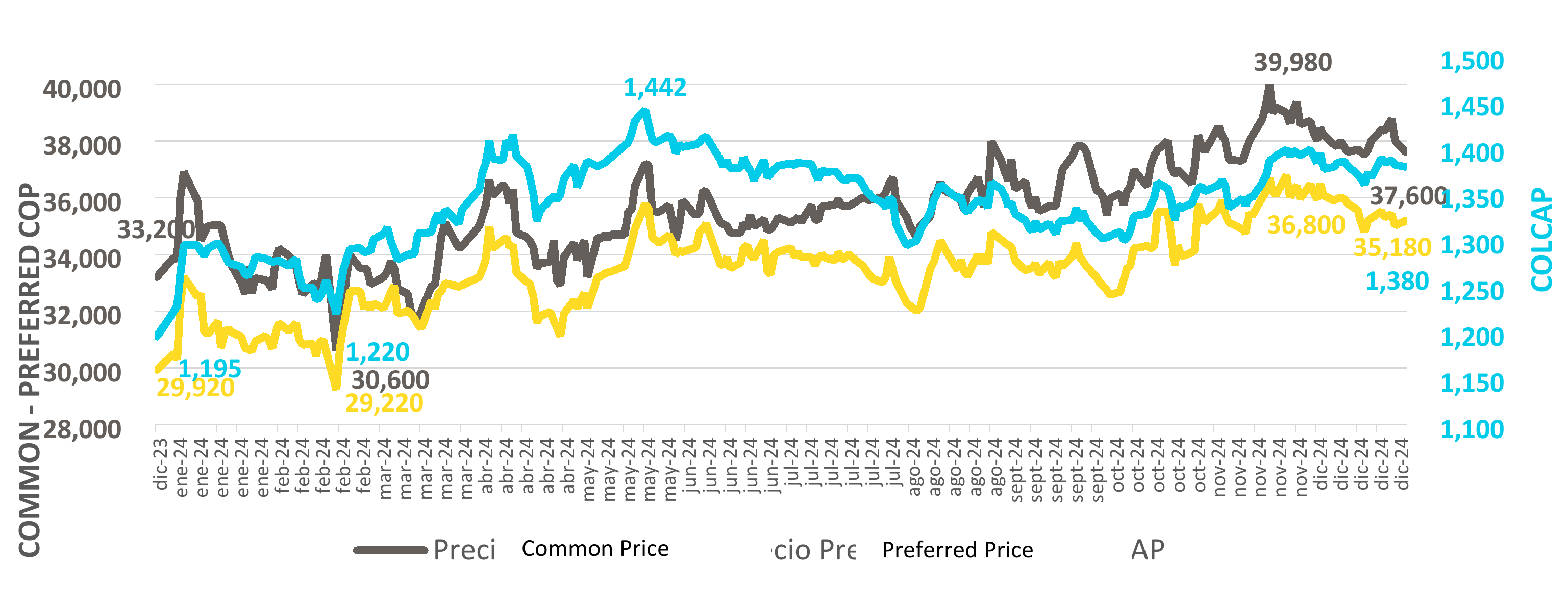
The performance of Bancolombia's common and preferred shares maintains a strong correlation with the performance of the COLCAP index throughout 2024.
Bancolombia's common stock closed 2024 with an annual variation of +13%, showing an appreciation throughout the year, reaching a low of COP 30,600 on February 19, 2024 and a high of COP 39,980 on November 20, 2024.
The preferred stock had an annual variation of +18%, with a higher appreciation than the market (COLCAP +15% annually), reaching a maximum level of COP 36,800 on November 25, 2024, from a minimum of COP 29,220 during the first months of the year.
Bancolombia Common and Preferred Price Evolution vs. COLCAP
image_24a.jpg
34


Bancolombia's ADR showed an upward trend in the first months of the year, reaching its peak in May, with a value of USD 37.3, from a level of USD 30.8 at the beginning of the year. Although in the following months it fell to a low of USD 30.73 in August, the price recovered slightly with significant fluctuations to close the year at USD 31.7. These variations reflect a behavior influenced by the devaluation of the Colombian peso, which in annual terms was 15.36%.
Bancolombia ADR vs. Representative Market Rate (TRM in Spanish) Price Evolution
image_25a.jpg


Bancolombia, TRM and COLCAP Price Variation
Date
ADR
(USD)
Common
(COP)
Preferred (COP) TRM (COP)
COLCAP
(points)
Dec 28, 2023 30.77 33,200 29,920 3,822 1,195
Dec 30, 2024 31.67 37,600 35,180 4,402 1,380
Var % 3% 13% 18% 15% 15%

General Local Market Information
35


Type Nemo Registration Date Outstanding Shares
Market Capitalization*
(COP million)
Common BCOLOMBIA 07-01-1945 509,704,584 19,164,892.36
Preferred PFBCOLOM 07-26-1995 452,122,416 15,905,666.59
*Cut-off as of December 30, 2024.


Nemo Average Daily Price Maximum Price (COP) Maximum Price Date Minimum Price (COP) Minimum Price Date
BCOLOMBIA 35,612 39,980 11/20/2024 30,600 02/19/2024
PFBCOLOM 33,517 36,800 11/25/2024 29,220 02/19/2024

Nemo Operations  Amount
BCOLOMBIA Operation number 52,799
Average daily operations 232
PFBCOLOM Operation number 135,336
Average daily operations 576

The trading volume of Bancolombia's common and preferred shares reached significant peaks in March, when common shares exceeded COP 566,000 million. Meanwhile, preferred shares recorded an outstanding volume of COP 703,000 million in April.
Throughout the first quarter, volume in common shares showed a notable increase due to the FTSE rebalancing on March 15, generating flows of close to COP 433,000 million and a share volume of 13.9 million shares. However, after this period there was evidence of a decrease in trading volume, falling to levels below COP 100,000 million in the following months.
In contrast, preferred shares continued with more stable volumes, hovering around COP 346,000 million, and showed a rebound in September (COP 387,000 million). On average, the monthly volume traded in common shares for 2024 was COP 160,000 million, while the volume of preferred shares remained 2.3 times higher than that of common shares.
36


Monthly Volume of Bancolombia's Common and Preferred Shares
image_26a.jpg
Source: Colombia Stock Exchange (BVC) Equity Risk Report.
Fixed Income Performance
In 2024, Bancolombia managed its debt in the international market through three bonds. This included the partial repurchase and early redemption of the ordinary bonds maturing on January 29, 2025, the partial repurchase of the subordinated bonds maturing on October 18, 2027 and the early redemption of the subordinated bonds maturing on December 18, 2029. In total, USD 1,320 million was collected.
Additionally, a subordinated bond was issued in the international market with maturity on December 24, 2034 for USD 800 million, with a rate of 8.625%, achieving an investor appetite 2.3 times greater than the amount sought.
Tiers of Bancolombia Group Bonds in USD
(December 31, 2024)
Bond Amount Yield Price L G-Spread
Subordinates
BCOLO SUB 27 USD 462 million 6.159% 101.887 189
BCOLO SUB 34 USD 800 million 7.951% 104.784 297
Regular
BANISTMSR 27 USD 400 million 6.098% 95.648 184

37


When analyzing the behavior of the rates of the bonds issued in the international market by Bancolombia Group during 2024, we notice that all the debt outstanding at the end of the year had favorable fluctuations in its rate. The Banistmo 2027 bond presented the best performance, with a reduction of 139 basis points (bps). Meanwhile, the Bancolombia 2034 bond, issued during the year, decreased its rate by 98 bps, while the Bancolombia 2027 bond reduced its rate by 24 bps.
Behavior of Bancolombia Group Bonds Rates
image_27a.jpg
General Local Primary Market Information
(December 31, 2024)
Primary Nemo Secondary Nemo Date of Issue Expiration Date Term (Years) Bond Type Reference Rate Issue Date Currency Amount Issued (COP Millions)
BBCB209D15 7/27/11 7/27/26 15 ORDINARY BONDS CPI 4.6 COP 248,030
BBCB319D15 11/2/11 11/2/26 15.01 ORDINARY BONDS CPI 4.62 COP 224,050
BBCB149D15 9/24/14 9/24/29 15 SUBORDINATED BONDS CPI 4.65 COP 360,000
BBCB149D20 9/24/14 9/24/34 20 SUBORDINATED BONDS CPI 4.79 COP 254,500
BLGC659C10 3/18/15 3/18/25 10 ORDINARY BONDS CPI 4 COP 91,884
BSBCB219C5 BSBCB2219C05 9/16/21 9/16/26 5 ORDINARY BONDS CPI 2.47 COP 183,797
BSBCB219C1 BSBCB2219C12 9/16/21 9/16/33 12.01 ORDINARY BONDS CPI 3.69 COP 251,500

Commitment to investors
We continue to advance in our positioning and partnership strategy with the different communities in the capital markets through active participation in different local and international events.
38


During 2024 we held more than 340 meetings with investors through attendance at seven international conferences in London, New York, Santiago and Lima, complemented by four group events held virtually. In addition, we had the opportunity to meet with 65 fixed income funds on the occasion of the marketing tour of the new subordinated bond issue in June.
Aware of the importance of providing clear information and having closer contact with the individual shareholder segment, this year we participated in 8 virtual events through the Valores Bancolombia and Trii eTrading platforms, including Issuer Week, Bolsa Millonaria (visits to universities), Masterclasses and two sessions on Financial Sector Perspectives.
We also maintained coverage of 14 investment analysts with whom we held 38 meetings in order to provide them with an update on quarterly results, the competitive environment, corporate strategy and future prospects.
Finally, we are pleased to share that once again Bancolombia reaffirmed its status as an issuer with IR Recognition in 2024, granted by the Colombian Stock Exchange to those companies that adopt best practices in disclosure and investor relations.
Additionally, the Liquidity Builder Program for Bancolombia's common and preferred stock was renewed indefinitely. This favored liquidity conditions and mitigated volatility in share trading for the benefit of all investors.    
Profit distribution project

BANCOLOMBIA S.A. ANNOUNCES PROFIT DISTRIBUTION PLAN
The Board of Directors of Bancolombia S.A. has decided to propose to its shareholders at the upcoming Ordinary General Shareholders' Meeting in March, a profit distribution project that considers the following aspects:
(i) Bancolombia will continue to maintain an adequate capital structure and an optimal level of solvency to meet the expected growth of the business, maintaining prudential standards above regulatory levels.
(ii) Business projections in 2025 are based on moderate asset growth, stability in overall business performance and a return on equity substantially above projected inflation for Colombia.
Based on the foregoing, the Board of Directors will submit to the consideration of the shareholders the profit distribution project described below:
(i) Payment of an annual dividend of COP 3,900 per share, payable in one installment on April 01, 2025.
(ii) The constitution of an occasional reserve for the strengthening of equity and future growth of the entity for COP 1.86 trillion.
(iii) An occasional reserve available to the Board of Directors for donations to social benefit projects for COP 34,000 million.
The following is the proposed profit distribution that the Board of Directors will present for approval at the Meeting:
39


Gross profit 2024 7,103,221,483,848.23
Allocations for income tax and deferred tax (1,525,001,351,375.72)
Liquid profit for the period 2024 5,578,220,132,472.51
Plus retained earnings recognized in opening balance and effectively realized during 2024 9,448,864,614.99
Plus release of provisioned resources for payment of preferred shares dividends 57,701,443,512.77
Total Distributable 5,645,370,440,600.27
Reserve for equity strengthening and future growth 1,860,245,140,600.27
To pay a dividend corresponding to 509,704,584 common shares and 452,122,416 preferred dividend shares without voting rights, subscribed and paid as of December 31, 2024, at a rate of COP 3,900 per share, payable as follows: COP 3,900 per share in a single payment on April 01, 2025 3,751,125,300,000.00
Occasional reserve at the Board's disposal for donations to social benefit projects 34,000,000,000.00
EQUAL TOTALS 5,645,370,440,600.27 5,645,370,440,600.27
Figures expressed in Colombian pesos (COP)

Milestones, initiatives, and achievements
We effectively manage risk, ensuring financial soundness (credit and liquidity risk) while anticipating moderate economic growth and a solid performance in our loan portfolio quality. We support our growth with pre-approvals, instant answers and personalized offers from our portfolio of products and services according to our customers' needs. We take care of our level of efficiency, proactively managing the organization's expenses and focusing on being more productive.
We are the financial ally of countries.

We support more than 19.7 million clients in Colombia. During 2024, we granted disbursements for COP 136.8 billones , aimed at meeting the diverse needs of individuals, households and businesses. Our portfolio balance in the country closed in 2024 at COP 191.9 trillion.

40


Disbursements (Colombia) 2023 2024 Annual Variation
Corporate  55,737,618 74,589,733 33.82%
Individuals 16,376,287 20,472,709 25.01%
SMEs 17,055,984 18,789,471 10.2%
Independents 2,144,241 2,038,767 -4.92
Business 17,866,711 20,998,523 17.5
Modality 2023 2024 Var %
Commercial        95,614,822     102,823,571 7.5%
Consumption        38,862,513       37,130,451 -4.5%
Leasing        26,056,199       26,154,135 0.4%
Housing        21,840,258       25,163,198 15.2%
Microcredit             547,677            656,350 19.8%
Total   182,921,469   191,927,705 4.9%
Meanwhile, in Central America, through our subsidiaries, we supported 766,000 customers in Panama, 622,000 in Guatemala and 1.65 million in El Salvador.
In 2024, we faced a context of inflation, high interest rates and deterioration of the loan portfolio. In response, we are managing risk more cautiously, without restricting access to credit.
On the corporate side, we maintained our permanent support with solutions in ordinary portfolio, treasury, development and leasing, aimed at financing working capital and investment, among other needs. In addition, to take care of their financial health, we provided contextual alternatives to those who had payment difficulties, including rating models with a preventive approach, strengthening the use and management of guarantees, and lowering interest rates.
In the case of individuals, pre-approvals were an instrument to maintain the balance between portfolio management and the granting of the financing they needed. In 2024, we disbursed more than COP 10.6 trillion to more than 534,000 clients in this segment in Colombia, ensuring a healthy placement with the use of analytical models and client knowledge.
In Guatemala, we have strengthened customer knowledge to increase commercial opportunities, develop the route to personalization, and develop tools to enhance targeting efforts. In fact, at BAM we adopted a model in the collections teams to boost portfolio recovery. This model included a digital strategy to contact more customers and became an additional support channel.
41


Financial management that leverages the business
To ensure the responsible growth and financial strength of the business, we carried out several key transactions in 2024.
We successfully executed a multi-stage debt management transaction. We began with the partial repurchase of 2025 senior bonds and 2027 subordinated bonds, allowing us to optimize our financial obligations.
Subsequently, we issued a Basel III subordinated bond for USD 800 million, with a 10-year term. Despite the challenging international environment, this issue was oversubscribed 2.3 times and 116 investors participated. This reflects the confidence that the markets continue to place in us. We closed the transaction with the repurchase of the remaining 2025 ordinary and 2029 subordinated bonds.
These transactions allowed us to reduce interest payments and strengthened our capital structure, consolidating our position as a benchmark in the capital markets and demonstrating our ability to proactively manage debt.
We developed a robust hedge accounting model to design new interest rate and exchange rate risk management strategies, which contributed to the reduction of our deposit costs. This allowed us to offer competitive rates to our clients, which is key to accompanying them in their productive projects.
From Treasury, we consolidated our regional presence and continued to provide comprehensive solutions to our clients in Colombia, Guatemala, El Salvador, Panama and Costa Rica. Throughout the year, more than 1,000 companies from different sectors were accompanied through financial education programs, fostering a culture of market risk management.
We reaffirmed our commitment to sustainable development by including ESG criteria in our investment decisions and increasing by 75% the sustainable hedges we offer our clients in the SME, business, corporate and institutional segments, aligning our financial strategy with their sustainability objectives.
We promoted various initiatives to optimize the use of our resources. Through interdisciplinary teams, we gave greater impetus to the management of the organization's most representative expenses, while accompanying the management of the efficiency of products and distribution channels.
We rallied the organization around the EFITÓN, an event in which more than 1,900 employees contributed to designing improvement initiatives that resulted in estimated savings of COP 924,000 million. This management allowed us to keep expense growth below inflation in 2023. This highlights our ability to generate value through efficiency.
Focusing on digital evolution, we implemented an analytical model for the management of our ATM network that optimizes maintenance and improves the planning of their renewal, extending their useful life from 7 to 8 years and generating efficiencies of COP 1,774 million.
Bancolombia Capital
With our treasury, investment banking, securities and fiduciary services, we supported a wide range of industries that required specialized financial advice for the administration of resources, investment management and with specialized solutions and structures tailored to the needs ofthe clients.
42


In Fiduciaria, we have 2,136 businesses under management, with assets of COP 163.3 trillion.
From Fiduciaria Bancolombia, we promote the creative industry, managing more than COP 1.6 trillion, with the commitment to generate transparency and security for investors, promote foreign investment, the development of regions, cultural diversity and creativity as pillars of transformation for the country. We are allied with Colombian production companies and major streaming platforms worldwide. We currently manage more than 65 audiovisual productions, including films, series, animated projects, video games, short films, and nine cultural and creative industry projects.
We engaged with initiatives focused on financial inclusion, financial education, and the development of new credit products through schemes that provide over COP 3 trillion in funding for local and international Fintechs. We also supported other key players in the ecosystem, including HealthTech companies in Colombia that help over 18,000 patients finance their medical procedures. We worked with Agrotech firms to unlock the potential of more than 15,000 agricultural producers across 24 departments nationwide. Additionally, we partnered with Hometech initiatives aimed at improving connectivity, quality, and service stability for internet users in socioeconomic strata 1, 2, and 3, among others.
Meanwhile, in Banca de Inversión (Investment Banking), during 2024 we accompanied 47 transaction closings and advisory services. In Mergers and Acquisitions, we must highlight our participation as exclusive financial advisors to Grupo Calleja, in the acquisition of 86.8% of Grupo Éxito. This was an iconic and unprecedented transaction in the region, which required simultaneous tender offer processes in Colombia and the United States due to Grupo Éxito's dual listing on the stock exchanges of Colombia, New York, and Brazil.
In Structured Finance, the year was one of good dynamics in project finance and corporate debt, with renewable energy projects and large corporate transactions standing out.
The infrastructure sector was one of the most relevant in our operations in 2024. We supported projects of high relevance for road connectivity in the countries and impact on communities (see the chapter on Infrastructure in the chapter Achieving well-being for all).
In terms of investments, we managed COP 33.1 trillion in assets. This year alone we received 33 new portfolios, reaching a total of COP 6.3 trillion under management. We launched innovative funds focused on secured credit, payroll deduction and specialized attention to foreign investors, as well as international portfolios to accompany clients in meeting their objectives. Likewise, we had a 36.6% share of the total amount placed in the fixed-income market and participated in 22 issuances.
As a result, we continue to bring capital markets closer to more individuals. During the year, more than 133,000 transactions were made through e-trading, 84% more than the previous year.
Miami Operation
With our broker dealer and investment adviser operation in the United States, we offer new opportunities for professional investors interested in optimizing their liquidity and exploring medium and long-term alternatives, with access to products in public and private markets, as well as funds with diversified strategies in stocks and bonds from different sectors and countries.
43


We closed 2024 with USD 815 million in assets under management and USD 4.38 million in revenues. In both cases, we exceeded the annual target by more than double.
Bancolombia's sustainable finance
The financial sector is key to leveraging low-carbon economies and sustainability challenges. With the purpose of promoting sustainable development to achieve the well-being for all, we identified opportunities to offer new and diverse financial instruments. These instruments not only generated new sources of income but also supported various stakeholders in meeting their needs. Additionally, we integrated environmental, social, and governance (ESG) factors into every segment of the banking business, as well as in investments and asset management, among others.
At Bancolombia, sustainable finance focuses on the following products and services:
•Credit: seven sustainable lines, which in 2024 disbursed credits for COP 9.22 trillion (the details are in the chapter Achieving well-being for all).
•Sustainable Investment: assets under management with ESG criteria for COP 32.3 trillion.
•Funding: outstanding sustainable bond issues for COP 1.07 trillion, and sustainable loans for USD 100 million.
•Treasury: sustainable hedges for COP 736,669 million.

Responsible investment
We are committed to implementing responsible investment best practices and are aware that Environmental, Social and Corporate Governance (ESG) criteria are fundamental to fulfilling our fiduciary duty.
Since our 2014 adherence to the Principles for Responsible Investment (PRI), supported by the United Nations, we have challenged ourselves to incorporate these criteria as a fundamental and integral element in all our investment processes. On this journey, and with the experience and knowledge acquired, we have deepened the integration of sustainability in our products and service offerings, our recommendations to the market, and our own position. In 2024, we reached the following milestones:
•As part of our goal to mobilize at least COP 500 trillion by 2030 through financial services in activities aligned with our sustainable business purpose, we continued to make progress in the area of Asset Management. By the end of 2024, we achieved that 90% of the Assets Under Management incorporated ESG criteria in their investment decisions.
•We joined the Net Zero Asset Managers initiative because we are committed to aligning our investment portfolios with carbon neutral scenarios by 2050. To achieve this, we measured our investments' indirect carbon footprint using the PCAF methodology and set science-based targets validated by the Science Based Targets Initiative (SBTi). We commit to aligning scope 1 and 2 emissions of our asset management investment portfolio to 1.5°C by 2040 and 2.0°C including scope 3, using 2021 as the base year.
44


•Due to the lack of information and ESG ratings in the region, we continue to apply our own ESG assessment models under international standards. As of 2024, we have 56 internally rated companies, expanding the coverage of ESG ratings that allow us to make responsible decisions aligned with our ESG policies.
•We developed and published our Engagement Policy, which provides us with guidelines for building long-range dialogues with our customers, issuers and suppliers based on different environmental, social and governance issues.
•We built tools that allow us to perform sustainability analysis for assets that did not have an assessment methodology, such as thematic emission, and measurement of industries sensitive to climate change.

Sustainable funding
At Bancolombia Group, we have been consolidating a sustainable finance strategy to offer individuals and businesses solutions for harmonious relationships with the environment and the community.
With the issuance of green, social, sustainable and sustainability-linked bonds, we seek to promote business projects that facilitate the transition to a low-carbon economy. We also want to contribute to closing social gaps, such as access to health or drinking water. In addition, we bring to the securities market the message that investments can generate social and environmental value.
We have issued 6 bonds, two of which have already matured, for a total of COP 2.7 trillion. These funds have enabled us to finance initiatives in renewable energy, sustainable construction, empowerment of women entrepreneurs, social infrastructure, circular economy and access to affordable housing. As part of this, we also committed to increasing access to finance for unbanked and underserved low-income people and to achieve a reduction in financed CO2 emissions.
These bond issuances were conducted in Colombia and Panama. They had both domestic and international buyers, including the International Finance Corporation (IFC), the Inter-American Development Bank (IDB), and investors from the primary market.
As established in ICMA's Green, Social, Sustainable & Sustainability-Linked Bond Principles standards, we present below the status of the four bond issuances that remained active during 2024.

2019 Bancolombia Sustainable Bond
On July 19, 2019, we conducted the first sustainable bond issuance for COP 657,000 million. This was fully acquired by the IDB and marked the third issuance with sustainable characteristics. This bond matured in July 2024. A total of 74% of the resources corresponded to green projects focused on sustainable construction, renewable energy and energy efficiency. The remaining 26% corresponded to social projects focused on public housing. 100% of the resources were allocated and disbursed.
•Disbursements for COP 657,000 million
•11 projects in 4 departments
•7 green projects and 4 social projects
•Average disbursement per operation: COP 82,717 million
45


•Balance of assigned projects as of July 2024: COP 659,979 million
Sustainable Development Goals to which we contribute with this issuance: SDG 11: Sustainable cities and communities, SDG 9: Industry, innovation, and infrastructure, SDG 7: Affordable and clean energy, SDG 6: Clean water and sanitation, SDG 4: Quality education and SDG 3: Good health and well-being.
2021 Bancolombia Sustainable Bond
On September 16, 2021, we issued a second sustainable bond for COP 600,000 million in the Colombian primary market in 3 series: Series 1 for COP 164,703 million, which matured in September 2024; Series 2 for COP 183,797 million, and Series 3 for COP 251,500 million, both of which remain active. A total of 60% percent of the resources correspond to green projects focused on renewable energy, energy efficiency and circular economy. The remaining 40% corresponds to social projects focused on public housing and women's empowerment. 100% of the resources were allocated and disbursed.
•Disbursements for COP 435,297 million
•90 projects nationwide
•6 green projects and 84 social projects
•Average disbursement per operation: COP 10,253 million
•Balance of projects assigned at the end of 2024: COP 472,334 million
•Average term per operation: 5.9 years
Sustainable Development Goals to which we contribute with this issuance: SDG 1: No poverty, SDG 3: Good health and well-being, SDG 5: Gender equality, SDG 7: Affordable and clean energy, SDG 8: Decent work and economic growth, SDG 9: Industry, innovation, and infrastructure, SDG 10: Reduced inequalities, SDG 11: Sustainable cities and communities; SDG 12: Responsible consumption and production and SDG 13: Climate action.
Bond tied to sustainable performance 2022
In October 2022, we were the first financial institution in Latin America to issue a bond linked to sustainability, for an amount of COP 640,000 million and a term of 5 years, and acquired by the IDB, IDB Invest and the Latin American Green Bond Fund (LAGreen). Under this operation, the conditions are linked to achieving two objectives by 2025 aligned with our purpose: 1) To increase financing for unbanked or underserved individuals with low incomes and 2) To reduce CO2-intensive emissions financed (tons of CO2e per COP million) per portfolio. The results achieved at the end of 2024 are directly disclosed on our website.
Additionally, this issuance has a specific framework aligned with the 2023 Sustainability-linked Bonds Principles (SLBP) of the ICMA (International Capital Market Association), certified by Sustainalytics as an independent third party, and the local regulations applicable to these instruments.
First issuance: Banistmo Gender Social Bond
In August 2019, Banistmo, our subsidiary in Panama issued the first gender-focused social bond in Latin America for USD 50 million. It was structured and subscribed by IDB Invest, in line with its women's economic empowerment strategy and its commitments to the Gender Parity Initiative, the Seal of Equality and UN Women's Empowerment Principles.
46


100% of the resources were used to enable access to financing for SMEs led by women, through commercial loans for small women-owned businesses in the trade, services and agribusiness sectors.
In August 2021, 100% of the resources were allocated and disbursed, benefiting 311 SMEs led by women.
Sustainable Development Goals to which we contribute with this issuance: SDG 5: Gender equality, SDG 8: Decent work and economic growth and SDG 9: Industry, innovation and infrastructure.
This bond matured in 2024.
Loans tied to sustainable performance
We currently have a loan tied to sustainability indicators for USD 100 million that we received from international banks. Through this loan, we have committed to manage and make progress on the following indicators:
Percentage of women in leadership positions (Colombia): 40.3% (target: 47%).
Absolute CO2 emissions, scope 1+2, from operations in Colombia, Panama, El Salvador and Guatemala (measured in thousands of tons of CO2e): 4.8 (target: 5.4)
Eco-efficiency
This chapter includes the eco-efficiency management implemented in 2024 and describes the results obtained in Bancolombia Group's operations in Colombia, Panama, El Salvador, and Guatemala.
In our direct operation we use natural resources such as energy, water, among others, which requires a conscious management to reduce our impact and a commitment to define a strategy to reduce consumption consistent with our corporate purpose. For this purpose, we carry out permanent monitoring aligned with reduction goals.
For the 2010 – 2020 period, we exceeded our goals. To reinforce our commitment, we challenged ourselves to reach higher goals, establishing a new baseline in 2019. During 2024, we achieved our goals in general terms. Among the most notable achievements were the reduction of emissions related to corporate travel and the decrease in paper consumption.
Environmental Management System
Describes the framework, structures, principles and guidelines for planning, organizing, executing, monitoring, controlling and ensuring the continuous improvement of our environmental performance. This is achieved through the prevention, control and minimization of the environmental impacts of the operation in all the territories where we operate and by complying with the current environmental regulations that apply to us.
We continue to focus our efforts on identifying opportunities for improvement and strengths of our actions. This allows us to continually improve the indicators of our mission axes in eco-efficiency, Environmental and Social Risk Analysis (ESRA), sustainable business and climate change strategy.

47


ig3a.jpg

Compliance with current environmental laws and regulations as a framework for Bancolombia's actions
In 2024, compliance with current mandatory regulations and the commitments we have made in voluntary sustainability protocols and adhesions have remained among our priorities. We kept our environmental and social legal matrix periodically updated and managed, making the respective mandatory annual reports on the corresponding platforms.
GRI 301 Materials
At Bancolombia Group, we have undertaken several actions to redesign our processes and digitize and reduce paper consumption.
GRI 301-1
48


Non-renewable materials used:
Not applicable: Given the bank's activities, non-renewable materials are not used in the provision of services.
Renewable materials used: We only quantify paper usage within this category.

ig5a.jpg
In 2024, our paper consumption totaled 737,7 tons. This represents an improvement in consumption compared to 2023, with a reduction of 10%. Compared to 2019, there was a reduction in consumption of 367 tons, representing a 33% decrease.
GRI 302 Energy management

ig4a.jpg
Our Energy Model seeks to efficiently manage energy consumption. For 2024, an increase of 1.3% was generated compared to 2023. Compared to 2019, we achieved a 16% reduction.

GRI 302-1, GRI 302-3
Renewable resource
49


Year Self-generated renewable energy (MJ) Purchased renewable energy (MJ) Renewable electric energy (MJ) TOTAL RENEWABLE ENERGY (MJ)
2024 4,362,841.5 257,903,992.6 35,829,031.3 298,095,865.4

Non-renewable resource
Year DIESEL or ACPM (diesel oil) (MJ) B8 (MJ) B2 (MJ) B10 (MJ) Gasoline E10 (MJ) Non-renewable electric energy (MJ) TOTAL NON-RENEWABLE ENERGY (MJ)
2024 3,026,985.8 53,744,987 1,201,302.2 5,031,842.8 181,394.8 25,283,501.81 34,778,772.49

For 2024, the energy matrix of Guatemala and El Salvador was taken into account for the calculations:
ENERGY MATRIX
  GUATEMALA EL SALVADOR
Renewable 62.2% 56.95%
Non-renewable 37.8% 43.05%


Total energy and energy intensity (Renewable + Non-Renewable)
Each year, we aim to reduce energy consumption. The following table illustrates the changes since the baseline year. For the calculation of energy intensity, we used the number of employees of Bancolombia, Banistmo, Bancoagrícola and Bam and the number of suppliers that remain in Bancolombia's facilities.

YEAR TOTAL ENERGY CONSUMPTION (MJ) YEAR-TO-YEAR VARIATION (MJ) YEAR-TO-YEAR VARIATION (%) ENERGY/EMPLOYEE (MJ/employee) YEAR-TO-YEAR VARIATION (%)
2019 398,555,002.8   -4.0% 7,477.6 -8.5%
50


2020 336,718,154.2 -61,836,848.6 -15.5% 6,079.5 -19%
2021 321,108,100.5 -15,610,053.7 -4.6% 5,388.8 -11%
2022 328,967,626.3 7,859,525.8 2.4% 5,400.1 0.2%
2023 328,756,823 -210,803 -0.1% 5,595 4%
2024 332,874,637.9 4,117,814.9 1.3%  6,459.7  15%

Achievement of the energy consumption target
YEAR TOTAL ENERGY CONSUMPTION (MJ) 2024 target compared to 2019 Achievement of 2024 target compared to 2019
2024  332,874,637.9 -10%  -16%

YEAR TOTAL ELECTRICITY CONSUMPTION (MJ)
2024 323,379,367,2

Remarks:
•To calculate energy intensity, we consider the total energy consumed within the organization (renewable electricity: purchased, self-generated and from the grid, and non-renewable: fuels), along with the number of direct group employees plus suppliers.
•Currently, there is no steam, cooling, or heating consumption.
•Currently, we do not sell energy.
•For unit conversion, we use the technical regulations and legal metrology of the SIC, UPME and Gas País.
•During 2024, we made an adjustment to the calculation of energy consumption in order to report what was actually consumed during the year, since we had been reporting based on billing dates.
•In Panama, El Salvador and Guatemala, fuels of different qualities are consumed, but they are grouped into diesel and regular gasoline.
•For Colombia and Panama, only fuel consumption for backup power plants is included. In Guatemala and El Salvador, vehicle fuel is also included.

Energy efficiency
51


We continued with the implementation and research of energy efficiency strategies, based on constant monitoring of energy consumption in branches and buildings, to identify and intervene in deviations that could alter the achievement of our goals. Thus, we have strengthened our strategies at the corporate level, integrating the actions we implement in each of the countries where we operate.
We integrated buildings into BMS (Building Manager System) for decision making and preventive management for energy and water efficiency, consumption control, and indoor personnel comfort.
iREC renewable energy
ig6a.jpg

We remain committed to our goal of purchasing 100% of our operation's renewable energy certificates by 2030. In 2024, 81% of our electricity consumption came from renewable sources, contributing to our climate commitments. This percentage reflects the contribution of each country.
•Colombia: 100%
•Panama: 100%
•Guatemala: 23%

Self-generated energy
Self-generated non-conventional renewable energy: we continue to explore implementation projects based on the analysis of our infrastructure.
•Colombia: our main building, General Management, has 1,964 panels, an installed power of 600 kWp, which generated 623.1 MWh during 2024. Additionally, our La Palmas and Torre Oriente branches generated an additional 55.32 MWh. This allows for a total annual generation of 678.39 MWh.
•El Salvador: solar panels were implemented in our data center and 7 branches during 2024, generating 462 MWh.
•Guatemala: has panels at several sites that generated 22.7 MWh.

GRI 305 Emissions
Climate change is a growing challenge. Therefore, Bancolombia is committed to defining concrete actions to actively contribute to mitigation and compensation from our direct operations and move towards a low-carbon economy.
In 2020, we redefined our science-based target for Scopes 1 and 2, aligned with a 1.5°C scenario and with a challenge to achieve carbon neutrality in the countries where we operate by 2030.
52


The definition of this target was based on the science-based methodology (SBTi – Science Base Targets Initiative).
Currently, we implement energy efficiency strategies and utilize renewable energy in 100% of our facilities. This includes the installation of photovoltaic systems in Colombia and El Salvador, as well as the purchase of 100% renewable energy certificates (REC) in Colombia and Panama, and 23% in Guatemala. In addition, we have planted more than 170,000 trees with Fundación Natura, with which we estimate a capture of 2,727 tons of CO2e.
We calculate our carbon footprint using the methodology proposed by the GHG Protocol under the operational control scheme. Only CO2 is included in the calculation as a greenhouse gas, since at the time of making the calculation, we identified that the other gases do not have a significant contribution.

GRI 305-1, GRI 305-2
image73a.jpg
Direct emissions associated with our consumption of fossil fuels in emergency power generation plants at our branches, the use of our own vehicles in El Salvador, and indirect emissions associated with the electricity purchased for our operations.
During 2024, we increased our Scope 1 + 2 market-based emissions by 32.8% compared to 2023, with an emission of 4,807.16 Tons of CO2e/year and a 75% reduction compared to 2019.
During 2024, we updated fuel emission factors for fuels and electricity across countries.

YEAR
SCOPE 1 (TonCO2e)
SCOPE 2 (TonCO2e)
SCOPE 1+2 (TonCO2e)
2024 target compared to 2019 Achievement of 2024 target compared to 2019
Location Based Market Based Location Based Market Based
2024 671.50 13,200.82 4,135.66 13,872.33 4,807.16 -47.5% -75%

Market-Based emissions correspond to the purchase of renewable energy, which accounts for 100% in Colombia and Panama, and 23% in Guatemala.
53


Biogenic emissions: In the case of Colombia, where B2, B8 and B10 biodiesel are used, the corresponding percentage is calculated as biogenic emissions.
YEAR
Biogenic emissions (Tons of CO2e)
2024 26.66


GRI 305-3
image38a.jpg
Emissions associated with our paper consumption (category 1), the logistical processes of our branches and buildings in Colombia (category 4) and business air travel (category 6). We will discuss our financed issues in detail in a later chapter.
During 2024, we decreased our Scope 3 emissions by 8.4% compared to 2023 with an emission of 1,545.37 Tons of CO2e/year. Compared to 2019, we achieved a 51% decrease.
During that year, we set a 7% reduction goal for emissions associated with the process of delivering supplies to our branches in Colombia. Thus, thanks to the efforts made between the supplier OFIX and our logistics and distribution area, we achieved a reduction compared to 2023, going from 11 Tons of CO2e/year to 10 Tons of CO2e/year.

YEAR
SCOPE 3 (Tons of CO2e)
2024 target compared to 2019 Achievement of 2024 target compared to 2019
2024 1,545.37 -25% -51%

Biogenic emissions: This doesn't apply as we lack the necessary information for this calculation.
Remarks:
54


The emission factors were sourced from:
•Energy
Colombia: Obtained from UPME's annual report.
Panama: It is sourced from local government reports.
El Salvador: Obtained through Low Carbon Power's website
Guatemala: It is sourced from local government reports.
•Fuels
Obtained from UPME calculator and IPCC 2006.
•Paper
It is data provided by the paper supplier.
•Travel
Data provided by the airlines and shared by the travel agency in Panama. For Guatemala, Colombia and El Salvador it is extracted from the EPA Simplified GHG Emissions Calculator (U.S. Environmental Protection Agency).
TOTAL CARBON FOOTPRINT
Due to the purchase of renewable energy certificates, we calculate our footprint based on location and market:
image_70a.jpg
GRI 305-4, GRI 305-5
Emission intensity and reduction
55


The changes in emissions since the base year are shown below, as well as the intensity of emissions using as calculation data the number of employees of Bancolombia, Banitsmo, Banco Agrícola and Banco Agromercantil and the number of employees of suppliers that remain at Bancolombia S.A.'s facilities.
By 2024, an increase in total emissions of 20% Tons of CO2e was generated compared to 2023 (Market Based).

YEAR SCOPE 1 SCOPE 2 SCOPE 2 SCOPE 1+2 SCOPE 1+2 SCOPE 3 TOTAL TOTAL VARIATION VARIATION TOTAL/EMPLOYEE TOTAL/EMPLOYEE VARIATION (Total/Employee) VARIATION (Total/Employee)
Location Based Market Based Location Based Market Based Location Based Market Based Total Location Based Total Market Based Location Based Market Based Location Based Market Based
2019 682.64 22,717.14 18,660.33 23,399.78 19,342.97 3,137.63 26,537.41 22,480.60 -9% -23% 0.50 0.42 -13% -26%
2020 670.28 19,127.70 8,486.25 19,797.97 9,156.53 1,046.00 20,843.98 10,202.53 -21% -55% 0.38 0.18 -24% -56%
2021 540.26 19,997.80 7,605.60 20,538.06 8,145.86 925.82 21,463.87 9,071.68 3% -11% 0.36 0.15 -4% -17%
2022 526.10 20,847.68 5,283.00 21,373.78 5,809.10 1,638.55 23,012.33 7,447.65 7% -18% 0.38 0.12
5%
-20%
2023 546.74 14,720.66 3,072.74 15,267.39 3,619.48 1,687.71 16,955.10 5,307.19 -26% -29% 0.29 0.09 -24% -26%
2024 671.50 13,200.82 4,135.66 13,872.33 4,807.16 1,545.37 15,417.70 6,352.54 -9% 20% 0.30 0.12 4% 36%

In the following table, we present the emissions intensity of Scope 1+2 and Scope 3.
As denominator, we use the number of employees of Bancolombia, Banitsmo, Banco Agrícola and Banco Agromercantil and the number of employees of suppliers that remain in Bancolombia S.A.'s facilities.

Year
Scope 1+2 (Tons of CO2e)
Total/Employee Scope 1+2 (TonCO2e/employee)
Scope 3 (Tons of CO2e)
Total/Employee Scope 3 (TonCO2e/employee)
Location Based Market Based Location Based Market Based
2019 23,400 19,343 0.44 0.36 3,138 0.06
2020 19,798 9,157 0.36 0.17 1,046 0.02
2021 20,538 8,146 0.34 0.14 926 0.02
2022 21,374 5,809 0.35 0.10 1,638 0.03
2023 15,267 3,619 0.26 0.06 1,688 0.03
2024 13,872 4,807 0.27 0.09 1,545 0.03

56


During 2024, 7 solar photovoltaic power generation projects were installed in El Salvador and iREC power was purchased. This allowed the avoidance of emissions for Scope 2 as seen below:
EMISSION REDUCTIONS
IREC SELF-GENERATED ENERGY
COUNTRY CONSUMPTION
TONS OF CO2 AVOIDED
CONSUMPTION
TONS OF CO2 AVOIDED
El Salvador 462,010.85 107.16
Panama 9,171,614.67 1,807.73
Guatemala 1,665,489.80 447.52
Colombia 60,802,893.46 6,809.92
TOTAL 71,639,997.93  9,065.17 107.16

Business travel
To offset the impact of the carbon footprint generated by our travel, we continued with the implementation of the internal carbon tax for business travel. In 2024, we generated internal revenue of COP 269,614,972, which we invested in energy efficiency initiatives to reduce energy consumption and the purchase of renewable energy certificates (REC).
image_72a.jpg

57


GRI 306 Waste
image6a.jpg

GRI 306-2
In 2024, we managed a total of 1,665 tons of waste, decreasing the amount of waste going to final disposal by 18.3% compared to 2023. Compared to 2019, there was a 3% increase. This poses a challenge for 2025.
For 2024, we recalculated the ppc (per capita production) for the calculation of ordinary waste. This recalculation was performed using the information reported by DANE related to waste generation. In addition, we adjusted the reporting form, classifying WEEE (Waste Electrical and Electronic Equipment) as HW (Hazardous Waste).
GRI 306-3, GRI 306-4, GRI 306-5
In this section, we outline the waste generated during Bancolombia Group's operations. They are differentiated between those disposed of by a third party and those also utilized by third parties. All this information is validated through certificates confirming final disposal or utilization, as applicable.
The managed waste includes recyclables (paper, plastic, glass, PET, cardboard, scrap), special waste, WEEE, and hazardous waste.
WASTE NOT INTENDED FOR OFF-SITE DISPOSAL (TONS)
HAZARDOUS WASTE 2019 2020 2021 2022 2023 2024
Reuse/recycling 0 0 4.45 0 3.09 219.84
Other types of classification 0 0 0 0 0 0
TOTAL 0 0 4.45 0 3.09 219.84
NON-HAZARDOUS WASTE 2019 2020 2021 2022 2023 2024
Reuse/recycling 1,184.33 2,428.08 883.68 887.94 1,138 308.90
Other types of classification 0 0 0 0 0 0
TOTAL 1,184.33 2,428.08 883.68 887.94 1,138 308.90
58


WASTE DESTINED FOR OFF-SITE DISPOSAL
HAZARDOUS WASTE 2019 2020 2021 2022 2023 2024
Waste incinerated with energy recovery 12.45 6.96 0.11 0.7 0.11 0.08
Waste incinerated without energy recovery 0.12 0.07 3.14 5.2 1.90 3.32
Landfill waste 0 0 0 0 0.00
Waste disposed of in other ways (cells) 0 0 1.07 1.93 1.10 0.50
TOTAL 12.56 7.03 4.32 7.82 3.11 3.90
NON-HAZARDOUS WASTE 2019 2020 2021 2022 2023 2024
Waste incinerated with energy recovery 0 0 0 0 0.00
Waste incinerated without energy recovery 0 0 0 0 0.00
Landfill waste 1,090.31 581.49 682.74 681 1,387 1132.08
Waste disposed of in other ways (cells) 0 0 0 0 0.00
TOTAL 1,090.31 581.49 682.74 681.00 1,387 1,132.08
TOTAL WASTE 2,287 3,017 1,575 1,577 2,532 1,665
Recycling % 52% 80% 56% 56% 45% 19%


YEAR Waste not intended for off-site disposal (Ton) Waste intended for off-site disposal (Ton)
2024 528,74 1,135.98

59


YEAR Waste for final disposal (Tons) 2024 target compared to 2019 Achievement of 2024 target compared to 2019
2024 1,136 -15% 3.0%

Actions carried out during 2024
In the process of delivering supplies to the branches in Colombia, we seek to reduce the number of times that contact is generated with the branch. Therefore, at the same time as orders are delivered, a reverse logistics process is carried out to collect waste. In 2023, we carried out 1,104 activations, while in 2024 we reached 1,401 activations, representing an increase of 27% over the previous year. This process reached 506 branches nationwide, with a total of 29,144 kilos collected and a recovery rate of 99.3% of the material.
We conducted awareness campaigns for the correct separation of waste in Colombia, Panama and Guatemala.
In Colombia, we carried out a campaign with “Marce La Recicladora” to raise awareness among our personnel on how to separate waste.
We remain a member of the Ellen MacArthur Foundation with the objective of strengthening the circular economy within the group.
We are part of the Repack collective in Colombia, which is responsible for the proper management of packaging placed on the market.
Environmental Investments
Breakdown by type of total environmental expenditures and investments
Environmental Investments Costs (COP)
Investments in energy and water management systems, replacement of equipment, and facilities’ adaptations 25,481,126,190.83
Waste management 6,360,994
Emissions 125,254,325
Other 15,700,000,000
TOTAL 41,312,741,509


60


OUR CORPORATE GOVERNANCE ISSUES
At Bancolombia Group, we believe that corporate governance and transparency of information are fundamental pillars for maintaining the trust of our investors, materializing our corporate strategy, guaranteeing sustainability and promoting ethical behavior.
The adoption and implementation of the best corporate governance practices in Bancolombia Group strengthen risk management and the internal control system. The documentation and disclosure of the evolution of these practices provides clarity on the responsibilities of our management bodies and their members, facilitating their compliance. Likewise, the delivery of complete, accurate and timely information enables our stakeholders to make informed decisions.
Our Shareholders
The share capital of Bancolombia S.A. is made up of common and preferred shares. On the one side, common shares grant their holder the right to participate in the deliberations of the Shareholders' General Meeting and to vote, and to receive a proportional share of the profits declared. On the other side, preferred shares grant the right to receive, at the time and in the manner approved by the General Meeting, a minimum preferential dividend based on the profits of the previous fiscal year. As a general rule and except for specific decisions identified in the corporate bylaws, preferred shares do not grant voting rights to their holders.
The Bank has an authorized capital of COP 700,000,000,000.00 and a subscribed and paid-in capital of COP 480,913,500,000.00, represented by 961,827,000 subscribed and paid-in shares. As of December 31, 2024, the total number of shareholders was 43,522. Of these, 25,700 are holders of preferred shares, 14,634 are holders of common shares, and 3,188 are holders of both common and preferred shares.
The following is the distribution of share capital as of December 31, 2024:
Type of Shares Number of Outstanding Shares Number of Shareholders Owning a Type of Shares Percentage of Participation in Share Capital for Each Type of Share
Common 509,704,584 14,634 52.99%
Preferred 452,122,416 28,888 47.01%
Total 961,827,000 43,522 100%
To date, we are not aware of any beneficial owners with a percentage of more than 10% of our share capital.
The information on shareholders with significant shareholdings as of December 31, 2024, is listed below:
Name Common % Preferred % Total %
Grupo de Inversiones Suramericana S.A. 46.11% 0.00% 24.43%
61


Fondo Bancolombia ADR Program 0.0% 27.02% 12.70%
Fondo de Pensiones Obligatorias Porvenir Moderado 8.19% 1.97% 5.27%
Fondo de Pensiones Obligatorias Protección Moderado 5.65% 3.58% 4.68%
Fondo Bursátil Ishares MSIC COLCAP 3.63% 7.26% 5.34%

No public entity has a shareholding of more than 5%.
We are not aware of any agreements entered into among our shareholders that have as their purpose the management of the business, voting alignment or similar matters. In addition, in accordance with current applicable regulations, we do not have any shares held in reserve.
In accordance with our Good Governance Code, the Directors and Administrators of Bancolombia S.A. may, directly or through an intermediary, sell or acquire shares of the Bank, while they are in the exercise of their positions, as long as they involve operations unrelated to speculation and have authorization from the Board of Directors. The administrators may not carry out the operation during the months of January, April, July and October of each year, nor during the first ten calendar days of the remaining months, nor during the period between the time when the administrators become aware of a relevant operation or business to be carried out by the entity and the time when it is disclosed to the market. The regulations adopted by the Board of Directors in this regard are regulated in paragraph 3.4. of the Good Governance Code, which can be consulted at the following link:
www.grupobancolombia.com/wcm/connect/
www.grupobancolombia.com15880/44349919-2d9d-4b5a-b153-8740ac95e42b/Codigo-de-Buen-Gobierno-Bancolombia-27-agosto-2024.pdf?MOD=AJPERES&CVID=p9pGh3X

In the case of Directors and members of Senior Management, the authorization of the Board is promptly informed to the market through the relevant information mechanism.
As of December 31, 2024, our members of the Board of Directors and Senior Management held the following shares in the company:
Shareholder Name Total Shares % Interest
Juan David Escobar Franco 88 0.00%

As explained below, the Bank's employees, including members of Senior Management, receive 30% of their variable compensation in units of a fund that invests exclusively in the Company's shares and is managed by Protección.
62


Likewise, the Directors, as agreed by the shareholders, receive 30% of their remuneration through this fund.
Communication with our Shareholders
For Bancolombia Group it is essential to maintain open and transparent communication with its shareholders, ensuring their access to complete, clear and timely information. For this reason, we have a corporate website, available in Spanish and English, where we publish financial and non-financial information, details about the corporate structure, the composition of the governing bodies, information about our directors and main shareholders, the most relevant corporate documents, and topics related to sustainability, environmental, social and human capital management, among other information of interest.
Through the Shareholder Service Center, managed by Fiduciaria Bancolombia S.A., we answer the queries and requirements of our shareholders during the year. In 2024, we handled 24,205 shareholder requests, mainly related to tax certificates, dividend payment updates, general and historical certificates, blocking or unblocking, and certificates of deposit. We also attended a total of 351 calls and 71 visits.
Our Investor Relations Office offers a live streaming channel for quarterly earnings presentations, where participants have the opportunity to submit questions in real time. The recordings and presentations made in these spaces are available on the market on our corporate website. Additionally, our shareholders may request specialized audits on specific topics, on the terms provided for this purpose in our Good Governance Code. Likewise, our management team holds periodic meetings of an informative nature with investors, analysts, and risk rating agencies in Colombia and abroad, to present the progress and performance of the Bancolombia Group’s businesses. Thus, achieving enriching spaces for dialogue for all parties.
In compliance with current Colombian regulations and the guidelines established by the Securities and Exchange Commission (SEC), we disclose relevant information to the market through the mechanism established by the Financial Superintendency of Colombia (SFC) and through 6-K reports. Our relevant information is also available to the public on our corporate website in both Spanish and English at the following link:
www.grupobancolombia.com/relacion-inversionistas/informacion-interes/informacion-relevante
With the prior approval of the Disclosure Committee, a body that reports directly to the Audit Committee and is in charge of verifying that the information we publish is accurate, clear and timely, during 2024, Bancolombia S.A. published 47 relevant disclosures to the market. The rating agencies transmitted 3 additional relevant information announcing ratings of our issued securities and of our company as a securities issuer.
Shareholders' Meetings held during 2024
During 2024, we held three Shareholders' Meetings. In each of them, the Board of Directors established measures aimed at ensuring the equitable treatment of all our shareholders, addressed to the legal representatives, administrators and other employees of Bancolombia S.A. and Fiduciaria Bancolombia S.A. These measures included, among others, refraining from promoting the granting of blank proxies, receiving proxies where the name of the representative is not clearly defined, admitting as valid proxies without fulfilling the legal requirements, suggesting the name of proxies and recommending a vote in favor or against any proposal.
63


The fair treatment measures are published as relevant information and have been made available to our shareholders on our corporate website. In addition, we adopted actions to make it easier for our shareholders to evaluate the information concerning each Meeting.
The following is a detail of each of the meetings of the 2024 General Shareholders' Meeting:
1.Ordinary Meeting of the General Shareholders' Meeting:
It was held on March 15, and was convened on February 21, 22 common days in advance, a term that exceeded the term established in the bylaws and current regulations. The announcement was published in two widely circulated newspapers, and appeared as relevant information in both Colombia and the United States.
Within the legal term, that is, 15 business days before the meeting, the information pertinent to the General Meeting was made available to our shareholders and the general public on our corporate website. Likewise, within the same term, our shareholders had access to the documents pertaining to the right of inspection at our main domicile.
At the meeting, 474,105,073 shares of our common stock were duly represented, equivalent to 93% of our total common and outstanding shares.
At this meeting, the management report, the Audit Committee's report, the standalone and consolidated financial statements, the Statutory Auditor's reports, the Profit Distribution Project, the election of the Statutory Auditor for the period 2024 – 2026 and his fees, a proposal to amend the Company's bylaws and the update of the remuneration of the Board of Directors were presented to the shareholders for their consideration.
An alternative dividend distribution proposal was received from a shareholder, which was published on our website and read at the General Shareholders' Meeting. The proposal submitted by management, which was available to the shareholders during the term of the right of inspection, was voted on first. Likewise, it was informed that, in the event that the proposal did not obtain the required votes to be approved, the proposal presented by the shareholder would be submitted to a vote.
The proposal presented by the administration was approved by the Meeting with the legally and statutorily required majorities. Likewise, the General Shareholders' Meeting approved the payment of an annual dividend of COP 3,536 per common or preferred share, payable in 4 quarterly installments of COP 884 per share per quarter, on the following dates: April 1, July 2, October 1, 2024 and January 2, 2025.
The General Shareholders' Meeting reelected PwC Contadores y Auditores SAS as Statutory Auditor for the period April 2024 – March 2026. Annual fees were approved for eleven billion four hundred forty-five million five hundred seventy-two thousand twenty-five Colombian pesos (COP 11,445,572,025). By 2025 the value of fees and expenses will increase in accordance with the CPI.
64


Likewise, management was authorized, with the approval of the Audit Committee, to make payments for additional services associated with the statutory audit and SOX functions, for an amount not to exceed 10% of the total annual amount authorized by the Meeting.
In order to attract and retain members of the Board of Directors with the highest knowledge and competencies that contribute to the generation of value and the fulfillment of strategic objectives, for the benefit of shareholders, the 2024 General Shareholders' Meeting approved the update of the remuneration of the Board of Directors, in a global economic context of inflation.
The amount of the monthly fees for the Board of Directors and for participation in the Support Committees was set at thirteen million four hundred twenty-five thousand four hundred eighty-seven Colombian pesos (COP 13,425,487) for Directors residing in Colombia and three thousand three hundred thirty-six dollars (USD 3,336) for Directors residing abroad, plus a per diem of two hundred sixty-eight dollars (USD 268) per travel day to attend the Board or Committees in person. In accordance with the policy approved in previous sessions, 70% of the Board of Directors' fees are paid in cash. The remaining 30% is contributed to an Institutional Fund whose only investment is shares of the Bank and is subject to a two-year term of permanence, counted from each contribution.
Finally, the General Shareholders' Meeting approved a reform of the Company's bylaws that adopted best practices, provided greater clarity and updated the bylaws in line with current regulations. The proposed comprehensive amendment to the bylaws was made available to the shareholders during the term of the right of inspection and in the booklet delivered to them at the time of registration. The most relevant changes are described below:
•The company's term was extended for another 100 years, until the year 2144.
•Regarding the conflict resolution mechanism, the Arbitration and Conciliation Center was changed from the Chamber of Commerce of Bogotá to the Chamber of Commerce of Medellín, considering that the Bank's main domicile is Medellín. Also, for consistency purposes, the holders of political or economic rights of the shares issued by the Bank were included within the application of this article.
•Regarding the duties of the administrators, the obligation to maintain information confidentiality was reinforced under their responsibility. In addition, it was clarified how to proceed in the event of a conflict of interest, in accordance with current regulations.
•Regarding the election of the Board of Directors, the term for calling the meetings at which directors are elected was extended to 15 business days. Likewise, the presentation and evaluation of candidates and slates was regulated, ensuring sufficient time for national and international shareholders to examine the information and define the direction of their vote.
•Regarding the operation of the Board of Directors, the term of notice for extraordinary meetings of the Board of Directors was extended to 3 business days, so that the directors have sufficient time to evaluate the information. The procedure to be followed in the event of a possible conflict of interest was specified. In addition, in order to guarantee shareholders clear and accurate information in the event of a tender offer, the Board of Directors was authorized to hire advisors, if it so decides, to analyze the offer in a comprehensive manner. This will allow shareholders to have an external and expert perspective, as is the case in international markets.
65


•Finally, we defined limits to the powers of the System Managers, Branch Managers and Assistant Branch Managers, in their capacity as legal representatives, in order to adjust them to the responsibilities inherent to their role.
Details of the proposals submitted for consideration by the shareholders, including the text of the amendment to the bylaws, can be consulted at the following link:
www.grupobancolombia.com/relacion-inversionistas/informacion-interes/asambleas-accionistas
2.Extraordinary General Shareholders' Meeting:
The second meeting of the 2024 Shareholders' Meeting was held on June 26, and was called on May 29, 27 common days in advance, a term that exceeded the term established in the bylaws for the Meetings at which the Board of Directors is elected, and in the current regulations. The announcement was published in a widely circulated newspaper, and as relevant information both in Colombia and in the United States. Shareholders had access to the information of the Meeting and to all management's proposals 15 common days in advance.
At the meeting, 460,622,076 shares of our common stock were duly represented, equivalent to 90.37% of our total common and outstanding shares.
At this meeting the shareholders elected the Board of Directors for the period July 2024 – March 2026, approved additional fees for the statutory auditors, approved the rules for the election of members of the Board of Directors, and approved an amendment to the bylaws.
The election of the Board of Directors took place following the resignation of Gonzalo Alberto Pérez Rojas, which was communicated to the market on May 03 through relevant information mechanisms and Form 6-K. The Meeting reelected the Directors who were already serving in the role, as listed in the Board of Directors section of this report. Additionally, the Meeting appointed Ricardo Jaramillo Mejía, President of Grupo Sura, as a new Director. We published on our corporate website, with the same advance notice as the call for applications, the schedule of dates for the application of candidates, as well as the instructions to carry it out. Both documents were aligned with the procedure established in Article 47 of our bylaws.
As part of the Board election process, only one slate was received from the shareholders Grupo de Inversiones Suramericana S.A. and Inversiones y Construcciones Estratégicas S.A.S. within the four business days following the publication of the notice of meeting. The Good Governance Committee, ten business days before the Extraordinary Meeting, assessed compliance with the selection criteria outlined in the Good Governance Code. It also evaluated each candidate’s qualifications, experience, and professional background, ensuring that no disqualifications or conflicts of interest existed.
66


In the evaluation carried out by the Good Governance Committee, the academic and professional career of the candidates, their personal qualities, their analytical and managerial skills, their competencies, their knowledge of the industry, financial, risk, legal, commercial, economic or strategic aspects, their contribution to the management of Bancolombia S.A., and their complementarity and diversity were taken into account. Likewise, the aptitude to take office before the Financial Superintendency of Colombia (SFC) and the availability of each candidate to attend at least 80% of the total number of meetings, to review the material in advance and to take part in the training offered by the Bank were also taken into account.
In general terms, the Good Governance Committee concluded that the candidates included in the list presented are upright professionals and have high ethical standards and good reputation. Additionally, they have top-level academic preparation, knowledge and a professional career that allow them to direct the Bancolombia Group to its purpose. They have experience in risk management and sustainability, as well as a global and strategic vision of business. None of them is immersed in causes of inability or incompatibility, and the independent members meet the conditions set forth in the Good Governance Code to be considered as such. Likewise, the candidates present a high degree of complementarity and diversity in technical strengths, academic and professional experience, both nationally and internationally, in fields relevant to the Group's management and the adequate management of its risks and business. The evaluation of the Good Governance Committee regarding each of the candidates can be consulted on our website at the following link:
www.grupobancolombia.com/wcm/connect/
www.grupobancolombia.com15880/44349919-2d9d-4b5a-b153-8740ac95e42b/Codigo-de-Buen-Gobierno-Bancolombia-27-agosto-2024.pdf?MOD=AJPERES&CVID=p9pGh3X

Additionally, the Meeting approved an additional amount for appropriations and fees for the statutory auditors of up to one billion six hundred ten million Colombian pesos (COP 1,610,000,000) payable in one or more installments between July 2024 and March 2025, to certify the financial situation of Bancolombia S.A. within the framework of the hybrid bond issuance process in the United States.
Likewise, with the purpose of advancing in the strengthening of corporate governance, the General Shareholders' Meeting approved a regulation for the election of members of the Board of Directors. This regulation incorporates the criteria of independence, as well as the disqualifications and conflicts of interest of the candidates for Board members in force in the Good Governance Code, in such a way that they have greater dissemination and are widely known by the shareholders. These criteria take into account the provisions applicable to commercial companies, issuers of securities, entities supervised by the SFC, as well as the recommendations of the Country Code. Additionally, considering that the Bank is an issuer of securities in the United States, these criteria also take into account the standards applicable to companies listed in the United States and those listed on the New York Stock Exchange (NYSE).
67


Finally, the General Shareholders' Meeting approved an amendment to the Company's bylaws, which was made available to shareholders 15 days in advance and in the booklet provided to them at the time of registration. The most relevant changes were:
•Articles 47 and 54 of the bylaws were amended to specify that the election of the Board of Directors must take into account the Regulations for the Election of Members of the Board of Directors approved by the Meeting.
•Article 95 was added to the bylaws, aimed at enhancing the protection of shareholders' rights by granting selling shareholders the right to receive the highest price paid during a 12-month period by a buyer intending to acquire a significant percentage of the company Specifically, Article 95 establishes that, if a purchaser achieves in successive purchases and during 12 months, shareholding percentages of more than 25% or 5% after a Public Share Offering, he/she will be obliged to match the price to the shareholders who have sold their shareholding to him/her during that period of time. The article also states that the buyer must establish a process that allows sellers to know if they are beneficiaries of the right of price equalization, and claim the respective payment.
Details of the proposals submitted for consideration by the shareholders, including the text of the amendment to the bylaws, can be consulted at the following link:
www.grupobancolombia.com/relacion-inversionistas/informacion-interes/asambleas-accionistas
3.Extraordinary General Shareholders' Meeting:
The third Shareholders' Meeting was held on December 11, and was called on December 2, six business days in advance and eight common days in advance, thus complying with the legal and statutory term defined for Extraordinary Shareholders' Meetings. The announcement was published in a widely circulated newspaper, and as relevant information both in Colombia and in the United States. It was also published in Spanish and English on our corporate website.
At the meeting, 410,227,567 shares of our common stock were duly represented, equivalent to 80.48% of our total common and outstanding shares.
At said meeting, the shareholders authorized the Management, with the approval of the Audit Committee, to make payments for additional services rendered by PWC, associated with the process of evolution of the corporate structure of Bancolombia S.A. and its subordinates. These payments shall not exceed three billion six hundred million Colombian pesos (COP 3,600,000,000) and two hundred thousand dollars (USD 200,000) for the services required in Colombia, the United States or other jurisdictions in which the Bancolombia Group operates. The contracting and payment of the additional services may take place between 2024 and 2025. The dollar value will be paid at the TRM in effect on the date payment is made.
The details of the proposal submitted for consideration of the shareholders can be consulted at the following link:
www.grupobancolombia.com/relacion-inversionistas/información-interes/asambleas-accionistas
68


Our Board of Directors1
According to the information provided to the market by Grupo de Inversiones Suramericana S.A. on August 31, 2023, Gonzalo Alberto Pérez Rojas, former Chairman of said company and former member of the Board of Directors of Bancolombia S.A., tendered his resignation to the Board of Directors of Grupo de Inversiones Suramericana S.A., the day after he turned 65 years of age. The Board of Directors of Grupo de Inversiones Suramericana S.A. accepted his resignation and asked him to remain in office until April 30, 2024. On May 03, 2024, Bancolombia S.A. announced that Gonzalo Alberto Pérez Rojas resigned from his position as a member of the Bank's Board of Directors, effective May 01, 2024.
As explained above, the Extraordinary Shareholders' Meeting held on June 26 reelected the Directors who were already serving in the role and elected Ricardo Jaramillo Mejía, President of Grupo Sura, as the new Director. Prior to the appointment, the Good Governance Committee evaluated the candidates and concluded that they are suitable professionals, that none of them is immersed in any cause of inability or conflict of interest, and that the independent members meet the conditions set forth in the Good Governance Code to be considered as such.
Thus, our Board of Directors, appointed for the period from July 2024 to March 2026, has a diverse composition that integrates experience and innovative perspectives. This combination of skills, qualities and backgrounds guarantees the performance required by the governing body of a systemically important institution such as Bancolombia S.A.
Our Board of Directors is comprised of 71% independent directors, 29% foreign directors, and 29% female participation. 100% of our Directors are over 50 years of age. The average period of tenure of the Directors is five years, as follows:
•Ricardo Jaramillo Mejía: Equity member of the Board of Directors since 2024, he was appointed at the Extraordinary Shareholders' Meeting held on June 26.
•Juan David Escobar Franco: Equity member belonging to the Board of Directors since 2020. He was reelected in 2021, 2023 and 2024.
•Andrés Felipe Mejia Cardona: Independent member belonging to the Board of Directors since 2016. He was reelected in 2018, 2020, 2021, 2023 and 2024.
•Arturo Condo Tamayo: Independent member, of Ecuadorian nationality, belonging to the Board of Directors since 2016. Expert in cybersecurity issues. He was reelected in 2018, 2020, 2021, 2023 and 2024.
•Luis Fernando Restrepo Echavarría: Independent member belonging to the Board of Directors since 2016. He is currently the Chairman of the Board. He was reelected in 2018, 2020, 2021, 2023 and 2024.
•Silvina Vatnick Independent member, of Argentinian nationality, belonging to our Board of Directors since 2021. Expert in financial and ESG issues. She was reelected in 2023 and 2024.
•Sylvia Escovar Gómez: Independent member belonging to the Board of Directors since 2020. She was reelected in 2021, 2023 and 2024.
1 It is important to note that when we refer to independent or equity directors, we refer to the definitions set forth in current Colombian regulations and in the Good Governance Code.
69


•All of our Directors have a recognized reputation, decision-making capabilities, analytical skills and the necessary competencies to perform their duties and assume their responsibilities as Directors of a systemic entity such as Bancolombia S.A. Their knowledge and specialties allow them to measure and evaluate risks in a comprehensive manner, as well as to contribute to the financial, internal control, technological, commercial, economic and legal aspects of the Bancolombia Group. None of our Directors are employees of Bancolombia S.A. or its subsidiaries, nor are they members of the Boards of Directors of the latter.
The professional profiles of our Directors, together with their academic and professional trajectory, as well as their participation in administrative bodies of other organizations, are available on our institutional website. They can be consulted in the Board of Directors tab by clicking on the following link:
www.grupobancolombia.com/corporativo/gobierno-corporativo/junta-directiva-alta-gerencia
As reported earlier, the 2024 Annual General Meeting of Shareholders approved the update of the remuneration of the Board of Directors.
Operation of the Board of Directors during 2024
In accordance with our bylaws, the Board of Directors has broad powers to order the execution or performance of any act or contract within the Bank's corporate purpose and to adopt the necessary decisions in order for the Bank to fulfill its objectives. Among its main responsibilities, the Board of Directors is in charge of defining the general, financial and risk policies, as well as the strategic objectives of both the Bank and the Bancolombia Group, for which it evaluates its performance.
In addition, it has special powers, including, but not limited to:
•Set the general salary and extra-legal benefits system.
•Define the general structure of the Bank that it deems appropriate for the adequate management of the Bank and the Bancolombia Group.
•Approve the creation of Vice Presidencies and designate legal representatives.
•Oversee the effectiveness of the internal control system, risk management systems and legal compliance.
•Authorize the incorporation of subsidiaries and affiliates, as well as the acquisition, subscription or disposal of shares, quotas or rights in other companies or enterprises that comply with the conditions set forth in our bylaws.
•Appoint the members of the Board Support Committees.
•Approve the Code of Ethics and the Good Governance Code.
•Promote respect and equitable treatment of all shareholders and other securities investors.
•Carry out, under the terms established in the Good Governance Code, the evaluation of its own management and that of the Bank's President.

The duties of the Board of Directors are set forth in Article 61 of our bylaws. The Board of Directors Operating Regulations are included in the Good Governance Code. Both documents are available in Spanish and English on our corporate website:
www.grupobancolombia.com/corporativo/gobierno-corporativo/documentos-de-interes
70


Among other functions carried out during 2024, in its capacity as the highest management and administration body, the Board of Directors:
•Authorized the management to advance in the procedures and execute all the necessary acts to perfect the transactions leading to modify the corporate structure of the Bancolombia Group through the creation of a parent company to be called Grupo Cibest S.A. by means of: (i) the partial spin-off of Bancolombia (Panamá) S.A. for the benefit of the Beneficiary Company BC Panamá S.A.S.; (ii) the merger by absorption by Bancolombia S.A. of the Beneficiary Company BC Panamá S.A.S.; (iii) the partial spin-off of Banca de Inversión Bancolombia S.A. Corporación Financiera for the benefit of Bancolombia S.A.; and (iv) the partial spin-off of Bancolombia S.A. for the benefit of Grupo Cibest S.A. The procedures and actions referred to in this authorization include, but are not limited to, those aimed at calling the shareholders' meeting of Bancolombia S.A. once the necessary regulatory approvals are obtained in Colombia, Central America, and other countries where the Group operates, as well as the relevant procedures and registrations in Colombia and the U.S. related to the actions of Grupo Cibest S.A.
•Authorized the preparation, filing and registration of Form F-4 under the U.S. Exchange Act of 1933 with the Securities and Exchange Commission (SEC), pursuant to the Exchange Act of 1933. Form F-4 is related to the evolution of the corporate structure of Bancolombia and its subordinates indicated in the previous point.
•Approved the constitution of the new Technology and Cybersecurity Committee as a support committee to the Board of Directors, and its rules of procedure.
•Approved amendments to the regulations of the Audit, Risk and Good Governance Committees.
•Recommended to the General Shareholders' Meeting the appointment of the Statutory Auditor, after evaluation by the Audit Committee of the proposal submitted.
•Appointed the new Compliance Officer.
•Analyzed the strategic execution and performance of the businesses in the geographies in which the Group operates.
•Evaluated the reports from management, internal audit and the Statutory Auditor on the evolution of the different risk management systems.
•Through the Risk Committee, followed up on the different risks in the risk map.
•Monitored the proper functioning of the control, risk monitoring and compliance systems, making recommendations for their continuous strengthening.
•Approved the annual calendar of its ordinary sessions.
•Defined the company's annual budget.
•Approved modifications to the Good Governance Code, the SIAR Manual, and the Code of Ethics.
•Monitored the financial results of the Bank and Bancolombia Group.
•Authorized the capitalization of subsidiaries and affiliates.
•Carried out appointments of administrators and Senior Management members.
•Evaluated, among others, periodic reports on AMV (Colombian Securities Market Self-Regulator) certifications, cybersecurity reports, business continuity plan, stress test results, and information security policies.

71


On September 24, 2024, once the Directors elected at the Extraordinary Shareholders' Meeting held on June 26 were appointed by the SFC, the Board reelected Luis Fernando Restrepo Echavarría, independent director, as its Chairman and appointed Ricardo Jaramillo Mejía, equity director, as Vice Chairman. In addition the Board of Directors appointed the members of the Board Support Committees.
In compliance with the assigned duties, the Chairman of the Board ensured the efficiency and proper performance of the Board, and guided the discussions to ensure the participation of the Directors and the relevance and effectiveness of the debates. Likewise, together with the General Secretary and the Good Governance Committee, he managed the annual evaluation process of the Board of Directors and its Support Committees and the process of defining the annual thematic agenda of the Board of Directors. This agenda guides the activities of the Board of Directors, helping to plan, follow up and fulfill management and supervisory functions. This allows the Board to strategically address business, risks and adapt to the dynamics of the environment, the evolution of operations and the needs of the Bancolombia Group.
The Legal Vice President and General Secretary, in addition to the functions already mentioned, is responsible for making available to the Directors the information and documentation to be evaluated at the meetings of the Board of Directors and Support Committees. Additionally, she is responsible for reflecting in the minutes of the Board of Directors the development of the meetings and the decision-making processes, as well as to ensure compliance with the procedures and rules of corporate governance, in accordance with the provisions of the Bylaws and other corporate documents.
During 2024, 12 ordinary and 3 extraordinary meetings of the Board of Directors were held, with an average attendance rate of 92.8% The average attendance at Board meetings by each Director is as follows:
•Ricardo Jaramillo Mejía*: 83%
•Juan David Escobar Franco: 87%
•Andrés Felipe Mejía Cardona: 100%
•Arturo Condo Tamayo: 87%
•Luis Fernando Restrepo Echavarría: 93%
•Silvina Vatnick 100%
•Sylvia Escovar Gómez: 100%

*Ricardo Jaramillo Mejía was appointed Director at the Extraordinary Shareholders' Meeting held on June 26. Average attendance is calculated from his appointment.
** Gonzalo Alberto Pérez Rojas attended 83.3% of the meetings held up to the date of his resignation.
According to the Board of Directors' operating regulations outlined in Section 3.1 of the Good Governance Code, Directors must have sufficient time availability to take on responsibilities in service of Bancolombia S.A., which includes thoroughly reviewing materials and attending sessions. Availability also implies an attendance that must not be less than 80% of the total annual meetings of the Board and Committees, except in the case of justified force majeure.
The total amount paid to the Directors for their participation in the Board and in the different Support Committees held during 2024 amounted to two billion four hundred seventy-three million seven hundred ninety-six thousand five hundred fifty-three Colombian pesos (COP 2,473,796,553).
72


Per diems amounted to fifty-eight million five hundred thirty-six thousand seventy-two Colombian pesos (COP 58,536,072).
Support Committees of the Board of Directors
Our Board of Directors has five Support Committees. Each Committee has a President and an Internal Regulation that regulates its composition, the frequency of its meetings and its functions. At the meeting immediately following a Committee's session, the Chairman of the Committee reports to the full Board on the matters evaluated and the decisions made at the meeting, or the decisions recommended to the Board.
Technology and Cybersecurity Committee
In view of our responsibility to identify trends and manage risks, and taking into account the importance of technology in our strategy, the Board of Directors established the Technology and Cybersecurity Committee in September 2024. The main objective of this Committee is to support the Board of Directors in the strategic direction and oversight of technology and cybersecurity matters of Bancolombia S.A. To this end, the Committee is aware of technology trends that could affect our strategic plans and reports on the technology operations of Bancolombia S.A. The Committee also monitors the development of the strategic technology plan and the performance of significant investments in technology and cybersecurity. The creation of this Committee allows close monitoring by the Board of Directors of technology and cybersecurity issues, including the action plans implemented to close the gaps.
The Committee is comprised of four members of the Board of Directors, including three independent Directors, among them the Director with expertise in security matters. The Vice President of Corporate Services, the Vice President of Technology, the Corporate Cybersecurity Environment Leader and the Director of Non-Traditional Risks attend the Committee as permanent guests. Jorge Noguera, external advisor to the Board of Directors on technology and cybersecurity, also attends the meetings. Additionally, the Vice President of Internal Audit and the Vice President of Risk may attend as guests, as well as any other relevant employee in accordance with the topics to be discussed. The Manager of Special Initiatives of the Vice Presidency of Technology Services acts as Secretary of the Committee.
During 2024, the Committee received a leveling in the Bank's cybersecurity technology and management expertise. It also discussed in depth the ongoing action plans related to channel availability events, and followed up on their evolution. Additionally, it reviewed the findings from Internal Audit regarding technology, cybersecurity, and cloud matters, as well as the exposure to technology and cybersecurity risks.
The Committee met four times over the course of 2024, with an average attendance rate of 93.7%, as follows:
•Silvina Vatnick, independent director and Chairwoman of the Committee: 100%
•Arturo Condo Tamayo, independent director and cybersecurity expert: 100%
•Andrés Felipe Mejía Cardona, independent director: 100%
•Juan David Escobar Franco, equity director: 75%

Good Governance Committee
73


The Good Governance Committee is composed of three independent members of the Board of Directors, and is permanently attended by the President of Bancolombia S.A. The Legal Vice President and General Secretary of Bancolombia S.A. acts as Secretary of the Committee. The main purpose of this Committee is to support the Board of Directors in the fulfillment of its functions related to corporate governance, approve the ESG strategy and review its compliance.
During 2024, the Committee learned the results of the evaluation of the Board of Directors for the 2023 fiscal year and made suggestions to strengthen the Board's effectiveness. It also evaluated the thematic agenda of the Board of Directors for 2024. The Committee reviewed and recommended the statutory amendments proposed by management at the Ordinary Shareholders' Meeting held on March 15 and the Extraordinary Shareholders' Meeting held on June 26, as well as the proposed compensation for the Board of Directors. In addition, the Committee recommended the Board of Directors to adopt the modifications to the Good Governance Code, the Good Governance Committee regulations, and to implement the Orientation and Training Policy for members of the Board of Directors.
Additionally, as previously mentioned, for the election of the members of the Board of Directors carried out by the Extraordinary Shareholders' Meeting on June 26, 2024, the Committee conducted an assessment of compliance with the selection criteria defined in the Good Governance Code, and analyzed the suitability, experience, and professional profile of each candidate, as well as the absence of disqualifications and conflicts of interest regarding them.
In the area of sustainability, the Committee followed up on the ESG strategy and indicators, and learned about the ESG disclosure framework for the geographies in which we operate.
During 2024 the Committee met six times with an average attendance of 94.3%, as follows:
•Luis Fernando Restrepo Echavarría, independent director and President of the Committee: 100%
•Sylvia Escovar Gómez, independent director: 100%
•Arturo Condo Tamayo, independent director: 83%

Appointment, Compensation and Development Committee:
The Appointment, Compensation and Development Committee is made up of two independent members and one equity member of the Board of Directors. The Committee is attended by the President of the Bank, the Corporate Vice President of Talent and Culture, and the Compensation and Benefits Manager, who acts as Secretary of the Committee.
The main task of the Appointment, Compensation and Development Committee is to support the Board of Directors in determining the policies and provisions for the selection, appointment, hiring and remuneration of Senior Management and all matters related to the Bancolombia Group’s remuneration model.
During 2024, the Committee met twice, once by written vote. The Committee approved the executive team's Long Term variable compensation indicators, evaluated Banistmo's variable compensation model and had an average attendance rate of 100%, as follows:
74


•Sylvia Escovar Gómez, independent director and Chairwoman of the Committee: 100%
•Luis Fernando Restrepo Echavarría, independent director: 100%
•Ricardo Jaramillo Mejía, equity director*: Does not apply

*Ricardo Jaramillo Mejía was appointed Director at the Extraordinary Shareholders' Meeting held on June 26. The Committee met prior to that date, with the participation of Gonzalo Alberto Pérez Rojas, former equity director.
Risk Committee
The Risk Committee of Bancolombia S.A. is composed of two independent members and one equity member of the Board of Directors. This Committee is permanently attended by the President and the Vice President of Risks of Bancolombia S.A. Jorge Noguera, external advisor to the Board of Directors, attends as a guest when the topics to be discussed at the meeting include technological or cyber risk issues.
The Committee meets monthly, and its main objective is to support the Board of Directors in the approval, monitoring and control of policies, guidelines and strategies for risk management.
During 2024, the Committee supported the Board of Directors in the approval, follow-up and control of risk management policies, guidelines and strategies. It also conducted monthly monitoring of the different indicators and the behavior of the risks in the organization's risk map, including ESG and cybersecurity risks.
The Committee met 12 times during 2024, with an average attendance rate of 97.3%, as follows:
•Andrés Felipe Mejía Cardona, independent director and President of the Committee: 92%
•Silvina Vatnick, independent director: 100%
•Juan David Escobar Franco, equity director: 100%

Audit Committee
The Audit Committee of Bancolombia S.A. is composed of three independent members of the Board of Directors, one of them being the financial and ESG expert and the other the cybersecurity expert. This Committee is attended by the Vice President of Internal Audit of Bancolombia S.A., the Statutory Auditor, Dr. Luis Alberto Zuleta, external advisor to the Audit Committee, and when the issues to be discussed include technological or cybersecurity matters, Jorge Noguera, external advisor to the Board of Directors.
The Committee meets monthly, and its main objective is to serve as support to the Board of Directors in supervising the effectiveness of the internal control system of Bancolombia S.A., in particular, and of the Bancolombia Group, in general, as well as in its improvement. During 2024, the Committee supervised the integrity of the financial statements, the financial reporting process and the internal accounting and financial control systems. It also approved and monitored the execution of the Internal Audit and Statutory Auditor's work plan, guaranteeing their autonomy, objectivity and independence. It also monitored the different programs managed by the Compliance Vice Presidency including SARLAFT, Ethics, FATCA, Data Protection, Anti-Fraud, and Regulatory Compliance.
75


It also recommended to the Board the approval of the Information Security Policy and approved the 20F and the Internal Audit Charter.
The Audit Committee met 16 times during 2024, with an average attendance rate of 92%, as follows:
•Arturo Condo Tamayo, independent director and Chairman of the Committee: 88%
•Andrés Felipe Mejía Cardona, independent director: 88%
•Silvina Vatnick, independent director: 100%

Information management
The timely delivery of information is essential for our Directors to actively participate in sessions and make informed decisions. In this regard, we make use of a web-based tool with exclusive access for the Directors. Through this tool, we make available to them, at least four days in advance, the material to be presented to the Board Support Committees and the Board of Directors, for their prior evaluation and analysis. In addition to guaranteeing timely access to information for Directors, this tool protects the confidentiality of the information.
At the Ordinary Shareholders' Meeting held on March 15, 2024, an amendment to “Article 36. Duties of Directors” of the Company's bylaws was approved, in order to complement the obligation of reserve of the directors, pursuant to the regulations of the Company's Good Governance Code. Paragraph 4 of said article establishes that any person appointed as a member of the Board of Directors adheres to the Information Management Regulations set forth in the Good Governance Code and is required to sign the Agreement for Access and Use of Information. Said regulation, developed in paragraph 3.7 of the Good Governance Code, establishes that the Directors must keep and protect the confidentiality of the information to which they have access. It also states that their functions as Directors must be performed in the best interest of the Bank, considering the interests of its associates. Therefore, they must refrain from using confidential information for any purpose other than the performance of their duties.
Evaluation of the Board of Directors and its Support Committees
In compliance with the provisions of the Good Governance Code, the Bank's Board of Directors carries out an annual evaluation of its management and that of its Support Committees. These evaluations alternate between internal and external. Thus, between December 2023 and February 2024, the external advisor Governance Consultants conducted an evaluation of the Board's management during 2023. Likewise, in January 2025, a self-assessment of the 2024 management was carried out.
The evaluation took into account the composition of the Board of Directors, the strategic role of this body, the interaction and dynamics of the Board, access to information and coordination of the agenda, the dynamics of the different Support Committees and Board meetings, and the performance of Senior Management.
The diversity of knowledge of the Directors was positively highlighted, as it allows for a holistic view of the Bank's sustainability on all fronts. In addition, the operation of the Committees, the evolution of the organization's corporate governance and the importance of the specialty of the Committees for the dynamics of the Board of Directors were highlighted. Likewise, the Directors highlighted as strengths of the Board the commitment, trust, respect, professionalism, experience, talent, independence and leadership of its members.
76


The Directors recommended continuing to work on the Board of Directors' agenda while maintaining a strategic focus in the discussions. Likewise, they requested to continue promoting the training offered to the Directors, especially in cybersecurity and digital transformation.
The results of the Board's self-assessment for 2024 were evaluated by the Good Governance Committee and the Board of Directors, and were taken into account for the construction of the annual thematic agenda and the improvement of the governing body.
Board of Directors Training
The training received by the Directors enables them to perform their duties effectively.
The Good Governance Code, in section m of paragraph 3.1., documents the Orientation and Training Policy for Directors, which was incorporated into the Code in 2024. In line with this policy, and with the aim of ensuring that newly appointed Board members understand their responsibilities and the organization's operations, the General Secretary coordinates their orientation plan. This plan is tailored based on each Director’s experience, background, and profile, the Support Committees they will participate in, and their prior knowledge of the entity. Thus, Ricardo Jaramillo Mejía, once appointed Director, completed an orientation and training plan.
In addition, the Bank provides Directors with regular opportunities to update their knowledge and skills through training and education on academic, commercial and strategic topics related to the competencies of the Board and its Support Committees, and on the topics that the Board of Directors and Senior Management define as relevant and pertinent for each year. In addition, Directors are encouraged to attend seminars and events that allow them to be in contact with national and international organizations, entities and companies.
On April 02 and 03, 2024, the Directors received a certification on "ESG Factors as a Decision-Driver in the Banking Sector", given by the Barcelona School of Management. The certification was oriented to deepen the implications of the management function in the ESG field, decision-making that impacts the ESG strategy, and the identification of potential opportunities and risks from an ESG perspective.
The Board of Directors also received certification in Anti-Money Laundering (AML) trends from the Financial & International Business Association (FIBA). In this certification, the responsibilities and challenges faced by managers in this area were discussed in depth. In addition, a tour of best practices to ensure that AML programs work effectively and meet the highest regulatory standards was provided.
Likewise, the Directors that make up the Technology and Cybersecurity Committee participated in knowledge leveling sessions on the matters pertaining to said Committee.
Our Senior Management
Senior Management is responsible for implementing and executing the strategy, and for achieving the organization's medium- and long-term corporate objectives. Senior Management is composed of the President of Bancolombia S.A. and the Vice Presidents who report directly to him.
77


During 2024, the following people made up the Senior Management:
•Juan Carlos Mora Uribe, President. The direct governance and management of the Bank is the responsibility of the President, who has a vision of integral governance of all the Group's companies at national and international level and establishes clear reporting lines and assignment of responsibilities. The Bank's President, with the support of his Senior Management team, directs the goals and objectives and validates strategic execution and plans, ensuring that they are integrated within the context of the Group.
•Mauricio Rosillo Rojas, Vice President of Business. His main responsibility is to design, execute and supervise strategies aimed at generating value in the businesses of the Bank and its subsidiaries. He also defines value propositions aligned with the universal banking model, in order to consolidate and expand the Group's leadership.
•Julián Mora Gómez, Corporate Vice President. He is responsible for the implementation of a strategic model that leverages the business, from the coordination of areas with transversal impact such as Reputation and Communications, Human Resources, Compliance and Diversity, Equity and Inclusion.
•Jaime Alberto Villegas Gutiérrez, Vice President of Corporate Services. His main responsibility is the provision of corporate administrative, technology, operations and project support services required by the business units to fulfill the promises made to customers, ensuring the normal development of the Bancolombia Group's activities.
•Rodrigo Prieto Uribe, Vice President of Risks. His function is the design and proposal of the Risk Appetite Framework, the SIAR policies, the general exposure and concentration limits, the Risk Governance structure, and the strategies to manage risks, the capital and liquidity, to the Board of Directors. He also monitors that the policies established in the SIAR are effective and aligned with the organization's risk profile and appetite.
•Cipriano López González, Vice President of Innovation. He leads the formulation and implementation of innovation strategies, partnerships, digital transformation and analytical capabilities, seeking new sources of value generation for the organization's stakeholders.
•José Mauricio Rodríguez Ríos, Vice President of Audit. His main function is to evaluate the effectiveness of the internal control system, compliance with the accounting and financial policy, the quality of the systems established to guarantee compliance with applicable regulations, and the analysis of the organizational structure of the organization, proposing solutions to address identified improvement opportunities.
•Claudia Echavarría Uribe, Legal Vice President and General Secretary. In this position, she leads the general secretary and the legal strategy of Bancolombia Group, identifying, managing and mitigating the legal risk implicit in the development of the organization's activities, and creating innovative legal solutions to ensure the sustainability and purpose of the Group.
•Mauricio Botero Wolff, Corporate Vice President of Strategy and Finance. Appointed May 28, 2024. His mission is to direct and integrate the formulation and execution of strategy and financial management in the Group's companies and
78


businesses in all geographies, seeking to generate value for stakeholders, responsible growth and the Group's financial strength.

The professional profiles, academic background and professional experience of the members of Senior Management can be consulted on our corporate website at the following link, in the tab corresponding to Senior Management:
www.grupobancolombia.com/corporativo/gobierno-corporativo/junta-directiva-alta-gerencia
The Board of Directors is responsible for the appointment, remuneration and replacement of Senior Management, as well as the assignment of their main responsibilities and the supervision of their succession plan, for which it may rely on the Appointment, Compensation and Development Committee. In this way, the Board of Directors evaluated the performance of Senior Management, and through the Chairman of the Board and with the support of the Appointment, Compensation and Development Committee, annually evaluates the performance of the President of Bancolombia S.A.
The organization has a compensation strategy for the management team that is monitored on an ongoing basis. This compensation strategy is made up of fixed compensation, variable compensation and benefits. Variable compensation, with its short- and long-term components, seeks to stimulate the fulfillment of the company's goals, reward with the generation of value, align the interests of the management team with the interests of the shareholders, and recognize and encourage high performance of the management team in consistency with the organizational strategy.
The variable remuneration policy is based on the generation of added value. There is room for the payment of bonuses when organizational results in terms of profits exceed the value of the cost of capital. Besides, the model measures compliance with strategic planning goals, which must be aligned with the strategic direction defined by the Board of Directors. Long-term results are promoted. For this purpose, short- and long-term (triennial [3 years]) management measurement indicators are considered. The long-term component considers the financial indicator (SVA Holding), the sustainability indicator (Dow Jones Sustainability Index) and the loyalty indicator (competitive NPS). During 2024, the Board of Directors, through the Nomination, Compensation and Development Committee, comprehensively reviewed the challenges of the indicators associated with the long-term management of the variable component.
We have also established a remuneration cap: a maximum of eight salaries per year for the President and seven for the Corporate Vice Presidents as a bonus. The 30% of the remuneration is translated into participation in the Institutional Voluntary Pension Fund SVA, which is represented in shares of Bancolombia S.A. According to the fund's regulations, employees may only withdraw their contributions after a minimum permanence term of three years. The philosophy of this mechanism is that employees feel ownership of the organization and are committed to sustainable results.
Note 28 “Transactions with related parties” of the consolidated financial statements (note 27 of the standalone financial statements) contains details of labor payments made to Senior Management.
The withdrawal of resources from Fondo SVA by the Bank's administrators must undergo an authorization procedure before the Board of Directors. The authorization granted to the members of Senior Management is revealed to the market through the relevant information mechanism.
79


Finally, we have in place the Clawback Policy, which regulates the process of recovery by Bancolombia S.A. of excess incentive-based compensation recognized to executives in the event of a restatement of the financial statements due to a material failure to report financial information under the securities market law. The approved policy can be consulted on our corporate webpage at the following link:
www.grupobancolombia.com15880/44349919-2d9d-4b5a-b153-8740ac95e42b/Codigo-de-Buen-Gobierno-Bancolombia-27-agosto-2024.pdf?MOD=AJPERES&CVID=p9pGh3X

Related-Party Transactions
As a financial services provider, we offer our customers, including our related parties, the possibility of accessing the financial products and services we offer. In addition, according to the needs and evolution of the business, we enter into agreements and alliances.
Our commercial and business relationships with related parties are entered into at market prices and in Bancolombia Group's best interest. Although these operations are not inherently considered conflictive, there is a possibility that managers may face dilemmas when making decisions. The Group's employees and managers are expected to act with the utmost prudence when faced with a real or apparent conflict of interest, in accordance with the internal policies and guidelines contained in our Good Governance Code and our Ethics and Conduct Code, which can be consulted on our website.
When a Director (member of the Board of Directors) finds that in the performance of his or her duties he or she may be faced with a potential conflict of interest, the Director in conflict or any other Director who is aware of such potential conflict shall immediately inform the other members of the Board. The Director in a conflict of interest situation will refrain from participating in the discussion and decision of the matter that creates the conflict; and the Board will deliberate and decide without the participation of the Directors in conflict, unless their presence is needed to meet the quorum required for deliberation and decision-making. Otherwise, the conflict shall be submitted to the competent body in accordance with the applicable regulations, including the special rules for financial conglomerates.
Our Good Governance Code considers as related parties the companies subject to the control of Bancolombia S.A., our members of the Board of Directors and Senior Management, as well as their spouses and children, and the companies in which they have a shareholding of more than 10%, the entities that make up the Sura Bancolombia Financial Conglomerate, and other shareholders of Bancolombia S.A. with a shareholding in our share capital of more than 10%. In addition, the Good Governance Code contains policies by virtue of which transactions with related parties are classified according to their recurrence and materiality, so that adequate standards of identification, disclosure, evaluation and approval are applied.
During 2024, the transactions entered into with entities belonging to the Sura Bancolombia Financial Conglomerate were entered into under market conditions and under the premise of not jeopardizing the companies' ability to meet their obligations to third parties. Each party acted in its best interest.
80


On a monthly basis, the Board of Directors monitored the treasury operations carried out with our economic related parties, in accordance with the classification that exists for such purpose in terms of market and liquidity risks. These transactions were carried out under market conditions and in compliance with the procedures established for such purpose.
In addition, according to the Organic Statute of the Financial System, certain credit operations, including those entered into with shareholders owning 5% or more of the share capital and with the administrators and their relatives, require the approval of the Board of Directors, except for the vote of the respective Director, when applicable. Thus, during 2024, after verifying compliance with debt and risk concentration limits, three credit quotas were submitted to the consideration of the Board of Directors. The approval of these implied the abstention of the respective Directors, and they were unanimously authorized by the other members of the Board of Directors.
The Board of Directors also authorized certain Directors to liquidate their rights in the Institutional Fund managed by Protección, regarding contributions that met the required term of permanence. The Directors involved abstained from participating in the decision, and the operations were unanimously authorized by the other members of the Board of Directors. The authorizations were disclosed through the relevant information mechanism on January 23 and February 20, 2024.
Bancolombia S.A. disclosed its transactions with related parties in note 28 of the consolidated financial statements and in note 27 of the standalone financial statements.
In addition, at Bancolombia S.A. we promote the execution of agreements and contracts between the companies that make up the Bancolombia Group. Considering that consumer relationships of products and services reflect the parties' interest to obtain the best conditions for their own benefit, none of the transactions entered between Bancolombia S.A. and its affiliates or subsidiaries were performed under the exclusive interest of the parent company. In the ordinary course of our business, we enter into such active and passive operations, leasing contracts, correspondents’ office, network use and, in general, the provision of financial services, in accordance with the current legal provisions and the postulates contained in the Good Governance Code.
In compliance with the provisions of article 29 of Law 222 of 1995, the most important operations carried out during fiscal year 2024 are listed below, detailing their type of operation, conditions, and effects on the company: The figures below are expressed in millions of Colombian pesos.
Renting S.A.S.
At the end of the year, Bancolombia S.A.'s main active operations with this company corresponded to a credit portfolio of COP 35,576 million and fundraising through savings and checking accounts for COP 43,182 million.
The aforementioned transactions generated interest expense of COP 203 million and interest income of COP 13,363 million for Bancolombia S.A. In addition to the above, Bancolombia S.A. had commission expenses of COP 23,620 million and insurance recoveries of COP 22,428 million.
Banca de Inversión Bancolombia S.A. Financial Corporation
81


Bancolombia S.A. raised funds through checking and savings accounts with Investment Banking for COP 160,677 million at the end of the year. These liability transactions involved interest expenses of COP 8,166 million.
Bancolombia Panamá S.A.
Bancolombia S.A. recorded active deposit transactions in correspondent banks for COP 259,433 million and liabilities transactions corresponding to deposits for COP 6,659 million at the end of the year. In 2024, Bancolombia S.A. made loans with Bancolombia Panamá S.A., which as of December 31 amounted to COP 4,996,655 million.
The above operations generated interest expenses for Bancolombia of COP 299,831 million.
At year-end 2024, Bancolombia S.A. recorded other interest income of COP 4,783 million and other income of COP 4,540 million. In addition, the company recorded a net income of COP 14 million in cash and derivative transactions.
Bancolombia Puerto Rico International Inc.
At the end of the year, the main asset transactions with this company corresponded to deposits in correspondent banks for COP 57,289 million and the main liability transactions were due to financial obligations for COP 335,285 million and deposits for COP 59,435 million.
Liability transactions involved interest expenses of COP 25,952 million.
Inversiones CFNS S.A.S.
At the end of the year, Bancolombia S.A. made transactions with Inversiones CFNS for a credit portfolio for COP 20,052 million and fundraising through checking and savings accounts for COP 30,816 million.
These operations generated portfolio interest income of COP 4,683 million and interest expenses of COP 1,034 million.
Banistmo S.A.
As of December 2024, Bancolombia S.A. registered with Banistmo S.A. active operations in banks for COP 2,955 million and a credit portfolio for COP 231,477 million. It also recorded deposit liabilities transactions for COP 257 million and subordinated bond transactions for COP 3,189 million.
At the end of the year, Bancolombia S.A. presented interest income of COP 15,531 million and other income of COP 10,284 million. Derivatives operations generated income of COP 3,141 million and expenses of COP 2,362 million for Bancolombia S.A.
Fondo de Capital Privado Fondo Inmobiliario Colombia
As of December 2024, Bancolombia S.A. had a credit portfolio for COP 688,107 million. In addition, it made fundraising operations through savings accounts for COP 51,501 million.
At the end of the year, Bancolombia S.A. recorded portfolio interest income of COP 76,342 million and leasing interest income of COP 9,834 million. The deposits generated an interest expense of COP 536 million for Bancolombia S.A.
82


Grupo Agromercantil Holding
As of December 2024, Bancolombia registered a credit portfolio of COP 91,701 million and deposits in checking accounts for COP 4,682 million with the Grupo Agromercantil Holding Conglomerate. As of the same date, Bancolombia S.A. presented portfolio interest income of COP 5,399 million.
Nequi S.A. Compañía de Financiamiento
At the end of the year, Bancolombia S.A. raised funds through checking accounts, term deposits and savings for COP 74,749 million. These liability transactions involved interest expenses for COP 5,176 million.
Other transactions
At the end of the year, Bancolombia S.A. raised funds through checking and savings accounts with Fiduciaria Bancolombia S.A. for COP 329,635 million, and with Valores Bancolombia S.A. Comisionista de Bolsa, for COP 25,720 million. These liability transactions with Fiduciaria and Valores implied interest and other expenses for Bancolombia S.A., which totaled COP 12,471 million and COP 1,397 million, respectively.
At the end of the year, Bancolombia S.A. recorded passive deposit operations with Wompi S.A.S. for COP 28,163 million. In addition, it generated interest expenses of COP 2,090 million, and a net expense for commissions of COP 6,714 million. With Banagrícola S.A., Bancolombia S.A. recorded active derivative transactions for COP 779 million and net income on derivative transactions for COP 1,228 million.
Regulatory Reports
Company’s Legal Status
During 2024, our activities, business and operations were carried out within the legal framework applicable to a corporation and banking establishment supervised by the Financial Superintendency of Colombia (SFC). Likewise, we complied with the provisions applicable to issuers of securities in Colombia and the United States. We also adequately and fully complied with the legal requirements of bank reserve, own position, minimum capital, solvency ratio and mandatory investments.
The results of our businesses are duly reflected in the financial statements, and the relevant matters that occurred during the year were duly reported to the market through the information mechanisms enabled by the SFC and the Securities and Exchange Commission (SEC).
To date, we have not been notified nor are we aware of legal proceedings that could jeopardize our operations. However, the main contingencies arising from legal proceedings in progress are disclosed in note 22.2 to the standalone financial statements and note 21.2 to the consolidated financial statements.
During the year, we maintained constant communication with the supervisors, promptly responding to their requirements and requests. Likewise, we permanently followed up on regulatory modifications and regulatory projects in progress, in order to understand and anticipate their impact on our operations.
In addition, we complied with the provisions regarding the security and quality of transaction information established by the SFC in the Basic Legal Notice, as well as with our policies and procedures related to information management.
83


This is to guarantee the protection of consumer information, its integrity and availability through different channels.
In accordance with the provisions of Act 1676 of 2013, we have complied with the duties that we have for the receipt and payment of invoices issued to us. In this sense, and with the purpose of facilitating their free circulation and payment, we adopted, among others, measures aimed at guaranteeing that invoices are duly processed for timely payment and that invoice discounting operations are handled with due diligence.
Bancolombia complies with intellectual property and copyright regulations in carrying out its corporate purpose. The bank holds the rights mentioned or has the necessary authorizations and/or rights to exploit them through contracts signed with the rights holders or their authorized distributors of industrial property and/or copyright. As of December 31, 2024, and subsequent to the closing, we are not aware of any pending claims from authorities or third parties involving possible intellectual property violations.
Our Bancolombia brand (nominative, mixed and figurative) and other relevant brands are duly registered with the competent entity. Currently, the Bank has 208 registered trademarks in Colombia, 14 pending trademarks, 9 commercial slogans granted, 4 commercial signs in deposit and 6 commercial names granted. Abroad, it holds 300 registered trademarks, 73 trademarks pending, 4 granted commercial slogans, and 3 granted trade names. We highlight the following brands with strategic relevance for the company: Grupo Bancolombia, Grupo Bancolombia Capital, Bancolombia, Nequi, Wompi and Plink, as well as other relevant brands owned by other Bancolombia Group entities: Banistmo, Banco Agrícola and BAM.
In the execution of some of our mission processes, we leverage on third party software licenses under the On-Premise modality. Among the most relevant, we highlight the following:
•Core deposits, trade, mortgage, collections and Nequi.
•Transactional switch for electronic channels.
•Communication between branches and the Bank’s core application.
•Real-time transactions on financial instruments (currencies, derivatives, fixed income, and liquidity).
•Tax management for AFC (Housing Promotion Savings) accounts.
•Receipt of third-party payments by collection companies through bank channels.
•Suite of financial products oriented to treasury management.
•Endorsement and capture of check signatures.
•Dynamic key or two-factor authentication.
•Robotic automation of processes.
•CRM “Customer Relationship Management”.

In the use of these licenses, Bancolombia is exposed to the risks of internal and external fraud, cyber and information security, operational resilience, business continuity and technological failures, which are described in the Relevant Risks section. During 2024, we analyzed 66 suppliers, achieving a cumulative figure of more than 300 suppliers, whose total residual exposure is COP 712 billion. 86% of the risks are of a tolerable level, 10% of a moderate level and 4% of a critical or very critical level. As a result of this work, we have achieved a better control environment in the handling of sensitive data, strengthening process controls, access and vulnerability management.
84


On the other hand, Bancolombia has the following franchises in its payment methods business operation:
•Credit cards: Visa, Mastercard and American Express.
•Debit cards: Mastercard.
•Prepaid cards: Visa.

In the operation with the franchises, Bancolombia is exposed to risks of business interruption, external fraud due to information leakage, and errors in centralized compensation for franchises. For these risks, the entity has implemented the following controls: technology business continuity strategies, information encryption, secure connections, international card security certificate, accounting reconciliations and reasonableness of amounts payable. Additionally, it has the following certifications: MasterCard SOC1, Visa SSAE18 / ISAE3402 and American Express SOC1.
Corporate Evolution Project
On October 29, 2024, the market was informed of the authorization granted by the Board of Directors of Bancolombia S.A. to proceed with the steps aimed at modifying the corporate structure of Bancolombia Group and its subsidiaries. This modification will involve the creation of a parent company named Grupo Cibest S.A. and the completion of a series of corporate transactions to achieve this goal (the “Changes in the Corporate Structure”).
The Changes in the Corporate Structure include the following operations that will be submitted to the approval of the different Shareholders' Meetings of the entities involved, including an extraordinary meeting of Bancolombia's Shareholders' Meeting, in which the shareholders owning common shares and the shareholders owning shares with preferred dividend and without voting rights will participate:
a.The partial spin-off of Bancolombia (Panamá) S.A. for the benefit of the Beneficiary Company BC Panamá S.A.S. This company was incorporated by Bancolombia exclusively for the purpose of being the beneficiary of this spin-off, and subsequently to be absorbed by Bancolombia.
b.The merger by absorption by Bancolombia S.A. of the Beneficiary Company BC Panamá S.A.S.
c.The partial spin-off of Banca de Inversión Bancolombia S.A. Corporación Financiera to Bancolombia.
d.The partial spin-off of Bancolombia to Grupo Cibest.

Once the Changes in the Corporate Structure are completed, Grupo Cibest will be the parent company of Bancolombia and its subordinates. The shareholders of Bancolombia will become shareholders of Grupo Cibest, maintaining the same number of shares and the same percentage of their investment and under the same terms and conditions that they have in Bancolombia at the time of the completion of the transaction. Therefore, there will be no dilution or accretion for Bancolombia shareholders, nor transfer of value to third parties.
The notice of merger by absorption and partial spin-off of Bancolombia S.A. was published on January 13, 2025.
85


Anti-Money Laundering and Anti-Terrorist Financing Risk Management System (SARLAFT) Report
In 2024, we deployed actions to adequately manage the Anti-Money Laundering and Anti-Terrorist Financing (AML/ATF) risk and prevent the materialization of legal, operational, reputational and/or contagion risks associated with these behaviors, with a risk-based approach. The following are some of the most important activities carried out during the year:
•We continued to expand the scope of our analytical models and monitoring systems to identify in a timely manner the various warning signs associated with AML/ATF-related typologies and threats.
•We continued implementing, evolving and redesigning technological tools from the Compliance Vice Presidency, which allowed us to expand our capacity to identify, measure and mitigate the AML/ATF risk from different risk factors.
•We increased the monitoring of the initiatives of the different areas of the organization, ensuring adequate administration and management of the AML/ATF risk, consolidating our position as a strategic ally of the businesses.
•We managed and accompanied the implementation of controls for the mitigation of risks related to AML/ATF.
•We maintained a constant evolution in the AML/ATF risk methodology, applied to our models, matrices and tools for the identification, measurement, control and monitoring of risks, contributing to the efficiency and suitability of the program and aligning ourselves with the internal and external context of the Organization.
•We made progress in the strategy of promoting a culture of prevention against the risks of AML/ATF. To this end, we provided opportunities for close contact with the commercial team, making on-site visits to several branches throughout Colombia.
•During the year, we updated the SARLAFT manual, incorporating new elements that improve control over AML/ATF risks.
At Bancolombia, we promote the evolution of our AML/ATF Risk Management System, aimed at preventing and mitigating the materialization of these risks and enabling responsible and safe business for our customers and for the Organization.
Internal Control System Report

I.    Administration Report – Certification
Based on the activities and evaluations performed by management, we conclude that the Internal Control System (hereinafter referred to as “ICS”) and the procedures for control and disclosure of Bancolombia's financial information as of December 31, 2024 operated satisfactorily.
Management continually evaluates and assesses the ICS so that when control issues with opportunities for improvement are identified, their relevance, root cause and action plans are determined. The latter are monitored to ensure continuous improvement of the ICS.
Bancolombia's ICS has policies and procedures in accordance with the size and complexity of the business and has been structured in accordance with the standards and best practices of the Committee of Sponsoring Organizations of the Treadway Commission (COSO) in its 2013 version. The following is a report on the work carried out during the year:
86


a.Control Environment
b.Bancolombia's Board of Directors leads the strategic planning process, which is based on a diagnosis of the competitive environment, trends and the company's capabilities to achieve its objectives. The latter seek to make our purpose, "to promote sustainable development for the well-being of all", a reality and to respond to the growing challenges that the environment brings us.
We are committed to promoting responsible and sustainable business. Therefore, we operate under the law and aspire to the highest standards of ethics, integrity and anti-corruption. We know that the existence of an adequate control environment derives not only from the implementation of the applicable regulations but also from the appropriation of our Movement B, as an expression of our culture, and of the six (6) traits that drive us: integrity, sustainable growth, human beings, clients, dynamism and extraordinary performance. These traits define our culture as a company, and motivate and guide our actions.
We continue focusing efforts on strengthening the culture of disclosure and ethical reasoning regarding conflicts of interest, related parties, participation in third-party boards and committees, access to insider information, external activities, gifts and invitations, sponsorships, and bailment agreements. We also aim to promote trust in the Ethics Line through the promotion of the Whistleblower Protection Policy via awareness activities targeted at the entire organization and prioritized groups.
During 2024, the following actions were taken to strengthen the ICS:
•The Compliance Vice Presidency continued to strengthen the compliance programs aimed at supervising and controlling the risks of ethics, anti-fraud, anti-corruption, money laundering, financing of terrorism and financing of the proliferation of weapons of mass destruction, protection of personal data and habeas data, financial consumer protection, sanctions, FATCA/CRS, risk of misconduct in trading desks, protection of free competition and regulatory compliance. The following activities were also conducted:

oUnder the role of SAC coordinator, we accompanied the proper implementation of the reporting of complaints and claims through the SmartSupervision tool.
oWe adopted the policy of protection of free competition and oriented management to the prevention of associated risks through the promotion of a corporate culture that respects free competition.
oWe developed an awareness and culture strategy through different campaigns and training activities to strengthen regulatory compliance.
oWe deployed the international economic sanctions program (OFAC, UK-HMT, EU. UN) and export controls on dual-use goods.
oWe strengthened our strategy and commitment to fiscal transparency, ensuring that the various processes associated with FATCA and CRS legal reporting comply with regulatory requirements.
oWe updated the Personal Data Protection Policy, incorporating regulatory changes in the area of Open Finance, adjustments in the purposes of processing for digital channels and the adoption of developments that incorporate Artificial Intelligence.
87


oWe worked to increase the ethical reasoning of all employees by providing them with tools to strengthen decision making, aligned with compliance with the zero tolerance to fraud and corruption statements.
•Strengthening the strategy of excellence in talent management and in connection with the Internal Control System, from the Vice Presidency of Talent and Culture we developed the following activities in 2024:

oWe continued with the dissemination of the value proposition focused on the three essential pillars of well-being: Development, Connection and Enjoyment, which are the basis for attracting and retaining talent through their work experience in the organization.
oAs part of the care for the well-being and mental health of employees, we conducted the Psychosocial Risk assessment at group level, with 97% coverage for Bancolombia, generating intervention plans for the prioritized population based on the results.
oWe made a significant investment in employee development and learning through multiple programs designed according to the strategic needs of the business and the best practices of the environment. The objective was to contribute to the evolution of the employees, helping them to reach their best version and meet the proposed goals. Regarding the mandatory annual training plan, we achieved a 99% completion rate among employees in 2024.
oAware of the importance of a healthy cultural environment, we updated our desired culture and leadership model statements for the entire Group, with the purpose of making them simpler and more contextual, connected to the evolution of the strategy and the challenges of the environment. To this end, we relied on the commitment of leaders and employees in their deployment and adoption in all countries.
oWe developed actions to maintain a solid and constantly evolving culture, articulated with the strategy and dynamics of the organizational ecosystem to promote good performance and well-being. This is how we incorporated the MIRROR methodology, a strategy designed to promote self-management of team well-being and performance. Through behavioral science, this program invites employees to reflect on their self-care habits, time management and conversational skills, promoting a healthy balance between personal well-being and work performance.
oTo enrich the employee experience, we renewed the employee voice model, which is based on putting people at the center of strategic decisions. This new model includes different instruments to measure perceptions about culture, well-being, key moments of the experience, ways of working and more, through relational (annual survey and pulses), transactional (selection, onboarding, learning, retirement, etc.) and qualitative (anthropological and experiential research) approaches. In addition, we launched the Talent Experience Artisans Community, composed of employees from various areas, whose objective is to implement more than 30 initiatives to improve the employee experience.
88


This community promotes people-centered design, reinforcing organizational culture and ensuring that actions have a positive impact on both the individual and collective level.
oWe accompanied the challenges of managing the organization's capacity, efficiency and productivity. Through transversal capabilities, we advanced in the development of analytical models applied to productivity, as a fundamental complement for decision-making. One of these models makes it possible to identify the habits of a productive person and the factors that influence the productivity of each employee.
oWe enabled the electronic signature through docusign for the documents of the talent processes in Conectados, improving the risk exposure and reducing the probability of fraud due to signature forgery.
oWe consolidated our position as a benchmark within the bank in information governance and employee data protection, by strengthening the policies, guidelines, roles, technology and practices of the Vice Presidency. These efforts have ensured a suitable environment for the development of analytical solutions, while guaranteeing the protection of employee data and compliance with the standards required by internal and external entities. We achieved this through initiatives such as the following:
1.We updated the manual and the data processing policy, incorporating new chapters focused on applicants, DEI (diversity, equity and inclusion) information, work tools, among others. In addition, we enabled a self-management channel for employees to make inquiries and requests related to the management of their information.
2.We developed and implemented internally the ENIGMA system, which encrypts sensitive employee data, such as health, salary, disability and personal contact information, in the sensitive tables of our official repository.
3.We updated the inventory of employee domain information, grouping it by families, assigning security ratings to each of the fields and implementing a data model of the vice presidency. Additionally, we assigned clear responsibilities for each information family.
c.Risk Assessment and Control Activities

The Bancolombia Group has a risk and control management framework that allows it to maintain the effectiveness, efficiency, and operational capacity of its management; prevent, avoid, or minimize the likelihood of events that could impact its operations or the achievement of its objectives; and prevent or minimize the costs or damage associated with the occurrence of these events.
89


Stages Identification Measurement Control Monitoring
Tools Risk assessments Impact measurement Controls policy Risk indicators
Risk certification Frequency measurement Control certification Operations monitoring
Accounting cycle paths Accounting and financial materiality analysis Access certification Transactional monitoring
Segregation analysis Risk maps Action plans management Behavioral monitoring
Event report Business Impact Analysis (BIA) Control effectiveness measurement Risks tracking
Among others
Risks Operational Risks / Financial Reporting Risks / Fraud Risks / Compliance Risks (AML/ATF, Corruption, Regulatory Compliance).
Risk management and control framework illustration
During 2024, we continued to strengthen the Risk Governance model as a key element in comprehensive management. This framework includes the identification of the different risks to which the Organization is exposed, the definition of roles and responsibilities of each of the lines in relation to these risks and the association of the areas that each of the roles plays. The framework promotes the risk management culture through self-control, self-management and self-regulation, in line with the provisions of the SOX Act and Chapter IV of Title I of Part I of the Basic Legal Notice regarding the Internal Control System.
Adequate structuring in the three lines and their proper functioning avoids the existence of gaps, unnecessary duplication of efforts and provides greater possibilities to achieve adequate management through the interaction between the business and support units and the control and prevention units. In this way, it facilitates the achievement of organizational objectives and provides reasonable assurance to the various stakeholders about risk control and the sustainability of the organization.
The business and support units are constantly improving and implementing new controls. In this way, we seek to ensure that the controls in place maintain their effectiveness and efficiency in mitigating risks, as well as ensuring the achievement of operational, compliance and information objectives.
For those risks that generate significant exposure for the organization and for which management decides to mitigate, we undertake action or remediation plans that are executed within reasonable timeframes according to their complexity and scope.
90


Thus, from the different risk management or control systems, during 2024, we undertook measures aimed at improving the management and treatment of risks, as well as their prevention and control. Some of these measures are presented below:
•We aligned the method for monitoring losses from operational risk events with the appetite limits defined for the entity.
•We made improvements to the methods for valuing operational risks.
•We improved the third-party risk management processes by integrating different risks to have a comprehensive view of the risks generated by third parties.
•We implemented new functionalities in GRC (Governance, Risk, and Compliance) related to the analysis and verification of the correct application of controls from the second line.
•We improved the process for analyzing reputational impacts arising from operational risk.
•We adapted the risk management application to classify events arising from climate change.
•We implemented the measurement of conduct risks and the conduct analysis associated with new channels.
•We evolved the monitoring applied to End User Computing (EUC) in order to evaluate more criteria of the EUC policy.
•We evolved the cybersecurity risk management methodology, allowing each stage of technology risk management to be decoupled.
•We redesigned the method for analyzing the effectiveness of the controls operating over technology, strengthening the role of the second line.

In addition, the Bancolombia Group, aware of the importance of the role of its employees in the adequate management of risk, implemented permanent training and awareness-raising strategies to ensure that it has people who are aware and trained on the subject.
It is important to highlight the role of Senior Management and the Board of Directors, who throughout the year actively participated in the approval, follow-up and control of the organization's risk management policies, methodologies, tools, guidelines and strategies.
Finally, the SOX and Internal Control Division coordinated activities aimed at strengthening and consolidating the ICS, for example:
•It coordinated and executed the Self-Control and Process Certification (AYC) procedure, certifying 787 processes and 139 branch controls, and managing the closure of identified improvement commitments.
•It coordinated actions for the implementation of External Notice 008, issued by the SFC, which came into effect in the first half of 2024.
•It conducted periodic monitoring of the key internal control indicators of the organization.
•It enhanced the measurement mechanism for the maturity level of the ICS as a pillar for the evolution and strengthening of the ICS.
•It coordinated the update of the Anti-Fraud Policy in the financial report.

d.    Information and communication
91


Bancolombia has an Information Security Management System (ISMS) based on international reference frameworks. At the same time, from the cybersecurity and information security environment, we have defined a strategy whose main objective is to safeguard the confidentiality, integrity and availability of the information of customers, employees, shareholders, other stakeholders and strategic and business information.
Since 2018, every three years, an independent and recognized entity in the market assesses the organization's cybersecurity and information security maturity level. The purpose of this practice is to measure the evolution of these practices over time. In 2024, the firm Ernst & Young was in charge of carrying out this evaluation in Bancolombia Group. The result showed an evolution in the level of cybersecurity maturity, highlighting strengths in culture and awareness in management, knowledge of human talent, integration of cybersecurity from the design and maintenance of solutions, as well as innovation and technological capabilities.
In addition, we must highlight the following 2024 actions that maintained an appropriate control environment:
•Considering the advances made by cyber attackers worldwide and using new detection and reaction technologies, the Security Operation Center (SOC) has been transformed into an Intelligence and Cyber Defense Center, with cutting-edge capabilities in threat detection and intelligence, which, together with the adjustments made to processes, allow for improved proactivity, detection and response to emerging threats.
•We carried out different technological modernization projects on the cybersecurity and information security fronts, highlighting the evolution towards a zero trust strategy in remote access, strengthening protection against malware, and ensuring the development lifecycle of channels and services offered to customers, among others.
•Recognizing that identity protection is a central pillar of cybersecurity strategy in organizations, we modernized identity management, privileged access, authentication and authorization capabilities to mitigate risks of resource loss and/or information leakage, allowing only authorized individuals to access the appropriate resources while improving the Group's employee experience and productivity.
•Without ignoring the fact that the Bancolombia Group has a large number of strategic allies that support its operations, we have worked to broaden the scope of the evaluation of the allies to know their state of maturity in cybersecurity and define improvement plans in order to mitigate the risks they represent for the Group's cybersecurity.

Likewise, the following actions and results of the Compliance Vice Presidency can be highlighted in relation to the Integral Management System for the Protection of Personal Data (SIGPDP):
Promoting data protection
•Leadership for the implementation of personal data protection programs in key businesses and subsidiaries such as Nequi, Wompi, Negocios Digitales, Fundación Bancolombia, Wenia and Renting.
92


•Leadership in the evolution of customer, employee and supplier information sub-domains within the Integrated Personal Data Management System.
Risk management and privacy by design
•Reinforcement of the adoption of privacy by design methodology, offering self-management tools for projects, initiatives and strategic alliances.
•Consolidation of Privacy Impact Assessments (PIAs) to mitigate risks in high impact initiatives.
Strengthening governance and regulatory compliance
•Update of the personal data processing policy, incorporating regulatory changes in open finance, digital channels and artificial intelligence.
•Report and constant updating to the National Database Registry (RNBD), aligned with the requirements of the Superintendence of Industry and Commerce (SIC).
Organizational culture and training
•Implementation of training and awareness strategies for vice presidencies, and priority areas in personal data protection.
•Strategic direction of the working groups focused on consent management and regulatory developments in Open Banking, Open Finance and Open Data.
External recognition and best practices:
•Bancolombia was recognized by the Superintendence of Industry and Commerce as the private company with the best practices in personal data protection at the national level.

For the Habeas Data Program, from the Personal Data Protection and Habeas Data Knowledge Line, we continued to strengthen the program with key actions, such as:
•The creation, approval and publication of the Financial Habeas Data Policy as the backbone of the program.
•The strategic direction with teams responsible for reporting to risk centers to optimize processes and mitigate errors.
•The integration of the program into the Combined Regulatory Compliance Assurance Model, ensuring a holistic approach.
•The coordination of action plans in response to the requirements of the Financial Consumer Ombudsman, strengthening institutional trust and compliance.

With these actions, SIGPDP continues to position itself as a strategic enabler that ensures regulatory compliance, generates value in the management of personal data and reinforces the trust of customers, partners and regulatory bodies.
Finally, the Corporate SOX and Internal Control Division developed information and communication strategies to raise awareness and reinforce the importance of internal control among all employees. In this regard, we have published six corporate communications, which helped foster a culture of control, and raise awareness about the importance of each employee's role. This was done with the understanding that compliance with regulations is everyone's responsibility and is essential to achieving strategic objectives, thus promoting the long-term sustainability of the organization.
93


Regarding information disclosure to the market, the Disclosure Committee is responsible for supervising the timeliness, sufficiency and clarity of the information disclosed by Bancolombia to its investors.
e.    Monitoring

Bancolombia Group has a supervision and monitoring model to ensure that all components of the Internal Control System are present, functioning effectively and adapting to changes in the operating and regulatory environment.
Internal Audit Report
Internal Audit, as a third line, strengthens the organization's ability to create, protect and maintain its value by providing independent, objective and risk-based assurance and advice. Likewise, it has the necessary resources to develop its function without limitations or conflicts.
Internal Audit generates confidence in stakeholders by evaluating the internal control system, which allows the Board of Directors, the Audit, Technology and Cybersecurity Committees, and Senior Management to exercise their supervisory role and validate its proper functioning in the Organization.
For the development of the work during 2024, the Audit took into account the legal rules and regulations in force, the internal policies defined by the Board of Directors, the Audit Committee and other internal provisions of the companies, as well as the global internal audit standards defined by The Institute of Internal Auditors (IIA) who certified the area's processes.
The Internal Audit regularly informed the Board of Directors, the Audit Committee, the Technology and Cybersecurity Committee, and Senior Management about the results of the evaluations. These bodies formulated and implemented the necessary action plans to ensure proper risk management, and their implementation was monitored.
In line with the evolution and dynamics of the business, and supporting the achievement of the entity's strategic objectives, the Audit provided its services through an integral approach in the most relevant processes:
•Risk management systems and business continuity.
•Credit cycles and deterioration of the loan portfolio risk methodologies.
•The life cycle of technological solutions, cybersecurity, infrastructure and technology continuity.
•Processes for money laundering precaution, and customer knowledge and linkage.
•On-site visit to 84 branches, 293 banking correspondents and 3 business services offices with higher risk exposure.
•Virtual coverage of 100% of the branch network three times a year through 28 automated tests.
•Daily accounting monitoring of 35 relevant accounts associated with 100% of the branches.
•Remote camera monitoring for cash management in 61 branches.
94


•Support for the implementation of the new Mi Bancolombia app, the new Virtual Branch for Individuals, and the transition to the new QR 3.0 format.
•Treasury operations and investment area processes.
•Follow-up on the closing of the gaps identified by the different external control entities such as the SFC and the Statutory Auditor.
•Sustainability strategy with the execution of ESG risk management work, strategic indicator of purpose-driven business, process review and approvals of sustainable lines and disclosures made in Dow Jones. In addition, among the prioritized regulatory issues, the indicators of Notice 031 of 2022 and Scope 1 and 2 emissions were reviewed.
•NEQUI, Sufi, Factoring, Leasing, Rental and Use products, as well as the different mobility and ecosystem topics.
•Financial, accounting and tax management, strategic allies, fraud management, superior customer experience and mandatory compliance issues required by control entities.
•Strategies for managing employee well-being and ways of working.
•Timely attention to the requirements received from external control bodies.

Considering the requirements established by Notice 008 of 2023 of the SFC, the aspects evaluated to guarantee the effectiveness of the Internal Control System are detailed below:
•We evaluated the effectiveness of entity-level controls related to the five components and 17 principles of the COSO 2013 framework, general technology controls, and controls associated with critical and moderate risks of the material business cycles that help mitigate fraud in financial reporting, prevent corruption, detect asset misappropriation, and prevent money laundering and the financing of terrorism.
•Regarding the control environment, we evidenced from the Board of Directors the commitment to integrity and ethical values, which is reflected in the definition of clear structures, responsible oversight, a commitment to competence, and the assignment of authority and responsibility. Additionally, we have a three-lines-of-defense model that supports the functioning of the Internal Control System with roles and responsibilities established through the Internal Control policy.
•We defined objectives in risk evaluation, along with their respective identification, analysis, and assessment of potential impacts in case any risk materializes. The evaluation conducted on the risk management system included validation of the frameworks for managing operational, credit, liquidity, market, country, business continuity, and anti-money laundering and anti-terrorism financing (AML/ATF) risks. It also covered the stages of identification, measurement, control, and monitoring, their elements, policies and methodologies used, and the integrity and accuracy of the information, identifying some opportunities for improvement addressed by management, without compromising the proper functioning of the risk management systems.
•We have control activities deployed through documented, approved, and published policies and procedures, always framed within information and communication processes, with continuous monitoring from the Board of Directors, Senior Management, and Internal Audit.
•We accompanied the implementation and measurement of the Internal Control System maturity model.
95


Finally, based on the consolidation of the results of the evaluations based on the five components and the 17 principles of the COSO framework, the Audit can conclude that the functioning and effectiveness of the Internal Control System is Satisfactory, it operates reasonably, and no material deficiencies were found.
Audit Committee Report
During 2024, the Audit Committee supported the Board of Directors in overseeing the effectiveness and proper functioning of the internal control system of Bancolombia S.A. and the Bancolombia Group. It promoted the accountability process of the different areas or lines of defense and provided ongoing follow-up on the five components of the integrated internal control framework (COSO): control environment, risk management, control activities, information and communication, and monitoring and oversight.
Among the activities carried out by the Committee, the following stand out:
•It verified controls in the preparation of the financial and accounting information of Bancolombia S.A. on a separate and consolidated basis, as well as in its presentation and revelation, while ensuring the fulfillment of the current provisions and the achievement of financial performance goals defined by the entity.
•It evaluated the financial information disclosed to the market in 2024, including the 20F report submitted with the 2023 fiscal year, ensuring its transparency, reliability and integrity.
•It studied the reports presented by the Statutory Auditor and the Internal Audit on the evaluation of effectiveness of the internal control system, duly following up on the management of the Administration in the implementation of the action plans and the respective closing of gaps.
•It reviewed the management of risks by the administration, through an accountability process with key executives and by holding private meetings with the President, the Internal Auditor, and the Statutory Auditor.
•It approved and monitored the execution of the Internal Audit and External Audit work plan, ensuring their autonomy, objectivity, and independence.
•It approved the Internal Audit Statute and its budget and gave a satisfactory evaluation of the work performed by Internal Audit during 2024.
•It approved the methodology used in 2024 for the definition of the criticality of the findings of the Internal Audit and Statutory Auditor.
•It presented to the Shareholders’ Meeting, through the Board of Directors, the candidate to hold the position of statutory auditor for the period 2024-2026, after analyzing the alternatives in aspects such as services offered, costs and fees, experience and knowledge of the sector.
•It followed up on compliance with ESG commitments.
•It evaluated the operation, implementation and strengthening of the programs managed by the Compliance Vice Presidency, such as the Antifraud, Anticorruption, Ethics, SARLAFT, Protection of Free Competition, Protection of Personal Data and Financial Consumer Protection programs. In particular, in the area of ethics and integrity, it supervised the evolution of the program and the ethical culture in business, the zero-tolerance fraud program, and the functioning of the Ethics Line.
•It was informed of the findings related to the availability of channels.
•It evaluated the proposals for additional fees of the Statutory Auditor that were submitted to the consideration of the Shareholders’ Meeting.
96


•It approved the Policy for the Generation and Submission of Reports on the Internal Control System, which outlines the guidelines regarding the periodicity and content of the reports on the effectiveness of the Internal Control System addressed to the Board of Directors and the Shareholders' Meeting.
•It approved the guidelines for the approval of additional fees for the Statutory Auditors of Bancolombia's subordinates and the Managed Funds and Businesses.

Based on the results of the works carried out by the Committee and the results of the audits by the Statutory Auditor and Internal Auditor, the Committee declares that no material deficiencies were detected that could affect the internal control system, nor the financial statements and management report.
The Committee considers that Bancolombia Group has an adequate internal control system, in compliance with the policies and regulations in force for the correct preparation, presentation and disclosure of the financial statements for the consideration of the Shareholders' Meeting. Therefore, the Committee recommends that the consolidated financial statements and notes, as of December 31, 2024, be submitted to the shareholders for approval, being duly audited and without exceptions.
This report was made by the Audit Committee of Bancolombia S.A. for its presentation by the Board of Directors to the Shareholders' General Meeting.

Tax policy
The economic and social development of countries and regions depends, to a large extent, on tax revenues (taxes, fees and contributions). Therefore, for the Bancolombia Group it is essential to have transparent tax policies, committed corporate governance and sustainable tax management in each country where it operates. All of this must be aligned with the macroeconomic strategy of the governments and should have an approach that generates positive impacts both for the company and for the region.
The Bancolombia Group, as a regional actor with presence in 11 countries and operations concentrated in 4 of them, complies with its tax obligations in a responsible and timely manner. The Group recognizes that taxes must be paid in the country where it operates, thus ensuring regulatory compliance and contributing to the economic development of each region in which it operates.
The Bancolombia Group promotes fiscal sustainability as a key pillar for the development and well-being of the communities in the countries where it operates. Therefore, fair and timely compliance with tax obligations is an essential policy, allowing resources to reach central and territorial governments in an efficient manner and contribute to the strengthening of the national tax system.
The Bancolombia Group continuously analyzes and evaluates the impact of current tax regulations (laws, decrees, doctrines, jurisprudence, among others) issued by national governments in each of the geographies where it operates. This ensures strict compliance with tax regulations and the proper management of its tax obligations.
Below is a graph detailing Bancolombia Group's contribution to public finances in the four countries where its operations are concentrated for fiscal year 2024:
97


Taxes registered by region
Region
Registered Taxes
(COP million)
Share in total
Colombia 3,547,724 92.8%
El Salvador 185,059 4.8%
Guatemala 36,025 0.9%
Panama 54,311 1.5%
TOTAL 3,823,119 100%
RISK MANAGEMENT
In 2024, the global economy showed resilience following interest rate hikes aimed at curbing inflation. However, challenges remained significant. Climate-related events, trade pressures, ongoing geopolitical tensions in Eastern Europe, and the conflict in the Middle East added uncertainty to macroeconomic indicators and financial asset prices.
In addition, major elections in key economies led to shifts in political agendas for the coming years. These factors collectively created an environment of rising inflationary risks, prompting central banks—led by the U.S. Federal Reserve (FED)—to take a more cautious approach to interest rate cuts. At the same time, political stability influenced investor confidence, the ability to implement economic recovery policies, and overall growth prospects.
To navigate these challenges, in 2024, the Corporate Risk Vice Presidency launched several initiatives and projects aligned with the Organization’s strategy. Key highlights include:
•Enhancing risk management by optimizing processes and expanding our ecosystem of technology-driven tools, as follows:
oCredit Risk: We launched the first version of the Special Risk Management Tool (HERA) in the monitoring phase, improving how we manage affected clients and risk alerts within the Special Administration process for corporate clients.
We also made progress in redesigning and standardizing monitoring processes across our regional operations to ensure best practices are adopted throughout Bancolombia Group. Additionally, we advanced in implementing Decree 1533 of 2022, which regulates the management of large exposures and risk concentration. Our priority was to structure the key components required for compliance with this regulation as it takes effect.

oNon-Financial Risk Management: We integrated process, risk, and control certification—AYC (Self-Control Certification)—into our GRC (Governance, Risk, and Compliance) platform.
98


This strengthens our self-regulation culture, builds trust, and promotes best practices. It also ensures compliance with internal control requirements, in line with Notice 08 of 2024 from the Financial Superintendency of Colombia (SFC) and the COSO framework. Additionally, we continued implementing key programs such as Operational Risk (OR), SOX, and AML/ATF for non-financial risk management. The integration of these programs is essential to ensuring an efficient approach to identifying and mitigating risks, improving strategic decision-making, optimizing operations, and strengthening organizational resilience.
oInterest Rate and Liquidity Risk Management: In Colombia, we have implemented the necessary processes to comply with External Notice 025 of 2022 issued by the SFC as part of our Comprehensive Risk Management System (SIAR).
At the corporate level, we made significant progress in adopting the data model required to deploy the technological solution that will help optimize the processes for forecasting and managing liquidity and interest rate risks across the Group’s entities.
Additionally, we adjusted the non-maturity deposit (NMD) models for the Group’s banks in Central America to align them with regulatory requirements and estimated the impact of interest rate fluctuations in quetzales. Likewise, we developed and approved commitment models for Bancolombia, successfully completed the transmission processes for the test formats of Economic Value of Equity (EVE) and Net Interest Margin, and defined the interest rate stress methodology for the banking book.
•The credit risk strategy continued to evolve, focusing on sustainable and profitable growth. To achieve this, we made progress across all stages of the credit cycle—origination, monitoring, and recovery—by prioritizing innovation, leveraging data and analytics, implementing forward-looking strategies, and standardizing corporate guidelines for credit risk management at the corporate level. Throughout the year, we focused on strategies and tools aimed at optimizing portfolio profitability while enhancing efficiency and speed through process digitalization and improvements in the technology supporting credit risk management.
•In 2024, we transformed our collections approach by expanding digital solutions and self-service capabilities to enhance the customer experience, improve portfolio recovery effectiveness, and achieve cost efficiencies in collections operations.
•In addressing emerging risks, we developed the first version of the ESG risk management framework, conducted a large-scale assessment of clients’ and Bancolombia’s own assets’ vulnerability to physical risks, and completed the development of the target model for transition risks, which will allow us to strengthen climate change risk management.
•Regarding capital and profitability, we advanced in quantifying unexpected losses from Active Risk associated with leasing operations within the Leasing, Rental, and Usage businesses, with a particular focus on the Habitat and Vehicle portfolios. Additionally, we reviewed the methodologies used to quantify unexpected losses related to Credit Risk, Liquidity Risk, and Interest Rate Risk in the Banking Book, ensuring alignment with the Bank’s current financial landscape. We also enhanced
99


monitoring processes to track capital allocation and evaluate its impact on the profitability of different Bancolombia Group portfolios, reinforcing comprehensive and effective risk management.

We also continued the “Turn Risk Around” communication campaign as part of our strategy to strengthen risk culture. This year, we focused on operational and ESG risks, using analogies to help employees understand the risk management process—recognizing, identifying, managing, and monitoring risks. Inspired by rafting, these analogies illustrate how each individual, in their role, contributes to maintaining balance, anticipating challenges, and progressing toward shared goals, emphasizing the importance of preparedness in the face of economic, political, and social uncertainties.
Additionally, we reinforced the message of responsible risk-taking and maintaining a calculated risk appetite, underscoring how strategic decision-making supports business goals. Through this campaign, we continued promoting comprehensive risk management, highlighting collaboration across the first, second, and third lines of defense, and fostering a culture where every employee understands their role in risk management and the Bank’s long-term sustainability.
Aligned with the “Movimiento B” program, we continued implementing strategies to strengthen leadership and employee soft skills, emphasizing agility and high performance as core cultural traits within the Corporate Risk Vice Presidency. We also reinforced teams’ analytical capabilities and industry knowledge. The above is aligned with the strategy's fundamental pillars, and the objectives of developing human talent with skills for today and the future.
In the Corporate Risk Vice Presidency, we have highly qualified human talent to manage, in an integral and adequate manner, the different risks to which the Organization is exposed. Following the human talent development objectives, we met the training plan defined in accordance with the knowledge maps. In 2024, the mandatory training plan for the Corporate Risk Vice Presidency achieved a 99.66% completion rate.
Additionally, the Board of Directors reviewed and approved the resources outlined in External Notice 018 of 2021, issued by the SFC, along with the governance structure related to risk management. To fulfill its supervisory responsibilities, the Board was supported by the Risk Committee, which assists in approving, monitoring, and overseeing policies, guidelines, and strategies for identifying, measuring, controlling, and mitigating risks in compliance with regulatory requirements.
Below is a summary of risk management within Bancolombia Group in 2024:
Credit Risk
Credit risk represents the probability that the Organization may incur losses due to a counterparty, issuer, or debtor failing to meet financial obligations; a deterioration in credit ratings; reductions in earnings and returns; losses from restructuring benefits granted; and recovery costs. As the primary and most significant risk in the banking business, credit risk must be managed at every stage of the credit cycle.
In 2024, Bancolombia Group’s loan portfolio reflected a modest and gradual economic recovery, influenced by macroeconomic factors such as lower inflation and interest rates, which stimulated domestic and external demand through increased investment and consumption. However, political and fiscal uncertainty, particularly in Colombia, along with geopolitical tensions in the Middle East impacting the global economy, created a challenging economic environment.
100


These factors affected investor risk perception and led to declining confidence among both consumers and businesses, impacting credit demand in the countries where Bancolombia Group operates.
Continuous monitoring and review of credit portfolios remained key in identifying and implementing strategies across the credit cycle. This led to the development of new processes, methodologies, and models leveraging traditional, alternative, and sector-specific data to enable more personalized and timely portfolio management. By utilizing both local and cross-border tools across the Group’s markets, these efforts contributed to overall improvements in portfolio risk indicators while also strengthening customer support.
Some of the initiatives aimed at further improving risk management across the entire credit cycle include:
Origination
With a more conservative risk appetite in response to the challenging economic conditions in 2024, we enhanced our origination models by incorporating new variables and analytical techniques. These improvements increased predictive accuracy, enabling a more targeted approach to loan disbursement, focusing on stronger credit profiles and higher-quality borrowers. We also improved efficiency, agility, and customer coverage in the credit process by expanding the number of pre-approved customers and reducing response times. Automation played a key role in optimizing processes for both individuals and businesses.
By integrating sector-specific components into our credit risk management approach, we gained deeper insights into credit cycles, allowing us to anticipate decision-making, manage and mitigate risk in both existing and potential portfolios, model future scenarios, and optimize risk models with a sectoral perspective. To support this, we relied on sector ratings, policies, and diagnostic methodologies, ensuring our origination efforts aligned with our risk appetite.
Monitoring
Throughout the year, monitoring remained central to the credit cycle. We focused on making proactive decisions that could be integrated into other stages of the cycle. To achieve this, we developed behavioral models and methodologies, alerts, and early estimations of key variables, incorporating traditional, alternative, and sector-specific data sources.
We also improved our monitoring processes and models, making them more agile and effective in managing portfolios, guarantees, covenants, and advances. As a result, we developed the Special Risk Management Tool (HERA), designed to enable comprehensive credit cycle management while providing a holistic view of both the portfolio and our clients.
Our predictive analytics models, using both traditional and alternative data, helped improve customer credit ratings and expand the pool of automatically rated clients. These enhancements eliminated subjective assessments and increased agility in the process. We also identified reliable data sources that enabled more informed and effective portfolio monitoring across all stages of the credit cycle. This provided a more forward-looking perspective, allowing for early action aligned with strategic decision-making.
101


Additionally, our early warning models helped detect potential deviations from portfolio composition forecasts, while sector analyses allowed us to manage portfolios affected by fluctuations in economic activity and macroeconomic conditions. This approach gave us a better understanding of the risk levels associated with our clients’ business activities, helping us identify the most affected economic sectors and evaluate the most representative companies within them.
We continuously monitored and updated these models to ensure ongoing improvement, incorporating new variables to enhance predictive capabilities and further segmenting them for increasingly specialized applications.
As part of our portfolio concentration risk management, we monitored exposure levels among the most significant economic groups. This allowed us to comply with applicable regulations while strategically managing these exposures. As of December 31, 2024, the total outstanding balance of the 20 largest economic groups within Bancolombia Group, on a consolidated basis, represented 115.7% of the Group’s CET1 capital and 14.3% of the loan portfolio. No individual exposure accounted for more than 1.5% of the total portfolio.
Recovery
As our recovery strategy remained a key area of focus for managing past-due portfolios, we maintained a proactive approach and early-stage collections efforts across all portfolios. Our objective was to promptly recognize changes in clients’ risk situations across all segments and industries, considering their payment history, transactional profile, and macroeconomic conditions.
We continued strengthening our collections models and expanding the number of pre-approved cases, leveraging process digitalization and implementing new strategies. These strategies focused on offering tailored payment solutions, encouraging repayment, and personalizing the collections process by considering individual client characteristics. To achieve this, we applied behavioral economics principles, particularly in Colombia. Experimentation remained a key pillar of our collections strategy, allowing us to improve the acceptance rate of payment alternatives and develop new recovery mechanisms aimed at reintegrating clients into the banking financial system.
In our loan loss provisions estimates, we continued to factor in guarantees as collateral for operations, ensuring that their physical and market characteristics were reflected in their fair value. External, independent entities with the expertise and qualifications required by regulatory authorities conducted these valuations. They incorporated market, macroeconomic, environmental, and political factors, and for impaired loans, valuations were performed at least once per year.
102


Bancolombia Group Results
image27a.jpg

Bancolombia Group’s gross loan portfolio in pesos recorded a 10.0% growth as of the end of December 2024, compared to the same month of the year 2023 year. This increase was primarily driven by higher disbursements in the corporate segment’s commercial loan portfolio and, to a lesser extent, by mortgage loans in the personal banking segment. These results reflect adjustments in monetary policy, which gradually reduced inflation and interest rates in the countries where the Group operates, enabling the recovery of certain economic sectors. Additionally, the depreciation of the peso against the dollar during the period contributed to portfolio growth due to the revaluation of the Group’s foreign currency loan portfolio in pesos.
The consolidated 30 day past-due loans, rate decreased to 5.20% in December 2024, compared to 5.39% in the same period of the previous year. This decrease was primarily due to improvements in the quality of the consumer loan portfolio. Throughout 2024, we developed and implemented various strategies across the credit cycle, enabling proactive and targeted actions aligned with customers’ financial realities and market conditions. These initiatives helped mitigate portfolio deterioration and strengthen risk profiles.
103


Meanwhile, the balance of 90-day past-due loans increased 14.9% over the same period, leading to a 4.4% increase 90-day PDL rate, which stood at 3.85% at the end of 2024, up from 3.69% a year earlier. This increase was mainly attributed to the deterioration of clients in the construction and agroindustrial sectors, as well as mortgage loans in personal banking.
The annual cost of credit at the end of 2024 was 2.0%, lower than the 2.8% recorded the previous year. This decrease was primarily due to lower credit expenses in personal banking portfolios, particularly in Colombia, resulting from risk management initiatives launched in 2023 that had a positive impact throughout 2024.
Bancolombia

image4a.jpg

Bancolombia closed 2024 with a gross loan portfolio balance of COP 192 trillion, representing a 4.9% growth compared to the previous year. This growth was primarily driven by the Corporate segment and an increase in disbursements from the mortgage loans in personal banking.
The 30-day past-due loans rate stood at 4.8% in December 2024, down from 5.0% in the same period of 2023. This improvement was largely due to a decline in past-due loans in the Personal Banking, Business, and Independent segments.
The overdue portfolio coverage decreased during the period, ending at 123.9% in December 2024, compared to 130.9% in December 2023. Meanwhile, total loan loss provisions amounted to COP 4.1 trillion, reflecting a 36.9% decrease year-over-year. As a result, the annual cost of credit at the end of 2024 was 2.3%, down from 3.6% in 2023. This improvement was primarily driven by strong performance in the consumer loan portfolio throughout 2024, which resulted in lower deterioration compared to the previous year, as well as lower provisioning requirements influenced by macroeconomic conditions and credit risk parameters.
104


Other companies (2)
At the close of 2024, Banistmo recorded a 12.6% increase in its loan portfolio balance in pesos compared to the previous year. This variation was primarily driven by exchange rate effects, as the depreciation of the peso against the dollar offset the overall decline in the portfolio in its original currency (USD). The contraction was particularly evident in the commercial loan portfolio, due to early repayments in sectors such as real estate and construction, as well as adjustments to origination policies in personal banking, mainly in the mortgage segment.
The 30-day past-due loans rate stood at 8.8% at year-end 2024, up from 8.5% in 2023, while the total past-due loan coverage ratio closed at 62.5%, compared to 60.4% the previous year. The lower coverage ratio was mainly due to the deterioration of a major real estate sector client since 2023. However, this exposure is backed by a real estate guarantee, which reduces the required loan loss provisions. Additionally, the increase in the past-due loans ratio was largely attributed to the Corporate segment, where the principal balance declined at a faster rate than past-due loans. The consumer loan portfolio performed better, supported by various credit cycle strategies implemented throughout the year.
We implemented origination strategies focused on lower-risk individual borrowers, enhanced customer profiling using both internal and external data, introduced sector-based rating and alert systems, and activated new recovery strategies and tools. These initiatives helped us take a proactive approach to portfolio management, leading to improved portfolio quality.
At Banco Agrícola, the loan portfolio in pesos grew by 21.7% at year-end 2024, primarily due to the depreciation of the peso against the dollar and an increase in the local currency portfolio across commercial and consumer loans. The positive trend in the consumer portfolio was driven by an expansion strategy targeting lower-risk individual clients, leveraging the evolution of credit rating models and broader pre-approved loan coverage.
The 30-day past-due loans rate closed at 2.1%, down from 2.5% in 2023. For business clients, this improvement was mainly due to the recovery of a key textile sector client, while in personal banking, it resulted from credit cycle strategies that enabled sustained loan disbursements while maintaining appropriate risk levels. The coverage ratio closed at 153.6% in December 2024, up from 146.6% a year earlier.
Bam reported a 24.6% increase in its loan portfolio in pesos at year-end 2024 compared to 2023. This growth was driven by the depreciation of the peso against the dollar, alongside an overall expansion in local currency portfolios, particularly in the corporate segment’s commercial loan portfolio.
The 30-day past-due loans rate stood at 3.8%, up from 3.6% at year-end 2023, mainly due to the default of a specific agribusiness sector client and deterioration in the personal banking portfolio, which was impacted by social and economic challenges faced by the
(1) The information exposed for the Group companies, other than Bancolombia S.A., includes the restatement of figures from U.S. dollars to Colombian pesos under the IFRS standard. During the period from December 2023 to December 2024, the Colombian peso devalued 15.36% against the U.S. dollar.
105


country during the year. The 30-day past-due loan coverage ratio ended at 124.4% in December 2024, down from 145.6% in December 2023. Despite this decline, the coverage ratio remained at a solid level, reflecting reduced provisioning requirements due to adjustments in models and updates to macroeconomic indicators.
At Bancolombia Panamá, the loan portfolio balance in pesos grew by 45.9% year-over-year, driven by a 26.6% increase in the local currency (USD) portfolio and the impact of peso depreciation against the dollar during the reporting period. This growth was mainly attributed to significant disbursements to corporate clients in the trade sector, as well as a stronger portfolio dynamic, fueled by the benefits Colombian companies find in conducting foreign currency transactions through offshore financial institutions. The 30-day past-due loans rate closed at 0.33% in 2024, compared to 0.22% in 2023, with a coverage ratio of 292.4%.
Finally, at Bancolombia Puerto Rico, the loan portfolio balance in pesos increased by 31.56% year-over-year, driven by peso depreciation against the dollar and 14.04% growth in the portfolio in its original currency (USD), primarily in the government and international segments. The 30 day past-due loans ratio stood at 0.17% in December 2024, compared to 0.15% in December 2023, with a coverage ratio of 171.1%.

Country’s Risk
This risk refers to the possibility that an entity may incur losses due to financial operations abroad, as a result of a deterioration in the economic and/or socio-political conditions of the country receiving these operations, either due to limitations on currency transfers or factors not attributable to the commercial and financial condition of the receiving country. This definition includes the sovereign risk (SR) and transfer risk (TR), among others.
At Bancolombia Group, we have guidelines, processes, and methodologies that allow us to regularly assess the country risk exposure of our capital investments—defined as those made in jurisdictions outside Colombia that hold significant economic materiality, whether individually or in aggregate, and have long-term strategic intent.
The country risk management includes the risk identification, measurement, control, and monitoring stages to which the entity is exposed. In managing this risk, we consider not only the business plan but also the nature and materiality of operations, their current and future outlook, and the characteristics of the host country. Our approach is backed by policies and strategies developed by the Risk Vice Presidency and approved by the Board of Directors.
Our capital investment appetite is determined based on country risk assessments in accordance with the SIAR. We ensure compliance with solvency and liquidity indicators, maintaining alignment with the Bank’s financial strength and stability.
Throughout the year, we enhanced our methodology for calculating and managing country risk, enabling more precise monitoring and risk calculations that are better aligned with the Bank’s risk appetite and clients’ needs.
In 2024, we did not encounter any risk alerts in our investments, nor did we make impairment adjustments that could affect the Bank’s financial strength. Notable changes during the year included the transfer of Wenia Ltd.’s investment to Bancolombia Investment Banking and the addition of two new investments: Ozone Financial Technology Ltd., invested through Sistema de Inversiones y Negocios S.A., and Banagrícola S.A., invested through Inversiones CFNS S.A.S.
106


The total investment balance increased by 17%, primarily due to exchange rate fluctuations and operational performance.
Market Risk
Market risk refers to the potential for losses arising from fluctuations in stock prices, interest rates, exchange rates and other indicators whose values are determined in a public market. It also refers to the probability of unexpected changes in net interest income and economic equity value due to shifts a change in market interest rates.

At Bancolombia Group, we identify, measure, monitor, control, and report market risks to ensure timely decision-making and effective risk mitigation, ultimately enhancing greater value for our shareholders. Our market risk management policies and strategies are approved by the Board of Directors, ensuring consistency and alignment in risk appetite across all Bancolombia Group entities.
Bancolombia Group
a.Instruments for Trading Purposes
Instruments used for trading purposes in Bancolombia Group include fixed income, variable income, foreign currency and derivative products, whose management is aimed to maintain an investment portfolio to support liquidity and meet the needs of our customers, all while ensuring a controlled risk profile.
The relevant risk factors for instruments held for trading purposes are interest rate risk, exchange rate risk and share price risk.
•Interest rate risk arises from unexpected changes in interest rates that may adversely affect the value of a financial instrument. It mainly affects debt securities and derivatives.
•Exchange rate risk refers to changes in the exchange rate of one currency against another and affects foreign currency positions. A long position in a foreign currency other than the local currency may result in losses if that currency depreciates against the local currency.
•Finally, equity price risk arises from adverse movements in market prices or expectations of future dividends that affect positions in shares, equity indices or derivatives with equity underlyings.
All these market risks can be partially or fully mitigated with derivatives such as options, futures, forwards and swaps, relative value strategies and by taking non-directional positions.
To manage and control market risks in our trading activities, we employ two Value at Risk (VaR) methodologies: (1) The standard methodology established by the SFC, and (2) An internal methodology based on weighted historical simulation. These methodologies measure the maximum probable loss that a portfolio could have over a time horizon and with a level of confidence.
Our internal weighted historical simulation methodology applies a 99% confidence level, a 10-day holding period, and a one-year window (250 daily observations) based on historical data from the VaR calculation reference date. The standard methodology established by Chapter XXXI of the Basic Accounting and Financial Notice (CBCF) of the SFC follows the model recommended by the Basel Committee on Banking Supervision’s 2005 Amendment to the Capital Accord to Incorporate Market Risk.
107


This methodology is used to report market risk exposure to the SFC and to measure the capital requirements of Bancolombia Group.
Additionally, we conduct extreme scenario assessments and stress testing, estimating potential losses in low-frequency but plausible events. These tests replicate historical crises or simulate hypothetical market shocks. We also measure Expected Shortfall (ES), which estimates the average potential loss exceeding the VaR threshold. Unlike VaR, Expected Shortfall captures tail risk, reflecting the possibility of large but infrequent losses. Furthermore, we perform model validation through backtesting, comparing predicted losses against actual outcomes. When necessary, we adjust our VaR models based on backtesting results.
To ensure effective market risk management and control, Bancolombia Group maintains a hierarchical VaR limit structure, which prevents risk concentration in specific asset classes and maximizes portfolio diversification benefits. These limits are set at the company, product, or risk-responsibility level. Loss alerts, stop losses and sensitivity limits are also managed, especially in derivative portfolios. The limits are approved by the Board of Directors, taking into account the size of the assets, the complexity and volatility of the markets, as well as the group’s appetite. These are monitored daily, and their excesses or non-compliance are reported to the Board of Directors and the Risk Committee.
In 2024, market risk exposure measured under the SFC standard methodology ranged between COP 1.18 trillion and COP 1.73 trillion, with an average exposure of COP 1.44 trillion. The total year-end exposure increased, driven primarily by higher foreign exchange exposure, particularly to the U.S. dollar; increased interest rate exposure, due to greater investments in Colombian government debt securities, and growth in equity-related factors, including collective investment portfolios, mainly driven by valuations in Fondo Inmobiliario Colombia.
The overall market risk variation, along with changes in individual risk factors under the SFC standard methodology, is detailed below:
December 2024
In Millions of Colombian Pesos
Factor End of the Year Average Maximum Minimum
Interest Rate 540,397 507,425 586,194 433,465
Exchange Rate  764,920  554,900 764,920  364,421
Share Price  360,287  351,134 360,287  340,363
Collective Portfolios  31,962  25,653  31,962  18,005
Total VaR  1,697,566  1,439,112

108


December 2023
In Millions of Colombian Pesos
Factor End of the Year Average Maximum Minimum
Interest Rate 405,467 418,472 542,464 383,914
Exchange Rate 332,662 185,624 374,407 51,410
Share Price 342,024 332,443 347,539 312,136
Collective Portfolios 15,847 23,292 27,923 15,847
Total VaR 1,096,000 959,832
b.Instruments for Purposes Other Than Trading
At Bancolombia Group, we maintain non-trading instruments such as loans, term deposits, checking accounts, and savings accounts, which are recorded in the Banking Book. The market risk management of the Banking Book is focused on increasing the economic value of equity, contributing to the generation of recurring profits with a controlled risk profile.
The relevant risk factor of the Banking Book positions is interest rate risk, understood as the potential for of unexpected changes in net interest income due to fluctuations in market interest rates. Changes in interest rates affect the Bank's income due to differences in the repricing of assets and liabilities.
Another risk factor affecting Banking Book positions is equity price risk, which arises from investments held by Investment Banking as a Financial Corporation, either directly or through its affiliated companies, in strategic capital investments. Exchange rate exposures that arise in the Banking Book are transferred to the Treasury Book.
To manage and control market risks outside of trading activities, we employ a comprehensive approach that includes a short-term perspective, measuring the sensitivity of net interest margin over a one-year horizon, and a long-term perspective, estimating the impact on the economic value of equity (EVE) under various scenarios. Additionally, we define alert levels to monitor and control interest rate risk in the Banking Book, which are periodically reported to Senior Management.
Market risk management of positions in the Banking Book is carried out in a decentralized and independent manner in each of the Bancolombia Group’s banking entities. This management is carried out by the Asset and Liability Management areas, of the Financial Vice-Presidency, through derivative instruments such as exchange rate and interest rate swaps, mainly.
In general, Bancolombia Group has a positive sensitivity to increases in interest rates for the total financial margin. In relation to the sensitivity of the economic value (Market Value of Equity, MVE), the general positioning of the balance sheet was such that the average duration of assets was slightly lower than that of liabilities.
In 2024, we observed a COP 209.785 billion decrease in net interest margin sensitivity, primarily due to the higher sensitivity of deposit accounts. Meanwhile, foreign currency sensitivity increased by USD 7.084 billion, driven by growth in time deposits and deposit accounts.
109


Below is a comparison of interest rate risk sensitivity in local currency (pesos) for Bancolombia Group, between December 31, 2024, and December 31, 2023:
Legal Currency December 31, 2024 December 31, 2023
In Millions of Colombian Pesos
Asset sensitivity to 100 bps 1,262,776 1,152,782
Liability sensitivity at 100 bps 915,528 595,749
Sensitivity of Net Interest Margin to 100 bps 347,248 557,033

Likewise, the sensitivity to interest rate risk in foreign currency (dollars) for Bancolombia Group as of December 31, 2024 and December 31, 2023 is shown:
Foreign Currency December 31, 2024 December 31, 2023
In Thousands of USD
Asset sensitivity to 100 bps 76,219 75,052
Liability sensitivity at 100 bps 83,051 74,800
Sensitivity of Net Interest Margin to 100 bps -6,832 252

A positive net sensitivity indicates that assets are more sensitive than liabilities, meaning that an increase in interest rates will positively impact Bancolombia Group’s net interest margin. A negative sensitivity denotes a greater sensitivity of liabilities than assets and implies that an increase in interest rates will negatively affect the net interest margin. In case of a decrease in interest rates, the behavior of the net interest margin would be the opposite of that described above.
110


To calculate the sensitivity of the net interest margin based on the term at repricing, the following assumptions were taken into account: (a) only the contractual conditions of the current transactions were considered, (b) the sensitivity of the balance sheet at a fixed rate was based on amounts that mature in a period of less than one year under the assumption that these will be placed again at market rates; and (c) changes in the interest rate were presented immediately and in parallel in the asset and liability yield curves.
The price risk sensitivity of the structural shares is presented below:
The market value of these positions recorded a negative variation of 11.9%, decreasing from COP 41.096 billion at year-end 2023 to COP 36.226 billion at year-end 2024. This decline was primarily driven by the devaluation of ENKA’s shares.
Considering a 14.70% negative impact on the value of structural equity investments as of December 2024, we recorded a devaluation of COP 5.325 billion.
December 31, 2024 December 31, 2023
Amount 36,226 41,096
Delta 14.70% 14.70%
Sensitivity 5,325 6,041

Bancolombia
The management of market risk and interest rate risk for Bancolombia’s banking book follows the same approach detailed earlier, which is applied to Bancolombia Group.
The results of this risk metric for the Bank are described below:
Contractual Maturity Flows Projections
During 2024, fundraising was concentrated on stable funding. In this way, the maturity mismatch between assets and liabilities did not present significant variations compared to the previous year.
Assets – 2024
Assets 0-30 days 31 Days –
1 Year
1–3 Years 3–5 Years More Than 5 Years
December 31, 2024 In Millions of Colombian Pesos
Available in  13,292,127  -  -  -  -
Asset liquidity transactions  5,697,440  -  -  -  -
Investments  995,155  7,699,148  8,727,586  2,430,000  5,325,958
Loan portfolio  8,128,320 65,765,834  78,036,549  46,330,763  78,012,086
111


Derivative financial assets  8,676,006  4,685,855  1,694,141  743,790  836,395
Total Assets  36,789,048 78,150,837  88,458,276  49,504,553  84,174,439

Liabilities – 2024
Liabilities 0-30 days 31 days–1 year 1–3 Years 3–5 Years More Than 5 Years
December 31, 2024 In Millions of Colombian Pesos
Deposit accounts  115,768,639  -  -  -  -
Term deposits  11,309,077  35,826,396  8,349,029  3,583,268  15,246,849
Liability liquidity transactions  646,806  -  -  -  -
Bank loans  148,800 4,123,676  4,830,763  865,447  1,205,849
Outstanding investment securities  40,491 759,393  4,581,252  1,131,868  5,761,272
Preferred shares  - 57,701  115,403  115,403  295,697
Derivative financial liabilities  8,444,434 4,517,066  1,559,856  763,789  754,418
Total Liabilities 136,358,247 45,284,232 19,436,303 6,459,775 23,264,085

Position by Indexation
As of December 2024, 60.77% of the Bank’s assets were indexed to variable interest rates, while 39.23% were indexed to fixed rates. In contrast, liabilities had a concentration of 86.88% in fixed rates and 13.12% in variable rates. The balance sheet was characterized by a significant increase in fixed-rate and IBR-indexed positions, in line with the Bank’s asset and liability management strategy, considering loan portfolio growth and interest rate trends in the market.
Fair Value of Assets and Liabilities
The fair value of each of Bancolombia's balance sheet positions is presented below:
December 31, 2024 December 31, 2023
Book value Fair Value Book Value Fair Value
In Millions of Colombian Pesos
Assets
112


Debt securities, marketable investments and pledged financial assets (1)
13,866,824 13,866,824 6,942,468 6,942,468
Debt securities, available-for-sale investments (1)
3,326,813 3,326,813 3,211,425 3,211,425
Debt securities, held-to-maturity investments, net (1)
4,117,051 4,095,270 3,423,265 3,410,468
Equity instruments (1)
445,356 454,423 180,744 188,124
Hedging instruments (1)
2,924,434 2,924,434 6,215,942 6,215,942
Loan portfolio and financial leasing operations (2) (3)
178,098,539 185,267,812 170,029,117 171,005,705
Investment properties (4)
846,853 846,853 574,550 574,550
Total Assets 203,625,870 210,782,429 190,577,511 191,548,682
Liabilities
Customer deposits (5)
185,801,073 186,106,658 170,231,400 171,398,021
Repos (6)
628,483 628,483 263,751 263,751
Hedging instruments (1)
2,667,439 2,667,439 6,699,521 6,699,521
Financial obligations (7)
10,557,864 10,557,864 12,000,269 12,000,269
Debt securities issued (8)
7,801,008 8,006,510 10,958,823 10,919,613
Preferred shares (9)
584,204 407,174 584,204 394,550
Total liabilities 208,040,071 208,374,128 200,737,968 201,675,725

a.Instruments for Trading Purposes
The instruments for trading purposes at Bancolombia include fixed income, variable income, foreign currency and derivative products, whose management is aimed at maintaining an investment portfolio to support liquidity and meet the needs of our clients, maintaining a profile of controlled risks.
For the management and control of market risks in Bancolombia, the same methodologies set out above for Bancolombia Group are considered and a hierarchical structure of own limits with which the Bank’s exposure is managed.
In 2024, market risk exposure measured under the SFC standard methodology ranged between COP 1.04 trillion and COP 1.50 trillion, with an average exposure of COP 1.24 trillion. The total exposure increased primarily due to higher exposure to exchange rate and interest rate risk factors. The increase in exchange rate risk was mainly driven by greater exposure to the U.S. dollar, while interest rate risk was influenced by an increase in holdings of Colombian government and private debt securities.
113


The increase in the collective investment portfolios factor resulted from the appreciation of investments.
The total variation in market risk, as well as that of its risk factors under the SFC’s standard methodology is shown below:
December 2024
In Millions of Colombian Pesos
Factor End of the Year Average Maximum Minimum
Interest Rate 413,000 405,330  452,682  351,696
Exchange Rate  615,479  404,782  615,479  234,652
Share Price  14,996  15,638  26,578  11,674
Collective Portfolios  439,564  417,525  439,564  401,821
Total VaR  1,483,039  1,243,275

December 2023
In Millions of Colombian Pesos
Factor End of the Year Average Maximum Minimum
Interest Rate  334,375  352,633  484,964  308,204
Exchange Rate  203,244  128,096  239,366  42,283
Share Price  25,951  20,880  25,951  17,313
Collective Portfolios  402,159  396,851  412,474  370,716
Total VaR  965,729  898,460

Between December 31, 2023, and December 31, 2024, the average total VaR was COP 1.24 trillion, with a maximum value of COP 1.50 trillion and a minimum value of COP 1.04 trillion.
b.Instruments for Purposes Other Than Trading
To manage and control market risks, Bancolombia adheres to the Interest Rate Risk of the Banking Book (IRRBB) guidelines set forth in Chapter XXXI of the SFC’s Basic Accounting and Financial Notice (CBCF in Spanish), Annex 15, Standard Methodology for Determining Interest Rate Risk of the Banking Book (IRRBB). These guidelines apply to assets, liabilities, and off-balance-sheet positions designated by the SFC and became effective on December 1, 2024.
114


Net Interest Margin Sensitivity (ΔNIM)
The ΔNIM metric measures the impact of interest rate risk on the Bank’s financial income and expenses over a one-year horizon. This approach allows us to assess the effect of interest rate changes on projected interest income and expenses, providing insight into the immediate impact on the Bank’s profitability.
To evaluate changes in NIM, we apply two specific shock scenarios: an upward parallel shock and a downward parallel shock. These shocks involve uniform shifts in the interest rate curve, either up or down, to analyze how these variations affect the net interest margin over the one-year period.
The interest rate shocks, in basis points, for each currency are: 
Currency (c) Parallel (+/-)
COP 400
RVU 200
USD 200
Table 1. NIM Sensitivity

Positions
December 31, 2024
(In Millions of COP)
Asset sensitivity 5,047,412
Liability sensitivity 3,989,352
NIM Sensitivity (Delta NIM) 1,058,060

As of December 2024, the Delta NIM was COP 1.1 trillion under a parallel downward scenario, considering the positive mismatch of repricing and capital maturities under one year.
Assumptions and Limitations
•The analysis assumes a constant balance sheet, meaning that cash flows maturing or being repriced are replaced by new cash flows under the current conditions of each product.
115


•The projection includes behavioral options such as prepayments of fixed-rate loans, deposit account maturities, and implicit or explicit options related to fixed-rate commitments and variable-rate prepayments in the wholesale loan portfolio segment.
Economic Value of Equity Sensitivity (ΔEVE)
The ΔEVE metric assesses changes in the net present value of cash flows from assets, liabilities, and off-balance-sheet items until their maturity under stress scenarios. The goal is to capture how interest rate variations impact the Bank’s economic value of equity.
This calculation incorporates interest rate shocks applied to the risk-free zero-coupon yield curve for each currency. We consider six scenarios to evaluate the impact of interest rate fluctuations under various market conditions on the present value of banking book cash flows, ultimately determining the Bank’s economic value.
Shock Scenarios 
The interest rate shocks, in basis points, for each currency are:
Currency (c) Parallel Short-Term Long-Term
COP 400 500 300
RVU 200 300 100
USD 200 300 150
The scenarios include:
1.Upward parallel shock.
2.Downward parallel shock.
3.Steepening shock (short-term rates decrease, long-term rates increase).
4.Flattening shock (short-term rates increase, long-term rates decrease).
5.Short-term upward shock.
6.Short-term downward shock.
Table 2. Economic Value of Equity Sensitivity (ΔEVE)
Positions December 31, 2024
In Millions of COP
Asset sensitivity 6,848,837
Liability sensitivity 4,985,977
EVE Sensitivity (Delta EVE) 1,862,860

As of December 2024, Bancolombia’s Delta EVE was COP 1.9 trillion under a parallel upward market rate scenario.
116


The Delta EVE represents 6% of the sum of Common Equity Tier 1 capital and Additional Tier 1 capital. This remains within the outlier threshold established in Chapter XXXI of the SFC’s Basic Accounting and Financial Notice (CBCF), Annex 15, which sets the limit at 15% of Common Equity Tier 1 plus Additional Tier 1 capital.
Assumptions and Limitations
•The analysis is conducted under a liquidation balance assumption, meaning that existing positions are amortized and not replaced by new business.
•The cash flow projections include behavioral options, such as prepayments of fixed-rate loans, the maturity of deposit accounts, and implicit or explicit options related to fixed-rate commitments and variable-rate prepayments in the wholesale loan portfolio segment.
Liquidity Risk
Liquidity risk refers to the inability to fully and promptly meet payment obligations on their due dates due to insufficient liquid resources or the need to assume excessive funding costs. Situations such as a downgrade in the credit ratings of the Bank and its subsidiaries could increase funding costs and make it more difficult to attract deposits or refinance maturing debt.
For Bancolombia Group, liquidity prevails over any growth and profitability objective. Liquidity and capital management are fundamental pillars of our business strategy, ensuring the strength of our balance sheet. Bancolombia Group’s liquidity management model encourages the autonomy of subsidiaries, which must be self-sufficient in their financing structure. Each subsidiary is responsible for meeting its current and future liquidity needs within a corporate-level coordination framework. The metrics used to control liquidity risk are developed around common and homogeneous concepts, though the analysis and adaptation are carried out by each subsidiary.
Our liquidity risk management measures include maintaining an investment portfolio designed to serve as a liquidity reserve and defining early warning indicators and liquidity limits that allow us to proactively assess the Group’s exposure level.
We use liquidity gaps and stress scenarios as methodologies to control liquidity risk. Liquidity gaps measure cash flow mismatches of assets, liabilities and off-balance sheet positions, separately for legal and foreign currencies. We apply regulatory models, incorporating contractual maturities, as well as internal models, where cash flows are adjusted through the implementation of different indicators, in order to reflect a more realistic behavior of cash flows.
We also measure structural liquidity by monitoring the available stable funding and its coverage against required stable funding, using regulatory models and Basel Committee standards on the Net Stable Funding Ratio (NSFR). We adjust these models based on the stability characteristics of our deposits.
We periodically validate policies, limits, processes, methodologies, and tools used to assess liquidity risk exposure, ensuring their relevance and functionality, and making necessary adjustments. Our market and liquidity risk teams produce daily, weekly, and monthly reports for senior management, allowing us to track liquidity risk exposure levels, limits, and alerts, and support the decision-making process.
Liquidity Risk Exposure
117


In 2024, Bancolombia Group maintained a strong liquidity position, with a 30-day liquidity coverage ratio of 176.99% in local currency and 507.43% in foreign currency at year-end. As of December 31, 2024, Bancolombia Group’s liquid assets totaled COP 31.9 trillion in local currency and USD 6.287 billion in foreign currency.
To estimate liquidity risk, we calculate a liquidity coverage ratio to ensure that liquid assets are sufficient to cover potential net cash outflows over a 30-day period. This indicator allows Bancolombia Group to meet its liquidity coverage for the next month. The results of Bancolombia Group’s liquidity coverage ratio are as follows:
Liquidity Coverage Ratio December 31, 2024 December 31, 2023
In Millions of Colombian Pesos
30-day Liquidity Requirement 23,887,074 13,752,496
Liquid Assets 59,617,840 50,680,823
Liquidity Ratio* 249.58% 368.52%
*The minimum level of the liquidity ratio required by law is 100%.
30-day Liquidity Requirement: 30-day contractual maturities of assets (portfolio, liquidity transactions, non-liquid investments, derivatives) minus contractual maturities of liabilities (term deposits, liability liquidity transactions, bonds, liability portfolio, derivatives) minus non-contractual maturities of deposit accounts.
Liquid Assets: liquid assets are considered to be those that are easily realized and form part of the entity's portfolio or those that have been received as collateral in asset transactions in the money market, that have not been subsequently used in liability transactions in the money market and do not have any mobility restrictions. The following are considered liquid assets: cash, shares in open collective investment funds with no permanence agreement, shares registered in a stock exchange in Colombia that are eligible for repo or repurchase agreements, and marketable and available-for-sale investments in fixed-income securities.
Bancolombia
Liquidity risk management continued to be carried out through an internal liquidity gap projection model for both real and stressed situations. Regulatory indicators, such as the Liquidity Risk Indicator (IRL), the Individual and Consolidated Short-Term Exposure Indicator (IECPI-IECPC), and the Net Stable Funding Ratio (NSFR - CFEN in Spanish regulations), showed results that confirmed comfortable liquidity levels, ensuring compliance with both internal and regulatory limits.
We conducted liquidity simulations under different scenarios to maintain adequate liquidity levels in line with loan portfolio growth dynamics and to ensure 100% compliance with the NSFR requirement. Liquidity levels remained stable, maintaining an optimal level of high-quality liquid assets.
Short-Term Liquidity Risk Exposure
118


To estimate short-term liquidity risk, we calculate the Liquidity Coverage Ratio (LCR), which measures the relationship between liquid assets and net liquidity requirements over a 30-day period. This indicator shows the liquidity coverage for the next month.
The net liquidity requirement is calculated based on the flow of contractual maturities of assets and the flow of contractual and non-contractual maturities of liabilities, as defined in current regulations.
The liquidity coverage result for the Bank is presented below:
Liquidity Coverage Ratio December 31, 2024 December 31, 2023
In Millions of Colombian Pesos
30-day liquidity requirement 18,811,459 10,179,043
Liquid assets 35,329,433 28,612,973
Liquidity Ratio 187.80% 281.10%

At the end of December 2024, the liquidity coverage ratio stood at 187.80%, reflecting a 93.3% reduction compared to the previous year. This decline was driven by an increase in liquidity requirements, resulting from a decrease in active liquidity operations, a reduction in 30-day loan portfolio projections, and lower derivative operations.
The following table details the Bank’s liquid assets:
Liquid Assets (1)
December 31, 2024 December 31, 2023
In Millions of Colombian Pesos
Highly Liquid Assets
Available in 12,463,277 12,314,552
High-quality securities 20,622,441 14,197,252
Other Liquid Assets
Other securities 2,243,715 2,101,169
Total Liquid Assets 35,329,433 28,612,973

(1)The high liquidity characteristic is possessed by the available, in all cases, and those liquid assets received by the Colombian Central Bank for its monetary expansion and contraction operations. Liquid assets are adjusted for market liquidity and foreign exchange risk.
119


High-Quality Securities are considered as available and shares that are eligible for repo or repo transactions, for those entities that are in the group of OMOs Placement Agents (OPA), those securities received by the Colombian Central Bank for its monetary expansion and contraction operations described in paragraph 3.1.1 of the External Regulatory Notice DODM-142 of the Colombian Central Bank or otherwise (if it is not an OPA) only those securities that are mandatory listed in the market maker program.
Other Liquid Assets: liquid assets that do not meet the quality characteristic are included in this item.
Long-Term Liquidity Risk Exposure
The Net Stable Funding Ratio (NSFR) is designed to limit excessive reliance on unstable funding sources for strategic assets, which are often illiquid. It also ensures that entities maintain a stable funding profile in relation to their assets. The NSFR is the ratio of required stable funding to available stable funding.
Below are the NSFR results as of year-end 2024 and 2023:
Net Stable Funding Ratio
In Millions of Colombian Pesos
CATEGORY December 31, 2024 December 31, 2023
Available Stable Funding (ASF) 205,786.90 192,571.29
Required Stable Funding (RSF) 168,405.51 158,734.45
 NSFR 122.20% 121.32%

The indicator has remained above the appropriate levels, complying with the established limits. Over the course of the year, the NSFR increased by 88 basis points, driven by the growth in Available Stable Funding due to an increase in technical equity and deposit accounts in both the Retail and Wholesale segments. This was partially offset by the rise in RSF, attributed to the active loan portfolio disbursements.

Operating Risk
Our primary goal in managing operational risk at Bancolombia Group is to understand and capitalize on opportunities to generate benefits while reducing losses by identifying and mitigating threats. This management approach follows the key stages of risk administration—identification, measurement, control, and monitoring. We continuously identify and update the risks to which our operations are exposed. Additionally, we aim to enhance risk management by expanding its scope and timeliness through collaborative efforts across different areas and the development of our human talent.
Bancolombia
120


Bancolombia closed 2024 with operational losses totaling COP 320.711 billion, reflecting a 17% increase in net accumulated economic losses compared to the previous year (COP 273.341 billion). This increase was mainly due to a rise in external fraud incidents, particularly cases of customer impersonation in payment methods and digital channels, which accounted for 82% of total fraud-related losses. Losses were also attributed to technological failures, which resulted in erroneous account balances in favor of customers that could not be recovered.
Our exposure to cybersecurity risks remained at appropriate levels, thanks to the controls, monitoring, and mitigation measures we implemented to address evolving threats. Additionally, we continued to monitor employee health and well-being, ensuring that all processes and products operated normally throughout the year.
Consolidated Operating Risk Status
image94a.jpg
As of year-end 2024, Bancolombia Group’s total operational risk profile was categorized by risk severity as follows:
•Tolerable assessment (low risks): 84%.
•Moderate rating (medium risks): 10%.
•Critical rating (high risks): 4%.
•Very critical rating (very high risks): 2%.
The last category represents risks that exceed individual risk appetite thresholds set for each entity within Bancolombia Group. At the corporate level, we conduct ongoing updates to risk assessments in response to business dynamics and process changes, which naturally lead to year-over-year variations in risk levels.
Residual risk exposure—meaning the exposure remaining after considering the mitigating effects of controls—was distributed as follows:
121


•Process failure risks: 41%.
•Internal and external fraud categories: 50%.
•Technological failures: 4%.
•Other categories: 5%.

image57a.jpg


Operational risk losses (materialization) increased by 13% compared to 2023, mainly due to the rise in external fraud incidents affecting digital channels and credit cards. Fraud-related events accounted for 76% of the losses, while 22% were due to process failures.

image118a.jpg
Operating Risk Management Achievements
122


1.We maintained risk profile coverage above 98%, ensuring that changes in Bancolombia Group’s processes, products, channels, and services were evaluated and managed in a timely manner, enhancing the Organization’s ability to achieve its operational objectives.
2.We developed tools and solutions using artificial intelligence and analytics to advance the automation of processes required for SIAR compliance.
3.We progressed on the plan agreed upon with the Statutory Auditor and the Board of Directors regarding suppliers, conducting 66 risk assessments and bringing the total number of suppliers analyzed since 2022 to over 340. As a result, we improved the control environment for handling sensitive data and strengthened process controls, access management, and vulnerability management.
4.We achieved efficiencies in controls and processes that enhanced the customer experience, as evidenced by a reduction of 205,482 hours in waiting time.
5.We implemented key initiatives and action plans, addressing the main identified risks, which allowed us to reduce exposure by COP 93.585 billion and contain financial losses.
6.We participated in 100% of the key business transformation initiatives, conducting risk assessments and providing guidance on defining controls and action plans.

Cyber Risk Management
In 2024, we strengthened our technological and cyber risk management efforts to promote information security and support Bancolombia Group’s strategy.
We advanced in identifying, measuring, controlling, and monitoring this risk across technological components, processes, and suppliers. Additionally, we improved vulnerability management in both pre-production and production environments, implemented baseline security standards, and supported the business in cloud migration initiatives, the adoption of a secure development lifecycle, and the creation of inventories. We also conducted ongoing monitoring and assessments of risk management maturity and risk indicators.
At Bancolombia Group, we evaluated approximately 260 technological components and around 160 suppliers, focusing on cybersecurity and technology. Furthermore, through the implementation of various action plans, we significantly mitigated technological and cyber risk.
Below are the key achievements of 2024:
•We assessed ransomware attack risks and defined the implementation plan for the digital vault.
•We established role-based access and thresholds, enabling self-management of pre-production vulnerabilities, which resulted in a 98% reduction in risk assessment requests.
•We structured a target model to increase automation and coverage in risk assessments, expanding from 68% of applications evaluated to 100% of the official inventory.
•We strengthened the challenge and oversight functions of the risk team.
•We calibrated the technological and cyber risk profile in line with Bancolombia Group’s business dynamics.
123


Business Continuity Management
In 2024, we focused on enhancing operational resilience across Bancolombia Group. Below are the most significant achievements:
•Crisis Simulations: We conducted simulations to train the Crisis Management Team and validate response protocols. One of the key exercises was a high-impact reputational event simulation, which involved the participation of Vice Presidents from the Organization.
•Specialized Training: We developed a comprehensive training plan for both the Primary and Alternate Crisis Management Teams, as well as process owners. This included five self-study programs, six expert-led discussions, and a session with Ernst & Young on crisis management during a cyberattack.
•Continuity Exercises: We conducted various continuity exercises in line with the established schedule, covering all key areas: processes, suppliers, technology, infrastructure, and personnel. Additionally, we defined a maturity model to assess the effectiveness of our tests against potential disruption scenarios.
•New Contingency Measures: We implemented new contingency plans to ensure an effective response to interruptions.
•Crisis Information Management: We established a system to provide accurate and timely information to the Crisis Management Team regarding the real-time status of channels and services, allowing for proper customer guidance during crisis events.
Other Relevant Risks
As mentioned throughout this report, 2024 was a year of global economic adaptation following the rise in interest rates as a mechanism to control inflation. This adaptation process has been challenged by factors such as climate change, trade pressures, supply chain disruptions due to geopolitical tensions in Europe, and political shifts driven by electoral processes.
In this context, at Bancolombia Group, we continue working to adjust our policies and processes to effectively manage the most relevant risks. To achieve this, we rely on risk maps as a tool that enables the Organization to identify its most significant exposures and define action plans aimed at mitigating them. Additionally, risk maps allow us to detect key short-term risk sources early, providing a holistic perspective that integrates the local and international context, business development, and the Organization’s future objectives. This information is incorporated into strategic planning, capacity allocation, and the ongoing monitoring of the Group’s risk performance.
At the Corporate Vice Presidency of Risks, we update risk maps annually, and they are approved by Senior Management. The Risk Committee also conducts periodic monitoring of the risks identified in these maps. In 2024, the Corporate Vice Presidency of Risks implemented a new methodology for the construction of the risk map based on the MICMAC structural analysis. This methodology describes a system through a matrix that relates both financial and non-financial risks (including emerging risks), determining the level of influence and indirect dependence of each of them on the behavior of others.
The relationship between the horizontal axis (dependence) and the vertical axis (influence) in the matrix results in four quadrants, categorizing risks as follows: (i) Motor risks: These are the most relevant risks with high influence over others, but they are beyond the Organization’s control as they originate externally. (ii) Linking risks: These risks have both high influence and high dependence on others.
124


The Organization must define short- and medium-term strategies to control their impact. (iii) Resulting risks: These risks have high dependence on others but low influence. (iv) Autonomous risks: These risks have both low dependence and low influence on other risks. This classification helps prioritize the management of risks that have the greatest systemic impact.
The risk map process begins with an analysis of trends and megatrends over the medium term (three years), allowing us to identify and map the risk factors to which the Organization is exposed, ensuring their timely and effective management. This is followed by a collective reflection exercise with Senior Management, where we define the levels of direct influence each risk has on others. The MICMAC methodology is then applied to assess the influence and dependence levels within the risk system. Based on the results, we identify the risks with the highest influence to prioritize actions for their efficient management.
Below is Bancolombia’s 2024 risk map, which was updated to expand from 12 risks to 16. Additionally, we outline the key changes observed throughout the year.

image41a.jpg
Regulatory and Legal Risk
Regulatory and legal risk refers to the potential for economic losses due to changes in the legal and tax frameworks of the countries where Bancolombia Group operates, as well as new regulatory requirements that may impact the execution of the Organization’s strategy and business operations. We continuously analyze the opportunities and impacts these changes may have on Bancolombia Group.
At the legislative level, 2024 was marked by the approval of a pension reform, which, while creating business opportunities for the management of mandatory and voluntary pension funds, also poses risks to the capital markets, funding sources, long-term fiscal stability, and overall economic performance.
125


Throughout the year, significant regulatory changes were approved, including: (i) second-level regulations on large exposure management and counterparty risk concentration; (ii) new criteria for assessing related parties in credit institutions, along with mechanisms for identifying and managing transactions with these entities, replacing the previous system of individual credit limits, and (iii) regulations governing the management of public sector entities’ excess liquidity. Additionally, several regulatory proposals set to take effect in 2025 were introduced, which will impact the provision of financial services, particularly in the following areas: (i) the low-value instant payments ecosystem, including the Immediate Payment System of the Colombian Central Bank (Bre-B); (ii) the further expansion of Open Finance regulations in the country, and (iii) the revision of stress testing frameworks, alongside the implementation of Basel II Pillar II through Capital and Liquidity Adequacy Programs (PAC-PAL).
For 2025, challenges are expected in securing approval for the Government’s proposed labor market and healthcare system reforms.
In 2024, legislative activity in Panama was minimal due to the change in government during the first half of the year. The projects introduced in the first semester were discarded, while those presented in the second half were overshadowed by the debate over two major legislative initiatives: a reform of the Social Security Fund, which includes a revision of the pension system, and a proposal to reduce the 2025 public budget, which was ultimately approved. Financial sector regulators did not issue any significant agreements or regulations during the year.
In Guatemala, the Congress played a key role in approving new regulations and proposing legislative initiatives, though political dynamics required careful negotiations. Key legislative developments in 2024 included the reactivation of the General Law for Consumer Defense and Protection and the Cybersecurity Law, which establishes a framework for managing cyber incidents and creates an Interinstitutional Security Center to improve coordination among government entities in combating cybercrime.
In the financial sector, several key regulations were enacted, including the Credit Card Law, published in March 2024, regulating card-related services to enhance transparency and consumer protection; the Credit Card Regulation and Resolution JM-91-2024, which introduced security measures to prevent fraud in digital transaction, and the Competition Law, approved in December 2024, aimed at regulating competitive practices in Guatemalan markets to ensure a fair and transparent business environment. These reforms reflect Guatemala’s commitment to modernizing its regulatory framework.
At the international level, Guatemala continued strengthening bilateral relations and seeking support for strategic initiatives, including judicial reform and development project management. These diplomatic efforts are aimed at positioning the country as a key regional player, promoting stability, and attracting international cooperation.
Finally, in El Salvador, the legislative body maintained a strong majority (90%) under the Nuevas Ideas party, which is aligned with the current government (executive branch). This has facilitated the approval of key laws supporting the implementation of various executive branch policies.
A strong emphasis was placed on data protection, with the approval of the Personal Data Protection Law and the Cybersecurity and Information Security Law.
126


In the financial sector, efforts were directed toward stricter regulatory oversight, with legislative proposals covering Cooperative Banks Law; the Savings and Loan Societies Law; the Cooperative Federations of Savings and Credit Law, and the Financial System Stability and Deposit Guarantee Law, which aim to supervise previously unregulated financial entities and expand financial system guarantees in case of a financial institution crisis. This last initiative introduces a deposit guarantee mechanism managed by the Institute for Deposit Guarantee (IGD), which protects deposits up to USD 11,951 per depositor, regardless of the number of accounts held at the same institution.
Economic and Sectoral Environment
On the macroeconomic front, one of the main risks was linked to high uncertainty, driven by both external and local factors, which increased volatility in financial assets. The end of 2024 was marked by global investor risk aversion, as a combination of factors led to higher interest rates due to global inflation risks and the ongoing instability of the conflicts in Russia-Ukraine and the Middle East. On the local front, fiscal uncertainty added to the challenges, stemming from weak tax revenue performance and high public spending, which placed pressure on the fiscal balance.
While 2024 was a year in which the global economy demonstrated clear and strong signs of resilience, inflation has taken longer than expected to converge toward monetary policy targets. This led several central banks, including the U.S. Federal Reserve, to adopt less accommodative stances, ultimately slowing the pace of interest rate cuts.
In particular, climate shocks in the first part of the year and difficulties in international trade fueled supply-side inflationary pressures, which coincided with stronger household consumption, which contributed to inflation’s resistance to a faster decline.
Against this backdrop, the global economy began to show differences in the pace of monetary policy easing. Amid these divergences, capital flows have concentrated in countries with higher growth and greater fiscal certainty, strengthening the appeal of assets in advanced economies and certain emerging markets with strong institutional frameworks.
In the countries where Bancolombia has a significant presence, events in the last quarter of 2024 could potentially translate into the materialization of adverse risks in the near future.
Colombia’s public finances deteriorated due to the National Government’s overly optimistic expectations regarding tax revenues and ambitious spending plans. This pushed the fiscal deficit to the limits permitted under the fiscal rule, jeopardizing fiscal consolidation and increasing the likelihood of additional budget cuts or under-execution of primary spending. In 2024, a sharp decline in tax revenue coincided with a significant increase in public spending, narrowing the Government’s fiscal maneuvering space by year-end.
For 2025, following the issuance of the budget decree for COP 523 trillion, a reduction of COP 12 trillion is expected due to a financing gap following Congress’s failure to approve the Financing Law. However, even with this adjustment, a budget of COP 511 trillion remains high relative to this year’s projected tax revenues. The 2025 revenue estimates assume notably optimistic gains from the tax authority (DIAN) in terms of management and efficiency. If these assumptions do not materialize, further budget cuts and under-execution will be necessary. Additionally, fiscal risks and the resulting deterioration in the risk premium could also lead to a slower pace of repo rate cuts by the Colombian Central Bank. Further fiscal deterioration poses additional risks of currency depreciation, thereby reducing the scope for monetary easing.
127


Guatemala’s recent economic performance has been moderately better than expected, supported by strong U.S. production and remittances. The economy advanced amid a gradual stabilization of its macroeconomic dynamics, with no significant impacts from the El Niño phenomenon during the first half of 2024. Sound fiscal management and steady remittance inflows shielded the country from capital flow disruptions, while the Central Bank continued to ensure exchange rate stability.
Public finances remained the most pressing issue in El Salvador. Despite some debt prepayment actions by the Government and a preliminary agreement with the International Monetary Fund (IMF), which provided some fiscal relief and reduced sovereign default risks, rising public spending widened the fiscal deficit compared to 2023. As a result, the country continued to rely on funding from multilateral institutions, with only modest—though improving—access to capital markets. Meanwhile, economic activity weakened slightly due to a slowdown in migrant inflows, possibly linked to reduced incentives for Salvadorans emigrating as domestic security conditions improved.
Panama faced significant economic challenges due to the closure of the Cobre Panamá mine, which led to a substantial decline in goods exports and affected the mining sector’s production. Additionally, in the first half of 2024, restrictions on vessel transit through the Panama Canal persisted due to low water levels caused by El Niño. However, proper tariff management and the normalization of climatic conditions helped mitigate the financial impact on the Government, while canal traffic returned to usual levels by year-end. Fiscal challenges remain a key concern, as Government revenues were affected by these factors, while spending needs remained high. As a result, the fiscal deficit increased considerably, raising the risk of losing investment-grade status, as indicated by preliminary assessments from S&P and Moody’s in 2024.
Considering the various macroeconomic scenarios incorporated into our provisioning models, we remain committed to actively managing credit risk. We continuously analyze and monitor sectoral developments to identify clients who may be affected by these conditions. Through regular discussions across different forums, we assess the evolving financial situation of our clients and provide tailored solutions to support them in navigating these challenges while sustaining their business growth.
Political Risk
Political risk refers to the possibility of economic losses due to unfavorable political conditions, which may be influenced by social unrest, polarization, and distrust in governments, as well as the implementation of policies that particularly impact financial institutions and their business models.
After nearly two and a half years of government, the current administration continues to face challenges in coordinating and articulating the functioning of the Executive Branch. In particular, during 2024, the National Government encountered significant fiscal and budgetary challenges, as failure to meet revenue targets led to a COP 28.4 trillion budget cut. This resulted in a reduction in funding for various subsidy programs, most notably those supporting mortgage interest rates through the “Mi Casa Ya” program, potentially affecting the mortgage loan portfolio.
In Panama, the administration that took office on July 1, 2024, faces clear governance weaknesses, particularly in the Assembly. Despite the political capital of the governing party’s leader, the executive branch has struggled to secure sufficient support for key issues such as the 2025 budget and the Fiscal Responsibility Law.
128


In this context, future government reforms—including the reopening of the mining project, the reform of the Social Security Fund (which includes changes to the pension system), and a potential tax reform—face major obstacles. Additionally, it is expected that any reforms approved by the Assembly will differ significantly from the original proposals, complicating the government’s efforts to maintain the country’s investment-grade rating.
In Guatemala’s 2024 political landscape, the government has faced significant challenges in maintaining governance amid a complex political environment. Confrontation with the Public Prosecutor’s Office and a fragile relationship with Congress have defined the year, requiring negotiations and strategic alliances to approve the 2025 budget, though at times leading to tensions and gridlock. The Constitutional Court has played a key role in limiting the executive branch’s initiatives, while the Government has sought to maintain support from key stakeholders such as the Superintendency of Tax Administration and the U.S. Embassy. In a context of increasing social polarization and rising insecurity, the Government’s main challenges include navigating opposition from the Public Prosecutor’s Office, executing the budget, and addressing violence while preserving political stability in a polarized environment. Toward the end of 2024, the Government focused on consolidating institutional progress, fostering more inclusive political dialogue, and maintaining an emphasis on tangible results to strengthen public confidence and the country’s political stability. The Executive Branch’s ability to build consensus and overcome accumulated tensions will be crucial to entering the next year with a more optimistic outlook.
Finally, in El Salvador, in 2024, the President was sworn in for a new term set to conclude in 2029. The Government’s top priorities for this five-year period include economic reactivation and the continuation of public security measures. The state of emergency suspending constitutional guarantees, in effect since March 2022, has been extended 33 times and is expected to continue being extended beyond its current expiration in January 2025.
El Salvador has continued prioritizing infrastructure development with new projects such as the Pacific International Airport, currently under construction in the eastern region of the country, aiming to boost tourism in the area. Additionally, a 50-year license has been granted for the provision of port services at the ports of Acajutla and La Unión, starting in December 2024.
Environmental and Social Risk
At Bancolombia Group, we are committed to managing ESG risks and addressing climate change. We have strengthened our approach to environmental, social, and governance (ESG) risk management across our operations and activities. As part of this strategy, we have implemented the Corporate ESG Risk Circular3, which establishes guidelines and criteria for identifying, assessing, and comprehensively managing these risks, structured into three main areas:
•Environmental and Social Risk Analysis (ESRA).
•Management of controversial issues in business.
•Industries vulnerable to climate change.
3For more details on the notice, see the following link:
129


Politica_industrias_criticas_Nov_2022.pdf
In 2024, we updated this policy to reflect our commitment to advancing ESG standards in alignment with Bancolombia Group’s strategy. Additionally, we developed specific frameworks for managing environmental (including climate-related), social, and governance risks, supported by a governance structure that positions sustainability as a strategic pillar. These frameworks aim to integrate risk management across all dimensions of Bancolombia Group.
Within the climate context, we prioritize addressing economic sectors with high greenhouse gas emissions by supporting clients in their transition to renewable energy and the adoption of sustainable practices.
In our commercial portfolio, we have consolidated a methodology for measuring physical risks, enhancing its coverage and automation. This model incorporates new climate threats and extends its scope to a broader range of economic activities, with continuous updates based on data availability. At the same time, we are advancing the development of an objective transition risk model, designed to assess risk levels by sector, with a focus on those most vulnerable to energy transition. For more details on climate risk management, refer to the Task Force on Climate-Related Financial Disclosures (TCFD) section of this report.
At Bancolombia Group, we actively monitor climate vulnerabilities across our facilities and implement strategies to ensure business continuity across all our processes, products, and channels. This comprehensive approach includes preventive mechanisms, controls, training programs, and continuous improvements to our internal processes and policies, ensuring effective ESG risk management. Additionally, we conducted an initial assessment of biodiversity-related risks in line with the Taskforce on Nature-Related Financial Disclosures (TNFD) standard, in collaboration with the Inter-American Development Bank (IDB). This effort focused on the timber and African palm sectors due to their potential impact on biodiversity.
Furthermore, we developed an internal notice defining the minimum parameters for classifying a portfolio as ESG-compliant, detailing the related policies, controls, and monitoring processes. We also updated our internal thematic rating methodology to incorporate new emission types, such as blue emissions, biodiversity emissions, and sustainability-linked emissions. This update has expanded Bancolombia Group’s capabilities to evaluate and manage thematic emissions under ESG criteria.
In compliance with Notice 028 of 2024 from the Financial Superintendency of Colombia (SFC), we conducted climate change stress tests by assessing the deterioration of loan portfolio quality indicators. These tests evaluated potential increases in provisions, balance sheet impacts, effects on financial statements, and changes in profitability, solvency, and liquidity indicators. The climate stress test considered credit risk impact through probability of default (PD), which was affected by the financial impact of physical risks materializing through the following transmission channels: damage to clients’ cash-generating assets, which in turn affects their repayment capacity, and business interruptions due to extreme climate conditions.
130


Human Talent Risk
Creativity, innovation, and flexibility have been essential competencies for our workforce at Bancolombia Group, enabling us to drive continuous technological advancements, renew business models and strategies, and develop innovative products and services.
The quality and competitiveness of our talent, the intentional management of our corporate culture and work dynamics, and the evolution of labor relations have posed a critical challenge, given their direct impact on our long-term performance and stability. Our strategic objectives heavily rely on our human capital. As a result, a lack of essential skills—whether due to difficulties in attracting highly qualified professionals or the loss of key employees—could lead to reduced operational efficiency and a limited ability to swiftly adapt to market changes.
Financial institutions continue to face significant challenges in attracting and retaining specialized professionals for roles that require highly advanced and specific expertise. According to Bancolombia Group’s assessments, in 2024, key talent risk indicators—including turnover rates, benefits utilization, employer branding, and work models—remained within acceptable limits. Nevertheless, we implemented strategies aimed at strengthening strategic expertise in areas such as data analytics and artificial intelligence, cybersecurity, digital management, human-centered experience design, technical architecture, blockchain, and the management of emerging risks that are critical for Bancolombia Group to achieve its objectives.
Third Party Risk
Throughout 2024, at Bancolombia Group, we ensured effective third-party risk management by identifying those third parties or suppliers considered critical to the Group. These are entities whose non-compliance could negatively impact the provision of services and/or the offering of products to our clients and users. To mitigate this risk, we developed specific action plans and implemented a process to detect early warning signs in suppliers’ control environments before engaging in contractual agreements.
Additionally, we integrated multidisciplinary teams into the analysis of these third parties and suppliers. These teams consist of members from various areas of the Organization, including Sustainability, Data Protection, Cybersecurity, Talent and Culture, Business Continuity, and Operational Risk, among others. This approach ensures a comprehensive understanding of the third-party management lifecycle and guarantees that any event potentially affecting Bancolombia Group entities is properly monitored and managed throughout the contractual relationship. The formation of these multidisciplinary teams continues to be implemented at the corporate level.
Operational Resilience, Business Continuity, and Technology Failures
As Bancolombia Group’s businesses, services, and processes continuously evolve to stay aligned with market trends, we remain exposed to situations that could affect service delivery to our clients and users. These risks may arise from process failures, technological issues, or supplier-related incidents.
In 2024, we focused on strengthening our operational resilience by reinforcing crisis management team training and validating response protocols. As part of this initiative, we developed a comprehensive training program for both primary and alternate teams, as well as process owners. This program included self-study modules and expert-led discussions.
131


Additionally, we successfully carried out our business continuity testing program across all key areas, including processes, suppliers, technology, infrastructure, and personnel, along with the scheduled simulation exercises.
Model Risk
Analytical models are key tools for managing financial risks and other processes within Bancolombia Group. They enable an objective, automated, and efficient approach to decision-making. However, these models may also fail or not reflect reality, which is known as model risk. This occurs when analytical models used to measure, evaluate, or manage financial risks are inadequate, inaccurate, or unreliable, potentially leading to economic losses, reputational damage, or non-compliance with internal and external limits. To address this, we assess the impacts of these models across various processes and implement action plans to mitigate the associated risks.
At Bancolombia Group, we use internal models to quantify and manage credit, market, operational, and liquidity risks, among other processes. To ensure proper oversight, we have established a Model Risk Management Framework that covers model identification, classification, development, independent validation, approval, monitoring, and auditing. This framework aligns with regulatory and supervisory requirements.
In 2024, we advanced the maturity model and model risk management by creating data highways—corporate data sources containing historical information from the model risk management tool. This initiative enhanced our ability to generate reports and manage key indicators. We also introduced a new version of the corporate model risk policy, incorporating improvements related to findings management, action plans, and refinements in model approval and methodology frameworks. Additionally, we established new guidelines for the ethical development and use of analytical models, setting clear principles on transparency, fairness, and explainability in model design and application.
Moreover, we implemented generative artificial intelligence tools to support model risk management. This innovation significantly increased efficiency within the independent validation team, reducing qualitative model review times by 87% and assisting the analytical community in addressing model risk-related inquiries. We also developed automated tools for quantitative model validation, which reduced the evaluation time for complex models by 40%.
Cyber and Information Security
At Bancolombia Group, we base our information security approach on three key pillars: confidentiality, integrity, and availability. We strive to ensure their applicability through the three-line model, which includes a synchronized process for managing operational, technological, and cybersecurity risks.
Our risk management efforts encompass, among other aspects, the analysis of potential situations related to technological infrastructure; access to or use of technology that may impact business processes or risk management at Bancolombia Group; and the assessment of the impact that adverse events may have on the security attributes of information assets in cyberspace.
In 2024, to strengthen our cyber and information security management, we implemented controls such as enhanced access management, the configuration of alerts and monitoring from the Security Operations Center (SOC), and the analysis of code and vulnerabilities at different stages of development. We incorporated these measures into our technological components, applications, and cloud services.
132


Additionally, we conducted regular scans and proactively managed the remediation of vulnerabilities, while also implementing secure development practices for production releases.
Risk of Inadequate Response to Market Changes
In 2024, Bancolombia operated in a highly competitive environment, marked by a sharp increase in competition across the jurisdictions where we operate, as well as strategic decisions made by key industry players. This landscape also included the development and consolidation of financial products and services, both from emerging and traditional market participants.
The sharp rise in competition initially stemmed from a “rate war” aimed at securing market share and achieving customer growth. Additionally, the announcement by the Colombian Central Bank regarding the imminent phase-out of the Bre-B System created a shift within the industry, prompting various players to proactively raise awareness and position themselves early in anticipation of Colombia’s new immediate payment system set to launch in 2025.
Regarding the development and consolidation of financial products and services by both emerging and traditional players, Nubank stood out by rapidly expanding its portfolio in the country, achieving significant growth in its customer base and strengthening its brand presence. Additionally, companies like Tpaga, RappiPay, and DaviPlata deployed sustainable growth strategies tailored to their credit risk appetite and access to capital, aiming to capitalize on a potential rebound in credit demand.
To navigate the challenges of this dynamic competitive landscape, we at Bancolombia defined strategic priorities aligned with our vision and made decisions aimed at maintaining our leadership, customer preference, and long-term loyalty among our clients and other stakeholders.
Internal Fraud Risk
Internal fraud, particularly involving the misappropriation of assets, poses the risk of financial losses resulting from actions taken by employees or by personnel from our suppliers and partners. These actions are intended to obtain illegal benefits or advantages, either for personal gain or for third parties, through deception and at the expense of Bancolombia Group’s interests. Misappropriation, embezzlement, or improper use of resources includes the concealment of assets, misuse of confidential information or intellectual property, unauthorized access to or copying of digital assets, unauthorized expenses, or improper use of the internet.
Below are the key strategies we implemented in 2024 to prevent asset misappropriation:
•We strengthened controls in our branch network to prevent cash theft by employees, implementing measures such as dual control, credential segregation, and various high-risk monitoring mechanisms.
•We enhanced controls related to information leakage and access management in critical processes.
•We identified and intervened in processes where appropriate controls needed to be implemented to close internal fraud gaps, based on investigative findings.
•We established the fraud prevention alignment committee, aimed at coordinating strategies among different areas involved in internal fraud prevention, particularly in mitigating asset misappropriation risks.
133


•We updated and disseminated our zero-tolerance fraud policy and investigation protocol.
•We carried out large-scale training and awareness campaigns for employees in administrative areas and branches, supplier employees, and other stakeholders.
•We developed a behavioral model to address the various compliance challenges faced by Bancolombia, incorporating a behavioral risk approach.
Through these measures, we aim to enhance our control environment and mitigate asset misappropriation risks with increasing accuracy.
External Fraud Risk
The financial sector remains a prime target for fraudsters, who exploit various fraud techniques to breach the security of financial transactions. The complexity of financial processes—designed to ensure secure and reliable transactions—adds to the challenge of protecting customers and users from these threats. At Bancolombia Group, identifying and mitigating fraud risks are strategic priorities. To this end, we employ advanced operational risk analysis methodologies that enable continuous monitoring of processes, products, and channels. These tools enhance the ability of Bancolombia Group entities to protect customers and users across all points of interaction.
In 2024, there was a significant increase in external fraud cases involving social engineering techniques within the financial system. In response, we strengthened our preventive controls and intensified awareness campaigns on the safe use of digital products and channels, emphasizing financial education as a key defense against these threats.
Additionally, we implemented comprehensive strategies to reinforce authentication and identity validation, along with transaction monitoring systems. These initiatives, complemented by culture and education programs aimed at customers and users, reflect Bancolombia Group’s commitment to combating fraud in all its forms. Through these actions, we reaffirm our mission to provide secure, reliable financial services aligned with industry best practices, protecting our customers’ interests and ensuring operational sustainability.
AML/ATF and Corruption
The risks of money laundering, terrorism financing, and corruption stem from the potential for losses or damages that an entity within the Group may face due to its vulnerability to being directly or indirectly used—through its operations, businesses, products, services, or channels—to legitimize assets or funds derived from illegal activities (money laundering), finance terrorist activities, and/or conceal funds obtained from such criminal activities. Additionally, these illicit activities can have consequences in the countries or jurisdictions where we operate, as they pose significant obstacles to sustainable development and severely impact the most vulnerable populations.
Aligned with our purpose of promoting sustainable development for collective well-being, Bancolombia Group is committed to preventing and mitigating AML/ATF and corruption risks through a risk-based approach. In this regard, we continuously refine methodologies, models, and tools to identify, measure, control, and monitor risks, ensuring alignment with both internal and external contexts.
Below are the key initiatives we implemented in 2024 to ensure robust risk management and an adequate control environment regarding AML/ATF and corruption:
134


•We executed AML/ATF risk matrices for Bancolombia, Valores Bancolombia, Fiduciaria Bancolombia, and Bancolombia Investment Banking. We continued implementing, evolving, and redesigning various technological tools within the Compliance Vice Presidency, enhancing our ability to identify, measure, and mitigate money laundering and terrorism financing (AML/ATF) risks from multiple risk factors. This included identifying warning signs associated with AML/ATF typologies and threats that could impact Bancolombia Group. In collaboration with the SFC and other industry entities, we conducted an analysis of internal and external environments, gaining insights into emerging AML/ATF-related criminal schemes, particularly those involving offenses against public administration.
•We managed and supported the implementation of controls to mitigate risks arising from AML/ATF challenges faced by Bancolombia, ensuring continued effective risk management across the various risk factors to which we are exposed.
•We advanced our strategy to foster a culture of AML/ATF risk prevention, creating engagement opportunities with our commercial teams through in-person visits to multiple branches across the country.
•Additionally, we provided training sessions for commercial and business teams and developed communication materials and press articles to raise awareness about AML/ATF risks.
At Bancolombia Group, we remain committed to identifying and updating threats and vulnerabilities associated with AML/ATF and corruption risks. Our goal is to implement controls that mitigate these risks across key factors—customers, channels, products, employees, and jurisdictions—while maintaining continuous monitoring to detect emerging risks.
Capital Management
Profitability and sustainable growth are fundamental premises of Bancolombia Group’s risk-based capital management. For this reason, we have developed policies, procedures and methodologies to make decisions based on the risk-return relationship of each of the operations carried out in our business development. Thus, our risk assessment is present from the definition of prices, through profitability measurements, to our employees' variable remuneration.
From a regulatory standpoint, Bancolombia Group calculates its capital requirements in accordance with Decree 2555 of 2010 and Chapter 13-16 of the Basic Accounting and Financial Notice, which is aligned with the Basel III standard model.
Our allocated capital management efforts in 2024 aimed to ensure coverage of unexpected losses arising from the various risks affecting our balance sheet. We conducted continuous monitoring and management of allocated capital, aligning it with regulatory methodologies for each entity within the Group. As a result, we maintained a basic solvency ratio above 9.5% at the corporate level, exceeding the regulatory minimum of 8.5% (including capital buffers).
Among our capital requirements, the local systemically important financial institution (D-SIB) buffer stood out, requiring Bancolombia Group to hold an additional 1% of risk-weighted assets (RWA). This requirement was met with the highest quality capital (Common Equity Tier 1 or CET1). Notably, Bancolombia is the most systemically important financial institution in the local market, according to calculations by the Financial Superintendency of Colombia (SFC).
135


However, at the international level, we are not classified as a globally systemically important bank (G-SIB).

SAC Report
Aligned with our purpose of promoting sustainable development for collective well-being and our goal of fostering customer loyalty and preference, Bancolombia S.A. continuously implements actions to ensure the effective management and operation of the Consumer Service System (SAC).
To this end, the Compliance Vice Presidency, in its role as coordinator of the Financial Consumer Protection Program, supports various teams, Senior Management, and the Board of Directors by providing expertise and skills aimed at fostering an environment of proper service, fair treatment, protection, respect, and high-quality service delivery for customers and users.
In 2024, our SAC efforts focused on the following areas:
1.Properly implement complaint and claim reporting through the SmartSupervision tool.
2.Conduct risk management of behaviors based on the guidelines outlined in the External Guide issued by the SFC.
3.Coordinate engagement with the Financial Consumer Ombudsman.
4.Ensure compliance with all SAC system stages and components.
5.Align operations effectively with the regulatory framework.
6.Provide effective support for institutional requests and supervisory exercises conducted by the regulator.
Finally, Bancolombia considers it essential to understand, analyze, and implement improvement actions regarding SAC. For this reason, we work collaboratively with strategic external partners, including the Financial Consumer Ombudsman, Statutory Auditors, industry associations, and the SFC, to ensure that consumers receive correct, efficient, and timely service, ultimately enhancing their overall experience.
Environmental and Social Risk Analysis (ESRA)
At Bancolombia Group, we are committed to sustainability in our processes and products. To reinforce this commitment, we adhere to the following agreements: (1) Equator Principles (World Bank), (2) United Nations Environment Programme (UNEP-FI), (3) Dow Jones Sustainability Index, Partnership for Carbon Accounting Financials (PCAF), International Finance Corporation (IFC) standards, and other applicable sustainability frameworks.
Through these initiatives, we aim to promote sustainable economic development and contribute, as a financial stakeholder, to mitigating climate change effects by supporting industries with high greenhouse gas emissions in transitioning to more sustainable practices.
Regarding Environmental and Social Risk Analysis (ESRA), our internal processes and policies are aligned with the fourth version of the Equator Principles and its full regulatory framework. These policies include the description of those activities that require Environmental and Social Risk Analysis, environmental risk studies for the receipt of guarantees, dations in payment and assets delivered via leasing, preventing risks associated with environmental liabilities in real estate where activities sensitive to environmental impacts are developed.
136


The ESRA process also complements the assessment of physical and transition risks associated with climate change, biodiversity, and human rights in project financing, corporate loans, bridge loans, and financial advisory services. These evaluations are conducted across various business segments, including Corporate Banking, Business Banking, SME Banking, Investment Banking, and Leasing Operations.
For each analysis, we apply risk classification criteria and environmental and social covenant structuring based on tools developed under the Equator Principles and IFC Performance Standards. These standards are adapted to local regulatory requirements, as well as country- and region-specific needs.
2024 Management
Bancolombia accounted for 58% of all studies, followed by BAM (23%), Banco Agrícola (12%), and Banistmo (6%).
Fifteen assessments were conducted under the Equator Principles framework, covering a total of USD 1.1 trillion.
Loan Amounts Evaluated as of Year-End 2024
Bancolombia Group Amount (USD) Number of Clients
Bancolombia 4,576,938,127 127
Banco Agromercantil de Guatemala (BAM) 1,255,836,277 49
Banco Agrícola 648,752,187 25
Banistmo 117,730,352 15
Total 2024  6,599,256,943
image_134a.jpgimage_135a.jpg216
2023 3,218,454,620 130 clients


Client Distribution by Evaluation Results
137


Bancolombia Group Favorable Favorable with Conditions Not Favorable
Banco Agromercantil de Guatemala (BAM) 71.43% 24.49% 4.08%
Banco Agrícola 88.00% 12.00% 0.00%
Bancolombia 66.14% 29.92% 3.94%
Banistmo 33.33% 66.67% 0.00%
Total 68% 29% 3%

A total of 97% of operations received favorable evaluations, either because they met all the required criteria and demonstrated—through their environmental and social management systems—that they have mechanisms in place to control, prevent, and mitigate the inherent risks of their activities, or because conditions were identified during the evaluation that must be met for approval. These conditions are subject to follow-up and monitoring to ensure compliance.
Conversely, 3% of operations were deemed unfavorable due to issues such as missing documentation, clients with ongoing environmental sanctioning processes, failure to meet legal requirements, lack of environmental permits and licenses, or non-compliance with the standards set by the Group.
Distribution of Environmental and Social Evaluations by Sector
image102a.jpg

138


A total of 49.5% of the operations evaluated in 2024 corresponded to the energy, agribusiness, and chemical sectors (107 operations).
The “Other Sectors” category includes sectors with a share of less than 4.6%.
Environmental and Social Risk Analysis Under the Equator Principles
Of the 216 operations conducted, 15 were evaluated under the Equator Principles or categorized as corporate loans. Below is a breakdown of the sector, purpose of the operation, and project risk level:
Sector and Risk Level of Evaluations Under the Equator Principles
Sector / Risk Level
High Risk (A)
(COP)
Medium Risk (B)
(COP)
Total
(COP)
Infrastructure 694,569,654 694,569,654
Agribusiness 40,501,056 17,357,595 57,858,651
Energy 90,720,434 243,587,028 334,307,462
Sector 6,970,330 6,970,330
Other sectors 5,000,000 5,000,000
Total 825,791,144 272,914,953 1,098,706,097


Reputation: Building the Future Through Trust
Dan Ariely, a renowned behavioral economist and psychologist, states that trust is fundamental to maintaining strong relationships and fostering better societal behavior. This principle is highly relevant to Bancolombia Group, and we have applied it for over a decade in our reputation management model. As an organization, we are fully committed to fulfilling our promises with transparency, honesty, and mutual understanding.
At Bancolombia, our employees start each day with the mission of building and strengthening trust with all our stakeholders. Our goal is clear: to maintain open dialogue, validate expectations regarding our value proposition, and act with a genuine commitment to fostering long-term relationships. We even proactively seek to engage with individuals who may be hesitant to interact with the financial sector, meeting them at their perspectives and reinforcing that our business is 100% based on trust.
For ten consecutive years, Bancolombia has been recognized as the company with the best reputation in Colombia, according to Business Monitor of Corporate Reputation (Merco). This recognition carries great responsibility and pride, reinforcing our commitment to a deeper awareness of our environment and supporting our purpose of promoting sustainable development for collective well-being. We rely on a proprietary management model developed in collaboration with KPMG Spain, experts in corporate reputation.
139


As a result of these efforts, in 2024, our stakeholders rated us with high levels of trust on a scale from 0% to 100%: Customers and general public (80%), opinion leaders (100%), SMEs (85%), social clients (99%), and employees (100%). These results further drive our commitment to building long-term relationships.
Comprehensive Management Approach Also Involves Managing Reputational Impact Through Risk Oversight
We understand that trust is shaped by multiple factors—both traditional and financial, as well as non-financial. These include market risks, liquidity, credit risk, disinformation, political risks, ethics, and transparency, among others. For this reason, we continuously evaluate, manage, and monitor the impact of these risks on our reputation through an exposure model that allows us to proactively make decisions and balance business profitability with reputational strength.
Through this integrated approach to reputation management, we recognize that being a trusted financial partner is a strategic asset that strengthens long-term relationships. Our goal is to foster integrity, empathy, and a positive outlook to help build a society guided by collective well-being.
This year, we took a strong stance against disinformation, guided by our understanding of risk and insights from the World Economic Forum’s Global Risks Report, which identified disinformation as the most critical risk for 2024.
At Bancolombia, we define disinformation risk as the spread of false or misleading news through media or social networks related to our brand and Organization. We monitor our exposure to this risk through two key approaches:
1.Public Perception Monitoring: We assess how customers and non-customers perceive our effectiveness in responding to and debunking false information in the media and on social networks.
If necessary, we implement corrective actions to bridge any perception gaps.
2.Proactive Initiatives to Counter Disinformation:
We systematically report fake accounts that misuse Bancolombia’s name and image on social media.
We issue corrections to publications containing inaccurate or misleading information.
We actively engage in communication efforts to educate stakeholders on detecting, verifying, and reporting disinformation—a widespread issue in today’s digital landscape.
Through these everyday actions, ongoing dialogue with our stakeholders, and awareness of emerging risks, we continue to build trust and shape the future.

ACHIEVING WELL-BEING FOR ALL
We provide services that foster well-being and development in the communities where we operate, positioning ourselves as an ally that helps people seize opportunities and better manage their resources in their daily lives. We strengthen business competitiveness, promote financial inclusion to integrate more individuals and businesses into economic
140


development, and offer solutions that contribute to building more sustainable cities and communities, while also supporting a cleaner planet.
Purpose-Driven Business
Promoting sustainable development for the well-being of all means acting daily across three key areas: strengthening the production network of the countries where we operate, building sustainable cities and communities, and deepening financial inclusion. This is what we call Purpose-Driven Business.
image53a.jpg
image17a.jpg
141


image39a.jpg
image58a.jpg

As a financial institution that channels resources, we recognize the crucial role we play in driving the global United Nations Sustainable Development Goals (SDGs) agenda.
142


Acknowledging that all SDGs are interconnected, we have identified eight key objectives where we can make the greatest impact through our strategy.
Promoting financial inclusion
Through our financial inclusion initiatives, we bring banking services to underserved sectors, aiming to enhance financial well-being and improve their quality of life.
We generate knowledge and support strategies for our clients, employees and the community in general to make better financial decisions.
We provide educational loans so that more people can access quality education.
From our Fundación (Foundation) we provide higher education scholarships to rural youth from vulnerable populations so that they can fulfill their dream of studying and becoming professionals who will transform their territories.
We continue with our Diversity, Equity and Inclusion strategy, in which we work for gender equity covering female employees, suppliers, investors, customers and the community in general.
We have made progress in the formalization and structure of this strategy, integrating the Bancolombia Diversa project (gender identity and sexual orientation) under the same focus, and updating the governance model.
Strengthening the production network
We finance SMEs and entrepreneurs and accompany them in their growth so that their productivity and employment generation increase and have a positive impact on the economy.
We prioritize agriculture and rural development with a value proposition designed to spur growth in this key economic sector.
We generate quality employment directly and indirectly through our value chain.
We contribute to the technological reconversion of our industries, helping them to become more productive and efficient.
We promote sustainable industrialization through our sustainable credit line that supports companies seeking to increase their positive impact on the environment and society.
We support major infrastructure works to build a better country.
Building sustainable cities and communities
143


Since 2023, we have incorporated water conservation into our purpose, from inland regions to coastal areas. We do this by supporting client investments in infrastructure that enhances water efficiency in production processes, sanitation and water supply infrastructure, sustainable coastal tourism, and circular economy models that reduce water pollution, among others.
We support access to housing through innovative solutions that go beyond financing.
We promote sustainable mobility from financial and non-financial solutions aligned with market trends.
Climate change is at the core of our strategy, therefore we have a zero net emissions strategy and support our clients in reducing their impact through a comprehensive financial and non-financial product offer.

In the countries where we operate, we are committed to mobilizing resources for Purpose-Driven Business to leverage our core financial activities in driving initiatives and best practices that bring our purpose to life and contribute to the United Nations Sustainable Development Goals (SDGs).
In Colombia, we have committed to mobilizing at least COP 500 trillion by 2030 through everyday financial services that promote the three previously mentioned areas of action. In 2024, we disbursed COP 45.9 trillion, bringing the cumulative total to COP 197.74 trillion, which represents 38.6% of our goal.
Key areas we aim to strengthen include agriculture, small and medium-sized enterprises (SMEs), technological transformation of businesses, startups, sustainable infrastructure in Colombia, low-carbon mobility, access to housing, decarbonization of the economy, financial inclusion, and women’s entrepreneurship.
This progress is made possible through specialized financial products that align with the key pillars of our purpose. We continue to take on the challenge of expanding our portfolio in this area.
In Panama, we have committed to mobilizing USD 17 billion, with USD 1.743 billion disbursed by the end of 2024. Of this amount, USD 1.315 billion was allocated to strengthening the production network, USD 272 million was directed toward sustainable cities and communities, and USD 156 million was designated for financial inclusion.
In Guatemala, through BAM, our ambition is to mobilize USD 16 billion. In 2024, we surpassed our target for the year, disbursing USD 1.5185 billion. Of this amount, USD 1.1489 billion was allocated to strengthening the production network, USD 320.8 million was directed toward sustainable cities and communities, and USD 48.8 million was designated for financial inclusion.
In El Salvador, Banco Agrícola has set an ambition of USD 18 billion. In 2024, we disbursed USD 1.5354 billion across the three pillars of our purpose: USD 860.7 million to strengthen the production network, USD 164.7 million toward sustainable cities and communities, and USD 510 million for financial inclusion.
144


The full details of our business ambitions aligned with the Sustainable Development Goals (SDGs) can be found here:
www.grupobancolombia.com15880/44349919-2d9d-4b5a-b153-8740ac95e42b/Codigo-de-Buen-Gobierno-Bancolombia-27-agosto-2024.pdf?MOD=AJPERES&CVID=p9pGh3X

While our Sustainable Finance Strategy serves as a key tool for driving Purpose-Driven Business, our ambition extends beyond sustainable finance products, incorporating a broader range of financial solutions.
Strengthening the Country’s Production Network
Agricultural Sector
Yesterday, today, and always, agribusiness has been a source of development opportunities for our countries. Its growth is essential for food security, reducing social inequalities, combating climate change, and driving economic activity.
At Bancolombia, we are committed to being the bank for the agricultural sector. We support more than 270,000 clients, to whom we disbursed over COP 13.5 trillion in 2024 alone, including Finagro-backed loans. As a result, 31 out of every 100 pesos in agricultural credit in Colombia comes from Bancolombia.
Recognizing that small businesses make up the majority of the sector’s production chains, we have designed tailored solutions to expand financial services to all.
Through our productive chain initiatives, we drive transformation and development by providing information and support to 167 anchor companies in the agricultural sector, contributing to increased productivity in key industries such as coffee, cocoa, beef and dairy cattle, corn, African palm, avocado, rice, and plantains. We disbursed more than COP 192 billion in working capital and investment project loans and granted credit lines worth nearly COP 862 billion to over 8,000 small and medium-sized producers.
Additionally, through our integrative financing model, we provided over COP 343 billion to more than 3,500 small and medium-sized primary producers, including technical assistance.
Through our Sustainable Agribusiness credit line, we financed over COP 1.19 trillion for projects focused on circular economy, energy efficiency, working capital, renewable energy, cleaner production, and sustainable livestock farming.
We also launched the Sustainable Poultry credit line, supporting the poultry sector’s transition toward a more efficient and environmentally friendly industry. This initiative finances assets that generate measurable environmental benefits in areas such as cleaner production, circular economy, energy efficiency, renewable energy, nature-based solutions, and workforce well-being programs. It also facilitates investments needed to obtain the Icontec Poultry Sustainability Seal.
Our value proposition for the poultry industry includes foreign currency financing to support international trade operations for producers holding the Diamond Category Poultry Sustainability Seal. In 2024, disbursements under this line totaled COP 31.442 billion and USD 49.4 million.
145


Another key initiative is our Parametric Agricultural Insurance, through which we issued 2,257 policies to producers. By the end of the year, we had insured over COP 81 billion in assets and supported 113 clients in claims totaling COP 349 million.
SMEs and Independent Workers
Small and medium-sized enterprises (SMEs) form the backbone of Latin America’s production network, representing 99% of businesses and over 60% of employment, according to the OECD.
We serve more than 650,000 SMEs in Colombia, 16,800 in Panama, 17,900 in Guatemala, and 13,700 in El Salvador, offering comprehensive solutions tailored to their business cycles. These include payment alternatives, sales reconciliation, savings and investment options, and both short- and long-term financing in local currency and U.S. dollars.
To put this into perspective, we disbursed COP 18 trillion in credit to Colombian SMEs throughout the year, addressing their diverse business needs.
We also work to recognize SMEs that adopt environmental, social, and governance (ESG) best practices, helping them access the benefits of sustainable financing. This involves enhanced training for our commercial teams and stronger relationships with industry associations, chambers of commerce, and competitiveness councils.
Additionally, we provide knowledge and tools to help SMEs strengthen their businesses and integrate sustainability into their strategies. In 2024, we helped over 200 SMEs develop sustainability frameworks by conducting materiality analyses to identify key ESG topics.
Colombia has the highest percentage of independent workers among OECD countries, with 42% of the labor force classified as self-employed. At Bancolombia, we support more than 2.2 million independent workers, offering a specialized service model that efficiently addresses their needs.
We provided over COP 503 billion in productive credit to more than 29,000 clients, leading to a 28% increase in our loan portfolio, which surpassed COP 604 billion. Nearly 13,000 micro-entrepreneurs accessed our Elévate financial education program at no cost, receiving six months of personalized guidance. Upon completing the program, participants benefited from reduced interest rates on their loans.
To further support this segment, we collaborated with Fondo Nacional de Garantías to expand coverage, reduce costs for clients, and increase pre-approved credit lines.
In Guatemala, we continued offering tailored solutions for SMEs, including PyME Comercio, Fiduciario Microcrédito, and Fiduciario Pequeña y Mediana Empresa products. We also streamlined pre-approval processes for business credit cards for SMEs and promoted technology adoption within this segment. Beyond financial services, we partnered with Tributax Guatemala to provide specialized tax management solutions, helping our clients optimize their tax obligations and meet legal requirements more efficiently.
Sustainable Financing
To drive the adoption of ESG criteria in businesses, we have designed differentiated sustainable financing products to support our clients in the development and transition to more sustainable models. This is achieved through projects that create efficiencies in resource use, improve operational models, and generate measurable environmental benefits.
146


Our value proposition includes technical support for identifying and implementing business opportunities related to sustainability, as well as a broad portfolio of sustainable credit lines that offer our clients better rates and terms for developing investment projects in assets and working capital needs.
The goal is to promote the use of clean technologies, renewable energies, circular economy practices, efficient energy use, clean fuels, waste reduction, emissions, and discharges, sustainable construction, projects related to the blue economy, sustainable road infrastructure, among others. This also helps us drive purposeful business.
The business lines through which we finance these areas include banking (ordinary portfolio), factoring, Sufi, foreign currency, and leasing.
In total, through our sustainable lines, we disbursed COP 9.22 trillion in local currency and USD 289 million in foreign currency during 2024, funding projects across various economic sectors to fulfill our organizational purpose.
The projects we have financed under these lines have contributed to the transition of various industries and generated efficiencies. Below are the environmental impacts of the investments made by the companies:
SUSTAINABLE FINANCING IMPACTS 2024 VALUES EQUIVALENTS BASELINE
WATER SAVED (m³/year) 39,151,099 15,660 Filling 15,660 Olympic-sized swimming pools (assuming each pool holds 2,500 m³ of water)
WASTE UTILIZED (tons/year) 20,988,090 1.7 Preventing waste generated by Bogotá for one year and seven months (Bogotá generates 12 million tons per year, according to the Bogotá Planning Office 2023)
147


WASTE AVOIDED
(tons/year)
68,282 2,968,792 Equivalent to the waste generation of 2,968,792 people in Colombia per month
(average Colombian generates about 0.75 kg of waste per day, totaling 23 kg per month). In 11.6 weeks, a person could generate an average of their body weight in waste. Only 12.9% of the waste generated in the country is recycled repositorio.cepal.org/repositorio.cepal.org/sever/api/core/blitstreams/bf1b769d-2ea1-434d-b2c3-0d1/content
RECIRCULATED WATER (m³/year) 13,332 5 Filling 5 Olympic-sized swimming pools (assuming each pool holds 2,500 m³ of water)
ENERGY GENERATED
(MWh/year)
1,017,141 470,899 Supplying the energy demand of 470,899 households in Colombia for one year.
Colombia’s energy demand is 255.39 GWh/day, according to UPME data
148


EMISSIONS AVOIDED
(tons CO2e/year)
1,142,931 799,253 Equivalent to removing 799,253 combustion vehicles from the market. According to the European Agency, a vehicle traveling 10,000 km per year emits 1.43 tons of CO2 annually.
According to data from the European Environment Agency, a medium-sized gasoline car emits an average of about 143 grams of CO2 per kilometer.
ENERGY SAVED
(MWh/year)
2,572,617 1,191,026 Supplying the energy demand of 1,191,026 households in Colombia for one year.
Colombia’s energy demand is 255.39 GWh/day, according to UPME data


Sustainable Line for Companies Certified As Sustainable
Sustainability is embedded in every operation of a company. For this reason, we have launched a line that supports financing needs through working capital for companies that meet the framework and criteria of the highest sustainability certification standards (environmental, social, and corporate governance) at both global and national levels.
The certified sustainable seals cover certifications for agricultural companies, comprehensive certifications such as Certified B Corporations, High Impact Entrepreneurs classified as sustainable, companies committed to gender equity (Sello Equipares), and inclusion (Friendly BIZ). We currently have a list of 19 certifications across various sectors, which allow the use of the sustainable line for working capital in both local currency and foreign currency.
We also finance the certification process for these seals with the benefits of the Sustainable Line.
149


image_160a.jpg
Through this line, we have financed COP 469.116 billion in local currency and USD 280 million in foreign currency.
For Sustainable High-Impact Entrepreneurs (HIEs), who make a significant contribution to achieving the SDGs through the development of their corporate purpose and the products and services they offer to the market, we have achieved disbursements totaling COP 853 billion.
In the support we provide to entrepreneurs, we emphasize women entrepreneurs, and together with the Department of Equity and Inclusion, we participate in the business rounds of Emprender Mujer, where we listen to the different proposals of women entrepreneurs to identify how we can support their business ideas and give them feedback on their business models.
Credit Linked to Sustainable Performance
With this line, we support companies in their efforts to transition to a low-carbon economy, incorporating sustainability into their strategy and striving to reach better standards. It targets companies that have reached a high level of maturity in their sustainable practices and track key metrics in this area.
Specifically, it aims for companies to set challenging goals that are relevant to their sector, aligned with international standards, and verifiable by an independent third-party expert, with periodic measurements to ensure adherence to their work plans. As companies demonstrate the achievement of the ESG objectives established at the outset of the operation, they can access a reduction in the interest rate of the loan.
Since the creation of this line, we have disbursed COP 2.86 trillion in nine operations. The most recent one took place in late 2024, with a loan of COP 186 billion for Empresa Colombiana de Cementos – ALIÓN, which committed to two goals. The first, related to climate change, is the gradual reduction of CO2 emissions per ton of cement product by 2030. The second is the incorporation of waste from other industries as an alternative fuel in its operations to reduce coal use for thermal energy generation.
This type of credit has also helped strengthen relationships with various clients by sharing their performance and proposing ways to close gaps using material analysis based on an international framework that promotes best practices for each ESG component.
150


Sustainable Line in Foreign Currency
This solution is designed for companies operating in dollars, aiming to recognize sustainable practices in sectors like agriculture and international trade through interest rates. With this foreign currency line, we support them in financing their production chains, various working capital needs and sustainable projects. In 2024, we disbursed USD 289 million.
In addition to our own Sustainable Financing products, we promote special rediscount credit lines available for limited periods and subject to resource availability, reflecting investments in efficiency and environmental benefits:
  2023 (COP) 2024 (COP)
Own Resources Sustainable Housing Line 0.186 trillion 0.431 trillion
Leasing, Rent, and Use 0.697 trillion 1.3 trillion
Sufi Third-Party Channels (Electric Mobility) 0.35 trillion 0.57 trillion
Local Development Banks Rediscount (Bancóldex, Findeter, Finagro) Bank and Leasing
 0.66 trillion
2.27 trillion

We Build Sustainable Cities and Communities
Construction and Housing
The construction sector contributes 4.1% to the GDP, 7.4% of the country’s employment, and mobilizes 32 subsectors of the economy. Given its importance, at Bancolombia, we drive support for projects in this sector across various fronts.
On one hand, during 2024, we disbursed COP 3.8 trillion for housing construction projects, of which COP 1.7 trillion correspond to sustainable loans. On the other hand, we provided over COP 7 trillion in housing loans to more than 50,000 families, helping reduce the housing deficit in Colombia, which is approximately 1.2 million homes, according to the DANE.
One of the most important milestones of the year was our “Housing for All” strategy, which involved reducing interest rates to between 10% and 11% on housing-related loans. Through this program, we disbursed over COP 3.1 trillion, enabling access to housing for more than 18,900 families.
We also channeled 30.9% of the Government’s “Mi Casa Ya” subsidies, disbursing COP 1.2 trillion for more than 16,000 families.
Another tool is Tu 360 Inmobiliario, a platform where we connect stakeholders in the real estate ecosystem to commercialize projects with expert advice and digital solutions for construction companies, real estate firms, proptechs, and horizontal property administrators.
151


Here, 176 construction companies used the “Venta Cierta” tool, which evaluates the financial health of 176,557 clients across 571 projects, minimizing risks and cancellations. The Marketplace served as a free showcase for 1,100 projects from nearly 300 construction companies, and since November, we have worked with Pulppo to facilitate the sale of used properties through real estate agents.
More than 3,150 Colombians living abroad purchased homes in the country with our support: we disbursed over COP 562 billion to them, representing a 14.7% annual increase. We also offered them housing leasing options, disbursing COP 5.46 billion.
Through our Leasing and Rent line, we consolidated a total real estate portfolio of COP 2.7 trillion. During the year, we incorporated nearly COP 1 trillion in new investments and doubled the leasable area to 427,000 square meters. We closed two new real estate development deals to build the first Multifamily assets in Medellín, valued at COP 430 billion. We currently have five projects under development, totaling nearly COP 1.2 trillion in investments and generating 750 indirect jobs.
Our housing loan portfolio closed at COP 28.3 trillion, giving us a 26.6% market share.
In Guatemala, the construction loan portfolio exceeds USD 244 million, of which 14.3% is allocated to sustainable construction. For housing, the Bam Hogar Sostenible loan portfolio exceeds USD 84.6 million, while the credit portfolio for housing solutions guaranteed by the Housing Mortgage Promotion Institute reached USD 31.5 million.
Sustainable Construction (Sustainable Business Management GRI FS8)
Financing and promoting sustainable construction is essential for the development of sustainable cities and communities (SDG 11). For this reason, we continue to support our clients to guide them in the selection of the appropriate certification for their projects and to have them accredited as Sustainable Construction: EDGE, LEED, CASA Colombia or HQE.
Through our sustainable construction focus in 2024, we disbursed COP 1.6 trillion in certified projects. Additionally, through our housing leasing business line, we secured COP 431.097 billion in deals for properties certified in sustainable construction.
Infrastructure
Infrastructure is essential for the development of our countries as it makes them more competitive, boosts connectivity across different regions, and creates jobs and opportunities in various production chains.
Therefore, at Bancolombia, we have applied all our capabilities to serve the infrastructure projects that our countries need at various levels: roads, ports, airports, and transportation, among others. Over the past 5 years, we have disbursed more than COP 8.6 trillion to this sector.
The road network connecting Colombia spans approximately 16,000 km, and in recent years, we have participated in financing and managing resources for projects covering more than 3,900 km of roads.
152


In 2024 alone, we supported four major projects of great importance: Troncales del Magdalena 1 and 2, Conexión Norte, and Ruta al Sur, which together represent 1,132 km of roads. For the Troncales del Magdalena project, our financing participation is COP 1.3 trillion, which will be disbursed over the next five years under a new line for sustainable road infrastructure.
Through Fiduciaria Bancolombia, we manage 37 road concessions valued at COP 65 trillion, covering about 7,200 km, benefiting 58 municipalities in the country and generating over 230,000 jobs. We are recognized for structuring and managing sophisticated financial closures, including international bond issues and derivatives, among others.
We participated in the financial closure of large road infrastructure projects worth COP 13.9 trillion, including the first line of the Bogotá Metro (the largest infrastructure project in the country’s history), the Ruta al Sur, a 456 km corridor between Santana, Mocoa, and Neiva, as well as the refinancing of the Conexión Norte, a 145 km project in Antioquia.
With Banistmo, we supported the financing of the Fourth Bridge over the Panama Canal, a mega-project that contributes to improving connectivity and the quality of life for 1.5 million people in the western zone. This is the first project financed internationally through payment certificates from the Republic of Panama.
Additionally, we disbursed COP 2.4 trillion to the telecommunications sector advancement, a key industry for facilitating e-commerce, education, and digital services in general.
Government
At Bancolombia, we are partners with governments at various levels to implement projects that represent development and improved quality of life for residents. We supported 1,080 territorial entities, and in 2024, the loan portfolio in this segment grew by 32%, reaching COP 16.7 trillion.
During the year, we committed COP 6.1 trillion to finance development plans. Some examples include the Bogotá District, which will receive COP 1.05 trillion for Phase 2 of the Metro, benefiting 2.5 million people across four areas of the city, and the Cartagena District, which will invest COP 450 billion to drive the construction of the Gran Malecón and strengthen its educational infrastructure.
Beyond credit, we provided financial solutions that enabled the management of over COP 10 trillion in tax collection and other essential services for citizens.
Furthermore, with our “Conscious Governments” strategy, we trained over 300 public officials nationwide to strengthen their public management. We also empowered 60 women from Santander, Cundinamarca, and Antioquia to enhance their political leadership and design gender-focused policies.
For government clients, we have a special focus that allows us to analyze projects related to the development plans of municipalities and territorial entities, promoting the incorporation of sustainability criteria in public works. We closed 2024 with sustainable disbursements totaling COP 1.06 trillion, representing 10% of total disbursements in this segment.
Energy
We contribute to the decarbonization of the economy and diversify energy generation sources by driving projects that increase generation capacity.
153


We have financed COP 1.5 trillion for the construction of unconventional renewable energy projects through Project Finance, with an installed capacity of 1,380 MWp, equivalent to the consumption of 700,000 households.
In 2024, we supported renewable energy projects through our sustainable financing line with COP 1.06 million and COP 1.19 million for energy efficiency projects, which helped avoid 45 million tons of CO2 emissions.
We disbursed more than COP 1.1 million in solar energy projects, with total financing of COP 1.6 trillion, distributed across 19 projects currently in construction or operation. The financed energy in 2024 will supply power to approximately 2 million Colombian households.
In fact, at Bancolombia Group, we have become the leading capital provider for solar energy in Colombia, with more than COP 1.5 trillion invested and committed to projects whose capacity exceeds 1,350 megawatts.
Some of the projects we supported in 2024 include:
•Puerta de Oro, for solar energy generation in the municipality of Guaduas (Cundinamarca), which is expected to produce 732 GWh/year, enough to supply energy to 390,000 households. This project is supported by Bancolombia Investment Banking, Fiduciaria Bancolombia, and Bancolombia S.A., which will finance COP 407 billion for the construction of the plant and related connection infrastructure.
•Bancolombia Group and BID Invest structured the Shangri La solar project for Atlas Renewable Energy, located in the department of Tolima, which will have an installed capacity of 201 MWp and an annual generation of 493.7 GWh, enough to supply more than 214,298 households. We financed 75% of the total investment, which is equivalent to COP 475 billion.
Leasing has also played an important role in this sector, with more than COP 264 billion disbursed. We supported around 202 businesses (including solar systems, power plants, and other energy assets), totaling signed contracts worth over COP 206.4 billion.
We also closed 34 new lease agreements, bringing the accumulated portfolio under this modality to COP 154 billion. This has been made possible through both small and large-scale projects such as Guamo, Numbana, and Laurel.
La Cuenta del Mar (Sea Account)
The oceans are fundamental for what they represent for the environment, people's quality of life and global productive activity. For this reason, at Bancolombia we reaffirmed our commitment to sustainable development by creating the Cuenta del Mar.
This initiative includes the creation of a new category in our sustainable financing line called Sustainable Blue Economy, where we aim to invest COP 1 trillion by 2030 in projects that contribute to the social and economic growth of coastal areas while protecting marine ecosystems.
It also focuses on protecting and restoring mangrove forests in Colombia, Guatemala, and El Salvador, conserving the Panama Canal watershed, and protecting sea turtles in Guatemala—initiatives we have advanced in 2024.
154


With Bancolombia’s first contribution to the Sea Account, we began planting 7,000 mangrove trees in collaboration with communities in Colombia’s Caribbean region, which have been financially and technically empowered to lead the restoration and conservation of the mangroves.
Sustainable Mobility
We seek to encourage sustainable mobility aligned with the energy transition proposed as a country strategy, and to contribute to economic development by understanding transportation as a determining factor.
In this transition, vehicles dedicated to Natural Gas Vehicles are relevant and are therefore included in the sustainable line, from which we have mobilized COP 1,500,000 million in financing for this segment.
In Renting, 10% of the active vehicles operate on alternative fuels or energy sources, including electric and hybrid vehicles, and those dedicated or converted to CNG. We have also increased the fleet of diesel-powered vehicles equipped with Euro IV emission control systems to reduce harmful emissions.
Circular Economy
We continue on the path of consolidation, with the ambition to promote, coordinate, and mobilize economic stakeholders in the transition to a circular economy, aiming to build economic and environmental resilience.
The strategy is based on five pillars: financing, measurement and data, communication and influence, circular value proposition, and strategic collaboration.
In 2024, we financed COP 1.19 trillion in circular economy projects for clients across different segments: corporate, business, SMEs, independent, and government. These projects have impacts in areas such as reducing consumption and resource management, extending the lifespan of production parts and technology, decreasing waste in production processes, among others.
We relaunched the Circular Diagnosis, a tool designed to identify how businesses operate around the circular economy from 11 different dimensions: enablers of the circular economy, services and processes, circular economy in the value chain, circular models, lifespan extension, waste valuation, input circularity, output circularity, waste generation, water consumption, and energy consumption. We measured a total of 168 companies, of which 129 are SMEs and micro-SMEs, 34 are companies, and 5 are corporations.
Through our Rent and Use business line, we aim to promote the circular economy by shifting the concept of “ownership” to “use” with our clients. Currently, we offer operational leasing solutions with a focus on the circular economy, with assets totaling COP 1.2 trillion under this business model.
Finally, we became a main member of the Hub Círculos, aiming to enable circular solutions and discussions in the business ecosystem in Colombia that facilitate and drive the transition to circular models.
Financial Implications and Other Risks and Opportunities of Climate Change GRI 201-2
In 2024, we carried out a comprehensive evaluation of the physical risks affecting Bancolombia’s facilities, including branches, ATMs, administrative buildings, warehouses, and other assets. This analysis identified the main risks these assets are exposed to:
155


Landslides: Massive movements of rocks, debris, earth or mud on slopes, which may compromise the stability of infrastructures. Mass movements of rocks, debris, soil, or mud on slopes, which can compromise the stability of infrastructure.
Flooding: The occupation of normally dry areas due to sudden water accumulation, either from river overflow or coastal flooding.
Wildfires: Uncontrolled fire spread in forested or wildland areas, affecting surrounding vegetation, flora, and fauna.
Intense rainfall, snow, or hail that may impact infrastructure and operations.
Cyclones: Low-pressure systems with intense rains and strong winds that can cause significant damage.
These physical risks can lead to losses due to the occurrence of climate-related threats, both acute (high-impact events in the short term) and chronic (changes in climate patterns over time). Based on the measurement of these risks, we quantified the potential impact on operational assets, determining that 0.15% of the replacement value of Bancolombia’s insured assets is vulnerable under the SSP5-RCP8.5 climate scenario for 2030.
As part of our mitigation strategy, we have implemented the Disaster Event Response Protocol, along with various action plans tailored to each type of threat. As of this report, detailed information on the costs associated with implementing these measures is unavailable; however, we are working to quantify these costs to optimize resource allocation and strengthen our response capacity to adverse climate events.
For more information, we recommend consulting the TCFD report.
Climate Change Financing and Actions in 2024
We recognize that climate change poses new risks and opportunities, with strategic and financial implications for our businesses and those of our customers and other stakeholders. Therefore, we ratify our commitment to implement actions to mitigate and adapt to the adverse effects of climate change through our Climate Change Management Strategy.
Climate Commitment
Our commitment is to disburse COP 40 trillion by 2030 for financing technological conversion projects, low-emission mobility, sustainable construction, renewable energy, and sustainable livestock farming.
Purpose-Driven Business: Climate Commitment
Goals and Compliance
Year Goal (COP millions) Disbursements (COP millions) Compliance
2024 3,086,000 5,410,000 140%
For details on governance, strategy, risk management, and climate metrics and targets, please refer to the TCFD chapter of the regulatory report.
156


Biodiversity
As a member of the Equator Principles, Bancolombia has incorporated biodiversity-related issues into its decision-making since 2008. In this regard, some of the actions we have taken are the Environmental and Social Risk Assessment for projects and credits in activities with an impact on biodiversity established in our ESRA Policy. Likewise, our Controversial Issues Policy defines the activities that will not be financed due to their high impact on marine and terrestrial ecosystems, and the conditions for financing and investment in economic sectors with high environmental and social impact.
For more details on our ESG risk policy, click here: www.grupobancolombia.com15880/44349919-2d9d-4b5a-b153-8740ac95e42b/Codigo-de-Buen-Gobierno-Bancolombia-27-agosto-2024.pdf?MOD=AJPERES&CVID=p9pGh3X
Since 2021 we are strengthening our biodiversity strategy, where the first step is aimed at measuring and managing our impact on forests. For this reason, we participated in the CDP Forest pilot, reporting on how we are managing these impacts from the risks and opportunities for our financing strategy in the sectors prioritized by the initiative: oil palm, timber, soybeans, livestock and rubber. Likewise, with CDP’s support we will have the first analysis of our portfolio to identify impacts on forests.
We also recognize that deforestation is a risk that contributes to climate change and biodiversity loss.
In 2024, we reviewed biodiversity and deforestation-related aspects with 13 of our clients in the food, pulp and paper, and cosmetics sectors.
Financial Inclusion
Bringing financial services to more people to enhance their quality of life is one of the most important roles we have in the countries where we operate. Our responsibility extends to promoting the financial well-being of individuals and businesses, through the responsible use of products and services, as well as the education they need to improve their relationship with money.
Bancolombia A la Mano
Bancolombia A la Mano has become a key inclusion tool to drive the progress of 6.37 million people and their communities:
-Users of this platform completed more than 480 million monetary transactions, totaling over COP 84 trillion, a 12% increase compared to 2023.
-The QR Code was used by over 1.1 million people, making payments totaling more than COP 293 billion.
-Over USD 368 million in family remittances were credited to A la Mano deposits.
-We disbursed 155,268 small loans totaling COP 199.338 billion, with women receiving 53% of the total.
-About 74,000 companies used A la Mano to pay salaries to 400,000 workers.
-Over 428,000 A la Mano clients migrated to traditional accounts to continue progressing.
-Bancolombia A la Mano, Crédito a la Mano, and remittances are independent products within their business line and are not subject to proportional allocation.
GRI FS7 Monetary Value of Products and Services Designed to Provide a Social Benefit
157


Dec-24 Dec-23 Variation
Number of Bancolombia A La Mano clients
6,372,171 6,364,050 0.1%
Total Balance in Bancolombia A la Mano (COP millions) 1,148,021 970,584 18.3%
Number of Loans Granted 155,268 164,314 -5.5%
Loan Amount Granted (COP millions) 199,338 190,592 4.6%
Loan Portfolio Balance (COP millions) 121,710 103,583 17.5%

Other Initiatives GRI FS7
We enabled more than 2.9 million people to receive remittances sent by their family members from abroad. During the year, more than USD 8.107 billion in remittances were paid through our channels.
Nequi
Nequi has established itself as a platform that allows users to access financial and non-financial services directly from their mobile phones, quickly and easily.
A total of 21.3 million people now have accounts on Nequi, a 14.8% increase compared to 2024. Of these users, 77% conduct transactions at least once a month, meaning 16.5 million active users.
Nequi is also an instrument to drive a more inclusive digital economy, facilitating business management for more than 2.4 million clients. In this regard, over 122,900 interoperable Nequi QR codes are now available in businesses across the country, making it easier for them to receive payments from any financial institution.
Nequi disbursed over half a million loans during the year, totaling more than COP 784 billion, benefiting 348,500 people.
It has also served as an inclusion tool for more than 465,000 foreigners living in Colombia with Temporary Protection Status (TPS), allowing them to access low-balance deposits and manage their money.
In 2024, the focus was on increasing revenue per active user, consolidating the credit offering, developing the value proposition for small businesses, and controlling costs and expenses. Key milestones included connecting with eight international remittance companies, allowing people to receive remittances through Nequi, and enabling virtual stores for several clothing, sports, and personal care brands in our digital ecosystem.
158


Nequi’s experience in Colombia has been expanded to other countries where Bancolombia Group operates. In El Salvador, it will strengthen Banco Agrícola’s digital offering and contribute to bringing financial services to more people in the country. Beyond being a digital wallet, it will offer alternatives such as receiving remittances, paying utility bills, recharging phones, paying with a digital card, and more.
It is important to note that Nequi S.A. Compañía de Financiamiento does not have direct participation in the project from Colombia, nor has it made direct or indirect investments in El Salvador. Nequi S.A. Compañía de Financiamiento does not have legal personality in El Salvador and is not established as a business line of Bancolombia in that country.
2023 2024
Total users (#) 18,598,442 21,320,389
Active users per month (#) 13,399,397 16,499,498
Deposit balance (COP millions) 2,924,906 4,449,420
Loan portfolio balance (COP millions) 157,705 603,482
Loans disbursed (COP millions) 140,302 502,901
Emergency loans disbursed (#) 68,440 189,037
Propulsor loans disbursed (#) 71,862 313,864

Popular Economy
In 2024, we supported more than 8,141 clients with productive loans of amounts under 6 minimum wages (approximately COP 8.5 million), totaling COP 42.746 billion. Under the CREO program, backed by the Banca de las Oportunidades, we granted loans totaling COP 492 million to 244 individuals.
Rural Laboratories
In 2024, we strengthened our financial inclusion strategy through Rural Laboratories, enabling communities in remote areas to access economic development opportunities via collaborative solutions with economic, environmental, and social impacts.
In Chocó, we worked on banking artisanal miners, providing them with savings and financing alternatives tailored to their needs.
In Nariño, we launched the first Emerging Rural System in cooperation with USAID. Through this strategy, we provided financial education to more than 10,700 people in the region, while 601 individuals (mostly women) accessed loans totaling over COP 1.6 billion.
We also promoted access to the QR ecosystem in the department, leading to a 300% growth in the deployment of QR codes in Ipiales and Túquerres.
In both regions, we created a mobile school to train people in digital skills, educating over 1,000 individuals in the municipalities of Quibdó, Istmina, and Ipiales.
159


Inclusion as a Criterion for Designing Solutions
During 2024, we incorporated inclusion as a key criterion in designing solutions, experiences, and conducting business across our entire value chain.
We contribute to reducing the gender gap through our work as a financial entity. We have over 8.9 million female clients, and additionally, 37% of SMEs, 39% of companies, and 3% of corporate businesses we serve are led by women.
For their projects and businesses, we disbursed more than COP 10 trillion in 2024. This figure includes specialized loan lines for women, such as Agro para Todas, which focuses on providing resources to women with rural businesses, and the Ordinary Portfolio Line for Women-Led Businesses.
We also provided over COP 194 billion in microloans to women with independent businesses.
Regarding diverse communities, in 2024, we held three Emprender Diverso bootcamps in Manizales, Palmira, and Bucaramanga, aimed at strengthening business, impact, and leadership skills within the LGBTIQ+ population, thereby building a community of over 70 diverse entrepreneurs across the country.
We continued strengthening the value proposition of our sustainable credit line for companies that implement best practices in diversity, equity, and inclusion (DEI). For instance, we incorporated the Friendly Biz seal, granted by the Chamber of Diversity, into our DEI certification portfolio, allowing our SME, business, and corporate clients to access a 100 basis points reduction in their interest rates. This year, we disbursed more than COP 92 billion to organizations committed to closing social gaps.
Transversally, drawing from our own diversity, equity, and inclusion strategy, which we have been working on for over 5 years, we provided DEI consultancy to 20 corporate businesses. Some of the participating companies in our DEI Knowledge as a Service strategy include Yamaha, Navitrans, TCC, and Alianza Fiduciaria, among others.
With the aim of becoming a platform for exchanging DEI knowledge and experiences between organizations from different regions of the country, we conducted a tour of business meetings on best DEI practices in partnership with the Chamber of Diversity. Over 150 companies of various sizes and sectors participated in events we held in Medellín, Bogotá, Cali, Barranquilla, and Bucaramanga.
We also joined the Social Protocol for Diversity, Equity, and Inclusion, an agreement between Colombia’s financial system and the National Government, promoted by Asobancaria, to advance the closing of social gaps and contribute to the financial inclusion and well-being of historically underserved populations: women, youth, the elderly, the LGBTIQ+ community, people with disabilities, migrants, ethnic groups, and those involved in peacebuilding processes.
Under this initiative, we accepted Asobancaria’s invitation to participate in the Abriendo Puertas project, which aims to assess the needs of people with disabilities and the elderly in their relationship with the financial system. Based on the findings, we are implementing a gap-closing plan that includes the launch of debit and credit cards that are easily identifiable by touch, making them more accessible for all individuals, especially those with visual impairments.
160


Finally, starting this year, our clients can identify themselves according to their diversity when interacting with the bank, using new fields we added to our information systems: Identitary Name, for transgender and non-binary individuals who have not yet made official changes to their identity documents, and Ethnic Group, for indigenous, Afro-Colombian, palenqueros, raizales, Roma (Gypsies), and others. We also updated the Gender field to include T for Transgender and NB for Non-Binary as new response options. With this information, we will continue strengthening our value proposition from the business perspective with a differentiated focus on historically underserved populations.
Education and Financial Well-Being
In line with our purpose, we work decisively toward the financial well-being of individuals and businesses, helping them improve their relationship with money. This, in turn, allows them to live with more security, freedom, and a greater sense of well-being.
At Bancolombia, we understand financial well-being as a state in which a person can fully meet their current financial obligations, feel secure about their financial future, and have the ability to make decisions that allow them to enjoy life and progress. This is based on:
•Being in control of their finances on a daily basis. 
•Having financial resilience, or the ability to handle unexpected expenses.
•Having clear goals. 
•Having financial freedom.
To achieve this, it is necessary to strengthen and develop financial competencies through education, which serves as a tool to promote the financial well-being of our employees, clients, shareholders, suppliers, partners, and the broader community. The goal is to guide and raise awareness about the responsible use of money so that individuals and businesses can make informed decisions at every stage of their economic life cycle to reach their goals and progress.
As an organization, we take actions to improve financial education based on knowledge, behaviors, and attitudes. To do this, we need to:
•Transform mindsets and/or attitudes toward finances.
•Help raise awareness about financial behaviors that either destroy or generate well-being.
•Increase financial knowledge in individuals and businesses to help them make better decisions.
•Support the development of habits aligned with behaviors that generate well-being.
As expert bankers of well-being, we face the challenge of offering responsible advice and imparting knowledge to others so they can consciously improve their financial habits and achieve their goals.
In line with this, throughout 2024, we carried out various actions related to education and financial well-being:
Financial Education Seal
This is an initiative by the Financial Superintendency of Colombia, launched in 2022, aimed at recognizing the relevance, quality, and suitability of the content in the programs, campaigns, or activities of supervised entities and sector associations. Submissions are made through their Platform in one of the following categories:
161


•Capacity Management: It establishes the institutional capacities that entities must develop to demonstrate their ability to implement information, content and materials for economic and financial education to financial consumers and other stakeholders.
•Initiatives in Territory: It incorporates evaluation criteria related to institutional capacities in the territory.
•MSMEs Initiative: It identifies institutional strategies to facilitate access to financial education services for MSMEs.
•Women’s Initiative4: Establishes the institutional capacities that entities develop for differential segments to promote financial education for the empowerment of both rural and urban women.
Each of these categories contains certification levels that refer to the degree of maturity in the implementation of the initiatives. The validity of the seals awarded is two (2) years for programs and activities and one (1) year for campaigns.
Currently, Bancolombia holds the #1 spot in the Hall of Fame with 248 points5, as follows6:
image5a.jpg
This has been possible thanks to the 18 programs submitted by Bancolombia and its affiliates since 2022:
# TIN Product Name Subcategory Level Certification Year
1 Bancolombia Elévate – Financial Education Program Education Program One 2022
4 New Category in 2024
5 As programs are submitted, points are awarded, and the total points determine the top 10 positions.
6 Information taken from the platform of the Financial Superintendency: Sellos de Educación | Inicio (superfinanciera.gov.co)
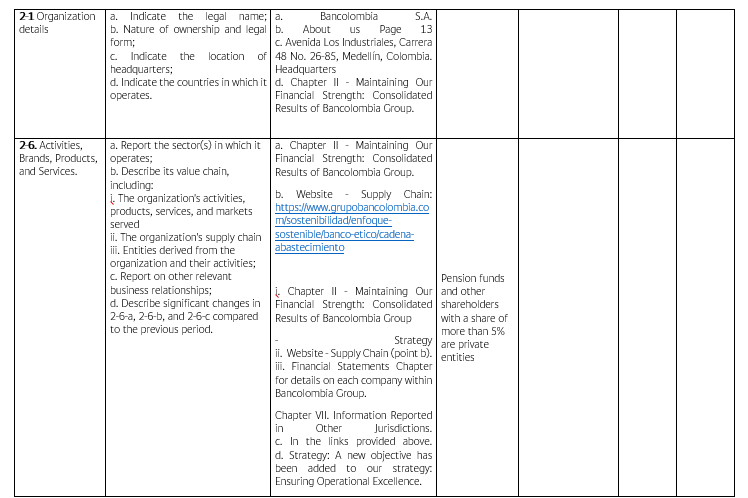
162


2 Fundación Bancolombia (Bancolombia Foundation) Cuentas sin Cuento – Libertat Education Program One 2022
3 Bancolombia Financial Well-being Platform – Day to Day Education Program One 2023
4 Bancolombia Financiera-Mente Education Program One 2023
5 Bancolombia Elévate – Financial Education Program Education Program Two 2023
6 Nequi Financial Education – Nequi Education Program One 2023
7 Fundación Bancolombia (Bancolombia Foundation) Cuentas sin Cuento – Libertat Education Program Two 2023
8 Bancolombia Bus Escuela – Bancolombia Education Program Unique 2023
9 Bancolombia A la Mano Te Enseña Campaign One 2023
10 Fiduciaria (Fiduciary) Invernews Education Program One 2023
11 Values Telegram Education Program One 2023
12 Bancolombia Sueños a la Mano Education Program One 2024
13 Fundación Bancolombia (Bancolombia Foundation) Cuentas sin Cuento – Libertat Education Program Three 2024
14 Bancolombia A la Mano Te Enseña Campaign Two 2024
15 Bancolombia Financial Well-Being Indicator Education Program One 2024
16 Values Mercado en Movimiento Education Program One 2024
17 Bancolombia Emprender Mujer Education Program One 2024
18 Fundación Bancolombia (Bancolombia Foundation) Cuentas sin Cuento – DID Education Program One 2024

Financial Education
163


At Bancolombia Group, we have the responsibility to provide knowledge to employees, clients, users, and the broader community to help them improve their decision-making and achieve their goals. We integrate practices and habits into their daily lives so they can take control of their finances, have financial resilience, be able to handle unexpected expenses, set clear goals, and achieve financial freedom.
In 2024, we implemented 143 initiatives, with a total budget of COP 11.925 billion, reaching 235.677 million people/businesses/views/likes/plays.
Below is a detailed breakdown by semester and by subsidiary, as well as the annual consolidated data:

# of Initiatives # of Participants/Scope Budget (COP)
TIN Semester 1 Semester 2 Semester 1 Semester 2 Semester 1 Semester 2
# People/
Companies
#Views/Likes/
Replays
# People/
Companies
#Views/Likes/
Replays
Bancolombia 42 27 52,724,452 32,385,151 69,083,737 184,878 4,519,614,327 3,646,059,958
Values 6 9 1,266 0 2,752 0   0  762,895
Fiduciaria (Fiduciary) 7 4 1,450 199 1,631 561  0  0
Banca de Inversión (Investment Banking) 1 2 21 0 130 0  0  0
Sufi 2 3 231,739 0 545,100 0  0  0
Nequi 7 8 981,622 2,670,546 40 76,794,526  73,021,446  119,150,633
Fundación Bancolombia (Bancolombia Foundation) 3 5 4,373 0 23,206 0  1,067,791,897  2,279,953,493
Cross-cutting Actions (affecting multiple TINs) 9 8 28,295 1,300 7,150 347   154,636,746  65,000,000
Total per Semester 77 66 53,973,218 35,057,196 69,663,746 76,980,312  5,815,064,416  6,110,926,979
Total Annual 143 235,674,472 11,925,991,395


The financial education actions were carried out in a mixed format, meaning both virtually and in person (predominantly virtual), where we implemented programs, mass activities, talks/webinars, consultations, workshops, seminars, and courses focused on topics such as security, credit, structuring, savings, investment, entrepreneurship, digital marketing, wealth, debt, sustainability, expense control, financial well-being, and other topics based on the interests and needs of the audiences.
7 Most of the actions implemented were mass initiatives, meaning they were aimed at a large audience of individuals, and it is not always possible to track a unique participation. As a result, the same person may be counted multiple times across different activities.
164


Financial Well-Being Indicator
This indicator integrates 30 transactional variables across seven key dimensions: savings and investment, planning, protection, spending, debt, wealth, and financial sophistication. This new approach provides a more comprehensive and detailed understanding of our clients’ financial behavior.
Based on transactional information from these dimensions and according to the clients’ life cycle, they can receive a score ranging from 0 to 100 points, which places them in one of the following categories:
1.Very Good (>80 to 100)
2.Good (>50 to 80)
3.Instable (>30 to 50)
4.Stressed (0 to 30)
In the second half of 2024, we adjusted this indicator to improve the information provided to clients. The changes included updating data sources, imputing variables to avoid biases, incorporating external sources in the risk model, reviewing score and weight allocations, and updating metadata. The main challenge focused on the social segment, to fully align it with the current indicator due to variations like the omission of the “wealth” dimension and other financial variables.
By segment, we analyzed the following:
Social Segment: Behavior remained constant throughout the year, although it decreased after a peak between May and July. The variables remained stable, with good performance in spending and sophistication.
Personal/Plus/Preferred Segments: The general indicator showed consistent behavior with a slight increase. This rise was due to improvements in savings and spending dimensions. Clients over 50 had a slightly lower score than the average, with better performance in savings but lower sophistication, while the rest of the variables remained stable.
Independent Segment: The second semester performed better than the start of the year. Although sophistication declined, the increase in savings and planning compensated for this drop. Similar to the banking segments, the increase in savings was mainly due to higher savings frequency.
Employee Segment: Employees outperformed the average client, excelling in all variables, especially savings and debt. The savings and planning dimensions increased over the year, likely influenced by the monthly content in the internal communications newsletter.
Our Responsibility Transcends Borders
Transcending in people's lives and working for the transformation of the communities in which we operate were the pillars on which we worked at Banco Agrícola in El Salvador, Banistmo in Panama, and Bam in Guatemala.
El Salvador
Donations and expenses for major social programs at Banco Agrícola (January to December 2024):
165


Line Program Beneficiaries Total Investment (USD)
Quality of Life FESA “Lindo del Fútbol” 2024 7,127 310,297
Financial Education 2,776,440 reach on Radio and TV; average social media reach 4,507,589 150,335
Banco de la TELETÓN support for the Asociación Teletón Pro- Rehabilitación – FUNTER 2023 8,000 therapies 80,000
La Cuenta del Mar (Sea Account)
113 blue jobs,
direct beneficiaries involved in mangrove rehabilitation actions
399,109
TOTAL 4 programs 939,741


Panama
166


LINE PROGRAM BENEFICIARIES TOTAL INVESTMENT (USD)
Education Nacer Aprendiendo – United Way (Early Childhood) 1,900 15,000      
Financial Education for the Youth – Asociación Bancaria de Panamá  65 5,000      
Financial Education and Entrepreneurship for Children, Youth, and Women – Junior Achievement Panama 2,710 47,250      
Women and Girls in STEAM 58 30,500
Impulsa: Mentoring Program for Women Entrepreneurs – Glasswing Foundation 78 80,000
Environment Environmental Conservation and Community Support in the Panama Canal Watershed – Fundación Natura 2,410 71,250
CONSOLIDATED TOTAL  6 programs   7,721 249,000      
Guatemala
167


LINE  PROGRAM  BENEFICIARIES  TOTAL INVESTMENT (USD)      
Support to Communities   Fighting Chronic Malnutrition – Partnership with United Way 150 families - 5 communities  25,000      
Emprender Mujer 24 women-led SMEs, 22 mentors 15,466      
Strengthening the education of Guatemalan children and youth – Partnership with Funsepa 5,695 children and teenagers, 253 teachers 125,000      
Financial Education Annual campaign 11,646,958 people* 29,386
La Casa de la Plata 8,581,000 people* 30,685
Environmental Care  La Cuenta del Mar – Marine Conservation Center
15,516 turtles, 11 beaches, 6 communities
1,500 people trained
2,000 mangroves planted
38,000      
CONSOLIDATED TOTAL  6 programs   263,537       

Fundación Bancolombia (Bancolombia Foundation)

In 2024, we worked toward a common goal: promoting sustainable development to achieve well-being for all in rural areas, through our key initiatives:
•Strengthening businesses and increasing rural competitiveness through impact investment.
•Preparing the rural talent of the future with education that is relevant to the territories.
Impact Investment
168


We currently have an impact investment portfolio that includes 11 businesses and participation in three funds. In 2024, we made three new investments (¡Dios mío! Coffee, Demetria, and the EWA Fund), with a total disbursement of around COP 7 billion. As impact investors, we remain committed to supporting businesses with smart capital and technical assistance to help close existing gaps.
We mobilized over COP 4 billion aimed at financing rural areas, through funding from allied entities such as Interactuar, Agricapital, IC Fundación, and Promotora de Comercio Social, among others, to facilitate access to capital for businesses, small producers, women, and rural youth.
Business Strengthening
With the support of Bancolombia Foundation, we have successfully made valuable connections, enabling more than 40% of the companies in our portfolio to access capital from Bancolombia or other investors.
During 2024, 20 rural startups and impact-driven businesses completed the En-Campo Acceleration Program, improving their business models and connecting with key stakeholders in the impact investment ecosystem. Since 2019, Bancolombia Foundation has invested over COP 6 billion in strengthening and accelerating businesses through this program, promoting the sustainable development of businesses that positively impact rural Colombia.
Through our partnership with IC Fundación, we strengthened over 60 associative businesses in 2024.
Talent for the Rural Future
We trained nearly 30,000 individuals from rural Colombia in financial education, doubling the Foundation’s figures from 2023 through various initiatives:
•With the Cuentas sin Cuento program, we reached more than 11,200 people. Additionally, with FindKids, we provided support through awareness workshops to around 600 youth in different educational institutions.
•Through the Emerging Rural Systems program in Nariño, we reached over 15,300 individuals with mass financial education and 2,500 with comprehensive education in 13 municipalities.
•Committed to providing relevant educational opportunities and employment for youth in rural areas, we scaled the impact of the productive inclusion diagnostic results for rural and dispersed rural youth in Colombia by disseminating it nationally with education offices and educational institutions.
•We co-financed COP 90 million for the “Education Opinion Survey: Teachers and Principals of the Public Sector 2024” (results available here: https://fundacionexe.org.co/que-hacemos-movilizar/encuesta-de-opinion-en-educacion/) applied by Empresarios por la Educación and the survey firm Invamer, in order to broaden the sample in rural areas, enabling decision-makers to gain insights on education from a rural-focused perspective.
•Through rumBo, our scholarship program, we supported 385 youth to access, stay in, and/or graduate from post-high-school education programs. We launched calls for five active program funds across 13 prioritized departments. One hundred ninety-one youth successfully graduated from post-high-school education, and 72%
169


of our graduates are now employed formally, reflecting the impact on their labor market insertion.
Corporate Volunteering
Committed to biodiversity and conservation, we carried out volunteering focused on restoring the protected Mangrove ecosystem in the Vía Parque Isla Salamanca (VIPIS) through the Cuenta del Mar program in partnership with WWF. A total of 2,892 employees contributed indirectly, while 54 Bancolombia employees dedicated 540 hours to planting 302 mangrove trees, alongside six representatives from local associations.
We also participated in volunteering actions with our various partners, engaging in initiatives that strengthened knowledge through mentoring programs such as Vamos Dabeiba, Juntos por Urama, La Mesada, Biosuroeste, Mentorías En Campo, and Mentorías rumBo. Through these initiatives, 370 employees contributed over 4,000 hours of volunteer work to support the sustainable development of communities.
Tax Deduction Works
We supported the Bancolombia Group in joining the third project aimed at improving the Dabeiba–Camparrusia road in Antioquia. This adds to the commitment of partners such as Grupo Argos, Grupo Sura, Grupo Nutresa, Arquitectura y Concreto, and Microplast, among others, to drive infrastructure development that improves living conditions in areas with significant socio-economic gaps.
Our ESG Commitment
We are committed to improving people’s lives by building a prosperous economy, a healthy environment, and contributing to social well-being. Our strategy is to contribute to the development of the territories where we operate, articulating actors and sectors with an offer of products and services so that our clients and allies become more sustainable and achieve a positive impact on their communities.
We were invited once again to participate in the evaluation of the Dow Jones Sustainability Index, which has been in the market for more than 20 years, and which we joined in 2012. In 2024, we achieved a score of 85 out of 100 and were included in the Global, Emerging Markets, and MILA indices, ranking first in the Americas. This reaffirms our commitment to working toward sustainability.
Additionally, as recognition for our work in environmental, social, and corporate governance issues, which have been priorities for years, Bancolombia was ranked in the top 10% of the best banks in S&P Global’s Sustainability Yearbook in its February 2025 publication, which highlights companies with the best sustainability practices.
We base our sustainability strategy on the highest national and international standards. To achieve this, we have an international agenda of alliances and voluntary memberships that keep us aligned with global best practices, generate commitments, and share results with our stakeholders and the international community.
•Business Ambition for 1.5
•B Team
•CDP (Carbon Disclosure Project)
•Climate Action 100+
•Climate Finance Leadership Initiative (CFLI)
170


•Glasgow Financial Alliance for Net Zero (GFANZ)
•Global Investors for Sustainable Development (GISD)
•Global Reporting Initiative (GRI)
•Dow Jones Sustainability Index
•Net Zero Banking Alliance (NZBA)
•Net Zero Asset Managers Initiative (NZAM)
•UN Women
•Partnership for Carbon Accounting Financials (PCAF)
•Principles for Responsible Banking
•Equator Principles
•Principles for Responsible Investment
•UN Environment Programme Finance Initiative (UNEP FI)
•Green Protocol
•Science Based Targets Initiative (SBTi)
•Sustainability Accounting Standards Board (SASB)
•Task Force on Climate-Related Financial Disclosures (TCFD)
Details of our participation in these initiatives can be consulted here:
www.grupobancolombia.com/sostenibilidad/enfoque-sostenible/protocolos-y-adhesiones
We have also been present at high-level international forums, which allow us to engage in conversations aimed at providing transformative solutions to climate and social challenges, sharing progress across various fronts, and strengthening our leadership and positioning on critical sustainability-related issues.
Sustainability Ratings
Bancolombia is included in several of the world’s leading indices that continuously monitor the performance of companies in environmental, social, economic, and corporate governance terms. This motivates us to improve our sustainability practices.
Sustainability Index 2023 2024
Dow Jones Sustainability Index
78 points out of 100
Included in the Global index
 85 points out of 100, included in the Global Index, ranked 1st in Emerging Markets and MILA
CDP  B B
MSCI ESG Research YY YY
Moody’s formerly Vigeo 57 “Robust” 57 “Robust”
171


PRI (Investments)
Policy Governance and Strategy: 74
Direct - Listed equity - Active fundamental: 42
Direct - Fixed income - SSA: 42
Direct - Fixed income - Corporate: 42
Confidence building measures: 40
Policy Governance and Strategy: 64
Direct - Listed equity - Active fundamental: 42
Direct - Fixed income - SSA: 52
Direct - Fixed income - Corporate: 52
Confidence building measures: 60
Sustainalytics (ESG Risk Rating) 17.8, positioning us positively in a “Low Risk” category 16.3, positioning us positively in a “Low Risk” category
IR Recognition 98.3% 98.4%

We have developed a methodology to identify and assess ESG trends that impact industries within our value chain, with the aim of monitoring these trends and incorporating them into our management practices.
The identified and prioritized trends are circular economy, climate change, biodiversity, ESG regulation, and financial well-being.
Promoting Sustainability as a Business Strategy
We support our clients in the SME, business, and corporate segments in adopting the best ESG practices through knowledge-sharing spaces, workshops, digital content, and the guidance of an expert team.
In this way, our customers can access to contents and methodological tools that allow them to:
•Understand sustainability as a business strategy, fundamental for the sustainability and competitiveness of its economic activity.
•Define its sustainability strategy according to the material issues identified in the Environmental, Social and Corporate Governance dimensions.
•Understand the circular economy, measure the company’s level of circularity and access methodological tools to define its circular economy strategy.
•Create synchronous consulting spaces with experts in the area of sustainability.
•Solve innovation challenges with a focus on sustainability.
In 2024, we assisted in the training of 255 clients on sustainability topics and their ESG strategies.
Additionally, we have created open communication spaces with clients and investors on relevant ESG topics, such as double materiality, transparency, climate change, biodiversity, and best international practices.
These spaces have been implemented in two ways:
•In a personalized manner by attending to the opportunities of each of our clients and/or investors in terms of the ESG pillars.
172


•In a massive way in events in which different interest groups intervene in favor of sustainable financing.
The engagements carried out in 2024 were as follows:
Engagement Strategy No. of Engagements
ESG Assessment Issuers 6 issuers
Sustainability as a Service* 264 clients
Climate change 45 clients
*“Sustainability as a Service” refers to personalized and mass knowledge-sharing spaces with clients where various topics are developed, including sustainable financing, circular economy, corporate governance, ESG evaluations, and more.
IV. ACHIEVING CUSTOMER LOYALTY AND PREFERENCE
We are a customer-focused organization. We stand out by providing reliable, approachable, timely, and user-friendly experiences for our customers. Our goal is to earn customer loyalty by ranking first in their intent to recommend us. To achieve this, we are working to offer them a better service, with greater speed and reduced friction, with more and more digital solutions to make their processes faster and simpler.
A significant portion of the financial transactions in the sector flows through our systems. This gives us the opportunity to build connections between the different agents involved in the economic activities of our countries.
That’s why we strive to simplify money management with financial and non-financial solutions that are easy, reliable, timely, and customer-friendly. This is one of the ways we stay connected to people’s everyday lives, improving their financial well-being, quality of life, and contributing to a more formal economy.
At Bancolombia, we process over 72.3% of monetary transactions and 41% of the money circulating in the financial system, according to data from the Financial Superintendency as of September 2024. We moved more than COP 3.278 trillion, nearly three times the annual output of the Colombian economy.
This is made possible through an ecosystem of physical and digital channels available across the country, which is constantly evolving to provide new solutions that benefit people and businesses.
Digital Solutions for People
As a financial entity, we have been developing an ecosystem of easy, fast, interoperable solutions, many of them at no cost. Each one is designed to transform the customer experience and make their everyday financial transactions easier.
At Bancolombia, we offer digital products for lending, deposit, and investment, which are available for online purchase. In 2024, we sold 6 million of these products through digital channels, representing a 13% increase compared to 2023.
173


By the end of 2024, we had over 12 million active digital customers, reflecting a 4% annual increase. Of these, 8.9 million actively use the Bancolombia App, which processed over COP 454 trillion throughout the year.
Similarly, 92% of our more than 11,700 corporate clients use at least one digital channel to manage their income, payments, and treasury in a more simplified and connected way within their value chain. Over 13,000 businesses, 329,800 SMEs, and 2,270 government clients have adopted these types of solutions.
In 2024, we began evolving our business channels, centralizing SME, corporate, and subsidiary services in our App and Virtual Business Branch, making it easier and more efficient for our clients to access both financial and non-financial solutions.
QR codes are becoming an increasingly popular and convenient alternative for making payments. In 2024 alone, nearly 5 million people made over 259 million transactions through this method, totaling more than COP 17.8 trillion. This represents a nearly twofold increase in usage last year, with an average monthly processing volume of over COP 1 trillion.
Bancolombia’s interoperable QR code allows payments from other banks and digital wallets and is already available at over 821,000 stores nationwide.
Another option for transferring money between accounts, including those of other financial institutions, with no cost is Transfiya. This service allows transfers using just a mobile number and permits up to 15 transfers per day, with a maximum of COP 3 million per day. In 2024, over 1.6 million customers used Transfiya, moving COP 5.8 trillion across 37.9 million transactions.
For receiving payments via the internet or social media, there is the Bancolombia Button, used by more than 23,000 businesses. Through this method, over 1.9 million people made 32.9 million transactions worth more than COP 5 trillion.
We also offer Wompi, a payment gateway through which COP 25.4 trillion was processed across 67.6 million transactions, a 116% increase compared to 2023. This payment solution, which has been operating for five years, is now used by almost 16,000 merchants and holds a 27.4% market share in billing. Last year, several new features were added, including “buy now, pay later” from Bancolombia, SU+ Pay, and DaviPlata.
In the acquiring business (debit and credit cards), we have become the preferred bank for nearly 367,000 businesses (+3.2% annually) and are involved in over half a trillion transactions, moving funds from sales totaling COP 75.4 trillion, a 4.58% increase compared to 2023.
We offer a portfolio of 2.6 million credit cards to 2 million clients, who made transactions totaling COP 36.6 trillion last year. Regarding more than 14.6 million active debit cards, purchases exceeded COP 59.7 trillion, an 8% increase compared to 2023.
With our 100% digital Mastercard Única credit card, we have helped build credit histories for over 8,000 payroll clients with incomes under COP 2 million, for whom this card represents their first credit product. Last year, we issued over 16,000 of these cards.
We also introduced the TouchCard feature, a tactile symbol on the card to help visually impaired individuals easily identify the type of card. This innovation promotes inclusion and empowers our customers, giving them more independence and confidence in managing their finances.
174


The new cards are made from 100% recyclable plastic to reduce our environmental impact.
Furthermore, digital wallets (Apple Pay, Google Pay, and Garmin Pay) are used by over 558,000 people, who completed more than 60 million transactions worth over COP 4.8 trillion, a 91% increase compared to 2023.
To facilitate savings and investment management with digital solutions, we offer various options. “Bolsillos” (digital wallets) were used by more than 702,000 clients to store their money, 63.3% more than in 2023. The total amount saved in these wallets reached COP 3.7 trillion, an 80.9% annual increase.
Another option is virtual investment, accessed by over 269,000 clients, with a balance of more than COP 25.3 trillion at the close of 2024, a 26% increase compared to 2023.
We also streamlined the digital account opening process to make it quicker and easier for our clients. For example, we reduced the number of fields required in the savings account opening process by 46%.
Open Banking and Interoperability
At Bancolombia, we are committed to the development of Open Banking and interoperability to facilitate access to financial information and services for users in the sector, and to respond to the demands of a modern financial environment.
Interoperability is an integral part of our value proposition, and for this reason, we are working to improve our range of products and services and meet the regulatory requirements associated with the new Immediate Payment System of the Colombian Central Bank.
Our goal is to simplify and speed up transactions, making the customer experience more efficient and reliable. We aim to adapt our solutions based on a deep understanding of our customers’ needs, ensuring continuity and security in managing financial flows.
This includes financial education, guidance, and communication to familiarize our customers with the cultural and functional changes that come with interoperability.
To this end, we have developed new capabilities that translate into solutions for people:
•With “Día a Día”, a feature of the Bancolombia App, we have enabled 3.5 million customers to use the solution, helping them better understand money management and budget control. By 2024, we have categorized 500 million P2P transfers, data the bank did not previously have.
•The Financial Well-being indicator forms the foundation for new behavioral credit models and is also integrated as input for personalized offer models.
•With the “Tus Bancos” feature, which allows individuals to view their finances in one platform, 3,000 customers have linked their accounts from other banks.
Meanwhile, we continue to work on various platform models that enable new ways of providing financial services.
In Banking as a Platform, Tu360 is one of the platforms offering comprehensive solutions to meet customer needs.
175


Tu360 Compras is a Marketplace where more than 21,000 people have purchased products from various categories, generating over COP 70 billion in sales.
In Tu360 Inmobiliario, we approved financing for real estate worth COP 4.1 trillion, with disbursements exceeding COP 944 billion in mortgage and housing leasing credits. This has allowed nearly 1,500 families to acquire their own homes, contributing to the development of sustainable cities and communities. Our portal has become the showcase for over 1,100 housing projects, supporting builders across the country and facilitating property acquisitions with real estate and financial advice from a single point.
Tu360 Movilidad is a space for connecting vehicle buyers and sellers. We received nearly 1.7 million users and disbursed approximately COP 104 billion in vehicle loans.
In Banking as a Service, customers can access financial products through third-party platforms that have integrated our APIs. Our digital wallet processed more than 2.7 million transactions totaling over COP 106 billion.
Additionally, with “Compra y Paga Después Bancolombia,” people can buy products in installments from more than 18,000 merchants. Since its launch, more than COP 1 billion has been financed, with an average transaction amount of COP 260,000. Over 50% of users of this service had not previously accessed other financing options with Bancolombia.
Through all these actions, we reaffirm our commitment to innovation and excellence, continuing to lead the way toward a more interconnected and sustainable financial future for millions of people and businesses in Colombia.
Wenia
Since 2015, the Bancolombia Group has been exploring new market technologies to understand how to integrate them into our financial and non-financial solutions, thus contributing to initiatives aimed at individuals and responding to our business strategy.
In this process, we have established a specialized blockchain area, which has worked with companies, partners, and third parties in the financial sector to innovate payment systems using this technology and support the implementation of the Bitcoin Law in El Salvador. We have also participated in the Arenera of the Financial Superintendency of Colombia.
With everything we have learned over the past decade, Wenia was born. It is a new company within the Bancolombia Group, leveraging blockchain technology to create solutions that facilitate adoption and serve as a bridge between traditional finance and digital assets.
Wenia is incorporated in Bermuda and holds a Class F license issued by the Bermuda Monetary Authority, which regulates Wenia’s activities under the Bermuda Digital Asset Business Act of 2018. This Class F (full) license is the most demanding one granted by the authority, issued to companies that operate with digital assets, even without being within a regulatory sandbox.
We offer the Wenia App for individuals who are adults and residents in Colombia, allowing them to buy, convert, send, receive, and sell digital assets. Currently, we offer six digital assets: bitcoin (BTC), ether (ETH), SOL, POL, digital dollars (USDC), and COPW, a stable crypto asset pegged 1:1 to the Colombian peso, created by the company.
176


Additionally, we launched a 100% digital Mastercard credit card, which allows customers to make purchases anywhere using the digital assets available in the Wenia App. This card can be added to customers’ preferred wallets, such as Apple Pay or Google Pay, for purchases in physical stores.
Knowledge as a Service
We understand that businesses require our support in strategic areas where we have positioned ourselves as leaders. This is made possible through knowledge programs, which help companies with topics such as sustainability, innovation, diversity, equity, inclusion, and behavioral sciences.
We also offer valuable information and analysis to our clients, empowering their decision-making and positioning us as their strategic allies through knowledge transfer events and our knowledge platform “Capital Inteligente.” These strategies enable us to train and keep clients informed on sectorial issues, regulatory matters, economic outlooks, and more.
Customer Experience
As an organization, we have worked diligently to strengthen a culture that promotes the realization of Superior Experience as the best way to achieve customer well-being and preference. In every interaction, we aim to understand each customer’s needs, act decisively to support them in achieving their goals, and ensure every action counts in exceeding their expectations.
We know that achieving this requires a comprehensive view of the experience, where our employees, processes, technology, and partners connect authentically and with an obsession for the customer, ensuring harmony and consistency in how we engage with them.
To move forward in this direction, in 2024 we consolidated several actions to generate superior experiences, strengthen loyalty, and build relationships based on trust, closeness, and empathy.
Promotorex Cultural Mobilization Program and Connection with Employee Experience
We recognize that a committed team is key to delivering a superior customer experience. We implemented an employee experience management model focused on high-impact teams. This approach enables us to align our daily functions with customer satisfaction, strengthening our ability to anticipate and respond to their needs. We strategically intervene at key moments to maximize our impact and deliver exceptional service.
At the same time, we continued to focus on having engaged employees, and this year, we connected 70% of the Organization and partners to our Promotorex community mobilization agenda. We also amplified key knowledge on experience skills to nearly 9,000 people, including employees and partners, providing them with training and tools to offer close, reliable, timely, and easy experiences to our customers.
In our mission to win over customers with genuine service, we reinforced the Promotorex model with a new season focused on financial well-being. In 2024, we achieved over 109,900 interactions with the commercial team and 41,400 with the service and Collection teams and partners, promoting key behaviors and tools to offer superior experiences.
Finally, we consolidated our commitment to making every day count by turning the customer experience into a competitive advantage, with the fourth version of “Semana por el Cliente” (Customer Week), a milestone that generated more than 45,000 interactions and allowed 678 leaders to connect directly with customers, teams, and processes, strengthening our competitive advantage.
177


Voice of the Customer
Listening to the customer has been essential for us to solidify our position as an organization focused on their needs. To this end, we have incorporated technologies and systems to help us gain increasingly individualized knowledge of our customers’ experiences.
In this journey, we have achieved:
•Understanding the voice of the customer more accurately and efficiently, through 11 robust programs with more sophisticated and predictive analytical models, enabling us to anticipate and accompany them with personalized offers and solutions. We were able to proactively infer recommendation scores through a behavioral model that classified nearly 10 million customers as promoters, neutrals, or detractors without the need for surveys.
•Evolving the measurement of the experience of managed SME customers by shifting to an online system that doubled response rates and allowed us to address concerns promptly.
•Increasing our listening capacity six times for customers who take digital products through our sales channels, four times for responses captured at ATMs, and twelve times for those obtained through banking correspondents.
Closing Gaps and Customer Care
We addressed 10 critical pain points prioritized in our segments, including individuals, SMEs, businesses, and corporate business, resulting in an increase of 188,000 promoter customers. To strengthen trust, we surprised our clients with over 3,000 “Wow Moments,” optimized compensation and remediation protocols, and implemented more automated and proactive processes for quicker, more effective solutions. We also launched a pilot program for Commercial Managers in 13 branches, improving service for pensioned clients under a specialized model. Additionally, we integrated more than 12,000 SMEs into a new Management Model and supported 15,000 low-income payroll clients with a behavioral credit pilot.
People-Centered Design
We implemented an E2E (End-to-End) design approach for key solutions such as payments, payroll, collections, credit, deposits, cards, contactability, and security. We also introduced the concept of “Minimal Beloved Experience” as a design asset to ensure the fundamental and differentiating attributes in our deliverables to customers. We improved digital sales with more intuitive and inclusive processes, reducing the fields for opening savings accounts by 55% without compromising legal standards, reinforcing our commitment to accessibility and diversity. Through the Customer Experience Lab, we incorporated technologies such as eye-tracking and behavioral data analysis in digital interactions, driving strategic initiatives like Tu360 Inmobiliario, QR, and the new Mi Bancolombia app, designing more intuitive and friendly experiences.
NPS
The analysis of competitive NPS helps us understand how customers perceive us in relation to the market and evaluate our position against major competitors. This annual study serves as a benchmark for measuring the strength of our value proposition.
178


In 2024, the banks representing 68.3% of the commercial size achieved the top spot in the competitive indicator, consolidating Bancolombia as the leader in the sector.
image95a.jpg
Relational NPS measures customer perception based on their interactions with our products, channels, and services. By the end of 2024, our result was 71.19%, and we have multiple action plans in place to strengthen customer loyalty and satisfaction, reaffirming our commitment to a superior experience.
We Are Where Our Customers Need Us
In 2024, we processed 95.74% of transactions through electronic distribution channels. Our salesforce is made up of 13,729 employees.
Company* Branches 2024 Branches 2023 Branches 2022
Bancolombia S.A. (Colombia) 575 578 583
BAM (Guatemala) 151 155 157
Renting Colombia** 37 63 65
Banco Agrícola 91 91 90
Banistmo 37 39 39
Valores Bancolombia 17 19 19
Fiduciaria Bancolombia 8 8 7
Financomer 1 3 4
SUFI 2 2 2
179


Inversiones CFNS S.A.S. 2 2 2
Banca de Inversión (Investment Banking) 2 2 2
Bancolombia Panamá 1 1 1
Bancolombia S.A. Panamá Branch 1 1 1
Valores Banistmo 1 1 1
Bancolombia Puerto Rico International Inc. 1 1 1
Arrendadora Financiera S.A. 1 1 1
Valores Banagrícola, S.A. de C.V. 1 1 1
Bancolombia Capital Holding LLC (Miami) 1 1 1
Transportempo S.A.S. 0 0 1
Total 930 969 978
* For some companies, their main office is considered a branch.
** 13 Localiza locations and 13 Éxito points were closed.
Correspondent Banks
We reported a total of 35,173 banking correspondents, including 28,251 in Colombia, 535 in Panama, 5,609 in Guatemala, and 778 in El Salvador.
Mobile Service Points (MSP)
Sales advisors who periodically visit small towns offering our product portfolio. As of December, we reported 519 MSPs (489 in Colombia, 13 in Guatemala, and 17 in El Salvador). Panama does not report any MSPs.
Kiosks
We provide post-sale services through kiosks, with a total of 495 kiosks (210 in El Salvador and 285 in Colombia).
ATMs
We have a network of 6,113 ATMs, including 5,211 in Colombia, 576 in El Salvador, and 326 in Panama. BAM sold its network of 155 ATMs to 5B company in November 2023 and has outsourced the ATM service to that company.

V.ENSURING OPERATIONAL EXCELLENCE
Customers are at the heart of everything we do at Bancolombia: we work to be part of their daily lives, we listen to them, and we consider their needs.
180


This highlights the importance of continuously improving, responding to the demands of the environment, and seeking efficiency in all our processes.
In this regard, achieving operational excellence is a goal supported by various actions:
•Automating our processes and services to ensure the scalability and productivity of our operations, so that we can meet the growing needs of the business.
•Ensuring the availability of our channels so that customers can access our services.
•Adopting both proactive and reactive measures to maintain service continuity and customer satisfaction.
Digital Transformation as a Lever for Our Evolution
Throughout the year, we continued executing strategies to strengthen our technological infrastructure and respond more quickly and flexibly to the needs of our operations.
As part of our cloud migration strategy, which involved moving applications, data, and infrastructure to a cloud/AWS environment, we successfully modernized 43 key business applications aimed at accelerating digital transformation, optimizing costs, and improving the availability and security of our systems.
Additionally, prioritizing the customer experience, we implemented Site Reliability Engineering (SRE) discipline, which ensures that our systems are more reliable, scalable, and resilient. These practices, combined with the adoption of tools such as Impact Analysis (IA), have significantly reduced the recurrence of failures and improved autonomy in managing operational risks.
To name a few, we successfully executed 98 case scenarios across 54 services, and we have completed more than 1,066 impact analyses.
Efficiency and Automation
Automation is a key enabler for our operations. In 2024, we increased automation levels in our daily tasks by 17.36%, with 546 processes involved. One example of the progress made is the reduction of COP 26.092 billion between operational and legal risk.
These actions aim to minimize operational errors caused by manual work, optimize our processes, and provide more timely responses to our customers in post-sale services. This strategic approach allows us to operate with greater scalability and maintain our operational excellence, even in a high-complexity environment.
We Safeguard Customer Trust and Ensure Transparency
The availability of our services and proper management of contingencies are essential to guarantee customer trust. For this reason, we have strengthened our channels with a comprehensive approach that includes building technical and operational contingencies for our current channels, improving technological infrastructure and resilience practices, and optimizing monitoring and response processes to failures.
To achieve this, we implemented contingency plans designed to ensure service continuity in the event of disruptive events. These plans include measures such as implementing automated processes defined for current channels and controls to avoid rescheduling exercises outlined in the annual plan, boosting self-management across different teams.
181


Thanks to these efforts, we have managed to improve availability performance throughout the year and have reduced failure times by 35% compared to 2023. These efforts, supported by our cloud migration and technological modernization, have increased the resilience of our systems and reduced recovery times from disruptive events.
Additionally, the adoption of the mass event response protocol has allowed us to be 33% more timely in detecting and resolving significant friction points in the customer experience, maintaining close, transparent, and personalized communication with customers, and thus building trust and security in the protection of their resources.
Results and Vision for the Future
We are firmly committed to continuing to learn from technological failures and transforming them into opportunities for improvement. Thanks to the closure of 99.85% of action plans related to technology, we have mitigated significant impacts and reduced the recurrence of operational problems.
The volume of Clarifications, Complaints, and Claims (CCCs) entered in 2024 decreased by 3% compared to 2023, even with a 3% increase in the number of customers and a 39% increase in the transactional volume of our channels.
We will continue evolving our platforms and operational models, consolidating Bancolombia as a leader in technological transformation and a benchmark in the financial industry.
Cybersecurity, a Priority
In the financial sector, we stand out for prioritizing cybersecurity, thanks to the adoption of strategies that secure our applications from the early stages of development. By doing so, we enable strong defense measures, manage risk effectively, and accelerate the continuous delivery of value for the benefit of our customers.
Using new detection and reaction technologies, we transformed the Security Operations Center (SOC) into an Intelligence and Cyber Defense Center, with cutting-edge capabilities in detection and intelligence that enhance our proactivity, detection, and response to emerging threats.
We also modernized various fronts of cybersecurity and information security, including transitioning to a zero-trust strategy for remote access, strengthening protection against malware, securing the lifecycle of development for channels and services offered to customers, among others.
Furthermore, recognizing that identity protection is a central pillar of an organization’s cybersecurity strategy, we modernized identity management, privileged access, and authentication and authorization capabilities to mitigate risks of resource loss or data leakage. This ensures that only authorized individuals have access to the appropriate resources, while improving the experience and productivity of the Group’s employees.
Given the large number of strategic partners supporting our operations, we decided to extend the cybersecurity evaluation to them in order to understand their maturity levels and define improvement plans aimed at mitigating risks impacting our Organization.
Since 2018, every three years, an independent and recognized entity in the market evaluates the level of cybersecurity and information security maturity of our Organization, aiming to measure the evolution of these practices over time.
182


This year, the evaluation was conducted by Ernst & Young, and the result showed progress in cybersecurity maturity, with strengths in the culture and awareness around managing this aspect, human talent knowledge, integration from the design and maintenance of solutions, as well as innovation and technological capabilities.
Bancolombia Group’s Strategic Artificial Intelligence Declaration
At Bancolombia, we have spent seven years working with artificial intelligence to build cross-cutting capabilities—that is, adopting solutions that solve problems quickly and generically.
In 2024, we enabled artificial intelligence capabilities accessible to all our teams, aiming for more efficient processes and better service experiences for our customers.
For example, we developed chatbots for WhatsApp, MS Teams, and WebChat, integrated with generative AI capabilities such as Question Solver, which were made available to both employees and customers. We also have Artificial Intelligence Orchestrator (AIO) to orchestrate AI models and automate the processing of unstructured files, which generates valuable information for decision-making and hyper-automating our processes.
Currently, our Organization has various GenAI capabilities that drive productivity, save time, and foster innovation across the Organization:
•Question Solver: Responds to user inquiries based on reference documents. It allows users to quickly access relevant information without having to thoroughly review all sources.
•Text Analyzer: Analyzes documents using Natural Language Processing (NLP) tasks such as information extraction, queries, summaries, categorization, and sentiment analysis. This includes transcribed calls, chats, and written documents.
•Content Generator: Assists in writing, changing syntax, style, tone, and text formatting according to user instructions.
•Code Expert: Helps developers write, comment, interpret, and transcribe code in different programming languages.
•Agents: Enables personalized assistants that offer efficient solutions tailored to the specific needs of each use case. These agents can interact with other systems (such as databases, Helix, or LZ) and take actions on them.
We have evolved our operating model to streamline the configuration, experimentation, and production deployment processes for use cases, making the adoption of these capabilities easier for everyone in the Organization.
We are global leaders in adopting GitHub Copilot, a tool that has increased our code generation by 30%, allowing us to automate application changes up to an average of 18,000 per year, with a rate of 42 daily productive deployments. Additionally, we perform over 8,000 security scans per day to prevent vulnerability risks as part of our continuous hacking strategy.
We are committed to bringing AI to every corner of our organization, using it as a tool to optimize processes, generate innovative solutions, and enhance the productivity of all our teams.

183


VI.BUILDING CULTURE AND TALENT TO FOSTER COMPETITIVENESS
People are at the heart of everything we do at the Bancolombia Group. We are a team of over 32,000 employees across Colombia, El Salvador, Guatemala, and Panama, promoting sustainable development for the well-being of all.
Every employee is a valuable individual with unique dreams and needs. When they are part of a healthy work environment that fosters collaboration, trust, and cohesion, they can reach their fullest potential, be more creative, and more engaged.
When we create conditions that allow them to learn, grow, and achieve their dreams, we are also positively impacting their families, our customers, and society.
In 2024, we drove initiatives to enhance talent, strengthen our relationships, and build a more inclusive and equitable environment. We also advanced our ability to manage well-being from a comprehensive perspective, focusing on three pillars: development, connection, and enjoyment.
As a result of our strategies, we maintained our position as the best financial entity to work for in Colombia, a recognition awarded by Merco.
Development to Empower Talent
This pillar has become a transformative force for our employees, driving their personal and professional growth by aligning their individual purposes with organizational goals.
We have built an ecosystem that promotes self-development, guidance, and talent mobility, under the premise that the integral development of our team positively impacts the organization, our customers, and their families.
We launched Academia Bancolombia, a learning strategy that consolidates and shares knowledge generated within the Organization to guide the growth and evolution of each role. It includes five schools with over 6,000 employees participating: business, analysts, assistants, risks, and practice evolution. Additionally, it offers three key specialties: Data Science, Software Development and Ethical Hacker, with two active cohorts and 180 participants in total in Colombia.
For 2025, we are designing new specialties in areas such as Artificial Intelligence; Environmental, Social, and Governance (ESG), and credit risk, aimed at deepening the skills of graduates from our Bancolombia Schools, demonstrating our commitment to driving talent in line with market demands and environmental changes.
Similarly, we achieved learning milestones that strengthen our leadership and culture of growth. In Colombia:
•To support the development of our leaders, we awarded 1,700 Harvard licenses offering six high-impact programs.
•This year, we redesigned our strategy to continuously update the commercial team’s knowledge on products, channels, services, and processes. We implemented a pilot with three innovative solutions based on gamification and behavioral sciences: TipTop App, MasterTop, and TipTop Live, impacting over 500 employees in the SME commercial team.
•To develop English proficiency in our Key Talents and Development Path participants, we launched English4Us. This program allows 70 key talents to advance their English skills, with start and end evaluations to monitor their progress and encourage continued use of the language in their work activities.
184


•99.45% of our employees in Colombia completed their training plans, highlighting our commitment to a culture of learning and development.
•We supported 2,688 employees in creating personalized development plans, strengthening their organizational competencies. Within this group, 988 leaders actively worked on their plans, 64% of whom were women.
•To empower each employee in managing their own growth, we launched the virtual course “Connecting with My Best Self,” which was completed by 2,209 employees. This self-development approach, along with guidance for 182 teams to improve cohesion, communication, and teamwork, demonstrated the tangible impact of our commitment to well-being and collective performance.
•We introduced the ESPEJO methodology, designed to encourage self-management of well-being and performance among our teams. Through behavioral science, this program invites employees to reflect on their self-care habits, time management, and conversational skills, promoting a healthy balance between personal well-being and work performance.
•One of the flagship programs to foster talent growth is the Development Path, which involved 3,759 employees, 20% of whom were promoted and recognized with economic incentives, with a total disbursement of more than COP 11 billion. We also implemented group support and training programs to strengthen competencies and promote employee development.
•The 2022–2024 Talent Pool cohort concluded, a key program to identify, develop, and retain our high-performance and high-potential talents. The results exceeded our expectations, with a mobility rate of 27.51%, surpassing the initial target of 23%, and a retention rate of 99%.
•For the 2024–2026 period, we selected 352 employees for the new cohorts of High-Potential Talent (HPT) and Key Talents, achieving gender parity in both groups, a result that also supports our goal of increasing the presence of women in senior leadership roles, which ended at 40%.
In addition to the results in Colombia, we highlight the achievements in other countries:
Banco Agrícola (El Salvador):
oRetention: 100% in the Key Talent and High-Potential Talent pools.
oMobility: 45% in High-Potential Talent.
Offshore (Central America and the Caribbean):
oRetention: 98.6% in Key Talent.
oMobility: 14.1% in Key Talent.
BAM (Guatemala):
oRetention: 94.12% in High-Potential Talent and 92% in Key Talent.
oMobility: 53% in High-Potential Talent.
Banistmo (Panama):
oRetention: 100% in High-Potential Talent.
oGender Parity: 75% women in High-Potential Talent.
We have implemented various strategies to empower women in our organization, promoting their personal and professional development. Through mentoring and development programs, we help them identify and express “what they want to be” in both areas, strengthening their profile and capabilities.
185


Notable among these initiatives are mixed-gender leadership mentoring, workshops on care economies and new masculinities, and simulations for addressing potential human rights violations. These cross-cutting actions support gender equality and reinforce our zero-tolerance values against any form of discrimination, violence, or harassment (including workplace or sexual harassment).
As part of our excellence scholarship program, we selected six scholarship recipients for in-person programs at international universities and 19 employees for virtual scholarships in collaboration with Westfield Business School. These scholars are pursuing master’s degrees in key areas such as sustainability, artificial intelligence, and business analytics, strengthening our internal capabilities in critical topics for the future of the Organization.
We carried out a mapping and update of strategic knowledge that will drive the future of the Organization. By analyzing global and local trends, we identified 37 key skills and 7 strategic competencies as enablers, including data analytics and artificial intelligence, cybersecurity, digital management, user-centered experience design, and blockchain. This update ensures that we remain aligned with market demands and strengthens our capabilities to tackle future challenges.
We also launched the Talent Experience Artisans Community, made up of employees from various areas, with the goal of implementing more than 30 initiatives to improve the employee experience. This community promotes people-centered design, reinforcing our organizational culture and ensuring our actions have a positive impact both individually and collectively.
We have optimized our Employee Voice Model for the entire Group, designed to delve into employees’ perceptions on culture, well-being, experience, work methods, and other key topics. This model seeks to enrich the employee experience through active listening and advanced analytics. Additionally, over 4,500 leaders now have access to real-time data, enabling them to co-create improvement actions directly with their teams. This collaborative, data-driven approach led to a historic 88% participation rate in the annual survey, with outstanding results: 94% favorability in engagement, 97% of employees satisfied with their work experience, and an eNPS of 83%, reaffirming our connection with talent and the positive impact on their day-to-day lives.
By analyzing key indicators such as engagement, alignment between experience and expectations, intent to stay, and eNPS, along with 25 factors driving the employee experience (such as leadership, work-life balance, training, and recognition), we have achieved a more accurate and objective view of our strengths and opportunities.
Additionally, we achieved:
•98% of leaders trained at the Leadership Institute across the Group.
•21,748 people trained on diversity, equity, and inclusion in Colombia
•36 hours of training per employee across all countries.
•Investment of USD 6,783,281 across all countries in learning strategies.
•99.56% completion of the training plan across all countries.
Another significant advancement was the corporate mapping of successors for first and second-level positions in the countries where we operate. We identified a total of 80 successors, with 40% women and 60% men. This effort ensures leadership continuity in the region and strengthens our ability to develop talent at all levels.
186


Connection as the Driving Force Behind Our Purpose
Connection is essential for fostering meaningful relationships where differences are valued, and respect unites us in creating an inclusive and supportive environment. We have built a strong network of collaboration that strengthens our ties and drives us forward, promoting diversity, respect, and overall well-being in every interaction.
One example of this commitment is the Sistema Contigo program in Colombia, which provides psychological and legal support to our employees during critical times, offering a safe space where they can express their concerns and receive professional guidance on issues related to prevention, reporting, and remediation in cases of gender and sexual orientation-based discrimination and violence. Through this system, we have provided over 1,700 consultations, demonstrating our genuine concern for their mental health and reinforcing a support network that enhances resilience and collective well-being.
We updated our desired culture statements and leadership model for the entire Group, aiming to make them simpler and more contextual, connected to the evolution of our strategy and the challenges of the environment. Over 15,000 employees are committed to deploying and adopting these across all countries.
We also renewed our approach to measuring our organizational culture using a gap-closing indicator, which allows us to understand employee perceptions around seven behaviors that promote the desired culture. Eight out of ten employees believe the attributes encapsulated in Movimiento B and Líder B are integrated into our organizational dynamics. We have identified integrity, respect for the individual, customer focus, and sustainable growth as organizational strengths. Additionally, we have recognized three areas where we will continue working as a group: flexibility in the face of change, open conversations about quality, and prioritization and resignation by leaders. This update reaffirms our connection with employees, fostering a mindset of constant movement and adaptation.
We launched our employee value proposition to strengthen our relationship with current and potential employees in key talent communities such as Bancolombia Tech, Designers, and DataBank. During the launch, we held 15 talks with experts from leading companies and universities, promoting networking and collaboration opportunities. With over 16,000 attendees, we successfully connected with talent seeking meaningful work experiences and a balance between well-being and professional development, establishing a connection that extends beyond the workplace.
The Talento B program enabled 40 young professionals to take on challenges in strategic areas of the organization, strengthening Bancolombia’s relationship with the new generation of talent. This program not only offers a first job experience but also builds a network of support and growth for the talent.
In the fourth edition of the Open House Bancolombia, we connected over 16,000 young talents with our Organization through 16 talks, 4 masterclasses, and a technology challenge, achieving a recommendation index of 86 and increasing our employer brand perception to 9.58/10. The event offered employment counseling and access to our talent communities, consolidating an ecosystem of sustainable development and long-term connections.
Finally, we made progress in incorporating Diversity, Equity, and Inclusion (DEI) criteria into the employee experience through an initial measurement of our maturity level in this aspect. This exercise raised awareness among the teams responsible for managing talent to design and strengthen a value proposition that reflects our commitment to equity and inclusion.
187


Additionally, we developed the Equity Book, a tool that allows us to analyze and document gender pay disparities, advancing towards a fairer and more inclusive organization.
Enjoyment for Living in Harmony
Enjoyment goes beyond a job well done: it is the essence of an environment that values the balance between work and personal life, celebrates every achievement, and considers financial and personal well-being as fundamental elements.
Our commitment to enjoyment materialized through milestones that reflect our dedication to the holistic well-being of employees and the creation of an environment where everyone can care for their time, celebrate their achievements, and live in harmony.
Flexible work schemes allow each individual to take care of their free time and prioritize their mental and physical health without sacrificing extraordinary performance and the achievement of goals. Currently, more than 11,900 employees are part of these schemes.
Creando Vínculos is an initiative that includes flexible work schemes and other supports designed to accompany fathers and mothers in the first years of parenting, making it easier for them to share quality time with their children during their first year of life. Since its launch, 165 employees (113 women and 52 men) have participated in the program, strengthening our commitment to the balance between personal and professional life.
We allocated more than USD 256 million to benefits designed to care for and support our employees and their families. This investment covered a wide range of initiatives such as loans, savings programs, insurance, psychological support, financial counseling, and many other activities aimed at their overall well-being.
As part of caring for employees’ well-being and mental health, we conducted a Psychosocial Risk assessment across the Group, for Bancolombia and National Subsidiaries (Investment Banking, Trust Services, Securities) with 97% coverage, and for International Subsidiaries, the following coverage: Bam 94.1%, Banco Agrícola 91%, Banistmo 96.4%, Bancolombia Panama 95.9%, and Bancolombia Puerto Rico 100%, generating intervention plans for prioritized populations based on the results.
Our Human Rights policy, in place since 2013, serves as the foundation for healthy coexistence within our Organization. In it, we publicly reaffirm our commitment to “respect, promote, and remedy human rights” in line with the Universal Declaration of Human Rights, ILO standards, and the laws of the countries where we operate. All our employees receive continuous training on this policy, ensuring its understanding and application.
Diversity, Equity, and Inclusion
We are committed to building a better world where diversity, equity, and inclusion are fundamental pillars. We believe in the well-being of all individuals and work tirelessly to create an environment where everyone feels valued and respected.
In 2024, we achieved several significant milestones that reflect our commitment to these essential values:
•We joined the Pact for Labor Inclusion of Compromiso Valle, a commitment that drove us to review and transform our talent management processes, creating inclusion opportunities for vulnerable populations in Valle del Cauca and the Pacific region of Colombia.
188


•We also joined the Pact for Gender Equity in Medellín, an agreement among various sectors aimed at reducing gender inequalities between men and women in the city. This effort not only sought to improve our internal practices but also to inspire other organizations to work together toward a more inclusive future.
•We published a comprehensive guide to support gender identity transition processes, consolidating information and tools to ensure that transgender and non-binary individuals working with us can experience these transitions as safely and smoothly as possible.
•We formed the DiverGente affinity group, a space for learning, ideation, multiplying, and feedback. This group, with over 270 participants, believes in social transformation, valuing individual differences, and working for equal opportunities for everyone.
•We joined the “I Am Remarkable” movement, an initiative empowering individuals to celebrate their achievements at work and in other areas. We conducted 60 workshops with 900 participants.
•We strengthened our DEI community with over 100 suppliers, an initiative to share best practices with our partners, fostering connections, knowledge, and learning within this community.
•Finally, we participated in Project H, an initiative by CESA that seeks to enable conversations among men, leaders, and decision-makers in the corporate world to raise awareness about men’s responsibility in gender equity.
Human Rights: “Promote, Respect, and Remedy”
In line with promoting, respecting, and remedying human rights, Bancolombia Group has had a public declaration since 2013, grounded in the Universal Declaration of Human Rights and the UN Guiding Principles on Business and Human Rights. Additionally, this declaration is complemented by voluntary commitments we have adopted, such as the Equator Principles, the Principles for Responsible Investment, and the Carbon Disclosure Project. These commitments cover climate protection, fighting corruption, water resource management, and promoting peace, among others.
Our policy outlines our commitments to stakeholder groups to prevent any of our procedures, activities, or operations from negatively affecting human rights, whether of our people, the Organization, or third parties. Therefore, it is based on four pillars:
1.Human rights with our employees.
2.Human rights with people linked to suppliers, contractors, and partner companies.
3.Human rights of the community.
4.Human rights of customers and individuals who may be affected by a project to be financed.
Throughout 2024, we continued working collaboratively across various teams within the Group to strengthen our policy, optimizing processes and ensuring that the governance model and control environment contribute to the protection of human rights. Our efforts contribute to continuous improvement.
In line with our commitment, Bancolombia Group annually conducts human rights due diligence, involving all relevant areas to identify potential violations and ensure a robust analysis. We have also implemented a human rights risk assessment model for several years, aimed at verifying the effectiveness of controls for each of our stakeholder groups.
189


Our employees have various communication channels to foster relationships and promote an environment conducive to due diligence in human rights. These include the Ethics Committee, the Ethics Hotline, and the Labor Coexistence Committee. Integrity is our primary guide in decision-making and ethical conduct. We have mechanisms in place to protect human rights in our daily operations, guided by our mitigation and remediation protocol.
Regarding our suppliers, since 2009 we have established strategic collaboration schemes to promote responsible environmental, social, and ethical performance in our supply chain. We implemented a methodology to assess the sustainability performance of our suppliers, which includes the commitment to protect, respect, and remedy human rights, comply with environmental, legal, occupational health and safety standards, incorporate corporate social responsibility, and manage climate change impacts and corporate governance.
Our commitment to human rights goes beyond our economic role; we are agents of social and environmental development, concerned with building long-term capabilities and transformations with a positive impact on communities. We support the life cycle and improvement of people’s quality of life. We work to promote a balance between the environment and quality of life, and we have an Environmental Management System (EMS) and an Eco-Efficiency program, which allows us to manage the direct and indirect impacts of our activity on society. Our Code of Ethics explicitly includes respect for human rights as a guiding principle.
Transparency, ethics, corporate governance, internal control, and risk management practices enable us to guarantee a solid Corporate Governance model, building trust among all our stakeholders in the countries where we operate.
For our customers and/or individuals who may be affected by financed projects, Bancolombia Group has the Environmental and Social Risk Management System (ESMS). Under this policy, we analyze environmental and social impacts, reinforcing our commitment to responsible and sustainable financing within both new and active credit and leasing operations. This is achieved by assessing socio-environmental risks and impacts that may materialize, preventing their repercussions on credit.
Over the years, we have strengthened our responsible and sustainable business conduct by implementing new strategies and policies that positively impact our employees, customers, suppliers, and society as a whole. This action has been critical in preventing and mitigating adverse effects on human rights related to our operations. Some of our key policies include the Mitigation and Remediation Protocol; the Responsible Corporate Investment Policy; the Diversity, Equity, and Inclusion Policy, and the Policy to Promote Healthy Coexistence and Gender Equity.
At the center of our approach is the preservation of the intrinsic value of human dignity. We strongly reject all forms of discrimination, human trafficking, forced labor, or child labor. We actively commit to promoting wage equality, freedom of association, and collective bargaining in all our interactions with significant groups.
For further details on the actions taken in each pillar, we invite you to consult the 2024 Human Rights Report of Bancolombia Group through the following link:

www.grupobancolombia.com/wcm/connect/
190


www.grupobancolombia.com15880/44349919-2d9d-4b5a-b153-8740ac95e42b/Codigo-de-Buen-Gobierno-Bancolombia-27-agosto-2024.pdf?MOD=AJPERES&CVID=p9pGh3X
Relationship with employees

TALENT MANAGEMENT
a.DISTRIBUTION OF EMPLOYEES BY COMPANY AND COUNTRY
Bancolombia, Domestic Subsidiaries and Foreign Subsidiaries
Country No. Employees
Bancolombia (Colombia) 23,113
Banco Agrícola (El Salvador) 3,079
Banistmo (Panama) 2,326
OffShore 181
BAM (Guatemala) 3,691
Other Bancolombia Group Companies
Other Bancolombia Group Companies:
*Number of employees: Renting, Nequi, Wenia, Wompi, Valores Simesa, among others.
1724
Other Types of Non-Direct Contracts
External - Service Contract 27,572
Interns/trainees 578
Subtotal Employees 32,390
Other companies 1724
Total Employees 34,114

*For the figures presented below, we consider the number of direct employees by Bancolombia with domestic subsidiaries and their foreign subsidiaries, i.e., 32,390 employees.
191


Index 2023 2024 Variation (%) Numerical Variation
Number Number
Number of employees 32,945 32,390 -1.71% -555


b.DEMOGRAPHICS GRI 405-1
We acknowledge demographic diversity and generational changes, seeking greater flexibility in all the organization's development processes and the inclusion of gender, knowledge and different capabilities.
Index 2023 2024
Number % Number %
Gender Women 19,700 60% 19,264 59%
Men 13,245 40% 13,126 41%
Age Employees under 30 years old 9,743 30% 8,927 28%
Employees aged 30 - 50 years old 20,669 63% 20,787 64%
Employees over 50 years old 2,533 8% 2,676 8%
192


Seniority Employees with less than 3 years of service 10,271 31% 9,468 29%
Employees with 3-10 years of service 9,508 29% 9,568 30%
Employees with more than 10 years of service 13,166 40% 13,354 41%
Diversity Number and % of women in leadership roles 1,955 52% 2012 50%
Number of women in junior roles 1,763 53% 1,796 52%
Number and % of women in senior management 192 40% 216 40%
Number and % of women in commercial roles 1,165 58% 951 58%
Number and % of women in STEM (Science, Technology, Engineering, and Mathematics) roles 3,542 40% 3,937 39%
Number of minority employees (people with disabilities, ethnic minorities, Afro-descendants, etc.) 248 0.8% 256 0.8%

Women in Leadership Positions (Colombia):
CLASSIFICATION 2023 2024
Number of Employees Participation Number of Employees Participation
Female 145 40.2% 151 40.3%
Male 216 59.8% 224 59.7%
Grand Total 361 100.0% 375 100.0%

*The data includes Banco and domestic subsidiaries, Banistmo, Bancolombia Panamá, Bancolombia Puerto Rico, Banco Agrícola, and BAM.
*The Senior Management category includes senior management through to the presidency.
*STEM employees have been identified through their academic background.

c.NEW EMPLOYEE RATE GRI 401.1
193


Index 2023 2024
Cases % / rate Cases % / rate
Total Revenues 4,686 14% 2,985 9%
Female Hires 2,571 55% 1,633 55%
Male Hires 2,115 45% 1,352 45%
Employee Hires under 30 years old 3,143 67% 2,132 71%
Employee Hires aged 30 - 50 years old 1,517 32% 831 28%
Employee Hires over 50 years old 26 1% 22 1%
Hires at Bancolombia 2,731 12% 1,064 5%
Hires at Banistmo 446 18% 383 16%
Hires OffShore 22 13.66% 40 22%
Hires at Banco Agrícola 517 18% 602 20%
Hires at BAM 970 26% 896 24%

*Data includes Bancolombia and domestic subsidiaries, Banistmo, Banco Agrícola, Bancolombia Puerto Rico/Bancolombia Panamá (Off Shore) and BAM.

d.EMPLOYEE TURNOVER RATE (PARTICIPATION) GRI 401.1
    
 Index
2023 2024
Cases % Turnover Cases % Turnover
Total resignations 2,910 8.83% 3,512 10.84%
Female Departures 1,678 58% 2,041 58%
Male Departures 1,232 42% 1,471 42%
Employee Departures under 30 years old 1,168 40% 1,392 40%
Employee Departures aged 30 - 50 years old 1,430 49% 1,695 48%
Employee Departures over 50 years old 312 11% 425 12%
Voluntary Departures 1,452 50% 1,333 38%
Departures without just cause (dismissals) 257 9% 449 13%
Departures by mutual agreement 626 22% 897 26%
Departures with just cause 122 4% 165 5%
194


Departures due to retirement/pension 55 2% 89 3%
Departures during probation period 44 2% 34 1%
Departures due to death 15 1% 23 1%
Departures due to contract termination 331 11% 512 15%
Departures - pension due to disability 0 0% 0 0%
Departures due to other reasons 8 0% 10 0%

 Representative Turnover Indicator 2023 2024
Cases % Turnover Cases % Turnover
Rotation of Bancolombia Withdrawals 1,370 5.8% 1,649 7.1%
Turnover Banistmo Departures 306 12.6% 469 20.2%
Turnover OffShore Departures 13 8.1% 20 11.0%
Turnover Banco Agrícola Departures 463 15.7% 463 15.0%
Turnover BAM Departures 758 20.5% 911 24.7%

*Data includes Bancolombia and domestic subsidiaries, Banistmo, Banco Agrícola, Bancolombia Puerto Rico/Bancolombia Panamá (Off Shore) and BAM.

EMPLOYEE TURNOVER DUE TO RETIREMENTS    GRI 401.1

 Index
2023 2024
Cases % Turnover Cases % Turnover
Voluntary Departures 1,452 4.41% 1,333 4.12%
Departures without just cause (dismissals) 257 0.78% 449 1.39%
Departures by mutual agreement 626 1.90% 897 2.77%
Departures with just cause 122 0.37% 165 0.51%
Departures due to retirement/pension 55 0.17% 89 0.27%
Departures during probation period 44 0.13% 34 0.10%
Departures due to death 15 0.05% 23 0.07%
Departures due to contract termination 331 1.00% 512 1.58%
Departures - pension due to disability 0 0.00% 0 0.00%
Departures due to other reasons 8 0.02% 10 0.03%

195


*Data includes Bancolombia and domestic subsidiaries, Banistmo, Banco Agrícola, Bancolombia Puerto Rico/Bancolombia Panamá (Off Shore) and BAM.

e.PROMOTIONS AT BANCOLOMBIA GROUP GRI 401.1
 Index
2023 2024
Cases Promotions rate Cases Promotion Rate
Total Promotions 4,093 12% 3,930 12%
Female Promotions 2300 56% 2,025 52%
Male Promotions 1,793 44% 1,905 48%

*Data includes Bancolombia and domestic subsidiaries, Banistmo, Banco Agrícola, Bancolombia Puerto Rico/Bancolombia Panamá (Off Shore) and BAM.

f.GRI 405-2 SALARY REMUNERATION BY GENDER AND AGE RANGES

In order to be aligned with UN Women's international standards, and based on internal decisions based on the confidentiality of figures in public reports, the salary equity data is adjusted at the Senior Management level, eliminating positions of President or direct reports to them with high strategic impact. The calculation is also adjusted by job valuation level with Korn Ferry methodology in line with the ILO principle that equal work deserves equal pay. For this same reason, and additionally due to distortions in the wage gap because of the exchange rate, a single average and median salary for women and men respectively that averages all banks and Offshore offices is not published.
*If there is no gender representation at a particular evaluation level, it is not possible to calculate the salary gap at that level.

Bancolombia – Colombia 2024
Hierarchical Level Gender 2023 2024
Population Percentage Average Monthly Salary (COP) % Below Men Population Percentage Average Monthly Salary (COP) % Below Men
Senior Management Female 40%  19,187,110 2.18% 40%      21,195,674 2.38%
Male 60% 20,820,116 60%    23,552,368
Mid-Level Strategic Female 55% 9,116,748 3.99% 53%       9,815,593 3.57%
Male 45% 9,583,151 47%      10,118,809
196


Professional Female 54%       5,011,414 0.29% 53%        5,511,662 0.49%
Male 46% 5,140,476 47%      5,695,473
Operational Female 69% 3,457,890 0.98% 69%      3,952,365 0.49%
Male 31% 3,529,151 31%      3,995,963

Banistmo 2024
Hierarchical Level Gender 2023 2024
Population Percentage Average Monthly Salary (USD) % Below Men Population Percentage Average Monthly Salary (USD) % Below Men
Senior Management Female 50%            9,875 4.34% 45%             10,471 3.40%
Male 50%          10,455 55%            10,450
Mid-Level Strategic Female 62%            4,138 5.77% 58%             4,259 3.30%
Male 38%           4,452 42%             4,437
Professional Female 57%            1,870 9.07% 57%              1,896 8.14%
Male 43%             2,101 43%              2,162
Operational Female 77%              937 1.14% 77%                954 1.56%
Male 23%              968 23%                991


Offshore 2024
Hierarchical Level Gender 2023 2024
Population Percentage Average Monthly Salary (USD) % Below Men Population Percentage Average Monthly Salary (USD) % Below Men
Senior Management Female 50%          12,544 -9.32% 20%            14,386 -3.36%*
Male 50%          12,339 80%            13,918
Mid-Level Strategic Female 59%            4,374 -3.70% 69%             4,835 -5.03%
Male 41%            3,617 31%             4,658
Professional Female 68%            2,146 2.36% 66%             2,209 0.82%
Male 32%            2,174 34%             2,304
Operational Female 70%             1,015 10.44% 67%              1,051 5.38%
Male 30%             1,163 33%               1,112
197


Banco Agrícola 2024
Hierarchical Level Gender 2023 2024
Population Percentage Average Monthly Salary (COP) % Below Men Population Percentage Average Monthly Salary (COP) % Below Men
Senior Management Female 39%           6,563 7.73% 43%             6,862 3.03%
Male 61%            7,583 57%             7,984
Mid-Level Strategic Female 51%           2,680 3.03% 51%             2,752 1.85%
Male 49%           2,909 49%             2,934
Professional Female 50%            1,278 1.62% 50%              1,307 0.86%
Male 50%             1,341 50%              1,363
Operational Female 59%              580 0.29% 59%                594 0.40%
Male 41%              578 41%                595

BAM 2024
Hierarchical Level Gender 2023 2024
Population Percentage Average monthly salary % Below Men Population Percentage Average monthly salary % Below Men
Senior Management Female 27%           11,695 -10.58% 30%            11,345 -6.85%
Male 73%          10,032 70%            10,509
Mid-Level Strategic Female 34%            3,974 0.68% 36%             4,020 0.85%
Male 66%           3,444 64%             3,597
Professional Female 46%            1,323 3.69% 46%              1,386 4.20%
Male 54%             1,412 54%              1,527
Operational Female 58%               519 -0.38% 60%                550 -1.13%
Male 42%              523 40%                564

g.TALENT TRAINING GRI 404.1

198


Index 2024
Leaders trained in the Instituto de Liderazgo (Leadership Institute) program*
5,696 managers, 98% of the total managers.
New trained managers*
689 managers, 88% of new managers.
Total training hours 1,192,519
Average training hours per employee
36 hours/employee
Average virtual training hours per employee  
28 hours/employee
Average face-to-face training hours per employee  
8 hours/employee
Average hours of training per male employee
37 hours/employee
Average hours of training per female employee
36 hours/employee
Index 2024
Average hours of training per employee managers 59
Average hours of training per non-managers employee 33
Average investment in training per person* USD 206
In-person and virtual trainees 70 employees

*Data includes domestic Bank and Subsidiaries, Banistmo, Off shore (Bancolombia Panamá/ Bancolombia Puerto Rico), Banco Agrícola and BAM.
**The classification of managers includes Senior Management and Middle Management, non-managers include Professionals, Operatives and Apprentices.

Compliance with Anti-Corruption and Anti-Fraud Training 2024
Employees Approved In progress Grand Total Compliance %
Bancolombia Panamá 128 0 128 100.00%
Banistmo 1,761 1 1,762 99.94%
BAM 2,864 7 2,871 99.76%
199


Banco Agrícola 2,501 0 2,501 100.00%
Bancolombia 19,106 64 19,170 99.67%
Puerto Rico 5 0 5 100.00%
Grand Total 26,365 72 26,437 99.73%
Managers Approved In progress Grand Total Compliance %
Bancolombia Panamá 28 0 28 100.00%
Banistmo 389 0 389 100.00%
BAM 628 1 629 99.84%
Banco Agrícola 446 1 447 99.78%
Bancolombia 2,651 5 2,656 99.81%
Puerto Rico 1 0 1 100.00%
Grand Total 4,143 7 4,150 99.83%
Compliance with Free Competition Training 2024
Employees Approved In progress Grand Total Compliance %
Bancolombia 19,128 42 19,170 99.78%
Grand Total 19,128 42 19,170 99.78%
Managers Approved In progress Grand Total Compliance %
Bancolombia 2653 3 2,656 99.89%
Grand Total 2653 3 2,656 99.89%
Compliance with Cybersecurity Training 2024
Employees Approved In progress Grand Total Compliance %
Bancolombia Panamá 128 0 128 100.00%
200


Banistmo 1,761 1 1,762 99.94%
Banco Agromercantil de Guatemala (BAM) 2,864 7 2,871 99.76%
Banco Agrícola 2,501 0 2,501 100.00%
Bancolombia 19,122 48 19,170 99.75%
Puerto Rico 5 0 5 100.00%
Grand Total 26,381 56 26,437 99.79%
Managers Approved In progress Grand Total Compliance %
Bancolombia Panamá 28 0 28 100.00%
Banistmo 389 0 389 100.00%
Banco Agromercantil de Guatemala (BAM) 628 1 629 99.84%
Banco Agrícola 446 1 447 99.78%
Bancolombia 2653 3 2,656 99.89%
Puerto Rico 1 0 1 100.00%
Grand Total 4,145 5 4,150 99.88%
Compliance with Ethics Code Training 2024
Employees Approved In Progress Grand Total Compliance %
Bancolombia Panamá 128 0 128 100.00%
Banistmo 1,762 0 1,762 100.00%
Banco Agromercantil de Guatemala (BAM) 2,867 4 2,871 99.86%
201


Banco Agrícola 2,501 0 2,501 100.00%
Bancolombia 19,141 29 19,170 99.85%
Puerto Rico 5 0 5 100.00%
Grand Total 26,404 33 26,437 99.88%
Managers Approved In Progress Grand Total Compliance %
Bancolombia Panamá 28 0 28 100.00%
Banistmo 389 0 389 100.00%
Banco Agromercantil de Guatemala (BAM) 628 1 629 99.84%
Banco Agrícola 447 0 447 100.00%
Bancolombia 2653 3 2,656 99.89%
Puerto Rico 1 0 1 100.00%
Grand Total 4,146 4 4,150 99.90%
Compliance with Diversity, Equity, and Inclusion Training 2024
Employees Approved In progress Grand Total Compliance %
Bancolombia Panamá 128 0 128 100.00%
Banistmo 1,761 1 1,762 99.94%
Banco Agromercantil de Guatemala (BAM) 2,862 9 2,871 99.69%
Banco Agrícola 2,499 2 2,501 99.92%
Bancolombia 19,096 74 19,170 99.61%
202


Puerto Rico 5 0 5 100.00%
Grand Total 26,351 86 26,437 99.67%
Managers Approved In progress Grand Total Compliance %
Bancolombia Panamá 28 0 28 100.00%
Banistmo 389 0 389 100.00%
Banco Agromercantil de Guatemala (BAM) 628 1 629 99.84%
Banco Agrícola 447 1 448 99.78%
Bancolombia 2652 4 2,656 99.85%
Puerto Rico 1 0 1 100.00%
Grand Total 4,145 6 4,151 99.86%
Compliance with Occupational Health and Safety Risk Management Training 2024
Employees Approved In Progress Grand Total Compliance %
Banco Agromercantil de Guatemala (BAM) 2,864 7 2,871 99.76%
Bancolombia 19,085 85 19,170 99.56%
Grand Total 21,949 0 22,041 99.58%
Managers Approved In Progress Grand Total Compliance %
Banco Agromercantil de Guatemala (BAM) 628 1 629 99.84%
203


Bancolombia 2,650 6 2,656 99.77%
Grand Total 3,278 7 3,285 99.79%
Compliance with Personal Data Protection Training 2024
Employees Approved In Progress Grand Total Compliance %
Bancolombia Panamá 128 0 128 100.00%
Banistmo 1,761 1 1,762 99.94%
Banco Agrícola 2,501 0 2,501 100.00%
Bancolombia 19,106 64 19,170 99.67%
Grand Total 23,496 65 23,561 99.72%
Managers Approved In Progress Grand Total Compliance %
Bancolombia Panamá 28 0 28 100.00%
Banistmo 389 0 389 100.00%
Banco Agrícola 446 1 447 99.78%
Bancolombia 2,651 5 2,656 99.81%
Grand Total 3,514 6 3,520 99.83%
Compliance with SAC and Conduct Risk Training 2024
Employees Approved In Progress Grand Total Compliance %
Bancolombia 19,088 82 19,170 99.57%
204


Grand Total 19,088 82 19,170 99.57%
Managers Approved In Progress Grand Total Compliance %
Bancolombia 2,649 7 2,656 99.74%
Grand Total 2,649 7 2,656 99.74%
Compliance with SARLAFT Training 2024
Employees Approved In Progress Grand Total Compliance %
Bancolombia Panamá 128 0 128 100.00%
Banistmo 1,761 1 1,762 99.94%
Banco Agromercantil de Guatemala (BAM) 2,864 7 2,871 99.76%
Banco Agrícola 2,499 2 2,501 99.92%
Bancolombia 19,093 77 19,170 99.60%
Puerto Rico 5 0 5 100.00%
Grand Total 26,350 87 26,437 99.67%
Managers Approved In Progress Grand Total Compliance %
Bancolombia Panamá 28 0 28 100.00%
Banistmo 389 0 389 100.00%
Banco Agromercantil de Guatemala (BAM) 628 1 629 99.84%
205


Banco Agrícola 446 1 447 99.78%
Bancolombia 2,650 6 2,656 99.77%
Puerto Rico 1 0 1 100.00%
Grand Total 4,142 8 4,150 99.81%
Compliance with SARO Training 2024
Employees Approved In Progress Grand Total Compliance %
Bancolombia Panamá 128 0 128 100.00%
Banistmo 1,761 1 1,762 99.94%
Banco Agromercantil de Guatemala (BAM) 2,864 7 2,871 99.76%
Banco Agrícola 2,499 2 2,501 99.92%
Bancolombia 19,092 78 19,170 99.59%
Puerto Rico 5 0 5 100.00%
Grand Total 26,349 88 26,437 99.67%
Managers Approved In Progress Grand Total Compliance %
Bancolombia Panamá 28 0 28 100.00%
Banistmo 389 0 389 100.00%
Banco Agromercantil de Guatemala (BAM) 628 1 629 99.84%
Banco Agrícola 446 1 447 99.78%
206


Bancolombia 2,650 6 2,656 99.77%
Puerto Rico 1 0 1 100.00%
Grand Total 4,142 8 4,150 99.81%
Compliance with Information Security Training 2024
Employees Approved In Progress Grand Total Compliance %
Bancolombia Panamá 128 0 128 100.00%
Banistmo 1,761 1 1,762 99.94%
Banco Agromercantil de Guatemala (BAM) 2,864 7 2,871 99.76%
Banco Agrícola 2,501 0 2,501 100.00%
Bancolombia 19,114 56 19,170 99.71%
Puerto Rico 5 0 5 100.00%
Grand Total 26,373 64 26,437 99.76%
Managers Approved In Progress Grand Total Compliance %
Bancolombia Panamá 28 0 28 100.00%
Banistmo 389 0 389 100.00%
Banco Agromercantil de Guatemala (BAM) 628 1 629 99.84%
Banco Agrícola 446 1 447 99.78%
Bancolombia 2652 4 2,656 99.85%
Puerto Rico 1 0 1 100.00%
207


Grand Total 4,144 6 4,150 99.86%
Compliance with Sustainability Training 2024
Employees Approved In Progress Grand Total Compliance %
Bancolombia Panamá 128 0 128 100.00%
Banistmo 1,757 5 1,762 99.72%
Banco Agromercantil de Guatemala (BAM) 2,866 5 2,871 99.83%
Banco Agrícola 2,501 0 2,501 100.00%
Bancolombia 19,136 34 19,170 99.82%
Puerto Rico 5 0 5 100.00%
Grand Total 26,393 44 26,437 99.83%
Managers Approved In Progress Grand Total Compliance %
Bancolombia Panamá 28 0 28 100.00%
Banistmo 389 0 389 100.00%
Banco Agromercantil de Guatemala (BAM) 628 1 629 99.84%
Banco Agrícola 447 0 447 100.00%
Bancolombia 2653 3 2,656 99.89%
Puerto Rico 1 0 1 100.00%
Grand Total 4,146 4 4,150 99.90%
Compliance with SOX Training 2024
208


Employees Approved In Progress Grand Total Compliance %
Bancolombia Panamá 126 0 126 100.00%
Banistmo 1,761 1 1,762 99.94%
Banco Agromercantil de Guatemala (BAM) 2,864 7 2,871 99.76%
Banco Agrícola 2,500 1 2,501 99.96%
Bancolombia 19,099 71 19,170 99.63%
Puerto Rico 5 0 5 100.00%
Grand Total 26,355 80 26,435 99.70%
Managers Approved In Progress Grand Total Compliance %
Bancolombia Panamá 28 0 28 100.00%
Banistmo 389 0 389 100.00%
Banco Agromercantil de Guatemala (BAM) 628 1 629 99.84%
Banco Agrícola 446 1 447 99.78%
Bancolombia 2,650 6 2,656 99.77%
Puerto Rico 1 0 1 100.00%
Grand Total 4,142 8 4,150 99.81%
Compliance with Employee Knowledge Training 2024
Managers Approved In Progress Grand Total Compliance %
209


Bancolombia Panamá 28 0 28 100.00%
Banistmo 389 0 389 100.00%
Banco Agromercantil de Guatemala (BAM) 628 1 629 99.84%
Banco Agrícola 446 1 447 99.78%
Bancolombia 2653 3 2,656 99.89%
Puerto Rico 1 0 1 100.00%
Grand Total 4,145 5 4,150 99.88%


h.GRI 404-3 PERFORMANCE EVALUATION
The target group of employees to be evaluated was 32,931.*
 Index
2023 2024
Number % Number %
Employees with performance appraisal** 31,845 100% 31,275 100%
Women with performance appraisal** 19,082 100% 18,627 100%
Men with performance appraisal** 12,763 100% 12,648 100%

 Employees with performance appraisal by Labor Category Women Men Total % by Labor Category
Senior Management 213 321 534 1.71%
Mid-Level Strategic 1,777 1,640 3,417 10.93%
Professional 6,529 5,888 12,417 39.70%
Operational 10,108 4,799 14,907 47.66%
Percentage by Gender 60% 40% 31,275 100.00%

*This data includes the target group (32,931) and employees with exceptions due to extended absences or union leave (1,656).
**The data includes Banco and domestic subsidiaries, Banistmo, Bancolombia Panamá, Bancolombia Puerto Rico, Bancolombia Capital, Banco Agrícola, and BAM.
210


**Bancolombia and its national subsidiaries implemented the 360° competency evaluation, which provides a comprehensive view of performance, gathering feedback not only from our leaders but also from colleagues and team leaders. This results in the most transparent and objective evaluation, adding value to employee development. For Banistmo, Bancolombia Panama, Bancolombia Capital, Banco Agrícola, and BAM, a partial percentage of the population participated in a pilot program.
**Downward performance appraisal (appraisal from leader to employee).

i.GRI 401-2 WELFARE
Bancolombia and Domestic Subsidiaries (Figures in COP)
Investment in Quality of Life programs COP 13,654,322,599
Number of Quality of Life activities developed 33,264
Number of wellness activities developed 1,436
Number of activities developed for the employee's health 6,875
Number of activities developed in human security 24,953
Number of employees and their families participating in Quality of Life programs 169,835

Banistmo (Figures in USD)
Investment in Quality of Life programs USD 473,517
Number of Quality of Life activities developed 407
Number of wellness activities developed 238
Number of activities developed for the employee's health 112
Number of activities developed in human security 57
Number of employees and their families participating in Quality of Life programs 60,711

Offshore (Bancolombia Panamá and Puerto Rico – Figures in USD)
Investment in Quality of Life programs USD 150,472
Number of Quality of Life activities developed 73
Number of wellness activities developed 39
Number of activities developed for the employee's health 24
Number of activities developed in human security 10
Number of employees and their families participating in Quality of Life programs 3,763
211


Banco Agrícola (El Salvador – Figures in USD)
Investment in Quality of Life programs USD 609,104
Number of Quality of Life activities developed 85
Number of wellness activities developed 41
Number of activities developed for the employee's health 29
Number of activities developed in human security 15
Number of employees and their families participating in Quality of Life programs 10,870


BAM (Guatemala – Figures in USD)
Investment in Quality of Life programs USD 616,208
Number of Quality of Life activities developed 59
Number of wellness activities developed 51
Number of activities developed for the employee's health 1
Number of activities developed in human security 7
Number of employees and their families participating in Quality of Life programs 20,117

j.LOANS FOR EMPLOYEES GRI 401-2
Bancolombia and Domestic Subsidiaries
  2024
Loans disbursed Values (COP) # Credits
Disbursed loan amounts  744,660,483,598 7,950
Education loans  3,538,485,042 215
Housing loans  584,441,163,878 2,493
Other  156,680,834,678 5,242
Banistmo
  2024
212


Loans disbursed Values (USD) # Credits
Disbursed loan amounts  20,051,726 631
Education loans  0 0
Housing loans  11,529,382 100
Other  8,522,344 531
Banco Agrícola
  2024
Loans disbursed Values (USD) # Credits
Disbursed loan amounts  13,867,627 1,596
Education loans  8,300 1
Housing loans  1,622,396 52
Other  12,236,931 1,543
Banco Agromercantil de Guatemala (BAM)
  2024
Loans disbursed Values (USD) # Credits
Disbursed loan amounts 14,436,141 976
Education loans  584,888 45
Housing loans  4,757,322 383
Other  9,093,930 548

BAM (Figures in USD)

2024
Loans disbursed
Values (USD)
# Credits
Disbursed loan amounts
774,991
18
Education loans
-
-
213


Housing loans
592,630
5
Other
182,361
13


k.GRI 401-2 INSURANCE FOR EMPLOYEES
Bancolombia Colombia
  2024
 
Organizational Investment
(COP)
Employee Contributions (COP) Employees Benefited Family Members Benefited
Investment / Organizational Contribution 79,509,580,010 84,529,738,716 23,644 12,641
 Health 64,363,216,928 63,404,346,490 16,228 11,982
 Group life (employer) 7,041,184,803 0 23,644 0
 Personal accidents (employer) 1,248,552,996 0 23,644 0
 Other 6,856,625,283 21,125,392,226 7,970 659
Banistmo
  2024
 
Organizational Investment
(USD)
Employee Contributions
(USD)
Employees Benefited Family Members Benefited
Investment / Organizational Contribution  3,575,550  501,950 2,284 1,487
  Health  3,247,917  501,950 2,284 1,487
  Group life (employer)  327,633  0 2,284 0
  Other  0  0 0 0
Banco Agrícola (Figures in USD)
  2024
 
Organizational Investment
(USD)
Employee Contributions
(USD)
Employees Benefited Family Members Benefited
Investment / Organizational Contribution  5,709,564  831,031 3,079 3,437
214


  Health  5,418,132  831,031 3,079 3,437
  Group life (employer)  291,432  0 3,079 0
  Other  0  0 0 0
Offshore (Bancolombia Panamá and Puerto Rico)
  2024
 
Organizational Investment
(USD)
Employee Contributions
(USD)
Employees Benefited Family Members Benefited
Investment / Organizational Contribution  335,513  19,662 181 149
  Health  298,541  19,662 178 149
  Group life (employer)  36,972  0 181 0
  Other  0  0 0 0
Banco Agromercantil de Guatemala (BAM)
  2024
 
Organizational Investment
(USD)
Employee Contributions
(USD)
Employees Benefited Family Members Benefited
Investment / Organizational Contribution 1,793,816 933,690 3,691 2,117
  Health  1,550,727 933,690 2,542 2,117
  Group life (employer)  243,089 0 3,691 0
  Other  0 0 0 0


l. ORGANIZATIONAL SAVINGS PROGRAMS GRI 401.2

Bancolombia (COP)
  2024
Investment / Organizational Contribution 15,598,734,181.74
Employee Contribution 31,197,468,363.57
Total Savings 46,796,202,545.34
# of employees benefited 14,939
215


Banistmo (USD)
  2024
Investment / Organizational Contribution  979,423.47
Employee Contribution   1,086,310.96
Total Savings   2,065,734.43
# of employees benefited 1530
Bancolombia Puerto Rico (USD)
  2024
Investment / Organizational Contribution   11,450.00
Employee Contribution   22,900.00
Total Savings   34,350.00
# of employees benefited 5

m.BENEFITS FOR FULL-TIME EMPLOYEES THAT ARE NOT GIVEN TO PART-TIME OR TEMPORARY EMPLOYEES GRI 401-2

Parental Leave - Absenteeism Rate for Maternity/Paternity Leave
Bancolombia Group
Bancolombia Group 2023 2024
Absenteeism rate for maternity/paternity leave 0.89 0.91
Women 1.42 1.47
Men 0.11 0.09
Suppliers 0.18 0.20

*This indicator includes all maternity or paternity leaves voluntarily requested by employees, and this benefit can be used in different ways: 1) using the leave assigned by the social security system according to each country's regulations, or 2) requesting the additional paternity days defined in each country. In Guatemala, it is 3 days according to the law and 1 day of additional benefit; in Colombia, 2 legal weeks and 3 months of work at home according to their processes; in Panama, 3 days according to the law and 2 days of additional benefit; and in El Salvador, 3 days according to the law and 7 days of additional benefit. This information is obtained from the records reported to payroll by employees with the respective certificate of paternity or maternity leave issued by the social entity in each country and recorded in the systems that each country manages.
216


See additional benefits for Bancolombia (Colombia) employees on page 12 (Paternal and Maternal Care).
Absenteeism rate for maternity/paternity leave = [Number of days absent due to maternity/paternity leave in the reporting period / Total scheduled workdays in the reporting period] x 100.
*The information related to suppliers does not constitute the total absenteeism rate for maternity/paternity leave for Bancolombia Group but is taken into account for management, monitoring, and oversight purposes.


217


n. MAIN OCCUPATIONAL HEALTH AND SAFETY INDICATORS (SST)
Occupational Health and Safety Management System (OHSMS)
GRI Indicator 403-1
We are committed to the well-being of all. Our occupational safety, health, and well-being management strategy is based on the legislative guidelines of Colombia, Panama, Guatemala, Puerto Rico, and El Salvador. We begin by identifying and managing the risks that affect the physical and mental health of our employees, contractors, shareholders, external personnel on assignment, or visitors, implementing various programs supported by our Occupational Health and Safety Policy. All of this is governed by the corporate structure of the Vice Presidency of Talent and Culture and complies with the provisions of Decree 1072 of 2015, Chapter 6 of the Colombian Ministry of Labor, within a continuous improvement model.
Objective Compliance
Maintain a minimum 90% compliance level of the Occupational Health and Safety Management System (SG-SST) with Resolution 312 by December 2024. 100%
Increase the evaluation score of the Strategic Road Safety Plan (PESV) from 70% to 75%, according to Resolution 40595, by December 2024.* 100%
Achieve 90% coverage of the target population in response to the EFRPS by the end of Q1 (May 7, 2024), deliver results, and define intervention plans for the remainder of 2024. 100%

* In 2024, we not only reached our 75% goal for the Strategic Road Safety Plan (PESV) but exceeded it with an impressive 93.23%! Resolution 20223040040595 of 2022 guided us every step of the way, ensuring that our plan met requirements while integrating seamlessly with the Occupational Health and Safety Management System (OSHMS). Thanks to the annual evaluation conducted by ARL SURA, we celebrate this milestone, which reflects our commitment and dedication.
Audits and Certifications
Throughout 2024, we successfully underwent mandatory external verifications of the Occupational Health and Safety Management System (OSHMS), including its components and the Strategic Road Safety Plan (PESV), as per Decree 1072 of 2015, Resolution 0312 of 2019, and Resolution 40595 of 2022 of Colombia.
218


These audits were conducted by CONSULTORÍA INTEGRAL SGI, resulting in two findings that allowed us to enhance our management system. Additionally, as part of our internal control system, we carried out an annual audit based on the well-recognized COSO model (Committee of Sponsoring Organizations of the Treadway Commission), conducted by our internal audit team. This audit enabled us to identify opportunities for improvement and ensure compliance with occupational health and safety regulations at Bancolombia and its business lines, obtaining a final rating: no significant areas for improvement. In 2024, we also assessed compliance with minimum standards under Resolution 0312 of 2029, achieving 99% compliance. Notably, we also received an external visit from an inspector from the Colombian Ministry of Labor in 2024, with no sanctions applied or findings reported. These results reaffirm our commitment to maintaining high standards of quality and safety, contributing to the well-being of our employees.
At our organization, occupational health and safety are fundamental priorities that drive us to develop action plans and establish priorities. We strive to ensure a safe and healthy work environment for all employees. Accordingly, we have set a series of objectives that will further strengthen our practices and continuously improve performance metrics related to occupational health and safety.

Occupational Health and Safety Policy
Our policy applies to all employees, contractors, shareholders, external personnel on assignment, and visitors. It extends to various workplaces located within Bancolombia, Banistmo, Bam, Banco Agrícola, Bancolombia Panamá, and Puerto Rico. This policy is developed with the participation of employees through joint committees, ensuring proper representation.
The Occupational Health and Safety Policy is shared with the presidents of all business lines for approval and signature. It is then communicated to all employees through its publication on the intranet and as part of the mandatory annual Occupational Health and Safety (OHS) induction course. Each employee must confirm that they have read and understood the policy. 
The OHS policy is approved by the Board of Directors through the Talent and Culture policies.
To learn more about our policy and objectives, click here >>
www.grupobancolombia.com/wcm/connect/
www.grupobancolombia.com15880/44349919-2d9d-4b5a-b153-8740ac95e42b/Codigo-de-Buen-Gobierno-Bancolombia-27-agosto-2024.pdf?MOD=AJPERES&CVID=p9pGh3X

Hazard Identification, Risk Assessment, and Incident Investigation
GRI Indicator 403-2
Risk Identification and Assessment
Aligned with our corporate purpose of promoting sustainable development to ensure well-being for all, Bancolombia implements an occupational health, safety, and well-being management system for all employees and suppliers.
219


This begins with the induction process and virtual training, where individuals learn about workplace hazards and the controls in place to monitor and mitigate their potential adverse effects on health.

220


We identify and assess hazards that could lead to accidents, illnesses, or emergencies, ensuring safe work environments for everyone. To carry out this process, we use a methodology based on NTC GTC 45 and BS 8800, which includes evaluating the controls established for different risks. Hazard identification and assessment also extend to our suppliers and contractors, classifying them into exposure groups as applicable.
Intervention measures for different hazards are established following a hierarchy of controls. These measures involve implementing process and workplace modifications and providing employees with personal protective equipment (PPE) appropriate to the risks they face. Emergency training plans are tailored to the hazards and risks that the organization is exposed to, including employees, suppliers, and contractors.
Risk assessments are conducted with the participation of employees from various roles, such as process analysts, deputy managers, COPASST (Joint Committee on Occupational Health and Safety) members, and certified occupational health and safety analysts. The risk matrix is technically adjusted and reviewed annually or whenever serious accidents, work-related illnesses, safety inspections, or other significant events occur. Action plan prioritization is determined by the risk rating level (intolerable, significant, or moderate). This allows for reevaluation when necessary.

Hazard and Risk Reporting
We provide various communication channels for employees to report any perceived hazard or risk, as well as health limitations or concerns related to their job duties:
•Employee Portal
•COPASST
•Mailboxes
•Human Relations and Leadership Teams
•Risk Assessment Reports
•Maintenance Notices
•Workplace Coexistence Committee
•Ethics Hotline

For suppliers and contractors, we also offer dedicated communication channels where they can report hazardous conditions, request inspections, seek support, and more:

•SIGESA Information System
•Mailboxes
•Strategic Supplier Relations

Workplace Accident Investigations


221


We take the safety and health of our employees seriously. That is why we investigate all work-related incidents and occupational illnesses that occur within the company. These investigations are carried out using various methodologies, such as root cause analysis and fishbone diagrams, depending on the nature of the identified risk. A multidisciplinary team, including members of the Joint Occupational Health and Safety Committees, participates in the investigation process to generate improvement actions for processes, environmental conditions, and work practices. The lessons learned from these investigations are shared with employees through bulletins and the intranet, aiming to prevent future occurrences and foster a healthy work environment for all. As part of the verification process of the OSHMS for our suppliers, we require reports on workplace accidents affecting their employees within Bancolombia operations. We monitor the implementation of corrective action plans and manage the necessary working conditions. Additionally, we participate in investigations of serious or high-potential incidents that may occur.

image119a.jpg

DJSI Absenteeism Rate

Bancolombia Group Indicator
2023
2024
Days of absenteeism due to illness
242,917
209,279
Women
130,546
116,618
222


Men
44,050
42,446
Suppliers
68,321
50,214

223


Absenteeism rate due to illness
2.09
1.97
Women
2.61
2.43
Men
1.31
1.29
Suppliers
1.09
1.10

* Absenteeism Rate Calculation: (Number of absence days due to general illness, occupational illness, and workplace accidents during the accounting period) / (Total scheduled workdays in the accounting period) × 100
* Maternity/paternity leave and other authorized absences are excluded from absenteeism metrics, as they are not medically related absences.
* The supplier-related absenteeism data does not represent the total absenteeism rate for Bancolombia Group but is included for monitoring and management purposes.
* This indicator covers 96% of Bancolombia Group employees for the evaluated period, considering all the countries where we operate (Bancolombia, Banistmo, BAM, Banco Agrícola, Bancolombia Panamá, and Puerto Rico).
* Each country where we operate follows specific legal absenteeism regulations, in addition to local working days and holidays.
* The supplier figures apply only to Bancolombia, as other countries do not require this data per their legal definitions.
Work-related Injury Incidents
GRI 403-9

Bancolombia Group Indicator 2023 2024
Number of workplace accident fatalities 0 1
Women 0 0
Men 0 0
Suppliers 0 1
Workplace accident fatality rate 0.00 0.00
Women 0.00 0.00
224


Men 0.00 0.00
Suppliers 0.00 0.01
Number of severe workplace injuries 18 7
Women 11 2
Men 4 3
Suppliers 3
1
2
Severe work-related injury rate 0.03 0.02
Women 0.06 0.01
Men 0.03 0.03
Suppliers 0.01 0.01
Total number of workplace injuries 530 388
Women 359 254
Men 119 72
Suppliers 52 62
Workplace injury rate 1.00 0.85
Women 2.03 1.49
Men 0.97 0.60
Suppliers 0.22 0.37

Main Types of Workplace Injuries 2023% 2024%
Blunt force trauma, contusions, or crushing injuries 0.78 0.33
Acute poisoning, intoxication, or allergic reaction 0.22 0.15
225


Total Hours Worked No. 2023 No. 2024
Bancolombia Group 106,030,825 91,543,633

* Workplace injury rate calculation: (Total workplace accident cases in the period) / (Total workplace accident cases in the period) x 200,000.
* Hours worked calculation: (8 hours * working days)
* This indicator includes 96% of Bancolombia Group employees across all countries where we operate (Bancolombia, Banistmo, BAM, Banco Agrícola, Bancolombia Panamá, and Puerto Rico).
* Each country where we operate follows specific legal absenteeism regulations, in addition to local working days and holidays.
* The supplier figures apply only to Bancolombia, as other countries do not require this data per their legal definitions.
Bancolombia Group
c. Work-related hazards posing a risk of injury due to workplace accidents with significant consequences, indicating:
i. How these hazards are determined. Hazards are identified through risk and hazard matrix analysis for each subsidiary.
226


ii. Which of these hazards have caused or contributed to high-consequence workplace injuries during the reporting period.
The main hazards for each subsidiary are listed below:
BAM:
•Falls from different levels
•Mechanical risks from impacts
Banco Agrícola 
•No reported incidents
Bancolombia:
•Public safety risks
•Falls at the same level and from different levels
•Mechanical risks from impacts
Banistmo
•Mechanical risks from impacts
Bancolombia Panamá 
•No reported incidents
iii. Measures taken or planned to eliminate such hazards and minimize risks through the control hierarchy. Administrative controls: including demarcation, reinforcement of best practices, development of standards, and Lessons Learned.
d. Whether the rates have been calculated per 200,000 or per 1,000,000 hours worked. 200,000
e. Whether any workers have been excluded from this Content, including the type of worker and the reason for exclusion. All subsidiaries are included except Bancolombia Puerto Rico, which does not measure risks and hazards.
f. Any contextual information necessary to understand how the data has been collected, as well as any standards, methodologies or assumptions used. Through the collection of employee reports to the bank and the respective reports of each subsidiary where information on alleged workplace accidents is recorded and the respective management is carried out, with this information, different prevention and control actions of the risks are generated, as well as follow-up on the health of the affected individuals.


Occupational Disease Injuries GRI 403-10

227


Bancolombia Group Indicator 2023 2024
Number of fatalities due to occupational disease 0 0
Women 0 0
Men 0 0
Suppliers 0 0
Fatality rate due to occupational disease 0.00 0.00
Women 0.00 0.00
Men 0.00 0.00
Suppliers 0.00 0.00
Number of occupational disease injuries 24 15
Women 11 13
Men 13 1
Suppliers 0 1
Occupational disease injury rate 0.05 0.03
Women 0.06 0.08
Men 0.11 0.01
Suppliers 0.00 0.00

* Occupational disease injury rate: (Total cases of occupational disease in the period) / (Total hours worked by employees in the same period) x 200,000.
* Hours worked calculation: (8 hours * working days)
* This indicator includes 96% of Bancolombia Group employees across all countries where we operate (Bancolombia, Banistmo, BAM, Banco Agrícola, Bancolombia Panamá, and Puerto Rico).
* Each country where we operate follows specific legal absenteeism regulations, in addition to local working days and holidays.
228


* The supplier figures apply only to Bancolombia, as other countries do not require this data per their legal definitions.
Bancolombia Group
c. Work-related hazards posing a risk of illness and disease, including:
i. How these hazards have been determined; Hazards are identified through risk and hazard matrix analysis for each subsidiary.
ii. Which of these hazards have caused or contributed to occupational illnesses and diseases during the reporting period;
•Dynamic load
•Prolonged postures
•Sustained postures
iii. Measures taken or planned to eliminate these hazards and minimize risks through the hierarchy of control. Administrative controls: including demarcation, reinforcement of best practices, development of standards, and Lessons Learned. The respective follow-up is conducted for each reported illness.
d. Whether any workers have been excluded from this report, including worker types and the reason for exclusion. This criterion applies to Bancolombia and Banco Agrícola.
e. Any necessary contextual information to understand how the data has been collected, such as standards, methodologies, or assumptions used. Through the collection of employee reports to the bank and the respective reports of each subsidiary where information on occupational diseases is recorded, and the respective management is carried out, with this information, different prevention and control actions of the risks are generated, as well as follow-up on the health of the affected individuals.


For more information on the figures presented in the previous report, please click on the following link where you will find policy guidelines, demographics, benefits, employee metrics, among other relevant topics:
229


www.grupobancolombia.com/sostenibilidad/enfoque-sostenible/protocolos-y-adhesiones
GLOSSARY
ADR: American Depositary Shares, or the bank's securities listed on the New York Stock Exchange. One ADR represents four preferred shares.
Senior Management: President and the Vice Presidents who report directly to the President of Bancolombia.
ESG: Environmental, Social, and Corporate Governance.
BAM: Banco Agromercantil de Guatemala S.A.
Bancoagrícola: Banco Agrícola S.A.
Bancolombia Group: Refers to Bancolombia S.A., a banking institution organized under the laws of the Republic of Colombia, including its subsidiaries on a consolidated basis, unless otherwise stated or required by context.
Foreign Banks: Refers to Banco Agromercantil de Guatemala S.A. (BAM), a banking institution organized under the laws of the Republic of Guatemala; Banistmo S.A. (Banistmo), a banking institution organized under the laws of the Republic of Panama; and Banco Agrícola S.A. (Banco Agrícola), a banking institution organized under the laws of the Republic of El Salvador.
IDB: Inter-American Development Bank.
CDT: Certificate of Time Deposit.
COLCAP: Benchmark index of the Colombian Stock Exchange.
COP: Colombian pesos.
DIAN: Directorate of National Taxes and Customs, Colombia's tax authority.
DJSI: Dow Jones Sustainability Index.
TD: Average interest rate paid by financial entities for 90-day deposits.
Foreign Subsidiaries: All foreign subsidiary entities of Bancolombia.
Finagro: Agricultural Sector Financing Fund.
IFC: International Finance Corporation.
Interoperability: In the financial system, the ability to conduct financial transactions smoothly and efficiently through the interconnection of different entities within the financial industry.
LAFT: Money Laundering and Terrorism Financing
Nequi: Financial platform that accompanies users in their daily lives with financial and non-financial services from third parties. As a 100% digital solution, Nequi complements its offer with functionalities that go beyond savings and money management.
230


NYSE: New York Stock Exchange.
SAC: Consumer Service System that implements actions aimed at proper management and operation. 
SARLAFT: Anti-Money Laundering and Anti-Terrorist Financing Risk Management System.
SASB: Sustainability Accounting Standards Board.
SMMLV: Current Legal Minimum Monthly Wage.
TCFD: Task Force on Climate-Related Financial Disclosures.
TRM: Representative Market Exchange Rate, the official exchange rate of the US dollar in the Colombian market, which fluctuates daily.
Tu360: A Bancolombia platform offering solutions for mobility, shopping, travel, and real estate.
USD: United States dollars.
UVR: Real Value Units, an indicator related to the behavior of inflation that is used to calculate the cost of certain housing loans.
UVT: A unit used to determine various tax obligations, with a value equivalent in pesos.

231


Vivienda para Todos: A Bancolombia program to reduce interest rates on housing-related loans.
Wenia: Bancolombia Group’s crypto-assets company, based in Bermuda.
Wompi: A payment gateway that enables businesses to accept electronic transactions. 

VII.INFORMATION REPORTED IN OTHER JURISDICTIONS
Competition
NOTE: In this section, as well as in all those derived from the 20-F, the figures mentioned in the texts are expressed in billions. We have decided not to standardize them with the other figures in the report (which are expressed in trillions or millions) to ensure that the content of these items, especially the figures, remains consistent with their English version as recorded in the 20-F.
Colombia
Description of the Colombian Financial System
In recent years, the Colombian banking system has been expanding due to mergers and acquisitions within the sector. In 2013, Bancolombia continued its internationalization process by acquiring HSBC’s banking and insurance operations in Panama for USD 2,234 million. Additionally, Bancolombia Panama acquired 40% of Agromercantil Group’s common shares for USD 217 million. That same year, the Group Aval acquired 100% of the Guatemalan financial group Reformador (the transaction was valued at USD 411 million) and acquired BBVA Panama for USD 490 million. Furthermore, some competitors entered the Colombian market: Itaú BBA entered with an investment bank, as did BNP Paribas; CrediCorp acquired Correval (a local brokerage firm); the Brazilian brokerage firm BTG Pactual acquired Bolsa y Renta; Banco Santander re-entered the Colombian market with a bank; and the Chilean company Larrain Vial began operations with a securities brokerage firm.
In 2014, new entities continued to enter the banking system, such as the mortgage financing company specialized in mortgage loans, which began operations in March 2014. Additionally, in June, CorpBanca completed the acquisition of Helm Bank, maintaining the CorpBanca brand. That same year, GNB Sudameris Bank acquired 99.9% of HSBC Colombia’s capital and began operating under the GNB Colombia brand, while an agreement was signed to operate in Paraguay, Peru, and Uruguay. In 2015, the Chilean group CorpBanca merged with Brazil’s Itaú, and Bancolombia sold 50% of its shares in Tuya S.A. to the Group Éxito in Colombia. That same year, Bancolombia also increased its stake in the Group Agromercantil to 60% and later acquired full ownership in 2020.
Some banks underwent transformations over time. One example is Serfinanza, which, until January 2019, was a commercial financial company, and in February of that year, it began operating as the 26th bank in the financial system. Additionally, in 2020, four financing companies underwent structural changes: in January, Credifinanciera acquired Banco Procredit, renaming it Banco Credifinanciera; in April, Coltefinanciera acquired the rights and obligations of Multibank, which ceased to operate as a bank; in August, Leasing Bancóldex merged with ArcoBancóldex; and in November, Pagos Internacional was acquired by Banco W. Furthermore, in 2021, Lulo Bank began operations as the first digital bank, and by the end of that year, BTG Pactual transitioned from operating as a brokerage firm to becoming the 28th bank in the financial system. In 2022, Banco Unión, formerly known as “Giros y Finanzas,” transitioned from being a commercial financial company to becoming the 29th bank in the financial system. Finally, in 2024, Banco Contactar transitioned from a microfinance company to becoming the country’s 30th bank.
232


As of December 31, 2024, according to the SFC, the main participants in the financial system include 30 commercial banks (19 private domestic banks, 10 foreign banks, and 1 state-owned domestic bank), 6 financial corporations, and 15 financing companies. Additionally, trust companies, cooperatives, insurance companies, insurance brokers and intermediaries, special state-owned institutions, indemnity payments, and pension funds also participate in the Colombian financial system.
Market Evolution and Credit Institutions in 2024
Since 2015, Colombian financial institutions have been reporting their consolidated financial results under IFRS. However, in the case of credit institutions (including banks, financial corporations, financing companies, and 38 financial cooperatives), the SFC has allowed the presentation of standalone financial statements under Colombian banking GAAP, following Decree 1851 of August 2013, which regulates Law 1314 of 2009 regarding the regulatory technical framework for institutions that report their financial statements. Accordingly, the following information includes figures under Colombian banking GAAP regulation, as reported by Colombian credit institutions to the SFC.
The growth of loan placements by Colombian credit institutions was 3.1% in 2024, compared to 1.9% in 2023. The commercial loan portfolio grew by 5.3% in 2024, compared to 2.3% the previous year; the consumer loan portfolio decreased by 2.7% in 2024, exceeding the 2.4% decline recorded in 2023; mortgage loans increased by 6.7% in 2024, lower than the 8.3% growth seen in 2023; and microcredits grew by 8.0% in 2024, compared to 11.3% in 2023.
The past-due loan ratio for credit institutions as a percentage of total credit portfolio increased from 5.0% in December 2023 to 5.02% in November 2024. Additionally, coverage, measured by the preventive estimation index for credit risk (past due at 30 days), ended 2024 at 121.78%, compared to 123.31% at the end of 2023.
As of November 2024, the credit portfolio represented 61.50% of assets, a lower proportion than the previous year’s 62.44%. Investments and derivative transactions as a percentage of total assets increased from 21.45% at the end of 2023 to 23.28% at the end of 2024. Deposits increased their share of liabilities from 72.90% in 2023 to 74.95% in 2024.
In the same month, credit institutions recorded COP 1.060 trillion in total assets, representing a 4.7% increase compared to the previous year. Based on the total assets of Colombian credit institutions, banks held a market share of 94.21%, followed by financial corporations with 3.03%, financing companies with 2.29%, and financial cooperatives with 0.47%.
The solvency ratio (Tier 1 + Tier 2) of credit institutions was 18.51% as of November 2024 (including banks, financial corporations, financing companies, and financial cooperatives), which is above the legal minimum requirement of 9%, in accordance with Decree 1477 of 2018.
233


Bancolombia and Its Competitors
The following table compares key profitability, solvency, and credit portfolio quality indicators for Bancolombia and its main non-consolidated competitors, based on IFRS information applicable under Colombian regulations and published by the SFC.
Portfolio Quality Coverage
ROAE (1)
ROAA (2)
Solvency Level
Nov-
2024
Dec-
2023
Nov-
2024
Dec-
2023
Nov-
2024
Dec-
2023
Nov-
2024
Dec-
2023
Nov-
2024
Dec-
2023
Bancolombia 13.0 % 16.1 % 2.0 % 2.3 % 4.7 % 4.6 % 152.1 % 150.8 % 19.7 % 18.1 %
Banco de Bogotá 7.4 % 6.8 % 0.9 % 0.9 % 4.9 % 4.4 % 100.4 % 124.7 % 18.0 % 18.6 %
Davivienda 6.0 % 0.8 % 0.6 % 0.1 % 6.3 % 6.9 % 100.2 % 97.1 % 18.2 % 16.7 %
BBVA -5.4 % 3.2 % -0.3 % 0.2 % 4.7 % 3.8 % 125.1 % 131.1 % 12.8 % 12.4 %
Banco de Occidente 9.4 % 8.3 % 0.7 % 0.6 % 3.3 % 4.0 % 141.9 % 127.8 % 12.5 % 11.7 %
  Itaú Corpbanca 2.3 % 0.9 %      0.2 % 0.1 % 4.8 % 4.3 % 111.9 %  134.4 % 16.3 % 14.7 %
Scotiabank Colpatria -6.3 % -10.1 % -0.5 % -0.7 % 5.2 % 5.2 % 114.6 % 110.4 % 11.8 % 11.8 %
Source: SFC
(1)ROAE is return on average equity.
(2)ROAA is return on average assets
The following tables illustrate the market share of Bancolombia and its main non-consolidated competitors across key financial products, based on figures published by the SFC for 2024 and 2023.


234


Market Share
Net Portfolio
Net Portfolio - Market Share (%) Nov-2024 Dec-2023
Bancolombia 26.9 %  26.8 %
Davivienda 15.6 %  15.6 %
Banco de Bogotá 12.9 % 12.4 %
BBVA 11.1 %  11.4 %
Banco de Occidente 7.3 %  7.0 %
Scotiabank Colpatria 4.0 %  4.7 %
Itaú Corpbanca 2.7 %  2.9 %
Other 19.5 %  19.2 %
Source: Ratios calculated by Bancolombia based on SFC data.
235


Market Share
Current Account
Current Account - Market Share (%) Nov-2024 Dec-2023
Bancolombia 27.1 % 26.9 %
Banco de Bogotá 17.9 % 18.3 %
Davivienda 11.0 % 11.1 %
BBVA 10.5 % 10.5 %
Banco de Occidente 8.1 % 8.7 %
Itaú Corpbanca 2.4 % 2.7 %
Scotiabank Colpatria 2.2 % 2.6 %
Other 20.8 % 19.2 %
Source: Ratios calculated by Bancolombia based on SFC data.

Market Share
Time deposits
Time Deposits - Share (%) Nov-2024 Dec-2023
Bancolombia 22.4 % 22.5 %
Davivienda 18.0 % 16.9 %
BBVA 13.0 % 13.4 %
Banco de Bogotá 14.1 % 12.5 %
  Banco de Occidente 4.5 % 5.4 %
Scotiabank Colpatria 4.7 % 5.5 %
Itaú Corpbanca 3.3 % 3.4 %
Other           20.0 %          20.4 %
Source: Ratios calculated by Bancolombia based on SFC data.
Market Share
Savings accounts
236


Savings Account - Share (%) Nov-2024 Dec-2023
Bancolombia 29.7 % 29.7 %
Davivienda 12.7 % 13.6 %
BBVA 10.6 % 11.2 %
Banco de Bogotá 10.5 % 10.0 %
Banco de Occidente 9.5 % 8.5 %
Scotiabank Colpatria 3.6 % 4.0 %
Itaú Corpbanca 2.0 % 2.1 %
Other 21.4 % 20.9 %
Source: Ratios calculated by Bancolombia based on SFC data.
El Salvador
Banco Agrícola and Its Competitors
In 2024, Banco Agrícola continued to lead the Salvadoran financial system, ranking first in terms of total assets, loans, total deposits, equity, and earnings. The information presented in the following tables compares Banco Agrícola and its competitors individually and was prepared based on publicly available information from the Superintendency of the Financial System (SSF), following the accounting standards of El Salvador.
Since 2024, the accounting standard in El Salvador has changed to align with the International Financial Reporting Standards (IFRS). This change introduced new methods for calculating some items, making certain fields not directly comparable year over year. Additionally, due to the regulatory modification, the presentation of official information by the SSF underwent changes in its display. One of the most significant changes was the merger of checking and savings accounts into a single account, making it impossible to distinguish between them as of 2024.
The following table illustrates the market share of the main institutions in the Salvadoran financial system as of December 31, 2024:


237


  Assets Equity Loans Deposits Profits
Banco Agrícola 24.0% 24.1% 24.2% 25.4% 39.0%
Cuscatlán 16.8% 17.4% 17.9% 17.4% 17.6%
Davivienda 13.3% 13.7% 14.2% 13.6% 10.2%
BAC 14.6% 13.3% 15.6% 15.0% 10.5%
Hipotecario 9.0% 7.8% 6.2% 8.2% 6.7%
Promérica 5.8% 4.4% 5.7% 5.8% 2.2%
Other 16.5% 19.3% 16.2% 14.6% 13.8%
Source: SSF (Superintendency of the Financial System)
The following tables illustrate the market share of Banco Agrícola and its main competitors, based on figures published by the Superintendency of the Financial System (SSF) as of December 31, 2024, and 2023:
238


Total Loans
Market Share
2024 2023
Banco Agrícola 24.2% 24.8%
Cuscatlán 17.9% 17.9%
Davivienda 14.2% 14.4%
BAC 15.6% 15.3%
Hipotecario 6.2% 6.5%
Promérica 5.7% 6.1%
Other (1)
16.2% 15.0%
(1) In 2024, Sociedad de Ahorro y Crédito Apoyo Integral, S.A. became the thirteenth bank in El Salvador's Financial System, now known as Banco Apoyo Integral.
Checking and Savings Accounts
Market Share
2024 2023
Banco Agrícola 31.3% 30.4%
Cuscatlán 18.7% 18.4%
Davivienda 12.6% 12.9%
BAC 15.6% 15.3%
Hipotecario 6.0% 6.2%
Promérica 5.0% 5.5%
Other (1)
10.8% 11.3%
(1) In 2024, Sociedad de Ahorro y Crédito Apoyo Integral, S.A. became the thirteenth bank in El Salvador's Financial System, now known as Banco Apoyo Integral.
Time Deposits
Market Share
Time Deposits - Market Share (%) 2024 2023
Banco Agrícola 15.1% 14.2%
239


Cuscatlán 15.0% 14.9%
Davivienda 15.2% 14.9%
BAC 14.2% 13.4%
Hipotecario 12.0% 16.2%
Promérica 7.2% 7.1%
Other (1)
21.3% 19.3%
(1) In 2024, Sociedad de Ahorro y Crédito Apoyo Integral, S.A. became the thirteenth bank in El Salvador's Financial System, now known as Banco Apoyo Integral.
Panama
Banistmo and Its Competitors
Banistmo is the second-largest bank in the country, with an 8.6% market share in loans.
The following table illustrates the market share of the main institutions in the Panamanian financial system as of November 30, 2024:
MARKET SHARE
Assets Capital Loans Deposits Profit
Banistmo 7.6% 7.0% 8.6% 9.9% 1.2%
Banco General 13.4% 12.9% 13.2% 19.4% 25.6%
Global Bank 6.4% 3.6% 7.1% 7.5% 0.9%
Banesco 4.0% 2.9% 4.4% 5.9% 2.4%
BAC 8.9% 24.4% 6.3% 8.8% 28.1%
Other 59.7% 49.2% 60.4% 48.5% 41.8%
Source: figures published by the SBP (Superintendency of Banks of Panama).
The following tables illustrate the market share of Banistmo and its main competitors, based on figures published by the Superintendency of Banks of Panama as of November 30, 2024, and December 31, 2023:
Total Loans
Market Share
Total Loans - Market Share (%) 2024 2023

240


Banistmo 8.6% 9.3%
Banco General 13.2% 13.4%
Global Bank 7.1% 7.5%
Banesco 4.4% 4.4%
BAC 6.3% 6.0%
Other 60.4% 59.4%
Source: figures published by the SBP (Superintendency of Banks of Panama).

Savings Deposits
Market Share
Savings Deposits – Market Share (%) 2024 2023
Banistmo 10.4% 11.2%
Banco General 28.7% 30.9%
Global Bank 7.4% 7.2%
Banesco 7.3% 7.0%
BAC 5.0% 4.3%
Other 41.2% 39.4%
Source: figures published by the SBP (Superintendency of Banks of Panama).


Demand Deposits
Market Share
Demand Deposits - Market Share (%) 2024 2023
Banistmo 9.2% 9.9%
241


Banco General 23.7% 24.0%
Global Bank 4.1% 4.3%
Banesco 9.9% 8.7%
BAC 10.8% 10.9%
Other 42.3% 42.2%
Source: figures published by the SBP (Superintendency of Banks of Panama).

Time Deposits
Market Share
Time Deposits – Market Share (%) 2024 2023
Banistmo 9.9% 10.0%
Banco General 14.9% 14.2%
Global Bank 8.4% 8.3%
Banesco 4.3% 4.3%
BAC 9.7% 9.9%
Other 52.8% 53.3%
Source: figures published by the SBP (Superintendency of Banks of Panama).
Guatemala
BAM and Our Competitors
We were the fifth-largest bank in the Guatemalan banking system, measured by total assets and deposits, the sixth-largest by shareholders' equity, and the fourth in terms of loan portfolio.
As of December 31, 2024, the Superintendency of Banks of Guatemala ("SIB") oversees and supervises 18 banking institutions.
The information presented in the following tables has been prepared in accordance with Guatemalan banking regulations and reported to the SIB.
Below, we illustrate the market share of the main institutions in the banking system as of December 31, 2024:
242


MARKET SHARE
  Assets Shareholders' Equity Loan Portfolio Deposits Profits
Banco Industrial 28.1% 23.1% 29.2% 26.8% 28.9%
Banrural 21.3% 24.1% 16.3% 22.7% 32.3%
Banco G&T Continental 12.0% 11.0% 11.2% 12.1% 11.2%
BAC-Reformador 8.3% 7.7% 9.9% 8.5% 4.1%
Banco Agromercantil 8.2% 6.6% 10.0% 7.9% 1.2%
Bantrab 7.5% 11.6% 8.2% 7.7% 7.6%
Banco Promerica 5.7% 5.5% 7.0% 5.5% 6.6%
Other* 8.9% 10.4% 8.2% 8.8% 8.1%
*Other: It includes the following banks: Internacional, Crédito Hipotecario Nacional, Ficohsa, Azteca, Inmobiliario, De Antigua, Vivibanco, Citibank, N.A. de Guatemala, Inv, Credicorp, and Nexa.
Source: Superintendency of Banks of Guatemala (SIB).
The following tables illustrate our individual market share and that of our main competitors, based on figures published by the Superintendency of Banks of Guatemala (SIB) under Guatemalan banking regulations as of December 31, 2024, and 2023:
Loan Portfolio
Market Share

Loan Portfolio - Market Share (%) 2024 2023
Banco Industrial 29.2% 29.1%
Banrural 16.3% 15.5%
Banco G&T Continental 11.2% 11.0%
Banco Agromercantil 10.0% 10.5%
BAC-Reformador 9.9% 10.5%
Bantrab 8.2% 8.5%
243


Banco Promerica 7.0% 6.8%
Other* 8.2% 8.1%
*Other: It includes the following banks: Internacional, Crédito Hipotecario Nacional, Ficohsa, Azteca, Inmobiliario, De Antigua, Vivibanco, Citibank, N.A. de Guatemala, Inv, Credicorp, and Nexa.
Source: Superintendency of Banks of Guatemala (SIB).
Monetary Deposits
Market Share

Monetary Deposits - Market Share (%) 2024 2023

244


Banco Industrial 33.9% 33.7%
Banrural 24.0% 23.2%
Banco G&T Continental 12.1% 12.7%
BAC-Reformador 11.0% 11.6%
Banco Agromercantil 5.9% 6.2%
Banco Promerica 3.5% 3.1%
Bantrab 2.1% 2.1%
Other* 7.5% 7.5%
*Other: It includes the following banks: Internacional, Crédito Hipotecario Nacional, Ficohsa, Azteca, Inmobiliario, De Antigua, Vivibanco, Citibank, N.A. de Guatemala, Inv, Credicorp, and Nexa.
Source: Superintendency of Banks of Guatemala (SIB).

245


Time Deposits
Market Share
Time Deposits – Market
Share (%)
2024 2023
Banco Industrial 23.1% 23.6%
Banrural 16.5% 16.6%
Bantrab 13.7% 14.8%
Banco Promerica 9.4% 8.4%
Banco G&T Continental 8.8% 8.6%
Banco Agromercantil 8.7% 9.5%
BAC-Reformador 8.2% 8.4%
Other* 11.6% 10.1%
*Other: It includes the following banks: Internacional, Crédito Hipotecario Nacional, Ficohsa, Azteca, Inmobiliario, De Antigua, Vivibanco, Citibank, N.A. de Guatemala, Inv, Credicorp, and Nexa.
Source: Superintendency of Banks of Guatemala (SIB).
Savings Deposits
Market Share
Savings Deposits - Market Share (%) 2024 2023
Banrural 30.2% 28.9%
Banco Industrial 23.2% 25.3%
Banco G&T Continental 16.8% 17.9%
Banco Agromercantil 9.3% 8.0%
Bantrab 6.1% 6.3%
BAC-Reformador 5.9% 5.7%
Banco Promerica 2.4% 2.0%
Other* 6.1% 5.9%
*Other: It includes the following banks: Internacional, Crédito Hipotecario Nacional, Ficohsa, Azteca, Inmobiliario, De Antigua, Vivibanco, Citibank, N.A. de Guatemala, Inv, Credicorp, and Nexa.
246


Source: Superintendency of Banks of Guatemala (SIB).

Trends Information
NOTE: In this section, as well as in all those derived from the 20-F, the figures mentioned in the texts are expressed in billions. We have decided not to standardize them with the other figures in the report (which are expressed in trillions or millions) to ensure that the content of these items, especially the figures, remains consistent with their English version as recorded in the 20-F.
Credit conditions continue to improve in most of the countries where we operate, amid resilient economic activity supported by stronger domestic demand, lower inflation, and reduced borrowing costs.
Revenue on a consolidated basis increased due to an improved credit cycle, the resilience of the aggregate contribution from Central American operations, and efficient control of operating expenses. Net interest income and valuation of instruments grew by 16.66% in 2024. While the net interest margin contracted due to lower average interest rates, significant progress in our loan portfolio risk management and better financial conditions for our clients resulted in lower provision expenses, increasing net profit for shareholders.
The evolution of current monetary policy and strategies to maintain a strong competitive position will be key performance factors in the future. Below is a brief analysis of recent trends within the company and the economy in general.
Portfolio Performance
The gross loan and financial lease portfolio (i.e., before preventive provisions for credit risks and financial leases) reached 279,454 billion Colombian pesos, increasing by 10.04% year-on-year. The Colombian peso depreciated by 15.36% against the U.S. dollar, which partially affects the balance variation, considering that 34.01% of the total portfolio is denominated in foreign currency. Excluding the exchange rate effect, the balance would have increased by 5.06%.
After a 2023 cycle in which financial institutions tightened their standards and borrower demand stalled across all loan categories, 2024 saw a more dynamic credit growth in every geography where Bancolombia operates, except for Banistmo. Expressed in local currency, the commercial loan portfolio grew by 11.47%, mortgage loans by 15.15%, consumer loans by 2.26%, and microcredits by 18.06%.
Bancolombia S.A.'s portfolio expanded by 4.76% over the past year. Credit origination rebounded in the second half of the year and is expected to accelerate in the future, given new interest rate cuts and a better macroeconomic environment. Commercial loans benefited from specific programs implemented to boost demand. Mortgages saw the highest percentage increase due to a proactive implementation of interest rate reductions, which, combined with government-provided social housing subsidies, further encouraged borrowing. The consumer loan portfolio contracted annually as we continued to strengthen credit origination policies for unsecured loans to ease pressure on asset quality.
Banco Agrícola's portfolio grew by 5.51% in U.S. dollars over the past year. Consumer loans recorded the largest expansion, surpassing commercial loans as the largest category within the portfolio distribution. This performance reaffirms a sustained competitive strategy by leveraging our clients' transactional data while achieving the best risk-adjusted returns.
247


In 2024, El Salvador’s economy had been primarily driven by private consumption, public investment, and exports, supported by increased external demand, higher remittances, and improved business sentiment.
Banco Agromercantil’s portfolio grew by 7.98%. Commercial loans resumed their growth trend after a contractionary dynamic in 2023, standing out as the strongest segment in terms of disbursements. Meanwhile, consumer loans expanded mainly during the second half of the year, with renewed strategies to gain market share in unsecured loans while focusing on better risk profiles, yielding positive results in the asset quality of the loans originated during the year. Guatemala’s economy has shown resilience, and inflationary pressures have significantly eased, decreasing in 2024 and remaining within the central bank’s target range. This stability is attributed to a legacy of prudent monetary and fiscal policies, which have fostered a solid economic environment.
Banistmo’s portfolio declined by 2.35% annually, measured in U.S. dollars. This decline occurred across all loan categories. By prioritizing a strong liquidity position, lower past-due loan rates, and profitable margins, Banistmo has favored more restrictive origination policies. Panama has faced significant challenges in 2024, and economic growth is projected to contract annually due to the cessation of major mining activities. The expected GDP growth recovery in 2025 should lead to credit expansion. Improved operating conditions and economic recovery should also mitigate further risks.
The foreign currency-denominated portfolio increased by 6.23% in 2024. The performance of Bancolombia Panamá’s international banking operations, Puerto Rico, the dollar-denominated portfolio in Colombia, and Banco Agromercantil and Banco Agrícola offset Banistmo’s portfolio contraction at a consolidated level. An improved economic environment, continued interest rate reductions, and stronger domestic demand across all geographies should enhance loan growth in 2025, both in local and foreign currencies for all banks on a consolidated basis.
Net Interest Margin and Valuation
The annualized consolidated net interest margin was 6.85% in 2024, decreasing from 6.99% reported in 2023.
The Central Bank of Colombia implemented a contractionary monetary policy from 2021 until the end of 2023, which led to an increase in our interest income. Conversely, in the past year, the benchmark interest rate was reduced by 350 basis points, reaching 9.50% as of December 31.
Our loan portfolio grew throughout the year; however, interest income slightly declined in 2024 because most of our loan portfolio is variable rate, and the repricing pace of our assets tends to be faster than that of our liabilities. Additionally, over the past two years, the weight of consumer loans in the total portfolio decreased from 22.10% to 19.99%. This lower share has partially contributed to the contraction in margins, as this segment has a higher yield and has slowed down due to a cautious stance that led to a lower volume of loan originations. Interest income from debt instruments rebounded following strong performance in financial asset valuations, partially offsetting the broader margin compression.

248


Interest expenses have decreased more significantly than interest income. First, our strategy regarding term deposits has allowed us to partially offset the decline in portfolio yields by focusing on shorter maturities to quickly adjust rates to market changes and by reducing interest paid more swiftly than central bank policies. Second, demand deposits have gained share within our structure, providing a very low-cost source of funding.
Looking ahead, we will continue managing the sensitivity and duration of our assets and liabilities to mitigate net interest margin contraction. Customer deposits account for 85.2% of the Bank’s liabilities, providing a stable and cost-competitive source of funding. Likewise, long-term debt and bank loans have proportionally declined within our liabilities, reducing financial cost pressures.
Credit Cost
In 2024, the cost of credit was 2.05% of the average portfolio, decreasing from 2.84% recorded in 2023. This decline is explained by the evolution of the credit cycle, with a lower formation of new impaired consumer loans, which had significantly increased past-due loans rates and, consequently, provisioning expenses the previous year.
A more favorable macroeconomic environment also allowed for the release of provisions based on our risk models, contributing to the income statement. Commercial loans showed slight annual deterioration, although improving on a quarterly basis toward the latter part of the year.
As we transition into a better cycle with improvements in income levels, repayment capacity for individuals and businesses, and better financial conditions, a stabilized risk cost is expected going forward. Bancolombia maintains a strong balance sheet backed by an adequate level of reserves for credit risks, reporting a past-due loan coverage ratio (30 days past due) of 112.39% as of December 2024.

Discussion of General Changes in Results for 2024 vs. 2023
NOTE: In this section, as well as in all those derived from the 20-F, the figures mentioned in the texts are expressed in billions. We have decided not to standardize them with the other figures in the report (which are expressed in trillions or millions) to ensure that the content of these items, especially the figures, remains consistent with their English version as recorded in the 20-F.
This discussion does not address the changes in results for 2023 compared to 2022; that discussion can be found in the Bank's Annual Report in the 20-F Form for the year ending December 31, 2023, submitted to the U.S. Securities and Exchange Commission (SEC).
Over the past year, Bancolombia has continued a positive trend, leveraging a series of competitive advantages that allowed it to increase its annual profits despite a complex economic environment. Due to sustained monetary easing in the various economies where the bank operates, interest rates have been falling across the region, relieving pressure on households and financial markets and laying the groundwork for better macroeconomic conditions in the future. As a result, credit demand has resumed growth, and asset quality indicators have gradually recovered.

249


Unlike the sharp appreciation in 2023, the Colombian peso depreciated throughout 2024, closing at COP 4,409.15 per USD, representing an annual depreciation of 15.36%.
Net income attributable to Bancolombia’s shareholders reached COP 6,268 billion (COP 6,576 per share for both common and preferred shares, and USD 5.97 per ADR) in 2024, reflecting a 2.47% increase compared to COP 6,117 billion in net income attributable to Bancolombia’s shareholders for the 2023 fiscal year.
Bancolombia’s return on average equity for 2024 was 15.77%, compared to 16.14% in 2023.
The net interest and valuation income margin decreased in 2024, settling at 6.85% for the year, compared to 6.99% in 2023.
Credit risk provisions totaled COP 5,452 billion for 2024, a 26.93% decrease from COP 7,462 billion in 2023.
This improvement is mainly attributed to a significant slowdown in the formation of new impaired loans, particularly in the consumer segment, which had been the main driver of deterioration the previous year. The better performance of the consumer portfolio, combined with a more positive macroeconomic outlook due to lower interest rates and reduced inflation, allowed for a reduction in provision expenses based on our expected loss models.
However, the past-due loans in the commercial and mortgage portfolios increased in 2024, reflecting a delayed effect of the weak economic cycle in 2023 and other credit issues unrelated to the sector. Overall, the 30-day past-due loan indicator improved year over year, while the 90-day past-due indicator increased slightly, driven primarily by the mortgage portfolio.
The customer loan portfolio grew by 10.04% during the year. This result is partially attributed to the depreciation of the Colombian peso against the U.S. dollar and the currency conversion revaluation of balances in foreign subsidiaries. Excluding the exchange rate effect, annual growth would have been 5.06%.
Despite a still sluggish economic growth throughout the year, the loan portfolio expanded steadily, counteracting the downward trend of 2023. Commercial loans showed the highest nominal growth, supported by our efforts to stimulate demand by offering special credit lines with reduced rates, leading to a recovery in loan demand. Mortgage lending accelerated following the implementation, in the second half of the year, of a program to extend lower interest rates on mortgages, supporting the recovery of Colombia’s real estate sector. This, along with government social housing subsidies, contributed to significant growth. On the other hand, our continued cautious stance in the consumer segment led to a low volume of loan originations. The total portfolio of loans denominated in COP grew by 4.54%, while the portfolio in USD grew by 22.55% (6.23% when calculated in U.S. dollars) during the year.

250


Balance sheet provisions represented 5.37% of the total portfolio and 112.39% of the 30-day past-due portfolio (excluding accrued interest) at the end of 2024, compared to 6.02% of the total portfolio and 120.04% of the 30-day past-due portfolio (excluding accrued interest) as of December 31, 2023. The bank expects these provisions to provide adequate coverage for expected credit losses.
Capital adequacy stood at 13.75% (with a Tier 1 ratio of 11.89%), compared to 13.40% (with a Tier 1 ratio of 11.42%) reported at the end of 2023. This increase is primarily explained by a continuous accumulation of earnings throughout the year, which grew at a faster rate than risk-weighted assets. This was partially driven by the depreciation of the Colombian peso against the U.S. dollar and the revaluation of foreign subsidiary balances, amid a period of moderate credit origination. 
Customer deposits increased by 12.55% in 2024, while the net loan-to-deposit ratio was 94.3% at the end of the year, compared to 95.9% as of December 31, 2023, given that the loan portfolio grew at a slower pace than deposits.
Net Interest Margin and Income from Financial Instruments Valuation Before Loan Impairment Provisions, Off-Balance Commitments, and Other Financial Instruments
Interest income, which includes loan and financial leasing interest, interbank funds sold, and interest and financial instrument valuation, amounted to COP 35,544 billion in 2024, a 4.05% decrease from COP 37,046 billion in 2023. This decline was primarily due to lower loan portfolio yields as a result of lower interest rates. Notably, most of the loan portfolio is indexed to variable rates, causing assets to reprice quickly in response to interest rate changes.
The consumer portfolio, which offers the highest risk-adjusted returns, contracted for the second consecutive year (excluding the exchange rate effect), further impacting interest income generation during the period. This performance was mainly driven by operations in Colombia and Panama. Conversely, commercial and mortgage loans contributed to credit business revenues, reversing the modest origination performance of the previous year and offsetting a larger contraction in interest income.
As a result, the nominal average interest rate on loans and leasing operations was 12.3%, compared to 13.4% in 2023.
Meanwhile, interest expenses reached COP 15,024 billion, a 9.87% year-over-year decrease, consistent with efforts to optimize the funding structure, supported by effective diversification and flexibility to switch between different sources based on interest rate cycles and customer demand. The growth of low-cost funding sources, such as savings accounts, outpaced that of time deposits during the year. Consequently, the interest rate paid on interest-bearing liabilities declined to 5.2% in 2024, down from 5.9% in 2023.
Interest on debt instruments measured using the effective interest method totaled COP 966 billion in 2024, a 6.16% decrease from 2023, mainly due to lower interest rates. Meanwhile, total income from financial instruments valuation reached COP 1,756 billion, a significant 203.49% increase compared to 2023.

251


The positive overall performance of the investment division was achieved thanks to a broader liquidity position and a series of effective asset and liability management strategies, which maximized income through financial instrument valuation and derivative sales to clients.
As a result, net interest and valuation income for 2024 stood at COP 20,520 billion, a 0.70% increase from COP 20,378 billion in 2023. This represents a net interest and valuation margin of 6.85%, down 14 basis points compared to the 6.99% recorded in 2023. The decrease was due to the fact that the contraction in interest expenses did not fully offset the decline in loan portfolio yields. However, the performance of the net interest and financial instruments valuation margin in 2024 is considered positive given the magnitude of monetary policy rate cuts implemented during the year.
Commissions
Below are the balances categorized by nature and segment of revenue from ordinary activities derived from customer contracts. For more information on the composition of the Group’s segments, see Note 3 – Operating Segments:
As of December 31, 2024
Colombia Banking Panama Banking El Salvador Banking Guatemala Banking Fiduciary Investment Banking Brokerage International Banking All other segments Total
In millions of Colombian pesos
Revenue from customer contracts
Commissions and other services
Debit & credit cards and affiliated merchants
2,657,690 282,611 257,697 85,841 - - - 1,934 - 3,285,773
Insurance banking
958,311 67,197 47 - 6 - 3 - - 1,025,564
Banking services
694,554 131,958 166,713 65,432 - - - 43,540 34,580 1,136,777
Payments and collections
1,024,053 15,735 - - - - - - - 1,039,788
Fiduciary activities
- 18,962 6,515 904 448,848 - 95,972 50 - 571,251
Acceptances, guarantees, and letters of credit
73,302 27,365 5,789 1,880 - - - 679 - 109,015
Investment Banking
- 1,670 2,097 - - 69,266 8,854 - - 81,887
Brokerage
- 16,473 - - - - 20,648 - - 37,121
Other
252,445 359 76,876 57,721 - - 6,715 5,698 1,848 401,662
Total revenue from customer contracts
5,660,355 562,330 515,734 211,778 448,854 69,266 132,192 51,901 36,428 7,688,838
As of December 31, 2023
252


Colombia Banking Panama Banking El Salvador Banking Guatemala Banking Fiduciary Investment Banking Brokerage International Banking All other segments Total
In millions of Colombian pesos
Revenue from customer contracts
Commissions and other services

253


Debit & credit cards and affiliated merchants
2,467,174 272,380 233,049 95,833 - - - 1,992 - 3,070,428
Insurance banking
924,280 72,705 77 - 104 29 126 - - 997,321
Banking services
593,729 110,271 157,386 68,857 - - - 37,746 23,574 991,563
Payments and collections
950,167 15,236 - - - - - - - 965,403
Fiduciary activities
- 20,233 6,399 851 361,632 - 74,377 54 - 463,546
Acceptances, guarantees, and letters of credit
72,335 25,159 5,211 3,173 - - - 1,803 - 107,681
Investment Banking
- 980 1,225 - - 55,888 10,728 - - 68,821
Brokerage
- 15,568 - - - - 11,140 - - 26,708
Other
244,414 398 76,221 54,486 229 - 7,614 5,633 412 389,407
Total revenue from customer contracts
5,252,099 532,930 479,568 223,200 361,965 55,917 103,985 47,228 23,986 7,080,878

Growth
2024 VS. 2023
COP %
Revenue from customer contracts – Commissions and other services
Debit & credit cards and affiliated merchants      215,345 7.01%
Insurance banking        28,243 2.83%
Banking services      145,214 14.64%
Payments and collections        74,385 7.71%
Fiduciary activities      107,705 23.24%
Acceptances, guarantees, and letters of credit          1,334 1.24%
Investment Banking        13,066 18.99%
Brokerage        10,413 38.99%
Other        12,255 3.15%
Total revenue from customer contracts      607,960 8.59%

Commission Expenses
Year Growth
254


2024 2023 2024-2023
In millions of Colombian pesos
Banking services    1,704,221    1,483,785      220,436 14.86%
Sales, collections, and other services      894,836      855,480        39,356 4.60%
Banking correspondents      623,193      507,586      115,607  22.78%
Payments and collections        46,792        41,820          4,972 11.89%
Other      242,732      208,609        34,123 16.36%
Total commission expenses
   3,511,774
   3,097,280
     414,494 13.38%

Net Commission Income
Year Growth
2024 2023 2023-2022
In millions of Colombian pesos
Commission income    7,688,838    7,080,878      607,960 8.59%
Commission expenses  (3,511,774)  (3,097,280)     (414,494) 13.38%
Total net commission income
   4,177,064
   3,983,598      193,466         4.86%

The main source of commission income during the year came from credit and debit cards, which resulted from fee income for card acceptance by various card issuers. Revenue in this division grew by 7.01% year-over-year due to an increase in transaction volumes and interbank exchange fees generated by a higher amount of domestic and international purchases, both through point-of-sale terminals and electronic payments.
Banking services significantly contributed to the increase in commissions, registering a 14.64% growth during the period, mainly driven by operations in Colombia. This was associated, among other factors, with higher income from digital banking.
Commission income from payments and collections grew by 7.71% over the year, primarily due to a higher volume of automatic payment transactions at Bancolombia. Finally, Bancassurance experienced growth, albeit at a slower pace compared to the previous year, due to lower household consumption activity for most of the year, only partially offset by a rebound in the fourth quarter.
Commission expenses amounted to COP 3,512 billion in 2024, 13.38% higher than the COP 3,097 billion in 2023. This increase was mainly due to higher payments for data processing in banking services and higher royalties to credit and debit card franchises as a result of increased transaction volumes.
255


Additionally, sales through third-party channels and collection services also contributed to the rise in commission expenses. Lastly, there was higher spending on banking correspondents due to the greater number of processed transactions and the opening of new service points.
Other Operating Income

256


In 2024, total other operating income was COP 3,042 billion, a 23.56% decrease compared to COP 3,980 billion in 2023. The aggregate balance of foreign exchange hedging income had a net positive effect considering foreign exchange transactions and currency derivative contracts, although lower than in 2023, when substantial volatility led to a higher number of foreign exchange transactions.
Operating lease income totaled COP 1,827 billion in 2024, representing a 3.17% increase compared to 2023. This variation was driven by higher rental income from real estate leases under the FIC (Fondo Inmobiliario Colombia) entity.
Dividends and Other Net Income from Equity Participation
Total dividends and other net equity participation income in 2024 amounted to COP 105 billion, a 50.25% decrease compared to COP 210 billion in 2023. This annual decline is primarily due to the impairment recorded in associates and joint ventures, based on market valuations conducted throughout the year as a result of the credit cycle downturn in Colombia.
Operating Expenses
The following table summarizes the main components of Bancolombia Group's operating expenses for the years ended December 31, 2024, 2023, and 2022:
2024 2023 Variation / 2024-2022 3
In millions of Colombian pesos
Operating Expenses
Employee salaries and benefits  5,628,062  5,350,234  277,828 5.19 %
Other administrative and general expenses  5,445,212  5,033,944  411,268 8.17 %
Taxes other than income tax  1,442,511  1,433,148  9,363 0.65 %
Amortization, depreciation, and impairment  1,117,881  1,124,859  (6,978) -0.62 %
Total operating expenses  13,633,666  12,942,185  691,481 5.34 %

The following table summarizes the main components of Bancolombia Group's operating expenses for the following years:
2023 2022 Variation / 2023-2022
In millions of Colombian pesos
Operating Expenses
Employee salaries and benefits  5,350,234  4,417,656  932,578 21.11 %
257


Other administrative and general expenses  5,033,944  4,559,900  474,044 10.40 %
Taxes other than income tax  1,433,148  929,512  503,636 54.18 %
Amortization, depreciation, and impairment  1,124,859  980,575  144,284 14.71 %

258


Total operating expenses  12,942,185  10,887,643  2,054,542 18.87 %

In 2024, total operating expenses amounted to COP 13,634 billion, a 5.34% increase compared to COP 12,942 billion in 2023.
Employee salaries and benefits (excluding bonuses) totaled COP 4,754 billion in 2024, a 7.81% increase from 2023. This result is mainly due to annual salary increases. On the other hand, bonuses decreased by 7.08% annually as a result of a performance-based model tied to generated profitability.
Other administrative and general expenses totaled COP 5,455 billion in 2024, an 8.17% increase compared to 2023. This was mainly due to (i) higher expenses in computer equipment maintenance and software license upkeep and (ii) increased payments related to fraud in virtual debit card and credit card transactions.
Depreciation and amortization totaled COP 1,118 billion in 2024, a 0.62% decrease compared to 2023. This decline was primarily due to lower amortization of intangible assets and lower depreciation of assets, mainly within the Renting division and operations in Colombia.
As a result of changes in expenses and income, Bancolombia's cost-to-income efficiency ratio for 2024 stood at 48.96%, an increase compared to 45.33% in 2023.
Provision Expenses and Loan Portfolio Quality
In 2024, net loan impairment provisions totaled COP 5,452 billion (or 2.05% of the average loan portfolio), representing a 26.93% decrease compared to COP 7,462 billion (or 2.84% of the average loan portfolio) in 2023.
Macroeconomic factors such as lower inflation and reduced interest rates, which stimulated economic acceleration, contributed to the improvement of the loan portfolio across the bank’s operating regions. The significant reduction in credit costs for 2024 compared to 2023 was largely due to improved quality in the consumer loan portfolio and updates to models reflecting better macroeconomic conditions.
Net charge-offs totaled COP 7,856 billion in 2024, a 16.90% increase compared to COP 6,720 billion in 2023. The rise in charge-offs was primarily driven by a larger number of older consumer loan cohorts reaching default, including deteriorated originations from 2023 that were written off the balance sheet in 2024 due to their low recovery probabilities. Net charge-offs have two key characteristics: first, they reduce the loan portfolio balance, and second, they help decrease the volume of past-due loans.
The 30-day past-due loan portfolio reached COP 14,524 billion as of December 31, 2024, a 6.01% increase compared to COP 13,700 billion as of December 31, 2023.
The past-due loan ratio (loans past due for more than 30 days divided by total loans) stood at 5.20% as of December 31, 2024, down from 5.39% as of December 31, 2023. This decrease was primarily due to lower overdue in the consumer loan portfolio, reflecting a more selective risk profile for new cohorts and an improved collection process initiated in 2023, which had positive effects in 2024.
259


Income Tax Expenses
Income tax expenses for 2024 amounted to COP 2,487 billion (excluding prior-period tax adjustments, which resulted in a total of COP 2,393 billion), higher than COP 1,933 billion in 2023. The effective tax rate for 2024 was 28.39%.
The increase in the effective tax rate was primarily due to a lower contribution to net income from Central American operations, which are subject to lower tax rates. The lower effective tax rate compared to the statutory rate was driven by tax benefits. In Colombia, exemptions apply to mortgage loan portfolios for social interest housing, investments in productive fixed assets, and non-taxable dividends. For other operations, tax benefits are associated with tax-exempt income from returns on securities issued by the governments of Guatemala, El Salvador, and Panama.
For further details, please refer to Note 13 of the Consolidated Financial Statements.
Results by Operating Segments
NOTE: In this section, as well as in all those derived from the 20-F, the figures mentioned in the texts are expressed in billions. We have decided not to standardize them with the other figures in the report (which are expressed in trillions or millions) to ensure that the content of these items, especially the figures, remains consistent with their English version as recorded in the 20-F.
Colombia Banking
For the year ended December 31,
2024 2023 2022 Variation 2024-2023 Variation 2023-2022
In millions of Colombian pesos
Total interest income and financial instrument valuation 27,543,286 29,230,060 20,727,335 (5.77)% 41.02%
Interest on loan portfolio and financial leasing operations 25,632,102 28,366,678 19,263,960 (9.64)% 47.25%
Debt securities 1,503,298 937,090 1,361,299 60.42% (31.16)%
Derivatives, net 155,794 (167,887) 108,255 192.80% (255.08)%
Liquidity operations, net 252.092 94,179 (6,179) 167.67% 1,624.18%
Interest expense (11,588,039) (13,464,980) (6,333,834) (13.94)% 112.59%
Net interest margin and financial instrument valuation before provision for loan portfolio impairment, off-balance sheet commitments, and other financial instruments 15,955,247 15,765,080 14,393,501 1.21% 9.53%
Provisions and credit risk impairment, net (4,220,207) (6,480,377) (2,971,599) (34.88)% 118.08%

260


Net interest income and financial instruments valuation after provisions and impairment 11,735,040 9,284,703 11,421,902 26.39% (18.71)%
Expenses from transactions with other operating segments of the Bank (151,933) (187,467) (32,163) (18.95)% 482.87%
Commission income 5,660,355 5,252,099 4,684,563 7.77% 12.12%
Commission expenses (2,885,272) (2,522,927) (2,099,585) 14.36% 20.16%
Total commission income, net 2,775,083 2,729,172 2,584,978 1.68% 5.58%
Other operating income (expenses)(1)
800,252 1,575,845 (72,994) (49.22)% 2,258.87%
Dividends and other net income from equity participation (121,975) 17,613 (8,058) (792.53)% 318.58%
Total net income 15,036,467 13,419,866 13,893,665 12.05% (3.41)%
Operating expenses(2)
(8,651,424) (8,022,042) (6,600,686) 7.85% 21.53%
Amortization, depreciation, and impairment (770,207) (744,346) (613,807) 3.47% 21.27%
Total operating expenses (9,421,631) (8,766,388) (7,214,493) 7.47% 21.51%
Profit before income tax 5,614,836 4,653,478 6,679,172 20.66% (30.33)%
Segment assets 266,593,755 254,367,378 247,113,605 4.81% 2.94%
Segment liabilities 222,402,215 216,200,157 207,293,246 2.87% 4.30%
(1)It includes derivatives, net exchange rate, operating leases, and gains on asset sales.
(2)It includes salaries and employee benefits, other administrative and general expenses, and taxes other than income tax.
Analysis of 2024 versus 2023
In 2024, Colombia Banking’s profit before income tax increased by 20.66% to COP 5,615 billion, from COP 4,653 billion in 2023, due to the reasons outlined below.
Total interest income and financial instrument valuation decreased by 5.77% to COP 27,543 billion, primarily due to a 9.64% reduction in interest income from loan and financial leasing operations. The commercial and consumer loan segments experienced lower revenues as a result of the decline in the Central Bank of Colombia’s benchmark interest rate.
Total interest expenses decreased by 13.94% to COP 11,588 billion from COP 13,465 billion. Although savings accounts grew by 12.9% year-over-year and time deposits increased by 4.1%, interest expenses were impacted by the reduction in the Central Bank’s benchmark rate throughout 2024. Likewise, interest on bank obligations declined due to prepayments. These factors were offset by higher amortization expenses related to deferred incremental costs associated with debt management in 2024. The net interest margin and financial instruments valuation increased by 1.21% to COP 15,955 billion.

261


Provisions and credit risk impairments, net, decreased by 34.88% to COP 4,220 billion from COP 6,480 billion. This variation is mainly due to the reduction in credit deterioration in the consumer loan portfolio, as a result of improved performance in the personal loan segment and a better economic outlook in 2024.
Total net commission income increased by 1.68% to COP 2,775 billion, mainly driven by a 16.98% increase in banking service revenues, as well as 7.72% and 7.78% growth in credit and debit card transactions and digital payment-processing services, respectively. These increases were largely offset by higher expenses related to banking services and fees for professional and collection services, which grew by 14.36% compared to the previous year.
Other operating income (expenses), net, decreased to COP 800 billion, mainly due to foreign exchange fluctuations and lower revenues from foreign exchange derivatives, driven by increased market volatility in line with uncertainty regarding political risks and macroeconomic variables globally.
Dividends and other net income from equity participation decreased to a loss of COP 122 billion, from a profit of COP 18 billion in 2023, primarily due to the impairment of a jointly controlled investment.
Operating expenses increased by 7.47% to COP 9,422 billion from COP 8,766 billion, mainly due to higher administrative and general expenses, which reached COP 5,478 billion. This increase was driven by higher operational risk expenses, system-related costs, and expenses associated with card production and issuance. Salaries and employee benefits rose by 8.10% to COP 3,857 billion.
Segment assets attributable to Colombia Banking grew by 4.81% during the year, mainly due to an increase in the loan portfolio, particularly in the commercial and mortgage segments. Mortgage lending showed strong disbursement activity, supported by Bancolombia’s initiative to lead interest rate reductions through its "Housing for All" strategy.
Finally, segment liabilities attributable to Colombia Banking grew by 2.87% in 2024, driven by an increase in deposits, supported by growth in savings accounts and term deposits.
El Salvador Banking
  For the year ended December 31,
  2024 2023 2022 Variation 2024-2023 Variation 2023-2022
  In millions of Colombian pesos
Total interest income and financial instrument valuation 1,851,126 1,773,140 1,527,860 4.40% 16.05%
Interest on loan portfolio and financial leasing operations 1,623,427 1,524,765 1,293,556 6.47% 17.87%
Debt securities 226,122 236,350 170,423 (4.33)% 38.68%
262


Derivatives, net 775 11,187 63,494 (93.07)% (82.38)%
Liquidity operations, net 802 838 387 (4.30)% 116.54%
Interest expense (437,244) (464,851) (297,839) (5.94)% 56.07%
Net interest margin and financial instrument valuation before provision for loan portfolio impairment, off-balance sheet commitments, and other financial instruments 1,413,882 1,308,289 1,230,021 8.07% 6.36%
Provisions and credit risk impairment, net (236,086) (154,938) (102,710) 52.37% 50.85%
Net interest income and financial instruments valuation after provisions and impairment 1,177,796 1,153,351 1,127,311 2.12% 2.31%
Expenses from transactions with other operating segments of the Bank (19,110) (17,844) (7,371) 7.09% 142.08%
Commission income 515,734 479,568 444,177 7.54% 7.97%
Commission expenses (226,445) (188,972) (170,563) 19.83% 10.79%
Total commission income, net 289,289 290,596 273,614 (0.45)% 6.21%
Other operating income(1)
40,818 51,656 19,685 (20.98)% 162.41%
Dividends and other net income from equity participation 4,338 10,982 5,340 (60.50)% 105.66%
Total net income 1,493,131 1,488,741 1,418,579 0.29% 4.95%
Operating expenses(2)
(771,078) (668,105) (639,748) 15.41% 4.43%
Amortization, depreciation, and impairment (93,982) (131,921) (106,601) (28.76)% 23.75%
Total operating expenses (865,060) (800,026) (746,349) 8.13% 7.19%
Profit before income tax 628,071 688,715 672,230 (8.81)% 2.45%
Segment assets 26,670,513 21,608,586 26,696,524 23.43% 19.06%
Segment liabilities 23,889,120 19,220,367 23,738,984 24.29% (19.03)%
(1)It includes derivatives, net exchange rate, operating leases, and gains on asset sales.
(2)It includes salaries and employee benefits, other administrative and general expenses, and taxes other than income tax.
Analysis of 2024 versus 2023
In 2024, El Salvador Banking’s pre-tax profit decreased by 8.81% to COP 628 billion, attributed to several factors.
263


The financial statements, expressed in Colombian pesos, were impacted by the COP depreciation against the USD, which reached 15.36% over the past year.
Total interest income and financial instrument valuation, expressed in COP, grew 4.40% to COP 1,851 billion, mainly due to higher interest income from the commercial loan portfolio. Additionally, interest expenses decreased by 5.94%, primarily due to loans with financial institutions.
The loan book in COP expanded by 21.72%, driven by the depreciation of the peso against the dollar, and 5.51% in USD, mainly boosted by the consumer loan portfolio, which grew by 10.15% in USD. Meanwhile, deposits increased by 13.82% in USD, primarily due to time deposits and checking accounts.
Provisions and credit risk impairment, net, rose by 52.37% to COP 236 billion from COP 155 billion in 2023, mainly due to consumer loans.
Total net fee income declined by 0.45% to COP 289 billion, primarily due to higher expenses related to banking services.
Total operating expenses increased by 8.13% to COP 865 billion, mainly due to higher employee bonuses and general expenses.
El Salvador Banking’s attributable assets grew by 23.43% during the year, driven by the depreciation of the Colombian peso, which impacted the loan portfolio expressed in U.S. dollars. Similarly, liabilities increased by 24.29%, mainly due to the impact on the deposit account balance.
Panama Banking
  For the year ended December 31,
  2024 2023 2022 Variation 2024-2023 Variation 2023-2022
  In millions of Colombian pesos
Total interest income and financial instrument valuation 2,689,904 2,826,559 2,364,820 (4.83)% 19.53%
Interest on loan portfolio and financial leasing operations 2,283,111 2,415,234 2,154,151 (5.47)% 12.12%
Debt securities 316,205 301,167 161,974 4.99% 85.94%
Derivatives, net 3,322 817 (1,026) 306.61% 179.63%
Liquidity operations, net 87,266 109,341 49,721 (20.19)% 119.91%
Interest expense (1,336,250) (1,238,112) (910,937) 7.93% 35.92%
Net interest margin and financial instrument valuation before provision for loan portfolio impairment, off-balance sheet commitments, and other financial instruments 1,353,654 1,588,447 1,453,883 (14.78)% 9.26%
264


Provisions and credit risk impairment, net (456,748) (270,501) (545,012) 68.85% (50.37)%
Net interest income and financial instruments valuation after provisions and impairment 896,906 1,317,946 908,871 (31.95)% 45.01%
Expenses from transactions with other operating segments of the Bank (40,110) (34,105) (25,022) 17.61% 36.30%
265


Commission income 562,330 532,930 446,583 5.52% 19.34%
Commission expenses (286,392) (258,897) (210,004) 10.62% 23.28%
Total commission income, net 275,938 274,033 236,579 0.70% 15.83%
Other operating income(1)
65,876 36,939 51,494 78.34% (28.27)%
Dividends and other net income from equity participation 11,474 13,498 9,655 (14.99)% 39.80%
Total net income 1,210,084 1,608,311 1,181,577 (24.76)% 36.12%
Operating expenses(2)
(853,980) (909,843) (797,091) (6.14)% 14.15%
Amortization, depreciation, and impairment (128,544) (107,716) (110,293) 19.34% (2.34)%
Total operating expenses (982,524) (1,017,559) (907,384) (3.44)% 12.14%
Profit before income tax 227,560 590,752 274,193 (61.48)% 115.45%
Segment assets 45,964,767 40,740,495 52,445,934 12.82% (22.32)%
Segment liabilities 41,132,907 36,315,750 47,081,613 13.26% (22.87)%
(1)It includes derivatives, net exchange rate, operating leases, and gains on asset sales.
(2)It includes salaries and employee benefits, other administrative and general expenses, and taxes other than income tax.
Analysis of 2024 versus 2023
In 2024, Panama Banking’s profit before taxes decreased by 61.48% to COP 227 billion from COP 591 billion in 2023 due to the following factors.
The financial statements, expressed in Colombian pesos, were impacted by the COP depreciation against the USD, which reached 15.36% over the past year.
Total interest income and overall valuations decreased by 4.83% to COP 2,690 billion, mainly due to a decline in interest income generated from consumer loans. The loan portfolio in USD decreased by 2.35% due to reductions in the commercial and consumer loan balances.
Provisions and net credit risk impairments increased by 68.85% to COP 457 billion, compared to COP 270 billion in 2023. This variation was mainly driven by higher provision charges and fewer reversals.
Total net commission income increased by 0.70% to COP 276 billion, driven by higher revenues from acquiring services and ATM fees, which offset the increase in banking service expenses.
Total operating expenses decreased by 3.44%, primarily due to a reduction in bonuses and administrative expenses.
Assets attributable to Panama Banking grew by 12.82% during the year, driven by exchange rate depreciation, which impacted loans denominated in USD. Similarly, liabilities increased by 13.26%, mainly due to the impact on the deposits account.
266


Guatemala Banking
  For the year ended December 31,
  2024 2023 2022 Variation 2024-2023 Variation 2023-2022
  In millions of Colombian pesos
Total interest income and financial instrument valuation 1,939,602 1,795,543 1,537,801 8.02% 16.76%
Interest on loan portfolio and financial leasing operations 1,807,334 1,726,821 1,509,143 4.66% 14.42%
Debt securities 134,101 60,534 27,089 121.53% 123.46%
Liquidity operations, net (1,833) 8,188 1,569 (122.39)% 421.86%
Interest expense (804,815) (731,886) (528,459) 9.96% 38.49%
Net interest margin and financial instrument valuation before provision for loan portfolio impairment, off-balance sheet commitments, and other financial instruments 1,134,787 1,063,657 1,009,342 6.69% 5.38%
Provisions and credit risk impairment, net (394,589) (499,368) (168,834) (20.98)% 195.77%
Net interest income and financial instruments valuation after provisions and impairment 740,198 564,289 840,508 31.17% (32.86)%
Expenses from transactions with other operating segments of the Bank (87,061) (76,054) (45,526) 14.47% 67.06%
Commission income 211,778 223,200 218,554 (5.12)% 2.13%
Commission expenses (85,700) (89,405) (91,424) (4.14)% (2.21)%
Total commission income, net 126,078 133,795 127,130 (5.77)% 5.24%
Other operating income(1)
130,140 130,757 129,403 (0.47)% 1.05%
Dividends and other net income from equity participation 1,555 1,827 828 (14.89)% 120.65%
Total net income 910,910 754,614 1,052,343 20.71% (28.29)%
Operating expenses(2)
(645,310) (620,928) (577,497) 3.93% 7.52%
Amortization, depreciation, and impairment (61,471) (55,243) (54,999) 11.27% 0.44%
Total operating expenses (706,781) (676,171) (632,496) 4.53% 6.91%
Profit before income tax 204,129 78,443 419,847 160.23% (81.32)%
Segment assets 27,332,834 21,377,205 26,143,629 27.86% (18.23)%
Segment liabilities 25,018,466 19,469,075 23,635,998 28.50% (17.63)%
267


(1)It includes derivatives, net exchange rate, operating leases, and gains on asset sales.
(2)It includes salaries and employee benefits, other administrative and general expenses, and taxes other than income tax.
Analysis of 2024 versus 2023
In 2024, Guatemala Banking’s profit before taxes increased to COP 204 billion from COP 78 billion in 2023 due to the following factors.
The financial statements, expressed in Colombian pesos, were impacted by the COP depreciation against the USD, which reached 15.36% over the past year.
Total interest income and overall valuations increased by 8.02% to COP 1,940 billion due to stronger income generation from the commercial and mortgage loan portfolios, as well as valuations of debt investments. The loan portfolio expressed in USD grew by 7.98%, mainly driven by an increase in commercial and consumer loans.
Provisions and net credit risk impairments decreased by 20.98% to COP 395 billion from COP 499 billion in 2023 due to lower provision charges in the consumer loan portfolio and higher recoveries of written-off loans.
Total net commission income decreased by 5.77% to COP 126 billion, primarily due to lower revenues from electronic services and ATM fees.
Total operating expenses increased by 4.53% to COP 707 billion, mainly due to higher expenses for bonuses, vacation, and administrative costs related to maintenance.
Assets attributable to Guatemala Banking in COP grew by 27.86% during the year, explained by the exchange rate depreciation, which impacted loans denominated in U.S. dollars. Similarly, liabilities increased by 28.50%, mainly due to the impact on the deposit account.
Fiduciary
For the year ended December 31,
2024 2023 2022 Variation 2024-2023 Variation 2023-2022
In millions of Colombian pesos
Total interest income and financial instrument valuation 61 47 72 29.79% (34.72)%
Interest on loan portfolio and financial leasing operations 61 47 72 29.79% (34.72)%
Interest expense (192) (179) (150) 7.26% 19.33%
Net interest margin and financial instrument valuation before provision for loan portfolio impairment, off-balance sheet commitments, and other financial instruments (131) (132) (78) (0.76)% 69.23%
268


Provisions and credit risk impairment, net (554) (2,893) (796) (80.85)% 263.44%
Net interest income and financial instruments valuation after provisions and impairment (685) (3,025) (874) (77.36)% 246.11%

269


Expenses from transactions with other operating segments of the Bank (58,498) (16,518) (12,658) 254.15% 30.49%
Commission income 448,854 361,965 318,869 24.00% 13.52%
Commission expenses (3,804) (4,244) (3,668) (10.37)% 15.70%
Total commission income, net 445,050 357,721 315,201 24.41% 13.49%
Other operating income(1)
13,737 14,107 14,897 (2.62)% (5.30)%
Dividends and other net income from equity participation 45,558 33,275 2,164 36.91% 1,437.66%
Total net income 445,162 385,560 318,730 15.46% 20.97%
Operating expenses(2)
(168,494) (177,626) (153,377) (5.14)% 15.81%
Amortization, depreciation, and impairment (3,000) (2,218) (1,630) 35.26% 36.07%
Total operating expenses (171,494) (179,844) (155,007) (4.64)% 16.02%
Profit before income tax 273,668 205,716 163,723 33.03% 25.65%
Segment assets 719,006 658,547 603,486 9.18% 9.12%
Segment liabilities 153,181 138,171 126,307 10.86% 9.39%
(1)It includes derivatives, net exchange rate, operating leases, and gains on asset sales.
(2)It includes salaries and employee benefits, other administrative and general expenses, and taxes other than income tax.
Analysis of 2024 versus 2023
In 2024, the profit before taxes of the fiduciary segment increased by 33.03% to COP 274 billion from COP 206 billion in 2023, due to the following reasons:
Total net commission income rose by 24.41% to COP 445 billion, mainly driven by an increase in commission income from collective investment funds. Total net operating income grew by 15.46% compared to 2023, reaching COP 445 billion.
Total operating expenses decreased by 4.64% to COP 171 billion, supported by a 15.82% reduction in personnel expenses to COP 111 billion, reflected in bonuses and severance payments, despite the increase in administrative and general expenses.
Assets attributable to the Fiduciary segment increased by 9.18% during 2024 to COP 719 billion, due to the performance of investments in associates.
Liabilities increased by 10.86% to COP 153 billion, due to the rise in accounts payable and provisions.
Investment Banking
For the year ended December 31,

270


2024 2023 2022 Variation 2024-2023 Variation 2023-2022
In millions of Colombian pesos
Total interest income and financial instrument valuation 6 6 4
-%
50.00%
Debt securities 6 6 4 -% 50.00%
Interest expense - (1) (4) (100.00)% (75.00)%
Net interest margin and financial instrument valuation before provision for loan portfolio impairment, off-balance sheet commitments, and other financial instruments 6 5 - 20.00% 100.00%
Provisions and credit risk impairment, net 768 (380) (924) 302.11% (58.87)%
Net interest income and financial instruments valuation after provisions and impairment 774 (375) (924) 306.40% (59.42)%
Income from transactions with other operating segments of the Bank 7,823 13,949 3,404 (43.92)% 309.78%
Commission income 69,266 55,917 86,232 23.87% (35.16)%
Commission expenses (115) (238) (269) (51.68)% (11.52)%
Total commission income, net 69,151 55,679 85,963 24.20% (35.23)%
Other operating income (expenses)(1)
1,609 (1,011) 671 259.15% (250.67)%
Dividends and other net income from equity participation (97,585) (98,512) 8,760 (0.94)% (1,224.57)%
Total net income (18,228) (30,270) 97,874 (39.78)% (130.93)%
Operating expenses(2)
(55,157) (49,759) (47,997) 10.85% 3.67%
Amortization, depreciation, and impairment (89) (208) (232) (57.21)% (10.34)%
Total operating expenses (55,246) (49,967) (48,229) 10.56% 3.60%
Profit before income tax (73,474) (80,237) 49,645 (8.43)% (261.62)%
Segment assets 1,464,180 1,719,824 2,116,143 (14.86)% (18.73)%
Segment liabilities 48,620 51,841 80,162 (6.21)% (35.33)%
(1) It includes derivatives, net exchange rate, operating leases, and gains on asset sales.
(2)It includes salaries and employee benefits, other administrative and general expenses, and taxes other than income tax.
Analysis of 2024 versus 2023
In 2024, the pre-tax loss of the Investment Banking segment decreased by 8.43% to COP (73) billion from COP (80) billion in 2023, due to the following reasons:
271


Total net commission income increased by 24.20% to COP 69 billion, due to higher commissions from structured financing, financial advisory services, and securities structuring.
Dividends and other net income from equity investments reported a lower loss of COP (97) billion, compared to COP (99) billion in 2023, due to higher net profits in equity investments. Total net income reduced its loss by 39.78%, to COP (18) billion from COP (30) billion in 2023.
Total operating expenses increased by 10.56% to COP 55 billion. This was due to a 22.50% rise in salaries and employee benefits to COP 47 billion, offset by a 29.95% decrease in administrative expenses to COP 8 billion.                            
Assets attributable to Investment Banking decreased by 14.86% to COP 1,464 billion, explained by a reduction in investments in associates and joint ventures.
Liabilities attributable to the Investment Banking segment decreased by 6.21% in 2024 to COP 49 billion, due to a reduction in tax liabilities and an increase in employee benefits.
Brokerage
 For the year ended December 31,
2024 2023 2022 Variation 2024-2023 Variation 2023-2022
In millions of Colombian pesos
Total interest income and financial instrument valuation 44,750 45,875 12,996 (2.45)% 252.99%
Interest on loan portfolio and financial leasing operations 5,327 5,076 511 4.94% 893.35%
Debt securities 37,480 36,538 20,024 2.58% 82.47%
Derivatives, net (2,463) (1,747) 658 40.98% (365.50)%
Liquidity operations, net 4,406 6,008 (8,197) (26.66)% 173.30%
Interest expense (165) (222) (104) (25.68)% 113.46%
Net interest margin and financial instrument valuation before provision for loan portfolio impairment, off-balance sheet commitments, and other financial instruments 44,585 45,653 12,892 (2.34)% 254.12%
Provisions and credit risk impairment, net - 106 3,133 (100.00)% (96.62)%

272


Net interest income and financial instruments valuation after provisions and impairment 44,585 45,759 16,025 (2.57)% 185.55%
Income from transactions with other operating segments of the Bank 86,150 68,617 53,229 25.55% 28.91%
Commission income 132,192 103,985 111,366 27.13% (6.63)%
Commission expenses (8,600) (8,645) (6,160) (0.52)% 40.34%
Total commission income, net 123,592 95,340 105,206 29.63% (9.38)%
Other operating income(1)
7,566 4,737 13,575 59.72% (65.10)%
Dividends and other net income from equity participation 3,622 6,416 (4,314) (43.55)% 248.73%
Total net income 265,515 220,869 183,721 20.21% 20.22%
Operating expenses(2)
(188,573) (186,212) (153,317) 1.27% 21.46%
Amortization, depreciation, and impairment (2,759) (2,950) (1,754) (6.47)% 68.19%
Total operating expenses (191,332) (189,162) (155,071) 1.15% 21.98%
Profit before income tax 74,183 31,707 28,650 133.96% 10.67%
Segment assets 398,066 351,694 326,047 13.19% 7.87%
Segment liabilities 122,213 121,423 106,115 0.65% 14.43%
(1)It includes derivatives, net exchange rate, operating leases, and gains on asset sales.
(2)It includes salaries and employee benefits, other administrative and general expenses, and taxes other than income tax.
Analysis of 2024 versus 2023
In 2024, the profit before taxes for the securities brokerage segment increased by 133.96% to COP 74 billion, from COP 32 billion in 2023, due to the following reasons:
Total income from interest and valuation decreased by 2.45% to COP 45 billion, mainly due to a 26.66% reduction in liquidity operations.
Total net commission income increased by 29.63% to COP 124 billion, driven by a COP 96 billion increase in fund management commission income and a COP 21 billion rise in brokerage commissions. Total net income grew by 20.21% compared to 2023.
Total operating expenses increased by 1.15% to COP 191 billion, from COP 189 billion in 2023, primarily due to an increase in salaries and employee benefits, which reached COP 136 billion.
Assets attributable to the securities brokerage segment grew by 13.19% to COP 398 billion, mainly due to an increase in the equity investment portfolio. Liabilities attributable to the brokerage segment increased by 0.65% in 2024 to COP 122 billion, due to a rise in liabilities from money market operations.
273


International Banking
 For the year ended December 31,
2024 2023 2022 Variation 2024-2023 Variation 2023-2022
In millions of Colombian pesos
Total interest income and financial instrument valuation 1,203,838 1,112,171 512,417 8.24% 117.04%
Interest on loan portfolio and financial leasing operations 987,378 940,091 446,028 5.03% 110.77%
Debt securities 116,662 85,091 48,722 37.10% 74.65%
Derivatives, net (94) (188) - (50.00)% 100.00%
Liquidity operations, net 99,892 87,177 17,667 14.59% 393.45%
Interest expense (708,671) (596,039) (271,280) 18.90% 119.71%
Net interest margin and financial instrument valuation before provision for loan portfolio impairment, off-balance sheet commitments, and other financial instruments 495,167 516,132 241,137 (4.06)% 114.04%
Provisions and credit risk impairment, net (91,617) 4,164 25,029 (2,300.22)% (83.36)%
Net interest income and financial instruments valuation after provisions and impairment 403,550 520,296 266,166 (22.44)% 95.48%
Income from transactions with other operating segments of the Bank 410,003 415,508 212,049 (1.32)% 95.95%
Commission income 51,901 47,228 42,021 9.89% 12.39%
Commission expenses (10,116) (11,042) (8,025) (8.39)% 37.60%
Total commission income, net 41,785 36,186 33,996 15.47% 6.44%
Other operating income(1)
12,435 16,794 9,954 (25.96)% 68.72%
Dividends and other net income from equity participation 25 37 35 (32.43)% 5.71%
Total net income 867,798 988,821 522,200 (12.24)% 89.36%
Operating expenses(2)
(98,570) (89,219) (79,814) 10.48% 11.78%
Amortization, depreciation, and impairment (8,016) (4,259) (2,626) 88.21% 62.19%
Total operating expenses (106,586) (93,478) (82,440) 14.02% 13.39%
Profit before income tax 761,212 895,343 439,760 (14.98)% 103.60%
274


Segment assets 35,272,842 30,199,897 35,131,458 16.80% (14.04)%
Segment liabilities 24,248,959 20,734,521 23,216,118 16.95% (10.69)%
(1) It includes derivatives, net exchange rate, operating leases, and gains on asset sales.
(1)It includes salaries and employee benefits, other administrative and general expenses, and taxes other than income tax.
Analysis of 2024 versus 2023
In 2024, the profit before taxes for the International Banking segment decreased by 14.98% to COP 761 billion, down from COP 895 billion in 2023, due to the following factors:
The financial statements, expressed in Colombian pesos, were impacted by the COP depreciation against the USD, which reached 15.36% over the past year.
Total interest and valuation income increased by 8.24% in COP terms to COP 1,204 billion from COP 1,112 billion in 2023, mainly due to higher income from interest on commercial loans and trade finance provided to corporate and business clients, as well as higher interest income from liquidity operations and investments in debt securities.
The total impairment loss provision, net, increased to COP 92 billion from COP (4) billion in 2023, mainly due to higher provisions for a corporate client related to the materialization of specific risk conditions.
Total net commissions increased by 15.47% to COP 42 billion, mainly due to a higher volume of transactions as a result of increased transaction flow among our foreign trade clients. Commission expenses decreased due to a reduction in service fees related to distribution and custody agreements.
Total operating expenses increased by 14.02% to COP 106 billion due to investments in digital transformation and automation of operational capabilities.
The assets attributable to the International Banking segment grew by 16.80% to COP 35,273 billion, primarily due to the expansion of the loan portfolio through a special credit line program and the depreciation of the exchange rate, which impacted loans denominated in U.S. dollars.
All other segments
   For the year ended December 31,
  2024 2023 2022 Variation 2024-2023 Variation 2023-2022
  In millions of Colombian pesos
Total interest income and financial instrument valuation 271,648 262,758 113,642 3.38% 131.22%
Interest on loan portfolio and financial leasing operations 274,811 262,075 116,072 4.86% 125.79%
Debt securities 41 683 (2,447) (94.00)% 127.91%
275


Derivatives, net (3,204) - - 100.00% -%
Liquidity operations, net - - 17 -% (100.00)%

276


Interest expense (148,535) (172,025) (99,863) (13.65)% 72.26%
Net interest margin and financial instrument valuation before provision for loan portfolio impairment, off-balance sheet commitments, and other financial instruments 123,113 90,733 13,779 35.69% 558.49%
Provisions and credit risk impairment, net (53,316) (57,399) (29,984) (7.11)% 91.43%
Net interest income and financial instruments valuation after provisions and impairment 69,797 33,334 (16,205) 109.39% 305.70%
Expenses from transactions with other operating segments of the Bank (147,264) (166,086) (145,942) (11.33)% 13.80%
Commission income 36,428 23,986 18,161 51.87% 32.07%
Commission expenses (5,330) (12,910) (468) (58.71)% 2,658.55%
Total commission income, net 31,098 11,076 17,693 180.77% (37.40)%
Other operating income(1)
1,969,552 2,149,826 1,886,750 (8.39)% 13.94%
Dividends and other net income from equity participation 257,561 225,049 221,444 14.45% 1.63%
Total net income 2,180,744 2,253,199 1,963,740 (3.22)% 14.74%
Operating expenses(2)
(1,083,199) (1,093,592) (857,541) (0.95)% 27.53%
Amortization, depreciation, and impairment (49,813) (75,998) (88,633) (34.45)% (14.26)%
Total operating expenses (1,133,012) (1,169,590) (946,174) (3.13)% 23.61%
Profit before income tax 1,047,732 1,083,609 1,017,566 (3.31)% 6.49%
Segment assets 10,901,576 10,224,734 9,222,529 6.62% 10.87%
Segment liabilities 4,639,406 4,874,547 4,320,836 (4.82)% 12.81%
(1)It includes derivatives, net exchange rate, operating leases, and gains on asset sales.
(2)It includes salaries and employee benefits, other administrative and general expenses, and taxes other than income tax.
Analysis of 2024 versus 2023
In 2024, pre-tax income for other segments decreased by 3.31% to COP 1,048 billion due to the following factors:
Total interest from loan portfolio and financial leasing transactions grew by 4.86%, driven by an increase in financial lease payments.
Other operating income declined by 8.39% to COP 1,969 billion from COP 2,150 billion in 2023, attributed to a reduction in operating lease payments and real estate asset valuations.
277


Dividends and net income from equity investments increased by 14.45% to COP 258 billion due to the improved performance of the real estate asset portfolio.
Operating expenses decreased by 3.13% to COP 1,133 billion, mainly due to lower amortization, depreciation, and impairment expenses related to assets under operating leases.
Segment assets increased by 6.62% to COP 10,902 billion.
Selected Statistical Information
NOTE: In this section, as well as in all those derived from the 20-F, the figures mentioned in the texts are expressed in billions. We have decided not to standardize them with the other figures in the report (which are expressed in trillions or millions) to ensure that the content of these items, especially the figures, remains consistent with their English version as recorded in the 20-F.
The following information should be read in conjunction with the Consolidated Financial Statements, as well as with Section 5, "Operational and Financial Analysis and Outlook." This information has been prepared based on the financial records of Bancolombia Group, which are prepared in accordance with IFRS issued by the IASB and the corresponding interpretations issued by the IFRIC. The selected consolidated statistical information refers to the Bank, including all subsidiaries over which Bancolombia has control.
Distribution of Assets, Liabilities, and Shareholders’ Equity; Interest Rates and Interest Spread
The average balances for each of the years ended December 31, 2024, and 2023 have been calculated as the arithmetic average of the last 13 monthly balances under IFRS. Additionally, the subtotals of the interest rates are based on the weighted average of local and foreign assets and liabilities.
Averages of the Consolidated Statement of Financial Position
The following table presents information for the years ended December 31, 2024, and 2023 on: (i) The average of all assets and liabilities of Bancolombia Group, (ii) The amount of interest earned and paid, and (iii) The resulting nominal interest rates on average assets and liabilities:
Average Statement of Financial Position and Interest Income from Average Assets as of December 31:(1)
  2024 2023
  In millions of Colombian pesos (except percentages)
Average Interest included in results Average interest / assets Average Interest included in results Average interest / assets
ASSET  
Interest-earning assets  
 Interbank            
 Local activities 98,288 8,507 8.66% 91,258 10,028 11.00%
278


 Foreign activities 3,197,413 199,984 6.25% 2,981,291 187,279 6.30%
 Total 3,295,701 208,491 6.33% 3,072,549 197,307 6.40%
 Repos  

279


 Local activities 4,343,154 284,814 6.56% 2,676,670 292,971 10.90%
 Foreign activities 96,642 15,401 15.94% 73,920 11,777 15.90%
 Total 4,439,796 300,215 6.76% 2,750,590 304,748 11.10%
 Debt securities(2)
 
 Local activities 15,172,478 1,144,392 7.54% 10,599,721 1,376,246 13.00%
 Foreign activities 15,663,891 1,189,523 7.59% 16,826,459 281,213 1.70%
 Total 30,836,369 2,333,915 7.57% 27,426,180 1,657,459 6.00%
Customer loan portfolio  
 Local activities 178,959,009 25,309,441 14.14% 172,515,187 27,947,473 16.20%
 Foreign activities 87,001,331 7,304,110 8.40% 89,986,484 7,293,314 8.10%
 Total 265,960,340 32,613,551 12.26% 262,501,671 35,240,787 13.40%
Total interest-earning assets  
 Local activities 198,572,929 26,747,154 13.47% 185,882,836 29,626,718 15.90%
 Foreign activities 105,959,277 8,709,018 8.22% 109,868,154 7,773,583 7.10%
 Total 304,532,206 35,456,172 11.64% 295,750,990 37,400,301 12.60%
 Total non-interest-earning assets  
 Local activities 20,705,057 23,428,476
 Foreign activities(3)
23,959,853 24,158,685
 Total 44,664,910 47,587,161
 Total assets  
 Local activities 219,277,986 26,747,154 12.20% 209,311,312 29,626,718 14.20%
 Foreign activities(3)
129,919,130 8,709,018 6.70% 134,026,839 7,773,583 5.80%
 Total assets 349,197,116 35,456,172 10.15% 343,338,151 37,400,301 10.90%
(1) The average assets of Bancolombia Group have been calculated based on the last 13 months of the balance sheet under IFRS.
(2) Tax-exempt income from debt securities has not been calculated on a tax-equivalent basis because the effect of such calculation is not significant.
(3) The percentage of average total assets attributable to foreign operations was 37.2% and 39.0%, respectively, for the years ended December 31, 2024 and 2023.
Statement of average financial position and interest expense paid on average liabilities, as of December 31,:(1)
2024 2023
In millions of Colombian pesos (except percentages)
280


Average Interest included in results
Average interest / liabilities(2)
Average Interest included in results
Average interest / liabilities(2)
LIABILITIES AND STOCKHOLDERS’ EQUITY  
Interest-bearing liabilities            
Checking accounts  
 Local activities 22,466,429 23,764 0.11% 22,001,228 22,131 0.10%
 Foreign activities 17,357,904 81,415 0.47% 18,432,636 68,657 0.40%
 Total 39,824,333 105,179 0.26% 40,433,864 90,788 0.20%
Savings accounts
 Local activities 83,711,882 2,676,437 3.20% 79,151,508 3,463,957 4.40%
 Foreign activities 27,779,679 463,925 1.67% 29,694,615 395,108 1.30%
 Total 111,491,561 3,140,362 2.82% 108,846,123 3,859,065 3.50%
Time deposits
 Local activities 60,786,003 6,880,218 11.32% 54,810,787 7,586,429 13.80%
 Foreign activities 44,402,637 2,089,914 4.71% 42,637,064 1,787,234 4.20%
 Total 105,188,640 8,970,132 8.53% 97,447,851 9,373,663 9.60%
Repos
 Local activities 1,068,567 45,253 4.23% 968,917 160,766 16.60%
 Foreign activities 226,752 17,641 7.78% 54,757 6,968 12.70%
 Total 1,295,319 62,894 4.86% 1,023,674 167,734 16.40%
Financial obligations(2)
 Local activities 5,662,586 669,512 11.82% 5,645,529 798,977 14.20%
 Foreign activities 8,518,466 680,401 7.99% 11,769,294 860,019 7.30%
 Total 14,181,052 1,349,913 9.52% 17,414,823 1,658,996 9.50%
Interbank(2)(3)
 Local activities 2,958 71,595 11,260 15.70%
 Foreign activities 639,639 19,348 3.02% 723,898 19,280 2.70%
 Total 639,639 22,306 3.49% 795,493 30,540 3.80%
Debt securities issued
 Local activities 3,211,356 591,122 18.41% 4,602,387 895,296 19.50%
 Foreign activities 11,248,144 610,990 5.43% 12,856,710 531,319 4.10%
 Total 14,459,500 1,202,112 8.31% 17,459,097 1,426,615 8.20%
281


Lease liabilities
 Local activities 1,105,501 95,481 8.64% 987,982 71,808 7.30%
 Foreign activities 703,013 40,065 5.70% 802,540 42,007 5.20%
 Total 1,808,514 135,546 7.49% 1,790,522 113,815 6.40%
Total interest-bearing liabilities
 Local activities 178,012,324 10,984,745 6.17% 168,239,933 13,010,624 7.70%
 Foreign activities 110,876,234 4,003,699 3.61% 116,971,514 3,710,592 3.20%
 Total 288,888,558 14,988,444 5.19% 285,211,447 16,721,216 5.90%
Total non-interest-bearing liabilities
 Local activities 16,624,159 15,982,833
 Foreign activities 2,947,687 3,298,036
 Total 19,571,846 19,280,869
Shareholders' equity
 Local activities 32,207,927 29,371,732
 Foreign activities 8,528,785 9,474,103
 Total 40,736,712 38,845,835
Total Shareholders' Liabilities and Equity(4)
 
 Local activities 226,844,411 10,984,745 4.84% 213,594,498 13,010,624 6.10%
 Foreign activities(4)
122,352,705 4,003,699 3.27% 129,743,653 3,710,592 2.90%
 Total 349,197,116 14,988,444 4.29% 343,338,151 16,721,216 4.90%
(1) The average liabilities and shareholders' equity of Bancolombia Group have been calculated based on the last 13 months of the balance sheet under IFRS.
(2) It includes both short-term and long-term obligations.
(3) It includes obligations with banks located outside Colombia.
(4) The percentage of foreign activities relative to the total average attributable liabilities was 36.9% and 39.5%, respectively, for the fiscal years ended December 31, 2024, and 2023.
Changes in Net Interest Income and Expenses: Volume and Rate Analysis
The following table assigns, for both local and foreign activities, the changes in Bancolombia Group’s net interest margin to variations in average volume, changes in nominal rates, and the net variation caused by changes in both the average volume and nominal rate for the year ended December 31, 2024, compared to the year ended December 31, 2023.
The volume and rate variations have been calculated based on the movements in the average balances of the period and changes in nominal interest rates on average interest-earning assets and average interest-bearing liabilities. Net changes attributable to both volume and interest rate changes have been allocated to the change due to volume variations.
282


December 31, 2024 - December 31, 2023
Increases (decreases) due to changes in:
Volume Rate Net change
Interest-earning assets    
 Interbank  
 Local activities                       867                  (2,388)                  (1,521)
 Foreign activities                   13,513                     (808)                   12,705
 Total                   14,380                  (3,196)                   11,184

283


December 31, 2024 - December 31, 2023
Increases (decreases) due to changes in:
 Repos  
 Local activities                (22,904)                   14,747                  (8,157)
 Foreign activities                    3,621                           3                    3,624
 Total                (19,283)                   14,750                  (4,533)
 Debt securities(1)
 
 Local activities            (8,116,489)              7,884,635              (231,854)
 Foreign activities                (18,060)                 926,370                 908,310
 Total            (8,134,549)              8,811,005                 676,456
Client loan portfolio, net  
 Local activities              1,099,138            (3,737,170)            (2,638,032)
 Foreign activities              (134,170)                 144,966                   10,796
 Total                 964,968            (3,592,204)            (2,627,236)
Total interest-earning assets  
 Local activities            (7,039,388)              4,159,824            (2,879,564)
 Foreign activities              (135,096)              1,070,531                 935,435
 Total            (7,174,484)              5,230,355            (1,944,129)
Interest-bearing liabilities    
Checking accounts  
 Local activities                       474                    1,159                    1,633
 Foreign activities                  (3,702)                   16,460                   12,758
 Total                  (3,228)                   17,619                   14,391
Savings accounts  
 Local activities                 214,206            (1,001,726)              (787,520)
 Foreign activities                (23,282)                   92,099                   68,817
 Total                 190,924              (909,627)              (718,703)
Time deposits  
 Local activities              1,051,429            (1,757,640)              (706,211)
 Foreign activities                   76,300                 226,380                 302,680
284


 Total              1,127,729            (1,531,260)              (403,531)
Repos  

285


December 31, 2024 - December 31, 2023
Increases (decreases) due to changes in:
 Local activities                   18,507              (134,020)              (115,513)
 Foreign activities                   12,180                  (1,507)                   10,673
 Total                   30,687              (135,527)              (104,840)
Financial Obligations  
 Local activities                    2,421              (131,886)              (129,465)
 Foreign activities              (270,890)                   91,272              (179,618)
 Total              (268,469)                (40,614)              (309,083)
Interbank  
 Local activities                  (3,523)                  (4,779)                  (8,302)
 Foreign activities                     (409)                       477                         68
 Total                  (3,932)                  (4,302)                  (8,234)
Debt securities issued  
 Local activities              (258,246)                (45,928)              (304,174)
 Foreign activities                (52,660)                 132,331                   79,671
 Total              (310,906)                   86,403              (224,503)
Lease liabilities  
 Local activities                    9,165                   14,508                   23,673
 Foreign activities                  (6,840)                    4,898                  (1,942)
 Total                    2,325                   19,406                   21,731
Total interest-bearing liabilities  
 Local activities              1,034,433            (3,060,312)            (2,025,879)
 Foreign activities              (269,303)                 562,410                 293,107
 Total                 765,130            (2,497,902)            (1,732,772)
(1) The tax-exempt income from debt securities has not been calculated on a tax-equivalent basis because the effect of such calculation is not significant.
Interest-Earning Assets: Net Interest Margin and Interest Margin
The following table presents the levels of average interest-earning assets and net interest income of Bancolombia Group and illustrates the comparative net interest margin and interest margin obtained for the years ended December 31, 2024, and 2023, respectively:
286


Yields on Interest-Earning Assets

287


As of December 31
2024 2023
In millions of Colombian pesos (except percentages)
Interest-earning assets
 Local activities 198,572,929 185,882,836
 Foreign activities 105,959,277 109,868,154
 Total 304,532,206 295,750,990
Net interest income(1)
 
 Local activities 15,762,409 16,616,094
 Foreign activities 4,705,319 4,062,991
 Total 20,467,728 20,679,085
Average yield on interest-earning assets  
 Local activities 13.47% 15.94%
 Foreign activities 8.22% 7.08%
 Total 11.64% 12.65%
Net Interest Margin(2)
 
 Local activities 7.94% 8.94%
 Foreign activities 4.44% 3.70%
 Total 6.72% 6.99%
Interest margin(3)
 
 Local activities 7.30% 8.21%
 Foreign activities 4.61% 3.90%
 Total 6.45% 6.78%
(1) Net interest income is portfolio interest income minus interest received and includes interest received on investments.
(2) Net interest margin is net interest income divided by the total average interest-earning assets.
(3) Interest margin is the difference between the average rate of interest-earning assets and the average rate of interest-bearing liabilities.


288


VIII.REPORT ON SOCIAL AND ENVIRONMENTAL MATTERS, INCLUDING CLIMATE-RELATED ISSUES
This chapter complies with the requirements of Circular 031 of 2021 from the Financial Superintendency of Colombia applicable to Bancolombia, our process for identifying material matters, and the disclosure of our reports on environmental and social issues, including climate-related matters, through the standards of the Sustainability Accounting Standards Board (SASB) and the recommendations of the Task Force on Climate-related Financial Disclosures (TCFD). Throughout 2024, we continued evolving our sustainability disclosure process to generate data with attributes of quality, traceability, and accuracy, strengthening management and compliance with regulatory requirements.
Additionally, in 2024, Bancolombia updated its materiality analysis, which involved gathering and analyzing previous information as well as engaging in dialogue with stakeholders to identify material issues, including climate change, relationships with partners and suppliers, good governance, ethics, and transparency.
Introduction
This report aims to detail the actions and strategies implemented by Bancolombia Group during 2024, in alignment with TCFD recommendations. In this document, we present how we are addressing climate challenges, managing associated risks, and leveraging opportunities to contribute to a sustainable future.
Regarding our Corporate Governance, 2024 was a key year due to the certification received by the Board of Directors members on the impact of ESG (Environmental, Social, and Governance) factors for decision-making in the financial sector.
Our strategy has remained focused on identifying and managing risks, as well as implementing best practices referenced from the international sphere.
We continue to strengthen the climate risk and ESG risk management system, including the design of ESG analysis tools and the assessment of physical and transition risks. The key stages of risk identification, measurement, control, and monitoring are highlighted, with a focus on climate resilience and the use of methodologies to measure and manage climate risks for clients, our facilities, and investment portfolios.
Finally, the metrics and objectives chapter describes how, during the reporting year, we exceeded disbursement targets for climate mitigation activities such as renewable energy, technological conversion, and sustainable mobility, thereby materializing our commitment to financing climate transition. Additionally, we disclose our performance in managing Scope 1, 2, and 3 emissions, including financed emissions metrics in credit and investment portfolios, as well as progress in intensity targets defined for credit portfolios.
1.Corporate Governance of Climate Change
Our corporate strategy, guided by principles and policies, enables us to integrate ESG criteria into our business model and operate sustainably. The general guidelines of the ESG strategy are established by the Board of Directors, which is responsible for defining Bancolombia Group’s long-term strategy and objectives. The Good Governance Committee approves the ESG strategy in alignment with the guidelines set by the Board of Directors. The Board of Directors, either directly or through the Good Governance Committee, oversees compliance with our sustainability strategy. Other governing bodies related to climate change corporate governance are described in the ESG and Climate Action Corporate Governance Structure.
289


During 2024, we addressed ESG matters at Bancolombia Group in two Board of Directors sessions and in 10 sessions of various support committees, as detailed in Table 1.
As part of our commitment to making consistent, technically informed decisions on ESG issues, in 2024, members of Bancolombia Group’s Board of Directors were certified by UPF Barcelona School of Management in the program "ESG Factors as Determinants of Decision-Making in the Banking Sector." This training program covered the following thematic areas:
•The application of ESG criteria in the financial system.
•The practical specificities of ESG criteria.
•The measurement and reporting of ESG criteria.
•ESG criteria as determinants of bank financing.

1.1 Governance Model for Environmental, Social, and Corporate Governance (ESG) Aspects8

For Bancolombia Group, a business culture based on transparency, integrity, and responsible decision-making enables us to achieve our purpose: promoting sustainable development to ensure the well-being of all. It also helps foster trust and generate value for the companies that are part of our group.
Corporate governance is an essential element for sustainability and for achieving short-, medium-, and long-term goals. Thus, by adopting the industry’s best standards, it promotes responsible decision-making, continuous strengthening of the control environment, comprehensive risk management, and ongoing, transparent communication with our stakeholders.
At Bancolombia Group, we recognize our role as a socio-environmental actor and our ability to bring together different stakeholders around sustainability to develop solutions and drive the necessary actions, creating a positive impact in the countries where we operate. This commitment is aligned with a governance model that ensures the adoption and implementation of our sustainability and climate action decisions, thereby materializing our purpose, in which the identification and management of climate risks play a fundamental role in building more sustainable cities and communities.

1.2 ESG and Climate Action Corporate Governance Structure

The following are the entities responsible for monitoring, evaluating, and making decisions on ESG matters, including climate action, as well as the management carried out during 2024:
8 Throughout 2024, we continued advancing our assurance and reliability process for the information to be reported, maintaining a framework aimed at establishing controls over the accuracy and completeness of disclosed information.
290


image_197a.jpg
Figure 1. Decision-Making Entities – Bancolombia Group
Board of Directors
Responsible for defining Bancolombia Group’s priorities, establishing the general strategic guidelines, and approving framework policies on ESG matters. It also monitors the ESG strategy and the long-term objectives set.
Risk Committee
In addition to supporting the Board of Directors in defining Bancolombia Group’s risk appetite, it is responsible for reviewing the framework risk policies related to ESG matters, including climate action, before they are submitted for the Board’s consideration and approval. It also supports the Board in analyzing the impacts that strategic and business decisions may have on the risks faced by Bancolombia Group, including those related to ESG matters such as climate action.
Audit Committee
Ensures the reliability and timeliness of the information disclosed to the market, including disclosures related to ESG matters. It also oversees compliance with ESG commitments and the resolution of identified gaps.
Good Governance Committee
Responsible for approving the ESG strategy in accordance with the guidelines set by the Board of Directors. It also conducts periodic monitoring of ESG strategy compliance, considering climate action as a material element, and provides recommendations and guidelines on ESG-related disclosures.
Sustainability Committee
The Presidency Committee acts as the Sustainability Committee. This committee analyzes business opportunities, risks, and challenges related to sustainability, reviews the progress of our ESG agenda in alignment with the TCFD, and approves policies and methodologies that do not require Board approval.
Below are the ESG-related efforts, including climate issues, undertaken by various entities during 2024:

291


Table 1. ESG Management Actions in 2024
Entity Actions in 2024 Sessions Held in 2024
Board of Directors
•Monitored progress on the ESG strategy.
•Was informed about ESG advancements within Bancolombia Group.
•Reviewed ESG trends, with a focus on biodiversity in the financial sector.
•Received ESG Certification on “ESG Factors as Determinants in Banking Sector Decision-Making,” provided to Board members by UPF Barcelona School of Management.
2
Good Governance Committee
•Approved the ESG strategy, emphasizing the Social pillar.
•Monitored compliance with ESG strategy and indicators, including climate strategy and targets.
•Was informed about the validation and certification process of ESG information disclosed in 2023, as well as the disclosure framework and work plan for 2024.
•Reviewed and provided recommendations on ESG disclosures.
•Assessed progress in defining ESG roles and responsibilities across different Bank areas and the results of the double materiality assessment.
•Reviewed the engagement policy proposal.
4
Risk Committee
•Monitored the corporate ESG risk strategy and exposure to sensitive industries.
•Was updated on climate change regulatory frameworks in Colombia and the United States.
•Reviewed progress in the methodology for assessing physical risks and biodiversity risks.
•Monitored the climate change strategy and reviewed the engagement policy.
•Examined the Three Lines Model for climate change, as well as updates and management of the corporate ESG policy, including the ESRA policy, the controversial business policy, and the policy on industries sensitive to climate change.
•Reviewed the ESG acceleration model, results from several Vice Presidencies, and the proposed timeline through 2026.
2
292


Audit Committee
•Reviewed ESG disclosures being integrated into management reports.
•Examined the standards used for ESG disclosures by Bancolombia Group: SASB, TCFD, and GRI.
•Identified ESG-related gaps and reviewed action plans to address them.
•Reviewed the business ambition for 2030 and the sustainable business framework.
2
Sustainability Committee
•Monitored the implementation and compliance of the ESG strategy.
•Tracked progress on legal compliance regarding ESG information disclosure.
•Reviewed and approved Bancolombia’s engagement policy and its disclosure.
•Was informed about the implications of biodiversity for the financial sector.
2

As part of Bancolombia's ESG governance framework, in addition to senior management’s role in overseeing sustainability aspects, a strategy has been developed to integrate responsibilities across various internal areas. This strategy assigns ESG roles and responsibilities to ensure the comprehensive incorporation of sustainability-related risks, opportunities, and impacts into the organization’s daily operations. These include functions related to strategy definition, ambition, and policies, operationalization of objectives and goals, communications, capacity building, stakeholder management, initiative execution, among others.


293


1.3 Corporate Policies Related to Climate Change9
We have the following policies related to ESG matters, which incorporate climate action:
Corporate ESG Risk Policy
This policy consolidates governance frameworks, scope, guidelines, responsibilities, and control mechanisms in the following areas:
-Environmental and Social Risk Analysis: It provides guidelines on our commitment to responsible and sustainable financing within credit and leasing operations by assessing potential socio-environmental risks and impacts to prevent their repercussions on credit exposure. It ensures compliance with the Equator Principles, the IFC Performance Standards, as well as current national environmental regulations.
-Controversial Business Issues: It establishes guidelines regarding activities that will not be financed and the financing and investment conditions for sectors with high environmental and social impact. This applies to financing and investment operations across all business lines of Bancolombia Group.
Through this policy, we declare that we will not finance activities related to the Oil & Gas production cycle using non-conventional methods (Fracking/Shale Oil & Gas, liquefied natural gas, ultra-deepwater resources, tar sands, Arctic oil) for new or existing clients, nor for the expansion of existing projects, including infrastructure for exploration, extraction, and transportation.
-Critical Climate Change Industries: We provided risk management guidelines for originating new operations and monitoring existing operations with clients in sectors identified by Bancolombia Group as critical in contributing to climate change, such as cement, energy, steel, transportation, fossil fuels, and agriculture. In 2024, the policy was adjusted to implement actions aimed at decarbonizing the portfolio by 2030 in the thermal coal production and commercialization sectors, as well as coal-based power generation. These efforts will also be accompanied by criteria promoting a fair and orderly transition in their business models.
Climate Change Policy in Financing and Investment
Our policy identifies and establishes management guidelines for risks and opportunities related to climate change, enabling the development of necessary actions to align the business strategy with the goals set by the United Nations Framework Convention on Climate Change (UNFCCC), particularly the Paris Agreement. This policy applies to our entire operation in the countries where we have a presence, focusing both on economic sectors most vulnerable to climate change and those with the highest impact in terms of greenhouse gas (GHG) emissions.

9 The policies mentioned in this section are available on our website at: Our policy is key to implementing and developing sustainability within Bancolombia Group’s supply chain. Specifically, the sustainable procurement policy establishes the following objectives:

www.grupobancolombia.com/sostenibilidad/enfoque-sostenible/protocolos-y-adhesiones
294


Sustainable Procurement Policy
-Mitigating Climate Change Through Responsible Consumption, by selecting products and services that generate a lower carbon footprint.
-Promoting Climate Change Strategies and Circular Economy Practices within our supply chain.
Responsible Investment Policy
Our policy includes the integration of ESG criteria in investment decision-making. As part of the environmental analysis of issuers and their respective engagement, sectoral analyses are incorporated, aligning with the guidelines of the sensitive industries policy. Additionally, the proxy voting policy includes voting criteria focused on environmental management and climate change.
1.4 Impact of Climate Change Management on the Variable Compensation Model
Climate-related risk management is incorporated into the variable compensation model for the CEO of Bancolombia Group and Corporate Vice Presidents.
This framework defines short- and long-term variable compensation incentives, which include climate change targets and indicators:
Long term
In the long term, performance in sustainability is measured through the Dow Jones Sustainability Index, which evaluates the decarbonization strategy based on metrics such as:
•Definition of Net-Zero targets for financed emissions.
•Emission intensity of financing and investment portfolios.
•Corporate policies for the coal sector.
•Corporate policies for non-conventional hydrocarbons.
Short Term
The short-term framework establishes strategic financing and performance indicators:
•Disbursements for Activities That Contribute to Our Corporate Purpose’s Decarbonization Goals: Renewable energy, technological conversion, low-emission mobility, sustainable construction, sustainable livestock, among others.
2.Climate Change Strategy
We base our sustainability strategy on the best national and international standards. To achieve this, we maintain an international agenda of voluntary protocols and commitments, allowing us to align with global best practices, establish commitments, and disclose results to our stakeholders and the international community10.
295


Figure 2 presents the mapping of protocols and voluntary commitments subscribed to by Bancolombia Group.
image_198a.jpg
Figure 2. Mapping of Protocols and Voluntary Commitments Subscribed by Bancolombia Group
As part of our strategy, we aim to contribute to the development of the regions where we operate by coordinating stakeholders and sectors through a range of products and services, enabling our clients and partners to become increasingly sustainable and positively impact their communities.
In terms of climate risk assessment and management, we have implemented methodologies to measure both physical and transition risks affecting Bancolombia Group’s operations and those of our clients. For physical risks affecting Bancolombia’s clients, we analyze scenarios that assess potential asset devaluation and/or production losses as a result of climate-related threats such as precipitation, wildfires, droughts, landslides, rising sea levels, strong winds, cyclones, frost, and floods. Meanwhile, the results of the physical risk assessment of our operational facilities have been used to strengthen mitigation and adaptation strategies to ensure business continuity.
We were once again invited to participate in the Dow Jones Sustainability Index assessment, a benchmark that has been in the market for over 20 years and which we
10 Bancolombia Group continuously monitors global trends and decisions emerging from various sustainability initiatives and coalitions. Our objective is to identify and promptly implement necessary adjustments to ensure that our actions remain aligned with our purpose while responsibly managing risks.
296


joined in 2012. In 2024, we achieved a score of 85 out of 100, positioning us as the most sustainable bank in Colombia and the Americas.
Regarding the evaluation of our decarbonization strategy conducted by the Dow Jones Sustainability Index, our rating improved compared to the previous year, keeping us in the top quartile globally. We continue progressing toward a management model that integrates best international practices, focusing on improving disclosure of our short-term, medium-term, and Net-Zero targets, detailing the sectoral composition of our assets under management, defining timeframes, and strengthening our policies on the exclusion of thermal coal and non-conventional oil & gas resources.
Additionally, as part of our climate change performance, we have leveraged the Carbon Disclosure Project (CDP) as a valuable tool to measure our management efforts. In 2024, we achieved a B rating.

2.1 Internal and External Actions

Our goal is to achieve a net-zero emissions portfolio by 2050 and to align our financing and investment portfolios with a 1.5°C climate scenario through actions involving both internal and external stakeholders.
Internal Actions
These actions enable us to adopt best ESG practices, meet our commitments, and disclose results to our stakeholders and the international community:
-Standards and Commitments: We actively participate in international initiatives to stay at the forefront of material issues and position ourselves as industry leaders. Figure 2 presents the complete mapping of standards and commitments.
-Climate Governance: This integrates strategy, risk identification and assessment, and the definition of corporate policies for credit and investment, guiding pricing, risk appetite, exposure levels, and the development of new financial and non-financial products.
-Legislation and Regulatory Compliance: We comply with climate-related disclosure requirements in the jurisdictions where we operate11.
External Actions
We recognize the importance of identifying vulnerable sectors and those with the highest climate impact to develop products and services that support climate risk management and mitigation:
-Vulnerable Sectors: We identify the sectors most exposed to climate change impacts, such as construction, infrastructure, energy, agriculture, and fossil fuels (detailed in Chapter 3 on Climate Risk Management), and develop products and services aimed at adaptation and resilience building.
11 Disclosure under the TCFD standard complies with the rules set by the Financial Superintendency of Colombia.
297


-High-Impact Sectors: We implement differentiated financing strategies to support the transition of high-emission industries, define sector exclusions and divestment policies, set limits and thresholds, and provide knowledge-based guidance to help our clients develop and implement climate strategies aligned with national commitments and the international climate agenda, ensuring an orderly and just transition.    
2.2 Strategic Levers

Our actions are based on five strategic levers across key areas relevant to our clients:
Providing Information and Advisory Services
We provide our clients with up-to-date information on developments in the international climate agenda, assist them in measuring their emissions, and support them in defining decarbonization alternatives for their operations and value chains.

•Results of the Engagement Strategy with Clients: Climate engagement refers to the process of involving a client in Bancolombia’s climate strategy, and vice versa, with the goal of aligning objectives, fostering ambition, and advancing a climate agenda consistent with Bancolombia Group’s commitment to well-being, while identifying joint implementation opportunities. In 2024, we continued advancing our climate engagement process with 45 key corporate clients whose sectors are significant for our financed emissions, including oil & gas, cement, food, agriculture, manufacturing, and construction. Through this process, we validated their emissions inventories, reduction targets, alignment with science-based targets or 1.5°C climate scenarios, assessment of physical and transition risks, and their transition support needs.
Among the 45 clients engaged in climate discussions: 34 clients reported calculating their corporate greenhouse gas emissions inventory (see Figure 3). Regarding climate target setting: 5 clients have established science-based targets or goals aligned with a 1.5°C climate scenario. 11 clients are in the process of defining targets or improving their greenhouse gas emissions calculations to adjust their goals. The remaining clients have either not set climate targets or have non-science-based goals (see Figure 4).
298


image_199a.jpgimage_200a.jpg
Figure 3. Clients with Greenhouse Gas Emissions Inventory – Results of the Climate Engagement Strategy with Clients

image66a.jpg

Figure 4. Climate Target Measurement – Results of the Climate Engagement Strategy with Clients

Additionally, more than half of these 45 clients have already initiated some process of assessing and managing physical or transition climate risks.
In 2025, we will track progress on the climate engagements conducted in 2024 and prior years, while initiating new engagements with other key clients relevant to the calculation of financed emissions.
299


Carbon Markets and Financial Instruments for Nature:
In 2024, we worked on the development and implementation of actions aimed at enhancing our product and service offerings related to carbon markets and financial instruments, with the following key highlights:
•We conducted a diagnostic assessment of Colombia’s carbon market to complement our portfolio of mitigation-focused products and services, providing support to clients in their emission compensation strategies for hard-to-mitigate emissions and carbon tax-related costs.
•We established strategic partnerships with key stakeholders in the ecosystem, focusing on developing an integrated value proposition that enables effective progress along the mitigation hierarchy. 
•We supported a forestry sector client in assessing the feasibility of developing carbon assets for a Biochar production project.
•We actively participated in COP16 in Cali, deepening our relationships with key financial and non-financial sector players and expanding our understanding of the needs and opportunities to refine our ambition and strategy in adaptation and nature-based solutions.

These actions have been crucial for assessing compensation alternatives for our corporate carbon footprint, raising internal awareness about the importance of managing CO₂ residuals, and consolidating a value proposition that drives decarbonization pathways in the economy.
Climate Resilience:
We have incorporated adaptation activities and nature-based solutions into our sustainable finance taxonomy:
•In 2024, through Cuenta del Mar, we sponsored mangrove conservation activities in Colombia. With Bancolombia’s initial contribution to Cuenta del Mar, we launched mangrove seedling planting, mangrove reforestation, beach clean-ups, and community environmental education programs, among other initiatives. These efforts have been carried out alongside local communities, strengthening their financial and technical capacities to lead mangrove restoration and conservation efforts. Our commitment to the ocean includes financing sustainable blue economy projects.
Reducing Financed Emissions
Through sustainable financing, we reaffirm our commitment to incorporating ESG factors into our client offerings across all areas. Thus, we support our clients in making sustainable investments, including technology conversion projects, projects that generate environmental benefits, resource optimization initiatives (reducing water, energy, and fuel consumption, or minimizing waste generation), and setting ambitious sustainability goals.

300


Table 2. Definition of Climate-Sensitive Industries and Exposure at the End of the Reporting Year
Sector 2024 Portfolio Exposure*
Coal mining 0.02%
Other mining 0.24%

301


Coal-fired electricity 0.27%
Electricity from other sources 5.05%
Cement 0.29%
Oil & gas 1.11%
Steel 0.13%
Livestock 0.26%
Transport 2.23%
* As a percentage of Bancolombia S.A.’s total outstanding loan portfolio balance.
Financing Sustainable Value Chains
Our green financing supports sustainable technology providers that contribute to the transition as well as various actors in supply chains. For sustainable mobility, we offer a special factoring product for vehicle brands and dealerships, providing special financing benefits within this segment. For renewable energy, we provide a portfolio of financing and leasing solutions.
For details on ESG financing achievements in 2024, please refer to the SUSTAINABLE FINANCING (GRI FS8) section in the Achieving Well-Being for All / Sustainable Financing chapter.
3.Climate Risk Management

In line with our strategy, we continue working to strengthen our risk management system by integrating ESG and climate risk considerations. This approach supports our corporate purpose while adding value for our clients and the broader environment.
In 2024, we advanced in the development of various tools for ESG analyses of our clients and investment portfolios, relying on specific frameworks for managing environmental (including climate-related), social, and governance risks. Key initiatives include: implementation of the Corporate ESG Risk Circular, assessment of physical risks affecting both our facilities and our clients, policies aligned with the principles for responsible investment (PRI), identification of sectors highly sensitive to climate risk, and promotion of impact investments based on best practices.
Currently, we are implementing the methodologies outlined in this chapter and progressing towards a sufficient level of maturity, at which point we will be able to establish a formal risk appetite level. In the meantime, we have defined attributions and guidelines for sectors with high transition risk, given their significant impact on climate change, as stipulated in Chapter 3 of Bancolombia Group’s ESG Risk Circular.

302


Our ESG risk management progress is structured around a cycle of identification, measurement, control, and monitoring. These stages encompass the tools and processes used to effectively manage risks across our credit portfolio, investment business, and facilities. See Figure 5.

image60a.jpg
Figure 5. Risk management cycle - Bancolombia Group

3.1 Identification
Our risk management system includes the Risk Map, a tool that consolidates key information to complement traditional risk management with emerging risk data for Bancolombia Group. The Risk Map is informed by key trends and expert insights, helping us analyze potential future challenges. Since 2021, environmental and social risks have been recognized as top priorities for management.
The findings from the Risk Map play a crucial role in our strategic planning, enabling us to proactively integrate environmental and social risks, including climate change-related risks, alongside traditional risks. This enhances our climate resilience and prepares us to leverage opportunities in an evolving business environment.
Within our risk management framework, we classify climate change-related risks into two categories: physical and transition risks.
Physical risks represent the potential for losses as a result of the materialization of climate threats, which can be acute (high-impact, short-duration events) or chronic (long-term changes in climate patterns). By measuring physical risks among Bancolombia’s clients, we quantify the loss of value in operational assets and/or production losses caused by the materialization of certain climate threats. Similarly, the assessment of physical risks to which our facilities are exposed (branches, ATMs, administrative buildings, warehouses, and other assets) has allowed us to strengthen our ability to implement mitigation and adaptation strategies that ensure the operational continuity of Bancolombia Group.
303


On the other hand, transition risks are associated with losses caused by the shift toward a low-carbon economy, a process that may involve changes in regulations, technology, and markets, requiring adaptation and mitigation measures.
3.2 Measurement
We measure climate risks through scenario generation, analysis of climate threats, and the integration of their aspects into traditional financial risks, aiming to leverage their management within Bancolombia Group.
To prioritize sectors most impacted by climate change, we developed a methodology that helps determine which sectors require in-depth physical and transition risk analysis. This process follows the guidelines set by UNEP-FI, ensuring a comprehensive evaluation aligned with global best practices.

Climate Risk Assessment
Our climate risk analysis methodology independently measures the impact of physical risks and transition risks on our clients’ financial statements. This allows us to assess the individual effects of each factor on key variables influencing our risk management.
Physical Risks    
In our physical risk analysis, we use projected data on climate threats based on the Representative Concentration Pathways (RCPs) for greenhouse gases, as proposed by the Intergovernmental Panel on Climate Change (IPCC). These scenarios are used to project key climate threats (see Figure 6):
image96a.jpg
304


Figure 6. Climate Threats Assessed - Bancolombia Group
Additionally, we have advanced in defining an automated model that allows us to more efficiently evaluate the impacts of physical risks on our clients and our facilities. This tool enables us to increase coverage, assess the exposed portfolio, and conduct the procedure more frequently.
•Physical Risks for Clients: For our commercial portfolio, we use this model to measure the loss of value in operational assets and/or production losses as a result of the materialization of climate-related threats. During 2024, we evaluated 82.7% of clients and 75.81%12 of the exposure corresponding to the SME, Corporate, and Construction segments of Bancolombia.
Figure 7 illustrates how we integrate the scenarios proposed by the IPCC into our physical risk measurement model. This integration helps us understand the potential impact of climate threats on our clients’ credit risk variables. While these results are not yet directly reflected in traditional credit risk measures, we are continuously refining our methodologies to more robustly incorporate these effects in the future.

image45a.jpg

Figure 7. Integration of Climate Scenarios into Physical Risk Measurement

•Physical Risks for Own Facilities: For our facilities, we employ the same automated model to assess the potential impact of projected climate threats. This approach ensures the continuity of our services by pinpointing the most vulnerable facilities and developing tailored mitigation plans.
In 2024, we carried out a thorough evaluation of the physical risks impacting our facilities, which include branches, ATMs, administrative buildings, warehouses, and other assets. As part of refining our physical risk analysis model, we updated the methodology for evaluating our facilities, with a focus on understanding their cumulative vulnerability to
12 The client data and exposure assessments for physical risk analysis are as of November 2024.
305


various threats and natural disasters. This analysis takes into account factors such as geographic location and exposure to specific climate risks. Based on this assessment, we determined that 0.15% of the replacement value of Bancolombia’s insured assets, as previously mentioned, is vulnerable under the SSP5-RCP8.5 scenario for 2030.
By gaining a comprehensive understanding of the collective vulnerability of our facilities, we enhance our ability to implement mitigation and adaptation strategies that safeguard the operational continuity of Bancolombia Group.
Additionally, as part of our operational risk management process, we introduced a dedicated tagging system to track risks that may arise from climate threats. This system enables us to identify and quantify actual losses associated with these events, further strengthening our risk management framework.
Transition Risks in the Commercial Portfolio
To evaluate transition risks, we use the scenarios suggested by the Network for Greening the Financial System (NGFS), adopted by the Bank. These scenarios project carbon prices under different levels of adoption of measures necessary to mitigate climate change, resulting in higher costs and/or reduced income associated with the transition to a low-carbon economy. During 2024, we made progress in developing a targeted transition risk model, designed to provide a risk level by sector, with a particular focus on those most vulnerable to the energy transition. See Figure 8.
image86a.jpg
Figure 8. Targeted Transition Risk Model
We continue to advance the maturity of the methodologies applied for risk management, enabling us to better advise and support our clients in their transition to a low-carbon economy.
Climate Risks in Market Risk
In 2024, we began reviewing the Climate Scenario Analysis in the Trading Book methodology proposed by the International Swaps and Derivatives Association (ISDA) for Bancolombia Group’s proprietary position portfolios.

306


Based on this methodology, we conducted stress tests on interest rate curves under three different climate change scenarios:
•Physical Risk: A 1.5°C increase in global temperature.
•Transition Risk: Higher CO2 emission taxes.
•Combined Risk: A simultaneous increase in taxes and global temperature.
The estimated risk leads to macroeconomic variable fluctuations, which in turn affect interest rate curves and exchange rate vectors.
We will continue evaluating the macroeconomic impacts of climate change and enhancing its integration into market risk management.
Environmental and Social Risk Analysis (ESRA)
The Environmental and Social Risk Analysis (ESRA) aims to ensure responsible and sustainable financing within credit and leasing operations by assessing the environmental and social risks and impacts that may materialize, thereby preventing their effects on credit performance.
Since 2010, we have implemented the ESRA process across Bancolombia Group, integrating it into the business units of Corporate Banking, Business Banking, SME Banking, Investment Banking, and leasing operations. Additionally, environmental risk assessments are conducted on properties offered as collateral or in lieu of payment.
Table 3 presents the results of the portfolio evaluated through the ESRA process for Bancolombia and its subsidiary banks:
Table 3. Portfolio Evaluated Through the ESRA Process - Bancolombia Group
Country Number of Cases Conducted Amount Evaluated (COP trillions)
Colombia 127 18.93
Guatemala 49 5.13
El Salvador 25 2.73
Panama 15 0.49

ESG Metrics in Investment Portfolios
As part of our ESG risk management within Asset Management, we have implemented several key metrics, including internal ESG issuer rating model, quota allocation model, and identification and measurement of sensitive industries13.
307


These tools are applied to portfolios that have adopted ESG criteria.
In the portfolio quota allocation process, the ESG Rating is used to adjust the quota defined based on the credit risk rating of the issuer or asset within the portfolio. This quota can be increased or reduced depending on the issuer’s ESG performance.

3.3 Control
Bancolombia Group’s ESG Risk Circular provides guidelines for addressing sectors with a high impact on climate change, focusing on clients and investment portfolios.
For clients, the ESRA chapter establishes minimum guidelines for carrying out the process, empowering analysts to request commitments made by the client and conduct rigorous follow-up on those with deficiencies in socio-environmental management.
Additionally, supported by the chapter on climate-sensitive industries, we monitor the commercial portfolio, as defined in the strategy section of this document.
For investment portfolios, we have developed an internal circular that defines the minimum parameters required for a portfolio to integrate ESG aspects (such as ESG Issuer Ratings and Critical Industries), specifying the corresponding policies, controls, and monitoring mechanisms.
Regarding physical facilities, we have action plans that address the specific needs of each of the threats and natural disasters described earlier, including:
•Support equipment for emergencies, such as power generators and water tanks.
•Autonomous backup systems.
•Installation of specialized evacuation equipment.
•Detection systems.
•Fire suppression systems.
•Fire protection networks.
3.4 Monitoring
At Bancolombia, the comprehensive monitoring process covers both our clients and issuers, as well as including periodic reviews of our own facilities to strengthen the management of ESG and Climate Risks.
Clients
This monitoring focuses on key aspects such as decarbonization target compliance, climate change analysis, and associated risk management. We work closely with our clients, providing guidance and collaboration to address climate change challenges and opportunities, facilitating their transition to a low-carbon economy and strengthening their resilience to climate threats.
Issuers
13 For more information about industries sensitive to climate change, please refer to Chapter 3 of the Corporate ESG Risk Circular.
308


Through the Engagement process, we create a space for knowledge exchange and the promotion of best practices in adopting ESG criteria. This has significantly improved public information disclosure, increased access to relevant data, and strengthened risk management. Additionally, this process allows us to continuously monitor issuers, tracking changes in their ESG Ratings, which directly impact compliance with ESG limit policies per portfolio.

309


In 2025, we will continue integrating ESG risk impacts, including climate change, across various business units of the Group.
4.Metrics and Objectives
4.1 Purpose-Driven Business
Since 2020, Bancolombia has committed to financing COP 500 trillion by 2030 to drive our purpose of promoting sustainable development and achieving well-being for all. This amount is equivalent to twice the bank's total assets and is aimed at strengthening the agricultural sector, SMEs, technological reconversion, low-emission mobility, housing access, financial inclusion, and women's entrepreneurship, while positively impacting various Sustainable Development Goals.
During 2024, we disbursed COP 45.95 trillion, covering sustainable cities and communities, strengthening the productive sector, and financial inclusion. More information on purpose-driven business is available in the Achieving Well-being for all/Purpose-Driven Business chapter of our management report.

4.2 Climate Commitment

Disbursement Targets and Compliance
Bancolombia has committed to disbursing COP 40 trillion by 2030 for financing projects related to technological reconversion, low-emission mobility, sustainable construction, renewable energy, and sustainable livestock.
Table 4. Purpose-Driven Business: Climate Commitment – Targets and Compliance
2024 Target (COP Trillions) 2024 Disbursements (COP Trillions) 2024 Compliance
3.86 5.41 140%

Greenhouse Gas (GHG) Emissions Inventory – Scopes 1, 2, and 3, Including Category 15 (Financed Portfolio Emissions) and Management Indicators
•Direct Impact - Bancolombia Group: GHG emissions inventory for Scope 1 and 2, Scope 3 (categories 1, 4, and 6), and management indicators: We are committed to defining concrete actions to actively contribute to mitigation and compensation from our direct operations, advancing toward a low-carbon economy.
In 2020, we redefined our science-based target for Scopes 1 and 2, aligning with a 1.5°C scenario, and committed to reducing our direct emissions by 95% by 2030. In 2022, we established science-based targets for financed emissions (Scope 3, Category 15) for commercial loan portfolios, proprietary investments, and assets under management. These targets were set based on the Science Based Targets Initiative (SBTi) guidelines. In 2024, we successfully completed the SBTi validation process for these targets.

310


In Table 5, we present the inventory of GHG emissions from our operations, covering Scopes 1, 2, and 3, in categories other than Category 15 (Financed Emissions) (GRI 305), for the year 2024. Meanwhile, in Table 6, we present the eco-efficiency consumption metrics for our operations.


Table 5. GHG Emissions Inventory - Bancolombia Group, 2024
Country
Scope 1 Emissions
tCO2/year
Scope 2 Emissions
tCO2/year (Market Based)
Scope 3 Emissions (categories 1, 4, 6)
tCO2/year
Bancolombia Group 667.55 4,135.66 1,545.37
Bancolombia 465.96 0 1,178.25
Banistmo 18.09 0 139.56
Banco Agrícola 121.85 2,686.07 130.82
Banco Agromercantil 61.64 1,449.58 96.75

Table 6. Eco-Efficiency Indicators Related to Climate Management
Country
Self-Generated Energy
kWh/year
RECs
Bancolombia Group
1,211,900.4
71,639,998
Bancolombia
678,399.55
60,802,893.5
Banistmo
48,750
9,171,614.7
Banco Agrícola
462,010.9
0
Banco Agromercantil 22,740 1,665,489.8

-Financed Greenhouse Gas Emissions (Scope 3, Category 15) – Total Commercial Loan Portfolio14: We calculate financed emissions using the PCAF methodology for financial institutions for commercial loan portfolios (Business Loans and Unlisted Equity). Table 7 presents the results, including clients from corporate, business, and SME segments:


14 The information regarding the financed emissions of the commercial portfolio reported here corresponds to the 2023 emissions for the commercial portfolio of Bancolombia S.A. This is because the emissions reports from our clients available as of the publication date of this report have a cutoff date of December 31, 2023.
311


Table 7. Financed Emissions - Bancolombia Commercial Loan Portfolio
Year
Financed Emissions – Commercial Loan Portfolio (MtCO2)*
Financed Emissions – Assets Under Management (MtCO2)*
2023 15.6 0.16
* It includes Scope 1, 2, and 3 emissions for all economic sectors.
For this calculation, we used the updated version of the PCAF emissions factor database as of September 2023, along with emissions data reported publicly by clients or obtained by Bancolombia through commercial management and climate engagement processes.
We report the 2023 results for this metric because a key input for the calculation is the emissions reporting by our clients, particularly those representing a larger percentage of our total financed emissions. As of the publication date of this report, we only have disclosed emissions data for 2023, as 2024 emissions reports will be published by our clients throughout 2025.
-Emissions Intensity for Cement and Energy Loan Portfolios: In 2022, we set emissions intensity targets for our financing portfolios in the Cement and Energy sectors, based on a 2021 baseline and aligned with a 1.5°C scenario using the SBTi’s Sectoral Decarbonization Approach.

Table 8. Greenhouse Gas Emissions Intensity and Targets for Cement and Energy Loan Portfolios
Sector 2023 Result 2030 Target
Cement
0.63 tCO2/t
0.52 tCO2/t
Energy - Commercial Loans
0.24 tCO2/MWh
0.06 tCO2/MWh

-Financing of Unconventional Hydrocarbon Projects or Activities: In 2024, we had no exposure to loan portfolios associated with projects or activities related to the production of unconventional oil & gas, including shale oil & gas, oil sands, ultra-deepwater resources, liquefied natural gas from unconventional sources, and Arctic oil.

312


For detailed information on ESG financing metrics and objectives, compliance with our purpose-driven goals, and sustainable funding strategy results, please refer to the sections Achieving Well-being for All/Sustainable Financing (GRI FS8) and Maintaining Financial Strength While Growing Responsibly/Sustainable Funding.
-Responsible Investment: At Bancolombia Group, we are committed to implementing best practices in responsible investment and recognize that Environmental, Social, and Governance (ESG) criteria are essential to fulfilling our fiduciary duty. As part of this commitment and to incorporate best practices, we have adhered to initiatives such as the Principles for Responsible Investment (PRI) since 2014 and the Net Zero Asset Managers (NZAM) initiative since 2021.
For details on our investment management aligned with our climate strategy, please refer to the Responsible Investment section in the chapter Maintaining Financial Strength Through Responsible Growth. Additionally, in our SASB (Sustainability Accounting Standards Board) report, we have included disclosures applicable to asset management operations, which can be found in this chapter.
-Sustainable Hedging: Through our Treasury operations, we reaffirm our commitment to sustainable development by incorporating ESG criteria into our investment decisions. We offer sustainable hedging solutions for our SME, business, corporate, and institutional clients, aligning our financial strategy with their sustainability objectives. During 2024, we executed 29 sustainable hedging transactions, totaling COP 736,669 billion.

Sustainability Accounting Standards Board (SASB) Disclosure

The SASB (Sustainability Accounting Standards Board) disclosure standards enable the identification of sustainability-related risks and opportunities that may impact financial statements and provide guidance to companies in various industrial sectors on material topics to disclose that are useful for decision-making.
For Bancolombia Group, the SASB industry guidelines we have disclosed correspond to Commercial Banks, Mortgage Finance, Asset Management & Custody Activities, and Investment Banking & Brokerage. This year, as part of the evolution of our information disclosure processes, we have included the Consumer Finance guide, as well as information on our subsidiary Nequi15 for topics where such scope is indicated.

15 Nequi is a company in transition to becoming a Financing Company; therefore, its financial activity continues to be carried out through Bancolombia, its parent company.
313


Below, we present the development of each of the five SASB financial sector guidelines, in their current version as of December 2023, with information as of year-end 2024:
1.Commercial Banking
image89a.jpg
[1] The response to this indicator includes information from Nequi.


314


image120a.jpg
315


image91a.jpg
316


image18a.jpg


317


image98a.jpg
318


image9a.jpg
319


image67a.jpg
320


image30a.jpg
321


image107a.jpgimage49a.jpg
2.Mortgage Financing
322


image113a.jpg
323


image74a.jpg
324


image34a.jpg
325


image87a.jpg
3. Investment Banking and Brokerage16

16 The information reported in the Investment Banking and Brokerage Guide corresponds to the activities of Bancolombia Investment Banking.
326


image50a.jpg
327


image80a.jpg
328


image42a.jpg
329


image62a.jpg
330


image37a.jpg
331


image88a.jpg
image99a.jpg


332


4. Investment Banking and Brokerage[1]

image97a.jpg
[1] The information reported in the Investment Banking and Brokerage Guide corresponds to the activities of Bancolombia Investment Banking.
333


image23a.jpg
[1]
References to financial statements pertain to the Consolidated Financial Statements of Bancolombia S.A.

334


image35a.jpg


335


image92a.jpg


336


image10a.jpg
337


image31a.jpg
338


image59a.jpg
339


image11a.jpg
340


image19a.jpg
341


image51a.jpg
342


image55a.jpg
5. Consumer Financing

343


image13a.jpg

[1]This response includes information from Nequi.

344


image108a.jpg
345


image83a.jpg
346


image12a.jpg
image121a.jpg

347


348


GRI Standard, Alignment with the SDGs, and the United Nations Global Compact 
 

image32a.jpg
349


image103a.jpg


350


image81a.jpg


351


image68a.jpg
352


353


image104a.jpg
354


image109a.jpg
355


image117a.jpg


356


image24a.jpg
357


image114a.jpg
358


image25a.jpg
359


image61a.jpg
360


image26a.jpg


361


image63a.jpg
362


image43a.jpg

363


image64a.jpg
364


image21a.jpg
365


image82a.jpg
366


image52a.jpg

367


image3a.jpg
368


image14a.jpg
369


image100a.jpg
370


image105a.jpg
371


image56a.jpg
372


imagea.jpg
373


image77a.jpg
374


image65a.jpg
375


image110a.jpg
376


image22a.jpg
377


378


image46a.jpg


379


image93a.jpg
380


image47a.jpg

381


image84a.jpg

382


image15a.jpg


383


image1a.jpg

384


image78a.jpg


385


image101a.jpg

386


image75a.jpg

387


image2a.jpg

388


image115a.jpg

389


image85a.jpg

390


image90a.jpg

391


image36a.jpg

392


image8a.jpg


393


image76a.jpg

394


image69a.jpg

395


image28a.jpg

396


image70a.jpg

397


image116a.jpg


398


image16a.jpg


399


image48a.jpg

400


image44a.jpg

401


image111a.jpg


402


image7a.jpg


403


image40a.jpg


404


image29a.jpg

405


image20a.jpg


406


image106a.jpg


407


image54a.jpg

408


image33a.jpg

409


image71a.jpg

410


image112a.jpg

411


image72a.jpg


412


image79a.jpg

413


Table of Contents – Sustainable Bonds

Indicator Relevant Information Limited Assurance
Use of Funds from the 2019 Sustainable Bond Issuance
In accordance with the Sustainable Bond issuance framework, the use of funds from the issuance must be allocated to green and social projects in the categories of renewable energy, energy efficiency, cleaner production, sustainable construction, basic infrastructure, sustainable transportation, social infrastructure,
VIS (social interest housing), sustainable agriculture, aquaculture, and fisheries, as of December 31, 2024.

The percentage distribution between green and social projects is determined as follows:

Green projects = (Balance of projects in green categories as of July 31, 2024 / Total project balance as of July 31, 2024) * 100
Social projects = (Balance of projects in social categories as of July 31, 2024 / Total project balance as of July 31, 2024) * 100

Bancolombia reports on the allocation of resources in the Sustainable Bonds Report, published as part of Bancolombia's annual sustainability report.
Yes
414


Use of Funds from the 2021 Sustainable Bond Issuance
In accordance with the Sustainable Bond issuance framework, the use of funds from the issuance must be allocated to green and social projects in the categories of renewable energy, energy efficiency, circular economy (cleaner production), sustainable construction, basic infrastructure, transportation, social infrastructure, financing for entrepreneurs, women's empowerment, VIS (social interest housing), sustainable agriculture, aquaculture, and fisheries, as of December 31, 2024.

The percentage distribution between green and social projects is determined as follows:

Green projects = (Balance of projects in green categories as of December 31, 2024 / Total project balance as of December 31, 2024) * 100
Social projects = (Balance of projects in social categories as of December 31, 2024 / Total project balance as of December 31, 2024) * 100

Bancolombia reports on the allocation of resources in the Sustainable Bonds Report, published as part of Bancolombia's annual sustainability report.
Yes


415


Table of Contents – Sustainability-Linked Loan Indicators
Indicator Relevant Information Limited Assurance
Absolute CO2
Emissions (Scope 1 + Scope 2)
In accordance with the KPIs established in the loan agreements, Bancolombia S.A. must report the total direct and indirect greenhouse gas (GHG) emissions as of December 31, 2024. To do so, the company follows the requirements set out in GRI 305.

The indicator result is determined as follows:

Absolute CO2 Emissions = Total direct emissions generated during 2024 + Total indirect GHG emissions associated with energy generation during 2024.

The scope of this indicator covers Bancolombia Group, including information from all the geographical areas where the Group operates.
Yes
416


Percentage of Women in Leadership Positions
In accordance with the KPIs established in the loan agreements, Bancolombia S.A. must report the percentage of women in leadership positions as of December 31, 2024.

The indicator result is determined as follows:

Percentage of Women in Leadership Positions = Total number of women in senior management positions as of December 31, 2024 / Total number of active employees as of December 31, 2024.

The definition of "senior management" corresponds to positions at the senior manager level and above, according to the Bank's internal categories.

The scope of this indicator applies to the Bank's operations in Colombia.
Yes


417

EX-99.1,1 3 ex9911-consolidatedfinanci.htm EX-99.1,1 Document


image_02.jpg
CONSOLIDATED FINANCIAL STATEMENTS
2024, 2023 and 2022
F-1


image_22.jpg
Report of Independent Registered Public Accounting Firm
To the Board of Directors and Shareholders of Bancolombia S. A.
Opinions on the Financial Statements and Internal Control over Financial Reporting

We have audited the accompanying consolidated statements of financial position of Bancolombia S. A. and its subsidiaries (the “Bank”) as of December 31, 2024 and 2023, and the related consolidated statements of income, comprehensive income, changes in equity and cash flows for each of the three years in the period ended December 31, 2024, including the related notes (collectively referred to as the “consolidated financial statements”). We also have audited the Bank´s internal control over financial reporting as of December 31, 2024, based on criteria established in Internal Control - Integrated Framework (2013) issued by the Committee of Sponsoring Organizations of the Treadway Commission (COSO).

In our opinion, the consolidated financial statements referred to above present fairly, in all material respects, the financial position of the Bank as of December 31, 2024 and 2023, and the results of its operations and its cash flows for each of the three years in the period ended December 31, 2024 in conformity with International Financial Reporting Standards as issued by the International Accounting Standards Board. Also in our opinion, the Bank maintained, in all material respects, effective internal control over financial reporting as of December 31, 2024, based on criteria established in Internal Control - Integrated Framework (2013) issued by the COSO.

Basis for Opinions

The Bank's management is responsible for these consolidated financial statements, for maintaining effective internal control over financial reporting, and for its assessment of the effectiveness of internal control over financial reporting, included in Management’s Report on Internal Control over Financial Reporting appearing under Item 15. Our responsibility is to express opinions on the Bank’s consolidated financial statements and on the Banks's internal control over financial reporting based on our audits. We are a public accounting firm registered with the Public Company Accounting Oversight Board (United States) (PCAOB) and are required to be independent with respect to the Bank in accordance with the U.S. federal securities laws and the applicable rules and regulations of the Securities and Exchange Commission and the PCAOB.

We conducted our audits in accordance with the standards of the PCAOB. Those standards require that we plan and perform the audits to obtain reasonable assurance about whether the consolidated financial statements are free of material misstatement, whether due to error or fraud, and whether effective internal control over financial reporting was maintained in all material respects.


PwC Contadores y Auditores S.A.S., Calle 7 Sur No. 42-70, Torre 2, Piso 11, Edificio Forum, Medellín, Colombia.
Tel: (60-4) 6040606, www.pwc.com/co
© 2025 PricewaterhouseCoopers. PwC se refiere a las Firmas colombianas que hacen parte de la red global de PricewaterhouseCoopers International Limited, cada una de las cuales es una entidad legal separada e independiente. Todos los derechos reservados.

F-2


image_22.jpg


Bancolombia S. A.
Report of Independent Registered Public Accounting Firm


Our audits of the consolidated financial statements included performing procedures to assess the risks of material misstatement of the consolidated financial statements, whether due to error or fraud, and performing procedures that respond to those risks. Such procedures included examining, on a test basis, evidence regarding the amounts and disclosures in the consolidated financial statements. Our audits also included evaluating the accounting principles used and significant estimates made by management, as well as evaluating the overall presentation of the consolidated financial statements. Our audit of internal control over financial reporting included obtaining an understanding of internal control over financial reporting, assessing the risk that a material weakness exists, and testing and evaluating the design and operating effectiveness of internal control based on the assessed risk. Our audits also included performing such other procedures as we considered necessary in the circumstances. We believe that our audits provide a reasonable basis for our opinions.


Definition and Limitations of Internal Control over Financial Reporting

A company’s internal control over financial reporting is a process designed to provide reasonable assurance regarding the reliability of financial reporting and the preparation of financial statements for external purposes in accordance with accepted accounting principles. A company’s internal control over financial reporting includes those policies and procedures that (i) pertain to the maintenance of records that, in reasonable detail, accurately and fairly reflect the transactions and dispositions of the assets of the company; (ii) provide reasonable assurance that transactions are recorded as necessary to permit preparation of financial statements in accordance with generally accepted accounting principles, and that receipts and expenditures of the company are being made only in accordance with authorizations of management and directors of the company; and (iii) provide reasonable assurance regarding prevention or timely detection of unauthorized acquisition, use, or disposition of the company’s assets that could have a material effect on the financial statements.

Because of its inherent limitations, internal control over financial reporting may not prevent or detect misstatements. Also, projections of any evaluation of effectiveness to future periods are subject to the risk that controls may become inadequate because of changes in conditions, or that the degree of compliance with the policies or procedures may deteriorate.

PwC Contadores y Auditores S.A.S., Calle 7 Sur No. 42-70, Torre 2, Piso 11, Edificio Forum, Medellín, Colombia.
Tel: (60-4) 6040606, www.pwc.com/co
© 2025 PricewaterhouseCoopers. PwC se refiere a las Firmas colombianas que hacen parte de la red global de PricewaterhouseCoopers International Limited, cada una de las cuales es una entidad legal separada e independiente. Todos los derechos reservados.

F-3


image_22.jpg

Critical Audit Matters

The critical audit matters communicated below are matters arising from the current period audit of the consolidated financial statements that were communicated or required to be communicated to the audit committee and that (i) relate to accounts or disclosures that are material to the consolidated financial statements and (ii) involved our especially challenging, subjective, or complex judgments. The communication of critical audit matters does not alter in any way our opinion on the consolidated financial statements, taken as a whole, and we are not, by communicating the critical audit matters below, providing separate opinions on the critical audit matters or on the accounts or disclosures to which they relate.

Bancolombia S. A.
Report of Independent Registered Public Accounting Firm

Allowance for loans, advances and lease losses

As described in Notes 2 (section D.4.1.2.1 and E.1), to the consolidated financial statements, management assesses the adequacy of the allowance for loan losses based on evaluations of the loan portfolio utilizing objective and subjective criteria. As of December 31, 2024, the allowance for loan losses was COP$16,179,738 million on total loans of COP$279,453,908 million. As disclosed by management, expected credit losses are calculated using both individual and collective models and methodologies. These are based on significant assumptions and judgements that consider historical credit data, the current situation of the borrower and reasonable and proper forecasts of future economic conditions. Collective models include parameters such as the probability of default at 12 months, probability of default throughout the lifetime of the obligation (when the loan is classified as stage 2), loss given default, and exposure at default. These models also incorporate a prospective approach that includes assumptions of future macroeconomic conditions in plausible future scenarios. In addition, for loans individually assessed in stage 3, the Bank will evaluate significant defaulted loans. This evaluation will consider the debt profile of each debtor, the fair value of guarantees granted, information on credit behavior and the expected future cash flows from the client.

The principal considerations for our determination that performing procedures relating to the allowance for loans, advances and lease losses is a critical audit matter are (i) the significant judgment used by management in determining the expected credit losses, in particular the assumptions used in determining: probability of default at 12 months, probability of default throughout the lifetime of the obligation, loss given default, exposure at default with the inclusion of the forward-looking basis that includes assumptions of future macroeconomic conditions in plausible future scenarios. In addition, for loans individually assessed in Stage 3 analysis of the debt profile of each debtor, information on the credit behavior, the future cash flows expected from the client and the fair value of guarantees granted, which in turn led to a high degree of auditor judgment, subjectivity and effort in performing procedures and in evaluating audit evidence obtained relating to these significant assumptions, and (ii) the audit effort
PwC Contadores y Auditores S.A.S., Calle 7 Sur No. 42-70, Torre 2, Piso 11, Edificio Forum, Medellín, Colombia.
Tel: (60-4) 6040606, www.pwc.com/co
© 2025 PricewaterhouseCoopers. PwC se refiere a las Firmas colombianas que hacen parte de la red global de PricewaterhouseCoopers International Limited, cada una de las cuales es una entidad legal separada e independiente. Todos los derechos reservados.

F-4


image_22.jpg
involved the use of professionals with specialized skill and knowledge to assist in performing procedures and evaluating the audit evidence obtained.

Addressing the matter involved performing procedures and evaluating audit evidence in connection with forming the overall opinion on the consolidated financial statements. These procedures included testing the effectiveness of controls relating to the Bank allowance for loans, advances and leasing losses estimation process, which included controls over the data, models and assumptions used in the estimation process. These procedures also included, among others: testing management’s process for estimating the allowance for loan, advances and lease losses by (i) evaluating the appropriateness of the models utilized for the estimation of the expected loss parameters and the reasonableness of the significant assumptions, such as default at 12 months and lifetime, loss given default and exposure at default with the inclusion of the forward-looking basis that include assumptions of future macroeconomic conditions in plausible future scenarios, and evaluating the adjustments, (ii) testing the completeness and accuracy of the data used in the estimate and the mathematical accuracy of the impairment calculation for the credit portfolios; and (iii) evaluating individual credit files to determine the reasonableness of management’s estimation of the future cash flows expected from the client and the fair value of guarantees granted, estimated by management in the impairment for the credit portfolios. The procedures included the use of professionals with specialized skill and knowledge to assist in evaluating the appropriateness of the models utilized by management, methodologies and the reasonableness of the assumptions used in the credit loss estimates.
Bancolombia S. A.
Report of Independent Registered Public Accounting Firm

Goodwill impairment assessment

As described in Notes 2 (section D.13) and 12.2 to the consolidated financial statements, the Bank goodwill balance was COP$9,017,419 million as of December 31, 2024. The Bank evaluates at the end of each period whether there is any indication that on a stand-alone basis non-financial assets and cash-generating units are impaired. If some indication of impairment does exist, the Bank estimates the recoverable amount of the assets and the loss by impairment, the impairment loss is recognized for the amount by which the carrying amount of the cash generating unit exceeds its recoverable amount. Regardless of whether impairment indicators exist, impairment of goodwill is assessed annually, or more frequently if events or changes in circumstances indicate that it may be impaired. The recoverable amount of non-financial assets or cash-generating units is defined as the higher of fair value less costs of disposal and value in use. Fair value is determined by Management with reference to market value (if available), through pricing models, or with the assistance of a valuation specialist. Meanwhile, value in use requires Management to develop significant assumptions and estimates to forecast cash flow for periods that extend beyond the normal requirements of management reports, assessing the appropriate discount rate and growth rate.

The principal considerations for our determination that performing procedures relating to the goodwill impairment assessment of all reporting units is a critical audit matter are the significant judgment by management when developing the recoverable amount measurement of the cash generating units. This in turn led to degree of auditor judgment, subjectivity, and effort in performing procedures to evaluate management’s cash flow projections and significant assumptions, related to discount rate and growth rate, and other
PwC Contadores y Auditores S.A.S., Calle 7 Sur No. 42-70, Torre 2, Piso 11, Edificio Forum, Medellín, Colombia.
Tel: (60-4) 6040606, www.pwc.com/co
© 2025 PricewaterhouseCoopers. PwC se refiere a las Firmas colombianas que hacen parte de la red global de PricewaterhouseCoopers International Limited, cada una de las cuales es una entidad legal separada e independiente. Todos los derechos reservados.

F-5


image_22.jpg
assumptions commonly used to determine the recoverable value of the goodwill. In addition, the audit effort involved the use of professionals with specialized skill and knowledge to assist in performing procedures and evaluating the audit evidence obtained.

Addressing the matter involved performing procedures and evaluating audit evidence in connection with forming the overall opinion on the financial statements. These procedures included testing the effectiveness of controls relating to management’s goodwill impairment assessment, including controls over the valuation of the Bank cash generating units. These procedures also included, among others, testing management’s process for developing the recoverable amount estimate; evaluating the appropriateness of the discounted cash flow model; testing the completeness, accuracy and relevance of underlying data used in the model; and evaluating the assumptions used by management were reasonable considering: (i) the current and past performance of the cash generating unit, (ii) the consistency with external market and industry data; and (iii) whether the assumptions were consistent with evidence obtained in other areas of the audit and other assumptions used to determine the recoverable value of the goodwill. Professionals with specialized skill and knowledge were used to assist in the evaluation of the appropriateness of the discounted cash flow model and the reasonableness of significant assumptions, relating to the discount rate and growth rate.
image_11.jpg
/s/ PwC Contadores y Auditores S. A. S.
Medellín, Colombia
March 28, 2025
We have served as the Company’s auditor since 2020.
PwC Contadores y Auditores S.A.S., Calle 7 Sur No. 42-70, Torre 2, Piso 11, Edificio Forum, Medellín, Colombia.
Tel: (60-4) 6040606, www.pwc.com/co
© 2025 PricewaterhouseCoopers. PwC se refiere a las Firmas colombianas que hacen parte de la red global de PricewaterhouseCoopers International Limited, cada una de las cuales es una entidad legal separada e independiente. Todos los derechos reservados.

F-6


CONSOLIDATED STATEMENT OF FINANCIAL POSITION
BANCOLOMBIA S.A. AND ITS SUBSIDIARIES
As of December 31, 2024 and 2023
(Stated in millions of Colombian pesos)
 
Note
December 31, 2024
December 31, 2023
ASSETS
Cash and cash equivalents
4
    32,844,099
    39,799,609
Financial assets investments
5.1
    37,570,270
    25,674,195
Derivative financial instruments
5.2
    2,938,142
    6,252,270
Financial assets investments and derivative financial instruments
    40,508,412
    31,926,465
Loans and advances to customers
    279,453,908
    253,951,647
Allowance for loans, advances and lease losses
    (16,179,738)
    (16,223,103)
Loans and advances to customers, net
6
    263,274,170
    237,728,544
Assets held for sale and inventories, net
7
    1,106,399
    906,753
Investment in associates and joint ventures
8
    2,928,984
    2,997,603
Investment properties
9
    5,580,109
    4,709,911
Premises and equipment, net
10
    5,906,064
    6,522,534
Right-of-use assets, lease
11.2
    1,757,206
    1,634,045
Goodwill and intangible assets, net
12
    9,767,903
    8,489,697
Deferred tax, net
13.5
    763,757
    685,612
Other assets, net
14
    7,778,279
    7,528,036
TOTAL ASSETS
    372,215,382
    342,928,809
LIABILITIES AND EQUITY
LIABILITIES
Deposits by customers
15
    279,059,401
    247,941,180
Interbank deposits and repurchase agreements and other similar secured borrowing
16
    1,776,965
    1,076,436
Derivative financial instruments
5.2
    2,679,643
    6,710,364
Borrowings from other financial institutions
17
    15,689,532
    15,648,606
Debt instruments in issue
18
    11,275,216
    14,663,576
Lease liabilities
11.2
    1,889,364
    1,773,610
Preferred shares
    584,204
    584,204
Current tax
    156,162
    164,339
Deferred tax, net
13.5
    2,578,504
    1,785,230
Employee benefit plans
19
    951,555
    882,954
Other liabilities
20
    10,990,561
    12,648,581
TOTAL LIABILITIES
    327,631,107
    303,879,080
EQUITY
Share capital
22
    480,914
    480,914
Additional paid-in-capital
    4,857,454
    4,857,454
Appropriated reserves
23
    22,575,837
    20,044,769
Retained earnings
    2,715,313
    2,515,278
Net income attributable to equity holders of the Parent Company
    6,267,744
    6,116,936
Accumulated other comprehensive income, net of tax
    6,645,206
    4,074,161
SHAREHOLDERS’ EQUITY ATTRIBUTABLE TO THE OWNERS OF THE PARENT COMPANY
    43,542,468
    38,089,512
Non-controlling interest
    1,041,807
    960,217
TOTAL EQUITY
    44,584,275
    39,049,729
TOTAL LIABILITIES AND EQUITY
    372,215,382
    342,928,809
The accompanying notes form an integral part of these Consolidated Financial Statements.

F-7


CONSOLIDATED STATEMENT OF INCOME
BANCOLOMBIA S.A. AND ITS SUBSIDIARIES
For the years ended December 31, 2024, 2023 and 2022
(Stated in millions of Colombian pesos, except EPS stated in units of pesos)
 
Note
2024
2023
2022
Interest on loans and financial leases
Commercial
    16,550,290    
    17,277,481    
    10,950,463    
Consumer
    8,502,467    
    10,062,092    
    7,821,758    
Mortgage
    3,790,158    
    3,852,725    
    3,377,432    
Financial leases
    3,559,814    
    3,879,188    
    2,461,456    
Small business loans
    210,822    
    169,301    
    172,384    
Total interest income on loans and financial leases
    32,613,551    
    35,240,787    
    24,783,493    
Interest on debt instruments using the effective interest method
25.1
    965,935    
    1,029,377    
    588,792    
Total Interest on financial instruments using the effective interest method
    33,579,486    
    36,270,164    
    25,372,285    
Interest income on overnight and market funds
    208,491    
    197,307    
    61,962    
Interest and valuation on financial instruments
25.1
    1,756,244    
    578,688    
    1,362,700    
Total interest and valuation on financial instruments
    35,544,221    
    37,046,159    
    26,796,947    
Interest expenses
25.2
    (15,023,911)
    (16,668,295)
    (8,442,470)
Net interest margin and valuation on financial instruments before impairment on loans and financial leases, off balance sheet credit instruments and other financial instruments
    20,520,310    
    20,377,864    
    18,354,477    
Credit impairment charges on loans, advances and financial leases, net
6
    (5,413,652)
    (7,461,479)
    (3,721,353)
Credit impairment for other financial instruments
5.1 - 21.1
    (38,697)
    (107)
    (70,344)
Total credit impairment charges, net
    (5,452,349)
    (7,461,586)
    (3,791,697)
Net interest margin and valuation on financial instruments after impairment on loans and financial leases and off balance sheet credit instruments and other financial instruments
    15,067,961    
    12,916,278    
    14,562,780    
Fees and commissions income
25.3
    7,688,838    
    7,080,878    
    6,370,526    
Fees and commissions expenses
25.3
    (3,511,774)
    (3,097,280)
    (2,590,166)
Total fees and commissions, net
    4,177,064    
    3,983,598    
    3,780,360    
Other operating income
25.4
    3,041,985    
    3,979,650    
    2,053,435    
Dividends and net income on equity investments
25.5
    104,573    
    210,185    
    235,854    
Total operating income, net
    22,391,583    
    21,089,711    
    20,632,429    
Operating expenses
Salaries and employee benefits
26.1
    (5,628,062)
    (5,350,234)
    (4,417,656)
Other administrative and general expenses
26.2
    (5,445,212)
    (5,033,944)
    (4,559,900)
Taxes other than income tax
26.2
    (1,442,511)
    (1,433,148)
    (929,512)
Impairment, depreciation and amortization
26.3
    (1,117,881)
    (1,124,859)
    (980,575)
Total operating expenses
    (13,633,666)
    (12,942,185)
    (10,887,643)
Profit before income tax
    8,757,917    
    8,147,526    
    9,744,786    
Income tax
13.3
    (2,392,336)
    (1,932,555)
    (2,748,421)
Net income
    6,365,581    
    6,214,971    
    6,996,365    
Net income attributable to equity holders of the Parent Company
    6,267,744    
    6,116,936    
    6,783,490    
Non-controlling interest
    97,837    
    98,035    
    212,875    
Basic and diluted earnings per share to common shareholders, stated in units of pesos
27
    6,576    
    6,420    
    7,113    
The accompanying notes form an integral part of these Consolidated Financial Statements.

F-8


CONSOLIDATED STATEMENT OF COMPREHENSIVE INCOME
BANCOLOMBIA S.A. AND ITS SUBSIDIARIES
For the years ended December 31, 2024, 2023 and 2022
(Stated in millions of Colombian pesos)

 
Note
2024
2023
2022
Net income
    6,365,581    
    6,214,971    
    6,996,365    
Other comprehensive income/(loss) that will not be reclassified to net income
Remeasurement income related to defined benefit liability
    6,041    
    (44,594)
    69,249    
Income tax
13.4
    (4,747)
    13,234    
    (25,090)
Net of tax amount
    1,294    
    (31,360)
    44,159    
Investments in equity instruments measured at fair value through other comprehensive income (FVTOCI)
Unrealized gain
    22,109    
    11,144    
    33,354    
Income tax
13.4
    6,463    
    (246)
    (1,282)
Net of tax amount
    28,572    
    10,898    
    32,072    
Gains on asset revaluation
Income tax
13.4
    -    
    -    
    (71)
Net of tax amount
    -    
    -    
    (71)
Total other comprehensive income that will not be reclassified to net income, net of tax
    29,866    
    (20,462)
    76,160    
Other comprehensive income/(loss) that may be reclassified to net income
Investments in debt instruments measured at fair value through other comprehensive income (FVTOCI)
(Loss)/Gain on investments recycled to profit or loss upon disposal
    (5,996)
    (8,679)
    15,250    
Unrealized gain/(loss)
    20,272    
    119,225    
    (182,729)
Unrealized loss for fair value hedging
    -    
    -    
    (3,647)
Changes in loss allowance for credit losses
    538    
    3,741    
    (1,259)
Income tax
    8,422    
    (21,023)
    7,843    
Net of tax amount
    23,236    
    93,264    
    (164,542)
Foreign currency translation adjustments:
Exchange differences arising on translating the foreign operations
    2,978,351    
    (4,963,913)
    4,064,795    
(Loss)/Gain on net investment hedge in foreign operations
    (742,930)
    1,948,833    
    (1,833,087)
Income tax
13.4
    307,656    
    (772,755)
    746,232    
Net of tax amount(1)
    2,543,077    
    (3,787,835)
    2,977,940    
Cash flow hedges


Net gains from cash flow hedges
    351    
    -    
    -    
Reclassification to the Statement of Income
    (135)
    -    
    -    
Income tax
13.4
    (87)
    -    
    -    
Net of tax amount
    129    
    -    
    -    
Unrealized loss on investments in associates and joint ventures using equity method
    (7,690)
    (2,225)
    (1,929)
Income tax
13.4
    1,348    
    2,223    
    (1,221)
Net of tax amount
    (6,342)
    (2)
    (3,150)
Total other comprehensive income that may be reclassified to net income, net of tax
    2,560,100    
    (3,694,573)
    2,810,248    
Other comprehensive income, attributable to the owners of the Parent Company, net of tax
    2,589,966    
    (3,715,035)
    2,886,408    
Other comprehensive income, attributable to the Non-controlling interest
    3,278    
    (5,222)
    3,441    
Total comprehensive income attributable to:
    8,958,825    
    2,494,714    
    9,886,214    
Equity holders of the Parent Company
    8,857,710    
    2,401,901    
    9,669,898    
Non-controlling interest
    101,115    
    92,813    
    216,316    
F-9


(1)In 2024, there was a 15.36% devaluation of the Colombian peso against the U.S. dollar and in 2023 there was 20.54% revaluation.
The accompanying notes form an integral part of these Consolidated Financial Statements.
F-10


CONSOLIDATED STATEMENT OF CHANGES IN EQUITY
BANCOLOMBIA S.A. AND ITS SUBSIDIARIES
For the years ended December 31, 2024, 2023 and 2022
(Stated in millions of Colombian pesos, except per share amounts stated in units of pesos)
Attributable to owners of Parent Company
Accumulated other comprehensive income

Share
Capital
(Note 22)
Additional
Paid in
capital
Appropiated
Reserves
(Note 23)
Translation
adjustment
 Cash flow hedging
Equity
Securities
through OCI
Debt
instruments
at fair value
through OCI
Revaluation
of assets
Associates
Employee
Benefits
Retained
earnings
Net
Income
Attributable
to owners
of Parent
Company
Non-
Controlling
interest
Total
equity
Balance as of January 1, 2024
480,914
    4,857,454    
    20,044,769    
    3,974,379    
    -    
    193,906    
    (67,306)
    2,137    
    11,520    
    (40,475)
    2,515,278    
    6,116,936    
    38,089,512    
    960,217    
    39,049,729    
Transfer to profit from previous years
-
    -    
    -    
    -    
    -    
    -    
    -    
    -    
    -    
    -    
    6,116,936    
    (6,116,936)
    -    
    -    
    -    
Dividend payment corresponding to 509,704,584 common shares and 452,122,416 preferred shares without voting rights, subscribed and paid as of December 31, 2023, at a rate of COP 3,536 per share.
-
    -    
    -    
    -    
    -    
    -    
    -    
    -    
    -    
    -    
    (3,343,319)
    -    
    (3,343,319)
    -    
    (3,343,319)
Other reserves
-
    -    
    2,531,068    
    -    
    -    
    -    
    -    
    -    
    -    
    -    
    (2,566,144)
    -    
    (35,076)
    -    
    (35,076)
Realization of retained earnings(1)
-
    -    
    -    
    -    
    -    
    (18,921)
    -    
    -    
    -    
    -    
    18,921    
    -    
    -    
    -    
    -    
Others
-
    -    
    -    
    -    
    -    
    -    
    -    
    -    
    -    
    -    
    (26,359)
    -    
    (26,359)
    -    
    (26,359)
Non-controlling interest
-
    -    
    -    
    -    
    -    
    -    
    -    
    -    
    -    
    -    
    -    
    -    
    -    
    (19,525)
    (19,525)
Net Income
-
    -    
    -    
    -    
    -    
    -    
    -    
    -    
    -    
    -    
    -    
    6,267,744    
    6,267,744    
    97,837    
    6,365,581    
Other comprehensive income
-
    -    
    -    
    2,543,077    
    129    
    28,572    
    23,236    
    -    
    (6,342)
    1,294    
    -    
    -    
    2,589,966    
    3,278    
2,593,244
Balance as of December 31, 2024
480,914
    4,857,454    
    22,575,837    
    6,517,456    
    129    
    203,557    
    (44,070)
    2,137    
    5,178    
    (39,181)
    2,715,313    
    6,267,744    
    43,542,468    
    1,041,807    
    44,584,275    
(1)Mainly corresponds to partial payments of asset-backed securities investments.
The accompanying notes form an integral part of these Consolidated Financial Statements.
F-11


CONSOLIDATED STATEMENT OF CHANGES IN EQUITY
BANCOLOMBIA S.A. AND ITS SUBSIDIARIES
For the years ended December 31, 2024, 2023 and 2022
(Stated in millions of Colombian pesos, except per share amounts stated in units of pesos)
Attributable to owners of Parent Company
Accumulated other comprehensive income


Share
Capital
(Note 22)
Additional
Paid in
capital
Appropiated
Reserves
(Note 23)
Translation
adjustment
Equity
Securities
through OCI
Debt
instruments
at fair value
through OCI
Revaluation
of assets
Associates
Employee
Benefits
Retained
earnings
Net
Income
Attributable
to owners
of Parent
Company
Non-
Controlling
interest
Total
equity
Balance as of January 1, 2023
480,914
    4,857,454    
    15,930,665    
    7,762,214    
    152,028    
    (160,570)
    2,137    
    11,522    
    (9,115)
    3,278,164    
    6,783,490    
    39,088,903    
    908,648    
    39,997,551    
Transfer to profit from previous years
-
    -    
    -    
    -    
    -    
    -    
    -    
    -    
    -    
    6,783,490    
    (6,783,490)
    -    
    -    
    -    
Dividend payment corresponding to 509,704,584 common shares and 452,122,416 preferred shares without voting rights, subscribed and paid as of December 31, 2022, at a rate of COP 3,536 per share.
-
    -    
    -    
    -    
    -    
    -    
    -    
    -    
    -    
    (3,343,319)
    -    
    (3,343,319)
    -    
    (3,343,319)
Other reserves
-
    -    
    4,114,104    
    -    
    -    
    -    
    -    
    -    
    -    
    (4,149,684)
    -    
    (35,580)
    -    
    (35,580)
Realization of retained earnings(1)
-
    -    
    -    
    -    
    30,980    
    -    
    -    
    -    
    -    
    (30,980)
    -    
    -    
    -    
    -    
Others
-
    -    
    -    
    -    
    -    
    -    
    -    
    -    
    -    
    (22,393)
    -    
    (22,393)
    -    
    (22,393)
Non-controlling interest
-
    -    
    -    
    -    
    -    
    -    
    -    
    -    
    -    
    -    
    -    
    -    
    (41,244)
    (41,244)
Net Income
-
    -    
    -    
    -    
    -    
    -    
    -    
    -    
    -    
    -    
    6,116,936    
    6,116,936    
    98,035    
    6,214,971    
Other comprehensive income
-
    -    
    -    
    (3,787,835)
    10,898    
    93,264    
    -    
    (2)
    (31,360)
    -    
    -    
    (3,715,035)
    (5,222)
    (3,720,257)
Balance as of December 31, 2023
480,914
    4,857,454    
    20,044,769    
    3,974,379    
    193,906    
    (67,306)
    2,137    
    11,520    
    (40,475)
    2,515,278    
    6,116,936    
    38,089,512    
    960,217    
    39,049,729    
(1)Corresponds mainly to the exchange of shares from Bolsa de Valores de Colombia for shares of the Holding Bursátil Regional in Chile. The Holding Bursátil Regional was constituted as of the integration of the Colombia, Peru and Chile Stock Exchanges in November 2023. See Note 5.1. Financial assets investments.

The accompanying notes form an integral part of these Consolidated Financial Statements.
F-12


CONSOLIDATED STATEMENT OF CHANGES IN EQUITY
BANCOLOMBIA S.A. AND ITS SUBSIDIARIES
For the years ended December 31, 2024, 2023 and 2022
(Stated in millions of Colombian pesos, except per share amounts stated in units of pesos)
Attributable to owners of Parent Company
Accumulated other comprehensive income

Share
Capital
(Note 22)
Additional
Paid in
capital
Appropiated
Reserves
(Note 23)
Translation
adjustment
Equity
Securities
through OCI
Debt
instruments
at fair value
through OCI
Revaluation
of assets
Associates
Employee
Benefits
Retained
earnings
Net
Income
Attributable
to owners
of Parent
Company
Non-
Controlling
interest
Total
equity
Balance as of January 1, 2022
480,914
    4,857,454    
    14,661,007    
    4,784,274    
    135,364    
    3,972    
    2,208    
    13,874    
    (65,303)
    3,273,788    
    4,086,795    
    32,234,347    
    1,691,111    
    33,925,458    
Transfer to profit from previous years
-
    -    
    -    
    -    
    -    
    -    
    -    
    -    
    -    
    4,086,795    
    (4,086,795)
    -    
    -    
    -    
Dividend payment corresponding to 509,704,584 common shares and 452,122,416 preferred shares without voting rights, subscribed and paid as of December 31, 2021, at a rate of COP 3,120 per share.
-
    -    
    -    
    -    
    -    
    -    
    -    
    -    
    -    
    (2,943,199)
    -    
    (2,943,199)
    -    
    (2,943,199)
Other reserves
-
    -    
    1,269,658    
    -    
    -    
    -    
    -    
    -    
    -    
    (1,299,084)
    -    
    (29,426)
    -    
    (29,426)
Realization of retained earnings(1)(2)
-
    -    
    -    
    -    
    (15,408)
    -    
    -    
    798    
    12,029    
    2,581    
    -    
    -    
    -    
    -    
Others
-
    -    
    -    
    -    
    -    
    -    
    -    
    -    
    -    
    11,776    
    -    
    11,776    
    -    
    11,776    
Acquisition Non-controlling interest (3)
-
    -    
    -    
    -    
    -    
    -    
    -    
    -    
    -    
    145,507    
    -    
    145,507    
    (961,588)
    (816,081)
Non-controlling interest
-
    -    
    -    
    -    
    -    
    -    
    -    
    -    
    -    
    -    
    -    
    -    
    (37,191)
    (37,191)
Net Income
-
    -    
    -    
    -    
    -    
    -    
    -    
    -    
    -    
    -    
    6,783,490    
    6,783,490    
    212,875    
    6,996,365    
Other comprehensive income
-
    -    
    -    
    2,977,940    
    32,072    
    (164,542)
    (71)
    (3,150)
    44,159    
    -    
    -    
    2,886,408    
    3,441    
    2,889,849    
Balance as of December 31, 2022
480,914
    4,857,454    
    15,930,665    
    7,762,214    
    152,028    
    (160,570)
    2,137    
    11,522    
    (9,115)
    3,278,164    
    6,783,490    
    39,088,903    
    908,648    
    39,997,551    
(1)Mainly corresponds to partial payments of asset-backed securities investments.
(2)Corresponds to termination to the Pension Premium Plan. For further information see Note 19.3 Retirement Pension Premium Plan and Executive Pension Plan Premium.
(3)During the third trimester of 2022, the Parent Company increased its participation percentage in FCP Fondo Inmobiliario Colombia. As of December 31, 2022, the Parent Company’s’ participation in said the private equity fund increased to 80.47%.

The accompanying notes form an integral part of these Consolidated Financial Statements.
F-13


CONSOLIDATED STATEMENT OF CASH FLOW
BANCOLOMBIA S.A. AND ITS SUBSIDIARIES
For the years ended December 31, 2024, 2023 and 2022
(Stated in millions of Colombian pesos)
Note
2024
2023
2022
Net income
    6,365,581    
    6,214,971    
    6,996,365    
Adjustments to reconcile net income to net cash provided by operating activities:
Depreciation and amortization
26.3
    1,011,455    
    1,082,838    
    949,448    
Other assets impairment
26.3
    106,426    
    42,021    
    31,127    
Impairment of investments in associates and joint ventures
8 - 25.5
    314,347    
    108,175    
    9,633    
Equity method
8 - 25.5
    (222,572)
    (113,115)
    (219,105)
Credit impairment charges on loans and advances and financial leases
6
    5,413,652    
    7,461,479    
    3,721,353    
Credit impairment charges on off balance sheet credit and other financial instruments(1)

    38,697    
    107    
    70,344    
Gain on sales of assets
25.4
    (103,481)
    (170,910)
    (171,482)
Valuation gain on investment securities
25.1 - 25.5
    (2,376,109)
    (1,680,403)
    (1,786,416)
Loss upon disposal of investment in subsidiary, associates and joint ventures(2)

    -    
    -    
    41,434    
Valuation gain on derivative financial instruments
    (323,784)
    (180,246)
    (68,055)
Income tax
13.2
    2,392,336    
    1,932,555    
    2,748,421    
Bonuses and short-term benefits
    811,648    
    734,916    
    640,458    
Dividends
25.5
    (140,634)
    (127,427)
    (59,072)
Investment property valuation
25.4
    (200,256)
    (197,526)
    (236,617)
Effect of exchange rate changes
    307,689    
    (245,915)
    (224,788)
Other non-cash items
    (10,276)
    74,905    
    22,632    
Net interest
    (17,589,640)
    (18,572,492)
    (16,341,023)
Change in operating assets and liabilities:
(Increase) / decrease in derivative financial instruments
    (394,624)
    859,961    
    348,554    
(Increase) / decrease in accounts receivable
    (713,069)
    (525,550)
    515,052    
Increase in loans and advances to customers
    (21,622,099)
    (10,554,946)
    (37,593,875)
Decrease / (increase) in other assets
    895,908    
    (1,151,822)
    (724,769)
(Decrease) / increase in accounts payable
    (859,352)
    945,923    
    2,719,586    
(Decrease) / increase in other liabilities
    (1,393,618)
    245,593    
    (127,044)
Increase in deposits by customers
    18,329,816    
    17,025,357    
    23,214,318    
Decrease in estimated liabilities and provisions
    (18,204)
    (40,602)
    (31,945)
Net changes in investment securities recognized at fair value through profit or loss
    (8,401,726)
    (1,988,166)
    6,321,440    
Proceeds from sales of assets held for sale and inventories
    1,380,264    
    1,060,642    
    778,328    
Recovery of charged-off loans
6
    926,268    
    770,934    
    674,966    
Income tax paid
    (1,954,871)
    (2,737,511)
    (2,057,388)
Dividend received
    223,313    
    155,676    
    81,899    
Interest received
    33,225,177    
    34,702,410    
    23,603,725    
Interest paid
    (14,982,367)
    (15,978,748)
    (7,508,066)
Net cash (used) / provided by operating activities
    435,895    
    19,153,084    
    6,339,438    
Cash flows from investment activities:
Purchases of debt instruments at amortized cost
    (2,114,414)
    (3,629,543)
    (4,915,717)
Proceeds from maturities of debt instruments at amortized cost
    1,622,184    
    4,738,686    
    4,260,063    
Purchases of debt instruments at fair value through OCI
    (448,930)
    (7,837,997)
    (6,562,334)
Proceeds from debt instruments at fair value through OCI
    2,307,032    
    9,253,538    
    6,797,420    
Purchases of equity instruments at fair value through OCI and interests in associates and joint ventures
    (134,381)
    (122,910)
    (255,129)
Proceeds from equity instruments at fair value through OCI and interests in associates and joint ventures
    40,489    
    16,804    
    198,807    
Consideration paid to non-controlling interests(3)
    -    
    -    
    (816,081)
Purchases of premises and equipment and investment properties
    (2,042,094)
    (2,412,123)
    (3,538,855)
Acquisition of subsidiaries
    -    
    -    
    799    
Proceeds from sales of premises and equipment and investment properties
    414,030    
    185,324    
    421,729    
Purchase of other long-term assets
    (203,112)
    (351,468)
    (245,204)
F-14


Net cash used in investing activities
    (559,196)
    (159,689)
    (4,654,502)
Cash flows from financing activities:
Increase / (decrease) in repurchase agreements and other similar secured borrowing
    550,584    
    304,846    
    (579,488)
Proceeds from borrowings from other financial institutions
    9,416,739    
    9,855,033    
    14,374,110    
Repayment of borrowings from other financial institutions
    (10,496,891)
    (9,921,582)
    (5,874,833)
Payment of lease liability
    (174,818)
    (182,596)
    (157,402)
Placement of debt instruments in issue(4)
    4,155,253    
    1,781,728    
    2,138,125    
Payment of debt instruments in issue(4)
    (9,276,962)
    (3,928,673)
    (6,699,219)
Dividends paid
    (3,398,756)
    (3,298,183)
    (2,310,666)
Transactions with non-controlling interests
    (19,525)
    (41,245)
    (37,191)
Net cash (used) provided in financing activities(5)
    (9,244,376)
    (5,430,672)
    853,436    
Effect of exchange rate changes on cash and cash equivalents
    2,412,167    
    (5,408,405)
    3,777,073    
(Decrease) / increase in cash and cash equivalents
    (9,367,677)
    13,562,723    
    2,538,372    
Cash and cash equivalents at beginning of year
4
    39,799,609    
    31,645,291    
    25,329,846    
Cash and cash equivalents at end of year
4
    32,844,099    
    39,799,609    
    31,645,291    
(1)Mainly credit card limits and overdrafts.
(2)In 2022, was registered the spin-off of Protección S.A. and the creation of Asulado Seguros de Vida S.A., were registered; the Bank sold its interest in Asulado Seguros de Vida S.A. to SURA Asset Management S.A., to comply with the authorized investment regime.
(3)During the third trimester of 2022, the Parent Company increased its participation percentage in FCP Fondo Inmobiliario Colombia. As of December 31, 2022, the participation in said private equity fund increased to 80.47%.
(4)For further information, see Note 18 Debt instruments in issues.
(5)For further information about the reconciliation of the balances of liabilities from financing activities, see Note 29 Liabilities from financing activities.

The statement of cash flows includes the following non-cash transactions, which were not reflected in the Consolidated Statement of Cash Flows:

•During the years ended December 31, 2024, 2023 and 2022, restructured loans and returned assets that were transferred to assets held for sale, inventories, and other assets for COP 1,408,331, COP 1,361,465 and COP 889,752, respectively,
•In 2024, asset received as payment in kind for a loan portfolio, which was recognized as an equity instrument representing an 11% stake in the units of the FCP Pactia Inmobiliario for COP 230,674.
•In 2024, cancellation of active credit operations as a source of payment for the acquisition of P.A. Cedis Sodimac.

The accompanying notes form an integral part of these Consolidated Financial Statements.
NOTE 1. REPORTING ENTITY
Bancolombia S.A., hereinafter the Parent Company, is a credit establishment, listed on the Colombia Stock Exchange (BVC) as well as on the New York Stock Exchange (NYSE), since 1981 and 1995, respectively. The Parent Company's main location is in Medellin (Colombia), main address Carrera 48 # 26-85, Avenida Los Industriales, and was originally constituted under the name Banco Industrial Colombiano (BIC) according to public deed number 388, date January 24, 1945, from the First Notary's Office of Medellin, authorized by the Superintendence of Finance of Colombia (“SFC”). On April 3, 1998, by means of public deed No. 633, BIC merged with Bank of Colombia S.A., and the resulting organization of that merger was named Bancolombia S.A.

The operating license was authorized definitively by the SFC according to Resolution number 3140 on September 24, 1993. The duration of the company was extended until December 8, 2144. The company may be dissolved or extended before said term.

The Parent Company´s bylaws are formalized in the public deed number 2040, dated July 26, 2024, at the 20th Notary´s Office of Medellín.

F-15


Bancolombia S.A.’s business purpose is to carry out all operations, transactions, acts and services inherent to the banking business. The Parent Company may, by itself or through its subsidiaries, own interests in other corporations, wherever authorized by law, according to all terms and requirements, limits or conditions established therein.

The Parent Company and its subsidiaries include the following operating segments: Banking Colombia, Banking Panama, Banking El Salvador, Banking Guatemala, Trust, Investment banking, Brokerage, International Banking and Others. The activities carried out by each operating segment of Bancolombia Group are described in Note 3. Operating segments.

The Parent Company, through its subsidiaries, has banking operations and an international presence in United States, Puerto Rico, Panama, Guatemala, and El Salvador.

The assets and liabilities of operations in Barbados through Mercom Bank were transferred to other companies, leaving the balances of the credit portfolio and deposit portfolio at zero. As of December 31, 2024, the company is in the process of dissolution and liquidation.

Operations in the Cayman Islands through Sinesa Cayman, Inc. (before Bancolombia Cayman) have been canceled or transferred. On November 22, 2023, the Cayman Islands Monetary Authority approved the delivery of the banking license in accordance with Section 20(1)(a) of the Banking and Trust Companies Act (2021 Revision) (the “BTCA”). Therefore, the banking license has been canceled as of that date. As it is no longer a banking entity, on June 20, 2024, the name was changed to Sinesa Cayman, Inc., the company is currently in the process of dissolution and liquidation in the Cayman Islands Companies Registry.

The General Assembly of Shareholders of Transportempo S.A.S approved the liquidation of the company, making the corresponding adjudications and approvals of its final accounts. The above is recorded in Minute No. 98 of July 3, 2024.

On December 14, 2021, The Parent Company´s Board of Directors authorized the legal separation of the Nequi business, the digital platform of Bancolombia Group. The Financial Superintendence of Colombia (Superintendencia Financiera de Colombia) through Resolution 0843 of July 6, 2022, later modified by the Resolution 0955 of July 27, 2022, authorized the establishment of Nequi S.A. Compañía de Financiamiento. The legal separation resulted in the creation and commercial registration of a new corporation through which Nequi will operate as a 100% digital credit establishment. Nequi must obtain an authorization certificate or operating permit, accredited by the Financial Superintendence of Colombia in order to operate. Activities for this process are in progress. In September 2022, the company Nequi S.A. was created with a capitalization of COP 150,000 distributed mainly in Banca de Inversión Bancolombia S.A. Corporación Financiera with a participation percentage of 94.99%, Inversiones CFNS S.A.S. and others minority stockholders of 5.01%.
The Parent Company announced on October 29, 2024 that its Board of Directors authorized management to move forward with the steps necessary to modify the corporate structure of The Parent Company, its affiliates and subsidiaries through the creation of a holding company to be named Grupo Cibest S.A. as well as certain related corporate transactions.

The corporate structure changes will be presented, as applicable, for consideration at the shareholder meetings of the entities involved, including at an Extraordinary General Shareholders’ Meeting of the common and preferred shareholders of The Parent Company once required regulatory authorizations are obtained in Colombia and in other jurisdictions where The Parent Company ´s affiliates and subsidiaries operate.

The changes in the corporate structure include the following transactions:

(i)The distribution of certain subsidiaries by Bancolombia (Panama) S.A. to Sociedad Beneficiaria BC Panamá S.A.S., a company established by The Parent Company with the sole purpose of being the beneficiary of this distribution and subsequently merged into The Parent Company.
(ii)The merger of Sociedad Beneficiaria BC Panamá S.A.S into The Parent Company.
(iii)The distribution of certain assets and subsidiaries of Banca de Inversión Bancolombia S.A. Corporación Financiera to The Parent Company.
(iv)The distribution of certain assets and subsidiaries of The Parent Company to Grupo Cibest.

F-16


Once the corporate structure changes are completed, Grupo Cibest will be the parent company of The Parent Company, its affiliates and subsidiaries.
The shareholders of The Parent Company will become shareholders of Grupo Cibest, maintaining the same number of shares and the same percentage investment and under the same terms and conditions they have in The Parent Company at the time the transaction is finalized, which means the transaction will not involve the change in any rights with respect to the common and preferred shares nor any transfer of value to third parties.

On January 13, 2025, The Parent Company announced the publication of notices of merger by absorption and distribution of certain assets.

As of December 31, 2024, Bancolombia Group has 34,114 employees, 34,786 banking correspondents, 6,113 ATMs and operates through 844 offices.
For more information on the Bank’s subsidiaries, see Note 2.C.1. Subsidiaries.
NOTE 2. MATERIAL ACCOUNTING POLICIES
A.   Basis for preparation of the consolidated financial statements
The consolidated financial statements of the Bank's are prepared in accordance with the International Financial Reporting Standards (hereinafter, “IFRS”) issued by the International Accounting Standards Board (hereinafter, “IASB”), as well as, the interpretations issued by the International Financial Reporting Interpretations Committee (hereinafter, “IFRS-IC”).
The preparation of consolidated financial statements in conformity with IFRS requires the use of accounting estimates that, by definition, will seldom equal the actual results. Therefore, the estimates and assumptions are constantly reviewed. Any revision is recognized in the same period if it affects the reviewed period; or in the reviewed period and future periods if it affects all the current and future periods.
Preparation of the consolidated financial statements under going concern basis
Management has assessed the Bank's ability to continue as a going concern and confirms that the Bank has adequate liquidity and solvency to continue operating the business for the foreseeable future, which is at least, but is not limited to, 12 months from the end of the reporting period. Based on the Bank's liquidity position at the date of authorization of the consolidated financial statements, Management maintains a reasonable expectation that it has adequate liquidity and solvency to continue in operation for at least the next 12 months and that the going concern basis of accounting remains appropriate.
The consolidated financial statements were prepared on a going concern basis and do not include any adjustments to the reported carrying amounts and classification of assets, liabilities and expenses that might otherwise be required if the going concern basis were not correct.
Assets and liabilities are measured at cost or amortized cost, except for some financial assets and liabilities and investment properties that are measured at fair value. Financial assets and liabilities measured at fair value comprise those classified as assets and liabilities at fair value through profit or loss, debt instruments and equity securities measured at fair value through other comprehensive income (“OCI”) and derivative instruments. Likewise, the carrying value of assets and liabilities recognized as a fair value hedge are adjusted for changes in fair value attributable to the hedged risk. Almost all investments in associates and joint ventures are measured using the equity method.
The consolidated financial statements are stated in Colombian pesos (“COP”) and figures are stated in millions or billions (when indicated), except earnings per share, diluted earnings per share and the exchange rate, which are stated in units of Colombian pesos, while other currencies (dollars, euro, pounds, etc.) are stated in thousands.
F-17


The Parent Company’s financial statements, which have been prepared in accordance with “Normas de Contabilidad e Información Financiera” (“NCIF”) applicable to separate financial statements, are those that serve as the basis for the distribution of dividends and other appropriations by the shareholders.
The separate financial statements are those presented by the Parent Company in which the entity recognizes and measures the impairment of credit risk through allowances for loans losses, the classification and measurement of certain financial instruments (such as debt securities and equity instruments) and the recognition of provisions for foreclosed assets, in accordance with the accounting required by the SFC, which differ in certain accounting principles from IFRS that are used in the consolidated financial statements.
B.   Presentation of the consolidated financial statements
The Bank presents the consolidated statement of financial position ordered by liquidity and the consolidated statement of income is prepared based on the nature of expenses. Revenues and expenses are not offset unless such treatment is permitted or required by an accounting standard or interpretation and described in the Bank's policies.
The consolidated statement of comprehensive income presents net income and items of OCI classified by nature and grouped into those that will not be reclassified subsequently to profit or loss and those that will be reclassified when specific conditions are met. The Bank discloses the amount of income tax relating to each item of OCI.
The consolidated statement of cash flows was prepared using the indirect method, whereby net income is adjusted for the effects of transactions of a non-cash nature, changes during the period in operating assets and liabilities, and items of income or expense associated with investing or financing cash flows.
C.   Consolidation
1.   Subsidiaries
The consolidated financial statements include the financial statements of Bancolombia S.A. and its subsidiaries as of December 31, 2024 and 2023. The Parent Company consolidates the financial results of the entities over which it exerts control.
The Parent Company has the following subsidiaries making up the Bank´s organizational structure, which is currently registered as a corporate group:
ENTITY
JURISDICTION
OF
INCORPORATION
BUSINESS
PROPORTION OF
OWNERSHIP
INTEREST AND
VOTING POWER
HELD BY THE
BANK 2024
PROPORTION OF
OWNERSHIP
INTEREST AND
VOTING POWER
HELD BY THE
BANK 2023
PROPORTION OF
OWNERSHIP
INTEREST AND
VOTING POWER
HELD BY THE
BANK 2022
Fiduciaria Bancolombia S.A. Sociedad Fiduciaria
Colombia
Trust
    98.81    %
    98.81    %
    98.81    %
Banca de Inversión Bancolombia S.A. Corporación Financiera
Colombia
Investment banking
    100.00    %
    100.00    %
    100.00    %
Valores Bancolombia S.A. Comisionista de Bolsa
Colombia
Securities brokerage
    100.00    %
    100.00    %
    100.00    %
Wompi S.A.S.(1)
Colombia
Technology services provider
    100.00    %
    100.00    %
    99.98    %
Renting Colombia S.A.S.
Colombia
Operating leasing
    100.00    %
    100.00    %
    100.00    %
Transportempo S.A.S. “En liquidación”(2)
Colombia
Transportation
    -    %
    100.00    %
    100.00    %
Inversiones CFNS S.A.S.(3)
Colombia
Investments
    100.00    %
    99.94    %
    99.94    %
Negocios Digitales Colombia S.A.S.
Colombia
Payment solutions
    100.00    %
    100.00    %
    100.00    %
Fondo de Capital Privado Fondo Inmobiliario Colombia
Colombia
Real estate investment fund
    80.47    %
    80.47    %
    80.47    %
P.A. Inmuebles CEM
Colombia
Mercantile trust
    80.47    %
    80.47    %
    80.47    %
P.A. Calle 92 FIC-11
Colombia
Mercantile trust
    52.31    %
    52.31    %
    52.31    %
P.A. FIC Edificio Corfinsura
Colombia
Mercantile trust
    80.47    %
    80.47    %
    80.47    %
P.A. FIC-A5
Colombia
Mercantile trust
    80.47    %
    80.47    %
    80.47    %
P.A. FIC Inmuebles
Colombia
Mercantile trust
    80.47    %
    80.47    %
    80.47    %
P.A. FIC Clínica de Prado
Colombia
Mercantile trust
    62.00    %
    62.00    %
    62.00    %
P. A. FIC A6
Colombia
Mercantile trust
    80.47    %
    80.47    %
    80.47    %
P.A. Central Point
Colombia
Mercantile trust
    60.35    %
    60.35    %
    60.35    %
F-18


Fideicomiso Irrevocable de Garantía, Fuente de Pago y Administración Inmobiliaria Polaris(4)
Colombia
Mercantile trust
    -    %
    80.47    %
    80.47    %
P.A. Fideicomiso Twins Bay
Colombia
Mercantile trust
    80.47    %
    80.47    %
    80.47    %
Fideicomiso Lote Av San Martín
Colombia
Mercantile trust
    80.47    %
    80.47    %
    80.47    %
P.A. Fideicomiso Lote 30
Colombia
Mercantile trust
    80.47    %
    80.47    %
    80.47    %
Fideicomiso Fondo Inmobiliario Bancolombia
Colombia
Mercantile trust
    80.47    %
    80.47    %
    80.47    %
P.A. Florencia Ferrara(5)
Colombia
Mercantile trust
    44.26    %
    44.26    %
    44.26    %
P.A. Flor Morado Plaza(5)
Colombia
Mercantile trust
    80.47    %
    80.47    %
    80.47    %
P.A. Galería la 33(6)
Colombia
Mercantile trust
    80.47    %
    80.47    %
    -    %
P.A. Linz Granz del Rio(7)
Colombia
Mercantile trust
    44.26    %
    -    %
    -    %
Fideicomiso Selecto Terrazu E1(7)
Colombia
Mercantile trust
    64.38    %
    -    %
    -    %
Valores Simesa S.A.(8)
Colombia
Investments
    62.75    %
    64.93    %
    66.33    %
Fideicomiso Lote Distrito Vera B1B2(8)
Colombia
Mercantile trust
    62.44    %
    64.61    %
    66.00    %
Fideicomiso Lote Distrito Vera B3B4(9)
Colombia
Mercantile trust
    -    %
    64.61    %
    66.00    %
Fideicomiso Lote B6 Ciudad del Rio(10)
Colombia
Mercantile trust
    -    %
    -    %
    66.00    %
P.A. FAI Calle 77(11)
Colombia
Mercantile trust
    98.00    %
    98.00    %
    98.00    %
P.A. Nomad Salitre(12)
Colombia
Mercantile trust
    98.00    %
    98.00    %
    98.00    %
P.A. Nomad Central-2(13)
Colombia
Mercantile trust
    98.00    %
    98.00    %
    -    %
P.A. Calle 84 (2)(13)
Colombia
Mercantile trust
    98.00    %
    98.00    %
    -    %
P.A. Calle 84 (3)(13)
Colombia
Mercantile trust
    98.00    %
    98.00    %
    -    %
P.A. Nomad Distrito Vera(14)
Colombia
Mercantile trust
    98.00    %
    -    %
    -    %
P.A. Nexo(14)
Colombia
Mercantile trust
    98.00    %
    -    %
    -    %
P.A. Mercurio(15)
Colombia
Mercantile trust
    100.00    %
    100.00    %
    100.00    %
P.A. CEDIS Sodimac(14)
Colombia
Mercantile trust
    100.00    %
    -    %
    -    %
Wenia S.A.S.(16)
Colombia
Technology services
    100.00    %
    100.00    %
    100.00    %
P.A. Wenia(16)
Colombia
Mercantile trust
    100.00    %
    100.00    %
    -    %
Nequi S.A. Compañía de Financiamiento(17)
Colombia
Financial services
    100.00    %
    100.00    %
    100.00    %
Sociedad Beneficiaria BC Panamá S.A.S.(18)
Colombia
Holding
    100.00    %
    -    %
    -    %
Bancolombia Panamá S.A.
Panama
Banking
    100.00    %
    100.00    %
    100.00    %
Sistemas de Inversiones y Negocios S.A. Sinesa
Panama
Investments
    100.00    %
    100.00    %
    100.00    %
Banagrícola S.A.
Panama
Holding
    99.17    %
    99.17    %
    99.17    %
Banistmo S.A.
Panama
Banking
    100.00    %
    100.00    %
    100.00    %
Banistmo Investment Corporation S.A.
Panama
Trust
    100.00    %
    100.00    %
    100.00    %
Leasing Banistmo S.A.
Panama
Leasing
    100.00    %
    100.00    %
    100.00    %
Valores Banistmo S.A.
Panama
Purchase and sale of securities
    100.00    %
    100.00    %
    100.00    %
Banistmo Panamá Fondos de Inversión S.A.(19)
Panama
Investment fund holder
    100.00    %
    100.00    %
    100.00    %
Banistmo Capital Markets Group Inc.(19)
Panama
Purchase and sale of securities
    100.00    %
    100.00    %
    100.00    %
Anavi Investment Corporation S.A.(19)
Panama
Real estate
    100.00    %
    100.00    %
    100.00    %
Desarrollo de Oriente S.A.(19)
Panama
Real estate
    100.00    %
    100.00    %
    100.00    %
Steens Enterprises S.A.(19)
Panama
Portfolio holder
    100.00    %
    100.00    %
    100.00    %
Ordway Holdings S.A.(19)
Panama
Real estate broker
    100.00    %
    100.00    %
    100.00    %
Grupo Agromercantil Holding S.A.
Panama
Holding
    100.00    %
    100.00    %
    100.00    %
Banco Agromercantil de Guatemala S.A.
Guatemala
Banking
    99.68    %
    99.68    %
    99.68    %
Seguros Agromercantil de Guatemala S.A.
Guatemala
Insurance agency
    79.92    %
    79.92    %
    79.92    %
Financiera Agromercantil S.A.
Guatemala
Financial services
    100.00    %
    100.00    %
    100.00    %
Agrovalores S.A.
Guatemala
Securities brokerage
    100.00    %
    100.00    %
    100.00    %
Arrendadora Agromercantil S.A.
Guatemala
Financial Leasing
    100.00    %
    100.00    %
    100.00    %
Agencia de Seguros y Fianzas Agromercantil S.A.(20)
Guatemala
Insurance agency
    -    %
    -    %
    100.00    %
Asistencia y Ajustes S.A.
Guatemala
Roadside and medical assistance services
    100.00    %
    100.00    %
    100.00    %
Serproba S.A.
Guatemala
Maintenance and remodeling services
    100.00    %
    100.00    %
    100.00    %
Servicios de Formalización S.A.
Guatemala
Loans formalization
    100.00    %
    100.00    %
    100.00    %
Conserjeria, Mantenimiento y Mensajería S.A. “En liquidación”
Guatemala
Maintenance services
    100.00    %
    100.00    %
    100.00    %
Mercom Bank Ltd.(21)
Barbados
Banking
    99.68    %
    99.68    %
    99.68    %
New Alma Enterprises Ltd.
Bahamas
Investments
    99.68    %
    99.68    %
    99.68    %
Bancolombia Puerto Rico Internacional Inc.
Puerto Rico
Banking
    100.00    %
    100.00    %
    100.00    %
Sinesa Cayman, Inc. (before Bancolombia Cayman S.A)(22)
Cayman Islands
Banking
    100.00    %
    100.00    %
    100.00    %
Banco Agrícola S.A.
El Salvador
Banking
    97.36    %
    97.36    %
    97.36    %
Arrendadora Financiera S.A. Arfinsa
El Salvador
Leasing
    97.37    %
    97.37    %
    97.37    %
Accelera S.A. de C.V. (before Credibac S.A. de C.V)
El Salvador
Credit card services
    97.36    %
    97.36    %
    97.36    %
Valores Banagrícola S.A. de C.V.
El Salvador
Securities brokerage
    98.89    %
    98.89    %
    98.89    %
Inversiones Financieras Banco Agrícola S.A. IFBA
El Salvador
Holding
    98.89    %
    98.89    %
    98.89    %
F-19


Gestora de Fondos de Inversión Banagrícola S.A.
El Salvador
Administers investment funds
    98.89    %
    98.89    %
    98.89    %
Bagrícola Costa Rica S.A.
Costa Rica
Business and management advising
    99.17    %
    99.17    %
    99.17    %
Bancolombia Capital Holdings USA LLC
United States
Holding
    100.00    %
    100.00    %
    100.00    %
Bancolombia Capital Advisers LLC
United States
Investment advisor
    100.00    %
    100.00    %
    100.00    %
Bancolombia Capital LLC
United States
Securities brokerage
    100.00    %
    100.00    %
    100.00    %
Wenia Ltd.(16)
Bermuda
Technology services
    100.00    %
    100.00    %
    100.00    %
(1) During 2022 and 2023, Bancolombia Group through its subsidiary Banca de Inversión S.A., purchased remaining shares from minority investors.
(2) Company liquidated in July 2024. For more information, see Note 1. Reporting entity.
(3) During 2024, Banca de Inversión Bancolombia S.A acquired shares of Inversiones CFNS S.A.S., therefore Bancolombia Group increased its effective participation percentage.
(4) On February 29, 2024, the trust rights were transferred as a result of the sale by Fondo de Capital Privado Fondo Inmobiliario Colombia
(5) Companies consolidated by Fondo de Capital Privado Fondo Inmobiliario Colombia since April and December 2022, respectively. The P.A Florencia Ferrara is a subsidiary of Fondo de Capital Privado Fondo Inmobiliario Colombia, which has a 55.00% percentage of ownership. Bancolombia has an effective percentage of ownership in Fondo de Capital Privado Fondo Inmobiliario Colombia of 80.47%.
(6) Company consolidated by Fondo de Capital Privado Fondo Inmobiliario Colombia since March 2023.
(7) The P.A. Linz Granz del Rio and Fideicomiso Selecto Terrazu E1 are consolidated through Fondo de Capital Privado Fondo Inmobiliario as of September and December 2024, respectively.
(8) The decrease in the shareholding is due to the repurchase of outstanding stock carried out by Valores Simesa subsidiary (Parent of the fund) during 2024 and 2023.
(9) During 2024, the trust rights were transferred as a result of the sale by Valores Simesa S.A.
(10) During 2023, the trust rights were transferred as a result of the sale by Valores Simesa S.A.
(11) On March 1, 2022, the Parent Company was established as trustor of P.A. FAI Calle 77, owner of a property that will be used for rental housing.
(12) On April 4, 2022, the Parent Company was appointed as trustor of 100% of the trust rights of Patrimonio Autonomo Nomad Salitre, whose main purpose is to develop a Multifamily Project.
(13) During February and April 2023, the parent company was established as trustor of P.A. Nomad Central-2, P.A Calle 84 (2) and P.A. Calle 84 (3), through a management mercantile trust agreement.
(14) During May, June and November 2024, the parent company was established as trustor of P.A. CEDIS Sodimac, P.A. Nomad Distrito Vera and P.A. Nexo, respectively through a management mercantile trust agreement, for real estate activity purposes.
(15) On July 8, 2022, Bancolombia S.A. acquired control of Fidecomiso P.A. Mercurio, through a management mercantile trust agreement.
(16) On July 22, 2022, Bancolombia Group through the subsidiary, Sistemas de Inversiones y Negocios S.A. SINESA, established the company Wenia LTD in Bermuda, a digital corporate vehicle whose purpose is to provide technology services. On November 22, 2022, Wenia LTD established the company called Wenia S.A.S., whose purpose is the creation and implementation of operating systems and software applications. On May 17, 2023, Wenia S.A.S. was established as trustor of the fiduciary rights of P.A. Wenia.
(17) On December 14, 2021, the Board of Directors of the Parent Company authorized the legal separation of the business of Nequi, Bancolombia Group’s digital platform that offers financial services. The Superintendencia Financiera de Colombia, with Resolution 0843 of July 6, 2022, as amended by Resolution 0955 of July 27, 2022, authorized the incorporation of Nequi S.A. Compañía de Financiamiento. The legal separation resulted in the creation and commercial registration of a new corporation supervised by the Superintendencia Financiera de Colombia through which Nequi will operate as a 100% digital credit establishment. For further information, see Note 1. Reporting entity.
(18) On September 27, 2024, Sociedad Beneficiaria BC Panamá was established, a company whose corporate purpose is to be the beneficiary of the division of a company domiciled in Panama, by virtue of which it partially transfers its assets, as a consequence of the above, to be the owner of the assets and liabilities received on the occasion of said operation, and merge with a company domiciled in Colombia. For more information, see Note 1. Reporting entity.
(19) Investments in non-operational stage.
(20) Company liquidated as of June 2023.
(21) On September 30, 2021, Mercom Bank Ltd shareholder authorized the beginning of an organized and gradual process to transfer of the assets and liabilities of Mercom Bank, Ltd., to Banco Agromercantil de Guatemala, S. A. or other companies of the Bancolombia Group. For further information, see Note 1. Reporting Entity.
(22) On October 5, 2020, the Board of Directors of Bancolombia Panamá (parent company of Sinesa Cayman), authorized the decision to wind-down the business and operations of its subsidiary in Cayman. For further information, see Note 1. Reporting entity.


When necessary, adjustments are made to the accounting principles in the financial statements of subsidiaries to bring their accounting policies into line with the Bank's accounting policies, in order to prepare consolidated financial statements using uniform accounting policies.

All intragroup assets and liabilities, equity, income, expenses and cash flows relating to transactions between members of the Bank are eliminated in full on consolidation.
Non-controlling interests in controlled entities are presented in profit or loss and equity separately from the Parent Company's shareholders' equity and profit or loss. When the Bank loses control over a subsidiary, any residual interest remaining on the Bank balances is measured at fair value; gains or losses arising from this measurement are recognized in net income.
The loan and financial leases originated by Banistmo and Bancolombia Panama are subject to prudential regulation in Panama by the Superintendencia de Bancos de Panamá (“SBP”) requiring the maintenance of minimum reserves as a countercyclical capital buffer. For the years ended as of December 31, 2024 and 2023, the reserves recognized amounted to COP 972,818 and COP 835,527. The establishment of these reserves restrict the ability of the aforementioned subsidiaries to pay dividends to Bancolombia S.A., the ultimate parent, except in the event of liquidation.

F-20


2.    Transactions between entities under common control
Combinations of entities under common control refer to those transactions in which all the combining entities are under the control of the Bank both before and after the combination, and that control is not transitory.
The assets and liabilities recognized as a result of transactions between entities under common control are recognized at the carrying value of the acquirer’s financial statements. The Bank presents the net assets received prospectively from the date of the transfer.
3.    Fund’s administration
The Bank manages assets held in mutual funds and other forms of investment. Assets managed by the Bank's subsidiaries and owned by third parties are not included in the consolidated financial statements unless control exists as structured entities.
The Bank consolidates the following funds:
Name
Country
% of ownership
interest held by
the Bank, 2024
% of ownership
interest held by
the Bank, 2023
% of ownership
interest held by
the Bank, 2022
Assets managed
December 31,
2024
December 31,
2023
Fondo de Capital Privado Fondo Inmobiliario Colombia(1)
Colombia
    80.47    %
    80.47    %
    80.47    %
    6,039,891
    5,503,022
Fideicomiso Lote Distrito Vera B1B2(2)
Colombia
    62.44    %
    64.61    %
    66.00    %
    26,367
    25,073
Fideicomiso Lote Distrito Vera B3B4(3)
Colombia
    -
    64.61    %
    66.00    %
    -
    56,295
Fideicomiso Lote B6 Ciudad del Rio(4)
Colombia
    -
    -
    66.00    %
    -
    -
Banistmo Panamá Fondos de Inversión S.A.(5)
Panama
    100.00    %
    100.00    %
    100.00    %
    126,092
    132,496
(1)It includes the amounts of certain equity instruments that are controlled through the subsidiary Fondo de Capital Privado Fondo Inmobiliario Colombia, they meet the definition of control in accordance with IFRS 10. For further information, see Note 2.C. Consolidation. Also, during 2022, the Bank increased its participation in FCP Fondo Inmobiliario Colombia, which facilitates speed in decision-making in matters of government and strategy. For further information see Note 1. Reporting entity.
(2)    The decrease in equity interest is due to the repurchase by the subsidiary Valores Simesa S.A. (Parent of the fund), during 2024 and 2023. For further information, see Note 2.C. Consolidation.
(3)    During 2024, the trust rights were transferred by Valores Simesa S.A. (Parent of the fund).
(4)    During 2023, the trust rights were transferred by Valores Simesa S.A. (Parent of the fund).
(5)    Investment in non-operational stage. The variation in assets managed is mainly due to the effect of converting US dollars to Colombian pesos in the consolidation process, the closing exchange rate was to 3,822.05 in December 2023 and 4,409.15 in December 2024 and the exit of clients from one of its investment Funds. For further information, see Note 2.C. Consolidation.

For all these funds, the Bank participated in the design of the structured entity, makes operating and financial decisions on behalf of the funds, and is exposed to variable returns such as dividends or returns paid in quarterly installments.
Commissions earned by the management of funds that are not consolidated are included in the consolidated statement of income as “Fees and commissions income”.
4.    Non-controlling interest
Non-controlling interests in the net assets of consolidated subsidiaries are presented separately within the Bank equity. Similarly, net income and other comprehensive income are also attributed to non-controlling interest and equity holders of the Parent Company. In a business combination, the amount of non-controlling interest may be initially measured either at fair value or at the non-controlling interest’s proportionate share of the acquirer’s identifiable net assets. The option for recognition is made on an investment-by-investment basis.
Any purchase or sale of shares in subsidiaries that does not imply a loss or gain of control is directly recognized in equity.
F-21


D.    Material Accounting Policies
The material accounting policies used by the Bank in the preparation of its consolidated financial statements are detailed below:
1.    Functional currency, transactions and balances in foreign currency
The functional and presentation currency of the Bank's consolidated financial statements is the Colombian peso. Therefore, all balances and transactions denominated in currencies other than the Colombian peso are considered as foreign currency, which are translated into the functional currency using the exchange rates at the dates of the transactions.
Foreign exchange gains and losses resulting from the settlement of the transactions and from the translation of monetary assets and liabilities denominated in foreign currencies at period end are generally recognized in net income. They are deferred in equity (other comprehensive income) if they relate to qualifying cash flow hedges and qualifying net investment hedges or are attributable to part of the net investment in a foreign operation.
Non-monetary items that are measured at cost are held at the exchange rate at the transaction date, while those which are measured at fair value in a foreign currency are translated using the exchange rates at the date when the fair value was determined. When a gain or loss on a non-monetary item is recognized in the consolidated statement of comprehensive income, any exchange component of that gain or loss is recognized in other comprehensive income. Conversely, when a gain or loss on a non-monetary item is recognized in net income, any exchange component of that gain or loss shall be recognized in net income.
The Bank translated the results and financial position of foreign subsidiaries into the functional currency as follows:
•Assets and liabilities for each statement of financial position presented are translated at the closing rate at the date of that consolidated statement of financial position;
•Income and expenses for each statement of income and statement of comprehensive income is translated at average exchange rates for the period; and
•All resulting of such translations are recognized in other comprehensive income in the caption “Translation adjustment”.
When a foreign operation is sold, the associated exchange differences are reclassified to net income, as part of the gain or loss on sale.
Goodwill and fair value adjustments arising on the acquisition of a foreign operation are treated as assets and liabilities of the foreign operation and translated at the closing exchange rate.
The table below sets forth the exchange rate used by the Bank and its subsidiaries to convert consolidated statement of financial position accounts and transactions in U.S. dollar into Colombian pesos:
December 31, 2024
December 31, 2023
December 31, 2022
Year-end exchange rate
    4,409.15
    3,822.05
    4,810.20
Average rate for the period ended at
    4,073.75
    4,330.14
    4,257.12
2.    Cash and cash equivalents
The Bank considers cash and cash equivalents to include cash and balances at banks and the Central Bank, interbank assets and reverse repurchase agreements and other similar secured lending that have original maturities up to 90 days, as shown in Note 4. Cash and cash equivalents.
F-22


3.    Business combinations and goodwill
Business combinations are those transactions where an acquirer obtains control of a business (e.g., an acquisition or merger).
Business combinations are accounted for using the acquisition method as follows: a) identifiable acquired assets, liabilities and contingent liabilities assumed in the acquisition are recognized at fair value at the date of acquisition; b) acquisition costs are recognized in the consolidated statement of income as expenses in the periods in which the costs are incurred and the services are received; and c) goodwill is recognized as an asset in the consolidated statement of financial position or a gain from a bargain purchase.
The consideration transferred for the acquisition of a subsidiary is the fair value of the assets transferred, the liabilities incurred to the former owners of the acquiree, and the equity interests issued by the Bank (if any).
Goodwill is measured as the excess of the sum of the consideration transferred, the value of any non-controlled interest and, when applicable, the fair value of any previous equity interest in the acquired entity, over the net fair value of the acquired assets, liabilities or contingent liabilities assumed at the date of acquisition.
For each business combination, at the date of acquisition, the Bank measures the non-controlling interest by the proportional share of the identifiable assets acquired, as well as liabilities and contingent liabilities assumed by the acquired company, or by their fair value.
Any contingent consideration in a business combination is classified as a liability or as equity and is recognized at fair value at the date of acquisition, the liability is remeasured at subsequent reporting dates in accordance with IAS 37 Provisions, contingent liabilities and contingent assets, and the consideration classified as equity is not remeasured at subsequent reporting dates and its subsequent settlement is accounted for within equity.
The goodwill acquired in a business combination is allocated, at the date of acquisition, to the Bank cash-generating units (or group of cash generating units) which are expected to benefit from the combination, regardless of whether other assets or liabilities of the acquiree are assigned to those units or group of units.
For business combinations achieved in stages, any previous equity interest held by the Bank in the acquiree is remeasured at its fair value at the date of acquisition and any resulting gain (or loss) is reported in the consolidated statement of income or other comprehensive income, as appropriate. Amounts related to such investments previously recognized in other comprehensive income that must be recycled through net income are reclassified to the consolidated statement of income, as if such investment had been sold. When the associate had other comprehensive income, which was not reclassified to profit or loss, the amounts were reclassified within equity to “Retained earnings” once the investment was sold.
4.    Financial instruments
A financial instrument is a contract that gives rise to a financial asset of one entity and a financial liability or equity instrument of another entity.
4.1. Financial assets
Financial assets are recognized in the consolidated statement of financial position when the Bank becomes party to the contractual provisions of the instrument. This includes regular way purchases and sales, which are those purchases and sales of financial assets that require the delivery of assets within the time frame established by regulation or convention in the marketplace. The Bank uses settlement date accounting for regular way contracts when recording financial asset transactions.
At initial recognition, the Bank measures financial assets at fair value plus, in the case of a financial asset that is not measured at fair value through profit or loss, the transaction costs directly attributable to the acquisition of the financial assets.
F-23


Transaction costs of financial assets subsequently measured at fair value with changes in profit or loss are recognized as expenses in the income statement. After initial recognition, for financial assets measured at amortized cost and investments in debt securities subsequently measured at fair value with changes in other comprehensive income, an allowance for expected credit losses (“ECL”) is recognized.
4.1.1.  Classification and measurement of financial assets
The Bank classifies its financial assets considering the business model and the characteristics of contractual cash flows (cash flows that consist solely of payments of principal and interest on the principal amount outstanding at specified dates – “SPPI”) in accordance with the following categories of subsequent measurement:
•Amortized cost: measured at cost using the effective interest rate method, excluding future credit losses, and considering transaction costs and premiums granted, less commissions and discounts received that are included in the calculation of the effective interest rate.
•Fair value through other comprehensive income (“FVOCI”): measured using fair value, variations in the fair value of the investment are recognized in other comprehensive income, except for impairment losses or recoveries, interest income, and gains or losses on foreign exchange, which are recognized in the income statement.
•Fair value through profit or loss (“FVTPL”): measured using fair value, variations in the fair value are recognized in the income statement.
The classification based on the business model reflects how the Bank manages financial assets and how it determines whether cash flows from the asset will come from obtaining contractual cash flows, selling the instrument, or both. If the objective is to obtain contractual cash flows, the assets are subsequently measured at amortized cost; if the objective is to obtain contractual cash flows and selling financial assets, the assets are subsequently measured at FVOCI. A financial asset shall be measured at FVTPL unless it is measured at amortized cost or at FVTORI.
The Bank measures equity instruments at FVTPL. Likewise, the Bank has made an irrevocable choice to present subsequent changes in the fair value of some equity instrument investments that are not held for trading in other comprehensive income; dividends from such investments are recognized in the income statement when the right to receive payment is established.
Accumulated gains or losses in other comprehensive income at the time of derecognition of a financial asset are reclassified from equity to the income statement, except for investments in equity instruments for which the Bank has made the irrevocable choice to present subsequent changes in fair value in other comprehensive income; for these, reclassification is made to the "retained earnings" line.
4.1.2.  Impairment of financial assets at amortized cost or at fair value through other comprehensive income “FVTOCI”
4.1.2.1.   Impairment of loan portfolio and financial leasing transactions
Expected credit losses are calculated using both individual and collective models and methodologies. These are based on significant assumptions and judgments that consider historical credit data, the current situation of the borrower and reasonable and proper forecasts of future economic conditions. Collective models include parameters such as the probability of default at 12 months, probability of default throughout the lifetime of the obligation (when the loan is classified as stage 2), loss given default, and exposure at default. These models also incorporate a prospective approach that includes assumptions of future macroeconomic conditions in plausible future scenarios. In addition, for loans individually assessed in stage 3, the Bank will evaluate significant defaulted loans. This evaluation will consider the debt profile of each debtor, the fair value of guarantees granted, information on credit behavior and the expected future cash flows from the client.
F-24


At the end of each period, the Bank assesses the impairment model based on the expected loss of a financial asset or a group of them, measured at amortized cost. The impairment loss will be measured from “day 1” after its initial recognition. The model is structured in three stages in which the financial asset can be categorized, from its initial recognition. This categorization considers the degree of credit risk, and the circumstances that produce a significant increase in it, as described below:
•Stage 1: Financial instruments that have not experienced a significant increase in credit risk since their initial recognition, or that have low credit risk at the reporting date.
•Stage 2: Financial instruments that have experienced a significant increase in credit risk since their initial recognition (unless they have low credit risk at the reporting date), but do not have objective evidence of impairment.
•Stage 3: Financial assets that have objective evidence of impairment (“OEI”) at the reporting date.
For each of the stages, an expected credit loss (“ECL”) is calculated. This calculation takes into account both current and future conditions, the behavior of the portfolio and various associated macroeconomic conditions.
•For stage 1, a 12-month ECL is calculated. This represents the expected credit losses that could occur from default events within 12 months after the reporting date.
•For stage 2 and 3, a Lifetime ECL is calculated. This represents the expected credit losses that could occur from all possible default events over the expected life of the financial instrument.
Significant increase in risk
To determine whether an asset has experienced a significant increase in risk since its initial recognition, and is therefore classified as Stage 2, the Bank performs an assessment of both quantitative and qualitative factors and reviews. For each portfolio, the Bank reviews the rebuttable presumption of more than 30 days overdue in payment. The Bank determines whether the credit risk of financial instruments has increased significantly since their initial recognition as follows:
Quantitative criteria
•Clients who are more than 30 days past due.
•Lifetime PD assessment: The Bank has determined that the most suitable quantitative way to establish the significant increase in credit risk is by comparing the residual lifetime PD at the initial recognition and the current lifetime PD. To measure this difference, two thresholds are defined:
▪Absolute threshold: This is the absolute difference between the current lifetime PD and the residual lifetime PD at initial recognition. A positive absolute variation beyond this threshold indicates an increase in the instrument’s risk.
▪Relative threshold: This is a percentage variation between the value of the current lifetime PD and the residual lifetime PD at initial recognition. A positive percentage variation beyond this threshold indicates an increase in the instrument’s risk.
If the PD comparison surpasses one threshold but not the other, it is not considered a significant increase in the instrument’s risk.
If the instrument does not exceed the threshold, other qualitative criteria are assessed. These can identify a significant increase in credit risk even when the obligation is nearing expiration. The criteria are as follows:
Qualitative criteria
•Assets restructured due to risk, where the client is experiencing financial difficulties, are classified in stage 2, until the instrument is canceled, cured, or transferred to stage 3 because it meets the definition of default.
•Customers who are no longer in default (stage 3) remain in stage 2 for a period of 12 months.
•For SME and Corporate clients on the watch list with a medium risk level.
F-25


•The Bank also reviews every six months to see if there are collective criteria for the migration of a group of clients to stage 2. For example, if a significant change has occurred from the commencement of a specific product or geographic region, or the occurrence of industry events, regulatory changes, market changes or any other significant event impacting the generation of future cash flow of the customer's operation.
Refutable presumption of more than 30 days of default
The Bank has reviewed for each portfolio the presumption of a significant increase in 30 days past due and finds historical evidence that there is a relationship between this presumption and default.
Definition of default
To determine whether an asset is in default, and thus classified as stage 3, the Bank conducts an assessment of both quantitative and qualitative factors. It also reviews the rebuttable presumption of more than 90 days overdue in payment for each portfolio.
The Bank applies the following criteria to ascertain if there is a breach:
Quantitative criteria
•Clients with an active portfolio and who have at least one instrument written off in the modality.
•Clients who are 90 or more days past due.
Qualitative criteria
•Clients in special states of restructuring, business reorganization or insolvency agreements.
•For SME and Corporate clients on the watchlist a high-risk level.
•The Bank also aligns all products of the same client to stage 3 when at least one of its obligations is in default.
Refutable presumption of default beyond 90 days
The Bank has conducted a review of the default presumption after 90 days past due for each portfolio. Historical evidence indicates a high probability of loss at 90 days. However, this presumption has been refuted for Banistmo’s mortgage portfolio. The rationale for this refutation is the historical evidence that demonstrates the default typically occurs at 120 days.
Collective methodology for measuring expected credit losses
The collective quantification of expected credit losses is conducted based on the stage classification, the homogeneous groups defined within each portfolio type and the client’s risk level.
Homogeneous groups are segmented by client type; for individuals, they are grouped by product, and for companies, they are grouped by industry segments defined by the client’s sales level.
Likewise, the risk level is assigned by customer type. For individuals, the risk is assessed using a behavioral scoring model for consumer products and a separate scoring model for housing products. The purpose of these models is to rank customers according to risk, allowing for more effective monitoring. The rating is based on historical behavior, transactional information, and customer product information. The consumer portfolio rating system is evaluated using various advanced statistical methodologies. These models allow the inclusion of a greater number of variables related to the customer, providing a more precise rating that aligns with the risk level.
For companies, risk levels are assessed using an internal rating model that incorporates both qualitative and quantitative variables as financial indicators. Clients are ranked on a scale from 1 to 19. This process also takes into account regional qualification programs, local market factors, and the client’s market knowledge.
F-26


In Colombia, for SME and Corporate portfolio, the risk level is estimated based on models that allow assigning an internal rating to a client considering their economic sector and in accordance with multiple variables. These include: financial information, transactional data, sectoral data, qualitative variables, and behavior. These models aim to achieve greater assertiveness in classifying the risk level of the Bank's clients, greater discrimination and precision, the use of non-traditional information, and interpretability, with the goal of achieving a deep understanding of the client. These methodologies play a fundamental role in the evaluation and monitoring of credit risk.
To estimate the expected credit losses (“ECL”) under the collective methodology, the following formula is used:
ECL = Probability of Default * Loss Given Default * Exposure at Default
The factors are estimated using statistical models developed from internal historical information of the entity and then adjusted with forward-looking information as described below:
•Probability of Default (“PD”): Estimated probability of occurrence of a default of an instrument. IFRS 9 proposes the specification of this parameter and its application according to the classification of stages 1, 2 and 3.
◦PD 12 months: The estimated probability of occurrence of a default in the next 12 months of the instrument’s life as of the date of analysis. The Bank defines the use of PD 12 months for current portfolio that does not present a significant increase in credit risk or any impairment evidence (portfolio classified in stage 1). To estimate the probability of default for 12 months, the Bank uses traditional techniques such as logistic regression, modeling the behavior of the portfolio by level of risk for each of the segments.
◦Lifetime PD: The estimated probability of occurrence of a default over the remaining life of an instrument, being dependent on the conditions of the product and the level of risk. The Bank defines the use of lifetime PD for portfolio with a significant increase in credit risk (portfolio classified in stage 2). The Bank estimates this factor using survival models which propose a statistical analysis to quantify the survival rate of a portfolio for a given period. One of the advantages of the methodology is the inclusion of prepaid models.
◦PD stage 3: The customers evaluated by the collective methodology in stage 3 have an associated probability of default of 100.00%.
•Loss Given Default (“LGD”): The severity of Loss Given Default is the percentage of exposure that the entity ultimately expects to lose in the event of a default in a financial instrument. The general formulation for the calculation of the LGD is equal to (1 - Recovery Percentage), where the recovery percentage refers to the sum of the flows received from the transaction discounted at the rate for the client on the date of analysis on the total of the exposure at the time of default, including contractual debt sales and other recovery strategy. For secured products, this is primarily based on collateral type and projected collateral values, the use of appraisals to determine the value of the collateral and time to repossession and recovery costs observed.
•Exposure at Default (“EAD”): The exposed value of the asset valued at amortized cost (includes the balance of capital, interest and accounts receivable), this is based on the contractual repayments owed by the borrower over a 12 month or lifetime basis.
For revolving products and those with available borrowing that is likely to be used in its entirety, the Exposure at Default (“EAD”) estimate considers the use of the CCF (credit conversion factor), in order to find a relationship corresponding to the used and unused component of the instrument. To estimate the expected credit losses (“ECL”), a component of probability of becoming loan is included.
F-27


To estimate the lifetime expected credit loss, the exposed balance is projected annually, considering the discount of contractual payments agreed with the client for each year. Cash flows are discounted at the effective interest rate or an approximation of it.
Forward-looking information incorporated in the ECL models
To incorporate the prospective information to the factors defined for the estimation of the expected loss, the Bank uses methodologies that correlate the historical behavior of the portfolio with certain economic variables. The Bank uses projections based on three macro scenarios (base, pessimistic and optimistic); each scenario has a plausible probability of occurrence to evaluate the best estimate of the expected loss under possible future economic conditions.
To make the projections, the Economic Research team has defined a process for the generation of estimates under two perspectives: thematic and analytical.
•Thematic Perspective: in the first instance, a series of external variables are defined, which are those whose values are established at a global level and in whose definition the idiosyncratic dynamics of the analyzed country have no incidence. As these are issues whose detailed study is beyond the scope of the Corporate Economic Research team, the Bank uses as reference the estimates made by external analysts.
•Analytical Perspective: this consists in the compilation of the historical information for the most important economic and financial variables of each country. The information bases are compiled from official sources, which mostly correspond to official authorities, such as the Superintendency, the Official Statistics Department or the Central Bank of each country. The Bank estimates forecasts based on time series models widely used in econometrics.

As a result, projections are obtained for the economic variables of interest, which are formulated monthly in a time horizon that includes the current year and four subsequent years. After that period, given the technical quality constraints of the exercises and the high uncertainty, the projection of the economic variables for the total remaining useful life of each instrument corresponds to the projected value for the last period.

The Bank considers that a five year projection horizon continues to be reasonable and that maintaining the fifth-year estimate for subsequent periods is a reasonable approximation. This is based on the natural behavior of any statistical or econometric exercise of variable projection, in which the series tend towards a reversion to the mean or to the long-term trend or equilibrium level. Then, in subsequent periods they remain there once the macroeconomic projections reach that steady state and only the materialization of a shock (unpredictable, so it is not possible to project when it will happen) would cause a deviation.

It is reasonable to think that in a period of 5 years, the macroeconomic variables projection would already be at a level very close to their equilibrium, since historically the maximum periods of consecutive deviation above or below the long-term trend (more or less 0.25 standard deviations of the variable) of the economic cycle (from the series of annual economic growth in the period 1972-2024) has been precisely a period of 5 years.
Economic scenario weightings
To incorporate not only a perspective, but also to recognize the uncertainty surrounding the short and medium-term economic context that the country will experience, the projection work incorporates three scenarios: base, optimistic and pessimistic.
F-28


These scenarios reflect reasonable (non-extreme) expectations. The current weighting in the year-end macroeconomic forecasts was as follows:

Optimistic
Base
Pessimistic
Country
2024
2023
2024
2023
2024
2023
Colombia
    15.00 %
    15.00 %
    60.00 %
    50.00 %
    25.00 %
    35.00 %
Panama
    20.00 %
    20.00 %
    55.00 %
    50.00 %
    25.00 %
    30.00 %
El Salvador
    20.00 %
    20.00 %
    55.00 %
    55.00 %
    25.00 %
    25.00 %
Guatemala
    20.00 %
    20.00 %
    55.00 %
    55.00 %
    25.00 %
    25.00 %
The following is a comparison of the main macroeconomic variable projected in each country, "GDP growth", used to estimate ECL as of December 31, 2024 and 2023:
As of December 31, 2024
Colombia
Panama
Cutoff
Optimistic
Base
Pessimistic
Optimistic
Base
Pessimistic
2024
    1.98 %
    1.80 %
    1.59 %
    3.51 %
    2.46 %
    1.41 %
2025
    3.89 %
    2.57 %
    1.23    %
    6.04 %
    3.48 %
    0.92 %
2026
    4.76 %
    2.96 %
    1.16 %
    6.68 %
    3.76 %
    0.85 %

As of December 31, 2024
Guatemala
El Salvador
Cutoff
Optimistic
Base
Pessimistic
Optimistic
Base
Pessimistic
2024
    3.83 %
    3.48 %
    3.12 %
    3.10 %
    2.59 %
    2.09 %
2025
    4.46 %
    3.46 %
    2.45 %
    3.77 %
    2.36 %
    0.95 %
2026
    4.55 %
    3.35 %
    2.14 %
    3.93 %
    2.25 %
    0.58 %

As of December 31, 2023
Colombia
Panama
Cutoff
Optimistic
Base
Pessimistic
Optimistic
Base
Pessimistic
2023
    1.64 %
    1.16 %
    0.68 %
    7.92 %
    5.95 %
    3.99 %
2024
    2.37 %
    0.87 %
    (0.63)    %
    6.68 %
    4.00 %
    1.33 %
2025
    4.47 %
    2.60 %
    0.73 %
    7.17 %
    4.20 %
    1.23 %

As of December 31, 2023
Guatemala
El Salvador
Cutoff
Optimistic
Base
Pessimistic
Optimistic
Base
Pessimistic
2023
    3.69 %
    3.12 %
    2.55 %
    2.75 %
    2.25 %
    1.74 %
2024
    4.33 %
    3.26 %
    2.19 %
    3.32 %
    1.90 %
    0.49    %
2025
    4.61 %
    3.38 %
    2.15 %
    3.76 %
    2.08 %
    0.41    %
Special methodologies applied in stage 3
Collateral methodology
For defaulted loans (stage 3), when it is determined that the fundamental source of collection is a mortgage guarantee or a leased asset, the amount of the loss is estimated as the balance owed minus the weighted net present value of the market value of the collateral, estimated through appraisals with an age no longer than one year, minus the costs of obtaining, maintaining and selling the collateral, and affected by several macroeconomic scenarios with an expected probability of occurrence that result in a weighted expected loss.
F-29


Individual methodology
The Bank will individually evaluate defaulted loans (stage 3) greater than COP 20,000 or USD 5 for foreign subsidiaries, analyzing the debt profile of each debtor, the guarantees granted and information on the credit behavior of the client and of the sector. Significant financial assets are considered in default when, based on current or past information and events, it is probable that the entity will not be able to recover all the amounts described in the original contract, including the interest and commissions agreed to in the contract. When a significant financial asset has been identified as being in default, the amount of the loss is measured as the balance due minus the weighted net present value of the expected future cash flows under two minimum macroeconomic scenarios with an expected probability of occurrence.
Customers classified as individual methodology will be evaluated at least twice a year and, additionally, each time a relevant event occurs that reflects in significant changes in their level of risk and that leads to a change in the scenarios previously analyzed. The relevant events can be:
•Significant changes in the value of the guarantee,
•Expected or adverse changes in the business,
•Potentially shocking regulatory changes for the business,
•Changes they make in their commercial and operational dynamics, and
•Significant amount of payments made by the client.
To establish the future cash flows expected from the client, two approaches are presented, which may be via cash flow generation or via execution of some type of guarantee or liquidation of assets, that is, “Going Concern” or “Gone Concern” approach.
Approach via cash flow: This refers to an analysis under the premise of "Going concern", that is, it is assumed that the payment of the obligation will be made through the client's cash flow. The expected NPV calculation with a cash flow approach includes:
•Financial projections of the client.
•Debt simulator.
•Expected NPV calculation.
Approach via guarantee recovery: This refers to the "Gone concern", that is, it is assumed that the payment of the obligation will be given through the execution of guarantees, liquidation of assets, the execution of personal guarantees and adjudication of assets through judicial processes. The calculation of the NPV with guarantee approach includes:
•Analysis of the guarantee.
•Future value of the guarantee.
•NPV calculation.
•Recovery times.
Future cash flows are estimated based on two scenarios (base and alternative) that can be affected by the aforementioned variables.
4.1.2.2. Impairment of investments measured at fair value with changes in other comprehensive income
At the end of each period, the Bank evaluates the impairment model based on the expected loss of a financial asset or a group of assets that are measured at fair value with changes in other comprehensive income, where the impairment loss will be measured from "day 1" after its initial recognition.
F-30


Investments are classified in stages according to the risk level (rating), as follows:
Stage 1:
•Investments rated at investment grade.
•Investments rated at speculation grade, if:
◦The current external rating is maintained or improved against the rating granted on the date of purchase.
◦If there is a rating deterioration, the deterioration is lower than the number of notches that signify a significant increase in risk.
Stage 2:
•Investments that pass from an investment grade rating to speculation level.
•If there is a rating deterioration, the deterioration is a number of notches that signify a significant increase in risk.
Stage 3:
•Investments that are classified as default.
Significant increase in risk
Investments classified in stage 2 include those instruments that meet the corporate definition of a significant increase in risk.
To establish whether a security has a significant increase in risk since the initial recognition, an assessment of the deterioration of the rating in the current date is made against the rating granted at the time of purchase; according to the origin classification there may be an increase with 1, 2 or 3 notches, as shown in the following table:
EXTERNAL RATING ORIGIN
SIGNIFICANT INCREASE
IN RISK
Ba1/BB+
3 Notches
Ba2/BB
3 Notches
Ba3/BB-
3 Notches
B1/B+
2 Notches
B2/B
2 Notches
B3/B-
1 Notch
Caa/CCC
1 Notch
Measurement of expected losses:
Impairment: [Amortized Cost or Market Position (Exposure)] * PD (Probability of default) * LGD (Loss given default)
•All instruments classified in stage 1 will be assigned a default probability for 12 months.
•All instruments classified in stage 2 will be assigned a probability of default for the life of the instrument.
•All instruments classified in stage 3 will be assigned a default probability of 100.00%.
To estimate the impairment of the instruments if the issue has an external rating, provision is made with the PD (Probability of default) of the external rating agency; if it does not have an external rating, it is determined from the internal rating model and the default probability of the portfolio.
In all cases, the LGD (Loss Given Default) is the parameter calculated by the external rating agency for the investment portfolio at the closure of December 2024 it corresponds to 66.60%.
F-31


4.1.3.      Derecognition of financial assets
4.1.3.1.   Derecognition of financial assets not resulting from modifications
Financial assets are derecognized when the rights to receive cash flows from the financial assets have expired or have been transferred, and the Bank has transferred substantially all the risks and rewards of ownership, or when the Bank neither transfers nor retains substantially all of the risks and rewards of ownership but it does not retain control of the financial asset.
When the Bank retains the contractual rights to receive cash flows from the financial asset, but assumes a contractual obligation to pay those cash flows to other entities, it shall treat the transaction as a transfer that results in derecognition if:
•It has no obligation to pay any amounts to the other entities unless it collects equivalent amounts from the assets;
•It is prohibited from selling or pledging the assets; and
•It has an obligation to remit without material delay any cash flows it receives from the assets.
4.1.3.2.   Modifications
In modifications for commercial or market reasons, an assessment is made as to whether the modification is substantial; that is, whether the changes in the terms of the contract differ substantially from the original contract, based on the analysis of qualitative variables (inclusion of returns based on profit sharing, guarantees, other collateral, or credit enhancements that significantly affect the credit risk profile associated with the loan, changes in currency and/or obligor) and, in some cases, a quantitative assessment. When the modifications result in derecognition, the renegotiated contract is a new loan, subject to the classification and measurement requirements established by IFRS 9.
Similarly, the costs and commissions associated with the financial asset are derecognized. Modifications that do not result in derecognition are understood as non-substantial modifications, the carrying amount will be recalculated as the present value of the modified contractual cash flows discounted at the original interest rate, recognizing the effect of the modification in the margin net interest in the statement consolidated of income. Likewise, costs and commissions are adjusted and amortized over the remaining life of the modified asset.
Contractual modifications of financial assets may be carried out due to restructurings and/or renegotiations for credit risk due to the borrower's financial difficulties are evaluated as a non-substantial modification and therefore does not lead to derecognition. When a financial asset is restructured, the difference between the original contractual cash flow and the new cash flow of the restructured asset discounted at the original effective interest rate is recognized as a gain or loss in the statement consolidated of income as “Interest income on loan and financial leases”, the costs and fees are deferred and will be amortized by the remaining life of the modified asset.
F-32


4.1.3.3.        Written-Off loan portfolio
Loans are written off when the Bank concludes there is no realistic expectation of recovery of the loans and receivables balances from a client or third party, i.e., there is no possibility of recovery due to the debtor's lack of ability or willingness to pay or in the absence of open guarantees granted by the debtor. In general, this characteristic will be fulfilled when the following delinquency conditions are present:
Length of delinquency (days)
Type
Collateral
Grupo Agromercantil Holding S.A.
Banistmo S.A.
Banco Agrícola S.A.
Bancolombia S.A.
Without collateral
180
Commercial
With collateral
N/A(1)
360
360
360
Without collateral
180
180
180
180
Consumer
With collateral
540 for vehicles collateral 1080 for mortgage collateral 720 for mortgage collateral

Without collateral
180
Small Business Loan
With collateral
N/A(1)
1080 for mortgage collateral
180
180
Mortgage
With collateral
1440
1080
720
N/A(1)
(1)Not dependent on the length of delinquency but on the reasons underlying a loan's non-recoverability.
Among the reasons underlying a loan's non-recoverability are the estimated recovery time of the obligation, the probable recovery percentage given the existence or lack of collateral and the inability to locate the client. When default conditions are present, it is initially necessary to evaluate whether the collateral that supports the loan generates a reasonable expectation of recovery; if so, the necessary steps are taken to realize on the collateral prior to writing-off the loan. In cases where the collateral net fair value indicates that there are no reasonable expectations of recovery, loans are written-off in the consolidated financial statements.
4.2.        Financial liabilities
At initial recognition, the Bank measures its financial liabilities at fair value. The transaction costs that are directly attributable to the financial liability are deducted from its fair value if the instruments are subsequently recognized at amortized cost or will be recognized in the consolidated statement of income if the liabilities are measured at fair value.
4.2.1.     Classification and Measurement of Financial Liabilities
Financial liabilities are classified and subsequently measured as follows:
•Amortized cost, measured at cost using the effective interest rate method.
•Fair value through profit or loss (“FVTPL”), measured using fair value, with variations in value recognized in the income statement.
•Irrevocably designated at fair value through profit or loss, measured using fair value, with variations in value recognized in the income statement. The effect of changes in own credit risk is presented in other comprehensive income.
4.2.2.     Derecognition of Financial Liabilities
The Bank derecognizes a financial liability from the consolidated statement of financial position when it is extinguished; that is, when the contractual obligation has been paid or settled or has expired.
Debt Exchange
The Bank assesses whether instruments subject to debt exchange are substantially different from each other, considering qualitative aspects such as currencies, maturities, interest rates, subordination terms, regulatory framework, among others, and quantitative aspects, in which the present value of discounted cash flows under the conditions of the new instruments (including any net commission paid minus any commission received) using the original effective interest rate to calculate the discount differs by at least 10 percent from the present value of discounted cash flows remaining from the original financial liability.
F-33


When it is concluded that the instruments subject to debt exchange are not substantially different (based on the analysis of qualitative variables such as currency or issuance market changes, and in some cases a quantitative evaluation), the transaction is recognized as a modification of debt, and in this case, the amortized cost of the modified liability is adjusted to the present value of estimated contractual cash flows discounted at the original effective interest rate of the financial instrument, and the gain or loss is recognized immediately in the income statement. Incremental costs and commissions adjust the carrying amount of the liability and are amortized over the remaining life of the modified liability, following its subsequent measurement at amortized cost. In debt exchanges that are considered substantially different, derecognition is recognized in the income statement, and a new financial liability is recognized.
4.3.   Day one profit adjustment
In situations where the fair value of a financial asset acquired or financial liability assumed at initial recognition differs from the transaction price, the Bank shall recognize a gain or loss directly in the consolidated statement of income if the fair value is supported by Level 1 inputs or is based on a valuation technique that uses only observable market data. In all other circumstances, the Bank defers the Day one gain or loss and recognizes it in the consolidated statement of income over the course of the transaction period.
4.4.   Compound instruments
The Bank recognizes compound financial instruments that contain both liability and equity components separately. Therefore, for initial measurement, the liability component is the fair value of a similar liability which doesn´t have an equity component (determined by discounting future cash flows using the market rate at the date of the issuance). The difference between the fair value of the liability component and the fair value of the compound financial instrument, considered as a whole, is the residual value assigned to the equity component. After initial recognition, the liability component of a compound financial instrument is measured at amortized cost using the effective interest method. The equity component of a compound financial instrument is not re-measured subsequent to initial recognition. The liability component corresponds to the preferred dividend related to 1% of the subscription price, which is the payment of the minimum dividend on the preferred shares for each period. For further information, see Note 22. Share capital.
4.5.   Financial guarantee contracts and loan commitments
The Bank issues financial guarantees and loan commitments. Loan commitments are those agreements under which the Bank has an irrevocable obligation to grant the loan. The financial guarantee contracts issued by the Bank are contracts that require the issuer to make specified payments to reimburse the holder for a loss it incurs because a specified debtor fails to make payment when due to accordance with the original or modified terms of a debt instrument.
Both financial guarantee contracts and loan commitments are initially recognized as liabilities at fair value, which is normally the fee received, adjusted for the directly attributable transaction costs incurred. Subsequently, liabilities are measured at the higher of the provision amount measured according to IFRS 9, and the amount initially recognized, less the accumulated amortization recognized according to IFRS 15 Revenue from contracts with customers.
Income derived from guarantees is recognized as “commission income” in the consolidated statement of income over the term of the contract, in accordance with the method and frequency of commission’s payments.
4.6.   Derivatives financial instruments
A financial derivative is an instrument whose value changes in response to changes in a variable or index, such as an interest rate, exchange rate, the price of a financial instrument, a credit rating or a credit index. This instrument requires no initial payment or is lower in comparison to other financial instruments with a similar response to changes in market conditions and is generally settled at a future date.
F-34


The Bank recognizes its derivative financial instruments at fair value, based on the prices and valuation methodologies provided by the official pricing service provider (Precia); this includes counterparty credit-risk adjustments applied to derivatives when the Bank's position is a derivative asset, and the Bank's credit risk when the position is a liability on a derivative. For further information, see Note 30. Fair value of assets and liabilities, section d. Credit valuation adjustment.

Derivatives are recognized and measured at fair value through profit or loss unless such derivatives are designated as cash flow hedges or hedges of a net investment in a foreign operation. In those cases, the effective portion of changes in the fair value of the derivatives are recognized in other comprehensive income. All derivatives are carried as assets when fair value is positive and as liabilities when fair value is negative. Gains and losses arising from changes in the fair value of derivatives, which are not in hedging relationships, are recognized in the consolidated statement of income under the "valuation on financial instruments" item, and gains and losses from the valuation of foreign exchange derivatives are included in the "Other Operating Income" item.
4.7.   Hedge accounting
The Bank designates and documents hedge accounting at inception in accordance with the requirements of IFRS 9 Financial Instruments. When the hedging relationship is considered to be highly effective, the changes in value of the hedging derivative are accounted for according to their classification, as fair value hedges, cash flow hedges and hedges of net investment in foreign operations, as set out in the paragraph below.
The Bank assesses at the inception of the hedge and on an ongoing basis during the life of the instrument, whether the hedge used in the transaction is expected to be aligned with the hedge effectiveness requirement (prospective effectiveness):
•Economic relationship between the hedging instrument and the hedged item.
•The effect of credit risk does not predominate over the value of the economic relationship.
•Designated hedge ratio is consistent with risk management strategy.
The Bank discontinues the hedge accounting when the hedging relationship no longer meets the criteria provided for hedge effectiveness or when the hedging instrument expires or is sold, terminated or exercised. Consequently, the item no longer complies with the hedge accounting conditions or the hedging relationship no longer complies with the risk management objective.
Before the establishment of hedge accounting, the Bank documents the relationship between hedged items and hedging instruments, as well as its risk management objectives and hedging strategies, which are approved by the Asset and Liability Management Committee.

Hedge relationships are classified and accounted for in the following ways:
Fair value hedges
Fair value hedges are designated to protect against the exposure to changes in the fair value of recognized assets or liabilities or unrecognized firm commitments.
Changes in the fair value of derivatives that are designated and qualify as hedging instruments in fair value hedges are recorded in the same line item of the consolidated statement of income as hedged item. The change in fair value of the hedged item that is attributable to the hedged risk is recorded as part of the carrying value of the hedged item, and it is also recognized in the same line item of the consolidated statement of income as the hedge item.

F-35


For fair value hedges of items carried at amortized cost, adjustments to the carrying value are amortized to the consolidated statement of income over the remaining life of the hedge item until maturity. Amortization is based on a recalculated effective interest rate at the beginning of the amortization period, which begins when the hedged item ceases to be adjusted for changes in its fair value attributable to the risk being hedged. The adjustment shall be amortized fully by maturity of the financial instrument or, in the case of a portfolio hedge of interest rate risk, by expiry of the relevant repricing period.

If the hedged item is derecognized, the non-amortized fair value is recognized immediately in the consolidated statement of income.
When an unrecognized firm commitment is designated as a hedged item, the subsequent cumulative change in the fair value of the firm commitment attributable to the hedged risk is recognized as an asset or liability with corresponding gain or loss recognized in net income.
Cash flow hedges
Cash flows hedges are used mainly to manage the exposure to variability related to the cash flow attributable to a specific risk associated with an asset or liability recognized on the consolidated statement of financial position or to a highly probable forecast transaction.
The portion of the gain or loss on the hedging instrument that is determined to be an effective hedge is recognized in other comprehensive income. The ineffective portion of the gain or loss on the hedging instrument is recognized in the consolidated statement of income as interest and valuation on financial instruments.

If the hedging instrument expires or is sold, terminated or exercised, without replacement or rollover into another hedging instrument, or if the hedging designation no longer meets the criteria provided for the hedge effectiveness requirements after any subsequent rebalancing adjustment, any accumulated gain or loss previously recognized in OCI remains in OCI, until the planned operation or the firm commitment affects the result.
When a forecasted transaction is no longer expected to occur, the gain or loss accumulated in equity is recognized immediately in net income.
Hedges of a net investment in a foreign operation
In accordance with IFRS 9 and IFRIC 16 Hedges of a net investment in a foreign operation, the Bank has decided to apply the hedge accounting of the foreign currency risk arising from currency translation of consolidated financial statements and goodwill of its net investment in Banistmo, designating as a hedging instrument of certain debt securities issued by the Parent Company and financial liabilities. The hedge accounting requires that the Bank accounts for the gain or loss derived from the foreign exchange differences related to the debt securities that are determined to be an effective hedge is recognized in other comprehensive income, as is the currency translation adjustment of the Banistmo operation into the presentation currency as required by IAS 21 Effects of changes in foreign exchange rates as detailed in 1. Functional currency, transactions and balances in foreign currency. When a foreign operation is sold or an outstanding security that forms part of the net investment is paid, the related exchange differences are reclassified to the consolidated statement of income as part of the gain or loss on sale.

5.      Investments in associates and joint arrangements
5.1.   Investments in associates and joint ventures
An associate is an entity over which the Bank has significant influence. Significant influence is the power to participate in the financial and operating policy decisions of the investee but does not have control or joint control to make those policies decisions.
F-36


A joint venture is an entity that the Bank controls jointly with other participants, where the parties maintain a contractual agreement that establishes joint control over the relevant activities of the entity (which only exists when decisions about those activities require unanimous consent of the parties sharing control) and the parties have rights to the net assets of the joint arrangement.
The Bank's investments in associates and joint ventures are initially recorded at cost and their results, assets and liabilities are subsequently included in the consolidated financial statements using the equity method, except when the investment, or a portion thereof, is classified as held for sale, in which case it is accounted for in accordance with IFRS 5 Non-current assets held for sale and discontinued operations.
When an investment in an associate or joint venture is held by, or is held indirectly through, an entity that is a venture capital organization, or a mutual fund, unit trust or similar entities, and such investment is measured at fair value through profit or loss in that entity, the Bank may elect to measure investments in those associates and joint ventures at fair value through profit or loss in the consolidated financial statements. This election is applied on an investment-by-investment basis.
At the acquisition date, the excess of the acquisition cost of the associate or joint venture shares exceeding the Bank's share of the net fair value of identifiable assets and liabilities of the investee is recognized as goodwill and is included in the carrying amount of the investment and it is not amortized. Any excess of the Bank's share of the net fair value of the investee’s identifiable assets and liabilities over the cost of the investment is included as income in the determination of the Bank's share of the associate or joint venture’s profit or loss in the period in which the investment is acquired. When necessary, the entire carrying amount of the investment (including goodwill) is tested for impairment in accordance with IAS 36 Impairment of assets. Impairment losses are recognized in accordance with the policy for impairment of assets, cash-generating units and goodwill (see section 12. Impairment of assets, cash-generating units and goodwill, of this note).
If the Bank's share of losses of an associate or joint venture exceeds the Bank's interest in that associate or joint venture (which includes any long-term interests that, in substance, form part of the Bank's net investment in the associate or joint venture), the Bank discontinues recognition its share of further losses. Additional, losses are recognized only to the extent that the Bank has incurred legal or constructive obligations or made payments on behalf of the associate or joint venture.
When the equity method is applicable, adjustments are considered in order to adopt uniform accounting policies of the associate or joint venture with the Bank. The portion that corresponds to the Bank for changes in the investee´s other comprehensive income items is recognized in the consolidated statement of comprehensive income as “Unrealized gain/loss on investments in associates and joint ventures using equity method” and gains or losses of the associate or joint venture are recognized in the consolidated statement of income as “Dividends and net income on equity investments”, in accordance with the Bank's participation. Gains and losses resulting from transactions between the Bank and its associate or joint venture are recognized in the Bank's consolidated financial statements only to the extent of the unrelated investor´s interest in the associate or joint venture. The equity method is applied from the acquisition date until the significant influence or joint control over the entity is lost. When the significant influence on the associate or the joint venture is lost, the Bank measures and recognizes any residual investment that remains at its fair value. The difference between the associate or joint venture carrying value (taking into account the relevant items of other comprehensive income), the fair value of the retained residual investment and any proceeds from disposing of a partial interest in the associate or joint venture, is recognized in the consolidated statement of income. The currency translation adjustments recognized in equity are reclassified to net income at the moment of disposal.
The unrealized gain or loss of an associate or joint venture is presented in the consolidated statement of comprehensive income, net of tax. Changes in the investment´s participation that arise from changes in other comprehensive income of an associate or joint venture are recognized directly in the investor’s statement of comprehensive income.
The dividends received from the associate or joint venture reduce the investment carrying value.
For further information, please see Note 8. Investments in associates and joint ventures.
F-37


5.2.  Joint operations
A joint operation is a joint arrangement whereby the parties that have joint control of the arrangement have rights to the assets, and obligations for the liabilities, relating to the arrangement.
The Bank recognizes and measures assets, liabilities, revenues, and expenses in relation to its interest in joint operations in accordance with the applicable IFRS for the particular assets, liabilities, revenues and expenses.
When the Bank acquires an interest in a joint operation in which the activity constitutes a business, as defined in IFRS 3, or when an existing business is contributed to the joint operation on its formation by one of the parties that participate in the joint operation, the Bank will apply all of the principles of IFRS 3. In this case, the Bank recognizes goodwill in the event that consideration transferred exceeds the net of the acquisition date amounts of the identifiable assets acquired and the liabilities assumed.
When the Bank transacts with a joint operation in which the Parent Company or its subsidiaries is a joint operator (such as a sale or contribution of assets), the Bank is considered to be conducting the transaction with the other parties to the joint operation, and gains and losses resulting from the transactions are recognized in the Bank's consolidated financial statements only to the extent of other parties’ interests in the joint operation.
6.     Leases
6.1.  The Bank as lessee
The Bank assesses whether a contract is or contains a lease at the inception of the contract and recognizes a right-of-use asset representing its right to use the leased asset and a lease liability representing its obligation to make lease payments. The Bank elected to apply the recognition exemptions for short-term leases (leases of 12 months or less and without a purchase option) and leases where the underlying asset is of low value. Lease payments related to these exemptions will be recognized as an expense in profit or loss on a straight-line basis over the term of the lease.
Both the right-of-use asset and the lease liability are measured at the present value of the lease payments that have not been paid at that date. Lease payments are discounted using the lessee’s incremental borrowing rate. In addition, the right-of-use asset includes: 1) the amount of the initial measurement of the lease liability, 2) lease payments or costs incurred by the lessee made before or after the commencement date, less lease incentives received, and 3) an estimate of the costs to be incurred to dismantle the underlying asset, restore the site on which it is located or restore the underlying asset to the condition required by the lease.
Subsequently, the Bank measures the right-of-use asset at cost less any accumulated depreciation and any accumulated impairment losses and adjusted for any remeasurement of the lease liability. The Bank measures the lease liability by increasing the carrying amount to reflect interest on the lease liability, reducing the carrying amount to reflect the lease payments made, and remeasuring the carrying amount to reflect any new expectation or lease modifications. Each lease payment has been allocated between the liability and interest expenses. The accrued interest on the lease liability for each period over the lease term will be the amount that produces a constant periodic rate of interest (incremental borrowing rate) on the remaining balance of the liability.
6.2.  The Bank as lessor
The lease agreements entered into by the Bank are classified at the initial recognition as financial or operating leases.
A lease is classified as a finance lease when substantially all the risks and rewards incidental to ownership of the asset are transferred to the lessee and are recognized at a value equal to the net investment in the lease, corresponding to the sum of the minimum lease payments receivable and any unguaranteed residual value, discounted at the interest rate implicit in the lease. Otherwise, it is classified as an operating lease, recognizing and measuring the assets under the principles of property and equipment or investment property, in which case income and depreciation of property and equipment are recognized on a straight-line basis over the life of the asset.
F-38


Contingent lease payments are recognized as revenue in the period in which they are received.
If during the lease term, the lessor and the lessee decide to modify the initial conditions, and the agreed changes result in a different classification, then the modified agreement will be considered a new lease with new clauses that will lead to the classification of a financial or operating lease, as appropriate.
The Bank uses the following indicia of transfer of risk and rewards incidental to ownership to the asset; if one of them is met, lease is classified as a finance lease:
•The agreement indicates that the lessee has the option to purchase the asset at a price that is expected to be equal to or less than 10% of the fair value of the asset, upon termination of the lease.
•The term of the lease covers most of the economic life of the asset, even when the lease does not transfer the ownership of the underlying asset to the lessee at the end of the lease term, i.e., when the minimum lease term represents 75% or more of the economic life of the leased asset.
•At the inception of the lease, the present value of the minimum lease payments amounts to at least 90% of the fair value of the leased asset.
•The leased assets are of such a specialized nature that only the lessee has the possibility of using them without making significant modifications.
7.     Premises and equipment and depreciation
Premises and equipment include tangible items that are held for use, for rental to others, or for administrative purposes and are expected to be used for more than one period.
Items of premises and equipment are expressed at cost less accumulated depreciation and impairment losses. Depreciation is calculated using the straight-line method, in order to derecognize the depreciable amount of premises and equipment over the estimated useful lives of the assets. The depreciable amount is the cost of an asset less its residual value. The estimated useful lives for each asset group are:
Asset group
Useful life range
Buildings
10 to 75 years
Furniture and fixtures
3 to 20 years
Computer equipment
3 to 20 years
Equipment and machinery
2 to 40 years
Vehicles
3 to 10 years
The asset’s residual values and useful lives are reviewed, and adjusted if appropriate, at the end of each reporting period. When there is a significant change, the depreciation and the charge to the consolidated statement of income are adjusted based on the new estimation.
The Bank assesses at the end of each year whether there is any indication of external or internal reduction in the asset’s recoverable value. If there is any indication of impairment, the Bank estimates the recoverable amount of the assets and then recognizes the impairment loss in the consolidated statement of income. For further information, see section 12. Impairment of non-financial assets, cash-generating units and goodwill in this note.
Maintenance expenses of the premises and equipment are recognized as an expense in the period in which they are incurred and are registered in the consolidated statement of income as “Other administrative and general expenses”.
Gains and losses in sales of premises and equipment are registered in the consolidated statement of income as “Other operating income”.
F-39


8.     Investment properties
The investment properties are measured initially at cost, including the transaction costs. The carrying value includes the cost of replacement or substitution of a part of an investment property at the time the cost is incurred, if the cost meets the recognition criteria; and it excludes the daily maintenance costs of the investment property which are included in the consolidated statement of income as “Other administrative and general expenses”.
After the initial recognition, the investment properties are measured at fair value which reflects the market conditions at the consolidated statement of financial position date and are valued by Management with the support of external experts using valuation techniques based on comparable prices, direct capitalization, discounted cash flows and replacement cost. The gains and losses that arise from changes in the fair values of investment properties are included in the consolidated statement of income as “Other operating income”.
Transfers of an asset to or from the investment properties are only made when there is a change in its use. For a transfer from an investment property to premises and equipment, the cost taken into account for its subsequent accounting is the fair value at the time of the change in use. If a premise and equipment becomes an investment property, it will be accounted for at its fair value.
9.     Intangible assets
Intangible assets are identifiable, non-monetary assets without physical appearance, separately acquired or internally generated by the Bank that are measured initially at cost and subsequently at cost less any accumulated amortization and any accumulated impairment loss. Intangible assets acquired in business combinations are recognized at fair value at the date of acquisition.
Intangible assets with finite useful lives (ranging from 1 to 10 years) are amortized using the straight-line method over their estimated useful lives and assessed at the end of the period for impairment. The amortization period and the amortization method for intangible assets with a finite useful life are reviewed at least annually. The expected changes in the useful life or in the pattern of consumption of the future economic benefits of the asset are recognized when the amortization period or method has changed, as appropriate, and they are treated as changes in the accounting estimates. The amortization expense of intangible assets with finite useful lives is recognized in the consolidated statement of income.
The Bank's intangible assets comprise mainly intangibles of finite useful life, such as licenses, software and computer applications, customer relationships and trademarks (See Note 9. Goodwill and intangible assets, net). Intangibles of indefinite useful life include Goodwill.
When intangible assets with finite useful life are written-off, the expected future economic benefits period is reduced to increase the amount of amortization, resulting in the derecognition of the intangible asset in a shorter period than initially estimated.
Intangible assets with indefinite useful lives are not subject to amortization but are periodically tested to identify any impairment, either individually or at the cash-generating unit level. The assessment of the indefinite life is reviewed annually to determine if it continues being supportable. In the event that the assessment was not valid, the change from indefinite useful life to finite useful life is recognized prospectively. Intangible assets with an indefinite useful life correspond to goodwill.
9.1. Internally generated intangible assets
The costs of internally generated intangible assets are recognized as intangible assets if they have been incurred in the development stage and meet the recognition criteria; if so, such assets are presented in the consolidated statement of financial position at cost less accumulated amortization and accumulated impairment losses (see section 12. Impairment of non-financial assets, cash-generating units and goodwill in this note). Other expenditures are recorded as expenses in the consolidated statement of income.
F-40


Amortization of the asset begins when development is complete and the asset is available for use. Intangible assets are amortized using the straight-line method over their estimated useful lives and assessed at the end of the period for impairment.
10.  Inventories
The Bank recognizes as inventory the assets or returned property from finance or operating lease and real estate acquired or held in construction for sale in the ordinary course of business.

Assets or returned property from finance or operating lease

Inventories of assets or returned property are those assets arising from an early termination of a finance or operating lease or those on which the lease has been terminated, and they are expected to be sold in the normal course of business, which are controlled by the Bank and are expected to obtain future economic benefit.
The inventory of returned property is recognized as an asset from the date on which the Bank assumes the risks and benefits thereof. Assets arising from operating leases are initially measured at cost, which is the carrying amount less accumulated depreciation and impairment, if any. Assets returned property financial leasing operations are recognized at the lower of their book value plus sanitation costs and its net realizable value. When the book value is greater than the net realizable value, an adjustment is recognized under the caption "Provision for impairment of loan portfolio and financial leasing operations, net" in the consolidated income statement.
Real estate acquired or in construction for sale

Real estate acquired or in construction for sale in the ordinary course of the Bank’s business mainly include:
•Real estate units in construction: Refers to investments made in real estate construction projects (residential, commercial, etc.) that are in the development phase.
•Real estate units in inventory: Corresponds to real estate units available for sale.

The cost of real estate acquired or in construction for sale includes all expenses incurred in their acquisition and transformation, as well as other expenses necessary to complete them. Once the construction phase is completed, any subsequent costs will be recognized as an expense in the income statement for the period.

Inventories are measured at the lower of cost and net realizable value. Net realizable value ("NRV") is the estimated selling price in the normal course of business, less the estimated costs necessary to make the sale. The cost of inventories is assigned by using specific identification of their individual costs.
The Bank revises the NRV of its inventories at least annually, or when market conditions so require; the adjustment of the decrease in value is recognized directly in income. Adjustments to the NRV are recognized under the caption "Amortization, depreciation and impairment" in the consolidated statement of income, up to the value initially recognized.
10.1.   Digital assets
The Bank chooses as an accounting policy to recognize digital assets held to be sold in the normal course of its operations as inventories. Digital assets are measured at fair value less costs of sale. If there is no active market, the fair value of the digital asset will be zero given the low probability of its realization.
Changes in fair value are recognized in the consolidated statement of income for the period in which such changes occur.
The exchange differences of the digital asset in foreign currency are recognized within the valuation process inherent to the fair value model.
F-41


11.  Digital assets and liabilities held in custody for customers
The Bank safeguards crypto assets for customers in digital wallets and cryptographic keys are required to access digital assets on the Bank's platform. The Bank safeguards these assets and/or keys and is required to protect them from loss, theft, or other misuse.
The Bank recognizes customer's digital assets initially and subsequently at fair value. At the same time, the Bank recognizes the obligation to safeguard the customer's digital asset as a liability. The liability should be measured at the same amount as the corresponding asset at fair value.
Any loss, theft or other misuse that impacts the measurement of customer cryptoassets is recognized in profit or loss in the period in which it occurs.
The Bank does not monetize unsupported assets or assets transferred through unsupported networks that are realized on the platform. The unsupported crypto assets or crypto assets received through unsupported networks are not material to the consolidated financial statements as of December 31, 2024.

12.  Assets held for sale and discontinued operations
The Bank classifies non-current assets or disposal groups held for sale if their carrying value will be recovered through a sale transaction, rather than through continuing use. These assets are measured at the lower of their carrying value and their fair value less costs to sell and they are not depreciated nor amortized from the date of their classification. Additionally, if any indications of impairment exist, impairment losses are recognized for the difference between the carrying and the fair value less costs to sell as “Impairment, depreciation and amortization” in the consolidated statement of income. Gains and losses in the sale of assets held for sale are recognized in the consolidated statement of income as “Other operating income” or “Other administrative and general expenses”.
The held for sale condition is met if the assets or groups of assets are available, in their current condition, for immediate sale or the sale transaction is highly probable and is expected to be completed within the year following the date of classification. In the Bank, the assets held under this classification correspond to foreclosed assets. If the sale of the asset does not take place within the planned period, the assets are reclassified to "Other assets, net" in the consolidated statement of financial position.
A discontinued operation is a component of an entity that has been disposed of, or is classified as held for sale, and represents a separate major line of business or a geographical area of operations, is part of a single coordinated and individual plan to dispose of a separate major line of business or geographical area of operations, or is a subsidiary acquired exclusively with a view to resale. The results of a discontinued operation are presented separately from those of continuing operations in the consolidated statement of income on a comparative basis.
13.  Impairment of non-financial assets and cash-generating units and goodwill
The Bank evaluates at the end of each period whether there is any indication that on a stand-alone basis non-financial assets and cash-generating units are impaired. If some indication of impairment does exist, the Bank estimates the recoverable amount of the assets and the loss by impairment, the impairment loss is recognized for the amount by which the carrying amount of the cash generating unit exceeds its recoverable amount. Regardless of whether impairment indicators exist, impairment of goodwill is assessed annually, or more frequently if events or changes in circumstances indicate that it may be impaired.
The recoverable amount of non-financial assets or cash-generating units is defined as the higher of fair value less costs of disposal and value in use. Fair value is determined by Management with reference to market value (if available), through pricing models, or with the assistance of a valuation specialist. Meanwhile, value in use requires Management to develop significant assumptions and estimates to forecast cash flow for periods that extend beyond the normal requirements of management reports, assessing the appropriate discount rate and growth rate.
F-42


If an asset does not generate cash flows that are independent from the rest of the assets or group of assets, the recoverable amount is determined by the cash-generating unit to which the asset belongs.
The amount of impairment losses recognized in net income during the period are included in the consolidated statement of income as “Impairment, depreciation and amortization”. Except for impairment loss recognized for goodwill, impairment losses are subject to reversal, the increased carrying amount of an asset other than goodwill attributable to a reversal of an impairment loss shall not exceed the carrying amount that would have been determined (net of amortization or depreciation) had no impairment loss been recognized for the asset in prior years.
14.  Other assets
The Bank presents as other assets, among other things, (a) the expenses paid in advance incurred in the development of its business, in order to receive future services, which are amortized during the period in which services are received or the costs or expenses are recorded and (b) foreclosed assets that do not comply with the requirements to be recognized as assets held for sale and where there are no plans to use them in the supply of services or for administrative purposes.
Foreclosed assets are initially recognized at the lower of net amount of the charged-off financial assets to which the foreclosed assets relate and net realizable value of the foreclosed asset (the net realizable value will be the estimated selling price of the asset or its awarding value, less the estimated costs necessary to carry out its sale), pending obtaining a plan for its commercialization. If net amount of the charged-off financial assets is greater than net realizable value of the foreclosed asset, an adjustment for impairment of credit risk of the financial asset is recorded in the results for the period.
There is evidence of impairment when these group of assets remain in the consolidated statement of financial position for a period of time exceeding one year from the reception date, without buyer having been found, despite the Bank's ongoing efforts to sell them (even adjusting the selling price).
Foreclosed assets are subsequently assessed to determine whether an impairment lost must be recognized. In the case of events that arise that are beyond the control of the Bank and that make remote the realization of these assets, they are identified as "non-tradable”, and a complete impairment is carried out.
15.  Derecognition of non-financial assets
The Bank non-financial assets are derecognized either on disposal or when they are permanently withdrawn from use and no future economic benefits are expected. The difference between the value obtained on disposal and the carrying amount is recognized in the consolidated statement of income.
16.   Employee benefits
16.1. Short term benefits
The Bank grants to its employees short-term benefits such as bonuses based on added value to clients and the Bank's results, salaries, accrued performance costs and social security that are expected to be wholly settled within 12 months. Expenses related to these benefits are recognized over the period in which the employees provide the services to which the payments relate. For further information, see Note 19. Employee benefit plans.
16.2. Other long-term employee benefits
The Bank grants to its employees seniority bonuses as long-term employee benefits whose payment is not expected within the 12 months following the end of the annual period in which the employees have rendered their services. The cost of long-term employee benefits is allocated across the period from the time the employee was hired by the Bank and the expected date of obtaining the benefit.
F-43


These benefits are projected up to the date of payment and are discounted through the projected unit credit method.
16.3. Pensions and other post-employment benefits
–Defined contribution plans
The Bank makes monthly contributions to pension funds, due to legal requirements and it has no legal obligation to pay further contributions.
The Bank recognizes contributions in the consolidated statement of income once the contribution is accrued. Any contributions unpaid at the consolidated statement of financial position date are included as a liability.
–Defined benefit plans
These are post-employment benefit plans in which the Bank has the legal or constructive obligation to take responsibility for the payments of benefits that have been agreed, for example, severance pay, pension recognition bonuses, and pensions for retirees who fall under the Bank’s responsibility, as well as any other defined benefit plans agreed upon with former employees. The Bank makes an actuarial valuation based on the projected unit credit method and a risk-free rate which reflects current market assessments of the time value of money in each country (interest rate of treasury bonds [“TES”], representative of the nation's public debt), related to the characteristics and the benefit flows weighted average, to discount such obligation.

17.  Provisions, contingent liabilities and contingent assets
Provisions
Provisions are recognized when the Bank has a present obligation (legal or constructive) as a result of a past event, where it is probable that an outflow of resources embodying economic benefits will be required to settle the obligation, and a reliable estimate of the obligation's value can be made.
The corresponding expense for any provision is presented in the consolidated statement of income, net of all expected reimbursement. The increase in the provision due to the time value of money is recognized as a financial expense.
The amounts recognized in the consolidated statement of financial position, correspond mainly to:
I.            Judicial proceedings
Judicial provisions refer to pending legal proceedings on employment matters, ordinary lawsuits, class actions suit, civil actions within criminal prosecutions and executive proceedings against the Bank.
II.            Onerous contracts
For the Bank, an onerous contract is a contract in which the unavoidable costs of meeting the obligations under the contract exceeds the economic benefits expected to be received under it.
III.            Loan commitments
In order to meet the needs of its customers, the Bank issues loan commitments, letters of credit and bank guarantees. Loan commitments are those approved irrevocable loans, in which, despite having acquired a commitment to grant them, due to the contract or agreement or for any other reason they are still pending disbursement.
F-44


IV.            Financial guarantees
The Bank issues bank guarantees on behalf of its customers. A bank guarantee represents an irrevocable commitment pursuant to which the Bank will cover, up to the maximum amount guaranteed, a breach of the client's contractual obligations to third parties for a certain period of time. These are commitments issued by the Bank to guarantee the performance of a customer to a third party and are mainly issued to guarantee agreements established between parties from the energy sector, hydrocarbons sector, private sector and public procurement contracts. The Bank expects most of those guarantees provided to expire before they are used.
The events or circumstances that would require the Bank to perform under a guarantee are determined by the type of guarantee, as outlined below:
Guarantees for the energy sector
The Bank is responsible before the guarantee’s beneficiary in the following situations:
•Lack of energy supply due to low availability from the generating company (the guaranteed entity).
•Noncompliance with the contract signed by the guaranteed entity.
•Noncompliance with the payment for energy supply.
•Noncompliance with the construction and operating of power plants.
•Noncompliance with the construction and operating of transmission lines.
Guarantees for the hydrocarbons sector
The Bank is responsible before the guarantee’s beneficiary in the following situations:
•Noncompliance with the contractual obligations in the Minimum Exploration Program.
•Noncompliance with the contractual obligations in the Additional Exploratory Program.
•Noncompliance with the contractual obligations in the Post Exploratory Program.
•Noncompliance with the Technical Evaluation obligations.
Guarantees for public procurement
The Bank must pay a state entity up to the amount guaranteed for the breach by the contractor of the contractual or legal obligations agreed.
Commitment issued by the Bank to guarantee the performance of a customer from the private sector
The Bank must pay the third party if there is any breach of what has been agreed upon or due to the economic insolvency of the client.
Contingent liabilities
Possible obligations that arise from past events and whose existence will be confirmed only by the occurrence or non-occurrence of one or more uncertain future events, not wholly within the control of the Bank, or present obligations that arise from past events but are not recognized because it is not probable that an outflow of resources embodying economic benefits will be required to settle the obligations or the amount of the obligations cannot be measured with sufficient reliability, are not recognized in the consolidated statement of financial position, but instead are disclosed as contingent liabilities, unless the possibility of an outflow of resources embodying economic benefits is remote, in which case no disclosure is required.
F-45


Contingent assets
Possible assets that arise from past events whose existence will be confirmed only by the occurrence or non-occurrence of one or more uncertain future events, not wholly within the control of the Bank, are not recognized in the consolidated statement of financial position; instead, these are disclosed as contingent assets where an inflow of economic benefits is probable. When the realization of income is virtually certain, then the related asset is not a contingent asset and its recognition is appropriate.
18.  Revenue recognition
The Bank recognizes revenue from ordinary activities, which represent the transfer of goods or services committed with customers in exchange for an amount that reflects the consideration to which the entity expects to be entitled. For performance obligations where none of the conditions for revenue recognition over time are met, the Bank satisfies the performance obligation at a point in time, at which the customer obtains control of the promised services.
Revenue is measured based on the consideration specified in the contract with the customer, and excludes amounts received on behalf of third parties when the Bank is an agent. The Bank recognizes revenue when it transfers control over a good or service to a customer. Revenue is presented net of reimbursements and discounts and after eliminating inter-group sales. The Bank evaluates its revenue categories based on specific criteria to determine whether it acts as principal or agent. Revenue is recognized to the extent that it is probable that economic benefits will flow to the Bank and it is possible to reliably measure the related revenues and costs.
When the Bank fulfills a performance obligation through the delivery of promised goods or services to customer, it creates a contractual asset for the consideration amount obtained with the performance. The Bank recognizes the contractual assets as current assets, as they are expected to be realized within the normal operating cycle.
The costs of contracts eligible for capitalization as incremental costs when obtaining a contract are recognized as a contractual asset. Contractual costs are capitalized when incurred if the Bank expects to recover those costs. Contractual costs constitute non-current assets to the extent that the Bank expects to receive the economic benefits of those assets in a period greater than twelve months. The contractual costs are amortized systematically and consistently with the transfer of the services to the customer once the corresponding revenue has been recognized. The capitalized contractual costs are impaired if the customer withdraws or if the carrying amount of the asset exceeds the projection of the discounted cash flows that are related to the contract.
Interest income comprises income of financial assets at amortized cost or at fair value through other comprehensive income. Interest income is recognized using the effective interest rate method, the computation takes into account all the contractual conditions of the financial instrument (for example, prepayment options) and includes incremental fees and commissions (for example, certain loan commitment fees) or expenses that are directly attributed to the instrument and are an integral part of the effective interest rate, without taking account future credit losses.
Valuation income relates to debt securities at fair value, where gains and losses arising from changes in fair value are included in the consolidated statement of income as “Interest and valuation on financial instruments”.
Fees and services commissions are recognized as the right to consideration is obtained through the exchange of goods or services that the entity has transferred to a customer. Therefore, the Bank recognizes some fees as revenue over time, such as income from commissions and asset management, custody and other administration and advisory commissions. While other fees are recognized as revenue at a point in time of completion of the underlying transaction, like commissions arising from the negotiation or participation in the negotiation of a transaction for a third party, such as the acquisition of shares or other securities or the purchase or sale of businesses. In addition, the Bank maintains a credit card loyalty program to provide incentives to its customers. The program allows customers to purchase goods and services, based on the exchange of awards points, which are awarded based on purchases using the Bank's credit cards and the fulfillment of certain conditions established in such program. The redemption of points for prizes is carried out by a third party. Therefore, the expenses of the Bank's commitments with its clients arising from this program are recognized as a lower value of the fees and commission income, considering the total number of points that can be redeemed over the accumulated prizes and the probability of redemptions.
F-46


Dividend revenue of investments that are not associates or joint ventures are recognized when the right to payment of the Bank is established, which is generally when the shareholders declare the dividend. These are included in the consolidated statement of income as “Dividends and net income on equity investments”.
19.   Income tax
Income tax includes current tax and deferred tax. The current tax is the income tax payable with respect to the profit for the fiscal year, which arises in profit or other comprehensive income. A provision is made for current tax considering the tax bases and tax rates enacted in each of the jurisdictions where the Bank is located, at the date of preparation of the consolidated financial statements.
The Bank recognizes, when appropriate, deferred tax assets and liabilities by estimating the future tax effects attributable to differences between book values of assets, liabilities and their tax bases. Deferred tax assets and liabilities are measured based on the tax rate that, in accordance with the valid tax laws in each country where the Bank has operations, must be applied in the year in which the deferred tax assets and liabilities are expected to be realized or settled. The future effects of changes in tax laws or tax rates are recognized in the deferred taxes as from the date of publication of the law providing for such changes.
Tax bases for deferred tax must be calculated by factoring in the definition of IAS 12 Income tax and the value of the assets and liabilities that will be realized or settled in the future according to the valid tax laws of each of the countries where the Bank has operations.
Deferred tax liabilities due to deductible temporary differences associated with investments in subsidiary and associated entities or shares in joint ventures, are recognized, except when the Bank is able to control the period in which the deductible temporary difference is reverted, and it is likely that the temporary difference will not be reverted in the foreseeable future.
Deferred tax assets, identified with temporary differences, are only recognized if it is considered likely that the Bank will have sufficient taxable income in the future that allows it to be recovered based on the stand-alone entity expected cash flow forecast for the next three years.
Tax credit from fiscal losses and surplus amounts from the presumptive income on the net income are recognized as a deferred asset, provided that it is likely that the Bank will generate future net income to allow their offset.
The deferred tax is recorded as debit or credit according to the result of each of the companies that form the Bank, and for the purpose of disclosure on the consolidated statement of financial position it is disclosed as net.
The deferred income tax expense is recognized in the consolidated statement of income under the heading “Income tax”, except when referring to amounts directly recognized in OCI (Other Comprehensive Income).
Regulatory changes in tax laws and in tax rates are recognized in the consolidated statement of income under the heading “Income Tax” in the period when such rule becomes enforceable. Interest and fines are recognized in the consolidated statement of income under the other administrative and general expenses or in the caption "Income tax" of the consolidated income statement, when applicable.
The Bank periodically assesses the tax positions adopted in tax returns, and, according to the results of the tax audits conducted by the tax authorities, determines possible tax outcomes provided it has a present obligation and it is more likely than not that the Bank will have to dispose of the economic resources to cancel the obligation, and the Bank can make an accurate estimate of the amount of the obligation.
F-47


For further information about deferred tax considerations derived from the last Colombian tax reform (Law 2277 of 2022), see Note 13. Income tax.
Transfer pricing policy
The Bank has as a general policy that each of its companies be responsible for their income, costs and expenses independently. The policy takes into account the regulation for the Parent Company provided for in the Organic Statute of the Financial System (article 119, numeral 4) which in relation to the autonomy of the subsidiaries states that: The activity of the subsidiaries of entities subject to the control and supervision of the SFC must be carried out in conditions of independence and administrative autonomy, so that they have sufficient decision-making capacity to carry out the operations that constitute their object.
The Bank recognizes arm’s length operations with foreign economic links. These operations are documented and reported to the tax Administration according to the last evaluation date corresponding to the previous year.
E.   Use of estimates and judgments
The preparation of consolidated financial statements requires Bank's Management to make judgments, estimates and assumptions that affect the application of accounting policies and the reported amounts of assets, liabilities, income and expenses.
The estimates and underlying assumptions are reviewed on an ongoing basis. Revisions to accounting estimates are recognized in the period in which the estimate is revised if the revision affects only that period, or in the period of the revision and future periods if the revision affects both current and future periods.
Judgments or changes in assumptions are disclosed in the notes to the consolidated financial statements. Management bases its estimates and judgments on historical experience and on various other factors that are believed to be reasonable under current circumstances. Actual results may differ from these estimates if assumptions and conditions change.
The significant accounting estimates that the Bank uses in preparing its consolidated financial statements are detailed below:
1.     Credit risk impairment
As disclosed by Management and described in section D. Material Accounting Policies, paragraph 4.1.2. Impairment of financial assets at amortized cost or at fair value through other comprehensive income ‘FVTOCI’, expected credit losses are calculated using individual and collective models and methodologies based on significant assumptions and judgment considering historical credit data, current borrower situation and reasonable and supportable forecasts of future economic conditions. Collective models include parameters of probability of default at 12 months, probability of default throughout the lifetime of the obligation, loss given default, and exposure at default with the inclusion of the prospective approach that include assumptions of future macroeconomic conditions in plausible future scenarios. In addition, for loans individually assessed in stage 3, the Bank will evaluate defaulted significant loans, analyzing the debt profile of each debtor, the fair value of guarantees granted, information on credit behavior and the future cash flows expected from the client.
The estimation of impairment charges is a critical accounting policy because of the significance of this line item, the sensitivity of the charges to changes in assumptions about future events (behavior of the expected macroeconomic variables), weighting of macroeconomic scenarios and other somewhat subjective judgments that are incorporated in the individual credit loss models.
Some relevant assumptions must be made to operate the mathematical models behind the expected credit loss assessment. Assumptions are constructed from historical data to consider whether a customer has a significant increase in risk or is in default; these are reviewed by expert panels. Other assumptions such as future economic conditions, the simulation of reasonable future economic scenarios and the likelihood of those scenarios have a high impact on lifetime default probability models. These scenarios are determined and leveraged by the Direction of Economic Research.
F-48


The main factors considered in collective estimations of credit losses are the definition of significant increase in credit risk, definition of default, collateral values, loan maturity and macroeconomic forecast of variables such as unemployment, GDP, interest rates, among others. It is also important to consider any other variable that could influence a client´s willingness to pay.
In addition, individual credit loss models consider assumptions on how the financial performance and future cash flow of a client could be affected, the client’s expected future operational and commercial activity, the capacity to generate sufficient cash to pay debt obligations and trends and regulatory changes in the economic sector in which the client operates, changes in the collateral value, weighting of the scenarios used, as well as other internal or external factors. For further information, see Note 6. Loans and advances to customers, net and Risk management.
Given the inherent uncertainties and the high level of subjectivity involved in the assessment of three following factors, it is possible that the outcomes in the next financial year could differ from the expectations on which Management’s estimates are based:
•Exposure at default: The exposed balance of assets to the current capital balance, interest, and receivable accounts. In the case of products whose nature is revolving and that have an available borrowing that is susceptible to be used in its entirety according to loan contracts subscribed with clients, this parameter includes an estimation of the use of those products after the client’s default.
•Probability of default (“PD”): This is the probability that the debtor fails to fulfill their obligations of capital and/or interest payment over a period of 12 months. This is linked to the rating/scoring of each debtor/operation.
•Loss given default (“LGD”): This is defined as the economic impairment that the entity would incur in the event of any instance of default. This depends mainly upon the characteristics of the debtor and upon the valuation of guarantees or collateral associated with the operation.
Impairment loss models and methodologies, and the related assumptions, are assessed by the Bank Chief Risk Officer (“CRO”) on a regular basis, using robust validation procedures in order to assure a reasonable coverage of effective losses. This process enables Management to periodically determine whether assumptions and models used to measure credit risk impairment should be adjusted to achieve more precise estimations. Internal controls, data governance standards and approval processes, have been implemented by the Bank to make estimations more accurate.
2.     Impairment testing of cash generating units (“CGU”), including goodwill
The Bank tests goodwill recognized upon business combinations for impairment at least annually. The impairment test for goodwill involves estimates and significant judgments, including the identification of cash generating units and the allocation of goodwill based on the expectations of which operating segments of the Bank will benefit from the acquisition. The fair value of the acquired companies is sensitive to changes in the valuation models’ assumptions. Adverse changes in any of the factors underlying these assumptions could lead the Bank to record a goodwill impairment charge. Management believes that the assumptions and estimates used are reasonable and supportable in the existing market environment and commensurate with the risk profile of the assets valued. See Note 12. Goodwill and intangible assets, net, for further information related to carrying amount, valuation methodologies, key assumptions, sensitivities and the allocation of goodwill.
3.     Recognition of digital assets
Currently, there is no specific definitive guidance in IFRS or alternative accounting frameworks to account for the recognition of digital assets held by the Bank, as well as the custody of digital assets held for customers, so management has exercised significant judgment in determining the appropriate accounting treatment.
The Bank has considered that it acts in the quality of a commodity trader, as defined in IAS 2, Inventories, by characterizing certain of its holdings as inventories, or more specifically, digital assets. The business model for digital assets will be to sell them in the near future and generate a profit from fluctuations in price or dealer margin. So, inventories held by commodity broker-dealers are measured at fair value less costs to sale.
F-49


When such inventories are measured on that basis, changes in value are recognized in profit or loss in the period.
With respect to the custody of digital assets held by customers, the Bank recognizes a liability for the obligation to safeguard user's assets and recognizes an associated asset for the cryptographic assets safeguarded. Both the liability and the asset must be measured initially and subsequently at the fair value of the crypto assets being safeguarded.
In the event that the IASB issues final guidance, the Bank may be required to modify its accounting policies, which could have a significant effect on the Bank´s consolidated financial statements.
4.      Deferred tax
Deferred tax assets and liabilities are recorded on deductible or levied temporary differences originating between tax and accounting bases, taking into account the tax rules applicable in each country where the Bank has operations. Due to the changing conditions of the political, social and economic environment, the constant amendments to tax legislation and the permanent changes in the tax principles and changes in interpretations by tax authorities determining the tax bases for the deferred tax items involves difficult judgments including estimates of future gains, offsets or tax deductions. Accordingly, the determination of the deferred tax is considered a critical accounting policy.
For more information relating to the nature of deferred tax assets and liabilities recognized by the Bank, please see Note 13. Income tax.
5.     Provisions and contingent liabilities
The Bank is subject to contingent liabilities, including those arising from judicial, regulatory and arbitration proceedings, tax and other claims arising from the conduct of the Bank's business activities. These contingencies are evaluated based on Management’s best estimates and provisions are established for legal and other claims by assessing the likelihood of the loss actually occurring as probable, possible or remote. Contingences are provisioned and recorded when all the information available indicates that it is probable that an outflow of resources embodying economic benefits will be required to settle the obligation before the consolidated statement of financial position date and the amounts may be reasonably estimated. The Bank engages internal and external experts in assessing probability and in estimating timing, nature and amount of outflows that may result from past events.
Provisions are determined by Management’s best estimate of the expenditure required to settle the present obligation at the end of the reporting period, which estimate is discounted using a risk-free rate which reflects current market assessments of the time value of money in each country, which for Colombia is the interest rate on treasury bonds “TES”.
Throughout the life of a contingency, the Bank may learn of additional information that can affect assessments regarding probability or the estimates of amounts involved; changes in these assessments can lead to changes in recorded provisions.
The Bank considers the estimates used to determine the provisions for contingent liabilities critical estimates because the probability of their occurrence and the amounts that the Bank may be required to pay are based on the Bank judgment and those of its internal and external experts, which will not necessarily coincide with the future outcome of the proceedings. For further information regarding legal proceedings and contingencies and their carrying amounts, see Note 21. Provisions and contingent liabilities.
6.      Fair value of assets and liabilities
The fair value of the Bank's assets and liabilities is determined at the date of the consolidated statement of financial position. The Bank's fair value measurement process considers the characteristics of the asset or liability in the same way that market participants would take them into account when pricing the asset or liability at the measurement date; the estimate takes into account inputs from valuation techniques used to measure fair value.
F-50


To increase consistency and comparability in fair value measurements and related disclosures, the Bank specifies different levels of inputs that may be used to measure the fair value of financial instruments, as follows:
Level 1: Assets and liabilities are classified as Level 1 if there are observable inputs that reflect quoted prices (unadjusted) for identical assets or liabilities in active markets. An active market is one in which transactions occur with sufficient volume and frequency to provide pricing information on an ongoing basis. Instruments are valued by reference to unadjusted quoted prices for identical assets or liabilities in active markets where the quoted price is readily available, and the price represents actual and regularly occurring market transactions.
Level 2: Assets and liabilities are classified as Level 2 if in the absence of a market price for a specific financial instrument, its fair value is estimated using models whose input data are observable for recent transactions of identical or similar instruments.
Level 3: Assets and liabilities are classified as level 3 if unobservable input data were used in the measurement of fair value that are supported by little or no market activity and that are significant to the fair value of these assets or liabilities. The fair value of Level 3 financial assets and liabilities is determined using pricing models, discounted cash flow methodologies or similar techniques.
Transfers into or out of Level 3 are made if the significant inputs used in the financial models measuring the fair values of the assets and liabilities became unobservable or observable, respectively, in the current marketplace. All transfers between the aforementioned levels are assumed to occur at the end of the reporting period.
The measurement of the fair value of financial instruments generally involves a higher degree of complexity and requires the application of judgments especially when the models use unobservable inputs (level 3) based on the assumptions that would be used in the market to determine the price for assets or liabilities. Determination of these assumptions includes consideration of market conditions and liquidity levels. Changes in the market conditions, such as reduced liquidity in the capital markets or changes in secondary market activities, may reduce the availability and reliability of quoted prices or observable data used to determine fair value.
When developing fair value measurements, the Bank maximizes the use of observable inputs and minimizes the use of unobservable inputs in measuring fair value. Additionally, the Bank uses third-party pricing services to obtain fair values, which are used to either record the price of an instrument or to corroborate internally developed prices. Third-party price validation procedures are performed over the reasonableness of the fair value measurements. For further details regarding carrying amount and sensitivity disclosures, please see Note 30. Fair value of assets and liabilities.
7.     Measurement of employee benefits
The measurement of post-employment benefit obligations and long-term employee benefits takes into account a range of inputs and it is dependent upon a series of assumptions of future events. The projected unit credit method is used to determine the present value of the obligation for the defined benefits and its associated cost. Future measurements of obligations may differ to those presented in the consolidated financial statements, among others, due to changes in economic and demographic assumptions and significant events. The actuarial valuation methodology of the post-employment and long-term benefit plans include typified discount rates by each benefit plan, with the objective of presenting more relevant information on the value of these plans in the consolidated financial statements. For further information, see Note 19. Employee benefit plans.
8.     Transaction price determination
With respect to contracts with the Bank's customers, for the determination of the transaction price, the Bank allocates to each one of the performance obligations under the contract the price which represents the value expected to be received in respect of each such performance obligation based on its relative stand-alone selling price. Such price is determined based on the cost of each service, related tax and associated risks to the operation and inherent to the transaction, plus the margin expected to be received for the services, considering in each case the market price for the service, the conditions agreed with the customer and the customer’s segment.
F-51


The Bank has fixed and variable prices considering the characteristics of each service, future events, discounts, returns and other variables that may influence the selling price. No significant financing components are factored in the determination of the selling price. For further information, see Note 25. Operating income.
9.      Leases
The measurement of the right-of-use asset and of the lease liabilities requires a series of judgments, among which are the determination of the term of the lease and the rate used in discounting the cash flows. The term of the lease is defined according to the historical information of the contracts and the period over which an asset is expected to be economically usable, which involves a high degree of uncertainty due to the use of relevant information about past events. In the Bank's case, the weighted average lessee’s incremental borrowing rate was used to discount the cash flows associated with the leasing contracts. The Bank performs analysis taking into account the currency, lease term, economic environment and class of underlying assets, as to determine the weighted average lessee’s incremental borrowing rate. For further information, see Note 11. Leases.
10.   Uncertainty over income tax treatments
In the process of determining the current and deferred tax for periods subject to review by the tax authority, the applicable rules have been applied and interpretations have been made to take positions, on which different interpretations could arise from those made by the entity. Due to the complexity of the tax system, the continuous modifications of the fiscal rules, the accounting changes with implications in the tax bases and in general the legal instability of the country, at any time the tax authority could have different criteria from the Bank. Therefore, a dispute or inspection by the tax authority on a specific tax treatment may affect the deferred or current tax asset or liability Bank's accounting, in accordance with the requirements of IAS 12.
Management and its advisors believe that their decisions concerning the estimates and judgments made in each fiscal period are in accordance with those required by the current tax regulations, and therefore have not considered it necessary to recognize any additional provisions to those indicated in Note 13. Income tax.
F.     Recently issued accounting pronouncements
a)    Recently issued accounting pronouncements applicable in future periods
Amendments Supplier financing agreements to IAS 7 Statement of Cash Flows and IFRS 7 Financial Instruments: Disclosures: The amendments to IAS 7 and IFRS 7 establish disclosure requirements for vendor financing arrangements. This allows users of financial statements to assess the impact of these arrangements on an entity's liabilities and cash flows. The amendments to IAS 7 and IFRS 7 include: Qualitative and quantitative disclosure requirements, Clarification of the characteristics of the agreements that qualify or not, as vendor financing contracts.

This amendment is effective as of January 1, 2024. This amendment do not apply to the Bank.

Amendments to IFRS 9 Financial instruments and IFRS 7 Financial instruments: disclosures - Classification and measurement of financial instruments: In May 2024, the Board issued amendments to the classification and measurement requirements in IFRS 9. These amendments respond to feedback from post-implementation review of the accounting standard and clarify the requirements in areas where stakeholders have raised concerns, or where new issues have emerged since IFRS 9 was issued.
These amendments include:
–Clarifying the classification of financial assets with environmental, social and corporate governance (ESG) and similar features: ESG-linked features in loans could affect whether the loans are measured at amortised cost or fair value. To resolve any potential diversity in practice, the amendments clarify how the contractual cash flows on such loans should be assessed.
F-52


–Settlement of liabilities through electronic payment systems: The amendments clarify the date on which a financial asset or financial liability is derecognised. The IASB also decided to develop an accounting policy option to allow a company to derecognise a financial liability before it delivers cash on the settlement date if specified criteria are met.

With these amendments, the IASB has also introduced additional disclosure requirements to enhance transparency for investors regarding investments in equity instruments designated at fair value through other comprehensive income and financial instruments with contingent features, for example features tied to ESG-linked targets.

The amendments are effective for annual reporting periods beginning on or after January 1, 2024, and early application is permitted.

Management is assessing the impact that these amendments will have on the Bank's consolidated financial statements and disclosures.


New standard NIIF 18 Presentation and Disclosure in Financial Statements: In April 2024, the Board issued IFRS 18 to replace IAS 1 Presentation of Financial Statements. IFRS 18 introduces three sets of new requirements to improve the way companies report their financial performance and give investors a better basis for analyzing and comparing companies:

–Improved comparability in the statement of income: IFRS 18 introduces three defined categories for income and expenses (operating, investing and financing) to improve the structure of the statement of income, and requires all companies to provide new defined subtotals, including operating profit.
–Enhanced transparency of management-defined performance measures: The new standard requires companies to disclose explanations of those company-specific measures that are related to the statement of income, referred to as management-defined performance measures.
–More useful grouping of information in the financial statements: IFRS 18 sets out enhanced guidance on how to organize information and whether to provide it in the primary financial statements or in the notes. In addition, the new standard requires companies to provide more transparency about operating expenses, helping investors to find and understand the information they need.

IFRS 18 is effective for annual reporting periods beginning on or after January 1, 2027, and early application is permitted.

Management is assessing the impact that these amendments will have on the Bank's consolidated financial statements and disclosures.


Annual improvements to IFRS: On July 18, 2024, the Board issued narrow amendments to IFRS and accompanying guidance as part of its regular maintenance of the Standards. These amendments include clarifications, simplifications, corrections and changes aimed at improving the consistency of several IFRS, including IFRS 1 First-time Adoption of International Financial Reporting Standards; IFRS 7 Financial Instruments: Disclosures and its accompanying Guidance on implementing IFRS 7; IFRS 9 Financial Instruments; IFRS 10 Consolidated Financial Statements; and IAS 7 Statement of Cash Flows.

The amendments are effective for annual periods beginning on or after 1 January 2026, with earlier application permitted.

These amendments have been reviewed by Management and have no impact on the Bank's consolidated financial statements and disclosures, due to the annual improvements are limited to changes that either clarify the wording in an IFRS or correct relatively minor unintended consequences or oversights in the Accounting Standards.


F-53


NOTE 3. OPERATING SEGMENTS

Operating segments are defined as components of an entity about which separate financial information is available and that is evaluated regularly by the chief operating decision maker (CODM) in deciding how to allocate resources and assessing performance; the CODM is comprised of the Bank’s President (CEO) and Financial Vicepresident (CFO). The segment information has been prepared following the Bank’s accounting policies and has been presented consistently with the internal reports provided to the CODM.

The chief operating decision maker (CODM) uses a variety of information and key financial data on a segment basis to assess the performance and make decisions regarding the investment and allocation of resources, such as:

•Net interest margin (Net margin on financial instruments divided by average interest-earning assets).
•Return on average total assets (Net income divided by average total assets).
•Return on average stockholders’ equity.
•Efficiency ratio (Operating expenses as a percentage of interest, fees, services and other operating income).
•Asset quality and loan coverage ratios.

The Bank has the following segments: Banking Colombia, Banking Panama, Banking El Salvador, Banking Guatemala, Trust, Investment Banking, Brokerage, International Banking and All other segments. The factors used to identify the Bank’s reportable segments are the nature of the products and services provided by the subsidiaries and the geographical locations where the subsidiaries are domiciled, in line with the CODM’s operating decisions related to the results of each segment.

The Bank’s operating segments are comprised as follows:

• Banking Colombia

This segment provides retail and corporate banking products and services to individuals, companies and national and local governments in Colombia. The Bank’s strategy in Colombia is to grow with these clients based on value added and long-term relationships. In order to offer specialized services to individuals to guarantee quality service and promote business growth and country development.

In order to offer specialized services to individuals, small and medium-sized enterprises (SMEs) and large companies, the individual sales force classifies its target customers as: Personal, Plus and Corporate. The Bank´s corporate and government sales force targets and specializes in companies with more than COP 100,000 in revenue in twelve economic sectors: agribusiness, commerce, manufacturing of supplies and materials, consumer goods, financial services, health, education, construction, government, infrastructure, real estate, and natural resources.

This segment is responsible for managing the Bank operations with its own portfolio, liquidity and distribution of treasury products and services to its customers in Colombia.

As of December 31, 2024, Nequi is in process to obtain an authorization certificate or operating permit, accredited by the Financial Superintendence of Colombia in order to operate. For further information, see Note 1. Reporting Entity.

• Banking Panama

This segment provides retail and commercial banking products and services to individuals and companies in Panama and includes all the operations of Banistmo S.A. and its subsidiaries, which are managed and monitored by the CODM on a consolidated basis. Banking Panama also includes operations of the following operational stage subsidiaries: Banistmo Investment Corporation S.A., Leasing Banistmo S.A. y Valores Banistmo S.A.; and of the following non-operational subsidiaries: Banistmo Panamá Fondo de Inversión S.A., Banistmo Capital Markets Group Inc., Anavi Investment Corporation S.A., Desarrollo de Oriente S.A., Steens Enterprises S.A. and Ordway Holdings S.A.

F-54


This segment is also responsible for the management of Banistmo’s proprietary trading activities, liquidity and distribution of treasury products and services to its client base in Panama.

• Banking El Salvador

This segment provides retail and commercial banking products and services to individuals, companies and national and local governments in El Salvador through Banco Agrícola S.A. Banking El Salvador also includes operations of the following subsidiaries: Banagrícola S.A, Inversiones Financieras Banco Agrícola S.A. IFBA, Bagrícola Costa Rica S.A., Gestora de Fondos de Inversión Banagricola, S.A, Valores Banagrícola S.A. de C.V., Accelera S.A. de C.V. (before Credibac S.A. de C.V.) and Arrendadora Financiera S.A. Arfinsa.

This segment is also responsible for the management of Banco Agrícola’s proprietary trading activities, liquidity and distribution of treasury products and services to its client base in El Salvador.

• Banking Guatemala

This segment provides retail and commercial banking and insurance products and services to individuals, companies and national and local governments in Guatemala through Banco Agromercantil de Guatemala S.A., Banking Guatemala also includes operations of the following subsidiaries: Seguros Agromercantil S.A., Financiera Agromercantil S.A., Agrovalores S.A., Arrendadora Agromercantil S.A., Asistencia y Ajustes S.A., Serproba S.A., Servicios de Formalización S.A., Conserjería, Mantenimiento y Mensajería S.A.(company in liquidation), New Alma Enterprises LTD. On June 29, 2023, Agencia de Seguros y Fianzas Agromercantil S.A.S. was wound up. The assets and liabilities of operations in Barbados through Mercom Bank were transferred to other companies, leaving the balances of the credit portfolio and deposit portfolio at zero as of January 31, 2023. As of December 31, 2024, the company is in the process of dissolution and liquidation, for further information, see Note 1. Reporting Entity.

This segment is also responsible for the management of Banco Agromercantil’s proprietary trading activities, liquidity and distribution of treasury products and services to its client base in Guatemala.

• Trust

This segment provides trust and asset management services to clients in Colombia through Fiduciaria Bancolombia S.A. Sociedad Fiduciaria.

The main products offered by this segment include money market accounts, mutual and pension funds, private equity funds, payment trust, custody services and corporate trust.

• Investment Banking

This segment provides corporate and project financial advisory services, underwriting, capital markets services and private equity management through Banca de Inversión Bancolombia S.A. Corporación Financiera. Its customers include private and publicly-held corporations as well as government institutions.

• Brokerage

This segment provides brokerage, investment advisory and private banking services to individuals and institutions through Valores Bancolombia S.A. Comisionista de Bolsa. It sells and distributes equities, futures, foreign currencies, fixed income securities, mutual funds and structured products.

This segments also includes the operations of Bancolombia Capital Holdings USA LLC, Bancolombia Capital LLC and Bancolombia Capital Advisers LLC, to provide broker-dealer and investment advisor services in the United States.

• International Banking

This segment provides a complete line of international banking services to Colombian and foreign customers through Bancolombia Panamá S.A. and Bancolombia Puerto Rico International, Inc. It offers loans to private sector companies, trade financing, leases financing and financing for industrial projects, as well as a complete portfolio of cash management products, such as checking accounts, international collections and payments.
F-55


Through these subsidiaries, the Bank also offers investment opportunities in U.S. dollars, savings and checking accounts, time deposits, and investment funds to its high net worth clients and private banking customers.

Operations in the Cayman Islands through Sinesa Cayman, Inc. (before Bancolombia Cayman) have been canceled or transferred. As of December 31, 2024, the company is in the process of dissolution and liquidation. For further information, see Note 1. Reporting entity.

• All other segments

This segment provides financial and operating lease activities, including leasing services to clients in Colombia. Bancolombia offers these services mainly through Renting Colombia S.A.S. Additionally, the Bank provides real estate service through the FCP Fondo Inmobiliario Colombia, P.A. FAI CALLE 77, P.A. Nomad Salitre, P.A. Mercurio, P.A. Nomad Central, P.A. Calle 84 (2), P.A. Calle 84 (3) and since 2024 through P.A. Cedis Sodimac, P.A. Nomad Distrito Vera and P.A. Nexo. The General Assembly of Shareholders approved the liquidation of Transportempo S.A.S. (minute No. 98 of July 3, 2024)

This segment also includes results from the operations of other investment vehicles of the Bank: Valores Simesa S.A., Negocios Digitales Colombia S.A.S., Inversiones CFNS S.A.S., Sistema de Inversiones y Negocios S.A. Sinesa and the technology services company Wompi S.A.S. In addition, it includes Wenia LTD, a corporate vehicle for the creation and implementation of operating systems and software applications and it includes Wenia S.A.S. and Wenia P.A.

In accordance with IFRS 8, the figures reported in "all other segments" combine the information on operating segments that did not meet the quantitative thresholds defined by this same standard, i.e., the absolute individual amount of their reported results is, in absolute terms, less than 10 percent of the combined results of all segments and their assets represent less than 10 percent of the combined assets of all operating segments of the Bank.

Financial performance by operating segment:

The CODM reviews the performance of the Bank using the following financial information by operating segment:

F-56


For the year ended December 31, 2024
Banking
Colombia
Banking
Panama
Banking El
Salvador
Banking
Guatemala
Trust
Investment
banking
Brokerage
International
Banking
All other
segments
Total
segments
In millions of COP
Total interest and valuation on financial instruments
    27,543,286    
    2,689,904    
    1,851,126    
    1,939,602    
    61    
    6    
    44,750    
    1,203,838    
    271,648    
    35,544,221    
Interest income on loans and financial leases
    25,632,102    
    2,283,111    
    1,623,427    
    1,807,334    
    61    
    -    
    5,327    
    987,378    
    274,811    
    32,613,551    
Debt investments
    1,503,298    
    316,205    
    226,122    
    134,101    
    -    
    6    
    37,480    
    116,662    
    41    
    2,333,915    
Derivatives, net
    155,794    
    3,322    
    775    
    -    
    -    
    -    
    (2,463)
    (94)
    (3,204)
    154,130    
Liquidity operations, net
    252,092    
    87,266    
    802    
    (1,833)
    -    
    -    
    4,406    
    99,892    
    -    
    442,625    
Interest expenses
    (11,588,039)
    (1,336,250)
    (437,244)
    (804,815)
    (192)
    -    
    (165)
    (708,671)
    (148,535)
    (15,023,911)
Net interest margin and valuation on financial instruments before impairment on loans and financial leases, off balance sheet credit instruments and other financial instruments
    15,955,247    
    1,353,654    
    1,413,882    
    1,134,787    
    (131)
    6    
    44,585    
    495,167    
    123,113    
    20,520,310    
Credit impairment charges, net
    (4,220,207)
    (456,748)
    (236,086)
    (394,589)
    (554)
    768    
    -    
    (91,617)
    (53,316)
    (5,452,349)
Net interest margin and valuation on financial instruments after impairment on loans and financial leases, off balance sheet credit instruments and other financial instruments
    11,735,040    
    896,906    
    1,177,796    
    740,198    
    (685)
    774    
    44,585    
    403,550    
    69,797    
    15,067,961    
(Expenses) Revenues from transactions by the operating segments of the Bank
    (151,933)
    (40,110)
    (19,110)
    (87,061)
    (58,498)
    7,823    
    86,150    
    410,003    
    (147,264)
    -    
Fees and commissions income(1)
    5,660,355    
    562,330    
    515,734    
    211,778    
    448,854    
    69,266    
    132,192    
    51,901    
    36,428    
    7,688,838    
Fees and commissions expenses
    (2,885,272)
    (286,392)
    (226,445)
    (85,700)
    (3,804)
    (115)
    (8,600)
    (10,116)
    (5,330)
    (3,511,774)
Total fees and commissions, net
    2,775,083    
    275,938    
    289,289    
    126,078    
    445,050    
    69,151    
    123,592    
    41,785    
    31,098    
    4,177,064    
Other operating income
    800,252    
    65,876    
    40,818    
    130,140    
    13,737    
    1,609    
    7,566    
    12,435    
    1,969,552    
    3,041,985    
Dividends and net income on equity investments(2)
    (121,975)
    11,474    
    4,338    
    1,555    
    45,558    
    (97,585)
    3,622    
    25    
    257,561    
    104,573    
Total operating income, net
    15,036,467    
    1,210,084    
    1,493,131    
    910,910    
    445,162    
    (18,228)
    265,515    
    867,798    
    2,180,744    
    22,391,583    
Operating expenses(3)
    (8,651,424)
    (853,980)
    (771,078)
    (645,310)
    (168,494)
    (55,157)
    (188,573)
    (98,570)
    (1,083,199)
    (12,515,785)
Impairment, depreciation and amortization
    (770,207)
    (128,544)
    (93,982)
    (61,471)
    (3,000)
    (89)
    (2,759)
    (8,016)
    (49,813)
    (1,117,881)
Total operating expenses
    (9,421,631)
    (982,524)
    (865,060)
    (706,781)
    (171,494)
    (55,246)
    (191,332)
    (106,586)
    (1,133,012)
    (13,633,666)
Profit before income tax
    5,614,836    
    227,560    
    628,071    
    204,129    
    273,668    
    (73,474)
    74,183    
    761,212    
    1,047,732    
    8,757,917    
(1)For further information about income from contracts with customers, see Note 25.3. Commissions income, net.
(2)For further information see Note 25.5. Dividends and net income on equity investments.
(3)Includes Includes salaries and employee benefits, other administration and general expenses and taxes other than income tax.
F-57


For the year ended December 31, 2023
Banking
Colombia
Banking
Panama
Banking El
Salvador
Banking
Guatemala
Trust
Investment
banking
Brokerage
International
Banking
All other
segments
Total
segments
In millions of COP
Total interest and valuation on financial instruments
    29,230,060    
    2,826,559    
    1,773,140    
    1,795,543    
    47    
    6    
    45,875    
    1,112,171    
    262,758    
    37,046,159    
Interest income on loans and financial leases
    28,366,678    
    2,415,234    
    1,524,765    
    1,726,821    
    47    
    -    
    5,076    
    940,091    
    262,075    
    35,240,787    
Debt investments
    937,090    
    301,167    
    236,350    
    60,534    
    -    
    6    
    36,538    
    85,091    
    683    
    1,657,459    
Derivatives, net
    (167,887)
    817    
    11,187    
    -    
    -    
    -    
    (1,747)
    (188)
    -    
    (157,818)
Liquidity operations, net
    94,179    
    109,341    
    838    
    8,188    
    -    
    -    
    6,008    
    87,177    
    -    
    305,731    
Interest expenses
    (13,464,980)
    (1,238,112)
    (464,851)
    (731,886)
    (179)
    (1)
    (222)
    (596,039)
    (172,025)
    (16,668,295)
Net interest margin and valuation on financial instruments before impairment on loans and financial leases, off balance sheet credit instruments and other financial instruments
    15,765,080    
    1,588,447    
    1,308,289    
    1,063,657    
    (132)
    5    
    45,653    
    516,132    
    90,733    
    20,377,864    
Credit impairment charges, net
    (6,480,377)
    (270,501)
    (154,938)
    (499,368)
    (2,893)
    (380)
    106    
    4,164    
    (57,399)
    (7,461,586)
Net interest margin and valuation on financial instruments after impairment on loans and financial leases, off balance sheet credit instruments and other financial instruments
    9,284,703    
    1,317,946    
    1,153,351    
    564,289    
    (3,025)
    (375)
    45,759    
    520,296    
    33,334    
    12,916,278    
(Expenses) Revenues from transactions by the operating segments of the Bank
    (187,467)
    (34,105)
    (17,844)
    (76,054)
    (16,518)
    13,949    
    68,617    
    415,508    
    (166,086)
    -    
Fees and commissions income(1)
    5,252,099    
    532,930    
    479,568    
    223,200    
    361,965    
    55,917    
    103,985    
    47,228    
    23,986    
    7,080,878    
Fees and commissions expenses
    (2,522,927)
    (258,897)
    (188,972)
    (89,405)
    (4,244)
    (238)
    (8,645)
    (11,042)
    (12,910)
    (3,097,280)
Total fees and commissions, net
    2,729,172    
    274,033    
    290,596    
    133,795    
    357,721    
    55,679    
    95,340    
    36,186    
    11,076    
    3,983,598    
Other operating income (expenses)
    1,575,845    
    36,939    
    51,656    
    130,757    
    14,107    
    (1,011)
    4,737    
    16,794    
    2,149,826    
    3,979,650    
Dividends and net income on equity investments(2)
    17,613    
    13,498    
    10,982    
    1,827    
    33,275    
    (98,512)
    6,416    
    37    
    225,049    
    210,185    
Total operating income, net
    13,419,866    
    1,608,311    
    1,488,741    
    754,614    
    385,560    
    (30,270)
    220,869    
    988,821    
    2,253,199    
    21,089,711    
Operating expenses(3)
    (8,022,042)
    (909,843)
    (668,105)
    (620,928)
    (177,626)
    (49,759)
    (186,212)
    (89,219)
    (1,093,592)
    (11,817,326)
Impairment, depreciation and amortization
    (744,346)
    (107,716)
    (131,921)
    (55,243)
    (2,218)
    (208)
    (2,950)
    (4,259)
    (75,998)
    (1,124,859)
Total operating expenses
    (8,766,388)
    (1,017,559)
    (800,026)
    (676,171)
    (179,844)
    (49,967)
    (189,162)
    (93,478)
    (1,169,590)
    (12,942,185)
Profit before income tax
    4,653,478    
    590,752    
    688,715    
    78,443    
    205,716    
    (80,237)
    31,707    
    895,343    
    1,083,609    
    8,147,526    
(1)For further information about income from contracts with customers, see Note 25.3. Commissions income, net.
(2)For further information see Note 25.5. Dividends and net income on equity investments.
(3)Includes Includes salaries and employee benefits, other administration and general expenses and taxes other than income tax.

F-58


For the year ended December 31, 2022
Banking
Colombia
Banking
Panama
Banking El
Salvador
Banking
Guatemala
Trust
Investment
banking
Brokerage
International
Banking
All other
segments
Total
segments
In millions of COP
Total interest and valuation on financial instruments
    20,727,335    
    2,364,820    
    1,527,860    
    1,537,801    
    72    
    4    
    12,996    
    512,417    
    113,642    
    26,796,947    
Interest income on loans and financial leases
    19,263,960    
    2,154,151    
    1,293,556    
    1,509,143    
    72    
    -    
    511    
    446,028    
    116,072    
    24,783,493    
Debt investments
    1,361,299    
    161,974    
    170,423    
    27,089    
    -    
    4    
    20,024    
    48,722    
    (2,447)
    1,787,088    
Derivatives, net
    108,255    
    (1,026)
    63,494    
    -    
    -    
    -    
    658    
    -    
    -    
    171,381    
Liquidity operations, net
    (6,179)
    49,721    
    387    
    1,569    
    -    
    -    
    (8,197)
    17,667    
    17    
    54,985    
Interest expenses
    (6,333,834)
    (910,937)
    (297,839)
    (528,459)
    (150)
    (4)
    (104)
    (271,280)
    (99,863)
    (8,442,470)
Net interest margin and valuation on financial instruments before impairment on loans and financial leases, off balance sheet credit instruments and other financial instruments
    14,393,501    
    1,453,883    
    1,230,021    
    1,009,342    
    (78)
    -    
    12,892    
    241,137    
    13,779    
    18,354,477    
Credit impairment charges, net
    (2,971,599)
    (545,012)
    (102,710)
    (168,834)
    (796)
    (924)
    3,133    
    25,029    
    (29,984)
    (3,791,697)
Net interest margin and valuation on financial instruments after impairment on loans and financial leases, off balance sheet credit instruments and other financial instruments
    11,421,902    
    908,871    
    1,127,311    
    840,508    
    (874)
    (924)
    16,025    
    266,166    
    (16,205)
    14,562,780    
(Expenses) Revenues from transactions by the operating segments of the Bank
    (32,163)
    (25,022)
    (7,371)
    (45,526)
    (12,658)
    3,404    
    53,229    
    212,049    
    (145,942)
    -    
Fees and commissions income(1)
    4,684,563    
    446,583    
    444,177    
    218,554    
    318,869    
    86,232    
    111,366    
    42,021    
    18,161    
    6,370,526    
Fees and commissions expenses
    (2,099,585)
    (210,004)
    (170,563)
    (91,424)
    (3,668)
    (269)
    (6,160)
    (8,025)
    (468)
    (2,590,166)
Total fees and commissions, net
    2,584,978    
    236,579    
    273,614    
    127,130    
    315,201    
    85,963    
    105,206    
    33,996    
    17,693    
    3,780,360    
Other operating (expenses) income
    (72,994)
    51,494    
    19,685    
    129,403    
    14,897    
    671    
    13,575    
    9,954    
    1,886,750    
    2,053,435    
Dividends and net income on equity investments(2)
    (8,058)
    9,655    
    5,340    
    828    
    2,164    
    8,760    
    (4,314)
    35    
    221,444    
    235,854    
Total operating income, net
    13,893,665    
    1,181,577    
    1,418,579    
    1,052,343    
    318,730    
    97,874    
    183,721    
    522,200    
    1,963,740    
    20,632,429    
Operating expenses(3)
    (6,600,686)
    (797,091)
    (639,748)
    (577,497)
    (153,377)
    (47,997)
    (153,317)
    (79,814)
    (857,541)
    (9,907,068)
Impairment, depreciation and amortization
    (613,807)
    (110,293)
    (106,601)
    (54,999)
    (1,630)
    (232)
    (1,754)
    (2,626)
    (88,633)
    (980,575)
Total operating expenses
    (7,214,493)
    (907,384)
    (746,349)
    (632,496)
    (155,007)
    (48,229)
    (155,071)
    (82,440)
    (946,174)
    (10,887,643)
Profit before income tax
    6,679,172    
    274,193    
    672,230    
    419,847    
    163,723    
    49,645    
    28,650    
    439,760    
    1,017,566    
    9,744,786    
(1)For further information about income from contracts with customers, see Note 25.3. Commissions income, net.
(2)For further information see Note 25.5. Dividends and net income on equity investments.
(3)Includes Includes salaries and employee benefits, other administration and general expenses and taxes other than income tax.

The following table presents financial information of the total assets and liabilities by operating segment:
As of December 31, 2024
In millions of COP
Banking
Colombia
Banking
Panama
Banking El
Salvador
Banking
Guatemala
Trust
Investment
banking
Brokerage
International
Banking
All other
segments
Total before
eliminations
Adjustments
for
consolidation
Total after
eliminations
Total assets
    266,593,755    
    45,964,767    
    26,670,513    
    27,332,834    
    719,006    
    1,464,180    
    398,066    
    35,272,842    
    10,901,576    
    415,317,539    
    (43,102,157)
    372,215,382    
Total liabilities
    222,402,215    
    41,132,907    
    23,889,120    
    25,018,466    
    153,181    
    48,620    
    122,213    
    24,248,959    
    4,639,406    
    341,655,087    
    (14,023,980)
    327,631,107    

As of December 31, 2023
In millions of COP
Banking
Colombia
Banking
Panama
Banking El
Salvador
Banking
Guatemala
Trust
Investment
banking
Brokerage
International
Banking
All other
segments
Total before
eliminations
Adjustments
for
consolidation
Total after
eliminations
Total assets
    254,367,378    
    40,740,495    
    21,608,586    
    21,377,205    
    658,547    
    1,719,824    
    351,694    
    30,199,897    
    10,224,734    
    381,248,360    
    (38,319,551)
    342,928,809    
Total liabilities
    216,200,157    
    36,315,750    
    19,220,367    
    19,469,075    
    138,171    
    51,841    
    121,423    
    20,734,521    
    4,874,547    
    317,125,852    
    (13,246,772)
    303,879,080    
The following table presents financial information of the investments in associates and joint ventures by operating segment:
As of December 31, 2024(1)
Banking
Colombia
Banking El
Salvador
Trust
Investment
banking
All other
segments
Total
In millions of COP
Investments in associates and joint ventures
    205,311    
    27,621    
    300,881    
    499,195    
    1,895,976    
    2,928,984    
Equity method
    (28,130)
    4,320    
    45,312    
    58,507    
    142,563    
    222,572    
F-59


(1)As of December 31, 2024, Banking Panama, Banking Guatemala, Brokerage and International Banking did not have investments in associates and joint ventures.
As of December 31, 2023(1)
Banking
Colombia
Banking El
Salvador
Trust
Investment
banking
All other
segments
Total
In millions of COP
Investments in associates and joint ventures
    332,862    
    21,292    
    285,838    
    617,982    
    1,739,629    
    2,997,603    
Equity method
    (52,183)
    2,730    
    30,043    
    4,398    
    128,127    
    113,115    
(1)As of December 31, 2023, Banking Panama, Banking Guatemala, Brokerage and International Banking did not have investments in associates and joint ventures.
For additional information related to investment in associates and joint ventures, see Note 8. Investments in associates and joint ventures.
Information about products and services
The Bank does not report revenues from external customers for each product and service or each group of similar products and services, because the information is not available and the cost to develop it is excessive.
Geographic information
The following summarizes the Bank’s total interest and valuation and long-lived assets attributable to Colombia and other foreign countries based on the country where the Interest and valuation was originated:
2024
2023
2022
Geographic information
Interest and
valuation(1)
Long-lived
assets(2)
Interest and
valuation(1)
Long-lived
assets(2)
Interest and
valuation(1)
Long-lived
assets(2)
In millions of COP
Colombia
    28,127,681    
    13,614,718    
    29,812,448    
    13,466,457    
    20,977,845    
    12,666,847    
Panama
    4,156,413    
    995,045    
    4,234,542    
    877,407    
    3,023,461    
    1,042,824    
El Salvador
    1,852,097    
    607,601    
    1,774,165    
    547,357    
    1,528,264    
    636,071    
Guatemala
    1,939,808    
    436,804    
    1,795,597    
    361,840    
    1,537,811    
    445,288    
United States of America
    63    
    4,176    
    55    
    4,805    
    -    
    7,504    
Bermuda
    177    
    4,416    
    184    
    3,434    
    2    
    -    
Puerto Rico
    187,913    
    1,552    
    149,541    
    1,297    
    64,709    
    2,328    
Total
    36,264,152    
    15,664,312    
    37,766,532    
    15,262,597    
    27,132,092    
    14,800,862    
Eliminations and adjustment
    (719,931)
    8,453,369    
    (720,373)
    7,000,343    
    (335,145)
    8,795,011    
Total, net
    35,544,221    
    24,117,681    
    37,046,159    
    22,262,940    
    26,796,947    
    23,595,873    
(1)Includes interest and valuation on financial instruments.
(2)Includes assets held for sale, premises and equipment, net, investment property, right-of-use assets, goodwill and intangible assets, net.
F-60


NOTE 4. CASH AND CASH EQUIVALENTS
For purposes of the Consolidated Statement of Cash Flow and the Consolidated Statement of Financial Position, the following assets are considered as cash and cash equivalents:
December 31, 2024
December 31, 2023
In millions of COP
Cash and balances at central bank
Cash
    9,439,363    
    8,830,305    
Due from central banks(1)(2)
    7,504,135    
    11,248,230    
Due from other private financial entities
    7,778,937    
    7,607,921    
Checks on hold
    132,929    
    214,004    
Remittances of domestic negotiated checks in transit
    26,172    
    74,524    
Total cash and due from banks
    24,881,536    
    27,974,984    
Money market transactions
Interbank borrowings
    2,239,615    
    3,983,699    
Reverse repurchase agreements and other similar secured loans(3)
    5,722,948    
    7,840,926    
Total money market transactions
    7,962,563    
    11,824,625    
Total cash and cash equivalents
    32,844,099    
    39,799,609    
(1)According to External Resolution No. 3 of 2024 of Banco de la República de Colombia, which amends External Resolution No. 5 of 2008, Bancolombia S.A. must maintain, the equivalent of 7%, (8% as of December 2023) of the deposits mentioned in Article 1, paragraph (a), and the equivalent of 2.5% (3.5% as of December 2023) of its customer’s deposits with a maturity of less than 18 months (paragraph b), as ordinary reserve, represented in deposits at the Central Bank or as cash in hand. In addition, according to Resolution Number 177 of 2002 issued by the Guatemala Monetary Board, Grupo Agromercantil Holding through its subsidiary Banco Agromercantil de Guatemala must maintain the equivalent of 14.60% of its customer’s deposits daily balances as a legal banking reserve, represented in unrestricted deposits at the Bank of Guatemala. Additionally, circular SBP-DR-CIRCULAR-2024-0036 dated July 02, 2024, communicates the decision of the Superintendency of Banks of Panama to maintain the percentage established in the General Resolution of the Board of Directors SBP-GJD-0003-2014 dated January 28, 2014, which sets at 30.00% the minimum legal liquidity rate that Panamanian banks must maintain. Finally, in accordance with temporary rule NPBT-13, which is effective from September 25, 2024, to March 25, 2025, Banco Agrícola must maintain an equivalent average daily amount of its deposits and debt instruments in issue as a liquidity reserve between 1.00% and 16.00% represented in unrestricted deposits or debt instruments in issue by El Salvador Central Bank. Once the complete term established, the bank continues with the Technical Norm (NRP-28), issued by the Central Bank, where the Bank must maintain an equivalent amount between 1.00% and 18.00%, which has been in effect since 23 June 2021.
(2)The variation compared to the previous period is mainly due to the usual transactions of Bancolombia operations, as well as the cancellation of interest-bearing deposits of COP 3,500 billion opened in December 2023 and cancelled in January 2024.
(3)The variation is mainly generated by the decrease in Reverse repurchase agreements and other similar secured loans in simultaneous operations with the Cámara de Riesgo Central de Contraparte in Colombia.

As of December 31, 2024 and 2023, there is restricted cash amounting to COP 530,924 and COP 1,082,611, respectively, included in other assets on the Consolidated Statement of Financial Position, which represents margin deposits pledged as collateral for derivative contracts traded through Colombian clearing houses. See Note 14. Other assets, net.
F-61


NOTE 5. FINANCIAL ASSETS INVESTMENTS AND DERIVATIVES
5.1   Financial assets investments
The Bank’s securities portfolios at fair value through profit or loss, other comprehensive income and at amortized cost are listed below, as of December 31, 2024 and 2023:
As of December 31, 2024
Financial assets investments
Measurement methodology
Total carrying
value, net
Fair value through
profit or loss
Fair value through other
comprehensive income, net
Amortized
 cost, net
In millions of COP
Securities issued by the Colombian Government(1)
    11,644,181
    2,683,925
    159,323
    14,487,429
Securities issued by foreign governments(2)
    10,283,450
    1,484,546
    651,494
    12,419,490
Corporate bonds
    257,326
    639,108
    3,612,049
    4,508,483
Securities issued by government entities
    118,760
    -
    3,380,491
    3,499,251
Securities issued by other financial institutions(3)
    731,564
    276,837
    601,521
    1,609,922
Total debt instruments(4)
    23,035,281
    5,084,416
    8,404,878
    36,524,575
Total equity securities
    537,213
    474,097
    -    
    1,011,310
Total other instruments financial(5)
    34,385
    -    
    -    
    34,385
Total financial assets investments
    23,606,879    
    5,558,513    
    8,404,878    
    37,570,270
(1)The increase in investments in financial assets measured at fair value through profit or loss is mostly due to the acquisition of Colombian treasury instruments (TES) by Bancolombia S.A.
(2)The increase in investments in financial assets measured at fair value through profit or loss mainly corresponds to securities issued by the United States government by Banagrícola S.A., Banistmo S.A., and Grupo Agromercantil Holding S.A.
(3)Includes mortgage-backed securities (TIPS) measured at fair value through profit or loss amounting to COP 142,945. For further information on TIPS’ fair value measurement see Note 30. Fair value of assets and liabilities.
(4)At December 31, the Bank has recognized in the Consolidated Statement of Comprehensive Income COP 23,236 related to debt instruments at fair value through OCI.
(5)Corresponds to convertible notes or agreements for the future purchase of shares, Simple Agreement for Future Equity “SAFE”, by Sistema de Inversiones y Negocios, S.A., Banagrícola S.A., Inversiones CFNS S.A.S. and Bancolombia S.A.
F-62


As of December 31, 2023
Financial assets investments
Measurement methodology
Total carrying
value, net
Fair value through
profit or loss
Fair value through other
comprehensive income, net
Amortized
 cost, net
In millions of COP
Securities issued by foreign governments
    6,274,400
    2,437,996
    537,831
    9,250,227
Securities issued by the Colombian Government
    4,725,605
    2,725,722
    68,624
    7,519,951
Corporate bonds
    237,234
    611,153
    2,559,336
    3,407,723
Securities issued by government entities
    84,990
    -
    3,129,501
    3,214,491
Securities issued by other financial institutions(1)
    774,178
    373,306
    552,790
    1,700,274
Total debt instruments(2)
    12,096,407
    6,148,177
    6,848,082
    25,092,666
Total equity securities
    98,853
    444,357
    -    
    543,210
Total other instruments financial(3)
    38,319
    -    
    -    
    38,319
Total financial assets investments
    12,233,579    
    6,592,534    
    6,848,082    
    25,674,195
(1)Includes mortgage-backed securities (TIPS) measured at fair value through profit or loss amounting to COP 84,301. For further information on TIPS’ fair value measurement see Note 30. Fair value of assets and liabilities.
(2)At December 31, 2023, the Bank has recognized in the Consolidated Statement of Comprehensive Income COP 93,264 related to debt instruments at fair value through OCI.
(3)Corresponds to convertible notes or agreements for the future purchase of shares, Simple Agreement for Future Equity “SAFE”, by Inversiones CFNS S.A.S., Sistema de Inversiones y Negocios, S.A. and Banagrícola S.A.
The following tables set forth the debt instruments portfolio by maturity:
As of December 31, 2024
Less than 1
year
Between 1 and 3 years
Between 3 and 5 years
Greater than 5 years
Total
In millions of COP
Securities at fair value through profit or loss
Securities issued by the Colombian Government
    1,019,028    
    6,767,240    
    1,157,703    
    2,700,210    
    11,644,181    
Securities issued by foreign governments
    7,088,685    
    1,835,751    
    651,529    
    707,485    
    10,283,450    
Securities issued by other financial institutions
    192,039    
    235,209    
    200,251    
    104,065    
    731,564    
Securities issued by government entities
    33,854    
    82,536    
    2,370    
    -    
    118,760    
Corporate bonds
    42,395    
    28,019    
    41,022    
    145,890    
    257,326    
Subtotal
    8,376,001    
    8,948,755    
    2,052,875    
    3,657,650    
    23,035,281    
Fair value through other comprehensive income
Securities issued by the Colombian Government
    2,648,354    
    35,571    
    -    
    -    
    2,683,925    
Securities issued by foreign governments
    169,992    
    648,246    
    497,967    
    168,341    
    1,484,546    
Corporate bonds
    -    
    73,409    
    60,922    
    504,777    
    639,108    
Securities issued by other financial institutions
    119,479    
    51,275    
    49,744    
    56,339    
    276,837    
Subtotal
    2,937,825    
    808,501    
    608,633    
    729,457    
    5,084,416    
Securities at amortized cost
Corporate bonds
    56,847    
    1,086,392    
    847,742    
    1,621,068    
    3,612,049    
Securities issued by government entities
    3,330,223    
    -    
    -    
    50,268    
    3,380,491    
Securities issued by foreign governments
    143,911    
    162,996    
    85,772    
    258,815    
    651,494    
Securities issued by other financial institutions
    201,944    
    44,699    
    271,793    
    83,085    
    601,521    
Securities issued by the Colombian Government
    -    
    51,260    
    46,598    
    61,465    
    159,323    
Subtotal
    3,732,925    
    1,345,347    
    1,251,905    
    2,074,701    
    8,404,878    
Total debt instruments
    15,046,751    
    11,102,603    
    3,913,413    
    6,461,808    
    36,524,575    
F-63


As of December 31, 2023
Less than 1
year
Between 1 and 3 years
Between 3 and 5 years
Greater than 5 years
Total
In millions of COP
Securities at fair value through profit or loss
Securities issued by foreign governments
    4,864,121    
    513,546    
    283,020    
    613,713    
    6,274,400    
Securities issued by the Colombian Government
    390,307    
    2,759,392    
    491,867    
    1,084,039    
    4,725,605    
Securities issued by other financial institutions
    312,749    
    236,597    
    89,526    
    135,306    
    774,178    
Corporate bonds
    39,361    
    40,930    
    28,624    
    128,319    
    237,234    
Securities issued by government entities
    48,893    
    33,601    
    2,496    
    -    
    84,990    
Subtotal
    5,655,431    
    3,584,066    
    895,533    
    1,961,377    
    12,096,407    
Fair value through other comprehensive income
Securities issued by the Colombian Government
    2,672,090    
    53,632    
    -    
    -    
    2,725,722    
Securities issued by foreign governments
    1,346,171    
    598,014    
    355,927    
    137,884    
    2,437,996    
Corporate bonds
    549    
    -    
    63,474    
    547,130    
    611,153    
Securities issued by other financial institutions
    149,124    
    154,659    
    -    
    69,523    
    373,306    
Subtotal
    4,167,934    
    806,305    
    419,401    
    754,537    
    6,148,177    
Securities at amortized cost
Securities issued by government entities
    3,078,744    
    -    
    -    
    50,757    
    3,129,501    
Corporate bonds
    229,811    
    46,925    
    322,314    
    1,960,286    
    2,559,336    
Securities issued by other financial institutions
    103,414    
    106,681    
    46,969    
    295,726    
    552,790    
Securities issued by foreign governments
    188,651    
    189,744    
    56,703    
    102,733    
    537,831    
Securities issued by the Colombian Government
    39,046    
    -    
    7,350    
    22,228    
    68,624    
Subtotal
    3,639,666    
    343,350    
    433,336    
    2,431,730    
    6,848,082    
Total debt instruments
    13,463,031    
    4,733,721    
    1,748,270    
    5,147,644    
    25,092,666    
For further information related to disclosures of the fair value of securities, please see Note 30. Fair value of assets and liabilities.
Equity securities that are measured at fair value through OCI are considered strategic for the Bank and, thus, there is no intention to sell them in the foreseeable future and that is the main reason for using this presentation alternative.
The following table details the equity instruments designated at fair value through OCI analyzed by listing status:
Equity securities
Carrying amount
December 31, 2024
December 31, 2023
In millions of COP
Securities at fair value through OCI:
Equity securities listed in Colombia
    2    
    2    
Equity securities listed in foreign countries
    76,795    
    78,787    
Equity securities unlisted:
Telered S.A.
    160,761    
    164,981    
Asociación Gremial de Instituciones Financieras Credibanco S.A.
    109,011    
    110,786    
Transacciones y Transferencias, S. A.(1)
    55,401    
    17,346    
Compañía de Procesamiento de Medios de Pago Guatemala (Bahamas), S. A.
    18,913    
    16,333    
Cámara de Riesgo Central de Contraparte de Colombia S.A.
    17,385    
    14,998    
Derecho Fiduciario Inmobiliaria Cadenalco
    4,212    
    4,449    
Others
    31,617    
    36,675    
Total equity securities at fair value through OCI
    474,097    
    444,357    
(1)The increase is due to the valuation of the company during 2024.
F-64


The Bank has recognized in the consolidated statement of comprehensive income COP 28,572 in 2024, COP 10,898 in 2023 and COP 32,072 in 2022 related to equity securities and trust funds at fair value through OCI. See Consolidated Statement of Comprehensive Income.
During 2024, 2023 and 2022, no impairment loss was recognized on equity securities. Dividends received from equity investments at fair value through OCI held as of December 31, 2024, 2023 and 2022 amounted to COP 17,194, COP 18,464 and COP 16,842, respectively. See Note 25.5 Dividends and net income on equity investments.

Equity investments do not have a specific maturity date; therefore, they are not included in the maturity detail.

The detail of the securities pledged as collateral as of December 31, 2024 and 2023 is as follows:
As of December 31, 2024
Pledged financial assets
Term
Security pledged
Carrying amount
In millions of COP
Investments pledged as collateral in money market
Securities issued by foreign governments
Up to 3 months
Time deposits
    43,424    
Securities issued by foreign governments
Between 6 and 12 months
Bonds
    26,314    
Securities issued by foreign governments
Between 6 and 12 months
Time deposits
    109,792    
Securities issued by foreign governments
Greater than 12 months
Bonds
    48,841    
Securities issued by foreign governments
Greater than 12 months
Time deposits
    166,849    
Securities issued by the Colombian Government
Greater than 12 months
TES - Treasury instruments
    491,472    
Securities issued by other financial institutions
Between 3 and 6 months
Time deposits
    5,037    
Securities issued by other financial institutions
Between 6 and 12 months
Time deposits
    4,019    
Securities issued by other financial institutions
Greater than 12 months
Bonds
    1,876    
Securities issued by other financial institutions
Greater than 12 months
Time deposits
    29,058    
Subtotal investments pledged as collateral in money market
    926,682    
Investments pledged as collateral in derivative operations
Securities issued by the Colombian Government
Up to 3 months
TES - Treasury instruments
    68,903    
Securities issued by the Colombian Government
Between 3 and 6 months
TES - Treasury instruments
    414,296    
Securities issued by the Colombian Government
Greater than 12 months
TES - Treasury instruments
    200,561    
Securities issued by foreign governments
Between 6 and 12 months
Foreign issueds
    2,229    
Subtotal investments pledged as collateral in derivative operations
    685,989    
Total securities pledged as collateral
    1,612,671    
F-65


As of December 31, 2023
Pledged financial assets
Term
Security pledged
Carrying amount
In millions of COP
Investments pledged as collateral in money market
Securities issued by foreign governments
Up to 3 months
Time deposits
    120,477    
Securities issued by foreign governments
Between 3 and 6 months
Time deposits
    94,582    
Securities issued by other financial institutions
Up to 3 months
Time deposits
    5,443    
Securities issued by other financial institutions
Between 6 and 12 months
Time deposits
    2,179    
Securities issued by other financial institutions
Greater than 12 months
Time deposits
    25,938    
Securities issued by other financial institutions
Greater than 12 months
Bonds
    6,687    
Corporate bonds
Up to 3 months
Bonds
    4,570    
Subtotal investments pledged as collateral in money market
    259,876    
Investments pledged as collateral in derivative operations
Securities issued by the Colombian Government
Up to 3 months
TES - Treasury instruments
    39,257    
Securities issued by the Colombian Government
Between 6 and 12 months
TES - Treasury instruments
    7,821    
Securities issued by the Colombian Government
Greater than 12 months
TES - Treasury instruments
    1,244,190    
Securities issued by foreign governments
Between 3 and 6 months
Foreign issueds
    1,875    
Subtotal investments pledged as collateral in derivative operations
    1,293,143    
Total securities pledged as collateral
    1,553,019    
The following table shows the breakdown of the changes in the gross carrying amount of the debt securities at fair value through other comprehensive income and amortized cost, in order to explain their significance to the changes in the loss allowance for the same portfolio as discussed above:
As of December 31, 2024
Debt instruments portfolio measure at fair value through OCI and amortized cost
Stage 1
Stage 2
Stage 3
Total
In millions of COP
Gross carrying amount as at 1 January 2024
    12,760,342    
    205,133    
    30,784    
    12,996,259    
Transfer from stage 1 to stage 2(1)
    (294,440)
    294,440    
    -    
    -    
Transfer from stage 2 to stage 1(2)
    12,678    
    (12,678)
    -    
    -    
Sales and maturities
    (7,928,390)
    (171,505)
    -    
    (8,099,895)
Purchases
    7,975,932    
    129,455    
    -    
    8,105,387    
Valuation and payments
    (125,564)
    3,806    
    984    
    (120,774)
Foreign Exchange
    598,094    
    5,414    
    4,809    
    608,317    
Gross carrying amount as at 31 December 2024
    12,998,652    
    454,065    
    36,577    
    13,489,294    
(1)Stage transfer in corporate bonds by Banistmo S.A., Bancolombia Puerto Rico Internacional Inc and Bancolombia Panamá S.A.
(2)Stage transfer in corporate bonds by Banagrícola S.A.
F-66


As of December 31, 2023

Debt instruments portfolio measure at fair value through OCI and amortized cost
Stage 1
Stage 2
Stage 3
Total
In millions of COP
Gross carrying amount as at 1 January 2023
    15,973,144    
    340,891    
    -    
    16,314,035
Transfer from stage 1 to stage 3(1)
    (30,784)
    -    
    30,784    
    -
Transfer from stage 2 to stage 1(1)
    6,627    
    (6,627)
    -    
    -
Sales and maturities
    (9,792,950)
    -    
    -    
    (9,792,950)
Purchases
    7,701,763    
    -    
    -    
    7,701,763    
Valuation and payments
    84,609    
    (66,959)
    -    
    17,650    
Foreign Exchange
    (1,182,067)
    (62,172)
    -    
    (1,244,239)
Gross carrying amount as at 31 December 2023
    12,760,342
    205,133
    30,784
    12,996,259
(1)Stage transfer in corporate bonds by Banistmo S.A.
The following table shows the impairment detail for the debt instruments portfolio using the expected credit losses model:
As of December 31, 2024
Concept
Stage 1
Stage 2
Stage 3
Total
In millions of COP
Securities at amortized cost, net
    7,975,158    
    393,143    
    36,577    
    8,404,878    
Carrying amount
    8,008,567    
    401,263    
    53,985    
    8,463,815    
Loss allowance
    (33,409)
    (8,120)
    (17,408)
    (58,937)
Securities at fair value through other comprehensive income(1)
    5,023,494    
    60,922    
    -    
    5,084,416    
Total debt instruments portfolio measure at fair value through OCI and amortized cost
    12,998,652    
    454,065    
    36,577    
    13,489,294    
(1)Loss allowance of investments at fair value through OCI corresponds to COP (6,513) classified mainly in stage 1 to COP (5,734). The increase in relation to 2023 is due to the acquisition of instruments to COP (2,517) and sales and maturities to COP 1,708.
As of December 31, 2023
Concept
Stage 1
Stage 2
Stage 3
Total
In millions of COP
Securities at amortized cost, net
    6,612,165    
    205,133    
    30,784    
    6,848,082    
Carrying amount
    6,642,104    
    217,046    
    44,735    
    6,903,885    
Loss allowance
    (29,939)
    (11,913)
    (13,951)
    (55,803)
Securities at fair value through other comprehensive income(1)
    6,148,177    
    -    
    -    
    6,148,177    
Total debt instruments portfolio measure at fair value through OCI and amortized cost
    12,760,342    
    205,133    
    30,784    
    12,996,259    
F-67


(1)Loss allowance of investments at fair value through OCI corresponds to COP (5,562) classified in stage 1.
The following table sets forth the changes in the allowance for debt instruments measured at amortized cost:
As of December 31, 2024
Concept
Stage 1
Stage 2
Stage 3
Total
In millions of COP
Loss allowance of January 1, 2024
    29,939    
    11,913    
    13,951    
    55,803    
Transfer from stage 1 to stage 2(1)
    (3,213)
    3,213    
    -    
    -    
Transfer from stage 2 to stage 1(2)
    298    
    (298)
    -    
    -    
Sales and maturities
    (11,187)
    (5,895)
    -    
    (17,082)
New debt instruments purchased(3)
    13,296    
    3,114    
    -    
    16,410    
Net provisions recognised during the period
    1,465    
    (4,482)
    1,214    
    (1,803)
Foreign Exchange(4)
    2,811    
    555    
    2,243    
    5,609    
Loss allowance of December 31, 2024
    33,409    
    8,120    
    17,408    
    58,937    
(1)Stage transfer in corporate bonds by Banistmo S.A., Bancolombia Puerto Rico Internacional Inc y Bancolombia Panamá S.A.
(2)Stage transfer in corporate bonds by Banagrícola S.A.
(3)Impairment is mainly in securities issued by corporate bonds mainly in Banistmo S.A., Bancolombia Panamá S.A. y Bancolombia S.A. and government entities by Bancolombia S.A.
(4)The decrease is due to the variation in the market representative rate during the year 2024.
As of December 31, 2023
Concept
Stage 1
Stage 2
Stage 3
Total
In millions of COP
Loss allowance of January 1, 2023
    29,881    
    35,020    
    -    
    64,901    
Transfer from stage 1 to stage 3(1)
    (13,951)
    -    
    13,951    
    -    
Transfer from stage 2 to stage 1(1)
    129    
    (129)
    -    
    -    
Sales and maturities
    (9,459)
    -    
    -    
    (9,459)
New debt instruments purchased(2)
    10,497    
    -    
    -    
    10,497    
Net provisions recognised during the period(3)
    19,030    
    (17,882)
    -    
    1,148    
Foreign Exchange(4)
    (6,188)
    (5,096)
    -    
    (11,284)
Loss allowance of December 31, 2023
    29,939    
    11,913    
    13,951    
    55,803    
(1) Stage transfer in corporate bonds by Banistmo S.A.
(2) Impairment is mainly in securities issued by government entities and corporate bonds by Bancolombia S.A. and Banistmo S.A.
(3)The increase in stage 1 is mostly due to a higher value of impairment loss in corporate bonds by Banistmo S.A. and provision recovery in stage 2 is mostly in securities issued by foreign governments by Banagrícola S.A.
(4)The decrease is due to the variation in the market representative rate during the year 2023.

F-68


As of December 31, 2022
Concept
Stage 1
Stage 2
Total
In millions of COP
Loss allowance of January 1, 2022
    17,690
    6,989
    24,679
Transfer from stage 1 to stage 2(1)
    (3,808)
    3,808
    -
Transfer from stage 2 to stage 1(2)
    526    
    (526)
    -    
Change in measure(3)
    (213)
    -
    (213)
Sales and maturities
    (6,097)
    (1,170)
    (7,267)
New debt instruments purchased
    16,104
    28,795
    44,899
Net provisions recognised during the period
    3,482    
    (4,088)
    (606)
Foreign Exchange
    2,197
    1,212
    3,409
Loss allowance of December 31, 2022
    29,881
    35,020
    64,901
(1) Stage transfer in corporate bonds by Banistmo S.A. and Banagrícola S.A.
(2) Stage transfer in securities issued by the Guatemalan government and corporate bonds by Bancolombia Panamá S.A. and Bancolombia Puerto Rico Internacional, Inc.
(3) Mercom Bank Ltd., a Grupo Agromercantil Holding S.A. subsidiary, is in the process of being gradually wound down; the measurement of the portfolio of securities issued by the government of Guatemala was changed from amortized cost to fair value through profit or loss.

5.2   Derivative financial instruments
The Bank derivative activities do not give rise to significant open positions in portfolios of derivatives. The Bank enters into derivative transactions to facilitate customer business, for hedging purposes and arbitrage activities, such as forwards, options or swaps where the underlying are exchange rates, interest rates and securities.
A swap agreement is a contract between two parties to exchange cash flows based on specified underlying notional amounts, assets and/or indices. Financial futures and forward settlement contracts are agreements to buy or sell a quantity of a financial instrument (including another derivative financial instrument), index, currency or commodity at a predetermined rate or price during a period or at a date in the future. Futures and option contracts are standardized agreements for future delivery, traded on exchanges that typically act as a platform.
For further information related to the objectives, policies and processes for managing the Bank’s risk, please see Risk Management.
F-69


The following table sets forth the carrying values of the Bank’s derivatives by type of risk as of December 31, 2024 and 2023:
Derivatives
December 31, 2024
December 31, 2023
In millions of COP
Forwards
Assets
Foreign exchange contracts
    1,084,830    
    4,381,906    
Equity contracts
    51,645    
    3,015    
Subtotal assets
    1,136,475    
    4,384,921    
Liabilities
Foreign exchange contracts
    972,295    
    4,526,353    
Equity contracts
    1,367    
    10,481    
Subtotal liabilities
    973,662    
    4,536,834    
Total forwards(1)
    162,813    
    (151,913)
Swaps
Assets
Foreign exchange contracts
    1,463,256    
    1,304,337    
Interest rate contracts
    236,033    
    352,424    
Subtotal assets
    1,699,289    
    1,656,761    
Liabilities
Foreign exchange contracts
    1,332,431    
    1,491,086    
Interest rate contracts
    291,068    
    449,857    
Subtotal liabilities
    1,623,499    
    1,940,943    
Total swaps
    75,790    
    (284,182)
Options
Assets
Foreign exchange contracts
    102,378    
    210,588    
Subtotal assets
    102,378    
    210,588    
Liabilities
Foreign exchange contracts
    82,482    
    232,587    
Subtotal liabilities
    82,482    
    232,587    
Total options
    19,896    
    (21,999)
Derivative assets
    2,938,142    
    6,252,270    
Derivative liabilities
    2,679,643    
    6,710,364    
F-70


(1)At December 31, 2024, mainly at Bancolombia, there is a decrease in both the active and passive forwards contracts compared to those in effect as December 31, 2023. Out of a total of 14,105 operations, 13,741 have matured as December 31, 2024.
The following table sets forth the remaining contractual life of the derivatives portfolio:
As of December 31, 2024
 
Forwards
Swaps
Options
Total
In millions of COP
Assets
    1,136,475
    1,699,289
    102,378
    2,938,142
Less than 1 year
    1,105,226
    440,817
    96,891
    1,642,934
Between 1 and 3 years
    31,249
    651,770
    5,487
    688,506
Greater than 3 years
    -
    606,702
    -
    606,702
Liabilities
    973,662
    1,623,499
    82,482
    2,679,643
Less than 1 year
    943,804
    376,346
    76,537
    1,396,687
Between 1 and 3 years
    29,858
    604,473
    5,945
    640,276
Greater than 3 years
    -
    642,680
    -
    642,680
As of December 31, 2023
 
Forwards
Swaps
Options
Total
In millions of COP
Assets
    4,384,921
    1,656,761
    210,588
    6,252,270
Less than 1 year
    4,235,981
    642,305
    135,559
    5,013,845
Between 1 and 3 years
    147,826
    517,314
    75,029
    740,169
Greater than 3 years
    1,114
    497,142
    -
    498,256
Liabilities
    4,536,834
    1,940,943
    232,587
    6,710,364
Less than 1 year
    4,419,918
    419,251
    152,285
    4,991,454
Between 1 and 3 years
    116,916
    979,130
    80,302
    1,176,348
Greater than 3 years
    -
    542,562
    -
    542,562
Collateral for derivatives
The table below presents the collateral amounts posted under derivatives contracts as of December 31, 2024 and 2023:
December 31, 2024
December 31, 2023
In millions of COP
Collateral granted
    1,157,880
    2,326,977
Collateral received
    378,767
    795,628
Day one gains or (losses)
If an asset has been acquired or a liability has been assumed in a market transaction, it could be assumed that the transaction price is the fair value of the asset or liability. However, the fair value of the financial asset or liability at the time of initial recognition may be different from the transaction price, because the fair value includes variables in its valuation technique that include market information, such as interest rate yield curves, currencies rates, indicators, default factors among others.
F-71


When the values are not equal, the asset or liability must be measured at fair value and the difference between the transaction price and the fair value must be recognized as follows:
•If fair value is evidenced by Level 1 inputs or is based on a valuation technique that uses only observable market data, the Group must recognize the difference as a gain or loss on initial recognition directly in the income statement.
•In all other circumstances, the entire day 1 gain or loss is deferred and is recognized in the income statement over the life of the transaction.
The table below presents the unrecognized gains or (losses) for derivatives trading at the initial moment, due to use of valuation techniques for which not all inputs were observable market data:
As of December 31, 2024
Forward
Swaps
Options
Total
In millions of COP
Balance at January 1, 2024
    36,289
    (13,630)
    63,068
    85,727
New trades
    702,001
    (978)
    117,125
    818,148
Amortization
    (687,024)
    (8,767)
    (130,767)
    (826,558)
Early cancellations and level transfers
    (8,292)
    168    
    (12,989)
    (21,113)
Balance at December 31, 2024
    42,974
    (23,207)
    36,437
    56,204
As of December 31, 2023
Forward
Swaps
Options
Total
In millions of COP
Balance at January 1, 2023
    61,724
    16,580
    39,714
    118,018
New trades
    1,159,069
    (26,905)
    195,456
    1,327,620
Amortization
    (1,176,173)
    4,166    
    (148,299)
    (1,320,306)
Early cancellations and level transfers
    (8,331)
    (7,471)
    (23,803)
    (39,605)
Balance at December 31, 2023
    36,289
    (13,630)
    63,068
    85,727
Offsetting of derivatives
The Bank enters into International Swaps and Derivatives Association (ISDA) master netting agreements or similar agreements with substantially all of the Bank’s derivative counterparties. Where legally enforceable, and depending on the Bank’s intention, these master netting agreements give the Bank, in the event of default by the counterparty, the right to liquidate securities and cash equivalents held as collateral and to offset receivables and payables with the same counterparty.
The table below presents derivative instruments subject to enforceable master netting agreements and other similar agreements but not offset in the statement of financial position as of December 31, 2024 and 2023 by derivative and by risk:
F-72


As of December 31, 2024
Derivatives Assets
Derivatives Liabilities
In millions of COP
Over-the-counter
Foreign exchange contracts
Forwards
    1,084,830    
    972,295    
Swaps
    1,463,256    
    1,332,431    
Options
    102,378    
    82,482    
Interest rate contracts
Swaps
    236,033    
    291,068    
Equity contracts
Forwards
    51,645    
    1,367    
Gross derivative assets/liabilities
    2,938,142    
    2,679,643    
Offseting of derivates
    -    
    -    
Derivative financial instruments in statement of financial position
    2,938,142    
    2,679,643    
Master netting agreements
    (2,540,752)
    (2,679,643)
Collateral received/paid
    (378,767)
    -    
Total derivative financial instruments assetss/ liabilities before collateral and Master netting agreements
    18,623    
    -    
As of December 31, 2023
Derivatives Assets
Derivatives Liabilities
In millions of COP
Over-the-counter
Foreign exchange contracts
Forwards
    4,381,906
    4,526,353
Swaps
    1,304,337
    1,491,086
Options
    210,588
    232,587
Interest rate contracts
Swaps
    352,424
    449,857
Equity contracts
Forwards
    3,015
    10,481
Gross derivative assets/liabilities
    6,252,270
    6,710,364
Offsetting of derivates
    -
    -
Derivative financial instruments in statement of financial position
    6,252,270
    6,710,364
Master netting agreements
    (6,215,727)
    (5,548,746)
Collateral received/paid
    (36,543)
    (1,161,618)
Total derivative financial instruments assets/ liabilities before collateral and Master netting agreements
    -
    -
For further information about offsetting of other financial assets and liabilities see Note 16. Interbank deposits and repurchase agreements and other similar secured borrowing.
F-73


5.3 Hedge Accounting

The Bank is exposed to certain risks relating to its ongoing business operations. The main risks managed through derivative instruments are exchange rate risk and interest rate risk. Details of the covered risks are as follows:

Exchange rate risk

Exchange rate risk is the risk that the fair value or future cash flows of an exposure fluctuate due to changes in exchange rates. Bancolombia's exposure to the risk of exchange rate fluctuations primarily relates to its operational activities (when revenues or expenses are denominated in a foreign currency) and Bancolombia's net investments in foreign subsidiaries. The hedging strategy of this exposure may occur naturally through the interaction of balance sheet accounts, that is, with strategic decisions oriented toward asset and liability accounts in the foreign currency banking book, and through the trading of foreign exchange financial derivatives.

When a derivative is contracted for the purpose of hedging exchange rate risk, Bancolombia negotiates the terms of the derivative seeking to mitigate the adverse financial effects of the covered exposure according to market conditions. For forecasted transaction hedges, the derivative covers the exposure period from the moment cash flows from transactions are forecasted until the settlement of the resulting receivable or payable denominated in foreign currency.

Among the financial derivatives most commonly used to manage exchange rate risk are foreign exchange forwards and Cross Currency Swaps (CCS). When these are designated as hedging instruments, they can be classified as cash flow hedges or fair value hedges under the IFRS 9 accounting guidelines.

Bancolombia determines the existence of an economic relationship between the hedging instrument and the hedged item based on the currency, amount, and timing of their respective cash flows. The effectiveness of the hedge is assessed at the start of the hedging relationship and through periodic prospective effectiveness assessments to ensure that there is an economic relationship between the hedged item and the hedging instrument. Bancolombia evaluates whether the designated derivative in each hedging relationship is expected to be, and has been, effective in offsetting changes in the cash flows of the hedged item using the hypothetical derivative method.

In these hedge relationships, the main sources of ineffectiveness are:

•The effect of the credit risk of counterparties and the Group itself on the fair value of foreign exchange swap and forward contracts, which are not reflected in the change in the fair value of the cash flows hedged attributable to changes in exchange rates; and
•Changes in the timing of recognition in the financial statements of the anticipated transactions regarding the nominal value and the exchange rate of their settlement.

Interest rate risk

Interest rate risk is the risk that the fair value or future cash flows of a financial instrument fluctuate due to changes in market interest rates. Bancolombia’s exposure to changes in market interest rates primarily relates to treasury operations and the banking book, where a mismatch between assets and liabilities in duration, indexing, repricing, and maturity creates an asymmetry that could have repercussions on financial results.

Coverage of this exposure may occur naturally through the interaction of balance sheet accounts, that is, with strategic decisions oriented toward asset and liability accounts in the banking book, and through the trading of interest rate financial derivatives, among which we primarily have Swaps (IRS: Interest Rate Swap), where flows between fixed and variable rates (market index) are agreed upon.

Bancolombia determines the existence of an economic relationship between the hedging instrument and the hedged item based on reference interest rates, terms, pricing review dates, maturities, and the notional amounts.

F-74


When a derivative is contracted for the purpose of hedging interest rate risk, Bancolombia negotiates the terms of the derivative seeking to mitigate the adverse financial effects of the covered exposure according to market conditions. To test the effectiveness of the hedge, Bancolombia uses the hypothetical derivative method and compares the changes in the fair value of the hedging instrument against the changes in the fair value of the hedged item attributable to the covered risk.

Hedge ineffectiveness may arise from:

•The difference between the variable rate index present in the hedged item and the index used in the derivative instruments, according to market convention (Basis Risk).
•Differences in the settlement dates of the cash flows of the hedged item and the hedging instrument, and
•The credit risk of counterparties impacts the movements of the fair value of the hedging instrument and the hedged item differently.

Bancolombia’s risk management strategy and details of its application are further elaborated in the Risk Management - Market Risk section.

As of November 2024, cash flow and fair value hedging operations are carried out in Bancolombia S.A., the details of derivatives designated as hedging instruments according to the type of hedge and covered risk are provided below:

1.Cash Flow hedges

As of December 31, 2024, on the Consolidated Statement of Financial Position, Bancolombia held the following instruments to hedge exposures to changes in foreign currency and interest rates which have a maturity of less than one year:


As of December 31, 2024
Maturity Total
Less than 1 year
In millions of COP (Except average rate)
Foreign currency risk
Forward exchange contracts
Notional amount of hedging instruments
    6,614
    6,614
Average rate of hedging instruments (COP/USD)
    4,496

Interest rate risk
Interest rate swaps
Notional amount of hedging instruments
    188,000
    188,000
Average fixed interest rate
    8.63    %
F-75


The impacts of the hedging instrument on the Consolidated Statement of Financial Position as of December 31, 2024, are as follows:

As of December 31, 2024
Notional amount Carrying amount Line item in the Consolidated Statement of Financial Position Change in fair value used for measuring ineffectiveness for the period
Assets Liabilities
In millions of COP
Foreign currency risk
Forward exchange contracts(1)
    6,614
    -
    -
Derivative financial instruments
    (65)
Interest rate risk

Interest rate swaps(1)
    188,000
    -
    -
Derivative financial instruments
    281
(1) The net balance between the rights and obligations of derivatives negotiated through risk chambers (or novated therein) is zero, given their daily clearing and settlement.

The impacts of hedged items on the Consolidated Statement of Financial Position as of December 31, 2024, are as follows:

As of December 31, 2024
Change in fair value used for measuring ineffectiveness Cash flow hedge reserve (OCI) Balances remaining in the cash flow hedge reserve from hedging relationships for which hedge accounting is no longer applied
In millions of COP
Foreign currency risk
Forecast transactions
    65
    (65)
    -
Interest rate risk
Deposits
    (298)
    281
    -

The effects of the cash flow hedge in the Consolidated Statement of Income and Consolidated Statement of Comprehensive Income as of December 31, 2024, are as follows:

F-76


As of December 31, 2024
Total hedging gain/(loss) recognised in OCI Ineffectiveness recognised in profit or loss Line item in the Consolidated Statement of Income that includes the recognised hedge ineffectiveness Amount reclassified from OCI to profit or loss Line item in the Consolidated Statement of Income that includes the the reclassification adjustment
In millions of COP
Foreign currency risk
Forecast transactions
    (65)
    -
Other operating income
    -
Other administrative and general expenses
Interest rate risk
Deposits
    416
    -
Other operating income
    (135)
Interest expense

Set out below is the reconciliation of each component of equity and the analysis of Other Comprehensive Income as of December 31, 2024:

As of December 31, 2024
Foreign currency risk Interest rate risk Total
In millions of COP
As of January 1, 2024


    -
Total hedging (loss)/gain recognized in OCI
    (65)
    416
    351
Amount reclassified to profit or loss
    -
    (135)
    (135)
Amount included in the cost of non-financial items
    -
    -
    -
Total cash flow hedging
    (65)
    281
    216
Income tax


    (87)
As of December 31, 2024


    129
2. Fair Value Hedges

The impacts of the hedging instrument on the Consolidated Statement of Financial Position as of December 31, 2024, is as follows:

As of December 31, 2024
Notional amount Carrying amount Line item in the Consolidated Statement of Financial Position Change in fair value used for measuring ineffectiveness for the period
Assets Liabilities
In millions of COP
Interest rate risk

Interest rate swaps(1)
    134,000
    -
    -
Derivative financial instruments
    (1,044)
F-77


(1) The net balance between the rights and obligations of derivatives negotiated through risk chambers (or novated therein) is zero, given their daily clearing and settlement. The instrument has a maturity of 1 to 3 years at an average fixed interest rate of 8.22%, for further details on maturity, see Note 15 Deposits by customers.

The impacts of hedged items on the Consolidated Statement of Financial Position as of December 31, 2024, is as follows:


As of December 31, 2024
Carrying amount Accumulated fair value adjustments Line item in the Consolidated Statement of Financial Position Change in fair value used for measuring ineffectiveness for the period Accumulated amount of fair value hedge adjustments remaining in the Statement of Financial Position for any hedged items that have ceased to be adjusted for hedging gains and losses
In millions of COP
Interest rate risk
Deposits
    128,454
    (963)
Deposits by customers
    963
    -
The effects of the cash flow hedge in the Consolidated Statement of Income and Consolidated Statement of Comprehensive Income as of December 31, 2024, is as follows:

As of December 31, 2024
Ineffectiveness recognised in profit or loss Line item in the Consolidated Statement of Income that includes the recognised hedge ineffectiveness
In millions of COP
Interest rate risk
Deposits
    (81)
Other operating income

3. Hedges of a net asset in a foreign operation
Bancolombia has designated debt instruments in issue for USD884,544 in 2024 and USD1,592,034 in debt instruments in issue and financing with correspondent banks in 2023 as hedge accounting for an equivalent amount of the net assets of its investment in Banistmo. The purpose of this operation is to protect Bancolombia from the foreign exchange rate risk (USD/COP) of a portion of the net assets in the subsidiary Banistmo S.A., a company domiciled in Panama, which has a different functional currency from that of the Group.
The following is the detail of the hedging of a net asset in a foreign operation:

Hedges of a net asset in a foreign operation December 31, 2024 December 31, 2023
In thousands of USD
Hedged(1)
    884,544
    1,592,034
Non hedged
    1,723,889
    1,004,000
Total net asset in a foreign operation
    2,608,433
    2,596,034
(1) Bancolombia discontinued the coverage relationship corresponding to financing with correspondent banks in March 2024 for USD200,000 and a portion corresponds to debt securities issued for USD1,036,695. The accumulated effects
F-78


of the exchange difference previously recognized are maintained in other comprehensive income. On the debt securities issued in June maturing in 2034, Bancolombia designated USD529,205 as hedge.
As of December 31, 2024
Debt securities issued designated as a hedging instrument
In thousands of USD
Opening date
Expiration date
Rate
Principal balance
Designated capital as a hedged instrument
18/10/2017
18/10/2027
    7.03    %
    461,707
    355,339
18/12/2019
18/12/2029
    4.68    %
    800,000
    529,205
Total debt securities issued
    1,261,707
    884,544
On March 21 and 26, 2024, Bancolombia S.A. made advance payment of financing with correspondent banks with Barclays Bank PLC for USD50,000 and Bank of America for USD150,000 with maturities in 2025.

During 2024, Bancolombia made advance payment of bonds maturing in 2025, 2027 and 2029 for a total of USD1,320,327, of this amount, USD1,036,695 were part of hedges of a net asset in a foreign operation, which it was decided to discontinue in the same proportion. On the other hand, Bancolombia issued bonds in June, maturing in 2034 for a value of USD800,000, of this issuance, in December a total of USD529,205 was designated as hedge. See Note 18. Debt instruments in issue.
As of December 31, 2023
Debt securities issued designated as a hedging instrument
 In thousands of USD
Opening date
Expiration date
Rate
Principal balance
Designated capital as a hedged instrument
18/10/2017
18/10/2027
    7.03    %
    750,000
    360,000
18/12/2019
18/12/2029
    4.68    %
    436,516
    436,516
18/12/2019
18/12/2029
    4.68    %
    85,710
    85,710
18/12/2019
18/12/2029
    4.68    %
    27,774
    27,774
29/01/2020
29/01/2025
    3.02    %
    482,034
    482,034
Total debt securities issued
    1,782,034
    1,392,034
Financing with correspondent banks designated as a hedging instrument
31/03/2022
17/03/2025
    6.06    %
    150,000
    150,000
07/09/2022
05/09/2025
    6.36    %
    50,000
    50,000
Total financing with correspondent banks
    200,000
    200,000
Total
    1,982,034
    1,592,034
Measurement of effectiveness and ineffectiveness
A hedge is considered effective if, at the beginning of the period and subsequent periods, changes in fair value or cash flows attributable to the hedge risk during the period for which the hedge has been designated.
Bancolombia has documented the effectiveness tests of the hedge.The hedge is considered effective, since the critical terms and risks of the obligations that serve as a hedging instrument are identical to those of the primary hedged position. Hedged effectiveness is measured on a before income tax.
Gains or losses on the conversion of Banistmo’s financial statements are recognized in Consolidated Statements of Comprehensive Income.
F-79


Consequently, the exchange difference related to the conversion of debt securities issued and financing with correspondent banks is recognized directly in OCI, as a result of the revaluation of the peso against the dollar, the adjustment recognized in Consolidated Statements of Comprehensive Income amounted to COP (742,930), COP 1,948,833 and COP (1,833,087), for the years ended at December 31, 2024, 2023 and 2022, respectively.
For further information see Consolidated Statement of Comprehensive Income, Note 17. Borrowings from other financial institutions and Note 18. Debt instruments in issue.
NOTE 6. LOANS AND ADVANCES TO CUSTOMERS, NET
Loans and financial leasing operating portfolio
The following is the composition of the loans and financial leasing operations portfolio, net as of December 31, 2024 and 2023:
Composition
December 31, 2024
December 31, 2023
In millions of COP
Commercial
    153,252,811    
    134,687,396    
Consumer
    55,815,683    
    54,591,769    
Mortgage
    41,741,601    
    36,250,408    
Financial Leases(1)
    27,291,604    
    27,277,057    
Small Business Loans
    1,352,209    
    1,145,017    
Total gross loans and advances to customers(2)
    279,453,908    
    253,951,647    
Total allowance
    (16,179,738)
    (16,223,103)
Total Net loans and advances to customers
    263,274,170    
    237,728,544    
(1)See note 11.1 Lessor.
(2)Operations in Colombia, Panama, and Guatemala through the Group's Banks operating in these geographies contributed to the increase in the portfolio. Additionally, as of December 31, 2024, the Colombian peso devalued 15.36% against the US dollar, compared to December 31, 2023.

Allowance for loans losses
The following table sets forth the changes in the allowance for loans and advances and lease losses as of December 31, 2024, 2023 and 2022:
As of December 31, 2024
Concept
Commercial
Consumer
Mortgage
Financial
Leases
Small
business
loans
Total
In millions of COP
Balance at beginning of period January 1, 2024
    6,290,266    
    7,717,038    
    1,023,206    
    1,024,575    
    168,018    
    16,223,103    
Loan sales(1)
    (178,128)
    -    
    -    
    -    
    -    
    (178,128)
Recovery of charged - off loans(2)
    85,858    
    637,131    
    48,029    
    150,466    
    4,784    
    926,268    
Credit impairment charges on loans, advances and financial leases, net(3)
    1,462,622    
    3,660,321    
    215,240    
    62,708    
    12,761    
    5,413,652    
Adjusted stage 3(4)
    331,332    
    579,861    
    41,563    
    72,432    
    9,010    
    1,034,198    
Charges-off(2)
    (977,743)
    (6,406,521)
    (143,885)
    (228,639)
    (99,124)
    (7,855,912)
Translation adjustment(5)
    245,023    
    309,947    
    51,024    
    6,730    
    3,833    
    616,557    
Balance at December 31, 2024
    7,259,230    
    6,497,777    
    1,235,177    
    1,088,272    
    99,282    
    16,179,738    
F-80


(1)Corresponds to the release of loan allowances related to portfolio sales.
(2)This amount results from collections of previously charged off loans.
(3)The credit impairment charges decreased by 27.45% compared to the previous year. This decrease is primarily due an improvement in the consumer portfolio resulting from lending and collection actions that the Bank initiated in 2023, which had positive effects in 2024. Additionally, there has been a positive effect of the macroeconomic variables in the expected credit losses models. .
(4)Recognized as a reduction to Interest Income on loans and financial leases in Consolidated Statement of Income, in accordance with IFRS 9.
(5)The variation is due to the increase in the market representative rate from COP 3,822.05 in December 2023 to COP 4,409.15 in December 2024.

As of December 31, 2023
Concept Commercial Consumer Mortgage
Financial
Leases
Small
business
loans
Total
In millions of COP
Balance at beginning of period January 1, 2023
    7,270,305    
    6,047,135    
    1,024,091    
    1,013,074    
    125,035    
    15,479,640    
Loan sales(1)
    (829,547)
    -    
    -    
    -    
    -    
    (829,547)
Recovery of charged - off loans(2)
    93,251    
    548,655    
    64,573    
    61,749    
    2,706    
    770,934    
Credit impairment charges on loans, advances and financial leases, net
    756,174    
    6,313,453    
    104,417    
    167,904    
    119,531    
    7,461,479    
Adjusted stage 3(3)
    427,283    
    509,668    
    33,465    
    67,288    
    11,201    
    1,048,905    
Charges-off(2)
    (970,685)
    (5,261,966)
    (128,532)
    (277,904)
    (81,276)
    (6,720,363)
Translation adjustment(4)
    (456,515)
    (439,907)
    (74,808)
    (7,536)
    (9,179)
    (987,945)
Balance at December 31, 2023
    6,290,266    
    7,717,038    
    1,023,206    
    1,024,575    
    168,018    
    16,223,103    
(1)Corresponds to the release of loan allowances related to portfolio sales.
(2)This amount is still subject to enforcement activity.
(3)Recognized as reduction to interest income on loans and financial leases in Consolidated Statement of Income, in accordance with IFRS 9.
(4)The variation is due to the decrease in the market representative rate from COP 4,810.20 in December 2022 to COP 3,822.05 in December 2023.

As of December 31, 2022
Concept Commercial Consumer Mortgage
Financial
Leases
Small
business
loans
Total
In millions of COP
Balance at beginning of period January 1, 2022
    7,813,023    
    5,305,267    
    1,061,058    
    1,521,067    
    164,067    
    15,864,482    
Loan sales(1)
    (225,226)
    -    
    -    
    -    
    -    
    (225,226)
Recovery of charged - off loans(2)
    188,018    
    385,011    
    28,690    
    72,056    
    1,191    
    674,966    
Credit impairment charges on loans, advances and financial leases, net
    502,577    
    3,447,515    
    183,436    
    (461,665)
    49,490    
    3,721,353    
Adjusted stage 3(3)
    323,196    
    279,843    
    38,769    
    48,836    
    11,989    
    702,633    
Charges-off(2)
    (1,742,895)
    (3,788,517)
    (345,991)
    (176,407)
    (111,092)
    (6,164,902)
Translation adjustment(4)
    411,612    
    418,016    
    58,129    
    9,187    
    9,390    
    906,334    
Balance at December 31, 2022
    7,270,305    
    6,047,135    
    1,024,091    
    1,013,074    
    125,035    
    15,479,640    
(1)Corresponds to the release of loan allowances related to portfolio sales.
F-81


(2)This amount is still subject to enforcement activity.
(3)Recognized as a reduction to Interest Income on loans and financial leases in Consolidated Statement of Income, in accordance with IFRS 9.
(4)The variation is due to the increase in the market representative rate from COP 3,981.16 in December 2021 to COP 4,810.20 in December 2022.

The following table presents information about the nature and effects of changes in the contractual cash flows of the loan portfolio that did not result in derecognition and the effect of these changes on the measurement of expected credit losses.
Changes in the contractual cash flows of the loan portfolio that did not result in derecognition
In millions of COP
December 31, 2024
December 31, 2023
Loan portfolio modified during the period
Amortized cost before modification
    7,563,621
    7,566,692
Net gain or loss on changes
    (560,552)
    (182,023)
Loan portfolio modified since initial recognition
Gross carrying value of the previously modified loan portfolio for which the allowance for losses has been changed from the asset's life to the expected credit losses for 12 months.
    325,028
    393,789
Impact of movements in the value of the portfolio and loss allowance by Stage
Variation December 2024 vs December 2023
The following explains the significant changes in the loans and the allowance for loan losses by category during the periods ended on December 31, 2024 and 2023 as a result of applying the expected credit loss model according to IFRS 9:
Stage 1 (12-month expected credit losses)
The exposure in Stage 1 increased by COP 22,899,408 and the loss allowance decreased by COP (1,520,924). The increase in the portfolio in this Stage is mainly due to the dynamics of disbursements in the corporate portfolio and the restatement of dollar loans into Colombian Pesos due to the increase in the exchange rate. The decrease in the loss allowance is due to a higher portfolio participation in lower-risk categories and the macroeconomic impact on the PD (probability of default) models, which have a more favorable economic outlook, where a downward trend in interest rates in Colombia is observed, which positively affects the portfolios of individuals.

Stage 2 (Lifetime expected credit losses)
The exposure in Stage 2 increased by COP 627,630 and the loss allowance increased by COP 137,359. The increase in exposure is mainly due to clients in the corporate portfolio classified as medium risk, through monitoring by the Special Client Management Committee, and a higher number of restructurings compared to the previous year. The increase in the provision is consistent with the arrival of these clients.

Stage 3 (Lifetime expected credit losses)
The exposure in Stage 3 increased by COP 1,975,223,and the loss allowance increased by COP 1,340,200. This variation in exposure and provisions is primarily due to the deterioration of clients in the legal entity portfolio, which includes both corporate clients and SMEs. Significant defaults were particularly observed in the pharmaceutical, commerce, manufacturing, and construction sectors.


F-82


As of December 31, 2024
Commercial
Stage1
Stage2
Stage3
Total
Gross
carrying
Allowance
Gross
carrying
Allowance
Gross
carrying
Allowance
Gross
carrying
Allowance
In millions of COP
Balance at January 1, 2024
120,773,927
(638,095)
5,453,537
(425,470)
8,459,932
(5,226,701)
134,687,396
(6,290,266)
Transfers of financial instruments:
(1,548,717)
(13,835)
(200,399)
101,921
1,749,116
(88,086)
-
-
Transfers from stage 1 to stage 2
(1,625,193)
22,890
1,625,193
(22,890)
-
-
-
-
Transfers from stage 1 to stage 3
(1,207,431)
36,155
-
-
1,207,431
(36,155)
-
-
Transfers from stage 2 to stage 1
1,278,864
(70,018)
(1,278,864)
70,018
-
-
-
-
Transfers from stage 2 to stage 3
-
-
(633,645)
86,370
633,645
(86,370)
-
-
Transfers from stage 3 to stage 1
5,043
(2,862)
-
-
(5,043)
2,862
-
-
Transfers from stage 3 to stage 2
-
-
86,917
(31,577)
(86,917)
31,577
-
-
Remeasurement arising from transfer of stage
(537,295)
42,814
(254,631)
(33,104)
(236,667)
(1,205,996)
(1,028,593)
(1,196,286)
Remeasurement from remaining in the stage
(7,993,068)
112,459
(269,421)
38,168
29,358
(329,489)
(8,233,131)
(178,862)
Remeasurement due to changes in economics factors
-
3,800
-
(1,359)
-
109
-
2,550
Remeasurement due to changes in model inputs
-
12,929
-
(60,157)
-
28,775
-
(18,453)
New financial assets purchased/originated(1)
83,411,122
(234,532)
2,012,893
(166,762)
1,595,995
(954,919)
87,020,010
(1,356,213)
Financial assets that have been derecognized
(61,617,701)
229,467
(1,631,559)
81,976
(1,177,975)
734,137
(64,427,235)
1,045,580
Charges-off
(18,847)
872
(71,910)
24,045
(886,986)
952,826
(977,743)
977,743
Foreign Exchange and other movements
5,292,046
(17,916)
507,278
(18,768)
412,783
(208,339)
6,212,107
(245,023)
Balance at December 31, 2024
137,761,467
(502,037)
5,545,788
(459,510)
9,945,556
(6,297,683)
153,252,811
(7,259,230)
F-83


(1) Includes financial assets purchased, originated and restructured.
Consumer
Stage1
Stage2
Stage3
Total
Gross
carrying
Allowance
Gross
carrying
Allowance
Gross
carrying
Allowance
Gross
carrying
Allowance
In millions of COP
Balance at January 1, 2024
    46,060,615    
    (2,672,234)
    4,407,067    
    (1,584,505)
    4,124,087    
    (3,460,299)
    54,591,769    
    (7,717,038)
Transfers of financial instruments:
    (3,287,690)
    167,853    
    1,334,175    
    (32,948)
    1,953,515    
    (134,905)
    -    
    -    
Transfers from stage 1 to stage 2
    (2,355,931)
    236,700    
    2,355,931    
    (236,700)
    -    
    -    
    -    
    -    
Transfers from stage 1 to stage 3
    (1,694,306)
    185,537    
    -    
    -    
    1,694,306    
    (185,537)
    -    
    -    
Transfers from stage 2 to stage 1
    705,570    
    (207,512)
    (705,570)
    207,512    
    -    
    -    
    -    
    -    
Transfers from stage 2 to stage 3
    -    
    -    
    (572,936)
    195,424    
    572,936    
    (195,424)
    -    
    -    
Transfers from stage 3 to stage 1
    56,977    
    (46,872)
    -    
    -    
    (56,977)
    46,872    
    -    
    -    
Transfers from stage 3 to stage 2
    -    
    -    
    256,750    
    (199,184)
    (256,750)
    199,184    
    -    
    -    
Remeasurement arising from transfer of stage
    (322,470)
    214,334    
    (389,162)
    (153,151)
    1,432,594    
    (4,673,940)
    720,962    
    (4,612,757)
Remeasurement from remaining in the stage
    (3,891,488)
    246,406    
    (137,592)
    (27,302)
    27,126    
    (96,141)
    (4,001,954)
    122,963    
Remeasurement due to changes in economics factors
    -    
    13,782    
    -    
    8,102    
    -    
    (4,463)
    -    
    17,421    
Remeasurement due to changes in model inputs
    -    
    370,905    
    -    
    (37,890)
    -    
    (28,501)
    -    
    304,514    
New financial assets purchased/originated(1)
    18,171,352    
    (503,056)
    1,702,506    
    (592,301)
    1,099,137    
    (970,118)
    20,972,995    
    (2,065,475)
Financial assets that have been derecognized
    (11,013,532)
    597,248    
    (895,311)
    336,485    
    (525,071)
    422,288    
    (12,433,914)
    1,356,021    
Charges-off
    (1,093,049)
    266,898    
    (1,092,436)
    502,944    
    (4,221,036)
    5,636,679    
    (6,406,521)
    6,406,521    
Foreign Exchange and other movements
    2,073,275    
    (72,848)
    189,360    
    (63,708)
    109,711    
    (173,391)
    2,372,346    
    (309,947)
Balance at December 31, 2024
    46,697,013    
    (1,370,712)
    5,118,607    
    (1,644,274)
    4,000,063    
    (3,482,791)
    55,815,683    
    (6,497,777)
(1)Includes financial assets purchased, originated and restructured.
F-84


Financial Leases
Stage1
Stage2
Stage3
Total
Gross
carrying
Allowance
Gross
carrying
Allowance
Gross
carrying
Allowance
Gross
carrying
Allowance
In millions of COP
Balance at January 1, 2024
    22,553,128    
    (145,429)
    3,293,100    
    (206,641)
    1,430,829    
    (672,505)
    27,277,057    
    (1,024,575)
Transfers of financial instruments:
    (626,993)
    (32,495)
    164,252    
    42,979    
    462,741    
    (10,484)
    -    
    -    
Transfers from stage 1 to stage 2
    (807,360)
    11,270    
    807,360    
    (11,270)
    -    
    -    
    -    
    -    
Transfers from stage 1 to stage 3
    (301,609)
    5,217    
    -    
    -    
    301,609    
    (5,217)
    -    
    -    
Transfers from stage 2 to stage 1
    476,482    
    (48,011)
    (476,482)
    48,011    
    -    
    -    
    -    
    -    
Transfers from stage 2 to stage 3
    -    
    -    
    (261,903)
    28,911    
    261,903    
    (28,911)
    -    
    -    
Transfers from stage 3 to stage 1
    5,494    
    (971)
    -    
    -    
    (5,494)
    971    
    -    
    -    
Transfers from stage 3 to stage 2
    -    
    -    
    95,277    
    (22,673)
    (95,277)
    22,673    
    -    
    -    
Remeasurement arising from transfer of stage
    (29,224)
    26,927    
    (111,911)
    (24,264)
    82,688    
    (332,058)
    (58,447)
    (329,395)
Remeasurement from remaining in the stage
    (2,030,801)
    1,024    
    (36,408)
    6,618    
    (48,471)
    19,994    
    (2,115,680)
    27,636    
Remeasurement due to changes in economics factors
    -    
    388    
    -    
    (1,315)
    -    
    3,278    
    -    
    2,351    
Remeasurement due to changes in model inputs
    -    
    33,405    
    -    
    (39,054)
    -    
    (19,599)
    -    
    (25,248)
New financial assets purchased/originated(1)
    4,685,664    
    (16,709)
    265,140    
    (61,525)
    43,177    
    (26,867)
    4,993,981    
    (105,101)
Financial assets that have been derecognized
    (2,161,635)
    14,818    
    (369,040)
    13,130    
    (232,037)
    116,203    
    (2,762,712)
    144,151    
Charges-off
    (2,309)
    116    
    (626)
    38,690    
    (225,704)
    189,833    
    (228,639)
    228,639    
Foreign Exchange and other movements
    173,604    
    (873)
    8,203    
    (2,848)
    4,237    
    (3,009)
    186,044    
    (6,730)
Balance at December 31, 2024
    22,561,434    
    (118,828)
    3,212,710    
    (234,230)
    1,517,460    
    (735,214)
    27,291,604    
    (1,088,272)
(1)Includes financial assets purchased, originated and restructured.
F-85


Mortgage
Stage1
Stage2
Stage3
Total
Gross
carrying
Allowance
Gross
carrying
Allowance
Gross
carrying
Allowance
Gross
carrying
Allowance
In millions of COP
Balance at January 1, 2024
    32,210,648    
    (184,915)
    2,628,654    
    (284,921)
    1,411,106    
    (553,370)
    36,250,408    
    (1,023,206)
Transfers of financial instruments:
    (530,580)
    (63,741)
    (110,527)
    65,658    
    641,107    
    (1,917)
    -    
    -    
Transfers from stage 1 to stage 2
    (1,054,660)
    17,932    
    1,054,660    
    (17,932)
    -    
    -    
    -    
    -    
Transfers from stage 1 to stage 3
    (388,239)
    7,709    
    -    
    -    
    388,239    
    (7,709)
    -    
    -    
Transfers from stage 2 to stage 1
    911,038    
    (89,109)
    (911,038)
    89,109    
    -    
    -    
    -    
    -    
Transfers from stage 2 to stage 3
    -    
    -    
    (575,585)
    77,114    
    575,585    
    (77,114)
    -    
    -    
Transfers from stage 3 to stage 1
    1,281    
    (273)
    -    
    -    
    (1,281)
    273    
    -    
    -    
Transfers from stage 3 to stage 2
    -    
    -    
    321,436    
    (82,633)
    (321,436)
    82,633    
    -    
    -    
Remeasurement arising from transfer of stage
    (46,383)
    71,166    
    (34,361)
    (69,232)
    58,849    
    (197,427)
    (21,895)
    (195,493)
Remeasurement from remaining in the stage
    (1,500,100)
    146    
    (28,254)
    (50,026)
    (14,983)
    (92,113)
    (1,543,337)
    (141,993)
Remeasurement due to changes in economics factors
    -    
    (655)
    -    
    232    
    -    
    -    
    -    
    (423)
Remeasurement due to changes in model inputs
    -    
    35,570    
    -    
    38,196    
    -    
    (59,346)
    -    
    14,420    
New financial assets purchased/originated(1)
    7,250,404    
    (24,146)
    89,441    
    (15,434)
    38,103    
    (15,032)
    7,377,948    
    (54,612)
Financial assets that have been derecognized
    (2,219,679)
    13,232    
    (88,540)
    12,205    
    (114,124)
    47,832    
    (2,422,343)
    73,269    
Charges-off
    (3,221)
    263    
    (2,019)
    1,789    
    (138,645)
    141,833    
    (143,885)
    143,885    
Foreign Exchange and other movements
    1,915,491    
    (5,340)
    247,536    
    (14,193)
    81,678    
    (31,491)
    2,244,705    
    (51,024)
Balance at December 31, 2024
    37,076,580    
    (158,420)
    2,701,930    
    (315,726)
    1,963,091    
    (761,031)
    41,741,601    
    (1,235,177)
(1)Includes financial assets purchased, originated and restructured.
F-86


Small business loans
Stage1
Stage2
Stage3
Total
Gross
carrying
Allowance
Gross
carrying
Allowance
Gross
carrying
Allowance
Gross
carrying
Allowance
In millions of COP
Balance at January 1, 2024
    774,571    
    (55,230)
    260,303    
    (34,865)
    110,143    
    (77,923)
    1,145,017    
    (168,018)
Transfers of financial instruments:
    48,693    
    4,363    
    (90,096)
    465    
    41,403    
    (4,828)
    -    
    -    
Transfers from stage 1 to stage 2
    (32,175)
    5,260    
    32,175    
    (5,260)
    -    
    -    
    -    
    -    
Transfers from stage 1 to stage 3
    (26,237)
    3,577    
    -    
    -    
    26,237    
    (3,577)
    -    
    -    
Transfers from stage 2 to stage 1
    106,886    
    (4,362)
    (106,886)
    4,362    
    -    
    -    
    -    
    -    
Transfers from stage 2 to stage 3
    -    
    -    
    (22,854)
    3,333    
    22,854    
    (3,333)
    -    
    -    
Transfers from stage 3 to stage 1
    219    
    (112)
    -    
    -    
    (219)
    112    
    -    
    -    
Transfers from stage 3 to stage 2
    -    
    -    
    7,469    
    (1,970)
    (7,469)
    1,970    
    -    
    -    
Remeasurement arising from transfer of stage
    (8,293)
    2,046    
    (11,218)
    (35)
    2,245    
    (59,190)
    (17,266)
    (57,179)
Remeasurement from remaining in the stage
    (119,140)
    13,134    
    (1,716)
    9,558    
    (4,671)
    (1,179)
    (125,527)
    21,513    
Remeasurement due to changes in economics factors
    -    
    549    
    -    
    103    
    -    
    (52)
    -    
    600    
Remeasurement due to changes in model inputs
    -    
    9,603    
    -    
    (169)
    -    
    (740)
    -    
    8,694    
New financial assets purchased/originated(1)
    774,418    
    (15,290)
    42,211    
    (6,973)
    18,044    
    (12,363)
    834,673    
    (34,626)
Financial assets that have been derecognized
    (323,208)
    12,414    
    (120,903)
    5,663    
    (27,026)
    16,366    
    (471,137)
    34,443    
Charges-off
    (19,210)
    3,952    
    (19,407)
    7,670    
    (60,507)
    87,502    
    (99,124)
    99,124    
Foreign Exchange and other movements
    47,972    
    (523)
    32,082    
    (1,438)
    5,519    
    (1,872)
    85,573    
    (3,833)
Balance at December 31, 2024
    1,175,803    
    (24,982)
    91,256    
    (20,021)
    85,150    
    (54,279)
    1,352,209    
    (99,282)
(1)Includes financial assets purchased, originated and restructured.
Variation December 2023 vs December 2022
Stage 1 (12-month expected credit losses)
Stage 1 exposure decreased by COP (14,397,167) and the loss allowance increased by COP 820,111. The decrease in the portfolio at this stage is mainly due to the restatement of the dollar loans into Colombian pesos due to a lower in the market representative rate and a slow disbursement dynamic of the consumer portfolio compared to the previous period. The increase in the loss allowance is due to the impact of a less favorable economic outlook, where there is lower economic growth and a high trend of interest rates throughout the year.
Stage 2 (Lifetime expected credit losses)
The exposure in Stage 2 decreased by COP 2,613,778 and the loss allowance decreased by COP 608,427. The decrease in exposure is due to the migration of loans with delinquency over 90 days to Stage 3, and the level of new overdue portfolio being lower than the previous period. The decrease of loss allowance is in accordance with the decrease in exposure.
Stage 3 (Lifetime expected credit losses)
The exposure in Stage 3 increased by COP 1,038,853 and the loss allowance increased by COP 531,779. The variation in exposure and loss allowance in this Stage is mainly due to clients of the consumer portfolio reaching a delinquency height over 90 days and the impairment of significant clients from the construction sector.
F-87


As of December 31, 2023
Commercial
Stage1
Stage2
Stage3
Total
Gross
carrying
Allowance
Gross
carrying
Allowance
Gross
carrying
Allowance
Gross
carrying
Allowance
In millions of COP
Balance at January 1, 2023
    126,530,862    
    (665,259)
    8,062,435    
    (751,728)
    8,944,556    
    (5,853,318)
    143,537,853    
    (7,270,305)
Transfers of financial instruments:
    (1,248,210)
    (73,788)
    (565,802)
    157,677    
    1,814,012    
    (83,889)
    -    
    -    
Transfers from stage 1 to stage 2
    (1,286,292)
    24,362    
    1,286,292    
    (24,362)
    -    
    -    
    -    
    -    
Transfers from stage 1 to stage 3
    (900,645)
    26,071    
    -    
    -    
    900,645    
    (26,071)
    -    
    -    
Transfers from stage 2 to stage 1
    931,660    
    (118,403)
    (931,660)
    118,403    
    -    
    -    
    -    
    -    
Transfers from stage 2 to stage 3
    -    
    -    
    (1,081,128)
    139,257    
    1,081,128    
    (139,257)
    -    
    -    
Transfers from stage 3 to stage 1
    7,067    
    (5,818)
    -    
    -    
    (7,067)
    5,818    
    -    
    -    
Transfers from stage 3 to stage 2
    -    
    -    
    160,694    
    (75,621)
    (160,694)
    75,621    
    -    
    -    
Remeasurement arising from transfer of stage
    (172,134)
    98,684    
    (190,275)
    (7,563)
    (153,574)
    (1,140,608)
    (515,983)
    (1,049,487)
Remeasurement from remaining in the stage
    (10,087,837)
    69,038    
    (444,057)
    97,791    
    (135,588)
    (159,438)
    (10,667,482)
    7,391    
Remeasurement due to changes in economics factors
    -    
    (14,781)
    -    
    (19,968)
    -    
    7,515    
    -    
    (27,234)
Remeasurement due to methodological changes
    -    
    19,001    
    -    
    53,533    
    -    
    25,299    
    -    
    97,833    
New financial assets purchased/originated(1)
    60,154,305    
    (302,169)
    1,192,219    
    (143,442)
    1,296,765    
    (725,298)
    62,643,289    
    (1,170,909)
Financial assets that have been derecognized
    (45,206,464)
    181,931    
    (1,519,892)
    121,596    
    (1,715,530)
    1,391,718    
    (48,441,886)
    1,695,245    
Charges-off
    (19,285)
    973    
    (81,528)
    17,475    
    (869,872)
    952,237    
    (970,685)
    970,685    
Foreign Exchange and other movements
    (9,177,310)
    48,275    
    (999,563)
    49,159    
    (720,837)
    359,081    
    (10,897,710)
    456,515    
Balance at December 31, 2023
    120,773,927    
    (638,095)
    5,453,537    
    (425,470)
    8,459,932    
    (5,226,701)
    134,687,396    
    (6,290,266)
(1)Includes financial assets purchased, originated and restructured.
F-88


Consumer
Stage1
Stage2
Stage3
Total
Gross
carrying
Allowance
Gross
carrying
Allowance
Gross
carrying
Allowance
Gross
carrying
Allowance
In millions of COP
Balance at January 1, 2023
    51,510,943    
    (1,823,841)
    5,288,921    
    (1,868,882)
    2,788,857    
    (2,354,412)
    59,588,721    
    (6,047,135)
Transfers of financial instruments:
    (2,366,645)
    (213,509)
    299,377    
    313,735    
    2,067,268    
    (100,226)
    -    
    -    
Transfers from stage 1 to stage 2
    (1,890,263)
    116,262    
    1,890,263    
    (116,262)
    -    
    -    
    -    
    -    
Transfers from stage 1 to stage 3
    (1,805,932)
    124,706    
    -    
    -    
    1,805,932    
    (124,706)
    -    
    -    
Transfers from stage 2 to stage 1
    1,252,391    
    (381,036)
    (1,252,391)
    381,036    
    -    
    -    
    -    
    -    
Transfers from stage 2 to stage 3
    -    
    -    
    (547,962)
    230,723    
    547,962    
    (230,723)
    -    
    -    
Transfers from stage 3 to stage 1
    77,159    
    (73,441)
    -    
    -    
    (77,159)
    73,441    
    -    
    -    
Transfers from stage 3 to stage 2
    -    
    -    
    209,467    
    (181,762)
    (209,467)
    181,762    
    -    
    -    
Remeasurement arising from transfer of stage
    (176,080)
    281,499    
    (103,802)
    (541,174)
    990,976    
    (4,445,663)
    711,094    
    (4,705,338)
Remeasurement from remaining in the stage
    (4,024,103)
    (79,073)
    (162,497)
    (79,505)
    278,004    
    (493,421)
    (3,908,596)
    (651,999)
Remeasurement due to changes in economics factors
    -    
    (242,317)
    -    
    (32,244)
    -    
    989    
    -    
    (273,572)
Remeasurement due to methodological changes
    -    
    (423,782)
    -    
    252,110    
    -    
    19,805    
    -    
    (151,867)
New financial assets purchased/originated(1)
    15,350,895    
    (866,684)
    1,429,142    
    (584,910)
    1,275,594    
    (1,053,814)
    18,055,631    
    (2,505,408)
Financial assets that have been derecognized
    (9,643,264)
    349,930    
    (858,742)
    315,991    
    (294,422)
    250,487    
    (10,796,428)
    916,408    
Charges-off
    (1,299,715)
    231,387    
    (1,129,877)
    542,312    
    (2,832,374)
    4,488,267    
    (5,261,966)
    5,261,966    
Foreign Exchange and other movements
    (3,291,416)
    114,156    
    (355,455)
    98,062    
    (149,816)
    227,689    
    (3,796,687)
    439,907    
Balance at December 31, 2023
    46,060,615    
    (2,672,234)
    4,407,067    
    (1,584,505)
    4,124,087    
    (3,460,299)
    54,591,769    
    (7,717,038)
(1)Includes financial assets purchased, originated and restructured.
F-89


Financial leases
Stage1
Stage2
Stage3
Total
Gross
carrying
Allowance
Gross
carrying
Allowance
Gross
carrying
Allowance
Gross
carrying
Allowance
In millions of COP
Balance at January 1, 2023
    23,566,544    
    (151,328)
    3,172,285    
    (238,920)
    1,358,887    
    (622,826)
    28,097,716    
    (1,013,074)
Transfers of financial instruments:
    (33,774)
    (56,552)
    (337,901)
    74,010    
    371,675    
    (17,458)
    -    
    -    
Transfers from stage 1 to stage 2
    (886,398)
    15,837    
    886,398    
    (15,837)
    -    
    -    
    -    
    -    
Transfers from stage 1 to stage 3
    (214,258)
    6,202    
    -    
    -    
    214,258    
    (6,202)
    -    
    -    
Transfers from stage 2 to stage 1
    1,065,222    
    (77,927)
    (1,065,222)
    77,927    
    -    
    -    
    -    
    -    
Transfers from stage 2 to stage 3
    -    
    -    
    (211,221)
    26,291    
    211,221    
    (26,291)
    -    
    -    
Transfers from stage 3 to stage 1
    1,660    
    (664)
    -    
    -    
    (1,660)
    664    
    -    
    -    
Transfers from stage 3 to stage 2
    -    
    -    
    52,144    
    (14,371)
    (52,144)
    14,371    
    -    
    -    
Remeasurement arising from transfer of stage
    (67,839)
    66,879    
    (66,232)
    (43,021)
    38,500    
    (275,772)
    (95,571)
    (251,914)
Remeasurement from remaining in the stage
    (1,719,440)
    7,812    
    (84,050)
    27,024    
    (16,635)
    (44,480)
    (1,820,125)
    (9,644)
Remeasurement due to changes in economics factors
    -    
    (2,286)
    -    
    (4,103)
    -    
    8,419    
    -    
    2,030    
Remeasurement due to methodological changes
    -    
    (1,756)
    -    
    (5,150)
    -    
    8,486    
    -    
    1,580    
New financial assets purchased/originated(1)
    2,926,745    
    (21,654)
    915,316    
    (57,704)
    67,467    
    (45,494)
    3,909,528    
    (124,852)
Financial assets that have been derecognized
    (1,780,980)
    11,596    
    (264,866)
    12,186    
    (129,570)
    62,077    
    (2,175,416)
    85,859    
Charges-off
    (863)
    29    
    (25,471)
    27,464    
    (251,570)
    250,411    
    (277,904)
    277,904    
Foreign Exchange and other movements
    (337,265)
    1,831    
    (15,981)
    1,573    
    (7,925)
    4,132    
    (361,171)
    7,536    
Balance at December 31, 2023
    22,553,128    
    (145,429)
    3,293,100    
    (206,641)
    1,430,829    
    (672,505)
    27,277,057    
    (1,024,575)
(1)Includes financial assets purchased, originated and restructured.
F-90


Mortgage
Stage1
Stage2
Stage3
Total
Gross
carrying
Allowance
Gross
carrying
Allowance
Gross
carrying
Allowance
Gross
carrying
Allowance
In millions of COP
Balance at January 1, 2023
    34,067,734    
    (206,800)
    1,997,270    
    (256,275)
    1,306,369    
    (561,016)
    37,371,373    
    (1,024,091)
Transfers of financial instruments:
    (1,226,789)
    (46,563)
    838,151    
    32,285    
    388,638    
    14,278    
    -    
    -    
Transfers from stage 1 to stage 2
    (1,419,929)
    20,379    
    1,419,929    
    (20,379)
    -    
    -    
    -    
    -    
Transfers from stage 1 to stage 3
    (330,417)
    7,821    
    -    
    -    
    330,417    
    (7,821)
    -    
    -    
Transfers from stage 2 to stage 1
    523,311    
    (74,687)
    (523,311)
    74,687    
    -    
    -    
    -    
    -    
Transfers from stage 2 to stage 3
    -    
    -    
    (306,993)
    52,110    
    306,993    
    (52,110)
    -    
    -    
Transfers from stage 3 to stage 1
    246    
    (76)
    -    
    -    
    (246)
    76    
    -    
    -    
Transfers from stage 3 to stage 2
    -    
    -    
    248,526    
    (74,133)
    (248,526)
    74,133    
    -    
    -    
Remeasurement arising from transfer of stage
    (18,655)
    45,186    
    (8,302)
    (84,371)
    63,442    
    (154,335)
    36,485    
    (193,520)
Remeasurement from remaining in the stage
    (1,240,204)
    (6,873)
    (12,416)
    (5,955)
    (20,842)
    (125,459)
    (1,273,462)
    (138,287)
Remeasurement due to changes in economics factors
    -    
    (8,108)
    -    
    (1,386)
    -    
    -    
    -    
    (9,494)
Remeasurement due to methodological changes
    -    
    54,756    
    -    
    17,730    
    -    
    58,972    
    -    
    131,458    
New financial assets purchased/originated(1)
    5,361,515    
    (36,938)
    102,552    
    (19,513)
    37,864    
    (11,435)
    5,501,931    
    (67,886)
Financial assets that have been derecognized
    (1,428,077)
    11,130    
    (69,961)
    10,885    
    (106,100)
    53,259    
    (1,604,138)
    75,274    
Charges-off
    (2,088)
    8    
    (2,446)
    497    
    (123,998)
    128,027    
    (128,532)
    128,532    
Foreign Exchange and other movements
    (3,302,788)
    9,287    
    (216,194)
    21,182    
    (134,267)
    44,339    
    (3,653,249)
    74,808    
Balance at December 31, 2023
    32,210,648    
    (184,915)
    2,628,654    
    (284,921)
    1,411,106    
    (553,370)
    36,250,408    
    (1,023,206)
(1)Includes financial assets purchased, originated and restructured.
F-91


Small business loans
Stage1
Stage2
Stage3
Total
Gross
carrying
Allowance
Gross
carrying
Allowance
Gross
carrying
Allowance
Gross
carrying
Allowance
In millions of COP
Balance at January 1, 2023
    1,093,973    
    (28,564)
    135,528    
    (29,024)
    98,575    
    (67,447)
    1,328,076    
    (125,035)
Transfers of financial instruments:
    (210,552)
    3,957    
    155,467    
    (680)
    55,085    
    (3,277)
    -    
    -    
Transfers from stage 1 to stage 2
    (177,024)
    4,932    
    177,024    
    (4,932)
    -    
    -    
    -    
    -    
Transfers from stage 1 to stage 3
    (46,849)
    2,745    
    -    
    -    
    46,849    
    (2,745)
    -    
    -    
Transfers from stage 2 to stage 1
    13,169    
    (3,625)
    (13,169)
    3,625    
    -    
    -    
    -    
    -    
Transfers from stage 2 to stage 3
    -    
    -    
    (17,243)
    5,043    
    17,243    
    (5,043)
    -    
    -    
Transfers from stage 3 to stage 1
    152    
    (95)
    -    
    -    
    (152)
    95    
    -    
    -    
Transfers from stage 3 to stage 2
    -    
    -    
    8,855    
    (4,416)
    (8,855)
    4,416    
    -    
    -    
Remeasurement arising from transfer of stage
    (2,939)
    2,268    
    (4,798)
    (5,519)
    (8,155)
    (58,743)
    (15,892)
    (61,994)
Remeasurement from remaining in the stage
    (133,210)
    5,932    
    (9,475)
    (7,767)
    (94)
    (9,821)
    (142,779)
    (11,656)
Remeasurement due to changes in economics factors
    -    
    (3,185)
    -    
    (882)
    -    
    24    
    -    
    (4,043)
Remeasurement due to methodological changes
    -    
    (14,202)
    -    
    3,792    
    -    
    2,808    
    -    
    (7,602)
New financial assets purchased/originated(1)
    395,777    
    (29,237)
    31,394    
    (8,643)
    32,093    
    (28,378)
    459,264    
    (66,258)
Financial assets that have been derecognized
    (220,594)
    5,021    
    (13,738)
    3,545    
    (12,904)
    9,549    
    (247,236)
    18,115    
Charges-off
    (17,840)
    1,787    
    (17,376)
    7,174    
    (46,060)
    72,315    
    (81,276)
    81,276    
Foreign Exchange and other movements
    (130,044)
    993    
    (16,699)
    3,139    
    (8,397)
    5,047    
    (155,140)
    9,179    
Balance at December 31, 2023
    774,571    
    (55,230)
    260,303    
    (34,865)
    110,143    
    (77,923)
    1,145,017    
    (168,018)
(1)Includes financial assets purchased, originated and restructured.
NOTE 7. ASSETS HELD FOR SALE AND INVENTORIES, NET
The breakdown of inventories and assets held for sale, net of the Bank is as follows:
Assets held for sale and inventories
December 31, 2024
December 31, 2023
In millions of COP
Inventories, net
    932,657    
    747,302    
Assets held for sale, net
    173,742    
    159,451    
Total assets held for sale and inventories, net
    1,106,399    
    906,753    
7.1. Inventories
Due to the nature of the financial services provided by some subsidiaries of the Bank, assets provided through operating or financial leases to third parties that do not exercise the purchase option or that do not have a purchase option, are recorded as inventories once the agreement expires, considering that in the course of the ordinary activities performed by such subsidiaries, those assets are routinely sold.
In addition, the Bancolombia Group companies have a business unit that develops real estate, which are sold in the ordinary course of business and are classified as inventories.

F-92


The Bank’s inventories at December 31, 2024 and 2023, are summarized as follows:
Inventories
December 31, 2024
December 31, 2023
In millions of COP
Lands and buildings(1)
    576,556    
    275,808    
Vehicles(2)
    365,173    
    469,949    
Machinery and others
    32,166    
    38,310    
Total inventory cost
    973,895    
    784,067    
Impairment
    (41,238)
    (36,765)
Total inventories, net
    932,657    
    747,302    
(1)In 2024, includes business unit that develops real estate, which are sold in the ordinary course of business and are classified as inventories.
(2) The decrease corresponds to higher sales in the year.

Impairment is recognized based on market price fluctuation due to the fact that the fair value is determined by the offering price less cost to sell.
There are no inventories pledged as collateral for liabilities as of December 31, 2024 and 2023.
7.2. Assets held for sale
The assets recognized by the Bank as assets held for sale correspond to machinery, equipment, motor vehicles and technology, among others that have been received as foreclosed assets.
These assets are subject to a current plan for their sale, which contains the details of the selling price allocation and the advertising and marketing plan. Furthermore, the plan specifies the conditions to proceed with the selling process.
The total balance of assets held for sale, by operating segment, are detailed below:
As of December 31, 2024
Assets held for sale
Banking
Colombia
Banking
Panama
Banking
El Salvador
Banking
Guatemala
Total
In millions of COP
Machinery and equipment
    5,563    
    4,522    
    -    
    -    
    10,085    
Cost
    5,660    
    4,532    
    -    
    -    
    10,192    
Impairment
    (97)
    (10)
    -    
    -    
    (107)
Real estate for residential purposes
    2,887    
    111,983    
    6,349    
    12,644    
    133,863    
Cost
    2,887    
    116,214    
    6,374    
    12,673    
    138,148    
Impairment
    -    
    (4,231)
    (25)
    (29)
    (4,285)
Real estate different from residential properties
    182    
    29,612    
    -    
    -    
    29,794    
Cost
    182    
    29,787    
    -    
    -    
    29,969    
Impairment
    -    
    (175)
    -    
    -    
    (175)
Total assets held for sale - cost
    8,729    
    150,533    
    6,374    
    12,673    
    178,309    
Total assets held for sale - impairment
    (97)
    (4,416)
    (25)
    (29)
    (4,567)
Total assets held for sale(1)
    8,632    
    146,117    
    6,349    
    12,644    
    173,742    
(1)For 2024 there are no assets related to investments held for sale.

F-93


As of December 31, 2023
Assets held for sale
Banking
Colombia
Banking
Panama
Banking
El Salvador
Banking
Guatemala
Total
In millions of COP
Machinery and equipment
    9,238    
    2,464    
    -    
    -    
    11,702    
Cost
    9,300    
    2,473    
    -    
    -    
    11,773    
Impairment
    (62)
    (9)
    -    
    -    
    (71)
Real estate for residential purposes
    6,191    
    104,934    
    3,091    
    3,260    
    117,476    
Cost
    6,191    
    106,642    
    3,148    
    4,060    
    120,041    
Impairment
    -    
    (1,708)
    (57)
    (800)
    (2,565)
Real estate different from residential properties
    5,406    
    24,867    
    -    
    -    
    30,273    
Cost
    5,947    
    24,980    
    -    
    -    
    30,927    
Impairment
    (541)
    (113)
    -    
    -    
    (654)
Total assets held for sale - cost
    21,438    
    134,095    
    3,148    
    4,060    
    162,741    
Total assets held for sale - impairment
    (603)
    (1,830)
    (57)
    (800)
    (3,290)
Total assets held for sale(1)
    20,835    
    132,265    
    3,091    
    3,260    
    159,451    
(1)For 2023 there are no assets related to investments held for sale.
Impairment losses are recognized for the difference between the carrying and recoverable amount of the asset.
NOTE 8. INVESTMENTS IN ASSOCIATES AND JOINT VENTURES
The following table presents information regarding the Bank’s investments in associates and joint ventures:
Composition
December 31, 2024
December 31, 2023
In millions of COP
Investments in associates(1)
    2,768,611    
    2,526,073    
Investments in joint ventures(2)
    160,373    
    471,530    
Total investments in associates and joint ventures
    2,928,984    
    2,997,603    
(1)As of December 31, 2024 and 2023, the amount includes investments in associates at fair value for COP 1,830,884 and COP 1,670,782, respectively, see Note 30. Fair value of assets and liabilities. Additionally, the amount includes investments in associates at equity method value for COP 937,727 and COP 855,291, respectively.
(2)All investments in joint ventures are accounted for using the equity method.
F-94


The following are the investments in associates that the Bank holds as of December 31, 2024 and 2023:
Company name
Main activity
Country
December 31, 2024
December 31, 2023
% of Ownership
interest
Carrying
amount
% of Ownership
interest
Carrying
amount
In millions of COP
P.A Viva Malls(1)
Development and operation of commercial spaces
Colombia
    49.00    %
    1,817,503    
    49.00    %
    1,661,679    
Protección S.A.(1)
Administration of pension funds and severances
Colombia
    20.58    %
    625,370    

    20.58    %
    594,105    
*
P.A El Bosque
Real estate ecosystems
Colombia
    14.11    %
    85,863    
*
    14.11    %
    57,120    
*
Redeban Multicolor S.A.
Network data transmission services
Colombia
    20.36    %
    42,190    
*
    20.36    %
    35,735    
*
Titularizadora Colombiana S.A. Hitos.
Mortgage portfolio securities
Colombia
    26.98    %
    42,050    
*
    26.98    %
    37,950    
*
P.A El Otoño
Real estate ecosystems
Colombia
    16.30    %
    36,676    
*
    16.30    %
    33,442    
*
ACH Colombia S.A.
Electronic transfer services
Colombia
    19.94    %
    23,706    
*
    19.94    %
    21,952    
*
Patria Asset Management S.A. (before Gestoría Externa de Portafolios S.A.)
Investment management service
Colombia
    49.31    %
    20,428    

    49.31    %
    11,278    
*
Servicio Salvadoreño de Protección, S. A. de C.V.
Custodial services and transfer of monetary types
El Salvador
    25.00    %
    13,382    
*
    25.00    %
    10,223    
*
P.A Distrito Vera
Real estate ecosystems
Colombia
    33.33    %
    13,325    

    33.33    %
    9,103    

Servicios Financieros, S.A. de C.V.
Processing of financial transactions and electronic payment methods
El Salvador
    49.78    %
    12,695    
*
    49.78    %
    9,514    
*
Internacional Ejecutiva de Aviación S.A.S.(2)
Aircraft and aircraft travel service
Colombia
    37.50    %
    9,158    

    25.00    %
    6,093    
*
P.A Boreal
Real estate ecosystems
Colombia
    20.00    %
    8,658    
*
    20.00    %
    7,579    
*
P.A Mirador de la Ciénaga.
Real estate ecosystems
Colombia
    13.00    %
    4,326    
*
    13.00    %
    4,518    
*
P.A La Felicidad
Real estate ecosystems
Colombia
    20.00    %
    4,067    
*
    20.00    %
    6,938    
*
Reintegra S.A.S.
Collections and recovery of portfolio
Colombia
    46.00    %
    3,520    

    46.00    %
    5,864    
*
P.A Madrid II
Real estate ecosystems
Colombia
    20.00    %
    3,103    
*
    20.00    %
    9,208    
*
ACH de El Salvador, S. A. de C.V.
Electronic transfer services
El Salvador
    25.00    %
    1,544    
*
    25.00    %
    1,554    
*
Agricapital S.A.S.
Financial services
Colombia
    10.79    %
    991    
*
    10.79    %
    1,262    
*
Fideicomiso Locales Distrito Vera
Real estate ecosystems
Colombia
    33.33    %
    56    

    —    %
    —    

Servicios de Identidad Digital S.A.S.(3)
Digital services
Colombia
    33.33    %
    —    
*
    33.33    %
    956    

Total, investments in associates
    2,768,611    
    2,526,073    
(1)For further information, see table the changes in the carrying amount of associates of the Bank as of December 31, 2024 and 2023.
(2)The increase in the percentage of ownership is due to the purchase of 562,500 shares from Grupo Nutresa for COP 3,000 in April 2024.
(3)The value of the investment in the company is COP 0, due to the recognition of the equity method in the company up to its recoverable value.

(For the purposes of applying the equity method of accounting, financial statements as of November 30, 2024 and 2023 have been used. However, the Bank does not consider that any adjustments have to be made since no significant transactions took place between that date and December 31, 2024 and 2023.
F-95


The following table sets forth the changes in the carrying amount of associates of the Bank as of December 31, 2024 and 2023:
December 31, 2024
December 31, 2023
In millions of COP
P.A Viva Malls
Protección S.A.
Others
Total
P.A Viva Malls
Protección S.A.
Others
Total
Balance at January 1,
    1,661,679    
    594,105    
    270,289    
    2,526,073    
    1,530,459    
    533,584    
    236,407    
    2,300,450    
Equity method(1)
    155,824    
    94,180    
    61,189    
    311,193    
    128,028    
    62,442    
    40,234    
    230,704    
OCI (Equity method)
    -    
    (8,464)
    1,642    
    (6,822)
    -    
    (1,921)
    (1,039)
    (2,960)
OCI (Translation adjustment)
    -    
    -    
    3,395    
    3,395    
    -    
    -    
    (5,674)
    (5,674)
Purchase / capitalizations
    -    
    -    
    38,285    
    38,285    
    3,192    
    -    
    35,561    
    38,753    
Sells or refund of contributions
    -    
    -    
    (21,041)
    (21,041)
    -    
    -    
    (6,428)
    (6,428)
Impairment loss(2)
    -    
    -    
    (26)
    (26)
    -    
    -    
    (2,017)
    (2,017)
Dividends
    -    
    (55,558)
    (27,432)
    (82,990)
    -    
    -    
    (28,249)
    (28,249)
Others
    -    
    1,107    
    (563)
    544    
    -    
    -    
    1,494    
    1,494    
Balance at December 31,
    1,817,503    
    625,370    
    325,738    
    2,768,611    
    1,661,679    
    594,105    
    270,289    
    2,526,073    
(1)For further information see Note 25.5. Dividends and net income on equity investments.
(2)For 2024 and 2023, the Bank management performed a valuation, to establish the recoverables amounts based in value in use of Reintegra S.A.S., which amounted to COP 3,737 and COP 5,750, respectively, with a discount rate of 20.39% and 21.50%, respectively. As a result of the valuation, the recoverables amounts of the investment were lower than the carrying amount of each year, for this, the Bank recorded an impairment in the Consolidated Statement of Income for COP 26 and COP 2,017. For further information see Note 25.5. Dividends and net income on equity investments.

The following is additional information regarding the Bank’s most significant associates as of December 31, 2024 and 2023:
As of December 31, 2024
Company name
Assets
(unaudited)
Liabilities
(unaudited)
OCI
(unaudited)
Income from
ordinary activities
(unaudited)
Profits
(unaudited)
In millions of COP
P.A Viva Malls
    3,823,893
    114,703
    -
    761,198
    487,123
Protección S.A.
    3,194,045
    752,834
    38,953
    1,884,277
    446,532
As of December 31, 2023
Company name
Assets
(unaudited)
Liabilities
(unaudited)
OCI
(unaudited)
Income from
ordinary activities
(unaudited)
Profits
(unaudited)
In millions of COP
P.A Viva Malls
    3,492,834
    101,653
    -
    849,928
    327,838
Protección S.A.
    2,955,547
    666,280
    80,088
    1,597,171
    303,460
The dividends received from the associate at fair value P.A Viva Malls for the year ended December 31, 2024 and 2023 are COP 121,977 and COP 104,623, respectively. These are included in the line Dividends and net income on equity investments in the Consolidated Statement of Income. Dividends are received in Protección S.A. for COP 55,558, effect of the recognition of the equity method, recognized as a reduction in the value of the investment.
F-96


The following are the joint ventures that the Bank holds as of December 31, 2024 and 2023:
Company name
Main activity
Country
December 31, 2024
December 31, 2023
% of Ownership
interest
Carrying
amount
% of Ownership
interest
Carrying
amount
In millions of COP
Compañía de Financiamiento TUYA S.A.(1)
Financing Services
Colombia
    50.00    %
    95,106    

    50.00    %
    410,324    

P.A Laurel
Renewable energies
Colombia
    50.00    %
    27,835    

    50.00    %
    27,364    
*
Puntos Colombia S.A.S.
Administration of the customers loyalty
Colombia
    50.00    %
    17,691    

    50.00    %
    10,922    
*
Fondo de Capital Privado Ruta del Sol compartimento A
Investment in infrastructure projects
Colombia
    26.30    %
    10,597    
*
    26.30    %
    10,588    
*
P.A Blup
Inventory finance and comprehensive logistics operation
Colombia
    50.00    %
    3,888    

    50.00    %
    3,313    

Ecosistemas Digitales de Negocio S.A.S.
Digital electronic billing services
Colombia
    50.00    %
    3,182    

    50.00    %
    6,293    
*
P.A Coba(2)(3)
Technological platform development
Colombia
    51.78    %
    1,720    

    —    %
    -    

P.A Acelera TI(2)
IT talent development
Colombia
    50.00    %
    279    

    —    %
    -    

Avicapital
Purchase and sale of loans and receivables
Colombia
    50.00    %
    75    
*
    50.00    %
    -    

P.A. Finsocial
Purchase and sale of loans and receivables
Colombia
    —    %
    -    

    50.00    %
    42    
*
P.A Reintegra(4)
Collections and recovery of portfolio
Colombia
    46.00    %
    -    
*
    46.00    %
    -    
*
P.A Muverang(5)
Sustainable mobility services
Colombia
    33.33    %
    -    
*
    33.33    %
    2,684    

Total investments in joint venture
    160,373    
    471,530    
(1)For further information, see table the changes in the carrying amount of joint ventures of the Bank as of December 31, 2024 and 2023.
(2)Investments acquired by Negocios Digitales Colombia S.A.S. during the year 2024.
(3)The investment is classified as a joint venture because the relevant decisions are made jointly and there is no control over it.
(4)In 2024 and 2023, the carrying amount at the end of the year is COP 0, because the amount of downstream transactions between Bancolombia S.A. and P.A Reintegra made during these years.    
(5)In 2024, the value of the investment in the company is COP 0, due to the recognition of the equity method and impairment of the company.
(For the purposes of applying the equity method of accounting, financial statements as of November 30, 2024 and 2023 have been used. However, the Bank does not consider that any adjustments have to be made since no significant transactions took place between these dates and December 31, 2024 and 2023.
The following table sets forth the changes in the carrying amount of joint ventures of the Bank as of December 31, 2024 and 2023:
December 31, 2024
December 31, 2023
In millions of COP
Compañía de
financiamiento
 Tuya S.A.
Others
Total
Compañía de
financiamiento
 Tuya S.A.
Others
Total
Balance at January 1,
    410,324    
    61,206    
    471,530    
    564,998    
    50,185    
    615,183    
Equity method(1)
    (79,681)
    (8,940)
    (88,621)
    (110,600)
    (6,989)
    (117,589)
Purchase / capitalizations
    76,751    
    15,437    
    92,188    
    62,500    
    17,890    
    80,390    
Sells or refund of contributions
    -    
    (403)
    (403)
    -    
    (296)
    (296)
(Impairment loss) / Recovery(2)
    (312,288)
    (2,033)
    (314,321)
    (106,574)
    416    
    (106,158)
Balance at December 31,
    95,106    
    65,267    
    160,373    
    410,324    
    61,206    
    471,530    
(1)For further information, see Note 25.5. Dividends and net income on equity investments.
(2)During the year 2024 and 2023, the impairment loss relates mainly to the fact that the Bank's management requested a valuation of joint venture Tuya S.A. to establish the recoverable amount based in value in use of the previously mentioned joint ventures, which amounted to COP 85,993 and COP 425,494 with a 12.90% - 16.10% and 13.10% - 20.30% discount rate, respectively. As a result of the valuation, the recoverables amounts on investment were lower than the carrying amount, therefore, the Bank recorded an impairment in the Consolidated Statement of Income for
F-97


COP 312,288 and COP 106,574, respectively. Additionally, for 2024, the Bank's management determined that due to its divestment decision in the P.A. Muverang, the recoverable amount is COP 0. As the recoverable amount was lower than the carrying amount, an impairment was recorded in the Consolidated Statement of Income for the period for COP 2,033. Additionally, for 2023, the Bank management performed a valuation, to establish the recoverable amount based in value in use of Fondo de Capital Privado Ruta del Sol compartimento A, which amounted to COP 2,742, with a 36.03% discount rate. As a result of the valuation, the recoverable amount of the investment was higher than the carrying amount, for this, the Bank recognized a recovery of the impairment losses for COP 416. See Note 25.5. Dividends and net income on equity investments.

The following is additional information regarding the Bank’s most significant joint ventures as of December 31, 2024 and 2023:
As of December 31, 2024
Company name
Assets
(unaudited)(1)
Liabilities
(unaudited)
Income from
ordinary activities
(unaudited)
Loss
(unaudited)(2)
In millions of COP
Compañía de financiamiento Tuya S.A.
    2,830,280
    2,322,251
    1,505,074
    155,514
(1)Includes cash and cash equivalents for COP 317,389.
(2)Includes interest and valuation income for COP 704,535, credit impairment charges, net for COP 510,496, interest expenses for COP 305,343, depreciation and amortization for COP 29,329 and income tax revenue for COP 53,566.

As of December 31, 2023
Company name
Assets
(unaudited)(1)
Liabilities
(unaudited)
Income from
ordinary activities
(unaudited)
Loss
(unaudited)(2)
In millions of COP
Compañía de financiamiento Tuya S.A.
    3,827,631
    3,313,741
    2,205,538
    221,199
(1)Includes cash and cash equivalents for COP 223,625.
(2)Includes interest and valuation income for COP 1,142,715, credit impairment charges, net for COP 949,125, interest expenses for COP 502,501, depreciation and amortization for COP 38,491 and income tax revenue for COP 131,265.

The accumulated other comprehensive income before tax of investments in associates and joint ventures as of December 31, 2024 and 2023, corresponds to COP 1,324 and COP 4,751, respectively.
As of December 31, 2024 and 2023, there are no restrictions on the ability of the associates and joint ventures to transfer funds to the Bank in the form of cash dividends. In the same way, there are no contingent liabilities incurred by the Bank regarding its interests in the aforementioned joint ventures and associates.

In the companies P.A El Bosque, P.A El Otoño, ACH Colombia S.A., P.A Mirador de la Ciénaga and Agricapital S.A.S. the participation of the Bank is less than 20%, however, it has participation in the Board of Directors and for this reason it is considered that it has significant influence over the decisions that may be taken in the company.
F-98


NOTE 9. INVESTMENT PROPERTIES
The table below sets forth the conciliation between the initial and ending balances of the market value of investment properties of Consolidated Statement of Financial Position at the end of the period:
December 31, 2024
December 31, 2023
In millions of COP
Balance at the beginning of the year
    4,709,911
    3,994,058
Acquisitions(1)
    682,334
    294,569
Subsequent expenditure recognized as an asset
    222,167
    170,920
Sales/Write-offs(2)
    (156,697)
    (21,194)
Amount reclassified (to) from other assets(3)
    (77,862)
    39,096
Gains on valuation(4)
    200,256
    232,462
Balance at the end of the period(5)
    5,580,109
    4,709,911
(1)In 2024 corresponds to PA Cedis Sodimac for COP 461,815 and of the Constellation real estate for COP 161,427.
(2)In 2024, corresponds mainly to the sale of the PA Polaris for COP 63,475, Lote B5 for COP 33,364, Local of the Molinos 4139 for COP 7,709 and Plaza de la Aduana for COP 5,032.
(3)In 2024 corresponds to property of Fondo Inmobiliario Colombia that were reclassified to the inventories category and in 2023 reclassified from the property and equipment category, considering the change of use of these assets.
(4)In 2023 the difference with the line Investment property valuation included in Other operating income corresponds to gains recognized in acquisitions. See Note 25.4. Other operating income - Investment property valuation and Others.
(5)Between December 31, 2024 and 2023, there were no transfers in and out of Level 3 fair value hierarchy related with investment properties. See Note 30. Fair value of assets and liabilities.

The valuation adjustments recorded by the Bank related to its investment properties are detailed below:
As of December 31, 2024
Type of asset
Balance at the
beginning of the
year
Appraisals
Net increase(1)
Amount reclassified (to) from other asset(2)
Amount reclassified from construction to finished(3)
Adjusted fair
value at the end
of the year
In millions of COP
Buildings
    4,369,629
    191,051
    578,639
    (77,862)
    18,819
    5,080,276
Lands
    340,282
    9,205
    169,165
    -
    (18,819)
    499,833
Total
    4,709,911
    200,256
    747,804
    (77,862)
    -
    5,580,109
F-99


(1) The net increase in buildings corresponds mainly the purchase of PA Cedis Sodimac for COP 461,815, and Constellation property for COP 161,427.
(2) In 2024 corresponds to property of Fondo Inmobiliario Colombia that were reclassified to the inventories category because they are assets intended to be sold in the ordinary course of business.
(3) In 2024 the movement corresponds to the reclassification of properties that were under construction and have already been completed.

As of December 31, 2023
Type of asset
Balance at the
beginning of the
year
Appraisals
Net increase (1)(2)
Acquisitions
from business
combination(3)
Adjusted fair
value at the end
of the year
In millions of COP
Buildings
    3,870,706
    194,608
    265,219
    39,096
    4,369,629
Lands
    123,352
    37,854    
    179,076    
    -
    340,282
Total
    3,994,058
    232,462
    444,295
    39,096
    4,709,911
(1)The increase in buildings corresponds mainly in Bancolombia for the purchase for COP 80,954, FCP Fondo Inmobiliario Colombia for COP 91,182, in addition to subsequent expenditure for investment properties under construction for COP 71,023.
(2)The increase in lands corresponds mainly to the entry of Nomad Central-2, P.A Calle 84 (2) and P.A Calle 84 (3) for COP 92,585 and the subsequent expenditure for COP 71,354.
(3)The amount reclassified from premises and equipment corresponds properties from FCP Fondo Inmobiliario Colombia that were transfers to investment property, because they are held for obtaining profits and capital appreciation.

Amounts recognized in the statement of income for the period.
The table sets forth the main income recorded by the Bank related to its investment properties:
December 31, 2024
December 31, 2023
December 31, 2022
In millions of COP
Income from rentals
    325,286    
    228,325    
    157,511    
Operating expenses due to:
    60,334    
    39,191    
    40,288    
Investment properties that generated income through rentals
    37,394    
    28,813    
    21,267    
Investment properties that did not generate income through rentals
    22,940    
    10,378    
    19,021    
Currently, there are no restrictions on the use or income derived from the buildings or lands that the Bank has as investment property.
The fair value of the Bank’s investment properties for the year ending at December 31, 2024 and 2023, has been recorded according to the assessment made by independent external consulting companies that have the appropriate capacity and experience in performing those assessments. The appraisers are either approved by the Property Market Auctions of Colombia or foreign appraisers, who are required to provide a second signature by a Colombia appraiser accredited by the Property Market Auctions.
Fair value appraisals are carried out in accordance with IFRS 13. The reports made by the external consulting company contain the description of the valuation methodologies used, and key assumptions such as: discount rates, calculation of applied expenses and income approach, among others. The fair value of the investment properties is based on the comparative market approach, which reflects the prices of recent transactions with similar characteristics. Upon determining the fair value of these investment properties, the greater and best use of these investment properties is their present use. For further information about measurement techniques and inputs used by consulting companies, see Note 30 Fair Value of assets and liabilities.
F-100


As of December 31, 2024 and 2023, the Bank does not have investment properties held under financial leases.
F-101


NOTE 10. PREMISES AND EQUIPMENT, NET
As of December 31, 2024 and 2023, the premises and equipment, net consisted of the following:
Composition
December 31, 2024
December 31, 2023
In millions of COP
Premises and equipment for own use, net
    2,650,602    
    2,525,254    
Premises and equipment in operating leases, net
    3,255,462    
    3,997,280    
Total premises and equipment, net
    5,906,064    
    6,522,534    
As of December 31, 2024
Premises and equipment for own use
Balance at
January 1,
2024
Roll - forward
Balance at
December 31,
2024
Additions(1)
Expenses
depreciation and
impairment(2)
Disposals(3)
Transfers(4)
Effect of
changes in
foreign
exchange
rate
In millions of COP
Land
Cost
    517,405    
    -    
    -    
    (8,729)
    1,437    
    28,520    
    538,633    
Construction in progress
Cost
    83,633    
    27,273    
    -    
    (19,945)
    (51,842)
    7,570    
    46,689    
Buildings
Cost
    1,740,005    
    14,187    
    -    
    (17,843)
    42,645    
    97,040    
    1,876,034    
Accumulated depreciation
    (493,196)
    -    
    (36,311)
    5,581    
    865    
    (51,608)
    (574,669)    
Furniture and fixtures
Cost
    678,138    
    88,033    
    -    
    (20,444)
    98    
    34,340    
    780,165    
Accumulated depreciation
    (415,517)
    -    
    (42,332)
    15,163    
    (6)
    (22,020)
    (464,712)    
Accumulated impairment
    -    
    -    
    (441)
    441    
    -    
    -    
    -    
Computer equipment
Cost
    974,433    
    163,304    
    -    
    (111,079)
    (1,857)
    48,143    
    1,072,944    
Accumulated depreciation
    (592,436)
    -    
    (116,102)
    93,511    
    6    
    (31,407)
    (646,428)    
Accumulated impairment
    -    
    -    
    (401)
    401    
    -    
    -    
    -    
Vehicles
Cost
    33,980    
    4,809    
    -    
    (5,174)
    445    
    2,374    
    36,434    
Accumulated depreciation
    (17,306)
    -    
    (6,007)
    4,762    
    17    
    (1,276)
    (19,810)    
Leasehold improvements
Cost
    16,637    
    33,848    
    -    
    -    
    (44,781)
    203    
    5,907    
Accumulated depreciation
    (522)
    -    
    (23)
    -    
    -    
    (40)
    (585)    
Total premises and equipment for own use - cost
    4,044,231    
    331,454    
    -    
    (183,214)
    (53,855)
    218,190    
    4,356,806    
Total premises and equipment - accumulated depreciation
    (1,518,977)
    -    
    (200,775)
    119,017    
    882    
    (106,351)
    (1,706,204)    
Total premises and equipment - accumulated impairment
    -    
    -    
    (842)
    842    
    -    
    -    
    -    
Total premises and equipment for own use, net
    2,525,254    
    331,454    
    (201,617)
    (63,355)
    (52,973)
    111,839    
    2,650,602    
(1) Corresponds mainly to Bancolombia S.A due to:
Computer equipment, mainly: ATMs, laptops, central processing unit (CPU) and security cameras.
Furniture and fixtures, mainly: Condensing unit, modular system, handling unit and Chiller (complementary air conditioning equipment), power plant and cashier stand.
Leasehold improvements, mainly: Cosmocentro building, Carrera Primera Branch and Calle 76 Branch.
(2) See Note 26.3. Impairment, depreciation and amortization.
The impairment, mainly in Bancolombia S.A, corresponds to the procedure defined in the assets for obsolescence, accidents and others, which results in the write-off of the asset.
F-102


(3) Corresponds mainly to Bancolombia S.A in computer equipment due to obsolescence of ATMs and laptops.
(4) Corresponds mainly to Bancolombia S.A. for transfer to right-of-use assets due to completion of improvements and activation of contracts, the most significant improvements being in branches and activation due to completion of improvements of other assets.
Premises and equipment in operating leases
Balance at
January 1,
2024
Roll - forward
Balance at
December 31,
2024
Additions
Expenses
depreciation and
impairment(1)
Disposals
Transfers
Effect of
changes in
foreign
exchange
rate
In millions of COP
Furniture and fixtures
Cost
    2,091    
    -    
    -    
    -    
    -    
    -    
    2,091    
Accumulated depreciation
    (614)
    -    
    (254)
    -    
    -    
    -    
    (868)
Computer equipment
Cost
    228,161    
    73,678    
    -    
    (15,015)
    (21,594)
    -    
    265,230    
Accumulated depreciation
    (95,638)
    -    
    (63,251)
    12,730    
    21,294    
    -    
    (124,865)
Vehicles(2)
Cost
    4,787,645    
    673,997    
    -    
    (148,572)
    (1,246,104)
    -    
    4,066,966    
Accumulated depreciation
    (924,365)
    -    
    (369,475)
    30,259    
    310,489    
    -    
    (953,092)
Total premises and equipment in operating leases - cost
    5,017,897    
    747,675    
    -    
    (163,587)
    (1,267,698)
    -    
    4,334,287    
Total premises and equipment - accumulated depreciation
    (1,020,617)
    -    
    (432,980)
    42,989    
    331,783    
    -    
    (1,078,825)
Total premises and equipment in operating leases, net
    3,997,280    
    747,675    
    (432,980)
    (120,598)
    (935,915)
    -    
    3,255,462    
(1)See Note 26.3. Impairment, depreciation and amortization
(2)The decrease is mainly due in Bancolombia S.A due to cancellations and transfers to inventories of vehicles leased.
Premises and equipment total
Balance at
January 1,
2024
Roll - forward
Balance at
December 31,
2024
Additions
Expenses
depreciation and
impairment(1)
Disposals
Transfers
Effect of
changes in
foreign
exchange
rate
In millions of COP
Total premises and equipment - cost
    9,062,128    
    1,079,129    
    -    
    (346,801)
    (1,321,553)
    218,190    
    8,691,093    
Total premises and equipment - accumulated depreciation
    (2,539,594)
    -    
    (633,755)
    162,006    
    332,665    
    (106,351)
    (2,785,029)
Total premises and equipment - accumulated impairment
    -    
    -    
    (842)
    842    
    -    
    -    
    -    
Total premises and equipment, net
    6,522,534    
    1,079,129    
    (634,597)
    (183,953)
    (988,888)
    111,839    
    5,906,064    
(1)See Note 26.3. Impairment, depreciation and amortization.
F-103


As of December 31, 2023
Premises and equipment for own use
Balance at
January 1,
2023
Roll - forward
Balance at
December 31,
2023
Additions
Expenses
depreciation and
impairment(1)
Disposals
Transfers
Effect of
changes in
foreign
exchange
rate
In millions of COP
Land
Cost
    605,713    
    3,750    
    -    
    (3,738)
    (39,665)
    (48,655)
    517,405    
Construction in progress
Cost
    51,839    
    46,846    
    -    
    -    
    -    
    (15,052)
    83,633    
Buildings
Cost
    1,878,689    
    25,644    
    -    
    (30,968)
    18,311    
    (151,671)
    1,740,005    
Accumulated depreciation
    (535,550)
    -    
    (38,565)
    10,828    
    (11,916)
    82,007    
    (493,196)
Accumulated impairment
    -    
    -    
    (153)
    153    
    -    
    -    
    -    
Furniture and fixtures
Cost
    709,894    
    57,565    
    -    
    (29,474)
    (6,522)
    (53,325)
    678,138    
Accumulated depreciation
    (432,992)
    -    
    (44,238)
    25,956    
    -    
    35,757    
    (415,517)
Accumulated impairment
    -    
    -    
    (797)
    797    
    -    
    -    
    -    
Computer equipment
Cost
    1,007,230    
    129,012    
    -    
    (91,096)
    2,416    
    (73,129)
    974,433    
Accumulated depreciation
    (595,991)
    -    
    (114,887)
    73,226    
    (4,100)
    49,316    
    (592,436)
Accumulated impairment
    -    
    -    
    (1,507)
    1,507    
    -    
    -    
    -    
Vehicles
Cost
    31,713    
    9,967    
    -    
    (6,709)
    2,489    
    (3,480)
    33,980    
Accumulated depreciation
    (19,506)
    -    
    (5,331)
    5,650    
    (14)
    1,895    
    (17,306)
Leasehold improvements
Cost
    9,661    
    26,950    
    -    
    -    
    (19,436)
    (538)
    16,637    
Accumulated depreciation
    (627)
    -    
    (25)
    -    
    -    
    130    
    (522)
Total premises and equipment for own use - cost
    4,294,739    
    299,734    
    -    
    (161,985)
    (42,407)
    (345,850)
    4,044,231    
Total premises and equipment - accumulated depreciation
    (1,584,666)
    -    
    (203,046)
    115,660    
    (16,030)
    169,105    
    (1,518,977)
Total premises and equipment - accumulated impairment
    -    
    -    
    (2,457)
    2,457    
    -    
    -    
    -    
Total premises and equipment for own use, net
    2,710,073    
    299,734    
    (205,503)
    (43,868)
    (58,437)
    (176,745)
    2,525,254    
(1)See Note 26.3. Impairment, depreciation and amortization.
F-104


Premises and equipment in operating leases
Balance at
January 1,
2023
Roll - forward
Balance at
December 31,
2023
Additions
Expenses
depreciation and
impairment(1)
Disposals
Transfers
Effect of
changes in
foreign
exchange
rate
In millions of COP
Furniture and fixtures
Cost
    2,091    
    -    
    -    
    -    
    -    
    -    
    2,091    
Accumulated depreciation
    (360)
    -    
    (254)
    -    
    -    
    -    
    (614)
Computer equipment
                        
Cost
    150,969    
    66,833    
    -    
    (4,463)
    14,822    
    -    
    228,161    
Accumulated depreciation
    (66,577)
    -    
    (49,364)
    3,855    
    16,448    
    -    
    (95,638)
Vehicles
                      
Cost
    4,718,405    
    1,156,419    
    -    
    (79,280)
    (1,007,899)
    -    
    4,787,645    
Accumulated depreciation
    (787,535)
    -    
    (383,712)
    18,181    
    228,701    
    -    
    (924,365)
Accumulated impairment
    -    
    -    
    (2,023)
    2,023    
    -    
    -    
    -    
Total premises and equipment in operating leases - cost
    4,871,465    
    1,223,252    
    -    
    (83,743)
    (993,077)
    -    
    5,017,897    
Total premises and equipment - accumulated depreciation
    (854,472)
    -    
    (433,330)
    22,036    
    245,149    
    -    
    (1,020,617)
Total premises and equipment - accumulated impairment
    -    
    -    
    (2,023)
    2,023    
    -    
    -    
    -    
Total premises and equipment in operating leases, net
    4,016,993    
    1,223,252    
    (435,353)
    (59,684)
    (747,928)
    -    
    3,997,280    
(1)See Note 26.3. Impairment, depreciation and amortization.
Premises and equipment total
Balance at
January 1,
2023
Roll - forward
Balance at
December 31,
2023
Additions
Expenses
depreciation and
impairment(1)
Disposals
Transfers
Effect of
changes in
foreign
exchange
rate
In millions of COP
Total premises and equipment - cost
    9,166,204    
    1,522,986    
    -    
    (245,728)
    (1,035,484)
    (345,850)
    9,062,128    
Total premises and equipment - accumulated depreciation
    (2,439,138)
    -    
    (636,376)
    137,696    
    229,119    
    169,105    
    (2,539,594)
Total premises and equipment - accumulated impairment
    -    
    -    
    (4,480)
    4,480    
    -    
    -    
    -    
Total premises and equipment, net
    6,727,066    
    1,522,986    
    (640,856)
    (103,552)
    (806,365)
    (176,745)
    6,522,534    
(1)See Note 26.3. Impairment, depreciation and amortization.
As of December 31, 2024 and 2023, there were contractual commitments for the purchase of premises and equipment of COP 2,664 and COP 4,025, respectively. As of December 31, 2024, these commitments are mainly for branch projects, asset changes, and improvements to the Niquia Datacenter (data processing center).
As of December 31, 2024 and 2023, there was no premises and equipment pledged as collateral, or with ownership restrictions. Additionally, the assessment made by Bancolombia Group indicates there is no evidence of impairment of its premises and equipment.
As of December 31, 2024 and 2023, the amount of fully depreciated premises and equipment that is still in use is COP 735,090 and COP 673,376, respectively, mainly comprised of computer equipment, furniture and fixtures and office equipment, buildings and vehicles. The temporarily idle premises and equipment amounted to COP 97,055 in 2024 and COP 79,644 in 2023.


F-105


NOTE 11. LEASES
11.1. Lessor
Finance leases
The Bank has entered into lease agreements as the lessor. These lease arrangements involve machinery and equipment, computer equipment, vehicles, buildings and furniture and fixtures, and their terms range between one and thirty years, as follows:
As of December 31, 2024
Period
Gross investment in finance
lease receivable
Present value of minimum
payments
In millions of COP
Less than 1 year
    1,443,191    
    1,253,099    
Between 1 and 5 years
    10,610,800    
    8,446,425    
Greater than 5 years
    31,988,317    
    17,592,080    
Total gross investment in finance lease receivable/ present value of minimum payments
    44,042,308    
    27,291,604    
Less: Future financial income(1)
    (16,750,704)
    -    
Present value of payments receivable(2)
    27,291,604    
    27,291,604    
Minimum non-collectable payments impairment
    (1,088,272)
    (1,088,272)
Total
    26,203,332    
    26,203,332    
(1)Future financial income: Total Gross Investment - Total Present Value of minimum payments.
(2)See Note 6. Loans and advances to customers, net.
As of December 31, 2023
Period
Gross investment in finance
lease receivable
Present value of minimum
payments
In millions of COP
Less than 1 year
    1,481,313    
    1,257,859    
Between 1 and 5 years
    10,967,173    
    8,338,151    
Greater than 5 years
    34,066,937    
    17,681,047    
Total gross investment in finance lease receivable/ present value of minimum payments
    46,515,423    
    27,277,057    
Less: Future financial income(1)
    (19,238,366)
    -    
Present value of payments receivable(2)
    27,277,057    
    27,277,057    
Minimum non-collectable payments impairment
    (1,024,575)
    (1,024,575)
Total
    26,252,482    
    26,252,482    
(1)Future financial income: Total Gross Investment - Total Present Value of minimum payments.
(2)See Note 6. Loans and advances to customers, net.
F-106


Unsecured residual value(*)
The following table sets the unsecured residual values by type of asset as of December 31, 2024 and 2023:
Type of asset
December 31, 2024
December 31, 2023
In millions of COP
Technological equipment
    58,357    
    49,990    
Vehicles
    15,966    
    14,243    
Machinery and equipment
    20,650    
    11,930    
Furniture and fixtures
    14    
    12    
Other assets
    1,862    
    1,417    
Total
    96,849    
    77,592    
(The unsecured residual value is the part of the residual value of the leased asset, whose realization is not secured or is secured by a third party related to the lessor.
Amounts recognized as income for extensions
At the end of the reporting period, the following entries are recognized as income corresponding to contract extensions or automatic time extension of financial leasing contracts:
Type of asset
December 31, 2024
December 31, 2023
In millions of COP
Technological equipment
    15,572    
    20,717    
Buildings
    9,254    
    8,088    
Machinery and equipment
    236    
    532    
Vehicles
    200    
    102    
Total
    25,262    
    29,439    
As of December 31, 2024, 2023 and 2022, The Bank has recognized in its financial statements COP 3,559,814, COP 3,879,188, and COP 2,461,456, corresponding to financial leases income, respectively.
Operating leases
Some of the Bank’s subsidiaries lease assets to third parties under the lease modality. Assets provided through operating leases are recorded as premises and equipment. The terms established for these agreements range from six months to ten years.
The following table presents the information of minimum payments by lease to be received:
 
December 31, 2024
December 31, 2023
In millions of COP
Less than 1 year
    246,875
    259,277
Between 1 and 5 years
    186,465
    524,293
Greater than 5 years
    56,999
    60,619
Total(1)
    490,339
    844,189
(1)During 2024, Renting Colombia S.A.S. has increased the placement of financial leases, which has resulted in a decrease in operating leases.
F-107


As of December 31, 2024, 2023 and 2022, The Bank has recognized in its financial statements COP 795,179, COP 833,244 and COP 649,693 corresponding to operating leases income, respectively. Additionally, The Bank recognized other services related to the lease for COP 671,251, COP 660,442 and COP 541,436 respectively.
Risk management associated with leases
The Bank, in those companies offering leasing services, acting as lessor, has a comprehensive asset management model for those assets classified as property, plant and equipment. For the risk of non-payment of rent by the lessee, the model includes policies and guidelines in the origination of leasing contracts, where the lessee's payment capacity is assessed through financial analysis, historical payment behavior evaluation, and risk level. This model includes an impairment test that evaluates indicators that impact the assets, which is carried out annually. The test evaluates both external indicators (economic and legal), and internal ones (insurance, maintenance and used market sales) indicators that impact the assets and their environment are evaluated. Likewise, the calculation of residuals was updated to reflect the effect of the new macroeconomic conditions. Moreover, the Bank performs a detailed review process at the time of return of the asset by the lessees in order to guarantee their operating conditions. Additionally, the Bank employs experts apart from the sales team, who constantly monitor the conditions of the second-hand market, and carry out back-testing in order to determine the consistency of the residual value model, and periodically review the results together with key managers. All the above is complemented by agreements with suppliers, which allow the exchange of information, knowledge and, in some cases, the structuring of residual risk mitigation mechanisms.

In order to manage the risks associated with the assets, the Bank also employs an insurance department, and engages an international broker and insurance companies. They all serve as support to design and define the strategies for the different types of protection that cover the lessor's risks, assets and customers. In the vehicle rental business of Renting Colombia S.A.S., there is also a proprietary insurance model for a percentage of the vehicles in the active fleet, which covers partial and total losses due to damage and theft with company resources. At the same time, civil liability and assistance coverage are managed through insurance companies. This proprietary insurance model is managed through projected estimation strategies, monitoring the frequency of claims, and containment strategies through methodological support and the design and implementation of road safety programs.

Similarly, in the same vehicle rental business of Renting Colombia's, assets are managed with the goal of preserving commercial value through necessary maintenance, which avoids deterioration beyond that generated by regular use. Service indicators with suppliers are periodically reviewed in order to ensure their quality and compliance with the expected levels. Safe mobility strategies are also defined based on the permanent analysis of the road safety indicators. These strategies aim at ensuring the status and useful life of the asset.
F-108


11.2. Lessee
The Bank has entered into lease agreements as a lessee. These arrangements involve offices, branches and administrative offices as well as certain Computer equipment. As of December 31, 2024 and 2023, the rollforward of right-of-use assets was as follows:
As of December 31, 2024
Roll - forward
Right-of-use assets
Balance at
January 01, 2024
Acquisitions
Additions
Expenses
depreciation(1)
Disposals
Revaluation(2)
Effect of changes
in foreign
exchange rate
Balance at
December 31, 2024
In millions of COP
Buildings
Cost
    2,302,922    
    105,666    
    61,879    
    -    
    (62,106)
    91,414    
    144,744    
    2,644,519    
Accumulated depreciation
    (706,786)
    -    
    -    
    (191,472)
    34,561    
    -    
    (62,201)
    (925,898)
Computer equipment
Cost
    58,069    
    4,552    
    195    
    -    
    (3,538)
    803    
    7,620    
    67,701    
Accumulated depreciation
    (34,936)
    -    
    -    
    (12,352)
    3,398    
    -    
    (5,026)
    (48,916)
Furniture and fixtures
Cost
    2,762    
    5,083    
    -    
    -    
    (509)
    33    
    617    
    7,986    
Accumulated depreciation
    (2,607)
    -    
    -    
    (656)
    509    
    -    
    (317)
    (3,071)
Vehicles
Cost
    19,755    
    89,733    
    -    
    -    
    (90,464)
    21    
    244    
    19,289    
Accumulated depreciation
    (5,134)
    -    
    -    
    (3,080)
    4,005    
    -    
    (195)
    (4,404)
Total right-of-use assets – cost
    2,383,508    
    205,034    
    62,074    
    -    
    (156,617)
    92,271    
    153,225    
    2,739,495    
Total right-of-use assets - accumulated depreciation
    (749,463)
    -    
    -    
    (207,560)
    42,473    
    -    
    (67,739)
    (982,289)
Total right-of-use assets, net
    1,634,045    
    205,034    
    62,074    
    (207,560)
    (114,144)
    92,271    
    85,486    
    1,757,206    
(1)See Note 26.3 Impairment, depreciation and amortization.
(2)The variation corresponds mainly to changes in the estimated term of buildings lease liabilities.
F-109


As of December 31, 2023
Roll - forward
Right-of-use assets
Balance at
January 01, 2023
Acquisitions
Additions
Expenses
depreciation(1)
Disposals
Revaluation(2)
Effect of changes
in foreign
exchange rate
Balance at
December 31, 2023
In millions of COP
Buildings
Cost
    2,319,471
    67,049
    11,861
    -
    (75,701)
    218,592
    (238,350)
    2,302,922
Accumulated depreciation
    (637,615)
    -
    -
    (198,156)
    41,560
    -
    87,425    
    (706,786)
Computer equipment
Cost
    95,240
    7,965
    -
    -
    (30,650)
    (2,773)
    (11,713)
    58,069
Accumulated depreciation
    (53,757)
    -
    -
    (17,043)
    29,864
    -
    6,000    
    (34,936)
Furniture and fixtures
Cost
    4,449
    620
    -
    -
    (1,783)
    -    
    (524)
    2,762
Accumulated depreciation
    (4,291)
    -
    -
    (548)
    1,708
    -
    524    
    (2,607)
Vehicles
Cost
    136,560
    418,773
    -
    -
    (539,293)
    4,419
    (704)
    19,755
Accumulated depreciation
    (32,949)
    -
    -
    (13,918)
    41,128
    -
    605    
    (5,134)
Total right-of-use assets – cost
    2,555,720    
    494,407    
    11,861    
    -    
    (647,427)
    220,238    
    (251,291)
    2,383,508    
Total right-of-use assets - accumulated depreciation
    (728,612)
    -    
    -    
    (229,665)
    114,260    
    -    
    94,554    
    (749,463)
Total right-of-use assets, net
    1,827,108    
    494,407    
    11,861    
    (229,665)
    (533,167)
    220,238    
    (156,737)
    1,634,045    
(1)See Note 26.3 Impairment, depreciation and amortization.
(2)The variation corresponds mainly to changes in the estimated term of buildings lease liabilities.
The following table sets forth the changes in lease liabilities as of December 31, 2024 and 2023:
As of December 31, 2024
Concept
Total
In millions of COP
Balance at January 01, 2024
    1,773,610    
(+) New contracts
    114,425    
(+/-) Reassessment of the lease liability(1)
    74,457    
(-) Payments
    (311,082)
(+) Accrued Interest(2)
    136,924    
(+/-) Effect of changes in foreign exchange rate(3)
    101,030    
Balance at December 31, 2024
    1,889,364    
(1)The variation corresponds mainly to changes in the estimated term of buildings lease liabilities.
(2)The difference of COP 1,378 with the interest expensive on lease liabilities recognized in the Consolidated Statement Income corresponds to the expense accrued for the difference between the book value of the right-of-use asset and the lease liability at the time of early termination of contracts.
(3)Corresponds to the increase in the market representative rate from COP 3,822.05 Colombian pesos in December 2023 to COP 4,409.15 Colombian pesos in December 2024.
F-110


As of December 31, 2023
Concept
Total
In millions of COP
Balance at January 01, 2023
    1,900,268
(+) New contracts
    75,345
(+/-) Reassessment of the lease liability(1)
    161,787
(-) Payments
    (305,413)
(+) Accrued Interest(2)
    123,175
(+/-) Effect of changes in foreign exchange rate(3)
    (181,552)
Balance at December 31, 2023
    1,773,610
(1)The variation corresponds mainly to changes in the estimated term of buildings lease liabilities.
(2)The difference of COP 9,360 with the interest expensive on lease liabilities recognized in the Consolidated Statement Income corresponds to the expense accrued for the difference between the book value of the right-of-use asset and the lease liability at the time of early termination of contracts.
(3)Corresponds to the decrease in the market representative rate from COP 4,810.20 Colombian pesos in December 2022 to COP 3,822.05 Colombian pesos in December 2023.
The following table shows maturity analysis of lease liabilities as of December 31, 2024 and 2023:
As of December 31, 2024
Type of assets
Maturity less than 1 year
Maturity between 1 and 3 years
Maturity between 3 and 5 years
Maturity more than 5 years
Total lease liabilities
In millions of COP
Buildings
    20,467    
    71,155    
    220,050    
    1,551,740    
    1,863,412    
Computer equipment
    1,332    
    9,683    
    8,693    
    1,224    
    20,932    
Furniture and fixtures
    -    
    890    
    3,954    
    -    
    4,844    
Vehicles
    -    
    176    
    -    
    -    
    176    
Total lease liabilities
    21,799    
    81,904    
    232,697    
    1,552,964    
    1,889,364    
As of December 31, 2023
Type of assets
Maturity less than 1 year
Maturity between 1 and 3 years
Maturity between 3 and 5 years
Maturity more than 5 years
Total lease liabilities
In millions of COP
Buildings
    17,345
    58,438
    230,397
    1,441,288
    1,747,468
Computer equipment
    2,733
    14,124
    7,524
    1,391
    25,772
Vehicles
    125
    245
    -
    -
    370
Total lease liabilities
    20,203
    72,807
    237,921
    1,442,679
    1,773,610
F-111


The following table shows the weighted average rates and average useful life of right-of-use assets as of December 31, 2024 and 2023:
As of December 31, 2024
Right-of-use assets
Weighted average life
Weighted average
remaining lease terms
Weighted average discount rates
Buildings
222 months
109 months
    7.11    %
Computer equipment
82 months
32 months
    7.52    %
Furniture and fixtures
53 months
53 months
    8.71    %
Vehicles
49 months
17 months
    10.44    %
As of December 31, 2023
Right-of-use assets
Weighted average life
Weighted average
remaining lease terms
Weighted average discount rates
Buildings
209 months
99 months
    6.67 %
Computer equipment
73 months
31 months
    8.36 %
Vehicles
51 months
22 months
    9.81 %
The following table shows the detail of leases in the Consolidated Statement of Income as of December 31, 2024 and 2023:
As of December 31, 2024
Right-of-use assets
Financial interest(1)
Expenses depreciation(2)
Short-term leases
Leases for which the underlying asset is of low value
Variable payments
In millions of COP
Buildings
    133,176    
    191,472    
    1,350    
    639    
    5,300    
Computer equipment
    2,170    
    12,352    
    169    
    9,098    
    -    
Furniture and fixtures
    93    
    656    
    410    
    303    
    -    
Vehicles
    107    
    3,080    
    5    
    59    
    -    
Total
    135,546    
    207,560    
    1,934    
    10,099    
    5,300    
(1)Includes the expense generated by the difference between the carrying amount of the asset for the right to use and the liability for leasing at the time of the early termination of lease contracts by COP 1,378, see Note 25.2 Interest expenses.
(2)See Note 26.3 Impairment, depreciation and amortization.
F-112


As of December 31, 2023
Right-of-use assets
Financial interest(1)
Expenses
depreciation(2)
Short-term leases
Leases for which the underlying asset is of low value
Variable payments
In millions of COP
Buildings
    109,800
    198,156
    983
    235
    7,577
Computer equipment
    3,907
    17,043
    -
    6,545
    -
Furniture and fixtures
    68
    548
    904
    432
    -
Vehicles
    40
    13,918
    51
    -
    -
Total
    113,815
    229,665
    1,938
    7,212
    7,577
(1)Includes the expense generated by the difference between the carrying amount of the asset for the right to use and the liability for leasing at the time of the early termination of lease contracts by COP 9,360, see Note 25.2 Interest expenses.
(2) See Note 26.3 Impairment, depreciation and amortization.

The following table contains the minimum payments lease liabilities as of December 31, 2024 and 2023:
As of December 31, 2024
Type of assets
Maturity less than 1 year
Maturity between 1 and 3 years
Maturity between 3 and 5 years
Maturity more than 5 years
Total minimum payments lease liabilities
In millions of COP
Buildings
    24,464
    87,714
    318,197
    2,530,561
    2,960,936
Computer equipment
    1,523
    10,641
    9,755
    1,267
    23,186
Furniture and fixtures
    -
    986
    4,625
    -
    5,611
Vehicles
    72
    120
    -
    -
    192
Total minimum payments lease liabilities
    26,059
    99,461
    332,577
    2,531,828
    2,989,925
As of December 31, 2023
Type of assets
Maturity less than 1 year
Maturity between 1 and 3 years
Maturity between 3 and 5 years
Maturity more than 5 years
Total minimum payments lease liabilities
In millions of COP
Buildings
    21,050
    73,316
    301,470
    2,074,687
    2,470,523
Computer equipment
    2,964
    16,263
    1,550
    8,323
    29,100
Vehicles
    193
    206
    -
    -
    399
Total minimum payments lease liabilities
    24,207
    89,785
    303,020
    2,083,010
    2,500,022

F-113


NOTE 12. GOODWILL AND INTANGIBLE ASSETS, NET
Intangibles assets and goodwill net are as follows:
December 31, 2024
December 31, 2023
In millions of COP
Goodwill
    9,017,419    
    7,818,125    
Intangible assets, net
    750,484    
    671,572    
Total intangible assets and goodwill, net
    9,767,903    
    8,489,697    
12.1. Intangible assets
The following table sets forth the Bank’s intangible assets as of December 31, 2024 and 2023, including the reconciliation of initial and final balances of the cost and accrued amortization:
As of December 31, 2024
Cost Trademarks
Licenses, software
and computer
applications
Client
relationships
Total
In millions of COP
Balance at January 1, 2024
    22,596
    1,409,836
    440,636
    1,873,068
Acquisitions
    -    
    211,456    
    -    
    211,456    
Write off
    -    
    (85,717)
    -    
    (85,717)
Foreign currency translation adjustment
    3,471    
    119,874    
    67,686    
    191,031    
Balance at December 31, 2024
    26,067    
    1,655,449    
    508,322    
    2,189,838    

Amortization Trademarks
Licenses, software
and computer
applications
Client
relationships
Total
In millions of COP
Balance at January 1, 2024
    22,596
    741,765
    437,135
    1,201,496
Write off
    -
    (76,876)
    -
    (76,876)
Amortization expense(1)
    -
    168,647
    1,493
    170,140
Foreign currency translation adjustment
    3,471    
    73,853    
    67,270    
    144,594    
Balance at December 31, 2024
    26,067
    907,389
    505,898
    1,439,354
Intangible assets at December 31, 2024, net
    -
    748,060
    2,424
    750,484
(1)See Note 26.3. Impairment, depreciation and amortization.
F-114


As of December 31, 2023
Cost Trademarks
Licenses, software
and computer
applications
Client
relationships
Total
In millions of COP
Balance at January 1, 2023
    28,438    
    1,361,258    
    554,558    
    1,944,254    
Acquisitions
    -    
    352,248    
    -    
    352,248    
Write off
    -    
    (119,482)
    -    
    (119,482)
Foreign currency translation adjustment
    (5,842)
    (184,188)
    (113,922)
    (303,952)
Balance at December 31, 2023
    22,596    
    1,409,836    
    440,636    
    1,873,068    

Amortization Trademarks
Licenses, software
and computer
applications
Client
relationships
Total
In millions of COP
Balance at January 1, 2023
    28,437    
    765,339    
    547,947    
    1,341,723    
Write off
    -    
    (119,482)
    -    
    (119,482)
Amortization expense(1)
    -    
    210,333    
    1,984    
    212,317    
Foreign currency translation adjustment
    (5,841)
    (114,425)
    (112,796)
    (233,062)
Balance at December 31, 2023
    22,596    
    741,765    
    437,135    
    1,201,496    
Intangible assets at December 31, 2023, net
    -    
    668,071    
    3,501    
    671,572    
(1)See Note 26.3. Impairment, depreciation and amortization.
As of December 31, 2024 and 2023, the assessment made by the Bank indicates there is no evidence of impairment of intangible assets.
As of December 31, 2024 and 2023, the Bank does not have intangible assets with restricted ownership, intangible assets pledged as collateral or contractual agreements for the acquisition of this class of assets.
Research and development costs
During the period ended at December 31, 2024, 2023 and 2022, the Bank incurred in research and development expenditures on non-capitalized intangible assets for COP 65,010, COP 64,363 and COP 40,229, respectively, recognized in the Consolidated Statement of Income. These costs were the result of the analysis design and implementation of the transformation projects, the most representative of which were: core transformation in Banistmo S.A. and Core Nequi Renewal (Colombia). The expenses were recorded mainly as fees in the line ‘Other administrative and general expenses’ of the Consolidated Statement of Income.
Intangibles which did not meet the criteria to be recognized as assets
During the period ended December 31, 2024, 2023 and 2022, the Bank recognized in the Consolidated Statement of Income the amount of COP 3,552, COP 1,026 and COP 49,079, respectively, related to expenditures which were not recognized as intangible assets. These expenses were not recorded as assets due to the lack of characteristics to be reliably identifiable, and those assets do not support critical processes to be recognized as intangible assets.
F-115


12.2 Goodwill
The following table presents the goodwill:
December 31, 2024
December 31, 2023
In millions of COP
Balance at beginning of the year, net
    7,818,125    
    9,836,661    
Effect of change in foreign exchange rate(1)
    1,199,294    
    (2,018,536)
Balance at end of the year, net
    9,017,419    
    7,818,125    
(1)The market representative rate at the end of December 31, 2024, 2023 and 2022 is COP 4,409.15, COP 3,822.05 and COP 4,810.20, respectively. See Note 2.D.1. Functional currency, transactions and balances in foreign currency.
The Bank tests goodwill recognized as a result of business combinations for impairment at least annually using a process that begins with an estimation of the recoverable amount of a group of cash-generation units equal to the operating segment. Recoverable amount is determined by management by reference to market value, if available, by pricing models, or with the assistance of a valuation specialist. Determination of recoverable amount requires management to make assumptions and use estimates to forecast cash flow for periods that are beyond the normal requirements of management reporting; the assessment of the appropriate discount rate; estimation of the recoverable amount of cash-generation units; and the valuation of the separable assets of each business whose goodwill is being reviewed.
The key assumptions used by management in determining the recoverable amount as of December 31, 2024 and 2023 are:
As of December 31, 2024
Operating segment
Valuation methodology
Key assumptions
Discount rate (real)(1)
Growth rate (real)(2)
Goodwill 2024
In millions of COP
Banking Panama
Discounted Cash flow
5 years plan
    10.50    %
    4.40    %
    6,733,971    
Banking El Salvador(3)
Discounted Cash flow
5 years plan
14.90% and 14.30%
    3.90    %
    1,243,711    
Banking Guatemala
Discounted Cash flow
5 years plan
    11.70    %
    5.10    %
    1,029,077    
Others segments
Comparable multiples
Multiples EV/ Revenue and EV/EBITDA
Does not apply
Does not apply
    10,660    
Total
    9,017,419    
(1)The discount rate is the return that would be expected for an investment that generates cash flows similar to those that are expected to be obtained from the use of the CGU. CAPM (Capital Asset Pricing Model) methodology was used as a basis to determine this rate.
(2)This rate is equivalent to the nominal or real growth of the economy in Guatemala, Panama and El Salvador, which is considered an important concept for the growth of the banking industry.
(3)Corresponds to the discount rate used for the short and long term, respectively.
F-116


As of December 31, 2023
Operating segment
Valuation methodology
Key assumptions
Discount rate (real)(1)
Growth rate (real)(2)
Goodwill 2023
In millions of COP
Banking Panama
Discounted Cash flow
5 years plan
    10.90    %
    4.50    %
    5,837,310    
Banking El Salvador(3)
Discounted Cash flow
5 years plan
17.10% and 15.50%
    3.70    %
    1,078,105    
Banking Guatemala
Discounted Cash flow
5 years plan
    12.30    %
    4.80    %
    892,050    
Others segments
Comparable multiples
Multiples EV/ Revenue and EV/EBITDA
Does not apply
Does not apply
    10,660    
Total
    7,818,125    
(1)The discount rate is the return that would be expected for an investment that generates cash flows similar to those that are expected to be obtained from the use of the CGU. CAPM (Capital Asset Pricing Model) methodology was used as a basis to determine this rate.
(2)This rate is equivalent to the nominal or real growth of the economy in Guatemala, Panama and El Salvador, which is considered an important concept for the growth of the banking industry.
(3)Corresponds to the discount rate used for the short and long term, respectively.
In 2024 and 2023, the Bank tested the aforementioned goodwill for impairment purposes at the following operating segment levels: Banking Panama, Banking El Salvador and Banking Guatemala. Each operating segment represents a group of cash generating units. Evaluating the goodwill impairment at an operating segment level ensures the alignment with the approach used by the CODM (Chief Operating Decision Maker) to make decisions about resources to be allocated to the segments and assess its performance. After the valuation, it was determined that there is no impairment loss for any of the cash-generating units mentioned above during 2024 and 2023.

Sensitivity analysis:
In order to assess the impact of changes in certain significant inputs such as the discount rate and the growth rate in the operating segments’ recoverable amount, the Bank undertook a sensitivity analysis of these inputs through alternative scenarios.
The tables below present the estimated recoverable amount of each operating segment obtained as a result of sensitivity analysis for the discount rate and growth rate in basis points (bips):
As of December 31, 2024
Banking Panama
+50 bips
Discount rate
 -50 bips
Growth rate
    11.00%    
    10.50%    
    10.00%    
4.40%
    12,069,096
    13,061,970
    14,232,692
 -50 bips
Growth rate
 +50bips
Discount rate
    3.90%    
    4.40%    
    4.90%    
10.50%
    12,512,669
    13,061,970
    13,709,357
F-117


Banking El Salvador
+100 bips
Discount rate
-100 bips
    15.90    %
    14.90    %
    13.90    %
Growth rate
    15.30    %
    14.30    %
    13.30    %
3.90%
    4,821,361
    5,290,874
    5,861,625
-50 bips
Growth rate
+50 bips
Discount rate
    3.40    %
    3.90    %
    4.40    %
14.90% and 14.30%
    5,201,761
    5,290,874
    5,388,987
Banking Guatemala
+50 bips
Discount rate
-50 bips
Growth rate
    12.20%    
    11.70%    
    11.20%    
5.10%
    4,433,281
    4,819,854
    5,271,139
-50 bips
Growth rate
+50 bips
Discount rate
    4.60%    
    5.10%    
    5.60%    
11.70%
    4,665,498
    4,819,854
    4,999,513
As of December 31, 2023
Banking Panama
+50 bips
Discount rate
-50 bips
Growth rate
    11.40    %
    10.90    %
    10.40    %
4.50%
    10,826,278
    11,721,608
    12,770,528
-50 bips
Growth rate
+50bips
Discount rate
    4.00    %
    4.50    %
    5.00    %
10.90%
    11,224,673
    11,721,608
    12,302,770
Banking El Salvador
+100 bips
Discount rate
-100 bips
    18.10%    
    17.10%    
    16.10%    
Growth rate
    16.50%    
    15.50%    
    14.50%    
3.70%
    3,909,551
    4,241,177
    4,634,962
-50 bips
Growth rate
+50 bips
Discount rate
    3.20%    
    3.70%    
    4.20%    
17.10% and 15.50%
    4,182,324
    4,241,177
    4,305,238
F-118


Banking Guatemala
+50 bips
Discount rate
-50 bips
Growth rate
    12.80    %
    12.30    %
    11.80    %
4.80%
    3,903,356
    4,224,256
    4,592,449
-50 bips
Growth rate
+50 bips
Discount rate
    4.30    %
    4.80    %
    5.30    %
12.30%
    4,090,025
    4,224,256
    4,377,661
The Bank considers goodwill as an asset with indefinite useful life.
12.3 Business combination
For 2024 and 2023 there were no business combinations, for 2022 the business combination effected by the Bank is below:
P.A. FAI CALLE 77
On June 4, 2021, Bancolombia S.A. entered into an agreement with CCLA Colombia S.A.S. for the conditional assignment of the fiduciary rights of the Trust named P.A. FAI Calle 77, which owns the Nomad 77 Building located in the city of Bogotá (Colombia), which is the first project built for Multifamily rental housing in Colombia. Bancolombia S.A. concluded that it has control over the P.A. FAI Calle 77 given that it has exposures, or rights, to variable returns from its involvement in the investee and also has the ability to use its power to affect returns from the rental housing activity, through its participation in executive committees, and has the capacity to direct the activity that most significantly affects returns of all business – namely, approval rights over the disposal of the real estate projects.
The transaction was completed on March 1, 2022, upon Bancolombia S.A. obtaining the registration that qualifies it as a lessor of real estate for urban housing from the “Secretaría de Habitat” of Bogota. This registration was the condition to which the transfer of the fiduciary rights was subject. The Bank also obtained control of the P.A. FAI Calle 77 Trust on March 1, 2022, and has an equity interest of 98.00%. This acquisition reflects the Bank's objective to evolve its value proposition based on the current needs of the market, seeking to provide a differential service in rental housing.
The consideration paid by Bancolombia S.A. was COP 56,968, which consisted of a cash advance of COP 29,025 on June 9, 2021 and settlement of an active financial leasing operation with the sellers for COP 27,943.
The acquisition of the P.A. FAI Calle 77 Trust was accounted for in accordance with the acquisition method of IFRS 3. The purchase price was assigned to the assets and liabilities acquired, based on their estimated fair values at the acquisition date.
The Bank opted to measure the non-controlling interest in the acquiree of 2.00% at fair value, which amounted to COP 1,166 at the date of acquisition.
F-119


The estimate of the fair value of the assets acquired and liabilities assumed was based on information available as of March 1, 2022. The Bank believes that this information provides a reasonable basis for determining fair values:
In millions of COP
Purchase Price Allocation
Pruchase price on June 9, 2021
    56,968
Non-controlling interest at fair value
    1,166
TOTAL
    58,134
Fair value of net assets acquired
ASSETS
Cash and cash equivalents
    799
Accounts receivable
    299
Premises and equipment, net
    3
Investments property
    60,850
Other assets
    78
Total Assets
    62,029
LIABILITIES
Accounts payable
    1,080
Deferred tax
    283
Other liabilities
    99
Total Liabilities
    1,462
Fair value of net assets acquired
    60,567
Gain from a bargain purchase
    2,433
The acquisition of P.A. FAI Calle 77 Trust resulted in the recognition of a gain from a bargain purchase of COP 2,433, which was recognized in “Dividends and net income on equity investments” line item of the Consolidated Statement of Income. The amount of the identifiable net assets of the acquiree exceeds the fair value of the consideration transferred, plus the fair value of the non-controlling interest therein, due to the fact that the price was agreed 9 months before the effective transfer of control of the business, reflecting a valuation of the assets.
Acquisition-related cost
In connection with the acquisition, the Bank incurred costs which are recorded in the "Other administrative and general expenses" line item of the Consolidated Statement of Income.
NOTE 13. INCOME TAX
The income tax is recognized in each of the countries where the Bank has operations, in accordance with the tax regulations in force in each of the jurisdictions.

13.1 Components recognized in the Consolidated Statement of Income

F-120


December 31,
2024
December 31,
2023
December 31,
2022
In millions of COP
Current tax(1)
Fiscal term
    (1,814,435)
    (1,779,538)
    (2,644,173)
Prior fiscal terms(2)
    161,501
    46,791
    39,137
Total current tax
    (1,652,934)
    (1,732,747)
    (2,605,036)
Deferred tax
Fiscal term (3)
    (660,591)
    (258,046)
    (80,663)
Prior fiscal terms(2)
    (67,083)
    (23,966)
    —
Adjustments for consolidation purposes
    (11,728)
    82,204    
    (62,722)
Total deferred tax
    (739,402)
    (199,808)
    (143,385)
Total income tax(4)
    (2,392,336)
    (1,932,555)
    (2,748,421)
(1) The nominal income tax rate used in Colombia for the years 2024 and 2023 is 35%, and for the year 2022 it was 31%. The Colombian financial institutions of the Group liquidated some additional points in the income tax of 5% for the years 2024 and 2023, and 3% for the year 2022.
2) Mainly due to the effects of Sentence CE 26739 of January 25, 2024, in both Bancolombia S.A. and Renting Colombia S.A.S.; as well as for invoices received after the end of the year and industry and commerce tax paid prior to the filing of the income tax return.
3) The deferred tax asset of Nequi and Wompi was reversed during 2024 in compliance with the guidelines established in IAS 12 and the applicable regulatory provisions
(4) See table 13.3 Reconciliation of the effective tax rate.

13.2 Legal regulatory changes

In El Salvador, on March 14, 2024, Decree 969 was published in the Official Gazette with an amendment to article 4 of the Income Tax Law, which includes income obtained abroad among the income excluded from said tax.

13.3   Reconciliation of the effective tax rate
F-121


The reconciliation between total income tax expenses calculated at the current nominal tax rate and the tax expense recognized in the income statement for the periods ended December 31, 2024, 2023 and 2022 is detailed below:
Reconciliation of the tax rate
December 31,
2024
December 31,
2023
December 31,
2022
In millions of COP
Accounting profit
    8,757,917
    8,147,526
    9,744,786
Applicable tax with nominal rate(1)
    (3,503,167)
    (3,259,011)
    (3,703,019)
Non-deductible expenses to determine taxable profit (loss)
    (378,428)
    (478,901)
    (425,458)
Accounting and non-tax expense (income) to determine taxable profit (loss)
    665,224
    667,744
    978,468
Differences in accounting bases(2)
    559,244    
    (106,648)
    (19,448)
Fiscal and non-accounting expense (income) to determine taxable profit (loss)
    (982,937)
    (652,607)
    (470,063)
Ordinary activities income exempt from taxation
    1,550,137
    1,563,793
    832,822
Ordinary activities income not constituting income or occasional tax gain
    79,525
    67,132
    120,513
Tax deductions
    209,076
    156,543
    374,233
Goodwill Depreciation
    461
    2,478
    461
Tax depreciation surplus
    212,694
    223,901
    162,111
Untaxed recoveries
    (103,017)
    (64,516)
    (40,559)
Tax rate effect in other countries
    (293,596)
    (121,597)
    (319,825)
Prior fiscal terms
    94,418
    22,825
    39,137
Tax discounts
    8,250
    —
    —    
Other effects of the tax rate by reconciliation between accounting profit and tax expense (income)
    (510,220)
    46,309
    (277,794)
Total income tax
    (2,392,336)
    (1,932,555)
    (2,748,421)
(1) The nominal income tax rate used in Colombia for the years 2024 and 2023 is 35%, and for the year 2022 it was 31%. The Colombian financial institutions of the Group liquidated some additional points in the income tax of 5% for the years 2024 and 2023, and 3% for the year 2022.
(2) Difference between the technical accounting frameworks in force and the full International Financial Reporting Standards (IFRS).

13.4 Components recognized in Other Comprehensive Income (OCI)
See Consolidated Statement of Comprehensive Income
December 31, 2024
In millions of COP
Amounts before taxes
Deferred tax
Net taxes
Remeasurement income related to defined benefit liability
    6,041    
    (4,747)
    1,294    
Unrealized gain Investments in equity instruments measured at fair value through other comprehensive income (FVTOCI)
    22,109    
    6,463    
    28,572    
Unrealized loss Investments in debt instruments measured at fair value through other comprehensive income (FVTOCI)
    14,814    
    8,422    
    23,236    
Loss on net investment hedge in foreign operations
    (742,930)
    307,656    
    (435,274)
Exchange differences arising on translating the foreign operations.
    2,978,351    
    -    
    2,978,351    
Unrealized gain Cash flow hedge
    216    
    (87)
    129    
Unrealized loss on investments in associates and joint ventures using equity method
    (7,690)
    1,348    
    (6,342)
Net
    2,270,911    
    319,055    
    2,589,966    
F-122


December 31, 2023
In millions of COP
Amounts before taxes
Deferred tax
Net taxes
Remeasurement income related to defined benefit liability
    (44,594)
    13,234    
    (31,360)
Unrealized loss Investments in equity instruments measured at fair value through other comprehensive income (FVTOCI)
    11,144    
    (246)
    10,898
Unrealized gain Investments in debt instruments measured at fair value through other comprehensive income (FVTOCI)
    114,287    
    (21,023)
    93,264
Loss on net investment hedge in foreign operations
    1,948,833    
    (772,755)
    1,176,078    
Exchange differences arising on translating the foreign operations.
    (4,963,913)
    -    
    (4,963,913)
Unrealized gains on investments in associates and joint ventures using equity method
    (2,225)
    2,223    
    (2)
Net
    (2,936,468)
    (778,567)
    (3,715,035)

December 31, 2022
In millions of COP
Amounts before taxes
Deferred tax
Net taxes
Remeasurement expense related to defined benefit liability
    69,249    
    (25,090)
    44,159    
Unrealized gain Investments in equity instruments measured at fair value through other comprehensive income (FVTOCI)(1)
    33,354    
    (1,282)
    32,072    
Gains due to asset revaluation
    -    
    (71)
    (71)
Unrealized gain Investments in debt instruments measured at fair value through other comprehensive income (FVTOCI)
    (172,385)
    7,843    
    (164,542)
Loss on net investment hedge in foreign operations
    (1,833,087)
    746,232    
    (1,086,855)
Exchange differences arising on translating the foreign operations.
    4,064,795    
    -    
    4,064,795    
Unrealized gains on investments in associates and joint ventures using equity method
    (1,929)
    (1,221)
    (3,150)
Net
    2,159,997    
    726,411    
    2,886,408    
(1) Includes income tax to partial payments of asset-backed securities transferred to retained earnings and reclassification of income tax on investments in associates that were transferred from retained earnings to OCI.
13.5       Deferred tax
In accordance with its financial projections, the companies from the Bank’s expects in the future to generate enough liquid income to offset the items recorded as deductible deferred tax. These estimates start from the financial projections that were prepared considering information from the Bank’s economic research records, the expected economic environment for the next five years. The main indicators on which the models are based are GDP growth, loans growth and interest rates. In addition to these elements, the long-term Group's strategy is taken into account.
F-123


The deferred tax asset and liability for each of the concepts that generated taxable or deductible temporary differences for the period ending December 31, 2024 are detailed below:
December 31,
2023
Effect on
Income
Statement
Effect on
OCI
Effect on
Equity(1)
Tax Made(2)
Foreign
Exchange
Adjustments for
consolidation
purposes
December 31,
2024
In millions of COP
Asset Deferred Tax:
Property and equipment
    5,982    
    350    
    -    
    (11)
    -    
    (3,586)
    (67)
    2,668    
Employee Benefits
    259,406    
    23,532    
    (4,747)
    -    
    -    
    4,410    
    -    
    282,601    
Deterioration assessment
    416,452    
    20,417    
    -    
    -    
    -    
    65,956    
    109,388    
    612,213    
Investments evaluation
    5,061    
    316    
    (118)
    -    
    -    
    19    
    -    
    5,278    
Derivatives Valuation
    235,067    
    (230,193)
    -    
    -    
    -    
    -    
    1,189    
    6,063    
Tax credits settlement (4)
    34,940    
    (29,859)
    -    
    (2,690)
    -    
    2,587    
    -    
    4,978    
Financial Obligations
    —    
    197,660    
    -    
    -    
    -    
    -    
    -    
    197,660    
Insurance operations
    13,319    
    19,541    
    -    
    —    
    -    
    2,046    
    -    
    34,906    
Net investment coverage in operations abroad
    528,438    
    (94,400)
    307,656    
    -    
    (378,908)
    -    
    -    
    362,786    
Other deductions
    241,635    
    39,211    
    -    
    -    
    -    
    9,438    
    -    
    290,284    
implementation adjustment
    376,216    
    114    
    -    
    -    
    -    
    25,500    
    -    
    401,830    
Total Asset Deferred Tax (3)
    2,116,516    
    (53,311)
    302,791    
    (2,701)
    (378,908)
    106,370    
    110,510    
    2,201,267    
Liability Deferred Tax:
Property and equipment
    (144,988)
    20,635    
    -    
    -    
    -    
    (3,124)
    12,839    
    (114,638)
Deterioration assessment
    (113,391)
    (714,178)
    -    
    -    
    -    
    (2,773)
    (143,478)
    (973,820)
Participatory titles evaluation
    (369,809)
    (25,930)
    15,003    
    -    
    -    
    2,742    
    —    
    (377,994)
Derivatives evaluation
    (10,045)
    (71,636)
    (87)
    -    
    -    
    (1,179)
    572    
    (82,375)
Lease restatement
    (215,411)
    (106,402)
    -    
    -    
    -    
    -    
    -    
    (321,813)
Investments in associates. Adjustment for equity method
    (79,584)
    7,552    
    1,348    
    (89)
    -    
    38,139    
    7,829    
    (24,805)
Financial Obligations
    (179,947)
    179,496    
    -    
    -    
    -    
    (105)
    -    
    (556)
Goodwill
    (1,573,966)
    641    
    -    
    -    
    -    
    (1,035)
    -    
    (1,574,360)
Insurance operations
    (13,949)
    (21,287)
    -    
    —    
    -    
    (2,143)
    -    
    (37,379)
Properties received in payment
    (148,462)
    45,504    
    -    
    -    
    -    
    (2,032)
    -    
    (104,990)
Other deductions
    (366,557)
    11,242    
    -    
    -    
    -    
    (47,944)
    -    
    (403,259)
implementation adjustment
    (25)
    -    
    -    
    -    
    -    
    -    
    -    
    (25)
Total Liability Deferred Tax (3)
    (3,216,134)
    (674,363)
    16,264    
    (89)
    -    
    (19,454)
    (122,238)
    (4,016,014)
Net Deferred Tax
    (1,099,618)
    (727,674)
    319,055    
    (2,790)
    (378,908)
    86,916    
    (11,728)
    (1,814,747)
(1) Recognition of the valuation of the investment in Protection by Fiduciaria Bancolombia S.A. and Banca de Inversion Bancolombia S.A.
(2) Current tax arising from the exchange difference on payment of debt and liquidation of bonds that were associated as hedging instruments.
(3) The values revealed in the Unaudited Condensed Consolidated Interim Statement of Financial Position correspond to the sum of the net deferred tax per company.
(4) The deferred tax asset of Nequi and Wompi was reversed during 2024 in compliance with the guidelines established in IAS 12 and the applicable regulatory provisions.


13.6    Amount of temporary differences in subsidiaries, branches, associates over which deferred tax was not recognized is
In accordance with IAS 12, no deferred tax credit was recorded, because management can control the future moment in which such differences are reversed and this is not expected to occur in the foreseeable future.
December 31, 2024
December 31, 2023
In millions of COP
Temporary differences
Local Subsidiaries
    (373,971)
    (1,378,775)
Foreign Subsidiaries
    (20,176,494)
    (17,696,145)
F-124


13.7       Tax credits
For the 2024 period, a deferred tax asset was recognized since the Group companies will have future taxable profits in which they can charge this temporary difference.
The following is the detail of the fiscal losses and presumptive income excesses over net income in the Group's entities, which have not been used, as of December 31, 2024.
Company Base
Deferred tax
recognized asset
In millions of COP
Renting Colombia S.A.S.
    15,085
    4,978
Total
    15,085
    4,978

13.8       Dividends
13.8.1   Dividend Payment
If the parent company or any of its subsidiaries were to distribute dividends, they would be subject to the tax regulations of each of the countries in which they are decreed and distributed. In the case of Colombian companies, dividends will be subject to the application of Articles 48 and 49 of the Tax Statute and consequently will be subject to withholding at source at the established rates, in accordance with the tax characteristics of each shareholder.
13.8.2   Dividends received from Subsidiary Companies
Considering the historical tax status of the dividends received by the Bank from its affiliates and national subsidiaries, it is expected that in the future dividends will be received on the basis of non-income tax. They will not be subject to withholding tax, taking into account that the Bank, its affiliates and national subsidiaries belong to the same business group.
13.9      Tax contingent liabilities and assets
In the determination of the effective current and deferred taxes subject to review by the tax authority, the relevant regulations have been applied in accordance with the interpretations made by the Group Bancolombia.
In Colombia due to the complexity of the tax system, ongoing amendments to the tax regulations, accounting changes with implications on tax bases and in general the legal instability of the country, the tax authority may at any time have different criteria than that of the Bank. Consequently, a dispute or inspection by the tax authority on a tax treatment may affect the Bank accounting of assets or liabilities for deferred or current taxes, in accordance with the requirements of IAS 12. However, based on the criteria established in the interpretation of IFRIC 23, the Bank did not recognize uncertain tax positions in its financial statements.
F-125


NOTE 14. OTHER ASSETS, NET
As of December 31, 2024 and 2023 the Bank’s other assets, net consist of:
Other Assets, net
December 31, 2024
December 31, 2023
In millions of COP
Tax advance(1)
    2,014,638    
    1,461,816    
Other receivables(2)
    1,110,974    
    1,193,294    
Marketable and non-marketable for sale assets(3)
    1,049,169    
    890,653    
Prepaid expenses(4)
    907,620    
    713,505    
Assets pledged as collateral (cash)(5)
    530,924    
    1,082,611    
Receivables related to abandoned accounts(6)
    453,956    
    403,432    
Balance in credit card clearing house
    298,677    
    185,164    
Accounts receivable from contracts with customers(7)
    257,262    
    259,516    
Receivable Sales of goods and service
    251,904    
    254,607    
Operating leases
    176,585    
    201,302    
Other receivables of commission for letters of credit(8)
    95,008    
    207,327    
Debtors
    84,453    
    85,698    
Others
    556,044    
    595,799    
Total other assets
    7,787,214    
    7,534,724    
Allowance others
    (8,935)
    (6,688)
Total other assets, net
    7,778,279    
    7,528,036    
(1) Mainly due to increase in income tax credit balance.
(2) Other accounts receivable is mainly associated with outstanding items with payment system networks , accounts receivable from derivatives and cash transactions, among others.
(3) Corresponds mainly to the income from marketable assets of Bancolombia Puerto Rico for COP 9,850.
(4) The variation is mainly generated by Bancolombia S.A.
(5) Mainly in Bancolombia S.A. due to fluctuations in the valuation of open positions and trading volumes of transactions requiring guarantee.
(6) In Bancolombia, corresponds to the application of Law 1777 of February 1, 2016, where established that entities holding balances in savings or checking accounts that are considered abandoned, must transfer these resources to the special fund created and administered by ICETEX for the granting of study credits and credits to promote the quality of Higher Education Institutions.
(7) See Note 25.3. Commissions.
(8) Decrease mainly in Banistmo S.A. in customer obligations for acceptance of associated letters of credit.
NOTE 15. DEPOSITS BY CUSTOMERS
The detail of the deposits of Bancolombia Group as of December 31, 2024 and 2023 is as follows:
Deposits
December 31, 2024
December 31, 2023
In millions of COP
Saving accounts(1)(2)
    124,636,994
    108,971,334
Time deposits(3)
    109,760,722
    98,686,516
Checking accounts
    38,033,696
    34,993,066
Other deposits(1)
    6,627,989
    5,290,264
Total deposits by customers
    279,059,401
    247,941,180
(1) As of December 31, 2024 and 2023 includes Nequi Deposits by COP 4,449,420 and COP 2,924,906, respectively, the variation is mainly due to an increase in the number of customers and transactions.
F-126


(2) The increase is mainly explained by Bancolombia S.A and the 15.36% devaluation of the Colombian peso against the US dollar as of December 2023, which has an upward impact on the balances of foreign subsidiaries.
(3) The increase is mainly in Bancolombia S.A. in time deposits with maturities less than 6 months and between 6 months and 12 months.

The following table details the time deposits issued by Bancolombia Group:
As of December 31, 2024
Time deposits
Effective interest rate
December 31, 2024
Modality
Minimum
Maximum
Carrying Value
Fair value(1)
In millions of COP
Less than 6 months
    0.01%
    10.60%
    27,429,721
    27,305,410
Between 6 months and 12 months
    0.01%
    12.00%
    21,295,319
    21,140,127
Between 12 months and 18 months
    1.35%
    14.55%
    17,826,919
    17,878,843
Greater than 18 months
    0.01%
    17.65%
    43,208,763
    43,839,953
Total time deposits
    109,760,722
    110,164,333
(1)See Note 30. Fair value of assets and liabilities.
As of December 31, 2023
Time deposits
Effective interest rate
December 31, 2023
Modality
Minimum
Maximum
Carrying Value
Fair value(1)
In millions of COP
Less than 6 months
    0.10%
    15.52%
    17,641,158
    17,494,878
Between 6 months and 12 months
    0.50%
    17.32%
    18,422,400
    18,314,065
Between 12 months and 18 months
    0.85%
    20.52%
    17,523,847
    17,647,508
Greater than 18 months
    0.01%
    20.86%
    45,099,111
    46,629,404
Total time deposits
    98,686,516
    100,085,855
(1)See Note 30. Fair value of assets and liabilities.
The detail of time deposits issued by Bancolombia Group by maturity is as follows:
As of December 31, 2024
December 31, 2024
Period
Carrying value
Fair value(1)
In millions of COP
Less than 1 year
    86,592,320    
    86,553,690    
Between 1 and 3 years
    10,868,175    
    10,919,972    
Between 3 and 5 years
    2,490,326    
    2,462,312    
Greater than 5 years
    9,809,901    
    10,228,359    
Total
    109,760,722    
    110,164,333    
(1)See Note 30. Fair value of assets and liabilities.
F-127


As of December 31, 2023
December 31, 2023
Period
Carrying value
Fair value(1)
In millions of COP
Less than 1 year
    71,178,788
    71,315,171
Between 1 and 3 years
    13,715,792
    13,949,647
Between 3 and 5 years
    3,197,528
    3,256,102
Greater than 5 years
    10,594,408
    11,564,935
Total
    98,686,516
    100,085,855
(1)See Note 30. Fair value of assets and liabilities.
NOTE 16. INTERBANK DEPOSITS AND REPURCHASE AGREEMENTS AND OTHER SIMILAR SECURED BORROWING
The following table sets forth information regarding the money market operations recognized as liabilities in Consolidated Statement of Financial Position:
Interbank and repurchase agreements and other similar secured borrowing
December 31, 2024
December 31, 2023
In millions of COP
Interbank Deposits
Interbank liabilities
    716,493    
    606,141    
Total interbank
    716,493    
    606,141    
Repurchase agreements and other similar secured borrowing
Short selling operations
    155,973    
    273,791    
Temporary transfer of securities
    532,495    
    44,888    
Repurchase agreements
    372,004    
    151,616    
Total Repurchase agreements and other similar secured borrowing(1)
    1,060,472    
    470,295    
Total money market transactions
    1,776,965    
    1,076,436    
(1)Total repo liabilities have maturities of less than 30 days.
Offsetting of Repurchase and Resale Agreements
For the Bancolombia Group, substantially all repurchase and resale activities are transacted under legally enforceable repurchase agreements that give the Bank, in the event of default by the counterparty, the right to liquidate securities held with the same counterparty.
The Bank does not offset repurchase and resale transactions with the same counterparty in the Consolidated Statement of Financial Position.
The table below presents repurchases and resale transactions included in the Consolidated Statement of Financial Position at December 31, 2024 and 2023:
F-128


As of December 31, 2024
Assets /
liabilities gross
Amounts offset in
the statement of
financial position
Net balance
presented in the
statement of financial
position
Financial
instruments as
collaterals
Assets /
liabilities
net
In millions of COP
Securities purchased under resale agreements(1)
    5,725,166    
    -    
    5,725,166    
    (5,725,166)
    -    
Securities sold under repurchase agreements
    (1,060,472)
    -    
    (1,060,472)
    1,060,472    
    -    
Total repurchase and resale agreements
    4,664,694    
    -    
    4,664,694    
    (4,664,694)
    -    
(1)The amount includes those presented as cash and cash equivalents for COP 5,722,948 and those presented as other assets for COP 2,218.
As of December 31, 2023
Assets /
liabilities gross
Amounts offset in
the statement of
financial position
Net balance
presented in the
statement of financial
position
Financial
instruments as
collaterals
Assets /
liabilities
net
In millions of COP
Securities purchased under resale agreements(1)
    7,850,516    
    -    
    7,850,516    
    (7,850,516)
    -    
Securities sold under repurchase agreements
    (470,295)
    -    
    (470,295)
    470,295    
    -    
Total repurchase and resale agreements
    7,380,221    
    -    
    7,380,221    
    (7,380,221)
    -    
(1)The amount includes those presented as cash and cash equivalents for COP 7,840,926 and those presented as other assets for COP 9,590.
For further information about offsetting of other financial assets and liabilities see Note 5. Financial assets investments and derivatives.
NOTE 17. BORROWINGS FROM OTHER FINANCIAL INSTITUTIONS
As of December 31, 2024 and 2023, the composition of the borrowings from other financial institutions measured at amortized cost is the following:
Borrowings from other financial institutions
December 31, 2024
December 31, 2023
In millions of COP
Obligations granted by foreign banks
    10,619,033    
    9,139,834    
Obligations granted by domestic banks(1)
    5,070,499    
    6,508,772    
Total borrowings from other financial institutions
    15,689,532    
    15,648,606    
(1)Decrease due to prepayments of obligations mainly with Banco de Comercio Exterior de Colombia (Bancoldex), due to liquidity strategy.

F-129


Obligations granted by foreign banks
As of December 31, 2024
Financial entity
Rate Minimum
Rate Maximum
December 31, 2024
In millions of COP
Financing with Correspondent Banks and Multilateral Entities(1)
    1.50 %    
    8.99 %    
    9,959,214    
Banco Interamericano de Desarrollo (BID)
    8.47 %    
    9.62 %    
    614,946    
Banco Latinoamericano de Comercio Exterior (Bladex)
    5.80 %    
    5.80 %    
    44,873    
Total
    10,619,033    
(1) In 2024, prepayments are made on loans with foreign banks with Barclays Bank PLC for USD50,000 and Bank of America for USD150,000 which were designated as hedges. See Note 5.3. Hedge accounting.
As of December 31, 2023
Financial entity
Rate Minimum
Rate Maximum
December 31, 2023
In millions of COP
Financing with Correspondent Banks and Multilateral Entities(1)
    1.21 %
    10.06 %
    8,566,580
Banco Interamericano de Desarrollo (BID)
    9.50 %
    10.64 %
    532,899
Banco Latinoamericano de Comercio Exterior (Bladex)
    6.91 %
    6.91 %
    40,355
Total
    9,139,834
(1) At Bancolombia S.A. USD200 million were designated as coverage of net investment abroad. See Note 5.3 Hedge accounting.
The maturities of the financial obligations with foreign entities as of December 31, 2024 and 2023 are the following:
Foreign
December 31, 2024
December 31, 2023
In millions of COP
Amount expected to be settled:
No more than twelve months after the reporting period
    7,428,943
    3,813,504
More than twelve months after the reporting period(1)
    3,190,090
    5,326,330
Total
    10,619,033
    9,139,834
(1) In 2024, prepayments are made on loans with foreign banks with Barclays Bank PLC for USD50,000 and Bank of America for USD150,000 which were designated as hedges. See Note 5.3. Hedge accounting.
F-130


Obligations granted by domestic banks
As of December 31, 2024
Financial entity
Rate
Minimum
Rate
Maximum
December 31, 2024
In millions of COP
Financiera de desarrollo territorial (Findeter)
    4.15%
    17.21%
    2,239,644
Fondo para el financiamiento del sector agropecuario (Finagro)
    5.09%
    13.59%
    1,363,891
Banco de comercio exterior de Colombia (Bancoldex)(1)
    2.17%
    17.50%
    399,266
Other private financial entities
    5.11%
    13.01%
    1,067,698
Total
    5,070,499
(1)Decrease due to prepayments of obligations mainly with Banco de Comercio Exterior de Colombia (Bancoldex), due to liquidity strategy.
As of December 31, 2023
Financial entity
Rate
Minimum
Rate
Maximum
December 31, 2023
In millions of COP
Financiera de desarrollo territorial (Findeter)
    8.15%
    20.85%
    2,530,570
Fondo para el financiamiento del sector agropecuario (Finagro)
    8.37%
    15.88%
    1,509,594
Banco de comercio exterior de Colombia (Bancoldex)
    2.17%
    21.46%
    1,404,873
Other private financial entities
    12.88%
    16.67%
    1,063,735
Total
    6,508,772
The maturities of financial obligations with domestic banks as of December 31, 2024 and 2023, are as follows:
Domestic
December 31, 2024
December 31, 2023
In millions of COP
Amount expected to be settled:
No more than twelve months after the reporting period
    679,069
    767,470
More than twelve months after the reporting period(1)
    4,391,430
    5,741,302
Total
    5,070,499
    6,508,772
(1) Decrease due to prepayments of obligations mainly with Banco de Comercio Exterior de Colombia (Bancoldex), due to liquidity strategy.
As of December 31, 2024 and 2023, there were some financial covenants, mainly regarding capital adequacy ratios, past due loans and allowances, linked to some of the aforementioned outstanding credit facilities. None of these covenants had been breached nor were the related obligations past due.
F-131


NOTE 18. DEBT INSTRUMENTS IN ISSUE
Duly authorized by the authority in each country bonds have been issued as follows:
As of December 31, 2024
Issuer
Currency
Face value(1)
Balance COP
Rate Range
Bancolombia S.A.(2)(3)
Local
COP
    2,253,761
    2,244,212
7.80%-12.49%
Bancolombia S.A.(4)(5)(6)
Foreign
USD
    1,247,766
    5,553,607
5.20%-8.82%
Banistmo S.A.(7)
Foreign
USD
    585,051
    2,617,132
4.25%-6.35%
Banco Agrícola S.A.(8)
Foreign
USD
    117,182
    517,068
5.60%-7.70%
Bancolombia Puerto Rico Internacional Inc.
Foreign
USD
    51,734
    246,083
5.15%-5.50%
Bancolombia Panamá S.A.
Foreign
USD
    20,338
    95,070
5.00%-6.00%
Grupo Agromercantil Holding S.A.
Foreign
USD
    464
    2,044
0.25%-7.25%
Total debt instruments in issue
    11,275,216
(1)Face value is in US thousands dollar for foreign currency bonds.
(2)The decrease is due to the maturity of bonds in local currency.
(3)The decrease in bond interest rates is due to the relationship with the IPC (Consumer Price Index) and IBR (Banking Reference Indicator) indicators.
(4)See Note 18.1. Issue of Bancolombia S.A. subordinary bonds.
(5) See Note 18.2. Repurchase Bonds maturing in 2025 and 2027 Bancolombia S.A..
(6) As of December 31, 2024, USD884,544 were designated as net investment coverage abroad. See Note 5.3. Hedge Accounting.
(7) See Note 18.3. Issue of Banistmo S.A. ordinary bonds.
(8) See Note 18.4. Issue of Banco Agrícola S.A. ordinary bonds

As of December 31, 2023

Issuer
Currency
Face value(1)
Balance COP
Rate Range
Bancolombia S.A.
Local
COP
    4,029,882    
    4,097,727    
12.87%-21.06%
Bancolombia S.A.(2)
Foreign
USD
    1,832,534    
    6,861,098    
3.02%-7.03%
Banistmo S.A.(3)
Foreign
USD
    679,395    
    2,626,235    
3.00%-6.25%
Banco Agrícola S.A.(4)
Foreign
USD
    162,700    
    623,568    
5.58%-7.57%
Bancolombia Puerto Rico Internacional Inc.
Foreign
USD
    69,648    
    276,451    
5.05%-5.50%
Bancolombia Panamá S.A.
Foreign
USD
    44,924    
    176,376    
4.70%-6.10%
Grupo Agromercantil Holding S.A.
Foreign
USD
    555    
    2,121    
0.25%-7.25%
Total debt instruments in issue
    14,663,576    
(1)Face value is in US thousands dollar for foreign currency bonds.
(2)As of December 31, 2023, USD1,392,034 was designated as hedge of net asset in a foreign operation. See Note 5.3. Hedge Accounting.
(3)See Note 18.3. Issue of Banistmo S.A. ordinary bonds
(4)See Note 18.4. Issue of Banco Agrícola S.A. ordinary bonds
F-132


The following table shows the detail of the bonds classified by currency, term and type of issue:
As of December 31, 2024
Issuer
Less than
1 year
Between
1 and 3 years
Between
3 and 5 years
Greater than 5 years Total amortized cost
In millions of COP
Local currency
Subordinated bonds(1)
    -    
    -    
    -    
    615,699    
    615,699    
Ordinary bonds
    -    
    -    
    -    
    1,628,513    
    1,628,513    
Foreign currency
Subordinated bonds(1)
    -    
    -    
    -    
    5,516,940    
    5,516,940    
Ordinary bonds
    243,861    
    1,097,493    
    7,684    
    2,165,026    
    3,514,064    
Total
    243,861    
    1,097,493    
    7,684    
    9,926,178    
    11,275,216    
(1)In the event of default of the Bank, the subordinated bonds, will be subordinated to the claims of depositors and all other creditors of the issuer, other than creditors whose claims rank equally with, or are junior to, the claims of the holders of the subordinated liabilities.
As of December 31, 2023
Issuer
Less than
1 year
Between
1 to 3 years
Between
3 to 5 years
Greater than 5 years Total amortized cost
In millions of COP
Local currency
Subordinated bonds(1)
    -
    -
    -
    1,236,385
    1,236,385
Ordinary bonds
    -
    -
    165,589
    2,695,753
    2,861,342
Foreign currency
Subordinated bonds(1)
    -
    -
    -
    4,822,273
    4,822,273
Ordinary bonds
    106,707
    1,375,723
    137,613
    4,123,533
    5,743,576
Total
    106,707
    1,375,723
    303,202
    12,877,944
    14,663,576
(1)In the event of default of the Bank, the subordinated bonds, will be subordinated to the claims of depositors and all other creditors of the issuer, other than creditors whose claims rank equally with, or are junior to, the claims of the holders of the subordinated liabilities.
18.1. Issue of Bancolombia S.A. subordinated bonds.

On June 24, 2024, the Bank issued subordinated bonds for USD800,000, maturing in 2034, which have an early redemption option that may be exercised after five years from the date of issue and a nominal coupon of 8.625% payable semi-annually on December 24 and June 24 of each year, beginning on December 24 of this year.

18.2. Repurchase Bonds maturing in 2025 and 2027 Bancolombia S.A.


On June 24, 2024, the Bank carried out a debt management operation by offering to the market a repurchase of the senior bonds due in 2025 and subordinated bonds due in 2027 for USD267,421 and USD283,632 respectively.

On July 2, 2024, the second repurchase cut of the debt management operation that began in June was met, for USD2,013 of the senior bonds due in 2025 and USD4,661 USD of the subordinated bonds due in 2027.

On November 12, 2024, the full redemption of the senior bonds due in 2025 was carried out for USD212,600.

F-133


On December 18, 2024, the Bank exercised the call option on the subordinated bonds due in 2029, which were fully redeemed for USD550,000.

The total nominal amount repurchased from the above transactions is USD1,320,327, of which USD1,036,695 was part of the net foreign investment hedging relationship, which is being discontinued in the same proportion. See Note 5.3 Hedge Accounting.

18.3 Issue of Banistmo S.A. ordinary bonds.

Banistmo S.A., a subsidiary of the Bank issued in 2024 bonds under the Revolving Bond Program, totaling USD106,868 with rates from 5.70% to 6.35% and terms from 1 year to 2 years. In the year 2023 issued bonds under the Revolving Bond Program, totaling USD58,062 with a term of 1 year each and rates between 6.00% and 6.25%.

18.4. Issue of Banco Agrícola S.A. ordinary bonds.

Banco Agrícola a subsidiary of the Bank issued ordinary bonds in 2024 for USD21,382 with rates from 7.00% to 7.05% and terms from 1 year to 1.5 years. In the year 2023 issued ordinary bonds for USD77,700 with rates from 6.68% to 7.25% and terms from 1.5 years to 8 years.


For information related to the disclosures of fair value of the debt securities in issue, see Note 30. Fair value of assets and liabilities.

The following is a schedule of the debt instruments in issue by maturity:
Issuer
December 31, 2024
December 31, 2023
In millions of COP
Amount expected to be settled:
No more than twelve months after the reporting period
    1,297,811
    3,368,076
More than twelve months after the reporting period
    9,977,405
    11,295,500
Total
    11,275,216
    14,663,576
As of December 31, 2024 and 2023, there were no financial covenants linked to the aforementioned securities in issue, except for some financial covenants related to the Banistmo S.A. social gender private placement bond. None of these covenants had been breached nor were the related obligations past due.
NOTE 19. EMPLOYEE BENEFIT PLANS
The following table shows liabilities relating to post-employment benefit and long-term benefit plans:
F-134


Employee benefit plans
December 31,
2024
December 31,
2023
In millions of COP
19.1 Defined benefit pension plan
    140,996    
    132,854    
19.2 Severance obligation
    9,351    
    14,360    
19.3 Retirement Pension Premium Plan and Executive Pension Plan Premium
    222,786    
    195,295    
19.4 Other long term benefits
    581,168    
    543,210    
Total Post-employment and long-term benefit plans
    954,301    
    885,719    
Fair value Plan assets
    2,746    
    2,765    
Total Unfunded Post-employment and long-term benefit plans
    951,555    
    882,954    
These benefits include all types of payments that the Bank provides to its employees. The recognition of liabilities related to post-employment and long-term employee benefit plans is based on actuarial computations which involve judgments and assumptions made by management (with the assistance of external actuaries) related to the future macroeconomic and employee demographic factors, among others, which will not necessarily coincide with the future outcome of such factors.
Post-employment benefits
19.1 Defined benefit pension plan
Colombia
Under Colombian law, employee pension obligations are managed as a defined contribution plan since 1990. The Bank’s legal retirement benefit obligation as of December 31, 2024 and 2023 relates to retired employees who rendered services to the Bank before the current regulations took effect. Under this unfunded plan, benefits are based on length of service and level of compensation. As of December 2024, 479 participants were covered by this plan, and as of December 2023, 498 participants.
For purposes of the projected assessment of the pension plan obligation, in the absence of an extensive market for high-quality corporate debt, the sovereign bond curve of the Colombian government is used, with maturity similar to the residual life of the obligation of the projected benefit. The net cost of pensions is accounted for in the Consolidated Statement of Income as “salaries and employee benefits” and includes the interest costs and cost of current service.
Defined benefit pension plan and other benefits
2024
2023
In millions of COP
Present value of the obligation as of January 1
    101,778
    95,081
Interest cost
    10,459
    11,409
Benefits paid
    (13,003)
    (12,237)
Net actuarial loss due to changes in assumptions
    2,229
    7,025    
Net actuarial (gain) / loss due to plan experience
    (366)
    500    
Others
    2,150
    -    
Defined obligation, unfunded as of December 31
    103,247
    101,778
Panamá
The Chase Manhattan Bank Corporation, N.A. (formerly “HSBC Bank Panamá”, later merged with Banistmo S.A. in 2000) offered a defined benefit pension plan based on the average salaries paid during the 120 most recent months prior to the employee's retirement date and the years of employment service. The right to this plan was obtained after 10 years of service with the organization. This individual plan covered a certain group of employees who were hired by Chase Manhattan Bank Corporation, N.A. and it was not extended to employees of HSBC Bank Panama, now Banistmo S.A.
F-135


As of December 31, 2024, and 2023, there were 34 participants (7 participants with deferred benefits and 27 participants receiving benefits), and 37 participants (10 participants with deferred benefits and 27 participants receiving benefits), respectively.
Defined benefit pension plan
2024
2023
In millions of COP
Present value of the obligation as of January 1
    3,051
    5,296
Interest cost
    234
    312
Benefits paid from plan assets
    (524)
    (1,088)
Net actuarial loss / (gain) due to changes in assumptions
    117    
    (174)
Net actuarial gain due to plan experience
    (63)
    (361)
Foreign currency translation effect
    450    
    (934)
Defined obligation, funded as of December 31
    3,265
    3,051
The Bank, through its subsidiary Banistmo, has established a plan with assets to secure benefits promised by Banistmo to the employees entitled to participate in the Pension Plan for former Chase employees under the terms described above and to comply with Panama labor code, which specifies the terms of securing the payments to be made in the event of an employee’s termination (voluntary or involuntary) or upon retirement (termination indemnity plan).
Banistmo’s pension and post-retirement plan assets consider investments in fixed-term deposits and cash and due from banks, in order to reduce the investment risk. The plan assets are managed by a trustee (third party). Likewise, the assets allocation is periodically reviewed by Banistmo and, when necessary, adjusted according to the investment strategy. The plan's investment assets are measured at fair value using significant, unobservable market data and, therefore, are classified as Level 3.
The expected return on assets assumption represents the long term rate of return based on analysis of historical returns, historical asset class volatilities and the fund’s past experience.
The following table details the change in plan assets:
Banistmo’s Plan assets
2024
2023
In millions of COP
Fair value of assets as of January 1
    2,765
    4,619
Interest income on plan assets
    129
    80
Benefits paid
    (540)
    (1,105)
Foreign currency translation effect
    392    
    (829)
Fair value assets as of December 31
    2,746
    2,765
Guatemala
Banco Agromercantil Guatemala S.A. has established a retirement pension plan for its employees. Under this plan, the employees are entitled to receive a lifetime payment of 50% of their monthly nominal wage, if they are 70 years old and have 30 years of service, or if they are 65 years old and have 40 years of service. On the other hand, employees are entitled to receive a lifetime payment of 70% of their monthly nominal wage, if they are 70 years old and have 40 years of service, or they are 65 years old and have 45 years of service.
F-136


Defined benefit pension plan
2024
2023
In millions of COP
Present value of the obligation as of January 1
28,025
30,878
Current cost of service
    1,136    
    878    
Interest cost
    2,657    
    2,757    
Past service cost(1)
    –    
    (4,821)
Benefits paid
    (1,668)
    (1,764)
Net actuarial (gain) / loss due to changes in assumptions(2)
    (556)
    5,544    
Net actuarial (gain) / loss due to plan experience
    (61)
    1,272    
Foreign currency translation effect
    4,951    
    (6,719)
Defined obligation, unfunded as of December 31
    34,484    
    28,025    
(1)Corresponds to the change in the computable age of the benefit, modified in the year 2023.
(2)The gain for the year 2024 was mainly due to the increase in the discount rate from 9.00% in 2023 to 9.10% in 2024.
19.2 Severance obligation
Colombia
Under Colombian labor regulations, employees hired before 1990 are entitled to receive severance in an amount equal to one month’s salary for each year of service. This benefit accumulates and is paid to the employees upon their termination or retirement from the Bank, calculated based on the employees’ last salary base; however, employees may request advances against this benefit at any time. In 1990, the Colombian government revised its labor regulations for new employees to permit companies, subject to the approval of the employees, to transfer this severance obligation annually to private pension funds (this scheme of employee benefits is known as the current severance obligation).
As of December 2024 and 2023, 82 and 114 participants, respectively, were covered by this plan.
The balances recognized in the Consolidated Statement of Financial Position are listed below:
Severance obligation
2024
2023
In millions of COP
Present value of the obligation as of January 1
14,360
15,446
Current cost of service
267
357
Interest cost
1,116
1,566
Benefits paid
(5,369)
(6,594)
Net actuarial loss due to changes in assumptions
13
888
Net actuarial (gain) / loss due to plan experience
(1,036)
2,697
Defined obligation, unfunded as of December 31
9,351
14,360
19.3 Retirement Pension Premium Plan and Executive Pension Plan Premium
Colombia
Under Colombian labor regulations, employers and employees are entitled to negotiate private agreements. The Bank’s employees and its subsidiaries Valores Bancolombia S.A. Comisionista de Bolsa, Banca de Inversión Bancolombia S.A. Corporación Financiera and Fiduciaria Bancolombia S.A. Sociedad Fiduciaria participate in a defined benefit plan according to which they are entitled to receive, on the date of their retirement, a single payment.
F-137


El Salvador
By means of Decree 592 of 2013, under Salvadorian labor regulations, employees are entitled to receive 15 days of salary for each year of service. This benefit is payable upon retirement, resignation, unjustified dismissal, death and disability. As of December 31, 2024, and 2023, there were 3,023 and 2,927 participants respectively, covered by the plan.
Guatemala
Banco Agromercantil Guatemala S.A. has established a defined benefit plan for its employees. Under this plan, the employees are entitled to receive a one-off payment based on the number of years of service to the organization in the event of waiver before retirement. As of December 31, 2024, and 2023, there were 3,627 and 3,733 participants respectively, covered by the plan.
The annual change of the present value of the obligations of defined benefit plans is as follows:
Retirement Pension Premium Plan
2024
2023
In millions of COP
Present value of the obligation as of January 1
    195,295    
    176,816    
Current service cost
    20,632    
    18,427    
Interest cost
    18,157    
    17,338    
Benefits paid
    (22,004)
    (18,889)
Net actuarial loss / (gain) due to changes in assumptions
    1,046    
    (565)
Net actuarial (gain) / loss due to plan experience(1)
    (6,103)
    24,238    
Foreign currency translation effect(2)
    15,763    
    (22,070)
Defined obligation, unfunded as of December 31
    222,786    
    195,295    
(1)The actuarial gain in 2024 is mainly explained for Bancolombia S.A. by the departure of employees covered by the plan.
(2)Corresponds to Banagrícola S.A. y Filiales and Banco Agromercantil de Guatemala S.A. given higher devaluation between COP to USD currencies.
19.4 Other long term benefits
In addition to legal benefits and the aforementioned post-employment benefits, the Bank grants to its employees other benefits based on the employees’ seniority. For the periods ended December 31, 2024 and December 31, 2023, the reconciliation of the other long term benefits is set below:
Other long term benefits
2024
2023
In millions of COP
Present value of the obligation as of January 1
    543,210    
    446,473    
Current service cost
    57,653    
    48,790    
Interest cost
    56,157    
    54,878    
Benefits paid
    (62,762)
    (55,257)
Net actuarial (gain) / loss due to changes in assumptions(1)
    (8,083)
    38,497    
Net actuarial (gain) / loss due to plan experience(2)
    (11,655)
    18,721    
Foreign currency translation effect
    6,648    
    (8,892)
Defined obligation, unfunded as of December 31
    581,168    
    543,210    
(1)In the case of Bancolombia S.A., in 2024 the discount rate decreased from 11.75% to 11.00% and the nominal inflation rate from 6.35% to 5.40%, generating an actuarial gain of COP 8,394.
(2)Mainly in Bancolombia S.A. as the effective salary was slightly below expectations.
F-138


Defined contribution plans
The expense recognized in the line “Salaries and employee benefits” of the Consolidated Statement of Income for defined contribution plans, for current severance regimen and pension benefits, is as follows:
Defined contribution plans
2024
2023
In millions of COP
Pension
    318,988    
    286,621    
Current severance regimen
    92,729    
    82,963    
Total
    411,717    
    369,584    
The economic assumptions used in the determination of the present value of the defined benefit plans, in nominal terms, are as follows:
Colombia
Main projected assumptions
December 31, 2024
December 31, 2023
Discount rate
    11.00 %
    11.75 %    
Rate of wage increase
    7.90 %
    8.85 %
Projected inflation
    5.40 %
    6.35 %
Rate of pension increase
    5.40 %
    6.35 %    
Bancolombia Panamá
Main projected assumptions
December 31, 2024
December 31, 2023
Discount rate
    6.50 %
    7.00 %    
Rate of wage increase
    2.00 %
    2.00 %
Projected inflation
    2.00 %
    2.00 %    
Banistmo
Main projected assumptions
December 31, 2024
December 31, 2023
Discount rate
    7.00 %
    7.60 %    
Expected long-term rate of return on plan assets
    5.40 %
    2.20 %    
El Salvador
Main projected assumptions
December 31, 2024
December 31, 2023
Discount rate
    5.20 %    
    6.20 %    
Rate of wage increase
    2.50 %    
    2.50 %    
Projected inflation
    1.50 %    
    1.50 %    
F-139


Guatemala
Main projected assumptions
December 31, 2024
December 31, 2023
Discount rate
    9.10 %
    9.00 %    
Rate of wage increase
    5.00 %
    5.00 %    
Projected inflation
    4.00 %
    4.00 %    
In 2024, assumptions regarding future longevity have been based on mortality tables, which reflect average ages of mortality from 20-60 years. The rate used to discount the obligation of the defined benefit plan to reflect the duration of the labor liabilities as of December 2024 corresponds to the yield of sovereign bonds of each country where the plan is established, either Colombia, Panama, Guatemala and El Salvador, as applicable, since the market transactions of these countries involving corporate bonds of high quality have no high levels of activity. The assumption of the rate of inflation is based on the long term projection of the Central Bank of Colombia, Panama, Guatemala and El Salvador.
The nature of the risks related to the obligations aforementioned are summarized below:
Investment risk
The present value of the obligation for the defined benefits plan is calculated using a discount rate determined with reference to high quality sovereign yields of each country. Currently, the plan includes investment in financial instruments that are not vulnerable to market risks
Interest rate risks
A reduction of the bond interest rates will increase the obligation of the plan
Longevity risk
The present value of the obligation of the defined benefit plan is calculated with reference to the highest estimate of the mortality of participants during their time of employment. An increase in the life expectancy of the participants will increase the plan obligation
Salary risk
The present value of the obligation of the benefit plan is calculated with reference to the future salaries of the participants. As such, an increase in the participants’ wages will increase the obligation of the plan
Estimated payment of future benefits
The payments of benefits, which reflect future service rendered, are considered to be paid as follows:
Years
Pension Benefits
Other benefits
In millions of COP
2025
    15,775    
    94,112    
2026
    15,866    
    102,009    
2027
    15,726    
    94,663    
2028
    15,638    
    106,651    
2029
    15,281    
    99,247    
2030 to 2034
    68,560    
    524,305    
Sensitivity analysis
In presenting the sensitivity analysis, the present value of the defined benefit obligation has been calculated using the projected unit credit method at the end of the reporting period, which is the same method used to calculate the defined benefit obligation (DBO) recognized in the Statement of Financial Position. Obligations and expenses will change in the future as a result of future changes in the methods of projection and assumption, participant information, plan provisions and regulations, or as resulting from future gains and losses.
F-140


There were no changes in the methods and assumptions used in preparing the sensitivity analyses from prior years.
Colombia
Defined benefit pension plan
Assumption
Value
(Increase/Decrease)
Effect on DBO
In millions of COP
Discount rate
    11.50 %    
0.50% increase
    (2,916)
Discount rate
    10.50 %    
0.50% decrease
    3,089    
Pension increases
    5.90 %    
0.50% increase
    3,456    
Pension decreases
    4.90 %    
0.50% decrease
    (3,285)
Mortality Table
RV-08 ("Rentistas Válidos")
One year increase in life expectancy
    4,245    
Mortality Table
RV-08 ("Rentistas Válidos")
One year decrease in life expectancy
    36    
Retirement Pension Premium Plan
Assumption
Value
(Increase/Decrease)
Effect on DBO
In millions of COP
Discount rate
    11.50 %    
0.50% increase
    (5,630)
Discount rate
    10.50 %    
0.50% decrease
    6,119    
Salary increases
    8.40 %    
0.50% increase
    6,304    
Salary decreases
    7.40 %    
0.50% decrease
    (5,840)
Severance obligation
Assumption
Value
(Increase/Decrease)
Effect on DBO
In millions of COP
Discount rate
    10.00 %    
0.50% increase
    (114)
Discount rate
    9.00 %    
0.50% decrease
    117    
Salary increases
    8.40 %    
0.50% increase
    286    
Salary decreases
    7.40 %    
0.50% decrease
    (280)
Panamá
Defined benefit pension plan
Assumption
Value
(Increase/Decrease)
Effect on DBO
In millions of COP
Discount rate
    7.50 %    
0.50% increase
    (106)
Discount rate
    6.50 %    
0.50% decrease
    113    
Mortality Table
RP-2000
One year increase in life expectancy
    102    
F-141


Guatemala
Defined Benefit Pension Plan
Assumption
Value
(Increase/Decrease)
Effect on DBO
In millions of COP
Discount rate
    9.60 %    
0.50% increase
    (2,780)
Discount rate
    8.60 %    
0.50% decrease
    3,179    
Salary increases
    5.50 %    
0.50% increase
    2,097    
Salary decreases
    4.50 %    
0.50% decrease
    (1,882)
Mortality Table
RP-2000
One year increase in life expectancy
    978    
Retirement Pension Premium Plan
Assumption
Value
(Increase/Decrease)
Effect on DBO
In millions of COP
Discount rate
    8.40 %
0.50% increase
    (1,842)
Discount rate
    7.40 %
0.50% decrease
    1,927
Salary increases
    5.50 %
0.50% increase
    1,973
Salary decreases
    4.50 %
0.50% decrease
    (1,901)
El Salvador
Retirement Pension Premium Plan
Assumption
Value
(Increase/Decrease)
Effect on DBO
In millions of COP
Discount rate
    5.70 %    
0.50% increase
    (979)
Discount rate
    4.70 %    
0.50% decrease
    1,055    
Salary increases
    3.00 %    
0.50% increase
    154    
Salary decreases
    2.00 %    
0.50% decrease
    (228)
Other long term benefits
Colombia
Assumption
Value
(Increase/Decrease)
Effect on DBO
In millions of COP
Discount rate
    11.50 %    
0.50% increase
    (15,480)
Discount rate
    10.50 %    
0.50% decrease
    16,430    
Salary increases
    8.40 %    
0.50% increase
    16,811    
Salary decreases
    7.40 %    
0.50% decrease
    (15,967)
F-142


Guatemala
Assumption
Value
(Increase/Decrease)
Effect on DBO
In millions of COP
Discount rate
    8.60 %
0.50% increase
    (1,223)
Discount rate
    7.60 %
0.50% decrease
    1,307
Salary increases
    5.50 %
0.50% increase
    1,340
Salary decreases
    4.50 %
0.50% decrease
    (1,264)
El Salvador
Assumption
Value
(Increase/Decrease)
Effect on DBO
In millions of COP
Discount rate
    5.70 %
0.50% increase
    (168)
Discount rate
    4.70 %
0.50% decrease
    179
Bonuses and short-term benefits
Short-term employment benefit plans recognized in the Consolidated Statement of Financial Position in the line “other liabilities” consist of the following:
Other employment benefit plans
December 31,
2024
December 31,
2023
In millions of COP
Current severance obligation
    107,938
    95,732
Bonuses and short-term benefits(1)
    676,967
    734,916
Other employment benefit plans
    784,905
    830,648
(1)The decrease between December 31, 2024 and 2023, corresponds to the bonuses related to employees’ variable compensation. See Note 20 Other Liabilities.
F-143


NOTE 20. OTHER LIABILITIES
Other liabilities consist of the following:
Other liabilities
December 31, 2024
December 31, 2023
In millions of COP
Payables(1)
    3,547,341    
    4,746,323    
Suppliers
    1,840,622    
    1,653,424    
Advances to obligations
    1,373,401    
    1,199,509    
Dividends(2)
    873,598    
    870,846    
Bonuses and short-term benefits(3)
    676,967    
    734,916    
Security contributions
    559,038    
    524,741    
Collection services(4)
    480,202    
    820,393    
Provisions(5)
    439,095    
    401,111    
Salaries and other labor obligations(3)
    428,077    
    396,734    
Deposits delivered as security(6)
    378,767    
    795,628    
Advances in leasing operations and loans
    173,168    
    186,547    
Deferred interests
    106,058    
    217,507    
Liabilities from contracts with customers(7)
    68,040    
    60,128    
Other financial liabilities
    46,187    
    40,774    
Total
    10,990,561    
    12,648,581    
(1)The decrease corresponds mainly to lower items with payment systems networks, mainly for payments through electronic systems (PSE).
(2)This relates to the last installment pending payment which is payable on January 2, 2025. See Consolidated Statement of Changes in Equity, distribution of dividends.
(3)For further information, see Note 19. Employee benefit plans (Bonuses and short-term benefits).
(4)The decrease is due to lower tax collections.
(5)See Note 21. Provisions and contingent liabilities.
(6)The variation is generated by the valuation of current operations with international counterparties. For more information See Note 5.2. Derivative financial instruments.
(7)See Note 25.3. Fees and commissions.
NOTE 21. PROVISIONS AND CONTINGENT LIABILITIES
21.1. Provisions
The following tables show the detail of the provisions at December 31, 2024 and 2023:
As of December 31, 2024
Judicial
proceedings(1)
Administrative
proceedings(2)
Financial
guarantees(3)
Loan
commitments
Onerous
contracts(4)
Total
In millions of COP
Balance at January 1, 2024
    50,812    
    92,380    
    2,238    
    252,381    
    3,300    
    401,111    
Net provisions recognized during the period
    24,985    
    1,038    
    2,192    
    31,826    
    5,420    
    65,461    
Provisions used during the period
    (33,333)
    (9,976)
    -    
    -    
    -    
    (43,309)
Translation adjustment
    1,581    
    26    
    63    
    12,722    
    -    
    14,392    
Effect of discounted cash flows
    1,440    
    -    
    -    
    -    
    -    
    1,440    
Final balance at December 31, 2024
    45,485    
    83,468    
    4,493    
    296,929    
    8,720    
    439,095    
(1)The balance includes provisions mainly with Tuvacol S.A. and payments mostly with the processes of the municipality of Purificación Tolima and fiscal responsibility of the departmental comptroller's office of Cundinamarca.
F-144


(2)Mainly includes environmental remediation of the Santa Elena property, see Note 21.2. Contingent Liabilities; Judicial Proceesing current and proceedings in administrative litigation regarding the discussion of the difference in income tax criteria according to the applicable tax law for COP 15,655.
(3)The balance corresponds mainly to financial guarantees in Bancolombia S.A. and its increase is due to the news operations.
(4)Onerous contracts corresponds to Renting Colombia S.A.S.
As of December 31, 2023
Judicial
proceedings
Administrative
proceedings(1)
Financial
guarantees(2)
Loan
commitments
Onerous
contracts(3)
Total
In millions of COP
Balance at January 1, 2023
    47,577
    84,997
    16,501
    265,405
    2,762
    417,242
Net provisions recognized during the period
    19,427
    11,248
    (14,139)
    4,394
    538
    21,468
Provisions used during the period
    (10,666)
    (3,865)
    -
    -
    -
    (14,531)
Translation adjustment
    (1,395)
    -
    (124)
    (17,418)
    -
    (18,937)
Effect of discounted cash flows
    (4,131)
    -
    -
    -
    -
    (4,131)
Final balance at December 31, 2023
    50,812
    92,380
    2,238
    252,381
    3,300
    401,111
(1)Mainly includes environmental remediation of the Santa Elena property, see Note 21.2. Contingent Liabilities; Judicial Proceesing current and proceedings in administrative litigation regarding the discussion of the difference in income tax criteria according to the applicable tax law for COP 14,920.
(2)The balance corresponds mainly to financial guarantees in Bancolombia S.A. and its decrease is due to the cancellation of operations
(3)Onerous contracts corresponds to Renting Colombia S.A.S.
The following table shows the changes in the provision for financial guarantees and loan commitments during period at December 31, 2024 and 2023 with the expected credit loss model:
 
Stage 1
Stage 2
Stage 3
Total
Balance at January 1, 2024
    158,337    
    45,058    
    51,224    
    254,619    
Transfers
    5,186    
    4,587    
    (9,773)
    -    
Transfer to stage 1
    12,161    
    (6,950)
    (5,211)
    -    
Transfer to stage 2
    (4,383)
    14,688    
    (10,305)
    -    
Transfer to stage 3
    (2,592)
    (3,151)
    5,743    
    -    
Provisions recognized during the period
    74,787    
    51,131    
    44,387    
    170,305    
Provisions reversed during the period
    (91,105)
    (26,271)
    (18,911)
    (136,287)
Translation adjustment
    8,851    
    3,875    
    59    
    12,785    
Balance at December 31, 2024
    156,056    
    78,380    
    66,986    
    301,422    

Stage 1
Stage 2
Stage 3
Total
Balance at January 1, 2023
    140,574
    82,615
    58,717
    281,906
Transfers
    34,443
    (23,490)
    (10,953)
    -
Transfer to stage 1
    33,530
    (24,858)
    (8,672)
    -
Transfer to stage 2
    2,384
    4,992
    (7,376)
    -
Transfer to stage 3
    (1,471)
    (3,624)
    5,095
    -
Provisions recognized during the period
    56,254
    11,515
    9,928
    77,697
Provisions reversed during the period
    (60,779)
    (20,306)
    (6,357)
    (87,442)
Translation adjustment
    (12,155)
    (5,276)
    (111)
    (17,542)
Balance at December 31, 2023
    158,337
    45,058
    51,224
    254,619
F-145


Judicial proceedings
Judicial provisions refer to pending legal proceedings on employment matters, ordinary lawsuits, class actions suits, civil actions within criminal prosecutions and executive proceedings against the Bank. In the opinion of management, after receiving pertinent legal advice, the payments estimated to be made in connection with these proceedings will not generate significant losses in addition to the provisions recognized as of December 31, 2024 and 2023. In addition, the Bank does not expect to obtain any reimbursement from judicial proceedings raised against it and, therefore, has not recognized any assets for that purpose, see Note 21.2 Contingent liabilities.
Onerous contracts
For the Bank, an onerous contract is a contract in which the unavoidable costs of meeting the obligations under the contract exceed the economic benefits expected to be received under it.
Financial guarantees
As of December 31, 2024
Maturity
Financial guarantees
In millions of COP
Guarantees under 1 month
    744,077    
Guarantees greater than 1 month and up to 3 months(1)
    1,498,132    
Guarantees greater than 3 months and up to 1 years (1)
    5,036,939    
Guarantees greater than 1 year and up to 3 years(2)
    2,135,249    
Guarantees greater than 3 years and up to 5 years
    60,876    
Guarantees greater than 5 years
    669,028    
Total
    10,144,301    
(1) The decrease is mainly due to the cancellation of operations with the following economic sectors: energy, private, among others.
(2) The increase is mainly due to reclassifications between ranges due to extension in the term or modifications in the maturity dates of the operations that arise according to the needs and requests of the client. This is presented with the following economic sectors: energy, private, government contracting and commercial.

As of December 31, 2023
Maturity
Financial guarantees
In millions of COP
Guarantees under 1 month
    826,699    
Guarantees greater than 1 month and up to 3 months
    3,778,824    
Guarantees greater than 3 months and up to 1 years
    5,609,521    
Guarantees greater than 1 year and up to 3 years(1)
    1,489,899    
Guarantees greater than 3 years and up to 5 years
    450,875    
Guarantees greater than 5 years
    535,380    
Total
    12,691,198    
(1) The decrease with respect to the previous year is mainly due to the cancellation of operations with the following economic sectors: energy, private, among others.
The total amount outstanding is the maximum potential payments which represent a “worse-case scenario”, and does not reflect expected results.
F-146


Loan commitments
As of December 31, 2024
Maturity
Loan commitments
In millions of COP
Commitments under 1 month
    606,027
Commitments greater than 1 month and up to 3 months
    20,060
Commitments greater than 3 months and up to 1 years
    5,962,608
Commitments greater than 1 year and up to 3 years
    2,100,683
Commitments greater than 3 years and up to 5 years
    2,959,532
Commitments greater than 5 years
    395,847
Total
    12,044,757
As of December 31, 2023
Maturity
Loan commitments
In millions of COP
Commitments under 1 month
    687,405
Commitments greater than 1 month and up to 3 months
    11,373
Commitments greater than 3 months and up to 1 years
    4,205,833
Commitments greater than 1 year and up to 3 years
    2,269,280
Commitments greater than 3 years and up to 5 years
    3,411,570
Commitments greater than 5 years
    648,153
Total
    11,233,614
The table below shows the maximum exposure to credit risk and provision based on the bank´s internal credit rating system, 12 months Basel PD range and year-end stage classification.

As of December 31, 2024
Standard PD range Stage 1 Stage 2 Stage 3 Total
Exposure Provision Exposure Provision Exposure Provision Exposure Provision
Normal risk  0% - 3.11%
    9,738,866    
    12    
    267    
    -    
    -    
    -    
    9,739,133    
    12    
Acceptable risk  > 3.11% - 11.15%
    173,730    
    14    
    10,563    
    1    
    8,000    
    2    
    192,293    
    17    
Appreciable risk  > 11.15% - 72.75%
    14,123    
    1    
    6,970    
    3    
    48,221    
    -    
    69,314    
    4    
Significant risk > 72.75% - 89.89%
    -    
    -    
    -    
    -    
    -    
    -    
    -    
    -    
Bad risk > 89.89% - 100%
    -    
    -    
    -    
    -    
    143,561    
    4,460    
    143,561    
    4,460    
 Total  
    9,926,719
    27
    17,800
    4
    199,782
    4,462
    10,144,301
    4,493

F-147


As of December 31, 2023
Standard PD range Stage 1 Stage 2 Stage 3 Total
Exposure Provision Exposure Provision Exposure Provision Exposure Provision
Normal risk 0% - 3.11%
    11,885,724
    6
    5,165
    -
    -
    -
    11,890,889
    6
Acceptable risk > 3.11% - 11.15%
    629,867
    15
    5,974
    1
    -
    -
    635,841
    16
Appreciable risk > 11.15% - 72.75%
    18,277
    1
    15,750
    23
    -
    -
    34,027
    24
Significant risk > 72.75% - 89.89%
    -
    -
    -
    -
    -
    -
    -
    -
Bad risk > 89.89% - 100%
    -
    -
    -
    -
    130,441
    2,192
    130,441
    2,192
Total
    12,533,868
    22
    26,889
    24
    130,441
    2,192
    12,691,198
    2,238

21.2. Contingent liabilities
Contingencies due to judicial or administrative proceedings/litigations in which Bancolombia and the entities with which financial statements are consolidated as of December 31, 2024, are listed as follow, and that represents a contingency superior to USD7,110.

Some of the proceedings in which the claims are inferior and that were revelated in prior periods will be kept providing information about its evolution.

BANCOLOMBIA S.A.
Neos Group S.A.S. (in reorganization) and Inversiones Davanic S.A.S.
On November 3, 2022, Bancolombia S.A. was served of a lawsuit in which Neos Group S.A.S. and Inversiones Davanic S.A.S. alleges that a loan agreement was entered between them, rather than a lease agreement. Subsidiary, Neos Group S.A.S. and Inversiones Davanic S.A.S. requested the rescission of the purchase and sale agreement on the ground that the price of the property was lower than its fair price.

The Neos Group S.A.S. and Inversiones Davanic S.A.S.'s claims amount is COP 65,000. The contingency is qualified as remote because the parties always intended to celebrate a lease agreement and not a different type of contract. On December 7, 2022, Bancolombia S.A. filed a brief with its defenses. As of December 31, 2024, the Court has not summoned the initial hearing. There is no provision for this proceeding.

Public Interest Class Action - Carlos Julio Aguilar and other

There is a public interest class action in which the plaintiffs allege that due to the restructuring of Departamento del Valle's financial obligations and its performance plan, the Departamento del Valle's collective rights of the public administration and the public funds of the were breached. Bancolombia S.A. filed its defenses arguing that the agreement was made in accordance with the law.
On November 15, 2024, the First Instance Court issued a judgement in favor of Bancolombia S.A. The plaintiffs filed an appeal against the first instance judgment. As of December 31, 2024, the Second Instance Court has not issued a final decision. The contingency is qualified as eventual and there is no provision for this proceeding.

Contraloría Departamental de Cundinamarca against GEHS, Bancolombia and other natural persons (COMPLETED)

The development of the Water Treatment Plant PTAR Chía I Delicias Sur from Municipio de Chía, Colombia, was outlined through a lease agreement signed on September 28, 2015. The price agreed was COP 19,000. The object of the lease agreement was the financing of the Project, as well as the optimization, design, and construction of the Water Treatment Plant PTAR Chía I Delicias Sur. As of December 31, 2018, the lease agreement was at the advance payment stage (payment of interest on the principal amount). The Municipio de Chía´s Mayor Office, has claimed that irregularities have been found during the execution of the Project. Due to these allegations, the Contraloría de Cundinamarca began a Fiscal Responsibility proceeding against GEHS Global Environment and Health Solutions de Colombia (Supplier), Guillermo Varela Romero, Rafael Antonio Ballesteros Gómez, Luís Alejandro Prieto González (Municipio de Chía´s former Mayor and employees of the municipal administration), and Bancolombia S.A., based on the alleged loss.
F-148


Bancolombia S.A. has alleged in its defense, among other arguments, that the Bank fully complied with its contractual obligations and that it is not responsible for the loss of the Municipality's resources.

The Contraloría de Cundinamarca at first and second instance held responsible five (5) individuals, including Bancolombia S.A., for a total amount of COP 7,650.

As of December 31, 2024, the proceeding before the Contraloría de Cundinamarca has ended due to the total payment of the awarded amount. Nevertheless, Bancolombia S.A. is going to file a lawsuit before the administrative to request the revocation of the Contraloría de Cundinamarca’s judgment and the devolution of the amount paid.

Remediation Plan for Santa Elena´s property
In 1987, Banco de Colombia (now known as Bancolombia S.A.) received a property located in Municipio de Cartagena, Colombia from the Federación Nacional de Algodoneros. After the transfer of the property to Bancolombia S.A., soil contamination from pesticides and herbicides was found on the property. Bancolombia S.A. commenced a civil responsibility judicial proceeding against the Federación Nacional de Algodoneros alleging environmental contamination.

On November 13, 2015, the Court issued the final judgment. In the judgment, the Court stated that the Federación Nacional de Algonoderos was liable for environmental damages and consequently, Bancolombia S.A. was not.

Despite not being liable for environmental damages, Bancolombia S.A. has assumed binding commitments to contract and pay for the property’s decontamination. As a result of these commitments, Bancolombia S.A. has conducted different decontamination processes over the years. Currently, Bancolombia S.A. has the approval of the Autoridad Nacional de Licencias Ambientales de Colombia (ANLA) for the execution of a remediation plan (plan de remediación) divided into three stages: Stage I, Stage II, and Stage III.

As of December 31, 2024, Bancolombia S.A. submitted before the ANLA the results of the complementary studies of Stage I, demolition activities of the warehouses of Stage II were completed, and is carrying out with the extraction and disposal of the resulting material. Also is carrying out the pre-feasibility activities of the Stage III and continues with the execution of a social management plan with the communities in the influence area of the remediation plan, emergency and contingency plan, hazardous waste management plan and the biotic environment protection plan.

The estimated time for the execution of the remediation plan is 36 months from July 2023, with the possibility of adjustment according to the results of the pre-feasibility and feasibility stage of Stage III and the supervening requirements of the competent authorities. As of December 31, 2024, there is a provision of COP 64,800 to attend the execution of the pending activities of the plan.

Fredy Alberto Lara Borja (COMPLETED)

On December 13, 2023, Bancolombia S.A. was notified of a lawsuit filed by a former employee of the liquidated company
Aluminio Reynolds Santo Domingo S.A, seeking the absolute nullity of the purchase agreement entered between Leasing Bancolombia and Bancolombia S.A. for two properties signed in 2011. Leasing Bancolombia acquired those properties through a purchase agreement with the company Armarcas E.U, which had received them as a payment from Sociedad Aluminio Reynolds Santo Domingo S.A. The plaintiff requested that the properties be returned to Aluminios Reynolds Santo Domingo´s assets so they can be used as payment of the company´s labor liabilities.

The amount of the claims was COP 103,943. As of December 31, 2024, the proceeding ended because the Court rejected the lawsuit.

Constructora Primar S.A.S.

On June 7, 2022, Bancolombia S.A. was notified of a lawsuit filed by Incopav S.A.S., Constructora Primar S.A.S., Inversiones M & Galindo y Cía. S en C and Inversiones M & Baquero y Cía. S en C. The plaintiffs request the payment of the damages caused by Bancolombia S.A. for his decision not to fully finance of the Altos de San Jorge project.

F-149


The plaintiffs' claims amount is COP 107,344. The contingency is qualified as remote because the plaintiffs are not part of the mutual agreement entered into for the financing of the Altos de San Jorge project. On July 9, 2024, the First Instance Court ruled in favor of Bancolombia S.A. The plaintiffs filed an appeal against the first instance judgement.

As of December 31, 2024, the Second Instance Court has not issued a final decision. There is no provision for this proceeding.

Tuvacol S.A.

On July 18, 2024, Bancolombia S.A. was served of the lawsuit filed by Tuvacol S.A. Tuvacol S.A. is requesting the payment of the damages caused by the alleged irregular payment of checks charged to its checking account. Bancolombia S.A. argues that the payments of the checks were correct. The plaintiff’s claims are COP 56,769.

The initial hearing has not been held. The initial hearing was convened for June 17 and 18, 2025. As of December 31, 2024, the contingency is qualified as eventual and has a provision for COP 5,676.

FIDUCIARIA BANCOLOMBIA
Quinta Sur S.A.S.
In March 2022, Fiduciaria Bancolombia was notified of a lawsuit filed by Quinta Sur S.A.S. in liquidation proceeding. According to the lawsuit, Quinta Sur seeks the indemnification for damages due to the non-transfer of the resources to beginning of a housing construction project, under the terms agreed in the trust agreement.

Fiduciaria Bancolombia alleges that it has complied with the law and the contract, arguing that the property on which the housing project was to be constructed did not fulfill the contractual requirements. The plaintiff’s claims amount is COP 128,000.

On August 24, 2023, the First Instance Court issued a favorable judgment to Fiduciaria Bancolombia. Quinta Sur S.A.S. filed an appeal against the First Instance judgment. As of December 31, 2024, the Second Instance Court has not issued a final decision. The contingency is qualified as eventual and there is no provision for this proceeding.

BANISTMO
Constructora Tymsa S.A.
In October 2021, Banistmo and Banistmo Investment were notified of a lawsuit in which the plaintiff alleged fraudulent acts involving the sale of the plaintiff´s property. Constructora Tymsa request the nullity of the public instrument of purchase through which property was transferred to Limipa S.A. Limipa S.A. requested a loan to Banistmo and guaranteed its obligation with an an administration and guarantee trust over the property. The trust was administered by Banistmo Investment. Constructora Tymsa alleges that the signatures and fingerprints in the public instrument of purchase, sale and in the mortgage in favor of Banistmo are false.
The plaintiff’s claims amount is USD10,000, in addition to interests, costs and expenses. Banistmo and Banistmo Investment allege they are not liable for any intentional or negligent conduct regarding to the alleged fraudulent sale of the property. As of December 31, 2024, the Court is pending of the resolution of three motions, including the motion for lack of jurisdiction alleged by the Bank, and to rule on the evidence presented in the proceeding. The Bank’s legal advisors have qualified the proceeding as eventual and there is no provision.

Five Star Production Inc., Global Men Health Foundation, Ingrid Perscky and Others (COMPLETED)

In April 2022, Banistmo was notified of a lawsuit filed by Five Star Production Inc., Global Men Health Foundation, Ingrid Perscky and others. The plaintiff’s claims amount is USD5,000.

F-150


The lawsuit was filed based on a dispute between Ingrid Perscky and Jose Barbero (who used to be husband and wife) for the distribution of their assets. In 2017, Ms. Perscky, who had an authorized signature, ordered the cancelation of a fixed term deposit from Five Star, and instructed that those funds be transferred to 3 accounts that belonged to persons related to her (for example, her children). Mr. Barbero contacted Banistmo and tried to reverse the instructions, however as it was not possible, Mr. Barbero filed criminal complaints against Ms. Perscky.

Banistmo has complied with banking law and has handled the information´s confidentiality according to the law and the contract. The plaintiffs seeked compensation for material and moral damages, alleging that Banistmo breached confidentiality and banking secret in detriment of the plaintiffs.

The proceeding was completed by a settlement agreement between the parties.

Deniss Rafael Pérez Perozo, Carlos Pérez Leal and others
Promotora Terramar (client of Banistmo, formerly HSBC Panamá) received USD299, through Visa Gift Cards issued by a foreign bank. These payments were received as a partial payment of 2 apartments located in Panamá City.

The Credit Card Securities and Fraud Prevention department of the HSBC bank detected an irregular activity by Promotora Terramar, when a monitoring alert was activated due to the high number of cards with the same BIN and bank. Therefore, pursuant to the Business Establishments Affiliate Agreement, HSBC reversed funds from Promotora Terramar´s accounts for COP 287, recorded it in a suspense account while investigations were conducted. After further investigations the money was refunded.

The plaintiff’s claim is the payment of the compensation of the material and moral damages caused, which according to their valuation, amounts to USD5,252,000. Banistmo alleges it has complied with the contractual terms outlined in the Affiliate Agreement, that Mr. and Mrs Perez Leal are not customers of the Bank and thar the statute of limitations deadline has lapsed.

As of December 31, 2024, the lawsuit has not been notified to the parties. The contingency is qualified as remote by the external advisors and there is no provision for this proceeding.

DD&C, Carlos Pérez Leal and Others
In October 2022, Banistmo received a communication announcing the filing of a legal action in the Tribunal of First Instance of Kaloum in the Republic of Guinea. This action was commenced by Inversiones DD&C, Carlos Perez Leal and other natural persons against the Central Bank of the Republic of Guinea (“BCRG”) and five international banks, including Banistmo. The action seeks compensatory damages derived from alleged fraud involving six international transfers for a total USD1,900 that Inversiones DD&C, who was a client of Banistmo at the time, ordered to be made to a bank account at the BCRG.

The parties who commenced the action are seeking USD28,100 in “dommages matériels” (which are damages for alleged economic loss), as well as additional amounts in “dommages moraux” (which are damages for alleged non-economic loss, including alleged psychological suffering and moral anguish).

On May 22, 2023, a favorable First Instance judgment was issued for Banistmo. The plaintiff filed an appeal against the decision. On October 23, 2024, the Second Instance Court issued a favorable judgment to Banistmo.

The contingency is qualified as remote and there is provision for this proceeding.

Interfast Panamá & Pacific Point 96624

In February 2024, Banistmo and Banistmo Investment were served of a lawsuit filed against them and against 2020 Debt Investors Corp and José Talgham Cohen. The plaintiffs seek compensation for damages originated from the assignment of credit agreement made by Banistmo as the assignor in benefit of the assignee 2020 Debt Investors Corp., of a credit operation managed by Inverfast Panamá for a value of USD 2,000.
F-151


The loan was secured with a trust of administration and guarantee of real state set up on Banistmo Investment.

The plaintiffs alleges that the credit assignment agreement presented irregularities and deviations from Banistmo and breach of fiduciary duties from Banistmo Investment. The plaintiff’s claims amount is USD 15,000.

As of December 31, 2024, the proceeding is pending rule a clarification request of the plaintiff´s lawsuit.

The contingency is qualified as remote and there is no provision for this matter.

BANCO AGRÍCOLA
Dirección General de Impuestos Internos of El Salvador
The authority on taxes of El Salvador (DGII), in accordance with the resolution of October 2018, determined that Banco Agrícola failed to declare and pay income taxes related to 2014’s fiscal year for a total of USD11,116 and related penalties.

In 2021, the appeal presented by Banco Agrícola was decided. The Tribunal de Apelaciones de los Impuestos Internos y Aduanas (TAII) modified the Resolution issued by DGII, adjusted the rental tax to USD6,341 and revoked the sanction.
Banco Agrícola filed a lawsuit before the Contentious Administrative Tribunal seeking to overrule DGII´s and TAII´s previous decisions in relation to the tax’s payment. As of December 31, 2024, is still pending the decision of the Contentious Administrative Tribunal.

The contingency is qualified as remote and there is no provision for this proceeding.

ARRENDADORA FINANCIERA S.A.
Cordal
Cordal filed a lawsuit against Arrendadora Financiera, seeking compensation for USD6,454. According to the lawsuit, Cordal was the owner of a current account in Arrendadora Financiera (formerly Banco Capital S.A.), and it alleged that it´s funds were irregularly transferred to third parties. Arrendadora Financiera alleges Cordal´s account was liquidated before the acquisition of Banco Capital S.A. and, therefore, no funds were transferred.
As of December 31, 2024, the proceeding is at the evidentiary stage. The contingency is qualified as remote and there is no provision for this proceeding. A former employee of the plaintiff was convicted of aggravated theft in connection with the facts of this lawsuit.
BANCO AGROMERCANTIL
Bapa Holdings Corp.
On September 20, 2022, a lawsuit against Banco Agromercantil was filed by Bapa Holdings Corp. The plaintiff alleges that it invested USD7,000 through a participation agreement with North Shore Development Company (NDSC) for the development of a housing project that was going to be built in a property, which was security for a loan given by Banco Agromercantil to NDSC, located in Roatan Island, Honduras. Bapa alleges that BAM caused damages due to its failure to provide information about NDSC´s financial situation and going through with the sale of the credit. On October 24, 2022, BAM responded to the claim and filed exceptions alleging that it has no commercial relationship with Bapa, and the statute of limitations deadline expired. As of December 31, 2024, the Court is pending a ruling on the exceptions to the lawsuit. The contingency is qualified as remote and there is no provision for this proceeding.

Superintendencia de Administración Tributaria (SAT)
The Superintendencia de Administración Tributaria (SAT) de Guatemala ordered a tax adjustment in the fiscal year 2014 of Banco Agromercantil´s rental tax declaration, duly paid by BAM, for a value of USD13,583 (including tax and sanction).
F-152


BAM initiated legal proceedings against the decision adopted by the SAT, arguing the inadmissibility of the adjustment by applying the legal rule in an analogous way, the admissibility of the expense’s deductions of the revenue tax for being necessary to generate lien revenue and the non-withhold of the revenue tax in the interests paid to exempt people, arguing that they were appropriate according to the law.

As of December 31, 2024, the proceeding is pending the final decision from the Court. The contingency is qualified as remote and there is no provision for this proceeding.
NOTE 22. SHARE CAPITAL
The subscribed and paid-in capital is the following:
Share capital
December 31, 2024
December 31, 2023
Authorized shares
1,400,000,000
1,400,000,000
Subscribed and paid-in shares:
Ordinary shares with a nominal value of COP 500 pesos
509,704,584
509,704,584
Preferred shares with dividend without voting rights with nominal value of COP 500 pesos
452,122,416
452,122,416
Total subscribed and paid-in shares
961,827,000
961,827,000
Subscribed and paid capital (nominal value, in millions of COP)
480,914
480,914
Dividends declared
The declaration, amount and payment of dividends are based on Bancolombia S.A.’s unconsolidated net income. Dividends must be approved at the ordinary general shareholders' meeting upon the recommendation of the Board of Directors. Under the Colombian Commercial Code, after payment of income taxes and appropriation of legal and other reserves, and after setting off losses from prior fiscal years, Bancolombia must distribute to its stockholders at least 50% of its annual net income or 70% of its annual net income if the total amount of reserves exceeds its outstanding capital, unless such minimum percentages are waived by an affirmative vote of the holders of at least 78% of the shares present at the stockholders’ meeting. Such dividend distribution must be made to all stockholders, in cash or in issued stock of Bancolombia, as may be determined by the stockholders, and within a year from the date of the annual general ordinary stockholders' meeting in which the dividend was declared.
The payment of dividends must be made in cash during the year following the applicable date for the annual general ordinary stockholders' meeting. If the payment is made in the Bank’s own equity securities instead of cash, that must be approved by 80% of the outstanding common shareholders and 80% of the outstanding preferred shares.
The annual net profits of Bancolombia must be applied as follows: (i) first, an amount equal to 10% of Bancolombia’s net profits to a legal reserve until such reserve is equal to at least 50% of the Bank’s paid-in capital; (ii) second, to the payment of the minimum dividend on the preferred shares; and (iii) third, as may be determined in the ordinary annual general ordinary stockholders' meeting by the vote of the holders of a majority of the shares entitled to vote.
F-153


Dividends declared with respect to
net income earned in:
Cash dividends per share
(Stated in COP)
2024
    3,900    
2023
    3,536    
2022
    3,536    
2021
    3,120    
2020
    260    
Common shares
The holders of common shares are entitled to vote on any matter subject to approval at an annual general ordinary stockholders' meeting. Within 15 calendar days prior to such meeting, such holders are entitled to inspect the books and records of the Company.
Also, the holders of common shares will receive a proportion of the profits subject to the provisions of law, statutes and established at general shareholders’ meeting. The dividend received by holders of common shares may not be higher than the dividend assigned to preferred shares.
Preferred shares
Holders of preferred shares are entitled to receive dividends based on the net profits of the preceding fiscal year, after deducting losses affecting the capital and once the amount that shall be legally set apart for the legal reserve has been deducted, but before creating or accruing for any other reserve, of a non-cumulative minimum preferred dividend equal to one percent (1%) yearly of the subscription price of the preferred share, provided this dividend is higher than the dividend assigned to common shares. If this is not the case, the dividend shall be increased to an amount that is equal to the per share dividend on the common shares.
Payment of the preferred dividend shall be made at the time and in the manner established in the general shareholders’ meeting and with the priority indicated by Colombian law.
Any dividend in shares requires the approval of 80% or more of the shares present at a shareholders’ meeting, which will include 80% or more of the outstanding preferred shares. In the event of absence of such holders of preferred shares, a stock dividend only has can be payable to the holders of common shares that approve this payment.
Reserved Shares
Stocks that are available between maximum authorized shares and paid-in shares. The Bank has not reserved shares.
F-154


NOTE 23. APPROPRIATED RESERVES
As of December 31, 2024 and 2023, the appropriated retained earnings consist of the following:
Concept
December 31, 2024
December 31, 2023
In millions of COP
Appropriation of net income(1)(2)
    12,700,961    
    12,794,057    
Others(3)
    9,874,876    
    7,250,712    
Total appropriated reserves
    22,575,837    
    20,044,769    
(1)The legal reserve fulfills two objectives: to increase and maintain the company's capital and to absorb economic losses. Based on the aforementioned, this amount shall not be distributed in dividends to the stockholders.
(2)As of December 31, 2024 and 2023, includes reclassification of unclaimed dividends under Article 85 of the Bancolombia S.A Bylaws for COP 506 and COP 557, respectively.
(3)At Bancolombia S.A, the creation of an occasional reserve for equity strengthening and future growth continues, which was approved at the General Shareholders Meeting.
NOTE 24. UNCONSOLIDATED STRUCTURED ENTITIES
Nature and risks associated with the Bank’s interests in unconsolidated structured entities
The term "unconsolidated structured entities" refers to all structured entities that are not controlled by the Bank. The Bank manages transactions with unconsolidated structured entities in the normal course of business to facilitate customer transactions and for specific investment opportunities.
The table below shows the total assets of unconsolidated structured entities in which the Bank had an interest at the reporting date and its maximum exposure to loss in relation to those interests.
As of December 31, 2024
Securitizations
The Bank’s managed funds
Total
In millions of COP
Total assets of the entities
    792,368
    176,591,828
    177,384,196
The Bank’s interest-assets
Investments at fair value through profit or loss
    68,710
    -
    68,710
Investments at fair value through other comprehensive income
    8,649
    -
    8,649
Loans and advances to customers
    -
    8,435,301
    8,435,301
Total assets in relation to the Bank’s interests in the unconsolidated structured entities
    77,359
    8,435,301
    8,512,660
The Bank’s maximum exposure
    77,359
    8,435,301
    8,512,660
Fees income
    3,065
    558,877
    561,942
F-155


As of December 31, 2023
Securitizations
The Bank’s managed funds
Total
In millions of COP
Total assets of the entities
    1,028,501    
    159,609,365    
    160,637,866    
The Bank’s interest-assets
Investments at fair value through profit or loss
    80,436    
    -    
    80,436    
Investments at fair value through other comprehensive income
    22,149    
    -    
    22,149    
Loans and advances to customers
    -    
    7,997,406    
    7,997,406    
Total assets in relation to the Bank’s interests in the unconsolidated structured entities
    102,585    
    7,997,406    
    8,099,991    
The Bank’s maximum exposure
    102,585    
    7,997,406    
    8,099,991    
Fees income
    3,763    
    474,136    
    477,899    
Securitizations
The Bank invests in asset-backed securities issued by securitization entities for which underlying assets are mortgages originated by financial institutions. The Bank does not have a significant exposure to sub-prime securities. The asset-backed securities are denominated in local market TIPS and accounted for as investment at fair value through profit or loss and residual rights accounted for as investment at fair value through other comprehensive income. These asset-backed securities have different maturities and are generally classified by credit ratings. The Bank does not expect significant changes in those ratings. Also, the Bank retains beneficial interests in the form of servicing fees on the securitized mortgages.
The Bank’s managed funds
The Bank’s managed funds are derived from the following type of business lines: related trusts, mutual funds sold to individuals, corporate trusts, escrow accounts, private equity funds, and delegated tailor-made mandates from third parties. Generally, the revenues correspond to the fees received from the management of resources that are invested in several instruments and management of properties and premises related to real estate projects in progress.
Likewise, the Bank receives fees for management assets pledged as collateral for clients’ commitments and obligations, and fees from management of resources of government agencies and entities.
On the other hand, there is not an additional exposure to loss, such as funding commitments with regards to the Bank’s involvement with those entities.
F-156


NOTE 25. OPERATING INCOME
25.1. Interest and valuation on financial instruments
The following table sets forth the detail of interest and valuation on financial asset instruments for the years ended December 31, 2024, 2023 and 2022:
2024
2023
2022
In millions of COP
Interest on debt instruments using the effective interest method
    965,935
    1,029,377
    588,792
Interest and valuation on financial instruments
Debt investments(1)
    1,367,980
    628,082
    1,198,296
Repos
    237,321
    137,014    
    (84,410)
Derivatives(2)
    154,130    
    (157,818)
    171,381
Spot transactions
    (3,187)
    (28,590)
    77,433
Total valuation on financial instruments
    1,756,244
    578,688
    1,362,700
Total Interest and valuation on financial instruments
    2,722,179
    1,608,065
    1,951,492
(1) The increase is mainly presented in Bancolombia S.A., due to a higher volume and higher valuation in the portfolio of securities issued by foreign governments (United States Treasury Bonds), which are directly related to the variations in the exchange rate.
(2) The variation occurs mainly in Bancolombia due to the valuation of forwards.

25.2.       Interest expenses
The following table sets forth the detail of interest on financial liability instruments for the years ended December 31, 2024, 2023 and 2022:
 
2024
2023
2022
In millions of COP
Deposits(1)
    12,215,673
    13,323,516
    6,141,680
Borrowing costs(1)
    1,349,913
    1,658,996
    763,717
Debt instruments in issue(2)
    1,202,112
    1,426,615
    1,328,511
Lease liabilities
    135,546
    113,815
    111,349
Preferred shares
    57,701
    57,701
    57,701
Overnight funds
    22,306
    30,540
    11,375
Other interest (expense)
    40,660
    57,112
    28,137
Total interest expenses
    15,023,911    
    16,668,295    
    8,442,470    
(1)The intervention rate issued by the Banco de la República de Colombia for the period of 2024 started at 13.00% and closed at 9.50%, for 2023 it started at 12.00% and closed at 13.00% and for 2022 it started at 3.00% and closed at 12.00%. This has an impact on the rates of deposits and financial obligations.
(2) In 2024, the decrease occurs mainly due to maturities of debt securities in legal currency.

Net interest income is defined as interest on loan portfolio and financial leasing operations, interest on debt instruments measured by the effective interest method and interest expense amounts to COP 18,555,575 COP 19,601,869 and COP 16,929,815 for the years ended on December 31, 2024, 2023 and 2022, respectively.
25.3.       Fees and commissions
The Bank has elected to present the income from contracts with customers as an element in a line named “Fees and commissions income” in the consolidated statement of income separated from the other income sources.
F-157


The information contained in this section about the fees and commission’s income presents information on the nature, amount, timing and uncertainty of the income from ordinary activities which arise from a contract with a customer under the regulatory framework of IFRS 15 Revenue from Ordinary activities from Contracts with Customers.
In the following table, the description of the main activities through which the Bank generates revenue from contracts with customers is presented:
Fees and Commissions
Description
Banking services
Banking Services are related to commissions from the use of digital physical channels or once the customer makes a transaction. The performance obligation is fulfilled once the payment is delivered to its beneficiary and the proof of receipt of the payment is sent, in that moment, the collection of the commission charged to the customer is generated, which is a fixed amount. The commitment is satisfied during the entire validity of the contract with the customer. The Bank acts as principal.
Credit and debit card fees
In debit card product contracts, it is identified that the price assigned to the services promised by the Bank to the customers is fixed. Given that no financing component exists, it is established on the basis of the national and international interbank rate. Additionally, the product charges to the customers commissions for handling fees, at a determined time and with a fixed rate.
For Credit Cards, the commissions are the handling fees and depend on the card franchise. The commitment is satisfied in so far that the customer has capacity available on the card.
Other revenue received by the (issuer) credit card product, is advance commission; this revenue is the charge generated each time the customer makes a national or international advance, at owned or non-owned ATMs, or through a physical branch. The exchange bank fee is a revenue for the Issuing Bank of the credit card for the services provided to the business for the transaction effected at the point of sale. The commission is accrued and collected immediately at the establishment and has a fixed amount.
In the credit cards product there is a customer loyalty program, in which points are awarded for each transaction made by the customer in a retail establishment. The program is administrated by a third party who assumes the inventory and claims risks, for which it acts as agent. The Bank, recognized it as a lower value of the revenue from the exchange bank fee.
The rights and obligations of each party in respect of the goods and services for transfer are clearly identified, the payment terms are explicit, and it is probable, that is, it takes into consideration the capacity of the customer and the intention of having to pay the consideration at termination to those entitled to change the transferred goods or services. The revenue is recognized at a point in time: the Bank satisfies the performance obligation when the “control” of the goods or services was transferred to the customers.
Deposits
Deposits are related to the services generated from the offices network of the Bank once a customer makes a transaction. The Bank generally commits to maintain active channels for the products that the customer has with the Bank, with the purpose of making payments and transfers, sending statements and making transactions in general. The commissions are deducted from the deposit account, and they are incurred at a point in time. The Bank acts as principal.
Electronic services and ATMs
Revenue received from electronic services and ATMs arises through the provision of services so that the customers may make required transactions, and which are enabled by the Bank. These include online and real-time payments by the customers of the Bank holding a checking or savings accounts, with a debit or credit card for the products and services that the customer offers. Each transaction has a single price, for a single service. The provision of collection services or other different services provided by the Bank, through electronic equipment, generates consideration chargeable to the customer established contractually by the Bank as a fee. The Bank acts as principal and the revenue is recognized at a point in time.
F-158


Brokerage
Brokerage is a group of services for the negotiation and administration of operations for purchasing fixed revenue securities, equities and operations with derivatives in its own name, but on the account of others. The performance obligations are fulfilled at a point in time when the commission agent in making its best effort can execute the business entrusted by the customer in the best conditions. The performance obligations are considered satisfied once the service stipulated in the contract is fulfilled, as consideration fixed, or variable payments are agreed, depending on the service. The Bank acts generally as principle and in some special cases as agent.
Remittance
Revenue for remittance is received as consideration for the commitment established by the Bank to pay remittances sent by the remitting companies to the beneficiaries of the same. The commitment is satisfied at a point in time to the extent that the remittance is paid to the beneficiary.
The price is fixed, but may vary in accordance to the transferred amount, due to the operation being dependent on the volume of operations generated and the transaction type. There is no component of financing, nor the right to receive consideration dependent on the occurrence or not of a future event.
Acceptances, Guarantees and Standby Letters of Credit
Banking Service from acceptances, guarantees and standby letters of credit which are not part of the portfolio of the Bank. There exist different performance obligations; the satisfaction of performance obligations occurs when the service is given to the customer. The consideration in these types of contracts may include fixed amounts, variable amounts, or both, and the Bank acts as principal. The revenue is recognized at a point in time.
Trust
Revenue related to Trust are received from the administration of the customer resources in the business of investment trusts, property trusts, management trusts, guarantee trusts, for the resources of the general social security system, Collective portfolios and Private Equity Funds (PEF). The commitments are established in contracts independently and in an explicit manner, and the services provided by the Bank are not inter-related between the contracts. The performance obligation corresponds to performing the best management in terms of the services to be provided in relation to trust characteristics, thus fixed and variable prices are established depending on the complexity of the business, similarly, revenues are recognized throughout or at a determined time. In all the established businesses it acts as principal.
Placement of Securities
Valores Bancolombia makes available its commercial strength for the deposit, reinvestment of resources through financial instruments to the issuing company. It receives a payment for deposits made. The commitment of the contract is satisfied to the extent that the resources requested by the issuer are obtained through the distribution desks of Valores Bancolombia. The collection is made monthly. It is established that Valores Bancolombia may undertake collection of these commissions at the end of the month through a collection account charged to the issuer, acting as principal.
Bancassurance
The bank receives a commission for collecting insurance premiums at a given time and for allowing the use of its network to sell insurance from different insurance companies over time. The Bank in these bancassurance contracts acts as agent (intermediary between the customer and the insurance company), since it is the insurance company which assumes the risks, and which handles the complaints and claims of the customers inherent in each insurance. Therefore, the insurance company acts as principal before the customer. The prices agreed in bancassurance are defined as a percentage on the value of the policy premiums. The payment shall be tied to the premiums collected, sold or taken for the case of employees’ insurance. The aforementioned then means that the price is variable, since, the revenue will depend on the quantity of policies or calculations made by the insurance companies.
Collections
The Bank acting as principal, commits to collect outstanding invoices receivable by the collecting customers through the different channels offered by the bank, send the information of the collections made and credit the money to the savings or checking account defined by the collecting customer. The commitment is satisfied at a point in time to the extent that the money is collected by the different channels, the information of the said collections is delivered appropriately, and the resources are credited in real-time to the account agreed with the customer. For the service, the Bank receives a fixed payment, which is received for each transaction once the contract is in effect.
F-159


Services
These are the maintenance services performed on the fleet owned by the customers, these services are performed on demand, and the value of the service cost is invoiced plus an intermediation margin. The collection is made by the amount of expense invoiced by the provider plus an intermediation percentage, which ranges between 5% and 10% depending on the customer.
The contract is written, is based on a framework contract which is held between the customers which contains the general terms of negotiation and the payment terms are generally 30 days after generating the invoice. The revenue is recognized when the service is provided. There is no financing nor sanctions for early cancellations. To view the details of the balance, refer to line ‘Logistics services’ in Note 25.4 Other operational Income.
Gains on sale of assets
These are the revenue from the sale of assets, where the sale value is higher than the book value recorded in the accounts, the difference representing the gains. The recognition of the revenue is at a point in time once the sale is realized. The Bank acts as principal in this type of transaction and the transaction price is determined by the market value of the asset being sold.
To view the details of the balance, refer to line ‘Gain on sale of assets’ in Note 25.4 Other operational Income.
Investment Banking
Investment Banking offers to customer’s financial advisory services in the structuring of businesses in accordance with the needs of each one of them. The advisory services consist in realizing a financial structuring of a credit or bond in which the Investment Bank offers the elements so that the company decides the best option for structuring the instrument. In the financial advisory contract, a best efforts clause is included.
The promises given to the customers are established in the contracts independently and explicitly. The services provided by the Investment Bank are not interrelated between the contracts, correspond to the independent advice agreed and do not include additional services in the commission agreed with the customer. The advisory services offered in each one of the contracts are identifiable separately from the other performance commitments that the Investment Bank may have with the customers. The Investment Bank does not have a standard contract for the provision of advisory services, given than each contract is tailored to the customer’s needs.
The transaction price is defined at the start of the contract and is assigned to each service provided independently. The price contains a fixed and a variable portion which is provided in the contracts. The variation depends on the placement amount for the case of a financial structuring contract and coordination of the issuance and conditions of the same. In these operations Banca de Inversion Bancolombia provides advice to the customers and the price shall depend at times on the success and amount of the operation. In the contracts subject to evaluation there are no incremental costs associated with the satisfaction of the commitments of the Bank with the customers provided for.
In the contracts signed with the customers, a penalty clause is established in case of a customer withdrawing from continuing with the provision of the services established in the commercial offer. The penalty shall be recognized in the financial statements once the Investment Bank is notified on the withdrawal under the concept of charges for early termination of the contract.
The Bank presents the information on revenue from contracts with customers in accordance with its operating segments defined earlier in Note 3. Operating Segments for each of the principal services offered.
The following table shows the balances categorized by nature and by segment of revenue from ordinary activities from contracts with customers, for further information about composition of Bank’ segments see Note 3. Operating segments:
F-160


As of December 31, 2024
Banking
Colombia
Banking
Panama
Banking El
Salvador
Banking
Guatemala
Trust
Investment
Banking
Brokerage
International
Banking
All Other
Segments
Total
Revenue from contracts with customers
In millions of COP
Fees and Commissions income
 
Credit and debit card fees and commercial establishments
    2,657,690    
    282,611    
    257,697    
    85,841    
    -    
    -    
    -    
    1,934    
    -    
    3,285,773    
Banking services
    694,554    
    131,958    
    166,713    
    65,432    
    -    
    -    
    -    
    43,540    
    34,580    
    1,136,777    
Payment and collections
    1,024,053    
    15,735    
    -    
    -    
    -    
    -    
    -    
    -    
    -    
    1,039,788    
Bancassurance
    958,311    
    67,197    
    47    
    -    
    6    
    -    
    3    
    -    
    -    
    1,025,564    
Fiduciary Activities and Securities
    -    
    18,962    
    6,515    
    904    
    448,848    
    -    
    95,972    
    50    
    -    
    571,251    
Acceptances, Guarantees and Standby Letters of Credit
    73,302    
    27,365    
    5,789    
    1,880    
    -    
    -    
    -    
    679    
    -    
    109,015    
Investment banking
    -    
    1,670    
    2,097    
    -    
    -    
    69,266    
    8,854    
    -    
    -    
    81,887    
Brokerage
    -    
    16,473    
    -    
    -    
    -    
    -    
    20,648    
    -    
    -    
    37,121    
Others
    252,445    
    359    
    76,876    
    57,721    
    -    
    -    
    6,715    
    5,698    
    1,848    
    401,662    
Total revenue of contracts with customers
    5,660,355    
    562,330    
    515,734    
    211,778    
    448,854    
    69,266    
    132,192    
    51,901    
    36,428    
    7,688,838    
As of December 31, 2023
Banking
Colombia
Banking
Panama
Banking El
Salvador
Banking
Guatemala
Trust
Investment
Banking
Brokerage
International
Banking
All Other
Segments
Total
Revenue from contracts with customers
In millions of COP
Fees and Commissions income
 
Credit and debit card fees and commercial establishments
    2,467,174    
    272,380    
    233,049    
    95,833    
    -    
    -    
    -    
    1,992    
    -    
    3,070,428    
Banking services
    593,729    
    110,271    
    157,386    
    68,857    
    -    
    -    
    -    
    37,746    
    23,574    
    991,563    
Payment and collections
    950,167    
    15,236    
    -    
    -    
    -    
    -    
    -    
    -    
    -    
    965,403    
Bancassurance
    924,280    
    72,705    
    77    
    -    
    104    
    29    
    126    
    -    
    -    
    997,321    
Fiduciary Activities and Securities
    -    
    20,233    
    6,399    
    851    
    361,632    
    -    
    74,377    
    54    
    -    
    463,546    
Acceptances, Guarantees and Standby Letters of Credit
    72,335    
    25,159    
    5,211    
    3,173    
    -    
    -    
    -    
    1,803    
    -    
    107,681    
Investment banking
    -    
    980    
    1,225    
    -    
    -    
    55,888    
    10,728    
    -    
    -    
    68,821    
Brokerage
    -    
    15,568    
    -    
    -    
    -    
    -    
    11,140    
    -    
    -    
    26,708    
Others
    244,414    
    398    
    76,221    
    54,486    
    229    
    -    
    7,614    
    5,633    
    412    
    389,407    
Total revenue of contracts with customers
    5,252,099    
    532,930    
    479,568    
    223,200    
    361,965    
    55,917    
    103,985    
    47,228    
    23,986    
    7,080,878    
As of December 31, 2022
Banking
Colombia
Banking
Panama
Banking El
Salvador
Banking
Guatemala
Trust
Investment
Banking
Brokerage
International
Banking
All Other
Segments
Total
Revenue from contracts with customers
In millions of COP
Fees and Commissions income
Credit and debit card fees and commercial establishments
    2,248,727    
    232,637    
    216,977    
    79,551    
    -    
    -    
    -    
    1,868    
    -    
    2,779,760    
Banking services
    481,103    
    91,938    
    142,047    
    78,264    
    -    
    -    
    -    
    31,277    
    12,732    
    837,361    
Payment and collections
    851,983    
    13,975    
    -    
    -    
    -    
    -    
    -    
    -    
    -    
    865,958    
Bancassurance
    814,653    
    57,858    
    97    
    -    
    29    
    8    
    32    
    -    
    -    
    872,677    
Fiduciary Activities and Securities
    -    
    18,975    
    6,522    
    803    
    318,840    
    -    
    78,509    
    53    
    -    
    423,702    
Acceptances, Guarantees and Standby Letters of Credit
    58,293    
    18,382    
    10,081    
    3,774    
    -    
    -    
    -    
    828    
    -    
    91,358    
Investment banking
    -    
    550    
    1,482    
    -    
    -    
    86,224    
    15,667    
    -    
    -    
    103,923    
Brokerage
    -    
    11,888    
    -    
    -    
    -    
    -    
    15,960    
    -    
    -    
    27,848    
Others
    229,804    
    380    
    66,971    
    56,162    
    -    
    -    
    1,198    
    7,995    
    5,429    
    367,939    
Total revenue of contracts with customers
    4,684,563    
    446,583    
    444,177    
    218,554    
    318,869    
    86,232    
    111,366    
    42,021    
    18,161    
    6,370,526    
For the determination of the transaction price, the Bank assigns to each one of the services the amount which represents the value expected to be received as consideration for each independent commitment, which is based on the relative price of independent sale. The price that the Bank determines for each performance obligation is done by defining the cost of each service, related tax and associated risks to the operation and inherent to the transaction plus the margin expected to be received in each one of the services, taking as references the market prices and conditions, as well as the segmentation of the customer.
F-161


In the transactions evaluated in the contracts, changes in the price of the transaction are not identified.
Contract assets with customers
The Bank receives payments from customers based on the provision of the service, in accordance to that established in the contracts. When the Bank incurs costs for providing the service prior to the invoicing, and if these are directly related with a contract, they improve the resources of the entity and are expected to recuperate, these costs correspond to a contract asset. Currently, the Group does not have assets related to contracts with customers.
As a practical expedient, the Bank recognizes the incremental costs of obtaining a contract as an expense when the amortization period of the asset is one year or less.
Contract liabilities with customers
The contract liabilities constitute the obligation of the Bank to transfer the services to a customer, for which the Group has received a payment on the part of the final customer or if the amount is due before the execution of the contract. They also include deferred income related to services that shall be delivered or provided in the future, which will be invoiced to the customer in advance, but which are still not due.
The following table shows the detail of accounts receivable, and contract liabilities balances as at December 31, 2024, 2023 and 2022:
 
2024
2023
2022
In millions of COP
Accounts receivable from contracts with customers(1)
    257,262    
    259,516    
    192,029    
Liabilities from contracts with customers(2)(3)(4)
    68,040    
    60,128    
    56,856    
(1) Allowances for receivables from customers are COP 23,639, COP 21,591 and COP 15,330 for the year 2024, 2023 and 2022, respectively.
(2) Contract liabilities are mainly related to commissions received from customers when the Bank issues financial guarantees. They are recognized as income during the term of the contract, according to the form and frequency of payment of the commissions. The weighted-average expected period for income recognition as of December 31, 2024 was 1.5 years, as of December 31, 2023, 1.3 years and as of December 31, 2022 was 1.6 years.
(3) During the years 2024, 2023 and 2022, income was recognized for COP 53,906, COP 55,179 and 45,656 respectively
F-162


from the liability of contracts with clients at the beginning of the period.
(4) See Note 20. Other liabilities.
The contract liabilities increased COP 7,912 in 2024 and COP 3,272 in 2023. The changes in contract liabilities are due to performance circumscribed in the contract.
Fees and Commissions Expenses
2024
2023
2022
 In millions of COP
Banking services
    1,704,221
    1,483,785
    1,242,590
Sales, collections and other services
    894,836
    855,480
    712,266
Correspondent banking
    623,193
    507,586
    409,455
Payments and collections
    46,792
    41,820
    34,720
Others
    242,732
    208,609
    191,135
Total expenses for commissions
    3,511,774
    3,097,280
    2,590,166
25.4.       Other operating income
The following table sets forth the detail of other operating income net for the years ended December 31, 2024, 2023 and 2022:
Other operating income
2024
2023
2022
In millions of COP
Leases and related services(1)
    1,827,163    
    1,771,016    
    1,362,677    
Net foreign exchange and Derivatives Foreign exchange contracts(2)
    437,884    
    1,215,064    
    (373,045)
Investment property valuation(3)
    200,256    
    197,526    
    236,617    
Gains on sale of assets(4)
    103,481    
    170,910    
    171,482    
Insurance(5)
    85,993    
    86,330    
    92,294    
Other reversals
    75,928    
    67,617    
    64,467    
Logistics services(6)
    47,880    
    136,118    
    165,738    
Penalties for failure to contracts
    7,952    
    13,855    
    6,833    
Others
    255,448    
    321,214    
    326,372    
Total Other operating income
    3,041,985    
    3,979,650    
    2,053,435    
(1) Corresponds to operating leases for COP 795,179, COP 833,244 and COP 649,693, other related leasing services for COP 671,251, COP 660,442 and COP 541,436 (see Note 11.1 lessor), property leases for COP 325,286, COP 228,325 and COP 157,511 (see Note 9. Investment properties) and other assets leases for COP 35,447, COP 49,005, COP 14,037 for the years ended December 31, 2024, 2023 and 2022 respectively.
(2) Corresponds to the management of assets and liabilities in foreign currencies and the volatility of the U.S. dollar.
(3) In 2024, the increase occurs due to the indexation of properties to the UVR and due to updating the appraisals of investment properties.
(4) Corresponds mainly to lower gains on assets held for sale, mostly vehicles and assets returned from leasing contracts.
(5)Corresponds to income from insurance operations of Seguros Agromercantil S.A., subsidiary domiciled in Guatemala.
(6) The decrease is mainly due to the total closure of operations of the subsidiary Transportempo. For further information see note 1. Reporting entity.
F-163


25.5. Dividends and net income on equity investments
The following table sets forth the dividends and net income on equity investments for the years ended December 31, 2024, 2023 and 2022:
 Dividends and net income on equity investments
2024
2023
2022
 
In millions of COP
Equity method(1)
    222,572
    113,115
    219,105
Dividends(2)
    140,634
    127,427
    59,072
Equity investments and other financial instruments(3)
    42,194
    22,944    
    (672)
(Losses) Gains on sale of investments in associates(4)
    -    
    -    
    (34,451)
Impairment of investments in associates and joint ventures(5)
    (314,347)
    (108,175)
    (9,633)
Others(6)
    13,520
    54,874
    2,433
Total dividends received, and share of profits of equity method investees
    104,573
    210,185
    235,854
(1)As of December 31, 2024, 2023 and 2022, corresponds to income from equity method of investments in associates for COP 311,193, COP 230,704 and COP 265,885 (includes valuation of investments in associates at fair value), respectively, and joint ventures for COP (88,621), COP (117,589) and (46,780), respectively. For further information, see Note 8. Investments in associates and joint ventures.
(2)As of December 31, 2024, 2023 and 2022, includes dividends received from equity investments at fair value through profit or loss for COP 1,461, COP 768 and COP 6,209 and investments written off for COP 2, COP 341 and COP 116, respectively; dividends from equity investments at fair value through OCI for COP 17,194, COP 18,464 and COP 16,842, respectively and investments written off for COP 3,231 in 2023. Dividends received of the associate at fair value P.A. Viva Malls are COP 121,977, COP 104,623 and COP 35,905, respectively. For further information, see Note 8. Investments in associates and joint ventures.
(3)For 2024, the variation is in Bancolombia S.A. for COP 34,438 mainly in FCP Pactia Inmobiliario, Inversiones CFNS S.A.S. for COP (9,237) and Banagrícola S.A. for COP (8,227). For 2023, the increase is explained by the effect of the exchange of shares from Bolsa de Valores de Colombia for shares of the Holding Bursátil Regional in Chile. The Holding Bursátil Regional was constituted as of the integration of Colombia, Perú and Chile Stock Exchanges in November 2023.
(4)In December 2022, was registered the spin-off of Protección S.A. and the creation of the company Asulado Seguros de Vida S.A., of which the Bank sold its participation to SURA Asset Management S.A., to comply with the authorized investment regime, and a loss of COP (41,434) was recognized, during the same year as a result of the sale in 2019 of the investments in the associates Avefarma S.A.S, Glassfarma Tech S.A.S. and Panamerican Pharmaceutical Holding Inc., COP 6,983 was received as contingent payment.
(5)As of December 31, 2024, 2023 and 2022, impairment of investments in associates and joint ventures recognized in the Investment Banking segment is COP 156,205, COP 106,574 and COP (5,032) and in other segments is COP 2,091, COP 1,601 and COP 14,665, respectively. For 2024, in Banking Colombia segment is recognized a impairment for COP 156,051. For further information, see Note 8. Investments in associates and joint ventures.
(6)For the three periods, corresponds to gains recognized from a bargain purchase of P.A. Sodimac for COP 13,520 in 2024, of P.A. Calle 84 (2) and P.A. Calle 84 (3) for COP 31,117 and P.A. Nomad Central for COP 23,757 in 2023 and of P.A. FAI Calle 77 (for further information, see Note 9.3. Business combination) in 2022.
F-164


NOTE 26. OPERATING EXPENSES
26.1.       Salaries and employee benefit
The detail for salaries and employee benefits for the years ended December 31, 2024, 2023 and 2022 is as follows:
Salaries and employee benefit
2024
2023
2022
In millions of COP
Salaries(1)
    2,452,902    
    2,286,471    
    1,897,710    
Bonuses(2)
    873,739    
    940,292    
    823,517    
Private premium
    628,882    
    651,048    
    423,261    
Social security contributions
    599,171    
    546,434    
    447,017    
Indemnization payment
    229,909    
    179,916    
    189,643    
Other benefits(3)
    843,459    
    746,073    
    636,508    
Total salaries and employee benefit
    5,628,062    
    5,350,234    
    4,417,656    
(1)This is mainly explained by salary increases.
(2)Corresponds mainly to bonuses for employees in accordance with the variable compensation model of the Bank.
(3)Includes vacations, severance and interest on severance, pension and employee benefits (policy benefits, training and recreation).
F-165


26.2.       Other administrative and general expenses
The detail for administrative and general expenses for the years ended December 31, 2024, 2023 and 2022 is as follows:
Other administrative and general expenses
2024
2023
2022
In millions of COP
 Maintenance and repairs(1)
    1,012,853    
    900,251    
    757,861    
 Fees
    937,643    
    943,781    
    864,520    
 Insurance
    734,358    
    738,786    
    640,753    
 Data processing(2)
    560,016    
    473,059    
    362,621    
 Frauds and claims(3)
    419,920    
    346,899    
    258,834    
 Transport
    257,703    
    233,856    
    232,471    
 Advertising
    179,122    
    175,690    
    185,122    
 Cleaning and security services
    136,242    
    129,460    
    117,966    
 Public services
    135,328    
    125,433    
    119,949    
 Contributions and affiliations
    115,939    
    109,038    
    116,118    
 Useful and stationery(4)
    97,871    
    57,061    
    55,045    
 Communications
    76,268    
    74,685    
    72,501    
 Properties improvements and installation
    68,335    
    66,438    
    70,845    
 Disputes, fines and sanctions(5)
    46,093    
    43,499    
    63,519    
 Real estate management
    38,396    
    33,637    
    30,216    
 Travel expenses
    32,031    
    31,813    
    25,600    
 Publications and subscriptions
    23,412    
    22,574    
    20,644    
 Storage services
    17,845    
    16,321    
    15,013    
 Short-term and low-value leases
    17,333    
    11,577    
    19,926    
 Legal expenses
    12,676    
    14,136    
    10,573    
 Joint operations activities
    9,471    
    8,892    
    8,357    
 Others
    516,357    
    477,058    
    511,446    
Total other administrative and general expenses
    5,445,212    
    5,033,944    
    4,559,900    
Taxes other than income tax
    1,442,511    
    1,433,148    
    929,512    
(1)The increase is mainly in computer equipment maintenance.
(2)The increase is mainly generated in license maintenance.
(3)The increase is generated mainly in virtual transactions and card frauds.
(4)The increase is mainly due to the issuance, personalization and packaging of debit and credit cards.
(5)The amount for the year 2022 includes the following events: Banagrícola and subsidiaries by USD 4,000 due to out-of-court closing of contingency and in Banistmo and subsidiaries by USD 2,500 due to judgment against.

26.3.       Impairment, depreciation and amortization
The detail for Impairment, depreciation and amortization for the years ended December 31, 2024, 2023 and 2022 is as follows:
Impairment, depreciation and amortization
2024
2023
2022
In millions of COP
Depreciation of premises and equipment(1)
    633,755    
    636,376    
    560,596    
Depreciation of right-of-use assets(2)
    207,560    
    229,665    
    212,861    
Amortization of intangible assets(3)
    170,140    
    212,317    
    175,991    
Impairment of other assets, net(4)(5)
    106,426    
    46,501    
    31,127    
Total impairment, depreciation and amortization
    1,117,881    
    1,124,859    
    980,575    
F-166


(1)See Note 10 Premises and equipment, net.
(2)See Note 11.2 Lessee.
(3)See Note 12 Goodwill and intangibles assets, net.
(4)Includes value for impairment of property and equipment for COP 842 in 2024, COP 4,480 in 2023 and COP 3,536 in 2022.
(5)The detail of the impairment of other assets net by operating segments for the years ended December 31, 2024, 2023 and 2022 is presented in the table below:
Impairment (recovery) of other assets, net
2024
2023
2022
In millions of COP
Banking Colombia(1)
    51,626    
    45,122    
    24,187    
Banking Panama(1)
    28,475    
    5,290    
    12,599    
Banking Guatemala
    13,703    
    8,929    
    12,101    
International Banking
    5,999    
    1,730    
    314    
All other segments
    5,826    
    4,713    
    1,803    
Banking El Salvador(2)
    732    
    (19,283)
    (19,877)
Brokerage
    65    
    -    
    -    
Total
    106,426    
    46,501    
    31,127    
(1)The variation in 2024 with respect to 2023 and 2022 is mainly for
the impairment of assets received in lieu of payment by restatement to
Net realizable value (NRV).
(2) The variation corresponds mainly to the Net realizable value (NRV)
and higher sales generated in 2023.

During 2024, 2023 and 2022, no significant cybersecurity breaches materialized, according to the data security policies established by Management that would warrant disclosure in the Consolidated Financial Statements.
NOTE 27. EARNING PER SHARE (‘EPS’)
Basic EPS is calculated by reducing the income from continuing operations by the amount of dividends declared in the current period for each class of stock and by the contractual amount of dividends that must be paid for the current period, considering the allocation of remaining earnings to common stock and participating securities to the extent that each security may share in earnings as if all of the earnings for the period had been distributed. EPS is determined by dividing the total earnings allocated to each security by the weighted average number of common shares outstanding.
Diluted EPS assumes the issuance of common shares for all dilutive potential common shares outstanding during the reporting period. The Bank had no dilutive potential common shares as of December 31, 2024, 2023 and 2022.
F-167


The following table summarizes information related to the computation of basic EPS for the years ended December 31, 2024, 2023 and 2022 (in millions of pesos, except per share data):
 
2024
2023
2022
Income from continuing operations before attribution of non-controlling interests
    6,365,581    
    6,214,971    
    6,996,365    
Less: Non-controlling interests from continuing operations
    97,837    
    98,035    
    212,875    
Net income from controlling interest
    6,267,744    
    6,116,936    
    6,783,490    
Less: Preferred dividends declared
    1,541,003    
    1,541,003    
    1,352,921    
Less: Allocation of undistributed earnings to preferred stockholders
    1,374,673    
    1,303,784    
    1,805,191    
Net income allocated to common shareholders for basic and diluted EPS
    3,352,068    
    3,272,149    
    3,625,378    
Weighted average number of common shares outstanding used in basic EPS calculation (In millions)
    510    
    510    
    510    
Basic and diluted earnings per share to common shareholders
    6,576    
    6,420    
    7,113    
Basic and diluted earnings per share from continuing operations
    6,576    
    6,420    
    7,113    

NOTE 28. RELATED PARTY TRANSACTIONS
IAS 24 Related Party Disclosures requires that an entity discloses:
(a)Transactions with its related parties; and
(b)Relationships between a parent and its subsidiaries irrespective of whether there have been transactions between them.
Under IAS 24, an entity must disclose information about related party relationships, transactions and outstanding balances, including commitments, recognized in the consolidated and separate financial statements of a parent or investors with joint control or significant influence over, an investee presented in accordance with IFRS 10 Consolidated Financial Statements.
Under this standard parties are considered to be related if one party has the ability to control the other party or exercise significant influence over the other party in making financial or operational decisions, or one other party controls both. This definition applies to the Bank in the cases below:
•Stockholders with ownership interest equal or higher than 20% of the Bank’s capital:
–Grupo de Inversiones Suramericana S.A.
–Fondo Bancolombia ADR Program.
•Members of Board of Directors and Senior Management, understood as the President and corporate Vice-presidents, as well as their close relatives (spouse and children) and the companies in which they have a participation of 10% or more of the Bank's capital.
•Associates and joint ventures for which Bancolombia S.A. or any of the subsidiaries of Bancolombia Group provide commercial banking services and deposits. For these purposes, all companies in which Bancolombia Group has joint control or significant influence have been included. For more information see note 8. Investments in associates and joint control.
Bancolombia S.A. or some of the subsidiaries of the Bancolombia Group provide banking and financial services to its related parties in order to satisfy their liquidity needs, and except for the intercompany merger agreement described below, these transactions are conducted on similar terms to third-party transactions and are not individually material. In the case of treasury operations, Bancolombia operates between its own position and its related parties through transactional channels or systems established for this purpose and under the conditions established by current regulations.
F-168


Between the Parent Company and its related parties, during the periods ending at December 31, 2024, 2023 and 2022, there were no:
–Loans that for its contractual terms do not represent a lending transaction.
–Loans with interest rates different to those that are ordinarily paid or charged to third parties in similar conditions of term, risk, etc.
–Operations whose characteristics differ from those carried out with third parties
–Guarantees, pledges or commitments given or received in respect of the aforementioned transactions.
F-169


As of December 31, 2024
Stockholders with an
interest equal or
higher than 20% of
the Bank's capital(1)
Directors and
senior
management
Associates and
joint ventures
In millions of COP
Assets
Financial assets investments
    1,232    
    -    
    49,643    
Derivative financial instruments
    1,283    
    729    
    53    
Loans and advances to customers
    2,562,324    
    23,973    
    294,674    
Allowance for loans, advances and lease losses
    (2,759)
    (19)
    (2,453)
Investment in associates and joint ventures
    -    
    -    
    2,928,984    
Other assets
    17,685    
    16    
    332,811    
Total assets
    2,579,765    
    24,699    
    3,603,712    
Liabilities
Deposits by customers
    1,522,278    
    16,807    
    242,996    
Derivative financial instruments
    53,051    
    183    
    10,116    
Other liabilities
    20,044    
    91    
    73,838    
Total liabilities
    1,595,373    
    17,081    
    326,950    
Income
Interest on loans and financial leases
    268,820    
    1,834    
    27,177    
Valuation on financial instruments
    145    
    -    
    9,504    
Fees and commissions income
    750,416    
    159    
    18,004    
Dividends and net income on equity investments
    75    
    -    
    30,202    
Derivatives Foreign exchange contracts
    (68,910)
    1,442    
    (6,797)
Other operating income
    43,476    
    70    
    47,629    
Net income
    994,022    
    3,505    
    125,719    
Expenses
Interest expenses
    136,562    
    876    
    9,066    
Credit impairment (recovery) charges, net
    1,566    
    (29)
    2,742    
Fees and commissions expenses
    477    
    -    
    186,384    
Employee benefits(2)
    105,604    
    131    
    -    
Other administrative and general expenses
    130,571    
    2,711    
    77,086    
Total expenses
    374,780    
    3,689    
    275,278    
(1)Includes Grupo Sura conglomerate.
(2)In case of stockholders with an interest equal or higher than 20% of the Bank’s capital, includes the benefit provided to employees for insurance policies and for directors and senior management corresponds to the benefit of special credit rates for employees.
F-170


As of December 31, 2023
Stockholders with an
interest equal or
higher than 20% of
the Bank's capital(1)
Directors and
senior
management
Associates and
joint ventures
In millions of COP
Assets
Financial assets investments
    6,050    
    -    
    54,001    
Derivative financial instruments
    48,747    
    -    
    7,297    
Loans and advances to customers
    1,850,407    
    22,437    
    271,676    
Allowance for loans, advances and lease losses
    (1,455)
    (50)
    (760)
Investment in associates and joint ventures
    -    
    -    
    2,997,603    
Other assets
    17,951    
    18    
    271,263    
Total assets
    1,921,700    
    22,405    
    3,601,080    
Liabilities
Deposits by customers
    1,434,117    
    16,312    
    141,853    
Derivative financial instruments
    14    
    209    
    1,068    
Other liabilities
    23,070    
    59    
    70,387    
Total liabilities
    1,457,201    
    16,580    
    213,308    
Income
Interest on loans and financial leases
    157,451    
    1,783    
    27,925    
Valuation on financial instruments
    97    
    -    
    11,998    
Fees and commissions income
    744,000    
    98    
    14,647    
Dividends and net income on equity investments(2)
    213    
    -    
    109,563    
Derivatives Foreign exchange contracts
    63,060    
    (218)
    27,174    
Other operating income
    48,531    
    9    
    9,806    
Net income
    1,013,352    
    1,672    
    201,113    
Expenses
Interest expenses
    181,085    
    1,038    
    8,261    
Credit impairment (recovery) charges, net
    (8,307)
    4    
    (1,193)
Fees and commissions expenses
    590    
    -    
    152,563    
Employee benefits(3)
    89,199    
    93    
    -    
Other administrative and general expenses
    159,184    
    2,492    
    23,644    
Total expenses
    421,751    
    3,627    
    183,275    
(1)Includes Grupo Sura conglomerate.
(2)Includes impairment of associates and joint ventures mainly in Tuya S.A.
(3)In case of stockholders with an interest equal or higher than 20% of the Bank’s capital, includes the benefit provided to employees for insurance policies and for directors and senior management corresponds to the benefit of special credit rates for employees.
F-171


As of December 31, 2022
Stockholders with an
interest equal or
higher than 20% of
the Bank’s capital(1)
Directors and
senior
management
Associates and
joint ventures
In millions of COP
Assets
Financial assets investments
    5,711    
    -    
    51,991    
Derivative financial instruments
    191    
    5    
    8    
Loans and advances to customers
    947,150    
    28,935    
    342,896    
Allowance for loans, advances and lease losses
    (9,746)
    (49)
    (3,470)
Investment in associates and joint ventures
    -    
    -    
    2,915,633    
Other assets(2)
    17,520    
    41    
    209,350    
Total assets
    960,826    
    28,932    
    3,516,408    
Liabilities
Deposits by customers
    1,364,663    
    14,433    
    161,708    
Derivative financial instruments
    23    
    -    
    27,571    
Other liabilities(2)
    26,803    
    56    
    54,017    
Total liabilities
    1,391,489    
    14,489    
    243,296    
Income
Interest on loans and financial leases
    74,896    
    1,249    
    21,715    
Valuation on financial instruments
    -    
    -    
    994    
Fees and commissions income
    929,721    
    100    
    20,574    
Dividends and net income on equity investments
    30    
    -    
    224,602    
Derivatives Foreign exchange contracts
    (10,158)
    984    
    (30,484)
Other operating income
    50,816    
    28    
    99,855    
Net income
    1,045,305    
    2,361    
    337,256    
Expenses
Interest expenses
    112,403    
    301    
    8,483    
Credit impairment (recovery) charges, net
    10,171    
    50    
    (550)
Fees and commissions expenses
    19    
    -    
    180,951    
Employee benefits(3)
    76,455    
    117    
    -    
Other administrative and general expenses
    161,367    
    2,056    
    30,792    
Total expenses
    360,415    
    2,524    
    219,676    
(1)Includes Grupo Sura conglomerate.
(2)The values disclosed for Other assets and Other liabilities corresponding to Stockholders with an interest equal or higher than 20% as of December 31, 2022 were restated from COP 54,842 to COP 17,520 and from COP 163,385 to 26,803, respectively; this restatement has no effect on the Financial Statements and their notes, and it was also concluded that the revised figures were adjusted and disclosed on a comparative basis.
(3)In case of stockholders with an interest equal or higher than 20% of the Bank’s capital, includes the benefit provided to employees for insurance policies and for directors and senior management corresponds to the benefit of special credit rates
During the years ending December 31, 2024, 2023 and 2022, the Bank paid fees to the directors of COP 2,474, COP 2,306 and COP 1,937, respectively, as compensation for attending meetings of the Board and its Committees.
F-172


The payments to senior management in the same periods were COP 20,327, COP 18,387 and COP 15,776 for short-term retributions and COP 643, COP 312 and COP 552 for long-term retributions. In addition, there were payments for post-employment benefits of COP 980 in 2024, COP 827 in 2023 and 642 in 2022.
The Parent Company, which is also the ultimate parent company, is Bancolombia S.A. Transactions between companies included in consolidation, described in the significant accounting policies, see Note 2.C.1 Subsidiaries, meet the definition of related party transactions and were eliminated from the consolidated financial statements.
NOTE 29. LIABILITIES FROM FINANCING ACTIVITIES
The following table presents the reconciliation of the balances of liabilities from financing activities as of December 31, 2024 and 2023:
Balance as of
January 1, 2024
Cash flows
Non-cash changes
Balance as of
December 31, 2024
Foreign
currency
translation
adjustment
Interests
accrued
Other
movements
In millions of COP
Liabilities from financing activities
Repurchase agreements and other similar secured borrowing
    470,295    
    550,584    
    39,593    
    -    
    -    
    1,060,472    
Borrowings from other financial institutions(1)
    15,648,606    
    (2,506,604)
    1,196,756    
    1,349,913    
    861    
    15,689,532    
Debt instruments in issue(1)
    14,663,576    
    (6,226,196)
    1,635,724    
    1,202,112    
    -    
    11,275,216    
Preferred shares(2)
    584,204    
    (57,701)
    -    
    57,701    
    -    
    584,204    
Total liabilities from financing activities
    31,366,681    
    (8,239,917)
    2,872,073    
    2,609,726    
    861    
    28,609,424    
(1)The cash flows disclosed in this table related with Borrowings from other financial institutions and Debt securities in issue include the interests paid during the year amounting to COP 1,426,452 and COP 1,104,487, respectively, which are classified as cash flows from operating activities in the Consolidated Statement of Cash Flow.
(2)The cash flow amounting to COP 57,701 corresponds to the fixed minimum dividend paid to the preferred shares' holders and is included in the line "dividends paid" of the Consolidated Statement of Cash Flow, which includes the dividends paid during the year to both preferred and common shares holders.
Balance as of
January 1, 2023
Cash flows
Non-cash changes
Balance as of
December 31, 2023
Foreign
currency
translation
adjustment
Interests
accrued
Other
movements
In millions of COP
Liabilities from financing activities
Repurchase agreements and other similar secured borrowing
    189,052    
    304,846    
    (23,603)
    -    
    -    
    470,295    
Borrowings from other financial institutions(1)
    19,692,638    
    (1,674,476)
    (4,029,947)
    1,658,996    
    1,395    
    15,648,606    
Debt instruments in issue(1)
    19,575,988    
    (3,494,834)
    (2,844,193)
    1,426,615    
    -    
    14,663,576    
Preferred shares(2)
    584,204    
    (57,701)
    -    
    57,701    
    -    
    584,204    
Total liabilities from financing activities
    40,041,882    
    (4,922,165)
    (6,897,743)
    3,143,312    
    1,395    
    31,366,681    
F-173


(1)The cash flows disclosed in this table related with Borrowings from other financial institutions and Debt securities in issue include the interests paid during the year amounting to COP 1,607,927 and COP 1,347,889, respectively, which are classified as cash flows from operating activities in the Consolidated Statement of Cash Flow.
(2)The cash flow amounting to COP 57,701 corresponds to the fixed minimum dividend paid to the preferred shares' holders and is included in the line "dividends paid" of the Consolidated Statement of Cash Flow, which includes the dividends paid during the year to both preferred and common shares holders.
NOTE 30. FAIR VALUE OF ASSETS AND LIABILITIES
The following table presents the carrying amount and the fair value of the assets and liabilities as of December 31, 2024 and 2023:
Note
December 31, 2024
December 31, 2023
Carrying
amount
Fair
Value
Carrying
amount
Fair
Value
In millions of COP
Assets
Debt instruments at fair value through profit or loss
5.1
    23,035,281    
    23,035,281    
    12,096,407    
    12,096,407    
Debt instruments at fair value through OCI
5.1
    5,084,416    
    5,084,416    
    6,148,177    
    6,148,177    
Debt instruments at amortized cost
5.1
    8,404,878    
    8,403,740    
    6,848,082    
    6,840,867    
Derivative financial instruments
5.2
    2,938,142    
    2,938,142    
    6,252,270    
    6,252,270    
Equity securities at fair value
5.1
    1,011,310    
    1,011,310    
    543,210    
    543,210    
Other financial instruments
5.1
    34,385    
    34,385    
    38,319    
    38,319    
Loans and advances to customers at amortized cost, net
6
    263,274,170    
    269,345,583    
    237,728,544    
    238,771,724    
Investment properties
9
    5,580,109    
    5,580,109    
    4,709,911    
    4,709,911    
Investments in associates(1)
8
    1,830,884    
    1,830,884    
    1,670,782    
    1,670,782    
Total

    311,193,575    
    317,263,850    
    276,035,702    
    277,071,667    
Liabilities
Deposits by customers
15
    279,059,401    
    279,463,012    
    247,941,180    
    249,340,519    
Interbank deposits
16
    716,493    
    716,493    
    606,141    
    606,141    
Repurchase agreements and other similar secured borrowing
16
    1,060,472    
    1,060,472    
    470,295    
    470,295    
Derivative financial instruments
5.2
    2,679,643    
    2,679,643    
    6,710,364    
    6,710,364    
Borrowings from other financial institutions
17
    15,689,532    
    15,689,532    
    15,648,606    
    15,648,606    
Preferred shares

    584,204    
    407,174    
    584,204    
    394,550    
Debt instruments in issue
18
    11,275,216    
    11,389,498    
    14,663,576    
    14,468,650    
Total
    311,064,961    
    311,405,824    
    286,624,366    
    287,639,125    
(1)It corresponds to investments in associates P.A. Viva Malls, P.A. Distrito Vera and Fideicomiso Locales Distrito Vera. For further information see Note 8. Investments in associates and joint ventures.

Fair value hierarchy
IFRS 13 establishes a fair value hierarchy of valuation techniques based on whether the inputs to those valuation techniques are observable or unobservable, that reflects the significance of inputs adopted in the measurement process. In accordance with IFRS, the financial instruments are classified as follows:

Level 1: Observable inputs that reflect quoted prices (unadjusted) in active markets for identical assets or liabilities. An active market is a market in which transactions for the asset or liability being measured take place with sufficient frequency and volume to provide pricing information on an ongoing basis.
F-174


Level 2: Inputs other than quoted prices included in Level 1 that are observable for the asset or liability either directly or indirectly. Level 2 generally includes: (i) quoted prices for similar assets or liabilities in active markets; (ii) quoted prices for identical or similar assets or liabilities in markets that are not active, that is, markets in which there are few transactions for the asset or liability.

Level 3: Unobservable inputs that are supported by little or no market activity and that are significant to the fair value of the assets or liabilities. Level 3 assets and liabilities include financial instruments whose value is determined using pricing models, discounted cash flow methodologies, or similar techniques, as well as instruments for which the determination of fair value requires significant management judgment or estimation. This category generally includes certain retained residual interests in securitizations, asset-backed securities (ABS) and highly structured or long-term derivative contracts where independent pricing information was not able to be obtained for a significant portion of the underlying assets.

Valuation process for fair value measurements

The valuation to fair value prices is performed using prices, methodologies and inputs provided by the official pricing services provider (Precia - Proveedor de Precios para Valoración S.A.) to the Bank.

All methodologies and procedures developed by the pricing services provider are supervised by the Financial Superintendence of Colombia, which has not objected to them.

Daily, the back-office Service Valuation Officer (SVO) verifies the valuation of investments, and the Credit and Financial Risk Manager area reports the results of the portfolio’s valuation.

Fair value measurement

Assets and liabilities

a. Debt instruments

The Bank assigns prices to those debt investments, using the prices provided by the official pricing services provider (Precia) and assigns the appropriate level according to the procedure described above. For securities not traded or over-the-counter such as certain bonds issued by other financial institutions, the Bank generally determines fair value utilizing internal valuation and standard techniques. These techniques include determination of expected future cash flows which are discounted using curves of the applicable currencies and the Colombian consumer price index (interest rate in this case), modified by the credit risk and liquidity risk. The interest rate is generally computed using observable market data and reference yield curves derived from quoted interest in appropriate time bandings, which match the timings of the cash flows and maturities of the instruments.

b. Equity securities and other financial instruments

The Bank performs the market price valuation of its investments in variable income using the prices provided by the official pricing services provider (Precia) and classifies those investments according to the procedure described above (Hierarchy of fair value section). Likewise, the fair value of unlisted equity securities and other financial instruments is based on an assessment of each individual investment using methodologies that include publicly-traded comparable derived by multiplying a key performance metric (e.g., earnings before interest, taxes, depreciation and amortization) of the portfolio company by the relevant valuation multiple observed for comparable companies, acquisition comparable, and if necessary considered, are subject to appropriate discounts for lack of liquidity or marketability. Interests in investment funds, trusts and collective portfolios are valued using the investment unit value determined by the fund management company.
F-175


For investment funds where the underlying assets are investment properties, the investment unit value depends on the investment properties value, determined as described below in “i. Investment property”.

c. Derivative financial instruments

The Bank holds positions in standardized derivatives, such as futures over local stocks, and over the market representative rate. These instruments are evaluated according to the information provided by Precia, which perfectly matches the information provided by the Central Counterparty Clearing House – CCP.

Additionally, the Bank holds positions in Over The Counter (OTC) derivatives, which in the absence of prices, are valued using the inputs and methodologies provided by the pricing services provider, which have the no objection of the SFC.

The key inputs depend upon the type of derivative and the nature of the underlying instrument and include interest rate yield curves, foreign exchange rates, the spot price of the underlying volatility, credit curves and correlation of such inputs.

d. Credit valuation adjustment

The Bank measures the effects of the credit risk of its counterparties and its own creditworthiness in determining fair value of the swap, option and forward derivatives.

Counterparty credit-risk adjustments are applied to derivatives when the Bank’s position is a derivative asset and the Bank’s credit risk is incorporated when the position is a derivative liability. The Bank attempts to mitigate credit risk to third parties which are international banks by entering into master netting agreements. The agreements allow to offset or bring net amounts that are liabilities, derivates from transactions carried out by the different agreements. Master netting agreements take different forms and may allow payments to be made under a variety of other master agreements or other negotiation agreements between the same parties; some may have a monthly basis and others only apply at the time the agreements are terminated.

When assessing the impact of credit exposure, only the net counterparty exposure is considered at risk, due to the offsetting of certain same-counterparty positions and the application of cash and other collateral.

The Bank generally calculates the asset’s credit risk adjustment for derivatives transacted with international financial institutions by incorporating indicative credit related pricing that is generally observable in the market (Credit Default Swaps, “CDS”). The credit-risk adjustment for derivatives transacted with non-public counterparties is calculated by incorporating unobservable credit data derived from internal credit qualifications to the financial institutions and corporate companies located in each geography. The Bank also considers its own creditworthiness when determining the fair value of an instrument, including OTC derivative instruments if the Bank believes market participants would take that into account when transacting the respective instrument. The approach to measuring the impact of the Bank’s credit risk on an instrument transacted with international financial institutions is done using the asset swap curve calculated for subordinated bonds issued by the Bank in foreign currency. For derivatives transacted with local financial institutions, the Bank calculates the credit risk adjustment by incorporating credit risk data provided by rating agencies and released in the financial markets.

e. Impaired loans measured at fair value

The Bank measured certain impaired loans based on the fair value of the associated collateral less costs to sell. The fair values were determined as follows using external and internal valuation techniques or third party experts, depending on the type of underlying asset.

F-176


For vehicles under leasing arrangements, the Bank uses an internal valuation model based on price curves for each type of vehicle. Such curves show the expected price of the vehicle at different points in time based on the initial price and projection of economic variables such as inflation, devaluation and customs. The prices modelled in the curves are compared every six months with market information for the same or similar vehicles and in the case of significant deviation; the curve is adjusted to reflect the market conditions.

Other vehicles are measured using matrix pricing from a third party. This matrix is used by most of the market participants and is updated monthly. The matrix is developed from values provided by several price providers for identical or similar vehicles and considers brand, characteristics of the vehicles, and manufacturing date among other variables to determine the prices.

For real estate assets, a third-party qualified appraiser is used. The methodologies vary depending on the date of the last appraisal available for the property (the appraisal is estimated based on either of three approaches: cost, sales comparison and income approach, and is required every three years). When the property has been valued in the last 12 months and the market conditions have not shown significant changes, the most recent valuation is considered the fair value of the property.

For all other cases (for example, appraisals older than 12 months) the value of the property is updated by adjusting the value in the last appraisal for weighted factors such as location, type and characteristics of the property, size, structural conditions and the expected sales prices, among others. The factors are determined based on current market information gathered from several external real estate specialists. For all other cases (for example, appraisals older than 12 months) the value of the property is updated by adjusting the value in the last appraisal for weighted factors such as location, type and characteristics of the property, size, structural conditions and the expected sales prices, among others. The factors are determined based on current market information gathered from several external real estate specialists.

f. Assets held for sale measured at fair value less cost of sale

The Bank measures certain impaired foreclosed assets and premises and equipment held for sale based on fair value less costs to sell. The fair values were determined using external and internal valuation techniques, depending on the type of underlying asset. Those assets are comprised mainly of real estate properties for which the appraisal is conducted by experts considering factors such as the location, type and characteristics of the property, size, physical conditions and expected selling costs, among others. Likewise, in some cases the fair value is estimated considering comparable prices or promises of sale and offering prices from auctions process.

g. Mortgage-backed securities (“TIPS”) and Asset-Backed securities

The Bank invests in asset-backed securities for which underlying assets are mortgages and earnings under contracts issued by financial institutions and corporations, respectively. The Bank does not have a significant exposure to sub-prime securities. The asset-backed securities are denominated in local market TIPS and are classified as fair value through profit or loss. These asset-backed securities have different maturities and are generally classified by credit ratings.

TIPS are part of the Bank portfolio and its fair value is measured with published price by the official pricing services provider. These securities are leveled by margin and are assigned level 2 or 3 based on the Precia information.

Residual TIPS have their fair value measured using the discounted flow method, taking into account the amortization tables of the Titularizadora Colombiana, the betas in COP and UVR of Precia (used to construct the curves) and the margins; when they are residual TIPS of subordinated issues, a liquidity premium is applied. These securities are assigned level 3.

h. Investments in associates measured at fair value

F-177


The Bank recognizes its investments in P.A Viva Malls, P.A Distrito Vera and Fideicomiso Locales Distrito Vera as associates at fair value. The estimated amount is provided by the fund manager as the variation of the units according to the units owned by the FCP Fondo Inmobiliario Colombia. The associate’s assets are comprised of investment properties which are measured using the following techniques: comparable prices, discounted cash flows, replacement cost and direct capitalization. For further information about techniques methodologies and inputs used by the external party see “Quantitative Information about Level 3 Fair Value Measurements”.

i. Investment property

The Bank’s investment property is valued by external experts, who use valuation techniques based on comparable prices, direct capitalization, discounted cash flows and replacement costs.

Assets and liabilities measured at fair value on a recurring basis
F-178


The following table presents for each of the fair-value hierarchy levels the Bank’s assets and liabilities that are measured at fair value on a recurring basis at December 31, 2024 and 2023:

Financial Assets
Type of instrument
December 31, 2024
December 31, 2023
Fair value hierarchy
Total fair
value
Fair value hierarchy
Total fair
value
Level 1
Level 2
Level 3
Level 1
Level 2
Level 3
In millions of COP
Investment securities
Debt instruments at fair value through profit or loss
Securities issued by the Colombian Government
    10,625,153    
    1,019,028    
    -    
    11,644,181    
    4,363,135    
    362,470    
    -    
    4,725,605    
Securities issued or secured by government entities
    -    
    118,760    
    -    
    118,760    
    -    
    84,990    
    -    
    84,990    
Securities issued by other financial institutions
    140,703    
    513,040    
    77,821    
    731,564    
    41,003    
    654,446    
    78,729    
    774,178    
Securities issued by foreign governments
    6,191,395    
    4,092,055    
    -    
    10,283,450    
    3,621,960    
    2,652,440    
    -    
    6,274,400    
Corporate bonds
    124,812    
    98,255    
    34,259    
    257,326    
    125,010    
    97,940    
    14,284    
    237,234    
Total debt instruments at fair value through profit or loss
    17,082,063    
    5,841,138    
    112,080    
    23,035,281    
    8,151,108    
    3,852,286    
    93,013    
    12,096,407    
Debt instruments at fair value through OCI
Securities issued by the Colombian Government
    35,570    
    -    
    2,648,355    
    2,683,925    
    61,427    
    -    
    2,664,295    
    2,725,722    
Securities issued by other financial institutions
    119,479    
    107,614    
    49,744    
    276,837    
    224,049    
    149,257    
    -    
    373,306    
Securities issued by foreign governments
    368,736    
    1,115,810    
    -    
    1,484,546    
    1,675,193    
    762,803    
    -    
    2,437,996    
Corporate bonds
    60,922    
    747    
    577,439    
    639,108    
    63,475    
    547,678    
    -    
    611,153    
Total debt instruments at fair value through OCI
    584,707    
    1,224,171    
    3,275,538    
    5,084,416    
    2,024,144    
    1,459,738    
    2,664,295    
    6,148,177    
Total debt instruments
    17,666,770    
    7,065,309    
    3,387,618    
    28,119,697    
    10,175,252    
    5,312,024    
    2,757,308    
    18,244,584    
Equity securities
Equity securities
    31,086    
    262,351    
    717,873    
    1,011,310    
    89,128    
    69,400    
    384,682    
    543,210    
Total equity securities
    31,086    
    262,351    
    717,873    
    1,011,310    
    89,128    
    69,400    
    384,682    
    543,210    
Other financial assets
    -    
    -    
    34,385    
    34,385    
    -    
    -    
    38,319    
    38,319    
Total other financial assets
    -    
    -    
    34,385    
    34,385    
    -    
    -    
    38,319    
    38,319    
Derivative financial instruments
Forwards
Foreign exchange contracts
    -    
    617,961    
    466,869    
    1,084,830    
    -    
    3,308,258    
    1,073,648    
    4,381,906    
Equity contracts
    -    
    298    
    51,347    
    51,645    
    -    
    152    
    2,863    
    3,015    
Total forwards
    -    
    618,259    
    518,216    
    1,136,475    
    -    
    3,308,410    
    1,076,511    
    4,384,921    
Swaps
Foreign exchange contracts
    -    
    1,200,777    
    262,479    
    1,463,256    
    -    
    1,066,915    
    237,422    
    1,304,337    
Interest rate contracts
    105,560    
    114,980    
    15,493    
    236,033    
    130,792    
    206,011    
    15,621    
    352,424    
Total swaps
    105,560    
    1,315,757    
    277,972    
    1,699,289    
    130,792    
    1,272,926    
    253,043    
    1,656,761    
Options
Foreign exchange contracts
    161    
    36,207    
    66,010    
    102,378    
    6    
    136,979    
    73,603    
    210,588    
Total options
    161    
    36,207    
    66,010    
    102,378    
    6    
    136,979    
    73,603    
    210,588    
Total derivative financial instruments
    105,721    
    1,970,223    
    862,198    
    2,938,142    
    130,798    
    4,718,315    
    1,403,157    
    6,252,270    
Investment properties
Lands
    -    
    -    
    499,833    
    499,833    
    -    
    -    
    325,394    
    325,394    
Buildings
    -    
    -    
    5,080,276    
    5,080,276    
    -    
    -    
    4,384,517    
    4,384,517    
Total investment properties
    -    
    -    
    5,580,109    
    5,580,109    
    -    
    -    
    4,709,911    
    4,709,911    
Investment in associates at fair value
    -    
    -    
    1,830,884    
    1,830,884    
    -    
    -    
    1,670,782    
    1,670,782    
Total investment in associates at fair value
    -    
    -    
    1,830,884    
    1,830,884    
    -    
    -    
    1,670,782    
    1,670,782    
Total
    17,803,577    
    9,297,883    
    12,413,067    
    39,514,527    
    10,395,178    
    10,099,739    
    10,964,159    
    31,459,076    

F-179


Financial liabilities
Type of instrument
December 31, 2024
December 31, 2023
Fair value hierarchy
Total fair
value
Fair value hierarchy
Total fair
value
Level 1
Level 2
Level 3
Level 1
Level 2
Level 3
In millions of COP
Derivative financial instruments
Forwards
Foreign exchange contracts
    -    
    885,520    
    86,775    
    972,295    
    -    
    4,458,528    
    67,825    
    4,526,353    
Equity contracts
    -    
    89    
    1,278    
    1,367    
    -    
    8,629    
    1,852    
    10,481    
Total forwards
    -    
    885,609    
    88,053    
    973,662    
    -    
    4,467,157    
    69,677    
    4,536,834    
Swaps
Foreign exchange contracts
    -    
    1,264,593    
    67,838    
    1,332,431    
    -    
    1,388,113    
    102,973    
    1,491,086    
Interest rate contracts
    102,701    
    160,721    
    27,646    
    291,068    
    126,728    
    312,051    
    11,078    
    449,857    
Total swaps
    102,701    
    1,425,314    
    95,484    
    1,623,499    
    126,728    
    1,700,164    
    114,051    
    1,940,943    
Options
Foreign exchange contracts
    421    
    82,061    
    -    
    82,482    
    19    
    232,568    
    -    
    232,587    
Total options
    421    
    82,061    
    -    
    82,482    
    19    
    232,568    
    -    
    232,587    
Total derivative financial instruments
    103,122    
    2,392,984    
    183,537    
    2,679,643    
    126,747    
    6,399,889    
    183,728    
    6,710,364    
Total
    103,122    
    2,392,984    
    183,537    
    2,679,643    
    126,747    
    6,399,889    
    183,728    
    6,710,364    
Fair value of assets and liabilities that are not measured at fair value in the Statement of Financial Position
The following table presents for each of the fair-value hierarchy levels the Bank’s assets and liabilities that are not measured at fair value in the Statement of Financial Position, but for which the fair value is disclosed at December 31, 2024 and December 31, 2023:
Assets
Type of instrument
December 31, 2024
December 31, 2023
Fair value hierarchy
Total fair
value
Fair value hierarchy
Total fair
value
Level 1
Level 2
Level 3
Level 1
Level 2
Level 3
In millions of COP
Debt instruments
Securities issued by the Colombian Government
    156,209    
    -    
    -    
    156,209    
    67,514    
    -    
    -    
    67,514    
Securities issued or secured by government entities
    -    
    46,272    
    3,326,959    
    3,373,231    
    -    
    49,980    
    3,075,936    
    3,125,916    
Securities issued by other financial institutions
    284,281    
    57,091    
    250,508    
    591,880    
    209,178    
    280,662    
    55,112    
    544,952    
Securities issued by foreign governments
    412,579    
    227,076    
    -    
    639,655    
    150,695    
    377,560    
    -    
    528,255    
Corporate bonds
    1,050,588    
    14,017    
    2,578,160    
    3,642,765    
    774,624    
    12,620    
    1,786,986    
    2,574,230    
Total – Debt instruments
    1,903,657    
    344,456    
    6,155,627    
    8,403,740    
    1,202,011    
    720,822    
    4,918,034    
    6,840,867    
Loans and advances to customers, net
    -    
    -    
    269,345,583    
    269,345,583    
    -    
    -    
    238,771,724    
    238,771,724    
Total
    1,903,657    
    344,456    
    275,501,210    
    277,749,323    
    1,202,011    
    720,822    
    243,689,758    
    245,612,591    

F-180


Liabilities
Type of instruments
December 31, 2024
December 31, 2023
Fair value hierarchy
Total fair
value
Fair value hierarchy
Total fair
value
Level 1
Level 2
Level 3
Level 1
Level 2
Level 3
In millions of COP
Deposits by customers
    -    
    60,894,992    
    218,568,020    
    279,463,012    
    -    
    60,236,355    
    189,104,164    
    249,340,519    
Interbank deposits
    -    
    -    
    716,493    
    716,493    
    -    
    -    
    606,141    
    606,141    
Repurchase agreements and other similar secured borrowing
    -    
    -    
    1,060,472    
    1,060,472    
    -    
    -    
    470,295    
    470,295    
Borrowings from other financial institutions
    -    
    -    
    15,689,532    
    15,689,532    
    -    
    -    
    15,648,606    
    15,648,606    
Debt instruments in issue
    5,811,412    
    2,669,991    
    2,908,095    
    11,389,498    
    8,021,700    
    4,025,322    
    2,421,628    
    14,468,650    
Preferred shares
    -    
    -    
    407,174    
    407,174    
    -    
    -    
    394,550    
    394,550    
Total
    5,811,412    
    63,564,983    
    239,349,786    
    308,726,181    
    8,021,700    
    64,261,677    
    208,645,384    
    280,928,761    

IFRS requires entities to disclose the fair value of financial instruments, both assets and liabilities recognized and not recognized in the statement of financial position, for which it is practicable to estimate fair value. Certain categories of assets and liabilities, however, are not eligible for fair value accounting. The financial instruments below are not measured at fair value on a recurring and nonrecurring basis:

Short-term financial instruments

Short-term financial instruments are valued at their carrying amounts included in the consolidated statement of financial position, which are reasonable estimates of fair value due to the relatively short period to maturity of the instruments. This approach was used for cash and cash equivalents, accrued interest receivable, customers’ acceptances, accounts receivable, accounts payable, accrued interest payable and bank acceptances outstanding.

Deposits from customers

The fair value of time deposits was estimated based on the discounted value of cash flows using the appropriate discount rate for the applicable maturity. Fair value of deposits with no contractual maturities represents the amount payable on demand as of the statement of financial position date.

Interbank deposits and repurchase agreements and other similar secured borrowings

Short-term interbank borrowings and repurchase agreements have been valued at their carrying amounts because of their relatively short-term nature. Long-term and domestic development bank borrowings have also been valued at their carrying amount because they bear interest at variable rates.

Borrowings from other financial institutions

The fair value of borrowings from other financial institutions were determined using discounted cash flow models. The cash flows projection of capital and interest was made according to the contractual terms, considering capital amortization and interest bearing. Subsequently, the cash flows were discounted using reference curves formed by the weighted average of the Bank’s deposit rates.

Debt instruments in issue

F-181


The fair value of debt instruments in issue, comprised of bonds issued by Bancolombia S.A. and its subsidiaries, was estimated substantially based on quoted market prices. The fair value of certain bonds which do not have a public trading market, were determined based on the discounted value of cash flows using the rates currently offered for bonds of similar remaining maturities and the Bank’s creditworthiness.

Preferred shares

In the valuation of the liability component of preferred shares related to the minimum dividend of 1% of the subscription price, the Bank uses the Gordon Model to price the obligation, taking into account its own credit risk, which is measured using the market spread based on observable inputs such as quoted prices of sovereign debt. The Gordon Model is commonly used to determine the intrinsic value of a stock based on a future series of dividends that are estimated by the Bank and growth at a constant rate considering the Bank’s own perspectives of the payout ratio.

Loans and advances to customers

Estimating the fair value of loans and advances to customers is considered an area of considerable uncertainty as there is no observable market. The loan portfolio is stratified into tranches and loans segments such as commercial, consumer, small business loans, mortgage and leasing. The fair value of loans and advances to customers and financial institutions is determined using a discounted cash flow methodology, considering each credit’s principal and interest projected cash flows to the prepayment date. The projected cash flows are discounted using reference curves according to the type of loan and its maturity date.

Items measured at fair value on a non-recurring basis

The Bank measures assets held for sale based on fair value less costs to sell. This category includes certain foreclosed assets and investments in associates held for sale. The fair values were determined using external and internal valuation techniques or third party experts, depending on the type of underlying asset. The following breakdown sets forth the fair value hierarchy of those assets classified by type:

December 31, 2024
December 31, 2023
Type of instruments
Fair-value hierarchy
Total fair
value
Fair-value hierarchy
Total fair
value
Level 1
Level 2
Level 3
Level 1
Level 2
Level 3
In millions of COP
Machinery and equipment
    -
    -
    10,085
    10,085
    -
    -
    11,702
    11,702
Real estate for residential purposes
    -
    -
    133,863
    133,863
    -
    -
    117,476
    117,476
Real estate different from residential properties
    -
    -
    29,794
    29,794
    -
    -
    30,273
    30,273
Total
    -
    -
    173,742
    173,742
    -
    -
    159,451
    159,451
Changes in level 3 fair-value category
The table below presents reconciliation for all assets and liabilities measured at fair value on a recurring basis using significant unobservable inputs at December 31, 2024 and 2023:
F-182


As of December 31, 2024
Type of instruments
Balance,
January 1,
2024
Included
in
earnings
OCI Purchases Settlement
Reclassifications(1)
Prepaids
Transfers
in to
level 3
Transfers
out of
level 3
Balance,
December 31,
2024
In millions of COP
Assets
Debt instruments at fair value though profit or loss
Securities issued or secured by other financial entities
    78,729    
    2,042    
    -    
    14,696    
    (12,157)
    -    
    (3,117)
    3,195    
    (5,567)
    77,821    
Corporate bonds
    14,284    
    538    
    -    
    2,994    
    -    
    -    
    -    
    16,443    
    -    
    34,259    
Total
    93,013    
    2,580    
    -    
    17,690    
    (12,157)
    -    
    (3,117)
    19,638    
    (5,567)
    112,080    
Debt instruments at fair value through OCI
Securities issued by the Colombian Government
    2,664,295    
    -    
    157,708    
    2,490,647    
    (2,664,295)
    -    
    -    
    -    
    -    
    2,648,355    
Securities issued or secured by other financial entities
    -    
    -    
    (272)
    50,016    
    -    
    -    
    -    
    -    
    -    
    49,744    
Corporate bonds
    -    
    -    
    1,892    
    71,517    
    -    
    -    
    -    
    504,030    
    -    
    577,439    
Total
    2,664,295    
    -    
    159,328    
    2,612,180    
    (2,664,295)
    -    
    -    
    504,030    
    -    
    3,275,538    
Derivative financial instruments
Foreign exchange contracts
    1,384,673    
    (45,870)
    -    
    592,047    
    (1,193,801)
    (11,487)
    -    
    155,582    
    (85,786)
    795,358    
Interest rate contracts
    15,621    
    (2,591)
    -    
    6,910    
    (3,606)
    (138)
    -    
    3,909    
    (4,612)
    15,493    
Equity contracts
    2,863    
    -    
    -    
    51,347    
    (2,863)
    -    
    -    
    -    
    -    
    51,347    
Total
    1,403,157    
    (48,461)
    -    
    650,304    
    (1,200,270)
    (11,625)
    -    
    159,491    
    (90,398)
    862,198    
Equity securities
Equity securities
    384,682    
    48,562    
    50,303    
    261,301    
    (26,973)
    -    
    -    
    -    
    (2)
    717,873    
Total
    384,682    
    48,562    
    50,303    
    261,301    
    (26,973)
    -    
    -    
    -    
    (2)
    717,873    
Other financial instruments
    38,319    
    (5,646)
    -    
    1,712    
    -    
    -    
    -    
    -    
    -    
    34,385    
Total
    38,319    
    (5,646)
    -    
    1,712    
    -    
    -    
    -    
    -    
    -    
    34,385    
Investment in associates
P.A. Viva Malls
    1,661,679    
    155,824    
    -    
    -    
    -    
    -    
    -    
    -    
    -    
    1,817,503    
P.A. Distrito Vera
    9,103    
    (401)
    -    
    5,186    
    (563)
    -    
    -    
    -    
    -    
    13,325    
Fideicomiso Locales Distrito Vera
    -    
    (5)
    -    
    61    
    -    
    -    
    -    
    -    
    -    
    56    
Total
    1,670,782    
    155,418    
    -    
    5,247    
    (563)
    -    
    -    
    -    
    -    
    1,830,884    
Total Assets
    6,254,248    
    152,453    
    209,631    
    3,548,434    
    (3,904,258)
    (11,625)
    (3,117)
    683,159    
    (95,967)
    6,832,958    
Liabilities
Derivative financial instruments
Foreign exchange contracts
    170,798    
    48,127    
    -    
    114,156    
    (95,051)
    (11,487)
    -    
    3,194    
    (75,124)
    154,613    
Interest rate contracts
    11,078    
    (50)
    -    
    206    
    (4,595)
    (138)
    -    
    27,432    
    (6,287)
    27,646    
Equity contracts
    1,852    
    -    
    -    
    1,278    
    (1,852)
    -    
    -    
    -    
    -    
    1,278    
Total
    183,728    
    48,077    
    -    
    115,640    
    (101,498)
    (11,625)
    -    
    30,626    
    (81,411)
    183,537    
Total liabilities
    183,728    
    48,077    
    -    
    115,640    
    (101,498)
    (11,625)
    -    
    30,626    
    (81,411)
    183,537    
(1)From derivative assets to derivative liabilities classified in level 3 and vice versa.
F-183


As of December 31, 2023
Type of instruments
Balance,
January 1,
2023
Included
in
earnings
OCI Purchases Settlement
Reclassifications(1)
Prepaids
Transfers
in to
level 3
Transfers
out of
level 3
Balance,
December 31,
2023
In millions of COP
Assets
Debt instruments at fair value though profit or loss
Securities issued by the Colombian Government
    -
    (4,150)
    -
    4,150
    -
    -
    -
    -
    -
    -
Securities issued or secured by other financial entities
    81,389
    12,869
    -
    2,639
    (12,767)
    -
    (9,613)
    4,212
    -
    78,729
Corporate bonds
    -
    -
    -
    -
    -
    -
    -
    14,284
    -
    14,284
Total
    81,389
    8,719
    -
    6,789
    (12,767)
    -    
    (9,613)
    18,496
    -    
    93,013
Debt instruments at fair value through OCI
Securities issued by the Colombian Government
    -
    -
    173,648    
    2,490,647    
    -
    -
    -
    -
    -
    2,664,295
Total
    -    
    -    
    173,648    
    2,490,647    
    -    
    -    
    -    
    -    
    -    
    2,664,295    
Derivative financial instruments
Foreign exchange contracts
    1,163,336
    (60,699)
    -
    1,295,089
    (812,275)
    (13,559)
    -
    46,459
    (233,678)
    1,384,673
Interest rate contracts
    29,170
    (10,694)
    -
    6,957
    (4,593)
    (38)
    -
    525
    (5,706)
    15,621
Equity contracts
    105
    -
    -
    2,863
    (105)
    -
    -
    -
    -
    2,863
Total
    1,192,611
    (71,393)
    -
    1,304,909
    (816,973)
    (13,597)
    -
    46,984
    (239,384)
    1,403,157
Equity securities
Equity securities
    462,253
    (3,577)
    (8,087)
    6,740
    (72,647)
    -
    -
    -
    -
    384,682
Total
    462,253
    (3,577)
    (8,087)
    6,740
    (72,647)
    -
    -
    -
    -
    384,682
Other financial instruments
    42,171
    (13,746)
    -
    9,894
    -
    -
    -
    -
    -
    38,319
Total
    42,171
    (13,746)
    -
    9,894
    -
    -
    -
    -
    -
    38,319
Investment in associates
P.A. Viva Malls
    1,530,459
    128,028
    -
    3,192
    -
    -
    -
    -
    -
    1,661,679
P.A. Distrito Vera
    1,697
    1,179    
    -
    6,227
    -
    -
    -
    -
    -
    9,103
Total
    1,532,156
    129,207
    -
    9,419
    -
    -
    -
    -
    -
    1,670,782
Total Assets
    3,310,580
    49,210
    165,561
    3,828,398
    (902,387)
    (13,597)
    (9,613)
    65,480
    (239,384)
    6,254,248
Liabilities
Derivative financial instruments
Foreign exchange contracts
    348,027
    15,346
    -
    164,179
    (329,858)
    (13,559)
    -
    4,330
    (17,667)
    170,798
Interest rate contracts
    51,662
    (6,297)
    -
    3,628
    (41,002)
    (38)
    -
    3,734
    (609)
    11,078
Equity contracts
    -
    -
    -
    1,852
    -
    -
    -
    -
    -
    1,852
Total
    399,689
    9,049
    -
    169,659
    (370,860)
    (13,597)
    -
    8,064
    (18,276)
    183,728
Total liabilities
    399,689
    9,049
    -
    169,659
    (370,860)
    (13,597)
    -
    8,064
    (18,276)
    183,728
(1)From derivative assets to derivative liabilities classified in level 3 and vice versa.

Level 3 fair value rollforward
The following were the significant level 3 transfers at December 31, 2024 and 2023:
As of December 31, 2024 and 2023, net transfers in Bancolombia S.A. for COP 8,987 and COP 257,660, respectively, from level 3 to level 2 of derivatives foreign exchange contracts and interest rate contracts, it was presented due to the transfer of the credit risk of the counterparty to the own credit risk. As of December 31, 2024, net transfers for COP 128,865, from level 2 to level 3 of the derivative foreign exchange contracts and interest rate contracts, it was presented due to the transfer of the credit risk from the Bank to the credit risk of the counterparty.
F-184


As of December 31, 2024, there are corporate bonds of debt instruments at fair value through OCI for COP 577,439. Additionally, there is a transfer from level 2 to level 3 of debt instruments of corporate bonds for COP 504,030.

As of December 31, 2024 and 2023, unrealized gains and losses on debt instruments were COP 2,580 and COP 8,719; equity securities COP 48,562 and COP (3,577), respectively.
Transfers between level 1 and level 2 of the fair value hierarchy
The table below presents the transfers for all assets and liabilities measured at fair value on a recurring basis between level 1 and level 2 as of December 31, 2024 and 2023:
December 31, 2024
December 31, 2023
Type of instruments
Transfers level 1
to level 2
Transfers level
2 to level 1
Transfers level
1 to level 2
Transfers level
2 to level 1
In millions of COP
Debt instruments at fair value though profit or loss
Securities issued by the Colombian Government
    202,779    
    -    
    -    
    -    
Securities issued or secured by foreign government
    26,866    
    929    
    1,712    
    -    
Securities issued or secured by government entities
    -    
    -    
    13,619    
    -    
Corporate bonds
    -    
    -    
    -    
    8,397    
Securities issued or secured by other financial entities
    -    
    -    
    1,848    
    -    
Total
    229,645    
    929    
    17,179    
    8,397    
Debt instruments at fair value through OCI
Securities issued or secured by foreign government
    467,133    
    137,884    
    572,800    
    -    
Securities issued or secured by other financial entities
    -    
    -    
    64,944    
    -    
Corporate bonds
    -    
    -    
    -    
    95,572    
Total
    467,133    
    137,884    
    637,744    
    95,572    
Equity securities
Equity securities
    63,827    
    -    
    13,740    
    7    
Total
    63,827    
    -    
    13,740    
    7    
During 2024, the Bank transferred securities from level 1 to level 2, because such securities decreased in liquidity and were traded less frequently in an active market.

All transfers are assumed to occur at the end of the reporting period.

Quantitative information about level 3 fair value measurements

The fair value of financial instruments is, in certain circumstances, measured using valuation techniques that incorporate assumptions that are not evidenced by prices from observable market transactions in the same instrument and are not based on observable market data. Changing one or more of the inputs to the valuation models to reasonably possible alternative assumptions would change the fair values and therefore a valuation adjustment would be recognized in profit or loss. Favorable and unfavorable changes are determined on the basis of changes in the value of the instrument as a result of varying the levels of the unobservable input as described in the table below.

The following table sets forth information about significant unobservable inputs related to the Bank’s material categories of level 3 financial assets and liabilities and the sensitivity of these fair values to reasonably possible alternative assumptions.
F-185


As of December 31, 2024
Type of instruments
Fair Value
Valuation
technique
Significant
unobservable input
Range of
inputs
Weighted
average
Sensitivity
100
basis point
increase
Sensitivity
100
basis point
decrease
In millions of COP
Debt instruments
Securities issued by other financial institutions
Yield
0.14% to 10.66%
    3.61%    
    61,474    
    65,164    
TIPS
    63,280    
Discounted cash flow
Prepayment Speed
n/a
n/a
    65,081    
n/a
Prepayment Speed
n/a
n/a
    60,732    
n/a
Other bonds
    62,558    
Discounted cash flow
Interest rate
0.10% to 1.12%
    0.94%    
    61,003    
    64,177    
Time deposits
    1,727    
Discounted cash flow
Yield / Interest rate
0.91% to 6.40%
    3.36%    
    1,441    
    1,772    
Total securities issued by other financial institutions
    127,565    
Securities issued by the Colombian Government
Bonds by government entities
    2,648,355    
Discounted cash flow
Yield
1.18% to 1.18%
    1.18%    
    2,639,349    
    2,660,301    
Corporate bonds
Corporate bonds
    611,698    
Discounted cash flow
Yield
0.00% to 5.25%
    0.98%    
    573,929    
    647,264    
Total debt instruments
    3,387,618    
Equity securities
Equity securities
    717,873    
Price-based
Price
n/a
n/a
n/a
n/a
Other financial instruments
    34,385    
Internal valuation methodology
n/a
n/a
n/a
n/a
Derivative financial instruments
Forward
    430,163    
Discounted cash flow
Credit spread / Yield
0.00% to 20.80%
    7.05%    
    429,581    
    430,753    
Swaps
    182,488    
Discounted cash flow
Credit spread
0.00% to 56.14%
    4.03%    
    166,650    
    204,677    
Options
    66,010    
Discounted cash flow
Credit spread
0.12% to 34.75%
    0.50%    
    65,512    
    66,242    
Total derivative financial instruments
    678,661    
Investment in associates
P.A. Viva Malls
    1,817,503    
Price-based
Price
n/a
n/a
n/a
n/a
P.A. Distrito Vera
    13,325    
Price-based
Price
n/a
n/a
n/a
n/a
Fideicomiso Locales Distrito Vera
    56    
Price-based
Price
n/a
n/a
n/a
n/a
Total investment in associates
    1,830,884    
F-186


As of December 31, 2023
Type of instruments
Fair Value
Valuation
technique
Significant
unobservable input
Range of
inputs
Weighted
average
Sensitivity
100
basis point
increase
Sensitivity
100
basis point
decrease
In millions of COP
Debt instruments
Securities issued by other financial institutions


Yield
2.06% to 10.73%
    5.48%    
    70,982    
    75,852    
TIPS
    74,087    
Discounted cash flow
Prepayment Speed
n/a
n/a
    78,953    
n/a

Prepayment Speed
n/a
n/a
    73,271    
n/a
Time deposits
    4,642    
Discounted cash flow
Yield / Interest rate
2.15% to 5.70%
    3.78%    
    4,277    
    4,701    
Total securities issued by other financial institutions
    78,729    
Securities issued by the Colombian Government
Bonds by government entities
    2,664,295    
Discounted cash flow
Yield
0.00% to 1.18%
    1.17%    
    2,658,010    
    2,679,372    
Corporate bonds
Corporate bonds
    14,284    
Discounted cash flow
Yield
3.49% to 3.49%
    3.49%    
    13,700    
    14,912    
Total debt instruments
    2,757,308    
Equity securities
Equity securities
    384,682    
Price-based
Price
n/a
n/a
n/a
n/a
Other financial instruments
    38,319    
Internal valuation methodology
n/a
n/a
n/a
n/a
Derivative financial instruments
Forward
    1,006,834    
Discounted cash flow
Credit spread / Yield
0.00% to 50.58%
    7.22%    
    1,004,399    
    1,009,283    
Swaps
    138,992    
Discounted cash flow
Credit spread
0.00% to 63.39%
    5.86%    
    139,451    
    138,577    
Options
    73,603    
Discounted cash flow
Credit spread
0.13% to 33.77%
    0.57%    
    73,048    
    73,870    
Total derivative financial instruments
    1,219,429    
Investment in associates
P.A. Viva Malls
    1,661,679    
Price-based
Price
n/a
n/a
n/a
n/a
P.A. Distrito Vera
    9,103    
Price-based
Price
n/a
n/a
n/a
n/a
Total investment in associates
    1,670,782    
F-187


The following table sets forth information about valuation techniques used in the measurement of the fair value investment properties of the Bank, the significant unobservable inputs and the respective sensitivity:

Methodology
Valuation technique
Significant unobservable input
Description of sensitivity
Sales Comparison Approach - SCA
The fair value assessment is based on the examination of prices at which similar properties in the same area recently sold. Since no two properties are identical the measurement valuation must take into account adjustments for the differences between the sold properties and those held by the Bank to earn rentals or for capital appreciation.
Comparable prices
The weighted average rates used in the capitalization methodology for revenues in the last quarter for 2024 are:
•Direct capitalization: initial rate 8.13%.
•Discounted cash flow: discount rate: 12.27%, terminal rate: 8.29%.
The same weighted rates for the last quarter of 2023 were:
•Direct capitalization: initial rate 8.07%
•Discounted cash flow: discount rate: 12.44%, terminal rate: 8.25%.
The ratio between monthly gross income and real estate value directly administered by the FIC (rental rate) considering the differences in placements and individual factors between properties and in a weighted way in the last quarter of 2024 are 0.88% and for December 31, 2023 was 0.82%.
An increase (light, normal, considerable, significant) in the capitalization rate used would generate a decrease (significant, considerable, normal, light) in the fair value of the asset, and vice versa.
An increase (light, normal, considerable, significant) in the leases used in the valuation would generate a (significant, light, considerable) increase in the fair value of the asset, and vice versa.
Income Approach
Used to estimate the fair value of the property by taking future net cash flows and discounting them at the capitalization rate.
Direct capitalization
Discounted cash flows
Cost approach
Used to estimate the fair value of the property considering the cost to replace or build a property at the same or equal conditions of the asset to be measured, deducting the accumulated depreciation charge and adding-up the amount of the land.
Replacement cost
There has been no change to the valuation technique during the year 2024 for each asset.
NOTE 31. SUBSEQUENT EVENTS
Approval of Consolidated Financial Statements
The consolidated financial statements were approved by the Board of Directors on March 28, 2025.
In connection with the procedures aimed to modify the corporate structure of Bancolombia and its subsidiaries by creating a holding company named Grupo Cibest S.A. ("Grupo Cibest"), and the completion of a series of related corporate transactions (the "Corporate Structure Changes"), the Superintendencia Financiera de Colombia (the “Financial Superintendence of Colombia” or the “SFC”), through Resolution 0356 of February 28, 2025, resolved to:

• Not object to the merger of Sociedad Beneficiaria BC Panamá S.A.S., into Bancolombia.
• Approve the distribution of certain assets and subsidiaries of Banca de Inversión Bancolombia to Bancolombia.
• Approve the distribution of certain assets and subsidiaries of Bancolombia to Grupo Cibest.

F-188


With the non-objection and the approvals issued by the SFC, all of the required regulatory authorizations regarding the Corporate Structure Changes have been obtained.
F-189


RISK MANAGEMENT
The Bank’s comprehensive risk management is developed in compliance with current regulations and internal standards as defined by the Board of Directors, in relation to market, credit/ counterparty, liquidity and interest rate of the banking book, operational, business continuity, technological and cybersecurity risk, country risk, Risk Appetite Framework (MAR) and stress tests applicable. In accordance with the requirements of the External Circular (EC) 018 as of September 2021 about the “Comprehensive Risk Management System (SIAR)”, we work continues to comply the applicable instructions for the implementation for the management of interest rate risk of the banking book (RTILB), considering the testing period and the into force and into force on External Circular (EC) 018 as of September 2021 about the “Comprehensive Risk Management System (SIAR)”, we work continues to comply the applicable instructions for the implementation for the management of interest rate risk of the banking book (RTILB), considering the testing period and the into force and into force on n December 31, 2024.

To strengthen comprehensive risk management, the Bank has a Three Lines Model, with a cohesive and coordinated approach, in which its independence is guaranteed. Within the Corporate Governance Framework, the roles of the responsible areas in each line are defined, according to the level of responsibility in Bancolombia, in order to guarantee effective and efficient coordination among them for risk management (in its different stages) and internal control.
image_31.jpg
First line: owns the processes, products, services, channels, whose activities manage the risks that may contribute or impede the achievement of the Bank’s objectives. The first line owns the risk and defines the design and execution of the organization's controls to respond to those risks.
The 1st line is made up of 1A and 1B, highlighting the following characteristics:
•Identification, evaluation, control and mitigation of risks.
•Definition of standards / Implementation of policies, standards and procedures.
•Execution of control and risk management procedures and activities as part of your daily activity.
Second line: defines the risk and internal control framework, as well as the policies and guidelines for the 1st line to manage risks. It is a global advisory, support and control function that monitors that risks are identified, controlled and managed within appropriate limits.
The 2nd line is made up of 2A and 2B, highlighting the following characteristics and differences:
•Provision of a risk and internal control framework.
•Escalation of new risks.
•Advice and support.
F-190


Third line: made up of Internal Audit. It is an independent and objective assurance and advisory function on the internal control system and risk management, highlighting the following characteristics:
•Independent review.
•Assurance on the Internal Control System.
•Evaluation and improvement in the effectiveness of management in risk control.
Credit risk
Credit risk is the risk of an economic loss to the Bank due to a non-fulfillment of financial obligations by a customer or counterparty and arises principally from the decline on borrower´s creditworthiness or changes in the business climate. Credit risk is the single largest risk for the Bank's business; which is managed at each stage of the credit cycle.

The information below contains the maximum exposure to credit risk for the periods ending December 31, 2024 and 2023:
December 31, 2024
Maximum exposure to credit risk - Financial instruments subject to impairment
In millions of COP
Stage 1
Stage 2
Stage 3
Total
Loans and Advances
    245,272,297    
    16,670,291    
    17,511,320    
    279,453,908    
Commercial
    137,761,467    
    5,545,788    
    9,945,556    
    153,252,811    
Consumer
    46,697,013    
    5,118,607    
    4,000,063    
    55,815,683    
Mortgage
    37,076,580    
    2,701,930    
    1,963,091    
    41,741,601    
Small Business Loans
    1,175,803    
    91,256    
    85,150    
    1,352,209    
Financial Leases
    22,561,434    
    3,212,710    
    1,517,460    
    27,291,604    
Off-Balance Sheet Exposures
    43,604,372    
    223,317    
    256,249    
    44,083,938    
Financial Guarantees
    9,926,719    
    17,800    
    199,782    
    10,144,301    
Loan Commitments
    33,677,653    
    205,517    
    56,467    
    33,939,637    
Loss Allowance
    (2,331,035)    
    (2,752,141)    
    (11,397,984)    
    (16,481,160)
Total
    286,545,634    
    14,141,467    
    6,369,585    
    307,056,686    
F-191


December 31, 2023
Maximum exposure to credit risk - Financial instruments subject to impairment
In millions of COP
Stage 1
Stage 2
Stage 3
Total
Loans and Advances
    222,372,889    
    16,042,661    
    15,536,097    
    253,951,647    
 Commercial
    120,773,927    
    5,453,537    
    8,459,932    
    134,687,396    
 Consumer
    46,060,615    
    4,407,067    
    4,124,087    
    54,591,769    
 Mortgage
    32,210,648    
    2,628,654    
    1,411,106    
    36,250,408    
 Small Business Loans
    774,571    
    260,303    
    110,143    
    1,145,017    
 Financial Leases
    22,553,128    
    3,293,100    
    1,430,829    
    27,277,057    
Off-Balance Sheet Exposures
    39,266,370    
    154,567    
    157,801    
    39,578,738    
Financial Guarantees
    12,533,868    
    26,889    
    130,441    
    12,691,198    
Loan Commitments(1)
    26,732,502    
    127,678    
    27,360    
    26,887,540    
Loss Allowance
    (3,854,240)
    (2,581,460)
    (10,042,022)
    (16,477,722)
Total
    257,785,019    
    13,615,768    
    5,651,876    
    277,052,663    
(1) The informational disclosed value of loan commitments has been updated.
Other Financial Instruments
Maximum Exposure to Credit Risk - Other Financial Instruments
In millions of COP
Maximum Exposure
Collateral
Net Exposure
2024 2023 2024 2023 2024 2023
Maximum Exposure to Credit Risk
Debt instruments
    36,583,512    
    25,148,469    
    (1,669,011)
    (1,407,484)
    34,914,501    
    23,740,985    
Derivatives
    929,498    
    1,824,750    
    (589,098)
    (698,662)
    340,400    
    1,126,088    
Equity
    1,011,310    
    543,210    
    -    
    -    
    1,011,310    
    543,210    
Other financial instruments
    34,385    
    38,319    
    -    
    -    
    34,385    
    38,319    
Total
    38,558,705
    27,554,748
    (2,258,109)
    (2,106,146)
    36,300,596
    25,448,602
Note: Collateral Held (-) and Collateral Pledged (+)
Maximum exposure to credit risk of the loans and advances refers to the carrying amount at the end of the period. It does not take into account any collateral received or any other credit risk mitigants.
Maximum exposure to credit risk of financial guarantees and loan commitments corresponds to the total amount guaranteed at the end of the period. It does not take into account any collateral received or any other credit risk mitigants.
Maximum exposure to derivatives refers to the fair value at the end of the period, without considering any guarantee received or any other credit risk mitigants.
Maximum exposure to credit risk of debt instruments and equity securities refers to the carrying amount at the end of the period without considering any guarantee received.
Credit Risk Management - Loans and Advances
In 2024, the dynamics of Grupo Bancolombia's portfolio responded to a modest and gradual economic reactivation, influenced by macroeconomic factors such as the decrease in inflation and interest rates, which boosted internal and external demand thanks to increased investment and consumption. However, political and fiscal uncertainty, mainly in Colombia, and geopolitical tensions in the Middle East, which affect the global economy, create a challenging economic environment.
F-192


In this context, the perception of risk among investors and the decrease in confidence among both consumers and businesses affected the demand for credit in the countries where the Group has a presence.

The monitoring and review of credit portfolios continue to be a relevant factor in the identification and application of strategies at different stages of the credit cycle, which has led to the development of new processes, methodologies, and models with traditional, alternative, and sectoral information, aimed at managing the portfolio in the cycle with greater personalization and timeliness, through local and transversal tools in the countries where the Group has a presence. This has contributed to both a general improvement in the risk indicators of the portfolio and in the support to our clients.

Risk management during the credit life cycle is developed through the fulfillment of the policies, procedures and methodologies stipulated in the “Comprehensive Risk Management System (SIAR)”, which include the general criteria for evaluating, measuring, assuming, monitoring, controlling and hedging credit risk. In addition, Management has developed process and methodology manuals that specify the policies and procedures for the different products and segments served by the organization in accordance with the strategy approved by the Board of Directors for monitoring and controlling such risk.

The Credit Risk Administration System also contains general criteria to evaluate, classify, measure and mitigate credit risk. In addition, the credit risk department has developed methodologies and manuals that specify the policies and procedures for different products and segments managed by the Bank.

To maintain credit quality and manage the risk arising from its lending activities, the Bank has established general loan policies, including the following:

•Credit exposure limits: Contains guidelines with regards to the establishment of credit exposure limits. This is set as a result of legal requirements and according to the Bank’s internal guidelines.

•Origination policies: These policies aim to acquire ample and sufficient knowledge of the characteristics of potential borrowers and to select them properly. The risk level of the individual and legal entities is determined using rating and scoring models which define cut-off points that are applied in the process of issuing credit. These models use information such as the credit history of the borrower, sociodemographic particularities, the type of business the borrower engages in, the borrower’s ability to repay the loan, and information received from the credit risk bureaus. In addition, sectorial and macroeconomic behavior is taken into account. Loan applications, depending on their amount and risk level, are presented for approval at the level of management authority required.

•Collaterals policies: For the purpose of mitigating risk associated with non-fulfillment of obligations agreed upon by the borrower, the Bank has established policies for the valuation of collateral received as well as for the determination of the maximum loan amount that can be granted against the value of the collateral.

•Allowance policies: The objective of this policy is to fulfill legal requirements and the Bank’s business policies. In addition, this policy is meant to provide the guidelines to analyze the client’s status and take the necessary actions in order to mitigate credit risk to which the Bank is exposed. For further information, please see Note 2. Material Accounting Policies.

•Monitoring policies: Contains various monitoring procedures, portfolio reports and policies for the purpose of overseeing, in an adequate and timely manner, the evolution of credit risk. These procedures include a continuous process of classification and reassessment of credit operations and they maintain consistency with the policies implemented for granting loans.

•Portfolio recovery policies: Through these policies, the Bank aims to establish those mechanisms that allow it to anticipate the action to be taken in the event of possible delays and minimize the impact resulting from non-fulfillment of payment or delays by the borrower. Additionally, the aspects established in this policy delimit what the Bank has defined as collection management and that make it possible to obtain information to improve the origination
F-193


policies and the allowances for loans and advances and lease losses models. The established actions are combined with strategies to adjust to the economy, market and costumer conditions, allowing the Bank to offer alternatives tailored to each case, such as payment deals, foreclosed assets, cession agreements, modifications, restructuring, and so on.

Management of credit risk is carried out through all the credit life cycle. These stages are defined in the following way:

•Origination: Knowing the borrower, payment capacity analysis, payment behavior and credit approval and structure.
•Monitoring: Knowing the borrower’s situation during the life of the credit.
•Recovery: Collection management during the different stages of the same credit.
To support the credit origination processes, models, methodologies, and analytical techniques based on statistical information and expert criteria are used. Their purpose is to evaluate and differentiate the risk level of potential and current clients, thus facilitating informed decision-making. These models are mainly applied during the granting stage and also play a fundamental role in monitoring, by allowing the tracking of the client's evolution, and in recovery, by facilitating the implementation of risk mitigation and portfolio recovery strategies. Continuous monitoring of the client's evolution is carried out, which allows for the timely detection of credit deterioration and proactive risk management throughout the credit lifecycle. Additionally, strategies and mechanisms based on quantitative and qualitative analysis are implemented to optimize collection management, reduce expected losses, and minimize the impact of defaults on the portfolio.

The Risk Vice Presidency is responsible for defining and documenting the specific characteristics of the models, methodologies, and analytical techniques employed. It has the authority to develop mathematical and expert formulas, as well as to establish key parameters according to market conditions, the product, and the risk appetite framework approved by the Board of Directors. The models may include variables of different natures, such as sociodemographic, sectoral, and qualitative variables, as well as internal and external behavior, financial information related to investment, savings, and transactions, in addition to market studies and product-specific parameters. The adequate performance of the models is ensured, measured through their discriminative capacity, understood as the model's ability to differentiate between clients with different levels of risk.

In accordance with current regulations, which include the regulations issued by the Financial Superintendency and international risk management standards, backtesting tests are conducted on the models used in credit cycle management. The results of these tests are presented quarterly to the Risk Committee and the Board of Directors for their information. Additionally, the Risk Vice Presidency establishes, through internal circulars, the internal rating or the required range in credit processes, regulating the parameters for assigning a rating different from the model, considering quantitative and qualitative aspects of the client.

Monthly, the credit portfolio is rated using internal models that allow for the assessment of the credit risk of each debtor and the determination of the required provisions. These models are regularly updated to reflect changes in market conditions and ensure their accuracy and relevance. The monthly provisions allow for the assessment of risk collectively or individually, using parameters such as Probability of Default (PD), Loss Given Default (LGD), and Exposure at Default (EAD). For more details, see Note 2. Material Accounting Policies, section 4.1.2.

Individual analysis is applied to clients in stage 3 with significant balances and to corporate clients who recover from default and move to stage 2. This analysis is based on the projection of each client's cash flow, considering parameters associated with recovery rates estimated by models that incorporate financial information, behavior, collateral, and qualitative variables. Periodically, backtesting tests are conducted on these provisioning models to ensure an adequate level of coverage aligned with Grupo Bancolombia's risk appetite.

To ensure compliance with concentration limit regulations, Grupo Bancolombia continuously monitors risk groups and controls their exposures, evaluating legal debt limits. Analytical tools are used to identify clients or sectors with high risk concentration and to implement diversification strategies to mitigate potential adverse impacts.
F-194


Methodologically, Grupo Bancolombia relies on international benchmarks defined by external risk rating agencies, which allows for the analysis of concentration across different geographies. Normatively, Grupo Bancolombia adheres to the concepts and methodologies established in applicable external regulations.

The following classifications are established for the analysis of concentration:
•By country: Based on the country where the loans were originated.
•By sector: According to the sectorial sub-segmentation defined by the Bank based mainly on the code CIIU1.
•By categories: According to the portfolio category of each agreement (commercial, financial leases, consumer loans, small business loans and mortgages).
•By economic group: According to the characteristics of economic groups as established by regulations.
•By maturity: According to the remaining term to loan maturity.
•By past due days: This concentration evaluates loans that are more than one month overdue.
1 CIIU: International Standard Industrial Classification of All Economic Activities.
Country Risk

The Bank's financial companies, which are subject to the application of the Comprehensive Risk Management System (SIAR), the framework for the management of country risk is included, which refers to the possibility of an entity incurring losses as a result of financial operations abroad due to adverse economic and/or political conditions in the country receiving those operations, either because of restrictions on the transfer of foreign exchange or because of factors not attributable to the commercial and financial condition of the country receiving those operations. This definition includes, but is not limited to, sovereign risk (SR) and transfer risk (TR) associated with such factors.

The framework has guidelines, processes and methodologies that evaluate periodically the country risk to which it is exposed in its Equity Investments, such as equity investments, those that are executed in jurisdictions different from Colombia that could have a high economic materiality, individually or aggregated by country, and whose purpose is to remain in the country.

Country risk management includes different stages to identificate, measure, control and monitor the risk to which the entity is being exposed. For this management, the business plan, type of operations, their materiality, current and future vocation, as well as the characteristics of the country in which the investment is made. Additionally, it is supported by policies and strategies that are proposed by the Vice Presidency of Risks and approved by the Board of Directors.

The definition of investment appetite takes into account the assessment of country risk as defined in the SIAR and must ensure compliance with solvency and liquidity indicators, seeking to be consistent with the strength and financial health of the entity.

At the end of 2024, there were no alerts on any investments, nor were any adjustments made for deterioration in investments that could affect or deteriorate the Bank's financial strength. As relevant variations to highlight, the transfer of the investment from Wenia Ltd. to Investment Banking is presented, and 2 new investments are added: Ozone Financial Technology Limited, whose investing company is Sistema de Inversiones y Negocios, S.A., and Banagrícola S.A., whose investing company is Inversiones CFNS S.A.S. A positive variation of 17% in the balance of investments is presented, mainly attributed to changes in the exchange rate and operational results.

F-195


a.Credit Quality Analysis - Loans and Financial Leases
Rating System for Credit Risk Management
The principal aim of this rating system is to determine the risk profile of the borrower, which is obtained through a rating.
The rating of the corporate portfolio is primarily conducted through a Rating model, based on the analysis of the interrelation of both quantitative and qualitative elements, which allow for determining the probability of default that may affect the fulfillment of the financial commitments acquired by a client. The rating model is applied from the origination and is periodically updated, incorporating determinants of credit risk, which can be summarized as the client's financial performance measured through financial figures and payment capacity, payment behavior both with Grupo Bancolombia and with other entities in the financial sector, qualitative information, as well as transactional information of the client within the Group as alternative variables.

In the case of a retail customer, granting and behavior scoring models are used in order to identify the level of risk associated with the borrower. These models include information such as personal details, financial information and transactional, historical behavior, the total number of credit products and external information from credit bureaus.
Description of Loans and Financial Leases
In order to evaluate and manage credit risk, the credits and financial leasing operations have been classified as:
•Commercial and Financial Leases:
Loans granted to individuals or companies in order to carry out organized economic activities and are not classified as small business loans.

F-196


The borrowers in this portfolio are mainly made up of companies, segmented in homogenous groups that are constituted according to size, annual sales or main activity. The following variables are part of this classification:
Segment
Incomes/Sales
Corporate
Companies with consolidated annual sales by economic group >= COP 100,000M. Banistmo places borrowers with annual sales >= USD10M. BAM place borrowers with annual sales >= USD25M. Banco Agricola place borrowers with annual sales >= USD30M.
Business
Companies with consolidated annual sales by economic group > = COP 13,000M and < COP 100,000M. For Banco Agricola borrowers with annual sales >= USD7 MM y < USD30M and BAM, with annual sales >= USD5M and < USD25M.
Commercial
For BAM, companies with annual sales >= USD2M y < USD5M.
Business Construction
Constructors who dedicate themselves professionally to the construction of buildings to be sold or rented as their main activity, with consolidated annual sales by economic group >= COP 58,000M and <= COP 200,000M or commercial size > = COP 15,000M and < COP 70,000M, or project size >= COP 500,000M and < COP 2.2 billion
Corporate Construction
Constructors who dedicate themselves to the construction of buildings to be sold or rented as their main activity, with consolidated annual sales by economic group > COP 200,000M or commercial size > = COP 70,000M or project size >=COP 2.2 billion
SME Construction
Constructors who dedicate themselves professionally to the construction of buildings to be sold or rented as their main activity with consolidated annual sales by economic group >= COP 380M and <= COP 58,000M or commercial size < COP 15,000M or project size < COP 500,000M.
Institutional Financing
Financial sector institutions.
Government
Municipalities, districts, departments with their respective decentralized organizations and entities at the national level with incomes >= COP 20,000M.
SME
Annual sales < COP 13,000M, with a classification between small, medium, large and plus except for Banistmo which places borrowers < USD10M in annual sales. For Banco Agrícola, borrowers with annual sales < USD7M and BAM, borrowers with annual sales < USD2M.
•Consumer:
Loans and advances, regardless of amount, granted to individuals for the purchase of consumer goods or to pay for non-commercial or business services. These loans are classified as follows:
Classification
Vehicles
Credits granted for the acquisition of vehicles and motorcycles. The vehicle financed is used as collateral for the loan.
Credit cards
Revolving credit limits for the acquisition of consumer goods, utilized by means of a plastic card, a virtual card or a token in digital wallets.
Payroll loans
It is a credit line attached to an authorized individual payroll and pension amount.
Other loans
Loans granted for the acquisition of consumer goods other than vehicles and Payroll loans Credit cards are not included in this segment.
The counterparties in this portfolio are mainly individuals, segmented in homogenous groups, which are formed according to their size, which is calculated by their monthly income.
•Mortgage:
These are loans, regardless of amount, granted to individuals for the purchase of a new or used house, commercial real estate or construction of a home. These loans include loans denominated in local units or local currency that are guaranteed by a senior mortgage on the property and that are financed with a total repayment term of 5 to 30 years.
F-197


The counterparties in the mortgage portfolio are mainly made up of individuals segmented in homogenous groups, which are formed according to their size, which is calculated by their monthly income.
•Small Business Loans:
Productive credits are those constituted by credit operations carried out with individuals for the development of economic activities in rural and urban areas issued for the purpose of encouraging the activities of small business and are subject to the following requirements in Colombia: (i) their indebtedness with all entities cannot exceed 120 minimum wages (excluding mortgage obligations for housing financing); (ii) the client's total assets, excluding mortgage assets, are less than 500 minimum wages.
The borrowers in this portfolio are mainly individuals, segmented in homogenous groups, which are formed according to their commercial size, which is calculated by their monthly income.
Analysis of the behavior and impairment of the loan portfolio and financial lease operations
As of December 31, 2024, the Bank’s total loan portfolio, valued in Colombian pesos, registered an increase of 10.0% compared to December 2023, driven by to the growth of the commercial portfolio of the corporate segment. These results are a response to monetary policy adjustments that have gradually reduced inflation and interest rates, generating economic reactivation in certain sectors of the countries where the Group has a presence. Additionally, the depreciation of the peso against the dollar during the analysis period contributed to the increase in the portfolio due to the revaluation in pesos of the Group's foreign currency portfolio. The consolidated delinquency index PDL 30 days showed a reduction, standing at 5.20% in December 2024 compared to 5.39% in December 2023, mainly explained by the improvement in the quality of the consumer portfolio. During the period, different strategies were developed throughout the credit cycle, allowing for the implementation of proactive and coherent actions in line with the reality of the clients and their environment, in order to contain deterioration and place them in better risk profiles.

•Commercial loans and financial leases amounted to COP 180,544 billion, which represented a growth of 11.5% compared to 2023. The 30-day past due loan ratio was 3.77% compared to 3.50% as of December 2023.

•Consumer loans amounted to COP 55,816 billion, which represented a growth of 2.2% compared to 2023. The 30-day past due loan ratio was 7.92% compared to 9.48% as of December 2023.

•Mortgage loans totaled to COP 41,742 billion, which represented a growth of 15.1% compared to 2023. The 30-day past due loan ratio was 7.62% compared to 7.52% as of December 2023.

•Small Business loans ended at COP 1,352 billion, which represented a growth of 18.1% with respect to 2023. The 30-day past due loan ratio was 8.11% compared to 12.17% as of December 2023.

In order to monitor credit risk associated with clients, the Bank has established regular meetings conducted by the AEC Committee to identify events that can lead to a reduction in borrowers’ ability to pay. Generally, clients with good credit behavior could be included in the watch list in case of detecting any event that can lead to future financial difficulties to repay their loans; for instance, internal factors such as the economic activity and sector, financial weakness, impacts of macroeconomic conditions, changes in corporate governance and other situations that could affect clients’ business. The amount and allowance of clients included in the described watch list, as of December 31, 2024 and 2023 is shown below:
F-198


December 2024:
Watch List December 31,2024
In millions of COP
Risk Level
Amount
%
Allowance
Level 1 – Low Risk
    14,081,182    
    0.72%    
    101,994    
Level 2 – Medium Risk
    5,708,673    
    6.50%    
    370,892    
Level 3 – High Risk
    3,811,886    
    53.84%    
    2,052,135    
Level 4 – High Risk
    5,948,366    
    61.67%    
    3,668,615    
Total
    29,550,107    
    20.96%    
    6,193,636    
December 2023:
Watch List December 31,2023
In millions of COP
Risk Level
Amount
%
Allowance
Level 1 – Low Risk
    14,358,838    
    1.02%    
    146,014    
Level 2 – Medium Risk
    4,744,341    
    7.38%    
    349,972    
Level 3 – High Risk
    2,886,649    
    53.31%    
    1,538,882    
Level 4 – High Risk
    5,239,356    
    73.24%    
    3,837,196    
Total
    27,229,184    
    21.57%    
    5,872,064    
Loans and Financial Leases Collateral
The Bank obtains collateral for loans and leases in order to mitigate credit risk by foreclosing the collateral when the borrower cannot fully repay the loan or lease. Collateral is considered in the determination of the allowance for loans and advances and lease losses when it complies with the following conditions:
•Its fair value was established according to technical and objective criteria.
•The Bank is granted a preference to obtain the payment of the obligation, becoming an effective legal mechanism over it.
•Its performance is reasonably possible.
The Bank has defined the criteria for collateral enforceability, which are established according to the classification of the loan portfolio. In addition, the Bank has set guidelines to value collateral and the frequency of such valuations, as well as those guidelines related to the legalization, registry and maintenance of the collateral. Likewise, the Bank has defined the criteria for insurability, custody and the necessary procedures for their cancellation.
The update of the fair value of mortgages and vehicles collaterals for the loan portfolio is made at least once a year. The methodology used to estimate the fair value of the properties is applied by external and independent entities. Updating the fair value of the vehicles is done through guides and valid values commonly used as reference to set the value of a vehicle. The fair value of real state and vehicles are classified in levels 2 and 3 depending on the observability and significance of the inputs used in the valuation techniques according to the hierarchy established by IFRS 13.
To determine the suitability of appraiser’s selection, there are internal guidelines to be fulfilled related to independence, professional certification, reputation and experience. In a similar way, to validate the appraisal´s suitability, the bank has defined guidelines based on current regulations which are related to methodologies, report quality and commercial value.
F-199


During the reporting period, the Bank’s collateral policies have not changed significantly in relation to the way collateral is held and its overall quality.
The following table shows loans and financial leases, classified in commercial, consumer, mortgage, financial leases and small business loans, and disaggregated by type of collateral:
December 31, 2024
In Millions of COP
Amount Covered by Collateral
Nature of the Collateral
Commercial
Consumer
Mortgage
Financial
Leasing
Small
Business
Total
Real Estate and Residential
    25,163,297    
    1,816,374    
    39,092,440    
    39    
    363,465    
    66,435,615    
Goods Given in Real Estate Leasing
    -    
    -    
    183    
    17,382,691    
    -    
    17,382,874    
Goods Given in Leasing Other Than Real Estate
    -    
    32    
    -    
    8,181,007    
    -    
    8,181,039    
Stand by Letters of Credit
    1,540,179    
    -    
    -    
    -    
    -    
    1,540,179    
Security Deposits
    1,398,254    
    326,722    
    -    
    -    
    139,481    
    1,864,457    
Guarantee Fund
    3,653,583    
    37    
    -    
    45,720    
    251,827    
    3,951,167    
Sovereign of the Nation
    -    
    -    
    -    
    -    
    -    
    -    
Collection Rights
    7,757,578    
    109,946    
    -    
    -    
    —    
    7,867,524    
Other Collateral (Pledges)
    3,688,378    
    8,039,811    
    30,223    
    280    
    6,209    
    11,764,901    
Without Guarantee (Uncovered Balance)
    110,051,542    
    45,522,761    
    2,618,755    
    1,681,867    
    591,227    
    160,466,152    
Total loans and financial leases
    153,252,811    
    55,815,683    
    41,741,601    
    27,291,604    
    1,352,209    
    279,453,908    

December 31, 2023
In Millions of COP
Amount Covered by Collateral
Nature of the Collateral
Commercial
Consumer
Mortgage
Financial
Leasing
Small
Business
Total
Real Estate and Residential
    23,368,950
    1,693,007
    34,253,140
    10
    319,038
    59,634,145
Goods Given in Real Estate Leasing
    -
    -
    189
    17,104,180
    -
    17,104,369
Goods Given in Leasing Other Than Real Estate
    -
    26
    -
    8,580,543
    -
    8,580,569
Stand by Letters of Credit
    1,052,764
    -
    -
    -
    -
    1,052,764
Security Deposits
    447,306
    370,286
    -
    -
    103,013
    920,605
Guarantee Fund
    4,012,115
    191
    -
    60,242
    52,222
    4,124,770
Sovereign of the Nation
    -
    -
    -
    -
    -    
    -
Collection Rights
    6,673,320
    57,306
    -
    -
    420
    6,731,046
Other Collateral (Pledges)
    2,957,482
    7,286,581
    39,432
    -
    2,499
    10,285,994
Without Guarantee (Uncovered Balance)
    96,175,459
    45,184,372
    1,957,647
    1,532,082
    667,825
    145,517,385
Total loans and financial leases
    134,687,396
    54,591,769
    36,250,408
    27,277,057
    1,145,017
    253,951,647
The Bank closely monitors financial assets that are classified in Stage 3, to the point that a specific methodology for calculating expected credit losses is applied using a sophisticated approach named “ECL model under collateral Methodology”, which considers components like the forecasts of future collateral valuations, including expected sale discounts; time to realization of collateral, cure rates, external costs of realization of collateral, among others; as a consequence of the higher likelihood that the bank will take possession of these collaterals in order to mitigate potential credit losses.
F-200


The Financial assets that are classified in Stage 3 and are evaluated under this methodology are shown below:
December 31, 2024
In Millions of COP
Classification
Amount
Allowance
Total
Fair Value of Collateral
Commercial
    783,435    
    372,156    
    411,279    
    1,660,829    
Consumer
Mortgage
    616,432    
    143,894    
    472,538    
    762,652    
Small Business Loans
Financial Leases
    761,892    
    327,257    
    434,635    
    1,305,365    
Total credit assets
    2,161,759    
    843,307    
    1,318,452    
    3,728,846    

December 31, 2023
In Millions of COP
Classification
Amount
Allowance
Total
Fair Value of Collateral
Commercial
    700,120
    274,641
    425,479
    1,176,130
Consumer
Mortgage
    383,878
    94,260
    289,618
    331,738
Small Business Loans
Financial Leases
    699,803
    383,127
    316,676
    1,263,274
Total credit assets
    1,783,801
    752,028
    1,031,773
    2,771,142
A portion of the Bank’s financial assets originated by the mortgage and commercial business has sufficiently low ‘loan to value’ (LTV) ratios, which results in no loss allowance being recognized in accordance with The Bank’s expected credit loss model. The carrying amount of such financial assets is COP 273,574 as at December 31, 2024 and COP 175,163 as at 31 December 2023.

Foreclosed assets and other credit mitigants
Assets received in lieu of payment (foreclosed assets) are recognized on the statement of financial position when current possession of the asset takes place.
Foreclosed assets such as immovable and movable property, equity securities and other financial assets, are received based on a commercial valuation, and their net realizable value is given by a specialized team.
During the years ended December 31, 2024 and 2023, the Bank entered into non-cash operating and investing activities related to restructured loans and returned properties that were transferred to assets held for sale and inventories amounting to COP 1,408,331 and COP 1,361,465, respectively.

The Bank classifies foreclosed assets after acknowledgment of the exchange operation according to the intention of use, as follows:
•Non-current assets held for sale.
•Other marketable assets.
•Other non-marketable assets.
•Inventories.
F-201


Collateral classified as non-current assets held for sale are those expected to be sold in the following 12 months. When there are market restrictions that do not allow their realization in less than 12 months and this period is extended, retroactive depreciation must be charged to results and the asset value will be reduced by the depreciation value.
Foreclosed assets classified as non-current assets held for sale are those expected to be sold in the following 12 months. The non-current assets held for sale that cease to comply with the guidelines of immediately sell, must be classified as “Other marketable assets” and if it’s necessary, their book value would be adjusted.
b.Risk Concentration – Loans and Advances
The analysis of credit risk concentration is done by monitoring the portfolio by groups such as: loan categories, maturity, past due days, economic sector, country and economic group, as shown here:
•Loans concentration by category
The composition of the credit portfolio in commercial, consumer, mortgage, financial leases and small business loans categories for the periods ending on December 31, 2024 and 2023, it is as follows:
Composition
2024
2023
In millions of COP
Commercial
    153,252,811    
    134,687,396    
Corporate
    85,278,293    
    69,843,654    
SME
    15,203,496    
    14,200,557    
Others
    52,771,022    
    50,643,185    
Consumer
    55,815,683    
    54,591,769    
Credit card
    11,992,511    
    11,207,731    
Vehicle
    5,635,858    
    5,409,226    
Payroll loans
    10,381,247    
    9,461,889    
Others
    27,806,067    
    28,512,923    
Mortgage
    41,741,601    
    36,250,408    
VIS2
    16,183,280    
    12,997,624    
Non- VIS
    25,558,321    
    23,252,784    
Financial Leases
    27,291,604    
    27,277,057    
Small Business Loans
    1,352,209    
    1,145,017    
Loans and advances to customers and financial institutions
    279,453,908    
    253,951,647    
Allowance for loans and advances and lease losses
    (16,179,738)
    (16,223,103)
Total net loan and financial leases
    263,274,170    
    237,728,544    
•Concentration of loan by maturity
F-202


The following table shows the ranges of maturity for the credit loans and financial leases, according for the remaining term for the completion of the contract of loans and financial leases at the end of December 2024 and 2023:
December 31, 2024
In millions of COP
Maturity
Less Than 1 Year
Between 1 and 5
Years
Between 5 and 15
Years
Greater Than 15
Years
Total
In millions of COP
Commercial
    48,186,159
    62,610,478
    41,614,622
    841,552
    153,252,811
Corporate
    29,076,028
    32,243,275    
    23,454,114
    504,876
    85,278,293
SME
    4,771,087
    8,555,996    
    1,727,911
    148,502
    15,203,496
Others
    14,339,044
    21,811,207    
    16,432,597
    188,174
    52,771,022
Consumer
    1,267,269
    34,216,968
    19,553,651
    777,795
    55,815,683
Credit card
    234,325
    9,587,518    
    2,170,668
    -
    11,992,511
Vehicle
    81,066
    3,270,554    
    2,283,873
    365
    5,635,858
Order of payment
    47,981
    2,261,874    
    7,525,578
    545,814
    10,381,247
Others
    903,897
    19,097,022    
    7,573,532
    231,616
    27,806,067
Mortgage
    79,304
    1,095,329
    10,509,429
    30,057,539
    41,741,601
VIS
    14,439
    284,872    
    2,540,655
    13,343,314
    16,183,280
Non-VIS
    64,865
    810,457    
    7,968,774
    16,714,225
    25,558,321
Financial Leases
    1,804,964
    8,586,693    
    13,202,556
    3,697,391
    27,291,604
Small business loans
    194,013
    919,392    
    208,405
    30,399
    1,352,209
Total gross loans and financial leases
    51,531,709
    107,428,860
    85,088,663
    35,404,676
    279,453,908

December 31, 2023
In millions of COP
Maturity
Less Than 1 Year
Between 1 and 5
Years
Between 5 and 15
Years
Greater Than 15
Years
Total
Commercial
    40,601,345
    57,828,301
    35,936,869
    320,881
    134,687,396
Corporate
    22,360,108
    27,329,312
    19,970,727
    183,507
    69,843,654
SME
    4,486,326
    7,497,307
    2,200,274
    16,650
    14,200,557
Others
    13,754,911
    23,001,682
    13,765,868
    120,724
    50,643,185
Consumer
    1,289,150
    26,549,043
    26,086,537
    667,039
    54,591,769
Credit card
    417,390
    1,755,518
    9,034,823
    -
    11,207,731
Vehicle
    55,295
    2,982,439
    2,371,163
    329
    5,409,226
Order of payment
    57,211
    1,872,546
    7,061,605
    470,527
    9,461,889
Others
    759,254
    19,938,540
    7,618,946
    196,183
    28,512,923
Mortgage
    75,189
    1,005,831
    9,601,783
    25,567,605
    36,250,408
VIS
    23,303
    264,232
    2,157,322
    10,552,767
    12,997,624
Non-VIS
    51,886
    741,599
    7,444,461
    15,014,838
    23,252,784
Financial Leases
    1,639,218
    9,165,622
    12,939,908
    3,532,309
    27,277,057
Small business loans
    208,429
    737,255
    194,581
    4,752
    1,145,017
Total gross loans and financial leases
    43,813,331
    95,286,052
    84,759,678
    30,092,586
    253,951,647
_______________________________________________________
2VIS: Social Interest Homes, corresponds to mortgage loans granted by the financial institutions of amounts less than 135 minimum wages.
F-203


•Concentration by past due days
The following table shows the loans and financial leases according to past due days for the periods ending on December 31, 2024 and 2023. Loans or financial leases are considered past due if it is more than one month overdue (i.e. 31 days):
December 31, 2024
In millions of COP
Past-due
Period
0 - 30 Days
31 - 90 Days
91 - 120 Days
121 - 360 Days
More Than 360
Days
Total
Commercial
    147,402,632
    531,609
    280,750
    1,515,324
    3,522,496
    153,252,811
Consumer
    51,393,527
    1,761,496
    624,945
    1,776,361
    259,354
    55,815,683
Mortgage
    38,560,253
    1,184,755
    285,466
    830,743
    880,384
    41,741,601
Financial Leases
    26,331,118
    247,056
    58,435
    273,619
    381,376
    27,291,604
Small Business Loans
    1,242,568
    36,196
    8,848
    45,608
    18,989
    1,352,209
Total
    264,930,098
    3,761,112
    1,258,444
    4,441,655
    5,062,599
    279,453,908

December 31, 2023
In millions of COP
Past-due
Period
0 - 30 Days
31 - 90 Days
91 - 120 Days
121 - 360 Days
More Than 360
Days
Total
Commercial
    129,866,971
    500,794
    205,141
    1,777,620
    2,336,870
    134,687,396
Consumer
    49,418,431
    2,244,017
    794,005
    1,994,748
    140,568
    54,591,769
Mortgage
    33,524,034
    1,290,817
    212,433
    599,351
    623,773
    36,250,408
Financial Leases
    26,436,493
    247,124
    56,434
    196,578
    340,428
    27,277,057
Small Business Loans
    1,005,725
    50,138
    14,859
    58,244
    16,051
    1,145,017
Total
    240,251,654
    4,332,890
    1,282,872
    4,626,541
    3,457,690
    253,951,647
•Concentration of loans by economic sector
F-204


The following table contains the detail of the portfolio of loans and financial leases by main economic activity of the borrower for the periods ending on December 31, 2024 and 2023:
December 31, 2024
In millions of COP
Economic sector
Loans and advances
Local
Foreign
Total
Agriculture
    5,520,414    
    2,813,604    
    8,334,018    
Petroleum and Mining Products
    2,126,602    
    636,010    
    2,762,612    
Food, Beverages and Tobacco
    10,132,520    
    2,164,911    
    12,297,431    
Chemical Production
    4,507,362    
    364,649    
    4,872,011    
Government
    10,256,608    
    627,705    
    10,884,313    
Construction
    14,441,608    
    9,134,115    
    23,575,723    
Commerce and Tourism
    24,920,337    
    8,480,380    
    33,400,717    
Transport and Communications
    12,313,907    
    597,216    
    12,911,123    
Public Services
    13,253,631    
    1,265,243    
    14,518,874    
Consumer Services
    61,263,015    
    35,692,512    
    96,955,527    
Commercial Services
    30,662,353    
    13,347,867    
    44,010,220    
Other Industries and Manufactured Products
    9,671,905    
    5,259,434    
    14,931,339    
Total
    199,070,262    
    80,383,646    
    279,453,908    

December 31, 2023
In millions of COP
Economic sector
Loans and advances
Local
Foreign
Total
Agriculture
    5,162,973
    2,488,789
    7,651,762
Petroleum and Mining Products
    1,846,238
    234,523
    2,080,761
Food, Beverages and Tobacco
    9,147,936
    888,429
    10,036,365
Chemical Production
    4,299,308
    25,409
    4,324,717
Government
    8,369,707
    887,448
    9,257,155
Construction
    16,202,035
    5,561,782
    21,763,817
Commerce and Tourism
    23,803,830
    11,068,049
    34,871,879
Transport and Communications
    9,574,318
    351,176
    9,925,494
Public Services
    11,758,265
    1,286,561
    13,044,826
Consumer Services
    59,032,642
    32,965,565
    91,998,207
Commercial Services
    27,474,593
    7,217,591
    34,692,184
Other Industries and Manufactured Products
    8,679,684
    5,624,796
    14,304,480
Total
    185,351,529
    68,600,118
    253,951,647
•Credit concentration by country
F-205


The following information shows the concentration of the loans and financial leases by country in which the Bank are located as of December 31, 2024 and 2023:
December 31, 2024
In millions of COP
Country
Loans and advances
% Participation
Allowance for loans and
advances and lease losses
% Participation
Colombia
    190,956,423    
    68.33%    
    (12,490,991)
    77.20%
Panamá
    47,300,183    
    16.93%    
    (2,089,269)
    12.91%
El Salvador
    18,712,218    
    6.70%    
    (598,710)
    3.70%
Guatemala
    21,125,637    
    7.56%    
    (995,339)
    6.15%
Puerto Rico
    1,359,447    
    0.49%    
    (5,429)
    0.03%
Total
    279,453,908    
    100.00%    
    (16,179,738)
    100.00%

December 31, 2023
In millions of COP
Country
Loans and advances
% Participation
Allowance for loans and
advances and lease losses
% Participation
Colombia
    181,951,462    
    71.65%    
    (13,133,577)
    80.96%
Panamá
    38,599,152    
    15.20%    
    (1,645,802)
    10.14%
El Salvador
    15,373,156    
    6.05%    
    (552,236)
    3.40%
Guatemala
    16,958,954    
    6.68%    
    (887,518)
    5.47%
Puerto Rico
    1,068,923    
    0.42%    
    (3,970)
    0.02%
Total
    253,951,647    
    100.00%    
    (16,223,103)
    100.00%
•Credit concentration by economic group
As of December 31, 2024 and 2024, concentration of the 20 largest economic groups amounted to COP 39,877,880 M and COP 34,134,547 M, respectively. This exposure corresponds to all credit active operations of these groups.

c.Credit quality – Loans and Advances
The following information about credit quality of the borrower for the periods ending December 31, 2024 and 2023:
December 31, 2024
In millions of COP
Classification
Stage 1
Stage 2
Stage 3
Total
Commercial
    137,761,467
    5,545,788
    9,945,556
    153,252,811
Consumer
    46,697,013
    5,118,607
    4,000,063
    55,815,683
Mortgage
    37,076,580
    2,701,930
    1,963,091
    41,741,601
Small Business Loans
    1,175,803
    91,256
    85,150
    1,352,209
Financial Leases
    22,561,434
    3,212,710
    1,517,460
    27,291,604
Loans and Advances
    245,272,297
    16,670,291
    17,511,320
    279,453,908

F-206


December 31, 2023
In millions of COP
Classification
Stage 1
Stage 2
Stage 3
Total
Commercial
    120,773,927    
    5,453,537    
    8,459,932    
    134,687,396    
Consumer
    46,060,615    
    4,407,067    
    4,124,087    
    54,591,769    
Mortgage
    32,210,648    
    2,628,654    
    1,411,106    
    36,250,408    
Small Business Loans
    774,571    
    260,303    
    110,143    
    1,145,017    
Financial Leases
    22,553,128    
    3,293,100    
    1,430,829    
    27,277,057    
Loans and Advances
    222,372,889    
    16,042,661    
    15,536,097    
    253,951,647    
In order to determine the expected credit loss, the Bank considers the economic conditions and performance of the borrower’s industry, the analysis of payments behavior, events that could negatively affect the borrower’s ability to pay, among others factors.
The expected credit loss is determined either by a collective or individual evaluation according to the amount and characteristics of the loan. For further details please see Note 2 Significant Accounting Policies, section 7.4.5 Impairment of financial assets at amortized cost or at fair value through other comprehensive income “FVOCI”.
Impairment loan portfolio analyzed by individual evaluation at COP 6,527 billion, which represented 2.3% of the total portfolio of the Bank.

The table below shows Stage 3 loans and advances according to their type of evaluation for the periods ending December 31, 2024 and 2023:
December 31, 2024
In millions of COP
Impairment
Individual Evaluation
Collective Evaluation
Amount
ECL
Amount
ECL
Commercial
    6,007,099
    3,443,047
    3,938,457
    2,854,636
Consumer
    -
    -
    4,000,063
    3,482,791
Mortgage
    -
    -
    1,963,091
    761,031
Financial Leases
    519,462
    290,932
    997,998
    444,282
Small Business Loan
    -
    -
    85,150
    54,279
Total
    6,526,561
    3,733,979
    10,984,759
    7,597,019

December 31, 2023
In millions of COP
Impairment
Individual Evaluation
Collective Evaluation
Amount
ECL
Amount
ECL
Commercial
    5,198,384
    2,825,357
    3,261,548
    2,401,344
Consumer
    -
    -
    4,124,087
    3,460,299
Mortgage
    -
    -
    1,411,106
    553,370
Financial Leases
    562,716
    315,979
    868,113
    356,526
Small Business Loan
    -
    -
    110,143
    77,923
Total
    5,761,100
    3,141,336
    9,774,997
    6,849,462
F-207


Sensitivity analysis
The variables with the greatest influence for each country on the expected credit loss (ECL) assessment for the loan portfolio and financial leasing are:

Colombia:

•Consumer price index: due to its significant impact on the clients’ repayment capacity;
•Interest rates: because of its direct impact on the obligations’ repayment.

Panama:

•Consumer price index: due to its significant impact on the clients’ repayment capacity;
•Balance of trade: due to the influence on the client’s income.

El Salvador:

•Consumer price index: due to its significant impact on the clients’ repayment capacity;
•Budget balance: due to the effect of government spending and fiscal policies on the economy.

Guatemala:

•Consumer price index: due to its significant impact on the clients’ repayment capacity;
•Interest rates: because of its direct impact on the obligations’ repayment.

The change in the expected credit losses (ECL) at 31 of December 2024, as a result of a possible positive or negative 1% (100 basis points) change in those variables were assessed based on the assumptions used to calculate the ECL for each of the scenarios: base, optimistic and pessimistic, as following:

 Interest Rate - Trade balance - Fiscal balance
In Millions of COP
[+1%]
Unchanged
[-1%]
[+1%]
    182,233    
    88,755    
    4,983
Inflation
Unchanged
    93,478    
    -    
    -83,772
[-1%]
    13,601    
    (79,877)
    -163,649
F-208


The Bank has estimated the impact on the expected credit loss (ECL) assuming the forward-looking scenarios (e.g. optimistic and pessimistic) were weighted 100% instead of applying scenario probability weights across the two scenarios. The table below shows the impact on the expected credit loss (ECL) for each methodology:

Expected credit loss by scenarios
In millions of COP
2024
2023
Methodologies
Optimistic
Pessimistic
Optimistic
Pessimistic
Collective methodology
    (435,740)
    368,782
    (437,294)
    343,209
Collateral methodology
    (155,591)
    173,438
    (149,983)
    137,172
Individual methodology(1)
    (408,368)
    763,362
    (240,474)
    605,152
Total
    (999,699)
    1,305,582
    (827,751)
    1,085,533
(1) For individual methodology, the applied scenarios are the base in the optimistic scenario and the alternative in the pessimistic scenario with a weighting of 100% each.
d.Credit Risk Management – Other Financial Instruments:
Each one of the positions that make up the portfolio complies with the policies and limits that seek to diminish credit risk exposure. Those policies are, among others:
•Term Limits: The Credit Committee evaluates and reviews the result of the authorized model for the different counterparties according to quantitative and qualitative variables, allowing it to establish the maximum term to which the Bank wishes to have exposure..
•Credit Limits: Approved limits under the model and with authorization from the Credit Committee, as well as the exposure, are monitored in line or batch, in such a way as to mitigate the occurrence of excesses and, in the event that there is a need for them, applies to the current attribution system.
•Counterparty Limits: These limits, derived from the credit limits or from allocation models and are verified by the Front Office prior to the close of operations.
•Master Agreement: These bilateral agreements describe the handling of operations between the counterparties in accordance with good international practices and that limit the legal and financial risk under the occurrence of events of default (failure to pay or delivery). Mitigation mechanisms, procedures to be carried out in the case of these events of default, special conditions by type of operation and that are applied to OTC derivatives, Repos and other securities financing transactions, are all agreed upon.
•Margin Agreements: For OTC derivatives operations and other securities financing transactions, agreements that regulate the administration of guarantees, haircuts, adjustment periods, minimum transfer amounts, etc., and that limit risk for a period of time (one day, one week, etc.), are established for counterparties involved in the operation.
•Counterparty Alerts: There are financial, qualitative and market indicators that allow the Bank to establish damages to the credit quality of an issuer or counterparty.
e.Credit Quality Analysis - investment financial instruments:
In order to evaluate the credit quality of a counterparty or issuer (to determine a risk level or profile), the Bank relies on two rating systems: an external one and an internal one, both of which allow to identify a degree of risk differentiated by segment and country and to apply the policies that have been established for issuers or counterparties with different levels of risk, in order to limit the impact on liquidity and/or the income statement of the Bank.
F-209


External credit rating system is divided by the type of rating applied to each instrument or issuer; in this way the geographic location, the term and the type of instrument allow the assignment of a rating according to the methodology that each examining agency uses.
Internal credit rating system: the “ratings or risk profiles” scale is created with a range of levels that go from low risk to high risk (this can be reported in numerical or alphanumerical scales), where the rating model is sustained by the implementation and analysis of qualitative and quantitative variables at sector level, which according to the relative analysis of each variable, determine credit quality; in this way the internal credit rating system aims to establish adequate margin in decision-making regarding the management of financial instruments.
Credit Quality Analysis of the Bank
Maximum Exposure to Credit Risk
In millions of COP
Debt instruments
Equity
Other financial instruments(1)
Derivatives(2)
2024 2023 2024 2023 2024 2023 2024 2023
Low Risk
    29,130,380
    21,078,496
    363,198
    220,967    
    1,712
    21,976
    834,821
    1,711,788
Medium Risk
    4,873,025
    827,469
    57,119
    17,354    
    16,479
    -
    1,154
    316
High Risk
    2,580,107
    3,242,504
    677
    587    
    2,966
    2,966
    7,086
    17,327
Without Rating
    -
    -
    590,316
    304,302    
    13,228
    13,377
    86,437
    95,319
Total
    36,583,512
    25,148,469
    1,011,310
    543,210
    34,385
    38,319
    929,498
    1,824,750
(1)Corresponds to SAFE "Simple Agreement for Future Equity".
(2)For derivatives transactions counterparty risk is disclosed as long as the valuation is positive.
In accordance with the criteria and considerations specified in the internal rating allocation and external credit rating systems methodologies, the following schemes of relation can be established, according to credit quality given to each one of the qualification scales:
Low Risk: All investment grade positions (from AAA to BBB-), as well as those issuers that according to the information available (financial statements, relevant information, external ratings, CDS, among others) reflect adequate credit quality.
Medium Risk: All speculative grade positions (from BB+ to BB-), as well as those issuers that according to the available information (Financial statements, relevant information, external qualifications, CDS, among others) reflect weaknesses that could affect their financial situation in the medium term.
High Risk: All positions of speculative grade (from B+ to D), as well as those issuers that according to the information available (Financial statements, relevant information, external qualifications, CDS, among others) reflect a high probability of default of financial obligations or that already have failed to fulfill them.
•Financial credit quality of other financial instruments that are not in default nor impaired in value
Debt instruments: 100% of the debt instruments are not in default.
Equity: The positions do not represent significant risks.
Derivatives: 99.9% of the credit exposure does not present incidences of material default. The remaining percentage corresponds to default events at the end of the period.
F-210


•Maximum exposure level to the credit risk given:
Maximum Exposure to Credit Risk
In millions of COP
Maximum Exposure
Collateral(1)
Net Exposure
2024 2023 2024 2023 2024 2023
Debt instruments
36,583,512
25,148,469
(1,669,011)
(1,407,484)
34,914,501
23,740,985
Derivatives **
929,498
1,824,750
(589,098)
(698,662)
340,400
1,126,088
Equity
1,011,310
543,210
-
-
1,011,310
543,210
Other financial instruments
34,385
38,319
-
-
34,385
38,319
Total
38,558,705
27,554,748
(2,258,109)
(2,106,146)
36,300,596
25,448,602
•Analysis of the maturity of other financial instruments past due but not impaired
–Debt instruments: Portfolio does not present past due nor impaired assets.
–Equity: Portfolio does not present impaired assets.
–Derivatives: The past due assets are not material.
•The information corresponding to the individual evaluation of impairment at the end of the period for other financial instruments, is detailed as follows:
Debt instruments
Maximum Exposure to Credit Risk
In millions of COP
Exposure
Impairment
Final Exposure
2024 2023 2024 2023 2024 2023
Fair Value
    28,119,697
    18,244,584
    6,513
    5,562
    28,113,184
    18,239,022
Amortized Cost
    8,463,815
    6,903,885
    58,937
    55,803
    8,404,878
    6,848,082
Total
    36,583,512
    25,148,469
    65,450
    61,365
    36,518,062
    25,087,104
Equity
Maximum Exposure to Credit Risk
In millions of COP
Exposure
Impairment
Final Exposure
2024 2023 2024 2023 2024 2023
Fair Value through profit or loss
    537,213    
    98,853    
    -    
    -    
    537,213    
    98,853    
Fair Value through OCI
    474,097    
    444,357    
    -    
    -    
    474,097    
    444,357    
Total
    1,011,310    
    543,210    
    -    
    -    
    1,011,310    
    543,210    
Collateral- investment financial instruments:
Level of collateral: respect to the type of asset or operation, a collateral level is determined according to the policies defined for each product and the market where the operation is carried out.
Assets held as collateral in organized markets: the only assets that can be received as collateral are those defined by the central counterparties, the stock market where the operation is negotiated, those assets that are settled separately in different contracts or documents, which can be managed by each organization and must comply with the investment policies defined by the Bank, taking into account the credit limit for each type of asset or operation received or delivered, which collateral received are the best credit quality and liquidity.
F-211


Assets received as bilateral collateral between counterparties: the collateral accepted in international OTC derivative operations is agreed on bilaterally in the Credit Support Annex (CSA)1 and with fulfillment in cash in dollars and managed by Citibank N.A.. This company acts on behalf of Bancolombia for making international margin calls and providing a better management of the collateral.
Collateral adjustments for margin agreements: the adjustments will be determined by the criteria applied by both the external and internal regulations in effect, and at the same time, mitigation standards are maintained so that the operation fulfills the liquidity and solidity criteria for settlement. Among the main characteristics by product or market, we have:
–With respect to the derivative operations, these are carried out daily, with threshold levels of zero for the majority of counterparties, which reduces the exposure to a term that does not exceed 10 days, according to Basel.
–For buy-sell backs, repos and other securities financing transactions, daily monitoring is done in order to establish the need to adjust the collateral in such a way that these are applied in as little time as possible, according to the contracts or market conditions.
–For all international counterparties, margin agreements that limit exposure to the maximum and with a daily adjustment period are celebrated. These margin agreements are celebrated under ISDA(International Swaps and Derivatives Association)2 and GMRA (Global Master Repurchase Agreement)3 both for OTC derivatives and securities financing transactions.
–For every local counterparty, the local framework agreement is signed (agreement developed by the industry) and the mitigating actions to apply in each operation are agreed upon, whether for margin agreements, re-couponing, early termination, among others.
–For repos, buy-sell backs and other securities financing transactions, these are agreed upon by organized markets that in general implicate complying with haircut or additional collateral rules.
–The central counterparty carries out daily control and monitoring processes in order to comply with the rules imposed by these organizations in such a way that we are always making daily adjustments at the demanded collateral level.
1 A Credit Support Annex (CSA) provides credit protection by setting forth the rules governing the mutual posting of collateral. CSAs are used in documenting collateral arrangements between two parties that trade privately negotiated (over-the-counter) derivative securities. The trade is documented under a standard contract called a master agreement, developed by the International Swaps and Derivatives Association (ISDA).
Privately negotiated (over-the-counter) derivative securities. The trade is documented under a standard contract called a master agreement, developed by the International Swaps and Derivatives Association (ISDA).2
ISDA: Organization of participants in the OTC derivatives markets. Its main objective is to establish a reference framework through standard contracts for OTC derivatives trading.
3 GMRA: It is a model legal agreement designed for parties transacting repos and is published by the International Capital Market Association (ICMA).
F-212


•Level of collateral held:
Maximum Exposure to Credit Risk
In millions of COP
Maximum Exposure
Collateral(1)
Net Exposure
2024 2023 2024 2023 2024 2023
Debt instruments
36,583,512
25,148,469
(1,669,011)
(1,407,484)
34,914,501
23,740,985
Derivatives **
929,498
1,824,750
(589,098)
(698,662)
340,400
1,126,088
Equity
1,011,310
543,210
-
-
1,011,310
543,210
Other financial instruments
34,385
38,319
-
-
34,385
38,319
Total
38,558,705
27,554,748
(2,258,109)
(2,106,146)
36,300,596
25,448,602
(1) Collateral Held (-) and Collateral Pledged (+).
f.Credit risk concentration - other financial instruments:
According to the regulations, the Bank must control on a daily basis the risk of positions of the Bank’s companies where the same issuer or counterparty stands, below the legal limits.
By the same way, the positions of the Bank are verified in respect of the authorized risk levels in each country in order to guarantee the alerts and positions limits, that are considered outside of the Bank risk appetite.
Debt instruments
Equity
Other financial instruments(1)
Derivatives(2)
2024 2023 2024 2023 2024 2023 2024 2023
Sector Concentration
Corporate
    4,764,748
    3,675,913
    337,332
    279,396
    16,479
    23,887
    362,568
    951,573
Financial
    5,612,993
    4,626,294
    252,731
    211,037
    17,906
    14,432
    317,722
    870,598
Government
    26,201,390
    16,827,596
    -
    -
    -
    -
    829
    -
Funds ETF
    4,381
    18,666
    421,247
    52,777

    -
    248,379
    2,579
Total
    36,583,512
    25,148,469
    1,011,310
    543,210
    34,385
    38,319
    929,498
    1,824,750
Concentration by Region
North America
    6,109,348
    4,666,195
    273
    197
    -
    -
    132,870
    344,639
Latam
    30,441,888
    20,440,893
    706,437
    529,033
    34,385
    38,319
    426,424
    1,009,595
Europe
    32,276
    41,381
    3,908
    -
    -
    —
    147,533
    467,937
Others (Includes Funds and ETF)
    -
    —
    300,692
    13,980
    -
    -
    222,671
    2,579
Total
    36,583,512
    25,148,469
    1,011,310
    543,210
    34,385
    38,319
    929,498
    1,824,750
(1)Corresponds to SAFE "Simple Agreement for Future Equity".
(2)For derivatives transactions counterparty risk is disclosed as long as the valuation is positive.
F-213


Risk exposure by credit rating
Maximum Exposure to Credit Risk
In millions of COP

Other financial instruments(1)

2024 2023
Sovereign Risk
    14,487,622
    7,520,002
AAA
    10,113,581
    9,613,353
AA+
    4,714,501
    2,934,561
AA
    770,266
    761,139
AA-
    68,124
    285,253
A+
    906,847
    763,754
A
    465,978
    465,025
A-
    352,619
    396,755
BBB+
    587,802
    604,672
BBB
    221,092
    243,820
BBB-
    219,676
    1,808,396
Other
    4,960,616
    1,745,020
Not rated
    689,981
    412,998
Total
    38,558,705
    27,554,748
(1) Internal homologation
At the end of the year, the Bank’s positions are not in excess of the concentration limit, according to the applicable laws.
Market risk
Market risk refers to the risk of losses in the Bank’s treasury book due to changes in equity prices, interest rates, foreign-exchange rates and other indicators whose values are set in a public market. It also refers to the probability of unexpected changes in net interest income and equity economic value of equity as a result of a change in market interest rates.
Market risk stems from the following activities at the Bank:
a)Trading: Includes purchase - sale and positioning mainly in fixed income securities, equities, currencies and derivatives, as well as the financial services provided to customers, such as brokerage. Trading instruments are recorded in the treasury book and are managed by the Treasury Division which is also responsible for the aggregated management of exchange rate exposures arising from the banking book and treasury book.
Market risk can also arise from the crypto market fluctuations that affect our crypto assets portafolio held in reserve to facilitate our clients activities of Wenia, our digital asset company in Bermudas, which is the only company in Grupo Bancolombia authorized to take this kind of assets, according to our internal policies.
b)Balance sheet management: Includes the Bank's assets and liabilities that are not part of the treasury and those operations intended to cover the banking book. The Assets Liability Management Division is responsible for the balance sheet management, preserving the stability of the financial margin and the economic value of equity, maintaining adequate levels of liquidity and solvency. Non-trading instruments are recorded in the Bank’s banking book (the “Banking Book”), which includes primarily loans, time deposits, checking accounts and savings accounts.
F-214


In the Bank, the market risks are identified, measured, monitored, controlled and reported in order to support the decision-making process for their mitigation, and to create greater shareholder value added.
The guidelines, policies and methodologies for market risks management are approved by the Board of Directors, thus guaranteeing the congruence and consistency in the risk appetite among subsidiaries. Each country has a local Market and Liquidity Risk Management Office that applies at an individual level the principles of the Bank´s Market Risks Management Strategy. The Board of Directors and senior management have formalized the policies, procedures, strategies and rules of action for market risk administration in its “Market Risk Manual”. This manual defines the roles and responsibilities within each subdivision of the Bank and their interaction to ensure adequate market risk administration.
The Bank´s Corporate Market and Liquidity Risks Management Office, responsible for monitoring and permanently controlling compliance with the limits established, is set up with clear independence from the trading and businesses units, ensuring enforcement authority. This independent control function is complemented by regular reviews conducted by the Internal Audit.
The Bank’s Corporate Market and Liquidity Risks Management Office is responsible for: (a) identifying, measuring, monitoring, and controlling the market risk inherent in the Bank’s businesses: (b) the Bank’s exposure under stress scenarios and confirming compliance with the Bank’s risk management policies: (c) designing the methodologies for valuation of the market value of certain securities and financial instruments: (d) reporting to senior management and the Board of Directors any violation of the Bank’s risk management policies: (e) reporting to the senior management on a daily basis the levels of market risk associated with the trading instruments recorded in its treasury book, and (f) proposing policies to the Board of Directors and to senior management that ensure the maintenance of predetermined risk levels. The Bank has also implemented an approval process for new products across each of its subdivisions. This process is designed to ensure that each subdivision is prepared to incorporate the new product into its procedures, that every risk is considered before the product is incorporated and that approval is obtained from the Board of Directors before the new product can be sold.
Market risks arising from trading instruments are measured at the Bank using two different Value at Risk (VaR) methodologies: the standard methodology required by the SFC, and the internal methodology of historical simulation. The standard methodology is established by “Chapter XXXI of the Basic Accounting Circular”, based on the model recommended by the Amendment to the Capital Accord to Incorporate Market Risks of Basel Committee, and is reflected in the Bank’s Capital Adequacy (Solvency) ratio. The internal methodology of weighted historical simulation uses a confidence level of 99%, a holding period of 10 days, and a time frame of one year or at least 250 days from the reference date of the VaR calculation is used, for digital assets the internal methodology uses a holding period of 1 days and a time frame of 4 years, using a multivariate GARCH family model. The standard methodology is used to report the market risk exposure to the Financial Superintendency and is also used to measure the capital requirements for the Bank, therefore the analysis below is based on information obtained from this model.

The Bank’s VaR limits structure for trading activities, is sufficiently granular to conduct an effective control of the various types of market risk factors on which an exposure is held. It ensures that the market risk is not concentrated in certain asset classes and maximizes the portfolio diversification effect. These limits are defined by companies, products or by risk takers. The majority of the limits are based on the maximum VaR values to which a certain portfolio can be exposed, nevertheless, loss triggers, stop loss and sensitivity warning levels are also set, especially in the derivatives portfolios. The limits are approved by the Board of Directors, and set based on factors such as tolerance for losses, capital resources and market´s complexity and volatility. They are monitored daily, and their excesses or violations are reported to the Board of Directors and the Risk Committee.
In order to capture the tail risks, the Expected Shortfall is estimated, with a confidence interval of 97.5%, which corresponds to the expected value of the losses that are greater than or equal to the VaR.Additional measurements such as stress tests are performed, to identify extreme unusual situations that could cause severe losses. Stress simulations include historical events and hypothetical scenarios. Back testing or model validation techniques through comparison of predicted and actual loss level are applied on a regular basis to analyze and contrast the accuracy of the VaR calculation methodology in order to confirm its reliability, and make adjustments to the models if necessary.
F-215


Within the control and monitoring processes of market risks, reports are elaborated on a daily and monthly basis. They include an analysis of the most relevant risk measures and allow for monitoring the exposure levels to market risks and to the legal and internal limits established for each one of the levels of the Bank. These reports are taken as an input for the decision-making process in the different Committees and management of the Bank.
For management and control of the market risks of activities other than trading, the Bank uses a comprehensive approach, with a short-term vision, measuring the sensitivity of the net interest margin over a one-year horizon, and a long-term vision, estimating the impact on the economic value of equity through different scenarios. Additionally, triggers are defined for monitoring and controling exposure to the interest rate risk of the banking book positions, which are periodically reported to Senior Management.
The market risk management of the positions in the banking book is carried out in a decentralized and independent manner in each of the banking entities of the Bank, by the Asset and Liability Management areas, in the Finance Department.
Market Risk and banking book's interest rate risk management

The following section describes the market risks to which the Bank is exposed and the tools and methodologies used to measure these risks as of December 31, 2024. The Bank faces market risk as a consequence of its lending, trading and investments businesses.
The Bank uses VaR calculation to limit its exposure to the market risk of its Treasury Book. The Board of Directors is responsible for establishing the maximum VaR based on its assessment of the appropriate level of risk for Bancolombia. The Risks Committee is responsible for establishing the maximum VaR for each company and the Propietary Trading Risks Committee is responsible for establishing the maximum VaR by type of investment. These limits are supervised on a daily basis by the Market Risk Management Office.
For the management of the interest rate risk of the banking book, the Bank estimates the impact of changes in market rates on the net interest income and the economic value of equity. In addition, the foreign currency exchange rate exposures arising from the banking book are provided to the Treasury Division where these positions are aggregated and managed.


a.Measurement of market risk of trading instruments
The Bank currently measures the treasury book exposure to market risk (including OTC derivatives positions) as well as the currency risk exposure of the banking book, which is provided to the Treasury Division, using a VaR methodology established in accordance with “Chapter XXXI of the Basic Accounting Circular”, issued by the SFC.
The VaR methodology established by “Chapter XXXI of the Basic Accounting Circular” is based on the model recommended by the Amendment to the Capital Accord to Incorporate Market Risks of Basel Committee, which focuses on the treasury book and excludes investments classified as amortized cost which are not being given as collateral and any other investment that comprises the banking book, such as non-trading positions excluding the currency risk position stemming from investment in affiliated but not consolidated entities denominated in foreign currencies. In addition, the methodology aggregates all risks by the use of correlations, through an allocation system based on defined zones and bands, affected by given sensitivity factors.
The total market risk for the Bank is calculated by the arithmetical aggregation of the VaR calculated for each subsidiary. The aggregated VaR is reflected in the Bank’s Capital Adequacy (Solvency) ratio, in accordance with Decree 2555 de 2010.
For purposes of VaR calculations, a risk exposure category is any market variable that is able to influence potential changes in the portfolio value. Taking into account a given risk exposure, the VaR model assesses the maximum loss not exceeded, over a given period of time.
F-216


The fluctuations in the portfolio’s VaR depend on volatility, modified duration and positions changes relating to the different instruments that are subject to market risk.
The relevant risk exposure categories for which VaR is computed by the Bank according to “Chapter XXXI, Appendix VI of the Basic Accounting Circular” are: (i) interest rate risks relating to local currency, foreign currency and UVR; (ii) currency risk; (iii) stock price risk; (iv) fund risk. and (v) credit default swaps risk.
•Interest Rate Risk (Treasury Book)
The interest rate risk is the probability of decrease in the market value of the position due to fluctuations in market interest rates. The Bank calculates the interest rate risk for positions in local currency, foreign currency and UVR separately; in accordance with Chapter XXXI of the Basic Accounting Circular issued by the SFC.
In the first instance, the interest rate risk exposure is determined by the sensitivity calculation for the net position of each instrument. This sensitivity is calculated as the net present value (NPV) of each instrument, its corresponding modified duration and the estimated variation of interest rates. The possible variations in the interest rates are established by the SFC according to the historical behavior of these variables in the markets, and they are a function of the duration and currency, as seen in the following table:
Modified Duration
Changes in Interest Rates (bps)
Zone
Band
Lower Limit
Upper Limit
Legal Currency
UVR
 Currency
 Currency
1
0
0.08
274
274
100
Zone 1
2
0.08
0.25
268
274
100
3
0.25
0.5
259
274
100
4
0.5
1
233
274
100
5
1
1.9
222
250
90
Zone 2
6
1.9
2.8
222
250
80
7
2.8
3.6
211
220
75
8
3.6
4.3
211
220
75
9
4.3
5.7
172
200
70
10
5.7
7.3
162
170
65
Zone 3
11
7.3
9.3
162
170
60
12
9.3
10.6
162
170
60
13
10.6
12
162
170
60
14
12
20
162
170
60
15
20
162
170
60
Once the sensitivity factor is calculated for each position, the modified duration is then used to classify each position within its corresponding band. A net sensitivity is then calculated for each band, by determining the difference between the sum of all long-positions and the sum of all short-positions. Then a net position is calculated for each zone (which consists of a series of bands) determined by the SFC. The final step is to make adjustments within each band, across bands and within each zone, which results in a final number that is the interest rate risk VaR by currency. Each adjustment is performed following the guidelines established by the SFC.
The Bank’s exposure to interest risk primarily arises from investments in Colombian government’s treasury bonds (TES) and other Colombian government securities.

•Currency (Treasury and Banking Book), Equity (Treasury Book) and Fund (Treasury Book) Risk
The VaR model uses a sensitivity factor to calculate the probability of loss due to fluctuations in the price of stocks, funds and currencies in which the Bank maintains a position. As previously indicated, the methodology used in these financial statements to measure such risk consists of computing VaR, which is derived by multiplying the position by the maximum probable variation in the price of such positions (“∆p”).
F-217


The (“∆p”) is determined by the SFC, as shown in the following table:
Currency
Sensitivity Factor
United States Dollar
    12.49 %    
Euro
    11.00 %    
Other currencies
    13.02 %    
Equity and Fund Risk
    14.70 %    
The SFC according to historical market performance establishes the interest rate’s fluctuations and the sensitivity factors for currency, equity and fund risk used in the model.
•Total Market Risk VaR
The total market risk VaR is calculated as the algebraic sum of the interest rate risk, the currency risk, the stock price risk, fund risk and the credit default swaps risk which are calculated as the algebraic sum of the Parent Company and each of its subsidiaries’ exposure to these risks. Currently, the Bank not present exposure to credit default swaps risk.
The total market risk VaR had a 54.9% increase, from COP 1,096,000 in December 31, 2023 to COP 1,697,566 as of December 31, 2024. This increase was highlighted by the foreign exchange rate risk, driven by a greater exposure to the US Dollar. This was followed by an increase in exposure to the interest rate factor, driven by higher investments in Colombian government’s treasury bonds (TES). Additionally, factors related to equity and fund risk portfolios showed an increase, mainly due to valuations in the Colombia Real Estate Fund.

The following table presents the total change in market risk and other risk factors.
December 2024
In millions of COP
Factor
December 31
Average
Maximum
Minimum
Interest Rate Risk VaR
    540,397
    507,425
    586,194
    433,465
Foreign Exchange Rate Risk VaR
    764,920
    554,900
    764,920
    364,421
Equity Risk VaR
    360,287
    351,134
    360,287
    340,363
Fund Risk VaR
    31,962
    25,653
    31,962
    18,005
Total Value at Risk
    1,697,566
    1,439,112

December 2023
In millions of COP
Factor
December 31
Average
Maximum
Minimum
Interest Rate Risk VaR
    405,467
    418,472
    542,464
    383,914
Foreign Exchange Rate Risk VaR
    332,662
    185,624
    374,407
    51,410
Equity Risk VaR
    342,024
    332,443
    347,539
    312,136
Fund Risk VaR
    15,847
    23,292
    27,923
    15,847
Total Value at Risk
    1,096,000
    959,831
F-218


*As of December 31, 2024, the proprietary cryptocurrency portfolio of Wenia amounted to USD 956.3 thousand, with a Value at Risk (VaR) of USD 17.2 thousand. The VaR was calculated using an internal methodology based on a Dinamic Conditional Correlation (DCC) GARCH model, with a one-day time horizon and a 99% of confidence level.

Between December 31, 2024 and 2023, the average Total VaR was COP 1,439 billion, the maximum value COP 1,734 billion, and the minimum value COP 1,182 billion.

•Assumptions and Limitations of VaR Models
Although VaR models represent a recognized tool for risk management, they have inherent limitations, including reliance on historical data that may not be indicative of future market conditions or trading patterns. Accordingly, VaR models should not be viewed as predictive of future results. The Bank may incur losses that could be materially in excess of the amounts indicated by the models on a particular trading day or over a period of time, and there have been instances when results have fallen outside the values generated by the Bank’s VaR models. A VaR model does not calculate the greatest possible loss. The results of these models and analysis thereof are subject to the reasonable judgment of the Bank’s risk management personnel.
•The Bank’s results could adversely affected with high inflation rate
High level of inflation increases interest rates and reduces the market value of the Bank´s debt instruments and increases the market risk in general. Inflation also impacts the real interest rate. When the inflation rate is higher than the nominal interest rate, negative real interest rates discourage saving and the greater variability increases uncertainty and risk, not only in the loan market but also in the stock market.
b.Non-trading instruments market risk measurement
The banking book’s relevant risk exposure is interest rate risk, which is the probability of unexpected changes in net interest income or in the economic value of equity as a result of a change in market interest rates. Changes in interest rates affect the Bank’s earnings because of timing differences on the repricing of the assets and liabilities. The Bank manages the interest rate risk arising from banking activities in non-trading instruments by analyzing the interest rate mismatches between its interest earning assets and its interest bearing liabilities, and estimates the impact on the net interest income and the economic value of equity. The foreign currency exchange rate exposures arising from the banking book are provided to the Treasury Division where these positions are aggregated and managed.
•Interest Risk Exposure (Banking Book)
The Bank has performed a sensitivity analysis of market risk sensitive instruments estimating the impact on the net interest income of each position in the Banking Book, using a repricing model and assuming positive parallel shifts of 100 basis points (bps).
The table 1 provides information about Bancolombia’s interest rate sensitivity for the statement of financial position items comprising the Banking Book.
F-219


Table 1. Sensitivity to Interest Rate Risk of the Banking Book
The chart below provides information about Bancolombia’s interest rate risk sensitivity in local currency (COP) at December 31, 2024 and December 31, 2023:
 
December 31, 2024
December 31, 2023
In millions of COP
Assets sensitivity 100 bps
    1,262,776
    1,152,782
Liabilities sensitivity 100 bps
    915,528
    595,749
Net interest income sensitivity 100 bps
    347,248
    557,033
The chart below provides information about Bancolombia’s interest rate risk sensitivity in foreign currency (US dollars) at December 31, 2024 and 2023:
December 31, 2024
December 31, 2023
In millions of USD
Assets sensitivity 100 bps
    76,219
    75,052
Liabilities sensitivity 100 bps
    83,051
    74,800
Net interest income sensitivity 100 bps
    (6,832)
    252
A positive net sensitivity denotes a higher sensitivity of assets than of liabilities and implies that a rise in interest rates will positively affect the Bank´s net interest income. A negative sensitivity denotes a higher sensitivity of liabilities than of assets and implies that a rise in interest rates will negatively affect the Bank´s net interest income. In the event of a decrease in interest rates, the impacts on net interest income would be opposite to those described above.
Total Exposure:
The net interest income sensitivity in local currency for the banking book instruments, entered for other than trading purposes with positive parallel shifts of 100 basis points was COP 347,248. The variation in the sensitivity of the net interest margin between December 2023 and December 2024 is due to the increase in the sensivity of demand deposits .
On the other hand, the sensitivity to the net interest margin in foreign currency, assuming the same parallel shift of 100 basis points, presented a increase between December 2024 and December 31, 2023, due to increase in demand deposits and time deposits.

•Assumptions and Limitations
Net interest income sensitivity analysis is based on the repricing model and considers the following key assumptions: (a) does not consider prepayments for Banistmo, BAM, Bancolombia Panamá, Bancolombia Puerto Rico y Banco Agrícola, new operations, defaults, etc., (b); the fixed rate instruments sensitivity, includes the amounts with maturity lower than one year and assumes these will be disbursed at market interest rates and (c) changes in interest rate occur immediately and parallel in the yield curves from assets and liabilities for different maturities.

•Structural equity risk exposure (Banking Book)
Bancolombia’s investment banking affiliate, in its role of financial corporation, holds, directly and through its affiliated companies, structural equity investments. These positions are maintained mostly in the industrial and financial sectors. The market value of those investments decreased by 11.9% during the year, from COP 41,096 million as of December 31, 2023 to COP 36,226 million as of December 31, 2024, mainly, as a result of the reduction in the market value of the investments in Enka Shares.

F-220


The structural equity positions are exposed to market risk. Sensitivity calculations are made for those positions:
December 31, 2024
December 31, 2023
Fair Value
    36,226
    41,096
Delta
    14.70 %
    14.70    %
Sensitivity
    5,325
    6,041
A negative impact of 14.7%, applied to the market value, produces a decrease of COP 5 billion in the structural equity investments market value.
Liquidity risk
Liquidity risk is defined as the inability of a financial firm to meet its debt obligations without incurring unacceptably large losses. Thus, funding liquidity risk is the risk that a firm will not be able to meet its current and future cash flow and collateral needs, both expected and unexpected, without materially affecting its daily operations or overall financial condition. The Bank is sensitive to funding liquidity risk since debt maturity transformation is one of its key business areas.
At the Bank, liquidity prevails over any objective of growth or revenue. Managing liquidity has always been a fundamental pillar of its business strategy, together with capital, in supporting its statement of financial position.
The Bank’s liquidity management model promotes the autonomy of subsidiaries, which must be self-sufficient in their structural funding. Each subsidiary is responsible for meeting the liquidity needs of its current and future activity, within a framework of management coordination at the Bank level. The metrics used to control liquidity risk are developed based on common and homogeneous concepts, but analysis and adaptation are made by each subsidiary.
In line with best governance practices, the Bank has established a clear division of function between executing liquidity management, responsibility of the Asset and Liability Division, and their monitoring and control, responsibility of the Market and Liquidity Risks Management Office.
The different authorities of senior management define the policies and guidelines for managing liquidity risk. These authorities are the Board of Directors, the Risk Committee, and senior management of the Parent Company, which set the risk appetite and define the financial strategy. The ALCO committees (Asset and liability committee) define the objective positioning of liquidity and the strategies that ensure the funding needs derived from businesses. The ALM division (Asset and liability management) and the Market and Liquidity Risks Management Office support the mentioned committees, which elaborate analysis and management proposals, and control compliance with the limits established.
Liquidity Risks Management Office is responsible for proposing the minimum amount of the liquidity reserve, the policies of the liquidity portfolio, defining premises and metrics in order to model the behaviour of the cash flows, proposing and monitoring liquidity limits in line with the Bank's risk appetite, simulating stress scenarios, evaluating and reporting the risks inherent to new products and operations; and submitting the reports required by the internal authorities for decision-making, as well as by regulators. All of the above activities are verified and evaluated by the Internal Audit.
The measures to control liquidity risk include maintaining a portfolio of highly liquid assets, and the definition of triggers and liquidity limits, which enable evaluating the level of exposure of each one of the entities in a proactive way.
The methodologies used to control liquidity risk include the liquidity gaps and stress scenarios. The liquidity gaps measure the mismatches of assets, liabilities and off-balance sheet position´s cash flows, separately for local currency and foreign currency. Regulatory metrics are also applied, in which the contractual maturities are used; and internal models in which the cash flows are adjusted by different ratios, to reflect a more accurate behaviour.
F-221


Periodically, a validation of the policies, limits, processes, methodologies and tools to evaluate liquidity risk exposure is performed, in order to establish its pertinence and functionality, and to carry out the necessary adjustments. The Market and Liquidity Risks Management Office elaborate reports daily, weekly and monthly basis in order to monitor the exposure levels and the limits and triggers set up, and to support the decision-making process.
Each subsidiary has its own liquidity contingency plan, which is tested annually. These contingency plans procure the optimization of different funding sources, including obtaining additional funding from the Parent Company.
Liquidity risk management
The Bank’s Board of Directors sets the strategy for managing liquidity risk and delegates responsibility for oversight of the implementation of this policy to ALCO committee that approves the Bank’s liquidity policies and procedures. The Treasury Division manages the Bank’s liquidity position on a day-to-day basis and reviews daily reports covering the liquidity position. A summary report, including any exceptions and remedial action taken, is submitted regularly to Risk Committee and ALCO committees.
a.Liquidity risk exposure:
In order to estimate liquidity risk, the Bank measures a liquidity coverage ratio to ensure holding liquid assets sufficient to cover potential net cash outflows over 30 days. This indicator allows the Bank to meet liquidity coverage for the next month. The liquidity coverage ratio is presented as follows:
Liquidity Coverage Ratio
December 31, 2024
December 31, 2023
Net cash outflows into 30 days
    23,887,074
    13,752,496
Liquid Assets
    59,617,840
    50,680,823
Liquidity coverage ratio(1)
    249.58    %
    368.52    %
(1) The minimum level required of the liquidity coverage ratio by the legal norm is 100%.

b.Liquid Assets
One of the main guidelines of the Bank is to maintain a solid liquidity position, therefore, the ALCO Committee, has established a minimum level of liquid assets, based on the funding needs of each subsidiary, to ensure, as far as possible, that it will always have sufficient liquidity to meet its liabilities when they are due, under both normal and stressed conditions, without incurring unacceptable losses or risking damage to the Bank’s reputation.
The following table shows the liquid assets held by Bank:
Liquid Assets(1)
December 31, 2024
December 31, 2023
High quality liquid assets(2)
Cash
    27,931,834
    25,273,317
High quality liquid securities
    24,862,861
    19,951,771
Other Liquid Assets
Other securities(3)
    6,823,145
    5,455,735
Total Liquid Assets
    59,617,840
    50,680,823
(1)Cash and those liquid assets received by the Central Bank for its operations expansion and monetary contraction are the assets with highest liquidity. Liquid assets are adjusted by a haircut. The following are considered as liquid assets: cash, repos held for trading and investments held for trading in listed shares in Colombia’s stock exchange, in investment funds units or in other trading debt instruments.
F-222


(2) High-quality liquid assets: cash and shares that are eligible to be reportable or repo operations, in addition to those liquid assets that the Central Bank receives for its monetary expansion and contraction operations described in paragraph 3.1.1 of the Foreign Regulatory Circular DODM-142 of the Bank of the Republic.
(3) Other Securities: Securities issued by financial and corporate entities.

c.Contractual maturities of financial assets
The tables below set out the remaining contractual maturities of principal and interest balances of the Bank’s financial assets:
Contractual maturities of financial assets December 31, 2024
Financial Assets
0 – 30 days
31 days – 1 Year
1 - 3 Years
3 - 5 Years
More than 5 years
Cash and balances with central bank
    24,881,536    
Interbank borrowings - Repurchase agreements
    7,815,791    
    146,772    
Financial assets investments
    2,303,523    
    13,929,810    
    13,318,529    
    5,257,338    
    7,910,771    
Loans and advances to customers
    13,067,571    
    102,476,191    
    106,645,598    
    61,320,760    
    113,075,471    
Derivative financial instruments
    8,858,966    
    5,306,353    
    2,288,557    
    757,393    
    847,796    
Total financial assets
    56,927,387    
    121,859,126    
    122,252,684    
    67,335,491    
    121,834,038
Contractual maturities of financial assets December 31, 2023
Financial Assets
0 – 30 days
31 days – 1 Year
1 - 3 Years
3 - 5 Years
More than 5 years
Cash and balances with central bank
    24,461,384
    -
    -
    -
    -
Interbank borrowings - Repurchase agreements
    14,497,024
    452,847
    -
    -
    -
Financial assets investments
    2,467,493
    12,311,055
    5,462,198
    2,597,787
    5,525,545
Loans and advances to customers
    12,474,473
    90,653,852
    96,770,268
    57,038,679
    104,103,871
Derivative financial instruments
    3,922,735
    12,977,266
    4,141,896
    1,699,943
    1,405,850
Total financial assets
    57,823,109
    116,395,020
    106,374,362
    61,336,409
    111,035,266
d.Contractual maturities of financial liabilities
The tables below set out the remaining contractual maturities of principal and interest balances of the Bank’s financial liabilities:
F-223


Contractual maturities of financial liabilities December 31, 2024:
Financial Liabilities
0 – 30 days
31 days – 1 Year
1 - 3 Years
3 - 5 Years
More than 5 years
Demand deposit from customers
    162,015,643    
Time deposits from customers
    16,673,292    
    64,079,401    
    16,502,005    
    5,879,599    
    17,667,549    
Interbank deposits-Repurchase agreements
    1,801,163    
    46,538    
    —    
Borrowings from other financial institutions
    381,534    
    8,811,727    
    3,537,113    
    1,815,062    
    2,013,978    
Debt securities in issue
    56,666    
    1,698,794    
    6,917,904    
    1,131,868    
    5,846,266    
Preferred Shares
    57,701    
    115,403    
    115,403    
    295,697    
Derivative financial instruments
    8,644,300    
    5,100,947    
    2,152,992    
    777,663    
    766,037    
Total financial liabilities
    189,572,598    
    79,795,108    
    29,225,417    
    9,719,595    
    26,589,527    
Contractual maturities of financial liabilities December 31, 2023:
Financial Liabilities
0 – 30 days
31 days – 1 Year
1 - 3 Years
3 - 5 Years
More than 5 years
Demand deposit from customers
    143,307,149
    -
    -
    -
    -
Time deposits from customers
    15,107,203
    57,588,430
    17,737,464
    6,671,911
    18,331,091
Interbank deposits-Repurchase agreements
    809,027
    242,810
    23,431
    -
    -
Borrowings from other financial institutions
    763,580
    5,604,327
    6,651,228
    2,403,786
    2,661,657
Debt securities in issue
    124,055
    3,913,687
    4,363,593
    6,023,469
    3,836,353
Preferred Shares
    —
    57,701
    115,403
    115,403
    295,697
Derivative financial instruments
    3,337,039
    13,511,532
    4,146,259
    1,688,473
    1,484,149
Total financial liabilities
    163,448,053
    80,918,487
    33,037,378
    16,903,042
    26,608,947
The expected cash flows for some financial assets and liabilities may vary significantly from their contractual maturity. The main differences are the following:
•The demand deposits historically have maintained a tendency to remain stable.
•The mortgages loans, in spite of having contractual maturity between 15 and 30 years, its average life is less than these terms.
e.Financial guarantees
The tables below set out the remaining contractual maturities of the Bank’s financial guarantees
December 31, 2024
0 – 30 days
31 days – 1 Year
1 - 3 Years
3 - 5 Years
More than 5 years
In millions of COP
Financial guarantees
    744,077
    6,535,071
    2,135,249
    60,876
    669,028

December 31, 2023
0 – 30 days
31 days – 1 Year
1 - 3 Years
3 - 5 Years
More than 5 years
In millions of COP
Financial guarantees
    826,699
    9,388,345
    1,489,899
    450,875
    535,380
F-224


Interest Rate Benchmark Reform
As part of the LIBOR benchmark reform that is being implemented since 2017 by the Financial Conduct Authority of the UK, in March of the present year, it was announced that the publication of LIBOR on a representative basis will cease for the one-week and two-month USD LIBOR settings immediately after December 31, 2022, and the remaining USD LIBOR settings immediately after June 30, 2023.
The Bank has taken the necessary measures to identify and implement the action plans required to address the discontinuation process of the LIBOR rate. The replacement of th LIBOR rate in USD with the SOFR rate was approved by the Asset and Liability Management (ALM) Committee and the Risk Committee of the Board of Directors. The development of products indexed to the new reference rate (SOFR) has commenced.
The following tables provide a breakdown by currency and nature of financial instruments exposed to the LIBOR rate for the periods ending in December 2023 and December 2024:
December 31, 2024
In millions of COP
USD LIBOR(1)
Assets
Loans
    1,890
Bonds
    -
Derivatives
    -
Total Assets
    1,890
Liabilities
Loans
    -
Term deposits
    -
Total Liabilities
    -
1Cessation date: USD LIBOR 06/30/23. Portfolio balances and market value of derivative transactions outstanding at December 31, 2024. These correspond to transactions conducted before June 30, 2023, whose maturity will occur according to the agreed contractual terms.
December 31, 2023
In millions of COP
USD LIBOR(1)
Assets
Loans
    66,351
Bonds
    -
Derivatives
    -
Total Assets
    66,351
Liabilities
Loans
    323
Term deposits
    6,750
Total Liabilities
    7,073
1Cessation date: USD LIBOR 06/30/23. Portfolio balances and market value of derivative transactions outstanding at December 31, 2023.
Risk
Any failure by market participants, such as the Bank, and regulators to successfully introduce benchmark rates to replace LIBOR and implement effective transitional arrangements to address the discontinuation of LIBOR could result in disruption of the financial and capital markets.
F-225


In addition, the transition process to an alternative reference rate could impact the Bank’s business, financial condition or result of operations, as a result of:
•An adverse impact in pricing, liquidity, value, return and trading for a broad array of financial products, loans and derivatives that are included in the Bank’s financial assets and liabilities.
•Extensive changes to internal processes and documentation that contain references to LIBOR or use formulas that depend on LIBOR.
•The transition and development of appropriate systems and models to effectively transition the Bank’s risk management processes from LIBOR -based products to those based on one or more alternative reference rates in a timely manner; and
•An increase in prepayments of LIBOR -linked loans by the Bank’s clients.
From January 2022, products indexed to the SOFR rate began to be offered, additionally it was defined not to carry new operations indexed to the LIBOR rate. In turn, as an organization, we will continue during 2025 on the transition process of operations that are indexed to LIBOR.
Capital management
The Capital Management function oversees Shareholders’ equity and Bancolombia’s capital structure, aiming for value generation through businesses related to financial activities and investments.

The goal is to have the enough capital to cover unexpected losses, and develope the business plan. To do so, the Capital Management area oversees Bancolombia’s capital ratios and uses several mechanisms to optimize such ratios according to forecasted business conditions.

The monitoring of corporate investments and shareholders’ equity, as well as different components of assets and associated risks, is executed for internal and external purposes. The results are presented to the Board of Directors and some support committees to make sure that all risks are properly managed and within risks appetite, guidelines, and regulation.

Bancolombia’s management has the goal of maintaining the balance between an adequate capital allocation and value generation for shareholders. This way, business opportunities can be financed with internal funding or capital markets resources.

Bancolombia’s lending and deposit-taking activities are supervisor by the Superintendencia Financiera de Colombia, and that implies complying with Decree 1477 of 2018.

This decree standardized the definitions of regulatory capital according to Basel III standards. It also updated the risk adjusted capital consumption of assets and added capital buffers. New capital measures will be implemented from the current 4.5% basic solvency level and the 9% total solvency level.

Additionally, Bancolombia conducts stress test to estimate how the bank’s balance sheet, results and ratios during adverse scenarios. None of the stress test runs implies reaching solvency ratios below regulatory levels and therefore, we consider that capital levels are optimal at the end of 2024.

Since 2024, the new capital requirements have been fully implemented, which equate to having a Basic Solvency Ratio (Tier 1 Basic Solvency Index) greater than or equal to 4.5%, an Additional Basic Solvency Ratio greater than or equal to 6%, and a Total Solvency Ratio (Tier 1 + Tier 2) greater than or equal to 9% (considering capital buffers, 11.5%) according to the following formulas:


F-226


image_41.jpg

The following table indicates Bancolombia’ s capital ratios for 2024 according to the new regulation implemented in Colombia:
F-227


Technical Capital
Asof
A diciembre 31, 2024
A diciembre 31, 2023
In millions of COP
Primary capital
    45,245,389    
    39,704,542    
Share Capital
    480,914    
    480,914    
Additional paid-in capital
    4,857,454    
    4,857,454    
Preferred shares
    584,204    
    584,204    
Legal reserve
    14,429,333    
    14,541,561    
Occasional reserves
    9,874,876    
    7,250,712    
Non-controlling interest
    1,041,807    
    960,217    
Other comprehensive income
    6,642,526    
    4,065,182    
Net income attributable to equity holders of the Parent Company
    6,267,744    
    6,116,936    
Retained earnings
    1,066,531    
    847,362    
Less:
    (10,188,105)    
    (8,919,345)    
Prior-year losses
    (79,590)    
    (79,587)    
Intangibles assets
    (9,017,419)    
    (7,818,125)    
Revaluation property, plant and equipment
    (340,612)    
    (350,061)    
Other intangibles
    (750,484)    
    (671,572)    
Deferred net income tax
    -    
    —    
Primary capital (Tier I)
    35,057,283    
    30,785,197    
Hybrid bonds
    4,669,804    
    4,283,448    
Subordinated bonds
    595,442    
    678,797    
General provisions
    220,519    
    375,902    
Computed secondary capital (Tier II)
    5,485,765    
    5,338,147    
Less:
    (13,798)    
    (10,687)    
Technical capital (1)
    40,529,250    
    36,112,657    
Capital Ratios
Primary capital to risk-weighted assets (Tier I)
    11.89    %
    11.42    %
Secondary capital to risk-weighted assets (Tier II)
    1.86    %
    1.98    %
Risk-weighted assets including market risk and operational risk
    294,794,366    
    269,591,211    
Technical capital to risk-weighted assets (2)
    13.75    %
    13.40    %
Calculations based on the new definitions of Decree 1477 of 2018.
1) Technical capital is the sum of basic and additional capital.
(2) Capital adequacy is technical capital divided by risk weighted assets.

Additionally, Bancolombia´s total exposure used to estimate leverage ratio was COP 388,088,665 millions of COP as of 2024 and the leverage ratio was 9.03%.


F-228
EX-99.1,2 4 a9912-separatefinancialsta.htm EX-99.1,2 Document


SEPARATE FINANCIAL STATEMENTS
2024 & 2023


image_01.jpg
SEPARATE STATEMENT OF FINANCIAL POSITION 
BANCOLOMBIA S.A.
As of December 31, 2024 and 2023
(Stated in millions of Colombian pesos)

  Note
December 31, 2024
December 31, 2023
ASSETS      
Cash and cash equivalents 3 19,025,227 24,348,860
Financial assets investments, net 4.1 21,756,044 13,757,902
Derivative financial instruments 4.2 2,924,434 6,215,942
Financial assets investments, net and derivative financial instruments 24,680,478 19,973,844
Loans and advances to customers 191,927,705 182,921,469
Allowance for loans, advances and lease losses  (13,829,166) (12,892,352)
Cartera de créditos y operaciones de leasing financiero, neto 5 178,098,539 170,029,117
Assets held for sale and inventories, net
13 392,746 459,328
Investment in subsidiaries
7 28,718,183 24,751,945
Investment in associates and joint ventures
8 205,312 298,598
Premises and equipment, net
10 4,866,583 5,446,056
Investment properties
11 846,853 574,550
Right of use asset under lease agreements
6.2.1 1,296,314 1,228,649
Intangible assets, net
9 370,461 345,553
Other assets, net
14 4,084,045 4,133,838
TOTAL ASSETS 262,584,741 251,590,338
LIABILITIES AND EQUITY  
LIABILITIES    
Deposits by customers 15 185,801,073 170,231,400
Interbank deposits and repurchase agreements and other similar secured borrowing 16 628,483 263,751
Derivative financial instruments 4.2 2,667,439 6,699,521
Borrowings from other financial institutions 17 10,557,864 12,000,269
Debt instruments in issue 18 7,801,008 10,958,823
lease contracts liabilities, net 6.2.2 1,391,215 1,352,302
Preferred shares 19 584,204 584,204
Current tax 1,069 1,520
Deferred tax, net 12.4 1,387,838 1,113,359
Employee benefit plans 20 711,067 684,439
Other liabilities 21, 22 8,782,160 10,619,082
TOTAL LIABILITIES 220,313,420 214,508,670
EQUITY    
Share capital 23 480,914 480,914
Additional paid-in-capital 4,837,497 4,837,497
Appropriated reserves 24 22,898,182 20,292,454
Retained earnings 5,544,752 5,935,658
Accumulated other comprehensive income, net of tax 8,509,976 5,535,145
TOTAL EQUITY   42,271,321 37,081,668
TOTAL LIABILITIES AND EQUITY   262,584,741 251,590,338


The accompanying notes form an integral part of these separate financial statements.


SEPARATE STATEMENT OF INCOME
BANCOLOMBIA S.A.
For the years ended December 31, 2024 and 2023
(Stated in millions of Colombian pesos)

Note            2024 2023
Interest on loans and financial leases


Commercial 12,533,239 13,496,215
Consumer 6,953,090 8,138,830
Small business loans 117,938 142,804
Mortgage 2,806,292 2,916,180
Financial leases 3,375,713 3,623,476
Total interest income on loans and financial leases 25,786,272 28,317,505
Interest income on overnight and market funds 27,296 10,404
Interest and valuation on financial instruments 25.1 1,885,906 837,862
Other interest income 195,137 198,822
Total interest and valuation on financial instruments 27,894,611 29,364,593
Interest expenses 25.2  (11,974,718) (13,887,154)
Net interest margin and valuation on financial instruments before impairment on loans and financial leases, off balance sheet credit instruments and other financial instruments 15,919,893 15,477,439
Credit impairment charges on loans, advances and financial leases, net 5  (5,824,678) (6,723,335)
Credit (impairment) recovery for other financial instruments  (73,116) (8,858)
Total credit impairment charges, net  (5,897,794) (6,732,193)
Net interest margin and valuation on financial instruments after impairment on loans and financial leases and off balance sheet credit instruments and other financial instruments 10,022,099 8,745,246
Fees and commissions income 25.3.1 5,738,904 5,333,049
Fees and commissions expenses 25.3.2  (3,022,011) (2,641,905)
Total fees and commissions, net 2,716,893 2,691,144
Other operating income, net 25.4 1,929,017 2,903,331
Dividends and other net income from equity interests 7,8,25.5 1,842,218 2,112,255
Total income, net 16,510,227 16,451,976
Operating expenses
Salaries and employee benefits 26.1  (3,788,535) (3,504,950)
Other administrative and general expenses 26.2  (3,497,556) (3,201,592)
Taxes other than income tax 26.2 (1,182,868) (1,183,244)
Impairment, depreciation and amortization 26.3  (938,047) (899,647)
Total operating expenses  (9,407,006) (8,789,433)
Profit before income tax 7,103,221 7,662,543
Income tax 12  (1,525,001) (1,682,813)
Net income 5,578,220 5,979,730
The accompanying notes form an integral part of these separate financial statements.


SEPARATE STATEMENT OF COMPREHENSIVE INCOME
BANCOLOMBIA S.A.
For the years ended December 31, 2024 and 2023
(Stated in millions of Colombian pesos)
Note 2024
2023
Net income 5,578,220 5,979,730
Other comprehensive income/(loss) that will not be reclassified to net income

Remeasurement (loss)/income related to defined benefit liability
20.1
7,731  (24,291)
Income tax
12.3
 (3,043) 9,061
Net of tax amount

4,688  (15,230)
Other comprehensive income/(loss) that may be reclassified to net income

Net gain (loss) on valuation of financial instruments (1)
4.1
(35,842) 68,819
Income tax
12.3
16,082 (19,335)
Net of tax amount

(19,760)
49,484
Surplus from equity method

Unrealized gain/(loss) on investments in subsidiaries using equity method
7
3,434,684 (5,431,964)
Gain/(loss) on valuation of investments in associates and joint ventures (2)
8
(187) 172
Net of tax amount

3,434,497
(5,431,792)
Effects of hedge accounting application

(Loss) gain on hedge of net investment in a foreign operation
4.3
(742,930) 1,948,833
Income tax
12.3
307,656 (772,755)
Net of tax amount (3)

(435,274) 1,176,078
Unrealized gain on cash flow hedges
4.3
351 -
Reclassification to profit or loss
4.3
(135) -
Income tax
12.3
(87) -
Net of tax amount

129 -
Total other comprehensive income that may be reclassified to net income

2,979,592 (4,206,230)
Total other comprehensive income, net of tax

2,984,280 (4,221,460)
Total comprehensive income

8,562,500 1,758,270
The accompanying notes form an integral part of these separate financial statements.
(1)The net effect in the year 2024 corresponds to debt securities (TDS and Bonds) for COP (23,191), realization of equity investments for COP (18,516) and valuation of equity investment financial instruments for COP 5,865. The net effect in 2023 corresponds to debt securities for COP 52,063, realization of equity investments for COP (8,608), valuation of financial instruments of equity investments for COP 19,082 and realization from the exchange of shares of the BVC with Holding Bursatil Regional S.A. for COP 6,282.
(2)As of December 31, 2024 and 2023, the total effect corresponds to the valuation.
(3)The decrease corresponds to repurchases of bonds designated as hedges, carried out during the year 2024. In addition, there was a 15.36% devaluation of the Colombian peso against the US dollar.


SEPARATE STATEMENT OF CHANGES IN EQUITY
BANCOLOMBIA S.A.
For the years ended December 31, 2024 and 2023
(Stated in millions of Colombian pesos, except per share amounts stated in units of pesos)

Accumulated other comprehensive income
Note


Share
capital
Additional
paid in capital
Appropriated reserves Financial instruments Adjustments on first-time application of IFRS Revaluation of assets Employee benefits
Equity method surplus (1)
Cash flow hedges Total other comprehensive income, net

Retained earnings
Total equity
Balance as of January 1, 2024
480,914 4,837,497 20,292,454 173,289 2,555,858 2,137 (15,765) 2,819,626 . 5,535,145 5,935,658 37,081,668
To pay a dividend corresponding to 509,704,584 common shares and 452,122,416 shares with preferred dividend and without voting rights, subscribed and paid as of December 31, 2023, at the rate of COP 3,536 per share, payable as follows: COP 884 per share and quarter, on the following dates: April 1, July 2, July 2, October 1, 2024 and January 2, 2025. - - - - - - - - - (3,343,319) (3,343,319)
Reserve for equity strengthening and future growth. - - 2,605,222 - - - - - - (2,605,222) -
Reserve for social benefit projects and donations. - - - - - - - - - (33,000) (33,000)
Reclassification of unclaimed dividends in accordance with Article 85 of the Bank's bylaws to reserves. - - 506 - - - - - - - 506
Realization of retained earnings. - - - - (9,449) - - - (9,449) 9,449 -
Equity method from participation in subsidiaries, associates and joint ventures. - - - - - - - - - 2,966 2,966
Net income - - - - - - - - - 5,578,220 5,578,220
Other comprehensive income 12.3 - - -
(19,760) (2)
- - 4,688 2,999,223 129 2,984,280 - 2,984,280
Equity as of December 31, 2024 480,914 4,837,497 22,898,182 153,529 2,546,409 2,137 (11,077) 5,818,849 129 8,509,976 5,544,752 42,271,321

The accompanying notes form an integral part of these separate financial statements.
(1)The balance as of December 31, 2024 includes recognition of equity method investments in subsidiaries for COP 9,954,070, equity method investments in associates for COP (2,410), hedging of investments abroad for COP (5,146,713) and deferred tax for COP 1,013,902.
(2)Changes in financial instruments as of December 31, 2024 include ORI for debt securities (TDS and Bonds) for COP (23,191), realization of equity investments for COP (18,516) and valuation of financial instruments of equity investments for COP 5,865 and deferred tax for COP 16,082.


SEPARATE STATEMENT OF CHANGES IN EQUITY
BANCOLOMBIA S.A.
For the years ended December 31, 2024 and 2023
(Stated in millions of Colombian pesos, except per share amounts stated in units of pesos)

Accumulated other comprehensive income
Note


Share
capital
Additional
paid in capital
Appropriated reserves Financial instruments Adjustments on first-time application of IFRS Revaluation of assets Employee benefits
Equity method surplus (1)
Total other comprehensive income, net

Retained earnings
Total equity
Balance as of January 1, 2023
480,914 4,837,497 16,733,917 123,805 2,557,668 2,137 (535) 7,075,340 9,758,415 6,931,037 38,741,780
Dividend payment corresponding to 509,704,584 common shares and 452,122,416 preferred shares without voting rights, subscribed and paid as of December 31, 2022, at a rate of COP 3,536 per share, payable as follows: COP 884 per share quarterly, on the following dates: April 3, July 4, October 2, 2023 and January 2, 2024. - - - - - - - - - (3,343,319) (3,343,319)
Reserve for equity strengthening and future growth. - - 3,557,980 - - - - - - (3,557,980) -
Reserve for social benefit projects and donations. - - - - - - - - - (33,000) (33,000)
Reclassification of unclaimed dividends in accordance with Article 85 of the Bank's bylaws to reserves. - - 557 - - - - - - - 557
Realization of retained earnings. - - - - (1,810) - - - (1,810) 1,810 -
Equity method from participation in subsidiaries, associates and joint ventures. - - - - - - - - - (42,620) (42,620)
Net income - - - - - - - - - 5,979,730 5,979,730
Other comprehensive income 12.3 - - -
49,484 (2)
- - (15,230) (4,255,714) (4,221,460) - (4,221,460)
Equity as of December 31, 2023 480,914 4,837,497 20,292,454 173,289 2,555,858 2,137 (15,765) 2,819,626 5,535,145 5,935,658 37,081,668

The accompanying notes form an integral part of these separate financial statements.
(1)The balance as of December 31, 2023 includes recognition of the equity method on investments in subsidiaries for COP 6,519,385, equity method of investments in associates for COP (2,223), hedging of foreign investments for COP (4,403,782) and deferred tax for COP 706,246.
(2)The movement as of December 31, 2023 includes ORI for debt securities for COP 52,063, realization of equity investments for COP (8,608), valuation of financial instruments of equity investments for COP 19,082 and realization for exchange of shares of the BVC with Holding Bursátil Regional S.A. for COP 6,282 and deferred tax for COP (19,335).


SEPARATE STATEMENT OF CASH FLOW
BANCOLOMBIA S.A.
For the years ended December 31, 2024 and 2023
(Stated in millions of Colombian pesos)
Note 2024 2023
Net income 5,578,220 5,979,730
Adjustments to reconcile net income to net cash provided by operating activities:
Depreciation, amortization and impairment 26.3 938,047 899,647
Equity method 25.5 (1,883,281) (2,040,133)
Impairment (recovery) of provision for investments 4.1 121,788 (7,381)
Credit impairment charges on loans and financial leases, net 5 5,824,678 6,723,335
Other assets impairment 73,116 16,239
Net interest income (14,057,928) (14,679,270)
Gain on sale of equity instruments 25.5 (18,516) (9,553)
Gain on sale of portfolio 25.4 (112,128) (271,834)
Gain on sale of property and equipment 25.4 (37,249) (107,390)
Gain on repositioning of inventories and sale of assets held for sale 25.4 (133,659) (140,668)
Interest and valuation of financial instruments at fair value - Debt securities 25.1 (1,224,421) (622,737)
Interest on debt securities held to maturity 25.1 (279,830) (299,236)
Gain on valuation of equity instruments (58,399) (58,086)
Loss on valuation of cash operations 25.1 13,812 48,373
Gain on valuation of derivatives   (324,505) (171,022)
Loss on valuation of investment properties 11, 25.4 (68,536) (27,818)
Other provisions 22,767 29,568
Bonds and short-term benefits 496,716 553,823
Other non-cash items 8,245 872
Preferred shares dividend expense 25.2 57,701 57,701
Dividends on equity investments 25.5 (3,810) (4,482)
Effect of exchange rate changes 310,453 (251,857)
Income tax expense 12 1,525,001 1,682,813
Change in operating assets and liabilities:
(Increase) decrease Financial instruments measured at fair value through profit and loss (6,056,732) 394,688
Increase Loan portfolio and financial leasing operations (14,097,565) (8,499,818)
Increase Other accounts receivable (183,100) (319,730)
(Increase) Decrease Derivatives (415,243) 797,574
Decrease (Increase) Other assets 125,251 (814,622)
Increase Deposits 15,189,956 13,012,343
Increase decrease Increase in accounts payable (1,134,780) 619,969
Increase in other liabilities and provisions (455,315) (291,028)
Interest received 25,754,683 26,877,239
Received dividends 2,084,851 1,861,195
Proceeds from sale of assets held for sale and inventories 1,069,561 714,668
Recovery of charged-off receivables account 5 645,742 428,298
Interest paid (11,995,666) (13,005,427)
Income tax paid (1,603,815) (2,358,248)
Net cash provided by (used in) operating activities 5,696,110 16,717,735
Cash flows from investment activities
Investments Purchase: (4,422,310) (3,927,726)
Investments at amortized cost
(3,903,857) (3,111,805)
Financial instruments measured at fair value through OCI - Debt securities
(171,495) (500,235)
Investments in subsidiaries
(267,721) (250,655)
Investments in associates and joint ventures
(79,237) (65,031)
Investments sale: 3,898,463 3,600,551
Investments at amortized cost
3,489,901 3,367,609
Financial instruments measured at fair value through OCI - Debt securities
388,001 223,199
Financial instruments measured at fair value through OCI – Equity investment
18,516 8,956
Investments in subsidiaries
2,045 787
Acquisition of property and equipment (940,855) (1,353,713)
Acquisition of investment property 11 (203,767) (97,479)
Proceeds from sale of property and equipment 156,124 170,304
1


Acquisition of intangible assets (95,485) (129,764)
Net cash used in investing activities (1,607,830) (1,737,827)
Cash flows from financial activities:
Decrease Interbank - (482,766)
Increase in monetary and related market operations 364,732 107,576
Opening of financial obligations 2,939,675 4,147,659
Cancellation of financial obligations (5,340,559) (4,249,291)
Lease liabilities (114,620) (118,385)
Issuance of debt securities 3,251,009 277,506
Cancellation of debt securities (7,626,421) (2,672,528)
Dividends paid (3,398,756) (3,298,183)
Net cash (used in) provided by Financial activities (9,924,940) (6,288,412)
(Decrease) / Increase in cash and cash equivalents, before the effect of exchange rate changes (5,836,660) 8,691,496
Effect of exchange rate variations on cash and cash equivalents 513,027 (576,440)
(Decrease) Increase in cash and cash equivalents (5,323,633) 8,115,056
Cash and cash equivalents at the beginning of the period 3 24,348,860 16,233,804
Cash and cash equivalents at the end of the period 3 19,025,227 24,348,860
The accompanying explanatory notes are an integral part of the separate financial statements.

The statement of cash flows includes the following non-cash transactions, which were not reflected in the separate statement of cash flows:

(a) Restructured loans and restituted assets that were transferred to assets held for sale, inventories and other assets, for COP 258,487 and COP 270,680.
b) Asset received in lieu of payment of loan portfolio that was recognized as an equity instrument for an 11% interest of the units in the FCP Pactia Inmobiliario for COP 230,674.
c) Cancellation of active credit operations as a source of payment for the acquisition of P.A. Sodimac.

NOTE 1. REPORTING ENTITY
Bancolombia S.A., hereinafter the Bank, is a credit establishment, listed on the Colombia Stock Exchange (BVC) as well as on the New York Stock Exchange (NYSE), since 1981 and 1995, respectively. The Bank main location is in Medellín (Colombia), main address Carrera 48 # 26-85, Avenida Los Industriales, and was originally constituted under the name Banco Industrial Colombiano (BIC) according to public deed number 388, date January 24, 1945, from the First Notary's Office of Medellin, authorized by the Superintendence of Finance of Colombia (“SFC”). On April 3, 1998, by means of public deed No. 633, BIC merged with Bank of Colombia S.A., and the resulting organization of that merger was named Bancolombia S.A.
The duration contemplated in the bylaws is until December 8, 2144, but it may be dissolved or renewed before the end of that period.
Bancolombia´s bylaws are formalized in the public deed number 2040, dated July 26, 2024, at the 20th Notary´s Office of Medellín.
Bancolombia S.A. business purpose is to carry out all operations, transactions, acts and services inherent to the banking business. The Bank may, by itself or through its subsidiaries, own interests in other corporations, wherever authorized by law, according to all terms and requirements, limits or conditions established therein.
The operating license was authorized definitively by the SFC according to Resolution number 3140 on September 24, 1993.
The Bank, through its subsidiaries, has banking operations and international presence in United States, Puerto Rico, Panamá Guatemala and El Salvador.
2


Bancolombia S.A. announced on October 29, 2024 that its Board of Directors authorized management to move forward with the steps necessary to modify the corporate structure of Bancolombia, its affiliates and subsidiaries through the creation of a holding company to be named Grupo Cibest S.A. as well as certain related corporate transactions.
The Corporate Structure Changes will be presented, as applicable, for consideration at the shareholder meetings of the entities involved, including at an Extraordinary General Shareholders’ Meeting of the common and preferred shareholders of Bancolombia once required regulatory authorizations are obtained in Colombia and in other jurisdictions where Bancolombia´s affiliates and subsidiaries operate.
The Changes in the Corporate Structure include the following transactions:
(i)The distribution of certain subsidiaries by Bancolombia (Panama) S.A. to Sociedad Beneficiaria BC Panamá S.A.S., a company established by Bancolombia with the sole purpose of being the beneficiary of this distribution and subsequently merged into Bancolombia.
(ii)The merger of Sociedad Beneficiaria BC Panamá S.A.S into Bancolombia.
(iii)The distribution of certain assets and subsidiaries of Banca de Inversión Bancolombia S.A. Corporación Financiera to Bancolombia.
(iv)The distribution of certain assets and subsidiaries of Bancolombia to Grupo Cibest.
Once the Corporate Structure Changes are completed, Grupo Cibest will be the parent company of Bancolombia its affiliates and subsidiaries.

The shareholders of Bancolombia will become shareholders of Grupo Cibest, maintaining the same number of shares and the same percentage investment and under the same terms and conditions they have in Bancolombia at the time the transaction is finalized, which means the transaction will not involve the change in any rights with respect to the common and preferred shares nor any transfer of value to third parties.

On January 13, 2025, Bancolombia announced the publication of notices of merger by absorption and distribution of certain assets.

On the other hand, the assets and liabilities of the operations in Barbados through Mercom Bank were transferred to other companies, leaving the balances of the credit portfolio and deposit portfolio at zero. The company is in the process of dissolution and liquidation.

For its part, operations in the Cayman Islands through Sinesa Cayman have been canceled or transferred. The company is in the process of dissolution and liquidation. The General Assembly of Shareholders of Transportempo S.A.S approved the liquidation of the company, making the corresponding adjudications and approvals of its final accounts. The above is recorded in Minute No. 98 of July 3, 2024.

On December 14, 2021, the Bank's Board of Directors authorized the legal separation of the Nequi business, the digital platform of Grupo Bancolombia which offers financial services. The Superintendence of Finance of Colombia, through Resolution 0843 of July 6, 2022, modified by the Resolution 0955 of July 27, 2022, authorized the constitution of Nequi S.A. Financial Company. The legal separation implied the creation and commercial registration of a new corporation which will be supervised by the Superintendence of Finance of Colombia through which Nequi will operate completely as a digital bank (compañía de financiamiento).
3


In order to be able to operate, compliance with all the activities required to obtain the authorization certificate or operating permit must be accredited to the Superintendence of Finance of Colombia. On September 2022 the company NEQUI S.A.S. was created with a capitalization of COP 150,000 distributed mainly between Banca de Inversión Bancolombia S.A. with a participation of 94.99% and Inversiones CFNS S.A.S. with 5.01%.
On July 22, 2022, through the subsidiary Sistemas de inversiones y negocios S.A. SINESA, the company Wenia LTD, a corporate vehicle whose purpose is to provide technology services, was incorporated in Bermuda. By private document of October 18, 2022, Wenia LTD as the sole shareholder, registered on November 22, 2022 in the Medellín Chamber of Commerce, the commercial nature company called Wenia S.A.S., whose purpose is, among others, the creation and implementation of operating systems and software applications. On April 9, 2024, the participation held by Sistemas de Inversiones y Negocios S.A. in Wenia LTD was transferred to Banca de Inversión Bancolombia S.A.
As of december 31, 2024, the Bank has 22,506 employees, operates through 28,251 banking correspondents, 4,609 ATM’s, 575 offices and 489 mobile service points in Colombian territory.
The Bank has the following subsidiaries making up the Bank´s organizational structure, which is currently registered as a corporate group:
ENTITY JURISDICTION OF INCORPORATION BUSINESS
PROPORTION OF OWNERSHIP INTEREST AND VOTING POWER HELD BY THE BANK 2024
PROPORTION OF OWNERSHIP INTEREST AND VOTING POWER HELD BY THE BANK 2023
Fiduciaria Bancolombia S.A. Sociedad Fiduciaria Colombia Trust 98.81% 98.81%
Banca de Inversión Bancolombia S.A. Corporación Financiera Colombia Investment banking 100.00% 100.00%
Valores Bancolombia S.A. Comisionista de Bolsa Colombia Securities brokerage 100.00% 100.00%
Wompi S.A.S. Colombia Technology services provider 100.00% 100.00%
Renting Colombia S.A.S. Colombia Operating leasing 100.00% 100.00%
Transportempo S.A.S. “En liquidación”(1)
Colombia Transportation - 100.00%
Inversiones CFNS S.A.S.(2)
Colombia Investments 100.00% 99.94%
Negocios Digitales Colombia S.A.S. Colombia Payment solutions 100.00% 100.00%
Fondo de Capital Privado Fondo Inmobiliario Colombia Colombia Real estate investment fund 80.47% 80.47%
P.A. Inmuebles CEM Colombia Mercantile trust 80.47% 80.47%
P.A. Calle 92 FIC-11 Colombia Mercantile trust 52.31% 52.31%
P.A. FIC Edificio Corfinsura Colombia Mercantile trust 80.47% 80.47%
P.A. FIC-A5 Colombia Mercantile trust 80.47% 80.47%
P.A. FIC Inmuebles Colombia Mercantile trust 80.47% 80.47%
P.A. FIC Clínica de Prado Colombia Mercantile trust 62.00% 62.00%
P. A. FIC A6 Colombia Mercantile trust 80.47% 80.47%
P.A. Central Point Colombia Mercantile trust 60.35% 60.35%
Fideicomiso Irrevocable de Garantía, Fuente de Pago y Administración Inmobiliaria Polaris(3)
Colombia Mercantile trust - 80.47%
4


P.A. Fideicomiso Twins Bay Colombia Mercantile trust 80.47% 80.47%
Fideicomiso Lote Av San Martín Colombia Mercantile trust 80.47% 80.47%
P.A. Fideicomiso Lote 30 Colombia Mercantile trust 80.47% 80.47%
Fideicomiso Fondo Inmobiliario Bancolombia Colombia Mercantile trust 80.47% 80.47%
P.A. Florencia Ferrara(4)
Colombia Mercantile trust 44.26% 44.26%
P.A. Flor Morado Plaza Colombia Mercantile trust 80.47% 80.47%
P.A. Galería la 33 Colombia Mercantile trust 80.47% 80.47%
P.A Linz Granz del Rio(5)
Colombia Mercantile trust 44.26% -
Fideicomiso Selecto Terrazu E1(5)
Colombia Mercantile trust 64.38% -
Valores Simesa S.A. Colombia Investments 62.75% 64.93%
Fideicomiso Lote Distrito Vera B1B2(6)
Colombia Mercantile trust 62.44% 64.61%
Fideicomiso Lote Distrito Vera B3B4(7)
Colombia Mercantile trust - 64.61%
Fideicomiso Lote B6 Ciudad del Rio Colombia Mercantile trust - -
P.A. FAI Calle 77 Colombia Mercantile trust 98.00% 98.00%
P.A. Nomad Salitre Colombia Mercantile trust 98.00% 98.00%
P.A. Nomad Central-2 Colombia Mercantile trust 98.00% 98.00%
P.A. Calle 84 (2) Colombia Mercantile trust 98.00% 98.00%
P.A. Calle 84 (3) Colombia Mercantile trust 98.00% 98.00%
P.A. Nomad Distrito Vera(8)
Colombia Mercantile trust 98.00% -
P.A Nexo(8)
Colombia Mercantile trust 98.00% -
P.A. Mercurio Colombia Mercantile trust 100.00% 100.00%
P.A CEDIS Sodimac(8)
Colombia Mercantile trust 100.00% -
Wenia S.A.S. Colombia Technology services 100.00% 100.00%
P.A. Wenia Colombia Mercantile trust 100.00% 100.00%
Nequi S.A. Compañía de Financiamiento Colombia Financial services 100.00% 100.00%
Sociedad Beneficiaria BC Panamá S.A.(9)
Colombia Holding 100.00% -
Bancolombia Panamá S.A. Panama Banking 100.00% 100.00%
Sistemas de Inversiones y Negocios S.A. Sinesa Panama Investments 100.00% 100.00%
Banagrícola S.A. Panama Holding 99.17% 99.17%
Banistmo S.A. Panama Banking 100.00% 100.00%
Banistmo Investment Corporation S.A. Panama Trust 100.00% 100.00%
Leasing Banistmo S.A. Panama Leasing 100.00% 100.00%
Valores Banistmo S.A. Panama Purchase and sale of securities 100.00% 100.00%
Banistmo Panamá Fondos de Inversión S.A.(10)
Panama Investment fund holder 100.00% 100.00%
Banistmo Capital Markets Group Inc.(10)
Panama Purchase and sale of securities 100.00% 100.00%
Anavi Investment Corporation S.A.(10)
Panama Real estate 100.00% 100.00%
Desarrollo de Oriente S.A.(10)
Panama Real estate 100.00% 100.00%
Steens Enterprises S.A.(10)
Panama Portfolio holder 100.00% 100.00%
Ordway Holdings S.A.(10)
Panama Real estate broker 100.00% 100.00%
Grupo Agromercantil Holding S.A. Panama Holding 100.00% 100.00%
Banco Agromercantil de Guatemala S.A. Guatemala Banking 99.68% 99.68%
Seguros Agromercantil de Guatemala S.A. Guatemala Insurance agency 79.92% 79.92%
Financiera Agromercantil S.A. Guatemala Financial services 100.00% 100.00%
Agrovalores S.A. Guatemala Securities brokerage 100.00% 100.00%
Arrendadora Agromercantil S.A. Guatemala Financial Leasing 100.00% 100.00%
Agencia de Seguros y Fianzas Agromercantil S.A. Guatemala Insurance agency - -
Asistencia y Ajustes S.A. Guatemala Roadside and medical assistance services 100.00% 100.00%
Serproba S.A. Guatemala Maintenance and remodeling services 100.00% 100.00%
Servicios de Formalización S.A. Guatemala Loans formalization 100.00% 100.00%
Conserjeria, Mantenimiento y Mensajería S.A. “En liquidación” Guatemala Maintenance services 100.00% 100.00%
Mercom Bank Ltd.(11)
Barbados Banking 99.68% 99.68%
5


New Alma Enterprises Ltd. Bahamas Investments 99.68% 99.68%
Bancolombia Puerto Rico Internacional Inc. Puerto Rico Banking 100.00% 100.00%
Sinesa Cayman, Inc. (before Bancolombia Cayman S.A)(11)
Cayman Islands Banking 100.00% 100.00%
Banco Agrícola S.A. El Salvador Banking 97.36% 97.36%
Arrendadora Financiera S.A. Arfinsa El Salvador Leasing 97.37% 97.37%
Accelera S.A. de C.V. (before Credibac S.A. de C.V) El Salvador Credit card services 97.36% 97.36%
Valores Banagrícola S.A. de C.V. El Salvador Securities brokerage 98.89% 98.89%
Inversiones Financieras Banco Agrícola S.A. IFBA El Salvador Holding 98.89% 98.89%
Gestora de Fondos de Inversión Banagrícola S.A. El Salvador Administers investment funds 98.89% 98.89%
Bagrícola Costa Rica S.A. Costa Rica Business and management advising 99.17% 99.17%
Bancolombia Capital Holdings USA LLC United States Holding 100.00% 100.00%
Bancolombia Capital Advisers LLC United States Investment advisor 100.00% 100.00%
Bancolombia Capital LLC United States Securities brokerage 100.00% 100.00%
Wenia Ltd. Bermuda Technology services 100.00% 100.00%
(1)Company liquidated in July 2024.
(2)During the year 2024, Banca de Inversión Bancolombia S.A. acquired additional shares of Inversiones CFNS S.A.S.
(3)On February 29, 2024, the trust rights were assigned as a result of the sale by Fondo de Capital Privado Fondo Inmobiliario Colombia.
(4)The P.A Florencia Ferrara is a subsidiary of Fondo de Capital Privado Fondo Inmobiliario Colombia, which has a 55.00% participation, Bancolombia has an effective participation in Fondo de Capital Privado Fondo Inmobiliario Colombia of 80.47%.
(5)The P.A Linz Granz del Rio and Fideicomiso Selecto Terrazu E1 are consolidated through Fondo de Capital Privado Fondo Inmobiliario Colombia as of September and December 2024, respectively.
(6)The decrease in the shareholding is due to the repurchase process of outstanding shares carried out by the subsidiary Valores Simesa S.A. (parent company of the fund) during 2024.
(7)During 2024, the Trust's fiduciary rights were assigned as a result of the sale by Valores Simesa S.A.
(8)During the months of May, June and November 2024, Bancolombia S.A. was constituted as trustor of the P.A CEDIS Sodimac, P.A Nomad Distrito Vera and P.A Nexo, respectively, by means of an administration mercantile trust contract, for real estate activity purposes.
(9)On September 27, 2024, Sociedad Beneficiaria BC Panamá was established, a company whose corporate purpose is to be the beneficiary of the division of a company domiciled in Panama, by virtue of which it partially transfers its assets, as a consequence of the above, to be the owner of the assets and liabilities received on the occasion of said operation, and merge with a company domiciled in Colombia, as indicated in the preceding text in this same note.
(10)Inversiones de Banistmo S.A. in non-operational stage.
(11)Company in process of liquidation and dissolution, as indicated in the preceding text in this same note.


SEPARATE FINANCIAL STATEMENTS NOTES
BANCOLOMBIA S.A.

NOTA 2. MATERIAL ACCOUNTING POLICIES
A.Basis for preparation of the financial statements

The financial statements of the Bank are prepared in accordance with standards accounting and Financial Reporting Standards accepted in Colombia, based on the International Financial Reporting Standards (hereinafter, “IFRS”) issued by the International Accounting Standards Board (hereinafter, “IASB”), as well as the interpretations issued by the International Financial Reporting Interpretations Committee (hereinafter, IFRS-IC), in accordance with the Regulatory Technical Framework issued through the single regulatory decree 2420 of 2015 and its amendments, by the Ministry of Finance and Public Credit and Commerce Industry and Tourism.
6


This framework exempts the application of IAS 39 and IFRS 9, only with respect to the loan portfolio and its impairment and the classification and valuation of investments, which are recognised, classified and measured in accordance with the provisions of the Superintendencia Financiera de Colombia (“SFC”) contained in Chapter I and II of Circular Externa 100 of 1995, and IFRS 5 for the determination of impairment of foreclosed assets, which are impaired in accordance with the provisions of the SFC. See Note 2. Material Accounting Policies, paragraph C., items 5 and 14. The above provisions are considered Accounting and Financial Reporting Standards accepted in Colombia (NCIF).

Preparation of the separate financial statements undergoing concern basis

Management has assessed the Bank’s ability to continue as a going concern and confirms that the Bank has adequate liquidity and solvency to continue operating the business for the foreseeable future, which is at least, but is not limited to, 12 months from the end of the reporting period. Based on the Bank's liquidity position at the date of authorization of the financial statements, Management maintains a reasonable expectation that it has adequate liquidity and solvency to continue in operation for at least the next 12 months and that the going concern basis of accounting remains appropriate.    

The financial statements were prepared on a going concern basis and do not include any adjustments to the reported carrying amounts and classification of assets, liabilities and expenses that might otherwise be required if the going concern basis were not correct.
Assets and liabilities are measured at cost or amortized cost, except for some financial assets and liabilities and investment properties that are measured at fair value. Financial assets and liabilities measured at fair value comprise those classified as assets and liabilities at fair value through profit or loss, debt instruments and equity securities measured at fair value through other comprehensive income (“OCI”) and derivative instruments. Investments in associates and joint ventures are measured using the equity method.
The financial statements are stated in Colombian pesos (“COP”) and figures are stated in millions or billions (when indicated), except earnings per share, diluted earnings per share and the exchange rate, which are stated in units of Colombian pesos, while other currencies (dollars, euro, pounds, etc.) are stated in thousands.
In accordance with Colombian law, the Bank is required to prepare separate financial statements, which have been prepared in accordance with the Marco Técnico Normative indicated above. The separate financial statements are those that serve as the basis for the regulatory compliance, distribution of dividends and other appropriations by the shareholders.

B.Presentation of the financial statements

The Bank presents the statement of financial position ordered by liquidity and the statement of income is prepared based on the nature of expenses. Revenues and expenses are not offset unless such treatment is permitted or required by an accounting standard or interpretation and described in the Bank's policies.

The statement of comprehensive income presents net income and items of OCI classified by nature and grouped into those that will not be reclassified subsequently to profit or loss and those that will be reclassified when specific conditions are met.
7


The Bank discloses the amount of income tax relating to each item of OCI.
    
The statement of cash flows was prepared using the indirect method, whereby net income is adjusted for the effects of transactions of a non-cash nature, changes during the period in operating assets and liabilities, and items of income or expense associated with investing or financing cash flows.

C.Material Accounting Policies

The material accounting policies that the Bank uses in preparing its financial statements are detailed below:

(1) Functional currency, transactions and balances in foreign currencies

The functional and presentation currency of the Bank´s financial statements is the Colombian peso. Therefore, all balances and transactions denominated in currencies other than the Colombian peso are considered as foreign currency, which are translated into the functional currency using the exchange rates at the dates of the transactions.
Foreign exchange gains and losses resulting from the settlement of the transactions and from the translation of monetary assets and liabilities denominated in foreign currencies at period end are generally recognized in net income. They are deferred in equity (other comprehensive income) if they relate to qualifying cash flow hedges and qualifying net investment hedges or are attributable to part of the net investment in a foreign operation.

Non-monetary items that are measured at cost are held at the exchange rate at the transaction date, while those which are measured at fair value in a foreign currency are translated using the exchange rates at the date when the fair value was determined. When a gain or loss on a non-monetary item is recognized in the statement of comprehensive income, any exchange component of that gain or loss is recognized in other comprehensive income. Conversely, when a gain or loss on a non-monetary item is recognized in net income, any exchange component of that gain or loss shall be recognized in net income.

The table below sets forth the exchange rate used by the Bank to convert transactions in U.S. dollar into Colombian pesos:

December 31, 2023 December 31, 2022
Year-end exchange rate 3,822.05 4,810.20

(2)Cash and cash equivalents

The Bank considers cash and cash equivalents to include cash and balances at banks and the Central Bank, interbank assets and reverse repurchase agreements and other similar secured lending that have original maturities up to 90 days, as shown in Note 3. Cash and cash equivalents.

(3) Financial instruments

8


A financial instrument is a contract that gives rise to a financial asset of one entity and a financial liability or equity instrument of another entity.

Pursuant to Decree 2420 of December 2015 - Sole Regulatory Decree of the Accounting, Financial Reporting and Information Assurance Standards established exceptions for the separate financial statements of credit institutions. This exempted those entities from applying IFRS 9 in relation to the classification and valuation of investments. The SFC was also empowered to issue instructions regarding these exceptions to IFRS, as well as to dictate the procedures for compliance with the prudential regime, outlined in External Circular 034. This circular amends Chapter I - "Classification, valuation and accounting of investments for individual or separate financial statements" of the of the Colombian Basic Accounting and Financial Circular (CBCF). As an entity subject to SFC supervision and classified within Group 1, the Bank adheres to the following investment classification policies:

3.1 Financial assets

3.1.1. Classification and measurement

In accordance with the provisions of the SFC, investments in debt securities are classified as trading, available-for-sale and held-to-maturity.

Trading securities

Securities, specifically debt securities, and any other investments acquired primarily to realize short-term profits from price fluctuations are classified as trading securities.

The difference between their current and previous fair values known as unrealized gains or losses, is recognized in the current period's income statement, impacting the overall results.

Accrued interest on these securities is recorded as an increase in their carrying value, while its subsequent collection is recorded as a decrease. This reflects the principle of matching income and expenses for the period.

Available for sale

This category encompasses securities, debt securities, and other investments that are neither classified as trading (marketable) nor held-to-maturity. Their classification as available-for-sale signifies the investor's intent and ability to hold them, evidenced by factors like legal rights, contractual obligations, financial resources, and operational capacity.

The change in the present value of callable yields is recognized in income statement accounts, while the difference between the fair value and the amortized cost at each reporting is recorded in other comprehensive income.

Accrued callable yields are to be maintained as an increase in the value of the investment. Consequently, the collection of such yields is to be accounted for as a decrease in the value of the investment.

9


When available-for-sale investments are sold, unrealized gains or losses recorded in OCI, are to be recognized as income or expense in the period of sale.

Held to maturity

This refers to those debt securities and, in general, any type of investment for which the investor has the purpose and legal, contractual, financial, and operating capacity to hold them until their maturity or redemption term. The purpose of maintaining the investment corresponds to the positive and unequivocal intention of not selling the security or value.

The updating of the present value of this class of investment is to be recorded as an increase in the value of the investment, affecting the results for the period.

Accrued callable yields are recorded as an increase in the value of the investment. Consequently, the collection of such yields is to be accounted for as a decrease in the value of the investment.

3.1.2. Valuation

The valuation of investments has as its fundamental objective the calculation and disclosure of the fair value or exchange price at which an investment may be traded on a given date, as follows:

Local currency and UVR debt securities

Valuation of debt securities is performed daily, whit results recorded whit the same frequency.

The Bank determines the market value of trading and available for sale debt securities using the daily published prices provided by a pricing provider selected by the Bank and authorized by the SFC to perform this function. Debt securities held to maturity and securities for which no published price exists on a given date are valued exponentially using the internal rate of return calculated at the time of purchase and recalculated at events determined by the SFC.

If the value or security is denominated in UVR, the value determined in accordance with the above is converted to Colombian pesos using the current UVR (Unidad de Valor Real) published by the Banco de la República for the date.

Foreign currency debt securities

The present value or market value of the respective security in its currency is determined, using the procedure established in the previous numeral based on prices published by the pricing provider selected by the Bank and authorized by the SFC to perform this function. In the absence of these, those determined in international markets published by Bloomberg are used, or, finally, exponentially based on the internal rate of return calculated at the time of purchase and recalculated in the events determined by the SFC.

If the security is denominated in a currency other than the United States dollar, the value determined in accordance with the previous paragraph is converted into dollars based on the foreign exchange conversion rates authorized by the SFC.

10


The value thus obtained must be re-expressed in Colombian pesos using the representative market rate (TRM) calculated on the day of the valuation and certified by the SFC or by the value of the unit in force for the same day, as appropriate.

3.1.3. Reclassification of investments

The Bank may reclassify an investment from available-for-sale to trading or held-to-maturity, when it recomposes the significant activities of its business due to changes in the market or in its risk appetite, when a risk contemplated in the investment management of its business model materializes, when it loses its parent or controlling status, if this event involves the decision to sell the investment or the main purpose of obtaining profits from short-term fluctuations from that date.

When available-for-sale investments are reclassified to trading investments, the valuation and accounting rules for the latter are observed. As a result, unrealized gains or losses must be recognized and maintained in OCI as unrealized gains or losses on the date of reclassification, until the sale of the corresponding investment is made.

3.1.4 Provisions or losses due to credit risk rating

Negotiable debt securities available for sale that do not have fair exchange prices, as well as securities classified as held to maturity, have their price adjusted on each valuation date, based on a credit risk rating. as indicated below.

The securities or securities of internal or external public debt issued or guaranteed by the nation, those issued by the Bank of the Republic and those issued or guaranteed by the Financial Institutions Guarantee Fund -FOGAFIN are not subject to this adjustment.

Securities or titles of issues or issuers that have external credit risk ratings

The securities or securities that have credit risk ratings granted by external rating agencies recognized by the SFC, or the securities or debt securities issued by entities that are evaluated by these rating agencies, their book value cannot exceed the following percentages of its nominal value, net of amortizations carried out up to the valuation date:

Long-Term Rating     Maximum% Short-Term Rating Maximum%
BB+, BB, BB- Ninety (90) 3 Ninety (90)
B+, B, B- Seventy (70) 4 Fifty (50)
CCC Fifty (50) 5 y 6 Zero (0)
DD, EE Zero (0)

In investments classified as held to maturity and for which a fair exchange price can be established, the provision corresponds to the difference between their amortized book cost and said price.

Securities or titles of issues or issuers without external rating for credit risk

These securities or titles are evaluated and qualified in accordance with the methodology defined by the Bank. The maximum value defined by the SFC for which these investments are recorded according to their qualification is:

11


Category
Maximum recorded value % (1)
Investment characteristics
B Acceptable risk, higher than normal eighty (80) They present uncertainty factors that could affect the ability to continue to adequately comply with debt services and weaknesses that may affect their financial situation.
C Appreciable risk Sixty (60) They have a high or medium probability of non-compliance with the timely payment of capital and interest and deficiencies in their financial situation that compromise the recovery of the investment.
D Significant risk Forty (40) They present non-compliance with the terms agreed in the title and accentuated deficiencies in their financial situation, so that the probability of recovering the investment is highly doubtful.
E Bad Zero (0) It is estimated to be uncollectible.

3.1.5 Other financial instruments

Classification and measurement

For investments in companies that do not have a market value provided by a price provider, their fair value will be recognized by subsequent variations in the issuer's equity according to the percentage of participation.

Financial instruments at fair value through profit or loss

They are all those equity investments in which the Bank does not have control or significant influence and that have been acquired with the purpose of selling in the short term and/or reflecting the effects of the change in the market value in the result of the year.

Its valuation is determined by price providers authorized by the SFC.

Financial instruments at fair value with changes in other comprehensive income

They are all those equity investments in which the Bank does not have control or significant influence and that have been acquired with the purpose of strategic maintenance in the long term. The fair value of these investments will be determined by price providers authorized by the SFC.

When the price provider does not have a valuation methodology for these investments, the Bank must affect the value of the investment in the corresponding percentage of participation, on the subsequent variations in the assets of the respective issuer.

The Bank may irrevocably choose at the initial moment to carry changes in market value to the other comprehensive income account in equity.

3.1.6 Credit portfolio, financial leasing operations and provisions for credit risk

In accordance with Decree 2420 of 2015, preparers of financial information subject to the supervision of the SFC who are part of group 1 were exempted from the application of IFRS 9 Financial Instruments to credit portfolio operations and their impairment, maintaining the provisions of Chapter II of the CBCF (External Circular 100 of 1995).
12


The Bank grants loans in the commercial, consumer, mortgage and small business segments, as indicated below, in the forms of ordinary loans, financial leasing operations, factoring, among others.

The loans granted are recorded at their net nominal value of the payments received from customers, except for portfolio purchases that are recorded at their acquisition cost and those granted in foreign currency that are recorded at the exchange rate representative of the market in force at the time. day of disbursement. Accumulated interest is recorded as accounts receivable and advance interest is recorded as a deferred credit to liabilities.

Financial leasing operations are recorded as a credit portfolio for the book value of the asset leased to clients and are subsequently amortized with the payment of fees in the part that corresponds to the payment of the principal balance.

Classification of credits

The structure of the loan portfolio and financial leasing operations are classified as:

living place

They are those that, regardless of their amount, are granted to natural persons, intended for the acquisition of new or used mortgage, or the construction of individual mortgage and comply with the terms of Law 546 of 1999, among them: being denominated in UVR or in legal currency, be guaranteed with a first degree mortgage on the property being financed and the repayment period must be between 5 and 30 years maximum.

Consumer

They are those that, regardless of their amount, are granted to natural persons to finance the acquisition of consumer goods or the payment of services for non-commercial or business purposes, other than those granted under the small business modality.

Small business

Small business are credits constituted by active credit operations referred to in Article 39 of Law 590 of 2000, or the regulations that modify, replace or add to it, as well as those carried out with microenterprises in which the main source of payment of the obligation comes from income derived from its activity.

The debtor's debt balance may not exceed one hundred and twenty (120) legal monthly minimum wages in force at the time of approval of the respective active credit operation. The debt balance is understood to be the amount of current obligations owed by the corresponding microenterprise with the financial sector and other sectors, which are found in the records of the data bank operators consulted by the respective creditor, excluding mortgage loans for mortgage financing and adding the value of the new obligation.

Commercial

13


All those granted to natural or legal persons for the development of organized economic activities, other than those granted under the modality of small business, are classified as commercial.

Commissions and accounts receivable derived from active credit operations are classified in the modality that corresponds to each of the credits.

image_1.jpg3.1.6.1 Evaluation, rating, and provisions for credit risks

The Bank follows chapter XXXI of External Circular 100 of 1995, which establishes the guidelines for credit risk management, through the Integral Risk Management System (SIAR), which comprises the policies, processes, models, provisions, and control mechanisms that allow financial entities to identify, measure and adequately mitigate credit risk.

The Bank evaluates the risk of its loan portfolio on a monthly basis, taking into account the seasonality of the obligations, as well as the level of risk associated with the debtor, the latter at least every six months in May and November of each year, evaluating other risk factors of each debtor, mainly related to its payment capacity and generation of cash flows to cover the debt, according to the agreed conditions.

In addition, it is mandatory to immediately evaluate the credit risk of loans in default after they have been restructured.

The Bank rates and provisions the loan portfolio and financial leasing operations as follows:

General provisions

The Bank constitutes a general provision only for the mortgage and small business modalities, which do not have reference models, of at least one percent (1%) of the total amount of the gross loan portfolio of the two modalities.

General Provision External Circular 026 of 2022
Based on the provisions of external circular 026 of 2022, and to mitigate the impact of the possible materialization of credit risk in an environment of economic slowdown and persistent inflation, the Bank recognized an additional Consumer provision in the statement of income for an amount equivalent to the expense for macroeconomic variables and an expense for the possible use of contingent quotas, based on internal IFRS9 expected loss models. This provision was approved by the board of directors in December of 2022 and will vary according to the internal analysis performed, which will be reported monthly to the risk committee.

December 31, 2022 December 31, 2023
Additional Consumer AMP C026 of 2022 353,159 353,159

14


Individual provisioning

For the commercial and consumer portfolio categories, the Bank's portfolio provisioning rating is established by taking into account the reference models established by the Superintendency through Annex I, Chapter XXXI of the SFC's External Circular 100 of 1995. The mortgage and small business portfolio modalities do not have an associated reference model, therefore their provision is made based on the height of delinquency, as established in Annex II of the circular. The individual loan portfolio provision under the reference models is established as the sum of two individual components, defined as follows:

Pro-cyclical individual component (CIP): Corresponds to the portion of the individual allowance of the loan portfolio that reflects the credit risk of each debtor, at present.

Individual counter-cyclical component (CIC): Corresponds to the portion of the individual allowance for loan portfolio that reflects possible changes in the credit risk of debtors at times when the impairment of such assets increases. This portion is constituted to reduce the impact on the statement of income when such a situation arises. The internal or reference models must consider and calculate this component based on available information reflecting such changes.

To calculate these components of the individual provision, the Superintendency has defined in the aforementioned reference models the matrices "A" and "B" for estimating the probability of default associated with periods of growth and economic stability, which are indicated below.
In no case may the individual counter-cyclical component of each obligation be less than zero, nor may it exceed the value of the expected loss calculated with matrix B; likewise, the sum of these two components may not exceed the value of the exposure.

To determine the methodology to be applied for the calculation of these components, the entities must evaluate on a monthly basis the indicators established by the Superintendency (related to impairment, efficiency, loan portfolio growth and the entity's financial situation), which once calculated will determine the methodology for calculating the components of the individual loan portfolio provisions.

The estimate of the expected loss or individual allowance under the reference models is determined by the following formula:

EXPECTED LOSS = [Asset exposure at default] x [Probability of default] x [Loss given default].

Consumer
EXPECTED LOSS = [Asset exposure at default] x [Probability of default] x [Loss given default] x [Loss given default] x [Forward adjustment] x [K].

Where each of the components is defined as follows:

- Probability of default (PI)

Corresponds to the probability that in the 12 months following the closing date of the financial statements the debtors of a given portfolio will default (in accordance with the cases described in paragraph 2.3.1 of Chapter XXXI, External Circular 100 of 1995).
15


The probability of default is established in accordance with matrices issued by the SFC as indicated below.

- Exposure of the asset at default

Corresponds to the value exposed by the Bank to the debtor, consisting of the current balance of principal, interest, interest accounts receivable and other accounts receivable.

Adjustment for Term
It is the value of the term adjustment which is calculated as follows and is applied for the consumer portfolio. Where the Remaining term corresponds to the number of months remaining against the agreed term of the loan at the date of calculation of the expected loss. In case the agreed term or the remaining term is less than 72, AP will be equal to 1. For the Credit Card and Revolving segments, AP will be equal to 1.For loans originated, disbursed, restructured, or acquired before December 1, 2016, AP will be equal to one (1).Loans originated, disbursed, restructured, or acquired on or after December 1, 2016, should calculate the expected loss by applying the resulting allowance for loan losses (AP).
image_2.jpg
- K
This is the adjustment factor that seeks to recognize the risk associated with the increase in the leverage level of debtors with terms greater than 72 months. This factor will not be applicable to loans granted to pensioners, nor to the Credit Card and Revolving segments. This factor will be applied to loans disbursed as of January 1, 2023. The value of variable K will be assigned according to the following expression:     

image_3.jpg


- Loss given default (PDI)

It is defined as the economic impairment that the debtor would incur in the event that any of the default situations referred to in paragraph 2.3.1 of Chapter XXXI, External Circular 100 of 1995 materializes, namely, commercial loans that are in arrears for more than 150 days, consumer loans that are in arrears for more than 90 days, mortgage loans that are in arrears for more than 180 days and small business that are in arrears for more than 30 days.
The PDI for debtors classified in the default category will gradually increase according to the number of days elapsed after classification in that category.
Accordingly, the application of the reference and provisioning models are made as follows:

- Commercial portfolio

16


Initially, the following classifications are made, and the following variables derived from the portfolio segmentation are taken into account:

Classification of the commercial portfolio by asset level
Company size Level of assets in SMMLV
Large companies More than 15,000
Medium-sized companies Between 5,000 and 15,000
Small companies Less than 5,000
SMMLV: Minimum Monthly Legal Minimum Wage in force

Classification of the commercial portfolio by credit risk level
Category Blackberry height (days)
Category AA Between 0 and 29
Category A Between 30 and 59
Category BB Between 60 and 89
Category B Between 90 and 119
Category CC Between 120 and 149
Noncompliance More than 150

In addition to the minimum delinquency conditions for the classification of the commercial portfolio, the Bank evaluates other risk factors every six months in May and November in order to assign a rating to each debtor. This risk evaluation is based on information related to the historical behavior of the debt, particular characteristics of the debtors, guarantees backing the obligations, credit behavior with other entities, sectoral variables, payment capacity and financial information up to one year old, among others. In the evaluation of loans to territorial entities, in addition to the aspects that apply to other debtors, the conditions established in Law 358 of 1997 and 617 of 2000 must be taken into account.
The probability of default (PI) is assigned taking into account the following matrices established by the SFC, according to the type of portfolio.

MATRIX A
Rating Large company Medium-sized company Small business Individuals
AA 1.53% 1.51% 4.18% 5.27%
A 2.24% 2.40% 5.30% 6.39%
BB 9.55% 11.65% 18.56% 18.72%
B 12.24% 14.64% 22.73% 22.00%
CC 19.77% 23.09% 32.50% 32.21%
Noncompliance 100% 100% 100% 100%

MATRIX B
Rating Large company Medium-sized company Small business Individuals
AA 2.19% 4.19% 7.52% 8.22%
A 3.54% 6.32% 8.64% 9.41%
BB 14.13% 18.49% 20.26% 22.36%
B 15.22% 21.45% 24.15% 25.81%
CC 23.35% 26.70% 33.57% 37.01%
Noncompliance 100% 100% 100% 100%
17


The PDI by type of guarantee is as follows:

As a prudent measure and based on the portfolio recovery experience established for clients, the Bank uses the following matrix for the SME commercial portfolio, which allows an earlier recognition of the increase in PDI, using the minimum number of days established by the Superintendency and not the maximum number of days within the range of time allowed by the Superintendency. The commercial portfolio of Corporate and Government Banking uses the PDI given by the Superintendency.

MRC
Code Warranty Type SEG.PDI SFC SEG.PDI Policy
A-B-C-G-1-2-3-7-8 4-5-6-9-M-S
Days Noncompliance PDI Days Noncompliance PDI
16 Assets leased other than real estate 0-360 45% 0 45%
361-720 80% 1-720 80%
>720 100% >720 100%
17 Assets leased under real estate leases 0-540 35% 0-540 35%
541-1080 70% 541-1080 70%
>1080 100% >1080 100%
6-11-1 Commercial and residential real estate 0 - 540 40% 0 40%
541 - 1080 70% >=1- 90 60%
>1080 100% 91-210 80%
  >210 100%
A-B Eligible financial collateral: FNG, FAG 0-99999 12% 0-359 12%
360-539 70%
>=540 100%
 4-12-13
Sovereign nation, Letters of Credit, Deposits Guarantee 0-99999 0% 0-99999 0%
9-10 Collection rights 0-360 45% 0 45%
361-720 80% >=1- 90 60%
>720 100% 91-210 80%
  >210 100%
5 Ineligible collateral 0-270 55% 0 55%
271-520 70% >0 100%
>520 100%  
  No Warranty 0-210 55% 0 55%
211-420 80% >0 100%
>420 100%  
2-3-7-8 Other collateral 0-360 50% 0 50%
361-720 80% >=1- 89 90%
>720 100% >89 100%

Ratings of Individually analyzed client

The individual provision analysis methodology applies when a client has a significant exposure (greater than COP 20,000) and any of the following conditions:

•The client is in default equal to or greater than 90 days.
•Clients who present at least one written-off instrument. 
18


•Clients in special states of corporate restructuring or reorganization and insolvency law agreements. 
•Clients on internal watch list with high risk level. 

For these clients, the Bank carries out an individual analysis of their risk situation and establishes the percentage of provision required under an expected loss model similar to the credit risk model under the IFRS9 framework, based on the estimation of the Net Present Value (NPV).) of the expected credit flows.
The estimated provision percentages for each client are reviewed monthly and according to the following ranges, the client's rating will be approved under the SFC standard.
The table is obtained from the average provision level of the last 12 months, taking as reference the corporate and business segments that have the greatest participation in individual VPN clients. As of December 31, 2023, the portfolio that presented an adjustment in its rating, given the previously mentioned criteria, amounts to COP 3,270,244 with a provision of COP 2,341,886.

Commercial portfolio
MRC Ratings Approved Ratings Corporate Business
A B 0% <6.4%
BB B >=6.4% <7.9%
B C >=7.9% <11.0%
CC C >=11.0% <53.6%
Default D - E >=53.6%

The rating deteriorations, and therefore provisions, are based on the fact that the reference models establish minimum parameters that must be complemented with analysis of risk factors, capacity to generate future flows that, if insufficient, must be recognized in the statement of financial situation.

The client's rating will be the one with the highest risk between the one approved according to the percentage of provision of the individual analysis and the legal one assigned, in accordance with Chapter XXXI of External Circular 100 of 1995 of the Superintendency, Annex 1 “Commercial Portfolio Reference Model”

To keep the level of provision in both segments approved, the provision must be calculated during closing according to the FULL IFRS level and compared with the COLGAAP/SUPER MODIFIED provision and if the difference between both segments is a greater than $10,000 MM (for client or group) then an Additional individual provision is made.

- Consumer portfolio

Initially, the Bank classifies the portfolio credit, like this:

19


Classification of the consumer portfolio by segment
General - automobile Credits for acquisition of automobile.
Credit cards Revolving credit for the acquisition of consumer goods that is used through a plastic card.
General - others Credits for the acquisition of consumer goods other than automobile. Credit cards are not included in this segment.

The rating of the consumer portfolio is carried out by credit risk category. For this purpose, the criteria for assigning the rating vary according to the segments described above and is determined by the following formula:

image_4.jpg


“Z” variable, is calculated using the following variables:

•Height of arrears at the time of calculation of the provision.
•Maximum height of arrears in the last 3 years.
•Height of arrears in the last 3 quarter (quarters are March, June, September, December).
•If the customer has another consumer credit in the Bank, that has another segment of the credit that is evaluated.
•Warranty type.
•Prepaid od the credit card.

According to the score calculated in the previous point, the rating is assigned by credit risk categories based on the following table, taking into account that the lower the score, the better the rating per risk category is obtained:

Score General – automobiles Credit card General – others
AA 0,2484 0,3735 0,3767
A 0,6842 0,6703 0,8205
BB 0,81507 0,9382 0,89
B 0,94941 0,9902 0,9971
CC 1 1 1
I 1 1 1

Probability of default (PI):

It is assigned taking into account the following matrices according to the type of portfolio:

20


MATRIX A
Rating General - automobiles Credit card General - other
AA 0.97% 1.58% 2.10%
A 3.12% 5.35% 3.88%
BB 7.48% 9.53% 12.68%
B 15.76% 14.17% 14.16%
CC 31.01% 17.06% 22.57%
Non-compliance 100% 100% 100%

MATRIX B
Rating General - automobiles Credit card General - other
AA 2.75% 3.36% 3.88%
A 4.91% 7.13% 5.67%
BB 16.53% 18.57% 21.72%
B 24.80% 23.21% 23.20%
CC 44.84% 30.89% 36.40%
Non-compliance 100% 100% 100%

The Bank uses matrix B to assign the probability of default.

PDI is assigned by collateral type according to the following:

As a measure of prudence and based on the portfolio recovery experience established for the Bank's clients, the following matrix is used, which allows an earlier recognition of the increase in PDI, using the minimum number of days established by the SFC and not the maximum number of days within the time range allowed by the SFC.

21


MRCO
Code Warranty Type SEG.PDI SFC SEG.PDI Policy
  A-B-C-G-1-2-3-7-8-4-5-6-9-M-S
Days Noncompliance PDI Days Noncompliance PDI
16 Assets leased other than real estate 0-270 45% 0 45%
271-540 70% 1-540 80%
>540 100% >540 100%
17 Assets leased under real estate leases 0-360 35% 0-360 35%
360-720 70% 361-720 70%
>720 100% >720 100%
6-11-1 Commercial and residential real estate 0-360 40% 0 40%
360-720 70% >0-29 80%
>720 100% 30-89 90%
  >89 100%
A-B Eligible financial collateral: FNG, FAG 0-99999 12% 0-359 12%
360-539 70%
>539 100%
4-12-13 Sovereign nation, Letters of Credit, Deposits Guarantee 0-99999 0% 0-99999 0%
Collection rights 0-360 45% 0 45%
9-10 361-720 80% >=1-29 80%
>720 100% 30-89 90%
    >89 100%
5 Ineligible collateral 0-210 60% 0 75%
211-420 70% >=1 - 89 90%
>420 100% >=90 100%
Ineligible collateral (Payroll Loans)
<30/06/2018
<30/06/2018
60%
45%
< 30/06/2018 60%
>30/06/2018 45%
No warranty 0-30 75% 0 75%
31-90 85% >=1 - 89 90%
>90 100% >=90 100%
Other collateral 0-270 50% 0 50%
2-3-7-8 271-540 70% >=1-29 85%
>540 100% 30-89 90%
    >=90 100%

As of July 1, 2018, a change in the PDI is made for the payroll loans in accordance with Circular 013 issued by the SFC. Additionally, in accordance with Circular 026 issued by the same entity, which is in force as from 2017, the constitution of an additional individual provision, of a temporary nature, is made to those entities whose balance sheets have reported gross consumer portfolio balances for at least the last twenty-five (25) months and whose parameter "α" is greater than zero (α > 0); ); for December 31, 2023 the balance provision generated by this parameter amounts to COP 123,088, which is estimated on a capital balance of COP 38,075,787.

For these purposes, "α" is understood as the 6-month moving average of the semiannual variation of the real annual growth rate of the past-due consumer portfolio.

- Mortgage portfolio

22


To constitute individual provisions for the mortgage portfolio, the following classifications are made+ and the following variables are taken into account:

Score by credit risk level
Score Height of arrears (month)
“A” Normal Until 2
“B” Acceptable More than 2 - until 5
“C” Appreciable More than 5 - until 12
“D” Significant More than 12 - until 18
“E” Bad More than 18

The Bank maintains at all times provisions of not less than the percentages indicated below, calculated on the outstanding balance:

Ranking Capital Interest and other items
On guaranteed portion Unsecured portion
"A" Normal 1% 1% 1%
"B" Acceptable 3.2% 100% 100%
"C" Appreciated 50% 100% 100%
"D" Significant 75% 100% 100%
"E" Uncollectible 100% 100% 100%

- Small business portfolio

To constitute individual provisions for the small business portfolio, the following classifications are made, and the following variables are taken into account.

Score by credit risk level
Score Height of arrears (month)
“A” Normal Until 1 month
“B” Acceptable More than 1 - until 2
“C” Appreciable More than 2 - until 3
“D” Significant More than 3 y until 4
“E” Bad More than 4

The Bank must always maintain provisions of not less than the percentages indicated below, calculated on the outstanding balance:

Ranking Capital
On guaranteed portion Unsecured portion Interest and other items
"A" Normal 1% 1% 1%
"B" Acceptable 2.20% 3.20% 100%
"C" Appreciated 60% 60% 100%
"D" Significant 100% 100% 100%
"E" Uncollectible 100% 100% 100%

23


Homologation of qualifications

To standardize the risk ratings in the debt reports and in the recording in the financial statements with the ratings of the commercial portfolio reference model (MRC) and consumer portfolio reference model (MRCO), the following table is applied:
Grouped category Report category
Commercial Consumer
A AA AA
A with height of arrears between 0 and 30 days
B A A with more than 30 days of height of arrears
BB BB
C B B
CC CC
C C
D D D
E E E

Alignment rules

When the Bank qualifies any of a debtor's credits into risk categories B, C, D or E, it takes the other credits of the same type of the same debtor to the highest risk category, unless shows to the Superintendency the existence of sufficient reasons for its classification in a lower risk category

Financial entities linked to the Bank under the terms of articles 260 to 262 of the Commercial Code, which refer to subordination and control, must give the same score that the Bank gives, unless reasons are demonstrated to the Superintendency to keep them in a lower risk category.

The Superintendency may order reclassifications of the categories assigned by financial institutions. Likewise, it may order portfolio reclassifications for an economic sector, geographic area, or for a debtor or group of debtors, whose obligations must be accumulated according to the rules of individual debt quotas.

Provisions at 100% interest and other items

A 100% provision for interest and other items will be made when the obligation meets the following conditions:

•Bonds rated CC, C, and I (Risk Rating).
•Obligations whose causation counter is greater than 1 and whose overdue days are greater than zero.
•Obligations more than one day overdue:

CREDIT MODE ARREARS IN EXCESS OF
Commercial
3 months
Consumer
2 months
Mortgage
2 months
Small business
1 month

24


This provision must be constituted in any of the four portfolio classifications that are currently managed: Commercial (under MRC), Consumer (under MRCO), Small business and Mortgage (low indebtedness).

Effect of Guarantees on Provisions
For the calculation of individual provisions, guarantees back just the capital portion of the loans. In consequence, all current loans that are backed by a guarantee considered admissible and adequate must be provisioned using the following guidelines: 
Commercial and Consumption 

For the calculation of provisions of the commercial and Consumer loan´ books that are covered by a guarantee considered adequate, up to 100% of its value can be used to mitigate the loan portfolio´s risk.  According to the guidelines of the reference models mentioned in the numerals 5.7.2.2., the bank must segregate the exposure covered by the adequate guarantee and the remaining part of the exposure, assigning the corresponding LGD to each part according to the classification of the guarantee associated to the transactions. 

A guarantee is considered adequate if it complies with the following criteria: 
•It has a value established using technical and objective criteria. 
•It offers the bank an efficient judicial support to repay the guaranteed obligation, and t gives the bank a reasonable recovery timeframe. 

Likewise, it will be considered adequate any guarantee that is designated as such by the Superintendencia Financiera de Colombia (SFC). 

Mortgages 

Similarly, for the calculation of provisions of the mortgages´ loan book, all guarantees considered adequate will be used up to 100% of its value to mitigate the portfolio´s risk. 
The value of the household properties received as guarantees will be updated according to the guidelines of chapter XXXI of the Circular Externa 100 de 1995, following these conditions: 

Properties located in Bogota D.C.: the bank will apply yearly readjustment values to the current value of the guarantee according to the Índice de Valoración Inmobiliaria Urbana y Rural (IVIUR) published by Bogota D.C.´s government for the tax year and corresponding residential status. 

Properties located in main and intermediate cities different than Bogotá D.C.: the bank will apply yearly readjustment values to the current value of the guarantee according to the Índice de Valoración Predial (IVP) published by the Colombian National Department of Statistics (DIAN) for the corresponding city. 

Properties located in places different than the ones mentioned above: the bank will apply yearly readjustment values according to the national Índice de Valoración Predial (IVP)  

The value of all properties different than households received as guarantees will be set hiring a commercial appraisal that must have an issuance date less than 12 months before disbursement or through a valuation process done by experts on the subject. This value will be updated according to the guidelines of chapter XXXI of the Circular Externa 100 de 1995, following these conditions:
25


•Properties located in Bogota D.C.: the bank will apply yearly readjustment values to the current value of the guarantee according to the Índice de Valoración Inmobiliaria Urbana y Rural (IVIUR) published by Bogota D.C.´s government for the tax year and the corresponding property´s classification. 

•Properties located outside of Bogotá D.C.: the initial appraisal or valuation will have a three-year validity. Once this period ends a new commercial appraisal must be hired or a new valuation process by experts must be done. 

Small business
For the provision calculation of small business´s loan book, the bank will use the difference between the unpaid value of the debt and 70% of the value of the guarantee, applying a haircut percentage according to the definitions of Annex 2 of chapter XXXI of the Circular Externa 100 of 1995 issued by the Superintendencia Financiera de Colombia (SFC). 

3.1.7 Suspension of interest accrual

Mortgage loans will cease to accrue interest when the loan is two months in arrears. For consumer and commercial loans, interest payments will cease every 3 months, and for small business loans, interest payments will cease after 1 month, in accordance with Article 2.3.1.1 of Chapter II of Circular Externa 100 of 1995 from the SFC.

The Bank has established as a policy that, for loans of any type other than mortgage or commercial constructor (which is 60 days), loans that are more than 30 days past due will cease to accrue interest in the income statement and their registration will be made in off-balance sheet control accounts, until their collection is not effectively collected. Loans that enter arrears and that have ever ceased to accrue interest, correction monetary, UVR, exchange adjustments, rents, and income from other concepts, will cease to accrue interest from the first day in arrears.

Before the suspension, interest is accrued in accordance with the aforementioned policies for each type of loan. At the time of suspension, interest ceases to be provisioned in balance sheet accounts and is recognized in contingent accounts. When an obligation has suspended interest, current interest accrued is provisioned at 100%.

3.1.8 Derecognition of financial assets

Financial assets are derecognized when the rights to receive cash flows from the financial assets have expired or have been transferred, and the Bank has transferred substantially all the risks and rewards of ownership, or when the Bank neither transfers nor retains substantially all of the risks and rewards of ownership but it does not retain control of the financial asset.

When the Bank retains the contractual rights to receive cash flows from the financial asset, but assumes a contractual obligation to pay those cash flows to other entities, it shall treat the transaction as a transfer that results in derecognition if:

26


•It has no obligation to pay any amounts to the other entities unless it collects equivalent amounts from the assets.
•It is prohibited from selling or pledging the assets; and
•It has an obligation to remit without material delay any cash flows it receives from the assets.

3.1.8.1 Modifications and restructurings

As of November 1, 2017, the Bank adopted the guidelines set forth in Circular Externa 026, as amended by Circular Externa 016 in July 2019, which sets forth the requirements for making changes to the initially agreed terms of loans. This defines two typologies: modifications and restructurings; it also establishes the requirements to be classified in one or the other according to the payment habit and financial viability. Likewise, it provides guidelines for establishing the rating in case of a possible default.

Loan Modifications

Loan modifications are changes to the contractual terms due to financial difficulties of the borrower or for other commercial reasons that give rise to the modification, allowing the customer to adequately attend to their obligation in the event of a real or potential deterioration of their payment capacity. The modification may bring about changes in all or some of the conditions of the operation, such as term, rate, amortization plan, among others.
For a customer to be subject to modification, they must meet the following:

-Financial viability: A comprehensive risk and payment capacity analysis must be carried out, considering all of the customer's operations.
-Payment habit: According to the loan type, the maximum arrears during the last 6 months may not exceed:

• For small business and consumer 60 days in arrears.
• For commercial and mortgage 90 days in arrears.

In addition, the modification policies must define at least the following:
-Tracking to remove marking as a modified portfolio in accordance with what is defined in Circular 026 of the SFC.
-Tracking of 30 days of arrears to change the status of the loan to restructured in accordance with the definition in Circular 026 of the SFC.
-Mechanism to inform the costumer of the new conditions and implications of falling into arrears.
-The bodies within the entity that will analyze and make the decisions to approve the modifications, their responsibilities, and attributions.

Monitoring of modifications:

Modified loans will enter a monitoring period, which consists of monitoring the correct payment of principal and interest in an uninterrupted manner. This period will be based on the type of loan as follows:

-9 months for small business.
-12 months for consumer, commercial and mortgage.

27


If during this period the modified obligation reaches a delay equal to or greater than 30 days, it will be marked as restructured.

Restructured loans

Restructured loans are an alternative for carrying out an adequate debt collection management in cases where the conditions established in Circular 026 of SFC for being modified are not met. It should be understood as an exceptional resource to regularize the behavior of the loan portfolio, instrumented through the celebration and/or execution of any legal transaction, which has the purpose of modifying the originally agreed conditions in order to allow the debtor to properly attend to their obligation in the event of a real or potential deterioration of their ability to pay. Restructured loans are carried out by modifying the contractual terms, rates, and payment terms. In all cases, at the time of restructuring, the initial obligation's guarantees are retained, at a minimum, and if possible, the Bank's position is improved by obtaining new guarantees and/or endorsements that support the obligations.

The policies for the restructuring of loans must define at least the following:
a.The requirements and criteria for a debtor to be eligible for restructuring, which must be in line with the entity's risk tolerance levels and business plan.
b.The mechanisms that will be implemented for the identification and monitoring of restructured operations, including the risk rating of the same.
c.The bodies within the entity that will analyze and make restructuring approval decisions, their responsibilities, and attributions, as well as their level of independence from the areas responsible for granting loans.
d.The consequences of non-compliance with restructuring policies.
e.The mechanisms through which the consumer will be informed of the conditions for accessing a restructuring.

In the implementation of the restructuring, assets can be received in satisfaction of debt to cancel partial or total obligations in its favor, as well as discounts on interest or other concepts such as commissions, and if necessary on capital, to customers, either because the guarantees or sources of payment do not have coverage over the total debts or because the formula for an arrangement reached with the customer does not allow for the full recovery of the debts. In each negotiation, the client's conditions are reviewed to determine whether the commercial relationship will be maintained in the future, and if so, to define the conditions for restoring said commercial relationship after a certain period of time.

Prior to restructurings, an analysis of the client's projected payment capacity or cash flow is conducted to meet the proposed restructuring plan.

Restructurings are classified as follows:

• Private agreement
These are agreements agreed with the client, after a negotiation between the two parties, without the client having resorted to any special regime contemplated in the law.

• Agreements regulated by Law
These agreements are the result of the client resorting to an agreement under the Law of restructuring or business reorganization and insolvency (Insolvency Process).

28


Monitoring of restructured loans:
Restructured loans will enter a monitoring period, which consists of monitoring the correct payment of principal and interest on an uninterrupted basis. This period will depend on the type of loan as follows:

-12 months for small business.
-24 months for consumer, commercial and mortgage.

If during this period the restructured obligation reaches a default equal to or greater than 30 days for small business, 60 days for Consumer and commercial, and 90 days for mortgage, it will be classified as in default.

3.1.9 Write-off loan portfolio

Loans are written off when the Bank concludes there is no realistic expectation of recovery of the loans and receivables balances from a client or third party, i.e., there is no possibility of recovery due to the debtor's lack of ability or willingness to pay or in the absence of open guarantees granted by the debtor. In general, this characteristic will be fulfilled when the following delinquency conditions are present:

Consumer 180 days
Commercial: 360 days
Small Business loan: 180 days
Mortgage:
N/A 1
Accounts receivable from bank employees: 360 days

(1)Not dependent on the length of delinquency but on the reasons underlying a loan's non-recoverability.

Among the reasons underlying a loan's non-recoverability are the estimated recovery time of the obligation, the probable recovery percentage given the existence or lack of collateral and the inability to locate the client. When default conditions are present, it is initially necessary to evaluate whether the collateral that supports the loan generates a reasonable expectation of recovery; if so, the necessary steps are taken to realize on the collateral prior to writing-off the loan. In cases where the collateral net fair value indicates that there are no reasonable expectations of recovery, loans are written-off in the financial statements.

3.2 Financial liabilities

At initial recognition, the Bank measures its financial liabilities at fair value. The transaction costs that are directly attributable to the financial liability are deducted from its fair value if the instruments are subsequently recognized at amortized cost or will be recognized in the statement of income if the liabilities are measured at fair value.

1.1.1Classification and Measurement of Financial Liabilities

Financial liabilities are classified and subsequently measured as follows:

•Amortized cost, measured at cost using the effective interest rate method.
•Fair value through profit or loss (“FVTPL”), measured using fair value, with variations in value recognized in the income statement.
29


Irrevocably designated at fair value through profit or loss, measured using fair value, with variations in value recognized in the income statement. The effect of changes in own credit risk is presented in other comprehensive income.

1.1.2Derecognition of Financial Liabilities

The Bank derecognizes a financial liability from the statement of financial position when it is extinguished; that is, when the contractual obligation has been paid or settled or has expired.

Debt Exchange

The Bank assesses whether instruments subject to debt exchange are substantially different from each other, considering qualitative aspects such as currencies, maturities, interest rates, subordination terms, regulatory framework, among others, and quantitative aspects, in which the present value of discounted cash flows under the conditions of the new instruments (including any net commission paid minus any commission received) using the original effective interest rate to calculate the discount differs by at least 10 percent from the present value of discounted cash flows remaining from the original financial liability.

When it is concluded that the instruments subject to debt exchange are not substantially different (based on the analysis of qualitative variables such as currency or issuance market changes, and in some cases a quantitative evaluation), the transaction is recognized as a modification of debt, and in this case, the amortized cost of the modified liability is adjusted to the present value of estimated contractual cash flows discounted at the original effective interest rate of the financial instrument, and the gain or loss is recognized immediately in the income statement. Incremental costs and commissions adjust the carrying amount of the liability and are amortized over the remaining life of the modified liability, following its subsequent measurement at amortized cost. In debt exchanges that are considered substantially different, derecognition is recognized in the income statement, and a new financial liability is recognized.

1.1Day one profit adjustment

In situations where the fair value of a financial asset acquired or financial liability assumed at initial recognition differs from the transaction price, the Bank shall recognize a gain or loss directly in the statement of income if the fair value is supported by Level 1 inputs or is based on a valuation technique that uses only observable market data. In all other circumstances, the Bank defers the Day one gain or loss and recognizes it in the statement of income over the course of the transaction period.

1.2Compound instruments

The Bank recognizes compound financial instruments that contain both liability and equity components separately. Therefore, for initial measurement, the liability component is the fair value of a similar liability which doesn´t have an equity component (determined by discounting future cash flows using the market rate at the date of the issuance). The difference between the fair value of the liability component and the fair value of the compound financial instrument, considered as a whole, is the residual value assigned to the equity component.
30


After initial recognition, the liability component of a compound financial instrument is measured at amortized cost using the effective interest method. The equity component of a compound financial instrument is not re-measured subsequent to initial recognition. The liability component corresponds to the preferred dividend related to 1% of the subscription price, which is the payment of the minimum dividend on the preferred shares for each period.

1.3Financial guarantee contracts and loan commitments

The Bank issues financial guarantees and loan commitments. Loan commitments are those agreements under which the Bank has an irrevocable obligation to grant the loan. The financial guarantee contracts issued by the Bank are contracts that require the issuer to make specified payments to reimburse the holder for a loss it incurs because a specified debtor fails to make payment when due to accordance with the original or modified terms of a debt instrument.

Both financial guarantee contracts and loan commitments are initially recognized as liabilities at fair value, which is normally the fee received, adjusted for the directly attributable transaction costs incurred. Subsequently, liabilities are measured at the higher of the provision amount measured according to IFRS 9, and the amount initially recognized, less the accumulated amortization recognized according to IFRS 15 Revenue from contracts with customers.
Income derived from guarantees is recognized as “commission income” in the statement of income over the term of the contract, in accordance with the method and frequency of commission’s payments.

1.4Derivatives financial instruments

A financial derivative is an instrument whose value changes in response to changes in a variable or index, such as an interest rate, exchange rate, the price of a financial instrument, a credit rating or a credit index. This instrument requires no initial payment or is lower in comparison to other financial instruments with a similar response to changes in market conditions and is generally settled at a future date.

The Bank recognizes its derivative financial instruments at fair value, based on the prices and valuation methodologies provided by the official pricing service provider (Precia); this includes counterparty credit-risk adjustments applied to derivatives when the Bank's position is a derivative asset, and the Bank's credit risk when the position is a liability on a derivative. For further information, see Note 29. Fair value of assets and liabilities, section d. Credit valuation adjustment.

Derivatives are recognized and measured at fair value through profit or loss unless such derivatives are designated as cash flow hedges or hedges of a net investment in a foreign operation. In those cases, the effective portion of changes in the fair value of the derivatives are recognized in other comprehensive income. All derivatives are carried as assets when fair value is positive and as liabilities when fair value is negative. Gains and losses arising from changes in the fair value of derivatives, which are not in hedging relationships, are recognized in the statement of income under the "valuation on financial instruments" item, and gains and losses from the valuation of foreign exchange derivatives are included in the "Other Operating Income" item.

31


1.5Hedge accounting

The Bank designates and documents hedge accounting at inception in accordance with the requirements of IFRS 9 Financial Instruments. When the hedging relationship is considered to be highly effective, the changes in value of the hedging derivative are accounted for according to their classification, as fair value hedges, cash flow hedges and hedges of net investment in foreign operations, as set out in the paragraph below.

The Bank assesses at the inception of the hedge and on a monthly basis during the life of the instrument, whether the hedge used in the transaction is expected to be aligned with the hedge effectiveness requirement (prospective effectiveness):

•Economic relationship between the hedging instrument and the hedged item.
•The effect of credit risk does not predominate over the value of the economic relationship.
•Designated hedge ratio is consistent with risk management strategy.

The Bank discontinues the hedge accounting when the hedging relationship no longer meets the criteria provided for hedge effectiveness or when the hedging instrument expires or is sold, terminated or exercised.

Consequently, the item no longer complies with the hedge accounting conditions or the hedging relationship no longer complies with the risk management objective.

Before the establishment of hedge accounting, the Bank documents the relationship between hedged items and hedging instruments, as well as its risk management objectives and hedging strategies, which are approved by the Risk Management Committee as the body designated by the Board of Directors.

Hedge relationships are classified and accounted for in the following ways:

Fair value hedges

Fair value hedges are designated to protect against the exposure to changes in the fair value of recognized assets or liabilities or unrecognized firm commitments.

Changes in the fair value of derivatives that are designated and qualify as hedging instruments in fair value hedges are recognized in the statement of income as interest and valuation on financial instruments. The change in fair value of the hedged item attributable to the hedged risk is included as part of the carrying value of the hedged item, and it is also recognized in the aforementioned item of the statement of income.

For fair value hedges that are related to items accounted for at amortized cost, the adjustments to the carrying value are amortized through the statement of income during the remaining term until their expiry. The amortization of the effective interest rate shall begin as long as there is an adjustment to the carrying value of the hedged item and shall begin no later than when the hedged item ceases to be adjusted for changes in its fair value attributable to the risk being hedged.

If the hedged item is derecognized, the non-amortized fair value is recognized immediately in the statement of income.

32


For the items hedged at amortized cost, the difference between the carrying value of the item hedged at the termination of the hedge and the nominal value are amortized using the effective rate method during the time beyond the original terms of the hedge.

When an unrecognized firm commitment is designated as a hedged item, the subsequent cumulative change in the fair value of the firm commitment attributable to the hedged risk is recognized as an asset or liability with corresponding gain or loss recognized in net income.

Cash flow hedges

Cash flows hedges are used mainly to manage the exposure to variability related to the cash flow attributable to a specific risk associated with an asset or liability recognized on the statement of financial position or to a highly probable forecast transaction.

The portion of the gain or loss on the hedging instrument that is determined to be an effective hedge is recognized in other comprehensive income. The ineffective portion of the gain or loss on the hedging instrument is recognized in the statement of income.

If the hedging instrument expires or is sold, terminated or exercised, without replacement or rollover into another hedging instrument, or if the hedging designation no longer meets the criteria provided for the hedge effectiveness requirements after any subsequent rebalancing adjustment, any accumulated gain or loss previously recognized in OCI remains in OCI, until the planned operation or the firm commitment affects the result.

When a forecasted transaction is no longer expected to occur, the gain or loss accumulated in equity is recognized immediately in net income.

Hedges of a net investment in a foreign operation

In accordance with IFRS 9 and IFRIC 16 Hedges of a net investment in a foreign operation, the Bank has decided to apply the hedge accounting of the foreign currency risk arising from currency translation of financial statements and goodwill of its net investment in Banistmo, designating as a hedging instrument of certain debt securities issued by the Parent Company and financial liabilities. The hedge accounting requires that the Bank accounts for the gain or loss derived from the foreign exchange differences related to the debt securities that are determined to be an effective hedge is recognized in other comprehensive income, as is the currency translation adjustment of the Banistmo operation into the presentation currency as required by IAS 21 Effects of changes in foreign exchange rates as detailed in 2. Transactions and balances in foreign currency.

1Investments in subsidiaries

A subsidiary is an entity in which the Bank holds rights that give it the ability to direct the relevant activities, provided that it meets the following elements:

-Power over the investee that gives it the present ability to direct the relevant activities that significantly affect its performance.
-Exposure or right to variable returns arising from its involvement in the investee.
-Ability to use its power over the investee to influence the amounts of returns of the investor.

33


Investments in subsidiaries must be valued in such a way that in the books of the Bank they are recognized by the equity method, in accordance with the SFC regulations according to Circular Externa 034 of December 9, 2014.

Under the equity method, the investment is initially recorded at cost, and is adjusted with the changes in the Bank's participation in the net assets of the subsidiary after the acquisition date, less any loss in value of the investment. When there are indications of impairment, the carrying amount of the investment will be evaluated in accordance with IAS 36 Impairment of Assets, as a single asset. Impairment losses are recognized in results when the carrying amount exceeds the recoverable amount, determined as the greater of the fair value less costs to sell and the value in use of the subsidiary.

Cash dividends received from the subsidiary are recognized by reducing the carrying amount of the investment.

1.1Investments in associates and joint ventures

An associate is an entity over which the Bank has significant influence. Significant influence is the power to participate in the financial and operating policy decisions of the investee but does not have control or joint control to make those policies decisions.

A joint venture is an entity that the Bank controls jointly with other participants, where the parties maintain a contractual agreement that establishes joint control over the relevant activities of the entity (which only exists when decisions about those activities require unanimous consent of the parties sharing control) and the parties have rights to the net assets of the joint arrangement.

The Bank's investments in associates and joint ventures are initially recorded at cost and their results, assets and liabilities are subsequently included in the financial statements using the equity method, except when the investment, or a portion thereof, is classified as held for sale, in which case it is accounted for in accordance with IFRS 5 Non-current assets held for sale and discontinued operations.

When an investment in an associate or joint venture is held by, or is held indirectly through, an entity that is a venture capital organization, or a mutual fund, unit trust or similar entities, and such investment is measured at fair value through profit or loss in that entity, the Bank may elect to measure investments in those associates and joint ventures at fair value through profit or loss in the financial statements. This election is applied on an investment-by-investment basis.

At the acquisition date, the excess of the acquisition cost of the associate or joint venture shares exceeding the Bank´s share of the net fair value of identifiable assets and liabilities of the investee is recognized as goodwill and is included in the carrying amount of the investment and it is not amortized. Any excess of the Bank’s share of the net fair value of the investee’s identifiable assets and liabilities over the cost of the investment is included as income in the determination of the Bank’s share of the associate or joint venture’s profit or loss in the period in which the investment is acquired. When necessary, the entire carrying amount of the investment (including goodwill) is tested for impairment in accordance with IAS 36 Impairment of assets. Impairment losses are recognized in accordance with the policy for impairment of assets, cash-generating units and goodwill (see section 11. Impairment of assets, cash-generating units and goodwill, of this note).

34


If the Bank's share of losses of an associate or joint venture exceeds the Bank's interest in that associate or joint venture (which includes any long-term interests that, in substance, form part of the Bank's net investment in the associate or joint venture), the Bank discontinues recognition its share of further losses. Additional, losses are recognized only to the extent that the Bank has incurred legal or constructive obligations or made payments on behalf of the associate or joint venture.

When the equity method is applicable, adjustments are considered in order to adopt uniform accounting policies of the associate or joint venture with the Bank. The portion that corresponds to the Bank for changes in the investee´s other comprehensive income items is recognized in the statement of comprehensive income as “Unrealized gain/loss on investments in associates and joint ventures using equity method” and gains or losses of the associate or joint venture are recognized in the statement of income as “Dividends and net income on equity investments”, in accordance with the Bank's participation. Gains and losses resulting from transactions between the Bank and its associate or joint venture are recognized in the Bank´s financial statements only to the extent of the unrelated investor´s interest in the associate or joint venture. The equity method is applied from the acquisition date until the significant influence or joint control over the entity is lost. When the significant influence on the associate or the joint venture is lost, the Bank measures and recognizes any residual investment that remains at its fair value. The difference between the associate or joint venture carrying value (taking into account the relevant items of other comprehensive income), the fair value of the retained residual investment and any proceeds from disposing of a partial interest in the associate or joint venture, is recognized in the statement of income. The currency translation adjustments recognized in equity are reclassified to net income at the moment of disposal.

The unrealized gain or loss of an associate or joint venture is presented in the statement of comprehensive income, net of tax. Changes in the investment´s participation that arise from changes in other comprehensive income of an associate or joint venture are recognized directly in the investor’s statement of comprehensive income.

The dividends received from the associate or joint venture reduce the investment carrying value.

For further information, please see Note 8. Investments in associates and joint ventures.

4.2 Joint operations

A joint operation is a joint arrangement whereby the parties that have joint control of the arrangement have rights to the assets, and obligations for the liabilities, relating to the arrangement.

The Bank recognizes and measures assets, liabilities, revenues, and expenses in relation to its interest in joint operations in accordance with the applicable IFRS for the particular assets, liabilities, revenues and expenses.

When the Bank acquires an interest in a joint operation in which the activity constitutes a business, as defined in IFRS 3, or when an existing business is contributed to the joint operation on its formation by one of the parties that participate in the joint operation, the Bank will apply all of the principles of IFRS 3. In this case, the Bank recognizes goodwill in the event that consideration transferred exceeds the net of the acquisition date amounts of the identifiable assets acquired and the liabilities assumed.
35


When the Bank transacts with a joint operation in which the Parent Company or its subsidiaries is a joint operator (such as a sale or contribution of assets), the Bank is considered to be conducting the transaction with the other parties to the joint operation, and gains and losses resulting from the transactions are recognized in the Bank’s financial statements only to the extent of other parties’ interests in the joint operation

2Leases

2.1The Bank as lessee

The Bank assesses whether a contract is or contains a lease at the inception of the contract and recognizes a right-of-use asset representing its right to use the leased asset and a lease liability representing its obligation to make lease payments. The Bank elected to apply the recognition exemptions for short-term leases (leases of 12 months or less and without a purchase option) and leases where the underlying asset is of low value. Lease payments related to these exemptions will be recognized as an expense in profit or loss on a straight-line basis over the term of the lease.

Both the right-of-use asset and the lease liability are measured at the present value of the lease payments that have not been paid at that date. Lease payments are discounted using the lessee’s incremental borrowing rate. In addition, the right-of-use asset includes: 1) the amount of the initial measurement of the lease liability, 2) lease payments or costs incurred by the lessee made before or after the commencement date, less lease incentives received, and 3) an estimate of the costs to be incurred to dismantle the underlying asset, restore the site on which it is located or restore the underlying asset to the condition required by the lease.

Subsequently, the Bank measures the right-of-use asset at cost less any accumulated depreciation and any accumulated impairment losses and adjusted for any remeasurement of the lease liability. The Bank measures the lease liability by increasing the carrying amount to reflect interest on the lease liability, reducing the carrying amount to reflect the lease payments made, and remeasuring the carrying amount to reflect any new expectation or lease modifications. Each lease payment has been allocated between the liability and interest expenses. The accrued interest on the lease liability for each period over the lease term will be the amount that produces a constant periodic rate of interest (incremental borrowing rate) on the remaining balance of the liability.

2.2The Bank as lessor

The lease agreements entered into by the Bank are classified at the initial recognition as financial or operating leases.

A lease is classified as a finance lease when substantially all the risks and rewards incidental to ownership of the asset are transferred to the lessee and are recognized at a value equal to the net investment in the lease, corresponding to the sum of the minimum lease payments receivable and any unguaranteed residual value, discounted at the interest rate implicit in the lease. Otherwise, it is classified as an operating lease, recognizing and measuring the assets under the principles of property and equipment or investment property, in which case income and depreciation of property and equipment are recognized on a straight-line basis over the life of the asset.
36


Contingent lease payments are recognized as revenue in the period in which they are received.

If during the lease term, the lessor and the lessee decide to modify the initial conditions, and the agreed changes result in a different classification, then the modified agreement will be considered a new lease with new clauses that will lead to the classification of a financial or operating lease, as appropriate.

The Bank uses the following indicia of transfer of risk and rewards incidental to ownership to the asset; if one of them is met, lease is classified as a finance lease:

-The agreement indicates that the lessee has the option to purchase the asset at a price that is expected to be equal to or less than 10% of the fair value of the asset, upon termination of the lease.
-The term of the lease covers most of the economic life of the asset, even when the lease does not transfer the ownership of the underlying asset to the lessee at the end of the lease term, i.e., when the minimum lease term represents 75% or more of the economic life of the leased asset.
-At the inception of the lease, the present value of the minimum lease payments amounts to at least 90% of the fair value of the leased asset.
-The leased assets are of such a specialized nature that only the lessee has the possibility of using them without making significant modifications.

3Premises and equipment and depreciation

Premises and equipment include tangible items that are held for use, for rental to others, or for administrative purposes and are expected to be used for more than one period.

Items of premises and equipment are expressed at cost less accumulated depreciation and impairment losses. Depreciation is calculated using the straight-line method, in order to derecognize the depreciable amount of premises and equipment over the estimated useful lives of the assets. The depreciable amount is the cost of an asset less its residual value. The estimated useful lives for each asset are:

Asset Bank Useful life range
Buildings 10 to 75 years
Furniture and fixtures 3 to 20 years
Computer equipment 3 to 20 years
Equipment and machinery 2 to 40 years
Vehicles 3 to 10 years

The asset’s residual values and useful lives are reviewed, and adjusted if appropriate, at the end of each reporting period. When there is a significant change, the depreciation and the charge to the statement of income are adjusted based on the new estimation.

The Bank assesses at the end of each year whether there is any indication of external or internal reduction in the asset’s recoverable value. If there is any indication of impairment, the Bank estimates the recoverable amount of the assets and then recognizes the impairment loss in the statement of income. For further information, see section 11. Impairment of non-financial assets, cash-generating units and goodwill in this note.
37


Maintenance expenses of the premises and equipment are recognized as an expense in the period in which they are incurred and are registered in the statement of income as “Other administrative and general expenses”.
Gains and losses in sales of premises and equipment are registered in the statement of income as “Other operating income”.

    7. Investment properties

The investment properties are measured initially at cost, including the transaction costs. The carrying value includes the cost of replacement or substitution of a part of an investment property at the time the cost is incurred, if the cost meets the recognition criteria; and it excludes the daily maintenance costs of the investment property which are included in the statement of income as “Other administrative and general expenses”.

After the initial recognition, the investment properties are measured at fair value which reflects the market conditions at the statement of financial position date and are valued by Management with the support of external experts using valuation techniques based on comparable prices, direct capitalization, discounted cash flows and replacement cost. The gains and losses that arise from changes in the fair values of investment properties are included in the statement of income as “Other operating income”.

Transfers of an asset to or from the investment properties are only made when there is a change in its use. For a transfer from an investment property to premises and equipment, the cost taken into account for its subsequent accounting is the fair value at the time of the change in use. If a premise and equipment become an investment property, it will be accounted for at its fair value.

8.Intangible assets

Intangible assets are identifiable, non-monetary assets without physical appearance, separately acquired or internally generated by the Bank that are measured initially at cost and subsequently at cost less any accumulated amortization and any accumulated impairment loss. Intangible assets acquired in business combinations are recognized at fair value at the date of acquisition.

Intangible assets with finite useful lives (ranging from 1 to 10 years) are amortized using the straight-line method over their estimated useful lives and assessed at the end of the period for impairment. The amortization period and the amortization method for intangible assets with a finite useful life are reviewed at least annually. The expected changes in the useful life or in the pattern of consumption of the future economic benefits of the asset are recognized when the amortization period or method has changed, as appropriate, and they are treated as changes in the accounting estimates. The amortization expense of intangible assets with finite useful lives is recognized in the statement of income.

The Bank’s intangible assets comprise mainly intangibles of finite useful life, such as licenses, software and computer applications, customer relationships and trademarks (See Note 9. Goodwill and intangible assets, net). Intangibles of indefinite useful life include Goodwill.
38


When intangible assets with finite useful life are written-off, the expected future economic benefits period is reduced to increase the amount of amortization, resulting in the derecognition of the intangible asset in a shorter period than initially estimated.

Intangible assets with indefinite useful lives are not subject to amortization but are periodically tested to identify any impairment, either individually or at the cash-generating unit level. The assessment of the indefinite life is reviewed annually to determine if it continues being supportable. In the event that the assessment was not valid, the change from indefinite useful life to finite useful life is recognized prospectively. Intangible assets with an indefinite useful life correspond to goodwill.

Internally generated intangible assets

The costs of internally generated intangible assets are recognized as intangible assets if they have been incurred in the development stage and meet the recognition criteria; if so, such assets are presented in the statement of financial position at cost less accumulated amortization and accumulated impairment losses (see section 11. Impairment of non-financial assets, cash-generating units and goodwill in this note). Other expenditures are recorded as expenses in the statement of income.
Amortization of the asset begins when development is complete and the asset is available for use. Intangible assets are amortized using the straight-line method over their estimated useful lives and assessed at the end of the period for impairment.

9.Inventories

Inventories of assets or returned property are those assets arising from an early termination of a finance or operating lease or those on which the lease has been terminated, and they are expected to be sold in the normal course of business, which are controlled by the Bank and are expected to obtain future economic benefit.

The inventory of returned property is recognized as an asset from the date on which the Bank assumes the risks and benefits thereof. Assets arising from operating leases are initially measured at cost, which is the carrying amount less accumulated depreciation and impairment, if any. Assets returned property financial leasing operations are recognized at the lower of their book value plus sanitation costs and its net realizable value. When the book value is greater than the net realizable value, an adjustment is recognized under the caption "Provision for impairment of loan portfolio and financial leasing operations, net" in the income statement.

Inventories are measured at the lower of cost and net realizable value. Net realizable value ("NRV") is the estimated selling price in the normal course of business, less the estimated costs necessary to make the sale. The cost of inventories is assigned by using specific identification of their individual costs.
The Bank revises the NRV of its inventories at least annually, or when market conditions so require; the adjustment of the decrease in value is recognized directly in income. Adjustments to the NRV are recognized under the caption "Amortization, depreciation and impairment" in the statement of income, up to the value initially recognized.

Inventory Provision

39


With the issuance of Circular Externa 036 of December 12, 2014, preparers of financial information subject to the supervision of the SFC must provide for goods received in satisfaction of debt or returned from financial lease contracts, regardless of their accounting classification, in accordance with the instructions established in Chapter III of the CBCF.

To determine the provisions in accordance with Circular Externa 036 of 2014 for assets from financial lease operations, the Bank has established certain parameters according to the asset class:

-Real estate: A provision is established with a charge to results in monthly installments in the first year of receipt of the asset, an amount equivalent to 40% of its value of receipt, which must be increased in monthly installments within the second year by an additional 40% to reach 80% of the acquisition cost of the asset. The remaining 20% will be provided for in the following year.
-Vehicles: A provision is established with a charge to results in monthly installments in the first year of receipt of the asset, an amount equivalent to 35% of its value of receipt, which must be increased in monthly installments within the second year by an additional 35% to reach 70% of the acquisition cost of the asset. The remaining 30% will be provided for in the following year.
-Movable assets: By Bank policy, all movable assets, machinery and computer equipment are provided for 100% at the time of receipt of the asset.
-Trust rights: Trust rights whose underlying assets are marketable real estate, a provision is established with a charge to results in monthly installments in the first year of receipt of the asset, an amount equivalent to 40% of its value of receipt, which must be increased in monthly installments within the second year by an additional 40% to reach 80% of the acquisition cost of the asset. The remaining 20% will be provided for in the following year.

Inventories that enter with restrictions on commercialization, regardless of their classification, are provided for 100%.

10.Assets held for sale and discontinued operations.

The Bank classifies non-current assets or disposal groups held for sale if their carrying value will be recovered through a sale transaction, rather than through continuing use. These assets are measured at the lower of their carrying value and their fair value less costs to sell and they are not depreciated nor amortized from the date of their classification. Additionally, if any indications of impairment exist, impairment losses are recognized for the difference between the carrying and the fair value less costs to sell as “Impairment, depreciation and amortization” in the statement of income.

The held for sale condition is met if the assets or groups of assets are available, in their current condition, for immediate sale or the sale transaction is highly probable and is expected to be completed within the year following the date of classification. In the Bank, the assets held under this classification correspond to foreclosed assets. If the sale of the asset does not take place within the planned period, the assets are reclassified to "Other assets, net" in the statement of financial position.

A discontinued operation is a component of an entity that has been disposed of, or is classified as held for sale, and represents a separate major line of business or a geographical area of operations, is part of a single coordinated and individual plan to dispose of a separate major line of business or geographical area of operations, or is a subsidiary acquired exclusively with a view to resale.
40


The results of a discontinued operation are presented separately from those of continuing operations in the statement of income on a comparative basis.

11.Impairment of non-financial assets and cash-generating units and goodwill

The Bank evaluates at the end of each period whether there is any indication that on a stand-alone basis non-financial assets and cash-generating units are impaired. If some indication of impairment does exist, the Bank estimates the recoverable amount of the assets and the loss by impairment, the impairment loss is recognized for the amount by which the carrying amount of the cash generating unit exceeds its recoverable amount. Regardless of whether impairment indicators exist, impairment of goodwill is assessed annually, or more frequently if events or changes in circumstances indicate that it may be impaired.
The recoverable amount of non-financial assets or cash-generating units is the higher of its fair value less costs of disposal and its value in use, where fair value is determined by Management by reference to market value, if available, by pricing models, or with the assistance of a valuation specialist. While value in use requires Management to make assumptions and use estimates to forecast cash flow for periods that are beyond the normal requirements of management reporting; and assess the appropriate discount rate and growth rate.
If an asset does not generate cash flows that are independent from the rest of the assets or group of assets, the recoverable amount is determined by the cash-generating unit to which the asset belongs.
The amount of impairment losses recognized in net income during the period are included in the statement of income as “Impairment, depreciation and amortization”. Except for impairment loss recognized for goodwill, impairment losses are subject to reversal, the increased carrying amount of an asset other than goodwill attributable to a reversal of an impairment loss shall not exceed the carrying amount that would have been determined (net of amortization or depreciation) had no impairment loss been recognized for the asset in prior years.

12.Other assets

The Bank presents as other assets, among other things, (a) the expenses paid in advance incurred in the development of its business, in order to receive future services, which are amortized during the period in which services are received or the costs or expenses are recorded and (b) foreclosed assets that do not comply with the requirements to be recognized as assets held for sale and where there are no plans to use them in the supply of services or for administrative purposes.

Foreclosed assets are initially recognized at the lower of net amount of the charged-off financial assets to which the foreclosed assets relate and net realizable value of the foreclosed asset (the net realizable value will be the estimated selling price of the asset or its awarding value, less the estimated costs necessary to carry out its sale), pending obtaining a plan for its commercialization. If net amount of the charged-off financial assets is greater than net realizable value of the foreclosed asset, an adjustment for impairment of credit risk of the financial asset is recorded in the results for the period.
41


There is evidence of impairment when these group of assets remain in the statement of financial position for a period of time exceeding one year from the reception date, without buyer having been found, despite the Bank’s ongoing efforts to sell them (even adjusting the selling price).

Foreclosed assets are subsequently assessed to determine whether an impairment lost must be recognized. In the case of events that arise that are beyond the control of the Bank and that make remote the realization of these assets, they are identified as "non-tradable”, and a complete impairment is carried out.

Provision of other assets

With the issuance of External Circular 036 of December 12, 2014, preparers of financial information subject to the supervision of the SFC must provision for assets received in payment or returned, regardless of their accounting classification, in accordance with the instructions established in chapter III of the CBCF. To determine provisions, the Bank has established certain parameters depending on the asset class: Real estate: A provision is made against results in monthly rates in the first year of receipt of the property, a provision equivalent to 40% of its reception value, which must be increased in monthly rates within the second year by an additional 40%. until reaching 80% of the acquisition cost of the good received in payment. The remaining 20% will be provisioned in the following year. Vehicles: A provision is made against results in monthly rates in the first year of receipt of the good, a provision equivalent to 35% of its reception value, which must be increased in monthly rates within the second year by an additional 35% up to reach 70% of the acquisition cost of the good. The remaining 30% will be provisioned in the following year. Personal property: By Bank policy, all personal property, machinery, computer equipment and rights in trusts that do not contain real estate are 100% provisioned at the time of receipt of the property. Rights in trusts: Rights in trusts whose underlying assets are marketable real estate, a provision is constituted charged to results in monthly aliquots in the first year of receipt of the asset, a provision equivalent to 40% of its reception value, which must be increased in monthly aliquots within the second year by an additional 40% until reaching 80% of the acquisition cost of the good. The remaining 20% will be provisioned in the following year Assets that enter with marketing restrictions, regardless of their classification, are provisioned at 100%.

13.Derecognition of non-financial assets

The Bank's non-financial assets are derecognized either on disposal or when they are permanently withdrawn from use and no future economic benefits are expected. The difference between the value obtained on disposal and the carrying amount is recognized in the statement of income.

14.Employee benefits

13.1 Short term benefits

The Bank grants to its employees short-term benefits such as bonuses based on added value to clients and the Bank’s results, salaries, accrued performance costs and social security that are expected to be wholly settled within 12 months.
42


Expenses related to these benefits are recognized over the period in which the employees provide the services to which the payments relate. For further information, see Note 20. Employee benefit plans.

13.2 Other long-term employee benefits

The Bank grants to its employees seniority bonuses as long-term employee benefits whose payment is not expected within the 12 months following the end of the annual period in which the employees have rendered their services. The cost of long-term employee benefits is allocated across the period from the time the employee was hired by the Bank and the expected date of obtaining the benefit. These benefits are projected up to the date of payment and are discounted through the projected unit credit method.

13.3 Pensions and other post-employment benefits

−Defined contribution plans
The Bank makes monthly contributions to pension funds, due to legal requirements and it has no legal obligation to pay further contributions.
The Bank recognizes contributions in the statement of income once the contribution is accrued. Any contributions unpaid at the statement of financial position date are included as a liability.

−Defined benefit plans

These are post-employment benefit plans in which the Bank has the legal or constructive obligation to take responsibility for the payments of benefits that have been agreed, for example, severance obligation, retirement pension premium plan and senior management pension plan premium and pension plan. The Bank makes an actuarial valuation based on the projected unit credit method and a risk-free rate which reflects current market assessments of the time value of money in each country (interest rate of treasury bonds [“TES”], representative of the nation's public debt), related to the characteristics and the benefit flows weighted average, to discount such obligation.

15.Provisions, contingent liabilities and contingent assets

Provisions

Provisions are recognized when the Bank has a present obligation (legal or constructive) as a result of a past event, where it is probable that an outflow of resources embodying economic benefits will be required to settle the obligation, and a reliable estimate of the obligation's value can be made.

Provisions are determined by management's best estimate of the disbursements required to settle the present obligation and are discounted using the risk-free rate (TES) (national risk securities issued by the Ministry of Finance and Public Credit).

The corresponding expense for any provision is presented in the statement of income, net of all expected reimbursement. The increase in the provision due to the time value of money is recognized as a financial expense.

43


The amounts recognized in the statement of financial position, correspond mainly to:

I.Judicial proceedings
Judicial provisions refer to pending legal proceedings on employment matters, ordinary lawsuits, class actions suit, civil actions within criminal prosecutions and executive proceedings against the Bank.
II.Onerous contracts
For the Bank, an onerous contract is a contract in which the unavoidable costs of meeting the obligations under the contract exceeds the economic benefits expected to be received under it.

III.Loan commitments
In order to meet the needs of its customers, the Bank issues loan commitments, letters of credit and bank guarantees. Loan commitments are those approved irrevocable loans, in which, despite having acquired a commitment to grant them, due to the contract or agreement or for any other reason they are still pending disbursement.

IV.Financial guarantees
The Bank issues bank guarantees on behalf of its customers. A bank guarantee represents an irrevocable commitment pursuant to which the Bank will cover, up to the maximum amount guaranteed, a breach of the client's contractual obligations to third parties for a certain period of time. These are commitments issued by the Bank to guarantee the performance of a customer to a third party and are mainly issued to guarantee agreements established between parties from the energy sector, hydrocarbons sector, private sector and public procurement contracts. The Bank expects most of those guarantees provided to expire before they are used.

The events or circumstances that would require the Bank to perform under a guarantee are determined by the type of guarantee, as outlined below:

Guarantees for the energy sector
The Bank is responsible before the guarantee’s beneficiary in the following situations:
•Lack of energy supply due to low availability from the generating company (the guaranteed entity).
•Non-compliance with the contract signed by the guaranteed entity.
•Non-compliance with the payment for energy supply.
•Non-compliance with the construction and operating of power plants.
•Non-compliance with the construction and operating of transmission lines.

Guarantees for the hydrocarbons sector
The Bank is responsible before the guarantee’s beneficiary in the following situations:
•Non-compliance with the contractual obligations in the Minimum Exploration Program.
•Non-compliance with the contractual obligations in the Additional Exploratory Program.
•Non-compliance with the contractual obligations in the Post Exploratory Program.
•Non-compliance with the Technical Evaluation obligations.

44


Guarantees for public procurement
The Bank must pay a state entity up to the amount guaranteed for the breach by the contractor of the contractual or legal obligations agreed.

Commitment issued by the Bank to guarantee the performance of a customer from the private sector

The Bank must pay the third party if there is any breach of what has been agreed upon or due to the economic insolvency of the client.

Contingent liabilities
Possible obligations that arise from past events and whose existence will be confirmed only by the occurrence or non-occurrence of one or more uncertain future events, not wholly within the control of the Bank, or present obligations that arise from past events but are not recognized because it is not probable that an outflow of resources embodying economic benefits will be required to settle the obligations or the amount of the obligations cannot be measured with sufficient reliability, are not recognized in the statement of financial position, but instead are disclosed as contingent liabilities, unless the possibility of an outflow of resources embodying economic benefits is remote, in which case no disclosure is required.

Contingent assets
Possible assets that arise from past events whose existence will be confirmed only by the occurrence or non-occurrence of one or more uncertain future events, not wholly within the control of the Bank, are not recognized in the statement of financial position; instead, these are disclosed as contingent assets where an inflow of economic benefits is probable. When the realization of income is virtually certain, then the related asset is not a contingent asset, and its recognition is appropriate.

16.Revenue recognition

The Bank recognizes revenue from ordinary activities, which represent the transfer of goods or services committed with customers in exchange for an amount that reflects the consideration to which the entity expects to be entitled. For performance obligations where none of the conditions for revenue recognition over time are met, the Bank satisfies the performance obligation at a point in time, at which the customer obtains control of the promised services.

Revenue is measured based on the consideration specified in the contract with the customer, and excludes amounts received on behalf of third parties when the Bank is an agent. The Bank recognizes revenue when it transfers control over a good or service to a customer. Revenue is presented net of reimbursements and discounts and after eliminating inter-group sales. The Bank evaluates its revenue categories based on specific criteria to determine whether it acts as principal or agent. Revenue is recognized to the extent that it is probable that economic benefits will flow to the Bank, and it is possible to reliably measure the related revenues and costs.

When the Bank fulfills a performance obligation through the delivery of promised goods or services to customer, it creates a contractual asset for the consideration amount obtained with the performance. The Bank recognizes the contractual assets as current assets, as they are expected to be realized within the normal operating cycle.

45


The costs of contracts eligible for capitalization as incremental costs when obtaining a contract are recognized as a contractual asset. Contractual costs are capitalized when incurred if the Bank expects to recover those costs. Contractual costs constitute non-current assets to the extent that the Bank expects to receive the economic benefits of those assets in a period greater than twelve months. The contractual costs are amortized systematically and consistently with the transfer of the services to the customer once the corresponding revenue has been recognized. The capitalized contractual costs are impaired if the customer withdraws or if the carrying amount of the asset exceeds the projection of the discounted cash flows that are related to the contract.

Interest income comprises income of financial assets at amortized cost or at fair value through other comprehensive income. Interest income is recognized using the effective interest rate method, the computation takes into account all the contractual conditions of the financial instrument (for example, prepayment options) and includes incremental fees and commissions (for example, certain loan commitment fees) or expenses that are directly attributed to the instrument and are an integral part of the effective interest rate, without taking account future credit losses.

Valuation income relates to debt securities at fair value, where gains and losses arising from changes in fair value are included in the statement of income as “Interest and valuation on financial instruments”.

Fees and services commissions are recognized as the right to consideration is obtained through the exchange of goods or services that the entity has transferred to a customer. Therefore, the Bank recognizes some fees as revenue over time, such as income from commissions and asset management, custody and other administration and advisory commissions. While other fees are recognized as revenue at a point in time of completion of the underlying transaction, like commissions arising from the negotiation or participation in the negotiation of a transaction for a third party, such as the acquisition of shares or other securities or the purchase or sale of businesses. In addition, the Bank maintains a credit card loyalty program to provide incentives to its customers. The program allows customers to purchase goods and services, based on the exchange of awards points, which are awarded based on purchases using the Bank's credit cards and the fulfillment of certain conditions established in such program. The redemption of points for prizes is carried out by a third party. Therefore, the expenses of the Bank's commitments with its clients arising from this program are recognized as a lower value of the fees and commission income, considering the total number of points that can be redeemed over the accumulated prizes and the probability of redemptions.

Dividend revenue of investments that are not associates or joint ventures are recognized when the right to payment of the Bank is established, which is generally when the shareholders declare the dividend. These are included in the statement of income as “Dividends and net income on equity investments”.

17.Income tax

Income tax includes current tax and deferred tax. The current tax is the income tax payable with respect to the profit for the fiscal year, which arises in profit or other comprehensive income. A provision is made for current tax considering the tax bases and tax rates enacted in each of the jurisdictions where the Bank is located, at the date of preparation of the financial statements.

46


The Bank recognizes, when appropriate, deferred tax assets and liabilities by estimating the future tax effects attributable to differences between book values of assets, liabilities and their tax bases. Deferred tax assets and liabilities are measured based on the tax rate that, in accordance with the valid tax laws in each country where the Bank has operations, must be applied in the year in which the deferred tax assets and liabilities are expected to be realized or settled. The future effects of changes in tax laws or tax rates are recognized in the deferred taxes as from the date of publication of the law providing for such changes.

Tax bases for deferred tax must be calculated by factoring in the definition of IAS 12 Income tax and the value of the assets and liabilities that will be realized or settled in the future according to the valid tax laws of each of the countries where the Bank has operations.

Deferred tax liabilities due to deductible temporary differences associated with investments in subsidiary and associated entities or shares in joint ventures, are recognized, except when the Bank is able to control the period in which the deductible temporary difference is reverted, and it is likely that the temporary difference will not be reverted in the foreseeable future.

Deferred tax assets, identified with temporary differences, are only recognized if it is considered likely that the Bank will have sufficient taxable income in the future that allows it to be recovered based on the stand-alone entity expected cash flow forecast for the next three years.

Tax credit from fiscal losses and surplus amounts from the presumptive income on the net income are recognized as a deferred asset, provided that it is likely that the Bank will generate future net income to allow their offset.

The deferred tax is recorded as debit or credit according to the result of each of the companies that form the Bank, and for the purpose of disclosure on the statement of financial position it is disclosed as net.

The deferred income tax expense is recognized in the statement of income under the heading “Income tax”, except when referring to amounts directly recognized in OCI (Other Comprehensive Income).

Regulatory changes in tax laws and in tax rates are recognized in the statement of income under the heading “Income Tax” in the period when such rule becomes enforceable. Interest and fines are recognized in the statement of income under the other administrative and general expenses or in the caption "Income tax" of the income statement, when applicable.

The Bank periodically assesses the tax positions adopted in tax returns, and, according to the results of the tax audits conducted by the tax authorities, determines possible tax outcomes provided it has a present obligation and it is more likely than not that the Bank will have to dispose of the economic resources to cancel the obligation, and the Bank can make an accurate estimate of the amount of the obligation.

For further information about deferred tax considerations derived from the last Colombian tax reform (Law 2277 of 2022), see Note 12. Income tax.

47


Transfer pricing policy

The Bank has as a general policy that each of its companies be responsible for their income, costs and expenses independently. The policy takes into account the regulation for the Parent Company provided for in the Organic Statute of the Financial System (article 119, numeral 4) which in relation to the autonomy of the subsidiaries states that: The activity of the subsidiaries of entities subject to the control and supervision of the SFC must be carried out in conditions of independence and administrative autonomy, so that they have sufficient decision-making capacity to carry out the operations that constitute their object.

The Bank recognizes arm’s length operations with foreign economic links. These operations are documented and reported to the tax Administration according to the last evaluation date corresponding to the previous year.

D.Use of estimates and judgments

The preparation of financial statements requires Bank's Management to make judgments, estimates and assumptions that affect the application of accounting policies and the reported amounts of assets, liabilities, income, and expenses.

The estimates and underlying assumptions are reviewed on an ongoing basis. Revisions to accounting estimates are recognized in the period in which the estimate is revised if the revision affects only that period, or in the period of the revision and future periods if the revision affects both current and future periods.
Judgments or changes in assumptions are disclosed in the notes to the financial statements. Management bases its estimates and judgments on historical experience and on various other factors that are believed to be reasonable under current circumstances. Actual results may differ from these estimates if assumptions and conditions change.

The material accounting estimates that the Bank uses in preparing its financial statements are detailed below.

1.Impairment of financial instruments for credit risk

This estimate is measured and accounted for in accordance with SFC regulations. Credit risk impairment is recognized at the balance sheet date as an expected loss in the loan portfolio. The determination of the provision for loan losses requires management to use appropriate criteria for the estimates, including, among others, the loan portfolio rating, which depends on the ability of customers to pay, and the estimate of the fair value of the underlying collateral or of the cash flows that are expected to be received.

The estimation of impairment charges is a critical accounting policy due to the importance of this item, the sensitivity of the charges to changes in assumptions about future events (effects of macroeconomic variables on the possible default of debtors) and other judgments that are incorporated in the individual credit loss models. Additionally, these estimates are considered as critical criteria because:

(i)They are highly susceptible to change from period to period.
(ii)The assumptions for the valuation of potential expected losses, related to the portfolio classified as in default, are based on current performance experience and are higher than the parameters given by the SFC. In addition to the criteria of delinquency height objectives, they require qualitative evaluations on the ability to generate future flows that allow the loan to be recovered or, otherwise, estimate a deterioration that implies the registration of a provision on the non-recoverable amount.
48


(iii)The customer rating allows for a classification based on the credit risk they present, which is assigned taking into account an evaluation of financial, transactional, historical behavior of internal and external payments, among others.
(iv)Any significant difference between the estimated losses (reflected in the provisions) and the actual losses, will require the Bank to make provisions that, if significantly different, could have a material impact on the Bank's financial results.

For more information on risk management, please see Note 32.

Impairment evaluation of the loan portfolio:

Circular 026 of 2022

Based on the provisions of external circular 026 of November 2022 issued by the SFC, and in order to mitigate the impact of the possible materialization of credit risk in an environment of economic slowdown and persistent inflation, the Bank recognized an additional Consumer provision in the statement of income for an amount equivalent to the expense for macroeconomic variables and an expense for the possible use of contingent quotas, based on internal expected loss models.

This provision was recognized at the end of December 31, 2023, and amounts to COP 353.159

Additional Individual Provisions
n individual review of significant customers with impairment is performed to determine if they need an additional individual provision, based on their risk. At the end of December 2023 this provision amounts to $370.0696 MM.

2.Deferred tax

Deferred tax assets and liabilities are recorded on deductible or levied temporary differences originating between tax and accounting bases, taking into account the tax rules applicable in each country where the Bank has operations. Due to the changing conditions of the political, social and economic environment, the constant amendments to tax legislation and the permanent changes in the tax principles and changes in interpretations by tax authorities determining the tax bases for the deferred tax items involves difficult judgments including estimates of future gains, offsets or tax deductions. Accordingly, the determination of the deferred tax is considered a critical accounting policy.

For more information relating to the nature of deferred tax assets and liabilities recognized by the Bank, please see Note 12. Income tax.

3.Provisions and contingent liabilities

The Bank is subject to contingent liabilities, including those arising from judicial, regulatory and arbitration proceedings, tax and other claims arising from the conduct of the Bank’s business activities.
49


These contingencies are evaluated based on Management’s best estimates and provisions are established for legal and other claims by assessing the likelihood of the loss occurring as probable, possible or remote. Contingences are provisioned and recorded when all the information available indicates that it is probable that an outflow of resources embodying economic benefits will be required to settle the obligation before the statement of financial position date and the amounts may be reasonably estimated. The Bank engages internal and external experts in assessing probability and in estimating timing, nature and amount of outflows that may result from past events.

Provisions are determined by Management’s best estimate of the expenditure required to settle the present obligation at the end of the reporting period, which estimate is discounted using a risk-free rate which reflects current market assessments of the time value of money in each country, which for Colombia is the interest rate on treasury bonds “TES”.

Throughout the life of a contingency, the Bank may learn of additional information that can affect assessments regarding probability or the estimates of amounts involved; changes in these assessments can lead to changes in recorded provisions.

The Bank considers the estimates used to determine the provisions for contingent liabilities critical estimates because the probability of their occurrence and the amounts that the Bank may be required to pay are based on the Bank’s judgment and those of its internal and external experts, which will not necessarily coincide with the future outcome of the proceedings. For further information regarding legal proceedings and contingencies and their carrying amounts, see Note 22. Provisions and contingent liabilities.

4.Fair value of assets and liabilities

The fair value of the Bank's assets and liabilities is determined at the date of the statement of financial position. The Bank's fair value measurement process considers the characteristics of the asset or liability in the same way that market participants would take them into account when pricing the asset or liability at the measurement date; the estimate takes into account inputs from valuation techniques used to measure fair value.

To increase consistency and comparability in fair value measurements and related disclosures, the Bank specifies different levels of inputs that may be used to measure the fair value of financial instruments, as follows:

Level 1: Assets and liabilities are classified as Level 1 if there are observable inputs that reflect quoted prices (unadjusted) for identical assets or liabilities in active markets. An active market is one in which transactions occur with sufficient volume and frequency to provide pricing information on an ongoing basis. Instruments are valued by reference to unadjusted quoted prices for identical assets or liabilities in active markets where the quoted price is readily available, and the price represents actual and regularly occurring market transactions.

Level 2: Assets and liabilities are classified as Level 2 if in the absence of a market price for a specific financial instrument, its fair value is estimated using models whose input data are observable for recent transactions of identical or similar instruments.

50


Level 3: Assets and liabilities are classified as level 3 if unobservable input data were used in the measurement of fair value that are supported by little or no market activity and that are significant to the fair value of these assets or liabilities. The fair value of Level 3 financial assets and liabilities is determined using pricing models, discounted cash flow methodologies or similar techniques.

Transfers into or out of Level 3 are made if the significant inputs used in the financial models measuring the fair values of the assets and liabilities became unobservable or observable, respectively, in the current marketplace. All transfers between the aforementioned levels are assumed to occur at the end of the reporting period.

The measurement of the fair value of financial instruments generally involves a higher degree of complexity and requires the application of judgments especially when the models use unobservable inputs (level 3) based on the assumptions that would be used in the market to determine the price for assets or liabilities. Determination of these assumptions includes consideration of market conditions and liquidity levels. Changes in the market conditions, such as reduced liquidity in the capital markets or changes in secondary market activities, may reduce the availability and reliability of quoted prices or observable data used to determine fair value.

When developing fair value measurements, the Bank maximizes the use of observable inputs and minimizes the use of unobservable inputs in measuring fair value. Additionally, the Bank uses third-party pricing services to obtain fair values, which are used to either record the price of an instrument or to corroborate internally developed prices. Third-party price validation procedures are performed over the reasonableness of the fair value measurements. For further details regarding carrying amount and sensitivity disclosures, please see Note 29. Fair value of assets and liabilities.

5.Measurement of employee benefits

The measurement of post-employment benefit obligations and long-term employee benefits takes into account a range of inputs and it is dependent upon a series of assumptions of future events. The projected unit credit method is used to determine the present value of the obligation for the defined benefits and its associated cost. Future measurements of obligations may differ to those presented in the financial statements, among others, due to changes in economic and demographic assumptions and significant events. The actuarial valuation methodology of the post-employment and long-term benefit plans include typified discount rates by each benefit plan, with the objective of presenting more relevant information on the value of these plans in the financial statements. For further information, see Note 20. Employee benefit plans.

6.Transaction price determination

With respect to contracts with the Bank’s customers, for the determination of the transaction price, the Bank allocates to each one of the performance obligations under the contract the price which represents the value expected to be received in respect of each such performance obligation based on its relative stand-alone selling price. Such price is determined based on the cost of each service, related tax and associated risks to the operation and inherent to the transaction, plus the margin expected to be received for the services, considering in each case the market price for the service, the conditions agreed with the customer and the customer’s segment. The bank has fixed and variable prices considering the characteristics of each service, future events, discounts, returns and other variables that may influence the selling price.
51


No significant financing components are factored in the determination of the selling price.

7.Leases

The measurement of the right-of-use asset and of the lease liabilities requires a series of judgments, among which are the determination of the term of the lease and the rate used in discounting the cash flows. The term of the lease is defined according to the historical information of the contracts and the period over which an asset is expected to be economically usable, which involves a high degree of uncertainty due to the use of relevant information about past events. In the Bank’s case, the weighted average lessee’s incremental borrowing rate was used to discount the cash flows associated with the leasing contracts. The Bank performs analysis taking into account the currency, lease term, economic environment and class of underlying assets, as to determine the weighted average lessee’s incremental borrowing rate.

8.Uncertainty over income tax treatments

In the process of determining the current and deferred tax for periods subject to review by the tax authority, the applicable rules have been applied and interpretations have been made to take positions, on which different interpretations could arise from those made by the entity. Due to the complexity of the tax system, the continuous modifications of the fiscal rules, the accounting changes with implications in the tax bases and in general the legal instability of the country, at any time the tax authority could have different criteria from the Bank. Therefore, a dispute or inspection by the tax authority on a specific tax treatment may affect the deferred or current tax asset or liability bank´s accounting, in accordance with the requirements of IAS 12.
    
Management and its advisors believe that their decisions concerning the estimates and judgments made in each fiscal period are in accordance with those required by the current tax regulations, and therefore have not considered it necessary to recognize any additional provisions to those indicated in Note 12. Income tax.

9.Impairment evaluation of the loan portfolio

Circular 026 of 2022
Based on the provisions of external circular 026 of November 2022 issued by the SFC, and in order to mitigate the impact of the possible materialization of credit risk in an environment of economic slowdown and persistent inflation, the Bank recognized an additional consumption provision in the statement of income for an amount equivalent to the expense for macroeconomic variables and an expense for the possible use of contingent quotas, based on internal expected loss models.
This provision was recognized at the end of December 31, 2023, and amounts to COP 353,159, for the end of December 2023 there has been no change.

E.Recently issued accounting pronouncements

a)Accounting pronouncements applicable in 2023

52


Amendments to IAS 8 Accounting Policies, Changes in Accounting Estimates and Errors. Definition of Accounting Estimates: In February 2021, the Board issued Definition of Accounting Estimates, which amended IAS 8. The amendments introduced the definition of accounting estimates in paragraph 5 and included other amendments to IAS 8 to help entities distinguish changes in accounting estimates from changes in accounting policies. The amendment to IAS 8 is effective for annual periods beginning on or after January 1, 2023, and early application is permitted.

The Bank early applied this amendment as of January 1, 2022, with no impact on the Bank's financial statements and disclosures, due to the new definition of accounting estimates being in accordance with that which the Bank currently applies and discloses.

Amendments to IAS 1 Presentation of Financial Statements and IFRS Practice Statement 2 Making Materiality Judgements. Disclosure of Accounting Policies: In February 2021 the Board amended IAS 1 and IFRS Practice Statement 2 Making Materiality Judgements, to replace the term "significant" with "material", to require an entity to disclose its material accounting policy information rather than its significant accounting policies. Therefore, accounting policy information may be considered material when that information is considered together with other information in a complete set of financial statements. In the Board’s view, accounting policy information is expected to be material if its disclosure was needed for primary users to understand information provided about material transactions, other events or conditions in the financial statements. These amendments are effective for annual periods beginning on or after January 1, 2023, and early application is permitted.

The Bank applied this amendment for the annual financial statements and disclosures beginning on or after January 1, 2023. For further information, see section D. Material Accounting Policies in this note.

Amendments to IAS 12 Income Taxes. Deferred Tax related to Assets and Liabilities arising from a Single Transaction: In May 2021, the Board issued Deferred Tax related to Assets and Liabilities arising from a Single Transaction. The amendments narrowed the scope of the recognition exemption in paragraphs 15 and 24 of IAS 12 (recognition exemption) so that it no longer applies to transactions that, on initial recognition, give rise to equal taxable and deductible temporary differences.

This amendment is effective for annual periods beginning on or after January 1, 2023, and early application is permitted.

This amendment was assessed by Management without evidencing an impact on the Bank's financial statements and disclosures because no exemptions are currently applied for the recognition of deferred taxes arising from a single transaction.

Amendments to IAS 12 Income Taxes - International Tax Reform—Pillar Two Model Rules: In May 2023, the IASB amended IAS 12 Income Taxes to give companies temporary relief from accounting for deferred taxes arising from the Organization for Economic Co-operation and Development’s (“OECD”) international tax reform.

The OECD published the Pillar Two model rules in December 2021 to ensure that large multinational companies would be subject to a minimum 15.00% tax rate. More than 135 countries and jurisdictions representing more than 90.00% of global GDP have agreed to the Pillar Two model rules.
53


The amendments introduce:
-A temporary exception—to the accounting for deferred taxes arising from jurisdictions implementing the global tax rules. This will help to ensure consistency in the financial statements while easing into the implementation of the rules; and
-Targeted disclosure requirements—to help investors better understand a company’s exposure to income taxes arising from the reform, particularly before legislation implementing the rules is in effect.

Companies can benefit from the temporary exception immediately but are required to provide the disclosures for annual reporting periods beginning on or after January 1, 2023.

This amendment has been assessed by Management with no evidence of an impact on the Bank's financial statements and disclosures, due the OECD’s Pillar Two model rules has not yet been implemented in Colombia and in the countries in which the Bank has a presence.

b)Recently issued accounting pronouncements applicable in future periods

Amendments to IAS 1 Presentation of Financial Statements: On January 23, 2020, the IASB issued amendments to IAS 1 to clarify the requirements for classifying liabilities as current or non-current. More specifically:

- The amendments specify that the conditions which exist at the end of the reporting period of an obligation are those which will be used to determine if a right to defer settlement of a liability exists.
- Management expectations about events after the balance sheet date, for example on whether a covenant will be breached, or whether early settlement will take place, are not relevant.
- The amendments clarify the situations that are considered settlement of a liability.

Additionally, on October 30, 2022, the IASB issued an amendment to IAS 1 to improve the disclosures an entity provides when its right to defer settlement of a liability for at least twelve months is subject to compliance with covenants, and how this impacts the classification of that liability as current or non-current.

The amendments to IAS 1 are required to be applied for annual periods beginning on or after January 1, 2024. The amendments must be applied retrospectively, in accordance with IAS 8. Early application is permitted.

Management concluded that this amendment has no impact on the preparation of the financial statements, because the Bank presents the statement of financial position ordered by liquidity, according to the business nature.

Amendments to IFRS 16 Leases- Lease liability in a sale and leaseback: In September 2022, the Board amended IFRS 16 to add subsequent measurement requirements for sale and leaseback transactions that meet the requirements of IFRS 15 to be accounted as a sale. The amendments require a seller-lessee to subsequently measure lease liabilities arising from a subsequent lease such that it does not recognize any amount of gain or loss that relates to the right-of-use that it retains.
54


This amendment is effective for annual periods beginning on or after January 1, 2024, and early application is permitted.

This amendment has been assessed by Management with no evidence of an impact on the Bank's financial statements and disclosures, due the new requirements are in line with what the Bank has applied and disclosed.

NOTE 3. CASH AND CASH EQUIVALENTS

For purposes of the statement of cash flow and the statement of financial position, the following assets are considered as cash and cash equivalents:

December 31, 2024
December 31, 2023
In millions of COP
Cash
Cash       7,125,488  6,846,978
Deposits from Colombian Central Bank (1)(2)
      2,562,485  7,318,665
Deposits from banks and other private financial institutions (3)
      3,604,035  2,203,471
Checks on hold                 118  309
Remittances of domestic negotiated checks in transit                -  7,508
Total cash                            13,292,126 16,376,931
Monetary market transactions
Reverse repurchases agreements (4)
      5,613,041  7,792,496
Interbank borrowings          120,060  179,433
Total monetary market transactions     5,733,101  7,971,929
Total cash and cash equivalents   19,025,227  24,348,860

(1) According to External Resolution No. 3 of 2024 of the Bank of the Republic of Colombia, which modifies External Resolution No. 5 of 2008, Bancolombia S.A. must maintain the equivalent of 7.00% (in December 2023 the equivalent of 8.00% was to be maintained) on the liabilities cited in Article 1, literal (a), and the equivalent of 2.50% (3.50% in December 2023) on deposits received from clients for a term of less than 18 months (literal b), as ordinary reserve, represented in deposits in the Bank of the Republic or as cash in hand.
(2) The decrease is due to the cancellation of interest-bearing deposits for COP 3.5 bn opened in December 2023 and cancelled in January 2024.
(3) The variation corresponds mainly to treasury negotiation strategies in foreign currency.
(4) The variation is due to the decrease in Repos in simultaneous operations with the Central Counterparty Clearing House.

As of December 31, 2024 and 2023, there is restricted cash amounting to COP 441,849 and COP 1,010,562 respectively, included in other assets on the statement of financial position, which represents margin deposits pledged as collateral for derivative contracts traded through Colombian clearing houses. See Note 14. Other assets, net.

NOTE 4. FINANCIAL ASSETS INVESTMENTS, NET AND DERIVATIVES

The Bank's portfolio investment in financial instruments and derivatives as of December 31, 2024 and 2023, is described below:

55


Investment financial instruments and derivatives December 31, 2024 December 31, 2023
In millions of COP
Investments in debt securities
Negotiable investments (1)
12,710,200 5,655,077
Available-for-sale investments (2)
3,326,813 3,211,425
Held-to-maturity investments (3)
4,117,051 3,423,265
Subtotal debt securities, net (4)
20,154,064 12,289,767
Pledged financial assets (4)
1,156,624 1,287,391
Total debt securities 21,310,688 13,577,158
Total equity securities (4)
445,356 180,744
Total investment financial assets, net 21,756,044 13,757,902
Total derivative assets (5)
2,924,434 6,215,942
Total derivative liabilities (5)
(2,667,439) (6,699,521)

(1)As of December 31, 2024, there is an increase in the portfolio of marketable investments for COP 7,055,123, mainly in treasury securities - TES for COP 7,008,290.
(2)As of December 31, there was an increase in the available-for-sale investment portfolio for COP 115,388, mainly due to the acquisition of bonds through the Advanced Debt Market portfolio - MAD, for COP 133,059 between April and December 2024.
(3)As of December 31, 2024, there was an increase in the investments to maturity portfolio for COP 693,786, mainly due to the acquisition of bonds through the Advanced Debt Market portfolio - MAD for COP 468,750, offset by a decrease in the capital due to the refunding of Aburra Oriente bonds for COP (24,877), likewise, there was an increase in the Agricultural Development Securities for COP 249,902, mainly due to the acquisition of TDA for COP 453,352, offset by maturities and redemptions for COP (185,479).
(4)See Note 4.1. Financial assets investments, net.
(5)See Note 4.2. Derivative financial instruments.

4.1. Financial assets investments, net

The detail of the financial investment assets is as follows:

    As of December 31, 2024

Debt securities Measurement methodology Total carrying amount
Held for trading Available-for-sale investments Held-to-maturity investments
In millions of COP
Treasury securities issued by the Colombian Government - TES 10,134,956 - -  10,134,956
Bonds
    2,116,724
133,059 780,678   3,030,461
Agricultural Development Securities issued by the Colombian Government (TDA) - -   3,336,373  3,336,373
Solidarity Securities issued by the Colombian Government (TDS) - 2,648,355 -  2,648,355
Other public debt - 545.399 - 545,399
Other financial investment assets  315,575 - - 315,575
Mortgage securities - TIPS  142,945 - -   142,945
Total debt securities 12,710,200 3,326,813 4,117,051 20,154,064

56


    As of December 31, 2023

Debt securities Measurement methodology Total carrying amount
Held for trading Available-for-sale investments Held-to-maturity investments
In millions of COP
Treasury securities issued by the Colombian Government - TES 3,126,666 - - 3,126,666
Bonds
    2,002,423
- 336,794 2,339,217
Agricultural Development Securities issued by the Colombian Government (TDA) - - 3,086,471 3,086,471
Solidarity Securities issued by the Colombian Government (TDS) - 2,664,295 - 2,664,295
Other public debt - 547,130 - 547,130
Other financial investment assets 441,687 - - 441,687
Mortgage securities - TIPS 84,301 - - 84,301
Total debt securities 5,655,077 3,211,425 3,423,265 12,289,767

The following table shows the detail of debt securities maturity:


As of December 31, 2024

Debt securities Less than 1 year Between 1 and 3 years Between 3 and 5 years Greater than 5 years Total
In millions of COP
Negotiable investments
Treasury securities issued by the Colombian Government - TES  478,761  6,182,314  1,120,892  2,352,989 10,134,956
Bonds  1,511,689  148,443  91,011  365,581  2,116,724
Other financial investment assets  94,669  111,231  104,206  5,469  315,575
Mortgage- backed securities  2,749  185  45,842  94,169  142,945
Subtotal negotiable investments  2,087,868  6,442,173  1,361,951  2,818,208 12,710,200
Available-for-sale investments
Solidarity Securities issued by the Colombian Government (TDS) 2,648,355 - - -  2,648,355
Bonds - 83,315 49,744 -   133,059
Other public debt - 41,369 - 504,030  545,399
Subtotal available-for-sale investments  2,648,355  124,684  49,744  504,030  3,326,813
Held-to-maturity investments
Agricultural Development Securities issued by the Colombian Government (TDA) 3,336,373 - - -  3,336,373
Bonds - 471,587 208,606 100,485  780,678
Mortgage-backed securities  3,336,373  471,587  208,606  100,485  4,117,051
Subtotal held-to-maturity investments
 8,072,596  7,038,444  1,620,301  3,422,723 20,154,064
57


As of December 31, 2023

Debt securities Less than 1 year Between 1 and 3 years Between 3 and 5 years Greater than 5 years Total
In millions of COP
Negotiable investments
Treasury securities issued by the Colombian Government - TES 301,849 1,757,746 365,919 701,152 3,126,666
Bonds 1,540,796 101,294 42,733 317,600 2,002,423
Other financial investment assets 160,177 146,411 72,981 62,118 441,687
Mortgage- backed securities 848 2,559 10,651 70,243 84,301
Subtotal negotiable investments 2,003,670 2,008,010 492,284 1,151,113 5,655,077
Available-for-sale investments
Solidarity Securities issued by the Colombian Government (TDS) 2,664,295 - - - 2,664,295
Other public debt - - - 547,130 547,130
Subtotal available-for-sale investments 2,664,295 - - 547,130 3,211,425
Held-to-maturity investments
Agricultural Development Securities issued by the Colombian Government (TDA) 3,086,471 - - - 3,086,471
Bonds - - - 336,794 336,794
Mortgage-backed securities 3,086,471 - - 336,794 3,423,265
Subtotal held-to-maturity investments
7,754,436 2,008,010 492,284 2,035,037 12,289,767

For more information related to fair value disclosures of investments classified as held-to-maturity, see Note 29 Fair value of assets and liabilities.
The net effect in the statement of comprehensive income corresponding to the debt securities is COP (23,191) for 2024 and COP 52,063 for 2023. See separate statement of comprehensive income – profit Net loss on valuation of financial instruments.
These assets have no restrictions or limitations as of December 31, 2024 and December 31, 2023, except for the securities pledged as collateral for Reverse repurchase agreements and derivatives indicated below:
As of December 31, 2024

Pledged financial assets Term  Security type Carrying amount
In millions of COP
Securities issued by the Colombian government
Investments pledged as collateral in transactions with reverse repurchase agreements Up to 1 month Treasury securities  480,435
Investments pledged as collateral in transactions with derivatives Between 1 and 3 months Treasury securities  676,189
Total securities issued by the Colombian government                   1,156,624
Total pledged financial assets 1,156,624

    As of December 31, 2023

58


Pledged financial assets Term  Security type Carrying amount
In millions of COP
Securities issued by the Colombian government
Investments pledged as collateral in transactions with reverse repurchase agreements Up to 1 month Treasury securities                 810,101
Investments pledged as collateral in transactions with derivatives Between 1 and 3 months Treasury securities                 477,290
Total securities issued by the Colombian government                  1,287,391
Total pledged financial assets              1,287,391

The detail of investments in equity securities is as follows:

Equity financial securities
December 31, 2024 December 31, 2023
In millions of COP
Investments at fair value through OCI (1) (2)
279,966 2,701
Financial assets measured at changes in equity through OCI (3)
157,331 170,534
Investments at fair value through income statement 8,059 7,509
Total equity financial securities
445,356 180,744

(1)In October 2024, the Bank recognized as a financial instrument a note of mandatory conversion into shares issued by Agricapital for COP 1,712, with an initial term of 30 months and agreed interest of 14% E.A.
In November 2024, the Bank received in dation of payment of the loan portfolio, the participation of 11% of the units in the FCP Pactia Inmobiliario. As of December 2024, the investment amounts to COP 275,525.
(2)The category of investments at fair value through profit or loss includes the preferred stock of Compañía de Financiamiento Tuya S.A., for a value of less than COP 1 and fiduciary assignments Renta Fija Plus and Renta Fija Plazo.
(3)See table detailing equity instruments at fair value with through in OCI.

Equity instruments measured at fair value through OCI

Investments at fair value through OCI Carrying amount
December 31, 2024 December 31, 2023
In millions of COP
Credibanco S.A. 109,011 110,785
Holding Bursatil Regional S.A. (1)
20,978 23,040
Derechos Residuales (2)
12,051  25,579
Banco Latinoamericano de Comercio Exterior, S.A. Bladex 11,078 6,679
Derecho Fiduciario Inmobiliaria Cadenalco 4,212 4,449
Bolsa de Valores de Colombia S.A. (1)
1 2
Total investments at fair value through OCI 157,331      170,534

(1)In November 2023, the integration of the Chilean, Colombian and Peruvian Stock Exchanges was completed, resulting in the creation of the Regional Stock Exchange Holding Company. As a result of this integration, 1,969,399 shares of the Bolsa de Valores de Colombia S.A. were derecognized for COP 18,453 and 1,185,231 shares were recognized in the Regional Holding Company for COP 25,682. Additionally, the accumulated loss in the Other comprehensive income for COP 6,282 was reclassified to the result for the period. As of December 2024, the Bank holds 133 shares of Bolsa de Valores de Colombia S.A. that were not included in this transaction.
(2)For payments received from Residual Rights, as of December 31, 2024 and 2023, COP (18,516) and COP (8,608) respectively, which were transferred to income. See note 25.5 Dividends and other net income from equity participation.

59


Investments in equity securities which are measured at fair value through OCI are considered strategic for the Bank and, therefore, there is no intention to sell them in the foreseeable future. That is the reason why this alternative is used for its presentation.

The net effect of valuation in the statement of comprehensive income corresponding to equity investment financial securities is COP 5,865 of 2024 and COP 19,082 for 2023. See separate statement of comprehensive income - net loss on valuation of financial instruments.

Dividends on equity securities through OCI recognized as of December 31, 2024 and 2023 amount to COP 3,810 and COP 4,482, respectively. See Note 25.5. Dividends and other net income from equity participation.

As of December 31, 2024 and 2023, there were no impairment losses on equity instruments. These investments do not have a maturity date; therefore, they are not included in the maturity detail.

4.2. Derivative financial instruments

The Bank derivative activities do not give rise to significant open positions in portfolios of derivatives. The Bank enters into derivative transactions to facilitate customer business, for hedging purposes and arbitrage activities, such as forwards, options, or swaps where the underlying are exchange rates, interest rates, and securities.

A swap agreement is a contract between two parties to exchange cash flows based on specified underlying notional amounts, assets, and/or indexes. Financial futures and forward settlement contracts are agreements to buy or sell a quantity of a financial instrument (including another derivative financial instrument), index, currency or commodity at a predetermined rate or price during a period or at a date in the future. Futures and option contracts are standardized agreements for future delivery, traded on exchanges that typically act as a platform.

For further information related to the objectives, policies, and processes for managing the Bank’s risk, please see item Risk Management.

The following table presents the Bank's derivatives by type of risk as of December 31, 2024 and 2023:

60


Derivatives December 31, 2024 December 31, 2023
In millions of COP
Forwards
Assets
Foreign currencies (1)
1,074,137     4,377,677
Securities 51,645 3,014
Subtotal assets 1,125,782 4,380,691
Liabilities
Foreign currencies (1)
(963,535) (4,522,580)
Securities (1,367) (10,481)
Subtotal Liabilities (964,902) (4,533,061)
Total forwards  160,880     (152,370)
Swaps
Assets
Foreign currencies 1,463,256 1,304,338
Interest rate 233,019 320,325
Subtotal assets 1,696,275 1,624,663
Liabilities
Foreign currencies (1,332,432) (1,491,086)
Interest rate (287,623) (442,787)
Subtotal liabilities (1,620,055) (1,933,873)
Total swaps 76,220     (309,210)
Options
Assets
Foreign currencies 102,377 210,588
Subtotal assets 102,377 210,588
Liabilities
Foreign currencies (82,482) (232,587)
Subtotal liabilities (82,482) (232,587)
Total options 19,895      (21,999)
Derivative assets 2,924,434 6,215,942
Derivative liabilities (2,667,439) (6,699,521)

(1)As of December 31, 2024 there is a decrease in the forward assets and liabilities with respect to those in effect as of December 2023, of the total of 14,105 operations, 13,741 operations have matured as of December 2024.

The table below details the amount of derivatives net by maturity:

As of December 31, 2024

Forward Swaps Options Total
Assets  1,125,782   1,696,275   102,377  2,924,434
Less than 1 year  1,094,845  440,816  96,891  1,632,552
Between 1 and 3 years  30,937  649,909  5,486  686,332
More than 3 years   -  605,550  -  605,550
Liabilities (964,902)  (1,620,055)  (82,482)  (2,667,439)
Less than 1 year  (934,875)  (375,375)  (76,536)                (1,386,786)
Between 1 and 3 years  (30,027)  (604,227)  (5,946)                   (640,200)
More than 3 years  -  (640,453)  -                   (640,453)

61


As of December 31, 2023

Forward Swaps Options Total
Assets  4,380,691  1,624,663  210,588  6,215,942
Less than 1 year  4,231,752  611,487  135,559 4,978,798
Between 1 and 3 years  147,826  517,205  75,029 740,060
More than 3 years  1,113  495,971  - 497,084
Liabilities  (4,533,061)  (1,933,873)  (232,587)  (6,699,521)
Less than 1 year  (4,416,129)  (414,233)  (152,284)  (4,982,646)
Between 1 and 3 years  (116,932)  (979,130)  (80,303)  (1,176,365)
More than 3 years  -  (540,510)  -  (540,510)

Derivatives' guarantee

The following table presents the cash and securities collateral for derivatives as of December 31, 2024 and 2023:

  December 31, 2024 December 31, 2023
In millions of COP
Guarantees delivered 1,117,651 2,297,681
Guarantees received       (371,426)
        (787,640)

First day gains or losses

If an asset has been acquired or a liability has been assumed in a market transaction, it could be assumed that the transaction price is the fair value of the asset or liability. However, the fair value of the financial asset or liability at the time of initial recognition may be different from the transaction price, because the fair value includes variables in its valuation technique that include market information, such as interest rate yield curves, currencies rates, indicators, default factors among others. When the values are not equal, the asset or liability must be measured at fair value and the difference between the transaction price and the fair value must be recognized as follows:

•If fair value is evidenced by Level 1 inputs or is based on a valuation technique that uses only observable market data, the Group must recognize the difference as a gain or loss on initial recognition directly in the income statement.

•In all other circumstances, the entire day 1 gain or loss is deferred and is recognized in the income statement over the life of the transaction.

The table below presents the unrecognised gains or (losses) for derivatives trading at the initial moment, due to use of valuation techniques for which not all inputs were observable market data:

As of December 31, 2023

62


Forward Swaps Options Total
In millions of COP
Balance as of January 1, 2023 36,289 (13,630) 63,068 85,727
New trades 702,001 (978) 117,125 818,148
Amortization (687,024) (8,767) (130,767) (826,558)
Sale or transfer (8,292) 168 (12,989) (21,113)
Balance as of December 31, 2023 42,974 (23,207) 36,437 56,204

As of December 31, 2023

Forward Swaps Options Total
In millions of COP
Balance as of January 1, 2023 61,724 16,580 39,714 118,018
New trades 1,159,069 (26,905) 195,456 1,327,620
Amortization (1,176,173) 4,166 (148,299) (1,320,306)
Sale or transfer (8,331) (7,471) (23,803) (39,605)
Balance as of December 31, 2023 36,289 (13,630) 63,068 85,727

Offsetting of derivatives

The Bank enters into International Swaps and Derivatives Association (ISDA) master netting agreements or similar agreements with substantially all of the Bank’s derivative counterparties.
Where legally enforceable, and depending on the Bank’s intention, these master netting agreements give the Bank, in the event of default by the counterparty, the right to liquidate securities and cash equivalents held as collateral and to offset receivables and payables with the same counterparty.

The table below presents derivative instruments subject to enforceable master netting agreements and other similar agreements but not offset in the statement of financial position as of December 31, 2024 and 2023 by derivative and by risk:

As of December 31, 2024

63


Derivative assets Derivative liabilities
In millions of COP
Over the counter
Foreign exchange contracts
Swaps  1,463,256   (1,332,432)
Forwards  1,074,137 (963,535)
Options  102,377  (82,482)
Interest rate contracts
Swaps  233,019 (287,623)
Securities contracts
Forwards  51,645 (1,367)
Gross derivative 2,924,434 (2,667,439)
Netting derivatives - -
Master netting agreements (2,815,157)  2,538,407
Collateral received/paid (109,277)  129,032
Total derivative financial instruments assets/ liabilities after collateral and Master netting agreements - -

As of December 31, 2023

Derivative assets Derivative liabilities
In millions of COP
Over the counter
Foreign exchange contracts
Swaps  1,304,338   (1,491,086)
Forwards  4,377,677  (4,522,580)
Options  210,588  (232,587)
Interest rate contracts
Swaps  320,325  (442,787)
Securities contracts
Forwards  3,014  (10,481)
Gross derivative  6,215,942  (6,699,521)
Netting derivatives - -
Master netting agreements  (6,190,847)  5,377,895
Collateral received/paid  (25,095)  1,321,626
Total derivative financial instruments assets/ liabilities after collateral and Master netting agreements - -

4.3. Hedge accounting

The Bank is exposed to certain risks related to its ongoing business operations. The main risks managed through derivative instruments are exchange rate risk and interest rate risk. Details of the covered risks are as follows:

Foreign currency risk

Exchange rate risk is the risk that the fair value or future cash flows of an exposure fluctuate due to changes in exchange rates. The Bank's exposure to the risk of exchange rate fluctuations primarily relates to its operational activities (when revenues or expenses are denominated in a foreign currency) and the Bank's net investments in foreign subsidiaries.
64


The hedging strategy of this exposure may occur naturally through the interaction of balance sheet accounts, that is, with strategic decisions oriented toward asset and liability accounts in the foreign currency banking book, and through the trading of foreign exchange financial derivatives.

When a derivative is contracted for the purpose of hedging exchange rate risk, the Bank negotiates the terms of the derivative seeking to mitigate the adverse financial effects of the covered exposure according to market conditions. For forcasted transaction hedges, the derivative covers the exposure period from the moment cash flows from transactions are forecasted until the settlement of the resulting receivable or payable denominated in foreign currency.

Among the financial derivatives most commonly used to manage exchange rate risk are foreign exchange forwards and Cross Currency Swaps (CCS). When these are designated as hedging instruments, they can be classified as cash flow hedges or fair value hedges under the IFRS 9 accounting guidelines.

The Bank determines the existence of an economic relationship between the hedging instrument and the hedged item based on the currency, amount, and timing of their respective cash flows. The effectiveness of the hedge is assessed at the start of the hedging relationship and through periodic prospective effectiveness assessments to ensure that there is an economic relationship between the hedged item and the hedging instrument. The Bank evaluates whether the designated derivative in each hedging relationship is expected to be, and has been, effective in offsetting changes in the cash flows of the hedged item using the hypothetical derivative method.

•The effect of the credit risk of counterparties and the Group itself on the fair value of foreign exchange swap and forward contracts, which are not reflected in the change in the fair value of the cash flows hedged attributable to changes in exchange rates; and
•Changes in the timing of recognition in the financial statements of the anticipated transactions regarding the nominal value and the exchange rate of their settlement.

Interest Rate Risk

Interest rate risk is the risk that the fair value or future cash flows of a financial instrument fluctuate due to changes in market interest rates. The Bank’s exposure to changes in market interest rates primarily relates to treasury operations and the banking book, where a mismatch between assets and liabilities in duration, indexing, repricing, and maturity creates an asymmetry that could have repercussions on financial results.

Coverage of this exposure may occur naturally through the interaction of balance sheet accounts, that is, with strategic decisions oriented toward asset and liability accounts in the banking book, and through the trading of interest rate financial derivatives, among which we primarily have Swaps (IRS: Interest Rate Swap), where flows between fixed and variable rates (market index) are agreed upon.

65


The Bank determines the existence of an economic relationship between the hedging instrument and the hedged item based on reference interest rates, terms, pricing review dates, maturities, and the notional amounts.

When a derivative is contracted for the purpose of hedging interest rate risk, the Bank negotiates the terms of the derivative seeking to mitigate the adverse financial effects of the covered exposure according to market conditions. To test the effectiveness of the hedge, the Bank uses the hypothetical derivative method and compares the changes in the fair value of the hedging instrument against the changes in the fair value of the hedged item attributable to the covered risk.

Hedge ineffectiveness may arise from:
•The difference between the variable rate index present in the hedged item and the index used in the derivative instruments, according to market convention (Basis Risk).
•Differences in the settlement dates of the cash flows of the hedged item and the hedging instrument, and
•The credit risk of counterparties impacts the movements of the fair value of the hedging instrument and the hedged item differently.

The Bank’s risk management strategy and details of its application are further elaborated in the Risk Management - Market Risk section.

As of November 2024, the Bank carries out cash flow and fair value hedging transactions, the detail of the derivatives designated as hedging instruments according to the type of hedge and risk hedged is shown below:

1. Cash Flow hedges

As of December 31, 2024 in the separate statement of financial position, the Bank held the following instruments to hedge foreign currency and interest rate exposures which have a maturity of less than one year:

As of December 31, 2024

Maturity Total
Less than 1 year
In millions of COP
Except for the Average forward rate
Foreign currency risk
Forward exchange contracts
Notional amount 6,614 6,614
Average forward rate (COP/USD) 4,496 4,496
Interest rate risk
Interest rate swaps
Notional amount 188,000 188,000
Average fixed interest rate 8.63% -

The impacts of the hedging instrument on the consolidated statement of financial position as of December 31, 2024 is as follows:

66


As of December 31, 2024

Notional amount Carrying amount Line item in the Separate Statement of Financial Position Change in fair value used for measuring ineffectiveness for the period
Assets Liabilities
In millions of COP
Foreign currency risk
Forward exchange contracts 6,614 - - Derivative financial instruments (65)
Interest rate risk
Interest rate swaps (1)
188,000 - - Derivative financial instruments 281

(1) The net balance between the rights and obligations of derivatives negotiated through risk chambers (or novated therein) is zero, given their daily clearing and settlement.

The impacts of hedged items on the Separate Statement of Financial Position as of December 31, 2024, are as follows:

As of December 31, 2024

Change in fair value used for measuring ineffectiveness Cash flow hedge reserve (OCI) Balances remaining in the cash flow hedge reserve from hedging relationships for which hedge accounting is no longer applied
In millions of COP
Foreign currency risk
Forecast transactions 65 (65) -
Interest rate risk
Deposits (298) 281 -

The effects of the cash flow hedge in the Separate Statement of Income and Separate Statement of Comprehensive Income as of December 31, 2024, are as follows:
As of December 31, 2024

Total hedging gain/(loss) recognised in OCI Ineffectiveness recognised in profit or loss Line item in the Separate Statement of Income that includes the recognised hedge ineffectiveness Amount reclassified from OCI to profit or loss Line item in the Separate Statement of Income that includes the reclassification adjustment
In millions of COP
Foreign currency risk
Forecast transactions (65) - Interest and valuation on financial instruments - Other administrative and general expenses
Interest rate risk
Deposits 416 - Interest and valuation on financial instruments (135) Interest expenses

67


Set out below is the reconciliation of each component of equity and the analysis of Other Comprehensive Income as of December 31, 2024:
As of December 31, 2024

Foreign currency risk Interest rate risk Total
In millions of COP
As of January 1, 2024 - - -
Total hedging (loss)/gain recognized in OCI (65) 416  351
Amount reclassified to profit or loss -  (135)  (135)
Amount included in the cost of non-financial items -  -  -
Total cash flow hedging (65) 281 216
Income tax     (87)
As of December 31, 2024    129

2. Fair Value Hedges

The impacts of the hedging instrument on the Separate Statement of Financial Position as of December 31, 2024, is as follows:
As of December 31, 2024

Notional amount Carrying amount Line item in the Separate Statement of Financial Position Change in fair value used for measuring ineffectiveness for the period
Assets Liabilities
In millions of COP
Interest rate risk
Interest rate swaps (1)
134,000 - - Derivative financial instruments (1,044)

(1) The net balance between the rights and obligations of derivatives negotiated through risk chambers (or novated therein) is zero, given their daily clearing and settlement. The instrument has a maturity of 1 to 3 years at an average fixed interest rate of 8.22%, for further details on maturity, see Note 15 Deposits by customers.

The impacts of hedged items on the Separated Statement of Financial Position as of December 31, 2024, is as follows:
As of December 31, 2024

68


Carrying amount Accumulated fair value adjustments Line item in the Separated Statement of Financial Position Change in fair value used for measuring ineffectiveness for the period Accumulated amount of fair value hedge adjustments remaining in the Statement of Financial Position for any hedged items that have ceased to be adjusted for hedging gains and losses
In millions of COP
Interest rate risk
Deposits 128,454 (963) Deposits by customers 963 -

The effects of the cash flow hedge in the Separated Statement of Income and Separated Statement of Comprehensive Income as of December 31, 2024, is as follows:
As of December 31, 2024

Ineffectiveness recognised in Separate Statement of Income (1)
Line item in the Separated Statement of Income that includes the recognised hedge ineffectiveness
In millions of COP
Riesgo de tasa de interés
Deposits (81) Interest and valuation on financial instruments
(1)See Note 25.1. Interest and valuation on financial instruments

3. Hedge of a net investment in a foreign operation
The Bank uses hedge accounting for net investments in foreign operations with non-derivative instruments and has designated USD 884,544 in debt securities issued as hedging instruments. The purpose of this operation is to protect the Bank from the exchange rate risk (USD/COP) of a portion of the net investment in Banistmo S.A., a company domiciled in Panama City and whose financial statements are denominated in USD. The book value and the hedged portion of the investment are listed below:
Banistmo S.A. December 31, 2024 December 31, 2023
In thousands of USD
Investment portion covered in the hedging relationship 884,544 1,592,034
Investment portion uncovered 1,723,889 1,004,000
Total investment in Banistmo S.A. 2,608,433 2,596,034

The following is a detail of the hedging instruments of the net investment in the net foreign investment:
As of December 31, 2024

69


Debt securities issued in thousands of USD, designated as hedging instruments
Opening date Due date E.A. rate Capital balance Capital designated as hedging instrument
18/10/2017 18/10/2027 7.03% 461,707 355,339
24/06/2024 24/12/2034 4.68% 800,000 529,205
 Total debt securities
1,261,707 884,544

On March 21 and 26, 2024, Bancolombia S.A. prepaid the borrowings from correspondent banks with Barclays Bank PLC for USD 50,000 and Bank of America for USD 150,000 maturing in 2025.
During the year 2024, Bancolombia S.A. prepaid the bonds maturing 2025, 2027 and 2029 for a total of USD 1,320,327; of this amount, USD 1,036,695 were part of the hedging relationship of net foreign investment, which was discontinued in the same proportion. On the other hand, the Bank issued bonds in June, maturing in 2034 for USD 800,000; a total of USD 529,205 of this issue was designated as hedging in the month of December. See Note 18. Debt securities issue.

As of December 31, 2023

Debt securities issued in thousands of USD, designated as hedging instruments
Opening date Due date E.A. rate Capital balance Capital designated as hedging instrument
18/10/2017 18/10/2027 7.03% 750,000 360,000
18/12/2019 18/12/2029 4.68% 550,000 550,000
29/01/2020 29/01/2025 3.02% 482,034 482,034
  1,782,034 1,392,034
Borrowings from international banks in thousands of U.S. dollars, designated as hedging instruments
31/03/2022 17/03/2025 6.06% 150,000 150,000
07/09/2022 05/09/2025 6.36% 50,000 50,000
200,000 200,000
 Total debt securities issued and loans with correspondent banks
1,982,034 1,592,034
For further information related to borrowings from international banks and debt securities issued, see Note 12. Borrowings from other financial institutions.

Measuring effectiveness and ineffectiveness
A hedge is considered effective if, at the beginning of the period and in subsequent periods, the changes in fair value or cash flows attributable to the hedged risk during the period for which the hedge has been designated are offset.
The Bank has documented the evidence of effectiveness of the hedge of the net foreign investment based on the portion of the net investment hedged at the beginning of the hedging relationship amounting to USD 884,544. The hedge is considered perfectly effective since the critical terms and risks of the obligations that serve as hedging instruments are identical to those of the primary hedged position.
70


The effectiveness of the hedge is measured on a before taxes.

Gains or losses on translation of Banistmo's financial statements are recognized in OCI. Consequently, the exchange difference related to the translation of debt securities issued and borrowings from correspondent banks is recognized directly in OCI. The foreign currency translation adjustment corresponding to hedging instruments as of December 31, 2024 an 2023, was COP (742,930) y COP 1,948,833. See Separate Statement of Comprehensive Income - (Loss) gain on hedge of net investment in a foreign operation.

NOTE 5. LOANS AND ADVANCES TO CUSTOMERS, NET

The following is the composition of the loans and leasing operations portfolio, net as of December 31, 2024 and 2023:

Composition December 31, 2024 December 31, 2023
In millions of COP
Commercial 102,823,571 95,614,822
Consumer 37,130,451 38,862,513
Leasing (1)
26,154,135 26,056,199
Mortgage 25,163,198 21,840,258
Small business loans 656,350 547,677
Total loan portfolio and financial leasing operations 191,927,705 182,921,469
Total provision for loan portfolio and
leasing operations impairment (2)
(13,829,166) (12,892,352)
Total loan portfolio and leasing operations, net 178,098,539 170,029,117

(1)See note 6.1 Lessor.
(2)Includes general provision for loan portfolio and leasing operations, in accordance with SFC regulations, see Note 2. accounting policies, literal C, section 3.1.6.1., general provision.

Provision concept December 31, 2024 December 31, 2023
In millions of COP
General provision (Circular 026, 2022) (1)
- 353,159
General provision Small business loans and Mortgage (Circular 100, 1995) 256,011 221,529
Total general provision 256,011 574,688

(1)Based on the behavior of the portfolio and leveraged on a better quality in the new crops generated since the end of the year 2022 for consumer loans, the decision was made to use the provision to cover the bearings of this portfolio.

Loans and leasing operations portfolio by risk category
    
As of December 31, 2024 and 2023, the loan portfolio and leasing operations are distributed in the following risk categories:

As of December 31, 2024

71


Commercial Loans Provision Other items    
Category Capital Interest and/or financial component     Other items     Capital Interest and/or financial component     Other items    
In millions of COP
A – Normal risk 93,518,674 1,163,523 14,050 1,316,245 19,548 392 93,360,062
B – Acceptable risk 1,494,066 23,438 1,623 63,573 2,047 292 1,453,215
C – Appreciable risk 1,391,353 91,893 1,326 451,521 90,701 1,184 941,166
D – Significant risk 2,363,500 71,352 14,343 1,712,661 71,352 14,312 650,870
E – Unrecoverable risk 2,621,618 44,396 8,416 2,205,917 44,396 8,249 415,868
Total 101,389,211 1,394,602 39,758 5,749,917 228,044 24,429 96,821,181

Consumer Loans Provision Total net
Category Capital Interest and/or financial component     Other items     Capital Interest and/or financial component     Other items    
In millions of COP
A – Normal risk 30,764,653 385,004 55,730 917,778 14,658 2639 30,270,312
B – Acceptable risk 821,642 22,653 3,633 122,317 7,039 1603 716,969
C – Appreciable risk 756,964 18,313 3,539 196,859 13,998 3,000 564,959
D – Significant risk 1,117,242 27,980 6,792 1,058,048 27,980 6,783 59,203
E – Unrecoverable risk 3,039,743 82,528 24,035 2,928,664 82,528 23,590 111,524
Total 36,500,244 536,478 93,729 5,223,666 146,203 37,615 31,722,967
Leasing Loans Provision Total net
Category Capital Interest and/or financial component     Other items     Capital Interest and/or financial component     Other items    
In millions of COP
A – Normal risk 21,194,174 132,244 2,589,208 385,259 3,031 46891 23,480,445
B – Acceptable risk 582,525 7,561 31,141 23,652 1,003 1416 595,156
C – Appreciable risk 482,049 6,193 18,406 99,424 5,517 14,588 387,119
D – Significant risk 641,233 57,034 37,158 339,518 57,033 36,619 302,255
E – Unrecoverable risk 267,640 76,025 31,544 256,572 76,023 31,544 11,070
Total 23,167,621 279,057 2,707,457 1,104,425 142,607 131,058 24,776,045

Mortgage Loans Provision Total net
Category Capital Interest and/or financial component     Other items     Capital Interest and/or financial component     Other items    
In Millions of COP
A – Normal risk 23,413,649 177,235 1,750 483,766 1,861 18 23,106,989
B – Acceptable risk 457,800 4,759 699 29,489 4,759 699 428,311
C – Appreciable risk 359,989 6,146 1,153 49,697 6,146 1,153 310,292
D – Significant risk 445,213 4,970 1,688 99,614 4,970 1,688 345,599
E – Unrecoverable risk 279,846 4,093 4,208 279,846 4,093 4,208 -
Total 24,956,497 197,203 9,498 942,412 21,829 7,766 24,191,191

72


Small business loans Loans Provision Total net
Category Capital Interest and/or financial component     Other items     Capital Interest and/or financial component     Other items    
In millions of COP
A – Normal risk 576,447 6,595 1,952 12,214 99 32 572,649
B – Acceptable risk 9,059 249 69 320 249 69 8,739
C – Appreciable risk 7,226 227 63 4,441 227 63 2,785
D – Significant risk 14,176 421 165 14,045 421 165 131
E – Unrecoverable risk 37,470 1,252 979 34,624 1,252 974 2,851
Total 644,378 8,744 3,228 65,644 2,248 1,303 587,155

Total loans Loans Provision Total Net
Category Capital Interest and/or financial component     Other items     Capital Interest and/or financial component     Other items    
In millions of COP
A – Normal risk 169,467,597 1,864,601 2,662,690 3,115,262 39,197 49972 170,790,457
B – Acceptable risk 3,365,092 58,660 37,165 239,351 15,097 4079 3,202,390
C – Appreciable risk 2,997,581 122,772 24,487 801,942 116,589 19,988 2,206,321
D – Significant risk 4,581,364 161,757 60,146 3,223,886 161,756 59,567 1,358,058
E – Unrecoverable risk 6,246,317 208,294 69,182 5,705,623 208,292 68,565 541,313
Total 186,657,951 2,416,084 2,853,670 13,086,064 540,931 202,171 178,098,539

As of December 31, 2023

Commercial Loans Provision Other items    
Category Capital Interest and/or financial component     Other items     Capital Interest and/or financial component     Other items    
In millions of COP
A – Normal risk 87,655,242 1,502,565 16,158 1,232,376 24,530 578 87,916,481
B – Acceptable risk 1,300,166 74,543 1,854 197,071 8,079 392 1,171,021
C – Appreciable risk 631,082 12,217 1,564 156,946 9,861 1,385 476,671
D – Significant risk 1,779,007 43,394 11,537 1,223,780 43,394 11,523 555,241
E – Unrecoverable risk 2,550,668 28,750 6,075 2,142,931 28,750 5,931 407,881
Total 93,916,165 1,661,469 37,188 4,953,104 114,614 19,809 90,527,295

Consumer Loans Provision Total net
Category Capital Interest and/or financial component     Other items     Capital Interest and/or financial component     Other items    
In millions of COP
A – Normal risk 32,413,615 517,717 64,264 1,372,121 21,829 3,139 31,598,507
B – Acceptable risk 1,062,168 35,307 5,318 127,120 11,640 2,299 961,734
C – Appreciable risk 898,748 29,112 5,546 193,193 22,939 4,826 712,448
D – Significant risk 1,511,693 52,257 11,365 1,448,226 52,257 11,350 63,482
E – Unrecoverable risk 2,173,238 64,509 17,656 2,108,782 64,509 17,496 64,616
Total 38,059,462 698,902 104,149 5,249,442 173,174 39,110 33,400,787

73


Leasing Loans Provision Total net
Category Capital Interest and/or financial component     Other items     Capital Interest and/or financial component     Other items    
In millions of COP
A – Normal risk 21,592,066 175,325 2,404,759 435,169 3,829 37,879 23,695,273
B – Acceptable risk 538,105 7,852 12,592 25,701 565 907 531,376
C – Appreciable risk 328,825 4,816 16,995 27,587 3,234 12,688 307,127
D – Significant risk 430,928 35,678 55,351 224,699 35,664 42,956 218,638
E – Unrecoverable risk 346,214 73,062 33,631 326,783 72,005 33,320 20,799
Total 23,236,138 296,733 2,523,328 1,039,939 115,297 127,750 24,773,213

Mortgage Loans Provision Total net
Category Capital Interest and/or financial component     Other items     Capital Interest and/or financial component     Other items    
In Millions of COP
A – Normal risk 20,535,984 200,004 2,549 421,655 2,073 26 20,314,783
B – Acceptable risk 424,654 4,934 654 34,213 4,934 654 390,441
C – Appreciable risk 210,292 921 866 110,781 921 866 99,511
D – Significant risk 249,828 2,383 1,076 188,885 2,383 1,076 60,943
E – Unrecoverable risk 198,883 3,279 3,951 198,883 3,279 3,951 -
Total 21,619,641 211,521 9,096 954,417 13,590 6,573 20,865,678

Small business loans Loans Provision Total net
Category Capital Interest and/or financial component     Other items     Capital Interest and/or financial component     Other items    
In millions of COP
A – Normal risk 439,705 7,609 1,040 9,739 173 29 438,413
B – Acceptable risk 16,911 774 127 644 774 127 16,267
C – Appreciable risk 11,175 503 109 6,858 503 109 4,317
D – Significant risk 19,715 867 244 19,257 867 243 459
E – Unrecoverable risk 45,559 2,216 1,123 42,875 2,216 1,119 2,688
Total 533,065 11,969 2,643 79,373 4,533 1,627 462,144

Total loans Loans Provision Total Net
Category Capital Interest and/or financial component     Other items     Capital Interest and/or financial component     Other items    
In millions of COP
A – Normal risk 162,636,612 2,403,220 2,488,770 3,471,060 52,434 41,651 163,963,457
B – Acceptable risk 3,342,004 123,410 20,545 384,749 25,992 4,379 3,070,839
C – Appreciable risk 2,080,122 47,569 25,080 495,365 37,458 19,874 1,600,074
D – Significant risk 3,991,171 134,579 79,573 3,104,847 134,565 67,148 898,763
E – Unrecoverable risk 5,314,562 171,816 62,436 4,820,254 170,759 61,817 495,984
Total 177,364,471 2,880,594 2,676,404 12,276,275 421,208 194,869 170,029,117

By geographic location

As of December 31, 2024 and 2023, the following is the detail of the loan portfolio and leasing operations according to the zone where the loan was created:

74


As of December 31, 2024

 
Location
Loans Provision Total net
Capital Interest and/or financial component     Other items     Capital Interest and/or financial component     Other items    
In millions of COP
Antioquia 64,022,324 814,961 881,205 4,304,988 180,417 55,332 61,177,753
Bogotá y Sabana 58,631,221 817,642 1,171,514 3,378,560 168,711 69,290 57,003,816
Centro 15,071,122 192,481 205,600 1,412,494 44,862 21,659 13,990,188
Norte 25,392,035 324,571 268,015 1,869,083 75,903 35,410 24,004,225
Sur 20,045,168 229,012 327,336 1,931,417 52,447 20,480 18,597,172
Panamá 3,496,081 37,417 - 189,522 18,591 - 3,325,385
Total 186,657,951 2,416,084 2,853,670 13,086,064 540,931 202,171 178,098,539

As of December 31, 2023

 
Location
Loans Provision Total net
Capital Interest and/or financial component     Other items     Capital Interest and/or financial component     Other items    
In millions of COP
Antioquia 62,217,145 979,180 1,008,386 4,334,701 106,060 54,155 59,709,795
Bogotá y Sabana 56,091,415 982,157 1,128,678 3,079,839 153,992 60,403 54,908,016
Centro 14,886,930 246,096 118,041 1,296,201 45,362 15,414 13,894,090
Norte 19,324,428 309,431 262,998 1,512,356 55,796 45,406 18,283,299
Sur 21,843,035 319,516 158,301 1,891,575 50,028 19,491 20,359,758
Panamá 3,001,518 44,214 - 161,603 9,970 - 2,874,159
Total 177,364,471 2,880,594 2,676,404 12,276,275 421,208 194,869 170,029,117

By monetary units

The following is the loan and lease portfolio according to the monetary unit in which the loan is created as of December 31, 2024 and 2023:

As of December 31, 2024

Monetary units
Category Legal Currency Foreign Currency UVR Total
In millions of COP
Commercial 91,386,452 5,905,883 5,531,236 102,823,571
Consumer 36,235,940 894,511 - 37,130,451
Leasing 26,075,531 78,604 - 26,154,135
Mortgage 19,162,182 - 6,001,016 25,163,198
Small business loans 656,350 - - 656,350
Total 173,516,455 6,878,998 11,532,252 191,927,705

As of December 31, 2023

75


Monetary units
Category Legal Currency Foreign Currency UVR Total
In millions of COP
Commercial 84,690,072 5,233,176 5,691,574 95,614,822
Consumer 38,189,099 673,414 - 38,862,513
Leasing 25,937,719 118,480 - 26,056,199
Mortgage 16,919,390 - 4,920,868 21,840,258
Small business loans 547,677 - - 547,677
Total 166,283,957 6,025,070 10,612,442 182,921,469

Restructured loan portfolio and leasing operations

By type of restructuring: As of December 31, 2024

Type Loans Provision Total net
Capital Interest and/or financial component     Other items     Capital Interest and/or financial component     Other items    
In millions of COP
Law 550 and/or 1116 1,498,345 20,901 11,155 1,093,579 19,724 11,032 406,066
Restructuring due to conciliations with clients 5,573,555 172,592 50,802 3,912,573 158,836 46,931 1,678,609
Total 7,071,900 193,493 61,957 5,006,152 178,560 57,963 2,084,675

As of December 31, 2023

Type Loans Provision Total net
Capital Interest and/or financial component     Other items     Capital Interest and/or financial component     Other items    
In millions of COP
Law 550 and/or 1116 1,288,215 16,174 10,686 928,120 15,885 10,585 360,485
Restructuring due to conciliations with clients 4,021,739 135,538 51,892 2,658,408 114,820 48,199 1,387,742
Total 5,309,954 151,712 62,578 3,586,528 130,705 58,784 1,748,227

Loans restructured by rating

As of December 31, 2024

76


Rating Loans Provision Total net
Capital Interest and/or financial component     Other items     Capital Interest and/or financial component     Other items    
In millions of COP
A – Normal risk 151,060 4,722 373 7,354 425 171 148,205
B – Acceptable risk 463,940 15,660 3,530 56,382 7,805 996 417,947
C – Appreciable risk 636,586 15,952 2,405 133,032 13,300 1,752 506,859
D – Significant risk 1,656,111 43,978 21,711 1,087,976 43,973 21,674 568,177
E – Unrecoverable risk 4,164,203 113,181 33,938 3,721,408 113,057 33,370 443,487
Total 7,071,900 193,493 61,957 5,006,152 178,560 57,963 2,084,675

As of December 31, 2023

Rating Loans Provision Total net
Capital Interest and/or financial component     Other items     Capital Interest and/or financial component     Other items    
In millions of COP
A – Normal risk 439,339 14,899 1,480 20,388 3,284 551 431,495
B – Acceptable risk 381,691 14,956 2,617 47,690 8,489 888 342,197
C – Appreciable risk 395,430 9,180 12,291 78,466 6,295 11,416 320,724
D – Significant risk 1,121,405 37,991 14,992 898,684 37,982 14,980 222,742
E – Unrecoverable risk 2,972,089 74,686 31,198 2,541,300 74,655 30,949 431,069
Total 5,309,954 151,712 62,578 3,586,528 130,705 58,784 1,748,227

Loans restructured by geographic location

As of December 31, 2024

Location Loans Provision Total net
Capital Interest and/or financial component     Other items     Capital Interest and/or financial component     Other items    
In millions of COP
Antioquia 1,855,677 59,641 12,294 1,373,737 54,194 11,580 488,101
Bogotá y Sabana 1,990,781 68,230 28,285 1,321,462 63,680 26,363 675,791
Centro 814,919 16,069 6,297 549,718 14,640 5,901 267,026
Norte 1,064,160 20,694 8,637 726,646 19,093 8,054 339,698
Sur 1,346,363 28,859 6,444 1,034,589 26,953 6,065 314,059
Total 7,071,900 193,493 61,957 5,006,152 178,560 57,963 2,084,675

As of December 31, 2023

77


Location Loans Provision Total net
Capital Interest and/or financial component     Other items     Capital Interest and/or financial component     Other items    
In millions of COP
Antioquia 1,344,322 42,394 19,127 891,364 36,652 18,576 459,251
Bogotá y Sabana 1,454,189 53,477 17,491 917,580 47,328 15,801 544,448
Centro 626,267 15,105 4,399 405,743 12,106 3,987 223,935
Norte 796,059 19,349 10,028 533,914 16,833 9,490 265,199
Sur 1,089,117 21,387 11,533 837,927 17,786 10,930 255,394
Total 5,309,954 151,712 62,578 3,586,528 130,705 58,784 1,748,227

Loans restructured by economic sector

As of December 31, 2024

Sector Loans Provision Total net
Capital Interest and/or financial component     Other items     Capital Interest and/or financial component     Other items    
In millions of COP
Agriculture, forestry, fishing and hunting 316,567 8,146 4,896 219,495 7,864 4,837 97,413
Customer portfolio for natural person 3,487,969 103,060 22,914 2,538,338 93,519 20,872 961,214
Commerce, restaurants and hotels 1,021,700 28,422 7,013 676,586 26,031 6,789 347,729
Manufacturing 1,460,384 42,525 16,657 1,036,421 40,633 15,320 427,192
Social and personal communal services 332,971 5,409 3,061 185,311 4,965 2,965 148,200
Financial services, real estate, business 27,364 960 340 21,457 925 196 6,086
Transport and communications 424,945 4,971 7,076 328,544 4,623 6,984 96,841
Total 7,071,900 193,493 61,957 5,006,152 178,560 57,963 2,084,675

As of December 31, 2023

78


Sector Loans Provision Total net
Capital Interest and/or financial component     Other items     Capital Interest and/or financial component     Other items    
In millions of COP
Agriculture, forestry, fishing and hunting 158,148 4,786 1,956 101,439 4,005 1,823 57,623
Customer portfolio for natural person 2,505,994 84,824 15,823 1,732,561 70,237 14,284 789,559
Commerce, restaurants and hotels 841,391 19,019 7,595 553,552 17,361 6,991 290,101
Manufacturing 1,149,875 31,250 25,370 734,136 28,322 24,375 419,662
Social and personal communal services 239,834 6,623 2,457 146,518 6,161 2,010 94,225
Financial services, real estate, business 12,950 575 129 8,529 544 127 4,454
Transport and communications 401,762 4,635 9,248 309,793 4,075 9,174 92,603
Total 5,309,954 151,712 62,578 3,586,528 130,705 58,784 1,748,227

Provision for impairment of loan portfolio and leasing operations

The tables below display the roll forward of the allowance for loans and leasing operations losses as of December 31, 2024 and 2023:

As of December 31, 2024

Loans Commercial Consumer Leasing Mortgage Small business loans Total
In millions of COP
(+) Balance as of December 31, 2023 5,087,527 5,461,726 1,282,986 974,580 85,533 12,892,352
(+) Charged-off-loan recovery 58,405 400,304 148,291 35,924 2,818 645,742
(+) Impairment of loan portfolio and leasing operations, net 1,670,285 3,929,541 135,741 27,824 61,287 5,824,678
(-) Period charges-off (1)
601,552 4,384,087 188,928 66,321 80,443 5,321,331
(-) Sold portfolio provisions 212,275
212,275
Balance as of December 31, 2024 6,002,390 5,407,484 1,378,090 972,007 69,195 13,829,166
(1)Charged-off-loans are still in recovery management.

As of December 31, 2023

79


Loans Commercial Consumer Leasing Mortgage Small business loans Total
In millions of COP
(+) Balance as of December 31, 2022 5,034,160 4,069,098 1,278,586 813,264 73,476 11,268,584
(+) Charged-off-loan recovery 47,591 285,768 59,732 33,410 1,797 428,298
(+) Impairment of loan portfolio and leasing operations, net 1,362,636 4,891,574 194,354 201,287 73,484 6,723,335
(-) Period charges-off (1)
621,663 3,784,714 249,686 73,381 63,224 4,792,668
(-) Sold portfolio provisions 735,197 - - - 735,197
Balance as of December 31, 2023 5,087,527 5,461,726 1,282,986 974,580 85,533 12,892,352
(1)Charged-off-loans are still in recovery management.

Portfolio and leasing operations write-off

The following table shows the portfolio and leasing operations write-off as of December 31, 2024 and 2023:

As of December 31, 2024

Loans Capital Interest and/or financial component     Other items     Total
In millions of COP
Commercial 552,569 35,430 13,553 601,552
Consumer 4,163,088 143,798 77,201 4,384,087
Leasing 117,524 62,512 8,892 188,928
Mortgage 52,791 12,256 1,274 66,321
Small business loans 74,112 4,180 2,151 80,443
Total 4,960,084 258,176 103,071 5,321,331

As of December 31, 2023

Loans Capital Interest and/or financial component     Other items     Total
In millions of COP
Commercial 579,463 28,893 13,307 621,663
Consumer 3,590,857 124,065 69,792 3,784,714
Leasing 168,045 54,331 27,310 249,686
Mortgage 57,466 14,713 1,202 73,381
Small business loans 57,132 4,057 2,035 63,224
Total 4,452,963 226,059 113,646 4,792,668

Sales of loans portfolio

The following table shows the purchases and sales of the loan portfolio and leasing operations as of December 31, 2024 and 2023:
80


As of December 31, 2024

Loan sales
In millions of COP
Entity name
Sale price (1)
% of the loan sold
Alicudi S.A.S 73,430 100%
Metro Cali S.A. 35,000 100%
Amasya S.A.S 2,200 100%
Operación Estratégica S.A.S 1,337 100%
Bluetrade S.A.S 200 100%
Georg S.A.S - 100%

(1)See Note 25.4. Other operating income, net – Profit on portfolio sales, net COP 112,128.

As of December 31, 2023

Loan sales
In million of COP
Entity name
Sale price (1)
% of the loan sold
Transición Express SAS. 243,363 100%
Cerberus South American Investments. 22,157 100%
CI RAM Inversiones BVI de Colombia S.A.S. 4,063 100%
SKEMA Promotora S.A. 2,251 100%

(1)See Note 25.4. Other operating income, net – Profit on portfolio sales, net COP 271,834.

NOTE 6. LEASES

6.1 Lessor

Finance leases

The Bank has entered into leases as lessor. These leases relate to machinery and equipment, computer equipment, vehicles and furniture and fixtures, and their terms range from one to thirty years, as detailed below:

As of December 31, 2024

81


Period Gross investment
Present value of minimum
payments
In millions of COP
Less than 1 year 919,614 737,197
Between 1 and 3 years 3,896,988 2,817,093
Between 3 and 5 years 6,131,466 4,065,360
More than 5 years 32,008,887 18,534,485
Total gross investment/ present value of minimum payments 42,956,955 26,154,135
Future financial income (1)
(16,802,820) -
Present value of payments receivable (2)
26,154,135 26,154,135
Minimum non-collectable payments impairment (1,378,090) (1,378,090)
Total 24,776,045 24,776,045

(1)Future financial income: Total Gross Investment - Total Present Value of minimum payments.
(2)See Note 5 Loans and Advances to customers, net.

As of December 31, 2023

Period Gross investment
Present value of minimum
payments
In millions of COP
Less than 1 year 966,212 777,995
Between 1 and 3 years 4,189,482 2,695,144
Between 3 and 5 years 6,384,736 3,861,606
More than 5 years 34,029,393 18,721,454
Total gross investment/ present value of minimum payments 45,569,823 26,056,199
Future financial income (1)
(19,513,624) -
Present value of payments receivable (2)
26,056,199 26,056,199
Minimum non-collectable payments impairment (1,282,986) (1,282,986)
Total 24,773,213 24,773,213

(1)Future financial income: Total Gross Investment - Total Present Value of minimum payments.
(2)See Note 5. Loans and Advances to customers, net.

Unsecured residual value (*)

At the end of the reported period, the residual values not guaranteed by the assets that are under financial leasing are:

Type of asset December 31, 2024 December 31, 20223
In millions of COP
Vehicles
Technological equipment
Machinery and equipment
115,553
57,939
10,557
99,874
49,457
3,031
Total 184,049 152,362

(*) The unsecured residual value is the part of the residual value of the leased asset, whose realization is not secured or is secured by a third party related to the lessor.

82


Amounts recognized as income for extensions

At the end of the reporting period, the following entries are recognized as income corresponding to contract extensions or automatic time extension of financial leasing contracts:

Type of asset December 31, 2024 December 31, 2023    
In millions of COP
Technological equipment 15,572 20,717
Buildings 9,254 8,088
Machinery and equipment 236 532
Vehicles 200 102
Total 25,262 29,439

Amounts recognized as income from finance leases

The Bank has recognized income from financial leasing operations as of December 31, 2024 and 2023 for COP 3,375,713 and COP 3,623,476, respectively.

Gross investment growth: Increase in finance leases during the period

The following information corresponds to the gross investment growth in finance leases during the current period:

December 31, 2024 December 31, 2023
In millions of COP
Gross investment in finance leases 6,788,756 7,352,215
Unearned income                 (2,722,593)                 (3,159,541)
Written off leases (1,479,013) (1,363,613)
Total 2,587,150 2,829,061

Operating leases

The Bank leases assets to third parties under operating leases. Assets leased under operating leases are recorded as premises and equipment. The terms established for these agreements range from six months to ten years.

The following table presents the information of minimum payments by lease to be received:

Period December 31, 2024 December 31, 2023
In millions of COP
Less than 1 year 330,756 116,193
Between 1 and 3 years 631,153 945,825
Between 3 and 5 years 738,002 1,124,074
Greater than 5 years 360,474 398,645
Total 2,060,385 2,584,737

83


Amounts recognized as income from operating leases

The Bank has recognized income from operating leases as of December 31, 2024 and 2023 for COP 936,787 and COP 999,207 respectively, see Note 25.4. Other operating income, net.

Risk management as lessor

The Bank offers leasing services, acting as lessor, has a comprehensive risk assessment model for those assets classified as property, plant and equipment. The model includes the impairment test performed annually for this type of assets, where external (economic and legal) and internal (insurance, maintenance, sales) indicators that impact the assets and their environment are evaluated.  The lessor carries out a detailed review process at the time the asset is returned by the lessees to ensure its operating conditions and determine the necessary adjustments. Additionally, the bank has the participation of experts, independent of the sales force, who permanently monitor the market conditions of pre-owned assets, performing retrospective tests of the consistency of the variables involved in the estimation of residual value (commercial value minus sales costs) and periodically reviewing the results of the model with key executives All of the above, complemented by agreements with suppliers for the exchange of information, knowledge and in some cases, structuring the residual risk mitigation mechanisms.

In order to manage the risks associated with the assets, the Bank also employs an insurance department and engages an international broker and insurance companies. They all serve as support to design and define the strategies for the different types of protection that cover the lessor's risks, assets and customers.

6.2. Lessee

The Bank has entered into lease agreements as a lessee. These arrangements involve offices, branches and administrative offices as well as certain Computer equipment.

6.2.1. Right-of-use assets under lease, net

As of December 31, 2024 and 2023, the roll forward of right-of-use assets was as follows:

As of December 31, 2024

84


Right-of-use assets
Balance as of
January 01, 2024
Roll - forward
Balance as of
December 31, 2024
Acquisitions     (1)
  Additions (2)
Depreciation expense (3)
Impairment expense (3)
Disposals (4)
Revaluation (5)
In millions of COP
Buildings
 Cost 1,696,191 72,211 41,929 - - (19,856) 87,044 1,877,519
 Accumulated depreciation (471,270) - - (130,010) - 17,549 - (583,731)
Impairment - - - - (196) 196 - -
Computer equipment
 Cost 575 - - - - - 193 768
 Accumulated depreciation (375) - - (188) - - - (563)
Vehicles
 Cost 5,635 - - - - (1,716) (44) 3,875
 Accumulated depreciation (2,107) - - (1,105) - 1,658 - (1,554)
Total cost 1,702,401 72,211 41,929 - - (21,572) 87,193 1,882,162
Total accumulated depreciation (473,752) - - (131,303) - 19,207 - (585,848)
Total impairment - - - - (196) 196 - -
Total right-of-use assets, net 1,228,649 72,211 41,929 (131,303) (196) (2,169) 87,193 1,296,314

(1)The main acquisitions for real estate are due to new contracts according to the needs of the business, being the branches the most significant.
(2)The main additions to real estate are due to adaptations in the branches, the most significant being: Cali administrative headquarters for COP 4,668, Central de Abastos Bucaramanga branch for COP 2,125 and Alto Prado Barranquilla branch for COP 1,919.
(3)See Note 26.3. Amortization, depreciation and impairment.
(4)The main retirements due to contract termination for real estate are represented in the branches.
(5)The main new developments in the contracts for real estate are represented in the branches.

As of December 31, 2023

85


Right-of-use assets
Balance as of
January 01, 2023
Roll - forward
Balance as of
December 31, 2023
Acquisitions     (1)
  Additions (2)
Depreciation expense (3)
Impairment expense (3)
Disposals (4)
Revaluation (5)
In millions of COP
Buildings
 Cost 1,476,159 37,443 19,436 - - (42,578) 205,731 1,696,191
 Accumulated depreciation (367,891) - - (129,221) - 25,842 - (471,270)
Impairment - - - - (489) 489 - -
Computer equipment
 Cost 32,734 - - - - (28,478) (3,681) 575
 Accumulated depreciation (24,518) - - (3,706) - 27,849 - (375)
Vehicles
 Cost 1,260 3,853 - - - - 522 5,635
 Accumulated depreciation (1,091) - - (1,016) - - - (2,107)
Total cost 1,510,153 41,296 19,436 - - (71,056) 202,572 1,702,401
Total accumulated depreciation (393,500) - - (133,943) - 53,691 - (473,752)
Total impairment - - - - (489) 489 - -
Total right-of-use assets, net 1,116,653 41,296 19,436 (133,943) (489) (16,876) 202,572 1,228,649

(1)The main acquisitions for properties are due to new contracts according to the needs of the business, in which branches ar the most significant.
(2)The main additions to the properties are due to adjustments to the branches, the most significant as follows: Unicentro Medellin Branch for COP 1,784, Central Mayorista branch for COP 1,604 and Pitalito branch for COP 1,591.
(3)See Note 26.3. Amortization, depreciation and impairment.
(4)The main disposals are related to contract termination for branches. In computer equipment, disposals are due to the completion of the contract with the supplier.

6.2.2. Lease liabilities, net

The changes in lease liabilities, net, during the year are presented below:

As of December 31, 2024

Concept Total
In millions of COP
Balance as of January 01, 2024 1,352,302
(+) New contracts 72,059
(+) Reassessment of the lease liability (1)
80,777
(-) Made-payments amortization 234,277
(+) Accrued Interest 120,354
 Balance as of December 31, 2024 1,391,215
(1)The decrease presented in 2024 is due to the fact that in 2023 there were changes mainly in the estimation of the term of the contracts for real estate, which led to an adjustment of COP 84,703.

As of December 31, 2023

86


Concept Total
In millions of COP
Balance as of January 01, 2023 1,252,263
(+) New contracts 41,132
(+) Reassessment of the lease liability 175,809
(-) Made-payments amortization  218,112
(+) Accrued Interest  101,210
 Balance as of December 31, 2023 1,352,302


The following table shows maturity analysis of lease liabilities as of December 31, 2024 and 2023:

As of December 31, 2024

Type of assets     Maturity less than 1 year Maturity between 1 and 3 years Maturity between 3 and 5 years
Maturity greater than 5 years
Total lease liabilities, net
In millions of COP
Buildings 6,201 38,131 200,156 1,143,788 1,388,276
Vehicles - 146 2,601 - 2,747
Computer equipment 192 - - - 192
Total lease liabilities, net
6,393 38,277 202,757 1,143,788 1,391,215

As of December 31, 2023

Type of assets     Maturity less than 1 year Maturity between 1 and 3 years Maturity between 3 and 5 years Maturity greater than 5 years Total lease liabilities, net
In millions of COP
Buildings 7,837 27,130 225,727 1,087,682 1,348,376
Vehicles 94 - 3,634 - 3,728
Computer equipment (1)
198 - - - 198
Total lease liabilities, net
8,129 27,130 229,361 1,087,682 1,352,302

The following table shows the weighted average rates and average useful life of right-of-use assets as of December 31, 2024 and 2023:

As of December 31, 2024

87


Type of assets     Weighted average life (months)
Weighted average
remaining lease terms (months)
Weighted average discount
rates
Buildings 278 155 9.23%
Vehicles 58 37 18.93%
Computer equipment 47 11 6.22%

As of December 31, 2023

Type of assets     Weighted average life (months)
Weighted average
remaining lease terms (months)
Weighted average discount
rates
Buildings 259 140 8.77%
Vehicles 62 47 18.34%
Computer equipment 35 11 6.22%

Recognition in income statement:

The following table shows the detail of leases in the Statement of Income as of December 31, 2024 and 2023:

As of December 31, 2024

Type of assets
Financial interest (1)
Depreciation expenses
(2)
Impairment expenses (2)
Short-term leases
Low-cost leasing (3)
Early termination fine expense (4)
In millions of COP
Buildings 115,384 130,010 196 84 - 533
Vehicles 661 1,105 - 166 - -
Computer equipment 7 188 - - - -
Furniture and fixtures - - - - - -
Total 116,052 131,303 196 250 - 533

(1)Interest expense: The balance includes the expense generated by the difference between the book value of the right-of-use asset and the lease liability at the time of early termination of lease contracts for COP (4,302). See Note 25.2. Interest expense.
(2)See Note 26.3. Amortization, depreciation and impairment.
(3)Low cost leases are not presented.
(4)Corresponds to penalties for termination of the contract before the agreed date.

As of December 31, 2023

88


Type of assets
Financial interest (1)
Depreciation expenses
(2)
Impairment expenses (2)
Short-term leases
Low-cost leasing (3)
Early termination fine expense (4)
In millions of COP
Buildings 89,368 129,221 489 - - 1,281
Vehicles 567 1,016 - 121 - -
Computer equipment 737 3,706 - - - -
Furniture and fixtures - - - - - -
Total 90,672 133,943 489 121 - 1,281

(1)Interest expense: The balance includes the expense generated by the difference between the carrying value of the right-of-use asset and the lease liability at the time of early termination of lease contracts for COP (10,538). See Note 25.2. Interest expenses.
(2)See Note 26.3. Amortization, depreciation and impairment.
(3)There is not low cost leases contract effects in the reporting period.
(4)Corresponds to sanctions for terminating the contract before the agreed date

Sublease:

The sublease income from real estate, received as of December 31, 2024 was COP 6,719 and as of December 31, 2023 was COP 3,326.

NOTE 7. INVESTMENT IN SUBSIDIARIES
The detail of investments in subsidiaries as of December 31, 2024 and 2023 is as below:

December 31, 2024 December 31, 2023
In millions of COP
Company name Main activity Country % of ownership Investment value % of ownership Investment value
Banistmo S.A. (1)
Financial services Panamá 100.00% 11,500,974 100.00% 9,920,304
Bancolombia Panamá S.A. (1)
Financial services Panamá 100.00% 10,206,593 100.00% 8,838,482
FCP Inmobiliario Colombia S.A.
Real estate services Colombia 80.43% 2,987,499 80.43% 2,733,074
Banca de Inversión Bancolombia S.A. Corporación Financiera Financial services Colombia 94.90% 1,156,057 94.90% 1,394,710
Bancolombia Puerto Rico Internacional Inc. (1)
Financial services Puerto Rico 100.00% 761,560 100.00% 580,423
Fiduciaria Bancolombia S.A. Sociedad Fiduciaria Financial trust services Colombia 94.97% 533,885 94.97% 490,721
P.A. Sodimac (2)
Real estate services Colombia 100.00% 500,744 - -
P.A. Mercurio (3)
Real estate services Colombia 100.00% 318,453 100.00% 279,491
Valores Bancolombia S.A. Comisionista de Bolsa Trade-broker dealer Colombia 93.61% 254,025 93.61% 213,275
P.A. Nomad Cabrera (4)
Real estate services Colombia 98.00% 154,492 98.00% 99,109
P.A. Nomad Central (5)
Real estate services Colombia 98.00% 133,572 98.00% 101,260
P.A. Nomad Salitre (6)
Real estate services Colombia 98.00% 88,832 98.00% 43,790
P.A. FAI Calle 77 (Nomad77) (7)
Real estate services Colombia 98.00% 62,656 98.00% 57,306
P.A. Nomad Distrito Vera (8)
Real estate services Colombia 98.00% 58,827 - -
P.A. Nomad Nexo (9)
Real estate services Colombia 98.00% 14 - -
Sociedad Beneficiaria BC Panamá S.A.S. (10)
Investments Colombia 100.00% - - -
Total investment in subsidiaries 28,718,183   24,751,945

(1)Increase in the book value of investments mainly due to the effect of the exchange difference.
(2)On May 6, 2024 the Bank made an assignment of rights for the acquisition of the P.A Sodimac, for COP 451,000. As of December, presented a refund of contributions for COP (2,079) and has income through the participation method recognized for COP 38,303.
(3)As of December 2024, the P.A. Mercurio presented a refund of contributions for COP (812) and has income through the participation method recognized for COP 39,774.
89


(4)As of December 2024, the Bank made capitalizations of COP 60,760. The equity method loss recognized for this investment was COP (5,377).
(5)As of December 2024, the Bank made capitalizations of COP 40,670. The equity method loss recognized for this investment was COP (8,358).
(6)As of December 2024, the Bank made capitalizations of COP 52,921. The equity method loss recognized for this investment was COP (7,879).
(7)As of December 2024, the Bank made capitalizations for COP 980 and restitution of contributions for (154). The equity method income recognized for this investment was COP 4,524.
(8)On July 31, 2024, the Bank acquired the P.A. Nomad Distrito Vera for COP 31,409; As of December 2024, the Bank made capitalizations of COP 26,950 and the income from the equity method was COP 468.
(9)On December 18, 2024, the Bank made a capital contribution of the P.A. Nomad Nexo by COP 29; As of December 2024, this investment presents a loss of COP (15).
(10)On September 27, 2024, Beneficiary Company BC Panama was established with a capital of less than COP 1.

The following tables sets forth the changes of the Bank's subsidiary investments as of December 31, 2024 and 2023:

December 31, 2024
  Banistmo S.A. Bancolombia Panamá S.A. FCP Fondo Inmobiliario Colombia. Banca de Inversión Bancolombia S.A. Corporación Financiera. Bancolombia Puerto Rico Internacional Inc. Fiduciaria Bancolombia S.A. Sociedad Fiduciaria. Valores Bancolombia S.A. Comisionista de Bolsa. Others Total
In millions of COP
Initial balance 9,920,304 8,838,482 2,733,074 1,394,710 580,423 490,721 213,275 580,956 24,751,945
Equity method through income statement. (1)
215,595 1,324,141 254,425  (244,727) 84,983 176,777 38,778 61,440 1,911,412
OCI (Equity method) (2)
1,859,077 1,472,293 - 8,171 96,154  (3,781) 2,770 - 3,434,684
Purchase / capitalizations - - - - - - - 678,239 678,239
Dividends  (495,524)  (1,432,156) - - - (130,301) - -  (2,057,981)
Restitution of contributions - - - - - - - (3,045)  (3,045)
Profit for previous years 1,522 3,833 -  (2,097) - 469 (798) - 2,929
Final balance 11,500,974 10,206,593 2,987,499 1,156,057 761,560 533,885 254,025 1,317,590 28,718,183

(1)See Note 25.5. Dividends and other net income from equity participation.
(2)Corresponds to other comprehensive income recognized as the equity method and exchange difference, as of December 31, 2024. See Separate Comprehensive Income Statement - Net income (loss) from investments in subsidiaries accounted for using the equity method.

December 31, 2023
  Banistmo S.A. Bancolombia Panamá S.A. FCP Fondo Inmobiliario Colombia. Banca de Inversión Bancolombia S.A. Corporación Financiera. Bancolombia Puerto Rico Internacional Inc. Fiduciaria Bancolombia S.A. Sociedad Fiduciaria Valores Bancolombia S.A. Comisionista de Bolsa Others Total
In millions of COP
Initial balance 12,640,048 11,221,104 2,493,826 1,744,834 636,656 449,696 200,611 331,922 29,718,697
Equity method through income statement. 485,132 1,431,958 239,248 (294,003) 84,465 132,456 13,878 (817) 2,092,317
OCI (Equity method) (2,909,771)  (2,407,969) - 22,718 (140,698) 2,192 1,564 -  (5,431,964)
Purchase / capitalizations - - - - - - - 250,655 250,655
Dividends (285,530) (1,406,611) - (54,427) - (91,467) - - (1,838,035)
Restitution of contributions - - - - - - - (787) (787)
Profit for previous years (9,575) - - (24,412) - (2,156) (2,778) (17) (38,938)
Final balance 9,920,304 8,838,482 2,733,074 1,394,710 580,423 490,721 213,275 580,956 24,751,945

The following is the supplementary information of the Bank's most significant subsidiaries as of December 31, 2024 and 2023 without eliminations:

As of December 31, 2024
90


Company name Assets Liabilities Income from ordinary activities Gain / (Loss)
In millions of COP
Banistmo S.A. 45,964,767 41,132,908 4,343,350 215,595
Bancolombia Panamá S.A. 32,095,844 21,889,251 2,190,330 1,324,141
FCP Fondo Inmobiliario Colombia 6,039,891 2,112,456 882,817 316,349
Banca de Inversión Bancolombia S.A. Corporación Financiera 1,464,181 48,620 190,300 (258,823)

For purposes of applying the equity method of accounting for subsidiaries, the financial statements as of December 31, 2024 have been used.

As of December 31, 2023

Company name Assets Liabilities Income from ordinary activities Gain / (Loss)
In millions of COP
Banistmo S.A. 40,740,495 36,315,750 4,551,651 485,132
Bancolombia Panamá S.A. 27,550,302 18,711,820 2,116,383 1,431,958
FCP Fondo Inmobiliario Colombia 5,503,022 1,905,773 889,683 297,475
Banca de Inversión Bancolombia S.A. Corporación Financiera 1,719,824 52,784 150,732 (309,804)

For purposes of applying the equity method of accounting for subsidiaries, the financial statements as of December 31, 2023 have been used.

As of December 31, 2024 and 2023, there are no restrictions or limitations on the ability of subsidiaries to transfer funds to the Bank in the form of dividends and other capital distributions; likewise, there are no contingent liabilities in connection with their interests in the aforementioned subsidiaries.

NOTE 8. INVESTMENTS IN ASSOCIATES AND JOINT VENTURES

The following table summarizes the balance sheet balances of investments in associates and joint ventures as of December 31, 2024 and 2023:
Composition December 31,2024 December 31,2023
In millions of COP
Investments in associates 129,807 117,682
Investments in joint ventures 75,505 180,916
Total 205,312 298,598

The following tables present the Bank's investments in associates as of December 31, 2024 and 2023:

91


Company name Main activity Country
% of
Ownership
 interest
Investment
% of
Ownership
 interest
Investment
December 31,2024 December 31,2023
Redeban Multicolor S.A. Network data transmission services Colombia 20.36% 42,190 20.36% 35,735
Titularizadora Colombiana S.A. Hitos Mortgage portfolio securities Colombia 26.98% 42,050 26.98% 37,950
Protección S.A. Administration of pension funds and severances Colombia 0.69% 20,870 0.69% 19,827
ACH Colombia S.A. Electronic transfer services Colombia 19.94% 23,706 19.94% 21,952
Agricapital S.A.S Financial services Colombia 10.79% 991 10.79% 1,262
Servicios de Identidad Digital S.A.S. (1)
Digital services Colombia 33.33% - 33.33% 956
Total, investments in associates     129,807 117,682

(1)During 2024, the Bank made capital contributions to Digital Identity Services for COP 2,487. As of December 31, 2024, the carrying value of this investment is COP 0, due to the recognition of the entity's losses during 2024 through the application of the equity method

The following tables present the changes in the Bank's investments in associates as of December 31, 2024 and December 31, 2023:
December 31, 2024
  Redeban Multicolor S.A. Titularizadora Colombiana S.A. Hitos Protección S.A. ACH Colombia S.A. Agricapital S.A.S. Servicios de Identidad Digital S.A.S Total
In millions of COP
Initial balance 35,735 37,950 19,827 21,952 1,262 956 117,682
Equity method through income statement. (1)
6,452 3,090 3,143 23,271  (271)  (3,443) 32,242
OCI (Equity method) (2)
3 92  (282) - - -  (187)
Purchase / capitalizations (3)
- 918 - - - 2,487 3,405
Dividends - -  (1,855)  (21,517) - -  (23,372)
Profit for previous years - - 37 - - - 37
Final balance 42,190 42,050 20,870 23,706 991 - 129,807

(1)See Note 25.5. Dividends and other net income from equity participation.
(2)See separate statement of comprehensive income.
(3)As of December 31, the Bonds Mandatory Convertible into Shares -BOCEAS- of the Securitization Company expire for COP 918.

December 31, 2023
  Redeban Multicolor S.A. Titularizadora Colombiana S.A. Hitos Protección S.A. ACH Colombia S.A. Agricapital S.A.S. Servicios de Identidad Digital S.A.S Total
In millions of COP
Initial balance 31,876 35,756 17,807 19,005 1,408 7,049 112,901
Equity method through income statement. 4,021 2,119 2,084 21,624 (243) (10,345) 19,260
OCI (Equity method) (162) 398 (64) - - - 172
Purchase / capitalizations - - - - 97 2,434 2,531
Dividends - - - (18,677) - - (18,677)
Profit for previous years - (323) - - - 1,818 1,495
Final balance 35,735 37,950 19,827 21,952 1,262 956 117,682
92


The following are the joint ventures that the Bank holds as of December 31, 2024 and 2023:
Company name
Main activity
Country
December 31,2024
December 31,2023
% of
Ownership
interest
Investment
% of
Ownership
interest
vestment
Compañía de Financiamiento Tuya S.A.
Financial services
Colombia
38.62%
75,505
35.17%
180,916
Total investments in joint venture
75,505
180,916

The following table sets forth the changes in the carrying amount of joint ventures of the Bank as of December 31, 2024 and 2023:

 Compañía de financiamiento TUYA S.A.
December 31, 2024 December 31, 2023
In millions of COP
Initial balance 180,916 189,860
Equity method through income statement (1)
                                        (60,373) (71,444)
Purchase / capitalizations                                           76,750 62,500
Deterioration (2)
                                      (121,788) -
Final balance                               75,505 180,916

(1)See Note 25.5. Dividends and other net income from equity participation.
(2)During the year 2024, the Administration requested the valuation for the joint business Tuya S.A. to establish the recoverable value that amounted to COP 85,993, based on the value in use with a discount rate of 12.9% - 16.1%. As a result of the valuation, the recoverable value of the investment was lower than the book value, therefore, the Bank recorded an impairment in the Income Statement for COP 121,788.

The following is additional information regarding the Bank’s most significant associates and joint ventures as of December 31, 2024 and 2023:

As of December 31, 2024

Company name Classification Assets Liabilities
Income from
ordinary activities
Profit / (Loss)
In millions of COP
Redeban Multicolor S.A. Associates 8,834,257 8,619,344 514,796 28,912
Titularizadora Colombiana S.A. Hitos Associates 248,267 99,870 48,212 10,159
Protección S.A. Associates 3,194,045 752,834 1,884,277 446,532
Compañía de Financiamiento Tuya S.A. Joint ventures 2,888,860 2,380,831 1,505,074 (155,514)

For the purpose of applying the equity method for associates and joint ventures, the financial statements as of November 30, 2024 have been used, except for Protección S.A. and Compañía de Financiamiento Tuya S.A., which used the financial statements as of the end of December 2024.

As of December 31, 2023

93


Company name Classification Assets     Liabilities
Income from
ordinary activities
Profit / (Loss)
In millions of COP
Redeban Multicolor S.A. Associates 2,101,985 1,918,782 446,419 32,351
Titularizadora Colombiana S.A. Hitos Associates 233,582 96,975 38,599 7,268
Protección S.A. Associates 2,955,547 666,280 1,597,171 303,460
Compañía de financiamiento Tuya S.A. Joint ventures 3,827,631 3,313,741 2,205,537 (221,199)

For the purpose of applying the equity method for associates and joint ventures, the financial statements as of December 31, 2023 for Compañía de financiamiento Tuya S.A. and the financial statements as of November 30, 2023 for Protección S.A. and Titularizadora Colombiana S.A. Milestones have been used.

As of December 31, 2024 and 2023 there are no restrictions or limitations on the ability of subsidiaries to transfer funds to the Bank in the form of dividends and other capital distributions.

NOTE 9. INTANGIBLE ASSETS, NET

The following table sets forth the Bank’s intangible assets as of December 31, 2024 and 2023, including the reconciliation of initial and final balances of the cost and accrued amortization:

Licenses, software and computer applications
Cost December 31, 2024 December 31, 2023
In millions of COP
Initial balance 615,817 488,817
Acquisitions (1)
95,500 129,692
Write off (2)
(34,376) (2,692)
Final balance 676,941 615,817

(1)Corresponds to the inception of license contracts for technological updating.
(2)As of December 31, 2024 corresponds to the derecognition of licenses, mainly from: Microsoft for COP 16,951, Microsoft-Trueup for COP 2,531 and Moodys License for COP 1,702.

Licenses, software and computer applications
Amortization December 31, 2024 December 31, 2023
In millions of COP
Initial balance (270,264)  (211,752)
Amortization expense (1)
(70,592) (61,204)
Write off (2)
34,376 2,692
Final balance (306,480) (270,264)
Net 370,461 345,553

(1)    See Note 26.3 Impairment, depreciation and amortization.

94


As of December 31, 2024, the Bank has no restricted intangible assets, no intangible assets as guarantees of debt, and no contractual commitments for the acquisition of this type of assets.

Research and development costs related to software development

During the period ended as of December 31, 2024 and 2023, the Bank incurred costs that are directly related to software development in the amounts of COP 7,026 and COP 2,615, respectively. These costs were the result of the analysis design and implementation of the transformation projects, the most representative of which were: Core Nequi Renewal (Colombia). The expenses were recorded mainly as fees in the line “Other administrative and general expenses”.

Fully amortized intangible assets

The Bank has intangible assets that have reached their useful life and despite being fully amortized, they are still in use; these assets correspond to perpetual licenses and fees required to develop banking activities. During the period ended December 31, 2024 the cost of these assets was COP 34,822 being the most significant First Data SW MerchanT Portal for COP 14,104 and Credit Risk for COP 11,102 and as of December 31, 2023 the cost of these assets was COP 16,508, being the most significant First Data SW MerchanT Portal for COP 14,104.

Intangibles which did not meet the criteria to be recognized as assets

During the period ended December 31, 2024 and 2023, the Bank recognized in the statement of income COP 1,352 and COP 903 for intangible assets that did not meet the criteria of identifiability, control over the resource in question and existence of future economic benefits to be considered assets.

As of December 31, 2024 and 2023, the Bank's assessment indicates that there is no evidence of impairment of its intangibles. Therefore, it is not necessary to make a formal estimate of the recoverable amount for these assets.

NOTE 10. PREMISES AND EQUIPMENT, NET

As of December 31, 2024 and 2023, the premises and equipment, net consisted of the following:

Composition December 31,2024 Decembre 31,2023
In millions of COP
Premises and equipment for own use 1,770,827 1,757,039
Premises and equipment in operating leases 3,095,756 3,689,017
Total premises and equipment, net 4,866,583 5,446,056

As of December 31, 2024

95


Premises and equipment for own use
Balance as of
January 1, 2024
Roll - forward Balance as of December 31, 2024
Additions (1)
Expenses depreciation
Expenses impairment (2)
Written off (3)
Movements (4)
In millions of COP
Land
Cost 311,778 - - - - 1,437 313,215
Construction in progress
Costo 7,690 8,620 - - - (2,724) 13,586
Impairment - - - - - - -
Buildings
Cost 1,102,332 1,364 - - - (4,809) 1,098,887
Accumulated depreciation (158,997) - (20,918) - - 806 (179,109)
Furniture and fixtures
Cost 366,790 47,774 - - (8,074) - 406,490
Accumulated depreciation (200,437) - (25,125) - 6,748 - (218,814)
Impairment - - - (288) 288 - -
Computer equipment
Cost 661,417 95,628 - - (61,743) - 695,302
Accumulated depreciation (379,474) - (80,184) - 60,959 - (398,699)
Impairment - - - (387) 387 - -
Vehicles
Cost 16,717 4,065 - - (3,209) - 17,573
Accumulated depreciation (9,276) - (3,190) - 3,127 - (9,339)
Machinery
Cost 91,761 7,199 - - (2,235) - 96,725
Accumulated depreciation (68,263) - (2,819) - 2,024 - (69,058)
Impairment - - - (54) 54 - -
Leasehold improvements
Cost 15,001 33,848 - - - (44,781) 4,068
Accumulated depreciation - - - - - - -
Total cost 2,573,486 198,498 - - (75,261) (50,877) 2,645,846
Total accumulated depreciation (816,447) - (132,236) - 72,858 806 (875,019)
Total accumulated impairment, net - - - (729) 729 - -
Total premises and equipment for own use, net 1,757,039 198,498 (132,236) (729) (1,674) (50,071) 1,770,827

(1)Computer equipment, mainly: ATMs for COP 36,578, Laptops for COP 34,564, CPU for COP 6,632 and Security camera for COP 3,239.
Furniture and fixtures, mainly: Condensing unit for COP 9,543, Modular System for COP 5,658, Handling unit for COP 5,083, Power plant for COP 4,484, Chiller for COP 3,838 and Cashier station for COP 3,616.
Improvements in other people's properties, mainly Cosmocentro Headquarters Building for COP 4,668, Carrera Primera Branch for COP 2,315, Calle 76 Branch for COP 2,170.
(2)Impairments are related to the process applied for obsolescence, accidents and others, which results in the derecognition of the asset.
(3)Computer equipment, mainly due to obsolescence of ATMs and laptops.
(4)Mainly due to transfer to right-of-use assets due to termination of improvements and activation of contracts for COP 41,929, the most significant improvements being in branches and activation due to termination of improvements of other assets for COP 2,962.

96


Premises and equipment in operating leases
Balance as of
January 1,
2024
Roll - forward Balance as of December 31, 2024
Additions (1)
Expenses depreciation Expenses impairment Written off
Movements (2)
In millions of COP
Furniture and fixtures
Cost 2,091 - - - - - 2,091
Accumulated depreciation (614) - (254) - - - (868)
Vehicles
Cost 4,227,271 668,679 - - (142,435) (1,050,206) 3,703,309
Accumulated depreciation (672,254) - (351,398) - 27,517 246,994 (749,141)
Computer equipment
Cost 228,161 73,678 - - (15,015) (21,594) 265,230
Accumulated depreciation (95,638) - (63,251) - 12,730 21,294 (124,865)
Total cost 4,457,523 742,357 - - (157,450) (1,071,800) 3,970,630
Total accumulated depreciation (768,506) - (414,903) - 40,247 268,288 (874,874)
Total premises and equipment in operating leases, net 3,689,017 742,357 (414,903) - (117,203) (803,512) 3,095,756

(1)Purchase of vehicles to include in operating lease contracts mainly with Renting Colombia S.A.S.
(2)Vehicles, corresponds mainly to transfers of assets that ended the lease contract and went to the inventory category for COP 793,352, net and transfers to the portfolio for relocation of assets to Financial Leasing for COP 7,435.

Total premises and equipment
Balance as of
January 1,
2024
Roll - forward Balance as of December 31, 2024
Additions
Expenses depreciation (1)
Expenses impairment Written off Movements
In millions of COP
Total premises and equipment - cost 7,031,009 940,855 - - (232,711) (1,122,677) 6,616,476
Total premises and equipment - accumulated depreciation (1,584,953) - (547,139) - 113,105 269,094 (1,749,893)
Total premises and equipment -impairment - - - (729) 729 - -
Total premises and equipment, net 5,446,056 940,855 (547,139) (729) (118,877) (853,583) 4,866,583

(1)See Note 26.3. Amortization, depreciation and impairment.

As of December 31, 2023

97


Premises and equipment for own use
Balance as of
January 1, 2023
Roll - forward Balance as of December 31, 2023
Additions (1)
Expenses depreciation
Expenses impairment (2)
Written off (3)
Movements (4)
In millions of COP
Land
Cost 308,934 3,266 - - (422) - 311,778
Construction in progress
Costo 2,114 5,576 - - - - 7,690
Impairment - - - - - - -
Buildings
Cost 1,102,310 19,079 - - (19,203) 146 1,102,332
Accumulated depreciation (137,652) - (21,293) - (10) (42) (158,997)
Furniture and fixtures
Cost 343,946 29,519 - - (6,931) 256 366,790
Accumulated depreciation (178,187) - (27,414) - 5,420 (256) (200,437)
Impairment - - - (305) 305 - -
Computer equipment
Cost 652,224 64,355 - - (59,262) 4,100 661,417
Accumulated depreciation (353,259) - (79,479) - 57,364 (4,100) (379,474)
Impairment - - - (1,147) 1,147 - -
Vehicles
Cost 14,161 5,545 - - (2,989) - 16,717
Accumulated depreciation (9,395) - (2,629) - 2,748 - (9,276)
Machinery
Cost 95,113 2,000 - - (5,096) (256) 91,761
Accumulated depreciation (70,174) - (3,060) - 4,715 256 (68,263)
Impairment - - - (304) 304 - -
Leasehold improvements
Cost 7,487 26,950 - - - (19,436) 15,001
Accumulated depreciation - - - - - - -
Total cost 2,526,289 156,290 - - (93,903) (15,190) 2,573,486
Total accumulated depreciation (748,667) - (133,875) - 70,237 (4,142) (816,447)
Total accumulated impairment, net - - - (1,756) 1,756 - -
Total premises and equipment for own use, net 1,777,622 156,290 (133,875) (1,756) (21,910) (19,332) 1,757,039

(1)Buildings, mainly: Mercurio Plaza Branch for COP 7,781, Armenia Centro branch for COP 3,806 and Montería branch for COP 2,030.
Furniture and fixtures, mainly: Condensing unit for COP 6,668, Handling unit for COP 3,624 and Modular System for COP 2,695.
Computer equipment, mainly: Laptops for COP 23,143, ATMs for COP 22,945 and kiosks for COP 3,669.
(2)Impairments are related to the process applied for obsolescence, accidents and others, which results in the derecognition of the asset.
(3)Buildings: Explained by the legalization of advances, mainly in branches.
Computer equipment, mainly due to obsolescence of ATMs.
(4)Right-of-use assets for completion of improvements and activation of contracts; The main transfers correspond to: Unicentro Medellin Branch for COP 1,784, Central Mayorista branch for COP 1,604 and Pitalito branch for COP 1,591.

98


Premises and equipment in operating leases
Balance as of
January 1,
2023
Roll - forward Balance as of December 31, 2023
Additions (1)
Expenses depreciation Expenses impairment Written off
Movements (2)
In millions of COP
Furniture and fixtures
Cost 2,091 - - - - - 2,091
Accumulated depreciation (360) - (254) - - - (614)
Vehicles
Cost 3,896,727 1,146,580 - - (67,686) (748,350) 4,227,271
Accumulated depreciation (478,042) - (350,362) - 13,485 142,665 (672,254)
Computer equipment
Cost 150,969 66,833 - - (4,463) 14,822 228,161
Accumulated depreciation (66,577) - (49,364) - 3,855 16,448 (95,638)
Total cost 4,049,787 1,213,413 - - (72,149) (733,528) 4,457,523
Total accumulated depreciation (544,979) - (399,980) - 17,340 159,113 (768,506)
Total premises and equipment in operating leases, net 3,504,808 1,213,413 (399,980) - (54,809) (574,415) 3,689,017

(1)Purchase of vehicles to include in operating lease contracts mainly with Renting Colombia S.A.S.
(2)Vehicles, corresponds mainly to transfers of assets that ended the lease contract and were reclassified to the inventories.
Computer equipment corresponds to: Income as a result of transferring cost and depreciation from financial leasing for COP 36,866 and (2,618), reclassifications to inventories for COP (22,043) and 19,065.

Total premises and equipment
Balance as of
January 1,
2024
Roll - forward Balance as of December 31, 2024
Additions
Expenses depreciation (1)
Expenses impairment Written off Movements
In millions of COP
Total premises and equipment - cost 6,576,076 1,369,703 - - (166,052) (748,718) 7,031,009
Total premises and equipment - accumulated depreciation (1,293,646) - (533,855) - 87,577 154,971 (1,584,953)
Total premises and equipment -impairment - - - (1,756) 1,756 - -
Total premises and equipment, net 5,282,430 1,369,703 (533,855) (1,756) (76,719) (593,747) 5,446,056

(1)See Note 26.3. Amortization, depreciation and impairment.

As of December 31, 2024, there are contractual commitments for the acquisition of equipment for COP 2,664, mainly for improvements in the Datacenter Niquia data processing center and purchases of assets related to branch projects. As of December 31, 2023, there are contractual commitments for the acquisition of properties and equipment for COP 4,025, mainly for the Collaborative Zone Project for the Cali administrative headquarters and the construction of a facility in the Cañaveral Shopping Center.

As of December 31, 2024 and 2023, the Bank has no property and equipment with restricted title, nor guarantees of debts and contractual commitments for the fulfillment of obligations.

As of December 31, 2024 and 2023, the Bank's assessment indicates that there is no evidence of impairment of the Cash Generating Unit. Therefore, it is not considered necessary to make a formal estimate of the recoverable amount for these assets.
99


As of December 31, 2024 and 2023, the value of the property and equipment that is fully depreciated and in use is COP 257,886 and COP 251,896, respectively, and corresponds mainly to computer equipment, fixtures and accessories and machinery.

NOTE 11. INVESTMENT PROPERTIES

The Bank recognizes lands and buildings as investment property which hold for rental or capital appreciation purposes, rather than for use or sale in the ordinary course of business.

The reconciliation between the beginning accounts of the statement of financial position and the period-end balances of the fair value of investment properties as of December 31, 2024 and 2023 is as follows.

  December 31, 2024 December 31, 2023
In millions of COP
Balance as of the beginning of the year 574,550 449,253
Acquisitions (1)
203,767 97,479
Gains on valuation (2)
68,536 27,818
Balance at end of period (3)
846,853 574,550

(1)Acquisition of buildings to be leased to customers.
(2)For the valuation of new acquisitions plus the update of the appraisal of the property stock. See Note 25.4. Other operating income, net. See Note 25.4 Other Operating Income, net.
(3)See Note 29. Fair value of assets and liabilities

Amounts recognized in the statement of income for the period

The following amounts were recognized in income and expense as of December 31, 2024 and 2023:

December 31, 2024 December 31, 2023
In millions of COP
Income from rentals (1)
58,700 40,371
Administration and other expenses (7,442) (5,338)

(1)Mainly due to income from the Amadeus building for COP 14,450, Quality Warehouses for COP 8,706, Constellation building for COP 7,881 and C75 building for COP 7,677.

Currently, there are no restrictions on the use or income derived from the buildings or lands that the Bank has as investment property.

The fair value of the Bank's investment properties for the years ended December 2024 and 2023 has been determined in accordance with the valuation performed by external appraisers. These companies are independent and have the capacity and experience in performing valuations in the sites and types of assets that were valued. Likewise, the appraisers are registered in the Open Register of Appraisers (RAA), as required by current regulations.

The fair value assessment is performed in accordance with IFRS 13. The appraisal reports prepared by external consultants contain a description of the valuation methodologies and assumptions used in their calculation. The fair value of investment properties is based on different approaches, such as rental capitalization, comparative market and replacement cost, which are used depending on the type of property and its category.
100


The highest and best use is also taken into account, which, in the case of these assets, corresponds to their current use. There are no changes in the valuation technique during the reported period. For more information on measurement techniques and the inputs used by the valuation companies, see Note 29 Fair value of assets and liabilities.

As of December 31, 2024 and 2023, the Bank does not have investment properties held under financial leases.

NOTE 12. INCOME TAX

The Income tax is recognized in accordance with current tax regulations.

12.1. Components recognized in the separate Income statement

The following chart provides a detailed breakdown of the total income tax for the periods ended December 31, 2024 and 2023

December 31, 2024 December 31, 2023
In millions of Colombian pesos
Current tax
Fiscal term (1,453,375) (1,382,864)
Vigencia fiscal sucursal exterior (1,069) (1,520)
Prior fiscal terms (1)
145,622 45,403
Total current tax (1,308,822) (1,338,981)
Deferred tax
Fiscal term (149,096) (319,866)
Prior fiscal terms (1)
(67,083) (23,966)
Total deferred tax (216,179) (343,832)
Total income tax (1,525,001) (1,682,813)

(1)Mainly due to the effects of sentence CE 26739 of January 25, 2024. As well as for invoices received after the end of the year and industry and commerce tax, paid before filing the income tax return.

12.2. Reconciliation of the effective tax rate

The detailed reconciliation between the total income tax expenses calculated at the current nominal tax rate and the recognized fiscal expense in the income statement for the first twelve months of 2023 and 2024.

101


Reconciliation of the tax rate          December 31, 2024 December 31, 2023
In millions of Colombian pesos
Accounting profit 7,103,221 7,662,543
Applicable tax with nominal rate (2,841,289) (3,065,017)
Non-deductible expenses to determine taxable profit (loss)
(170,961) (144,351)
Accounting and non-tax expense (income) to determine taxable profit (loss) (1)
813,566 908,189
Fiscal and non-accounting expense (income) to determine taxable profit (loss) (993,205) (689,101)
Ordinary activities income exempt from taxation 1,155,204 1,011,561
Ordinary activities income not constituting income or occasional tax gain 52,862 61,553
Tax deductions 214,983 163,886
Tax depreciation surplus 208,945 211,839
Untaxed recoveries (103,380) (64,522)
Prior fiscal terms 78,539 21,437
Tax discounts 8,250 -
Other effects of the tax rate by reconciliation between accounting profit and tax expense (income) (2)
51,485 (98,287)
Total income tax           (1,525,001)           (1,682,813)

(1)The variation is originated by the equity method
(2)The variation is generated by deferred tax.


12.3. Components recognized in the separate Other Comprehensive Income (OCI).

December 31, 2024
In millions of Colombian pesos
Amounts before taxes Deferred tax Net taxes
Revaluation gain related to defined benefit liability 7,731 (3,043) 4,688
Net loss on financial instruments measured at fair value. (35,842) 16,082 (19,760)
Net income (loss) from investments in subsidiaries accounted for using the equity method 3,434,684 - 3,434,684
Net loss on valuation of investments in associates and joint ventures. (187) - (187)
Unrealized gain on cash flow hedge 216 (87) 129
Net loss on net investment hedge in foreign operations (742,930) 307,656 (435,274)
Net 2,663,672 320,608 2,984,280

See Separate Statement of Comprehensive Income

102


December 31, 2023
In millions of Colombian pesos
Amounts before taxes Deferred tax Net taxes
Remeasurement loss related to defined benefit liability (24,291) 9,061 (15,230)
Net gain on financial instruments measured at fair value. 68,819 (19,335) 49,484
Net income (loss) from investments in subsidiaries accounted for using the equity method (5,431,964) - (5,431,964)
Net gain on valuation of investments in associates and joint ventures. 172 - 172
Unrealized gain on cash flow hedge - - -
Gain on net investment hedge in foreign operations 1,948,833 (772,755) 1,176,078
Net (3,438,431) (783,029) (4,221,460)
See Separate Statement of Comprehensive Income

12.4. Deferred tax

According to the financial projections, it is expected to generate enough liquid income to offset the items recorded as deductible deferred tax. These estimates start from the financial projections that were prepared considering information from the Bancolombia Group's economic research records, the expected economic environment for the next five years. The main indicators on which the models are based are GDP growth, loans growth and interest rates. In addition to these elements, the long-term Group's strategy is taken into account.

December 31, 2023 Effect on Income Statement Effect on OCI Realized tax December 31, 2024
In millions of Colombian pesos
Asset Deferred Tax:
Employee Benefits 214,426 7,627 (3,043) - 219,010
Deterioration assessment 253,299 (144,386) - - 108,913
Financial Obligations - 184,392 - - 184,392
Derivatives Valuation 230,192 (230,192) - - -
Net investment coverage in operations abroad (1)
528,436 (94,400) 307,656 (378,908) 362,784
Properties received in payment 86,530 37,508 - - 124,038
Other deductions 115,167 51,958 - - 167,125
implementation adjustment 90,895 - - - 90,895
Total Asset Deferred Tax 1,518,945 (187,493) 304,613 (378,908) 1,257,157
Liability Deferred Tax:
Property and equipment (34,142) (44,000) - - (78,142)
Lease restatement (414,969) (48,214) - - (463,183)
Deterioration assessment - (80,407) (87) - (80,494)
Valuation of equity instruments (354,956) (32,523) 16,082 - (371,397)
Financial Obligations (192,530) 192,530 - - -
Goodwill (1,567,225) - - - (1,567,225)
Other deductions (68,482) (16,072) - - (84,554)
Total Liability Deferred Tax (2,632,304) (28,686) 15,995 - (2,644,995)
Net Deferred Tax (1,113,359) (216,179) 320,608 (378,908) (1,387,838)
103


(1)Tax realized in ORI for the exchange difference in debt payment and liquidation of bonds that were associated as hedging instruments.


12.5. Amount of temporary differences in subsidiaries, branches, associates over which deferred tax was not recognized is:

In accordance with IAS 12, no deferred tax credit was recorded, because management can control the future moment in which such differences are reversed and this is not expected to occur in the foreseeable future.

December 31, 2024
December 31, 2023
In millions of Colombian pesos
Temporary differences
Local Subsidiaries (214,304) (868,405)
Foreign Subsidiaries (20,176,494) (17,696,145)

12.6. Dividends

12.6
.1 Dividend Payment

Dividends to be distributed by the Bank will be subject to the application of section 48 and 49 of the Colombian Tax Code, and consequently, they will be subject to a withholding tax established by the norm. This is in accordance with the tax characteristics of each shareholder.

12.6.2 Dividends received from Colombian Subsidiary Companies

Considering the historical tax status of the dividends received by the Bank from its affiliates and national subsidiaries, it is expected that in the future dividends will be received on the basis of non-income tax. They will not be subject to withholding tax, taking into account that the Bank, its affiliates and national subsidiaries belong to the same business group.

12.7. Tax contingent liabilities and assets

In the determination of the effective current and deferred taxes subject to review by the tax authority, the relevant regulations have been applied in accordance with the interpretations made by the Bancolombia Group.

In Colombia, due to the complexity of the tax system, ongoing amendments to the tax regulations, accounting changes with implications on tax bases and in general the legal instability of the country, the tax administration's judgment may differ from that applied by Bancolombia at any time. Consequently, a dispute or inspection by the tax authority on a tax treatment may affect accounting of assets or liabilities for deferred or current taxes, in accordance with the requirements of IAS 12. However.

based on the criteria established in the interpretation of IFRIC 23, Bancolombia did not recognize uncertain tax positions in its financial statements.

104


12.8. Transfer Pricing System

The Bank recognizes transactions between related parties by applying the arm's length principle. These transactions are documented and reported to the Colombian tax administration. For the current fiscal year, non-materials adjustments are expected in transfer pricing matters, which were included in the calculation of the income tax provision at the end of the year.

NOTE 13. ASSETS HELD FOR SALE AND INVENTORIES, NET

The detail of assets held for sale and inventories, net as of December 31, 2024 and 2023 is as follows:

Assets held for sale and inventories December 31, 2024 December 31, 2023
In millions of COP
Inventories, net (1)
387,022 445,816
Assets held for sale, net (2)
5,724 13,512
Total assets held for sale and inventories, net 392,746 459,328
(1)See 13.1. Inventories, net.
(2)See 13.2. Assets held for sale, net.

For more information on marketable and non-marketable assets, see Note 14. Other assets, net.

13.1. Inventories, net

When goods delivered under operating or financial leases to third parties that do not exercise the purchase option or do not have a purchase option, they are recorded as inventories once the contract expires, considering that in the course of the ordinary activities carried out by the Bank, such goods are routinely sold.

The composition of the Bank's inventory, net, is as follows:

Inventories December 31, 2024     December 31, 2023
In millions of COP
Lands and buildings (1)
301,400                             275,808
Vehicles (2)
322,394 379,928
Computer equipment 15,412                    15,824
Machinery and equipment 9,629                               7,906
Other assets 601 625
Subtotal, inventories 649,436              680,091
Impairment (262,414)                           (234,275)
Total inventories, net 387,022                      445,816

(1)The increase is mainly due to higher real estate income and lower sales in the year.
(2)The decrease corresponds to higher sales in the year, mainly associated with the Renting contracts.

There are no inventories pledged as collateral for liabilities as of December 31, 2024 and 2023.

105


The impairment recognized in the income statement as of December 31, 2024 and 2023 was COP 113,896 and COP 90,315, respectively. See Note 26.3. Amortization, depreciation and impairment, subscript (2).

13.2. Assets held for sale, net

The Bank's assets held for sale, net, composition is as follows:

Assets held for sale December 31, 2024 December 31, 2023
In millions of COP
Movable property (1)
5,660 9,299
Real estate for residential purposes (2)
2,887 6,191
Real estate different from residential properties (2)
182 5,947
Total assets held for sale 8,729 21,437
Impairment (3,005) (7,925)
Total assets held for sale, net 5,724 13,512

(1)The decrease corresponds mainly to higher sales made in 2024.
(2)The decrease corresponds mainly to reclassification to the category Other marketable assets for not carrying out the sale within one year, in accordance with SFC regulations.
The assets recognized by the Bank as held for sale correspond to real estate different from residential properties, real estate for residential purposes and personal property such as machinery, equipment, automobiles, technology, among others.

The assets held for sale held by the Bank have a strategy plan according to the type of asset in order to dynamize and maximize the commercialization that in turn allows the improvement of sales in optimal times for the organization.

The deterioration recognized in the income statement as of December 31, 2024 and 2023 amounted to COP 5,442 and COP 10,987, respectively. See Note 26.3. Amortization, depreciation and deterioration, subscript (2).

Assets held for sale and inventory costs incurred are recognized as an expense during the year, for COP 39,979, for administration, maintenance, utilities, real estate, fees, etc

NOTE 14. OTHER ASSETS, NET

As of December 31, 2024 and 2023 the Bank’s other assets, net consist of:

106


December 31, 2024 December 31, 2023
In millions of COP
Balance in favorable income tax 1,714,585 1,184,129
Other accounts receivable (1)
881,606 776,813
Receivables related to abandoned accounts (2)
453,956 403,432
Assets pledged as collateral (cash) (3)
441,849 1,010,562
Prepaid expenses (5)
186,018 161,018
Accounts receivable from contracts with customers (4)
170,397 169,182
Marketable and non-marketable assets, net (6)
86,818 88,976
Operating leasing fee, net 49,408 66,614
Payments on customers account 32,875 31,861
Receivable Sales of goods and service 8,247 13,906
Other 177,051 304,818
Subtotal other assets 4,202,810 4,211,311
Deterioration of accounts receivable (82,450) (47,113)
Deterioration of assets from customer contracts (24,017) (23,681)
Deterioration of other assets (12,298) (6,679)
Subtotal other assets deterioration (118,765) (77,473)
Total other assets, net 4,084,045 4,133,838

(1)Other accounts receivable are mainly associated with import factoring, correspondent banking items, accounts receivable from derivatives, debt securities and treasury operations, among others.
(2)Corresponds to the application of Law 1777 of February 1, 2016, where it is established that entities that maintain balances in savings or checking accounts that are considered abandoned, must transfer these resources to the special fund created and administered by ICETEX for the granting of study credits and credits to promote the quality of Higher Education Institutions.
(3)The variation is generated by the valuation of current operations with international counterparties. See Note 3. Cash and Cash equivalents.
(4)Corresponds to accounts receivable from commissions, see Note 25.3.1. Income from fees and commissions, in the detail of accounts receivable and liabilities from contracts with customers.
(5)The following is a detail of prepaid expenses:

December 31, 2024 December 31, 2023
In millions of COP
License renewal (*)
149,273 129,663
Insurance 22,500 21,819
Contract advances 3,562 4,089
Other 10,683 5,447
Total 186,018 161,018


(6)The following is a detail of marketable and non-marketable assets, net, for assent type.

December 31, 2024 December 31, 2023
In millions of COP
Assent Type
Real estate different from residential properties 402,066 471,141
Real estate for residential purposes 56,143 45,291
Trust 33,829 33,878
Machinery, fixtures and fittings and others 26,268 32,474
Vehicles 6,941 3,657
Shares 373 373
Total 525,620 586,814
Deterioration (438,802) (497,838)
Total marketable and non-marketable, net 86,818 88,976
107


The deterioration recognized in the income statement as of December 31, 2024 and 2023 was COP 68,750 and COP 67,098, respectively. See Note 26.3. Amortization, depreciation and impairment, subscript (2).

NOTE 15. DEPOSITS BY CUSTOMERS

The detail of the deposits as of December 31, 2024 and 2023 is as follows:

December 31, 2024 December 31, 2023
In millions of COP
Saving accounts 94,644,219 83,841,543
Time deposits (1) (2)
63,637,941 61,106,144
Checking accounts 21,124,420 20,270,659
Other deposits 6,394,493 5,013,054
Total (3)
185,801,073 170,231,400

(1)Increase generated mainly in deposits with terms of less than 6 months.
(2)Includes the effect of the adjustment to the hedged item for fair value hedge accounting, which amounts to COP 963 as of December 31, 2024. For more information, see Note 4.3. Hedge accounting.
(3)As of December 31, 2024 and 2023, includes deposits of Nequi for COP 4,449,420 and COP 2,924,906, respectively

The following table details the time deposits issued by the Bank:

Time deposits
Effective interest rate (1)
December 31, 2024
Modality Minimum Maximum Carrying Value
Less than 6 months 0.10% 10.60%                                      24,962,895
Between 6 months and 12 months 4.60% 12.00%                                        9,423,320
Between 12 months and 18 months 5.00% 14.35%                                        7,310,170
Greater than 18 months 3.30% 17.65%                                      21,941,556
Total 63,637,941

Time deposits
Effective interest rate (1)
December 31, 2023
Modality Minimum Maximum Carrying Value
Less than 6 months 0.10% 15.52%  14,755,244
Between 6 months and 12 months 5.15% 16.89%  9,022,876
Between 12 months and 18 months 5.30% 20.56%  12,595,855
Greater than 18 months 1.85% 20.86%  24,732,169
Total 61,106,144

(1)    The intervention rate issued by Banco de la República went from 13.00% at the beginning of the year 2023 to 9.50% on December 31, 2024, which has an impact on the rates of CDT deposit operations.

The detail of the maturity of Term Deposits issued by the Bank as of December 31, 2024 and 2023, is as follows:

108


December 31, 2024 December 31, 2023
In millions of COP
Less than 1 year                               47,346,967 41,575,609
Between 1 and 3 years                                 5,400,904 7,404,119
Between 3 and 5 years                                 1,085,237 1,533,206
Greater than 5 years                                 9,804,833 10,593,210
Total                63,637,941 61,106,144

NOTE 16. INTERBANK DEPOSITS AND REPURCHASE AGREEMENTS

The following table sets forth information regarding the money market operations recognized as liabilities in Statement of Financial Position:

December 31, 2024 December 31, 2023
Repurchase agreements and other similar secured borrowing    
Temporary transfer of securities (1)
481,111 -
Short selling operations 147,372 263,751
Total Repurchase agreements (2)
628,483 263,751
Total interbank deposits and repurchase agreements 628,483 263,751

(1)    The variation is mainly generated by repos in simultaneous operations with the Central Counterparty Risk Clearing House.
(2)Total repo liabilities have maturities of less than 30 days.

Offsetting of Repurchase and Resale Agreements

For the Bank substantially all repurchase and resale activities are transacted under legally enforceable repurchase agreements that give the Bank, in the event of default by the counterparty, the right to liquidate securities held with the same counterparty.

The Bank does not offset repurchase and resale transactions with the same counterparty in the statement of financial position.

The table below presents repurchases and resale transactions included in the statement of financial position as of December 31, 2024 and 2023:

December 31, 2024
In millions of COP
Assets /
liabilities gross
Financial
instruments as
collaterals
Assets /
liabilities
net
Securities purchased under resale agreements (1)
5,613,041 (5,613,041) -
Securities sold under repurchase agreements (628,483)              628,483 -
Total repurchase and resale agreements 4,984,558 (4,984,558) -


109


December 31, 2023
In millions of COP
Assets /
liabilities gross
Financial
instruments as
collaterals
Assets /
liabilities
net
Securities purchased under resale agreements (1)
7,792,496 (7,792,496) -
Securities sold under repurchase agreements (263,751) 263,751 -
Total repurchase and resale agreements 7,528,745 (7,528,745) -
    
(1)See Note 3. Cash and cash equivalents.

NOTE 17. BORROWINGS FROM OTHER FINANCIAL INSTITUTIONS

As of December 31, 2024 and 2023, the composition of the borrowings from other financial institutions measured at amortized cost is the following:

December 31, 2024
December 31, 2023
In millions of COP
Obligations granted by foreign banks (1)
6,555,063
6,555,231
Obligations granted by domestic banks (2)
4,002,801
5,445,038
Total
10,557,864
12,000,269

(1)In 2024, prepayments are made with foreign banks with Barclays Bank PLC for USD 50,000 and Bank of America for USD 150,000. See Note 4.3. Hedge accounting - Hedges of net investment in a foreign operation.
(2)Decrease generated by prepayments of rediscount obligations mainly with Banco de Comercio Exterior de Colombia (BANCOLDEX), due to liquidity strategy.
Obligations granted by foreign banks
Financial entity Rate Minimum Rate Maximum December 31, 2024
In millions of COP
Financing with Correspondent Banks 5.45% 7.45% 6,555,063
Total 6,555,063

Financial entity Rate Minimum Rate Maximum
December 31, 2023
In millions of COP
Financing with Correspondent Banks (1)
1.21% 8.87%
6,555,231
Total
6,555,231

(1)USD 200,000 of the obligations with correspondent banks were designated as hedge of net investment abroad. See Note 4.3. Hedge accounting.

The contractual maturities of financial obligations with foreign entities are as follows:

December 31, 2024
December 31, 2023
In millions of COP
Short term (less than 1 year)
3,150,200
1,742,300
Long term (more than 1 year)
3,404,863
4,812,931
Total
6,555,063
6,555,231
110


Obligations granted by domestic Banks

Financial entity
Rate Minimum (1)
Rate Maximum (1)
December 31, 2024
In millions of COP
Financiera de desarrollo territorial (Findeter) 4.15% 17.21% 2,239,644
Fondo para el financiamiento del sector agropecuario (Finagro) 5.09% 13.59% 1,363,891
Banco de comercio exterior de Colombia (Bancoldex) 2.17% 17.50% 399,266
Total 4,002,801

Financial entity
Rate Minimum (1)
Rate Maximum (1)
December 31, 2023
In millions of COP
Financiera de desarrollo territorial (Findeter) 8.15% 20.85% 2,530,570
Fondo para el financiamiento del sector agropecuario (Finagro) 8.37% 15.88% 1,509,595
Banco de comercio exterior de Colombia (Bancoldex) 2.17% 21.46% 1,404,873
Total 5,445,038

(1)The intervention rate issued by Banco de la República went from 13.00% at the beginning of the year 2023 to 9.50% on December 31, 2024, which has an impact on the rates of operations in financial obligations.
The contractual maturities of financial obligations with domestic entities are as follows:

December 31, 2024
December 31, 2023
In millions of COP
Short term (less than 1 year)
125,568
213,557
Long term (more than 1 year)
3,877,233
5,231,481
Total
4,002,801
5,445,038

As of December 31, 2024 and 2023, there were covenants associated with the financial obligations described above, mainly related to capital ratios, past due loan portfolio and provisions. None of these obligations were past due.

NOTE 18. DEBT INSTRUMENTS IN ISSUE

The Bank, duly authorized by the SFC, has issued bonds as shown in the following table:

December 31, 2024
  Amount Issued  Carrying balance E.A. Rate Range
Securities issued in foreign currency (1)
USD 1,269,707 5,556,796 5.2% -8.82%
Securities issued in local currency
COP 2,253,761 2,244,212 7.8% -12.49%
Total   7,801,008

111


December 31, 2023
  Amount Issued  Carrying balance E.A. Rate Range
Securities issued in foreign currency (1)
USD 1,832,534        6,861,097 3.02% -7.03%
Securities issued in local currency COP 4,029,882        4,097,726 12.87% -21.06%
Total   10,958,823

(1)During the year 2024, USD 1,320,327 in bonds were redeemed early. For debt securities issued in foreign currency, USD 884,544 were designated as hedges of net investment abroad as of December 31, 2024, and USD 1,392,034 as of December 31, 2023, See Note 4.3. Hedge accounting.

Issuance of Subordinated Bonds in foreign currency

On June 24, 2024, the Bank issued subordinated bonds for USD 800,000, maturing in 2034, which have an early redemption option that may be exercised after five years from the date of issue and a nominal coupon of 8.625% payable semiannually on December 24 and June 24 of each year, beginning on December 24 of this year.

Repurchase of foreign currency bonds maturing in 2025, 2027 and 2029.

On June 24, 2024, the Bank carried out a debt management operation offering to the market a repurchase of the ordinary bonds maturing 2025 and subordinated bonds maturing 2027 for USD 267,421 and USD 283,632 respectively.

On July 2, 2024, the second repurchase cut-off date of the debt management operation that began in June was met, for USD 2,013 of the ordinary bonds maturing in 2025 and USD 4,661 of the subordinated bonds maturing in 2027.

On November 12, 2024, the ordinary bonds maturing in 2025 were fully redeemed for USD 212,600.

On December 18, 2024, the Bank exercised the call option on the subordinated bonds maturing 2029, which were fully redeemed for USD 550,000.

Of the total nominal amount repurchased of the above transactions USD 1,320,327, USD 1,036,695 were part of the hedging relationship of net investment abroad, which was discontinued in the same proportion. See Note 4.3 Hedge Accounting.

The following is the detail of debt securities issued in foreign currency, as of December 31, 2024 and 2023:

December 31, 2024
Issuance date Maturity date Currency
Payment method (*)
Amount issued (in thousands of USD) Carrying balance (in millions of COP)
EIR (1)
October 18, 2017 October 18, 2027 USD SD 461,707 2,010,380 7.03%
January 19, 2024 (1)
January 22, 2025 USD M
3,000
13,945 5.70%
January 29, 2024 (1)
February 25, 2025
USD M 3,000 13,900 5.50%
June 24, 2024 December 24, 2034 USD SD
800,000
3,509,728 8.82%
December 13, 2024 (1)
December 19, 2025 USD M
2,000
8,843 5.20%
Total

1,269,707 5,556,796
112


December 31, 2023
Issuance date Maturity date Currency
Payment method (*)
Amount issued (in thousands of USD) Carrying balance (in millions of COP)
EIR (1)
October 18, 2017 October 18, 2027 USD SD 750,000 2,810,736 7.03%
December 18, 2019 December 18, 2029 USD SD 550,000 2,011,536 4.68%
January 29, 2020 January 29, 2025 USD SD 482,034 1,835,514 3.02%
January 13, 2023 (1)
January 26, 2024 USD M 4,000 16,176 6.00%
January 26, 2020 (1)
July 26, 2024 USD M 25,000 100,944 6.05%
January 26, 2023 (1)
January 26, 2024 USD M 4,000 16,144 6.00%
March 9, 2023 (1)
March 8, 2024 USD M 3,000 12,025 6.00%
March 14, 2023 (1)
March 14, 2024 USD M 11,500 46,059 6.00%
March 29, 2023 (1)
April 2, 2024 USD M 3,000 11,963 5.70%
Total

1,832,534 6,861,097

* SD: Semester due. M: At maturity

(1)Bonds issued by the Panama branch office.

The following is the detail of debt securities issued in local currency, as of December 31, 2024 and 2023:

December 31, 2024
Issuance date Maturity date Currency
Payment method (*)
Amount issued (in thousands of USD) Carrying balance (in millions of COP)
E.A rate (1)
July 27, 2011 July 27, 2026 COP QD 248,030 252,640 10.68%
November 2, 2011 November 2, 2026 COP QD 224,050 227,844 10.70%
September 24, 2014 September 24, 2034 COP QD 254,500 254,986 10.24%
September 24, 2014 September 24, 2029 COP QD 360,000 360,713 10.09%
March 18, 2015 March 18, 2025 COP QD 91,884 72,117 9.41%
September 16, 2021 September 16, 2033 COP QD 251,500 252,300 9.08%
September 16, 2021 September 16, 2026 COP QD 183,797 184,358 7.80%
October 25 de 2022 October 25, 2027 COP MD 640,000 639,254 12.49%
 Total
      2,253,761 2,244,212

113


December 31, 2023
Issuance date Maturity date Currency
Payment method (*)
Amount issued (in thousands of USD) Carrying balance (in millions of COP)
E.A rate (1)
March 4, 2009 March 4, 2024 COP YD 209,000 245,539 21.06%
July 27, 2011 July 27, 2026 COP QD 248,030 254,852 16.10%
November 2, 2011 November 2, 2023 COP QD 224,050 229,659 16.12%
April 18, 2012 April 18, 2024 COP QD 192,916 198,906 15.98%
July 23, 2014 July 23, 2024 COP QD 178,750 183,844 15.71%
September 24, 2014 September 24, 2034 COP QD 254,500 255,152 15.43%
September 24, 2014 September 24, 2029 COP QD 360,000 360,945 15.27%
September 24, 2014 September 24, 2024 COP QD 373,752 374,749 14.88%
March 18, 2015 March 18, 2025 COP QD 91,884 92,333 14.56%
July 19, 2019 July 19, 2024 COP MD 657,000 659,796 14.72%
September 16, 2021 September 16, 2033 COP QD 251,500 252,719 14.21%
September 16, 2021 September 16, 2026 COP QD 183,797 184,646 12.87%
September 16, 2021 September 16, 2024 COP MD 164,703 165,589 14.39%
October 25, 2022 October 25 de 2027 COP MD 640,000 638,997 16.01%
 Total
      4,029,882 4,097,726

* MD: Month due. QD: Quarterly due. SD: Semester Due. YD: Year due. M: At maturity
(1)Each of these issuances has different nominal rates; therefore, the effective rates presented herein correspond to the calculation made with each of the rates for each outstanding issuance. The form of payment varies according to the conditions established in each issuance; there are no real guarantees granted to third parties.

The following table shows the detail of the bonds classified by currency, term and type of issue:

As of December 31, 2024

Less than 1 year
Between 1 and 3 years
Between 3 and 5 years
Greater than 5 years
Total amortized cost
In millions of COP
Local currency
Ordinary bonds -                 - - 1,628,513 1,628,513
Subordinated bonds (1)
-                 - - 615,699 615,699
Foreign currency
Ordinary bonds - 36,688 - - 36,688
Subordinated bonds (1)
-                 - - 5,520,108 5,520,108
Total 36,688 7,764,320 7,801,008

As of December 31, 2023

114


Less than 1 year
Between 1 and 3 years
Between 3 and 5 years
Greater than 5 years
Total amortized cost
In millions of COP
Local currency
Ordinary bonds -                 - 165,589 2,695,751 2,861,340
Subordinated bonds (1)
-                 - - 1,236,385 1,236,385
Foreign currency
Ordinary bonds 28,169    175,142 - 1,835,514 2,038,825
Subordinated bonds (1)
-                 - - 4,822,273 4,822,273
Total 28,169 175,142 165,589 10,589,923 10,958,823

(1)In the event of default of the Bank, the subordinated bonds, will be subordinated to the claims of depositors and all other creditors of the Bank, other than creditors whose claims rank equally with, or are junior to, the claims of the holders of the subordinated liabilities.

For more information related to the fair value disclosures of debt securities issued, see Note 29. Fair value of assets and liabilities.

The following is a schedule of the debt instruments in issue by maturity:

December 31, 2024 December 31, 2023
In millions of COP
Short term (less than 1 year)                              108,805                        2,031,732
Long term (more than 1 year)                           7,692,203                        8,927,091
Total                           7,801,008                      10,958,823

NOTE 19. PREFERRED SHARES

The Bank recognizes as a financial liability the obligation to pay in cash a preferred dividend to the holders of its preferred shares.

Details of the preferred stock liability as of December 31, 2024 and 2023 are described below:

  December 31, 2024 December 31, 2023
In millions of COP
Initial balance - minimum dividend on preferred shares 584,204 584,204
Interest expense on preferred shares 57,701 57,701
Payment of dividends declared during the period (57,701) (57,701)
Total 584,204 584,204

See detail in Note 23. Share Capital.

NOTE 20. EMPLOYEE BENEFIT PLANS

The following is a summary of the post-employment and long-term employee benefit plans as of December 31, 2024 and December 31, 2023:

115


Concept December 31, 2024 December 31, 2023
In millions of COP
Post-employment benefits (1) (2)
Defined benefit pension plan and other benefits 103,247 101,778
Pension bonus 105,809 100,158
Severance obligation under the previous regime 9,351 14,360
Total post-employment 218,407 216,296
Long-term benefits (1) (3)
Seniority bonus 492,660 468,143
Total long-term benefits 492,660 468,143
Total 711,067 684,439

(1)See 20.1. Movement as of December 31, 2024 and December 31, 2023 in present value of benefit plan obligations.
(2)Ver 20.2. Post-employment benefit.
(3)Ver 20.3. Long-term benefits.

These benefits include all types of payments that the Bank provides to its employees. The recognition of liabilities related to post-employment and long-term employee benefit plans is based on actuarial computations which involve judgments and assumptions made by management (with the assistance of external actuaries) related to the future macroeconomic and employee demographic factors, among others, which will not necessarily coincide with the future outcome of such factors.

20.1. Present value of defined benefit plan obligations in the statement of financial position

The annual changes in the present value of the defined benefit plan obligations in the statement of financial position are as follows:

  Defined benefit pension plan and other benefits Pension bonus Severance obligation under the previous regime Seniority bonus
In millions of COP
Initial balance as of January 1, 2023  95,081  72,365  15,446
 373,621
Cost per current service - 6,146 357
41,786
Interest cost 11,408 10,077 1,566
47,693
Actuarial loss, net income - - -
51,752
Actuarial loss, other comprehensive income 7,525 13,181 3,585
-
Benefits payments (12,236) (1,611) (6,594)
(46,709)
Final Balance as of December 31, 2023 101,778 100,158 14,360
468,143
Cost per current service - 7,118 267
49,958
Interest cost 10,459 10,655 1,116
48,831
Others 2,150 - -
-
Actuarial gain, net income - - -
(19,795)
Actuarial gain, other comprehensive income 1,863 (8,571) (1,023)
-
Benefits payments (13,003) (3,551) (5,369)
(54,477)
Final Balance as of December 31, 2024 103,247 105,809 9,351
492,660

116


20.2. Post-employment benefit

Defined benefit pension plan and other benefits

In accordance with Colombian law, employee pension obligations have been managed as a defined contribution plan since 1990. The Bank's legal obligation for retirement benefits at December 31, 2024 and 2023 corresponds to retired employees who rendered their services to the Bank prior to the entry into force of the current regulations. Under this open-ended plan, benefits are based on length of service and level of remuneration. As of December 31, 2024 and 2023, 478 and 498 participants, respectively, were covered by this plan.

For purposes of the projected valuation of the pension plan obligation, in the absence of a large market for high quality corporate debt, the Colombian government sovereign bond curve, rated as sovereign by one of the three major risk rating agencies, with a maturity similar to the remaining life of the projected benefit obligation, is used. The net pension cost is recorded in the Income Statement as "salaries and employee benefits".

Pension bonus

Under Colombian labor law, employees and employers have the right to negotiate private agreements. The Bank's employees participate in defined benefit plans under which they may receive a payment upon retirement.

Severance obligation under the previous regime

In accordance with Colombian labor regulations, employees hired before 1990 are entitled to receive a severance benefit equivalent to one month's salary for each year of service. This benefit accrues and is paid to employees at the time of termination or retirement from the Bank, calculated on the basis of the employee's last base salary; however, employees may request advances of this benefit at any time. In 1990, the Colombian government revised labor regulations for new employees to allow companies, subject to employee approval, to transfer this severance obligation annually to private pension and census funds independent of the employer. As of December 31, 2024 and 2023, 82 and 114 participants, respectively, were covered by this plan.

20.3. Long-term benefit

Seniority bonuses

In addition to the legal benefits and post-employment benefits mentioned above, the Bank provides its employees with additional benefits based on their length of service.

20.4. Assumptions

The Bank main actuarial assumptions

117


The assumptions used to determine the cost for the defined benefit pension plan, pension premium bonus, executive pension bonus, severance payments under the previous regime and seniority premium are as follows:

Defined benefit pension plan and other benefits

Main actuarial assumptions December 31, 2024 December 31, 2023
Nominal discount rate 11.00% 11.75%
Rate of salary increase 5.40% 6.35%
Annual inflation rate 5.40% 6.35%

Pension bonus:

Main actuarial assumptions December 31, 2024 December 31, 2023
Nominal discount rate 11.00% 11.75%
Rate of salary increase 7.90% 8.85%
Annual inflation rate 5.40% 6.35%

Severance obligation under the previous regime:

Main actuarial assumptions December 31, 2024 December 31, 2023
Nominal discount rate 9.50% 11.25%
Rate of salary increase 7.90% 8.85%
Annual inflation rate 5.40% 6.35%

Seniority bonuses:

Main actuarial assumptions December 31, 2024 December 31, 2023
Nominal discount rate 11.00% 11.75%
Rate of salary increase 7.90% 8.85%
Annual inflation rate 5.40% 6.35%

In 2024, the mortality assumption used in the preparation of the valuation of the liability is table RV-08 ("Valid Annuitants"). The discount rate used to bring to present value the obligation of the defined benefit plans to reflect the duration of the labor liability as of December 2024 corresponds to the curve of the sovereign of Colombia. The inflation rate assumption is based on the long-term projection of the Central Bank of Colombia.

Interest rate risks     A decrease in the rate of return on government bonds implies a decrease in the discount rate which in turn will increase the obligation of the plans. The same applies in reverse when the rate of return increases.
Longevity risk The present value of the defined benefit plan liability is calculated using the mortality tables recommended by the national government. An increase in the life expectancy of the participants will also increase the liability.
Salary risk The present value of the benefit plans' obligation includes the Bank's long-term salary increase expectation. As such, an increase in participants' salaries beyond what is forecasted will increase the obligation of the plans.
118


20.5. Estimated payment of future benefits

The payments of benefits, which reflect future service rendered, are considered to be paid as follows:

Year
Defined benefit pension plan and other benefits
Pension bonus Severance obligation under the previous regime Seniority bonuses
In millions of COP
2025 13,691 6,245 2,707 53,896
2026 13,761 4,415 1,944 66,444
2027 13,714 5,072 1,200 58,721
2028 13,679 5,389 724 68,835
2029 13,423 6,952 815 63,699
2030 a 2034 60,529 48,640 3,796 323,987

20.6. Sensitivity analysis

The defined benefit obligation (DBO) was calculated using the projected unit credit method. The obligations and expenses will change in the future as a result of future changes in actuarial methods and assumptions, participant information, plan provisions and regulation, or as a result of future gains and losses.

Defined benefit pension plan and other benefits
(Increase/Decrease) Effect on DBO
In millions of COP
Discount rate 11.50% 0.50% increase  (2,916)
Discount rate 10.50% 0.50% decrease
3,089
Pension increase rate 5.90% 0.50% increase 3,456
Pension increase rate 4.90% 0.50% decrease  (3,285)
Mortality table Pension plan   One year increase in life expectancy. 4,245
Mortality table other benefits Reducing the life expectancy of plan participants by one year. 36

Pension bonus (Increase/Decrease) Effect on DBO
In millions of COP
Discount rate 11.50% 0.50% increase  (5,426)
Discount rate 10.50% 0.50% decrease 5,898
Rate of Salary Increase 8.40% 0.50% increase 6,075
Rate of Salary Increase 7.40% 0.50% decrease  (5,628)

119


Severance obligation under the previous regime (Increase/Decrease) Effect on DBO
In millions of COP
Discount rate 10.00% 0.50% increase  (114)
Discount rate 9.00% 0.50% decrease 117
Rate of Salary Increase 8.40% 0.50% increase 286
Rate of Salary Increase 7.40% 0.50% decrease  (280)

Seniority bonus (Increase/Decrease) Effect on DBO
In millions of COP
Discount rate 11.50% 0.50% increase  (14,357)
Discount rate 10.50% 0.50% decrease 15,240
Rate of Salary Increase 8.40% 0.50% increase 15,593
Rate of Salary Increase 7.40% 0.50% decrease  (14,809)

20.7. Disclosures under Decree 2131 of December 2016

As of December 22, 2016 the Ministry of Commerce, Industry and Tourism, issued Decree 2131, whereby:
Requires financial information preparers to disclose in the notes to their financial statements, the calculation of pension liabilities under their charge in accordance with the parameters established in Decree 1625 of 2016; reporting the variables used and the differences with the calculation made under IAS 19.

The following table shows the differences in the calculation of the defined benefit pension plan, between IAS 19 and Decree 1625 of December 2016, for the year 2024:

Liabilities calculation
IAS 19 (1)
Decree 1625 of December 2016
In millions of COP
Defined benefit pension plan 101,097 101,058

(1)Value taken for the update of the pension liability.

Assumptions
IAS 19 (1)
Decree 1625 of December 2016
Discount rate 11.00% 15.23%
Pension increase rate 5.40% 9.95%
Annual inflation rate 5.40% 9.95%

20.8. Defined contribution plans

The expense of the defined contribution plans for severance, current plan and pension are as follows:

120


Plan December 31, 2024 December 31, 2023
In millions of COP
Pension 257,760 227,315
Severance obligations current regime 92,729 82,963

20.9. Short-term benefits

The detail of short-term benefit plans recognized in the Bank's statement of financial position is as follows. See Note 21. Other liabilities:

December 31, 2024 December 31, 2023
In millions of COP
Bonuses and benefit plans (1)
                                461,139  520,342
Salaries and labor obligations (2)
                                335,761  315,038
Other benefits and short-term bonuses                          796,900  835,380

(1)The increase corresponds mainly to bonuses for the Bank's employees, in accordance with the variable compensation model of the Bancolombia Group.
(2)Includes legal and extra-legal vacations.
NOTE 21. OTHER LIABILITIES

Other liabilities consist of the following:

December 31, 2024 December 31, 2023
In millions of COP
Payables (1)
 2,849,007  4,126,706
Suppliers  1,669,077  1,437,329
Dividends (2)
 865,387  863,629
Deferred income 552,620  532,668
Withholdings and labor contributions  479,416  452,164
Bonuses and short-term benefits (3)
461,139  520,342
Collection services  453,541  764,080
Deposits delivered as security (4)
  371,426  787,640
Salaries and other labor obligations (3)
  335,761  315,038
Surplus to be applied  324,830  414,509
Advances in leasing operations 173,168  186,547
Provisions (5)
 117,616  130,081
Credits for factoring operations  59,478  26,056
Liabilities from contracts with customers (6)
 47,863  41,730
Others 21,831  20,563
Total  8,782,160  10,619,082

(1)The decrease corresponds to lower items with payment systems networks, mainly for Payments by Electronic Systems (PSE).
(2)Corresponds to the last installment pending payment January 2, 2025. See Statement of changes in equity, distribution of dividends.
(3)For more information related to other employee benefits, see Note 20.9 Short-term benefits.
121


(4)The variation is mainly generated by fluctuations in the valuation of open positions and trading volumes of transactions requiring collateral.
(5)See Note 22.1. Provisions and contingent liabilities.
(6)See Note 25.3.1. Income from commissions and other services, in the detail of accounts receivable and contract liabilities.

NOTE 22. PROVISIONS AND CONTINGENT LIABILITIES

22.1. Provisions

The following tables show the detail of the provisions:

As of December 31, 2024

Judicial
Proceedings (1)
Administrative
Proceedings (2)
Financial guarantees and letters of credit (3)

Loan commitments (4)
Total provisions
In millions of COP
Balance as of January 1, 2024 29,231 92,380 1,831               6,639 130,081
Additional provisions recognized during the period 26,892 1,038 2,176 2,635 32,741
Provisions used during the period  (24,664)  (9,976) -                         -  (34,640)
Provisions reversed during the period  (6,770) -  (1)  (5,402)  (12,173)
Effect of discounted cash flows 1,581 26 - - 1,607
Final Balance as of December 31, 2024 26,270 83,468 4,006               3,872 117,616

(1)The balance includes: Provisions recognized during 2024 mainly with Tuvacol S.A.; payments executed in 2024 mainly in the processes of the Municipality of Purification Tolima and Fiscal Responsibility of the Departmental Comptroller of Cundinamarca.
(2)As of December 31, 2024 and 2023 the balance mainly includes environmental remediation of the Santa Elena property, see Note 22.2. Contingent Liabilities, Current judicial processes; and administrative litigation process on discussion due to difference in criteria in income tax according to the applicable tax law for COP 15,655.
(3)The balance corresponds mainly to financial guarantees as of December 31, 2024, its increase is due to new operations and as of December 31, 2023, its decrease is due to cancellation of operations.
(4)As of December 31, 2024 and 2023 the reversed provisions are due to the decrease in credit commitments.

As of December 31, 2023

Judicial
proceedings
Administrative
Proceedings
Financial guarantees and letters of credit

Loan commitments
Total provisions
In millions of COP
Balance as of January 1, 2023 15,524 84,997 15,797 13,663 129,981
Additional provisions recognized during the period 24,644 11,535 - 1,722 37,901
Provisions used during the period (4,613) (3,865) - - (8,478)
Provisions reversed during the period (5,706) (287) (13,966) (8,746) (28,705)
Effect of discounted cash flows (618) - - - (618)
Final Balance as of December 31, 2023 29,231 92,380 1,831 6,639 130,081

122


Judicial proceedings

Judicial provisions refer to pending legal proceedings on employment matters, ordinary lawsuits, class actions suits, civil actions within criminal prosecutions and executive proceedings against the Bank. In the opinion of management, after receiving pertinent legal advice, the payments estimated to be made in connection with these proceedings will not generate significant losses in addition to the provisions recognized as of December 31, 2024 and 2023 which amount to COP 26,270 and COP 29,231 respectively. In addition, the Bank does not expect to obtain any reimbursement from judicial proceedings raised against it and, therefore, has not recognized any assets for that purpose, see Note 22.2 Contingent liabilities.

Financial guarantees, letters of credit and credit commitments

In order to meet customers' needs, the Bank issues credit commitments, letters of credit and bank guarantees.

•Financial guarantees

The Bank grants bank guarantees on behalf of customers. A bank guarantee represents an irrevocable commitment that the Bank will cover monetarily up to the maximum guaranteed amount, the nonperformance of the customer's contractual obligations to third parties for a specified period of time. These guarantees are issued mainly to back commitments established between parties in the energy sector, hydrocarbon sector, private sector and public works contracts. The provisions amount to COP 4,006 and COP 1,831 as of December 31, 2024 and 2023, respectively.

The events or circumstances that will require the Bank to meet the backed obligations are:

Guarantees for the energy sector

The Bank is responsible before the guarantee’s beneficiary in the following situations:

-Lack of energy supply due to low availability from the generating company (the guaranteed entity)
-Non-compliance with the contract signed by the guaranteed entity

-Non-compliance with the payment for energy supply

-Non-compliance with the construction and operating of power plants
-Non-compliance with the construction and operating of transmission lines

Guarantees for the hydrocarbons sector

The Bank is responsible before the guarantee’s beneficiary in the following situations:

-Non-compliance with the contractual obligations in the Minimum Exploration Program.
-Non-compliance with the contractual obligations in the Additional Exploratory Program.
-Non-compliance with the contractual obligations in the Post Exploratory Program.
-Non-compliance with the Technical Evaluation obligations.
123


Guarantees for public procurement

The Bank must pay a state entity up to the amount guaranteed for the breach by the contractor of the contractual or legal obligations agreed.

Private guarantees

These are those issued by the Bank for its customers on a private contract for goods and services in favor of a third party. The Bank must pay the third party what is established in the contract in the event of any breach of the agreement or in the event of the customer's economic insolvency.

•Letters of credit

It is a payment method used for the fulfillment of commercial obligations, exports and imports. It becomes a payment commitment, assumed by a bank (issuer or issuer), in favor of a third party (beneficiary), acting at the request and with instructions from a client (originator) using the services of a correspondent abroad (advisor/confirming). The provision as of December 31, 2024 and 2023 is worth less than COP 1.

Import letter of credit

They are issued by the Bank where it undertakes to pay in favor of a third party (exporter) acting under instructions from the client (importer) an international trade operation.

Provided that the required documents constitute a compliant presentation, the issuing bank is irrevocably bound to honor the obligation from the moment it issues the letter of credit.

Export Letter of Credit

It is issued by a bank abroad at the request of an importing client in favor of an exporting client in Colombia; in this case when Bancolombia acts as confirming bank, provided that the required documents constitute a compliant presentation it is irrevocably bound to honor the payment obligation from the moment the confirmation is added to the letter of credit.

•Loan commitments

Loan commitments are irrevocable business entered into with customers, where conditions are agreed from the time of signing the credit agreement until the maximum term of availability, such conditions must be respected and maintained for disbursements made during the entire term.

Both loan commitments and financial guarantee contracts are initially recognized as a liability at fair value, adjusted for transaction costs directly attributable to the issuance of the guarantee, if any. Generally, the fair value at initial recognition is equal to the value of the commission received at the time the product is opened. Subsequently, the liability is measured at the higher of the amount of the provision calculated in accordance with IFRS 9 Impairment and the amount initially recognized less, when applicable, the accumulated amortization recognized in accordance with IFRS 15 Revenue from contracts with customers.
124


Provisions amount to COP 3,872 and COP 6,639 as of December 31, 2024 and 2023, respectively.

The detail of guarantees and letters of credit is as follows:

As of December 31, 2024

Ranges
Private guarantees and letters of credit
In millions of COP
Guarantees less than 1 month
522,590
Warranties greater than 1 month and up to 3 months (1)
765,066
Warranties greater than 3 months and up to 1 year (1)
3,891,220
Warranties longer than 1 year and up to 5 years (2)
2,030,722
Warranties longer than 5 years
602,640
Total
                           7,812,238

(1)The decrease compared to the previous year is mainly due to the cancellation of operations, with the following economic sectors: Energy, private, among others.
(2)The increase compared to the previous year is mainly due to reclassifications between ranges due to extension in the term or modifications in the expiration dates of the operations that arise in accordance with the needs and requests of the client, with the following economic sectors: Energy, private, state and commercial contracting.

As of December 31, 2023

Ranges
Private guarantees and letters of credit
In millions of COP
Guarantees less than 1 month
628,556
Warranties greater than 1 month and up to 3 months
1,048,867
Warranties greater than 3 months and up to 1 year
4,795,148
Warranties longer than 1 year and up to 5 years
1,625,168
Warranties longer than 5 years
472,725
Total
8,570,464


The maximum balance payable on guarantees represents the nominal balance COP 7,812,238 for 2024 and COP 8,570,464 for 2023.

The following table shows the maximum exposure of financial guarantees and letters of credit to credit risk and provisioning according to the Bank's internal credit rating system, the 12-month Basel PD range and the year-end stage rating.

As of December 31, 2024

125


Level         PD range   Stage 1   Stage 2    Stage 3 Total
Exposure     Provision Exposure     Provision Exposure     Provision Exposure     Provision
In millions of COP
Normal Risk  0% - 3.11% 7,605,050 - - - - - 7,605,050 -
Acceptable Risk > 3.11% - 11.15% 8,547 - 225 - 8,000 2 16,772 2
Appreciable Risk > 11.15% - 72.75% 201 - 664 - 48,221 - 49,086 -
Significant Risk > 72.75% - 89.89% - - - - - - - -
Bad Risk > 89.89% - 100% - - - - 141,330 4,004 141,330 4,004
Total 7,613,798 - 889 - 197,551 4,006 7,812,238 4,006

As of December 31, 2023

Level         PD range   Stage 1   Stage 2    Stage 3 Total
Exposure     Provision Exposure     Provision Exposure     Provision Exposure     Provision
In millions of COP
Normal Risk 0% - 3.11% 8,405,750 1 1,321 -  -  - 8,407,071 1
Acceptable Risk > 3.11% - 11.15% 32,466 - 733 -  -  - 33,199 -
Appreciable Risk > 11.15% - 72.75% 1,783 - - -  -  - 1,783 -
Significant Risk > 72.75% - 89.89% - - - -  -  - - -
Bad Risk > 89.89% - 100% - - - - 128,411  1,830 128,411 1,830
Total 8,439,999  1  2,054  -  128,411  1,830 8,570,464 1.831

The following table shows the changes in the provision for financial guarantees and letters of credit:

Stage 1 Stage 2 Stage 3 Total
Balance as of January, 2024 1 - 1,830              1,831
Transfers - - - -
Transfer to stage 1 - - - -
Transfer to stage 2 - - - -
Transfer to stage 3 - - - -
Provisions recognized during the period - - 2,176 2,176
Provisions reversed during the period (1) - - (1)
Translation adjustment - - - -
Balance as of December 31, 2024 - - 4,006 4,006
Stage 1 Stage 2 Stage 3 Total
Balance as of January, 2023 1 - 15,796 15,797
Transfers - - - -
Transfer to stage 1 - - - -
Transfer to stage 2 - - - -
Transfer to stage 3 - - - -
Provisions recognized during the period - - - -
Provisions reversed during the period - - (13,966) (13,966)
Translation adjustment - - - -
Balance as of December 31, 2023 1 - 1,830 1,831

The following table shows the maturity loan commitments:

126


As of December 31, 2024

Maturity
Loan Commitments
In million of COP
Commitments under 1 month
588,172
Commitments greater than 1 month and up to 3 months
3,300
Commitments greater than 3 months and up to 1 years
2,115,537
Commitments greater than 1 year and up to 3 years
4,756,498
Commitments greater than 3 years and up to 5 years
353,124
Total
                          7,816,631

As of December 31, 2023

Maturity
Loan Commitments
In millions of COP
Commitments under 1 month
664,667
Commitments greater than 1 month and up to 3 months
5,227
Commitments greater than 3 months and up to 1 years
1,022,171
Commitments greater than 1 year and up to 3 years
4,109,339
Commitments greater than 3 years and up to 5 years
609,196
Total
6,410,600

The following table shows the changes in provision for loan commitments:

Stage 1 Stage 2 Stage 3 Total
Balance as of January 1, 2024 6,639 - - 6,639
Transfers: - - - -
Transfer to stage 1 - - - -
Transfer to stage 2 - - - -
Transfer to stage 3 - - - -
Provisions recognized during the period 2,635 - - 2,635
Provisions reversed during the period (5,402) - - (5,402)
Balance as of December 31, 2024 3,872 - - 3,872

Stage 1 Stage 2 Stage 3 Total
Balance as of January 1, 2023 12,663 - 1,000 13,663
Transfers: - - - -
Transfer to stage 1 - - - -
Transfer to stage 2 - - - -
Transfer to stage 3 - - - -
Provisions recognized during the period 1,722 - - 1,722
Provisions reversed during the period (7,746) - (1,000) (8,746)
Balance as of December 31, 2023 6,639 - - 6,639

22.2. Contingent liabilities

127


Current legal proceedings

As of December 31, 2024, there are labor, ordinary civil, commercial, mortgage, class actions, civil actions and other proceedings brought by administrative authorities against the Bank with claims of approximately COP 578,106, with a total provision of COP 26,270, explained by commercial demands for COP 15,901 and labor demands for COP 10,369.

Please find below the contingencies due to judicial or administrative proceedings/litigations in which BANCOLOMBIA S.A. as of December 31, 2024, that represents a contingency superior to COP 28,516.

Some of the proceedings in which the claims are inferior and that were revelated in prior periods will be kept to providing information about its evolution.

Neos Group S.A.S. in reorganization proceeding and Inversiones Davanic S.A.S.

On November 3, 2022, Bancolombia S.A. was served of a lawsuit in which Neos Group S.A.S. and Inversiones Davanic S.A.S. alleges that a loan agreement was entered between them, rather than a lease agreement. Neos Group S.A.S. and Inversiones Davanic S.A.S. also requested the rescission of the purchase and sale agreement on the ground that the price of the property was lower than its fair price.

The Neos Group S.A.S. and Inversiones Davanic S.A.S.'s claims amount are COP 65,000. The contingency is qualified as remote because the parties always intended to celebrate a lease agreement and not a different type of contract. On December 7, 2022, Bancolombia S.A. filed a brief with its defenses.
As of December 31, 2024, the Court has not summoned the initial hearing. There is no provision for this proceeding.

Public Interest Class Action - Carlos Julio Aguilar and other

In this proceeding, a public interest class action was filed, in which the plaintiffs allege that due to the restructuring of Departamento del Valle's financial obligations and its performance plan, the Departamento del Valle's collective rights of the public administration and the public funds of the were breached. Bancolombia S.A. filed its defenses arguing that the agreement was made in accordance with the law.

On November 15, 2024, the First Instance Court issued a judgement in favor of Bancolombia S.A. The plaintiffs filed an appeal against the first instance judgment. As of December 31, 2024, the Second Instance Court has not issued a final decision. The contingency is qualified as eventual and there is no provision for this proceeding.

Contraloría Departamental de Cundinamarca against GEHS, Bancolombia and other natural persons (COMPLETED)

The development of the Water Treatment Plant PTAR Chía I Delicias Sur from Municipio de Chía, Colombia, was outlined through a lease agreement signed on September 28, 2015. The price agreed was COP 19,000. The object of the lease agreement was the financing of the Project, as well as the optimization, design, and construction of the Water Treatment Plant PTAR Chía I Delicias Sur. As of December 31, 2018, the lease agreement was at the advance payment stage (payment of interest on the principal amount). The Municipio de Chía´s Mayor Office, has claimed that irregularities have been found during the execution of the Project.
128


Due to these allegations, the Contraloría de Cundinamarca began a Fiscal Responsibility proceeding against GEHS Global Environment and Health Solutions de Colombia (Supplier), Guillermo Varela Romero, Rafael Antonio Ballesteros Gómez, Luís Alejandro Prieto González (Municipio de Chía´s former Mayor and employees of the municipal administration), and Bancolombia S.A., based on the alleged loss. Bancolombia S.A. has alleged in its defense, among other arguments, that the Bank fully complied with its contractual obligations and that it is not responsible for the loss of the Municipality's resources.

The Contraloría de Cundinamarca at first and second instance held responsible five (5) individuals, including Bancolombia S.A., for a total amount of COP 7,650.

As of December 31, 2024, the proceeding before the Contraloría de Cundinamarca has ended due to the total payment of the awarded amount. Nevertheless, Bancolombia S.A. is going to file a lawsuit before the administrative to request the revocation of the Contraloría de Cundinamarca’s judgment and the devolution of the amount paid.

Remediation Plan for Santa Elena´s property

In 1987, Banco de Colombia (today Bancolombia S.A.) received a property located in Municipio de Cartagena, Colombia from the Federación Nacional de Algodoneros. After the transfer of the property to Bancolombia S.A., soil contamination from pesticides and herbicides was found on the property. Bancolombia S.A. commenced a civil responsibility judicial proceeding against the Federación Nacional de Algodoneros alleging environmental contamination.

On November 13, 2015, the Court issued the final judgment. In the judgment, the Court stated that the Federación Nacional de Algonoderos was liable for environmental damages and consequently, Bancolombia S.A. was not.

Despite not being liable for environmental damages, Bancolombia S.A. has assumed binding commitments to contract and pay for the property’s decontamination. As a result of these commitments, Bancolombia S.A. has conducted different decontamination processes over the years. Currently, Bancolombia S.A. has the approval of the Autoridad Nacional de Licencias Ambientales de Colombia (ANLA) for the execution of a remediation plan (plan de remediación) divided into 3 stages: Stage 1, Stage 2, and Stage 3.

As of December 31, 2024, Bancolombia submitted to the ANLA the results of the complementary studies of Stage I, the demolition activities of the warehouses foreseen in Stage II were completed and progress is being made in the extraction and disposal of the resulting material. Also, pre-feasibility activities are being carried out for Stage III and the social management plan continues to be executed with the communities in the area of influence of the remediation plan, emergency and contingency plan, hazardous waste management plan and biotic environment protection plan.

The estimated time for the execution of the Remediation Plan is 36 months from July 2023, with the possibility of adjustment according to the results of the pre-feasibility and feasibility stage of Stage 3 and the supervening requirements of the competent authorities.
129


As of December 31, 2024, there is a provision of COP 64,800 to attend the execution of the pending activities of the plan.

Fredy Alberto Lara Borja (COMPLETED)

On December 13, 2023, Bancolombia S.A. was notified of a lawsuit filed by a former employee of the liquidated company Aluminio Reynolds Santo Domingo S.A, seeking the absolute nullity of the purchase agreement entered between Leasing Bancolombia and Bancolombia S.A. for two properties signed in 2011. Leasing Bancolombia acquired those properties through a purchase agreement with the company Armarcas E.U, which had received them as a payment from Sociedad Aluminio Reynolds Santo Domingo S.A. The plaintiff requested that the properties be returned to Aluminios Reynolds Santo Domingo´s assets so they can be used as payment of the company´s labor liabilities.

The amount of the claims was COP 103,943. As of December 31, 2024, the proceeding ended because the Court rejected the lawsuit.

Constructora Primar S.A.S

On June 7, 2022, Bancolombia S.A. was notified of a lawsuit filed by Incopav S.A.S., Constructora Primar S.A.S., Inversiones M & Galindo y Cía. S en C and Inversiones M & Baquero y Cía. S en C. The plaintiffs request the payment of the damages caused by Bancolombia S.A. for his decision not to fully finance of the Altos de San Jorge project.

The plaintiffs' claims amount are COP 107,344. The contingency is qualified as remote because the plaintiffs are not part of the mutual agreement entered into for the financing of the Altos de San Jorge project. On July 9, 2024, the First Instance Court ruled in favor of Bancolombia S.A. The plaintiffs filed an appeal against the first instance judgement. As of December 31, 2024, the Second Instance Court has not issued a final decision. There is no provision for this proceeding.

Tuvacol S.A.

On July 18, 2024, Bancolombia S.A. was served of the lawsuit filed by Tuvacol S.A. Tuvacol S.A. is requesting the payment of the damages caused by the alleged irregular payment of checks charged to its checking account. Bancolombia S.A. argues that the payments of the checks were correct. The plaintiff’s claims are COP 56,769.

As of December 31, 2024, the initial hearing has not been held. The initial hearing was convened for June 17 and 18, 2025. The contingency is qualified as eventual and has a provision for COP 5,676.

NOTE 23. SHARE CAPITAL

The subscribed and paid-in capital is the following:

130


  December 31, 2024 December 31, 2023
Authorized shares 1,400,000,000 1,400,000,000
Subscribed and paid-in shares:
Ordinary shares with a nominal value of COP 500
509,704,584 509,704,584
Preferred shares with dividend without voting rights with nominal value of COP 500. 452,122,416 452,122,416
Total shares 961,827,000 961,827,000
Subscribed and paid capital (nominal value, in millions of COP) 480,914 480,914
Authorized shares (nominal value, in millions of COP) 700,000 700,000

Distribution and payment of dividends

Dividends must be approved at the ordinary general shareholders' meeting upon the recommendation of the Board of Directors. Except in the events indicated below, this approval corresponds to a simple majority of the shares represented at the Meeting.

In accordance with the legal regime applicable to the Bank, when the sum of the legal, statutory or occasional reserve exceeds one hundred percent (100%) of the subscribed capital, the corporation must distribute seventy percent (70%) of the net profits, unless the shareholders with a majority of seventy-eight percent (78%) of the shares represented at the meeting approve a different distribution amount. In the event of not obtaining the favorable vote of this number of shareholders, at least fifty percent (50%) of the net profits must be distributed.

The payment of dividends must be made in cash during the year following the applicable date for the annual general ordinary stockholders' meeting. . If the payment is made in the Bank’s own equity securities instead of cash, that must be approved by 80% of the outstanding common shareholders and 80% of the outstanding preferred shares.

The annual net profits of Bancolombia must be applied as follows: (i) first, an amount equal to 10% of Bancolombia’s net profits to a legal reserve until such reserve is equal to at least 50% of the Bank’s paid-in capital; (ii) second, to the payment of the minimum dividend on the preferred shares; and (iii) third, as may be determined in the ordinary annual general ordinary stockholders' meeting by the vote of the holders of a majority of the shares entitled to vote.

Dividends declared with respect to
net income earned in:
Cash dividends per share
In millions of COP
2023 3,536
2022 3,536
2021 3,120
2020    260
2019    1,638

Common shares

131


The holders of common shares are entitled to vote on any matter subject to approval at an annual general ordinary stockholders' meeting. Within 15 calendar days prior to such meeting, such holders are entitled to inspect the books and records of the Company.

Also, the holders of common shares will receive a proportion of the profits subject to the provisions of law, statutes and established at general shareholders’ meeting. The dividend received by holders of common shares may not be higher than the dividend assigned to preferred shares.

Preferred shares with no voting rights

The holders of preferred shares are entitled to receive dividends based on the net profits of the previous year, after deducting the losses affecting the capital and after deducting the amount legally allocated to the legal reserve, but before creating or accruing any other reserve.

The minimum non-cumulative preferred dividend equal to one percent (1%) per annum of the subscription price of the preferred share, provided that this dividend is higher than the dividend assigned to the common shares. Otherwise, the dividend will be increased up to an amount equal to the dividend per share of common stock.

The payment of the preferred dividend will be made at the time and in the manner established by the general shareholders' meeting and with the priority established by Colombian law.

Any stock dividend requires the approval of 80% or more of the shares present at a shareholders' meeting, which shall include 80% or more of the outstanding preferred shares. In the absence of such holders of preferred stock, a stock dividend may only be payable to holders of common stock who approve such payment.

Reserved Shares

Stocks that are available between maximum authorized shares and paid-in shares. The Bank has not reserved shares.

NOTE 24. APPROPRIATED RESERVES

As of December 31, 2024 and 2023, the appropriated retained earnings consist of the following:
    
December 31, 2024 December 31, 2023
In millions of COP
Appropriation of net income (1) (2)
14,208,820 14,208,314
Occasional reserve (3)
8,689,362 6,084,140
Total Appropriated reserves (4)
22,898,182 20,292,454

(1)In compliance with Article 452 of the Commercial Code of the Republic of Colombia, which establishes that corporations shall constitute a legal reserve amounting to at least fifty percent of the subscribed capital, formed with ten percent of the net profits of each fiscal year. The constitution of such reserve will be mandatory until it reaches fifty percent of the subscribed capital. (1) The legal reserve fulfills two objectives: to increase and maintain the company's capital and to absorb economic losses. Based on the aforementioned, this amount shall not be distributed in dividends to the stockholders.
132


(2)    Includes reclassification of unclaimed dividends under Article 85 of the Bank's Bylaws for COP 506 and COP 557, respectively.
(3)The variation corresponds to the occasional reserve for asset strengthening and future growth, approved by the General Shareholders' Meeting on March 15, 2024.
(4)See separate statement of changes in equity.

NOTE 25. OPERATING INCOME

25.1. Interest and valuation on financial instruments

The following table sets forth the detail of interest and valuations of financial instruments for the years ended December 31, 2024 and 2023, included in the calculation of the net margin:

December 31, 2024 December 31, 2023
In millions of COP
Interest on debt securities through OCI 355,085 291,705
Debt securities held to maturity 279,830 299,236
Total interest on debt instruments measured by the effective interest method
                    634,915 590,941
Net income from activities measured at fair value through income statement
Debt securities (1)
869,336 331,032
Monetary market operations 239,754 132,149
Derivatives (2)
155,794  (167,887)
Cash operations  (13,812)  (48,373)
Hedging derivatives (3)
 (81) -
Total activities measured at fair value through income statement, net                  1,250,991                     246,921
Total interest and valuation of financial instruments                  1,885,906                     837,862

(1)Increase represented by valuation in the foreign currency portfolio for COP 789,750, mainly explained by Treasury Bonds for COP 751,809; Likewise, there was an increase in negotiable investments in Yankee bonds (USD) for COP 22,310 and public debt bonds (USD) for COP 15,726.
(2)Increase in Forward valuation for COP 229,279 offset by a decrease in Swaps for COP (7,233) and gain in purchase and sale of Futures for COP 101,635.
(3)See Note 4.3 Hedge accounting, number 2. Fair Value Hedges.

25.2. Interest expenses

The following table sets forth the detail of interest on financial liability instruments for the years ended December 31, 2024 and 2023:

133


Interest expenses December 31, 2024 December 31, 2023
In millions of COP
Deposits (1)
9,786,962           11,232,123
Debt securities issued (bonds) 1,014,710             1,241,398
Financial obligations (1)
955,236             1,190,779
Lease liabilities (2)
116,052                  90,672
Preferred share 57,701                  57,701
Interbank deposits purchased 3,651                  17,413
Other interest 40,406                  57,068
Total interest expenses                11,974,718        13,887,154

(1)The intervention rate issued by the Bank of the Republic from 13.00% at the beginning of the year 2023, to 9.50% on December 31, 2024, this has an impact on the rates of deposit operations and on financial obligation operations.
(2)Note 6.2.2. Lease liabilities, net.

The net interest income defined as: Interest on credit portfolio and financial leasing operations, interest on debt instruments measured by the effective interest method and interest expense amounts to COP 14,446,471 y COP 15,021,294 as of December 31, 2024 and 2023, respectively.

25.3. Fees and commissions

25.3.1. Income from fees and commissions

The Bank has elected to present the income from contracts with customers as an element in a line named “Fees and commissions income” in the consolidated statement of income separated from the other income sources.

The information contained in this section about the fees and commission’s income presents information on the nature, amount, timing and uncertainty of the income from ordinary activities which arise from a contract with a customer under the regulatory framework of IFRS 15 Revenue from Ordinary activities from Contracts with Customers.

In the following table, the description of the main activities through which the Bank generates revenue from contracts with customers is presented:

Fees and Commissions Description
Debit and credit cards fees
In debit card product contracts, it is identified that the price assigned to the services promised by the Bank to the customers is fixed, given that no financing component exists, it is established on the basis of the national and international interbank rate, additionally, the product charges to the customers commissions for handling fees, at a determined time and with a fixed rate.
For Credit Cards, the commissions are the handling fees and depend on the card franchise. The commitment is satisfied in so far that the customer has capacity available on the card.
Other revenue received by the (issuer) credit card product, is advance commission; this revenue is the charge generated each time the customer makes a national or international advance, at owned or non-owned ATMs, or through a physical branch. The exchange bank fee is a revenue for the Issuing Bank of the credit card for the services provided to the business for the transaction effected at the point of sale, the commission is accrued and collected immediately at the establishment and has a fixed amount.
In the credit cards product there is a customer loyalty program, in which points are awarded for each transaction made by the customer in a retail establishment. The program is administrated by a third party who assumes the inventory and claims risks, for which it acts as agent. The Bank, recognized it as a lower value of the revenue from the exchange bank fee.
The rights and obligations of each party in respect of the goods and services for transfer are clearly identified, the payment terms are explicit, and it is probable, that is, it takes into consideration the capacity of the customer and the intention of having to pay the consideration at termination to those entitled to change the transferred goods or services. The revenue is recognized at a point in time: the Bank satisfies the performance obligation when the “control” of the goods or services was transferred to the customers.
134


Bancassurance The Bank receives a commission for collecting insurance premiums at a given time and for allowing the use of its network to sell insurance from different insurance companies over time. The Bank in these bancassurance contracts acts as agent (intermediary between the customer and the insurance company), since it is the insurance company which assumes the risks, and which handles the complaints and claims of the customers inherent in each insurance. Therefore, the insurance company acts as principal before the customer. The prices agreed in bancassurance are defined as a percentage on the value of the policy premiums. The payment shall be tied to the premiums collected, sold or taken for the case of employees’ insurance. The aforementioned then means that the price is variable, since the revenue will depend on the quantity of policies or calculations made by the insurance companies.
Payments Service in which the Bank's customers can automatically perform whereby transactional channels, banking transactions for payroll payments, cancellation of invoices and credits, to beneficiaries of the Bank, as well as other financial entities affiliated to Automated Clearing House ACH, the commitment is satisfied once the Bank performs the transaction. The rate stipulated for this commission is variable, the income is recognized at a given time and acts as principal.
Collections The Bank acting as principal, commits to collect outstanding invoices receivable by the collecting customers through the different channels offered by the bank, send the information of the collections made and credit the money to the savings or checking account defined by the collecting customer. The commitment is satisfied at a point in time to the extent that the money is collected by the different channels, the information of the said collections is delivered appropriately, and the resources are credited in real-time to the account agreed with the customer. For the service, the Bank receives a fixed payment, which is received for each transaction once the contract is in effect.
Electronic services and ATMs Revenue received from electronic services and ATMs arises through the provision of services so that the customers may make required transactions, and which are enabled by the Bank. These include online and real-time payments by the customers of the Bank holding a checking or savings accounts, with a debit or credit card for the products and services that the customer offers. Each transaction has a single price, for a single service. The provision of collection services or other different services provided by the Bank, through electronic equipment, generates consideration chargeable to the customer established contractually by the Bank as a fee. The Bank acts as principal and the revenue is recognized at a point in time.
Banking services Banking Services are related to commissions from the use of digital physical channels or once the customer makes a transaction. The performance obligation is fulfilled once the payment is delivered to its beneficiary and the proof of receipt of the payment is sent, in that moment, the collection of the commission charged to the customer is generated, which is a fixed amount. The commitment is satisfied during the entire validity of the contract with the customer. The Bank acts as principal.
Letters of credit Banking service corresponding to a documentary credit in which the Bank acquires the commitment to guarantee the fulfillment of financial, commercial or service obligations to a supplier of the contracting party, called beneficiary, in import or export operations through a correspondent bank. The consideration in this type of contract may include fixed amounts, variable amounts, or both, and is acted as principal.
Acceptances, guarantees and standby letters of credit Bank service of acceptances guarantees and standby letters of credit that are not part of the Bank's portfolio. There are different performance obligations; the satisfaction of performance obligations occurs when the service is rendered to the customer. The consideration in these types of contracts may include fixed amounts, variable amounts, or both, and the Bank acts as principal. Revenue is recognized at a point in time.
135


Checks Service through which the Bank offers its customers alternatives to avoid the risk of mobilizing cash, through the sale of domestic checks that can be exchanged in any place where the Bank has a presence. The consideration in this type of contract is fixed, the income is recognized at a determined time and acts as principal.
Deposits Deposits are related to the services generated from the offices network of the Bank once a customer makes a transaction. The Bank generally commits to maintain active channels for the products that the customer has with the Bank, with the purpose of making payments and transfers, sending statements and making transactions in general. The commissions are deducted from the deposit account, and they are incurred at a point in time. The Bank acts as principal.
Gains on sale of assets These are the revenue from the sale of assets, where the sale value is higher than the book value recorded in the accounts, the difference representing the gains. The recognition of the revenue is at a point in time once the sale is realized. The Bank acts as principal in this type of transaction and the transaction price is determined by the market value of the asset being sold. For a detail of the balance see Note 25.4. Other operating income, net

The following table represents in detail and categorized by nature the commissions and other services for the years ended December 31, 2024 and 2023:

Income from fees and commissions:

Ingreso por comisiones y otros servicios December 31, 2024 December 31, 2023
In millions of COP
Debit and credit cards and affiliated establishments (1)
2,720,929
2,534,776
Bancassurance (2)
958,311 924,280
Collections 517,282 499,425
Electronic services and ATMs (3)
515,810 411,300
Payment (4)
506,814 450,742
Acceptances, guarantees and Standby Letters of Credit and commissions for operations in foreign currencies 198,976 195,538
Banking services 169,884 169,495
Placements 60,160 56,339
Checks 20,036 20,248
Others (5)
70,702 70,906
Ingresos por comisiones y otros servicios 5,738,904 5,333,049

(1)Increase generated by greater transactionality during the year 2024.
(2)Increase generated by greater collections and increase in sales made for this concept.
(3)Increase generated in digital banking commission.
(4)Increase in the transactionality of Bancolombia automatic payments (PAB).
(5)Mainly includes income from structuring commissions and reimbursement of fees.

For the determination of the transaction price, the Bank assigns to each one of the services the amount which represents the value expected to be received as consideration for each independent commitment, which is based on the relative price of independent sale. The price that the Bank determines for each performance obligation is done by defining the cost of each service, related tax and associated risks to the operation and inherent to the transaction plus the margin expected to be received in each one of the services, taking as references the market prices and conditions, as well as the segmentation of the customer.
136


In the transactions evaluated in the contracts, changes in the price of the transaction are not identified.

Contract assets with customers

The Bank receives payments from customers based on the provision of the service, in accordance to that established in the contracts. When the Bank incurs costs for providing the service prior to the invoicing, and if these are directly related with a contract, they improve the resources of the entity and are expected to recuperate, these costs correspond to a contract asset. As a practical measure, the Bank recognizes as an expense the incremental costs of obtaining a contract when the amortization period of the asset is equal to or less than one year.

Contract liabilities with customers

The contract liabilities constitute the obligation of the Bank to transfer the services to a customer, for which the Bank has received a payment on the part of the final customer or if the amount is due before the execution of the contract. They also include deferred income related to services that shall be delivered or provided in the future, which will be invoiced to the customer in advance, but which are still not due.

The following table shows the detail of accounts receivable, and contract liabilities balances as at December 31, 2024 and 2023:

December 31, 2024 December 31, 2023
In millions of COP
Accounts receivable from contracts with clients (1)
170,397
169,182
Liabilities from contracts with clients (2)
47,863 41,730

(1)An impairment of COP 24,017 and COP 23,681 is calculated on these accounts receivable as of December 31, 2024 and 2023, respectively.
(2)See Note 21. Other liabilities.

25.3.2. Fees and Commissions Expenses

Fees and Commissions Expenses December 31, 2024 December 31, 2023
In millions of COP
Banking services (1)
1,026,309                901,112
Sales, collections and other services (2)
934,570                891,791
Correspondent banking (1)
619,856                504,227
ACH y PSE services (1)
177,420                136,939
Placements 63,217                  63,970
Payments and collections 46,887                  41,904
Other (3)
153,752                101,962
Total expenses for fees and commissions                  3,022,011             2,641,905
Total income for fees and commissions, net                  2,716,893             2,691,144
    
(1)Increase generated by greater transactionality during the year 2024.
137


(2)Increase caused by greater demand in customer service via telephone channel (contact center services), and greater collection management due to an increase in the overdue portfolio.
(3)The increase is generated mainly by the payment to Paypal, corresponding to the commission for transfers made by Nequi clients under this platform to the correspondent bank.

25.4. Other operating income, net

The following table sets forth the detail of other operating income net for the years ended December 31, 2024 and 2023:

December 31, 2024 December 31, 2023
In millions of COP
Operating leases (1)
936,787 999,207
Exchange difference and foreign exchange derivatives net (2)
395,690 1,159,575
Gain on sale of assets held for sale and inventories 133,659 140,668
Profit on portfolio sale (3)
112,128 271,834
Recoveries 89,122 59,898
Leases 81,854 57,754
Investment property valuation (4)
68,536 27,818
Gain on sale of assets held for sale (leasing) (5)
33,576 101,862
Gain on sale of property and equipment 3,673 5,527
Profit on sale of assets – Financial leasing 3,577 4,572
Penalties for noncompliance with leasing contracts 3,051 2,411
Other 67,364  72,205
Total other operating income, net                  1,929,017                  2,903,331

(1)Decrease in the activations of operational leasing contracts, carried out during the year 2024, see note. 6.1 The Bank as lessor.
(2)Variation generated by the depreciation of the peso against the dollar in 2024.
(3)There are lower profits on portfolio sales in 2024, see Note 5. Loan and advances to customers, net.
(4)Mainly due to the valuation of the Constellation Building for COP 25,543, Almacenes la 14 (Llanogrande) for $17,475 and Sanitas Building for COP 7,910. See Note 11. Investment properties.
(5)Variation that occurs mainly in profits on vehicle sales, this decrease is due to the generalized price behavior in the used vehicle market.

25.5. Dividends and other net income from equity participation

The following table sets forth the detail dividend income and equity participation for the years ended December 31, 2024 and 2023:

138


  December 31, 2024 December 31, 2023
In millions of COP
Equity method (1) (2)
                      1,883,281                  2,040,133
Valuation and sale of equity investments (3)
                           76,915                       67,640
Dividends (4)
                             3,810                        4,482
Investment impairment (5)
                        (121,788) -
Total dividends and other net income from equity participation                  1,842,218 2,112,255

(1)For more information related to the equity method, see Note 7. Investments in Subsidiaries and Note 8. Investments in Associates and Joint Ventures.
(2)The balance includes the equity method as of December 31, 2024, of subsidiary investments for COP 1,911,412, by associates COP 32,242 and joint ventures COP (60,373) as of December 31, 2023, of subsidiary investments for COP 2,092,317, by associates COP 19,260 and joint ventures COP (71,444).
(3)In November 2024, the Bank recognized the FCP Pactia Inmobiliario as a financial instrument; as of December 31, 2024, its valuation amounts to COP 44,851; Likewise, an income from the realization of residuals for COP 18,516 is recorded; A gain is recognized on advantageous purchase of the investment P.A. Sodimac for COP 13,520 and a profit on the valuation of fixed income investments for COP 28. As of December 31, 2023, includes income recognized in the acquisition of the autonomous assets NOMAD CABRERA and NOMAD CENTRAL for COP 31,118 and COP 23,756, respectively; profit in fixed income valuation for COP 3,212; residual realization product for COP 8,608; profit in BVC as a result of exchange of shares with Chilean Holding for COP 7,228 and realization of ORI of BVC for COP (6,282).
(4)Correspond to other equity instruments with changes in OCI, see Note 4.1. Financial investment instruments, net. Dividends received from equity instruments as of December 31, 2024, correspond to Cámara de Riesgo Central de Contraparte S.A. for COP 1,203; Credibanco S.A. for COP 1,193; Holding Bursátil Regional S.A. by COP 678; Banco Latinoamericano de Comercio Exterior S.A. - Bladex for COP 596 and Tecnibanca S.A. - Servibanca S.A. for COP 140. As of December 31, 2023, correspond to Bolsa de Valores de Colombia S.A. COP 1,720, Guild Association of Financial Institutions Credibanco S.A. COP 1,765, Central Counterpart Risk Chamber of Colombia S.A. COP 520, Latin American Foreign Trade Bank, S.A. Bladex COP 306 and Tecnibanca S.A.- Servibanca S.A. COP 171.
(5)Corresponds to impairment of investments in associates and joint ventures.

NOTE 26. OPERATING EXPENSES

The following is the composition of employee benefits for the years, as of December 31, 2024 and 2023:

26.1. Salaries and employee benefit

The detail for salaries and employee benefits for the years ended December 31, 2024 and 2023:

139


Salaries and employee benefit December 31, 2024 December 31, 2023
In millions of COP
Salaries (1)
1,480,280 1,316,292
Bonuses (2)
558,806 603,095
Private premium 546,426 566,181
Social security contributions 473,792 419,843
Indemnization payment 204,104 134,526
Defined benefit severance obligation and interest 158,726 141,795
vacation expenses 99,638 98,368
Pension plan 10,459 11,408
Others (3)
256,304 213,442
Total salaries and employee benefit 3,788,535 3,504,950

(1)Corresponds mainly to salary increase for employees of the bylaws and employees who belong to the Collective Bargaining Agreement.
(2)Corresponds mainly to bonifications for bank employees regarding the Bancolombia Group compensation variable model.
(3)    Includes other benefits to the employees, like financial support for insurances policies, education and leisure activities.

26.2. Other administrative and general expenses

The detail for administrative and general expenses for the years ended December 31, 2024 and 2023:

140


Other administrative and general expenses December 31, 2024 December 31, 2023
In millions of COP
Fees              660,703              663,492
Insurance (1)
             524,543              499,754
Maintenance and repairs              440,149              404,924
Data processing              415,731              358,349
Fraud and claims 350,548 297,405
Transport 212,516 183,343
Advertising 115,044 110,183
Cleaning and surveillance services 79,317 71,568
Cleaning and security services 77,169 69,251
Useful and stationery (2)
76,494 36,159
Communications 76,268 74,685
Contributions and affiliations 70,838 61,185
Adaptation and installation 61,858 59,112
Real estate management 38,396 33,637
Disputes, fines and sanctions                   31,748                   27,572
Travel expenses                   18,783                   20,808
Warehouse service 17,845 16,321
Tax fee inspection and External audit 17,021 12,067
Transactional services 10,749 10,627
Minor furniture and fixtures                   9,270                   9,480
Legal expenses                   5,560                   4,814
Temporary services 5,558 4,218
Publishing and subscriptions                   3,732                   3,838
Exchange processing 3,283 3,209
Other 174,433 165,591
Total other administrative and general expenses 3,497,556 3,201,592
Taxes other than income tax (3)
1,182,868 1,183,244

(1)The increment is principally generated by Fogafin insurance deposit, mainly due to increase in deposits volume.
(2)In 2022 was constituted a provision for sanitation of batch in Santa Elena in Cartagena for COP 68,726 and 2023 provision for Ambiental remediation for COP 9,829 of the same asset. See note.22 Provisions and contingent liabilities.
(3)The increment is generated mainly due to industry and commerce taxes COP 459,955, IVA for COP 510,911 and Tax on financial transactions for COP 169,392, among others.

26.3. Impairment, depreciation and amortization

The detail for Impairment, depreciation and amortization for the years ended December 31, 2024 and 2023:

Impairment, depreciation and amortization December 31, 2024 December 31, 2023
In millions of COP
Depreciation of premises and equipment (1)
547,139 533,855
Impairment of negotiable assets and inventories, net (2)
188,088 168,400
Depreciation of right-of-use assets, on lease (3)
131,303 133,943
Amortization of intangible assets (4)
70,592 61,204
Impairment of premises and equipment (1)
729 1,756
Impairment of right-of-use assets, on lease (3)
196 489
Total amortización, depreciación y deterioro 938,047 899,647

141


(1)Ver Note 10. Premises and equipment, net.
(2)Ver Note 13.1. Inventories, net COP 113,896 y COP 90,315; Nota 13.2. Assets held for sale, net COP 5,442 y COP 10,987 y Nota 14 Other assets, net COP 68,750 y CO 67,098.
(3)Ver Nota 6.2.1. Right-of use assets under lease, net.
(4)Ver Nota 9. Intangible assets, net.

NOTE 27. RELATED PARTY TRANSACTIONS

IAS 24 Related Party Disclosures requires that an entity discloses:

(a)Transactions with its related parties; and

(b)Relationships between a parent and its subsidiaries irrespective of whether there have been transactions between them.

Under IAS 24, an entity must disclose transactions with its related parties, outstanding balances, including commitments, recognized in the consolidated and separate financial statements of a parent or investors with joint control or significant influence over, an investee presented in accordance with IFRS 10 Consolidated Financial Statements.

Under this standard parties are considered to be related if one party has the ability to control the other party or exercise significant influence over the other party in making financial or operational decisions, or one other party controls both. This definition applies to the Bank in the cases below:

•Shareholders who individually own more than 20% of the Bank's capital, i.e., Grupo de Inversiones Suramericana S.A.

•Members of Board of Directors and Senior Management, understood as the President and corporate Vice-presidents, as well as their close relatives (spouse and children) and the companies in which they have a participation of 10% or more of the Bank's capital.

•Associates and joint ventures, for which the Bank provides commercial banking and deposit services. For these purposes, companies in which the Bank has significant influence (in all cases it has between 20% and 50% equity interest) have been included.

The Bank provide banking and financial services to its related parties in order to satisfy their liquidity needs, and except for the intercompany merger agreement described below, these transactions are conducted on similar terms to third-party transactions and are not individually material. In the case of treasury operations, the Bank operates between its own position and its related parties through transactional channels or systems established for this purpose and under the conditions established by current regulations.

Between the Bank and its related parties, during the periods ending as of December 31, 2024, 2023:

-Loans that imply for the borrower an obligation that does not correspond to the essence or nature of the loan contract.
-Loans with interest rates different from those that are ordinarily paid or charged to third parties under similar conditions of term, risk, etc.
142


-Operations whose characteristics differ from those carried out with third parties.
-No guarantees, promises and commitments were given or received with respect to the transactions carried out, which do not correspond to ordinary guarantees in the course of customer - Bank relations.

As of December 31, 2024

Stockholders with an interest equal or higher than 20% of the Bank's capital (1)
Associates and joint ventures Directly controlled subsidiaries Indirectly controlled subsidiaries Directors and senior management
In millions of COP
Assets
Cash and cash equivalents - - 319,678 - -
Financial investment instruments, net - 49,643 - - -
Investments in associates and joint ventures - 205,312 - - -
Derivative financial instruments 1,283 53 913 779 729
Investments in subsidiaries - - 28,718,183 - -
Loans and receivables and financial leasing operations 2,562,325 110,629 919,582 191,826 21,432
Provision for impairment of loans and receivables and financial leasing operations (2,757) (2,251) (908) (817) (17)
Right-of-use lease assets, net - - 293,467 - -
Other assets 12,807 332,279 5,617 9,051 9
Total assets 2,573,658 695,665 30,256,532 200,839 22,153
Liabilities
Customer deposits 1,278,064 146,896 712,953 194,959 8,597
Derivative financial instruments 53,050 10,116 285 - 183
Financial obligations - - 5,332,004 - -
Lease liabilities, net - - 361,241 - -
Other liabilities 2,179 68,559 2,821 13,246 87
Total liabilities 1,333,293 225,571 6,409,304 208,205 8,867
Income
Interest on loans and financial leases 265,052 15,527 146,489 47,097 1,772
Valuation on financial instruments 144 9,504 - - -
Fees and commissions income 740,719 6,196 - - 97
Equity participation method - (28,131) 1,911,412 - -
Investment impairment - (121,788) - - -
Exchange difference and foreign exchange derivatives, net (68,910) (6,858) - - 1,442
Other operating income (2)
6,445 65,357 28,095 26,819 -
Total Income 943,450 (60,193) 2,085,996 73,916 3,311
Expenses
Interest expenses 126,206 5,941 415,172 11,823 757
Credit impairment charges, net 1,391 2,547 - - (31)
Fees and commissions expenses 477 186,370 - - -
Employee benefits (3)
98,307 - - - 131
Other administrative and general expenses 12,652 27,577 2,163 32,875 2,536
Total expenses 239,033 222,435 417,335 44,698 3,393

143


(1)    Includes Grupo Sura conglomerate.
(2)This balance includes the sale of written-off portfolio between the Bank and P.A. Reintegra.
(3)Includes the benefit provided to employees for insurance policies.
As of December 31, 2024 and 2023, fees were paid to Directors for COP 2,474 and COP 2,306 respectively, for attendance to Board of Directors and Support Committees meeting.

Payments to senior management in the same periods were COP 20,327 and COP 18,387 respectively. Short-term remuneration was COP 643 and COP 312 for long-term remuneration for COP 980 and COP 827 post-employment benefits.

As of December 31, 2023

144


Stockholders with an interest equal or higher than 20% of the Bank's capital (1)
Associates and joint ventures
Directly controlled subsidiaries
Indirectly controlled subsidiaries Directors and senior management
In millions of COP
Assets
Cash and cash equivalents - - 121,069 - -
Financial investment instruments, net - 50,270 - - -
Investments in associates and joint ventures - 298,598 - - -
Derivative financial instruments 48,747 7,297 - 225 -
Investments in subsidiaries - - 24,751,945 - -
Loans and receivables and financial leasing operations 1,850,296 125,253 1,092,075 325,904 22,428
Provision for impairment of loans and receivables and financial leasing operations (1,456) (479) (623) (533) (50)
Right-of-use lease assets, net - - 322,068 - -
Other assets 13,572 268,647 3,579 4,389 9
Total assets 1,911,159 749,586 26,290,113 329,985 22,387
Liabilities
Customer deposits 1,212,866 141,714 795,782 216,799 10,220
Derivative financial instruments 14 1,068 2,973 323 209
Financial obligations - - 4,524,872 - -
Lease liabilities, net - - 389,536 - -
Other liabilities 2,629 66,310 10,518 10,888 59
Total liabilities 1,215,509 209,092 5,723,681 228,010 10,488
Income
Interest on loans and financial leases 156,519 15,743 155,119 52,939 1,778
Valuation on financial instruments - 11,919 - - -
Fees and commissions income 740, 880 5,918 - - 70
Dividends and net income on equity investments - (52,184) 2,092,317 - -
Net foreign exchange and Derivatives Foreign exchange contracts 63,059 27,174 - - (218)
Other operating income 7,191 2,307 30,176 7,868 -
Total Income 967,649 10,877 2,277,612 60,807 1,630
Expenses
Interest expenses 177,999 8,186 446,875 19,422 909
Credit impairment charges, net (8,343) (1,936) - - 4
Fees and commissions expenses 590 144,585 - - -
Employee benefits (2)
82,515 - - - 93
Other administrative and general expenses 13,423 23,883 2,840 21,837 2,415
Total expenses 266,184 174,718 449,715 41,259 3,421

(1)    Includes Grupo Sura conglomerate.
(2)Includes the benefit provided to employees for insurance policies.

NOTE 28. LIABILITIES FROM FINANCING ACTIVITIES

The following table presents the reconciliation of the balances of liabilities from financing activities as of December 31, 2024:
145


Balance as of
January 1, 2024
Cash flows Non-cash changes
Balance as of
December 31, 2024
Foreign
currency
translation
adjustment
Interests accrued
In millions of COP
Liabilities from financing activities  
Debt instruments in issue 12,000,269 (3,385,663) 988,022 955,236 10,557,864
Borrowings from other financial institutions 10,958,823 (5,299,720) 1,127,195 1,014,710 7,801,008
Interbank and repurchase agreements 263,751 364,732 - - 628,483
Preferred shares (1)
584,204 (57,701) - 57,701 584,204
Total liabilities from financing activities 23,807,047 (8,378,352) 2,115,217 2,027,647 19,571,559

(1) The cash flow of COP 57,701 corresponds to the minimum dividends paid to preferred stockholders and is included in the statement of cash flows in the line “dividends paid”, which includes the total dividends paid during the year to preferred and common stockholders.

NOTE 29. FAIR VALUE OF ASSETS AND LIABILITIES

The characteristics of the asset or liability are considered in determining fair value in the same manner as market participants would consider in pricing the asset or the liability at the measurement date.

Valuation process for fair value measurements

The valuation to fair value prices is performed using prices, methodologies and inputs provided by the official pricing services provider (Precia) to the Bank.

All methodologies and procedures developed by the pricing services provider are supervised by the SFC, which has its authorization.

The following table shows the carrying value and fair value of assets and liabilities as of December 31, 2024 and 2023:
146


December 31, 2024 December 31, 2023
Carrying value Fair value Carrying value Fair value
In millions of COP
Assets
Debt securities negotiable investments and pledged financial assets (1)
13,866,824 13,866,824       6,942,468 6,942,468
Debt securities available for sale investments (1)
3,326,813 3,326,813 3,211,425      3,211,425
Debt securities held to maturity investments, net (1)
4,117,051 4,095,270       3,423,265 3,410,468
Equity instruments (1)
445,356 454,423 180,744 188,124
Derivative financial instruments (1)
2,924,434 2,924,434 6,215,942 6,215,942
Loans and leasing transactions (2) (3)
178,098,539 185,329,424 170,029,117 171,005,705
Investment property (4)
846,853 846,853 574,550 574,550
Total assets 203,625,870 210,844,041 190,577,511 191,548,682
Liabilities
Deposits by customers (5)
185,801,073 186,106,658 170,231,400 171,398,021
Repurchase agreements and other similar secured borrowing (6)
628,483 628,483 263,751 263,751
Derivative financial instruments (1)
2,667,439 2,667,439 6,699,521 6,699,521
Borrowings from other financial institutions (7)
10,557,864 10,557,864 12,000,269 12,000,269
Debt instruments in issue (8)
7,801,008 8,006,510 10,958,823 10,919,613
Preferred shares (9)
584,204 407,174 584,204 394,550
Total liabilities 208,040,071 208,374,128 200,737,968 201,675,725

(1)See Note 4.1 Financial investment instruments and derivatives.
(2)See Note 5. Loans and advances to customers, net.
(3)As of December 31, 2023, the fair value of the portfolio was undervalued by COP 333,672 due to the omission of a change in an input from observable rates in the market. Upon detecting the inaccuracy, the Administration proceeded to perform the recalculation, finding that the difference with the previously revealed value does not generate material impacts.
(4)See Note 11. Investment properties.
(5)See Note 15. Deposits by customers.
(6)See Note 16. Interbank deposits and repurchase agreements.
(7)See Note 17. Borrowings from other financial institutions.
(8)See Note 18. Debt instruments in issue.
(9)See Note 19. Preferred shares.

Fair value measurement

Assets and liabilities

a. Debt instruments

The Bank assigns prices to these debt investments, using the prices provided by the official pricing service provider (Precia) and assigns the appropriate level according to the procedure described at the beginning of this note. For securities not traded or over the counter such as certain bonds issued by other financial institutions, the Bank generally determines fair value utilizing internal valuation and standard techniques. These techniques include determination of expected future cash flows which are discounted using curves of the applicable currencies and the Colombian consumer price index (interest rate in this case), modified by the credit risk and liquidity risk. The interest rate is generally computed using observable market data and reference yield curves derived from quoted interest in appropriate time bandings, which match the timings of the cash flows and maturities of the instruments.
147


b. Equity securities

The Bank performs the market price valuation of its investments in variable income using the prices provided by the official pricing services provider (Precia) and classifies those investments according to the procedure described at the beginning of this note. Likewise, in order to determine the fair value of unquoted equity securities, the Bank affects the value of the investment in the corresponding percentage of participation, to the subsequent variations of the respective issuer's equity. Holdings in mutual funds, trusts and collective portfolios are valued taking into account the value of the holding as calculated by the management company.

c. Derivative financial instruments

The Bank holds positions in standardized derivatives, such as futures over local stocks, and over the representative exchange rate. These instruments are evaluated according to the information provided by Precia, which perfectly matches the information provided by the Central Counterparty Clearing House – CCP.

Additionally, the Bank holds positions in Over The Counter (OTC) derivatives, which in the absence of prices, are valued using the inputs and methodologies provided by the pricing services provider, which have the no objection of the Financial Superintendence of Colombia.

The key inputs depend upon the type of derivative and the nature of the underlying instrument and include interest rate yield curves, foreign exchange rates, the spot price of the underlying volatility, credit curves and correlation of such inputs.

d. Credit valuation adjustment

The Bank measures the effects of the credit risk of its counterparties and its own creditworthiness in determining fair value of the swap, option and forward derivatives.

Counterparty credit-risk adjustments are applied to derivatives when the Bank’s position is a derivative asset and the Bank’s credit risk is incorporated when the position is a derivative liability. The Bank attempts to mitigate credit risk to third parties which are international banks by entering into master netting agreements. The agreements allow to offset or bring net amounts that are liabilities, derivates from transactions carried out by the different agreements. Master netting agreements take different forms and may allow payments to be made under a variety of other master agreements or other negotiation agreements between the same parties, some may have a monthly basis and others only apply at the time the agreements are terminated.

When assessing the impact of credit exposure, only the net counterparty exposure is considered at risk, due to the offsetting of certain same-counterparty positions and the application of cash and other collateral.

The Bank generally calculates the asset’s credit risk adjustment for derivatives transacted with international financial institutions by incorporating indicative credit related pricing that is generally observable in the market (Credit Default Swaps, “CDS”). The credit-risk adjustment for derivatives transacted with non-public counterparties is calculated by incorporating unobservable credit data derived from internal credit qualifications to the financial institutions and corporate companies located in Colombia.
148


The Bank also considers its own creditworthiness when determining the fair value of an instrument, including OTC derivative instruments if the Bank believes market participants would take that into account when transacting the respective instrument.

The approach to measuring the impact of the Bank’s credit risk on an instrument transacted with international financial institutions is done using the asset swap curve calculated for subordinated bonds issued by the Bank in foreign currency.

For derivatives transacted with local financial institutions, the Bank calculates the credit risk adjustment by incorporating credit risk data provided by rating agencies and released in the Colombian financial market.

e. Impaired loans measured at fair value

The Bank measured certain impaired loans based on the fair value of the associated collateral less costs to sell. The fair values were determined as follows using external and internal valuation techniques or third party experts, depending on the type of underlying asset.

For vehicles under leasing arrangements, the Bank uses an internal valuation model based on price curves for each type of vehicle. Such curves show the expected price of the vehicle at different points in time based on the initial price and projection of economic variables such as inflation, devaluation and customs. The prices modelled in the curves are compared every six months with market information for the same or similar vehicles and in the case of significant deviation; the curve is adjusted to reflect the market conditions.

Other vehicles are measured using matrix pricing from a third party. This matrix is used by most of the market participants and is updated monthly. The matrix is developed from values provided by several price providers for identical or similar vehicles and considers brand, characteristics of the vehicles, and manufacturing date among other variables to determine the prices.

For real estate assets, a third-party qualified appraiser is used. The methodologies vary depending on the date of the last appraisal available for the property (the appraisal is estimated based on either of three approaches: cost, sales comparison and income approach, and is required every three years). When the property has been valued in the last 12 months and the market conditions have not shown significant changes, the most recent valuation is considered the fair value of the property.

For all other cases (for example, appraisals older than 12 months) the value of the property is updated by adjusting the value in the last appraisal for weighted factors such as location, type and characteristics of the property, size, structural conditions and the expected sales prices, among others. The factors are determined based on current market information gathered from several external real estate specialists.

f. Assets held for sale measured at fair value less cost of sale

149


The Bank measures certain impaired foreclosed assets and premises and equipment held for sale based on fair value less costs to sell. The fair values were determined using external and internal valuation techniques, depending on the type of underlying asset. Those assets are comprised mainly of real estate properties for which the appraisal is conducted by experts considering factors such as the location, type and characteristics of the property, size, physical conditions and expected selling costs, among others. Likewise, in some cases the fair value is estimated considering comparable prices or promises of sale and offering prices from auctions process.

g. Mortgage backed securities (TIPS) and Asset-Backed securities

The Bank invests in asset-backed securities for which underlying assets are mortgages and earnings under contracts issued by financial institutions and corporations, respectively. The Bank does not have a significant exposure to sub-prime securities. The asset-backed securities are denominated in local market TIPS and are classified as fair value through profit or loss. These asset-backed securities have different maturities and are generally classified by credit ratings.

TIPS are part of the Bank portfolio and its fair value is measured with published price by the official pricing services provider. These securities are leveled by margin and are assigned level 2 or 3 based on the Precia information.

Residual TIPS have their fair value measured using the discounted flow method, taking into account the amortization tables of the Titularizadora Colombiana, the betas in COP and UVR of Precia (used to construct the curves) and the margins; when they are residual TIPS of subordinated issues, a liquidity premium is applied. These securities are assigned level 3.

h. Investment property

The Bank’s investment property is valued by external experts, who use valuation techniques based on comparable prices, direct capitalization, discounted cash flows and replacement costs.

Fair value hierarchy

IFRS 13 establishes a fair value hierarchy of valuation techniques based on whether the inputs to those valuation techniques are observable or unobservable, that reflects the significance of inputs adopted in the measurement process. In accordance with IFRS the financial instruments are classified as follows:

Level 1: Observable inputs that reflect quoted prices (unadjusted) in active markets for identical assets or liabilities. An active market is a market in which transactions for the asset or liability being measured take place with sufficient frequency and volume to provide pricing information on an ongoing basis.

Level 2: Inputs other than quoted prices included in Level 1 that are observable for the asset or liability either directly or indirectly. Level 2 generally includes: (i) quoted prices for similar assets or liabilities in active markets; (ii) quoted prices for identical or similar assets or liabilities in markets that are not active, that is, markets in which there are few transactions for the asset or liability.

150


Level 3: Unobservable inputs that are supported by little or no market activity and that are significant to the fair value of the assets or liabilities. Level 3 assets and liabilities include financial instruments whose value is determined using pricing models, discounted cash flow methodologies, or similar techniques, as well as instruments for which the determination of fair value requires significant management judgment or estimation.

This category generally includes certain retained residual interests in securitizations, asset-backed securities (ABS) and highly structured or long-term derivative contracts where independent pricing information was not able to be obtained for a significant portion of the underlying assets.


151


Assets and liabilities measured at fair value on a recurring basis

The following table presents assets and liabilities by fair value hierarchy that are measured on a recurring basis as of December 31, 2024 and 2023:

ASSETS
Type of instrument
December 31, 2024
December 31, 2023
Fair value hierarchy
Total fair value
Fair value hierarchy
Total fair value
Level 1
Level 2
Level 3
Level 1
Level 2
Level 3
In millions of COP
Investment securities

Negotiable and pledged financial assets

Treasury securities issued by the Colombian Government - TES
10,329,620
961,960
-
11,291,580
4,089,072
324,985
-
4,414,057
Mortgage-backed securities (TIPS)
-
79,665
63,280
142,945
-
10,214
74,087
84,301
Bonds
1,844,920
227,742
44,062
2,116,724
1,757,573
230,566
14,284
2,002,423
Other financial investment assets
-
315,575
-
315,575
-
441,687
-
441,687
Total negotiable securities and pledged financial assets
12,174,540
1,584,942
107,342
13,866,824
5,846,645
1,007,452
88,371
6,942,468
Available for sale

Solidarity Securities issued by the Colombian Government (TDS)
-
-
2,648,355
2,648,355
 -
-
2,664,295
2,664,295
Bonds
-
51,275
81,784
133,059
-
-
-
-
Other public debt
-
-
545,399
545,399
-
 547,130
 -
547,130
Total available for sale
-
51,275
3,275,538
3,326,813
 -
 547,130
2,664,295
 3,211,425
Total debt securities
12,174,540
1,636,217
3,382,880
17,193,637
 5,846,645
 1,554,582
2,752,666
 10,153,893
Equity securities

Equity securities at fair value
11,080
23,707
402,510
437,297
 29,719
 2,701
 140,815
 173,235
Total equity securities
11,080
23,707
402,510
437,297
 29,719
 2,701
 140,815
 173,235
Derivative financial instruments

Forward

Exchange rate
-
608,625
465,512
1,074,137
 -
 3,307,711
 1,069,966
 4,377,677
Securities
-
298
51,347
51,645
 -
 151
 2,863
 3,014
Total forward
-
608,923
516,859
1,125,782
 -
 3,307,862
 1,072,829
 4,380,691
Swaps

Exchange rate
-
1,200,777
262,479
1,463,256
 -
 1,066,916
 237,422
 1,304,338
152


Interest rate
105,560
111,966
15,493
233,019
130,792
173,912
15,621
 320,325
Total swaps
105,560
1,312,743
277,972
1,696,275
 130,792
 1,240,828
 253,043
 1,624,663
Options

Exchange rate
161
36,206
66,010
102,377
 7
 136,978
 73,603
 210,588
Total options
161
36,206
66,010
102,377
 7
 136,978
 73,603
 210,588
Total derivative financial instruments
105,721
1,957,872
860,841
2,924,434
 130,799
 4,685,668
 1,399,475
 6,215,942
Investment property

Buildings
-
-
846,853
846,853
 -
 -
 574,550
 574,550
Total investment properties
-
-
846,853
846,853
 -
 -
 574,550
 574,550
Total
12,291,341
3,617,796
5,493,084
21,402,221
 6,007,163
 6,242,951
 4,867,506
 17,117,620

LIABILITIES
Type of instrument
December 31, 2024
December 31, 2023
Fair value hierarchy Total fair value Fair value hierarchy Total fair value
Level 1 Level 2 Level 3 Level 1 Level 2 Level 3
In millions of COP
Derivative financial instruments
Forward
Exchange rate - 876,502 87,033 963,535  -  4,454,755  67,825  4,522,580
Securities - 89 1,278 1,367  -  8,629  1,852  10,481
Total forward - 876,591 88,311 964,902  -  4,463,384  69,677  4,533,061
Swaps
Exchange rate - 1,264,594 67,838 1,332,432  -  1,388,113  102,973  1,491,086
Interest rate 102,701 157,276 27,646 287,623  126,728  304,981  11,078  442,787
Total swaps 102,701 1,421,870 95,484 1,620,055  126,728  1,693,094  114,051  1,933,873
Options
Exchange rate 421 82,061 - 82,482  19  232,568  -  232,587
Total options 421 82,061 - 82,482  19  232,568  -  232,587
Total derivative financial instruments 103,122 2,380,522 183,795 2,667,439  126,747  6,389,046  183,728  6,699,521
Total financial liabilities 103,122 2,380,522 183,795 2,667,439  126,747  6,389,046  183,728  6,699,521


153


154


Fair value of assets and liabilities that are not measured at fair value in the statement of financial position

The following table presents for each level of the fair value hierarchy the Bank's assets and liabilities that are not measured at fair value in the statement of financial position, however, the fair value as of December 31, 2024 and 2023 is disclosed:

ASSETS
Type of instrument
December 31, 2024
December 31, 2023
Fair value hierarchy Total fair value Fair value hierarchy Fair value hierarchy
Level 1 Level 2 Level 3 Level 1 Level 2 Level 3
In millions of COP
Investments to maturity
Agricultural Development Securities issued by the Colombian Government (TDA) - - 3,326,903 3,326,903 - - 3,075,873 3,075,873
Mortgage-backed securities (TIPs) - - - -  -  -  -  -
Bonds - 46,272 722,095 768,367  -  279,483  55,112  334,595
Total held to maturity investments - 46,272 4,048,998 4,095,270  -  279,483  3,130,985  3,410,468
Equity securities - - 17,126 17,126  -  -  14,889  14,889
Loan portfolio and leasing operations, net - - 185,329,424 185,329,424 - - 171,005,705 171,005,705
Total - 46,272 189,395,548 189,441,820  -  279,483 174,151,579 174,431,062

LIABILITIES
Type of instrument
December 31, 2024
December 31, 2023
Fair value hierarchy Total fair value Fair value hierarchy Fair value hierarchy
Level 1 Level 2 Level 3 Level 2 Level 2 Level 3
In millions of COP
Deposits by customers - 60,972,074 125,134,584 186,106,658  -  60,274,969  111,123,052   171,398,021
Repurchase agreements and other similar secured borrowing - - 628,483 628,483  -  -  263,751  263,751
Borrowings from other financial institutions - - 10,557,864 10,557,864  -  -  12,000,269  12,000,269
Debt instruments in issue 5,802,976 968,406 1,235,128 8,006,510  6,629,731  2,583,290  1,706,592  10,919,613
Preferred shares - - 407,174 407,174  -  -  394,550  394,550
Total 5,802,976 61,940,480 137,963,233 205,706,689  6,629,731   62,858,259 125,488,214 194,976,204
155


IFRS requires entities to disclose the fair value of financial instruments, both assets and liabilities recognized and not recognized in the statement of financial position, for which it is practicable to estimate fair value. Certain categories of assets and liabilities, however, are not eligible for fair value accounting.

The financial instruments below are not measured at fair value on a recurring and nonrecurring basis:

Short-term financial instruments

Short-term financial instruments are valued at their carrying amounts included in the consolidated statement of financial position, which are reasonable estimates of fair value due to the relatively short period to maturity of the instruments. This approach was used for cash and cash equivalents, accrued interest receivable, customers’ acceptances, accounts receivable, accounts payable, accrued interest payable and bank acceptances outstanding.

Deposits from customers

The fair value of time deposits was estimated based on the discounted value of cash flows using the appropriate discount rate for the applicable maturity. Fair value of deposits with no contractual maturities represents the amount payable on demand as of the statement of financial position date.

Interbank deposits and repurchase agreements and other similar secured borrowings

Short-term interbank borrowings and repurchase agreements have been valued at their carrying amounts because of their relatively short-term nature. Long-term and domestic development bank borrowings have also been valued at their carrying amount because they bear interest at variable rates.

Borrowings from other financial institutions

The fair value of borrowings from other financial institutions were determined using discounted cash flow models. The cash flows projection of capital and interest was made according to the contractual terms, considering capital amortization and interest bearing. Subsequently, the cash flows were discounted using reference curves formed by the weighted average of the Bank’s deposit rates.

Debt instruments in issue

The fair value of debt instruments in issue, comprised of bonds issued by Bancolombia S.A. and its subsidiaries, was estimated substantially based on quoted market prices. The fair value of certain bonds which do not have a public trading market, were determined based on the discounted value of cash flows using the rates currently offered for bonds of similar remaining maturities and the Bank’s creditworthiness.


156


Preferred shares

In the valuation of the liability component of preferred shares related to the minimum dividend of 1% of the subscription price, the Bank uses the Gordon Model to price the obligation, taking into account its own credit risk, which is measured using the market spread based on observable inputs such as quoted prices of sovereign debt. The Gordon Model is commonly used to determine the intrinsic value of a stock based on a future series of dividends that are estimated by the Bank and growth at a constant rate considering the Bank’s own perspectives of the payout ratio.

Loans and advances to customers
Estimating the fair value of loans and advances to customers is considered an area of considerable uncertainty as there is no observable market. The loan portfolio is stratified into tranches and loans segments such as commercial, consumer, small business loans, mortgage and leasing. The fair value of loans and advances to customers and financial institutions is determined using a discounted cash flow methodology, considering each credit’s principal and interest projected cash flows to the prepayment date. The projected cash flows are discounted using reference curves according to the type of loan and its maturity date.

Items measured at fair value on a non-recurring basis

The Bank measures assets held for sale based on fair value less costs to sell. This category includes certain foreclosed assets and investments in associates held for sale. The fair values were determined using external and internal valuation techniques or third party experts, depending on the type of underlying asset. The following breakdown sets forth the fair value hierarchy of those assets classified by type:

  December 31, 2024 December 31, 2023
Fair value hierarchy Total fair value Fair value hierarchy Total fair value
Level 1 Level 2 Level 3 Level 1 Level 2 Level 3
  In millions of COP
Real estate different from residential properties  -  - 1,659 1,659  -  - 3,142 3,142
Real estate for residential purposes  -  - 28 28  -  - 3,188 3,188
Movable property  -  - 4,037 4,037  -  - 7,182  7,182
Total  -  - 5,724 5,724  -  - 13,512 13,512

Changes in level 3 fair-value category

The table below presents reconciliation for assets and liabilities measured at fair value, on a recurring basis using significant unobservable inputs as of December 31, 2024 and 2023:
157


As of December 31, 2024

Balance,
January 1,
2024
Included
in
earnings
OCI Purchases Settlement Prepaids Reclassifications
Transfers
in to
level 3
Transfers
in to
level 3
Balance December 31, 2024
In millions of COP
Assets
Debt securities
Investments negotiable
Mortgage backed securities (TIPs) 74,087 (920) - - (7,515) - - 3,195 (5,567) 63,280
Bonds 14,284 520 - 12,814 - - - 16,444 - 44,062
Total negotiable investments 88,371 (400) - 12,814 (7,515) - - 19,639 (5,567) 107,342
Available for- ale investments
Solidarity Securities issued by the Colombian Government (TDS) 2,664,295 - - 2,648,355 (2,664,295) - - - - 2,648,355
Bonds - - - 81,784 - - - - - 81,784
Other public debt - - - 41,369 - - - 504,030 - 545,399
Total available for sale investments 2,664,295 - - 2,771,508 (2,664,295) - - 504,030 - 3,275,538
Total debt securities 2,752,666 (400) - 2,784,322 (2,671,810) - - 523,669 (5,567) 3,382,880
Derivative financial instruments
Exchange rate 1,380,991 (45,871) - 590,691 (1,190,120) - (11,487) 155,582 (85,785) 794,001
Interest rate 15,621 (2,591) - 6,910 (3,606) - (139) 3,909  (4,611) 15,493
Securities 2,863 - - 51,347 (2,863) - - - - 51,347
Total derivative financial instruments 1,399,475 (48,462) - 648,948 (1,196,589) -  (11,626) 159,491 (90,396) 860,841
Equity securities at fair value 140,815 44,851 2,975 232,387 - (18,516) - - (2) 402,510
Investment property 574,550 68,536 - 203,767 - - - - - 846,853
Total assets 4,867,506 64,525 2,975 3,869,424 (3,868,399) (18,516) (11,626) 683,160 (95,965) 5,493,084
Liabilities
Derivatives
Exchange rate 170,798 48,127 - 114,412 (95,051) - (11,487) 3,193 (75,121) 154,871
Interest rate 11,078 (50) - 206 (4,595) -  (137) 27,432 (6,288) 27,646
Securities 1,852 - - 1,278 (1,852) - - - - 1,278
Total derivatives 183,728 48,077 - 115,896 (101,498) - (11,624) 30,625 (81,409) 183,795
Total liabilities 183,728 48,077 - 115,896 (101,498) - (11,624) 30,625 (81,409) 183,795
158


As of December 31, 2023

Balance,
January 1,
2023
Included
in
earnings
OCI Purchases Settlement Prepaids
Reclassifications (1)
Transfers
in to
level 3
Transfers
in to
level 3
Balance December 31, 2023
In millions of COP
Assets
Debt securities
Investments negotiable
Mortgage backed securities (TIPs) 2,928 (5,534) - 848 (2,343) - 77,773 415 74,087
Bonds -  -  -  - - -  - 14,284 - 14,284
Total negotiable investments 2,928 (5,534)  - 848 (2,343) - 77,773 14,699  - 88,371
Available for- ale investments
Solidarity Securities issued by the Colombian Government (TDS) - - - - - - - 2,664,295 - 2,664,295
total available for sale investments - - - - - - - 2,664,295 - 2,664,295
Total debt securities 2,928 (5,534)  - 848 (2,343) - 77,773 2,678,994  - 2,752,666
Derivative financial instruments
Exchange rate 1,158,532 (60,699) - 1,291,408 (804,780) - (13,559) 46,459 (236,370) 1,380,991
Interest rate 29,170 (10,693) - 6,957 (4,593) - (39) 525 (5,706) 15,621
Securities 105 - - 2,863 (105) - - - - 2,863
Total derivative financial instruments 1,187,807 (71,392) - 1,301,228 (809,478) - (13,598) 46,984 (242,076) 1,399,475
Equity securities at fair value 148,169 - 20,055  - (18,453) (8,956) - - - 140,815
Investment property 449,253 27,818 -  97,479 - - - - - 574,550
Total assets 1,788,157 (49,108) 20,055  1,399,555 (830,274) (8,956) 64,175 2,725,978 (242,076) 4,867,506
Liabilities
Derivatives
Exchange rate 348,027 15,345 - 164,179 (329,858) - (13,559) 4,330 (17,666) 170,798
Interest rate 51,662 (6,296) - 3,629 (41,002) - (39) 3,734 (610) 11,078
Securities  - - - 1,852 - - - - - 1,852
Total derivatives 399,689 9,049 - 169,660 (370,860) - (13,598) 8,064 (18,276) 183,728
Total assets 399,689 9,049 - 169,660 (370,860) - (13,598)  8,064 (18,276) 183,728

159


(1)Reclassifications during the period are presented by the valuation of derivatives, where the Bank records its derivatives as assets when the fair value is positive and liabilities when the fair value is negative. In addition, as of December 31, 2023, COP 90,589 of TIPS operations were reclassified, with the prior authorization of the SFC, from the classification to maturity to the classification of marketable investments.    
160


Level 3 fair value – transfers

The following were the significant level 3 transfers at December 31, 2024:

Transfers between Level 1 and Level 2 to Level 3:

As of December 31, 2024, there were transfers to level 3 for COP 523,669 corresponding to Mortgage Securities – TIPS, bonds and other public debt. The securities do not mark price, the margin is updated and the marking days are greater than 365, therefore their current level is 3. As of December 31, 2023, there were transfers for COP 2,678,994.

Transfers of COP 128,866 and COP 38,920 were made as of December 31, 2024 and 2023, respectively, on the exchange rate and interest rate derivative contracts to level 3. They are mainly linked to the transfer of own credit risk to the credit risk of the counterparty.

Transfers between Level 3 and Level 1 and 2:

As of December 31, 2024 there were transfers from level 3 to level 2 for COP (5,567) corresponding to Mortgage Securities - TIPS. In December 2023 these securities did not register price marking and their margin was not registered by the Price Provider (Precia), therefore, their level was 3. However, for the month of December 2024 they registered historical margin provided by the Price Provider (Precia), therefore, the current level is 2. As of December 31, 2013, these transfers were not presented.

Transfer for COP (8,987) and COP (223,800) as of December 31, 2024 and 2023 respectively, of the exchange rate and interest rate derivative contracts from level 3 to level 2. It is mainly linked to a transfer of the credit risk of the counterparty to its own credit risk.

Transfers between Level 2 and Level 1 of the Fair Value hierarchy

As of December 31, 2024, the Bank transferred values from level 1 to level 2 for COP 202,779, due to the fact that in December 2023 these securities marked price in a higher proportion than that defined by the policy, therefore their level was 1; however, for December 2024 the margin is historical and provided by the price provider (Precia), therefore the current level is 2. As of December 31, 2023 the value of these transfers was COP 13,619.

All transfers are assumed to have occurred at the end of the reporting period.

Quantitative Information about Level 3 Fair Value measurements

The fair value of financial instruments is, in certain circumstances, measured using valuation techniques that incorporate assumptions that are not evidenced by prices from observable market transactions in the same instrument and are not based on observable market data.

Changing one or more of the inputs to the valuation models to reasonably possible alternative assumptions would change the fair values and therefore a valuation adjustment would be recognized through income statement.
161


Favorable and unfavorable changes are determined on the basis of changes in the value of the instrument as a result of varying the levels of the unobservable input.

The following table sets forth information about significant unobservable inputs related to the Bank’s material categories of level 3 financial assets and liabilities and the sensitivity of these fair values to reasonably possible alternative assumptions.

As of December 31, 2024    

Financial instrument Fair Value
Valuation
technique
Significant
unobservable input
Range of
inputs
Weighted
average
Sensitivity
100
basis point
increase
Sensitivity
100
basis point
decrease
Securities issued by other financial institutions
TIPS 63,280 Discounted cash flow
Margin (1)
0% a 10.66% 3.61% 61,474 65,164
Amortization table (2)
NA NA 65,081 -
Amortization table (2)
NA NA 60,732 -
Solidarity Securities issued by the Colombian Government (TDS) 2,648,355 Discounted cash flow
Margin (1)
1.18%% a 1.18% 1.18% 2,639,349 2,660,301
Bonuses 167,215 Discounted cash flow
Margin (1)
0% a 5.25% 2.10% 164,781 172,140
Other bonuses 504,030 Discounted cash flow
Margin (1)
1.25% a 1.25% 1.25% 467,145 536,285
Equity securities
Equity securities 402,510 Price-based Price NA NA NA NA
Derivative financial instruments, net
Options 66,010 Discounted cash flow
Counterparties COP (USD) (3)
0.12% a 34.75% 0.50% 65,512 66,242
Forward 428,548 Discounted cash flow
Counterparties COP (USD) (3)
0% a 20.80% 4.98% 427,979 429,124
Swaps 182,488 Discounted cash flow
Counterparties COP (USD) (3)
0% a 56.14% 4.03% 166,650 204,677

As of December 31, 2023    

162


Financial instrument Fair Value
Valuation
technique
Significant
unobservable input
Range of
inputs
Weighted
average
Sensitivity
100
basis point
increase
Sensitivity
100
basis point
decrease
Securities issued by other financial institutions
TIPS 74,087 Discounted cash flow
Margin (1)
2.06% a 10.73% 5.48% 70,982 75,852
Amortization table (2)
NA NA 130,792                 -
Solidarity Securities issued by the Colombian Government (TDS) 2,664,295 Discounted cash flow
Margin (1)
0% a 1.18% 1.17% 2,658,010 2,679,372
Bonuses 14,284 Discounted cash flow
Margin (1)
3.49% a 3.49% 3.49% 13,700 14,912
Equity securities
Equity securities 140,815 Price-based Price NA NA NA NA
Derivative financial instruments, net
Options 73,603 Discounted cash flow
Counterparties COP (USD) (3)
0.13 % a 33.77% 0.57% 73,048 73,870
Forward 1,003,152 Discounted cash flow
Counterparties COP (USD) (3)
0% a 50.58% 7.22% 1,000,729 1,005,592
Swaps 138,992 Discounted cash flow
Counterparties COP (USD) (3)
0% a 63.39% 5.86% 139,451 138,577

(1)Margin: The margin reflects the risks not included in the reference rate, such as credit risk, and is that value which, when compounded with the reference rate, results in the discount rate used to obtain the price of the security in the transaction.
(2)Amortization table (Applies to TIPS): It is based on the cash flows generated monthly by the Colombian Securitization Company, which incorporate, among other assumptions, the delinquency and prepayment indicators, which correspond to inputs that are not observable in the market but are developed under statistical techniques and based on the history of mortgage loans in Colombia.
(3)Recovery rate and counterparties COP (USD): They refer to the recovery rates and probabilities of default of the counterparties, which are used in the estimation of the CVA/DVA adjustment in the measurement of the fair value of OTC derivative instruments.    

The following table presents the valuation techniques used in measuring the fair value of the Bank's investment properties, the most significant unobservable inputs and the respective sensitivity:

163


Methodology Valuation technique Significant unobservable input Description of sensitivity
Sales Comparison Approach - SCA
The process by which an indication of value is obtained for the properties under analysis by comparing them with similar properties that can be considered comparable to those under analysis, that have been recently sold (ideally) or that are on offer, identifying the appropriate units of comparison and making the necessary adjustments to make them comparable to those under appraisal, based on market-derived comparables.
Comparable Prices
The weighted average rates used in the income capitalization methodology for the third quarter of 2024 are:

•Direct capitalization: initial rate 8.14%
•Discounted cash flow: discount rate: 12,35%, terminal rate: 8,28%.

The same weighted rates for the fourth quarter of 2024 are:

•Direct capitalization: initial rate 8,13%.
•Discounted cash flow: discount rate: 12,27% terminal rate: 8,29%.


The ratio between monthly gross rent and the value of the properties managed directly by the FIC (rental rate) considering the differences in locations and individual factors between properties and on a weighted basis was 0.86% at the end of the third quarter of 2024 and 0.88% at the end of the fourth quarter of 2024.

An increase (Light, normal, considerable, significant) in the capitalization rate used would generate a decrease (significant, considerable, normal, light) in the fair value of the asset, and vice versa.

An increase (Light, normal, considerable, significant) in the leases used in the valuation would generate a (significant, light, considerable) increase in the fair value of the asset, and vice versa.
Income Approach
In this methodology the appraiser analyzes the capacity of a property to generate future benefits, which are brought to present value as an indication of value.
Direct Capitalization

Discounted Cash Flows
Cost approach
A set of procedures by which an indication of the Market Value of the Full Property Right is obtained by estimating the cost of constructing, reproducing or replacing the property being appraised, including a reasonable profit, deducting depreciation from the total cost and adding the value of the land separately.
Replacement cost

There has been no change to the valuation technique during the year 2024 for each asset.

NOTA 30. CAPITAL MANAGEMENT

The Capital Management function oversees Shareholders’ equity and Bancolombia’s capital structure, aiming for value generation through businesses related to financial activities and investments.

The goal is to have the enough capital to cover unexpected losses, and developed the business plan. To do so, the Capital Management area oversees Bancolombia’s capital ratios and uses several mechanisms to optimize such ratios according to forecasted business conditions.

164


The monitoring of corporate investments and shareholders’equity, as well as different components of assets and associated risks, is executed for internal and external purposes. The results are presented to the Board of Directors and some support committees to make sure that all risks are properly managed and within risks appetite, guidelines, and regulation.

Bancolombia’s management has the goal of maintaining the balance between an adequate capital allocation and value generation for shareholders. This way, business opportunities can be financed with internal funding or capital markets resources.

Bancolombia’s lending and deposit-taking activities are supervisor by the SFC, and that implies complying with Decree 1477 of 2018.

This decree standardized the definitions of regulatory capital according to Basel III standards. It also updated the risk adjusted capital consumption of assets and added capital buffers. New capital measures will be implemented from the current 4.5% basic solvency level and the 9% total solvency level.

Additionally, Bancolombia conducts stress test to estimate how the bank’s balance sheet, results and ratios during adverse scenarios. None of the stress test runs implies reaching solvency ratios below regulatory levels and therefore, we consider that capital levels are optimal at the end of 2024.

Between 2021 and 2024, the new capital standards were fully implemented, which will require a minimum basic capital of 6% and a total capital ratio of 11.5%, according to the following formulas:


image_5.jpg
image_6.jpg
165


image_7.jpg

Management directs its efforts towards equity strength, maintaining solvency indicators above the regulatory requirements. In accordance with the provisions of paragraph 5 of External Circular 025 of 2020, the Bank applied the international standards of the Basel Committee on Banking Supervision (known as Basel III), for the calculation of the solvency and technical equity ratio, obtaining the following results for the year 2024:

Technical Capital
BANCOLOMBIA SA
December 31, 2024
December 31, 2023
Deductions Ordinary Basic Equity Net
34,262,695
30,509,621
Additional Basic Equity
-
-
Additional Equity
5,521,257
5,536,933
Technical Equity Deductions
-
-
Technical Equity
39,783,951
36,046,554
Total Assets Weighted by Level of Credit Risk
171,067,751
165,206,920
Total Market Risk
16,478,209
10,730,322
Total Operational Risk
26,985,742
23,426,846
Leverage Value
274,218,726
257,345,483
Capital ratio
12.49%
11.86%
Basic solvency ratio
15.97%
15.30%
Combined buffer
11.47%
10.80%
Additional Basic Solvency Ratio
15.97%
15.30%
Total Solvency Ratio
18.54%
18.08%

Calculations based on the new definitions of Decree 1477 of 2018.
NOTE 31. SUBSEQUENT EVENTS

The financial statements of Bancolombia S.A. for the year ended December 31, 2024 were approved by the Board of Directors for issuance on February 18, 2025.

On January 13, 2025, the Bank, in development of the procedures for the evolution of the corporate structure of Bancolombia and its subordinates through the creation of a parent company Grupo Cibest S.A. (“Grupo Cibest”), and the performance of corporate transactions (the “Changes in the Corporate Structure”), and in accordance with the provisions of the applicable regulations, announced: (i) the notice of merger by absorption by Bancolombia of the Beneficiary Company BC Panamá S.A.S., (ii) the notice of partial spin-off of Banca de Inversión Bancolombia S.A. for the benefit of Bancolombia, and (iii) the notice of partial spin-off of Bancolombia for the benefit of Grupo Cibest.
166


RISK MANAGEMENT
The Bank's comprehensive risk management is developed in compliance with current regulations and internal standards defined by the Board of Directors, in relation to credit and/or counterparty, market, liquidity and operational risk, among others.

Under the scope of the External Circular (CE018) issued by the SFC in September 2021 on the “Comprehensive Risk Management System (SIAR)”, the instructions contained in paragraph 10 of Part II of Chapter XXXI were incorporated into compliance. related to the aggregation of risk data and presentation of reports, which came into effect on December 31, 2023. In addition, the implementation of the instructions applicable to the management of the interest rate risk of the banking book (RTILB), considering the testing period and the entry into force in December 2024.

The Board of Directors knows and approves the resources referred to in CE 018, and the Bank's governance structure associated with risk management, and has the support of the Risk Committee to carry out its supervisory functions. as the body in charge of accompanying the Board in the approval, monitoring and control of policies, methodologies, tools, guidelines and strategies for the identification, measurement, control and mitigation of risks.

On the other hand, aware of the importance of human talent to promote a risk culture, the Corporate Risk Vice Presidency has highly qualified human talent to comprehensively and adequately manage the different risks to which the organization is exposed, to achieve this. has accomplished with the training plan in accordance with the defined knowledge maps, which it focuses on the development of competencies required to fulfill their responsibilities.

Credit Risk

Credit risk is the probability that the entity will incur losses due to i) non-compliance with the financial obligations taken by the counterparty, issuer or debtor, ii) deterioration due to the decrease in their risk rating, iii) the reduction of profits and remunerations and iv) the benefits delivered in restructuring and recovery costs.

The information included below presents the maximum exposure to credit risk as of December 31, 2024 and 2023:

167


In millions of Colombian pesos December 31, 2024 December 31, 2023
Credit portfolio and financial leasing operations 191,927,705 182,921,469
Debt securities 21,310,688 13,577,158
Equity investments (1)
445,356 180,744
Derivatives (2)
917,173 1,791,164
Subtotal maximum credit risk exposure 214,600,922 198,470,535
Financial guarantees 7,812,238 8,570,464
Total maximum credit risk exposure 222,413,160 207,040,999

(1) For equity investments, the book value to be disclosed corresponds to the Other financial instruments.
(2) For derivative transactions, counterparty risk is revealed as long as the valuation is positive. Therefore, the value described here differs from the book value.
The maximum exposure to credit risk of the financial leasing portfolio and operations corresponds to its carrying amount at the end of the period without considering any guarantee received or other credit improvements.

The maximum exposure to credit risk of financial guarantees corresponds to the total balance granted at the end of the period, which is why it does not reflect the expected results.
The maximum exposure to credit risk of derivatives corresponds to the market value (mark to market) at the end of the period without considering any guarantee received or other credit improvements.

The maximum exposure to credit risk of debt securities and equity investments corresponds to their book amount at the end of the period without considering any guarantee received or other credit improvements.

Credit Risk Management – loan portfolio and Leasing operations

Risk management in the cycles of the different types of credit operations, it develops by complying with the policies, procedures and methodologies stipulated in the Credit Risk Management System, which also contains the general criteria for evaluating, qualifying, assuming, controlling and covering the mentioned risk. In addition, the administration has developed process and method manuals that specify the policies and procedures for the different products and segments served by the entity, and realize the strategy approved by the Board of Directors for the monitoring and control of credit risk.

In accordance with the above, part of the credit risk management policies are those stipulated for the credit exposure limit, credit origination, guarantees and securities, provisions, and portfolio monitoring and collections. Below is a brief description of the mentioned policies:

●Credit Exposure Limit Policy: contains the guidelines regarding the establishment of credit exposure limits and levels. Is set in compliance with legal requirements and in accordance with the entity's internal guidelines.

168


●Credit origination Policy: with this policy, the broad and sufficient knowledge of the characteristics of potential clients, the proper selection of these and the optimal granting levels consistent with their capacities is sought.

●Guarantees Policy: this policy specifies the guarantees provided by the clients to the entity, the characteristics, and criteria to accept and evaluate them to mitigate the risk associated with the non-compliance of the agreed upon obligations.

●Provisions Policy: this policy underlines the compliance of legal guidelines, what is stipulated by the Bank and the analysis of clients regarding the actions which must be taken, to cover the risk of losses due to credit exposure.

●Monitoring Policy*: It contains all the following activities that the bank use to monitoring the customer with their information, the purpose of this is review the correct evolution of credit risk. These activities require an specific classification process of credits operations and are consistent with the policies implemented for new credits.
* Follow-up: Knowledge of the client's situation during the life of the credit.

●Portfolio recovery policy**: through the definition of this policy, the Bank's objective is to establish those mechanisms that allow it to anticipate possible delays and carry out the recovery of the portfolio, that is, to minimize the impacts that result from late or non-compliance with payments, Additionally, this policy define all the activities and aspects that the bank has been considered as customer reconciliation management to make it possible to obtain information and create with this some models to make the necessary estimates for monitoring and estimating losses.
**Recovery: Collection management during the different stages of the same.    
The Bank's credit risk management is carried out in all processes of the credit cycle, these processes are framed as follows:

●Credit origination: customer knowledge, payment capacity analysis, sectoral analysis, payment behavior and credit structuring.

●Behavior: knowledge of the client's situation during the credit life.

●Recovery: collection during the different stages.

Scoring and rating models based on statistical information or expert criteria are used to support credit origination processes. This allows a differentiation of the risk level of potential clients to support decision making.

The Vice Presidency of Risks defines and documents the characteristics of the models that are used in the process of credit origination. Also, defines parameters, variables and the cut-off points that applied in each model. At least every six months, the Vice Presidency of Risks must do the backtesting1 of the scoring and rating models, used in the credit origination process to validate their effectiveness. Additionally, monthly the entire credit portfolio
1 Statistical procedure used to validate the quality and accuracy of a model, by comparing actual results and risk measures generated by the models
169


must be rated with the reference models and days past due, in order to assess the credit risk of each debtor and the allocation of bank provisions.

In addition to the evaluation and qualification of the portfolio, monthly provisions serve as a measure of the current condition of the portfolio, the parameters for their calculation are found in chapter 2 of Circular 100 of 1995 of the Financial Superintendence of Colombia, where define two matrices (A and B) for assigning the probability of default of the commercial and retail portfolio, a calculation that is made taking into account the rating, and in the commercial portfolio, the value of the client's assets, and in that of consumption, the historical behavior of the client's payments. For the remaining modalities, the portfolio is classified by risk level and then the provision percentage is calculated according to the days past due.

In order to guarantee compliance with the regulations established with respect to individual credit and concentration limits, the Bank carries out continuous monitoring of the concentration of risk groups, as well as daily control of the exposures of the different risk groups, evaluating the legal limits of indebtedness.

Additionally, there are internal concentration limits for the following classifications:

●Concentration analysis by country: the country risk for a client will be the one where the economic activity of the client take place to generate the resources to pay the credit obligation.

●Sector concentration analysis: carried out through the economic sector defined by the international ISIC code1

●Concentration analysis by modality: refers to the portfolio modality of each agreement (commercial, retail, microcredit and mortgage credit).

The Bank has models based on the optimization of risk and profitability, to determine the different levels of concentration of portfolios, also based on international references determined with external risk rating agencies that allow the analysis of concentration levels in different geographies.
Country Risk
The comprehensive risk management system (SIAR) includes the country risk management framework, which refers to the possibility of a company incurring losses as a result of financial operations abroad due to adverse economic and/or socio-political conditions in the country receiving those operations, either because of restrictions on the transfer of foreign exchange or because of factors not attributable to the commercial and financial condition of the country receiving those operations. This definition includes, but is not limited to, sovereign risk (SR) and transfer risk (TR) associated with such factors.

The framework has guidelines, processes and methodologies that periodically evaluate the country risk to which it is exposed in its equity investments, such as those made in
1 ISIC: International Standard Industrial Classification of all economic activities.
170


jurisdictions other than Colombia that could have a high economic materiality, individually or aggregated by country, and whose purpose is to remain in the country.

Country risk management includes different stages to identify, measure, control and monitor the risk to which the bank is exposed. This management also takes into account the business plan, the nature of the operations, their materiality, the current and future vocation, as well as the characteristics of the country in which the investment is made. Similarly, the management is supported by policies and strategies that are proposed by the Vice Presidency of Risks and approved by the Board of Directors.

The definition of investment appetite takes into account the assessment of country risk as defined in the SIAR and must ensure compliance with solvency and liquidity indicators, seeking to be consistent with the strength and financial health of the entity.

At the end of 2024, there were no alerts on any investments, nor were any adjustments made for deterioration in investments that could affect or deteriorate the Bank's financial strength. A positive variation of 16% in the portfolio value was presented, mainly due to the operation results and exchange rate variation.

a.Credit Quality Analysis - loans and Financial Leases portfolio

Credit risk rating system

Its main goal is to determine the client’s credit risk profile, which is given by the result of a rating.

The institutional or legal entities portfolio rating is performed through a Rating model, based on the analysis of quantitative and qualitative variables, which could affect the payment of the financial commitments acquired by a client. This model is performed in the early stage of the credit process, it is updated every six months and includes credit risk variables, which could be summarized in the customer's financial performance measured from financial figures and payment capacity, payment behavior with the Bank and with other entities, and qualitative variables that are not explicit in the financial statements.

For the retail portfolio there is a rating model based on a score, which contains the last 12 months behavior variables, such as overdue, product counts, changes in the initial credit conditions, among others, gathering all this information the rating model gives a score, which will be categorized by a credit risk level, to identify the level of risk associated with the client.

For the Bank, the following credit risk levels have been determined to group customers according to their payment behavior:

171


Risk Level
Description
A – Normal Risk
Loans and financial lease operations that have an excellent payment behavior. The debtor's financial statements and cash flows forecast, as well as other available financial information, it allows inferring an adequate payment capacity.
B - Acceptable Risk
Loans and financial lease transactions, even though they have an acceptable payment behavior, present some weakness that could potentially temporarily or permanently affect the debtor's ability to pay.
C - Appreciable Risk
Loans and financial lease operations that present deficiencies in the debtor's payment capacity or in its cash flow forecast, which could affect the normal payment of the obligation.
D – Significant Risk
Loans and financial lease transactions that have the same deficiencies than category "C", for a longer period, therefore its payment probability is low.
E – Uncollectible
Loans and financial lease obligations in this category are considered uncollectible.

The Bank’s loan and financial lease portfolio distribution by the end of the period, according to the credit risk levels mentioned above, is shown below:

December 31, 2024 December 31, 2023
In millions of COP
Risk Level In Millions of COP Amount
%
In Millions of COP Amount
%
A – Normal Risk 173,994,888 91% 167,528,602 92%
B – Acceptable Risk 3,460,917 2% 3,485,959 2%
C – Appreciable Risk
3,144,840 2% 2,152,771 1%
D – Significant Risk 4,803,267 3% 4,205,323 2%
E – Uncollectible 6,523,793 3% 5,548,814 3%
Total 191,927,705 100% 182,921,469 100%

Additional provisions

Additional individual provisions:

An individual review is carried out on significant clients with impairment, to determine whether they need an additional individual provision, based on their risk. At the end of December 2024, this provision amounts to COP 436,345 MM.

Portfolio monitoring

•Retail and SME Banking:

At the end of December 2024, the total balance of the personal and SME portfolio increased by 1.3% compared to December 2023, while the non-performing loan portfolio decreased by 6.4% over the same period. This resulted in an NPL ratio of 6.9%, a reduction of 50 basis points compared to the NPL ratio in December of the previous year. Regarding the personal segment, these results are due to improved performance in the origination of vintage curves primarily in the consumer products category. Additionally, they are the outcome of strategies implemented for the containment and recovery of the portfolio with higher risk levels.
172


Additionally, the past-due portfolio for the SME segment grew by 19% compared to December 2023, reflecting the macroeconomic challenges faced by small businesses in the country throughout 2024. For this reason, we will continue to implement portfolio monitoring and containment strategies in order to reduce deterioration an anticipate the different risks that may materialize in the portfolios.

•Corporate banking:

By December 2024, the Corporate Business has continued its trend in portfolio loans, increasing by 10.29% compared to December 2023. This increase is partly explained by an 8.47% rise in disbursements made by corporate clients during the same period.
However, a deterioration in credit quality was observed, with a 30-day past due portfolio indicator reaching 2.54% at the end of 2024, which represents an increase of 0.31 bp compared to December 2023.

Additionally, the coverage of past-due loans with provisions remains at healthy levels, exceeding 149.5% by December 2024, demonstrating a strong provision buffer.

Monitoring sectoral alerts, macroeconomic changes and political environment

During the year 2024 various monitoring and collection strategies were implemented across all segments to anticipate future risks and impacts on the portfolio. Comprehensive monitoring of the economic sectors in which the Bank participates continued, analyzing the behavior of macroeconomic, sectorial, financial and transactional variables to address the uncertain environment generated by the macroeconomic situation.
Throughout the past year, a greater impact was observed on clients in the SME segment and to a lesser extent in the business segment, where the main alerts continue to be a result of macroeconomic variables such as high interest rates and low economic growth, added to sectorial alerts that have been impacting portfolios such as health, construction and commerce.
On the other hand, the natural person portfolio has been showing a more stable behavior compared to what was observed in the previous year, showing a good recovery due to better originations and collection results.

Description of the credit portfolio and financial leasing operations portfolio

In order to carry out the evaluation and management of credit risk, credits and financial leasing operations have been classified into commercial and financial leasing (see Note 2-E.5.6.1.4), consumption (see Note 2-E..5.6.1.2), housing (see Note 2-E. 5.6.1.1) and microcredit (see Note 2-E.5.6.1.3).

Analysis of the behavior and deterioration of the loan portfolio and financial leasing operations

At the end of December 2024, the Bank's portfolio registered a growth of 4.92% compared to 2023. Below are the general aspects for each portfolio type:

173


•The commercial portfolio including Financial Leasing as of December 2024 stood at COP 128.9 billion, registering an increase of 6.01% compared to 2023, explained by a lower growth dynamic in the last year.

92.1% of the gross balance of the loan portfolio in this modality corresponds to a portfolio classified as normal credit risk.

The consumer portfolio closed at COP 37.1 billion with a decrease of 4.46% compared to the previous year, a situation that is due to the country's economy during the year.

84.29% of the portfolio is classified as normal credit risk.

•In microcredit, the portfolio stood at COP 656,350 million, registering an increase of 19.84% compared to 2023.

Regarding exposure to credit risk in this modality, 89.46% of the gross balance corresponds to normal credit risk.

•At the end of 2024, the housing portfolio closed at COP 25.1 billion, presenting a growth of 15.21% compared to the previous year.

93.82% of the portfolio is classified as normal credit risk.

The exposure registered in the watch list at the end of December 2024 and 2023 is consolidated with the Financial Leasing portfolio.

As 31 december of 2024

Watch List
In millions of COP
Risk Level Amount % Allowance
Level 1 – Low Risk 11,128,412 0.80% 89,178
Level 2 – Medium Risk 3,471,001 9.39% 325,842
Level 3 – High Risk 2,716,725 56.15% 1,525,474
Level 4 – High Risk 4,059,415 69.45% 2,819,124
Total 21,375,553 22.27% 4,759,618

As 31 december of 2023

Watch List
In millions of COP
Risk Level Amount % Allowance
Level 1 – Low Risk 12,292,358 0.81% 99,252
Level 2 – Medium Risk 2,131,768 7.64% 162,766
Level 3 – High Risk 1,928,851 49.21% 949,254
Level 4 – High Risk 3,589,466 71.60% 2,569,887
Total 19,942,443 18.96% 3,781,159
174


Loan Portfolio Guarantees and Financial Leasing Operations

Guarantees refer to the collateral provided by clients that enable the organization to mitigate credit risk by serving as an alternative source for the payment of loans granted in events of client default. These are considered admissible and suitable when they meet the following conditions:

•Their economic value is sufficient to cover the amount of the obligation they support according to technical and objective criteria.
•They grant the entity a preference or a better right to obtain payment of the obligation, constituting an effective backup.
•A reasonable and effective guarantee that can be executed rapidly.
•They are a source of payment that sufficiently addresses the obligation upon the organization's request.
•Guarantees provided by the National Government that have certified budget appropriation and approved by the competent authority.

The Bank has developed criteria for the requirement of guarantees, which are established according to the modalities of the loan portfolio. Likewise, it has set the coverages by type of guarantees and the necessary aspects in their maintenance, such as their legalization and registration, the performance of appraisals by experts with objective criteria, the obligation to insure those assets that are susceptible to loss or deterioration, the exercise of their custody and the necessary procedures for their cancellation.

The information included in the table reveals the nature of the guarantees and the balances covered by them for the loan portfolio and financial leasing operations classified in the modalities of commercial, consumer, microcredit, housing, and financial leasing.

As of December 31, 2024

175


Nature of the Guarantee Value Covered by Guarantee
Commercial Consumer Mortgage Small business loans Financial Leasing Total
In millions of COP
Real Estate and Residential Properties 10,484,908 515,931 22,124,987 2,600 128,293 33,256,719
Properties Given in Real Estate Leasing - - - - 15,810,680 15,810,680
Properties Given in Non-Real Estate Leasing - 31 - - 8,867,539 8,867,570
Standby Letters of Credit 1,521,903 - - - - 1,521,903
Guarantee Fund 3,653,582 37 - 251,828 45,703 3,951,150
Collection Rights 6,558,731 34 - - 80,729 6,639,494
Other Collaterals (Pledges) 1,932,363 3,969,318 - 24 3,855 5,905,560
Unsecured (Overdraft Balance) 78,672,084 32,645,100 3,038,211 401,898 1,217,336 115,974,629
Total Loan Portfolio and Financial Leasing 102,823,571 37,130,451 25,163,198 656,350 26,154,135 191,927,705

As of December 31, 2023

Nature of the Guarantee Value Covered by Guarantee
Commercial Consumer Mortgage Small business loans Financial Leasing Total
In millions of COP
Real Estate and Residential Properties 10,367,215 563,856 19,550,039 4,999 162,364 30,648,474
Properties Given in Real Estate Leasing - - - - 15,786,804 15,786,802
Properties Given in Non-Real Estate Leasing - 26 - - 9,387,871 9,387,897
Standby Letters of Credit 1,046,563 - - - 45 1,046,608
Guarantee Fund 4,011,873 191 - 52,212 60,490 4,124,766
Collection Rights 6,269,408 18 - - 33,518 6,302,944
Other Collaterals (Pledges) 1,653,431 3,812,053 - 77 25,007 5,490,568
Unsecured (Overdraft Balance) 72,266,332 34,486,369 2,290,219 490,389 600,100 110,133,410
Total Loan Portfolio and Financial Leasing 95,614,822 38,862,513 21,840,258 547,677 26,056,199 182,921,469


The Execution of Guarantees

Guarantees are recognized in the income statement when effective possession of the asset is held.

176


The guarantees represented in real estate or movable goods is received based on a commercial appraisal, and those transfers, such as shares or participations, are received based on market value.

As of December 31, 2024 and 2023, the guarantees that were taken possession during the period totaled COP 258,487 and COP 270,680, respectively.

The Bank classifies the guarantees after the exchange operation according to the intended use, as follows:

•Assets held for sale.
•Other marketable assets.
•Other non-marketable assets.
•Financial instruments (investments).
•Property and equipment.
•Inventories.

The guarantees classified as assets held for sale are those expected to be sold within the next 12 months. When market restrictions prevent their execution in less than 12 months and this period is extended, retroactive depreciation must be performed to decrease the net assets value.

c. Credit risk concentration of loan portfolio and financial leasing operations

The Bank performs its credit risk concentration analysis by monitoring the portfolio by groupings such as: maturity, age of default, rating, modality, sector and country as shown below:

•Concentration of credits due to maturation

The following table shows the maturation ranges, understood as the remaining term for the termination of the contract of the credit portfolio and financial leasing operations at the end of the year 2024, where it can be seen that the highest concentration (53%) is found in the portfolio with a maturity of 1 to 5 years:

December 31, 2024

Maturation 1 year o less From 1 to 5 years From 5 to 10 years More than 10 years Total
In millions of COP
Commercial 28,810,198 56,936,943 16,455,858 620,572 102,823,571
Consumption 1,286,194 31,948,291 3,755,342 140,624 37,130,451
Mortgage 34,787 1,661,104 4,541,722 18,925,585 25,163,198
Small business loans 37,514 611,789 6,974 73 656,350
Financial leasing 2,484,265 11,403,859 7,394,775 4,871,236 26,154,135
Total 32,652,958 102,561,986 32,154,671 24,558,090 191,927,705


177


December 31, 2023

Maturation 1 year o less From 1 to 5 years From 5 to 10 years More than 10 years Total
In millions of COP
Commercial 28,741,018 52,321,953 13,715,948 835,903 95,614,822
Consumption 1,933,889 33,080,576 3,820,686 27,362 38,862,513
Mortgage 29,035 1,515,918 4,183,643 16,111,662 21,840,258
Small business loans 52,708 484,864 10,024 81 547,677
Financial leasing 2,618,280 10,736,771 8,075,399 4,625,749 26,056,199
Total 33,374,930 98,140,082 29,805,700 21,600,757 182,921,469

•Concentration of credits by age of default

The details of the credits are shown below according to the days due, with overdue credits understood as those credits that are from the 31st day of maturity onwards. It is highlighted that 95.1% of the portfolio is concentrated in the range 0 to 30 days:

December 31, 2024

Expiration days
Period 0 - 30 days
31 - 90
 days
91 - 120
days
121 - 360
days
Más de 360
days
Total
In millions of COP
Commercial 98,948,269 435,644 261,689 1,237,735 1,940,234 102,823,571
Consumption 34,070,598 1,215,039 429,235 1,253,258 162,321 37,130,451
Mortgage 23,754,127 510,838 136,023 414,029 348,181 25,163,198
Small business loans 604,112 17,278 7,117 23,807 4,036 656,350
Financial leasing 25,200,063 247,583 57,394 269,882 379,213 26,154,135
Total 182,577,169 2,426,382 891,458 3,198,711 2,833,985 191,927,705

December 31, 2023

Expiration days
Period 0 - 30 days
31 - 90
 days
91 - 120
days
121 - 360
days
Más de 360
days
Total
In millions of COP
Commercial 92,422,930 358,041 173,983 1,498,621 1,161,247 95,614,822
Consumption 35,016,614 1,699,931 596,199 1,475,954 73,815 38,862,513
Mortgage 20,585,728 572,902 94,333 316,851 270,444 21,840,258
Small business loans 466,692 30,322 11,089 36,941 2,633 547,677
Financial leasing 25,212,587 251,600 56,146 195,133 340,733 26,056,199
Total 173,704,551 2,912,796 931,750 3,523,500 1,848,872 182,921,469

178


•Concentration of credits by modality

The composition of the credit portfolio in the commercial, consumption, Small business loans, Mortgage and financial leasing modalities for the period ending in December 2023 is as follows:

Composition December 31, 2024 December 31, 2023
In millions of COP
Commercial 102,823,571 95,614,822
Corporate 51,465,403 46,056,170
Pyme 13,331,823 13,264,333
Other 38,026,345 36,294,319
Consumption 37,130,451 38,862,513
Credit Card 7,743,666 7,902,173
Vehicle 4,397,615 4,431,696
Payroll loans 4,680,235 4,567,328
Other 20,308,935 21,961,316
Mortgage 25,163,198 21,840,258
VIS 9,920,821 7,992,579
No VIS 15,242,377 13,847,679
Small business loans 656,350 547,677
Financial leasing 26,154,135 26,056,199
Total gross credit portfolio and financial leasing operations 191,927,705 182,921,469
Total deterioration (13,829,166) (12,892,352)
Total Loan Portfolio and net Financial Leasing 178,098,539 170,029,117

•Concentration of credits by economic sector

The following is the detail of the credit portfolio by the debtor's main economic activity for the period ending in December 2024 and 2023:

As of December 31, 2024
179


Economic Sector Loans Provision Total, net
Capital
Interest and/or financial component     Other items Capital Interest and/or financial component     Other items
In millions of COP
Agriculture, forestry, fishing and hunting 6,172,992 111,839 218,690 492,571 31,211 14,687 5,965,052
Customer portfolio for natural person 59,919,891 673,649
553,646
5,673,167 149,810 58,976 55,265,233
Commerce, restaurants and hotels 20,737,173 262,407 196,473 1,734,186 86,469 30,370 19,345,028
Construction and civil works 13,509,454 300,365 96,554 1,547,237 144,993 26,980 12,187,163
Electricity, gas and water 13,076,543 197,055 15,374 302,760 8,585 304 12,977,323
Exploitation of mines and quarries 3,588,656 33,111 3,251 123,097 1,896 720 3,499,305
Government 8,083,245 111,663 24,077 97,297 1,587 427 8,119,674
Manufacturing 11,630,300 172,571 623,609 726,637 32,846 15,516 11,651,481
Paper, wood and cardboard 1,346,864 19,533 98,406 54,473 2,898 2,393 1,405,039
Plastics 1,444,102 14,001 59,816 51,686 1657 1,817 1,462,759
Chemical production 543,139 6,295 3,988 25,483 1,337 256 526,346
Social and personal communal services 8,452,677 99,921 322,871 567,351 17,972 10,723 8,279,423
Professional advisory services and business services 7,543,405 91,727 103,716 574,031 23,992 11,895 7,128,930
Financial services, real estate, business 19,618,895 190,881 380,409 394,020 16,539 14,662 19,764,964
Textile 1,690,302 18,723 39,140 174,601 6,030 3,263 1,564,271
Transport and communications 9,300,313 112,343 113,650 547,467 13,109 9,182 8,956,548
Total 186,657,951 2,416,084 2,853,670 13,086,064 540,931 202,171 178,098,539
180


As of December 31, 2023
Economic Sector Loans Provision Total, net
Capital
Interest and/or financial component     Other items Capital Interest and/or financial component     Other items
In millions of COP
Agriculture, forestry, fishing and hunting 6,072,106 127,878 196,145 407,931 19,565 10,532 5,958,101
Customer portfolio for natural person 57,428,453 820,820
202,054
5,929,537 167,815 46,959 52,307,016
Commerce, restaurants and hotels 21,114,766 311,416 156,400 1,416,761 65,724 24,089 20,076,008
Construction and civil works 15,395,250 394,429 98,553 1,357,966 70,472 25,778 14,434,016
Electricity, gas and water 11,553,630 214,982 73,064 263,090 7,483 980 11,570,123
Exploitation of mines and quarries 3,660,308 43,327 25,670 153,154 921 738 3,574,492
Government 5,890,945 113,309 20,513 71,829 1,750 499 5,950,689
Manufacturing 10,796,348 202,989 677,977 454,876 17,148 14,230 11,191,060
Paper, wood and cardboard 1,143,023 14,878 16,978 41,411 2,090 875 1,130,503
Plastics 1,304,004 17,062 53,315 30,348 694 1,054 1,342,285
Chemical production 456,178 8,928 24,779 25,445 1,563 490 462,387
Social and personal communal services 8,906,994 134,171 191,884 495,875 20,105 7,188 8,709,881
Professional advisory services and business services 7,616,205 115,893 148,570 503,129 22,186 10,519 7,344,834
Financial services, real estate, business 17,719,745 249,928 664,698 362,578 4,063 34,009 18,233,721
181


Textile 1,651,758 26,641 48,196 192,638 9,370 4,678 1,519,909
Transport and communications 6,654,758 83,943 77,608 569,707 10,259 12,251 6,224,092
Total 177,364,471 2,880,594 2,676,404 12,276,275 421,208 194,869 170,029,117

•Credit concentration by risk country

The information included below corresponds to the concentration of the credit portfolio and financial leasing operations, detailing the participation that the countries in which the Bank's clients are located have with respect to the total credit portfolio:

December 31, 2024 December 31, 2023
Country Stake Stake
Colombia 98.92% 98.94%
Guatemala 0.55% 0.52%
Costa Rica 0.0% 0.0%
Perú 0.08% 0.07%
Panamá 0.37% 0.38%
Other countries 0.09% 0.09%
Total 100% 100%

d. Credit quality due to default and deterioration – loan portfolio and financial leasing operations

The information for current, delinquent or impaired financial assets is presented below:
As of December 31, 2024

Risk category Loans current and without deterioration Loans in default and without impairment Current loans with some type of deterioration Delinquent and impaired loans Total
A – Normal risk 173,568,608 245,348 155,631 25,301 173,994,888
B – Acceptable risk 2,332,015 740,142 154,796 233,964 3,460,917
C – Appreciable risk 947,737 313,438 1,416,306 467,359 3,144,840
D – Significant risk 568,371 185,290 804,941 3,244,665 4,803,267
E – Unrecoverable risk 860,080 242,971 1,768,683 3,652,059 6,523,793
Total 178,276,811 1,727,189 4,300,357 7,623,348 191,927,705

As of December 31, 2023

182


Risk category Loans current and without deterioration Loans in default and without impairment Current loans with some type of deterioration Delinquent and impaired loans Total
A – Normal risk 166,991,585 329,182 173,146 34,689 167,528,602
B – Acceptable risk 1,496,642 1,099,717 674,566 215,034 3,485,959
C – Appreciable risk 646,264 498,747 543,146 464,614 2,152,771
D – Significant risk 273,871 186,735 721,782 3,022,935 4,205,323
E – Unrecoverable risk 387,455 159,790 1,796,095 3,205,474 5,548,814
Total 169,795,817 2,274,171 3,908,735 6,942,746 182,921,469

To estimate the deterioration of the Bank's loan portfolio and financial leasing operations, the economic conditions and trends of the client's industry, the analysis of payments made against the contractual conditions, events that may negatively affect the client's payment capacity, among others.

The portfolio quality indicators show a variation compared to the previous year, since the overdue coverage (Total Capital Provision / Overdue Portfolio Capital Balance) at the end of the year amounts to 146.98%, compared to 139.76% in 2023. Regarding The provision levels (Total Capital Provision/Total Portfolio) at the end of the year amount to 7.01% and 6.92% in 2023. The variation in the level of coverage and the level of provision is mainly explained by the deterioration in the external ratings of clients presented during 2024. The B+ indicator for the end of 2024 amounts to a 9.21% increase compared to the end of 2023 where It stood at 8.3%, mainly explained by the increase in the indicator in the commercial and Consumption portfolio. Commercial goes from 6.7% to 7.90% in 2024, Consumption goes from 14.8% to 15.7%, Mortgage from 4.8% to 6.2% and Microcredit from 17.8% to 10.5%.

The evaluation of clients is carried out monthly based on the days of default at the end of each month, in order to assess the credit risk of each debtor, in accordance with what is established by the Financial Superintendency. Additionally, in the months of May and November, clients are reviewed in the Portfolio Rating process, in accordance with the provisions of the SIAR manual, Credit Risk Management Framework (Chapter 4).

e.Credit Risk Management – investment financial instruments

Each one of the positions that make up the portfolio complies with the policies and limits that seek to diminish credit risk exposure. Those policies are, among others:

•Term Limits: each borrower is evaluated by the Risk Committee, in which the result of the authorized model for this type of borrower is reviewed (quantitative and qualitative variables), which allows the Committee to establish the maximum term for which the Bank wishes to have exposure.
183


•Credit Limits: limits approved under the model and with authorization from the Risk Committee, as well as the exposure, are monitored in line or batch, in such a way that the presentation of excesses is mitigated.

•Counterparty Limits: these limits, derived from the credit limits or from allocation models and are verified by the Front Office prior to the close of operations.

•Master Agreement: these bilateral agreements describe the handling of operations between the counterparties in accordance with good international practices and that limit the legal and financial risk under the occurrence of events of default (failure to pay or delivery). Mitigation mechanisms, procedures to be carried out in the case of these events of default, special conditions by type of operation and that are applied to OTC derivatives, Repos and other securities financing transactions, are all agreed upon.

•Margin Agreements: for OTC derivatives operations and other securities financing transactions, agreements that regulate the administration of guarantees, haircuts, adjustment periods, minimum transfer amounts, etc., and that limit risk for a period of time (one day, one week, etc.), are established for counterparties involved in the operation.

•Counterparty Alerts: there are financial, qualitative and market indicators that allow the Bank to establish damages to the credit quality of an issuer or counterparty.

f.Credit Quality Analysis - Other Financial Instruments:

In order to evaluate the credit quality of a counterparty or issuer (to determine a risk level or profile), the Bank relies on two rating systems: an external one and an internal one, both of which allow to identify a degree of risk differentiated by segment and country and to apply the policies that have been established for issuers or counterparties with different levels of risk, in order to limit the impact on liquidity and/or the income statement of the Bank.

External credit rating system: is divided by the type of rating applied to each instrument or issuer; in this way the geographic location, the term and the type of instrument allow the assignment of a rating according to the methodology that each examining agency uses.

Internal credit rating system: the “ratings or risk profiles” scale is created with a range of levels that go from low risk to high risk (this can be reported in numerical or alphanumerical scales), where the rating model is sustained by the implementation and analysis of qualitative and quantitative variables at sector level, which according to the relative analysis of each variable, determine credit quality; in this way the internal credit rating system aims to establish adequate margin in decision-making regarding the management of financial instruments.
•Credit Quality Analysis of the Bank

184


Maximum Exposure to Credit Risk Debt Instruments Equity Derivatives*
December 31, 2024 December 31, 2023 December 31, 2024 December 31, 2023 December 31, 2024 December 31, 2023
In millions of COP
Low Risk  21,200,354 13,428,125  131,798 126,955  825,215  1,678,202
Medium Risk  107,402  146,155  - -  1,782  316
Hihg Risk  2,932  2,879  - -  3,739  17,327
Without Rating  - -  313,558 53,788  86,437  95,319
Total  21,310,688 13,577,159  445,356 180,743  917,173 1,791,164

Note: A negative value corresponds to positions with a negative valuation.
In accordance with the criteria and considerations specified in the internal rating allocation and external credit rating systems methodologies, the following schemes of relation can be established, according to credit quality given to each one of the qualification scales:

Low Risk: all investment grade positions (from AAA to BBB-), as well as those issuers that according to the information available (financial statements, relevant information, external ratings, CDS, among others) reflect adequate credit quality.

Medium Risk: all speculative grade positions (from BB+ to BB-), as well as those issuers that according to the available information (Financial statements, relevant information, external qualifications, CDS, among others) reflect weaknesses that could affect their financial situation in the medium term.

High Risk: all positions of speculative grade (from B+ to D), as well as those issuers that according to the information available (Financial statements, relevant information, external qualifications, CDS, among others) reflect a high probability of default of financial obligations or that already have failed to fulfill them.

•Financial credit quality of other financial instruments that are not in default nor impaired in value

-Debt instruments: 100% of the debt instruments are not in default.
-Equity: the positions do not represent significant risks.
-Derivatives: 99.9% of the credit exposure does not present incidences of material default. The remaining percentage corresponds to default events at the end of the period.


•Maximum exposure level to the credit risk given:

185


Maximum Exposure to Credit Risk Maximum Exposure Collateral Net Exposure
December 31, 2024 December 31, 2023 December 31, 2024 December 31, 2023 December 31, 2024 December 31, 2023
In Millions of COP
Debt Instruments  21,310,688  13,577,159 (1,156,623)  (1,287,392)  20,154,065  12,289,767
Derivatives  917,173  1,791,164 589,098  698,663  328,075  1,092,502
Equity  445,356  180,743  -  -  445,356  180,743
Total  22,673,217 15,549,066 (1,745,721) (588,729)  20,927,496 13,563,012

Note: In December of 2023 derivative collateral received from counterparties was COP 698,663 and in December of 2024 derivative collateral received from counterparties was COP 589,098. In debt instruments the collateral corresponds to Repo, Simultaneous or TTvs transactions.
•Analysis of the maturity of other financial instruments past due but not impaired
-Debt instruments: portfolio does not present past due nor impaired assets.
-Equity: portfolio does not present impaired assets.
-Derivatives: the past due assets are not material.

•The information corresponding to the individual evaluation of impairment at the end of the period for other financial instruments, is detailed as follows:

Debt instruments

Maximum Exposure to Credit Risk Exposure Impairment Final Exposure
December 31, 2024 December 31, 2023 December 31, 2024 December 31, 2023 December 31, 2024 December 31, 2023
In millions of COP
Held for trading  13,866,824 6,942,468  - -  13,866,824 6,942,468
Available-for-sale  3,326,813 3,211,425  3,395 3,208  3,323,418 3,208,217
Held-to-maturity  4,117,051 3,423,265  8,511 8,985  4,108,540 3,414,280
Total  21,310,688 13,577,158  11,906 12,193  21,298,782 13,564,965
Equity
Maximum Exposure to Credit Risk Exposure Impairment Final Exposure
December 31, 2024 December 31, 2023 December 31, 2024 December 31, 2023 December 31, 2024 December 31, 2023
In millions of COP
Fair Value through profit or loss.  279,966  2,701 - -  279,966  2,701
Equity Value through other comprehensive income.  8,059  7,508 - -  8,059  7,508
Equity Value through other comprehensive income.  157,331  170,534 - -  157,331  170,534
Total  445,356 180,743 - -  445,356 180,743

186


Collateral- other financial instruments:

Level of collateral: respect to the type of asset or operation, a collateral level is determined according to the policies defined for each product and the market where the operation is carried out.

Assets held as collateral in organized markets: the only assets that can be received as collateral are those defined by the central counterparties, the stock market where the operation is negotiated, those assets that are settled separately in different contracts or documents, which can be managed by each organization and must comply with the investment policies defined by the Bank, taking into account the credit limit for each type of asset or operation received or delivered, which collateral received are the best credit quality and liquidity.

Assets received as bilateral collateral between counterparties: the collateral accepted in international OTC derivative operations is agreed on bilaterally in the Credit Support Annex (CSA) 1 and with fulfillment in cash in dollars and managed by Citibank N.A. This company acts on behalf of Bancolombia for making international margin calls and providing a better management of the collateral.

Collateral adjustments for margin agreements: the adjustments will be determined by the criteria applied by both the external and internal regulations in effect, and at the same time, mitigation standards are maintained so that the operation fulfills the liquidity and solidity criteria for settlement. Among the main characteristics by product or market, we have:

-    With respect to the derivative operations, these are carried out daily, with threshold levels of zero for the majority of counterparties, which reduces the exposure to a term that does not exceed 10 days, according to Basel.

-    For buy-sell backs, repos and other securities financing transactions, daily monitoring is done in order to establish the need to adjust the collateral in such a way that these are applied in as little time as possible, according to the contracts or market conditions.

-    For all international counterparties, margin agreements that limit exposure to the maximum and with a daily adjustment period are celebrated. These margin agreements are celebrated under ISDA (International Swaps and Derivatives Association)2 and GMRA (Global M
1 A Credit Support Annex (CSA) provides credit protection by setting forth the rules governing the mutual posting of collateral. CSAs are used in documenting collateral arrangements between two parties that trade privately negotiated (over the counter) derivative securities. The trade is documented under a standard contract called a master agreement, developed by the International Swaps and Derivatives Association (ISDA).
2 ISDA: Organization of participants in the OTC derivatives markets. Its main objective is to establish a reference framework through standard contracts for OTC derivatives trading.
187


aster Repurchase Agreement)1 both for OTC derivatives and securities financing transactions.

-    For every local counterparty, the local framework agreement is signed (agreement developed by the industry) and the mitigating actions to apply in each operation are agreed upon, whether for margin agreements, re-couponing, early termination, among others.

-    For repos, buy-sell backs and other securities financing transactions, these are agreed upon by organized markets that in general implicate complying with haircut or additional collateral rules.

-    The central counterparty carries out daily control and monitoring processes in order to comply with the rules imposed by these organizations in such a way that we are always making daily adjustments at the demanded collateral level.
g. Credit risk concentration - other financial instruments:
According to the regulations, the Bank must control on a daily basis the risk of positions of the Bank’s companies where the same issuer or counterparty stands, below the legal limits.

By the same way, the positions of the Bank are verified in respect of the authorized risk levels in each country in order to guarantee the alerts and positions limits, that are considered outside of the Bank risk appetite.

•Risk exposure by economic sector and risk region:

Maximum Exposure to Credit Risk Debt Instruments Equity Derivatives
December 31, 2024 December 31, 2023 December 31, 2024 December 31, 2023 December 31, 2024 December 31, 2023
In millions of COP
Sector Concentration
Corporate  1,484,877  1,025,184  23,530  36,816  359,546  947,891
Financial  4,142,512  3,821,860  143,572  141,226  309,248  840,694
Government  15,683,299  8,730,115  -  -  -  -
Funds ETF  - -  278,254  2,701  248,379  2,579
Total  21,310,688 13,577,159  445,356 180,743  917,173  1,791,164
Concentration by Region    
North America  1,467,673  1,424,466  -  -  130,081  313,114
Latin America  19,843,015  12,152,693  167,102  178,042  423,979  1,005,914
Europe  -  -  -  -  140,442  469,557
Others (Includes Funds and ETF)  -  -  278,254  2,701  222,671  2,579
Total  21,310,688  13,577,159  445,356  180,743  917,173  1,791,164

•Risk exposure by credit rating:
1 GMRA: It is a model legal agreement designed for parties transacting repos and is published by the International Capital Market Association (ICMA).
188


Maximum Exposure to Credit Risk
In millions of COP
Rating Risk Rating Scale* December 31, 2024 December 31, 2023
Low Risk Sovereign Risk  14,192,240 62.6%  7,305,648 46.9%
Low Risk AAA  7,241,893 31.9%  6,639,565 42.7%
Low Risk AA+  196,918 0.9%  283,336 1.8%
Low Risk AA  107,982 0.5%  201,229 1.3%
Low Risk AA-  29,360 0.1%  168,942 1.1%
Low Risk A+  123,794 0.5%  148,392 1.0%
Low Risk A  33,982 0.1%  122,090 0.8%
Low Risk A-  127,925 0.6%  149,047 1.0%
Low Risk BBB+  67,966 0.3%  199,422 1.3%
Low Risk BBB  17,999 0.1%  12,778 0.1%
Low Risk BBB-  17,309 0.1%  2,832 0.0%
Medium Risk BB+  107,759 0.5%  141,311 0.9%
Medium Risk BB  1,426 0.0%  4,381 0.0%
Medium Risk BB-  - 0.0%  780 0.0%
Hihg Risk B+  3,410 0.0%  2,895 0.0%
Hihg Risk B-  2,352 0.0%  1,445 0.0%
Hihg Risk CCC+  677 0.0%  13,659 0.1%
Hihg Risk CCC  - 0.0%  - 0.0%
Hihg Risk C  213 0.0%  2,063 0.0%
Hihg Risk D  18 0.0%  144 0.0%
Without Rating SC  399,994 1.8%  149,107 1.0%
Total    22,673,217 100.0%  15,549,066 100.0%
Note: * Internal homologation
At the end of the year, Bank’s positions are not in excess of the concentration limit, according to the applicable laws.
Market Risk

Market risk refers to the risk of losses in the Bank’s treasury book due to changes in equity prices, interest rates, foreign-exchange rates and other indicators whose values are set in a public market. It also refers to the probability of unexpected changes in net interest income and equity economic value of equity as a result of a change in market interest rates.

Market risk stems from the following activities at the Bank:

1.Trading: includes purchase - sale and positioning mainly in fixed income securities, equities, currencies and derivatives, as well as the financial services provided to customers, such as brokerage. Trading instruments are recorded in the treasury book and are managed by the Treasury Division which is also responsible for the aggregated management of exchange rate exposures arising from the banking book and treasury book.
189


2.Balance sheet management: Includes the Bank's assets and liabilities that are not part of the treasury and those operations intended to cover the banking book.. The Assets Liability Management Division is responsible for the balance sheet management, preserving the stability of the financial margin and the equity economic value of equity, maintaining adequate levels of liquidity and solvency. Non-trading instruments are recorded in the Bank’s banking book (the “Banking Book”), which includes primarily loans, time deposits, checking accounts and savings accounts.

In the Bank, the market risks are identified, measured, monitored, controlled and reported to support timely decision-making process for their mitigation, and to achieve risk-return profiles in line with the entity’s policies, keeping expected losses at tolerable levels.

The Board of Directors and Senior Management of the Bank have formalized the policies, procedures, strategies and rules of action for market risk administration in its “Market Risk Manual”. This manual defines the roles and responsibilities within the Bank, and their interaction to ensure adequate market risk administration.

The separate functions between the business areas and the risk areas responsible for the identification, measurement, analysis, control, and reporting of market risks provide sufficient independence and autonomy for their proper control. Meanwhile, the Internal Audit Vice Presidency is responsible for periodically evaluating that the procedures and methodologies for risk measurement and control are correctly applied, in accordance with current regulations and the internal provisions defined by the Board of Directors and Senior Management.

The Bank’s Market and Liquidity Risks Management Office is responsible for: (a) identifying, measuring, monitoring, and controlling the market risk inherent in the Bank’s businesses: (b) the Bank’s exposure under stress scenarios and confirming compliance with the Bank’s risk management policies: (c) designing the methodologies for valuation of the market value of certain securities and financial instruments: (d) reporting to senior management and the Board of Directors any violation of the Bank’s risk management policies: (e) reporting to the senior management on a daily basis the levels of market risk associated with the trading instruments recorded in its treasury book, and (f) proposing policies to the Board of Directors and to senior management that ensure the maintenance of predetermined risk levels. The Bank has also implemented an approval process for new products across each of its subdivisions. This process is designed to ensure that each subdivision is prepared to incorporate the new product into its procedures, that every risk is considered before the product is incorporated and that approval is obtained from the Board of Directors and Senior Management prior to the negotiation of the product.

Market risks arising from trading instruments are measured at the Bank using two different Value at Risk (VaR) methodologies: the standard methodology required by the SFC, and the internal methodology of historical simulation. The standard methodology is established by “Chapter XXXI of the Basic Accounting Circular”, based on the model recommended by the Amendment to the Capital Accord to Incorporate Market Risks of the 2005 Basel Committee. The internal methodology of weighted historical simulation uses a confidence level of 99%, a holding period of 10 days, and a time frame of one year or at least 250 days from the reference date of the VaR calculation is used, obtained from the reference date of calculating the VaR.
190


Additionally, extreme scenario measurements or stress tests are conducted to estimate potential losses that do not occur frequently but are still possible, by replicating past crises or, conversely, simulating hypothetical events. Adjustment tests or backtesting are also performed to determine how accurate the loss forecasts are compared to reality, leading to adjustments to the models if necessary.

The Bank’s VaR limits structure for trading activities, is sufficiently granular to conduct an effective control of the various types of market risk factors on which an exposure is held. It ensures that the market risk is not concentrated in certain asset classes and maximizes the portfolio diversification effect. These limits are defined by companies, products or by risk takers. The majority of the limits are based on the maximum VaR values to which a certain portfolio can be exposed, nevertheless, loss triggers, stop loss and sensitivity warning levels are also set, especially in the derivatives portfolios. The limits are approved by the Board of Directors, and set based on factors such as tolerance for losses, capital resources and market´s complexity and volatility. They are monitored daily, and their excesses or violations are reported to the Board of Directors and the Risk Committee.

Within the control and monitoring processes of market risks, reports are elaborated on a daily, weekly and monthly basis. They include an analysis of the most relevant risk measures and allow for monitoring the exposure levels to market risks and to the legal and internal limits established. These reports are taken as an input for the decision-making process in the different Committees and management of the Bank.

In 2024, the global economy demonstrated significant resilience and achieved a soft landing after the increase in interest rates to contain inflation. Despite this, factors such as climatic phenomena, trade tensions, geopolitical conflicts, and electoral processes in key economies added uncertainty to the evolution of macroeconomic indicators and financial asset prices. These elements increased inflationary risks, leading central banks, led by the Fed, to adopt fewer flexible stances in reducing interest rates. Political stability also influenced investor confidence and the implementation of economic reactivation policies.
Despite the volatility presented in the markets and the movements that were recorded within the investment portfolio to comply with the limits established by the Board of Directors, the Treasury recorded good performance in its management.

Market Risk and banking book's interest rate risk management

The following section describes the market risks to which the Bank is exposed and the tools and methodologies used to measure these risks as of December 31, 2024.

The Bank maintains trading instruments in its assets which are recorded in the treasury book and include, among others, fixed income instruments and derivatives, futures on bonds and exchange rates, as well as OTC plain vanilla derivatives (currency and securities forwards, interest rate swaps, exchange rate swaps, European and Asian options). Likewise, the Bank maintains instruments not intended for trading which are recorded in the banking book and mainly include loans, fixed-term deposits, savings accounts, current accounts, and investments to hold until maturity.
191


The Bank uses VaR calculation to limit its exposure to the market risk of its Treasury Book. The Board of Directors is responsible for establishing the maximum VaR based on its assessment of the appropriate level of risk for Bancolombia.

For the management of the banking book's interest rate risk, the Bank estimates the impact of changes in market rates on the net interest income and the economic value of equity. Additionally, the exchange rate risk assumed by the banking book's positions is transferred to the treasury where it is aggregated and managed.

a.Measurement of market risk of trading instruments

The Bank currently measures the treasury book exposure to market risk (including OTC derivatives positions) as well as the currency risk exposure of the banking book, which is provided to the Treasury Division, using a VaR methodology established in accordance with “Chapter XXXI of the Basic Accounting Circular”, issued by the Superintendencia Financiera de Colombia (SFC).

The VaR methodology established by “Chapter XXXI of the Basic Accounting Circular” is based on the model recommended by the Amendment to the Capital Accord to Incorporate Market Risks of Basel Committee of 2005, which focuses on the treasury book and excludes investments classified as amortized cost which are not being given as collateral and any other investment that comprises the banking book, such as non-trading positions excluding the currency the risk position stemming from investment in affiliated but not consolidated entities denominated in foreign currencies. In addition, the methodology aggregates all risks by the use of correlations, through an allocation system based on defined zones and bands, affected by given sensitivity factors. Such system will be described in detail in the following section.

The total market risk for the Bank is calculated by the arithmetical aggregation of the VaR calculated for each subsidiary. The aggregated VaR is reflected in the Bank’s Capital Adequacy (Solvency) ratio, in accordance with Decree 1771 of 2012 from the Ministry of Finance and Public Credit of Colombia.

For purposes of VaR calculations, a risk exposure category is any market variable that is able to influence potential changes in the portfolio value. Taking into account a given risk exposure, the VaR model assesses the maximum loss not exceeded, over a given period of time. The fluctuations in the portfolio’s VaR depend on volatility, modified duration and positions changes relating to the different instruments that are subject to market risk.

The risk exposure categories for which VaR is computed by the Bank according to “Chapter XXXI, Appendix VI of the Basic Accounting Circular” are: (i) interest rate risks relating to local currency, foreign currency and UVR; (ii) currency risk; (iii) stock price risk; (iv) collective investment funds risk and (v) credit default swaps risk (CDS).

Interest Rate Risk (Treasury Book)
The interest rate risk is the probability of losses as a result of a decrease in the market value of the position due to fluctuations in market interest rates.
192


The Bank calculates the interest rate risk for positions in local currency, foreign currency and UVR separately; in accordance with Chapter XXXI of the Basic Accounting Circular issued by the SFC. In the first instance, the interest rate risk exposure is determined by the sensitivity calculation for the net position of each instrument. This sensitivity is calculated as the net present value (NPV) of each instrument, its corresponding modified duration and the estimated variation of interest rates. The possible variations in the interest rates are established by the SFC according to the historical behavior of these variables in the markets, and they are a function of the duration and currency, as seen in the following table:

Zone
Band Modified Duration Changes in Interest Rates (bps)
Lower Limit Upper Limit Moneda Legal URV Lower Limit
Zone 1 1 0 0.08 274 274 100
2 0.08 0.25 268 274 100
3 0.25 0.5 259 274 100
4 0.5 1 233 274 100
Zone 2 5 1 1.9 222 250 90
6 1.9 2.8 222 250 80
7 2.8 3.6 211 220 75
Zone 3 8 3.6 4.3 211 220 75
9 4.3 5.7 172 200 70
10 5.7 7.3 162 170 65
11 7.3 9.3 162 170 60
12 9.3 10.6 162 170 60
13 10.6 12 162 170 60
14 12 20 162 170 60
15 20 162 170 60

Once the sensitivity for each net position has been calculated, they are grouped into the zones and bands observed in the previous table using the modified duration of each investment. This procedure allows calculating a net sensitivity for each band and zone understood as the difference between the sensitivities associated with long positions (positive sensitivities) versus the sensitivities of short positions (negative sensitivities) of the instruments that make up each of the bands or zones.

However, when performing the direct sum of net sensitivities (positive and negative) for each of the bands and zones, it would be allowing the compensation of interest rate risk exposures between instruments that are clearly different, although these instruments share the same currency, they have differential exposures in relation to movements in interest rate curves for different terms. Therefore, interest rate risk cannot be compensated, at least in total, between different instruments, especially from the point of view of their duration.

To incorporate this fact into the measurement of interest rate risk, the calculation of a sensitivity adjustment charge has been implemented, which represents a portion of sensitivity that cannot be compensated between different instruments, bands, or zones.

The adjustment factors show an increasing behaviour as instruments whose duration differs to a greater extent are compensated.
193


It is important to highlight that both changes in interest rates and adjustment factors can be modified by the SFC when it so provides, to adequately reflect the sensitivity of each of the positions exposed to interest rate risk.

The Bank’s exposure to interest risk primarily arises from investments in Colombian government’s treasury bonds (TES), and other instruments issued by the Colombian government, recorded in the Bank’s treasury book.

•Currency (Treasury and Banking Book), Equity (Treasury Book) and Fund (Treasury Book) Risk

The VaR calculation methodology described in Appendix VI of Chapter XXXI of the Basic Accounting Circular issued by the SFC, the Bank quantifies exchange rate risks, stock price risks, and collective portfolio risks by applying a factor to the market value of positions exposed to these risks. This factor represents the maximum probable price variation and, as of December 31, 2024, was given by:

Currency Sensitivity Factor
United States Dollar 12.49%
Euro 11.00%
Other currencies 13.02%
Equity and Fund Risk 14.70%

Interest rate fluctuations and the risk sensitivity factors for exchange rate, stock prices and collective portfolios used in the model are established by the SFC in accordance to historical market performance.

•Total market risk

The total market risk VaR is calculated as the algebraic sum of the interest rate risk, the currency risk, the stock price risk, fund risk and the credit default swaps risk. Currently, the Bank not present exposure to credit default swaps risk.

The total market risk VaR had an increase of 53.6%, rising from COP 965,729 in December 2023 to COP 1,483,039 in December 2024. This behavior is mainly explained by increases in the exposure to exchange rate and interest rate risk factors. The increase in the exchange rate factor is primarily driven by greater exposure to the US dollar, followed by the interest rate factor, which is mainly driven by the increase in the portfolio of Colombian government debt securities and private debt. The collective investment fund factor increased due to the appreciation of investments.

The total variation of market risk, as well as that of its components, is observed below:


194


Risk factors
December 31, 2024
In millions of Colombian pesos
End of Period Average Maximum Minimum
Interest rate  413,000  405,330  452,682  351,696
Exchange rate  615,479  404,782  615,479  234,652
Stock price  14,996  15,638  26,578  11,674
Collective investment funds  439,564  417,525  439,564  401,821
Total VaR  1,483,039  1,243,275

Risk factors
December 31, 2023
In millions of Colombian pesos
End of Period Average Maximum Minimum
Interest rate  334,375  352,633  484,964  308,204
Exchange rate  203,244  128,096  239,366  42,283
Stock price  25,951  20,880  25,951  17,313
Collective investment funds  402,159  396,851  412,474  370,716
VaR Total  965,729  898,460

Between December 31, 2023 and 2024, the average Total VaR was COP 1,243 billion, the maximum value COP 1,498 billion, and the minimum value COP 1,042 billion.

•Assumptions and Limitations of VaR Models

Although VaR models represent a recognized tool for risk management, they have inherent limitations, including reliance on historical data that may not be indicative of future market conditions or trading patterns. Accordingly, VaR models should not be viewed as predictive of future results. The Bank may incur losses that could be materially in excess of the amounts indicated by the models on a particular trading day or over a period of time, and there have been instances when results have fallen outside the values generated by the Bank’s VaR models. A VaR model does not calculate the greatest possible loss. The results of these models and analysis thereof are subject to the reasonable judgment of the Bank’s risk management personnel.
b.Banking Book Interest Rate Risk Measurement

Interest rate risk is understood as the possibility of incurring losses due to a decrease in the economic value of assets or a reduction in the net interest margin, as a consequence of changes in interest rates. The impact of these variations could be reflected in the financial margin and, consequently, in equity due to the risks inherent in active and passive transactions, as well as in the administration of the resources that the Bank manages day to day.

Interest rate risk management consists of monitoring and controlling these possible impacts, seeking to maximize the risk/profitability relationship of the banking book. All the guidelines established for its management are defined in the SIAR Manual – Chapter 10 –Banking Book Interest rate risk, which is reviewed by the Board of Directors with a minimum annual periodicity.
195


The approval, monitoring and control of the methodologies, policies, guidelines and strategies for the administration of interest rate risks, including the assignment of powers and setting action limits for the different areas, is the responsibility of the Risk Committee. On the other hand, the GAP Committee supports the Board of Directors and the Presidency in the definition, monitoring and control of general policies on the management of assets and liabilities, and the assumption of liquidity risks, interest rate risks and exchange rate risks to which Bank is exposed.

Regarding methodologies, the Bank adopts the guidelines for Interest Rate Risk of the Banking Book (IRRBB) established in Chapter XXXI Integral Risk Management System (SIAR) of the Basic Accounting and Financial Circular 100 of 1995, Annex 15 Standard Methodology to determine the RTILB, on assets, liabilities and off-balance sheet positions indicated by the Financial Superintendency of Colombia (SFC).

In this regard, an IRRBB Management Framework has been designed, including the BBCSR (Bank Book Credit Spread Risk), which aims to measure its impact on the EVE (Economic Value of Equity) delta and on the NIM (Net Interest Margin) delta, considering behavioral models and optionality risk through the implementation of prepayment models, NMD (Non Maturity Deposits) maturity models and the calculation of KAO (Automatic Options) options under the scenarios set forth in the standard.

●Interest Rate Risk Exposure (Banking Book)

Net Interest Income Sensitivity (ΔNII)

The delta NIO allows measuring the impact of interest rate risk on the Bank's financial income and expenses over a one-year time horizon. This approach allows assessing the effect of changes in interest rates on projected interest income and interest expense flows, providing a view of the immediate impact on the Bank's profitability.

For the evaluation of the change in the NII, two specific shock scenarios are used: an upward parallel shock and a downward parallel shock. These shocks involve uniform upward or downward shifts of the interest rate curve, allowing us to analyze how these variations affect the net interest margin over the one-year horizon.

The shocks in basis points per currency are as follows:

Currency (c) Parallel (+/-)
COP 400
UVR 200
USD 200

Table 1. Sensitivity of the NII

196


Positions December 31, 2024
In millions of COP
Sensitivity of the asset 5,047,412
Sensitivity of liabilities 3,989,352
NII sensitivity (NII Delta) 1,058,060

The NIM Delta for december is COP 1.1 billions under a parallel decrease scenario, considering the positive mismatch of repricing and capital maturities of less than 1 year.

•Assumptions and limitations

• The analysis is performed under the assumption of a constant balance, which implies that the cash flows that mature/reprice are replaced by new flows with the current terms of each product. that the cash flows that mature are replaced by new flows with identical characteristics in terms of term and interest rate.

• The projection of the flows includes behavioral options such as the prepayment of the fixed-rate portfolio, the maturation of the deposit accounts and the implicit or explicit options of the fixed-rate commitments and the variable-rate prepayments of the wholesale portfolio segment.

Economic Value of Equity Delta (ΔEVE)
The delta EVE measurement evaluates the change in the net present value of cash flows of assets, liabilities and off-balance sheet items until maturity, under stress scenarios. The objective is to capture how changes in interest rates affect the economic value of the Bank's equity.

This calculation incorporates interest rate shocks applied to the risk-free zero-coupon curve, according to each currency, considering six scenarios, in order to evaluate the impact of interest rates under various market conditions on the present value of the cash flows of the banking book operations, which in turn determines the economic value of the Bank.

Shocks Scenarios

The shocks in basis points per currency are as follows:

Currency (c) Parallel Short Long
COP 400 500 300
UVR 200 300 100
USD 200 300 150

Scenarios include:

1. Upward parallel shock.
2. Parallel downward shock.
197


3. Steepening shock (short term rates down and long term rates up).
4. Flattening shock (short term rates up and long term rates down).
5. Short-term upward shock.
6. Short-term downward shock.

Table 2. Sensitivity of the Economic Value of Equity (Delta EVE)1

Positions December 31, 2024
In millions of COP
Sensitivity of the asset 6,848,837
Sensitivity of liabilities 4,985,977
Sensitivity EVE (Delta EVE) 1,862,860

For december, Bancolombia's Delta EVE is COP 1.9 billions for a scenario with a parallel upward behavior of changes in market rates.

Delta EVE represents 6% of the ordinary basic equity plus the additional basic equity, therefore, it complies with the regulatory limit established in Chapter XXXI Integral Risk Management System (SIAR) of the Basic Accounting and Financial Circular 100 of 1995, Annex 15, which is equivalent to 15% of the ordinary basic equity plus the additional basic equity.

Assumptions and Limitations

• The analysis is performed under the liquidation balance assumption, which implies that existing positions are amortized and not replaced by any new business.
• The projection of the flows includes behavioral options such as the prepayment of the fixed-rate portfolio, the maturation of the deposit accounts and the implicit or explicit options of the fixed-rate commitments and the variable-rate prepayments of the wholesale portfolio segment.

Liquidity Risk

Liquidity risk refers to the possibility of not being able to efficiently and timely meet payment obligations, both expected and unexpected, present and future, without affecting the normal course of daily operations or the financial condition of the entity. This risk occurs when there is a shortage of available liquid assets or when it is necessary to assume unusual financing costs.

For the Bank, liquidity prevails over any growth and profitability objectives. Liquidity management has always been a fundamental pillar of its business strategy, which supports its balance sheet strength along with capital.

1 The inclusion of Bancolombia's commercial margins increases the Delta VEP by $92 billion for a scenario of parallel rate increases. On the other hand, including RSCLB (Bank Book Credit Spread Risk) would increase the VEP by $8 billion without representing a significant amount of Banking Book Interest Rate Risk.
198


In line with best governance practices, the Bank has established a clear division between the execution of the financial management strategy, responsibility of the asset and liability management area; and its monitoring and control, responsibility of the liquidity and inter estrate risk area.

The policies and guidelines for liquidity risk management are defined by the different Senior Management levels. These bodies are made up of the Board of Directors, the Risk Committee, and the Bank's Senior Management, and are guided by the definition of the risk appetite and therefore the definition of the financial strategy to follow. The decision-making process is carried out through the GAP Committee (asset and liability management committee), which to carry out its functions is supported by the GAP Management and the liquidity and interest rate risk area, which present the analyzes and management proposals, and control compliance with the established limits.

199


The Vicepresidency of Risks, through the liquidity and interest rate risk area, is responsible
for proposing the minimum amount of the liquidity reserve, the liquidity portfolio policies,
defining premises and metrics to model the behavior of the cash flows, propose and monitor
liquidity limits consistent with the Bank's risk appetite, simulate stress scenarios, evaluate and
report the risks inherent to new products and operations; and report the reports required by
internal decision-making bodies, as well as by regulatory entities. All the above activities are
verified and evaluated by the area of audit.

Measures to control liquidity risk include the maintenance of an investment portfolio with the
purpose of having a liquidity reserve, and the definition of early warnings and liquidity limits,
which allow the Bank's level of exposure to be proactively evaluated.

The methodologies used to control liquidity risk include liquidity gaps and stress scenarios, sensitivity analysis, early liquidity alerts, among others. Regulatory models are applied, in which contractual expirations are used; and internal models in which cash flows are adjusted through the implementation of different indicators, which seek to reflect a more real behavior of cash flows.

As a complementary measure, stress scenarios are carried out, with the aim of identifying the
critical aspects in potential crises and defining the most appropriate management measures.
The scenarios consider the additional liquidity needs that could arise in the event of different
extreme, although possible, events; and that may affect the different balance sheet items in
different ways, such as the degree of renewal of term deposits, withdrawal of deposits, among
others.

The policies, limits, processes, methodologies and tools for evaluating exposure to liquidity
risk are periodically validated, in order to establish their relevance and functionality, and make
the necessary adjustments. The liquidity and interest rate risk area prepares daily, weekly and
monthly reports to monitor the evolution of the levels of exposure to liquidity risk and the
established limits and alerts, and support the decision-making process.

The Bank has a liquidity contingency plan to face critical events, which is tested annually.

a.Liquidity Risk Management
200


Liquidity risk management seeks to support financial management and support the Bank's liquidity management process on a day-to-day basis, providing sufficient information to know the degree of exposure that exists to illiquidity events. To do this, measurements are obtained that allow Senior Management to make decisions to correct situations in which high exposures to liquidity risk are evident, both in legal currency and in foreign currency.

The guidelines and policies for managing liquidity risk are defined by the different levels of Senior Management. These bodies are made up of the Board of Directors and different specialized Committees, which are guided by the definition of the risk appetite and the definition of the financial strategy to follow.

The management of liquidity risk in the Bank is carried out by a risk area, independent of the treasury negotiation, deposits and placement areas, which is responsible for the identification, measurement, monitoring and control of risks. There are policies and different methodologies that allow establishing limits and defining early warnings of liquidity risk.

Stress scenarios are periodically simulated to ensure that there is sufficient time to generate the funds necessary to operate under adverse market conditions. Likewise, daily reports are prepared for Senior Management in which the evolution of exposure to liquidity risk is monitored, as well as the degree of use of the limits and levels of established alerts.

●Liquidity Risk Exposure:
To estimate liquidity risk, a liquidity coverage indicator (IRL) is calculated that corresponds to the relationship between liquid assets and their net liquidity requirements for a horizon of 30 calendar days. This indicator allows you to know the liquidity coverage you have for the next month.

The net liquidity requirement is calculated from the flow of contractual maturities of the asset and the flow of contractual and non-contractual maturities of the liability, as defined in Chapter XXXI, of the CBCF of the SFC.

Below are the results of liquidity coverage for the Bank:

Liquidity Coverage Ratio December 31, 2024 December 31, 2023
In millions of COP
Net cash outflows into 30 days** 18,811,459 10,179,043
Liquid Assets 35,329,433 28,612,973
Liquidity coverage ratio* 187.80%
281.10%
* The minimum level required of the liquidity coverage ratio by the legal norm is 100%.
** Net cash outflows into 30 days: 30-day contractual maturities of the asset (portfolio, liquidity operations, investments that are not liquid assets, derivatives) less contractual maturities of the liability (term deposits, passive liquidity operations, bonds, passive portfolio, derivatives) less non-contractual maturities of deposit accounts.

The liquidity indicator was located at 187.80% at the close of December 2024, representing a reduction of 93.2%, due to the increase in the liquidity requirement, a result of the reduction in active liquidity operations, the reduction in 30-day portfolio projections, and fewer derivatives operations.

201


●Liquid Assets
One of the Bank's main guidelines is to maintain a solid liquidity position. Therefore, the GAP Committee, composed of members of the Senior Management, has established a minimum level of liquid assets, calculated based on liquidity requirements, in order to guarantee the proper operation of banking activities, such as the placement of loans and withdrawal of deposits, protecting capital and taking advantage of market opportunities.

The following table shows the liquid assets held by Bank:

Liquid Assets (1)
December 31, 2024 December 31, 2023
In millions of COP
High quality liquid assets(2)
 
Cash 12,463,277 12,314,552
High quality liquid securities 20,622,441 14,197,252
Other Liquid Assets(3)
Other securities 2,243,715 2,101,169
Total Liquid Assets 35,329,433 28,612,973

(1)Liquid assets: Liquid assets will be considered those that are easily realized that form part of the entity's portfolio or those that have been received as collateral in active operations in the money market, and that have not been subsequently used in passive operations in the monetary market and do not have any mobility restrictions. The following are considered liquid assets: available assets, shares in open collective investment funds without a permanence agreement, shares registered on the Colombian stock exchange that are eligible to be subject to repo or repo operations, and negotiable investments available for sale. sale of fixed income securities.
(2)High quality liquid securities are considered to be those available and the shares that are eligible to be subject to repo or repo operations, additionally for those entities that are in the group of OMAS Placement Agents (ACO) those liquid assets that receive the Banco de la República for its monetary expansion and contraction operations described in section 3.1.1 of the External Regulatory Circular DODM-142 of the Banco de la República or otherwise (if it is not ACO) only those securities that are mandatory listing in the market maker program.
(3)Other Liquid Assets: Liquid assets that do not meet the quality characteristic are those included in this item.

•Contractual maturities of financial assets and liabilities
Below are the contractual maturities of capital and interest of the Bank's financial assets:
Contractual expirations of the asset 2024

Financial Assets 0-30 days 31 days -1 year 1-3 years 3-5 years More than 5 years
December 31, 2024 In millions of COP
Cash and balances with central bank  13,292,127  -  -  -  -
Interbank borrowings - Repurchase agreements  5,697,440  -  -  -  -
Financial assets investments  995,155  7,699,148  8,727,586  2,430,000  5,325,958
Loans and advances to customers  8,128,320  65,765,834 78,036,549 46,330,763  78,012,086
Derivative financial instruments  8,676,006  4,685,855  1,694,141  743,790  836,395
Total financial assets  36,789,048  78,150,837 88,458,276 49,504,553  84,174,439

Contractual expirations of the asset 2023
202


Financial Assets 0-30 days 31 days -1 year 1-3 years 3-5 years More than 5 years
December 31, 2023 In millions of COP
Cash and balances with central bank 12,863,332 - - - -
Interbank borrowings - Repurchase agreements 11,485,003 - - - -
Financial assets investments 1,225,370 7,508,962 2,763,994 1,031,008 2,763,672
Loans and advances to customers 9,299,459 67,075,512 76,991,280 44,292,725 73,095,556
Derivative financial instruments 3,779,140 12,521,300 4,131,390 1,690,432 1,395,199
Total financial assets 38,652,304 87,105,774 83,886,664 47,014,165 77,254,427

Below are the contractual maturities of capital and interest of the Bank’s liabilities:

Contractual maturities of liabilities 2024

Financial Liabilities 0-30 days 31 days -1 year 1-3 years 3-5 years More than 5 years
December 31, 2024 In millions of COP
Demand deposit from customers  115,768,639  -  -  -  -
Time deposits from customers  11,309,077  35,826,396  8,349,029  3,583,268  15,246,849
Interbank deposits-Repurchase agreements  646,806  -  -  -  -
Borrowings from other financial institutions  148,800  4,123,676  4,830,763  865,447  1,205,849
Debt securities in issue  40,491  759,393  4,581,252  1,131,868  5,761,272
Preferred Shares  -  57,701  115,403  115,403  295,697
Derivative financial instruments  8,444,434  4,517,066  1,559,856  763,789  754,418
Total financial liabilities  136,358,247  45,284,232  19,436,303  6,459,775  23,264,085

Contractual maturities of liabilities 2023

203


Financial Liabilities 0-30 days 31 days -1 year 1-3 years 3-5 years More than 5 years
December 31, 2023 In millions of COP
Demand deposit from customers 104,112,202 - - - -
Time deposits from customers 9,530,808 33,349,972 11,476,688 4,809,582 18,199,529
Interbank deposits-Repurchase agreements 263,751 - - - -
Borrowings from other financial institutions 300,957 3,322,380 7,182,852 1,538,962 1,915,030
Debt securities in issue 101,782 2,755,303 3,890,387 4,307,752 3,507,202
Preferred Shares - 57,701 115,403 115,403 295,697
Derivative financial instruments 3,220,567 13,098,241 4,135,676 1,678,780 1,473,116
Total financial liabilities 117,530,067 52,583,597 26,801,006 12,450,479 25,390,574

The expected cash flows for some financial assets and liabilities may vary significantly from their contractual maturity. The main differences are the following:

•The demand deposits historically have maintained a tendency to remain stable.
•The mortgage loans, despite having contractual maturity terms of 15 and 20 years at a fixed rate and 30 years at UVR, the average life is less than these terms.Time deposits have maintained an average renewal level of 54%.

•Financial guarantees

Below are the financial guarantees:

December 31, 2024
0 – 30 days 31 days – 1 Year 1 - 3 Years 3 - 5 Years More than 5 years
In millions of COP
Financial guarantees 522,590  4,656,286 1,894,900 135,821 602,640

December 31, 2023
0 – 30 days 31 days – 1 Year 1 - 3 Years 3 - 5 Years More than 5 years
In millions of COP
Financial guarantees 628,556 5,844,015 1,185,076 440,092 472,725


•Net Stable Funding Ratio
The Net Stable Funding Ratio indicator seeks to limit excessive dependence on unstable sources of financing for strategic assets that are often illiquid. It also seeks for entities to maintain a stable funding profile in relation to their assets. The Net Stable Funding Ratio (CFEN) is a ratio between the stable funding required and the stable funding available.
The following are the results of the Net Stable Funding Ratio between december 2023 and 2024:
204


Net Stable Funding Ratio
In millions of Colombian pesos
   Item December 31, 2024 December 31, 2023
Funding stable available (FED) 205,786,903 192,571,288
Funding stable Required (FER) 168,405,514 158,734,448
Net Stable Funding Ratio 122.20% 121.32%

The indicator has remained above adequate levels, without breaching the established limits. During the year to date, the indicator showed an increase of 88 bp considering the increase in Available Stable Funding due to the increase in technical assets and deposit accounts under the Retail and Wholesale segments, offset in turn by the increase in the Funding stable Required due to the dynamism of disbursements of the active portfolio.

Operational Risk

The Bank manages operational risk with the main objective of understanding and taking advantage of opportunities to generate profits, while reducing losses by knowing and attacking threats.

This management is framed in the main stages of risk administration such as risk identification, measurement, control and management. The Bank has the permanent identification and updating of the risks to which it is exposed.

The Bank closes the year 2024 with operating losses equivalent to COP 314.2 billion, representing a 19% increase in accumulated net economic losses compared to the previous year (COP 263.8 billion). This is due to the increase in external fraud events, customer impersonation, mainly in payment methods and digital channels, representing 82% of fraud losses; and technological failures that generated losses due to wrong balances in favor of clients that could not be recovered.

It should be noted that exposure to cybersecurity risk has remained at adequate levels, thanks to the measures that have been adopted in terms of controls, monitoring and mitigation actions to adjust to environmental threats.

Interest Rate Benchmark Reform

As part of the LIBOR benchmark reform that is being implemented since 2017 by the Financial Conduct Authority of the UK, it was announced that the publication of LIBOR on a representative basis will cease for the one-week and two-month USD LIBOR settings immediately after December 31, 2022, and the remaining USD LIBOR settings immediately after June 30, 2023.

Bancolombia has taken the necessary measures to identify and implement the action plans required to address de discontinuation process of the LIBOR rate. The replacement of the LIBOR rate in USD with the SOFR rate was approved by the Asset and Liability Management (ALM) Committee and the Risk Committee of the Board of Directors.
205


The development of products indexed to the new reference rate (SOFR) has commenced.
The following table provide a breakdown by currency and nature of financial instruments exposed to the LIBOR rate for the period ending in December 2023:

December 31, 2023
In millions of COP
 
USD LIBOR1
Assets  
Loans
-
Derivatives
41,818
Total Assets 41,818
Liabilities
Loans
323
Total Liabilities 323
1 Cessation date: USD LIBOR June 30,2023. Portfolio balances and market value of derivative transactions outstanding at December 31, 2023.
As of December 31, Bancolombia does not hold positions with exposure to the LIBOR rate, as these either matured or were transitioned to the SOFR rate, in accordance with the guidelines established by the ALM (Asset and Liability Management) Committee and the Risk Committee of the Board of Directors.
206