エドガーで原本を確認する
UNITED STATES SECURITIES AND EXCHANGE COMMISSION
Washington, D.C. 20549
Form 6-K
Report of Foreign Private Issuer
Pursuant to Rule 13a-16 or 15d-16 of the Securities Exchange Act of 1934
For the quarter ended June 30, 2025
Commission File Number 001-35754
Infosys Limited
(Exact name of Registrant as specified in its charter)
Not Applicable
(Translation of Registrant's name into English)
Electronics City, Hosur Road, Bengaluru - 560 100, Karnataka, India. +91-80-2852-0261
(Address of principal executive offices)
Indicate by check mark whether the registrant files or will file annual reports under cover Form 20-F or Form 40-F:
Form 20-F þ Form 40-F o
Indicate by check mark if the registrant is submitting the Form 6-K in paper as permitted by Regulation S-T Rule 101(b)(1): o
Indicate by check mark if the registrant is submitting the Form 6-K in paper as permitted by Regulation S-T Rule 101(b)(7): o
TABLE OF CONTENTS
DISCLOSURE OF RESULTS OF OPERATIONS AND FINANCIAL CONDITION
Infosys Limited (“we” or “the Company”) hereby furnishes the United States Securities and Exchange Commission with copies of the following information concerning our public disclosures regarding our results of operations and financial condition for the quarter ended June 30, 2025.
The following information shall not be deemed "filed" for purposes of Section 18 of the Securities Exchange Act of 1934, as amended (the "Exchange Act"), or incorporated by reference in any filing under the Securities Act of 1933, as amended, or the Exchange Act, except as shall be expressly set forth by specific reference in such a filing.
On July 23, 2025, We announced our results of operations for the quarter ended June 30, 2025. We issued press releases announcing our results under International Financial Reporting Standards (“IFRS”) in U.S. dollars and Indian rupees, copies of which are attached to this Form 6-K as Exhibits 99.1 and 99.2, respectively.
On July 23, 2025, we held a press conference to announce our results, which was followed by a question and answer session. The transcript of this press conference is attached to this Form 6-K as Exhibit 99.3.
We have also made available to the public on our website, www.infosys.com, a fact sheet that provides details on our profit and loss account summary for the quarter ended June 30, 2025 and 2024 (as per IFRS); revenue by client geography, business segment; information regarding our client concentration; employee information and metrics; and consolidated IT services information. We have attached this fact sheet to this Form 6-K as Exhibit 99.4.
On July 23, 2025, we also held a teleconference with investors and analysts to discuss our results. The transcripts of the teleconference are attached to this Form 6-K as Exhibit 99.5.
We placed form of releases to stock exchanges and advertisements in certain Indian newspapers concerning our results of operations for the quarter ended June 30, 2025, under Ind AS. A copy of the release to the stock exchanges and the advertisement is attached to this Form 6-K as Exhibit 99.6.
We have made available to the public on our website, www.infosys.com, the following: Audited Interim Condensed Financial Statements in compliance with IFRS in US dollars and the Auditors Report; Audited Interim Condensed Financial Statements in compliance with IFRS in Indian Rupees and the Auditors Report; Audited Interim Ind AS Condensed Standalone Financial Statements and the Auditors Report; Audited Interim Ind AS Condensed Consolidated Financial Statements and the Auditors Report for the quarter ended June 30, 2025. We have attached these documents to this Form 6-K as Exhibits 99.7, 99.8, 99.9 and 99.10, respectively.
Pursuant to the requirements of the Securities Exchange Act of 1934, the registrant has duly caused this report to be signed on its behalf by the undersigned, thereunto duly authorized.
|
Infosys Limited |
|
|
Date: July 28, 2025 |
Inderpreet Sawhney Chief Legal Officer and Chief Compliance Officer |
| Exhibit No. | Description of Document |
| 99.1 | IFRS USD press release |
| 99.2 | IFRS INR press release |
| 99.3 | Transcript of July 23, 2025 press conference |
| 99.4 | Fact Sheet regarding Registrant's Statement of Profit and Loss for the quarters ended June 30, 2025 and 2024 (as per IFRS); revenue by Business Segment, Client Geography, information regarding Client Concentration; Employee Information and Metrics, Consolidated IT Services Information and Cash Flow Information |
| 99.5 | Transcript of July 23, 2025 earnings call |
| 99.6 | Form of release to stock exchanges and advertisement placed in Indian newspapers |
| 99.7 | Audited Interim Condensed Consolidated Financial Statements of Infosys Limited and its Subsidiaries in compliance with International Financial Reporting Standards (IFRS) in US Dollars and the Auditors Report thereon. |
| 99.8 | Audited Interim Consolidated Financial Statements of Infosys Limited and its Subsidiaries in compliance with IFRS in Indian Rupees and the Auditors Report thereon |
| 99.9 | Audited Interim Condensed Financial Statements of Infosys Limited for the quarter ended June 30, 2025 in compliance with Indian Accounting Standards (INDAS) and Auditors Report thereon. |
| 99.10 | Audited Interim Condensed Consolidated Financial Statements of Infosys Limited and its subsidiaries in compliance with INDAS for the quarter ended June 30, 2025 and Auditors Report there on and the Auditors Report thereon. |
Exhibit 99.1
IFRS USD Press Release
Industry-leading Sequential Growth of 2.6% in CC, Driven by Differentiated Value Proposition in Enterprise AI
Large Deal Wins at $3.8 Billion with 55% Net New; Demonstrating Deep Competitive Advantage in Consolidation Play
FY26 Revenue Guidance Revised to 1%-3% and Margin Guidance Retained at 20%-22%
Bengaluru, India – July 23, 2025: Infosys (NSE, BSE, NYSE: INFY), a global leader in next-generation digital services and consulting, delivered $4,941 million in Q1 revenues, year on year growth of 3.8% and sequential growth of 2.6% in constant currency. Operating margin was at 20.8%. Free cash flow generation was strong at $884 million, 109.3% of net profit. TCV of large deal wins was $3.8 billion, with 55% net new. ROE improved by 140 bps to 30.4%.
"Our performance in Q1 demonstrates the strength of our enterprise AI capabilities, the success in client consolidation decisions, and the dedication of our over 300,000 employees”, said Salil Parekh, CEO and MD. “Our large deal wins of $3.8 billion reflect our distinct competitive positioning and deep client relationships”, he added.

Guidance for FY26 :
| · | Revenue growth of 1%-3% in constant currency |
| · | Operating margin of 20%-22% |
Key highlights :
| For the quarter ended June 30, 2025 |
|
· Revenues in CC terms grew by 3.8% YoY and by 2.6% QoQ
· Reported revenues at $4,941 million, growth of 4.8% YoY
· Operating margin at 20.8%, decline of 0.3% YoY and decline of 0.2% QoQ
· Basic EPS at $0.20, increase of 5.8% YoY
· FCF at $884 million, decline of 19.2% YoY; FCF conversion at 109.3% of net profit
|
“Q1 performance is a clear reflection of our unwavering focus on multiple fronts resulting in strong growth at 2.6% QoQ, resilient margins at 20.8% and EPS increase of 8.6% YoY. We continue to leverage Project Maximus to make investments in strategic priorities to drive profitable growth and enhance shareholder value”, said Jayesh Sanghrajka, CFO. “Cash flow conversion was well above 100% for the fifth consecutive quarter. The impact of currency volatility was effectively managed through our proactive hedging strategy”, he added.
Client wins & Testimonials
| 1. | Infosys announced the extension of its strategic collaboration with Select Portfolio Servicing, Inc. (SPS) to help drive greater operational efficiency and service quality through a fully managed services offering encompassing hybrid cloud solutions, application portfolio, IT operations, IaaS, SaaS, security operations and quality assurance. Murali Palanganatham, Chief Information Officer, SPS, said, "Infosys has been a key strategic partner over the last 20 years. SPS will leverage Infosys Topaz for AI adoption across the business, technology, and enterprise functions to continuously enhance availability, scalability, performance, resiliency, security, and stability. This collaboration is critical and will help SPS enhance flexibility, efficiency, and predictability of our technology ecosystem.” |
| 2. | Infosys extended its strategic collaboration with AIB to accelerate its digital transformation initiatives. Graham Fagan, Group Chief Technology Officer, AIB, said, "This extended collaboration with Infosys aligns strongly with our vision to progressively modernise our technology and data capabilities to deliver the best outcomes for our customers and further accelerate our transformation. By combining our collective expertise and experience, we will deliver on our customer-first commitment and enhance operational efficiency and resilience. Infosys has been a trusted innovation partner, and we are excited about this next chapter in our collaboration as we work together to ensure AIB remains at the forefront of digital transformation in the Irish banking industry." |
| 3. | Infosys announced a strategic collaboration with E.ON to enable AI-powered digital workplace transformation across Europe. Dr. Victoria Ossadnik, COO Digital and Innovation, E.ON, said, “At E.ON, we are playmakers for new energy. Digitalization and digital technology are key for reliable, affordable and sustainable energy systems. Our strategic partnership with Infosys is essential for our digital transformation and operation - together, we are paving the way for a smarter, more efficient energy future.” |
| 4. | Infosys announced the expansion of its strategic collaboration with DNB Bank ASA (DNB) to accelerate the bank’s digital transformation. Elin Sandnes, COO and Group Executive Vice President Technology & Services, DNB, said, “At DNB, we are focused on leveraging technology to create great customer experiences. As part of this, we are constantly developing new products and services while simultaneously driving a digital transformation agenda that is deeply rooted across all our operations. With our extended collaboration with Infosys, we are modernizing our IT infrastructure and leveraging advanced technologies like AI and ML to enable seamless, personalized, and agile services to our customers. This partnership allows us to proactively address our customers’ evolving needs and ensure they receive the best possible banking experience from DNB.” |
| 5. | Infosys announced a strategic collaboration with Yorkshire Building Society, one of the largest member-owned financial institutions in the UK, to accelerate its digital transformation. Patrick Connolly, Director of Change Delivery, Yorkshire Building Society, said, "This collaboration is crucial to achieving our 2030 ambitions and realising the true potential of this organisation. The choices we make now will shape our future, and we are committed to combining the convenience of digital with the warmth of human interaction. This transformation will empower our members and colleagues with the tools and services needed to deliver great customer outcomes, including major investments such as faster payments and enhanced security. It’s a key part of our plan for continued growth, innovation, and efficiency, ensuring we continue to serve our members for generations to come.” |
| 6. | Infosys and Spark New Zealand announced a strategic agreement to support the transformation of Spark’s technology delivery model through digital innovation. Matt Bain, Data and Marketing Director, Spark, said, “Infosys has collaborated with Spark for over 16 years, working alongside our local teams to support the applications that enable Spark to deliver new products and digital experiences for our customers. We are now building on this relationship to allow our teams to focus on our technology strategy and the product roadmaps that will grow our competitive advantage, while leveraging Infosys’ global scale to execute these plans quickly and efficiently and accessing Infosys’ investment in AI and innovation to enable us to keep delivering great experiences for our customers.” |
| 7. | Infosys collaborated with Perfection Fresh to enable seamless tracking of their sustainability efforts. Francesco Oliveri, Chief Information Officer, Perfection Fresh Australia, said, “Our Partnership with Infosys to implement Microsoft Sustainability Manager has helped us in providing real-time visibility of produce across all locations thereby improving operational efficiency, audit transparency and reducing wastage. Originally planned for just 4 sites, the rollout extended to all 17 locations thanks to Infosys’ expertise and collaboration. It was also their vision and commitment to sustainability that matched our vision that allowed us to be more comfortable in working with Infosys. The partnership has been instrumental in driving key milestones for Perfection Fresh’s sustainability roadmap”. |
| 8. | Infosys Finacle announced a strategic collaboration with Bank of Sydney (BoS) to power its digital transformation with Infosys Finacle Digital Banking Suite. Melos Sulicich, Chief Executive Officer, Bank of Sydney, said, “At Bank of Sydney, our strategic goal is to become the leading deposit bank in Australia and to drive significant business growth in the coming years. This requires adapting to rapidly changing customer needs, digital advancements, and regulatory requirements. Transforming our technology stack, centered around our core and digital banking platform, is crucial to meeting these objectives. With Infosys Finacle, we have a proven transformation partner and a next-generation banking platform to address the evolving needs of our business, customers, and regulatory ecosystem.” |
| 9. | Infosys BPM announced the launch of AI agents for invoice processing within its flagship Infosys Accounts Payable on Cloud solution. Harsh Bansal, Chief Financial Officer and Chief Growth Officer, Americana Restaurants, said, “At Americana Restaurants, we are committed to leading digital transformation, and as we scale our operations, intelligent automation is key to achieving greater efficiency and agility. With AI-powered Infosys Accounts Payable on Cloud, we have made invoice processing faster, enhanced accuracy, and improved efficiency. The addition of Agentic AI takes this a step further, reducing manual dependencies and bringing more intelligence and autonomy into our invoice processing. We are delighted that we have pioneered this initiative with Infosys and look forward to closely working with Infosys BPM to lead us collectively into a future of smarter and more agile operations." |
| 10. | Infosys announced a three-year strategic collaboration with the Lawn Tennis Association (LTA) to deliver a range of AI-powered innovations, including match insights and immersive fan experiences. Chris Pollard, Managing Director, Commercial & Operations, LTA, said, “We are incredibly excited to witness the historic moment of the HSBC Championships at Queen's Club hosting both WTA and ATP 500 events for the very first time. This milestone marks a significant step in the growth and evolution of this prestigious tournament. We are thrilled to collaborate with Infosys, whose support will be instrumental in delivering an enhanced fan experience. Infosys' AI and technology innovations will bring a new level of engagement with real-time insights and interactive moments, creating memorable experiences for our fans and contribute to the continued success of the HSBC Championships.” |
| 11. | Infosys and Economist Impact announced the launch of The Sustainability Atlas to help businesses navigate a sustainable future. Jonathan Birdwell, Global Head of Policy & Insights, Economist Impact, said, “Over the past decade, Economist Impact has built dozens of indices and published hundreds of reports across a wide range of sustainability topics from food security to plastics management, to climate resilience. But never before have we been able to bring all of that data and insights together in one place. Leveraging Infosys’ generative AI capabilities, The Sustainability Atlas provides easily accessible and actionable insights to policy makers and business leaders worldwide.” |
Recognitions & Awards
Brand & Corporate
| · | Recognized as a Top 100 most valuable brand in the world by Kantar BrandZ and ranked among the most-trusted brands in India and the US |
| · | Recognized as one of the top 3 companies (on combined basis) in 5 categories – Best CEO, Best IR Professional, Best IR Program, Best IR Team and Best ESG Program – at the 2025 Asia Executive Team Survey by Extel (formerly Institutional Investor Research) |
| · | Recognized as a Great Place to Work 2025-2026 in India and China |
| · | Infosys BPM won at the Diversity Charter Awards 2025 in the 'Employer Supporting Women in the Workplace' category for its HR initiative, namely 'Empower with Care' |
| · | Infosys BPM won the PeopleFirst HR Excellence Awards 2025 for ‘Leading Practices’ in Learning & Development |
Digital, AI and Cloud Services
| · | Positioned as a leader in the Everest Group: Microsoft Modern Work Services PEAK Matrix® Assessment 2025 |
| · | Positioned as a leader in the Everest Group: Marketing Services PEAK Matrix® Assessment 2025 |
| · | Positioned as a leader in the Everest Group: Talent Readiness for Next-generation Application Services PEAK Matrix® Assessment 2025 |
| · | Recognized as a leader in HFS Horizons: The Best of Engineering Research and Development Service Providers, 2025 |
| · | Recognized as a leader in the Constellation Research: Constellation ShortList™ Cross-Platform Agentic AI |
| · | Recognized as a leader in Datos: The New Era of Check Fraud Detection: A Guide to Market Solutions |
| · | Infosys BPM recognized as a Leader in ISG Provider Lens™ Global Capability Center (GCC) Services 2025 Study |
| · | Infosys BPM recognized as a Leader in ISG Provider Lens™ Procurement Services 2025 Study |
| · | Received the Customer Innovation Award from Databricks for delivering impactful solutions across industries |
| · | Received Global System Integrator of the Year-EMEA award at Stibo's PATH Summit 2025 |
Industry & Solutions
| · | Positioned as a leader in the Everest Group: Life Sciences Digital Services PEAK Matrix® Assessment 2025 |
| · | Positioned as a leader in the Everest Group: Life Sciences Enterprise Platform Services PEAK Matrix® Assessment 2025 |
| · | Positioned as a leader in the Everest Group: Retail Services PEAK Matrix® Assessment 2025 |
| · | Recognized as a leader in HFS Horizons: Energy and Utilities Service Providers, 2025 |
| · | Recognized as a leader in HFS Horizons: Intelligent Retail and CPG Ecosystems, 2025 |
| · | Recognized as a leader in HFS Horizons: Insurance Services, 2025 |
| · | Infosys Finacle recognized as a Market Leader in the Datos Matrix: Virtual Account Management Providers 2025 report. |
| · | Infosys Finacle won two awards at IBS Intelligence Digital Banking Awards 2025: ‘Regional Winners | Middle East – Zand Bank & Infosys Finacle’ and ‘Segment Winner | Corporate Banking - Zand Bank & Infosys Finacle’ |
| · | Infosys Finacle won two awards at the MEA Finance Banking Technology Awards 2025: ‘Best Composable Banking Solutions Provider of the Year’ and ‘Best Corporate Banking Solutions Provider’ |
| · | Infosys Finacle won four awards at Finnovex North Africa – Egypt 2025: ‘Excellence in Banking Platform Modernization with ALEXBANK Egypt’, ‘Excellence in Seamless Banking Experiences with Export Development Bank of Egypt’, ‘Excellence in Core Banking Transformation with Agricultural Bank of Egypt’ and ‘Excellence in Composable Banking Platform |
Read more about our Awards & Recognitions here.
About Infosys
|
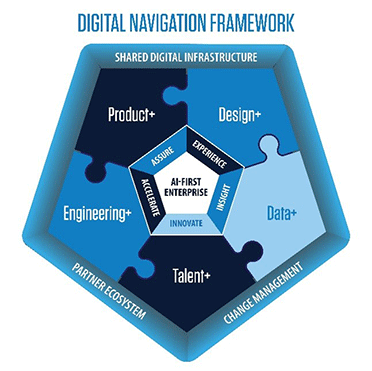
Infosys is a global leader in next-generation digital services and consulting. Over 320,000 of our people work to amplify human potential and create the next opportunity for people, businesses and communities. We enable clients in 59 countries to navigate their digital transformation. With over four decades of experience in managing the systems and workings of global enterprises, we expertly steer clients, as they navigate their digital transformation powered by cloud and AI. We enable them with an AI-first core, empower the business with agile digital at scale and drive continuous improvement with always-on learning through the transfer of digital skills, expertise, and ideas from our innovation ecosystem. We are deeply committed to being a well-governed, environmentally sustainable organization where diverse talent thrives in an inclusive workplace. Visit www.infosys.com to see how Infosys (NSE, BSE, NYSE: INFY) can help your enterprise navigate your next. |
|
.
Safe Harbor
Certain statements in this release concerning our future growth prospects, our future financial or operating performance, and the McCamish cybersecurity incident are forward looking statements intended to qualify for the 'safe harbor' under the Private Securities Litigation Reform Act of 1995, which involve a number of risks and uncertainties that could cause actual results or outcomes to differ materially from those in such forward-looking statements. The risks and uncertainties relating to these statements include, but are not limited to, risks and uncertainties regarding the execution of our business strategy, increased competition for talent, our ability to attract and retain personnel, increase in wages, investments to reskill our employees, our ability to effectively implement a hybrid working model, economic uncertainties and geo-political situations, technological disruptions and innovations such as Generative AI, the complex and evolving regulatory landscape including immigration regulation changes, our ESG vision, our capital allocation policy and expectations concerning our market position, future operations, margins, profitability, liquidity, capital resources, our corporate actions including acquisitions, the outcome of pending litigation, the amount of any additional costs resulting directly or indirectly from the McCamish cybersecurity incident, and the outcome of the government investigation. Important factors that may cause actual results or outcomes to differ from those implied by the forward-looking statements are discussed in more detail in our US Securities and Exchange Commission filings including our Annual Report on Form 20-F for the fiscal year ended March 31, 2025. These filings are available at www.sec.gov. Infosys may, from time to time, make additional written and oral forward-looking statements, including statements contained in the Company's filings with the Securities and Exchange Commission and our reports to shareholders. The Company does not undertake to update any forward-looking statements that may be made from time to time by or on behalf of the Company unless it is required by law.
Contact
| Investor Relations |
Sandeep Mahindroo +91 80 3980 1018 Sandeep_Mahindroo@infosys.com |
|
| Media Relations |
Rishi Basu +91 80 4156 3998 Rajarshi.Basu@infosys.com |
Harini Babu +1 469 996 3516 Harini_Babu@infosys.com |
Infosys Limited and subsidiaries
Extracted from the Condensed Consolidated Balance Sheet under IFRS as at:
(Dollars in millions)
| June 30, 2025 | March 31, 2025 | |
| ASSETS | ||
| Current assets | ||
| Cash and cash equivalents | 3,202 | 2,861 |
| Current investments | 887 | 1,460 |
| Trade receivables | 3,780 | 3,645 |
| Unbilled revenue | 1,588 | 1,503 |
| Other current assets | 1,787 | 1,890 |
| Total current assets | 11,244 | 11,359 |
| Non-current assets | ||
| Property, plant and equipment and Right-of-use assets | 2,223 | 2,235 |
| Goodwill and other Intangible assets | 1,666 | 1,505 |
| Non-current investments | 1,241 | 1,294 |
| Unbilled revenue | 262 | 261 |
| Other non-current assets | 811 | 765 |
| Total non-current assets | 6,203 | 6,060 |
| Total assets | 17,447 | 17,419 |
| LIABILITIES AND EQUITY | ||
| Current liabilities | ||
| Trade payables | 422 | 487 |
| Unearned revenue | 994 | 994 |
| Employee benefit obligations | 385 | 340 |
| Other current liabilities and provisions | 3,353 | 3,191 |
| Total current liabilities | 5,154 | 5,012 |
| Non-current liabilities | ||
| Lease liabilities | 693 | 675 |
| Other non-current liabilities | 480 | 477 |
| Total non-current liabilities | 1,173 | 1,152 |
| Total liabilities | 6,327 | 6,164 |
| Total equity attributable to equity holders of the company | 11,069 | 11,205 |
| Non-controlling interests | 51 | 50 |
| Total equity | 11,120 | 11,255 |
| Total liabilities and equity | 17,447 | 17,419 |
Extracted from the Condensed Consolidated statement of Comprehensive Income under IFRS for:
(Dollars in millions except per equity share data)
| 3 months ended June 30, 2025 | 3 months ended June 30, 2024 | |
| Revenues | 4,941 | 4,714 |
| Cost of sales | 3,416 | 3,259 |
| Gross profit | 1,525 | 1,455 |
| Operating expenses: | ||
| Selling and marketing expenses | 258 | 232 |
| Administrative expenses | 239 | 229 |
| Total operating expenses | 497 | 461 |
| Operating profit | 1,028 | 994 |
| Other income, net (3) | 110 | 88 |
| Profit before income taxes | 1,138 | 1,082 |
| Income tax expense | 329 | 318 |
| Net profit (before non-controlling interest) | 809 | 764 |
| Net profit (after non-controlling interest) | 809 | 763 |
| Basic EPS ($) | 0.20 | 0.18 |
| Diluted EPS ($) | 0.19 | 0.18 |
NOTES:
| 1. | The above information is extracted from the audited condensed consolidated Balance sheet and Statement of Comprehensive Income for the quarter ended June 30, 2025, which have been taken on record at the Board meeting held on July 23, 2025. |
| 2. | A Fact Sheet providing the operating metrics of the Company can be downloaded from www.infosys.com. |
| 3. | Other income is net of Finance Cost. |
Exhibit 99.2
IFRS INR Press Release
Industry-leading Sequential Growth of 2.6% in CC, Driven by Differentiated Value Proposition in Enterprise AI
Large Deal Wins at $3.8 Billion with 55% Net New; Demonstrating Deep Competitive Advantage in Consolidation Play
FY26 Revenue Guidance Revised to 1%-3% and Margin Guidance Retained at 20%-22%
Bengaluru, India – July 23, 2025: Infosys (NSE, BSE, NYSE: INFY), a global leader in next-generation digital services and consulting, delivered $4,941 million in Q1 revenues, year on year growth of 3.8% and sequential growth of 2.6% in constant currency. Operating margin was at 20.8%. Free cash flow generation was strong at $884 million, 109.3% of net profit. TCV of large deal wins was $3.8 billion, with 55% net new. ROE improved by 140 bps to 30.4%.
"Our performance in Q1 demonstrates the strength of our enterprise AI capabilities, the success in client consolidation decisions, and the dedication of our over 300,000 employees”, said Salil Parekh, CEO and MD. “Our large deal wins of $3.8 billion reflect our distinct competitive positioning and deep client relationships”, he added.
Guidance for FY26 :
| · | Revenue growth of 1%-3% in constant currency |
| · | Operating margin of 20%-22% |
Key highlights :
| For the quarter ended June 30, 2025 |
|
· Revenues in CC terms grew by 3.8% YoY and by 2.6% QoQ
·
Reported revenues at
· Operating margin at 20.8%, decline of 0.3% YoY and decline of 0.2% QoQ
·
Basic EPS at
·
FCF at
|
“Q1 performance is a clear reflection of our unwavering focus on multiple fronts resulting in strong growth at 2.6% QoQ, resilient margins at 20.8% and EPS increase of 8.6% YoY. We continue to leverage Project Maximus to make investments in strategic priorities to drive profitable growth and enhance shareholder value”, said Jayesh Sanghrajka, CFO. “Cash flow conversion was well above 100% for the fifth consecutive quarter. The impact of currency volatility was effectively managed through our proactive hedging strategy”, he added.
Client wins & Testimonials
| 1. | Infosys announced the extension of its strategic collaboration with Select Portfolio Servicing, Inc. (SPS) to help drive greater operational efficiency and service quality through a fully managed services offering encompassing hybrid cloud solutions, application portfolio, IT operations, IaaS, SaaS, security operations and quality assurance. Murali Palanganatham, Chief Information Officer, SPS, said, "Infosys has been a key strategic partner over the last 20 years. SPS will leverage Infosys Topaz for AI adoption across the business, technology, and enterprise functions to continuously enhance availability, scalability, performance, resiliency, security, and stability. This collaboration is critical and will help SPS enhance flexibility, efficiency, and predictability of our technology ecosystem.” |
| 2. | Infosys extended its strategic collaboration with AIB to accelerate its digital transformation initiatives. Graham Fagan, Group Chief Technology Officer, AIB, said, "This extended collaboration with Infosys aligns strongly with our vision to progressively modernise our technology and data capabilities to deliver the best outcomes for our customers and further accelerate our transformation. By combining our collective expertise and experience, we will deliver on our customer-first commitment and enhance operational efficiency and resilience. Infosys has been a trusted innovation partner, and we are excited about this next chapter in our collaboration as we work together to ensure AIB remains at the forefront of digital transformation in the Irish banking industry." |
| 3. | Infosys announced a strategic collaboration with E.ON to enable AI-powered digital workplace transformation across Europe. Dr. Victoria Ossadnik, COO Digital and Innovation, E.ON, said, “At E.ON, we are playmakers for new energy. Digitalization and digital technology are key for reliable, affordable and sustainable energy systems. Our strategic partnership with Infosys is essential for our digital transformation and operation - together, we are paving the way for a smarter, more efficient energy future.” |
| 4. | Infosys announced the expansion of its strategic collaboration with DNB Bank ASA (DNB) to accelerate the bank’s digital transformation. Elin Sandnes, COO and Group Executive Vice President Technology & Services, DNB, said, “At DNB, we are focused on leveraging technology to create great customer experiences. As part of this, we are constantly developing new products and services while simultaneously driving a digital transformation agenda that is deeply rooted across all our operations. With our extended collaboration with Infosys, we are modernizing our IT infrastructure and leveraging advanced technologies like AI and ML to enable seamless, personalized, and agile services to our customers. This partnership allows us to proactively address our customers’ evolving needs and ensure they receive the best possible banking experience from DNB.” |
| 5. | Infosys announced a strategic collaboration with Yorkshire Building Society, one of the largest member-owned financial institutions in the UK, to accelerate its digital transformation. Patrick Connolly, Director of Change Delivery, Yorkshire Building Society, said, "This collaboration is crucial to achieving our 2030 ambitions and realising the true potential of this organisation. The choices we make now will shape our future, and we are committed to combining the convenience of digital with the warmth of human interaction. This transformation will empower our members and colleagues with the tools and services needed to deliver great customer outcomes, including major investments such as faster payments and enhanced security. It’s a key part of our plan for continued growth, innovation, and efficiency, ensuring we continue to serve our members for generations to come.” |
| 6. | Infosys and Spark New Zealand announced a strategic agreement to support the transformation of Spark’s technology delivery model through digital innovation. Matt Bain, Data and Marketing Director, Spark, said, “Infosys has collaborated with Spark for over 16 years, working alongside our local teams to support the applications that enable Spark to deliver new products and digital experiences for our customers. We are now building on this relationship to allow our teams to focus on our technology strategy and the product roadmaps that will grow our competitive advantage, while leveraging Infosys’ global scale to execute these plans quickly and efficiently and accessing Infosys’ investment in AI and innovation to enable us to keep delivering great experiences for our customers.” |
| 7. | Infosys collaborated with Perfection Fresh to enable seamless tracking of their sustainability efforts. Francesco Oliveri, Chief Information Officer, Perfection Fresh Australia, said, “Our Partnership with Infosys to implement Microsoft Sustainability Manager has helped us in providing real-time visibility of produce across all locations thereby improving operational efficiency, audit transparency and reducing wastage. Originally planned for just 4 sites, the rollout extended to all 17 locations thanks to Infosys’ expertise and collaboration. It was also their vision and commitment to sustainability that matched our vision that allowed us to be more comfortable in working with Infosys. The partnership has been instrumental in driving key milestones for Perfection Fresh’s sustainability roadmap”. |
| 8. | Infosys Finacle announced a strategic collaboration with Bank of Sydney (BoS) to power its digital transformation with Infosys Finacle Digital Banking Suite. Melos Sulicich, Chief Executive Officer, Bank of Sydney, said, “At Bank of Sydney, our strategic goal is to become the leading deposit bank in Australia and to drive significant business growth in the coming years. This requires adapting to rapidly changing customer needs, digital advancements, and regulatory requirements. Transforming our technology stack, centered around our core and digital banking platform, is crucial to meeting these objectives. With Infosys Finacle, we have a proven transformation partner and a next-generation banking platform to address the evolving needs of our business, customers, and regulatory ecosystem.” |
| 9. | Infosys BPM announced the launch of AI agents for invoice processing within its flagship Infosys Accounts Payable on Cloud solution. Harsh Bansal, Chief Financial Officer and Chief Growth Officer, Americana Restaurants, said, “At Americana Restaurants, we are committed to leading digital transformation, and as we scale our operations, intelligent automation is key to achieving greater efficiency and agility. With AI-powered Infosys Accounts Payable on Cloud, we have made invoice processing faster, enhanced accuracy, and improved efficiency. The addition of Agentic AI takes this a step further, reducing manual dependencies and bringing more intelligence and autonomy into our invoice processing. We are delighted that we have pioneered this initiative with Infosys and look forward to closely working with Infosys BPM to lead us collectively into a future of smarter and more agile operations." |
| 10. | Infosys announced a three-year strategic collaboration with the Lawn Tennis Association (LTA) to deliver a range of AI-powered innovations, including match insights and immersive fan experiences. Chris Pollard, Managing Director, Commercial & Operations, LTA, said, “We are incredibly excited to witness the historic moment of the HSBC Championships at Queen's Club hosting both WTA and ATP 500 events for the very first time. This milestone marks a significant step in the growth and evolution of this prestigious tournament. We are thrilled to collaborate with Infosys, whose support will be instrumental in delivering an enhanced fan experience. Infosys' AI and technology innovations will bring a new level of engagement with real-time insights and interactive moments, creating memorable experiences for our fans and contribute to the continued success of the HSBC Championships.” |
| 11. | Infosys and Economist Impact announced the launch of The Sustainability Atlas to help businesses navigate a sustainable future. Jonathan Birdwell, Global Head of Policy & Insights, Economist Impact, said, “Over the past decade, Economist Impact has built dozens of indices and published hundreds of reports across a wide range of sustainability topics from food security to plastics management, to climate resilience. But never before have we been able to bring all of that data and insights together in one place. Leveraging Infosys’ generative AI capabilities, The Sustainability Atlas provides easily accessible and actionable insights to policy makers and business leaders worldwide.” |
Recognitions & Awards
Brand & Corporate
| · | Recognized as a Top 100 most valuable brand in the world by Kantar BrandZ and ranked among the most-trusted brands in India and the US |
| · | Recognized as one of the top 3 companies (on combined basis) in 5 categories – Best CEO, Best IR Professional, Best IR Program, Best IR Team and Best ESG Program – at the 2025 Asia Executive Team Survey by Extel (formerly Institutional Investor Research) |
| · | Recognized as a Great Place to Work 2025-2026 in India and China |
| · | Infosys BPM won at the Diversity Charter Awards 2025 in the 'Employer Supporting Women in the Workplace' category for its HR initiative, namely 'Empower with Care' |
| · | Infosys BPM won the PeopleFirst HR Excellence Awards 2025 for ‘Leading Practices’ in Learning & Development |
Digital, AI and Cloud Services
| · | Positioned as a leader in the Everest Group: Microsoft Modern Work Services PEAK Matrix® Assessment 2025 |
| · | Positioned as a leader in the Everest Group: Marketing Services PEAK Matrix® Assessment 2025 |
| · | Positioned as a leader in the Everest Group: Talent Readiness for Next-generation Application Services PEAK Matrix® Assessment 2025 |
| · | Recognized as a leader in HFS Horizons: The Best of Engineering Research and Development Service Providers, 2025 |
| · | Recognized as a leader in the Constellation Research: Constellation ShortList™ Cross-Platform Agentic AI |
| · | Recognized as a leader in Datos: The New Era of Check Fraud Detection: A Guide to Market Solutions |
| · | Infosys BPM recognized as a Leader in ISG Provider Lens™ Global Capability Center (GCC) Services 2025 Study |
| · | Infosys BPM recognized as a Leader in ISG Provider Lens™ Procurement Services 2025 Study |
| · | Received the Customer Innovation Award from Databricks for delivering impactful solutions across industries |
| · | Received Global System Integrator of the Year-EMEA award at Stibo's PATH Summit 2025 |
Industry & Solutions
| · | Positioned as a leader in the Everest Group: Life Sciences Digital Services PEAK Matrix® Assessment 2025 |
| · | Positioned as a leader in the Everest Group: Life Sciences Enterprise Platform Services PEAK Matrix® Assessment 2025 |
| · | Positioned as a leader in the Everest Group: Retail Services PEAK Matrix® Assessment 2025 |
| · | Recognized as a leader in HFS Horizons: Energy and Utilities Service Providers, 2025 |
| · | Recognized as a leader in HFS Horizons: Intelligent Retail and CPG Ecosystems, 2025 |
| · | Recognized as a leader in HFS Horizons: Insurance Services, 2025 |
| · | Infosys Finacle recognized as a Market Leader in the Datos Matrix: Virtual Account Management Providers 2025 report. |
| · | Infosys Finacle won two awards at IBS Intelligence Digital Banking Awards 2025: ‘Regional Winners | Middle East – Zand Bank & Infosys Finacle’ and ‘Segment Winner | Corporate Banking - Zand Bank & Infosys Finacle’ |
| · | Infosys Finacle won two awards at the MEA Finance Banking Technology Awards 2025: ‘Best Composable Banking Solutions Provider of the Year’ and ‘Best Corporate Banking Solutions Provider’ |
| · | Infosys Finacle won four awards at Finnovex North Africa – Egypt 2025: ‘Excellence in Banking Platform Modernization with ALEXBANK Egypt’, ‘Excellence in Seamless Banking Experiences with Export Development Bank of Egypt’, ‘Excellence in Core Banking Transformation with Agricultural Bank of Egypt’ and ‘Excellence in Composable Banking Platform |
Read more about our Awards & Recognitions here.
About Infosys
|
Infosys is a global leader in next-generation digital services and consulting. Over 320,000 of our people work to amplify human potential and create the next opportunity for people, businesses and communities. We enable clients in 59 countries to navigate their digital transformation. With over four decades of experience in managing the systems and workings of global enterprises, we expertly steer clients, as they navigate their digital transformation powered by cloud and AI. We enable them with an AI-first core, empower the business with agile digital at scale and drive continuous improvement with always-on learning through the transfer of digital skills, expertise, and ideas from our innovation ecosystem. We are deeply committed to being a well-governed, environmentally sustainable organization where diverse talent thrives in an inclusive workplace. Visit www.infosys.com to see how Infosys (NSE, BSE, NYSE: INFY) can help your enterprise navigate your next. |
|
.
Safe Harbor
Certain statements in this release concerning our future growth prospects, our future financial or operating performance, and the McCamish cybersecurity incident are forward looking statements intended to qualify for the 'safe harbor' under the Private Securities Litigation Reform Act of 1995, which involve a number of risks and uncertainties that could cause actual results or outcomes to differ materially from those in such forward-looking statements. The risks and uncertainties relating to these statements include, but are not limited to, risks and uncertainties regarding the execution of our business strategy, increased competition for talent, our ability to attract and retain personnel, increase in wages, investments to reskill our employees, our ability to effectively implement a hybrid working model, economic uncertainties and geo-political situations, technological disruptions and innovations such as Generative AI, the complex and evolving regulatory landscape including immigration regulation changes, our ESG vision, our capital allocation policy and expectations concerning our market position, future operations, margins, profitability, liquidity, capital resources, our corporate actions including acquisitions, the outcome of pending litigation, the amount of any additional costs resulting directly or indirectly from the McCamish cybersecurity incident, and the outcome of the government investigation. Important factors that may cause actual results or outcomes to differ from those implied by the forward-looking statements are discussed in more detail in our US Securities and Exchange Commission filings including our Annual Report on Form 20-F for the fiscal year ended March 31, 2025. These filings are available at www.sec.gov. Infosys may, from time to time, make additional written and oral forward-looking statements, including statements contained in the Company's filings with the Securities and Exchange Commission and our reports to shareholders. The Company does not undertake to update any forward-looking statements that may be made from time to time by or on behalf of the Company unless it is required by law.
Contact
| Investor Relations |
Sandeep Mahindroo +91 80 3980 1018 Sandeep_Mahindroo@infosys.com |
|
| Media Relations |
Rishi Basu +91 80 4156 3998 Rajarshi.Basu@infosys.com |
Harini Babu +1 469 996 3516 Harini_Babu@infosys.com |
Infosys Limited and subsidiaries
Extracted from the Condensed Consolidated Balance Sheet under IFRS as at:
(in  crore)
| June 30, 2025 | March 31, 2025 | |
| ASSETS | ||
| Current assets | ||
| Cash and cash equivalents | 27,459 | 24,455 |
| Current investments | 7,606 | 12,482 |
| Trade receivables | 32,414 | 31,158 |
| Unbilled revenue | 13,617 | 12,851 |
| Other current assets | 15,322 | 16,153 |
| Total current assets | 96,418 | 97,099 |
| Non-current assets | ||
| Property, plant and equipment and Right-of-use assets | 19,066 | 19,111 |
| Goodwill and other Intangible assets | 14,294 | 12,872 |
| Non-current investments | 10,643 | 11,059 |
| Unbilled revenue | 2,246 | 2,232 |
| Other non-current assets | 6,952 | 6,530 |
| Total non-current assets | 53,201 | 51,804 |
| Total assets | 149,619 | 148,903 |
| LIABILITIES AND EQUITY | ||
| Current liabilities | ||
| Trade payables | 3,616 | 4,164 |
| Unearned revenue | 8,527 | 8,492 |
| Employee benefit obligations | 3,299 | 2,908 |
| Other current liabilities and provisions | 28,762 | 27,286 |
| Total current liabilities | 44,204 | 42,850 |
| Non-current liabilities | ||
| Lease liabilities | 5,943 | 5,772 |
| Other non-current liabilities | 4,118 | 4,078 |
| Total non-current liabilities | 10,061 | 9,850 |
| Total liabilities | 54,265 | 52,700 |
| Total equity attributable to equity holders of the company | 94,954 | 95,818 |
| Non-controlling interests | 400 | 385 |
| Total equity | 95,354 | 96,203 |
| Total liabilities and equity | 149,619 | 148,903 |
Extracted from the Condensed Consolidated statement of Comprehensive Income under IFRS for:
(in crore except per equity share data)
| 3 months ended June 30, 2025 | 3 months ended June 30, 2024 | |
| Revenues | 42,279 | 39,315 |
| Cost of sales | 29,224 | 27,177 |
| Gross profit | 13,055 | 12,138 |
| Operating expenses: | ||
| Selling and marketing expenses | 2,208 | 1,937 |
| Administrative expenses | 2,044 | 1,913 |
| Total operating expenses | 4,252 | 3,850 |
| Operating profit | 8,803 | 8,288 |
| Other income, net (3) | 937 | 733 |
| Profit before income taxes | 9,740 | 9,021 |
| Income tax expense | 2,816 | 2,647 |
| Net profit (before non-controlling interest) | 6,924 | 6,374 |
| Net profit (after non-controlling interest) | 6,921 | 6,368 |
| Basic
EPS () |
16.70 | 15.38 |
| Diluted
EPS () |
16.68 | 15.35 |
NOTES:
| 1. | The above information is extracted from the audited condensed consolidated Balance sheet and Statement of Comprehensive Income for the quarter ended June 30, 2025, which have been taken on record at the Board meeting held on July 23, 2025. |
| 2. | A Fact Sheet providing the operating metrics of the Company can be downloaded from www.infosys.com. |
| 3. | Other income is net of Finance Cost. |
Exhibit 99.3
Press Conference
"Infosys Limited
Q1 FY26 Media Conference Call"
July 23, 2025
CORPORATE PARTICIPANTS:
Salil Parekh
Chief Executive Officer and Managing Director
Jayesh Sanghrajka
Chief Financial Officer
Rishi Basu
Associate Vice President and Global Head - Corporate Communications
JOURNALISTS
Ritu Singh
CNBC TV18
Haripriya Suresh
Reuters News
Beena Parmar
The Economic Times
Reshab Shaw
| Moneycontrol |
Jas Bardia
The Mint
Veena Mani
The Times of India
Avik Das
Business Standard
Sanjana B.
The Hindu Businessline
Ayanti Bera
The Financial Express
Rishi Basu
A
very good evening, everyone, and thank you for joining Infosys' first quarter financial results. My name is Rishi. And on behalf of Infosys,
I would like to welcome you today.
As always, we request one question from each media house so that we can accommodate all of you over the next 45 minutes or so. With that, let me invite our Chief Executive Officer, Mr. Salil Parekh, for his opening remarks. Over to you, Salil.
Salil
Parekh
Thanks, Rishi. Good afternoon and thank you all for joining us. We had a strong start to our financial year. Our revenues grew 2.6%
sequentially and 3.8% year-on-year in constant currency terms. Growth was broad-based with our large 5 industry groups and our large
geographies, growing year-on-year in constant currency.
Our large deals were at $3.8 bn. The main drivers of our growth were, leadership in enterprise AI and continued success in client selecting us for consolidations. We are seeing good demand for AI agents. We have built 300 agents across business operations and IT areas and they are now deployed within our clients. Horizontal and vertical agents are helping our clients drive faster decisions, improve customer experience and improve operational efficiency.
Based on our performance in Q1 and our current outlook, our guidance for growth for financial year 2026 is revised from where it was 0% to 3%, now it will be 1% to 3% in constant currency terms. Our margin guidance remains unchanged at 20% to 22%.
With that, Rishi, let us open it up for questions.
Rishi
Basu
Thank you, Salil. We will now open the floor for questions. Joining Salil is Mr. Jayesh Sanghrajka, Chief Financial Officer,
Infosys. The first question is from Ritu Singh from CNBC TV18.
Ritu
Singh
Hi, gentlemen. Thanks very much for the question. We are talking about how the numbers have been very strong. The performance
has been good. The first quarter revenue is above what the Street had factored in. Two questions on this; if the numbers are so good,
why have you not raised the upper end of your guidance? Why just the marginal revision from 0-3% to 1% to 3%? And how much of this upward
revision that we are seeing, and including the kind of constant currency growth, 2.6% in this quarter, has come from your inorganic,
from your acquisitions that you have made? That is one part of the question.
Also, how would you guide the Street to look at these numbers? Would you really say, this is a turn around that you are seeing in the current macro-environment that going ahead this kind of performance would be sustained?
And a word, last time, we did not hear much from you on the whole tariff conundrum and how that is impacting discretionary spend, specifically in sectors like Manufacturing, Retail, what is your sense on the clients, and if you could also add a word on your hiring plans for the year? Thanks very much.
Salil
Parekh
Thanks. So first, on the guidance, what we have seen this quarter is a strong performance in terms of where we have delivered
the 2.6% growth, as you pointed out. With that and with the current outlook where we have seen a lot of the discussions on the economy
worldwide having come to more stable situations, but still seeing that it is not fully settled.
Given that, we have increased the lower end of our guidance as we go closer, progress into the year, closer towards the end of the year, we typically narrow our guidance. And that is the first part of what we have done, which is increase the lower end, but we still see things within our guidance where we look at some things which will give us good traction. For example, what we have seen in the consolidations, we have seen very strong work that we have done on AI with agents and we see that and we also see the economy globally, both in Europe, U.S. going through changes. So, keeping that in mind, we have narrowed the guidance and increased the lower end.
On the inorganic part, I will let Jayesh mention how much of it is inorganic.
Jayesh
Sanghrajka
Yes. So inorganic in this quarter has been around 40 basis points, within our 2.6% that we reported. And for the full year
also, it will be a similar number.
Salil
Parekh
And then back on the sort of economy, we talked about it last quarter and also in addressing it today. There are overall changes
in the economic environment and we mentioned last quarter, we shared that again. We see some of that impact, for example, in Logistics.
We see some in Consumer products and some in Manufacturing.
But equally, we have seen benefits, especially because we have seen good traction with the work we are doing with agents in AI and a benefit from consolidation that we have looked at, that the clients have looked at us and been positive, and that has given us some of the positive growth that we have seen in this quarter.
Ritu
Singh
(Editors remark: Question inaudible)
Salil
Parekh
So there, on the acquisition, as Jayesh shared, it is a small part of it, even if you keep that aside, we are well over 2%,
2.2% in terms of constant currency growth, in the quarter. The way I would look at it is, it is very differentiated performance because
we have what we believe to be one of the best ways that we are deploying AI, enterprise AI into our clients.
So these are active projects where we are using agents, different types of agents that clients are leveraging, whether it is in their supply chains, in their customer experience, where they are getting productivity benefits, where they are getting improved customer service, that is one aspect of it.
And the other aspect is, we are seeing clients are selecting us more and more when they are looking at consolidation because inherently, we see clients see, Infosys' delivery as very strong and stable and also providing new ideas, especially on AI for improvements into their business. So that is the differentiated performance that we are seeing in the way that we see it.
Ritu
Singh
Hiring?
Jayesh
Sanghrajka
So if you look at our hiring numbers, our overall headcount has remained constant at this point in time. Our utilization
is at its peak at 85%. So, we will continue hiring, and we expect to continue hiring in line with what we have announced at the beginning
of the year, there is no change there.
Rishi
Basu
Thank you, Ritu. The next question is from Haripriya Suresh from Reuters News.
Haripriya
Suresh
Good evening, gentlemen. One quick, I wanted to understand, Americas growth has been flattish, but Europe has done really well.
Just some color on the specific markets. Is Europe client-specific, what is happening on that end?
And in terms of the employee headcount, like you mentioned, I know it is been flat. I know there is a lot of talk about how Infosys is using AI, do you see -- if utilization at its peak, do you see productivity increasing where you do not need to hire as much going forward? And will this sort of be the level that we will see it at? And I wanted to get some color on what the wage hike scenario will be for this quarter as well? Thank you.
Jayesh
Sanghrajka
So, coming to your second question on headcount, as I said earlier, headcount has remained flat. Despite that, we have
been able to deliver 2.6% on growth. Large part of that came from the RPP increase or the pricing increase that we got and the seasonality
benefit that we got. 40 bps came from the acquisition and the balance came from the volume increases, which we have been able to manage
within our current headcount through utilization.
Now that we are at a peak, any further volume increase will need to come from the hiring. So that is where we are.
In terms of U.S. and Europe, I think Europe has been strong footing for us for many quarters in the past, that is on the back of the investment that we made a few years back in Europe. We had identified Europe as a geography to invest into. And all of that, I think, is working well across sectors.
Haripriya
Suresh
(Editors remark: Question inaudible)
Jayesh
Sanghrajka
Because Europe is growing faster versus America, to that extent, it is changing, but still U.S. remains the largest sector
for us, largest geography for us.
We did a wage hike already, first part of that was effective January, the second part already rolled out effective April. First, the impact of that is already baked in, in the margin of this quarter. We had 100 basis points of impact on account of wage hike as well as the higher variable pay that we paid to our employees this quarter, so that is already done. Having done the wage hike very recently, next one, we will have to decide when.
Rishi
Basu
Thank you, Haripriya. Next question is from Beena Parmar from The Economic Times.
Beena
Parmar
Hi, Salil. You mentioned about the revenue being stronger. Some of your peers have pointed out that there has been some revenue
cannibalization that they are seeing, are you also witnessing it? And are you seeing some productivity gains, benefits that you are passing
on to your customers? And is that also leading to change in pricing? I think we spoke about it briefly, but has there been any change
in the first quarter?
And secondly, is that also impacting your margins? What were the factors that led to the margins, because I think it has declined.
Salil
Parekh
Let me start on the revenue one. I think we are seeing, with AI a lot of productivity benefits. We also saw productivity benefits
that we were already working on from automation and lean, which were coming through. Typically all productivity benefits, a part of that
is shared with clients and a part of that is shared with us. We see, if you look at the overall level, what Jayesh was sharing, we have
seen our productivity of our revenue, the way our own pricing is working, at a macro level improving.
And this is more because we are doing work, which is creating more impact in addition to the productivity, which is making some of that benefit being shared with client. So, these are two different factors. But on balance, we see an impact into the quality of the revenue that we are seeing now.
Beena
Parmar
So, what kind of productivity gains you have been passing on?
Salil
Parekh
So there, we are not discussing the amounts we are passing on. But in terms of what we are seeing as a benefit, we are seeing
between 5% and 15% through AI programs where we are working with clients, where typically there are disparate systems. Internally, there
are some things we have done, which are slightly higher than that. But those are all internal. Like, if you look at our Finacle product,
it is one uniform sort of a code base in which we can get better productivity.
Jayesh
Sanghrajka
Yes. And on the margin walk, the 20 basis points of decline, the puts and takes of that, 100 basis points of headwind came
from compensation related factors, in hike that we gave in April, as well as the higher variable pay that we pay to our employees or
we will pay to our employees for this quarter. 30 basis points was a headwind on account of currency and 20 basis points for other factors.
This was offset by 70 basis points of pricing benefit that we got from both seasonality, as well as the benefit that Salil was talking about from productivity and everything that we have been doing under Project Maximus. 40 basis points came because of the acquisition related impairment that we did in the last quarter, that was a one-off in the last quarter, so that was a benefit this quarter, and 20 basis points because our third-party cost was lower. So just to highlight, our 2.6% of growth was despite the fact that our third-party revenue and costs were lower by 60 basis points.
Beena
Parmar
Just one last question. Your conversations with the clients, has it improved in terms of the business demand? And are you seeing
that tariff-related uncertainty or the caution is now over?
Salil
Parekh
So, on a macro basis, what we see is, all clients are quite focused on enterprise AI, where we can show what is working, where
it is working, especially with agents. Then there are industries, specifically Logistics, Consumer product goods, Manufacturing, where
we see the impact of the changes in the economic situation.
Where we were at this time last quarter, there has also been several things which have been done, which gives more view and focus into what is going on. And yet, there is still some open items which are going on. So we see, for example, from clients, there is quite a lot of attention on cost and efficiency of their own operations, even if they are not impacted by the changes in the economy.
So that is all going on, including some of the benefits that we are seeing from AI. And then finally, on a macro level, at this quarter, in our large deals, we have seen a lot of deals where we benefited from clients making consolidation decisions.
Rishi
Basu
Thanks, Beena. The next question is from Reshab Shaw from Moneycontrol.
Reshab
Shaw
Hi, gentlemen. Congratulations on a good set of numbers in a difficult quarter, in a difficult macroeconomic environment. I have
a couple of questions. First, on Financial Services, 2 fiscals back, you were close to 28%, now it is down to 27%, so is this a new normal?
Is this a change in composition or are you losing market share?
Second, your active number of clients has reduced in the last 2 fiscals. And this comes on the back of revenue growth in this quarter. So, is there a pricing change? What are the benefits? What is driving this? And also, we have seen in the last 2 quarters that you have added in 3-digit numbers. So, is this a beginning of moving from pyramid to IP-led businesses? Thank you.
Salil
Parekh
So let me start with some of that, Jayesh will add in. I think Financial Services, we are seeing a very strong traction. So,
one of the things we have benefited from in Financial Services is, if you look at, let us say, our large 20 clients, in half of them,
we are the AI partner of choice with those clients. In many of those clients, we see benefits from consolidation. In many of those clients,
we are in the forefront when there is regulatory change or big transformation, which includes tech and Op. So, one sense is we are well
positioned in financial services. We are starting to gain much more traction, and we have a broad set of coverage both in geography and
in capabilities within financial services.
Jayesh
Sanghrajka
So, on the active clients, you always have a long tail and they come for small projects and some of them eventually become
larger projects, some of them eventually fall out and after a few quarters, a few months, they come back in a way. So, I do not think
the active client is a big metric. Of course, it is a metric to track, but more important in our mind is, the $100 mn, $50 mn clients,
how they grow and how we mine that, once they become a sizable client.
Salil
Parekh
On the IP, so there what we are seeing is there is definitely a growth focus in what we are driving. What Jayesh mentioned
earlier, we have a clear plan of recruiting people into this year, in this financial year into the company, both from college, both laterally.
But we are also seeing some of our programs, for example, what we are doing in our insurance platform, what we are doing in our Financial
Services banking platform in Finacle, those are definitely areas where we see more and more IP.
Then we are also seeing places where, for example, in some of our work that we do in BPM, these are not IP but they are more outcome-driven. And so there, there is a difference between what happens in the rest of the company, which is much more headcount than outcome. But we do not see that there is a huge change in that. We still see that we have a plan of recruiting for this year, and we are on track with that.
Rishi
Basu
Thank you. The next question is from Jas Bardia from Mint.
Jas
Bardia
Good evening. I have a couple of questions. One is, has there been some sort of revenue cannibalization or probably a reshuffling
of employees because of AI? Second is more on a macro scale. If you look at 8 years of your tenure and purely on Infosys, Infosys under
you has performed better than the peers. And third consecutive year where the industry has started to slow, including Infosys. Now considering
there is been a dearth of mega deals for the company, has the company run out of steam? If so, what is it because of? macro uncertainty,
client-specific issues or just AI in general?
Salil
Parekh
So thank you. That is good to know. The large deals are working very well. So, I think for us, the $3.8 bn is incredible. We
have so many deals in there, one mega deal. We have deals which are focused on AI, deals which are focused on transformation, deals which
are focused on consolidation. So, my sense is that whole approach is in good shape. We remain, I would say, at the forefront with clients
on that.
A part of where we see some of the changes is the overall economic environment. And my sense is that when that is in a place where we see more and more of the AI movement, which is happening well and more of other work, which is digital transformation, cloud, we are seeing, for example, tremendous traction on enterprise applications and how they are being driven in new changes. Those are the ones that will support the future, the next stages.
AI itself, there is a whole piece which is around enterprise AI and productivity. But we are also seeing there are new things that we can do with enterprise AI with clients. For example, much deeper level of analytics, much deeper level of assessments, much deeper work on how they can optimize the business, not just for productivity, but for growth. And those will give us new revenue streams.
So, there is a view that we have seen from the analysis internally, where some of the addressable market in those areas is growing and quite good. So we feel quite positive that over this approach that has worked, as you described for the last several years for Infosys, will continue to work for the next several years.
Rishi
Basu
Thank you. The next question is from Veena Mani from The Times of India.
Veena
Mani
Good evening, gentlemen. A couple of questions here. We have heard reports at the end of April and through May that there were
more freshers fired from the Mysore campus. Were these from the 2022 batch, if there is any merit to that? And also, does it say anything
about the quality of freshers coming out of colleges in the last couple of years?
Also, the second question is, Infosys moved to a hybrid form of interview process. Is that also related to how talent is being fleshed out from the market, lateral and freshers? Does it also have to do with the fact that because of virtual interviews, there have been people who misused that format?
Now TCS has made its bench policy a lot more stringent by saying that people can be on the bench only up to 35 days. Is Infosys heading there given that the market is not all that great?
Also, your ESG report had mentioned capability quotient, that Infosys is moving from a digital quotient to capability quotient to mark the progress of its employees. How will that have an impact on the appraisal, on the hikes and also the movement, through maybe IJPs, also taking up projects on Accelerate and other things, if you could help me with some of these?
And again, TCS, we have reported recently that there have been onboarding delays for laterals. Is that something that we see even at Infosys given that the market is not all that great?
Salil
Parekh
Thanks. So, there are several, I would like to get through them. The first one was on the Mysore. I think there, we have a
rigorous process for hiring college graduates. They then go through a very focused foundational training at the campus. And then we expect
that they meet the internal assessment standards. So, all of the people who join us, they get three attempts to meet those standards.
After the third attempt, if they do not meet, they do not continue with the company.
This is a process that has been in use for the last 20 years, and it is something that is important because we want to make sure that the quality that we are providing to our clients is based on these internal assessment standards that we have set. And that is the approach that we have followed there.
On the bench point, I think, was one of your other ones, we have no comment on the other company bench. At Infosys, the way we have looked at this is, employees are provided opportunities for training and learning projects and then they are deployed on to client projects when they are ready, and that is the process we follow all through, and we have been following for a long time now.
Rishi
Basu
Hybrid interview
Salil
Parekh
There, I think we want to make sure that we put in place an approach that works well for the prospective employee and for the
company. And that is in part why we made some of the changes keeping in mind. Even on our employee side, we have a very flexible approach
with respect to where employees are coming in.
Every quarter, for the last many quarters, we have seen an increase in the number of employees on campus. But overall, at a company level, we have a flexible approach and that is one of the elements of that.
Jayesh
Sanghrajka
So on the ESG report, the digital versus the capabilities metrics that we have been using, I do not think that is something
that we use for the IJPs, etc. That is a metric that is important from the ESG perspective, that is why we have started publishing that,
but that is not necessarily imposing on the IJPs, etc., internally. The last question that you had was on the lateral hires. We have
not stopped any of the laterals hires or deferred any of the lateral hires.
Rishi
Basu
Thank you, Veena. The next question is from Avik Das from The Business Standard.
Avik
Das
Hi, Salil, two questions and one for Jayesh. So Manufacturing seems to have really stood out in terms of the growth and you did
point out that Manufacturing, Logistics as well as Consumer packaged goods seem to be under stress for all the obvious reasons. Now I
just wanted to understand what really worked in your favor? Was it client specific? and what really went your way?
And if you can also provide some outlook on North America. Well, the growth has been nothing compared to Europe, but just wanted to get your feedback on the biggest market, how is it performing, especially from the BFSI side? And on the margins front, while the guidance has been narrowed, the margins still remain the same. So are you anticipating any margin constraint or pressure going ahead? Thank you.
Salil
Parekh
So let me take the first question and Jayesh will also comment a little bit more on the industry, let me start with the industry
and North America. So Financial Services and North America, we see very good traction across all businesses in Financial Services in
all geographies.
And then just in North America, if you look across all industries, while we have shown the growth where it is, we see that market, which is the largest for Infosys in a very strong position. So yes, there are changes in the economic situation. But equally, there is good traction that we have.
We have several other industries outside of Logistics, outside of Consumer product, where we see good activity. For example, in Energy, Utilities, for example, some of the work we are seeing in telco and so on. So, the market is quite strong. We see good traction with enterprise AI there as well and good traction in some of the consolidation wins that we have seen on the large deals which have come from that market.
Maybe on Manufacturing and margin
Jayesh
Sanghrajka
Yes. So, on Manufacturing, while we have called out softness in some parts of the Manufacturing, especially the auto, industrial
and Europe, I think we have benefited from the consolidation, and we have benefited from the large deals that we have won in the past.
But we continue seeing softness or the concerns in terms of client spending in the areas that we have identified within Manufacturing.
On the margins, I did give a walk earlier in terms of the puts and takes of 20 basis point decline this quarter, 100 basis points was on account of comp and variable pay, 30 basis points was currency, 20 basis points was on account of investment that we made in sales, that was offset by the benefits that we got from Maximus, 70 basis points because of the pricing increase and the seasonality benefit, 40 basis points was one-off in the Q4 last quarter and 20 basis points was lower third party.
As we go forward, the Project Maximus is still running. The proof of that was you saw last year, we delivered 50 basis point expansion despite multiple headwinds. We still see the Project Maximus delivering on multiple counts. That will be offset by the headwinds like lower growth. We are now talking about 1% to 3% growth, so the fixed cost will play out, the fixed cost of the growth areas will play out.
The compensation-related things will play out because now we will have a full year impact of the compensation, etc. Some of the large deals will start ramping up, and there will be transition effort, etc., where we incur costs, but we do not get revenue in the first few months or weeks when the transition happens. So, all of that will be the puts and takes, we still aspire to increase margins from where we are.
Rishi
Basu
Thanks Avik. The next question is from Sanjana from the Hindu Businessline.
Sanjana
B.
Good evening gentlemen. Do you see any change in projects either ramping up or ramping down due to the geopolitical uncertainties
or any reassessment on the clients’ end? And also, do you think that in FY26 third-party costs and revenues will be lower than
in FY25 because I think it contributed to a significant decline, at least in the last fiscal or last quarter? And coming to hiring, I
can see that the headcount has increased marginally between Q4 and Q1 this year. So, do you at all see any impact of AI and automation
on hiring? Yeah, just these, thank you.
Salil
Parekh
So, on the first one, I think we see the changes in the economic outlook, with all of the changes going on in U.S. and Europe,
we have not seen any change in a specific client or a specific project situation. It is more overall what we were sharing earlier. First,
there is more emphasis on cost and efficiency across, there is some impact at an industry level, if you look at Logistics or Consumer
products or some parts of Manufacturing like auto. And then we see a lot of benefits in this like a cost or consolidation discussion
quite a bit when clients have made some of those decisions. So there, we are okay from the overall perspective, which has partially helped
us with the growth.
I think on the hiring, recruiting and people, so we first have a plan for recruitment for this year for college and lateral avenue. With AI there has been benefits that we see in terms of productivity. We see with AI, especially enterprise AI, that there is more things that we are doing with clients, even things like the cloud transitions get accelerated or data and analytics foundations get accelerated. And those programs are fundamental to making enterprise AI successful with clients.
So those things give us more newer work and on balance, we see that overall continues to be supporting our growth activity now, plus the consolidation side, the cost efficiency side. So we will continue with our hiring plan for this year.
Rishi
Basu
Thank you. The next question is from Ayanti Bera from the Financial Express.
Ayanti
Bera
Hello hi, I don’t know if this has been talked about already. Just give us the underlying reasons that encouraged you to
increase the lower end of your revenue growth guidance?
Jayesh
Sanghrajka
Yes. So if you look at last guidance, we had clearly called out that at the lower end of our guidance, we are expecting
heightened uncertainty, in the environment. And at the upper end of the guidance, we are expecting steady to marginally improving environment.
One quarter gone by, we have strong quarter, we have strong deal wins, that is the reason why we have increased our lower end from 0% to 1%. At the same time, on the upper end, we still see possible uncertainty on the back of tariff and on the whole of macro environment. But at the lower end, the quarter performance and the deals that we have won gives us better confidence at this point in time.
Rishi
Basu
Thank you. With that, we come to the end of this press conference. We thank our friends from media for being here today. Thank
you, Salil, and thank you, Jayesh. Before we conclude, please note that the archived webcast of this press conference will be available
on the Infosys website and on our YouTube channel later today. Thank you, and please join us for some high tea outside.
Exhibit 99.4
Fact Sheet

Revenue Growth- Q1 26
| Reported | CC | |
| QoQ growth (%) | 4.5% | 2.6% |
| YoY growth (%) | 4.8% | 3.8% |
Revenues by Business Segments
(in %)
| Quarter ended | YoY Growth | ||||
| Jun 30, 2025 | Mar 31, 2025 | Jun 30, 2024 | Reported | CC | |
| Financial services | 27.9 | 28.4 | 27.5 | 6.3 | 5.6 |
| Manufacturing | 16.1 | 15.9 | 14.7 | 14.8 | 12.2 |
| Energy, Utilities, Resources & Services | 13.6 | 13.0 | 13.3 | 7.2 | 6.4 |
| Retail | 13.4 | 13.3 | 13.8 | 1.5 | 0.4 |
| Communication | 12.0 | 11.7 | 12.1 | 4.7 | 4.0 |
| Hi-Tech | 7.8 | 8.3 | 8.0 | 2.1 | 1.7 |
| Life Sciences | 6.5 | 6.8 | 7.3 | (6.6) | (7.9) |
| Others | 2.7 | 2.6 | 3.3 | (14.9) | (15.3) |
| Total | 100.0 | 100.0 | 100.0 | 4.8 | 3.8 |
Revenues by Client Geography
(in %)
| Quarter ended | YoY Growth | ||||
| Jun 30, 2025 | Mar 31, 2025 | Jun 30, 2024 | Reported | CC | |
| North America | 56.5 | 57.1 | 58.9 | 0.5 | 0.4 |
| Europe | 31.5 | 31.2 | 28.4 | 16.2 | 12.3 |
| Rest of the world | 9.1 | 8.8 | 9.6 | – | 0.4 |
| India | 2.9 | 2.9 | 3.1 | (3.1) | (1.0) |
| Total | 100.0 | 100.0 | 100.0 | 4.8 | 3.8 |
Client Data
| Quarter ended | |||
| Jun 30, 2025 | Mar 31, 2025 | Jun 30, 2024 | |
| Number of Clients | |||
| Active | 1,861 | 1,869 | 1,867 |
| Added during the period (gross) | 93 | 91 | 87 |
| Number of Million dollar clients* | |||
| 1 Million dollar + | 1,011 | 992 | 987 |
| 10 Million dollar + | 317 | 309 | 309 |
| 50 Million dollar + | 85 | 85 | 84 |
| 100 Million dollar + | 41 | 39 | 40 |
| Client contribution to revenues | |||
| Top 5 clients | 13.2% | 13.1% | 13.5% |
| Top 10 clients | 20.8% | 20.7% | 20.9% |
| Top 25 clients | 35.2% | 34.8% | 34.9% |
| Days Sales Outstanding* | 70 | 69 | 72 |
| * | LTM (Last twelve months) Revenues |
Effort & Utilization – Consolidated IT Services
(in %)
| Quarter ended | |||
| Jun 30, 2025 | Mar 31, 2025 | Jun 30, 2024 | |
| Effort | |||
| Onsite | 23.6 | 23.6 | 23.9 |
| Offshore | 76.4 | 76.4 | 76.1 |
| Utilization | |||
| Including trainees | 82.7 | 81.9 | 83.9 |
| Excluding trainees | 85.2 | 84.9 | 85.3 |
Employee Metrics
(Nos.)
| Quarter ended | |||
| Jun 30, 2025 | Mar 31, 2025 | Jun 30, 2024 | |
| Total employees | 323,788 | 323,578 | 315,332 |
| S/W professionals | 306,706 | 306,599 | 298,123 |
| Sales & Support | 17,082 | 16,979 | 17,209 |
| Voluntary Attrition % (LTM - IT Services) | 14.4% | 14.1% | 12.7% |
| % of Women Employees | 39.1% | 39.0% | 39.2% |
Cash Flow
In US $ million
| Quarter ended | |||
| Jun 30, 2025 | Mar 31, 2025 | Jun 30, 2024 | |
| Free cash flow (1) | 884 | 892 | 1,094 |
| Consolidated cash and investments (2) | 5,271 | 5,562 | 4,311 |
In crore
| Quarter ended | |||
| Jun 30, 2025 | Mar 31, 2025 | Jun 30, 2024 | |
| Free cash flow (1) | 7,533 | 7,737 | 9,155 |
| Consolidated cash and investments (2) | 45,204 | 47,549 | 35,943 |
| (1) | Free cash flow is defined as net cash provided by operating activities less capital expenditure as per the consolidated statement of cash flows prepared under IFRS (Non-IFRS measure) |
| (2) | Consolidated cash and investments comprise of cash and cash equivalents, current and non-current investments excluding investments in equity and preference shares and others (Non-IFRS measure) |
Consolidated statement of Comprehensive Income for three months ended,
(Extracted from IFRS Financial Statement)
In US $ million, except per equity share data
| Particulars | Jun 30, 2025 | Jun 30, 2024 | Growth % YoY |
Mar 31, 2025 | Growth % QoQ |
| Revenues | 4,941 | 4,714 | 4.8% | 4,730 | 4.5% |
| Cost of sales | 3,416 | 3,259 | 4.8% | 3,302 | 3.5% |
| Gross Profit | 1,525 | 1,455 | 4.8% | 1,428 | 6.8% |
| Operating Expenses: | |||||
| Selling and marketing expenses | 258 | 232 | 11.2% | 226 | 14.2% |
| Administrative expenses | 239 | 229 | 4.4% | 210 | 13.8% |
| Total Operating Expenses | 497 | 461 | 7.8% | 436 | 14.0% |
| Operating Profit | 1,028 | 994 | 3.4% | 992 | 3.6% |
| Operating Margin % | 20.8 | 21.1 | -0.3% | 21.0 | -0.2% |
| Other Income, net(1)(2) | 110 | 88 | 25.0% | 125 | -12.0% |
| Profit before income taxes | 1,138 | 1,082 | 5.2% | 1,117 | 1.9% |
| Income tax expense(2) | 329 | 318 | 3.5% | 303 | 8.6% |
| Net Profit (before non-controlling interests) | 809 | 764 | 5.8% | 814 | -0.6% |
| Net Profit (after non-controlling interests) | 809 | 763 | 5.9% | 813 | -0.6% |
| Basic EPS ($)(2) | 0.20 | 0.18 | 5.8% | 0.20 | -0.6% |
| Diluted EPS ($)(2) | 0.19 | 0.18 | 5.8% | 0.20 | -0.6% |
| Dividend Per Share ($) | – | – | – | 0.26 | – |
Consolidated statement of Comprehensive Income for three months ended,
(Extracted from IFRS Financial Statement)
In crore, except per equity share data
| Particulars | Jun 30, 2025 | Jun 30, 2024 | Growth % YoY |
Mar 31, 2025 | Growth % QoQ |
| Revenues | 42,279 | 39,315 | 7.5% | 40,925 | 3.3% |
| Cost of sales | 29,224 | 27,177 | 7.5% | 28,575 | 2.3% |
| Gross Profit | 13,055 | 12,138 | 7.6% | 12,350 | 5.7% |
| Operating Expenses: | |||||
| Selling and marketing expenses | 2,208 | 1,937 | 14.0% | 1,957 | 12.8% |
| Administrative expenses | 2,044 | 1,913 | 6.8% | 1,818 | 12.4% |
| Total Operating Expenses | 4,252 | 3,850 | 10.4% | 3,775 | 12.6% |
| Operating Profit | 8,803 | 8,288 | 6.2% | 8,575 | 2.7% |
| Operating Margin % | 20.8 | 21.1 | -0.3% | 21.0 | -0.2% |
| Other Income, net(1)(2) | 937 | 733 | 27.8% | 1,088 | -13.9% |
| Profit before income taxes | 9,740 | 9,021 | 8.0% | 9,663 | 0.8% |
| Income tax expense(2) | 2,816 | 2,647 | 6.4% | 2,625 | 7.3% |
| Net Profit (before non-controlling interests) | 6,924 | 6,374 | 8.6% | 7,038 | -1.6% |
| Net Profit (after non-controlling interests) | 6,921 | 6,368 | 8.7% | 7,033 | -1.6% |
| Basic EPS ()(2) |
16.70 | 15.38 | 8.6% | 16.98 | -1.6% |
| Diluted EPS ()(2) |
16.68 | 15.35 | 8.6% | 16.94 | -1.6% |
| Dividend Per Share () |
– | – | – | 22.00 | – |
| (1) | Other income is net of Finance Cost |
| (2) | Includes interest income (pre-tax) of $38Mn (327 crore) with reversal of net tax provisions
amounting to $12Mn (101 crore) in Q4 FY’25 on account of orders received under section 250 of the Income Tax Act, 1961,
from the Income Tax Authorities in India for certain assessment years. This has resulted in a positive impact on the consolidated Basic
and Diluted EPS by approximately $0.01 (1.03) for the quarter ended March 31, 2025 |
Exhibit 99.5
Earnings Conference Call
Infosys Limited
Q1 FY26 Earnings Conference Call
July 23, 2025
CORPORATE PARTICIPANTS
Salil Parekh
Chief Executive Officer and Managing Director
Jayesh Sanghrajka
Chief Financial Officer
Sandeep Mahindroo
Financial Controller and Head of Investor Relations
ANALYSTS
Ankur Rudra
| JPMorgan |
Kumar Rakesh
BNP Paribas
Abhishek Kumar
JM Financial
Bryan Bergin
TD Cowen
Jonathan Lee
Guggenheim Partners
Surendra Goyal
| Citigroup |
Rishi Jhunjhunwala
| IIFL |
Sandeep Shah
Equirus Securities
Vibhor Singhal
Nuvama Institutional Equities
Apurva Prasad
Franklin Templeton
Ashwin Mehta
Ambit Capital
Abhishek Pathak
Motilal Oswal
Keith Bachman
BMO Capital
Moderator
Ladies and gentlemen, good day, and welcome to Infosys Limited Q1 FY26 Earnings Conference Call. As a reminder, all participant lines will be in the listen-only mode, and there will be an opportunity for you to ask questions after the presentation concludes. Should you need assistance during the conference call, please signal an operator by pressing star then zero on your touchtone phone. Please note that this conference is being recorded.
I now hand the conference over to Mr. Sandeep Mahindroo. Thank you and over to you, Mr. Mahindroo.
Sandeep Mahindroo
Hello, everyone. Welcome to Infosys earnings call for the first quarter of FY26. Joining us on this call is CEO and MD, Mr. Salil Parekh; CFO, Mr. Jayesh Sanghrajka, and other members of the leadership team. We will start the call with some remarks on the performance of the company, subsequent to which we will open up the call for questions.
Please note that anything we say that refers to our outlook for the future is a forward-looking statement, which must be read in conjunction with the risk that the company faces. A complete statement explanation of these risks is available in our filings with the SEC, which can be found on www.sec.gov.
I would now like to pass on the call to Salil.
Salil Parekh
Thanks, Sandeep. Good evening, and good morning to all of you. Thank you for joining us. We had a strong start to our financial year. Our revenues grew 2.6% sequentially and 3.8% year-on-year in constant currency terms.
Growth was broad-based with our large five industry groups and our large geographies growing year-on-year in constant currency. Our large deals were at $3.8 bn. Our operating margin was 20.8% and our free cash flow was at $884 mn.
The main drivers of our growth were our leadership in enterprise AI and our continued success in clients selecting us for consolidation. We are seeing good demand for AI agents. We built 300 agents across business operations and IT areas. Our horizontal and vertical agents are helping our clients drive faster decisions, improve customer experience and improve operational efficiency.
Let me share with you some examples of where we are doing project work on enterprise AI for our clients.
An oil and gas major is using Infosys AI agents to enhance production quality in their refinery, orchestrate dynamic pricing in their retail stores and automate their contract management system for efficient trading.
A leading global manufacturing company is using Infosys AI agents across their supply chain to unlock productivity and cost benefits and using Infosys AI agents to efficiently resolve issues related to malfunctioning equipment.
A logistic company is using Infosys AI agents to transform customer care, operations and logistics and finance and accounting to become more efficient.
For a leading North American retailer, we are transforming in-store shopping into a frictionless data-driven experience, boosting customer satisfaction, loyalty and operational efficiency. This is being done by integrating physical AI, through intelligent automation and edge-based computing vision.
A global financial services company is using Infosys Enterprise AI Solution with a fine-tuned large language model. This system translates code and automates documentation. The solution increased developer productivity by 25% and automated 50% of business requirement creation and support of the modernization plan.
Building on 19 leadership ratings we received in financial year 2025, we are now positioned additionally as leaders in Gartner's first Generative AI Consulting and implementation services quadrant. We are the only large India-based technology services company to be positioned as a leader.
Based on our performance in Q1 and our current outlook, our guidance for growth for financial year 2026 is revised. From the earlier guidance of 0% to 3%, now it is 1% to 3% growth in constant currency terms. Our margin guidance remains unchanged at 20% to 22%.
With that, I would like to invite Jayesh to share his comments.
Jayesh Sanghrajka
Thank you, Salil. Good morning, good evening, everyone, and thank you for joining the call today.
We have been able to successfully navigate a quarter of global uncertainty, which is reflected in our holistic business performance. We delivered market-leading sequential growth, robust large deal wins with strong net new, resilient operating margins, high single-digit EPS growth, and another quarter of free cash flow to net profit of over 100%.
Let me cover the key aspects of the results.
| 1. | Growth was strong and broad-based, revenue up 2.6% sequentially (including 0.4% from acquisitions) and 3.8% on a year-on-year in constant currency terms. Sequential revenue growth was achieved despite a significant reduction in third-party costs by 60 basis points to 7.3% of revenue. |
| 2. | Sequential growth was once again driven by increase in realization, thanks to progress under Project Maximus. Volume growth, while muted was positive. |
| 3. | Manufacturing grew in double digits and FS and EURS grew about 5% year-on-year in constant currency terms. |
| 4. | Amongst geographies, North America grew ahead of the company at 2.9% sequentially in CC. On a year-on-year basis, Europe grew 12.3%, which is over 3x the company average. |
| 5. | Operating margins were at 20.8%, down 20 basis points QoQ and 30 basis points year-on-year. Sequential margin resilience was despite absorbing balance compensation hike, higher variable pay and investment in sales and marketing. |
| 6. | Utilization, excluding trainees, went up 30 basis points QoQ at 85.2% and including trainees, up 80 basis points to 82.7%. |
| 7. | EPS in rupee terms grew by 8.6% and in dollar terms grew by 5.8% YoY. |
| 8. | Our relentless focus on cash continues and is reflected in free cash flows of $884 mn, which is 109% of net profit. This is the fifth consecutive quarter of free cash flow being over 100% of net profit. We expect FY26 free cash flows to be above 100% of net profit. |
| 9. | Consolidated cash and cash equivalents stood at $5.27 bn at the end of the quarter after paying out final dividend for FY25. Yield on cash balance was 7.2% in Q1. |
| 10. | ROE improved by 140 basis points to 30.4% due to dividend payouts. |
| 11. | Large deal wins were robust, comprising of 28 deals with a TCV of $3.8 bn, including 55% net new. This includes multiple vendor consolidation deals with a combined TCV of over $1 bn, including a mega deal with one of the largest global banks. This reflects our deep-rooted client relationships and differentiated delivery capabilities. |
| 12. | Vertical-wise, we signed 9 deals in Communications, 6 in EURS, 5 in Manufacturing, 4 in Financial Services, 2 each in Hi-Tech and Retail. Region-wise, we signed 20 deals in America, 6 in Europe and 2 in ROW. |
| 13. | Headcount at the end of the quarter was 323,788. Attrition increased marginally to 14.4%. |
Operating margin for Q1 was at 20.8%, decline of 20 basis points sequentially. The major components of sequential margin change for the quarter are as follows:
Headwinds of
| - | 100 basis points from compensation increase, higher variable pay, partly offset by other salary-related items |
| - | 30 basis points from currency movement |
| - | 20 basis points from sales investments |
Partly offset by tailwinds of
| - | 70 basis points from increase in realization due to Maximus and seasonality |
| - | 40 basis points on account of lower amortization cost on intangibles |
| - | 20 basis points from lower third-party costs |
leading to 20 basis point drop in operating margin sequentially.
ETR for the quarter was at 28.9%. We expect the effective ETR rate for the financial year'26 to be in the range of 29% to 30%.
While Q1 was steady, business environment remains uncertain due to lack of resolution on tariffs and geopolitical situation. Clients continue to be cautious in their discretionary spending decisions reflecting in delayed decision making.
Near-term visibility remains good, and we expect stronger H1 compared to H2 on account of normal seasonality, as highlighted earlier.
Coming to verticals,
Financial Services saw good momentum this quarter in U.S. with capital markets, commercial banking and wealth management seeing a lot of transformation opportunities. Agentic AI is playing a pivotal role with focus on areas like KYC, onboarding and portfolio management. We are now the preferred AI partner for 10 of the top 20 clients in Financial Services with many initiatives getting from POC to production, especially in Agentic AI. We are partnering with GCCs, both in setup and growth-led deals. While pipeline is strong with new opportunities in vendor consolidation, cost optimization and simplification, clients are cautious about decision-making due to a volatile environment.
Manufacturing segment continues to face challenges in automotive, industrial and Europe with decision-making delays and soft discretionary spends. While clients are re-evaluating their supply chains due to tariff uncertainty, we are helping them leverage technology across end-to-end lifecycle from Design to Manufacturing to Sales. Pipeline remains healthy with focus on cost takeout opportunities. We won a large deal in this vertical in Q1 to help a client set up a GCC. In Auto, we are helping clients in rationalizing their footprints and in Industrial, we are helping them in cost optimization.
EURS vertical outlook remains mixed due to economic uncertainties. Pipeline for both large and mega deals remain strong. Our investment in Industry Cloud, Energy Transition and AI-driven operational efficiency are driving growth and differentiating us in large deals. In Energy, high-cost pressures due to oil price volatility are prompting clients to consolidate vendors for savings. In Utilities, advancement in renewable energy, smart grid technology, and sustainability regulations are reshaping the market. In Services, clients remain cautious about spending across capex and opex.
In Retail, uncertainty around tariffs has led to muted spending in large geographies, supply chain impact and procurement disruptions. Budgets remain tight and decision cycles elongated. There is a slowdown amongst clients on discretionary spend though our pipeline is strong. We are seeing strong commitment from clients to engage us as trusted partners for AI first, outsourcing, and transformation deals in both IT and BPM services. Enhanced interest in AI is resulting in budget reallocation with discretionary spend expected to be self-funded through AI-led productivity benefits. Deals in the sector continue to leverage Topaz and AI Next platform capabilities.
Communications is facing growth challenges and increased opex pressures amidst volatile macroeconomic and political landscape. Clients are focusing on cost takeouts and vendor consolidation. There is strong focus on AI and customization to monetize 5G use cases, though ROI concerns are delaying newer investments. OEMs are aiming for profitable growth and are exploring all levers, including tighter and reduced IT budgets, and leveraging AI and automation. Growth for us is led by ramp-up of previously won large deals.
Clients in Hi-Tech remain cautious due to macro headwinds and geopolitical tensions, leading to cost pressures and budget cuts. Discretionary programs are paused because of significant investments in Gen AI GPU and AI.
Driven by our Q1 performance and our current assessment of the rest of the year, we have revised our FY26 revenue guidance to 1% to 3% in constant currency terms. This continues to assume a reduction in third-party revenues versus FY25 based on existing deals and new deals in the pipeline. Our operating margin guidance for the year is 20% to 22%.
We will continue to keep a close watch in economic environment and its impact on client budgets and reassess our guidance as we progress during the year.
With that, we can open the floor for questions.
Moderator
Thank you very much. We will now begin the question-and-answer session. The first question is from Ankur Rudra from JP Morgan. Please go ahead.
Ankur Rudra
Hi, thank you. So I mean, clearly, good to see a refreshing revenue print here. Key question is on your organic growth momentum. On a year-over-year basis for the quarter, it is quite strong, probably 3.5%, 3.4%. Overall growth was about 5% last quarter.
So the question is, why are you still guiding for like 2% at the midpoint? What is it that you are seeing that makes you feel that the year-over-year growth trajectory on constant currency will weaken, given the solid signings you have had? Or asked another way, why you dropped the upper end of the guide here? Thank you.
Jayesh Sanghrajka
Hi Ankur, this is Jayesh here. As we had said at the beginning of the year, at the lower end of the guidance, we had baked in heightened uncertainty. At the higher end of the guidance, we had baked in steady to improving environment. While Q1 was strong, if you look at the environment, underlying has not really changed. Q2, we are not really seeing signs of significant environment changes. Tariff situation still remains escalated. The geopolitical situation has not really changed. And this is the part of the year, Q1 and Q2 put together, is the strongest part of our year seasonally, right? So looking into all of that, our current guidance at the bottom end expects continuing or elevated uncertainty, and the upper end bakes in a steady environment at this point in time. This is based on what we see today.
Ankur Rudra
Okay. Appreciate it. Maybe a couple of questions on AI. Are there any kind of margin or pricing trade-offs you see when you engage with clients on renewals or maybe even out of turn where the expectation is some of the benefits of AI is baked into their contracts? Are you also proactively taking this to clients? That is part number one.
Part number two is, there seems to be a lot of significant increase in vendor consolidation, and I think AI is part of those contracts as well. Do you think that is potentially increasing the replaceability of vendors such as yourselves because of more use of Generative AI? Thank you.
Salil Parekh
Hi, Ankur. This is Salil. I think on the first part, what we see with enterprise AI now is, there are areas where there is good productivity benefits and especially as we are deploying agents or setting up whole enterprise AI platforms for clients using foundation models. And then there are some areas where we are seeing new opportunities for revenue.
So on the first part, typically, there are productivity gains, and those are shared between clients and ourselves. In many cases, those are situations where either the clients are seeking it themselves or we are bringing it to clients in a view to make things more efficient. And in doing so, we typically get an ability because I think our enterprise AI work is quite solid to do other things, both in enterprise AI, but in other areas with the clients. So that is how we are seeing that piece of the work going on.
Ankur Rudra
The other question, Salil, do you think there is any kind of increase in replaceability of vendors because we hear a lot more of vendor consolidation now? And is that helped by AI in any way?
Salil Parekh
So there, what we are seeing is, at least in the ones that we have benefited from, of which Jayesh mentioned, a good number of them are in the Q1 large deals. And just looking at those as a sample set, we see that clients have looked at where they have seen companies are not bringing them good AI solutions in the recent past, solid delivery or where they are looking at some of the smaller companies coming out.
So those are the areas where, because of our strength of delivery, we feel quite positive that we, on net, are benefiting from it. I do not think it is making it easier or more difficult. But that track record, whether you brought that AI innovation to the client, whether you have delivered in a way that has worked for them over the past, and whether you have scale to do a lot of different things because clients are looking at multiservice capability. That is helping with the large clients for us.
Ankur Rudra
Thank you. Appreciate it. Best of luck.
Moderator
Thank you. Next question is from Kumar Rakesh, BNP Paribas. Please go ahead.
Kumar Rakesh
Hi, good evening and thank you for taking my question. Before I get to the question, just a clarification on the guidance part, which you spoke about, Jayesh, just now. So your revision of guidance, especially the top end of the organic growth, it is just a reflection of change in the macroeconomic environment assumptions and not necessarily how you look at the deals ramping up or the impact of third party or any of the operational related issues, right?
Jayesh Sanghrajka
Yes. I mean, see, at the beginning of the year, we had already called out lower third party. So that factor does not change. As we had also called out, at the top end of the guidance, we expect steady to marginally improving environment. Now we have not seen the environment improving in Q1. Almost one month of Q2 is gone.
The challenges with respect to tariffs, the challenges with respect to geopolitical environment continue. Clients still remain on a wait and watch with respect to discretionary spend or whether it comes through deal signing, the cycles remain elongated. So I think from all of that perspective, what we are seeing now is at the upper end of the guidance, we are expecting a steady environment, and that is what is baked in the guidance.
Having said that, just to clarify, if you look at Q1 and YoY on Q1, the third-party cost on a YoY basis was flattish. So when you compare a YoY growth and then extrapolate that for the full year, there would be a headwind from that perspective when you look at a full-year basis growth on the third-party part.
Kumar Rakesh
Got it. Thanks. And just the first question around the revenue piece. So in this quarter, you spoke about that there has been pricing and productivity benefit of about 70 bps in the first quarter. Can you just give some details around that? Where are we getting that? And through the year, you spoke about that the third party will come down on a full-year basis further. But from first quarter level, will it further come down from these levels?
Jayesh Sanghrajka
So if you look at the pricing, we have spoken about it earlier in terms of the Project Maximus, the value-based selling within Project Maximus. There are multiple tracks within Project Maximus. And I think they have helped. The 70 basis points is a combination of both the benefit on back of Project Maximus as well as some part of seasonality because in this quarter, you have higher working calendar days, given some part of furlough flush back also happens. So you do get that benefit also.
So partly, it is on account of seasonality. Partly, it is on account of the Project Maximus that has helped. But when you look at a full-year basis, last year, we did talk about 3.5% on terms of pricing benefit that we got. Of course, there were also low-hanging fruits that we captured. But in my mind, the Project Maximus is continuing contribution on this side.
On the third party, I do not think we are giving quarterly color on this. All we have said is looking at the deals we have signed and the deals in the pipeline, we expect FY '26 third party to be lower than FY'25 third party.
Kumar Rakesh
Thanks for that. My second question was on Europe performance. For the last four or five quarters, Europe has been constantly outperforming your overall growth. So, what is driving that? And, how sustainable do you think this outperformance could be or just a strong growth could be?
Jayesh Sanghrajka
So, I think the growth in Europe in last multiple quarters and years is on back of a few things. We are one of the first companies a few years back to call out Europe as an opportunity. We have made, on back of that hypothesis, investments in Europe. And that has helped us win some of the very, very large and mega deals in Europe. So that has definitely helped from the growth in Europe perspective.
There are consolidation deals that we have won as well in Europe. So that has helped. And over a period of time, Europe is also opening up from outsourcing perspective. So that is also helping in growth perspective.
Kumar Rakesh
And going forward, sustainability of this strong growth in Europe, do you remain confident on that?
Jayesh Sanghrajka
I think there are enough opportunities in Europe. Now whether it will continue growing beyond the company growth or not, I do not think we are giving a guide on that. But where we are standing today, we are seeing opportunity in Europe. And many of the large deals are sitting in Europe as well as the pipeline contain a good amount of large deals in Europe.
Kumar Rakesh
Great. Thanks a lot.
Moderator
Thank you. Next question is from the line of Abhishek Kumar from JM Financial. Please go ahead.
Abhishek Kumar
Yes. Good evening. Thanks for taking my question. I have a question on vendor consolidation. This has been going on for last at least a couple of years now. Do you think there has been a shift in the vendors we are competing with? Maybe earlier, it was the longer tail of small vendors, which these enterprises had added post-COVID. And you think now it has shifted to more larger, like, peers, and therefore, the fight to hold on to your turf and add more becomes a bit more challenging and kind of puts pressure on our margins?
Salil Parekh
Hi. this is Salil. I think first on vendor consolidation, what we are seeing is, there is a range of options that clients have. And in that sense, it is something that is been ongoing for some time even beyond the last two or three years. But now, what we are seeing is Infosys is benefiting from this from a perspective of the type of work we are bringing to clients and especially what we have done in the last couple of years in enterprise AI and the consistent delivery that we have shown across all of our other offerings over that time frame. That, in the past, we have talked about.
We also have today Automation and Lean. All of those elements come together, and that is where we see clients selecting us. And these are with respect to some large other companies and some midsized, small other companies as well.
In terms of pricing, we see that there is usual approach, which is focused on productivity. So it is not any different when there is a consolidation or where there is something new. But over time, there is an expectation of productivity improvement, and we are in that discussion quite mindful of what are the benefits we can provide through Automation, Lean and all the enterprise AI work we are doing.
Abhishek Kumar
My second question is on your seasonality. You are probably the only company who is saying that H2 will be weaker than H1. Most of the others are hopeful of a rebound in second half. So is it just seasonality that is driving this kind of a view? Or do you think some of the large deals, which are helping us in sectors like Communication, they kind of get into steady state and therefore, the visibility, given the large deals last year were weaker than the year before, the visibility from deals ramping up in the second half is lower?
Jayesh Sanghrajka
So Abhishek, it is also a factor of what you deliver in H1. So if your H1 is relatively in line with what you are expecting, then the usual seasonality will come in. If you have seen a higher pressure on H1, then your hope on H2 is better. So, I think you will have to see all of those commentary in line of the performance of H1 and H2. I think our Q1 has been strong. If you look at compared to all the results in the market, I think we have delivered strong performance. And that makes us believe that we would have a usual seasonality in the model.
Abhishek Kumar
Thank you, and all the best.
Moderator
Thank you. Next question is from the line of Bryan from TD Cowen. Please go ahead.
Bryan Bergin
Hi. Thank you for taking the question. I wanted to ask on geographies. So Europe obviously, very strong, while North America was up slightly. Can you comment on North America? Do you have visibility to an improvement in growth there?
Jayesh Sanghrajka
Bryan, I think North America remains an important part of our business. It is the largest geography for us. At this point in time, we are seeing opportunity in pockets, especially in the Financial Services in North America, etc. But there are pockets of geographies of Manufacturing, Retail, etc., which all remain challenging.
At the same time, when you look at the large deal wins that we signed this quarter, 20 of them came from North America, 6 in Europe and 2 in ROW. We do see opportunities, both in terms of large deals, cost takeout as well as consolidation in North America.
Bryan Bergin
Okay. And then as it relates to the smaller deals, in the past, you have commented on small deal activity. Can you just give some comments on how that progressed during the quarter?
Jayesh Sanghrajka
We do not comment on small deals on a regular basis. There was one quarter where we saw a heightened activity in the small deals. That is why we did call that out because we thought it was relevant information from an investor perspective. At this point in time, our overall pipeline continues to remain strong. Within that, the large deal pipeline is also strong. We have delivered $3.8 bn, which is 44% increase on a sequential basis, 55% net new. So, I think all of those are positive aspects of the deals and pipeline.
Bryan Bergin
Okay, understood. Thank you.
Moderator
Thank you. Next question is from the line of Jonathan Lee from Guggenheim Partners. Please go ahead.
Jonathan Lee
Great. Thanks for taking our questions. Just a clarification on what you had called out earlier in terms of what is contemplated in the range of outcomes. Is it fair to assume that the midpoint of your outlook contemplates a slight deterioration in demand environment?
Jayesh Sanghrajka
So Jonathan, as I said earlier, we build multiple models that lead us to multiple ends of the guidance, right? These models are not built to converge on a midpoint of the guidance. That is an outcome of it. At the lower end of the guidance, we have baked in higher uncertainty from where we are today. At the upper end of the guidance, we have baked in a stable environment. And there will be multiple models that will lead us to various middle points of the guidance in between. And that is how the guidance band has arrived as always. The midpoint just becomes an outcome of the two ends of the guidance.
Jonathan Lee
Thank you for that color. And just as a follow up, can you help decompose what you saw in terms of client demand as you progressed from April through June and whether any of those trends have continued into July?
Salil Parekh
Hi. This is Salil. I think on client demand, what we see is huge interest in AI and especially what we are providing as agents and what we are able to do with large enterprise AI platforms, what we are doing with small language models. Those are places where there is discussions and then actual project work everywhere as part of larger programs. Then we saw more and more interest in the consolidation that we have already discussed. We have seen good attention on cost and efficiency.
We have seen strong interest, for example, in the foundations of enterprise AI, on cloud and data and analytics type of areas, especially some of the newer areas on the new SaaS data platforms. Then we have seen very good traction on enterprise application areas where there is movement to new generations of SaaS platforms on enterprise scale.
So those are the things where we are seeing some interest. And then because of the economic environment, especially if you look at logistics or consumer products or some aspects of manufacturing, auto and so on, we see some constraints that have come in, in this current environment. So, it is been a mix of those sorts of things.
Jonathan Lee
Thanks for the color, Salil.
Moderator
Thank you. Next question is from the line of Surendra Goyal from Citi. Please go ahead.
Surendra Goyal
Yes. Hi, Salil, Jayesh, good evening. Just one question, and sorry to kind of focus on the same point. So the slight lowering of the upper end of the organic guidance, is it due to taking a more conservative view of the environment or something that you actually saw on the business ramp down, slower ramp-ups, discretionary declining faster, not picking up, something on the business, or is just taking a more cautious conservative view of the environment? Thank you.
Jayesh Sanghrajka
No, Suren, I think it goes back to the commentary I gave in the beginning of Q1. We did say that the upper end of the guidance does bake in a slightly improving environment. Having had a benefit of one quarter gone and a stronger visibility of Q2, we do not see the environment changing significantly. And that is also visible from all other results. So all of that is baked in, in the upper end of the guidance today.
Today, what we have baked in at the upper end of the guidance is a steady environment. And as I said earlier, the H1 is stronger for us than H2. So once the stronger part of the period is gone, in an uncertain environment, our ability to change the guidance in a positive manner at the upper end gets much more restrained.
Surendra Goyal
Yeah. No, so I understand that, but it is a lowering that I am talking of. Like how did you kind of arrive at that conclusion? What did you see which tells you that the environment is not improving? I am just trying to understand the data points behind that.
Jayesh Sanghrajka
Yeah. So same thing, right? The client behaviour in terms of decision-making, the discretionary spends that is happening on the various accounts. So all of those are anecdote data points that we get when we do a ground-up model in terms of where we stand.
Surendra Goyal
Understood. Thank you.
Moderator
Thank you. Next question is from the line of Rishi Jhunjhunwala from IIFL. Please go ahead.
Rishi Jhunjhunwala
Yeah, thanks for the opportunity. Two questions here. Firstly, if you look at the overall wage hike impact that has played out over the past two quarters, almost 240 basis points, it seems like it is relatively higher than where the industry has been. And of course, the growth has been fairly muted for us and for the industry as well. So I just wanted to understand the thought process behind that kind of wage hike. And is it fair to assume that with that, we would not see any other action in FY26?
Jayesh Sanghrajka
So Rishi, the wage hike has been phased out, as you know, and it is as you mentioned into two phases. Large part of our organization up to middle level of the employees got a wage hike in January and the rest of the employees got the wage hike effective April 1. What I called out, 100 basis points in this quarter is a combination of wage hikes as well as the higher variable pay that we paid to our employees. So that is a combination of both of those factors.
We have not really split that out, but that is the overall wage hike. The wage hike, as we said at the beginning of the year, are relatively similar to the wage hikes that we have done in the earlier years in terms of percentages, etc.
And coming to the second part of your question, I think too early. We just have begun the year. We have had the wage hike effective this quarter. We have not really decided ‘when’ about the next wage hike at this point in time.
We take multiple factors when we consider the wage hikes, including market scenario, inflation, peer practices, etc., etc. We will take a call at the appropriate time.
Rishi Jhunjhunwala
Fair enough. And the second question is, some of these vendor consolidation and GCC kind of deals that we have won, just wanted to understand, are these any different in nature when it comes to the kind of upfront investments that are required either on the P&L side or on the balance sheet side versus, say, some of the large deals we have done a few years ago?
Jayesh Sanghrajka
See, if you look at the commentary that I gave in terms of cash flows, we are still continuing to believe that we will generate 100% plus conversion of our free cash flow to net profit. We have already had five very strong quarters of cash generation, and we are still expecting to that continue for the rest of the year. So obviously, these are not impacting our balance sheet or cash flow from that perspective. We expect these to be the regular deals with the regular contours of the deals. So these are not significantly different from that perspective.
Rishi Jhunjhunwala
Understood. All right. Thank you so much.
Moderator
Thank you. Next question is from the line of Sandeep Shah from Equirus Securities. Please go ahead.
Sandeep Shah
Yeah. Thanks for the opportunity and congratulations on a very solid quarter. Salil, wanted to understand the commentary about vendor consolidation deals, it has been bullish, not by just you or others. And it seems that INFY is winning higher share versus some of the peers. So, considering that, and this may continue going forward, one can assume that TCV can continue to remain healthier in the coming quarter as well because vendor consolidation deals are larger in size?
Salil Parekh
Hi. This is Salil. I think typically, we do not give a comment on the large deals value in the future quarters. As Jayesh was sharing earlier, the pipeline for large deals is in a good place. We see that we are benefiting from, as you were describing, on consolidation and then some of the other areas on AI, enterprise AI. So, we do not have like a view on what that value will be for the next three quarters, by quarter. But overall, we feel good in where the pipeline is. We see mega deals in that pipeline. But that is where we would leave it.
Sandeep Shah
Okay. Fair enough. What will change for clients to start spending on discretionary apart from improving macro? Any discussion with the clients implies or gives you any hope for green shoots possible on the discretionary side, may not be near term, but maybe by the fag end of FY26?
Salil Parekh
So there, again, we have not, in that sense, have a view on where or when that would happen. What we do see is clients are quite comfortable in working with us on enterprise AI programs, on cloud, on data analytics, on enterprise applications, and what we have discussed a little bit in more depth, on the consolidation programs. There is still quite a lot of attention on cost and efficiency. So we will see how and when the clients change their thinking on some of the other points you mentioned.
Sandeep Shah
Okay. And the last question is, I think in the press, you also mentioned that the aspiration to improve EBIT margin in this year over last year continues to remain. With the 1Q being lower than 21.1%, which was the margin in FY25, is it fair to assume we can still aspire to improve margin QoQ in the rest of the three quarters that will take us to better margin on a YoY in FY26? So what would be the levers apart from likely decline in the third-party equipment for service delivery?
Jayesh Sanghrajka
So, Sandeep, it is only one-fourth of the year which has gone behind. This is a part of the quarter or part of the year where we also have rolled out a compensation increase. So that is a large headwind that we have absorbed in the quarter as we got into the year. As we go further down, there are multiple tailwinds in terms of Project Maximus, value-based selling, etc. So that will help for sure. The third party as it reduces, will help on margins.
At the same time, there will be headwinds from the mega deals or the deals that will ramp up, in terms of transition activities that we will incur, where we do not get revenue, but we incur costs, etc. So these are factors that one will have to balance as we go through the year. At this point in time, as I said earlier, in the press also, our aspiration remains to improve margin from where we are.
Sandeep Shah
Okay. Thanks, and all the best.
Moderator
Thank you. The next question is from the line of Vibhor Singhal from Nuvama. Please go ahead.
Vibhor Singhal
Thanks for taking my question and congrats again for a solid growth in this quarter. So Salil, my question was on basically the outlook that you provided, that we have not seen much things improving, and that is why the guidance stands where it is. Now, in your conversation with the clients, what is the deduction that we have that, look, the tariff was probably one of the most important reasons that we had in the guidance when we gave at the end of Q4?
But July 9 deadline has come and passed, now we are looking at the August 1 deadline. We have a trade deal with Japan. Do you think that over the next few months or quarters, maybe if these trade deals get finalized, the client spending could come back quickly, and basically, they might look at restarting the discretionary spend also or do you think it is more structural in nature?
It will also be weighed down upon how the U.S. economy growth picks up, how basically clients are looking to spend on all the other factors? Is it a mix of all? Or do you think an improvement in the tariff scenario could restart the spend that have been put on hold?
Salil Parekh
I think those are sort of important questions. What we see is, there is an interest with clients across industries to essentially leverage massively the new enterprise AI technology. A lot of that for productivity, a lot of that for new ways of doing business, which will spur their own growth and spur and expand revenue for us. The foundation of that is much more attention to be on the cloud, much more attention to have a strong sort of data infrastructure, and then much more attention to have even enterprise apps onto the cloud environments.
So all that, like interest is there. And then there is also the view of various GDP growth and economic activity go. And so our view is to make sure that there is an interest in cost and efficiency. We see some benefits of consolidation. We play that as an activity because we have strength there in addition to enterprise AI and the other areas. And we try to make sure that we are well positioned for that.
The other points in terms of timelines, we look at it for this year based on what we see. And at the end of next quarter and so on, every quarter as we see things which are different or the same. So we then update what we are looking at in terms of the overall activity.
Vibhor Singhal
Got it. Just one last one bit from my side since you touched upon the interest in AI. Is the current AI cycle very similar in nature to the digital adoption cycle that we saw in 2015-16? Do you think the level of interest of clients is pretty much the same?
The trajectory that the industry took at that point of time, in the sense that initially, the industry's IMS and other revenues were cannibalized by the cloud adoption, and then gradually, it picked up momentum. Do you think the AI cycle could also play out in a similar manner? Any thoughts on that would be really helpful.
Salil Parekh
So there, my view is, every big technology shift has a way for enterprise clients making decisions in different ways. So, whether it is that cycle or the one before that, with everything on the internet or the one before that, each tech cycle has had a way of playing out. So one of the factors we see, because large enterprises have already a landscape of different technologies. So for anything to make a big impact, it needs the technology to be distinctive, which we think enterprise AI is. And it has to then work with the ecosystem and then make an impact there.
So I do not have a view on, will that be looking like the one in the past or how similar or different it is. But what we do have a view on is we see a tremendous interest in enterprise AI from clients. We see foundational capabilities that they need, which we are good at, cloud, data, etc., which we think will help. And we are also pretty good in enterprise AI. So we are more prepared as that plays out.
Now like the timeline of that and the scale, at the end, the enterprise tech, let us say, landscape is much larger today than it was in 10 year ago period. So there is a lot more things, which need a change. So generally speaking, that gives me a good sort of feeling about the future. But to try to put that as it is similar or different is more difficult for me.
Vibhor Singhal
Got it. Thank you so much for that comprehensive answer, and I wish you all the best.
Moderator
Thank you. Next question is from the line of Apurva Prasad from Franklin Templeton. Please go ahead.
Apurva Prasad
So Salil, I am asking if the implied outlook for the remaining part of the year, is this more a function of macro and client tech overall spend related uncertainty that you are referring to? Or is it more of the structural AI-related productivity pass back? You did share some numbers of 5% to 15% related benefits that are being passed in, through AI programs.
Jayesh Sanghrajka
Hi. This is Jayesh here. This is more about the macro uncertainty that we are seeing. As I talked earlier, we have not really seen the environment improving from where we were at the beginning of the year. The tariff-related uncertainties still continue. The geopolitical uncertainty is still there. The client behaviour has not changed.
Many of the clients are still in a wait and watch mode when it comes to discretionary spending, etc. So, we have not really seen the environment changing, in the most strong part of the period, seasonally strong part of our business.
Apurva Prasad
All right. And if I still want to understand the AI-related productivity - the impact that you are facing already. Is there any geo or vertical specific trend that you see here, perhaps more maybe on North America and Hi-Tech? Is there any such trend across geographies and verticals?
Salil Parekh
On the AI, we see good adoption in many places. So there is not like one thing which will stand out. But one of the sort of comments we shared earlier was in Financial Services. If you look at our largest clients, half of them now, we have become the AI strategic partner. It is a key, I would say, positional advantage that I think Infosys has.
Apurva Prasad
All right.
Moderator
Thank you. Next question is from Ashwin Mehta from Ambit Capital. Please go ahead.
Ashwin Mehta
Hi. Thanks for the opportunity. Two questions. One, Jayesh, in terms of the depreciation and amortization going down to almost 50 bps, what has been the driver of that? And the second is in terms of SG&A bump up that we have seen, which is almost 90 bps this quarter. So is it more sales addition that is driving it? Or are there any, say, one-off events which possibly led to a material bump up?
Jayesh Sanghrajka
Yes. On the depreciation and amortization, if you recollect last quarter, we had a one-off on account of amortization of intangibles with respect to one of our acquisitions that is impacted by 40 basis points. Not the reversal of it, but the lack of it this quarter-on-quarter walk, shows up as 40 bps delta. And the balance has some part of the currency impact as well.
On the SG&A, it is multiple factors. Comp increase that we did in Q1 has an impact. The variable pay that we did has an impact. The hiring for the S&M mainly to improve our growth trajectory, which is what I called out as 20 basis point sales investment in the margin walk. So that has an impact. The investment that we have done in terms of brand building, and we had some events this quarter. So that also had an impact. So I think all of that is reflected in SG&A.
Ashwin Mehta
Okay, thanks sir, and all the best for the next quarter.
Moderator
Thank you. Next question is from the line of Abhishek Pathak from Motilal Oswal. Please go ahead.
Abhishek Pathak
Yes, hi, team. Morning, and congrats on a good quarter. A couple of questions. Just firstly, on the inorganic contribution. So the 40 bps impact that you are referring to, is this entirely from the acquisitions consolidated in this quarter? Because if I were to assume some residual impact from in-tech, the full year inorganic number comes out to be slightly higher? So just that clarification will be helpful.
And the second question is, there was a commentary around how discretionary spends are being kind of bank rolled entirely by the savings made by AI. So just wondering, is this going to be sort of a structural trend where there is going to be a cannibalization going forward regardless of how the demand improves? Will the clients expect us to just keep self-funding the discretionary initiatives based on these gains or is there sort of a more structural demand recovery built in, let us say, post the next 12 to 18 months, where the clients do need a serious amount of investment in their data and their tech stack to basically modernize? So those are two questions. Thank you.
Jayesh Sanghrajka
So Abhishek, the 40 basis points that I talked about is sequential. So 2.6% includes 40 basis points of on account of acquisitions. These are the acquisitions that we made in this quarter, the MRE and The Missing Link in Australia. So that has contributed around 40 basis points out of the 2.6%.
Abhishek Pathak
Right. I think I was just referring to your comment on the press conference that you said, even the full-year impact will be 40 bps and hence, the confusion.
Jayesh Sanghrajka
Yes. So in-tech was pretty much 9 out of the 12 months in the last year. So if you look at full-year basis, it is not significant. So that is the reason I said it is similar impact on a full-year basis. If you add 3.5 months of in-tech and 11 months of MRE and Missing Link.
Abhishek Pathak
Yes, got it. Thanks.
Moderator
Thank you. Next question is from the line of Bachman from BMO. Please go ahead.
Keith Bachman
Hi, thank you. This is Keith Bachman from Bank of Montreal. My first question is, your headcount was relatively flat quarter-on-quarter, including software professionals. How do you think about headcount trends through the year?
Jayesh Sanghrajka
So Keith, we were able to increase our utilization this quarter by 30 basis points. So that helped. Part of our growth, as I mentioned earlier, came on back of the pricing increase, including the seasonality in the business. So that has helped as well.
But as we go forward, whatever volume growth will come in, considering that we are operating at a peak headcount, that would need additional head count either through subcontractors or our own employees in terms of efforts.
Keith Bachman
Okay. Perfect. And then my second question is, the reason I said headcount, I just did not know if you had been able to break the cycle a little bit on growing headcount faster than effort because AI might help you, but it sounds like in the next couple of quarter interest, no.
The second question is related to your delivery model. How do you think about your delivery model changing over the next year or so in terms of having, A) FTE base versus B), more success base or more fixed price contracts? Do you think your delivery model may change, enabled by or may be caused by the advent of more AI capabilities?
Jayesh Sanghrajka
So Keith, if you look at the delivery model, I do not think delivery model will change in a short period of a couple of quarters. Over a longer period of time, on the back of AI, etc., we may expect some part of newer pricing models emerging. It could be outcome-based pricing model. It could be pod-based or studio-based pricing model, etc. So there are various new pricing models that are emerging as we speak, I do not think over the next year or so, the entire model is going to change. The change will happen gradually in my mind.
Keith Bachman
Okay. Many thanks. Best of luck.
Moderator
Thank you very much. Ladies and gentlemen, we will take that as the last question. I will now hand the conference over to the management for closing comments.
Salil Parekh
Thank you, everyone, for joining us. It is been a fantastic quarter for us, strong growth, large deals, a very good focus on enterprise AI consolidation, but also good on cloud and data work. We see this as a differentiated performance with what we have done, which is helping positioning Infosys in that leadership area. And we look forward to a good rest of financial year'26 and connecting with you through the quarter and at the end of this quarter as well.
Thanks, everyone. Take care. Bye.
Moderator
Thank you very much, members of the management. Ladies and gentlemen, on behalf of Infosys, that concludes this conference. Thank you for joining us, and you may now disconnect your lines. Thank you.
Exhibit 99.6
Form of Release to Stock Exchanges
INDEPENDENT AUDITOR’S REPORTON AUDIT OF QUARTERLY CONSOLIDATED FINANCIAL RESULTS
TO THE BOARD OF DIRECTORS OF INFOSYS LIMITED
Opinion
We have audited the accompanying statement of Consolidated Financial Results of INFOSYS LIMITED (the “Company”) and its subsidiaries (the Company and its subsidiaries together referred to as the “Group”) for the quarter ended June 30, 2025 (the “Statement”), being submitted by the Company pursuant to the requirements of Regulation 33 of the SEBI (Listing Obligations and Disclosure Requirements) Regulations, 2015, as amended (the “LODR Regulations”).
In our opinion and to the best of our information and according to the explanations given to us, the Statement:
| (i) | includes the financial results of the subsidiaries as given in the Annexure to this report; |
| (ii) | is presented in accordance with the requirements of Regulation 33 of the LODR Regulations; and |
| (iii) | gives a true and fair view in conformity with the recognition and measurement principles laid down in the Indian Accounting Standard 34 “Interim Financial Reporting” (“Ind AS 34”) prescribed under section 133 of the Companies Act, 2013 (the “Act”) read with relevant rules issued thereunder and other accounting principles generally accepted in India of the consolidated net profit and consolidated other comprehensive income and other financial information of the Group for the quarter ended June 30, 2025. |
Basis for Opinion
We conducted our audit in accordance with the Standards on Auditing (“SA”s) specified under Section 143(10) of the Act. Our responsibilities under those Standards are further described in Auditor’s Responsibilities for audit of the consolidated financial results section of our report. We are independent of the Group in accordance with the Code of Ethics issued by the Institute of Chartered Accountants of India (“ICAI”) together with the ethical requirements that are relevant to our audit of the consolidated financial results for the quarter ended June 30, 2025 under the provisions of the Act and the Rules thereunder, and we have fulfilled our other ethical responsibilities in accordance with these requirements and the ICAI’s Code of Ethics. We believe that the audit evidence obtained by us is sufficient and appropriate to provide a basis for our audit opinion.
Management’s and Board of Directors’ Responsibilities for the Statement
The Statement, which includes the Consolidated Financial Results is the responsibility of the Company’s Board of Directors and has been approved by them for the issuance. The Statement has been compiled from the related audited interim condensed consolidated financial statements for the three months ended June 30, 2025. This responsibility includes the preparation and presentation of the Statement that give a true and fair view of the consolidated net profit and consolidated other comprehensive income and other financial information of the Group in accordance with the recognition and measurement principles laid down in the Ind AS 34, prescribed under Section 133 of the Act, read with relevant rules issued thereunder and other accounting principles generally accepted in India and in compliance with Regulation 33 of the Listing Regulations.
The respective Board of Directors of the companies included in the Group are responsible for maintenance of adequate accounting records in accordance with the provisions of the Act for safeguarding the assets of the Group and for preventing and detecting frauds and other irregularities; selection and application of appropriate accounting policies; making judgments and estimates that are reasonable and prudent; and the design, implementation and maintenance of adequate internal financial controls, that were operating effectively for ensuring the accuracy and completeness of the accounting records, relevant to the preparation and presentation of the respective financial results that give a true and fair view and are free from material misstatement, whether due to fraud or error, which have been used for the purpose of preparation of this Statement by the Directors of the Company, as aforesaid.
In preparing the Consolidated Financial Results, the respective Board of Directors of the companies included in the Group are responsible for assessing the ability of the respective entities to continue as a going concern, disclosing, as applicable, matters related to going concern and using the going concern basis of accounting unless the respective Board of Directors either intends to liquidate their respective entities or to cease operations, or has no realistic alternative but to do so.
The respective Board of Directors of the companies included in the Group are responsible for overseeing the financial reporting process of the Group.
Auditor’s Responsibilities for audit of the Consolidated Financial Results for the quarter ended June 30, 2025
Our objectives are to obtain reasonable assurance about whether the Consolidated Financial Results for the quarter ended June 30, 2025, as a whole are free from material misstatement, whether due to fraud or error, and to issue an auditor’s report that includes our opinion. Reasonable assurance is a high level of assurance but is not a guarantee that an audit conducted in accordance with SAs will always detect a material misstatement when it exists. Misstatements can arise from fraud or error and are considered material if, individually or in the aggregate, they could reasonably be expected to influence the economic decisions of users taken on the basis of these Consolidated Financial Results.
As part of an audit in accordance with SAs, we exercise professional judgment and maintain professional skepticism throughout the audit. We also:
| • | Identify and assess the risks of material misstatement of the Statement, whether due to fraud or error, design and perform audit procedures responsive to those risks, and obtain audit evidence that is sufficient and appropriate to provide a basis for our opinion. The risk of not detecting a material misstatement resulting from fraud is higher than for one resulting from error, as fraud may involve collusion, forgery, intentional omissions, misrepresentations, or the override of internal control. |
| • | Obtain an understanding of internal control relevant to the audit in order to design audit procedures that are appropriate in the circumstances, but not for the purpose of expressing an opinion on the effectiveness of such controls. |
| • | Evaluate the appropriateness of accounting policies used and the reasonableness of accounting estimates made by the Board of Directors. |
| • | Evaluate the appropriateness and reasonableness of disclosures made by the Board of Directors in terms of the requirements specified under Regulation 33 of the LODR Regulations. |
| • | Conclude on the appropriateness of the Board of Directors’ use of the going concern basis of accounting and, based on the audit evidence obtained, whether a material uncertainty exists related to events or conditions that may cast significant doubt on the ability of the Group to continue as a going concern. If we conclude that a material uncertainty exists, we are required to draw attention in our auditor’s report to the related disclosures in the Statement or, if such disclosures are inadequate, to modify our opinion. Our conclusions are based on the audit evidence obtained up to the date of our auditor’s report. However, future events or conditions may cause the Group to cease to continue as a going concern. |
| • | Evaluate the overall presentation, structure and content of the Statement, including the disclosures, and whether the Statement represent the underlying transactions and events in a manner that achieves fair presentation. |
| • | Perform procedures in accordance with the circular issued by the SEBI under Regulation 33(8) of the LODR Regulations to the extent applicable. |
| • | Obtain sufficient appropriate audit evidence regarding the Financial Information of the entities within the Group to express an opinion on the Statement. We are responsible for the direction, supervision and performance of the audit of financial information of such entities included in the Statement of which we are the independent auditors. |
Materiality is the magnitude of misstatements in the Statement that, individually or in aggregate, makes it probable that the economic decisions of a reasonably knowledgeable user of the Statement may be influenced. We consider quantitative materiality and qualitative factors in (i) planning the scope of our audit work and in evaluating the results of our work; and (ii) to evaluate the effect of any identified misstatements in the Statement.
We communicate with those charged with governance of the Company and such other entities included in the Statement of which we are the independent auditors regarding, among other matters, the planned scope and timing of the audit and significant audit findings including any significant deficiencies in internal control that we identify during our audit.
We also provide those charged with governance with a statement that we have complied with relevant ethical requirements regarding independence, and to communicate with them all relationships and other matters that may reasonably be thought to bear on our independence, and where applicable, related safeguards.
|
For DELOITTE HASKINS & SELLS LLP |
|
| Chartered Accountants | |
|
(Firm’s Registration No. 117366W/W-100018)
|
|
| Vikas Bagaria | |
| Partner | |
| Place: Bengaluru | (Membership No.060408) |
| Date: July 23, 2025 | UDIN: 25060408BMOCJE8732 |
Annexure to Auditor’s Report
List of Entities:
| 1. | Infosys Technologies (China) Co. Limited |
| 2. | Infosys Technologies S. de R. L. de C. V. |
| 3. | Infosys Technologies (Sweden) AB |
| 4. | Infosys Technologies (Shanghai) Company Limited |
| 5. | Infosys Nova Holdings LLC. |
| 6. | EdgeVerve Systems Limited |
| 7. | Infosys Austria GmbH |
| 8. | Skava Systems Private Limited (liquidated effective November 14, 2024) |
| 9. | Infosys Chile SpA |
| 10. | Infosys Arabia Limited (under liquidation) |
| 11. | Infosys Consulting Ltda. |
| 12. | Infosys Luxembourg S.a.r.l |
| 13. | Infosys Americas Inc. (liquidated effective July 14, 2023) |
| 14. | Infosys Public Services, Inc. USA |
| 15. | Infosys BPM Limited |
| 16. | Infosys (Czech Republic) Limited s.r.o. |
| 17. | Infosys Poland Sp z.o.o |
| 18. | Infosys McCamish Systems LLC |
| 19. | Portland Group Pty Ltd |
| 20. | Infosys BPO Americas LLC. |
| 21. | Infosys Consulting Holding AG |
| 22. | Infosys Management Consulting Pty Limited |
| 23. | Infosys Consulting AG |
| 24. | Infosys Consulting GmbH |
| 25. | Infosys Consulting S.R.L (Romania) (Renamed as Infosys Romania SRL) |
| 26. | Infosys Consulting SAS |
| 27. | Infy Consulting Company Ltd. |
| 28. | Infy Consulting B.V. |
| 29. | Infosys Consulting S.R.L (Argentina) |
| 30. | Infosys Consulting (Belgium) NV |
| 31. | Panaya Inc. |
| 32. | Infosys Financial Services GmbH |
| 33. | Panaya Ltd. |
| 34. | Brilliant Basics Holdings Limited (under liquidation) |
| 35. | Brilliant Basics Limited (under liquidation) |
| 36. | Infosys Singapore Pte. Ltd. |
| 37. | Infosys Middle East FZ LLC |
| 38. | Fluido Oy |
| 39. | Fluido Sweden AB |
| 40. | Fluido Norway A/S |
| 41. | Fluido Denmark A/S |
| 42. | Fluido Slovakia s.r.o |
| 43. | Infosys Compaz Pte. Ltd. |
| 44. | Infosys South Africa (Pty) Ltd |
| 45. | WongDoody, Inc, merged into Infosys Nova Holdings LLC with effect from January 01, 2025 |
| 46. | HIPUS Co., Ltd. |
| 47. | Stater N.V. |
| 48. | Stater Nederland B.V. |
| 49. | Stater XXL B.V. |
| 50. | HypoCasso B.V. |
| 51. | Stater Participations B.V. (wholly owned subsidiary of Stater N.V. merged with Stater N.V. with effect from November 24, 2023) |
| 52. | Stater Belgium N.V./S.A. (formerly a wholly owned subsidiary of Stater Participations B.V., became the wholly owned subsidiary of Stater N.V. with effect from November 24, 2023) |
| 53. | Outbox systems Inc. dba Simplus (US), merged into Infosys Nova Holdings LLC with effect from January 01, 2025 |
| 54. | Simplus ANZ Pty Ltd. |
| 55. | Simplus Australia Pty Ltd |
| 56. | Simplus Philippines, Inc. |
| 57. | Infosys Fluido UK, Ltd. |
| 58. | Infosys Fluido Ireland, Ltd. |
| 59. | Infosys Limited Bulgaria EOOD |
| 60. | Infosys BPM UK Limited |
| 61. | Blue Acorn iCi Inc., merged into Infosys Nova Holdings LLC with effect from January 01, 2025 |
| 62. | Kaleidoscope Animations, Inc., merged into Infosys Nova Holdings LLC with effect from January 01, 2025 |
| 63. | Kaleidoscope Prototyping LLC (liquidated effective November 1, 2023) |
| 64. | GuideVision s.r.o |
| 65. | GuideVision Deutschland GmbH |
| 66. | GuideVision Suomi Oy |
| 67. | GuideVision Magyarorszag Kft |
| 68. | GuideVision Polska Sp. z.o.o |
| 69. | Infosys Business Solutions LLC |
| 70. | Infosys Germany GmbH |
| 71. | GuideVision UK Ltd (under liquidation) |
| 72. | Infosys Turkey Bilgi Teknolojileri Limited Sirketi |
| 73. | Infosys Germany Holding Gmbh |
| 74. | Infosys Automotive and Mobility GmbH & Co. KG |
| 75. | Stater GmbH |
| 76. | Infosys Green Forum |
| 77. | Infosys (Malaysia) SDN. BHD. |
| 78. | oddity space GmbH, merged into WongDoody GmbH (formerly known as oddity GmbH) with effect from September 29, 2023 |
| 79. | oddity jungle GmbH merged into WongDoody GmbH (formerly known as oddity GmbH) with effect from September 29, 2023 |
| 80. | oddity waves GmbH merged into WongDoody GmbH (formerly known as oddity GmbH) with effect from September 29, 2023 |
| 81. | oddity group Services GmbH merged into WongDoody GmbH (formerly known as oddity GmbH) with effect from September 29, 2023 |
| 82. | oddity code GmbH merged into WongDoody GmbH (formerly known as oddity GmbH) with effect from September 29, 2023 |
| 83. | WongDoody d.o.o. (formerly known as oddity code d.o.o) which was formerly a subsidiary of oddity Code GmbH has become a subsidiary of Wongdoody Gmbh (formerly known as oddity GmbH) with effect from September 29, 2023 |
| 84. | WongDoody GmbH (formerly known as Oddity GmbH) |
| 85. | WongDoody (Shanghai) Co. Limited (formerly known as oddity (Shanghai) Co. Ltd.) |
| 86. | WongDoody Limited (Taipei) (formerly known as oddity Limited (Taipei) |
| 87. | Infosys Public Services Canada Inc. |
| 88. | BASE life science A/S |
| 89. | BASE life science AG |
| 90. | BASE life science GmbH |
| 91. | BASE life science Ltd. |
| 92. | BASE life science S.A.S |
| 93. | BASE life science S.r.l. |
| 94. | Innovisor Inc. |
| 95. | BASE life science Inc. |
| 96. | BASE life science S.L. |
| 97. | Panaya Germany GmbH |
| 98. | Infosys Norway |
| 99. | Infosys BPM Canada Inc. (Wholly-owned subsidiary of Infosys BPM Limited) which was incorporated on August 11, 2023 has been dissolved on March 15, 2024 |
| 100. | Danske IT and Support Services India Private Limited acquired by Infosys Limited on September 1, 2023 (Renamed as Idunn Information Technology Private Limited with effect from April 1, 2024) |
| 101. | InSemi Technology Services Pvt. Ltd. acquired by Infosys limited on May 10, 2024 |
| 102. | Elbrus Labs Private Limited (a wholly owned subsidiary of InSemi Technology Services Pvt. Ltd.) acquired by Infosys limited on May 10, 2024 |
| 103. | Infosys Services (Thailand) Limited, a Wholly-owned subsidiary of Infosys Limited was incorporated on July 26, 2024. |
| 104. | Infy tech SAS, a Wholly-owned subsidiary of Infosys Singapore Pte Limited was incorporated on July 03, 2024. |
| 105. | in-tech Holding GmbH (acquired by Infosys Germany GmbH, a wholly owned subsidiary of Infosys Singapore Pte. Limited (a wholly owned subsidiary of Infosys Limited) on July 17, 2024 merged into in-tech GmbH with effect from January 01, 2025. |
| 106. | in-tech GmbH (Subsidiary of in-tech Holding GmbH) (acquired by Infosys Germany GmbH, a wholly owned subsidiary of Infosys Singapore Pte. Limited (a wholly owned subsidiary of Infosys Limited) on July 17, 2024) |
| 107. | in-tech Automotive Engineering SL (Subsidiary of in-tech GmbH) (acquired by Infosys Germany GmbH, a wholly owned subsidiary of Infosys Singapore Pte. Limited (a wholly owned subsidiary of Infosys Limited) on July 17, 2024) |
| 108. | ProIT (Subsidiary of in-tech GmbH) (acquired by Infosys Germany GmbH, a wholly owned subsidiary of Infosys Singapore Pte. Limited (a wholly owned subsidiary of Infosys Limited) on July 17, 2024) |
| 109. | in-tech Automotive Engineering de R.L. de C.V (Subsidiary of in-tech GmbH) (acquired by Infosys Germany GmbH, a wholly owned subsidiary of Infosys Singapore Pte. Limited (a wholly owned subsidiary of Infosys Limited) on July 17, 2024) (liquidated effective May 07, 2025) |
| 110. | drivetech Fahrversuch GmbH (Subsidiary of in-tech GmbH) (acquired by Infosys Germany GmbH, a wholly owned subsidiary of Infosys Singapore Pte. Limited (a wholly owned subsidiary of Infosys Limited) on July 17, 2024) |
| 111. | Friedrich Wagner Holding Inc (Subsidiary of in-tech GmbH) (acquired by Infosys Germany GmbH, a wholly owned subsidiary of Infosys Singapore Pte. Limited (a wholly owned subsidiary of Infosys Limited) on July 17, 2024) (under liquidation) |
| 112. | in-tech Automotive Engineering LLC (Subsidiary of Friedrich Wagner Holding Inc) (acquired by Infosys Germany GmbH, a wholly owned subsidiary of Infosys Singapore Pte. Limited (a wholly owned subsidiary of Infosys Limited) on July 17, 2024) (liquidated effective November 30, 2024) |
| 113. | in-tech Services LLC (Subsidiary of Friedrich Wagner Holding Inc) (acquired by Infosys Germany GmbH, a wholly owned subsidiary of Infosys Singapore Pte. Limited (a wholly owned subsidiary of Infosys Limited) on July 17, 2024) (liquidated effective November 30, 2024) |
| 114. | Friedrich & Wagner Asia Pacific GmbH (Subsidiary of in-tech GmbH) (acquired by Infosys Germany GmbH, a wholly owned subsidiary of Infosys Singapore Pte. Limited (a wholly owned subsidiary of Infosys Limited) on July 17, 2024) merged into in-tech GmbH with effect from January 01, 2025. |
| 115. | in-tech engineering s.r.o (Subsidiary of Friedrich & Wagner Asia Pacific GmbH) (acquired by Infosys Germany GmbH, a wholly owned subsidiary of Infosys Singapore Pte. Limited (a wholly owned subsidiary of Infosys Limited) on July 17, 2024) |
| 116. | in-tech engineering GmbH (Subsidiary of Friedrich & Wagner Asia Pacific GmbH) (acquired by Infosys Germany GmbH, a wholly owned subsidiary of Infosys Singapore Pte. Limited (a wholly owned subsidiary of Infosys Limited) on July 17, 2024) |
| 117. | in-tech engineering services S.R.L (Subsidiary of Friedrich & Wagner Asia Pacific GmbH) (acquired by Infosys Germany GmbH, a wholly owned subsidiary of Infosys Singapore Pte. Limited (a wholly owned subsidiary of Infosys Limited) on July 17, 2024) |
| 118. | in-tech Group Ltd (Subsidiary of Friedrich & Wagner Asia Pacific GmbH) (acquired by Infosys Germany GmbH, a wholly owned subsidiary of Infosys Singapore Pte. Limited (a wholly owned subsidiary of Infosys Limited) on July 17, 2024) |
| 119. | in-tech Group India Private Limited (Subsidiary of in-tech Group Ltd) (acquired by Infosys Germany GmbH, a wholly owned subsidiary of Infosys Singapore Pte. Limited (a wholly owned subsidiary of Infosys Limited) on July 17, 2024). On September 01, 2024 in-tech Group India Private Limited became a wholly-owned subsidiary of Infosys limited. |
| 120. | In-tech Automotive Engineering Shenyang Co. (Subsidiary of Friedrich & Wagner Asia Pacific GmbH) (acquired by Infosys Germany GmbH, a wholly owned subsidiary of Infosys Singapore Pte. Limited (a wholly owned subsidiary of Infosys Limited) on July 17, 2024) |
| 121. | In-tech Automotive Engineering Bejing Co., Ltd (Subsidiary of In-tech Automotive Engineering Shenyang Co.) (acquired by Infosys Germany GmbH, a wholly owned subsidiary of Infosys Singapore Pte. Limited (a wholly owned subsidiary of Infosys Limited) on July 17, 2024) |
| 122. | Infosys Employees Welfare Trust |
| 123. | Infosys Employee Benefits Trust |
| 124. | Infosys Science Foundation |
| 125. | Infosys Expanded Stock Ownership Trust |
| 126. | Blitz 24-893 SE, Germany acquired by Infosys Singapore Pte Ltd on October 17, 2024 |
| 127. | Infosys Limited SPC, a Wholly-owned subsidiary of Infosys Limited was incorporated on December 12, 2024. |
| 128. | Infosys BPM Netherlands B.V., a Wholly-owned subsidiary of Infosys BPM Limited was incorporated on March 20, 2025. |
| 129. | Infosys Energy Consulting Services LLC, a Wholly-owned subsidiary of Infosys Nova Holding LLC was incorporated on April 16, 2025. |
| 130. | Infosys Saudi Arabia LLC, a Wholly-owned subsidiary of Infosys Limited was incorporated on April 21, 2025. |
| 131. | Infosys Australia Technology Services Pty Ltd, a Wholly-owned subsidiary of Infosys Singapore Pte. Limited was incorporated on April 23, 2025. |
| 132. | MRE Consulting Ltd (acquired by Infosys Nova Holding LLC (a Wholly-owned subsidiary of Infosys Limited) with 98.21% partnership interest and Infosys Energy Consulting Services LLC (a wholly owned subsidiary of Infosys Nova Holding LLC) with 1.79% partnership interest on April 30, 2025. |
| 133. | MRE Technology Services LLC (a Wholly-owned subsidiary of MRE Consulting Ltd) (acquired by Infosys Nova Holding LLC (a Wholly-owned subsidiary of Infosys Limited) with 98.21% partnership interest and Infosys Energy Consulting Services LLC (a wholly owned subsidiary of Infosys Nova Holding LLC) with 1.79% partnership interest on April 30, 2025. |
| 134. | The Missing Link Automation Pty Ltd (acquired by Infosys Australia Technology Services Pty Ltd, a Wholly-owned subsidiary of Infosys Singapore Pte. Limited (a wholly owned subsidiary of Infosys Limited) on April 30, 2025. |
| 135. | The Missing Link Network Integration Pty Ltd (acquired by Infosys Australia Technology Services Pty Ltd, a Wholly-owned subsidiary of Infosys Singapore Pte. Limited (a wholly owned subsidiary of Infosys Limited) on April 30, 2025. |
| 136. | The Missing Link Security Pty Ltd (acquired by Infosys Australia Technology Services Pty Ltd, a Wholly-owned subsidiary of Infosys Singapore Pte. Limited (a wholly owned subsidiary of Infosys Limited) on April 30, 2025. |
| 137. | The Missing Link Security Ltd (a Wholly-owned subsidiary of The Missing Link Security Pty Ltd) (acquired by Infosys Australia Technology Services Pty Ltd, a Wholly-owned subsidiary of Infosys Singapore Pte. Limited (a wholly owned subsidiary of Infosys Limited) on April 30, 2025. |
INDEPENDENT AUDITOR’S REPORTON THE AUDIT OF QUARTERLY STANDALONE FINANCIAL RESULTS
TO THE BOARD OF DIRECTORS OF INFOSYS LIMITED
Opinion
We have audited the accompanying statement of Standalone Financial Results of INFOSYS LIMITED (the “Company”) for the quarter ended June 30, 2025 (the “Statement”) being submitted by the Company pursuant to the requirements of Regulation 33 of the SEBI (Listing Obligations and Disclosure Requirements) Regulations, 2015, as amended (the “LODR Regulations”).
In our opinion and to the best of our information and according to the explanations given to us, the statement:
| (i) | is presented in accordance with the requirements of Regulation 33 of the LODR Regulations; and |
| (ii) | gives a true and fair view in conformity with the recognition and measurement principles laid down in the Indian Accounting Standard 34 “Interim Financial Reporting” (“Ind AS 34”) prescribed under section 133 of the Companies Act, 2013 (the “Act”) read with relevant rules issued thereunder and other accounting principles generally accepted in India of the net profit and other comprehensive income and other financial information of the Company for the quarter ended June 30, 2025. |
Basis for Opinion
We conducted our audit of the Statement in accordance with the Standards on Auditing (“SA”s) specified under Section 143(10) of the Act. Our responsibilities under those Standards are further described in Auditor’s Responsibilities for the Audit of the Standalone Financial Results section of our report. We are independent of the Company in accordance with the Code of Ethics issued by the Institute of Chartered Accountants of India (“ICAI”) together with the ethical requirements that are relevant to our audit of the Standalone Financial Results for the quarter ended June 30, 2025 under the provisions of the Act and the Rules thereunder, and we have fulfilled our other ethical responsibilities in accordance with these requirements and the ICAI’s Code of Ethics. We believe that the audit evidence obtained by us is sufficient and appropriate to provide a basis for our audit opinion.
Management’s and Board of Directors’ Responsibilities for the Statement
The Statement, which includes the Standalone Financial Results is the responsibility of the Company’s Board of Directors and has been approved by them for the issuance. The Statement has been compiled from the related audited interim condensed standalone financial statements for the three months ended June 30, 2025. This responsibility includes the preparation and presentation of the Standalone Financial Results for the quarter ended June 30, 2025 that give a true and fair view of the net profit and other comprehensive income and other financial information in accordance with the recognition and measurement principles laid down in the Ind AS 34, prescribed under Section 133 of the Act read with relevant rules issued thereunder and other accounting principles generally accepted in India and in compliance with Regulation 33 of the LODR Regulations. This responsibility also includes maintenance of adequate accounting records in accordance with the provisions of the Act for safeguarding the assets of the Company and for preventing and detecting frauds and other irregularities; selection and application of appropriate accounting policies; making judgments and estimates that are reasonable and prudent; and the design, implementation and maintenance of adequate internal financial controls, that were operating effectively for ensuring the accuracy and completeness of the accounting records, relevant to the preparation and presentation of the Statements that give a true and fair view and is free from material misstatement, whether due to fraud or error.
In preparing the Statement, the Board of Directors are responsible for assessing the Company’s ability, to continue as a going concern, disclosing, as applicable, matters related to going concern and using the going concern basis of accounting unless the Board of Directors either intends to liquidate the Company or to cease operations, or has no realistic alternative but to do so.
The Board of Directors are also responsible for overseeing the financial reporting process of the Company.
Auditor’s Responsibilities for audit of the Standalone Financial Results for the quarter ended June 30, 2025
Our objectives are to obtain reasonable assurance about whether the Statement as a whole is free from material misstatement, whether due to fraud or error, and to issue an auditor’s report that includes our opinion. Reasonable assurance is a high level of assurance but is not a guarantee that an audit conducted in accordance with SAs will always detect a material misstatement when it exists. Misstatements can arise from fraud or error and are considered material if, individually or in the aggregate, they could reasonably be expected to influence the economic decisions of users taken on the basis of these Standalone Financial Results.
As part of an audit in accordance with SAs, we exercise professional judgment and maintain professional skepticism throughout the audit. We also:
| • | Identify and assess the risks of material misstatement of the Statement, whether due to fraud or error, design and perform audit procedures responsive to those risks, and obtain audit evidence that is sufficient and appropriate to provide a basis for our opinion. The risk of not detecting a material misstatement resulting from fraud is higher than for one resulting from error, as fraud may involve collusion, forgery, intentional omissions, misrepresentations, or the override of internal control. |
| • | Obtain an understanding of internal control relevant to the audit in order to design audit procedures that are appropriate in the circumstances, but not for the purpose of expressing an opinion on the effectiveness of such controls. |
| • | Evaluate the appropriateness of accounting policies used and the reasonableness of accounting estimates made by the Board of Directors. |
| • | Evaluate the appropriateness and reasonableness of disclosures made by the Board of Directors in terms of the requirements specified under Regulation 33 of the LODR Regulations. |
| • | Conclude on the appropriateness of the Board of Directors’ use of the going concern basis of accounting and, based on the audit evidence obtained, whether a material uncertainty exists related to events or conditions that may cast significant doubt on the ability of the Company to continue as a going concern. If we conclude that a material uncertainty exists, we are required to draw attention in our auditor’s report to the related disclosures in the Statement or, if such disclosures are inadequate, to modify our opinion. Our conclusions are based on the audit evidence obtained up to the date of our auditor’s report. However, future events or conditions may cause the Company to cease to continue as a going concern. |
| • | Evaluate the overall presentation, structure and content of the Statement, including the disclosures, and whether the Statement represent the underlying transactions and events in a manner that achieves fair presentation. |
| • | Obtain sufficient appropriate audit evidence regarding the Statement to express an opinion on the Statement. |
Materiality is the magnitude of misstatements in the Statement that, individually or in aggregate, makes it probable that the economic decisions of a reasonably knowledgeable user of the Statement may be influenced. We consider quantitative materiality and qualitative factors in (i) planning the scope of our audit work and in evaluating the results of our work; and (ii) to evaluate the effect of any identified misstatements in the Statement.
We communicate with those charged with governance regarding, among other matters, the planned scope and timing of the audit and significant audit findings including any significant deficiencies in internal control that we identify during our audit.
We also provide those charged with governance with a statement that we have complied with relevant ethical requirements regarding independence, and to communicate with them all relationships and other matters that may reasonably be thought to bear on our independence, and where applicable, related safeguards.
|
For DELOITTE HASKINS & SELLS LLP |
|
| Chartered Accountants | |
|
(Firm’s Registration No. 117366W/W-100018)
|
|
| Vikas Bagaria | |
| Partner | |
| Place: Bengaluru | (Membership No.060408) |
| Date: July 23, 2025 | UDIN: 25060408BMOCJG6087 |
 |
Infosys Limited Regd. office: Electronics City, Hosur Road, Bengaluru – 560 100, India |
CIN : L85110KA1981PLC013115 Website: www.infosys.com email: investors@infosys.com T: 91 80 2852 0261, F: 91 80 2852 0362 |
Statement of Consolidated Audited Results of Infosys Limited and its subsidiaries for the quarter ended June 30, 2025 prepared in compliance with the Indian Accounting Standards (Ind-AS)
(in crore, except per equity share data)
| Particulars | Quarter
ended June 30, |
Quarter
ended March 31, |
Quarter
ended June 30, |
Year ended March 31, |
| 2025 | 2025 | 2024 | 2025 | |
| Audited | Audited | Audited | Audited | |
| Revenue from operations | 42,279 | 40,925 | 39,315 | 162,990 |
| Other income, net | 1,042 | 1,190 | 838 | 3,600 |
| Total Income | 43,321 | 42,115 | 40,153 | 166,590 |
| Expenses | ||||
| Employee benefit expenses | 22,847 | 22,015 | 20,934 | 85,950 |
| Cost of technical sub-contractors | 3,497 | 3,276 | 3,169 | 12,937 |
| Travel expenses | 516 | 520 | 478 | 1,894 |
| Cost of software packages and others | 3,746 | 3,899 | 3,455 | 15,911 |
| Communication expenses | 144 | 147 | 147 | 620 |
| Consultancy and professional charges | 464 | 301 | 445 | 1,655 |
| Depreciation and amortisation expenses | 1,140 | 1,299 | 1,149 | 4,812 |
| Finance cost | 105 | 102 | 105 | 416 |
| Other expenses | 1,122 | 893 | 1,250 | 4,787 |
| Total expenses | 33,581 | 32,452 | 31,132 | 128,982 |
| Profit before tax | 9,740 | 9,663 | 9,021 | 37,608 |
| Tax expense: | ||||
| Current tax | 3,053 | 2,784 | 2,998 | 12,130 |
| Deferred tax | (237) | (159) | (351) | (1,272) |
| Profit for the period | 6,924 | 7,038 | 6,374 | 26,750 |
| Other comprehensive income | ||||
| Items that will not be reclassified subsequently to profit or loss | ||||
| Remeasurement of the net defined benefit liability/asset, net | (70) | (145) | 20 | (92) |
| Equity instruments through other comprehensive income, net | 35 | 29 | 14 | 19 |
| Items that will be reclassified subsequently to profit or loss | ||||
| Fair value changes on derivatives designated as cash flow hedges, net | 6 | (56) | (3) | (24) |
| Exchange differences on translation of foreign operations | 1,019 | 384 | (104) | 357 |
| Fair value changes on investments, net | 123 | 63 | 40 | 199 |
| Total other comprehensive income/(loss), net of tax | 1,113 | 275 | (33) | 459 |
| Total comprehensive income for the period | 8,037 | 7,313 | 6,341 | 27,209 |
| Profit attributable to: | ||||
| Owners of the company | 6,921 | 7,033 | 6,368 | 26,713 |
| Non-controlling interests | 3 | 5 | 6 | 37 |
| 6,924 | 7,038 | 6,374 | 26,750 | |
| Total comprehensive income attributable to: | ||||
| Owners of the company | 8,024 | 7,304 | 6,337 | 27,167 |
| Non-controlling interests | 13 | 9 | 4 | 42 |
| 8,037 | 7,313 | 6,341 | 27,209 | |
| Paid up share capital (par value 5/- each, fully paid) |
2,074 | 2,073 | 2,072 | 2,073 |
| Other equity *# | 93,745 | 93,745 | 86,045 | 93,745 |
| Earnings per equity share (par value 5/- each)** |
||||
| Basic (in per share) |
16.70 | 16.98 | 15.38 | 64.50 |
| Diluted (in per share) |
16.68 | 16.94 | 15.35 | 64.34 |
| * | Balances for the quarter ended June 30, 2025 and June 30, 2024 represent balances as per the audited Balance Sheet for the year ended March 31, 2025 and March 31, 2024, respectively as required by SEBI (Listing and Other Disclosure Requirements) Regulations, 2015 |
| ** | EPS is not annualized for the quarter ended June 30, 2025, quarter ended March 31, 2025 and quarter ended June 30, 2024 |
| # | Excludes non-controlling interest |
a) The audited interim condensed consolidated financial statements for the quarter ended June 30, 2025 have been taken on record by the Board of Directors at its meeting held on July 23, 2025. The statutory auditors, Deloitte Haskins & Sells LLP have expressed an unmodified audit opinion. The information presented above is extracted from the audited interim condensed consolidated financial statements. Those interim condensed consolidated financial statements are prepared in accordance with the Indian Accounting Standards (Ind-AS) as prescribed under Section 133 of the Companies Act, 2013 read with Rule 3 of the Companies (Indian Accounting Standards) Rules, 2015 and relevant amendment rules thereafter.
b) On April 30, 2025, Infosys Nova Holdings LLC acquired 100% partnership
interests in MRE Consulting Ltd, a leading Energy and business consulting services company, headquartered in USA, for a consideration
including earnouts amounting up to $36 million (306 crore).
c) On April 30, 2025, Infosys Singapore Pte Ltd. acquired 100% voting
interests in The Missing Link Security Pty. Ltd., The Missing Link Security Limited and The Missing Link Automation Pty. Ltd. (collectively
known as "The Missing Link"), a leading Cybersecurity service provider headquartered in Australia, for a consideration including
earnouts amounting up to AUD 93 million (505 crore).
d) The U.S. Department of Justice (“DOJ”) is conducting an investigation regarding how the Company classified certain H-1B visa-recipient employees working for one of its clients in immigration documents filed with certain U.S. government authorities. The Company is engaged in discussions with the DOJ regarding its ongoing investigation and has commenced its own inquiry regarding the matter. At this stage, the Company is unable to predict the outcome of this matter, including whether such outcome could have a material adverse effect on the Company’s business and results of operations.
2. Information on dividends for the quarter ended June 30, 2025
For financial year 2025, the Board recommended a final dividend of 22/-
(par value of 5/- each) per equity share. The same was approved by the shareholders in the Annual General Meeting (AGM) of the
Company held on June 25, 2025 and paid on June 30, 2025.
(in )
| Particulars | Quarter
ended June 30, |
Quarter
ended March 31, |
Quarter
ended June 30, |
Year ended March 31, |
| 2025 | 2025 | 2024 | 2025 | |
| Dividend per share (par value 5/- each) |
||||
| Interim dividend | – | – | – | 21.00 |
| Final dividend | – | 22.00 | – | 22.00 |
3. Segment reporting (Consolidated - Audited)
(in crore)
| Particulars | Quarter
ended June 30, |
Quarter
ended March 31, |
Quarter
ended June 30, |
Year ended March 31, |
| 2025 | 2025 | 2024 | 2025 | |
| Revenue by business segment | ||||
| Financial Services (1) | 11,796 | 11,614 | 10,816 | 45,175 |
| Manufacturing | 6,804 | 6,527 | 5,778 | 25,207 |
| Energy, Utilities, Resources and Services | 5,742 | 5,308 | 5,220 | 21,710 |
| Retail (2) | 5,651 | 5,440 | 5,428 | 22,059 |
| Communication (3) | 5,097 | 4,798 | 4,744 | 19,108 |
| Hi-Tech | 3,296 | 3,397 | 3,147 | 13,090 |
| Life Sciences (4) | 2,745 | 2,765 | 2,866 | 11,831 |
| All other segments (5) | 1,148 | 1,076 | 1,316 | 4,810 |
| Total | 42,279 | 40,925 | 39,315 | 162,990 |
| Less: Inter-segment revenue | – | – | – | – |
| Net revenue from operations | 42,279 | 40,925 | 39,315 | 162,990 |
| Segment profit before tax, depreciation and non-controlling interests: | ||||
| Financial Services (1) | 2,973 | 2,948 | 2,612 | 11,099 |
| Manufacturing | 1,416 | 1,196 | 1,006 | 4,856 |
| Energy, Utilities , Resources and Services | 1,437 | 1,577 | 1,557 | 6,097 |
| Retail (2) | 1,691 | 1,640 | 1,751 | 7,133 |
| Communication (3) | 880 | 836 | 796 | 3,341 |
| Hi-Tech | 768 | 795 | 814 | 3,220 |
| Life Sciences (4) | 554 | 617 | 611 | 2,663 |
| All other segments (5) | 224 | 265 | 290 | 827 |
| Total | 9,943 | 9,874 | 9,437 | 39,236 |
| Less: Other Unallocable expenditure | 1,140 | 1,299 | 1,149 | 4,812 |
| Add: Unallocable other income | 1,042 | 1,190 | 838 | 3,600 |
| Less: Finance cost | 105 | 102 | 105 | 416 |
| Profit before tax and non-controlling interests | 9,740 | 9,663 | 9,021 | 37,608 |
| (1) | Financial Services include enterprises in Financial Services and Insurance |
| (2) | Retail includes enterprises in Retail, Consumer Packaged Goods and Logistics |
| (3) | Communication includes enterprises in Communication, Telecom OEM and Media |
| (4) | Life Sciences includes enterprises in Life sciences and Health care |
| (5) | All other segments include operating segments of businesses in India, Japan, China, Infosys Public Services & other enterprises in Public Services |
Notes on segment information
Business segments
Based on the "management approach" as required by Ind-AS 108 - Operating Segments, the Chief Operating Decision Maker evaluates the Group's performance and allocates resources based on an analysis of various performance indicators by business segments. Accordingly, information has been presented along these business segments. The accounting principles used in the preparation of the financial statements are consistently applied to record revenue and expenditure in individual segments.
Segmental capital employed
Assets and liabilities used in the Group's business are not identified to any of the reportable segments, as these are used interchangeably between segments. The Management believes that it is currently not practicable to provide segment disclosures relating to total assets and liabilities since a meaningful segregation of the available data is onerous.
4. Audited financial results of Infosys Limited (Standalone Information)
(in crore)
| Particulars | Quarter
ended June 30, |
Quarter
ended March 31, |
Quarter
ended June 30, |
Year ended March 31, |
| 2025 | 2025 | 2024 | 2025 | |
| Revenue from operations | 35,275 | 34,136 | 33,283 | 136,592 |
| Profit before tax | 8,660 | 9,061 | 8,128 | 35,441 |
| Profit for the period | 6,114 | 6,628 | 5,768 | 25,568 |
The audited results of Infosys Limited for the above mentioned periods are available on our website, www.infosys.com and on the stock exchange website www.nseindia.com and www.bseindia.com. The information above has been extracted from the audited interim standalone financial statements as stated.
| By order of the Board for Infosys Limited | |
| Bengaluru, India | Salil Parekh |
| July 23, 2025 | Chief Executive Officer and Managing Director |
The Board has also taken on record the consolidated results of Infosys Limited and its subsidiaries for the quarter ended June 30, 2025, prepared as per International Financial Reporting Standards (IFRS) and reported in US dollars. A summary of the financial statements is as follows:
(in US$ million, except per equity share data)
| Particulars | Quarter
ended June 30, |
Quarter
ended March 31, |
Quarter
ended June 30, |
Year ended March 31, |
| 2025 | 2025 | 2024 | 2025 | |
| Audited | Audited | Audited | Audited | |
| Revenues | 4,941 | 4,730 | 4,714 | 19,277 |
| Cost of sales | 3,416 | 3,302 | 3,259 | 13,405 |
| Gross profit | 1,525 | 1,428 | 1,455 | 5,872 |
| Operating expenses | 497 | 436 | 461 | 1,801 |
| Operating profit | 1,028 | 992 | 994 | 4,071 |
| Other income, net | 122 | 137 | 101 | 425 |
| Finance cost | 12 | 12 | 13 | 49 |
| Profit before income taxes | 1,138 | 1,117 | 1,082 | 4,447 |
| Income tax expense | 329 | 303 | 318 | 1,285 |
| Net profit | 809 | 814 | 764 | 3,162 |
| Earnings per equity share * | ||||
| Basic | 0.20 | 0.20 | 0.18 | 0.76 |
| Diluted | 0.19 | 0.20 | 0.18 | 0.76 |
| Total assets | 17,447 | 17,419 | 17,270 | 17,419 |
| Cash and cash equivalents and current investments | 4,089 | 4,321 | 3,022 | 4,321 |
| * | EPS is not annualized for the quarter ended June 30, 2025, quarter ended March 31, 2025 and quarter ended June 30, 2024. |
Certain statements in this release concerning our future growth prospects, our future financial or operating performance, and the McCamish cybersecurity incident are forward looking statements intended to qualify for the 'safe harbor' under the Private Securities Litigation Reform Act of 1995, which involve a number of risks and uncertainties that could cause actual results or outcomes to differ materially from those in such forward-looking statements. The risks and uncertainties relating to these statements include, but are not limited to, risks and uncertainties regarding the execution of our business strategy, increased competition for talent, our ability to attract and retain personnel, increase in wages, investments to reskill our employees, our ability to effectively implement a hybrid working model, economic uncertainties and geo-political situations, technological disruptions and innovations such as Generative AI, the complex and evolving regulatory landscape including immigration regulation changes, our ESG vision, our capital allocation policy and expectations concerning our market position, future operations, margins, profitability, liquidity, capital resources, our corporate actions including acquisitions, the outcome of pending litigation, the amount of any additional costs resulting directly or indirectly from the McCamish cybersecurity incident, and the outcome of the government investigation. Important factors that may cause actual results or outcomes to differ from those implied by the forward-looking statements are discussed in more detail in our US Securities and Exchange Commission filings including our Annual Report on Form 20-F for the fiscal year ended March 31, 2025. These filings are available at www.sec.gov. Infosys may, from time to time, make additional written and oral forward-looking statements, including statements contained in the Company's filings with the Securities and Exchange Commission and our reports to shareholders. The Company does not undertake to update any forward-looking statements that may be made from time to time by or on behalf of the Company unless it is required by law.
|
Infosys Limited Regd. office: Electronics City, Hosur Road, Bengaluru – 560 100, India |
CIN : L85110KA1981PLC013115 Website: www.infosys.com email: investors@infosys.com T: 91 80 2852 0261, F: 91 80 2852 0362 |
Statement of Audited results of Infosys Limited for the quarter ended June 30, 2025 prepared in compliance with the Indian Accounting Standards (Ind-AS)
(in crore, except per equity share data)
| Particulars | Quarter
ended June 30, |
Quarter
ended March 31, |
Quarter
ended June 30, |
Year ended March 31, |
| 2025 | 2025 | 2024 | 2025 | |
| Audited | Audited | Audited | Audited | |
| Revenue from operations | 35,275 | 34,136 | 33,283 | 136,592 |
| Other income, net | 882 | 1,323 | 721 | 4,782 |
| Total income | 36,157 | 35,459 | 34,004 | 141,374 |
| Expenses | ||||
| Employee benefit expenses | 17,673 | 17,259 | 16,495 | 67,466 |
| Cost of technical sub-contractors | 5,208 | 4,941 | 4,831 | 19,353 |
| Travel expenses | 392 | 413 | 371 | 1,467 |
| Cost of software packages and others | 2,217 | 2,142 | 2,117 | 9,617 |
| Communication expenses | 99 | 104 | 105 | 448 |
| Consultancy and professional charges | 392 | 358 | 266 | 1,245 |
| Depreciation and amortisation expense | 613 | 590 | 698 | 2,619 |
| Finance cost | 55 | 51 | 59 | 221 |
| Other expenses | 848 | 540 | 934 | 3,497 |
| Total expenses | 27,497 | 26,398 | 25,876 | 105,933 |
| Profit before tax | 8,660 | 9,061 | 8,128 | 35,441 |
| Tax expense: | ||||
| Current tax | 2,761 | 2,408 | 2,686 | 10,836 |
| Deferred tax | (215) | 25 | (326) | (963) |
| Profit for the period | 6,114 | 6,628 | 5,768 | 25,568 |
| Other comprehensive income | ||||
| Items that will not be reclassified subsequently to profit or loss | ||||
| Remeasurement of the net defined benefit liability / asset, net | (61) | (144) | 19 | (81) |
| Equity instruments through other comprehensive income, net | 35 | 30 | 14 | 19 |
| Items that will be reclassified subsequently to profit or loss | ||||
| Fair value changes on derivatives designated as cash flow hedges, net | 6 | (57) | (3) | (24) |
| Fair value changes on investments, net | 122 | 63 | 36 | 191 |
| Total other comprehensive income/ (loss), net of tax | 102 | (108) | 66 | 105 |
| Total comprehensive income for the period | 6,216 | 6,520 | 5,834 | 25,673 |
| Paid-up share capital (par value 5/- each fully paid) |
2,077 | 2,076 | 2,076 | 2,076 |
| Other Equity* | 85,256 | 85,256 | 79,101 | 85,256 |
| Earnings per equity share ( par value 5 /- each)** |
||||
| Basic (in per share) |
14.72 | 15.96 | 13.90 | 61.58 |
| Diluted (in per share) |
14.70 | 15.93 | 13.87 | 61.46 |
| * | Balances for the quarter ended June 30, 2025 and June 30, 2024 represent balances as per the audited Balance Sheet for the year ended March 31, 2025 and March 31, 2024, respectively as required by SEBI (Listing and Other Disclosure Requirements) Regulations, 2015 |
| ** | EPS is not annualized for the quarter ended June 30, 2025, quarter ended March 31, 2025 and quarter ended June 30, 2024. |
a) The audited interim condensed standalone financial statements for the quarter ended June 30, 2025 have been taken on record by the Board of Directors at its meeting held on July 23, 2025. The statutory auditors, Deloitte Haskins & Sells LLP have expressed an unmodified audit opinion. The information presented above is extracted from the audited interim condensed standalone financial statements. Those interim condensed standalone financial statements are prepared in accordance with the Indian Accounting Standards (Ind-AS) as prescribed under Section 133 of the Companies Act, 2013 read with Rule 3 of the Companies (Indian Accounting Standards) Rules, 2015 and relevant amendment rules thereafter.
b) The U.S. Department of Justice (“DOJ”) is conducting an investigation regarding how the Company classified certain H-1B visa-recipient employees working for one of its clients in immigration documents filed with certain U.S. government authorities. The Company is engaged in discussions with the DOJ regarding its ongoing investigation and has commenced its own inquiry regarding the matter. At this stage, the Company is unable to predict the outcome of this matter, including whether such outcome could have a material adverse effect on the Company’s business and results of operations.
2. Information on dividends for the quarter ended June 30, 2025
For financial year 2025, the Board recommended a final dividend of 22/-
(par value of 5/- each) per equity share. The same was approved by the shareholders in the Annual General Meeting (AGM) of the
Company held on June 25, 2025 and paid on June 30, 2025.
(in )
| Particulars | Quarter
ended June 30, |
Quarter
ended March 31, |
Quarter
ended June 30, |
Year ended March 31, |
| 2025 | 2025 | 2024 | 2025 | |
| Dividend per share (par value 5/- each) |
||||
| Interim dividend | – | – | – | 21.00 |
| Final dividend | – | 22.00 | – | 22.00 |
3. Segment Reporting
The Company publishes standalone financial statements along with the consolidated financial statements. In accordance with Ind AS 108, Operating Segments, the Company has disclosed the segment information in the audited interim consolidated financial statements. Accordingly, the segment information is given in the audited consolidated financial results of Infosys Limited and its subsidiaries for the quarter ended June 30, 2025.
| By order of the Board for Infosys Limited | |
| Bengaluru, India | Salil Parekh |
| July 23, 2025 | Chief Executive Officer and Managing Director |
Certain statements in this release concerning our future growth prospects, our future financial or operating performance, and the McCamish cybersecurity incident are forward looking statements intended to qualify for the 'safe harbor' under the Private Securities Litigation Reform Act of 1995, which involve a number of risks and uncertainties that could cause actual results or outcomes to differ materially from those in such forward-looking statements. The risks and uncertainties relating to these statements include, but are not limited to, risks and uncertainties regarding the execution of our business strategy, increased competition for talent, our ability to attract and retain personnel, increase in wages, investments to reskill our employees, our ability to effectively implement a hybrid working model, economic uncertainties and geo-political situations, technological disruptions and innovations such as Generative AI, the complex and evolving regulatory landscape including immigration regulation changes, our ESG vision, our capital allocation policy and expectations concerning our market position, future operations, margins, profitability, liquidity, capital resources, our corporate actions including acquisitions, the outcome of pending litigation, the amount of any additional costs resulting directly or indirectly from the McCamish cybersecurity incident, and the outcome of the government investigation. Important factors that may cause actual results or outcomes to differ from those implied by the forward-looking statements are discussed in more detail in our US Securities and Exchange Commission filings including our Annual Report on Form 20-F for the fiscal year ended March 31, 2025. These filings are available at www.sec.gov. Infosys may, from time to time, make additional written and oral forward-looking statements, including statements contained in the Company's filings with the Securities and Exchange Commission and our reports to shareholders. The Company does not undertake to update any forward-looking statements that may be made from time to time by or on behalf of the Company unless it is required by law.
|
Infosys Limited Regd. office: Electronics City, Hosur Road, Bengaluru – 560 100, India |
CIN : L85110KA1981PLC013115 Website: www.infosys.com email: investors@infosys.com T: 91 80 2852 0261, F: 91 80 2852 0362 |
Extract of Consolidated Audited Financial Results of Infosys Limited and its subsidiaries for the quarter ended June 30, 2025 prepared in compliance with the Indian Accounting Standards (Ind-AS)
( in crore, except per equity share data)
| Particulars | Quarter
ended June 30, |
Year
ended March 31, |
Quarter
ended June 30, |
| 2025 | 2025 | 2024 | |
| Revenue from operations | 42,279 | 162,990 | 39,315 |
| Profit before tax | 9,740 | 37,608 | 9,021 |
| Profit for the period | 6,924 | 26,750 | 6,374 |
| Total comprehensive income for the period (comprising profit for the period after tax and other comprehensive income after tax) | 8,037 | 27,209 | 6,341 |
| Profit attributable to: | |||
| Owners of the company | 6,921 | 26,713 | 6,368 |
| Non-controlling interests | 3 | 37 | 6 |
| 6,924 | 26,750 | 6,374 | |
| Total comprehensive income attributable to: | |||
| Owners of the company | 8,024 | 27,167 | 6,337 |
| Non-controlling interest | 13 | 42 | 4 |
| 8,037 | 27,209 | 6,341 | |
| Paid-up share capital (par value 5/- each fully paid) |
2,074 | 2,073 | 2,072 |
| Other equity *# | 93,745 | 93,745 | 86,045 |
| Earnings per share (par value 5/- each)** |
|||
| Basic (in per share) |
16.70 | 64.50 | 15.38 |
| Diluted (in per share) |
16.68 | 64.34 | 15.35 |
| * | Balances for the quarter ended June 30, 2025 and June 30, 2024 represent balances as per the audited Balance Sheet for the year ended March 31, 2025 and March 31, 2024, respectively as required by SEBI (Listing and Other Disclosure Requirements) Regulations, 2015 |
| ** | EPS is not annualized for the quarter ended June 30, 2025 and quarter ended June 30, 2024 |
| # | Excludes non-controlling interest |
a) The audited interim condensed consolidated financial statements for the quarter ended June 30, 2025 have been taken on record by the Board of Directors at its meeting held on July 23, 2025. The statutory auditors, Deloitte Haskins & Sells LLP have expressed an unmodified audit opinion. The information presented above is extracted from the audited interim condensed consolidated financial statements. Those interim condensed consolidated financial statements are prepared in accordance with the Indian Accounting Standards (Ind-AS) as prescribed under Section 133 of the Companies Act, 2013 read with Rule 3 of the Companies (Indian Accounting Standards) Rules, 2015 and relevant amendment rules thereafter.
b) On April 30, 2025, Infosys Nova Holdings LLC acquired 100% partnership
interests in MRE Consulting Ltd, a leading Energy and business consulting services company, headquartered in USA, for a consideration
including earnouts amounting up to $36 million (306 crore).
c) On April 30, 2025, Infosys Singapore Pte Ltd. acquired 100% voting
interests in The Missing Link Security Pty. Ltd., The Missing Link Security Limited and The Missing Link Automation Pty. Ltd. (collectively
known as "The Missing Link"), a leading Cybersecurity service provider headquartered in Australia, for a consideration including
earnouts amounting up to AUD 93 million (505 crore).
d) The U.S. Department of Justice (“DOJ”) is conducting an investigation regarding how the Company classified certain H-1B visa-recipient employees working for one of its clients in immigration documents filed with certain U.S. government authorities. The Company is engaged in discussions with the DOJ regarding its ongoing investigation and has commenced its own inquiry regarding the matter. At this stage, the Company is unable to predict the outcome of this matter, including whether such outcome could have a material adverse effect on the Company’s business and results of operations.
2. Information on dividends for the quarter ended June 30, 2025
For financial year 2025, the Board recommended a final dividend of 22/-
(par value of 5/- each) per equity share. The same was approved by the shareholders in the Annual General Meeting (AGM) of the
Company held on June 25, 2025 and paid on June 30, 2025.
(in )
| Particulars | Quarter
ended June 30, |
Year ended March 31, |
Quarter
ended June 30, |
| 2025 | 2025 | 2024 | |
| Dividend per share (par value 5/- each) |
|||
| Interim dividend | – | 21.00 | – |
| Final dividend | – | 22.00 | – |
3. Audited financial results of Infosys Limited (Standalone information)
(in crore)
| Particulars | Quarter
ended June 30, |
Year
ended March 31, |
Quarter
ended June 30, |
| 2025 | 2025 | 2024 | |
| Revenue from operations | 35,275 | 136,592 | 33,283 |
| Profit before tax | 8,660 | 35,441 | 8,128 |
| Profit for the period | 6,114 | 25,568 | 5,768 |
The above is an extract of the detailed format of Quarterly audited financial results filed with Stock Exchanges under Regulation 33 of the SEBI (Listing and Other Disclosure Requirements) Regulations, 2015. The full format of the Quarterly Audited Financial Results are available on the Stock Exchange websites, www.nseindia.com and www.bseindia.com, and on the Company's website, www.infosys.com.
| By order of the Board | |
| for Infosys Limited | |
| Bengaluru, India | Salil Parekh |
| July 23, 2025 | Chief Executive Officer and Managing Director |
Certain statements in this release concerning our future growth prospects, our future financial or operating performance, and the McCamish cybersecurity incident are forward looking statements intended to qualify for the 'safe harbor' under the Private Securities Litigation Reform Act of 1995, which involve a number of risks and uncertainties that could cause actual results or outcomes to differ materially from those in such forward-looking statements. The risks and uncertainties relating to these statements include, but are not limited to, risks and uncertainties regarding the execution of our business strategy, increased competition for talent, our ability to attract and retain personnel, increase in wages, investments to reskill our employees, our ability to effectively implement a hybrid working model, economic uncertainties and geo-political situations, technological disruptions and innovations such as Generative AI, the complex and evolving regulatory landscape including immigration regulation changes, our ESG vision, our capital allocation policy and expectations concerning our market position, future operations, margins, profitability, liquidity, capital resources, our corporate actions including acquisitions, the outcome of pending litigation, the amount of any additional costs resulting directly or indirectly from the McCamish cybersecurity incident, and the outcome of the government investigation. Important factors that may cause actual results or outcomes to differ from those implied by the forward-looking statements are discussed in more detail in our US Securities and Exchange Commission filings including our Annual Report on Form 20-F for the fiscal year ended March 31, 2025. These filings are available at www.sec.gov. Infosys may, from time to time, make additional written and oral forward-looking statements, including statements contained in the Company's filings with the Securities and Exchange Commission and our reports to shareholders. The Company does not undertake to update any forward-looking statements that may be made from time to time by or on behalf of the Company unless it is required by law.
Exhibit 99.7
IFRS USD Earning Release
INDEPENDENT AUDITOR’S REPORT
TO THE BOARD OF DIRECTORS OF INFOSYS LIMITED
Report on the Audit of the Interim Condensed Consolidated Financial Statements
Opinion
We have audited the accompanying interim condensed consolidated financial statements of INFOSYS LIMITED (the “Company”), and its subsidiaries (the Company and its subsidiaries together referred to as the “Group”), which comprise the Condensed Consolidated Balance Sheet as at June 30, 2025, the Condensed Consolidated Statement of Comprehensive Income, the Condensed Consolidated Statement of Changes in Equity, and the Condensed Consolidated Statement of Cash Flows for the three months ended on that date, and notes to the financial statements, including a summary of material accounting policies and other explanatory information (hereinafter referred to as the “Interim Condensed Consolidated Financial Statements”).
In our opinion and to the best of our information and according to the explanations given to us, the aforesaid Interim Condensed Consolidated Financial Statements give a true and fair view in conformity with International Accounting Standard 34 “Interim Financial Reporting” (“IAS 34”) as issued by the International Accounting Standards Board (“IASB”), of the consolidated state of affairs of the Group as at June 30, 2025, its consolidated profit and its consolidated total comprehensive income, its consolidated changes in equity and its consolidated cash flows for the three months ended on that date.
Basis for Opinion
We conducted our audit of the Interim Condensed Consolidated Financial Statements in accordance with the Standards on Auditing (“SAs”) issued by the Institute of Chartered Accountants of India (“ICAI”). Our responsibilities under those Standards are further described in the Auditor’s Responsibilities for the Audit of the Interim Condensed Consolidated Financial Statements section of our report. We are independent of the Group in accordance with the Code of Ethics issued by the ICAI, and we have fulfilled our other ethical responsibilities in accordance with the Code of Ethics. We believe that the audit evidence obtained by us is sufficient and appropriate to provide a basis for our audit opinion on the Interim Condensed Consolidated Financial Statements.
Responsibilities of Management and Board of Directors for the Interim Condensed Consolidated Financial Statements
The Company’s Board of Directors is responsible for the preparation and presentation of these Interim Condensed Consolidated Financial Statements that give a true and fair view of the consolidated financial position, consolidated financial performance, consolidated total comprehensive income, consolidated changes in equity and consolidated cash flows of the Group in accordance with IAS 34 as issued by the IASB. The respective Boards of Directors of the entities included in the Group are responsible for maintenance of the adequate accounting records for safeguarding assets of the Group and for preventing and detecting frauds and other irregularities; selection and application of appropriate accounting policies; making judgments and estimates that are reasonable and prudent; and design, implementation and maintenance of adequate internal financial controls, that were operating effectively for ensuring the accuracy and completeness of the accounting records, relevant to the preparation and presentation of the respective interim financial statements that give a true and fair view and are free from material misstatement, whether due to fraud or error which have been used for the purpose of preparation of the Interim Condensed Consolidated Financial Statements by the Directors of the Company, as aforesaid.
In preparing the Interim Condensed Consolidated Financial Statements, the respective Boards of Directors of the entities included in the Group are responsible for assessing the ability of the respective entities to continue as a going concern, disclosing, as applicable, matters related to going concern and using the going concern basis of accounting unless the respective Boards of Directors either intend to liquidate their respective entities or to cease operations, or have no realistic alternative but to do so.
The respective Boards of Directors of the entities included in the Group are also responsible for overseeing the financial reporting process of the Group.
Auditor’s Responsibilities for the Audit of the Interim Condensed Consolidated Financial Statements
Our objectives are to obtain reasonable assurance about whether the Interim Condensed Consolidated Financial Statements as a whole are free from material misstatement, whether due to fraud or error, and to issue an auditor’s report that includes our opinion. Reasonable assurance is a high level of assurance but is not a guarantee that an audit conducted in accordance with SAs will always detect a material misstatement when it exists. Misstatements can arise from fraud or error and are considered material if, individually or in the aggregate, they could reasonably be expected to influence the economic decisions of users taken on the basis of these Interim Condensed Consolidated Financial Statements.
As part of an audit in accordance with SAs, we exercise professional judgment and maintain professional scepticism throughout the audit. We also:
| · | Identify and assess the risks of material misstatement of the Interim Condensed Consolidated Financial Statements, whether due to fraud or error, design and perform audit procedures responsive to those risks, and obtain audit evidence that is sufficient and appropriate to provide a basis for our opinion. The risk of not detecting a material misstatement resulting from fraud is higher than for one resulting from error, as fraud may involve collusion, forgery, intentional omissions, misrepresentations, or the override of internal control. |
| · | Obtain an understanding of internal financial controls relevant to the audit in order to design audit procedures that are appropriate in the circumstances, but not for the purpose of expressing an opinion on effectiveness of such controls. |
| · | Evaluate the appropriateness of accounting policies used and the reasonableness of accounting estimates and related disclosures made by management. |
| · | Conclude on the appropriateness of management’s use of the going concern basis of accounting and, based on the audit evidence obtained, whether a material uncertainty exists related to events or conditions that may cast significant doubt on the ability of the Group to continue as a going concern. If we conclude that a material uncertainty exists, we are required to draw attention in our auditor’s report to the related disclosures in the Interim Condensed Consolidated Financial Statements or, if such disclosures are inadequate, to modify our opinion. Our conclusions are based on the audit evidence obtained up to the date of our auditor’s report. However, future events or conditions may cause the Group to cease to continue as a going concern. |
| · | Evaluate the overall presentation, structure and content of the Interim Condensed Consolidated Financial Statements, including the disclosures, and whether the Interim Condensed Consolidated Financial Statements represent the underlying transactions and events in a manner that achieves fair presentation. |
| · | Obtain sufficient appropriate audit evidence regarding the financial information of the entities within the Group to express an opinion on the Interim Condensed Consolidated Financial Statements. We are responsible for the direction, supervision and performance of the audit of financial statements of such entities included in the Interim Condensed Consolidated Financial Statements of which we are independent auditors. |
Materiality is the magnitude of misstatements in the Interim Condensed Consolidated Financial Statements that, individually or in aggregate, makes it probable that the economic decisions of a reasonably knowledgeable user of the Interim Condensed Consolidated Financial Statements may be influenced. We consider quantitative materiality and qualitative factors in (i) planning the scope of our audit work and in evaluating the results of our work; and (ii) to evaluate the effect of any identified misstatements in the Interim Condensed Consolidated Financial Statements.
We communicate with those charged with governance of the Company and such other entities included in the Interim Condensed Consolidated Financial Statements of which we are the independent auditors regarding, among other matters, the planned scope and timing of the audit and significant audit findings including any significant deficiencies in internal financial controls that we identify during our audit.
We also provide those charged with governance with a statement that we have complied with relevant ethical requirements regarding independence, and to communicate with them all relationships and other matters that may reasonably be thought to bear on our independence, and where applicable, related safeguards.
|
Place: Bengaluru Date: July 23, 2025 |
For DELOITTE HASKINS & SELLS LLP Chartered Accountants (Firm's Registration No. 117366W/W-100018)
Vikas Bagaria Partner (Membership No.060408) UDIN: 25060408BMOCJJ3880 |
INFOSYS LIMITED AND SUBSIDIARIES
Condensed Consolidated Financial Statements under International Financial Reporting Standards (IFRS) in US Dollars for the three months ended June 30, 2025
| Index |
| Condensed Consolidated Balance Sheet |
| Condensed Consolidated Statement of Comprehensive Income |
| Condensed Consolidated Statement of Changes in Equity |
| Condensed Consolidated Statement of Cash Flows |
| Overview and Notes to the Interim Condensed Consolidated Financial Statements |
| 1. Overview |
| 1.1 Company overview |
| 1.2 Basis of preparation of financial statements |
| 1.3 Basis of consolidation |
| 1.4 Use of estimates and judgments |
| 1.5 Critical accounting estimates and judgments |
| 1.6 Recent accounting pronouncements |
| 2. Notes to the Interim Condensed Consolidated Financial Statements |
| 2.1 Cash and cash equivalents |
| 2.2 Investments |
| 2.3 Financial instruments |
| 2.4 Prepayments and other assets |
| 2.5 Other liabilities |
| 2.6 Provisions and other contingencies |
| 2.7 Property, plant and equipment |
| 2.8 Leases |
| 2.9 Goodwill and Intangible assets |
| 2.10 Business combinations |
| 2.11 Employees' Stock Option Plans (ESOP) |
| 2.12 Income Taxes |
| 2.13 Earnings per equity share |
| 2.14 Related party transactions |
| 2.15 Segment reporting |
| 2.16 Revenue from Operations |
| 2.17 Unbilled Revenue |
| 2.18 Equity |
| 2.19 Break-up of expenses and other income, net |
Infosys Limited and subsidiaries
(Dollars in millions except equity share data)
| Condensed Consolidated Balance Sheet as at | Note | June 30, 2025 | March 31, 2025 |
| ASSETS | |||
| Current assets | |||
| Cash and cash equivalents | 2.1 | 3,202 | 2,861 |
| Current investments | 2.2 | 887 | 1,460 |
| Trade receivables | 3,780 | 3,645 | |
| Unbilled revenue | 2.17 | 1,588 | 1,503 |
| Prepayments and other current assets | 2.4 | 1,432 | 1,519 |
| Income tax assets | 2.12 | 347 | 348 |
| Derivative financial instruments | 2.3 | 8 | 23 |
| Total current assets | 11,244 | 11,359 | |
| Non-current assets | |||
| Property, plant and equipment | 2.7 | 1,484 | 1,497 |
| Right-of-use assets | 2.8 | 739 | 738 |
| Goodwill | 2.9 | 1,296 | 1,182 |
| Intangible assets | 370 | 323 | |
| Non-current investments | 2.2 | 1,241 | 1,294 |
| Unbilled revenue | 2.17 | 262 | 261 |
| Deferred income tax assets | 2.12 | 148 | 130 |
| Income tax assets | 2.12 | 195 | 190 |
| Other non-current assets | 2.4 | 468 | 445 |
| Total Non-current assets | 6,203 | 6,060 | |
| Total assets | 17,447 | 17,419 | |
| LIABILITIES AND EQUITY | |||
| Current liabilities | |||
| Trade payables | 422 | 487 | |
| Lease liabilities | 2.8 | 296 | 287 |
| Derivative financial instruments | 2.3 | 34 | 7 |
| Current income tax liabilities | 2.12 | 707 | 567 |
| Unearned revenue | 994 | 994 | |
| Employee benefit obligations | 385 | 340 | |
| Provisions | 2.6 | 167 | 173 |
| Other current liabilities | 2.5 | 2,149 | 2,157 |
| Total current liabilities | 5,154 | 5,012 | |
| Non-current liabilities | |||
| Lease liabilities | 2.8 | 693 | 675 |
| Deferred income tax liabilities | 2.12 | 204 | 202 |
| Employee benefit obligations | 12 | 11 | |
| Other non-current liabilities | 2.5 | 264 | 264 |
| Total Non-current liabilities | 1,173 | 1,152 | |
| Total liabilities | 6,327 | 6,164 | |
| Equity | |||
| Share capital - 5 ($0.16) par value 4,800,000,000 (4,800,000,000) equity shares authorized, issued and outstanding 4,145,174,219 (4,143,607,528) equity shares fully paid up, net of 9,098,409 (9,655,927) treasury shares as at June 30, 2025 (March 31, 2025) |
2.18 | 325 | 325 |
| Share premium | 521 | 500 | |
| Retained earnings | 13,763 | 13,766 | |
| Cash flow hedge reserves | (1) | (2) | |
| Other reserves | 927 | 1,171 | |
| Capital redemption reserve | 24 | 24 | |
| Other components of equity | (4,490) | (4,579) | |
| Total equity attributable to equity holders of the Company | 11,069 | 11,205 | |
| Non-controlling interests | 51 | 50 | |
| Total equity | 11,120 | 11,255 | |
| Total liabilities and equity | 17,447 | 17,419 |
The accompanying notes form an integral part of the interim condensed consolidated financial statements.
As per our report of even date attached
| for Deloitte Haskins & Sells LLP | for and on behalf of the Board of Directors of Infosys Limited | ||
| Chartered Accountants | |||
| Firm’s Registration No: | |||
|
117366W/ W-100018 |
|||
|
|
|||
|
Vikas Bagaria Partner Membership No. 060408 |
Nandan M. Nilekani Chairman DIN: 00041245 |
Salil Parekh Chief Executive Officer DIN: 01876159
|
Bobby Parikh Director DIN: 00019437 |
|
Bengaluru July 23, 2025 |
Jayesh Sanghrajka Chief Financial Officer |
A.G.S. Manikantha Company Secretary Membership No. A21918 |
|
(Dollars in millions except equity share and per equity share data)
| Condensed Consolidated Statement of Comprehensive Income for the | Note | Three months ended | |
| June 30, 2025 | June 30, 2024 | ||
| Revenues | 2.16 | 4,941 | 4,714 |
| Cost of sales | 2.19 | 3,416 | 3,259 |
| Gross profit | 1,525 | 1,455 | |
| Operating expenses | |||
| Selling and marketing expenses | 2.19 | 258 | 232 |
| Administrative expenses | 2.19 | 239 | 229 |
| Total operating expenses | 497 | 461 | |
| Operating profit | 1,028 | 994 | |
| Other income, net | 2.19 | 122 | 101 |
| Finance cost | 12 | 13 | |
| Profit before income taxes | 1,138 | 1,082 | |
| Income tax expense | 2.12 | 329 | 318 |
| Net profit | 809 | 764 | |
| Other comprehensive income | |||
| Items that will not be reclassified subsequently to profit or loss | |||
| Remeasurement of the net defined benefit liability/asset, net | (8) | 2 | |
| Equity instruments through other comprehensive income, net | 4 | 2 | |
| (4) | 4 | ||
| Items that will be reclassified subsequently to profit or loss | |||
| Fair value changes on investments, net | 14 | 5 | |
| Fair value changes on derivatives designated as cash flow hedge, net | 1 | - | |
| Exchange differences on translation of foreign operations | 80 | (11) | |
| 95 | (6) | ||
| Total other comprehensive income/(loss), net of tax | 91 | (2) | |
| Total comprehensive income | 900 | 762 | |
| Profit attributable to: | |||
| Owners of the Company | 809 | 763 | |
| Non-controlling interests | - | 1 | |
| 809 | 764 | ||
| Total comprehensive income attributable to: | |||
| Owners of the Company | 899 | 761 | |
| Non-controlling interests | 1 | 1 | |
| 900 | 762 | ||
| Earnings per equity share | |||
| Basic ($) | 0.20 | 0.18 | |
| Diluted ($) | 0.19 | 0.18 | |
| Weighted average equity shares used in computing earnings per equity share | |||
| Basic (in shares) | 2.13 | 4,143,971,592 | 4,140,272,627 |
| Diluted (in shares) | 2.13 | 4,150,497,004 | 4,148,077,672 |
The accompanying notes form an integral part of the interim condensed consolidated financial statements.
As per our report of even date attached
| for Deloitte Haskins & Sells LLP | for and on behalf of the Board of Directors of Infosys Limited | ||
| Chartered Accountants | |||
| Firm’s Registration No: | |||
|
117366W/ W-100018 |
|||
|
|
|||
|
Vikas Bagaria Partner Membership No. 060408 |
Nandan M. Nilekani Chairman DIN: 00041245 |
Salil Parekh Chief Executive Officer DIN: 01876159
|
Bobby Parikh Director DIN: 00019437 |
|
Bengaluru July 23, 2025 |
Jayesh Sanghrajka Chief Financial Officer |
A.G.S. Manikantha Company Secretary Membership No. A21918 |
|
Condensed Consolidated Statement of Changes in Equity
(Dollars in millions except equity share data)
| Condensed Consolidated Statement of Changes in Equity | Number of Shares(1) | Share capital | Share premium | Retained earnings | Other reserves(2) | Capital redemption reserve | Cash flow hedge reserve | Other components of equity | Total equity attributable to equity holders of the Company | Non-controlling interest | Total equity |
| Balance as at April 1, 2024 | 4,139,950,635 | 325 | 425 | 12,557 | 1,623 | 24 | 1 | (4,396) | 10,559 | 46 | 10,605 |
| Changes in equity for the three months ended June 30, 2024 | |||||||||||
| Net profit | – | – | – | 763 | – | – | – | – | 763 | 1 | 764 |
| Remeasurement of the net defined benefit liability/asset, net* | – | – | – | – | – | – | – | 2 | 2 | – | 2 |
| Equity instruments through other comprehensive income, net* | – | – | – | – | – | – | – | 2 | 2 | – | 2 |
| Exchange differences on translation of foreign operations | – | – | – | – | – | – | – | (11) | (11) | – | (11) |
| Fair value changes on investments, net* | – | – | – | – | – | – | – | 5 | 5 | – | 5 |
| Total comprehensive income for the period | – | – | – | 763 | – | – | – | (2) | 761 | 1 | 762 |
| Shares issued on exercise of employee stock options (Refer to note 2.11) | 1,831,328 | – | – | – | – | – | – | – | – | – | – |
| Employee stock compensation expense (Refer to note 2.11) | – | – | 25 | – | – | – | – | – | 25 | – | 25 |
| Transfer on account of options not exercised | – | – | (2) | 2 | – | – | – | – | – | – | – |
| Transferred from other reserves on utilization | – | – | – | 12 | (12) | – | – | – | – | – | – |
| Transferred from other reserves to retained earnings | – | – | – | 30 | (30) | – | – | – | – | – | – |
| Dividends# | – | – | – | (1,389) | – | – | – | – | (1,389) | – | (1,389) |
| Balance as at June 30, 2024 | 4,141,781,963 | 325 | 448 | 11,975 | 1,581 | 24 | 1 | (4,398) | 9,956 | 47 | 10,003 |
| Balance as at April 1, 2025 | 4,143,607,528 | 325 | 500 | 13,766 | 1,171 | 24 | (2) | (4,579) | 11,205 | 50 | 11,255 |
| Changes in equity for the three months ended June 30, 2025 | |||||||||||
| Net profit | – | – | – | 809 | – | – | – | – | 809 | – | 809 |
| Remeasurement of the net defined benefit liability/asset, net* | – | – | – | – | – | – | – | (8) | (8) | – | (8) |
| Equity instruments through other comprehensive income, net* | – | – | – | – | – | – | – | 4 | 4 | – | 4 |
| Fair value changes on derivatives designated as Cash flow hedge, net* | – | – | – | – | – | – | 1 | – | 1 | – | 1 |
| Exchange differences on translation of foreign operations | – | – | – | – | – | – | – | 79 | 79 | 1 | 80 |
| Fair value changes on investments, net* | – | – | – | – | – | – | – | 14 | 14 | – | 14 |
| Total comprehensive income for the period | – | – | – | 809 | – | – | 1 | 89 | 899 | 1 | 900 |
| Shares issued on exercise of employee stock options (Refer to note 2.11) | 1,566,691 | – | – | – | – | – | – | – | – | – | – |
| Financial liability under option arrangements | – | – | – | (1) | – | – | – | – | (1) | – | (1) |
| Changes in the controlling stake of a subsidiary | – | – | – | 1 | – | – | – | – | 1 | – | 1 |
| Employee stock compensation expense (Refer to note 2.11) | – | – | 27 | – | – | – | – | – | 27 | – | 27 |
| Transferred on account of options not exercised | – | – | (6) | 6 | – | – | – | – | – | – | – |
| Transferred from other reserves on utilization | – | – | – | 14 | (14) | – | – | – | – | – | – |
| Transferred from other reserves to retained earnings | – | – | – | 230 | (230) | – | – | – | – | – | – |
| Dividends# | – | – | – | (1,062) | – | – | – | – | (1,062) | – | (1,062) |
| Balance as at June 30, 2025 | 4,145,174,219 | 325 | 521 | 13,763 | 927 | 24 | (1) | (4,490) | 11,069 | 51 | 11,120 |
| * | net of tax |
| # | net of treasury shares |
| (1) | excludes treasury shares of 9,098,409 as at June 30, 2025, 9,655,927 as at April 1, 2025, 10,246,512 as at June 30, 2024 and 10,916,829 as at April 1, 2024 held by consolidated trust. |
| (2) | Represents the Special Economic Zone Re-investment reserve created out of the profit of the eligible SEZ unit in terms of the provisions of Sec 10AA(1)(ii) of Income Tax Act,1961. The reserve should be utilized by the Group for acquiring new plant and machinery for the purpose of its business in terms of the provisions of the Sec 10AA(2) of the Income Tax Act, 1961. |
The accompanying notes form an integral part of the interim condensed consolidated financial statements.
As per our report of even date attached
| for Deloitte Haskins & Sells LLP | for and on behalf of the Board of Directors of Infosys Limited | ||
| Chartered Accountants | |||
| Firm’s Registration No: | |||
|
117366W/ W-100018 |
|||
|
|
|||
|
Vikas Bagaria Partner Membership No. 060408 |
Nandan M. Nilekani Chairman DIN: 00041245 |
Salil Parekh Chief Executive Officer DIN: 01876159
|
Bobby Parikh Director DIN: 00019437 |
|
Bengaluru July 23, 2025 |
Jayesh Sanghrajka Chief Financial Officer |
A.G.S. Manikantha Company Secretary Membership No. A21918 |
|
Condensed Consolidated Statement of Cash Flows
Accounting Policy
Cash flows are reported using the indirect method, whereby profit for the period is adjusted for the effects of transactions of a non-cash nature, any deferrals or accruals of past or future operating cash receipts or payments and item of income or expenses associated with investing or financing cash flows. The cash flows from operating, investing and financing activities of the Group are segregated. The Group considers all highly liquid investments that are readily convertible to known amounts of cash to be cash equivalents.
(Dollars in millions)
| Particulars | Note | Three months ended | |
| June 30, 2025 | June 30, 2024 | ||
| Operating activities | |||
| Net Profit | 809 | 764 | |
| Adjustments to reconcile net profit to net cash provided by operating activities | |||
| Depreciation and amortization | 133 | 138 | |
| Interest and dividend income | (42) | (44) | |
| Finance cost | 12 | 13 | |
| Income tax expense | 2.12 | 329 | 318 |
| Exchange differences on translation of assets and liabilities, net | 35 | 3 | |
| Impairment loss recognized/(reversed) under expected credit loss model | 4 | - | |
| Stock compensation expense | 28 | 25 | |
| Provision for post sale client support | (21) | (13) | |
| Other adjustments | 41 | 5 | |
| Changes in working capital | |||
| Trade receivables and unbilled revenue | (227) | (60) | |
| Prepayments and other assets | 83 | (20) | |
| Trade payables | (79) | (33) | |
| Unearned revenue | 2 | (46) | |
| Other liabilities and provisions | 95 | – | |
| Cash generated from operations | 1,202 | 1,050 | |
| Income taxes (paid) / received | (219) | 100 | |
| Net cash generated by operating activities | 983 | 1,150 | |
| Investing activities | |||
| Expenditure on property, plant and equipment and intangibles | (99) | (56) | |
| Deposits placed with Corporation | (46) | (40) | |
| Redemption of deposits placed with Corporation | 15 | 14 | |
| Interest and dividend received | 36 | 36 | |
| Payment for acquisition of business, net of cash acquired | 2.10 | (75) | (15) |
| Other receipts | 1 | - | |
| Payments to acquire Investments | |||
| Liquid mutual funds units | (2,013) | (2,036) | |
| Certificates of deposit | (319) | (172) | |
| Quoted debt securities | (193) | (126) | |
| Commercial paper | (17) | (267) | |
| Other investments | (2) | (1) | |
| Proceeds on sale of investments | |||
| Quoted debt securities | 350 | 83 | |
| Certificates of deposit | 564 | 338 | |
| Commercial paper | 450 | 856 | |
| Liquid mutual funds units | 1,839 | 1,915 | |
| Net cash generated from investing activities | 491 | 529 | |
| Financing activities | |||
| Payment of lease liabilities | (82) | (69) | |
| Payment of dividends | (1,062) | - | |
| Other payments | (6) | (14) | |
| Net cash used in financing activities | (1,150) | (83) | |
| Net increase/(decrease) in cash and cash equivalents | 324 | 1,596 | |
| Effect of exchange rate changes on cash and cash equivalents | 17 | (4) | |
| Cash and cash equivalents at the beginning of the period | 2.1 | 2,861 | 1,773 |
| Cash and cash equivalents at the end of the period | 2.1 | 3,202 | 3,365 |
| Supplementary information: | |||
| Restricted cash balance | 2.1 | 48 | 48 |
| Closing cash and cash equivalents as per consolidated statement of cash flows | 3,202 | 3,365 | |
| Less: Earmarked bank balance for dividend | - | 1,394 | |
| Closing cash and cash equivalents as per Consolidated Balance Sheet | 2.1 | 3,202 | 1,971 |
The accompanying notes form an integral part of the interim condensed consolidated financial statements.
As per our report of even date attached
| for Deloitte Haskins & Sells LLP | for and on behalf of the Board of Directors of Infosys Limited | ||
| Chartered Accountants | |||
| Firm’s Registration No: | |||
|
117366W/ W-100018 |
|||
|
|
|||
|
Vikas Bagaria Partner Membership No. 060408 |
Nandan M. Nilekani Chairman DIN: 00041245 |
Salil Parekh Chief Executive Officer DIN: 01876159
|
Bobby Parikh Director DIN: 00019437 |
|
Bengaluru July 23, 2025 |
Jayesh Sanghrajka Chief Financial Officer |
A.G.S. Manikantha Company Secretary Membership No. A21918 |
|
Overview and Notes to the Interim Condensed Consolidated Financial Statements
1. Overview
1.1 Company overview
Infosys Limited ('the Company' or Infosys) provides consulting, technology, outsourcing and next-generation digital services, to enable clients to execute strategies for their digital transformation. Infosys strategic objective is to build a sustainable organization that remains relevant to the agenda of clients, while creating growth opportunities for employees and generating profitable returns for investors. Infosys strategy is to be a navigator for our clients as they ideate, plan and execute on their journey to a digital future.
Infosys together with its subsidiaries and controlled trusts is herein after referred to as the "Group".
The company is a public limited company incorporated and domiciled in India and has its registered office at Electronics city, Hosur Road, Bengaluru 560100, Karnataka, India. The company has its primary listings on the BSE Ltd. and National Stock Exchange of India Limited. The company’s American Depositary Shares (ADS) representing equity shares are listed on the New York Stock Exchange (NYSE).
The Group's interim condensed consolidated financial statements are approved for issue by the company's Board of Directors on July 23, 2025.
1.2 Basis of preparation of financial statements
The interim condensed consolidated financial statements have been prepared in compliance with IAS 34, Interim Financial Reporting as issued by International Accounting Standards Board, under the historical cost convention on accrual basis except for certain financial instruments which are measured at fair values, defined benefit liability/(asset) which is recognized at the present value of defined benefit obligation less fair value of plan assets. Accordingly, these interim condensed consolidated financial statements do not include all the information required for a complete set of financial statements. These interim condensed consolidated financial statements should be read in conjunction with the consolidated financial statements and related notes included in the company’s Annual Report on Form 20-F for the year ended March 31, 2025. Accounting policies have been consistently applied except where a newly issued accounting standard is initially adopted or a revision to an existing accounting standard requires a change in the accounting policy hitherto in use.
The material accounting policy information used in preparation of the audited interim condensed consolidated financial statements have been discussed in the respective notes.
1.3 Basis of consolidation
Infosys consolidates entities which it owns or controls. The interim condensed consolidated financial statements comprise the financial statements of the company, its controlled trusts and its subsidiaries. Control exists when the parent has power over the entity, is exposed, or has rights to variable returns from its involvement with the entity and has the ability to affect those returns by using its power over the entity. Power is demonstrated through existing rights that give the ability to direct relevant activities, those which significantly affect the entity's returns. Subsidiaries are consolidated from the date control commences until the date control ceases.
The financial statements of the Group companies are consolidated on a line-by-line basis and intra-group balances and transactions including unrealized gain / loss from such transactions are eliminated upon consolidation. These financial statements are prepared by applying uniform accounting policies in use at the Group. Non-controlling interests which represent part of the net profit or loss and net assets of subsidiaries that are not, directly or indirectly, owned or controlled by the company, are excluded.
1.4 Use of estimates and judgments
The preparation of the Interim condensed consolidated financial statements in conformity with IFRS requires Management to make estimates, judgments and assumptions. These estimates, judgments and assumptions affect the application of accounting policies and the reported amounts of assets and liabilities, the disclosures of contingent assets and liabilities at the date of the interim condensed consolidated financial statements and reported amounts of revenues and expenses during the period. The application of accounting policies that require critical accounting estimates involving complex and subjective judgments and the use of assumptions in these financial statements have been disclosed in Note 1.5. Accounting estimates could change from period to period. Actual results could differ from those estimates. Appropriate changes in estimates are made as Management becomes aware of changes in circumstances surrounding the estimates. Changes in estimates and judgements are reflected in the financial statements in the period in which changes are made and, if material, their effects are disclosed in the notes to the interim condensed consolidated financial statements.
1.5 Critical accounting estimates and judgments
a. Revenue recognition
The Group’s contracts with customers include promises to transfer multiple products and services to a customer. Revenues from customer contracts are considered for recognition and measurement when the contract has been approved, in writing, by the parties to the contract, the parties to contract are committed to perform their respective obligations under the contract, and the contract is legally enforceable. The Group assesses the services promised in a contract and identifies distinct performance obligations in the contract. Identification of distinct performance obligations to determine the deliverables and the ability of the customer to benefit independently from such deliverables, and allocation of transaction price to these distinct performance obligations involves significant judgement.
Fixed price maintenance revenue is recognized ratably on a straight-line basis when services are performed through an indefinite number of repetitive acts over a specified period. Revenue from fixed price maintenance contract is recognized ratably using a percentage of completion method when the pattern of benefits from the services rendered to the customer and Group’s costs to fulfil the contract is not even through the period of the contract because the services are generally discrete in nature and not repetitive. The use of method to recognize the maintenance revenues requires judgment and is based on the promises in the contract and nature of the deliverables.
The Group uses the percentage-of-completion method in accounting for other fixed-price contracts. Use of the percentage-of-completion method requires the Group to determine the actual efforts or costs expended to date as a proportion of the estimated total efforts or costs to be incurred. Efforts or costs expended have been used to measure progress towards completion as there is a direct relationship between input and productivity. The estimation of total efforts or costs involves significant judgement and is assessed throughout the period of the contract to reflect any changes based on the latest available information.
Contracts with customers includes subcontractor services or third-party vendor equipment or software in certain integrated services arrangements. In these types of arrangements, revenue from sales of third-party vendor products or services is recorded net of costs when the Group is acting as an agent between the customer and the vendor, and gross when the Group is the principal for the transaction. In doing so, the Group first evaluates whether it obtains control of the specified goods or services before they are transferred to the customer. The Group considers whether it is primarily responsible for fulfilling the promise to provide the specified goods or services, inventory risk, pricing discretion and other factors to determine whether it controls the specified goods or services and therefore, is acting as a principal or an agent.
Provisions for estimated losses, if any, on incomplete contracts are recorded in the period in which such losses become probable based on the estimated efforts or costs to complete the contract.
b. Income taxes
The Group's two major tax jurisdictions are India and the United States, though the company also files tax returns in other overseas jurisdictions.
Significant judgments are involved in determining the provision for income taxes, including amount expected to be paid/recovered for uncertain tax positions.
In assessing the realizability of deferred income tax assets, Management considers whether some portion or all of the deferred income tax assets will not be realized. The ultimate realization of deferred income tax assets is dependent upon the generation of future taxable income during the periods in which the temporary differences become deductible. Management considers the scheduled reversals of deferred income tax liabilities, projected future taxable income and tax planning strategies in making this assessment. Based on the level of historical taxable income and projections for future taxable income over the periods in which the deferred income tax assets are deductible, Management believes that the group will realize the benefits of those deductible differences. The amount of the deferred income tax assets considered realizable, however, could be reduced in the near term if estimates of future taxable income during the carry forward period are reduced. (Refer to note 2.12)
c. Business combinations and intangible assets
Business combinations are accounted for using IFRS 3 (Revised), Business Combinations. IFRS 3 requires us to fair value identifiable intangible assets and contingent consideration to ascertain the net fair value of identifiable assets, liabilities and contingent liabilities of the acquiree. These valuations are conducted by external valuation experts. Estimates are required to be made in determining the value of contingent consideration, value of option arrangements and intangible assets. These measurements are based on information available at the acquisition date and are based on expectations and assumptions that have been deemed reasonable by Management. (Refer to note 2.10 and 2.9.2)
d. Property, plant and equipment
Property, plant and equipment represent a significant proportion of the asset base of the Group. The charge in respect of periodic depreciation is derived after determining an estimate of an asset’s expected useful life and the expected residual value at the end of its life. The useful lives and residual values of Group's assets are determined by Management at the time the asset is acquired and reviewed periodically, including at each financial year end. The lives are based on historical experience with similar assets as well as anticipation of future events, which may impact their life, such as changes in technology (Refer to note 2.7)
e. Impairment of Goodwill
Goodwill is tested for impairment on an annual basis and whenever there is an indication that the recoverable amount of a cash generating unit (CGUs) is less than it’s carrying amount. For the impairment test, goodwill is allocated to the CGU or groups of CGUs which benefit from the synergies of the acquisition and which represent the lowest level at which goodwill is monitored for internal management purposes.
The recoverable amount of CGUs is determined based on higher of value-in-use and fair value less cost to sell. Key assumptions in the cash flow projections are prepared based on current economic conditions and comprises estimated long term growth rates, weighted average cost of capital and estimated operating margins. (Refer to note 2.9.1)
1.6 Recent accounting pronouncements
New and revised IFRS Standards in issue but not yet effective:
| IFRS 18 Presentation and Disclosures in Financial Statements | Presentation and Disclosures in Financial Statements |
| Amendments to IFRS 9 Financial Instruments and IFRS 7 Financial Instruments: Disclosures | Amendments to the Classification and Measurement of Financial Instruments |
| Amendments to IFRS 9 Financial Instruments and IFRS 7 Financial Instruments: Disclosures | Contracts Referencing Nature-dependent Electricity |
IFRS 18 – Presentation and Disclosures in Financial Statements
On April 9, 2024, IASB has issued IFRS 18 – Presentation and Disclosures in Financial Statements that will replace IAS 1 Presentation of Financial Statements from its effective date. IFRS 18 introduces new requirements for information presented in the primary financial statements and disclosed in the notes. The new requirements are focused on the statement of profit or loss. IFRS 18 introduces three categories for income and expenses, that is, operating, investing and financing to improve the structure of the income statement. IFRS 18 is effective for annual reporting periods beginning on or after January 1, 2027, although early adoption is permitted. The Group is yet to evaluate the impact of the amendment.
Amendments to IFRS 9 Financial Instruments and IFRS 7 Financial Instruments: Disclosures
On May 30, 2024, IASB has issued amendments to IFRS
9 Financial Instruments and IFRS 7 Financial Instruments: Disclosures, which clarifies the classification of financial assets with environmental,
social and corporate governance (ESG) and similar features, derecognition of financial liability settled through electronic payment systems
and also introduces additional disclosure requirements to enhance transparency for investors regarding investments in equity instruments
designated at fair value through other comprehensive income and financial instruments with contingent features.
The effective date for adoption of these amendments is annual reporting periods beginning on or after January 1, 2026, although early
adoption is permitted. The Group is yet to evaluate the impact of these amendments.
On December 18, 2024, IASB has issued amendments to IFRS 9 Financial Instruments and IFRS 7 Financial Instruments: Disclosures, relating to factors an entity is required to consider in assessing the own-use requirements for contracts to buy and take delivery of nature-dependent renewable electricity; hedge accounting treatment for nature-dependent renewable electricity and related disclosures.
The effective date for adoption of these amendments is annual reporting periods beginning on or after January 1, 2026, although early adoption is permitted. The Group has evaluated the amendment and there is no impact on its consolidated financial statements.
2. Notes to the Interim Condensed Consolidated Financial Statements
2.1 Cash and cash equivalents
Cash and cash equivalents consist of the following:
(Dollars in millions)
| Particulars | As at | |
| June 30, 2025 | March 31, 2025 | |
| Cash and bank deposits | 3,202 | 2,861 |
| Total Cash and cash equivalents | 3,202 | 2,861 |
Cash and cash equivalents as at June 30, 2025 and March 31, 2025 include restricted cash and bank balances of $48 million and $50 million, respectively. The restrictions are primarily on account of bank balances held by irrevocable trusts controlled by the company.
The deposits maintained by the Group with banks comprise of time deposits, which can be withdrawn by the Group at any point without prior notice or penalty on the principal.
2.2 Investments
The carrying value of the investments are as follows:
(Dollars in millions)
| Particulars | As at | |
| June 30, 2025 | March 31, 2025 | |
| (i) Current Investments | ||
| Amortized Cost | ||
| Quoted debt securities | 22 | 20 |
| Fair Value through other comprehensive income | ||
| Quoted Debt Securities | 284 | 375 |
| Certificates of deposits | 172 | 410 |
| Commercial Paper | – | 426 |
| Fair Value through profit or loss | ||
| Liquid mutual fund units | 409 | 229 |
| Total current investments | 887 | 1,460 |
| (ii) Non-current Investments | ||
| Amortized Cost | ||
| Quoted debt securities | 128 | 173 |
| Fair Value through other comprehensive income | ||
| Quoted debt securities | 999 | 1,014 |
| Quoted equity securities | 11 | 7 |
| Unquoted equity and preference securities | 20 | 20 |
| Fair Value through profit or loss | ||
| Target maturity fund units | 55 | 54 |
| Unquoted equity and preference securities | 3 | 3 |
| Others(1) | 25 | 23 |
| Total Non-current investments | 1,241 | 1,294 |
| Total investments | 2,128 | 2,754 |
| Investments carried at amortized cost | 150 | 193 |
| Investments carried at fair value through other comprehensive income | 1,486 | 2,252 |
| Investments carried at fair value through profit or loss | 492 | 309 |
| (1) | Uncalled capital commitments outstanding as on June 30, 2025 and March 31, 2025 was $13 million and $14 million, respectively. |
Refer to note 2.3 for accounting policies on financial instruments.
Method of fair valuation:
(Dollars in millions)
| Class of Investment | Method | Fair value as at | |
| June 30, 2025 | March 31, 2025 | ||
| Liquid mutual fund units - carried at fair value through profit or loss | Quoted price | 409 | 229 |
| Target maturity fund units - carried at fair value through profit or loss | Quoted price | 55 | 54 |
| Quoted debt securities- carried at amortized cost | Quoted price and market observable inputs | 164 | 213 |
| Quoted debt securities- carried at fair value through other comprehensive income | Quoted price and market observable inputs | 1,283 | 1,389 |
| Commercial Paper - carried at fair value through other comprehensive income | Market observable inputs | - | 426 |
| Certificates of Deposit - carried at fair value through other comprehensive income | Market observable inputs | 172 | 410 |
| Unquoted equity and preference securities - carried at fair value through profit or loss | Discounted cash flows method, Market multiples method, Option pricing model | 3 | 3 |
| Unquoted equity and preference securities - carried at fair value through other comprehensive income | Discounted cash flows method, Market multiples method, Option pricing model | 20 | 20 |
| Quoted equity securities - carried at fair value through other comprehensive income | Quoted price | 11 | 7 |
| Others - carried at fair value through profit or loss | Discounted cash flows method, Market multiples method, Option pricing model | 25 | 23 |
| Total | 2,142 | 2,774 | |
Note: Certain quoted investments are classified as Level 2 in the absence of active market for such investments.
2.3 Financial instruments
Accounting Policy
2.3.1 Initial recognition
The Group recognizes financial assets and financial liabilities when it becomes a party to the contractual provisions of the instrument. All financial assets and liabilities are recognized at fair value on initial recognition, except for trade receivables which are initially measured at transaction price. Transaction costs that are directly attributable to the acquisition or issue of financial assets and financial liabilities, which are not at fair value through profit or loss, are added to the fair value on initial recognition. Regular way purchase and sale of financial assets are accounted for at trade date.
2.3.2 Subsequent measurement
a. Non-derivative financial instruments
(i) Financial assets carried at amortized cost
A financial asset is subsequently measured at amortized cost if it is held within a business model whose objective is to hold the asset in order to collect contractual cash flows and the contractual terms of the financial asset give rise on specified dates to cash flows that are solely payments of principal and interest on the principal amount outstanding.
(ii) Financial assets carried at fair value through other comprehensive income (FVOCI)
A financial asset is subsequently measured at fair value through other comprehensive income if it is held within a business model whose objective is achieved by both collecting contractual cash flows and selling financial assets and the contractual terms of the financial asset give rise on specified dates to cash flows that are solely payments of principal and interest on the principal amount outstanding. The Group has made an irrevocable election for certain investments which are classified as equity instruments to present the subsequent changes in fair value in other comprehensive income based on its business model.
(iii) Financial assets carried at fair value through profit or loss (FVTPL)
A financial asset which is not classified in any of the above categories is subsequently fair valued through profit or loss.
(iv) Financial liabilities
Financial liabilities are subsequently carried at amortized cost using the effective interest method, except for contingent consideration and financial liability under option arrangements recognized in a business combination which is subsequently measured at fair value through profit or loss.
b. Derivative financial instruments
The Group holds derivative financial instruments such as foreign exchange forward and option contracts to mitigate the risk of changes in exchange rates on foreign currency exposures. The counterparty for such contracts is generally a bank.
(i) Financial assets or financial liabilities, carried at fair value through profit or loss
This category includes derivative financial assets or liabilities which are not designated as hedges.
Although the Group believes that these derivatives constitute hedges from an economic perspective, they may not qualify for hedge accounting under IFRS 9, Financial Instruments. Any derivative that is either not designated as hedge, or is so designated but is ineffective as per IFRS 9, is categorized as a financial asset or financial liability carried at fair value through profit or loss.
Derivatives not designated as hedges are recognized initially at fair value and attributable transaction costs are recognized in net profit in the statement of comprehensive income when incurred. Subsequent to initial recognition, these derivatives are measured at fair value through profit or loss and the resulting exchange gains or losses are included in other income. Assets/ liabilities in this category are presented as current assets/current liabilities if they are either held for trading or are expected to be realized within 12 months after the balance sheet date.
(ii) Cash flow hedge
Primarily the Group designates certain foreign exchange forward and options contracts as cash flow hedges to mitigate the risk of foreign exchange exposure on highly probable forecast cash transaction.
When a derivative is designated as a cash flow hedging instrument, the effective portion of changes in the fair value of the derivative is recognized in other comprehensive income and accumulated in the cash flow hedging reserve. Any ineffective portion of changes in the fair value of the derivative is recognized immediately in the net profit in the statement of comprehensive income. If the hedging instrument no longer meets the criteria for hedge accounting, then hedge accounting is discontinued prospectively. If the hedging instrument expires or is sold, terminated or exercised, the cumulative gain or loss on the hedging instrument recognized in cash flow hedging reserve till the period the hedge was effective remains in cash flow hedging reserve until the forecasted transaction occurs. The cumulative gain or loss previously recognized in the cash flow hedging reserve is transferred to the net profit in the statement of comprehensive income upon the occurrence of the related forecasted transaction. If the forecasted transaction is no longer expected to occur, then the amount accumulated in cash flow hedging reserve is reclassified to net profit in the interim condensed consolidated statement of comprehensive income.
2.3.3 Derecognition of financial instruments
The Group derecognizes a financial asset when the contractual rights to the cash flows from the financial asset expire or it transfers the financial asset and the transfer qualifies for derecognition under IFRS 9. A financial liability (or a part of a financial liability) is derecognized from the group's balance sheet when the obligation specified in the contract is discharged or cancelled or expires.
2.3.4 Fair value of financial instruments
In determining the fair value of its financial instruments, the Group uses a variety of methods and assumptions that are based on market conditions and risks existing at each reporting date. The methods used to determine fair value include discounted cash flow analysis, option pricing model, market multiples, available quoted market prices and dealer quotes. All methods of assessing fair value result in general approximation of value, and such value may never actually be realized.
Refer to table ‘Financial instruments by category’ below for the disclosure on carrying value and fair value of financial assets and liabilities. For financial assets and liabilities maturing within one year from the Balance Sheet date and which are not carried at fair value, the carrying amounts approximate fair value due to the short maturity of these instruments.
2.3.5 Impairment
The Group recognizes loss allowances using the expected credit loss (ECL) model for the financial assets and unbilled revenue which are not fair valued through profit or loss. Loss allowance for trade receivables and unbilled revenues with no significant financing component is measured at an amount equal to lifetime ECL. For all other financial assets, expected credit losses are measured at an amount equal to the 12-month ECL, unless there has been a significant increase in credit risk from initial recognition in which case those are measured at lifetime ECL.
The Group determines the allowance for credit losses based on historical loss experience adjusted to reflect current and estimated future economic conditions. The Group considers current and anticipated future economic conditions relating to industries the Group deals with and the countries where it operates.
The amount of ECL (or reversal) that is required to adjust the loss allowance at the reporting date to the amount that is required to be recorded is recognized as an impairment loss or gain in interim condensed consolidated statement of comprehensive income.
Financial instruments by category
The carrying value and fair value of financial instruments by categories as at June 30, 2025 were as follows:
(Dollars in millions)
| Particulars | Amortized cost | Financial assets / liabilities at fair value through profit or loss | Financial assets / liabilities at fair value through OCI | Total carrying value | Total fair value | ||
| Designated upon initial recognition | Mandatory | Equity instruments designated upon initial recognition | Mandatory | ||||
| Assets: | |||||||
| Cash and cash equivalents (Refer to note 2.1) | 3,202 | – | – | – | – | 3,202 | 3,202 |
| Investments (Refer to note 2.2) | |||||||
| Liquid mutual fund units | – | – | 409 | – | – | 409 | 409 |
| Target maturity fund units | – | – | 55 | – | – | 55 | 55 |
| Quoted debt securities | 150 | – | – | – | 1,283 | 1,433 | 1,447(1) |
| Certificates of deposit | – | – | – | – | 172 | 172 | 172 |
| Quoted equity securities | – | – | – | 11 | – | 11 | 11 |
| Unquoted equity and preference securities | – | 3 | – | 20 | – | 23 | 23 |
| Unquoted investment others | – | – | 25 | – | – | 25 | 25 |
| Trade receivables | 3,780 | – | – | – | – | 3,780 | 3,780 |
| Unbilled revenues (Refer to note 2.17)(3) | 1,236 | – | – | – | – | 1,236 | 1,236 |
| Prepayments and other assets (Refer to note 2.4) | 857 | – | – | – | – | 857 | 850(2) |
| Derivative financial instruments | – | – | 5 | – | 3 | 8 | 8 |
| Total | 9,225 | 3 | 494 | 31 | 1,458 | 11,211 | 11,218 |
| Liabilities: | |||||||
| Trade payables | 422 | – | – | – | – | 422 | 422 |
| Lease liabilities (Refer to note 2.8) | 989 | – | – | – | – | 989 | 989 |
| Derivative financial instruments | – | – | 31 | – | 3 | 34 | 34 |
| Financial liability under option arrangements (Refer to note 2.5) |
– | – | 85 | – | – | 85 | 85 |
| Other liabilities including contingent consideration (Refer to note 2.5) |
1,911 | – | 12 | – | – | 1,923 | 1,923 |
| Total | 3,322 | – | 128 | – | 3 | 3,453 | 3,453 |
| (1) | On account of fair value changes including interest accrued |
| (2) | Excludes interest accrued on quoted debt securities carried at amortized cost of $7 million |
| (3) | Excludes unbilled revenue for contracts where the right to consideration is dependent on completion of contractual milestones |
The carrying value and fair value of financial instruments by categories as at March 31, 2025 were as follows:
(Dollars in millions)
| Particulars | Amortized cost |
Financial assets/ liabilities at fair value through profit or loss
|
Financial assets/liabilities at fair value through OCI
|
Total carrying value | Total fair value | ||
| Designated upon initial recognition | Mandatory | Equity instruments designated upon initial recognition | Mandatory | ||||
| Assets: | |||||||
| Cash and cash equivalents (Refer to note 2.1) | 2,861 | – | – | – | – | 2,861 | 2,861 |
| Investments (Refer to note 2.2) | |||||||
| Liquid mutual fund units | – | – | 229 | – | – | 229 | 229 |
| Target maturity fund units | – | – | 54 | – | – | 54 | 54 |
| Quoted debt securities | 193 | – | – | – | 1,389 | 1,582 | 1,602(1) |
| Certificates of deposit | – | – | – | – | 410 | 410 | 410 |
| Commercial Papers | – | – | – | – | 426 | 426 | 426 |
| Quoted equity securities | – | – | – | 7 | – | 7 | 7 |
| Unquoted equity and preference securities | – | 3 | – | 20 | – | 23 | 23 |
| Unquoted investments others | – | – | 23 | – | – | 23 | 23 |
| Trade receivables | 3,645 | – | – | – | – | 3,645 | 3,645 |
| Unbilled revenues (Refer to note 2.17)(3) | 1,195 | – | – | – | – | 1,195 | 1,195 |
| Prepayments and other assets (Refer to note 2.4) | 844 | – | – | – | – | 844 | 835(2) |
| Derivative financial instruments | – | – | 20 | – | 3 | 23 | 23 |
| Total | 8,738 | 3 | 326 | 27 | 2,228 | 11,322 | 11,333 |
| Liabilities: | |||||||
| Trade payables | 487 | – | – | – | – | 487 | 487 |
| Lease liabilities (Refer to note 2.8) | 962 | – | – | – | – | 962 | 962 |
| Derivative financial instruments | – | – | 3 | – | 4 | 7 | 7 |
| Financial liability under option arrangements (Refer to note 2.5) |
– | – | 77 | – | – | 77 | 77 |
| Other liabilities including contingent consideration (Refer to note 2.5) | 1,932 | – | 3 | – | – | 1,935 | 1,935 |
| Total | 3,381 | – | 83 | – | 4 | 3,468 | 3,468 |
| (1) | On account of fair value changes including interest accrued |
| (2) | Excludes interest accrued on quoted debt securities carried at amortized cost of $9 million |
| (3) | Excludes unbilled revenue for contracts where the right to consideration is dependent on completion of contractual milestones |
For trade receivables and trade payables, other assets and payables maturing within one year from the balance sheet date, the carrying amounts approximate fair value due to the short maturity of these instruments.
Fair value hierarchy
Level 1 - Quoted prices (unadjusted) in active markets for identical assets or liabilities.
Level 2 - Inputs other than quoted prices included within Level 1 that are observable for the asset or liability, either directly (i.e. as prices) or indirectly (i.e. derived from prices).
Level 3 - Inputs for the assets or liabilities that are not based on observable market data (unobservable inputs).
The fair value hierarchy of assets and liabilities measured at fair value on a recurring basis as at June 30, 2025 is as follows:
(Dollars in millions)
| Particulars | As at June 30, 2025 | Fair value measurement at end of the reporting period using | ||
| Level 1 | Level 2 | Level 3 | ||
| Assets | ||||
| Investments (Refer to note 2.2) | ||||
| Investments in liquid mutual fund units | 409 | 409 | – | – |
| Investments in target maturity fund units | 55 | 55 | – | – |
| Investments in quoted debt securities | 1,447 | 1,239 | 208 | – |
| Investments in certificates of deposit | 172 | – | 172 | – |
| Investments in unquoted equity and preference securities | 23 | – | – | 23 |
| Investments in quoted equity securities | 11 | 11 | – | – |
| Investments in unquoted investments others | 25 | – | – | 25 |
| Others | ||||
| Derivative financial instruments- gain | 8 | – | 8 | – |
| Liabilities | ||||
| Derivative financial instruments - loss | 34 | – | 34 | – |
| Financial liability under option arrangements (Refer to note 2.5)(1) | 85 | – | – | 85 |
| Liability towards contingent consideration (Refer to note 2.5)(2) | 12 | – | – | 12 |
| (1) | Discount rate ranges from 9% to 15% |
| (2) | Discount rate ranges from 3% to 6% |
During the three months ended June 30, 2025, quoted debt securities of $138 million were transferred from Level 1 to Level 2 of fair value hierarchy, since these were valued based on market observable inputs.
The fair value hierarchy of assets and liabilities measured at fair value on a recurring basis as at March 31, 2025 is as follows:
(Dollars in millions)
| Particulars | As at March 31, 2025 | Fair value measurement at end of the reporting period using | ||
| Level 1 | Level 2 | Level 3 | ||
| Assets | ||||
| Investments (Refer to note 2.2) | ||||
| Investments in liquid mutual fund units | 229 | 229 | – | – |
| Investments in target maturity fund units | 54 | 54 | – | – |
| Investments in quoted debt securities | 1,602 | 1,533 | 69 | – |
| Investments in unquoted equity and preference securities | 23 | – | – | 23 |
| Investments in certificates of deposit | 410 | – | 410 | – |
| Investments in commercial paper | 426 | – | 426 | – |
| Investments in quoted equity securities | 7 | 7 | – | – |
| Investments in unquoted investments others | 23 | – | – | 23 |
| Others | ||||
| Derivative financial instruments- gain | 23 | – | 23 | – |
| Liabilities | ||||
| Derivative financial instruments- loss | 7 | – | 7 | – |
| Financial liability under option arrangements (Refer to note 2.5)(1) | 77 | – | – | 77 |
| Liability towards contingent consideration (Refer to note 2.5)(2) | 3 | – | – | 3 |
| (1) | Discount rate ranges from 9% to 15% |
| (2) | Discount rate - 6% |
During the year ended March 31, 2025, quoted debt securities of $35 million were transferred from Level 2 to Level 1 of fair value hierarchy, since these were valued based on quoted price and quoted debt securities of $65 million were transferred from Level 1 to Level 2 of fair value hierarchy, since these were valued based on market observable inputs.
A one percentage point change in the unobservable inputs used in fair valuation of Level 3 assets and liabilities does not have a significant impact in its value.
Majority of investments of the Group are fair valued based on Level 1 or Level 2 inputs. These investments primarily include investment in liquid mutual fund units, target maturity fund units, quoted debt securities, certificates of deposit, commercial paper, quoted bonds issued by government and quasi-government organizations. The Group invests after considering counterparty risks based on multiple criteria including Tier I Capital, Capital Adequacy Ratio, Credit Rating, Profitability, NPA levels and Deposit base of banks and financial institutions. These risks are monitored regularly as per Group’s risk management program.
2.4 Prepayments and other assets
Prepayments and other assets consist of the following:
(Dollars in millions)
| Particulars | As at | |
| June 30, 2025 | March 31, 2025 | |
| Current | ||
| Security deposits(1) | 7 | 8 |
| Loans to employees(1) | 28 | 29 |
| Prepaid expenses(2) | 357 | 360 |
| Interest accrued and not due(1) | 61 | 99 |
| Withholding taxes and others(2)(4) | 262 | 332 |
| Advance payments to vendors for supply of goods(2) | 32 | 48 |
| Deposit with corporations(1)(3) | 368 | 345 |
| Deferred contract cost | ||
| Cost of obtaining a contract(2) | 32 | 40 |
| Cost of fulfillment(2) | 63 | 59 |
| Other non financial assets (2) | 15 | 11 |
| Net investment in lease(1) | 158 | 133 |
| Other financial assets(1) | 49 | 55 |
| Total Current prepayment and other assets | 1,432 | 1,519 |
| Non-current | ||
| Security deposits(1) | 33 | 32 |
| Loans to employees(1) | 1 | 2 |
| Prepaid expenses(2) | 46 | 33 |
| Deposit with corporations(1)(3) | 17 | 10 |
| Defined benefit plan assets(2) | 25 | 35 |
| Deferred contract cost | ||
| Cost of obtaining a contract (2) | 37 | 36 |
| Cost of fulfillment(2) | 111 | 103 |
| Withholding taxes and others(2)(4) | 63 | 63 |
| Net investment in lease(1) | 132 | 129 |
| Other financial assets(1) | 3 | 2 |
| Total Non- current prepayment and other assets | 468 | 445 |
| Total prepayment and other assets | 1,900 | 1,964 |
| (1) Financial assets carried at amortized cost | 857 | 844 |
| (2) | Non financial assets |
| (3) | Deposit with corporation represents amounts deposited to settle certain employee-related obligations as and when they arise during the normal course of business. |
| (4) | Withholding taxes and others primarily consist of input tax credits and VAT recoverable from tax authorities. |
2.5 Other liabilities
Other liabilities comprise the following:
(Dollars in millions)
| Particulars | As at | |
| June 30, 2025 | March 31, 2025 | |
| Current | ||
| Accrued compensation to employees(1) | 516 | 576 |
| Accrued expenses(1) | 1,090 | 991 |
| Accrued defined benefit liability(3) | 1 | 1 |
| Withholding taxes and others(3) | 381 | 381 |
| Liabilities of controlled trusts(1) | 20 | 20 |
| Liability towards contingent consideration(2) | 4 | 1 |
| Capital Creditors(1) | 12 | 61 |
| Financial liability under option arrangements(2)(4) | 71 | 64 |
| Other non-financial liabilities(3) | 1 | 1 |
| Other financial liabilities(1)(5) | 53 | 61 |
| Total current other liabilities | 2,149 | 2,157 |
| Non-current | ||
| Accrued compensation to employees(1) | 2 | 1 |
| Accrued expenses(1) | 217 | 221 |
| Accrued defined benefit liability (3) | 14 | 14 |
| Liability towards contingent consideration(2) | 8 | 2 |
| Financial liability under option arrangements(2)(4) | 14 | 13 |
| Other non-financial liabilities(3) | 8 | 12 |
| Other financial liabilities(1)(5) | 1 | 1 |
| Total non-current other liabilities | 264 | 264 |
| Total other liabilities | 2,413 | 2,421 |
| (1) Financial liability carried at amortized cost | 1,911 | 1,932 |
| (2) Financial liability carried at fair value through profit or loss | 97 | 80 |
| (3) | Non financial liabilities |
| (4) | Represents liability related to options issued by the Group over the non-controlling interests in its subsidiaries. |
| (5) | The Group entered into financing arrangements with a third party towards technology assets taken over by the Group from a customer as a part of transformation project which was not considered as distinct goods or services as the control related to those assets was not transferred to the Group in accordance with IFRS 15 - Revenue from contract with customers. As at June 30, 2025 and March 31, 2025, the financial liability pertaining to such arrangements amounts to $7 million and $8 million, respectively. |
Accrued expenses primarily relate to cost of technical sub-contractors, telecommunication charges, legal and professional charges, brand building expenses, overseas travel expenses and office maintenance and cost of third party software and hardware.
2.6 Provisions and other contingencies
Accounting Policy
2.6.1 Provisions
A provision is recognized if, as a result of a past event, the Group has a present legal or constructive obligation that is reasonably estimable, and it is probable that an outflow of economic benefits will be required to settle the obligation. Provisions are determined by discounting the expected future cash flows at a pre-tax rate that reflects current market assessments of the time value of money and the risks specific to the liability. The Group recognizes a reimbursement asset when, and only when, it is virtually certain that the reimbursement will be received if the Group settles the obligation.
Contingent liability is a possible obligation arising from past events and whose existence will be confirmed only by the occurrence or non-occurrence of one or more uncertain future events not wholly within the control of the entity or a present obligation that arises from past events but is not recognized because it is not probable that an outflow of resources embodying economic benefits will be required to settle the obligation or the amount of the obligation cannot be measured with sufficient reliability.
a. Post sales client support
The Group provides its clients with a fixed-period post sales support on its fixed-price, fixed-timeframe contracts. Costs associated with such support services are accrued at the time related revenues are recorded and included in cost of sales. The Group estimates such costs based on historical experience and estimates are reviewed on a periodic basis for any material changes in assumptions and likelihood of occurrence.
b. Onerous contracts
Provisions for onerous contracts are recognized when the expected benefits to be derived by the Group from a contract are lower than the unavoidable costs of meeting the future obligations under the contract. Provisions for estimated losses, if any, on incomplete contracts are recorded in the period in which such losses become probable based on the estimated efforts or costs to complete the contract. The provision is measured at the present value of the lower of the expected cost of terminating the contract and the expected net cost of continuing with the contract. Before a provision is established the Group recognizes any impairment loss on the assets associated with that contract.
Provision for post sales client support and other provisions
(Dollars in millions)
| Particulars | As at | |
| June 30, 2025 | March 31, 2025 | |
| Post-sales client support and others provisions | 149 | 155 |
| Provision pertaining to settlement (refer to note 2.6.2) | 18 | 18 |
| Total provisions | 167 | 173 |
Provision for post sales client support and other provisions majorly represents costs associated with providing post sales support services which are accrued at the time of recognition of revenues and are expected to be utilized over a period of 1 year.
Provision for post sales client support and other provisions is included in cost of sales in the interim condensed consolidated statement of comprehensive income.
As at June 30, 2025 and March 31, 2025, claims against
the Group, not acknowledged as debts, (excluding demands from income tax authorities- Refer to Note 2.12) amounted to $120 million (1,026
crore) and $119 million (1,020 crore), respectively.
Amount paid to statutory authorities against the claims
(excluding demands from income tax authorities- Refer to Note 2.12) amounted to $2 million (17 crore) and $1 million (8
crore) as at June 30, 2025 and March 31, 2025 respectively.
2.6.2 Legal Proceedings
McCamish Cybersecurity incident
In November 2023, certain systems of Infosys McCamish Systems LLC (“McCamish”), a subsidiary of Infosys BPM Limited (a wholly owned subsidiary of Infosys Limited), were encrypted by ransomware, resulting in the non-availability of certain applications and systems. McCamish initiated its incident response and engaged cybersecurity and other specialists to assist in its investigation of and response to the incident and remediation and restoration of impacted applications and systems. By December 31, 2023, McCamish, with external specialists’ assistance, substantially remediated and restored the affected applications and systems. Actions taken by McCamish included investigative analysis conducted by a third-party cybersecurity firm to determine, among other things, whether and the extent to which company or customer data was subject to unauthorized access or exfiltration. McCamish also engaged a third-party eDiscovery vendor in assessing the extent and nature of such data. McCamish in coordination with its third-party eDiscovery vendor has identified corporate customers and individuals whose information was subject to unauthorized access and exfiltration. McCamish processes personal data on behalf of its corporate customers.
From March 6, 2024 through July 25, 2024, six actions were filed in the U.S. District Court for the Northern District of Georgia against McCamish. The actions arise out of the cybersecurity incident at McCamish initially disclosed on November 3, 2023. All six actions have since been consolidated, and the consolidated class action complaint was filed on November 7, 2024, purportedly on behalf of all persons residing in the United States whose personally identifiable information was compromised in the incident, including all who were sent a notice of the incident. On December 20, 2024, the Court granted the parties’ joint motion to stay proceedings pending the parties’ efforts to resolve the lawsuit through mediation. On March 13, 2025, McCamish and the plaintiffs engaged in mediation, resulting in an in-principle agreement that sets forth the terms of a proposed settlement of the class action lawsuits against McCamish, as well as seven class action lawsuits arising out of the incident that have been filed against McCamish’s customers. On May 9, 2025, McCamish and the plaintiffs entered into a definitive settlement agreement, and the plaintiffs moved for preliminary approval of the settlement. Under the settlement terms, McCamish has agreed to pay $17.5 million into a fund to settle these matters. On July 16, 2025, the Court granted preliminary approval of the settlement. The settlement remains subject to final court approval. If approved, the settlement will resolve all allegations made in the class action lawsuits without admission of any liability.
During the three months ended March 31, 2025, McCamish had recorded an accrual of $17.5 million related to the settlement and had recognized an insurance reimbursement receivable of $17 million which has been offset against the settlement expense of $17.5 million in the Statement of Comprehensive Income. McCamish may incur additional costs including from indemnities or damages/claims, which are indeterminable at this time.
Government Investigation
The U.S. Department of Justice (“DOJ”) is conducting an investigation regarding how the Company classified certain H-1B visa-recipient employees working for one of its clients in immigration documents filed with certain U.S. government authorities. The Company is engaged in discussions with the DOJ regarding its ongoing investigation and has commenced its own inquiry regarding the matter. At this stage, the Company is unable to predict the outcome of this matter, including whether such outcome could have a material adverse effect on the Company’s business and results of operations.
Others
Apart from the foregoing, the Group is subject to legal proceedings and claims which have arisen in the ordinary course of business. The Group’s management reasonably expects that such ordinary course legal actions, when ultimately concluded and determined, will not have a material and adverse effect on the Group’s results of operations or financial condition.
2.7 Property, plant and equipment
Accounting Policy
Property, plant and equipment are stated at cost, less accumulated depreciation and impairment, if any. Costs directly attributable to acquisition are capitalized until the property, plant and equipment are ready for use, as intended by Management. The charge in respect of periodic depreciation is derived at after determining an estimate of an asset’s expected useful life and the expected residual value at the end of its life. The Group depreciates property, plant and equipment over their estimated useful lives using the straight-line method. The estimated useful lives of assets are as follows:
| Building | 22-25 years |
| Plant and machinery(1) | 5 years |
| Computer equipment | 3-5 years |
| Furniture and fixtures | 5 years |
| Vehicles | 5 years |
| Leasehold improvements | Lower of useful life of the asset or lease term |
| (1) | Includes solar plant with a useful life of 25 years |
Depreciation methods, useful lives and residual values are reviewed periodically, including at each financial year end. The useful lives are based on historical experience with similar assets as well as anticipation of future events, which may impact their life, such as changes in technology.
Advances paid towards the acquisition of property, plant and equipment outstanding at each balance sheet date and the cost of assets not ready to use before such date are disclosed under ‘Capital work-in-progress’. Subsequent expenditures relating to property, plant and equipment is capitalized only when it is probable that future economic benefits associated with these will flow to the Group and the cost of the item can be measured reliably. The cost and related accumulated depreciation are eliminated from the financial statements upon sale or retirement of the asset.
Impairment
Property, plant and equipment are evaluated for recoverability whenever events or changes in circumstances indicate that their carrying amounts may not be recoverable. For the purpose of impairment testing, the recoverable amount (i.e. the higher of the fair value less cost to sell and the value-in-use) is determined on an individual asset basis unless the asset does not generate cash flows that are largely independent of those from other assets. In such cases, the recoverable amount is determined for the Cash Generating Unit (CGU) to which the asset belongs.
If such assets are considered to be impaired, the impairment to be recognized in net profit in the interim condensed consolidated statement of comprehensive income is measured by the amount by which the carrying value of the assets exceeds the estimated recoverable amount of the asset. An impairment loss is reversed in net profit in the statement of comprehensive income if there has been a change in the estimates used to determine the recoverable amount. The carrying amount of the asset is increased to its revised recoverable amount, provided that this amount does not exceed the carrying amount that would have been determined (net of any accumulated depreciation) had no impairment loss been recognized for the asset in prior years.
The changes in the carrying value of property, plant and equipment for the three months ended June 30, 2025 are as follows:
(Dollars in millions)
| Particulars | Land | Buildings | Plant and machinery | Computer equipment | Furniture and fixtures | Vehicles | Total |
| Gross carrying value as at April 1, 2025 | 173 | 1,371 | 632 | 1,088 | 386 | 6 | 3,656 |
| Additions | 1 | 1 | 8 | 24 | 5 | – | 39 |
| Additions on Business Combination | – | – | – | 1 | – | – | 1 |
| Deletions* | – | (1) | (2) | (31) | (1) | – | (35) |
| Translation difference | (1) | (2) | (1) | – | 1 | – | (3) |
| Gross carrying value as at June 30, 2025 | 173 | 1,369 | 637 | 1,082 | 391 | 6 | 3,658 |
| Accumulated depreciation as at April 1, 2025 | – | (627) | (511) | (820) | (315) | (5) | (2,278) |
| Depreciation | – | (13) | (9) | (32) | (7) | – | (61) |
| Accumulated depreciation on deletions* | – | – | 1 | 30 | 1 | – | 32 |
| Translation difference | – | 2 | 1 | 1 | (1) | – | 3 |
| Accumulated depreciation as at June 30, 2025 | – | (638) | (518) | (821) | (322) | (5) | (2,304) |
| Capital work-in progress as at April 1, 2025 | 119 | ||||||
| Carrying value as at April 1, 2025 | 173 | 744 | 121 | 268 | 71 | 1 | 1,497 |
| Capital work-in progress as at June 30, 2025 | 130 | ||||||
| Carrying value as at June 30, 2025 | 173 | 731 | 119 | 261 | 69 | 1 | 1,484 |
The changes in the carrying value of property, plant and equipment for the three months ended June 30, 2024 are as follows:
(Dollars in millions)
| Particulars | Land | Buildings | Plant and machinery | Computer equipment | Furniture and fixtures | Vehicles | Total |
| Gross carrying value as at April 1, 2024 | 171 | 1,411 | 637 | 1,032 | 406 | 6 | 3,663 |
| Additions | – | 2 | 5 | 22 | 3 | – | 32 |
| Deletions* | – | (5) | (3) | (19) | (7) | – | (34) |
| Translation difference | – | – | – | (1) | (1) | – | (2) |
| Gross carrying value as at June 30, 2024 | 171 | 1,408 | 639 | 1,034 | 401 | 6 | 3,659 |
| Accumulated depreciation as at April 1, 2024 | – | (590) | (498) | (765) | (322) | (5) | (2,180) |
| Depreciation | – | (13) | (12) | (40) | (10) | – | (75) |
| Accumulated depreciation on deletions* | – | 1 | 3 | 19 | 7 | – | 30 |
| Translation difference | – | – | – | 1 | – | – | 1 |
| Accumulated depreciation as at June 30, 2024 | – | (602) | (507) | (785) | (325) | (5) | (2,224) |
| Capital work-in progress as at April 1, 2024 | 54 | ||||||
| Carrying value as at April 1, 2024 | 171 | 821 | 139 | 267 | 84 | 1 | 1,537 |
| Capital work-in progress as at June 30, 2024 | 69 | ||||||
| Carrying value as at June 30, 2024 | 171 | 806 | 132 | 249 | 76 | 1 | 1,504 |
| * | During the three months ended June 30, 2025, certain assets which were not in use having gross book value of $29 million (net book value: Nil) were retired. During the three months ended June 30, 2024, certain assets which were not in use having gross book value of $15 million (net book value: Nil) were retired. |
The aggregate depreciation expense is included in cost of sales in the interim condensed consolidated statement of comprehensive income.
Repairs and maintenance costs are recognized in the consolidated statement of comprehensive income when incurred.
Consequent to the Companies (Corporate Social Responsibility Policy) Amendment Rules, 2021 (“the Rules”), the Company was required to transfer its CSR capital assets installed prior to January 2021. Towards this the Company had incorporated a subsidiary ‘Infosys Green Forum’ (IGF) under Section 8 of the Companies Act, 2013. During the year ended March 31, 2022, the Company had completed the transfer of assets upon obtaining the required approvals from regulatory authorities, as applicable. During fiscal 2024, the application filed by IGF for regularization of the provisional registration was rejected and registration cancelled vide order dated March 26, 2024 by Income Tax Commissioner (Exemption). IGF has filed an appeal before Income Tax Tribunal against the order.
The Group had contractual commitments for capital expenditure primarily comprising of commitments for infrastructure facilities and computer equipments aggregating to $124 million and $109 million as at June 30, 2025 and March 31, 2025, respectively.
2.8 Leases
Accounting Policy
The Group as a lessee
The Group’s lease asset classes primarily consist of leases for land, buildings and computers. The group assesses whether a contract contains a lease, at inception of a contract. A contract is, or contains, a lease if the contract conveys the right to control the use of an identified asset for a period of time in exchange for consideration. To assess whether a contract conveys the right to control the use of an identified asset, the group assesses whether: (1) the contract involves the use of an identified asset (2) the group has substantially all of the economic benefits from use of the asset through the period of the lease and (3) the group has the right to direct the use of the asset.
At the date of commencement of the lease, the Group recognizes a right-of-use asset (“ROU”) and a corresponding lease liability for all lease arrangements in which it is a lessee, except for leases with a term of twelve months or less (short-term leases) and low value leases. For these short-term and low value leases, the Group recognizes the lease payments as an operating expense on a straight-line basis over the term of the lease.
As a lessee, the Group determines the lease term as the non-cancellable period of a lease adjusted with any option to extend or terminate the lease, if the use of such option is reasonably certain. The Group makes an assessment on the expected lease term on a lease-by-lease basis and thereby assesses whether it is reasonably certain that any options to extend or terminate the contract will be exercised. In evaluating the lease term, the Group considers factors such as any significant leasehold improvements undertaken over the lease term, costs relating to the termination of the lease and the importance of the underlying asset to Group’s operations taking into account the location of the underlying asset and the availability of suitable alternatives. The lease term in future periods is reassessed to ensure that the lease term reflects the current economic circumstances.
Certain lease arrangements include the options to extend or terminate the lease before the end of the lease term. ROU assets and lease liabilities includes these options when it is reasonably certain that they will be exercised.
The right-of-use assets are initially recognized at cost, which comprises the initial amount of the lease liability adjusted for any lease payments made at or prior to the commencement date of the lease plus any initial direct costs less any lease incentives. They are subsequently measured at cost less accumulated depreciation and impairment losses.
Right-of-use assets are depreciated from the commencement date on a straight-line basis over the shorter of the lease term and useful life of the underlying asset.
Right-of-use assets are evaluated for recoverability whenever events or changes in circumstances indicate that their carrying amounts may not be recoverable. For the purpose of impairment testing, the recoverable amount (i.e. the higher of the fair value less cost to sell and the value-in-use) is determined on an individual asset basis unless the asset does not generate cash flows that are largely independent of those from other assets. In such cases, the recoverable amount is determined for the Cash Generating Unit (CGU) to which the asset belongs.
The lease liability is initially measured at amortized cost at the present value of the future lease payments. The lease payments are discounted using the interest rate implicit in the lease or, if not readily determinable, using the incremental borrowing rates in the country of domicile of these leases. Lease liabilities are remeasured with a corresponding adjustment to the related right-of-use asset if the Group changes its assessment if whether it will exercise an extension or a termination option.
Lease liability and ROU asset have been separately presented in the Balance Sheet and lease payments have been classified as financing cash flows.
The Group as a lessor
Leases for which the Group is a lessor is classified as a finance or operating lease. Whenever the terms of the lease transfer substantially all the risks and rewards of ownership to the lessee, the contract is classified as a finance lease. All other leases are classified as operating leases.
When the Group is an intermediate lessor, it accounts for its interests in the head lease and the sublease separately. The sublease is classified as a finance or operating lease by reference to the right-of-use asset arising from the head lease.
For operating leases, rental income is recognized on a straight-line basis over the term of the relevant lease.
Following are the changes in the carrying value of right-of-use assets for the three months ended June 30, 2025
(Dollars in millions)
| Particulars | Category of ROU asset | Total | |||
| Land | Buildings | Vehicles | Computers | ||
| Balance as at April 1, 2025 | 70 | 392 | 3 | 273 | 738 |
| Additions* | – | 20 | – | 43 | 63 |
| Deletions | – | (2) | – | (23) | (25) |
| Depreciation | – | (22) | – | (32) | (54) |
| Translation difference | – | 4 | – | 13 | 17 |
| Balance as at June 30, 2025 | 70 | 392 | 3 | 274 | 739 |
| * | Net of adjustments on account of modifications |
Following are the changes in the carrying value of right-of-use assets for the three months ended June 30, 2024
(Dollars in millions)
| Particulars | Category of ROU asset | Total | |||
| Land | Buildings | Vehicles | Computers | ||
| Balance as at April 1, 2024 | 72 | 396 | 2 | 316 | 786 |
| Additions* | – | 33 | – | 34 | 67 |
| Deletions | – | – | – | (18) | (18) |
| Depreciation | – | (22) | – | (30) | (52) |
| Translation difference | – | (1) | – | (1) | (2) |
| Balance as at June 30, 2024 | 72 | 406 | 2 | 301 | 781 |
| * | Net of adjustments on account of modifications |
The aggregate depreciation expense on ROU assets is included in cost of sales in the interim condensed consolidated statement of comprehensive income.
The following is the break-up of current and non-current lease liabilities as of June 30, 2025 and March 31, 2025
(Dollars in millions)
| Particulars | As at | |
| June 30, 2025 | March 31, 2025 | |
| Current lease liabilities | 296 | 287 |
| Non-current lease liabilities | 693 | 675 |
| Total | 989 | 962 |
2.9 Goodwill and Intangible assets
2.9.1 Goodwill
Accounting Policy
Goodwill represents purchase consideration in excess of the Group's interest in the net fair value of identifiable assets, liabilities and contingent liabilities of the acquired entity. When the net fair value of the identifiable assets, liabilities and contingent liabilities acquired exceeds the purchase consideration, the fair value of net assets acquired is reassessed and the bargain purchase gain is recognized immediately in the net profit in the Statement of Comprehensive Income. Goodwill is measured at cost less accumulated impairment losses.
Impairment
Goodwill is tested for impairment on an annual basis and whenever there is an indication that the recoverable amount of a cash generating unit (CGU) is less than its carrying amount. For the impairment test, goodwill is allocated to the CGU or groups of CGU’s which benefit from the synergies of the acquisition and which represents the lowest level at which goodwill is monitored for internal management purposes. A CGU is the smallest identifiable group of assets that generates cash inflows that are largely independent of the cash inflows from other assets or group of assets. Impairment occurs when the carrying amount of a CGU including the goodwill, exceeds the estimated recoverable amount of the CGU. The recoverable amount of a CGU is the higher of its fair value less cost to sell and its value-in-use. Value-in-use is the present value of future cash flows expected to be derived from the CGU. Key assumptions in the cash flow projections are prepared based on current economic conditions and includes estimated long term growth rates, weighted average cost of capital and estimated operating margins.
Following is a summary of changes in the carrying amount of goodwill:
(Dollars in millions)
| Particulars | As at | |
| June 30, 2025 | March 31, 2025 | |
| Carrying value at the beginning | 1,182 | 875 |
| Goodwill on acquisitions (Refer to note 2.10) | 52 | 309 |
| Translation differences | 62 | (2) |
| Carrying value at the end | 1,296 | 1,182 |
For the purpose of impairment testing, goodwill acquired in a business combination is allocated to the CGU or groups of CGUs, which benefit from the synergies of the acquisition.
2.9.2 Intangible assets
Accounting Policy
Intangible assets are stated at cost less accumulated amortization and impairment. Intangible assets are amortized over their respective individual estimated useful lives on a straight-line basis, from the date that they are available for use. The estimated useful life of an identifiable intangible asset is based on a number of factors including the effects of obsolescence, demand, competition, and other economic factors (such as the stability of the industry and known technological advances), and the level of maintenance expenditures required to obtain the expected future cash flows from the asset. Amortization methods and useful lives are reviewed periodically including at each financial year end.
Research costs are expensed as incurred. Software product development costs are expensed as incurred unless technical and commercial feasibility of the project is demonstrated, future economic benefits are probable, the Group has an intention and ability to complete and use or sell the software and the costs can be measured reliably. The costs which can be capitalized include the cost of material, direct labour, overhead costs that are directly attributable to prepare the asset for its intended use.
Impairment
Intangible assets are evaluated for recoverability whenever events or changes in circumstances indicate that their carrying amounts may not be recoverable. For the purpose of impairment testing, the recoverable amount (i.e. the higher of the fair value less cost to sell and the value-in-use) is determined on an individual asset basis unless the asset does not generate cash flows that are largely independent of those from other assets. In such cases, the recoverable amount is determined for the CGU to which the asset belongs.
If such assets are considered to be impaired, the impairment to be recognized in the net profit in the statement of comprehensive income is measured by the amount by which the carrying value of the assets exceeds the estimated recoverable amount of the asset. An impairment loss is reversed in the net profit in the statement of comprehensive income if there has been a change in the estimates used to determine the recoverable amount. The carrying amount of the asset is increased to its revised recoverable amount, provided that this amount does not exceed the carrying amount that would have been determined (net of any accumulated amortization) had no impairment loss been recognized for the asset in prior years.
2.10 Business combinations
Accounting policy
Business combinations have been accounted for using the acquisition method under the provisions of IFRS 3 (Revised), Business Combinations.
The purchase price in an acquisition is measured at the fair value of the assets transferred, equity instruments issued and liabilities incurred or assumed at the date of acquisition, which is the date on which control is transferred to the Group. The purchase price also includes the fair value of any contingent consideration. Identifiable assets acquired and liabilities and contingent liabilities assumed in a business combination are measured initially at their fair value on the date of acquisition. Contingent consideration is remeasured at fair value at each reporting date and changes in the fair value of the contingent consideration are recognized in the interim condensed Consolidated Statement of Comprehensive Income.
The interest of non-controlling shareholders is initially measured either at fair value or at the non-controlling interests’ proportionate share of the acquiree’s identifiable net assets. The choice of measurement basis is made on an acquisition-by-acquisition basis. Subsequent to acquisition, the carrying amount of non-controlling interests is the amount of those interests at initial recognition plus the non-controlling interests’ share of subsequent changes in equity of subsidiaries.
Business combinations between entities under common control is outside the scope of IFRS 3 (Revised), Business Combinations and is accounted for at carrying value of assets acquired and liabilities assumed.
The payments related to options issued by the Group over the non-controlling interests in its subsidiaries are accounted as financial liabilities and initially recognized at the estimated present value of gross obligations. Such options are subsequently measured at fair value in order to reflect the amount payable under the option at the date at which it becomes exercisable. In the event that the option expires unexercised, the liability is derecognized.
Acquisition
During the three months ended June 30, 2025 the Group, completed two business combinations by acquiring 100% partnership interests/voting interests in:
| 1) | MRE Consulting Ltd., a leading Energy and business consulting services company, headquartered in Texas, U.S. on April 30, 2025, which is expected to bring newer capabilities for the Group in trading and risk management, especially in the energy sector. |
| 2) | The Missing Link Security Pty. Ltd., The Missing Link Security Limited and The Missing Link Automation Pty. Ltd. (collectively known as "The Missing Link"), a leading Cybersecurity service provider headquartered in Australia on April 30, 2025, which is expected to further strengthen the Group's capabilities in the cybersecurity sector and bolster its presence in the fast growing Australian Market. |
The provisional purchase price is allocated to assets acquired and liabilities assumed based upon determination of fair values at the date of acquisition as follows:
(Dollars in million)
| Component | Acquiree's carrying amount | Fair value adjustments | Purchase price allocated |
| Net Assets (1) | 14 | – | 14 |
| Intangible assets: | |||
| Customer related# | – | 26 | 26 |
| Vendor relationship# | – | 7 | 7 |
| Brand# | – | 2 | 2 |
| Deferred tax liabilities on intangible assets | – | (5) | (5) |
| Total | 14 | 30 | 44 |
| Goodwill | 52 | ||
| Total purchase price | 96 |
| (1) | Includes cash and cash equivalents acquired of $12 million. |
| # | The estimated useful life is around 1 year to 7 years |
The excess of the purchase consideration paid over the fair value of assets acquired has been attributed to goodwill. The primary items that generated this goodwill are the value of the acquired assembled workforce and estimated synergies, neither of which qualify as an intangible asset.
Goodwill amounting to $9 million is expected to be deductible for tax purposes.
The total purchase consideration of $96 million includes upfront cash consideration of $88 million and contingent consideration with an estimated fair value of $8 million as on the date of acquisition.
At the acquisition date, the key inputs used in determination of the fair value of contingent consideration are the probabilities assigned towards achievement of financial targets and discount rates ranging from 2% - 3%. The undiscounted value of contingent consideration as of June 30, 2025 was approximately $9 million.
Additionally, these acquisitions have retention bonus and management incentives payable to the employees of the acquiree over 2-3 years, subject to their continuous employment with the Group and achievement of financial targets for the respective years. Retention bonus and management incentives are recognized in employee benefit expenses in the Statement of Comprehensive Income over the period of service.
Fair value of trade receivables acquired is $23 million as of acquisition date and as of June 30, 2025, the amounts are substantially collected.
Transaction costs that the Group incurs in connection with a business combination such as finder’s fees, legal fees, due diligence fees, and other professional and consulting fees are expensed as incurred. The transaction costs of $4 million related to the acquisition have been included under administrative expenses in the Consolidated Statement of Comprehensive Income for the quarter ended June 30, 2025.
2.11 Employees' Stock Option Plans (ESOP)
Accounting Policy
The Group recognizes compensation expense relating to share-based payments in net profit based on estimated fair-values of the awards on the grant date. The estimated fair value of awards is recognized as an expense in net profit in the interim condensed consolidated statement of comprehensive income on a straight-line basis over the requisite service period for each separately vesting portion of the award as if the award was in-substance, multiple awards with a corresponding increase to share premium.
Infosys Expanded Stock Ownership Program 2019 (the 2019 Plan)
On June 22, 2019 pursuant to approval by the shareholders in the Annual General Meeting, the Board has been authorized to introduce, offer, issue and provide share-based incentives to eligible employees of the Company and its subsidiaries under the 2019 Plan. The maximum number of shares under the 2019 plan shall not exceed 50,000,000 equity shares. To implement the 2019 Plan, up to 45,000,000 equity shares may be issued by way of secondary acquisition of shares by Infosys Expanded Stock Ownership Trust. The Restricted Stock Units (RSUs) granted under the 2019 plan shall vest based on the achievement of defined annual performance parameters as determined by the administrator (Nomination and Remuneration Committee). The performance parameters will be based on a combination of relative Total Shareholder Return (TSR) against selected industry peers and certain broader market domestic and global indices and operating performance metrics of the company as decided by administrator. Each of the above performance parameters will be distinct for the purposes of calculation of quantity of shares to vest based on performance. These instruments will generally vest between a minimum of 1 to maximum of 3 years from the grant date.
2015 Stock Incentive Compensation Plan (the 2015 Plan):
On March 31, 2016, pursuant to the approval by the shareholders through postal ballot, the Board was authorized to introduce, offer, issue and allot share-based incentives to eligible employees of the Company and its subsidiaries under the 2015 Plan. The maximum number of shares under the 2015 plan shall not exceed 24,038,883 equity shares (this includes 11,223,576 equity shares which are held by the trust towards the 2011 Plan as at March 31, 2016). These instruments will generally vest over a period of 4 years The plan numbers mentioned above are further adjusted with the September 2018 bonus issue.
The equity settled and cash settled RSUs and stock options would vest generally over a period of 4 years and shall be exercisable within the period as approved by the Nomination and Remuneration Committee (NARC). The exercise price of the RSUs will be equal to the par value of the shares and the exercise price of the stock options would be the market price as on the date of grant.
Controlled trust holds 9,098,409 and 9,655,927 shares as at June 30, 2025 and March 31, 2025, respectively under the 2015 plan. Out of these shares, 2,00,000 equity shares each have been earmarked for welfare activities of the employees as at June 30, 2025 and March 31, 2025.
The following is the summary of grants during three months ended June 30, 2025 and June 30, 2024:
| Particulars | Three months ended June 30, |
|
| 2025 | 2024 | |
| 2015 Plan: RSU | ||
| Equity settled RSUs | ||
| Key Management Personnel (KMP) | 277,077 | 295,168 |
| Employees other than KMP | 5,000 | 96,490 |
| 282,077 | 391,658 | |
| 2015 Plan: Employee Stock Options (ESOPs) | ||
| Equity settled RSUs | ||
| Key Management Personnel (KMP) | 237,370 | – |
| Employees other than KMP | 5,412,790 | – |
| 5,650,160 | – | |
| Cash settled RSUs | ||
| Key Management Personnel (KMP) | – | – |
| Employees other than KMP | 108,180 | – |
| 108,180 | – | |
| Total Grants under 2015 Plan | 6,040,417 | 391,658 |
| 2019 Plan: RSU | ||
| Equity settled RSUs | ||
| Key Management Personnel (KMP) | 66,366 | 70,699 |
| Employees other than KMP | – | 6,848 |
| 66,366 | 77,547 | |
| Total Grants under 2019 Plan | 66,366 | 77,547 |
Notes on grants to KMP:
CEO & MD
Under the 2015 plan:
The Board, on April 17, 2025, based on the recommendations of the Nomination and Remuneration Committee approved the following grants for fiscal 2026. In accordance with such approval the following grants were made effective May 2, 2025.
| - | 230,621 performance-based RSUs (Annual performance equity grant) of fair value of 34.75
crore. These RSUs will vest in line with the employment agreement based on achievement of certain performance targets. |
| - | 13,273 performance-based grant of RSUs (Annual performance equity ESG grant) of fair value
of 2 crore. These RSUs will vest in line with the employment agreement based on achievement of certain
environment, social and governance milestones as determined by the Board. |
| - | 33,183 performance-based grant of RSUs (Annual performance Equity TSR grant) of fair value
of 5 crore . These RSUs will vest in line with the employment agreement based on Company’s performance
on cumulative relative TSR over the years and as determined by the Board. |
Though the annual time based grants and annual performance equity TSR grant for the remaining employment term ending on March 31, 2027 have not been granted as of June 30, 2025, since the service commencement date precedes the grant date, the company has recorded employment stock compensation expense in accordance with IFRS 2, Share based payments. The grant date for this purpose in accordance with IFRS 2, Share based payments is July 1, 2022.
Under the 2019 plan:
The Board, on April 17, 2025, based on the recommendations
of the Nomination and Remuneration Committee, approved performance-based grant of RSUs amounting to 10 crore for fiscal 2026 under
the 2019 Plan. These RSUs will vest based on achievement of certain performance targets. Accordingly, 66,366 performance based RSU’s
were granted effective May 2, 2025.
The break-up of employee stock compensation expense is as follows:
(Dollars in millions)
| Particulars | Three months ended June 30, | |
| 2025 | 2024 | |
| Granted to: | ||
| KMP | 2 | 2 |
| Employees other than KMP | 26 | 23 |
| Total (1) | 28 | 25 |
| (1) Cash settled stock compensation expense included in the above | 1 | - |
The fair value of the awards are estimated using the Black-Scholes Model for time and non-market performance based options and Monte Carlo simulation model is used for TSR based options.
The inputs to the model include the share price at date of grant, exercise price, expected volatility, expected dividends, expected term and the risk free rate of interest. Expected volatility during the expected term of the options is based on historical volatility of the observed market prices of the Company's publicly traded equity shares during a period equivalent to the expected term of the options. Expected volatility of the comparative company have been modelled based on historical movements in the market prices of their publicly traded equity shares during a period equivalent to the expected term of the options. Correlation coefficient is calculated between each peer entity and the indices as a whole or between each entity in the peer group.
The fair value of each equity settled award is estimated on the date of grant using the following assumptions:
| Particulars | For options granted in | ||||
| Fiscal 2026- Equity Shares-RSU |
Fiscal 2026- Equity Shares-ESOP |
Fiscal 2026- ADS-ESOP |
Fiscal 2025- Equity Shares-RSU |
Fiscal 2025- ADS-RSU |
|
| Weighted average share price () / ($ ADS) |
1,507 | 1,554 | 17.93 | 1,414 | 16.87 |
| Exercise price ()/ ($ ADS) |
5 | 1,554 | 17.93 | 5 | 0.07 |
| Expected volatility (%) | 24-25 | 25-28 | 26-30 | 23-26 | 23-28 |
| Expected life of the option (years) | 1-4 | 3-7 | 3-7 | 1-4 | 1-4 |
| Expected dividends (%) | 2-3 | 2-3 | 2-3 | 2-3 | 2-3 |
| Risk-free interest rate (%) | 6 | 6 | 4 | 7 | 4-5 |
| Weighted average fair value as on grant date () / ($ ADS) |
1,355 | 390 | 4.09 | 1,298 | 15.45 |
The expected life of the RSU/ESOP is estimated based on the vesting term and contractual term of the RSU/ESOP, as well as expected exercise behavior of the employee who receives the RSU/ESOP.
2.12 Income Taxes
Accounting policy
Income tax expense comprises current and deferred income tax. Income tax expense is recognized in net profit in the consolidated statement of comprehensive income except to the extent that it relates to items recognized directly in equity, in which case it is recognized in equity or other comprehensive income. Current income tax for current and prior periods is recognized at the amount expected to be paid to or recovered from the tax authorities, using the tax rates and tax laws that have been enacted or substantively enacted by the Balance Sheet date. Deferred income tax assets and liabilities are recognized for all temporary differences arising between the tax bases of assets and liabilities and their carrying amounts in the financial statements except when the deferred income tax arises from the initial recognition of goodwill or an asset or liability in a transaction that is not a business combination and affects neither accounting nor taxable profit or loss at the time of the transaction. Deferred tax assets are reviewed at each reporting date and are reduced to the extent that it is no longer probable that the related tax benefit will be realized.
Deferred income tax assets and liabilities are measured using tax rates and tax laws that have been enacted or substantively enacted by the Balance Sheet date and are expected to apply to taxable income in the years in which those temporary differences are expected to be recovered or settled. The effect of changes in tax rates on deferred income tax assets and liabilities is recognized as income or expense in the period that includes the enactment or the substantive enactment date. A deferred income tax asset is recognized to the extent that it is probable that future taxable profit will be available against which the deductible temporary differences and tax losses can be utilized. Deferred income taxes are not provided on the undistributed earnings of subsidiaries and branches where it is expected that the earnings of the subsidiary or branch will not be distributed in the foreseeable future.
The Group offsets current tax assets and current tax liabilities; deferred tax assets and deferred tax liabilities, where it has a legally enforceable right to set off the recognized amounts and where it intends either to settle on a net basis, or to realize the asset and settle the liability simultaneously. The income tax provision for the interim period is made based on the best estimate of the annual average tax rate expected to be applicable for the full financial year. Tax benefits of deductions earned on exercise of employee share options in excess of compensation charged to income are credited to equity.
Income tax expense in the interim condensed consolidated statement of comprehensive income comprises:
(Dollars in million)
| Particulars | Three months ended June 30, | |
| 2025 | 2024 | |
| Current taxes | ||
| Domestic taxes | 271 | 277 |
| Foreign taxes | 86 | 83 |
| 357 | 360 | |
| Deferred taxes | ||
| Domestic taxes | (17) | (28) |
| Foreign taxes | (11) | (14) |
| (28) | (42) | |
| Income tax expense | 329 | 318 |
Income tax expense for the three months ended June 30, 2025 and June 30, 2024 includes provisions (net of reversals) of $14 million and provisions (net of reversals) of $7 million , respectively. These provisions and reversals pertaining to prior periods are primarily on account of adjudication of certain disputed matters, upon filing of tax return and completion of assessments, across various jurisdictions
Deferred income tax for the three months ended June 30, 2025 and June 30, 2024 substantially relates to origination and reversal of temporary differences
The Company’s Advanced Pricing Arrangement (APA) with the Internal Revenue Service (IRS) for US branch income tax expired in March 2021. The Company has applied for renewal of APA and currently the US taxable income is based on the Company’s best estimate determined based on the expected value method.
As at June 30, 2025, claims against the Group not acknowledged
as debts from the Income tax authorities amounted to $230 million (1,976 crore). As at March 31, 2025, claims against the Group
not acknowledged as debts from the Income tax authorities amounted to $226 million (1,933 crore).
Amount paid to statutory authorities against the tax
claims amounted to $488 million (4,185 crore) and $491 million (4,199 crore) as at June 30, 2025 and March 31, 2025 respectively.
The claims against the Group primarily represent demands arising on completion of assessment proceedings under the Income Tax Act, 1961. These claims are on account of issues of disallowance of expenditure towards software being held as capital in nature, payments made to Associated Enterprises held as liable for withholding of taxes, among others. These matters are pending before various Income Tax Authorities and the Management including its tax advisors expect that its position will likely be upheld on ultimate resolution and will not have a material adverse effect on the Group's financial position and results of operations.
2.13 Earnings per equity share
Accounting Policy
Basic earnings per equity share is computed by dividing the net profit attributable to the equity holders of the Group by the weighted average number of equity shares outstanding during the period. Diluted earnings per equity share is computed by dividing the net profit attributable to the equity holders of the Group by the weighted average number of equity shares considered for deriving basic earnings per equity share and also the weighted average number of equity shares that could have been issued upon conversion of all dilutive potential equity shares. The dilutive potential equity shares are adjusted for the proceeds receivable had the equity shares been actually issued at fair value (i.e. the average market value of the outstanding equity shares). Dilutive potential equity shares are deemed converted as at the beginning of the period, unless issued at a later date. Dilutive potential equity shares are determined independently for each period presented.
The number of equity shares and potentially dilutive equity shares are adjusted retrospectively for all periods presented for any share splits and bonus shares issues including for changes effected prior to the approval of the financial statements by the Board of Directors.
2.14 Related party transactions
Refer Note 2.20 "Related party transactions" in the Company’s 2025 Annual Report on Form 20-F for the full names and other details of the Company's subsidiaries and controlled trusts.
Changes in Subsidiaries
During the three months ended June 30, 2025, the following are the changes in the subsidiaries:
| . | Infosys Energy Consulting Services LLC , a wholly-owned subsidiary of Infosys Nova Holdings LLC was incorporated on April 16, 2025. |
| . | Infosys Saudi Arabia LLC, a wholly-owned subsidiary of Infosys Limited was incorporated on April 21, 2025. |
| . | Infosys Australia Technology Service Pty Ltd, a wholly-owned subsidiary of Infosys Singapore Pte. Limited was incorporated on April 23, 2025. |
| . | On April 30, 2025, Infosys Nova Holdings LLC , a wholly-owned subsidiary of Infosys Limited, acquired 98.21% of partnership interests in MRE Consulting Ltd along with its subsidiary MRE Technology Services, LLC. The remaining 1.79% was acquired by Infosys Energy Consulting Services LLC , a Wholly-owned subsidiary of Infosys Nova Holdings LLC. |
| . | On April 30, 2025, Infosys Australia Technology Service Pty Ltd, a wholly owned subsidiary of Infosys Singapore Pte. Limited, acquired 100% of voting interests in The Missing Link Automation Pty Ltd, The Missing Link Network Integration Pty Ltd and The Missing Link Security Pty Ltd along with its subsidiary The Missing Link Security Ltd |
| . | in-tech Automotive Engineering de. R L de. C V, a wholly-owned subsidiary of in-tech GmbH has been liquidated effective May 07, 2025. |
| . | On May 13, 2025, Infosys Singapore Pte Ltd diluted 2% stake of HPUS Co., Ltd to Mitsubishi Heavy Industries, Ltd. |
Transactions with key management personnel
The table below describes the compensation to key management personnel which comprise directors and executive officers:
(Dollars in millions)
| Particulars | Three months ended June 30, | |
| 2025 | 2024 | |
| Salaries and other short term employee benefits to whole-time directors and executive officers(1)(2) | 3 | 3 |
| Commission and other benefits to non-executive/ independent directors | 1 | 1 |
| Total | 4 | 4 |
| (1) | Total employee stock compensation expense for the three months ended June 30, 2025 and June 30, 2024 includes a charge of $2 million and $2 million respectively, towards key management personnel. (Refer note 2.11). |
| (2) | Does not include post-employment benefits and other long-term benefits, based on actuarial valuation as these are done for the Company as a whole. |
2.15 Segment reporting
IFRS 8 Operating Segments establishes standards for the way that public business enterprises report information about operating segments and related disclosures about products and services, geographic areas, and major customers. The Group's operations predominantly relate to providing end-to-end business solutions to enable clients to enhance business performance.
The Chief Operating Decision Maker (CODM) evaluates the Group's performance and allocates resources based on an analysis of various performance indicators by business segments. Accordingly, information has been presented along business segments. The accounting principles used in the preparation of the financial statements are consistently applied to record revenue and expenditure in individual segments, and are as set out in the accounting policies.
Business segments of the Group are primarily enterprises in Financial Services and Insurance, enterprises in Manufacturing, enterprises in Retail, Consumer Packaged Goods and Logistics, enterprises in the Energy, Utilities, Resources and Services, enterprises in Communication, Telecom OEM and Media, enterprises in Hi-Tech, enterprises in Life Sciences and Healthcare and all other segments. The Financial services reportable segments has been aggregated to include the Financial Services operating segment and Finacle operating segment because of the similarity of the economic characteristics. All other segments represent the operating segments of businesses in India, Japan, China, Infosys Public Services & other enterprises in Public Services.
Revenue and identifiable operating expenses in relation to segments are categorized based on items that are individually identifiable to that segment. Revenue for 'all other segments' represents revenue generated by Infosys Public Services and revenue generated from customers located in India, Japan and China and other enterprises in public service. Allocated expenses of segments include expenses incurred for rendering services from the Group's offshore software development centers and on-site expenses, which are categorized in relation to the associated efforts of the segment. Certain expenses such as depreciation and amortization, which form a significant component of total expenses, are not specifically allocable to specific segments as the underlying assets are used interchangeably. The Management believes that it is not practical to provide segment disclosures relating to those costs and expenses, and accordingly these expenses are separately disclosed as "unallocated" and adjusted against the total income of the Group.
Assets and liabilities used in the Group's business are not identified to any of the reportable segments, as these are used interchangeably between segments. The Management believes that it is currently not practicable to provide segment disclosures relating to total assets and liabilities since a meaningful segregation of the available data is onerous.
Business segment revenue information is collated based on individual customers invoiced or in relation to which the revenue is otherwise recognized.
Disclosure of revenue by geographic locations is given in note 2.16 Revenue from operations
2.15.1 Business segments
For the three months ended June 30, 2025 and June 30, 2024
(Dollars in millions)
| Particulars | Financial Services(1) | Manufacturing | Energy, Utilities, Resources and Services | Retail(2) | Communication(3) | Hi-Tech | Life Sciences(4) | All other segments(5) | Total |
| Revenue | 1,379 | 795 | 671 | 660 | 596 | 385 | 321 | 134 | 4,941 |
| 1,297 | 693 | 626 | 651 | 569 | 377 | 343 | 158 | 4,714 | |
| Identifiable operating expenses | 779 | 500 | 383 | 341 | 390 | 229 | 200 | 77 | 2,899 |
| 730 | 454 | 325 | 324 | 373 | 214 | 210 | 90 | 2,720 | |
| Allocated expenses | 253 | 130 | 120 | 122 | 103 | 66 | 56 | 31 | 881 |
| 254 | 118 | 114 | 117 | 100 | 66 | 60 | 33 | 862 | |
| Segment Profit | 347 | 165 | 168 | 197 | 103 | 90 | 65 | 26 | 1,161 |
| 313 | 121 | 187 | 210 | 96 | 97 | 73 | 35 | 1,132 | |
| Unallocable expenses | 133 | ||||||||
| 138 | |||||||||
| Operating profit | 1,028 | ||||||||
| 994 | |||||||||
| Other income, net | 122 | ||||||||
| 101 | |||||||||
| Finance Cost | 12 | ||||||||
| 13 | |||||||||
| Profit before income taxes | 1,138 | ||||||||
| 1,082 | |||||||||
| Income tax expense | 329 | ||||||||
| 318 | |||||||||
| Net profit | 809 | ||||||||
| 764 | |||||||||
| Depreciation and amortization | 133 | ||||||||
| 138 | |||||||||
| Non-cash expenses other than depreciation and amortization | – |
| (1) | Financial Services include enterprises in Financial Services and Insurance |
| (2) | Retail includes enterprises in Retail, Consumer Packaged Goods and Logistics |
| (3) | Communication includes enterprises in Communication, Telecom OEM and Media |
| (4) | Life Sciences includes enterprises in Life sciences and Health care |
| (5) | Others include operating segments of businesses in India, Japan, China, Infosys Public Services & other enterprises in Public Services |
2.15.2 Significant clients
No client individually accounted for more than 10% of the revenues for the three months ended June 30, 2025 and June 30, 2024 respectively.
2.16 Revenue from Operations
Accounting Policy:
The Group derives revenues primarily from IT services comprising software development and related services, cloud and infrastructure services, maintenance, consulting and package implementation, licensing of software products and platforms across the Group’s core and digital offerings (together called as “software related services”) and business process management services. Contracts with customers are either on a time-and-material, unit of work, fixed-price or on a fixed-timeframe basis.
Revenues from customer contracts are considered for recognition and measurement when the contract has been approved in writing, by the parties, to the contract, the parties to contract are committed to perform their respective obligations under the contract, and the contract is legally enforceable. Revenue is recognized upon transfer of control of promised products or services (“performance obligations”) to customers in an amount that reflects the consideration the Group has received or expects to receive in exchange for these products or services (“transaction price”). When there is uncertainty as to collectability, revenue recognition is postponed until such uncertainty is resolved.
The Group assesses the services promised in a contract and identifies distinct performance obligations in the contract. The Group allocates the transaction price to each distinct performance obligation based on the relative standalone selling price. The price that is regularly charged for an item when sold separately is the best evidence of its standalone selling price. In the absence of such evidence, the primary method used to estimate standalone selling price is the expected cost plus a margin, under which the Group estimates the cost of satisfying the performance obligation and then adds an appropriate margin based on similar services.
The Group’s contracts may include variable consideration including rebates, volume discounts and penalties. The Group includes variable consideration as part of transaction price when there is a basis to reasonably estimate the amount of the variable consideration and when it is probable that a significant reversal of cumulative revenue recognized will not occur when the uncertainty associated with the variable consideration is resolved.
Revenue on time-and-material and unit of work based contracts, are recognized as the related services are performed. Fixed price maintenance revenue is recognized ratably either on a straight-line basis when services are performed through an indefinite number of repetitive acts over a specified period or ratably using a percentage of completion method when the pattern of benefits from the services rendered to the customer and Group’s costs to fulfil the contract is not even through the period of contract because the services are generally discrete in nature and not repetitive. Revenue from other fixed-price, fixed-timeframe contracts, where the performance obligations are satisfied over time is recognized using the percentage-of-completion method. Efforts or costs expended are used to determine progress towards completion as there is a direct relationship between input and productivity. Progress towards completion is measured as the ratio of costs or efforts incurred to date (representing work performed) to the estimated total costs or efforts. Estimates of transaction price and total costs or efforts are continuously monitored over the term of the contracts and are recognized in net profit in the period when these estimates change or when the estimates are revised. Revenues and the estimated total costs or efforts are subject to revision as the contract progresses. Provisions for estimated losses, if any, on incomplete contracts are recorded in the period in which such losses become probable based on the estimated efforts or costs to complete the contract.
The billing schedules agreed with customers include periodic performance based billing and / or milestone based progress billings. Revenues in excess of billing are classified as unbilled revenue while billing in excess of revenues are classified as contract liabilities (which we refer to as unearned revenues).
In arrangements for software development and related services and maintenance services, by applying the revenue recognition criteria for each distinct performance obligation, the arrangements with customers generally meet the criteria for considering software development and related services as distinct performance obligations. For allocating the transaction price, the Group measures the revenue in respect of each performance obligation of a contract at its relative standalone selling price. The price that is regularly charged for an item when sold separately is the best evidence of its standalone selling price. In cases where the Group is unable to determine the standalone selling price, the Group uses the expected cost plus margin approach in estimating the standalone selling price. For software development and related services, the performance obligations are satisfied as and when the services are rendered since the customer generally obtains control of the work as it progresses.
Certain cloud and infrastructure services contracts include multiple elements which may be subject to other specific accounting guidance, such as leasing guidance. These contracts are accounted in accordance with such specific accounting guidance. In such arrangements where the Group is able to determine that hardware and services are distinct performance obligations, it allocates the consideration to these performance obligations on a relative standalone selling price basis. In the absence of standalone selling price, the Group uses the expected cost-plus margin approach in estimating the standalone selling price. When such arrangements are considered as a single performance obligation, revenue is recognized over the period and measure of progress is determined based on promise in the contract.
Revenue from licenses where the customer obtains a “right to use” the licenses is recognized at the time the license is made available to the customer. Revenue from licenses where the customer obtains a “right to access” is recognized over the access period.
Arrangements to deliver software products generally have three elements: license, implementation and Annual Technical Services (ATS). When implementation services are provided in conjunction with the licensing arrangement and the license and implementation have been identified as two distinct separate performance obligations, the transaction price for such contracts are allocated to each performance obligation of the contract based on their relative standalone selling prices. In the absence of standalone selling price for implementation, the Group uses the expected cost plus margin approach in estimating the standalone selling price. Where the license is required to be substantially customized as part of the implementation service the entire arrangement fee for license and implementation is considered to be a single performance obligation and the revenue is recognized using the percentage-of-completion method as the implementation is performed. Revenue from client training, support and other services arising due to the sale of software products is recognized as the performance obligations are satisfied. ATS revenue is recognized ratably on a straight-line basis over the period in which the services are rendered.
Contracts with customers includes subcontractor services or third-party vendor equipment or software in certain integrated services arrangements. In these types of arrangements, revenue from sales of third-party vendor products or services is recorded net of costs when the Group is acting as an agent between the customer and the vendor, and gross when the Group is the principal for the transaction. In doing so, the Group first evaluates whether it obtains control of the specified goods or services before they are transferred to the customer. The Group considers whether it is primarily responsible for fulfilling the promise to provide the specified goods or services, inventory risk, pricing discretion and other factors to determine whether it controls the specified goods or services and therefore, is acting as a principal or an agent.
A contract modification is a change in the scope or price or both of a contract that is approved by the parties to the contract. A contract modification that results in the addition of distinct performance obligations are accounted for either as a separate contract if the additional services are priced at the standalone selling price or as a termination of the existing contract and creation of a new contract if they are not priced at the standalone selling price. If the modification does not result in a distinct performance obligation, it is accounted for as part of the existing contract on a cumulative catch-up basis.
The incremental costs of obtaining a contract (i.e., costs that would not have been incurred if the contract had not been obtained) are recognized as an asset if the Group expects to recover them.
Certain eligible, nonrecurring costs (e.g. set-up or transition or transformation costs) that do not represent a separate performance obligation are recognized as an asset when such costs (a) relate directly to the contract; (b) generate or enhance resources of the Group that will be used in satisfying the performance obligation in the future; and (c) are expected to be recovered.
Capitalized contract costs relating to upfront payments to customers are amortized to revenue and other capitalized costs are amortized to cost of sales over the respective contract life on a systematic basis consistent with the transfer of goods or services to customer to which the asset relates. Capitalized costs are monitored regularly for impairment. Impairment losses are recorded when present value of projected remaining operating cash flows is not sufficient to recover the carrying amount of the capitalized costs.
The Group presents revenues net of indirect taxes in its interim Consolidated Statement of Comprehensive Income.
Revenues for the three months ended June 30, 2025 and June 30, 2024 is as follows
(Dollars in millions)
| Particulars | Three months ended June 30, | |
| 2025 | 2024 | |
| Revenue from software services | 4,714 | 4,496 |
| Revenue from products and platforms | 227 | 218 |
| Total revenue from operations | 4,941 | 4,714 |
Products & platforms
The Group also derives revenues from the sale of products and platforms like Finacle – core banking solution, Edge Suite of products, Panaya platform, Stater digital platform and Infosys McCamish – insurance platform.
Disaggregated revenue information
Revenue disaggregation by business segments has been included in segment information (Refer note 2.15). The table below presents disaggregated revenues from contracts with customers by geography and contract type. The Group believes that this disaggregation best depicts how the nature, amount, timing and uncertainty of revenues and cash flows are affected by industry, market and other economic factors.
For the three months ended June 30, 2025 and June 30, 2024
(Dollars in millions)
| Particulars | Three months ended June 30, | |
| 2025 | 2024 | |
| Revenues by Geography* | ||
| North America | 2,789 | 2,775 |
| Europe | 1,559 | 1,341 |
| India | 142 | 147 |
| Rest of the world | 451 | 451 |
| Total | 4,941 | 4,714 |
| * | Geographical revenue is based on the domicile of customer |
The percentage of revenue from fixed-price contracts for each of the three months ended June 30, 2025 and June 30, 2024 is 54%.
Trade Receivables and Contract Balances
The timing of revenue recognition, billings and cash collections results in receivables, unbilled revenue, and unearned revenue on the Group’s Consolidated Balance Sheet. Amounts are billed as work progresses in accordance with agreed-upon contractual terms, either at periodic intervals (e.g., monthly or quarterly) or upon achievement of contractual milestones.
The Group’s receivables are rights to consideration that are unconditional. Unbilled revenues comprising revenues in excess of billings from time and material contracts and fixed price maintenance contracts are classified as financial asset when the right to consideration is unconditional and is due only after a passage of time.
Invoicing to the clients for other fixed price contracts is based on milestones as defined in the contract and therefore the timing of revenue recognition is different from the timing of invoicing to the customers. Therefore, unbilled revenues for other fixed price contracts (contract asset) are classified as non-financial asset because the right to consideration is dependent on completion of contractual milestones.
Invoicing in excess of earnings are classified as unearned revenue.
Trade receivable and unbilled revenues are presented net of impairment in the consolidated balance sheet.
2.17 Unbilled Revenue
(Dollars in millions)
| Particulars | As at | |
| June 30, 2025 | March 31, 2025 | |
| Unbilled financial asset (1) | 1,236 | 1,195 |
| Unbilled non financial asset (2) | 614 | 569 |
| Total | 1,850 | 1,764 |
| (1) | Right to consideration is unconditional and is due only after a passage of time. |
| (2) | Right to consideration is dependent on completion of contractual milestones. |
2.18 Equity
Accounting policy
Ordinary Shares
Ordinary shares are classified as equity. Incremental costs directly attributable to the issuance of new ordinary shares, share options and buyback are recognized as a deduction from equity, net of any tax effects.
Treasury Shares
When any entity within the Group purchases the company's ordinary shares, the consideration paid including any directly attributable incremental cost is presented as a deduction from total equity, until they are cancelled, sold or reissued. When treasury shares are sold or reissued subsequently, the amount received is recognized as an increase in equity, and the resulting surplus or deficit on the transaction is transferred to/ from Share premium.
Share premium
The amount received in excess of the par value has been classified as share premium. Additionally, share-based compensation recognized in net profit in the interim condensed consolidated statement of comprehensive income is credited to share premium. Amounts have been utilized for bonus issue and share buyback from share premium account.
The Company has only one class of shares referred to
as equity shares having a par value of 5/-.
Retained earnings
Retained earnings represent the amount of accumulated earnings of the Group.
Other Reserves
The Special Economic Zone Re-investment reserve has been created out of the profit of the eligible SEZ unit in terms of the provisions of Sec 10AA (1)(ii) of Income Tax Act, 1961. The reserve should be utilized by the Company for acquiring new plant and machinery for the purpose of its business in terms of the provisions of the Sec 10AA (2) of the Income Tax Act, 1961.
Capital Redemption Reserve
In accordance with section 69 of the Indian Companies Act, 2013, the Company creates capital redemption reserve equal to the nominal value of the shares bought back as an appropriation from general reserve / retained earnings.
Cash flow hedge reserve
When a derivative is designated as a cash flow hedging instrument, the effective portion of changes in the fair value of the derivative is recognized in other comprehensive income and accumulated in the cash flow hedging reserve. The cumulative gain or loss previously recognized in the cash flow hedging reserve is transferred to the net profit in the interim condensed consolidated Statement of Comprehensive Income upon the occurrence of the related forecasted transaction.
Other components of equity
Other components of equity include currency translation, re-measurement of net defined benefit liability/asset, fair value changes of equity instruments fair valued through other comprehensive income, changes on fair valuation of investments, net of taxes.
2.18.1 Voting
Each holder of equity shares is entitled to one vote per share. The equity shares represented by American Depositary Shares (ADS) carry similar rights to voting and dividends as the other equity shares. Each ADS represents one underlying equity share.
2.18.2 Liquidation
In the event of liquidation of the company, the holders of shares shall be entitled to receive any of the remaining assets of the company, after distribution of all preferential amounts. However, no such preferential amounts exist currently, other than the amounts held by irrevocable controlled trusts. The amount distributed will be in proportion to the number of equity shares held by the shareholders. For irrevocable controlled trusts, the corpus would be settled in favor of the beneficiaries.
2.18.3 Share options
There are no voting, dividend or liquidation rights to the holders of options issued under the company's share option plans.
2.18.4 Share capital and share premium
The Company has only one class of shares referred to
as equity shares having a par value of 5/- each. 9,098,409 shares and 9,655,927 shares were held by controlled trust, as at June
30, 2025 and March 31, 2025, respectively
2.18.5 Capital allocation policy
Effective fiscal 2025, the Company expects to continue its policy of returning approximately 85% of the free cash flow cumulatively over a 5-year period through a combination of semi-annual dividends and/or share buyback/ special dividends subject to applicable laws and requisite approvals, if any. Under this policy, the Company expects to progressively increase its annual dividend per share (excluding special dividend if any).
Free cash flow is defined as net cash provided by operating activities less capital expenditure as per the consolidated statement of cash flows prepared under IFRS. Dividend and buyback include applicable taxes.
The Company’s objective when managing capital is to safeguard its ability to continue as a going concern and to maintain an optimal capital structure so as to maximize shareholder value. In order to maintain or achieve an optimal capital structure, the Company may adjust the amount of dividend payment, return capital to shareholders, issue new shares or buy back issued shares. As of June 30, 2025, the Company has only one class of equity shares and has no debt. Consequent to the above capital structure there are no externally imposed capital requirements.
Dividend
The final dividend on shares is recorded as a liability on the date of approval by the shareholders and interim dividends are recorded as a liability on the date of declaration by the Company's Board of Directors. Income tax consequences of dividends on financial instruments classified as equity will be recognized according to where the entity originally recognized those past transactions or events that generated distributable profits.
The Company declares and pays dividends in Indian rupees. Companies are required to pay/distribute dividend after deducting applicable taxes. The remittance of dividends outside India is governed by Indian law on foreign exchange and is also subject to withholding tax at applicable rates.
The amount of per share dividend recognized as distribution to equity shareholders is as follows:
| Particulars | Three months ended June 30, 2025 | Three months ended June 30, 2024 | ||
| in
|
in US Dollars | in
|
in US Dollars | |
| Final dividend for fiscal 2025 | 22.00 | 0.26 | – | – |
| Special dividend for fiscal 2024 | – | – | 8.00 | 0.10 |
| Final dividend for fiscal 2024 | – | – | 20.00 | 0.24 |
The Board of Directors in their meeting held on April
17, 2025 recommended a final dividend of 22/- per equity share (approximately $0.26 per equity share) for the financial year ended
March 31, 2025. The same was approved by the shareholders at the Annual General Meeting (AGM) of the Company held on June 25, 2025 which
resulted in a net cash outflow of $1,062 million, excluding dividend paid on treasury shares. The final dividend was paid on June 30,
2025.
2.19 Break-up of expenses and other income, net
Accounting policy
2.19.1 Gratuity and Pensions
The Group provides for gratuity, a defined benefit retirement plan ('the Gratuity Plan') covering eligible employees majorly of Infosys and its Indian subsidiaries. The Gratuity Plan provides a lump-sum payment to vested employees at retirement, death, incapacitation or termination of employment, of an amount based on the respective employee's salary and the tenure of employment with the Group. The Company contributes Gratuity liabilities to the Infosys Limited Employees' Gratuity Fund Trust (the Trust). In case of Infosys BPM and EdgeVerve, contributions are made to the Infosys BPM Employees' Gratuity Fund Trust and EdgeVerve Systems Limited Employees' Gratuity Fund Trust, respectively. Trustees administer contributions made to the Trusts and contributions are invested in a scheme with the Life Insurance Corporation of India as permitted by Indian law.
The Group operates defined benefit pension plan in certain overseas jurisdictions, in accordance with the local laws. These plans are managed by third party fund managers. The plans provide for periodic payouts after retirement or for a lumpsum payment as set out in rules of each fund and includes death and disability benefits. The defined benefit plans require contributions which are based on a percentage of salary that varies depending on the age of the respective employees.
Liabilities with regard to these defined benefit plans are determined by actuarial valuation, performed by an external actuary, at each Balance Sheet date using the projected unit credit method. These defined benefit plans expose the Group to actuarial risks, such as longevity risk, interest rate risk and market risk.
The Group recognizes the net obligation of a defined benefit plan in its Balance Sheet as an asset or liability. Gains and losses through re-measurements of the net defined benefit liability/(asset) are recognized in other comprehensive income and are not reclassified to profit or loss in subsequent periods. The actual return of the portfolio of plan assets, in excess of the yields computed by applying the discount rate used to measure the defined benefit obligation is recognized in other comprehensive income. The effect of any plan amendments is recognized in net profits in the interim condensed consolidated statement of comprehensive income.
2.19.2 Superannuation
Certain employees of Infosys, Infosys BPM and EdgeVerve are participants in a defined contribution plan. The Group has no further obligations to the Plan beyond its monthly contributions which are periodically contributed to a trust fund, the corpus of which is invested with the Life Insurance Corporation of India.
2.19.3 Provident fund
Eligible employees of Infosys receive benefits from a provident fund, which is a defined benefit plan. Both the eligible employee and the company make monthly contributions to the provident fund plan equal to a specified percentage of the covered employee's salary. The company contributes a portion of the contributions to the Infosys Limited Employees' Provident Fund Trust. The trust invests in specific designated instruments as permitted by Indian law. The remaining portion is contributed to the government administered pension fund. The rate at which the annual interest is payable to the beneficiaries by the trust is being administered by the Government of India. The company has an obligation to make good the shortfall, if any, between the return from the investments of the Trust and the notified interest rate.
In respect of Indian subsidiaries, eligible employees receive benefits from a provident fund, which is a defined contribution plan. Both the eligible employee and the respective companies make monthly contributions to this provident fund plan equal to a specified percentage of the covered employee's salary. Amounts collected under the provident fund plan are deposited in a government administered provident fund. The companies have no further obligation to the plan beyond its monthly contributions.
2.19.4 Compensated absences
The Group has a policy on compensated absences which are both accumulating and non-accumulating in nature. The expected cost of accumulating compensated absences is determined by actuarial valuation performed by an external actuary at each balance sheet date using projected unit credit method on the additional amount expected to be paid/availed as a result of the unused entitlement that has accumulated at the balance sheet date. Expense on non-accumulating compensated absences is recognized in the period in which the absences occur.
2.19.5 Other income, net
Other income is comprised primarily of interest income, dividend income, gain/loss on investment and exchange gain/loss on forward and options contracts and on translation of foreign currency assets and liabilities. Interest income is recognized using the effective interest method. Dividend income is recognized when the right to receive payment is established.
2.19.6 Foreign Currency
Functional currency and presentation currency
The functional currency of Infosys, its Indian subsidiaries and controlled trusts is the Indian rupee. The functional currencies for foreign subsidiaries are their respective local currencies. These financial statements are presented in U.S. dollars (rounded off to the nearest million) to facilitate the investors’ ability to evaluate Infosys’ performance and financial position in comparison to similar companies domiciled in other geographic locations.
Transactions and translations
Foreign-currency denominated monetary assets and liabilities are translated into the relevant functional currency at exchange rates in effect at the Balance Sheet date. The gains or losses resulting from such translations are recognized in the interim condensed Consolidated Statement of Comprehensive Income and reported within exchange gains/ (losses) on translation of assets and liabilities, net, except when deferred in Other Comprehensive Income as qualifying cash flow hedges. Non-monetary assets and non-monetary liabilities denominated in a foreign currency and measured at fair value are translated at the exchange rate prevalent at the date when the fair value was determined. Non-monetary assets and non-monetary liabilities denominated in a foreign currency and measured at historical cost are translated at the exchange rate prevalent at the date of transaction. The related revenue and expense are recognized using the same exchange rate.
Transaction gains or losses realized upon settlement of foreign currency transactions are included in determining net profit for the period in which the transaction is settled. Revenue, expense and cash-flow items denominated in foreign currencies are translated into the relevant functional currencies using the exchange rate in effect on the date of the transaction.
The translation of financial statements of the foreign subsidiaries to the presentation currency is performed for assets and liabilities using the exchange rate in effect at the Balance Sheet date and for revenue, expense and cash-flow items using the average exchange rate for the respective periods. The gains or losses resulting from such translation are included in currency translation reserves under other components of equity. When a subsidiary is disposed off, in full, the relevant amount is transferred to net profit in the Statement of Comprehensive Income. However, when a change in the parent's ownership does not result in loss of control of a subsidiary, such changes are recorded through equity.
Other Comprehensive Income, net of taxes includes translation differences on non-monetary financial assets measured at fair value at the reporting date, such as equities classified as financial instruments and measured at fair value through other comprehensive income (FVOCI).
Goodwill and fair value adjustments arising on the acquisition of a foreign entity are treated as assets and liabilities of the foreign entity and translated at the exchange rate in effect at the Balance Sheet date.
2.19.7 Government grants
The Group recognizes government grants only when there is reasonable assurance that the conditions attached to them shall be complied with, and the grants will be received. Government grants related to assets are treated as deferred income and are recognized in the net profit in the statement of comprehensive income on a systematic and rational basis over the useful life of the asset. Government grants related to revenue are recognized on a systematic basis in the statement of comprehensive income over the periods necessary to match them with the related costs which they are intended to compensate.
2.19.8 Operating Profits
Operating profit of the Group is computed considering the revenues, net of cost of sales, selling and marketing expenses and administrative expenses.
The table below provides details of break-up of expenses:
Cost of sales
(Dollars in millions)
| Particulars | Three months ended June 30, | |
| 2025 | 2024 | |
| Employee benefit costs | 2,390 | 2,257 |
| Depreciation and amortization | 133 | 138 |
| Travelling costs | 38 | 39 |
| Cost of technical sub-contractors | 409 | 380 |
| Cost of software packages for own use | 74 | 67 |
| Third party items bought for service delivery to clients | 359 | 344 |
| Consultancy and professional charges | 1 | 13 |
| Communication costs | 8 | 8 |
| Repairs and maintenance | 17 | 15 |
| Provision for post-sales client support and other provisions | (21) | (13) |
| Others | 8 | 11 |
| Total | 3,416 | 3,259 |
Selling and marketing expenses
(Dollars in millions)
| Particulars | Three months ended June 30, | |
| 2025 | 2024 | |
| Employee benefit costs | 188 | 170 |
| Travelling costs | 15 | 12 |
| Branding and marketing | 45 | 42 |
| Consultancy and professional charges | 6 | 4 |
| Others | 4 | 4 |
| Total | 258 | 232 |
Administrative expenses
(Dollars in millions)
| Particulars | Three months ended June 30, | |
| 2025 | 2024 | |
| Employee benefit costs | 93 | 83 |
| Consultancy and professional charges | 47 | 36 |
| Repairs and maintenance | 31 | 31 |
| Power and fuel | 6 | 8 |
| Communication costs | 9 | 9 |
| Travelling costs | 7 | 6 |
| Rates and taxes | 10 | 14 |
| Insurance charges | 9 | 9 |
| Commission to non-whole time directors | 1 | 1 |
| Impairment loss recognized/(reversed) under expected credit loss model | 4 | - |
| Contribution towards Corporate Social Responsibility | 14 | 20 |
| Others | 8 | 12 |
| Total | 239 | 229 |
Other income for the three months June 30, 2025 and June 30, 2024 is as follows:
(Dollars in millions)
| Particulars | Three months ended June 30, | |
| 2025 | 2024 | |
| Interest income on financial assets carried at amortized cost | 57 | 41 |
| Interest income on financial assets carried at fair value through other comprehensive income | 39 | 39 |
| Gain/(loss) on investments carried at fair value through profit or loss | 9 | 13 |
| Gain/(loss) on investments carried at amortized cost | 3 | – |
| Exchange gains / (losses) on forward and options contracts | (79) | 4 |
| Exchange gains / (losses) on translation of other assets and liabilities | 87 | – |
| Others | 6 | 4 |
| Total | 122 | 101 |
|
for and on behalf of the Board of Directors of Infosys Limited
|
||
|
Nandan M. Nilekani Chairman |
Salil Parekh Chief Executive Officer and Managing Director
|
Bobby Parikh Director |
|
Jayesh Sanghrajka Chief Financial Officer |
A.G.S. Manikantha Company Secretary
|
|
| Bengaluru | ||
| July 23, 2025 | ||
Exhibit 99.8
IFRS INR Earning Release
INDEPENDENT AUDITOR’S REPORT
TO THE BOARD OF DIRECTORS OF INFOSYS LIMITED
Report on the Audit of the Interim Condensed Consolidated Financial Statements
Opinion
We have audited the accompanying interim condensed consolidated financial statements of INFOSYS LIMITED (the “Company”), and its subsidiaries (the Company and its subsidiaries together referred to as the “Group”), which comprise the Condensed Consolidated Balance Sheet as at June 30, 2025, the Condensed Consolidated Statement of Comprehensive Income, the Condensed Consolidated Statement of Changes in Equity, and the Condensed Consolidated Statement of Cash Flows for the three months ended on that date, and notes to the financial statements, including a summary of material accounting policies and other explanatory information (hereinafter referred to as the “Interim Condensed Consolidated Financial Statements”).
In our opinion and to the best of our information and according to the explanations given to us, the aforesaid Interim Condensed Consolidated Financial Statements give a true and fair view in conformity with International Accounting Standard 34 “Interim Financial Reporting” (“IAS 34”) as issued by the International Accounting Standards Board (“IASB”), of the consolidated state of affairs of the Group as at June 30, 2025, its consolidated profit and its consolidated total comprehensive income, its consolidated changes in equity and its consolidated cash flows for the three months ended on that date.
Basis for Opinion
We conducted our audit of the Interim Condensed Consolidated Financial Statements in accordance with the Standards on Auditing (“SAs”) issued by the Institute of Chartered Accountants of India (“ICAI”). Our responsibilities under those Standards are further described in the Auditor’s Responsibilities for the Audit of the Interim Condensed Consolidated Financial Statements section of our report. We are independent of the Group in accordance with the Code of Ethics issued by the ICAI, and we have fulfilled our other ethical responsibilities in accordance with the Code of Ethics. We believe that the audit evidence obtained by us is sufficient and appropriate to provide a basis for our audit opinion on the Interim Condensed Consolidated Financial Statements.
Responsibilities of Management and Board of Directors for the Interim Condensed Consolidated Financial Statements
The Company’s Board of Directors is responsible for the preparation and presentation of these Interim Condensed Consolidated Financial Statements that give a true and fair view of the consolidated financial position, consolidated financial performance, consolidated total comprehensive income, consolidated changes in equity and consolidated cash flows of the Group in accordance with IAS 34 as issued by the IASB. The respective Boards of Directors of the entities included in the Group are responsible for maintenance of the adequate accounting records for safeguarding assets of the Group and for preventing and detecting frauds and other irregularities; selection and application of appropriate accounting policies; making judgments and estimates that are reasonable and prudent; and design, implementation and maintenance of adequate internal financial controls, that were operating effectively for ensuring the accuracy and completeness of the accounting records, relevant to the preparation and presentation of the respective interim financial statements that give a true and fair view and are free from material misstatement, whether due to fraud or error which have been used for the purpose of preparation of the Interim Condensed Consolidated Financial Statements by the Directors of the Company, as aforesaid.
In preparing the Interim Condensed Consolidated Financial Statements, the respective Boards of Directors of the entities included in the Group are responsible for assessing the ability of the respective entities to continue as a going concern, disclosing, as applicable, matters related to going concern and using the going concern basis of accounting unless the respective Boards of Directors either intend to liquidate their respective entities or to cease operations, or have no realistic alternative but to do so.
The respective Boards of Directors of the entities included in the Group are also responsible for overseeing the financial reporting process of the Group.
Auditor’s Responsibilities for the Audit of the Interim Condensed Consolidated Financial Statements
Our objectives are to obtain reasonable assurance about whether the Interim Condensed Consolidated Financial Statements as a whole are free from material misstatement, whether due to fraud or error, and to issue an auditor’s report that includes our opinion. Reasonable assurance is a high level of assurance but is not a guarantee that an audit conducted in accordance with SAs will always detect a material misstatement when it exists. Misstatements can arise from fraud or error and are considered material if, individually or in the aggregate, they could reasonably be expected to influence the economic decisions of users taken on the basis of these Interim Condensed Consolidated Financial Statements.
As part of an audit in accordance with SAs, we exercise professional judgment and maintain professional scepticism throughout the audit. We also:
| · | Identify and assess the risks of material misstatement of the Interim Condensed Consolidated Financial Statements, whether due to fraud or error, design and perform audit procedures responsive to those risks, and obtain audit evidence that is sufficient and appropriate to provide a basis for our opinion. The risk of not detecting a material misstatement resulting from fraud is higher than for one resulting from error, as fraud may involve collusion, forgery, intentional omissions, misrepresentations, or the override of internal control. |
| · | Obtain an understanding of internal financial controls relevant to the audit in order to design audit procedures that are appropriate in the circumstances, but not for the purpose of expressing an opinion on effectiveness of such controls. |
| · | Evaluate the appropriateness of accounting policies used and the reasonableness of accounting estimates and related disclosures made by management. |
| · | Conclude on the appropriateness of management’s use of the going concern basis of accounting and, based on the audit evidence obtained, whether a material uncertainty exists related to events or conditions that may cast significant doubt on the ability of the Group to continue as a going concern. If we conclude that a material uncertainty exists, we are required to draw attention in our auditor’s report to the related disclosures in the Interim Condensed Consolidated Financial Statements or, if such disclosures are inadequate, to modify our opinion. Our conclusions are based on the audit evidence obtained up to the date of our auditor’s report. However, future events or conditions may cause the Group to cease to continue as a going concern. |
| · | Evaluate the overall presentation, structure and content of the Interim Condensed Consolidated Financial Statements, including the disclosures, and whether the Interim Condensed Consolidated Financial Statements represent the underlying transactions and events in a manner that achieves fair presentation. |
| · | Obtain sufficient appropriate audit evidence regarding the financial information of the entities within the Group to express an opinion on the Interim Condensed Consolidated Financial Statements. We are responsible for the direction, supervision and performance of the audit of financial statements of such entities included in the Interim Condensed Consolidated Financial Statements of which we are independent auditors. |
Materiality is the magnitude of misstatements in the Interim Condensed Consolidated Financial Statements that, individually or in aggregate, makes it probable that the economic decisions of a reasonably knowledgeable user of the Interim Condensed Consolidated Financial Statements may be influenced. We consider quantitative materiality and qualitative factors in (i) planning the scope of our audit work and in evaluating the results of our work; and (ii) to evaluate the effect of any identified misstatements in the Interim Condensed Consolidated Financial Statements.
We communicate with those charged with governance of the Company and such other entities included in the Interim Condensed Consolidated Financial Statements of which we are the independent auditors regarding, among other matters, the planned scope and timing of the audit and significant audit findings including any significant deficiencies in internal financial controls that we identify during our audit.
We also provide those charged with governance with a statement that we have complied with relevant ethical requirements regarding independence, and to communicate with them all relationships and other matters that may reasonably be thought to bear on our independence, and where applicable, related safeguards.
|
Place: Bengaluru Date: July 23, 2025 |
For DELOITTE HASKINS & SELLS LLP Chartered Accountants (Firm's Registration No. 117366W/W-100018)
Vikas Bagaria Partner (Membership No.060408) UDIN: 25060408BMOCJI8380 |
INFOSYS LIMITED AND SUBSIDIARIES
Condensed Consolidated Financial Statements under
International Financial Reporting Standards (IFRS) in Indian Rupee
for the three months ended June 30, 2025
| Index |
| Condensed Consolidated Balance Sheet |
| Condensed Consolidated Statement of Comprehensive Income |
| Condensed Consolidated Statement of Changes in Equity. |
| Condensed Consolidated Statement of Cash Flows |
| Overview and Notes to the Interim Condensed Consolidated Financial Statements |
| 1. Overview |
| 1.1 Company overview |
| 1.2 Basis of preparation of financial statements |
| 1.3 Basis of consolidation |
| 1.4 Use of estimates and judgments |
| 1.5 Critical accounting estimates and judgements |
| 1.6 Recent accounting pronouncements |
| 2. Notes to the Interim Condensed Consolidated Financial Statements |
| 2.1 Cash and cash equivalents |
| 2.2 Investments |
| 2.3 Financial instruments |
| 2.4 Prepayments and other assets |
| 2.5 Other liabilities |
| 2.6 Provisions and other contingencies |
| 2.7 Property, plant and equipment |
| 2.8 Leases |
| 2.9 Goodwill and Intangible Assets |
| 2.10 Business combinations |
| 2.11 Employees' Stock Option Plans (ESOP) |
| 2.12 Income Taxes |
| 2.13 Earnings per equity share |
| 2.14 Related party transactions |
| 2.15 Segment reporting |
| 2.16 Revenue from Operations |
| 2.17 Unbilled Revenue |
| 2.18 Equity |
| 2.19 Break-up of expenses and other income, net |
Infosys Limited and subsidiaries
(In ₹ crore except equity share data)
| Condensed Consolidated Balance Sheet as at | Note | June 30, 2025 | March 31, 2025 |
| ASSETS | |||
| Current assets | |||
| Cash and cash equivalents | 2.1 | 27,459 | 24,455 |
| Current investments | 2.2 | 7,606 | 12,482 |
| Trade receivables | 32,414 | 31,158 | |
| Unbilled revenue | 2.17 | 13,617 | 12,851 |
| Prepayments and other current assets | 2.4 | 12,279 | 12,986 |
| Income tax assets | 2.12 | 2,974 | 2,975 |
| Derivative financial instruments | 2.3 | 69 | 192 |
| Total current assets | 96,418 | 97,099 | |
| Non-current assets | |||
| Property, plant and equipment | 2.7 | 12,725 | 12,800 |
| Right-of-use assets | 2.8 | 6,341 | 6,311 |
| Goodwill | 2.9 | 11,119 | 10,106 |
| Intangible assets | 3,175 | 2,766 | |
| Non-current investments | 2.2 | 10,643 | 11,059 |
| Unbilled revenue | 2.17 | 2,246 | 2,232 |
| Deferred income tax assets | 2.12 | 1,269 | 1,108 |
| Income tax assets | 2.12 | 1,671 | 1,622 |
| Other non-current assets | 2.4 | 4,012 | 3,800 |
| Total non-current assets | 53,201 | 51,804 | |
| Total assets | 149,619 | 148,903 | |
| LIABILITIES AND EQUITY | |||
| Current liabilities | |||
| Trade payables | 3,616 | 4,164 | |
| Lease liabilities | 2.8 | 2,542 | 2,455 |
| Derivative financial instruments | 2.3 | 292 | 63 |
| Current income tax liabilities | 2.12 | 6,065 | 4,853 |
| Unearned revenue | 8,527 | 8,492 | |
| Employee benefit obligations | 3,299 | 2,908 | |
| Provisions | 2.6 | 1,434 | 1,475 |
| Other current liabilities | 2.5 | 18,429 | 18,440 |
| Total current liabilities | 44,204 | 42,850 | |
| Non-current liabilities | |||
| Lease liabilities | 2.8 | 5,943 | 5,772 |
| Deferred income tax liabilities | 2.12 | 1,750 | 1,722 |
| Employee benefit obligations | 106 | 99 | |
| Other non-current liabilities | 2.5 | 2,262 | 2,257 |
| Total non-current liabilities | 10,061 | 9,850 | |
| Total liabilities | 54,265 | 52,700 | |
| Equity | |||
| Share capital - ₹5 par value 4,800,000,000 (4,800,000,000) equity shares authorized, issued and outstanding 4,145,174,219 (4,143,607,528) equity shares fully paid up, net of 9,098,409 (9,655,927) treasury shares as at June 30, 2025 (March 31, 2025) | 2.18 | 2,074 | 2,073 |
| Share premium | 2,360 | 2,180 | |
| Retained earnings | 80,025 | 80,096 | |
| Cash flow hedge reserves | (12) | (18) | |
| Other reserves | 6,221 | 8,298 | |
| Capital redemption reserve | 169 | 169 | |
| Other components of equity | 4,117 | 3,020 | |
| Total equity attributable to equity holders of the Company | 94,954 | 95,818 | |
| Non-controlling interests | 400 | 385 | |
| Total equity | 95,354 | 96,203 | |
| Total liabilities and equity | 149,619 | 148,903 |
The accompanying notes form an integral part of the interim condensed consolidated financial statements.
As per our report of even date attached
| for Deloitte Haskins & Sells LLP | for and on behalf of the Board of Directors of Infosys Limited | ||
| Chartered Accountants | |||
| Firm’s Registration No: | |||
|
117366W/ W-100018 |
|||
|
|
|||
|
Vikas Bagaria Partner Membership No. 060408 |
Nandan M. Nilekani Chairman DIN: 00041245 |
Salil Parekh Chief Executive Officer DIN: 01876159
|
Bobby Parikh Director DIN: 00019437 |
|
Bengaluru July 23, 2025 |
Jayesh Sanghrajka Chief Financial Officer |
A.G.S. Manikantha Company Secretary Membership No. A21918 |
|
Infosys Limited and subsidiaries
(In ₹ crore except equity share and per equity share data)
| Condensed Consolidated Statement of Comprehensive Income for the | Note | Three months ended June 30, | |
| 2025 | 2024 | ||
| Revenues | 2.16 | 42,279 | 39,315 |
| Cost of sales | 2.19 | 29,224 | 27,177 |
| Gross profit | 13,055 | 12,138 | |
| Operating expenses | |||
| Selling and marketing expenses | 2.19 | 2,208 | 1,937 |
| Administrative expenses | 2.19 | 2,044 | 1,913 |
| Total operating expenses | 4,252 | 3,850 | |
| Operating profit | 8,803 | 8,288 | |
| Other income, net | 2.19 | 1,042 | 838 |
| Finance cost | 105 | 105 | |
| Profit before income taxes | 9,740 | 9,021 | |
| Income tax expense | 2.12 | 2,816 | 2,647 |
| Net profit | 6,924 | 6,374 | |
| Other comprehensive income | |||
| Items that will not be reclassified subsequently to profit or loss | |||
| Remeasurement of the net defined benefit liability/asset, net | (70) | 20 | |
| Equity instruments through other comprehensive income, net | 2.2 | 35 | 14 |
| (35) | 34 | ||
| Items that will be reclassified subsequently to profit or loss | |||
| Fair value changes on derivatives designated as cash flow hedge, net | 6 | (3) | |
| Exchange differences on translation of foreign operations | 1,019 | (104) | |
| Fair value changes on investments, net | 2.2 | 123 | 40 |
| 1,148 | (67) | ||
| Total other comprehensive income/(loss), net of tax | 1,113 | (33) | |
| Total comprehensive income | 8,037 | 6,341 | |
| Profit attributable to: | |||
| Owners of the Company | 6,921 | 6,368 | |
| Non-controlling interests | 3 | 6 | |
| 6,924 | 6,374 | ||
| Total comprehensive income attributable to: | |||
| Owners of the Company | 8,024 | 6,337 | |
| Non-controlling interests | 13 | 4 | |
| 8,037 | 6,341 | ||
| Earnings per equity share | |||
| Equity shares of par value ₹5/- each | |||
| Basic (₹) | 16.70 | 15.38 | |
| Diluted (₹) | 16.68 | 15.35 | |
| Weighted average equity shares used in computing earnings per equity share | |||
| Basic (in shares) | 2.13 | 4,143,971,592 | 4,140,272,627 |
| Diluted (in shares) | 2.13 | 4,150,497,004 | 4,148,077,672 |
The accompanying notes form an integral part of the interim condensed consolidated financial statements.
As per our report of even date attached
| for Deloitte Haskins & Sells LLP | for and on behalf of the Board of Directors of Infosys Limited | ||
| Chartered Accountants | |||
| Firm’s Registration No: | |||
|
117366W/ W-100018 |
|||
|
|
|||
|
Vikas Bagaria Partner Membership No. 060408 |
Nandan M. Nilekani Chairman DIN: 00041245 |
Salil Parekh Chief Executive Officer DIN: 01876159
|
Bobby Parikh Director DIN: 00019437 |
|
Bengaluru July 23, 2025 |
Jayesh Sanghrajka Chief Financial Officer |
A.G.S. Manikantha Company Secretary Membership No. A21918 |
|
Infosys Limited and subsidiaries
(In ₹ crore except equity share data)
| Condensed Consolidated Statement of Changes in Equity | Number of Shares(1) |
Share Capital |
Share premium |
Retained earnings |
Other reserves(2) |
Capital redemption reserve |
Other components of equity |
Cash flow hedge reserve |
Total equity attributable to equity holders of the Company |
Non-controlling interest |
Total equity |
| Balance as at April 1, 2024 | 4,139,950,635 | 2,071 | 1,550 | 69,674 | 12,104 | 169 | 2,542 | 6 | 88,116 | 345 | 88,461 |
| Changes in equity for three months ended June 30, 2024 | |||||||||||
| Net profit | – | – | – | 6,368 | – | – | – | – | 6,368 | 6 | 6,374 |
| Remeasurement of the net defined benefit liability/asset, net* | – | – | – | – | – | – | 20 | – | 20 | – | 20 |
| Equity instruments through other comprehensive income, net* | – | – | – | – | – | – | 14 | – | 14 | – | 14 |
| Fair value changes on derivatives designated as Cash flow hedge, net* | – | – | – | – | – | – | – | (3) | (3) | – | (3) |
| Exchange differences on translation of foreign operations | – | – | – | – | – | – | (102) | – | (102) | (2) | (104) |
| Fair value changes on investments, net* | – | – | – | – | – | – | 40 | – | 40 | – | 40 |
| Total comprehensive income for the period | – | – | – | 6,368 | – | – | (28) | (3) | 6,337 | 4 | 6,341 |
| Shares issued on exercise of employee stock options (Refer to note 2.11) | 1,831,328 | 1 | 2 | – | – | – | – | – | 3 | – | 3 |
| Employee stock compensation expense (Refer to note 2.11) | – | – | 208 | – | – | – | – | – | 208 | – | 208 |
| Income tax benefit arising on exercise of stock options (Refer to note 2.12) | – | 2 | – | – | – | – | – | 2 | 2 | ||
| Transfer on account of options not exercised | – | – | (18) | 18 | – | – | – | – | – | – | – |
| Transferred from other reserves to retained earnings | – | – | – | 247 | (247) | – | – | – | – | – | – |
| Transferred from other reserves on utilization | – | – | – | 104 | (104) | – | – | – | – | – | – |
|
Dividends#
|
– | – | – | (11,597) | – | – | – | – | (11,597) | – | (11,597) |
|
Balance as at June 30, 2024
|
4,141,781,963 | 2,072 | 1,744 | 64,814 | 11,753 | 169 | 2,514 | 3 | 83,069 | 349 | 83,418 |
|
Balance as at April 1, 2025
|
4,143,607,528 | 2,073 | 2,180 | 80,096 | 8,298 | 169 | 3,020 | (18) | 95,818 | 385 | 96,203 |
| Changes in equity for three months ended June 30, 2025 | |||||||||||
| Net profit | – | – | – | 6,921 | – | – | – | – | 6,921 | 3 | 6,924 |
| Remeasurement of the net defined benefit liability/asset, net* | – | – | – | – | – | – | (70) | – | (70) | – | (70) |
| Equity instruments through other comprehensive income, net* | – | – | – | – | – | – | 35 | – | 35 | – | 35 |
| Fair value changes on derivatives designated as cash flow hedge, net* | – | – | – | – | – | – | – | 6 | 6 | – | 6 |
| Exchange differences on translation of foreign operations | – | – | – | – | – | – | 1,009 | – | 1,009 | 10 | 1,019 |
| Fair value changes on investments, net* | – | – | – | – | – | – | 123 | – | 123 | – | 123 |
| Total comprehensive income for the period | – | – | – | 6,921 | – | – | 1,097 | 6 | 8,024 | 13 | 8,037 |
| Shares issued on exercise of employee stock options (Refer to note 2.11) | 1,566,691 | 1 | – | – | – | – | – | – | 1 | – | 1 |
| Employee stock compensation expense (Refer to note 2.11) | – | – | 231 | – | – | – | – | – | 231 | – | 231 |
| Income tax benefit arising on exercise of stock options (Refer to note 2.12) | – | – | 2 | – | – | – | – | – | 2 | – | 2 |
| Financial liability under option arrangements | – | – | – | (10) | – | – | – | – | (10) | – | (10) |
| Changes in the controlling stake of a subsidiary | – | – | – | 7 | – | – | – | – | 7 | 2 | 9 |
| Transferred on account of options not exercised | – | – | (53) | 53 | – | – | – | – | – | – | – |
| Transferred from other reserves on utilization | – | – | – | 120 | (120) | – | – | – | – | – | – |
| Transferred from other reserves to retained earnings | – | – | – | 1,957 | (1,957) | – | – | – | – | – | – |
| Dividends# | – | – | – | (9,119) | – | – | – | – | (9,119) | – | (9,119) |
| Balance as at June 30, 2025 | 4,145,174,219 | 2,074 | 2,360 | 80,025 | 6,221 | 169 | 4,117 | (12) | 94,954 | 400 | 95,354 |
| * | net of tax |
| # | net of treasury shares |
| (1) | excludes treasury shares of 9,098,409 as at June 30, 2025, 9,655,927 as at April 1, 2025, 10,246,512 as at June 30, 2024 and 10,916,829 as at April 1, 2024 held by consolidated trust. |
| (2) | Represents the Special Economic Zone Re-investment reserve created out of the profit of the eligible SEZ unit in terms of the provisions of Sec 10AA(1)(ii) of Income Tax Act,1961. The reserve should be utilized by the Group for acquiring new plant and machinery for the purpose of its business in terms of the provisions of the Sec 10AA(2) of the Income Tax Act, 1961. |
The accompanying notes form an integral part of the interim condensed consolidated financial statements.
As per our report of even date attached
| for Deloitte Haskins & Sells LLP | for and on behalf of the Board of Directors of Infosys Limited | ||
| Chartered Accountants | |||
| Firm’s Registration No: | |||
|
117366W/ W-100018 |
|||
|
|
|||
|
Vikas Bagaria Partner Membership No. 060408 |
Nandan M. Nilekani Chairman DIN: 00041245 |
Salil Parekh Chief Executive Officer DIN: 01876159
|
Bobby Parikh Director DIN: 00019437 |
|
Bengaluru July 23, 2025 |
Jayesh Sanghrajka Chief Financial Officer |
A.G.S. Manikantha Company Secretary Membership No. A21918 |
|
Infosys Limited and subsidiaries
Condensed Consolidated Statement of Cash Flows
Accounting Policy
Cash flows are reported using the indirect method, whereby profit for the period is adjusted for the effects of transactions of a non-cash nature, any deferrals or accruals of past or future operating cash receipts or payments and item of income or expenses associated with investing or financing cash flows. The cash flows from operating, investing and financing activities of the Group are segregated. The Group considers all highly liquid investments that are readily convertible to known amounts of cash to be cash equivalents.
(In ₹ crore)
| Particulars | Note | Three months ended June 30, | |
| 2025 | 2024 | ||
| Operating activities | |||
| Net Profit | 6,924 | 6,374 | |
| Adjustments to reconcile net profit to net cash provided by operating activities | |||
| Depreciation and amortization | 1,140 | 1,149 | |
| Income tax expense | 2.12 | 2,816 | 2,647 |
| Finance cost | 105 | 106 | |
| Interest and dividend income | (358) | (359) | |
| Exchange differences on translation of assets and liabilities, net | 285 | 23 | |
| Impairment loss recognized/(reversed) under expected credit loss model | 34 | (3) | |
| Stock compensation expense | 236 | 211 | |
| Provision for post sale client support | (177) | (108) | |
| Other adjustments | 332 | 55 | |
| Changes in working capital | |||
| Trade receivables and unbilled revenue | (1,945) | (499) | |
| Prepayments and other assets | 714 | (167) | |
| Trade payables | (673) | (271) | |
| Unearned revenue | 20 | (385) | |
| Other liabilities and provisions | 819 | (4) | |
| Cash generated from operations | 10,272 | 8,769 | |
| Income taxes (paid) / received | (1,874) | 841 | |
| Net cash generated by operating activities | 8,398 | 9,610 | |
| Investing activities | |||
| Expenditure on property, plant and equipment and intangibles | (865) | (455) | |
| Deposits placed with corporation | (395) | (335) | |
| Redemption of deposits placed with corporation | 127 | 120 | |
| Interest and dividend received | 311 | 299 | |
| Payment for acquisition of business, net of cash acquired | 2.10 | (632) | (124) |
| Other receipts | 12 | 1 | |
| Payments to acquire Investments | |||
| - Quoted debt securities | (1,652) | (1,051) | |
| - Liquid mutual fund units | (17,237) | (16,989) | |
| - Certificates of deposit | (2,734) | (1,440) | |
| - Commercial paper | (149) | (2,226) | |
| - Other investments | (12) | (6) | |
| Proceeds on sale of investments | |||
| - Quoted debt securities | 2,998 | 690 | |
| - Liquid mutual fund units | 15,746 | 15,975 | |
| - Certificates of deposit | 4,831 | 2,820 | |
| - Commercial paper | 3,850 | 7,135 | |
| Net cash generated from investing activities | 4,199 | 4,414 | |
| Financing activities | |||
| Payment of lease liabilities | (706) | (576) | |
| Payment of dividends | (9,120) | - | |
| Other payments | (52) | (118) | |
| Shares issued on exercise of employee stock options | 1 | 3 | |
| Net cash used in financing activities | (9,877) | (691) | |
| Net increase/(decrease) in cash and cash equivalents | 2,720 | 13,333 | |
| Effect of exchange rate changes on cash and cash equivalents | 284 | (62) | |
| Cash and cash equivalents at the beginning of the period | 2.1 | 24,455 | 14,786 |
| Cash and cash equivalents at the end of the period | 2.1 | 27,459 | 28,057 |
| Supplementary information: | |||
| Restricted cash balance | 2.1 | 407 | 398 |
| Closing cash and cash equivalents as per consolidated statement of cash flows | 27,459 | 28,057 | |
| Less: Earmarked bank balance for dividend | - | 11,625 | |
| Closing cash and cash equivalents as per Consolidated Balance Sheet | 27,459 | 16,432 | |
The accompanying notes form an integral part of the interim condensed consolidated financial statements.
As per our report of even date attached
| for Deloitte Haskins & Sells LLP | for and on behalf of the Board of Directors of Infosys Limited | ||
| Chartered Accountants | |||
| Firm’s Registration No: | |||
|
117366W/ W-100018 |
|||
|
|
|||
|
Vikas Bagaria Partner Membership No. 060408 |
Nandan M. Nilekani Chairman DIN: 00041245 |
Salil Parekh Chief Executive Officer DIN: 01876159
|
Bobby Parikh Director DIN: 00019437 |
|
Bengaluru July 23, 2025 |
Jayesh Sanghrajka Chief Financial Officer |
A.G.S. Manikantha Company Secretary Membership No. A21918 |
|
INFOSYS LIMITED AND SUBSIDIARIES
Overview and Notes to the Interim condensed Consolidated Financial Statements
1. Overview
1.1 Company overview
Infosys Limited ('the Company' or Infosys) provides consulting, technology, outsourcing and next-generation digital services, to enable clients to execute strategies for their digital transformation. Infosys strategic objective is to build a sustainable organization that remains relevant to the agenda of clients, while creating growth opportunities for employees and generating profitable returns for investors. Infosys strategy is to be a navigator for our clients as they ideate, plan and execute on their journey to a digital future.
Infosys together with its subsidiaries and controlled trusts is herein after referred to as the "Group".
The Company is a public limited company incorporated and domiciled in India and has its registered office at Electronics City, Hosur Road, Bengaluru -560100, Karnataka, India. The Company has its primary listings on the BSE Ltd. and National Stock Exchange of India Limited. The Company’s American Depositary Shares (ADS) representing equity shares are listed on the New York Stock Exchange (NYSE).
The Group's interim condensed consolidated financial statements are approved for issue by the Company's Board of Directors on July 23, 2025.
1.2 Basis of preparation of financial statements
The interim condensed consolidated financial statements have been prepared in compliance with IAS 34, Interim Financial Reporting as issued by International Accounting Standards Board, under the historical cost convention on the accrual basis except for certain financial instruments which have been measured at fair values defined benefit liability/(asset) which is recognized at the present value of defined benefit obligation less fair value of plan assets. Accordingly, these interim condensed consolidated financial statements do not include all the information required for a complete set of financial statements. These interim condensed consolidated financial statements should be read in conjunction with the consolidated financial statements and related notes included in the company’s Annual Report on Form 20-F for the year ended March 31, 2025. Accounting policies have been consistently applied except where a newly issued accounting standard is initially adopted or a revision to an existing accounting standard requires a change in the accounting policy hitherto in use.
The material accounting policy information used in preparation of the audited interim condensed consolidated financial statements have been discussed in the respective notes.
1.3 Basis of consolidation
Infosys consolidates entities which it owns or controls. The interim condensed consolidated financial statements comprise the financial statements of the Company, its controlled trusts and its subsidiaries. Control exists when the parent has power over the entity, is exposed, or has rights to variable returns from its involvement with the entity and has the ability to affect those returns by using its power over the entity. Power is demonstrated through existing rights that give the ability to direct relevant activities, those which significantly affect the entity's returns. Subsidiaries are consolidated from the date control commences until the date control ceases.
The financial statements of the Group Companies are consolidated on a line-by-line basis and intra-group balances and transactions including unrealized gain / loss from such transactions are eliminated upon consolidation. These financial statements are prepared by applying uniform accounting policies in use at the Group. Non-controlling interests which represent part of the net profit or loss and net assets of subsidiaries that are not, directly or indirectly, owned or controlled by the Company, are excluded.
1.4 Use of estimates and judgments
The preparation of the interim condensed consolidated financial statements in conformity with IFRS requires management to make estimates, judgments and assumptions. These estimates, judgments and assumptions affect the application of accounting policies and the reported amounts of assets and liabilities, the disclosures of contingent assets and liabilities at the date of the interim condensed consolidated financial statements and reported amounts of revenues and expenses during the period. Application of accounting policies that require critical accounting estimates involving complex and subjective judgments and the use of assumptions in these financial statements have been disclosed in Note 1.5. Accounting estimates could change from period to period. Actual results could differ from those estimates. Appropriate changes in estimates are made as management becomes aware of changes in circumstances surrounding the estimates. Changes in estimates and judgments are reflected in the financial statements in the period in which changes are made and, if material, their effects are disclosed in the notes to the interim condensed consolidated financial statements.
1.5 Critical accounting estimates and judgments
a. Revenue recognition
The Group’s contracts with customers include promises to transfer multiple products and services to a customer. Revenues from customer contracts are considered for recognition and measurement when the contract has been approved, in writing, by the parties to the contract, the parties to the contract are committed to perform their respective obligations under the contract, and the contract is legally enforceable. The Group assesses the services promised in a contract and identifies distinct performance obligations in the contract. Identification of distinct performance obligations to determine the deliverables and the ability of the customer to benefit independently from such deliverables, and allocation of transaction price to these distinct performance obligations involves significant judgement.
Fixed price maintenance revenue is recognized ratably on a straight-line basis when services are performed through an indefinite number of repetitive acts over a specified period. Revenue from a fixed price maintenance contract is recognized ratably using a percentage of completion method when the pattern of benefits from the services rendered to the customer and the Group’s costs to fulfil the contract is not even through the period of the contract because the services are generally discrete in nature and not repetitive. The use of method to recognize the maintenance revenues requires judgment and is based on the promises in the contract and nature of the deliverables.
The Group uses the percentage-of-completion method in accounting for other fixed-price contracts. Use of the percentage-of-completion method requires the Group to determine the actual efforts or costs expended to date as a proportion of the estimated total efforts or costs to be incurred. Efforts or costs expended have been used to measure progress towards completion as there is a direct relationship between input and productivity. The estimation of total efforts or costs involves significant judgement and is assessed throughout the period of the contract to reflect any changes based on the latest available information.
Contracts with customers includes subcontractor services or third-party vendor equipment or software in certain integrated services arrangements. In these types of arrangements, revenue from sales of third-party vendor products or services is recorded net of costs when the Group is acting as an agent between the customer and the vendor, and gross when the Group is the principal for the transaction. In doing so, the Group first evaluates whether it obtains control of the specified goods or services before they are transferred to the customer. The Group considers whether it is primarily responsible for fulfilling the promise to provide the specified goods or services, inventory risk, pricing discretion and other factors to determine whether it controls the specified goods or services and therefore, is acting as a principal or an agent.
Provisions for estimated losses, if any, on incomplete contracts are recorded in the period in which such losses become probable based on the estimated efforts or costs to complete the contract.
b. Income taxes
The Group's two major tax jurisdictions are India and the United States, though the Company also files tax returns in other overseas jurisdictions.
Significant judgments are involved in determining the provision for income taxes, including amount expected to be paid/recovered for uncertain tax positions.
In assessing the realizability of deferred income tax assets, the Management considers whether some portion or all of the deferred income tax assets will not be realized. The ultimate realization of deferred income tax assets is dependent upon the generation of future taxable income during the periods in which the temporary differences become deductible. Management considers the scheduled reversals of deferred income tax liabilities, projected future taxable income and tax planning strategies in making this assessment. Based on the level of historical taxable income and projections for future taxable income over the periods in which the deferred income tax assets are deductible, the Management believes that the group will realize the benefits of those deductible differences. The amount of the deferred income tax assets considered realizable, however, could be reduced in the near term if estimates of future taxable income during the carry forward period are reduced. (Refer to Note 2.12)
c. Business combinations and intangible assets
Business combinations are accounted for using IFRS 3 (Revised), Business Combinations. IFRS 3 requires us to fair value identifiable intangible assets and contingent consideration to ascertain the net fair value of identifiable assets, liabilities and contingent liabilities of the acquiree. These valuations are conducted by external valuation experts. Estimates are required to be made in determining the value of contingent consideration, value of option arrangements and intangible assets. These measurements are based on information available at the acquisition date and are based on expectations and assumptions that have been deemed reasonable by Management. (Refer to Note 2.10 and 2.9.2).
d. Property, plant and equipment
Property, plant and equipment represent a significant proportion of the asset base of the Group. The charge in respect of periodic depreciation is derived after determining an estimate of an asset’s expected useful life and the expected residual value at the end of its life. The useful lives and residual values of Group's assets are determined by Management at the time the asset is acquired and reviewed periodically, including at each financial year end. The lives are based on historical experience with similar assets as well as anticipation of future events, which may impact their life, such as changes in technology. (Refer to Note 2.7).
e. Impairment of Goodwill
Goodwill is tested for impairment on an annual basis and whenever there is an indication that the recoverable amount of a cash generating unit (CGUs) is less than its carrying amount. For the impairment test, goodwill is allocated to the CGU or groups of CGUs which benefit from the synergies of the acquisition and which represent the lowest level at which goodwill is monitored for internal management purposes.
The recoverable amount of CGUs is determined based on higher of value-in-use and fair value less cost to sell. Key assumptions in the cash flow projections are prepared based on current economic conditions and comprises estimated long term growth rates, weighted average cost of capital and estimated operating margins. (Refer to note 2.9.1)
1.6 Recent accounting pronouncements
New and revised IFRS Standards in issue but not yet effective:
| IFRS 18 Presentation and Disclosures in Financial Statements | Presentation and Disclosures in Financial Statements |
| Amendments to IFRS 9 Financial Instruments and IFRS 7 Financial Instruments: Disclosures | Amendments to the Classification and Measurement of Financial Instruments |
| Amendments to IFRS 9 Financial Instruments and IFRS 7 Financial Instruments: Disclosures | Contracts Referencing Nature-dependent Electricity |
IFRS 18 – Presentation and Disclosures in Financial Statements
On April 9, 2025, IASB has issued IFRS 18 – Presentation and Disclosures in Financial Statements that will replace IAS 1 Presentation of Financial Statements from its effective date. IFRS 18 introduces new requirements for information presented in the primary financial statements and disclosed in the notes. The new requirements are focused on the statement of profit or loss. IFRS 18 introduces three categories for income and expenses, that is, operating, investing and financing to improve the structure of the income statement. IFRS 18 is effective for annual reporting periods beginning on or after January 1, 2027, although early adoption is permitted. The Group is yet to evaluate the impact of the amendment.
Amendments to IFRS 9 Financial Instruments and IFRS 7 Financial Instruments: Disclosures
On May 30, 2025, IASB has issued amendments to IFRS 9 Financial Instruments and IFRS 7 Financial Instruments: Disclosures, which clarifies the classification of financial assets with environmental, social and corporate governance (ESG) and similar features, derecognition of financial liability settled through electronic payment systems and also introduces additional disclosure requirements to enhance transparency for investors regarding investments in equity instruments designated at fair value through other comprehensive income and financial instruments with contingent features.
The effective date for adoption of this amendment is annual reporting periods beginning on or after January 1, 2026, although early adoption is permitted. The Group is yet to evaluate the impact of the amendment.
On December 18, 2024, IASB has issued amendments to IFRS 9 Financial Instruments and IFRS 7 Financial Instruments: Disclosures, relating to factors an entity is required to consider in assessing the own-use requirements for contracts to buy and take delivery of nature-dependent renewable electricity; hedge accounting treatment for nature-dependent renewable electricity and related disclosures.
The effective date for adoption of these amendments is annual reporting periods beginning on or after January 1, 2026, although early adoption is permitted. The Group has evaluated the amendment and there is no impact on its consolidated financial statements.
2. Notes to the Interim Condensed Consolidated Financial Statements
2.1 Cash and cash equivalents
Cash and cash equivalents consist of the following:
(In ₹ crore)
| Particulars | As at | |
| June 30, 2025 | March 31, 2025 | |
| Cash and bank deposits | 27,459 | 24,455 |
| Total Cash and cash equivalents | 27,459 | 24,455 |
Cash and cash equivalents as at June 30, 2025 and March
31, 2025 include restricted cash and bank balances of ₹407 crore and 424 crore, respectively. The restrictions are primarily
on account of bank balances held by irrevocable trusts controlled by the Company.
The deposits maintained by the Group with banks and financial institutions comprise of time deposits, which can be withdrawn by the Group at any point without prior notice or penalty on the principal.
2.2 Investments
The carrying value of the investments are as follows:
(In crore)
| Particulars | As at | |
| June 30, 2025 | March 31, 2025 | |
| (i) Current Investments | ||
| Amortized Cost | ||
| Quoted debt securities | 187 | 169 |
| Fair Value through other comprehensive income | ||
| Quoted debt securities | 2,439 | 3,211 |
| Commercial papers | – | 3,641 |
| Certificate of deposit | 1,470 | 3,504 |
| Fair Value through profit or loss | ||
| Liquid mutual fund units | 3,510 | 1,957 |
| Total current investments | 7,606 | 12,482 |
| (ii) Non-current Investments | ||
| Amortized Cost | ||
| Quoted debt securities | 1,101 | 1,481 |
| Fair Value through other comprehensive income | ||
| Quoted debt securities | 8,562 | 8,666 |
| Quoted equity securities | 97 | 57 |
| Unquoted equity and preference securities | 169 | 169 |
| Fair Value through profit or loss | ||
| Target maturity fund units | 476 | 465 |
| Unquoted equity and preference securities | 25 | 25 |
| Others(1) | 213 | 196 |
| Total non-current investments | 10,643 | 11,059 |
| Total investments | 18,249 | 23,541 |
| Investments carried at amortized cost | 1,288 | 1,650 |
| Investments carried at fair value through other comprehensive income | 12,737 | 19,248 |
| Investments carried at fair value through profit or loss | 4,224 | 2,643 |
| (1) | Uncalled capital commitments outstanding as at June 30, 2025 and March 31, 2025 was 115
crore and 122 crore, respectively. |
Refer to note 2.3 for accounting policies on financial instruments.
Method of fair valuation:
(In crore)
| Class of Investment | Method | Fair value as at | |
| June 30, 2025 | March 31, 2025 | ||
| Liquid mutual fund units - carried at fair value through profit or loss | Quoted price | 3,510 | 1,957 |
| Target maturity fund units - carried at fair value through profit or loss | Quoted price | 476 | 465 |
| Quoted debt securities - carried at amortized cost | Quoted price and market observable inputs | 1,408 | 1,812 |
| Quoted debt securities - carried at fair value through other comprehensive income | Quoted price and market observable inputs | 11,001 | 11,877 |
| Commercial papers - carried at fair value through other comprehensive income | Market observable inputs | – | 3,641 |
| Certificates of deposit - carried at fair value through other comprehensive income | Market observable inputs | 1,470 | 3,504 |
| Quoted equity securities - carried at fair value through other comprehensive income | Quoted price | 97 | 57 |
| Unquoted equity and preference securities - carried at fair value through profit or loss | Discounted cash flows method, Market multiples method, option pricing model | 25 | 25 |
| Unquoted equity and preference securities - carried at fair value through other comprehensive income | Discounted cash flows method, Market multiples method, option pricing model | 169 | 169 |
| Others - carried at fair value through profit or loss | Discounted cash flows method, Market multiples method, option pricing model | 213 | 196 |
| Total | 18,369 | 23,703 | |
Note: Certain quoted investments are classified as Level 2 in the absence of active market for such investments.
2.3 Financial instruments
Accounting Policy
2.3.1 Initial recognition
The Group recognizes financial assets and financial liabilities when it becomes a party to the contractual provisions of the instrument. All financial assets and liabilities are recognized at fair value on initial recognition, except for trade receivables which are initially measured at transaction price. Transaction costs that are directly attributable to the acquisition or issue of financial assets and financial liabilities which are not at fair value through profit or loss, are added to the fair value on initial recognition. Regular way purchase and sale of financial assets are accounted for at trade date.
2.3.2 Subsequent measurement
a. Non-derivative financial instruments
(i) Financial assets carried at amortized cost
A financial asset is subsequently measured at amortized cost if it is held within a business model whose objective is to hold the asset in order to collect contractual cash flows and the contractual terms of the financial asset give rise on specified dates to cash flows that are solely payments of principal and interest on the principal amount outstanding.
(ii) Financial assets carried at fair value through other comprehensive income (FVOCI)
A financial asset is subsequently measured at fair value through other comprehensive income if it is held within a business model whose objective is achieved by both collecting contractual cash flows and selling financial assets and the contractual terms of the financial asset give rise on specified dates to cash flows that are solely payments of principal and interest on the principal amount outstanding. The Group has made an irrevocable election for certain investments which are classified as equity instruments to present the subsequent changes in fair value in other comprehensive income based on its business model.
(iii) Financial assets carried at fair value through profit or loss (FVTPL)
A financial asset which is not classified in any of the above categories is subsequently fair valued through profit or loss.
(iv) Financial liabilities
Financial liabilities are subsequently carried at amortized cost using the effective interest method, except for contingent consideration and financial liability under option arrangements recognized in a business combination which are subsequently measured at fair value through profit or loss.
b. Derivative financial instruments
The Group holds derivative financial instruments such as foreign exchange forward and option contracts to mitigate the risk of changes in exchange rates on foreign currency exposures. The counterparty for such contracts is generally a bank.
(i) Financial assets or financial liabilities, carried at fair value through profit or loss
This category includes derivative financial assets or liabilities which are not designated as hedges.
Although the Group believes that these derivatives constitute hedges from an economic perspective, they may not qualify for hedge accounting under IFRS 9, Financial Instruments. Any derivative that is either not designated as hedge, or is so designated but is ineffective as per IFRS 9, is categorized as a financial asset or financial liability, carried at fair value through profit or loss.
Derivatives not designated as hedges are recognized initially at fair value and attributable transaction costs are recognized in net profit in the consolidated statement of comprehensive income when incurred. Subsequent to initial recognition, these derivatives are measured at fair value through profit or loss and the resulting exchange gains or losses are included in other income. Assets/ liabilities in this category are presented as current assets/current liabilities if they are either held for trading or are expected to be realized within 12 months after the Balance Sheet date.
(ii) Cash flow hedge
Primarily, the Group designates certain foreign exchange forward and options contracts as cash flow hedges to mitigate the risk of foreign exchange exposure on highly probable forecast cash transactions.
When a derivative is designated as a cash flow hedging instrument, the effective portion of changes in the fair value of the derivative is recognized in other comprehensive income and accumulated in the cash flow hedging reserve. Any ineffective portion of changes in the fair value of the derivative is recognized immediately in the net profit in the interim consolidated statement of comprehensive income. If the hedging instrument no longer meets the criteria for hedge accounting, then hedge accounting is discontinued prospectively. If the hedging instrument expires or is sold, terminated or exercised, the cumulative gain or loss on the hedging instrument recognized in cash flow hedging reserve till the period the hedge was effective remains in cash flow hedging reserve until the forecasted transaction occurs. The cumulative gain or loss previously recognized in the cash flow hedging reserve is transferred to the net profit in the consolidated statement of comprehensive income upon the occurrence of the related forecasted transaction. If the forecasted transaction is no longer expected to occur, then the amount accumulated in cash flow hedging reserve is reclassified to net profit in the consolidated statement of comprehensive income.
2.3.3 Derecognition of financial instruments
The Group derecognizes a financial asset when the contractual rights to the cash flows from the financial asset expire or it transfers the financial asset and the transfer qualifies for derecognition under IFRS 9. A financial liability (or a part of a financial liability) is derecognized from the Group's Balance Sheet when the obligation specified in the contract is discharged or cancelled or expires.
2.3.4 Fair value of financial instruments
In determining the fair value of its financial instruments, the Group uses a variety of methods and assumptions that are based on market conditions and risks existing at each reporting date. The methods used to determine fair value include discounted cash flow analysis, available quoted market prices ,option pricing model, market multiples, and dealer quotes. All methods of assessing fair value result in general approximation of value, and such value may never actually be realized.
Refer to table 'Financial instruments by category' below for the disclosure on carrying value and fair value of financial assets and liabilities. For financial assets and liabilities maturing within one year from the Balance Sheet date and which are not carried at fair value, the carrying amounts approximate fair value due to the short maturity of these instruments.
2.3.5 Impairment
The Group recognizes loss allowances using the expected credit loss (ECL) model for the financial assets and unbilled revenue which are not fair valued through profit or loss. Loss allowance for trade receivables and unbilled revenues with no significant financing component is measured at an amount equal to lifetime ECL. For all other financial assets, expected credit losses are measured at an amount equal to the 12-month ECL, unless there has been a significant increase in credit risk from initial recognition in which case those are measured at lifetime ECL.
The Group determines the allowance for credit losses based on historical loss experience adjusted to reflect current and estimated future economic conditions. The Group considers current and anticipated future economic conditions relating to industries the Group deals with and the countries where it operates.
The amount of ECL (or reversal) that is required to adjust the loss allowance at the reporting date to the amount that is required to be recorded is recognized as an impairment loss or gain in the condensed consolidated statement of comprehensive income.
Financial instruments by category
The carrying value and fair value of financial instruments by categories as at June 30, 2025 are as follows:
(In crore)
| Particulars | Amortized cost | Financial assets / liabilities at fair value through profit or loss | Financial assets / liabilities at fair value through OCI | Total carrying value | Total fair value | ||
| Designated upon initial recognition | Mandatory | Equity instruments designated upon initial recognition | Mandatory | ||||
| Assets: | |||||||
| Cash and cash equivalents (Refer to note 2.1) | 27,459 | – | – | – | – | 27,459 | 27,459 |
| Investments (Refer to note 2.2) | |||||||
| Liquid mutual fund units | – | – | 3,510 | – | – | 3,510 | 3,510 |
| Target maturity fund units | – | – | 476 | – | – | 476 | 476 |
| Quoted debt securities | 1,288 | – | – | – | 11,001 | 12,289 | 12,409 (1) |
| Certificates of deposit | – | – | – | – | 1,470 | 1,470 | 1,470 |
| Quoted equity securities | – | – | – | 97 | – | 97 | 97 |
| Unquoted equity and preference securities | – | 25 | – | 169 | – | 194 | 194 |
| Unquoted investment others | – | – | 213 | – | – | 213 | 213 |
| Trade receivables | 32,414 | – | – | – | – | 32,414 | 32,414 |
| Unbilled revenues (Refer to note 2.17)(3) | 10,598 | – | – | – | – | 10,598 | 10,598 |
| Prepayments and other assets (Refer to note 2.4) | 7,355 | – | – | – | – | 7,355 | 7,294 (2) |
| Derivative financial instruments | – | – | 40 | – | 29 | 69 | 69 |
| Total | 79,114 | 25 | 4,239 | 266 | 12,500 | 96,144 | 96,203 |
| Liabilities: | |||||||
| Trade payables | 3,616 | – | – | – | – | 3,616 | 3,616 |
| Lease liabilities (Refer to note 2.8) | 8,485 | – | – | – | – | 8,485 | 8,485 |
| Derivative financial instruments | – | – | 267 | – | 25 | 292 | 292 |
| Financial liability under option arrangements (Refer to note 2.5) |
– | – | 729 | – | – | 729 | 729 |
| Other liabilities including contingent consideration (Refer to note 2.5) | 16,372 | – | 104 | – | – | 16,476 | 16,476 |
| Total | 28,473 | – | 1,100 | – | 25 | 29,598 | 29,598 |
| (1) | On account of fair value changes including interest accrued |
| (2) | Excludes interest accrued on quoted debt securities carried at amortized cost of 61
crore. |
| (3) | Excludes unbilled revenue for contracts where the right to consideration is dependent on completion of contractual milestones |
The carrying value and fair value of financial instruments by categories as at March 31, 2025 were as follows:
(In crore)
| Particulars | Amortized cost | Financial assets/ liabilities at fair value through profit or loss | Financial assets/liabilities at fair value through OCI | Total carrying value | Total fair value | ||
| Designated upon initial recognition | Mandatory | Equity instruments designated upon initial recognition | Mandatory | ||||
| Assets: | |||||||
| Cash and cash equivalents (Refer to note 2.1) | 24,455 | – | – | – | – | 24,455 | 24,455 |
| Investments (Refer to note 2.2) | |||||||
| Liquid mutual fund units | – | – | 1,957 | – | – | 1,957 | 1,957 |
| Target maturity fund units | – | – | 465 | – | – | 465 | 465 |
| Quoted debt securities | 1,650 | – | – | – | 11,877 | 13,527 | 13,689 (1) |
| Commercial papers | – | – | – | – | 3,641 | 3,641 | 3,641 |
| Certificates of deposit | – | – | – | – | 3,504 | 3,504 | 3,504 |
| Quoted equity securities | – | – | – | 57 | – | 57 | 57 |
| Unquoted equity and preference securities | – | 25 | – | 169 | – | 194 | 194 |
| Unquoted investments others | – | – | 196 | – | – | 196 | 196 |
| Trade receivables | 31,158 | – | – | – | – | 31,158 | 31,158 |
| Unbilled revenue (Refer to note 2.17)(3) | 10,214 | – | – | – | – | 10,214 | 10,214 |
| Prepayments and other assets (Refer to note 2.4) | 7,210 | – | – | – | – | 7,210 | 7,130 (2) |
| Derivative financial instruments | – | – | 164 | – | 28 | 192 | 192 |
| Total | 74,687 | 25 | 2,782 | 226 | 19,050 | 96,770 | 96,852 |
| Liabilities: | |||||||
| Trade payables | 4,164 | – | – | – | – | 4,164 | 4,164 |
| Lease liabilities (Refer to note 2.8) | 8,227 | – | – | – | – | 8,227 | 8,227 |
| Derivative financial instruments | – | – | 30 | – | 33 | 63 | 63 |
| Financial liability under option arrangements (Refer to note 2.5) | – | – | 667 | – | – | 667 | 667 |
| Other liabilities including contingent consideration (Refer to note 2.5) | 16,511 | – | 31 | – | – | 16,542 | 16,542 |
| Total | 28,902 | – | 728 | – | 33 | 29,663 | 29,663 |
| (1) | On account of fair value changes including interest accrued |
| (2) | Excludes interest accrued on quoted debt securities carried at amortized cost of 80
crore. |
| (3) | Excludes unbilled revenue for contracts where the right to consideration is dependent on completion of contractual milestones |
For trade receivables, trade payables, other assets and payables maturing within one year from the balance sheet date, the carrying amounts approximate fair value due to the short maturity of these instruments.
Fair value hierarchy
Level 1 - Quoted prices (unadjusted) in active markets for identical assets or liabilities.
Level 2 - Inputs other than quoted prices included within Level 1 that are observable for the asset or liability, either directly (i.e. as prices) or indirectly (i.e. derived from prices).
Level 3 - Inputs for the assets or liabilities that are not based on observable market data (unobservable inputs).
The fair value hierarchy of assets and liabilities measured at fair value on a recurring basis as at June 30, 2025 is as follows:
(In crore)
| Particulars | As at June 30, 2025 |
Fair value measurement at end of the reporting period using | ||
| Level 1 | Level 2 | Level 3 | ||
| Assets | ||||
| Investments (Refer to note 2.2) | ||||
| Investments in liquid mutual fund units | 3,510 | 3,510 | – | – |
| Investments in target maturity fund units | 476 | 476 | – | – |
| Investments in quoted debt securities | 12,409 | 10,628 | 1,781 | – |
| Investments in certificates of deposit | 1,470 | – | 1,470 | – |
| Investments in quoted equity securities | 97 | 97 | – | – |
| Investments in unquoted equity and preference securities | 194 | – | – | 194 |
| Investments in unquoted investments others | 213 | – | – | 213 |
| Others | ||||
| Derivative financial instruments - gain | 69 | – | 69 | – |
| Liabilities | ||||
| Derivative financial instruments - loss | 292 | – | 292 | – |
| Financial liability under option arrangements (Refer to note 2.5)(1) | 729 | – | – | 729 |
| Liability towards contingent consideration (Refer to note 2.5)(2) | 104 | – | – | 104 |
| (1) | Discount rate ranges from 9% to 15% |
| (2) | Discount rate ranges from 3% to 6% |
During the three month ended June 30, 2025, quoted
debt securities of 1,184 crore were transferred from Level 1 to Level 2 of fair value hierarchy, since these were valued based
on market observable inputs.
The fair value hierarchy of assets and liabilities measured at fair value on a recurring basis as at March 31, 2025 was as follows:
(In crore)
| Particulars | As at March 31, 2025 |
Fair value measurement at end of the reporting period using | ||
| Level 1 | Level 2 | Level 3 | ||
| Assets | ||||
| Investments (Refer to note 2.2) | ||||
| Investments in liquid mutual fund units | 1,957 | 1,957 | – | – |
| Investments in target maturity fund units | 465 | 465 | – | – |
| Investments in quoted debt securities | 13,689 | 13,099 | 590 | – |
| Investments in unquoted equity and preference securities | 194 | – | – | 194 |
| Investments in quoted equity securities | 57 | 57 | – | – |
| Investments in certificates of deposit | 3,504 | – | 3,504 | – |
| Investments in commercial papers | 3,641 | – | 3,641 | – |
| Investments in unquoted investments others | 196 | – | – | 196 |
| Others | ||||
| Derivative financial instruments- gain | 192 | – | 192 | – |
| Liabilities | ||||
| Derivative financial instruments- loss | 63 | – | 63 | – |
| Financial liability under option arrangements (Refer to note 2.5)(1) | 667 | – | – | 667 |
| Liability towards contingent consideration (Refer to note 2.5)(2) | 31 | – | – | 31 |
| (1) | Discount rate ranges from 9% to 15% |
| (2) | Discount rate - 6% |
During the year ended March 31, 2025, quoted debt securities
of 297 crore were transferred from Level 2 to Level 1 of fair value hierarchy, since these were valued based on quoted price and
quoted debt securities of 554 crore were transferred from Level 1 to Level 2 of fair value hierarchy, since these were valued based
on market observable inputs.
A one percentage point change in the unobservable inputs used in fair valuation of Level 3 assets and liabilities does not have a significant impact in its value.
Majority of investments of the Group are fair valued based on Level 1 or Level 2 inputs. These investments primarily include investment in liquid mutual fund units, target maturity fund units, quoted debt securities, certificates of deposit, commercial paper, quoted bonds issued by government and quasi-government organizations. The Group invests after considering counterparty risks based on multiple criteria including Tier I Capital, Capital Adequacy Ratio, Credit Rating, Profitability, NPA levels and Deposit base of banks and financial institutions. These risks are monitored regularly as per Group’s risk management program.
2.4 Prepayments and other assets
Prepayments and other assets consist of the following:
(In crore)
| Particulars | As at | |
| June 30, 2025 | March 31, 2025 | |
| Current | ||
| Security deposits(1) | 67 | 65 |
| Loans to employees(1) | 239 | 249 |
| Prepaid expenses(2) | 3,059 | 3,080 |
| Interest accrued and not due(1) | 520 | 842 |
| Withholding taxes and others(2)(4) | 2,245 | 2,841 |
| Advance payments to vendors for supply of goods(2) | 272 | 413 |
| Deposit with corporations(1)(3) | 3,156 | 2,949 |
| Deferred contract cost | ||
| Cost of obtaining a contract (2) | 272 | 343 |
| Cost of fulfillment (2) | 543 | 504 |
| Net investment in lease(1) | 1,359 | 1,139 |
| Other non financial assets (2) | 128 | 91 |
| Other financial assets(1) | 419 | 470 |
| Total Current prepayment and other assets | 12,279 | 12,986 |
| Non-current | ||
| Security deposits(1) | 281 | 273 |
| Loans to employees(1) | 12 | 16 |
| Prepaid expenses(2) | 394 | 282 |
| Withholding taxes and others(2)(4) | 544 | 534 |
| Deposit with corporations(1)(3) | 143 | 82 |
| Deferred contract cost | ||
| Cost of obtaining a contract (2) | 315 | 312 |
| Cost of fulfillment (2) | 952 | 879 |
| Defined benefit plan assets(2) | 212 | 297 |
| Net investment in lease(1) | 1,134 | 1,106 |
| Other financial assets(1) | 25 | 19 |
| Total Non- current prepayment and other assets | 4,012 | 3,800 |
| Total prepayment and other assets | 16,291 | 16,786 |
| (1) Financial assets carried at amortized cost | 7,355 | 7,210 |
| (2) | Non financial assets |
| (3) | Deposit with corporation represents amounts deposited to settle certain employee-related obligations as and when they arise during the normal course of business. |
| (4) | Withholding taxes and others primarily consist of input tax credits and VAT recoverable from tax authorities. |
2.5 Other liabilities
Other liabilities comprise the following:
(In crore)
| Particulars | As at | |
| June 30, 2025 | March 31, 2025 | |
| Current | ||
| Accrued compensation to employees(1) | 4,423 | 4,924 |
| Accrued defined benefit liability (3) | 11 | 6 |
| Accrued expenses(1) | 9,346 | 8,467 |
| Withholding taxes and others(3) | 3,271 | 3,256 |
| Liabilities of controlled trusts(1) | 173 | 173 |
| Liability towards contingent consideration(2) | 32 | 11 |
| Capital Creditors(1) | 99 | 520 |
| Financial liability under option arrangements(2)(4) | 608 | 552 |
| Other non-financial liabilities (3) | 12 | 11 |
| Other financial liabilities(1)(5) | 454 | 520 |
| Total current other liabilities | 18,429 | 18,440 |
| Non-current | ||
| Accrued expenses(1) | 1,859 | 1,890 |
| Accrued defined benefit liability (3) | 120 | 115 |
| Accrued compensation to employees(1) | 13 | 12 |
| Liability towards contingent consideration(2) | 72 | 20 |
| Financial liability under option arrangements(2)(4) | 121 | 115 |
| Other financial liabilities(1)(5) | 5 | 5 |
| Other non-financial liabilities(3) | 72 | 100 |
| Total non-current other liabilities | 2,262 | 2,257 |
| Total other liabilities | 20,691 | 20,697 |
| (1) Financial liability carried at amortized cost | 16,372 | 16,511 |
| (2) Financial liability carried at fair value through profit or loss | 833 | 698 |
| (3) | Non financial liabilities |
| (4) | Represents liability related to options issued by the Group over the non-controlling interests in its subsidiaries |
| (5) | The Group entered into financing arrangements with a third party towards technology assets
taken over by the Group from a customer as a part of transformation project which was not considered as distinct goods or services as
the control related to those assets was not transferred to the Group in accordance with IFRS 15 - Revenue from contract with customers.
As at June 30, 2025 and March 31, 2025, the financial liability pertaining to such arrangements amounts to 63
crore and 67 crore, respectively. |
Accrued expenses primarily relates to cost of technical sub-contractors, telecommunication charges, legal and professional charges, brand building expenses, overseas travel expenses and office maintenance and cost of third party software and hardware.
2.6 Provisions and other contingencies
Accounting Policy
2.6.1 Provisions
A provision is recognized if, as a result of a past event, the Group has a present legal or constructive obligation that is reasonably estimable, and it is probable that an outflow of economic benefits will be required to settle the obligation. Provisions are determined by discounting the expected future cash flows at a pre-tax rate that reflects current market assessments of the time value of money and the risks specific to the liability.The Group recognizes a reimbursement asset when, and only when, it is virtually certain that the reimbursement will be received if the Group settles the obligation.
Contingent liability is a possible obligation arising from past events and whose existence will be confirmed only by the occurrence or non-occurrence of one or more uncertain future events not wholly within the control of the entity or a present obligation that arises from past events but is not recognized because it is not probable that an outflow of resources embodying economic benefits will be required to settle the obligation or the amount of the obligation cannot be measured with sufficient reliability.
a. Post sales client support
The Group provides its clients with a fixed-period post sales support on its fixed-price, fixed-timeframe contracts. Costs associated with such support services are accrued at the time related revenues are recorded and included in cost of sales. The Group estimates such costs based on historical experience and estimates are reviewed on a periodic basis for any material changes in assumptions and likelihood of occurrence.
b. Onerous contracts
Provisions for onerous contracts are recognized when the expected benefits to be derived by the Group from a contract are lower than the unavoidable costs of meeting the future obligations under the contract. Provisions for estimated losses, if any, on incomplete contracts are recorded in the period in which such losses become probable based on the estimated efforts or costs to complete the contract. The provision is measured at the present value of the lower of the expected cost of terminating the contract and the expected net cost of continuing with the contract. Before a provision is established the Group recognizes any impairment loss on the assets associated with that contract.
Provision for post sales client support and other provisions
(In crore)
| Particulars | As at | |
| June 30, 2025 | March 31, 2025 | |
| Post sales client support and other provisions | 1,280 | 1,325 |
| Provisions pertaining to settlement (refer to note 2.6.2) | 154 | 150 |
| Total provisions | 1,434 | 1,475 |
Provision for post sales client support and other provisions majorly represents cost associated with providing post sales support services which are accrued at the time of recognition of revenues and are expected to be utilized over a period of 1 year.
Provision for post sales client support and other provisions is included in cost of sales in the interim condensed consolidated statement of comprehensive income.
As at June 30, 2025 and March 31, 2025 claims against
the Group, not acknowledged as debts, (excluding demands from income tax authorities - Refer to note 2.12) amounted to 1,026 crore
and 1,020 crore respectively.
The amount paid to statutory authorities against the
claims (excluding demands from income tax authorities - Refer to note 2.12) amounted to 17 crore and 8 crore as at June
30, 2025 and March 31, 2025, respectively.
2.6.2 Legal proceedings
McCamish Cybersecurity incident
In November 2023, certain systems of Infosys McCamish Systems LLC (“McCamish”), a subsidiary of Infosys BPM Limited (a wholly owned subsidiary of Infosys Limited), were encrypted by ransomware, resulting in the non-availability of certain applications and systems. McCamish initiated its incident response and engaged cybersecurity and other specialists to assist in its investigation of and response to the incident and remediation and restoration of impacted applications and systems. By December 31, 2023, McCamish, with external specialists’ assistance, substantially remediated and restored the affected applications and systems. Actions taken by McCamish included investigative analysis conducted by a third-party cybersecurity firm to determine, among other things, whether and the extent to which company or customer data was subject to unauthorized access or exfiltration. McCamish also engaged a third-party eDiscovery vendor in assessing the extent and nature of such data. McCamish in coordination with its third-party eDiscovery vendor has identified corporate customers and individuals whose information was subject to unauthorized access and exfiltration. McCamish processes personal data on behalf of its corporate customers.
From March 6, 2024 through July 25, 2024, six actions
were filed in the U.S. District Court for the Northern District of Georgia against McCamish. The actions arise out of the cybersecurity
incident at McCamish initially disclosed on November 3, 2023. All six actions have since been consolidated, and the consolidated class
action complaint was filed on November 7, 2024, purportedly on behalf of all persons residing in the United States whose personally identifiable
information was compromised in the incident, including all who were sent a notice of the incident. On December 20, 2024, the Court granted
the parties’ joint motion to stay proceedings pending the parties’ efforts to resolve the lawsuit through mediation. On March
13, 2025, McCamish and the plaintiffs engaged in mediation, resulting in an in-principle agreement that sets forth the terms of a proposed
settlement of the class action lawsuits against McCamish, as well as seven class action lawsuits arising out of the incident that have
been filed against McCamish’s customers. On May 9, 2025, McCamish and the plaintiffs entered into a definitive settlement agreement,
and the plaintiffs moved for preliminary approval of the settlement. Under the settlement terms, McCamish has agreed to pay $17.5 million
(approximately 150 crore) into a fund to settle these matters. On July 16, 2025, the Court granted preliminary approval of the
settlement. The settlement remains subject to final court approval. If approved, the settlement will resolve all allegations made in the
class action lawsuits without admission of any liability.
During the three months ended March 31, 2025, McCamish
had recorded an accrual of $17.5 million (approximately 150 crore) related to the settlement and had recognized an insurance reimbursement
receivable of $17 million (approximately 145 crore) which has been offset against the settlement expense of $17.5 million (approximately
150 crore) in the Statement of Comprehensive Income. McCamish may incur additional costs including from indemnities or damages/claims,
which are indeterminable at this time.
Government Investigation
The U.S. Department of Justice (“DOJ”) is conducting an investigation regarding how the Company classified certain H-1B visa-recipient employees working for one of its clients in immigration documents filed with certain U.S. government authorities. The Company is engaged in discussions with the DOJ regarding its ongoing investigation and has commenced its own inquiry regarding the matter. At this stage, the Company is unable to predict the outcome of this matter, including whether such outcome could have a material adverse effect on the Company’s business and results of operations.
Others
Apart from the foregoing, the Group is subject to legal proceedings and claims which have arisen in the ordinary course of business. The Group’s management reasonably expects that such ordinary course legal actions, when ultimately concluded and determined, will not have a material and adverse effect on the Group’s results of operations or financial condition.
2.7 Property, plant and equipment
Accounting Policy
Property, plant and equipment are stated at cost, less accumulated depreciation and impairment, if any. Costs directly attributable to acquisition are capitalized until the property, plant and equipment are ready for use, as intended by the Management. The charge in respect of periodic depreciation is derived at after determining an estimate of an asset’s expected useful life and the expected residual value at the end of its life. The Group depreciates property, plant and equipment over their estimated useful lives using the straight-line method. The estimated useful lives of assets are as follows:
| Building | 22-25 years |
| Plant and machinery(1) | 5 years |
| Computer equipment | 3-5 years |
| Furniture and fixtures | 5 years |
| Vehicles | 5 years |
| Leasehold improvements | Lower of useful life of the asset or lease term |
| (1) | Includes solar plant with a useful life of 25 years |
Depreciation methods, useful lives and residual values are reviewed periodically, including at each financial year end. The useful lives are based on historical experience with similar assets as well as anticipation of future events, which may impact their life, such as changes in technology.
Advances paid towards the acquisition of property, plant and equipment outstanding at each balance sheet date and the cost of assets not ready to use before such date are disclosed under ‘Capital work-in-progress’. Subsequent expenditures relating to property, plant and equipment is capitalized only when it is probable that future economic benefits associated with these will flow to the Group and the cost of the item can be measured reliably. The cost and related accumulated depreciation are eliminated from the financial statements upon sale or retirement of the asset.
Impairment
Property, plant and equipment are evaluated for recoverability whenever events or changes in circumstances indicate that their carrying amounts may not be recoverable. For the purpose of impairment testing, the recoverable amount (i.e. the higher of the fair value less cost to sell and the value-in-use) is determined on an individual asset basis unless the asset does not generate cash flows that are largely independent of those from other assets. In such cases, the recoverable amount is determined for the Cash Generating Unit (CGU) to which the asset belongs.
If such assets are considered to be impaired, the impairment to be recognized in net profit in the interim condensed consolidated statement of comprehensive income is measured by the amount by which the carrying value of the assets exceeds the estimated recoverable amount of the asset. An impairment loss is reversed in net profit in the consolidated statement of comprehensive income if there has been a change in the estimates used to determine the recoverable amount. The carrying amount of the asset is increased to its revised recoverable amount, provided that this amount does not exceed the carrying amount that would have been determined (net of any accumulated depreciation) had no impairment loss been recognized for the asset in prior years.
The changes in the carrying value of property, plant and equipment for the three months ended June 30, 2025 are as follows:
(In crore)
| Particulars | Land | Buildings | Plant and machinery | Computer equipment | Furniture and fixtures | Vehicles | Total |
| Gross carrying value as at April 1, 2025 | 1,477 | 11,721 | 5,438 | 9,306 | 3,300 | 48 | 31,290 |
| Additions | 10 | 3 | 71 | 207 | 44 | 1 | 336 |
| Additions on Business Combinations | – | – | – | 3 | – | – | 3 |
| Deletions* | – | (5) | (11) | (270) | (6) | (1) | (293) |
| Translation difference | – | 18 | 8 | 32 | 21 | – | 79 |
| Gross carrying value as at June 30, 2025 | 1,487 | 11,737 | 5,506 | 9,278 | 3,359 | 48 | 31,415 |
| Accumulated depreciation as at April 1, 2025 | – | (5,358) | (4,402) | (7,013) | (2,696) | (43) | (19,512) |
| Depreciation | – | (111) | (83) | (267) | (61) | (1) | (523) |
| Accumulated depreciation on deletions* | – | 1 | 10 | 259 | 6 | 1 | 277 |
| Translation difference | – | (5) | (5) | (19) | (17) | – | (46) |
| Accumulated depreciation as at June 30, 2025 | – | (5,473) | (4,480) | (7,040) | (2,768) | (43) | (19,804) |
| Capital work-in progress as at April 1, 2025 | 1,022 | ||||||
| Carrying value as at April 1, 2025 | 1,477 | 6,363 | 1,036 | 2,293 | 604 | 5 | 12,800 |
| Capital work-in progress as at June 30, 2025 | 1,114 | ||||||
| Carrying value as at June 30, 2025 | 1,487 | 6,264 | 1,026 | 2,238 | 591 | 5 | 12,725 |
The changes in the carrying value of property, plant and equipment for the three months ended June 30, 2024 are as follows:
(In crore)
| Particulars | Land | Buildings | Plant and machinery | Computer equipment | Furniture and fixtures | Vehicles | Total |
| Gross carrying value as at April 1, 2024 | 1,430 | 11,770 | 5,341 | 8,611 | 3,390 | 45 | 30,587 |
| Additions | – | 15 | 43 | 178 | 21 | 1 | 258 |
| Additions on Business Combinations | – | – | – | 1 | – | – | 1 |
| Deletions* | – | (38) | (22) | (164) | (61) | (1) | (286) |
| Translation difference | – | (4) | (1) | (9) | (4) | – | (18) |
| Gross carrying value as at June 30, 2024 | 1,430 | 11,743 | 5,361 | 8,617 | 3,346 | 45 | 30,542 |
| Accumulated depreciation as at April 1, 2024 | – | (4,921) | (4,182) | (6,380) | (2,692) | (42) | (18,217) |
| Depreciation | – | (111) | (100) | (327) | (82) | (1) | (621) |
| Accumulated depreciation on deletions* | – | 5 | 22 | 163 | 60 | 1 | 251 |
| Translation difference | – | 1 | 1 | 6 | 4 | – | 12 |
| Accumulated depreciation as at June 30, 2024 | – | (5,026) | (4,259) | (6,538) | (2,710) | (42) | (18,575) |
| Capital work-in progress as at April 1, 2024 | 448 | ||||||
| Carrying value as at April 1, 2024 | 1,430 | 6,849 | 1,159 | 2,231 | 698 | 3 | 12,818 |
| Capital work-in progress as at June 30, 2024 | 573 | ||||||
| Carrying value as at June 30, 2024 | 1,430 | 6,717 | 1,102 | 2,079 | 636 | 3 | 12,540 |
| * | During the three months ended June 30, 2025, certain assets which were not in use having
gross book value of 247 crore (net book value: Nil) were
retired. During the three months ended June 30, 2024, certain assets which were not in use having gross book value of 126
crore (net book value: Nil) were retired. |
The aggregate depreciation expense is included in cost of sales in the interim condensed consolidated statement of comprehensive income.
Repairs and maintenance costs are recognized in the interim condensed consolidated statement of comprehensive income when incurred.
Consequent to the Companies (Corporate Social Responsibility Policy) Amendment Rules, 2021 (“the Rules”), the Company was required to transfer its CSR capital assets installed prior to January 2021. Towards this the Company had incorporated a subsidiary ‘Infosys Green Forum’ (IGF) under Section 8 of the Companies Act, 2013. During the year ended March 31, 2022, the Company had completed the transfer of assets upon obtaining the required approvals from regulatory authorities, as applicable. During fiscal 2024, the application filed by IGF for regularization of the provisional registration was rejected and registration cancelled vide order dated March 26, 2024 by Income Tax Commissioner (Exemption). IGF has filed an appeal before Income Tax Tribunal against the order.
The Group had contractual commitments for capital expenditure
primarily comprising of commitments for infrastructure facilities and computer equipment aggregating to 1,065 crore and 935
crore as at June 30, 2025 and March 31, 2025, respectively.
2.8 Leases
Accounting Policy
The Group as a lessee
The Group’s lease asset classes primarily consist of leases for land, buildings and computers. The Group assesses whether a contract contains a lease, at inception of a contract. A contract is, or contains, a lease if the contract conveys the right to control the use of an identified asset for a period of time in exchange for consideration. To assess whether a contract conveys the right to control the use of an identified asset, the Group assesses whether: (1) the contract involves the use of an identified asset (2) the Group has substantially all of the economic benefits from use of the asset through the period of the lease and (3) the Group has the right to direct the use of the asset.
At the date of commencement of the lease, the Group recognizes a right-of-use asset (“ROU”) and a corresponding lease liability for all lease arrangements in which it is a lessee, except for leases with a term of twelve months or less (short-term leases) and low value leases. For these short-term and low value leases, the Group recognizes the lease payments as an operating expense on a straight-line basis over the term of the lease.
As a lessee, the Group determines the lease term as the non-cancellable period of a lease adjusted with any option to extend or terminate the lease, if the use of such option is reasonably certain. The Group makes an assessment on the expected lease term on a lease-by-lease basis and thereby assesses whether it is reasonably certain that any options to extend or terminate the contract will be exercised. In evaluating the lease term, the Group considers factors such as any significant leasehold improvements undertaken over the lease term, costs relating to the termination of the lease and the importance of the underlying asset to Group’s operations taking into account the location of the underlying asset and the availability of suitable alternatives. The lease term in future periods is reassessed to ensure that the lease term reflects the current economic circumstances.
Certain lease arrangements include the options to extend or terminate the lease before the end of the lease term. ROU assets and lease liabilities includes these options when it is reasonably certain that they will be exercised.
The right-of-use assets are initially recognized at cost, which comprises the initial amount of the lease liability adjusted for any lease payments made at or prior to the commencement date of the lease plus any initial direct costs less any lease incentives. They are subsequently measured at cost less accumulated depreciation and impairment losses.
Right-of-use assets are depreciated from the commencement date on a straight-line basis over the shorter of the lease term and useful life of the underlying asset.
Right-of-use assets are evaluated for recoverability whenever events or changes in circumstances indicate that their carrying amounts may not be recoverable. For the purpose of impairment testing, the recoverable amount (i.e. the higher of the fair value less cost to sell and the value-in-use) is determined on an individual asset basis unless the asset does not generate cash flows that are largely independent of those from other assets. In such cases, the recoverable amount is determined for the Cash Generating Unit (CGU) to which the asset belongs.
The lease liability is initially measured at amortized cost at the present value of the future lease payments. The lease payments are discounted using the interest rate implicit in the lease or, if not readily determinable, using the incremental borrowing rates in the country of domicile of these leases. Lease liabilities are remeasured with a corresponding adjustment to the related right-of-use asset if the group changes its assessment of whether it will exercise an extension or a termination option.
Lease liability and ROU asset have been separately presented in the Balance Sheet and lease payments have been classified as financing cash flows.
The Group as a lessor
Leases for which the group is a lessor is classified as a finance or operating lease. Whenever the terms of the lease transfer substantially all the risks and rewards of ownership to the lessee, the contract is classified as a finance lease. All other leases are classified as operating leases.
When the Group is an intermediate lessor, it accounts for its interests in the head lease and the sublease separately. The sublease is classified as a finance or operating lease by reference to the right-of-use asset arising from the head lease.
For operating leases, rental income is recognized on a straight line basis over the term of the relevant lease.
Following are the changes in the carrying value of right-of-use assets for the three months ended June 30, 2025:
(In crore)
| Particulars | Category of ROU asset | Total | |||
| Land | Buildings | Vehicles | Computers | ||
| Balance as at April 1, 2025 | 600 | 3,348 | 24 | 2,339 | 6,311 |
| Additions(1) | – | 175 | 1 | 367 | 543 |
| Deletions | – | (19) | – | (194) | (213) |
| Depreciation | (1) | (187) | (3) | (273) | (464) |
| Translation difference | – | 49 | 2 | 113 | 164 |
| Balance as at June 30, 2025 | 599 | 3,366 | 24 | 2,352 | 6,341 |
| (1) | Net of adjustments on account of modifications |
Following are the changes in the carrying value of right-of-use assets for the three months ended June 30, 2024:
(In crore)
| Particulars | Category of ROU asset | Total | |||
| Land | Buildings | Vehicles | Computers | ||
| Balance as at April 1, 2024 | 605 | 3,298 | 17 | 2,632 | 6,552 |
| Additions(1) | – | 273 | 3 | 284 | 560 |
| Deletions | – | – | – | (149) | (149) |
| Depreciation | (2) | (181) | (2) | (248) | (433) |
| Translation difference | – | (3) | (1) | (14) | (18) |
| Balance as at June 30, 2024 | 603 | 3,387 | 17 | 2,505 | 6,512 |
| (1) | Net of adjustments on account of modifications |
The aggregate depreciation expense on ROU assets is included in cost of sales in the interim condensed consolidated statement of comprehensive income.
The following is the break-up of current and non-current lease liabilities as of June 30, 2025 and March 31, 2025:
(In crore)
| Particulars | As at | |
| June 30, 2025 | March 31, 2025 | |
| Current lease liabilities | 2,542 | 2,455 |
| Non-current lease liabilities | 5,943 | 5,772 |
| Total | 8,485 | 8,227 |
2.9 Goodwill and Intangible assets
2.9.1 Goodwill
Accounting Policy
Goodwill represents the purchase consideration in excess of the Group's interest in the net fair value of identifiable assets, liabilities and contingent liabilities of the acquired entity. When the net fair value of the identifiable assets, liabilities and contingent liabilities acquired exceeds the purchase consideration, the fair value of net assets acquired is reassessed and the bargain purchase gain is recognized immediately in the net profit in the Statement of Comprehensive Income. Goodwill is measured at cost less accumulated impairment losses.
Impairment
Goodwill is tested for impairment on an annual basis and whenever there is an indication that the recoverable amount of a cash generating unit (CGU) is less than its carrying amount. For the impairment test, goodwill is allocated to the CGU or groups of CGU’s which benefit from the synergies of the acquisition and which represents the lowest level at which goodwill is monitored for internal management purposes. A CGU is the smallest identifiable group of assets that generates cash inflows that are largely independent of the cash inflows from other assets or group of assets. Impairment occurs when the carrying amount of a CGU including the goodwill, exceeds the estimated recoverable amount of the CGU. The recoverable amount of a CGU is the higher of its fair value less cost to sell and its value-in-use. Value-in-use is the present value of future cash flows expected to be derived from the CGU. Key assumptions in the cash flow projections are prepared based on current economic conditions and includes estimated long term growth rates, weighted average cost of capital and estimated operating margins.
Following is a summary of changes in the carrying amount of goodwill:
(In crore)
| Particulars | As at | |
| June 30, 2025 | March 31, 2025 | |
| Carrying value at the beginning | 10,106 | 7,303 |
| Goodwill on acquisitions (Refer to note 2.10) | 444 | 2,593 |
| Translation differences | 569 | 210 |
| Carrying value at the end | 11,119 | 10,106 |
For the purpose of impairment testing, goodwill acquired in a business combination is allocated to the CGUs or groups of CGUs, which are benefited from the synergies of the acquisition.
2.9.2 Intangible assets
Accounting Policy
Intangible assets are stated at cost less accumulated amortization and impairment. Intangible assets are amortized over their respective individual estimated useful lives on a straight-line basis, from the date that they are available for use. The estimated useful life of an identifiable intangible asset is based on a number of factors including the effects of obsolescence, demand, competition, and other economic factors (such as the stability of the industry and known technological advances), and the level of maintenance expenditures required to obtain the expected future cash flows from the asset. Amortization methods and useful lives are reviewed periodically including at each financial year end.
Research costs are expensed as incurred. Software product development costs are expensed as incurred unless technical and commercial feasibility of the project is demonstrated, future economic benefits are probable, the Group has an intention and ability to complete and use or sell the software and the costs can be measured reliably. The costs which can be capitalized include the cost of material, direct labour, overhead costs that are directly attributable to prepare the asset for its intended use.
Impairment
Intangible assets are evaluated for recoverability whenever events or changes in circumstances indicate that their carrying amounts may not be recoverable. For the purpose of impairment testing, the recoverable amount (i.e. the higher of the fair value less cost to sell and the value-in-use) is determined on an individual asset basis unless the asset does not generate cash flows that are largely independent of those from other assets. In such cases, the recoverable amount is determined for the CGU to which the asset belongs.
If such assets are considered to be impaired, the impairment to be recognized in net profit in the statement of comprehensive income is measured by the amount by which the carrying value of the assets exceeds the estimated recoverable amount of the asset. An impairment loss is reversed in net profit in the statement of comprehensive income if there has been a change in the estimates used to determine the recoverable amount. The carrying amount of the asset is increased to its revised recoverable amount, provided that this amount does not exceed the carrying amount that would have been determined (net of any accumulated amortization) had no impairment loss been recognized for the asset in prior years.
2.10 Business combinations
Accounting policy
Business combinations have been accounted for using the acquisition method under the provisions of IFRS 3 (Revised), Business Combinations.
The purchase price in an acquisition is measured at the fair value of the assets transferred, equity instruments issued and liabilities incurred or assumed at the date of acquisition, which is the date on which control is transferred to the Group. The purchase price also includes the fair value of any contingent consideration. Identifiable assets acquired and liabilities and contingent liabilities assumed in a business combination are measured initially at their fair value on the date of acquisition. Contingent consideration is remeasured at fair value at each reporting date and changes in the fair value of the contingent consideration are recognized in the interim condensed Consolidated Statement of Comprehensive Income.
The interest of non-controlling shareholders is initially measured either at fair value or at the non-controlling interests’ proportionate share of the acquiree’s identifiable net assets. The choice of measurement basis is made on an acquisition-by-acquisition basis. Subsequent to acquisition, the carrying amount of non-controlling interests is the amount of those interests at initial recognition plus the non-controlling interests’ share of subsequent changes in equity of subsidiaries.
Business combinations between entities under common control is outside the scope of IFRS 3 (Revised), Business Combinations and is accounted for at carrying value of assets acquired and liabilities assumed.
The payments related to options issued by the Group over the non-controlling interests in its subsidiaries are accounted as financial liabilities and initially recognized at the estimated present value of gross obligations. Such options are subsequently measured at fair value in order to reflect the amount payable under the option at the date at which it becomes exercisable. In the event that the option expires unexercised, the liability is derecognized.
Acquisition
During the three months ended June 30, 2025 the Group, completed two business combinations by acquiring 100% partnership interests/voting interests in:
| 1) | MRE Consulting Ltd., a leading Energy and business consulting services company, headquartered in Texas, U.S. on April 30, 2025, which is expected to bring newer capabilities for the Group in trading and risk management, especially in the energy sector. |
| 2) | The Missing Link Security Pty. Ltd., The Missing Link Security Limited and The Missing Link Automation Pty. Ltd. (collectively known as "The Missing Link"), a leading Cybersecurity service provider headquartered in Australia on April 30, 2025, which is expected to further strengthen the Group's capabilities in the cybersecurity sector and bolster its presence in the fast growing Australian Market. |
The provisional purchase price is allocated to assets acquired and liabilities assumed based upon determination of fair values at the date of acquisition as follows:
(In crore)
| Component | Acquiree's carrying amount | Fair value adjustments | Purchase price allocated |
| Net Assets (1) | 116 | – | 116 |
| Intangible assets: | |||
| Customer related# | – | 222 | 222 |
| Vendor relationship# | – | 55 | 55 |
| Brand# | – | 20 | 20 |
| Deferred tax liabilities on intangible assets | – | (46) | (46) |
| Total | 116 | 251 | 367 |
| Goodwill | 444 | ||
| Total purchase price | 811 |
| (1) | Includes cash and cash equivalents acquired of 102
crore. |
# The estimated useful life is around 1 year to 7 years
The excess of the purchase consideration paid over the fair value of assets acquired has been attributed to goodwill. The primary items that generated this goodwill are the value of the acquired assembled workforce and estimated synergies, neither of which qualify as an intangible asset.
Goodwill amounting to 79 crore is expected to
be deductible for tax purposes.
The total purchase consideration of 811 crore
includes upfront cash consideration of 741 crore and contingent consideration with an estimated fair value of 70 crore as
on the date of acquisition.
At the acquisition date, the key inputs used in determination
of the fair value of contingent consideration are the probabilities assigned towards achievement of financial targets and discount rates
ranging from 2% - 3%. The undiscounted value of contingent consideration as of June 30, 2025 was approximately 73 crore.
Additionally, these acquisitions have retention bonus and management incentives payable to the employees of the acquiree over 2-3 years, subject to their continuous employment with the Group and achievement of financial targets for the respective years. Retention bonus and management incentives are recognized in employee benefit expenses in the Statement of Comprehensive Income over the period of service.
Fair value of trade receivables acquired is 194
crore as of acquisition date and as of June 30, 2025, the amounts are substantially collected.
Transaction costs that the Group incurs in connection
with a business combination such as finder’s fees, legal fees, due diligence fees, and other professional and consulting fees are
expensed as incurred. The transaction costs of 34 crore related to the acquisition have been included under administrative expenses
in the Consolidated Statement of Comprehensive Income for the quarter ended June 30, 2025.
2.11 Employees' Stock Option Plans (ESOP)
Accounting Policy
The Group recognizes compensation expense relating to share-based payments in net profit based on estimated fair-values of the awards on the grant date. The estimated fair value of awards is recognized as an expense in net profit in the interim condensed consolidated statement of comprehensive income on a straight-line basis over the requisite service period for each separately vesting portion of the award as if the award was in-substance, multiple awards with a corresponding increase to share premium.
Infosys Expanded Stock Ownership Program 2019 (the 2019 Plan):
On June 22, 2019 pursuant to the approval by the shareholders in the Annual General Meeting, the Board has been authorized to introduce, offer, issue and provide share-based incentives to eligible employees of the Company and its subsidiaries under the 2019 Plan. The maximum number of shares under the 2019 plan shall not exceed 50,000,000 equity shares. To implement the 2019 Plan , up to 45,000,000 equity shares may be issued by way of secondary acquisition of shares by the Infosys Expanded Stock Ownership Trust. The Restricted Stock Units (RSUs) granted under the 2019 plan shall vest based on the achievement of defined annual performance parameters as determined by the administrator (Nomination and Remuneration Committee). The performance parameters will be based on a combination of relative Total Shareholder Return (TSR) against selected industry peers and certain broader market domestic and global indices and operating performance metrics of the company as decided by administrator. Each of the above performance parameters will be distinct for the purposes of calculation of quantity of shares to vest based on performance. These instruments will generally vest between a minimum of 1 to maximum of 3 years from the grant date.
2015 Stock Incentive Compensation Plan (the 2015 Plan):
On March 31, 2016, pursuant to the approval by the shareholders through postal ballot, the Board was authorized to introduce, offer, issue and allot share-based incentives to eligible employees of the Company and its subsidiaries under the 2015 Stock Incentive Compensation Plan. The maximum number of shares under the 2015 plan shall not exceed 24,038,883 equity shares (this includes 11,223,576 equity shares which are held by the trust towards the 2011 Plan as at March 31, 2016). These instruments will generally vest over a period of 4 years. The plan numbers mentioned above are further adjusted with the September 2018 bonus issue.
The equity settled and cash settled RSUs and stock options would vest generally over a period of 4 years and shall be exercisable within the period as approved by the Nomination and Remuneration Committee (NARC). The exercise price of the RSUs will be equal to the par value of the shares and the exercise price of the stock options would be the market price as on the date of grant.
Controlled trust holds 9,098,409 and 9,655,927 shares as at June 30, 2025 and March 31, 2025, respectively under the 2015 plan, out of these shares 200,000 equity shares each have been earmarked for welfare activities of the employees as at June 30, 2025 and March 31, 2025.
The following is the summary of grants during three months ended June 30, 2025 and June 30, 2024:
| Particulars | Three months ended June 30, | |
| 2025 | 2024 | |
| 2015 Plan: RSU | ||
| Equity settled RSUs | ||
| Key Management Personnel (KMP) | 277,077 | 295,168 |
| Employees other than KMP | 5,000 | 96,490 |
| 282,077 | 391,658 | |
| 2015 Plan: Employee Stock Options (ESOPs) | ||
| Equity settled RSUs | ||
| Key Management Personnel (KMP) | 237,370 | – |
| Employees other than KMP | 5,412,790 | – |
| 5,650,160 | – | |
| Cash settled RSUs | ||
| Key Management Personnel (KMP) | – | – |
| Employees other than KMP | 108,180 | – |
| 108,180 | – | |
| Total Grants under 2015 Plan | 6,040,417 | 391,658 |
| 2019 Plan: RSU | ||
| Equity settled RSUs | ||
| Key Management Personnel (KMP) | 66,366 | 70,699 |
| Employees other than KMP | – | 6,848 |
| 66,366 | 77,547 | |
| Total Grants under 2019 Plan | 66,366 | 77,547 |
Notes on grants to KMP:
CEO & MD
Under the 2015 plan:
The Board, on on April 17, 2025, based on the recommendations of the Nomination and Remuneration Committee approved the following grants for fiscal 2026. In accordance with such approval the following grants were made effective May 2, 2025.
| - | 230,621 performance-based RSUs (Annual performance equity grant) of fair value of 34.75
crore. These RSUs will vest in line with the employment agreement based on achievement of certain performance targets. |
| - | 13,273 performance-based grant of RSUs (Annual performance equity ESG grant) of fair value
of 2 crore. These RSUs will vest in line with the employment
agreement based on achievement of certain environment, social and governance milestones as determined by the Board. |
| - | 33,183 performance-based grant of RSUs (Annual performance Equity TSR grant) of fair value
of 5 crore . These RSUs will vest in line with the employment
agreement based on Company’s performance on cumulative relative TSR over the years and as determined by the Board. |
Though the annual time based grants and annual performance equity TSR grant for the remaining employment term ending on March 31, 2027 have not been granted as of June 30, 2025, since the service commencement date precedes the grant date, the company has recorded employment stock compensation expense in accordance with IFRS 2, Share based payments. The grant date for this purpose in accordance with IFRS 2, Share based payments is July 1, 2022.
Under the 2019 plan:
The Board, on April 17, 2025, based on the recommendations
of the Nomination and Remuneration Committee, approved performance-based grant of RSUs amounting to 10 crore for fiscal 2026 under
the 2019 Plan. These RSUs will vest based on achievement of certain performance targets. Accordingly, 66,366 performance based RSU’s
were granted effective May 2, 2025.
The break-up of employee stock compensation expense is as follows:
(in crore)
| Particulars | Three months ended June 30, | |
| 2025 | 2024 | |
| Granted to: | ||
| KMP | 17 | 18 |
| Employees other than KMP | 219 | 193 |
| Total (1) | 236 | 211 |
| (1) Cash settled stock compensation expense included in the above | 5 | 3 |
The fair value of the awards are estimated using the Black-Scholes Model for time and non-market performance based options and Monte Carlo simulation model is used for TSR based options.
The inputs to the model include the share price at date of grant, exercise price, expected volatility, expected dividends, expected term and the risk free rate of interest. Expected volatility during the expected term of the options is based on historical volatility of the observed market prices of the Company's publicly traded equity shares during a period equivalent to the expected term of the options. Expected volatility of the comparative company have been modelled based on historical movements in the market prices of their publicly traded equity shares during a period equivalent to the expected term of the options. Correlation coefficient is calculated between each peer entity and the indices as a whole or between each entity in the peer group.
The fair value of each equity settled award is estimated on the date of grant using the following assumptions:
| Particulars | For options granted in | ||||
| Fiscal 2026- Equity Shares-RSU |
Fiscal 2026- Equity Shares-ESOP |
Fiscal 2026- ADS-ESOP |
Fiscal 2025- Equity Shares-RSU |
Fiscal 2025- ADS-RSU |
|
| Weighted average share price () / ($ ADS) |
1,507 | 1,554 | 17.93 | 1,414 | 16.87 |
| Exercise price ()/ ($ ADS) |
5 | 1,554 | 17.93 | 5 | 0.07 |
| Expected volatility (%) | 24-25 | 25-28 | 26-30 | 23-26 | 23-28 |
| Expected life of the option (years) | 1-4 | 3-7 | 3-7 | 1-4 | 1-4 |
| Expected dividends (%) | 2-3 | 2-3 | 2-3 | 2-3 | 2-3 |
| Risk-free interest rate (%) | 6 | 6 | 4 | 7 | 4-5 |
| Weighted average fair value as on grant date () / ($ ADS) |
1,355 | 390 | 4.09 | 1,298 | 15.45 |
The expected life of the RSU/ESOP is estimated based on the vesting term and contractual term of the RSU/ESOP, as well as expected exercise behavior of the employee who receives the RSU/ESOP.
2.12 Income Taxes
Accounting policy
Income tax expense comprises current and deferred income tax. Income tax expense is recognized in net profit in the interim condensed Consolidated Statement of Comprehensive income except to the extent that it relates to items recognized directly in equity, in which case it is recognized in equity or other comprehensive income. Current income tax for current and prior periods is recognized at the amount expected to be paid to or recovered from the tax authorities, using the tax rates and tax laws that have been enacted or substantively enacted by the Balance Sheet date. Deferred income tax assets and liabilities are recognized for all temporary differences arising between the tax bases of assets and liabilities and their carrying amounts in the financial statements except when the deferred income tax arises from the initial recognition of goodwill or an asset or liability in a transaction that is not a business combination and affects neither accounting nor taxable profit or loss at the time of the transaction. Deferred tax assets are reviewed at each reporting date and are reduced to the extent that it is no longer probable that the related tax benefit will be realized.
Deferred income tax assets and liabilities are measured using tax rates and tax laws that have been enacted or substantively enacted by the Balance Sheet date and are expected to apply to taxable income in the years in which those temporary differences are expected to be recovered or settled. The effect of changes in tax rates on deferred income tax assets and liabilities is recognized as income or expense in the period that includes the enactment or the substantive enactment date. A deferred income tax asset is recognized to the extent that it is probable that future taxable profit will be available against which the deductible temporary differences and tax losses can be utilized. Deferred income taxes are not provided on the undistributed earnings of subsidiaries and branches where it is expected that the earnings of the subsidiary or branch will not be distributed in the foreseeable future.
The Group offsets current tax assets and current tax liabilities; deferred tax assets and deferred tax liabilities, where it has a legally enforceable right to set off the recognized amounts and where it intends either to settle on a net basis, or to realize the asset and settle the liability simultaneously. The income tax provision for the interim period is made based on the best estimate of the annual average tax rate expected to be applicable for the full financial year. Tax benefits of deductions earned on exercise of employee share options in excess of compensation charged to income are credited to equity.
Income tax expense in the consolidated statement of comprehensive income comprises:
(In crore)
| Particulars | Three months ended June 30, | |
| 2025 | 2024 | |
| Current taxes | ||
| Domestic taxes | 2,318 | 2,307 |
| Foreign taxes | 735 | 691 |
| 3,053 | 2,998 | |
| Deferred taxes | ||
| Domestic taxes | (142) | (233) |
| Foreign taxes | (95) | (118) |
| (237) | (351) | |
| Income tax expense | 2,816 | 2,647 |
Income tax expense for the three months ended June
30, 2025 and June 30, 2024 includes provisions (net of reversals) of 116 crore and provisions (net of reversals) of 60 crore,
respectively. These provisions and reversals pertaining to prior periods are primarily on account of adjudication of certain disputed
matters, upon filing of tax return and completion of assessments, across various jurisdictions.
Deferred income tax for the three months ended June 30, 2025 and June 30, 2024 substantially relates to origination and reversal of temporary differences.
The Company’s Advanced Pricing Arrangement (APA) with the Internal Revenue Service (IRS) for US branch income tax expired in March 2021. The Company has applied for renewal of APA and currently the US taxable income is based on the Company’s best estimate determined based on the expected value method.
As at June 30, 2025, claims against the Group not acknowledged
as debts from the Income tax authorities amounted to 1,976 crore.
As at March 31, 2025, claims against the Group not
acknowledged as debts from the Income tax authorities amounted to 1,933 crore.
The amount paid to statutory authorities against the
tax claims amounted to 4,185 crore and 4,199 crore as at June 30, 2025 and March 31, 2025, respectively.
The claims against the Group primarily represent demands arising on completion of assessment proceedings under the Income Tax Act, 1961. These claims are on account of issues of disallowance of expenditure towards software being held as capital in nature, payments made to Associated Enterprises held as liable for withholding of taxes, among others. These matters are pending before various Income Tax Authorities and the Management including its tax advisors expect that its position will likely be upheld on ultimate resolution and will not have a material adverse effect on the Group's financial position and results of operations.
2.13 Earnings per equity share
Accounting Policy
Basic earnings per equity share is computed by dividing the net profit attributable to the equity holders of the Group by the weighted average number of equity shares outstanding during the period. Diluted earnings per equity share is computed by dividing the net profit attributable to the equity holders of the Group by the weighted average number of equity shares considered for deriving basic earnings per equity share and also the weighted average number of equity shares that could have been issued upon conversion of all dilutive potential equity shares. The dilutive potential equity shares are adjusted for the proceeds receivable had the equity shares been actually issued at fair value (i.e. the average market value of the outstanding equity shares). Dilutive potential equity shares are deemed converted as at the beginning of the period, unless issued at a later date. Dilutive potential equity shares are determined independently for each period presented.
The number of equity shares and potentially dilutive equity shares are adjusted retrospectively for all periods presented for any share splits and bonus shares issues including for changes effected prior to the approval of the financial statements by the Board of Directors.
2.14 Related party transactions
Refer to note 2.14 "Related party transactions" in the Company’s 2025 Consolidated financial statements under IFRS in Indian rupee for the full names and other details of the Company's subsidiaries and controlled trusts.
Changes in Subsidiaries
During the three months ended June 30, 2025, the following are the changes in the subsidiaries:
| · | Infosys Energy Consulting Services LLC , a wholly-owned subsidiary of Infosys Nova Holdings LLC was incorporated on April 16, 2025. |
| · | Infosys Saudi Arabia LLC, a wholly-owned subsidiary of Infosys Limited was incorporated on April 21, 2025. |
| · | Infosys Australia Technology Service Pty Ltd, a wholly-owned subsidiary of Infosys Singapore Pte. Limited was incorporated on April 23, 2025. |
| · | On April 30, 2025, Infosys Nova Holdings LLC , a wholly owned subsidiary of Infosys Limited, acquired 98.21% of partnership interests in MRE Consulting Ltd along with its subsidiary MRE Technology Services, LLC. The remaining 1.79% was acquired by Infosys Energy Consulting Services LLC , a Wholly-owned subsidiary of Infosys Nova Holdings LLC. |
| · | On April 30, 2025, Infosys Australia Technology Service Pty Ltd, a wholly owned subsidiary of Infosys Singapore Pte. Limited, acquired 100% of voting interests in The Missing Link Automation Pty Ltd, The Missing Link Network Integration Pty Ltd and The Missing Link Security Pty Ltd along with its subsidiary The Missing Link Security Ltd |
| · | in-tech Automotive Engineering de. R L de. C V, a wholly-owned subsidiary of in-tech GmbH has been liquidated effective May 07, 2025. |
| · | On May 13, 2025, Infosys Singapore Pte Ltd diluted 2% stake of HPUS Co., Ltd to Mitsubishi Heavy Industries, Ltd. |
Transactions with key management personnel
The table below describes the compensation to key management personnel which comprise directors and executive officers:
(In crore)
| Particulars | Three months ended June 30 | |
| 2025 | 2024 | |
| Salaries and other employee benefits to whole-time directors and executive officers(1)(2) | 30 | 28 |
| Commission and other benefits to non-executive/ independent directors | 4 | 4 |
| Total | 34 | 32 |
| (1) | For the three months ended June 30, 2025 and June 30, 2024, includes a charge of 17
crore and 18 crore respectively, towards employee stock
compensation expense. (Refer to note 2.11). |
| (2) | Does not include post-employment benefits and other long-term benefits based on actuarial valuation as these are done for the Company as a whole. |
2.15 Segment reporting
IFRS 8 Operating Segments establishes standards for the way that public business enterprises report information about operating segments and related disclosures about products and services, geographic areas, and major customers. The Group's operations predominantly relate to providing end-to-end business solutions to enable clients to enhance business performance. The Chief Operating Decision Maker (CODM) evaluates the Group's performance and allocates resources based on an analysis of various performance indicators by business segments. Accordingly, information has been presented along business segments. The accounting principles used in the preparation of the financial statements are consistently applied to record revenue and expenditure in individual segments, and are as set out in the accounting policies.
Business segments of the Group are primarily enterprises in Financial Services and Insurance, enterprises in Manufacturing, enterprises in Retail, Consumer Packaged Goods and Logistics, enterprises in the Energy, Utilities, Resources and Services, enterprises in Communication, Telecom OEM and Media, enterprises in Hi-Tech, enterprises in Life Sciences and Healthcare and all other segments. The Financial services reportable segments has been aggregated to include the Financial Services operating segment and Finacle operating segment because of the similarity of the economic characteristics. All other segments represents the operating segments of businesses in India, Japan, China, Infosys Public Services & other enterprises in Public Services.
Revenue and identifiable operating expenses in relation to segments are categorized based on items that are individually identifiable to that segment. Revenue for 'all other segments' represents revenue generated by Infosys Public Services and revenue generated from customers located in India, Japan and China and other enterprises in Public services. Allocated expenses of segments include expenses incurred for rendering services from the Group's offshore software development centers and on-site expenses, which are categorized in relation to the associated efforts of the segment. Certain expenses such as depreciation and amortization, which form a significant component of total expenses, are not specifically allocable to specific segments as the underlying assets are used interchangeably. The Management believes that it is not practical to provide segment disclosures relating to those costs and expenses, and accordingly these expenses are separately disclosed as "unallocated" and adjusted against the total income of the Group.
Assets and liabilities used in the Group's business are not identified to any of the reportable segments, as these are used interchangeably between segments. The Management believes that it is currently not practicable to provide segment disclosures relating to total assets and liabilities since a meaningful segregation of the available data is onerous.
Business segment revenue information is collated based on individual customers invoiced or in relation to which the revenue is otherwise recognized.
Disclosure of revenue by geographic locations is given in note 2.16 Revenue from operations.
2.15.1 Business segments
Three months ended June 30, 2025 and June 30, 2024
(In crore)
| Particulars | Financial Services(1) | Manufacturing | Energy, Utilities, Resources and Services | Retail(2) | Communication(3) | Hi-Tech | Life Sciences(4) | All other segments(5) | Total |
| Revenue | 11,796 | 6,804 | 5,742 | 5,651 | 5,097 | 3,296 | 2,745 | 1,148 | 42,279 |
| 10,816 | 5,778 | 5,220 | 5,428 | 4,744 | 3,147 | 2,866 | 1,316 | 39,315 | |
| Identifiable operating expenses | 6,662 | 4,274 | 3,281 | 2,914 | 3,332 | 1,962 | 1,710 | 664 | 24,799 |
| 6,088 | 3,783 | 2,715 | 2,697 | 3,114 | 1,783 | 1,757 | 751 | 22,688 | |
| Allocated expenses | 2,161 | 1,114 | 1,024 | 1,046 | 885 | 566 | 481 | 260 | 7,537 |
| 2,116 | 989 | 948 | 980 | 834 | 550 | 498 | 275 | 7,190 | |
| Segment Profit | 2,973 | 1,416 | 1,437 | 1,691 | 880 | 768 | 554 | 224 | 9,943 |
| 2,612 | 1,006 | 1,557 | 1,751 | 796 | 814 | 611 | 290 | 9,437 | |
| Unallocable expenses | 1,140 | ||||||||
| 1,149 | |||||||||
| Operating profit | 8,803 | ||||||||
| 8,288 | |||||||||
| Other income, net | 1,042 | ||||||||
| 838 | |||||||||
| Finance cost | 105 | ||||||||
| 105 | |||||||||
| Profit before income taxes | 9,740 | ||||||||
| 9,021 | |||||||||
| Income tax expense | 2,816 | ||||||||
| 2,647 | |||||||||
| Net profit | 6,924 | ||||||||
| 6,374 | |||||||||
| Depreciation and amortization | 1,140 | ||||||||
| 1,149 | |||||||||
| Non-cash expenses other than depreciation and amortization | – |
| (1) | Financial Services include enterprises in Financial Services and Insurance |
| (2) | Retail includes enterprises in Retail, Consumer Packaged Goods and Logistics |
| (3) | Communication includes enterprises in Communication, Telecom OEM and Media |
| (4) | Life Sciences includes enterprises in Life sciences and Health care |
| (5) | Others include operating segments of businesses in India, Japan, China, Infosys Public Services & other enterprises in Public Services |
2.15.2 Significant clients
No client individually accounted for more than 10% of the revenues for the three months ended June 30, 2025 and June 30, 2024, respectively.
2.16 Revenue from Operations
Accounting Policy
The Group derives revenues primarily from IT services comprising software development and related services, cloud and infrastructure services, maintenance, consulting and package implementation, licensing of software products and platforms across the Group’s core and digital offerings (together called as “software related services”) and business process management services. Contracts with customers are either on a time-and-material, unit of work, fixed-price or on a fixed-time frame basis.
Revenues from customer contracts are considered for recognition and measurement when the contract has been approved in writing by the parties, to the contract, the parties to contract are committed to perform their respective obligations under the contract, and the contract is legally enforceable. Revenue is recognized upon transfer of control of promised products or services (“performance obligations”) to customers in an amount that reflects the consideration the Group has received or expects to receive in exchange for these products or services (“transaction price”). When there is uncertainty as to collectability, revenue recognition is postponed until such uncertainty is resolved.
The Group assesses the services promised in a contract and identifies distinct performance obligations in the contract. The Group allocates the transaction price to each distinct performance obligation based on the relative standalone selling price. The price that is regularly charged for an item when sold separately is the best evidence of its standalone selling price. In the absence of such evidence, the primary method used to estimate standalone selling price is the expected cost plus a margin, under which the Group estimates the cost of satisfying the performance obligation and then adds an appropriate margin based on similar services.
The Group’s contracts may include variable consideration including rebates, volume discounts and penalties. The Group includes variable consideration as part of transaction price when there is a basis to reasonably estimate the amount of the variable consideration and when it is probable that a significant reversal of cumulative revenue recognized will not occur when the uncertainty associated with the variable consideration is resolved.
Revenue on time-and-material and unit of work based contracts, are recognized as the related services are performed. Fixed price maintenance revenue is recognized ratably either on a straight-line basis when services are performed through an indefinite number of repetitive acts over a specified period or ratably using a percentage of completion method when the pattern of benefits from the services rendered to the customer and Group’s costs to fulfil the contract is not even through the period of contract because the services are generally discrete in nature and not repetitive. Revenue from other fixed-price, fixed-timeframe contracts, where the performance obligations are satisfied over time is recognized using the percentage-of-completion method. Efforts or costs expended are used to determine progress towards completion as there is a direct relationship between input and productivity. Progress towards completion is measured as the ratio of costs or efforts incurred to date (representing work performed) to the estimated total costs or efforts. Estimates of transaction price and total costs or efforts are continuously monitored over the term of the contracts and are recognized in net profit in the period when these estimates change or when the estimates are revised. Revenues and the estimated total costs or efforts are subject to revision as the contract progresses. Provisions for estimated losses, if any, on incomplete contracts are recorded in the period in which such losses become probable based on the estimated efforts or costs to complete the contract.
The billing schedules agreed with customers include periodic performance based billing and / or milestone based progress billings. Revenues in excess of billing are classified as unbilled revenue while billing in excess of revenues are classified as contract liabilities (which we refer to as unearned revenues).
In arrangements for software development and related services and maintenance services, by applying the revenue recognition criteria for each distinct performance obligation, the arrangements with customers generally meet the criteria for considering software development and related services as distinct performance obligations. For allocating the transaction price, the Group measures the revenue in respect of each performance obligation of a contract at its relative standalone selling price. The price that is regularly charged for an item when sold separately is the best evidence of its standalone selling price. In cases where the Group is unable to determine the standalone selling price, the Group uses the expected cost plus margin approach in estimating the standalone selling price. For software development and related services, the performance obligations are satisfied as and when the services are rendered since the customer generally obtains control of the work as it progresses.
Certain cloud and infrastructure services contracts include multiple elements which may be subject to other specific accounting guidance, such as leasing guidance. These contracts are accounted in accordance with such specific accounting guidance. In such arrangements where the Group is able to determine that hardware and services are distinct performance obligations, it allocates the consideration to these performance obligations on a relative standalone selling price basis. In the absence of standalone selling price, the Group uses the expected cost-plus margin approach in estimating the standalone selling price. When such arrangements are considered as a single performance obligation, revenue is recognized over the period and measure of progress is determined based on promise in the contract.
Revenue from licenses where the customer obtains a “right to use” the licenses is recognized at the time the license is made available to the customer. Revenue from licenses where the customer obtains a “right to access” is recognized over the access period.
Arrangements to deliver software products generally have three elements: license, implementation and Annual Technical Services (ATS). When implementation services are provided in conjunction with the licensing arrangement and the license and implementation have been identified as two distinct separate performance obligations, the transaction price for such contracts are allocated to each performance obligation of the contract based on their relative standalone selling prices. In the absence of standalone selling price for implementation, the Group uses the expected cost plus margin approach in estimating the standalone selling price. Where the license is required to be substantially customized as part of the implementation service the entire arrangement fee for license and implementation is considered to be a single performance obligation and the revenue is recognized using the percentage-of-completion method as the implementation is performed. Revenue from client training, support and other services arising due to the sale of software products is recognized as the performance obligations are satisfied. ATS revenue is recognized ratably on a straight line basis over the period in which the services are rendered.
Contracts with customers includes subcontractor services or third-party vendor equipment or software in certain integrated services arrangements. In these types of arrangements, revenue from sales of third-party vendor products or services is recorded net of costs when the Group is acting as an agent between the customer and the vendor, and gross when the Group is the principal for the transaction. In doing so, the Group first evaluates whether it obtains control of the specified goods or services before they are transferred to the customer. The Group considers whether it is primarily responsible for fulfilling the promise to provide the specified goods or services, inventory risk, pricing discretion and other factors to determine whether it controls the specified goods or services and therefore, is acting as a principal or an agent.
A contract modification is a change in the scope or price or both of a contract that is approved by the parties to the contract. A contract modification that results in the addition of distinct performance obligations are accounted for either as a separate contract if the additional services are priced at the standalone selling price or as a termination of the existing contract and creation of a new contract if they are not priced at the standalone selling price. If the modification does not result in a distinct performance obligation, it is accounted for as part of the existing contract on a cumulative catch-up basis.
The incremental costs of obtaining a contract (i.e., costs that would not have been incurred if the contract had not been obtained) are recognized as an asset if the Group expects to recover them.
Certain eligible, nonrecurring costs (e.g. set-up or transition or transformation costs) that do not represent a separate performance obligation are recognized as an asset when such costs (a) relate directly to the contract; (b) generate or enhance resources of the Group that will be used in satisfying the performance obligation in the future; and (c) are expected to be recovered.
Capitalized contract costs relating to upfront payments to customers are amortized to revenue and other capitalized costs are amortized to cost of sales over the respective contract life on a systematic basis consistent with the transfer of goods or services to customer to which the asset relates. Capitalized costs are monitored regularly for impairment. Impairment losses are recorded when present value of projected remaining operating cash flows is not sufficient to recover the carrying amount of the capitalized costs.
The Group presents revenues net of indirect taxes in its interim condensed Consolidated Statement of Comprehensive Income.
Revenues for the three months ended June 30, 2025 and June 30, 2024 is as follows:
(In crore)
| Particulars | Three months ended June 30, | |
| 2025 | 2024 | |
| Revenue from software services | 40,331 | 37,496 |
| Revenue from products and platforms | 1,948 | 1,819 |
| Total revenue from operations | 42,279 | 39,315 |
Products & platforms
The Group also derives revenues from the sale of products and platforms like Finacle – core banking solution, Edge Suite of products, Panaya platform, Stater digital platform and Infosys McCamish – insurance platform.
Disaggregated revenue information
Revenue disaggregation by business segments has been included in segment information (Refer note 2.15). The table below presents disaggregated revenues from contracts with customers by geography and contract type. The Group believes that this disaggregation best depicts how the nature, amount, timing and uncertainty of revenues and cash flows are affected by industry, market and other economic factors.
For the three months ended June 30, 2025 and June 30, 2024
(In crore)
| Particulars | Three months ended June 30, | |
| 2025 | 2024 | |
| Revenues by Geography* | ||
| North America | 23,867 | 23,143 |
| Europe | 13,337 | 11,186 |
| India | 1,219 | 1,227 |
| Rest of the world | 3,856 | 3,759 |
| Total | 42,279 | 39,315 |
| * | Geographical revenues is based on the domicile of customer. |
The percentage of revenue from fixed-price contracts for each of the three months ended June 30, 2025 and June 30, 2024 is 54%.
Trade Receivables and Contract Balances
The timing of revenue recognition, billings and cash collections results in receivables, unbilled revenue, and unearned revenue on the Group’s Consolidated Balance Sheet. Amounts are billed as work progresses in accordance with agreed-upon contractual terms, either at periodic intervals (e.g., monthly or quarterly) or upon achievement of contractual milestones.
The Group’s Receivables are rights to consideration that are unconditional. Unbilled revenues comprising revenues in excess of billings from time and material contracts and fixed price maintenance contracts are classified as financial asset when the right to consideration is unconditional and is due only after a passage of time.
Invoicing to the clients for other fixed price contracts is based on milestones as defined in the contract and therefore the timing of revenue recognition is different from the timing of invoicing to the customers. Therefore, unbilled revenues for other fixed price contracts (contract asset) are classified as non-financial asset because the right to consideration is dependent on completion of contractual milestones.
Invoicing in excess of earnings are classified as unearned revenue.
Trade receivables and unbilled revenues are presented net of impairment in the consolidated statement of balance sheet.
2.17 Unbilled Revenue
(In crore)
| Particulars | As at | |
| June 30, 2025 | March 31, 2025 | |
| Unbilled financial asset (1) | 10,598 | 10,214 |
| Unbilled non financial asset (2) | 5,265 | 4,869 |
| Total | 15,863 | 15,083 |
| (1) | Right to consideration is unconditional and is due only after a passage of time. |
| (2) | Right to consideration is dependent on completion of contractual milestones. |
2.18 Equity
Accounting policy
Ordinary Shares
Ordinary shares are classified as equity. Incremental costs directly attributable to the issuance of new ordinary shares, share options and buyback are recognized as a deduction from equity, net of any tax effects.
Treasury Shares
When any entity within the Group purchases the company's ordinary shares, the consideration paid including any directly attributable incremental cost is presented as a deduction from total equity, until they are cancelled, sold or reissued. When treasury shares are sold or reissued subsequently, the amount received is recognized as an increase in equity, and the resulting surplus or deficit on the transaction is transferred to/from Share premium.
Description of reserves
Retained earnings
Retained earnings represent the amount of accumulated earnings of the Group.
Share premium
The amount received in excess of the par value of equity shares has been classified as share premium. Additionally, share-based compensation recognized in net profit in the condensed consolidated statement of comprehensive income is credited to share premium. Amounts have been utilized for bonus issue and share buyback from share premium account.
Other Reserve
The Special Economic Zone Re-investment reserve has been created out of the profit of the eligible SEZ unit in terms of the provisions of Sec 10AA (1)(ii) of Income Tax Act, 1961. The reserve should be utilized by the Company for acquiring new plant and machinery for the purpose of its business in terms of the provisions of the Sec 10AA (2) of the Income Tax Act, 1961.
Capital Redemption Reserve
In accordance with section 69 of the Indian Companies Act, 2013, the Company creates capital redemption reserve equal to the nominal value of the shares bought back as an appropriation from general reserve / retained earnings.
Cash flow hedge reserve
When a derivative is designated as a cash flow hedging instrument, the effective portion of changes in the fair value of the derivative is recognized in other comprehensive income and accumulated in the cash flow hedging reserve. The cumulative gain or loss previously recognized in the cash flow hedging reserve is transferred to the net profit in the interim condensed consolidated Statement of Comprehensive Income upon the occurrence of the related forecasted transaction.
Other components of equity
Other components of equity include currency translation, re-measurement of net defined benefit liability/asset, fair value changes of equity instruments fair valued through other comprehensive income, changes on fair valuation of investments, net of taxes.
2.18.1 Voting
Each holder of equity shares is entitled to one vote per share. The equity shares represented by American Depositary Shares (ADS) carry similar rights to voting and dividends as the other equity shares. Each ADS represents one underlying equity share.
2.18.2 Liquidation
In the event of liquidation of the company, the holders of shares shall be entitled to receive any of the remaining assets of the company, after distribution of all preferential amounts. However, no such preferential amounts exist currently, other than the amounts held by irrevocable controlled trusts. The amount distributed will be in proportion to the number of equity shares held by the shareholders. For irrevocable controlled trusts, the corpus would be settled in favor of the beneficiaries.
2.18.3 Share options
There are no voting, dividend or liquidation rights to the holders of options issued under the company's share option plans.
2.18.4 Share capital and share premium
The Company has only one class of shares referred to
as equity shares having a par value of 5/- each. 9,098,409 shares and 9,655,927 shares were held by controlled trust, as at June
30, 2025 and March 31, 2025, respectively.
2.18.5 Capital allocation policy
Effective fiscal 2025, the Company expects to continue its policy of returning approximately 85% of the free cash flow cumulatively over a 5-year period through a combination of semi-annual dividends and/or share buyback/ special dividends subject to applicable laws and requisite approvals, if any. Under this policy, the Company expects to progressively increase its annual dividend per share (excluding special dividend if any).
Free cash flow is defined as net cash provided by operating activities less capital expenditure as per the consolidated statement of cash flows prepared under IFRS. Dividend and buyback include applicable taxes.
The Company’s objective when managing capital is to safeguard its ability to continue as a going concern and to maintain an optimal capital structure so as to maximize shareholder value. In order to maintain or achieve an optimal capital structure, the Company may adjust the amount of dividend payment, return capital to shareholders, issue new shares or buy back issued shares. As of June 30, 2025, the Company has only one class of equity shares and has no debt. Consequent to the above capital structure there are no externally imposed capital requirements.
Dividend
The final dividend on shares is recorded as a liability on the date of approval by the shareholders and interim dividends are recorded as a liability on the date of declaration by the Company's Board of Directors. Income tax consequences of dividends on financial instruments classified as equity will be recognized according to where the entity originally recognized those past transactions or events that generated distributable profits.
The Company declares and pays dividends in Indian rupees. Companies are required to pay / distribute dividend after deducting applicable taxes. The remittance of dividends outside India is governed by Indian law on foreign exchange and is also subject to withholding tax at applicable rates.
The amount of per share dividend recognized as distribution to equity shareholders is as follows:
(In )
| Particulars | Three months ended June 30, | |
| 2025 | 2024 | |
| Final dividend for fiscal 2025 | 22.00 | – |
| Special dividend for fiscal 2024 | – | 8.00 |
| Final dividend for fiscal 2024 | – | 20.00 |
The Board of Directors in their meeting held on April
17, 2025 recommended a final dividend of 22/- per equity share for the financial year ended March 31, 2025. The same was approved
by the shareholders at the Annual General Meeting (AGM) of the Company held on June 25, 2025 which resulted in a net cash outflow of 9,119
crore, excluding dividend paid on treasury shares. The final dividend was paid on June 30, 2025.
2.19 Break-up of expenses and other income, net
Accounting policy
Gratuity and Pensions
The Group provides for gratuity, a defined benefit retirement plan ('the Gratuity Plan') covering eligible employees majorly of Infosys and its Indian subsidiaries. The Gratuity Plan provides a lump-sum payment to vested employees at retirement, death, incapacitation or termination of employment, of an amount based on the respective employee's salary and the tenure of employment with the Group. The Company contributes Gratuity liabilities to the Infosys Limited Employees' Gratuity Fund Trust (the Trust). In case of Infosys BPM and EdgeVerve, contributions are made to the Infosys BPM Employees' Gratuity Fund Trust and EdgeVerve Systems Limited Employees' Gratuity Fund Trust, respectively. Trustees administer contributions made to the Trusts and contributions are invested in a scheme with the Life Insurance Corporation of India as permitted by Indian law.
The Group operates defined benefit pension plan in certain overseas jurisdictions, in accordance with the local laws. These plans are managed by third party fund managers. The plans provide for periodic payouts after retirement and/or a lumpsum payment as set out in rules of each fund and includes death and disability benefits. The defined benefit plans require contributions which are based on a percentage of salary that varies depending on the age of the respective employees.
Liabilities with regard to these defined benefit plans are determined by actuarial valuation, performed by an external actuary, at each Balance Sheet date using the projected unit credit method. These defined benefit plans expose the Group to actuarial risks, such as longevity risk, interest rate risk and market risk.
The Group recognizes the net obligation of a defined benefit plan in its Balance Sheet as an asset or liability. Gains and losses through re-measurements of the net defined benefit liability / (asset) are recognized in other comprehensive income and are not reclassified to profit or loss in subsequent periods. The actual return of the portfolio of plan assets, in excess of the yields computed by applying the discount rate used to measure the defined benefit obligation is recognized in other comprehensive income. The effect of any plan amendments is recognized in net profit in the Consolidated Statement of Comprehensive Income.
Provident fund
Eligible employees of Infosys receive benefits from a provident fund, which is a defined benefit plan. Both the eligible employee and the Company make monthly contributions to the provident fund plan equal to a specified percentage of the covered employee's salary. The Company contributes a portion to the Infosys Limited Employees' Provident Fund Trust. The trust invests in specific designated instruments as permitted by Indian law. The remaining portion is contributed to the government administered pension fund. The rate at which the annual interest is payable to the beneficiaries by the trust is being administered by the Government of India. The Company has an obligation to make good the shortfall, if any, between the return from the investments of the trust and the notified interest rate.
In respect of Indian subsidiaries, eligible employees receive benefits from a provident fund, which is a defined contribution plan. Both the eligible employee and the respective companies make monthly contributions to this provident fund plan equal to a specified percentage of the covered employee's salary. Amounts collected under the provident fund plan are deposited in a government administered provident fund. The Companies have no further obligation to the plan beyond its monthly contributions.
Superannuation
Certain employees of Infosys, Infosys BPM and EdgeVerve are participants in a defined contribution plan. The Group has no further obligations to the plan beyond its monthly contributions which are periodically contributed to a trust fund, the corpus of which is invested with the Life Insurance Corporation of India.
Compensated absences
The Group has a policy on compensated absences which are both accumulating and non-accumulating in nature. The expected cost of accumulating compensated absences is determined by actuarial valuation performed by an external actuary at each Balance Sheet date using projected unit credit method on the additional amount expected to be paid/availed as a result of the unused entitlement that has accumulated at the Balance Sheet date. Expense on non-accumulating compensated absences is recognized in the period in which the absences occur.
Other income, net
Other income is comprised primarily of interest income, dividend income, gain/loss on investment and exchange gain/loss on forward and options contracts and on translation of foreign currency assets and liabilities. Interest income is recognized using the effective interest method. Dividend income is recognized when the right to receive payment is established.
Foreign currency
Accounting policy
Functional currency
The functional currency of Infosys, its Indian subsidiaries and controlled trusts is the Indian rupee. The functional currencies for foreign subsidiaries are their respective local currencies. These financial statements are presented in Indian rupees (rounded off to crore; one crore equals ten million).
Transactions and translations
Foreign-currency denominated monetary assets and liabilities are translated into the relevant functional currency at exchange rates in effect at the Balance Sheet date. The gains or losses resulting from such translations are recognized in the interim condensed Consolidated Statement of Comprehensive Income and reported within exchange gains/ (losses) on translation of assets and liabilities, net, except when deferred in Other Comprehensive Income as qualifying cash flow hedges. Non-monetary assets and non-monetary liabilities denominated in a foreign currency and measured at fair value are translated at the exchange rate prevalent at the date when the fair value was determined. Non-monetary assets and non-monetary liabilities denominated in a foreign currency and measured at historical cost are translated at the exchange rate prevalent at the date of transaction. The related revenue and expense are recognized using the same exchange rate.
Transaction gains or losses realized upon settlement of foreign currency transactions are included in determining net profit for the period in which the transaction is settled. Revenue, expense and cash-flow items denominated in foreign currencies are translated into the relevant functional currencies using the exchange rate in effect on the date of the transaction.
The translation of financial statements of the foreign subsidiaries to the presentation currency is performed for assets and liabilities using the exchange rate in effect at the Balance Sheet date and for revenue, expense and cash-flow items using the average exchange rate for the respective periods. The gains or losses resulting from such translation are included in currency translation reserves under other components of equity. When a subsidiary is disposed off, in full, the relevant amount is transferred to net profit in the statement of comprehensive income. However when a change in the parent's ownership does not result in loss of control of a subsidiary, such changes are recorded through equity.
Other Comprehensive Income, net of taxes includes translation differences on non-monetary financial assets measured at fair value at the reporting date, such as equities classified as financial instruments and measured at fair value through other comprehensive income (FVOCI).
Goodwill and fair value adjustments arising on the acquisition of a foreign entity are treated as assets and liabilities of the foreign entity and translated at the exchange rate in effect at the Balance Sheet date.
Government grants
The Group recognizes government grants only when there is reasonable assurance that the conditions attached to them will be complied with, and the grants will be received. Government grants related to assets are treated as deferred income and are recognized in the net profit in the statement of comprehensive income on a systematic and rational basis over the useful life of the asset. Government grants related to revenue are recognized on a systematic basis in the statement of comprehensive income over the periods necessary to match them with the related costs which they are intended to compensate.
Operating Profits
Operating profit of the Group is computed considering the revenues, net of cost of sales, selling and marketing expenses and administrative expenses.
The table below provides details of break-up of expenses:
Cost of sales
(In crore)
| Particulars | Three months ended June 30, | |
| 2025 | 2024 | |
| Employee benefit costs | 20,446 | 18,823 |
| Depreciation and amortization | 1,140 | 1,149 |
| Travelling costs | 323 | 323 |
| Cost of technical sub-contractors | 3,497 | 3,168 |
| Cost of software packages for own use | 637 | 559 |
| Third party items bought for service delivery to clients | 3,071 | 2,867 |
| Consultancy and professional charges | 5 | 109 |
| Communication costs | 68 | 71 |
| Repairs and maintenance | 146 | 123 |
| Provision for post-sales client support | (177) | (108) |
| Others | 68 | 93 |
| Total | 29,224 | 27,177 |
Selling and marketing expenses
(In crore)
| Particulars | Three months ended June 30, | |
| 2025 | 2024 | |
| Employee benefit costs | 1,606 | 1,416 |
| Travelling costs | 130 | 102 |
| Branding and marketing | 386 | 350 |
| Communication costs | 2 | 3 |
| Consultancy and professional charges | 53 | 34 |
| Others | 31 | 32 |
| Total | 2,208 | 1,937 |
Administrative expenses
(In crore)
| Particulars | Three months ended June 30, | |
| 2025 | 2024 | |
| Employee benefit costs | 795 | 695 |
| Consultancy and professional charges | 406 | 302 |
| Repairs and maintenance | 263 | 258 |
| Power and fuel | 54 | 63 |
| Communication costs | 74 | 73 |
| Travelling costs | 63 | 53 |
| Impairment loss recognized/(reversed) under expected credit loss model | 34 | (3) |
| Rates and taxes | 87 | 117 |
| Insurance charges | 78 | 73 |
| Commission to non-whole time directors | 4 | 4 |
| Contribution towards Corporate Social Responsibility | 117 | 171 |
| Others | 69 | 107 |
| Total | 2,044 | 1,913 |
Other income for the three months ended June 30, 2025 and June 30, 2024 is as follows:
(In crore)
| Particulars | Three months ended June 30, | |
| 2025 | 2024 | |
| Interest income on financial assets carried at amortized cost | 489 | 337 |
| Interest income on financial assets carried at fair value through other comprehensive income | 332 | 328 |
| Gain/(loss) on investments carried at fair value through profit or loss | 77 | 108 |
| Gain/(loss) on investments carried at fair value through other comprehensive income | (2) | – |
| Gain/(loss) on investments carried at amortized cost | 24 | – |
| Exchange gains / (losses) on forward and options contracts | (672) | 34 |
| Exchange gains / (losses) on translation of other assets and liabilities | 743 | 3 |
| Others | 51 | 28 |
| Total | 1,042 | 838 |
| for and on behalf of the Board of Directors of Infosys Limited |
|
||
|
Nandan M. Nilekani Chairman DIN: 00041245 |
Salil Parekh Chief Executive Officer and Managing Director DIN: 01876159 |
Bobby Parikh Director DIN: 00019437 |
|
|
Bengaluru July 23, 2025 |
Jayesh Sanghrajka Chief Financial Officer |
A.G.S. Manikantha Company Secretary Membership No. A21918 |
|
Exhibit 99.9
Ind AS Standalone
INDEPENDENT AUDITOR’S REPORT
TO THE BOARD OF DIRECTORS OF INFOSYS LIMITED
Report on the Audit of the Interim Condensed Standalone Financial Statements
Opinion
We have audited the accompanying interim condensed standalone financial statements of INFOSYS LIMITED (the “Company”), which comprise the Condensed Balance Sheet as at June 30, 2025, the Condensed Statement of Profit and Loss (including Other Comprehensive Income), the Condensed Statement of Changes in Equity, and the Condensed Statement of Cash Flows for the three months ended on that date, and notes to the financial statements including a summary of the material accounting policies and other explanatory information (hereinafter referred to as the “interim condensed standalone financial statements”).
In our opinion and to the best of our information and according to the explanations given to us, the aforesaid interim condensed standalone financial statements give a true and fair view in conformity with Indian Accounting Standard 34 “Interim Financial Reporting” (“Ind AS 34”) prescribed under section 133 of the Companies Act, 2013 (the “Act”), read with relevant rules issued thereunder and other accounting principles generally accepted in India, of the state of affairs of the Company as at June 30,2025, its profit and total comprehensive income, changes in equity and its cash flows for the three months ended on that date.
Basis for Opinion
We conducted our audit of the interim condensed standalone financial statements in accordance with the Standards on Auditing (“SAs”) specified under section 143(10) of the Act. Our responsibilities under those Standards are further described in the Auditor’s Responsibilities for the Audit of the Interim Condensed Standalone Financial Statements section of our report. We are independent of the Company in accordance with the Code of Ethics issued by the Institute of Chartered Accountants of India (“ICAI”) together with the ethical requirements that are relevant to our audit of the interim condensed standalone financial statements under the provisions of the Act and the Rules made thereunder, and we have fulfilled our other ethical responsibilities in accordance with these requirements and the ICAI’s Code of Ethics. We believe that the audit evidence obtained by us is sufficient and appropriate to provide a basis for our audit opinion on the interim condensed standalone financial statements.
Responsibilities of Management and Board of Directors for the Interim Condensed Standalone Financial Statements
The Company’s Board of Directors is responsible for the preparation and presentation of these interim condensed standalone financial statements that give a true and fair view of the financial position, financial performance, including total comprehensive income, changes in equity and cash flows of the Company in accordance with Ind AS 34 and other accounting principles generally accepted in India. This responsibility also includes maintenance of adequate accounting records in accordance with the provisions of the Act for safeguarding the assets of the Company and for preventing and detecting frauds and other irregularities; selection and application of appropriate accounting policies; making judgments and estimates that are reasonable and prudent; and design, implementation and maintenance of adequate internal financial controls, that were operating effectively for ensuring the accuracy and completeness of the accounting records, relevant to the preparation and presentation of the interim condensed standalone financial statements that give a true and fair view and are free from material misstatement, whether due to fraud or error.
In preparing the interim condensed standalone financial statements, Board of Directors is responsible for assessing the Company’s ability to continue as a going concern, disclosing, as applicable, matters related to going concern and using the going concern basis of accounting unless Board of Directors either intends to liquidate the Company or to cease operations, or has no realistic alternative but to do so.
The Board of Directors are also responsible for overseeing the Company’s financial reporting process.
Auditor’s Responsibilities for the Audit of the Interim Condensed Standalone Financial Statements
Our objectives are to obtain reasonable assurance about whether the interim condensed standalone financial statements as a whole are free from material misstatement, whether due to fraud or error, and to issue an auditor’s report that includes our opinion. Reasonable assurance is a high level of assurance but is not a guarantee that an audit conducted in accordance with SAs will always detect a material misstatement when it exists. Misstatements can arise from fraud or error and are considered material if, individually or in the aggregate, they could reasonably be expected to influence the economic decisions of users taken on the basis of these interim condensed standalone financial statements.
As part of an audit in accordance with SAs, we exercise professional judgment and maintain professional scepticism throughout the audit. We also:
| · | Identify and assess the risks of material misstatement of the interim condensed standalone financial statements, whether due to fraud or error, design and perform audit procedures responsive to those risks, and obtain audit evidence that is sufficient and appropriate to provide a basis for our opinion. The risk of not detecting a material misstatement resulting from fraud is higher than for one resulting from error, as fraud may involve collusion, forgery, intentional omissions, misrepresentations, or the override of internal control. |
| · | Obtain an understanding of internal financial controls relevant to the audit in order to design audit procedures that are appropriate in the circumstances, but not for the purpose of expressing an opinion on effectiveness of such controls. |
| · | Evaluate the appropriateness of accounting policies used and the reasonableness of accounting estimates and related disclosures made by management. |
| · | Conclude on the appropriateness of management’s use of the going concern basis of accounting and, based on the audit evidence obtained, whether a material uncertainty exists related to events or conditions that may cast significant doubt on the Company’s ability to continue as a going concern. If we conclude that a material uncertainty exists, we are required to draw attention in our auditor’s report to the related disclosures in the interim condensed standalone financial statements or, if such disclosures are inadequate, to modify our opinion. Our conclusions are based on the audit evidence obtained up to the date of our auditor’s report. However, future events or conditions may cause the Company to cease to continue as a going concern. |
| · | Evaluate the overall presentation, structure and content of the interim condensed standalone financial statements, including the disclosures, and whether the interim condensed standalone financial statements represent the underlying transactions and events in a manner that achieves fair presentation. |
Materiality is the magnitude of misstatements in the interim condensed standalone financial statements that, individually or in aggregate, makes it probable that the economic decisions of a reasonably knowledgeable user of the interim condensed standalone financial statements may be influenced. We consider quantitative materiality and qualitative factors in (i) planning the scope of our audit work and in evaluating the results of our work; and (ii) to evaluate the effect of any identified misstatements in the interim condensed standalone financial statements.
We also communicate with those charged with governance regarding, among other matters, the planned scope and timing of the audit and significant audit findings including any significant deficiencies in internal control that we identify during our audit.
We also provide those charged with governance with a statement that we have complied with relevant ethical requirements regarding independence, and to communicate with them all relationships and other matters that may reasonably be thought to bear on our independence, and where applicable, related safeguards.
|
For DELOITTE HASKINS & SELLS LLP Chartered Accountants (Firm's Registration No. 117366W/W-100018) |
|
|
|
|
|
Place: Bengaluru Date: July 23, 2025 |
Vikas Bagaria Partner (Membership No.060408) UDIN: 25060408BMOCJH5716 |
INFOSYS LIMITED
Condensed Standalone Financial Statements under Indian Accounting Standards (Ind AS) for the three months ended June 30, 2025
| Index |
| Condensed Balance Sheet |
| Condensed Statement of Profit and Loss |
| Condensed Statement of Changes in Equity |
| Condensed Statement of Cash Flows |
| Overview and Notes to the Interim Condensed Standalone Financial Statements |
| 1. Overview |
| 1.1 Company overview |
| 1.2 Basis of preparation of financial statements |
| 1.3 Use of estimates and judgments |
| 1.4 Critical accounting estimates and judgements |
| 2. Notes to the Interim Condensed Financial Statements |
| 2.1 Property, plant and equipment |
| 2.2 Goodwill and intangible assets |
| 2.3 Leases |
| 2.4 Investments |
| 2.5 Loans |
| 2.6 Other financial assets |
| 2.7 Trade Receivables |
| 2.8 Cash and cash equivalents |
| 2.9 Other assets |
| 2.10 Financial instruments |
| 2.11 Equity |
| 2.12 Other financial liabilities |
| 2.13 Trade payables |
| 2.14 Other liabilities |
| 2.15 Provisions |
| 2.16 Income taxes |
| 2.17 Revenue from operations |
| 2.18 Other income, net |
| 2.19 Expenses |
| 2.20 Earnings per equity share |
| 2.21 Contingent liabilities and commitments |
| 2.22 Related party transactions |
| 2.23 Segment Reporting |
INFOSYS LIMITED
(In crore)
| Condensed Balance Sheet as at | Note No. | June 30, 2025 | March 31, 2025 |
| ASSETS | |||
| Non-current assets | |||
| Property, plant and equipment | 2.1 | 9,868 | 10,070 |
| Right-of-use assets | 2.3 | 3,201 | 3,078 |
| Capital work-in-progress | 891 | 778 | |
| Goodwill | 2.2 | 211 | 211 |
| Other intangible assets | - | - | |
| Financial assets | |||
| Investments | 2.4 | 27,829 | 27,371 |
| Loans | 2.5 | 12 | 26 |
| Other financial assets | 2.6 | 2,404 | 2,350 |
| Deferred tax assets (net) | 2.16 | 601 | 497 |
| Income tax assets (net) | 2.16 | 1,172 | 1,164 |
| Other non-current assets | 2.9 | 2,254 | 2,223 |
| Total non-current assets | 48,443 | 47,768 | |
| Current assets | |||
| Financial assets | |||
| Investments | 2.4 | 5,294 | 11,147 |
| Trade receivables | 2.7 | 27,751 | 26,413 |
| Cash and cash equivalents | 2.8 | 16,556 | 14,265 |
| Loans | 2.5 | 195 | 207 |
| Other financial assets | 2.6 | 13,179 | 12,569 |
| Income tax assets (net) | 2.16 | 2,949 | 2,949 |
| Other current assets | 2.9 | 9,329 | 9,618 |
| Total current assets | 75,253 | 77,168 | |
| Total assets | 123,696 | 124,936 | |
| EQUITY AND LIABILITIES | |||
| Equity | |||
| Equity share capital | 2.11 | 2,077 | 2,076 |
| Other equity | 82,566 | 85,256 | |
| Total equity | 84,643 | 87,332 | |
| LIABILITIES | |||
| Non-current liabilities | |||
| Financial liabilities | |||
| Lease liabilities | 2.3 | 2,941 | 2,694 |
| Other financial liabilities | 2.12 | 1,947 | 1,991 |
| Deferred tax liabilities (net) | 979 | 1,062 | |
| Other non-current liabilities | 2.14 | 99 | 95 |
| Total non - current liabilities | 5,966 | 5,842 | |
| Current liabilities | |||
| Financial liabilities | |||
| Lease liabilities | 2.3 | 830 | 765 |
| Trade payables | 2.13 | ||
| Total outstanding dues of micro enterprises and small enterprises | 4 | 8 | |
| Total outstanding dues of creditors other than micro enterprises and small enterprises | 2,608 | 2,720 | |
| Other financial liabilities | 2.12 | 14,156 | 14,101 |
| Other current liabilities | 2.14 | 9,312 | 9,159 |
| Provisions | 2.15 | 888 | 993 |
| Income tax liabilities (net) | 5,289 | 4,016 | |
| Total current liabilities | 33,087 | 31,762 | |
| Total equity and liabilities | 123,696 | 124,936 |
The accompanying notes form an integral part of the interim condensed consolidated financial statements.
As per our report of even date attached
| for Deloitte Haskins & Sells LLP | for and on behalf of the Board of Directors of Infosys Limited | ||
| Chartered Accountants | |||
| Firm’s Registration No: | |||
|
117366W/ W-100018
|
|||
|
Vikas Bagaria Partner Membership No. 060408 |
Nandan M. Nilekani Chairman DIN: 00041245 |
Salil Parekh Chief Executive Officer and Managing Director DIN: 01876159
|
Bobby Parikh Director DIN: 00019437 |
|
Jayesh Sanghrajka Chief Financial Officer |
Manikantha A.G.S. Company Secretary Membership No. A21918
|
||
|
Bengaluru July 23, 2025 |
|||
INFOSYS LIMITED
(In crore except equity share and per equity
share data)
| Condensed Statement of Profit and Loss for the | Note No. | Three months ended June 30, | |
| 2025 | 2024 | ||
| Revenue from operations | 2.17 | 35,275 | 33,283 |
| Other income, net | 2.18 | 882 | 721 |
| Total income | 36,157 | 34,004 | |
| Expenses | |||
| Employee benefit expenses | 2.19 | 17,673 | 16,495 |
| Cost of technical sub-contractors | 5,208 | 4,831 | |
| Travel expenses | 392 | 371 | |
| Cost of software packages and others | 2.19 | 2,217 | 2,117 |
| Communication expenses | 99 | 105 | |
| Consultancy and professional charges | 392 | 266 | |
| Depreciation and amortization expenses | 613 | 698 | |
| Finance cost | 55 | 59 | |
| Other expenses | 2.19 | 848 | 934 |
| Total expenses | 27,497 | 25,876 | |
| Profit before tax | 8,660 | 8,128 | |
| Tax expense: | |||
| Current tax | 2.16 | 2,761 | 2,686 |
| Deferred tax | 2.16 | (215) | (326) |
| Profit for the period | 6,114 | 5,768 | |
| Other comprehensive income | |||
| Items that will not be reclassified subsequently to profit or loss | |||
| Remeasurement of the net defined benefit liability/asset, net | (61) | 19 | |
| Equity instruments through other comprehensive income, net | 35 | 14 | |
| Items that will be reclassified subsequently to profit or loss | |||
| Fair value changes on derivatives designated as cash flow hedge, net | 6 | (3) | |
| Fair value changes on investments, net | 122 | 36 | |
| Total other comprehensive income/ (loss), net of tax | 102 | 66 | |
| Total comprehensive income for the period | 6,216 | 5,834 | |
| Earnings per equity share | |||
| Equity shares of par value 5/- each |
|||
| Basic (in per share) |
14.72 | 13.90 | |
| Diluted (in per share) |
14.70 | 13.87 | |
| Weighted average equity shares used in computing earnings per equity share | |||
| Basic (in shares) | 2.20 | 4,153,443,006 | 4,151,073,773 |
| Diluted (in shares) | 2.20 | 4,158,576,942 | 4,157,355,048 |
The accompanying notes form an integral part of the interim condensed consolidated financial statements.
As per our report of even date attached
| for Deloitte Haskins & Sells LLP | for and on behalf of the Board of Directors of Infosys Limited | ||
| Chartered Accountants | |||
| Firm’s Registration No: | |||
|
117366W/ W-100018
|
|||
|
Vikas Bagaria Partner Membership No. 060408 |
Nandan M. Nilekani Chairman DIN: 00041245 |
Salil Parekh Chief Executive Officer and Managing Director DIN: 01876159
|
Bobby Parikh Director DIN: 00019437 |
|
Jayesh Sanghrajka Chief Financial Officer |
Manikantha A.G.S. Company Secretary Membership No. A21918
|
||
|
Bengaluru July 23, 2025 |
|||
Condensed Statement of Changes in Equity
(In crore)
| Particulars | Other Equity | ||||||||||||
| Equity Share Capital | Reserves & Surplus | Other comprehensive income | Total equity attributable to equity holders of the Company | ||||||||||
| Capital reserve | Capital redemption reserve | Securities Premium | Retained earnings | General reserve | Share Options Outstanding Account | Special Economic Zone Re–investment reserve (1) | Equity Instruments through other comprehensive income | Effective portion of Cash flow hedges | Other items of other comprehensive income / (loss) | ||||
| Capital reserve | Other reserves (2) | ||||||||||||
| Balance as at April 1, 2024 | 2,075 | 54 | 2,862 | 169 | 580 | 62,551 | 162 | 913 | 11,787 | 279 | 6 | (262) | 81,176 |
| Changes in equity for the three months ended June 30, 2024 | |||||||||||||
| Profit for the period | – | – | – | – | – | 5,768 | – | – | – | – | – | – | 5,768 |
| Remeasurement of the net defined benefit liability/asset, net* | – | – | – | – | – | – | – | – | – | – | – | 19 | 19 |
| Equity instruments through other comprehensive income, net* | – | – | – | – | – | – | – | – | – | 14 | – | – | 14 |
| Fair value changes on derivatives designated as cash flow hedge, net* | – | – | – | – | – | – | – | – | – | – | (3) | – | (3) |
| Fair value changes on investments, net* | – | – | – | – | – | – | – | – | – | – | – | 36 | 36 |
| Total comprehensive income for the period | – | – | – | – | – | 5,768 | – | – | – | 14 | (3) | 55 | 5,834 |
| Transferred from Special Economic Zone Re–investment reserve on utilization | – | – | – | – | – | 95 | – | – | (95) | – | – | – | – |
| Transferred from Special Economic Zone Re–investment reserve to retained earnings | – | – | – | – | – | 247 | – | – | (247) | – | – | – | – |
| Transferred on account of exercise of stock options (Refer to note 2.11) | – | – | – | – | 221 | – | – | (221) | – | – | – | – | – |
| Transferred on account of options not exercised | – | – | – | – | – | – | 18 | (18) | – | – | – | – | – |
| Shares issued on exercise of employee stock options (Refer to note 2.11) | 1 | – | – | – | 1 | – | – | – | – | – | – | – | 2 |
| Employee stock compensation expense (Refer to note 2.11) | – | – | – | – | – | – | – | 208 | – | – | – | – | 208 |
| Income tax benefit arising on exercise of stock options | – | – | – | – | – | – | – | 2 | – | – | – | – | 2 |
| Reserves on common control transaction | – | – | – | – | – | – | – | – | – | – | – | – | – |
| Dividends | – | – | – | – | – | (11,625) | – | – | – | – | – | – | (11,625) |
| Balance as at June 30, 2024 | 2,076 | 54 | 2,862 | 169 | 802 | 57,036 | 180 | 884 | 11,445 | 293 | 3 | (207) | 75,597 |
INFOSYS LIMITED
Condensed Statement of Changes in Equity (contd.)
(In crore)
| Particulars | Other Equity | ||||||||||||
| Equity Share Capital | Reserves & Surplus | Other comprehensive income | Total equity attributable to equity holders of the Company | ||||||||||
| Capital reserve | Capital redemption reserve | Securities Premium | Retained earnings | General reserve | Share Options Outstanding Account | Special Economic Zone Re-investment reserve (1) | Equity Instruments through other comprehensive income | Effective portion of Cash flow hedges | Other items of other comprehensive income / (loss) | ||||
| Capital reserve | Other reserves (2) | ||||||||||||
| Balance as at April 1, 2025 | 2,076 | 54 | 2,862 | 169 | 1,054 | 71,520 | 359 | 1,069 | 8,041 | 298 | (18) | (152) | 87,332 |
| Changes in equity for the three months ended June 30, 2025 | |||||||||||||
| Profit for the period | – | – | – | – | – | 6,114 | – | – | – | – | – | – | 6,114 |
| Remeasurement of the net defined benefit liability/asset, net* | – | – | – | – | – | – | – | – | – | – | – | (61) | (61) |
| Equity instruments through other comprehensive income, net* | – | – | – | – | – | – | – | – | – | 35 | – | – | 35 |
| Fair value changes on derivatives designated as cash flow hedge, net* | – | – | – | – | – | – | – | – | – | – | 6 | – | 6 |
| Fair value changes on investments, net* | – | – | – | – | – | – | – | – | – | – | – | 122 | 122 |
| Total comprehensive income for the period | – | – | – | – | – | 6,114 | – | – | – | 35 | 6 | 61 | 6,216 |
| Transferred from Special Economic Zone Re-investment reserve on utilization | – | – | – | – | – | 120 | – | – | (120) | – | – | – | – |
| Transferred from Special Economic Zone Re-investment reserve to retained earnings | – | – | – | – | – | 1,957 | – | – | (1,957) | – | – | – | – |
| Transferred on account of exercise of stock options (Refer to note 2.11) | – | – | – | – | 204 | – | – | (204) | – | – | – | – | – |
| Transferred on account of options not exercised | – | – | – | – | – | – | 53 | (53) | – | – | – | – | – |
| Shares issued on exercise of employee stock options (Refer to note 2.11) | 1 | – | – | – | – | – | – | – | – | – | – | – | 1 |
| Employee stock compensation expense (Refer to note 2.11) | – | – | – | – | – | – | – | 231 | – | – | – | – | 231 |
| Income tax benefit arising on exercise of stock options | – | – | – | – | – | – | – | 2 | – | – | – | – | 2 |
| Dividends | – | – | – | – | – | (9,139) | – | – | – | – | – | – | (9,139) |
| Balance as at June 30, 2025 | 2,077 | 54 | 2,862 | 169 | 1,258 | 70,572 | 412 | 1,045 | 5,964 | 333 | (12) | (91) | 84,643 |
| * | net of tax |
| (1) | The Special Economic Zone Re-investment Reserve has been created out of the profit of eligible SEZ units in terms of the provisions of Sec 10AA(1)(ii) of Income Tax Act, 1961. The reserve should be utilized by the Company for acquiring new plant and machinery for the purpose of its business in the terms of the Sec 10AA(2) of the Income Tax Act, 1961. |
| (2) | Profit / loss on transfer of business between entities under common control taken to reserve. |
The accompanying notes form an integral part of the interim condensed standalone financial statements.
As per our report of even date attached
| for Deloitte Haskins & Sells LLP | for and on behalf of the Board of Directors of Infosys Limited | ||
| Chartered Accountants | |||
| Firm’s Registration No: | |||
|
117366W/ W-100018
|
|||
|
Vikas Bagaria Partner Membership No. 060408 |
Nandan M. Nilekani Chairman DIN: 00041245 |
Salil Parekh Chief Executive Officer and Managing Director DIN: 01876159
|
Bobby Parikh Director DIN: 00019437 |
|
Jayesh Sanghrajka Chief Financial Officer |
Manikantha A.G.S. Company Secretary Membership No. A21918
|
||
|
Bengaluru July 23, 2025 |
|||
INFOSYS LIMITED
Condensed Statement of Cash Flows
Accounting Policy
Cash flows are reported using the indirect method, whereby profit for the period is adjusted for the effects of transactions of a non-cash nature, any deferrals or accruals of past or future operating cash receipts or payments and item of income or expenses associated with investing or financing cash flows. The cash flows from operating, investing and financing activities of the Company are segregated. The Company considers all highly liquid investments that are readily convertible to known amounts of cash to be cash equivalents.
(In crore)
| Particulars | Note No. | Three months ended June 30, | |
| 2025 | 2024 | ||
| Cash flow from operating activities | |||
| Profit for the period | 6,114 | 5,768 | |
| Adjustments to reconcile net profit to net cash provided by operating activities | |||
| Depreciation and Amortization | 613 | 698 | |
| Income tax expense | 2.16 | 2,546 | 2,360 |
| Impairment loss recognized / (reversed) under expected credit loss model | 39 | 4 | |
| Finance cost | 55 | 59 | |
| Interest and dividend income | (691) | (576) | |
| Stock compensation expense | 210 | 188 | |
| Provision for post sale client support | (185) | (110) | |
| Exchange differences on translation of assets and liabilities, net | 192 | 46 | |
| Other adjustments | 155 | (218) | |
| Changes in assets and liabilities | |||
| Trade receivables and unbilled revenue | (1,993) | (830) | |
| Loans, other financial assets and other assets | 1 | (308) | |
| Trade payables | (115) | 376 | |
| Other financial liabilities, other liabilities and provisions | 470 | (49) | |
| Cash generated from operations | 7,411 | 7,408 | |
| Income taxes (paid)/received | (1,481) | 1,050 | |
| Net cash generated by operating activities | 5,930 | 8,458 | |
| Cash flow from investing activities | |||
| Expenditure on property, plant and equipment | (708) | (296) | |
| Deposits placed with corporation | (282) | (260) | |
| Redemption of deposits placed with corporation | 80 | 76 | |
| Interest and dividend received | 910 | 731 | |
| Loan given to subsidiaries | – | (10) | |
| Loan repaid by subsidiaries | 10 | – | |
| Investment in subsidiaries | (785) | – | |
| Payment towards acquisition | – | (165) | |
| Receipt towards business transfer for entities under common control | – | 1 | |
| Payments to acquire investments | |||
| Liquid mutual fund units | (15,129) | (15,699) | |
| Commercial papers | – | (2,077) | |
| Certificates of deposit | (2,336) | (1,415) | |
| Non-convertible debentures | (1,373) | (1,051) | |
| Other investments | (1) | – | |
| Proceeds on sale of investments | |||
| Liquid mutual fund units | 14,494 | 14,681 | |
| Commercial papers | 3,500 | 6,660 | |
| Certificates of deposit | 4,457 | 2,695 | |
| Non-convertible debentures | 600 | 350 | |
| Government Securities | 1,895 | 200 | |
| Tax free bonds and government bonds | 403 | – | |
| Net cash (used in) / generated from investing activities | 5,735 | 4,421 | |
| Cash flow from financing activities | |||
| Payment of Lease Liabilities | (204) | (223) | |
| Shares issued on exercise of employee stock options | 1 | 2 | |
| Other payments | 3 | (34) | |
| Payment of dividends | (9,140) | – | |
| Net cash used in financing activities | (9,340) | (255) | |
| Net increase / (decrease) in cash and cash equivalents | 2,325 | 12,624 | |
| Effect of exchange rate changes on cash and cash equivalents | (34) | (14) | |
| Cash and cash equivalents at the beginning of the period | 2.8 | 14,265 | 8,191 |
| Cash and cash equivalents at the end of the period | 2.8 | 16,556 | 20,801 |
| Supplementary information: | |||
| Restricted cash balance | 2.8 | 58 | 78 |
| Closing cash and cash equivalents as per Standalone Statement of Cash flow | 16,556 | 20,801 | |
| Less: Earmarked bank balance for dividend | – | 11,625 | |
| Closing cash and cash equivalents as per Standalone Balance Sheet | 16,556 | 9,176 | |
The accompanying notes form an integral part of the interim condensed standalone financial statements.
As per our report of even date attached
| for Deloitte Haskins & Sells LLP | for and on behalf of the Board of Directors of Infosys Limited | ||
| Chartered Accountants | |||
| Firm’s Registration No: | |||
|
117366W/ W-100018
|
|||
|
Vikas Bagaria Partner Membership No. 060408 |
Nandan M. Nilekani Chairman DIN: 00041245 |
Salil Parekh Chief Executive Officer and Managing Director DIN: 01876159
|
Bobby Parikh Director DIN: 00019437 |
|
Jayesh Sanghrajka Chief Financial Officer |
Manikantha A.G.S. Company Secretary Membership No. A21918
|
||
|
Bengaluru July 23, 2025 |
|||
Overview and Notes to the Interim Condensed Standalone Financial Statements
1. Overview
1.1 Company overview
Infosys Limited ('the Company' or Infosys) provides consulting, technology, outsourcing and next-generation digital services, to enable clients to execute strategies for their digital transformation. Infosys strategic objective is to build a sustainable organization that remains relevant to the agenda of clients, while creating growth opportunities for employees and generating profitable returns for investors. Infosys strategy is to be a navigator for our clients as they ideate, plan and execute on their journey to a digital future.
The Company is a public limited company incorporated and domiciled in India and has its registered office at Electronics City, Hosur Road, Bengaluru 560100, Karnataka, India. The company has its primary listings on the BSE Ltd. and National Stock Exchange of India Limited. The Company’s American Depositary Shares (ADS) representing equity shares are listed on the New York Stock Exchange (NYSE).
The interim condensed standalone financial statements are approved for issue by the Company's Board of Directors on July 23, 2025.
1.2 Basis of preparation of financial statements
These interim condensed standalone financial statements are prepared in compliance with Indian Accounting Standard (Ind AS) 34 Interim Financial Reporting, under the historical cost convention on accrual basis except for certain financial instruments which are measured at fair values, defined benefit liability/(asset) which isrecognised at the present value of defined benefit obligation less fair value of plan assets, the provisions of the Companies Act, 2013 (''the Act'') and guidelines issued by the Securities and Exchange Board of India (SEBI). Accordingly, these interim condensed standalone financial statements do not include all the information required for a complete set of financial statements. These interim condensed standalone financial statements should be read in conjunction with the standalone financial statements and related notes included in the Company’s Annual Report for the year ended March 31, 2025. The Ind AS are prescribed under Section 133 of the Act read with Rule 3 of the Companies (Indian Accounting Standards) Rules, 2015 and relevant amendment rules issued thereafter.
Accounting policies have been consistently applied except where a newly issued accounting standard is initially adopted or a revision to an existing accounting standard requires a change in the accounting policy hitherto in use. The material accounting policy information used in preparation of the audited interim condensed standalone financial statements have been discussed in the respective notes.
1.3 Use of estimates and judgments
The preparation of the interim condensed standalone financial statements in conformity with Ind AS requires the management to make estimates, judgments and assumptions. These estimates, judgments and assumptions affect the application of accounting policies and the reported amounts of assets and liabilities, the disclosures of contingent assets and liabilities at the date of the interim condensed standalone financial statements and reported amounts of revenues and expenses during the period. The application of accounting policies that require critical accounting estimates involving complex and subjective judgments and the use of assumptions in these financial statements have been disclosed in Note no. 1.4. Accounting estimates could change from period to period. Actual results could differ from those estimates. Appropriate changes in estimates are made as management becomes aware of changes in circumstances surrounding the estimates. Changes in estimates and judgements are reflected in the interim condensed standalone financial statements in the period in which changes are made and, if material, their effects are disclosed in the notes to the interim condensed standalone financial statements.
1.4 Critical accounting estimates and judgments
a. Revenue recognition
The Company’s contracts with customers include promises to transfer multiple products and services to a customer. Revenues from customer contracts are considered for recognition and measurement when the contract has been approved, in writing, by the parties to the contract, the parties to contract are committed to perform their respective obligations under the contract, and the contract is legally enforceable. The Company assesses the services promised in a contract and identifies distinct performance obligations in the contract. Identification of distinct performance obligations to determine the deliverables and the ability of the customer to benefit independently from such deliverables, and allocation of transaction price to these distinct performance obligations involves significant judgement.
Fixed price maintenance revenue is recognized ratably on a straight-line basis when services are performed through an indefinite number of repetitive acts over a specified period. Revenue from fixed price maintenance contract is recognized ratably using a percentage of completion method when the pattern of benefits from the services rendered to the customer and Company’s costs to fulfil the contract is not even through the period of the contract because the services are generally discrete in nature and not repetitive. The use of method to recognize the maintenance revenues requires judgment and is based on the promises in the contract and nature of the deliverables.
The Company uses the percentage-of-completion method in accounting for other fixed-price contracts. Use of the percentage-of-completion method requires the Company to determine the actual efforts or costs expended to date as a proportion of the estimated total efforts or costs to be incurred. Efforts or costs expended have been used to measure progress towards completion as there is a direct relationship between input and productivity. The estimation of total efforts or costs involves significant judgement and is assessed throughout the period of the contract to reflect any changes based on the latest available information.
Contracts with customers includes subcontractor services or third-party vendor equipment or software in certain integrated services arrangements. In these types of arrangements, revenue from sales of third-party vendor products or services is recorded net of costs when the Company is acting as an agent between the customer and the vendor, and gross when the Company is the principal for the transaction. In doing so, the Company first evaluates whether it obtains control of the specified goods or services before they are transferred to the customer. The Company considers whether it is primarily responsible for fulfilling the promise to provide the specified goods or services, inventory risk, pricing discretion and other factors to determine whether it controls the specified goods or services and therefore, is acting as a principal or an agent.
Provisions for estimated losses, if any, on incomplete contracts are recorded in the period in which such losses become probable based on the estimated efforts or costs to complete the contract.
b. Income taxes
The Company's two major tax jurisdictions are India and the United States, though the Company also files tax returns in other overseas jurisdictions.
Significant judgments are involved in determining the provision for income taxes, including amount expected to be paid/recovered for uncertain tax positions.
In assessing the realizability of deferred income tax assets, Management considers whether some portion or all of the deferred income tax assets will not be realized. The ultimate realization of deferred income tax assets is dependent upon the generation of future taxable income during the periods in which the temporary differences become deductible. Management considers the scheduled reversals of deferred income tax liabilities, projected future taxable income and tax planning strategies in making this assessment. Based on the level of historical taxable income and projections for future taxable income over the periods in which the deferred income tax assets are deductible, management believes that the company will realize the benefits of those deductible differences. The amount of the deferred income tax assets considered realizable, however, could be reduced in the near term if estimates of future taxable income during the carry forward period are reduced. (Refer to note 2.16).
c. Property, plant and equipment
Property, plant and equipment represent a significant proportion of the asset base of the Company. The charge in respect of periodic depreciation is derived after determining an estimate of an asset’s expected useful life and the expected residual value at the end of its life. The useful lives and residual values of Company's assets are determined by the management at the time the asset is acquired and reviewed periodically, including at each financial year end. The lives are based on historical experience with similar assets as well as anticipation of future events, which may impact their life, such as changes in technology. (Refer to note 2.1).
2. Notes to the Interim Condensed Standalone Financial Statements
2.1 PROPERTY, PLANT AND EQUIPMENT
Accounting Policy
Property, plant and equipment are stated at cost, less accumulated depreciation and impairment, if any. Costs directly attributable to acquisition are capitalized until the property, plant and equipment are ready for use, as intended by the Management. The charge in respect of periodic depreciation is derived at after determining an estimate of an asset’s expected useful life and the expected residual value at the end of its life. The Company depreciates property, plant and equipment over their estimated useful lives using the straight-line method.
The estimated useful lives of assets are as follows:
| Building(1) | 22-25 years |
| Plant and machinery(1) | 5 years |
| Office equipment | 5 years |
| Computer equipment(1) | 3-5 years |
| Furniture and fixtures(1) | 5 years |
| Vehicles(1) | 5 years |
| Leasehold improvements | Lower of useful life of the asset or lease term |
| (1) | Based on technical evaluation, the Management believes that the useful lives as given above best represent the period over which Management expects to use these assets. Hence, the useful lives for these assets is different from the useful lives as prescribed under Part C of Schedule II of the Companies Act 2013. |
Depreciation methods, useful lives and residual values are reviewed periodically, including at each financial year end. The useful lives are based on historical experience with similar assets as well as anticipation of future events, which may impact their life, such as changes in technology.
Advances paid towards the acquisition of property, plant and equipment outstanding at each Balance Sheet date is classified as capital advances under other non-current assets and the cost of assets not ready to use before such date are disclosed under ‘Capital work-in-progress’. Subsequent expenditures relating to property, plant and equipment is capitalized only when it is probable that future economic benefits associated with these will flow to the Company and the cost of the item can be measured reliably. The cost and related accumulated depreciation are eliminated from the financial statements upon sale or retirement of the asset.
Impairment
Property, plant and equipment are evaluated for recoverability whenever events or changes in circumstances indicate that their carrying amounts may not be recoverable. For the purpose of impairment testing, the recoverable amount (i.e. the higher of the fair value less cost to sell and the value-in-use) is determined on an individual asset basis unless the asset does not generate cash flows that are largely independent of those from other assets. In such cases, the recoverable amount is determined for the Cash Generating Unit (CGU) to which the asset belongs.
If such assets are considered to be impaired, the impairment to be recognized in the interim condensed Statement of Profit and Loss is measured by the amount by which the carrying value of the assets exceeds the estimated recoverable amount of the asset. An impairment loss is reversed in the condensed Statement of Profit and Loss if there has been a change in the estimates used to determine the recoverable amount. The carrying amount of the asset is increased to its revised recoverable amount, provided that this amount does not exceed the carrying amount that would have been determined (net of any accumulated depreciation) had no impairment loss been recognized for the asset in prior years.
The changes in the carrying value of property, plant and equipment for the three months ended June 30, 2025 are as follows:
(In crore)
| Particulars | Land- Freehold | Buildings(1)(2) | Plant and machinery(2) | Office Equipment(2) | Computer equipment(2) | Furniture and fixtures(2) | Leasehold Improvements | Vehicles | Total |
| Gross carrying value as at April 1, 2025 | 1,477 | 10,621 | 3,238 | 1,423 | 7,917 | 2,126 | 781 | 46 | 27,629 |
| Additions | 10 | 3 | 19 | 31 | 136 | 22 | 25 | – | 246 |
| Deletions* | – | (5) | (2) | (6) | (224) | (3) | – | (1) | (241) |
| Gross carrying value as at June 30, 2025 | 1,487 | 10,619 | 3,255 | 1,448 | 7,829 | 2,145 | 806 | 45 | 27,634 |
| Accumulated depreciation as at April 1, 2025 | – | (4,964) | (2,888) | (1,195) | (6,062) | (1,796) | (611) | (43) | (17,559) |
| Depreciation | – | (100) | (37) | (23) | (217) | (35) | (21) | – | (433) |
| Accumulated depreciation on deletions* | – | 1 | 2 | 5 | 214 | 3 | – | 1 | 226 |
| Accumulated depreciation as at June 30, 2025 | – | (5,063) | (2,923) | (1,213) | (6,065) | (1,828) | (632) | (42) | (17,766) |
| Carrying value as at April 1, 2025 | 1,477 | 5,657 | 350 | 228 | 1,855 | 330 | 170 | 3 | 10,070 |
| Carrying value as at June 30, 2025 | 1,487 | 5,556 | 332 | 235 | 1,764 | 317 | 174 | 3 | 9,868 |
| * | During the three months June 30, 2025, certain assets which were not in use having gross
book value of 208 crore (net book value: Nil) were retired. |
The changes in the carrying value of property, plant and equipment for the three months ended June 30, 2024 are as follows:
(In crore)
| Particulars | Land- Freehold | Buildings(1)(2) | Plant and machinery(2) | Office Equipment(2) | Computer equipment(2) | Furniture and fixtures(2) | Leasehold Improvements | Vehicles | Total |
| Gross carrying value as at April 1, 2024 | 1,430 | 10,679 | 3,214 | 1,370 | 7,379 | 2,160 | 963 | 45 | 27,240 |
| Additions | – | 14 | 20 | 13 | 117 | 9 | 11 | 1 | 185 |
| Deletions** | – | (37) | (3) | (3) | (139) | (19) | (26) | (1) | (228) |
| Gross carrying value as at June 30, 2024 | 1,430 | 10,656 | 3,231 | 1,380 | 7,357 | 2,150 | 948 | 45 | 27,197 |
| Accumulated depreciation as at April 1, 2024 | – | (4,575) | (2,732) | (1,139) | (5,497) | (1,709) | (733) | (42) | (16,427) |
| Depreciation | – | (101) | (48) | (25) | (271) | (46) | (37) | (1) | (529) |
| Accumulated depreciation on deletions** | – | 5 | 3 | 3 | 138 | 18 | 26 | 1 | 194 |
| Accumulated depreciation as at June 30, 2024 | – | (4,671) | (2,777) | (1,161) | (5,630) | (1,737) | (744) | (42) | (16,762) |
| Carrying value as at April 1, 2024 | 1,430 | 6,104 | 482 | 231 | 1,882 | 451 | 230 | 3 | 10,813 |
| Carrying value as at June 30, 2024 | 1,430 | 5,985 | 454 | 219 | 1,727 | 413 | 204 | 3 | 10,435 |
| ** | During the three months June 30, 2024, certain assets which were not in use having gross
book value of 101 crore (net book value: nil) were retired. |
| (1) | Buildings include 250/- being the value of five shares
of 50/- each in Mittal Towers Premises Co-operative Society Limited. |
| (2) | Includes certain assets provided on cancellable operating lease to subsidiaries. |
The aggregate depreciation has been included under depreciation and amortization expense in the condensed statement of Profit and Loss.
Repairs and maintenance costs are recognized in the condensed statement of Profit and Loss when incurred.
2.2 GOODWILL AND INTANGIBLE ASSETS
2.2.1 Goodwill
Following is a summary of changes in the carrying amount of goodwill:
(In crore)
| Particulars | As at | |
| June 30, 2025 | March 31, 2025 | |
| Carrying value at the beginning | 211 | 211 |
| Carrying value at the end | 211 | 211 |
2.2.2 Other Intangible Assets
Accounting Policy
Intangible assets are stated at cost less accumulated amortization and impairment. Intangible assets are amortized over their respective individual estimated useful lives on a straight-line basis, from the date that they are available for use. The estimated useful life of an identifiable intangible asset is based on a number of factors including the effects of obsolescence, demand, competition, and other economic factors (such as the stability of the industry, and known technological advances), and the level of maintenance expenditures required to obtain the expected future cash flows from the asset. Amortization methods and useful lives are reviewed periodically including at each financial year end.
Research costs are expensed as incurred. Software product development costs are expensed as incurred unless technical and commercial feasibility of the project is demonstrated, future economic benefits are probable, the Company has an intention and ability to complete and use or sell the software and the costs can be measured reliably. The costs which can be capitalized include the cost of material, direct labor, overhead costs that are directly attributable to prepare the asset for its intended use.
2.3 LEASES
Accounting Policy
The Company as a lessee
The Company’s lease asset classes primarily consist of leases for land, buildings and computers. The Company assesses whether a contract contains a lease, at inception of a contract. A contract is, or contains, a lease if the contract conveys the right to control the use of an identified asset for a period of time in exchange for consideration. To assess whether a contract conveys the right to control the use of an identified asset, the Company assesses whether: (i) the contract involves the use of an identified asset (ii) the Company has substantially all of the economic benefits from use of the asset through the period of the lease and (iii) the Company has the right to direct the use of the asset.
At the date of commencement of the lease, the Company recognizes a right-of-use asset (“ROU”) and a corresponding lease liability for all lease arrangements in which it is a lessee, except for leases with a term of twelve months or less (short-term leases) and low value leases. For these short-term and low value leases, the Company recognizes the lease payments as an operating expense on a straight-line basis over the term of the lease.
As a lessee, the Company determines the lease term as the non-cancellable period of a lease adjusted with any option to extend or terminate the lease, if the use of such option is reasonably certain. The Company makes an assessment on the expected lease term on a lease-by-lease basis and thereby assesses whether it is reasonably certain that any options to extend or terminate the contract will be exercised. In evaluating the lease term, the Company considers factors such as any significant leasehold improvements undertaken over the lease term, costs relating to the termination of the lease and the importance of the underlying asset to Infosys’s operations taking into account the location of the underlying asset and the availability of suitable alternatives. The lease term in future periods is reassessed to ensure that the lease term reflects the current economic circumstances.
Certain lease arrangements include the options to extend or terminate the lease before the end of the lease term. ROU assets and lease liabilities includes these options when it is reasonably certain that they will be exercised.
The right-of-use assets are initially recognized at cost, which comprises the initial amount of the lease liability adjusted for any lease payments made at or prior to the commencement date of the lease plus any initial direct costs less any lease incentives. They are subsequently measured at cost less accumulated depreciation and impairment losses.
Right-of-use assets are depreciated from the commencement date on a straight-line basis over the shorter of the lease term and useful life of the underlying asset. Right-of-use assets are evaluated for recoverability whenever events or changes in circumstances indicate that their carrying amounts may not be recoverable. For the purpose of impairment testing, the recoverable amount (i.e. the higher of the fair value less cost to sell and the value-in-use) is determined on an individual asset basis unless the asset does not generate cash flows that are largely independent of those from other assets. In such cases, the recoverable amount is determined for the Cash Generating Unit (CGU) to which the asset belongs.
The lease liability is initially measured at amortized cost at the present value of the future lease payments. The lease payments are discounted using the interest rate implicit in the lease or, if not readily determinable, using the incremental borrowing rates in the country of domicile of these leases. Lease liabilities are remeasured with a corresponding adjustment to the related right of use asset if the Company changes its assessment if whether it will exercise an extension or a termination option.
Lease liability and ROU asset have been separately presented in the Balance Sheet and lease payments have been classified as financing cash flows.
The Company as a lessor
Leases for which the Company is a lessor is classified as a finance or operating lease. Whenever the terms of the lease transfer substantially all the risks and rewards of ownership to the lessee, the contract is classified as a finance lease. All other leases are classified as operating leases.
When the Company is an intermediate lessor, it accounts for its interests in the head lease and the sublease separately. The sublease is classified as a finance or operating lease by reference to the right-of-use asset arising from the head lease.
For operating leases, rental income is recognized on a straight line basis over the term of the relevant lease.
Following are the changes in the carrying value of right-of-use assets for the three months ended June 30, 2025:
(In crore)
| Particulars | Category of ROU asset | Total | ||
| Land | Buildings | Computers | ||
| Balance as at April 1, 2025 | 530 | 2,105 | 443 | 3,078 |
| Additions* | – | 166 | 201 | 367 |
| Deletions | – | (1) | (62) | (63) |
| Depreciation | (1) | (116) | (64) | (181) |
| Balance as at June 30, 2025 | 529 | 2,154 | 518 | 3,201 |
| * | Net of adjustments on account of modifications |
Following are the changes in the carrying value of right-of-use assets for the three months ended June 30, 2024:
(In crore)
| Particulars | Category of ROU asset | Total | ||
| Land | Buildings | Computers | ||
| Balance as at April 1, 2024 | 534 | 2,266 | 503 | 3,303 |
| Additions* | – | 89 | 109 | 198 |
| Deletions | – | – | (43) | (43) |
| Depreciation | (1) | (118) | (52) | (171) |
| Balance as at June 30, 2024 | 533 | 2,237 | 517 | 3,287 |
| * | Net of adjustments on account of modifications |
The aggregate depreciation expense on ROU assets is included under depreciation and amortization expense in the interim condensed statement of Profit and Loss.
The following is the break-up of current and non-current lease liabilities as at June 30, 2025 and March 31, 2025:
(In crore)
| Particulars | As at | |
| June 30, 2025 | March 31, 2025 | |
| Current lease liabilities | 830 | 765 |
| Non-current lease liabilities | 2,941 | 2,694 |
| Total | 3,771 | 3,459 |
2.4 INVESTMENTS
(In crore)
| Particulars | As at | |
| June 30, 2025 | March 31, 2025 | |
| Non-current investments | ||
| Equity instruments of subsidiaries | 14,509 | 13,724 |
| Redeemable Preference shares of subsidiary | 2,831 | 2,831 |
| Preference securities and equity securities | 291 | 251 |
| Target maturity fund units | 476 | 465 |
| Others | 65 | 61 |
| Tax free bonds | 1,100 | 1,465 |
| Government bonds | – | 14 |
| Non-convertible debentures | 4,440 | 3,320 |
| Government Securities | 4,117 | 5,240 |
| Total non-current investments | 27,829 | 27,371 |
| Current investments | ||
| Liquid mutual fund units | 1,869 | 1,185 |
| Commercial Papers | – | 3,442 |
| Certificates of deposit | 1,196 | 3,257 |
| Tax free bonds | 156 | 154 |
| Government bonds | 15 | – |
| Government Securities | 822 | 1,560 |
| Non-convertible debentures | 1,236 | 1,549 |
| Total current investments | 5,294 | 11,147 |
| Total carrying value | 33,123 | 38,518 |
(In crore, except as otherwise stated)
| Particulars | As at | |
| June 30, 2025 | March 31, 2025 | |
| Non-current investments | ||
| Unquoted | ||
| Investment carried at cost | ||
| Investments in equity instruments of subsidiaries | ||
| Infosys BPM Limited | 662 | 662 |
| 33828 (33,828) equity shares of 10,000/- each, fully paid up |
||
| Infosys Technologies (China) Co. Limited | 369 | 369 |
| Infosys Technologies, S. de R.L. de C.V., Mexico | 65 | 65 |
| 17,49,99,990 (17,49,99,990) equity shares of MXN 1 par value, fully paid up | ||
| Infosys Technologies (Sweden) AB | 76 | 76 |
| 1,000 (1,000) equity shares of SEK 100 par value, fully paid | ||
| Infosys Technologies (Shanghai) Company Limited | 1,010 | 1,010 |
| Infosys Public Services, Inc. | 99 | 99 |
| 3,50,00,000 (3,50,00,000) shares of USD 0.50 par value, fully paid | ||
| Infosys Consulting Holding AG | 1,323 | 1,323 |
| 23,350 (23,350) - Class A shares of CHF 1,000 each and | ||
| 26,460 (26,460) - Class B Shares of CHF 100 each, fully paid up | ||
| EdgeVerve Systems Limited | 1,312 | 1,312 |
| 1,31,18,40,000 (1,31,18,40,000) equity shares of 10/- each, fully paid up |
||
| Infosys Nova Holdings LLC# | 3,308 | 3,017 |
| Infosys Singapore Pte Ltd | 4,821 | 4,327 |
| 2,88,39,411 (2,73,19,411) shares | ||
| Brilliant Basics Holding Limited | 59 | 59 |
| 1,346 (1,346) shares of GBP 0.005 each, fully paid up | ||
| Infosys Arabia Limited | 2 | 2 |
| 70 (70) shares | ||
| Panaya Inc. | 582 | 582 |
| 2 (2) shares of USD 0.01 per share, fully paid up | ||
| Infosys Chile SpA | 7 | 7 |
| 100 (100) shares | ||
| Infosys Luxembourg S.a r.l. | 26 | 26 |
| 30,000 (30,000) shares | ||
| Infosys Austria GmbH | - | - |
| 80,000 (80,000) shares of EUR 1 par value, fully paid up | ||
| Infosys Consulting Brazil | 337 | 337 |
| 27,50,71,070 (27,50,71,070) shares of BRL 1 per share, fully paid up | ||
| Infosys Consulting S.R.L. (Romania) | 34 | 34 |
| 99,183 (99,183) shares of RON 100 per share, fully paid up | ||
| Infosys Limited Bulgaria EOOD | 2 | 2 |
| 4,58,000 (4,58,000) shares of BGN 1 per share, fully paid up | ||
| Infosys Germany Holdings GmbH | 2 | 2 |
| 25,000 (25,000) shares EUR 1 per share, fully paid up | ||
| Infosys Green Forum | 1 | 1 |
| 10,00,000 (10,00,000) shares 10 per share, fully paid up |
||
| Infosys Automotive and Mobility GmbH | 15 | 15 |
| Infosys Turkey Bilgi Teknolojileri Limited Sirketi | 79 | 79 |
| 1,508,060 (1,508,060) share Turkish Liras 100 (10,000) per share, fully paid up | ||
| Infosys Consulting S.R.L. (Argentina) | 2 | 2 |
| 2,94,500 (2,94,500) shares AR$ 100 per share, fully paid up | ||
| Infosys Business Solutions LLC | 8 | 8 |
| 10,000 (10,000) shares USD 100 per share, fully paid up | ||
| Idunn Information Technology Private Limited | 82 | 82 |
| 3,27,788 (3,27,788) shares 10 per share fully paid up |
||
| InSemi Technology Services Private Limited | 198 | 198 |
| 10,33,440 ('10,33,440) shares 10 per share fully paid up |
||
| in-tech Group India Private Limited | 15 | 15 |
| 10,000 (10,000) shares 10 per share fully paid up |
||
| Infosys Services (Thailand) Limited | 13 | 13 |
| 49,99,998 (49,99,998) shares THB 10 per share fully paid up | ||
| Investments in Redeemable Preference shares of subsidiary | ||
| Infosys Singapore Pte Ltd | 2,831 | 2,831 |
| 51,02,00,000 (51,02,00,000 ) shares | ||
| 17,340 | 16,555 | |
| Investments carried at fair value through profit or loss | ||
| Target maturity fund units | 476 | 465 |
| Equity and Preference securities | 25 | 25 |
| Others (1) | 65 | 61 |
| 566 | 551 | |
| Investments carried at fair value through other comprehensive income | ||
| Preference securities | 167 | 167 |
| Equity securities | 2 | 2 |
| 169 | 169 | |
| Quoted | ||
| Investments carried at amortized cost | ||
| Tax free bonds | 1,100 | 1,465 |
| Government bonds | - | 14 |
| 1,100 | 1,479 | |
| Investments carried at fair value through other comprehensive income | ||
| Non-convertible debentures | 4,440 | 3,320 |
| Equity Securities | 97 | 57 |
| Government Securities | 4,117 | 5,240 |
| 8,654 | 8,617 | |
| Total non-current investments | 27,829 | 27,371 |
| Current investments | ||
| Unquoted | ||
| Investments carried at fair value through profit or loss | ||
| Liquid mutual fund units | 1,869 | 1,185 |
| 1,869 | 1,185 | |
| Investments carried at fair value through other comprehensive income | ||
| Commercial Papers | - | 3,442 |
| Certificates of deposit | 1,196 | 3,257 |
| 1,196 | 6,699 | |
| Quoted | ||
| Investments carried at amortized cost | ||
| Tax free bonds | 156 | 154 |
| Government bonds | 15 | - |
| 171 | 154 | |
| Investments carried at fair value through other comprehensive income | ||
| Government Securities | 822 | 1,560 |
| Non-convertible debentures | 1,236 | 1,549 |
| 2,058 | 3,109 | |
| Total current investments | 5,294 | 11,147 |
| Total investments | 33,123 | 38,518 |
| Aggregate amount of quoted investments | 11,983 | 13,359 |
| Market value of quoted investments (including interest accrued), current | 2,233 | 3,266 |
| Market value of quoted investments (including interest accrued), non-current | 9,881 | 10,269 |
| Aggregate amount of unquoted investments | 21,140 | 25,159 |
| # Aggregate amount of impairment in value of investments | 94 | 94 |
| Reduction in the fair value of assets held for sale | 854 | 854 |
| Investments carried at cost | 17,340 | 16,555 |
| Investments carried at amortized cost | 1,271 | 1,633 |
| Investments carried at fair value through other comprehensive income | 12,077 | 18,594 |
| Investments carried at fair value through profit or loss | 2,435 | 1,736 |
| (1) | Uncalled capital commitments outstanding as of June 30, 2025 and March 31, 2025 was 26
crore and 27 crore, respectively. |
Refer to note 2.10 for accounting policies on financial instruments.
Method of fair valuation:
(In crore)
| Class of investment | Method | Fair value as at | |
| June 30, 2025 | March 31, 2025 | ||
| Liquid mutual fund units - carried at fair value through profit or loss | Quoted price | 1,869 | 1,185 |
| Target maturity fund units - carried at fair value through profit or loss | Quoted price | 476 | 465 |
| Tax free bonds and government bonds - carried at amortized cost | Quoted price and market observable inputs | 1,391 | 1,796 |
| Non-convertible debentures - carried at fair value through other comprehensive income | Quoted price and market observable inputs | 5,676 | 4,869 |
| Government securities - carried at fair value through other comprehensive income | Quoted price and market observable inputs | 4,939 | 6,800 |
| Commercial Papers - carried at fair value through other comprehensive income | Market observable inputs | – | 3,442 |
| Certificates of deposit - carried at fair value through other comprehensive income | Market observable inputs | 1,196 | 3,257 |
| Quoted equity securities - carried at fair value through other comprehensive income | Quoted price | 97 | 57 |
| Unquoted equity and preference securities - carried at fair value through other comprehensive income | Discounted cash flows method, Market multiples method, Option pricing model | 169 | 169 |
| Unquoted equity and preference securities - carried at fair value through profit or loss | Discounted cash flows method, Market multiples method, Option pricing model | 25 | 25 |
| Others - carried at fair value through profit or loss | Discounted cash flows method, Market multiples method, Option pricing model | 65 | 61 |
| Total | 15,903 | 22,126 | |
Note : Certain quoted investments are classified as Level 2 in the absence of active market for such investments.
2.5 LOANS
(In crore)
| Particulars | As at | |
| June 30, 2025 | March 31, 2025 | |
| Non- Current | ||
| Loan to subsidiary | – | 10 |
| Loans considered good - Unsecured | ||
| Other Loans | ||
| Loans to employees | 12 | 16 |
| Total non - current loans | 12 | 26 |
| Current | ||
| Loans considered good - Unsecured | ||
| Other Loans | ||
| Loans to employees | 195 | 207 |
| Total current loans | 195 | 207 |
| Total Loans | 207 | 233 |
2.6 OTHER FINANCIAL ASSETS
(In crore)
| Particulars | As at | |
| June 30, 2025 | March 31, 2025 | |
| Non-current | ||
| Security deposits (1) | 210 | 205 |
| Unbilled revenues (1)(5)# | 1,927 | 1,904 |
| Net investment in lease(1) | 267 | 241 |
| Total non-current other financial assets | 2,404 | 2,350 |
| Current | ||
| Security deposits (1) | 21 | 21 |
| Restricted deposits (1)* | 2,918 | 2,716 |
| Unbilled revenues (1)(5)# | 5,938 | 5,681 |
| Interest accrued but not due (1) | 455 | 739 |
| Foreign currency forward and options contracts (2)(3) | 54 | 171 |
| Net investment in lease (1) | 269 | 228 |
| Others (1)(4) | 3,524 | 3,013 |
| Total current other financial assets | 13,179 | 12,569 |
| Total other financial assets | 15,583 | 14,919 |
| (1) Financial assets carried at amortized cost | 15,529 | 14,748 |
| (2) Financial assets carried at fair value through other comprehensive income | 29 | 28 |
| (3) Financial assets carried at fair value through Profit or Loss | 25 | 143 |
| (4) Includes dues from subsidiaries | 3,399 | 2,863 |
| (5) Includes dues from subsidiaries | 192 | 165 |
| * | Restricted deposits represent deposit with financial institutions to settle employee related obligations as and when they arise during the normal course of business. |
| # | Classified as financial asset as right to consideration is unconditional and is due only after a passage of time. |
2.7 TRADE RECEIVABLES
(In crore)
| Particulars | As at | |
| June 30, 2025 | March 31, 2025 | |
| Current | ||
| Trade Receivable considered good - Unsecured (1) | 28,166 | 26,807 |
| Less: Allowance for expected credit loss | 415 | 394 |
| Trade Receivable considered good - Unsecured | 27,751 | 26,413 |
| Trade Receivable - credit impaired - Unsecured | 188 | 169 |
| Less: Allowance for credit impairment | 188 | 169 |
| Trade Receivable - credit impaired - Unsecured | – | – |
| Total trade receivables (2) | 27,751 | 26,413 |
| (1) Includes dues from subsidiaries | 304 | 250 |
(2) Includes dues from companies where directors are interested |
– | – |
2.8 CASH AND CASH EQUIVALENTS
(In crore)
| Particulars | As at | |
| June 30, 2025 | March 31, 2025 | |
| Balances with banks | ||
| In current and deposit accounts | 16,556 | 14,265 |
| Cash on hand | – | – |
| Total Cash and cash equivalents | 16,556 | 14,265 |
| Balances with banks in unpaid dividend accounts | 44 | 45 |
| Deposit with more than 12 months maturity | – | – |
Cash and cash equivalents as at June 30, 2025 and March
31, 2025 include restricted cash and bank balances of 58 crore and 45 crore, respectively.
The deposits maintained by the Company with banks and financial institutions comprise of time deposits, which can be withdrawn by the Company at any point without prior notice or penalty on the principal.
2.9 OTHER ASSETS
(In crore)
| Particulars | As at | |
| June 30, 2025 | March 31, 2025 | |
| Non-current | ||
| Capital advances | 194 | 206 |
| Advances other than capital advances | ||
| Others | ||
| Prepaid expenses | 258 | 154 |
| Defined benefit plan assets | 177 | 257 |
| Deferred contract cost | ||
| Cost of obtaining a contract | 307 | 299 |
| Cost of fulfillment | 697 | 676 |
| Unbilled revenues(2) | 107 | 119 |
| Withholding taxes and others(3) | 514 | 512 |
| Total non-current other assets | 2,254 | 2,223 |
| Current | ||
| Advances other than capital advances | ||
| Payment to vendors for supply of goods | 212 | 373 |
| Others | ||
| Prepaid expenses (1) | 2,045 | 2,003 |
| Unbilled revenues(2) | 4,572 | 4,284 |
| Deferred contract cost | ||
| Cost of obtaining a contract | 198 | 212 |
| Cost of fulfillment | 460 | 428 |
| Withholding taxes and others(3) | 1,827 | 2,309 |
| Other receivables (1) | 15 | 9 |
| Total current other assets | 9,329 | 9,618 |
| Total other assets | 11,583 | 11,841 |
| (1) Includes dues from subsidiaries | 125 | 151 |
(2) Classified as non-financial asset as the contractual right to consideration is dependent on completion of contractual milestones.
Withholding taxes and others primarily consist of input tax credits and VAT recoverable from tax authorities.
2.10 FINANCIAL INSTRUMENTS
Accounting Policy
2.10.1 Initial recognition
The Company recognizes financial assets and financial liabilities when it becomes a party to the contractual provisions of the instrument. All financial assets and liabilities are recognized at fair value on initial recognition, except for trade receivables which are initially measured at transaction price. Transaction costs that are directly attributable to the acquisition or issue of financial assets and financial liabilities, which are not at fair value through profit or loss, are added to the fair value on initial recognition. Regular way purchase and sale of financial assets are accounted for at trade date.
2.10.2 Subsequent measurement
a. Non-derivative financial instruments
(i) Financial assets carried at amortized cost
A financial asset is subsequently measured at amortized cost if it is held within a business model whose objective is to hold the asset in order to collect contractual cash flows and the contractual terms of the financial asset give rise on specified dates to cash flows that are solely payments of principal and interest on the principal amount outstanding.
(ii) Financial assets carried at fair value through other comprehensive income (FVOCI)
A financial asset is subsequently measured at fair value through other comprehensive income if it is held within a business model whose objective is achieved by both collecting contractual cash flows and selling financial assets and the contractual terms of the financial asset give rise on specified dates to cash flows that are solely payments of principal and interest on the principal amount outstanding. The Company has made an irrevocable election for certain investments which are classified as equity instruments to present the subsequent changes in fair value in other comprehensive income based on its business model.
(iii) Financial assets carried at fair value through profit or loss (FVTPL)
A financial asset which is not classified in any of the above categories are subsequently fair valued through profit or loss.
(iv) Financial liabilities
Financial liabilities are subsequently carried at amortized cost using the effective interest method, except for contingent consideration recognized in a business combination which is subsequently measured at fair value through profit or loss.
(v) Investment in subsidiaries
Investment in subsidiaries is carried at cost in the separate financial statements.
b. Derivative financial instruments
The Company holds derivative financial instruments such as foreign exchange forward and option contracts to mitigate the risk of changes in exchange rates on foreign currency exposures. The counterparty for such contracts is generally a bank.
(i) Financial assets or financial liabilities, carried at fair value through profit or loss.
This category includes derivative financial assets or liabilities which are not designated as hedges.
Although the Company believes that these derivatives constitute hedges from an economic perspective, they may not qualify for hedge accounting under Ind AS 109, Financial Instruments. Any derivative that is either not designated as hedge, or is so designated but is ineffective as per Ind AS 109, is categorized as a financial asset or financial liability, at fair value through profit or loss.
Derivatives not designated as hedges are recognized initially at fair value and attributable transaction costs are recognized in net profit in the Statement of Profit and Loss when incurred. Subsequent to initial recognition, these derivatives are measured at fair value through profit or loss and the resulting exchange gains or losses are included in other income. Assets/ liabilities in this category are presented as current assets/current liabilities if they are either held for trading or are expected to be realized within 12 months after the Balance Sheet date.
(ii) Cash flow hedge
Primarily the Company designates certain foreign exchange forward and options contracts as cash flow hedges to mitigate the risk of foreign exchange exposure on highly probable forecast cash transactions.
When a derivative is designated as a cash flow hedge instrument, the effective portion of changes in the fair value of the derivative is recognized in other comprehensive income and accumulated in the cash flow hedge reserve. Any ineffective portion of changes in the fair value of the derivative is recognized immediately in the net profit in the condensed standalone Statement of Profit and Loss. If the hedging instrument no longer meets the criteria for hedge accounting, then hedge accounting is discontinued prospectively. If the hedging instrument expires or is sold, terminated or exercised, the cumulative gain or loss on the hedging instrument recognized in cash flow hedge reserve till the period the hedge was effective remains in cash flow hedge reserve until the forecasted transaction occurs. The cumulative gain or loss previously recognized in the cash flow hedge reserve is transferred to the net profit in the condensed standalone Statement of Profit and Loss upon the occurrence of the related forecasted transaction. If the forecasted transaction is no longer expected to occur, then the amount accumulated in cash flow hedge reserve is reclassified to net profit in the Statement of Profit and Loss.
2.10.3 Derecognition of financial instruments
The Company derecognizes a financial asset when the contractual rights to the cash flows from the financial asset expire or it transfers the financial asset and the transfer qualifies for derecognition under Ind AS 109. A financial liability (or a part of a financial liability) is derecognized from the Company's Balance Sheet when the obligation specified in the contract is discharged or cancelled or expires.
2.10.4 Fair value of financial instruments
In determining the fair value of its financial instruments, the Company uses a variety of methods and assumptions that are based on market conditions and risks existing at each reporting date. The methods used to determine fair value include discounted cash flow analysis, option pricing model, market multiples, available quoted market prices and dealer quotes. All methods of assessing fair value result in general approximation of value, and such value may never actually be realized.
Refer to table 'Financial instruments by category' below for the disclosure on carrying value and fair value of financial assets and liabilities. For financial assets and liabilities maturing within one year from the Balance Sheet date and which are not carried at fair value, the carrying amounts approximate fair value due to the short maturity of these instruments.
2.10.5 Impairment
The Company recognizes loss allowances using the expected credit loss (ECL) model for the financial assets and unbilled revenues which are not fair valued through profit or loss. Loss allowance for trade receivables and unbilled revenues with no significant financing component is measured at an amount equal to lifetime ECL. For all other financial assets, expected credit losses are measured at an amount equal to the 12-month ECL, unless there has been a significant increase in credit risk from initial recognition in which case those are measured at lifetime ECL.
The Company determines the allowance for credit losses based on historical loss experience adjusted to reflect current and estimated future economic conditions. The Company considers current and anticipated future economic conditions relating to industries the Company deals with and the countries where it operates.
The amount of ECLs (or reversal) that is required to adjust the loss allowance at the reporting date to the amount that is required to be recorded is recognized as an impairment loss or gain in statement of profit and loss.
Financial instruments by category
The carrying value and fair value of financial instruments by categories as at June 30, 2025 are as follows:
(In crore)
| Particulars | Amortized cost | Financial assets/ liabilities at fair value through profit or loss | Financial assets/liabilities at fair value through OCI | Total carrying value | Total fair value | ||
| Designated upon initial recognition | Mandatory | Equity instruments designated upon initial recognition | Mandatory | ||||
| Assets: | |||||||
| Cash and cash equivalents (Refer to note 2.8) | 16,556 | – | – | – | – | 16,556 | 16,556 |
| Investments (Refer to note 2.4) | |||||||
| Preference securities, Equity securities and others | – | 25 | 65 | 266 | – | 356 | 356 |
| Tax free bonds and government bonds | 1,271 | – | – | – | – | 1,271 | 1,391(1) |
| Liquid mutual fund units | – | – | 1,869 | – | – | 1,869 | 1,869 |
| Target maturity fund units | – | – | 476 | – | – | 476 | 476 |
| Certificates of deposit | – | – | – | – | 1,196 | 1,196 | 1,196 |
| Non convertible debentures | – | – | – | – | 5,676 | 5,676 | 5,676 |
| Government Securities | – | – | – | – | 4,939 | 4,939 | 4,939 |
| Trade receivables (Refer to note 2.7) | 27,751 | – | – | – | – | 27,751 | 27,751 |
| Loans (Refer to note 2.5) | 207 | – | – | – | – | 207 | 207 |
| Other financial assets (Refer to note 2.6) (3) | 15,529 | – | 25 | – | 29 | 15,583 | 15,522(2) |
| Total | 61,314 | 25 | 2,435 | 266 | 11,840 | 75,880 | 75,939 |
| Liabilities: | |||||||
| Trade payables (Refer to note 2.13) | 2,612 | – | – | – | – | 2,612 | 2,612 |
| Lease liabilities (Refer to note 2.3) | 3,771 | – | – | – | – | 3,771 | 3,771 |
| Other financial liabilities (Refer to note 2.12) | 13,088 | – | 293 | – | 24 | 13,405 | 13,405 |
| Total | 19,471 | – | 293 | – | 24 | 19,788 | 19,788 |
| (1) | On account of fair value changes including interest accrued |
| (2) | Excludes interest accrued on tax free bonds and government bonds carried at amortized
cost of 61 crore |
| (3) | Excludes unbilled revenue on contracts where the right to consideration is dependent on completion of contractual milestones |
The carrying value and fair value of financial instruments by categories as at March 31, 2025 were as follows:
(In crore)
| Particulars | Amortized cost | Financial assets/ liabilities at fair value through profit or loss | Financial assets/liabilities at fair value through OCI | Total carrying value | Total fair value | ||
| Designated upon initial recognition | Mandatory | Equity instruments designated upon initial recognition | Mandatory | ||||
| Assets: | |||||||
| Cash and cash equivalents (Refer to note 2.8) | 14,265 | – | – | – | – | 14,265 | 14,265 |
| Investments (Refer to note 2.4) | |||||||
| Preference securities, Equity securities and others | – | 25 | 61 | 226 | – | 312 | 312 |
| Tax free bonds and government bonds | 1,633 | – | – | – | – | 1,633 | 1,796(1) |
| Target maturity fund units | – | – | 465 | – | – | 465 | 465 |
| Liquid mutual fund units | – | – | 1,185 | – | – | 1,185 | 1,185 |
| Commercial Papers | – | – | – | – | 3,442 | 3,442 | 3,442 |
| Certificates of deposit | – | – | – | – | 3,257 | 3,257 | 3,257 |
| Non convertible debentures | – | – | – | – | 4,869 | 4,869 | 4,869 |
| Government Securities | – | – | – | – | 6,800 | 6,800 | 6,800 |
| Trade receivables (Refer to note 2.7) | 26,413 | – | – | – | – | 26,413 | 26,413 |
| Loans (Refer to note 2.5) | 233 | – | – | – | – | 233 | 233 |
| Other financial assets (Refer to note 2.6)(3) | 14,748 | – | 143 | – | 28 | 14,919 | 14,839(2) |
| Total | 57,292 | 25 | 1,854 | 226 | 18,396 | 77,793 | 77,876 |
| Liabilities: | |||||||
| Trade payables (Refer to note 2.13) | 2,728 | – | – | – | – | 2,728 | 2,728 |
| Lease Liabilities (Refer to note 2.3) | 3,459 | – | – | – | – | 3,459 | 3,459 |
| Other financial liabilities (Refer to note 2.12) | 13,593 | – | 54 | – | 33 | 13,680 | 13,680 |
| Total | 19,780 | – | 54 | – | 33 | 19,867 | 19,867 |
| (1) | On account of fair value changes including interest accrued |
| (2) | Excludes interest accrued on tax free bonds and government bonds carried at amortized
cost of 80 crore |
| (3) | Excludes unbilled revenue on contracts where the right to consideration is dependent on completion of contractual milestones |
For trade receivables, trade payables, other assets and payables maturing within one year from the Balance Sheet date, the carrying amounts approximate the fair value due to the short maturity of these instruments.
Fair value hierarchy
Level 1 - Quoted prices (unadjusted) in active markets for identical assets or liabilities.
Level 2 – Inputs other than quoted prices included within Level 1 that are observable for the asset or liability, either directly (i.e. as prices) or indirectly (i.e. derived from prices).
Level 3 - Inputs for the assets or liabilities that are not based on observable market data (unobservable inputs).
The fair value hierarchy of assets and liabilities measured at fair value on a recurring basis as at June 30, 2025 is as follows:
(In crore)
| Particulars | As at June 30, 2025 | Fair value measurement at end of the reporting period using | ||
| Level 1 | Level 2 | Level 3 | ||
| Assets | ||||
| Investments (Refer to note 2.4) | ||||
| Investments in tax free bonds | 1,376 | 814 | 562 | – |
| Investments in government bonds | 15 | 15 | – | – |
| Investments in liquid mutual fund units | 1,869 | 1,869 | – | – |
| Investments in target maturity fund units | 476 | 476 | – | – |
| Investments in certificates of deposit | 1,196 | – | 1,196 | – |
| Investments in non convertible debentures | 5,676 | 4,529 | 1,147 | – |
| Investments in government securities | 4,939 | 4,867 | 72 | – |
| Investments in equity securities | 99 | 97 | – | 2 |
| Investments in preference securities | 192 | – | – | 192 |
| Other investments | 65 | – | – | 65 |
| Others | ||||
| Derivative financial instruments - gains (Refer to note 2.6) | 54 | – | 54 | – |
| Liabilities | ||||
| Derivative financial instruments - loss (Refer to note 2.12) | 285 | – | 285 | – |
| Liability towards contingent consideration (Refer to note 2.12)(1) | 32 | – | – | 32 |
| (1) | Discount rate - 6 % |
During the three months ended June 30, 2025, State
government securities and non-convertible debentures of 37 crore and 1147 crore were transferred from Level 1 to Level 2
of fair value hierarchy since these were valued based on market observable inputs.
The fair value hierarchy of assets and liabilities measured at fair value on a recurring basis as at March 31, 2025 was as follows:
(In crore)
| Particulars | As at March 31, 2025 | Fair value measurement at end of the reporting period using | ||
| Level 1 | Level 2 | Level 3 | ||
| Assets | ||||
| Investments (Refer to note 2.4) | ||||
| Investments in tax free bonds | 1,781 | 1,227 | 554 | – |
| Investments in target maturity fund units | 465 | 465 | – | – |
| Investments in government bonds | 15 | 15 | – | – |
| Investments in liquid mutual fund units | 1,185 | 1,185 | – | – |
| Investments in certificates of deposit | 3,257 | – | 3,257 | – |
| Investments in commercial papers | 3,442 | – | 3,442 | – |
| Investments in non convertible debentures | 4,869 | 4,869 | – | – |
| Investments in government securities | 6,800 | 6,763 | 37 | – |
| Investments in equity securities | 59 | 57 | – | 2 |
| Investments in preference securities | 192 | – | – | 192 |
| Other investments | 61 | – | – | 61 |
| Others | ||||
| Derivative financial instruments - gains (Refer to note 2.6) | 171 | – | 171 | – |
| Liabilities | ||||
| Derivative financial instruments - loss (Refer note 2.12) | 56 | – | 56 | – |
| Liability towards contingent consideration (Refer to note 2.12)(1) | 31 | – | – | 31 |
| (1) | Discount rate - 6 % |
During the year ended March 31, 2025, State government
securities and non-convertible debentures of 36 crore and 261 crore were transferred from Level 2 to Level 1 of fair value
hierarchy since these were valued based on quoted price. Further Tax free bond of 554 crore were transferred from Level 1 to Level
2 of fair value hierarchy, since these were valued based on market observable inputs
A one percentage point change in the unobservable inputs used in fair valuation of Level 3 assets and liabilities does not have a significant impact in its value.
Majority of investments of the Company are fair valued based on Level 1 or Level 2 inputs. These investments primarily include investment in liquid mutual fund units, target maturity fund units, tax free bonds, certificates of deposit, commercial papers, treasury bills, government securities, non-convertible debentures, quoted bonds issued by government and quasi-government organizations. The Company invests after considering counterparty risks based on multiple criteria including Tier I capital, Capital Adequacy Ratio, Credit Rating, Profitability, NPA levels and Deposit base of banks and financial institutions. These risks are monitored regularly as per Company's risk management program.
2.11 EQUITY
Accounting policy
Ordinary Shares
Ordinary shares are classified as equity share capital. Incremental costs directly attributable to the issuance of new ordinary shares, share options and buyback are recognized as a deduction from equity, net of any tax effects.
Description of reserves
Capital redemption reserve
In accordance with section 69 of the Indian Companies Act, 2013, the Company creates capital redemption reserve equal to the nominal value of the shares bought back as an appropriation from general reserve / retained earnings.
Retained earnings
Retained earnings represent the amount of accumulated earnings of the Company.
Securities premium
The amount received in excess of the par value of equity shares has been classified as securities premium. Amounts have been utilized for bonus issue and share buyback from share premium account.
Share options outstanding account
The Share options outstanding account is used to record the fair value of equity-settled share based payment transactions with employees. The amounts recorded in share options outstanding account are transferred to securities premium upon exercise of stock options and transferred to general reserve on account of stock options not exercised by employees.
Special Economic Zone Re-investment reserve
The Special Economic Zone Re-investment reserve has been created out of the profit of the eligible SEZ unit in terms of the provisions of Sec 10AA (1)(ii) of Income Tax Act, 1961. The reserve should be utilized by the Company for acquiring new plant and machinery for the purpose of its business in terms of the provisions of the Sec 10AA (2) of the Income Tax Act, 1961.
Other components of equity
Other components of equity include remeasurement of net defined benefit liability / asset, equity instruments fair valued through other comprehensive income, changes on fair valuation of investments and changes in fair value of derivatives designated as cash flow hedges, net of taxes.
Cash flow hedge reserve
When a derivative is designated as a cash flow hedging instrument, the effective portion of changes in the fair value of the derivative is recognized in other comprehensive income and accumulated in the cash flow hedging reserve. The cumulative gain or loss previously recognized in the cash flow hedging reserve is transferred to the condensed standalone Statement of Profit and Loss upon the occurrence of the related forecasted transaction.
2.11.1 EQUITY SHARE CAPITAL
(In crore, except as otherwise stated)
| Particulars | As at | |
| June 30, 2025 | March 31, 2025 | |
| Authorized | ||
| Equity shares, 5/- par value |
||
| 480,00,00,000 (480,00,00,000) equity shares | 2,400 | 2,400 |
| Issued, Subscribed and Paid-Up | ||
| Equity shares, 5/- par value |
2,077 | 2,076 |
| 415,42,72,628 (415,32,63,455) equity shares fully paid-up | ||
| 2,077 | 2,076 | |
Forfeited shares amounted to 1,500/- (1,500/-)
The Company has only one class of shares referred to
as equity shares having a par value of 5/-. Each holder of equity shares is entitled to one vote per share. The equity shares represented
by American Depository Shares (ADS) carry similar rights to voting and dividends as the other equity shares. Each ADS represents one underlying
equity share.
In the event of liquidation of the Company, the holders of equity shares will be entitled to receive any of the remaining assets of the company in proportion to the number of equity shares held by the shareholders, after distribution of all preferential amounts. However, no such preferential amounts exist currently.
There are no voting, dividend or liquidation rights to the holders of options issued under the company's share option plans.
For details of shares reserved for issue under the employee stock option plan of the Company, refer to the note below.
The reconciliation of the number of shares outstanding and the amount of share capital as at June 30, 2025 and March 31, 2025 is set out below:
(in crore, except as stated otherwise)
| Particulars | As at June 30, 2025 | As at March 31, 2025 | ||
| Number of shares | Amount | Number of shares | Amount | |
| As at the beginning of the period | 4,15,32,63,455 | 2,076 | 4,15,08,67,464 | 2,075 |
| Add: Shares issued on exercise of employee stock options | 1,009,173 | 1 | 2,395,991 | 1 |
| As at the end of the period | 4,15,42,72,628 | 2,077 | 4,15,32,63,455 | 2,076 |
Capital allocation policy
Effective fiscal 2025, the Company expects to continue its policy of returning approximately 85% of the free cash flow cumulatively over a 5-year period through a combination of semi-annual dividends and/or share buyback/ special dividends subject to applicable laws and requisite approvals, if any. Under this policy, the Company expects to progressively increase its annual dividend per share (excluding special dividend if any).
Free cash flow is defined as net cash provided by operating activities less capital expenditure as per the consolidated statement of cash flows prepared under IFRS. Dividend and buyback include applicable taxes
The Company’s objective when managing capital is to safeguard its ability to continue as a going concern and to maintain an optimal capital structure so as to maximize shareholder value. In order to maintain or achieve an optimal capital structure, the Company may adjust the amount of dividend payment, return capital to shareholders, issue new shares or buy back issued shares. As of June 30, 2025, the Company has only one class of equity shares and has no debt. Consequent to the above capital structure there are no externally imposed capital requirements.
2.11.2 DIVIDEND
The final dividend on shares is recorded as a liability on the date of approval by the shareholders and interim dividends are recorded as a liability on the date of declaration by the Company's Board of Directors. Income tax consequences of dividends on financial instruments classified as equity will be recognized according to where the entity originally recognized those past transactions or events that generated distributable profits.
The Company declares and pays dividends in Indian rupees. Companies are required to pay/distribute dividend after deducting applicable taxes. The remittance of dividends outside India is governed by Indian law on foreign exchange and is also subject to withholding tax at applicable rates.
The amount of per share dividend recognized as distribution to equity shareholders in accordance with Companies Act 2013 is as follows:-
(in )
| Particulars | Three months ended June 30, | |
| 2025 | 2024 | |
| Final dividend for fiscal 2025 | 22.00 | - |
| Special dividend for fiscal 2024 | – | 8.00 |
| Final dividend for fiscal 2024 | – | 20.00 |
The Board of Directors in their meeting held on April
17, 2025 recommended a final dividend of 22/- per equity share for the financial year ended March 31, 2025. The same was approved
by the shareholders at the Annual General Meeting (AGM) of the Company held on June 25, 2025 which resulted in a net cash outflow of 9,139
crore, excluding dividend paid on treasury shares. The final dividend was paid on June 30, 2025.
2.11.3 Employee Stock Option Plan (ESOP):
Accounting Policy
The Company recognizes compensation expense relating to share-based payments in net profit based on estimated fair-values of the awards on the grant date. The estimated fair value of awards is recognized as an expense in the statement of profit and loss on a straight-line basis over the requisite service period for each separately vesting portion of the award as if the award was in-substance, multiple awards with a corresponding increase to share options outstanding account.
Infosys Expanded Stock Ownership Program 2019 (the 2019 Plan):
On June 22, 2019 pursuant to approval by the shareholders in the Annual General Meeting, the Board has been authorized to introduce, offer, issue and provide share-based incentives to eligible employees of the Company and its subsidiaries under the 2019 Plan. The maximum number of shares under the 2019 plan shall not exceed 5,00,00,000 equity shares. To implement the 2019 Plan, up to 4,50,00,000 equity shares may be issued by way of secondary acquisition of shares by Infosys Expanded Stock Ownership Trust. The Restricted Stock Units (RSUs) granted under the 2019 plan shall vest based on the achievement of defined annual performance parameters as determined by the administrator (Nomination and Remuneration Committee). The performance parameters will be based on a combination of relative Total Shareholder Return (TSR) against selected industry peers and certain broader market domestic and global indices and operating performance metrics of the company as decided by administrator. Each of the above performance parameters will be distinct for the purposes of calculation of quantity of shares to vest based on performance. These instruments will generally vest between a minimum of 1 to maximum of 3 years from the grant date.
2015 Stock Incentive Compensation Plan (the 2015 Plan):
On March 31, 2016, pursuant to the approval by the shareholders through postal ballot, the Board was authorized to introduce, offer, issue and allot share-based incentives to eligible employees of the Company and its subsidiaries under the 2015 Plan. The maximum number of shares under the 2015 plan shall not exceed 2,40,38,883 equity shares (this includes 1,12,23,576 equity shares which are held by the trust towards the 2011 Plan as at March 31, 2016). These instruments will generally vest over a period of 4 years. The plan numbers mentioned above are further adjusted with the September 2018 bonus issue.
The equity settled and cash settled RSUs and stock options would vest generally over a period of 4 years and shall be exercisable within the period as approved by the Nomination and Remuneration Committee (NARC). The exercise price of the RSUs will be equal to the par value of the shares and the exercise price of the stock options would be the market price as on the date of grant.
Controlled trust holds 90,98,409 and 96,55,927 shares as at June 30, 2025 and March 31, 2025, respectively under the 2015 plan. Out of these shares, 2,00,000 equity shares each have been earmarked for welfare activities of the employees as at June 30, 2025 and March 31, 2025.
The following is the summary of grants during three months ended June 30, 2025 and June 30, 2024:
| Particulars | Three months ended June 30, | |
| 2025 | 2024 | |
| 2015 Plan: RSU | ||
| Equity settled RSUs | ||
| Key Management Personnel (KMP) | 277,077 | 295,168 |
| Employees other than KMP | 5,000 | 96,490 |
| 282,077 | 391,658 | |
| 2015 Plan: Employee Stock Options (ESOPs) | ||
| Equity settled RSUs | ||
| Key Management Personnel (KMP) | 237,370 | – |
| Employees other than KMP | 5,412,790 | – |
| 5,650,160 | – | |
| Cash settled RSUs | ||
| Key Management Personnel (KMP) | – | – |
| Employees other than KMP | 108,180 | – |
| 108,180 | – | |
| Total Grants under 2015 Plan | 6,040,417 | 391,658 |
| 2019 Plan: RSU | ||
| Equity settled RSUs | ||
| Key Management Personnel (KMP) | 66,366 | 70,699 |
| Employees other than KMP | – | 6,848 |
| 66,366 | 77,547 | |
| Total Grants under 2019 Plan | 66,366 | 77,547 |
Notes on grants to KMP:
CEO & MD
Under the 2015 plan:
The Board, on April 17, 2025, based on the recommendations of the Nomination and Remuneration Committee approved the following grants for fiscal 2026. In accordance with such approval the following grants were made effective May 2, 2025.
- 2,30,621 performance-based RSUs (Annual performance
equity grant) of fair value of 34.75 crore. These RSUs will vest in line with the employment agreement based on achievement of
certain performance targets.
13,273 performance-based grant of RSUs (Annual performance
equity ESG grant) of fair value of 2 crore. These RSUs will vest in line with the employment agreement based on achievement of
certain environment, social and governance milestones as determined by the Board.
33,183 performance-based grant of RSUs (Annual performance
Equity TSR grant) of fair value of 5 crore . These RSUs will vest in line with the employment agreement based on Company’s
performance on cumulative relative TSR over the years and as determined by the Board.
Though the annual time based grants and annual performance equity TSR grant for the remaining employment term ending on March 31, 2027 have not been granted as of June 30, 2025, since the service commencement date precedes the grant date, the company has recorded employment stock compensation expense in accordance with Ind AS 102, Share based payment. The grant date for this purpose in accordance with Ind AS 102, Share based payment is July 1, 2022.
Under the 2019 plan:
The Board, on April 17, 2025, based on the recommendations
of the Nomination and Remuneration Committee, approved performance-based grant of RSUs amounting to 10 crore for fiscal 2026 under
the 2019 Plan. These RSUs will vest based on achievement of certain performance targets. Accordingly, 66,366 performance based RSU’s
were granted effective May 2, 2025.
The break-up of employee stock compensation expense is as follows:
(in crore)
| Particulars | Three months ended June 30, | |
| 2025 | 2024 | |
| Granted to: | ||
| KMP | 17 | 18 |
| Employees other than KMP | 193 | 170 |
| Total (1) | 210 | 188 |
| (1) Cash settled stock compensation expense included in the above | 2 | 1 |
The fair value of the awards are estimated using the Black-Scholes Model for time and non-market performance-based options and Monte Carlo simulation model is used for TSR based options.
The inputs to the model include the share price at date of grant, exercise price, expected volatility, expected dividends, expected term and the risk free rate of interest. Expected volatility during the expected term of the options is based on historical volatility of the observed market prices of the Company's publicly traded equity shares during a period equivalent to the expected term of the options. Expected volatility of the comparative company have been modelled based on historical movements in the market prices of their publicly traded equity shares during a period equivalent to the expected term of the options. Correlation coefficient is calculated between each peer entity and the indices as a whole or between each entity in the peer group.
The fair value of each equity settled award is estimated on the date of grant using the following assumptions:
| Particulars | For options granted in | ||||
| Fiscal 2026- Equity Shares-RSU |
Fiscal 2026- Equity Shares-ESOP |
Fiscal 2026- ADS-ESOP |
Fiscal 2025- Equity Shares-RSU |
Fiscal 2025- ADS-RSU |
|
| Weighted average share price () / ($ ADS) |
1,507 | 1,554 | 17.93 | 1,414 | 16.87 |
| Exercise price () / ($ ADS) |
5 | 1,554 | 17.93 | 5 | 0.07 |
| Expected volatility (%) | 24-25 | 25-28 | 26-30 | 23-26 | 23-28 |
| Expected life of the option (years) | 1-4 | 3-7 | 3-7 | 1-4 | 1-4 |
| Expected dividends (%) | 2-3 | 2-3 | 2-3 | 2-3 | 2-3 |
| Risk-free interest rate (%) | 6 | 6 | 4 | 7 | 4-5 |
| Weighted average fair value as on grant date () / ($ ADS) |
1,355 | 390 | 4.09 | 1,298 | 15.45 |
The expected life of the RSU/ESOP is estimated based on the vesting term and contractual term of the RSU/ESOP, as well as expected exercise behavior of the employee who receives the RSU/ESOP.
2.12 OTHER FINANCIAL LIABILITIES
(In crore)
| Particulars | As at | |
| June 30, 2025 | March 31, 2025 | |
| Non-current | ||
| Others | ||
| Compensated absences | 97 | 90 |
| Accrued compensation to employees (1) | 7 | 5 |
| Accrued expenses (1) | 1,843 | 1,876 |
| Payable for acquisition of business - Contingent consideration (2) | - | 20 |
| Total non-current other financial liabilities | 1,947 | 1,991 |
| Current | ||
| Unpaid dividends (1) | 44 | 45 |
| Others | ||
| Accrued compensation to employees (1) | 3,218 | 3,781 |
| Accrued expenses (1)(4) | 6,840 | 6,210 |
| Capital creditors (1) | 90 | 470 |
| Compensated absences | 2,601 | 2,322 |
| Payable for acquisition of business - Contingent consideration (2) | 32 | 11 |
| Other payables (1)(5) | 1,046 | 1,206 |
| Foreign currency forward and options contracts (2)(3) | 285 | 56 |
| Total current other financial liabilities | 14,156 | 14,101 |
| Total other financial liabilities | 16,103 | 16,092 |
| (1) Financial liability carried at amortized cost | 13,088 | 13,593 |
| (2) Financial liability carried at fair value through profit or loss | 293 | 54 |
| (3) Financial liability carried at fair value through other comprehensive income | 24 | 33 |
| (4) Includes dues to subsidiaries | 59 | 56 |
| (5) Includes dues to subsidiaries | 875 | 962 |
Accrued expenses primarily relate to cost of technical sub-contractors, telecommunication charges, legal and professional charges, brand building expenses, overseas travel expenses, office maintenance and cost of third party software and hardware.
2.13 TRADE PAYABLES
(In crore)
| Particulars | As at | |
| June 30, 2025 | March 31, 2025 | |
| Outstanding dues of micro enterprises and small enterprises | 4 | 8 |
| Outstanding dues of creditors other than micro enterprises and small enterprises(1) | 2,608 | 2,720 |
| Total trade payables | 2,612 | 2,728 |
| (1)Includes dues to subsidiaries | 1,057 | 907 |
2.14 OTHER LIABILITIES
(In crore)
| Particulars | As at | |
| June 30, 2025 | March 31, 2025 | |
| Non-current | ||
| Others | ||
| Accrued defined benefit liability | 79 | 74 |
| Others | 20 | 21 |
| Total non - current other liabilities | 99 | 95 |
| Current | ||
| Unearned revenue | 6,756 | 6,713 |
| Others | ||
| Withholding taxes and others | 2,544 | 2,433 |
| Accrued defined benefit liability | 2 | 3 |
| Others | 10 | 10 |
| Total current other liabilities | 9,312 | 9,159 |
| Total other liabilities | 9,411 | 9,254 |
2.15 PROVISIONS
Accounting Policy
A provision is recognized if, as a result of a past event, the Company has a present legal or constructive obligation that is reasonably estimable, and it is probable that an outflow of economic benefits will be required to settle the obligation. Provisions are determined by discounting the expected future cash flows at a pre-tax rate that reflects current market assessments of the time value of money and the risks specific to the liability. The Company recognizes a reimbursement asset when, and only when, it is virtually certain that the reimbursement will be received if the Company settles the obligation.
a. Post-sales client support
The Company provides its clients with a fixed-period post sales support on its fixed-price, fixed-timeframe contracts. Costs associated with such support services are accrued at the time related revenues are recorded in the Statement of Profit and Loss. The Company estimates such costs based on historical experience and estimates are reviewed on a periodic basis for any material changes in assumptions and likelihood of occurrence.
b. Onerous contracts
Provisions for onerous contracts are recognized when the expected benefits to be derived by the Company from a contract are lower than the unavoidable costs of meeting the future obligations under the contract. Provisions for estimated losses, if any, on incomplete contracts are recorded in the period in which such losses become probable based on the estimated efforts or costs to complete the contract. The provision is measured at the present value of the lower of the expected cost of terminating the contract and the expected net cost of continuing with the contract. Before a provision is established, the Company recognizes any impairment loss on the assets associated with that contract.
Provision for post-sales client support and other provisions
(In crore)
| Particulars | As at | |
| June 30, 2025 | March 31, 2025 | |
| Current | ||
| Others | ||
| Post-sales client support and other provisions | 888 | 993 |
| Total provisions | 888 | 993 |
Provision for post sales client support and other provisions majorly represents costs associated with providing sales support services which are accrued at the time of recognition of revenues and are expected to be utilized over a period of 1 year.
Provision for post sales client support and other provisions is included in cost of sales in the condensed standalone statement of profit and loss.
2.16 INCOME TAXES
Accounting Policy
Income tax expense comprises current and deferred income tax. Income tax expense is recognized in net profit in the Statement of Profit and Loss except to the extent that it relates to items recognized directly in equity, in which case it is recognized in equity or other comprehensive income. Current income tax for current and prior periods is recognized at the amount expected to be paid to or recovered from the tax authorities, using the tax rates and tax laws that have been enacted or substantively enacted by the Balance Sheet date. Deferred income tax assets and liabilities are recognized for all temporary differences arising between the tax bases of assets and liabilities and their carrying amounts in the financial statements. Deferred tax assets are reviewed at each reporting date and are reduced to the extent that it is no longer probable that the related tax benefit will be realized.
Deferred income tax assets and liabilities are measured using tax rates and tax laws that have been enacted or substantively enacted by the Balance Sheet date and are expected to apply to taxable income in the years in which those temporary differences are expected to be recovered or settled. The effect of changes in tax rates on deferred income tax assets and liabilities is recognized as income or expense in the period that includes the enactment or the substantive enactment date. A deferred income tax asset is recognized to the extent that it is probable that future taxable profit will be available against which the deductible temporary differences and tax losses can be utilized. Deferred income taxes are not provided on the undistributed earnings of subsidiaries and branches where it is expected that the earnings of the subsidiary or branch will not be distributed in the foreseeable future.
The Company offsets current tax assets and current tax liabilities; deferred tax assets and deferred tax liabilities, where it has a legally enforceable right to set off the recognized amounts and where it intends either to settle on a net basis, or to realize the asset and settle the liability simultaneously. The income tax provision for the interim period is made based on the best estimate of the annual average tax rate expected to be applicable for the full financial year. Tax benefits of deductions earned on exercise of employee share options in excess of compensation charged to income are credited to equity.
Income tax expense in the condensed statement of Profit and Loss comprises:
(In crore)
| Particulars | Three months ended June 30, | |
| 2025 | 2024 | |
| Current taxes | 2,761 | 2,686 |
| Deferred taxes | (215) | (326) |
| Income tax expense | 2,546 | 2,360 |
Income tax expense for the three months ended June
30, 2025 and June 30, 2024 includes provisions (net of reversals) of 118 crore and provisions (net of reversals) of 45 crore,
respectively. These provisions and reversals pertaining to prior periods are primarily on account of adjudication of certain disputed
matters, upon filing of tax return and completion of assessments, across various jurisdictions.
Deferred income tax for the three months ended June 30, 2025 and June 30, 2024 substantially relates to origination and reversal of temporary differences.
The Company’s Advanced Pricing Arrangement (APA) with the Internal Revenue Service (IRS) for US branch income tax expired in March 2021. The Company has applied for renewal of APA and currently the US taxable income is based on the Company’s best estimate determined based on the expected value method.
2.17 REVENUE FROM OPERATIONS
Accounting Policy
The Company derives revenues primarily from IT services comprising software development and related services, cloud and infrastructure services, maintenance, consulting and package implementation, licensing of software products and platforms across the Company’s core and digital offerings (together called as “software related services”). Contracts with customers are either on a time-and-material, unit of work, fixed-price or on a fixed-timeframe basis.
Revenues from customer contracts are considered for recognition and measurement when the contract has been approved in writing, by the parties, to the contract, the parties to contract are committed to perform their respective obligations under the contract, and the contract is legally enforceable. Revenue is recognized upon transfer of control of promised products or services (“performance obligations”) to customers in an amount that reflects the consideration the Company has received or expects to receive in exchange for these products or services (“transaction price”). When there is uncertainty as to collectability, revenue recognition is postponed until such uncertainty is resolved.
The Company assesses the services promised in a contract and identifies distinct performance obligations in the contract. The Company allocates the transaction price to each distinct performance obligation based on the relative standalone selling price. The price that is regularly charged for an item when sold separately is the best evidence of its standalone selling price. In the absence of such evidence, the primary method used to estimate standalone selling price is the expected cost plus a margin, under which the Company estimates the cost of satisfying the performance obligation and then adds an appropriate margin based on similar services.
The Company’s contracts may include variable consideration including rebates, volume discounts and penalties. The Company includes variable consideration as part of transaction price when there is a basis to reasonably estimate the amount of the variable consideration and when it is probable that a significant reversal of cumulative revenue recognized will not occur when the uncertainty associated with the variable consideration is resolved.
Revenue on time-and-material and unit of work based contracts, are recognized as the related services are performed. Fixed price maintenance revenue is recognized ratably either on a straight-line basis when services are performed through an indefinite number of repetitive acts over a specified period or ratably using a percentage of completion method when the pattern of benefits from the services rendered to the customer and Company’s costs to fulfil the contract is not even through the period of contract because the services are generally discrete in nature and not repetitive. Revenue from other fixed-price, fixed-timeframe contracts, where the performance obligations are satisfied over time is recognized using the percentage-of-completion method. Efforts or costs expended are used to determine progress towards completion as there is a direct relationship between input and productivity. Progress towards completion is measured as the ratio of costs or efforts incurred to date (representing work performed) to the estimated total costs or efforts. Estimates of transaction price and total costs or efforts are continuously monitored over the term of the contracts and are recognized in net profit in the period when these estimates change or when the estimates are revised. Revenues and the estimated total costs or efforts are subject to revision as the contract progresses. Provisions for estimated losses, if any, on incomplete contracts are recorded in the period in which such losses become probable based on the estimated efforts or costs to complete the contract.
The billing schedules agreed with customers include periodic performance based billing and / or milestone based progress billings. Revenues in excess of billing are classified as unbilled revenue while billing in excess of revenues are classified as contract liabilities (which we refer to as "unearned revenues").
In arrangements for software development and related services and maintenance services, by applying the revenue recognition criteria for each distinct performance obligation, the arrangements with customers generally meet the criteria for considering software development and related services as distinct performance obligations. For allocating the transaction price, the Company measures the revenue in respect of each performance obligation of a contract at its relative standalone selling price. The price that is regularly charged for an item when sold separately is the best evidence of its standalone selling price. In cases where the Company is unable to determine the standalone selling price, the Company uses the expected cost plus margin approach in estimating the standalone selling price. For software development and related services, the performance obligations are satisfied as and when the services are rendered since the customer generally obtains control of the work as it progresses.
Certain cloud and infrastructure services contracts include multiple elements which may be subject to other specific accounting guidance, such as leasing guidance. These contracts are accounted in accordance with such specific accounting guidance. In such arrangements where the Company is able to determine that hardware and services are distinct performance obligations, it allocates the consideration to these performance obligations on a relative standalone selling price basis. In the absence of standalone selling price, the Company uses the expected cost-plus margin approach in estimating the standalone selling price. When such arrangements are considered as a single performance obligation, revenue is recognized over the period and measure of progress is determined based on promise in the contract.
Revenue from licenses where the customer obtains a “right to use” the licenses is recognized at the time the license is made available to the customer. Revenue from licenses where the customer obtains a “right to access” is recognized over the access period.
Arrangements to deliver software products generally have three elements: license, implementation and Annual Technical Services (ATS). When implementation services are provided in conjunction with the licensing arrangement and the license and implementation have been identified as two distinct separate performance obligations, the transaction price for such contracts are allocated to each performance obligation of the contract based on their relative standalone selling prices. In the absence of standalone selling price for implementation, the Company uses the expected cost plus margin approach in estimating the standalone selling price. Where the license is required to be substantially customized as part of the implementation service the entire arrangement fee for license and implementation is considered to be a single performance obligation and the revenue is recognized using the percentage-of-completion method as the implementation is performed. Revenue from client training, support and other services arising due to the sale of software products is recognized as the performance obligations are satisfied. ATS revenue is recognized ratably on a straight line basis over the period in which the services are rendered.
Contracts with customers includes subcontractor services or third-party vendor equipment or software in certain integrated services arrangements. In these types of arrangements, revenue from sales of third-party vendor products or services is recorded net of costs when the Company is acting as an agent between the customer and the vendor, and gross when the Company is the principal for the transaction. In doing so, the Company first evaluates whether it obtains control of the specified goods or services before they are transferred to the customer. The Company considers whether it is primarily responsible for fulfilling the promise to provide the specified goods or services, inventory risk, pricing discretion and other factors to determine whether it controls the specified goods or services and therefore, is acting as a principal or an agent.
A contract modification is a change in the scope or price or both of a contract that is approved by the parties to the contract. A contract modification that results in the addition of distinct performance obligations are accounted for either as a separate contract if the additional services are priced at the standalone selling price or as a termination of the existing contract and creation of a new contract if they are not priced at the standalone selling price. If the modification does not result in a distinct performance obligation, it is accounted for as part of the existing contract on a cumulative catch-up basis.
The incremental costs of obtaining a contract (i.e., costs that would not have been incurred if the contract had not been obtained) are recognized as an asset if the Company expects to recover them.
Certain eligible, nonrecurring costs (e.g. set-up or transition or transformation costs) that do not represent a separate performance obligation are recognized as an asset when such costs (a) relate directly to the contract; (b) generate or enhance resources of the Company that will be used in satisfying the performance obligation in the future; and (c) are expected to be recovered.
Capitalized contract costs relating to upfront payments to customers are amortized to revenue and other capitalized costs are amortized to expenses over the respective contract life on a systematic basis consistent with the transfer of goods or services to customer to which the asset relates. Capitalized costs are monitored regularly for impairment. Impairment losses are recorded when present value of projected remaining operating cash flows is not sufficient to recover the carrying amount of the capitalized costs.
The Company presents revenues net of indirect taxes in its Statement of Profit and Loss.
Revenue from operations for the three months ended June 30, 2025 and June 30, 2024 is as follows:
(In crore)
| Particulars | Three months ended June 30, | |
| 2025 | 2024 | |
| Revenue from software services | 35,019 | 33,017 |
| Revenue from products and platforms | 256 | 266 |
| Total revenue from operations | 35,275 | 33,283 |
The percentage of revenue from fixed-price contracts for the three months ended June 30, 2025 and June 30, 2024 is 58% and 57%, respectively.
Trade receivables and Contract Balances
The timing of revenue recognition, billings and cash collections results in receivables, unbilled revenue, and unearned revenue on the Company’s Balance Sheet. Amounts are billed as work progresses in accordance with agreed-upon contractual terms, either at periodic intervals (e.g., monthly or quarterly) or upon achievement of contractual milestones.
The Company’s receivables are rights to consideration that are unconditional. Unbilled revenues comprising revenues in excess of billings from time and material contracts and fixed price maintenance contracts are classified as financial asset when the right to consideration is unconditional and is due only after a passage of time.
Invoicing to the clients for other fixed price contracts is based on milestones as defined in the contract and therefore the timing of revenue recognition is different from the timing of invoicing to the customers. Therefore unbilled revenues for other fixed price contracts (contract asset) are classified as non-financial asset because the right to consideration is dependent on completion of contractual milestones.
Invoicing in excess of earnings are classified as unearned revenue.
Trade receivables and unbilled revenues are presented net of impairment in the Balance Sheet.
2.18 OTHER INCOME, NET
2.18.1 Other income
Accounting Policy
Other income is comprised primarily of interest income, dividend income, gain / loss on investments and exchange gain/loss on forward and options contracts and on translation of foreign currency assets and liabilities. Interest income is recognized using the effective interest method. Dividend income is recognized when the right to receive payment is established.
2.18.2 Foreign currency
Accounting Policy
Functional currency
The functional currency of the Company is the Indian rupee. These financial statements are presented in Indian rupees (rounded off to crore; one crore equals ten million).
Transactions and translations
Foreign-currency denominated monetary assets and liabilities are translated into the relevant functional currency at exchange rates in effect at the Balance Sheet date. The gains or losses resulting from such translations are recognized in the condensed standalone Statement of Profit and Loss and reported within exchange gains/(losses) on translation of assets and liabilities, net, except when deferred in Other Comprehensive Income as qualifying cash flow hedges. Non-monetary assets and non-monetary liabilities denominated in a foreign currency and measured at fair value are translated at the exchange rate prevalent at the date when the fair value was determined. Non-monetary assets and non-monetary liabilities denominated in a foreign currency and measured at historical cost are translated at the exchange rate prevalent at the date of the transaction. The related revenue and expense are recognized using the same exchange rate.
Transaction gains or losses realized upon settlement of foreign currency transactions are included in determining net profit for the period in which the transaction is settled. Revenue, expense and cash-flow items denominated in foreign currencies are translated into the relevant functional currencies using the exchange rate in effect on the date of the transaction.
Other Comprehensive Income, net of taxes includes translation differences on non-monetary financial assets measured at fair value at the reporting date, such as equities classified as financial instruments and measured at fair value through other comprehensive income (FVOCI).
Government grant
The Company recognizes government grants only when there is reasonable assurance that the conditions attached to them shall be complied with, and the grants will be received. Government grants related to assets are treated as deferred income and are recognized in the net profit in the Statement of Profit and Loss on a systematic and rational basis over the useful life of the asset. Government grants related to revenue are recognized on a systematic basis in the net profit in the Statement of Profit and Loss over the periods necessary to match them with the related costs which they are intended to compensate.
Other income for the three months ended June 30, 2025 and June 30, 2024 is as follows:
(In crore)
| Particulars | Three months ended June 30, | |
| 2025 | 2024 | |
| Interest income on financial assets carried at amortized cost | ||
| Tax free bonds and government bonds | 26 | 30 |
| Deposit with Bank and others | 345 | 231 |
| Interest income on financial assets carried at fair value through other comprehensive income | ||
| Non-convertible debentures, commercial papers, certificates of deposit and government securities | 320 | 315 |
| Income on investments carried at fair value through profit or loss | ||
| Gain / (loss) on liquid mutual funds and other investments | 63 | 96 |
| Income on investments carried at fair value through other comprehensive income | (2) | – |
| Income on investments carried at amortized cost | 24 | – |
| Exchange gains/(losses) on foreign currency forward and options contracts | (709) | 46 |
| Exchange gains/(losses) on translation of other assets and liabilities | 752 | (36) |
| Miscellaneous income, net | 63 | 39 |
| Total other income | 882 | 721 |
2.19 EXPENSES
Accounting Policy
2.19.1 Gratuity and Pension
The Company provides for gratuity, a defined benefit retirement plan ('the Gratuity Plan') covering eligible Indian employees of Infosys. The Gratuity Plan provides a lump-sum payment to vested employees at retirement, death, incapacitation or termination of employment, of an amount based on the respective employee's salary and the tenure of employment with the Company. The Company contributes Gratuity liabilities to the Infosys Limited Employees' Gratuity Fund Trust (the Trust). Trustees administer contributions made to the Trusts and contributions are invested in a scheme with the Life Insurance Corporation of India as permitted by Indian law.
The Company operates defined benefit pension plan in certain overseas jurisdictions, in accordance with the local laws. These plans are managed by third party fund managers. The plans provide for periodic payouts after retirement and / or for a lumpsum payment as set out in rules of each fund and includes death and disability benefits. The defined benefit plans require contributions which are based on a percentage of salary that varies depending on the age of the respective employees.
Liabilities with regard to these defined benefit plans are determined by actuarial valuation, performed by an external actuary, at each Balance Sheet date using the projected unit credit method. These defined benefit plans expose the Company to actuarial risks, such as longevity risk, interest rate risk and market risk.
The Company recognizes the net obligation of a defined benefit plan in its Balance Sheet as an asset or liability. Gains and losses through re-measurements of the net defined benefit liability/(asset) are recognized in other comprehensive income and are not reclassified to profit or loss in subsequent periods. The actual return of the portfolio of plan assets, in excess of the yields computed by applying the discount rate used to measure the defined benefit obligation is recognized in other comprehensive income. The effect of any plan amendments is recognized in net profit in the Statement of Profit and Loss.
2.19.2 Provident fund
Eligible employees of Infosys receive benefits from a provident fund, which is a defined benefit plan. Both the eligible employee and the Company make monthly contributions to the provident fund plan equal to a specified percentage of the covered employee's salary. The Company contributes a portion to the Infosys Limited Employees' Provident Fund Trust. The trust invests in specific designated instruments as permitted by Indian law. The remaining portion is contributed to the government administered pension fund. The rate at which the annual interest is payable to the beneficiaries by the trust is being administered by the Government of India. The Company has an obligation to make good the shortfall, if any, between the return from the investments of the Trust and the notified interest rate.
2.19.3 Superannuation
Certain employees of Infosys are participants in a defined contribution plan. The Company has no further obligations to the Plan beyond its monthly contributions which are periodically contributed to a trust fund, the corpus of which is invested with the Life Insurance Corporation of India.
2.19.4 Compensated absences
The Company has a policy on compensated absences which are both accumulating and non-accumulating in nature. The expected cost of accumulating compensated absences is determined by actuarial valuation performed by an external actuary at each Balance Sheet date using projected unit credit method on the additional amount expected to be paid/availed as a result of the unused entitlement that has accumulated at the Balance Sheet date. Expense on non-accumulating compensated absences is recognized in the period in which the absences occur.
(In crore)
| Particulars | Three months ended June 30, | |
| 2025 | 2024 | |
| Employee benefit expenses | ||
| Salaries including bonus | 16,787 | 15,752 |
| Contribution to provident and other funds | 575 | 510 |
| Share based payments to employees (Refer to note 2.11) | 210 | 188 |
| Staff welfare | 101 | 45 |
| 17,673 | 16,495 | |
| Cost of software packages and others | ||
| For own use | 523 | 462 |
| Third party items bought for service delivery to clients | 1,694 | 1,655 |
| 2,217 | 2,117 | |
| Other expenses | ||
| Power and fuel | 51 | 58 |
| Brand and Marketing | 342 | 310 |
| Rates and taxes | 61 | 94 |
| Repairs and Maintenance | 266 | 248 |
| Consumables | 7 | 7 |
| Insurance | 64 | 62 |
| Provision for post-sales client support and others | (185) | (110) |
| Commission to non-whole time directors | 4 | 4 |
| Impairment loss recognized / (reversed) under expected credit loss model | 39 | 4 |
| Auditor's remuneration | ||
| Statutory audit fees | 2 | 2 |
| Contributions towards Corporate Social Responsibility | 106 | 160 |
| Others | 91 | 95 |
| 848 | 934 | |
2.20 EARNINGS PER EQUITY SHARE
Accounting Policy
Basic earnings per equity share is computed by dividing the net profit attributable to the equity holders of the Company by the weighted average number of equity shares outstanding during the period. Diluted earnings per equity share is computed by dividing the net profit attributable to the equity holders of the Company by the weighted average number of equity shares considered for deriving basic earnings per equity share and also the weighted average number of equity shares that could have been issued upon conversion of all dilutive potential equity shares. The dilutive potential equity shares are adjusted for the proceeds receivable had the equity shares been actually issued at fair value (i.e. the average market value of the outstanding equity shares). Dilutive potential equity shares are deemed converted as at the beginning of the period, unless issued at a later date. Dilutive potential equity shares are determined independently for each period presented.
The number of equity shares and potentially dilutive equity shares are adjusted retrospectively for all periods presented for any share splits and bonus shares issues including for changes effected prior to the approval of the financial statements by the Board of Directors.
2.21 CONTINGENT LIABILITIES AND COMMITMENTS
Accounting Policy
Contingent liability is a possible obligation arising from past events and whose existence will be confirmed only by the occurrence or non-occurrence of one or more uncertain future events not wholly within the control of the entity or a present obligation that arises from past events but is not recognized because it is not probable that an outflow of resources embodying economic benefits will be required to settle the obligation or the amount of the obligation cannot be measured with sufficient reliability.
(In crore)
| Particulars | As at | |
| June 30, 2025 | March 31, 2025 | |
| Contingent liabilities: | ||
| Claims against the Company, not acknowledged as debts(1) | 1,805 | 1,772 |
| [Amount paid to statutory authorities 3,801 crore (3,815 crore)] |
||
| Commitments: | ||
| Estimated amount of contracts remaining to be executed on capital contracts and not provided for (net of advances and deposits)(2) |
992 | 868 |
| Other Commitments* | 26 | 27 |
| * | Uncalled capital pertaining to investments |
| (1) | As at June 30, 2025 and March 31, 2025, claims against the Company not acknowledged as debts
in respect of income tax matters amounted to 1,323 crore and 1,290
crore, respectively. |
The claims against the Company primarily represent demands arising on completion of assessment proceedings under the Income Tax Act, 1961. These claims are on account of issues of disallowance of expenditure towards software being held as capital in nature, payments made to Associated Enterprises held as liable for withholding of taxes, among others. These matters are pending before various Income Tax Authorities and the Management including its tax advisors expect that its position will likely be upheld on ultimate resolution and will not have a material adverse effect on the Company financial position and results of operations.
Amount paid to statutory authorities against the tax
claims amounted to 3,793 crore and 3,810 crore as at June 30, 2025 and March 31, 2025, respectively.
| (2) | Capital contracts primarily comprises of commitments for infrastructure facilities and computer equipments. |
Legal Proceedings
Government Investigation
The U.S. Department of Justice (“DOJ”) is conducting an investigation regarding how the Company classified certain H-1B visa-recipient employees working for one of its clients in immigration documents filed with certain U.S. government authorities. The Company is engaged in discussions with the DOJ regarding its ongoing investigation and has commenced its own inquiry regarding the matter. At this stage, the Company is unable to predict the outcome of this matter, including whether such outcome could have a material adverse effect on the Company’s business and results of operations.
Others
Apart from the foregoing, the Company is subject to legal proceedings and claims, which have arisen in the ordinary course of business. The Company’s management reasonably expects that such ordinary course legal actions, when ultimately concluded and determined, will not have a material and adverse effect on the Company’s results of operations or financial condition.
2.22 RELATED PARTY TRANSACTIONS
Refer to the Company's Annual Report for the year ended March 31, 2025 for the full names and other details of the Company's subsidiaries and controlled trusts.
Changes in Subsidiaries
During the three months ended June 30, 2025, the following are the changes in the subsidiaries:
| - | Infosys Energy Consulting Services LLC , a wholly-owned subsidiary of Infosys Nova Holdings LLC was incorporated on April 16, 2025. |
| - | Infosys Saudi Arabia LLC, a wholly-owned subsidiary of Infosys Limited was incorporated on April 21, 2025. |
| - | Infosys Australia Technology Service Pty Ltd, a wholly-owned subsidiary of Infosys Singapore Pte. Limited was incorporated on April 23, 2025. |
| - | On April 30, 2025, Infosys Nova Holdings LLC , a wholly-owned subsidiary of Infosys Limited, acquired 98.21% of partnership interests in MRE Consulting Ltd along with its subsidiary MRE Technology Services, LLC. The remaining 1.79% was acquired by Infosys Energy Consulting Services LLC , a Wholly-owned subsidiary of Infosys Nova Holdings LLC. |
| - | On April 30, 2025, Infosys Australia Technology Service Pty Ltd, a wholly owned subsidiary of Infosys Singapore Pte. Limited, acquired 100% of voting interests in The Missing Link Automation Pty Ltd, The Missing Link Network Integration Pty Ltd and The Missing Link Security Pty Ltd along with its subsidiary The Missing Link Security Ltd |
| - | in-tech Automotive Engineering de. R L de. C V, a wholly-owned subsidiary of in-tech GmbH has been liquidated effective May 07, 2025. |
| - | On May 13, 2025, Infosys Singapore Pte Ltd diluted 2% stake of HPUS Co., Ltd to Mitsubishi Heavy Industries, Ltd. |
The Company’s related party transactions during the three months ended June 30, 2025 and March 31, 2025 and outstanding balances as at June 30, 2025 and March 31, 2025 are with its subsidiaries with whom the Company generally enters into transactions which are at arms length and in the ordinary course of business.
Transactions with key management personnel
The table below describes the compensation to key management personnel which comprise directors and executive officers:
(In crore)
| Particulars | Three months ended June 30, | |
| 2025 | 2024 | |
| Salaries and other short term employee benefits to whole-time directors and executive officers(1)(2) | 30 | 28 |
| Commission and other benefits to non-executive / independent directors | 4 | 4 |
| Total | 34 | 32 |
| (1) | Total employee stock compensation expense for the three months ended June 30, 2025 and
June 30, 2024 includes a charge of 17 crore and 18 crore, respectively,
towards key management personnel. (Refer to note 2.11). |
| (2) | Does not include post-employment benefits and other long-term benefits based on actuarial valuation as these are done for the Company as a whole. |
2.23 SEGMENT REPORTING
The Company publishes this financial statement along with the interim condensed consolidated financial statements. In accordance with Ind AS 108, Operating Segments, the Company has disclosed the segment information in the interim condensed consolidated financial statements.
for and on behalf of the Board of Directors of Infosys Limited
|
Nandan M. Nilekani Chairman DIN: 00041245 |
Salil Parekh Chief Executive Officer and Managing Director DIN: 01876159
|
Bobby Parikh Director DIN: 00019437 |
|
Bengaluru July 23, 2025 |
Jayesh Sanghrajka Chief Financial Officer |
A.G.S. Manikantha Company Secretary Membership No. A21918 |
Exhibit 99.10
Ind AS Consolidated
INDEPENDENT AUDITOR’S REPORT
TO THE BOARD OF DIRECTORS OF INFOSYS LIMITED
Report on the Audit of the Interim Condensed Consolidated Financial Statements
Opinion
We have audited the accompanying interim condensed consolidated financial statements of INFOSYS LIMITED (the “Company”), and its subsidiaries (the Company and its subsidiaries together referred to as the “Group”), which comprise the Condensed Consolidated Balance Sheet as at June 30, 2025, the Condensed Consolidated Statement of Profit and Loss (including Other Comprehensive Income), the Condensed Consolidated Statement of Changes in Equity, and the Condensed Consolidated Statement of Cash Flows for the three months ended on that date, and notes to the financial statements including a summary of the material accounting policies and other explanatory information (hereinafter referred to as the “interim condensed consolidated financial statements”).
In our opinion and to the best of our information and according to the explanations given to us, the aforesaid interim condensed consolidated financial statements give a true and fair view in conformity with the Indian Accounting Standard 34 “Interim Financial Reporting” (“Ind AS 34”) prescribed under section 133 of the Companies Act, 2013 (the “Act”), read with relevant rules issued thereunder and other accounting principles generally accepted in India, of the consolidated state of affairs of the Group as at June 30, 2025, its consolidated profit, its consolidated total comprehensive income, its consolidated changes in equity and its consolidated cash flows for the three months ended on that date.
Basis for Opinion
We conducted our audit of the interim condensed consolidated financial statements in accordance with the Standards on Auditing (“SAs”) specified under section 143 (10) of the Act. Our responsibilities under those Standards are further described in the Auditor’s Responsibilities for the Audit of the Interim Condensed Consolidated Financial Statements section of our report. We are independent of the Group in accordance with the Code of Ethics issued by the Institute of Chartered Accountants of India (“ICAI”) together with the ethical requirements that are relevant to our audit of the interim condensed consolidated financial statements under the provisions of the Act and the Rules made thereunder, and we have fulfilled our other ethical responsibilities in accordance with these requirements and the ICAI’s Code of Ethics. We believe that the audit evidence obtained by us is sufficient and appropriate to provide a basis for our audit opinion on the interim condensed consolidated financial statements.
Responsibilities of Management and Board of Directors for the Interim Condensed Consolidated Financial Statements
The Company’s Board of Directors is responsible for the preparation and presentation of these interim condensed consolidated financial statements that give a true and fair view of the consolidated financial position, consolidated financial performance, consolidated total comprehensive income, consolidated changes in equity and consolidated cash flows of the Group in accordance with Ind AS 34 and other accounting principles generally accepted in India. The respective Boards of Directors of the entities included in the Group are responsible for maintenance of the adequate accounting records for safeguarding the assets of the Group and for preventing and detecting frauds and other irregularities; selection and application of appropriate accounting policies; making judgments and estimates that are reasonable and prudent; and design, implementation and maintenance of adequate internal financial controls, that were operating effectively for ensuring the accuracy and completeness of the accounting records, relevant to the preparation and presentation of the respective interim financial statements that give a true and fair view and are free from material misstatement, whether due to fraud or error which have been used for the purpose of preparation of the interim condensed consolidated financial statements by the Directors of the Company, as aforesaid.
In preparing the interim condensed consolidated financial statements, the respective Boards of Directors of the entities included in the Group are responsible for assessing the ability of the respective entities to continue as a going concern, disclosing, as applicable, matters related to going concern and using the going concern basis of accounting unless the respective Boards of Directors either intend to liquidate their own respective entities or to cease operations, or have no realistic alternative but to do so.
The respective Boards of Directors of the entities included in the Group are also responsible for overseeing the financial reporting process of the Group.
Auditor’s Responsibilities for the Audit of the Interim Condensed Consolidated Financial Statements
Our objectives are to obtain reasonable assurance about whether the interim condensed consolidated financial statements as a whole are free from material misstatement, whether due to fraud or error, and to issue an auditor’s report that includes our opinion. Reasonable assurance is a high level of assurance but is not a guarantee that an audit conducted in accordance with SAs will always detect a material misstatement when it exists. Misstatements can arise from fraud or error and are considered material if, individually or in the aggregate, they could reasonably be expected to influence the economic decisions of users taken on the basis of these interim condensed consolidated financial statements.
As part of an audit in accordance with SAs, we exercise professional judgment and maintain professional scepticism throughout the audit. We also:
| · | Identify and assess the risks of material misstatement of the interim condensed consolidated financial statements, whether due to fraud or error, design and perform audit procedures responsive to those risks, and obtain audit evidence that is sufficient and appropriate to provide a basis for our opinion. The risk of not detecting a material misstatement resulting from fraud is higher than for one resulting from error, as fraud may involve collusion, forgery, intentional omissions, misrepresentations, or the override of internal control. |
| · | Obtain an understanding of internal financial controls relevant to the audit in order to design audit procedures that are appropriate in the circumstances, but not for the purpose of expressing an opinion on effectiveness of such controls. |
| · | Evaluate the appropriateness of accounting policies used and the reasonableness of accounting estimates and related disclosures made by management. |
| · | Conclude on the appropriateness of management’s use of the going concern basis of accounting and, based on the audit evidence obtained, whether a material uncertainty exists related to events or conditions that may cast significant doubt on the ability of the Group to continue as a going concern. If we conclude that a material uncertainty exists, we are required to draw attention in our auditor’s report to the related disclosures in the interim condensed consolidated financial statements or, if such disclosures are inadequate, to modify our opinion. Our conclusions are based on the audit evidence obtained up to the date of our auditor’s report. However, future events or conditions may cause the Group to cease to continue as a going concern. |
| · | Evaluate the overall presentation, structure and content of the interim condensed consolidated financial statements, including the disclosures, and whether the interim condensed consolidated financial statements represent the underlying transactions and events in a manner that achieves fair presentation. |
| · | Obtain sufficient appropriate audit evidence regarding the financial information of the entities within the Group to express an opinion on the interim condensed consolidated financial statements. We are responsible for the direction, supervision and performance of the audit of financial statements of such entities included in the interim condensed consolidated financial statements of which we are independent auditors. |
Materiality is the magnitude of misstatements in the interim condensed consolidated financial statements that, individually or in aggregate, makes it probable that the economic decisions of a reasonably knowledgeable user of the interim condensed consolidated financial statements may be influenced. We consider quantitative materiality and qualitative factors in (i) planning the scope of our audit work and in evaluating the results of our work; and (ii) to evaluate the effect of any identified misstatements in the interim condensed consolidated financial statements.
We communicate with those charged with governance of the Company and such other entities included in the Interim Condensed Consolidated Financial Statements of which we are the independent auditors regarding, among other matters, the planned scope and timing of the audit and significant audit findings including any significant deficiencies in internal financial controls that we identify during our audit.
We also provide those charged with governance with a statement that we have complied with relevant ethical requirements regarding independence, and to communicate with them all relationships and other matters that may reasonably be thought to bear on our independence, and where applicable, related safeguards.
|
Place: Bengaluru Date: July 23, 2025 |
For DELOITTE HASKINS & SELLS LLP Chartered Accountants (Firm's Registration No. 117366W/W-100018)
Vikas Bagaria Partner (Membership No.060408) UDIN: 25060408BMOCJF5252 |
INFOSYS LIMITED AND SUBSIDIARIES
Condensed Consolidated Financial
Statements under Indian Accounting Standards (Ind AS) for the three months ended June 30, 2025
| Index |
| Condensed Consolidated Balance Sheet |
| Condensed Consolidated Statement of Profit and Loss |
| Condensed Consolidated Statement of Changes in Equity |
| Condensed Consolidated Statement of Cash Flows |
| Overview and Notes to the Interim Condensed Consolidated Financial Statements |
| 1. Overview |
| 1.1 Company overview |
| 1.2 Basis of preparation of financial statements |
| 1.3 Basis of consolidation |
| 1.4 Use of estimates and judgments |
| 1.5 Critical accounting estimates and judgments |
| 2. Notes to the Interim Condensed Consolidated Financial Statements |
| 2.1 Business Combinations |
| 2.2 Property, plant and equipment |
| 2.3 Goodwill and intangible assets |
| 2.4 Investments |
| 2.5 Loans |
| 2.6 Other financial assets |
| 2.7 Trade receivables |
| 2.8 Cash and cash equivalents |
| 2.9 Other assets |
| 2.10 Financial instruments |
| 2.11 Equity |
| 2.12 Other financial liabilities |
| 2.13 Other liabilities |
| 2.14 Provisions |
| 2.15 Income taxes |
| 2.16 Revenue from operations |
| 2.17 Other income, net |
| 2.18 Expenses |
| 2.19 Leases |
| 2.20 Earnings per equity share |
| 2.21 Contingent liabilities and commitments |
| 2.22 Related party transactions |
| 2.23 Segment reporting |
| 2.24 Function wise classification of Condensed Consolidated Statement of Profit and Loss |
INFOSYS LIMITED AND SUBSIDIARIES
(In ₹ crore )
| Condensed Consolidated Balance Sheets as at | Note No. | June 30, 2025 | March 31, 2025 |
| ASSETS | |||
| Non-current assets | |||
| Property, plant and equipment | 2.2 | 11,611 | 11,778 |
| Right-of-use assets | 2.19 | 6,341 | 6,311 |
| Capital work-in-progress | 919 | 814 | |
| Goodwill | 2.3 | 11,119 | 10,106 |
| Other intangible assets | 3,175 | 2,766 | |
| Financial assets | |||
| Investments | 2.4 | 10,643 | 11,059 |
| Loans | 2.5 | 12 | 16 |
| Other financial assets | 2.6 | 3,612 | 3,511 |
| Deferred tax assets (net) | 1,269 | 1,108 | |
| Income tax assets (net) | 1,671 | 1,622 | |
| Other non-current assets | 2.9 | 2,829 | 2,713 |
| Total non-current assets | 53,201 | 51,804 | |
| Current assets | |||
| Financial assets | |||
| Investments | 2.4 | 7,606 | 12,482 |
| Trade receivables | 2.7 | 32,414 | 31,158 |
| Cash and cash equivalents | 2.8 | 27,459 | 24,455 |
| Loans | 2.5 | 239 | 249 |
| Other financial assets | 2.6 | 14,159 | 13,840 |
| Income tax assets (net) | 2,974 | 2,975 | |
| Other current assets | 2.9 | 11,567 | 11,940 |
| Total current assets | 96,418 | 97,099 | |
| Total assets | 149,619 | 148,903 | |
| EQUITY AND LIABILITIES | |||
| Equity | |||
| Equity share capital | 2.11 | 2,074 | 2,073 |
| Other equity | 92,880 | 93,745 | |
| Total equity attributable to equity holders of the Company | 94,954 | 95,818 | |
| Non-controlling interests | 400 | 385 | |
| Total equity | 95,354 | 96,203 | |
| Liabilities | |||
| Non-current liabilities | |||
| Financial Liabilities | |||
| Lease liabilities | 2.19 | 5,943 | 5,772 |
| Other financial liabilities | 2.12 | 2,176 | 2,141 |
| Deferred tax liabilities (net) | 1,750 | 1,722 | |
| Other non-current liabilities | 2.13 | 192 | 215 |
| Total non-current liabilities | 10,061 | 9,850 | |
| Current liabilities | |||
| Financial Liabilities | |||
| Lease liabilities | 2.19 | 2,542 | 2,455 |
| Trade payables | 3,616 | 4,164 | |
| Other financial liabilities | 2.12 | 18,726 | 18,138 |
| Other current liabilities | 2.13 | 11,821 | 11,765 |
| Provisions | 2.14 | 1,434 | 1,475 |
| Income tax liabilities (net) | 6,065 | 4,853 | |
| Total current liabilities | 44,204 | 42,850 | |
| Total equity and liabilities | 149,619 | 148,903 |
The accompanying notes form an integral part of the interim condensed consolidated financial statements.
As per our report of even date attached
| for Deloitte Haskins & Sells LLP | for and on behalf of the Board of Directors of Infosys Limited | ||
| Chartered Accountants | |||
| Firm’s Registration No: | |||
|
117366W/ W-100018 |
|||
|
|
|||
|
Vikas Bagaria Partner Membership No. 060408 |
Nandan M. Nilekani Chairman DIN: 00041245 |
Salil Parekh Chief Executive Officer DIN: 01876159
|
Bobby Parikh Director DIN: 00019437 |
|
Bengaluru July 23, 2025 |
Jayesh Sanghrajka Chief Financial Officer |
A.G.S. Manikantha Company Secretary Membership No. A21918 |
|
INFOSYS LIMITED AND SUBSIDIARIES
(In crore, except equity share and per equity
share data)
| Condensed Consolidated Statement of Profit and Loss for the | Note No. | Three months ended June 30, | |
| 2025 | 2024 | ||
| Revenue from operations | 2.16 | 42,279 | 39,315 |
| Other income, net | 2.17 | 1,042 | 838 |
| Total income | 43,321 | 40,153 | |
| Expenses | |||
| Employee benefit expenses | 2.18 | 22,847 | 20,934 |
| Cost of technical sub-contractors | 3,497 | 3,169 | |
| Travel expenses | 516 | 478 | |
| Cost of software packages and others | 2.18 | 3,746 | 3,455 |
| Communication expenses | 144 | 147 | |
| Consultancy and professional charges | 464 | 445 | |
| Depreciation and amortization expenses | 1,140 | 1,149 | |
| Finance cost | 105 | 105 | |
| Other expenses | 2.18 | 1,122 | 1,250 |
| Total expenses | 33,581 | 31,132 | |
| Profit before tax | 9,740 | 9,021 | |
| Tax expense: | |||
| Current tax | 2.15 | 3,053 | 2,998 |
| Deferred tax | 2.15 | (237) | (351) |
| Profit for the period | 6,924 | 6,374 | |
| Other comprehensive income | |||
| Items that will not be reclassified subsequently to profit or loss | |||
| Remeasurement of the net defined benefit liability/asset, net | (70) | 20 | |
| Equity instruments through other comprehensive income, net | 35 | 14 | |
| (35) | 34 | ||
| Items that will be reclassified subsequently to profit or loss | |||
| Fair value changes on derivatives designated as cash flow hedge, net | 6 | (3) | |
| Exchange differences on translation of foreign operations | 1,019 | (104) | |
| Fair value changes on investments, net | 123 | 40 | |
| 1,148 | (67) | ||
| Total other comprehensive income /(loss), net of tax | 1,113 | (33) | |
| Total comprehensive income for the period | 8,037 | 6,341 | |
| Profit attributable to: | |||
| Owners of the Company | 6,921 | 6,368 | |
| Non-controlling interests | 3 | 6 | |
| 6,924 | 6,374 | ||
| Total comprehensive income attributable to: | |||
| Owners of the Company | 8,024 | 6,337 | |
| Non-controlling interests | 13 | 4 | |
| 8,037 | 6,341 | ||
| Earnings per equity share | |||
| Equity shares of par value 5/-each |
|||
| Basic () |
16.70 | 15.38 | |
| Diluted () |
16.68 | 15.35 | |
| Weighted average equity shares used in computing earnings per equity share | |||
| Basic (in shares) | 2.20 | 4,143,971,592 | 4,140,272,627 |
| Diluted (in shares) | 2.20 | 4,150,497,004 | 4,148,077,672 |
The accompanying notes form an integral part of the interim condensed consolidated financial statements.
As per our report of even date attached
| for Deloitte Haskins & Sells LLP | for and on behalf of the Board of Directors of Infosys Limited | ||
| Chartered Accountants | |||
| Firm’s Registration No: | |||
|
117366W/ W-100018 |
|||
|
|
|||
|
Vikas Bagaria Partner Membership No. 060408 |
Nandan M. Nilekani Chairman DIN: 00041245 |
Salil Parekh Chief Executive Officer DIN: 01876159
|
Bobby Parikh Director DIN: 00019437 |
|
Bengaluru July 23, 2025 |
Jayesh Sanghrajka Chief Financial Officer |
A.G.S. Manikantha Company Secretary Membership No. A21918 |
|
INFOSYS LIMITED AND SUBSIDIARIES
Condensed Consolidated Statement of Changes in Equity
(In crore)
| Particulars | OTHER EQUITY | |||||||||||||||
| Reserves & Surplus | Other comprehensive income | |||||||||||||||
| Equity Share capital (1) | Capital reserve | Capital redemption reserve | Securities Premium | Retained earnings | General reserve | Share Options Outstanding Account | Special Economic Zone Re-investment reserve (2) | Other reserves (3) | Equity instruments through other comprehensive income | Exchange differences on translating the financial statements of a foreign operation | Effective portion of Cash Flow Hedges | Other items of other comprehensive income / (loss) | Total equity attributable to equity holders of the Company | Non-controlling interest | Total equity | |
| Balance as at April 1, 2024 | 2,071 | 54 | 169 | 616 | 68,405 | 1,214 | 913 | 12,104 | 22 | 266 | 2,552 | 6 | (276) | 88,116 | 345 | 88,461 |
| Changes in equity for the three months ended June 30, 2024 | ||||||||||||||||
| Profit for the period | – | – | – | – | 6,368 | – | – | – | – | – | – | – | – | 6,368 | 6 | 6,374 |
| Remeasurement of the net defined benefit liability/asset, net* | – | – | – | – | – | – | – | – | – | – | – | – | 20 | 20 | – | 20 |
| Equity instruments through other comprehensive income, net* | – | – | – | – | – | – | – | – | – | 14 | – | – | – | 14 | – | 14 |
| Fair value changes on derivatives designated as cash flow hedge, net* | – | – | – | – | – | – | – | – | – | – | – | (3) | – | (3) | – | (3) |
| Exchange differences on translation of foreign operations | – | – | – | – | – | – | – | – | – | – | (102) | – | – | (102) | (2) | (104) |
| Fair value changes on investments, net* | – | – | – | – | – | – | – | – | – | – | – | – | 40 | 40 | – | 40 |
| Total Comprehensive income for the period | – | – | – | – | 6,368 | – | – | – | – | 14 | (102) | (3) | 60 | 6,337 | 4 | 6,341 |
| Shares issued on exercise of employee stock options (Refer to Note 2.11) | 1 | – | – | 2 | – | – | – | – | – | – | – | – | – | 3 | – | 3 |
| Employee stock compensation expense (Refer to Note 2.11) | – | – | – | – | – | – | 208 | – | – | – | – | – | – | 208 | – | 208 |
| Transferred on account of exercise of stock options (Refer to note 2.11) | – | – | – | 220 | – | – | (220) | – | – | – | – | – | – | – | – | – |
| Transferred on account of options not exercised | – | – | – | – | – | 18 | (18) | – | – | – | – | – | – | – | – | – |
| Income tax benefit arising on exercise of stock options | – | – | – | – | – | – | 2 | – | – | – | – | – | – | 2 | – | 2 |
| Transfer to legal reserve | – | – | – | – | (2) | – | – | – | 2 | – | – | – | – | – | – | |
| Dividends (1) | – | – | – | – | (11,597) | – | – | – | – | – | – | – | – | (11,597) | - | (11,597) |
| Transferred from Special Economic Zone Re-investment reserve to retained earnings | – | – | – | – | 247 | – | – | (247) | – | – | – | – | – | – | – | – |
| Transferred from Special Economic Zone Re–investment reserve on utilization | – | – | – | – | 104 | – | – | (104) | – | – | – | – | – | – | – | – |
| Balance as at June 30, 2024 | 2,072 | 54 | 169 | 838 | 63,525 | 1,232 | 885 | 11,753 | 24 | 280 | 2,450 | 3 | (216) | 83,069 | 349 | 83,418 |
Condensed Consolidated Statement of Changes in Equity (contd.)
(In crore)
| Particulars | OTHER EQUITY | |||||||||||||||
| Reserves & Surplus | Other comprehensive income | |||||||||||||||
| Equity Share capital (1) | Capital reserve | Capital redemption reserve | Securities Premium | Retained earnings | General reserve | Share Options Outstanding Account | Special Economic Zone Re-investment reserve (2) | Other reserves (3) | Equity instruments through other comprehensive income | Exchange differences on translating the financial statements of a foreign operation | Effective portion of Cash Flow Hedges | Other items of other comprehensive income / (loss) | Total equity attributable to equity holders of the Company | Non-controlling interest | Total equity | |
| Balance as at April 1, 2025 | 2,073 | 54 | 169 | 1,091 | 78,627 | 1,412 | 1,068 | 8,298 | 24 | 285 | 2,904 | (18) | (169) | 95,818 | 385 | 96,203 |
| Changes in equity for the three months ended June 30, 2025 | ||||||||||||||||
| Profit for the period | – | – | – | – | 6,921 | – | – | – | – | – | – | – | – | 6,921 | 3 | 6,924 |
| Remeasurement of the net defined benefit liability/asset, net* | – | – | – | – | – | – | – | – | – | – | – | – | (70) | (70) | – | (70) |
| Equity instruments through other comprehensive income, net* | – | – | – | – | – | – | – | – | – | 35 | – | – | – | 35 | – | 35 |
| Fair value changes on derivatives designated as cash flow hedge, net* | – | – | – | – | – | – | – | – | – | – | – | 6 | – | 6 | – | 6 |
| Exchange differences on translation of foreign operations | – | – | – | – | – | – | – | – | – | – | 1,009 | – | – | 1,009 | 10 | 1,019 |
| Fair value changes on investments, net* | – | – | – | – | – | – | – | – | – | – | – | – | 123 | 123 | – | 123 |
| Total Comprehensive income for the period | – | – | – | – | 6,921 | – | – | – | – | 35 | 1,009 | 6 | 53 | 8,024 | 13 | 8,037 |
| Shares issued on exercise of employee stock options (Refer to Note 2.11) | 1 | – | – | – | – | – | – | – | – | – | – | – | – | 1 | – | 1 |
| Employee stock compensation expense (Refer to Note 2.11) | – | – | – | – | – | – | 231 | – | – | – | – | – | – | 231 | – | 231 |
| Transferred on account of exercise of stock options (Refer to Note 2.11) | – | – | – | 204 | – | – | (204) | – | – | – | – | – | – | – | – | – |
| Transferred on account of options not exercised | – | – | – | – | – | 53 | (53) | – | – | – | – | – | – | – | – | – |
| Income tax benefit arising on exercise of stock options | – | – | – | – | – | – | 2 | – | – | – | – | – | – | 2 | – | 2 |
| Financial liability under option arrangements | – | – | – | – | (10) | – | – | – | – | – | – | – | – | (10) | – | (10) |
| Changes in the controlling stake of a subsidiary | – | – | – | – | 7 | – | – | – | – | – | – | – | – | 7 | 2 | 9 |
| Dividends (1) | – | – | – | – | (9,119) | – | – | – | – | – | – | – | – | (9,119) | – | (9,119) |
| Transferred from Special Economic Zone Re-investment reserve to retained earnings | – | – | – | – | 1,957 | – | – | (1,957) | – | – | – | – | – | – | – | – |
| Transferred from Special Economic Zone Re-investment reserve on utilization | – | – | – | – | 120 | – | – | (120) | – | – | – | – | – | – | – | – |
| Balance as at June 30, 2025 | 2,074 | 54 | 169 | 1,295 | 78,503 | 1,465 | 1,044 | 6,221 | 24 | 320 | 3,913 | (12) | (116) | 94,954 | 400 | 95,354 |
| * | Net of tax |
| (1) | Net of treasury shares |
| (2) | The Special Economic Zone Re-investment Reserve has been created out of the profit of eligible SEZ units in terms of the provisions of Sec 10AA(1)(ii) of Income Tax Act, 1961. The reserve should be utilized by the Group for acquiring new plant and machinery for the purpose of its business in the terms of the Sec 10AA(2) of the Income Tax Act, 1961. |
| (3) | Under the Swiss Code of Obligation, few subsidiaries of Infosys Consulting are required to appropriate a certain percentage of the annual profit to legal reserve which may be used only to cover losses or for measures designed to sustain the Company through difficult times, to prevent unemployment or to mitigate its consequences. |
The accompanying notes form an integral part of the interim condensed consolidated financial statements.
As per our report of even date attached
| for Deloitte Haskins & Sells LLP | for and on behalf of the Board of Directors of Infosys Limited | ||
| Chartered Accountants | |||
| Firm’s Registration No: | |||
|
117366W/ W-100018 |
|||
|
|
|||
|
Vikas Bagaria Partner Membership No. 060408 |
Nandan M. Nilekani Chairman DIN: 00041245 |
Salil Parekh Chief Executive Officer DIN: 01876159
|
Bobby Parikh Director DIN: 00019437 |
|
Bengaluru July 23, 2025 |
Jayesh Sanghrajka Chief Financial Officer |
A.G.S. Manikantha Company Secretary Membership No. A21918 |
|
Condensed Consolidated Statement of Cash Flows
Accounting policy
Cash flows are reported using the indirect method, whereby profit for the period is adjusted for the effects of transactions of a non-cash nature, any deferrals or accruals of past or future operating cash receipts or payments and item of income or expenses associated with investing or financing cash flows. The cash flows from operating, investing and financing activities of the Group are segregated. The Group considers all highly liquid investments that are readily convertible to known amounts of cash to be cash equivalents.
INFOSYS LIMITED AND SUBSIDIARIES
(In crore)
| Particulars | Note No. | Three months ended June 30, | |
| 2025 | 2024 | ||
| Cash flow from operating activities | |||
| Profit for the period | 6,924 | 6,374 | |
| Adjustments to reconcile net profit to net cash provided by operating activities: | |||
| Income tax expense | 2.15 | 2,816 | 2,647 |
| Depreciation and amortization | 1,140 | 1,149 | |
| Interest and dividend income | (821) | (665) | |
| Finance cost | 105 | 106 | |
| Impairment loss recognized / (reversed) under expected credit loss model | 34 | (3) | |
| Exchange differences on translation of assets and liabilities, net | 285 | 23 | |
| Stock compensation expense | 236 | 211 | |
| Provision for post sale client support | (177) | (108) | |
| Other adjustments | 332 | 62 | |
| Changes in assets and liabilities | |||
| Trade receivables and unbilled revenue | (1,945) | (499) | |
| Loans, other financial assets and other assets | 411 | (422) | |
| Trade payables | (673) | (271) | |
| Other financial liabilities, other liabilities and provisions | 839 | (389) | |
| Cash generated from operations | 9,506 | 8,215 | |
| Income taxes (paid) / received | (1,874) | 841 | |
| Net cash generated by operating activities | 7,632 | 9,056 | |
| Cash flows from investing activities | |||
| Expenditure on property, plant and equipment and intangibles | (865) | (455) | |
| Deposits placed with corporation | (395) | (335) | |
| Redemption of deposits placed with Corporation | 127 | 120 | |
| Interest and dividend received | 1,077 | 853 | |
| Payment towards acquisition of business, net of cash acquired | 2.1 | (632) | (124) |
| Other receipts | 12 | 1 | |
| Payments to acquire Investments | |||
| Liquid mutual fund units | (17,237) | (16,989) | |
| Certificates of deposit | (2,734) | (1,440) | |
| Commercial Papers | (149) | (2,226) | |
| Non-convertible debentures | (1,652) | (1,051) | |
| Other Investments | (12) | (6) | |
| Proceeds on sale of Investments | |||
| Tax free bonds and government bonds | 403 | – | |
| Liquid mutual funds units | 15,746 | 15,975 | |
| Certificates of deposit | 4,831 | 2,820 | |
| Commercial Papers | 3,850 | 7,135 | |
| Non-convertible debentures | 600 | 490 | |
| Government securities | 1,995 | 200 | |
| Net cash generated / (used in) from investing activities | 4,965 | 4,968 | |
| Cash flows from financing activities | |||
| Payment of lease liabilities | (706) | (576) | |
| Payment of dividends | (9,120) | – | |
| Shares issued on exercise of employee stock options | 1 | 3 | |
| Other payments | (52) | (118) | |
| Net cash used in financing activities | (9,877) | (691) | |
| Net increase / (decrease) in cash and cash equivalents | 2,720 | 13,333 | |
| Effect of exchange rate changes on cash and cash equivalents | 284 | (62) | |
| Cash and cash equivalents at the beginning of the period | 2.8 | 24,455 | 14,786 |
| Cash and cash equivalents at the end of the period | 2.8 | 27,459 | 28,057 |
| Supplementary information: | |||
| Restricted cash balance | 2.8 | 407 | 398 |
| Closing cash and cash equivalents as per Consolidated Statement of Cash Flows | 27,459 | 28,057 | |
| Less: Earmarked bank balance for dividend | – | 11,625 | |
| Closing cash and cash equivalents as per Consolidated Balance Sheet | 2.8 | 27,459 | 16,432 |
The accompanying notes form an integral part of the interim condensed consolidated financial statements.
As per our report of even date attached
| for Deloitte Haskins & Sells LLP | for and on behalf of the Board of Directors of Infosys Limited | ||
| Chartered Accountants | |||
| Firm’s Registration No: | |||
|
117366W/ W-100018 |
|||
|
|
|||
|
Vikas Bagaria Partner Membership No. 060408 |
Nandan M. Nilekani Chairman DIN: 00041245 |
Salil Parekh Chief Executive Officer DIN: 01876159
|
Bobby Parikh Director DIN: 00019437 |
|
Bengaluru July 23, 2025 |
Jayesh Sanghrajka Chief Financial Officer |
A.G.S. Manikantha Company Secretary Membership No. A21918 |
|
INFOSYS LIMITED AND SUBSIDIARIES
Overview and notes to the Interim Condensed Consolidated Financial Statements
1. Overview
1.1 Company overview
Infosys Limited ('the Company' or Infosys) provides consulting, technology, outsourcing and next-generation digital services, to enable clients to execute strategies for their digital transformation. Infosys strategic objective is to build a sustainable organization that remains relevant to the agenda of clients, while creating growth opportunities for employees and generating profitable returns for investors. Infosys strategy is to be a navigator for our clients as they ideate, plan and execute on their journey to a digital future.
Infosys together with its subsidiaries and controlled trusts is hereinafter referred to as the "Group".
The Company is a public limited company incorporated and domiciled in India and has its registered office at Electronics city, Hosur Road, Bengaluru 560100, Karnataka, India. The Company has its primary listings on the BSE Ltd. and National Stock Exchange of India Limited. The Company’s American Depositary Shares (ADS) representing equity shares are listed on the New York Stock Exchange (NYSE).
The Group's interim condensed consolidated financial statements are approved for issue by the Company's Board of Directors on July 23, 2025.
1.2 Basis of preparation of financial statements
These interim condensed consolidated financial statements are prepared in compliance with Indian Accounting Standard (Ind AS) 34 Interim Financial Reporting , under the historical cost convention on accrual basis except for certain financial instruments which are measured at fair values and defined benefit liability/(asset) which is recognised at the present value of defined benefit obligation less fair value of plan assets, the provisions of the Companies Act, 2013 ('the Act') and guidelines issued by the Securities and Exchange Board of India (SEBI). Accordingly, these interim condensed consolidated financial statements do not include all the information required for a complete set of financial statements. These interim condensed consolidated financial statements should be read in conjunction with the consolidated financial statements and related notes included in the Company’s Annual Report for the year ended March 31, 2025. The Ind AS are prescribed under Section 133 of the Act read with Rule 3 of the Companies (Indian Accounting Standards) Rules, 2015 and relevant amendment rules issued thereafter.
Accounting policies have been consistently applied except where a newly issued accounting standard is initially adopted or a revision to an existing accounting standard requires a change in the accounting policy hitherto in use. The material accounting policy information used in preparation of the audited interim condensed consolidated financial statements have been discussed in the respective notes.
1.3 Basis of consolidation
Infosys consolidates entities which it owns or controls. The interim condensed consolidated financial statements comprise the financial statements of the Company, its controlled trusts and its subsidiaries. Control exists when the parent has power over the entity, is exposed, or has rights to variable returns from its involvement with the entity and has the ability to affect those returns by using its power over the entity. Power is demonstrated through existing rights that give the ability to direct relevant activities, those which significantly affect the entity's returns. Subsidiaries are consolidated from the date control commences until the date control ceases.
The financial statements of the Group companies are consolidated on a line-by-line basis and intra-group balances and transactions including unrealized gain / loss from such transactions are eliminated upon consolidation. These financial statements are prepared by applying uniform accounting policies in use at the Group. Non-controlling interests which represent part of the net profit or loss and net assets of subsidiaries that are not, directly or indirectly, owned or controlled by the Company, are excluded.
1.4 Use of estimates and judgments
The preparation of the interim condensed consolidated financial statements in conformity with Ind AS requires the Management to make estimates, judgments and assumptions. These estimates, judgments and assumptions affect the application of accounting policies and the reported amounts of assets and liabilities, the disclosures of contingent assets and liabilities at the date of the interim condensed consolidated financial statements and reported amounts of revenues and expenses during the period. The application of accounting policies that require critical accounting estimates involving complex and subjective judgments and the use of assumptions in these financial statements have been disclosed in Note no. 1.5. Accounting estimates could change from period to period. Actual results could differ from those estimates. Appropriate changes in estimates are made as Management becomes aware of changes in circumstances surrounding the estimates. Changes in estimates and judgements are reflected in the interim condensed consolidated financial statements in the period in which changes are made and, if material, their effects are disclosed in the notes to the interim condensed consolidated financial statements.
1.5 Critical accounting estimates and judgments
a. Revenue recognition
The Group’s contracts with customers include promises to transfer multiple products and services to a customer. Revenues from customer contracts are considered for recognition and measurement when the contract has been approved, in writing, by the parties to the contract, the parties to contract are committed to perform their respective obligations under the contract, and the contract is legally enforceable. The Group assesses the services promised in a contract and identifies distinct performance obligations in the contract. Identification of distinct performance obligations to determine the deliverables and the ability of the customer to benefit independently from such deliverables, and allocation of transaction price to these distinct performance obligations involves significant judgment.
Fixed price maintenance revenue is recognized ratably on a straight-line basis when services are performed through an indefinite number of repetitive acts over a specified period. Revenue from fixed price maintenance contract is recognized ratably using a percentage of completion method when the pattern of benefits from the services rendered to the customer and the Group’s costs to fulfil the contract is not even through the period of the contract because the services are generally discrete in nature and not repetitive. The use of method to recognize the maintenance revenues requires judgment and is based on the promises in the contract and nature of the deliverables.
The Group uses the percentage-of-completion method in accounting for other fixed-price contracts. Use of the percentage-of-completion method requires the Group to determine the actual efforts or costs expended to date as a proportion of the estimated total efforts or costs to be incurred. Efforts or costs expended have been used to measure progress towards completion as there is a direct relationship between input and productivity. The estimation of total efforts or costs involves significant judgment and is assessed throughout the period of the contract to reflect any changes based on the latest available information.
Contracts with customers includes subcontractor services or third-party vendor equipment or software in certain integrated services arrangements. In these types of arrangements, revenue from sales of third-party vendor products or services is recorded net of costs when the Group is acting as an agent between the customer and the vendor, and gross when the Group is the principal for the transaction. In doing so, the Group first evaluates whether it obtains control of the specified goods or services before they are transferred to the customer. The Group considers whether it is primarily responsible for fulfilling the promise to provide the specified goods or services, inventory risk, pricing discretion and other factors to determine whether it controls the specified goods or services and therefore, is acting as a principal or an agent.
Provisions for estimated losses, if any, on incomplete contracts are recorded in the period in which such losses become probable based on the estimated efforts or costs to complete the contract.
b. Income taxes
The Group's two major tax jurisdictions are India and the United States, though the Company also files tax returns in other overseas jurisdictions.
Significant judgments are involved in determining the provision for income taxes, including amount expected to be paid / recovered for uncertain tax positions.
In assessing the realizability of deferred income tax assets, the Management considers whether some portion or all of the deferred income tax assets will not be realized. The ultimate realization of deferred income tax assets is dependent upon the generation of future taxable income during the periods in which the temporary differences become deductible. Management considers the scheduled reversals of deferred income tax liabilities, projected future taxable income and tax planning strategies in making this assessment. Based on the level of historical taxable income and projections for future taxable income over the periods in which the deferred income tax assets are deductible, the Management believes that the Group will realize the benefits of those deductible differences. The amount of the deferred income tax assets considered realizable, however, could be reduced in the near term if estimates of future taxable income during the carry forward period are reduced (Refer to Notes 2.15).
c. Business combinations and intangible assets
Business combinations are accounted for using Ind AS 103, Business Combinations. Ind AS 103 requires us to fair value identifiable intangible assets and ontingent consideration to ascertain the net fair value of identifiable assets, liabilities and contingent liabilities of the acquiree. These valuations are conducted by external valuation experts. Estimates are required to be made in determining the value of contingent consideration, value of option arrangements and intangible assets. These measurements are based on information available at the acquisition date and are based on expectations and assumptions that have been deemed reasonable by the Management (Refer to Note 2.1 and 2.3.2).
d. Property, plant and equipment
Property, plant and equipment represent a significant proportion of the asset base of the Group. The charge in respect of periodic depreciation is derived after determining an estimate of an asset’s expected useful life and the expected residual value at the end of its life. The useful lives and residual values of Group's assets are determined by the Management at the time the asset is acquired and reviewed periodically, including at each financial year end. The lives are based on historical experience with similar assets as well as anticipation of future events, which may impact their life, such as changes in technology (Refer to Note 2.2).
e. Impairment of Goodwill
Goodwill is tested for impairment on an annual basis and whenever there is an indication that the recoverable amount of a cash generating unit (CGUs) is less than its carrying amount. For the impairment test, goodwill is allocated to the CGU or groups of CGUs which benefit from the synergies of the acquisition and which represent the lowest level at which goodwill is monitored for internal management purposes.
The recoverable amount of CGUs is determined based on higher of value-in-use and fair value less cost to sell. Key assumptions in the cash flow projections are prepared based on current economic conditions and comprises estimated long term growth rates, weighted average cost of capital and estimated operating margins (Refer to note 2.3).
2. Notes to the Interim Condensed Consolidated Financial Statements
2.1 BUSINESS COMBINATIONS
Accounting policy
Business combinations have been accounted for using the acquisition method under the provisions of Ind AS 103, Business Combinations.
The purchase price in an acquisition is measured at the fair value of the assets transferred, equity instruments issued and liabilities incurred or assumed at the date of acquisition, which is the date on which control is transferred to the Group. The purchase price also includes the fair value of any contingent consideration. Identifiable assets acquired and liabilities and contingent liabilities assumed in a business combination are measured initially at their fair value on the date of acquisition. Contingent consideration is remeasured at fair value at each reporting date and changes in the fair value of the contingent consideration are recognized in the interim condensed Consolidated Statement of Profit and Loss.
The interest of non-controlling shareholders is initially measured either at fair value or at the non-controlling interests’ proportionate share of the acquiree’s identifiable net assets. The choice of measurement basis is made on an acquisition-by-acquisition basis. Subsequent to acquisition, the carrying amount of non-controlling interests is the amount of those interests at initial recognition plus the non-controlling interests’ share of subsequent changes in equity of subsidiaries.
Business combinations between entities under common control is accounted for at carrying value of the assets acquired and liabilities assumed in the Group's consolidated financial statements.
The payments related to options issued by the Group over the non-controlling interests in its subsidiaries are accounted as financial liabilities and initially recognized at the estimated present value of gross obligations. Such options are subsequently measured at fair value in order to reflect the amount payable under the option at the date at which it becomes exercisable. In the event that the option expires unexercised, the liability is derecognized.
Acquisition
During the three months ended June 30, 2025 the Group, completed two business combinations by acquiring 100% partnership interests/voting interests in:
| 1) | MRE Consulting Ltd., a leading Energy and business consulting services company, headquartered in Texas, U.S. on April 30, 2025, which is expected to bring newer capabilities for the Group in trading and risk management, especially in the energy sector. |
| 2) | The Missing Link Security Pty. Ltd., The Missing Link Security Limited and The Missing Link Automation Pty. Ltd. (collectively known as "The Missing Link"), a leading Cybersecurity service provider headquartered in Australia on April 30, 2025, which is expected to further strengthen the Group's capabilities in the cybersecurity sector and bolster its presence in the fast growing Australian Market. |
The provisional purchase price is allocated to assets acquired and liabilities assumed based upon determination of fair values at the date of acquisition as follows:
(In crore)
| Component | Acquiree's carrying amount | Fair value adjustments | Purchase price allocated |
| Net Assets (1) | 116 | – | 116 |
| Intangible assets: | |||
| Customer related# | – | 222 | 222 |
| Vendor relationship# | – | 55 | 55 |
| Brand# | – | 20 | 20 |
| Deferred tax liabilities on intangible assets | – | (46) | (46) |
| Total | 116 | 251 | 367 |
| Goodwill | 444 | ||
| Total purchase price | 811 |
| (1) | Includes cash and cash equivalents acquired of 102
crore. |
| # | The estimated useful life is around 1 year to 7 years |
The excess of the purchase consideration paid over the fair value of assets acquired has been attributed to goodwill. The primary items that generated this goodwill are the value of the acquired assembled workforce and estimated synergies, neither of which qualify as an intangible asset.
Goodwill amounting to 79 crore is expected to
be deductible for tax purposes.
The total purchase consideration of 811 crore
includes upfront cash consideration of 741 crore and contingent consideration with an estimated fair value of 70 crore as
on the date of acquisition.
At the acquisition date, the key inputs used in determination
of the fair value of contingent consideration are the probabilities assigned towards achievement of financial targets and discount rates
ranging from 2% - 3%. The undiscounted value of contingent consideration as of June 30, 2025 was approximately 73 crore.
Additionally, these acquisitions have retention bonus and management incentives payable to the employees of the acquiree over 2-3 years, subject to their continuous employment with the Group and achievement of financial targets for the respective years. Retention bonus and management incentives are recognized in employee benefit expenses in the Consolidated Statement of Profit and Loss over the period of service.
Fair value of trade receivables acquired is 194
crore as of acquisition date and as of June 30, 2025, the amounts are substantially collected.
Transaction costs that the Group incurs in connection
with a business combination such as finder’s fees, legal fees, due diligence fees, and other professional and consulting fees are
expensed as incurred. The transaction costs of 34 crore related to the acquisition have been included
under administrative expenses in the Consolidated Statement of Profit and Loss for the quarter ended June 30, 2025.
2.2 PROPERTY, PLANT AND EQUIPMENT
Accounting policy
Property, plant and equipment are stated at cost, less accumulated depreciation and impairment, if any. Costs directly attributable to acquisition are capitalized until the property, plant and equipment are ready for use, as intended by the Management. The charge in respect of periodic depreciation is derived at after determining an estimate of an asset’s expected useful life and the expected residual value at the end of its life. The Group depreciates property, plant and equipment over their estimated useful lives using the straight-line method. The estimated useful lives of assets are as follows:
| Buildings (1) | 22-25 years |
| Plant and machinery (1)(2) | 5 years |
| Office equipment | 5 years |
| Computer equipment (1) | 3-5 years |
| Furniture and fixtures (1) | 5 years |
| Vehicles(1) | 5 years |
| Leasehold improvements | Lower of useful life of the asset or lease term |
| (1) | Based on technical evaluation, the Management believes that the useful lives as given above best represent the period over which the Management expects to use these assets. Hence, the useful lives for these assets is different from the useful lives as prescribed under Part C of Schedule II of the Companies Act 2013 |
| (2) | Includes Solar plant with a useful life of 25 years |
Depreciation methods, useful lives and residual values are reviewed periodically, including at each financial year end. The useful lives are based on historical experience with similar assets as well as anticipation of future events, which may impact their life, such as changes in technology.
Advances paid towards the acquisition of property, plant and equipment outstanding at each Balance Sheet date is classified as capital advances under other non-current assets and the cost of assets not ready to use before such date are disclosed under ‘Capital work-in-progress’. Subsequent expenditures relating to property, plant and equipment is capitalized only when it is probable that future economic benefits associated with these will flow to the Group and the cost of the item can be measured reliably. The cost and related accumulated depreciation are eliminated from the financial statements upon sale or retirement of the asset.
Impairment
Property, plant and equipment are evaluated for recoverability whenever events or changes in circumstances indicate that their carrying amounts may not be recoverable. For the purpose of impairment testing, the recoverable amount (i.e. the higher of the fair value less cost to sell and the value-in-use) is determined on an individual asset basis unless the asset does not generate cash flows that are largely independent of those from other assets. In such cases, the recoverable amount is determined for the Cash Generating Unit (CGU) to which the asset belongs.
If such assets are considered to be impaired, the impairment to be recognized in the Consolidated Statement of Profit and Loss is measured by the amount by which the carrying value of the assets exceeds the estimated recoverable amount of the asset. An impairment loss is reversed in the Consolidated Statement of Profit and Loss if there has been a change in the estimates used to determine the recoverable amount. The carrying amount of the asset is increased to its revised recoverable amount, provided that this amount does not exceed the carrying amount that would have been determined (net of any accumulated depreciation) had no impairment loss been recognized for the asset in prior years. 4
The changes in the carrying value of property, plant and equipment for the three months ended June 30, 2025 are as follows:
(In crore)
| Particulars | Land - Freehold | Buildings (1) | Plant and machinery | Office Equipment | Computer equipment | Furniture and fixtures | Leasehold Improvements | Vehicles | Total |
| Gross carrying value as at April 1, 2025 | 1,479 | 11,721 | 3,461 | 1,628 | 9,306 | 2,340 | 1,307 | 48 | 31,290 |
| Additions | 10 | 3 | 23 | 36 | 207 | 27 | 29 | 1 | 336 |
| Additions on Business Combinations (Refer to note 2.1) | – | – | – | – | 3 | – | – | – | 3 |
| Deletions* | – | (5) | (2) | (8) | (270) | (5) | (2) | (1) | (293) |
| Translation difference | – | 18 | 2 | 5 | 32 | 9 | 13 | – | 79 |
| Gross carrying value as at June 30, 2025 | 1,489 | 11,737 | 3,484 | 1,661 | 9,278 | 2,371 | 1,347 | 48 | 31,415 |
| Accumulated depreciation as at April 1, 2025 | – | (5,358) | (2,813) | (1,337) | (7,013) | (1,929) | (1,019) | (43) | (19,512) |
| Depreciation | – | (111) | (44) | (29) | (267) | (40) | (31) | (1) | (523) |
| Accumulated depreciation on deletions* | – | 1 | 2 | 8 | 259 | 4 | 2 | 1 | 277 |
| Translation difference | – | (5) | (2) | (3) | (19) | (5) | (12) | – | (46) |
| Accumulated depreciation as at June 30, 2025 | – | (5,473) | (2,857) | (1,361) | (7,040) | (1,970) | (1,060) | (43) | (19,804) |
| Carrying value as at April 1, 2025 | 1,479 | 6,363 | 648 | 291 | 2,293 | 411 | 288 | 5 | 11,778 |
| Carrying value as at June 30, 2025 | 1,489 | 6,264 | 627 | 300 | 2,238 | 401 | 287 | 5 | 11,611 |
The changes in the carrying value of property, plant and equipment for the three months ended June 30, 2024 are as follows:
(In crore)
| Particulars | Land - Freehold | Buildings (1) | Plant and machinery | Office Equipment | Computer equipment | Furniture and fixtures | Leasehold Improvements | Vehicles | Total |
| Gross carrying value as at April 1, 2024 | 1,432 | 11,770 | 3,428 | 1,528 | 8,611 | 2,326 | 1,447 | 45 | 30,587 |
| Additions | – | 15 | 21 | 16 | 178 | 12 | 15 | 1 | 258 |
| Additions on Business Combinations | – | – | – | – | 1 | – | – | – | 1 |
| Deletions* | – | (38) | (3) | (6) | (164) | (26) | (48) | (1) | (286) |
| Translation difference | – | (4) | (1) | – | (9) | (3) | (1) | – | (18) |
| Gross carrying value as at June 30, 2024 | 1,432 | 11,743 | 3,445 | 1,538 | 8,617 | 2,309 | 1,413 | 45 | 30,542 |
| Accumulated depreciation as at April 1, 2024 | – | (4,921) | (2,630) | (1,269) | (6,380) | (1,837) | (1,138) | (42) | (18,217) |
| Depreciation | – | (111) | (57) | (28) | (327) | (52) | (45) | (1) | (621) |
| Accumulated depreciation on deletions* | – | 5 | 3 | 5 | 163 | 26 | 48 | 1 | 251 |
| Translation difference | – | 1 | 1 | 1 | 6 | 2 | 1 | – | 12 |
| Accumulated depreciation as at June 30, 2024 | – | (5,026) | (2,683) | (1,291) | (6,538) | (1,861) | (1,134) | (42) | (18,575) |
| Carrying value as at April 1, 2024 | 1,432 | 6,849 | 798 | 259 | 2,231 | 489 | 309 | 3 | 12,370 |
| Carrying value as at June 30, 2024 | 1,432 | 6,717 | 762 | 247 | 2,079 | 448 | 279 | 3 | 11,967 |
| * | During the three months ended June 30, 2025 and June 30, 2024, certain assets which were
not in use having gross book value of 247 crore (net book value: Nil) and 126
crore (net book value: Nil) respectively, were retired. |
| (1) | Buildings include 250/- being the value of five shares
of 50/- each in Mittal Towers Premises Co-operative Society Limited. |
The aggregate depreciation has been included under depreciation and amortization expense in the interim condensed Consolidated Statement of Profit and Loss.
Repairs and maintenance costs are recognized in the Consolidated Statement of Profit and Loss when incurred.
Consequent to the Companies (Corporate Social Responsibility Policy) Amendment Rules, 2021 (“the Rules”), the Company was required to transfer its CSR capital assets installed prior to January 2021. Towards this the Company had incorporated a subsidiary ‘Infosys Green Forum’ (IGF) under Section 8 of the Companies Act, 2013. During the year ended March 31, 2022, the Company had completed the transfer of assets upon obtaining the required approvals from regulatory authorities, as applicable. During fiscal 2024, the application filed by IGF for regularization of the provisional registration was rejected and registration cancelled vide order dated March 26, 2024 by Income Tax Commissioner (Exemption). IGF has filed an appeal before Income Tax Tribunal against the order.
2.3 GOODWILL AND OTHER INTANGIBLE ASSETS
2.3.1 Goodwill
Accounting policy
Goodwill represents the purchase consideration in excess of the Group's interest in the net fair value of identifiable assets, liabilities and contingent liabilities of the acquired entity. When the net fair value of the identifiable assets, liabilities and contingent liabilities acquired exceeds purchase consideration, the fair value of net assets acquired is reassessed and the bargain purchase gain is recognized in capital reserve. Goodwill is measured at cost less accumulated impairment losses.
Impairment
Goodwill is tested for impairment on an annual basis and whenever there is an indication that the recoverable amount of a cash generating unit (CGU) is less than its carrying amount. For the impairment test, goodwill is allocated to the CGU or groups of CGUs which benefit from the synergies of the acquisition and which represents the lowest level at which goodwill is monitored for internal management purposes. A CGU is the smallest identifiable group of assets that generates cash inflows that are largely independent of the cash inflows from other assets or group of assets. Impairment occurs when the carrying amount of a CGU including the goodwill, exceeds the estimated recoverable amount of the CGU. The recoverable amount of a CGU is the higher of its fair value less cost to sell and its value-in-use. Value-in-use is the present value of future cash flows expected to be derived from the CGU. Key assumptions in the cash flow projections are prepared based on current economic conditions and includes estimated long term growth rates, weighted average cost of capital and estimated operating margins.
Following is a summary of changes in the carrying amount of goodwill:
(In crore)
| Particulars | As at | |
| June 30, 2025 | March 31, 2025 | |
| Carrying value at the beginning | 10,106 | 7,303 |
| Goodwill on acquisitions (Refer to note 2.1) | 444 | 2,593 |
| Translation differences | 569 | 210 |
| Carrying value at the end | 11,119 | 10,106 |
For the purpose of impairment testing, goodwill acquired in a business combination is allocated to the CGU or groups of CGUs, which benefit from the synergies of the acquisition.
2.3.2 Intangible Assets
Accounting policy
Intangible assets are stated at cost less accumulated amortization and impairment. Intangible assets are amortized over their respective individual estimated useful lives on a straight-line basis, from the date that they are available for use. The estimated useful life of an identifiable intangible asset is based on a number of factors including the effects of obsolescence, demand, competition, and other economic factors (such as the stability of the industry, and known technological advances) and the level of maintenance expenditures required to obtain the expected future cash flows from the asset. Amortization methods and useful lives are reviewed periodically including at each financial year end.
Research costs are expensed as incurred. Software product development costs are expensed as incurred unless technical and commercial feasibility of the project is demonstrated, future economic benefits are probable, the Group has an intention and ability to complete and use or sell the software and the costs can be measured reliably. The costs which can be capitalized include the cost of material, direct labor, overhead costs that are directly attributable to prepare the asset for its intended use.
Impairment
Intangible assets are evaluated for recoverability whenever events or changes in circumstances indicate that their carrying amounts may not be recoverable. For the purpose of impairment testing, the recoverable amount (i.e. the higher of the fair value less cost to sell and the value-in-use) is determined on an individual asset basis unless the asset does not generate cash flows that are largely independent of those from other assets. In such cases, the recoverable amount is determined for the CGU to which the asset belongs.
If such assets are considered to be impaired, the impairment to be recognized in the Consolidated Statement of Profit and Loss is measured by the amount by which the carrying value of the assets exceeds the estimated recoverable amount of the asset. An impairment loss is reversed in the Consolidated Statement of Profit and Loss if there has been a change in the estimates used to determine the recoverable amount. The carrying amount of the asset is increased to its revised recoverable amount, provided that this amount does not exceed the carrying amount that would have been determined (net of any accumulated amortization) had no impairment loss been recognized for the asset in prior years.
2.4 INVESTMENTS
(In crore)
| Particulars | As at | |
| June 30, 2025 | March 31, 2025 | |
| Non-current Investments | ||
| Unquoted | ||
| Investments carried at fair value through other comprehensive income | ||
| Preference securities | 167 | 167 |
| Equity instruments | 2 | 2 |
| 169 | 169 | |
| Investments carried at fair value through profit or loss | ||
| Target maturity fund units | 476 | 465 |
| Equity and Preference securities | 25 | 25 |
| Others (1) | 213 | 196 |
| 714 | 686 | |
| Quoted | ||
| Investments carried at amortized cost | ||
| Government bonds | 1 | 16 |
| Tax free bonds | 1,100 | 1,465 |
| 1,101 | 1,481 | |
| Investments carried at fair value through other comprehensive income | ||
| Non convertible debentures | 4,440 | 3,320 |
| Equity securities | 97 | 57 |
| Government securities | 4,122 | 5,346 |
| 8,659 | 8,723 | |
| Total non-current investments | 10,643 | 11,059 |
| Current Investments | ||
| Unquoted | ||
| Investments carried at fair value through profit or loss | ||
| Liquid mutual fund units | 3,510 | 1,957 |
| 3,510 | 1,957 | |
| Investments carried at fair value through other comprehensive income | ||
| Commercial Paper | – | 3,641 |
| Certificates of deposit | 1,470 | 3,504 |
| 1,470 | 7,145 | |
| Quoted | ||
| Investments carried at amortized cost | ||
| Government bonds | 31 | 15 |
| Tax free bonds | 156 | 154 |
| 187 | 169 | |
| Investments carried at fair value through other comprehensive income | ||
| Non convertible debentures | 1,516 | 1,549 |
| Government securities | 923 | 1,662 |
| 2,439 | 3,211 | |
| Total current investments | 7,606 | 12,482 |
| Total investments | 18,249 | 23,541 |
| Aggregate amount of quoted investments | 12,386 | 13,584 |
| Market value of quoted investments (including interest accrued), current | 2,629 | 3,369 |
| Market value of quoted investments (including interest accrued), non current | 9,888 | 10,392 |
| Aggregate amount of unquoted investments | 5,863 | 9,957 |
| Investments carried at amortized cost | 1,288 | 1,650 |
| Investments carried at fair value through other comprehensive income | 12,737 | 19,248 |
| Investments carried at fair value through profit or loss | 4,224 | 2,643 |
| (1) | Uncalled capital commitments outstanding as at June 30, 2025 and March 31, 2025 was 115
crore and 122 crore, respectively. |
Refer to Note 2.10 for Accounting policies on Financial Instruments.
Method of fair valuation:
(In crore)
| Class of investment | Method | Fair value as at | |
| June 30, 2025 | March 31, 2025 | ||
| Liquid mutual fund units - carried at fair value through profit or loss | Quoted price | 3,510 | 1,957 |
| Target maturity fund units - carried at fair value through profit or loss | Quoted price | 476 | 465 |
| Tax free bonds and government bonds - carried at amortized cost | Quoted price and market observable inputs | 1,408 | 1,812 |
| Non-convertible debentures - carried at fair value through other comprehensive income | Quoted price and market observable inputs | 5,956 | 4,869 |
| Government securities - carried at fair value through other comprehensive income | Quoted price and market observable inputs | 5,045 | 7,008 |
| Commercial Papers - carried at fair value through other comprehensive income | Market observable inputs | – | 3,641 |
| Certificates of deposit - carried at fair value through other comprehensive income | Market observable inputs | 1,470 | 3,504 |
| Quoted Equity securities - carried at fair value through other comprehensive income | Quoted price | 97 | 57 |
| Unquoted equity and preference securities - carried at fair value through profit or loss | Discounted cash flows method, Market multiples method, Option pricing model | 25 | 25 |
| Unquoted equity and preference securities - carried at fair value through other comprehensive income | Discounted cash flows method, Market multiples method, Option pricing model | 169 | 169 |
| Others - carried at fair value through profit or loss | Discounted cash flows method, Market multiples method, Option pricing model | 213 | 196 |
| Total | 18,369 | 23,703 | |
Note: Certain quoted investments are classified as Level 2 in the absence of active market for such investments.
2.5 LOANS
(In crore)
| Particulars | As at | |
| June 30, 2025 | March 31, 2025 | |
| Non Current | ||
| Loans considered good - Unsecured | ||
| Other loans | ||
| Loans to employees | 12 | 16 |
| 12 | 16 | |
| Loans credit impaired - Unsecured | ||
| Other loans | ||
| Loans to employees | 3 | 3 |
| Less: Allowance for credit impairment | (3) | (3) |
| – | – | |
| Total non-current loans | 12 | 16 |
| Current | ||
| Loans considered good - Unsecured | ||
| Other loans | ||
| Loans to employees | 239 | 249 |
| Total current loans | 239 | 249 |
| Total loans | 251 | 265 |
2.6 OTHER FINANCIAL ASSETS
(In crore)
| Particulars | As at | |
| June 30, 2025 | March 31, 2025 | |
| Non Current | ||
| Security deposits (1) | 281 | 273 |
| Unbilled revenues (1)# | 2,029 | 2,031 |
| Restricted deposits (1)* | 143 | 82 |
| Net investment in lease(1) | 1,134 | 1,106 |
| Others (1) | 25 | 19 |
| Total non-current other financial assets | 3,612 | 3,511 |
| Current | ||
| Security deposits (1) | 67 | 65 |
| Restricted deposits (1)* | 3,156 | 2,949 |
| Unbilled revenues (1)# | 8,569 | 8,183 |
| Interest accrued but not due (1) | 520 | 842 |
| Foreign currency forward and options contracts (2) (3) | 69 | 192 |
| Net investment in lease(1) | 1,359 | 1,139 |
| Others (1) | 419 | 470 |
| Total current other financial assets | 14,159 | 13,840 |
| Total other financial assets | 17,771 | 17,351 |
| (1) Financial assets carried at amortized cost | 17,702 | 17,159 |
| (2) Financial assets carried at fair value through other comprehensive income | 29 | 28 |
| (3) Financial assets carried at fair value through profit or loss | 40 | 164 |
| * | Restricted deposits represent deposits with financial institutions to settle employee related obligations as and when they arise during the normal course of business. |
| # | Classified as financial asset as right to consideration is unconditional and is due only after a passage of time. |
2.7 TRADE RECEIVABLES
(In crore)
| Particulars | As at | |
| June 30, 2025 | March 31, 2025 | |
| Current | ||
| Trade Receivable considered good - Unsecured | 32,943 | 31,670 |
| Less: Allowance for expected credit loss | 529 | 512 |
| Trade Receivable considered good - Unsecured | 32,414 | 31,158 |
| Trade Receivable - credit impaired - Unsecured | 227 | 206 |
| Less: Allowance for credit impairment | 227 | 206 |
| Trade Receivable - credit impaired - Unsecured | – | – |
| Total trade receivables | 32,414 | 31,158 |
2.8 CASH AND CASH EQUIVALENTS
(In crore)
| Particulars | As at | |
| June 30, 2025 | March 31, 2025 | |
| Balances with banks | ||
| In current and deposit accounts | 27,459 | 24,455 |
| Cash on hand | – | – |
| Total cash and cash equivalents | 27,459 | 24,455 |
| Balances with banks in unpaid dividend accounts | 44 | 45 |
| Deposit with more than 12 months maturity | 25 | 75 |
Cash and cash equivalents as at June 30, 2025 and March
31, 2025 include restricted cash and bank balances of 407 crore and 424 crore respectively. The restrictions are primarily
on account of bank balances held by irrevocable trusts controlled by the company.
The deposits maintained by the Group with banks and financial institutions comprise of time deposits, which can be withdrawn by the Group at any point without prior notice or penalty on the principal.
2.9 OTHER ASSETS
(In crore)
| Particulars | As at | |
| June 30, 2025 | March 31, 2025 | |
| Non-current | ||
| Capital advances | 195 | 208 |
| Advances other than capital advances | ||
| Others | ||
| Withholding taxes and others | 544 | 534 |
| Unbilled revenues # | 217 | 201 |
| Defined benefit plan assets | 212 | 297 |
| Prepaid expenses | 394 | 282 |
| Deferred Contract Cost | ||
| Cost of obtaining a contract | 315 | 312 |
| Cost of fulfillment | 952 | 879 |
| Total non-current other assets | 2,829 | 2,713 |
| Current | ||
| Advances other than capital advances | ||
| Payment to vendors for supply of goods | 272 | 413 |
| Others | ||
| Unbilled revenues # | 5,048 | 4,668 |
| Withholding taxes and others | 2,245 | 2,841 |
| Prepaid expenses | 3,059 | 3,080 |
| Deferred Contract Cost | ||
| Cost of obtaining a contract | 272 | 343 |
| Cost of fulfillment | 543 | 504 |
| Other receivables | 128 | 91 |
| Total current other assets | 11,567 | 11,940 |
| Total other assets | 14,396 | 14,653 |
| # | Classified as non financial asset as the contractual right to consideration is dependent on completion of contractual milestones. |
Withholding taxes and others primarily consist of input tax credits and VAT recoverable from tax authorities.
2.10 FINANCIAL INSTRUMENTS
Accounting policy
2.10.1 Initial recognition
The Group recognizes financial assets and financial liabilities when it becomes a party to the contractual provisions of the instrument. All financial assets and liabilities are recognized at fair value on initial recognition, except for trade receivables which are initially measured at transaction price. Transaction costs that are directly attributable to the acquisition or issue of financial assets and financial liabilities, which are not at fair value through profit or loss, are added to the fair value on initial recognition. Regular way purchase and sale of financial assets are accounted for at trade date.
2.10.2 Subsequent measurement
a. Non-derivative financial instruments
(i) Financial assets carried at amortized cost
A financial asset is subsequently measured at amortized cost if it is held within a business model whose objective is to hold the asset in order to collect contractual cash flows and the contractual terms of the financial asset give rise on specified dates to cash flows that are solely payments of principal and interest on the principal amount outstanding.
(ii) Financial assets carried at fair value through other comprehensive income (FVOCI)
A financial asset is subsequently measured at fair value through other comprehensive income if it is held within a business model whose objective is achieved by both collecting contractual cash flows and selling financial assets and the contractual terms of the financial asset give rise on specified dates to cash flows that are solely payments of principal and interest on the principal amount outstanding. The Group has made an irrevocable election for certain investments which are classified as equity instruments to present the subsequent changes in fair value in other comprehensive income based on its business model.
(iii) Financial assets carried at fair value through profit or loss (FVTPL)
A financial asset which is not classified in any of the above categories is subsequently fair valued through profit or loss.
(iv) Financial liabilities
Financial liabilities are subsequently carried at amortized cost using the effective interest method, except for contingent consideration and financial liability under option arrangements recognized in a business combination which is subsequently measured at fair value through profit or loss.
b. Derivative financial instruments
The Group holds derivative financial instruments such as foreign exchange forward and option contracts to mitigate the risk of changes in exchange rates on foreign currency exposures. The counterparty for such contracts is generally a bank.
(i) Financial assets or financial liabilities, carried at fair value through profit or loss.
This category includes derivative financial assets or liabilities which are not designated as hedges.
Although the Group believes that these derivatives constitute hedges from an economic perspective, they may not qualify for hedge accounting under Ind AS 109, Financial Instruments. Any derivative that is either not designated as hedge, or is so designated but is ineffective as per Ind AS 109, is categorized as a financial asset or financial liability, at fair value through profit or loss.
Derivatives not designated as hedges are recognized initially at fair value and attributable transaction costs are recognized in net profit in the Consolidated Statement of Profit and Loss when incurred. Subsequent to initial recognition, these derivatives are measured at fair value through profit or loss and the resulting exchange gains or losses are included in other income. Assets/ liabilities in this category are presented as current assets/current liabilities if they are either held for trading or are expected to be realized within 12 months after the Balance Sheet date.
(ii) Cash flow hedge
Primarily, the Group designates certain foreign exchange forward and options contracts as cash flow hedges to mitigate the risk of foreign exchange exposure on highly probable forecast cash transactions.
When a derivative is designated as a cash flow hedging instrument, the effective portion of changes in the fair value of the derivative is recognized in other comprehensive income and accumulated in the cash flow hedging reserve. Any ineffective portion of changes in the fair value of the derivative is recognized immediately in the net profit in the interim condensed Consolidated Statement of Profit and Loss. If the hedging instrument no longer meets the criteria for hedge accounting, then hedge accounting is discontinued prospectively. If the hedging instrument expires or is sold, terminated or exercised, the cumulative gain or loss on the hedging instrument recognized in cash flow hedging reserve till the period the hedge was effective remains in cash flow hedging reserve until the forecasted transaction occurs. The cumulative gain or loss previously recognized in the cash flow hedging reserve is transferred to the net profit in the Consolidated Statement of Profit and Loss upon the occurrence of the related forecasted transaction. If the forecasted transaction is no longer expected to occur, then the amount accumulated in cash flow hedging reserve is reclassified to net profit in the interim condensed Consolidated Statement of Profit and Loss.
2.10.3 Derecognition of financial instruments
The Group derecognizes a financial asset when the contractual rights to the cash flows from the financial asset expire or it transfers the financial asset and the transfer qualifies for derecognition under Ind AS 109. A financial liability (or a part of a financial liability) is derecognized from the Group's Balance Sheet when the obligation specified in the contract is discharged or cancelled or expires.
2.10.4 Fair value of financial instruments
In determining the fair value of its financial instruments, the Group uses a variety of methods and assumptions that are based on market conditions and risks existing at each reporting date. The methods used to determine fair value include discounted cash flow analysis, option pricing model, market multiples, available quoted market prices and dealer quotes. All methods of assessing fair value result in general approximation of value, and such value may never actually be realized.
Refer to table 'Financial instruments by category' below for the disclosure on carrying value and fair value of financial assets and liabilities. For financial assets and liabilities maturing within one year from the Balance Sheet date and which are not carried at fair value, the carrying amounts approximates fair value due to the short maturity of these instruments.
2.10.5 Impairment
The Group recognizes loss allowances using the expected credit loss (ECL) model for the financial assets and unbilled revenue which are not fair valued through profit or loss. Loss allowance for trade receivables and unbilled revenues with no significant financing component is measured at an amount equal to lifetime ECL. For all other financial assets, ECLs are measured at an amount equal to the 12-month ECL, unless there has been a significant increase in credit risk from initial recognition in which case those are measured at lifetime ECL.
The Group determines the allowance for credit losses based on historical loss experience adjusted to reflect current and estimated future economic conditions. The Group considers current and anticipated future economic conditions relating to industries the Group deals with and the countries where it operates.
The amount of ECL (or reversal) that is required to adjust the loss allowance at the reporting date to the amount that is required to be recorded is recognized as an impairment loss or gain in Consolidated Statement of Profit and Loss.
Financial instruments by category
The carrying value and fair value of financial instruments by categories as at June 30, 2025 are as follows:
(In crore)
| Particulars | Amortized cost |
Financial assets/ liabilities at fair value through profit or loss | Financial assets/liabilities at fair value through OCI | Total carrying value | Total fair value | ||
| Designated upon initial recognition | Mandatory | Equity instruments designated upon initial recognition | Mandatory | ||||
| Assets: | |||||||
| Cash and cash equivalents (Refer to Note 2.8) | 27,459 | – | – | – | – | 27,459 | 27,459 |
| Investments (Refer to Note 2.4) | |||||||
| Equity and preference securities | – | 25 | – | 266 | – | 291 | 291 |
| Tax free bonds and government bonds | 1,288 | – | – | – | – | 1,288 | 1,408(1) |
| Liquid mutual fund units | – | – | 3,510 | – | – | 3,510 | 3,510 |
| Target maturity fund units | – | – | 476 | – | – | 476 | 476 |
| Non convertible debentures | – | – | – | – | 5,956 | 5,956 | 5,956 |
| Government securities | – | – | – | – | 5,045 | 5,045 | 5,045 |
| Certificates of deposit | – | – | – | – | 1,470 | 1,470 | 1,470 |
| Other investments | – | – | 213 | – | – | 213 | 213 |
| Trade receivables (Refer to Note 2.7) | 32,414 | – | – | – | – | 32,414 | 32,414 |
| Loans (Refer to Note 2.5) | 251 | – | – | – | – | 251 | 251 |
| Other financials assets (Refer to Note 2.6)(3) | 17,702 | – | 40 | – | 29 | 17,771 | 17,710(2) |
| Total | 79,114 | 25 | 4,239 | 266 | 12,500 | 96,144 | 96,203 |
| Liabilities: | |||||||
| Trade payables | 3,616 | – | – | – | – | 3,616 | 3,616 |
| Lease liabilities (Refer to Note 2.19) | 8,485 | – | – | – | – | 8,485 | 8,485 |
| Financial Liability under option arrangements (Refer to Note 2.12) | – | – | 729 | – | – | 729 | 729 |
| Other financial liabilities (Refer to Note 2.12) | 16,372 | – | 371 | – | 25 | 16,768 | 16,768 |
| Total | 28,473 | – | 1,100 | – | 25 | 29,598 | 29,598 |
| (1) | On account of fair value changes including interest accrued |
| (2) | Excludes interest accrued on tax free bonds and government bonds carried at amortized
cost of 61 crore |
| (3) | Excludes unbilled revenue on contracts where the right to consideration is dependent on completion of contractual milestones |
The carrying value and fair value of financial instruments by categories as at March 31, 2025 were as follows:
(In crore)
| Particulars | Amortized cost | Financial assets/ liabilities at fair value through profit or loss | Financial assets/liabilities at fair value through OCI | Total carrying value | Total fair value | ||
| Designated upon initial recognition | Mandatory | Equity instruments designated upon initial recognition | Mandatory | ||||
| Assets: | |||||||
| Cash and cash equivalents (Refer to Note 2.8) | 24,455 | – | – | – | – | 24,455 | 24,455 |
| Investments (Refer to Note 2.4) | |||||||
| Equity and preference securities | – | 25 | – | 226 | – | 251 | 251 |
| Tax free bonds and government bonds | 1,650 | – | – | – | – | 1,650 | 1,812(1) |
| Liquid mutual fund units | – | – | 1,957 | – | – | 1,957 | 1,957 |
| Target maturity fund units | – | – | 465 | – | – | 465 | 465 |
| Non convertible debentures | – | – | – | – | 4,869 | 4,869 | 4,869 |
| Government securities | – | – | – | – | 7,008 | 7,008 | 7,008 |
| Commercial paper | – | – | – | – | 3,641 | 3,641 | 3,641 |
| Certificates of deposit | – | – | – | – | 3,504 | 3,504 | 3,504 |
| Other investments | – | – | 196 | – | – | 196 | 196 |
| Trade receivables (Refer to Note 2.7) | 31,158 | – | – | – | – | 31,158 | 31,158 |
| Loans (Refer to Note 2.5) | 265 | – | – | – | – | 265 | 265 |
| Other financials assets (Refer to Note 2.6)(3) | 17,159 | – | 164 | – | 28 | 17,351 | 17,271(2) |
| Total | 74,687 | 25 | 2,782 | 226 | 19,050 | 96,770 | 96,852 |
| Liabilities: | |||||||
| Trade payables | 4,164 | – | – | – | – | 4,164 | 4,164 |
| Lease liabilities (Refer to Note 2.19) | 8,227 | – | – | – | – | 8,227 | 8,227 |
| Financial Liability under option arrangements (Refer to Note 2.12) | – | – | 667 | – | – | 667 | 667 |
| Other financial liabilities (Refer to Note 2.12) | 16,511 | – | 61 | – | 33 | 16,605 | 16,605 |
| Total | 28,902 | – | 728 | – | 33 | 29,663 | 29,663 |
| (1) | On account of fair value changes including interest accrued |
| (2) | Excludes interest accrued on tax free bonds and government bonds carried at amortized
cost of 80 crore |
| (3) | Excludes unbilled revenue on contracts where the right to consideration is dependent on completion of contractual milestones |
For trade receivables, trade payables, other assets and payables maturing within one year from the Balance Sheet date, the carrying amounts approximate the fair value due to the short maturity of these instruments.
Fair value hierarchy
Level 1 - Quoted prices (unadjusted) in active markets for identical assets or liabilities.
Level 2 - Inputs other than quoted prices included within Level 1 that are observable for the asset or liability, either directly (i.e. as prices) or indirectly (i.e. derived from prices).
Level 3 - Inputs for the assets or liabilities that are not based on observable market data (unobservable inputs).
The fair value hierarchy of assets and liabilities measured at fair value on a recurring basis as at June 30, 2025 is as follows:
(In crore)
| Particulars | As at June 30, 2025 | Fair value measurement at end of the reporting period using | ||
| Level 1 | Level 2 | Level 3 | ||
| Assets | ||||
| Investments (Refer to note 2.4) | ||||
| Investments in liquid mutual fund units | 3,510 | 3,510 | – | – |
| Investments in target maturity fund units | 476 | 476 | – | – |
| Investments in tax free bonds | 1,376 | 814 | 562 | – |
| Investments in government bonds | 32 | 32 | – | – |
| Investments in non convertible debentures | 5,956 | 4,809 | 1,147 | – |
| Investment in government securities | 5,045 | 4,973 | 72 | – |
| Investments in equity instruments | 99 | 97 | – | 2 |
| Investments in preference securities | 192 | – | – | 192 |
| Investments in certificates of deposit | 1,470 | – | 1,470 | – |
| Other investments | 213 | – | – | 213 |
| Others | ||||
| Derivative financial instruments - gain (Refer to Note 2.6) | 69 | – | 69 | – |
| Liabilities | ||||
| Derivative financial instruments - loss (Refer to Note 2.12) | 292 | – | 292 | – |
| Financial liability under option arrangements (Refer to Note 2.12) (1) | 729 | – | – | 729 |
| Liability towards contingent consideration (Refer to Note 2.12)(2) | 104 | – | – | 104 |
| (1) | Discount rate ranges from 9% to 15% |
| (2) | Discount rate ranges from 3% to 6% |
During the three months ended June 30, 2025, government
securities and non convertible debentures of 1,184 crore was transferred from Level 1 to Level 2 of fair value hierarchy, since
these were valued based on market observable inputs.
The fair value hierarchy of assets and liabilities measured at fair value on a recurring basis as at March 31, 2025 was as follows:
(In crore)
| Particulars | As at March 31, 2025 | Fair value measurement at end of the reporting period using | ||
| Level 1 | Level 2 | Level 3 | ||
| Assets | ||||
| Investments (Refer to note 2.4) | ||||
| Investments in liquid mutual fund units | 1,957 | 1,957 | – | – |
| Investments in target maturity fund units | 465 | 465 | – | – |
| Investments in tax free bonds | 1,781 | 1,227 | 554 | – |
| Investments in government bonds | 31 | 31 | – | – |
| Investments in non convertible debentures | 4,869 | 4,869 | – | – |
| Investment in government securities | 7,008 | 6,972 | 36 | – |
| Investments in equity instruments | 59 | 57 | – | 2 |
| Investments in preference securities | 192 | – | – | 192 |
| Investments in commercial paper | 3,641 | – | 3,641 | – |
| Investments in certificates of deposit | 3,504 | – | 3,504 | – |
| Other investments | 196 | – | – | 196 |
| Others | ||||
| Derivative financial instruments - gain (Refer to Note 2.6) | 192 | – | 192 | – |
| Liabilities | ||||
| Derivative financial instruments - loss (Refer to Note 2.12) | 63 | – | 63 | – |
| Financial liability under option arrangements (Refer to Note 2.12) (1) | 667 | – | – | 667 |
| Liability towards contingent consideration (Refer to Note 2.12) (2) | 31 | – | – | 31 |
| (1) | Discount rate ranges from 9% to 15% |
| (2) | Discount rate - 6% |
During the year ended March 31, 2025, government securities
and non convertible debentures of 297 crore was transferred from Level 2 to Level 1 of fair value hierarchy, since these were valued
based on quoted price. Further, non convertible debentures and tax free bonds of 554 crore were transferred from Level 1 to Level
2 of fair value hierarchy, since these were valued based on market observable inputs.
A one percentage point change in the unobservable inputs used in fair valuation of Level 3 assets and liabilities does not have a significant impact in its value.
Majority of investments of the Group are fair valued based on Level 1 or Level 2 inputs. These investments primarily include investment in liquid mutual fund units, target maturity fund units, tax-free bonds, certificates of deposit, commercial papers, treasury bills, government securities, non-convertible debentures, quoted bonds issued by government and quasi-government organizations. The Group invests after considering counterparty risks based on multiple criteria including Tier I capital, Capital Adequacy Ratio, Credit Rating, Profitability, NPA levels and Deposit base of banks and financial institutions. These risks are monitored regularly as per Group's risk management program.
2.11 EQUITY
Accounting policy
Ordinary Shares
Ordinary shares are classified as equity share capital. Incremental costs directly attributable to the issuance of new ordinary shares, share options and buyback are recognized as a deduction from equity, net of any tax effects.
Treasury Shares
When any entity within the Group purchases the company's ordinary shares, the consideration paid including any directly attributable incremental cost is presented as a deduction from total equity, until they are cancelled, sold or reissued. When treasury shares are sold or reissued subsequently, the amount received is recognized as an increase in equity, and the resulting surplus or deficit on the transaction is transferred to / from securities premium.
Description of reserves
Capital Redemption Reserve
In accordance with section 69 of the Indian Companies Act, 2013, the Company creates capital redemption reserve equal to the nominal value of the shares bought back as an appropriation from general reserve / retained earnings.
Retained earnings
Retained earnings represent the amount of accumulated earnings of the Group.
Securities premium
The amount received in excess of the par value of equity shares has been classified as securities premium. Amounts have been utilized for bonus issue and share buyback from share premium account.
Share options outstanding account
The share options outstanding account is used to record the fair value of equity-settled share based payment transactions with employees. The amounts recorded in share options outstanding account are transferred to securities premium upon exercise of stock options and transferred to general reserve on account of stock options not exercised by employees.
Special Economic Zone Re-investment reserve
The Special Economic Zone Re-investment reserve has been created out of the profit of the eligible SEZ unit in terms of the provisions of Sec 10AA (1)(ii) of Income Tax Act, 1961. The reserve should be utilized by the Company for acquiring new plant and machinery for the purpose of its business in terms of the provisions of the Sec 10AA (2) of the Income Tax Act, 1961.
Other components of equity
Other components of equity include currency translation, remeasurement of net defined benefit liability / asset, equity instruments fair valued through other comprehensive income, changes on fair valuation of investments and changes in fair value of derivatives designated as cash flow hedges, net of taxes.
Currency translation reserve
The exchange differences arising from the translation of financial statements of foreign subsidiaries with functional currency other than Indian rupees is recognized in other comprehensive income and is presented within equity.
Cash flow hedge reserve
When a derivative is designated as a cash flow hedging instrument, the effective portion of changes in the fair value of the derivative is recognized in other comprehensive income and accumulated in the cash flow hedging reserve. The cumulative gain or loss previously recognized in the cash flow hedging reserve is transferred to the interim condensed Consolidated Statement of Profit and Loss upon the occurrence of the related forecasted transaction.
EQUITY SHARE CAPITAL
(In crore, except as otherwise stated)
| Particulars | As at | |
| June 30, 2025 | March 31, 2025 | |
| Authorized | ||
| Equity shares, 5 par value |
||
| 480,00,00,000 (480,00,00,000) equity shares | 2,400 | 2,400 |
| Issued, Subscribed and Paid-Up | ||
| Equity shares, 5 par value |
2,074 | 2,073 |
| 4,145,174,219 (414,36,07,528) equity shares fully paid-up(1) | ||
| 2,074 | 2,073 | |
Note: Forfeited shares amounted to 1,500
(1,500)
| (1) | Net of treasury shares 90,98,409 (96,55,927) |
The Company has only one class of shares referred to
as equity shares having a par value of 5/-. Each holder of equity shares is entitled to one vote per share. The equity shares represented
by American Depositary Shares (ADS) carry similar rights to voting and dividends as the other equity shares. Each ADS represents one underlying
equity share.
In the event of liquidation of the Company, the holders of equity shares will be entitled to receive any of the remaining assets of the Company in proportion to the number of equity shares held by the shareholders, after distribution of all preferential amounts. However, no such preferential amounts exist currently, other than the amounts held by irrevocable controlled trusts. For irrevocable controlled trusts, the corpus would be settled in favor of the beneficiaries.
There are no voting, dividend or liquidation rights to the holders of options issued under the company's share option plans
For details of shares reserved for issue under the employee stock option plan of the Company refer to the note below.
The reconciliation of the number of shares outstanding and the amount of share capital as at June 30, 2025 and March 31, 2025 are as follows:
(In crore, except as stated otherwise)
| Particulars | As at June 30, 2025 | As at March 31, 2025 | ||
| Number of shares | Amount | Number of shares | Amount | |
| As at the beginning of the period | 414,36,07,528 | 2,073 | 413,99,50,635 | 2,071 |
| Add: Shares issued on exercise of employee stock options | 15,66,691 | 1 | 36,56,893 | 2 |
| As at the end of the period | 414,51,74,219 | 2,074 | 414,36,07,528 | 2,073 |
Capital allocation policy
Effective fiscal 2025, the Company expects to continue its policy of returning approximately 85% of the free cash flow cumulatively over a 5-year period through a combination of semi-annual dividends and/or share buyback/ special dividends subject to applicable laws and requisite approvals, if any. Under this policy, the Company expects to progressively increase its annual dividend per share (excluding special dividend if any).
Free cash flow is defined as net cash provided by operating activities less capital expenditure as per the consolidated statement of cash flows prepared under IFRS. Dividend and buyback include applicable taxes.
The Company’s objective when managing capital is to safeguard its ability to continue as a going concern and to maintain an optimal capital structure so as to maximize shareholder value. In order to maintain or achieve an optimal capital structure, the Company may adjust the amount of dividend payment, return capital to shareholders, issue new shares or buy back issued shares. As of June 30, 2025, the Company has only one class of equity shares and has no debt. Consequent to the above capital structure there are no externally imposed capital requirements.
Dividend
The final dividend on shares is recorded as a liability on the date of approval by the shareholders and interim dividends are recorded as a liability on the date of declaration by the Company's Board of Directors. Income tax consequences of dividends on financial instruments classified as equity will be recognized according to where the entity originally recognized those past transactions or events that generated distributable profits.
The Company declares and pays dividends in Indian rupees. Companies are required to pay/distribute dividend after deducting applicable taxes. The remittance of dividends outside India is governed by Indian law on foreign exchange and is also subject to withholding tax at applicable rates.
The amount of per share dividend recognized as distribution to equity shareholders in accordance with Companies Act 2013 is as follows:
(in )
| Particulars | Three months ended June 30, | |
| 2025 | 2024 | |
| Final dividend for fiscal 2025 | 22.00 | – |
| Special dividend for fiscal 2024 | – | 8.00 |
| Final dividend for fiscal 2024 | – | 20.00 |
The Board of Directors in their meeting held on April
17, 2025 recommended a final dividend of 22/- per equity share for the financial year ended March 31, 2025. The same was approved
by the shareholders at the Annual General Meeting (AGM) of the Company held on June 25, 2025 which resulted in a net cash outflow of 9,119
crore, excluding dividend paid on treasury shares. The final dividend was paid on June 30, 2025.
Employee Stock Option Plan (ESOP):
Accounting policy
The Group recognizes compensation expense relating to share-based payments in net profit based on estimated fair values of the awards on the grant date. The estimated fair value of awards is recognized as an expense in the statement of profit and loss on a straight-line basis over the requisite service period for each separately vesting portion of the award as if the award was in-substance, multiple awards with a corresponding increase to share options outstanding account.
Infosys Expanded Stock Ownership Program 2019 (the 2019 Plan) :
On June 22, 2019 pursuant to approval by the shareholders in the Annual General Meeting, the Board has been authorized to introduce, offer, issue and provide share-based incentives to eligible employees of the Company and its subsidiaries under the 2019 Plan. The maximum number of shares under the 2019 Plan shall not exceed 5,00,00,000 equity shares. To implement the 2019 Plan, up to 4,50,00,000 equity shares may be issued by way of secondary acquisition of shares by Infosys Expanded Stock Ownership Trust. The Restricted Stock Units (RSUs) granted under the 2019 Plan shall vest based on the achievement of defined annual performance parameters as determined by the administrator (Nomination and Remuneration Committee). The performance parameters will be based on a combination of relative Total Shareholder Return (TSR) against selected industry peers and certain broader market domestic and global indices and operating performance metrics of the Company as decided by administrator. Each of the above performance parameters will be distinct for the purposes of calculation of quantity of shares to vest based on performance. These instruments will generally vest between a minimum of 1 to maximum of 3 years from the grant date.
2015 Stock Incentive Compensation Plan (the 2015 Plan) :
On March 31, 2016, pursuant to the approval by the shareholders through postal ballot, the Board was authorized to introduce, offer, issue and allot share-based incentives to eligible employees of the Company and its subsidiaries under the 2015 Stock Incentive Compensation Plan. The maximum number of shares under the 2015 Plan shall not exceed 2,40,38,883 equity shares (this includes 1,12,23,576 equity shares which are held by the trust towards the 2011 Plan as at March 31, 2016). These instruments will generally vest over a period of 4 years. The plan numbers mentioned above are further adjusted with the September 2018 bonus issue.
The equity settled and cash settled RSUs and stock options would vest generally over a period of 4 years and shall be exercisable within the period as approved by the Nomination and Remuneration Committee (NARC). The exercise price of the RSUs will be equal to the par value of the shares and the exercise price of the stock options would be the market price as on the date of grant.
Controlled trust holds 90,98,409 and 96,55,927 shares as at June 30, 2025 and March 31, 2025, respectively, under the 2015 Plan. Out of these shares, 200,000 equity shares each have been earmarked for welfare activities of the employees as at June 30, 2025 and March 31, 2025.
The following is the summary of grants during three months ended June 30, 2025 and June 30, 2024:
| Particulars | Three months ended June 30, | |
| 2025 | 2024 | |
| 2015 Plan: RSU | ||
| Equity settled RSUs | ||
| Key Management Personnel (KMP) | 277,077 | 295,168 |
| Employees other than KMP | 5,000 | 96,490 |
| 282,077 | 391,658 | |
| 2015 Plan: Employee Stock Options (ESOPs) | ||
| Equity settled RSUs | ||
| Key Management Personnel (KMP) | 237,370 | – |
| Employees other than KMP | 5,412,790 | – |
| 5,650,160 | – | |
| Cash settled RSUs | ||
| Key Management Personnel (KMP) | – | – |
| Employees other than KMP | 108,180 | – |
| 108,180 | – | |
| Total Grants under 2015 Plan | 6,040,417 | 391,658 |
| 2019 Plan: RSU | ||
| Equity settled RSUs | ||
| Key Management Personnel (KMP) | 66,366 | 70,699 |
| Employees other than KMP | – | 6,848 |
| 66,366 | 77,547 | |
| Total Grants under 2019 Plan | 66,366 | 77,547 |
Notes on grants to KMP:
CEO & MD
Under the 2015 Plan:
The Board, on April 17, 2025, based on the recommendations of the Nomination and Remuneration Committee approved the following grants for fiscal 2026. In accordance with such approval the following grants were made effective May 2, 2025.
| - | 2,30,621 performance-based RSUs (Annual performance equity grant) of fair value of 34.75
crore. These RSUs will vest in line with the employment agreement based on achievement of certain performance targets. |
| - | 13,273 performance-based grant of RSUs (Annual performance equity ESG grant) of fair value
of 2 crore. These RSUs will vest in line with the employment agreement based on achievement of certain
environment, social and governance milestones as determined by the Board. |
| - | 33,183 performance-based grant of RSUs (Annual performance Equity TSR grant) of fair value
of 5 crore . These RSUs will vest in line with the employment agreement based on Company’s performance
on cumulative relative TSR over the years and as determined by the Board. |
Though the annual time based grants and annual performance equity TSR grant for the remaining employment term ending on March 31, 2027 have not been granted as of June 30, 2025, since the service commencement date precedes the grant date, the company has recorded employment stock compensation expense in accordance with Ind AS 102, Share based payment. The grant date for this purpose in accordance with Ind AS 102, Share based payment is July 01, 2022.
Under the 2019 Plan:
The Board, on April 17, 2025, based on the recommendations
of the Nomination and Remuneration Committee, approved performance-based grant of RSUs amounting to 10 crore for fiscal 2026 under
the 2019 Plan. These RSUs will vest based on achievement of certain performance targets. Accordingly, 66,366 performance based RSU’s
were granted effective May 2, 2025.
The break-up of employee stock compensation expense is as follows:
(in crore)
| Particulars | Three months ended June 30, | |
| 2025 | 2024 | |
| Granted to: | ||
| KMP | 17 | 18 |
| Employees other than KMP | 219 | 193 |
| Total (1) | 236 | 211 |
| (1) Cash-settled stock compensation expense included in the above | 5 | 3 |
The fair value of the awards are estimated using the Black-Scholes Model for time and non-market performance based options and Monte Carlo simulation model is used for TSR based options.
The inputs to the model include the share price at date of grant, exercise price, expected volatility, expected dividends, expected term and the risk free rate of interest. Expected volatility during the expected term of the options is based on historical volatility of the observed market prices of the Company's publicly traded equity shares during a period equivalent to the expected term of the options. Expected volatility of the comparative company have been modelled based on historical movements in the market prices of their publicly traded equity shares during a period equivalent to the expected term of the options. Correlation coefficient is calculated between each peer entity and the indices as a whole or between each entity in the peer group.
The fair value of each equity settled award is estimated on the date of grant using the following assumptions:
| Particulars | For options granted in | ||||
| Fiscal 2026- Equity Shares-RSU |
Fiscal 2026- Equity Shares-ESOP |
Fiscal 2026- ADR-ESOP |
Fiscal 2025- Equity Shares-RSU |
Fiscal 2025- ADS-RSU |
|
| Weighted average share price () / ($ ADS) |
1,507 | 1,554 | 17.93 | 1,414 | 16.87 |
| Exercise price () / ($ ADS) |
5 | 1,554 | 17.93 | 5 | 0.07 |
| Expected volatility (%) | 24-25 | 25-28 | 26-30 | 23-26 | 23-28 |
| Expected life of the option (years) | 1-4 | 3-7 | 3-7 | 1-4 | 1-4 |
| Expected dividends (%) | 2-3 | 2-3 | 2-3 | 2-3 | 2-3 |
| Risk-free interest rate (%) | 6 | 6 | 4 | 7 | 4-5 |
| Weighted average fair value as on grant date () / ($ ADS) |
1,355 | 390 | 4.09 | 1,298 | 15.45 |
The expected life of the RSU/ESOP is estimated based on the vesting term and contractual term of the RSU/ESOP, as well as expected exercise behavior of the employee who receives the RSU/ESOP.
2.12 OTHER FINANCIAL LIABILITIES
(In crore)
| Particulars | As at | |
| June 30, 2025 | March 31, 2025 | |
| Non-current | ||
| Others | ||
| Accrued compensation to employees (1) | 13 | 12 |
| Accrued expenses (1) | 1,859 | 1,890 |
| Compensated absences | 106 | 99 |
| Financial liability under option arrangements (2) # | 121 | 115 |
| Payable for acquisition of business - Contingent consideration (2) | 72 | 20 |
| Other Payables (1)(4) | 5 | 5 |
| Total non-current other financial liabilities | 2,176 | 2,141 |
| Current | ||
| Unpaid dividends (1) | 44 | 45 |
| Others | ||
| Accrued compensation to employees (1) | 4,423 | 4,924 |
| Accrued expenses (1) | 9,346 | 8,467 |
| Payable for acquisition of business - Contingent consideration (2) | 32 | 11 |
| Payable by controlled trusts (1) | 173 | 173 |
| Compensated absences | 3,299 | 2,908 |
| Financial liability under option arrangements (2) # | 608 | 552 |
| Foreign currency forward and options contracts (2) (3) | 292 | 63 |
| Capital creditors (1) | 99 | 520 |
| Other payables (1)(4) | 410 | 475 |
| Total current other financial liabilities | 18,726 | 18,138 |
| Total other financial liabilities | 20,902 | 20,279 |
| (1) Financial liability carried at amortized cost | 16,372 | 16,511 |
| (2) Financial liability carried at fair value through profit or loss | 1,100 | 728 |
| (3) Financial liability carried at fair value through other comprehensive income | 25 | 33 |
| (4) | The Group entered into financing arrangements with a third party towards technology assets
taken over by the Group from a customer as a part of transformation project which was not considered as distinct goods or services as
the control related to those assets was not transferred to the Group in accordance with Ind AS 115 - Revenue from contract with customers.
As at June 30, 2025 and March 31, 2025, the financial liability pertaining to such arrangements amounts to 63
crore and 67 crore, respectively. |
| # | Represents liability related to options issued by the Group over the non-controlling interests in its subsidiaries |
Accrued expenses primarily relate to cost of technical sub-contractors, telecommunication charges, legal and professional charges, brand building expenses, overseas travel expenses, office maintenance and cost of third party software and hardware.
2.13 OTHER LIABILITIES
(In crore)
| Particulars | As at | |
| June 30, 2025 | March 31, 2025 | |
| Non-current | ||
| Others | ||
| Accrued defined benefit liability | 120 | 115 |
| Others | 72 | 100 |
| Total non-current other liabilities | 192 | 215 |
| Current | ||
| Unearned revenue | 8,527 | 8,492 |
| Others | ||
| Withholding taxes and others | 3,271 | 3,256 |
| Accrued defined benefit liability | 11 | 6 |
| Others | 12 | 11 |
| Total current other liabilities | 11,821 | 11,765 |
| Total other liabilities | 12,013 | 11,980 |
2.14 PROVISIONS
Accounting policy
A provision is recognized if, as a result of a past event, the Group has a present legal or constructive obligation that is reasonably estimable, and it is probable that an outflow of economic benefits will be required to settle the obligation. Provisions are determined by discounting the expected future cash flows at a pre-tax rate that reflects current market assessments of the time value of money and the risks specific to the liability.The Group recognizes a reimbursement asset when, and only when, it is virtually certain that the reimbursement will be received if the Group settles the obligation.
a. Post sales client support
The Group provides its clients with a fixed-period post sales support on its fixed-price, fixed-timeframe contracts. Costs associated with such support services are accrued at the time related revenues are recorded and included in Consolidated Statement of Profit and Loss. The Group estimates such costs based on historical experience and estimates are reviewed on a periodic basis for any material changes in assumptions and likelihood of occurrence.
b. Onerous contracts
Provisions for onerous contracts are recognized when the expected benefits to be derived by the Group from a contract are lower than the unavoidable costs of meeting the future obligations under the contract. Provisions for estimated losses, if any, on incomplete contracts are recorded in the period in which such losses become probable based on the estimated efforts or costs to complete the contract. The provision is measured at the present value of the lower of the expected cost of terminating the contract and the expected net cost of continuing with the contract. Before a provision is established the Group recognizes any impairment loss on the assets associated with that contract.
Provision for post-sales client support and other provisions:
(In crore)
| Particulars | As at | |
| June 30, 2025 | March 31, 2025 | |
| Current | ||
| Others | ||
| Post-sales client support and others | 1,280 | 1,325 |
| Other provisions pertaining to settlement (refer to note 2.21.2) | 154 | 150 |
| Total provisions | 1,434 | 1,475 |
Provision for post-sales client support and other provisions majorly represents costs associated with providing sales support services which are accrued at the time of recognition of revenues and are expected to be utilized over a period of 1 year.
Provision for post sales client support and other provisions is included in cost of sales in the condensed consolidated statement of profit and loss.
2.15 INCOME TAXES
Accounting policy
Income tax expense comprises current and deferred income tax. Income tax expense is recognized in net profit in the Consolidated Statement of Profit and Loss except to the extent that it relates to items recognized directly in equity, in which case it is recognized in equity or other comprehensive income. Current income tax for current and prior periods is recognized at the amount expected to be paid to or recovered from the tax authorities, using the tax rates and tax laws that have been enacted or substantively enacted by the Balance Sheet date. Deferred income tax assets and liabilities are recognized for all temporary differences arising between the tax bases of assets and liabilities and their carrying amounts in the financial statements except when the deferred income tax arises from the initial recognition of goodwill or an asset or liability in a transaction that is not a business combination and affects neither accounting nor taxable profit or loss at the time of the transaction. Deferred tax assets are reviewed at each reporting date and are reduced to the extent that it is no longer probable that the related tax benefit will be realized.
Deferred income tax assets and liabilities are measured using tax rates and tax laws that have been enacted or substantively enacted by the Balance Sheet date and are expected to apply to taxable income in the years in which those temporary differences are expected to be recovered or settled. The effect of changes in tax rates on deferred income tax assets and liabilities is recognized as income or expense in the period that includes the enactment or the substantive enactment date. A deferred income tax asset is recognized to the extent that it is probable that future taxable profit will be available against which the deductible temporary differences and tax losses can be utilized. Deferred income taxes are not provided on the undistributed earnings of subsidiaries and branches where it is expected that the earnings of the subsidiary or branch will not be distributed in the foreseeable future.
The Group offsets current tax assets and current tax liabilities; deferred tax assets and deferred tax liabilities, where it has a legally enforceable right to set off the recognized amounts and where it intends either to settle on a net basis, or to realize the asset and settle the liability simultaneously. The income tax provision for the interim period is made based on the best estimate of the annual average tax rate expected to be applicable for the full financial year. Tax benefits of deductions earned on exercise of employee share options in excess of compensation charged to income are credited to equity.
Income tax expense in the Consolidated Statement of Profit and Loss comprises:
(In crore)
| Particulars | Three months ended June 30, | |
| 2025 | 2024 | |
| Current taxes | 3,053 | 2,998 |
| Deferred taxes | (237) | (351) |
| Income tax expense | 2,816 | 2,647 |
Income tax expense for the three months ended June
30, 2025 and June 30, 2024 includes provisions (net of reversals) of 116 crore and provisions (net of reversals) of 60 crore,
respectively. These provisions and reversals pertaining to prior periods are primarily on account of adjudication of certain disputed
matters, upon filing of tax return and completion of assessments, across various jurisdictions.
Deferred income tax for the three months ended June 30, 2025 and June 30, 2024 substantially relates to origination and reversal of temporary differences.
The Company’s Advanced Pricing Arrangement (APA) with the Internal Revenue Service (IRS) for US branch income tax expired in March 2021. The Company has applied for renewal of APA and currently the US taxable income is based on the Company’s best estimate determined based on the expected value method.
2.16 REVENUE FROM OPERATIONS
Accounting policy
The Group derives revenues primarily from IT services comprising software development and related services, cloud and infrastructure services, maintenance, consulting and package implementation, licensing of software products and platforms across the Group’s core and digital offerings (together called as “software related services”) and business process management services. Contracts with customers are either on a time-and-material, unit of work, fixed-price or on a fixed-timeframe basis.
Revenues from customer contracts are considered for recognition and measurement when the contract has been approved in writing by the parties, to the contract, the parties to contract are committed to perform their respective obligations under the contract, and the contract is legally enforceable. Revenue is recognized upon transfer of control of promised products or services (“performance obligations”) to customers in an amount that reflects the consideration the Group has received or expects to receive in exchange for these products or services (“transaction price”). When there is uncertainty as to collectability, revenue recognition is postponed until such uncertainty is resolved.
The Group assesses the services promised in a contract and identifies distinct performance obligations in the contract. The Group allocates the transaction price to each distinct performance obligation based on the relative standalone selling price. The price that is regularly charged for an item when sold separately is the best evidence of its standalone selling price. In the absence of such evidence, the primary method used to estimate standalone selling price is the expected cost plus a margin, under which the Group estimates the cost of satisfying the performance obligation and then adds an appropriate margin based on similar services.
The Group’s contracts may include variable consideration including rebates, volume discounts and penalties. The Group includes variable consideration as part of transaction price when there is a basis to reasonably estimate the amount of the variable consideration and when it is probable that a significant reversal of cumulative revenue recognized will not occur when the uncertainty associated with the variable consideration is resolved.
Revenue on time-and-material and unit of work based contracts, are recognized as the related services are performed. Fixed price maintenance revenue is recognized ratably either on a straight-line basis when services are performed through an indefinite number of repetitive acts over a specified period or ratably using a percentage of completion method when the pattern of benefits from the services rendered to the customer and the Group’s costs to fulfil the contract is not even through the period of contract because the services are generally discrete in nature and not repetitive. Revenue from other fixed-price, fixed-timeframe contracts, where the performance obligations are satisfied over time is recognized using the percentage-of-completion method. Efforts or costs expended are used to determine progress towards completion as there is a direct relationship between input and productivity. Progress towards completion is measured as the ratio of costs or efforts incurred to date (representing work performed) to the estimated total costs or efforts. Estimates of transaction price and total costs or efforts are continuously monitored over the term of the contracts and are recognized in net profit in the period when these estimates change or when the estimates are revised. Revenues and the estimated total costs or efforts are subject to revision as the contract progresses. Provisions for estimated losses, if any, on incomplete contracts are recorded in the period in which such losses become probable based on the estimated efforts or costs to complete the contract.
The billing schedules agreed with customers include periodic performance based billing and / or milestone based progress billings. Revenues in excess of billing are classified as unbilled revenue while billing in excess of revenues are classified as contract liabilities (which we refer to as unearned revenues).
In arrangements for software development and related services and maintenance services, by applying the revenue recognition criteria for each distinct performance obligation, the arrangements with customers generally meet the criteria for considering software development and related services as distinct performance obligations. For allocating the transaction price, the Group measures the revenue in respect of each performance obligation of a contract at its relative standalone selling price. The price that is regularly charged for an item when sold separately is the best evidence of its standalone selling price. In cases where the Group is unable to determine the standalone selling price, the Group uses the expected cost plus margin approach in estimating the standalone selling price. For software development and related services, the performance obligations are satisfied as and when the services are rendered since the customer generally obtains control of the work as it progresses.
Certain cloud and infrastructure services contracts include multiple elements which may be subject to other specific accounting guidance, such as leasing guidance. These contracts are accounted in accordance with such specific accounting guidance. In such arrangements where the Group is able to determine that hardware and services are distinct performance obligations, it allocates the consideration to these performance obligations on a relative standalone selling price basis. In the absence of standalone selling price, the Group uses the expected cost-plus margin approach in estimating the standalone selling price. When such arrangements are considered as a single performance obligation, revenue is recognized over the period and measure of progress is determined based on promise in the contract.
Revenue from licenses where the customer obtains a “right to use” the licenses is recognized at the time the license are made available to the customer. Revenue from licenses where the customer obtains a “right to access” is recognized over the access period.
Arrangements to deliver software products generally have three elements: license, implementation and Annual Technical Services (ATS). When implementation services are provided in conjunction with the licensing arrangement and the license and implementation have been identified as two distinct separate performance obligations, the transaction price for such contracts are allocated to each performance obligation of the contract based on their relative standalone selling prices. In the absence of standalone selling price for implementation, the Group uses the expected cost plus margin approach in estimating the standalone selling price. Where the license is required to be substantially customized as part of the implementation service the entire arrangement fee for license and implementation is considered to be a single performance obligation and the revenue is recognized using the percentage-of-completion method as the implementation is performed. Revenue from client training, support and other services arising due to the sale of software products is recognized as the performance obligations are satisfied. ATS revenue is recognized ratably on a straight line basis over the period in which the services are rendered.
Contracts with customers includes subcontractor services or third-party vendor equipment or software in certain integrated services arrangements. In these types of arrangements, revenue from sales of third-party vendor products or services is recorded net of costs when the Group is acting as an agent between the customer and the vendor, and gross when the Group is the principal for the transaction. In doing so, the Group first evaluates whether it obtains control of the specified goods or services before they are transferred to the customer. The Group considers whether it is primarily responsible for fulfilling the promise to provide the specified goods or services, inventory risk, pricing discretion and other factors to determine whether it controls the specified goods or services and therefore, is acting as a principal or an agent.
A contract modification is a change in the scope or price or both of a contract that is approved by the parties to the contract. A contract modification that results in the addition of distinct performance obligations are accounted for either as a separate contract if the additional services are priced at the standalone selling price or as a termination of the existing contract and creation of a new contract if they are not priced at the standalone selling price. If the modification does not result in a distinct performance obligation, it is accounted for as part of the existing contract on a cumulative catch-up basis.
The incremental costs of obtaining a contract (i.e., costs that would not have been incurred if the contract had not been obtained) are recognized as an asset if the Group expects to recover them.
Certain eligible, nonrecurring costs (e.g. set-up or transition or transformation costs) that do not represent a separate performance obligation are recognized as an asset when such costs (a) relate directly to the contract; (b) generate or enhance resources of the Group that will be used in satisfying the performance obligation in the future; and (c) are expected to be recovered.
Capitalized contract costs relating to upfront payments to customers are amortized to revenue and other capitalized costs are amortized to expenses over the respective contract life on a systematic basis consistent with the transfer of goods or services to customer to which the asset relates. Capitalized costs are monitored regularly for impairment. Impairment losses are recorded when present value of projected remaining operating cash flows is not sufficient to recover the carrying amount of the capitalized costs.
The Group presents revenues net of indirect taxes in its Consolidated Statement of Profit and Loss.
Revenue from operation for the three months ended June 30, 2025 and June 30, 2024 are as follows:
(In crore)
| Particulars | Three months ended June 30, | |
| 2025 | 2024 | |
| Revenue from software services | 40,331 | 37,496 |
| Revenue from products and platforms | 1,948 | 1,819 |
| Total revenue from operations | 42,279 | 39,315 |
Products & platforms
The Group also derives revenues from the sale of products and platforms like Finacle – core banking solution, Edge Suite of products, Panaya platform, Stater digital platform and Infosys McCamish – insurance platform.
Disaggregated revenue information
Revenue disaggregation by business segments has been included in segment information (Refer to Note 2.23). The table below presents disaggregated revenues from contracts with customers by geography and contract type. The Group believes that this disaggregation best depicts how the nature, amount, timing and uncertainty of revenues and cash flows are affected by industry, market and other economic factors.
For the three months ended June 30, 2025 and June 30, 2024:
(In crore)
| Particulars | Three months ended June 30, | |
| 2025 | 2024 | |
| Revenues by Geography* | ||
| North America | 23,867 | 23,143 |
| Europe | 13,337 | 11,186 |
| India | 1,219 | 1,227 |
| Rest of the world | 3,856 | 3,759 |
| Total | 42,279 | 39,315 |
| * | Geographical revenue is based on the domicile of customer |
The percentage of revenue from fixed-price contracts for each of the three months ended June 30, 2025 and June 30, 2024 is 54%.
Trade Receivables and Contract Balances
The timing of revenue recognition, billings and cash collections results in receivables, unbilled revenue, and unearned revenue on the Group’s Consolidated Balance Sheet. Amounts are billed as work progresses in accordance with agreed-upon contractual terms, either at periodic intervals (e.g., monthly or quarterly) or upon achievement of contractual milestones.
The Group’s receivables are rights to consideration that are unconditional. Unbilled revenues comprising revenues in excess of billings from time and material contracts and fixed price maintenance contracts are classified as financial asset when the right to consideration is unconditional and is due only after a passage of time.
Invoicing to the clients for other fixed price contracts is based on milestones as defined in the contract and therefore the timing of revenue recognition is different from the timing of invoicing to the customers. Therefore unbilled revenues for other fixed price contracts (contract asset) are classified as non-financial asset because the right to consideration is dependent on completion of contractual milestones.
Invoicing in excess of earnings are classified as unearned revenue.
Trade receivables and unbilled revenues are presented net of impairment in the consolidated Balance Sheet.
2.17 OTHER INCOME, NET
Accounting policy
Other income is comprised primarily of interest income, dividend income, gain/loss on investment and exchange gain/loss on forward and options contracts and on translation of foreign currency assets and liabilities. Interest income is recognized using the effective interest method. Dividend income is recognized when the right to receive payment is established.
Foreign currency
Accounting policy
Functional currency
The functional currency of Infosys, its Indian subsidiaries and controlled trusts is the Indian rupee. The functional currencies for foreign subsidiaries are their respective local currencies. These financial statements are presented in Indian rupees (rounded off to crore; one crore equals ten million).
Transactions and translations
Foreign-currency denominated monetary assets and liabilities are translated into the relevant functional currency at exchange rates in effect at the Balance Sheet date. The gains or losses resulting from such translations are recognized in the Condensed Consolidated Statement of Profit and Loss and reported within exchange gains/ (losses) on translation of assets and liabilities, net, except when deferred in Other Comprehensive Income as qualifying cash flow hedges. Non-monetary assets and non-monetary liabilities denominated in a foreign currency and measured at fair value are translated at the exchange rate prevalent at the date when the fair value was determined. Non-monetary assets and non-monetary liabilities denominated in a foreign currency and measured at historical cost are translated at the exchange rate prevalent at the date of transaction. The related revenue and expense are recognized using the same exchange rate.
Transaction gains or losses realized upon settlement of foreign currency transactions are included in determining net profit for the period in which the transaction is settled. Revenue, expense and cash-flow items denominated in foreign currencies are translated into the relevant functional currencies using the exchange rate in effect on the date of the transaction.
The translation of financial statements of the foreign subsidiaries to the presentation currency is performed for assets and liabilities using the exchange rate in effect at the Balance Sheet date and for revenue, expense and cash-flow items using the average exchange rate for the respective periods. The gains or losses resulting from such translation are included in currency translation reserves under other components of equity. When a subsidiary is disposed off, in full, the relevant amount is transferred to net profit in the Condensed Consolidated Statement of Profit and Loss. However when a change in the parent's ownership does not result in loss of control of a subsidiary, such changes are recorded through equity.
Other Comprehensive Income, net of taxes includes translation differences on non-monetary financial assets measured at fair value at the reporting date, such as equities classified as financial instruments and measured at fair value through other comprehensive income (FVOCI).
Goodwill and fair value adjustments arising on the acquisition of a foreign entity are treated as assets and liabilities of the foreign entity and translated at the exchange rate in effect at the Balance Sheet date.
Government grant
The Group recognizes government grants only when there is reasonable assurance that the conditions attached to them shall be complied with, and the grants will be received. Government grants related to assets are treated as deferred income and are recognized in net profit in the Consolidated Statement of Profit and Loss on a systematic and rational basis over the useful life of the asset. Government grants related to revenue are recognized on a systematic basis in net profit in the Consolidated Statement of Profit and Loss over the periods necessary to match them with the related costs which they are intended to compensate.
Other income for the three months ended June 30, 2025 and June 30, 2024 is as follows:
(In crore)
| Particulars | Three months ended June 30, | |
| 2025 | 2024 | |
| Interest income on financial assets carried at amortized cost | ||
| Tax free bonds and Government bonds | 26 | 30 |
| Deposit with Bank and others | 463 | 307 |
| Interest income on financial assets carried at fair value through other comprehensive income | ||
| Non-convertible debentures, commercial paper, certificates of deposit and government securities | 332 | 328 |
| Income on investments carried at fair value through profit or loss | ||
| Gain / (loss) on liquid mutual funds and other investments | 77 | 108 |
| Income on investments carried at fair value through other comprehensive income | (2) | – |
| Income on investments carried at amortized cost | 24 | – |
| Exchange gains / (losses) on forward and options contracts | (672) | 34 |
| Exchange gains / (losses) on translation of other assets and liabilities | 743 | 3 |
| Miscellaneous income, net | 51 | 28 |
| Total other income | 1,042 | 838 |
2.18 EXPENSES
Accounting policy
Gratuity and Pensions
The Group provides for gratuity, a defined benefit retirement plan ('the Gratuity Plan') covering eligible employees majorly of Infosys and its Indian subsidiaries. The Gratuity Plan provides a lump-sum payment to vested employees at retirement, death, incapacitation or termination of employment, of an amount based on the respective employee's salary and the tenure of employment with the Group. The Company contributes Gratuity liabilities to the Infosys Limited Employees' Gratuity Fund Trust (the Trust). In case of Infosys BPM and EdgeVerve, contributions are made to the Infosys BPM Employees' Gratuity Fund Trust and EdgeVerve Systems Limited Employees' Gratuity Fund Trust, respectively. Trustees administer contributions made to the Trusts and contributions are invested in a scheme with the Life Insurance Corporation of India as permitted by Indian law.
The Group operates defined benefit pension plan in certain overseas jurisdictions, in accordance with the local laws. These plans are managed by third party fund managers. The plans provide for periodic payouts after retirement and/or for a lumpsum payment as set out in rules of each fund and includes death and disability benefits. The defined benefit plans require contributions which are based on a percentage of salary that varies depending on the age of the respective employees.
Liabilities with regard to these defined benefit plans are determined by actuarial valuation, performed by an external actuary, at each Balance Sheet date using the projected unit credit method. These defined benefit plans expose the Group to actuarial risks, such as longevity risk, interest rate risk and market risk.
The Group recognizes the net obligation of a defined benefit plan in its Balance Sheet as an asset or liability. Gains and losses through re-measurements of the net defined benefit liability / (asset) are recognized in other comprehensive income and are not reclassified to profit or loss in subsequent periods. The actual return of the portfolio of plan assets, in excess of the yields computed by applying the discount rate used to measure the defined benefit obligation is recognized in other comprehensive income. The effect of any plan amendments is recognized in net profit in the Consolidated Statement of Profit and Loss.
Provident fund
Eligible employees of Infosys receive benefits from a provident fund, which is a defined benefit plan. Both the eligible employee and the Company make monthly contributions to the provident fund plan equal to a specified percentage of the covered employee's salary. The Company contributes a portion to the Infosys Limited Employees' Provident Fund Trust. The trust invests in specific designated instruments as permitted by Indian law. The remaining portion is contributed to the government administered pension fund. The rate at which the annual interest is payable to the beneficiaries by the trust is being administered by the Government of India. The Company has an obligation to make good the shortfall, if any, between the return from the investments of the trust and the notified interest rate.
In respect of Indian subsidiaries, eligible employees receive benefits from a provident fund, which is a defined contribution plan. Both the eligible employee and the respective companies make monthly contributions to this provident fund plan equal to a specified percentage of the covered employee's salary. Amounts collected under the provident fund plan are deposited in a government administered provident fund. The Companies have no further obligation to the plan beyond its monthly contributions.
Superannuation
Certain employees of Infosys, Infosys BPM and EdgeVerve are participants in a defined contribution plan. The Group has no further obligations to the plan beyond its monthly contributions which are periodically contributed to a trust fund, the corpus of which is invested with the Life Insurance Corporation of India.
Compensated absences
The Group has a policy on compensated absences which are both accumulating and non-accumulating in nature. The expected cost of accumulating compensated absences is determined by actuarial valuation performed by an external actuary at each Balance Sheet date using projected unit credit method on the additional amount expected to be paid/availed as a result of the unused entitlement that has accumulated at the Balance Sheet date. Expense on non-accumulating compensated absences is recognized in the period in which the absences occur.
(In crore)
| Particulars | Three months ended June 30, | |
| 2025 | 2024 | |
| Employee benefit expenses | ||
| Salaries including bonus | 21,826 | 20,024 |
| Contribution to provident and other funds | 648 | 572 |
| Share based payments to employees (Refer to Note 2.11) | 236 | 211 |
| Staff welfare | 137 | 127 |
| 22,847 | 20,934 | |
| Cost of software packages and others | ||
| For own use | 675 | 588 |
| Third party items bought for service delivery to clients | 3,071 | 2,867 |
| 3,746 | 3,455 | |
| Other expenses | ||
| Repairs and maintenance | 358 | 334 |
| Power and fuel | 54 | 63 |
| Brand and marketing | 387 | 351 |
| Rates and taxes | 88 | 117 |
| Consumables | 55 | 49 |
| Insurance | 78 | 75 |
| Provision for post-sales client support and others | (177) | (108) |
| Commission to non-whole time directors | 4 | 4 |
| Impairment loss recognized / (reversed) under expected credit loss model | 34 | (3) |
| Contributions towards Corporate Social Responsibility | 117 | 171 |
| Others | 124 | 197 |
| 1,122 | 1,250 | |
2.19 Leases
Accounting Policy
The Group as a lessee
The Group’s lease asset classes primarily consist of leases for land, buildings and computers. The Group assesses whether a contract contains a lease, at inception of a contract. A contract is, or contains, a lease if the contract conveys the right to control the use of an identified asset for a period of time in exchange for consideration. To assess whether a contract conveys the right to control the use of an identified asset, the group assesses whether: (1) the contract involves the use of an identified asset (2) the Group has substantially all of the economic benefits from use of the asset through the period of the lease and (3) the Group has the right to direct the use of the asset.
At the date of commencement of the lease, the Group recognizes a right-of-use asset (“ROU”) and a corresponding lease liability for all lease arrangements in which it is a lessee, except for leases with a term of twelve months or less (short-term leases) and low value leases. For these short-term and low value leases, the Group recognizes the lease payments as an operating expense on a straight-line basis over the term of the lease.
As a lessee, the Group determines the lease term as the non-cancellable period of a lease adjusted with any option to extend or terminate the lease, if the use of such option is reasonably certain. The Group makes an assessment on the expected lease term on a lease-by-lease basis and thereby assesses whether it is reasonably certain that any options to extend or terminate the contract will be exercised. In evaluating the lease term, the Group considers factors such as any significant leasehold improvements undertaken over the lease term, costs relating to the termination of the lease and the importance of the underlying asset to Group’s operations taking into account the location of the underlying asset and the availability of suitable alternatives. The lease term in future periods is reassessed to ensure that the lease term reflects the current economic circumstances.
Certain lease arrangements includes the options to extend or terminate the lease before the end of the lease term. ROU assets and lease liabilities includes these options when it is reasonably certain that they will be exercised.
The right-of-use assets are initially recognized at cost, which comprises the initial amount of the lease liability adjusted for any lease payments made at or prior to the commencement date of the lease plus any initial direct costs less any lease incentives. They are subsequently measured at cost less accumulated depreciation and impairment losses.
Right-of-use assets are depreciated from the commencement date on a straight-line basis over the shorter of the lease term and useful life of the underlying asset.
Right-of-use assets are evaluated for recoverability whenever events or changes in circumstances indicate that their carrying amounts may not be recoverable. For the purpose of impairment testing, the recoverable amount (i.e. the higher of the fair value less cost to sell and the value-in-use) is determined on an individual asset basis unless the asset does not generate cash flows that are largely independent of those from other assets. In such cases, the recoverable amount is determined for the Cash Generating Unit (CGU) to which the asset belongs.
The lease liability is initially measured at amortized cost at the present value of the future lease payments. The lease payments are discounted using the interest rate implicit in the lease or, if not readily determinable, using the incremental borrowing rates in the country of domicile of these leases. Lease liabilities are remeasured with a corresponding adjustment to the related right-of-use asset if the Group changes its assessment if whether it will exercise an extension or a termination option.
Lease liability and ROU asset have been separately presented in the Balance Sheet and lease payments have been classified as financing cash flows.
The Group as a lessor
Leases for which the Group is a lessor is classified as a finance or operating lease. Whenever the terms of the lease transfer substantially all the risks and rewards of ownership to the lessee, the contract is classified as a finance lease. All other leases are classified as operating leases.
When the Group is an intermediate lessor, it accounts for its interests in the head lease and the sublease separately. The sublease is classified as a finance or operating lease by reference to the right-of-use asset arising from the head lease.
For operating leases, rental income is recognized on a straight line basis over the term of the relevant lease.
Following are the changes in the carrying value of right-of-use assets for the three months ended June 30, 2025:
(In crore)
| Particulars | Category of ROU asset | ||||
| Land | Buildings | Vehicles | Computers | Total | |
| Balance as at April 1, 2025 | 600 | 3,348 | 24 | 2,339 | 6,311 |
| Additions* | – | 175 | 1 | 367 | 543 |
| Deletions | – | (19) | – | (194) | (213) |
| Depreciation | (1) | (187) | (3) | (273) | (464) |
| Translation difference | – | 49 | 2 | 113 | 164 |
| Balance as at June 30, 2025 | 599 | 3,366 | 24 | 2,352 | 6,341 |
| * | Net of adjustments on account of modifications. |
Following are the changes in the carrying value of right-of-use assets for the three months ended June 30, 2024:
(In crore)
| Particulars | Category of ROU asset | ||||
| Land | Buildings | Vehicles | Computers | Total | |
| Balance as at April 1, 2024 | 605 | 3,298 | 17 | 2,632 | 6,552 |
| Additions* | – | 273 | 3 | 284 | 560 |
| Deletions | – | – | – | (149) | (149) |
| Depreciation | (2) | (181) | (2) | (248) | (433) |
| Translation difference | – | (3) | (1) | (14) | (18) |
| Balance as at June 30, 2024 | 603 | 3,387 | 17 | 2,505 | 6,512 |
| * | Net of adjustments on account of modifications |
The aggregate depreciation expense on ROU assets is included under depreciation and amortization expense in the interim condensed Consolidated Statement of Profit and Loss.
The following is the break-up of current and non-current lease liabilities as at June 30, 2025 and March 31, 2025:
(In crore)
| Particulars | As at | |
| June 30, 2025 | March 31, 2025 | |
| Current lease liabilities | 2,542 | 2,455 |
| Non-current lease liabilities | 5,943 | 5,772 |
| Total | 8,485 | 8,227 |
2.20 EARNINGS PER EQUITY SHARE
Accounting policy
Basic earnings per equity share is computed by dividing the net profit attributable to the equity holders of the Group by the weighted average number of equity shares outstanding during the period. Diluted earnings per equity share is computed by dividing the net profit attributable to the equity holders of the Group by the weighted average number of equity shares considered for deriving basic earnings per equity share and also the weighted average number of equity shares that could have been issued upon conversion of all dilutive potential equity shares. The dilutive potential equity shares are adjusted for the proceeds receivable had the equity shares been actually issued at fair value (i.e. the average market value of the outstanding equity shares). Dilutive potential equity shares are deemed converted as at the beginning of the period, unless issued at a later date. Dilutive potential equity shares are determined independently for each period presented.
The number of equity shares and potentially dilutive equity shares are adjusted retrospectively for all periods presented for any share splits and bonus shares issues including for changes effected prior to the approval of the financial statements by the Board of Directors.
2.21 CONTINGENT LIABILITIES AND COMMITMENTS
Accounting policy
Contingent liability is a possible obligation arising from past events and whose existence will be confirmed only by the occurrence or non-occurrence of one or more uncertain future events not wholly within the control of the entity or a present obligation that arises from past events but is not recognized because it is not probable that an outflow of resources embodying economic benefits will be required to settle the obligation or the amount of the obligation cannot be measured with sufficient reliability.
2.21.1 Contingent liability
(In crore)
| Particulars | As at | |
| June 30, 2025 | March 31, 2025 | |
| Contingent liabilities : | ||
| Claims against the Group, not acknowledged as debts(1) | 3,002 | 2,953 |
| [Amount paid to statutory authorities 4,202
crore (4,207 crore)] |
||
| (1) | As at June 30, 2025 and March 31, 2025, claims against the Group not acknowledged as debts
in respect of income tax matters amounted to 1,976 crore and 1,933
crore, respectively. |
The claims against the Group primarily represent demands arising on completion of assessment proceedings under the Income Tax Act, 1961. These claims are on account of issues of disallowance of expenditure towards software being held as capital in nature, payments made to Associated Enterprises held as liable for withholding of taxes, among others. These matters are pending before various Income Tax Authorities and the Management including its tax advisors expect that its position will likely be upheld on ultimate resolution and will not have a material adverse effect on the Group's financial position and results of operations.
Amount paid to statutory authorities against the tax
claims amounted to 4,185 crore and 4,199 crore as at June 30, 2025 and March 31, 2025, respectively.
2.21.2 Legal Proceedings
McCamish Cybersecurity incident
In November 2023, certain systems of Infosys McCamish Systems LLC (“McCamish”), a subsidiary of Infosys BPM Limited (a wholly owned subsidiary of Infosys Limited), were encrypted by ransomware, resulting in the non-availability of certain applications and systems. McCamish initiated its incident response and engaged cybersecurity and other specialists to assist in its investigation of and response to the incident and remediation and restoration of impacted applications and systems. By December 31, 2023, McCamish, with external specialists’ assistance, substantially remediated and restored the affected applications and systems. Actions taken by McCamish included investigative analysis conducted by a third-party cybersecurity firm to determine, among other things, whether and the extent to which company or customer data was subject to unauthorized access or exfiltration. McCamish also engaged a third-party eDiscovery vendor in assessing the extent and nature of such data. McCamish in coordination with its third-party eDiscovery vendor has identified corporate customers and individuals whose information was subject to unauthorized access and exfiltration. McCamish processes personal data on behalf of its corporate customers.
From March 6, 2024 through July 25, 2024, six actions
were filed in the U.S. District Court for the Northern District of Georgia against McCamish. The actions arise out of the cybersecurity
incident at McCamish initially disclosed on November 3, 2023. All six actions have since been consolidated, and the consolidated class
action complaint was filed on November 7, 2024, purportedly on behalf of all persons residing in the United States whose personally identifiable
information was compromised in the incident, including all who were sent a notice of the incident. On December 20, 2024, the Court granted
the parties’ joint motion to stay proceedings pending the parties’ efforts to resolve the lawsuit through mediation. On March
13, 2025, McCamish and the plaintiffs engaged in mediation, resulting in an in-principle agreement that sets forth the terms of a proposed
settlement of the class action lawsuits against McCamish, as well as seven class action lawsuits arising out of the incident that have
been filed against McCamish’s customers. On May 9, 2025, McCamish and the plaintiffs entered into a definitive settlement agreement,
and the plaintiffs moved for preliminary approval of the settlement. Under the settlement terms, McCamish has agreed to pay $17.5 million
(approximately 150 crore) into a fund to settle these matters. On July 16, 2025, the Court granted preliminary approval of the
settlement. The settlement remains subject to final court approval. If approved, the settlement will resolve all allegations made in the
class action lawsuits without admission of any liability.
During the three months ended March 31, 2025, McCamish
had recorded an accrual of $17.5 million (approximately 150 crore) related to the settlement and had recognized an insurance reimbursement
receivable of $17 million (approximately 145 crore) which has been offset against the settlement expense of $17.5 million (approximately
150 crore) in the Statement of Comprehensive Income. McCamish may incur additional costs including from indemnities or damages/claims,
which are indeterminable at this time.
Government Investigation
The U.S. Department of Justice (“DOJ”) is conducting an investigation regarding how the Company classified certain H-1B visa-recipient employees working for one of its clients in immigration documents filed with certain U.S. government authorities. The Company is engaged in discussions with the DOJ regarding its ongoing investigation and has commenced its own inquiry regarding the matter. At this stage, the Company is unable to predict the outcome of this matter, including whether such outcome could have a material adverse effect on the Company’s business and results of operations.
Others
Apart from the foregoing, the Group is subject to legal proceedings and claims which have arisen in the ordinary course of business. The Group’s management reasonably expects that such ordinary course legal actions, when ultimately concluded and determined, will not have a material and adverse effect on the Group’s results of operations or financial condition.
2.21.3 Commitments
(In crore)
| Particulars | As at | |
| June 30, 2025 | March 31, 2025 | |
| Estimated amount of contracts remaining to be executed on capital contracts and not provided for (net of advances and deposits)(1) | 1,065 | 935 |
| Other commitments* | 115 | 122 |
| (1) | Capital contracts primarily comprises of commitments for infrastructure facilities and computer equipment. |
| * | Uncalled capital pertaining to investments |
2.22 RELATED PARTY TRANSACTIONS
Refer Note 2.20 "Related party transactions" in the Company’s 2025 Annual Report for the full names and other details of the Company's subsidiaries and controlled trusts.
Changes in Subsidiaries
During the three months ended June 30, 2025, the following are the changes in the subsidiaries:
| . | Infosys Energy Consulting Services LLC , a wholly-owned subsidiary of Infosys Nova Holdings LLC was incorporated on April 16, 2025. |
| . | Infosys Saudi Arabia LLC, a wholly-owned subsidiary of Infosys Limited was incorporated on April 21, 2025. |
| . | Infosys Australia Technology Service Pty Ltd, a wholly-owned subsidiary of Infosys Singapore Pte. Limited was incorporated on April 23, 2025. |
| . | On April 30, 2025, Infosys Nova Holdings LLC , a wholly owned subsidiary of Infosys Limited, acquired 98.21% of partnership interests in MRE Consulting Ltd along with its subsidiary MRE Technology Services, LLC. The remaining 1.79% was acquired by Infosys Energy Consulting Services LLC, a Wholly-owned subsidiary of Infosys Nova Holdings LLC. |
| . | On April 30, 2025, Infosys Australia Technology Service Pty Ltd, a wholly owned subsidiary of Infosys Singapore Pte. Limited, acquired 100% of voting interests in The Missing Link Automation Pty Ltd, The Missing Link Network Integration Pty Ltd and The Missing Link Security Pty Ltd along with its subsidiary The Missing Link Security Ltd |
| . | in-tech Automotive Engineering de. R L de. C V, a wholly-owned subsidiary of in-tech GmbH has been liquidated effective May 07, 2025. |
| . | On May 13, 2025, Infosys Singapore Pte Ltd diluted 2% stake of HPUS Co., Ltd to Mitsubishi Heavy Industries, Ltd. |
Transaction with key management personnel:
The table below describes the compensation to key management personnel which comprise directors and executive officers:
(In crore)
| Particulars | Three months ended June 30, | |
| 2025 | 2024 | |
| Salaries and other short term employee benefits to whole-time directors and executive officers (1)(2) | 30 | 28 |
| Commission and other benefits to non-executive/independent directors | 4 | 4 |
| Total | 34 | 32 |
| (1) | Total employee stock compensation expense for the three months ended June 30, 2025 and
June 30, 2024 includes a charge of 17 crore and 18 crore, respectively,
towards key management personnel. (Refer to Note 2.11) |
| (2) | Does not include post-employment benefits and other long-term benefits based on actuarial valuation as these are done for the Company as a whole. |
2.23 SEGMENT REPORTING
Ind AS 108, Operating segments, establishes standards for the way that public business enterprises report information about operating segments and related disclosures about products and services, geographic areas, and major customers. The Group's operations predominantly relate to providing end-to-end business solutions to enable clients to enhance business performance. The Chief Operating Decision Maker (CODM) evaluates the Group's performance and allocates resources based on an analysis of various performance indicators by business segments. Accordingly, information has been presented along business segments. The accounting principles used in the preparation of the financial statements are consistently applied to record revenue and expenditure in individual segments, and are as set out in the accounting policies.
Business segments of the Group are primarily enterprises in Financial Services and Insurance, enterprises in Manufacturing, enterprises in Retail, Consumer Packaged Goods and Logistics, enterprises in the Energy, Utilities, Resources and Services, enterprises in Communication, Telecom OEM and Media, enterprises in Hi-Tech, enterprises in Life Sciences and Healthcare and all other segments. The Financial services reportable segments has been aggregated to include the Financial Services operating segment and Finacle operating segment because of the similarity of the economic characteristics. All other segments represent the operating segments of businesses in India, Japan, China, Infosys Public Services & other enterprises in Public Services.
Revenue and identifiable operating expenses in relation to segments are categorized based on items that are individually identifiable to that segment. Revenue for 'all other segments' represents revenue generated by Infosys Public services and revenue generated from customers located in India, Japan and China and other enterprises in Public services. Allocated expenses of segments include expenses incurred for rendering services from the Group's offshore software development centers and on-site expenses, which are categorized in relation to the associated efforts of the segment. Certain expenses such as depreciation and amortization, which form a significant component of total expenses, are not specifically allocable to specific segments as the underlying assets are used interchangeably. The Management believes that it is not practical to provide segment disclosures relating to those costs and expenses, and accordingly these expenses are separately disclosed as "unallocated" and adjusted against the total income of the Group.
Assets and liabilities used in the Group's business are not identified to any of the reportable segments, as these are used interchangeably between segments. The Management believes that it is currently not practicable to provide segment disclosures relating to total assets and liabilities since a meaningful segregation of the available data is onerous.
Business segment revenue information is collated based on individual customers invoiced or in relation to which the revenue is otherwise recognized.
Disclosure of revenue by geographic locations is given in note 2.16 Revenue from operations.
Business Segments
Three months ended June 30, 2025 and June 30, 2024:
(In crore)
| Particulars | Financial Services (1) | Retail(2) | Communication(3) | Energy, Utilities, Resources and Services | Manufacturing | Hi-Tech | Life Sciences (4) | All other segments (5) | Total |
| Revenue from operations | 11,796 | 6,804 | 5,742 | 5,651 | 5,097 | 3,296 | 2,745 | 1,148 | 42,279 |
| 10,816 | 5,778 | 5,220 | 5,428 | 4,744 | 3,147 | 2,866 | 1,316 | 39,315 | |
| Identifiable operating expenses | 6,662 | 4,274 | 3,281 | 2,914 | 3,332 | 1,962 | 1,710 | 664 | 24,799 |
| 6,088 | 3,783 | 2,715 | 2,697 | 3,114 | 1,783 | 1,757 | 751 | 22,688 | |
| Allocated expenses | 2,161 | 1,114 | 1,024 | 1,046 | 885 | 566 | 481 | 260 | 7,537 |
| 2,116 | 989 | 948 | 980 | 834 | 550 | 498 | 275 | 7,190 | |
| Segment operating income | 2,973 | 1,416 | 1,437 | 1,691 | 880 | 768 | 554 | 224 | 9,943 |
| 2,612 | 1,006 | 1,557 | 1,751 | 796 | 814 | 611 | 290 | 9,437 | |
| Unallocable expenses | 1,140 | ||||||||
| 1,149 | |||||||||
| Other income, net | 1,042 | ||||||||
| 838 | |||||||||
| Finance cost | 105 | ||||||||
| 105 | |||||||||
| Profit before tax | 9,740 | ||||||||
| 9,021 | |||||||||
| Income tax expense | 2,816 | ||||||||
| 2,647 | |||||||||
| Net Profit | 6,924 | ||||||||
| 6,374 | |||||||||
| Depreciation and amortization | 1,140 | ||||||||
| 1,149 | |||||||||
| Non-cash expenses other than depreciation and amortization | – | ||||||||
| – |
| (1) | Financial Services include enterprises in Financial Services and Insurance |
| (2) | Retail includes enterprises in Retail, Consumer Packaged Goods and Logistics |
| (3) | Communication includes enterprises in Communication, Telecom OEM and Media |
| (4) | Life Sciences includes enterprises in Life sciences and Health care |
| (5) | Others include operating segments of businesses in India, Japan, China, Infosys Public Services & other enterprises in Public Services |
Significant clients
No client individually accounted for more than 10% of the revenues for the three months ended June 30, 2025 and June 30, 2024, respectively.
2.24 FUNCTION WISE CLASSIFICATION OF CONDENSED CONSOLIDATED STATEMENT OF PROFIT AND LOSS
(In crore)
| Particulars | Note No. | Three months ended June 30, | |
| 2025 | 2024 | ||
| Revenue from operations | 2.16 | 42,279 | 39,315 |
| Cost of Sales* | 29,224 | 27,177 | |
| Gross profit | 13,055 | 12,138 | |
| Operating expenses | |||
| Selling and marketing expenses | 2,208 | 1,937 | |
| General and administration expenses | 2,044 | 1,913 | |
| Total operating expenses | 4,252 | 3,850 | |
| Operating profit | 8,803 | 8,288 | |
| Other income, net | 2.17 | 1,042 | 838 |
| Finance cost | 105 | 105 | |
| Profit before tax | 9,740 | 9,021 | |
| Tax expense: | |||
| Current tax | 2.15 | 3,053 | 2,998 |
| Deferred tax | 2.15 | (237) | (351) |
| Profit for the period | 6,924 | 6,374 | |
| Other comprehensive income | |||
| Items that will not be reclassified subsequently to profit or loss | |||
| Remeasurement of the net defined benefit liability/asset, net | (70) | 20 | |
| Equity instruments through other comprehensive income, net | 35 | 14 | |
| (35) | 34 | ||
| Items that will be reclassified subsequently to profit or loss | |||
| Fair value changes on derivatives designated as cash flow hedge, net | 6 | (3) | |
| Exchange differences on translation of foreign operations, net | 1,019 | (104) | |
| Fair value changes on investments, net | 123 | 40 | |
| 1,148 | (67) | ||
| Total other comprehensive income / (loss), net of tax | 1,113 | (33) | |
| Total comprehensive income for the period | 8,037 | 6,341 | |
| Profit attributable to: | |||
| Owners of the Company | 6,921 | 6,368 | |
| Non-controlling interests | 3 | 6 | |
| 6,924 | 6,374 | ||
| Total comprehensive income attributable to: | |||
| Owners of the Company | 8,024 | 6,337 | |
| Non-controlling interests | 13 | 4 | |
| 8,037 | 6,341 | ||
| for and on behalf of the Board of Directors of Infosys Limited |
|
||
|
Nandan M. Nilekani Chairman DIN: 00041245 |
Salil Parekh Chief Executive Officer and Managing Director DIN: 01876159 |
Bobby Parikh Director DIN: 00019437 |
|
|
Bengaluru July 23, 2025 |
Jayesh Sanghrajka Chief Financial Officer |
A.G.S. Manikantha Company Secretary Membership No. A21918 |
|