 エドガーで原本を確認する
UNITED STATES
SECURITIES AND EXCHANGE COMMISSION
Washington, D.C. 20549
FORM 6-K
REPORT OF FOREIGN PRIVATE ISSUER
PURSUANT TO RULE 13a-16 OR 15d-16
OF THE SECURITIES EXCHANGE ACT OF 1934
For the month of December 2025
Commission File Number: 001-41225
VIZSLA SILVER CORP.
(Registrant)
Suite 1723, 595 Burrard Street
Vancouver, British Columbia V7X 1J1 Canada
(Address of Principal Executive Offices)
Indicate by check mark whether the Registrant files or will file annual reports under cover of Form 20-F or Form 40-F.
Form 20-F ☐ Form 40-F ☒
Indicate by check mark if the Registrant is submitting the Form 6-K in paper as permitted by Regulation S-T Rule 101(b)(1): ☐
Indicate by check mark if the Registrant is submitting the Form 6-K in paper as permitted by Regulation S-T Rule 101(b)(7): ☐
SIGNATURES
Pursuant to the requirements of the Securities Exchange Act of 1934, the registrant has duly caused this report to be signed on its behalf by the undersigned, thereunto duly authorized.
| VIZSLA SILVER CORP. | ||
| (Registrant) | ||
| Date: December 9, 2025 | By | /s/ Michael Konnert |
| Michael Konnert | ||
| Chief Executive Officer | ||
EXHIBIT INDEX

 |
CERTIFICATE OF QUALIFIED PERSON
Kevin Murray, P.Eng.
I, Kevin Murray, P.Eng., certify that:
1. I am employed as a Principal Process Engineer with Ausenco Engineering Canada ULC, (Ausenco), with an office address of 1050 West Pender, Suite 1200, Vancouver, BC, V6E 3S7.
2. This certificate applies to the technical report titled "Panuco Project NI 43-101 Technical Report and Feasibility Study, Sinaloa Mexico" that has a Report date of December 02, 2025, and an effective date of November 04, 2025 (the "Effective Date").
3. I graduated from University of New Brunswick with a Bachelor of Science in Chemical Engineering in 1995.
4. I am a member in good standing of Engineers and Geoscientists British Columbia (No. 32350), Northwest Territories Association of Professional Engineers and Geoscientists (No. L4940) and Association of Professional Engineers and Geoscientists of Saskatchewan (No. 82404).
5. I have practiced my profession continuously for 25 years. I have been directly involved in all levels of engineering studies from preliminary economic assessments (PEAs) to feasibility studies. I have led preliminary test work design, test work analysis and flowsheet development as well involvement in detailed design and commissioning. I have also developed operating cost estimates and contributed to and reviewed capital cost estimates. I have been involved with gold flotation concentrate production studies including Skeena's Eskay Creek and Seabridge Gold's Courageous Lake projects.
6. I have read the definition of "Qualified Person" set out in the National Instrument 43-101 Standards of Disclosure for Mineral Projects ("NI 43-101") and certify that by virtue of my education, affiliation to a professional association and past relevant work experience, I fulfill the requirements to be a "Qualified Person" for those sections of the Technical Report that I am responsible for preparing.
7. I have not visited the Panuco Project site.
8. I am responsible for Sections 1.1, 1.10, 1.14, 1.15.1, 1.18, 1.19, 1.20, 1.21, 2.1, 2.2, 2.3, 2.5, 2.6, 2.7, 13, 17, 18.1-18.6.2, 18.6.4, 18.7, 18.8, 19, 21.1-21.2.2.4, 21.2.4-21.3.1, 21.3.4, 21.3.5, 22, 24.2, 25.1, 25.5, 25.9-25.10.1, 25.11, 25.13-25.15, 25.16.1.2, 25.16.1.5, 25.16.1.9, 25.16.2.2, 25.16.2.5, 26.1, 26.3, 26.5 and 27 of the Technical Report.
9. I am independent of Vizsla Silver Corp as independence is defined in Section 1.5 of NI 43-101.
10. I have not been previously involved with the Panuco Project.
11. I have read NI 43-101 and the sections of the Technical Report for which I am responsible have been prepared in compliance with that Instrument. As of the effective date of the Technical Report, to the best of my knowledge, information and belief, the sections of the Technical Report for which I am responsible contain all scientific and technical information that is required to be disclosed to make those sections of the Technical Report not misleading.
Dated: December 02, 2025
"Signed and sealed"
Kevin Murray, P.Eng.
Page 1 of 1
|
CERTIFICATE OF QUALIFIED PERSON
James Millard, P.Geo.
I, James Millard, P.Geo., certify that:
1. I am employed as a Director, Strategic Projects with Ausenco Sustainability ULC (Ausenco), with an office address of 18-4515 Central Blvd, Burnaby BC V5H 0C6, Canada.
2. This certificate applies to the technical report titled "Panuco Project NI 43-101 Technical Report and Feasibility Study, Sinaloa Mexico" that has a Report date of December 02, 2025, and an effective date of November 04, 2025 (the "Effective Date").
3. I graduated from Brock University in St. Catharines, Ontario in 1986 with a Bachelor of Science in Geological Sciences, and from Queen's University in Kingston, Ontario in 1995 with a Master of Science in Environmental Engineering.
4. I am a professional geologist and member in good standing of the Association of Professional Geoscientists of Nova Scotia (Registration No. 021), and the Association of Professional Engineers, Geologists and Geophysicists of the Northwest Territories and Nunavut (Registration No. 1624).
5. I have practiced my profession for over 30 years. I have worked for mid- and large-size mining companies where I have acted in senior technical and management roles, in senior environmental consulting roles, and provided advise and/or expertise. These key areas include feasibility-level study reviews; NI 43-101 report writing and review; due diligence review of environmental, social, and governance areas for proposed mining operations and acquisitions, and directing environmental impact assessments and permitting applications to support construction, operations, and closure of mining projects. In addition to the above, I have been responsible for conducting baseline data assessments, surface and groundwater quantity and quality studies, mine rock geochemistry and water quality predictions, mine reclamation and closure plan development, and community stakeholder and Indigenous peoples' engagement initiatives. Recently, I acted as Qualified Person for environmental/sustainability sections in the following project reports: "Volcan Project, NI 43-101 Technical Report on Preliminary Economic Assessment, Tierra Amarilla, Atacama Region, Chile"; "Colomac Gold Project, NI 43-101 Technical Report and Preliminary Economic Assessment, Northwest Territories, Canada"; "Santo Tomas Copper Project, NI 43-101 Technical Report and Preliminary Economic Assessment, Northern Sinaloa State, Mexico"; "Lemhi Gold Project, NI 43-101 Technical Report and Preliminary Economic Assessment, Idaho, USA"; "Tolillar Project NI 43-101 Technical Report on Preliminary Economic Assessment, Salta Argentina"; "Santo Domingo Project NI43-101 Technical Report on Feasibility Study Update, Atacama Region, Chile"; "Cerro Las Minitas Project NI 43-101 Technical Report Preliminary Economic Assessment, Durango State, Mexico"; and "Panuco Project NI 43-101 Technical Report and Preliminary Economic Assessment, Sinaloa State, Mexico."
6. I have read the definition of "Qualified Person" set out in the National Instrument 43-101 Standards of Disclosure for Mineral Projects ("NI 43-101") and certify that by virtue of my education, affiliation to a professional association and past relevant work experience, I fulfill the requirements to be a "Qualified Person" for those sections of the Technical Report that I am responsible for preparing.
7. I have not visited the Panuco Project site.
8. I am responsible for Sections 1.17, 3.2, 20, 25.12, 25.16.1.8, 25.16.2.8, 26.11, and 27 of the Technical Report.
Page 2 of 2
|
9. I am independent of the Vizsla Silver Corp as independence is defined in Section 1.5 of NI 43-101.
10. I have had previous involvement with the Panuco Project. I was an author of the previous NI 43-101 Technical Report titled "Updated Mineral Resource Estimate and Preliminary Economic Assessment for the Panuco Ag-Au- Pb-Zn Project, Sinaloa State Mexico," with an effective date of September 9, 2024.
11. I have read NI 43-101 and the sections of the Technical Report for which I am responsible have been prepared in compliance with that Instrument. As of the effective date of the Technical Report, to the best of my knowledge, information and belief, the sections of the Technical Report for which I am responsible contain all scientific and technical information that is required to be disclosed to make those sections of the Technical Report not misleading.
Dated: December 02, 2025
"Signed and sealed"
James Millard, P.Geo.
Page 2 of 2
|
CERTIFICATE OF QUALIFIED PERSON
Scott C Elfen, P.E.
I, Scott C Elfen, P.E., certify that:
1. I am employed as the Global Lead Geotechnical and Civil Services within Ausenco Engineering Canada ULC, with an office address of 1050 West Pender Street, Suite 1200, Vancouver, BC V6E 3S7, Canada.
2. This certificate applies to the technical report titled "Panuco Project NI 43-101 Technical Report and Feasibility Study, Sinaloa Mexico" that has a Report date of December 02, 2025, and an effective date of November 04, 2025 (the "Effective Date").
3. I graduated from the University of California, Davis, California, in 1991 with Bachelor of Science degree in Civil Engineering (Geotechnical).
4. I am a Registered Civil Engineer in the State of California (license no. C56527) by exam since 1996, Idaho (license no. 64064) by Reciprocity since 2024, and Alaska (license no. 246256) by reciprocity and exam since 2025.
5. I have practiced my profession continuously for 30 years with experience in the development, design, construction and operations of mine waste storage facilities, such as waste rock storage facilities and tailings storage facilities ranging from slurry to dry stack facilities, focusing on precious and base metals, both domestic and international. In addition, I have developed geotechnical design parameters for pit slope design, plant foundation design, and other supporting infrastructure. Examples of projects I have worked on include Skeena's Eskay Creek Project PEA, PFS and FS, O3 Mining's Marban Project PEA and PFS, First Mining Gold's Springpole PEA and PFS. SSR Mining's Puna Silver In-Pit Tailings Disposal PFS, and Detailing Engineering, and the Lumina's Cangrejos Project PEA.
6. I have read the definition of "Qualified Person" set out in the National Instrument 43-101 Standards of Disclosure for Mineral Projects ("NI 43-101") and certify that by virtue of my education, affiliation to a professional association and past relevant work experience, I fulfill the requirements to be a "Qualified Person" for those sections of the Technical Report that I am responsible for preparing.
7. I visited the Panuco Project on June 18-19, 2025, for a visit duration of 2 days.
8. I am responsible for sections 1.15.2, 1.15.3, 2.4.4, 18.9, 18.10, 25.10.2, 25.10.3, 25.16.1.6, 26.16.2.6, 26.6, 26.7 and 27 of the Technical Report.
9. I am independent of Vizsla Silver Corp. as independence is described by Section 1.5 of the NI 43-101.
10. I have had previous involvement with the Panuco Project. I was an author of the previous NI 43-101 Technical Report titled "Updated Mineral Resource Estimate and Preliminary Economic Assessment for the Panuco Ag-Au- Pb-Zn Project, Sinaloa State Mexico," with an effective date of September 9, 2024.
11. I have read NI 43-101 and the sections of the Technical Report for which I am responsible have been prepared in compliance with that Instrument. As of the effective date of the Technical Report, to the best of my knowledge, information and belief, the sections of the Technical Report for which I am responsible contain all scientific and technical information that is required to be disclosed to make those sections of the Technical Report not misleading.
Dated: December 02, 2025
"Signed and sealed"
Scott C Elfen, P.E.
Page 1 of 1
|
CERTIFICATE OF QUALIFIED PERSON
Jonathan Cooper, P.Eng.
I, Jonathan Cooper, P.Eng., certify that:
1. I am employed as a Water Resources Engineer with Ausenco Sustainability ULC ("Ausenco"), with an office address of 11 King Street West, Suite 1500, Toronto, Ontario M5H 4C7.
2. This certificate applies to the technical report titled "Panuco Project NI 43-101 Technical Report and Feasibility Study, Sinaloa Mexico" that has a Report date of December 02, 2025, and an effective date of November 04, 2025 (the "Effective Date").
3. I graduated from the University of Western Ontario with a Bachelor of Engineering Science in Civil Engineering in 2008, and University of Edinburgh with a Master of Environmental Management in 2010.
4. I am a Professional Engineer registered and in good standing with Order of Engineers of Quebec (temporary engineer permit #6067376), Professional Engineers Ontario (registration #100191626), Engineers and Geoscientists British Columbia (registration #37864) and Northwest Territories and Nunavut Association of Professional Engineers and Geoscientists (registration # L4227).
5. I have practiced my profession for continuously for over 16 years with experience in the development, design, operation, and commissioning of surface water infrastructure. Previous projects that I have worked on that have similar features to the Novador Project are the Kwanika-Stardust for Northwest Copper located in British Columbia, Colomac Gold Project located in the Northwest Territories and the Crawford Project located in Ontario.
6. I have read the definition of "Qualified Person" set out in the National Instrument 43-101 Standards of Disclosure for Mineral Projects ("NI 43-101") and certify that by virtue of my education, affiliation to a professional association and past relevant work experience, I fulfil the requirements to be a "Qualified Person" for those sections of the Technical Report that I am responsible for preparing.
7. I have not visited the Panuco Project
8. I am responsible for sections 18.11, 25.10.4, 25.16.1.7, 25.16.2.7, 26.9 and 27 of the Technical Report.
9. I am independent of Vizsla Silver Corp. as independence is defined in Section 1.5 of NI 43-101.
10. I have had previous involvement with the Panuco Project. I was an author of the previous NI 43-101 Technical Report titled "Updated Mineral Resource Estimate and Preliminary Economic Assessment for the Panuco Ag-Au- Pb-Zn Project, Sinaloa State Mexico," with an effective date of September 9, 2024.
11. I have read NI 43-101 and the sections of the Technical Report for which I am responsible have been prepared in compliance with that Instrument. As of the effective date of the Technical Report, to the best of my knowledge, information and belief, the sections of the Technical Report for which I am responsible contain all scientific and technical information that is required to be disclosed to make those sections of the Technical Report not misleading.
Dated: December 02, 2025
"Signed and sealed"
Jonathan Cooper, P.Eng.
Page 1 of 1
|
CERTIFICATE OF QUALIFIED PERSON
Neil Robinson, P.Eng.
I, Neil Robinson, P.Eng., certify that:
1. I am employed as a Senior Hydrogeologist with Ausenco Sustainability ULC ("Ausenco"), with an office address of 1221 Broad Street, Suite 303 Victoria, British Columbia V8W 2A4 Canada.
2. This certificate applies to the technical report titled "Panuco Project NI 43-101 Technical Report and Feasibility Study, Sinaloa Mexico" that has a Report date of December 02, 2025, and an effective date of November 04, 2025 (the "Effective Date").
3. I graduated from the University of Waterloo with a Bachelor of Applied Science in Civil Engineering in 1990.
4. I am a Professional Engineer registered with the Engineers and Geoscientists British Columbia (No. 21463).
5. I have practiced my profession continuously for over 20 years with experience in hydrogeological site investigations and analysis, groundwater quality analysis and numerical modelling. Previous projects that I have worked on with similar features Panuco project include the Seymour Falls Seismic Upgrade located in British Columbia, the Upper Beaver Advanced Exploration Project located in Ontario, and the Cordero Silver Project Ni 43-101 Technical Report and Feasibility Study located in Chihuahua State, Mexico.
6. I have read the definition of "Qualified Person" set out in the National Instrument 43-101 Standards of Disclosure for Mineral Projects ("NI 43-101") and certify that by virtue of my education, affiliation to a professional association and past relevant work experience, I fulfil the requirements to be a "Qualified Person" for those sections of the Technical Report that I am responsible for preparing.
7. I have not visited the Panuco Project
8. I am responsible for sections 18.12, 25.10.5, 26.10 and 27 of the Technical Report.
9. I am independent of Vizsla Silver Corp. as independence is defined in Section 1.5 of NI 43-101.
10. I have been previously involvement with the Panuco Project. I worked on the Environmental Impact Assessment and the FS Bridging Study, previously.
11. I have read NI 43-101 and the sections of the Technical Report for which I am responsible have been prepared in compliance with that Instrument. As of the effective date of the Technical Report, to the best of my knowledge, information and belief, the sections of the Technical Report for which I am responsible contain all scientific and technical information that is required to be disclosed to make those sections of the Technical Report not misleading.
Dated: December 2, 2025
"Signed and sealed"
Neil Robinson, P.Eng.
Page 1 of 1
|
CERTIFICATE OF QUALIFIED PERSON
Grahame Binks, MAusIMM (CP)
I, Grahame Binks, MAusIMM (CP), certify that:
1. I am employed as a Director, Technical Services with Ausenco Service Pty Ltd., QLD, (Ausenco), with an office address of Level 6, 189 Grey Street, South Brisbane QLD, 4101, Australia.
2. This certificate applies to the technical report titled "Panuco Project NI 43-101 Technical Report and Feasibility Study, Sinaloa Mexico" that has a Report date of December 02, 2025, and an effective date of November 04, 2025 (the "Effective Date").
3. I graduated from the University of Melbourne with a Batchelor in Metallurgical Engineering in 1983 and a Master of Engineering (Chemical) in 1985 and have practiced my profession since graduation.
4. I am a Registered Professional Engineer of Queensland, #08522. I am a Member of Australasian Institute of Mining and Metallurgy ("AusIMM") Chartered Professional under the Discipline of Metallurgy.
5. I have diverse experience in Australian and International mineral and paste tailings plants, their development from concept to implementation and full project assessments. I have specialist experience in precious metals, iron ore, copper, lead, zinc, nickel, tin, lithium and uranium. I have worked for a number of major minerals companies and been involved with a number of major projects including plant refurbishments, various feasibility, prefeasibility and concept studies. I have worked as a consulting Process Engineer and Study Manager in relation to the evaluation and engineering of iron ore, copper, lead, zinc, tin, nickel, lithium, germanium and uranium projects internationally. I have designed test work programs for paste backfill plants, evaluated their results and designed paste backfill plants based on the test work results.
6. I have read the definition of "Qualified Person" set out in the National Instrument 43-101 Standards of Disclosure for Mineral Projects ("NI 43-101") and certify that by virtue of my education, affiliation to a professional association and past relevant work experience, I fulfill the requirements to be a "Qualified Person" for those sections of the Technical Report that I am responsible for preparing.
7. I have not visited the project site.
8. I am responsible for Sections 18.6.5, 26.8 and 27 of the Technical Report.
9. I am independent of Vizsla Silver Corp. as independence is defined in Section 1.5 of NI 43-101.
10. I have not been previously involved with the Panuco Project.
11. I have read NI 43-101 and the sections of the Technical Report for which I am responsible have been prepared in compliance with that Instrument. As of the effective date of the Technical Report, to the best of my knowledge, information and belief, the sections of the Technical Report for which I am responsible contain all scientific and technical information that is required to be disclosed to make those sections of the Technical Report not misleading.
Dated: December 02, 2025
"Signed and sealed"
Grahame Binks, MAusIMM (CP).
Page 1 of 1
 |
CERTIFICATE OF QUALIFIED PERSON
Allan E. Armitage, Ph.D., P.Geo.
I, Allan E. Armitage, Ph.D., P.Geo., certify that:
1. I am a Senior Resource Geologist with SGS Canada Inc., with an office address of 10 de la Seigneurie E Blvd., Unit 203 Blainville, QC, Canada, J7C 3V5.
2. This certificate applies to the technical report titled "Panuco Project NI 43-101 Technical Report and Feasibility Study, Sinaloa Mexico" that has a Report date of December 02, 2025, and an effective date of November 04, 2025 (the "Effective Date").
3. I am a graduate of Acadia University having obtained a Bachelor of Science (Honors) degree in Geology in 1989, a graduate of Laurentian University having obtained a Master of Science degree in Geology in 1992 and a graduate of the University of Western Ontario having obtained a Doctor of Philosophy in Geology in 1998.
4. I am a member in good standing of the Association of Professional Engineers, Geologists and Geophysicists of Alberta (P.Geo.) (License No. 64456; 1999), the Association of Professional Engineers and Geoscientists of British Columbia (P.Geo.) (Licence No. 38144; 2012), the Professional Geoscientists Ontario (P.Geo.) (Licence No. 2829; 2017), and Northwest Territories and Nunavut Association of Professional Engineers and Geoscientists (NAPEG) (License No. L4375: 2019).
5. I have practiced my profession continuously for over 39 years. From 1987 to 1996, I worked as a geologist during every field season (May to October). Since March 1997, I have been continuously employed as a geologist and have been involved in mineral exploration and resource modeling since 1991, across all stages of production - from grassroots to advanced exploration stages, including producing mines. My work has included mineral resource estimation and mineral resource and mineral reserve auditing since 2006, both in Canada and internationally. I have extensive experience in Archean and Proterozoic load gold deposits, volcanic and sediment hosted base metal massive sulphide deposits, porphyry copper-gold-silver deposits, low and intermediate sulphidation epithermal gold and silver deposits, magmatic Ni-Cu-PGE deposits, and unconformity- and sandstone-hosted uranium deposits.
6. I have read the definition of "Qualified Person" set out in National Instrument 43-101 Standards of Disclosure for Mineral Projects ("NI 43-101") and certify that by virtue of my education, affiliation to a professional association and past relevant work experience, I fulfill the requirements to be a "Qualified Person" for those sections of the Technical Report that I am responsible for preparing.
7. I have conducted three site visits to the Property. I conducted a site visit to the Project on May 29, 2023, a second site visit November 6 to November 8, 2023, and a third site visit on May 23, 2024.
8. I am an author of the Technical Report and responsible for Sections 1.2, 1.6, 1.11, 2.4.3, 3.1, 4, 8, 12.3, 12.5.1, 14, 23, 25.2, 25.6, 25.16.1.1, 25.16.2.1, 26.2, and 27. I have reviewed these sections and accept professional responsibility for these sections of the Technical Report.
9. I am independent of the Vizsla Silver Corp. as described in Section 1.5 of NI 43-101.
Page 1 of 2
|
10. I have had previous involvement with the Panuco Project. I was an author of the previous NI 43-101 Technical Report titled "Updated Mineral Resource Estimate and Preliminary Economic Assessment for the Panuco Ag-Au- Pb-Zn Project, Sinaloa State Mexico.
11. I have read NI 43-101 and the sections of the Technical Report for which I am responsible have been prepared in compliance with that Instrument. As of the effective date of the Technical Report, to the best of my knowledge, information and belief, the sections of the Technical Report for which I am responsible contain all scientific and technical information that is required to be disclosed to make those sections of the Technical Report not misleading.
Dated: December 02, 2025
"Signed and sealed"
Allan E. Armitage, Ph.D., P.Geo.
Page 2 of 2
|
CERTIFICATE OF QUALIFIED PERSON
Benjamin K. Eggers, P.Geo.
I, Benjamin K. Eggers, P.Geo., certify that:
1. I am a Senior Geologist with SGS Canada Inc., with an office address of 10 Boulevard de la Seigneurie E., Suite 203, Blainville, QC, J7C 3V5, Canada.
2. This certificate applies to the technical report titled "Panuco Project NI 43-101 Technical Report and Feasibility Study, Sinaloa Mexico" that has a Report date of December 02, 2025, and an effective date of November 04, 2025 (the "Effective Date").
3. I am a graduate of the University of Otago, New Zealand having obtained the degree of Bachelor of Science (Honours) in Geology in 2004.
4. I am a member in good standing of the Association of Professional Engineers and Geoscientists of British Columbia and use the designation (P.Geo.) (EGBC Licence No. 40384; 2014), and a member of the Australian Institute of Geoscientists and use the designation (MAIG) (AIG Licence No. 3824; 2013).
5. I have practiced my profession continuously for 20 years and have been employed as a geologist since February of 2005. Since then, I have been involved in mineral exploration and resource modeling from greenfield to advanced exploration stages, including producing mines, in Canada, Australia, and internationally. Since 2022, I have also worked in mineral resource estimation, both in Canada and internationally. I have experience in lode gold deposits, porphyry copper-gold-silver deposits, low and high sulphidation epithermal gold and silver deposits, volcanic and sediment hosted base metal massive sulphide deposits, and albitite-hosted uranium deposits.
6. I have read the definition of "Qualified Person" set out in National Instrument 43-101 Standards of Disclosure for Mineral Projects ("NI 43-101") and certify that by virtue of my education, affiliation with a professional association and past relevant work experience, I fulfill the requirements to be a "Qualified Person" for those sections of the technical report that I am responsible for preparing.
7. I have not personally conducted a site visit.
8. I am an author of the Technical Report and responsible for sections 1.3-1.5, 1.7-1.9, 5, 6, 7, 9, 10, 11, 12.1, 12.2, 25.3, 25.4, and 27. I have reviewed these sections and accept professional responsibility for these sections of the Technical Report.
9. I am independent of Vizsla Silver Corp as described in Section 1.5 of NI 43-101.
10. I have had previous involvement with the Panuco Project. I was an author of the previous NI 43-101 Technical Report titled "Updated Mineral Resource Estimate and Preliminary Economic Assessment for the Panuco Ag-Au- Pb-Zn Project, Sinaloa State Mexico," with an effective date of September 9, 2024.
11. I have read NI 43-101 and the sections of the Technical Report for which I am responsible have been prepared in compliance with that Instrument. As of the effective date of the Technical Report, to the best of my knowledge, information and belief, the sections of the Technical Report for which I am responsible contain all scientific and technical information that is required to be disclosed to make those sections of the Technical Report not misleading.
Dated: December 02, 2025
"Signed and sealed"
Benjamin K. Eggers, P.Geo.
Page 1 of 1
 |
CERTIFICATE OF QUALIFIED PERSON
Jason Blais, P.Eng.
I, Jason Blais, P.Eng., certify that:
1. I am employed as a Principal Mining Consultant with Mining Plus Canada Consulting Ltd., (Mining Plus), with an office address of Suite 504, 999 Canada Place, Vancouver BC, Canada, V5C 3E1, Canada.
2. This certificate applies to the technical report titled "Panuco Project NI 43-101 Technical Report and Feasibility Study, Sinaloa Mexico" that has a Report date of December 02, 2025, and an effective date of November 04, 2025 (the "Effective Date").
3. I graduated from the University of British Columbia with a Bachelor of Applied Science Degree in Mining Engineering and Co-operative Program in 2012.
4. I am a professional engineer registered with the Engineers and Geoscientists British Columbia (No.50105).
5. I have practiced my profession continuously for 13 years. I have been directly involved in mineral reserve estimation, mine design, mining operations, mine construction projects and mining studies since 2012 both in Canada and internationally. Previous projects that I have worked on that have similarities to the Panuco project are the NI 43-101 Technical Report on Updated Mineral Resource and Reserve Estimate of the Keno Hill Silver District, the Fission Uranium NI 43-101 Feasibility Study on the Patterson Lake South Property and the Kwanika-Stardust Project NI 43-101 Technical Report on Preliminary Economic Assessment.
6. I have read the definition of "Qualified Person" set out in the National Instrument 43-101 Standards of Disclosure for Mineral Projects ("NI 43-101") and certify that by virtue of my education, affiliation to a professional association and past relevant work experience, I fulfill the requirements to be a "Qualified Person" for those sections of the Technical Report that I am responsible for preparing.
7. I visited the project site on June 17-18, 2025.
8. I am responsible for Sections 1.12, 1.13, 2.4.1, 15, 16.1, 16.3-16.10, 18.6.3, 21.2.2.5, 21.2.3, 21.3.3, 24.1, 25.8.2, 25.16.1.4, 25.16.2.4, 26.4.2 and 27 of the Technical Report.
9. I am independent of Vizsla Silver Corp. as independence is defined in Section 1.5 of NI 43-101.
10. I have not been previously involved with the Panuco Project.
11. I have read NI 43-101 and the sections of the Technical Report for which I am responsible have been prepared in compliance with that Instrument. As of the effective date of the Technical Report, to the best of my knowledge, information and belief, the sections of the Technical Report for which I am responsible contain all scientific and technical information that is required to be disclosed to make those sections of the Technical Report not misleading.
Dated: December 02, 2025
"Signed and sealed"
Jason Blais, P.Eng.
Page 1 of 1
|
CERTIFICATE OF QUALIFIED PERSON
Cale DuBois, M.A.Sc., P.Eng.
I, Cale DuBois, M.A.Sc., P.Eng., certify that:
1. I am employed as a Principal Mining Engineer (Geotechnical) with Mining Plus Canada Consulting Ltd., (MP), with an office address of Suite 420, 320 Bay Street, Toronto, ON Canada M5H 4A6.
2. This certificate applies to the technical report titled "Panuco Project NI 43-101 Technical Report and Feasibility Study, Sinaloa Mexico" that has a Report date of December 02, 2025, and an effective date of November 4, 2025 (the "Effective Date").
3. I graduated from the University of British Columbia with a Master of Applied Science (M.A.Sc.) in Rock Mechanics in May 2009.
4. I am a professional engineer registered with the Professional Engineers Ontario (No. 100500088).
5. I have practiced my profession continuously for 22 years with experience in relevant areas of geotechnical characterization study planning, underground excavation support design, geotechnical applications for paste and cemented rock backfill, crown and sill pillar stability assessments, open stope sizing optimization and mine design. I was a Qualified Person for the Kwanika-Stardust Project, British Columbia Canada PEA NI 43-101 responsible for geomechanical characterization, ground support and caveability assessments.
6. I have read the definition of "Qualified Person" set out in the National Instrument 43-101 Standards of Disclosure for Mineral Projects ("NI 43-101") and certify that by virtue of my education, affiliation to a professional association and past relevant work experience, I fulfill the requirements to be a "Qualified Person" for those sections of the Technical Report that I am responsible for preparing.
7. I I visited the project site on June 16-18, 2025.
8. I am responsible for Sections 2.4.2, 12.4, 12.5.2, 16.2, 25.8.1, 25.16.1.3, 25.16.2.3, 26.4.1 and 27 of the Technical Report.
9. I am independent of Vizsla Silver Corp. as independence is defined in Section 1.5 of NI 43-101.
10. I have not been previously involved with the Panuco Project.
11. I have read NI 43-101 and the sections of the Technical Report for which I am responsible have been prepared in compliance with that Instrument. As of the effective date of the Technical Report, to the best of my knowledge, information and belief, the sections of the Technical Report for which I am responsible contain all scientific and technical information that is required to be disclosed to make those sections of the Technical Report not misleading.
Dated: December 02, 2025
"Signed and sealed"
Cale DuBois, M.A.Sc., P.Eng.
Page 1 of 1
 |
 |
Important Notice
This report was prepared as National Instrument 43-101 Technical Report for Vizsla Silver Corp. (Vizsla) by Ausenco Engineering Canada ULC and Ausenco Sustainability ULC (Ausenco), SGS Canada Inc. - Geological Services (SGS), and Mining Plus Canada Consulting Ltd. (Mining Plus), collectively the Report Authors. The quality of information, conclusions, and estimates contained herein is consistent with the level of effort involved in the Report Authors' services, based on i) information available at the time of preparation, ii) data supplied by outside sources, and iii) the assumptions, conditions, and qualifications set forth in this report. This report is intended for use by Vizsla subject to terms and conditions of its contracts with each of the Report Authors. Except for the purposes legislated under Canadian provincial and territorial securities law, any other uses of this report by any third party are at that party's sole risk.
| Panuco Project | |
| NI 43-101 Technical Report and Feasibility Study | November 4, 2025 |
|
|
Table of Contents
| 1 Summary | 1 |
| 1.1 Introduction | 1 |
| 1.2 Mineral Tenure, Surface Rights, Water Rights, Royalties and Agreements | 2 |
| 1.3 Accessibility, Climate, Local Resources, Infrastructure and Physiography | 3 |
| 1.4 History | 3 |
| 1.5 Geology and Mineralization | 4 |
| 1.6 Deposit Types | 6 |
| 1.7 Exploration | 6 |
| 1.8 Drilling | 6 |
| 1.9 Sampling Preparation and Security | 8 |
| 1.10 Mineral Processing and Metallurgical Test Work | 8 |
| 1.11 Mineral Resource Estimate | 10 |
| 1.12 Mineral Reserve Estimate | 13 |
| 1.13 Mining Methods | 14 |
| 1.14 Recovery Methods | 16 |
| 1.15 Project Infrastructure | 19 |
| 1.15.1 Overview | 19 |
| 1.15.2 Tailings Storage Facility | 21 |
| 1.15.3 Waste Rock Storage Facility | 21 |
| 1.16 Markets and Contracts | 22 |
| 1.17 Environmental, Permitting and Social Considerations | 22 |
| 1.17.1 Environmental Considerations | 22 |
| 1.17.2 Permitting Considerations | 23 |
| 1.17.3 Social and Community Considerations | 24 |
| 1.17.4 Closure and Reclamation Planning | 24 |
| 1.18 Capital and Operating Cost Estimates | 25 |
| 1.18.1 Capital Cost Estimate | 25 |
| 1.18.2 Operating Cost Estimate | 26 |
| 1.19 Economic Analysis | 26 |
| 1.19.1 Sensitivity Analysis | 28 |
| 1.20 Interpretations and Conclusions | 30 |
| 1.21 Recommendations | 30 |
|
|
| 2 Introduction | 31 |
| 2.1 Introduction | 31 |
| 2.2 Terms of Reference | 31 |
| 2.3 Qualified Persons | 31 |
| 2.4 Site Visits and Scope of Personal Inspection | 32 |
| 2.4.1 Site Inspection by Jason Blais, P.Eng. | 32 |
| 2.4.2 Site Inspection by Cale DuBois, M.A.Sc. P.Eng. | 32 |
| 2.4.3 Site Inspection by Allan Armitage, P.Geo. | 33 |
| 2.4.4 Site Inspection by Scott Elfen, P.E. | 33 |
| 2.5 Effective Dates | 33 |
| 2.6 Information Sources and References | 34 |
| 2.6.1 Previous Technical Reports | 34 |
| 2.7 Currency, Units, Abbreviations and Definitions | 35 |
| 3 Reliance on Other Experts | 40 |
| 3.1 Property Ownership | 40 |
| 3.2 Environmental, Permitting, Closure, and Social and Community Impacts | 40 |
| 4 Property Description and Location | 42 |
| 4.1 Introduction | 42 |
| 4.2 Land Tenure and Mining Concessions | 42 |
| 4.3 Underlying Agreements | 48 |
| 4.3.1 Canam Alpine Ventures Ltd. | 48 |
| 4.3.2 Silverstone Resources S.A. de C.V. | 49 |
| 4.3.3 Minera Rio Panuco S.A. de C.V. | 49 |
| 4.3.4 Strategic Investment in Prismo Metals | 50 |
| 4.4 Surface Rights | 51 |
| 4.4.1 Canam and Ejido Panuco | 52 |
| 4.4.2 Silverstone Resources S.A. de C.V., Canam, and Ejido Platanar de los Ontiveros | 53 |
| 4.4.3 Canam and Comunidad Copala | 53 |
| 4.4.4 Canam and El Habal Ejido | 53 |
| 4.4.5 Canam and San Miguel Del Carrizal | 53 |
| 4.5 Permits | 53 |
| 4.6 Environmental Considerations | 54 |
| 4.7 Other Relevant Factors | 54 |
| 5 Accessibility, Climate, Local Resources, Infrastructure and Physiography | 55 |
| 5.1 Accessibility | 55 |
| 5.2 Local Resources and Infrastructure | 55 |
|
|
| 5.3 Climate | 55 |
| 5.4 Physiography | 55 |
| 5.5 Vegetation and Wildlife | 56 |
| 6 History | 57 |
| 6.1 Property Exploration History | 57 |
| 7 Geological Setting and Mineralization | 59 |
| 7.1 Regional Geology | 59 |
| 7.2 Project Geology | 62 |
| 7.3 Mineralization | 67 |
| 7.3.1 Animas-Refugio Corridor | 69 |
| 7.3.2 Cordon del Oro Corridor | 72 |
| 7.3.3 Cinco Señores and Napoleon Corridor | 74 |
| 7.3.4 Other Mineralized Structures | 78 |
| 7.4 Structural Controls | 80 |
| 7.5 Alteration | 80 |
| 7.6 Mineral Petrology | 81 |
| 8 Deposit Types | 83 |
| 8.1 Deposit Model | 83 |
| 8.2 Epithermal Systems | 83 |
| 9 Exploration | 87 |
| 9.1 Introduction | 87 |
| 9.2 Geological Mapping | 87 |
| 9.3 2019-2021 Rock Geochemistry | 88 |
| 9.4 Geophysics | 89 |
| 9.5 2023 LiDAR Survey | 92 |
| 9.6 2022 Surface Sampling | 92 |
| 9.7 2023 Surface Sampling | 94 |
| 9.8 2024 Surface Sampling | 96 |
| 10 Drilling | 99 |
| 10.1 Introduction | 99 |
| 10.2 2019 Drilling | 101 |
| 10.3 2020 Drilling | 102 |
| 10.4 2021 Drilling | 104 |
| 10.5 2022 Drilling | 107 |
| 10.6 2023 Drilling | 109 |
| 10.7 2024 Drilling (to September 9, 2024) | 111 |
|
|
| 10.8 September 2024- July 2025 Drilling (Post-MRE Drilling) | 114 |
| 11 Sample Preparation, Analyses, and Security | 116 |
| 11.1 Historical Sampling | 116 |
| 11.2 2019 - 2024 Rock Sampling (Vizsla) | 117 |
| 11.2.1 Sampling Methods and Security | 117 |
| 11.2.2 Sample Preparation and Analyses | 118 |
| 11.3 2019-2024 Drilling Programs (Vizsla) | 118 |
| 11.3.1 Sampling Methods | 118 |
| 11.3.2 Sample Security and Storage | 120 |
| 11.3.3 Sample Preparation and Analyses | 120 |
| 11.3.4 Density | 120 |
| 11.3.5 Data Management | 121 |
| 11.3.6 Quality Assurance/Quality Control | 121 |
| 11.3.7 Certified Reference Material | 122 |
| 11.3.8 Blank Material | 137 |
| 11.3.9 Duplicate Material | 140 |
| 11.3.10 Check Assaying | 144 |
| 11.3.11 Screen Fire Assays | 147 |
| 11.4 QP's Comments | 148 |
| 12 Data Verification | 149 |
| 12.1 Introduction | 149 |
| 12.2 Drill Sample Database | 149 |
| 12.3 Site Visit - Allan Armitage | 149 |
| 12.3.1 2023 Site Visits | 149 |
| 12.3.2 2024 Site Visit | 151 |
| 12.4 Underground Geotechnical Site Visit and Data Verification | 151 |
| 12.5 Conclusion | 152 |
| 12.5.1 QP Opinion - Allan Armitage | 152 |
| 12.5.2 QP Opinion - Cale Dubois | 152 |
| 13 Mineral Processing and Metallurgical Testing | 155 |
| 13.1 Introduction | 155 |
| 13.2 Sample Origin and Composite Assembly | 155 |
| 13.3 Sample Chemistry and Mineralogy | 159 |
| 13.4 Comminution Testing | 164 |
| 13.5 Gravity Concentration | 164 |
| 13.6 Flotation - Saleable Concentrates | 165 |
|
|
| 13.6.1 Sequential Concentrate Flotation | 165 |
| 13.6.2 Bulk Concentrate Flotation | 167 |
| 13.7 Bulk Flotation for Product Leaching | 168 |
| 13.8 Cyanidation | 170 |
| 13.8.1 Whole Ore Cyanidation | 170 |
| 13.8.2 Flotation Concentrate Cyanidation | 177 |
| 13.8.3 Flotation Tailings Cyanidation | 179 |
| 13.8.4 Combined Flotation Plus Leach Performance | 182 |
| 13.9 Regrind Specific Energy Testing | 184 |
| 13.10 Cyanide Detoxification | 184 |
| 13.11 Solid Liquid Separation Testing | 184 |
| 13.12 Tailings Backfill Testing | 186 |
| 13.12.1 Slump and Static Stress | 186 |
| 13.12.2 Vacuum Disc Filtration | 187 |
| 13.12.3 Unconfined Compressive Strength (UCS) | 187 |
| 13.13 Recovery Estimates | 188 |
| 13.14 Deleterious Elements | 189 |
| 13.15 Comments on Mineral Processing and Metallurgical Testing | 189 |
| 14 Mineral Resource Estimates | 191 |
| 14.1 Introduction | 191 |
| 14.2 Drill Hole Database | 191 |
| 14.3 Mineral Resource Modelling and Wireframing | 193 |
| 14.4 Bulk Density | 197 |
| 14.5 Compositing | 197 |
| 14.6 Grade Capping | 204 |
| 14.7 Block Model Parameters | 206 |
| 14.8 Grade Interpolation | 209 |
| 14.9 Mineral Resource Classification Parameters | 215 |
| 14.9.1 Measured Mineral Resource | 215 |
| 14.9.2 Indicated Mineral Resource | 216 |
| 14.9.3 Inferred Mineral Resource | 216 |
| 14.10 Reasonable Prospects of Eventual Economic Extraction | 217 |
| 14.11 Mineral Resource Statement | 218 |
| 14.12 Model Validation and Sensitivity Analysis | 227 |
| 14.12.1 Sensitivity to Cut-off Grade | 229 |
| 14.13 Comparison of the Current MRE to the September 2023 MRE | 234 |
| 14.14 Disclosure | 235 |
|
|
| 15 Mineral Reserve Estimates | 236 |
| 15.1 Introduction | 236 |
| 15.2 Estimation Procedure | 236 |
| 15.2.1 Mineral Resource Model | 236 |
| 15.2.2 Net Smelter Return Revenue Model | 236 |
| 15.2.3 Mining Method | 237 |
| 15.2.4 Preliminary Cut-off Value | 237 |
| 15.2.5 Mine Plan & Modifying Factors | 238 |
| 15.2.6 Final Economic Analysis | 239 |
| 15.3 Mineral Reserves Statement | 241 |
| 15.4 Factors That May Affect Mineral Reserves | 242 |
| 16 Mining Methods | 243 |
| 16.1 Introduction | 243 |
| 16.2 Geotechnical and Hydrogeological Considerations | 243 |
| 16.2.1 Hydrogeology Considerations | 243 |
| 16.2.2 Geotech Drilling - Collected Data | 243 |
| 16.2.3 Rock Mass Characterisation | 246 |
| 16.2.4 In-situ Stress State | 255 |
| 16.2.5 Geotechnical Model | 257 |
| 16.2.6 Stope Sizes | 258 |
| 16.2.7 Empirical Dilution Review | 268 |
| 16.2.8 Geotechnical - Ground Support | 270 |
| 16.2.9 Geotechnical - Backfill | 275 |
| 16.2.10 Capital Stand-off Distance | 276 |
| 16.2.11 Crown Pillar Design | 277 |
| 16.2.12 Napoleon Portal Design | 281 |
| 16.2.13 Conclusions and Recommendations | 286 |
| 16.3 Mining Method Selection | 289 |
| 16.4 Mine Design Criteria | 290 |
| 16.4.1 Access Ramps and Declines/Inclines | 290 |
| 16.4.2 Development Infrastructure | 290 |
| 16.4.3 Vertical Development Infrastructure | 290 |
| 16.4.4 Level Development | 290 |
| 16.4.5 Stope Design, Layout and Sequencing | 292 |
| 16.5 Mine Development | 303 |
| 16.5.1 Lateral Development | 304 |
| 16.5.2 Vertical Development | 306 |
|
|
| 16.6 Mine Operations | 307 |
| 16.6.1 Production | 312 |
| 16.6.2 Production Rates | 314 |
| 16.6.3 Longhole Drilling | 315 |
| 16.6.4 Blasting and Explosives | 316 |
| 16.6.5 Run-of-Mine Plan | 317 |
| 16.6.6 Grade Control and Stockpiling | 318 |
| 16.6.7 Mine Dilution and Mining Recovery | 319 |
| 16.6.8 Backfill | 321 |
| 16.6.9 Material Movement | 323 |
| 16.6.10 Activity and Equipment Rates | 327 |
| 16.6.11 Mining Sequence and Phasing | 328 |
| 16.6.12 Production Schedule Overview | 329 |
| 16.7 Ventilation | 329 |
| 16.7.1 Primary Ventilation | 329 |
| 16.7.2 Auxiliary Ventilation | 337 |
| 16.8 Underground Infrastructure and Services | 337 |
| 16.8.1 Portals | 337 |
| 16.8.2 Power Supply and Distribution | 337 |
| 16.8.3 Mine Dewatering | 338 |
| 16.8.4 Compressed Air | 341 |
| 16.8.5 Service Water | 341 |
| 16.8.6 Fuel Storage and Distribution | 341 |
| 16.8.7 Communications System | 341 |
| 16.8.8 Explosives Magazines | 341 |
| 16.8.9 Cemented Rockfill and Paste Fill Distribution | 341 |
| 16.8.10 Surface Maintenance Facilities | 342 |
| 16.8.11 Workshop | 342 |
| 16.8.12 Refuge Chambers and Emergency Egress | 342 |
| 16.8.13 Safety Measures | 344 |
| 16.9 Mining Equipment | 345 |
| 16.10 Mine Personnel | 346 |
| 17 Recovery Methods | 347 |
| 17.1 Overview | 347 |
| 17.2 Process Design Criteria | 347 |
| 17.3 Process Plant Description | 348 |
| 17.3.1 Mill Feed Schedule | 349 |
|
|
| 17.3.2 Process Flowsheet | 349 |
| 17.3.3 Phase 1 Design | 351 |
| 17.3.4 Phase 2 Design | 354 |
| 17.4 Reagents Handling and Storage | 356 |
| 17.5 Plant Services | 357 |
| 17.5.1 Raw Water | 357 |
| 17.5.2 Process Water | 357 |
| 17.5.3 Gland Seal Water | 357 |
| 17.5.4 Fire Water | 358 |
| 17.5.5 Potable Water | 358 |
| 17.5.6 Air | 358 |
| 17.5.7 Oxygen | 358 |
| 17.5.8 Power | 358 |
| 18 Project Infrastructure | 359 |
| 18.1 Introduction | 359 |
| 18.2 Roads and Logistics | 362 |
| 18.2.1 Site Preparation | 362 |
| 18.2.2 Access to Site | 362 |
| 18.2.3 On- Site Roads | 362 |
| 18.3 Site Security | 363 |
| 18.4 Electrical Power System | 363 |
| 18.4.1 Electrical System Demand | 363 |
| 18.4.2 Site Power Reticulation | 363 |
| 18.4.3 Plant Power Reticulation | 363 |
| 18.5 Support Buildings | 364 |
| 18.5.1 Gate House and Security | 364 |
| 18.5.2 Main Administration Building | 364 |
| 18.5.3 Truck Shops | 365 |
| 18.5.4 Metallurgical Lab | 365 |
| 18.5.5 Refinery and Doré Room | 365 |
| 18.5.6 Accommodation | 365 |
| 18.5.7 Fuel System | 365 |
| 18.6 Mine Infrastructure | 365 |
| 18.6.1 Explosives Storage | 365 |
| 18.6.2 Stockpiling | 366 |
| 18.6.3 Mine Dewatering | 366 |
| 18.6.4 Cemented Rock Fill Plant (CRF) | 366 |
|
|
| 18.6.5 Paste Backfill Plant | 366 |
| 18.7 Water Supply | 367 |
| 18.8 Off-site Infrastructure | 367 |
| 18.8.1 Plant Nursery | 367 |
| 18.9 Tailings Storage Facility | 368 |
| 18.9.1 Introduction | 368 |
| 18.9.2 Site Conditions | 370 |
| 18.9.3 TSF Design Basis | 371 |
| 18.9.4 Tailings Storage Facility Design | 373 |
| 18.9.5 Embankment Configuration | 378 |
| 18.9.6 Impoundment Excavation Configuration | 378 |
| 18.9.7 Contact Water Management | 380 |
| 18.9.8 Seepage Collection System | 380 |
| 18.9.9 Transfer Pond | 381 |
| 18.9.10 TSF Supernatant Pond | 381 |
| 18.9.11 Non-Contact Water Diversion Channel | 381 |
| 18.9.12 Instrumentation and Monitoring Plan | 381 |
| 18.9.13 Tailings Disposal Closure | 382 |
| 18.10 Waste Rock Storage Facility | 382 |
| 18.10.1 Design Criteria | 383 |
| 18.10.2 WRSF Foundation Conditions | 384 |
| 18.10.3 Stability Analysis | 384 |
| 18.10.4 WRSF Staging Storage Curve | 386 |
| 18.10.5 Configuration and Construction | 386 |
| 18.10.6 Contact Water Management | 387 |
| 18.10.7 Underdrain System | 387 |
| 18.10.8 Contact Water Pond | 388 |
| 18.10.9 Non-Contact Water Management | 388 |
| 18.10.10 Instrumentation and Monitoring | 388 |
| 18.10.11 Closure Concept | 388 |
| 18.11 Site Wide Water Management | 388 |
| 18.11.1 Climate Data | 388 |
| 18.11.2 Water Management Strategy | 390 |
| 18.11.3 Ponds | 391 |
| 18.11.4 Non-Contact Diversions | 392 |
| 18.11.5 Underground Water | 392 |
| 18.11.6 Make-up Water | 393 |
|
|
| 18.11.7 Site Wide Water Balance | 393 |
| 18.11.8 Water Treatment | 395 |
| 18.12 Hydrogeology | 396 |
| 18.12.1 Field Investigations | 396 |
| 18.12.2 Interpreted Groundwater Flow | 398 |
| 18.12.3 Numerical Hydrogeological Model | 400 |
| 18.12.4 Predicted Dewatering Rates | 402 |
| 19 Market Studies and Contracts | 403 |
| 19.1 Market Studies | 403 |
| 19.2 Commodity Price Projections | 403 |
| 19.3 Contracts | 403 |
| 20 Environmental Studies, Permitting, and Social or Community Impact | 404 |
| 20.1 Introduction | 404 |
| 20.2 Environmental Baseline and Supporting Studies | 405 |
| 20.2.1 Meteorology and Climate | 406 |
| 20.2.2 Hydrogeology | 408 |
| 20.2.3 Hydrology | 411 |
| 20.2.4 Surface Water Quality | 414 |
| 20.2.5 Air Quality | 415 |
| 20.2.6 Noise | 417 |
| 20.2.7 Soils | 418 |
| 20.2.8 Fauna | 419 |
| 20.2.9 Flora | 420 |
| 20.2.10 Fauna and Flora - Environmental Management | 421 |
| 20.3 Water and Waste Management | 421 |
| 20.3.1 Risk of Metal Leaching / Acid Rock Drainage | 422 |
| 20.4 Permitting Considerations | 423 |
| 20.4.1 Existing Exploration Permits | 423 |
| 20.4.2 Mexican Legal Framework and Permitting | 423 |
| 20.4.3 Environmental Regulations Potentially Applicable to Mine Waste Management | 426 |
| 20.4.4 Amendments to Mexican Mining Regulation | 426 |
| 20.5 Environmental Management and Monitoring System | 427 |
| 20.6 Closure and Reclamation Planning | 428 |
| 20.6.1 Conceptual Closure Plan | 428 |
| 20.6.2 Closure and Reclamation Areas | 429 |
| 20.6.3 Post-Closure Plan | 430 |
| 20.6.4 Closure Cost Estimate | 430 |
|
|
| 20.7 Socio-Economic and Cultural Baseline Studies | 430 |
| 20.8 Community Engagement | 432 |
| 21 Capital and Operating Costs | 434 |
| 21.1 Introduction | 434 |
| 21.2 Capital Cost Estimate | 434 |
| 21.2.1 Capital Cost Summary | 434 |
| 21.2.2 Basis of Estimate | 435 |
| 21.2.3 Mining Capital Costs | 438 |
| 21.2.4 Direct Costs - Process Plant, Tailings Storage Facility, On-site Infrastructure and Off-site Infrastructure | 440 |
| 21.2.5 Area 6000-7000 - Indirect Capital Costs | 443 |
| 21.2.6 Area 8000 - Owner (Corporate) Capital Costs | 444 |
| 21.2.7 Area 9000 - Contingency | 445 |
| 21.2.8 Closure and Reclamation Planning | 446 |
| 21.2.9 Salvage Costs | 446 |
| 21.2.10 Growth Allowance | 446 |
| 21.2.11 Exclusions | 447 |
| 21.3 Operating Costs | 448 |
| 21.3.1 Operating Cost Summary | 448 |
| 21.3.2 Basis of Estimate | 448 |
| 21.3.3 Mine Operating Costs | 449 |
| 21.3.4 Process Plant Operating Costs | 450 |
| 21.3.5 General & Administrative Costs | 453 |
| 22 Economic Analysis | 454 |
| 22.1 Forward-Looking Information Cautionary Statements | 454 |
| 22.2 Methodologies Used | 455 |
| 22.3 Financial Model Parameters | 455 |
| 22.3.1 Assumptions | 455 |
| 22.4 Taxes | 456 |
| 22.4.1 Working Capital | 456 |
| 22.4.2 Royalties | 456 |
| 22.5 Economic Analysis | 457 |
| 22.6 Sensitivity Analysis | 462 |
| 23 Adjacent Properties | 468 |
| 24 Other Relevant Data and Information | 469 |
| 24.1 Test Mine | 469 |
|
|
| 24.2 Project Execution Plan | 469 |
| 24.2.1 Objectives | 469 |
| 24.2.2 Execution Strategy | 469 |
| 24.2.3 Management Plans | 471 |
| 25 Interpretation and Conclusions | 476 |
| 25.1 Introduction | 476 |
| 25.2 Mineral Tenure, Surface Rights, Water Rights, Royalties and Agreements | 476 |
| 25.3 Geology and Mineralization | 477 |
| 25.4 Exploration, Drilling and Analytical Data Collection in Support of Mineral Resource Estimation | 477 |
| 25.5 Metallurgical Test Work | 478 |
| 25.6 Mineral Resource Estimate | 479 |
| 25.7 Mineral Reserve Estimate | 482 |
| 25.8 Mining Methods | 482 |
| 25.8.1 Geotechnical Considerations | 482 |
| 25.8.2 Mining Methods | 483 |
| 25.9 Recovery Methods | 484 |
| 25.10 Infrastructure | 484 |
| 25.10.1 Site Infrastructure | 484 |
| 25.10.2 Tailings Storage Facility | 485 |
| 25.10.3 Waste Rock Storage Facility | 485 |
| 25.10.4 Water Management | 485 |
| 25.10.5 Hydrogeology | 486 |
| 25.11 Markets and Contracts | 486 |
| 25.12 Environmental, Permitting and Community | 487 |
| 25.13 Capital Cost Estimate | 488 |
| 25.14 Operating Cost Estimate | 488 |
| 25.15 Economic Analysis | 489 |
| 25.16 Risks and Opportunities | 489 |
| 25.16.1 Risks | 489 |
| 25.16.2 Opportunities | 493 |
| 26 Recommendations | 497 |
| 26.1 Overall Recommendations | 497 |
| 26.2 Exploration & Drilling | 497 |
| 26.2.1 Resource Extension Targets | 498 |
| 26.2.2 Proximal Targets | 498 |
| 26.2.3 District Targets | 498 |
| 26.2.4 Bulk Sample/Test Mine | 499 |
|
|
| 26.3 Metallurgical Test Work | 500 |
| 26.4 Mining Methods | 500 |
| 26.4.1 Geotechnical Considerations | 500 |
| 26.4.2 Mining Methods | 501 |
| 26.5 Process and Infrastructure Engineering | 502 |
| 26.6 Site Geotechnical Field and Laboratory Program | 502 |
| 26.7 Tailings Storage and Waste Rock Storage Design | 503 |
| 26.8 Paste Plant and Underground Distribution Design | 504 |
| 26.8.1 Binder Test Work | 505 |
| 26.9 Surface Water Management | 505 |
| 26.10 Hydrogeology | 505 |
| 26.11 Environmental Studies, Permitting, Social or Community Recommendations | 506 |
| 26.11.1 Geochemistry | 506 |
| 26.11.2 Other Environmental Baseline Studies | 506 |
| 26.11.3 Closure and Reclamation Planning | 507 |
| 26.11.4 Socio-Economic, Cultural Baseline Studies, Community Engagement and Permitting | 507 |
| 26.11.5 Environmental Constraints Mapping | 507 |
| 27 References | 508 |
List of Tables
| Table 1-1: Panuco Project Mineral Resource Estimate, September 9, 2024 | 11 |
| Table 1-2: Panuco Project Mineral Resource Estimate by Area, September 9, 2024 | 12 |
| Table 1-3: Panuco Mineral Reserve Estimate | 13 |
| Table 1-4: Total and Annual Material Movement Schedule for the Panuco Project | 16 |
| Table 1-5: Capital Costs Summary | 25 |
| Table 1-6: Average LOM Operating Costs | 26 |
| Table 1-7: Economic Analysis Summary | 26 |
| Table 1-8: Cost Summary for the Recommended Future Work | 30 |
| Table 2-1: Report Contributors | 32 |
| Table 2-2: Abbreviations and Acronyms | 35 |
| Table 2-3: Units of Measurement | 38 |
| Table 4-1: Property Mineral Concessions Held 100% by Vizsla | 45 |
| Table 7-1: General Description of Estimated Veins Included in the Mineral Resources Estimate for the Panuco Project | 68 |
|
|
| Table 9-1: Summary of Surface and Underground Rock and Soil Geochemistry Samples between 2019 and 2021 | 88 |
| Table 9-2: Panuco Project Surface Samples in 2022 | 93 |
| Table 9-3: Selected High-Grade Samples Taken During 2022 Surface Exploration | 93 |
| Table 9-4: Panuco Project Surface Samples in 2023 | 95 |
| Table 9-5: Selected High-Grade Samples Taken During 2023 Surface Exploration | 95 |
| Table 9-6: Panuco Project Surface Samples Collected in 2024 (Through June 18) | 97 |
| Table 9-7: Selected High-grade Samples Collected during 2024 Surface Exploration (Through June 18) | 97 |
| Table 10-1: Summary Drilling Conducted by Vizsla on the Panuco Project, through July 2025 | 100 |
| Table 10-2: Highlights of the 2019 - 2020 Drilling | 103 |
| Table 10-3: Highlights of the 2021 Drilling | 105 |
| Table 10-4: Highlights of the 2022 Drilling | 108 |
| Table 10-5: Highlights of the 2023 Drilling | 110 |
| Table 10-6: Highlights of the 2024 Drilling (to September 9, 2024) | 112 |
| Table 10-7: Highlights of the September 2024 - July 2025 Drilling | 115 |
| Table 11-1: Summary of Drilling Samples from the Property by Year | 116 |
| Table 11-2: Summary of Drill Core Analytical Labs and Analysis Methods 2019 - 2024 | 117 |
| Table 11-3: QC Sample Statistics for Vizsla Core Sampling 2019 - 2024 | 122 |
| Table 11-4: CRM Sample Ag Performance at ALS for the 2019-2024 Drill Programs | 123 |
| Table 11-5: CRM Sample Au Performance at ALS for the 2019-2024 Drill Programs | 124 |
| Table 11-6: CRM Sample Pb Performance at ALS for the 2019-2024 Drill Programs | 125 |
| Table 11-7: CRM Sample Zn Performance at ALS for the 2019-2024 Drill Programs | 126 |
| Table 11-8: Average Relative Error of Duplicate Samples for Ag, Au, Pb, and Zn from 2019-2024 | 141 |
| Table 11-9: Relative Bias and Average Relative Error of Check Samples for Ag from 2022-2024 | 145 |
| Table 11-10: Relative Bias and Average Relative Error of Check Samples for Au from 2022-2024 | 145 |
| Table 11-11: Relative Bias, (Bias %), Average Relative Error (CVAVR%), and Correlation Coefficient (r) of Screen Fire Duplicates for Ag and Au | 148 |
| Table 12-1: Geotechnical QP Site Visit Itinerary | 152 |
| Table 13-1: Metallurgical Test Work Summary | 155 |
| Table 13-2: Metallurgical Sample Origin Details | 156 |
| Table 13-3: Chemical Composition of the Composites and Variability Samples | 159 |
| Table 13-4: Average Mineralogical Composition of the Variability Samples | 161 |
| Table 13-5: Liberation Characteristics of the Composites - % Distribution | 162 |
| Table 13-6: Comminution Test Results | 164 |
| Table 13-7: Gravity Concentration Test Results | 165 |
| Table 13-8: Bulk Flotation Rougher Recoveries | 167 |
| Table 13-9: Average Rougher Flotation Results | 168 |
| Table 13-10: Whole Ore Leach Results - Master Composites | 171 |
| Table 13-11: Copala Area WOL Results - 70µm | 173 |
|
|
| Table 13-12: Copala WOL Results - NaCN Dosage Comparison | 176 |
| Table 13-13: Variability WOL Results - La Luisa and Napoleon | 177 |
| Table 13-14: Flotation Concentrate Leach Results | 177 |
| Table 13-15: Rougher Flotation Tailings Leach Results | 179 |
| Table 13-16: Combined Flotation Plus Leach Results | 182 |
| Table 13-17: CN Detoxification Results | 184 |
| Table 13-18: Solid Liquid Separation Sample Characterization | 185 |
| Table 13-19: Static Thickening Testing | 185 |
| Table 13-20: Dynamic Thickening Testing | 185 |
| Table 13-21: Particle Size Distribution | 186 |
| Table 13-22: Unconfined Compressive Strength Summary | 187 |
| Table 13-23: Residue Model Details - Copala Area Material | 188 |
| Table 13-24: Recovery Model Equations | 188 |
| Table 13-25: Mercury Measurements on Feed Composites | 189 |
| Table 14-1: Project Drill Hole Totals | 192 |
| Table 14-2: Property Domain Descriptions | 194 |
| Table 14-3: Statistical Analysis of the Drill Assay Data from Within the Deposit Mineral Domains - by Area | 198 |
| Table 14-4: Statistical Analysis of the Composite Data from Within the Deposit Mineral Domains - by Area | 201 |
| Table 14-5: Composite Capping Summary - by Domain/Deposit Area | 205 |
| Table 14-6: Deposit Block Model Geometry | 206 |
| Table 14-7: Grade Interpolation Parameters by Area and Domain | 210 |
| Table 14-8: Parameters used for Underground Cut-off Grade Calculation | 217 |
| Table 14-9: Panuco Project Mineral Resource Estimate, September 9, 2024 | 218 |
| Table 14-10: Panuco Project Mineral Resource Estimate by Area, September 9, 2024 | 219 |
| Table 14-11: Comparison of Average Composite Grades with Block Model Grades | 227 |
| Table 14-12: Underground Mineral Resource Estimate at Various AgEq Cut-off Grades, September 9, 2024 | 230 |
| Table 14-13: Comparison of September 9, 2024, MRE to September 1, 2023, MRE for the Project | 235 |
| Table 15-1: Mineral Resource Models | 236 |
| Table 15-2: NSR Parameters and AgEq Grade Factors | 237 |
| Table 15-3: Preliminary Operating Cost Estimate and NSR Cut-off Values | 238 |
| Table 15-4: Mine Design Parameters and Modifying Factors | 239 |
| Table 15-5: Calculated Unit Cost Summary by Cut-off Value Type | 240 |
| Table 15-6: Cut-off Value Applied by Type | 240 |
| Table 15-7: Panuco Mineral Reserve Estimate | 241 |
| Table 16-1: Geotechnical Logged Drillholes to Date | 244 |
| Table 16-2: 2025 Geotechnical Drillhole Details | 244 |
| Table 16-3: 2023 Geotechnical Drillhole Details | 245 |
| Table 16-4: Summary of Geotechnical Holes Completed by Year | 247 |
| Table 16-5: Summary of Laboratory Test Work Completed by Year | 249 |
|
|
| Table 16-6: Summary of Valid T1, T2, and T5 Point Load Test Results | 249 |
| Table 16-7: Point Load Test Failure Typers by Description | 249 |
| Table 16-8: Median Laboratory Intact Rock Elastic and Strength Results by Lithology | 250 |
| Table 16-9: Summary of Discontinuity Families by Domain | 252 |
| Table 16-10: Panuco FS Trend of Major Mapped Faults (2023) | 254 |
| Table 16-11: Bieniawski RMR Parameter Comparison (RMR76 and RMR89) | 255 |
| Table 16-12: In-Situ Stress State Assumption - Panuco FS | 256 |
| Table 16-13: Estimated Q' Conditions by Domain - Copala | 259 |
| Table 16-14: Estimated Q' Conditions by Domain - Napoleon | 260 |
| Table 16-15: Estimated Q' Conditions by Domain - Luisa | 262 |
| Table 16-16: Estimated Q' Conditions by Domain - Tajitos | 262 |
| Table 16-17: Stope Stability Assessment - A Factor by Domain | 263 |
| Table 16-18: Stope Stability Assessment - B Factor by Domain | 264 |
| Table 16-19: Stope Stability Assessment - C Factor Domain | 265 |
| Table 16-20: Stable Stope Spans - Copala | 266 |
| Table 16-21: Stable Stope Spans - Napoleon | 267 |
| Table 16-22: Stable Stope Spans - Tajitos | 267 |
| Table 16-23: Stable Stope Spans - Luisa | 268 |
| Table 16-24: ELOS Dilution Estimates for Panuco FS Stopes with ELOS FW Factor | 269 |
| Table 16-25: Ground Support Standard by Rock Mass Condition (Excluding Copala North CAF and DAF) | 271 |
| Table 16-26: Development Cable Bolt Application by Intersection | 273 |
| Table 16-27: Ground Support Standard - Copala North | 274 |
| Table 16-28: Capital Development Stand-off Distances by Domain | 276 |
| Table 16-29: Scaled Span Crown Pillar Analysis Input and Output Parameters - Napoleon | 278 |
| Table 16-30: Scaled Span Crown Pillar Analysis Input and Output Parameters - Copala/Tajitos | 279 |
| Table 16-31: Orica Vibration Model Site Coefficients by Threshold Limit (Orica, 2025) | 280 |
| Table 16-32: Estimate of Strength and Material Properties for Key Material Units - Napoleon Box Cut | 283 |
| Table 16-33: Napoleon Box Cut Design Parameters by Domain | 285 |
| Table 16-34: Preliminary Ground Support Guidelines - Napoleon Box Cut | 285 |
| Table 16-35: Stope Dimensions by Mining Method | 289 |
| Table 16-36: Development Dimensions | 291 |
| Table 16-37: Preliminary NSR Cut-off Value Summary by Mining Method | 292 |
| Table 16-38: Calculated Unit Cost Summary by NSR Cut-off Value Type | 293 |
| Table 16-39: NSR Cut-off Value Applied by Mining Method | 293 |
| Table 16-40: Parameters Used to Estimate NSR | 294 |
| Table 16-41: Average Grade Multipliers (USD/unit) for NSR and Silver Equivalent | 295 |
| Table 16-42: Final SO Parameters | 295 |
| Table 16-43: Annual Lateral Development Schedule | 305 |
| Table 16-44: Annual Vertical Development Schedule | 307 |
|
|
| Table 16-45: Annual Production Drilling | 316 |
| Table 16-46: Annualized Mineralized Material ROM | 318 |
| Table 16-47: Mining Dilution and Recovery | 320 |
| Table 16-48: Annual Backfill Schedule | 322 |
| Table 16-49: Annual Waste Balance Schedule | 323 |
| Table 16-50: Load and Haul Fleet for the Panuco Project | 324 |
| Table 16-51: Material Movement Schedule for Panuco | 325 |
| Table 16-52: Development Activity and Equipment Rates for the Panuco Project | 328 |
| Table 16-53: Fleet Trucking and Loading Productivity | 328 |
| Table 16-54: Ventilation Demand Estimate for the Copala Mine - Diesel Equipment Based | 331 |
| Table 16-55: Ventilation Demand Estimate for the Copala Mine - Mining Activity Based | 333 |
| Table 16-56: Ventilation Demand Estimate for the Napoleon Mine - Diesel Equipment Based | 335 |
| Table 16-57: Ventilation Demand Estimate for the Napoleon Mine - Mining Activity Based | 336 |
| Table 16-58: Panuco Project Power Estimate (Mining Activities Only) | 338 |
| Table 16-59: Underground Mobile Equipment Fleet | 346 |
| Table 16-60: Panuco Project Mine Personnel Estimate | 346 |
| Table 17-1: Process Design Criteria | 348 |
| Table 17-2: Reagents Handling and Storage | 356 |
| Table 17-3: Major Reagent and Operating Consumable Consumption Summary | 357 |
| Table 18-1: Total Site Electrical Demand | 363 |
| Table 18-2: Panuco Building List | 364 |
| Table 18-3: Geotechnical Field Exploration Completed to Date | 370 |
| Table 18-4: Life-of-Mine TSF Tailings Deposition Schedule | 375 |
| Table 18-5: Annual Balance of Waste Rock Stored in WRSF | 386 |
| Table 18-6: Details of Climate Stations Including Name, ID, Coordinates, and Distance to Site | 389 |
| Table 18-7: Monthly Average Precipitation for the Potrerillos Station | 389 |
| Table 18-8: Intensity-Duration-Frequency (IDF) Values for Panuco Site | 390 |
| Table 18-9: Pond Summary and Function | 392 |
| Table 18-10: Summary of Underground Dewatering and Equipment Demands for Average Conditions | 393 |
| Table 18-11: Make-up Water Required | 393 |
| Table 18-12: Hydraulic Conductivities of Hydrogeological Units | 397 |
| Table 18-13: Average, Dry and Wet Year Total Mine Inflow Rates | 402 |
| Table 19-1: Metal Price Projections | 403 |
| Table 20-1: Baseline Characterization / Monitoring Rounds and Their Focuses | 406 |
| Table 20-2: Groundwater Balance Parameters for the Aquifer | 409 |
| Table 20-3: Types of Soils in the Project Area | 418 |
| Table 20-4: List of Fauna Detected | 420 |
| Table 20-5: Permitting Requirements | 424 |
| Table 20-6: Mexican Official Standards Potentially Applicable to Mine Waste Management | 426 |
|
|
| Table 21-1: Capital Costs Summary | 434 |
| Table 21-2: Estimate Exchange Rates | 435 |
| Table 21-3: Mining Capital Costs | 439 |
| Table 21-4: Capital Cost Summary - Process Plant, Tailings Storage Facility, On and Off-Site Infrastructure | 440 |
| Table 21-5: Mechanical Equipment Price Basis | 441 |
| Table 21-6: Mechanical Equipment & Packages | 441 |
| Table 21-7: Electrical Equipment Price Basis | 442 |
| Table 21-8: Electrical Equipment & Packages | 442 |
| Table 21-9: Total Project Costs Summary - by Major Commodities | 442 |
| Table 21-10: Construction Contract Packages | 443 |
| Table 21-11: Indirect Capital Cost Summary | 443 |
| Table 21-12: Estimate Contingency | 445 |
| Table 21-13: Growth Cost Summary | 446 |
| Table 21-14: Average LOM Operating Cost | 448 |
| Table 21-15: Mining Operating Costs Summary | 449 |
| Table 21-16: Mining Production Costs | 449 |
| Table 21-17: Process Plant Operating Cost Summary | 450 |
| Table 21-18: Reagents and Consumables Cost Summary | 451 |
| Table 21-19: G&A Cost Summary | 453 |
| Table 22-1: Economic Analysis Summary | 458 |
| Table 22-2: Life of Mine Economics | 460 |
| Table 22-3: Pre-Tax NPV (US$M) and IRR (%) Sensitivity Analysis | 463 |
| Table 22-4: Post-Tax NPV (US$M) and IRR (%) Sensitivity Analysis | 464 |
| Table 22-5: Pre-Tax NPV (US$M) and IRR (%) Sensitivity Analysis - Ag and Au Prices | 465 |
| Table 22-6: Post-Tax NPV (US$M) and IRR (%) Sensitivity Analysis - Ag and Au Prices | 465 |
| Table 25-1: Panuco Project Mineral Resource Estimate, September 9, 2024 | 480 |
| Table 25-2: Panuco Project Mineral Resource Estimate by Area, September 9, 2024 | 481 |
| Table 25-3: Average, Dry and Wet Year Total Mine Inflow Rates | 486 |
| Table 25-4: Metal Price Projections | 487 |
| Table 26-1: Cost Summary for the Recommended Future Work | 497 |
List of Figures
| Figure 1-1: Process Flow Diagram | 18 |
| Figure 1-2: Panuco Project Site Layout | 20 |
| Figure 1-3: Project Post-Tax Unlevered Cashflow | 28 |
|
|
| Figure 1-4: Post-Tax NPV and IRR Sensitivity Results | 29 |
| Figure 4-1: Property Location Map | 43 |
| Figure 4-2: Mining Concessions (WGS 84 UTM Zone 13N) | 44 |
| Figure 4-3: Location of Ejidos and Outline of Panuco Project | 52 |
| Figure 7-1: Metallogenic Setting Map | 60 |
| Figure 7-2: Regional Geologic Setting Map. Illustrates Regional Geological Central Sierra Madre Occidental | 61 |
| Figure 7-3: Regional Geology Map | 62 |
| Figure 7-4: Stratigraphic Column for the Project Area | 63 |
| Figure 7-5: Property Geology Map Showing Panuco Project and Known Mineralized Structures | 66 |
| Figure 7-6: Schematic Cross-Section of Panuco Veining | 67 |
| Figure 7-7: Panuco Project Claims Showing Known Veins | 69 |
| Figure 7-8: Animas-Refugio Geology and Gold Geochemistry (Section A-A' Shown in Figure 7-9) | 71 |
| Figure 7-9: Animas-Refugio Vein Cross-section Looking Northwest | 72 |
| Figure 7-10: Cordon del Oro Geology and Silver Geochemistry | 74 |
| Figure 7-11: Cinco Señores-Napoleon Geology and Silver Geochemistry | 75 |
| Figure 7-12: Descubridora Mine Geology and Geochemistry | 76 |
| Figure 7-13: Drill-hole Intercepts Showing Tilted Mineralization on Napoleon Main Vein | 77 |
| Figure 8-1: Genetic Model for Epithermal Deposits | 85 |
| Figure 8-2: Schematic of Alteration and Mineralization in Low Sulphidation Precious Metal Deposits | 86 |
| Figure 9-1: Panuco District Mapped Areas at 1:1,000 Scale as of December 2023 | 87 |
| Figure 9-2: Surface Sampling at Panuco Project between 2019 and 2022 | 89 |
| Figure 9-3: Airborne Magnetics RTP from 2016 with Known Veining and Possible Fault Offset Shown in Diorite | 91 |
| Figure 9-4: Results from 2021 Airborne Magnetics RTP Geophysical Survey Over the Napoleon Area | 92 |
| Figure 9-5: Surface Sampling at Panuco Project in 2022 | 94 |
| Figure 9-6: Surface Sampling at Panuco Project in 2023 | 96 |
| Figure 9-7: Surface Sampling at Panuco Project in 2024, (Through June 18) | 98 |
| Figure 10-1: Resource Models and Location of Drill Holes on the Panuco Project from 2019 - September 2024 | 101 |
| Figure 10-2: Resource Models and Location of 2019 - 2020 Drill Holes on the Panuco Project | 102 |
| Figure 10-3: Resource Models and Location of Drill Holes on the Panuco Project from 2021 | 104 |
| Figure 10-4: Resource Models and Location of Drill Holes on the Panuco Project from 2022 | 108 |
| Figure 10-5: Resource Models and Location of Drill Holes on the Panuco Project from 2023 (to September 1, 2023) | 110 |
| Figure 10-6: Resource Models and Location of Drill Holes on the Panuco Project from 2024 (to September 9, 2024) | 112 |
| Figure 10-7: Plan Map Showing Animas Vein System and the Location of Hole AM-25-90 | 115 |
| Figure 11-1: Vizsla Core-logging Facility in Concordia, Sinaloa | 119 |
| Figure 11-2 :CRM Control Chart for Ag for the 2020 Drill Program | 127 |
|
|
| Figure 11-3: CRM Control Chart for Au for the 2020 Drill Program | 127 |
| Figure 11-4: CRM Control Chart for Pb for the 2020 Drill Program | 128 |
| Figure 11-5: CRM Control Chart for Zn for the 2020 Drill Program | 128 |
| Figure 11-6: CRM Control Chart for Ag for the 2021 Drill Program | 129 |
| Figure 11-7: CRM Control Chart for Au for the 2021 Drill Program | 129 |
| Figure 11-8: CRM Control Chart for Pb for the 2021 Drill Program | 130 |
| Figure 11-9: CRM Control Chart for Zn for the 2021 Drill Program | 130 |
| Figure 11-10: CRM Control Chart for Ag for the 2022 Drill Program | 131 |
| Figure 11-11: CRM Control Chart for Au for the 2022 Drill Program | 131 |
| Figure 11-12: CRM Control Chart for Pb for the 2022 Drill Program | 132 |
| Figure 11-13: CRM Control Chart for Zn for the 2022 Drill Program | 132 |
| Figure 11-14: CRM Control Chart for Ag for the 2023 Drill Program | 133 |
| Figure 11-15: CRM Control Chart for Au for the 2023 Drill Program | 133 |
| Figure 11-16: CRM Control Chart for Pb for the 2023 Drill Program | 134 |
| Figure 11-17: CRM Control Chart for Zn for the 2023 Drill Program | 134 |
| Figure 11-18: CRM Control Chart for Ag for the 2024 Drill Program | 135 |
| Figure 11-19: CRM Control Chart for Au for the 2024 Drill Program | 135 |
| Figure 11-20: CRM Control Chart for Pb for the 2024 Drill Program | 136 |
| Figure 11-21: CRM Control Chart for Zn for the 2024 Drill Program | 136 |
| Figure 11-22: Blank Sample Chart for Ag for the 2020 Drill Program | 138 |
| Figure 11-23: Blank Sample Chart for Ag for the 2021 Drill Program | 138 |
| Figure 11-24: Blank Sample Chart for Ag for the 2022 Drill Program | 139 |
| Figure 11-25: Blank Sample Chart for Ag for the 2023 Drill Program | 139 |
| Figure 11-26: Blank Sample Chart for Ag for the 2024 Drill Program | 140 |
| Figure 11-27: Plots of Field Duplicate Samples for Ag, Au, Pb, and Zn from the 2019-2024 Drill Program | 142 |
| Figure 11-28: Plots of Coarse Reject Duplicate Samples for Ag, Au, Pb, and Zn from the 2019-2024 Drill Program | 143 |
| Figure 11-29: Plots of Pulp Duplicate Samples for Ag, Au, Pb, and Zn from the 2023-2024 Drill Program | 144 |
| Figure 11-30: Plots of SGS Check Samples for Ag and Au Assayed in 2022 | 146 |
| Figure 11-31: Plots of SGS Check Samples for Ag and Au Assayed in 2023 | 146 |
| Figure 11-32: Plots of SGS Check Samples for Ag and Au Assayed in 2024 | 147 |
| Figure 11-33: Plots of Screen Fire Assay Duplicate Samples for Ag and Au Assayed in 2024 | 148 |
| Figure 13-1: Copala 2024 Metallurgical Sample Locations | 157 |
| Figure 13-2: Tajitos 2024 Metallurgical Sample Locations | 157 |
| Figure 13-3: Cristiano 2024 Metallurgical Sample Locations | 158 |
| Figure 13-4: Napoleon 2024 Metallurgical Sample Locations | 158 |
| Figure 13-5: La Luisa 2024 Metallurgical Sample Locations | 159 |
| Figure 13-6: Backscatter Images of Copala Feed Grains, >75µm Fraction | 163 |
| Figure 13-7: Backscatter Images of Napoleon Feed Grains, >75µm | 163 |
|
|
| Figure 13-8: Sequential Rougher Flotation Results - Silver Deportment | 166 |
| Figure 13-9: Sequential Rougher Flotation Results - Gold Deportment | 166 |
| Figure 13-10: Bulk Cleaner Flotation Upgrading Results | 168 |
| Figure 13-11: Copala Area Rougher Flotation Recoveries Vs Feed Grades | 169 |
| Figure 13-12: Napoleon Area Rougher Recoveries Vs. Feed Grades | 169 |
| Figure 13-13: Rougher Mass Recovery Vs. Sulphur Feed Grade | 170 |
| Figure 13-14: Whole Ore Leach Kinetics - Copala Master Composites | 172 |
| Figure 13-15: Whole Ore Leach Kinetics - Napoleon Master Composites | 172 |
| Figure 13-16: Copala Area WOL Results - 70 µm | 174 |
| Figure 13-17: Copala Area WOL Leach Results - 70 Vs. 50µm Comparison | 175 |
| Figure 13-18: Copala WOL Data - NaCN Dosage Comparison | 176 |
| Figure 13-19: Leach Results on Flotation Concentrates Vs. Concentrate Grades | 178 |
| Figure 13-20: Leach Results on Flotation Concentrates Vs. Au:S and Ag:S Ratios in Feeds - Napoleon | 178 |
| Figure 13-21: Flotation Tailings Leach Extraction Kinetics | 180 |
| Figure 13-22: Flotation Tailings Leach Extractions - Variability Data | 181 |
| Figure 13-23: Flotation Tailings Extractions - Effect of Mn in Feed on Copala Samples | 181 |
| Figure 13-24: Flotation Tailings Extractions vs. Leach Feed Grades - Napoleon Samples | 182 |
| Figure 13-25: Flotation Plus Leach - Variability Sample Total Circuit Recoveries | 183 |
| Figure 13-26: Flotation Plus Leach - Napoleon Total Circuit Recoveries | 183 |
| Figure 14-1: Plan View: Distribution of Surface Drill Holes on the Property (WGS 84), on Topography | 192 |
| Figure 14-2: Isometric View Looking Northwest: Distribution of Surface Drill Holes in the Copala-Tajitos-Napoleon-Cruz-La Luisa Areas (WGS84) | 193 |
| Figure 14-3: Plan View: Property Mineral Resource Models | 196 |
| Figure 14-4: Isometric View Looking Northeast: Property Mineral Resource Models | 196 |
| Figure 14-5: Isometric View Looking Northwest: Property Mineral Resource Models, Copala-Napoleon-La Luisa Areas | 197 |
| Figure 14-6: Plan View: Distribution of Mineral Resource Block Models and Mineralization Domains | 208 |
| Figure 14-7: Isometric View looking NW: Distribution of Mineral Resource Block Models and Mineralization Domains on the Property | 208 |
| Figure 14-8: Isometric View looking NW: Distribution of Mineral Resource Block Models and Mineralization Domains in the Napoleon-Copala Areas | 209 |
| Figure 14-9: Plan View: Mineral Resource Block Grades and Block Class for the Copala-Cristiano-Tajitos Deposit Area | 221 |
| Figure 14-10: Isometric View Looking West: Mineral Resource Block Grades and Block Class for the Copala-Cristiano-Tajitos Deposit Area | 222 |
| Figure 14-11: Isometric View Looking NNE: Mineral Resource Block Grades and Block Class for the Copala-Cristiano-Tajitos Deposit Area | 223 |
| Figure 14-12: Plan View: Mineral Resource Block Grades and Block Class for the Napoleon, Cruz, Josephine and La Luisa Areas | 224 |
|
|
| Figure 14-13: Isometric View Looking Northwest: Mineral Resource Block Grades and Block Class for the Napoleon, Cruz, Josephine and La Luisa Areas | 225 |
| Figure 14-14: Isometric View Looking NNE: Mineral Resource Block Grades and Block Class for the Napoleon, Cruz, Josephine and La Luisa Areas | 226 |
| Figure 14-15: Comparison of ID3, ID2 & NN Models for the Napoleon-Josephine-Cruz Deposit Area | 228 |
| Figure 14-16: Comparison of ID3, ID2 & NN Models for the Copala-Cristiano Deposit Area | 229 |
| Figure 16-1: Geotechnically Logged Diamond Drill Hole Locations | 246 |
| Figure 16-2: Distribution of UCS Test Results by Lithology | 250 |
| Figure 16-3: Summary of Logged Discontinuities from Oriented Core Drilling | 251 |
| Figure 16-4: Panuco FS Major Structural Faults (2023) - Plan View with Faults cut at 137 m Elevation | 253 |
| Figure 16-5: World Stress Map - Panuco FS Principal Stress Direction Estimate | 256 |
| Figure 16-6: Geotechnical Block Model - Copala Main Q' Visualization Example | 258 |
| Figure 16-7: Extended Matthews Stability Graph | 266 |
| Figure 16-8: Empirical ELOS Dilution Graph with ELOS Isoprobability Contours | 268 |
| Figure 16-9: Rock Mass Quality (NGI-Q and RMR76) by Domain | 270 |
| Figure 16-10: Ground Support Standard Distribution by Domain | 272 |
| Figure 16-11 :Paste Backfill Sample Strength by Mix Design - Panuco | 276 |
| Figure 16-12: Crown Pillar Thickness Guidance by Mining Area - Panuco FS Plan View | 278 |
| Figure 16-13: Napoleon Box Cut Layout - Plan View | 281 |
| Figure 16-14: Napoleon Box cut Centerline Section - View East showing Material Model (after Salazar, April 2025) | 282 |
| Figure 16-15: Napoleon Box Cut Domains - Isometric View North | 284 |
| Figure 16-16: Centerline Section - View North - Napoleon Box Cut | 284 |
| Figure 16-17: Stope Shape Width for the Panuco Project | 296 |
| Figure 16-18: Stope Width Distribution by Zone | 297 |
| Figure 16-19: Panuco Zone Names | 298 |
| Figure 16-20: Sequencing Blocks in Copala | 299 |
| Figure 16-21: Long Section of a Longitudinal Retreat Sequence | 301 |
| Figure 16-22: Longitudinal Stoping Retreat Sequence Long Section in Napoleon Main | 302 |
| Figure 16-23 :Plan View Showing Drift & Fill Extraction Sequence | 303 |
| Figure 16-24: Panuco Project Typical Level Layout | 304 |
| Figure 16-25: Annual Lateral Development Schedule | 305 |
| Figure 16-26: Annual Vertical Development Schedule | 306 |
| Figure 16-27: Copala Long Section, Copala Mine | 308 |
| Figure 16-28: Tajitos Long Section, Copala Mine | 309 |
| Figure 16-29: Napoleon North Long Section, Napoleon Mine | 310 |
| Figure 16-30: Napoleon South Long Section, Napoleon Mine | 311 |
| Figure 16-31: La Luisa Long Section, Napoleon Mine | 312 |
| Figure 16-32: Proposed Mining Method for the Panuco Project | 313 |
|
|
| Figure 16-33: Proposed Stope Shapes by NSR ($US/t) for the Panuco Project | 314 |
| Figure 16-34: Annual Longhole Drilling Schedule | 315 |
| Figure 16-35: Annual Backfill Schedule for the Panuco Project | 322 |
| Figure 16-36: Annual Underground Trucking tkms | 324 |
| Figure 16-37: Mineralised Material Plan for the Panuco Project | 325 |
| Figure 16-38: Surface Haulage Plan | 327 |
| Figure 16-39: Primary Ventilation Layout of the Copala Mine | 331 |
| Figure 16-40: Airflow Demand for Copala Based on Equipment Fleet | 333 |
| Figure 16-41: Primary Ventilation Layout of the Napoleon Mine | 334 |
| Figure 16-42: Airflow Demand for Napoleon based on Diesel Equipment Fleet | 336 |
| Figure 16-43: Copala Mine Dewatering System | 339 |
| Figure 16-44: Napoleon Mine Dewatering System | 340 |
| Figure 16-45: Egress Layout of the Copala Mine | 343 |
| Figure 16-46: Egress Layout of the Napoleon Mine | 344 |
| Figure 17-1: Plant Production Schedule | 349 |
| Figure 17-2: Process Flow Diagram | 350 |
| Figure 18-1: Panuco Project Site Layout | 360 |
| Figure 18-2: Process Plant Layout | 361 |
| Figure 18-3: Plant Nursery | 368 |
| Figure 18-4: TSF General Layout | 369 |
| Figure 18-5: TSF Ultimate LOM Configuration | 374 |
| Figure 18-6: TSF Typical Embankment Cross Section | 377 |
| Figure 18-7: TSF Impoundment Excavation Plan | 379 |
| Figure 18-8: TSF Embankment Underdrain System | 380 |
| Figure 18-9: WRSF LOM Configuration | 383 |
| Figure 18-10: WRSF Slope Stability Section | 385 |
| Figure 18-11: WRSF Slope Configuration | 387 |
| Figure 18-12: Water Management Flow Schematic | 391 |
| Figure 18-13: Surface Water Flow Summary | 394 |
| Figure 18-14: Underground Water Summary | 395 |
| Figure 18-15: Potentiometric Contours and Flow Lines. | 399 |
| Figure 18-16: Hydrogeological Section A-A' | 400 |
| Figure 18-17: Numerical Model Extents | 401 |
| Figure 20-1: Property Location Map | 405 |
| Figure 20-2: Average Monthly Precipitation at the Panuco-Capala Project | 407 |
| Figure 20-3: Average Temperature and Precipitation for the Project Area | 408 |
| Figure 20-4: Completed Geotechnical and Hydrogeological Drillhole Locations | 410 |
| Figure 20-5: Rivers and Basins in the Region | 412 |
| Figure 20-6: Panuco Hydrological Region, Basin and Sub-basin. | 413 |
|
|
| Figure 20-7: Location of Surface Water Sampling Locations | 415 |
| Figure 20-8: Air Quality Monitoring Locations | 416 |
| Figure 20-9: Noise Monitoring Locations | 417 |
| Figure 20-10: Soil Units | 419 |
| Figure 20-11: Population by Locality | 431 |
| Figure 20-12: Projection of Social Impacts | 432 |
| Figure 22-1: Project Post-Tax Unlevered Cashflow | 457 |
| Figure 22-2: Pre-Tax Sensitivity Analysis Results | 466 |
| Figure 22-3: Post-Tax Sensitivity Analysis Results | 467 |
| Figure 26-1: Plan Map of the Panuco District Highlighting Primary 2025 Exploration Targets Relative to Mapped and Sampled Mineralized Veins. | 499 |
|
|
1 SUMMARY
1.1 Introduction
Vizsla Silver Corp. ("Vizsla" or the "Company") commissioned Ausenco Engineering Canada ULC and Ausenco Sustainability ULC (collectively Ausenco) to compile a Feasibility Study (FS) for the Panuco Project (the "Property" or the "Project"). The FS was prepared in accordance with the Canadian disclosure requirements of National Instrument 43-101 - Standards and Disclosure for Mineral Projects (NI 43-101) and the requirements of Form 43-101 F1.
The responsibilities of the engineering companies contracted by Vizsla to prepare this report are as follows:
Ausenco managed and coordinated the work related to the technical report, developed a FS-level design, capital and operating cost estimates for the process plant, tailings storage facility, and general site infrastructure. Ausenco also undertook the review of the environment and permitting studies and completed the economic analysis.
SGS Canada Inc, - Geological Services (SGS) prepared the mineral resource estimate (MRE) for the Project and completed the work related to the geological setting, deposit type, drilling, exploration works, sample preparation and analysis and data verification.
Mining Plus Canada Consulting Ltd. (Mining Plus), as a key subconsultant to Ausenco, designed the underground mining, mine production schedule, mining related infrastructure and provided the mining capital and operating costs. In addition, Mining Plus completed the underground mining geotechnical engineering analysis.
The property hosts nine known polymetallic precious metal deposits:
Copala
Cristiano
Tajitos
Napoleon
La Luisa
Cruz Negra
Josephine
San Antonio
Animas
Silver and gold are the metals of interest.
|
|
1.2 Mineral Tenure, Surface Rights, Water Rights, Royalties and Agreements
The Panuco Project is in the Panuco-Copala mining district (the Property; the Project) in the municipality of Concordia, southern Sinaloa state, along the western margin of the Sierra Madre Occidental (SMO) physiographic province in western Mexico. The Project is centred at 23 25' north latitude and 105 56' west longitude on map sheets F13A-37.
The Project comprises 125 approved mining concessions, covering a total area of 28,766.282 ha, and two mineral concessions covering 1,321.15 ha. The mining concessions are held 100% by Vizsla. The concessions are granted for 50 years, except San Carlos that was originally granted for 100 years, provided semi-annual property tax payments are made in January and July each year and if minimum annual investment requirements are met, or if there is minimum annual production equal to the amount of the annual investment requirement. The concession owner may apply for a second 50-year term. All claims are in good standing, and all property tax payments have been completed up to the effective date of the report.
On January 17, 2024, Vizsla announced its intention to spin out the shares of Vizsla Royalties Corp, ("Spinco"), a wholly owned subsidiary of Vizsla, to the Company's shareholders. Vizsla Royalties currently holds, indirectly, a net smelter royalty (the "Royalty") on any potential future mineral production at Vizsla's flagship, 100% owned Panuco silver-gold project located in Sinaloa, Mexico. The Royalty consists of: (i) a 2.0% net smelter return royalty on certain unencumbered concessions comprising the Project; and (ii) a 0.5% net smelter return royalty on certain encumbered concessions comprising the Project, which have a pre-existing 3.0% net smelter return royalty (the "Underlying Royalty"). Vizsla also completed the following: (i) transfer to Vizsla Royalties the right to purchase one-half of the 3% Underlying Royalty; (ii) grant Vizsla Royalties the right to acquire a royalty on any future projects acquired by Vizsla in the 24-month period after completion of the spinout, which right would automatically terminate upon a change of control of Vizsla Royalties or Vizsla and (iii) make a cash injection into Vizsla Royalties. On June 19, 2024, the Supreme Court of British Columbia issued its final order approving the plan of arrangement with Vizsla Royalties Corp. Under the Arrangement, the owners of common shares of Vizsla Silver are entitled to receive one new VZLA Share, one-third of a common share of Spinco and one-third of a common share purchase warrant of Spinco for each VZLA Share held immediately prior to the closing of the Arrangement. Following the Arrangement, Spinco will no longer be a wholly owned subsidiary of Vizsla Silver.
Most of the surface rights in the municipality of Concordia are owned by Ejidos, which are areas of communal land used for agriculture. Community members individually farm designated parcels and collectively maintain communal holdings comprising the ejido. Ejidos are registered with Mexico's National Agrarian Registry (Registro Agrario Nacional). Surface rights to most of the land underlying the Project area are owned by six Ejidos. Mining concession owners have the right to obtain the expropriation, temporary occupancy, or creation of land easements required to complete exploration and mining work, including the deposit of rock dumps, tailings, and slag. Vizsla has agreements in place with 5 Ejidos covering a total of 15,029.63 ha within the Property with rights to extend the area as required with the same consideration per hectare.
|
|
1.3 Accessibility, Climate, Local Resources, Infrastructure and Physiography
The Panuco Project area is accessed from Mazatlán via Federal Highway 15 to Villa Union, then on Highway 40 for 56 km (one-hour drive) (Figure 4-1). Highway 40 and Toll Highway 40D crosscut most of the vein structures. Local dirt roads provide access to most of the workings; however, some are overgrown or in need of repair, and four-wheel-drive vehicles are recommended during the wet season.
The climate is subtropical, characterized by heavy rainfall from June through September. Summer temperatures can reach 40°C, while winter lows are approximately 10°C. The average annual precipitation is approximately 1,100 millimeters (mm), most of which falls during the rainy season. The area has sufficient water for exploration and mining purposes. Work on the Property, including drilling, can be conducted year-round.
The Project is located in the municipality of Concordia, which has a population of approximately 27,000, and benefits from public services, including health clinics and police. The residents provide an experienced mining workforce, while contractors from Durango and Hermosillo, regions with a strong mining tradition, provide the Project with skilled labor and contract mining services.
Two high-voltage power lines (400 kV and 230 kV) connecting Durango and Mazatlán cross the Project site.
Vizsla owns the 500-tonne-per-day (t/d) El Coco mill, currently under care and maintenance, located on the Panuco property and executed an agreement in May 2025 to acquire an operating 350 t/d mill as part of the Sante Fe project. Several additional third-party mineral processing facilities are located within the district with capacities ranging from 200 to 700 t/d.
The Project area is in the Barranca sub-province of the Sierra Madre Occidental physiographic province, characterized by mountain ranges that reach elevations of up to 1,640 m and dissected by steep gorges. Historic mine workings and mineralized structures on the Project generally occur between 500 and 1,000 meters above sea level (masl).
1.4 History
Capitan Francisco de Ibarra founded Concordia in 1565, and gold and silver veins in Panuco and Copala were first exploited in the centuries that followed (Sim, 2008; Robinson, 2019). Although production has been carried out on the Panuco Project over the last 460 years, no production records are available to Vizsla.
The first recorded modern mining activity commenced late in the 20th century. The Mineral Resources Council (CRM), the predecessor of the Mexican Geological Service (SGM) carried out 1:50,000 scale mapping on map sheet F13-A37 and fine-fraction stream sediment sampling in 1999. In 2003, the CRM published additional 1:50,000 scale mapping on map sheet F13-A36, and fine-fraction stream sediment sampling (Polanco-Salas et al., 2003). In 2019 the SGM conducted 1:50,000 scale geological mapping and fine-fraction stream sediment sampling on map sheet F13-A46.
In 1989 the CRM optioned and sold several mineral concessions in the district, including to Grupo Minera Bacis (Bacis) in 1989. Bacis subsequently acquired claims from other parties active in the area, including Minas del Oro y del Refugio S.A. de C.V. Bacis drilled 19 holes totalling 2,822.8 m along the Animas-Refugio corridor, but only collar and survey records exist of this work.
|
|
From 1999 to 2001, Minera Rio Panuco S.A. de C.V. (Rio Panuco) explored the Animas-Refugio and Cordon del Oro structures culminating in 45 holes for 8,358.6 m. No geological drill logs, downhole survey data, downhole sample data, or geochemical assay data have been preserved. Graphic drill-hole sections are available, with limited downhole geology and geochemical data.
Capstone Mining Corp. (Capstone) optioned the Bacis concessions in 2004 and carried out geologic mapping and sampling of the Animas-Refugio and Cordon del Oro structures. In 2005, Capstone drilled 15,374 m in 131 holes on down-dip extensions of the Clemens and El Muerto mines on the Animas-Refugio vein. In 2007, Capstone explored the La Colorada structure with surface mapping and sampling, followed by 6,659 m of drilling in 64 holes.
Also, in 2007, Capstone transferred the claims of the Copala, Claudia, Promontorio, Montoros, and Martha projects to Silverstone Corp. (Silverstone). Capstone and Silverstone completed 21,641 m of drilling in 200 holes from 2005 to 2008.
Two Mineral Resource estimates were prepared on the property for Silverstone on October 16, 2008. The Mineral Resource estimates were prepared for the La Colorada vein-manto and the La Pipa, El Muerto and Clemens portions of the Animas-Refugio Vein.
Silverstone was acquired by Silver Wheaton Ltd. (Silver Wheaton) in 2009, and Silver Wheaton subsequently sold the shares of concession owner Silverstone to Mexican owners. The Silverstone owners mined out a portion of the 2008 Mineral Resource over the next decade. Silverstone mined parts of the Clemens, El Muerto, La Pipa, Mariposa, El 40, and San Martin ore shoots until mining encountered the water table, preventing further mining. Silverstone or unauthorized mining activity in the intervening years exploited most of the Mineral Resources previously estimated.
Rio Panuco contracted Geophysical Surveys S.A. de C.V. of Mexico City in 2016 to conduct an airborne magnetics survey over an approximate area of 12,000 Ha on the Panuco district. The survey was flown in lines-oriented east-west. The processing products from this survey are Reduction to Pole (RTP), Residual of the RTP, Analytical Signal of the RTP, Tilt Derivative of the RTP. The survey was flown in two blocks.
In 2019, Silverstone and Rio Panuco optioned their mineral concessions to Minera CANAM.
1.5 Geology and Mineralization
The Project is on the western margin of the Sierra Madre Occidental, a high plateau and physiographic province that extends from the U.S.A.-Mexico border to the east-trending Trans-Mexican Volcanic Belt. The SMO is a Large Igneous Province (LIP) recording continental magmatic activity from the Late Cretaceous to the Miocene in three main episodes. The first episode, termed the Lower Volcanic Complex (LVC), comprises a suite of intrusive bodies, including the Sonora, Sinaloa, and Jalisco batholiths and andesitic volcanic rock units with minor dacite and rhyolite tuffs and ignimbrites that are correlative with the Tarahumara Formation in Sonora of Late Cretaceous to Eocene age. The second magmatic episode is dominated by rhyolitic ignimbrites and tuffs that built one of the earth's largest silicic volcanic provinces and has been termed the Upper Volcanic Supergroup (UVS). These dominantly rhyolitic units were extruded in two episodes, from about 32 to 28 Ma and 24 to 20 Ma. These two periods of magmatic activity are associated with the subduction of the Farallon plate under North America and the Laramide orogeny that occurred between the Upper Cretaceous - Paleocene and the Eocene. The third episode concomitant post-subduction alkali basalts and ignimbrites associated with the opening of the Gulf of California between the late Miocene and Pleistocene - Quaternary.
|
|
The western part of the SMO in Sonora and Sinaloa is cut by north-northwest-trending normal fault systems developed during the opening of the Gulf of California between 27 and 15 Ma. The normal fault systems favoured the formation of elongated basins that were subsequently filled with continental sedimentary rocks. The basins occur in a north-northwest-trending belt extending from western Sonora to most of Sinaloa.
The basement to the SMO is locally exposed in northern Sinaloa, near Mazatlán and on small outcrops within the project area. It comprises folded metasedimentary and metavolcanic rocks, deformed granitoids, phyllitic sandstones, quartzites, and schists of the Tahue terrane of Jurassic to Early Cretaceous age.
In the broader Project area, the LVC comprises granite, granodiorite, and diorite intrusive phases correlative with the Late Cretaceous to Early Paleocene San Ignacio and Eocene Piaxtla batholiths in San Dimas district. The andesite lavas, rhyolite-dacite tuffs, and ignimbrites are locally intruded by the Late Cretaceous to Early Paleocene intrusive phases and younger Eocene-Oligocene felsic dikes and domes. Northwest trending intermontane basins filled with continental conglomerates and sandstones incise the UVS and LVC in the Project area. The Oligocene age ignimbrites of the UVS occur east of the property towards Durango state.
The structure of the Project area is dominated by north-northwest-trending extensional and transtensional faults developed or reactivated during the Basin and Range tectonic event (~28 to 18 Ma). The extensional belt is associated with aligned rhyolite domes and dikes and Late Oligocene to Middle Miocene grabens.
Mineralization on the Panuco Property comprises several epithermal quartz veins. Previous workers and recent mapping and prospecting works conducted by Vizsla's geologists determined a cumulate length of veins traces of 86 km. Individual vein corridors are up to 7.6 km long, and individual veins range from decimeters to greater than 10 m wide. Veins have narrow envelopes of silicification, and local argillic alteration, commonly marked by clay gouge. Propylitic alteration consisting of chlorite-epidote in patches and veins affecting the andesites and diorite are common either proximal or distal to the veins.
The primary mineralization along the vein corridors comprises hydrothermal quartz veins and breccias with evidence of four to five different quartz stages: generally white, grey, and translucent and varying grain size from amorphous-microcrystalline-coarse. A late stage of amethyst quartz is also observed in some veins. The grey colour in quartz is due to the presence of fine-grained disseminated sulphides, believed to be mainly pyrite and acanthite. Vizsla Silver has delineated several hydrothermal breccias with grey quartz occurring more commonly at lower levels of the vein structures. Barren to low grade, quartz is typically white and is more common in the upper parts of the veins and breccias. Locally, mineralized structures are cut by narrow, banded quartz veins with thin, dark argentite/acanthite, sphalerite, galena, and pyrite bands. Bladed and lattice quartz pseudomorphs after calcite have been noted at several locations within the veins and indicate boiling conditions during mineral deposition. Later quartz veinlets cut all the mineralized zones with a mix of white quartz and purple amethyst. The amethyst is related to mixing near-surface waters as the hydrothermal system is collapsing, as has been noted in the nearby San Dimas district.
|
|
The Mineral Resource includes nine mineralized vein systems: the Copala, Cristiano, Tajitos, Napoleon, La Luisa, Cruz Negra, Josephine, San Antonio and Rosarito-Cuevillas vein corridors. The bulk of the resource veins strike north-northwest to north-northeast, with thicknesses varying from 1.5 m to over 10 m.
1.6 Deposit Types
Mineralization in Panuco occurs in veins and mantos with mineralogical characteristics, alteration assemblages, temperature, and salinities typical of low to intermediate sulfidation epithermal deposits. Because of the region's long and complex magmatic deformation and hydrothermal history, the Panuco Project has the potential to host other deposit styles. Late Cretaceous to Paleocene batholiths that intrude the Tarahumara Formation rocks in Panuco, are prospective for porphyry copper and molybdenum deposits elsewhere in the SMO. Late Cretaceous-Eocene plutons that intrude basement metasediments and limestones are prospective for gold-rich and polymetallic skarns and replacement deposits. However, the mineralized structures that are exposed and that have been explored to date in the property are only the epithermal silver and gold veins that were developed or reactivated during the extensional tectonics of the SMO volcanic arc.
1.7 Exploration
Vizsla commenced exploration on the Project in July 2019. Surface exploration to date has included geological mapping, rock geochemical sampling, and geophysical surveys. The 1:1,000 scale geological mapping of the Property completed as of December 2023 amounted to 4,800 ha mapped out of a total of 7,189.5 ha held by the company, which represents 67% of the total area mapped. Rock geochemical sampling completed between 2019 and 2024 amounts to 5,930 samples. Vizsla has conducted airborne and ground surveys since 2019. These include Fixed Loop Electromagnetic surveys (FLEM) or ground electromagnetic (EM) surveys, drone magnetic surveys, and LiDAR.
1.8 Drilling
Since initiating drilling on the Property in November 2019, Vizsla has conducted several significant drill campaigns in the Napoleon, Copala-Tajitos, Animas and San Antonio areas. Up to September 2024 (data cut-off date for the current MRE), Vizsla had completed 1,012 drill holes totaling 383,017.22 m and collected 57,680 assays. Vizsla has continued to drill at the Project since the data cut off for the Mineral Resource Estimate. Drilling completed subsequent to the MRE has consisted of exploration drilling on targets outside of the MRE areas and comprises an additional 40 drill holes totaling 13,365 m and 1,571 assays. As of July 24, 2025, Vizsla had completed 1,052 drill holes totaling 396,382.22 m and collected 59,251 assays.
In November 2019, Vizsla began drilling activities in the Panuco Project's Animas-Refugio corridor near the La Pipa and Mariposa mine areas. A total of 820.50 m in three drill holes were completed in 2019.
Drilling for 2020 totaled 28,643.42 m in 129 drill holes. The four main corridors of Napoleon, Cinco Señores, Cordon del Oro, and Animas-Refugio were tested. Drilling was focused initially on targets proximal to areas of historical mapped and worked veins.
|
|
Drilling at the Panuco Project in 2021 totaled 100,242.55 m in 320 drill holes. The drilling focused on the Napoleon and Tajitos vein areas, with 54,759.15 m in 180 drill holes and 34,769.35 m in 104 drill holes, respectively. Additionally, 4,438.50 m in 14 drill holes were drilled in the Animas-Refugio corridor, and 6,275.55 m in 22 drill holes in the Cordon del Oro corridor.
At Napoleon and Tajitos, infill and delineation drilling focussed on denser drilling to inform the Mineral Resource estimate and expand the structure's strike length. Drilling discoveries in 2021 included the Josephine and Copala veins. Further drill testing included the Cruz Negra, Alacran, Cinco Señores, and Colorada vein areas. In the Animas-Refugio corridor, drilling tested the Rosarito segment included in the Mineral Resource estimate, in addition to the Peralta and Cuevillas veins. Drilling at the Cordon del Oro corridor targeted the San Antonio structure in addition to exploration near the Aguita Zarca vein.
Drilling for 2022 totalled 121,582.40 m in 297 drill holes. The four main corridors of Napoleon, Cinco Señores, Cordon del Oro, and Animas-Refugio were tested. Drilling at the Napoleon corridor included 109 drill holes tested the Napoleon structure, for 53,412.80 m. At the Cordon del Oro corridor, drilling totalled 7,225.80 m in 30 drill holes. Drilling at the Copala/Tajitos veins included 135 drill holes for 52,045.10 m. Additionally, 6,588.90 m in 16 drill holes were drilled in the Animas-Refugio corridor and 2,309.80 m in 7 drill holes were drilled in the Broche de Oro area.
The bulk of 2022 drilling was centred on the western portion of the district, focused on upgrading and expanding resources at the Copala and Napoleon areas. At Copala, mineralization was traced over 1,150 m along strike, 400 m down dip, and remains open to the north and southeast. At Napoleon, drilling throughout 2022 successfully expanded mineralization along strike and down plunge to the south, several vein splays were identified in the hanging wall and footwall of the main structure. Other notable discoveries included the Cristiano and La Luisa Veins.
Drilling for 2023 totalled 99,800.65 m in 180 drill holes. The main Napoleon and Cinco Señores corridors were primarily tested with limited drilling in the Animas-Refugio corridor. Drilling at the Napoleon corridor included 75 drill holes testing the Napoleon structure, for 40,926.80 m. Drilling at the Copala/Tajitos veins included 86 drill holes for 52,083.65 m. Drilling in the Animas-Refugio corridor included 8 drill holes for 2,548.50 m. Additional geotechnical drilling was completed at Napoleon, 6 drill holes for 2,375.70 m, and Cordon del Oro, 5 drill holes for 1,866.00 m.
The 2023 drilling was centred on the western portion of the district, focused on upgrading and expanding resources at the Copala and Napoleon areas. At Copala, mineralization has now been traced over 1,700 m along strike and to depths of 450 to 550 m and remains open to the north and southeast. At Napoleon, drilling throughout 2023 successfully expanded mineralization along strike and down plunge/dip to the south, several vein splays were identified in the hanging wall and footwall of the main structure. Other notable discoveries include the La Luisa Vein and the Molino Vein.
Drilling for 2024 (to September 9) totalled 31,927.70 m in 83 drill holes. The main Napoleon and Cinco Señores corridors were tested. Drilling at the Napoleon corridor included 16 drill holes testing the Napoleon structure, for 8,885.20 m. Drilling at the Copala/Tajitos veins included 67 drill holes for 23,042.50 m.
The 2024 drilling was centred on the western portion of the district, primarily focused on infill drilling at 50 m and 25 m centers to upgrade resources within the Copala and Napoleon areas. Drilling at La Luisa focused on infill holes within high-grade shoots of the La Luisa and Footwall vein splay. The discovery of the El Molino vein in 2023 occurred approximately 250 m west of the Copala and Tajitos veins, but new interpretations and drilling confirmed that the vein extends southwest and intersects with Napoleon.
|
|
Drilling completed subsequent to the MRE has consisted of exploration drilling on targets outside of the MRE areas in the Animas, Cinco Señores, and Napoleon corridors. Drilling from September 10, 2024, to July 24,2025,5 totalled 13,365 m in 40 drill holes. The majority of the exploration drilling completed during this period has been undertaken within the Animas corridor and included 27 drill holes for 7,722.5 m. Additional exploration targets were tested in the Cinco Señores corridor with 11 drill holes for 4,053 m and in the Napoleon corridor with 2 drill holes for 1,589.5 m.
The most significant discovery during this period came from the Animas vein system, made in hole AM-25-90, and was marked by several high-grade intervals contained within a broader envelope of precious metals mineralization. AM-25-90 is located approximately 6 km to the northeast of the Copala resource area, situated along the Animas vein system below known historic mine workings.
1.9 Sampling Preparation and Security
Since 2019, Vizsla has maintained a comprehensive and consistent system for the sample preparation, analysis and security of all surface samples and drill core samples, including the implementation of an extensive QA/QC program. The following describes sample preparation, analyses and security protocols implemented by Vizsla.
From 2019 to September 2024, all samples were shipped to ALS Limited (ALS) in Zacatecas, Zacatecas, Mexico for sample preparation and for analysis at the ALS laboratory in North Vancouver, BC, Canada. The ALS Zacatecas and North Vancouver facilities are ISO 9001 and ISO/IEC 17025 certified. Samples are dried, weighed, and crushed to at least 70% passing 2mm, and a 250 g split is pulverized to at least 85% passing 75 µm. Silver and base metals are analyzed using a four-acid digestion with an inductively coupled plasma (ICP) finish and gold was assayed by 30-gram fire assay with atomic absorption (AA) spectroscopy finish. Over-limit analyses for silver, lead and zinc are re-assayed using an ore-grade four-acid digestion with an ICP finish. Samples with over-limit silver assays (>1500 ppm) are fire assayed by gravimetric methods on 30 g sample pulps. Control samples comprising certified reference samples, duplicates and blank samples are systematically inserted into the sample stream and analyzed as part of Vizsla's QA/QC protocol.
To further ensure integrity, check assaying of sample pulps has been completed by SGS de Mexico S.A de C.V. (SGS Durango), in Durango, Mexico, using analytical methods closely aligned to those of ALS. The SGS Durango facilities are ISO/IEC 17025 certified. Subsequent to the cut-off date for the current MRE (September 2024) all samples were analyzed at SGS Durango. Both ALS and SGS Geochemistry are independent of Vizsla, the Qualified Persons (QPs), and SGS Geological Services.
1.10 Mineral Processing and Metallurgical Test Work
Four phases of test work have been conducted on the Panuco Project since 2021. Each program was completed by ALS Metallurgy in Kamloops, BC, Canada. The initial three phases were preliminary metallurgical assessment on specific deposits of the project and was used to develop the Preliminary Economic Assessment. The most recent program evaluated all deposits using a processing strategy from the PEA and was more comprehensive in terms of sample quantities and design data generation. The latest phase was conducted in 2024-2025 and covered a wide range of metallurgical assessments including mineralogy, comminution, whole ore cyanidation, rougher concentrate and tailings cyanidation, regrinding, solid-liquid separation, cyanide detoxification, paste backfill characterization, and geochemical tailings characterization.
|
|
The 2024-2025 variability samples were assembled with reference to preliminary stope designs, such that mineralized veins as well as appropriate waste dilution would be represented in each sample selection.
Drop weight tests (SMC type) were conducted on the samples, with the majority of the available results coming from the 2024-2025 test program. The Axb values measured using the SMC test protocol averaged 34.9 for the Copala area material and 39.0 for Napoleon area. The samples were also moderately abrasive, the 75th percentile Bond abrasion index values of Copala and Napoleon samples were 0.405 g and 0.487 g, respectively.
Gravity concentration tests were conducted in earlier test programs on composites from each deposit using a Knelson concentrator. Precious metal recoveries to the gravity concentrate were low, ranging from 8.7% to 12.0% for silver and 8.6 to 25.7% for gold. These levels of precious metal recovery did not justify including a gravity recovery circuit in the process design and no further testing was conducted.
The three initial test programs investigated the possibility of producing a saleable concentrate via froth flotation, including a sequential flotation to produce separate lead-silver, zinc, and pyrite concentrates, and generating potentially saleable bulk sulphide concentrates. Neither of these flotation processing strategies produced economically attractive results and were not pursued in the 2024-2025 test program nor considered for the feasibility design. Bulk sulphide flotation was investigated on most samples as a means to generate a concentrate for regrinding and subsequent leaching, as well as producing a flotation tailings stream for leaching. Gold and silver recoveries to rougher concentrates for Copala averaged 80.5% Au and 82.3% Ag, while Napoleon averaged 88.2% Au and 90.7% Ag.
Whole ore cyanidation was conducted during each of the metallurgical programs to assess the amenability of the materials to cyanide leaching. The 2024-2025 test program standardized on a primary grind of 70 µm P80 and total leach residence time of 96 hours. Two hours of pre-aeration was applied, as previous testing indicated that this contributed to lower NaCN consumptions. 3 g/L of NaCN were maintained for the first 24 hours and allowed to drift with no further additions for the remaining 72 hours. Whole ore cyanidation testing was conducted on both Copala and Napoleon composites, as well as variability samples from the Copala area. Extractions for both gold and silver ranged between 80 to 95% for the Copala variability samples and prompted additional testing on a portion of the samples at a finer grind size of 50 µm P80. The finer grind size showed an average increase in gold recovery of 1.4%, while silver showed an average recovery increase of 2.6%.
Flotation concentrates produced in the 2024-2025 test program were subjected to bottle roll leach tests. Cyanidation was carried out at 3g/L NaCN and maintained for 48 hours. Regrinding targeted a product sizing of 18 µm P80.
Flotation tailings cyanidation was conducted on the rougher tailings generated in the test program. Each test was conducted at 2 g/L NaCN and at a leach residence time of 72 hours. Leach extractions on the flotation tailings were considerably lower than the whole ore leach results since these feeds represent the portions of gold and silver with the finest grain sizes and lowest liberation characteristics as they did not respond to froth flotation.
|
|
Cyanidation detoxification testing was conducted on leach slurries generated by processing composites of Copala and Napoleon feed materials. The result of the cyanide detoxification testing was that typical dosages of SO2 and Cu would be able to detoxify the residual cyanide in the tailings for use in paste backfill applications.
Slurry samples from the 2024-2025 test program representing relevant slurry conditions were sent to Pocock Industrial (Pocock) for solid-liquid separation testing to support the design of thickening equipment. Pocock determined that the flocculated solids settling could achieve an underflow density of 64% w/w for the Counter-Current Decantation (CCD) thickeners and 53% w/w for the leached concentrate thickener. CCD performance analysis suggested that a wash efficiency of 99.9% could be achieved with five thickeners using a wash ratio of 3.0:1 v/w.
Responsible Mining Solutions (RMS) received samples from the 2024-2025 test program and undertook a testing campaign to support the engineering of the paste backfill to the underground mine. A desliming hydro cyclone was assessed but the operational efficiency gained was minor and did not offset the extra capital cost. A 90:10 ratio of ground granulated iron blast furnace slag (GGBFS) to general use limestone cement (GUL) was determined to be most effective for producing the greatest ultimate compressive strength in the paste backfill.
Silver and gold recovery estimates were determined for the two main deposit areas using results from the 2024-2025 metallurgical test program for the proposed whole ore leach and flotation- concentrate-regrind-leach and tailings leach processing conditions. The recovery models predict metal weighted gold and silver recoveries of 93.5% and 92.5%, respectively, for the Copala-dominated whole ore leach period. In the higher throughput flotation-leach period which includes more Napoleon material, predicted recoveries are 93.7% for gold and 91.7% for silver.
1.11 Mineral Resource Estimate
Completion of the updated MREs for the Napoleon-La Luisa and Copala-Tajitos deposit areas involved the assessment of an updated drill hole database, which included all data for surface drilling completed between November 2019 and September 2024. The MREs for the Animas and San Antonio deposit areas included data for surface drilling completed between November 2019 and September 2022; there has been no new drilling on the Rosarito-Cuevillas in Animas and San Antonio deposit areas and these MREs previously published (Armitage et al., 2023) are considered current. Completion of the MREs also included the assessment of updated three-dimensional (3D) mineral resource models (resource domains), 3D topographic surface models, 3D models of historical underground workings, and available written reports.
The Inverse Distance Squared ("ID2") calculation method restricted to mineralized domains was used to interpolate grades for Ag (g/t), Au (g/t), Pb (ppm) and Zn (ppm) into block models for all deposit areas.
The MREs presented below take into consideration that all deposits on the Property may be mined by underground mining methods.
The reporting of the updated MREs comply with all disclosure requirements for Mineral Resources set out in the NI 43-101 Standards of Disclosure for Mineral Projects. The classification of the updated MRE is consistent with the 2014 Canadian Institute of Mining, Metallurgy and Petroleum (CIM) Definition Standards (2014 CIM Definitions). In completing the updated MREs, the Author uses general procedures and methodologies that are consistent with industry standard practices, including those documented in the 2019 CIM Estimation of Mineral Resources & Mineral Reserves Best Practice Guidelines (2019 CIM Guidelines).
|
|
The updated MRE for the Project is presented in Table 1-1 and Table 1-2.
Highlights of the current Project Mineral Resource Estimate of are as follows:
Table 1-1: Panuco Project Mineral Resource Estimate, September 9, 2024
|
Resource |
Tonnes |
Grade |
Total Metal |
||||||||
|
Au |
Ag |
Pb % |
Zn % |
AgEq* |
Au |
Ag |
Pb |
Zn |
AgEq* |
||
|
Measured |
2.24 |
2.97 |
397 |
0.15 |
0.35 |
640 |
214 |
28,597 |
7.2 |
17.4 |
46,056 |
|
Indicated |
10.72 |
2.39 |
288 |
0.30 |
0.95 |
512 |
822 |
99,222 |
69.7 |
225.6 |
176,306 |
|
M+I |
12.96 |
2.49 |
307 |
0.27 |
0.85 |
534 |
1,036 |
127,819 |
76.9 |
243.0 |
222,362 |
|
Inferred |
10.47 |
1.96 |
219 |
0.30 |
1.01 |
412 |
660 |
73,621 |
69.0 |
234.1 |
138,711 |
Panuco Project Updated Mineral Resource Estimate Notes:
1. The classification of the current Mineral Resource Estimate into Indicated and Inferred is consistent with current 2014 CIM Definition Standards - For Mineral Resources and Mineral Reserves.
2. All figures are rounded to reflect the relative accuracy of the estimate and numbers may not add due to rounding.
3. All mineral resources are presented undiluted and in situ, constrained by continuous 3D wireframe models (considered mineable shapes), and are considered to have reasonable prospects for eventual economic extraction.
4. Mineral resources which are not mineral reserves, do not have demonstrated economic viability. An Inferred Mineral Resource has a lower level of confidence than that applying to an Indicated Mineral Resource and must not be converted to a Mineral Reserve. It is reasonably expected that the majority of Inferred Mineral Resources could be upgraded to Indicated Mineral Resources with continued exploration.
5. It is envisioned that the Panuco Project deposits may be mined using underground mining methods including long hole stoping (LHS) and/or drift-and-fill (DAF). Mineral resources are reported at a base case cut-off grade of 150 g/t AgEq. The mineral resource grade blocks were quantified above the base case cut-off grade, below surface and within the constraining mineralized wireframes.
6. Based on the size, shape, general thickness and orientation of the majority of the mineralized zones within the project area, it is envisioned that the deposits may be mined using a combination of underground mining methods including LHS and/or DAF.
7. The base-case AgEq Cut-off grade considers metal prices of $26.00/oz Ag, $1,975/oz Au, $1.10/lb Pb and $1.35/lb Zn and considers metal recoveries of 93% for Ag, 90% for Au, 94% for Pb and 94% for Zn.
8. The base case cut-off grade of 150 g/t AgEq considers a mining cost of US$45.00/t and processing, treatment, refining, and transportation cost of USD$30.00/t and G&A cost of US$20.00/t of mineralized material.
9. The estimate of Mineral Resources may be materially affected by environmental, permitting, legal, title, taxation, socio-political, marketing, or other relevant issues.
|
|
Table 1-2: Panuco Project Mineral Resource Estimate by Area, September 9, 2024
|
Copala Area |
Resource |
Tonnes |
Grade |
Total Metal |
||||||||
|
Au |
Ag |
Pb % |
Zn % |
AgEq |
Au |
Ag |
Pb |
Zn |
AgEq |
|||
|
Copala |
Measured |
1.88 |
3.09 |
442 |
0.08 |
0.15 |
684 |
187 |
26,744 |
3.2 |
6.3 |
41,418 |
|
Indicated |
4.29 |
2.50 |
402 |
0.09 |
0.17 |
600 |
345 |
55,374 |
8.4 |
15.8 |
82,781 |
|
|
M+I |
6.17 |
2.68 |
414 |
0.09 |
0.16 |
626 |
532 |
82,118 |
11.6 |
22.1 |
124,199 |
|
|
Inferred |
2.32 |
1.83 |
322 |
0.16 |
0.27 |
476 |
137 |
24,014 |
8.3 |
13.8 |
35,452 |
|
|
Tajitos |
Indicated |
0.72 |
2.34 |
380 |
0.14 |
0.25 |
571 |
55 |
8,833 |
2.2 |
4.0 |
13,277 |
|
Inferred |
0.89 |
2.08 |
346 |
0.27 |
0.43 |
527 |
60 |
9,936 |
5.2 |
8.5 |
15,132 |
|
|
Cristiano |
Indicated |
0.36 |
3.67 |
610 |
0.25 |
0.45 |
912 |
43.00 |
7,102 |
1.96 |
3.56 |
10,614 |
|
Inferred |
0.34 |
2.49 |
460 |
0.16 |
0.31 |
665 |
27.00 |
4,959 |
1.18 |
2.29 |
7,168 |
|
|
Total |
Measured |
1.88 |
3.09 |
442 |
0.08 |
0.15 |
684 |
187 |
26,744 |
3.2 |
6.3 |
41,418 |
|
Indicated |
5.37 |
2.56 |
413 |
0.11 |
0.20 |
617 |
443 |
71,309 |
13 |
23 |
106,672 |
|
|
M+I |
7.26 |
2.70 |
420 |
0.10 |
0.19 |
635 |
630 |
98,053 |
16 |
30 |
148,090 |
|
|
Inferred |
3.55 |
1.96 |
341 |
0.19 |
0.31 |
507 |
224 |
38,909 |
15 |
25 |
57,752 |
|
|
Napoleon Area |
Resource |
Tonnes |
Grade |
Total Metal |
||||||||
|
Au |
Ag |
Pb % |
Zn % |
AgEq |
Au |
Ag |
Pb |
Zn |
AgEq |
|||
|
La Luisa |
Indicated |
0.49 |
2.12 |
143 |
0.31 |
1.44 |
364 |
33 |
2,238 |
3.3 |
15.4 |
5,693 |
|
Inferred |
2.83 |
2.24 |
132 |
0.28 |
1.24 |
355 |
204 |
12,049 |
17.8 |
77.5 |
32,307 |
|
|
Cruz Negra |
Indicated |
0.03 |
2.01 |
145 |
0.38 |
2.01 |
380 |
2 |
154 |
0.3 |
1.5 |
403 |
|
Inferred |
0.35 |
3.58 |
171 |
0.30 |
1.64 |
510 |
40 |
1,907 |
2.3 |
12.5 |
5,676 |
|
|
Josephine |
Indicated |
0.06 |
2.54 |
230 |
0.38 |
1.09 |
473 |
5 |
452 |
0.5 |
1.5 |
928 |
|
Inferred |
0.21 |
1.81 |
176 |
0.34 |
1.01 |
360 |
12 |
1,180 |
1.6 |
4.6 |
2,406 |
|
|
Napoleon_HW(4) |
Indicated |
0.99 |
2.09 |
217 |
0.47 |
1.64 |
448 |
66 |
6,885 |
10.2 |
35.7 |
14,206 |
|
Inferred |
0.59 |
2.12 |
202 |
0.64 |
2.15 |
458 |
40 |
3,800 |
8.2 |
27.7 |
8,619 |
|
|
Napoleon + Splays |
Indicated |
0.36 |
2.34 |
161 |
0.51 |
1.41 |
404 |
27 |
1,853 |
4.0 |
11.1 |
4,638 |
|
Inferred |
3.78 |
2.25 |
150 |
0.52 |
1.78 |
399 |
273 |
18,184 |
42.9 |
148.2 |
48,404 |
|
|
M+I |
4.13 |
2.26 |
151 |
0.51 |
1.75 |
399 |
300 |
20,037 |
47 |
159 |
53,042 |
|
|
Inferred |
2.28 |
1.46 |
159 |
0.44 |
1.63 |
340 |
107 |
11,637 |
21.9 |
81.8 |
24,941 |
|
|
Total |
Measured |
0.36 |
2.34 |
161 |
0.51 |
1.41 |
404 |
27 |
1,853 |
4.0 |
11.1 |
4,638 |
|
Indicated |
5.34 |
2.21 |
163 |
0.49 |
1.72 |
405 |
379 |
27,913 |
57 |
202 |
69,634 |
|
|
M +I |
5.70 |
2.22 |
162 |
0.49 |
1.70 |
405 |
406 |
29,766 |
61 |
213 |
74,272 |
|
|
Inferred |
6.25 |
2.00 |
152 |
0.38 |
1.48 |
368 |
403 |
30,573 |
52 |
204 |
73,949 |
|
|
San Antonio |
Resource |
Tonnes |
Grade |
Total Metal |
||||||||
|
Au |
Ag |
Pb % |
Zn % |
AgEq |
Au |
Ag |
Pb |
Zn |
AgEq |
|||
|
San Antonio |
Inferred |
0.28 |
1.30 |
226 |
0.01 |
0.03 |
325 |
12 |
2,038 |
0.1 |
0.2 |
2,936 |
|
Animas |
Inferred |
0.39 |
1.68 |
169 |
0.29 |
0.60 |
327 |
21 |
2,101 |
2.5 |
5.2 |
4,074 |
Panuco Project Updated Mineral Resource Estimate Notes:
1. The classification of the current Mineral Resource Estimate into Indicated and Inferred is consistent with current 2014 CIM Definition Standards - For Mineral Resources and Mineral Reserves.
|
|
2. All figures are rounded to reflect the relative accuracy of the estimate and numbers may not add due to rounding.
3. All mineral resources are presented undiluted and in situ, constrained by continuous 3D wireframe models (considered mineable shapes), and are considered to have reasonable prospects for eventual economic extraction.
4. Mineral resources which are not mineral reserves do not have demonstrated economic viability. An Inferred Mineral Resource has a lower level of confidence than that applying to an Indicated Mineral Resource and must not be converted to a Mineral Reserve. It is reasonably expected that the majority of Inferred Mineral Resources could be upgraded to Indicated Mineral Resources with continued exploration.
5. It is envisioned that the Panuco Project deposits may be mined using underground mining methods including long hole stoping (LHS) and/or drift-and-fill (DAF). Mineral resources are reported at a base case cut-off grade of 150 g/t AgEq. The mineral resource grade blocks were quantified above the base case cut-off grade, below surface and within the constraining mineralized wireframes.
6. Based on the size, shape, general thickness and orientation of the majority of the mineralized zones within the project area, it is envisioned that the deposits may be mined using a combination of underground mining methods including long hole stoping (LHS) and/or drift-and-fill (DAF).
7. The base-case AgEq Cut-off grade considers metal prices of $26.00/oz Ag, $1,975/oz Au, $1.10/lb Pb and $1.35/lb Zn and considers metal recoveries of 93% for Ag, 90% for Au, 94% for Pb and 94% for Zn.
8. The base case cut-off grade of 150 g/t AgEq considers a mining cost of US$45.00/t and processing, treatment, refining, and transportation cost of USD$30.00/t and G&A cost of US$20.00/t of mineralized material.
9. The estimate of Mineral Resources may be materially affected by environmental, permitting, legal, title, taxation, socio-political, marketing, or other relevant issues.
1.12 Mineral Reserve Estimate
The Proven and Probable Mineral Reserve for the Panuco project is estimated at 12.81 Mt at an average grade of 249 g/t Ag and 2.01 g/t Au or 416 g/t AgEq, as summarised in Table 1-3.
The Mineral Reserve estimate was prepared by Jason Blais, P.Eng., Principal Mining Consultant of Mining Plus with an effective date of November 4, 2025.
Table 1-3: Panuco Mineral Reserve Estimate
|
Classification |
|
Grade |
Contained Metal |
||||
|
(kt) |
Ag (g/t) |
Au (g/t) |
AgEq (g/t) |
Ag (koz) |
Au (koz) |
AgEq (koz) |
|
|
Proven |
1,948 |
308 |
2.35 |
502 |
19,264 |
147 |
31,424 |
|
Probable |
10,854 |
239 |
1.95 |
400 |
83,351 |
681 |
139,687 |
|
Planned Stockpile |
|
|
|
|
|
|
|
|
Proven |
4 |
330 |
3.70 |
635 |
41 |
0.5 |
82 |
|
Probable |
3 |
318 |
2.90 |
558 |
34 |
0.3 |
54 |
|
Total Proven + Probable |
12,809 |
249 |
2.01 |
416 |
102,689 |
829 |
171,246 |
Notes:
1. The Mineral Reserve is estimated using the 2019 CIM Estimation of Mineral Resources & Mineral Reserves Best Practice Guidelines and 2014 CIM Definition Standards for Mineral Resources & Mineral Reserves.
2. Mineral Reserves are based on Measured and Indicated Mineral Resource Classifications only.
3. The Mineral Reserve was calculated using long-term metal prices of US$28.50/oz Ag, US$ 2,300/oz Au.
4. The block model NSR value was calculated on an individual block basis using interim Phase 2 process recovery formulas for each zone. Copala/Tajitos Ag process recovery was calculated as = (1.56*ln(Ag g/t) + 83.9)/100 and Copala/Tajitos Au process recovery was calculated as = (1.96*ln(Au g/t) + 91.4)/100. Napoleon/Luisa Ag process recovery was calculated as = (8.8*ln(Ag g/t) + 44)/100 and Napoleon/Luisa Au process recovery was calculated as = (1.7*ln(Au g/t) + 93.7)/100.
|
|
5. The Mineral Reserve is estimated using three NSR cut-off values (COV). A Fully Costed COV was calculated at US$105.72 for Long hole Stoping (LHS) and US$129.33/t for Drift and Fill (DAF), an Incremental COV of US$ 87.00 /t for LHS and US$ 110.00 /t for DAF and a Marginal COV of US$33.00/t applied to development that must be mined to access production areas.
6. The Planned Stockpile is anticipated to be mined from the Copala orebody as part of the ongoing Test Mine bulk sample activities prior to the start of the Feasibility Study mine schedule. The Planned Stockpile does not currently exist on surface as of the Effective Date of the Technical Report and remains classified as Mineral Reserves.
7. Royalty rates of 3.5% and 2.0% were applied to the deposit based on royalty boundaries. The 2.0% royalty boundary only affects a portion of the Napoleon deposit.
8. AgEq (g/t) = (Ag(g/t) + 82.54*Au(g/t)) for Copala & Tajitos and AgEq = (Ag(g/t) + 82.97*Au(g/t)) for Napoleon & Luisa at 3.5% royalty and AgEq = (Ag(g/t) + 82.97*Au(g/t)) for Napoleon at 2% royalty. AgEq is expressed based on a number of revenue factors. See Table 15-2 for a complete list of inputs used to calculate NSR and AgEq factors.
9. Mining recovery between 90% to 100% is applied to the estimate depending on the mining method and is reduced in some areas based on geotechnical guidelines or mining sequence. Mining recovery averages 96% for the overall project.
10. The Mineral Reserve includes both planned and unplanned dilution. Unplanned dilution includes dilution from overbreak, backfill and material handling. Dilution within Stope Optimizer (SO) outputs was estimated at 36% and additional unplanned dilution of 2% was added for backfill dilution in long hole stopes. Internal dilution in DAF mining within the mining shape was estimated at 31% and additional backfill dilution in DAF was estimated at 5%.
11. For LHS, a minimum mining width of 1.5 meters was used excluding overbreak and unplanned dilution, and for DAF, a minimum mining width of 5.0 meters was used.
12. The economic viability of the Mineral Reserve is demonstrated using a discounted cash flow model.
13. The independent and qualified person for the Mineral Reserve, as defined by NI 43-101, is Mr. Jason Blais, P.Eng., Principal Mining Consultant for Mining Plus Canada Consulting Ltd.
14. The effective date of the Mineral Reserve Estimate is November 4, 2025
15. Totals may not add up due to rounding.
1.13 Mining Methods
The Panuco Project is a collection of silver-gold deposits located in the Panuco-Copala mining district in Sinaloa, Mexico, with Mineral Reserves that extend surface to over 600 m in depth. The deposits range in thickness from 1.5 m to greater than 20 m.
Based on the characteristics of the deposit, long hole stoping (LHS) was selected as the primary mining method, with drift-and-fill (DAF) selected for the northern portion of the Copala North Zone located directly under the Copala township. LHS considered a sublevel spacing of 15-20 m, stoping panels 20 m long, and on average were 3.8 m wide. Where DAF was used, drifts are proposed to be 5 m high with three lifts per sublevel.
The mining methods considered for the Panuco Project are proposed to use a combination of cemented rock backfill (CRF), uncemented rock backfill, and paste backfill for stope support. CRF and uncemented rock backfill are proposed in the DAF mining areas.
For the feasibility design of the Panuco Project, planned dilution and unplanned rock ELOS dilution was accounted for using the Deswik Stope Optimizer® (SO). Dilution within SO outputs was estimated at 36% and additional unplanned dilution of 2% was added for backfill dilution in long hole stopes. Internal dilution in DAF mining with the mining shape was estimated at 31% and additional backfill dilution in DAF was estimated at 5%. Mining recovery averaging 94% was applied for LHS based on geometry and extraction sequence, and a mining recovery of 100% was applied for DAF as a factor to the shapes created by SO within the production schedule.
|
|
A Net Smelter Return (NSR) model was used to estimate the revenue of the mineralized material. Interim process recoveries, doré grades, smelting and refining terms, and transportation costs were assumed to determine the NSR value. A Cut-Off Value (COV) was used to flag material by whether the revenue in a block exceeds the costs of extraction and processing of that block. Following the financial model completion, there were three COVs used to assess mining at Panuco: A Fully Costed COV, an Incremental COV and the Marginal COV.
The Fully Costed COV represents the break-even value of Mineral Reserve required to cover all the associated operating and sustaining capital costs of extraction and processing. Fully costed COVs were initially assumed for Panuco at US$ 100.00/t for LHS and US$ 120.00/t for DAF. Following the completion of the financial model the Fully Costed COV was calculated at US$105.72 for LHS and US$123.33/t for DAF.
The Incremental COV of US$ 87.00 /t for LHS and US$ 110.00 /t for DAF was applied when the operation had committed to the development and preparation of stoping blocks, and no additional capital development was needed to access additional material. The Incremental COV includes the assumption that the material value exceeds the costs of the operational costs which include mining, processing and G&A and does not include the sustaining capital costs. The Incremental COV applied was elevated slightly compared to the calculated costs to reduce the effect of near cut-off stoping material and improve the overall mining sequence. Less than 1% of the AgEq ounces attributed to LHS production and less than 2% of the AgEq ounces attributed to DAF production are between the Incremental COV and the Fully Costed COV.
The Marginal COV of US$33.00/t was applied to development when the operation has committed to the development and preparation of stoping or DAF blocks, and the material must be mined in order to access a production area. The Marginal COV includes the assumption that the material value exceeds the costs of the incremental processing, and G&A and does not include any operational mining or sustaining capital costs. The Marginal COV applied was elevated slightly when compared to the calculated cost, to remove the risk of overstating marginal tonnes in the Mineral Reserve.
Due to the distance between the various geological deposits, the project is separated into two separate underground mines. The Copala Mine, the larger of the two, accesses the Copala, Cristiano, and Tajitos deposits. The Napoleon Mine portal which is located approximately 800 m west of the Copala Mine portal accesses the Napoleon and La Luisa deposits.
Contractor mining is proposed for the Panuco Project to minimise up front capital, leverage skilled labour and achieve higher productivities. The annual material movement is summarised in Table 1-4.
|
|
Table 1-4: Total and Annual Material Movement Schedule for the Panuco Project
|
Feed |
Tonnes |
Ag |
Au |
AgEq(1) |
Ag |
Au |
AgEq |
|
(kt) |
(g/t) |
(g/t) |
(g/t) |
(koz) |
(koz) |
(koz) |
|
|
Total |
12,802 |
249 |
2.01 |
416 |
102,615 |
828 |
171,111 |
|
Y-02 |
74 |
149 |
1.52 |
274 |
356 |
4 |
656 |
|
Y-01 |
473 |
347 |
2.55 |
558 |
5,286 |
39 |
8,488 |
|
Y01 |
859 |
392 |
2.80 |
623 |
10,842 |
77 |
17,218 |
|
Y02 |
1,226 |
341 |
2.24 |
526 |
13,419 |
88 |
20,719 |
|
Y03 |
1,310 |
291 |
2.06 |
461 |
12,246 |
87 |
19,411 |
|
Y04 |
1,599 |
267 |
2.10 |
441 |
13,745 |
108 |
22,695 |
|
Y05 |
1,535 |
241 |
2.17 |
421 |
11,888 |
107 |
20,758 |
|
Y06 |
1,533 |
192 |
1.95 |
354 |
9,484 |
96 |
17,454 |
|
Y07 |
1,497 |
204 |
1.76 |
350 |
9,816 |
85 |
16,843 |
|
Y08 |
1,382 |
184 |
1.51 |
309 |
8,186 |
67 |
13,742 |
|
Y09 |
1,160 |
176 |
1.63 |
311 |
6,564 |
61 |
11,606 |
|
Y10 |
153 |
159 |
1.81 |
309 |
783 |
9 |
1,520 |
(1): AgEq: The Ag-Eq grade was calculated considering revenue from silver and gold only, using the formula below and the economic parameters listed in Table 15-2: AgEq (g/t) = (Ag(g/t) + 82.54*Au(g/t)) for Copala & Tajitos and AgEq = (Ag(g/t) + 82.97*Au(g/t)) for Napoleon & Luisa at 3.5% royalty and AgEq = (Ag(g/t) + 82.97*Au(g/t)) for Napoleon at 2% royalty.
1.14 Recovery Methods
The process design is based on processing ore from the Panuco deposits, through crushing, grinding, gold and silver leaching with cyanide and precious metal recovery to doré via counter current decantation and the Merrill Crowe process. The initial three years (Phase 1) of the processing plant will operate as a whole ore leach. An expansion for Year 4 (Phase 2) adds a bulk flotation with concentrate regrind and leach to the flowsheet. The design is based on previous test work programs performed on the deposit, Ausenco's database of reference projects, and in-house process modelling. The process plant has been designed with assumed availabilities of 65% for the crushing plant, and 92% for all other processing circuits, based on industry-proven industry values. The plant will operate with two 12-hour shifts per day, 365 days per year.
A staged expansion approach for the process plant has been selected. The expansion of the plant over the life of mine occurs as follows:
Phase 1 (Years 1 to 3) - three-stage crushing, ball milling, followed by whole ore leach recovery at a throughput of 1.2 Mt/a.
Phase 2 (Years 4+) - conversion to bulk flotation with concentrate regrind, with concentrate and flotation tailings leach recovery at a throughput of 1.5 Mt/a.
|
|
The process plant features the following:
Three-stage crushing of run of mine (ROM) material
Ball milling in closed circuit with a classifying cyclone
Bulk rougher flotation and concentrate regrind (Phase 2 only)
Cyanide leaching of the flotation concentrate (Phase 2 only)
Bulk leaching of the primary cyclone overflow (Phase 1) or of the flotation tailings and concentrate leach residue (Phase 2)
Counter-current decantation (CCD)
Zinc precipitation of the clarified pregnant solution and smelting to produce doré
Cyanide detoxification
Tailings thickening
Paste backfills mixing system
Cement rock fill
The simplified process flow diagram for the project is shown in Figure 1-1.
|
|
Figure 1-1: Process Flow Diagram

Source: Ausenco, 2024.
|
|
1.15 Project Infrastructure
1.15.1 Overview
Infrastructure to support the Panuco Project will consist of site civil work, site facilities/buildings, on-site roads, water management system and site electrical power. Site facilities will include both mine facilities and process facilities, as follows:
Mine facilities, such as the paste plant, cement rockfill plant, truck shop, service bays, explosives storage, and other miscellaneous facilities.
Process facilities include the process plant, crusher facilities, refinery, metallurgical and assay lab, mine workshop and warehouse.
Tailings storage facility (TSF).
Waste rock storage facility (WRSF).
Pre-production stockpile.
Administration offices, and
Mine, process administration facilities will be serviced with potable water, fire water, compressed air, electrical power, diesel, communication and sanitary systems.
An overall site layout is provided in Figure 1-2.
The site is accessed by travelling 25 km east along Highway 15, then travelling 43 km northeast along Highway 40. This leads to an entrance to a gravel access road system that will be used to navigate across the property. The existing access road route will be utilized to the greatest extent possible, and will be upgraded including widening, installation of culverts as well as grading of corners to ensure suitability for daily operational traffic.
The roads within the process plant area will be integrated with the process plant pad earthworks and designed with adequate drainage. The roads will allow access between the administration building, substation, explosive magazine and TSF will be limited to light vehicles with a combination of two lane and one lane sections.
The typical method of clearing, topsoil removal, and excavation will be employed, incorporating drains, safety bunds and backfilling with granular material and aggregates for road structure. The entrance to the process and mine site will be via the gatehouse.
Water will be sourced from the underground (UG) workings, tailings storage facility and paste plant reclaim water, and site water collection ponds which will be supplemented by water from the Panuco River as required. The water will be transported across the project area through pumps. A total of 13.4 km of overland and buried water pipelines will be installed from the various water sources to the process water tank, fire water tank, and potable water treatment plant as required. This water will be the source of potable and fire water on site, used for administration buildings and process plant.
|
|
Figure 1-2: Panuco Project Site Layout

Source: Ausenco, 2025
|
|
1.15.2 Tailings Storage Facility
A siting and deposition trade-off study was performed to determine the best location and deposition technology during the PEA. Several sites were analyzed, and the outcome of the study was a slurry tailings storage facility located approximately 2.5 km east of the process plant in a small watershed. The TSF has been designed to store 9.3 Mt of tailings but has the capacity to expand if additional resources are discovered. The TSF has been designed with four stages over the life of the project. The starter embankment crest has a height of 580 masl, and the final crest elevation is 617 masl to contain the required volume of tailings, operational water, PMP, plus 3 m of freeboard. Additionally, a spillway will be constructed as part of closure, located at the northwest section of the TSF. The TSF is designed in accordance with best practices, CDA guidelines, and Mexican decree NMX-AA-175-SCFI-2015.
Tailings will be transported from the process plant to the TSF via a network of pipelines that will encircle approximately two-thirds of the facility's perimeter. Spigots positioned around the facility will discharge tailings into the structure to create a uniform tailings surface and maximize storage capacity. Tailings are planned to be discharged at 50% solids and will have an overall final consolidated dry density of 1.45 t/m3. The TSF will supply a portion of the water needed for the processing plant during the initial years, especially in times of drought, using excess tailings water and capturing surface runoff above the facility during the rainy season.
Water management for the TSF includes a non-contact surface water diversion channel and an underdrain. The contact water will be collected in the TSF and transfer pond, then used for mining operations. Most of the non-contact water will be released into the drainage system below the facility to maintain environmental base flows. The underdrain will be built at the base of the embankment, consisting of perforated dual-wall HDPE pipe wrapped in drainage gravel and a non-woven geotextile blanket. The design provides sufficient capacity for storing tailings over the mine's operational life. The TSF will be closed at the end of the mine's life, along with a spillway designed to convey the PMF, ensuring ponded water within the TSF never reaches the embankment.
1.15.3 Waste Rock Storage Facility
During underground mining operations, waste rock will be produced. This waste rock will be used for underground support as cemented backfill. Any remaining waste rock not used for backfilling will be stored on the surface in the waste rock storage facility (WRSF) as valley fill, transported using underground haul trucks. The WRSF will hold approximately 1.47 Mt of waste rock. When fully developed, the WRSF will cover about 8.5 hectares (ha) and contain both oxide and fresh rock. It will be constructed in lifts no taller than 5 m, resulting in an overall height of roughly 72 m and a maximum vertical thickness of approximately 32 m. At the end of the mine's life, the WRSF will have an overall slope of about 2.5:1 (H:V).
The WRSF will include the separation and management of contact and non-contact water. It is contained within a single drainage system beneath its footprint. Surface flows along the bottoms of these valleys from precipitation and groundwater recharge will be captured by the underdrain and conveyed to the contact water pond located at the toe of the WRSF. Water management for the WRSF involves a single non-contact surface water diversion channel, internal contact water diversion channels, and an underdrain. The contact waters will be collected and used for mine operations in the pond at the base of the facility, while non-contact water will be released into the drainage below the facility to maintain environmental base flows. The underdrain will be constructed at the base of drainages using perforated dual-wall HDPE pipe wrapped in drainage gravel and a non-woven geotextile blanket. The WRSF is situated within a short haul distance from the underground portal. The design provides sufficient capacity for waste materials throughout the life of the mine. The WRSF will be progressively closed once a lift is completed to reduce erosion, contact water impact, and sediment management issues from these facilities.
|
|
1.16 Markets and Contracts
Gold-silver doré bars will be trucked from the project site to Mazatlán, where the doré will be subsequently transported by air to clients. The doré will be sold into the general market to North American smelters and refineries.
Project economics are estimated based on long-term metal prices of US$35.50/oz Ag and US$3,100/oz Au.
Transportation and off-take agreements for doré are not currently in place but are expected to be negotiated within the industry norms. Similarly, there are no contracts currently in place for the supply of reagents, utilities or other bulk commodities required to construct and operate the Project.
1.17 Environmental, Permitting and Social Considerations
The Panuco Project is in the Panuco-Copala mining district in the municipality of Concordia, southern Sinaloa State, along the western margin of the Sierra Madre Occidental physiographic province in western Mexico. Mountain ranges cut by steep gorges characterize the province's rugged topography. The climate is subtropical, with heavy rain in June through September.
1.17.1 Environmental Considerations
The baseline environmental information provided in this report have been largely gathered by consultants during the period January 2022 to December 2023 (WSP, 2022-2023). These studies served as a reference and support for the preparation of the Environmental Impact Assessment (MIA in Mexico) required by the Ministry of Environment and Natural Resources (SEMARNAT) to support ongoing exploration activities and to provide initial data to support proposed future mining operations for the Project.
Currently, baseline data is available for the following subject areas: meteorology and climate, surface water, groundwater, air quality, noise, soils, and flora and fauna. A preliminary desktop study was completed on the social aspects of the Project (Flores Doncel 2022). A preliminary assessment of the potential ML/ARD risk from waste rock was carried out by Vizsla in 2025, with further work planned for 2026.
A geotechnical and hydrogeological investigation was conducted by consultants in 2023-2024 (SRK 2024). The results of this investigation provided preliminary characterization focused on geotechnical and hydrogeological properties of the deposit and production access ramps. Vizsla conducted an additional hydrogeological and geotechnical drilling campaign, in which additional piezometers were installed within the study area. The SRK study and this additional work helped to inform the development of a conceptual hydrogeological model for the site, and later the development of a three-dimensional numerical groundwater model. Interpreted groundwater flow directions were developed from available piezometric data and simulated mine drainage, including predicted mine inflows, for each year of the mine life were predicted based on the groundwater model. Field work is currently ongoing with pumping tests planned to validate numerical modeling predictions.
|
|
An archaeology release letter from the National Institute of Anthropology and History (INAH) was provided to Vizsla in March 2022 which provided authorization to proceed with the Project as planned, but with notification requirements and also reporting requirements in the event of chance finds of cultural resources.
Currently, the only known environmental liabilities are associated with exploration site activities, access roads, and existing underground workings from former operations. Remediation of surface disturbances will be addressed by means of compliance with applicable Mexican regulatory requirements.
As the Project progresses though the MIA/permitting stages, environmental management and monitoring plans will be required to guide the development and operation of the Project to mitigate and limit environmental impacts. These plans will support the engineered designs that will be required for the storage of tailings, waste rock, mineralized material, and conveyance/storage and processing of these materials.
1.17.2 Permitting Considerations
The Project is currently in the exploration stage and operates under three permits for mine exploration issued in 2020 and 2021, by SEMARNAT. An Informe Preventivo (IP) is in force for the area of the of the Panuco Project that permits drilling and exploration activities.
There are a number of environmental permits required for the operation of the project. Mining regulations are managed at the federal, state and local levels. Application for these permits are currently underway or in preparation. Three major federal permits required by the SEMARNAT prior to construction include the Environmental Impact Assessment, EIA (MIA in Mexico), Land Use Change (CUS), and Risk Analysis (RA). A detailed list and description of required authorizations and permits for the Project are provided in Section 20.4.
The MIA was submitted in Feb 2025. An additional information request was received from SEMARNAT with ongoing review of the MIA underway and to be completed within regulatory timelines. An Environmental Risk Assessment was submitted with the MIA based on the proposed use of hazardous substances (cyanide) is currently under review and evaluation by SEMARNAT. A Land Use Change document is reported to be currently in development with planned submission in early 2026 to allow for the removal of vegetation and soils.
In March 2023 Mexico's federal executive branch presented for the first time a draft bill to amend the four laws governing mining activity in Mexico (the Mining Law, the National Water Law, the General Law of Ecological Balance and Environmental Protection, and the General Law for the Prevention and Comprehensive Management of Waste). The main objective of the reform bill, as set out in the explanatory memorandum, was to "regain state control over the mineral and water resources found in Mexican subsoil, which are the direct domain of the nation." The amendments established by the reforms in question focus and are applicable mainly, although not exclusively, on the process of granting new mining concessions. The potential effect of the amendments on the progress of the project is substantially mitigated when considering that the Project consists entirely of pre-existing concessions. However, it is necessary to closely monitor this situation, specifically the decision of the Supreme Court of the Nation regarding various appeals that are in process.
|
|
1.17.3 Social and Community Considerations
The Panuco Project is in the northwest of the municipality of Concordia, Sinaloa. This region is made up of six rural agrarian centers with large extensions of Common Use Lands and 32 towns. The municipality of Concordia has an estimated population of 24,899 (2020 census) within an area of 2,167 km2. Within the local area of Panuco, there are six agrarian settlements with large areas of Common Use Lands, and within it, there are 32 localities with rural characteristics. The estimated population of this area is 2,400 inhabitants, of which 28% have active agrarian rights (communeros or ejidatarios), and 72% are settlers (without agrarian rights). The total population is distributed across 20 localities, with 12 localities recorded as uninhabited. The Project's positive impact on the community may include employment generation, economic output and incorporation into social security programs. Vizsla will need to establish measures to mitigate negative impacts, especially if they are of concern to the population.
Vizsla reports that it is in the process of establishing guiding principles for community outreach and developing a strategic plan aligned with the organizational philosophy and the objectives of the Project. The implementation of actions must be accompanied by monitoring and measurement to evaluate performance and results. A community engagement plan and management system is in development and will enable relations with the community by controlling social risks and enabling favorable conditions for the development of the Project in the long term. In addition, such an engagement and management system would allow for the orderly development and justify sufficient budgets to allow for meaningful social investment, thereby reducing Project risks and costs due to potential community opposition and contribute to the responsible development of the community in accordance with community needs.
Supporting social activities and recreation for the Ejidos population is a main contribution that the Company has been supporting over the years. The support includes financial resources per request of the people and needed for the festivities and recreational activities that as a society are performed locally.
Vizsla has advanced the discussions with local stakeholders to express the intention of developing a mining project within Common Use Land and ejido property land that would aim to provide socio-economic well-being for the local population. The Company intends to maintain this relationship throughout the Project's lifecycle. Further to this effort, Vizsla has negotiated operating agreements with the five Ejidos in the greater Panuco area (Copala, Panuco, San Miguel del Carrizal, El Habal de Copala, and Platanar de los Ontiveros). The operating agreements cover exploration, construction, operation, and closure phases for a 30-year period.
1.17.4 Closure and Reclamation Planning
In accordance with the general work schedule of the Panuco Project, the abandonment phase will commence after Year 11 from the start of operations, after which the approved Closure and Reclamation Plan will be implemented. A conceptual closure plan was prepared in general accordance with applicable Mexican standards. Under Mexican law, mining may be initiated under a conceptual closure plan with a Detailed Closure Plan being developed later in the Project life.
The conceptual closure plan incorporates data from the FS and environmental baseline studies, environmental impact assessments (MIAs), laboratory test results, and environmental permit conditions provided by Vizsla Silver. It outlines general guidelines for closure and post-closure rehabilitation of areas affected by mining components described in this report.
|
|
Ausenco prepared a conceptual closure and post-closure cost estimate for the planned operation, using a combination of information derived from the FS, existing landforms, design information from the TSF, WRSF, pre-stockpile and components included for the project, a database of costs from national contractors working on similar projects and assumptions derived from Ausenco's experience in mine closure. The cost for the Closure and Post-Closure Plan is provided in Section 21.2.8. Closure costs are assumed to be incurred over a period of approximately eleven years, following cessation of production and a subsequent period of five years of monitoring.
1.18 Capital and Operating Cost Estimates
1.18.1 Capital Cost Estimate
The capital costs provided in this FS are reported in United States Dollars (US$) with no allowance for escalation or exchange rate fluctuations. The capital cost estimate conforms to Class 3 guidelines of the Association for the Advancement of Cost Engineering International (AACE International) with an estimated accuracy of ±15%. The capital cost estimate was developed in Q3 2025 dollars based on budgetary quotations for equipment and construction contracts, as well as in-house database of projects and advanced studies including experience from similar operations.
The total initial capital cost for the Panuco Project is US$238.7 million; expansion capital cost is US$15.4 million and life of mine (LOM) sustaining cost excluding financing and closure cost of US$37.5 million is US$287.3 million. The capital cost summary is presented below in Table 1-5.
Table 1-5: Capital Costs Summary
|
WBS |
WBS Description |
Initial Capital |
Sustaining Capital |
Expansion Capital |
Total Cost |
|
1000 |
Mining |
60.2 |
259.1 |
0.6 |
319.9 |
|
2000 |
Process Plant |
63.9 |
0.0 |
8.8 |
72.6 |
|
3000 |
Additional Process Facilities |
18.7 |
25.0 |
1.1 |
44.9 |
|
4000 |
On-Site Infrastructure |
32.8 |
0.2 |
1.7 |
34.7 |
|
5000 |
Off-Site Infrastructure |
1.1 |
- |
- |
1.1 |
|
Total Directs |
176.7 |
284.4 |
12.2 |
473.4 |
|
|
6000 |
Project Indirect |
8.1 |
- |
- |
8.1 |
|
7000 |
Project Delivery |
19.7 |
- |
1.6 |
21.3 |
|
Total Indirect |
27.8 |
- |
1.6 |
29.4 |
|
|
8000 |
Owner's Cost |
10.1 |
- |
- |
10.1 |
|
9000 |
Provisions (Contingency incl. closure) |
24.0 |
2.9 |
1.5 |
28.5 |
|
Project Totals |
238.7 |
287.3 |
15.4 |
541.3 |
|
Note: Total may not add up due to rounding.
|
|
1.18.2 Operating Cost Estimate
The costs considered on-site operating costs are those related to mining, processing, tailings handling, maintenance, power and general and administrative activities.
A summary of the operating costs is presented below in Table 1-6.
The average operating cost is US$85.11/t processed, including an annual General and Administration (G&A) cost of US$9.4 million.
Table 1-6: Average LOM Operating Costs
|
Cost Area |
Average Annual Costs (US$M) |
US$/t Processed |
|
Mining |
71.9 |
53.31 |
|
Process |
33.5 |
24.84 |
|
G&A |
9.4 |
6.96 |
|
Total |
114.9 |
85.11 |
Note: Total may not add up due to rounding.
1.19 Economic Analysis
The economic analysis was performed assuming a 5% discount rate. The pre-tax Net Present Value (NPV) discounted at 5% is US$2,842 million; the IRR is 159.3%, and payback period is 0.4 years. On a post-tax basis, the NPV discounted at 5% is US$1,802 million, the IRR is 111.1%, and the payback period is 0.6 years. A summary of project economics is shown in Table 1-7. The cashflow output is shown graphically in Figure 1-3.
Table 1-7: Economic Analysis Summary
|
Description |
Unit |
Life-of-Mine Total / Average |
|
General |
||
|
Discount Rate |
% |
5.0 |
|
Silver Price |
US$/oz |
35.50 |
|
Gold Price |
US$/oz |
3,100 |
|
Production |
||
|
Total Processed Feed |
kt |
12,809 |
|
Total Waste |
kt |
6,284 |
|
Head Grade - Ag |
g/t |
249 |
|
Head Grade - Au |
g/t |
2.01 |
|
Recovery Rate - Ag to doré |
% |
92.3% |
|
Recovery Rate - Au to doré |
% |
93.8% |
|
Total Metal Payable - Ag |
koz |
94,725 |
|
|
|
Description |
Unit |
Life-of-Mine Total / Average |
|
Total Metal Payable - Au |
koz |
776 |
|
Average Annual Payable Production - Ag |
koz/a |
10,130 |
|
Average Annual Payable Production - Au |
koz/a |
83 |
|
Average Annual Payable Production - AgEq |
koz/a |
17,382 |
|
Average Annual Payable Production (Yrs 1-5) - AgEq |
koz/a |
20,278 |
|
Operating Costs |
||
|
Mining Cost |
US$/t processed |
53.31 |
|
Processing Cost (incl. TSF) |
US$/t processed |
24.84 |
|
Site G&A Costs |
US$/t processed |
6.96 |
|
Total Operating Costs |
US$/t processed |
85.11 |
|
Cash Costs and All-in Sustaining Costs (Co-Product Basis) |
||
|
Cash Cost1 |
US$/oz AgEq |
8.56 |
|
All-in Sustaining Cost2 |
US$/oz AgEq |
10.61 |
|
Capital Expenditures |
||
|
Initial Capital |
US$M |
239 |
|
Preproduction Revenue3 |
US$M |
-128 |
|
Preproduction Costs4 |
US$M |
62 |
|
Initial Costs (Initial Capital + Preproduction Revenue & Costs) |
US$M |
173 |
|
Expansion Capital |
US$M |
15 |
|
Sustaining Capital (excl. Closure Costs and Salvage Value) |
US$M |
287 |
|
Closure Costs |
US$M |
38 |
|
Salvage Value |
US$M |
-10 |
|
Economics |
||
|
Pre-tax NPV (5%) |
US$M |
2,842 |
|
Pre-tax IRR |
% |
159.3 |
|
Pre-tax Payback |
years |
0.4 |
|
Post-tax NPV (5%) |
US$M |
1,802 |
|
Post-tax IRR |
% |
111.1 |
|
Post-tax Payback |
years |
0.6 |
|
Post-Tax NPV/Initial Capital |
- |
7.5 |
Notes:
1. Total cash costs consist of operating cash costs plus royalties and offsite (refining & transport) charges.
2. AISC consists of total cash costs plus sustaining capital, and closure costs as defined by the World Gold Council.
3. Preproduction revenue includes revenue until the start of commercial production which is defined as 60 days after mill start.
4. Preproduction costs include: mining, processing and G&A operating costs, offsite charges, and royalties, until the start of commercial production, which is defined as 60 days after mill start.
|
|
Figure 1-3: Project Post-Tax Unlevered Cashflow

Source: Ausenco, 2025.
1.19.1 Sensitivity Analysis
A sensitivity analysis was conducted on the base case NPV and IRR of the project using the following variables: discount rate, head grade, recovery, total operating cost, initial capital cost, as well as silver and gold prices, which were encompassed in a single variable, metal price. As illustrated in Figure 1-4, the sensitivity analysis revealed that the project is most sensitive to changes in head grade and metal price. The inflection points for the recovery series in Figure 1-4 represents the point where recovery values reach 100%.
|
|
Figure 1-4: Post-Tax NPV and IRR Sensitivity Results


Source: Ausenco, 2025. Note: Series lines for metal price and head grade overlap on the above figures.
|
|
1.20 Interpretations and Conclusions
The exploration programs completed to date are appropriate for the style of the deposits in the Panuco Project area.
Sampling methods are acceptable for Mineral Resource and Mineral Reserve estimation. The Mineral Reserve and Mineral Resource estimations for the Panuco Project both conform to the industry accepted practices.
Mining activity commences in advance of the process plant achieveing commercial produtction and includes the placement of material into stockpiles. The mine schedule plans to deliver 12.8 Mt of mill feed grading 249 g/t Ag and 2.01 g/t Au over a mine life of 9.4 years. Waste tonnage totalling 6.28 Mt will be delivered to the waste rock storage facility or used as cemeted rock fill underground.
The process plant flowsheet designs were based on testwork results and industry standard practices. The flowsheet was developed for optimum recovery while minimizing capital expendicture and life of mine operating costs.
Based on the assumptions and parameters presented in this report, the Panuco Feasibility Study shows positive economics (i.e. $1,802 million post tax NPV (5%) and 111 % post tax IRR). The feasibility study supports a decision to carry out additional detailed studies.
1.21 Recommendations
The Panuco Project demonstrates positive economics, as shown by the results presented in this technical report.
It is recommended to continue advance the Project into a Front-End Engineering Design (FEED) phase, followed by execution. The recommended work program to advance into execution includes the execution of an EPCM contract and commencement of detailed engineering design. During the FEED phase, includes additional drilling to convert inferred resources to indicated resources, metallurgical work and trade-off studies to further improve the process plant design, additional geotechnical drilling to improve the mine plan, further work to characterise the water management and tailings storage facility and expansion and ongoing data collection of environmental data for future permitting.
Table 1-8 summarised the estimated cost for the recommended future work on the Panuco Project.
Table 1-8: Cost Summary for the Recommended Future Work
| Program Component | Estimated Total Cost (US$M) |
| Exploration and Drilling | 2.00 |
| Metallurgical Test work | 0.35 |
| Mining & Geotechnical Studies, including backfilling | 0.85 |
| Process and Infrastructure Engineering | 0.35 |
| Site Geotechnical Field and Laboratory Program | 0.76 |
| Tailings Storage Facility | 0.67 |
| Paste Plant and Underground Distribution Design | 0.60 |
| Surface Water Management | 0.30 |
| Hydrogeology | 0.95 |
| Environmental Studies | 0.34 |
| Total | 7.17 |
Note: Totals may not sum due to rounding.
 |
 |
2 INTRODUCTION
2.1 Introduction
Vizsla Silver Corp. ("Vizsla" or the "Company") commissioned Ausenco Engineering Canada ULC and Ausenco Sustainability ULC (collectively "Ausenco) to compile a Feasibility Study (FS) for the Panuco Project (the "Property" or the "Project"). The FS was prepared in accordance with the Canadian disclosure requirements of National Instrument 43-101 - Standards and Disclosure for Mineral Projects (NI 43-101) and the requirements of Form 43-101 F1.
The responsibilities of the engineering companies contracted by Vizsla to prepare this technical report are as follows:
Ausenco managed and coordinated the work related to the technical report, developed a FS-level design, capital and operating cost estimates for the process plant, tailings storage facility, and general site infrastructure. Ausenco also undertook the review of the environment and permitting studies and completed the economic analysis.
SGS Canada Inc, - Geological Services (SGS) prepared the mineral resource estimate (MRE) for the Project and completed the work related to the geological setting, deposit type, drilling, exploration works, sample preparation and analysis and data verification.
Mining Plus Canada Consulting Ltd. (Mining Plus), as a key subconsultant to Ausenco, designed the underground mining, mine production schedule, mining related infrastructure and provided the mining capital and operating costs. In addition, Mining Plus completed the underground mining geotechnical engineering analysis.
2.2 Terms of Reference
The purpose of this technical report is to present the results of the FS and to support the Vizsla disclosure in a news release dated November 12, 2025, titled "Vizsla Silver Delivers Positive Feasibility Study for The Panuco Project: After-Tax NPV (5%) of US$1,802 million, After-Tax IRR of 111%, Initial Costs of US$173 million, Average Annual Production of 17.4 million oz AgEq at AISC of US$10.61 per oz AgEq."
All measure units used in this technical report are metric unless otherwise noted and currency is expressed in United States Dollars (US$). This technical report uses Canadian English.
Mineral Resources are estimated in accordance with the 2019 edition of the Canadian Institute of Mining, Metallurgy and Exploration (CIM) Estimation of Mineral Resources and Mineral Reserves Best Practice Guidelines (2019 CIM Best Practice Guidelines) and are reported using the 2014 CIM Definition Standards for Mineral Resources and Mineral Reserves (2014 CIM Definition Standards).
2.3 Qualified Persons
The Qualified Persons for the report are listed in Table 2-1. By virtue of their education, experience and professional association membership, they are considered Qualified Person as defined by NI 43-101.
|
|
Table 2-1: Report Contributors
|
Qualified Person |
Professional |
Position |
Employer |
Independent of |
|
Kevin Murray |
P.Eng |
Principal Process Engineer |
Ausenco Engineering Canada ULC |
Yes |
|
James Millard |
P.Geo. |
Director, Strategic Projects |
Ausenco Sustainability ULC |
Yes |
|
Scott Elfen |
P.E. |
Global Lead Geotechnical and Civil Services |
Ausenco Engineering Canada ULC |
Yes |
|
Jonathan Cooper |
P. Eng |
Team Lead - Water Resources |
Ausenco Sustainability ULC |
Yes |
|
Neil Robinson |
P. Eng |
Senior Hydrogeologist |
Ausenco Sustainability ULC |
Yes |
|
Grahame Binks |
MAusIMM (CP) |
Director, Technical Services QLD |
Ausenco Services Pty Ltd |
Yes |
|
Allan Armitage |
P. Geo. |
Technical Manager and Senior Resource Geologist |
SGS Canada Inc. - Geological services |
Yes |
|
Ben Eggers |
P. Geo. |
Senior Geologist |
SGS Canada Inc. - Geological services |
Yes |
|
Jason Blais |
P. Eng. |
Principal Consultant |
Mining Plus Canada Consulting Ltd |
Yes |
|
Cale DuBois |
M.A.Sc., P.Eng. |
Principal Mining Engineer (Geotechnical) |
Mining Plus Canada Consulting Ltd |
Yes |
2.4 Site Visits and Scope of Personal Inspection
2.4.1 Site Inspection by Jason Blais, P.Eng.
The Panuco Project property was visited by Jason Blais on June 17 and 18, 2025 and he conducted personal inspection of the project site including:
inspection of drilling core to assess rock mass characteristics and mineralization type.
inspection of the in-progress Geotech drilling program to assess set-up conditions and logging procedures.
inspection of the Test Mine underground development to assess rock mass characteristics and progress by the development contractor.
inspection of project site to assess accessibility, topography, available infrastructure and proximity to towns and roads.
review of site conditions and locations for planned mining infrastructure including, portal locations, vent and egress raise, stockpiles, waste rock storage facilities, tailings storage facility; and
review of local geology and environmental aspects.
2.4.2 Site Inspection by Cale DuBois, M.A.Sc. P.Eng.
The Panuco Project property was visited by Cale DuBois on June 16th, 17th and 18th, 2025 and he conducted personal inspection of the project site including:
|
|
Audit and inspection of the Test Mine box cut and portal development.
Inspection of the temporary surface waste rock dump.
Audit of the Concordia core logging facility, including geotechnical logging, laboratory test sampling, oriented core structural assessments and core photo setup.
Inspection of the planned Napoleon box cut area.
Audit and inspection of the Hydracore #1 and Mancore #1 and #2 drill rig setups including core logging setup, communications and safety; and
Inspection of the Copala South exhaust air raise (EAR) planned site.
2.4.3 Site Inspection by Allan Armitage, P.Geo.
The Panuco Project property was visited by Allan Armitage on May 29, 2023, November 6 to November 8, 2023, and May 23, 2024, for the purpose of:
Inspection of selected drill sites and outcrops to review the drill and local geology.
Inspection of the drill core logging, processing and storage facility.
Review of current core sampling, QA/QC and core security procedures; and
Inspection of drill core, drill logs, and assay certificates to validate sampling, confirm the presence of mineralization and witness half-core samples, and review of the local geology.
2.4.4 Site Inspection by Scott Elfen, P.E.
The Panuco Project property was visited by Scott Elfen on August 15, 2024, and June 18 and 19, 2025, and he conducted an inspection of the project site, including:
Inspection of the project site access, topography, surface geotechnical conditions, and proximity to towns and roads.
Inspection of the plant process, waste rock storage facility, and tailings storage facility geotechnical surface conditions; and
Inspected the town of Chupaderos related to potential impacts as part of the dam break analysis being performed.
2.5 Effective Dates
The effective date of the Mineral Resource Estimate (MRE) is September 9, 2024.
The effective date of the Mineral Reserve Estimate (MRE) is November 4, 2025.
The overall effective date of the technical report is November 4, 2025.
|
|
2.6 Information Sources and References
The documents listed in Section 3 and Section 27 were used to support preparation of the technical report. The authors are not experts with respect to legal, socio-economic, land title or political issues and are therefore not qualified to comment on issues related to the status of permitting, legal agreements and royalties. The sources of information supplied by Vizsla include historical data and reports compiled by previous consultants and researchers of the project, as well as other documents cited throughout the technical report and referenced in Section 27. The QPs have relied on Vizsla's internal experts and legal counsel for details regarding project history and information related to ownership. The QPs have fully relied upon information supplied from Vizsla Silver and reviewed by third-party tax experts regarding the taxation calculations (including royalties and other government levies) used in the economic analysis. This information was relied upon in Sections, 1.15, 22 and 25.14. The QPs used their experience to determine if the information from previous reports was suitable for inclusion in this technical report and adjusted information that required amending. This report includes technical information that required subsequent calculations to derive subtotals, totals and weighted averages. Such calculations inherently involve a degree of rounding and consequently introduce a margin of error. Where these occur, the QPs do not consider them to be material.
2.6.1 Previous Technical Reports
Armitage, A., Eggers, B., Gouin, H., Mehrfert, P., Millard, J., Elfen, S., and Cooper, J. (2025). Updated Mineral Resource Estimate and Preliminary Economic Assessment for the Panuco Ag-Au-Pb-Zn Project, Sinaloa State, Mexico, Effective date: September 9, 2024, Report date: February 20, 2025, prepared for Vizsla Silver Corp.
Armitage, A., Eggers, B., Mehrfert, P., Mendoza, R., Millard, J., Elfen, S., and Cooper, J. (2024). NI 43-101 Technical Report and Preliminary Economic Assessment for the Panuco Ag-Au-Pb-Zn Project, Sinaloa State, Mexico, Effective date: July 24, 2024, Report date: August 23, 2024, prepared for Vizsla Silver Corp.
Armitage, A., Eggers, B., and Mehrfert, P. (2024). Technical Report and Updated MRE for the Panuco Ag-Au-Pb-Zn Project, Sinaloa State, Mexico, Effective Date September 1, 2023, Report Date February 12, 2024, prepared for Vizsla Silver Corp.
Armitage, A., Eggers, B., and Camus, Y. (2023). Technical Report and Updated MRE for the Panuco Ag-Au-Pb-Zn Project, Sinaloa State, Mexico, Effective Date January 19, 2023, Report date March 10, 2023, prepared for Vizsla Silver Corp.
Maunula, T., Murray, K. (2022). Technical Report and MRE for the Panuco Project Concordia, Sinaloa, Mexico, Effective Date March 1, 2022, Report Date April 7, 2022, prepared for Vizsla Silver Corp.
Harris, S. (2020). Technical Report for the Panuco Silver-Gold Project Concordia, Sinaloa, Mexico, Effective Date June 15, 2020, Report Date June 15, 2020, prepared for Vizsla Resources Corp.
Robinson, M. (2019). Technical Report on the Panuco-Copala Project Concordia, Sinaloa, Mexico, Effective Date October 22, 2019, Report Date November 6, 2019, prepared for Vizsla Resources Corp.
|
|
2.7 Currency, Units, Abbreviations and Definitions
All units of measurement in this report are metric, and all currencies are expressed in United States dollars (symbol: US$ or currency: USD) unless otherwise stated. Contained silver and gold metal is expressed as troy ounces (oz), where 1 oz = 31.1035 g. All material tonnes are expressed as dry tonnes (t) unless stated otherwise. A list of abbreviations and acronyms is provided in Table 2-2, and units of measurement are listed in Table 2-3.
Table 2-2: Abbreviations and Acronyms
| Abbreviation | Description |
| 3D | three-dimensional |
| AA | atomic absorption spectroscopy |
| AACE | Association for the Advancement of Cost Engineering |
| ABA | Acid-base accounting |
| Ag | silver |
| AgEq | silver equivalent |
| ANP | Natural Protected Areas (Áreas Naturales Protegidas) |
| Ar | Argon |
| ARD | acid rock drainage |
| AS | analytical signal |
| As | arsenic |
| ATV | acoustic televiewer |
| Au | gold |
| AuEq | gold equivalent |
| Ba | barium |
| BC | British Columbia |
| BEM | boundary element |
| BMWi | Ball mills work index |
| BTS | Brazilian Disc Tensile Strength |
| CAD:USD | exchange rate between the Canadian dollar and the U.S. dollar |
| CCD | counter-current decantation |
| CFE | Federal Commission of Electricity (Comisión Federal de Electricidad) |
| CIM | Canadian Institute of Mining, Metallurgy and Petroleum |
| CIM Definition Standards | CIM Definition Standards for Mineral Resources and Mineral Reserves 2014 |
| CN | cyanide |
| CNA | National Water Commission (Comisión Nacional del Agua) |
| COC | Chain of custody |
| COV | cut-off values |
| CRM | Mineral Resources Council (Consejo de Recursos Minerales) |
| Cu | Copper |
| CUS | Land Use Change |
| CVAVR% | average coefficient of variation |
| DAF | drift-and-fill |
| DAM | Digital Asset Management |
|
|
| Abbreviation | Description |
| DCF | discounted cash flow |
| DL | detection limit |
| EEP | Engineering Execution Plan |
| EIA | Environmental Impact Assessment |
| EIS | Environmental Impact Statement |
| ELOS | planned dilution and unplanned rock dilution |
| EM | electromagnetic |
| EMA | Mexican Accreditation Entity |
| EPCM | Engineering, Procurement, Project Management |
| F | fluorine |
| FAR | Fresh Air Raises |
| FLEM | Fixed Loop Electromagnetic surveys |
| FoS | Factor of Safety |
| FS | feasibility study |
| FW | footwall |
| G&A | general and administration |
| GGBFS | granulated iron blast furnace slag |
| GISTM | Global Industry Standard on Tailings Management |
| GUL | General use limestone |
| HEC-HMS | Hydrologic Engineering Centre Hydrologic Modeling System |
| HID | Digital Hollow inclusion Cell |
| Hg | mercury |
| HW | hanging wall |
| ICP | Inductively Coupled Plasma |
| ICP-OES | Inductively Coupled Plasma - Optical Emission Spectrometry |
| ID2 | inverse distance squared |
| ID3 | inverse distance cubed |
| IEC | International Electrotechnical Commission |
| INAH | National Institute of Anthropology and History |
| Incl. | include |
| ICP | inductively coupled plasma |
| IOCG | iron oxide copper gold |
| IP | induced polarization |
| IRGS | intrusion-related gold system |
| IRR | internal rate of return |
| ISO | International Organization for Standardization |
| Jn | Joint Number |
| K | potassium |
| K/Ar | potassium/argon |
| LEGEEPA | General Law of Ecological Equilibrium and Environmental Protection (Ley General de Equilibrio Ecológico y Proteccion al Ambiente) |
| LHS | Long hole stoping |
|
|
| Abbreviation | Description |
| LiDAR | Light Detection and Ranging |
| LIP | Large Igneous Province |
| LOM | Life of mine |
| LVC | Lower Volcanic Complex |
| MAP | mean annual precipitation |
| MC | master composite |
| MIA | Environmental Impact Statement (Manifiesto de Impacto Ambiental) |
| MIBC | Methyl isobutyl carbinol |
| Mn | manganese |
| MPBX | Multi-point Borehole Extensometers |
| MRE | Mineral Resource Estimate |
| MRP | Minera Rio Panuco |
| NaCl | sodium chloride |
| NAG | Non-acid generating |
| NML | Non-Metal Leaching |
| NOM | Mexican Official Standards |
| NPAG | non-potentially acid generating |
| OTV | optical televiewer |
| PAG | potentially acid generating |
| PAX | potassium amyl xanthate |
| PLT | Point Load Testing |
| QA/QC | Quality Assurance/Quality Control |
| RA | Risk Analysis |
| RAR | Return Air Raise |
| RQD | Rock Quality Designation |
| RMR | Rock Mass Rating |
| SEDENA | Secretariat of National Defense, Mexico |
| SD | Standard deviation |
| SDS | safety data sheet |
| SHA | Site-Specific Seismic Hazard Assessment |
| SIPX | sodium isopropyl xanthate |
| SMO | Sierra Madre Occidental |
| SO | Deswik Stope Optimizer® |
| SRF | Stress reduction factor |
| TCS | Triaxial Compressive Strength |
| TSF | Tailings Storage Facility |
| TSS | total suspended solids |
| UCS | Uniaxial Compressive Strength |
| UG | underground |
| UVS | Upper Volcanic Supergroup |
| VDDR | Vendor Data and Document Requirements |
| VWP | vibrating wire multilevel piezometers |
| WRSF | Waste Rock Storage Facility |
|
|
Table 2-3: Units of Measurement
| Abbreviation | Description |
| % | percent |
| % solids | percent solids by weight |
| CAD | Canadian dollar (currency) |
| C$ | Canadian dollar (as symbol) |
| $/t | dollars per tonne |
| ° | angular degree |
| °C | degree Celsius |
| μm | micron (micrometer) |
| cm | centimeter |
| cm3 | cubic centimeter |
| CVAVR% | Average Coefficient of Variation |
| ft | foot (12 inches) |
| g | gram |
| g/cm3 | gram per cubic centimeter |
| g/L | gram per liter |
| g/t | gram per tonne |
| h | hour (60 minutes) |
| ha | hectare |
| kg | kilogram |
| kg/t | kilogram per tonne |
| km | kilometer |
| km2 | square kilometer |
| kV | kilovolts |
| kW | kilowatt |
| kWh/t | kilowatt-hour per tonne |
| L | liter |
| lb | pound |
| m, m2, m3 | meter, square meter, cubic meter |
| MX$ | Mexican pesos (as symbol) |
| MXN | Mexican pesos (currency) |
| M | million |
| Ma | million years (annum) |
| masl | meters above mean sea level |
| mm | millimeter |
| Moz | million (troy) ounces |
| Mt | million tonnes |
| MW | megawatt |
|
|
| Abbreviation | Description |
| oz | troy ounce |
| oz/t | ounce (troy) per tonne |
| oz/ton | ounce (troy) per short ton (2,000 lbs) |
| ppb | parts per billion |
| ppm | parts per million |
| t | tonne (metric ton ) (1,000 kg) |
| ton | short ton (2,000 lbs) |
| t/d | tonnes per day |
| USD | US dollars (currency) |
| US$ | US dollar (as symbol) |
|
|
3 RELIANCE ON OTHER EXPERTS
3.1 Property Ownership
Final verification of information concerning Property status and ownership, which are presented in Section 4 below, have been provided to the Author by Jesus Valador for Vizsla, by way of E-mail titled "RE: [EXTERNAL] RE: Panuco FS - Section 4 Updates" on September 9, 2025. The Author only reviewed the land tenure in a preliminary fashion and has not independently verified the legal status or ownership of the Property or any underlying agreements or obligations attached to ownership of the Property. However, the Author has no reason to doubt that the title situation is other than what is presented in this technical report (Section 4). The Author is not qualified to express any legal opinion with respect to Property titles or current ownership.
3.2 Environmental, Permitting, Closure, and Social and Community Impacts
The QPs have fully relied upon information supplied by Vizsla and experts retained by Vizsla. For information related to environment, permitting, closure planning and related cost estimation and social and community impacts as follows:
Minera Canaam, S.A. de C.V. (2025). Environmental Impact Study, Napoleon Project. Submitted by Vizsla to SEMARNAT, February 2025.
Data Mexico. (2024). Sinaloa: Economy, employment, equity, quality of life, education, health and public safety. Available: https://www.economia.gob.mx/datamexico/en/profile/geo/sinaloa (Accessed July 2024).
Geoinformation Portal (2024). Geoportal of the National Biodiversity Information System [16,861]. Available: http://www.conabio.gob.mx/informacion/gis/ (Accessed July 2024).
PueblosAmerica.com. (2024). Pánuco (Sinaloa) Concordia. Available: https://en.mexico.pueblosamerica.com/i/ panuco-2/ (Accessed July 2024).
Vizsla Silver Corp. (2024). Maps & Figures. Available: https://vizslasilvercorp.com/projects/panuco-project/maps-figures/ (Accessed July 2024).
INEGI (2020). Instituto Nacional de Estadística y Geografía. Available: https://www.inegi.org.mx/ (Accessed July 2024).
Flores Doncel Consultores, SC (2022). Estudio de Línea Báse (Baseline Study). Prepared for Vizsla Silver Corp.
Flores Doncel Y Muniz Consultores, SC (December 2022). Evaluación de Impacto Social, Proyecto de Exploración Minera Pánuco, Concordia. Social Impact Assessment, Exploration Project Minera Panuco, Concordia). Prepared for Vizsla Silver Corp.
Consultores Interdisciplinarios En Medio Ambiente S.C. (CIMA). (October 2020). Manifestación de Impacto Ambiental Modalidad Particular Proyecto "Exploración Panuco-Copala" (Environmental Impact Statement Specific Modality "Panuco-Copala Exploration" Project). Prepared for Vizsla Silver Corp.
|
|
WSP Golder, (mayo 2022). Resultados de la Primera Campaña de Muestreos de Línea Base Ambiental, Proyecto Panuco (Results of the First Environmental Baseline Sampling Campaign, Panuco Project). Prepared for Minera CANAM, S.A. de C.V.
WSP Golder, (September 2022). Resultados de la Segunda Campaña de Muestreos de Línea Base Ambiental, Proyecto Panuco (Results of the Second Environmental Studies Baseline Sampling Campaign, Panuco Project). Prepared for Minera CANAM, S.A. de C.V.
WSP Golder, (February 2023). Proyecto Panuco - Tercer Campaña de Muestreo (Panuco Project - Third Sampling Campaign). Prepared for Vizsla Silver Corp. through Minera CANAM, S.A. de C.V.
WSP Golder, (February 2023). Proyecto Panuco - Cuarta Campana de Muestreo (Panuco Project - Fourth Sampling Campaign). Prepared for Vizsla Silver Corp. through Minera CANAM, S.A. de C.V.
WSP Golder, (June 2023). Memorando Técnico 5TA Ronda de Muestreos de Estudios de Linea Base Ambiental Proyecto Panuco (Technical Memorandum 5th Round of Sampling for Environmental Baseline Studies Panuco Project). Prepared for Vizsla Silver Corp. through Minera CANAM, S.A. de C.V.
WSP Golder, (March 2024). Memorando Técnico 6° Ronda de Muestreos de Estudios de Linea Base Ambiental Proyecto Panuco (Technical Memorandum 6th Round of Sampling for Environmental Baseline Studies Panuco Project). Prepared for Vizsla Silver Corp. through Minera CANAM, S.A. de C.V.
WSP Golder, (March 2024). Memorando Técnico 6° Ronda de Muestreos de Flora y Fauna, Estúdios de Linea Basea Ambiental Proyecto Panuco (Technical Memorandum 6th Round of Flora and Fauna Master Plans, Environmental Baseline Studies, Panuco Project). Prepared for Vizsla Silver Corp. through Minera CANAM, S.A. de C.V.
This information was relied upon in Section 1.13, 20 and 25.11.
|
|
4 PROPERTY DESCRIPTION AND LOCATION
4.1 Introduction
The Panuco Project is located in the Panuco-Copala mining district, within the municipality of Concordia in southern Sinaloa, along the western margin of the Sierra Madre Occidental physiographic province in western Mexico. The Project is centered at 23⁰ 25' north latitude and 105⁰ 56' west longitude on map sheet F13A-37. The Project location is shown in Figure 4-1.
4.2 Land Tenure and Mining Concessions
The Project comprises 125 approved mining concessions, covering a total area of 28,766.282 ha, and two mineral concessions covering 1,321.15 ha. The mineral concessions are held 100% by Vizsla. The mineral concessions are presented in Figure 4-2 and Table 4-1. The concessions are valid for 50 years, except San Carlos that was originally granted for 100 years, provided semi-annual property tax payments are made in January and July each year and if minimum annual investment requirements are met, or if there is minimum annual production equal to the amount of the annual investment requirement. The concession owner may apply for a second 50-year term. All claims are in good standing, and all property tax payments have been completed up to the effective date of the report.
|
|
Figure 4-1: Property Location Map

Source: Vizsla, 2025.
|
|
Figure 4-2: Mining Concessions (WGS 84 UTM Zone 13N)

Source: Vizsla, 2025.
|
|
Table 4-1: Property Mineral Concessions Held 100% by Vizsla
| Title Name | Title Number | Issue Date | Expiry Date | Area (Ha) |
| San Carlos* | 151204 | 26-Mar-69 | 25-Mar-69 | 98 |
| Amp. a la Casualidad* | 153220 | 30-Jul-20 | 29-Jul-70 | 14 |
| La Esmeralda* | 158378 | 29-Mar-23 | 28-Mar-73 | 2.9728 |
| Mazatlan* | 158416 | 30-Mar-23 | 29-Mar-73 | 23.7804 |
| Clemens* | 165452 | 18-Oct-79 | 17-Oct-29 | 11.6195 |
| Nuevo Refugio III* | 187494 | 05-Jul-90 | 04-Jul-40 | 171.3344 |
| Amp. de San Carlos* | 189601 | 05-Dec-90 | 04-Dec-40 | 62.2643 |
| Cordon del Oro* | 191792 | 19-Dec-91 | 18-Dec-41 | 100 |
| Nuevo Refugio II* | 192134 | 19-Dec-91 | 18-Dec-41 | 49.7339 |
| Nuevo Refugio IV* | 195406 | 14-Sep-92 | 13-Sep-42 | 33 |
| Liliana* | 203370 | 19-Jul-96 | 18-Jul-46 | 12.7018 |
| Laura* | 205215 | 08-Jul-97 | 07-Jul-47 | 28 |
| San Carlos Dos* | 212112 | 29-Aug-00 | 30-Aug-50 | 16 |
| Ampl. Cordon del Oro* | 218164 | 11-Oct-02 | 10-Oct-52 | 117.631 |
| Nuevo Refugio I* | 220409 | 25-Jul-03 | 24-Jul-53 | 110.5006 |
| Nueva Argentita* | 221598 | 04-Mar-04 | 03-Mar-54 | 32.8499 |
| Nueva Argentita Fracc. I* | 221599 | 04-Mar-04 | 03-Mar-54 | 5.2532 |
| Cordon del Oro Sur* | 221995 | 27-Apr-04 | 26-Apr-54 | 96 |
| San Carlos Tres* | 221994 | 27-Apr-04 | 26-Apr-54 | 7.3847 |
| Nueva Sierrita* | 223402 | 10-Dec-04 | 09-Dec-54 | 96.3188 |
| Nuevo Remedios* | 223419 | 14-Dec-04 | 13-Dec-54 | 38.2786 |
| La Olvidada* | 223599 | 21-Jan-05 | 20-Jan-55 | 0.6176 |
| Nuevo Remedios Fracc. 1* | 223600 | 21-Jan-05 | 20-Jan-55 | 0.7091 |
| Nuevo Remedios Fracc. 2* | 223601 | 21-Jan-05 | 20-Jan-55 | 0.2533 |
| Nuevo Remedios Fracc. 3* | 223602 | 21-Jan-05 | 20-Jan-55 | 0.0667 |
| El Trece Sur* | 223675 | 2-Feb-05 | 01-Feb-55 | 330 |
| Ampl. La Reforma* | 211301 | 28-Apr-00 | 27-Apr-50 | 43.8826 |
| Fracc. Ampl. La Reforma* | 211302 | 28-Apr-00 | 27-Apr-50 | 13.3141 |
| La Providencia* | 213860 | 02-Jul-01 | 02-Jul-51 | 112.2468 |
| Dos en Uno* | 214169 | 09-Aug-01 | 09-Aug-51 | 43.1376 |
| Dos en Uno Fraccion* | 214170 | 09-Jul-01 | 09-Aug-51 | 94.8158 |
| La Esperanza* | 214099 | 09-Aug-01 | 09-Aug-51 | 42.6467 |
| La Sencilla* | 215960 | 01-Apr-02 | 01-Apr-52 | 80.723 |
| San Jose de la Plata* | 220134 | 12-Jun-03 | 11-Jun-53 | 701.4589 |
| San Jose del Refugio* | 220676 | 12-Sep-03 | 11-Sep-53 | 146.0569 |
| La Fortuna* | 223005 | 30-Sep-04 | 29-Sep-54 | 288.4859 |
|
|
| Title Name | Title Number | Issue Date | Expiry Date | Area (Ha) |
| El Brillante* | 225120 | 22-Jul-05 | 21-Jul-55 | 9.9325 |
| El Brillante Fracc. 1 | 225121 | 22-Jul-05 | 21-Jul-55 | 0.3259 |
| 3 en 1* | 225149 | 26-Jul-05 | 25-Jul-55 | 9.677 |
| 3 en 1 Fracc. 1* | 225150 | 26-Jul-05 | 25-Jul-55 | 12.2476 |
| 3 en 1 Fracc. 2* | 225151 | 26-Jul-05 | 25-Jul-55 | 0.0786 |
| 3 en 1 Fracc. 3* | 225152 | 26-Jul-05 | 25-Jul-55 | 2.735 |
| Santa Rosa* | 225353 | 24-Aug-05 | 23-Aug-55 | 33.6247 |
| El Encino* | 226404 | 13-Jan-06 | 12-Jan-56 | 14.0066 |
| El Encino Fracc. 1* | 226405 | 13-Jan-06 | 12-Jan-56 | 0.9327 |
| Sta. Angela* | 228412 | 10-Nov-06 | 09-Nov-56 | 50 |
| Nueva Argentita Fracc. II* | 228634 | 15-Dec-06 | 14-Dec-56 | 0.5647 |
| El Coco | 231563 | 07-Mar-08 | 06-Mar-58 | 354.9912 |
| El Trece* | 232588 | 10-Sep-08 | 09-Sep-58 | 265.9922 |
| Carlos IV* | 232777 | 21-Oct-08 | 20-Oct-58 | 11.3962 |
| La Guasima | 234647 | 24-Jul-09 | 23-Jul-59 | 24.3958 |
| Unificacion Refugio* | 224409 | 4-May-05 | 3-May-55 | 39.9221 |
| Guayanera* | 224507 | 17-May-05 | 16-May-55 | 19.3092 |
| Nueva Reforma* | 225075 | 12-Jul-05 | 11-Jul-55 | 18.9332 |
| La Guasimita* | 236389 | 18-Jun-10 | 17-Oct-60 | 16.9601 |
| Purpura | 236551 | 09-Jul-10 | 08-Jul-60 | 0.6882 |
| Purpura Fraccion II | 236553 | 09-Jul-10 | 08-Jul-60 | 0.1966 |
| Purpura Fraccion I | 236552 | 09-Jul-10 | 08-Jul-60 | 0.5832 |
| El Tesoro | 237106 | 29-Oct-10 | 28-Oct-60 | 6.5443 |
| Ariana | 241544 | 19-Dec-12 | 18-Dec-62 | 5.0017 |
| Minillas* | 242946 | 02-Apr-14 | 01-Apr-64 | 86.7828 |
| Panuco Num. Dos | 172867 | 29-Jun-84 | 28-Jun-34 | 71.9225 |
| Panuco Numero Tres | 172852 | 29-Jun-84 | 28-Jun-34 | 99.861 |
| Panuco No. 4 | 172844 | 29-Jun-84 | 28-Jun-34 | 90.6725 |
| Panuco No. 5 | 172841 | 29-Jun-84 | 28-Jun-34 | 100 |
| Panuco Seis | 172866 | 29-Jun-84 | 28-Jun-34 | 20 |
| San Jose de Panuco | 172847 | 29-Jun-84 | 28-Jun-34 | 77 |
| Nueva Sorpresa | 172846 | 29-Jun-84 | 28-Jun-34 | 14 |
| El Siglo | 172848 | 29-Jun-84 | 28-Jun-34 | 16 |
| Nueva Constancia | 172850 | 29-Jun-84 | 28-Jun-34 | 47.8548 |
| San Francisco | 172853 | 29-Jun-84 | 28-Jun-34 | 40 |
| San Jorge | 172868 | 29-Jun-84 | 28-Jun-34 | 84 |
| Nueva Luisa | 172845 | 29-Jun-84 | 28-Jun-34 | 50 |
|
|
| Title Name | Title Number | Issue Date | Expiry Date | Area (Ha) |
| La Bomba | 172842 | 29-Jun-84 | 28-Jun-34 | 8 |
| Luz | 209797 | 09-Aug-99 | 08-Aug-49 | 19.9682 |
| La Angelita | 172869 | 29-Jun-84 | 28-Jun-34 | 1.5 |
| Patricia | 172872 | 29-Jun-84 | 28-Jun-34 | 28.1437 |
| Alma Rosa | 172873 | 29-Jun-84 | 28-Jun-34 | 13.6864 |
| Santa Elena lll | 172851 | 29-Jun-84 | 28-Jun-34 | 9 |
| Los Remedios | 172843 | 29-Jun-84 | 28-Jun-34 | 30 |
| Montana 3 | 172870 | 29-Jun-84 | 28-Jun-34 | 28.5563 |
| Montana 4 | 180372 | 24-Mar-87 | 24-Mar-37 | 9.172 |
| Montana 5 | 172876 | 29-Jun-84 | 28-Jun-34 | 0.4159 |
| Montana 6 | 172875 | 29-Jun-84 | 28-Jun-34 | 3.786 |
| Montana 7 | 172871 | 29-Jun-84 | 28-Jun-34 | 10.0165 |
| La Galeana | 218529 | 05-Nov-02 | 04-Nov-52 | 20 |
| La Galeana lV | 236390 | 18-Jun-10 | 17-Jun-60 | 27.3181 |
| La Fortuna | 221292 | 20-Jan-04 | 19-Jan-54 | 26.1068 |
| La Fortuna Fraccion | 221293 | 20-Jan-04 | 19-Jan-54 | 1.9765 |
| San Dimas ll | 217636 | 06-Aug-02 | 05-Aug-52 | 80 |
| El Nacaral | 157062 | 21-Jun-22 | 20-Jun-72 | 20 |
| Diego | 238129 | 29-Jul-11 | 28-Jul-61 | 9 |
| El Mojocuan 2 | 240508 | 12-Jun-12 | 11-Jun-62 | 19.6224 |
| Nueva Santa Rosa | 165454 | 18-Oct-79 | 17-Oct-29 | 37.8867 |
| Oro Fino | 165455 | 18-Oct-79 | 19-Oct-29 | 8 |
| Sandra | 209591 | 03-Aug-99 | 02-Aug-49 | 23.4924 |
| Diego l | 246778 | 23-Nov-18 | 22-Nov-68 | 19.5869 |
| Los Cristos | 243378 | 12-Sep-14 | 11-Sep-64 | 11.424 |
| La Galeana ll | 229457 | 24-Apr-07 | 23-Apr-57 | 41.935 |
| Napoleon | 172874 | 29-Jun-84 | 28-Jun-84 | 6 |
| Nuevo San Dimas | 193647 | 19-Dec-91 | 18-Dec-41 | 11 |
| Constancia Dos | 172849 | 29-Jun-84 | 28-Jun-34 | 22.014 |
| Constancia Uno | 183577 | 17-Nov-88 | 16-Nov-38 | 12.234 |
| Mojocuan 22 | 222623 | 30-Jun-04 | 30-Jun-54 | 4.591 |
| El Lucero | 226834 | 03-Oct-06 | 03-Oct-56 | 145.3505 |
| San Antonio | 165456 | 18-Oct-79 | 17-Oct-29 | 7.2862 |
| La Cruz Negra | 203895 | 26-Nov-96 | 25-Nov-46 | 11.3079 |
| La Cruz Negra 2 | 244858 | 16-Feb-16 | 15-Feb-66 | 3.444 |
| Maria Chuchena | 243075 | 30-May-14 | 29-May-64 | 54.9574 |
| Los Compadres | 184684 | 22-Nov-89 | 20-Nov-39 | 36.9 |
|
|
| Title Name | Title Number | Issue Date | Expiry Date | Area (Ha) |
| Jesusita | 195136 | 25-Aug-92 | 24-Aug-42 | 5.2081 |
| Nuestra Señora del Rosario | 223582 | 18-Jan-05 | 17-Jan-55 | 21.679 |
| El Oregano | 224762 | 07-Jun-05 | 06-Jun-55 | 20.5 |
| El Oregano 2 | 231966 | 23-May-08 | 22-May-58 | 129.19 |
| Panuco Num Uno | 185871 | 14-Dec-89 | 13-Dec-39 | 85.81 |
| Santa Lucia | 211013 | 15-Mar-00 | 14-Mar-50 | 27 |
| Santa Maria | 223583 | 18-Jan-05 | 17-Jan-55 | 33.6334 |
| Richard Fraccion A | 242507 | 31-Oct-13 | 30-Oct-63 | 3,688.65 |
| San Enrique | 243286 | 29-Aug-14 | 28-Aug-64 | 6,978.39 |
| Santa Fe | 219003 | 28-Jan-03 | 27-Jan-53 | 144 |
| Santa Fe 1 | 240158 | 13-Apr-12 | 12-Apr-62 | 477.7014 |
| Santa Fe 2 | 240099 | 13-Apr-12 | 12-Apr-62 | 496.7014 |
| Santa Fe 3 | 241847 | 27-Mar-13 | 26-Mar-63 | 2,012.65 |
| Santa Fe 4 | 241848 | 27-Mar-13 | 26-Mar-63 | 685.1235 |
| Santa Fe 5 | 244274 | 14-Jul-15 | 13-Jul-65 | 8,413.20 |
| Sub-Total: Mining Concessions | 28,766.282 | |||
| Libertad (Pending) | E-095-15204 | 633 | ||
| La Galeana III (Pending) | E-095-12796 | 688.1488 | ||
| Sub-Total: Mineral Concessions | 1,321.15 | |||
| Total | 30,087.43 |
Note: *Concession has 3% NSR to Compañía Minera Bacis, S.A. de C.V. Vizsla has the right to buy back 1.5% of the 3% NSR for US$1.9 million.
4.3 Underlying Agreements
4.3.1 Canam Alpine Ventures Ltd.
On November 6, 2019, Vizsla closed a share purchase agreement to purchase Canam Alpine Ventures Ltd. (Canam) for C$45,000 and 6.0 million common shares and 12.0 million common shares of Vizsla on the occurrence of milestone events as follows:
Milestone event 1: 6.5 million shares upon exercise of any defined options (completed),
Milestone event 2: 5.5 million shares upon definition of a resource greater than 200,000 gold-equivalent ounces (AuEq oz) (completed).
The payment shares are subject to voluntary pooling restrictions, with 12.5% released each quarter.
|
|
Further, a finder's fee of 750,000 shares is payable by Vizsla to Doug Seaton of Nakusp, British Columbia (B.C.) in the following increments (completed):
250,000 shares on signing.
250,000 shares upon the occurrence of milestone event 1 as stated above.
250,000 shares the occurrence of milestone event 2 as stated above.
4.3.2 Silverstone Resources S.A. de C.V.
On July 20, 2021, Vizsla Corp announced that it had executed a binding option exercise notice ("Copala Exercise Notice") with Silverstone Resources. The executed agreement constituted accelerating and exercising the Company's option to acquire 100% of the Copala silver-gold district.
Upon closing of the transactions contemplated by the Copala Amending Agreement, Vizsla acquired a 100% ownership interest in the Copala Property (comprising 64 mining concessions with a combined surface area of 5,547 ha) in consideration for:
A cash payment of US$9,500,000 was paid to Silverstone Resources upon the completion of the transfer of the Copala Property on August 3, 2021 (paid), and
The issuance to Copala of 4,944,672 common shares of Vizsla priced at C$2.44 per share upon the completion of the transfer of the Copala Property (issued).
4.3.3 Minera Rio Panuco S.A. de C.V.
On July 21, 2021, Vizsla announced that it had signed an agreement with Minera Rio Panuco (MRP). Upon closing, Vizsla acquired a 100% ownership interest in the Property (comprising 43 mining concessions with a combined surface area of 3,839 ha and the "El Coco" mill (the Mill) in consideration for:
A cash payment of US$4,250,000 was paid to MRP upon signing of the Amending Agreement (paid).
The issuance to MRP of 6,245,902 common shares of Vizsla priced at C$2.44 per share (for a total value of US$12,000,000) (issued).
A cash payment of US$6,100,000 on February 1, 2022, following the refurbishment and transfer of ownership of the mill, which is to occur on January 31, 2022. US$250,000 was paid on August 19, 2021, and US$850,000 was paid on February 1, 2022, for the mineral claims around the Coco mill. US$5,000,000 was paid for the receipt of the mill in good standing.
|
|
4.3.4 Strategic Investment in Prismo Metals
On January 9, 2023, Vizsla closed a strategic investment into Prismo Metals Inc. (Prismo). Under Strategic Investment, the Company acquired 1) a right of first refusal to purchase the Palos Verdes project from Prismo, and 2) 4,000,000 units of Prismo, for aggregate consideration of C$2,000,000. The consideration for the Strategic Investment consisted of a cash payment of C$500,000 and 1,000,000 common shares of Vizsla. In connection with the Strategic Investment, Prismo and Vizsla formed a technical committee to pursue district-scale exploration of the Panuco silver-gold district.
4.3.4.1 Royalty Spin Out
On January 17, 2024, Vizsla announced its intention to spin out the shares of Vizsla Royalties Corp. ("Spinco"), a wholly owned subsidiary of Vizsla Silver Corp., to the Company's shareholders. Vizsla Royalties currently holds, indirectly, a net smelter royalty (the "Royalty") on any potential future mineral production at Vizsla's flagship, 100% owned Panuco silver-gold project located in Sinaloa, Mexico.
The Royalty consists of: (i) a 2.0% net smelter return royalty on certain unencumbered concessions comprising the Project; and (ii) a 0.5% net smelter return royalty on certain encumbered concessions comprising the Project, which have a pre-existing 3.0% net smelter return royalty (the "Underlying Royalty").
Vizsla also completed the following: (i) transfer to Vizsla Royalties the right to purchase one-half of the 3% Underlying Royalty; (ii) grant Vizsla Royalties the right to acquire a royalty on any future projects acquired by Vizsla in the 24-month period after completion of the spinout - this right would automatically terminate upon a change of control of Vizsla Royalties or Vizsla; and (iii) make a cash injection into Vizsla Royalties.
On June 19, 2024, the Supreme Court of British Columbia issued its final order approving the plan of arrangement with Vizsla Royalties Corp. Under the Arrangement, the owners of common shares of Vizsla Silver are entitled to receive one new VZLA Share, one-third of a common share of Spinco and one-third of a common share purchase warrant of Spinco for each VZLA Share held immediately prior to the closing of the Arrangement. Following the Arrangement, Spinco will no longer be a wholly owned subsidiary of Vizsla Silver.
4.3.4.2 San Enrique Acquisition
On March 5, 2024, Vizsla, through its subsidiary Minera Canam S.A. de C.V., entered into a share purchase Acquisition Agreement with Inca Azteca Gold S.A.P.I. de C.V. for two large claims comprising 10,667.00 Ha (the "San Enrique project") located south and partially adjacent to Panuco District. Pursuant to the Acquisition Agreement, the company issued 448,137 common shares at a price of C$1.97 for total consideration of C$882,830 (US$650,000).
|
|
4.3.4.3 Santa Fe Acquisition
On May 14, 2025, Vizsla, through its subsidiary Minera Canam S.A. de C.V., entered into agreements to acquire a 100% interest in certain production and exploration concessions, comprising 12,229 Ha (the "Santa Fe project") located to the south of the Company's Panuco and San Enrique projects. The transaction terms are detailed in a news release by the Company dated May 15, 2025.
The Company entered into an Option Agreement with Mr. Eduardo de la Peña Gaitán, on his own behalf and in representation of Margarita Gaitán Enríquez, Mariano Pablo Fuente Chapoy, Industrial Minera Tres Tortugas, S.A. de C.V., Grupo Tres Tortugas, S.A. de C.V., Industrial Minera Sinaloa, S.A. de C.V. and Inca Azteca Gold, S.A. de C.V. to acquire a 100% interest in certain production concessions (the "Production Concessions") comprising the Santa Fe Project over a five-year period. Pursuant to the agreement, the Company may exercise the option to acquire the concessions by incurring expenditures of US$4,000,000 on the Production Concessions, paying total cash consideration of US$1,500,000, and issuing 1,373,390 common shares in the capital of the Company over a five-year period. In addition, the Company agreed to pay 50% of the mining duties payable on the Production Concessions until the date that is 60 months after the Effective Date.
The Company also entered into a Purchase Agreement dated May 14, 2025, with Mr. Eduardo de la Peña Gaitán. Under the terms of the Purchase Agreement, the Company agreed to purchase certain exploration concessions (the "Exploration Concessions") comprising the Santa Fe Project for a total cash consideration of US$1,428,571 and issuing 2,746,780 common shares to the vendor. In addition, the Company agreed to pay 50% of the mining duties due on the Exploration Concessions which amount to approximately US$394,682.
4.4 Surface Rights
Most of the surface rights in the municipality of Concordia are owned by Ejidos, which are areas of communal land used for agriculture. Community members individually farm designated parcels and collectively maintain communal holdings comprising the ejido. Ejidos are registered with Mexico's National Agrarian Registry (Registro Agrario Nacional).
Surface rights to most of the land underlying the Project area are owned by six Ejidos (Figure 4-3). Mining concession owners have the right to obtain the expropriation, temporary occupancy, or creation of land easements required to complete exploration and mining work, including the deposit of rock dumps, tailings, and slag. Both MRP and Silverstone have surface-access agreements, the material terms of which are summarised below.
|
|
Figure 4-3: Location of Ejidos and Outline of Panuco Project

Source: Vizsla, 2024.
4.4.1 Canam and Ejido Panuco
A 30-year agreement was executed February 13, 2022, between Canam and Ejido Panuco with the right to an additional 30-year extension. The exploration, mining and operation activities are included in the occupancy agreement. The total area is 960.97 ha in the Ejido area with additional rights to extend areas for consideration per hectare.
|
|
4.4.2 Silverstone Resources S.A. de C.V., Canam, and Ejido Platanar de los Ontiveros
A 30-year agreement was executed January 22, 2023, between Canam and Ejido Platanar de los Ontiveros with the right to an additional 30-year extension. The exploration, Mining and Operation activities are included in the occupancy agreement. The total area is 500 ha in the Ejido area with additional rights to extend areas for consideration per hectare.
4.4.3 Canam and Comunidad Copala
A 30-year term agreement with the right to an additional 30-year extension between Canam and Comunidad Copala with anticipated termination as convenient to Canam was established on December 12, 2021. The agreement outlines rights for exploration, mining, and operation activities included in the occupancy agreement. The area is 1,942.35 ha out of 2,227.63 ha of total ejido area, with a right to extend the area as required by Canam with the same consideration per hectare.
4.4.4 Canam and El Habal Ejido
A 30-year agreement was executed on September 12, 2021, between Canam and El Habal Ejido with rights to an additional 30-year extension and anticipated termination as convenient to Canam. The rights are to exploration, mining and operation activities. The area is 427.88 ha out of 4,395 ha of total ejido area, with a right to extend the area as required by Canam with the same consideration per hectare.
4.4.5 Canam and San Miguel Del Carrizal
A 30-year agreement was executed February 4, 2024, between Canam and Ejido San Miguel Del Carrizal with the right to an additional 30-year extension. The exploration, mining and operation activities are included in the occupancy agreement. The total area is 7,122,1974 ha in the ejido area with additional rights to extend areas for consideration per hectare.
4.5 Permits
Exploration and mining activities in Mexico are regulated by the General Law of Ecological Equilibrium and Environmental Protection (Ley General de Equilibrio Ecologico y Proteccion al Ambiente [LGEEPA]), and the Regulations Environmental Impact Assessment [REIA]. Laws pertaining to mining and exploration activities are administered by SEMARNAT and the Federal Attorney for Environmental Protection (Procuraduria Federal de Proteccion al Ambiente [PROFEPA]) enforces SEMARNAT laws and policy.
Activities that exceed specified limits require authorization from SEMARNAT and comprise the presentation of an environmental impact assessment (Manifestación de Impacto Ambiental [MIA]). SEMARNAT authorizes activities that fall below the specified threshold under Article 31 of the LGEEPA and require the submission report known as a Preventive Report (Informe Preventivo).
Exploration activities that are expected to have low-significance impacts on the physical or social environment, as assessed by the regulators, are governed under Norma Official Mexicana-120-SEMARNAT-1997 (NOM-120-SEMARNAT-1997), and its subsequent modifications.
|
|
The Project is not located within any federally designated, specially protected, ecological zones known as Natural Protected Areas (Areas Naturales Protegidas [ANP]).
The following permits issued by the Ministry of Environmental and Natural Resources (SEMARNAT) to Minera Canam S.A. de C.V. remain in force: Informe Preventivo for the Panuco Ejido area, authorizing drilling activities in accordance with official notice DF/145/2.1.1/0053/2020.0060, dated January 21, 2020; Drilling Permit, authorizing drilling activities in accordance with official notice DF/145-2.1.1/0566/2020.-0765, dated December 1, 2020; and MIA-P permit issued under official notice DF/145/2.1.1-0272/.-0566, dated April 29, 2021.
No development permits have been obtained for the Project to date. The major permits required for the project include the following: Environmental Impact Statement (MIA), Land Use Change (CUS), Risk Analysis (RA), construction permit from the local municipality, archaeological release letter from the National Institute of Anthropology and History (INAH), and explosives permits from the Ministry of Defence prior to construction. Additionally, a Social Impact Assessment study must be submitted prior to construction of the electrical transmission line. The timeline for securing these permits varies from 90 to 240 business days.
4.6 Environmental Considerations
The Panuco Project is within the Panuco-Copala mining district and has been subject to extensive historical mining since approximately 1565. The mineralized bodies and the enclosing host rocks are anomalous in base and precious metals and have generated elevated metal values in sediments that extend well beyond known workings. The mineralized veins are characteristically low or intermediate sulphidation but may have the potential for acid rock drainage (ARD) and subsequent metal leaching. Vizsla's Coco Mill and tailings storage facility are located on the Property; the mill is currently idle, and the associated tailings storage facility is at capacity. The El Arco (aka Manuel Hernández) and Santa Rosa plants are also located on the Property but are not under the control of Vizsla. Other old mine workings, excavations, and dumps are on and adjacent to the Property. Some of the previously referenced disturbances are on mining lands held by Vizsla, while others are on lands held by third parties.
Environmental impacts within the Project site result from historical activities and through current and intermittent operations of surrounding mines by third parties, and by informal and unauthorized miners working when companies are inactive. Under the Mexican environmental and regulatory system, these impacts due to historical activities are considered pre-existing environmental liabilities deemed not significant and acknowledged by regulators.
4.7 Other Relevant Factors
The Project has no outstanding environmental liabilities from prior mining activities. The qualified person is unaware of any other significant factors and risks that may affect access, title, the right, or ability to perform exploration work recommended for the Property.
|
|
5 ACCESSIBILITY, CLIMATE, LOCAL RESOURCES, INFRASTRUCTURE AND PHYSIOGRAPHY
5.1 Accessibility
The Panuco Project area is accessed from Mazatlán via Federal Highway 15 to Villa Union, then on Highway 40 for 56 km (one-hour drive) (Figure 4-1). Highway 40 crosscuts most of the vein structures. Toll Highway 40D also crosses the Project. In addition, local dirt roads provide access to most of the workings, but some require repairs or are overgrown, and four-wheel-drive vehicles are recommended in the wet season.
5.2 Local Resources and Infrastructure
The Project is located in the municipality of Concordia, which has a population of approximately 27,000. Public services, including health clinics and police, are in the town of Concordia. Residents provide an experienced mine labour force. Contractors in Durango and Hermosillo have a strong mining tradition and provide the Project with a local source of knowledgeable labour and contract mining services. Drilling companies and mining contractors are available in Mazatlán, Durango, Hermosillo, Zacatecas, Fresnillo, and other areas of Mexico. The Project area is also used for cattle grazing, with limited agricultural use.
Two power lines connecting Durango and Mazatlán cross the Project, with 400 kV and 230 kV capacities.
Vizsla owns the 500-tonnes-per-day (t/d) El Coco mill, currently under care and maintenance, located on its property. Several additional third-party mineral processing facilities are located within the district with capacities ranging from 200 to 700 t/d.
5.3 Climate
The climate is subtropical, characterized by heavy rainfall from June through September. Summer temperatures can reach 40°C, while winter lows are approximately 10°C. The average annual precipitation is approximately 1,100 millimeters (mm), with the majority occurring during the rainy season. The area has sufficient water for exploration and mining purposes. Work on the Property, including drilling, can be conducted year-round.
5.4 Physiography
The Project area is in the Barranca sub-province of the Sierra Madre Occidental Physiographic province; mountain ranges characterize the province's topography up to 1,640 m, cut by steep gorges. Historic mine workings and mineralized structures on the Project generally occur between 500 and 1,000 meters above sea level (m asl). The main drainages include the north-trending Rio Baluarte, located east of the Property, and the northeast-trending Rio Presidio to the north. These rivers are fed by dendritic intermittent streams. Vegetation on the Project consists primarily of dry tropical forest, with tropical bushes and shrubs at lower elevations and oak and pine forests at higher elevations.
|
|
5.5 Vegetation and Wildlife
Most of the vegetation in the Project area is classified as "selva baja caducifolia" (lowland deciduous forest), characterized mainly by trees under 15 m tall. Typical plant species include tepemezquite, ebano, tepehuaje, huanacaxtle, berraco, amapa, apomo, cedro, nacario and garabato. At higher elevations, cooler temperatures support vegetation classified as "bosque templado" (temperate forest), with plant species such as encino, madroño, chicle, palo cuate, arrancillo, vainillo, maguey, and guasima. Animal species in the Project area include jaguars, squirrels, rabbits, coyotes, rats, foxes, deer, bats, tejónes, guacamayas, rattlesnakes, and iguanas.
|
|
6 HISTORY
6.1 Property Exploration History
Captain Francisco de Ibarra founded Concordia in 1565, and gold and silver veins in Panuco and Copala were first exploited in the centuries that followed (Sim, 2008 and Robinson, 2019). Although production has been carried out on the Panuco Project over the past 460 years, no production records are available to Vizsla.
The first recorded modern mining activity on the Property began in the late 20th century. In 1999, the Mineral Resources Council (Consejo de Recursos Minerales, the predecessor of the Mexican Geological Service [SGM]) carried out 1:50,000 scale mapping on map sheet F13-A37, along with fine-fraction stream sediment sampling (Avila-Ramirez, 1999). Additional 1:50,000 scale mapping on map sheet F13-A36, along with fine-fraction stream sediment sampling, were published by the Consejo de Recursos Minerales in 2003 (Polanco-Salas et al., 2003). In 2019, the SGM conducted 1:50,000 scale geological mapping and fine-fraction stream sediment sampling on map sheet F13-A46 (Rosendo-Brito et al., 2019).
In 1989 the Consejo de Recursos Minerales optioned and sold several mineral concessions in the district, including Grupo Minera Bacis (Bacis) in 1989. Bacis subsequently acquired claims from other parties active in the area, including Minas del Oro y del Refugio S.A. de C.V. Bacis drilled 19 holes totalling 2,822.8 m along the Animas-Refugio corridor, but only collar and survey records exist of this work.
From 1999 to 2001, Minera Rio Panuco S.A. de C.V. (Rio Panuco) explored the Animas-Refugio and Cordon del Oro structures culminating in 45 holes, for 8,358.6 m. No geological drill logs, downhole survey data, downhole sample data or downhole geochemical assay data have been preserved. Graphic drill-hole sections are available, with limited downhole geology and geochemical data. The Rio Panuco drill data cannot be relied upon, as material data are unavailable for hole deviation, core recovery, assaying, or quality assurance/quality control (QA/QC).
Capstone Mining Corp. (Capstone) optioned the Bacis concessions in 2004 and carried out geologic mapping and sampling of the Animas-Refugio and Cordon del Oro structures. In 2005, Capstone drilled 15,374.0 m in 131 holes on down-dip extensions of the Clemens and El Muerto mines on the Animas-Refugio vein. In 2007, Capstone explored the La Colorada structure with surface mapping and sampling followed by 6,659.0 m of drilling in 64 holes.
Also, in 2007, Capstone transferred the claims of the Copala, Claudia, Promontorio, Montoros, and Martha projects to Silverstone Corp. (Silverstone). Capstone and Silverstone completed 21,641.0 m of drilling in 200 holes from 2005 to 2008 (Christopher and Sim, 2008).
Christopher and Sim (2008) prepared two Mineral Resource estimates on the Property for Silverstone on October 16, 2008. The Mineral Resource estimates were prepared for the La Colorada vein-manto and the La Pipa, El Muerto and Clemens portions of the Animas-Refugio Vein.
|
|
Silverstone was acquired by Silver Wheaton Ltd. (Silver Wheaton) in 2009, and Silver Wheaton subsequently sold the shares of concession owner Silverstone to Mexican owners. The Silverstone owners mined out a portion of the 2008 Mineral Resource over the next decade. Silverstone mined parts of the Clemens, El Muerto, La Pipa, Mariposa, El 40, and San Martin mineralized shoots until mining encountered the water table, preventing further mining. Silverstone or unauthorized mining activity in the intervening years exploited most of the Mineral Resources estimated by Christopher and Sim (2008).
Rio Panuco contracted Geophysical Surveys S.A. de C.V., of Mexico City, in 2016 to conduct an airborne magnetics survey over an approximate area of 12,000 Ha on the Panuco district. The survey was flown in lines-oriented east-west. The processing products from this survey are Reduction to Pole (RTP), Residual of the RTP, Analytical Signal of the RTP, Tilt Derivative of the RTP. The survey was flown into two blocks. However, no data is available, and no survey or flight specifications are included in the report.
In 2019, Silverstone and Rio Panuco optioned their mineral concessions to Canam.
|
|
7 GEOLOGICAL SETTING AND MINERALIZATION
7.1 Regional Geology
The Project is on the western margin of the Sierra Madre Occidental (SMO), a high plateau and physiographic province that extends from the U.S.A.-Mexico border to the east-trending Trans-Mexican Volcanic Belt (Figure 7-1). The SMO is a Large Igneous Province (LIP) recording continental magmatic activity from the Late Cretaceous to the Miocene in three main episodes. The first episode, termed the Lower Volcanic Complex (LVC), comprises a suite of intrusive bodies, including the Sonora, Sinaloa, and Jalisco batholiths and andesitic volcanic rock units with minor dacite and rhyolite tuffs and ignimbrites that are correlative with the Tarahumara Formation in Sonora of Late Cretaceous to Eocene age. The second magmatic episode is dominated by rhyolitic ignimbrites and tuffs that built one of the earth's largest silicic volcanic provinces and has been termed the Upper Volcanic Supergroup (UVS). These dominantly rhyolitic units were extruded in two episodes, from about 32 to 28 Ma and 24 to 20 Ma. These two periods of magmatic activity are associated with the subduction of the Farallon plate under North America and the Laramide orogeny that occurred between the Upper Cretaceous - Paleocene and the Eocene. The third episode concomitant post-subduction alkali basalts and ignimbrites associated with the opening of the Gulf of California between the late Miocene and Pleistocene - Quaternary.
The western part of the SMO in Sonora and Sinaloa is cut by north-northwest-trending normal fault systems developed during the opening of the Gulf of California between 27 and 15 Ma. The normal fault systems favoured the formation of elongated basins that were subsequently filled with continental sedimentary rocks. The basins occur in a north-northwest-trending belt extending from western Sonora to most of Sinaloa.
The basement to the SMO is exposed in northern Sinaloa, near Mazatlán and on small outcrops within the project area. It comprises folded metasedimentary and metavolcanic rocks, deformed granitoids, phyllitic sandstones, quartzites, and schists of the Tahue terrane of Jurassic to Early Cretaceous age (Montoya-Lopera et al., 2019, Sedlock et al., 1993 and Campa and Coney 1982).
In the broader project area, the LVC comprises granite, granodiorite, and diorite intrusive phases correlative with the Late Cretaceous to Early Paleocene San Ignacio and Eocene Piaxtla batholiths in San Dimas district. The andesite lavas, rhyolite-dacite tuffs, and ignimbrites are locally intruded by the Late Cretaceous to Early Paleocene intrusive phases and younger Eocene-Oligocene felsic dikes and domes. Northwest trending intermontane basins filled with continental conglomerates and sandstones incise the UVS and LVC in the project area. The Oligocene age ignimbrites of the UVS occur east of the property towards Durango state.
The structure of the project area is dominated by north-northwest-trending extensional and transtensional faults developed or reactivated during the Basin and Range tectonic event (~28 to 18 Ma). The extensional belt is associated with aligned rhyolite domes and dikes and Late Oligocene to Middle Miocene grabens (Figure 7-2). Figure 7-3 shows the regional geology of the area.
|
|
Figure 7-1: Metallogenic Setting Map

Note: Map illustrates Geological Setting of Western Mexico with Main Porphyry and Epithermal Deposits of the Sierra Madre Occidental. Source: Vizsla, 2024.
|
|
Figure 7-2: Regional Geologic Setting Map. Illustrates Regional Geological Central Sierra Madre Occidental

Source: Vizsla, 2024, adapted from Montoya-Lopera et al., 2019.
|
|
Figure 7-3: Regional Geology Map

Source: Vizsla, 2024. Panuco project claims effective 2024, San Enrique and Santa Fe claims excluded.
7.2 Project Geology
The stratigraphic column in the Project consists predominantly of intrusive, volcanic and volcaniclastic rocks of intermediate to felsic composition of the LVC that have been intruded by younger domes and dikes of rhyolite and basalt compositions of the UVS. An approximately 9 by 3 km pluton of diorite to quartz diorite composition and lavas and tuffs of andesite composition are the district's main host lithologies of the epithermal veins. The rhyolites and dacites on top of the andesite (upper part of the LVS) host vein mineralization in a minor proportion. Fieldwork and interpretations conducted in the Project, indicate that the andesites of the LVC units are correlative with the Tarahumara formation of Sonora, and the ~77 to 69 Ma Socavon, Buelna and Portal members described in San Dimas. The rocks of the LVC in San Dimas are intruded by the Piaxtla batholith, dated at 49 to 44 Ma, whereas the age of epithermal mineralization has been constrained there between 41 and 37.8 Ma (Enriquez et al, 2018 and Montoya et al, 2019). The diorite to quartz diorite pluton in Panuco has not been dated, but it is interpreted to be older than the Piaxtla intrusive, and correlative with the 64 Ma San Ignacio batholith dated by Montoya et al, (2019) in a locality west of San Dimas. Dating of two adularia samples by the 40Ar/39Ar method, from each of Napoleon and Copala, resolved Late Oligocene age for epithermal mineralization in Panuco. The rhyolite-dacite dome in the Animas zone, adjacent to the El Muerto mine shows strong silicification and quartz veining as well, suggesting post-dome emplacement hydrothermal activity in the area. A stratigraphic column is in Figure 7-4.
|
|
Figure 7-4: Stratigraphic Column for the Project Area
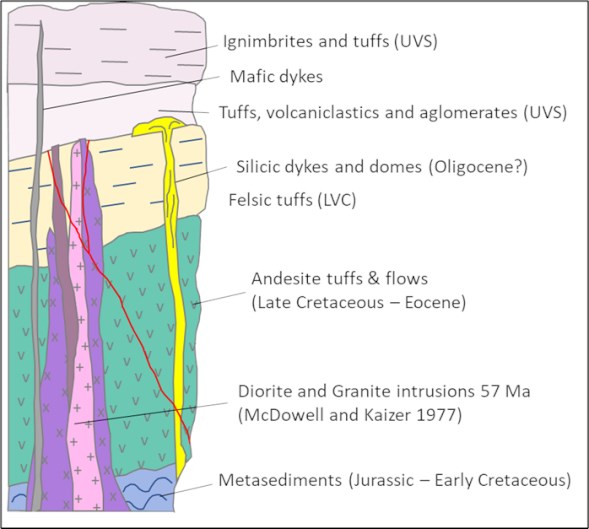
Source: Vizsla, 2023.
|
|
Additionally, the Jurassic - Early Cretaceous basement (Tahue terrane), comprised of metasediments (phyllites and sandstones) has been recognized through tectonic/erosional "windows" into the LVS and in some drill holes. The basement rocks are unconformably overlain by the LVC andesites and felsic rocks of the Tarahumara Formation and are subsequently intruded by the diorite-granodiorite and granite plutons centered in the Panuco project. Locally, the diorite intrusion has been observed to contain clasts of the andesite in contact-breccias. Another intrusive phase of granodiorite to quartz-monzonite composition that may be coeval with the main diorite pluton, has been mapped in the footwall of the Animas-Refugio structure (Henry, 2003). The granite intrusion has a reported K/Ar age of 57 Ma (McDowell and Kayzer 1977), it outcrops around the Panuco town and has been observed to contain clasts of diorite. Granodiorite porphyry in Malpica located 30 km southeast of the Project area was dated at 54.2 Ma by K/Ar (Henry, 1975). Following the deposition of the Tarahumara andesites, a quiescence period in volcanism, concomitant with uplift and erosion, favoured the formation of lakes and deposition of water-lain hyaloclastites and volcaniclastics composed of alternating rhyolite and andesite tuffs of Eocene age. These volcaniclastic units are believed to be correlative with the Productive andesite member in San Dimas. The unit is hundreds of meters thick and has been intruded also by felsic stocks, plugs and dikes of the UVS.
The project area has recorded multiple deformation events associated with the subduction of the Farallon plate under North America and the opening of the Gulf of California from the Cretaceous to the Miocene. Starling (2019) recognized five main deformation episodes spanning the Laramide orogeny and Basin and Range and younger post-Miocene extension events:
D1 - early Laramide ENE compression and fold-thrust deformation (~80-60 Ma)
D2 - late Laramide NNE compression and contractional deformation (~60-40 Ma)
D3 - early post-Laramide N-S to NNE extension (~38-28 Ma)
D4 - main stage Basin and Range ENE extension (~28 - 18 Ma)
D5 - WNW extension in central and southern Mexico (~12 - 0 Ma)
According to Starling, the Laramide deformation is quite subtle but likely created some of the initial major structures that underlie the geometry of the later vein systems. Analysis of kinematic indicators in the Project conducted by Starling (2019), determined that epithermal mineralization occurred during a phase of north-northeast to northeast-southwest regional extension, which favored the development of the following mineralized trends:
WNW (~120°N) extensional/normal faults, orthogonal to D3 extension, but likely originated as shears under D1 and D2 compression (e.g., Animas, Cordon de Oro).
NNW to N-S (~160-180°N) sinistral shears, which helped accommodate D3 extension (e.g., San Carlos, Napoleon), and are conjugate with.
ENE (~060°N) dextral shears (e.g., San Antonio), and
NNE (~020-040°N) steep tear faults, formed sub-parallel to the D3 extension.
|
|
Similarly, structural studies conducted in San Dimas by Horner and Enriquez (1999), identified three major deformational events produced sub-vertical structures trending east-west, northeast-southwest and north-south, which host epithermal silver-gold mineralization. Major north-northwest-trending post-mineralization normal-faults, developed during the last deformation event, defined blocks tilted to the east-northeast or west-southwest (Horner J. T. and Enriquez E., 1999). The fault-tilted blocks are interpreted as the result of a northeast-southwest extension like that observed in Panuco in D4.
The extensional event in Panuco was probably accompanied by significant hydrothermal activity that formed the district's epithermal veins. The hydrothermal activity must have been sufficiently strong and long-lived to develop veins with multiple orientations in Panuco. Pebble dikes, suggestive of extensive hydrothermal activity are present, although the paragenesis of the dykes with respect to mineralization has not been established. However, the pebble dykes appear to be concomitant with the widespread dissemination of fine-grained pyrite into the volcanic units. A late event of magmatism and extension favored the emplacement of post-mineralization rhyolite dikes along some of the mineralized structures. The rhyolite dikes appear to be synchronous with D4 extensional deformation, as they are locally dissected and/or necked. Finally, post-mineralization andesite dykes intruded the whole column; these dikes do not show evidence of faulting and are recognized as the youngest expression of magmatic activity in the Project.
It is interpreted that the north-northeast extension developed a series of west-northwest-trending veins (Figure 7-5). Starling (2019) also noted that the low dipping angle of some of these veins and the observed tilting of rhyolites in the hanging wall of the Animas-Refugio structure, resulted from reactivated Laramide thrust-faults into listric faults, as seen in Figure 7-6. This geometry indicates the potential for multiple second-order, subparallel veins in the hanging walls of these west-northwest-trending veins. The mineralized shoots associated with these listric normal faults will tend to be sub horizontal to depth. The western part of the Project is characterized by the tilting of the volcanic sequence to the southwest, leading to the veins in the central part of the Project having been more deeply eroded. Also, veins in the west portion of the district show shallower levels of exposure on surface consistent with weaker surface anomalies (e.g. La Luisa). Recent mapping works on the northeastern side of the property, at high-topographic elevation, indicate the veins are exposed to shallow levels and the recorded presence of kaolinite in at least a couple of vein outcrops suggests proximity to the paleosurface. Late- to post-mineral north-northwest, north-northeast, and east-northeast steep faults have partitioned the structural corridors, and the geometry and locations of economic shoots in each block may be distinct from neighboring blocks.
|
|
Figure 7-5: Property Geology Map Showing Panuco Project and Known Mineralized Structures

Source: Vizsla, 2024. Note: Purple ellipse represents Resource Extension targets, the yellow ellipse represents Proximal targets, and the blue ellipses represent distal District targets. Panuco project claims effective 2024, San Enrique and Santa Fe claims excluded.
|
|
Figure 7-6: Schematic Cross-Section of Panuco Veining

Source: Starling, 2019. Note: Schematic illustrates that veins may be listric faults developed from reactivated laramide thrust faults.
7.3 Mineralization
Mineralization on the Panuco Property comprises several epithermal quartz veins. Previous workers and recent mapping and prospecting works conducted by Vizsla's geologists determined a cumulate length of veins traces of 86 km. Individual vein corridors are up to 7.6 km long and individual veins range from decimeters to greater than 10 m wide. Veins have narrow envelopes of silicification, and local argillic alteration, commonly marked by clay gouge. Propylitic alteration consisting of chlorite-epidote in patches and veins affecting the andesites and diorite are common either proximal or distal to the veins.
|
|
The primary mineralization along the vein corridors comprises hydrothermal quartz veins and breccias with evidence of four to five different quartz stages: generally white, grey and translucent and varying grain size from amorphous-microcrystalline-coarse. A late stage of amethyst quartz is also observed in some veins. The grey color in quartz is due to the presence of fine-grained disseminated sulfides, believed to be mainly pyrite and acanthite. Vizsla has defined several hydrothermal breccias with grey quartz occurring more commonly at lower levels of the vein structures. Barren to low grade, quartz is typically white and is more common in the upper parts of the veins and breccias. Locally, mineralized structures are cut by narrow, banded quartz veins with thin, dark argentite/acanthite, sphalerite, galena, and pyrite bands. Bladed and lattice quartz pseudomorphs after calcite have been noted at several locations within the veins and indicate boiling conditions during deposition. Later, quartz veinlets cut all the mineralized zones with a mix of white quartz and purple amethyst. The amethyst is related to mixing near-surface waters as the hydrothermal system is collapsing, as has been noted in the nearby San Dimas district (Montoya-Lopera et al., 2019).
The Mineral Resource includes eleven mineralized vein systems: the Napoleon, Napoleon hanging wall, Josephine, and Cruz Negra veins; the Copala, Cristiano, Tajitos and Copala 2 veins; the San Antonio vein; and the Rosaritos and Cuevillas veins. These trends are west to east within the Napoleon, Cinco Señores, Cordon del Oro, and Animas-Refugio corridors. Table 7-1 presents a general description of the geometry of the seven veins comprising the bulk of mineralization. The bulk of the resource veins strike north-northwest to north-northeast, with thicknesses varying from 1.5 m to over 10 m. Figure 7-7 shows the location of the veins included in the Mineral Resource Estimate.
Table 7-1: General Description of Estimated Veins Included in the Mineral Resources Estimate for the Panuco Project
|
Name |
Orientation |
Dimension |
|||
|
Strike (°) |
Dip (°) |
Thickness (m) |
Strike (m) |
Dip (m) |
|
|
Napoleon |
350 |
80-85 |
3.00 to 3.50 |
2,500 |
550 |
|
Josephine |
355 |
75-85 |
1.50 to 2.50 |
2,600 |
500 |
|
Napoleon HW |
350 |
60-65 |
2.00 to 3.00 |
2,000 |
250 |
|
Tajitos |
20 |
70-75 |
2.00 to 3.00 |
1,500 |
400 |
|
Copala |
15 |
35-55 |
2.00 to 35.00 |
1,770 |
400 |
|
Copala 2 |
355 |
45-55 |
1.00 to 2.00 |
400 |
300 |
|
Copala 3 |
345 |
45-50 |
1.00 to 5.00 |
1,100 |
500 |
|
Copala 4 |
335 |
65-75 |
0.50 to 3.00 |
1,000 |
400 |
|
Copala 5 |
335 |
70-75 |
1.50 to 5.00 |
1,000 |
300 |
|
Cristiano |
330 |
80-90 |
0.50 to 3.00 |
500 |
300 |
|
La Luisa |
335 |
80-90 |
0.50 to 8.00 |
1,500 |
650 |
|
San Antonio |
105 |
55-65 |
1.50 to 7.00 |
650 |
300 |
|
Rosaritos |
125 |
50-55 |
1.50 to 5.50 |
180 |
130 |
|
Cruz Negra |
325 |
75-85 |
0.50 to 2.50 |
400 |
200 |
|
Cuevillas |
30 |
80-55 |
0.40 to 1.80 |
200 |
200 |
|
|
Figure 7-7: Panuco Project Claims Showing Known Veins

Source: Vizsla, 2025. Panuco project claims effective 2024, San Enrique and Santa Fe claims excluded.
7.3.1 Animas-Refugio Corridor
The Animas-Refugio structural corridor is a significant fault zone central to the Project area; it hosts the largest number of historical and current workings (Figure 7-8 and Figure 7-9) and includes the Rosarito and Cuevillas veins reported in the current MRE. Overall, the corridor trends northwest southeast and dips moderately southwest. Typically, the fault zone that defines this corridor has a clay fault-gouge contact in either the hanging wall and or the footwall contact and ranges from a few meters to over 20 m wide. It has a strike length of over 7.2 km and extends from the San Carlos mine in the southeast to the claim boundary in the northwest. Historical references note that the corridor continues to the southeast of the San Carlos mine. Ten main mineralized shoots have been exploited along this corridor; from southeast to northwest these are San Carlos, Clemens, El Muerto, La Pipa, Mariposa, El 40, San Martin, El 150, El 200, Rosarito, and La Bomba. The oldest workings date back to the 1500s. Rosarito and Cuevillas in the northwest sector of Animas are included in the MRE in the Inferred Mineral Resource category. In addition to the main, moderately dipping, mineralized zone there are numerous secondary mineralized structures, including a hanging wall splay at the Mariposa mine and the Paloma vein.
|
|
The Animas-Refugio structural corridor was first drilled by Minera Bacis in the late 1990s, but no details of this work are available. MRP subsequently drilled the corridor between 1999 and 2001, and Silverstone between 2007 and 2008.
The hanging wall of the fault zone is composed of a package of water-lain volcanic rocks with interlayered andesite tuffs and flows and rhyolite tuffs higher up in the sequence. Quenched textures in andesite tuffs, like those observed in hyaloclastites, support deposition in aqueous environment. A fine-grained diorite has been observed at lower levels within the hanging wall section. The footwall package consists of fine- to medium-grained diorite to granodiorite.
The Animas-Refugio corridor is a reactivated northwest- to west-northwest-trending normal fault that dips to the southwest, likely reactivated from a Laramide-age thrust fault with its dip shallowing at depth Starling 2019. The structure is steeper in high topographies where the structure has preserved the upper portions of the system. The normal fault defining the Animas-Refugio corridor is interpreted as the east side of a graben structure, with the Cordon del Oro trend comprising the west side of the graben. The graben structure has been cut by north-northeast- and north-northwest-trending subvertical faults that accommodated extension during the main mineralizing phase. Slickensides on these cross faults show a shallow to moderate dip to the southwest, with minimal offset. The fault splays accommodate extension along the fault and do not offset the main trend of the Animas-Refugio structure. These cross faults appear to have provided local boundaries within the fault zone that control the intrusion of post-mineral andesite dykes.
Related to the Animas-Refugio corridor is a series of hanging-wall splays, such as the San Martin splay near the Mariposa mine, the Paloma vein proximal to the Rosarito and Cuevillas veins, and Nieves coming off La Bomba. These splays are near vertical, and subparallel to the Animas-Refugio trend, and their possible intersection zones with the main structure are attractive exploration targets. These veins vary from narrow 1-m-wide to over 4-m-wide structures and have been mined extensively down to 575 masl.
Rosarito is a re-brecciated vein consisting of white quartz cemented by white silica with minor and variable amounts of grey quartz patches and fine-grained sulfides. The vein strikes to the southeast, dipping 35° to the southwest, and is traceable 200 m on surface. The vein pinches and swells between 2 and 25 m with average width determined through mapping of 4 m. Drilling reported intervals with an average estimated true width of 2.13 m. Figure 7-9 shows a section with notable drilling intercepts along the Animas-Refugio vein.
|
|
Figure 7-8: Animas-Refugio Geology and Gold Geochemistry (Section A-A' Shown in Figure 7-9)
 Source: Vizsla, 2023.
|
|
Figure 7-9: Animas-Refugio Vein Cross-section Looking Northwest
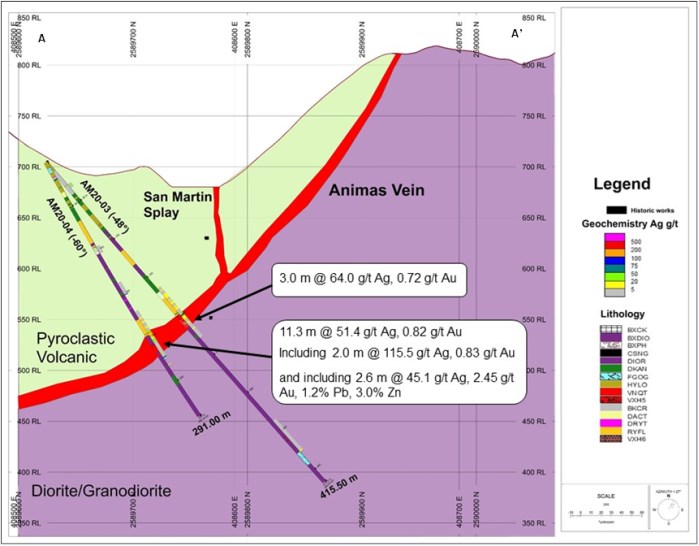
Source: Vizsla, 2023.
7.3.2 Cordon del Oro Corridor
The Cordon del Oro structural corridor is an east-dipping normal fault zone in the west-central portion of the Project area that trends roughly north-northwest and dips moderately to the east (Figure 7-10). The MRE contains the San Antonio structure, within the Cordon del Oro corridor, in the Inferred Mineral Resource categories.
|
|
The Cordon del Oro structure has a small number of historical workings. The fault typically has clay fault-gouge contacts that range from a meter in scale to over 15 m wide. To date, the structure has been traced with mapping approximately 7.6 km from the Anonal mine in the southeast to the Santa Rosa plant in the northwest. It is interpreted that Cordon del Oro is the west side of a graben, with the Animas structure defining the east margin. Only five mineralized shoots have been exploited along the main Cordon del Oro corridor; from the southeast to the northwest, these are Peralta, La Cobriza, Mojocuan 1, 2, and Mojocuan 4. Four additional mineralized shoots occur along the San Antonio vein Los Generales, Coralillo, San Antonio, and La Venada.
The Cordon del Oro corridor is not known to have been drilled, and mining completed to date occurred in the last century, with workings of less than 100 m in length. Most mining extended only about 10 to 30 m below the surface, and the deepest of the historical mining appears to have reached about 60 m below the surface. Only the Coralillo mine has more than one level of development and was mined to a depth of about 60 m and approximately 150 m along strike.
At lower elevations, the Cordon del Oro structure cuts a fine-grained diorite that is weakly to strongly magnetic and corresponds with a magnetic anomaly in regional airborne magnetic surveys. The structure cuts dacite and granodiorite in the Mojocuan 1 and Mojocuan 2 mine areas (Figure 7-10). In the central part of the vein corridor and along the San Antonio splay, the structure cuts a series of shallowly west-dipping rhyolite tuffs and andesite flows at higher elevations. Local rhyolite and andesite dykes intrude on the host rocks and along the mineralized structure. A quartz porphyry and granite porphyry are noted in underground workings at the Mojocuan 1 and Mojocuan 2 mines.
The Cordon del Oro structure is interpreted as a north- to north-northwest-trending normal fault on the west side of a graben subjected to repeated movement and later cross-faulting (Starling, 2019). The San Antonio structure is an east-west-trending set of subparallel faults that dip mainly to the south and is interpreted as a hanging wall splay of the main Cordon del Oro structure.
The San Antonio vein is an east striking, moderately dipping structure with 325 m of interpreted strike length and
300 m of down-dip extension. The average width is generally 1.5 to 3 m, with pinching and swelling between 1 and 7.5 m. Vizsla has completed 31 drill holes along the San Antonio vein between 2020 and 2022, with 19 of those holes drilled in 2022.
|
|
Figure 7-10: Cordon del Oro Geology and Silver Geochemistry

Source: Vizsla, 2023.
7.3.3 Cinco Señores and Napoleon Corridor
The Cinco Señores and Napoleon structural corridors comprise two subparallel, mineralized fault-zones in the western portion of the Project area that trend north-northwest, at sub-vertical dip angles (Figure 7-11 and Figure 7-12). Cinco Señores has a strike length of approximately 2.6 km, from the El Tajito mine in the southeast to El Cajon in the northwest. Twelve mineralized structures are included in the Cinco Señores corridor: Copala, Tajitos, Cristiano, Copala 2, Copala 3, Copala 4, Copala 5, La Colorada, La Tlacoacha, Santa Ana, Descubridora, Cinco Señores 01, Cinco Señores 03, La Manzanilla, and El Cajon. The Cinco Señores structure comprises a single, narrow fault zone with quartz veining approximately 1 m to 2 m wide. One moderately northeast-dipping notable splay of Cinco Señores was mined out at La Descubridora, west of the town of Copala (Figure 7-12).
|
|
The Napoleon corridor contains the Napoleon Main, Napoleon Hanging wall, Josephine, Cruz Negra, and other minor vein splays in southern Napoleon at the Ojo de Agua area. Together they constitute a significant portion of the Mineral Resources. Moreover, the current Mineral Resource estimate includes the Cinco Señores veins of Copala, Tajitos, Cristiano and Copala 2 structures. The Cinco Señores and Napoleon structural corridors host the second-largest concentration of historical workings on the property, some of which date to the 1500s.
The Napoleon and Cinco Señores structural corridors are interpreted as north- to north-northwest-trending strike-slip faults that have been reactivated, mineralized, and later subjected to cross-faulting (Starling, 2019). Later cross-faulting, likely related to the basin and range extension, imposed an effect of post-mineralization dextral trans tensional displacement across the east-west- to west-northwest-trending reactivated faults. Vein mineralization is hosted predominantly by two lithologies, a fine-grained, weakly to strongly magnetic diorite at lower elevations and a series of shallowly west-dipping rhyolite tuffs and andesite flows at high elevations.
Figure 7-11: Cinco Señores-Napoleon Geology and Silver Geochemistry

Source: Vizsla, 2023.
|
|
Figure 7-12: Descubridora Mine Geology and Geochemistry

Note: Sample Widths are Estimated at 65% to 100% of True Widths. Source: Vizsla, 2023.
The Napoleon vein comprises a fissure vein with subparallel vein splays and faults approximately 20 m apart that host quartz cemented breccias. Dilational fault jogs and cymoid loops are developed by some faults. At least 13 main mineralized shoots have been exploited along the Napoleon corridor. From south to north, they are Napoleon Sur (Ojo de Agua), El Gallinero, Napoleon 07, Napoleon 05, Napoleon 04, El Hundido, La Higuera, Limoncito, Los Rieles, El Papayo, El Agua Prieta, Aguajes, and La Estrella. The subparallel faults and dilational jogs are more common in the southern portion of the structure; the northern part comprises a single fissure vein for the most part. Moreover, local horsetail splays are a common occurrence in southern Napoleon at the Ojo de Agua area. Mineralization in the Napoleon vein is traced along 2,600 m of strike length and approximately 550 m of depth. The system is tilted 20° to 25° to the south which favored the exposure on the surface of base metals-rich vein mineralization in the north and low base metals plus low Ag/Au ratios in the south at the Ojo de Agua area. This tilting condition is also responsible for the lower silver values and thinner widths to the south on the surface, and therefore points to a high elevation in the vein system (Figure 7-13).
|
|
Figure 7-13: Drill-hole Intercepts Showing Tilted Mineralization on Napoleon Main Vein

Source: Vizsla, 2023.
The Napoleon Main, Josephine, Napoleon Hanging Wall, La Luisa, Cruz Negra veins and vein splays in Ojo de Agua form the Napoleon vein corridor and constitute the bulk of the Mineral Resource contained herein. Josephine is a sub-vertical vein west and subparallel to the Napoleon Main vein and was discovered in 2021 in drill hole NP-21-132. Josephine widths are generally between 1 and 3 m, with semi-massive sulphide mineralization indicating higher grades. Josephine is traced 1.5 km along strike and has been tested approximately 500 m down-dip. The Napoleon hanging wall vein runs subparallel to Napoleon Main to the east at a moderate dip and is generally 2 to 3 m wide. The Cruz Negra Vein, located 250 m west of the Napoleon resource area, is a northwest striking vein-breccia dipping steeply to the northeast. The vein breccia consists of quartz veining and quartz cement bearing disseminated sphalerite and galena. Drilling to date has tested Cruz Negra along ~400 m of strike and 300 m to depth in proximity to the Josephine Vein. Mineralized intercepts at Cruz Negra highlight a range of estimated true widths from 0.65 to 3.10 m, with grades ranging from 265 to 3,499 g/t AgEq, at the mineralized elevation.
The Copala, Tajitos, Cristiano, and Copala 2 vein structures, located within the Cinco Señores corridor, account for over 50% of the MRE presented in this Technical Report. The Copala structure strikes north-northwest and is situated east of, and on the hanging wall side of, the Tajitos vein. Initial drilling during 2020 intersected the structure with maximum true width of 82 m, and based on mineralized intercepts, we estimate an average true width of approximately 10 m. Due to its exceptional width and high grade, Copala has seen the fastest growth in Indicated and Inferred Mineral Resources and represents the single structure with the largest global resource (Indicated and Inferred) at the Panuco Project. The structure pinches and swells from approximately 2 m to 82 m, has an average dip of 46° with variable dip angles of ~35° in the north, close to the Copala town, to a maximum of ~55° in its southern extent. Copala consists typically of crackle and hydrothermal breccias, stockworks and vein zones with banded and massive quartz ubiquitous rhodochrosite, rhodonite and calcite. Other gangue minerals include adularia and white phyllosilicates (illite, illite-smectite, and montmorillonite).
|
|
Drilling at Copala has now traced mineralization along approximately 1,770 m of strike length and approximately 400 m down-dip. High-grade silver-gold mineralization remains open to the north and southeast. On the west, Copala is bounded by the high-grade Cristiano vein and to the east, it is bounded by a northwest-trending post-mineralization fault. Holes CS-22-202, CS-22-207 and CS-22-219, drilled across the fault, indicate an uplifted block of basement metasediments in fault contact with andesites and diorite on the east side of Copala.
The Tajitos epithermal vein is traced over 1.5 km of strike and has been tested 500 m down dip. The vein pinches and swells from sub-meter to 10 m widths, but generally the width is between 2 m and 3 m. The vein is composed of massive white quartz to locally banded quartz, usually brecciated and sealed by white quartz. Locally there are distinct hydrothermal breccias with grey quartz in the matrix and clasts, typically carrying higher grades. Bladed quartz textures, indicative of extensive fluid boiling (Drummond and Ohmoto, 1985), a well-known mechanism for gold deposition, are also observed in the Tajitos vein. Amethyst quartz and rhodochrosite are also present in high-grade zones. Amethyst quartz is believed to represent the mixing of hydrothermal fluids with Fe-rich meteoric waters.
The Cristiano Vein is a precious metals-rich structure located at the southwestern margin of the Copala structure. Cristiano is marked by a quartz-carbonate epithermal vein striking N25°W that dips sub-vertical (85°) to the NE. Drill holes intersecting Cristiano to date, highlight a high-grade zone plunging to the NW, with a vertical extent of 300 m and an approximate strike length of 600 m with a thickness ranging from 0.7 m to 3.5 m. The Cristiano Vein was initially discovered while targeting the Tajitos-Copala veins, where drilling intercepted the well-mineralized, NW-SE trending fault. Ongoing drilling has now led to new observations and interpretations allowing Vizsla geologists to plan drill holes specifically designed to explore Cristiano along strike and to depth. To the northwest, Cristiano intersects and offsets the Tajitos Vein, suggesting Cristiano post-dates Tajitos mineralization, thus creating a drill target on the footwall of Tajitos.
7.3.4 Other Mineralized Structures
Numerous other structures on the Panuco claims are actively being explored. The following subsections outline the geology of a few of these earlier-stage prospective structures. Figure 7-7 shows the location of the prospects described below, among others.
7.3.4.1 La Colorada
The La Colorada silver and gold deposit is approximately 1 km northwest of the village of Copala. Christopher and Sim (2008) described the geology of La Colorada as a manto-and-feeder vein system hosted in andesite, overlying a large diorite intrusive. The manto is cut by a north-striking rhyolite dyke that may be associated with a rhyolite flow dome on the northwest flank of the manto. The veins and manto in the La Colorada area are bounded by northwest-striking faults. A keel marking the thickest manto development strikes north, parallel to felsic dyking in this area. This north-south trend was interpreted as the result of a combination of strike-slip movements on northwest- and northeast-striking orthogonal faults.
The La Colorada vein system occurs along a pronounced northwest-striking lineament that bisects the largest of a series of circular features that Christopher and Sim (2008) interpret as caldera margins.
|
|
7.3.4.2 Copala Town Area
Mapping in 2020 identified several vein and manto-type structures around the town of Copala (Agua Zarca, Cuernavaca, Huaco). Historic mining underneath the town, along those structures, is believed to have occurred to estimated depths of 100 m below surface. Some of the old shafts in the middle of the town have been backfilled or built over, thus limiting the access to the underground workings. Four main structures trending northwest have been mapped thus far, although further mapping is likely impossible due to the presence of the town. These structures, along with Copala, appear to be part of the low-angle Copala-Colorada-Pajaros vein structural corridor. Cerrillo vein on the east side of the town is another example of northwest-trending and shallowly northeast-dipping vein. The El Estadio vein is a vertical structure to the north of Cerrillo that shows potential for drill testing. Mapping has identified other veins near Cerrillo and El Estadio that have minimal exposure; their extent and orientation are speculative.
7.3.4.3 El Batel Corridor
The El Batel mine area is in the northeast portion of the Vizsla claim block, at elevations between 1,100 and
1,400 m asl. It is composed of a central northwest-trending vein, 2 to 4 m wide, dipping moderately to the northeast, and hosted in a package of andesitic tuffs. There is minimal outcrop, and most of the samples collected in the area are from hanging-wall splays. A series of hanging-wall splays are also of low-angle, subparallel to the main vein, suggesting a tension release-style vein.
7.3.4.4 Broche del Oro
The Broche de Oro Corridor is a northeast-trending vein system in the northeast portion of the Vizsla claim block. Currently, the structure has been traced over approximately 4,300 m of strike length; however, only 40% of it is on Vizsla-controlled claims. The longest segment held by Vizsla, at 980 m, is the Broche de Oro area. The old Broche de Oro mine is at the bottom of a deep canyon with over 300 vertical meters of andesite and dacite tuffs overlying a diorite intrusive. The diorite is likely different from the main microdiorite as the microdiorite is magnetic, and the Broche de Oro area is in a magnetic low. At the old mine level, the vein is still hosted in the andesitic tuffs and shows widths from 2 to 4 m. The dip of the central segment of the vein is to the southeast, while several other subparallel veins have dips to the northwest, suggesting there may be a small horst block in that area, or that the other veins are remnant footwall splays. The Manteada vein is another perpendicular structure in that area that underwent considerable past mining to the north of Broche de Oro. The Manteada vein has been mapped for 1,300 m north-northwest from the Broche de Oro workings, dipping moderately to the west, and widths from 2 to over 5 m. It appears to have been mined near its northern end, where it either changes strike or intersects the northeast-trending San Ramon vein. The Manteada vein textures are massive white quartz with very little sulfide, and local patches of bladed calcite pseudo morphed with silica. Many outcrops show a brecciated vein, while only a few exhibits the massive white silica with bladed calcite. Vizsla completed seven drill-holes during 2021 at the Broche de Oro zone, but no significant mineralization was intercepted at the time.
|
|
7.3.4.5 La Galeana
The Galeana vein is likely a significant splay structure off the longer San Francisco-Broche de Oro-Nacaral vein system that trends north-northeast some 1,400 m to the southwest of the Nacaral mine. The vein saw three different past workings spread out over 80 m of vertical relief. The principal working was the upper one, where a shaft was sunk directly on the vein, but has since collapsed. Several small splays (1 to 10s of meters long) come off the main vein here, with the main one being only 1 to 2 m wide. A broader, subparallel, 4- to 5-m-wide vein was some 140 m to the northeast of the collapsed shaft area.
7.4 Structural Controls
Mineralized structures in Panuco resulted from a long history of deformation accompanied by multiple hydrothermal-mineralization events spanning from the late-Laramide orogeny to the Basin and Range extension. Multiple deformation events resulted in west-northwest thrusts and conjugate north-northwest to north-south dextral and east-northeast sinistral shears that were developed during the two peaks of the Laramide compressional orogeny. Some of these older structures served as well as conduits for the emplacement of porphyry type deposits in western Mexico. The Laramide age main thrust and conjugate faults were subsequently reactivated during post-Laramide extensional events during the late-Eocene, Oligocene, and Miocene. Therefore, structures like Napoleon and Copala probably originated as late-Laramide conjugate shears that were reactivated and opened to the fluid passage and epithermal mineralization during the Laramide extensional deformation D3 event. Steeply dipping structures, the conjugate components to the low angle thrust shears, were also reactivated during post Laramide extension and some of them were mineralized as well. Napoleon is interpreted to be a reactivated conjugate sinistral shear. During post Laramide extension, events D3, D4, and D5 occurred with significant block faulting and tilting. Some of this faulting and tilting occurred concomitant or after mineralization, thus segmenting or tilting mineralized structures. A clear example of this tilting occurs in Napoleon, where infill and step-out (expansionary) drilling conducted during 2021, supported by geological and geochemical interpretations (alteration and metal zonation) confirmed that the Napoleon vein system is tilted to the south, with the southern extent being at the top of the mineralized horizon near surface. Copala on the other hand, is a low-angle dipping structure bounded to the west by the steep dipping Tajitos and Cristiano veins that also shows variable dip angle from shallow (35°) in the north to moderate (55°) in the south. Because there is a significant component of strike-slip displacement imposed on most structures, pinching and swelling is fairly common.
Tajitos is interpreted as a conjugate shear, and according to Starling (2019), it exhibits an early sinistral transpressional shear sense overlapped by a dextral tensional shear sense. The diorite stock emplaced along an east-northeast-trending central fault zone that likely originated during the early-Laramide deformation. Many of the structures hosted by the diorite appear to have better continuity than those hosted by the andesites and rhyolitic volcanics.
7.5 Alteration
Generally, alteration is prominent propylitic alteration, defined by chlorite and epidote that extends 50 to 100 m peripheral to main fluid conduits. Silicification, white phyllosilicates in fractures and minor quartz veinlets are present immediately adjacent to veins and fault structures. The fault structures host mineralization comprising distinct quartz veins and moderate-to-strong pervasive silicification with associated crackle breccia veining. The upper and lower boundaries of mineralized zones are occasionally within faults and are usually marked by clay gouge zones with common milled clasts. The milled clasts comprise wall rock and white quartz vein fragments, indicating that these faults experienced significant movement post-mineralization. The footwall contact of the fault zone commonly has a clay gouge contact, and local crackle brecciation and silicification that overprints earlier propylitic alteration in the diorite to granodiorite. Patchy silicification, minor quartz veinlets, and fracturing are occasionally present more proximal to the structure, and local, weakly developed argillic alteration may also be present.
|
|
In 2020, Vizsla retained the services of Scott Halley to analyze and interpret Panuco's extensive assay database. A database consisting of over 33,400 core samples and over 3,700 rock samples was used in the analysis with the main objective of characterizing rock compositions and alteration assemblages. The main alteration mineral determined outboard the veins were albite, chlorite and sericite, whereas the main alteration minerals within the veins were adularia and sericite (Halley, 2020).
7.6 Mineral Petrology
In 2021 Vizsla commissioned Applied Petrologic Services & Research, Wanaka, New Zealand, to carry out a petrographic and fluid inclusion study on 14 samples (one from each of Animas and Cordon del Oro, three from Tajitos, and nine from Napoleon) (Coote, 2021a). Coote's findings indicate sustained hydrothermal fluid flow evidenced by fracture-fill multi-stage silica and breccia cement due to a penetrative and long-lasting structurally focused fracturing and brecciation. Evidence of boiling conditions, an environment conducive to epithermal precious metal mineralization, is indicated by fluid inclusion assemblages in quartz. Further evidence of boiling conditions is the presence of adularia, bladed quartz pseudomorphs after calcite and colloform banding of the fracture-filled and locally brecciated vein assemblages. Bladed carbonate, ferrous, manganoan, and calcitic-rich carbonates proximal to drusy quartz also indicate a successive emplacement of later hydrothermal fluids evidencing a long-lasting system for emplacement of epithermal veins.
The following petrologic features apply to the Animas, Cordon del Oro, Cinco Señores and Napoleon vein corridors. They are important in defining base- and precious-metal mineralization of the low-sulphidation, epithermal environment:
Sphalerite, galena, chalcopyrite, tennantite/tetrahedrite and minor amounts of bornite comprise base-metal sulphide and sulphosalt mineralogy enclosed by interstitial multi-phase, mosaic-drusy quartz and pyrite.
Very-fine to ultra-fine-grained chalcopyrite is concentrated as inclusions within sphalerite margins and partly defines internal zoning.
Supergene chalcocite and covellite locally replace chalcopyrite, bornite, and tennantite/tetrahedrite.
Furthermore, multiple stages of base-metal sulfides and sulphosalts are present, filling cavities and fractures within brittle, deformed pyrite and mosaic-drusy quartz, which form in places cemented-to-brecciated pyrite. Galena, chalcopyrite, and tennantite-tetrahedrite solid solution (ss) are present, filling, and cementing fracturing and brecciation of coarse-grained, and locally more-voluminous sphalerite. Multiple stages of base-metal sulfides are ductile-to-brittle deformed and recrystallized in relation to tectonic and hydrothermal overprinting.
|
|
Precious-metal mineralogy as acanthite, proustite, native gold, electrum, and native silver occur in close-spatial and interpreted-temporal association with base-metal sulfides and sulphosalts. Native gold and electrum are interstitial to and occurs as inclusions in mosaic-drusy quartz. Furthermore, pyrite and base-metal sulfides and silver sulphosalts (pyrargyrite-proustite ss) occur as intergrowths with acanthite; pyrargyrite-proustite ss are best represented in the Animas, Cordon del Oro, and Cinco Señores vein corridor.
Additionally, Cinco Señores hosts acanthite, native gold and electrum occurring interstitial to fluorite and mosaic quartz in fracture-fill/breccia cement assemblages. Native silver also fills cavities and microfractures within mosaic quartz. Native gold is also relict as intergrowths and inclusions within pyrite altered to supergene goethite and hematite in rock from Cinco Señores.
Coote (2021b) also conducted a fluid inclusion study using microthermometric data from the Animas, Cordon del Oro, Cinco Señores, and Napoleon vein corridors. The homogenization temperatures determined from fluid-inclusion microthermometry on quartz minerals within fracture-fill/breccia cement, are consistent with epithermal temperatures reported for other deposits elsewhere in Mexico. Furthermore, salinities calculated from freezing temperatures are low, consistent with diluted fluids and typical of epithermal precious-metal deposits. The temperatures and salinities determined for quartz-hosted fluid inclusions associated with silver and gold mineralization in Panuco range from 196°C to 293°C and 1.9 to 3.1 wt.% NaCl Equivalent. Temperature and salinity ranges, gangue mineralogy (adularia-quartz) and hydrothermal alteration in Panuco veins are consistent with typical low- to intermediate-sulfidation epithermal types of deposits. Contrasting concentrations of base metals (moderate to very low) and silver/gold ratios (<100 to >150) between Napoleon and Copala, point to distinct fluid compositions; intermediate sulfidation for Napoleon and low sulfidation for Copala.
|
|
8 DEPOSIT TYPES
8.1 Deposit Model
Mineralization in Panuco occurs in veins and mantos with mineralogical characteristics, alteration assemblages, temperature, and salinities typical of low to intermediate sulfidation epithermal deposits. Because of the region's long and complex magmatic, deformation, and hydrothermal history, the Panuco Project has the potential to host other deposit styles. Late Cretaceous to Paleocene batholiths that intrude the Tarahumara Formation rocks in Panuco, are prospective for porphyry copper and molybdenum deposits elsewhere in the SMO. Late Cretaceous-Eocene plutons that intrude basement metasediments and limestones are prospective for gold-rich and polymetallic skarns and replacement deposits. However, the mineralized structures that are exposed and that have been explored to date in the property are only the epithermal silver and gold veins that were developed or reactivated during the extensional tectonics of the SMO volcanic arc.
8.2 Epithermal Systems
Epithermal deposits form at depths of 1.0 to 1.5 km in volcanic-hydrothermal and geothermal environments. They define a spectrum with two end members, low and high sulfidation (Hedenquist et al., 2000). Figure 8-1 shows the genetic model for epithermal deposits proposed by Hedenquist et al., (2000). Low and Intermediate sulfidation deposits form part of the epithermal spectrum. Their genesis is complex due to the participation of fluids with meteoric and magmatic origin during their formation and the fluid evolution during water-rock interactions. According to several authors, the fluids that formed the Mexican epithermal deposits represent a mixture of fluids with diverse origins varying from meteoric to magmatic (Simmons et al., 1988; Benton, 1991; Norman et al., 1997; Simmons, 1991; Albinson et al., 2001; Camprubí et al., 2006; Camprubí and Albinson, 2007). Mineral deposits in Panuco exhibit characteristics of the low-to-intermediate sulphidation types of deposits.
Epithermal deposits typically consist of fissure veins and disseminations with gold, silver, and base metals concentrations. Most low sulfidation epithermal deposits form as open-space filling of faults and fractures resulting in vein deposits. Some gold deposits occur as replacements or disseminations in permeable host rocks, particularly the high-sulfidation types. Epithermal deposits are more common in extensional settings in volcanic island and continent margin arcs. Due to its relatively shallow deposition level within the Earth's crust, most epithermal deposits are preserved in Tertiary or younger volcanic rocks. Mineral deposition in the epithermal environment occurs due to complex fluid boiling and mixing processes that involve cooling, decompression, and degassing. Veins in Panuco contain adularia and colloform banded quartz, representing strong evidence of fluid boiling during mineral deposition.
Historically, epithermal gold and silver deposits are an important part of the world's precious metal budget. Approximately 6% and 16% of the world's gold and silver have been produced from epithermal deposits. These deposits are significant in Mexico. Mineable epithermal vein deposits range from 50,000 to more than 2,000,000 tonnes in size, with typical grades ranging from 1 to 20 g/t Au and 10 to 1,000 g/t Ag. Locally exceptional, or "bonanza" grades above 20 g/t Au can be important contributors to many gold deposits. Lead and zinc are also important contributors to epithermal deposits' low- and intermediate-sulphidation classes. Veins that host mineralization are about several kilometers long; however, economic mineralization is present in plunging mineralized shoots with dimensions of tens of meters to hundreds of meters or more. Single veins commonly host multiple ore shoots. The wide range of tonnage and grade characteristics make these deposits attractive targets for small and large mining companies.
|
|
Quartz veins are typical hosts for low and intermediate sulphidation mineralization, and these veins have characteristic alteration assemblages that indicate temperatures of deposition between 100°C and 300°C. These alteration assemblages include quartz, carbonates, adularia white phyllosilicates, and barite in the veins; illite, adularia, smectite, mixed-layer clays, and chlorite proximal to the vein walls; and distal chlorite, calcite, epidote, and pyrite more peripherally. Also, unmineralized but related, steam-heated argillic alteration and silica sinters may be present above, or above and laterally from, the veins.
Vein textures are also important guides for targeting low-and intermediate-sulphidation mineralization. Quartz commonly occurs with cockade and comb textures, as breccias; as microcrystalline, chalcedonic, and colloform banded quartz; and as bladed or lattice quartz. Bladed or lattice quartz forms by replacing bladed calcite formed from a boiling fluid and is a diagnostic indication of the level of boiling in a vein.
Ore minerals include pyrite, electrum, gold, silver, argentite, acanthite, silver sulphosalts, sphalerite, galena, chalcopyrite, and/or selenide minerals. In alkalic host rocks, tellurides, vanadium mica (roscoelite), and fluorite may be abundant, with lesser molybdenite. These mineralized systems have strong geochemical signatures in rocks, soils, and sediments and Au, Ag, Zn, Pb, Cu, As, Sb, Ba, F, Mn, Te, Hg, and Se may be used to vector to mineralization.
Figure 8-2 shows the associated alteration components of epithermal systems and mineralization.
|
|
Figure 8-1: Genetic Model for Epithermal Deposits
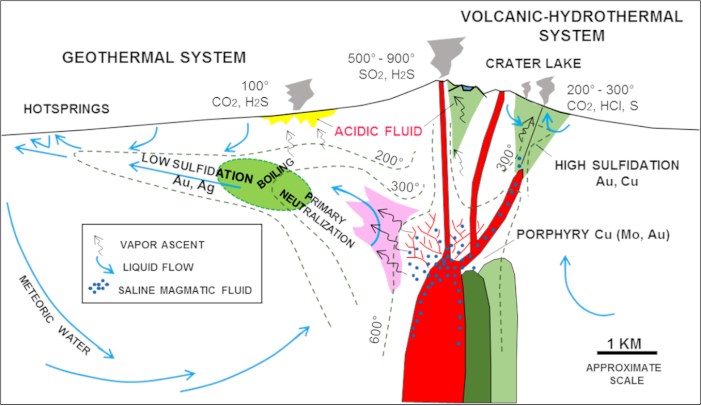
Source: Hedenquist et.al., 2000.
|
|
Figure 8-2: Schematic of Alteration and Mineralization in Low Sulphidation Precious Metal Deposits

Source: Hedenquist et al., 2000.
|
|
9 EXPLORATION
9.1 Introduction
Vizsla commenced exploration on the Project in July 2019. Surface exploration to date has included geological mapping, rock geochemical sampling, geophysical surveys, and diamond drilling (see Section 10).
9.2 Geological Mapping
Geological mapping and prospecting are key ongoing processes in exploring and understanding the geology of the Panuco Property. Mapping is conducted on a reconnaissance scale with detailed scale testing. Mappers generally use a 1:1,000 scale and, in notable outcrops, 1:500 scale. The 1:1,000 scale geological mapping completed as of December 2023 is shown in Figure 9-1. Mapping of the district covered 4,800 ha mapped out of a total of 7,189.5 ha held by the company, which represents 67% of the total area mapped.
Figure 9-1: Panuco District Mapped Areas at 1:1,000 Scale as of December 2023

Source: Vizsla, 2024. Panuco project claims effective 2024, San Enrique and Santa Fe claims excluded.
|
|
9.3 2019-2021 Rock Geochemistry
Rock sampling is usually conducted in conjunction with geological mapping and prospecting. Geologists take chip, float, outcrop samples (including channels), and underground sampling where it is safe to do so. Table 9-1 outlines the rock and soil geochemistry sampling done by Vizsla from 2019 to 2021. The locations of these samples are shown in Figure 9-2.
Overall, 3,777 rock samples were collected from surface and underground exposures. The lithology, alteration, and structure of outcrop and underground exposures are mapped to determine controls on mineralization. To the degree possible, samples were oriented perpendicular to mineralized structures and variations in mineralization and are sampled separately. At least one sample on either side of the mineralized structure was also collected. Samples are collected as continuous chip channel, with minimum sample lengths ranging from 30 cm to 1.5 m. The sample length and the width of the chipped channel, typically 10 to 15 cm, are recorded along with the sample's estimated true width.
Sampling can be carried out by geologists or trained field assistants under the direct supervision of a geologist. All the chips of the channel sample are collected on a tarp. Once the sample has been collected, the sample is mixed by folding the tarp in half in four different directions, rolling the material over itself and thus homogenizing the sample material. One-quarter of homogenized sample is poured into a labelled sample bag containing the uniquely labelled sample ticket. In the case of field duplicates, a second quarter of that sample (from the opposite quadrant) is then poured into a second labelled sample bag with a uniquely labelled sample ticket. Bags are sealed with a plastic cinch cable tie, and sample bags are transported to Vizsla's secured warehouse.
Table 9-1: Summary of Surface and Underground Rock and Soil Geochemistry Samples between 2019 and 2021
|
Location |
Sample Type |
Sample Count |
|
Surface |
Chip |
100 |
|
Float |
46 |
|
|
Mine Outcrop |
156 |
|
|
Channel |
2,686 |
|
|
Total surface |
2,988 |
|
|
Underground |
Underground |
789 |
|
Total |
|
3,777 |
|
|
Figure 9-2: Surface Sampling at Panuco Project between 2019 and 2022

Source: Vizsla, 2023. Panuco project claims effective 2023, San Enrique and Santa Fe claims excluded.
9.4 Geophysics
Geophysics has been a tool to help identify targets on the Panuco Property. Silverstone flew helicopter airborne magnetics in 2016, and Vizsla has conducted airborne and ground surveys since 2019.
|
|
Silverstone conducted an airborne magnetic survey over Panuco property in 2016. The main magnetic high corresponded well with the mapped micro-diorite and showed a potential offset. The micro-diorite is the main host rock in the Napoleon area but is covered by an andesite-to-rhyolitic tuff package in the other vein areas. Figure 9-3 shows the airborne reduced-to-pole (RTP) magnetic survey results from 2016 with interpreted offset in the micro-diorite.
In April and May of 2021 Zonge International was contracted to complete a trial ground Fixed Loop Electromagnetic survey (FLEM) or ground EM and a drone Magnetic Survey over the Napoleon - Cinco Señores corridor. FLEM detects massive sulphide mineralization by running a current through a large loop of wire laid on the ground to induce a magnetic field in the earth. As the weakening magnetic field moves through the earth it sets up a circulating electrical field in the shape of any massive sulphide body that it passes through. This new electrical field in turn weakens, setting up a secondary magnetic field that is measured on surface. Geophysicists with modern computer programs can back calculate (inverse modelling) the shape of the conducting massive sulphide and model a 3D "plate" representing the source of the anomaly.
The trial FLEM survey covered target zones within an area of approximately 1.5 km by 2 km over the Cinco Señores and Napoleon Corridors. The survey results showed that modelled EM plates fit with mineralization drilled at the Napoleon discovery and culminated with the discovery of the Josephine vein located west of Napoleon. In addition, five new priority conductive trends were modelled along with many more subtle anomalies.
The drone magnetic survey was conducted over 205-line km, at 50-m line spacings and a nominal height of 50 m (Figure 9-4). The test area was over the Napoleon trend, and thus the line orientation was chosen to be at 45° to try and intersect the vein corridor orthogonally.
Four different products were delivered from the drone magnetic survey: an RTP map, an analytical signal (AS) map, a residual-signal (RES) map and a first vertical derivative (1D) map. The results from the RTP fit well with Vizsla mapping of the micro-diorite. While the concept of the Napoleon vein being in a magnetic low trend is not completely clear in the RTP data, it becomes more apparent in the AS data, as those tend to plot the magnetic features clearly over their source regions.
In addition to the magnetic surveys, Vizsla has been collecting magnetic susceptibility readings from most of the drill core. These data have been compiled in Excel tables, and each drill hole has a downhole graph of the susceptibility readings. These graphs have been included in the compilation of the drilling cross-sections and are often very useful in distinguishing rock types.
|
|
Figure 9-3: Airborne Magnetics RTP from 2016 with Known Veining and Possible Fault Offset Shown in Diorite

Source: Maunula and Murray, 2022.
|
|
Figure 9-4: Results from 2021 Airborne Magnetics RTP Geophysical Survey Over the Napoleon Area

Source: Maunula and Murray, 2022.
9.5 2023 LiDAR Survey
A LiDAR survey was completed by Eagle Mapping Ltd., based in Langley, B.C. in June of 2022 and was received by Vizsla in August of 2022. The LiDAR survey covering approximately 6,200 ha of the property was to be utilized in geologic-resource modelling and future planning of mine and plant infrastructure. Additionally, these high-resolution products (elevation model and orthophotos) are being used to support lithology and structural mapping activities, and as a prospecting tool to find vein outcrops and old mine workings covered by vegetation.
9.6 2022 Surface Sampling
Surface sampling at Panuco in 2022 totalled 1,202 rock samples (Table 9-2 and Table 9-3). The location of these samples is shown in Figure 9-5. The sampling follows the same procedure outlined in Section 9.3.
|
|
Of these samples, 838 were analyzed at ALS Minerals laboratory by Au-AA23 and ME-ICP61 multi-element package and provided to the authors in Excel format. Over limits used Ag-OG62 and GRA21. Sampling followed standard best practice procedures, including the insertion of control samples. Assays ranged from below detection limit to 31 g/t Au and 1,660 g/t Ag.
Furthermore, 364 samples were analyzed at an SGS laboratory by Au-GE-FAA30V5 and GE-CP40Q12 multi-element package and provided to the authors in Excel format. Over limits used Ag-GO-FAG37V. Assays ranged from below detection limit to 4.35 g/t Au and 399 g/t Ag. The results from this testing helped guide subsequent drill targeting.
Table 9-2: Panuco Project Surface Samples in 2022
|
Panuco Project 2022 Surface Sample Type |
|
|
Sample Type |
Number of Samples |
|
Float Grab |
24 |
|
Outcrop Channel |
1,157 |
|
Outcrop Grab |
1 |
|
Mine Channel |
6 |
|
Mine Dump |
6 |
|
Mine Outcrop |
8 |
|
Total |
1,202 |
Table 9-3: Selected High-Grade Samples Taken During 2022 Surface Exploration
|
Panuco Project 2022 Surface Sample Highlights |
|||||
|
Sample_ID |
Au (g/t) |
Ag (g/t) |
Pb (ppm) |
Zn (ppm) |
Sample Type |
|
E958352 |
3.24 |
594 |
1,170 |
1,155 |
Outcrop Channel |
|
E958366 |
2.79 |
575 |
6,190 |
1,435 |
Outcrop Channel |
|
E958312 |
3.79 |
29.8 |
49,000 |
21,700 |
Outcrop Channel |
|
E958507 |
7.72 |
26 |
10 |
42 |
Outcrop Channel |
|
E958822 |
8.16 |
510 |
113 |
66 |
Outcrop Channel |
|
E958286 |
4.25 |
244 |
398 |
911 |
Outcrop Channel |
|
E958951 |
8.99 |
342 |
168 |
58 |
Outcrop Channel |
|
E959024 |
4.28 |
576 |
576 |
784 |
Outcrop Channel |
|
E959027 |
2.80 |
1,420 |
1,955 |
2,860 |
Mine Dump |
|
E959262 |
31.00 |
54.2 |
1,100 |
838 |
Mine Outcrop |
|
E959271 |
4.43 |
307 |
268 |
513 |
Outcrop Channel |
|
E959272 |
2.52 |
399 |
1,997 |
768 |
Float Grab |
|
|
Figure 9-5: Surface Sampling at Panuco Project in 2022

Note: AgEq =Ag*0.93+Au*0.9*1800/24+Pb*0.94*1.1*31.1035/453.592/24+Zn*0.94*1.35*31.1035/453.592/24).
Source: Vizsla, 2023. Panuco project claims effective 2023, San Enrique and Santa Fe claims excluded.
9.7 2023 Surface Sampling
Surface sampling at Panuco in 2023 totalled 638 rock samples (Table 9-4 and Table 9-5). The locations of these samples are shown in Figure 9-6. The sampling follows the same procedure outlined in Section 9.3.
These samples were analyzed at ALS Minerals laboratory by Au-AA23 and ME-ICP61 multi-element package and provided to the QP in Excel format. Over limits used Ag-OG62. Sampling followed standard best practice procedures, including the insertion of control samples. Assays ranged from below detection limit to 5.9 g/t Au and 939 g/t Ag. The results from this testing helped guide subsequent drill targeting.
|
|
Table 9-4: Panuco Project Surface Samples in 2023
|
Panuco Project 2023 Surface Sample Type |
|
|
Sample Type |
Number of Samples |
|
Float Grab |
10 |
|
Outcrop Channel |
613 |
|
Outcrop Grab |
3 |
|
High Grade Grab |
1 |
|
Mine Dump |
7 |
|
Mine Outcrop |
4 |
|
Total |
638 |
Table 9-5: Selected High-Grade Samples Taken During 2023 Surface Exploration
|
Panuco Project 2023 Surface Sample Highlights |
|||||
|
Sample_ID |
Au (g/t) |
Ag (g/t) |
Pb (ppm) |
Zn (ppm) |
Sample Type |
|
E959649 |
4.731 |
939 |
409 |
320 |
Outcrop Channel |
|
E959743 |
1.783 |
539 |
1,067 |
980 |
Outcrop Channel |
|
E959806 |
2.426 |
777 |
696 |
985 |
Outcrop Channel |
|
E959809 |
1.537 |
428 |
11,100 |
4,510 |
Float Grab |
|
G562569 |
0.833 |
392 |
136 |
464 |
Outcrop Channel |
|
G562571 |
1.589 |
383 |
91 |
60 |
Outcrop Channel |
|
G562578 |
4.991 |
771 |
300 |
490 |
Outcrop Channel |
|
G562584 |
1.551 |
307 |
1,598 |
2,144 |
Mine Dump |
|
G562586 |
1.349 |
340 |
280 |
620 |
Mine Dump |
|
G562587 |
5.187 |
184 |
310 |
354 |
Mine Outcrop |
|
G562667 |
4.092 |
111 |
88 |
129 |
Outcrop Channel |
|
G562668 |
5.913 |
55 |
18 |
19 |
Outcrop Channel |
|
G562671 |
2.977 |
939 |
589 |
997 |
Outcrop Channel |
|
G562882 |
6.06 |
396 |
61 |
183 |
Outcrop Channel |
|
G562940 |
2.073 |
83 |
5,374 |
493 |
Outcrop Channel |
|
G562964 |
1.546 |
720 |
8,510 |
17,000 |
Mine Outcrop |
|
G566549 |
4.282 |
405 |
185 |
126 |
Outcrop Channel |
|
G566567 |
3.191 |
238 |
2,629 |
3,810 |
Mine Dump |
|
G566568 |
2.054 |
99 |
3,897 |
7,133 |
Mine Dump |
|
G566619 |
0.062 |
323 |
200 |
175 |
Outcrop Channel |
|
|
Figure 9-6: Surface Sampling at Panuco Project in 2023

Note: AgEq =Ag*0.93+Au*0.9*1800/24+Pb*0.94*1.1*31.1035/453.592/24+Zn*0.94*1.35*31.1035/453.592/24).
Source: Vizsla, 2024. Panuco project claims effective 2024, San Enrique and Santa Fe claims excluded.
9.8 2024 Surface Sampling
As of June 18, 2024, a total of 5,024 rock samples had been collected through surface sampling at Panuco (Table 9-6 and Table 9-7). The locations of these samples are shown in Figure 9-7. The sampling follows the same procedure outlined in Section 9.3.
Of these samples, 4,001 samples were analyzed at an SGS laboratory by Au-GE-FAA30V5 and GE-CP40Q12 multi-element package and provided to the QP in Excel format. Over limits used Ag-GO-FAG37V. Sampling followed standard best practice procedures, including the insertion of control samples. Assays ranged from below detection limit to 8.2 g/t Au and 939 g/t Ag.
|
|
A further 1,023 samples were analyzed at ALS Minerals laboratory by Au-AA23 and ME-ICP61 multi-element package and provided to the QP in Excel format. Over limits used Ag-OG62 and GRA21. Assays ranged from below detection limit to 38.2 g/t Au and 2,920 g/t Ag. The results from this testing guided subsequent drill targeting.
Table 9-6: Panuco Project Surface Samples Collected in 2024 (Through June 18)
|
Panuco Project 2024 Surface Sample Type |
|
|
Sample Type |
Number of Samples |
|
Rock Chip |
4 |
|
Float Grab |
3 |
|
Mine Dump |
1 |
|
Outcrop Channel |
304 |
|
Outcrop Grab |
1 |
|
Total |
313 |
Table 9-7: Selected High-grade Samples Collected during 2024 Surface Exploration (Through June 18)
|
Panuco Project 2024 Surface Sample Highlights |
|||||
|
Sample_ID |
Au g/t |
Ag g/t |
Pb ppm |
Zn ppm |
Sample Type |
|
G566821 |
4.25 |
427 |
85 |
40 |
Outcrop Channel |
|
G566588 |
1.79 |
417 |
6612 |
555 |
Float Grab |
|
G566878 |
2.85 |
396 |
363 |
31 |
Outcrop Channel |
|
G566893 |
2.88 |
259 |
103 |
203 |
Outcrop Channel |
|
G566586 |
8.16 |
91 |
637 |
550 |
Float Grab |
|
G575168 |
2.52 |
66 |
72 |
306 |
Outcrop Channel |
|
G575057 |
2.38 |
23 |
21 |
55 |
Outcrop Channel |
|
|
Figure 9-7: Surface Sampling at Panuco Project in 2024, (Through June 18)

Note: AgEq =Ag*0.93+Au*0.9*1800/24+Pb*0.94*1.1*31.1035/453.592/24+Zn*0.94*1.35*31.1035/453.592/24).
Source: Vizsla, June 2024. Panuco project claims effective 2024, San Enrique and Santa Fe claims excluded.
 |
 |
10 DRILLING
10.1 Introduction
Since initiating drilling on the Property in November 2019, Vizsla has conducted several significant drill campaigns in the Napoleon, Copala-Tajitos, Animas and San Antonio areas. As of the September 2024 data cut-off date for the current MRE, Vizsla had completed 1,012 drill holes totaling 383,017.22 m and collected 57,680 assays. Vizsla has continued to drill at the Project since the data cut off for the Mineral Resource Estimate. Drilling completed subsequent to the MRE has consisted of exploration drilling on targets outside of the MRE areas and comprises an additional 40 drill holes totalling 13,365 m and 1,571 assays. As of July 24, 2024, Vizsla had completed 1,052 drill holes totaling 396,382.22 m and collected 59,251 assays.
Pattern drilling on target vein structures has primarily been completed on 100 m and 50 m centers. Drilling completed in late 2023 and 2024 was centred on the western portion of the district, primarily focused on infill drilling at 50 m centers to upgrade resources within the Copala and Napoleon areas.
Diamond drill holes (DDH) are generally oriented to test structures perpendicular to their strike. Holes are typically HQ diameter, with reduction to NQ diameter when ground conditions necessitate it. Drill-hole collars are surveyed by Trimble differential GPS and Total Station. Downhole orientations of drill-hole azimuth, inclination, and total magnetic field are recorded by a magnetic survey instrument every 50 m downhole. A magnetic declination of 7° was used for correcting drill-hole azimuths. Drillhole geology is recorded for lithology, alteration, mineralization, structures, and veins. Furthermore, drillhole recovery and RQD are recorded for all drilled intervals.
|
|
Table 10-1: Summary Drilling Conducted by Vizsla on the Panuco Project, through July 2025
| Year | Drill-Hole Start | Drill-Hole Finish | Drill-Hole Count | Target Corridor | Length Drilled (m) |
| 2019 | AM-19-1,1A | AM-19-2 | 3 | Animas | 820.50 |
| 2019 Total | 3 | 820.50 | |||
| 2020 | AM-20-3 | AM-20-25 | 23 | Animas | 6,738.25 |
| 2020 | CO-20-01 | CO-20-28 | 28 | Cordon del Oro | 6,432.05 |
| 2020 | CS-20-01 | CS-20-14 | 14 | Copala - Tajitos | 2,927.10 |
| 2020 | NP-20-01 | NP-20-63 | 64 | Napoleon | 12,546.02 |
| 2020 Total | 129 | 28,643.42 | |||
| 2021 | AM-21-26 | AM-21-39 | 14 | Animas | 4,438.50 |
| 2021 | CO-21-29 | CO-21-50 | 22 | Cordon del Oro | 6,275.55 |
| 2021 | CS-21-15 | CS-21-117 | 104 | Copala - Tajitos | 34,769.35 |
| 2021 | NP-21-64 | NP-21-246 | 180 | Napoleon | 54,759.15 |
| 2021 Total | 320 | 100,242.55 | |||
| 2022 | AM-22-40 | AM-22-55 | 16 | Animas | 6,588.90 |
| 2022 | BO-22-01 | BO-22-07 | 7 | Broche de Oro | 2,309.80 |
| 2022 | CO-22-51 | CO-22-80 | 30 | Cordon del Oro | 7,225.80 |
| 2022 | CS-22-118 | CS-22-252 | 135 | Copala - Tajitos | 52,045.10 |
| 2022 | NP-22 243 | NP-22-351 | 109 | Napoleon | 53,412.80 |
| 2022 Total | 297 | 121,582.4 | |||
| 2023 | AM-23-56 | AM-23-63 | 8 | Animas | 2,548.50 |
| 2023 | COP-2023-001 | COP-2023-005 | 5 | Cordon del Oro | 1,866.00 |
| 2023 | CS-23-253 | CS-23-335 | 86 | Copala - Tajitos | 52,083.65 |
| 2023 | NP-23-352 | NP-23-426 | 75 | Napoleon | 40,926.80 |
| 2023 | NAP-2023-001 | NAP-2023-006 | 6 | Napoleon | 2,375.70 |
| 2023 Total | 180 | 99,800.65 | |||
| 2024 | AM-24-64 | AM-24-77 | 14 | Animas | 4,401.50 |
| 2024 | CS-24-336 | CS-24-404 | 69 | Tajitos - Copala | 23,879.50 |
| 2024 | NP-24-427 | NP-24-442 | 16 | Napoleon | 8,885.20 |
| 2024 Total | 99 | 37,166.20 | |||
| 2025 | AM-25-78 | AM-25-90 | 13 | Animas | 3,321.00 |
| 2025 | CS-25-405 | CS-25-413 | 9 | Tajitos - Copala | 3,216.00 |
| 2025 | NP-25-443 | NP-25-444 | 2 | Napoleon | 1,589.50 |
| 2025 Total | 24 | 8,126.50 | |||
| Total | 1,052 | 396,382.22 | |||
|
|
Figure 10-1: Resource Models and Location of Drill Holes on the Panuco Project from 2019 - September 2024

Note: Drillhole collars as black circles, drillhole traces as orange lines, MRE vein models colored by zone. Source: SGS, 2024.
10.2 2019 Drilling
In November 2019, Vizsla began drilling on the Panuco Project along the Animas-Refugio corridor, near the La Pipa and Mariposa mine areas. A total of 820.50 m was completed across three drill holes in 2019. The three drill holes targeted the La Pipa structure to test below the old historic ore shoot. The results showed low-grade mineralization with narrow widths, and no further test work was carried out.
Drill holes AMS-19-01A and AMS-19-02 were drilled to test the downdip extension of the La Pipa ore shoot that has seen extensive mining. The first hole intersected historic workings and a footwall vein over 5.5 m at 135.0 m downhole. Deeper in the hole a 2.0 m wide quartz-amethyst vein was intersected at 241.5 m downhole. The second hole was completed 77.0 m down dip on the same section and intersected a shallow hanging wall vein with 3 m grading 125.3 g/t Ag and 0.59 g/t Au and a zone of low-grade veinlets in the projection of the Animas Vein.
|
|
10.3 2020 Drilling
Drilling for 2020 totalled 28,643.42 m in 129 drill holes (Figure 10-2). The four main corridors of Napoleon, Cinco Señores, Cordon del Oro, and Animas-Refugio were tested.
In January 2020, drilling resumed at the Mariposa mine area, another historically mined area. Other targets along the Animas-Refugio corridor included, from south to north, the Mojocuan, San Carlos, Paloma, and Honduras veins.
Drilling at the Napoleon corridor began in June 2020. A total of 64 drill holes were completed, totalling 12,546.02 m, testing the central portion of the north-south-trending Napoleon structure, including areas beneath historical mine workings and 650 m north, in the Papayo area.
At the Cordon del Oro corridor, 28 drill holes totalling 6,432.05 m targeted the Mojocuan, San Carlos, and Peralta mine areas, as well as the Aguita Zarca vein.
In the Cinco Señores corridor, 14 drill holes were completed for a total of 2,927.10 m. Drilling focused on the Tajitos vein, where previously unknown workings were encountered in the first four holes.
Highlights of the 2019-2020 drilling are presented in Table 10-2.
Figure 10-2: Resource Models and Location of 2019 - 2020 Drill Holes on the Panuco Project

Notes: Drillhole collars as black circles, drillhole traces as orange lines, MRE vein models coloured by zone. Source: SGS, 2024.
|
|
Table 10-2: Highlights of the 2019 - 2020 Drilling
| Drillhole | From (m) |
Down Hole Length (m) |
Est. True Width**(m) |
Gold (g/t) | Silver (g/t) | Lead (%) | Zinc (%) | Vein |
| AM-20-16* | 286.40 | 6.75 | n/a | 2.19 | 231.00 | - | - | AM-20-16 |
| Incl. | 286.40 | 1.50 | n/a | 5.08 | 821.00 | - | - | Incl. |
| CO-20-13* | 60.15 | 18.15 | n/a | 3.71 | 117.90 | - | - | CO-20-13 |
| Incl. | 61.55 | 5.95 | n/a | 10.49 | 243.80 | - | - | Incl. |
| CS-20-01* | 75.90 | 4.50 | n/a | 7.29 | 1,200.60 | - | - | CS-20-01 |
| Incl. | 78.65 | 1.15 | n/a | 16.13 | 2,209.60 | - | - | Incl. |
| CS-20-02* | 110.00 | 1.15 | n/a | 4.59 | 812.50 | - | - | CS-20-02 |
| CS-20-06* | 96.00 | 13.50 | n/a | 4.35 | 536.00 | - | - | CS-20-06 |
| Incl. | 96.00 | 7.55 | n/a | 7.68 | 946.80 | - | - | Incl. |
| Incl. | 99.00 | 1.50 | n/a | 15.00 | 1,870.00 | - | - | Incl. |
| NP-20-02* | 108.60 | 8.20 | n/a | 11.06 | 738.90 | - | - | NP-20-02 |
| Incl. | 108.60 | 2.00 | n/a | 24.90 | 1,527.50 | - | - | Incl. |
| NP-20-03 | 76.00 | 2.50 | n/a | 9.20 | 453.80 | - | - | NP-20-03 |
| And | 102.40 | 5.10 | n/a | 8.00 | 309.30 | 2.22 | 4.75 | And |
| Incl. | 103.50 | 1.80 | n/a | 15.63 | 186.30 | 1.12 | 7.73 | Incl. |
| NP-20-07 | 69.00 | 6.00 | n/a | 66.80 | 1,808.20 | 2.99 | 3.30 | NP-20-07 |
| Incl. | 69.50 | 3.70 | n/a | 107.90 | 2,889.20 | 4.80 | 4.56 | Incl. |
| Incl. | 72.35 | 0.85 | n/a | 199.00 | 2,240.00 | 12.85 | 3.27 | Incl. |
| NP-20-05 | 112.35 | 10.65 | n/a | 1.34 | 134.30 | 0.49 | 0.91 | NP-20-05 |
| Incl. | 118.60 | 1.00 | n/a | 5.10 | 719.00 | 0.71 | 1.42 | Incl. |
| NP-20-08 | 173.50 | 4.50 | n/a | 2.52 | 494.90 | 0.51 | 1.10 | NP-20-08 |
| Incl. | 175.00 | 2.00 | n/a | 5.22 | 1,039.00 | 1.04 | 2.32 | Incl. |
| NP-20-09 | 68.00 | 22.60 | n/a | 1.05 | 141.40 | 0.48 | 0.83 | NP-20-09 |
| Incl. | 68.00 | 1.00 | n/a | 5.54 | 619.00 | 2.55 | 3.05 | Incl. |
| NP-20-18 | 141.50 | 2.50 | n/a | 3.76 | 689.50 | 0.25 | 0.63 | NP-20-18 |
| Incl. | 141.50 | 1.00 | n/a | 7.96 | 1,515.00 | 0.50 | 1.20 | Incl. |
| NP-20-25 | 124.70 | n/a | 15.30 | 2.02 | 254.70 | 0.31 | 0.61 | NP-20-25 |
| Incl. | 127.50 | n/a | 0.70 | 17.00 | 2790.00 | 1.88 | 3.88 | Incl. |
| And | 145.20 | n/a | 0.73 | 18.20 | 1915.00 | 1.15 | 1.57 | And |
| NP-20-27 | 116.55 | n/a | 2.58 | 8.70 | 869.90 | 0.85 | 2.02 | NP-20-27 |
| Incl. | 117.95 | n/a | 0.74 | 14.80 | 1395.00 | 1.56 | 3.43 | Incl. |
| And | 106.35 | n/a | 2.01 | 2.90 | 415.00 | 2.01 | 2.07 | And |
| Incl. | 107.25 | n/a | 0.54 | 4.83 | 725.00 | 0.82 | 1.24 | Incl. |
| NP-20-42 | 149.15 | n/a | 11.02 | 2.27 | 180.10 | 0.44 | 1.31 | NP-20-42 |
| Incl. | 163.80 | n/a | 1.09 | 13.88 | 974.80 | 1.63 | 5.83 | Incl. |
| NP-20-31 | 47.05 | n/a | 3.54 | 3.75 | 181.20 | 0.59 | 1.52 | NP-20-31 |
| NP-20-13 | 130.35 | n/a | 3.23 | 2.57 | 262.30 | 1.26 | 2.00 | NP-20-13 |
| NP-20-50 | 132.40 | n/a | 1.91 | 0.96 | 198.00 | 1.43 | 4.53 | NP-20-50 |
| Incl. | 132.40 | n/a | 0.69 | 2.19 | 477.90 | 3.67 | 11.70 | Incl. |
| NP-20-36 | 184.50 | n/a | 2.46 | 1.21 | 144.30 | 0.75 | 2.41 | NP-20-36 |
| NP-20-54 | 317.25 | n/a | 2.42 | 18.45 | 86.50 | 1.27 | 3.36 | NP-20-54 |
| Incl. | 317.25 | n/a | 0.43 | 101.00 | 307.00 | 2.88 | 10.50 | Incl. |
| NP-20-49 | 163.30 | n/a | 6.00 | 1.54 | 63.00 | 0.23 | 1.24 | NP-20-49 |
| Incl. | 168.75 | n/a | 1.45 | 5.80 | 215.90 | 0.30 | 3.95 | Incl. |
Notes: * No material Pb and Zn grades in Aminas, Tajitos, and Copala Mineralization. ** Where intersection estimated true widths are not available, downhole core lengths are presented.
|
|
10.4 2021 Drilling
Drilling at the Panuco Project in 2021 totalled 100,242.55 m in 318 drill holes (Figure 10-3). The drilling focused along the Napoleon and Tajitos vein areas, with 54,759.15 m in 180 drill holes and 34,769.35 m in 102 drill holes, respectively (Table 10-3). Additionally, 4,438.50 m in 14 drill holes were drilled in the Animas-Refugio corridor, and 6,275.55 m in 22 drill holes in the Cordon del Oro corridor. Highlights of the 2021 drilling are presented below.
At Napoleon, infill and delineation drilling focused on denser drilling to inform the Mineral Resource estimate and expand the structure's strike length. The Josephine vein, a subparallel system to Napoleon which was identified initially as an electromagnetic geophysical target, was first intersected in Hole NP-21-132, leading to additional targeting in the area and its inclusion in the Mineral Resource Estimate. Further drill testing included the Cruz Negra and Alacran vein areas.
Drilling at the Tajitos vein area focused on delineation and infilling, with additional exploration drilling to the north. The Tajitos resource drilling led to the discovery of the Copala vein -- a relatively thick subhorizontal structure on the Tajitos northeastern extent. Other exploration drilling along the Cinco Señores corridor included the Cinco Señores and Colorada veins to north of Tajitos.
In the Animas-Refugio corridor, drilling tested the Rosarito segment included in the Mineral Resource Estimate, in addition to the Peralta and Cuevillas veins.
Drilling at the Cordon del Oro corridor targeted the San Antonio structure included in the Mineral Resource Estimate, in addition to exploration near the Aguita Zarca vein.
Figure 10-3: Resource Models and Location of Drill Holes on the Panuco Project from 2021

Notes: Drillhole collars as black circles, drillhole traces as orange lines, MRE vein models coloured by zone. Source: SGS, 2024.
|
|
Table 10-3: Highlights of the 2021 Drilling
| Drillhole | From (m) | To (m) | Down Hole Length (m) |
Est. True Width** (m) |
Gold (g/t) | Silver (g/t) | Lead (%) | Zinc (%) |
| Napoleon Trend | ||||||||
| NP-21-84 | 238.50 | 248.20 | 9.70 | 7.58 | 1.06 | 58 | 0.47 | 1.28 |
| Inc. | 246.00 | 246.85 | 0.85 | 0.66 | 2.89 | 235 | 1.26 | 3.03 |
| NP-21-89 | 92.00 | 108.80 | 16.80 | 10.30 | 3.13 | 356 | 0.80 | 0.81 |
| Inc. | 94.80 | 95.15 | 0.35 | 0.21 | 1.66 | 398 | 20.00 | 4.49 |
| And | 100.05 | 100.50 | 0.45 | 0.28 | 21.00 | 1,070 | 0.43 | 4.14 |
| And | 106.75 | 107.60 | 0.85 | 0.52 | 13.95 | 3,150 | 0.76 | 1.33 |
| NP-21-90 | 192.30 | 194.75 | 2.45 | 1.92 | 7.28 | 106 | 0.70 | 2.87 |
| Inc. | 192.30 | 194.15 | 1.85 | 1.45 | 9.39 | 131 | 0.76 | 3.15 |
| NP-21-91 | 248.40 | 250.50 | 2.10 | 1.61 | 1.10 | 110 | 1.29 | 2.19 |
| NP-21-93 | 63.25 | 64.90 | 1.65 | 1.09 | 2.09 | 85 | 0.15 | 0.36 |
| NP-21-94 | 221.90 | 228.70 | 6.80 | 4.46 | 19.99 | 890 | 0.71 | 1.76 |
| inc. | 225.10 | 226.50 | 1.40 | 0.92 | 91.91 | 3,804 | 1.50 | 3.48 |
| NP-21-95 | 56.10 | 60.50 | 4.40 | 1.67 | 1.17 | 132 | 0.12 | 0.25 |
| NP-21-99 | 247.35 | 259.80 | 12.45 | 6.15 | 5.14 | 87 | 0.38 | 1.37 |
| Incl. | 249.75 | 251.00 | 1.25 | 0.62 | 31.70 | 113 | 0.44 | 1.86 |
| NP-21-102 | 319.10 | 328.85 | 9.75 | 3.93 | 1.93 | 41 | 0.80 | 3.10 |
| Incl. | 320.65 | 321.55 | 0.90 | 0.36 | 7.53 | 113 | 5.46 | 21.50 |
| NP-21-104 | 209.20 | 213.40 | 4.20 | 3.45 | 25.97 | 1,275 | 0.75 | 3.00 |
| Incl. | 209.60 | 211.60 | 2.00 | 1.64 | 49.26 | 2,374 | 0.86 | 3.50 |
| Incl. | 210.20 | 211.00 | 0.80 | 0.66 | 88.20 | 5,410 | 1.02 | 1.95 |
| NP-21-105 | 71.65 | 74.60 | 2.95 | 1.61 | 2.16 | 354 | 0.39 | 2.35 |
| NP-21-107 | 237.70 | 242.35 | 4.65 | 3.73 | 2.85 | 105 | 0.67 | 1.44 |
| Incl. | 240.00 | 241.50 | 1.50 | 1.20 | 4.71 | 156 | 0.65 | 1.79 |
| NP-21-110 | 128.30 | 131.70 | 3.40 | 2.62 | 5.51 | 476 | 1.49 | 1.06 |
| Incl. | 130.80 | 131.70 | 0.90 | 0.69 | 14.40 | 1,545 | 1.23 | 2.67 |
| NP-21-112 | 142.55 | 155.05 | 12.50 | 8.36 | 5.58 | 372 | 0.24 | 0.94 |
| Incl. | 142.55 | 146.00 | 3.45 | 2.31 | 18.88 | 1,306 | 0.73 | 2.07 |
| Incl. | 142.55 | 144.55 | 2.00 | 1.34 | 31.93 | 2,243 | 1.23 | 3.53 |
| NP-21-114 | 259.85 | 263.70 | 3.85 | 2.94 | 2.06 | 47 | 0.62 | 1.76 |
| NP-21-115 | 99.55 | 100.00 | 0.45 | n/a | 2.24 | 590 | 0.97 | 4.99 |
| NP-21-116 | 164.25 | 184.90 | 20.65 | 11.34 | 3.11 | 88 | 0.26 | 2.13 |
| Incl. | 164.75 | 165.55 | 0.80 | 0.44 | 7.04 | 118 | 1.76 | 2.69 |
| And | 169.10 | 170.40 | 1.30 | 0.71 | 12.85 | 36 | 0.47 | 2.17 |
| And | 178.90 | 180.50 | 1.60 | 0.88 | 9.57 | 618 | 0.43 | 1.21 |
| NP-21-116 | 202.55 | 213.00 | 10.45 | 5.24 | 4.43 | 67 | 1.30 | 1.13 |
| NP-21-117 | 205.85 | 208.50 | 2.65 | 1.00 | 0.76 | 127 | 0.21 | 1.25 |
| NP-21-118 | 150.20 | 158.65 | 8.45 | 4.87 | 3.70 | 112 | 0.35 | 1.52 |
| Incl. | 150.55 | 151.15 | 0.60 | 0.35 | 28.90 | 226 | 1.95 | 7.32 |
| And | 155.25 | 156.00 | 0.75 | 0.43 | 6.13 | 234 | 0.71 | 4.16 |
| NP-21-129 | 63.00 | 64.65 | 1.65 | n/a | 0.84 | 1,210 | 0.25 | 0.70 |
| Incl. | 64.35 | 64.65 | 0.30 | n/a | 4.58 | 5,750 | 1.34 | 3.67 |
| NP-21-133 | 248.25 | 250.60 | 2.35 | 1.46 | 10.74 | 188 | 1.27 | 3.47 |
| NP-21-135 | 322.00 | 324.10 | 2.10 | 1.26 | 0.61 | 126 | 0.06 | 1.66 |
| NP-21-142 | 289.50 | 295.70 | 6.20 | 3.01 | 3.62 | 40 | 0.80 | 3.98 |
| NP-21-145 | 328.40 | 333.25 | 4.85 | 3.40 | 3.10 | 110 | 1.20 | 1.11 |
| NP-21-148 | 339.20 | 340.60 | 1.40 | n/a | 6.49 | 114 | 0.78 | 8.02 |
| Incl. | 340.00 | 340.30 | 0.30 | 0.11 | 25.20 | 365 | 2.71 | 22.90 |
|
|
| Drillhole | From (m) | To (m) | Down Hole Length (m) |
Est. True Width** (m) |
Gold (g/t) | Silver (g/t) | Lead (%) | Zinc (%) |
| NP-21-149 | 210.45 | 218.60 | 8.15 | 5.93 | 11.35 | 185 | 0.49 | 2.25 |
| Incl. | 211.85 | 214.45 | 2.60 | 1.89 | 33.78 | 344 | 1.17 | 6.30 |
| NP-21-150* | 65.25 | 68.15 | 2.90 | n/a | 3.95 | 34 | n/a | n/a |
| Incl. | 66.50 | 67.70 | 1.20 | n/a | 6.77 | 41 | n/a | n/a |
| NP-21-153* | 83.55 | 85.25 | 1.70 | n/a | 6.87 | 55 | n/a | n/a |
| Incl. | 83.55 | 84.40 | 0.85 | n/a | 9.14 | 86 | n/a | n/a |
| NP-21-154 | 165.45 | 169.55 | 4.10 | 2.37 | 0.31 | 27 | 0.20 | 0.70 |
| NP-21-155 | 248.00 | 257.00 | 9.00 | 6.33 | 1.79 | 52 | 0.17 | 1.14 |
| Incl. | 253.00 | 256.55 | 3.55 | 2.50 | 3.03 | 64 | 0.24 | 2.42 |
| Incl. | 256.00 | 256.55 | 0.55 | 0.39 | 6.21 | 58 | 0.50 | 3.05 |
| NP-21-157 | 391.50 | 401.60 | 10.10 | 3.96 | 1.79 | 82 | 0.76 | 5.22 |
| NP-21-164 | 354.00 | 362.65 | 8.65 | 6.96 | 2.12 | 74 | 0.40 | 2.10 |
| Incl. | 354.90 | 358.15 | 3.25 | 2.62 | 3.50 | 104 | 0.21 | 3.95 |
| NP-21-167 | 351.15 | 360.02 | 8.87 | 4.37 | 1.26 | 111 | 0.96 | 3.02 |
| Incl. | 351.15 | 359.75 | 8.60 | 2.77 | 1.78 | 165 | 1.30 | 4.21 |
| Incl. | 353.30 | 353.60 | 0.30 | 0.15 | 7.96 | 988 | 1.63 | 15.95 |
| NP-21-168 | 292.25 | 306.25 | 14.00 | 5.76 | 0.81 | 56 | 0.84 | 2.55 |
| NP-21-172 | 362.75 | 370.50 | 7.75 | 7.32 | 1.34 | 114 | 0.21 | 0.77 |
| Incl. | 369.00 | 370.50 | 1.50 | 1.42 | 2.56 | 458 | 0.14 | 0.50 |
| NP-21-173 | 108.50 | 112.20 | 3.70 | n/a | 6.80 | 99 | 0.20 | 1.83 |
| Incl. | 108.50 | 109.40 | 0.90 | n/a | 26.00 | 263 | 0.28 | 5.40 |
| And | 136.05 | 141.30 | 5.25 | 1.83 | 2.57 | 277 | 0.27 | 3.70 |
| Incl. | 136.05 | 136.80 | 0.75 | 0.26 | 13.95 | 1,430 | 0.66 | 23.30 |
| NP-21-176 | 167.45 | 169.50 | 2.05 | 1.06 | 0.66 | 64 | 4.37 | 3.18 |
| And | 176.90 | 177.35 | 0.45 | n/a | 18.75 | 1,090 | 4.18 | 8.19 |
| And | 216.00 | 217.50 | 1.50 | n/a | 2.41 | 71 | 0.36 | 1.02 |
| NP-21-178 | 228.15 | 241.25 | 13.10 | 10.69 | 1.21 | 220 | 0.41 | 0.77 |
| Incl. | 237.00 | 241.25 | 4.25 | 3.47 | 2.81 | 469 | 0.66 | 1.17 |
| NP-21-181 | 462.00 | 463.10 | 1.10 | 0.74 | 1.72 | 9 | 0.21 | 0.26 |
| NP-21-183 | 275.55 | 276.95 | 1.40 | n/a | 3.57 | 24 | 1.32 | 1.57 |
| NP-21-184 | 358.85 | 363.25 | 4.40 | 1.63 | 2.69 | 34 | 0.19 | 2.16 |
| NP-21-191 | 545.20 | 547.90 | 2.70 | 0.80 | 0.29 | 148 | 0.25 | 3.44 |
| NP-21-192A | 143.60 | 145.50 | 1.90 | 1.14 | 4.75 | 128 | 1.20 | 2.53 |
| NP-21-194 | 113.65 | 114.30 | 0.65 | 0.39 | 7.76 | 286 | 1.68 | 3.42 |
| NP-21-198 | 85.25 | 88.50 | 3.25 | 2.90 | 0.76 | 210 | 2.22 | 1.84 |
| Tajitos Vein* | ||||||||
| CS-21-37* | 207.30 | 209.20 | 1.90 | 1.34 | 7.94 | 960 | - | - |
| Incl. | 207.30 | 208.50 | 1.20 | 0.85 | 12.05 | 1,465 | - | - |
| And | 223.20 | 223.90 | 0.70 | n/a | 4.16 | 2,082 | - | - |
| Incl. | 223.20 | 223.50 | 0.30 | n/a | 9.01 | 4,590 | - | - |
| CS-21-41* | 226.65 | 229.50 | 2.85 | 2.15 | 1.09 | 188 | - | - |
| CS-21-44* | 261.25 | 263.10 | 1.80 | 1.38 | 2.83 | 527 | - | - |
| Incl. | 261.25 | 262.00 | 0.75 | 0.57 | 3.17 | 639 | - | - |
| Incl. | 313.60 | 314.70 | 1.10 | n/a | 1.78 | 418 | - | - |
| CS-21-49* | 176.05 | 184.50 | 8.45 | n/a | 2.56 | 304 | - | - |
| Incl. | 179.45 | 181.00 | 1.55 | n/a | 8.27 | 816 | - | - |
| CS-21-50* | 251.40 | 254.30 | 2.85 | 1.99 | 2.46 | 615 | - | - |
| Incl. | 251.40 | 252.40 | 1.00 | 0.70 | 6.45 | 1,640 | - | - |
| CS-21-52* | 291.75 | 293.00 | 1.25 | 0.86 | 3.37 | 315 | - | - |
|
|
| Drillhole | From (m) | To (m) | Down Hole Length (m) |
Est. True Width** (m) |
Gold (g/t) | Silver (g/t) | Lead (%) | Zinc (%) |
|
CS-21-60* |
334.50 |
345.20 |
10.70 |
6.82 |
1.40 |
201 |
- |
- |
|
Incl. |
339.80 |
345.20 |
5.40 |
3.44 |
2.27 |
308 |
- |
- |
|
Cs-21-66* |
175.45 |
176.80 |
1.30 |
n/a |
2.47 |
600 |
- |
- |
|
And |
348.30 |
350.50 |
2.20 |
1.50 |
9.90 |
2,607 |
- |
- |
|
CS-21-71* |
201.50 |
205.50 |
4.00 |
3.84 |
3.25 |
901 |
- |
- |
|
Incl. |
201.50 |
203.60 |
2.10 |
2.02 |
5.88 |
1,618 |
- |
- |
|
CS-21-77* |
159.70 |
160.40 |
0.70 |
n/a |
5.73 |
1,115 |
- |
- |
Notes: * No material Pb and Zn grades in Mineralization
** Where intersection estimated true widths are not available down hole core lengths are presented.
10.5 2022 Drilling
Drilling for 2022 totalled 113,487 m in 271 drill holes (Figure 10-4) (Table 10-4). The four main corridors of Napoleon, Cinco Señores, Cordon del Oro, and Animas-Refugio were tested.
Drilling at the Napoleon corridor included 106 drill holes tested the Napoleon structure, for 52,306.40 m. At the Cordon del Oro corridor, drilling totalled 4,251.8 m in 19 drill holes. Drilling at the Copala/Tajitos veins included 135 drill holes for 52,045.10 m. Additionally, 4,883.70 m in 11 drill holes were drilled in the Animas-Refugio corridor.
The bulk of 2022 drilling was centred on the western portion of the district, focused on upgrading and expanding resources at the Copala and Napoleon areas. At Copala, mineralization has now been traced over 1,150 m along strike, 400 m down dip, and remains open to the north and southeast.
At Napoleon, drilling throughout 2022 successfully expanded mineralization along strike and down plunge to the south, several vein splays were identified in the hanging wall and footwall of the main structure.
Other notable discoveries include the Cristiano Vein; marked by high precious metal grades up to 1,935 g/t Ag and 15.47 g/t Au over 1.46 m, located immediately adjacent to Copala and La Luisa Veins, approximately 700 m west of Napoleon which continues to display similar silver and gold zonation as that seen at Napoleon.
|
|
Figure 10-4: Resource Models and Location of Drill Holes on the Panuco Project from 2022

Notes: Drillhole collars as black circles, drillhole traces as orange lines, MRE vein models coloured by zone. Source: SGS, 2024.
Table 10-4: Highlights of the 2022 Drilling
| Drillhole | From (m) | To (m) | Down Hole Length (m) | Est. True Width (m) | Gold (g/t) | Silver (g/t) | Lead (%) | Zinc (%) | Vein |
| CS-22-191* | 370.95 | 374.85 | 3.90 | 3.28 | 14.23 | 4,804 | - | - | Copala FW |
| NP-22-281 | 477.50 | 480.00 | 2.50 | 1.40 | 25.84 | 3,585 | 0.32 | 1.07 | Napoleon HW |
| CS-22-161* | 226.10 | 229.80 | 3.70 | 2.65 | 13.16 | 2,461 | - | - | Copala |
| CS-22-182* | 42.70 | 44.55 | 1.85 | 1.46 | 15.47 | 1,935 | - | - | Cristiano |
| NP-22-316 | 390.00 | 391.05 | 1.05 | 1.00 | 1.6 | 2,642 | 1.87 | 4.08 | Napoleon FW |
| CS-22-205* | 283.00 | 288.50 | 5.50 | 5.30 | 9.54 | 2,101 | - | - | Copala |
| CS-22-159* | 187.70 | 192.20 | 4.50 | 2.66 | 8.6 | 2,011 | - | - | Copala FW |
| CS-22-193* | 171.40 | 184.90 | 13.50 | 10.20 | 10.94 | 1,404 | - | - | Copala |
| NP-22-258 | 493.15 | 498.55 | 5.40 | 4.30 | 11.48 | 1,139 | 0.32 | 0.85 | Napoleon |
| CS-22-154* | 124.45 | 136.50 | 12.05 | 9.35 | 5.44 | 1,010 | - | - | Copala |
| NP-22-300 | 347.95 | 353.85 | 5.90 | 3.90 | 5.28 | 913 | 0.15 | 0.25 | Napoleon |
|
|
| Drillhole | From (m) | To (m) | Down Hole Length (m) | Est. True Width (m) | Gold (g/t) | Silver (g/t) | Lead (%) | Zinc (%) | Vein |
|
CS-22-169* |
162.95 |
188.35 |
25.40 |
20.45 |
4.23 |
780 |
- |
- |
Copala |
|
CS-22-191* |
348.20 |
363.10 |
14.90 |
12.52 |
4.93 |
706 |
- |
- |
Copala |
|
CS-22-155* |
159.00 |
174.35 |
15.35 |
14.50 |
3.89 |
667 |
- |
- |
Copala |
|
CS-22-200* |
150.00 |
166.00 |
16.00 |
14.24 |
4.3 |
632 |
- |
- |
Copala |
|
CS-22-173* |
256.15 |
270.90 |
14.75 |
14.46 |
2.9 |
663 |
- |
- |
Copala |
|
NP-22-271 |
456.05 |
465.25 |
9.20 |
7.00 |
2.76 |
223 |
1.54 |
5.01 |
Napoleon HW |
|
NP-22-271 |
508.05 |
516.25 |
8.20 |
6.24 |
2.92 |
393 |
0.40 |
0.94 |
Napoleon |
Notes: * No material Pb and Zn grades in Tajitos and Copala Mineralization.
10.6 2023 Drilling
Drilling for 2023 (to September) totalled 60,432.95 m in 103 drill holes (Figure 10-5) (Table 10-5). The main Napoleon and Cinco Señores corridors were tested.
Drilling at the Napoleon corridor included 44 drill holes testing the Napoleon structure, for 25,298.30 m. Drilling at the Copala/Tajitos veins included 59 drill holes for 35,134.65 m.
The 2023 drilling was centred on the western portion of the district, focused on upgrading and expanding resources at the Copala and Napoleon areas. At Copala, mineralization has now been traced over 1,700 m along strike and to depths of 450 to 550 m and remains open to the north and southeast.
At Napoleon, drilling throughout 2023 successfully expanded mineralization along strike and down plunge/dip to the south, several vein splays were identified in the hanging wall and footwall of the main structure. Other notable discoveries include the La Luisa Vein and the Molino Vein. La Luisa is a high-grade structure located approximately 700 m west of Napoleon. To date, 44 holes completed at La Luisa have traced mineralization along 1,670 m of strike length and to an average depth of 450 m. Luisa has an average with of 3.21 m and a weighted average grade of 497 g/t AgEq El Molino Vein, situated in between the Copala and Napoleon resource areas, is a near-surface vein that was discovered during preliminary condemnation drilling. El Molino is marked by high precious metal grades up to 1,552 g/t Ag and 8.37 g/t Au over 1.65 m.
|
|
Figure 10-5: Resource Models and Location of Drill Holes on the Panuco Project from 2023 (to September 1, 2023)

Notes: Drillhole collars as black circles, drillhole traces as orange lines, MRE vein models coloured by zone. Source: SGS, 2024.
Table 10-5: Highlights of the 2023 Drilling
| Drillhole | From (m) |
To (m) |
Down Hole Length (m) |
Est. True Width (m) |
Gold (g/t) |
Silver (g/t) |
Lead (%) |
Zinc (%) |
Vein |
| CS-23-265 | 380.60 | 388.95 | 8.35 | 5.89 | 4.24 | 1,403 | - | - | Copala |
| NP-23-395 | 657.10 | 669.30 | 12.20 | 11.2 | 7.14 | 229 | 0.34 | 1.64 | La Luisa Main |
| NP-23-358 | 501.30 | 513.90 | 12.60 | 5.60 | 11.13 | 257 | 0.42 | 2.03 | La Luisa Main |
| CS-23-254 | 535.40 | 538.30 | 2.90 | 2.14 | 22.46 | 1,319 | - | - | Copala |
| CS-23-253 | 295.40 | 297.50 | 2.10 | 2.10 | 10.91 | 1,920 | - | - | Copala |
| CS-23-304 | 468.00 | 471.30 | 3.30 | 2.80 | 6.80 | 1,366 | - | - | Copala |
| CS-23-290 | 557.80 | 588.70 | 30.90 | 5.05 | 3.48 | 565 | - | - | Copala 2 |
| NP-23-359 | 80.00 | 82.05 | 2.05 | 1.65 | 8.37 | 1,552 | 0.47 | 1.22 | El Molino |
| NP-23-391 | 526.15 | 528.20 | 2.05 | 1.90 | 7.37 | 908 | 1.62 | 4.91 | Napoleon FW2 |
| NP-23-362 | 618.25 | 626.30 | 8.05 | 3.05 | 5.82 | 372 | 2.15 | 3.15 | La Luisa HW 2 |
Note: * Table of Top 10 Drill Composites of 2023, ordered from highest to lowest grade AgEq (see press release dated December 19, 2023).
** No material Pb and Zn grades in Tajitos and Copala Mineralization.
|
|
10.7 2024 Drilling (to September 9, 2024)
Drilling for 2024 (to September 9) totalled 31,927.70 m in 83 drill holes (Figure 10-6) (Table 10-6). The main Napoleon and Cinco Señores corridors were tested.
Drilling at the Napoleon corridor included 16 drill holes testing the Napoleon structure, for 8,885.20 m. Drilling at the Copala/Tajitos veins included 67 drill holes for 23,042.50 m.
The 2024 drilling was centred on the western portion of the district, primarily focused on infill drilling at 50 m and 25 m centers to upgrade resources within the Copala and Napoleon areas.
At Copala, infill drilling in the north-central zone targeted the main Copala structure, with some holes also intersecting the Copala 3 and Copala 4 veins. Infill drilling assay results confirmed the continuity of high-grade silver and gold mineralization within modelled mineralized shoots. The Copala 3 structure sits between 10-45 meters to the east of Copala main, on the hanging-wall side of the structure. Copala 3 is demonstrating good continuity, and some holes have intersected high-grade mineralization.
At Napoleon, infill drilling assay results confirmed additional high-grade silver and gold values particularly in the shallow dipping Hanging Wall 4 (HW4) vein. The HW4 vein dips to the east at shallow angle (35° to 55°) and is situated on the hanging wall of main Napoleon vein (the vein splits off from Napoleon main vein) and it remains open to the east particularly in its southern extent where the vein shows higher silver and gold grades. The vein is typically narrow
(1.00 m in average) but at some locations it develops cymoid loops with more than one vein intercept as seen in holes NP-24-429 and NP-24-436.
Drilling at La Luisa focused on infill holes within high-grade shoots of the La Luisa and Footwall vein splay.
The discovery of the El Molino vein in 2023 occurred approximately 250 m west of the Copala and Tajitos veins, but new interpretations and drilling confirmed that the vein extends southwest and intersects with Napoleon.
|
|
Figure 10-6: Resource Models and Location of Drill Holes on the Panuco Project from 2024 (to September 9, 2024)

Notes: Drillhole collars as black circles, drillhole traces as orange lines, MRE vein models coloured by zone. Source: SGS, 2024.
Table 10-6: Highlights of the 2024 Drilling (to September 9, 2024)
| Drillhole | From (m) |
To (m) |
Down Hole Length (m) |
Est. True Width (m) |
Gold (g/t) |
Silver (g/t) |
Lead (%) |
Zinc (%) |
Vein |
| Napoleon | |||||||||
| NP-24-433 | 504.30 | 505.50 | 1.20 | 0.75 | 2.78 | 827 | 0.57 | 1.80 | HW |
| NP-24-438 | 445.80 | 446.40 | 0.60 | 0.48 | 61.60 | 3,310 | 0.78 | 1.33 | HW |
| NP-24-429 | 433.75 | 435.10 | 1.35 | 1.30 | 28.10 | 2,390 | 2.19 | 9.61 | HW4 |
| NP-24-429 | 470.60 | 471.55 | 0.95 | 0.80 | 28.04 | 2,508 | 1.78 | 6.82 | HW1 |
| Incl. | 470.60 | 471.10 | 0.50 | 0.42 | 35.10 | 2,380 | 2.00 | 8.76 | - |
| NP-24-431 | 428.55 | 431.15 | 2.60 | 2.40 | 14.08 | 1,551 | 0.97 | 3.84 | HW4 |
| Incl. | 428.55 | 429.90 | 1.35 | 1.24 | 23.20 | 2,460 | 1.57 | 6.10 | - |
| NP-24-432 | 302.00 | 303.40 | 1.40 | 0.60 | 6.06 | 1,420 | 0.50 | 0.72 | HW2 Splay |
| NP-24-435 | 244.00 | 245.60 | 1.60 | 1.40 | 11.76 | 1,429 | 0.32 | 0.68 | HW4 |
| NP-24-436 | 312.00 | 313.00 | 1.00 | 0.90 | 12.30 | 1,115 | 0.71 | 1.55 | HW4 |
| NAP-2023-004 | 108.45 | 119.35 | 10.90 | 6.50 | 4.32 | 328 | 0.79 | 2.11 | Napoleon |
| Incl. | 109.12 | 115.25 | 6.13 | 3.65 | 6.33 | 505 | 2.89 | 0.10 | - |
|
|
| Drillhole | From (m) |
To (m) |
Down Hole Length (m) |
Est. True Width (m) |
Gold (g/t) |
Silver (g/t) |
Lead (%) |
Zinc (%) |
Vein |
|
Copala/Tajitos |
|||||||||
|
CS-24-342* |
675.20 |
675.85 |
0.65 |
0.60 |
3.83 |
1,435 |
- |
- |
Copala 4 |
|
CS-24-344* |
561.95 |
573.90 |
11.95 |
8.70 |
5.18 |
1,096 |
- |
- |
Copala |
|
Incl. |
563.10 |
564.00 |
0.90 |
0.66 |
36.60 |
8,720 |
- |
- |
- |
|
CS-24-345* |
401.45 |
406.85 |
5.40 |
5.00 |
1.85 |
414 |
- |
- |
Copala |
|
Incl. |
402.50 |
404.55 |
2.05 |
1.89 |
4.04 |
844 |
- |
- |
- |
|
CS-24-346* |
388.00 |
393.25 |
5.25 |
2.75 |
10.77 |
720 |
- |
- |
Copala |
|
CS-24-347* |
287.85 |
294.00 |
6.15 |
6.00 |
10.31 |
1,882 |
- |
- |
Copala |
|
Incl. |
289.00 |
291.45 |
2.45 |
2.39 |
20.51 |
3,859 |
- |
- |
- |
|
CS-24-348* |
333.85 |
337.50 |
3.65 |
3.45 |
3.89 |
439 |
- |
- |
Copala |
|
Incl. |
335.25 |
336.00 |
0.75 |
0.71 |
10.80 |
946 |
- |
- |
- |
|
CS-24-348* |
349.50 |
351.50 |
2.00 |
1.95 |
5.39 |
1,312 |
- |
- |
Copala |
|
Incl. |
350.50 |
351.50 |
1.00 |
0.95 |
9.60 |
2,390 |
- |
- |
- |
|
CS-24-350* |
328.50 |
334.55 |
6.05 |
4.05 |
1.97 |
636 |
- |
- |
Copala |
|
Incl. |
333.05 |
334.55 |
2.50 |
1.67 |
3.50 |
1,265 |
- |
- |
- |
|
CS-24-351* |
336.35 |
338.80 |
2.45 |
2.40 |
5.52 |
1,541 |
- |
- |
Copala |
|
Incl. |
336.85 |
337.55 |
0.70 |
0.69 |
16.75 |
4,710 |
- |
- |
- |
|
CS-24-352* |
198.00 |
201.00 |
3.00 |
2.80 |
4.53 |
572 |
- |
- |
Copala |
|
Incl. |
199.50 |
201.00 |
1.50 |
1.40 |
8.46 |
1,050 |
- |
- |
- |
|
CS-24-352* |
211.80 |
217.25 |
5.45 |
5.00 |
22.95 |
1,378 |
- |
- |
Copala |
|
Incl. |
213.00 |
216.00 |
3.00 |
2.75 |
39.10 |
2,115 |
- |
- |
- |
|
CS-24-354* |
153.50 |
168.30 |
14.80 |
13.00 |
8.19 |
1,017 |
- |
- |
Copala |
|
Incl. |
153.50 |
155.10 |
1.60 |
1.40 |
35.11 |
4,124 |
- |
- |
- |
|
And |
157.55 |
159.05 |
1.50 |
1.31 |
21.30 |
2,540 |
- |
- |
- |
|
CS-24-356* |
219.00 |
223.90 |
4.90 |
4.20 |
103.20 |
1,694 |
- |
- |
Copala |
|
Incl. |
219.85 |
220.60 |
0.75 |
0.64 |
663.00 |
9,920 |
- |
- |
- |
|
CS-24-359* |
332.15 |
341.65 |
9.50 |
7.80 |
4.40 |
788 |
- |
- |
Copala 3 |
|
Incl. |
336.25 |
337.30 |
1.05 |
0.86 |
25.30 |
5,010 |
- |
- |
- |
|
And |
341.00 |
341.65 |
0.65 |
0.53 |
7.26 |
1,360 |
- |
- |
- |
|
CS-24-361* |
366.00 |
369.60 |
3.60 |
3.50 |
7.83 |
1,617 |
- |
- |
Copala |
|
Incl. |
368.20 |
368.60 |
0.40 |
0.39 |
22.30 |
5,230 |
- |
- |
- |
|
CS-24-362* |
344.60 |
346.10 |
16.10 |
10.50 |
5.27 |
804 |
- |
- |
- |
|
Incl. |
337.50 |
339.75 |
2.25 |
1.47 |
24.87 |
3,437 |
- |
- |
Copala |
|
And |
340.90 |
342.30 |
1.40 |
0.91 |
4.78 |
1,145 |
- |
- |
- |
|
CS-24-363* |
325.40 |
328.15 |
2.75 |
2.68 |
7.47 |
1,831 |
- |
- |
Copala |
|
Incl. |
326.55 |
327.35 |
0.80 |
0.78 |
15.75 |
4,040 |
- |
- |
- |
|
CS-24-366* |
348.85 |
357.00 |
8.15 |
7.00 |
9.51 |
1,898 |
- |
- |
Copala 3 |
|
Incl. |
348.85 |
349.50 |
0.65 |
0.56 |
25.40 |
3,950 |
- |
- |
- |
|
|
| Drillhole | From (m) |
To (m) |
Down Hole Length (m) |
Est. True Width (m) |
Gold (g/t) |
Silver (g/t) |
Lead (%) |
Zinc (%) |
Vein |
|
And |
351.00 |
352.50 |
1.50 |
1.29 |
18.95 |
3,430 |
- |
- |
- |
|
And |
352.80 |
354.00 |
1.20 |
1.03 |
13.00 |
3,200 |
- |
- |
- |
|
CS-24-375* |
290.85 |
308.35 |
17.50 |
14.20 |
4.56 |
978 |
- |
- |
Copala |
|
Incl. |
291.70 |
292.20 |
0.50 |
0.41 |
11.80 |
1,775 |
- |
- |
- |
|
And |
294.00 |
294.70 |
0.70 |
0.57 |
7.74 |
1,500 |
- |
- |
- |
|
And |
304.20 |
305.95 |
1.75 |
1.42 |
22.97 |
5,894 |
- |
- |
- |
|
And |
307.90 |
308.35 |
0.45 |
0.37 |
5.85 |
1,580 |
- |
- |
- |
|
CS-24-377* |
280.10 |
292.10 |
12.00 |
10.00 |
3.81 |
895 |
- |
- |
Copala |
|
Incl. |
289.70 |
292.10 |
2.40 |
2.00 |
15.69 |
3,915 |
- |
- |
- |
|
CS-24-380* |
278.10 |
293.80 |
15.70 |
13.30 |
12.20 |
1,861 |
- |
- |
Copala |
|
Incl. |
281.75 |
286.90 |
5.15 |
4.36 |
28.02 |
4,463 |
- |
- |
- |
|
And |
290.65 |
292.00 |
1.35 |
1.14 |
27.80 |
3,190 |
- |
- |
- |
|
CS-24-381A* |
219.60 |
226.50 |
6.90 |
6.25 |
41.20 |
3,698 |
- |
- |
Copala |
|
Incl. |
220.60 |
224.15 |
3.55 |
3.22 |
69.47 |
6,304 |
- |
- |
- |
|
CS-24-389* |
216.40 |
218.80 |
2.40 |
2.30 |
37.30 |
2,851 |
- |
- |
Copala |
|
Incl. |
216.40 |
217.50 |
1.10 |
1.05 |
73.10 |
5,410 |
- |
- |
- |
|
CS-24-390* |
354.00 |
361.00 |
7.00 |
5.80 |
14.85 |
2,551 |
- |
- |
Copala |
|
Incl. |
356.75 |
357.30 |
0.55 |
0.46 |
146.50 |
21,953 |
- |
- |
- |
|
CS-24-393* |
364.50 |
365.90 |
5.90 |
5.65 |
26.06 |
3,007 |
- |
- |
Copala |
|
Incl. |
362.95 |
364.50 |
1.55 |
1.48 |
96.11 |
10,869 |
- |
- |
- |
Note: * - No material Pb and Zn grades in Tajitos and Copala Mineralization.
10.8 September 2024- July 2025 Drilling (Post-MRE Drilling)
Vizsla has continued to drill at the Project since the September 9, 2024, data cut off for the Mineral Resource Estimate. Drilling completed subsequent to the MRE has consisted of exploration drilling on targets outside of the MRE areas in the Animas, Cinco Señores, and Napoleon corridors. Drilling from September 10, 2024, to July 24, 2025, totalled 13,365 m in 40 drill holes.
The majority of the exploration drilling completed during this period has been undertaken within the Animas corridor and included 27 drill holes for 7,722.5 m. Additional exploration targets were tested in the Cinco Señores corridor with 11 drill holes for 4,053 m and in the Napoleon corridor with 2 drill holes for 1589.5 m.
The most significant discovery during this period came from the Animas vein system, made in hole AM-25-90 (Figure 10-7, Table 10-7), and was marked by several high-grade intervals contained within a broader envelope of precious metals mineralization. AM-25-90 is located approximately six kilometers to the northeast of the Copala resource area, situated along the Animas vein system below known historic mine workings.
|
|
Figure 10-7: Plan Map Showing Animas Vein System and the Location of Hole AM-25-90

Source: Vizsla, 2025.
Table 10-7: Highlights of the September 2024 - July 2025 Drilling
| Drillhole | From (m) | To (m) | Down Hole Length (m) |
Est. True Width (m) |
Gold (g/t) | Silver (g/t) | Lead (%) | Zinc (%) | Vein |
| AM-25-90 | 118.7 | 126.5 | 7.8 | 5.85 | 4.26 | 653 | 0.02 | 0.04 | Animas |
| Incl. | 119.75 | 121.5 | 1.75 | 1.31 | 4.00 | 1190 | 0.02 | 0.04 | - |
| Incl. | 124.35 | 125.85 | 1.5 | 1.13 | 14.10 | 1398 | 0.04 | 0.09 | - |
| AM-25-90 | 131.2 | 134.3 | 3.1 | 2.6 | 2.00 | 457 | 0.08 | 0.18 | Animas |
| Incl. | 132 | 133.3 | 1.3 | 1.09 | 3.42 | 814 | 0.11 | 0.24 | - |
|
|
11 SAMPLE PREPARATION, ANALYSES, AND SECURITY
11.1 Historical Sampling
Since initiating drilling on the Property in November 2019, Vizsla has maintained a comprehensive and consistent system for the sample preparation, analysis and security of all surface samples and drill core samples, including the implementation of an extensive QA/QC program. The current MRE is limited to drilling data collected by Vizsla since the acquisition of the Property as summarised in Table 11-1. The following describes sample preparation, analyses and security protocols implemented by Vizsla, with analytical labs and analysis methods summarised in
Table 11-2, and has been updated to include all drilling data collected by Vizsla up to September 2024.
From 2019 to September 2024, all samples were shipped to ALS Limited (ALS) in Zacatecas, Zacatecas, Mexico for sample preparation and for analysis at the ALS laboratory in North Vancouver, BC, Canada. The ALS Zacatecas and North Vancouver facilities are ISO 9001 and ISO/IEC 17025 certified. Samples are dried, weighed, and crushed to at least 70% passing 2mm, and a 250 g split is pulverized to at least 85% passing 75 µm. Silver and base metals are analyzed using a four-acid digestion with an inductively coupled plasma (ICP) finish and gold was assayed by 30-gram fire assay with atomic absorption (AA) spectroscopy finish. Over-limit analyses for silver, lead and zinc are re-assayed using an ore-grade four-acid digestion with an ICP finish. Samples with over-limit silver assays > 1500 ppm are fire assayed by gravimetric methods on 30 g sample pulps. Control samples comprising certified reference samples, duplicates and blank samples are systematically inserted into the sample stream and analyzed as part of the Company's QA/QC protocol. Check assaying of sample pulps has been completed by SGS De Mexico (SGS), S.A De C.V. in Durango, Mexico, matching ALS methodology as closely as possible. The SGS Durango facilities are ISO/IEC 17025 certified. Subsequent to the cut off date for the current MRE (September 2024) all samples were analyzed at SGS Durango. ALS and SGS Geochemistry are independent of Vizsla, the QPs, and SGS Geological Services.
Table 11-1: Summary of Drilling Samples from the Property by Year
| Year | Company | Hole Type | Drill hole Start | Drill hole Finish | Drill hole Count | Total Samples |
| 2019 | Vizsla | DDH | AM-19-1,1A | AM-19-2 | 3 | 107 |
| 2020 | Vizsla | DDH | AM-20-3 | AM-20-25 | 23 | 961 |
| 2020 | Vizsla | DDH | CO-20-01 | CO-20-28 | 28 | 2,376 |
| 2020 | Vizsla | DDH | CS-20-01 | CS-20-14 | 14 | 326 |
| 2020 | Vizsla | DDH | NP-20-01 | NP-20-63 | 64 | 2,519 |
| 2021 | Vizsla | DDH | AM-21-26 | AM-21-39 | 14 | 591 |
| 2021 | Vizsla | DDH | CO-21-29 | CO-21-50 | 22 | 2,185 |
| 2021 | Vizsla | DDH | CS-21-15 | CS-21-117 | 104 | 4,935 |
| 2021 | Vizsla | DDH | NP-21-64 | NP-21-246 | 180 | 6,731 |
| 2022 | Vizsla | DDH | AM-22-40 | AM-22-55 | 16 | 943 |
|
|
| Year | Company | Hole Type | Drill hole Start | Drill hole Finish | Drill hole Count | Total Samples |
|
2022 |
Vizsla |
DDH |
BO-22-01 |
BO-22-07 |
7 |
831 |
|
2022 |
Vizsla |
DDH |
CO-22-51 |
CO-22-80 |
30 |
1,124 |
|
2022 |
Vizsla |
DDH |
CS-22-118 |
CS-22-252 |
135 |
9,690 |
|
2022 |
Vizsla |
DDH |
NP-22-243 |
NP-22-351 |
109 |
7,487 |
|
2023 |
Vizsla |
DDH |
AM-23-56 |
AM-23-63 |
8 |
250 |
|
2023 |
Vizsla |
DDH |
COP-2023-001 |
COP-2023-005 |
5 |
311 |
|
2023 |
Vizsla |
DDH |
CS-23-253 |
CS-23-335 |
86 |
7,770 |
|
2023 |
Vizsla |
DDH |
NP-23-352 |
NP-23-426 |
75 |
4,444 |
|
2023 |
Vizsla |
DDH |
NAP-2023-001 |
NAP-2023-006 |
6 |
228 |
|
2024 |
Vizsla |
DDH |
CS-24-336 |
CS-24-402 |
67 |
2,744 |
|
2024 |
Vizsla |
DDH |
NP-24-427 |
NP-24-442 |
16 |
1,127 |
|
Total |
1,012 |
57,680 |
||||
Table 11-2: Summary of Drill Core Analytical Labs and Analysis Methods 2019 - 2024
| Year | Company | Lab & Location | Prep Code | Fire Assay Method | Fire Assay Code | Multi-element Method | Multi-element Code |
| 2019-2024 | Vizsla | ALS Limited Zacatecas, Mexico & ALS North Vancouver, Canada |
PREP-31 | Pb fire assay 30g fusion - over-limit Ag gravimetric finish, routine Au AA finish, over-limit Au gravimetric finish |
Ag-GRA21, Ag-CON01, Au-AA23, Au-GRA21 |
4 Acid digestion ICP-AES with ore-grade over-limit | ME-ICP61, OG62 |
11.2 2019 - 2024 Rock Sampling (Vizsla)
11.2.1 Sampling Methods and Security
Surface and underground sampling consists of chip, float, and channel samples. Samples are oriented perpendicular to mineralized structures, local variations in mineralization, and are sampled separately. At least one sample on either side of the mineralized structure is also collected. Samples are collected as continuous chip channel, with minimum sample lengths of 30 cm and maximum sample lengths of 1.5 m. The sample length and the width of the chipped channel, typically 10 to 15 cm, is recorded along with the sample's estimated true width.
In the warehouse, certified reference materials and blanks are inserted into the sample sequence of surface and underground samples. The samples are packed into large (reused rice/sugar) sacks for transport. A control file with sack number and rock sample numbers contained in each sack and the laboratory sample dispatch form accompanies the sample shipment (used to control and monitor the shipment). The control files are used to track the progress of the samples to the lab and through to receiving results. The sample shipment is delivered to the laboratory via a parcel transport company. The lab then sends a confirmation note and sample log by electronic mail to confirm sample delivery.
|
|
11.2.2 Sample Preparation and Analyses
From 2019 to 2021, and again in 2024, rock samples were shipped to ALS in Zacatecas, Zacatecas, Mexico for sample preparation and reduction and sample pulps were further sent to ALS in North Vancouver, BC, Canada for analysis. The ALS Zacatecas and North Vancouver facilities are ISO 9001 and ISO/IEC 17025 certified.
Samples were dried, weighed, and crushed to at least 70% passing 2 mm, and a 250 g split is pulverized to at least 85% passing 75 µm (ALS Method Code PREP-31).
Silver, base metals and pathfinder elements are analyzed using a four-acid digestion method with an inductively coupled plasma (ICP) finish as part of a geochemical suite (ALS Method Code ME-ICP61). Over-limit analyses for silver (>100 ppm), lead (>10,000 ppm), and zinc (>10,000 ppm) are re-assayed using an ore-grade four-acid digestion with inductively coupled plasma (ICP) finish (ALS Method Code OG62). Samples with over-limit silver assays >1,500 ppm are fire assayed by gravimetric methods on 30 g sample pulps (ALS Method Code Ag-GRA21). Samples with over-limit silver assays >10,000 ppm are reanalyzed with a concentrate and bullion grade method using fire assay and gravimetric finish (ALS Method Code Ag-CON01). Gold is fire assayed with AA spectroscopy finish on 30 g sample pulps (ALS Method Code Au-AA23) and gold over-limits (>10 ppm) are reanalyzed by fire assay with gravimetric finish (ALS Method Code Au-GRA21).
Beginning in 2022, rock samples were shipped to the SGS De Mexico, S.A De C.V. in Durango, Mexico for sample preparation, reduction, and analysis. The SGS Durango facilities are ISO/IEC 17025 certified.
Samples are dried, weighed, and crushed to at least 75% passing 2mm, and a 250 g split is pulverized to at least 85% passing 75 µm (SGS Method Code PUL85_CR).
Silver, base metals and pathfinder elements are analyzed using a four-acid digestion method with an inductively coupled plasma (ICP) finish as part of a geochemical suite (SGS Method Code GE_ICP40Q12). Over-limit analyses for lead (>10,000 ppm) and zinc (>10,000 ppm) are re-assayed using an ore-grade sodium peroxide digestion with inductively coupled plasma (ICP) finish (SGS Method Code GO_ICP90Q100). Samples with over-limit silver assays >100 ppm are fire assayed by gravimetric methods on 30 g sample pulps (SGS Method Code GO_FAG37V). Gold is fire assayed with AA spectroscopy finish on 30 g sample pulps (SGS Method Code GE_FAA30V5) and gold over-limits (>10 ppm) are reanalyzed by fire assay with gravimetric finish (SGS Method Code GO_FAG30V).
11.3 2019-2024 Drilling Programs (Vizsla)
11.3.1 Sampling Methods
Core is collected into boxes with lids at the drill site and marked with the drill-hole number. At the end of each core-run, the driller places the core carefully into the box and marks the down-hole depth and recovered interval on wooden blocks. When a core box is full of core, the core boxes are tightly closed and tied using raffia or rubber-band straps prior to transportation from drill-site to the core shack. Transportation of the core boxes is done by the drilling contractors.
|
|
Upon arrival at the core shack, the drill core is cleaned prior to being photographed. The drill core is logged for lithology, structure, alteration, and mineralization prior to marking out sample intervals. Lithologic and sample logging is done digitally using the Geobank software. Figure 11-1 shows the core logging facility and longer-term core storage area at the Concordia, Sinaloa facility. Sample intervals are defined to honor vein, mineralization, alteration, and lithology contacts. Suspect high-grade intervals are sampled separately. The maximum sample length is 1.5 m, and the minimum sample length is 0.20 m. Before sampling, the geologist also marks a saw line along the core axis trying to split the vein or mineralized structure into two symmetrical halves.
The sampler saws HQ core in half, with half being submitted for analysis and half remaining in the core box as a record. The sampler saws PQ core such that one-quarter of the core is submitted for analysis, and the remaining three-quarters remain in the core box as a record. Only one piece of core is removed from the core box at a time, and care is taken to replace the unsampled portion of the core in the core box in the original orientation. The drill-hole number and sample intervals are clearly entered into a sample book to back up the digital logging files. The geologist staples the portion of the uniquely numbered sample ticket at the beginning of the corresponding sample interval in the core box, and the sampler places one portion of the ticket in the sample bag. The sample ticket book is archived at the Concordia camp. Sample bags are sealed with a plastic strap and are stored in Vizsla's secure warehouse. No directors or officers of the company are involved in sample collection or preparation.
Figure 11-1: Vizsla Core-logging Facility in Concordia, Sinaloa

Note: Left: Core logging Area; Right: Long-term, Covered and Fenced, Core Storage Area. Source: SGS, 2023.
|
|
11.3.2 Sample Security and Storage
All exploration samples taken were collected by Vizsla staff. Chain of custody (COC) of samples was carefully maintained from collection at the drill rig to delivery at the laboratories to prevent inadvertent contamination or mixing of samples and render active tampering as difficult as possible.
In the warehouse, certified reference materials and blanks are inserted into the sample stream, and then the samples are bagged in sacks for transport. A control file, the laboratory sample dispatch form, includes the sack number and contained sample-bag numbers in each sack. The laboratory sample dispatch form accompanies the sample shipment and is used to control and monitor the shipment. The control files are used to keep track of the time it takes to the samples to get to the lab, and time taken to receive assay certificates, the turn-around time. The sample shipment is delivered to ALS in Zacatecas via a parcel transport company. ALS sends a confirmation email with detail of samples received upon delivery.
Drill core is stored at the core-logging facilities in Concordia under a roof to preserve its condition. The area is fenced and guarded by security. The plastic boxes containing the core boxes are properly tagged with the corresponding drilling information and stored in an organized way and under acceptable conditions.
11.3.3 Sample Preparation and Analyses
Sample preparation and reduction is carried out at ALS in Zacatecas, Zacatecas, Mexico and sample pulps are further sent to ALS in North Vancouver, BC, Canada for analysis. The ALS Zacatecas and North Vancouver facilities are ISO 9001 and ISO/IEC 17025 certified. Samples are dried, weighed, and crushed to at least 70% passing 2mm, and a 250 g split is pulverized to at least 85% passing 75 µm (ALS Method Code PREP-31).
Silver, base metals and pathfinder elements are analyzed using a four-acid digestion method with an inductively coupled plasma (ICP) finish as part of a geochemical suite (ALS Method Code ME-ICP61). Over-limit analyses for silver (>100 ppm), lead (>10,000 ppm), and zinc (>10,000 ppm) are re-assayed using an ore-grade four-acid digestion with inductively coupled plasma (ICP) finish (ALS Method Code OG62). Samples with over-limit silver assays >1500 ppm are fire assayed by gravimetric methods on 30 g sample pulps (ALS Method Code Ag-GRA21). Samples with over-limit silver assays >10,000 ppm are reanalyzed with a concentrate and bullion grade method using fire assay and gravimetric finish (ALS Method Code Ag-CON01). Gold is fire assayed with AA spectroscopy finish on 30 g sample pulps (ALS Method Code Au-AA23) and gold over-limits (>10 ppm) are reanalyzed by fire assay with gravimetric finish (ALS Method Code Au-GRA21).
11.3.4 Density
Drill core samples were initially submitted to ALS for bulk density determinations using the water displacement method on wax-coated core (Code OA-GRA09A). To date Vizsla has obtained a total of 251 bulk density determinations for the Property from ALS by this method. Bulk density determinations from 2020 drill core totaled 77 samples, 60 samples from Napoleon and 17 samples from Tajitos. Bulk density determinations from 2021 drill core totaled 174 samples, 93 samples from Napoleon and 81 samples from Tajitos. Bulk density determinations from 2022 drill core totaled 310 samples, 128 samples from Napoleon, 151 samples from Tajitos, and 31 samples from Cordon del Oro.
|
|
In May of 2022, Vizsla began taking density measurements on site. Specific gravity testing on drill core is conducted on 10 cm wide-core samples using the weight in air, weight in water method. Samples are weighed using a high precision electronic scale, in air and suspended in a bucket of water.
Each pair of measurements produces a specific gravity (SG) using the following equation:
| SG = | (Sample Weight in Air) |
| (Sample Weight in Air-Sample Weight in Water) |
The scale is calibrated with a certified weight. The scale is tared/zeroed before every measurement, and measurement will not proceed until the scale has stabilized at each reading. To date Vizsla has obtained a total of 2,293 specific gravity determinations for the Property by this method. Specific gravity determinations were collected from 2021 drill core samples from Tajitos totalling 44 samples. Specific gravity determinations from 2022 drill core totaled 939 samples, 351 samples from Napoleon, 473 samples from Tajitos, 62 samples from Cordon del Oro, and 53 samples from Aminas. Specific gravity determinations from 2023 drill core totaled 1,171 samples, 518 samples from Napoleon, 640 samples from Tajitos, and 13 samples from Aminas. Specific gravity determinations from 2024 drill core totaled 139 samples, 85 samples from Napoleon and 54 samples from Tajitos.
11.3.5 Data Management
Data are verified and double-checked by senior geologists on site for data entry verification, error analysis, and adherence to strict analytical quality-control protocols. All measured and observed data is collected digitally.
11.3.6 Quality Assurance/Quality Control
Sampling QA/QC programs are set in place to ensure the reliability and trustworthiness of exploration data. They include written field procedures and independent verifications of drilling, surveying, sampling, assaying, data management, and database integrity. Appropriate documentation of quality control measures and regular analysis of quality-control data are essential for the project data and form the basis for the quality-assurance program implemented during exploration.
Analytical quality control measures typically involve internal and external laboratory control measures implemented to monitor sampling, preparation, and assaying precision and accuracy. They are also essential to prevent sample mix-up and monitor the voluntary or inadvertent contamination of samples. Sampling QA/QC protocols typically involve regular duplicate and replicate assays as well as the insertion of blanks and standards (certified reference materials). Routine monitoring of quality control samples is undertaken to ensure that the analytical process remains in control and confirms the accuracy and precision of laboratory analyses. In addition to laboratory internal quality control protocols, sample batches should be evaluated for evidence of suspected cross-sample contamination, certified reference material performance evaluated relative to established warning and failure limits to ensure the analytical process remains in control while maintaining an acceptable level of accuracy and precision, duplicate and replicate assay performance evaluated, and any concerns communicated to the laboratory in a timely fashion. Check assaying is typically performed as an additional reliability test of assaying results. These checks involve re-assaying a set number of coarse rejects and pulps at a second umpire laboratory.
|
|
Vizsla's QA/QC program comprises the systematic insertion of standards or certified reference materials (CRMs), blanks, field, coarse reject, and pulp duplicates. QC samples are inserted into the sample sequence and as of 2024 the insertion frequency protocol is approximately 1 sample per 20 samples for CRM and blank QC sample types, 1 sample per 50 samples for field, coarse reject, and pulp duplicates. Approximately 15% of samples assayed have been QC samples in the drilling programs from 2019 to 2024. Combined QC sample statistics for this period are presented in Table 11-3. All QC samples listed were analyzed by the primary analytical lab (ALS). Check sampling of selected pulps was completed at a secondary lab (SGS Durango, Mexico) from 2022 to 2024. In 2024 a selection of duplicate samples was assayed by screen metallic methods for Ag and Au as an additional validation of the suitability of the routine analysis methods.
Table 11-3: QC Sample Statistics for Vizsla Core Sampling 2019 - 2024
| Original Samples |
Standards | Blanks | Field Duplicates |
Coarse Reject Duplicates |
Pulp Duplicates |
QC Sample Total |
QC Sample % |
| 57,680 | 3,503 | 3,698 | 1,673 pairs | 1,609 pairs | 193 pairs | 10,676 | 15.6 |
Sample batches with suspected cross-sample contamination or certified reference materials returning assay values outside of the mean ± 3SD control limits are considered analytical failures by the Company, and affected batches were re-analyzed to ensure data accuracy when deemed warranted.
ALS has its own internal QA/QC program, which is reported in the assay certificates, but no account is taken of this in the determination of batch acceptance or failure.
11.3.7 Certified Reference Material
A selection of sixteen CRMs have been used to-date by Vizsla in the course of the Panuco Project drill program: multi-element standards from CDN Resource Laboratories in Langley, B.C. (CDN-ME-1405, CDN-ME-1704, CDN ME 1802, CDN-ME-1803, CDN-ME-1804, CDN-ME-1806, CDN-ME-1811, CDN-ME-1901, CDN-ME-1902, CDN-ME-1903, CDN-ME-2001, CDN-ME-2003, and CDN-ME-2105), Ore Research & Exploration in Bayswater North, Australia (OREAS-601c and OREAS-602b), and Au-Ag standard SN97 from Rocklabs in Auckland, New Zealand. The means, standard deviations (SD), warning, and control limits for standards are utilized as per the QA/QC program described below.
CRM performance and analytical accuracy is evaluated using the assay concentration values relative to the certified mean concentration to define the Z-score relative to sample sequence with warning and failure limits. Warning limits are indicated by a Z-score of between ±2 SD and ±3 SD, and control limits/failures are indicated by a Z-score of greater than ±3 SD from the certified mean. Sample batches with certified reference materials returning assay values outside of the mean ± 3SD control limits, or with suspected cross sample contamination indicated by blank sample analysis, are considered as analytical failures and selected affected batches are re-analyzed to ensure data accuracy.
For geochemical exploration analysis methods, laboratory benchmark standards are to achieve a precision and accuracy of plus or minus 10% (of the concentration) ±1 Detection Limit (DL) for duplicate analyses, in-house standards and client submitted standards, when conducting routine geochemical analyses for gold and base metals. These limits apply at, or greater than, 20 times the limit of detection. For samples containing coarse gold, native silver or copper, precision limits on duplicate analyses can exceed plus or minus 10% (of the concentration).
|
|
For mineralized material grade analysis methods, laboratory benchmark standards are to achieve a precision and accuracy of plus or minus 5% (of the concentration) ± 1 DL for duplicate analyses, in-house standards and client submitted standards. These limits apply at 20 times the limit of detection. As in the case of routine geochemical analyses, samples containing coarse gold, native silver or copper are less likely to meet the expected precision levels for mineralized material grade analysis.
CRM analytical results for the Vizsla drilling programs are summarised in Table 11-4 to Table 11-7 for Ag, Au, Pb, and Zn to evaluate analytical accuracy (bias), precision (average coefficient of variation "CVAVR%"), warning rates, and failure rates. Shewhart CRM control charts for Ag, Au, Pb, and Zn for the Vizsla drilling programs are presented in
Figure 11-2 to Figure 11-21.
The QA/QC program from 2019 - 2024 included the insertion of a total of 3,504 CRM samples (Table 11-3). The combined CRM failure rates during this period were 1.2% for Ag, 3.6% for Au, 3.0% for Pb, and 1.9% for Zn. A greater frequency of failures was noted associated with CDN-ME-1901 and CDN-ME-1811 with respect to Au values. Vizsla decided to discontinue the use of these CRMs in July 2021 and early 2023 respectively. CRM analytical results confirm acceptable analytical accuracy (bias less than ±5%) and acceptable analytical precision (CVAVR% within ±5%) for Ag, Au, Pb, and Zn. The QP considers this CRM performance acceptable and within industry standards. Review of the Company's CRM QC program indicates that there are no significant issues with the drill core assay data.
Table 11-4: CRM Sample Ag Performance at ALS for the 2019-2024 Drill Programs
| CRM Ag ppm |
Certified Value | 2019-2024 | ||||||||
| Mean | SD | Count | Mean | Bias % | CVAVR% | Warning # >2SD |
Warning % >2SD |
Failure # >3SD |
Failure % >3SD |
|
| ME-1405 | 88.8 | 3.3 | 197 | 90.0 | 1.3 | 2.3 | 8 | 4.1 | 0 | 0.0 |
| ME-1704 | 11.6 | 0.65 | 180 | 11.7 | 0.6 | 3.4 | 3 | 1.7 | 1 | 0.6 |
| ME-1802 | 75 | 2.2 | 128 | 75.2 | 0.3 | 2.4 | 7 | 5.5 | 1 | 0.8 |
| ME-1803 | 46 | 1.5 | 198 | 45.5 | -1.1 | 2.7 | 13 | 6.6 | 1 | 0.5 |
| ME-1804 | 137 | 3.5 | 191 | 137.4 | 0.3 | 1.7 | 7 | 3.7 | 2 | 1.0 |
| ME-1806 | 371 | 5 | 6 | 362.2 | -2.4 | 1.8 | 1 | 16.7 | 1 | 16.7 |
| ME-1811 | 90 | 2 | 409 | 91.7 | 1.9 | 2.4 | 58 | 14.2 | 21 | 5.1 |
| ME-1901 | 373 | 8.5 | 299 | 375.8 | 0.8 | 1.5 | 11 | 3.7 | 0 | 0.0 |
| ME-1902 | 349 | 8.5 | 113 | 356.9 | 2.3 | 2.1 | 14 | 12.4 | 1 | 0.9 |
| ME-1903 | 180 | 5.5 | 193 | 180.6 | 0.3 | 1.6 | 3 | 1.6 | 0 | 0.0 |
| ME-2001 | 582 | 9.5 | 652 | 585.6 | 0.6 | 1.3 | 44 | 6.7 | 9 | 1.4 |
| ME-2003 | 108 | 3 | 214 | 108.1 | 0.0 | 1.9 | 7 | 3.3 | 1 | 0.5 |
| ME-2105 | 153 | 4.5 | 200 | 158.3 | 3.5 | 2.9 | 34 | 17.0 | 2 | 1.0 |
| OREAS-601c | 50.3 | 2.31 | 234 | 50.6 | 0.6 | 2.0 | 1 | 0.4 | 0 | 0.0 |
| OREAS-602b | 119 | 4 | 189 | 120.9 | 1.6 | 1.6 | 0 | 0.0 | 0 | 0.0 |
| SN-97 | 53.1 | 1.9 | 101 | 54.1 | 1.9 | 2.5 | 3 | 3.0 | 1 | 1.0 |
| Total | - | - | 3,504 | 214 | 6.1 | 41 | 1.2 | |||
|
|
Table 11-5: CRM Sample Au Performance at ALS for the 2019-2024 Drill Programs
| CRM Ag ppm |
Certified Value | 2019-2024 | ||||||||
| Mean | SD | Count | Mean | Bias % | CVAVR% | Warning # >2SD |
Warning % >2SD |
Failure # >3SD |
Failure % >3SD |
|
|
ME-1405 |
1.295 |
0.037 |
197 |
1.325 |
2.3 |
3.2 |
34 |
17.3 |
9 |
4.6 |
|
ME-1704 |
0.995 |
0.44 |
180 |
1.003 |
0.8 |
4.5 |
0 |
0.0 |
0 |
0.0 |
|
ME-1802 |
1.255 |
0.033 |
128 |
1.236 |
-1.5 |
2.3 |
6 |
4.7 |
5 |
3.9 |
|
ME-1803 |
1.308 |
0.034 |
198 |
1.312 |
0.3 |
2.3 |
16 |
8.1 |
2 |
1.0 |
|
ME-1804 |
1.602 |
0.046 |
189 |
1.584 |
-1.1 |
2.1 |
10 |
5.3 |
0 |
0.0 |
|
ME-1806 |
3.425 |
0.12 |
6 |
3.523 |
2.9 |
3.9 |
1 |
16.7 |
0 |
0.0 |
|
ME-1811 |
2.05 |
0.12 |
409 |
2.158 |
5.3 |
7.8 |
77 |
18.8 |
52 |
12.7 |
|
ME-1901 |
7.85 |
0.185 |
297 |
7.679 |
-2.2 |
3.2 |
51 |
17.2 |
13 |
4.4 |
|
ME-1902 |
5.38 |
0.21 |
113 |
5.242 |
-2.6 |
4.4 |
9 |
8.0 |
9 |
8.0 |
|
ME-1903 |
3.035 |
0.121 |
193 |
3.088 |
1.8 |
4.1 |
29 |
15.0 |
7 |
3.6 |
|
ME-2001 |
1.317 |
0.0695 |
652 |
1.333 |
1.3 |
5.5 |
83 |
12.7 |
21 |
3.2 |
|
ME-2003 |
1.301 |
0.0675 |
214 |
1.326 |
1.9 |
4.7 |
25 |
11.7 |
4 |
1.9 |
|
ME-2105 |
3.88 |
0.1355 |
200 |
3.864 |
-0.4 |
2.7 |
6 |
3.0 |
1 |
0.5 |
|
OREAS-601c |
0.996 |
0.048 |
234 |
1.046 |
5.0 |
4.0 |
10 |
4.3 |
1 |
0.4 |
|
OREAS-602b |
2.29 |
0.094 |
189 |
2.297 |
0.3 |
3.1 |
9 |
4.8 |
3 |
1.6 |
|
SN-97 |
9.026 |
0.2 |
101 |
8.959 |
-0.7 |
1.3 |
1 |
1.0 |
0 |
0.0 |
|
Total |
- |
- |
3,500 |
|
|
|
367 |
10.5 |
127 |
3.6 |
Table 11-6: CRM Sample Pb Performance at ALS for the 2019-2024 Drill Programs
| CRM Ag ppm |
Certified Value | 2019-2024 | ||||||||
| Mean | SD | Count | Mean | Bias % | CVAVR% | Warning # >2SD |
Warning % >2SD |
Failure # >3SD |
Failure % >3SD |
|
|
ME-1405 |
6380 |
260 |
197 |
6308 |
-1.1 |
3.0 |
6 |
3.0 |
1 |
0.5 |
|
ME-1704 |
490 |
15 |
180 |
486 |
-0.8 |
2.0 |
7 |
3.9 |
0 |
0.0 |
|
ME-1802 |
26000 |
450 |
128 |
25409 |
-2.3 |
2.1 |
28 |
21.9 |
6 |
4.7 |
|
ME-1803 |
12100 |
200 |
198 |
11742 |
-3.0 |
2.8 |
30 |
15.2 |
29 |
14.6 |
|
ME-1804 |
43300 |
950 |
191 |
42775 |
-1.2 |
1.7 |
9 |
4.7 |
3 |
1.6 |
|
ME-1806 |
58900 |
1350 |
6 |
59250 |
0.6 |
0.9 |
0 |
0.0 |
0 |
0.0 |
|
ME-1811 |
3040 |
80 |
409 |
3064 |
0.8 |
1.8 |
17 |
4.2 |
2 |
0.5 |
|
ME-1901 |
25600 |
550 |
299 |
25625 |
0.1 |
1.4 |
6 |
2.0 |
1 |
0.3 |
|
ME-1902 |
22000 |
500 |
113 |
21864 |
-0.6 |
1.6 |
1 |
0.9 |
1 |
0.9 |
|
ME-1903 |
10600 |
200 |
193 |
10415 |
-1.7 |
1.9 |
8 |
4.1 |
13 |
6.7 |
|
ME-2001 |
7800 |
155 |
652 |
7703 |
-1.2 |
2.2 |
90 |
13.8 |
31 |
4.8 |
|
ME-2003 |
4750 |
80 |
214 |
4709 |
-0.9 |
2.1 |
41 |
19.2 |
17 |
7.9 |
|
ME-2105 |
3570 |
100 |
200 |
3519 |
-1.4 |
2.1 |
11 |
5.5 |
1 |
0.5 |
|
OREAS-601c |
328 |
18 |
234 |
329 |
0.4 |
2.0 |
1 |
0.4 |
0 |
0.0 |
|
OREAS-602b |
493 |
19 |
189 |
495 |
0.5 |
2.0 |
5 |
2.6 |
0 |
0.0 |
|
SN-97 |
- |
- |
101 |
94 |
- |
-! |
0 |
0.0 |
0 |
0.0 |
|
Total |
- |
- |
3,504 |
|
|
|
260 |
7.4 |
105 |
3.0 |
|
|
Table 11-7: CRM Sample Zn Performance at ALS for the 2019-2024 Drill Programs
|
CRM |
Certified Value |
2019-2024 |
||||||||
|
Mean |
SD |
Count |
Mean |
Bias % |
CVAVR% |
Warning # >2SD |
Warning % >2SD |
Failure # >3SD |
Failure % >3SD |
|
|
ME-1405 |
30200 |
550 |
197 |
29862 |
-1.1 |
1.2 |
9 |
4.6 |
3 |
1.5 |
|
ME-1704 |
8000 |
200 |
180 |
7955 |
-0.6 |
2.0 |
12 |
6.7 |
2 |
1.1 |
|
ME-1802 |
61100 |
1450 |
128 |
60545 |
-0.9 |
1.4 |
3 |
2.3 |
0 |
0.0 |
|
ME-1803 |
28200 |
500 |
197 |
27287 |
-3.2 |
2.9 |
31 |
15.7 |
30 |
15.2 |
|
ME-1804 |
99400 |
2200 |
188 |
98737 |
-0.7 |
1.7 |
9 |
4.8 |
4 |
2.1 |
|
ME-1806 |
140000 |
2100 |
6 |
140417 |
0.3 |
0.7 |
0 |
0.0 |
0 |
0.0 |
|
ME-1811 |
15500 |
300 |
409 |
15469 |
-0.2 |
1.4 |
21 |
5.1 |
6 |
1.5 |
|
ME-1901 |
28900 |
550 |
296 |
28883 |
-0.1 |
1.5 |
9 |
3.0 |
2 |
0.7 |
|
ME-1902 |
36600 |
1250 |
113 |
36295 |
-0.8 |
2.2 |
0 |
0.0 |
1 |
0.9 |
|
ME-1903 |
17500 |
350 |
193 |
17419 |
-0.5 |
1.4 |
12 |
6.2 |
1 |
0.5 |
|
ME-2001 |
15000 |
250 |
652 |
15141 |
0.9 |
1.4 |
65 |
10.0 |
13 |
2.0 |
|
ME-2003 |
10500 |
250 |
214 |
10647 |
1.4 |
1.8 |
12 |
5.6 |
1 |
0.5 |
|
ME-2105 |
6700 |
155 |
200 |
6740 |
0.6 |
2.0 |
18 |
9.0 |
2 |
1.0 |
|
OREAS-601c |
425 |
16 |
234 |
428 |
0.8 |
2.4 |
8 |
3.4 |
1 |
0.4 |
|
OREAS-602b |
764 |
24 |
189 |
773 |
1.1 |
2.3 |
9 |
4.8 |
1 |
0.5 |
|
SN-97 |
- |
- |
101 |
176 |
- |
- |
0 |
0.0 |
0 |
0.0 |
|
Total |
- |
- |
3,497 |
|
|
|
218 |
6.2 |
67 |
1.9 |
|
|
Figure 11-2: CRM Control Chart for Ag for the 2020 Drill Program

Source: SGS, 2024.
Figure 11-3: CRM Control Chart for Au for the 2020 Drill Program

Source: SGS, 2024.
|
|
Figure 11-4: CRM Control Chart for Pb for the 2020 Drill Program

Source: SGS, 2024.
Figure 11-5: CRM Control Chart for Zn for the 2020 Drill Program

Source: SGS, 2024.
|
|
Figure 11-6: CRM Control Chart for Ag for the 2021 Drill Program

Source: SGS, 2024.
Figure 11-7: CRM Control Chart for Au for the 2021 Drill Program
 Source: SGS, 2024.
|
|
Figure 11-8: CRM Control Chart for Pb for the 2021 Drill Program

Source: SGS, 2024.
Figure 11-9: CRM Control Chart for Zn for the 2021 Drill Program

Source: SGS, 2024.
|
|
Figure 11-10: CRM Control Chart for Ag for the 2022 Drill Program

Source: SGS, 2024.
Figure 11-11: CRM Control Chart for Au for the 2022 Drill Program

Source: SGS, 2024.
|
|
Figure 11-12: CRM Control Chart for Pb for the 2022 Drill Program

Source: SGS, 2024.
Figure 11-13: CRM Control Chart for Zn for the 2022 Drill Program

Source: SGS, 2024.
|
|
Figure 11-14: CRM Control Chart for Ag for the 2023 Drill Program

Source: SGS, 2024.
Figure 11-15: CRM Control Chart for Au for the 2023 Drill Program

Source: SGS, 2024.
|
|
Figure 11-16: CRM Control Chart for Pb for the 2023 Drill Program

Source: SGS, 2024.
Figure 11-17: CRM Control Chart for Zn for the 2023 Drill Program

Source: SGS, 2024.
|
|
Figure 11-18: CRM Control Chart for Ag for the 2024 Drill Program
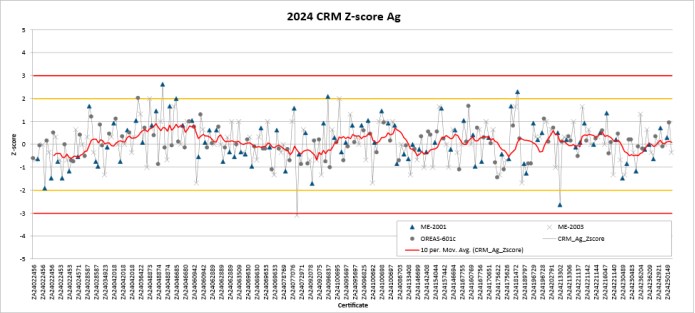
Source: SGS, 2024.
Figure 11-19: CRM Control Chart for Au for the 2024 Drill Program

Source: SGS, 2024.
|
|
Figure 11-20: CRM Control Chart for Pb for the 2024 Drill Program

Source: SGS, 2024.
Figure 11-21: CRM Control Chart for Zn for the 2024 Drill Program

Source: SGS, 2024.
|
|
11.3.8 Blank Material
Blank samples comprising obsidian from sources in Jalisco were inserted into the sample stream in the field to determine the degree of sample carryover contamination after sample collection, particularly during the sample preparation process. This material does not have certified values established by a third party through round robin lab testing.
The QA/QC program from 2019 - 2024 included the insertion of a total of 3,698 blank samples (Table 11-3). For blank sample values, failure is more subjective. Some carryover within sample batches is to be expected in routine sample preparation. To minimize sample carryover within a batch, equipment is cleaned thoroughly with compressed air to remove any remaining loose material. For routine protocols, with samples of similar weights, sample carryover is usually considered acceptable if it is less than 1.0%. To ensure no batch-to-batch carryover occurs, standard quality control procedures include passing barren wash material through crushing and pulverising equipment at the start of each new batch of samples.
Evaluation of blank samples using a failure ceiling for Ag of 2.5 ppm (5x detection limit) indicates that the combined blank failure rate from 2019-2024 was 2.4%. In total 18 blank samples (0.5%) returned values over 10 ppm Ag (Figure 11-22 to Figure 11-26). Alternatively, evaluation of blank samples using a failure ceiling for Au of 0.015 ppm (3x detection limit) indicates that the combined blank failure rate from 2019-2024 was 3.3%. An increase in silver carryover in blank samples was observed in 2024 due to a change in the blank sample insertion protocol by Vizsla. Blank samples were inserted more frequently within highly mineralized zones, particularly in infill drilling, to better quantify carryover contamination and additional cleaning of preparation equipment was requested at the end of sample sequences containing high-grade mineralization. In 2024, all seven blank samples with values over 10 ppm Ag were inserted adjacent to very high-grade samples (1,000-11,000 ppm Ag) and all had significantly less than 1% sample carryover.
The blank failure rate is considered acceptable by industry standards. Based on the low risk of cross-sample carryover contamination and the low amounts of Ag and Au sample carryover that may have contaminated blank material, it is considered unlikely that there is a carryover contamination issue with the Project drilling data.
|
|
Figure 11-22: Blank Sample Chart for Ag for the 2020 Drill Program

Source: SGS, 2024.
Figure 11-23: Blank Sample Chart for Ag for the 2021 Drill Program
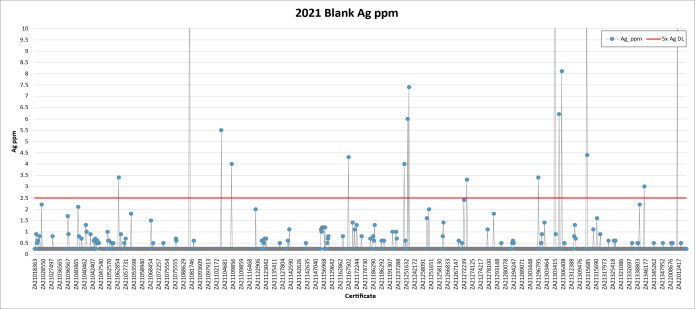
Source: SGS, 2024.
|
|
Figure 11-24: Blank Sample Chart for Ag for the 2022 Drill Program

Source: SGS, 2024.
Figure 11-25: Blank Sample Chart for Ag for the 2023 Drill Program

Source: SGS, 2024.
|
|
Figure 11-26: Blank Sample Chart for Ag for the 2024 Drill Program

Source: SGS, 2024.
11.3.9 Duplicate Material
Vizsla's QA/QC program from 2019-2024 included the insertion of field duplicate and coarse reject duplicate samples. Pulp duplicate sampling was added to the QA/QC program in 2023. From 2019-2024 a total of 1,673 field duplicates (¼ core), 1,609 coarse reject duplicates, and 193 pulp duplicate samples were assayed (Table 11-3). Duplicate samples were analyzed at the primary lab (ALS) to evaluate analytical precision and sampling error.
Figure 11-27 to Figure 11-29 illustrate the comparative assay results and precision of duplicate sample analyses for Ag, Au, Pb, and Zn.
To obtain a relatively accurate estimate of the sampling precision or average relative error a large number of duplicate data pairs are required. Reliably determining the base metal data precision, which typically exhibits relatively small average relative errors (such as 5%), would require 500-1000 duplicate data pairs, while reliable determination of gold data precision, which typically exhibits relatively large average relative errors (such as 25%), would require greater than 2500 duplicate data pairs (Stanley and Lawie, 2007).
In the case of the Panuco deposits, based on the current duplicate data set size for field and coarse reject duplicates, analysis of the precision should be considered as reliable for Pb, Zn, and likely Ag, while it should be considered approximate in nature only for Au until a larger dataset is available. Estimates of pulp duplicate precision should be treated as preliminary until additional data is available. The average relative error as quantified by the Average Coefficient of Variation (CVAVR%) for Ag, Au, Pb, and Zn is shown in Table 11-8, calculated using the root mean square coefficient of variation calculated from the individual coefficients of variation.
|
|
In the case of the Panuco deposits, based on the current duplicate data set size for field and coarse reject duplicates, analysis of the precision should be considered as reliable for Pb, Zn, and likely Ag, while it should be considered approximate in nature only for Au until a larger dataset is available. Estimates of pulp duplicate precision should be treated as preliminary until additional data is available. The average relative error as quantified by the Average Coefficient of Variation (CVAVR%) for Ag, Au, Pb, and Zn is shown in Table 11-8.
The estimates of precisions errors (CVAVR%) for Panuco sampling indicates that the sampling precision is acceptable by industry standards for duplicates for this style of mineralization (Abzalov, 2008). The precision of duplicates should continue to be monitored as the drill program progresses and the size of the duplicate data set, particularly for pulp duplicates, becomes more representative.
Table 11-8: Average Relative Error of Duplicate Samples for Ag, Au, Pb, and Zn from 2019-2024
| Drillhole Series | Duplicate Type | Count | Ag CVAVR% | Au CVAVR% | Pb CVAVR% | Zn CVAVR% |
| 2019-2024 Drilling | Field | 1,673 duplicate pairs | 28.7 | 31.5 | 26.8 | 23.2 |
| 2019-2024 Drilling | Coarse Reject | 1,609 duplicate pairs | 15.43 | 18.42 | 8.2 | 6.5 |
| 2023-2024 Drilling | Pulp | 193 duplicate pairs | 11.6 | 20.8 | 6.5 | 3.3 |
|
|
Figure 11-27: Plots of Field Duplicate Samples for Ag, Au, Pb, and Zn from the 2019-2024 Drill Program
 |
 |
 |
 |
Source: SGS, 2024.
|
|
Figure 11-28: Plots of Coarse Reject Duplicate Samples for Ag, Au, Pb, and Zn from the 2019-2024 Drill Program
 |
 |
 |
 |
Source: SGS, 2024.
|
|
Figure 11-29: Plots of Pulp Duplicate Samples for Ag, Au, Pb, and Zn from the 2023-2024 Drill Program
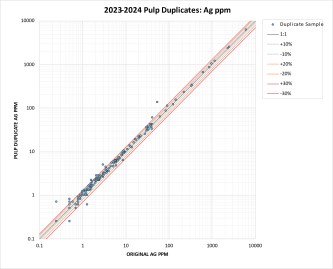 |
 |
 |
 |
Source: SGS, 2024.
11.3.10 Check Assaying
The use of a third-party laboratory for routine check assaying was employed by Vizsla from 2022 to 2024 as an additional QA/QC measure to confirm the accuracy of the primary laboratory assays.
A selection of 209 mineralized pulp samples from the 2019-2022 drilling programs, originally assayed by ALS, were re-assayed at SGS De Mexico, S.A De C.V. in Durango, Mexico in 2022. In 2023 - 2024, 755 mineralized pulp samples from the 2022-2023 drilling programs, originally assayed by ALS, were re-assayed at SGS. In 2024, 49 mineralized pulp samples from the 2024 drilling programs, originally assayed by ALS, were re-assayed at SGS. In total, 964 umpire check samples have been analysed at SGS by Vizsla, matching ALS methodology as closely as possible. The SGS Durango facilities are ISO/IEC 17025 certified. This check assaying represents 1.7% of the total original samples (57,680) collected by Vizsla during the 2019 - 2024 drill programs.
|
|
Table 11-9 and Table 11-10 detail the relative bias and the average relative error of the umpire check sampling for Ag and Au, and the log x-y plots in Figure 11-30 to Figure 11-32 illustrate the comparative assay results and precision of duplicate sample analyses.
The 2020 to 2024 program umpire check assay results returned from SGS, with respect to the corresponding original ALS analyses, indicate that Ag and Au assay accuracy (relative bias) is acceptable and within industry standards. The level of precision (average relative error) observed is considered reasonable for Ag and Au for this style of mineralization.
Table 11-9: Relative Bias and Average Relative Error of Check Samples for Ag from 2022-2024
| Drilling Program |
Duplicate Type | Primary Lab |
Check Lab |
Ag Count | Mean Ag ppm (Original) |
Mean Ag ppm (Duplicate) |
Ag Bias % | Ag CVAVR% |
| 2019-2022 | Pulp Duplicates | ALS | SGS | 209 | 311.3 | 297.6 | -4.4 | 10.0 |
| 2022-2023 | Pulp Duplicates | ALS | SGS | 754 | 389.1 | 384.5 | -1.2 | 9.3 |
| 2024* | Pulp Duplicates | ALS | SGS | 49 | 694.5 | 694.5 | 1.4 | 7.0 |
Table 11-10: Relative Bias and Average Relative Error of Check Samples for Au from 2022-2024
| Drilling Program |
Duplicate Type | Primary Lab |
Check Lab |
Au Count | Mean Au ppm (Original) |
Mean Au ppm (Duplicate) |
Au Bias % | Au CVAVR% |
| 2019-2022 | Pulp Duplicates | ALS | SGS | 209 | 5.2 | 5.1 | -2.3 | 12.5 |
| 2022-2023 | Pulp Duplicates | ALS | SGS | 755 | 3.1 | 2.9 | -7.0 | 13.9 |
| 2024* | Pulp Duplicates | ALS | SGS | 49 | 4.1 | 4.2 | 1.4 | 10.2 |
|
|
Figure 11-30: Plots of SGS Check Samples for Ag and Au Assayed in 2022
 |
 |
Source: SGS, 2024.
Figure 11-31: Plots of SGS Check Samples for Ag and Au Assayed in 2023
 |
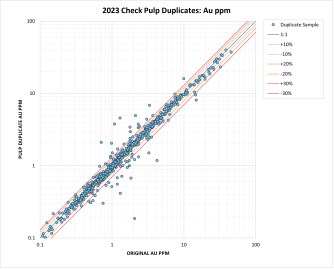 |
Source: SGS, 2024.
|
|
Figure 11-32: Plots of SGS Check Samples for Ag and Au Assayed in 2024
 |
 |
Source: SGS, 2024.
11.3.11 Screen Fire Assays
If coarse Au is present in a deposit, it can create sampling issues, and unless these are overcome, the sample that is submitted for assaying will not provide a representative and repeatable result no matter what assay technique is used. Both sampling and sample preparation techniques should be critically evaluated in the case of coarse Au deposits. Sample crushing and pulverizing fineness, as well as the sample size, should be considered. Screen fire assay is commonly used to aid in determining the proportion of fine and coarse Au within a deposit.
In 2024 a selection of Panuco duplicate samples were assayed by screen fire assay methods for Ag and Au as an additional validation of the suitability and representativeness of the routine analysis methods. A total of 32 coarse reject duplicate samples were analyzed at ALS using a 1 kg pulp screened to 106 microns with duplicate 30 g fire assay on the screen undersize fraction and assay of the entire oversize fraction (ALS Method Code Ag_SCR21 and Au_SCR21). Results reported include both fine fraction assays, the mean of the fine fraction assays, the coarse fraction assay, weights of both the fine and coarse fractions, and the "total" assay calculation for the 1 kg sample based on the weighted average of the coarse and fine fractions.
The screen fire duplicate assay data obtained in 2024 correlates well with the results of the routine Ag and Au fire assay procedures utilized by Vizsla for the Panuco mineralization (Table 11-11). This supports the continued use of the existing routine assay protocol. Based on review of the screen fire assay results it is considered unlikely that there is a sampling issue related to either coarse Ag or Au with the Project drilling data.
|
|
Table 11-11: Relative Bias, (Bias %), Average Relative Error (CVAVR%), and Correlation Coefficient (r) of Screen Fire Duplicates for Ag and Au
|
Element |
Lab |
Screen Fire |
Duplicate |
Original |
Duplicate |
Bias % |
CVAVR% |
r |
|
Ag |
ALS |
Ag_SCR21 |
30 |
2788.2 |
2808.6 |
0.7 |
13.9 |
0.996 |
|
Au |
ALS |
Au_SCR21 |
32 |
72.0 |
78.5 |
9.0 |
13.9 |
0.994 |
Figure 11-33: Plots of Screen Fire Assay Duplicate Samples for Ag and Au Assayed in 2024
 |
 |
Source: SGS, 2024.
11.4 QP's Comments
It is the QP's opinion, based on a review of all possible information, that the sample preparation, analyses and security used on the Project by the Company meet acceptable industry standards (past and current). Review of the Company's QA/QC program indicates that there are no significant issues with the drill core assay data. The data verification programs undertaken on the data collected from the Project support the geological interpretations, and the analytical and database quality, and therefore data can support resource estimation of Measured, Indicated and Inferred mineral resources.
 |
 |
12 DATA VERIFICATION
12.1 Introduction
The following section summarises the data verification procedures that were carried out and completed and documented by the authors for this technical report, including verification of all drill data collected by Vizsla during their 2019 to 2024 drill programs, as of the effective date of this Report. An underground geotechnical drill program and database review was completed by the QP as is discussed in this section of the technical report.
12.2 Drill Sample Database
B. Eggers conducted an independent verification of the assay data in the drill sample database used for the current MRE. Approximately 15% of the digital assay records were randomly selected and checked against the available laboratory assay certificate reports. Assay certificates were available for all diamond drilling completed by Vizsla. Eggers reviewed the assay database for errors, including overlaps and gapping in intervals and typographical errors in assay values. In general, the database was in good condition, and no adjustments were required to be made to the assay values contained in the assay database.
Verifications were also carried out on drill hole locations, down hole surveys, lithology, SG and topography information. The database is considered of sufficient quality to be used for the current MRE.
B. Eggers has reviewed the sample preparation, analyses, and security (see Section 11) completed by Vizsla for the Property. Based on a review of all possible information, the sample preparation, analyses, and security used on the Project by Vizsla, including QA/QC procedures, are consistent with standard industry practices and the drill data can be used for geological and resource modeling, and resource estimation of Measured, Indicated and Inferred mineral resources.
12.3 Site Visit - Allan Armitage
12.3.1 2023 Site Visits
Armitage conducted a site visit to the Project on May 29, 2023, accompanied by Martin Dupuis, COO, Jesus Velador, VP of Exploration and Steve Mancell, Director of Mineral Resources, of Vizsla. During the site visit, Armitage inspected the core logging and core sampling facilities and core storage areas in the City of Concordia. The following facilities were inspected:
Office Area
Area used for geologists to log core.
Area used to make pictures of the core with controlled light (core both wet and dry)
|
|
Area used to measure density (by drying, measuring unwaxed weight, waxed weight and weight in water)
Area for cutting the core.
Area for sampling the core.
Area to update geological sections on paper.
Core storage area
During the site visit Armitage examined several selected mineralized core intervals from recently completed (2019-2022) diamond drill holes from the Property. Armitage examined accompanying drill logs and assay certificates and assays were examined against the drill core mineralized zones. The author reviewed current core sampling, QA/QC and core security procedures. Core boxes for drill holes reviewed are properly stored in the warehouse, easily accessible and well labelled. Sample tags are present in the boxes, and it was possible to validate sample numbers and confirm the presence of mineralization in witness half-core samples from the mineralized zones.
As drilling and core logging was in progress during the time of the site visit, Armitage had the opportunity to review and discuss the entire path of the drill core, from the drill rig to the logging and sampling facility and finally to the laboratory. Armitage is of the opinion that current protocols in place, as have been described and documented by Vizsla, is adequate.
The author participated in a field tour of the Property area including visits to several outcrops to review the local Geology, the drill, and recent drill sites. All areas were easily accessible by road.
Armitage conducted a second site visit to the Project on November 6 to November 8, 2023, accompanied by Henri Gouin, Mining Engineer with SGS, and Martin Dupuis, Fernando Martínez, Director of Projects, Hernando Rueda, Country Manager and Steve Mancell, of Vizsla. During the second site visit, Armitage again inspected the core logging and core sampling facilities and core storage areas in the City of Concordia.
Armitage examined several selected mineralized core intervals from recently completed (2023) diamond drill holes from the Property. Armitage examined accompanying drill logs and assay certificates and assays were examined against the drill core mineralized zones. The author reviewed current core sampling, QA/QC and core security procedures. Core boxes for drill holes reviewed are properly stored in the warehouse, easily accessible and well labelled. Sample tags are present in the boxes, and it was possible to validate sample numbers and confirm the presence of mineralization in witness half-core samples from the mineralized zones.
As drilling and core logging was in progress during the time of the second site visit, Armitage had the opportunity to review and discuss the entire path of the drill core, from the drill rig to the logging and sampling facility and finally to the laboratory. Armitage is of the opinion that current protocols in place, as have been described and documented by Vizsla, is adequate.
The author participated in a field tour of the Property area including visits to several outcrops to review the local Geology, the drill, and recent (2023) drill sites.
|
|
As a result of the two site visits, Armitage was able to become familiar with conditions on the Property. Armitage was able to observe and gain an understanding of the geology and various styles mineralization, which helped guide the current mineral resource modeling, was able to verify the work done and, on that basis, can review and recommend to Vizsla an appropriate exploration program.
12.3.2 2024 Site Visit
Armitage conducted a third site visit to the Project on May 23, 2024, accompanied by Steve Mancell. During the third site visit, Armitage, for the third time, inspected the core logging and core sampling facilities and core storage areas in the City of Concordia. Vizsla has maintained a comprehensive and consistent system for core storage, core security procedures, drill core logging, drill core data collection. As well Vizsla has maintained consistent procedures for sample preparation, analysis and security of all surface samples and drill core samples, including the implementation of an extensive QA/QC program. Armitage is of the opinion that current protocols in place, as have been described and documented by Vizsla, is adequate and to industry standards.
Armitage examined several selected mineralized core intervals from recently completed (2023-2024) diamond drill holes from the Property. Armitage examined accompanying drill logs and assay certificates and assays were examined against the drill core mineralized zones.
Armitage participated in a field tour of the property area including visits to several outcrops to review the local Geology, the drill, and recent (2023-2024) drill sites.
As a result of the three site visits, Armitage was able to become familiar with conditions on the Property. Armitage was able to observe and gain an understanding of the geology and various styles mineralization, which guided the current mineral resource modeling, was able to verify the work done and, on that basis, can review and recommend to Vizsla an appropriate exploration program.
Armitage considers the site visit completed in May 2024 as current, per Section 6.2 of NI 43-101CP. To the QP's knowledge there is no new material scientific or technical information about the Property since that personal inspection. The technical report contains all material information about the Property.
12.4 Underground Geotechnical Site Visit and Data Verification
The Geotechnical QP completed a site visit from June 16th to 18th, 2025. An itinerary of the site visit is shown below in Table 12-1.
|
|
Table 12-1: Geotechnical QP Site Visit Itinerary
| Date: | Activity: |
| June 16th, 2025 | Flash induction Test Mine 540 masl Laydown Test Mine Underground visit |
| June 17th, 2025 | Test Mine Underground visit Test Mine Surface Upper Face inspection Test Mine Water Treatment Area TSF Lookout Area Concordia Core Shack |
| June 18th, 2025 | Test Mine Waste dump toe area Napoleon old and newly proposed box cut areas Hydracore #1 Drill site (NAP 002B) Mancore #2 Drill site (LUI 002) LT Waste dump area Mancore #1 Drill Site (NAP 002A) COP South EAR Geotech hole site Test Mine Underground (geotechnical mapping) |
Test Mine: The geotechnical conditions of the completed box cut, and Test Mine development were reviewed. In-field training of rock mass classification in the underground development was completed with the Vizsla site geology and geotechnical teams. Contractor development was overall to a high standard as well as the ground support and shotcrete installed for the Test Mine box cut.
Geotechnical Logging: Geotechnical core logging procedures and data entry both in the core shack and in-field were reviewed. Worksite safety management and workplace organisation and tidiness were excellent at all drill sites and at the core shack. QA/QC work by the Vizsla Geology Senior was reviewed and no issues were found. Some recommendations for adopting technology to improve structural orientation recording was made. Core sampling for laboratory testing was reviewed and considered to be of a high standard.
12.5 Conclusion
12.5.1 QP Opinion - Allan Armitage
All geological data has been reviewed and verified as being accurate to the extent possible, and to the extent possible, all geologic information was reviewed and confirmed. There were no significant or material errors or issues identified with the drill database. Based on a review of all possible information, the QP is of the opinion that the database is of sufficient quality to be used for the current Measured, Indicated and Inferred MRE.
12.5.2 QP Opinion - Cale Dubois
The following recommendations are commensurate with a feasibility-level study and are intended to cover gaps in the overall geotechnical program:
|
|
The key components that were adjusted for the combined database are:
Fracture frequency per meter
Joint alteration
Intact rock strength estimates
Weathering estimates.
Additional Geotechnical Investigations
The primary underground domains of the Luisa, Napoleon, Tajitos and Copala deposits have been characterised based on a total of 14,840 meters of geotechnical logging data. Mining Plus considers that the level of information is adequate for the present study; however, select domains would benefit from additional geotechnical characterisation.
Based on the geotechnical data room currently, the following recommendations are suggested for future data collection to improve mine planning outcomes:
Napoleon North: Limited geotechnical logging has been completed for Napoleon North. There is one hole (DDH-NAP-013A) amounting to 225 meters of geotechnically logged data currently covering this domain. The Josephine vein has not been intersected. The poor ground conditions indicated for this area, including those which currently constrain the crown pillar thickness for Napoleon North, could be validated with an additional geotechnical hole to characterize the rock mass quality, sample for intact rock strength and elastic properties and improve the structural database. An acoustic televiewer (ATV)/optical televiewer (OTV) survey is recommended to maximize the extraction of geotechnical data.
Tajitos: There is currently 449 meters of geotechnical core covering the Tajitos mining area based on two geotechnical holes (DDH-TAJ-001A and DDH-TAJ-001B). DDH-TAJ-001B was terminated early during drilling due to breakthrough into an unknown excavation in the vicinity of the ore body. It is strongly believed that this is an indication of unmapped artisanal mine workings in this area that, depending on the extents of mining conducted, may complicate extraction plans for the Tajitos ore body. It is recommended that an additional geotechnical hole be drilled to provide additional characterization of the ore and FW domains of Tajitos as well as test for additional artisanal workings in the underground. A C-ALS survey probe is recommended for consideration to be deployed down DDH-TAJ-001B to provide a CMS survey of the breakthrough location. An ATV/OTV survey is recommended to maximize the extraction of geotechnical data.
To improve future geotechnical data collection campaigns, it is also suggested to:
|
|
Ensure that all lithology logs are completed prior to geotechnical logging and audited for accuracy to improve data collection consistency.
Consider employing a Kenometer or core orientation frame to improve efficiency of oriented core measurements in the field.
Complete both diametral and axial point-load tests to evaluate anisotropic behaviour in primary lithologies.
Complete additional triaxial tests on diorite and andesite rock units to characterize the Mohr-Coulomb (MC) and Hoek-Brown (HB) failure criterion parameters (cohesion, friction angle, tensile strength mi, mb, s and a) more accurately to improve inputs for numerical modelling.
|
|
13 MINERAL PROCESSING AND METALLURGICAL TESTING
Metallurgical test work has been conducted by Vizsla on the Copala, Napoleon, Tajitos, and La Luisa deposits for the Panuco project dating back to 2021.
13.1 Introduction
Four phases of test work have been conducted on the Panuco Project since 2021. Each program was completed by ALS Metallurgy, an independent and certified laboratory, on behalf of Vizsla. The initial three phases were preliminary metallurgical assessments on specific deposits for the project, while the most recent program evaluated all deposits using a common processing strategy and was more comprehensive in terms of sample quantities and design data generation. These phases are described in Table 13-1. The following sections summarise primarily the most recent test program, as this was the most extensive and forms the basis for the feasibility study design.
Table 13-1: Metallurgical Test Work Summary
| Year | Laboratory/Location | Report no. | Deposit Analyzed | Test Work Performed |
| 2021 | ALS Metallurgy, Kamloops | KM6454 | Napoleon | Sample chemistry and mineralogy, comminution tests, bulk rougher and cleaner flotation, sequential rougher and cleaner flotation, whole ore cyanidation, bulk rougher concentrate cyanidation and gravity concentration. |
| 2022 | ALS Metallurgy, Kamloops | KM6657 | Tajitos | Sample chemistry and mineralogy, comminution tests, bulk rougher and cleaner flotation, sequential rougher flotation, whole ore cyanidation, bulk rougher concentrate and tailings cyanidation, diagnostic leaching and gravity concentration. |
| 2023 | ALS Metallurgy, Kamloops | KM6937 | Copala | Sample chemistry and mineralogy, comminution tests, bulk rougher flotation, sequential rougher flotation, whole ore cyanidation, rougher concentrate and tailings cyanidation, diagnostic leaching, regrind testing and gravity concentration. |
| 2024 - 2025 | ALS Metallurgy, Kamloops | KM7062 | Copala, Napoleon, Tajitos, La Luisa | Sample chemistry and mineralogy, comminution tests, whole ore cyanidation, rougher concentrate and tailings cyanidation, regrind energy requirements, Solid/Liquid separation, CN destruction, paste backfill, environmental characterization. |
13.2 Sample Origin and Composite Assembly
The samples selected in each of the ALS programs were chosen to represent each deposit with respect to grade, spatial coverage, and lithology. A summary of sample origin data is presented in Table 13-2.
|
|
Table 13-2 Metallurgical Sample Origin Details
| Detail | Napoleon | La Luisa | Tajitos & Cristiano | Copala | |
| Drill Hole Information | Year Drilled | 2020 - 2023 | 2022 - 2024 | 2020 - 2023 | 2021 - 2023 |
| # of drill holes | 11 | 7 | 30 | 27 | |
| Depth ranges (m) | 46-582 | 198-640 | 51-485 | 111-647 | |
| intervals selected for testing (m) | 194 | 98 | 165 | 302 | |
| mass (kg) | 603 | 157 | 425 | 934 | |
| Composites Assembled | Sub-composites | 11 | 4 | 8 | 24 |
| variability metallurgical testing | variability metallurgical testing | variability metallurgical testing | variability metallurgical testing | ||
| Master Composites | 1 Grindability composite | - | 3 lithology comps - metallurgical testing | 3 master composites - metallurgical testing | |
| 2 master comps - metallurgical testing | |||||
Several sample shipments were arranged over the duration of the metallurgical test programs, in total 2,119 kg of ½ HQ drill core sample was selected from 75 drill holes and allocated for testing. The majority of the sample mass described above was used in the most recent test program.
The 2024-2025 variability samples were assembled with reference to preliminary stope designs, such that mineralized veins as well as appropriate waste dilution would be represented in each interval selection. Section view images of the interval locations against the proposed mined stopes are presented in Figure 13-1 through Figure 13-5. Portions of these variability samples were then used to assemble a Napoleon, and two Copala master composites which were used for flowsheet evaluation. The developed process conditions were applied to each of the variability samples. Additional composites were prepared for CN destruction testing, and a LOM bulk sample was assembled and used to generate products for regrind energy testing and paste backfill testing.
|
|
Figure 13-1: Copala 2024 Metallurgical Sample Locations

Source: Vizsla, 2025.
Figure 13-2: Tajitos 2024 Metallurgical Sample Locations

Source: Vizsla, 2025.
|
|
Figure 13-3: Cristiano 2024 Metallurgical Sample Locations

Source: Vizsla, 2025.
Figure 13-4: Napoleon 2024 Metallurgical Sample Locations

Source: Vizsla, 2025.
|
|
Figure 13-5: La Luisa 2024 Metallurgical Sample Locations
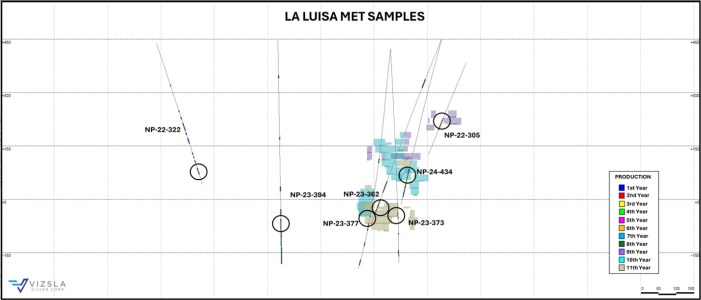
Source: Vizsla, 2025.
13.3 Sample Chemistry and Mineralogy
Chemical analyses were completed on each of the feed samples used in the metallurgical test program using standard analytical techniques, results are presented in Table 13-3. Master composites will be indicated by MC in the following report sections.
Table 13-3: Chemical Composition of the Composites and Variability Samples
| Deposit | Composite | Assay - g/t | Assay - % | |||||
| Ag | Au | S | Cu | Pb | Zn | Mn | ||
| Copala | Master Comp 2023 | 312 | 2.18 | 0.94 | 0.01 | 0.08 | 0.15 | 1.28 |
| COP23-01 | 364 | 2.94 | 0.35 | 0.01 | 0.03 | 0.05 | 0.70 | |
| COP23-02 | 173 | 1.13 | 1.26 | 0.03 | 0.36 | 0.52 | 1.14 | |
| COP23-03 | 266 | 1.81 | 0.32 | 0.01 | 0.01 | 0.05 | 0.54 | |
| COP23-04 | 330 | 6.91 | 0.06 | 0.01 | 0.04 | 0.07 | 0.13 | |
| COP23-05 | 248 | 1.36 | 1.56 | 0.01 | 0.02 | 0.04 | 2.60 | |
| COP23-06 | 619 | 2.86 | 1.32 | 0.01 | 0.07 | 0.17 | 2.57 | |
|
|
| Deposit | Composite | Assay - g/t | Assay - % | |||||
| Ag | Au | S | Cu | Pb | Zn | Mn | ||
| Copala | Master Comp 1 2024 | 306 | 1.54 | 1.10 | 0.01 | 0.15 | 0.11 | 1.35 |
| Master Comp 2 2024 | 515 | 2.08 | 1.03 | 0.02 | 0.13 | 0.08 | 0.90 | |
| COP24-01 | 459 | 4.02 | 0.40 | 0.01 | 0.05 | 0.07 | 1.90 | |
| COP24-02 | 159 | 0.77 | 0.51 | 0.01 | 0.05 | 0.05 | 2.85 | |
| COP24-03 | 306 | 2.56 | 0.36 | 0.01 | 0.05 | 0.04 | 0.60 | |
| COP24-04 | 348 | 1.91 | 1.37 | 0.01 | 0.06 | 0.08 | 0.61 | |
| COP24-05 | 187 | 2.07 | 0.69 | 0.01 | 0.04 | 0.03 | 0.70 | |
| COP24-06 | 169 | 1.58 | 1.69 | 0.01 | 0.05 | 0.05 | 0.31 | |
| COP24-07 | 771 | 2.52 | 0.77 | 0.03 | 0.06 | 0.08 | 1.32 | |
| COP24-08 | 565 | 1.03 | 1.33 | 0.05 | 1.01 | 0.17 | 0.06 | |
| COP24-09 | 484 | 2.16 | 2.13 | 0.02 | 0.18 | 0.39 | 3.83 | |
| COP24-10 | 221 | 1.47 | 0.76 | 0.01 | 0.05 | 0.06 | 0.99 | |
| COP24-11 | 305 | 2.63 | 1.59 | 0.01 | 0.07 | 0.10 | 0.39 | |
| COP24-12 | 2016 | 8.86 | 0.46 | 0.03 | 0.08 | 0.08 | 5.62 | |
| COP24-13 | 479 | 2.70 | 0.60 | 0.01 | 0.06 | 0.07 | 1.92 | |
| COP24-14 | 629 | 3.19 | 0.64 | 0.01 | 0.09 | 0.12 | 0.41 | |
| COP24-15 | 543 | 3.74 | 0.98 | 0.01 | 0.07 | 0.06 | 2.36 | |
| COP24-16 | 461 | 2.44 | 1.43 | 0.03 | 0.08 | 0.14 | 1.06 | |
| COP24-17 | 748 | 2.87 | 0.81 | 0.02 | 0.08 | 0.19 | 1.84 | |
| COP24-18 | 1017 | 10.01 | 1.88 | 0.03 | 0.13 | 0.24 | 4.12 | |
| Cristiano | CR24-01 | 249 | 1.49 | 1.13 | 0.01 | 0.58 | 0.99 | 1.58 |
| CR24-02 | 269 | 0.90 | 1.36 | 0.02 | 0.07 | 0.17 | 2.48 | |
| Tajitos | Diorite MC - 2022 | 239 | 1.18 | 1.26 | 0.02 | 0.15 | 0.21 | 0.83 |
| Andesite MC - 2022 | 242 | 1.37 | 0.63 | 0.01 | 0.04 | 0.11 | 0.36 | |
| And/Low MnOx MC 2022 | 275 | 2.46 | 1.14 | 0.02 | 0.08 | 0.16 | 1.20 | |
| TAJ24-03 | 161 | 0.85 | 1.01 | 0.01 | 0.04 | 0.06 | 0.33 | |
| TAJ24-04 | 240 | 3.81 | 1.07 | 0.02 | 0.13 | 0.28 | 0.23 | |
| TAJ24-05 | 967 | 3.26 | 1.87 | 0.03 | 0.07 | 0.13 | 2.40 | |
| TAJ24-06 | 458 | 0.77 | 0.97 | 0.01 | 0.10 | 0.18 | 0.35 | |
| Napoleon | Master Comp 2021 | 123 | 3.10 | 2.37 | 0.13 | 1.09 | 1.05 | 0.20 |
| Master Comp 2024 | 167 | 2.05 | 2.41 | 0.15 | 0.43 | 1.10 | 0.18 | |
| NAP24-01 | 144 | 3.06 | 2.41 | 0.07 | 0.37 | 1.72 | 0.18 | |
| NAP24-02 | 509 | 4.36 | 2.82 | 0.09 | 0.31 | 1.25 | 0.23 | |
| NAP24-03 | 202 | 1.08 | 1.50 | 0.03 | 0.14 | 0.24 | 0.17 | |
| NAP24-04 | 115 | 0.88 | 3.12 | 0.17 | 0.56 | 1.73 | 0.18 | |
| NAP24-05 | 39 | 1.76 | 2.61 | 0.25 | 0.27 | 1.27 | 0.19 | |
| NAP24-06 | 126 | 2.22 | 8.19 | 0.36 | 0.94 | 3.10 | 0.22 | |
| NAP24-07 | 281 | 3.44 | 2.38 | 0.09 | 0.20 | 0.61 | 0.21 | |
| NAP24-08 | 287 | 3.58 | 2.17 | 0.17 | 1.14 | 0.74 | 0.19 | |
| NAP24-09 | 256 | 2.59 | 2.31 | 0.04 | 0.32 | 1.02 | 0.11 | |
| NAP24-10 | 349 | 3.03 | 1.84 | 0.02 | 0.25 | 0.58 | 0.21 | |
| NAP24-11 | 102 | 0.57 | 1.73 | 0.01 | 0.12 | 0.40 | 0.25 | |
|
|
| Deposit | Composite | Assay - g/t | Assay - % | |||||
| Ag | Au | S | Cu | Pb | Zn | Mn | ||
| La Luisa | LSA24-01 | 346 | 4.79 | 2.77 | 0.02 | 0.22 | 0.29 | 0.38 |
| LSA24-02 | 184 | 3.11 | 4.48 | 0.08 | 1.29 | 2.06 | 0.22 | |
| LSA24-03 | 56 | 0.84 | 2.44 | 0.04 | 0.41 | 0.79 | 0.18 | |
| LSA24-04 | 54 | 1.88 | 3.41 | 0.18 | 0.32 | 2.31 | 0.23 | |
Two samples from the Tajitos deposit were tested in the 2024 program but have been removed from the analyses as these intercepts are no longer in the mine plan. Portions of LSA24-01 and LSA-04 samples originated from 2 drill hole intercepts that are no longer in the mine plan, as these were composites assembled from two drill holes each. These samples are retained in metallurgical analysis.
Silver and gold are the primary metals of interest in the feed materials. The Napoleon and La Luisa samples generally had lower silver contents and higher gold than the Copala area samples. Also, the Napoleon and La Luisa samples had higher levels of sulphide minerals and base metals compared to the Copala area samples.
Manganese contents are displayed, as elevated levels appeared to correlate with lower leach extractions on some samples. Nine out of 38 of the Copala area samples contained manganese at levels of greater than 2%. Manganese was quite low in the Napoleon area samples.
Mineralogical composition and texture characteristics were measured using QEMSCAN technology, summarised composition data is presented in Table 13-4.
Table 13-4: Average Mineralogical Composition of the Variability Samples
| Mineral | Average Content - % | ||||
| Copala | Tajitos | Cristiano | Napoleon | La Luisa | |
| Silver Minerals | <0.1 | <0.1 | <0.1 | <0.1 | <0.1 |
| Copper Sulphides | <0.1 | <0.2 | <0.3 | 0.3 | 0.2 |
| Galena | 0.2 | 0.2 | 0.4 | 0.5 | 0.7 |
| Sphalerite | 0.2 | 0.4 | 0.8 | 1.9 | 2.2 |
| Pyrite | 1.8 | 2.9 | 1.6 | 3.9 | 4.7 |
| Quartz | 57.5 | 50.8 | 64.1 | 60.0 | 48.6 |
| Feldspars | 23.6 | 32.8 | 18.2 | 21.2 | 34.8 |
| Carbonates | 5.5 | 1.8 | 4.6 | 1.8 | 2.1 |
| Micas | 2.0 | 1.8 | 1.6 | 2.4 | 1.4 |
| Chlorite | 2.5 | 2.7 | 2.3 | 2.7 | 2.0 |
| Mn-Silicate | 3.3 | 1.4 | 3.6 | 0.4 | 0.3 |
| Others | 3.5 | 5.3 | 2.8 | 4.7 | 3.0 |
|
|
The most abundant host rock minerals in the samples were quartz and feldspars. Copala and Cristiano samples contained higher levels of carbonate minerals. The Napoleon and La Luisa samples contained higher levels of sulphide minerals than the Copala area material. Pyrite hosted the greatest portion of the sulphur in each of the composites.
The occurrence of manganese in silicates typically increased with increasing levels of manganese. Manganese was also present in a carbonate form, rhodochrosite, and minor amounts were present in chlorite minerals.
Detailed mineralogy was conducted on sized fractions of the 2024 Napoleon and Copala master composites following grinding to 80 % passing 91 µm for Napoleon and 104 µm for Copala. Selected liberation data is presented in Table 13-5, along with liberation data on the 2023 Copala master composite.
Table 13-5: Liberation Characteristics of the Composites - % Distribution
| Mineral Status | Copala 2024 MC (104 µm P80) | Copala 2023 MC (67 µm P80) | Napoleon 2024 MC (91 µm P80) | |||||
| Ag-Sulphide | Pyrite | Ag-Sulphide | Pyrite | Ag-Sulphide | Galena | Sphalerite | Pyrite | |
| Liberated | 22.0 | 53.7 | 14.7 | 65.3 | 21.3 | 50.3 | 66.4 | 69.9 |
| Binary - Ag Mineral | - | 0.2 | - | 0.2 | - | 0.3 | 0.1 | 0.1 |
| Binary - Cu Sulphides | 2.7 | 0.2 | 26.3 | 0.9 | 8.7 | 2.6 | 8.2 | 0.8 |
| Binary - Galena | - | 0.5 | - | 1.9 | 2.0 | - | 0.8 | 1.2 |
| Binary - Sphalerite | 0.3 | 0.5 | 0.4 | 0.8 | 5.7 | 11.0 | - | 1.8 |
| Binary - Pyrite | 6.7 | - | 2.5 | - | 13.1 | 6.9 | 3.1 | - |
| Binary - Gangue | 52.8 | 43.3 | 50.5 | 28.4 | 21.8 | 20.6 | 18.4 | 24.2 |
| Multiphase | 15.6 | 1.5 | 5.5 | 2.5 | 26.8 | 8.4 | 2.9 | 2.1 |
Silver sulphide minerals in the 2024 Copala master composite, identified as approximately 80% acanthite and 20% Ag-Cu sulphides, were poorly liberated at 22%. However, this level of liberation was slightly better than the 2023 composite, considering that the grind size was coarser. Approximately 53% of the silver sulphides were present as binaries with gangue, the remaining 25% was in either binary or multi-phase form with other sulphide minerals. Grain size assessments were conducted on the silver sulphides which indicated that the estimated median diameter (D50) on a mass basis was 22 µm, and approximately 38% of the grain mass was finer than 10 µm. The fine-grained texture of the silver mineralization can be seen in QEMSCAN backscatter images of typical silver hosting ground feed grains, presented in Figure 13-6. In these images, the high-density silver minerals are the brightest phases, next is pyrite, and the host rock gangue minerals are darker grey.
|
|
Figure 13-6: Backscatter Images of Copala Feed Grains, >75µm Fraction

Source: ALS Metallurgy, 2024.
Pyrite was 54% liberated in the 2024 Copala composite, which is typically sufficient for rougher flotation recovery.
Silver sulphide minerals in the 2024 Napoleon master composite, identified as approximately 25% acanthite and 75% Ag-Cu sulphides, were also poorly liberated at 21%. Approximately 22% of the silver sulphides were present as binaries with gangue, the remaining 56% was in either binary or multi-phase form with other sulphide minerals. Grain size assessments on the silver sulphides indicated that the estimated median diameter (D50) on a mass basis was 15 µm, and approximately 47% of the grain mass was finer than 10 µm. QEMSCAN backscatter images of typical silver hosting feed grains are shown in Figure 13-7. Chalcopyrite is present in the first multi-phase grain image.
Figure 13-7: Backscatter Images of Napoleon Feed Grains, >75µm

Source: ALS Metallurgy, 2024.
|
|
The fine silver mineral grain size and elevated association with other sulphides suggests that flotation with regrinding may be a beneficial addition to the processing strategy.
13.4 Comminution Testing
Comminution tests were conducted on composites and variability samples from each deposit, with the majority of the available results coming from the 2024 test program. The data set includes 26 samples from the Copala area and 15 samples from the Napoleon area. The results are summarised in Table 13-6.
Table 13-6: Comminution Test Results
|
Deposit |
Sample |
SMC Axb |
Bond BWI (kWh/t) |
Abrasion Index (g) |
|
Copala Area |
Minimum |
27.9 |
14.8 |
0.167 |
|
Maximum |
46.9 |
18.9 |
0.612 |
|
|
Average |
34.9 |
17.7 |
0.333 |
|
|
75th percentile |
31.9 |
18.5 |
0.405 |
|
|
Napoleon Area |
Minimum |
33.7 |
15.9 |
0.100 |
|
Maximum |
44.4 |
18.7 |
0.523 |
|
|
Average |
39.0 |
17.1 |
0.295 |
|
|
75th percentile |
38.1 |
17.7 |
0.487 |
The Bond ball work index is relatively constant across the deposits, varying between 14.8 - 18.9 kWh/t. The SMC values suggest the material is competent, as Axb values measured using the SMC test protocol averaged 34.9 for the Copala area material and 39.0 for Napoleon area. The results indicate that material for the Panuco project is moderately hard in terms of comminution properties. The samples were also moderately abrasive, the 75th percentile Bond abrasion index values of Copala and Napoleon samples were 0.405 g and 0.487 g, respectively.
13.5 Gravity Concentration
Gravity concentration tests were conducted in earlier test programs on composites from each deposit using a Knelson concentrator, followed by hand panning of the Knelson concentrate. Each test was conducted on a 2 kg charge, at grind sizes of 80% passing 63 µm for Napoleon, 92 and 101 µm for Tajitos, and 97 µm for Copala. Summarised results are presented in Table 13-7.
|
|
Table 13-7: Gravity Concentration Test Results
| Deposit | Sample | Calculated head grade (g/t) | Mass (%) | Recovery (%) | |||
| Silver | Gold | Pan Con | Tails | Silver | Gold | ||
| Napoleon | Napoleon MC 2021 | 133 | 2.83 | 0.6 | 99.4 | 11.9 | 25.7 |
| Tajitos | Diorite MC | 296 | 1.27 | 0.6 | 99.4 | 8.7 | 8.6 |
| Andesite MC | 288 | 1.39 | 0.5 | 99.5 | 10.2 | 12.2 | |
| Copala | Copala MC 2023 | 339 | 2.44 | 0.7 | 99.3 | 12.0 | 23.0 |
Precious metal recoveries to the gravity concentrate were low, ranging from 8.7 to 12.0% for silver and 8.6 to 25.7% for gold. Gold recovery to the gravity concentrate increased with feed grade. These levels of precious metal gravity recovery do not justify inclusion of gravity concentration in the process flowsheet, so no further testing was considered.
13.6 Flotation - Saleable Concentrates
Froth flotation tests to investigate salable concentrates were conducted in the three initial test programs, including sequential flotation to produce separate lead-silver, zinc and pyrite concentrates and generating potentially saleable bulk sulphide concentrates. However, neither of these flotation processing strategies produced economically positive results and were not pursued in the feasibility metallurgical program. The most relevant results of this testing are summarised in the following sections.
13.6.1 Sequential Concentrate Flotation
A sequential flotation flowsheet consisting of lead-silver, zinc and pyrite flotation was investigated for the three deposits. Typical lead-zinc circuit chemistry was applied. In all tests, Aerophine 3418A and sodium isopropyl xanthate (SIPX) were used as lead-silver and zinc collectors respectively. Sodium cyanide and zinc sulphate were used as sphalerite and pyrite depressants within the lead-silver flotation step. Copper sulphate was used to reactivate the sphalerite in zinc flotation. SIPX was applied at a higher dose in the pyrite circuit to collect any remaining sulphides.
Silver and gold deportment to sequential rougher concentrates in selected tests following primary grinding to a nominal size of 70 µm P80 are presented graphically in Figure 13-8 and Figure 13-9.
|
|
Figure 13-8: Sequential Rougher Flotation Results - Silver Deportment

Source: Ausenco, 2024.
Figure 13-9: Sequential Rougher Flotation Results - Gold Deportment

Source: Ausenco, 2024.
|
|
The majority of the silver and gold reported to the first sequential concentrate with galena, between 76 to 81% of the silver and 65 to 83% of the gold in the flotation feed. The deportment of silver and gold to concentrates in these rougher kinetic tests is higher than what would be measured in a full circuit with closed cleaner tailings circulation, but it provides a reference of ultimate recovery levels and distribution.
Recovery of silver and gold to flotation concentrates was moderately effective on the 2021 Napoleon master composite, however the losses to flotation tailings for Tajitos and Copala would result in unfavourable economics for a flotation only process. Furthermore, precious metal payment terms for lead and particularly zinc concentrates would detract from the payable silver and gold values. Finally, the value of gold and silver in a pyrite concentrate is somewhat uncertain, as this stream is likely not marketable and would require a dedicated cyanide leach circuit to produce doré.
13.6.2 Bulk Concentrate Flotation
Bulk sulphide flotation tests were conducted on the composites from each deposit, as well as variability samples from the Copala deposit. These were performed using a typical rougher flotation circuit to produce a bulk concentrate. Each of the tests were conducted at the natural pH of the ground feed, which ranged from 8.0 to 8.5, and used either potassium amyl xanthate (PAX) or SIPX as a collector. Copper sulphate was included as an activator in the Napoleon tests. Results are presented in Table 13-8. Silver recoveries to the rougher concentrates ranged from 77.1 to 96.8% and gold recoveries ranged from 77.0 to 92.3%.
Table 13-8: Bulk Flotation Rougher Recoveries
| Sample | Prim. Grind (µm P80) |
Feed Grade (g/t) | Recovery (%) | |||
| Au | Ag | mass | Au | Ag | ||
| Napoleon 2021 MC | 63 | 2.66 | 122 | 14.3 | 88.4 | 93.7 |
| Tajitos - Diorite | 70 | 1.28 | 284 | 19.7 | 81.2 | 87.6 |
| Tajitos - Andesite | 70 | 1.46 | 267 | 18.1 | 86.5 | 85.3 |
| Copala 2023 MC | 70 | 2.38 | 346 | 6.5 | 77.0 | 84.1 |
| COP23-01 | 62 | 2.92 | 370 | 9.6 | 82.6 | 86.8 |
| COP23-02 | 71 | 1.19 | 175 | 8.0 | 90.0 | 96.8 |
| COP23-03 | 66 | 1.95 | 277 | 6.3 | 85.6 | 84.1 |
| COP23-04 | 72 | 6.64 | 353 | 13.4 | 92.3 | 88.2 |
| COP23-05 | 74 | 1.31 | 245 | 10.8 | 78.1 | 77.1 |
| COP23-06 | 67 | 2.93 | 648 | 16.9 | 82.4 | 82.8 |
Open circuit cleaner tests were also conducted on Napoleon and Tajitos composites using two stages of cleaner flotation following regrinding of the rougher concentrates to produce higher-grade final concentrates. Results are presented graphically in Figure 13-10. While these concentrates may be marketable, the payment terms for the precious metal contents are uncertain. Losses to the cleaner tailings streams would result in unfavourable economics for this flotation only process.
|
|
Figure 13-10: Bulk Cleaner Flotation Upgrading Results

Source: Ausenco 2024.
13.7 Bulk Flotation for Product Leaching
Bulk sulphide flotation was investigated on most samples, to generate a concentrate for regrinding and subsequent leaching with sodium cyanide, as well as a flotation tailings stream for leaching. Primary grind sizes ranged from 62-79 µm on Copala area samples and 70-122 µm on Napoleon area samples. PAX was used as collector. Average results are presented in Table 13-9. Gold and silver recoveries versus feed grades are presented graphically in Figure 13-11 and Figure 13-12 and for Copala and Napoleon areas, respectively.
Table 13-9: Average Rougher Flotation Results
| Deposit Area | Test count | Prim. Grind µm P80 | Average Feed Grade | Rougher Recovery % | ||||
| Au g/t | Ag g/t | S% | mass | Au | Ag | |||
| Copala | 24 | 70 | 2.1 | 397 | 1.0 | 8.4 | 80.5 | 82.3 |
| Napoleon | 16 | 89 | 2.3 | 195 | 2.9 | 11.8 | 88.2 | 90.7 |
Gold and silver recoveries on Napoleon samples were approximately 8% higher than Copala. The Napoleon samples generally had higher mass recoveries due to the higher sulphur contents in the feeds. Mass recoveries relative to feed sulphur contents are presented in Figure 13-13.
|
|
Figure 13-11: Copala Area Rougher Flotation Recoveries Vs Feed Grades

Source: Ausenco, 2025.
Figure 13-12: Napoleon Area Rougher Recoveries Vs. Feed Grades

Source: Ausenco, 2025.
|
|
Figure 13-13: Rougher Mass Recovery Vs. Sulphur Feed Grade

Source: Ausenco, 2025.
13.8 Cyanidation
13.8.1 Whole Ore Cyanidation
Bottle roll tests were conducted during each of the metallurgical programs to assess the amenability of materials to whole ore cyanide (NaCN) leaching. In order to maximize silver extraction, the conditions applied in the 2024-2025 test program were standardized to include primary grinding to 70 µm P80 and total leach residence times of 96 hours. Two hours of pre-aeration was applied, as previous testing indicated that this contributed to lower NaCN consumptions. Sodium cyanide dosages of 3 g/L were maintained for the first 24 hours and allowed to drift with no further additions for the remaining leach time, resulting in sodium cyanide concentrations typically remaining above 2 g/L. Additional testing was conducted on Copala samples using target primary grind sizes of 50 µm P80, as well as initial NaCN dosages of 5 g/L on samples with higher silver contents. Leach results from early test programs that were less aggressive are not included in this discussion. Only a few Napoleon area variability samples were evaluated by whole ore leaching, as master composite evaluation indicated that the flotation plus leach circuit would be more appropriate for this material, discussed in the following sections.
Leach extraction data for the master composites is presented in Table 13-10. Kinetic extraction curves are presented in Figure 13-14 and Figure 13-15.
|
|
Table 13-10: Whole Ore Leach Results - Master Composites
| Sample | Feed Size P80 µm |
Leach hrs |
Feed Grades | Leach Extraction % | Residue | NaCN Consumption kg/t |
||||
| Au g/t | Ag g/t | S % | Au | Ag | Au g/t | Ag g/t | ||||
| NAP21-MC | 63 | 48 | 2.76 | 128 | 2.37 | 92.8 | 86.7 | 0.20 | 17 | 2.5 |
| NAP24-MC | 68 | 72 | 2.31 | 160 | 2.41 | 93.1 | 89.0 | 0.16 | 18 | 2.3 |
| 52 | 96 | 2.28 | 150 | 2.41 | 93.7 | 88.5 | 0.15 | 17 | 2.3 | |
| COP24-MC | 72 | 72 | 2.00 | 305 | 1.1 | 89.7 | 88.1 | 0.21 | 36 | 2.4 |
| 53 | 96 | 1.72 | 309 | 1.1 | 89.8 | 91.1 | 0.18 | 27 | 2.8 | |
| 34 | 72 | 1.67 | 288 | 1.1 | 92.2 | 93.1 | 0.13 | 20 | 3.0 | |
| COP24-MC2 | 71 | 96 | 2.37 | 435 | 0.91 | 90.3 | 91.0 | 0.23 | 39 | 2.8 |
| 62 | 96 | 2.44 | 440 | 0.91 | 90.8 | 92.2 | 0.23 | 35 | 1.9 | |
Silver leach kinetics were slower than gold and required up to 96 hours of residence time to stabilize at final extraction values. Finer primary grind sizes improved metal extractions, particularly for Copala silver extractions.
The WOL conditions were then applied to the variability samples from the Copala, Tajitos, Cristiano and La Luisa deposits. Only one Napoleon variability sample was tested with the WOL flowsheet. A greater number of tests were conducted on Copala material, as this represents a greater portion of the resource. In total, 50 WOL bottle roll tests were conducted on variability samples with either 3 or 5 g/t NaCN dosages, 96-hour residence times and varying primary grind sizes in the 2024 test program. The discussion below reviews the results of this testing.
|
|
Figure 13-14: Whole Ore Leach Kinetics - Copala Master Composites

Source: Ausenco, 2025.
Figure 13-15: Whole Ore Leach Kinetics - Napoleon Master Composites

Source: Ausenco, 2025.
|
|
Metallurgical data for tests on Copala area variability samples conducted at a target primary grind size of 70 µm P80 are summarised in Table 13-11 These initial 19 tests were conducted with 96-hour leach residence times and 3 g/L NaCN. Results on one very high-grade sample (9.4 g/t Au, 1930 g/t Ag) have been excluded.
Table 13-11: Copala Area WOL Results - 70µm
| Sample | Feed Size | Feed | Residue g/t | Extractions % | ||||
| P80 µm | Au g/t | Ag g/t | Mn % | Au | Ag | Au | Ag | |
| COP24-01 | 77 | 4.10 | 492 | 1.90 | 0.46 | 64 | 88.9 | 87.0 |
| COP24-02 | 75 | 0.84 | 169 | 2.85 | 0.14 | 20 | 83.3 | 88.4 |
| COP24-03 | 74 | 2.59 | 272 | 0.60 | 0.23 | 19 | 91.1 | 93.1 |
| COP24-04 | 73 | 2.02 | 363 | 0.61 | 0.28 | 35 | 86.1 | 90.4 |
| COP24-05 | 63 | 2.15 | 189 | 0.70 | 0.23 | 29 | 89.5 | 84.6 |
| COP24-06 | 65 | 1.69 | 141 | 0.31 | 0.12 | 10 | 92.9 | 93.1 |
| COP24-07 | 72 | 2.34 | 811 | 1.32 | 0.22 | 97 | 90.6 | 88.0 |
| COP24-08 | 65 | 1.10 | 470 | 0.06 | 0.09 | 22 | 91.8 | 95.4 |
| COP24-09 | 72 | 2.24 | 527 | 3.83 | 0.43 | 102 | 80.8 | 80.7 |
| COP24-10 | 76 | 1.54 | 226 | 0.99 | 0.15 | 22 | 90.3 | 90.1 |
| COP24-11 | 65 | 2.80 | 279 | 0.39 | 0.18 | 27 | 93.6 | 90.4 |
| COP24-13 | 68 | 2.71 | 511 | 1.90 | 0.27 | 76 | 90.0 | 85.1 |
| COP24-14 | 67 | 3.22 | 646 | 0.40 | 0.17 | 53 | 94.7 | 91.8 |
| COP24-15 | 71 | 3.10 | 509 | 2.36 | 0.33 | 85 | 89.4 | 83.4 |
| COP24-16 | 76 | 2.66 | 458 | 1.06 | 0.19 | 67 | 92.8 | 85.5 |
| COP24-17 | 67 | 3.19 | 822 | 1.84 | 0.31 | 149 | 90.3 | 81.9 |
| COP24-18 | 68 | 9.68 | 1057 | 4.12 | 0.84 | 190 | 91.3 | 82.1 |
| CR24-01 | 75 | 1.61 | 241 | 1.58 | 0.11 | 23 | 93.2 | 90.6 |
| CR24-02 | 79 | 0.96 | 240 | 2.48 | 0.10 | 26 | 89.6 | 89.2 |
| Average | 71 | 2.66 | 443 | 1.54 | 0.25 | 59 | 90.0 | 87.9 |
The extractions for both gold and silver ranged between 80 and 95%. Higher feed grades did not always return higher leach extractions, as would be typically expected. This indicates that higher manganese levels in the feeds were often associated with lower leach extractions, particularly for silver. This can be observed in leach data displayed graphically in Figure 13-16. Manganese contents in the feed above 1.6% were associated with lower-than-expected recoveries on samples with higher gold and silver grades.
|
|
Figure 13-16: Copala Area WOL Results - 70 µm

Source: Ausenco, 2025.
The lower recoveries obtained on a portion of the Copala area samples prompted additional testing at a finer primary grind sizing. A total of 12 Copala samples were tested at both 70 and 50 µm P80 primary grind sizes. For this data set, the average gold recoveries increased from 90.7 to 92% while silver recoveries increased from 87.1 to 89.7% at the finer grind size. The results are displayed graphically in Figure 13-17.
|
|
Figure 13-17: Copala Area WOL Leach Results - 70 Vs. 50µm Comparison

Source: Ausenco, 2025.
Four Tajitos samples were also tested at an average grind size of 56 µm P80, however these samples were not also tested at 70 µm P80. The feed grades of these 4 samples averaged 2.2 g/t Au and 460 g/t Ag, the leach recoveries averaged 92.8 and 92.2% for gold and silver respectively.
|
|
Repeat tests were conducted on five Copala samples using 5 g/L NaCN at the 50 µm P80 grind size. Results are presented in Table 13-12. The higher NaCN dosage improved silver extractions on two samples with silver feed grades above 600 g/t Ag by an average of 7.4%. Silver recovery improved by 1.9% on average for the other 3 samples, however the calculated silver feed grades of the repeat test charges were also somewhat lower. Gold extraction was unaffected by the higher NaCN dosage. Residue grades are graphed against feed grades in Figure 13-18. The NaCN consumptions averaged 2.3 kg/t for the 3 g/L tests and 3.3 kg/t for the 5 g/L tests.
Table 13-12: Copala WOL Results - NaCN Dosage Comparison
|
NaCN |
Sample |
Feed Size |
Feed |
Residue g/t |
Extractions % |
NaCN |
||||
|
P80 µm |
Au g/t |
Ag g/t |
Mn % |
Au |
Ag |
Au |
Ag |
|||
|
3 |
COP24-13 |
56 |
2.80 |
543 |
1.9 |
0.23 |
67 |
91.8 |
87.8 |
2.1 |
|
COP24-15 |
56 |
3.47 |
560 |
2.4 |
0.35 |
80 |
90.1 |
85.7 |
2.1 |
|
|
COP24-16 |
53 |
2.75 |
532 |
1.1 |
0.18 |
57 |
93.6 |
89.3 |
2.1 |
|
|
COP24-17 |
53 |
3.21 |
776 |
1.8 |
0.33 |
139 |
89.9 |
82.1 |
3.0 |
|
|
COP24-18 |
56 |
10.00 |
1088 |
4.1 |
0.69 |
156 |
93.1 |
85.7 |
2.4 |
|
|
5 |
COP24-13 |
56 |
2.85 |
519 |
1.9 |
0.21 |
47 |
92.6 |
90.9 |
2.7 |
|
COP24-15 |
48 |
3.36 |
475 |
2.4 |
0.31 |
58 |
90.8 |
87.8 |
3.5 |
|
|
COP24-16 |
53 |
2.78 |
505 |
1.1 |
0.20 |
52 |
92.8 |
89.7 |
4.1 |
|
|
COP24-17 |
53 |
3.23 |
742 |
1.8 |
0.29 |
58 |
91.0 |
92.2 |
4.2 |
|
|
COP24-18 |
56 |
9.41 |
1066 |
4.1 |
0.67 |
102 |
92.9 |
90.4 |
2.0 |
|
Figure 13-18: Copala WOL Data - NaCN Dosage Comparison

Source: Ausenco, 2025.
|
|
One variability sample from Napoleon and four from La Luisa were evaluated with the WOL process, at a target primary grind size of 70 µm P80. Results are summarised in Table 13-13, along with the Napoleon master composite result for reference. The leach extractions had somewhat of a negative trend with higher sulphur contents in the feeds.
Table 13-13: Variability WOL Results - La Luisa and Napoleon
| Sample | Feed Size | Feed | Residue g/t | Extractions % | NaCN Consumption kg/t |
||||
| P80 µm | Au g/t | Ag g/t | S% | Au | Ag | Au | Ag | ||
| LSA24-01 | 66 | 5.84 | 421 | 2.77 | 0.19 | 32 | 96.8 | 92.4 | 1.7 |
| LSA24-02 | 77 | 3.30 | 194 | 4.48 | 0.48 | 49 | 85.5 | 75.0 | 1.5 |
| LSA24-03 | 74 | 0.87 | 70 | 2.44 | 0.15 | 16 | 83.3 | 77.2 | 1.1 |
| LSA24-04 | 82 | 1.93 | 55 | 3.41 | 0.14 | 21 | 92.8 | 62.9 | 1.6 |
| NAP24-11 | 72 | 0.57 | 91 | 1.73 | 0.08 | 8 | 86.9 | 91.2 | 1.4 |
| NAP24-MC | 68 | 2.31 | 160 | 2.41 | 0.2 | 17.6 | 93.1 | 89.0 | 2.3 |
13.8.2 Flotation Concentrate Cyanidation
Bottle roll leach tests were conducted on flotation concentrate products generated in the test programs. Only the flotation plus leach results from the 2024 test program are discussed, as the conditions applied were consistent with the developed flowsheet. The flotation performance for these tests is discussed above in Section 13.7. Two Napoleon area samples have been removed from the leach analysis as they contained significantly higher feed sulphur contents than typical for the resource. Cyanidation tests were carried out at 3 g/L NaCN, and leach times were maintained at 48 hours. Regrinding targeted a product sizing of 18 µm P80. Results are summarised in Table 13-14.
Table 13-14: Flotation Concentrate Leach Results
|
Area |
Test Count |
Rougher Con Recovery % |
Rougher Con Grade - g/t |
Regrind |
Leach Extraction % |
Leach Residue - g/t |
NaCN |
|||||
|
mass |
Au |
Ag |
Au |
Ag |
Au |
Ag |
Au |
Ag |
||||
|
Copala |
24 |
8.1 |
80.4 |
82.1 |
26.6 |
5019 |
17 |
96.5 |
97.8 |
0.84 |
104 |
10.5 |
|
Napoleon |
14 |
11.3 |
88.8 |
90.8 |
18.8 |
1661 |
17 |
96.1 |
91.3 |
0.51 |
99 |
7.3 |
Both silver and gold leach kinetics were quite fast and appeared to stabilize near final extraction values after 24 hours of residence time. Earlier testing had indicated that regrinding to relatively fine size resulted in the highest extraction values, so a regrind discharge size range of 15 to 20 µm was targeted. The average gold extractions from the rougher concentrates were similar across the deposit areas but silver extractions varied. Extractions as a function of concentrate grades are presented in Figure 13-19. It is indicated that there could be a greater refractory silver component in Napoleon area samples that contain higher levels of sulphides. This can be observed graphically in Figure 13-20, in which the low silver extractions appear to be associated with both low silver and high sulphur contents in the feeds.
|
|
Figure 13-19: Leach Results on Flotation Concentrates Vs. Concentrate Grades

Source: Ausenco, 2025.
Figure 13-20 Leach Results on Flotation Concentrates Vs. Au:S and Ag:S Ratios in Feeds - Napoleon

Source: Ausenco 2025.
|
|
13.8.3 Flotation Tailings Cyanidation
Bottle roll tests were conducted on flotation tailings samples generated following rougher flotation described in Section 13.7. Each test was conducted with 2,000 mg/L NaCN and leach residence times of 72 hours. Pre-aeration was not applied prior to leaching as the flotation process provided aeration, and the tailings were mostly depleted of sulphide minerals. The results for selected master composite tests and average variability results are provided in Table 13-15. The Copala variability results are the average of 22 tests, which include Copala, Tajitos and Cristiano variability samples. The Napoleon variability results are the average of 13 tests, which include Napoleon and La Luisa samples.
Table 13-15: Rougher Flotation Tailings Leach Results
| Sample | Prim. Grind (P80 µm) |
Rougher Tailings Distribution (%) |
Rougher Tailings Grade (g/t) |
Leach Extraction (%) |
Leach Residue (g/t) |
NaCN Consumption, kg/t |
|||||
| mass | Au | Ag | Au | Ag | Au | Ag | Au | Ag | |||
| COP24-MC | 72 | 91.6 | 25.2 | 19.1 | 0.50 | 63 | 76.9 | 62.6 | 0.12 | 24 | 2.1 |
| COP24-MC2 | 71 | 91.1 | 18.2 | 13.4 | 0.40 | 67 | 75.3 | 67.0 | 0.10 | 22 | 1.6 |
| Average of Copala Variability Samples | 70 | 92.0 | 19.5 | 18.0 | 0.51 | 88 | 77.7 | 63.9 | 0.12 | 36 | 1.2 |
| NAP24-MC | 68 | 86.3 | 14.4 | 8.7 | 0.34 | 15 | 79.7 | 67.0 | 0.07 | 5 | 2.0 |
| NAP24-MC | 91 | 85.9 | 12.5 | 8.7 | 0.31 | 15 | 80.5 | 66.4 | 0.06 | 5 | 1.4 |
| NAP24-MC | 140 | 87.6 | 12.7 | 8.5 | 0.32 | 16 | 76.8 | 70.6 | 0.08 | 5 | 1.3 |
| Average of Napoleon Variability Samples | 90 | 88.9 | 11.1 | 9.2 | 0.24 | 19 | 76.5 | 67.3 | 0.05 | 6 | 1.0 |
The Napoleon area samples were tested at a coarser primary grind size, as the testing on the master composite indicated that this material was less sensitive to the primary grind size. At the time of testing, it was considered that the process plant might have a throughput expansion prior to processing Napoleon material, which would result in a coarser primary grind size.
Leach extractions on the flotation tailings were considerably lower than WOL results, as these feeds represent the portions of gold and silver with the finest grain size and lowest liberation characteristics since they did not respond to froth flotation. Typical leach kinetics are displayed graphically in Figure 13-21. Final leach extractions versus leach feed grades of the variability samples are presented in Figure 13-22.
|
|
Figure 13-21: Flotation Tailings Leach Extraction Kinetics

Source: Ausenco, 2025.
Gold and silver extractions from the rougher tailings were somewhat insensitive to the leach feed grade. Gold and silver extractions from the Copala samples, however, tended to decrease with increasing Mn content in the feeds, as presented graphically in Figure 13-23.
In contrast, Napoleon silver and gold extractions appeared to be related to gold and silver contents in the feeds. Data on Napoleon leach extractions versus leach feed grades are presented graphically in Figure 13-24. It should be noted that the Napoleon area flotation tests ranged in primary grind size, due to a change in target grind size for a portion of the sample set. The results suggest however that the leaching of this stream is somewhat insensitive to the range of primary grind sizes tested.
|
|
Figure 13-22: Flotation Tailings Leach Extractions - Variability Data

Source: Ausenco, 2025.
Figure 13-23: Flotation Tailings Extractions - Effect of Mn in Feed on Copala Samples

Source: Ausenco, 2025.
|
|
Figure 13-24: Flotation Tailings Extractions vs. Leach Feed Grades - Napoleon Samples

Source: Ausenco, 2025.
13.8.4 Combined Flotation Plus Leach Performance
Total flotation plus leach circuit performance data from the 2024 test program is presented in Table 13-16, which summarises the results presented in the previous two sections. Average results for the variability samples are reported. The Copala master composite displayed some sensitivity to grind size using this flowsheet, while the Napoleon master composite appeared to be insensitive to the range of grind sizes tested. Variability results are displayed graphically in Figure 13-25.
Table 13-16: Combined Flotation Plus Leach Results
| Sample | Prim. Grind (µm P80) |
Feed Grade | Combined Extractions | Total Residue | NaCN Consumption | ||||
| Au (g/t) | Ag (g/t) | S (%) | Au (%) | Ag (%) | Au (g/t) | Ag (g/t) | (kg/t) | ||
| COP24-MC | 72 | 1.80 | 302 | 1.10 | 91.3 | 91.1 | 0.16 | 27 | 2.73 |
| COP24-MC | 104 | 1.78 | 292 | 1.10 | 91.3 | 88.6 | 0.15 | 33 | 2.31 |
| COP24-MC | 150 | 1.71 | 292 | 1.10 | 87.6 | 87.5 | 0.21 | 36 | 1.98 |
| COP24-MC2 | 71 | 2.02 | 451 | 0.90 | 91.9 | 93.7 | 0.16 | 28 | 2.32 |
| Avg of Copala Var. | 70 | 2.41 | 439 | 1.07 | 92.9 | 91.3 | 0.17 | 41 | 1.89 |
| NAP24-MC | 68 | 2.07 | 143 | 2.41 | 95.2 | 92.0 | 0.10 | 12 | 3.42 |
| NAP24-MC | 91 | 2.12 | 146 | 2.41 | 95.6 | 91.0 | 0.09 | 13 | 2.59 |
| NAP24-MC | 140 | 2.22 | 165 | 2.41 | 94.2 | 92.9 | 0.13 | 12 | 2.42 |
| Avg of Napoleon Var. | 90 | 2.31 | 199 | 2.95 | 92.7 | 86.5 | 0.14 | 19 | 1.76 |
|
|
Figure 13-25: Flotation Plus Leach - Variability Sample Total Circuit Recoveries

Source: Ausenco, 2025.
Copala recoveries appeared to be related to manganese contents in feeds, as well as gold and silver grades. Recoveries on the Napoleon area samples could be related to gold and silver feed grades, as shown in Figure 13-26.
Figure 13-26: Flotation Plus Leach - Napoleon Total Circuit Recoveries

Source: Ausenco, 2025.
|
|
13.9 Regrind Specific Energy Testing
A series of rougher flotation tests were completed on a bulk sample containing approximately 60% Copala material and 40% Napoleon material to generate sufficient rougher concentrate for downstream testing. The feed was ground to a target sizing of 70 µm and processed in 15 kg batches. An IsaMill Signature Plot test was conducted on a 20 kg portion of this rougher concentrate using an 4L IsaMill.
The rougher concentrate sample measured P80 and P98 values of 43 and 126 µm, respectively, using a Malvern laser sizer. The test was conducted using a 2.5 mm graded ceramic media charge. The specific energy plot indicated that the material required 13.6 kWh/t to achieve a product size of 20 µm P80.
13.10 Cyanide Detoxification
Composites of Copala and Napoleon feed materials were assembled and used to generate leach slurries for cyanide detoxification testing. The flotation plus leaching process was applied to the Napoleon composite. The Copala composite was tests using both flowsheets but only results from the WOL circuit are reported. The leach slurries were contacted with activated carbon prior to treatment by SO2-air protocols. The leach slurries were diluted to 40% solids prior to testing. All tests were run in a continuous manner in an 800 ml reactor, in which steady state results were achieved following three displacements of the reactor volume. Sodium metabisulphite (SMBS) was added as an SO2 source, a solution of CuSO4 was added to catalyze the reaction and the reactor was sparged with air to provide oxygen for the reaction. In the final set of Copala tests, oxygen was sparged to ensure that higher dissolved O2 levels were achieved. Optimized results are presented in Table 13-17.
Table 13-17: CN Detoxification Results
| Sample | Test ID | Detox Feed Slurry ppm | SO2:CN | Cu | Final Solution ppm | |||||
| CN WAD | Cu | Fe | Zn | Ratio | mg/L | CN WAD | Cu | Zn | ||
| Copala | BL-C6 | 1090 | 40 | 61 | 14.2 | 5 | 75 | 0.86 | 0.20 | <0.01 |
| Napoleon | 187 D | 1100 | 171 | 143 | 143 | 5 | 141 | 0.19 | 0.06 | 0.04 |
The results suggest that typical dosages of SO2 and Cu in solution were able to detoxify the remaining cyanide to levels that would be suitable for tailings use in underground paste backfill applications.
13.11 Solid Liquid Separation Testing
Pocock Industrial (Pocock) conducted solids liquid separation tests on three slurry samples from the KM7062 test work program at ALS and are summarised in Table 13-18. The tests conducted on these samples were conducted with water adjusted to a pH of 11 to simulate normal operating pH. The concentrate thickener composite was reground to a target P80 of 20 µm prior to any solid liquid separation testing to match the design parameters. The Pre-Leach Thickener Composite sample was chosen to best represent the expected Pre-Leach Thickener feed in the initial years of the project where the material will be processed by whole ore leaching. The Counter-Current Decantation Thickener Composite (CCD Thickener Composite) represents the later years when flotation-leaching will be utilized.
|
|
Table 13-18: Solid Liquid Separation Sample Characterization
| Sample | Tested pH | P80 (µm) | P95 (µm) | Passing 25 µm (%) | Solids SG |
| Pre-Leach Thickener Composite | 11 | 62.1 | 62.1 | 57 | 2.74 |
| CCD Thickener Composite | 11 | 72.7 | 98 | 52.7 | 2.69 |
| Concentrate Thickener Composite | 11 | - | 27 | 96.7 | 3.32 |
The objective of the test program was to develop a set of data for the design of thickening equipment intended to dewater the material prior to further processing or final disposal.
Prior to conducting formal equipment sizing procedures, flocculant screening tests were performed on the samples to compare the performance of various commercially available flocculating reagent. The best observed product for all three materials was SNF AN 910 SH, a medium to high molecular weight, 15% charge density, anionic polyacrylamide. This flocculant was shown to produce a slightly more robust floccule structure than the other types tested.
Static and dynamic thickening tests were performed with the selected flocculant to develop a general set of data for thickener design and flocculant dosing requirements. The static thickening results are summarised in Table 13-19. All pulps were adjusted to a pH of 11.
Table 13-19: Static Thickening Testing
| Sample | Flocculant Dose (g/Mt) |
Minimum Unit Area at 20% Feed Solids (m2/t/d) |
Maximum Underflow Solids Concentration (%) |
| Pre-Leach Thickener Composite | 20 | 0.19 | 62.5 |
| CCD Thickener Composite | 15 | 0.247 | 63 |
| Concentrate Thickener Composite | 30 | 0.49 | 53 |
Dynamic thickening tests were performed on the CCD Thickener and Concentrate Thickener composite materials to determine the maximum hydraulic design basis for high-rate thickener design. Expected underflow solids concentrations and overflow suspended solids concentrations were also determined in testing as summarised in Table 13-20.
Table 13-20: Dynamic Thickening Testing
| Sample | Tested Feed Solids (%) |
Flocculant Dose (g/Mt) |
Design Net Feed Loading (m3/m2h) |
Predicted Overflow TSS (mg/L) |
Predicted Underflow Density (%w/w) |
| CCD Thickener Composite | 20.5 | 20-30 | 2.92 | 150-250 | 64 |
| Concentrate Thickener Composite | 12.5 | 35-40 | 2.67 | 150-250 | 53 |
|
|
CCD simulation testing indicated that a wash efficiency of over 99.9% could be achieved with five CCDs and a wash solution (in cubic meters) to dry weight (in dry metric tonnes) ratio of 3.0.
Solid liquid separation test work also included rheology measurements on the thickened underflow to develop a better understanding of underflow viscosities.
As a result of the static, dynamic, and rheology assessments conducted, Pocock concluded the recommended maximum design underflow density for the Pre-Leach Thickener to be 62.5% and Concentrate Thickener to be 53%.
13.12 Tailings Backfill Testing
Using representative tailings samples produced from the KM7062 test work program at ALS, Responsible Mining Solutions (RMS) was contracted to undertake a testing campaign to support the engineering to provide paste backfill to the underground mine.
A sample of tailings representative of the float plus leach circuit was selected for testing as the greater portion of the paste feed will be generated in this manner. Ancillary tests were performed on a range of other samples across various grind sizes as well to compare performance.
To assess the benefit of including a desliming hydro cyclone after the thickened tailings and ahead of the paste plant, RMS produced a deslimed sample (CUF) targeting <15% passing 20 µm and conducted tests alongside the primary float leach tailings sample. Summarised particle size distribution data, measured by laser sizing are presented in Table 13-21.
Table 13-21: Particle Size Distribution
| <20 (µm) | D30 (µm) | D50 (µm) | D80 (µm) | |
| F/L 75 µm | 34 | 17 | 33 | 75 |
| CUF | 16 | 37 | 58 | 98 |
13.12.1 Slump and Static Stress
Slump and static stress assessments were carried out on the 75 µm sample by beginning with a thickened paste and measuring the slump with an ASTM 300 mm (12") slump cone, the static yield stress with a Brookfield Viscometer, and percentage solids content. The purpose of these assessments was to assess the slump and static yield strength of the sample across a varying range of moisture contents.
At a solids content of 74%, a slump of 175 mm and uncemented static yield strength of 470 Pa was measured. When the sample was further diluted to a solids content of 71%, a slump of 250 mm and uncemented static yield strength of 200 Pa was observed.
|
|
13.12.2 Vacuum Disc Filtration
Vacuum disc filtration was carried out using a filter leaf dip apparatus and simulated the process of a full-scale disc filter. A vacuum pump with a vacuum regulator was used to achieve and maintain vacuum during the test. The filtration rate of the deslimed CUF sample was significantly higher than the 75 µm sample because the significantly lower number of fines. In one pair of tests with 60% solids feed density, the 75 µm sample was filtered to a cake thickness of 6 mm at a filtration rate of 289 kg/m2/h while the CUF sample was filtered to a cake thickness of 16 mm at a filtration rate of 950 kg/m2/h.
13.12.3 Unconfined Compressive Strength (UCS)
UCS testing was carried out using a Humboldt Masterloader 5030 digital load frame with S-type load cells. Two types of binders were used in the UCS assessment, one being general use limestone cement (GUL) and the other being a mix of ground granulated iron blast furnace slag (GGBFS) and GUL at a ratio of 90:10 GGBFS/GUL.
The samples were prepared to a 175 mm slump prior to casting; binder was added, thoroughly mixed and slumped. Water was added until the desired slump was achieved. The material was poured into cylinder moulds and stored in a curing chamber until the specified break date. Table 13-22 summarises the findings of the UCS assessment.
Table 13-22: Unconfined Compressive Strength Summary
| Binder | Slump (mm) | Binder Conc. (%) | Strength (kPa) at Curing Periods (Days) | ||||
| 3 | 7 | 28 | 90 | ||||
| F/L 75 µm | GUL | 175 | 5 | - | 90 | 120 | 140 |
| GUL | 175 | 10 | 180 | 330 | 370 | - | |
| 90:10 GGBFS:GUL | 175 | 5 | - | 200 | 1090 | 1470 | |
| 90:10 GGBFS:GUL | 175 | 10 | 130 | 890 | 2210 | - | |
| CUF | GUL | 175 | 5 | - | 40 | 50 | - |
| 90:10 GGBFS:GUL | 175 | 5 | - | 280 | 1180 | - | |
Using the 90:10 ratio of GGBFS:GUL binder resulted in a significantly higher UCS when compared to only using GUL. The CUF sample was observed to have only a slightly higher UCS when compared to the 75 µm sample, which means the adding a hydro cyclone to remove slimes prior to the paste plant would not significantly improve the UCS of the cemented paste.
|
|
13.13 Recovery Estimates
Silver and gold recovery estimates were determined for the two main deposit areas using results from the 2024 metallurgical test program and used in the financial model. Recovery estimates were determined for two process flowsheets which reflects an expansion in the project design. Phase 1 would utilize a WOL with a primary grind of 50 µm P80 and 96-hour leach residence time. In Phase 2, the throughput would increase and the flotation and concentrate leaching circuits would be added, resulting in increase in the primary grind size to 70 µm P80 and a rougher tailings leach residence time of approximately 80 hours.
Residue grade models were determined for the Copala area materials and related to gold and silver feed grades. Separate equations were determined for high and low manganese contents in the feeds, differentiated at a content of 1.6% Mn. The 1.6% Mn criteria was determined from the laboratory testing data set, significant differences in metallurgical performance were observed in these two sample groups. Details of the residue grade models are summarised in Table 13-23.
Table 13-23: Residue Model Details - Copala Area Material
| Phase | Metal | Residue Metal Grade Equation |
| Phase 1 WOL | Au (Feed Mn <1.6%) | Residue Au g/t = 0.079 + 0.35*[Au g/t] |
| Au (Feed Mn >1.6%) | Residue Au g/t = 0.077 + 0.062*[Au g/t] | |
| Ag (Feed Mn <1.6%) | Residue Ag g/t = 8.84 + 0.05*[Ag g/t] | |
| Ag (Feed Mn >1.6%) | Residue Ag g/t = -8.73 + 0.113*[Ag g/t] | |
| Phase 2 Flotation-Leach | Au (Feed Mn <1.6%) | Residue Au g/t = 0.068 + 0.027*[Au g/t] |
| Au (Feed Mn >1.6%) | Residue Au g/t = 0.071 + 0.058*[Au g/t] | |
| Ag (Feed Mn <1.6%) | Residue Ag g/t = 6.74 + 0.042*[Ag g/t] | |
| Ag (Feed Mn >1.6%) | Residue Ag g/t = 4.23 + 0.108*[Feed Ag g/t] |
Recovery models for Napoleon area materials were related to gold and silver feed grades. The Phase 1 equations predicted residue grades and included feed sulphur contents in the equations. Phase 2 equations predicted recoveries directly and were only related to gold and silver feed contents. Details of the recovery models are summarised in Table 13-24.
Table 13-24: Recovery Model Equations
| Phase | Metal | Metal Recovery Equation | Max. Value |
| Phase 1 WOL | Au | Au Rec = (1-(-0.18+0.0043*[Au g/t]+0.128*[S%])/[Au g/t])*100 | 97.0% |
| Ag | Ag Rec = (1-(-19.38+0.043*[Ag g/t]+12.54*[S%])/[Ag g/t])*100 | 96.0% | |
| Phase 2 Flotation-Leach | Au | Au Rec = (91.05+4.57*ln[Au g/t]) | 97.5% |
| Ag | Ag Rec = (42.26+9.2*ln[Ag g/t]) | 96.0% |
|
|
13.14 Deleterious Elements
Mercury content was measured on composites; results are presented in Table 13-25. Bulk Composite 1 was used for concentrate generation and consisted of 60% Copala material and 40% Napoleon material.
Table 13-25: Mercury Measurements on Feed Composites
| Material | Hg ppm |
| Bulk Composite 1 (60% Copala, 40% Napoleon) | 0.038 |
| Copala Master Composite 2 | 0.028 |
| Copala Detox Composite | 0.023 |
| Napoleon Detox Composite | 0.040 |
The measured mercury values in the feed materials were quite low. Leach solutions from the detox composites were analyzed for mercury, but results were below the detection limit of 0.001 ppm. This suggests that a maximum of 4% of the mercury is expected to report to the leach solution and ultimately to the zinc precipitate. At the design throughput of 4000 t/d and using the Bulk Composite 1 mercury content, the total mercury vaporizing in the refinery could be in the range of 2.2 kg/a.
Leach solutions produced from the Copala and Napoleon cyanide destruction composites were analyzed for dissolved metals. Results indicated that 171 ppm Cu and 143 ppm Zn were present in the Napoleon combined concentrate and flotation tailings leach solution. These could contribute to increased cyanide consumption but otherwise are not expected to have a negative impact on the overall process. The Copala leach solutions had lower Cu and Zn contents.
No other deleterious elements that may have significant impacts on potential economic extraction have been identified at this time.
13.15 Comments on Mineral Processing and Metallurgical Testing
The metallurgical test programs completed on samples from the Panuco deposits provide a comprehensive assessment of metallurgical performance of the materials.
The test work and economic evaluations indicated that WOL at a grind size of 50 µm P80 for Copala material has favourable economics in Phase 1 as it minimizes the initial capital expenditure. The fine grinding target can be achieved in early production years with the designed grinding circuit as the underground mining rates are developing. A WOL residence time of 96 hours is specified for this processing rate.
Once the underground mining develops to full production by the end of year three, the addition of flotation, concentrate regrind and leaching circuits provide the highest recoveries and best economics for all materials. The planned 23% increase in process throughput results in a primary grind size increase to 70 µm P80 and reduction in the flotation tailings leach residence time to approximately 79 hours, which is sufficient to achieve the estimated metallurgical performance.
|
|
Economic evaluation showed that the increased Ag recovery at 5 g/L NaCN for all Copala materials was not sufficient to justify the increased cost of cyanide consumption and detoxification. However, this higher dosage may still be an economical processing strategy in the event that the processing plant receives very high silver feed grades on a periodic basis. Furthermore, it is not likely that all Copala materials will require 3 g/L NaCN dosages to achieve maximum silver extraction within 96 hours at the Phase 1 primary grind size of 50 µm P80, so the NaCN addition to the operating plant is expected to be lower. Similarly, the flotation tailings NaCN dosage of 2 g/L is also expected to be optimized at a lower dosage at plant scale.
The plant ball mill will be operating in closed circuit with hydro-cyclones which will provide some improvement to the liberation levels of higher SG mineralized grains over laboratory testing with batch rod mill grinding. This feature may provide a benefit to leach performance at a plant scale.
Use of the SO2-Air process for cyanide detoxification was proven to be effective, achieving very low levels of WAD CN levels in the product slurries. Very low discharge WAD CN levels were targeted in lab testing to accommodate paste backfill requirements, however when pumping tailings to the tailings storage facility, natural UV degradation may allow for reduced reagent addition rates.
Leach residues from various materials generated in the test program were submitted for environmental analyses, results are discussed in Section 20.
 |
 |
14 MINERAL RESOURCE ESTIMATES
14.1 Introduction
The following section describes updated MREs for the Napoleon-La Luisa and Copala-Tajitos deposit areas, as well as MREs for the Animas and San Antonio areas previously published (Armitage and Eggers, 2024).
Completion of the updated MREs for the Napoleon-La Luisa and Copala-Tajitos deposit areas involved the assessment of an updated drill hole database, which included all data for surface drilling completed between November 2019 and September 2024. The MREs for the Animas and San Antonio deposit areas included data for surface drilling completed between November 2019 and September 2022; there has been no new drilling on the Rosarito-Cuevillas in Animas and San Antonio deposit areas and these MREs previously published (Armitage et al., 2023) are considered current. Completion of the MREs also included the assessment of updated three-dimensional (3D) mineral resource models (resource domains), 3D topographic surface models, 3D models of historical underground workings, and available written reports.
The Inverse Distance Squared (ID2) calculation method restricted to mineralized domains was used to interpolate grades for Ag (g/t), Au (g/t), Pb (ppm) and Zn (ppm) into block models for all deposit areas.
Measured, Indicated and Inferred mineral resources are reported in the summary tables in Section 14.11. The MREs presented below take into consideration that all deposits on the Property may be mined by underground mining methods.
The reporting of the updated MREs comply with all disclosure requirements for Mineral Resources set out in the NI 43-101 Standards of Disclosure for Mineral Projects. The classification of the updated MRE is consistent with the 2014 Canadian Institute of Mining, Metallurgy and Petroleum (CIM) Definition Standards (2014 CIM Definitions). In completing the updated MREs, the author uses general procedures and methodologies that are consistent with industry standard practices, including those documented in the 2019 CIM Estimation of Mineral Resources & Mineral Reserves Best Practice Guidelines (2019 CIM Guidelines).
14.2 Drill Hole Database
To complete the current MREs for the Property, an updated database comprising a series of comma delimited spreadsheets containing surface diamond drill hole information was provided by Vizsla for the Napoleon-La Luisa, Tajitos-Copala areas. The database included hole location information, down-hole survey data, assay data for all metals of interest, lithology data and density data. The data in the geochemistry/assay tables included data for the elements of interest including Ag (g/t), Au (g/t), Pb (ppm) and Zn (ppm). After review of the database, the data was then imported into GEOVIA GEMS version 6.8.3 software (GEMS) for statistical analysis, block modeling and resource estimation. No errors were identified when importing the data. The data was validated in GEMS, and no erroneous data, data overlaps or duplication of data was identified.
|
|
The updated database provided by Vizsla for the MREs include data for 981 surface diamond drill holes, completed on the Property, totalling 373,807 m (Table 14-1, Figure 14-1 and Figure 14-2). The database totals 55,893 assay intervals representing 65,228 m of drilling. The average assay sample length is 1.17 m.
The database was checked for typographical errors in drill hole locations, down hole surveys, lithology, assay values and supporting information on source of assay values. Overlaps and gapping in survey, lithology and assay values in intervals were checked. All assays had analytical values for Ag (g/t), Au (g/t) Pb (ppm) and Zn (ppm).
Table 14-1: Project Drill Hole Totals
| Deposit Area | Drill Holes | Drill Hole # | Total Length (m) | No. of Assays | Total Assay Length (m) |
Average Assay Length (m) |
| Napoleon - Joséphine - La Luisa - Cruz |
450 | NP-20-01 to 44 NAP-2023-001 to -006 |
173,000 | 22,528 | 25,478 | 1.13 |
| Copala - Tajitos - Cristiano | 411 | CS-20-01 to 402 COP-2023-001 to -005 |
166,967 | 25,773 | 30,731 | 1.19 |
| Animas | 51 | AM-19-01 to AM-22-50 | 16,881 | 2,322 | 2,764 | 1.19 |
| San Antonio | 69 | CO-20-01 to CO-22-69 | 16,959 | 5,270 | 6,255 | 1.19 |
| Total | 981 | - | 373,807 | 55,893 | 65,228 | 1.17 |
Figure 14-1: Plan View: Distribution of Surface Drill Holes on the Property (WGS 84), on Topography

Source: SGS, 2024.
|
|
Figure 14-2: Isometric View Looking Northwest: Distribution of Surface Drill Holes in the Copala-Tajitos-Napoleon-Cruz-La Luisa Areas (WGS84)

Source: SGS, 2024.
14.3 Mineral Resource Modelling and Wireframing
For the current MREs, Vizsla provided the author with a total of 29 three-dimensional (3D) resource models, (Table 14-2) (Figure 14-3 to Figure 14-5), constructed in Leapfrog Geo, representing:
The Napoleon area (13 models), including 11 models for Napoleon, 1 model representing Cruz and 1 model representing Josephine.
The La Luisa area (3 models).
The Copala area (7 models), including 5 models for Copala, 1 model for Cristiano and 1 model for Tajitos.
The Animas area (5 models).
The San Antonio area (Generales) (1 model).
The author was also provided with digital elevation surface models (LiDAR) for the Napoleon-Copala, Animas and San Antonio areas. All 3D resource models were clipped to topography. The surface models were derived from data collected during a LiDAR survey completed by Eagle Mapping out of Langley, BC, in June of 2022. The data was received by Vizsla in August of 2022.
|
|
The author reviewed the resource models in plan view and section view and considers them to be well constructed, and representative of the main structures identified on the Property, as well as the distribution of the Ag-Au-Pb-Zn mineralization within these structures. Minor errors were identified by the author during the review process and were corrected by Vizsla before final resource estimation. All models have been extended well beyond the limits of the current drilling for the purpose of providing guidance for continued exploration. However, the extension of the mineral resource beyond the limits of drilling is limited by the search radius during the interpolation procedure (a maximum of 100 m past drilling for most areas and 110 m for Napoleon); models are also limited to the Property boundary.
Mineralization in the Napoleon area extends for roughly 2,600 m along strike and up to 550 m vertically (main Napoleon structures) and is hosted in multiple, variably oriented structures. The main Napoleon structure and FW zones trend roughly 350° and dip east at -80⁰. The Napoleon HW zones variably trend from 315° to 355° to 2° and dips range from -38 to -80° east. The Josephine structure trends 355° and dips to the east at roughly -75°. The Cruz zone trends roughly 330° and dips to the northeast at -85°. Mineralization in the La Luisa structure extends for up to 950 m and to depths of 600 m. The La Luisa models' trend 335° and are near vertical.
Mineralization in the Copala structure extends for up to 1,700 m along strike and to depths of 450 to 550 m below surface, and is hosted in multiple, variably oriented structures. The main Copala structures trend 320 - 340° with dips ranging from -30° to -60° east. The Cristiano structure trends 335° and dips -80⁰ east. The Tajitos structure trends 20° and dips to the east at -65°.
In the Animas area, mineralization extends to depths of up to 230 m and is hosted in multiple structures which trend 35° (near vertical) and 140° (dips roughly -55°).
The San Antonio structure is in the Cordon del Oro area and trends 195° and dips -55° to the south. Mineralization within the San Antonio structure extends for 650 m along strike and up to 340 m below surface.
Table 14-2: Property Domain Descriptions
| Model (Vizsla Models) | Rock Code | Block Rock Code | Bulk Density |
| GEMS | |||
| Napoleon_Area_GM - HW3 | HW3 | 306 | 2.91 |
| Napoleon_Area_GM - Josephine | JOSEPHIN | 312 | 2.74 |
| Napoleon_Area_GM - Napoleon | NAPOLEON | 300 | 2.74 |
| Napoleon_Area_GM - NP FW1 | FW1 | 301 | 2.76 |
| Napoleon_Area_GM - NP-FW2 | FW2 | 302 | 2.76 |
| Napoleon_Area_GM - NP-FW3 | FW3 | 303 | 2.76 |
| Napoleon_Area_GM - NP-HW-1 | HW1 | 304 | 2.91 |
| Napoleon_Area_GM - NP-HW-4 | HW4 | 307 | 2.91 |
| Napoleon_Area_GM - NP-HW-5 | HW5 | 308 | 2.91 |
|
|
| Model (Vizsla Models) | Rock Code | Block Rock Code | Bulk Density |
| GEMS | |||
| Napoleon_Area_GM - NP-HW-6 | HW6 | 309 | 2.91 |
| Napoleon_Area_GM - NP-HW-7 | HW7 | 310 | 2.91 |
| Napoleon_Area_GM - Cruz Negra | CRUZ | 311 | 2.74 |
| Napoleon_Area_GM - HW-2 | HW2 | 305 | 2.91 |
| Luisa_GM-luisa_main | LUISAMAIN | 400 | 2.81 |
| Luisa_GM-luisa_fw | LUISA FW | 401 | 2.81 |
| Luisa_GM-luisa_hw | LUISA_HW | 402 | 2.81 |
| TAJITOS_GM_SM - Copala_2 | COPALA2 | 234 | 2.81 |
| TAJITOS_GM_SM - Copala_4 | COPALA4 | 236 | 2.71 |
| TAJITOS_GM_SM - Copala_3 | COPALA3 | 235 | 2.71 |
| TAJITOS_GM_SM - Cristiano | CRISTIAN | 240 | 2.71 |
| TAJITOS_GM_SM - Tajitos | TAJITOS | 250 | 2.71 |
| TAJITOS_GM_SM - Copala_Main | COPALA | 233 | 2.65 |
| TAJITOS_GM_SM - Copala_Main N | COPALAN | 243 | 2.71 |
| TAJITOS_GM_SM - Copala_5 | COPALA5 | 237 | 2.71 |
| Animas - Cuevillas | CUEVILLA | 101 | 2.60 |
| Animas - Cuevillas_fw | CUEVFW | 102 | 2.60 |
| Animas - Rosarito | ROSARITO | 104 | 2.60 |
| Animas - Rosarito_splay | ROSARSPL | 106 | 2.60 |
| Animas - Rosarito_splay_hw | ROSARHW | 105 | 2.60 |
| Los Generales Vein - Generales_Vein20230110 | GENERAL | 103 | 2.60 |
| Waste | 2.67 | ||
|
|
Figure 14-3: Plan View: Property Mineral Resource Models

Source: SGS, 2024.
Figure 14-4: Isometric View Looking Northeast: Property Mineral Resource Models

Source: SGS, 2024.
|
|
Figure 14-5: Isometric View Looking Northwest: Property Mineral Resource Models, Copala-Napoleon-La Luisa Areas

Source: SGS, 2024.
14.4 Bulk Density
The author was provided with an updated database of 2,091 bulk density measurements for the current MREs. Samples were collected from the Napoleon (912 samples, average 2.71), Copala (1,152 samples, average 2.70) and the Animas (27 samples, average 2.51) areas.
Of the data collected, 485 samples are from mineralized material. Based on a review of the available density data, it was decided that a fixed value be used for each resource model. The average density used by domain for the current MRE are presented in Table 14-2 above.
It is recommended that Vizsla continue to collect additional density data as drilling continues, collecting samples from the various structures, representing different styles of mineralization, ranges in grade of Ag, Au, Pb and Zn and at different depths of the deposits. It is recommended that Vizsla continue the current bulk density sampling program as the drill program continues.
14.5 Compositing
The assay sample database available for the revised resource modelling totalled 55,893 samples representing
65,228 m of drilling (Table 14-1). A statistical analysis of the assay data from within the mineralized domains, by area, is presented in Table 14-3. There are a total of 7,360 assays within the resource domains.
|
|
Table 14-3: Statistical Analysis of the Drill Assay Data from Within the Deposit Mineral Domains - by Area
Copala Area: Copala, Tajitos and Cristiano
| Variable | Copala Area: Copala Main, Copala 1-5, Cristiano | |||
| Ag g/t | Au g/t | Pb ppm | Zn ppm | |
| Total # Assay Samples | 3,281 | |||
| Average Sample Length | 1.10 m | |||
| Minimum Grade | 0.25 | 0.00 | 4 | 8 |
| Maximum Grade | 26,486 | 663 | 104,000 | 88,800 |
| Mean | 318 | 2.15 | 986 | 1,952 |
| Standard Deviation | 1,155 | 13.9 | 3,653 | 5,565 |
| Coefficient of variation | 3.63 | 6.45 | 3.71 | 2.85 |
| 97.5 Percentile | 2,405 | 15.6 | 7,395 | 14,825 |
| Variable | Tajitos | |||
| Ag g/t | Au g/t | Pb ppm | Zn ppm | |
| Total # Assay Samples | 300 | |||
| Average Sample Length | 0.94 m | |||
| Minimum Grade | 0.25 | 0.00 | 11 | 9 |
| Maximum Grade | 4,420 | 23.4 | 35,700 | 54,100 |
| Mean | 316 | 1.81 | 1,850 | 3,833 |
| Standard Deviation | 606 | 3.27 | 4,010 | 7,297 |
| Coefficient of variation | 1.92 | 1.81 | 2.17 | 1.90 |
| 97.5 Percentile | 2,340 | 12.1 | 11,200 | 23,900 |
Napoleon Area: Napoleon, Cruz, Josephine and La Luisa
| Variable | Napoleon_HW (4) | |||
| Ag g/t | Au g/t | Pb ppm | Zn ppm | |
| Total # Assay Samples | 369 | |||
| Average Sample Length | 0.88 m | |||
| Minimum Grade | 0.25 | 0.00 | 11 | 33 |
| Maximum Grade | 5,010 | 34.6 | 72,800 | 267,000 |
| Mean | 153 | 1.37 | 2,927 | 10,832 |
| Standard Deviation | 461 | 3.88 | 7,142 | 24,247 |
| Coefficient of variation | 3.02 | 2.83 | 2.44 | 2.24 |
| 97.5 Percentile | 1,355 | 12.35 | 21,950 | 74,350 |
|
|
| Variable | Napoleon + Splays: Napoleon and NP_HW 1,2,3,5,6,7 and NP_FW1, 2, 3 | |||
| Ag g/t | Au g/t | Pb ppm | Zn ppm | |
| Total # Assay Samples | 2,387 | |||
| Average Sample Length | 0.97 m | |||
| Minimum Grade | 0.25 | 0.00 | 2 | 19 |
| Maximum Grade | 8,050 | 199 | 210,000 | 237,000 |
| Mean | 120 | 1.83 | 4,372 | 13,285 |
| Standard Deviation | 392 | 8.48 | 13,407 | 25,057 |
| Coefficient of variation | 3.26 | 4.63 | 3.07 | 1.89 |
| 97.5 Percentile | 895 | 13.6 | 25,750 | 83,800 |
| Variable | Cruz | |||
| Ag g/t | Au g/t | Pb ppm | Zn ppm | |
| Total # Assay Samples | 50 | |||
| Average Sample Length | 0.88 m | |||
| Minimum Grade | 3.50 | 0.03 | 49 | 81 |
| Maximum Grade | 2,490 | 21.0 | 12,650 | 114,500 |
| Mean | 217 | 3.24 | 2,432 | 14,522 |
| Standard Deviation | 489 | 5.26 | 3,067 | 22,557 |
| Coefficient of variation | 2.26 | 1.62 | 1.26 | 1.55 |
| 97.5 Percentile | 2,158 | 20.4 | 11,950 | 98,600 |
| Variable | Josephine | |||
| Ag g/t | Au g/t | Pb ppm | Zn ppm | |
| Total # Assay Samples | 89 | |||
| Average Sample Length | 0.99 m | |||
| Minimum Grade | 0.25 | 0.00 | 1 | 9 |
| Maximum Grade | 11,413 | 101 | 36,200 | 99,000 |
| Mean | 219 | 2.86 | 2,758 | 9,889 |
| Standard Deviation | 1,247 | 12.4 | 5,685 | 18,395 |
| Coefficient of variation | 5.71 | 4.33 | 2.06 | 1.86 |
| 97.5 Percentile | 2,014 | 36.5 | 20,425 | 66,300 |
|
|
| Variable | La Luisa | |||
| Ag g/t | Au g/t | Pb ppm | Zn ppm | |
| Total # Assay Samples | 506 | |||
| Average Sample Length | 1.05 m | |||
| Minimum Grade | 0.25 | 0.00 | 15 | 87 |
| Maximum Grade | 11,502 | 121 | 136,000 | 277,000 |
| Mean | 121 | 2.14 | 3,326 | 11,208 |
| Standard Deviation | 608 | 9.22 | 11,816 | 25,970 |
| Coefficient of variation | 5.02 | 4.31 | 3.55 | 2.32 |
| 97.5 Percentile | 622 | 11.4 | 23,700 | 82,550 |
Animas Area: Cuevillas and Rosarito
| Variable | Animas Area | |||
| Ag g/t | Au g/t | Pb ppm | Zn ppm | |
| Total # Assay Samples | 145 | |||
| Average Sample Length | 1.04 m | |||
| Minimum Grade | 0.25 | 0.00 | 8 | 8 |
| Maximum Grade | 4,420 | 24.3 | 55,600 | 116,000 |
| Mean | 119 | 1.17 | 2,343 | 6,653 |
| Standard Deviation | 388 | 2.43 | 6,919 | 16,955 |
| Coefficient of variation | 3.27 | 2.07 | 2.95 | 2.55 |
| 97.5 Percentile | 566 | 6.71 | 18,100 | 64,400 |
San Antonio Area: Generales
| Variable | San Antonio Area | |||
| Ag g/t | Au g/t | Pb ppm | Zn ppm | |
| Total # Assay Samples | 233 | |||
| Average Sample Length | 1.13 m | |||
| Minimum Grade | 0.25 | 0.00 | 3 | 18 |
| Maximum Grade | 2,940 | 34.2 | 1,005 | 1,295 |
| Mean | 107 | 0.68 | 106 | 253 |
| Standard Deviation | 272 | 2.71 | 121 | 201 |
| Coefficient of variation | 2.55 | 3.99 | 1.14 | 0.79 |
| 97.5 Percentile | 759 | 4.03 | 483 | 799 |
|
|
The average length of all assay sample intervals is 1.03 m and ranges from 0.20 to 1.65 m. Of the 7,360 assays, approximately 21% are 1.5 m in length; 37% of the assays are >1.25 m; 51% of the assays are > 1.00 m. To minimize the dilution and over smoothing due to compositing, a composite length of 1.50 m was chosen as an appropriate composite length for all areas, for the current MRE.
For the current MRE, composites for the Copala and Napoleon areas were generated within each domain to a nominal length of 1.5 m. Composites were normalized in each interval to create equal length composites. Tolerances of 0.50 m composite lengths were allowed. Un-assayed intervals were given a value of 0.0001 m for Ag, Au, Pb and Zn. The composites were extracted to point files for statistical analysis and capping studies. The constrained composites were grouped based on the mineral domain (rock code) of the constraining wireframe model.
Composites for the Animas and San Antonio areas were generated starting from the collar of each hole. Un-assayed intervals were given a value of 0.0001 m for Ag, Au, Pb and Zn. Composites were then constrained to the individual mineral domains. The constrained composites were extracted to point files for statistical analysis and capping studies. The constrained composites were grouped based on the mineral domain (rock code) of the constraining wireframe model.
A total of 5,986 composite sample points occur within the resource models. A statistical analysis of the composite data from within the mineralized domains, by area, is presented in Table 14-4.
Table 14-4: Statistical Analysis of the Composite Data from Within the Deposit Mineral Domains - by Area
Copala Area: Copala, Tajitos and Cristiano
| Variable | Copala Area: Copala Main, Copala 1-5, Cristiano | |||
| Ag g/t | Au g/t | Pb ppm | Zn ppm | |
| Total # Assay Samples | 2,331 | |||
| Average Sample Length | 1.49 m | |||
| Minimum Grade | 0.00 | 0.00 | 0 | 0 |
| Maximum Grade | 8,239 | 72.2 | 40,048 | 46,483 |
| Mean | 182 | 1.08 | 604 | 1,259 |
| Standard Deviation | 547 | 3.27 | 1,943 | 3,482 |
| Coefficient of variation | 3.00 | 3.04 | 3.22 | 2.77 |
| 97.5 Percentile | 1,625 | 9.70 | 4,299 | 9,345 |
| Variable | Tajitos | |||
| Ag g/t | Au g/t | Pb ppm | Zn ppm | |
| Total # Assay Samples | 312 | |||
| Average Sample Length | 1.46 m | |||
| Minimum Grade | 0.00 | 0.00 | 0 | 0 |
| Maximum Grade | 2,333 | 15.0 | 24,201 | 28,567 |
|
|
| Variable | Tajitos | |||
| Ag g/t | Au g/t | Pb ppm | Zn ppm | |
| Mean | 184 | 1.06 | 1,047 | 2,111 |
| Standard Deviation | 397 | 2.25 | 2,609 | 4,380 |
| Coefficient of variation | 2.16 | 2.11 | 2.49 | 2.07 |
| 97.5 Percentile | 1,548 | 8.68 | 8,712 | 13,740 |
Napoleon Area: Napoleon, Cruz, Josephine and La Luisa
| Variable | Napoleon_HW (4) | |||
| Ag g/t | Au g/t | Pb ppm | Zn ppm | |
| Total # Assay Samples | 354 | |||
| Average Sample Length | 1.46 m | |||
| Minimum Grade | 0.00 | 0.00 | 0 | 0 |
| Maximum Grade | 2,279 | 17.7 | 65,447 | 204,395 |
| Mean | 50.7 | 0.46 | 1,139 | 4,400 |
| Standard Deviation | 196 | 3.55 | 4,524 | 15,499 |
| Coefficient of variation | 3.87 | 2.93 | 3.97 | 3.52 |
| 97.5 Percentile | 426 | 3.84 | 9,276 | 38,576 |
| Variable | Napoleon + Splays: Napoleon and NP_HW 1,2,3,5,6,7 and NP_FW1, 2, 3 | |||
| Ag g/t | Au g/t | Pb ppm | Zn ppm | |
| Total # Assay Samples | 1,764 | |||
| Average Sample Length | 1.46 m | |||
| Minimum Grade | 0.00 | 0.00 | 0 | 0 |
| Maximum Grade | 7,034 | 137 | 191,808 | 204,060 |
| Mean | 92.4 | 1.41 | 3,135 | 9,546 |
| Standard Deviation | 296 | 6.22 | 8,448 | 17,263 |
| Coefficient of variation | 3.20 | 4.40 | 2.70 | 1.81 |
| 97.5 Percentile | 741 | 10.4 | 19,973 | 62,116 |
| Variable | Cruz | |||
| Ag g/t | Au g/t | Pb ppm | Zn ppm | |
| Total # Assay Samples | 31 | |||
| Average Sample Length | 1.44 m | |||
| Minimum Grade | 0.00 | 0.00 | 0 | 0 |
| Maximum Grade | 1,063 | 16.4 | 12,546 | 102,928 |
|
|
| Variable | Cruz | |||
| Ag g/t | Au g/t | Pb ppm | Zn ppm | |
| Mean | 164 | 2.86 | 2,520 | 15,990 |
| Standard Deviation | 260 | 3.94 | 3,074 | 22,434 |
| Coefficient of variation | 1.58 | 1.38 | 1.22 | 1.40 |
| 97.5 Percentile | 999 | 13.1 | 11,277 | 83,177 |
| Variable | Josephine | |||
| Ag g/t | Au g/t | Pb ppm | Zn ppm | |
| Total # Assay Samples | 115 | |||
| Average Sample Length | 1.49 m | |||
| Minimum Grade | 0.00 | 0.00 | 0 | 0 |
| Maximum Grade | 5,423 | 59.9 | 17,410 | 54,909 |
| Mean | 81.9 | 1.37 | 1,114 | 3,626 |
| Standard Deviation | 512 | 7.10 | 2,632 | 9,081 |
| Coefficient of variation | 6.25 | 5.19 | 2.36 | 2.50 |
| 97.5 Percentile | 502 | 4.53 | 8,731 | 29,520 |
| Variable | La Luisa | |||
| Ag g/t | Au g/t | Pb ppm | Zn ppm | |
| Total # Assay Samples | 183 | |||
| Average Sample Length | 1.49 m | |||
| Minimum Grade | 0.00 | 0.00 | 0 | 0 |
| Maximum Grade | 5,118 | 53.7 | 53,085 | 145,469 |
| Mean | 149 | 2.44 | 3,287 | 12,377 |
| Standard Deviation | 480 | 7.08 | 7,138 | 21,843 |
| Coefficient of variation | 3.23 | 2.90 | 2.17 | 1.76 |
| 97.5 Percentile | 879 | 19.0 | 24,335 | 71,484 |
Animas Area
| Variable | Animas Area | |||
| Ag g/t | Au g/t | Pb ppm | Zn ppm | |
| Total # Composite Samples | 120 | |||
| Composite Length | 1.50 m | |||
| Minimum Grade | 0.00 | 0.00 | 0.00 | 0.00 |
|
|
| Variable | Animas Area | |||
| Ag g/t | Au g/t | Pb ppm | Zn ppm | |
| Maximum Grade | 1,124 | 7.39 | 40,800 | 86,460 |
| Mean | 78.3 | 0.83 | 1,760 | 4,940 |
| Standard Deviation | 156 | 1.37 | 4,825 | 11,817 |
| Coefficient of variation | 2.00 | 1.65 | 2.74 | 2.39 |
| 97.5 Percentile | 592 | 6.14 | 16,850 | 46,298 |
San Antonio Area
| Variable | San Antonio Area | |||
| Ag g/t | Au g/t | Pb ppm | Zn ppm | |
| Total # Composite Samples | 187 | |||
| Composite Length | 1.50 m | |||
| Minimum Grade | 0.00 | 0.00 | 0.00 | 0.00 |
| Maximum Grade | 2,379 | 27.6 | 756 | 1,251 |
| Mean | 90.9 | 0.61 | 98.0 | 246 |
| Standard Deviation | 226 | 2.34 | 101 | 188 |
| Coefficient of variation | 2.49 | 3.86 | 1.03 | 0.76 |
| 97.5 Percentile | 564 | 2.94 | 350 | 727 |
14.6 Grade Capping
A statistical analysis of the composite database within the resource models (the "resource" population) was conducted to investigate the presence of high-grade outliers which can have a disproportionately large influence on the average grade of a mineral deposit. High grade outliers in the composite data were investigated using statistical data (Table 14-4), histogram plots, and cumulative probability plots of the composite data. The statistical analysis was completed by deposit area and was completed using GEMS.
After review, it is the opinion that capping of high-grade composites to limit their influence during the grade estimation is necessary for Ag, Au, Pb and Zn for all areas. A summary of grade capping values within the mineralized domains, by area, is presented in Table 14-5. In the opinion of the author, the capping applied to the deposit composites has had the desired effect of limiting the influence of high-grade outliers on the global MRE. The capped composites are used for grade interpolation into the Deposit block models.
|
|
Table 14-5: Composite Capping Summary - by Domain/Deposit Area
| Domain/Deposit Area |
Total # of Composites |
Attribute | Capping Value |
# Capped |
Mean of Raw Composites |
Mean of Capped Composites |
CoV of Raw Composites |
CoV of Capped Composites |
| Copala Area | ||||||||
| Copala + Cristiano | 2,548 | Ag g/t | 2,500 | 50 | 255 | 222 | 2.78 | 2.17 |
| Au g/t | 24.0 | 18 | 1.71 | 1.44 | 4.62 | 2.43 | ||
| Pb ppm | 12,000 | 21 | 757 | 701 | 2.88 | 2.30 | ||
| Zn ppm | 16,000 | 36 | 1,565 | 1,398 | 2.62 | 1.95 | ||
| Tajitos | 209 | Ag g/t | 1,400 | 10 | 281 | 252 | 1.70 | 1.47 |
| Au g/t | 10.0 | 6 | 1.64 | 1.57 | 1.61 | 1.50 | ||
| Pb ppm | 10,000 | 4 | 1,510 | 1,259 | 2.08 | 1.68 | ||
| Zn ppm | 12,000 | 13 | 2,920 | 2,494 | 1.68 | 1.34 | ||
| Napoleon Area | ||||||||
| Napoleon_HW and _FW | 1,181 | Ag g/t | 1,200 | 8 | 75.8 | 61.4 | 4.27 | 2.89 |
| Au g/t | 12 | 13 | 0.75 | 0.62 | 3.98 | 2.87 | ||
| Pb ppm | 30,000 | 10 | 1,848 | 1,492 | 4.50 | 2.76 | ||
| Zn ppm | 90,000 | 8 | 6,016 | 5,809 | 2.70 | 2.52 | ||
| Napoleon Main | 1,117 | Ag g/t | 1,800 | 4 | 101 | 97 | 2.54 | 2.25 |
| Au g/t | 40 | 4 | 1.79 | 1.54 | 4.14 | 2.81 | ||
| Pb ppm | 40,000 | 7 | 3,692 | 3,558 | 1.90 | 1.66 | ||
| Zn ppm | 90,000 | 8 | 11,622 | 11,377 | 1.52 | 1.41 | ||
| Cruz | 31 | Ag g/t | 600 | 2 | 164 | 138 | 1.58 | 1.33 |
| Au g/t | 10 | 1 | 2.86 | 2.66 | 1.38 | 1.26 | ||
| Pb ppm | 10,000 | 2 | 2,520 | 2,438 | 1.22 | 1.16 | ||
| Zn ppm | 40,000 | 3 | 15,990 | 13,178 | 1.40 | 1.11 | ||
| Josephine | 151 | Ag g/t | 700 | 1 | 62.3 | 31.0 | 7.20 | 3.55 |
| Au g/t | 10 | 1 | 0.64 | 0.39 | 6.13 | 3.05 | ||
| Pb ppm | 10,000 | 2 | 825 | 775 | 2.83 | 2.64 | ||
| Zn ppm | 30,000 | 2 | 2,670 | 2,387 | 3.01 | 2.74 | ||
| La Luisa | 442 | Ag g/t | 900 | 5 | 77.7 | 62.8 | 3.73 | 2.25 |
| Au g/t | 8 | 13 | 1.42 | 0.99 | 3.30 | 1.90 | ||
| Pb ppm | 10,000 | 17 | 2,120 | 1,542 | 2.59 | 1.60 | ||
| Zn ppm | 60,000 | 8 | 7,643 | 6,985 | 2.07 | 1.70 | ||
| Animas Area | 120 | Ag g/t | 550 | 3 | 78.3 | 70.5 | 2.00 | 1.66 |
| Au g/t | 4.5 | 5 | 0.83 | 0.75 | 1.65 | 1.42 | ||
| Pb ppm | 20,000 | 1 | 1,760 | 1,587 | 2.74 | 2.30 | ||
| Zn ppm | 25,000 | 5 | 4,940 | 3,753 | 2.39 | 1.68 |
|
|
| Domain/Deposit Area |
Total # of Composites |
Attribute | Capping Value |
# Capped |
Mean of Raw Composites |
Mean of Capped Composites |
CoV of Raw Composites |
CoV of Capped Composites |
| San Antonio Area | 187 | Ag g/t | 800 | 4 | 90.9 | 80.4 | 2.49 | 1.86 |
| Au g/t | 8 | 4 | 0.61 | 0.48 | 3.86 | 2.57 | ||
| Pb ppm | No Cap | 0 | 98 | 98 | 1.03 | 1.03 | ||
| Zn ppm | No Cap | 0 | 246 | 246 | 0.76 | 0.76 |
14.7 Block Model Parameters
The Property mineral resource domains are used to constrain composite values chosen for interpolation, and the mineral blocks reported in the estimate of the mineral resources. Separate block models, within UTM coordinate space, were created for the Napoleon, La Luisa, Copala, Tajitos, San Antonio and Animas areas (Table 14-6 and Figure 14-6 to Figure 14-8). Block model dimensions, in the x (east m), y (north m) and z (level m) directions were placed over the grade shells (restricted to the Property) with only that portion of each block inside the shell recorded (as a percentage of the block) as part of the MRE (% Block Model). The block size for each block model was selected based on drillhole spacing, composite length, the geometry and shape of the mineralized domains, and the selected mining methods (underground). At the scale of the deposit models, the selected block size for each model provides a reasonable block size for discerning grade distribution, while still being large enough not to mislead when looking at higher cut-off grade distribution within the model. The models were intersected with surface topography to exclude blocks, or portions of blocks, which extend above the bedrock surface.
Table 14-6: Deposit Block Model Geometry
| Block Model | Napoleon Area: Napoleon and Josephine | ||
| X (East) | Y (North) | Z (Level) | |
| Origin (WGS 84) | 402960 | 2585930 | 625 m |
| Extent (blocks) | 510 | 542 | 185 |
| Block Size | 2 m | 10 m | 5 m |
| Rotation (counterclockwise) | 0° | ||
| Block Model | Napoleon Area: Luisa | ||
| X (East) | Y (North) | Z (Level) | |
| Origin (WGS 84) | 403000 | 2585950 | 550 m |
| Extent (blocks) | 120 | 230 | 180 |
| Block Size | 2 m | 5 m | 5 m |
| Rotation (counterclockwise) | 30° | ||
|
|
| Block Model | Copala Area: Copala and Cristiano | ||
| X (East) | Y (North) | Z (Level) | |
| Origin (WGS 84) | 404285 | 2585930 | 635 m |
| Extent (blocks) | 300 | 540 | 250 |
| Block Size | 3 m | 3 m | 3 m |
| Rotation (counterclockwise) | 0° | ||
| Block Model | Copala Area: Tajitos | ||
| X (East) | Y (North) | Z (Level) | |
| Origin (WGS 84) | 404000 | 2586255 | 570 m |
| Extent (blocks) | 220 | 520 | 190 |
| Block Size | 3 m | 3 m | 3 m |
| Rotation (counterclockwise) | 0° | ||
| Block Model | San Antonio Area | ||
| X (East) | Y (North) | Z (Level) | |
| Origin (WGS 84) | 407550 | 2588250 | 1150 m |
| Extent (blocks) | 200 | 185 | 250 |
| Block Size | 5 m | 2 m | 2 m |
| Rotation (counterclockwise) | 0° | ||
| Block Model | Animas Area: Cuevillas and Rosarito | ||
| X (East) | Y (North) | Z (Level) | |
| Origin (WGS 84) | 407700 | 2590300 | 650 m |
| Extent (blocks) | 150 | 120 | 100 |
| Block Size | 3 m | 3 m | 3 m |
| Rotation (counterclockwise) | 0° | ||
|
|
Figure 14-6: Plan View: Distribution of Mineral Resource Block Models and Mineralization Domains

Source: SGS, 2024.
Figure 14-7: Isometric View looking NW: Distribution of Mineral Resource Block Models and Mineralization Domains on the Property

Source: SGS, 2024.
|
|
Figure 14-8: Isometric View looking NW: Distribution of Mineral Resource Block Models and Mineralization Domains in the Napoleon-Copala Areas

Source: SGS, 2024.
14.8 Grade Interpolation
Silver, gold, lead, and zinc as were estimated for each mineralization domain within each block model. Blocks within each mineralized domain were interpolated using composites assigned to that domain. To generate grade within the blocks, the inverse distance squared (ID2) interpolation method was used for all domains.
For all domains, the search ellipse used to interpolate grade into the resource blocks was interpreted based on orientation and size of the mineralized domains. The search ellipse axes are generally oriented to reflect the observed preferential long axis (geological trend) of the domain and the observed trend of the mineralization down-dip/down plunge (Table 14-7).
Two or three passes were used to interpolate grade into all the blocks in the grade shells, depending on drill hole spacing. A three-pass search procedure was used for the Napoleon Main model (Table 14-7): blocks were classified as Measured if they were populated with grade during Pass 1 of the interpolation procedure, Indicated if they were populated with grade during Pass 2 of the interpolation procedure, and Inferred if they were populated with grade during Pass 3 of the interpolation procedure. For the Napoleon HW and FW models, a two-pass interpolation procedure was used (Table 14-7). For the Napoleon FW and HW zones, blocks were classified as Indicated if they were populated with grade during Pass 1 of the interpolation procedure and Inferred if they were populated with grade during Pass 2 of the interpolation procedure.
|
|
A three-pass search procedure was used for Copala Main and Copala 2 to 5 (Table 14-7). For Copala Main and Copal 3, blocks were classified as Measured if they were populated with grade during Pass 1 of the interpolation procedure, Indicated if they were populated with grade during Pass 2 of the interpolation procedure, and Inferred if they were populated with grade during Pass 3 of the interpolation procedure; for Copala 2, 4 and 5, blocks were classified as Indicated if they were populated with grade during Pass 1 and Pass 2 of the interpolation procedure, and Inferred if they were populated with grade during Pass 3 of the interpolation procedure.
For Cristiano and Tajitos, a three-pass search procedure was used to classify blocks in the Indicated (Pass 1 and 2) and Inferred category (Table 14-7). For the San Antonio and Animas areas, a two-pass procedure was used to classify blocks in the Indicated and Inferred category.
Depending of the search pass procedure, grades were interpolated into blocks using a minimum of 7 and maximum of 8 composites to generate block grades during pass 1 (maximum of 3 sample composites per drill hole) of a three-pass procedure (Table 14-7), minimum of 5 and maximum of 8 composites to generate block grades during pass 1 or 2 (maximum of 3 sample composites per drill hole), and minimum of 3 and maximum of 8 composites to generate block grades during pass 2 or 3 (maximum of 2 sample composites per drill hole).
After an evaluation of the distribution of Measured and Indicated blocks within each domain, it was decided that blocks of lower classification (Indicated or inferred) in areas where the vast majority of blocks were classified as Indicated or Measured were reclassified or upgraded to Indicated or Measured for the purpose of demonstrating continuity.
Table 14-7: Grade Interpolation Parameters by Area and Domain
Napoleon Area: Includes Napoleon and Josephine
| Parameter | Domain - Josephine | Domain - Napoleon Main | Domain - NAP-FW | Domain - NAP-HW-1 | |||||
| Pass 1 | Pass 2 | Pass 1 | Pass 2 | Pass 3 | Pass 1 | Pass 2 | Pass 1 | Pass 2 | |
| Indicated | Inferred | Measured | Indicated | Inferred | Indicated | Inferred | Indicated | Inferred | |
| Calculation Method | Inverse Distance squared | Inverse Distance squared | Inverse Distance squared | Inverse Distance squared | |||||
| Search Type | Ellipsoid | Ellipsoid | Ellipsoid | Ellipsoid | |||||
| Principle Azimuth | 85° | 170° | 78° | 85° | |||||
| Principle Dip | -72° | -10° | -80° | -38° | |||||
| Intermediate Azimuth | 175° | 80° | 348° | 355° | |||||
| Anisotropy X range | 60 | 100 | 30 | 65 | 100 | 65 | 100 | 60 | 100 |
|
|
| Parameter | Domain - Josephine | Domain - Napoleon Main | Domain - NAP-FW | Domain - NAP-HW-1 | |||||
| Pass 1 | Pass 2 | Pass 1 | Pass 2 | Pass 3 | Pass 1 | Pass 2 | Pass 1 | Pass 2 | |
| Indicated | Inferred | Measured | Indicated | Inferred | Indicated | Inferred | Indicated | Inferred | |
| Anisotropy Y range | 60 | 100 | 20 | 30 | 40 | 65 | 100 | 60 | 100 |
| Anisotropy Z range | 20 | 40 | 30 | 65 | 100 | 20 | 40 | 20 | 40 |
| Min. Samples | 5 | 3 | 7 | 5 | 3 | 5 | 3 | 5 | 3 |
| Max. Samples | 8 | 8 | 8 | 8 | 8 | 8 | 8 | 8 | 8 |
| Min. Drill Holes | 2 | 2 | 3 | 2 | 2 | 2 | 2 | 2 | 2 |
| Parameter | Domain - NAP-HW2 | Domain - NAP-HW3 | Domain - NAP-HW-4 | Domain - NAP-HW-5,6,7 | ||||
| Pass 1 | Pass 2 | Pass 1 | Pass 2 | Pass 1 | Pass 2 | Pass 1 | Pass 2 | |
| Indicated | Inferred | Indicated | Inferred | Indicated | Inferred | Indicated | Inferred | |
| Calculation Method | Inverse Distance squared | Inverse Distance squared | Inverse Distance squared | Inverse Distance squared | ||||
| Search Type | Ellipsoid | Ellipsoid | Ellipsoid | Ellipsoid | ||||
| Principle Azimuth | 45° | 92° | 85° | 76° | ||||
| Principle Dip | -63° | -70° | -55° | -80° | ||||
| Intermediate Azimuth | 315° | 2° | 355° | 346° | ||||
| Anisotropy X range | 60 | 100 | 60 | 100 | 60 | 100 | 65 | 100 |
| Anisotropy Y range | 60 | 100 | 60 | 100 | 60 | 100 | 65 | 100 |
| Anisotropy Z range | 20 | 40 | 20 | 40 | 20 | 40 | 20 | 40 |
| Min. Samples | 5 | 3 | 5 | 3 | 5 | 3 | 5 | 3 |
| Max. Samples | 8 | 8 | 8 | 8 | 8 | 8 | 8 | 8 |
| Min. Drill Holes | 2 | 2 | 2 | 2 | 2 | 2 | 2 | 2 |
Napoleon Area: La Luisa and Cruz
| Parameter | Domain - La Luisa and La Luisa HW | Domain - Cruz | |||
| Pass 1 | Pass 2 | Pass 1 | Pass 2 | Pass 3 | |
| Indicated | Inferred | Indicated | Inferred | Inferred | |
| Calculation Method | Inverse Distance squared | Inverse Distance squared | |||
| Search Type | Ellipsoid | Ellipsoid | |||
| Principle Azimuth | 65° | 63° | |||
| Principle Dip | -85° | -85° | |||
| Intermediate Azimuth | 335° | 333° | |||
| Anisotropy X range | 60 | 100 | 60 | 100 | 100 |
| Anisotropy Y range | 60 | 100 | 60 | 100 | 100 |
| Anisotropy Z range | 20 | 40 | 20 | 40 | 40 |
|
|
| Parameter | Domain - La Luisa and La Luisa HW | Domain - Cruz | |||
| Pass 1 | Pass 2 | Pass 1 | Pass 2 | Pass 3 | |
| Indicated | Inferred | Indicated | Inferred | Inferred | |
| Min. Samples | 5 | 3 | 5 | 3 | 2 |
| Max. Samples | 8 | 8 | 8 | 8 | 8 |
| Min. Drill Holes | 2 | 2 | 2 | 2 | 2 |
Copala Area: Copala
| Parameter | Domain - Copala Main | Domain - Copala Main N | Domain - Copala 3 | ||||||
| Pass 1 | Pass 2 | Pass 3 | Pass 1 | Pass 2 | Pass 3 | Pass 1 | Pass 2 | Pass 3 | |
| Measured | Indicated | Inferred | Measured | Indicated | Inferred | Measured | Indicated | Inferred | |
| Calculation Method | Inverse Distance squared | Inverse Distance squared | Inverse Distance squared | ||||||
| Search Type | Ellipsoid | Ellipsoid | Ellipsoid | ||||||
| Principle Azimuth | 67° | 70° | 67° | ||||||
| Principle Dip | -54° | -30° | -44° | ||||||
| Intermediate Azimuth | 337° | 340° | 337° | ||||||
| Anisotropy X range | 30 | 60 | 100 | 30 | 60 | 100 | 30 | 60 | 100 |
| Anisotropy Y range | 30 | 60 | 100 | 30 | 60 | 100 | 30 | 60 | 100 |
| Anisotropy Z range | 20 | 30 | 60 | 20 | 30 | 60 | 20 | 30 | 60 |
| Min. Samples | 7 | 5 | 3 | 7 | 5 | 3 | 7 | 5 | 3 |
| Max. Samples | 8 | 8 | 8 | 8 | 8 | 8 | 8 | 8 | 8 |
| Min. Drill Holes | 3 | 2 | 2 | 3 | 2 | 2 | 3 | 2 | 2 |
| Parameter | Domain - Copala 2 | Domain - Copala 4 | Domain - Copala 5 | ||||||
| Pass 1 | Pass 2 | Pass 3 | Pass 1 | Pass 2 | Pass 3 | Pass 1 | Pass 2 | Pass 3 | |
| Indicated | Indicated | Inferred | Indicated | Indicated | Inferred | Indicated | Indicated | Inferred | |
| Calculation Method | Inverse Distance squared | Inverse Distance squared | Inverse Distance squared | ||||||
| Search Type | Ellipsoid | Ellipsoid | Ellipsoid | ||||||
| Principle Azimuth | 114° | 48° | 67° | ||||||
| Principle Dip | -51° | -60° | -54° | ||||||
| Intermediate Azimuth | 24° | 318° | 337° | ||||||
| Anisotropy X range | 30 | 60 | 100 | 30 | 60 | 100 | 30 | 60 | 100 |
| Anisotropy Y range | 30 | 60 | 100 | 30 | 60 | 100 | 30 | 60 | 100 |
| Anisotropy Z range | 20 | 30 | 60 | 20 | 30 | 60 | 20 | 30 | 60 |
| Min. Samples | 7 | 5 | 3 | 7 | 5 | 3 | 7 | 5 | 3 |
| Max. Samples | 8 | 8 | 8 | 8 | 8 | 8 | 8 | 8 | 8 |
| Min. Drill Holes | 3 | 2 | 2 | 3 | 2 | 2 | 3 | 2 | 2 |
|
|
Copala Area: Cristiano
| Parameter | Domain - Cristiano | ||
| Pass 1 | Pass 2 | Pass 3 | |
| Indicated | Indicated | Inferred | |
| Calculation Method | Inverse Distance squared | ||
| Search Type | Ellipsoid | ||
| Principle Azimuth | 66° | ||
| Principle Dip | -80° | ||
| Intermediate Azimuth | 336° | ||
| Anisotropy X range | 30 | 60 | 100 |
| Anisotropy Y range | 30 | 60 | 100 |
| Anisotropy Z range | 20 | 30 | 60 |
| Min. Samples | 7 | 5 | 3 |
| Max. Samples | 8 | 8 | 8 |
| Min. Drill Holes | 3 | 2 | 2 |
Copala Area: Tajitos
| Parameter | Domain - Tajitos | ||
| Pass 1 | Pass 2 | Pass 3 | |
| Indicated | Inferred | Inferred | |
| Calculation Method | Inverse Distance squared | ||
| Search Type | Ellipsoid | ||
| Principle Azimuth | 108° | ||
| Principle Dip | -66° | ||
| Intermediate Azimuth | 18° | ||
| Anisotropy X range | 30 | 60 | 100 |
| Anisotropy Y range | 30 | 60 | 100 |
| Anisotropy Z range | 20 | 40 | 60 |
| Min. Samples | 7 | 5 | 3 |
| Max. Samples | 8 | 8 | 8 |
| Min. Drill Holes | 3 | 2 | 2 |
|
|
San Antonio Area
| Parameter | Domain - San Antonio | |
| Pass 1 | Pass 2 | |
| Indicated | Inferred | |
| Calculation Method | Inverse Distance squared | |
| Search Type | Ellipsoid | |
| Principle Azimuth | 195° | |
| Principle Dip | -55° | |
| Intermediate Azimuth | 105° | |
| Anisotropy X range | 60 | 100 |
| Anisotropy Y range | 60 | 100 |
| Anisotropy Z range | 20 | 40 |
| Min. Samples | 5 | 3 |
| Max. Samples | 8 | 8 |
| Min. Drill Holes | 2 | 2 |
Animas Area: Cuevillas and Rosarito
| Parameter | Domain - Cuevillas | Domain - Rosarito | ||
| Pass 1 | Pass 2 | Pass 1 | Pass 2 | |
| Indicated | Inferred | Indicated | Inferred | |
| Calculation Method | Inverse Distance squared | Inverse Distance squared | ||
| Search Type | Ellipsoid | Ellipsoid | ||
| Principle Azimuth | 135° | 230° | ||
| Principle Dip | -85° | -55° | ||
| Intermediate Azimuth | 40° | 140° | ||
| Anisotropy X range | 60 | 100 | 60 | 100 |
| Anisotropy Y range | 60 | 100 | 60 | 100 |
| Anisotropy Z range | 20 | 40 | 20 | 40 |
| Min. Samples | 5 | 3 | 5 | 3 |
| Max. Samples | 8 | 8 | 8 | 8 |
| Min. Drill Holes | 2 | 2 | 2 | 2 |
|
|
14.9 Mineral Resource Classification Parameters
The MREs presented in this Technical Report are disclosed in compliance with all current disclosure requirements for mineral resources set out in the NI 43-101 Standards of Disclosure for Mineral Projects (2016). The classification of the current MREs into Measured, Indicated and Inferred are consistent with current 2014 CIM Definition Standards - For Mineral Resources and Mineral Reserves, including the critical requirement that all mineral resources "have reasonable prospects for eventual economic extraction."
The current MREs are sub-divided, in order of increasing geological confidence, into the Measured, Indicated, and Inferred categories. An Inferred Mineral Resource has a lower level of confidence than that applied to an Indicated Mineral Resource. An Indicated Mineral Resource has a higher level of confidence than an Inferred Mineral Resource but has a lower level of confidence than a Measured Mineral Resource. There are no Measured Mineral Resources reported.
A Mineral Resource is a concentration or occurrence of solid material of economic interest in or on the Earth's crust in such form, grade or quality and quantity that there are reasonable prospects for eventual economic extraction.
Interpretation of the word 'eventual' in this context may vary depending on the commodity or mineral involved. For example, for some coal, iron, potash deposits and other bulk minerals or commodities, it may be reasonable to envisage 'eventual economic extraction' as covering time periods in excess of 50 years. For many gold or base metal deposits, application of the concept would normally be perhaps 10 to 15 years.
The location, quantity, grade or quality, continuity and other geological characteristics of a Mineral Resource are known, estimated or interpreted from specific geological evidence and knowledge, including sampling.
14.9.1 Measured Mineral Resource
A Measured Mineral Resource is that part of a Mineral Resource for which quantity, grade or quality, densities, shape, and physical characteristics are estimated with confidence sufficient to allow the application of Modifying Factors to support detailed mine planning and final evaluation of the economic viability of the deposit.
Geological evidence is derived from detailed and reliable exploration, sampling and testing and is sufficient to confirm geological and grade or quality continuity between points of observation.
A Measured Mineral Resource has a higher level of confidence than that applying to either an Indicated Mineral Resource or an Inferred Mineral Resource. It may be converted to a Proven Mineral Reserve or to a Probable Mineral Reserve.
Mineralization or other natural material of economic interest may be classified as a Measured Mineral Resource by the Qualified Person when the nature, quality, quantity and distribution of data are such that the tonnage and grade or quality of the mineralization can be estimated to within close limits and that variation from the estimate would not significantly affect potential economic viability of the deposit. This category requires a high level of confidence in, and understanding of, the geology and controls of the mineral deposit.
|
|
14.9.2 Indicated Mineral Resource
An 'Indicated Mineral Resource' is that part of a Mineral Resource for which quantity, grade or quality, densities, shape and physical characteristics can be estimated with a level of confidence sufficient to allow the appropriate application of technical and economic parameters, to support mine planning and evaluation of the economic viability of the deposit.
Geological evidence is derived from adequately detailed and reliable exploration, sampling and testing and is sufficient to assume geological and grade or quality continuity between points of observation.
An Indicated Mineral Resource has a lower level of confidence than that applying to a Measured Mineral Resource and may only be converted to a Probable Mineral Reserve.
Mineralization may be classified as an Indicated Mineral Resource by the Qualified Person when the nature, quality, quantity and distribution of data are such as to allow confident interpretation of the geological framework and to reasonably assume the continuity of mineralization. The Qualified Person must recognize the importance of the Indicated Mineral Resource category to the advancement of the feasibility of the project. An Indicated Mineral Resource Estimate is of sufficient quality to support a Preliminary Feasibility Study which can serve as the basis for major development decisions.
14.9.3 Inferred Mineral Resource
An Inferred Mineral Resource is that part of a Mineral Resource for which quantity and grade or quality are estimated based on limited geological evidence and sampling. Geological evidence is sufficient to imply but not verify geological and grade or quality continuity.
An Inferred Mineral Resource has a lower level of confidence than that applying to an Indicated Mineral Resource and must not be converted to a Mineral Reserve. It is reasonably expected that the majority of Inferred Mineral Resources could be upgraded to Indicated Mineral Resources with continued exploration.
An Inferred Mineral Resource is based on limited information and sampling gathered through appropriate sampling techniques from locations such as outcrops, trenches, pits, workings and drill holes. Inferred Mineral Resources must not be included in the economic analysis, production schedules, or estimated mine life in publicly disclosed Pre-Feasibility or Feasibility Studies, or in the Life of Mine plans and cash flow models of developed mines. An Inferred Mineral Resources can be permitted as part of an economic analysis if it satisfies the restricted disclosure language under NI 43-101 Section 2.3 (3).
There may be circumstances, where appropriate sampling, testing, and other measurements are sufficient to demonstrate data integrity, geological and grade/quality continuity of a Measured or Indicated Mineral Resource, however, quality assurance and quality control, or other information may not meet all industry norms for the disclosure of an Indicated or Measured Mineral Resource. Under these circumstances, it may be reasonable for the Qualified Person to report an Inferred Mineral Resource if the Qualified Person has taken steps to verify the information meets the requirements of an Inferred Mineral Resource.
|
|
14.10 Reasonable Prospects of Eventual Economic Extraction
The general requirement that all Mineral Resources have "reasonable prospects for economic extraction" implies that the quantity and grade estimates meet certain economic thresholds and that the Mineral Resources are reported at an appropriate cut-off grade taking into account extraction scenarios and processing recoveries. To meet this requirement, the Author considers that the deposits within the project area are amenable to underground extraction.
To determine the quantities of material offering "reasonable prospects for economic extraction" by underground mining methods, reasonable mining assumptions to evaluate the proportions of the block model (Indicated and Inferred blocks) that could be "reasonably expected" to be mined from underground are used. Based on the location, depth from surface and depth extent, size, shape, general thickness, orientation and grade of the of the mineralized zones within the project area, it is envisioned that the deposits may be mined using a combination of underground mining methods including long hole stoping (LHS) and/or drift-and-fill (DAF). The underground parameters used, based on these potential mining methods, are summarised in Table 14-8. Underground Mineral Resources are reported at a base case cut-off grade of 150 g/t AgEq. A base case cut-off grade of 150 g/t AgEq is applied to identify blocks that will have reasonable prospects of eventual economic extraction.
The reporting of the underground resources is presented undiluted and in situ, constrained by continuous 3D wireframe models, and are considered to have reasonable prospects for eventual economic extraction. The underground mineral resource grade blocks were quantified above the base case cut-off grade, below topography and within the 3D constraining mineralized wireframes (the constraining volumes).
Table 14-8: Parameters used for Underground Cut-off Grade Calculation
| Parameter | Value | Unit |
| Silver Price | 26.00 | US$ per oz (US$/oz) |
| Gold Price | 1,975 | US$ per oz (US$/oz) |
| Zinc Price | 1.35 | US$ per pound (US$/lb) |
| Lead Price | 1.10 | US$ per pound (US$/lb) |
| Underground Mining Cost | 45.00 | US$ per tonne mined (US$/t) |
| Processing Cost (incl. crushing) | 30.00 | US$ per tonne milled (US$/t) |
| Underground General and Administrative | 20.00 | US$ tonne of feed (US$/t) |
| Silver Recovery | 93.0 | Percent (%) |
| Gold Recovery | 90.0 | Percent (%) |
| Lead Recovery | 94.0 | Percent (%) |
| Zinc Recovery | 94.0 | Percent (%) |
| Mining loss/Dilution (underground) | 10/10 | Percent (%) / Percent (%) |
| Base Case Cut-off grade | 150 | g/t AgEq |
|
|
14.11 Mineral Resource Statement
The updated MRE for the Project is presented in Table 14-9 and Table 14-10 (Figure 14-9 to Figure 14-14).
Highlights of the Project Mineral Resource Estimate are as follows:
Combined Measured and Indicated Mineral Resources are estimated at 12.96 Mt grading 307 g/t silver, 2.49 g/t gold, 0.27% lead, and 0.85% zinc (222.4 Moz AgEq at 534 g/t AgEq). The Updated MRE includes Measured mineral resources of 28.6 Moz of silver, 214 koz of gold, 7.2 Mlbs of lead, and 17.4 Mlbs of zinc (46.1 Moz AgEq) and indicated mineral resources of 99.2 Moz of silver, 822 koz of gold, 69.7 Mlbs of lead, and 225.6 Mlbs of zinc (176.3 Moz AgEq).
Inferred Mineral Resources are estimated at 10.5 Mt grading 219 g/t silver, 1.96 g/t gold, 0.30% lead, and 1.01% zinc (412 g/t AgEq). The Updated Mineral Resource Estimate includes inferred mineral resources of 73.6 Moz of silver, 660 koz of gold, 31.2 kt of lead, and 106.2 kt of zinc (138.7 Moz AgEq).
Table 14-9: Panuco Project Mineral Resource Estimate, September 9, 2024
|
Resource |
Tonnes |
Grade |
Total Metal |
||||||||
|
Au |
Ag |
Pb % |
Zn % |
AgEq* |
Au |
Ag |
Pb |
Zn |
AgEq* |
||
|
Measured |
2.24 |
2.97 |
397 |
0.15 |
0.35 |
640 |
214 |
28,597 |
7.2 |
17.4 |
46,056 |
|
Indicated |
10.72 |
2.39 |
288 |
0.30 |
0.95 |
512 |
822 |
99,222 |
69.7 |
225.6 |
176,306 |
|
M+I |
12.96 |
2.49 |
307 |
0.27 |
0.85 |
534 |
1,036 |
127,819 |
76.9 |
243.0 |
222,362 |
|
Inferred |
10.47 |
1.96 |
219 |
0.30 |
1.01 |
412 |
660 |
73,621 |
69.0 |
234.1 |
138,711 |
Panuco Project Updated Mineral Resource Estimate Notes:
1. The classification of the current Mineral Resource Estimate into measured and Inferred is consistent with current 2014 CIM Definition Standards - For Mineral Resources and Mineral Reserves.
2. All figures are rounded to reflect the relative accuracy of the estimate and numbers may not add due to rounding.
3. All mineral resources are presented undiluted and in situ, constrained by continuous 3D wireframe models (considered mineable shapes), and are considered to have reasonable prospects for eventual economic extraction.
4. Mineral resources which are not mineral reserves do not have demonstrated economic viability. An Inferred Mineral Resource has a lower level of confidence than that applying to an Indicated Mineral Resource and must not be converted to a Mineral Reserve. It is reasonably expected that the majority of Inferred Mineral Resources could be upgraded to Indicated Mineral Resources with continued exploration.
5. It is envisioned that the Panuco Project deposits may be mined using underground mining methods including long hole stoping (LHS) and/or drift-and-fill (DAF). Mineral resources are reported at a base case cut-off grade of 150 g/t AgEq. The mineral resource grade blocks were quantified above the base case cut-off grade, below surface and within the constraining mineralized wireframes.
6. Based on the size, shape, general thickness and orientation of the majority of the mineralized zones within the project area, it is envisioned that the deposits may be mined using a combination of underground mining methods including long hole stoping (LHS) and/or drift-and-fill (DAF).
7. The base-case AgEq Cut-off grade considers metal prices of $26.00/oz Ag, $1,975/oz Au, $1.10/lb Pb and $1.35/lb Zn and considers metal recoveries of 93% for Ag, 90% for Au, 94% for Pb and 94% for Zn.
8. The base case cut-off grade of 150 g/t AgEq considers a mining cost of US$45.00/t and processing, treatment, refining, and transportation cost of USD$30.00/t and G&A cost of US$20.00/t of mineralized material.
9. The estimate of Mineral Resources may be materially affected by environmental, permitting, legal, title, taxation, socio-political, marketing, or other relevant issues.
|
|
Table 14-10: Panuco Project Mineral Resource Estimate by Area, September 9, 2024
| Copala Area | Resource Class |
Tonnes (Mt) |
Grade | Total Metal | ||||||||
| Au (g/t) |
Ag (g/t) |
Pb % | Zn % | AgEq (g/t) |
Au (koz) |
Ag (koz) |
Pb (Mlbs) |
Zn (Mlbs) |
AgEq (koz) |
|||
| Copala | Measured | 1.88 | 3.09 | 442 | 0.08 | 0.15 | 684 | 187 | 26,744 | 3.2 | 6.3 | 41,418 |
| Indicated | 4.29 | 2.50 | 402 | 0.09 | 0.17 | 600 | 345 | 55,374 | 8.4 | 15.8 | 82,781 | |
| M+I | 6.17 | 2.68 | 414 | 0.09 | 0.16 | 626 | 532 | 82,118 | 11.6 | 22.1 | 124,199 | |
| Inferred | 2.32 | 1.83 | 322 | 0.16 | 0.27 | 476 | 137 | 24,014 | 8.3 | 13.8 | 35,452 | |
| Tajitos | Indicated | 0.72 | 2.34 | 380 | 0.14 | 0.25 | 571 | 55 | 8,833 | 2.2 | 4.0 | 13,277 |
| Inferred | 0.89 | 2.08 | 346 | 0.27 | 0.43 | 527 | 60 | 9,936 | 5.2 | 8.5 | 15,132 | |
| Cristiano | Indicated | 0.36 | 3.67 | 610 | 0.25 | 0.45 | 912 | 43.00 | 7,102 | 1.96 | 3.56 | 10,614 |
| Inferred | 0.34 | 2.49 | 460 | 0.16 | 0.31 | 665 | 27.00 | 4,959 | 1.18 | 2.29 | 7,168 | |
| Total | Measured | 1.88 | 3.09 | 442 | 0.08 | 0.15 | 684 | 187 | 26,744 | 3.2 | 6.3 | 41,418 |
| Indicated | 5.37 | 2.56 | 413 | 0.11 | 0.20 | 617 | 443 | 71,309 | 13 | 23 | 106,672 | |
| M+I | 7.26 | 2.70 | 420 | 0.10 | 0.19 | 635 | 630 | 98,053 | 16 | 30 | 148,090 | |
| Inferred | 3.55 | 1.96 | 341 | 0.19 | 0.31 | 507 | 224 | 38,909 | 15 | 25 | 57,752 | |
| Napoleon Area | Resource Class |
Tonnes (Mt) |
Grade | Total Metal | ||||||||
| Au (g/t) |
Ag (g/t) |
Pb % | Zn % | AgEq (g/t) |
Au (koz) |
Ag (koz) |
Pb (Mlbs) |
Zn (Mlbs) |
AgEq (koz) |
|||
| La Luisa | Indicated | 0.49 | 2.12 | 143 | 0.31 | 1.44 | 364 | 33 | 2,238 | 3.3 | 15.4 | 5,693 |
| Inferred | 2.83 | 2.24 | 132 | 0.28 | 1.24 | 355 | 204 | 12,049 | 17.8 | 77.5 | 32,307 | |
| Cruz Negra | Indicated | 0.03 | 2.01 | 145 | 0.38 | 2.01 | 380 | 2 | 154 | 0.3 | 1.5 | 403 |
| Inferred | 0.35 | 3.58 | 171 | 0.30 | 1.64 | 510 | 40 | 1,907 | 2.3 | 12.5 | 5,676 | |
| Josephine | Indicated | 0.06 | 2.54 | 230 | 0.38 | 1.09 | 473 | 5 | 452 | 0.5 | 1.5 | 928 |
| Inferred | 0.21 | 1.81 | 176 | 0.34 | 1.01 | 360 | 12 | 1,180 | 1.6 | 4.6 | 2,406 | |
| Napoleon_HW(4) | Indicated | 0.99 | 2.09 | 217 | 0.47 | 1.64 | 448 | 66 | 6,885 | 10.2 | 35.7 | 14,206 |
| Inferred | 0.59 | 2.12 | 202 | 0.64 | 2.15 | 458 | 40 | 3,800 | 8.2 | 27.7 | 8,619 | |
| Napoleon+Splays | Indicated | 0.36 | 2.34 | 161 | 0.51 | 1.41 | 404 | 27 | 1,853 | 4.0 | 11.1 | 4,638 |
| Inferred | 3.78 | 2.25 | 150 | 0.52 | 1.78 | 399 | 273 | 18,184 | 42.9 | 148.2 | 48,404 | |
| M+I | 4.13 | 2.26 | 151 | 0.51 | 1.75 | 399 | 300 | 20,037 | 47 | 159 | 53,042 | |
| Inferred | 2.28 | 1.46 | 159 | 0.44 | 1.63 | 340 | 107 | 11,637 | 21.9 | 81.8 | 24,941 | |
| Total | Measured | 0.36 | 2.34 | 161 | 0.51 | 1.41 | 404 | 27 | 1,853 | 4.0 | 11.1 | 4,638 |
| Indicated | 5.34 | 2.21 | 163 | 0.49 | 1.72 | 405 | 379 | 27,913 | 57 | 202 | 69,634 | |
| M+I | 5.70 | 2.22 | 162 | 0.49 | 1.70 | 405 | 406 | 29,766 | 61 | 213 | 74,272 | |
| Inferred | 6.25 | 2.00 | 152 | 0.38 | 1.48 | 368 | 403 | 30,573 | 52 | 204 | 73,949 | |
| San Antonio Area |
Resource Class |
Tonnes (Mt) |
Grade | Total Metal | ||||||||
| Au (g/t) |
Ag (g/t) |
Pb % | Zn % | AgEq (g/t) |
Au (koz) |
Ag (koz) |
Pb (Mlbs) |
Zn (Mlbs) |
AgEq (koz) |
|||
| San Antonio | Inferred | 0.28 | 1.30 | 226 | 0.01 | 0.03 | 325 | 12 | 2,038 | 0.1 | 0.2 | 2,936 |
| Animas | Inferred | 0.39 | 1.68 | 169 | 0.29 | 0.60 | 327 | 21 | 2,101 | 2.5 | 5.2 | 4,074 |
Panuco Project Updated Mineral Resource Estimate Notes:
1. The classification of the current Mineral Resource Estimate into Indicated and Inferred is consistent with current 2014 CIM Definition Standards - For Mineral Resources and Mineral Reserves.
|
|
2. All figures are rounded to reflect the relative accuracy of the estimate and numbers may not add due to rounding.
3. All mineral resources are presented undiluted and in situ, constrained by continuous 3D wireframe models (considered mineable shapes), and are considered to have reasonable prospects for eventual economic extraction.
4. Mineral resources which are not mineral reserves do not have demonstrated economic viability. An Inferred Mineral Resource has a lower level of confidence than that applying to an Indicated Mineral Resource and must not be converted to a Mineral Reserve. It is reasonably expected that the majority of Inferred Mineral Resources could be upgraded to Indicated Mineral Resources with continued exploration.
5. It is envisioned that the Panuco Project deposits may be mined using underground mining methods including longhole stoping (LHS) and/or drift-and-fill (DAF). Mineral resources are reported at a base case cut-off grade of 150 g/t AgEq. The mineral resource grade blocks were quantified above the base case cut-off grade, below surface and within the constraining mineralized wireframes.
6. Based on the size, shape, general thickness and orientation of the majority of the mineralized zones within the project area, it is envisioned that the deposits may be mined using a combination of underground mining methods including longhole stoping (LHS) and/or drift-and-fill (DAF).
7. The base-case AgEq Cut-off grade considers metal prices of $26.00/oz Ag, $1,975/oz Au, $1.10/lb Pb and $1.35/lb Zn and considers metal recoveries of 93% for Ag, 90% for Au, 94% for Pb and 94% for Zn.
8. The base case cut-off grade of 150 g/t AgEq considers a mining cost of US$45.00/t and processing, treatment, refining, and transportation cost of USD$30.00/t and G&A cost of US$20.00/t of mineralized material.
9. The estimate of Mineral Resources may be materially affected by environmental, permitting, legal, title, taxation, socio-political, marketing, or other relevant issues.
|
|
Figure 14-9: Plan View: Mineral Resource Block Grades and Block Class for the Copala-Cristiano-Tajitos Deposit Area


Source: SGS, 2024.
|
|
Figure 14-10: Isometric View Looking West: Mineral Resource Block Grades and Block Class for the Copala-Cristiano-Tajitos Deposit Area


Source: SGS, 2024.
|
|
Figure 14-11: Isometric View Looking NNE: Mineral Resource Block Grades and Block Class for the Copala-Cristiano-Tajitos Deposit Area

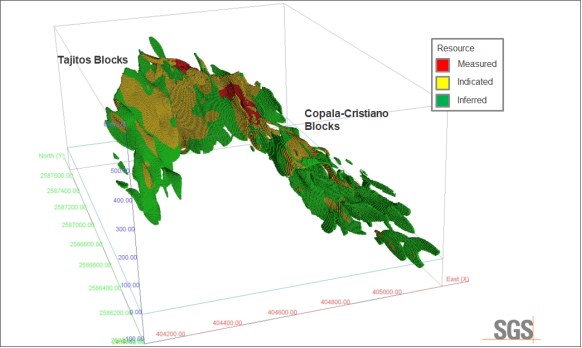
Source: SGS, 2024.
|
|
Figure 14-12 Plan View: Mineral Resource Block Grades and Block Class for the Napoleon, Cruz, Josephine and La Luisa Areas


Source: SGS, 2024.
|
|
Figure 14-13: Isometric View Looking Northwest: Mineral Resource Block Grades and Block Class for the Napoleon, Cruz, Josephine and La Luisa Areas


Source: SGS, 2024
|
|
Figure 14-14: Isometric View Looking NNE: Mineral Resource Block Grades and Block Class for the Napoleon, Cruz, Josephine and La Luisa Areas


Source: SGS, 2024.
|
|
14.12 Model Validation and Sensitivity Analysis
Visual checks of block grades against the composite data and assay data on vertical section showed good correlation between block grades and drill intersections.
A comparison of the average capped composite grades, average assay grades and average block model grades, by model/domain Table 14-11. The block model average grades compared well with the composite average grades.
For comparison purposes, additional grade models were generated using a varied inverse distance weighting (ID3) and nearest neighbour (NN) interpolation methods. The results of these models are compared to the chosen models (ID2) at various cut-off grades in a series of grade/tonnage graphs shown in
Figure 14-15 and Figure 14-16. In general, the ID2 and ID3 models show similar results, and both are much more conservative and smoother than the NN model. For models well-constrained by wireframes and well-sampled (close spacing of data), ID2 should yield very similar results to other interpolation methods such as ID3 or Ordinary Kriging.
Table 14-11: Comparison of Average Composite Grades with Block Model Grades
| Domain | Variable | Ag g/t | Au g/t | Pb ppm | Zn ppm |
| Copala Area: Copala, Tajitos and Cristiano | |||||
| Copala + Cristiano | Assays | 318 | 2.15 | 0.10 | 0.20 |
| Composites Capped | 222 | 1.44 | 0.07 | 0.14 | |
| Blocks | 184 | 1.16 | 0.07 | 0.13 | |
| Tajitos | Assays | 316 | 1.81 | 0.36 | 0.54 |
| Composites Capped | 252 | 1.57 | 0.13 | 0.25 | |
| Blocks | 269 | 1.63 | 0.18 | 0.32 | |
| Napoleon Area: Napoleon, Cruz, Josephine and La Luisa | |||||
| Napoleon_HW and _FW | Assays | 123 | 1.22 | 0.40 | 1.13 |
| Composites Capped | 61.4 | 0.62 | 0.15 | 0.58 | |
| Blocks | 75.7 | 0.74 | 0.20 | 0.76 | |
| Napoleon Main | Assays | 119 | 2.15 | 0.46 | 1.43 |
| Composites Capped | 97 | 1.54 | 0.36 | 1.14 | |
| Blocks | 84.3 | 1.25 | 0.37 | 1.21 | |
| Cruz | Assays | 217 | 3.24 | 0.24 | 1.45 |
| Composites Capped | 138 | 2.66 | 0.24 | 1.32 | |
| Blocks | 150 | 3.04 | 0.28 | 1.48 | |
| Josephine | Assays | 219 | 2.86 | 0.28 | 0.99 |
| Composites Capped | 31.0 | 0.39 | 0.08 | 0.24 | |
| Blocks | 74.4 | 0.69 | 0.14 | 0.38 | |
|
|
| Domain | Variable | Ag g/t | Au g/t | Pb ppm | Zn ppm |
| La Luisa | Assays | 121 | 2.14 | 0.33 | 1.12 |
| Composites Capped | 62.8 | 0.99 | 0.15 | 0.70 | |
| Blocks | 76.9 | 1.24 | 0.18 | 0.82 | |
| Animas Area: Cuevillas and Rosarito | |||||
| Animas | Assays | 119 | 1.17 | 0.23 | 0.67 |
| Composites Capped | 92.1 | 0.98 | 0.21 | 0.58 | |
| Blocks | 98.1 | 1.03 | 0.20 | 0.44 | |
| San Antonio Area: Generales | |||||
| San Antonio | Assays | 107 | 0.68 | 0.01 | 0.03 |
| Composites Capped | 96.1 | 0.64 | 0.01 | 0.03 | |
| Blocks | 49.2 | 0.26 | 0.01 | 0.02 | |
Figure 14-15: Comparison of ID3, ID2 & NN Models for the Napoleon-Josephine-Cruz Deposit Area

Source: SGS, 2024.
|
|
Figure 14-16: Comparison of ID3, ID2 & NN Models for the Copala-Cristiano Deposit Area
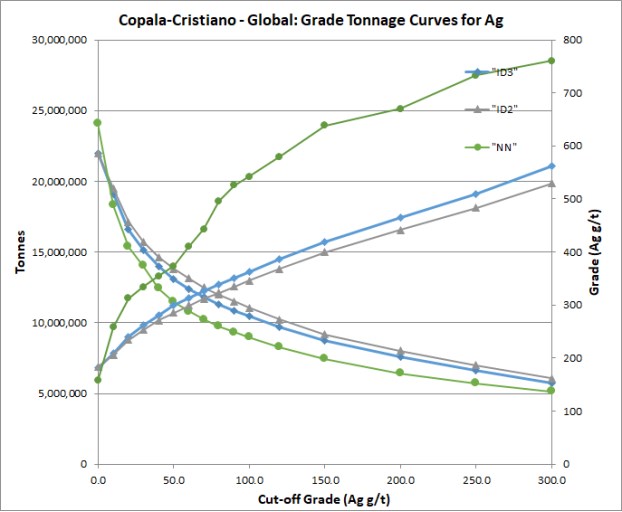
Source: SGS, 2024.
14.12.1 Sensitivity to Cut-off Grade
The Project Mineral Resources have been estimated at a range of cut-off grades presented in Table 14-12 to demonstrate the sensitivity of the resources to cut-off grades. The current Mineral Resources are reported at a base-case cut-off grade of 150 g/t AgEq (highlighted).
Note: Values in these tables reported above and below the base-case cut-off 150 g/t AgEq for underground Mineral Resources should not be misconstrued with a Mineral Resource Statement. The values are only presented to show the sensitivity of the block model estimates to the selection of the base case cut-off grade. All values are rounded to reflect the relative accuracy of the estimate and numbers may not add due to rounding.
|
|
Table 14-12: Underground Mineral Resource Estimate at Various AgEq Cut-off Grades, September 9, 2024
Copala
| Category | Cut-off Grade (AgEq g/t) |
Tonnes (Mt) |
Grade | Total Metal | ||||||||
| Au (g/t) |
Ag (g/t) |
Pb (%) |
Zn (%) |
AgEq (g/t) |
Au (koz) |
Ag (koz) |
Pb (Mlbs) |
Zn (Mlbs) |
AgEq (koz) |
|||
| Measured | 80 | 2.21 | 2.71 | 387 | 0.07 | 0.14 | 600 | 193 | 27,450 | 3.4 | 6.8 | 42,580 |
| 90 | 2.15 | 2.78 | 396 | 0.07 | 0.14 | 615 | 192 | 27,350 | 3.4 | 6.7 | 42,415 | |
| 100 | 2.10 | 2.84 | 405 | 0.07 | 0.14 | 627 | 191 | 27,256 | 3.3 | 6.6 | 42,258 | |
| 120 | 2.00 | 2.95 | 420 | 0.07 | 0.15 | 652 | 190 | 27,052 | 3.3 | 6.5 | 41,921 | |
| 150 | 1.88 | 3.09 | 442 | 0.08 | 0.15 | 684 | 187 | 26,744 | 3.2 | 6.3 | 41,418 | |
| 200 | 1.71 | 3.32 | 476 | 0.08 | 0.16 | 736 | 182 | 26,145 | 3.1 | 6.0 | 40,444 | |
| 250 | 1.57 | 3.52 | 506 | 0.08 | 0.16 | 782 | 178 | 25,508 | 2.9 | 5.6 | 39,421 | |
| 300 | 1.44 | 3.72 | 536 | 0.09 | 0.17 | 827 | 172 | 24,811 | 2.8 | 5.3 | 38,300 | |
| Indicated | 80 | 5.56 | 2.04 | 326 | 0.08 | 0.15 | 489 | 365 | 58,258 | 10.0 | 18.6 | 87,407 |
| 90 | 5.36 | 2.11 | 336 | 0.08 | 0.15 | 504 | 363 | 57,935 | 9.7 | 18.2 | 86,870 | |
| 100 | 5.16 | 2.17 | 347 | 0.08 | 0.16 | 520 | 360 | 57,561 | 9.5 | 17.8 | 86,262 | |
| 120 | 4.78 | 2.31 | 369 | 0.09 | 0.16 | 552 | 354 | 56,717 | 9.1 | 17.0 | 84,908 | |
| 150 | 4.29 | 2.50 | 402 | 0.09 | 0.17 | 600 | 345 | 55,374 | 8.4 | 15.8 | 82,781 | |
| 200 | 3.79 | 2.74 | 440 | 0.09 | 0.17 | 657 | 334 | 53,561 | 7.8 | 14.6 | 79,988 | |
| 250 | 3.33 | 2.98 | 480 | 0.10 | 0.18 | 716 | 319 | 51,414 | 7.2 | 13.3 | 76,677 | |
| 300 | 2.90 | 3.26 | 525 | 0.10 | 0.19 | 782 | 304 | 48,919 | 6.6 | 12.0 | 72,880 | |
| Inferred | 80 | 3.39 | 1.38 | 243 | 0.14 | 0.24 | 360 | 150 | 26,504 | 10.7 | 18.2 | 39,299 |
| 90 | 3.19 | 1.45 | 255 | 0.15 | 0.25 | 378 | 148 | 26,152 | 10.2 | 17.4 | 38,743 | |
| 100 | 3.02 | 1.51 | 266 | 0.15 | 0.25 | 394 | 146 | 25,821 | 9.9 | 16.6 | 38,222 | |
| 120 | 2.71 | 1.64 | 289 | 0.15 | 0.26 | 426 | 143 | 25,130 | 9.1 | 15.3 | 37,135 | |
| 150 | 2.32 | 1.83 | 322 | 0.16 | 0.27 | 476 | 137 | 24,014 | 8.3 | 13.8 | 35,452 | |
| 200 | 1.90 | 2.11 | 367 | 0.18 | 0.29 | 542 | 129 | 22,409 | 7.4 | 12.1 | 33,130 | |
| 250 | 1.55 | 2.42 | 414 | 0.19 | 0.31 | 614 | 120 | 20,606 | 6.6 | 10.7 | 30,583 | |
| 300 | 1.22 | 2.82 | 472 | 0.22 | 0.35 | 705 | 111 | 18,548 | 5.8 | 9.4 | 27,714 | |
|
|
Tajitos
| Category | Cut-off Grade (AgEq g/t) |
Tonnes (Mt) |
Au (g/t) |
Ag (g/t) |
Pb (%) |
Zn (%) |
AgEq (g/t) |
Au (koz) |
Ag (koz) |
Pb (Mlbs) |
Zn (Mlbs) |
AgEq (koz) |
| Indicated | 90 | 0.78 | 2.20 | 357 | 0.13 | 0.25 | 537 | 55 | 8,976 | 2.3 | 4.2 | 13,502 |
| 100 | 0.77 | 2.23 | 361 | 0.13 | 0.25 | 542 | 55 | 8,960 | 2.3 | 4.2 | 13,478 | |
| 120 | 0.75 | 2.27 | 368 | 0.14 | 0.25 | 553 | 55 | 8,910 | 2.3 | 4.2 | 13,397 | |
| 150 | 0.72 | 2.34 | 380 | 0.14 | 0.25 | 571 | 55 | 8,833 | 2.2 | 4.0 | 13,277 | |
| 200 | 0.66 | 2.50 | 406 | 0.14 | 0.26 | 609 | 53 | 8,599 | 2.1 | 3.8 | 12,911 | |
| 250 | 0.62 | 2.60 | 423 | 0.15 | 0.27 | 635 | 52 | 8,410 | 2.0 | 3.7 | 12,618 | |
| 300 | 0.57 | 2.72 | 442 | 0.15 | 0.28 | 663 | 50 | 8,146 | 1.9 | 3.5 | 12,213 | |
| Inferred | 90 | 1.02 | 1.87 | 313 | 0.25 | 0.42 | 477 | 61 | 10,232 | 5.6 | 9.4 | 15,614 |
| 100 | 0.99 | 1.91 | 319 | 0.25 | 0.42 | 486 | 61 | 10,185 | 5.5 | 9.2 | 15,536 | |
| 120 | 0.95 | 1.98 | 331 | 0.26 | 0.42 | 504 | 61 | 10,089 | 5.4 | 8.9 | 15,377 | |
| 150 | 0.89 | 2.08 | 346 | 0.27 | 0.43 | 527 | 60 | 9,936 | 5.2 | 8.5 | 15,132 | |
| 200 | 0.79 | 2.26 | 377 | 0.28 | 0.45 | 573 | 57 | 9,581 | 4.9 | 7.9 | 14,566 | |
| 250 | 0.62 | 2.60 | 446 | 0.29 | 0.47 | 669 | 52 | 8,907 | 4.0 | 6.4 | 13,354 | |
| 300 | 0.52 | 2.88 | 500 | 0.30 | 0.48 | 744 | 48 | 8,398 | 3.4 | 5.5 | 12,494 |
Cristiano
| Category | Cut-off Grade (AgEq g/t) |
Tonnes | Au (g/t) |
Ag (g/t) |
Pb (%) |
Zn (%) |
AgEq (g/t) |
Au (koz) |
Ag (koz) |
Pb (Mlbs) |
Zn (Mlbs) |
AgEq (koz) |
| Indicated | 90 | 0.41 | 3.31 | 551 | 0.23 | 0.42 | 824 | 43 | 7,213 | 2.0 | 3.8 | 10,784 |
| 100 | 0.40 | 3.37 | 561 | 0.23 | 0.43 | 839 | 43 | 7,200 | 2.0 | 3.7 | 10,763 | |
| 120 | 0.38 | 3.50 | 582 | 0.24 | 0.44 | 871 | 43 | 7,155 | 2.0 | 3.7 | 10,694 | |
| 150 | 0.36 | 3.67 | 610 | 0.25 | 0.45 | 912 | 43 | 7,102 | 2.0 | 3.6 | 10,614 | |
| 200 | 0.33 | 3.96 | 658 | 0.26 | 0.46 | 983 | 42 | 6,983 | 1.9 | 3.3 | 10,430 | |
| 250 | 0.30 | 4.28 | 708 | 0.27 | 0.47 | 1057 | 41 | 6,852 | 1.8 | 3.1 | 10,233 | |
| 300 | 0.28 | 4.55 | 750 | 0.28 | 0.48 | 1121 | 41 | 6,708 | 1.7 | 3.0 | 10,024 | |
| Inferred | 90 | 0.39 | 2.18 | 403 | 0.14 | 0.28 | 583 | 28 | 5,109 | 1.2 | 2.5 | 7,382 |
| 100 | 0.38 | 2.23 | 413 | 0.15 | 0.29 | 597 | 27 | 5,092 | 1.2 | 2.4 | 7,358 | |
| 120 | 0.36 | 2.35 | 435 | 0.15 | 0.30 | 628 | 27 | 5,032 | 1.2 | 2.4 | 7,273 | |
| 150 | 0.34 | 2.49 | 460 | 0.16 | 0.31 | 665 | 27 | 4,959 | 1.2 | 2.3 | 7,168 | |
| 200 | 0.30 | 2.72 | 501 | 0.17 | 0.33 | 724 | 26 | 4,820 | 1.1 | 2.1 | 6,964 | |
| 250 | 0.27 | 2.95 | 543 | 0.18 | 0.34 | 785 | 25 | 4,666 | 1.0 | 2.0 | 6,738 | |
| 300 | 0.24 | 3.16 | 581 | 0.18 | 0.34 | 839 | 24 | 4,502 | 1.0 | 1.8 | 6,498 |
|
|
Napoleon + Splays
|
Category |
Cut-off |
Tonnes |
Au |
Ag |
Pb |
Zn |
AgEq |
Au |
Ag |
Pb |
Zn |
AgEq |
|
Measured |
90 |
0.43 |
2.04 |
142 |
0.47 |
1.30 |
356 |
28 |
1,957 |
4.4 |
12.4 |
4,927 |
|
100 |
0.42 |
2.07 |
144 |
0.47 |
1.32 |
362 |
28 |
1,945 |
4.4 |
12.2 |
4,893 |
|
|
120 |
0.40 |
2.17 |
150 |
0.49 |
1.36 |
378 |
28 |
1,914 |
4.3 |
11.9 |
4,810 |
|
|
150 |
0.36 |
2.34 |
161 |
0.51 |
1.41 |
404 |
27 |
1,853 |
4.0 |
11.1 |
4,638 |
|
|
200 |
0.28 |
2.73 |
188 |
0.56 |
1.52 |
466 |
25 |
1,703 |
3.5 |
9.4 |
4,221 |
|
|
250 |
0.23 |
3.09 |
212 |
0.59 |
1.60 |
521 |
23 |
1,561 |
3.0 |
8.1 |
3,838 |
|
|
300 |
0.17 |
3.64 |
245 |
0.64 |
1.72 |
601 |
20 |
1,363 |
2.4 |
6.6 |
3,345 |
|
|
Indicated |
90 |
5.05 |
1.80 |
123 |
0.44 |
1.55 |
328 |
293 |
19,950 |
48.7 |
173.0 |
53,266 |
|
100 |
4.81 |
1.88 |
127 |
0.45 |
1.59 |
340 |
290 |
19,688 |
47.8 |
169.0 |
52,521 |
|
|
120 |
4.36 |
2.02 |
136 |
0.48 |
1.67 |
363 |
283 |
19,117 |
45.9 |
160.8 |
50,936 |
|
|
150 |
3.78 |
2.25 |
150 |
0.52 |
1.78 |
399 |
273 |
18,184 |
42.9 |
148.2 |
48,404 |
|
|
200 |
2.92 |
2.68 |
176 |
0.57 |
1.94 |
465 |
252 |
16,473 |
36.4 |
124.5 |
43,588 |
|
|
250 |
2.29 |
3.13 |
202 |
0.61 |
2.05 |
531 |
231 |
14,862 |
31.0 |
103.7 |
39,103 |
|
|
300 |
1.79 |
3.66 |
230 |
0.65 |
2.10 |
602 |
211 |
13,268 |
25.6 |
83.1 |
34,705 |
|
|
Inferred |
90 |
3.37 |
1.14 |
120 |
0.39 |
1.41 |
268 |
123 |
13,001 |
29.2 |
104.9 |
29,043 |
|
100 |
3.15 |
1.19 |
126 |
0.40 |
1.46 |
280 |
120 |
12,775 |
28.0 |
101.3 |
28,374 |
|
|
120 |
2.76 |
1.29 |
139 |
0.42 |
1.55 |
304 |
115 |
12,307 |
25.6 |
94.4 |
27,020 |
|
|
150 |
2.28 |
1.46 |
159 |
0.44 |
1.63 |
340 |
107 |
11,637 |
21.9 |
81.8 |
24,941 |
|
|
200 |
1.65 |
1.74 |
195 |
0.48 |
1.74 |
404 |
92 |
10,377 |
17.7 |
63.6 |
21,450 |
|
|
250 |
1.25 |
2.00 |
230 |
0.52 |
1.82 |
461 |
80 |
9,250 |
14.5 |
50.3 |
18,580 |
|
|
300 |
0.94 |
2.24 |
271 |
0.57 |
1.87 |
524 |
68 |
8,159 |
11.8 |
38.5 |
15,799 |
Napoleon_HW(4)
|
Category |
Cut-off |
Tonnes |
Au |
Ag |
Pb |
Zn |
AgEq |
Au |
Ag |
Pb |
Zn |
AgEq |
|
Indicated |
90 |
1.27 |
1.73 |
181 |
0.39 |
1.38 |
374 |
71 |
7,429 |
11.0 |
38.9 |
15,293 |
|
100 |
1.23 |
1.78 |
186 |
0.40 |
1.42 |
383 |
70 |
7,363 |
10.9 |
38.4 |
15,162 |
|
|
120 |
1.12 |
1.91 |
199 |
0.43 |
1.51 |
411 |
69 |
7,160 |
10.6 |
37.3 |
14,761 |
|
|
150 |
0.99 |
2.09 |
217 |
0.47 |
1.64 |
448 |
66 |
6,885 |
10.2 |
35.7 |
14,206 |
|
|
200 |
0.83 |
2.34 |
241 |
0.52 |
1.83 |
499 |
63 |
6,450 |
9.4 |
33.5 |
13,341 |
|
|
250 |
0.64 |
2.68 |
284 |
0.60 |
2.17 |
582 |
55 |
5,849 |
8.4 |
30.7 |
11,992 |
|
|
300 |
0.56 |
2.88 |
309 |
0.64 |
2.32 |
629 |
52 |
5,516 |
7.9 |
28.5 |
11,242 |
|
|
Inferred |
90 |
0.67 |
1.92 |
182 |
0.57 |
1.96 |
415 |
41 |
3,928 |
8.5 |
29.0 |
8,932 |
|
100 |
0.64 |
1.98 |
188 |
0.59 |
2.01 |
428 |
41 |
3,895 |
8.4 |
28.6 |
8,844 |
|
|
120 |
0.62 |
2.05 |
195 |
0.61 |
2.07 |
443 |
41 |
3,860 |
8.3 |
28.1 |
8,753 |
|
|
150 |
0.59 |
2.12 |
202 |
0.64 |
2.15 |
458 |
40 |
3,800 |
8.2 |
27.7 |
8,619 |
|
|
200 |
0.35 |
2.79 |
289 |
0.95 |
3.33 |
646 |
32 |
3,284 |
7.4 |
26.0 |
7,359 |
|
|
250 |
0.32 |
2.96 |
312 |
1.03 |
3.59 |
695 |
30 |
3,183 |
7.2 |
25.1 |
7,083 |
|
|
300 |
0.30 |
3.06 |
327 |
1.08 |
3.76 |
724 |
29 |
3,109 |
7.0 |
24.5 |
6,894 |
|
|
Josephine
|
Category |
Cut-off |
Tonnes |
Au |
Ag |
Pb |
Zn |
AgEq |
Au |
Ag |
Pb |
Zn |
AgEq |
|
Indicated |
90 |
0.07 |
2.42 |
220 |
0.37 |
1.05 |
451 |
5 |
467 |
0.5 |
1.5 |
958 |
|
100 |
0.07 |
2.44 |
222 |
0.37 |
1.06 |
456 |
5 |
464 |
0.5 |
1.5 |
952 |
|
|
120 |
0.06 |
2.47 |
224 |
0.37 |
1.06 |
461 |
5 |
462 |
0.5 |
1.5 |
948 |
|
|
150 |
0.06 |
2.54 |
230 |
0.38 |
1.09 |
473 |
5 |
452 |
0.5 |
1.5 |
928 |
|
|
200 |
0.06 |
2.63 |
238 |
0.40 |
1.12 |
489 |
5 |
444 |
0.5 |
1.4 |
912 |
|
|
250 |
0.06 |
2.72 |
246 |
0.40 |
1.14 |
505 |
5 |
434 |
0.5 |
1.4 |
892 |
|
|
300 |
0.05 |
2.84 |
255 |
0.41 |
1.13 |
523 |
5 |
418 |
0.5 |
1.3 |
858 |
|
|
Inferred |
90 |
0.30 |
1.41 |
143 |
0.28 |
0.81 |
287 |
13 |
1,374 |
1.8 |
5.3 |
2,750 |
|
100 |
0.28 |
1.48 |
149 |
0.29 |
0.85 |
300 |
13 |
1,337 |
1.8 |
5.2 |
2,698 |
|
|
120 |
0.25 |
1.62 |
158 |
0.31 |
0.91 |
323 |
13 |
1,269 |
1.7 |
5.0 |
2,593 |
|
|
150 |
0.21 |
1.81 |
176 |
0.34 |
1.01 |
360 |
12 |
1,180 |
1.6 |
4.6 |
2,406 |
|
|
200 |
0.17 |
1.98 |
197 |
0.38 |
1.15 |
400 |
11 |
1,092 |
1.5 |
4.3 |
2,210 |
|
|
250 |
0.15 |
2.10 |
212 |
0.40 |
1.21 |
427 |
10 |
1,016 |
1.3 |
4.0 |
2,045 |
|
|
300 |
0.13 |
2.22 |
230 |
0.42 |
1.27 |
456 |
9 |
925 |
1.2 |
3.5 |
1,833 |
Cruz
|
Category |
Cut-off |
Tonnes |
Au |
Ag |
Pb |
Zn |
AgEq |
Au |
Ag |
Pb |
Zn |
AgEq |
|
Indicated |
90 |
0.04 |
1.83 |
130 |
0.33 |
1.77 |
341 |
2 |
163 |
0.3 |
1.5 |
428 |
|
100 |
0.04 |
1.86 |
131 |
0.33 |
1.80 |
346 |
2 |
165 |
0.3 |
1.5 |
434 |
|
|
120 |
0.04 |
1.92 |
137 |
0.35 |
1.89 |
360 |
2 |
158 |
0.3 |
1.5 |
417 |
|
|
150 |
0.03 |
2.01 |
145 |
0.38 |
2.01 |
380 |
2 |
154 |
0.3 |
1.5 |
403 |
|
|
200 |
0.03 |
2.17 |
159 |
0.43 |
2.22 |
415 |
2 |
148 |
0.3 |
1.4 |
387 |
|
|
250 |
0.03 |
2.22 |
162 |
0.45 |
2.31 |
426 |
2 |
141 |
0.3 |
1.4 |
370 |
|
|
300 |
0.03 |
2.25 |
163 |
0.45 |
2.37 |
431 |
2 |
137 |
0.3 |
1.4 |
361 |
|
|
Inferred |
90 |
0.36 |
3.50 |
168 |
0.30 |
1.61 |
500 |
40 |
1,921 |
2.3 |
12.6 |
5,704 |
|
100 |
0.35 |
3.51 |
169 |
0.30 |
1.61 |
501 |
40 |
1,919 |
2.3 |
12.6 |
5,702 |
|
|
120 |
0.35 |
3.53 |
170 |
0.30 |
1.62 |
504 |
40 |
1,914 |
2.3 |
12.5 |
5,688 |
|
|
150 |
0.35 |
3.58 |
171 |
0.30 |
1.64 |
510 |
40 |
1,907 |
2.3 |
12.5 |
5,676 |
|
|
200 |
0.32 |
3.78 |
179 |
0.32 |
1.71 |
537 |
39 |
1,843 |
2.3 |
12.1 |
5,521 |
|
|
250 |
0.28 |
4.12 |
189 |
0.35 |
1.82 |
578 |
38 |
1,723 |
2.2 |
11.4 |
5,256 |
|
|
300 |
0.26 |
4.41 |
196 |
0.37 |
1.92 |
609 |
36 |
1,609 |
2.1 |
10.8 |
5,015 |
|
|
La Luisa
|
Category |
Cut-off |
Tonnes |
Au |
Ag |
Pb |
Zn |
AgEq |
Au |
Ag |
Pb |
Zn |
AgEq |
|
Indicated |
90 |
0.69 |
1.70 |
114 |
0.25 |
1.18 |
292 |
37 |
2,520 |
3.8 |
17.9 |
6,451 |
|
100 |
0.65 |
1.76 |
118 |
0.26 |
1.22 |
303 |
37 |
2,483 |
3.7 |
17.6 |
6,355 |
|
|
120 |
0.57 |
1.91 |
129 |
0.28 |
1.33 |
330 |
35 |
2,376 |
3.6 |
16.7 |
6,062 |
|
|
150 |
0.49 |
2.12 |
143 |
0.31 |
1.44 |
364 |
33 |
2,238 |
3.3 |
15.4 |
5,693 |
|
|
200 |
0.39 |
2.39 |
164 |
0.35 |
1.59 |
412 |
30 |
2,046 |
3.0 |
13.7 |
5,157 |
|
|
250 |
0.33 |
2.58 |
179 |
0.37 |
1.73 |
447 |
27 |
1,886 |
2.7 |
12.5 |
4,717 |
|
|
300 |
0.27 |
2.76 |
195 |
0.40 |
1.87 |
483 |
24 |
1,707 |
2.4 |
11.2 |
4,223 |
|
|
Inferred |
90 |
3.73 |
1.84 |
111 |
0.25 |
1.12 |
298 |
221 |
13,327 |
20.5 |
91.9 |
35,759 |
|
100 |
3.56 |
1.91 |
115 |
0.26 |
1.14 |
308 |
219 |
13,115 |
20.2 |
89.8 |
35,241 |
|
|
120 |
3.26 |
2.03 |
121 |
0.27 |
1.19 |
326 |
213 |
12,723 |
19.4 |
85.6 |
34,179 |
|
|
150 |
2.83 |
2.24 |
132 |
0.28 |
1.24 |
355 |
204 |
12,049 |
17.8 |
77.5 |
32,307 |
|
|
200 |
2.21 |
2.60 |
152 |
0.31 |
1.33 |
406 |
184 |
10,794 |
15.1 |
64.9 |
28,817 |
|
|
250 |
1.74 |
2.94 |
172 |
0.34 |
1.39 |
455 |
164 |
9,649 |
12.9 |
53.4 |
25,446 |
|
|
300 |
1.38 |
3.28 |
191 |
0.35 |
1.43 |
502 |
146 |
8,484 |
10.8 |
43.6 |
22,262 |
14.13 Comparison of the Current MRE to the September 2023 MRE
The current MRE is compared to the September 1, 2023, MRE for the Project (Table 14-13).
The main difference in the resource estimates is the result of the additional drilling completed by Vizsla between September 2023 and September 2024, completed in the Napoleon-Josephine-Luisa and Tajitos-Copala deposit areas. The additional drilling resulted in the discovery of an additional vein structure in the Luisa area, extension of existing vein structures down dip/plunge and along strike and increased confidence in the existing resource resulting in an increase in Indicated resources and addition of Measured resources.
Highlights of the Updated MRE, including a comparison to the previous mineral resource estimate released in September 2023:
Added 46 Moz AgEq in Measured resources and 176 Moz AgEq in Indicated resources
43% increase in Measured and Indicated mineral resources from 155.8 to 222.4 Moz AgEq
9.4% increase in Measured and Indicated grade at Copala (580 g/t to 635 g/t AgEq)
4.5% increase in global Indicated grade (511 g/t to 534 g/t AgEq)
18% decrease in Inferred mineral resources from 169.6 to 138.7 Moz AgEq mostly due to conversion to Indicated resources
4.9% decrease in inferred grade (433 g/t to 412 g/t AgEq).
|
|
Table 14-13: Comparison of September 9, 2024, MRE to September 1, 2023, MRE for the Project
|
Resource Class |
1 Updated MRE |
2 Previous MRE |
Variance |
|||
|
M&I |
Inferred |
Indicated |
Inferred |
M&I |
Inferred |
|
|
Tonnes (Mt) |
12.96 |
10.50 |
9.50 |
12.20 |
3.46 |
-1.70 |
|
Au g/t |
2.49 |
1.96 |
2.41 |
1.93 |
0.08 |
0.03 |
|
Ag g/t |
307 |
219 |
289 |
239 |
17.84 |
-20.28 |
|
Pb % |
0.27 |
0.30 |
0.27 |
0.29 |
0.00 |
0.01 |
|
Zn % |
0.85 |
1.01 |
0.84 |
1.03 |
0.01 |
-0.02 |
|
AgEq (g/t) |
534 |
412 |
511 |
433 |
22.81 |
-21.13 |
|
AuEq (g/t) |
6.58 |
4.91 |
6.81 |
5.76 |
-0.23 |
-0.85 |
|
Au (koz) |
1,036 |
660 |
736 |
758 |
300 |
-98 |
|
Ag (koz) |
127,819 |
73,621 |
88,192 |
93,653 |
39,627 |
-20,032 |
|
Pb (kt) |
34.9 |
31.2 |
56.0 |
35.4 |
-21 |
-4 |
|
Zn (kt) |
110.2 |
106.2 |
79.9 |
125.3 |
30 |
-19 |
|
1AgEq (koz) |
222,362 |
138,711 |
155,841 |
169,647 |
66,521 |
-30,936 |
|
2AuEq (koz) |
2,739 |
1,654 |
2,076 |
2,261 |
663 |
-607 |
1. Metal price assumptions are $26.00/oz silver, $1,975/oz gold, $2,425/t lead and $2,976/t zinc.
2. Metal price assumptions are $24.00/oz silver, $1,800/oz gold, $2,425/t lead and $2,976/t zinc.
14.14 Disclosure
All relevant data and information regarding the Project are included in other sections of this Technical Report. There is no other relevant data or information available that is necessary to make the technical report understandable and not misleading.
The Authors are not aware of any known mining, processing, metallurgical, environmental, infrastructure, economic, permitting, legal, title, taxation, socio-political, or marketing issues, or any other relevant factors not reported in this technical report, which could materially affect the updated MRE.
|
|
15 MINERAL RESERVE ESTIMATES
15.1 Introduction
The Mineral Reserve Estimate for the Panuco underground mine was completed to a level appropriate to support the project's Feasibility Study. The Mineral Reserve Estimate is prepared using only Measured and Indicated resources contained in the four Mineral Resource block models. Inferred resource material was treated as zero grade, and is included as waste dilution, and makes up less than 1.5% of the Mineral Reserve tonnage. The Mineral Reserve Estimate is supported by a life-of-mine plan that was prepared using a combination of longhole stoping and drift & fill mining methods. The mine design was prepared using Deswik Stope Optimizer® tool (SO) optimization algorithm and an underground development design for Copala, Tajitos, Napoleon, La Luisa zones.
15.2 Estimation Procedure
A process was followed to convert Measured and Indicated Mineral Resources into Mineral Reserves which is supported by the mine design, schedule, economic evaluation and other modifying factors completed by Mining Plus. The relevant inputs and general conversion process to determine the economically mineable portion of the Panuco deposit is described in the following sections.
15.2.1 Mineral Resource Model
The Mineral Resource block models were prepared by SGS and were provided as sub-blocked models in Datamine format. Four Mineral Resource block models were used to prepare the Mineral Reserve Estimate shown in Table 15-1.
Table 15-1: Mineral Resource Models
| Zone | Model Name | Release Date |
| Copala | Copala_Cristiano Blocks_Final_Global_2025.dm | April 7, 2025 |
| Tajitos | TajitosBlocks_Final_2025.dm | April 7, 2025 |
| Napoleon | Napoleon_Joseph_Cruz Blocks_Final_Global_2025.dm | April 7, 2025 |
| La Luisa | LuisaBlocks_Final_2025.dm | April 7, 2025 |
15.2.2 Net Smelter Return Revenue Model
A Net Smelter Return (NSR) revenue model was prepared using gold and silver as the saleable products and excludes any revenue from base metals (Lead and Zinc). The model was based on the inputs and factors listed in Table 15-2. The sum of each payable metals' unit revenue factor was used estimate the NSR value of each cell in the block model.
|
|
Table 15-2: NSR Parameters and AgEq Grade Factors
| Parameter | Unit | Value |
| Ag Price | US$/oz | 28.50 |
| Au Price | US$/oz | 2,300 |
| Ag Process Recovery1 | % | 75 - 96 |
| Au Process Recovery1 | % | 82 - 96 |
| Ag Payable | % | 99.9 |
| Au Payable | % | 99.85 |
| Product Freight | US$/t | 3,000 |
| Ag Refining Charge | US$/oz | 0.50 |
| Au Refining Charge | US$/oz | 5.00 |
| Royalty2 | % | 2.0% and 3.5% |
| Payable Revenue Ag Copala/Tajitos3 | US$/g | 0.8027 |
| Payable Revenue Ag Napoleon 3.5%4 | US$/g | 0.8162 |
| Payable Revenue Ag Napoleon 2.0%4 | US$/g | 0.8289 |
| Payable Revenue Au Copala/Tajitos3 | US$/g | 66.2536 |
| Payable Revenue Au Napoleon 3.5%4 | US$/g | 67.7202 |
| Payable Revenue Au Napoleon 2.0%4 | US$/g | 68.7728 |
| Silver Equivalent Copala and Tajitos | g Ag/ g Au | 82.538 |
| Silver Equivalent Napoleon 3.5% | g Ag/ g Au | 82.970 |
| Silver Equivalent Napoleon 2.0% | g Ag/ g Au | 82.969 |
Notes:
1. The block model NSR value was calculated on an individual block basis using interim Phase 2 process recovery formulas for each zone. Copala/Tajitos Ag process recovery = 1.56*ln(Ag g/t) + 83.9)/100 and Copala/Tajitos Au process recovery = 1.96*ln(Ag g/t) + 91.4)/100. Napoleon/Luisa Ag process recovery = 8.8*ln(Ag g/t) + 44)/100 and Napoleon/Luisa Au process recovery = 1.7*ln(Ag g/t) + 93.7)/100.
2. The 2.0% royalty zone applies to a portion of the Napoleon deposit.
3. Payable unit revenue per gram based on a process recovery of 93% for Ag and 93% for Au.
4. Payable unit revenue per gram based on a process recovery of 94% for Ag and 95% for Au.
15.2.3 Mining Method
Panuco's Mineral Reserve Estimate is based on two different mining methods - drift-and-fill (DAF) and longhole stoping (LHS). DAF is applied to the north end of the Copala zone, which lies directly under the village of Copala, and is comprised of moderately dipping mineralized structures. Longhole stoping was selected for the remainder of the deposit as it is not limited by environmental or surface physical constraints.
15.2.4 Preliminary Cut-off Value
Fully costed cut-off values (COV) used in the design and scheduling process are based on preliminary revenue inputs and costs as stated in Table 15-2 and Table 15-3, respectively.
|
|
The preliminary fully costed cut-off value for longhole stoping was estimated at US$100.00/t and that for drift and fill mining was estimated at US$120.00/t including mining, processing, G&A and sustaining capital costs. A lower marginal cut-off value of US$28.00/t was used for development ore that must be mined to access scheduled production zones.
Table 15-3: Preliminary Operating Cost Estimate and NSR Cut-off Values
| Total Cost - Fully Costed NSR COV | Unit | LHS | DAF |
| Mining | US$/t | 61.00 | 81.00 |
| Production | US$/t | 23.00 | 46.00 |
| Backfill | US$/t | 7.00 | 10.00 |
| Operational Development | US$/t | 21.00 | 15.00 |
| Mining Sustaining | US$/t | 10.00 | 10.00 |
| Processing | US$/t | 31.70 | 31.70 |
| Processing variable | US$/t | 17.00 | 17.00 |
| Processing fixed | US$/t | 3.70 | 3.70 |
| Plant & Infrastructure Sustaining | US$/t | 9.50 | 9.50 |
| Tailings Expansion (Sustaining) | US$/t | 1.50 | 1.50 |
| Site G&A | US$/t | 7.30 | 7.30 |
| Total NSR Cut-off Value | US$/t | 100.00 | 120.00 |
| Ore Development Marginal NSR Cut-off Value | US$/t | 28.00 | |
15.2.5 Mine Plan & Modifying Factors
Mineable shapes were generated using the Deswik SO algorithm. The Mineral Resource block model NSR fields were calculated so that modelled grades and associated revenue from Inferred material were set to zero. Mineable shapes were generated above the fully costed cut-off value for each mining method, based only on the revenue from Measured and Indicated material. Any Inferred material that was included in the mining shape or in the mine plan is treated as waste dilution, with no grade associated with it. The total Inferred material in the Mineral Reserve is less than 2%.
Unplanned dilution was added during the Deswik SO stage as Equivalent Linear Overbreak Slough (ELOS). ELOS for long hole is variable and considers the relevant geotechnical information for each orebody as well as the geometry of the stope (see Table 15-4). The minimum unplanned dilution included in the SO process was evaluated with the Mineral Resource models and may carry grade. Drift and Fill was assumed as bottom-up in all cases using an ore sill width of 5.0 m as a minimum mining width inclusive of dilution. Dilution within SO outputs was estimated at 36% and additional unplanned dilution of 2% was added for backfill dilution in long hole stopes. Internal dilution in DAF mining within the mining shape was estimated at 31% and additional backfill dilution in DAF was estimated at 5%. The raw SO stope outputs were reviewed for practicality of mining and certain zones such as crown pillars, satellite and orphan stopes were excluded. In particular, an extended crown pillar area was excluded in Copala North due to the proximity to the town of Copala. This zone will require drift and fill mining methods to be applied with special consideration to blasting techniques and timing to control the resulting vibration transmitted to surface.
|
|
A mine design and a life-of-mine (LOM) plan were developed using a viable design, extraction sequence and reasonable productivity assumptions in Deswik. Modifying factors were applied to the production shapes including backfill dilution and mining recovery factors based on geotechnical recommendations, mining sequence and operational benchmarks. Stope shapes were depleted with development drives. The Copala mine ramp and 460 level access design was removed from the schedule to reflect the planned Test Mine development advance which has the ramp access completed to the 460 level and a portion of Copala Main 460 level mined out as part of a bulk sample permit. The life-of-mine plan was subsequently subject to an economic assessment, and the economic material was aligned to the final applied COV's.
The principal modifying factors that were applied to the mine plan are summarised in Table 15-4.
Table 15-4: Mine Design Parameters and Modifying Factors
| Parameter | Long hole | Drift & Fill |
| Minimum Mining Width | Copala Main Lens: 3.0 m Napoleon Main Lens: 2.0 m Other Domains: 1.5 m |
5.0 m |
| Mining Dilution (ELOS)1 | Copala & Tajitos: 0.26 - 0.36 m Napoleon: 0.26 - 0.80 m La Luisa: 0.91 m |
0 m |
| Level/Cut Vertical Spacing | Copala Main, Copala South & Napoleon South: 15 m Other Zones: 20 m |
5.0 m |
| Mining Dilution (Backfill) | 5% | 5% |
| Mining Recovery | Average: 94% | 100% |
| Development Rate | Ore: 1.75 m/d per heading Waste: 3.5 m/d per heading Peak Total: 42 m/d |
1.75 m/d per heading Peak Total: 17 m/d |
| Drilling Rate | 200 m/d per drill | - |
| Mucking Rate | 300 - 600 t/d | 400 - 600 t/d |
| Rock/CRF Fill Rate | 200 - 300 cu. m3/d | 200 - 300 m3/d |
| Paste Fill Rate | 600-750 m3/d | - |
Notes: 1. ELOS is based on relevant geotechnical and stope geometry properties and is variable by zone.
15.2.6 Final Economic Analysis
Once the mine design and schedule were complete and the relevant cost inputs were sourced, a final economic model was developed and the overall operation assessed for economic viability.
Final calculated unit costs by mining method based on the economic model are summarised in Table 15-5.
|
|
Table 15-5: Calculated Unit Cost Summary by Cut-off Value Type
| Total Unit Cost by Cut-off Value | Unit | LHS | DAF |
| Mining | US$/t milled | 70.44 | 94.05 |
| Production | US$/t milled | 25.34 | 65.79 |
| Backfill | US$/t milled | 6.87 | 6.87 |
| Operational Development | US$/t milled | 17.72 | 0.88 |
| Mining Sustaining | US$/t milled | 20.51 | 20.51 |
| Processing | US$/t milled | 28.32 | 28.32 |
| Processing | US$/t milled | 24.51 | 24.51 |
| TSF | US$/t milled | 0.33 | 0.33 |
| Plant, TSF & Infrastructure Sustaining | US$/t milled | 2.26 | 2.26 |
| Plant Expansion Sustaining | US$/t milled | 1.22 | 1.22 |
| Site G&A | US$/t milled | 6.96 | 6.96 |
| Total Cost - Fully Costed | US$/t milled | 105.72 | 129.33 |
| Total Cost - Incremental | US$/t milled | 81.73 | 105.34 |
| Total Cost - Marginal | US$/t milled | 31.80 | |
The final applied NSR cut-off values applied to the Mineral Reserve Estimate are summarised in Table 15-6. Variance between these final values and the preliminary values used in the mine design and schedule are within the accuracy level required for this study.
Table 15-6: Cut-off Value Applied by Type
| Applied NSR Cut-off Value | Unit | LHS | DAF |
| Fully Costed | US$/t milled | 105.72 | 129.33 |
| Incremental | US$/t milled | 87.00 | 110.00 |
| Marginal | US$/t milled | 33.00 | 33.00 |
There were three COV's used to assess mining at Panuco and the inclusion of Mineral Resource into the Proven and Probable Mineral Reserve: A Fully Costed COV, an Incremental COV and the Marginal COV.
The Fully Costed COV represents the break-even value of Mineral Reserve required to cover all the associated operating and sustaining capital costs of extraction and processing. Fully costed COVs were initially assumed for Panuco at US$100.00 /t for LHS and US$120.00/t for DAF. Following the completion of the financial model the Fully Costed COV was calculated at US$105.72 for LHS and US$129.33 /t for DAF.
The Incremental COV of US$ 87.00 /t for LHS and US$ 110.00 /t for DAF was applied in areas where development had already been completed, and no additional capital was required to access new stoping blocks. The Incremental COV includes the assumption that the material value exceeds the costs of the operational costs which include mining, processing and G&A, and does not include sustaining capital costs. The Incremental COV applied was elevated slightly compared to the calculated costs to reduce the effect of near cut-off stoping material and improve the overall mining sequence. Less than 1% of the AgEq ounces attributed to LH stoping and less than 2% of the AgEq ounces attributed to DAF are between the Incremental COV and the Fully Costed COV.
|
|
The Marginal COV of US$33.00 /t was applied to development when the operation has committed to the preparation of stoping or DAF blocks, and the material must be mined in order to access a production area. The Marginal COV includes the assumption that the material value exceeds the costs of the incremental processing, and G&A and does not include any operational mining or sustaining capital costs. The Marginal COV applied was elevated slightly when compared to the calculated cost, to remove the risk of overstating marginal tonnes in the Mineral Reserve.
15.3 Mineral Reserves Statement
The Proven and Probable Mineral Reserve for the Panuco project is estimated at 12.81 Mt at an average grade of 249 g/t Ag and 2.01 g/t Au or 416 g/t AgEq, as summarised in Table 15-7.
Table 15-7: Panuco Mineral Reserve Estimate
| Classification | Grade | Contained Metal | |||||
| (kt) | Ag (g/t) | Au (g/t) | AgEq (g/t) | Ag (koz) | Au (koz) | AgEq (koz) | |
| Proven | 1,948 | 308 | 2.35 | 502 | 19,264 | 147 | 31,424 |
| Probable | 10,854 | 239 | 1.95 | 400 | 83,351 | 681 | 139,687 |
| Planned Stockpile | |||||||
| Proven | 4 | 330 | 3.70 | 635 | 41 | 0.5 | 82 |
| Probable | 3 | 318 | 2.90 | 558 | 34 | 0.3 | 54 |
| Total Proven + Probable | 12,809 | 249 | 2.01 | 416 | 102,689 | 829 | 171,246 |
Notes:
1. The Mineral Reserve is estimated using the 2019 CIM Estimation of Mineral Resources & Mineral Reserves Best Practice Guidelines and 2014 CIM Definition Standards for Mineral Resources & Mineral Reserves.
2. Mineral Reserves are based on Measured and Indicated Mineral Resource Classifications only.
3. The Mineral Reserve was calculated using long-term metal prices of US$28.50/oz Ag, US$ 2,300/oz Au.
4. The block model NSR value was calculated on an individual block basis using interim Phase 2 process recovery formulas for each zone. Copala/Tajitos Ag process recovery 1.56*ln(Ag g/t) + 83.9)/100 and Copala/Tajitos Au process recovery 1.96*ln(Ag g/t) + 91.4)/100. Napoleon/Luisa Ag process recovery 8.8*ln(Ag g/t) + 44)/100 and Napoleon/Luisa Au process recovery 1.7*ln(Ag g/t) + 93.7)/100.
5. The Mineral Reserve is estimated using three NSR cut-off values (COV). A Fully Costed COV was calculated at US$105.72 for LHS and US$123.33/t for DAF, an Incremental COV of US$ 87.00 /t for LHS and US$ 110.00 /t for DAF and a Marginal COV of US$33.00/t applied to development that must be mined to access production areas.
6. The Planned Stockpile is anticipated to be mined from the Copala orebody as part of the ongoing Morgan Test Mine bulk sample activities prior to the start of the Feasibility Study mine schedule. The Planned Stockpile does not currently exist on surface as of the Effective Date of the Technical Report and remains classified as Mineral Reserves.
7. Royalty rates of 3.5% and 2.0% were applied to the deposit based on royalty boundaries. The 2.0% royalty boundary only affects a portion of the Napoleon deposit.
8. AgEq (g/t) = (Ag(g/t) + 82.54*Au(g/t)) for Copala & Tajitos and AgEq = (Ag(g/t) + 82.97*Au(g/t)) for Napoleon & Luisa at 3.5% royalty and AgEq = (Ag(g/t) + 82.97*Au(g/t)) for Napoleon at 2% royalty. AgEq is expressed based on a number of revenue factors. See Table 15-2 for a complete list of inputs used to calculate NSR and AgEq factors.
9. Mining recovery between 90% to 100% is applied to the estimate depending on the mining method and is reduced in some areas based on geotechnical guidelines or mining sequence. Mining recovery averages 96% for the overall project.
10. The Mineral Reserve includes both planned and unplanned dilution. Unplanned dilution includes dilution from overbreak, backfill and material handling. Dilution within SO outputs was estimated at 36% and additional unplanned dilution of 2% was added for backfill dilution in long hole stopes. Internal dilution in DAF mining within the mining shape was estimated at 31% and additional backfill dilution in DAF was estimated at 5%.
|
|
11. For LHS, a minimum mining width of 1.5 meters was used excluding overbreak and unplanned dilution, and for DAF, a minimum mining width of 5.0 meters was used.
12. The economic viability of the Mineral Reserve is demonstrated using a discounted cash flow model.
13. The independent and qualified person for the Mineral Reserve, as defined by NI 43-101, is Mr. Jason Blais, P.Eng., Principal Mining Consultant for Mining Plus Canada Consulting Ltd.
14. The effective date of the Mineral Reserve Estimate is November 04, 2025
15. Totals may not add up due to rounding.
15.4 Factors That May Affect Mineral Reserves
Mineral Reserve estimation uses industry-accepted practices, and the estimate is reported using the 2014 CIM Definition Standards and the 2019 CIM Estimation of Mineral Resources and Mineral Reserves Best Practice Guidelines.
Mineral Reserves were converted from Measured and Indicates Resources and do not include any metal contribution from Inferred Mineral Resources.
A number of inputs and assumptions were used to prepare Mineral Reserve Estimate, and a change to any of the inputs or assumptions could impact the estimate. Fundamental factors that might affect the Mineral Reserve Estimate include the following:
Changes in geological complexity or information including geological interpretation, grade estimates, and structure.
Due to improved long-term pricing forecasts over the course of the feasibility study, the final metal prices used in the economic evaluation are higher than the Mineral Reserve pricing. The economic evaluation uses $35.50/oz Ag and $3,100/oz Au which may cause the overall Mineral Reserve to be understated relative to the pricing used which is $28.50/oz Ag and $2,300/oz Au.
Changes to geotechnical assumptions including geotechnical constraints and dilution.
Change in market conditions such as commodity prices, taxation and foreign exchange rates.
Operating cost assumptions.
Change in sustaining capital costs to develop mine.
Change in hydrogeological assumptions.
Lower than planned mining recovery or metallurgical process recovery.
Not achieving planned underground operational efficiency and productivity levels.
The independent qualified person is not aware of any known environmental, permitting, taxation, legal, title-related, socio-political or marketing issues, or any other relevant issue that could materially affect the Mineral Reserve Estimate.
|
|
16 MINING METHODS
16.1 Introduction
The Panuco Project comprises a series of silver-gold vein-type deposits located within the Panuco mining district in Sinaloa, Mexico. The deposits extend from surface to depths greater than 800 m and range in thickness from approximately 1.5 m to over 20 m. While some mineralized zones occur near surface, the combination of the deposit geometry, vertical extent, and local topography supports the selection of underground mining as the primary extraction method. Based on the current geotechnical evaluations, and with the objective of maximizing mining recovery while minimizing dilution, the selected mining methods for the project include a combination of longitudinal long hole stoping (LHS), cut-and-fill (CAF), and drift-and-fill (DAF). These methods will be supported by the use of cemented rock fill (CRF), unconsolidated rock fill, and paste backfill, applied according to the geotechnical conditions and production requirements of each specific mining zone.
16.2 Geotechnical and Hydrogeological Considerations
16.2.1 Hydrogeology Considerations
For this Feasibility Study, mine water pumping requirements from groundwater inflows were modelled to be between 11-41 L/s throughout the life of the project and are shown to increase relative to the amount of mine development and stoping that is completed. The underground hydrogeology and estimated mine inflows are further discussed in Section 18.12.
16.2.2 Geotech Drilling - Collected Data
A geotechnical drilling campaign was executed between October 2023 and January 2024. A total of 11 oriented HQ3 boreholes (six in the Napoleon deposit and five in the Copala deposit) were completed. An FS-Level geotechnical drilling program was completed in between May 2025 and August 2025. A total of 29 oriented boreholes (including an additional 5 for surface-to-underground raises) were completed for this program.
Detailed geotechnical logging was conducted on-rig by Vizsla staff. QA/QC was completed by a Vizsla Site Senior staff member at the Panuco core facility. Core was typically recovered in triple-tube HQ3. The drill core was oriented using the DeviCore BBT orientation tool from Devico. Oriented data collection was completed for the entire run of each drillhole, where possible. Drillholes were surveyed for deviation at 50 m intervals during hole advance using the DeviShot tool from Devico.
Information on the Rock Quality Designation ("RQD"), Point Load Testing ("PLT") and detailed descriptions of major faults has been documented and reviewed for this study. The quantity of holes and the type of data collected is summarised in Table 16-1 below. A more detailed review of the geotechnical holes completed in 2025 and 2023 is summarised in Table 16-2, Table 16-3 and Table 16-4, below.
|
|
Table 16-1: Geotechnical Logged Drillholes to Date
| Deposit | # of holes drilled | Holes with RQD Data | Holes with PLT Data | # of Geotechnical Holes |
| Copala | 150 | 148 | 57 | 19 |
| Tajitos | 218 | 212 | 5 | 2 |
| Napoleon + Josephine | 360 | 356 | 39 | 22 |
| La Luisa | 51 | 51 | 29 | 2 |
Table 16-2: 2025 Geotechnical Drillhole Details
| Planned Drillhole ID |
Drillhole ID | Collar Location1 | Dip | Azimuth | Final Depth |
Core Size |
From - To |
Oriented Core |
||
| Easting | Northing | Elevation | From - To | |||||||
| (m) | (m) | (m) | (°) | (°) | (m) | (m) | (m) | |||
| DDH-CAP-001 | DDH-CAP-001 | 405114 | 2586391 | 647.8 | -75.1 | 257.9 | 525 | HQ3/NQ3 | 0 - 525 | 15 - 525 |
| DDH-CAP-002_A | DDH-CAP-002 | 404983 | 2586553 | 694.9 | -77.3 | 260.5 | 470 | HQ3/NQ3 | 0 - 471 | 6 - 471 |
| DDH-CAP-003_A | DDH-CAP-003A | 404810 | 2586854 | 637.4 | -73.4 | 164.1 | 435 | HQ3 | 0 - 435 | 20 - 435 |
| DDH-CAP-004A | DDH-CAP-004A | 404810 | 2586854 | 637.4 | -72.6 | 223.2 | 355 | HQ3 | 0 - 357 | 15 - 357 |
| DDH-CAP-004B | DDH-CAP-004B | 404810 | 2586854 | 637.4 | -52.2 | 272.0 | 270 | HQ3 | 0- 270 | 9 - 270 |
| DDH-CAP-005_A | DDH-CAP-005A | 404834 | 2587002 | 596.9 | -45.8 | 275.6 | 320 | HQ3 | 0 - 321 | 15 - 321 |
| DDH-CAP-006_A | DDH-CAP-006A | 404834 | 2587002 | 596.8 | -68.4 | 292.4 | 340 | HQ3 | 0 - 342 | 27 - 342 |
| DDH-CAP-007A | DDH-CAP-007A | 404653 | 2587161 | 567.7 | -55.8 | 290.0 | 320 | HQ3 | 0 - 330 | 12 - 330 |
| DDH-CAP-007B | DDH-CAP-007B | 404653 | 2587161 | 567.7 | -39.4 | 320.2 | 330 | HQ3 | 0 - 333 | 39 - 333 |
| DDH-CAP-008A | DDH-CAP-008A | 404674 | 2587217 | 533.3 | -75.3 | 294.1 | 185 | HQ3 | 0 - 185 | 9 - 185 |
| DDH-CAP-008B | DDH-CAP-008B | 404674 | 2587217 | 533.3 | -39.0 | 329.7 | 210 | HQ3 | 0 - 210 | 12 - 210 |
| DDH-CAP-009 | DDH-CAP-009 | 404575 | 2587076 | 542.3 | -65.9 | 246.8 | 335 | HQ3 | 0 - 337 | 12 - 337 |
| DDH-NAP-001 | DDH-NAP-001 | 403898 | 2586048 | 465.1 | -62.5 | 274.5 | 570 | HQ3 | 0 - 570 | 15 - 570 |
| DDH-NAP-002A | DDH-NAP-002A | 403799 | 2586265 | 428.6 | -68.9 | 252.8 | 490 | HQ3 | 0 - 490 | 9 - 490 |
| DDH-NAP-002B | DDH-NAP-002B | 403799 | 2586265 | 428.6 | -61.4 | 288.8 | 540 | HQ3 | 0 - 540 | 7 - 540 |
| DDH-NAP-003A_2 | DDH-NAP-003A | 403728 | 2586325 | 473.8 | -79.3 | 318.9 | 420 | HQ3 | 0 - 420 | 6 - 420 |
| DDH-NAP-003B_2 | DDH-NAP-003B | 403729 | 2586324 | 473.5 | -63.2 | 282.5 | 435 | HQ3 | 0 - 435 | 15 - 435 |
| DDH-NAP-003C_2 | DDH-NAP-003C | 403729 | 2586324 | 473.3 | -55.5 | 313.9 | 395 | HQ3 | 0 - 395 | 15 - 395 |
| DDH-NAP-005_A | DDH-NAP-005A | 403652 | 2586543 | 425.8 | 59.0 | 288.0 | 471 | HQ3 | 0 - 471 | 21 - 471 |
| DDH-NAP-007A | DDH-NAP-007A | 403486 | 2586972 | 432.9 | -51.5 | 204.6 | 245 | HQ3 | 0 - 245 | 12 - 245 |
| DDH-NAP-007A_(8) | DDH-NAP-008A | 403487 | 2586970 | 433.0 | -54.2 | 289.9 | 225 | HQ3 | 0 - 225 | 15 - 225 |
| DDH-NAP-010A | DDH-NAP-010A | 403500 | 2587326 | 458.4 | -42.6 | 223.2 | 297 | HQ3 | 0 - 297 | 15 - 297 |
| DDH-NAP-012A | DDH-NAP-012A | 403175 | 2587337 | 533.3 | -49.2 | 108.8 | 295 | HQ3 | 0 - 295 | 12 - 295 |
| DDH-NAP-012B | DDH-NAP-012B | 403175 | 2587337 | 533.5 | -34.7 | 60.0 | 250 | HQ3 | 0 - 250 | 12 - 250 |
| DDH-NAP-013A_2 | DDH-NAP-013A | 403392 | 2588049 | 561.5 | -46.4 | 270.3 | 225 | HQ3 | 0 - 225 | 39 - 225 |
| DDH-TAJ-001A_2 | DDH-TAJ-001A | 403949 | 2586802 | 468.1 | -9.5 | 103.3 | 290 | HQ3 | 0 - 290 | 24 - 290 |
| DDH-TAJ-001B_2 | DDH-TAJ-001B | 404263 | 2586912 | 541.3 | -67.6 | 37.0 | 159 | HQ3 | 0 - 159 | 6 - 159 |
|
|
| Planned Drillhole ID |
Drillhole ID | Collar Location1 | Dip | Azimuth | Final Depth | Core Size | From - To | Oriented Core | ||
| Easting | Northing | Elevation | From - To | |||||||
| (m) | (m) | (m) | (°) | (°) | (m) | (m) | (m) | |||
| DDH-LUI-001 | DDH-LUI-001 | 403077 | 2586549 | 479.9 | -57.7 | 248.1 | 651 | HQ3/NQ3 | 0 - 651 | 63 - 651 |
| DDH-LUI-002 | DDH-LUI-002 | 403085 | 2586615 | 484.1 | -49.9 | 252.4 | 525 | HQ3/NQ3 | 0 - 525 | 42 - 525 |
Notes: 1. Drillhole collar coordinates were surveyed by Vizsla. Coordinates are presented in ITRF 2008 UTM Zone 13N.
Table 16-3: 2023 Geotechnical Drillhole Details
| Planned Drillhole ID |
Drillhole ID | Collar Location1 | Dip | Azimuth | Final Depth | Core Size | From - To | Oriented Core | ||
| Easting | Northing | Elevation | From - To | |||||||
| (m) | (m) | (m) | (°) | (°) | (m) | (m) | (m) | |||
| COP2023_001A | COP2023-001 | 404674 | 2587217 | 533 | -50.0 | 295 | 321 | HQ3 | 0 - 321 | 6 - 321 |
| COP2023_002A | COP2023-002 | 404504 | 2587120 | 547 | -50.0 | 310 | 330 | HQ3 | 0 - 330 | 12 - 330 |
| COP2023_003 | COP2023-003 | 404575 | 2587076 | 542 | -55.0 | 300 | 351 | HQ3 | 0 - 351 | 9 - 351 |
| COP2023_004 | COP2023-004 | 404724 | 2586986 | 594 | -58.0 | 245 | 501 | HQ3 | 0 - 501 | 24 - 501 |
| COP2023_005 | COP2023-005 | 404778 | 2586757 | 629 | -65.0 | 250 | 363 | HQ3 | 0 - 363 | 9 - 363 |
| NAP2023_001_V2 | NAP2023-001 | 403800 | 2586264 | 429 | -54.0 | 235 | 642 | NQ3 | 0 - 642 | 6 - 642 |
| NAP2023_002 | NAP2023-002 | 403653 | 2586543 | 426 | -55.0 | 280 | 471 | HQ3 | 0 - 471 | 12 - 471 |
| NAP2023_003 | NAP2023-003 | 403484 | 2586918 | 425 | -55.0 | 270 | 310 | HQ3 | 0 - 310 | 6 - 310 |
| NAP2023_004 | NAP2023-004 | 403425 | 2587147 | 464 | -55.0 | 290 | 310.7 | HQ3 | 0 - 310.7 | 6 - 310.7 |
| NAP2023_005 | NAP2023-005 | 403174 | 2587337 | 533 | -22.0 | 55 | 351 | HQ3 | 0 - 351 | 6 - 351 |
| NAP2023_006 | NAP2023-006 | 403499 | 2587577 | 486 | -45.0 | 270 | 291 | HQ3 | 0 - 291 | 6 - 291 |
Notes: 1. Drillhole collar coordinates were surveyed by Vizsla. Coordinates are presented in ITRF 2008 UTM Zone 13N.
A map of the geotechnical holes completed, including infrastructure holes, is shown in Figure 16-1.
|
|
Figure 16-1: Geotechnically Logged Diamond Drill Hole Locations

Source: Mining Plus, 2025.
16.2.3 Rock Mass Characterisation
Rock core was logged and photographed in the split tubes by Vizsla core loggers on a 24-hour basis. Geotechnical data was collected in accordance with SRK Geotechnical Core Logging Guidelines. The descriptive terms and standards used to describe the geotechnical characteristics of the rock core is consistent with terminology suggested by the International Society for Rock Mechanics (ISRM). Core logging was conducted by the Vizsla team on exploration boreholes near mineralised zones, with data for RQD, PLT, and ISRM Field Strength being collected. Rock mass characterization was conducted by geotechnical domain after validating existing geomechanical data. Data validation and QA/QC was performed on the database, which included field logging and a detailed investigation on values assigned to rock mass classification parameters.
|
|
The following parameters are included:
|
|
Multiple rock mass classification systems have been applied to the rock mass. For the underground mine design, the NGI Q and modified Q'-NGI Q were determined with the joint water parameter (Jw) and Stress Reduction Factor (SRF) set to a value of 1. The NGI Q Joint Number (Jn) factor was evaluated from the structural information by domain and applied as a single value for geotechnical holes common to each domain. Additionally, Bienawski's Rock Mass Classification System (RMR76 and RMR89) was evaluated.
Table 16-4: Summary of Geotechnical Holes Completed by Year
| Geotechnical Hole Data | # of Geotechnical Holes (2023) | # of Geotechnical Holes (2025) | # of Infrastructure Holes (2025) |
| Copala Main | 2 | 4 | - |
| Copala South | 1 | 4 | 1 |
| Copala North | 2 | 4 | - |
| Tajitos | 0 | 2 | 1 |
| Napoleon South | 1 | 6 | 1 |
| Napoleon Main | 5 | 6 | 1 |
| Napoleon North | 0 | 1 | - |
| La Luisa | 0 | 2 | 1 |
| Total | 11 | 29 | 5 |
16.2.3.1 Quality Control and Quality Assurance
Mining Plus performed QA/QC of holes DDH-CAP-003A, DDH-CAP-004A, DDH-NAP-005A and DDH-TAJ-001B, reviewing lithology logs and RQD values against core photos for these select holes. 110 intervals were reviewed, of which 2.7% had lithology inconsistencies and 23.6% had RQD inconsistencies. Additionally, all geotechnically logged data was reviewed for inconsistencies and errors. All flagged issues in the geotechnical database were resolved by the Vizsla geotechnical/geology team prior to finalizing the database. Specifically, Vizsla performed a thorough review of geotechnically logged data by SRK (2023) against logged data by Vizsla (2025) to ensure consistency in the logging parameters.
|
|
Vizsla also completed internal QA/QC on rock mass classification data amounting to approximately 10% of the logged intervals as part of a QA/QC program for the geotechnically logged data.
16.2.3.2 Core Orientation
Core orientation was completed for all geotechnical holes using the DeviCore tool by Devico. The tool was operated by Vizsla drillers under supervision of Vizsla logging staff.
In areas of highly fractured rock, core orientation was rarely possible due to poor recovery, grinding of the core within the core lifter case, and spinning of the rock within the core barrel. For "intact rock", orientation was generally possible. If orientation was not possible, then the orientation line would be marked down from the previous run by matching core from the end of the previous run with core from the top of the current run. Vizsla staff noted the orientation line offset between each run which allows for corrections to be made to the beta angle measurements along runs with erroneous orientation lines. As part of the QA/QC program, a discretional assessment was applied based on orientation line offsets along with feedback from rig-side core loggers to assign a low, moderate, or high confidence rating to the core orientation line and is subsequently applied to the individual discontinuity measurements.
16.2.3.3 Core Sampling and Intact Rock Strength Testing
Point Load Testing (PLT) was undertaken on site at the Panuco core facility to provide a regular estimate of intact rock mass strength. Samples were selected and testing was completed by the Vizsla Site Senior staff member. Typically, one test was completed per 3 m run and/or lithology change with additional tests completed above and below the location of a rock sample. Testing was carried out in accordance with ISRM guidelines (ISRM, 1985). All tests conducted were diametral, which require a minimum core sample length to be twice the core diameter. Tests were classified based on the type of failure, for example where samples failed along weakly healed fractures or veinlets. This avoids misleading results but ensures test results can be further interrogated if required.
A total of 3,301 PLT tests were completed, of which 1,682 are valid. A summary of the valid test results by primary lithology are summarised in Table 16-6.
Laboratory test work in 2023 was completed by Geomechanical Inc. A total of 51 Uniaxial Compressive Strength (UCS) tests, 21 Triaxial Compressive Strength (TCS) tests, and 23 Brazillian Disc Tensile Strength (BTS) tests were completed from the drillholes. Laboratory test work in 2025 was completed by Rocher Ingeneria. A total of 378 Uniaxial Compressive Strength (UCS) tests and 172 Brazillian Disc Tensile Strength (BTS) tests were completed from the drillholes. A summary of all laboratory test work completed for both programs is summarised in Table 16-5 along with a description of the point load test failure types in Table 16-7. The distribution of UCS test results by major lithology is presented in Figure 16-2. A summary of median intact rock elastic and strength results by lithology is presented in Table 16-8.
|
|
Table 16-5: Summary of Laboratory Test Work Completed by Year
| Laboratory Test | No. of Tests by Year | Total No. of Tests | |
| 2023 | 2025 | ||
| Unconfined Compressive Strength (UCS) | 51 | 327 | 378 |
| Brazilian Indirect Tensile Strength (ITS) | 23 | 172 | 195 |
| Triaxial Strength (TCS) | 21 | 0 | 21 |
| Bulk Density | 95 | 328 | 423 |
Table 16-6: Summary of Valid T1, T2, and T5 Point Load Test Results
| Lithology | No. of Valid Tests |
Min UCS | Max UCS | Mean UCS | Median UCS |
Standard Deviation UCS |
No. of T5 Tests |
| (MPa) | (MPa) | (MPa) | (MPa) | (MPa) | |||
| Andesite | 703 | 0.00 | 265.55 | 107.45 | 115.48 | 49.05 | 188 |
| Breccia | 43 | 4.97 | 152.93 | 91.49 | 111.70 | 49.21 | 12 |
| Dikes | 29 | 14.71 | 198.41 | 109.68 | 116.16 | 43.25 | 13 |
| Diorite | 545 | 3.27 | 271.13 | 112.30 | 136.18 | 39.62 | 284 |
| Fault Zone | 17 | 0.38 | 151.57 | 72.86 | 61.01 | 48.26 | 1 |
| Granite/Granodiorite | 94 | 8.56 | 198.00 | 85.16 | 91.07 | 46.50 | 16 |
| Rhyolite | 141 | 6.54 | 239.86 | 87.87 | 79.12 | 57.51 | 19 |
| Quartz Vein | 2 | 140.81 | 227.55 | 184.18 | 184.18 | 61.34 | 2 |
| Hydrothermal Breccia | 42 | 9.26 | 219.70 | 121.23 | 136.18 | 43.93 | 23 |
Table 16-7: Point Load Test Failure Typers by Description
| Failure Description | Failure Type ID |
| Failure through intact rock | T1 |
| Failure along fabric (foliation/bedding, >50% along plane) | T2 |
| Failure along existing weakness (microdefects, healed joint) | T3 |
| Slipped during testing, chipped, or rock mass at less than 5 MPa gauge pressure | T4 |
| Refusal (>20 MPa gauge pressure) | T5 |
|
|
Figure 16-2: Distribution of UCS Test Results by Lithology

Source: Mining Plus, 2025.
Table 16-8: Median Laboratory Intact Rock Elastic and Strength Results by Lithology
| Lithology | Median UCS | Median Tensile Strength |
Median Bulk Density |
Median Young's Modulus |
Median Poisson's Ratio |
| (MPa) | (MPa) | (t/m3) | (GPa) | - | |
| Andesite | 42.65 | 8.00 | 2.64 | 9.53 | 0.21 |
| Breccia | 24.02 | 0.90 | 2.64 | 9.78 | - |
| Dikes | 60.20 | - | 2.63 | 49.55 | 0.17 |
| Diorite | 54.41 | 8.30 | 2.69 | 11.32 | 0.25 |
| Fault Zone | 19.31 | - | 2.68 | 6.67 | - |
| Granite/Granodiorite | 33.96 | 7.15 | 2.60 | 7.60 | - |
| Rhyolite | 65.60 | - | 2.62 | 46.55 | - |
| Quartz Vein | 66.97 | 9.90 | 2.67 | 13.16 | - |
| Hydrothermal Breccia | 44.66 | 7.15 | 2.63 | 8.62 | - |
|
|
16.2.3.4 Structural Orientation Data
Oriented core data was collected during the field program where alpha and beta values from oriented core data were converted to true dip and dip direction using downhole survey data to account for drillhole deviation with depth. Based on the core orientation line quality control, 52% (7,773 m) of the drill core where core orientation was completed was classified as moderate or high confidence.
A summary of stereographic projections of the orientated core for each domain is presented in Figure 16-3. The data was plotted using the Rocscience software DIPSTM (Version 8.0). The lower hemisphere, equal angle projection is referenced to true north.
Figure 16-3: Summary of Logged Discontinuities from Oriented Core Drilling

Source: Mining Plus, 2025.
Table 16-9 outlines the details of logged discontinuities by geotechnical domain. As indicated, a dominant jointing exists dipping to the NE at approximately 50° to 70°. An absence of flat lying structure is also evidenced in the data for most domains which is typically favorable for stope back stability.
Major faults are an integral part of the structural geotechnical data room. The latest update of fault interpretations was completed in 2023 and an update based on revised interpretations supported by the addition of the 2025 geotechnical holes is planned in the near future. Figure 16-4 outlines the trend of major structural faults. Specific details on the major structural faults are summarised in Table 16-10.
|
|
Table 16-9: Summary of Discontinuity Families by Domain
| Domain | Discontinuity Type |
Discontinuity ID | Dip | Dip Direction | JCR76 | Infill |
| (°) | (°) | |||||
| Copala Main | Dominant | JS1 | 68 +-6 | 50.5 +-4.5 | 14 | Chlorite, Clay, Calcite |
| Secondary | JS2 | 62.5 +-9.5 | 82 +-8 | |||
| Secondary | JS3 | 81.5 +-4.5 | 79.5 +-4.5 | |||
| Copala South | Dominant | JS1 | 56 +-8 | 38.5 +-9.5 | 14.3 | Calcite, Chlorite, Clay |
| Secondary | JS2 | 37.5 +-9.5 | 132 +-16 | |||
| Secondary | JS3 | 18 +-8 | 251 +-19 | |||
| Secondary | JS4 | 27 +-8 | 354 +-15 | |||
| Secondary | JS5 | 35.5 +-5.5 | 317.5 +-10.5 | |||
| Copala North | Dominant | JS1 | 50.5 +-6.5 | 60 +-8 | 10.8 | Clay, Hematite, Calcite |
| Secondary | JS2 | 77.5 +-5.5 | 105 +-7 | |||
| Secondary | JS3 | 37.5 +-7.5 | 218 +-15 | |||
| Secondary | JS4 | 75 +-6 | 88.5 +-6.5 | |||
| Luisa | Dominant | JS1 | 72.5 +-6.5 | 68.5 +-12.5 | 9.9 | Clay, Gouge/Rubble |
| Secondary | JS2 | 85 +-4 | 249 +-5 | |||
| Secondary | JS3 | 84 +-4 | 49 +-8 | |||
| Secondary | JS4 | 53.5 +-5.5 | 44.5 +-12.5 | |||
| Tajitos | Dominant | JS1 | 70.5 +-3.5 | 106 +-8 | 7.6 | FeOx, Calcite, Clay, Chlorite |
| Secondary | JS2 | 55 +-8 | 325.5 +-7.5 | |||
| Secondary | JS3 | 82 +-5 | 251.5 +-5.5 | |||
| Napoleon South | Dominant | JS1 | 56.5 +-19.5 | 63.5 +-29.5 | 10.4 | Clay, Chlorite, Calcite |
| Napoleon Main | Dominant | JS1 | 58.5 +-15.5 | 66 +-15 | 14.9 | Clay, Chlorite, Calcite |
| Secondary | JS2 | 21 +-11 | 208 +-26 | |||
| Secondary | JS3 | 66 +-7 | 92 +-7 | |||
| Napoleon North | Dominant | JS1 | 44.5 +-3.5 | 65.5 +-15.5 | 8.1 | Clay, Calcite, Sand, Oxide |
| Secondary | JS2 | 55 +-8 | 25.5 +-11.5 |
Mine plan development and production stope solids have been flagged for fault intersections in the expectation that fault conditions will undermine both stope stability and increase ground support requirements. The location of faults has also been considered with respect to the stand-off distance for mine ramps, location of capital infrastructure, and to some extent, the trend of development.
|
|
Figure 16-4: Panuco FS Major Structural Faults (2023) - Plan View with Faults cut at 137 m Elevation

Source: Mining Plus, 2025.
|
|
Table 16-10: Panuco FS Trend of Major Mapped Faults (2023)
| Fault ID | Strike (*) | Dip (*) | Domain Intersection |
| Napoleon Oblique Faults | |||
| MID_NAP_NE_FLT | 230 | 71 | Napoleon Main |
| N_NAP_NE_FLT | 232 | 71 | Napoleon North |
| N_NAP_NW_FLT | 110 | 61 | Napoleon Main |
| N_NAP_NW_FLT2 | 331 | 86 | Napoleon North |
| N_NAP_NW_FLT3 | 109 | 61 | Napoleon Main |
| NAP_EW_FLT | 270 | 90 | Napoleon Main |
| Napoleon Primary Faults | |||
| MID_NAP_JOG1 | 321 | 83 | Napoleon Main |
| MID_NAP_JOG2 | 348 | 82 | Napoleon Main/North |
| NAPOLEON | 172 | 90 | Napoleon All |
| S_NAP_JOG | 141 | 90 | Napoleon South |
| Copala/Tajitos Primary Faults | |||
| COPALA_FAULT_N | 138 | 51 | Copala All (at depth no intersection) |
| COPALA_FAULT_S | 144 | 58 | Copala All |
| CRISTIANO_N | 332 | 86 | Tajitos |
16.2.3.5 Geotechnical Classification, Rock Mass Rating
A rock mass quality assessment using RMR76 classification system (Bieniawski, 1976) and RMR89 (Bieniawski, 1989) has been prepared for the rock logged from each drillhole. Rock Mass Rating (RMR) values were calculated on a geotechnical interval basis, with each interval assessed based on the actual conditions encountered during the geotechnical logging. Geotechnical logging intervals were selected on the basis of variations in strength, fracture frequency and/or lithology, but most typically coincided with a drilled run.
The RMR76 and RMR89 classification systems rank rock mass quality based on five geotechnical parameters as shown in Table 16-11 below. Minor differences in the R3, R4 and R5 parameters emphasize the importance of joint condition and water on rock mass quality. The overall rock mass quality is determined by summing the combined values for all five parameters. An adjustment is then applied based on the orientation of discontinuities relative to the excavation of interest.
|
|
Table 16-11: Bieniawski RMR Parameter Comparison (RMR76 and RMR89)
| Parameter | RMR76 | RMR89 | ||
| Min | Max | Min | Max | |
| R1 = rating for the strength of intact rock material | 0 | 15 | 0 | 15 |
| R2 = rating for drill core quality, RQD | 3 | 20 | 3 | 20 |
| R3 = rating for spacing of joints | 5 | 30 | 5 | 20 |
| R4 = rating for JCR | 0 | 25 | 0 | 30 |
| R5 = rating for groundwater (Jw) | 0 | 10 | 0 | 15 |
| B: Rating Adjustment for Discontinuity Orientations | 0 | -12 | 0 | -12 |
The Q-System (Barton et al, 1974) was used to estimate rock mass quality from geotechnical parameters collected from geotechnical logging data. The Q classification system is an empirical method of classifying rock masses initially developed for the Norwegian Geotechnical Institute and based on tunnelling case histories. The Q classification system requires six inputs:
Rock Quality Designation (RQD)
Joint set Number (Jn)
Joint Roughness (Jr)
Joint alteration (Ja)
Groundwater (Jw)
Stress reduction factor (SRF)
The Q' value, which excludes Jw and SRF, has been calculated for each geotechnical interval and applied to stope sizing optimization reviews. A more detailed review of rock mass classification values for the Panuco feasibility study is presented in the following sections.
16.2.4 In-situ Stress State
The in-situ stress regime has been assumed for the Panuco FS Mine design and stability analysis based on the stress interpretation on the World Stress Map (Heidbach, et al., 2016). Serval nearby data points in the World Stress Map indicate a maximum principal stress orientation (s1) of 170° (See Figure 16-5). The vertical stress, (s3), assumed to be oriented vertically, was estimated to have an equivalent magnitude equal to 0.027 MPa/m of depth. The intermediate principal stress, (s2) was assumed to be oriented perpendicular to the maximum principal stress at 260°.
The s1 to s3 ratio (KH) was assumed to be 1.5 and the s2 to s3 ratio (Kh) of 1.0 was assumed. A summary of the in-situ stress gradients is summarised below in Table 16-12.
|
|
Table 16-12: In-Situ Stress State Assumption - Panuco FS
| In-situ Stress Component | Gradient | Orientation |
| MPa/m | ° | |
| Max principal Stress, s1 | 0.0405 | 170 |
| Intermediate principal Stress, s2 | 0.027 | 260 |
| Minor principal stress, s3 | 0.027 | 0 |
Figure 16-5: World Stress Map - Panuco FS Principal Stress Direction Estimate

Source: Heidbach, et al., 2016.
|
|
16.2.5 Geotechnical Model
A Leapfrog© Geotechnical Model was developed using the geotechnical data room to understand the spatial relationships between the geotechnical variables, NGI-Q, Q', RMR76 and RMR89. A buffer zone of 7 m was applied on either side of the ore veins to model the HW and FW domains. The model incorporates geological information in the form of the working lithology model, fault wireframes and ore grade as well. Figure 16-6 illustrates the Copala Main geotechnical model for Q' as an example of the modelling exercise completed.
The subdomains of the geotechnical model aligned with the geotechnical domains established for geotechnical analyses. In total, Copala defined 48 subdomains while Napoleon defined 36 subdomains. Luisa and Tajitos were not modelled due to the lack of geotechnical data resolution currently for these areas.
Swath plots were developed to review the impact of compositing for sample definition. The review indicated a global bias less than 2%. Consequently, hard boundaries were applied for domain value estimations. A summary of the Geotechnical Model Parameters is as follows:
Parent Block Size: 3 x 3 x 3 m
Sub-block size: 1.5 x 1.5 x 1.5 m
Model Azimuth and Dip: 340/0
Inverse square distance estimation using a maximum distance ellipsoid
Principal searching direction: Ore vein azimuth
Apply variable orientation based on the HW and FW surfaces
Minimum number of samples: 2
Drillhole limit: no limit on samples per drill hole
No outlier restriction, capping or cutting applied.
|
|
Figure 16-6: Geotechnical Block Model - Copala Main Q' Visualization Example
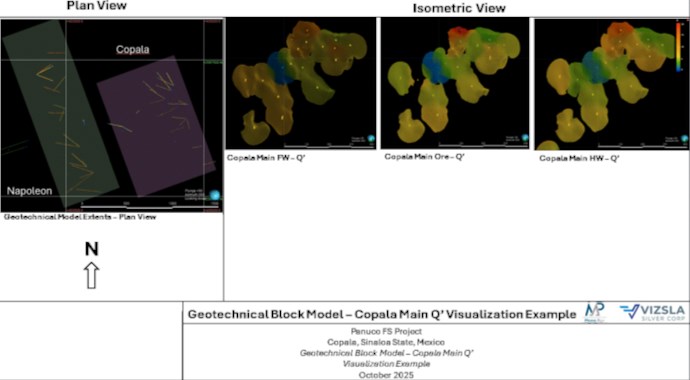
Source: Mining Plus, 2025.
16.2.6 Stope Sizes
Stope stability was assessed using the Mathews stability graph developed by Mathews et al. (1980) and extended by Mawdesley et al. (2001). This method evaluates stope face stability based on the hydraulic radius ("HR") and the stability number ("N"). The stability number N is calculated by adjusting the Q' value for induced stresses (Factor A), discontinuity orientation (Factor B), and excavation surface orientation (Factor C), following the formula N = Q' x A x B x C. A summary of Q' values by Domain are presented in Table 16-13, Table 16-14, Table 16-15, and Table 16-16 below.
|
|
Table 16-13: Estimated Q' Conditions by Domain - Copala
| Domain Categories | Drilling Length (m) | Q' | ||||
| 1st Quartile | Median | 3rd Quartile | ||||
| COPALA SOUTH | COP MAIN | HW | 68.19 | 5.14 | 6.25 | 7.78 |
| ORE | 36.64 | 5.83 | 6.15 | 6.36 | ||
| FW | 53.10 | 6.25 | 6.25 | 7.64 | ||
| COP 3 | HW | 68.38 | 2.31 | 5.10 | 7.93 | |
| ORE | 23.16 | 1.39 | 2.44 | 6.15 | ||
| FW | 56.06 | 3.15 | 6.25 | 7.70 | ||
| COP 4 | HW | 13.73 | 4.17 | 6.25 | 11.11 | |
| ORE | 5.09 | 4.03 | 6.25 | 8.33 | ||
| FW | 28.02 | 4.17 | 5.44 | 8.33 | ||
| COP5 | HW | 25.91 | 4.17 | 5.21 | 6.04 | |
| ORE | 6.00 | 4.17 | 6.15 | 6.25 | ||
| FW | 27.98 | 4.46 | 5.42 | 6.25 | ||
| CRISTIANO | HW | 78.78 | 7.78 | 8.06 | 8.19 | |
| ORE | 1.69 | 21.56 | 21.56 | 21.56 | ||
| FW | 15.89 | 14.78 | 16.67 | 16.67 | ||
|
COPALA MAIN |
COP MAIN |
HW |
52.22 |
4.04 |
6.25 |
8.33 |
|
ORE |
20.52 |
3.65 |
4.14 |
6.04 |
||
|
FW |
53.77 |
5.35 |
6.15 |
7.94 |
||
|
COP 2 |
HW |
7.99 |
0.24 |
2.78 |
2.78 |
|
|
ORE |
2.43 |
3.23 |
3.23 |
7.58 |
||
|
FW |
6.93 |
3.11 |
3.23 |
3.96 |
||
|
COP 3 |
HW |
14.78 |
3.50 |
6.10 |
6.25 |
|
|
ORE |
4.91 |
4.58 |
5.73 |
5.88 |
||
|
FW |
14.834 |
5.15 |
5.73 |
5.88 |
||
|
COP 4 |
HW |
13.73 |
4.17 |
6.25 |
11.11 |
|
|
ORE |
5.09 |
4.03 |
6.25 |
8.33 |
||
|
FW |
28.02 |
4.17 |
5.44 |
8.33 |
||
|
COP 5 |
HW |
13.00 |
13.00 |
13.00 |
13.00 |
|
|
ORE |
5.00 |
5.00 |
5.00 |
5.00 |
||
|
FW |
13.00 |
13.00 |
13.00 |
13.00 |
||
|
CRISTIANO |
HW |
53.48 |
3.57 |
4.17 |
5.56 |
|
|
ORE |
7.85 |
3.32 |
3.58 |
4.17 |
||
|
FW |
26.91 |
3.04 |
4.17 |
4.17 |
||
|
TAJITOS |
HW |
24.34 |
3.61 |
4.17 |
4.17 |
|
|
ORE |
7.17 |
3.50 |
3.54 |
4.17 |
||
|
FW |
21.08 |
7.17 |
11.11 |
12.25 |
||
|
|
| Domain Categories | Drilling Length (m) | Q' | ||||
| 1st Quartile | Median | 3rd Quartile | ||||
|
COPALA NORTH |
COP MAIN |
HW |
42.72 |
4.17 |
4.29 |
8.22 |
|
ORE |
92.93 |
4.17 |
6.04 |
6.25 |
||
|
FW |
42.72 |
5.63 |
6.00 |
6.25 |
||
|
COP 2 |
HW |
30.28 |
1.35 |
4.85 |
6.25 |
|
|
ORE |
10.73 |
4.90 |
5.10 |
5.42 |
||
|
FW |
30.62 |
2.29 |
4.17 |
4.48 |
||
|
COP 3 |
HW |
28.09 |
3.25 |
4.67 |
6.25 |
|
|
ORE |
5.52 |
0.97 |
6.25 |
7.50 |
||
|
FW |
27.38 |
3.92 |
6.15 |
6.88 |
||
|
TAJITOS |
HW |
7.89 |
6.17 |
6.17 |
12.17 |
|
|
ORE |
4.41 |
5.54 |
5.58 |
5.58 |
||
|
FW |
7.71 |
1.46 |
5.98 |
5.98 |
||
Table 16-14: Estimated Q' Conditions by Domain - Napoleon
| Domain Categories | Drilling Length (m) |
Q' | ||||
| 1st Quartile | Median | 3rd Quartile | ||||
| NAPOLEON SOUTH | NAP MAIN | HW | 34.31 | 5.56 | 8.33 | 12.08 |
| ORE | 29.86 | 0.49 | 3.82 | 11.79 | ||
| FW | 76.20 | 3.33 | 3.89 | 8.06 | ||
| FW1 | HW | 23.04 | 3.96 | 10.17 | 11.25 | |
| ORE | 5.44 | 8.06 | 12.5 | 12.5 | ||
| FW | 23.96 | 6.81 | 12.33 | 16.67 | ||
| FW2 | HW | 42.74 | 3.61 | 8.33 | 12.5 | |
| ORE | 8.37 | 11.11 | 21.5 | 21.5 | ||
| FW | 61.42 | 8.19 | 18.08 | 22.08 | ||
| FW3 | HW | 7.31 | 10.93 | 11.11 | 11.96 | |
| ORE | 1.38 | 12.50 | 12.5 | 12.5 | ||
| FW | 11.07 | 12.50 | 12.5 | 25 | ||
| HW3 | HW | 73.78 | 8.06 | 8.33 | 12.50 | |
| ORE | 12.22 | 8.06 | 8.33 | 12.50 | ||
| FW | 79.35 | 8.33 | 11.11 | 12.50 | ||
|
|
| Domain Categories | Drilling Length (m) |
Q' | ||||
| 1st Quartile | Median | 3rd Quartile | ||||
| HW4 | HW | 51.12 | 8.33 | 8.50 | 16 | |
| ORE | 30.79 | 7.78 | 8.33 | 12.29 | ||
| FW | 53.97 | 6.53 | 8.33 | 12.29 | ||
| HW5 | HW | 38.26 | 8.17 | 8.33 | 11.11 | |
| ORE | 4.15 | 8.06 | 8.06 | 8.33 | ||
| FW | 30.72 | 8.33 | 8.33 | 11.11 | ||
| HW6 | HW | 49.41 | 6.53 | 8.33 | 10.93 | |
| ORE | 13.31 | 8.00 | 9.79 | 12.5 | ||
| FW | 60.78 | 8.33 | 10.93 | 12.5 | ||
| HW7 | HW | 32.00 | 8.06 | 8.33 | 12.50 | |
| ORE | 16.00 | 7.78 | 12.50 | 12.50 | ||
| FW | 25.00 | 8.25 | 8.33 | 11.39 | ||
| NAPOLEON MAIN | NAP MAIN | HW | 156.06 | 4.96 | 6.25 | 10.25 |
| ORE | 94.14 | 6.53 | 12.50 | 20.74 | ||
| FW | 107.93 | 6.53 | 12.00 | 15.00 | ||
| HW4 | HW | 66.00 | 5.37 | 8.75 | 10.89 | |
| ORE | 16.00 | 2.78 | 4.17 | 6.25 | ||
| FW | 68.00 | 4.52 | 7.13 | 11.11 | ||
| HW5 | HW | 52.00 | 7.34 | 8.75 | 10.25 | |
| ORE | 7.00 | 8.33 | 8.94 | 12.50 | ||
| FW | 43.00 | 6.25 | 11.00 | 12.50 | ||
| NAPOLEON NORTH | NAP MAIN | HW | 27.00 | 3.99 | 6.25 | 8.12 |
| ORE | 3.00 | 1.54 | 6.14 | 6.14 | ||
| FW | 36.00 | 4.48 | 4.37 | 4.58 | ||
|
|
Table 16-15: Estimated Q' Conditions by Domain - Luisa
|
Domain Categories |
Drilling Length (m) |
Q' |
||||
|
1st Quartile |
Median |
3rd Quartile |
||||
|
LUISA |
LUISA HW |
HW |
36.00 |
2.14 |
6.25 |
8.12 |
|
ORE |
6.00 |
3.40 |
6.14 |
6.14 |
||
|
FW |
30.00 |
2.90 |
4.37 |
4.58 |
||
|
LUISA MAIN |
HW |
15.00 |
1.67 |
6.25 |
8.12 |
|
|
ORE |
9.00 |
2.50 |
6.14 |
6.14 |
||
|
FW |
21.00 |
2.14 |
4.37 |
4.58 |
||
|
LUISA FW |
HW |
18.00 |
3.12 |
6.25 |
8.12 |
|
|
ORE |
6.00 |
2.74 |
6.14 |
6.14 |
||
|
FW |
- |
3.12 |
4.37 |
4.58 |
||
Table 16-16: Estimated Q' Conditions by Domain - Tajitos
|
Domain Categories |
Drilling Length (m) |
Q' |
||||
|
1st Quartile |
Median |
P75 |
||||
|
TAJITOS |
TAJITOS MAIN |
HW |
27 |
2.78 |
3.51 |
4.17 |
|
ORE |
15 |
5.61 |
8.33 |
8.33 |
||
|
- |
- |
2.78 |
3.51 |
4.17 |
||
The following assumptions were made in the calculation of Stability Number (N'):
15-m sublevel height for Napoleon South, Copala South and Copala Main domains.
20-m sublevel height for Napoleon Main, Napoleon North and Tajitos.
Factor A - The maximum induced stress was estimated assuming a vertical stress gradient of 0.027 MPa/m of depth and a K factor of 1.5. Stress application factors were then applied as follows:
Hanging Wall (HW): 0.1 x (s1)
Footwall (FW): 0.25 x (s1)
Back End Wall: 1.0 x (s1)
The 3rd quartile value for the depth of mining was applied in conjunction with the average laboratory UCS by domain. Where no laboratory test information was available, the point load test (PLT) data was used with a reduction factor of 2.5 applied based on a comparison of PLT and UCS test results. The applied Factor A by domain is summarised in Table 16-17.
|
|
Factor B - The structural trends suggest potential for sub-parallel joint orientations relative to the hanging wall/footwall. The selected Factor B is summarised in Table 16-18, and
Factor C - The primary mode of failure was determined to be gravity fall/slabbing. Factor C was determined by the average orientation of the excavation surface. The applied factors used for the stope sizing optimization are listed in Table 16-19.
Table 16-17: Stope Stability Assessment - A Factor by Domain
| Domain | Sub Domain | HW | Back | FW | END |
| Tajitos | Tajitos | 1.00 | 0.60 | 0.90 | 0.60 |
| Copala South | Copala Main | 1.00 | 0.10 | 0.88 | 0.10 |
| Copala 3 | 1.00 | 0.11 | 0.37 | 0.11 | |
| Copala 4 | 1.00 | 0.10 | 0.88 | 0.10 | |
| Copala 5 | 1.00 | 0.10 | 0.93 | 0.10 | |
| Cristiano | 1.00 | 0.28 | 1.00 | 0.28 | |
| Copala Main | Copala Main | 1.00 | 0.27 | 1.00 | 0.27 |
| Copala 2 | 1.00 | 0.13 | 1.00 | 0.13 | |
| Copala 3 | 1.00 | 0.10 | 1.00 | 0.10 | |
| Copala 4 | 1.00 | 0.19 | 1.00 | 0.19 | |
| Copala 5 | 1.00 | 0.10 | 1.00 | 0.10 | |
| Cristiano | 1.00 | 0.26 | 1.00 | 0.26 | |
| Napoleon South | Nap Main | 1.00 | 0.10 | 0.88 | 0.10 |
| FW1 | 1.00 | 0.10 | 0.45 | 0.10 | |
| FW2 | 1.00 | 0.10 | 0.72 | 0.10 | |
| FW3 | 1.00 | 0.10 | 0.60 | 0.10 | |
| HW4 | 1.00 | 0.28 | 0.78 | 0.28 | |
| HW5 | 1.00 | 0.33 | 1.00 | 0.33 | |
| HW6 | 1.00 | 0.18 | 0.92 | 0.18 | |
| HW7 | 1.00 | 0.17 | 0.39 | 0.17 | |
| Napoleon Main | Nap Main | 1.00 | 0.31 | 1.00 | 0.31 |
| HW4 | 1.00 | 0.10 | 1.00 | 0.10 | |
| HW5 | 1.00 | 0.28 | 1.00 | 0.28 | |
| Napoleon North | Nap Main | 1.00 | 0.17 | 1.00 | 0.17 |
| Luisa | Main | 1.00 | 0.23 | 1.00 | 0.23 |
| HW | 1.00 | 0.33 | 1.00 | 0.33 | |
| FW | 1.00 | 0.18 | 1.00 | 0.18 |
|
|
Table 16-18: Stope Stability Assessment - B Factor by Domain
| Domain | Sub Domain | HW | Back | FW | END |
| Tajitos | Tajitos | 0.25 | 0.50 | 0.25 | 0.45 |
| Copala South | Copala Main | 0.30 | 0.30 | 0.30 | 0.20 |
| Copala 3 | 0.40 | 0.20 | 0.40 | 0.60 | |
| Copala 4 | 0.20 | 0.20 | 0.20 | 0.60 | |
| Copala 5 | 0.20 | 0.20 | 0.20 | 0.50 | |
| Cristiano | 0.20 | 0.20 | 0.20 | 0.70 | |
| Copala Main | Copala Main | 0.20 | 0.80 | 0.20 | 0.85 |
| Copala 2 | 0.20 | 0.80 | 0.20 | 0.40 | |
| Copala 3 | 0.20 | 0.80 | 0.20 | 0.80 | |
| Copala 4 | 0.20 | 0.80 | 0.20 | 0.85 | |
| Copala 5 | 0.20 | 0.80 | 0.20 | 0.85 | |
| Cristiano | 0.20 | 0.80 | 0.20 | 0.85 | |
| Napoleon South | Nap Main | 0.20 | 0.80 | 0.20 | 0.85 |
| FW1 | 0.20 | 0.80 | 0.20 | 0.90 | |
| FW2 | 0.20 | 0.80 | 0.20 | 1.00 | |
| FW3 | 0.20 | 0.80 | 0.20 | 0.95 | |
| HW4 | 0.20 | 0.80 | 0.20 | 0.70 | |
| HW5 | 0.20 | 0.80 | 0.20 | 0.95 | |
| HW6 | 0.20 | 0.80 | 0.20 | 0.95 | |
| HW7 | 0.20 | 0.80 | 0.20 | 0.85 | |
| Napoleon Main | Nap Main | 0.30 | 0.50 | 0.30 | 0.85 |
| HW4 | 0.20 | 0.50 | 0.20 | 0.60 | |
| HW5 | 0.20 | 0.50 | 0.20 | 0.90 | |
| Napoleon North | Main | 0.20 | 0.38 | 0.20 | 0.68 |
| Luisa | Main | 0.20 | 0.60 | 0.20 | 0.87 |
| HW | 0.30 | 0.50 | 0.30 | 0.80 | |
| FW | 0.30 | 0.50 | 0.30 | 0.80 |
 |
 |
Table 16-19: Stope Stability Assessment - C Factor Domain
| Domain | Sub Domain | HW/FW Dip (°) | HW | Back | FW | END |
| Tajitos | Tajitos | 66.8 | 5.60 | 2.00 | 5.60 | 8.00 |
| Copala South | Copala Main | 61.5 | 5.14 | 2.00 | 5.14 | 8.00 |
| Copala 3 | 54.4 | 4.51 | 2.00 | 4.51 | 8.00 | |
| Copala 4 | 74.8 | 6.43 | 2.00 | 6.43 | 8.00 | |
| Copala 5 | 71.7 | 6.12 | 2.00 | 6.12 | 8.00 | |
| Cristiano | 77.4 | 6.69 | 2.00 | 6.69 | 8.00 | |
| Copala Main | Copala Main | 59.7 | 4.97 | 2.00 | 5.00 | 8.00 |
| Copala 2 | 60.0 | 5.00 | 2.00 | 5.00 | 8.00 | |
| Copala 3 | 54.0 | 4.47 | 2.00 | 4.47 | 8.00 | |
| Copala 4 | 77.7 | 6.72 | 2.00 | 6.72 | 8.00 | |
| Copala 5 | 59.1 | 4.92 | 2.00 | 4.92 | 8.00 | |
| Cristiano | 81.0 | 7.06 | 2.00 | 7.06 | 8.00 | |
| Napoleon South | Nap Main | 74.9 | 6.44 | 2.00 | 6.44 | 8.00 |
| FW1 | 83.3 | 7.30 | 2.00 | 7.30 | 8.00 | |
| FW2 | 76.0 | 6.55 | 2.00 | 6.55 | 8.00 | |
| FW3 | 70.1 | 5.96 | 2.00 | 5.96 | 8.00 | |
| HW4 | 50.9 | 4.22 | 2.00 | 4.22 | 8.00 | |
| HW5 | 67.8 | 5.73 | 2.00 | 5.73 | 8.00 | |
| HW6 | 69.4 | 5.89 | 2.00 | 5.89 | 8.00 | |
| HW7 | 79.9 | 6.95 | 2.00 | 6.95 | 8.00 | |
| Napoleon Main | Nap Main | 81.5 | 7.11 | 2.00 | 7.11 | 8.00 |
| HW4 | 59.9 | 4.99 | 2.00 | 4.99 | 8.00 | |
| HW5 | 81.4 | 7.10 | 2.00 | 7.10 | 8.00 | |
| Napoleon North | Main | 83.8 | 7.40 | 2.00 | 7.40 | 8.00 |
| Luisa | Main | 79.0 | 6.90 | 2.00 | 6.90 | 8.00 |
| HW | 86.0 | 7.60 | 2.00 | 7.60 | 8.00 | |
| FW | 82.0 | 7.20 | 2.00 | 7.20 | 8.00 |
For this assessment, the stope is considered stable if the stability number, N' plots above the bottom Unsupported Transition Line as illustrated in Figure 16-7. The assessment does not account for the exposure period of the stope walls, changes in the induces stresses via stope sequencing, blasting factors or the degree of stope wall undercutting which can impact the stability of a given stope.
|
|
Figure 16-7: Extended Matthews Stability Graph
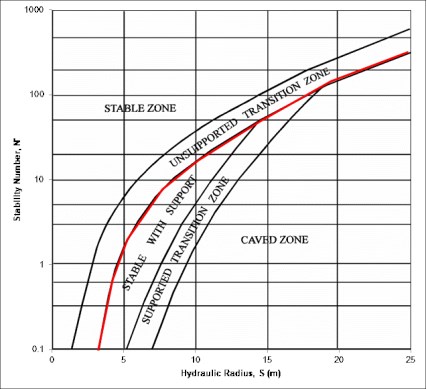
Source: Mining Plus, 2025, Modified from Nickson, 1992.
A stope stability assessment was completed for stopes in the Copala, Napoleon, Luisa and Tajitos mining areas. The sub-level height was established based on the mine design criteria. The slope length was evaluated for HW/FW lengths based on the HW/FW dip. Maximum recommended strike lengths were evaluated over the range of stope widths. Design strike lengths were determined based on dilution recommendations and blasting considerations. The results of the stope optimization are summarised by Domain in Table 16-20, Table 16-21, Table 16-22 and Table 16-23.
Table 16-20: Stable Stope Spans - Copala
| Deposit | Domain | Subdomain | HW Dip | Design Strike Length | Max Strike Length Recommended |
|
| (°) | Length (m) | Avg. Width (m) | Length (m) | |||
| Copala | Copala South | Copala Main | 61.5 | 20 | 5.9 | 42 |
| Copala3 | 54.4 | 20 | 4.3 | 20 | ||
| Copala 4 | 74.8 | 20 | 3.7 | 30 | ||
| Copala 5 | 71.7 | 20 | 4.0 | 35 | ||
| Cristiano | 77.4 | 20 | 2.8 | 40 | ||
| Copala Main | Copala Main | 59.7 | 20 | 6.9 | 18 | |
| Copala3 | 54 | 20 | 3.8 | 22 | ||
| Copala 4 | 77.7 | 20 | 3.7 | 32 | ||
| Copala 5 | 59.1 | 20 | 4 | 25 | ||
| Cristiano | 81 | 20 | 2.8 | 30 | ||
| Tajitos | 66.8 | 20 | 2.7 | 30 | ||
|
|
Table 16-21: Stable Stope Spans - Napoleon
| Deposit | Domain | Subdomain | HW Dip | 3rd Quartile Depth below Surface |
3rd Quartile Depth below Surface - Max Strike Length Recommended |
|
| (°) | Length (m) | Width (m) | Length (m) | |||
| Napoleon | Napoleon South | Napoleon Main | 74.9 | 24 | 3.3 | 24 |
| FW1 | 83.3 | 24 | 2.2 | 40 | ||
| FW2 | 76 | 24 | 2.7 | 35 | ||
| FW3 | 70.1 | 24 | 2.6 | 40 | ||
| HW4 | 50.9 | 24 | 5.0 | 32 | ||
| HW5 | 67.8 | 24 | 3.0 | 40 | ||
| HW6 | 69.4 | 24 | 2.6 | 40 | ||
| HW7 | 79.9 | 24 | 4.1 | 40 | ||
| Napoleon Main | Napoleon Main | 81.5 | 24 | 3.8 | 40 | |
| HW4 | 59.9 | 24 | 3.6 | 28 | ||
| HW5 | 81.4 | 24 | 3.2 | 40 | ||
| Napoleon North | Napoleon Main/Josephine | 83.8/80.2 | 24 | 3.0 | 40 | |
Table 16-22: Stable Stope Spans - Tajitos
| Deposit | Domain | HW Dip | P75 Depth below Surface | P75 Depth below Surface - Max Strike Length Recommended |
|
| (°) | Length (m) | Width (m) | Length (m) | ||
| Tajitos | Tajitos | 66.8 | 24 | 2.7 | 30 |
|
|
Table 16-23: Stable Stope Spans - Luisa
| Deposit | Domain | HW Dip | 3rd Quartile Depth below Surface |
3rd Quartile Depth below Surface - Max Strike Length Recommended |
|
| (°) | Length (m) | Width (m) | Length (m) | ||
| Luisa | Main | 79.0 | 18 | 4.7 | 25 |
| HW | 86.0 | 18 | 3.0 | 40 | |
| FW | 82.0 | 18 | 4.2 | 40 | |
16.2.7 Empirical Dilution Review
Dilution is the unplanned waste material mined with the ore that is sent to the processing plant. The quantity of potential dilution is primarily controlled by the amount of waste rock and paste / CRF backfill sloughed into the stope. A parameter termed the "Equivalent Linear Overbreak/Slough" (ELOS), introduced by Clark and Pakalnis (1997) is used to express the volumetric measurements of overbreak as an average depth over an entire stope surface. ELOS can be estimated using the Stability Number and hydraulic radius of the slope surface.
To estimate the quantity of waste rock dilution from the caving/slabbing failure of the HW/FW, back and end walls for Panuco stopes, the empirical dilution graph from Capes and Milne (2008) was employed (see Figure 16-8) which incorporates 257 case histories which plot in a zone of interest common to most mines.
Figure 16-8: Empirical ELOS Dilution Graph with ELOS Isoprobability Contours

Source: Capes, G., and Milne, D., 2008.
|
|
The minimum dilution value was set at 0.2 m for the HW. To estimate the FW dilution, a dilution factor was estimated based on the slope of the FW and relative Q' value. This dilution factor is multiplied by the HW ELOS value to estimate the FW ELOS value. The total slope ELOS is the combination of the HW and FW ELOS dilution.
The back and end wall dilution is assumed to be in ore and is therefore only used as an indicator for cable bolting requirements and is not considered in the stope dilution estimates. Table 16-24 Summarises the ELOS dilution factors by domain for the Panuco FS Mine Plan.
Table 16-24: ELOS Dilution Estimates for Panuco FS Stopes with ELOS FW Factor
| Domain | Sub Domain |
ELOS HW | ELOS FW Factor |
ELOS TOTAL | ||||||||
| Stope Width (m) |
4 | 6 | 8 | 10 | 12 | 4 | 6 | 8 | 10 | 12 | ||
| COPALA SOUTH | COP Main | 0.20 | 0.20 | 0.20 | 0.20 | 0.20 | 0.30 | 0.26 | 0.26 | 0.26 | 0.26 | 0.26 |
| COP 3 | 0.40 | 0.40 | 0.40 | 0.40 | 0.40 | 0.20 | 0.48 | 0.48 | 0.48 | 0.48 | 0.48 | |
| COP 4 | 0.20 | 0.20 | 0.20 | 0.20 | 0.20 | 0.40 | 0.28 | 0.28 | 0.28 | 0.28 | 0.28 | |
| COP 5 | 0.20 | 0.20 | 0.20 | 0.20 | 0.20 | 0.30 | 0.26 | 0.26 | 0.26 | 0.26 | 0.26 | |
| Cristiano | 0.20 | 0.20 | 0.20 | 0.20 | 0.20 | 0.20 | 0.24 | 0.24 | 0.24 | 0.24 | 0.24 | |
| COPALA MAIN | Cop Main | 0.30 | 0.30 | 0.30 | 0.30 | 0.30 | 0.20 | 0.36 | 0.36 | 0.36 | 0.36 | 0.36 |
| COP 3 | 0.45 | 0.45 | 0.45 | 0.45 | 0.45 | 0.30 | 0.59 | 0.59 | 0.59 | 0.59 | 0.59 | |
| COP 4 | 0.20 | 0.20 | 0.20 | 0.20 | 0.20 | 0.40 | 0.28 | 0.28 | 0.28 | 0.28 | 0.28 | |
| COP 5 | 0.20 | 0.20 | 0.20 | 0.20 | 0.20 | 0.40 | 0.28 | 0.28 | 0.28 | 0.28 | 0.28 | |
| Cristiano | 0.20 | 0.20 | 0.20 | 0.20 | 0.20 | 0.40 | 0.28 | 0.28 | 0.28 | 0.28 | 0.28 | |
| NAPOLEON SOUTH | NAP Main | 0.20 | 0.20 | 0.20 | 0.20 | 0.20 | 0.50 | 0.3 | 0.3 | 0.3 | 0.3 | 0.3 |
| FW1 | 0.20 | 0.20 | 0.20 | 0.20 | 0.20 | 0.50 | 0.3 | 0.3 | 0.3 | 0.3 | 0.3 | |
| FW2 | 0.25 | 0.25 | 0.25 | 0.25 | 0.25 | 0.20 | 0.3 | 0.3 | 0.3 | 0.3 | 0.3 | |
| FW3 | 0.20 | 0.20 | 0.20 | 0.20 | 0.20 | 0.20 | 0.24 | 0.24 | 0.24 | 0.24 | 0.24 | |
| HW4 | 0.20 | 0.20 | 0.20 | 0.20 | 0.20 | 0.30 | 0.26 | 0.26 | 0.26 | 0.26 | 0.26 | |
| HW5 | 0.20 | 0.20 | 0.20 | 0.20 | 0.20 | 0.35 | 0.27 | 0.27 | 0.27 | 0.27 | 0.27 | |
| HW6 | 0.20 | 0.20 | 0.20 | 0.20 | 0.20 | 0.30 | 0.26 | 0.26 | 0.26 | 0.26 | 0.26 | |
| HW7 | 0.20 | 0.20 | 0.20 | 0.20 | 0.20 | 0.45 | 0.29 | 0.29 | 0.29 | 0.29 | 0.29 | |
| NAPOLEON MAIN | NAP Main | 0.20 | 0.20 | 0.20 | 0.20 | 0.20 | 0.30 | 0.26 | 0.26 | 0.26 | 0.26 | 0.26 |
| HW4 | 0.40 | 0.40 | 0.40 | 0.40 | 0.25 | 0.30 | 0.52 | 0.52 | 0.52 | 0.52 | 0.33 | |
| HW5 | 0.20 | 0.20 | 0.20 | 0.20 | 0.20 | 0.35 | 0.27 | 0.27 | 0.27 | 0.27 | 0.27 | |
| NAPOLEON NORTH | NAP Main | 0.20 | 0.20 | 0.20 | 0.20 | 0.20 | 0.35 | 0.21 | 0.27 | 0.27 | 0.27 | 0.27 |
| Josephine | 0.20 | 0.20 | 0.20 | 0.20 | 0.20 | 0.35 | 0.21 | 0.27 | 0.27 | 0.27 | 0.27 | |
| TAJITOS | Tajitos | 0.40 | 0.40 | 0.40 | 0.40 | 0.40 | 0.30 | 0.52 | 0.52 | 0.52 | 0.52 | 0.52 |
| LUISA | Main | 0.70 | 0.70 | 0.70 | 0.70 | 0.70 | 0.30 | 0.91 | 0.91 | 0.91 | 0.91 | 0.91 |
| HW | 0.25 | 0.25 | 0.25 | 0.25 | 0.25 | 0.30 | 0.33 | 0.33 | 0.33 | 0.33 | 0.33 | |
| FW | 0.20 | 0.20 | 0.20 | 0.20 | 0.20 | 0.80 | 0.36 | 0.36 | 0.36 | 0.36 | 0.36 | |
|
|
It is important to recognize some limitations of empirical dilution estimation methods. Some of the key limitations are:
Blast damage
Undercutting and overcutting the hanging wall
Impact of cable bolt support
Delayed mucking and stope exposure time
Effect of mining sequence
Delayed backfill or poor quality backfill
Inability to tight fill stopes
16.2.8 Geotechnical - Ground Support
For cost estimation purposes, ground support regimes for development were estimated based on statistics calculated using the 2023 and 2025 geotechnical data, assuming dry ground with minor inflow. Figure 16-9 summarises NGI-Q and RMR76 values by domain which forms the basis of estimating the distribution of ground support standards for Capital and Ore development.
Figure 16-9: Rock Mass Quality (NGI-Q and RMR76) by Domain

Source: Mining Plus, 2025.
The rock mass quality data indicates Napoleon North will have the most challenging ground conditions. Napoleon South is also expected to encounter a high proportion of poor ground conditions. The challenging ground conditions in Napoleon are expected to be the result of a more structurally complex domain. Comparatively, Copala South and Copala North are also indicated to have a high proportion of poor and very poor ground conditions.
|
|
For capital mine development, ground support consisting of 2.4 m No.7 resin-grouted rebar bolts with mesh to mid-drift for "Fair" to "Good" ground or with shotcrete to the floor for "Poor" to "Very Poor" ground. Intersection cable bolt requirements were assessed based on the expected ground conditions and 3-way and 4-way spans. Double 0.6" bulge strand double cable bolts were assumed. A summary of the assumed bolting plan is summarised in Table 16-25.
Figure 16-10 shows a summary of the expected application of ground support standards by domain. Table 16-26 summarises the development intersection cable bolt requirements. Note a 100% application factor was assumed for all fault intersections.
Table 16-25: Ground Support Standard by Rock Mass Condition (Excluding Copala North CAF and DAF)
| Type | Ground Condition | Ground Support Standards | |
| Capital Development 5.5m x 5.5m (permanent openings) | |||
| GSS-NP-I | Good | Back | 22mm⌀ x 2.4m Rebar (2.1m x 1.6m) |
| Q (10 - 40) | Wall | 22mm⌀ x 2.4m Rebar (2.1m x 1.6m) Start 2.0m from sill |
|
| Surface | 6ga x 4in sq. welded wire mesh | ||
| GSS-NP-II | Fair | Back | 22mm⌀ x 2.4m Rebar (1.8m x 1.8m) Dice-5 |
| Q (4 - 10) | Wall | 22mm⌀ x 2.4m Rebar (1.7m x 1.7m) - Dice-5 Start 1.2m from sill |
|
| Surface | 6ga x 4in sq. welded wire mesh | ||
| GSS-NP-III | Poor | Back | 22mm⌀ x 2.4m Rebar (1.6m x 1.7m) |
| Q (1 - 4) | Wall | 22mm⌀ x 2.4m Rebar (1.6m x 1.7m) Start 0.9m from sill |
|
| Surface | 6ga x 4in sq. welded wire mesh 5cm (2") Plain Shotcrete floor to floor |
||
| GSS-NP-IV | Very Poor | Back | 22mm⌀ x 2.4m Rebar (1.1m x 1.1m) Dice-5 |
| Q (0.1 - 1) | Wall | 22mm⌀ x 2.4m Rebar (1.1m x 1.1m) Dice-5 Start 0.9m from sill |
|
| Surface | 6ga x 4in sq. welded wire mesh 7.5cm (3") Plain Shotcrete floor to floor |
||
| Ore (Non-Capital) Development 4.0m x 4.0m (semi-permanent openings) | |||
| GSS-P-I | Good | Back | 22mm⌀ x 2.1m Rebar (2.0m x 2.0m) Dice-5 |
| Q (10 - 40) | Wall | 1.8m x SS-33 Split Set (2.0m x 2.0m) Start 2.0m from sill |
|
| Surface | 6ga x 4in sq. welded wire mesh | ||
| GSS-P-II | Fair | Back | 22mm⌀ x 2.1m Rebar (2.1m x 1.6m) |
| Q (4 - 10) | Wall | 1.8m x SS-33 Split Set (1.6m x 1.6m) Start 1.6m from sill |
|
| Surface | 6ga x 4in sq. welded wire mesh | ||
|
|
| Type | Ground Condition | Ground Support Standards | |
| GSS-P-III | Poor | Back | 22mm⌀ x 2.1m Rebar (1.4m x 1.6m) |
| Q (1 - 4) | Wall | 1.8m x SS-33 Split Set (1.4m x 1.6m) Start 1.8m from sill |
|
| Surface | 6ga x 4in sq. welded wire mesh 5cm Plain Shotcrete floor to floor (Optional) |
||
| GSS-P-IV | Very Poor | Back | 22mm⌀ x 2.1m Rebar (1.1m x 1.1m) Dice-5 |
| Q (0.1 - 1) | Wall | 1.8m x SS-33 Split Set (1.1m x 1.1m) - Dice-5 Start 1.1m from Sill |
|
| Surface | 6ga x 4in sq. welded wire mesh 7.5cm Plain Shotcrete floor to floor |
||
Figure 16-10: Ground Support Standard Distribution by Domain

Source: Mining Plus, 2025.
|
|
Table 16-26: Development Cable Bolt Application by Intersection
| Profile 1 (m x m) | 5.5 x 5.5 | 5.5 x 5.5 | 5.5 x 5.5 | 5.5 x 5.5 | 4.0 x 4.0 | 4.0 x 4.0 | 5.0 x 5.0 | 5.0 x 5.0 |
| Profile 2 (m x m) | 5.5 x 5.5 | 5.5 x 5.5 | 4.0 x 4.0 | 4.0 x 4.0 | 4.0 x 4.0 | 4.0 x 4.0 | 5.0 x 5.0 | 5.0 x 5.0 |
| Type | 4-way | 3-Way | 4-Way | 3-Way | 4-Way | 3-Way | 4-Way | 3-Way |
| Cable bolt Length (m) | 6.5 | 5.5 | 6.5 | 5.5 | 5.5 | 5.5 | 6.5 | 5.5 |
| Pattern (m x m) | 2.3 | 2.9 | 2.6 | 3.3 | 2.6 | 2.9 | 2.4 | 2.7 |
| Total # of Cable bolts | 14 | 8 | 12 | 5 | 9 | 5 | 14 | 8 |
| Application Factor | 12.6% | 9.4% | 20.0% | 11.8% | 39.2% | 24% | 39.8% | 33.6% |
Production Cable bolt requirements were assessed using the empirical graphs developed by Potvin (1988) and Nickson (1992). It is assumed that 100% of all stopes intersected by faults will require HW cable bolts. A nominal pattern of 6.5 m single 0.6" bulge-strand cable bolts on a 2.0 m x 2.0 m pattern is assumed for HW cables. For back cable bolts, a 2.0 m x 2.0 m pattern was assumed with the cable bolt length set to be half the stope span + 2.5 m. A cut-off hydraulic radius of 4.0 was applied to all stopes for cable bolting consideration. A general 3% application factor was applied to all HW and back stopes not intersected by faults with exception of specific domains with an elevated risk.
16.2.8.1 Ground Support - Copala North
Copala North is planned to be mined using cut-and-fill (CAF) and drift-and-fill (DAF) extraction. Ground support standards have been developed based on statistics calculated using the 2023 and 2025 geotechnical data, assuming dry ground with minor inflow. A kinematic wedge analysis has also been completed using the primary structural families evaluated from oriented structural data. Figure 16-9 summarises NGI-Q and RMR76 values by domain which forms the basis of estimating the distribution of ground support standards to development.
CAF development is defined by a bottom-up sequence with only a single development heading per ore vein. Completed drifts and backfilled prior to developing the overcut drift. Four CAF development types have been defined:
1. Type I: Overcut development drift with less than 1.5 meters of overlap between back of active development and floor or projected development.
2. Type II: Overcut development drift with more than 1.5 meters of overlap between back of active development and floor or projected development.
3. Type III: Development intersected by or within 5 meters of a projected fault.
4. Type IV: Undercut sill development where active development is overlain by a cemented sill drift.
DAF development is defined by a bottom-up sequence with panels being developed, backfilled and developed adjacent to backfilled panel in most instances. The categories defined above for CAF developed also apply to DAF development.
For CAF development, ground support typically consists of 2.4 m No.7 resin-grouted rebar bolts with mesh to mid-drift on a nominal 1.2 m x 1.1 m pattern. Shotcrete is applied across the back for Type II and from 2.0 m from the sill for Type III and IV. All 3-way, 4-way and secondary cut intersections are to be supported with 7.5 m long 0.6" double bulge-strand cable bolts on a 2.3 m x 2.3 m pattern. The resin rebar length is to be extended to 3.0 m in the access drive adjacent to all CAF ore drives. Omega-bolts (swellex) with a minimum yield strength of 12-tonnes can be substituted for resin rebar in the CAF and DAF standards.
|
|
For DAF development, ground support prescriptions are differentiated by the requirement for installation of 2.4 m SS33 Split Set bolts on a 1.2 m x 1.1 m nominal pattern through fill wall exposures. Table 16-27 summarises the Copala North CAF and DAF ground support requirements.
Table 16-27: Ground Support Standard - Copala North
| Type | Ground Condition | Ground Support Standards | |
| Cut & Fill (Non-Capital) Development - Copala North 5.0 m x 5.0 m (semi-permanent openings) | |||
| GSS-CF-I | Overcut drift does not exceed 1.5m overlap | Back | 22mm⌀ x 2.4m Rebar (1.2m x 1.1m) |
| Wall | 22mm⌀ x 2.4m Rebar (1.2m x 1.1m) - Start 2.0m from sill | ||
| Surface | 6ga x 4in sq. welded wire mesh | ||
| GSS-CF-II | Overcut drift exceeds 1.5m overlap in back | Back | 22mm⌀ x 2.4m Rebar (1.2m x 1.1m) 2.4m SS33 Split Set (1.2m x 1.1m) in overcut area |
| Wall | 22mm⌀ x 2.4m Rebar (1.2m x 1.1m) - Start 2.0m from sill | ||
| Surface | 6ga x 4in sq. welded wire mesh 5 cm (2") Plain Shotcrete in back and shoulders |
||
| GSS-CF-III | Fault Intersection (5 meters either side of fault) | Back | 22mm⌀ x 2.4m Rebar (1.2m x 1.1m) 2.4m SS33 Split Set (1.2m x 1.1m) in overcut area |
| Wall | 22mm⌀ x 2.4m Rebar (1.2m x 1.1m) - Start 2.0m from sill | ||
| Surface | 6ga x 4in sq. welded wire mesh 5.0 cm (2") Plain Shotcrete starting 2.0m from sill and across the back |
||
| GSS-CF-IV | Undercut Sill | Back | 22mm⌀ x 2.4m Rebar (1.2m x 1.1m) |
| Wall | 22mm⌀ x 2.4m Rebar (1.2m x 1.1m) Start 2.0m from sill |
||
| Surface | 6ga x 4in sq. welded wire mesh 7.5 cm (3") Plain Shotcrete starting 2.0m from sill and across the back |
||
| Drift & Fill (Non-Capital) Development - Copala North 5.0 m x 5.0 m (semi-permanent openings) | |||
| GSS-DF-I | Overcut drift does not exceed 1.5m overlap | Back | 22mm⌀ x 2.4m Rebar (1.2m x 1.1m) |
| Wall | 22mm⌀ x 2.4m Rebar (1.2m x 1.1m) - Start 2.0m from sill 2.4m SS33 Split Set (1.2m x 1.1m) in fill wall exposure through shotcrete to within 0.9m of sill. |
||
| Surface | 6ga x 4in sq. welded wire mesh 5cm Plain Shotcrete from 2.0m from sill to shoulder over fill wall exposure |
||
|
|
| Type | Ground Condition | Ground Support Standards | |
| GSS-DF-II | Overcut drift exceeds 1.5m overlap in back | Back | 22mm⌀ x 2.4m Rebar (1.2m x 1.1m) 2.4m SS33 Split Set (1.2m x 1.1m) in overcut area |
| Wall | 22mm⌀ x 2.4m Rebar (1.2m x 1.1m) - Start 2.0m from sill 2.4m SS33 Split Set (1.2m x 1.1m) in fill wall exposure through shotcrete to within 0.9m of sill |
||
| Surface | 6ga x 4in sq. welded wire mesh 5cm Plain Shotcrete from 2.0m from sill to shoulder over fill wall exposure and back |
||
| GSS-DF-III | Fault Intersection (5 meters either side of fault) |
Back | 22mm⌀ x 2.4m Rebar (1.2m x 1.1m) 2.4m SS33 Split Set (1.2m x 1.1m) in overcut area |
| Wall | 22mm⌀ x 2.4m Rebar (1.2m x 1.1m) - Start 2.0m from sill 2.4m SS33 Split Set (1.2m x 1.1m) in fill wall exposure through shotcrete to within 0.9m of sill |
||
| Surface | 6ga x 4in sq. welded wire mesh 5.0cm Plain Shotcrete starting 0.9m from sill and across back |
||
| GSS-DF-IV | Undercut Sill | Back | 22mm⌀ x 2.4m Rebar (1.2m x 1.1m) |
| Wall | 22mm⌀ x 2.4m Rebar (1.2m x 1.1m) - Start 2.0m from sill 2.4m SS33 Split Set (1.2m x 1.1m) in fill wall exposure through shotcrete to within 0.9m of sill |
||
| Surface | 6ga x 4in sq. welded wire mesh 7.5 cm (3") Plain Shotcrete floor to floor |
||
16.2.9 Geotechnical - Backfill
The mining methods considered for the Panuco Project are proposed to use a combination of cemented and uncemented rock backfill, as well as paste backfill for stope support. Paste backfill UCS testing was completed by Responsible Mining Solutions (RMS) in June 2025 which indicated a material strength-additive effect with the addition of blast furnace slag (BFS). The results of this test work are summarised in Figure 16-11. The following paste backfill strength targets were established for vertical and undercut exposures:
Paste backfill:
Vertical Exposure - 400 kPa at 14 days
Undercut Exposure - 1 MPa at 28 days
This paste backfill strength is expected to be achieved with a 3% binder at 14 days for a vertical exposure and an 8% binder at 28 days for an undercut exposure. More test work has been recommended to further define the strength and performance of the paste backfill as part of the next stage of the project.
For Cemented rockfill (CRF), the Li and Aubertin (2014) analytical model was employed to estimate the requires UCS for vertical fill exposures. A target backfill strength of 250 kPa at 14 days was established which is expected to be achieved with a 3% binder content. For undercut fill exposures with no man-entry requirement, a target CRF backfill strength of 1.7 MPa is recommended. For man-entry exposures, the guideline is 5.0 MPa. A 10% binder is expected to be sufficient for both scenarios based on the set time of the CRF backfill in the mine plan.
|
|
Figure 16-11: Paste Backfill Sample Strength by Mix Design - Panuco

Source: Mining Plus, 2025. After responsible Mining Solutions Report MRS-24-024-TWR-01
16.2.10 Capital Stand-off Distance
Geotechnical stand-off distances for Capital development were established based on a target of three times average stope width stand-off. Fault proximity to main ramps also considered with minimum of 10-meter offset from faults. Table 16-28 summarises the capital development stand-off distance guidelines by domain.
Table 16-28: Capital Development Stand-off Distances by Domain
| Domain | Recommended Stand-off Distance (m) |
| Napoleon South | 40 |
| Napoleon Main | 25 |
| Copala South | 30 |
| Copala Main | 35 |
| Copala North | 30 |
| Tajitos | 25 |
|
|
16.2.11 Crown Pillar Design
Crown Pillar design for the Panuco FS study was completed using the Scaled Span Evaluation Method (Carter, 2014). The scaled crown pillar span Cs is defined as:

Where:
𝑆 = crown pillar span (m);
𝛾𝑒𝑞 = specific gravity (t/m3) - considering the weight of overburden and water body;
𝑇 = crown pillar thickness (m) (bedrock thickness only);
𝜃 = orebody/foliation dip, and;
𝑆𝑅 = span ratio = S/L (crown pillar span/crown pillar strike length)
The critical span Sc can be calculated as:
𝑆𝑐 = 3.3 𝑄0.43 × sinh (𝑄)0.0016
Q is the rock mass classification (NGI, 2022). Values of Q were evaluated from the first 60 meters of geotechnically logged holes in the vicinity of a crown pillar. The stress reduction factor (SRF) value was set to 1 and the Jw factor to 1 (dry conditions assumed). Figure 16-12 illustrates the primary crown pillar areas in the Panuco FS mine plan by mine area. Input and Output parameters for all the crown pillar evaluations are summarised in Table 16-29 and Table 16-30. A general dilution factor of 0.65 m was applied to all crown pillar stopes. A target factor of safety of two has been applied to the Panuco FS crown pillars (Class F) which allows for public access incidental superficial monitoring requirements.
The crown pillars for Napoleon North (Nap 8 and 9) area expected to be located in poor ground conditions. Consequently, the width of the crown pillar stopes is constrained to 3m overall width and a 20 m strike length. Stopes should also be backfilled as soon as possible after mining to minimize the risk of subsidence expressions on surface.
The Copala 2 and 3 crown pillars (COP 2 and COP 3) are also expected to be located in poor ground conditions and require a constraint on the width of crown pillar stopes to 6.0 m and 6.7 m respectively. The Copala North crown pillar guidance is based on CAF and DAF development widths of 5 m with an additional 10% overbreak assumed.
|
|
Figure 16-12: Crown Pillar Thickness Guidance by Mining Area - Panuco FS Plan View

Source: Mining Plus, 2025.
Table 16-29: Scaled Span Crown Pillar Analysis Input and Output Parameters - Napoleon
| Parameters | Units | Crown Pillar ID | ||||||
| Nap 2 | Nap 5 | Nap 6A | Nap 6B | Nap 7 | Nap 8 | Nap 9 | ||
| Input Parameters | ||||||||
| Pillar Span (S) | m | 4.05 | 3.45 | 3.35 | 3.15 | 3.26 | 3.05 | 3.05 |
| Pillar Thickness (T) | m | 9.75 | 7.31 | 5.49 | 5.49 | 5.49 | 14.02 | 14.02 |
| Pillar Strike Length (L) | m | 74.0 | 92.0 | 175.0 | 50.0 | 96.0 | 20.0 | 20.0 |
| Unit Weight (g) | t/m3 | 3.63 | 4.39 | 4.22 | 4.22 | 4.15 | 4.53 | 4.53 |
| Orebody Dip | ° | 78.2 | 82.0 | 84.6 | 61.2 | 88.0 | 86.0 | 85.3 |
| Thickness Ratio: S/L | 0.42 | 0.47 | 0.61 | 0.57 | 0.59 | 0.22 | 0.22 | |
| Q | 2.77 | 3.28 | 4.20 | 4.20 | 4.40 | 0.98 | 0.98 | |
| Output Parameters | ||||||||
| Scaled Span (Cs) | m | 2.51 | 2.70 | 2.97 | 2.98 | 2.81 | 1.64 | 1.64 |
| Critical Span (Sc) | m | 5.13 | 5.52 | 6.15 | 6.15 | 6.28 | 3.27 | 3.27 |
| Factor of Safety (FoS) | 2.0 | 2.0 | 2.1 | 2.1 | 2.2 | 2.0 | 2.0 | |
| Probability of Failure (Pof) | % | 4.1 | 4.1 | 3.9 | 4.0 | 3.2 | 4.4 | 4.4 |
| Design Crown Thickness | m | 15 | 15 | 15 | 15 | 20 | 28 | 28 |
|
|
Table 16-30: Scaled Span Crown Pillar Analysis Input and Output Parameters - Copala/Tajitos
| Input Parameters | Units | Crown Pillar ID | ||||||
| Taj 1 | Taj 2 | Taj 3 | Cop 1 | Cop 2 | Cop 3 | Cop N | ||
| Input Parameters | ||||||||
| Pillar Span (S) | m | 4.55 | 4.65 | 4.55 | 6.05 | 6.10 | 6.71 | 5.50 |
| Pillar Thickness (T) | m | 20.73 | 21.33 | 17.07 | 28.95 | 27.74 | 39.62 | 28.95 |
| Pillar Strike Length (L) | m | 76.0 | 190.0 | 106.0 | 58.0 | 39.7 | 173.0 | 65.0 |
| Unit Weight (g) | t/m3 | 3.10 | 3.09 | 3.01 | 3.28 | 3.31 | 3.12 | 3.27 |
| Orebody Dip | ° | 51.0 | 63.4 | 74.0 | 63.5 | 61.5 | 45.3 | 90.0 |
| Thickness Ratio: S/L | 0.22 | 0.22 | 0.27 | 0.21 | 0.22 | 0.17 | 0.19 | |
| Q | 1.51 | 1.51 | 1.54 | 1.90 | 1.90 | 1.90 | 1.21 | |
| Output Parameters | ||||||||
| Scaled Span (Cs) | m | 1.98 | 1.93 | 1.98 | 2.14 | 2.18 | 2.18 | 1.77 |
| Critical Span (Sc) | m | 3.94 | 3.94 | 3.98 | 4.36 | 4.36 | 4.36 | 3.58 |
| Factor of Safety (FoS) | 2.0 | 2.0 | 2.0 | 2.0 | 2.0 | 2.0 | 2.0 | |
| Probability of Failure (Pof) | % | 4.4 | 4.1 | 4.3 | 4.1 | 4.4 | 4.4 | 4.2 |
| Design Crown Thickness | m | 25 | 25 | 25 | 40 | 70 | 65 | 38 |
16.2.12.1 Blast Vibration Monitoring Criterion for Copala North Crown Pillar
A simplistic ground vibration model was applied to evaluate the minimum offset distance of a development and stope blast from the Copala town above Copala North. The maximum particle vibration (PPV) can be estimated using the following formula:


Where:
PPV = Peak particle velocity (mm/s)
K = Site and rock factor constant
Q = Maximum instantaneous charge (kg)
B = Constant related to the rock mass and site (-n in Orica study)
R = Distance from charge (m)
SD = scaled distance (m/kg)
Orica completed a seismic test work program on June 28th, August 6th and August 7th, 2025, to monitor underground blast vibration PPVs versus charge weight scaled distances for three scenarios: vibrations generated by one charge, two or three charges, and more than four charges per delay. This approach allowed regression formulas to be developed. A target PPV of 25 mm/s was assumed for the analysis.
|
|
Site-specific vibration model coefficients have been presented for Median, and 97.5% threshold models as summarised in Table 16-31.
Table 16-31: Orica Vibration Model Site Coefficients by Threshold Limit (Orica, 2025)
| Model ID | Model Description | Median Threshold | 85% Threshold | 97.5% Threshold | |||
| K | b | K | b | K | b | ||
| UG Dev 01a | one charge per delay from rounds | 7130.39 | -2.11 | 15371.30 | -2.15 | 31625.20 | -2.19 |
| UG Dev 01b | 2-3 charges per delay | 1225.81 | -1.91 | 3481.59 | -1.97 | 9183.58 | -2.03 |
| UG Dev 01c | more than 4 charges per delay | 389.02 | -1.81 | 908.07 | -1.64 | 1976.07 | -1.67 |
| Surface Dev 02a | one charge per delay from rounds | 8488.60 | -2.05 | 13055.5 | -2.07 | 19524.80 | -2.09 |
| Surface Dev 02b | 2-3 charges fired per delay | 7780.00 | -2.25 | 17920.70 | -2.29 | 38852.50 | -2.32 |
| Surface Dev 02c | more than 4 charges per delay | 4272.20 | -2.38 | 38277.60 | -2.55 | 291357.00 | -2.71 |
| Surface Longhole 03 | 1 charge per delay | 8488.60 | -2.05 | 13055.50 | -2.07 | 19524.80 | -2.09 |
| UG Longhole 04 | 1 charge per delay | 7130.39 | -2.11 | 15371.30 | -2.15 | 3970.15 | -2.09 |
Assumptions of the Production Stoping PPV model are as follows:
Hole Size (Diameter): 76 mm, 89 mm
Explosive Density (g/cm3): 1.2 (Emulsion)
Simultaneous charges: 1 (electronic) and 3 (assume non-electronic with limited electronic detonation application)
Charge Length: 23 m for 20 m sublevel height
Assumptions of the Development Blasting (DAF) PPV model are as follows:
Hole Size (Diameter): 48 mm
Explosive Density (g/cm3): 0.65 and 1.0 for ANFO and 1.15 for Stick powder
Simultaneous charges: 1 (electronic detonator), 3 and 5
Charge Length: 2.95 m for 3.5 m round with 0.55 m stemming
The Current blast vibration guidelines are based on a Median Protection Threshold. For electronic detonation (max 1 simultaneous blasthole per blast fired), a minimum separation distance of 42 m was established. For non-electronic detonated blasted with emulsion and a maximum of three simultaneous blastholes per blast, a minimum separation distance of 65 m was established. For non-electronic detonated blasted with emulsion and a maximum of five simultaneous blastholes per blast, a minimum separation distance of 85 m was established.
|
|
For production blasts using electronic detonators, a minimum separation distance of 250 m was established. For non-electronic blasting, a minimum separation distance of 430 m was established.
16.2.12 Napoleon Portal Design
The proposed location for the Napoleon portal requires a box cut excavation to be made into the hillside. The box cut excavation intends to remove the poorer quality materials above the portal so that the portal can be collared in competent ground with a sufficient hard rock pillar in the back. Figure 16-13 illustrates the surface layout of the planned Napoleon box cut.
Figure 16-13: Napoleon Box Cut Layout - Plan View

Source: Mining Plus, 2025
Geotechnical data (RQD, alteration, structure, lithology) was collected from core photos of five (5) exploration holes: NP-21-187, NP-21-191, NP-21-213, NP-21-220 and NP-21-229. Three of the exploration holes intersect the planned box cut in the western slope.
|
|
A three-tiered material model was established for the box cut as illustrated in Figure 16-14 below:
1. Material A: These are relatively easy to excavate materials, such as sand, silt, soft clay, and agricultural soils. Excavation can be done with light machinery.
2. Material B: This type includes compacted clays, cemented gravel, weathered rocks, and other materials of intermediate hardness. Excavation may require heavier machinery.
3. Material C: These are hard rocks that require specialized methods for extraction, such as excavators with hydraulic hammers or explosives.
The box cut excavation is bound to the northeast by the Mid_Nap_Jog2 and intersected in the southern extent of the box cut by the Mid_Nap_Jog1 fault. There is minimal hydrogeologic information to review for the Napoleon box cut. Hydraulic conductivity is estimated to be 2.2x10⁻⁹ m/s. Three (3) prominent drainage pathways were identified from the local topography. There is no current estimate of flow rates within these pathways or the degree of hydraulic conductivity with the box cut excavation.
Geotechnically, it is expected that Material Type A (overburden) will be dominant in these ravines. Test pits have been proposed of maximum 3 m depth to characterize the overburden materials.
Figure 16-14: Napoleon Box cut Centerline Section - View East showing Material Model (after Salazar, April 2025)

Source: Mining Plus, 2025.
|
|
16.2.12.1 Material Classification
The only laboratory or material testing that has been completed for the Napoleon box cut is an Atterberg Limits test on one overburden sample. An estimate of Mohr-Coulomb and UCS properties of the primary rock units is shown in Table 16-32. The overburden is classification as a low plasticity clay with a Plasticity Index of 9.76 and a Liquid Limit of 30.15.
Table 16-32: Estimate of Strength and Material Properties for Key Material Units - Napoleon Box Cut
| Rock Mass And Structure Units |
Unit Weight |
Mohr-Coulomb Friction Angle F |
Cohesion | UCS | Youngs' Modulus, E |
Poissons' Ratio |
Tensile Strength |
| (kN/m3) | (°) | (kPa) | (MPa) | (GPa) | (MPa) | ||
| Overburden and Soils | 21 | 30-35 | 0-20 | - | - | - | |
| Andesite | 26.2 | 49 | 1100 | 43 | 23 | 0.31 | 8.3 |
| Diorite | 27.2 | 69 | 500 | 56 | 39 | 0.19 | 6.5 |
It is estimated that the RMR76 for Material A, B and C is 20-30%, 30-50% and 50-80% respectively. The core photos reviewed indicate the degree of rock alteration and weathering and rock fracturing decreasing with depth in the box cut area.
16.2.12.2 Box cut Design
The Napoleon box cut design is facilitated by the domain shapes illustrated in Figure 16-15. Table 16-33 provides a summary of the box cut design parameters by domain. Figure 16-16 shows a centreline section through the box cut illustrating the geometry of the floor and North slope. A rock pillar of approximately 9.5 m is designed for which daylights in the Material 'A' (overburden). The outcrop of the box cut shell is currently constrained to be located within the active environmental permit limits. Consideration to move the box cut location will likely require amendment of the environmental permit boundary to accommodate the projection of safe slopes to surface.
|
|
Figure 16-15: Napoleon Box Cut Domains - Isometric View North

Source: Mining Plus, 2025.
Figure 16-16: Centerline Section - View North - Napoleon Box Cut

Source: Mining Plus, 2025.
|
|
Table 16-33: Napoleon Box Cut Design Parameters by Domain
| Domain | Bench Width |
Bench Height | Bench Angle (from horizontal) |
Material Classification |
Lithology |
| (m) | (m) | (°) | |||
| 1A/1B | 4 | 15 | 50 | B/C | A: Diorite/Andesite B: Overburden |
| 1C | - | 5 | 50 | B/C | Fault |
| 2A/2B | - | 15 | 70 | B/C | A: Diorite/Andesite B: Overburden |
| 2D | 4 | 7.5 | 60 | A | Overburden |
| 3A/3B | - | 15 | 50 | A/B | A: Diorite/Andesite B: Overburden |
The Napoleon box cut design has not been vetted for kinematic failure modes due to a lack of structural data. Additionally, limit equilibrium modelling has been postponed until further geotechnical characterization has been completed. The steep overburden slopes in domains 1B and 3B are expected to require shoring and shotcrete measure including drain holes to preserve safe slope conditions. The Upper overburden face (2D) is the highest risk slope in the design and is expected to require soil nailing in combination with shoring and shotcrete to maintain safe slope conditions. Table 16-34 summarises the preliminary ground support guidelines for the Napoleon box cut.
Table 16-34: Preliminary Ground Support Guidelines - Napoleon Box Cut
| Domain | Primary Support | Surface Support | Auxiliary Support |
| 1A,3A | 3.0 x #7 Dywidag on a 2.0m x 2.5m pattern | 2.5mW x 500 MPa chainlink Minimum 7.5cm (3") of plain shotcrete |
1.8m x SS-39 Split Sets to pin screen to wall |
| 1B/C, 3B, 2B | 2.4m SS-39 Split Sets on a 2.0m x 2.0m pattern | 2.5mW x 500 MPa chainlink Minimum 10cm (4") of plain shotcrete Install drainpipe through shotcrete wall as required to manage water seepage |
- |
| 2A | 3.0 x #7 Dywidag on a 2.0m x 2.5m pattern | 2.5mW x 500 MPa chainlink Minimum 7.5cm (3") of plain shotcrete |
1.8m x SS-39 Split Sets to pin screen to wall 0.6" x 9mL double bulge strand cables on a 3m x 3m pattern, plated and tensioned |
| 2D | 6.5mL SN45P-25 GFRP Soil Nails on a 2.0m x 2.5m pattern | 2.5mW x 500 MPa chainlink Minimum 10cm (4") of plain shotcrete Install drainpipe through shotcrete wall as required to manage water seepage |
- |
|
|
16.2.13 Conclusions and Recommendations
The following recommendations are commensurate with a feasibility-level study and are intended to cover gaps in the overall geotechnical program:
The quality control program focussed on addressing the most common inconsistencies during the review of the geotechnical logging data and was hindered by the timeline of the geotechnical drilling program. It is recommended that further re-logging of the 2023 and 2025 geotechnical core is performed to verify the accuracy of the adjustment factors that have been applied for this study.
The key components that were adjusted for the combined database are:
Fracture frequency per meter
Joint alteration
Intact rock strength estimates
Weathering estimates.
Additional Geotechnical Investigations
The primary underground domains of the Luisa, Napoleon, Tajitos and Copala deposits have been characterised based on a total of 14,840 meters of geotechnical logging data. Mining Plus considers that the level of information is adequate for the present study; however, select domains would benefit from additional geotechnical characterisation.
Based on the geotechnical data room currently, the following recommendations are suggested for future data collection to improve mine planning outcomes:
Napoleon North: Limited geotechnical logging has been completed for Napoleon North. There is one hole (DDH-NAP-013A) amounting to 225 meters of geotechnically logged data currently covering this domain. The Josephine vein has not been intersected. The poor ground conditions indicated for this area, including those which currently constrain the crown pillar thickness for Napoleon North, could be validated with an additional geotechnical hole to characterize the rock mass quality, sample for intact rock strength and elastic properties and improve the structural database. An acoustic televiewer (ATV)/optical televiewer (OTV) survey is recommended to maximize the extraction of geotechnical data.
Tajitos: There is currently 449 meters of geotechnical core covering the Tajitos mining area based on two geotechnical holes (DDH-TAJ-001A and DDH-TAJ-001B). DDH-TAJ-001B was terminated early during drilling due to breakthrough into an unknown excavation in the vicinity of the ore body. It is strongly believed that this is an indication of unmapped artisanal mine workings in this area that, depending on the extents of mining conducted, may complicate extraction plans for the Tajitos ore body. It is recommended that an additional geotechnical hole be drilled to provide additional characterization of the ore and FW domains of Tajitos as well as test for additional artisanal workings in the underground. A C-ALS survey probe is recommended for consideration to be deployed down DDH-TAJ-001B to provide a CMS survey of the breakthrough location. An ATV/OTV survey is recommended to maximize the extraction of geotechnical data.
|
|
To improve future geotechnical data collection campaigns, it is also suggested to:
Maintain the same borehole size during drilling to improve data compilation and review results.
Ensure that all lithology logs are completed prior to geotechnical logging and audited for accuracy to improve data collection consistency.
Consider employing a Kenometer or core orientation frame to improve efficiency of oriented core measurements in the field.
Complete both diametral and axial point-load tests to evaluate anisotropic behaviour in primary lithologies.
Complete additional triaxial tests on diorite and andesite rock units to characterize the Mohr-Coulomb (MC) and Hoek-Brown (HB) failure criterion parameters (cohesion, friction angle, tensile strength mi, mb, s and a) more accurately to improve inputs for numerical modelling.
16.2.13.1 Structural Model
The current structural model is current to 2023 and would benefit from an update with the newly drilled and analysed geotechnical logging data:
16.2.13.2 In-situ Stress Tensor
It is recommended that an in-situ stress measurement campaign be undertaken to improve in-situ stress tensor estimates. Digital Hollow inclusion Cell (HID) stress measurements are recommended to determine the orientation and magnitude of in-situ stresses by the method of overcoring.
16.2.13.3 Numerical Stress Modelling
One of the primary opportunities to improve the geotechnical guidance for stope sizing , scheduling, sequencing and development planning centres around the development and application of a three-dimensional stress analysis model. A 3D elasto-plastic boundary element (BEM) program like Map3D is recommended. Specifically, aspects of the Panuco FS mine plan that could benefit from numerical modelling outputs are:
1. Crown pillar stability analysis, particularly for Copala North. Application of a more advanced numerical modelling code like FLAC3D should be considered to allow for consideration of blast vibration forces.
2. Production stoping sequencing: Napoleon South and Copala where subparallel lenses and stopes could benefit from evaluating stope sequencing options to promote stability, particularly for wide stopes.
3. DAF / CAF cemented rockfill sill mat stability.
4. Napoleon Box cut implement pseudo-static limit equilibrium modelling utilizing a suitable software package like Rocscience Slide2 to verify the stability of the slopes as designed.
|
|
16.2.13.4 Backfill Study for Cemented Rock Fill
The use of cemented rock fill (CRF) for the Vizsla Panuco project and opportunities for further application of CRF to improve mine extraction outcomes would benefit from laboratory testing of large diameter samples. The minimum sample size for laboratory testing is approximately 6 in. x 12 in. based on a minimum specimen diameter to maximum particle size ratio of 3:1. Coordination with an educational institution is recommended to source a lab with a high-capacity test machine capable of applying a force ranging between 500 and 6,250 kN.
Testing should use local water and mine aggregate and should include 7- and 56-day tests for all candidates mix designs with a few longer tests (112 day) to assess degradation due to sulphide minerals.
16.2.13.5 Instrumentation and Monitoring
A basic assessment of instrumentation requirements is presented which intends to optimize the application of ground support in the mine. Specifically, the following geotechnical instruments and applications are recommended for the Panuco project:
1. SMART cables - instrumented cable bolts to evaluate strain with depth into the rockmass to assess the effectiveness of cable bolts for managing dilution in stopes.
2. Multi-point Borehole Extensometers (MPBXs) - similar in function to smart cables which can be installed in intersections in Copala North to accurately evaluate the location of movement in the back. This information can be used to validate the requirement for cable bolts in Copala North which is currently very high on a per-meter of development basis.
3. Slope inclinometers - Slope inclinometers are used to monitor the stability of natural and mined slopes and constructed embankments. It is recommended that slope inclinometers be installed in the overburden slopes of the Napoleon box cut to monitor deformation and shear movement.
16.2.13.6 Napoleon Box cut
Additional geotechnical characterization is required to finalize the current design. Specifically, the following is recommended:
Conduct oriented geotechnical drilling in this area to define structural families, rock mass quality, joint properties, qualitative hydrogeologic information, and where practicable, additional information on the rock /overburden boundary.
Complete kinematic wedge assessments for planar, wedge, and toppling failure modes based on the structural information gathered from the geotechnical characterization works.
Complete pseudo static limit equilibrium modelling on the slope faces with a reasonably accurate ground water model to define the phreatic surface.
Dig ~ 3m deep test pits in the surrounding ravines to characterize the material.
|
|
16.3 Mining Method Selection
Mining methods were selected based on orebody geometry, ground conditions, and environmental constraints. The approach combines Longhole Stoping (LHS), Drift-and-Fill (DAF), and Cut-and-Fill (CAF) to optimize ore recovery, improve operational efficiency, and maximize project value.
Longhole Stoping (LHS) is the primary method, applied in moderate to steeply dipping, continuous zones with widths up to 20 m. Sublevel spacing is between 15 m to 20 m and varies by zone based on rock mass conditions and dip of the orebody with 15 m sublevel spacing selected in some zones to improve stope alignment and recovery. Stope extraction strike lengths are predominantly designed at 20 m for all zones with the exception of smaller sub-stopes with 10 m strike where required. Stopes will typically be mined bottom-up, and backfilling operations will initially use Cemented Rock Fill (CRF) prepared at the surface CRF plant. The paste backfill plant will be commissioned approximately 21 months after the processing plant construction activity begins. After this transition, paste backfill will be used where practical, while CRF will continue in Copala North and certain zones as well as the extents of the mining zones in the Napoleon orebody. A primary driver for CRF use will be to operate the waste rock storage facility within the permitted storage limits.
Drift-and-Fill (DAF) is planned for the Copala North zone, where mineralization is flatter and wider. Drifts will be 5 m high, with three lifts per sublevel. A 45 m crown pillar is incorporated to minimize impact of blast vibration to the Copala town. CRF will be used for the first lift and primary drifts to allow for safe undercutting; secondary drifts will be filled with uncemented rockfill where exposure is not planned.
Cut-and-Fill (CAF) will be employed in localized areas of Copala North where ore width is narrower than 7 meters. This method offers improved control over dilution and stability. Mining will proceed in 5 m high cuts, each followed by CRF or uncemented rockfill, depending on location and exposure requirements.
Table 16-35 summarises the typical dimensions and mining direction for each method.
Table 16-35: Stope Dimensions by Mining Method
| Method | Mineralization Width | Length | Height | Width | Mining Direction1 |
| Longitudinal LHS | ≤20 m | 10 - 20 m | 15 - 20 m | ≤21.5m | Bottom-Up (Longitudinal Retreat Mining) |
| Cut-and-Fill | 2 - 6 m | Variable | 5 m per lift | 5 m | Bottom-Up |
| Drift-and-fill | 2 - 20 m | Variable | 5 m per lift | 5 m | Bottom-Up |
1. Predominant direction indicated. Actual sequencing may vary based on ground conditions, geotechnical and operational constraints.
|
|
16.4 Mine Design Criteria
The mine design was developed based on the geometry of the ore zones, selected mining methods, geotechnical considerations, ventilation requirements, and equipment capabilities.
16.4.1 Access Ramps and Declines/Inclines
The primary access to the underground workings is through a box cut portal arrangement via a main decline driven from surface, sized at 5.5 m W × 5.5 m H to accommodate truck haulage, temporary ventilation and services. The decline has a maximum gradient of -15% and is designed to connect key mining levels and access infrastructure such as fuel bays, workshops, electrical substations, and refuge stations.
Ventilation raises and emergency egress raises are located at regular intervals to comply with regulatory requirements and maintain safety standards.
Secondary declines and inclines will link production sublevels and stope access drives to the main haulage ramp system.
16.4.2 Development Infrastructure
The mine design includes the following underground infrastructure components:
Ventilation drifts to provide airflow distribution and secondary access.
Service bays, such as equipment maintenance bays, fuel and lube stations, electrical substations, and primary dewatering sumps, are planned at strategic locations.
All permanent infrastructure is designed with ground support (mechanically anchored mesh, shotcrete, and rock bolts) based on geotechnical zone classification.
16.4.3 Vertical Development Infrastructure
The mine design includes the following underground vertical development infrastructure components:
Ventilation raises and emergency egress raises are located at regular intervals to comply with regulatory requirements and maintain safety standards. A secondary means of egress to surface has been designed from all production level accesses.
All permanent vertical development infrastructure has been designed to minimize interactions with known geologic structures and faults as well as maintain appropriate stand-offs from other infrastructure.
16.4.4 Level Development
For LHS, levels are spaced vertically at 15 or 20 m intervals, developed directly from the main decline. DAF and CAF zones in Copala North have a 15 m level spacing, with each level accessing three cuts, 5 m high, through attack ramps.
|
|
Level designs were optimized to balance development costs with production flexibility, including the provision of production stockpiles, dewatering sumps, ventilation, egress, backfill access for paste or CRF on each level.
A typical level layout is shown on Figure 16-24.
16.4.4.1 Opening Sizes
Development dimensions were chosen to ensure safe equipment operation, regulate ventilation and air velocities, and provide sufficient space for service installations.
To support the Panuco project production profile, the mine will utilize an equipment fleet that will require minimum operating dimensions of 4.0 m width and 4.0 m height. The fleet selection, which is discussed in detail in Section 16.9 necessitates the development of appropriately sized openings to accommodate equipment maneuverability and efficient material handling.
The development dimensions used in this study are listed in Table 16-36.
Table 16-36: Development Dimensions
| Description | Typical Section | Shape |
| Capital Development | ||
| Ramp | 5.5WX5.5H | Arch |
| Level Access | 5.5WX5.0H | Arch |
| Electrical Substation | 5.0WX5.0H | Arch |
| Escapeway Access | 4.0WX5.0H | Arch |
| Ventilation Access | 5.5WX5.0H | Arch |
| Paste fill Access | 5.0WX5.0H | Arch |
| Refuge Station | N/A | Repurposed Stockpile |
| Safety Bay | 2.0WX2.0H | Rectangle |
| Sump | 4.0WX4.0H | Arch |
| Stockpile - Ramp | 5.5WX5.0H | Arch |
| Stockpile - Level | 5.5WX7.0H | Arch |
| Explosives Magazines | 5.5WX5.0H | Arch |
| Workshop | 6.0WX5.5H | Arch |
| Operating Development | ||
| Drift and Fill - Lift 1 | 5.0WX5.0H | Rectangle |
| Attack Ramp | 5.0WX5.0H | Rectangle |
| Production Access | 4.0WX4.0H | Arch |
| Ore Drive | 4.0WX4.0H | Arch |
| Slot Drive | 4.0WX4.0H | Arch |
| Vertical Development | ||
| Escapeway Raise - Raise Bore | 1.2 DIA | Round |
| Ventilation Rise - Long Hole | 4.0X4.0 | Rectangle |
| Ventilation Rise - Raise Bore | 4.5 DIA | Round |
|
|
16.4.5 Stope Design, Layout and Sequencing
The stope design, layout and sequencing strategy were developed based on orebody geometry, geotechnical domains, mining method constraints, and production targets.
16.4.5.1 Cut-Off Value
The cut-off value (COV) represents the minimum revenue that material must generate to be mined, processed and sold profitably. It is derived by summing the unit costs associated with mining, processing, and site general & administrative (G&A) expenses, ensuring that only material above this threshold contributes positively to project economics.
In this study, the COV build-up was initially based on preliminary FS costs, with costs further subdivided into the following components:
Mining - includes production, backfill, operational development, sustaining capital.
Processing - separated into variable and fixed costs, with additional allocations for sustaining capital and tailings expansion.
Site G&A - captures site-wide administrative and overhead expenses.
Sustaining Capital - includes all costs associated with surface and underground infrastructure extensions and upgrades, and tailings expansions to maintain the desired project throughput.
For DAF, a preliminary cut-off value of US$120/t was used and for LHS a preliminary cut-off value of US$100/t was used to generate stopes. The Cut-Off value was based on estimates provided by Ausenco, previous PEA study inputs as well as benchmarks from similar operations and is summarised in Table 16-37. These cut-off values are expected to cover all the operating costs, (mining, processing, G&A) and sustaining capital costs. For low grade mineralised development that is required to access profitable material, the mining cost would be incurred irrespective of whether the material is sent to the mill. Therefore, a marginal cut-off value of US$28/t was initially applied to mineralized development, which excludes all mining costs and only includes processing costs and G&A.
Table 16-37: Preliminary NSR Cut-off Value Summary by Mining Method
| Total Cost - Fully Costed NSR COV | Unit | LHS | DAF |
| Mining | US$/t | 61.00 | 81.00 |
| Production | US$/t | 23.00 | 46.00 |
| Backfill | US$/t | 7.00 | 10.00 |
| Operational Development | US$/t | 21.00 | 15.00 |
| Mining Sustaining | US$/t | 10.00 | 10.00 |
| Processing | US$/t | 31.70 | 31.70 |
| Processing variable | US$/t | 17.00 | 17.00 |
| Processing fixed | US$/t | 3.70 | 3.70 |
| Plant & Infrastructure Sustaining | US$/t | 9.50 | 9.50 |
|
|
| Total Cost - Fully Costed NSR COV | Unit | LHS | DAF | |
|
Tailings Expansion (Sustaining) |
US$/t |
1.50 |
1.50 |
|
|
Site G&A |
US$/t |
7.30 |
7.30 |
|
|
Total NSR Cut-off Value |
US$/t |
100.00 |
120.00 |
|
| Ore Development Marginal NSR Cut-off Value |
US$/t |
28.00 | ||
Once the mine design and schedule were complete and the relevant cost inputs were sourced, a final economic model was developed and the overall operation assessed for economic viability.
Final calculated unit costs by mining method based on the economic model are summarised in Table 16-38.
Table 16-38: Calculated Unit Cost Summary by NSR Cut-off Value Type
| Total Unit Cost by Cut-off Value | Unit | LHS | DAF |
| Mining | US$/t milled | 70.44 | 94.05 |
| Production | US$/t milled | 25.34 | 65.79 |
| Backfill | US$/t milled | 6.87 | 6.87 |
| Operational Development | US$/t milled | 17.72 | 0.88 |
| Mining Sustaining | US$/t milled | 20.51 | 20.51 |
| Processing | US$/t milled | 28.32 | 28.32 |
| Processing | US$/t milled | 24.51 | 24.51 |
| TSF | US$/t milled | 0.33 | 0.33 |
| Plant, TSF & Infrastructure Sustaining | US$/t milled | 2.26 | 2.26 |
| Plant Expansion Sustaining | US$/t milled | 1.22 | 1.22 |
| Site G&A | US$/t milled | 6.96 | 6.96 |
| Total Cost - Fully Costed | US$/t milled | 105.72 | 129.33 |
| Total Cost - Incremental | US$/t milled | 81.73 | 105.34 |
| Total Cost - Marginal | US$/t milled | 31.80 | |
The final applied NSR cut-off values applied to the Mineral Reserve Estimate are summarised in Table 16-39. Variance between these final values and the preliminary values used in the mine design and schedule are within the accuracy level required for this study.
Table 16-39: NSR Cut-off Value Applied by Mining Method
| Applied NSR Cut-off Value | Unit | LHS | DAF |
| Fully Costed | US$/t milled | 105.72 | 129.33 |
| Incremental | US$/t milled | 87.00 | 110.00 |
| Marginal | US$/t milled | 33.00 | 33.00 |
|
|
There were three COV's used to assess mining at Panuco and the inclusion of Mineral Resource into the Proven and Probable Mineral Reserve: A Fully Costed COV, an Incremental COV and the Marginal COV.
The Fully Costed COV represents the break-even value of Mineral Reserve required to cover all the associated operating and sustaining capital costs of extraction and processing. Following the completion of the financial model the Fully Costed COV was calculated at US$105.72/t for LHS and US$129.33/t for DAF.
The Incremental COV of US$87.00/t for LHS and US$110.00/t for DAF was applied in areas where development had already been completed, and no additional capital was required to access new stoping blocks. The Incremental COV includes the assumption that the material value exceeds the costs of the operational costs which include mining, processing and G&A, and does not include sustaining capital costs. The Incremental COV applied was elevated slightly compared to the calculated costs to reduce the effect of near cut-off stoping material and improve the overall mining sequence. Less than 1% of the AgEq ounces attributed to LH stoping and less than 2% of the AgEq ounces attributed to DAF are between the Incremental COV and the Fully Costed COV.
The Marginal COV of US$33.00/t was applied to development when the operation has committed to the preparation of stoping or DAF blocks, and the material must be mined in order to access a production area. The Marginal COV includes the assumption that the material value exceeds the costs of the incremental processing, and G&A and does not include any operational mining or sustaining capital costs. The Marginal COV applied was elevated slightly when compared to the calculated cost, to remove the risk of overstating marginal tonnes in the Mineral Reserve.
16.4.5.2 Net Smelter Return (NSR)
A Net Smelter Return (NSR) model was used to estimate the revenue for each block. Interim Phase 2 process recoveries, concentrate properties, smelting terms, refining costs, royalties and transportation costs were assumed to determine the value of metal in each block. The value of metal was then divided by the estimated feed grade to arrive at a grade multiplier for each block. These grade multipliers were then applied to the block grades and summed to arrive at the block value. Mining Plus only considered silver and gold revenue in the estimation of NSR to be used in the SO process.
The inputs used to calculate the NSR values for various zones are listed in Table 16-40. These values may differ slightly from the values used in the financial model, due to the timing of the study and adjustments to consensus pricing.
Table 16-40: Parameters Used to Estimate NSR
| Metal | Unit | Copala & Tajitos | Napoleon & Luisa (3.5% Royalty) | Napoleon (2% Royalty) |
| Ag Price | USD/oz | 28.5 | 28.5 | 28.5 |
| Au Price | USD/oz | 2,300 | 2,300 | 2,300 |
| Average Ag Process Recovery1 | % | 92.8 | 94.4 | 94.4 |
| Average Au Process Recovery1 | % | 93.2 | 95.3 | 95.3 |
| Ag Payable | % | 99.9 | 99.9 | 99.9 |
| Au Payable | % | 99.85 | 99.85 | 99.85 |
|
|
| Metal | Unit | Copala & Tajitos | Napoleon & Luisa (3.5% Royalty) | Napoleon (2% Royalty) |
| Product Freight | USD/t | 3,000 | 3,000 | 3,000 |
| Ag Refining | USD/oz | 0.50 | 0.50 | 0.50 |
| Au Refining | USD/oz | 5.00 | 5.00 | 5.00 |
| Royalty2 | % | 3.50% | 3.50% | 2% |
Notes:
1. The block model NSR value was calculated on an individual block basis using interim Phase 2 process recovery formulas for each zone. Copala/Tajitos Ag process recovery = 1.56*LN(Ag g/t) + 83.9)/100 and Copala/Tajitos Au process recovery = 1.96*LN(Ag g/t) + 91.4)/100. Napoleon/Luisa Ag process recovery = 8.8*LN(Ag g/t) + 44)/100 and Napoleon/Luisa Au process recovery = 1.7*LN(Ag g/t) + 93.7)/100.
2. The 2.0% royalty zone applies to a portion of the Napoleon deposit.
Based on the NSR parameters presented in Table 16-40, the average grade multipliers for NSR were estimated by Mining Plus and are summarised below in Table 16-41 which allow for the calculation of Silver Equivalent (AgEq).
Table 16-41: Average Grade Multipliers (USD/unit) for NSR and Silver Equivalent
| Metal | Units | Copala & Tajitos1 | Napoleon & Luisa (3.5% Royalty)2 |
Napoleon & Luisa (2.0% Royalty)2 |
| Silver | USD/g | 0.8027 | 0.8162 | 0.8289 |
| Gold | USD/g | 66.2536 | 67.7202 | 68.7728 |
| Silver-Equivalent3 | g Ag/g Au | 82.538 | 82.970 | 82.969 |
Notes:
Payable unit revenue per gram based on a process recovery of 93% for Ag and 93% for Au.
Payable unit revenue per gram based on a process recovery of 94% for Ag and 95% for Au.
AgEq (g/t) = (Ag(g/t) + 82.54*Au(g/t)) for Copala & Tajitos and AgEq = (Ag(g/t) + 82.97*Au(g/t)) for Napoleon & Luisa at 3.5% royalty and AgEq = (Ag(g/t) + 82.97*Au(g/t)) for Napoleon at 2% royalty
16.4.5.3 Stope Design Parameters
Stopes were generated using the stope optimizer module (SO) in Deswik©. The stope dimensions used to generate stopes are listed in Table 16-42 and are based on the geotechnical assessment described in Section 16.2.7. Following the generation of stope shapes, a preliminary evaluation (orphan analysis) was completed to assess whether the selected shapes would pay for the proposed development. Satellite zones were also assessed for inclusion based on their ability to pay for the proposed development access.
Table 16-42: Final SO Parameters
| Parameter | Units | Copala North (DAF) | Copala Main & South | Napoleon Main | Napoleon South | Others |
| Cut-off | USD/t | 120 | 100 | 100 | 100 | 100 |
| Height | m | 5 | 15 | 20 | 15 | 20 |
| Min Width (Undiluted) | m | 5 | 3.0 | 2.0 | 2.0 | 1.5 |
| Max Width | m | 5 | 15 | 15 | 15 | 15 |
| Length | m | 10 | 10 | 10 | 10 | 10 |
| ELOS* FW | m | 0 | 0.06 | 0.2 | 0.1 | 0.06 - 0.2 |
|
|
| Parameter | Units | Copala North (DAF) |
Copala Main & South |
Napoleon Main |
Napoleon South |
Others |
| ELOS* HW | m | 0 | 0.3 | 0.6 | 0.2 | 0.2 - 0.9 |
| Interlode Pillar | m | 0 | 5 | 5 | 5 | 5 |
| Minimum Dip | degrees | 90 | 45 | 45 | 45 | 45 |
*ELOS: Equivalent Linear Overbreak & Sloughage after Clark & Pakalnis, 1997.
Figure 16-17 illustrates the final design with stope widths coloured in ranges for the Panuco project. The average stope width (excluding DAF zones) is 3.8 m and Figure 16-18 shows the stope width distribution by zone.
Figure 16-17: Stope Shape Width for the Panuco Project

Source: Mining Plus, 2025.
|
|
Figure 16-18: Stope Width Distribution by Zone

Source: Mining Plus, 2025.
|
|
16.4.5.4 Production Block Definition
The Panuco ore bodies were divided into zones based on ore geometry and grade continuity. Each zone has a dedicated ramp, ventilation and egress system. Figure 16-19 illustrates the zone definitions in Panuco.
The mineralized zones were divided into mining blocks to sequence stope extraction in a bottom-up sequence. Each block typically spans four to six levels vertically. Figure 16-20 illustrates an example of the block definitions in the Copala zone which is typical of the overall extraction approach for other zones.
Long hole Stoping blocks were defined based on strike continuity and vertical extent, with a typical panel height of 60-90 m (4-6 sublevels).
Drift-and-Fill blocks were subdivided into primary and secondary drift panels, staggered to maintain structural stability.
Cut-and-Fill blocks were based on ore thickness and dip, allowing flexibility for highly selective mining, steady extraction rates and localized dilution control.
Figure 16-19: Panuco Zone Names
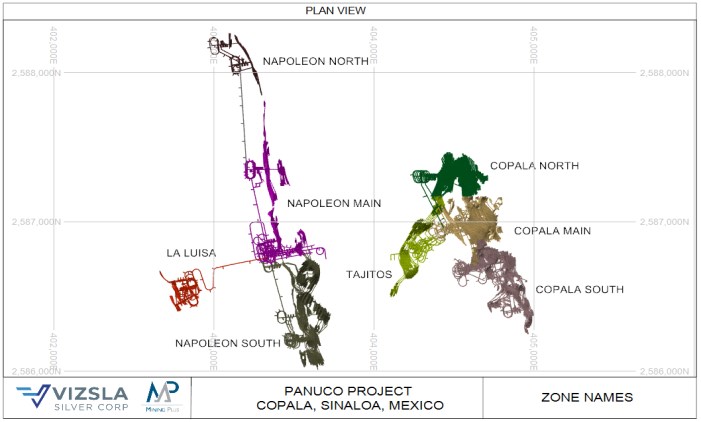
Source: Mining Plus, 2025.
|
|
Figure 16-20: Sequencing Blocks in Copala

Source: Mining Plus, 2025.
16.4.5.5 Stope Cycle
The activities in the longhole stope cycle include:
Drilling - Drilling blastholes and stope cable bolts prior to production
Charging - Charging blastholes with explosives
Mucking - Loading and tramming broken ore to the remuck
Backfilling - Building a fill barricade, and placement of rock or paste backfill
Stope cycle durations vary by stope size. The average longhole stope tonnage in the mine plan is approximately 4,000 t. Typical durations for a 4,000-tonne stope are:
|
|
Drilling: 7 days
Charging: 2 days
Mucking: 9 days
Backfilling: 6 days
The backfill activity includes a lag of one day to account for fill barricade construction, and the drilling activity includes a lag of one day to account for moving the drill into the workplace and preparing the site. A separate task was created for the curing of paste and CRF fill. The curing time for paste is scheduled at 14 days.
The DAF cycle includes the same activities as LHS and is scheduled at a rate of 1.75 m per day per heading. There are up to four active sub-levels in Copala North, and a DAF cut with 100,000 tonnes of ore has about 1,400 m of lateral development and takes approximately one year to complete. This approach ensures that the production rate from Copala North is steady and allows for scheduling flexibility if there are challenging conditions or slower sequences encountered during production.
16.4.5.6 Stope Sequencing
The LHS sequence follows a chevron retreat to the central accesses within each block. Stopes are mined, backfilled, and cured before adjacent stopes are extracted. In some areas, parallel lenses on a level are concurrently active. Figure 16-21 and Figure 16-22 show a long section of a mining block illustrating the extraction sequence of stopes and the mining activities that would be taking place concurrently.
In DAF areas, the extraction follows a primary-secondary sequence. Several primary drifts are mined concurrently within each cut before being backfilled. Once the primaries on either side are backfilled with CRF, the secondary drifts in between are extracted and backfilled with uncemented waste rock or CRF. Sequencing proceeds bottom-up, maintaining a fill lag to minimize exposure of unfilled drifts. A typical DAF extraction sequence is illustrated in Figure 16-23.
CAF stopes are mined progressively outward from the access drift, with CRF placed immediately behind the mining front to maintain local ground support.
|
|
Figure 16-21: Long Section of a Longitudinal Retreat Sequence

Source: Mining Plus, 2025.
|
|
Figure 16-22: Longitudinal Stoping Retreat Sequence Long Section in Napoleon Main

Source: Mining Plus, 2025.
|
|
Figure 16-23: Plan View Showing Drift & Fill Extraction Sequence

Source: Mining Plus, 2025.
16.5 Mine Development
The primary ramps are positioned at least 60 meters from mineralization to prevent damage from stress redistribution during stope extraction, and to provide space for infrastructure such on level accesses such as stockpiles, and sumps.
A typical ramp will be developed with an arched back profile. This profile allows sufficient room to accommodate a larger underground fleet as well as secondary ventilation ducting, service and backfill piping. Other planned development includes the following:
Access drifts,
Sills (development on mineralization),
Operating waste development (sills mining material below cut-off),
Sumps, escapeways, and accesses to the escapeways,
|
|
Return airways and accesses to the return airways, and
Stockpiles,
A typical level layout for the mine is provided Figure 16-24.
Figure 16-24: Panuco Project Typical Level Layout

Source: Mining Plus 2025.
16.5.1 Lateral Development
To meet the planned annual development, a maximum of nine jumbos are required for mine for development, shared between the Copala and Napoleon mines.
The annual lateral development schedule is illustrated in Figure 16-25, while the total and initial lateral development schedule is summarised in Table 16-43.
|
|
Figure 16-25: Annual Lateral Development Schedule

Source: Mining Plus, 2025.
Table 16-43: Annual Lateral Development Schedule
| Year | Ramp Capital (m) |
Other Capital (m) |
Ore Drives (Operating) (m) |
Cut & Fill (Operating) (m) |
Other Operating (m) |
Total Lateral (m) |
| Y -2 | 1,979 | 2,062 | 2,194 | - | 178 | 6,413 |
| Y -1 | 2,086 | 2,730 | 3,659 | 3,918 | 739 | 13,133 |
| Y 1 | 2,747 | 1,477 | 5,356 | 4,959 | 1,162 | 15,701 |
| Y 2 | 4,269 | 3,920 | 6,862 | 5,778 | 1,571 | 22,401 |
| Y 3 | 2,760 | 3,138 | 10,353 | 5,996 | 1,111 | 23,358 |
| Y 4 | 3,154 | 2,907 | 8,648 | 6,127 | 1,530 | 22,366 |
| Y 5 | 4,468 | 2,973 | 6,162 | 4,575 | 498 | 18,676 |
| Y 6 | 3,718 | 3,527 | 10,542 | 3,663 | 1,119 | 22,569 |
| Y 7 | 2,398 | 2,557 | 12,520 | 4,630 | 1,101 | 23,206 |
| Y 8 | 3,320 | 3,168 | 6,987 | 3,760 | 853 | 18,088 |
| Y 9 | 1,531 | 1,580 | 1,945 | 2,481 | 337 | 7,874 |
| Y 10 | - | - | - | 508 | - | 508 |
| Total | 32,431 | 30,039 | 75,228 | 46,394 | 10,199 | 194,291 |
|
|
16.5.2 Vertical Development
Vertical development will be completed by a combination of raise boring and drop raising. Ventilation raises exceeding 20 m in length will be excavated with a 4.5 m diameter raise bore and shorter raises will be drop raised with a 4.0 m x 4.0 m profile. Egress raises will be completed by a 1.2 m diameter raise bore. A development rate of 1.8 m per day was applied to all vertical development.
The annual vertical development schedule is illustrated in Figure 16-26 and the vertical development figures are provided in Table 16-44.
Figure 16-26: Annual Vertical Development Schedule

Source: Mining Plus, 2025.
|
|
Table 16-44: Annual Vertical Development Schedule
| Year | Ventilation Raises (Raise Bore) (m) |
Egress Raises (Raise Bore) (m) |
Drop Raises (m) | Total Vertical (m) |
| Y -2 | 186 | 122 | - | 307 |
| Y -1 | 196 | 191 | - | 388 |
| Y 1 | 177 | 88 | - | 265 |
| Y 2 | 339 | 405 | 43 | 787 |
| Y 3 | 410 | 249 | - | 659 |
| Y 4 | 203 | 211 | 82 | 496 |
| Y 5 | 234 | 210 | 40 | 484 |
| Y 6 | 310 | 343 | - | 653 |
| Y 7 | 268 | 257 | 15 | 540 |
| Y 8 | 522 | 545 | 15 | 1,082 |
| Y 9 | 170 | 176 | 15 | 362 |
| Y 10 | 0 | 0 | 0 | 0 |
| Total | 3,015 | 2,796 | 211 | 6,023 |
16.6 Mine Operations
Due to the spatial separation between the various mineral deposits, the mine workings for Copala and Tajitos zones are disconnected from those of Napoleon and La Luisa. The Copala Mine and Tajitos Mine portals, access the larger of the two deposits, while the Napoleon Mine portal accesses the Napoleon and La Luisa deposits which are located approximately 1 km to the west of the Copala deposit.
The planned stopes and associated development designs for the various zones are illustrated in Figure 16-27 to Figure 16-31. The ramps and associated infrastructure have been positioned centrally to each zone, to minimize development and allow a central longitudinal retreat.
|
|
Figure 16-27: Copala Long Section, Copala Mine

Source: Mining Plus 2025.
|
|
Figure 16-28: Tajitos Long Section, Copala Mine

Source: Mining Plus 2025.
|
|
Figure 16-29: Napoleon North Long Section, Napoleon Mine

Source: Mining Plus 2025.
|
|
Figure 16-30: Napoleon South Long Section, Napoleon Mine

Source: Mining Plus 2025.
|
|
Figure 16-31: La Luisa Long Section, Napoleon Mine

Source: Mining Plus 2025.
16.6.1 Production
Two mining methods will be employed at Panuco:
Drift-and-fill with CRF and unconsolidated backfill will be employed at Copala North to minimize surface disturbance.
Longitudinal long hole retreat will be employed in all other zones, with a combination of CRF and paste fill.
Figure 16-32 illustrates the selected mining method that is proposed for both Copala and Napoleon Mines. In addition to the mining methods, Figure 16-33 illustrates the NSR value distribution in the various zones.
|
|
Figure 16-32: Proposed Mining Method for the Panuco Project

Source: Mining Plus 2025.
|
|
Figure 16-33: Proposed Stope Shapes by NSR ($US/t) for the Panuco Project

Source: Mining Plus 2025.
16.6.2 Production Rates
The mine plan aims to achieve a steady-state production rate of 3,300 tonnes per day (t/d) during the initial operating years. This will ramp up to a peak rate of 4,000 t/d once the Phase 2 processing plant is commissioned and multiple mining zones are in concurrent production. The production schedule has been developed considering equipment availability, backfill curing times, ventilation capacity, and development advance rates.
The planned average contributions at full production from each mining method are as follows:
Long hole Stoping: 2,000 t/d
Drift-and-Fill: 1,200 t/d
Ore Development: 800 t/d
|
|
16.6.3 Longhole Drilling
Drilling productivity is expected to average 200 meters per day per rig, based on operational benchmarking and rock hardness and equipment capability. To support the production schedule, it is estimated that a maximum of six longhole drill rigs will be required throughout the life of mine. This fleet size provides sufficient capacity to carry out production drilling, cable bolt drilling, and service hole drilling, while maintaining schedule flexibility. The annual longhole drilling schedule is illustrated in Figure 16-34, while the total and initial longhole drilling schedule is summarised in Table 16-45.
The breakdown of total drilling requirements is summarised in Table 16-45, for a total of 2,509 km over the life of mine, which includes:
Production drilling: 2,221 km
Cable bolting: 64.6 km (Capital + Operating)
Other drilling (including service holes and): 217 km
The annual LHS drilling schedule is graphically presented in Figure 16-34. There is the ramp-up in the first four years of mine life, and an increased demand from the fifth year onwards, when Napoleon enters peak production.
Figure 16-34: Annual Longhole Drilling Schedule

Source: Mining Plus 2025.
|
|
Table 16-45: Annual Production Drilling
| Capital Drilling (m) | Operating Drilling (m) | ||||||||
| Year | Infrastructure Raise (m) |
Cablebolts (m) |
Other (m) |
Total Capital (m) |
Production (m) |
Cablebolts (m) |
Other (m) | Total Operating (m) |
Total Drilling (m) |
| Y -2 | - | 1,536 | 2,700 | 4,236 | - | 191 | - | 191 | 4,428 |
| Y -1 | - | 2,055 | 7,050 | 9,105 | 27,134 | 1,891 | 100 | 29,125 | 38,230 |
| Y 1 | - | 1,132 | 2,100 | 3,232 | 103,090 | 2,741 | 3,675 | 109,506 | 112,738 |
| Y 2 | 1,167 | 2,569 | 9,300 | 13,036 | 176,859 | 5,827 | 14,062 | 196,748 | 209,784 |
| Y 3 | - | 2,698 | 8,550 | 11,248 | 156,926 | 6,114 | 13,849 | 176,889 | 188,137 |
| Y 4 | 2,227 | 2,568 | 7,350 | 12,145 | 285,106 | 4,496 | 20,256 | 309,857 | 322,002 |
| Y 5 | 1,075 | 3,241 | 8,329 | 12,645 | 310,616 | 4,503 | 18,236 | 333,355 | 346,000 |
| Y 6 | - | 3,076 | 7,510 | 10,586 | 307,894 | 3,542 | 16,064 | 327,500 | 338,086 |
| Y 7 | 407 | 2,211 | 6,224 | 8,842 | 254,359 | 4,223 | 14,891 | 273,473 | 282,315 |
| Y 8 | 406 | 2,584 | 10,487 | 13,477 | 277,791 | 2,959 | 19,983 | 300,733 | 314,209 |
| Y 9 | 411 | 1,152 | 3,900 | 5,464 | 293,024 | 3,148 | 20,079 | 316,251 | 321,715 |
| Y 10 | - | - | - | - | 28,384 | 206 | 2,556 | 31,145 | 31,145 |
| Total | 5,693 | 24,823 | 73,500 | 104,016 | 2,221,183 | 39,840 | 143,750 | 2,404,773 | 2,508,789 |
16.6.4 Blasting and Explosives
All development and production activities in Panuco will require blasting. Development and CAF will predominantly use ANFO while LHS will use a combination of ANFO and packaged emulsion depending on the nature of holes being charged. Explosives requirements have been forecast on the basis of typical drill patterns and the production schedule, with allowances included for re-blasting and wastage.
16.6.4.1 Development Blasting
Standard drill-and-blast methods will be used for all development headings. ANFO will be the primary explosive in dry conditions, supplemented by packaged emulsion for lifters and areas with wet ground.
Development explosives requirements over the life of mine are estimated as:
ANFO: 12.07M kg (Powder factor: 1.02 kg/t)
Cartridges: 2.42M kg (Powder factor: 0.20 kg/t)
Detonators: 2.11M units
|
|
A 10% allowance has been included for safety bays, re-blasting, and wastage. Advance rates of approximately 4.0 m per round are expected. Non-electric detonators will be the standard initiation system, with electronic detonators deployed in areas requiring vibration control.
16.6.4.2 Production Blasting
Longhole stopes will be drilled in downhole pattern and blasted in retreat sequence. Packaged emulsion will be the primary explosive, complemented by ANFO where conditions permit. Charge control techniques including decking, stemming, and electronic timing will be applied where required to optimise fragmentation and limit overbreak.
Life-of-mine production explosives requirements are estimated as:
ANFO Bulk: 3.3M kg (Powder factor: 1.00 kg/t)
Packaged Emulsion: 4.4M kg (Powder factor: 1.1 kg/t)
Stopes blasted: 2,300
Stope Detonators: 190,300 units (50% non-electronic/ 50% electronic)
Stope Boosters (150 g): 190,300 units
A 10% allowance has been applied for re-blasting and wastage. Estimated powder factor ranges from 0.85 kg/t to 1.27 kg/t.
16.6.4.3 CAF and DAF Blasting
Blasting in CAF and DAF areas will use shorter rounds and tighter burden to control wall damage and dilution. Smooth wall blasting or pre-splitting will be employed in poor ground conditions to reduce overbreak. Electronic detonators or a similar blast hole timing detonation control product will be utilized for vibration control near the crown pillar.
16.6.4.4 Explosives Supply and Storage
An explosives supplier will supply ANFO, packaged emulsion, cartridge explosives, detonators, boosters, and accessories, and will manage all on-site loading operations. Explosives will be stored in surface magazines in accordance with SEDENA (Secretariat of National Defense, Mexico) regulations. Underground storage facilities are planned at Copala and Napoleon to store explosives and detonators, ensuring compliance with safety and regulatory standards.
16.6.5 Run-of-Mine Plan
Mined material from all production areas will be transported by the underground mobile fleet to designated surface locations. Mineralized material will either be hauled directly to the ROM mill stockpiles or low-grade stockpile. Waste material will either be directed to an underground stope backfill location, waste rock surface stockpile or the CRF pad for crushing and CRF preparation.
|
|
The ROM production schedule integrates stope sequencing, equipment productivity, and backfill requirements, ensuring stable feed delivery while accommodating mine development, ventilation, and infrastructure constraints.
Table 16-46 presents the annual ROM tonnage schedule, summarizing total mined material over the life of mine.
Table 16-46: Annualized Mineralized Material ROM
| Year | Feed Tonnes (kt) | Ag (g/t) | Au (g/t) | Ag (koz) | Au (koz) |
| Y -2 | 74 | 149 | 1.5 | 356 | 3.6 |
| Y -1 | 473 | 347 | 2.6 | 5,286 | 38.8 |
| Y 1 | 859 | 392 | 2.8 | 10,842 | 77.3 |
| Y 2 | 1,226 | 341 | 2.2 | 13,419 | 88.4 |
| Y 3 | 1,310 | 291 | 2.1 | 12,246 | 86.7 |
| Y 4 | 1,599 | 267 | 2.1 | 13,745 | 108.2 |
| Y 5 | 1,535 | 241 | 2.2 | 11,888 | 107.2 |
| Y 6 | 1,533 | 192 | 2.0 | 9,484 | 96.2 |
| Y 7 | 1,497 | 204 | 1.8 | 9,816 | 84.9 |
| Y 8 | 1,382 | 184 | 1.5 | 8,186 | 67.1 |
| Y 9 | 1,160 | 176 | 1.6 | 6,564 | 60.9 |
| Y 10 | 153 | 159 | 1.8 | 783 | 8.9 |
| LoM Total | 12,802 | 249 | 2.0 | 102,615 | 828.3 |
16.6.6 Grade Control and Stockpiling
A comprehensive grade control program will be implemented to define ore boundaries, reduce dilution, and support accurate stope design. Grade control activities will include:
Underground channel sampling along development headings,
In-fill diamond drilling ahead of stoping,
Face mapping and logging to confirm lithological contacts,
Stope surveys for reconciliation of mined volumes,
Ore mark-up in active headings to guide excavation.
All grade control activities will follow established QA/QC protocols and will feed into short-term planning and stope updates.
|
|
To support stockpiling and processing decisions, mined material was classified into three ore types based on NSR value:
Low grade ore (US$33-200/t): Material produced in excess of the mill feed capacity in a period will be stockpiled and fed when the mill has capacity to process more material.
Medium grade ore (US$200-400/t): Fed directly to the mill, except in the pre-production period.
High grade ore (>US$400/t): Fed directly to the mill, except in the pre-production period.
Material below US$33/t was considered waste and not included in the mill feed. These categories align with economic cut-offs and support consistent mill feed blending and optimum project NPV.
16.6.7 Mine Dilution and Mining Recovery
Modifying factors are applied to account for the combined effects of dilution and recovery, both of which influence the quantity and quality of material extracted and processed. Dilution introduces waste into the mineralized stream, leading to two primary negative impacts:
Increased operational costs, including mining, processing, treatment, and tailings storage; and
Reduced mineral recovery, as waste negatively affects processing efficiency and overall material recovery.
Dilution is generally categorized as either planned or unplanned:
Planned dilution refers to waste that is intentionally extracted alongside mineralized material, primarily to accommodate minimum mining widths and ensure safe and effective drilling and blasting operations. While this material lowers the overall grade, it is a controlled and anticipated part of the mining process.
Unplanned dilution occurs when waste material inadvertently enters the mineral stream. Common sources include:
over-break during blasting and geotechnical conditions,
overbreak during blasting or due to weak ground conditions;
backfill material spilling into active stopes;
mixing of waste (e.g., road base or backfill) during mucking;
misrouting or accidental dumping of waste on plant feed stockpiles; and
mixing of waste in ore stockpiles due to handling errors.
Mining shapes generated by the stope optimizer reflect both the planned and unplanned (ELOS) dilution. Additional allowances for unplanned fill dilution and mining losses were applied in the mine schedule as modifying factors to the stope volumes.
|
|
In addition to dilution, mining losses also significantly impact project economics by reducing available metal and, in turn, revenue. A mining recovery factor was applied to represent mineral losses that occur during the mining process. This can result from underbreak in blasting, mucking losses, or mixing of ore and waste during material handling.
Estimates were refined during the FS, with mining recovery for longhole stoping expected to average 94%, mining recovery for drift-and-fill and development assumed at 100%. Table 16-47 shows the summary of Dilution and Mining Recovery assumptions. With the exception of ELOS dilution which captures grades in the block model, dilution was assigned a grade of zero.
Table 16-47: Mining Dilution and Recovery
| Category | Unit | Value | |
| Dilution | |||
| LHS Volumetric Dilution (ELOS) | Copala Main | m | 0.36 |
| Copala South | m | 0.26 | |
| Cristiano | m | 0.28 | |
| Tajitos | m | 0.26 | |
| Napoleon North | m | 0.3 | |
| Napoleon Main | m | 0.6 - 0.8 | |
| Napoleon South | m | 0.3 | |
| La Luisa | m | 0.9 | |
| DAF Volumetric Dilution (ELOS) | m | 0 | |
| Unplanned Dilution (%) - LHS and DAF | Floor | m | 0.2 |
| Stope End Wall | m | 0.2 | |
| Back (Sill Pillars) | m | 0.2 | |
| Fill Dilution Grade | g/t | 0 | |
| Mining Recovery | |||
| LHS | LHS Crown Pillar | % | 90% |
| LHS Sill Pillar | % | 92% | |
| LHS Uppers Height >= 15 m | % | 92% | |
| LHS Dip <= 55 degrees | % | 92% | |
| LHS Width < 3.0 m | % | 94% | |
| LHS Height < 15 m | % | 95% | |
| LHS Width > 3.0 m | % | 96% | |
| DAF & CAF | DAF & CAF | % | 100% |
|
|
16.6.8 Backfill
All production voids at the Panuco Project are planned to be filled to maintain ground stability, minimize dilution, and reduce the long-term requirement for surface waste storage. The backfill strategy uses a combination of waste rock fill (WRF), cemented rock fill (CRF), and paste backfill, applied in sequence depending on the mine development stage.
During the pre-production phase (Y-2 & Y-1), stopes will be mined in a bottom-up sequence, with all voids filled using rockfill (both cemented and uncemented). Binder demand in this phase is lower since the backfill is primarily exposed along the stope sidewalls. In Y-1, approximately 9,000 m³ of low and medium cement rockfill and up to 110,000 m³ of high-cement rockfill are scheduled to be placed.
From Y 2 to Y 10, following the commissioning of the paste plant, paste fill becomes a primary fill type, with annual volumes averaging 250,000 m³ during peak production years (Y 2 to Y 9). The paste plant will be constructed adjacent to the mill where tailings slurry will be pumped to a storage tank for use in backfill. A portion of this slurry will be dewatered using a disc filter to achieve the designed solids loading for the paste system. The dewatered tails are combined with the tailings that bypassed the filter and binder that had been sent to the vortex mixer. The vortex mixer discharge and the dewatered tails are combined in the paddle mixer to generate the paste for backfill based on a specific recipe that provides the appropriate backfill strength for the mining requirements. The paste is then pumped to the mine and distributed underground.
The paste pump is a positive displacement piston pump of 100 m3/h peak capacity with a pressure rating of 100 bar. The nominal flow rate for the system is 56 m3/h and 63 m3/h in Phases 1 and 2 of production respectively. A high-pressure pump is also included in the design for pipeline flushing during normal operation or in case of mechanical issues with the paste pump.
Paste will be pumped to the Copala and Napoleon zones through surface piping before transitioning underground through boreholes or pipe installed on the ramp depending on the zone. Diverter gates including dump valves are included in main connection points throughout the system to minimize the amount of manual line transfers between pours and allow for dumping paste to a sump during operations upset.
In this sequence, higher-strength plugs with 8% binder are placed first (~6 m of a 20 m stope), followed by main pours with 3% binder, ensuring structural integrity and effective dilution control. Rockfill continues to play an important supporting role throughout this period, particularly low-cement and no-cement types, which average 150-200k m³ per year. High-cement rockfill is used more selectively in sill and crown pillars, providing localized structural support where required.
CRF will be produced using a dedicated plant on surface near the Copala portal. Aggregate will be produced for the plant using a mobile crusher which will crush mine waste hauled to surface. The CRF will be trucked underground from the plant to the required area and placed in the stope or drift using a scoop.
The annual backfill profile is illustrated in Figure 16-35, while the total and initial annual backfill schedule is summarised in Table 16-48.
|
|
Figure 16-35: Annual Backfill Schedule for the Panuco Project

Source: Mining Plus, 2025.
Table 16-48: Annual Backfill Schedule
| Year | Rockfill ('000 m³) |
Rock Fill - No Cement ('000 m³) |
Rock Fill - Low Cement ('000 m³) |
Rock Fill - High Cement ('000 m³) |
Paste Fill ('000 m³) |
Paste Fill - Low Cement ('000 m³) |
Paste Fill - High Cement ('000 m³) |
| Y -2 | - | - | - | - | - | - | - |
| Y -1 | 124 | 6 | 9 | 109 | - | - | - |
| Y 1 | 244 | 91 | 77 | 75 | 34 | 31 | 3 |
| Y 2 | 235 | 124 | 104 | 7 | 211 | 199 | 11 |
| Y 3 | 191 | 115 | 76 | - | 254 | 247 | 6 |
| Y 4 | 333 | 148 | 118 | 67 | 303 | 284 | 20 |
| Y 5 | 386 | 153 | 178 | 55 | 241 | 231 | 10 |
| Y 6 | 355 | 139 | 174 | 42 | 246 | 245 | 0 |
| Y 7 | 316 | 136 | 149 | 30 | 227 | 225 | 2 |
| Y 8 | 296 | 127 | 134 | 35 | 244 | 240 | 4 |
| Y 9 | 300 | 122 | 150 | 28 | 257 | 256 | 1 |
| Y 10 | 42 | 20 | 23 | - | 46 | 46 | - |
|
|
| Year | Rockfill ('000 m³) |
Rock Fill - No Cement ('000 m³) |
Rock Fill - Low Cement ('000 m³) |
Rock Fill - High Cement ('000 m³) |
Paste Fill ('000 m³) |
Paste Fill - Low Cement ('000 m³) |
Paste Fill - High Cement ('000 m³) |
|
Total |
2,823 |
1,181 |
1,192 |
449 |
2,063 |
2,005 |
58 |
The Panuco project will have a surplus of waste rock produced. This will be placed in waste rock storage facilities on surface. The balance of waste produced, and the waste placed as backfill is shown in Table 16-49. By balancing underground backfilling with mined waste, surface disposal is minimized. At mine closure, 0.63 Mt of waste (317,500 m³) remains on surface, which is within the 1.47 Mt permitted storage capacity.
Table 16-49: Annual Waste Balance Schedule
| Year | Waste Balance Stockpile (kt) | Waste Balance Stockpile (000 m³) |
| Y -2 | 339.9 | 170.0 |
| Y -1 | 537.8 | 268.9 |
| Y 1 | 498.4 | 249.2 |
| Y 2 | 824.7 | 412.3 |
| Y 3 | 1,067.7 | 533.9 |
| Y 4 | 1,052.6 | 526.3 |
| Y 5 | 938.8 | 469.4 |
| Y 6 | 1,005.4 | 502.7 |
| Y 7 | 1,007.6 | 503.8 |
| Y 8 | 1,038.8 | 519.4 |
| Y 9 | 719.9 | 360.0 |
| Y 10 | 635.0 | 317.5 |
16.6.9 Material Movement
Material movement for the Panuco Project will be carried out using a modern, high-capacity underground load-and-haul fleet. Even though the mine plan considers larger primary haulage equipment (17 t LHD and 51 tonne haul hucks), the expected contractor fleet assumes 14-tonne loaders and 45-tonne haul trucks. This fleet has been reviewed and scaled to match the development profile and production requirements while optimizing cycle times, fuel efficiency, and equipment utilization.
Material will be transported from underground production areas to either ore stockpiles or the processing plant ROM pad using underground haul trucks. The operation is split between two major mining zones: Copala and Napoleon, each with separate access and haulage infrastructure. Trucking requirements are distributed accordingly to balance fleet deployment. Total load and haul fleet requirements are provided in Table 16-50 and the annual trucking requirements (tkms) are shown in Figure 16-36.
|
|
Table 16-50: Load and Haul Fleet for the Panuco Project
| Equipment Type | Description | Annual Peak Requirements |
| Development Loaders | 14 t | 5 |
| Production Loaders | 14 t | 3 |
| Backfill Loaders | 14 t | 3 |
| Trucks | 45 t | 13 |
Figure 16-36: Annual Underground Trucking tkms

Source: Mining Plus, 2025.
Annual mineralisation movement is illustrated in Figure 16-37 and summarised in Table 16-51. COVs for the High-Grade (HG), Medium-Grade (MG), and Low-Grade (LG) bins are $400/t NSR, $200/t NSR, and $33/t NSR respectively. The purpose of the stockpiles is to allow higher grading mineralisation to be preferentially processed allowing a lower grade stockpile to build over time. During Y-02 through to mill commissioning, the HG and MG ore will be stockpiled separately from the LG ore. The pre-production HG and MG ore stockpile will reach a size of 357 kt before being processed in the first 9 months of mill operation. The pre-production LG stockpile will initially reach a size of 166 kt in Y-01 where it will be used to supplement the mill while the underground mine ramps up in Y 1 & Y 2. Following that, the LG stockpile eventually reaches a peak size of 601 kt in Y 7 before being fully processed by Y 10.
|
|
Figure 16-37: Mineralised Material Plan for the Panuco Project

Source: Mining Plus, 2025.
The Panuco Project will move a total of 19.1 Mt of material over the life of mine as shown in Table 16-51. This includes 4.8 Mt of capital development waste, 6.9 Mt from operating development (1.4 Mt waste and 5.5 Mt ore), and 7.2 Mt of production ore. Material movement ramps up from mid Y-1, reaching steady-state between Y 2 and Y 8 averaging 2.1 Mt per year, before tapering off towards closure. Concurrently, about 5.6 Mt of waste is placed back underground as backfill, reducing surface storage and trucking requirements.
Table 16-51: Material Movement Schedule for Panuco
| Year | Capital Dev - Waste (kt) |
Capital Dev - Ore (kt) |
Capital Total (kt) |
Op Dev - Waste (kt) |
Op Dev - Ore (kt) |
Production Ore (kt) |
Operating Total (kt) |
Grand Total (kt) |
| Y -2 | 310 | 3 | 313 | 30 | 71 | - | 101 | 414 |
| Y -1 | 367 | - | 367 | 79 | 388 | 85 | 552 | 919 |
| Y 1 | 333 | - | 333 | 116 | 513 | 346 | 975 | 1,308 |
| Y 2 | 637 | - | 637 | 160 | 611 | 615 | 1,386 | 2,023 |
| Y 3 | 458 | 0 | 458 | 168 | 749 | 560 | 1,477 | 1,935 |
| Y 4 | 466 | - | 466 | 185 | 691 | 908 | 1,784 | 2,250 |
| Y 5 | 576 | - | 576 | 82 | 529 | 1,006 | 1,617 | 2,194 |
| Y 6 | 559 | - | 559 | 218 | 551 | 982 | 1,751 | 2,310 |
|
|
| Year | Capital Dev - Waste (kt) |
Capital Dev - Ore (kt) |
Capital Total (kt) |
Op Dev - Waste (kt) |
Op Dev - Ore (kt) |
Production Ore (kt) |
Operating Total (kt) |
Grand Total (kt) |
|
Y 7 |
382 |
- |
382 |
252 |
671 |
826 |
1,749 |
2,131 |
|
Y 8 |
509 |
- |
509 |
113 |
495 |
887 |
1,495 |
2,004 |
|
Y 9 |
241 |
- |
241 |
41 |
235 |
925 |
1,201 |
1,441 |
|
Y 10 |
- |
- |
- |
- |
37 |
116 |
153 |
153 |
|
LoM Total |
4,837 |
3 |
4,840 |
1,443 |
5,543 |
7,255 |
14,242 |
19,082 |
16.6.9.1 Stope Extraction and Truck Haulage
Stope mucking will be carried out using 10-tonne LH410 loaders, which will tram material from stope draw points to nearby level stockpiles. The loaders will load trucks at designated loading points located at the intersection of the ramp and level access. The loaders are expected to move 50 t/h (5 buckets per hour) while carrying out production mucking and truck loading. Productivity could be increased when 17-t loaders are available to assist in loading trucks from the levels stockpile.
16.6.9.2 Truck Dump Locations
Mined material will be hauled from underground using 51-tonne TH551 articulated haul trucks to designated truck dump locations for ore and waste located between 0.5 to 2.0 km from each portal, as shown in Figure 16-38. At the process plant material will be stockpiled and segregated by grade (high, medium, low) to allow for effective blending and optimized feed scheduling at the plant.
|
|
Figure 16-38: Surface Haulage Plan

Source: Mining Plus 2025.
Stockpiles on levels have been designed with a 7.0 m high back allowing haul trucks to dump waste rock directly for backfilling operations.
16.6.10 Activity and Equipment Rates
Contractor mining is currently proposed for the Panuco Project to minimise up front capital and achieve higher productivities. The development rates used are inclusive of the time taken to drill, blast, ventilate, muck, and install ground support. These rates are similar to observations by Mining Plus at other operations in Mexico and similar mining jurisdictions. The Panuco mine plan has a high degree of flexibility due to the amount of available work areas and development headings. The single heading rates are shown in Table 16-52 and have been constrained to promote mining and production access in multiple zones and panels rather than from a single zone.
 |
 |
Table 16-52: Development Activity and Equipment Rates for the Panuco Project
| Activity | Units | Single Heading Rate |
| Lateral Development - Capital | m / day | 3.5 |
| Lateral Development - Operating | m / day | 1.75 |
| Vertical Development | m / day | 1.8 |
Production rates are broken into specific activities due to the longer duration for each. The equipment is set to meet the capacity of each individual activity which can only be completed sequentially. LH drilling assumes a modern longhole drill rig, while both production activities assume the use of stope loaders for mucking. The truck loading and hauling rates are factored into the production activity rates. These rates are summarised in Table 16-53.
Table 16-53: Fleet Trucking and Loading Productivity
| Equipment Type | Model | Capacity | Availability | Max U of A | Productivity |
| Haul Truck | Sandvik TH551i | 51 t | 86% | 73% | 192 t·km/hr |
| LHD (Capital) | Sandvik LH517i | 17 t | 86% | 67% | 86 t/hr |
| LHD (Operating) | Sandvik LH410 | 10 t | 86% | 67% | 50 t/hr |
Stope loader productivity was adjusted based on the loader tram distance for longitudinal stoping, with an average mucking rate of approximately 430 t/d. For drift-and-fill production, a rate of 1.75m per day per heading was scheduled, which equates to approximately 125 t/d. The 17 t loaders will operate in the level access and trucks and the 10 to loaders will operate in the ore drives and will bring ore to the stockpiles. The 17 t loaders would be more efficient in loading the trucks with the larger bucket capacity and higher reach. The 17-tonne loaders offer greater efficiency for truck loading due to their larger bucket capacity and extended reach. In contrast, the 10-tonne loaders are better suited for narrower headings where the larger units cannot operate effectively.
16.6.11 Mining Sequence and Phasing
The mining sequence at the Panuco Project has been strategically developed to optimize early metal production, de-risk initial access, and ensure geotechnical stability throughout the life of mine. The sequence is structured to allow for efficient ramp access, stope turnover, and backfill placement, with appropriate consideration for ground support and ventilation.
Initial mine development will prioritize access to high-grade zones at Copala and Napoleon, with early stopes sequenced near the portals to reduce haul distances and capital intensity in the ramp-up years. Longhole stoping will be the dominant method, with cut-and-fill and drift-and-fill used in narrower, high-grade or geotechnically sensitive areas.
|
|
The general phasing includes:
Pre-production development, including ramps, ventilation raises, and initial infrastructure.
Initial stope development in upper zones to allow for bottom-up sequencing and backfill.
Progressive mining and backfilling, advancing from bottom to up to ensure ground stability and continuous access.
Paste plant commissioning, scheduled 21 months from portal development, enabling transition from CRF to paste fill in select areas.
Backfill placement is sequenced immediately after stope extraction, with CRF or paste used in primary stopes and unconsolidated fill in secondary stopes as appropriate.
16.6.12 Production Schedule Overview
The life-of-mine (LOM) production schedule targets an initial steady-state production rate of 3,300 t/d, achieved through phased ramp-up over the initial operating years which increased to 4,000 t/d to meet the mill demand in Phase 2. The schedule integrates development, stope preparation, mucking and backfilling constraints while prioritizing early access to high-grade material.
Key highlights of the production schedule include:
A three-year ramp-up period, with increasing ore tonnage delivered from Copala area;
Peak production sustained from Year 4 through Year 10, contributing the majority of the recovered metal;
A progressive decline in later years as deeper zones are mined and production transitions to narrower, lower-tonnage stopes;
Consistent grade control and ore classification (high, medium, low-grade) to support mill feed blending and metallurgical performance.
Annual production volumes and grade trends are summarised in Section 16.6.9 and illustrated in Figure 16-37.
16.7 Ventilation
The ventilation system for the Panuco Project has been designed to provide adequate airflow to all working areas in accordance with Mexican regulations and best-practice safety standards. The design incorporates both primary and secondary ventilation systems for the Copala and Napoleon mines.
16.7.1 Primary Ventilation
A push-type ventilation system will be implemented, in which dedicated ventilation raises equipped with surface intake fans will push fresh air underground. Fresh air will be delivered into internal raises connected to the mining levels. Return airflow from each level will be collected into the main decline and exhausted through the main portals. The main fans will be located on surface and sized to accommodate peak ventilation demand. Airflow capacity is based on a minimum of 0.049 m³/s per kW (2.18 m3/min per HP) of mobile diesel equipment operating underground, plus allowances for leakage, mine losses, and maintaining sufficient air velocity in major airways and underground fixed facilities including shops and magazines.
|
|
Copala Mine will be serviced by three surface Fresh Air Raises (FARs) and one Return Air Raise (RAR), each at 4.5 m (15 ft) diameter. The Copala North FAR will provide fresh air to both Copala North and Copala Main zones, while return air will be handled by the Copala Main RAR and the main ramp to the Copala portal. Fresh air will enter Copala South via a dedicated FAR and return through the main ramp to Copala portal. Tajitos will receive fresh air through a dedicated FAR and the return air will exhaust through the Tajitos portal via ramp. The installed fan power is estimated at 1,342 kW (1,800 HP), delivering approximately 359 m³/s (760 kcfm) during peak demand (Year 3).
Napoleon Mine will be serviced by six surface raises in total, four FARs and two RARs, each 4.5 m (15 ft) in diameter. The Napoleon Main zone will receive fresh air via two dedicated FARs, and the return air will be exhausted through a dedicated RAR. La Luisa and Napoleon North zones will be provided with fresh air via dedicated FAR, with return air exiting through main decline to the Napoleon portal. Napoleon South zone is in series with Napoleon Main zone and will receive fresh air from Napoleon Main FAR, exhausting through a dedicated RAR. Napoleon will have a total of four intake fans with a combined installed power of 932 kW (1,250 HP), delivering approximately 283 m³/s (599 kcfm) during peak demand (Year 8).
All major primary fans (with motors bigger than 200 kW) will be fitted with variable frequency drives (VFDs), adjustable pitch blades, and automated louvers to optimize energy efficiency and provide operational flexibility for changing fleet assignments. Surface fans with smaller motors that are operated only for a shorter period will not be equipped with VFDs. Table 16-13 below shows the total ventilation demand for the Copala mine and the primary ventilation layout for the Copala is shown in Figure 16-39.
|
|
Figure 16-39: Primary Ventilation Layout of the Copala Mine

Source: Mining Plus 2025.
Table 16-54: Ventilation Demand Estimate for the Copala Mine - Diesel Equipment Based
| Equipment / Unit | Engine Power (kW) | Utilization (%) | Units | Airflow Demand (m³/s) |
| Jumbo, 2-boom | 119 | 35% | 5 | 9.91 |
| Boom Bolter | 119 | 35% | 3 | 5.95 |
| Cable Bolter | 119 | 35% | 1 | 1.98 |
| 51T Truck | 515 | 85% | 5 | 104.20 |
| LHD 17T tonne | 275 | 85% | 2 | 22.26 |
| LHD 10T tonne | 235 | 85% | 5 | 47.55 |
| Long Hole Drill TH-DL432i | 119 | 35% | 3 | 5.95 |
| Rhino 100 Raisebore | 200 | 35% | 1 | 3.33 |
| Grader | 150 | 85% | 1 | 6.07 |
|
|
| Equipment / Unit | Engine Power (kW) | Utilization (%) | Units | Airflow Demand (m³/s) |
| Transmixer | 150 | 35% | 1 | 2.50 |
| Shotcrete Sprayer | 110 | 35% | 1 | 1.83 |
| Scissor Lift | 110 | 35% | 2 | 3.65 |
| Emulsion Production Loader | 110 | 35% | 1 | 1.83 |
| Deck Truck | 110 | 35% | 1 | 1.83 |
| Water Truck | 110 | 35% | 1 | 1.83 |
| Fuel / Lube Truck | 110 | 35% | 2 | 3.65 |
| Development ANFO Loader - EC3 | 110 | 35% | 2 | 3.65 |
| Block Holer | 110 | 35% | 1 | 1.83 |
| Telehandler Manitou MHT-X 790 | 107 | 35% | 2 | 3.55 |
| Personnel Carrier | 95 | 35% | 6 | 9.47 |
| Subtotal - Mobile Equipment | 242.80 | |||
| UG Shop | - | - | - | 17.60 |
| Explosives Magazine | - | - | - | 6.81 |
| Fixed Facilities | - | - | - | 24.41 |
| Personnel | - | - | - | 1.15 |
| Leakage @ 15% | - | - | - | 40.25 |
| Total Demand in m3/s | 309.02 | |||
| Total Demand in kcfm | 655 kcfm | |||
Figure 16-40 illustrates the annual airflow demand profile for the Copala mine over the life of mine (LOM), based on the diesel equipment fleet schedule developed for the feasibility study. The demand curves incorporate contributions from mobile equipment, fixed facilities, personnel, and a 15% leakage allowance. The peak demand based on diesel equipment fleet is 309 m3/s (655 kcfm).
Airflow demand at Copala ramps up rapidly from Year 1 to Year 3. This period coincides with maximum equipment deployment and production rates. The equipment component dominates the demand profile, accounting for more than 75% of total airflow requirements during peak years. Following the production peak, ventilation demand steadily decreases as mining activities shift to fewer active headings and lower fleet utilization.
|
|
Figure 16-40: Airflow Demand for Copala Based on Equipment Fleet

Source: Mining Plus, 2025.
Based on various mining activities and the required development and production crews, the peak ventilation demand for Copala mine is 359 m3/s (760 kcfm). Table 16-55 shows the airflow requirements for various development activities and the overall demand based on the peak mining activities.
Table 16-55: Ventilation Demand Estimate for the Copala Mine - Mining Activity Based
| Activity | Ventilation per Activity | Number of Areas | Total Ventilation | ||
| m³/s | CFM | m³/s | CFM | ||
| Ramp Development | 45.06 | 95,483 | 1 | 45.06 | 95,483 |
| Level Development | 18.99 | 40,247 | 1 | 18.99 | 40,247 |
| Raise Development | 15.08 | 31,950 | 0 | - | - |
| Level Production - LHS | 24.15 | 51,180 | 3 | 72.46 | 153,539 |
| Level Development - DAF/CAF | 19.68 | 41,698 | 2 | 39.35 | 83,396 |
| UG Shop | 17.60 | 37,297 | 1 | 17.60 | 37,297 |
| Explosives Magazine | 6.81 | 14,423 | 1 | 6.81 | 14,423 |
| Trucks | 20.84 | 44,161 | 4 | 83.26 | 178,645 |
| Inactive Levels | 5.63 | 11,920 | 5 | 28.13 | 59,599 |
| Leakage at 15% | 46.76 | 99,094 | |||
| Total | 358.51 | 760,000 cfm | |||
|
|
The primary ventilation layout for Napoleon mine is shown in Figure 16-41 and the total ventilation demand estimate for the napoleon mine is shown in Table 16-56.
Figure 16-41: Primary Ventilation Layout of the Napoleon Mine

Source: Mining Plus 2025.
|
|
Table 16-56: Ventilation Demand Estimate for the Napoleon Mine - Diesel Equipment Based
| Equipment / Unit | Engine Power (kW) | Utilization (%) | Units | Total Demand (m³/s) |
| Jumbo, 2-boom | 119 | 35% | 4 | 7.93 |
| Boom Bolter | 119 | 35% | 3 | 5.95 |
| Cable Bolter | 119 | 35% | 1 | 1.98 |
| 51T Truck | 515 | 85% | 4 | 83.36 |
| LHD 17T | 275 | 85% | 1 | 11.13 |
| LHD 10T | 235 | 85% | 5 | 47.55 |
| Long Hole Drill TH-DL432i | 119 | 35% | 4 | 7.93 |
| Rhino 100 Raisebore | 200 | 35% | 1 | 3.33 |
| Grader | 150 | 85% | 1 | 6.07 |
| Transmixer | 150 | 35% | 1 | 2.50 |
| Shotcrete Sprayer | 110 | 35% | 1 | 1.83 |
| Scissor Lift | 110 | 35% | 2 | 3.65 |
| Emulsion Production Loader | 110 | 35% | 1 | 1.83 |
| Deck Truck | 110 | 35% | 1 | 1.83 |
| Water Truck | 110 | 35% | 1 | 1.83 |
| Fuel / Lube Truck | 110 | 35% | 2 | 3.65 |
| Development ANFO Loader - EC3 | 110 | 35% | 1 | 1.83 |
| Block Holer | 110 | 35% | 1 | 1.83 |
| Telehandler Manitou MHT-X 790 | 107 | 35% | 2 | 3.55 |
| Personnel Carrier | 95 | 35% | 5 | 7.89 |
| Subtotal - Mobile Equipment | 191.57 | |||
| UG Shop | 17.60 | |||
| Explosives Magazine | 6.81 | |||
| Fixed Facilities | 24.41 | |||
| Personnel | 1.05 | |||
| Leakage @ 15% | 32.85 | |||
| Total Demand m3/s | 252.29 | |||
| Total Demand kcfm | 534 | |||
The peak ventilation demand for Napoleon is 252 m3/s (534 kcfm) based on diesel fleet. Napoleon Mine starts two years after the Copala mine start date and ramps up more gradually than Copala, reflecting the lateral development schedule as shown in Figure 16-42. Airflow demand gradually rises to peak in Year 8. Peak demand is driven by increased truck haulage and LHD deployment as additional mining panels come online. After Year 8, ventilation requirements decline as production levels reduce by Year 10 and approaching zero by the end of mine life.
|
|
Figure 16-42: Airflow Demand for Napoleon based on Diesel Equipment Fleet

Source: Mining Plus, 2025..
Based on mining activities, the peak ventilation demand for Napoleon is 283 m3/s (599 kcfm), as detailed in Table 16-57. The primary fan installation for Napoleon, with an estimated capacity of 283 m³/s, closely aligns with this peak modelled demand.
Table 16-57: Ventilation Demand Estimate for the Napoleon Mine - Mining Activity Based
| Activity | Ventilation per Activity (with allowance) | Number of Areas | Total Ventilation m³/s | ||
| m³/s | CFM | m³/s | CFM | ||
| Ramp Development | 45.06 | 95,483 | 1 | 45.06 | 95,483 |
| Level Development | 18.99 | 40,247 | 1 | 18.99 | 40,247 |
| Raise Development | 15.08 | 31,950 | 0 | - | - |
| Level Production - LHS | 24.15 | 51,180 | 3 | 72.46 | 153,539 |
| Level Development - DAF/CAF | 19.68 | 41,698 | 0 | - | - |
| UG Shop | 17.60 | 37,297 | 1 | 17.60 | 37,297 |
| Explosives Magazine | 6.81 | 14,423 | 1 | 6.81 | 14,423 |
| Trucks | 20.84 | 44,161 | 3 | 62.52 | 132,483 |
| Inactive Levels | 5.63 | 11,920 | 4 | 22.50 | 47,680 |
| Leakage at 15% | 36.89 | 78,173 | |||
| Total | 282.82 | 599,325 | |||
|
|
16.7.2 Auxiliary Ventilation
Copala and Napoleon mines will employ auxiliary fans with flexible ducting to provide ventilation for various development, production activities, and fixed facilities. Ramp development crews will be provided fresh air using two 1.22 m (48 inch) diameter flexible duct with 75 kW (100 HP) fans. The total airflow required by the development crew will be 39 m3/s with no allowance and will be pushed to the face by the twin ducts. Each fan will provide an airflow of about 20 m3/s at the face and can force ventilate a distance of 550 m. Once the raise connection is made and a primary ventilation circuit is established, the ducts will be relocated to the next intake point.
Level development crews will be provided with ventilation through one 1.22 m (48 inch) diameter flexible duct and 45 kW (60 HP) fans. Once the level access development is completed with internal raise (FAR) connection and primary ventilation circuit is established, fresh air will enter the level through FAR and return through the internal ramp. The amount of air entering each level is controlled by a regulator on FAR access drift.
Production crews on each level (LHS and DAF/CAF) will be supported by auxiliary ventilation similar to level development activity. Underground shops in both Copala and Napoleon are located to facilitate exhausting return air into the return air circuit without much exposure to work areas. Copala shop will draw fresh air from the main decline and will exhaust the return air into the main RAR directly through a pull system consisting of a 1.22 m (48 inch) diameter spiral steel duct and a 22 kW (30 HP) fan. Napoleon shop will draw fresh air from a FAR and will exhaust air into the main decline part of the return air circuit.
16.8 Underground Infrastructure and Services
16.8.1 Portals
There are three portal locations planned for the Panuco Project: two for the Copala and Tajitos deposits and another for the Napoleon and La Luisa deposits. Copala portal is already commissioned as part of the test mine. Tajitos portal will be excavated 2 months after the start of the life of mine activities. Napoleon Portal will commence approximately 24 months after the start date of mine. All the portals will remain active until the end of the planned mine life. There will be approximately 12 years of production from the mine.
16.8.2 Power Supply and Distribution
Electrical power for the Panuco Project will be supplied from the regional grid via a dedicated overhead transmission line to the main site substation. From here, power will be distributed to the Copala and Napoleon mines through separate feeders.
At each mine, surface substations will step down the voltage for distribution to primary ventilation fans, surface compressor stations, dewatering pumps, crushers, and workshops. Underground distribution will be via 13.8 kV cables installed in declines and boreholes, feeding primary substations that are spaced approximately 60 m vertically apart. These will further step-down voltage and supply power to secondary substations on each level through boreholes, in turn powering auxiliary fans, pumps, lighting, and electric-powered mobile equipment.
|
|
The system is designed to meet the peak total mining load of 10.23 MW occurring in Year 8. Load increases will be managed in stages, aligning with the mine development schedule to optimize capital investment and energy efficiency.
An estimate that includes equipment utilisation for plant and the mobile fleet has been summarised in Table 16-58.
Table 16-58: Panuco Project Power Estimate (Mining Activities Only)
|
LOM Year |
Copala Surface |
Copala UG |
Copala |
Napoleon |
Napoleon UG |
Napoleon |
Total Mining |
|
Y -2 |
821 |
2,041 |
2,861 |
- |
- |
- |
2,861 |
|
Y -1 |
1,044 |
2,338 |
3,382 |
- |
- |
- |
3,382 |
|
Y 1 |
1,044 |
3,470 |
4,514 |
112 |
531 |
643 |
5,158 |
|
Y 2 |
1,044 |
3,947 |
4,991 |
522 |
1,891 |
2,413 |
7,404 |
|
Y 3 |
1,492 |
3,993 |
5,484 |
634 |
2,553 |
3,187 |
8,671 |
|
Y 4 |
1,566 |
4,148 |
5,714 |
634 |
3,177 |
3,811 |
9,525 |
|
Y 5 |
1,566 |
4,022 |
5,588 |
634 |
3,683 |
4,317 |
9,905 |
|
Y 6 |
1,566 |
3,737 |
5,304 |
1,007 |
3,922 |
4,929 |
10,233 |
|
Y 7 |
1,566 |
2,961 |
4,527 |
1,007 |
4,018 |
5,025 |
9,552 |
|
Y 8 |
1,566 |
2,006 |
3,572 |
858 |
4,394 |
5,252 |
8,824 |
|
Y 9 |
1,343 |
1,712 |
3,054 |
858 |
3,726 |
4,584 |
7,638 |
|
Y 10 |
1,231 |
1,117 |
2,348 |
858 |
2,788 |
3,646 |
5,993 |
16.8.3 Mine Dewatering
A series of submersible pumps are currently proposed for the Panuco Project, capable of pumping mine water containing up to 5% solids. The proposed system is to manage solids within the pumped water and transport it to surface for desliming and potential use for processing or reuse underground. Each mine's dewatering system will incorporate an eight-inch (8") Schedule 40 steel pipe in the main decline to surface, which will further connect to 6-inch (6") Schedule 40 steel pipe in the internal ramps to each zone that will continue to primary dewatering pump stations. The system is capable of handling a peak dewatering rate of 28 L/s (450 gpm) from individual mining zone. This includes groundwater inflows and service water requirements for various activities underground. The average dewatering rate out of Copala and Napoleon is estimated at 28 L/s (450 gpm) and 48 L/s (760 gpm) respectively.
Water from each level gets collected on the level sump which further gets directed to the nearest main pump station by gravity. The main pump stations are located every 60 m vertically, comprising of one 45-kW pump capable of pumping 28 L/s. Water from the bottom levels is pumped to the portal through the cascading system of these pumps. Small 22 kW (30 HP) pumps will be used for level dewatering activities. Copala mine dewatering system is detailed in Figure 16-43 and Figure 16-44.
|
|
Figure 16-43: Copala Mine Dewatering System

Source: Mining Plus 2025.
|
|
Figure 16-44: Napoleon Mine Dewatering System

Source: Mining Plus 2025.
|
|
Once production in each mining zone is complete, the zone is let to flood with the pumps from primary stations relocated to other active areas.
16.8.4 Compressed Air
A system of two 112 kW air compressors installed on surface at Copala and Napoleon portals is proposed to support the compressed air needs of the project. The compressed air is transferred from portal through a single six-inch pipe that is routed via main decline, which is further transported through a 4-inch pipe in internal ramps to each level. All compressors will be installed with an air accumulator.
16.8.5 Service Water
Service water that is required for mining activities is distributed to underground mine workings through a 4-inch pipe in the decline. Pressure reducer valves will be installed where required to manage the level water pressure to within equipment operating limits.
16.8.6 Fuel Storage and Distribution
Fuel for mobile equipment will be stored in double-walled fuel tanks located at each portal. These tanks will be equipped with secondary containment, dispensing pumps, and spill control systems. Refueling will be carried out at designated fueling bays near the portals and along primary haulage routes underground as required. Fuel management will comply with all relevant safety and environmental regulations.
16.8.7 Communications System
The underground communications network will include a leaky feeder radio system for voice communication, supported by Wi-Fi access points in key operational zones. This will enable real-time communication, tracking, and integration with mine management systems. Surface-to-underground links will be maintained from central control rooms near the portals.
16.8.8 Explosives Magazines
Explosives will be stored in surface magazines located at a safe distance from the portals, designed in accordance with Mexican regulatory requirements. Separate underground magazines will be provided for detonators and bulk explosives, with a peak capacity of 3 to 4 days of storage for ANFO and 14 days for emulsion. Explosives will be delivered underground using designated explosive transport units and handled by certified personnel.
16.8.9 Cemented Rockfill and Paste Fill Distribution
The cemented rockfill (CRF) distribution will rely on surface mixing plants located near Copala portal, feeding underground trucking. CRF will be used in primary stopes and initial lifts of CAF and DAF sequences. Paste backfill will be introduced following commissioning of the paste plant (targeted at Year 1), with delivery via a dedicated distribution pipeline routed through the main ramps and boreholes. Distribution will support simultaneous backfilling operations in multiple mining zones as required.
|
|
16.8.10 Surface Maintenance Facilities
Surface maintenance facilities will be established near the Copala portal, comprising heavy equipment shops, light vehicle bays, wash bays, and parts storage. These facilities will support routine maintenance and repair of the underground fleet, reduce equipment downtime and optimize availability. Additional laydown areas will be designated for temporary storage of development materials and consumables.
16.8.11 Workshop
An underground workshop is proposed to be developed in each main mining area (e.g., Copala and Napoleon) to support light and mid-level maintenance activities close to the production areas. These workshops will reduce equipment travel time to surface, improve equipment availability, and serve as satellite service stations between scheduled surface maintenance cycles.
The underground workshop will typically include:
Mobile maintenance bays for quick repairs and equipment inspections,
Fuel and lubrication storage, with containment systems,
Tire change areas,
Compressed air and basic tooling for minor servicing,
Ventilation and fire suppression systems to ensure safety.
These garages will not replace the surface facilities for major overhauls but will allow for routine preventive maintenance, troubleshooting, and emergency repairs underground, thereby increasing equipment utilization and reducing operational delays.
16.8.12 Refuge Chambers and Emergency Egress
A secondary means of egress will be excavated between each level, with a connection from the top level of each mine to surface. Egress raises will be developed between levels via raise bore at a diameter of 1.2 m. These will then be outfitted with emergency egress ladderways and access double doors installed in a wall to reduce entry of smoke and other contaminants.
Portable refuge chambers will be installed in remucks to provide refuge to mining personnel in case of emergency. A total of eight 8-person refuge chambers will be installed in various active zones and will be equipped with a minimum of 96 hours of onboard breathable air supply. The chambers will be relocated through out the life of mine with respect to the active mining zones.
|
|
Emergency alarm and stench gas systems will be installed to notify personnel of an emergency. These will be installed on FAR intakes at the surface fans. The egress routes for both the Copala Mine and Napoleon Mine are illustrated Figure 16-45 and Figure 16-46 respectively.
Figure 16-45: Egress Layout of the Copala Mine

Source: Mining Plus 2025.
|
|
Figure 16-46: Egress Layout of the Napoleon Mine

Source: Mining Plus 2025.
16.8.13 Safety Measures
16.8.13.1 Fire Protection
All underground vehicles will be equipped with automatic fire suppression systems. Additional fire extinguishers will be maintained at:
Pump stations and electrical installations,
Underground service bays and garages,
Key infrastructure and loading points.
Emergency roll-up fire doors will be installed at the entrance of underground workshops. Fire protection systems will meet local regulatory standards and undergo routine inspections.
|
|
16.8.13.2 Mine Rescue and Emergency Response
A fully trained mine rescue team will be established on site, with capabilities for both underground and surface emergencies. The team will have access to:
Specialized mine rescue equipment,
Foam fire suppression systems,
Regular training and simulation exercises.
An Emergency Response Plan (ERP) has been developed and will be reviewed regularly throughout the project life.
16.8.13.3 Emergency Notification System
A stench gas warning system will be installed on all operating portals and integrated into the underground compressed air lines. This system will allow rapid, mine-wide alerts in the event of an emergency and will be expanded in phases as underground development advances.
16.9 Mining Equipment
As a contractor operated project, the mobile equipment fleet schedule was provided by engaged contractors and validated by Mining Plus using first principles calculations. The fleet is phased in and optimized across the project life, with deployment aligned to mine sequencing and production ramp-up from Y-02 through to the end of the mine life. The contractor will be responsible for all maintenance, inclusive of rebuilds, for the mobile equipment fleet.
Equipment is supported by:
Surface maintenance facilities at the Copala portal (as described in Section 16.8.10), including heavy and light equipment bays.
Underground laydown areas for storage of key consumables and parts.
Underground workshops at both Copala and Napoleon to reduce haul-back time for maintenance and improve availability. These workshops are designed to accommodate the less mobile equipment types (jumbos, bolters, long hole drill, etc.) while LHDs and haul trucks will be primarily handled by the surface facilities.
The equipment fleet for the Panuco project is listed in Table 16-59.
|
|
Table 16-59: Underground Mobile Equipment Fleet
| Equipment | Max Units required |
| Jumbo - 2 Boom | 7 |
| Boom Bolter | 6 |
| Longhole Drill - Top Hammer | 7 |
| LHD - 14 Tonne (Production, Development & Backfill) 1 | 11 |
| Haul Truck - 45 Tonne 1 | 13 |
| Cable Bolter | 1 |
| Scissor Lift | 3 |
| Telehandler | 2 |
| Scaler | 4 |
| Transmixer | 2 |
| Shotcrete Sprayer | 1 |
| ANFO/Emulsion Loader | 3 |
| Bulldozer - 4 m3 | 1 |
| Skid Steer | 2 |
| Grader | 1 |
| Personnel & Material Transport | 7 |
| Utility Vehicles | 12 |
Notes:
1. 14 tonne LHD and 45 tonne truck unit count is estimated by the contractor and aligns with assumed equipment sizes for the project
16.10 Mine Personnel
The Panuco Project is proposed to operate seven days a week with two 12-hr shifts for 365 days per year. Direct employees are expected to work on 20 on / 10 off roster with indirect staff working primarily 5 on / 2 off. The estimated labour quantities, inclusive of both on-shift and off-shift labour, are summarised in Table 16-60.
Table 16-60: Panuco Project Mine Personnel Estimate
| Equipment | Headcount (max) |
| Management | 2 |
| Technical Services | 26 |
| Technicians & Samplers | 8 |
| Subtotal Owner | 36 |
| Contractor Operations Labour | 276 |
| Contractor Maintenance Labour | 38 |
| Contractor Management Supervision, Support | 85 |
| Subtotal Contractor | 399 |
| Total Underground Mining | 435 |
|
|
17 RECOVERY METHODS
17.1 Overview
The process design is based on processing ore from the Panuco deposits, through crushing, grinding, gold and silver leaching with cyanide and precious metal recovery to doré via counter current decantation residue washing and the Merrill Crowe process. An expansion for Year 4 adds a bulk flotation with concentrate regrind and leach to the flowsheet. The design is based on previous test work programs performed on the deposit, Ausenco's database of reference projects, and in-house process modelling. The process plant has been designed with assumed availabilities of 65% for the crushing plant, and 92% for all other processing circuits. The plant will operate with two 12-hour shifts per day, 365 days per year.
A staged expansion approach for the process plant has been selected. A simple Whole Ore Leach flowsheet for Year 1- 3 will treat Copala material and bulk flotation with concentrate regrind and leach and tailing leach configuration will be used when Napoleon material is introduced from Year 4.
The expansion of the plant over the life of mine occurs as follows:
Phase 1 (Years 1 to 3) - three-stage crushing, ball milling, followed by whole ore leach recovery at a throughput of 1.2 Mt/a or 3,300 t/d.
Phase 2 (Years 4+) - conversion to bulk flotation with concentrate regrind, with concentrate and flotation tailings leach recovery at a throughput of 1.5 Mt/a or 4,000 t/d.
17.2 Process Design Criteria
Table 17-1 presents the design criteria developed for the process plant.
|
|
Table 17-1: Process Design Criteria
| Parameter | Units | Value | |
| Phase 1 | Phase 2 | ||
| Plant capacity | Mt/a | 1.2 | 1.5 |
| Plant capacity | t/d | 3,300 | 4,000 |
| Life of mine | years | 11 | |
| Silver head grade, design | g/t | 432 | 230 |
| Gold head grade, design | g/t | 2.78 | 1.77 |
| Crushing plant availability | % | 65 | |
| Grinding availability | % | 92 | |
| JK Axb parameter, design | - | 33 | |
| Bond ball mill work index, design | kWh/t | 18.3 | |
| Bond abrasion index, design | g | 0.330 | |
| Specific gravity | - | 2.64 | |
| Crushing plant feed size, F80 | mm | 265 | |
| Crushing plant product size, P80 | mm | 9 | |
| Ball mill circulating load, design | % | 500 | 400 |
| Grinding circuit product size, P80 | µm | 50 | 70 |
| Bulk flotation mass pull, design | % plant feed | - | 14.3 |
| Bulk flotation regrind mill product size, P80 | µm | - | 20 |
| Bulk flotation regrind specific energy | kWh/t | - | 17.5 |
| Concentrate leaching residence time | h | - | 48 |
| Concentrate leach density | % w/w | - | 30 |
| Bulk leaching residence time | h | 96 | 79 |
| Bulk leach density | %w/w | 50 | - |
| Counter current decantation underflow density | % solids w/w | 60 | |
| Counter current decantation wash ratio | m3 water: m3 feed slurry | 4.25 | 3.50 |
| Cyanide detoxification residence time | min | 90 | |
| Cyanide detoxification density | % solids w/w | 40 | |
| Tailings thickener underflow density | % solids w/w | 60 | |
| Paste plant capacity, design | t/d | 4,000 | |
17.3 Process Plant Description
The process design consists of the following major components:
Three-stage crushing of run of mine (ROM) material
Ball milling in closed circuit with a classifying cyclone
Bulk leaching of the cyclone overflow (Phase 1) or of the flotation tailings and concentrate leach residue (Phase 2)
Bulk rougher flotation and concentrate regrind (Phase 2 only)
|
|
Cyanide leaching of the flotation concentrate (Phase 2 only)
Counter-current decantation (CCD)
Zinc precipitation of the clarified pregnant solution and smelting to produce doré
Cyanide detoxification
Tailings thickening
Paste backfill plant
17.3.1 Mill Feed Schedule
The mill production schedule targets an annual production rate of 1.2 Mt from Years 1-3 and 1.5 Mt from Year 4. The LOM Mill feed schedule is presented below in Figure 17-1.
Figure 17-1: Plant Production Schedule

Source: Ausenco, 2025.
17.3.2 Process Flowsheet
The overall process flowsheet is presented below in Figure 17-2.
|
|
Figure 17-2: Process Flow Diagram

Source: Ausenco, 2024.
|
|
17.3.3 Phase 1 Design
17.3.3.1 Crushing Circuit
The crushing circuit is a three-stage process that reduces run of mine (ROM) material from an 80% passing feed size (F80) of 265 mm to an 80% passing product size (P80) of 9 mm before being further processed in the grinding circuit.
ROM material will be hauled from the mine and dumped into a coarse ore hopper equipped with a static grizzly that feeds a vibrating grizzly feeder. Oversized ROM material will be broken down by a rock breaker before being rehandled into the coarse ore hopper. Oversize from the vibrating grizzly feeder will be crushed by a jaw crusher and blended with the vibrating grizzly undersize on secondary screen feed conveyor. Primary crushed ore is fed onto a double deck vibrating screen via conveyor. Oversize material from the top deck of the screen will be fed via conveyor to a secondary cone crusher, while oversize material from the bottom deck will be fed, via conveyor, to a tertiary cone crusher. Both crushers will discharge back onto the secondary screen feed conveyor which will recirculate the crushed material back to the screen. Undersize material from the screen will be sent via conveyor to a surge bin. A belt feeder will withdraw material from the surge bin to feed the grinding circuit. Overflow from the bin will be collected on a conveyor and sent to a crushed ore stockpile. The stockpiled material will be reintroduced to the plant feed via the surge bin by a front-end loader (FEL) when the crushing circuit is not operating.
Major equipment in this area will include:
ROM hopper with static grizzly
Vibrating grizzly feeder
Primary jaw crusher
Secondary screen feed conveyor and double deck screen
Secondary crusher feed conveyor and cone crusher
Tertiary crusher feed conveyor and cone crusher
Surge bin and crushed ore stockpile feed conveyor
17.3.3.2 Grinding Circuit
The grinding circuit consists of a ball mill operating in closed circuit with classifying hydro cyclones to produce a primary grind product size of 50 µm in Phase 1 and 70 µm in Phase 2.
A belt feeder will withdraw crushed material from the surge bin and transfer to the ball mill feed conveyor that discharges into the ball mill feed chute. The ball mill will discharge through a trommel screen to separate out the mill scats into a trash bunker. The trommel undersize will report to the cyclone feed pump box and mix with process water to dilute the slurry to the desired density before being pumped to the cyclone cluster. Overflow from the cyclones will pass through a trash screen before being transferred to the downstream processes. Underflow from the cyclones will report to the ball mill.
|
|
Major equipment in this area will include:
Surge bin belt feeder and ball mill feed conveyor
Ball mill
Primary cyclone feed pump box and pump
Classification primary cyclone cluster
Trash screen
17.3.3.3 Bulk Leaching
Discharge from the trash screen will be gravity fed to a pre-leach thickener where flocculant will be dosed to facilitate solids settling. Thickener overflow will be forwarded to the process water tank for reuse, while underflow will be pumped to the bulk leaching tanks. Leaching will occur in a series of four tanks that provide a total of 96 hours of retention time. Discharge from the final bulk leaching tank will gravitate to the counter current decantation (CCD) circuit.
Oxygen, that is generated on site, will be sparged to the tanks to maintain the required levels of dissolved oxygen. Hydrated lime will be added to the tanks 1 through 3 to maintain an appropriate pH for cyanide leaching. Sodium cyanide will be added to each tank in the series to maintain the required concentration of cyanide to optimize gold and silver leaching.
The bulk leach area will be equipped with hydrogen cyanide gas detectors for personnel safety.
Major equipment in this area will include:
A pre-leach thickener
Four mechanically agitated leaching tanks
17.3.3.4 Counter Current Decantation
Leach slurry with report to the first of five counter current decantation thickeners with the thickened solids being pump up the CCD train. The leached solids will be washed with barren solution from the Merrill Crowe circuit that is mixed with the slurry feeding the fifth thickener in the CCD train with the overflow solution flowing by gravity down the CCD train. Solids settling will be facilitated with flocculant addition. The overflow from the first thickener reports to the pregnant solution clarifier. The circuit is designed so that the underflow from the fifth thickener has a maximum silver in solution concentrate of 0.5 mg/L and maximum gold in solution concentration of 0.05 mg/L .
Clarifier overflow will advance to a pregnant solution tank to feed the Merrill Crowe circuit. Underflow from the clarifier will be pumped as required back to the start of the bulk leaching circuit.
|
|
Major equipment in this area will include:
Five counter current decantation thickeners
One pregnant solution clarifier
17.3.3.5 Merrill Crowe Circuit
Overflow from the clarifier will advance to the pregnant solution tank prior to precious metal recovery via zinc cementation. Solution will be pumped from the pregnant solution tank through polish filters to further reduce total suspended solids (TSS) and subsequently a deaeration tower to reduce dissolved oxygen content. Deaeration tower bottoms will then be contacted with zinc powder to precipitate the gold and silver and pumped to two plate and frame filters to recover the precious metal rich precipitate. Solids from the filters will be discharged and manually moved within the refinery for doré production, while filtrate will advance to the barren solution tank. Barren solution will then be distributed to the CCD circuit as wash water with a bleed stream to the detoxification circuit as necessary.
Antiscalant will be added to the pregnant and barren solution tanks to inhibit scale formation within the Merrill Crowe circuit. Diatomaceous earth will be added to both the clarifying and precipitation filters to improve filter performance. Zinc powder is added to precipitation filter feed to achieve >99% gold and silver precipitation. Lead nitrate will be added to the zinc cone to enhance zinc efficiency for gold and silver precipitation and prevent passivation of the zinc which would inhibit the reaction. Sodium cyanide will also be added to the zinc cone to aid in zinc efficiency for gold and silver precipitation.
Major equipment in this area will include:
One pregnant solution tank
Two rotating disk clarifying filters
One deaeration tower
Two plate and frame precipitation filters
One barren solution tank.
17.3.3.6 Refinery
Zinc precipitate from the Merrill Crowe circuit will be dried prior to smelting into silver-gold doré in batch mode.
Zinc precipitate will be mixed with fluxes and loaded into the electric furnace for smelting. The fluxes will react with the base metals to form oxides that report to the slag and separate from the silver and gold molten metal. The molten metal will be poured into 30 kg moulds to form the doré bars at nominal composition of 1-3% w/w Au and 95-98% Ag, as well as any remaining impurities. The doré bars will be cleaned, assayed, stamped, and stored in a secure vault ready for periodic transfer to market.
Sufficient ventilation and off-gas handling will be provided in the gold room for a healthy work environment. Fume and dust exposure for the melting furnace and material handling will be controlled through a ventilation system installed in the gold room, including hoods, enclosures, and fans to follow local regulations/guidelines. Any mercury in the precipitate with volatilize in the furnace and be capture in the mercury abatement system included in the ventilation system using sulphur impregnated carbon.
|
|
A sump pump, complete with a precious metals trap, will be installed in the gold room any hose-down or spillage, and return it to the clarifier feed box.
The refinery will be a vendor package and will include the following major equipment:
Flux dosing and mixing system
Melting furnace
Doré scale and storage vault
Slag handling equipment
Dust collection and mercury abatement system.
17.3.3.7 Cyanide Detoxification and Tailings Thickening
Final underflow from the CCD circuit will be pumped to the cyanide detoxification tanks where weak acid dissociable cyanide (CNWAD) will be destroyed using the SO2/air process. Tailings thickener overflow solution will be recycled to the feed to achieve the desired solids density of 40%w/w. Cyanide detoxification will be conducted using parallel tanks that each provide a residence time of 90 minutes and reduce CNWAD concentration to below 1 mg/L. The discharge slurry from these tanks will flow by gravity to the tailings thickener where flocculant will be added to support solids settling. Excess overflow from the thickener will be pumped to the process water tank, while underflow will be pumped to either the tailings storage facility (TSF) or the paste backfill plant.
Copper sulphate will be added to the cyanide detoxification tanks to act as a catalyst for the cyanide destruction reaction. Oxygen gas and sodium metabisulphite (SMBS), SO2 source, will also be added as reactants. Hydrated lime will be added to the tanks to maintain the required reaction pH.
Major equipment in this area will include:
Two mechanically cyanide detoxification tanks
Tailings thickener
17.3.4 Phase 2 Design
During Phase 2, a flotation and concentrate leaching circuit is introduced to the flowsheet to support improved recoveries of Napoleon deposit material. The following subsections will describe the new additions to the flowsheet only; all other aspects of the plant design remain as described in Section 17.3.2.
|
|
17.3.4.1 Bulk Flotation
After expansion, the trash screen discharge will be diverted from the pre-leach thickener to the flotation circuit. Flotation will be conducted in a series of conventional, forced air tank cells. Concentrate from each cell will be collected in launders and advanced to the regrind circuit. Tailings from the final flotation cell will feed the pre-leach thickener from which it will continue through the process as described in Section 17.3.2. The Phase 2 throughput increase will result in a flotation tailings leach residence time of 79 hours.
Flotation concentrate will report to the regrind cyclone cluster, material below target grind size and water will be report to the overflow and bypass the regrind mill providing higher density slurry to the regrind mill. Underflow from the cyclone will be pumped to a stirred regrind mill for further size reduction and mineral liberation. Discharge from the regrind mill will be combined with the regrind cyclone overflow before reporting to the concentrate leaching circuit.
Potassium amyl xanthate (PAX) will be introduced to the flotation circuit as a collector to support sulphide mineral collection. Methyl isobutyl carbinol (MIBC) will be used as a frother to support froth generation and stability.
Major equipment in this area will include:
Five conventional forced air flotation tank cells
Dewatering regrind cyclone cluster
Stirred regrind mill
17.3.4.2 Concentrate Leaching
Discharge from the regrind circuit will be pumped to an aeration tank and overflow to the concentrate leaching tanks. Leaching will occur in a series of three tanks that provide a total of 48 hours of retention time. Discharge from the final concentrate leaching tank will advance to the concentrate leach residue thickener where flocculant will be added to facilitate solids settling. Thickener overflow will be forwarded to the pregnant solution clarifier, where the process continues as described in 17.3.3. Thickener underflow will be pumped to the bulk leaching tanks, where the process continues as described in Section 17.3.2.
Oxygen is sparged into the tanks to maintain the required levels of dissolved oxygen. Hydrated lime and sodium cyanide will be added to the first two tanks in the series to provide pH control and to maintain the required levels of cyanide respectively.
Major equipment in this area will include:
Three mechanically agitated leaching tanks
Residue thickener
|
|
17.4 Reagents Handling and Storage
The reagent handling system (Table 17-2) mill include unloading and storage facilities, mixing and storage tanks, and feeding equipment as needed for each of the required plant reagents. Each set of compatible reagents will be located in a dedicated containment area to prevent environmental contamination and mixing of incompatible reagents. Appropriate ventilation, fire, safety protection, eyewash stations, and safety data sheet (SDS) stations, will be located throughout the area. Sumps and sump pumps will be provided for each containment area for spillage control.
Table 17-2: Reagents Handling and Storage
| Reagent | Preparation Method | Use |
| Quicklime | Received as powder in bulk shipments and stored in a silo; slaked with raw water in a vertical mill and pumped to a storage tank; distributed via ring main to the leaching circuits and detox circuit | pH control |
| Sodium cyanide | Received as powder in bulk bags; dissolved and transferred to a storage tank; distributed to cyanide leaching circuits | Leaching reagent |
| PAX | Received as pellets in bulk bags; dissolved and transferred to a storage tank; distributed to flotation circuit | Flotation collector |
| MIBC | Received as intermediate bulk containers; distributed neat to flotation circuit | Flotation frother |
| Copper sulphate | Received as powder in bulk bags; dissolved and transferred to a storage tank; distributed to cyanide detoxification circuit | Cyanide destruction catalyst |
| Lead nitrate | Received as powder in bulk bags; dissolved and transferred to a storage tank; distributed to Merrill Crowe circuit | Precipitation reagent |
| Diatomaceous earth | Received as powder in bulk bags; dissolved and transferred to a storage tank; distributed to Merrill Crowe circuit | Filter aid |
| Zinc powder | Received as powder in drums; dissolved and transferred to a storage tank; distributed to Merrill Crowe circuit | Precipitation reagent |
| SMBS | Received as powder in bulk bags; dissolved and transferred to a storage tank; distributed to cyanide detoxification circuit | Cyanide destruction reagent |
| Flux | Received as powder in bulk bags; mixed with calcined charges for smelting | Fusion reagent |
| Antiscalant | Received as intermediate bulk containers; distributed neat to pregnant and barren solution tanks | Scale inhibitor |
| Flocculant | Received as powder in bulk bags; dissolved and transferred to a storage tank; distributed to thickeners across the plant | Flocculation promotor |
Reagent consumptions were estimated based on test work results as described in Section 13. A summary of average annual consumption rates for each reagent and operating consumable in Table 17-3.
|
|
Table 17-3: Major Reagent and Operating Consumable Consumption Summary
| Item | Unit | Phase 1 | Phase 2 |
| Quicklime | t/a | 5,700 | 7,800 |
| Sodium cyanide | t/a | 3,150 | 4,700 |
| PAX | t/a | - | 30 |
| MIBC | t/a | - | 50 |
| Copper sulphate | t/a | 288 | 350 |
| Lead nitrate | t/a | 118 | 125 |
| Diatomaceous earth | t/a | 160 | 161 |
| Zinc powder | t/a | 115 | 86 |
| SMBS | t/a | 4,932 | 4,832 |
| Flux | t/a | 210 | 210 |
| Antiscalant | m3/a | 31 | 40 |
| Flocculant | t/a | 190 | 230 |
| Ball mill media | t/a | 1,938 | 1,945 |
| Regrind mill media | t/a | - | 25 |
17.5 Plant Services
17.5.1 Raw Water
Raw water will be provided to the plant and stored in a raw water storage tank where it will be distributed to the various users across the plant site such as reagent preparation, gland seal water, potable water, and plant make-up. Approximately 350,000 m3 per annum will be required for consumption by the process plant.
17.5.2 Process Water
Process water for the plant will consist of pre-leach thickener overflow, tailings thickener overflow, and reclaim water from the TSF. Raw water will be provided as required for makeup. Process water will be stored in a storage tank before being pumped across the plant site to the various end users.
17.5.3 Gland Seal Water
Gland seal water for the plant will be sourced from the raw water tank and pumped to the various pumps across the plant site.
|
|
17.5.4 Fire Water
Fire water for the process plant will be stored in a dedicated volume within the raw water tank. A dedicated pump skid consisting of an electrical pump, jockey pump, and diesel pump will supply water from the fire water reserve volume to the distribution system.
17.5.5 Potable Water
Potable water will be produced by an on-site potable water plant which processes water from the freshwater tank. Potable water will be stored in a dedicated storage tank before being distributed to the various end users in the process plant.
17.5.6 Air
High-pressure air will be produced by compressors to meet plant requirements. The high-pressure air supply will be collected in a plant air received before being distributed across the plant. A dryer will be fed by the plant air receiver and discharge into an instrument air receiver prior to plant distribution.
17.5.7 Oxygen
Oxygen gas for the cyanide leaching and detoxification circuits will be generated from an on-site oxygen plant. The oxygen plant will employ vacuum swing adsorption (VSA) technology and will produce an oxygen stream of 93% purity at 6 bar (g).
17.5.8 Power
The total installed power requirement for the process plant is estimated at 13.0 MW in Phase 1 and 14.2 MW in Phase 2. Further discussion regarding the power supply and distribution system is available in Section 18. Further discussion around the operating costs associated with the plant power consumption is available in Section 21.
|
|
18 PROJECT INFRASTRUCTURE
18.1 Introduction
Infrastructure for the Panuco project will include on-site and off-site infrastructure such as civil workings, buildings and facilities, water and power supply systems, and other miscellaneous systems that support operations. The site infrastructure will include:
Mine facilities, such as the paste plant, cement rockfill plant, truck shop, service bays, explosives storage, and other miscellaneous facilities.
Process facilities include the process plant, crusher facilities, refinery, metallurgical and assay lab, mine workshop and warehouse.
Tailings storage facility.
Waste rock storage facility.
Pre-production stockpile.
Administration offices, and
Mine, process administration facilities will be serviced with potable water, fire water, compressed air, electrical power, diesel, communication and sanitary systems.
Site selection was performed based the following criteria:
Locating the facilities within the Vizsla claim boundary while maximizing the use of previously disturbed land.
Locating the crushing and ROM pad sites near portals to minimize haulage distance.
Arranging administration, offices and mine dry in close proximity to minimize footprint.
Locate the process plant to take advantage of the natural topography and avoid water courses.
Utilize the existing site access road to the greatest extent possible.
Leverage the natural terrain to minimize TSD dam construction requirements.
Proximity to the existing power line.
The Panuco site layout is shown in Figure 18-1 and process plant layout is shown in Figure 18-2.
|
|
Figure 18-1: Panuco Project Site Layout

Source: Ausenco, 2025.
|
|
Figure 18-2: Process Plant Layout
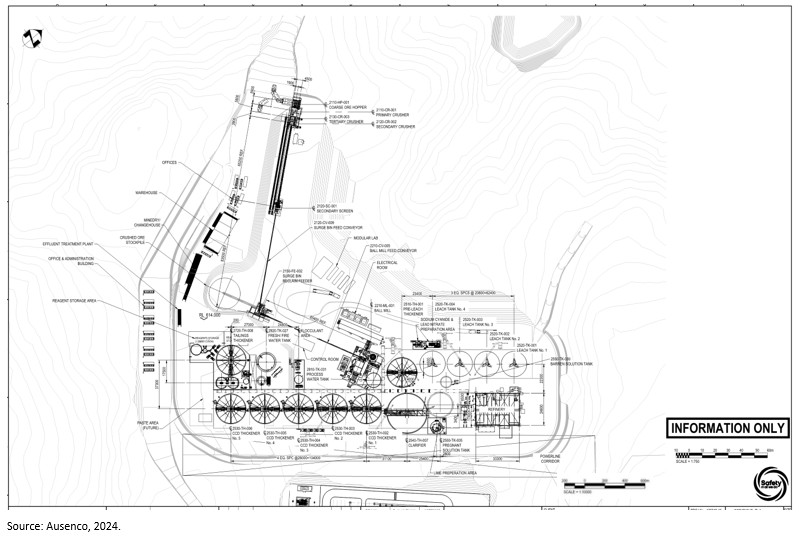
Source: Ausenco, 2024.
|
|
18.2 Roads and Logistics
18.2.1 Site Preparation
Scrub brush clearing and topsoil removal are expected requirements to allow construction of the process plant and other site infrastructure. Site civil work includes design for the following infrastructure:
Haul roads
Light vehicle access roads
Mine portal pads and process plant pad
Water management ponds, ditches and diversion channels
Tailings storage facility
Waste rock storage facility and pre-production stockpile
18.2.2 Access to Site
The site is accessed by travelling 25 km east along Highway 15, then travelling 43 km northeast along Highway 40. This leads to an entrance to a gravel access road system that will be used to navigate across the property.
Highways 15 and 40 are part of the national highway system and are well maintained. Site access from Highway 40 will require construction of acceleration and deceleration lanes to minimize traffic disruption and provide protected left-turn access into the site.
The existing access road route will be utilized to the greatest extent possible, and will be upgraded including widening, installation of culverts as well as grading of corners to ensure suitability for daily operational traffic. Where the existing access road will not be used, new sections of the road will be constructed. The design prioritizes earthworks, allowing for 2-way traffic and a 15% max grade to ensure suitability for daily operational traffic.
18.2.3 On- Site Roads
Haul roads will be constructed between the Tajitos and Napoleon Portals, WRSF and Process Plant to a minimum 12 m width to allow for two-way haulage with 50 tonne class trucks. The roads within the process plant area will be integrated with the process plant pad earthworks and the designed with adequate drainage. The roads will allow access between the administration building, substation, explosive magazine and TSF will be limited to light vehicles with a combination of two lane and one lane sections. In the one-way sections pull offs will be constructed to allow vehicles travelling in opposite directions to pass.
The typical method of clearing, topsoil removal, and excavation will be employed, incorporating drains, safety bunds and backfilling with granular material and aggregates for road structure. The entrance to the process and mine site will be via the gatehouse.
|
|
18.3 Site Security
The security gatehouse will include steel gates, chain link fencing in specific locations, guard buildings, and guard towers. In addition, communications such as surveillance cameras and CCTV monitoring are included. Radios for communication, including radio booster stations are also part of the security plan.
18.4 Electrical Power System
18.4.1 Electrical System Demand
The average demand for the Panuco Project is estimated at 19.44 MW. The power demand for each phase is summarised in Table 18-1.
Table 18-1: Total Site Electrical Demand
| Phase | Maximum Demand (MW) | Average Demand (MW) | Power Consumption (MWh/a) |
| 1 | 21.32 | 15.44 | 135,228 |
| 2 | 27.76 | 19.44 | 170,294 |
Permanent electrical power is provided by transmission line and connects to the Comisión Federal de Electricidad (CFE) electrical grid. This assumes the right of way for transmission lines and estimated alignment and design. The switchyard will be fed by the incoming 230kV line from CFE grid. From this switchyard substation an additional 230 kV transmission line will lead to the main site substation stepping the power down to 13.8 kV.
18.4.2 Site Power Reticulation
Power for the on-site infrastructure will be fed to the facility electrical rooms at 13.8 kV using overhead distribution lines.
This 13.8kV power will be distributed to various areas on the project including the process plant, administration building, and the mining areas. Two distribution lines will be constructed at the project site to provide stepped down power to the site administration and process facilities, Tajitos and Napoleon portals.
The facilities at the TSF will be powered by diesel generators.
18.4.3 Plant Power Reticulation
Motor Control Centres (MCCs) at 4,160 V and 480 V housed within the electrical room strategically located throughout the process plant area will be used for process and non process loads. Power to the electrical rooms will be supplied by resistance grounded, oil filled distribution transformers located in the respective electrical room. All e-rooms will be adequately rated for the environment and outfitted with lighting and small power transformers, distribution boards, uninterrupted power supply (UPS) systems, fire alarm and detection and HVAC systems. To reduce installation time, electrical rooms will be prefabricated modular buildings installed on structural framework above ground level for bottom entry of cables.
|
|
Additionally, electrical rooms will be located as close as practical to the electrical loads to optimize conductor sizes and minimum cable lengths.
Grounded pad-mounted and pole mounted transformers will be used to step down the voltage at the truck shop, crushers, process plant area and mine portals. Power will terminate at local 480 V distribution boards.
18.5 Support Buildings
Three types of buildings have been considered for the Panuco Project: modular, fabric, and pre-engineered. The buildings for each area are listed in Table 18-2.
Table 18-2: Panuco Building List
| Building Name | Building Type | L (m) | W (m) | H (m) | Area (m2) |
| Mine Truck shop | Fabric | 16.8 | 14.6 | 8 | 245 |
| Merril Crowe & Refinery | Pre-engineered | 33 | 24.5 | 7 | 808 |
| Offices and Administration Buildings | Modular (12 units) | 12 | 28.8 | 2.4 | 345 |
| Workshops & Warehouses | Fabric | 31 | 14.6 | 8 | 452 |
| Metallurgical Laboratory | Modular | 15 | 9 | 2.6 | 135 |
| Gatehouse | Modular | 5.5 | 3.6 | 2.5 | 20 |
| Plant Change house | Modular (4 units) | 12 | 9.6 | 2..4 | 112 |
| Mine Dry/Change house | Modular (10 units) | 12 | 24 | 2.4 | 280 |
Additional buildings on site include electrical rooms, explosive magazines, reagent storage and control rooms.
18.5.1 Gate House and Security
The gate house will be a security trailer office with a lockable gate and communications to the mine site. The security building will be a modular building located near the gate house. The facility will include rooms for personnel screening during rotations in and out of site. The facility will be equipped with fire protection and an alarm system.
18.5.2 Main Administration Building
The main administration building will be a modular building comprised of a change/lunch facility, offices, meeting rooms, washrooms, and medical facility. The building will be equipped with fire protection and alarm systems. The offices will have enough space for relevant employees. The medical facility will include first aid and emergency response rooms for on-site treatment and headquarters for the mine rescue team.
|
|
18.5.3 Truck Shops
The truck shop will be a pre-engineered building with an overhead crane, overhead doors, and fire protection and alarm systems. Several bay-doors will be provided for preventative and corrective maintenance, welding, truck washing and multi-purpose use.
18.5.4 Metallurgical Lab
The assay lab will be a modular building comprised of storage and office space, a scale room, an atomic absorption room, a wet lab and metallurgical labs. This building will be equipped with fire protection and alarm systems. The lab will require bottled nitrogen and ventilation hoods.
18.5.5 Refinery and Doré Room
The refinery and doré room will be constructed with thick concrete floors and walls, entry/exit gates, CCTVs, motion sensors and alarms. The facility will be monitored 24 hours a day by security personnel and will have restricted access. Fenced areas will be provided for controlled entry and exit of the armoured transport vehicles used for doré transportation.
18.5.6 Accommodation
No camp accommodation is planned for the project as workers will reside in, and commute from, nearby communities.
18.5.7 Fuel System
Fuel will be delivered to the project site by tanker truck to service mine equipment and mobile fleet. The fuel storage system will consist of above ground tanks.
Diesel fuel will be stored on site adjacent to the truck shop for heavy and light vehicles. The fuel supply system will be provided by a fuel supplier and include offloading pumps, dispensing pumps, associated piping and an electronic fuel control and tracking system.
18.6 Mine Infrastructure
18.6.1 Explosives Storage
A bulk explosives magazine will be located on the site at a location that will meet all regulatory requirements. There will be one bunker for bulk explosives and a second bunker for high explosives (blasting caps and boosters) and consumables (firing line, non-electric cords, and delays). The surface magazine has been sized to hold 120,000 kg of bulk emulsion, which would translate to three weeks of planned underground production. A magazine of this size would need to be 1.1 km away from inhabited buildings, traffic, fuel storage and power lines.
An underground powder magazine and cap magazine will also be constructed for storage of explosives needed in early production years.
|
|
18.6.2 Stockpiling
Mineralized material will be stockpiled at the ROM pad and segregated based on grade to allow for prioritization of high and medium grade material. Low grade mineralized material will be stockpiled near the Copala portal where it will feed the mill to maintain the mill capacity. The low-grade stockpile will reach a maximum capacity of 600,000 t in Year 5 of the mine plan and will be drawn down to elimination over the life of the mine. Despite acid rock drainage not forecast to be a concern for the Panuco project, contact water channels will capture and manage any runoff from the ROM pad.
18.6.3 Mine Dewatering
Mine dewatering will be facilitated by a system of sumps and submersible pumps. Sumps are designed off of all level access drifts in the mine schedule. Submersible trash pumps situated within each of the sumps will be activated by float switches to run as required. The size and specifications of the pumps will be determined based on ground water inflow prior to and during operations.
18.6.4 Cemented Rock Fill Plant (CRF)
Cemented rock fill will be produced by combining waste rock with a cement slurry to create a structural fill material for underground stopes. Waste rock will be sourced from development headings and WRSF, then transported to the CRF mixing station. At the station, rock will be sized and blended as required before being charged into the mixer.
A cement slurry, prepared from binder and water in a dedicated mixing tank, will be added to the rock during mixing to achieve the specified strength requirements for the stope design. The mixed CRF will then be hauled underground using load-haul-dump (LHD) units or trucks and placed in the designated stope.
The CRF system will include the following major components:
Waste rock crushing station
Cement slurry preparation and storage tanks
CRF mixing station
Distribution and placement equipment
18.6.5 Paste Backfill Plant
Thickened tailings from the process plant will be pumped to a paste backfill plant as needed. The tailings will undergo additional dewatered using a disc filter to achieve the targeted percent solids. The material will then enter the paste mixer where binder from a storage silo will be added to achieve the desired paste recipe required for the stope being filled.
The prepared paste will be pumped through a distribution network using a high-pressure positive displacement pump. If the paste pump fails, a high-pressure cleaning pump will flush water from a storage tank through the piping system to prevent hardening of paste in the lines.
|
|
The paste backfill plant will be supplied as a vendor package and include the following major equipment:
Binder Silo
Disk Filter and Vacuum Pump
Paste Mixer
Paste Pump
High Pressure Flush Pump.
18.7 Water Supply
Water will be sourced from the UG workings, tailings storage facility and paste plant reclaim water, and site water collection ponds which will be supplemented by water from the Panuco River as required. The water will be transported across the project area through pumps. A total of 13.4 km of overland and buried water pipelines will be installed from the various water sources to the process water tank, fire water tank, and potable water treatment plant as required. This water will be the source of potable and fire water on site, used for administration buildings and process plant.
18.8 Off-site Infrastructure
18.8.1 Plant Nursery
A plant nursery (Refer to Figure 18-3) in the nearby town of Copala, with species from and weathered with the soil type and pH in the area, will be used to ensure the long-term remediation and conserve flora rescued from the areas where infrastructure, including the processing plant, roads, slopes, bridges, tailings facility, and power lines, will be built. More than 4,000 plants with a variety of 19 species from the Panuco-Copala basin have grown in the nursery since late 2023.
|
|
Figure 18-3: Plant Nursery

Source: Vizsla, 2024.
18.9 Tailings Storage Facility
18.9.1 Introduction
A desktop TSF siting and deposition technology study was undertaken during the PEA. Ausenco analysed satellite imagery and topographic maps to identify potential TSF sites within a 10 km radius of the proposed plant site. The project's physiography features rugged, mountainous terrain and a complex network of streams. Figure 18-4 shows the general physiographic and hydrogeological setting.
|
|
Figure 18-4: TSF General Layout

Source: Ausenco, 2025.
The total tailings produced over the LOM is 12.8 Mt, of which 9.3 Mt will be stored in the tailings storage facility, and the rest will be used for paste backfill. The general design criteria for the siting study assumed a tailings storage requirement of 9.3 Mt for a surface tailings facility.
The tailings siting study also examined deposition technologies for slurry and filtered tailings, as well as placement in a TSF or a dry-stack tailings facility (DSTF). The area features rugged mountainous terrain, with low tailings-to-dam ratios for slurry tailings. The filtered tailings for the size of the project were excluded due to the high overall cost of this option for a low life-of-mine storage requirement.
The final location of the TSF is 2.5 km east of the process plant in a small watershed with the optimal local tailings-to-dam ratio. The TSF requires a single embankment to contain the LOM tailings, which will be constructed in phases. The TSF dam ranges in height from 28 to 64 m to hold the necessary volume of tailings.
|
|
18.9.2 Site Conditions
18.9.2.1 Regional Geology
The Panuco Project is situated along the western margin of the Sierra Madre Occidental (SMO), a large igneous province in western Mexico shaped by three major magmatic episodes from the Late Cretaceous to the Miocene. The oldest, the Lower Volcanic Complex (LVC), includes andesitic volcanic rocks and intrusive bodies, such as the San Ignacio batholith. Above it lies the Upper Volcanic Supergroup (UVS), primarily composed of rhyolitic ignimbrites and tuffs, followed by post-subduction alkali basalts associated with the opening of the Gulf of California. The region is structurally complex, featuring north-northwest trending normal faults and grabens formed during Basin and Range extension. The basement rocks consist of Jurassic to Early Cretaceous metasediments and granitoids of the Tahue terrane. These geological features host the epithermal silver-gold vein systems.
18.9.2.2 Site Specific Geology
The geology at the Panuco Project features a complex structural and lithological framework hosting multiple epithermal silver-gold vein systems. Mineralization mainly occurs in andesitic volcanic rocks and diorite intrusions of the Lower Volcanic Complex, along with rhyolitic tuffs and domes from the Upper Volcanic Supergroup. The primary mineralized structures, such as the Napoleon, Copala, Tajitos, and Cristiano veins, are controlled by reactivated Laramide-age faults and later extensional tectonics. These structures have various orientations and dips, with the Napoleon vein system notably tilting southward and Copala forming a low-angle structure bounded by steeper veins. Mineralization is found in quartz veins and breccias, often displaying multiple quartz generations and associated sulfides like pyrite, acanthite, galena, and sphalerite. Propylitic assemblages with silicification and clay gouge zones, adjacent to mineralized faults, mainly characterize the alteration.
18.9.2.3 Seismicity
The Panuco Project is situated in an area with moderate seismic activity caused by the tectonic movements of western Mexico, where the North American Plate interacts with the Cocos Plate along the Middle America Trench.
18.9.2.4 Geotechnical Investigation
There has been only one investigation campaign targeting the TSF and WRSF at the Panuco project, which began in 2025 and is still ongoing at the time of this writing. Additional targeted site investigations are planned for the detailed engineering and commissioning phases to refine the designs presented in this document. The investigations completed as of July 1, 2025, are summarised in Table 18-3.
Table 18-3: Geotechnical Field Exploration Completed to Date
| Investigation Type | Number Completed to Date |
| TSF | |
| Boreholes | 8 |
| Test Pits | 6 |
|
|
| Investigation Type | Number Completed to Date |
| Geophysics Lines | 2 |
| WRSF | |
| Boreholes | 4 |
| Test Pits | 7 |
| Geophysics Lines | 2 |
18.9.2.5 General Conditions
The types of materials encountered during the project geotechnical investigation can be categorized into three geotechnical units:
Soft soils, averaging 2.7 m in thickness, have low strength and are highly weathered, which makes them easy to excavate.
Fractured rock, ranging from 25 to 30 m in thickness, is highly fractured, moderately to highly weathered, with a fair rock quality designation indicating low to intermediate strength and moderate excavation difficulty.
Competent rock, with a thickness of 3 to 9 m, extends over 30 m in depth. It features low fracturing and weathering, high to very high strength, and good rock quality.
Two (2) vibrating wire piezometers (VWP) and two (2) Casagrande standpipe piezometers were installed to monitor groundwater levels in the TSF.
18.9.3 TSF Design Basis
18.9.3.1 Regulatory and Guidance
The TSF design criteria conform to industry-accepted best practices, regulatory standards, national and international guidelines. Where design criteria overlap, the most stringent requirements have been applied to the project. Local regulations and standards incorporated into the design include:
Comisión Nacional del Agua (CONAGUA).
Secretaría de Medio Ambiente y Recursos Naturales (SEMARNAT).
Canadian Dam Association (CDA, 2019).
18.9.3.2 TSF Consequence Classification
The TSF consequence classification, based on CDA guidance, has been identified as Very-High, and the Mexican Regulations have been identified as Medium. A detailed Dam Breach Assessment (DBA) will be conducted before detailed design, in accordance with CDA guidance. This classification is used to set the design criteria for the TSF and supporting infrastructure.
|
|
18.9.3.3 Design Criteria
The proposed process plant is located 2.5 km west of the TSF. The process will generate a slurry tailings stream to be partially used for paste backfill and the remainder placed in a surface storage facility. General Design criteria included:
Required storage of 9.3 Mt of tailings
The average annual tailings deposition rate is approximately 1,160 Mt
Slurry percent solids 50%
Tailings dry density of 1.45 t/m3
Subaerial deposition
Limiting watershed disturbance to a single catchment basin
Limiting impacts on wildlife resources
Designing for closure
Embankment Factor of Safety (FoS) slope stability requirements based on National Regulations and CDA (2019) guidelines
Static short-term greater than or equal to 1.3
Static long-term (post closure) greater than or equal to 1.5
Pseudo-static greater than or equal to 1.0
Post-seismic greater than or equal to 1.2
Short-term design seismic return period of ½ between 1:2,475 and Maximum Credible Earthquake (MCE) (or 1:10,000)
Long-term design seismic return period of MCE or 1:10,000
Inflow design flood is the probable maximum flood (PMF)
Contain PMF within TSF
Minimum freeboard for TSF is 3 m
|
|
Inflow design flood is 24 hr 100-year storm event
Minimum freeboard for the pond is 1 m
Inflow design flood is the PMF
Minimum freeboard is 0.3 m
The proposed TSF design assumptions include:
Multiple embankment raises
Starter rock shell dam with filter, GLC, and geomembrane along the upstream embankment face, transitioning to the centerline with a clay core and filters on both sides of the embankment, with rock shell on both sides of the raises.
Embankment with 2.5:1 (H:V) upstream and downstream slope
Max embankment heights range from 28 (starter) to 64m (ultimate) from crest to downstream toe.
18.9.4 Tailings Storage Facility Design
The project is located in a moderate seismic zone, and the embankments are constructed to comply with the National decree and CDA (2019) guidelines. The TSF measures 600 m long and 400 m wide, with its long axis running from southwest to northeast. The facility's depth ranges from 50 meters at the southwest end to 0 meters at the northeast end. The total volume over the entire life of mine (LOM) is 9.3 Mt. The final crest of the tailings dam will reach 617 meters above sea level (masl), including operational, stormwater, and freeboard considerations. The TSF consists of the following elements and ancillary infrastructure:
TSF Embankment
Impoundment Excavation
Non-Contact Water Diversion Channel
Seepage Collection System
Transfer Pond
|
|
Figure 18-5: TSF Ultimate LOM Configuration

Source: Ausenco, 2025.
Slurry tailings will be managed within an engineered rockfill embankment built using downstream and centerline methods. The initial embankment will store material for one year and will be later raised using the centerline method, including a geosynthetic liner system. The embankment will be made from materials excavated from the impoundment and diversion channel.
Subsequent raises will be built using the centerline method with engineered rockfill sourced from the impoundment. A geosynthetic liner system will not be installed in the centerline raises. A clay core, including appropriate filter zones, will be constructed to control the phreatic surface within the embankment, which will be connected to the liner system of the starter dam. The impoundment excavation is necessary to reach the target tailings storage capacity and to provide suitable materials for embankment construction. The diversion channel will be built to prevent surface water runoff from entering the impoundment. Contact water will be collected by a seepage collection system that directs it to the Transfer Pond before recirculating within the TSF.
|
|
Tailings will be transported from the process plant to the TSF through a pipeline, which will discharge via multiple spigots along the embankment crest of the TSF. The excess slurry water will be reclaimed for processing through the reclaimed water system. The site-wide water balance discusses the available water from the TSF, including reclaimable slurry water and rainfall runoff.
The tailings deposition rate ranges from 90 kt/a to 1,235 kt/a. The projected TSF storage capacities are outlined in Table 18-4. Tailings are planned to be discharged at 50% solids with an overall dry density of 1.45 t/m3.
Table 18-4: Life-of-Mine TSF Tailings Deposition Schedule
| Year | Annual Tailings Production (kt) |
Accumulated Tailings Production (kt) |
Annual Tailings Production (km3) |
Accumulated Tailings Production (km3) |
| Y -1 | 90 | 90 | 62 | 62 |
| Y 1 | 1,169 | 1,259 | 806 | 868 |
| Y 2 | 1,001 | 2,260 | 690 | 1,559 |
| Y 3 | 953 | 3,213 | 657 | 2,216 |
| Y 4 | 1,176 | 4,389 | 811 | 3,027 |
| Y 5 | 1,229 | 5,618 | 848 | 3,874 |
| Y 6 | 1,215 | 6,833 | 838 | 4,712 |
| Y 7 | 1,235 | 8,068 | 852 | 5,564 |
| Y 8 | 1,220 | 9,288 | 841 | 6,406 |
| Y 9 | 1,204 | 10,492 | 830 | 7,236 |
| Y 10 | 313 | 10,805 | 216 | 7,452 |
18.9.4.1 Foundations Conditions
Based on the geotechnical investigation findings, the following stratigraphy was identified at the TSF area:
Surficial soil (Geotechnical Unit I) is made up of well-graded sand and/or clayey sand.
Weathered bedrock (Geotechnical Unit II): Consists of highly fractured bedrock.
Fresh bedrock (Geotechnical Unit III): Characterized by fewer fractures.
The TSF area features overburden soils made up of well-graded sand and/or clayey sand, sitting on weathered, highly fractured bedrock, above fresh bedrock with fewer fractures.
|
|
Generally, the overburden soils are between 2 and 6 m thick, and the weathered bedrock ranges from near the surface to 48.8 m deep in the TSF, while it varies from 3 to 10 m in the WRSF. Groundwater data was not available at the time of this report.
18.9.4.2 Material Types and Descriptions
The Panuco TSF is made up of various materials strategically placed to prevent seepage through the dam. Stage 1 configuration includes a geomembrane layer on the upstream side of the dam, in contact with the tailings. Subsequent dam raises involve the addition of rockfill and transition materials in contact with the tailings on the upstream side. These materials are described from the upstream to the downstream side of the dam.
The upstream side of the dam will be lined with a geomembrane and a geosynthetic clay liner (GCL) to prevent seepage. Later, this geomembrane will be replaced by clay zone.
A 4-meter-wide sand filter layer will be installed on the upstream side of the dam below the GCL. It will serve as a controlled vertical drainage path to prevent fines migration into the rockfill. This sand must be filtered compatible with the downstream rockfill.
Rockfill material will be used for the main construction of the dam. Rockfill will be sourced from the TSF impoundment. The rock fill will consist of the upper rippable rock, approximately 10 to 15 m deep, based on the available geophysics.
Rippable rockfill from the upstream side of the TSF impoundment will be used to build the dam shell.
A clay zone, at least 4 m wide, shall be constructed along the centerline of the crest. This layer reduces high seepage rates through the dam that could destabilize the embankment; and prevents high flows through the dam.
The sand filter shall be installed on both sides of the clay zone. This material prevents the fine clay particles from migrating into the rock fill, which could cause a piping failure.
Foundation materials are composed of weathered rock from the surface down to approximately 12 m deep. A phreatic surface was not identified in the field because phreatic levels were not measured during drilling.
18.9.4.3 Analysed Cross Sections
Stability and seepage analyses were performed on the highest sections of the TSF. This area represents the facility's tallest section. Foundation conditions were assumed to align with the summarised geotechnical investigation. The analyzed sections is shown on Figure 18-6.
|
|
Figure 18-6: TSF Typical Embankment Cross Section

Source: Ausenco, 2025
18.9.4.4 Seepage and Stability Assessment
Seepage and slope stability analyses were conducted using the Seep/W and Slope/W components of GeoStudio (Seequent, 2025a, 2025b), version 2025.1.1. Seepage analyses modeled steady-state conditions, assuming the geomembrane installed in Stage 1 functions as intended.
Seep/W models were integrated with Slope/W models to evaluate the slope stability of the TSF dam. Slope/W employed the Spencer method, which satisfies both force and moment equilibrium conditions within user-defined search limits. The TSF was analyzed under static, pseudo-static, and post-earthquake scenarios.
Pseudo-static analysis models a sliding mass subjected to horizontal acceleration equal to half of the selected peak ground acceleration (PGA) (Hynes-Griffin and Franklin, 1984). Pseudo-static analyses for this project used a Very-High risk classification with a PGA equal to half the difference between the 2,475-year and 10,000-year return periods, or 0.128 g.
Post-seismic analyses were performed to assess their behavior following a seismic event.
|
|
18.9.4.5 Slope Stability Results
Stability of the TSF embankment was evaluated using the limit-equilibrium modeling software Slope/W (Geostudio, 2018) for the following scenarios:
Static: effective friction angles applied to tailings embankment; no seismic loading,
Pseudo-static: rockfill effective friction angle with the design horizontal seismic coefficient equal to 50 % of the peak ground acceleration.
Stability analyses were performed for both static and pseudo-static conditions, with calculated factors of safety (FOS) exceeding the minimum required values according to CDA guidelines. The tailings embankment is designed to withstand potential dynamic displacement without releasing tailings during the maximum design earthquake event. The embankment stability analysis surpasses both static and pseudo-static CDA guidelines.
18.9.5 Embankment Configuration
The embankment will be built using downstream and centerline methods. All phases include a 15-meter crest width to accommodate light vehicle traffic and deposition equipment. The upstream and downstream slopes are set at 2.5 horizontal to 1 vertical (2.5H:1V).
Stages 1A and 1B will consist of rockfill with an upstream geosynthetic liner system composed of an LLDPE liner above a GCL. This will be covered with 4 meters of filter sand and embankment rockfill. Subsequent stages include a rockfill embankment with a 4.6-meter sand filter, a 2.2-meter-wide clay core protected by a sand filter (4.0 meters upstream; 4.6 meters downstream). The crest of each stage features a 15-cm road wearing course for trafficability.
The foundation will be prepared by clearing and grubbing the vegetation, removing unsuitable material, and proof rolling the top 0.5 meters of the suitable foundation material (i.e., removing any soft spots).
18.9.6 Impoundment Excavation Configuration
The impoundment excavation has been planned to provide the necessary tailings capacity while also creating embankment fill. Based on initial geotechnical investigations, it is assumed that the top 0.3 meters is topsoil and will be stockpiled for closure purposes. The underlying 1.2 meters of material is unsuitable for embankment fill and will be excavated and stored outside the TSF footprint. The excavation will reach an average depth of about 9.3 meters below the current ground surface for use as embankment fill.
The bulk excavation will occur in four stages. The first stage will produce fill materials for the embankments in Stages 1A and 1B, supplemented by suitable material from the diversion channel excavation. The subsequent excavation stages will correspond with later embankment raises, as shown in Figure 18-7.
|
|
Figure 18-7: TSF Impoundment Excavation Plan

Source: Ausenco, 2025
A detailed excavation plan will be developed in later design phases, taking into account the geotechnical investigation results and the updated production schedule.
|
|
18.9.7 Contact Water Management
Contact water is any water that mixes with tailings and must be treated before discharge. The sources of this contact water include direct precipitation below the diversion channel (refer to Section 18.9.11) and liquids in the tailings slurry. Contact water is collected within the Seepage Collection System (SCS), reports to the Transfer Pond, and is then recirculated to the TSF operating pond, as discussed herein.
18.9.8 Seepage Collection System
The rockfill embankment features a basal underdrain at the valley low point (e.g., "Thalweg"), which consists of dual-walled HDPE corrugated perforated pipes encased in drain rock and wrapped in a non-woven geotextile, as shown in Figure 18-8. Additional underdrains and/or blanket drains may be necessary depending on further geotechnical investigations and field conditions observed after Clearing and Grubbing activities. Geotechnical seepage analysis indicates a maximum seepage rate of 1.79x10⁶ liters per day (L/d) for a total length of 295 m at Stage 4.
Figure 18-8: TSF Embankment Underdrain System

Source: Ausenco, 2025
Contact water will then report to the Transfer Pond (as discussed in Section 18.9.7) via solid pipes, and this detailed design will be performed during later design stages.
|
|
The TSF impoundment is assumed to be free-draining, and the seepage will be allowed to infiltrate into the basin. The TSF impoundment may require additional drains to be installed based on the findings of further geotechnical investigations and permitting requirements.
18.9.9 Transfer Pond
The Transfer Pond is a structure lined with HDPE, within the approved disturbance limits. It has a crest elevation of 512 masl and a volume of 5,961 m³ (5.9 million liters). The pond does not have an emergency spillway, and water must be recirculated to the TSF operating pond.
The maximum seepage reported to the transfer pond is approximately 1.79 x 10⁶ L/d, based on geotechnical seepage analyses. The current pond configuration does not account for the inflow volume from a 100-year storm event, and additional surface water management measures will be developed in later design stages to prevent non-contact water from entering the Transfer Pond.
18.9.10 TSF Supernatant Pond
The TSF supernatant pond (i.e., "Operating Pond") has been designed to stay within the northern section of the TSF impoundment, away from the embankment. This is intended to promote embankment geotechnical stability by preventing pore pressure buildup and encouraging tailings consolidation near the embankment. The maximum permitted operating water volume is 75,000 m3.
In later design stages, a barge system will be developed to maintain the maximum operating volume by recirculating supernatant contact water to the process facility or for treatment and discharge.
18.9.11 Non-Contact Water Diversion Channel
Non-contact water, such as precipitation and runoff, will be managed using a Non-Contact Water Diversion Channel built around the TSF impoundment. The nearly 2.4 km channel has been designed within approved disturbance limits and includes a 4-foot-wide access road for light vehicle traffic to support maintenance and monitoring activities during operations.
The channel has been designed to accommodate the PMF event, as the facility is located within a Federal Zone, as identified by CONAGUA and SEMARNAT. The channel will be trapezoidal and constructed in cut to minimize the need for armoring. Any parts of the channel not built within intact bedrock will be armored with concrete canvas, which is assumed to be about 20 % of the total length. Outlet structures will be designed in the next stage to prevent erosion.
18.9.12 Instrumentation and Monitoring Plan
The geotechnical instrumentation and monitoring plan follows industry best practices to track the facility's performance during construction, operations, and closure phases. A comprehensive instrumentation and monitoring plan will be developed in the later design stages and included in the Operations, Surveillance, and Monitoring (OMS) Manual. The program includes 21 vibrating wire piezometers, 5 inclinometers, and 25 survey monuments.
|
|
18.9.13 Tailings Disposal Closure
The TSF closure will involve removing the tailings discharge pipeline, water reclaim pipeline, and reclaiming any roads not needed for post-closure monitoring. The tailings will be capped with waste rock, soil, and vegetation.
18.10 Waste Rock Storage Facility
The Panuco project will have a surplus of waste rock produced. This will be placed in waste rock storage facilities (WRSF) on surface. A portion of waste rock stored in this facility will be utilized for various surface operations along with being utilized for underground backfill. The WRSF during the life of mine will store a maximum amount of 1.1 Mt and at closure the final amount stored is approximately 0.64 Mt.
The WRSF consists of the following elements and supporting infrastructure:
Underdrain
Non-Contact Water Diversion Channel
Contact Water Collection Pond
Waste rock from underground mining will be transported and placed in the WRSF. Before placement, the site will be cleared, grubbed, and stripped of vegetation and debris, with topsoil saved for closure. The subgrade will then be scarified and recompacted. A surface water diversion will be built to prevent runoff from entering the WRSF.
An underdrain system will be installed to promote proper drainage within the facility and to manage contact water. Contact water is directed to the Contact Water Pond before recirculating to the process plant. The facility's general layout is shown in Figure 18-9.
Temporary stockpiles from environmental clearance and topsoil removal will be created during the construction of these facilities to store material needed for progressive closure. Tree removal/harvesting, clearing, grubbing, and top-soil removal will be completed before production begins. Recovered materials will be stored and later used to gradually close the lifts below, which have already been finished.
|
|
Figure 18-9: WRSF LOM Configuration

Source: Ausenco, 2025
18.10.1 Design Criteria
The key design criteria for the WRSF are as follows:
Maximum storage required of 1.1 Mt of waste rock
The average annual storage volume varies
Waste rock dry density of 2.00 t/m3
Limiting watershed disturbance to a single catchment basin
|
|
Limiting impacts on wildlife resources
Designing for closure
WRSF Factor of Safety (FoS) slope stability requirements based on guidelines for mine waste dump and stockpile design (2017)
Static short-term and long-term greater than or equal to 1.4 to 1.5
Pseudo-static greater than or equal to 1.1 to 1.15
Post-seismic greater than equal to 1.2
The design seismic return period of 1:475
Inflow design flood is 24- hour 1:100 year
Minimum freeboard for TSF is 1 m
Inflow design flood is 24- hour 1:100 year
Minimum freeboard is 0.3 m
18.10.2 WRSF Foundation Conditions
The WRSF was developed in accordance with the established design criteria above. The following sections summarise the geotechnical analyses conducted. According to the geotechnical investigation, the following stratigraphy was identified at the WRSF area:
Surficial soils (Geotechnical Unit I): Consisting of silty gravel with some to trace amounts of sand.
Weathered Bedrock (Geotechnical Unit II): Composed of highly fractured bedrock.
Fresh Bedrock (Geotechnical Unit III): Intact bedrock with minimal fracturing.
The WRSF area is characterized by overburden soils made up of silty gravel with some traces of sand, sitting on weathered, highly fractured andesite bedrock. An exception near the left abutment of the proposed dam, where mudstone lies beneath the andesite about 2 m below the surface.
Generally, overburden soils are 1 to 3 m thick, while weathered bedrock extends from 3 to 10 m.
18.10.3 Stability Analysis
Stability analyses were performed on a section representing the facility's maximum slope height. Foundation conditions were assumed to be consistent with the geotechnical investigation. The section analysed for the WRSF is shown in Figure 18-10.
|
|
18.10.3.1 Stability Assessment
As part of the WRSF design, Ausenco conducted a stability analysis under static conditions using Geostudio (Version 2023.1.2) Slope/W stability software. The Spencer Method, Limit Equilibrium Method (LEM), was used to analyze the stability of the WRSFunder static, pseudo-static, and post-seismic conditions. Results from in-situ, laboratory, and geophysical tests were used to develop a geotechnical characterization of the foundation and the facility's physical and mechanical properties. Stability analyses were performed on one critical section of the WRSF. Figure 18-10 illustrates the critical section.
Figure 18-10: WRSF Slope Stability Section

Source: Ausenco, 2025
The main goal of the stability analysis was to assess slope stability during waste rock deposition and after closure by calculating the Factor of Safety (FoS) against non-circular and rotational failures. The FoS values were determined using geotechnical material properties obtained from field and laboratory programs, as well as geophysical data within the LEM model.
The WRSF deposition process was modeled in stages to represent stacking sequences. While the construction timeline aligned with the stacking process, the lift thickness in the model was adjusted based on the final height at each stage to achieve the required FoS. A minimum FoS of 1.30 was maintained for bench face slopes and 1.5 for the overall slope under static conditions. For pseudo-static conditions, a minimum FoS greater than 1.0 was used, and a post-seismic FoS of 1.2 was required. Based on the stability analyses, the WRSF meets the stability design criteria.
|
|
18.10.4 WRSF Staging Storage Curve
The construction of the WRSF will be carried out in multiple lifts during mining operations at the Panuco Project. Waste rock will be placed in the storage facilities in a series of horizontal benches approximately 5 m high with bench widths of 3 m or more, as determined by stability analyses.
The waste rock brought to the surface will be placed in the waste rock storage facilities. In addition, waste rock stored in the WRSF will be used as underground backfill. The balance of waste rock produced, and the waste placed as backfill is shown in Table 18-5. By balancing underground backfilling with mined waste, surface disposal is minimized. At mine closure, 0.63 Mt of waste (317,500 m³) remains in the WRSF.
Table 18-5: Annual Balance of Waste Rock Stored in WRSF
| Year | Waste Balance Stockpile (kt) | Waste Balance Stockpile (000 m³) |
| Y -2 | 339.9 | 170.0 |
| Y -1 | 537.8 | 268.9 |
| Y 1 | 498.4 | 249.2 |
| Y 2 | 824.7 | 412.3 |
| Y 3 | 1,067.7 | 533.9 |
| Y 4 | 1,052.6 | 526.3 |
| Y 5 | 938.8 | 469.4 |
| Y 6 | 1,005.4 | 502.7 |
| Y 7 | 1,007.6 | 503.8 |
| Y 8 | 1,038.8 | 519.4 |
| Y 9 | 719.9 | 360.0 |
| Y 10 | 635.0 | 317.5 |
18.10.5 Configuration and Construction
Waste rock will be placed in controlled five-meter lifts and transported by the underground haulage trucks. A dozer will spread the lifts evenly, and the waste rock will be wheel-compacted by the haul trucks. As shown in Figure 18-11, there will be 3-m-wide benches every 5 m in height, with bench face slopes of 2.0:1 (H:V) and an overall slope of 2.6:1 (H:V).
|
|
Figure 18-11: WRSF Slope Configuration
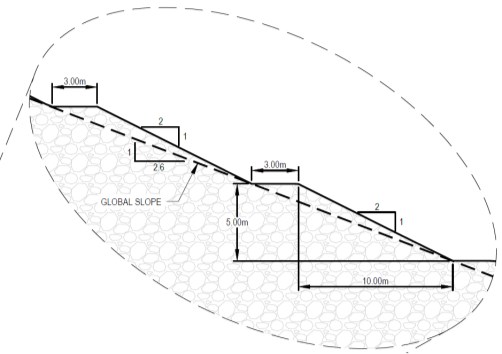
Source: Ausenco, 2025
18.10.6 Contact Water Management
Contact water is defined as any water that mixes with waste rock and requires treatment before discharge. The sources of this contact water originate from direct precipitation below the diversion channel. Contact water is collected within the Underdrain System, reported to the Contact Water Pond, and then recirculated to the process plant, as outlined here.
18.10.7 Underdrain System
The WRSF includes a basal underdrain at the valley low point, such as the "Thalweg," which consists of primary and secondary drains that extend upstream along the valley. These drains are made of dual-walled HDPE corrugated perforated pipes encased in drain rock and covered with a non-woven geotextile. Additional drains may be required depending on further geotechnical investigations and field conditions after clearing and grubbing activities.
Contact water will then be directed to the Contact Water Pond via solid pipes, and this detailed design will be completed in subsequent design stages.
|
|
18.10.8 Contact Water Pond
The Contact Water Pond is an HDPE-lined structure built entirely within the approved disturbance boundary. The pond has a crest elevation of 407 masl and a capacity of 20,000 m³ (20 ML). The Contact Water Pond does not include an emergency spillway and is situated one meter below the crest. Its configuration is designed to handle the inflow volume from a 100-year storm event before discharging from the spillway.
18.10.9 Non-Contact Water Management
Non-contact water, such as precipitation and runoff, will be managed using a Non-Contact Water Diversion Channel built around the WRSF. The nearly 1.1-km-long channel has been designed within the approved disturbance limits and includes a 5-m-wide access road to support light vehicle traffic for maintenance and monitoring during operations.
The channel is designed to withstand a 100-year event. It will be trapezoidal and shaped to minimize the need for armoring. Any parts of the channel not built within solid bedrock will be armored with concrete canvas, which is estimated to make-up about 20% of the total length. Outlet structures will be designed later to prevent erosion.
18.10.10 Instrumentation and Monitoring
The instrumentation and monitoring plan aligns with industry best practices to oversee the facility's performance during construction, operations, and closure. A comprehensive instrumentation and monitoring plan will be developed in later design stages and included in the Operations, Surveillance, and Monitoring (OMS) Manual. The program consists of 5 vibrating wire piezometers, 1 inclinometer, and 16 survey monuments.
18.10.11 Closure Concept
The top of the WRSF will be graded to improve drainage. Topsoil will be spread over all exposed waste rock and revegetated. The construction of the WRSF allows for phased closure from the bottom up. Surface water management channels will be built on the WRSF benches to prevent erosion.
The Contact Water Pond will be removed, and the contact water will be passively treated and discharged downstream, as a long-term water treatment facility is not expected to be necessary.
This conceptual closure plan is preliminary because there is limited geochemical data on waste rock, operational procedures may change over time, and regulatory requirements could be updated.
18.11 Site Wide Water Management
18.11.1 Climate Data
Four different climate stations were evaluated for this project: two regional climate stations and two onsite weather stations. The location details of the stations and their vicinity to the project area are summarised in Table 18-6. The Potrerillos station (ID No. 25074), located in the municipality of Concordia, Sinaloa, was identified as the most representative for the site. Its selection is based on its proximity to the project area, similar topographic and climatic conditions, and its long period of record (1969-2024). While site specific meteorological data is available from the on-site weather stations, Tajitos and Napoleon, for the years 2022 and 2025, this data was not considered representative due to the short period of record.
|
|
Table 18-6: Details of Climate Stations Including Name, ID, Coordinates, and Distance to Site
| Name | ID | Location | Record Years | Latitude | Longitude | Altitude | Distance from the Site |
| Potrerillos | 25074 | Concordia, Sinaloa | 1969-2018 | 23.454 | -105.826 | 1572 m | 12.48 km |
| Concordia (CFE) | 25011 | Concordia, Sinaloa | 1961-2001 | 23.27083 | -106.0675 | 141 m | 19.58 km |
| On-Site Weather Stations | Napoleon Tajitos | Panuco Site | 2022-2024 | 404194 404431 |
2588593 2586544 |
- | N/A |
According to data from the Potrerillos weather station (1969-2024), the average annual precipitation is approximately 1,278.5 mm, with values ranging from 690.4 mm to 2,296.6 mm. Rainfall is typically concentrated between June and October, with July as the wettest month, while the driest period occurs from March to May. Dry and wet year precipitation values were identified from the historical records of the Potrerillos weather station (ID No. 25074), covering the period from 1969 to 2024. In this analysis, quartiles (Q1 and Q3) were calculated monthly, meaning that dry years were defined as those with monthly precipitation values below the first quartile, and wet years as those above the third quartile. The monthly precipitation records for the Potrerillos station are presented Table 18-7.
Table 18-8 presents the Intensity-Duration-Frequency (IDF) values, which indicates the expected rainfall intensity for various durations (e.g., five minute) and return periods (or recurrence interval; the average time between occurrences of an extreme natural event, such as a 100-year flood, indicating its statistical frequency of reoccurrence) as well as the overall point precipitation for the events.
Table 18-7: Monthly Average Precipitation for the Potrerillos Station
| Month | Jan | Feb | Mar | Apr | May | Jun | Jul | Aug | Sep | Oct | Nov | Dec | Annual |
| Average Year Precipitation (mm) | 38.4 | 19.3 | 8.8 | 3.3 | 6.3 | 142.3 | 350.5 | 279.9 | 241.5 | 101.9 | 49.7 | 36.6 | 1278.5 |
| Wet year precipitation (mm) | 83.6 | 14.5 | 11.0 | 6.8 | 6.8 | 199.3 | 409.8 | 350.2 | 291.8 | 128.7 | 80.4 | 55.8 | 1638.6 |
| Dry year precipitation (mm) | 20.5 | 29.0 | 6.6 | 0.8 | 1.7 | 86.9 | 314.1 | 238.6 | 148.3 | 46.9 | 15.6 | 28.4 | 937.3 |
|
|
Table 18-8: Intensity-Duration-Frequency (IDF) Values for Panuco Site
| Return Period | 2 | 10 | 25 | 50 | 75 | 100 |
| Rainfall (mm) | 94.01 | 162.67 | 197.22 | 222.86 | 237.76 | 248.30 |
| 5 min | 0.33 | 0.56 | 0.68 | 0.77 | 0.83 | 0.86 |
| 10 min | 0.65 | 1.13 | 1.37 | 1.55 | 1.65 | 1.72 |
| 15 min | 0.98 | 1.69 | 2.05 | 2.32 | 2.48 | 2.59 |
| 30 min | 1.96 | 3.39 | 4.11 | 4.64 | 4.95 | 5.17 |
| 1 hr | 3.92 | 6.78 | 8.22 | 9.29 | 9.91 | 10.35 |
| 2 hr | 7.83 | 13.56 | 16.44 | 18.57 | 19.81 | 20.69 |
| 12 hr | 47.00 | 81.33 | 98.61 | 111.43 | 118.88 | 124.15 |
| 24 hr | 94.01 | 162.67 | 197.22 | 222.86 | 237.76 | 248.30 |
18.11.2 Water Management Strategy
Water management at the Panuco mine site requires consideration of the water flows between facilities and the associated catchment areas. Surface water runoff that comes into contact with disturbed areas will need to be managed prior to being released to the surrounding environment. The general site-wide water management strategy and flow balance is shown in Figure 18-12.
The overall water management strategy for the site aims to accomplish the following:
Capture and attenuate contact runoff from disturbed areas including the WRSF, CRF, preproduction stockpile and areas of the Process Area where mining material is stored/handled.
Provide sufficient on-site water for process requirements.
Provide freshwater make-up water for processing and site consumption purposes.
Treat excess water utilizing modular treatment plant prior to discharge to the environment.
|
|
Figure 18-12: Water Management Flow Schematic

Source: Ausenco, 2025.
18.11.3 Ponds
Runoff from disturbed areas will be collected in ponds via gravity. Contact water will be pumped to the process tank for use in the process plant or sent to treatment prior to release to the environment. Excess flows will be sent to the TSF for storage until capacity becomes available in the treatment plant. Collection ponds have been sized to store runoff from a 1/100-year, 24-hour storm event.
A summary of the ponds and their function and parameters is shown in Table 18-9.
|
|
Table 18-9: Pond Summary and Function
| Pond | Total Pond Capacity (not including freeboard) (m3) |
Operational Storage Volume1 (m3) |
1/100-year Design Storm Volume (m3) |
Catchment Area | Operational Philosophy/Purpose |
|
| Contributing Area (ha) |
Outlet Configuration |
|||||
| Transfer Pond | 5,961 | 4,460 | 19,400(2) | 13.3 | Pumped to TSF | Captures seepage from the TSF. |
| Process Pad Pond | 9,383 | 9,200 | 9,200 | 4 | Pumped to process water tank or TSF | Capture contact run-off from the Process Pad, Truck shop and CRF Pad |
| Preproduction Stockpile | 5,000 | 5,000 | 5,000 | 3 | Pumped | Storage of surface runoff from preproduction stockpile |
| WFSF Waste Rock Storage Facility (WRSF) Pond | 20,009 | 16,770 | 20,009(2) | 10.8 | Pumped to Process Plant Tank | Storage of surface runoff from WRSF |
| Truck Shop Pond | 350 | 350 | 350 | 0.36 | Pumped to process pad pond | Attenuates flow before being pumped to process pad pond |
| TSF Supernatant Pond | 243,500 | 75,000 | 243,500(3) | 30 | Pumped to Process Plant Tank or Water Treatment Plant | Storage requirement for PMP run-off |
Note:
1. Operational storage volume to be used to capture/store water for dry season. Forecasting and active pond management will be required to ensure readiness larger storm events.
2. MIA footprint limited the size of the FS ponds; storage capacity is less than 1/100 year. Design storms to be managed via pumping to process/TSF to create additional storage during design event.
3. PMP volume to be retained in TSF
18.11.4 Non-Contact Diversions
To reduce the amount of contact water that needs to be managed, non-contact water will be intercepted and routed around mining infrastructure. Runoff from haul roads have been considered non-contact water and will be discharged directly into the environment.
18.11.5 Underground Water
Underground dewatering rates were estimated from numerical modelling (refer to Section 18.12). Underground water demands for equipment use was provided by mining plus. A summary of underground water is shown in Table 18-10.
|
|
Table 18-10: Summary of Underground Dewatering and Equipment Demands for Average Conditions
| Year | Estimated Dewatering Rate | Estimated Underground Water Demand | |
| Combined inflow (L/S) | Napoleon (L/s) | Copala (L/s) | |
| Y -2 | 11 | 0.0 | 3.9 |
| Y -1 | 16 | 0.0 | 6.2 |
| Y 1 | 22 | 0.0 | 10.7 |
| Y 2 | 29 | 3.1 | 12.5 |
| Y 3 | 32 | 3.9 | 13.8 |
| Y 4 | 33 | 6.3 | 15.2 |
| Y 5 | 34 | 8.7 | 11.4 |
| Y 6 | 35 | 11.2 | 8.1 |
| Y 7 | 37 | 10.9 | 8.9 |
| Y 8 | 40 | 14.6 | 4.9 |
| Y 9 | 41 | 9.8 | 2.5 |
| Y 10 | 39 | 4.7 | 2.0 |
18.11.6 Make-up Water
Make-up water is required for use in the mill, predominantly as a medium to transport the tailings slurry to the TSF or for use in the backfill paste. This water is required to make-up for water lost in the TSF that is not available for reclaim (i.e. lost to pore space, seepage, etc.). Water is needed to top up the freshwater/fire water tank and to use for process plant distribution. Based on the anticipated water quality of the contact ponds from available data, the contact water should be of sufficient quality to use in the freshwater tanks and therefore all site water has been considered make-up water. Estimated make-up water required is shown in Table 18-11.
Table 18-11: Make-up Water Required
| Year | Process Water Make-up | |
| Contact Water (L/s) | Freshwater (L/s) | |
| WOL Design (Years 1 to 3) | 15.03 | 54.1 |
| Float Leach (Years 4+) | 18.23 | 65.6 |
18.11.7 Site Wide Water Balance
A site-wide water balance was developed based on the water management strategy to quantify the amount of runoff generated from disturbed areas and inform water management infrastructure design and pumping rates. The climatic model considered deterministic scenarios using precipitation for average year.
|
|
Runoff from the WRSF, Preproduction Stockpile and Process Pad/Truck Shop/ CRF Pad were estimated using runoff coefficient according to mine facilities characteristics. Pumps were sized to maximum the attenuation of each pond thereby reducing the pumping requirement as much as possible. Contact water will be pumped to the process tank for use, sent for treatment prior to being discharged or sent to the TSF for storage. The combined available contact water inflow (from contact ponds, free water in the TSF) and the combined outflows (reclaim, evaporation, process make-up) is shown in Figure 18-13.
Figure 18-13: Surface Water Flow Summary

Source: Ausenco, 2025.
The results of the water balance indicate there is a surplus of available contact water for make-up water throughout the wet season; however, there is a deficit during the dry season. The TSF will need to retain around 90,000 m3 of water during the wet season which will be drawn down seasonally via reclaim and process demands. While the original design intent was to store 75,000 m3 of water, transient/temporary seasonal storage of additional water is possible with the TSF configuration.
It is estimated that a peak of 48,000 m3 of water will be required during the driest month from a source other than the contact ponds and TSF. Based on the hydrogeological modelling and the water balance, there is sufficient underground water available to make up the seasonal deficit. Underground water will be pumped to the process water tank as needed to augment process water requirements.
|
|
Dewatering from the Napoleón and Copala portals will be pumped to clear box decanters near the portal. The water will either be used for construction, dust suppression, pumped to the process tank for make-up requirements or released to the environment. The available underground water and its uses are shown in Figure 18-14. it is anticipated that the site will operate as a net zero facility, where water generated onsite (surface and underground dewatering) will provide sufficient mine water and external sources are not required.
Figure 18-14: Underground Water Summary

Source: Ausenco, 2025.
18.11.8 Water Treatment
It is understood that the underground water from the on-going test mine is being treated by container settling, including coagulation and flocculation for sediment using a clear box decanter, prior to being discharged to the environment. It is anticipated that, assuming future groundwater quality investigations and characterization confirm suitability, this treatment will continue as the mine is developed and the underground water is not planned to be incorporated or integrated into the rest of the mine water management strategy. At this stage, the underground water will be recycled for underground equipment use, used for construction activities and be available for dust suppression during operations. Excess water will be released to the environment.
|
|
Based on the results of preliminary geochemical characterization of waste rock and tailings samples, it is anticipated that mine waste rock may pose a risk of metal leaching / acid rock drainage (ML/ARD). At this stage, contact water has been considered to be of sufficient quality for use in the process plant; however, the suitability of this water should be further quantified to verify it does not need treatment prior to use in mining operations.
18.12 Hydrogeology
An assessment pf hydrogeological conditions is required to provide estimates of dewatering requirements for the mines as well as determine groundwater quality. The dewatering rates are inputs to the site water balance while groundwater quality data is required in the assessment of the suitability of groundwater for site use and disposal treatment requirements.
18.12.1 Field Investigations
During the 2023-2024 field campaign conducted by SRK Consulting (Canada) Inc. (SRK), a total of 11 geotechnical and hydrogeological drilling operations were carried out, resulting in the installation of four vibrating wire multilevel piezometers (VWP), with three sensors installed on each multilevel piezometer. Of these 11 piezometers, five were located in the Copala mine area and six in the Napoleon mine area. During the investigation, a total of 67 hydraulic tests were conducted, of which 56 tests exhibiting a moderate to high level of confidence were selected.
Vizsla conducted a hydrogeological and geotechnical drilling campaign, in which five Casagrande-type piezometers have already been installed within the study area of the conceptual hydrogeological model. Field work is ongoing with pumping tests to validate numerical modelling predictions and to provide additional calibration data for the numerical model.
A summary of hydraulic conductivities derived from the field investigations is presented in Table 18-12.
|
|
Table 18-12: Hydraulic Conductivities of Hydrogeological Units
| Hydrogeological Unit |
Type of aquifer by Lithology |
Geological Unit | Lithological Description | Hydraulic Conductivity (m/s) | Relative Hydraulic Conductivity Brassington (2007) |
||
| Minimum | Mean Geometric |
Maximum | |||||
| UH Volcanics | Aquitard | Andesic tuff | Volcanic rock formed from ash and solidified lava of andesitic composition. | 1.60E-09 | 3.74E-08 | 4.25E-06 | Low |
| Rhyolitic lapilli tuff | Volcanic rock formed from ash and solidified lava of rhyolitic composition. | 1.00E-10 | 3.58E-08 | 4.28E-06 | Low | ||
| Lapilli tuff rhyolitic VS | Volcaniclastic rock of aquatic origin formed by the accumulation of ash and solidified lava of rhyolitic composition. | - | 5.00E-08(*) | - | Low | ||
| Dacite | Volcanic rock formed from ash and solidified lava of dacitic composition. | - | 1.00E-08(*) | - | Low | ||
| Fractured Intrusive UH | Aquifer | Granite | Intrusive igneous rock granite with a high degree of fracturing. | 2.02E-05 | 5.18E-05 | 1.91E-04 | Moderate |
| Intrusive UH | Aquitard | Greenstone | Compact diorite intrusive igneous rock with plagioclase and mafic minerals. | 1.00E-10 | 1.48E-08 | 1.70E-06 | Low |
| Granodiorite | Compact intrusive granodiorite igneous rock with feldspar and quartz minerals. | - | 1.00E-08 | - | Low | ||
| UH Vetas | Aquifer | Quartz veins | Quartz veins filling fractures, presenting mineralization from hydrothermal solutions. | 4.20E-08 | 1.03E-05 | 2.84E-04 | Moderate |
| Phreatomagmatic Breccias | Composed of gray quartz in the lower levels of vein structures. Barren to low-grade, quartz is typically white and is most common in the upper parts of veins and breccias. | - | 1.00E-06(*) | - | Moderate | ||
| UH Metasediments | Aquaclude | Metamorphic and sedimentary rocks | Phyllite metamorphic rocks with intercalations of very competent sandstone sedimentary rocks. | - | 1.00E-10(*) | - | Very low |
Note: (*) Bibliographic data according to groundwater, Freeze and Cherry, 1979.
|
|
18.12.2 Interpreted Groundwater Flow
The direction of groundwater flow in the Panuco mine area is graphically represented with the groundwater elevation contours and flow direction in Figure 18-15 and Figure 18-16 from which the following can be inferred:
Groundwater in the study area generally flows from the higher elevations in the east toward the Panuco River in the west.
The recharge zones are in higher elevations to the east, north and south of the mine footprints.
The groundwater discharges toward the Panuco River at the western limit of the model area.
The main recharge zones are found in outcrops of quartz veins, phreatomagmatic breccias, and highly fractured granite; these materials owe their permeability to secondary porosity.
|
|
Figure 18-15: Potentiometric Contours and Flow Lines.

Source: Ausenco, 2025.
|
|
Figure 18-16: Hydrogeological Section A-A'

Source: Ausenco, 2025.
18.12.3 Numerical Hydrogeological Model
To predict the rate of inflow to the underground workings (La Luisa, Napoleon, Tajitos and Copala mines), and drawdown due to dewatering of the mines, a three-dimensional groundwater model was developed based on the site geology and the hydrogeological conditions encountered during field investigations (Ausenco, 2025h).
The steps involved in the predictive modelling included:
Construction of the 3D geological model using Leapfrog Works software, version 2024.1.1.
Construction of the numerical model using Feflow, version 7.3.
Model calibration measured groundwater elevation heads in steady state.
Simulation of mine drainage for each year of mine life.
Figure 18-17 shows the numerical model extents, casa grande and vibrating wire (VWP) locations, mine footprints and geological faults.
|
|
Figure 18-17: Numerical Model Extents

Source: Ausenco, 2025.
|
|
The numerical model was calibrated in steady-state by adjusting the hydraulic conductivities of bedrock units with the recharge assigned as 7% of the mean annual precipitation (MAP). The hydrogeological parameters were modified within the range of values established in the conceptual hydrogeological model and until the modelled groundwater levels (hydraulic heads) adequately matched the field-measured groundwater levels. The calibration of observed vs simulated hydraulic loads was carried out using hydraulic heads from 14 boreholes including four Casagrande piezometers, four vibrating wire piezometers and six inclined boreholes with shut-in tests. The calibration achieved a normalized root mean square of the errors (NRMS) of 8.4%, where an NRMS of less than 10% is considered a reasonable calibration.
Due to the potential for natural variations in precipitation from year to year, additional simulations were completed to predict inflows based on wet and dry years. Dry and wet year precipitation values were identified from the historical records of the Potrerillos weather station (ID No. 25074), covering the period from 1969 to 2024. In this analysis, quartiles (Q1 and Q3) were calculated monthly, meaning that dry years were defined as those with monthly precipitation values below the first quartile, and wet years as those above the third quartile. The monthly precipitation records for the Potrerillos station are presented Table 18-7. Recharge for the dry and wet models was based on 7% of the Q1 and Q3 quartiles (65.6 mm/a and 114.7 mm/a), respectively. The dry and wet models were re-calibrated with the respective recharge rates by adjusting hydrogeological parameters until an NRMS of less than 10% was achieved for each model.
18.12.4 Predicted Dewatering Rates
The results of dewatering simulations conducted with the Average, Dry and Wet numerical models yielded annual inflow rates as presented in Table 18-13. Note that paste backfill and cemented rock fill are included in the models to the limit reached for each year. As well, cessation of dewatering for discrete mine sections is included as per the dewatering schedule as applicable for each year, was included for the average year.
Table 18-13: Average, Dry and Wet Year Total Mine Inflow Rates
| Year | 2026 | 2027 | 2028 | 2029 | 2030 | 2031 | 2032 | 2033 | 2034 | 2035 | 2036 | 2037 |
| Average Year 7% of MAP (L/s) | 11.2 | 16.0 | 22.1 | 29.2 | 32.0 | 32.6 | 33.9 | 35.1 | 37.4 | 40.0 | 41.0 | 40.5 |
| Dry Year 7% of Quartile 1 (L/s) | 8.6 | 12.3 | 15.9 | 21.7 | 24.2 | 25.7 | 27.6 | 28.6 | 31.7 | 33.9 | 35.7 | 35.7 |
| Wet Year 7% of Quartile 3 (L/s) | 16.7 | 22.2 | 30.1 | 37.4 | 40.8 | 43.9 | 45.7 | 46.2 | 50.8 | 53.6 | 55.3 | 55.3 |
 |
 |
19 MARKET STUDIES AND CONTRACTS
19.1 Market Studies
Gold-silver doré bars will be trucked from the project site to Mazatlán, where it will be subsequently transported by air to clients. The doré will be sold into the general market to North American smelters and refineries.
Vizsla and its consultants have conducted no market study on the sale of the gold doré. Therefore, the market terms for this study are based on the terms proposed by Vizsla as per their discussion with Ausenco and recently published terms from similar studies. The QP is of the opinion that the marketing and commodity price information is suitable to be used in cash flow analyses to support this technical report.
19.2 Commodity Price Projections
For this technical report, the metal prices presented below in Table 19-1 were used for financial modelling. The metal price assumption is supported by the latest consensus forecast from numerous financial institutions. The QP has reviewed the studies and analyses, and the results support the assumptions in the technical report. These prices are also consistent with the range of prices used for recent, comparable studies.
Table 19-1: Metal Price Projections
| Metal | Commodity Unit | Study Unit Price (US$) |
| Silver | Troy ounce (oz.) | 35.50 |
| Gold | Troy ounce (oz.) | 3,100 |
19.3 Contracts
There are currently no sales contracts or refining agreements in place for the Project.
Vizsla may enter into contracts for forward sales of silver or other similar contracts under terms and conditions that would be consistent within the industry in Mexico and United States and in countries throughout the world.
For the FS, payability and refining costs have been assumed for the Panuco project based on terms recently published for comparable projects. Payabilities within the doré product are assumed to be 99.9% for silver and 99.9% for gold. Treatment and refining costs are assumed to be US$0.50/oz Ag and US$5.00/oz Au.
|
|
20 ENVIRONMENTAL STUDIES, PERMITTING, AND SOCIAL OR COMMUNITY IMPACT
20.1 Introduction
This section provides an overview of the environmental setting of the Panuco Project. Based on currently available information, it outlines existing biological and physical baseline conditions, proposed baseline studies to support future permitting applications, existing permits, and future regulatory and permitting requirements including required management plans for water, site environmental monitoring, and waste disposal. In addition, this section also discusses socio-economic baseline conditions, the status of community consultation and engagement, and conceptual mine closure and reclamation planning for the Project.
The Project site currently operates under three permits for mine exploration issued in 2020 and 2021, by SEMARANT (Secretary of Environmental Media and Natural Resource). Once the exploration work is completed and depending on the results that it yields, it will be determined if the area will be abandoned or will continue to be used for the exploitation of the desired minerals. In the case the area continues to be used, the corresponding environmental permits will be requested from SEMARNAT, and compensation work will be carried out in areas surrounding the project.
Currently, the only known environmental liabilities are associated with the exploration site activities, access roads, and existing underground workings from former operations. Remediation of surface disturbances will be mitigated by compliance with applicable Mexican regulatory requirements.
The Panuco Project is in the Panuco-Copala mining district in the municipality of Concordia, southern Sinaloa State, along the western margin of the Sierra Madre Occidental physiographic province in western Mexico. Mountain ranges characterize the province's topography up to 1,640 m, cut by steep gorges. The principal drainages are the northerly trending Rio Baluarte east of the Property and the northeasterly trending Rio Presidio to the north. Dendritic intermittent streams feed the rivers. Project vegetation is mainly dry tropical forest comprising tropical bushes and shrubs at lower elevations and oak and pine forest at higher elevations. The Project is centred at 23⁰ 25' north latitude and 105⁰ 56' west longitude. The Project location is shown in Figure 20-1.
|
|
Figure 20-1: Property Location Map

Source: Vizsla, 2025.
20.2 Environmental Baseline and Supporting Studies
During the period January 2022 to December 2023, Golder Associates (now WSP) conducted environmental and social baseline studies for the Panuco Project. The studies consisted of a desktop study followed by multiple field monitoring events. These baseline studies were intended to serve as a reference and support for the preparation of the Environmental Impact Assessment (MIA in Mexico) required by the Ministry of Environment and Natural Resources (SEMARNAT) to support ongoing exploration activities for the Project. The results of these studies were summarised in WSP (June 2024) in a report entitled "Final Report of Baseline Studies - Panuco Project."
|
|
Table 20-1 presents the WSP (2022-2023) baseline study characterization/monitoring events and their main focuses.
Table 20-1: Baseline Characterization / Monitoring Rounds and Their Focuses
| Baseline Monitoring Round | Study Dates | Environmental Aspects | ||
| Abiotic Factors | Biotic Factors | Social Aspects | ||
| 1st | Jan - Feb 2022 | - climate, - surface water, - air quality - noise |
- flora - fauna |
desk research |
| 2nd | Apr - May 2022 | - surface water - soil - air quality |
- flora - fauna - landscape |
None |
| 3rd | Jul - Aug 2022 | - surface water - soil - air quality |
- flora - fauna |
None |
| 4th | Nov 2022 | - surface water - soil - air quality |
- flora - fauna |
None |
| 5th | Feb 2023 | - surface water - air quality |
- flora - fauna |
None |
| 6th | Dec 2024 | -surface water -air quality -noise - soil infiltration |
-flora -fauna |
None |
Source: Environmental Baseline Characterization Reports, WSP, 2022 to 2023.
The delineation of the study area for the evaluation of the biotic and abiotic components was determined based on consideration and conformance with the provisions of the "Guide for the Presentation of the Mining Environmental Impact Statement" (SEMARNAT, 2002). The guide considers the micro-basins adjacent to the mineralized areas or veins known as Tajito and Napoleon, as well as the scope of the Project and its relationship with terrestrial ecosystems (Golder, 2022).
The results of these baseline studies for subject areas are described in the following sections. The data to support a preliminary geochemical assessment was provided by Vizsla in 2025. With regard to archaeological resources, the National Institute of Anthropology and History (INAH, March 29, 2022) provided authorization to proceed with the Project as planned, but with notification requirements and also reporting requirements in the event of chance finds of cultural resources.
20.2.1 Meteorology and Climate
The climate is subtropical, with heavy rain in June through September. Summer temperatures reach 40°C, while the minimum winter temperature is approximately 10°C. The average annual rainfall is around 1,100 mm, with the majority falling in the June to September rainy season. The area has sufficient water for exploration and mining purposes. Work on the Property, including drilling, can be conducted year-round (SGS, 2024).
|
|
Four climate stations were used as a source of meteorological data for the Project: two regional climate stations and two on-site weather stations. The location details of the stations and their vicinity to the Project area are summarised in Section 18 (Table 18-6). Table 18-7 presents a summary of temperature, precipitation, and evaporation data at Potrerillos weather station, located 12.5 km from the site. A description of the climatic data and trends used for site water management and water balance used for designing infrastructure is presented in Section 18.3.10. Figure 20-2 and Figure 20-3, present a graph of the temperature and precipitation data for the Project Area.
Figure 20-2: Average Monthly Precipitation at the Panuco-Capala Project

Source: SGS, 2024.
|
|
Figure 20-3: Average Temperature and Precipitation for the Project Area

Source: SGS, 2024
20.2.2 Hydrogeology
20.2.2.1 Regional Groundwater Aquifer Characterization
In the Baluarte River valley, 40 groundwater monitoring locations were included as part of the WSP baseline study (WSP, 2022). Static water levels ranged from 2 m depth in the vicinity of the Baluarte River bed and on both banks, increasing towards the upper parts of the valley until reaching values close to 10 m away from the river and its tributaries.
Table 20-2 shows the results of the groundwater balance parameters of the aquifer for the Panuco Project area (WSP, 2022), which indicate that there is a volume of over 24 Mm3 per year, available for the different activities within the aquifer. Water availability will vary over time, depending on changes in the natural recharge regime and water management.
|
|
Table 20-2: Groundwater Balance Parameters for the Aquifer
| Aquifer Area | Parameters |
| Natural Recharge | 66.5 hm3/annum |
| Induced Recharge | 2.4 hm3/annum |
| Outflows | 29.3 hm3/annum |
| Natural Discharge | 15.8 hm3/annum |
| Pumping | 13.8 hm3/annum |
| Total Recharge | 79.6 hm3/annum |
| Concessioned Volume | 34,613,197 m3 annual |
| Availability of Groundwater | 24,286,803 m3 annual |
Source: WSP, Baseline Studies, 2022
20.2.2.2 Local Hydrogeological Investigation
A geotechnical and hydrogeological investigation was conducted by SRK in 2023-2024. The results are reported in SRK (2024). This factual report summarises the hydrogeological data collected from the diamond drillholes completed between October 2023 and January 2024.
A total of 4,230 m of drilling spread over 11 diamond drillholes were completed for the 2023 field program to investigate the Copala and southern portion of the Napoleon deposits. The hydrogeological scope consisted of hydraulic conductivity testing and shut-in pressure monitoring. This was carried out using packer equipment in all drillholes, and installation of vibrating wire piezometers (VWPs) in selected drillholes. Selected drill holes are presented in Figure 20-4. The drilling program was designed to characterize the geotechnical and hydrogeological properties of the deposit and production access ramps.
Downhole testing of hydraulic conductivity (K) in drillholes was conducted using a single-packer testing system. A total of 67 successful packer tests were completed in 11 boreholes, with intervals ranging from 14.70 to 112.70 m in length. Hydraulic conductivity values ranged from very low (1.0E-11 m/s) to high (1.0E-4 m/s) with a geometric mean of 5.3E-8 m/s.
|
|
Figure 20-4: Completed Geotechnical and Hydrogeological Drillhole Locations

Source: SRK, 2024
Permanent nested vibrating wire piezometers (VWPs) were installed in four drill holes. Each installation was completed with three VWPs. VWPs are used to measure both stable and transient piezometric pressures within different lithological units and across geologic structures. These pressure data are used to determine the general piezometric levels (water levels) in the groundwater system, as well as to monitor transient effects such as response to precipitation events or drain down responses during excavation. At the time of the SRK report, the VWP sensors were still stabilizing and therefore meaningful and useful data from these instruments is not currently available. Future data collected from the VWPs will help to establish the general piezometric levels (water levels) in the groundwater system including the vertical and horizontal hydraulic gradients.
|
|
Vizsla conducted an additional hydrogeological and geotechnical drilling campaign, in which five Casagrande-type piezometers were installed within the study area. The SRK study and this additional work helped to inform the development of a conceptual hydrogeological model for the site, and later the development of a three-dimensional numerical groundwater model, both described in Section 18.3.11. Interpreted groundwater flow directions were developed from available piezometric data and simulated mine drainage, including predicted mine inflows, for each year of the mine life were predicted based on the groundwater model. Field work is currently ongoing with pumping tests planned to validate numerical modeling predictions.
20.2.3 Hydrology
Surface streams with an intermittent regime and perennial rivers are found in the area (refer to Figure 20-5). The Baluarte River is to the west and south of the area and is the most important perennial river. It originates in the Sierra Madre Occidental, in the territory of the State of Durango, on a small plateau near the town of La Peña in the municipality of Pueblo Nuevo, Durango, at an altitude of 2,600 masl, following the NE-SW direction for 45 km with the name of Quebrada de Guadalupe, after receiving contributions from a small tributary, El Zapote, it changes its course to the NW-SE and is called Rio Rosario or Baluarte, serving along 35 km of state border between Durango and Sinaloa and finally flows into the Pacific Ocean, (CONAGUA, 2020). Another important water body is the Presidio River that is located north of the Panuco Project. It originates in the mountains of Durango, flowing southwest into Sinaloa before joining the Pacific Ocean southeast of Mazatlán.
|
|
Figure 20-5: Rivers and Basins in the Region

Source: WSP, Baseline Studies, 2022.
|
|
The study area "Panuco-Copala Exploration" belongs to the Presidio-San Pedro hydrological region (RH-11, National Institute of Statistics, Geography and Informatics - INEGI), in the R. Baluarte basin (RH-11C), with the Project area specifically in the R. Panuco sub-basin (RH-11Ce). (CIMA, 2020).
RH-11 Presidio-San Pedro is located in the extreme northwest of the state and extends towards the states of Sinaloa, Durango and Zacatecas; within Nayarit it comprises 36.05% of the state area. It is bordered to the east by RH-12, Lerma-Santiago; to the south by RH-13, Huicicila; and to the west by the Pacific Ocean. The main drainages descend from the western flank of the Sierra.
With data obtained from the Hydrographic Basin Water Flow Simulator (SIATL) extension of INEGI, the area occupied by each part was established, starting from the hydrological region to the sub-basin. Figure 20-6 shows the hydrological region, basin and sub-basins encompassing the study area and adjacent region.
Figure 20-6: Panuco Hydrological Region, Basin and Sub-basin.

Source: CIMA, 2020.
|
|
20.2.4 Surface Water Quality
To evaluate the existing water quality conditions in the study area, the Mexican Official Standards NOM-001-SEMARNAT-2021 ("which establishes the permissible limits of pollutants in wastewater discharges into receiving bodies owned by the nation") were used as a reference for the characterization of surface water. (WSP, 2022).
ALS-Indequim, a laboratory accredited by the Mexican Accreditation Entity (EMA), was retained to collect and analyze surface water quality parameters. Sample locations were selected based on the following criteria:
proximity and potential influence on the mineralization (the Napoleon and Tajitos areas)
proximity and potential influence of nearby urban areas
streams displaying perennial or near-perennial flows
Figure 20-7 shows the location of water sampling points. Samples were analyzed for a range of organic and inorganic parameters. The results of the analyses are presented in the baseline studies report completed by WSP (2022).
Six sampling rounds showed generally acceptable water quality, with occasional exceedances in fecal coliforms near human settlements. Zinc was the most consistently detected metal, likely due to historical mining and weathering of exposed bedrock. Arsenic was also detected locally, likely also from historical mining and weathering.
|
|
Figure 20-7: Location of Surface Water Sampling Locations

Source: WSP, 2022.
20.2.5 Air Quality
Six sampling campaigns were carried out to characterize the baseline air quality (WSP, 2022), taking as reference the Mexican Official Standards NOM-025-SSA1-2014, (Environmental health. Permissible limit values for the concentration of suspended particles PM10 and P2.5 in the air and evaluation criteria) and NOM-035-SEMARNAT-1993 (which establishes the measurement methods to determine the concentration of total suspended particles in the air and the procedure for the calibration of measurement equipment). Seven sampling points were located in the project polygon, as shown in Figure 20-8.
|
|
Figure 20-8: Air Quality Monitoring Locations

Source: WSP, 2022.
The results of the air quality monitoring show that, generally, that baseline results comply with the requirements of the current official regulations. The results showed that the concentrations of PSTs, PM10 and PM2.5 do not currently exceed the Maximum Permissible Limit indicated in the Mexican Standards NOM-025-SSA1-2014 and NOM-035-SEMARNAT-1993. The baseline monitoring locations can be used as a basis for detecting future potential air quality impacts from mining operations for nearby receptors including nearby communities and residents as well as wildlife flora and fauna (WSP, 2022).
|
|
20.2.6 Noise
Noise monitoring was conducted in the Panuco area to characterize the current environmental noise scenarios taking as a reference the Mexican Official Standard NOM-081-SEMARNAT-1994 (which establishes the maximum permissible limits of noise emission from fixed sources and their measurement method, and their normative references) (WSP, 2022). Monitoring points were distributed throughout the Project area at no less than 1.2 m from the ground level, as shown in Figure 20-9.
Figure 20-9: Noise Monitoring Locations

Source: WSP, 2022.
|
|
Currently, there is no infrastructure associated with the Project that can modify this factor in the environment, so the results of the analysis were as expected for an area with little disturbance. The baseline monitoring locations can be used as a basis for detecting future potential noise impacts from mining operations for nearby receptors including community, residents, and wildlife fauna (WSP, 2022).
20.2.7 Soils
Soil types present within the regional area along with their general characteristics are provided below (CIMA, MIA, 2023):
Lithosol are temperate soils, they are limited by a continuous and hard rock in the first 25 cm, or by a material with more than 40% of calcium carbonate equivalent, or they contain less than 10% of fine earth up to a minimum depth of 75 cm. They can only present a mollic, umbric, ocric, yermic or vertic horizon.
Regosols are mineral soils, weakly developed in unconsolidated materials that have only a superficial ochric horizon (poor in organic matter) and that are not very shallow (like lithosol), sandy (like arenosols) or with fluvic properties (fluvisols).
Regosols are very extensive in eroded lands, particularly in arid, semi-arid lands and mountainous regions.
Table 20-3 shows the percentage of estimated surface area for each of the soil types found within the project and Figure 20-10 illustrates the distribution of the soil types.
Table 20-3: Types of Soils in the Project Area
| Edaphology of the Project area | ||
| Soil Type | Area (Ha) | % |
| Lithosol | 5,658 | 33.13 |
| Regosol | 11,422 | 66.87 |
| Total | 17,079 | 100 |
Source: CIMA, 2020.
|
|
Figure 20-10: Soil Units

Source: CIMA, MIA, 2020.
20.2.8 Fauna
Species classified as endangered in the NOM-059-SEMARNAT-2010 were identified within the Project area as under special protection or threatened. These are Crotalus atrox (Western diamondback rattlesnake), Crotalus pricei (Pit viper), Accipiter cooperii (Cooper's hawk), Crotalus molossus (Black-tailed rattlesnake) that are under special protection (Pr) and the Thamnophis cyrtopsis (Black-necked garter snake) and Thamnophis eques (Mexican garter snake) as threatened (A).
Table 20-4 provides a list of fauna detected within and adjacent to the Project area, including mammals, birds, amphibians and reptiles. (CIMA, 2020).
|
|
Table 20-4: List of Fauna Detected
| Scientific Name | Common Name | Family | Regulation | Reg. Status |
| Ara militaris | Military macaw | Psittacidae | NOM-059-SEMARNAT-2010 | Endangered |
| Asio stygius | Stygian owl | Strigidae | NOM-059-SEMARNAT-2010 | Threatened |
| Crotalus basiliscus | Mexican west coast rattle snake | Viparedae | NOM-059-SEMARNAT-2010 | Protected |
| Cyanocorax dickeyi | Tufted jay | Corvidae | NOM-059-SEMARNAT-2010 | Endangered |
| Eleutherodactylus saxatilis | Rana fisgona marmoleada | Eleutherodactyli dae | NOM-059-SEMARNAT-2010 | Endangered (globally) |
| Eupsittula canicularis | Orange-fronted parakeet | Psittacidae | NOM-059-SEMARNAT-2010 | Protected |
| Icterus pustulatus | Streak-backed oriole | Icteridae | NOM-059-SEMARNAT-2010 | Protected |
| Kinosternon integrum | Mexican mud turtle | Kinosternidae | NOM-059-SEMARNAT-2010 | Protected |
| Leopardus pardalis | Ocelot | Felinae | NOM-059-SEMARNAT-2010 | Endangered |
| Leopardus Wiedii | Margay | Felinae | NOM-059-SEMARNAT-2010 | Engangered |
| Myadestes Occidentalis | Brown-backed solitaire | Turdidae | NOM-059-SEMARNAT-2010 | Protected |
| Panthera onca | Jaguar | Felinae | NOM-059-SEMARNAT-2010 | Endangered |
| Penelope purpurascens | Crested guan | Cracidae | NOM-059-SEMARNAT-2010 | Threatened |
| Progne sinaloae | Sinaloa martin | Hirundinidae | NOM-059-SEMARNAT-2010 | Protected |
| Thamnophis cyrtopsis | Black-necked gartersnake | Colubridae | NOM-059-SEMARNAT-2010 | Threatened |
| Troglodytes aedon | House wren | Troglodytidae | NOM-059-SEMARNAT-2010 | Protected |
Source: CIMA, 2020.
20.2.9 Flora
The vegetation found in and near the Project area is typical of the southern region of Sinaloa. Due to anthropogenic influence, little variation in biodiversity has occurred in recent years (CIMA, 2020). Native species are still present, and degradation is due to natural processes and the influence of the growth and development of the human population (CIMA, 2020).
A majority of the vegetation in the Project area is classified as "selva baja caducifolia", which is characterized primarily by trees less than 15 meters tall. Typical plant species include tepemezquite, ebano, tepehuaje, huanacaxtle, berraco, amapa, apomo, cedro, nacario and garabato. At higher elevations with cooler temperatures, vegetation is characterized as "bosque templado" (temperate forest). Plants typical of the higher areas are encino, madroño, chicle, palo cuate, arrancillo, vainillo, maguey and guasima (SGS, 2024).
Areas of ecological importance contain pine-oak forests, pine forests, induced pasture, secondary arboreal vegetation of low deciduous forest, secondary shrubby vegetation of oak forest, and secondary shrub vegetation of pine forest (CIMA, 2020).
Based on the information reviewed, none of the flora species in the area were reported under NOM-059-SEMARNAT-2010.
|
|
20.2.10 Fauna and Flora - Environmental Management
Mining activities will be carried out in areas of importance for many species of endangered and/or protected flora and fauna (CIMA, 2025). To comply with regulations, programs are in place to preserve the environment where development will occur. Any existing species protected by law will be relocated to adjacent areas. The Project will include the recovery of flora and fauna, and rescue work in areas affected by land usage. Work will be monitored to ensure that only the authorized areas for use will be affected by the Project's development. No slash and burn methods, herbicides, or chemical products will be used. Work will be done manually and with motorized equipment. Mitigation and prevention measures are proposed for the rescue and rehabilitation of flora and fauna species with status under Mexican Official Standard NOM-059-SEMARNAT-2010. In the case of wildlife, protection, repelling, rescue, and relocation measures are proposed, with special emphasis on slow-moving species.
The surface areas that are disturbed from exploration and future mining activities will be scarified to encourage water infiltration and vegetation growth. The original topography will be restored before the addition of new topsoil. The rehabilitated topsoil will be spread on the impacted area, and the new soil will be scarified to promote soil regeneration. Restoration of vegetation will rehabilitate the habitats and promote recolonization of the fauna.
20.3 Water and Waste Management
Figure 18-1 shows the Panuco site layout and major water and waste management structures. Water management at the Panuco mine site is detailed in Section 18.3.10, including a water balance for the site taking into consideration estimated mine dewatering rates drawn from hydrogeological modelling. The overall water management strategy is as follows:
Capture and attenuate contact runoff from disturbed areas where mining material is stored/handled
Provide sufficient on-site water for process requirements and site consumption purposes.
Treat excess contact water utilizing modular treatment plant prior to discharge to the environment.
Treat excess underground water for sediment prior to releasing to the environment.
Diversion channels are designed to divert non-contact runoff away from the mine infrastructure, thereby minimizing the volume of contact runoff that needs on-site water management. A collection pond receives captured surface water from the diversion channels and the process plant catchment areas. In addition, excess slurry water from the Tailings Storage Facility (TSF) would be reclaimed for processing through the reclaim water system.
It is anticipated that a total of 12.1Mt of tailings will be produced over the life of the mine, with 8.5 Mt discharged to the TSF and 3.6 Mt used as cemented backfill underground. The TSF will be located 2.5 km to the east of the process plant with location and deposition technology based on a siting study that was best suited to the TSF design criteria. A key criteria was that the TSF was to meet or exceed applicable regulatory requirements and industry guidelines for stability and design flood events. Details regarding the design, operation, water management, and closure of the TSF are provided in Section 18.3.8.
The Panuco Project will have a surplus of waste rock produced that will be deposited in a single waste rock storage facility (WRSF) located south of the Napoleon Portal. At the end of operations, the WRSF will contain approximately 1.47 Mt of waste rock. Details regarding the design, operations, water management, and closure are provided in Section 18.3.9.
|
|
The risk of metal leaching/acid rock drainage (ML/ARD) from mined materials has not yet been adequately assessed (see Section 20.3.1); this work will be progressed as part of the next phase. Only non-potentially acid generating (NPAG) rock will be utilized for construction purposes and any surplus water released from the site will meet applicable effluent requirements by means of water treatment if needed.
Site water will be sourced from a combination of reclaim, recovered from the TSF and contact water collected from the site and stored in ponds and used for process make-up water. A potable water treatment plant will supply treated water for human consumption. There will not be a camp located at the site, the potable and raw water requirements will be low and likely adequately supplied by groundwater supply wells or local surface water sources.
Most of the waste currently generated by the Project falls into the category of non-hazardous municipal waste, which is subject to control (CIMA, 2020). Waste management falls under the jurisdiction of the General Environment Protection Act (Ley General de Protección al Ambiente), Article 3, Fraction XXXII and applicable Mexican Official Standards.
Food waste and garbage generated by workers usually consist of wrappers, containers and food scraps, which will be stored in containers and disposed of in an appropriate place. Organic waste, the product of vegetation removal, will be stored next to the sheets to be later used in the remediation process since it provides moisture that encourages the growth of vegetative species, and also serves as a physical barrier to prevent rapid degradation by wind and water (CIMA, 2020).
All waste from used oils - for example, oil-soaked rags, impregnated soil or similar, as well as solvents - will be handled, separated, temporarily stored and sent for final disposal in accordance with the applicable regulations on hazardous waste (CIMA, 2020).
For the proposed Project, reagents to be used for the process as well as handling/storage measures and estimated consumption are provided in Section 17.4. The reagents to be used in the process include quicklime, sodium cyanide, PAX, MIBC, copper sulphate, lead nitrate, diatomaceous earth, zinc powder, SMBS, flux, antiscalant, and flocculant.
20.3.1 Risk of Metal Leaching / Acid Rock Drainage
Mine materials (e.g. waste rock, ore, tailings, pit walls etc.) may pose a risk of metal leaching and/or acid rock drainage (ML/ARD) associated with the presence of sulphide minerals which, after being mined and exposed to air and water, undergoes oxidation.
Mine materials will have some capacity to neutralise ARD based on the types of minerals present (e.g. carbonates provide readily reactive acid neutralising capacity). If the mine materials cannot neutralise all the acidity produced from sulphide oxidation, then at some point after first exposure the mine materials will start generating ARD. If the mine materials are capable of neutralising all the acidity produced from sulphide oxidation, then ARD will not occur. However, neutral pH metal leaching may still be an issue associated with elements such as arsenic, antimony, selenium etc. which are released during sulphide oxidation, and which are soluble under neutral pH conditions.
|
|
A preliminary assessment of the ML/ARD risk from waste rock has been carried out using 11 drill core samples representative of the Napoleon and Copala underground which were composited into two composite samples. Laboratory testing included elemental analysis, acid base accounting (ABA) and short-term leach tests. These preliminary results indicate that rock from Napoleon contains higher sulphur content and is potentially acid generating (PAG). Rock from Copala was classified as non-potentially acid generating (NPAG).
Limited testing of five composite tailings samples indicated the ARD risk from tailings will transition from NPAG to PAG in later production years. This would indicate appropriate mitigation for mine closure e.g. use of a low-permeability cover to minimise the ARD risk from PAG tailings located at surface in the tailings storage facility.
Additional laboratory testing (including kinetic testing) of waste rock, ore and tailings samples will be required to adequately assess the ML/ARD risk from mine wastes and mine walls in order to meet the requirements of Mexican Federal Standards (referred to in Section 20.4.3).
20.4 Permitting Considerations
20.4.1 Existing Exploration Permits
The Project site currently operates under three permits for mine exploration issued in 2020 and 2021, by SEMARANT (Secretary of Environmental Media and Natural Resource). An Informe Preventivo is in force for the area of the Panuco Project that permits drilling activities according with official notice DF/145/2.1. 1/0053/2020. 0060. This is dated January 21, 2020, and issued by the Ministry of Environmental and Natural Resources to Minera Canam S.A. de C.V.
20.4.2 Mexican Legal Framework and Permitting
There are a number of environmental permits required for the operation of the project. Mining regulations are managed at the federal, state and local levels, as outlined in Table 20-5. Application for these permits are currently underway or in preparation. Three major federal permits required by the Secretary of Environmental Media and Natural Resources (SEMARNAT) prior to construction include the Environmental Impact Assessment (MIA in Mexico), Land Use Change (CUS), and Risk Analysis (RA). A construction permit is required from the local municipality and an archaeological release letter from the National Institute of Anthropology and History (INAH). An explosives permit is required from the Ministry of Defence prior to construction. A Social Impact Assessment study must be submitted to the Secretariat of Energy (SENER) prior to construction of the electrical transmission line.
The MIA was submitted in February 2025. An additional information request was received from SEMARNAT with ongoing review of the MIA underway and completion based on regulatory timelines. An Environmental Risk Assessment was submitted with the MIA based on the proposed use of hazardous substances (cyanide) is currently under review and evaluation by SEMARNAT. A Land Use Change document is reported to be currently in development with planned submission in October 2025 to allow for the removal of vegetation and soils. An archaeology release letter from the INAH was provided to Vizsla in March 2022 which provided authorization to proceed with the Project as planned, but with notification requirements and also reporting requirements in the event of chance finds of cultural resources.
|
|
Table 20-5: Permitting Requirements
| Permit | Agency | Required Stage |
Description/Inclusions | Agency Process Time |
| Environmental Impact Assessment and Risk Analysis (Mining & Access Road) A Risk Analysis needs to be integrated into the MIA when the project has risk factors listed in the first and second list of high-risk activities. |
Secretaria de Medio Ambiente y Recursos Naturales (SEMARNAT) Environmental and Risk Department SEMARNAT Central Office |
Prior to construction | Description and engineering details from the Civil, Mechanical, Electrical and Fire Protection System disciplines, A description and discussion of natural resources and socioeconomic aspects, including the effects of the project on the Regional Environmental System (SAR area), and Identification of the activities that will create an ecological imbalance, along with corresponding prevention and mitigation measures for the identified environmental impacts. |
Approximately 120 working days (Mon-Fri) |
| Land Use Change (Mining & Access Road) |
Secretaria de Medio Ambiente y Recursos Naturales (SEMARNAT) Forestry Resources SEMARNAT State Office |
Prior to construction | Basic information surrounding the natural resources and socioeconomic aspects of the project: Description of the Regional Environmental System (SAR) and socioeconomics of the affected area, Identification of endangered species and flora removal, Provision of locations with protected species and outlining of habitat conservation measures, Description of potential impacts and effects caused by clearing and grubbing of flora, Definition of forest land, Identification of the activities that may create an ecological imbalance, and Definition of the prevention and mitigation measures for environmental impacts. |
Approximately 160 working days (Mon-Fri) |
| Archaeological Release Letter (Mining & Access Road) |
INAH (State Office) | Prior to construction | INAH must authorize any project work required near archaeological, historic, or artistic monuments with an Archaeological Release Letter, in advance of work. | Approximately 120 days (Mon-Fri) |
| Permit for Access, Crossings and Marginal Facilities within the right-of-way to access the Durango-Torreon Highway (Access Road) | Secretaría de Comunicaciones y Transporte (SCT) State Office | Prior to construction | Presentation of the engineering project that will be carried out to connect the access road to the mine using the Durango-Torreon Highway. Presentation of the land acquisition where the project will be executed. | Approximately 90 days (Mon-Fri) |
| Environmental Impact Assessment (Power line) |
Secretaria de Medio Ambiente y Recursos Naturales (SEMARNAT) Environmental and Risk Department SEMARNAT Central Office |
Prior to construction | Detailed process description with engineering details from the Civil, Mechanical, Electrical and Fire Protection System disciplines, Description and discussion of natural resources and socioeconomic aspects, including the effects of the project on the Regional Environmental System (SAR area). Identification of the activities that may contribute to an ecological imbalance, and corresponding prevention and mitigation measures for the identified environmental impacts. |
Approximately 120 working days (Mon-Fri) |
| Land Use Change (Power line) |
Secretaria de Medio Ambiente y Recursos Naturales (SEMARNAT) Forestry Resources SEMARNAT State Office |
Prior to construction | Basic information on the natural resources and socioeconomic aspects of the project, Description of the Regional Environmental System (SAR) and socioeconomics of the affected area, Identification of endangered species and flora removal, Delineation of areas with protected species and outline habitat conservation measures, Description of impacts and effects caused by clearing and grubbing of flora, Definition of forest land, Identification the activities that may contribute to an ecological imbalance, and Definition of the prevention and mitigation measures for the environmental impacts. |
Approximately 160 working days (Mon-Fri) |
| Archaeological Release Letter (Power line) |
INAH (State office) | Prior to construction | INAH must authorize any project work required near archaeological, historic, or artistic monuments with an Archaeological Release Letter in advance. | Approximately 120 days (Mon-Fri) |
| Social Impact Studies (Power line) | Secretaría de Energía (SENER) Central Office | Prior to construction | Description of the project and its area of influence, Identification and characterization of communities and towns that are in the area of influence of the project, Identification, characterization, prediction and assessment of the positive and negative social impacts that could derive from the project, and Provision of prevention or mitigation measures, and social management plans. |
Approximately 90 working days (Mon-Fri) |
| New Concession or Useful Allotment of Groundwater | Secretaria de Medio Ambiente y Recursos Naturales (SEMARNAT) Comisión Nacional del Agua (CNA) |
Prior Construction | Required to extract or utilise groundwater from areas regulated by the Federal Government for public interest. | Approximately 90 working days (Mon-Fri) |
| Authorization for the Transfer of Titles and Registration. | Secretaria de Medio Ambiente y Recursos Naturales (SEMARNAT) Comisión Nacional del Agua (CNA) |
As required | Required when the interested party has a valid concession title or assignment of rights and is registered in the state water rights record office and wants to transfer their rights for either surface water within the same basin or groundwater within an aquifer. | Approximately 90 working days (Mon-Fri) |
| Concession for Material Extraction in Rivers Deposits | Secretaria de Medio Ambiente y Recursos Naturales (SEMARNAT) Comisión Nacional del Agua (CNA) A MIA approved by SEMARNAT is needed to grant the Concession |
As required | According to Article 113 of the National Water Law, this submittal is applicable for the exploitation and use of construction materials when: The area is regulated by the National Water Commission, The area is on land occupied by lakes, lagoons, estuaries, or natural deposits whose water is national property, and The area has riverbeds with national water currents. |
Approximately 90 working days (Mon-Fri) |
| Permission to carry out Hydraulics Construction (Tailing Dam) |
Secretaria de Medio Ambiente y Recursos Naturales (SEMARNAT) Comisión Nacional del Agua (CNA) State Office & Federal office A MIA approved by SEMARNAT is needed to grant the Concession |
Prior Construction | Required when working within National Property regulated by National Water Commission for: River-Crossing Structures, Flow channels, Channel Dams, Tailing Dams, Storage Dams, and Bypass Constructions. |
Approximately 240 working days (Mon-Fri) |
|
|
| Permit | Agency | Required Stage |
Description/Inclusions | Agency Process Time |
| Concession for Occupation of Federal Land under the Jurisdiction of National Water Commission | Secretaria de Medio Ambiente y Recursos Naturales (SEMARNAT) Comisión Nacional del Agua (CNA) |
As required | This submittal is required when there will be land use or exploitation of federal channels, riverbeds, lakes, or lagoons, as well as creeks, zones and other national assets regulated by the National Water Law. | Approximately 90 working days (Mon-Fri) |
| Use of Explosives (Presented for evaluation) |
Secretaria de la Defensa Nacional (SEDENA) | When required to buy, transport, store, or use explosives | Transactions are made in Mexico City and must comply with the following format: Letter of notification from the State Governor, Safety Certificate, Location map of powder magazines and accessories, with reference to the places where the explosives are used and stored in relation to human occupation, The type and quantity of explosives to be consumed monthly, and Legal documentation of the company. |
Approximately 90 working days (Mon-Fri) after a Technician of SEDENA performs a site inspection visit |
| Compliance with Environmental Risk and Impact Regulations | Secretaria de Medio Ambiente y Recursos Naturales (SEMARNAT) Procuraduría Federal de Protección al Ambiente (PROFEPA) State Office |
All stages | The authorisation of the Environmental Impact and Risk Analysis defines rules for the construction and start-up of operations to protect the environment. | - |
| Residual Water Discharge Register and Permission | Secretaria de Medio Ambiente y Recursos Naturales (SEMARNAT) Comisión Nacional del Agua (CNA) State Office |
Prior to water usage | Required when permanently, intermittently, or incidentally discharging or infiltrating sewage into national water bodies (ocean/sea, riverbeds) or lands that are national assets, with a risk of contaminating the subsoil or aquifer. | 90 working days (Mon-Fri) |
| Construction License | Municipality | Prior to construction | Required to comply with construction regulations. | Check with country |
| Land Use License | Municipality | Prior to construction | The Project must be registered and approved by the County. | Check with country |
|
|
20.4.3 Environmental Regulations Potentially Applicable to Mine Waste Management
SEMARNAT has issued several Mexican Official Standards (NOM's) which govern the regulation of mine waste management and water quality. These standards address a variety of aspects of mine waste management, for example, specifications of laboratory tests to be carried out on mine waste solids, guidance on appropriate sample numbers, classification of hazardous mine wastes, quality of mine water discharges. Specific Standards are also provided for gold and silver and copper heap leach operations. Examples of Standards that may be applicable to the mining industry are provided in Table 20-6 (list not exhaustive).
Table 20-6: Mexican Official Standards Potentially Applicable to Mine Waste Management
| Standard | Applicable for | Comment |
| NOM-001-SEMARNAT-1996 | Wastewater discharges | Not specific to mining. Provides required sampling frequency, maximum permissible parameter concentrations in different receiving waters. |
| NOM-141-SEMARNAT-2003 | Tailings characterization | Provides laboratory methods for assessing the metal leaching and acid rock drainage (ML/ARD) risk from tailings (including classification criteria and laboratory test methods), generic methods for managing potentially acid generating (PAG) tailings etc. |
| NOM-052- SEMARNAT -2005 | Hazardous waste classification | Not specific to mining. Tailings covered under NOM-141-SEMARNAT-2003 |
| NOM-155- SEMARNAT -2007 | Gold and silver heap leach operations | Refers to NOM-141-SEMARNAT-2003 for methods to assess ML/ARD risk |
| NOM-157- SEMARNAT -2009 | Mine waste management | Establishes content and procedures for implementing mine waste management plans, defines laboratory tests to be carried out to determine mine waste hazard risk etc. |
20.4.4 Amendments to Mexican Mining Regulation
On March 24, 2023, Mexico's federal executive branch presented for the first time a draft bill to amend the four laws governing mining activity in Mexico (the Mining Law, the National Water Law, the General Law of Ecological Balance and Environmental Protection, and the General Law for the Prevention and Comprehensive Management of Waste). The main objective of the reform bill, as set out in the explanatory memorandum, was to "regain state control over the mineral and water resources found in Mexican subsoil, which are the direct domain of the nation."
The reform bill aimed to regulate the granting, maintenance, supervision, and termination of mining concessions and water concessions for mining purposes. This reform bill was approved and published in the Official Gazette of the Federation on May 8, 2023, taking full effect the following day. As a result, various political parties in Mexico filed what is known as an "action of unconstitutionality" against the reform, and several companies also filed appeals (amparos) against it. Once most of the appeals filed by the companies had been resolved, both the companies and the Mexican authorities filed appeals for review against the rulings handed down in those cases.
Given that, as various appeals had been resolved, there were various conflicting criteria, on July 11, 2024, the Supreme Court of Justice of Mexico published General Agreement No. 3/2024 in the Official Gazette of the Nation, suspending the resolution of those appeals for review until the Supreme Court resolves the Action of Unconstitutionality filed by the political parties, as well as various appeals for review on the same matter that were brought before the Supreme Court, and thereby establishes the criteria to be followed.
|
|
The amendments established by the Reform in question focus and are applicable mainly, although not exclusively, on the process of granting new mining concessions. The potential effect of the amendments on the progress of the project is substantially mitigated when considering that the Project consists entirely of pre-existing concessions. However, as not all the appeals filed against the Reform have been resolved, and as the criteria to be followed by the Supreme Court of Justice of the Nation has not been established, there is still some uncertainty as to how the amendments may be applied by the mining authorities in the future. It is therefore necessary to closely monitor this situation, specifically the decision of the Supreme Court of the Nation.
20.5 Environmental Management and Monitoring System
As the Project progresses though future and EIS/permitting stages, environmental management and monitoring plans will be required to guide the development and operation of the Project to mitigate and limit environmental impacts. These plans will be complementary to the engineered designs that will be required for the storage of tailings, waste rock, mineralized material, and conveyance/storage (refer to Section 18). Environmental management and monitoring will be directed by environmental professionals empowered to ensure that plans and monitoring protocols and practice are in full compliance with Mexican environmental regulations and international governance norms and best practices. Environment and Social governance will collaborate to ensure business compliance meets the regulatory and social norms for stable business operations.
A preliminary list of the plans that should be considered are provided below:
Explosives Management Plan.
Hazardous Materials Management Plan.
Waste Management Plan.
Emergency Response Plan.
Fire Prevention and Response Plan.
Wildlife Management and Monitoring Plan.
Greenhouse Gas Inventory Management Plan.
Public Access Control Plan.
Air Quality Management and Monitoring Plan.
Waste Rock Management Plan.
Geochemical Characterization and Monitoring Plan.
Spill Prevention and Response Plan.
|
|
Mine Site Traffic Management Plan.
Fugitive Dust Control and Monitoring Plan.
Terrestrial and Aquatic Habitat Management and Monitoring Plan.
Surface and Groundwater Management and Monitoring Plan.
Reclamation and Closure Plan.
Revegetation Plan
20.6 Closure and Reclamation Planning
Mexico requires the preparation of a conceptual closure plan as part of the MIA, and no financial surety (bonding) is required of mining companies. SEMARNAT requires the granting of insurance or guarantees regarding compliance with the conditions established in the authorization when during the execution of the works, serious damage to ecosystems may occur (Article 35 of the LGEEPA). These cases that can cause serious damage to ecosystems are defined within the document. Insurance or guarantees may be established for each stage of the project, and the amounts must be updated annually (articles 52 and 53 of the Regulation).
There are regulations that establish criteria for closure during operation. In accordance with the general work schedule of the Panuco Project, the abandonment phase will commence after Year 11 from the start of operations, after which the approved Closure and Reclamation Plan will be implemented.
20.6.1 Conceptual Closure Plan
A Conceptual Closure Plan was prepared in general accordance with applicable Mexican standards. Under Mexican law, mining may be initiated under a Conceptual Closure Plan with a Detailed Closure Plan being developed later in the Project life
The Conceptual Closure Plan incorporates data from the Feasibility Engineering Phase and incorporates environmental baseline studies, environmental impact assessments (MIAs), laboratory test results, and environmental permit conditions provided by Vizsla Silver. It outlines general guidelines for closure and post-closure rehabilitation of areas affected by mining components described in this report.
Mine closure is defined as the set of activities implemented throughout the mine's life cycle to meet environmental standards and achieve post-mining land use objectives. The Panuco-Copala Conceptual Closure Plan focuses on ensuring that post-mining landscapes are physically, chemically, and ecologically stable, protecting water quality, and fostering social and regulatory acceptance. The plan emphasizes stakeholder participation and effective site monitoring to ensure successful reclamation outcomes.
20.6.1.1 General Objectives
The objectives of the Closure Plan include minimizing long-term environmental liabilities, complying with current legislation, and observing international standards and best practices for long-term environmental protection. The reclamation process should lead to a stable terrain configuration that can be used for other purposes, such as conservation, recreation, or other services.
|
|
General Conceptual Closure Plan objectives include:
Cessation of activities that cause disturbances or impacts (noise, lights, dust, vehicle traffic, etc.);
Physical, chemical, and biological stabilization of impacted land;
Ensuring appropriate environmental compliance;
Minimizing risks to safety and public health; and,
Reclamation of the mine site to similar site conditions that were present prior to mining.
20.6.1.2 Specific Objectives
This Conceptual Closure Plan has the following specific objectives:
Ensure the long-term physical, geochemical and hydrological stability of the area of the components considered in this technical report;
Rehabilitate the areas occupied by these components and that will be vacated after dismantling, demolition, salvage and disposal;
Alternative use of rehabilitated areas and facilities, if possible;
Revegetation with native species, if necessary;
Prevent and minimize negative environmental impacts to biodiversity associated with the cessation of operations;
Safeguarding the health and safety of people in the area of environmental and social influence of the project; and
Prevent negative socioeconomic impacts associated with the cessation of operations through the development of social programs for closure, which will be in line with Vizsla's social responsibility policies.
20.6.2 Closure and Reclamation Areas
The TSF represent the largest and most technically complex reclamation component due to the need for long-term stability, all impacted areas are included in this Closure and Reclamation plan.
Closure activities will include:
Tailings Storage Facilities (TSF): Earthworks, land reconfiguration (scarifying and grading) and leveling of temporary access roads, slopes, platform, impoundment tailings area and ponds area; use of an inert cover material; covering facility with a layer of topsoil to promote vegetative growth; closure of water management infrastructure; and revegetation;
Facilities: Buildings will be dismantled, donated, retired, and/or kept;
|
|
Portal, shafts and adits: Will be sealed to prevent access from surface;
Waste Rock Storage Facilities (WRSF) and stockpile: Planned to be depleted prior to cessation of mining. Disturbed footprint areas will be graded and reclaimed;
Waste and water storage ponds: Will be demolished, and/or filled, graded and reclaimed;
Water reservoir: Will be left in place to supply local pasture or farming water needs;
Pipelines: Will be dismantled and recycled; and,
Access roads: The main access roads will be maintained during the monitoring phase. Secondary roads that are no longer needed will be regraded, closed, and revegetated.
20.6.3 Post-Closure Plan
Post-closure monitoring and maintenance are critical to verify the effectiveness of implemented closure measures, including landform stabilization, water quality protection, and revegetation success. These programs enable early detection and correction of any deficiencies.
Vizsla Silver will be responsible for post-closure oversight, which is expected to last at least five years following final decommissioning or until closure criteria are met.
20.6.4 Closure Cost Estimate
Ausenco prepared a conceptual closure and post-closure cost estimate for the planned operation, using a combination of information derived from the Feasibility Study, existing landforms, design information from the TSF, WRSF, Stockpile and components included for the project, a database of costs from national contractors working on similar projects and assumptions derived from Ausenco's experience in mine closure. The cost for the Closure and Post-Closure Plan is provided in Section 21.2.8. Closure costs are assumed to be incurred over a period of approximately eleven years, following cessation of production and a subsequent period of five years of monitoring.
20.7 Socio-Economic and Cultural Baseline Studies
Baseline socio-economic and cultural studies have not yet been completed for the Panuco Project. No Archaeological Assessment has been completed for the site. National Institute of Anthropology and History (INAH) personnel will be required to survey the area to document and register any important archaeological sites.
The information provided in this section comes from the Flores Doncel (2022) study.
The Panuco Project is in the northwest of the municipality of Concordia, Sinaloa. This region is made up of six rural agrarian centers with large extensions of Common Use Lands and 32 towns. The municipality of Concordia has an estimated population of 24,899 (2020 census) within an area of a 2,167 km2. In the year 2020 there were 12,539 men and 12,360 women, giving a ratio of 101.45 men for every 100 women. Much of the population has permanent residence in the municipality of Mazatlán (FDC, Concordia, 2022). The communities of Panuco and San Miguel del Carrizal have health centers.
|
|
Figure 20-11 shows the population per locality near the Panuco Project (FDMC, EIS, 2022).
Figure 20-11: Population by Locality
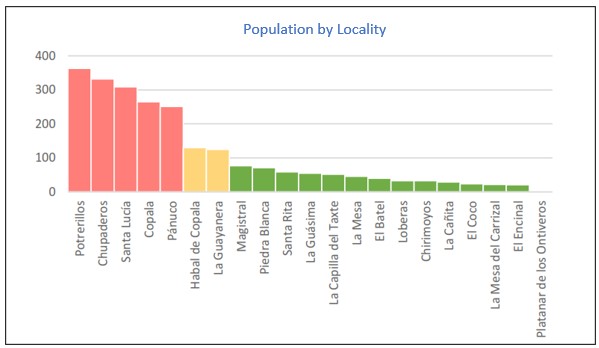
Source: FDMC, EIS, 2022.
It is anticipated that the following areas will be affected by the Project: Copala, El Habal, La Guásima, Pánuco, San Miguel del Carrizal, and Platanar de los Ontiveros. The Project will take place and develop in the areas of Cópala, Pánuco, and San Miguel del Carrizal. Due to their close proximity to central operations, the areas of El Habal and Platanar de los Ontiveros may be directly affected. La Guásima is slightly further and may only be indirectly affected by project development.
Within the local area of Panuco consists of six agrarian settlements with large areas of Common Use Lands, and within it, there are 32 localities with rural characteristics. The estimated population of this area is 2,400 inhabitants, of which 28% have active agrarian rights (communeros or ejidatarios), and 72% are settlers (without agrarian rights). The total population is distributed across 20 localities, with 12 localities recorded as uninhabited.
The region covers a total area of 58,840 ha, of which 99% are assigned to agrarian settlements, and only 1% correspond to population settlements under the civil regime of private property.
The Project's positive impact on the community may include employment generation, economic output and incorporation into social security through the Mexican Social Security Institute (IMSS). Project management will need to establish measures to mitigate negative impacts, especially if they are of concern to the population.
|
|
Figure 20-12 shows the Prediction of Social Impacts for the exploration phase of the Project. It is anticipated that similar impacts will be triggered by the mining phase of the Project.
Figure 20-12: Projection of Social Impacts

Source: FDMC, 2022.
20.8 Community Engagement
Vizsla is in the process of establishing guiding principles for community outreach and developing a strategic plan aligned with the organizational philosophy and the objectives of the Project. The implementation of actions must be accompanied by monitoring and measurement to evaluate performance and results. A community engagement plan and management system would enable relations with the community by controlling social risks and enabling favourable conditions for the development of the Project in the long term. In addition, such an engagement and management system would allow for the orderly development and justify sufficient budgets to allow for meaningful social investment, thereby reducing Project risks and costs due to potential community opposition and contribute to the responsible development of the community in accordance with community needs.
|
|
Vizsla has advanced the discussions with local stakeholders to express the intention of developing a mining project within Common Use Land and ejido property land that would aim to provide socio-economic well-being for the local population. The Company intends to maintain this relationship throughout the Project's lifecycle. Further to this effort, Vizsla has negotiated operating agreements with the five Ejidos in the greater Panuco area (Copala, Pánuco, San Miguel del Carrizal, El Habal de Copala, and Platanar de los Ontiveros). The operating agreements cover exploration, construction, operation, and closure phases for a 30-year period.
The Panuco Project aims to offer over 100 potential temporary and permanent jobs to the region. Special effort will be made during the Project to provide support to the local communities, including assisting with the introduction and improvement of basic services and educational institutions.
Vizsla aims to generate a state of trust and reciprocity with local populations that is maintained to date that will be reflected with the employment of the population that resides in surrounding towns and community.
It is Important that Vizsla commit efforts to the local communities, including assisting with introducing and improving basic services and educational institutions. It is of vital importance for the Company to have a relationship with the population and society in the area. The company needs to reach out to the community through various means with the intention of developing a mining project within private and ejido property land, which would provide a socio-economic well-being for the local and foreign population that boosts local economy.
In addition, social activities and recreation for the Ejidos population is a main contribution that the Company has been supporting over the years. The support includes financial resources per request of the people and needed for the festivities and recreational activities that as a society are performed locally, such as health fairs, Mother's Day, Children's Day, Christmas festivities, sport activities, among others.
It is recommended that Vizsla continue to engage with the nearby communities to stay informed about community concerns and potential projects that the Company can support by means of economic aid and other resources.
|
|
21 CAPITAL AND OPERATING COSTS
21.1 Introduction
The capital and operating cost estimates presented in this FS provide substantiated costs that can be used to further assess the economics of the Panuco Project. The estimates are primarily based on an underground mine operation, the construction and operation of a process plant, construction and operation of a tailings storage facility, and owner's costs and provisions. The processing plant will operate at a nameplate capacity of 3,300 t/d (1.2 Mt/a) from Years 1 to 3 and will increase to 4,000 t/d (1.46 Mt/a) from Year 4 onward, for a total life of mine (LOM) of 9.6 years.
All capital and operating cost estimates are presented in United States dollars (US$), with exchange rates factored in.
21.2 Capital Cost Estimate
21.2.1 Capital Cost Summary
The capital cost estimate conforms to Class 3 guidelines of the Association for the Advancement of Cost Engineering International (AACE International) for a feasibility study level estimate with an accuracy of ±15%. The capital cost estimate was developed in Q3 2025 United States dollars. The process plant, tailings storage facility, paste plant and infrastructure costs were estimated by Ausenco, and mining cost was estimated by Mining Plus.
The total initial capital cost for the Panuco Project is US$238.7 million; expansion capital cost is US$15.4 million and LOM sustaining cost excluding financing and closure cost of US$37.5 million is US$287.3 million. The capital cost summary is presented below in Table 21-1.
Table 21-1: Capital Costs Summary
| WBS | WBS Description | Initial Capital Cost (US$M) |
Sustaining Capital Cost (US$M) |
Expansion Capital Cost (US$M) |
Total Cost (US$M) |
| 1000 | Mining | 60.2 | 259.1 | 0.6 | 319.9 |
| 2000 | Process Plant | 63.9 | 0.0 | 8.8 | 72.6 |
| 3000 | Additional Process Facilities | 18.7 | 25.0 | 1.1 | 44.9 |
| 4000 | On-Site Infrastructure | 32.8 | 0.2 | 1.7 | 34.7 |
| 5000 | Off-Site Infrastructure | 1.1 | - | - | 1.1 |
| Total Directs | 176.7 | 284.4 | 12.2 | 473.4 | |
| 6000 | Project Indirect | 8.1 | - | - | 8.1 |
| 7000 | Project Delivery | 19.7 | - | 1.6 | 21.3 |
| Total Indirect | 27.8 | - | 1.6 | 29.4 | |
| 8000 | Owner's Cost | 10.1 | - | - | 10.1 |
| 9000 | Provisions (Contingency incl. closure) | 24.0 | 2.9 | 1.5 | 28.5 |
| Project Totals | 238.7 | 287.3 | 15.4 | 541.3 | |
Note: Total may not add up due to rounding.
|
|
The cost for the Project was split into initial capital costs, sustaining capital costs, expansion costs, and closure costs. The initial capital is project development costs incurred during the pre-production years. Sustaining capital is the capital incurred to support production from the Project. Expansion cost is incurred during Year 3 while expanding the process plant to 4,000 t/d with the inclusion of the flotation-leach circuit. Closure costs include all measures to remove all processing infrastructure and rehabilitate the site.
21.2.2 Basis of Estimate
21.2.2.1 Base Date and Currency
The estimate base date is Q3 2025. The estimate is prepared in United States dollars (US$).
21.2.2.2 Exchange Rates
Vendors and contractors were requested to provide pricing in their native currencies. These prices have been converted to United States dollars using the exchange rates in Table 21-2, current as of July 2025.
Table 21-2: Estimate Exchange Rates
| Code | Currency | Exchange Rate |
| USD | United States Dollars | 1.00 |
| AUD | Australian Dollars | 0.65 |
| EUR | Euros | 1.14 |
| CAD | Canadian Dollar | 0.71 |
| MXN | Mexican Pesos | 0.05 |
21.2.2.3 Standard Units of Measure
Metric units of measurement are used throughout the estimate.
21.2.2.4 Ausenco Basis of Estimate
The capital costs estimated by Ausenco align with the requirements of an AACE Class 3 estimate with an accuracy range between ±15% of the final project costs. The capital cost estimate was developed in Q3 2025 US dollars based on budgetary quotations for equipment and construction contracts, as well as Ausenco's in-house database of projects and studies including experience from similar operations.
The capital costs is a quantitatively based cost estimate with engineering developed material take-offs with factored quantities, semi-detailed unit costs and budgetary quotations for major equipment.
|
|
The structure of the estimate is a build-up of the direct and indirect cost of the estimated quantities; this includes the installation/construction hours, unit labour rates and contractor distributable costs, bulk and miscellaneous material and equipment costs, any subcontractor costs, freight, and growth.
The methodology applied to develop the estimate is as follows:
Defined the scope of work.
Quantified the work in accordance with standard commodities.
Organized the estimate structure in accordance with agreed work breakdown structure.
Developed a priced mechanical and electrical equipment list.
Determined bulk material pricing.
Determined the installation cost for equipment and bulks.
Establish requirements for freight.
Determined and agreed on foreign exchange rates.
Determined growth allowances for each estimate line item.
Determined/developed indirect costs.
Determined the estimate contingency value.
Conducted internal reviews.
Where the pricing and delivery information for equipment, materials, and services were provided by suppliers, the prices reflect market conditions and expectations at the time the estimate was developed.
The estimate and schedule in this report were based on information provided by suppliers and assumes normal market supply and availability of equipment and services during the execution phase.
The following parameters and qualifications were considered:
No allowance has been made to exchange rate fluctuations.
There is no escalation added to the estimate.
A growth allowance was included.
Data for the estimates have been obtained from numerous sources, including:
FS mine schedules.
FS level engineering design by Ausenco and Mining Plus.
Geotechnical investigations.
|
|
Budgetary equipment quotes from internationally based suppliers.
Budgetary unit costs from several local contractors for civil, concrete, steel, electrical, piping and mechanical works.
Data from similar recently completed studies and projects.
Major commodity cost categories (earthworks, concrete, structural steel, architectural, mechanical equipment, platework, piping, electrical equipment, electrical bulks, instrumentation and mobile equipment) were identified and estimated. Percentage of contingency was allocated to each of these categories on a line-item basis based on the accuracy of the data, considering scope, qualification and pricing. An overall contingency was derived in this fashion.
A growth allowance was allocated to each line item in the capital cost estimate to reflect the level of definition of design and pricing strategy. Growth is a provision for additional costs that will be recognized in future project phases that advance the engineered level of detail.
Estimate growth is intended to account for the following:
Items that cannot be quantified based on current engineering status but are empirically expected to appear.
The accuracy of quantity take-offs and engineering lists based on the level of engineering and design undertaken at a feasibility study level.
Pricing growth for the likely increase in cost due to the development and refinement of specifications as well as re-pricing after initial budget quotations and after finalization of commercial terms and conditions to be used in the project.
Growth has been calculated on a line-item level by evaluating the status of the engineering scope definition and maturity and the ratio of the various pricing sources for equipment and materials used to compile the estimate. The growth applied was based on guidance aligning to Class 3 AACE estimate and the level of definition of the project scope.
Ausenco's basis of estimate was used to estimate capital costs in Sections 21.2.4, 21.2.5, 21.2.6, 21.2.7, 21.2.8 and 21.2.9.
21.2.2.5 Mining Capital Cost Basis of Estimate
The capital cost estimate by Mining Plus was completed to the requirements of an AACE Class 3 estimate with an accuracy range of ±15% of the final project costs. The capital cost estimate was developed in Q3 2025 US dollars based on budgetary quotations from underground mining contractors and consumables vendors, as well as Mining Plus's in-house database of projects and studies for similar projects and geography.
Multiple local and international mining contracting companies were engaged to provide budgetary quotations for a full-service mining contract covering both the initial and sustaining capital phases of the project.
|
|
The contractor scope of work includes the following:
All on-site direct and indirect labour with the exception of senior site management and technical services (Owner supplied).
Underground mobile equipment and surface support fleets inclusive of all maintenance requirements.
Site indirect (travel & accommodation, administration, health and safety, etc.).
Contractor surface facilities including an office, lunchroom, mine dry, and mine rescue facility.
Small tools and drilling consumables.
The Owner's costs were calculated from material take-offs, vendor quotations, benchmarking, and first principles engineering calculations for the following:
Diesel and power consumption
Mining consumables
Ground support
Explosives
Mine services (ventilation, piping, electrical)
Site management and technical services labour
Fixed plant and underground infrastructure
Ventilation (fans, starters, e-rooms, etc.)
Dewatering
Air compressors
Fit out of underground shops, wash bays, fuel/lube bays, and explosive magazines.
Mining Plus's basis of estimate was used to estimate capital costs in Section 21.2.3.
21.2.3 Mining Capital Costs
Mine development and production at the Panuco Project is proposed to be executed by mining contractors with the Company's team providing technical services and site management. The primary mining contractor will be responsible for provision of mine personnel, mining equipment, maintenance, and consumables to support mining activities, excluding power, explosives, diesel, mine services, and ground control, which are considered to be provided by the Company.
The Company is assumed to provide much of the required surface infrastructure to support the mining contractor including ventilation infrastructure, maintenance facilities, fixed mine equipment including pumps and fans, and other mine facilities including, explosive storage, wash bay, waste rock storage, mineralized material stockpile pad, and water management infrastructure. The primary mining contractor will be responsible to supplying office, messing, and change facilities for their workforce.
|
|
Mining capital costs have been derived primarily from vendor and contractor quotations as well as historic data collected by Mining Plus at other underground mining operations and projects.
The dominant capital expense is the development cost required to establish production. When considering the reallocation of operating costs and the development cost (direct and indirect costs for both lateral and vertical development) over the pre-production period, approximately US$60.2 million will be expensed (exclusive of US$45.9 million in pre-production operating costs). The life of mine sustaining cost for the project is estimated at US$259.1 million. Most of the estimated sustaining mining costs is comprised of the direct cost of development, which is estimated to cost approximately US$206.3 million. Purchases for the mine fixed equipment is scheduled throughout the life of mine and capitalized through both the initial and sustaining periods of the project. The mine infrastructure costs include the following:
Installation of permanent mining services (power, communications, dewatering, ventilation, compressed air and process water)
Escapeway ladderways, ventilation walls, escapeway walls
Permanent paste pipe distribution system
Underground permanent infrastructure
Wash and maintenance bays
Permanent pump stations
Fuel/lube storage and dispensing
Mobile refuge chambers
Underground explosive and detonator magazines.
Table 21-3 summarises the Mining Initial Capital Cost and the Sustaining Capital Cost estimates for the Panuco Project.
Table 21-3: Mining Capital Costs
| Description | Initial Capital Cost (US$M) |
Sustaining Capital Cost (US$M) |
Expansion Capital Cost (US$M) |
Total Capital Cost (US$M) |
| Capital Development | 43.6 | 206.3 | - | 250.0 |
| Fixed Mine Equipment and Mobilization | 6.4 | 12.5 | - | 19.0 |
| Mine Surface & Underground Infrastructure | 4.8 | 30.3 | - | 35.0 |
| Fixed Equipment Rebuilds | - | 2.1 | - | 2.1 |
| Shared Capital (Plant, Surface infrastructure, etc.) | 5.4 | 7.9 | 0.6 | 13.9 |
| Total Mining Capital Costs | 60.2 | 259.1 | 0.6 | 319.9 |
Note: Total may not add up due to rounding.
|
|
It is the QP's opinion that these estimates are reasonable for the location and planned mine development and can be used for the Feasibility Study of the Panuco Project.
21.2.4 Direct Costs - Process Plant, Tailings Storage Facility, On-site Infrastructure and Off-site Infrastructure
A summary if the capital cost estimate is presented in Table 21-4.
Table 21-4: Capital Cost Summary - Process Plant, Tailings Storage Facility, On and Off-Site Infrastructure
| WBS | WBS Description | Initial Capital Cost (US$M) |
Sustaining Capital Cost (US$M) |
Expansion Capital Cost (US$M) |
Total Capital Cost (US$M) |
| 2100 | Crushing and Stockpile | 9.2 | - | - | 9.2 |
| 2200 | Grinding | 12.1 | - | - | 12.1 |
| 2300 | Flotation and Regrind | - | - | 6.2 | 6.2 |
| 2400 | Concentrate Leaching | - | - | - | - |
| 2500 | Leaching, CCD & Solution Management | 17.5 | - | 2.4 | 19.9 |
| 2600 | Merrill Crowe and Refinery | 11.1 | - | - | 11.1 |
| 2700 | Detoxification and Tailings Dewatering | 2.9 | - | - | 2.9 |
| 2800 | Reagents | 5.3 | 0.0 | 0.2 | 5.5 |
| 2900 | Plant Utilities | 5.7 | - | 5.7 | |
| 2000 | Sub-Total - Process Plant | 63.9 | 0.0 | 8.8 | 72.6 |
| 3100 | Tailings Storage Facility | 14.9 | 17.1 | - | 32.0 |
| 3200 | Waste Rock Storage Facility | 1.6 | 0.1 | - | 1.7 |
| 3300 | Backfill - Paste Plant & CRF | 2.3 | 7.9 | 1.1 | 11.3 |
| 3000 | Sub-Total - Additional Process Facilities | 18.7 | 25.0 | 1.1 | 44.9 |
| 4100 | Bulk Earthworks | 9.4 | - | 0.7 | 10.1 |
| 4300 | Power Distribution | 16.9 | - | 0.2 | 17.1 |
| 4400 | Fuel Storage | 0.1 | - | - | 0.1 |
| 4500 | Sewage | 1.0 | - | - | 1.0 |
| 4600 | Infrastructure Buildings | 2.4 | 0.2 | - | 2.6 |
| 4700 | Site Services | 2.6 | - | 0.8 | 3.4 |
| 4800 | Surface Mobile Equipment | 0.4 | - | - | 0.4 |
| 4000 | Sub-Total - On-Site Infrastructure | 32.8 | 0.2 | 1.7 | 34.7 |
| 5300 | Power Supply | 1.1 | - | - | 1.1 |
| 5000 | Sub-Total - Off-Site Infrastructure | 1.1 | - | - | 1.1 |
| Total | 116.6 | 25.3 | 11.6 | 153.4 |
Note: Total may not add up due to rounding.
|
|
The definition of process equipment requirements was based on process flowsheets and process design criteria as defined in Section 17. Process design criteria were used to size all major equipment and derive a mechanical equipment list. Key equipment was packaged based on alike items and scoped of work were developed to be sent for budgetary pricing to equipment suppliers (see Table 21-5 and Table 21-6). For mechanical equipment costs, 83.5% of the value was sourced from budgetary quotes; the remainder was sourced by benchmarking against other recent Mexican silver-gold projects and studies at an FS level or better.
Table 21-5: Mechanical Equipment Price Basis
| Source | Initial Capital Cost (US$M) | Sustaining Capital Cost (US$M) | Expansion Capital Cost (US$M) | % |
| Budgetary Quote | 32.5 | 1.5 | 4.0 | 83.5 |
| Estimated (Database) | 3.1 | 2.3 | 0.2 | 12.1 |
| Growth | 1.4 | 0.3 | 0.3 | 4.4 |
| Total | 37.0 | 4.1 | 4.5 | 100.0 |
Note: Total may not add up due to rounding.
Table 21-6: Mechanical Equipment & Packages
| Package No. | Equipment |
| P0001 | Crushing Equipment |
| P0002 | Ball Mill |
| P0003 | Cyclones |
| P0004 | Agitators |
| P0005 | Thickeners incl CCD Thickeners |
| P0006 | Regrind Mill |
| P0007 | Flotation Cells |
| P0008 | Screens |
| P0009 | Shop Tanks |
| P0010 | Slurry Pumps |
| P0011 | Potable Water Treatment Plant |
| P0012 | Sewage Treatment Plant |
| P0013 | Merril-Crowe |
| P0014 | Refinery & Gold Room |
| P0015 | Metallurgical Laboratory (equipment included) |
| P0016 | Paste Plant |
| P0017 | Conveyors |
| P0018 | Field Tanks |
| P0019 | TSF Reclaim Barge Water Pumps |
| P0020 | Oxygen Plant |
| P0021 | CRF Plant |
| P0022 | Water Treatment Plants |
|
|
Similarly, the major electrical equipment was sized based on the loads listed in the mechanical equipment list. Scope of work were developed to receive budgetary pricing from equipment suppliers (see Table 21-7 and Table 21-8). For the electrical equipment, 82% of the values sourced from budgetary quotes; the remainder was sourced by benchmarking against other recent Mexican silver-gold projects and studies at an FS level or better.
Table 21-7: Electrical Equipment Price Basis
| Source | Initial Capital Cost (US$M) | Sustaining Capital Cost (US$M) | Expansion Capital Cost (US$M) | % |
| Budgetary Quote | 17.1 | 1.0 | 1.1 | 81.9 |
| Estimated (Database) | 4.0 | 0.2 | 0.2 | 14.2 |
| Growth | 0.8 | 0.01 | 0.01 | 3.9 |
| Total | 21.9 | 1.3 | 1.4 | 100 |
Note: Total may not add up due to rounding.
Table 21-8: Electrical Equipment & Packages
| Package No. | Equipment |
| P0101 | Transformers |
| P0102 | Modular Electrical and Control Rooms |
| P0103 | High Voltage Substation |
In support of the major installation construction contracts, engineering for the process plant and infrastructure was completed to an FS level of definition allowing for bulk material quantities to be derived from major commodities as outlined in Table 21-9.
Table 21-9: Total Project Costs Summary - by Major Commodities
| Commodity Descriptions | Initial Capital Cost (US$M) | Sustaining Capital Cost (US$M) | Expansion Capital Cost (US$M) |
| Architectural | 1.9 | 0.5 | - |
| Earthworks | 20.7 | 17.2 | 1.1 |
| Concrete | 5.1 | 0.2 | 0.5 |
| Electrical Equipment | 22.0 | 1.3 | 1.4 |
| Platework | 6.1 | 0.6 | 1.3 |
| Instrumentation | 2.5 | 0.0 | 0.7 |
| Electrical Bulks | 6.7 | 0.5 | 0.5 |
| Mobile Equipment & Ancillaries | 0.5 | - | 0.0 |
| Piping | 11.9 | 0.7 | 1.4 |
| Third Party Estimates | 0.6 | 0.1 | 0.1 |
| Structural Steelwork | 3.3 | 0.6 | 0.8 |
| Project Delivery | 19.7 | - | 1.6 |
|
|
| Commodity Descriptions | Initial Capital Cost (US$M) | Sustaining Capital Cost (US$M) | Expansion Capital Cost (US$M) |
| Field Indirect | 3.8 | - | - |
| Spares, First Fills, Vendors | 4.3 | - | - |
| Provisions | 17.5 | 2.9 | 1.5 |
| Total | 163.6 | 28.5 | 15.4 |
Note: Total may not add up due to rounding.
After the derivation of the bulk material quantities (earthworks, concrete, steel, piping, cables, etc.) for the process plant, tailings storage facility and surface infrastructure areas, major construction contracts were formed and tendered for budgetary pricing bids, as per Table 21-10.
Table 21-10: Construction Contract Packages
| Contract No. | Contracts |
| C0001 | Concrete |
| C0002 | E&I Installation |
| C0003 | HV Transmission Lines |
| C0004 | Modular Buildings |
| C0005 | Pre-Engineered Buildings |
| C0006 | Site Development and Mass Earthworks |
| C0007 | SMP |
| C0008 | Fabric Buildings |
21.2.5 Indirect Capital Costs
A summary of the indirect capital cost estimate is presented in Table 21-11.
Table 21-11: Indirect Capital Cost Summary
| WBS | WBS Description | Initial Capital Cost (US$M) |
Expansion Capital Cost (US$M) |
Total Cost US$M) |
| 6100 | Temporary Construction Facilities and Services | 3.8 | - | 3.8 |
| 6200 | Commissioning Assistance and Ops Readiness | 0.8 | - | 0.8 |
| 6300 | Spares | 2.1 | - | 2.1 |
| 6400 | First Fill | 1.5 | - | 1.5 |
| Project Preliminaries | 8.1 | - | 8.1 | |
| 7100 | EPCM Services | 19.7 | 1.6 | 21.3 |
| Project Delivery | 19.7 | 1.6 | 21.3 | |
| Total Indirect Costs Capital | 27.8 | 1.6 | 29.4 | |
Note: Total may not add up due to rounding.
|
|
21.2.5.1 Project Preliminaries
The project preliminaries cost estimate consists of construction indirect for the project in the initial and expansion phase of the Project.
Mobilization and demobilization
Site offices and utilities
Construction equipment including mobile equipment, scaffolding, safety equipment, etc.
Construction fuel and consumables
Temporary maintenance and cleaning around sites
Vendor representative costs during construction and commissioning of specific equipment have been included in the cost estimate. These costs were developed by package using daily rates either provided by the vendors or Ausenco's historical daily rates, expenses and durations required on site.
Commissioning spares estimate was developed on first principle basis. The final costs were revised and benchmarked against Ausenco's database.
Capital (Critical) spares estimate was developed based on priced lists of recommended spares received from vendors. The final costs were revised and benchmarked against Ausenco's database.
Operating spares estimate was developed based on priced lists of recommended spares received from vendors required for two years period. The final costs were revised and benchmarked against Ausenco's database.
First fills include the costs for the initial construction, first fills for installed equipment and commissioning first fills which consist of chemicals, fuels and lubricants etc. and is an allowance based on historical data.
Commissioning First fills costs were developed form the operating costs - the cost of the initial fill is included in the estimate.
21.2.6 Owner (Corporate) Capital Costs
Owner's costs of US$10.1 million have been provided by Vizsla Silver and include the following:
|
|
Pre-production labour
Administration, finance, insurance and legal fees
Environmental consultation and management
Human resources, recruiting and training
Community relations
Site security
21.2.7 Contingency
Contingency accounts for the difference in costs between the estimated and actual costs of materials and equipment. The level of contingency varies depending on the nature of the contract and the client's requirements. Due to the uncertainties at the time, the capital cost estimate was developed (in terms of the level of engineering definition, basis of the estimate, schedule development, etc.), it is essential that the estimate include a provision to cover the risk from these uncertainties.
To develop the contingency value, a probabilistic contingency analysis was performed which consisted of a contingency ranging workshop taking place internally and evaluated the major cost components in terms of confidence of pricing and quantity basis and provided input ranges for potential under/over run. The ranging inputs were applied as percentages to the base estimate and then ran in a Monte Carlo model using the @Risk program. No contingency has been included for "project specific risks" such as items noted in Section 21.2.11, or management reserve. The @Risk simulation completed for the project determined the contingency to be 11.2% of base accumulative costs at P50 confidence level. This contingency was applied to the Ausenco's capex as well as Mining Plus's initial capex.
Table 21-12: Estimate Contingency
| WBS | WBS Description | Initial Capital Growth (US$M) | Sustaining Capital Contingency (US$M) |
| 1000 | Mining | 6.7 | - |
| 2000 | Process Plant | 7.2 | 1.0 |
| 3000 | Additional Process Facilities | 2.1 | 2.9 |
| 4000 | On-Site Infrastructure | 3.7 | 0.2 |
| 5000 | Off-Site Infrastructure | 0.1 | - |
| 6000 | Project Preliminaries | 0.9 | - |
| 7000 | Project Delivery | 2.2 | 0.2 |
| 8000 | Owner's Costs | 1.1 | - |
| Total Contingency | 24.0 | 4.3 | |
Note: Total may not add up due to rounding.
|
|
21.2.8 Closure and Reclamation Planning
The closure costs include requirements for the Mine portal closures, process infrastructures, TSF, WRSF, access roads and water management infrastructure, social programs & labour & terminations. Along with the direct costs the closure costs also include indirect such as, EPCM, temporary building installations, owner's cost and contingency.
All necessary demolition, rehabilitation, revegetation, earth grading/contouring, scrap metal disposal, hydrologic & geochemical stability are included for all areas. Closure costs are estimate at US$37.5 million.
21.2.9 Salvage Costs
Salvage costs have been factored against the process plant direct costs and will be recoverable at the end of the mine life. Total salvage value was estimated at US$9.6 million.
21.2.10 Growth Allowance
A growth allowance has then been allocated to each line item in the capital cost estimate to reflect the level of definition of design and pricing strategy, of which is a provision for additional costs that will be recognized in future project phases as engineering is advanced.
Estimate growth is:
intended to account for items that cannot be quantified based on current engineering status but are empirically expected to appear;
accuracy of quantity take-offs and engineering lists based on the level of engineering and design undertaken at feasibility study level; and
pricing growth for the likely increase in cost due to development and refinement of specifications as well as re-pricing after initial budget quotations and after finalizations of commercial terms and conditions to be used on the project.
Growth has been calculated on a line-item level by evaluating the status of the engineering scope definition and maturity and the ratio of the various pricing sources for equipment and materials used to compile the estimate. The growth rate applied was based on guidance aligning to a Class 3 AACE estimate, and the level of definition of the project scope. The capital cost growth allowance is presented in Table 21-13.
Table 21-13: Growth Cost Summary
| Commodity | Growth (Average %) | Initial Capital Growth (US$M) | Sustaining Capital Growth (US$M) |
| Architectural | 4% | 0.1 | 0.0 |
| Concrete | 4% | 0.2 | 0.0 |
| Earthworks | 7% | 1.5 | 1.4 |
| Electrical Bulks | 4% | 0.3 | 0.1 |
|
|
| Commodity | Growth (Average %) | Initial Capital Growth (US$M) | Sustaining Capital Growth (US$M) |
| Electrical Equipment | 4% | 0.8 | 0.1 |
| Field Indirect | 4% | 0.1 | 0.0 |
| Instrumentation | 5% | 0.1 | 0.0 |
| Mechanical Equipment | 4% | 1.4 | 0.6 |
| Piping | 4% | 0.5 | 0.1 |
| Platework | 4% | 0.2 | 0.1 |
| Structural Steelwork | 4% | 0.1 | 0.1 |
| Total | 4% | 5.4 | 2.5 |
21.2.11 Exclusions
The following costs and scope will be excluded from the capital cost estimate:
Operating costs
Taxes and duties
Future exploration costs
Environmental approvals
Special incentives schedule, safety or others
No allowance has been made for loss of productivity and/or disruption due to religious, union, social and/or cultural activities
Escalation beyond the base date Q3 2025
Environmental impact assessment
Future scope changes
Lost time due to weather, labour availability and disruption or force majeure events
Training or operations personnel
Management reserve
Financing costs.
|
|
21.3 Operating Costs
21.3.1 Operating Cost Summary
The costs considered on-site operating costs are those related to mining, processing, tailings handling, paste backfill, maintenance, power and general and administrative activities.
A summary of the operating costs is presented below in Table 21-14.
The average operating cost is US$85.11/t processed, including an annual G&A cost of US$9.4 million.
Table 21-14: Average LOM Operating Cost
| Cost Area | Average Annual Costs (US$M) | US$/t Processed |
| Mining | 71.9 | 53.31 |
| Process | 33.5 | 24.84 |
| G&A | 9.4 | 6.96 |
| Total | 114.9 | 85.11 |
Note: Total may not add up due to rounding.
21.3.2 Basis of Estimate
Key Assumptions were made to estimate the operating costs for the Project:
Cost estimates are based on Q3 2025,
Costs are expressed in United States Dollars (US$),
Power cost of US$0.09 per kilowatt-hour (kWh) was assumed,
A diesel cost of US$1.21 per liter was assumed based on trailing 3-year average price,
A throughput of 3,300 t/d or 1.20 Mt/a was used for the processing plant for Phase 1, and 4,000 t/d or 1.5 Mt/a for Phase 2,
Crushing circuit availability is assumed to be 65%, grinding and floatation availability is assumed to be 92% and paste plant utilization is assumed to be 60%,
ROM material and concentrate grades and recoveries are based on metallurgical test work results described in Section 13,
Material and equipment are purchased as new,
Reagent consumption rates are based on metallurgical test work results and in-house benchmarks, and
Grinding media consumption rates are based on mineral material characteristics as described in Section 13.
|
|
21.3.3 Mine Operating Costs
The mining operating costs reflect a contractor mining option that defers capital and leverages a contractor's experience for the mine's initial construction and development. Mining Plus developed mining costs primarily from budgetary contractor quotes along with consumables pricing received from Mexican based vendors. When required, limited benchmarking has been used from other project studies that utilize LHS as their main mining method and extract similar commodities.
Operating costs are summarised as follows:
Total underground mining operating costs are approximately US$718.6 million over the life-of-mine at an average of US$71.9M/a. This is inclusive of US$ 45.9 million in pre-production operating costs.
Average operating development (all non-capital development) of US$2,207/m which equates to US$13.76/t ore processed.
Average production costs (long hole stopping and cut & fill) of US$39.55/t ore processed.
Unit mining operating costs are summarised in Table 21-15 with a more detailed breakdown in Table 21-16.
Table 21-15: Mining Operating Costs Summary
| Item | LOM Operating Cost (US$M) | Unit Cost (US$/t Ore Processed) |
| Pre-production Operating Cost | 45.9 | - |
| Operating Development | 173.6 | 13.76 |
| Production | 499.1 | 39.55 |
| Total Development and Production Costs | 718.6 | 53.31* |
Note: * Unit cost does not include pre-production OPEX.
Table 21-16: Mining Production Costs
| Item | LOM Operating Cost (US$M) | Unit Cost (US$/t Ore Processed) |
| Pre-Production Operating Costs | 45.9 | - |
| Development - Operating (Direct Costs) | 71.0 | 5.72 |
| Operating Development Labour (Direct & Indirect) | 44.5 | 3.59 |
| Maintenance Fixed Mine Equipment | 1.3 | 0.10 |
| Power | 4.8 | 0.38 |
| Diesel | 6.7 | 0.55 |
| Contractor Fleet & Overheads | 45.2 | 3.64 |
| Total Operating Development Cost | 173.6 | 13.76 |
| Production - LHS (Direct Costs) | 77.3 | 6.13 |
| Production - CAF (Direct Costs) | 57.3 | 4.55 |
|
|
| Item | LOM Operating Cost (US$M) | Unit Cost (US$/t Ore Processed) |
| Production Labour (Direct & Indirect) | 123.5 | 9.80 |
| Backfill (All types) | 81.3 | 6.45 |
| Maintenance Fixed Mine Equipment | 3.7 | 0.29 |
| Power | 13.9 | 1.10 |
| Diesel | 18.6 | 1.47 |
| Contractor Fleet & Overheads | 123.6 | 9.80 |
| Total Production Cost | 499.1 | 39.55 |
| Total Operating Cost | 718.6 | 53.31* |
Note: Total may not add up due to rounding.
* Unit cost does not include pre-production OPEX
21.3.4 Process Plant Operating Costs
The process operating cost estimate is based on 3,300 t/d in Phase 1 and 4,000 t/d in Phase 2 mill, consisting of crushing, grinding, flotation, concentrate regrind, concentrate dewatering, leach, Merrill Crowe, tailings handling and paste backfill. This is broken down into two phases.
These include:
1. Phase 1 (Years 1 to 3): The process plant will produce doré through a whole ore leach process at a nominal throughput of 1.2 Mt/a.
2. Phase 2 (Years 4+): The process plant will produce doré through separate leaching of bulk flotation products at a nominal throughput of 1.5 Mt/a.
The process operating costs are estimated to be US$ 25.45/t and US$ 24.64/t for Phase 1 and 2, respectively, averaging to US$ 24.84/t over LOM. Table 21-17 summarises the operating costs for the process plant over the different operating periods.
Table 21-17: Process Plant Operating Cost Summary
| Cost Area | Phase 1 | Phase 2 | ||
| Average Annual Costs (US$M) | US$/t Processed | Average Annual Costs (US$M) | US$/t Processed | |
| Power | 6.0 | 5.14 | 6.8 | 4.78 |
| Reagents & Consumables | 17.2 | 14.75 | 21.0 | 14.84 |
| Maintenance | 1.7 | 1.40 | 1.8 | 1.26 |
| Labour | 2.0 | 1.73 | 2.1 | 1.47 |
| Mobile Equipment | 1.6 | 1.35 | 1.6 | 1.11 |
| Lab Services | 0.5 | 0.39 | 0.7 | 0.52 |
| Water Treatment | 0.4 | 0.32 | 0.4 | 0.31 |
|
|
| Cost Area | Phase 1 | Phase 2 | ||
| Average Annual Costs (US$M) | US$/t Processed | Average Annual Costs (US$M) | US$/t Processed | |
| TSF | 0.5 | 0.38 | 0.5 | 0.35 |
| Total | 30.5 | 25.45 | 34.9 | 24.64 |
Note: Total may not add up due to rounding.
21.3.4.1 Reagents and Consumables
Reagents, grinding media and various consumables are required to process the mineralized material from the Copala and Napoleon Deposits. The consumption rates of each of the consumable items are based on the metallurgical test work outlined in Section 13 and based on the planned process plant throughput of 3,300 t/d in Phase 1 and 4,000 t/d in Phase 2. The total costs of the reagents and consumables by area as well as the costs of mobile equipment used are shown below in Table 21-18.
Table 21-18: Reagents and Consumables Cost Summary
| Cost Area | Phase 1 | Phase 2 | ||
| Average Annual Costs (US$M) | US$/t Processed | Average Annual Costs (US$M) | US$/t Processed | |
| Crushing & Reclaim | 0.6 | 0.53 | 0.6 | 0.44 |
| Grinding | 3.0 | 2.58 | 3.0 | 2.13 |
| Flotation | - | - | 0.4 | 0.29 |
| Leaching | 7.2 | 6.19 | 10.6 | 7.50 |
| Precious Metal Recovery | 1.2 | 1.00 | 1.1 | 0.76 |
| Detox | 5.2 | 4.41 | 5.2 | 3.72 |
| Total | 17.2 | 14.75 | 21.0 | 14.84 |
Note: Total may not add up due to rounding.
21.3.4.2 Maintenance Consumables
Annual maintenance consumable costs were calculated based on a total installed mechanical capital cost by area using a weighted average factor from 3% to 4%. During Phase 1, the process area includes the 3-stage crushing-grinding circuit, whole ore leach and Merrill Crowe circuit, reagent handling and plant services areas. During Phase 2, the process area also includes the flotation-leach circuit and associated reagent handling and plant services area. The total maintenance consumable operating cost is US$1.7M/a or US$1.40/t of feed in Phase 1 and US$1.8M/a or US1.26/t of feed in Phase 2.
|
|
21.3.4.3 Power
Power operating costs are calculated from an estimate of annual power consumption using a unit cost of US$0.09/kwh. The annual power consumption for the processing plant is based on the average utilization of each motor on the electrical load list for the process plant.
The process plant energy consumption is estimated to be 68.5 MWh per full year in Phase 1, and 77.5MWh in Phase 2. The total power operating cost is US$6.0M/a or US$5.14/t of feed in Phase 1 and US$6.8M/a or US$4.78/t of feed in Phase 2.
21.3.4.4 Labour
Labour includes all processing and maintenance labour costs.
Processing production labour was developed using benchmarks from similar projects and includes operation departments such as metallurgy, mill operations, maintenance and the assay lab.
Each position was defined and classified as salary and wages. Costs included taxes and benefits. For process operations labour, the annual cost is US$1.2M/a in Phase 1, and US$1.3M/a in Phase 2. For process maintenance labour, the total cost is US$0.9M/a in Phase 1, and US$0.9M /a in Phase 2.
The total labour operating cost is US$2.0M/a or US$1.73/t of feed in Phase 1, and US$2.1M/a or US$1.47/t of feed in Phase 2. The estimated labour force was estimated at 135 and 141 people for Phases 1 and 2, respectively. The estimate was based on providing a labour force to support continuous operations at 24 hours per day and 365 days per year.
21.3.4.5 Mobile Equipment
Vehicle costs are based on a scheduled number of light vehicles and mobile equipment for the process plant. The costs include fuel, annual maintenance, spares and tires, annual insurance, and equipment leasing costs. Mobile equipment costs for the process plant are estimated at US$1.6M/a for Phase 1 and US$1.6M/a for Phase 2.
21.3.4.6 On-site Laboratory Services
Operating costs for the assay lab were estimated based on a review of benchmark projects with similar flowsheets and sampling requirements. The lab is expected to handle grade control samples, mill solid and aqueous samples, water testing, doré quality testing, and other miscellaneous tests as required. Annual operating costs are estimated at US$0.5M/a for Phase 1 and US$0.7M/a for Phase 2.
21.3.4.7 Water Treatment
Water supply costs were calculated using the expected annual makeup requirements of the process plant from the mass balance. Groundwater that is subject to government fees was assumed as the fresh water source, and a unit rate of US$0.64/m3 was applied. The estimated values for water supply costs per tonne of mill feed are US$0.32/t for Phase 1 and US$0.31/t for Phase 2.
|
|
Annual average water treatment costs are estimated at US$0.4M/a for Phase 1 and US$0.4M/a for Phase 2.
21.3.4.8 Tailings Storage Facility Operating Costs
TSF operating costs include the TSF beach management, operations of the barge pumps and maintenance, instrumentation and monitoring with daily inspections, contractor support and communications.
Annual average TSF costs are estimated at US$0.5M/a for Phase 1 and US$0.5M/a for Phase 2.
21.3.5 General & Administrative Costs
The general and administrative (G&A) operating costs cover the expenses of the operating departments, and a summary is presented in Table 21-19.
General and administrative (G&A) costs were developed using owner provided costs and Ausenco's in-house data on existing Mexican operations. The costs were estimated based on the following items:
Site maintenance (including G&A mobile equipment, on-site road maintenance),
Human Resources and Health & Safety (including personnel, recruiting, training, community relations, personal protective equipment and first-aid),
Environmental (including sampling and TSF operation),
Administration Costs (including office supplies, IT hardware & software, and support services), and
Contract services (including insurance, sanitation, license fees and legal fees).
The total annual G&A cost was estimated at US$9.4M/a during production or US$6.96/t plant feed.
Table 21-19: G&A Cost Summary
| G&A Expenses | Average Annual Costs (US$M) | US$/t Processed |
| Site Maintenance | 1.0 | 0.72 |
| Human Resources & Health and Safety | 3.4 | 2.50 |
| Environmental Costs | 0.6 | 0.44 |
| Administration Costs | 3.9 | 2.90 |
| Contract Services | 0.5 | 0.40 |
| Total | 9.4 | 6.96 |
Note: Total may not add up due to rounding.
 |
 |
22 ECONOMIC ANALYSIS
22.1 Forward-Looking Information Cautionary Statements
The results of the economic analysis discussed in this section represent forward-looking information as defined under Canadian securities law. The results depend on inputs that are subject to a number of known and unknown risks, uncertainties and other factors that may cause actual results to differ materially from those presented here. Information that is forward-looking includes:
Mineral reserve estimates.
Assumed commodity prices and exchange rates.
The proposed mine production plan.
Projected mining and process recovery rates.
Assumptions as to mining dilution.
Capital and operating cost estimates and working capital requirements.
Assumptions as to closure costs and closure requirements.
Assumptions as to environmental, permitting and social consideration and risks.
Additional risks to the forward-looking information include:
Changes to costs of production from what is assumed.
Unrecognized environmental risks.
Unanticipated reclamation expenses.
Unexpected variations in quantity of mineralized material, grade or recovery rates.
Geotechnical or hydrogeological considerations differ from what was assumed.
Failure of mining methods to operate as anticipated.
Failure of plant, equipment or processes to operate as anticipated.
Changes to assumptions as to the availability of electrical power, and the power rates used in the operating cost estimates and financial analysis.
Ability to maintain the social licence to operate.
Accidents, labour disputes and other risks of the mining industry.
|
|
Changes to interest rates.
Changes to tax rates and availability of allowances for depreciation and amortization.
22.2 Methodologies Used
A pre- and post-tax economic analysis was completed on the basis of a discounted cash flow model featuring a 5% discount rate. The analysis used Q3 2025 US dollars. The model assumed a 21-month physical construction period, and production period of 9.4 years, including the first year and final year which will see production for only a portion of those two years. Although Vizsla Silver is assuming a targeted timeline for initial operation and ramp up of production from the Project, calendar years mentioned in the economic analysis are for conceptual purposes only.
Cash inflows consist of revenue projections. Cash outflows consist of capital expenditures, including pre-production costs, operating costs, taxes, and royalties. These are subtracted from the inflows to arrive at the cash flow projections. Cash flows are taken to occur at the mid-point of each period. Cash flows were evaluated on a monthly basis up to and including Year 3 of the project life, and on a quarterly basis for Years 4-9 of the project life.
It must be noted that tax calculations involve complex variables that can only be accurately determined during operations, and as such, the actual post-tax results may differ from those estimated. A sensitivity analysis was performed to assess the impact of variations in metals price, discount rate, head grade, recovery, total operating costs, and initial capital costs. The capital and operating cost estimates developed specifically for this project are presented in Section 21 of this report in Q3 2025 US dollars, using exchange rates as noted in Section 21. The economic analysis has been run on a constant dollar basis with no inflation.
22.3 Financial Model Parameters
22.3.1 Assumptions
The economic analysis was performed assuming the base case silver price of US$35.50/oz and gold price of US$3,100/oz. The forecasts used are meant to reflect the average metals price expectation over the life of the project and are in line with consensus analyst estimates. No price inflation or escalation factors were taken into account. Commodity prices can be volatile, and there is the potential for deviation from the forecast.
The economic analysis also used the following assumptions:
The pre-production period will be 21 months and includes 2 months of metal production prior to commercial production starting.
The commercial production period of the project is defined as occurring 60 days after mill start until the end of the project.
The production life is 9.4 years, with the last year being a partial year.
Cost estimates are in constant Q3 2025 US dollars for capital and operating costs, with no inflation or escalation factors considered.
|
|
Results are based on 100% ownership with a 1.0% Government royalty applying to gross revenue from gold and silver production, as well as 2.0% and 3.5% private royalties applying to NSR.
Capital costs are funded by 100% equity (no financing assumed).
All cash flows are discounted to the start of the construction period using a mid-period discounting convention.
All metal products will be sold in the same year they are produced.
Project revenue will be derived from the sale of silver-gold doré bars.
No contractual arrangement for refining currently exists.
22.4 Taxes
The project has been evaluated on a post-tax basis to provide an approximate value of potential economics. The tax model was compiled by an independent tax consultant, and calculations are based on the tax regime as of the date of the FS technical report. At the effective date of this report, the project was assumed to be subject to the following tax regime:
The Mexican corporate income tax system (Federal Income Tax) consists of 30% income tax. Federal income tax is applied on Project income after deductions of eligible expenses including depreciation of assets, construction costs, exploration costs, and any losses carried forward.
Mining tax in Mexico (Special Mining Tax) consists of 8.5% on revenue less offsite charges, operating expenses and the sale of capital assets.
Tax depreciation rates differ for pre-production development costs (10%) and mining capital assets (12%). It is assumed that all capex would qualify as mining capital assets, including sustaining capital costs.
At the assumed metal prices, total corporate tax payments are estimated to be US$1,364 million over the LOM.
22.4.1 Working Capital
Working capital assumptions include Accounts Receivable (30 days), Inventories (30 days) and Accounts Payable (30 days). Total change in working capital is estimated to be US$10 million related to the Value Added Tax that is recoverable as of 2025 and assumed to be recovered in 2026.
22.4.2 Royalties
Royalties payable for the Panuco Project include a 1.0% Government royalty applying to gross revenue from gold and silver production, as well as 2.0% and 3.5% private royalties applying to NSR. Total royalty payments are US$242 million over the life of mine.
|
|
22.5 Economic Analysis
The economic analysis was performed assuming an 5% discount rate. The pre-tax NPV discounted at 5% is US$2,842 million; the IRR is 159.3%, and payback period is 0.4 years. On a post-tax basis, the NPV discounted at 5% is US$1,802 million, the IRR is 111.1%, and the payback period is 0.6 years. A summary of project economics is shown graphically in Figure 22-1 and listed in Table 22-1. Cash flows were evaluated on a monthly basis up to and including Year 3 of the project life, and on a quarterly basis for Years 4-9 of the project life. The annual cashflow output is shown in Table 22-2.
Figure 22-1: Project Post-Tax Unlevered Cashflow

Source: Ausenco, 2025.
|
|
Table 22-1: Economic Analysis Summary
| Description | Unit | Life-of-Mine Total / Average |
| General | ||
| Discount Rate | % | 5.0 |
| Silver Price | US$/oz | 35.50 |
| Gold Price | US$/oz | 3,100 |
| Production | ||
| Total Processed Feed | kt | 12,809 |
| Total Waste | kt | 6,284 |
| Head Grade - Ag | g/t | 249 |
| Head Grade - Au | g/t | 2.01 |
| Recovery Rate - Ag to doré | % | 92.3% |
| Recovery Rate - Au to doré | % | 93.8% |
| Total Metal Payable - Ag | koz | 94,725 |
| Total Metal Payable - Au | koz | 776 |
| Average Annual Payable Production - Ag | koz/a | 10,130 |
| Average Annual Payable Production - Au | koz/a | 83 |
| Average Annual Payable Production - AgEq | koz/a | 17,382 |
| Average Annual Payable Production (Yrs 1-5) - AgEq | koz/a | 20,278 |
| Operating Costs | ||
| Mining Cost | US$/t processed | 53.31 |
| Processing Cost (incl. TSF) | US$/t processed | 24.84 |
| Site G&A Costs | US$/t processed | 6.96 |
| Total Operating Costs | US$/t processed | 85.11 |
| Cash Costs and All-in Sustaining Costs (Co-Product Basis) | ||
| Cash Cost1 | US$/oz AgEq | 8.56 |
| All-in Sustaining Cost2 | US$/oz AgEq | 10.61 |
| Capital Expenditures | ||
| Initial Capital | US$M | 239 |
| Preproduction Revenue3 | US$M | -128 |
| Preproduction Costs4 | US$M | 62 |
| Initial Costs (Initial Capital + Preproduction Revenue & Costs) | US$M | 173 |
| Expansion Capital | US$M | 15 |
| Sustaining Capital | US$M | 287 |
| Closure Costs | US$M | 38 |
| Salvage Value | US$M | -10 |
| Economics | ||
| Pre-tax NPV (5%) | US$M | 2,842 |
| Pre-tax IRR | % | 159.3 |
| Pre-tax Payback | years | 0.4 |
|
|
| Description | Unit | Life-of-Mine Total / Average |
|
Post-tax NPV (5%) |
US$M |
1,802 |
|
Post-tax IRR |
% |
111.1 |
|
Post-tax Payback |
years |
0.6 |
|
Post-tax NPV/Initial Capital |
- |
7.5 |
Notes:
1. Total cash costs consist of operating cash costs plus royalties and offsite (refining & transport) charges.
2. AISC consists of total cash costs plus sustaining capital, and closure costs as defined by the World Gold Council.
3. Preproduction revenue includes revenue until the start of commercial production which is defined as 60 days after mill start.
4. Preproduction costs include: mining, processing and G&A operating costs, offsite charges, and royalties, until the start of commercial production which is defined as 60 days after mill start.
|
|
Table 22-2: Life of Mine Economics
| Project Year | ||||||||||||||||
| Free Cash Flow | Units | Total/Avg | -2 | -1 | 1 | 2 | 3 | 4 | 5 | 6 | 7 | 8 | 9 | 10 | 11 | 12 |
| Revenue | US$M | 5,642 | -- | -- | 746 | 691 | 627 | 746 | 689 | 574 | 564 | 474 | 443 | 88 | -- | -- |
| Operating Expenses | US$M | (1,074) | -- | -- | (90) | (106) | (115) | (130) | (121) | (128) | (133) | (120) | (109) | (23) | -- | -- |
| Offsite Charges (refining & transport) | US$M | (50) | -- | -- | (7) | (7) | (6) | (7) | (6) | (5) | (5) | (4) | (4) | (1) | -- | -- |
| Royalties (including EMD) | US$M | (237) | -- | -- | (33) | (31) | (27) | (31) | (28) | (22) | (23) | (20) | (18) | (4) | -- | -- |
| EBITDA | US$M | 4,281 | -- | -- | 616 | 548 | 479 | 579 | 534 | 419 | 403 | 331 | 313 | 61 | -- | -- |
| Initial Costs | US$M | (173) | (88) | (137) | 52 | -- | -- | -- | -- | -- | -- | -- | -- | -- | -- | -- |
| Expansion Capital | US$M | (15) | -- | -- | -- | -- | (15) | -- | -- | -- | -- | -- | -- | -- | -- | -- |
| Sustaining Capex | US$M | (287) | -- | -- | (29) | (47) | (31) | (34) | (33) | (41) | (25) | (33) | (16) | -- | -- | -- |
| Closure Capex | US$M | (38) | -- | -- | -- | -- | -- | -- | -- | -- | -- | -- | -- | -- | (38) | -- |
| Salvage Value | US$M | 10 | -- | -- | -- | -- | -- | -- | -- | -- | -- | -- | -- | -- | 10 | -- |
| Change in Working Capital | US$M | 10 | 0 | (8) | 10 | (1) | (0) | (13) | 2 | 2 | 3 | (0) | 2 | 12 | (1) | 2 |
| Pre-Tax Unlevered Free Cash Flow | US$M | 3,778 | (88) | (137) | 633 | 501 | 433 | 532 | 504 | 381 | 381 | 298 | 298 | 69 | (28) | -- |
| Pre-Tax Cumulative Unlevered Free Cash Flow |
US$M | 3,778 | (88) | (225) | 408 | 909 | 1,342 | 1,874 | 2,378 | 2,760 | 3,140 | 3,438 | 3,736 | 3,806 | 3,778 | 3,778 |
| Total Corporate Taxes | US$M | (1,364) | -- | (2) | (216) | (180) | (155) | (193) | (171) | (125) | (121) | (96) | (100) | (5) | -- | -- |
| Post-Tax Unlevered Free Cash Flow | US$M | 2,424 | (88) | (146) | 433 | 320 | 278 | 339 | 333 | 255 | 260 | 202 | 199 | 68 | (29) | 2 |
| Post-Tax Cumulative Unlevered Free Cash Flow |
US$M | 2,424 | (88) | (234) | 198 | 518 | 796 | 1,134 | 1,467 | 1,723 | 1,983 | 2,185 | 2,383 | 2,451 | 2,422 | 2,424 |
| Mining | ||||||||||||||||
| Mineralized Material Mined | kt | 12,802 | 74 | 473 | 859 | 1,226 | 1,310 | 1,599 | 1,535 | 1,533 | 1,497 | 1,382 | 1,160 | 153 | -- | -- |
| Processing | ||||||||||||||||
| Total Mill Feed | ||||||||||||||||
| Ore Tonnes | kt | 12,809 | -- | 90 | 1,200 | 1,200 | 1,200 | 1,460 | 1,460 | 1,460 | 1,460 | 1,460 | 1,460 | 359 | -- | -- |
| Ag Grade | g/t | 249 | -- | 396 | 389 | 345 | 308 | 283 | 248 | 198 | 207 | 179 | 160 | 123 | -- | -- |
| Au Grade | g/t | 2.01 | -- | 2.97 | 2.82 | 2.27 | 2.18 | 2.22 | 2.24 | 2.00 | 1.79 | 1.47 | 1.48 | 1.27 | -- | -- |
| AgEq Grade | g/t | 425 | -- | 656 | 636 | 544 | 498 | 477 | 444 | 372 | 363 | 308 | 289 | 234 | -- | -- |
| Doré Recovery | ||||||||||||||||
| Ag | % | 92.3% | -- | 93.0% | 92.9% | 92.8% | 91.7% | 93.4% | 92.1% | 91.1% | 92.5% | 92.1% | 91.4% | 90.7% | -- | -- |
| Au | % | 93.8% | -- | 93.9% | 93.7% | 93.1% | 92.4% | 94.9% | 94.7% | 94.4% | 94.3% | 93.1% | 93.0% | 92.9% | -- | -- |
| Production Profile | ||||||||||||||||
| Contained Metal | ||||||||||||||||
| Ag | koz | 102,689 | -- | 1,147 | 15,023 | 13,328 | 11,893 | 13,295 | 11,655 | 9,285 | 9,723 | 8,423 | 7,496 | 1,422 | -- | -- |
| Au | koz | 829 | -- | 9 | 109 | 88 | 84 | 104 | 105 | 94 | 84 | 69 | 69 | 15 | -- | -- |
| AgEq | koz | 175,082 | -- | 1,898 | 24,533 | 20,972 | 19,232 | 22,377 | 20,833 | 17,475 | 17,044 | 14,464 | 13,548 | 2,705 | -- | -- |
| Metal Produced | ||||||||||||||||
| Ag | koz | 94,820 | -- | 1,066 | 13,959 | 12,364 | 10,909 | 12,424 | 10,739 | 8,463 | 8,998 | 7,754 | 6,854 | 1,290 | -- | -- |
| Au | koz | 778 | -- | 8 | 102 | 82 | 78 | 99 | 99 | 89 | 79 | 64 | 64 | 14 | -- | -- |
| AgEq | koz | 162,727 | -- | 1,771 | 22,872 | 19,482 | 17,687 | 21,041 | 19,427 | 16,196 | 15,903 | 13,380 | 12,484 | 2,482 | -- | -- |
| Metal Payable | ||||||||||||||||
| Ag | koz | 94,725 | -- | 1,065 | 13,945 | 12,351 | 10,898 | 12,411 | 10,728 | 8,454 | 8,989 | 7,746 | 6,847 | 1,289 | -- | -- |
| Au | koz | 776 | -- | 8 | 102 | 81 | 78 | 99 | 99 | 88 | 79 | 64 | 64 | 14 | -- | -- |
| AgEq | koz | 162,531 | -- | 1,769 | 22,845 | 19,459 | 17,666 | 21,016 | 19,403 | 16,176 | 15,883 | 13,364 | 12,469 | 2,479 | -- | -- |
| Revenue | ||||||||||||||||
| Ag Revenue | US$M | 3,286 | -- | -- | 456 | 438 | 387 | 441 | 381 | 300 | 319 | 275 | 243 | 46 | -- | -- |
| Au Revenue | US$M | 2,357 | -- | -- | 290 | 252 | 240 | 305 | 308 | 274 | 245 | 199 | 200 | 42 | -- | -- |
| Gross Revenue | US$M | 5,642 | -- | -- | 746 | 691 | 627 | 746 | 689 | 574 | 564 | 474 | 443 | 88 | -- | -- |
| Transport & Refining Charges | US$M | 50 | -- | -- | 7 | 7 | 6 | 7 | 6 | 5 | 5 | 4 | 4 | 1 | -- | -- |
| Net Revenue | US$M | 5,592 | -- | -- | 739 | 684 | 621 | 739 | 683 | 570 | 559 | 470 | 439 | 87 | -- | -- |
| Royalties | ||||||||||||||||
| Extraordinary Mining Duty | US$M | 56 | -- | -- | 7 | 7 | 6 | 7 | 7 | 6 | 6 | 5 | 4 | 1 | -- | -- |
| Private NSR Royalty | US$M | 180 | -- | -- | 25.9 | 23.7 | 20.8 | 23.5 | 20.8 | 16.5 | 17.8 | 15.2 | 13.3 | 2.9 | -- | -- |
| Operating Costs | ||||||||||||||||
| Mining | US$M | 673 | -- | -- | 53 | 66 | 75 | 84 | 75 | 83 | 88 | 74 | 63 | 11 | -- | -- |
| Processing (including TSF handling) | US$M | 313 | -- | -- | 28 | 31 | 31 | 36 | 36 | 36 | 36 | 36 | 36 | 9 | -- | -- |
| G&A | US$M | 88 | -- | -- | 9 | 10 | 10 | 10 | 10 | 10 | 10 | 10 | 10 | 2 | -- | -- |
| Cash Costs (Co-product Basis) | ||||||||||||||||
| Total Cash Costs1 | $/oz AgEq | 8.56 | -- | -- | 6.20 | 7.36 | 8.38 | 7.97 | 7.96 | 9.60 | 10.16 | 10.76 | 10.43 | 10.89 | -- | -- |
| All-in Sustaining Costs2 | $/oz AgEq | 10.61 | -- | -- | 7.56 | 9.76 | 10.14 | 9.59 | 9.63 | 12.11 | 11.71 | 13.21 | 11.68 | 10.89 | -- | -- |
|
|
| Project Year | ||||||||||||||||
| Free Cash Flow | Units | Total/Avg | -2 | -1 | 1 | 2 | 3 | 4 | 5 | 6 | 7 | 8 | 9 | 10 | 11 | 12 |
| Capital Expenditures | ||||||||||||||||
| Initial Capital | US$M | 239 | 82 | 154 | 3 | -- | -- | -- | -- | -- | -- | -- | -- | -- | -- | -- |
| Preproduction Revenue3 | US$M | (128) | -- | (63) | (65) | -- | -- | -- | -- | -- | -- | -- | -- | -- | -- | -- |
| Preproduction Costs4 | US$M | 62 | 7 | 45 | 10 | -- | -- | -- | -- | -- | -- | -- | -- | -- | -- | -- |
| Initial Costs (Initial Capital + Preproduction Revenue & Costs)5 | US$M | 173 | 88 | 137 | (52) | -- | -- | -- | -- | -- | -- | -- | -- | -- | -- | -- |
| Expansion Capital | US$M | 15 | -- | -- | -- | -- | 15 | -- | -- | -- | -- | -- | -- | -- | -- | -- |
| Sustaining Capital | US$M | 287 | -- | -- | 29 | 47 | 31 | 34 | 33 | 41 | 25 | 33 | 16 | -- | -- | -- |
| Closure Cost | US$M | 38 | -- | -- | -- | -- | -- | -- | -- | -- | -- | -- | -- | -- | 38 | -- |
| Salvage Value | US$M | (10) | -- | -- | -- | -- | -- | -- | -- | -- | -- | -- | -- | -- | (10) | -- |
| Total Capital Expenditures | US$M | 504 | 88 | 137 | (22) | 47 | 46 | 34 | 33 | 41 | 25 | 33 | 16 | -- | 28 | -- |
Notes:
All values in 2025 real US dollars unless otherwise noted.
1. Total cash costs consist of operating cash costs plus royalties and offsite (refining & transport) charges.
2. AISC consist of total cash costs plus sustaining capital, and closure costs as defined by the World Gold Council.
3. Preproduction revenue includes revenue until the start of commercial production which is defined as 60 days after mill start.
4. Preproduction costs include: mining, processing and G&A operating costs, offsite charges, and royalties, until the start of commercial production which is defined as 60 days after mill start.
5. Initial costs include initial capital, and preproduction items as follows: revenue, operating costs, offsite charges, and royalties (including private royalties amounting to US$4.4 million during the preproduction period, in addition to US$180.3 million that occurs during commercial production).
|
|
22.6 Sensitivity Analysis
A sensitivity analysis was conducted on the base case NPV and IRR of the project using the following variables: discount rate, head grade, recovery, total operating cost, initial capital cost, as well as silver and gold prices, which were encompassed in a single variable, metal price. The sensitivity range for these tables is ±20%. These sensitivity for Ag and Au recovery is set so that recovery values do not exceed 100%. The inflection point for the recovery series in Figure 22-2 and Figure 22-3 represents the point where recovery values reach 100%.
Additional sensitivity tables for metal prices have been included to assess changes in Ag and Au price both individually and together, with a larger sensitivity range of ±50%.
Table 22-3, Table 22-4, Table 22-5, and Table 22-6 summarise the pre-tax and post-tax sensitivities of the project. As shown in Figure 22-2 and Figure 22-3, the sensitivity analysis revealed that the project is most sensitive to changes in head grade and metal price.
|
|
Table 22-3: Pre-Tax NPV (US$M) and IRR (%) Sensitivity Analysis
| Pre-Tax NPV5% Sensitivity to Discount Rate | Pre-Tax IRR Sensitivity to Discount Rate | ||||||||||||
| Metal Price | Metal Price | ||||||||||||
| Discount Rate | (20%) | (10%) | 0% | 10% | 20% | Discount Rate | (20%) | (10%) | 0% | 10% | 20% | ||
| 1.0% | 2,518 | 3,039 | 3,561 | 4,083 | 4,605 | 1.0% | 123.3 | 141.7 | 159.3 | 176.3 | 192.7 | ||
| 3.0% | 2,241 | 2,708 | 3,175 | 3,642 | 4,109 | 3.0% | 123.3 | 141.7 | 159.3 | 176.3 | 192.7 | ||
| 5.0% | 2,003 | 2,422 | 2,842 | 3,262 | 3,682 | 5.0% | 123.3 | 141.7 | 159.3 | 176.3 | 192.7 | ||
| 8.0% | 1,703 | 2,064 | 2,425 | 2,785 | 3,146 | 8.0% | 123.3 | 141.7 | 159.3 | 176.3 | 192.7 | ||
| 10.0% | 1,535 | 1,863 | 2,190 | 2,518 | 2,846 | 10.0% | 123.3 | 141.7 | 159.3 | 176.3 | 192.7 | ||
| Pre-Tax NPV5% Sensitivity to Operating Costs | Pre-Tax IRR Sensitivity to Operating Costs | ||||||||||||
| Metal Price | Metal Price | ||||||||||||
| Operating Costs | (20%) | (10%) | 0% | 10% | 20% | Operating Costs | (20%) | (10%) | 0% | 10% | 20% | ||
| (20.0%) | 2,172 | 2,592 | 3,012 | 3,432 | 3,852 | (20.0%) | 131.8 | 150.2 | 167.9 | 184.9 | 201.4 | ||
| (10.0%) | 2,087 | 2,507 | 2,927 | 3,347 | 3,767 | (10.0%) | 127.5 | 145.9 | 163.6 | 180.6 | 197.0 | ||
| -- | 2,003 | 2,422 | 2,842 | 3,262 | 3,682 | -- | 123.3 | 141.7 | 159.3 | 176.3 | 192.7 | ||
| 10.0% | 1,918 | 2,337 | 2,757 | 3,177 | 3,597 | 10.0% | 119.1 | 137.5 | 155.1 | 172.0 | 188.4 | ||
| 20.0% | 1,833 | 2,253 | 2,672 | 3,092 | 3,512 | 20.0% | 114.9 | 133.3 | 150.9 | 167.9 | 184.2 | ||
| Pre-Tax NPV5% Sensitivity to Initial Capital | Pre-Tax IRR Sensitivity to Initial Capital | ||||||||||||
| Metal Price | Metal Price | ||||||||||||
| Initial Capital | (20%) | (10%) | 0% | 10% | 20% | Initial Capital | (20%) | (10%) | 0% | 10% | 20% | ||
| (20.0%) | 2,048 | 2,468 | 2,888 | 3,308 | 3,728 | (20.0%) | 146.9 | 168.1 | 188.4 | 208.0 | 226.9 | ||
| (10.0%) | 2,025 | 2,445 | 2,865 | 3,285 | 3,705 | (10.0%) | 134.1 | 153.8 | 172.6 | 190.8 | 208.3 | ||
| -- | 2,003 | 2,422 | 2,842 | 3,262 | 3,682 | -- | 123.3 | 141.7 | 159.3 | 176.3 | 192.7 | ||
| 10.0% | 1,980 | 2,399 | 2,819 | 3,239 | 3,659 | 10.0% | 114.1 | 131.4 | 147.9 | 163.9 | 179.3 | ||
| 20.0% | 1,957 | 2,377 | 2,796 | 3,216 | 3,636 | 20.0% | 106.2 | 122.5 | 138.1 | 153.1 | 167.7 | ||
| Pre-Tax NPV5% Sensitivity to Head Grade | Pre-Tax IRR Sensitivity to Head Grade | ||||||||||||
| Metal Price | Metal Price | ||||||||||||
| Head Grade | (20%) | (10%) | 0% | 10% | 20% | Head Grade | (20%) | (10%) | 0% | 10% | 20% | ||
| (20.0%) | 1,327 | 1,662 | 1,996 | 2,331 | 2,665 | (20.0%) | 91.6 | 107.6 | 122.9 | 137.6 | 151.8 | ||
| (10.0%) | 1,668 | 2,046 | 2,423 | 2,801 | 3,178 | (10.0%) | 107.8 | 125.1 | 141.5 | 157.4 | 172.7 | ||
| -- | 2,003 | 2,422 | 2,842 | 3,262 | 3,682 | -- | 123.3 | 141.7 | 159.3 | 176.3 | 192.7 | ||
| 10.0% | 2,340 | 2,802 | 3,265 | 3,727 | 4,190 | 10.0% | 138.2 | 157.8 | 176.5 | 194.6 | 212.0 | ||
| 20.0% | 2,656 | 3,158 | 3,660 | 4,163 | 4,665 | 20.0% | 152.2 | 172.8 | 192.7 | 211.8 | 230.2 | ||
| Pre-Tax NPV5% Sensitivity to Recovery | Pre-Tax IRR Sensitivity to Recovery | ||||||||||||
| Metal Price | Metal Price | ||||||||||||
| Recovery | (20%) | (10%) | 0% | 10% | 20% | Recovery | (20%) | (10%) | 0% | 10% | 20% | ||
| (20.0%) | 1,338 | 1,674 | 2,010 | 2,346 | 2,682 | (20.0%) | 92.2 | 108.3 | 123.7 | 138.4 | 152.7 | ||
| (10.0%) | 1,670 | 2,048 | 2,426 | 2,804 | 3,182 | (10.0%) | 108.1 | 125.4 | 141.9 | 157.7 | 173.1 | ||
| -- | 2,003 | 2,422 | 2,842 | 3,262 | 3,682 | -- | 123.3 | 141.7 | 159.3 | 176.3 | 192.7 | ||
| 10.0% | 2,244 | 2,694 | 3,145 | 3,595 | 4,045 | 10.0% | 133.9 | 153.1 | 171.5 | 189.3 | 206.4 | ||
| 20.0% | 2,254 | 2,705 | 3,157 | 3,608 | 4,060 | 20.0% | 134.2 | 153.4 | 171.8 | 189.6 | 206.7 | ||
|
|
Table 22-4: Post-Tax NPV (US$M) and IRR (%) Sensitivity Analysis
| Post-Tax NPV5% Sensitivity to Discount Rate | Post-Tax IRR Sensitivity to Discount Rate | |||||||||||||
| Metal Price | Metal Price | |||||||||||||
| Discount Rate | (20%) | (10%) | 0% | 10% | 20% | Discount Rate | (20%) | (10%) | 0% | 10% | 20% | |||
| 1.0% | 1,612 | 1,946 | 2,280 | 2,614 | 2,947 | 1.0% | 86.0 | 98.8 | 111.1 | 122.8 | 134.2 | |||
| 3.0% | 1,426 | 1,724 | 2,023 | 2,321 | 2,619 | 3.0% | 86.0 | 98.8 | 111.1 | 122.8 | 134.2 | |||
| 5.0% | 1,266 | 1,534 | 1,802 | 2,070 | 2,337 | 5.0% | 86.0 | 98.8 | 111.1 | 122.8 | 134.2 | |||
| 8.0% | 1,065 | 1,295 | 1,525 | 1,755 | 1,985 | 8.0% | 86.0 | 98.8 | 111.1 | 122.8 | 134.2 | |||
| 10.0% | 953 | 1,162 | 1,370 | 1,579 | 1,788 | 10.0% | 86.0 | 98.8 | 111.1 | 122.8 | 134.2 | |||
| Post-Tax NPV5% Sensitivity to Operating Costs | Post-Tax IRR Sensitivity to Operating Costs | |||||||||||||
| Metal Price | Metal Price | |||||||||||||
| Operating Costs | (20%) | (10%) | 0% | 10% | 20% | Operating Costs | (20%) | (10%) | 0% | 10% | 20% | |||
| (20.0%) | 1,379 | 1,647 | 1,915 | 2,183 | 2,450 | (20.0%) | 92.6 | 105.4 | 117.6 | 129.5 | 141.0 | |||
| (10.0%) | 1,322 | 1,590 | 1,859 | 2,127 | 2,394 | (10.0%) | 89.3 | 102.1 | 114.3 | 126.2 | 137.6 | |||
| -- | 1,266 | 1,534 | 1,802 | 2,070 | 2,337 | -- | 86.0 | 98.8 | 111.1 | 122.8 | 134.2 | |||
| 10.0% | 1,209 | 1,477 | 1,745 | 2,013 | 2,281 | 10.0% | 82.8 | 95.6 | 107.8 | 119.6 | 130.9 | |||
| 20.0% | 1,153 | 1,421 | 1,689 | 1,957 | 2,225 | 20.0% | 79.6 | 92.4 | 104.6 | 116.4 | 127.7 | |||
| Post-Tax NPV5% Sensitivity to Initial Capital | Post-Tax IRR Sensitivity to Initial Capital | |||||||||||||
| Metal Price | Metal Price | |||||||||||||
| Initial Capital | (20%) | (10%) | 0% | 10% | 20% | Initial Capital | (20%) | (10%) | 0% | 10% | 20% | |||
| (20.0%) | 1,312 | 1,580 | 1,848 | 2,116 | 2,383 | (20.0%) | 103.6 | 118.4 | 132.5 | 146.1 | 159.2 | |||
| (10.0%) | 1,289 | 1,557 | 1,825 | 2,093 | 2,360 | (10.0%) | 94.1 | 107.7 | 120.8 | 133.5 | 145.6 | |||
| -- | 1,266 | 1,534 | 1,802 | 2,070 | 2,337 | -- | 86.0 | 98.8 | 111.1 | 122.8 | 134.2 | |||
| 10.0% | 1,243 | 1,511 | 1,779 | 2,047 | 2,315 | 10.0% | 79.2 | 91.2 | 102.7 | 113.8 | 124.5 | |||
| 20.0% | 1,220 | 1,488 | 1,756 | 2,024 | 2,292 | 20.0% | 73.3 | 84.6 | 95.5 | 105.9 | 116.1 | |||
| Post-Tax NPV5% Sensitivity to Head Grade | Post-Tax IRR Sensitivity to Head Grade | |||||||||||||
| Metal Price | Metal Price | |||||||||||||
| Head Grade | (20%) | (10%) | 0% | 10% | 20% | Head Grade | (20%) | (10%) | 0% | 10% | 20% | |||
| (20.0%) | 835 | 1,048 | 1,262 | 1,475 | 1,689 | (20.0%) | 63.9 | 75.1 | 85.8 | 96.0 | 105.8 | |||
| (10.0%) | 1,052 | 1,293 | 1,534 | 1,776 | 2,017 | (10.0%) | 75.3 | 87.3 | 98.7 | 109.7 | 120.4 | |||
| -- | 1,266 | 1,534 | 1,802 | 2,070 | 2,337 | -- | 86.0 | 98.8 | 111.1 | 122.8 | 134.2 | |||
| 10.0% | 1,481 | 1,776 | 2,072 | 2,366 | 2,661 | 10.0% | 96.4 | 110.0 | 123.0 | 135.5 | 147.3 | |||
| 20.0% | 1,683 | 2,004 | 2,324 | 2,644 | 2,964 | 20.0% | 106.0 | 120.4 | 134.2 | 147.1 | 159.5 | |||
| Post-Tax NPV5% Sensitivity to Recovery | Post-Tax IRR Sensitivity to Recovery | |||||||||||||
| Metal Price | Metal Price | |||||||||||||
| Recovery | (20%) | (10%) | 0% | 10% | 20% | Recovery | (20%) | (10%) | 0% | 10% | 20% | |||
| (20.0%) | 842 | 1,056 | 1,271 | 1,485 | 1,700 | (20.0%) | 64.4 | 75.6 | 86.3 | 96.5 | 106.4 | |||
| (10.0%) | 1,054 | 1,295 | 1,536 | 1,778 | 2,019 | (10.0%) | 75.5 | 87.5 | 98.9 | 110.0 | 120.6 | |||
| -- | 1,266 | 1,534 | 1,802 | 2,070 | 2,337 | -- | 86.0 | 98.8 | 111.1 | 122.8 | 134.2 | |||
| 10.0% | 1,420 | 1,708 | 1,995 | 2,282 | 2,569 | 10.0% | 93.4 | 106.8 | 119.5 | 131.9 | 143.5 | |||
| 20.0% | 1,426 | 1,715 | 2,003 | 2,291 | 2,578 | 20.0% | 93.6 | 107.0 | 119.8 | 132.1 | 143.8 | |||
|
|
Table 22-5: Pre-Tax NPV (US$M) and IRR (%) Sensitivity Analysis - Ag and Au Prices
| Inputs | Pre-Tax NPV5% Sensitivity to Ag and Au Prices | |||||
| Metal Price (Ag and Au) (+/-%) | -50% | -25% | 0% | 25% | 50% | |
| 743 | 1,793 | 2,842 | 3,892 | 4,941 | ||
| Ag Price (+/-%) | -50% | -25% | 0% | 25% | 50% | |
| 1,612 | 2,227 | 2,842 | 3,457 | 4,073 | ||
| Au Price (+/-%) | -50% | -25% | 0% | 25% | 50% | |
| 1,973 | 2,408 | 2,842 | 3,277 | 3,711 | ||
| Inputs | Pre-Tax IRR Sensitivity to Ag and Au Prices | |||||
| Metal Price (Ag and Au) (+/-%) | -50% | -25% | 0% | 25% | 50% | |
| 61.0 | 113.8 | 159.3 | 200.7 | 239.1 | ||
| Ag Price (+/-%) | -50% | -25% | 0% | 25% | 50% | |
| 102.7 | 132.0 | 159.3 | 185.1 | 209.7 | ||
| Au Price (+/-%) | -50% | -25% | 0% | 25% | 50% | |
| 124.5 | 142.3 | 159.3 | 175.7 | 191.6 | ||
Table 22-6: Post-Tax NPV (US$M) and IRR (%) Sensitivity Analysis - Ag and Au Prices
|
Inputs |
Post-Tax NPV5% Sensitivity to Ag and Au Prices |
|||||
|
Metal Price (Ag and Au) (+/-%) |
-50% |
-25% |
0% |
25% |
50% |
|
|
461 |
1,132 |
1,802 |
2,471 |
3,139 |
||
|
Ag Price (+/-%) |
-50% |
-25% |
0% |
25% |
50% |
|
|
1,017 |
1,409 |
1,802 |
2,195 |
2,586 |
||
|
Au Price (+/-%) |
-50% |
-25% |
0% |
25% |
50% |
|
|
1,247 |
1,524 |
1,802 |
2,079 |
2,356 |
||
|
Inputs |
Post-Tax IRR Sensitivity to Ag and Au Prices |
|||||
|
Metal Price (Ag and Au) (+/-%) |
-50% |
-25% |
0% |
25% |
50% |
|
|
42.4 |
79.4 |
111.1 |
139.7 |
165.4 |
||
|
Ag Price (+/-%) |
-50% |
-25% |
0% |
25% |
50% |
|
|
71.9 |
92.1 |
111.1 |
129.0 |
145.7 |
||
|
Au Price (+/-%) |
-50% |
-25% |
0% |
25% |
50% |
|
|
86.8 |
99.2 |
111.1 |
122.5 |
133.5 |
||
|
|
Figure 22-2: Pre-Tax Sensitivity Analysis Results


Note: Series lines for metal price and head grade overlap on the above figures. Source: Ausenco, 2025.
|
|
Figure 22-3: Post-Tax Sensitivity Analysis Results


Note: Series lines for metal price and head grade overlap on the above figures. Source: Ausenco, 2025.
|
|
23 ADJACENT PROPERTIES
There is no information on properties adjacent to the Property necessary to make the technical report understandable and not misleading.
|
|
24 OTHER RELEVANT DATA AND INFORMATION
24.1 Test Mine
Vizsla Silver is currently developing a Test Mine with about 1,070 m of underground development to obtain a bulk sample of 10,000 tonnes of ore. The Copala portal is developed in early 2025 and the planned underground development is expected to be completed by early 2026 by a mining contractor.
24.2 Project Execution Plan
The Project Execution Plan (PEP) will address the overall project (objectives, scope, strategies, and roles and responsibilities) and provide a comprehensive plan for its development and implementation. The PEP covers the plan for engineering, procurement, construction, start-up, and commissioning of the Project. The implementation strategy assumes an Engineering, Procurement, and Construction Management (EPCM) implementation with construction packages.
The following subsections summarise the contents of the Panuco PEP.
24.2.1 Objectives
Vizsla aims to bring the Panuco Project into operation while satisfying the following objectives:
Zero harm to personnel involved with construction, operation, and maintenance of the facilities,
Preserve or improve the project value through effective control of project costs and completion of construction and commissioning on or ahead of schedule,
Satisfy quality and performance targets,
Comply with company policies, legislative requirements, environmental permits and licenses, and negotiated benefits agreements, and
Maintain positive community relations
24.2.2 Execution Strategy
The Project will be delivered with input from the Vizsla project delivery team. Vizsla will engage an EPCM contractor with expertise in delivering projects of this nature and will also engage several delivery contractors to execute eight distinct construction scopes of work. The delivery strategy is summarised as follows:
|
|
Procurement of equipment and materials will be completed by the EPCM Contractor, acting as an agent for Vizsla. Procurement tasks will be prioritized by equipment delivery time, and to support construction progress. Transport of critical goods will be managed by a freight forwarder.
The EPCM Contractor will finalize the contracting strategy for construction of the facility during Detailed Engineering following a process of contractor evaluations and pricing reviews. Executed contracts will be managed by the team on site.
The EPCM Contractor's site team will report to the Project Manager. The EPCM Contractor will provide safety and field supervision who will manage interfaces between the various construction sub-contractors working on-site, and will monitor quality, progress, invoice processing and payment.
Contract scope battery limits have been defined according to the Project WBS.
24.2.2.1 EPCM Scope Led by Engineering Consultant
The engineering consultant will provide a complete and fully functional process plant, and other on-site infrastructure as per project WBS, by performing the following services:
Complete all engineering and design required for construction of the facilities. Design for construction will include all engineering disciplines such as civil, structural, architectural, mechanical, piping, electrical, instrumentation and control.
Procure all materials, goods, and services to construct and commission the process plant, including procurement of commissioning spare parts at the time of equipment procurement. The engineering consultant will obtain a list of operational and capital spare parts and pricing for these parts from each vendor during the procurement process; Lumina will purchase the parts they need.
Provide logistics management, warehousing and preservation of all procured materials and goods prior to issue to construction subcontractors.
Implement a project controls system to adequately monitor and report on project progress including adherence to or deviation from the schedule and the budget. Provide weekly flash report and monthly project progress reports to thoroughly explain project progress.
Manage all work within the defined scope in accordance with the PEP and all other project plans, to achieve the project schedule and budget.
Submit back-drafted as-built drawings (piping and instrument diagrams, single line diagrams, buried services general arrangement drawings) within 60 days of mechanical completion. This includes the handover of O&M manuals and parts lists on all equipment.
Provide engineering and supervisory support for the process plant start-up until final completion.
|
|
24.2.2.2 Project Organization
The project team is organized based on an integrated team approach, minimizing the duplication of roles and activities between the Owner's Team and their major delivery partners.
24.2.2.3 Project Alignment
The project alignment strategy aims to create shared understanding of the project vision and strategy to enable Vizsla's internal and external stakeholders to achieve the project objectives. The project delivery team operates as one team with defined responsibilities, accountabilities, and authorities. The team is established and supported to deliver "best for project" outcomes in line with Vizsla's expectations and critical success factors.
Establishment of the delivery team working relationships and agreeing acceptable desired outcomes will be done in facilitated alignment sessions. The alignment effort will be concentrated at the front-end of the Project, although ongoing activities are planned throughout to increase overall effectiveness, commitment, and cohesiveness of project team members.
24.2.3 Management Plans
The management plans summarised in this section will be utilized to ensure the effective delivery of the Project.
24.2.3.1 Engineering Execution Plan
The Engineering Execution Plan details the strategy, processes, and standards for the delivery of the Engineering deliverables in a manner that enables the Project to achieve all HSEC, schedule, cost and quality objectives. The Plan references the relevant engineering procedures and design systems to be used on the Project. The purpose of this Engineering Execution Plan (EEP) is to define the engineering and design objectives and strategies for the Panuco Project and to outline the processes and procedures that the engineering consultant will employ to execute, monitor, control, and close-out engineering and design activities.
24.2.3.2 Procurement Execution Plan
The main objective for procurement is to purchase the required Equipment and Services for the Project and, in the process, to identify, mitigate and manage procurement risks which may negatively impact the Project. The procurement process has been designed to deliver planned and predictable outcomes with regard to costs and schedule without compromising safety, the environment and quality. Procurement requirements will be based on engineering design packages to meet the construction schedule for 'required on site' (ROS) dates and contracting milestones.
Critical procurement activity relates to securing long lead orders and obtaining certified information from the suppliers. The procurement schedule will be updated as necessary to ensure the following:
|
|
Early identification and involvement of preferred Suppliers and Service providers.
Determination of sole/single source Suppliers.
Confirmation of critical expediting needs both Vendor Data and Document Requirements (VDDR).
Use of standardized designs and proven concepts where possible.
Receipt of necessary approvals from Panuco Project.
Expediting of necessary approvals in accordance with the Digital Asset Management (DAM).
Coordination of vendor quality inspections when needed.
Coordination of inspections to vendor shops for expediting and quality assurance purposes.
Identification of logistics and storage constraints.
Selection of purchasing strategies to achieve critical schedule milestones without compromising the Project's overall requirements.
24.2.3.3 Contracting Execution Plan
The contracting strategy is an integral activity of overall project planning that partitions the project scope into horizontal, vertical, and/or geographical groupings to facilitate manageable allocation of work packages.
The project manager is the owner of the contracting plan; however, engineering and construction teams take a lead in establishing packages and documenting scope. The project controls team provides input into the Contracting Plan through analysis of schedule, scope, and pricing structures. The Contracting Plan is coordinated by the contracts team to ensure no scope is missed or duplicated.
The final product is a clear and defined contractual framework whereby the roles, responsibilities, interfaces, battery limits and deliverables of all parties are defined.
The contracting strategy considers the strengths of local contractors and their ability to provide skilled labour, engineered and bulk materials, and in some instances, equipment.
The contracting strategy aims to:
Ensure zero harm to all personnel involved with the construction of the Project,
Consider industrial relations risk and risk mitigation measures
Maximize award of major construction work packages to proven qualified contractors that are located within Ecuador,
Where possible maximize employment and subcontracting opportunities for Indigenous individuals and businesses; utilize the local business development officers of the Indigenous groups for lists of qualified Indigenous persons and companies in the region,
|
|
Ensure a thorough understanding of responsibilities from the various engineering locations and consultants regarding engineering input, contract formation and construction management of contract,
Ensure value for money and performance to schedule, and
Allocate commercial risk appropriately
The contract formation cycle is overseen by a project tender committee consisting of the procurement and contracts manager, project director, engineering manager and site manager (as a minimum) with other members as nominated by the project director. Contract formation develops in the following order: contract planning, package development, tender period and contract award.
Engineering, with the assistance of the responsible project engineer, will prepare the scope of work, specifications, drawings, data sheets, and vendor data requirements with construction assisting, or leading the scope of work definition for construction-related contracts.
24.2.3.4 Construction Execution Plan
The construction execution plan is prepared to provide a project-specific statement and work plan for the construction management group to organize, perform and execute the construction management responsibilities for the project. The construction execution plan defines the interfaces with engineering, procurement and pre-operational verifications, to ensure construction is executed in a timely and cost-effective manner in accordance with all project objectives. It is the responsibility of the project team to ensure the outcomes of the project are in line with the objectives of the Construction Managements policy, including the following:
Over-riding responsibility to maintain a safe site with no harm to all occupants of the construction site and related processes,
Provide safety induction and training as required under the Project Health Safety & Environment plan,
Deliver the Project to the point of a commissioning status of "C0 to C6,"
Provide overall co-ordination of the project site,
Provide organization, planning and management for field activities,
Supervise and coordinate the work of construction contractors,
Certify contractors' progress payment certificates,
Prepare construction schedules and cost data for the project office processing,
Maintenance of the budget for construction of the plant in accordance with the established budget,
Provide information for preparation of reports by the project engineer,
Assist the project engineer and contract administration to minimize Contractor variation claims,
Provide office services and administration for field activities,
|
|
Arrange weekly meetings with each contractor, and
Solicit engineering support as and when required using the site Technical Query and Design Change System.
24.2.3.5 Logistics and Materials Management Plan
The project will require the movement of cargo to the site, including construction materials and equipment during the construction phase up to mechanical completion, including pre-commissioning. The Panuco project is in proximity to a local highway, and it is envisioned that most of the in-country freighting will be carried out from that highway to the shipping ports in Mazatlán.
Ausenco will assign responsibility for movement of goods and materials based on criticality and port of origin. Criticality will be judged based on value, load size/weight, potential for damage during transport, and construction schedule float.
The transport of critical items will be entrusted to a major logistics provider to manage ex-works loading and transport, customs clearance (where required), and coordination and tracking of deliveries to site. Non-critical items will be transported by OEM suppliers.
24.2.3.6 Commissioning Execution Plan
Commissioning covers the formal handover and acceptance of process equipment and commissioning modules between the various commissioning stages, from the completion of installation by contractors and suppliers through verification of plant and equipment dry or pre-commissioning by field engineers and design engineers, to final commissioning by the commissioning team. The objectives of formal commissioning are:
To ensure zero harm is maintained,
To ensure commissioning is completed in an orderly manner,
To ensure that all permits and isolation systems for transition from 'Plant Dead' to 'Plant Live' are defined and adhered to,
To clarify and define the various phases of handover, the different parties involved and their responsibilities at each stage, and
To achieve plant performance acceptance criteria, demonstrated via performance and documents.
|
|
24.2.3.7 Project Controls Execution Plan
The Project Controls and Reporting Plan details the systems and processes which are used to monitor, analyse, control, review and report on the progress of the Project as well as manage the costs, accounting and invoicing. Effective project control is key to addressing the following KPIs:
Effective and efficient project controls support for project execution,
Early identification of change,
Provision of accurate and timely cost, schedule, and progress data together with analysis of trends and deviations,
Provision of data and analysis necessary to facilitate informed decision-making by stakeholders, and
Auditable record keeping and data storage for future estimating and benchmarking.
24.2.3.8 Project Quality Plan
The project Quality Plan identifies management processes, review and audit programs and procedures to assure the quality requirements of the Project.
It is the responsibility of the project team to ensure that the quality outcomes on the Project are in line with the following objectives:
Engineering services will meet or exceed expectations for quality, reliability, safety, value for money, and timely execution.
Products and services will comply with the agreed specifications and appropriate laws and regulations, as well as satisfying contractual and commercial conditions.
A formal quality management system will be implemented that is consistent with the requirements of Standard ISO 9001:2015, and that fosters prevention rather than detection.
The engineering consultant will provide a working environment that supports the philosophy of teamwork and encourages employee involvement in continuous improvement activities.
All employees will receive relevant training and communications to enable their effective participation in the project quality management program.
The engineering consultant will seek to develop and nurture relationships with our suppliers that emphasize continuous improvement in product quality and cost.
|
|
25 INTERPRETATION AND CONCLUSIONS
25.1 Introduction
The QPs note the following interpretations and conclusions in their respective areas of expertise, based on the review of data available for this Report.
25.2 Mineral Tenure, Surface Rights, Water Rights, Royalties and Agreements
The Panuco Project is in the Panuco-Copala mining district in the municipality of Concordia, southern Sinaloa state, along the western margin of the Sierra Madre Occidental physiographic province in western Mexico. The Project comprises 125 approved mining concessions, covering a total area of 28,766.28 ha, and two mineral concessions covering 1,321.15 ha. The mining concessions are held 100% by Vizsla. The concessions are granted for 50 years, except San Carlos that was originally granted for 100 years, provided semi-annual property tax payments are made in January and July each year and if minimum annual investment requirements are met, or if there is minimum annual production equal to the amount of the annual investment requirement. The concession owner may apply for a second 50-year term. All claims are in good standing, and all property tax payments have been completed up to the effective date of the report.
On January 17, 2024, Vizsla announced its intention to spin out the shares of Vizsla Royalties Corp, ("Spinco"), a wholly owned subsidiary of Vizsla, to the Company's shareholders. Vizsla Royalties currently holds, indirectly, a net smelter royalty (the "Royalty") on any potential future mineral production at Vizsla's flagship, 100% owned Panuco silver-gold project located in Sinaloa, Mexico. The Royalty consists of: (i) a 2.0% net smelter return royalty on certain unencumbered concessions comprising the Project; and (ii) a 0.5% net smelter return royalty on certain encumbered concessions comprising the Project, which have a pre-existing 3.0% net smelter return royalty (the "Underlying Royalty"). Vizsla also completed the following: (i) transfer to Vizsla Royalties the right to purchase one-half of the 3% Underlying Royalty; (ii) grant Vizsla Royalties the right to acquire a royalty on any future projects acquired by Vizsla in the 24-month period after completion of the Spinout, which right would automatically terminate upon a change of control of Vizsla Royalties or Vizsla and (iii) make a cash injection into Vizsla Royalties. On June 19, 2024, the Supreme Court of British Columbia issued its final order approving the plan of arrangement with Vizsla Royalties Corp. Under the Arrangement, the owners of common shares of Vizsla Silver are entitled to receive one new VZLA Share, one-third of a common share of Spinco and one-third of a common share purchase warrant of Spinco for each VZLA Share held immediately prior to the closing of the Arrangement. Following the Arrangement, Spinco will no longer be a wholly owned subsidiary of Vizsla Silver.
Most of the surface rights in the municipality of Concordia are owned by Ejidos, which are areas of communal land used for agriculture. Community members individually farm designated parcels and collectively maintain communal holdings comprising the ejido. Ejidos are registered with Mexico's National Agrarian Registry (Registro Agrario Nacional). Surface rights to most of the land underlying the Project area are owned by six Ejidos. Mining concession owners have the right to obtain the expropriation, temporary occupancy, or creation of land easements required to complete exploration and mining work, including the deposit of rock dumps, tailings, and slag. Vizsla has agreements in place with 5 Ejidos covering a total of 15,029.63 ha within the Property with rights to extend the area as required with the same consideration per hectare.
|
|
25.3 Geology and Mineralization
Mineralization on the Panuco Property comprises several epithermal quartz veins. Previous workers and recent mapping and prospecting works conducted by Vizsla's geologists determined a cumulate length of veins traces of 86 km. Individual vein corridors are up to 7.6 km long, and individual veins range from decimeters to greater than 10 m wide. Veins have narrow envelopes of silicification, and local argillic alteration, commonly marked by clay gouge. Propylitic alteration consisting of chlorite-epidote in patches and veins affecting the andesites and diorite are common either proximal or distal to the veins.
The primary mineralization along the vein corridors comprises hydrothermal quartz veins and breccias with evidence of four to five different quartz stages: generally white, grey, and translucent and varying grain size from amorphous-microcrystalline-coarse. A late stage of amethyst quartz is also observed in some veins. The grey colour in quartz is due to the presence of fine-grained disseminated sulphides, believed to be mainly pyrite and acanthite. Vizsla Silver has delineated several hydrothermal breccias with grey quartz occurring more commonly at lower levels of the vein structures. Barren to low grade, quartz is typically white and is more common in the upper parts of the veins and breccias. Locally, mineralized structures are cut by narrow, banded quartz veins with thin, dark argentite/acanthite, sphalerite, galena, and pyrite bands. Bladed and lattice quartz pseudomorphs after calcite have been noted at several locations within the veins and indicate boiling conditions during mineral deposition. Later quartz veinlets cut all the mineralized zones with a mix of white quartz and purple amethyst. The amethyst is related to mixing near-surface waters as the hydrothermal system is collapsing, as has been noted in the nearby San Dimas district.
The Mineral Resource includes nine mineralized vein systems: Copala, Cristiano, Tajitos, Napoleon, La Luisa, Cruz Negra, Josephine, San Antonio and Rosarito-Cuevillas vein corridors. The bulk of the resource veins strike north-northwest to north-northeast, with thicknesses varying from 1.5 m to over 10 m.
25.4 Exploration, Drilling and Analytical Data Collection in Support of Mineral Resource Estimation
Vizsla commenced exploration on the Project in July 2019. Surface exploration to date has included geological mapping, rock geochemical sampling, and geophysical surveys. The 1:1,000 scale geological mapping of the Property completed as of December 2023 amounted to 4,800 ha mapped out of a total of 7,189.5 ha held by the company, which represents 67% of the total area mapped. Rock geochemical sampling completed between 2019 and 2024 amounts to 5,930 samples. Vizsla has conducted airborne and ground surveys since 2019. These include Fixed Loop Electromagnetic surveys (FLEM) or ground EM surveys, drone magnetic surveys, and LiDAR.
Since initiating drilling on the Property in November 2019, Vizsla has conducted several significant drill campaigns in the Napoleon, Copala-Tajitos, Animas and San Antonio areas. Up to September 2024 (data cut-off date for the current MRE), Vizsla had completed 1,012 drill holes totaling 383,017.22 m and collected 57,680 assays. Vizsla has continued to drill at the Project since the data cut-off for the Mineral Resource Estimate. Drilling completed subsequent to the MRE has consisted of exploration drilling on targets outside of the MRE areas and comprises an additional 40 drill holes totalling 13,365 m and 1,571 assays. As of July 24, 2025, Vizsla had completed 1,052 drill holes totaling 396,382.22 m and collected 59,251 assays.
|
|
25.5 Metallurgical Test Work
A series metallurgical test programs have been completed on ½ drill core samples that are representative of the Napoleon, Tajitos and Copala deposits. The 2024-2025 test program was the most extensive and focused on cyanide leaching of the entire feed mass, in either a WOL or flotation plus leach arrangement. Variability samples and master composites were assembled from numerous drill holes from each deposit, targeting feed grades that were representative of each potential resource.
Comminution testing indicated that the materials were competent with respect to impact and attrition grinding. Impact breakage tests indicative of SAG milling requirements returned an average Axb value of 36.4 across 38 samples covering all zones. Similarly, Bond ball mill work index tests completed on 36 samples averaged 17.5 kWh/t.
The samples varied in base metal contents. The Napoleon samples contained elevated levels of galena and sphalerite which responded well to sequential froth flotation and demonstrated the potential to produce separate lead and zinc concentrates. Lead and zinc contents were considerably lower in the Tajitos and Copala samples, therefore investigation of separate flotation concentrate production was limited.
Bulk sulphide flotation testing on samples from all three deposits suggested that about 80-90% of the silver and gold could be recovered to a single bulk sulphide concentrate following primary grinding to 70µm P80 on Copala area materials and 90 µm P80 on Napoleon area samples. Cyanide leaching of the bulk rougher flotation tailings for 72 hours was effective at recovering about 65% of the silver and 80% of the gold remaining in these streams. Cyanide leaching of the reground bulk flotation concentrate combined with rougher tailings leaching generally returned the highest silver and gold recoveries, achieving approximately 91% and 93% silver and gold extractions, respectively, on a Copala area samples. Napoleon silver and gold recoveries averaged 87% and 93%, respectively, using this flowsheet.
Whole ore leaching was investigated on samples from all deposits. The majority of this testing was conducted on Copala area samples, which indicated that about 91% of the silver and 92% of the gold could be extracted after 96 hours of leaching following primary grinding to 50 µm P80. A limited amount of WOL testing was conducted on Napoleon samples, which indicated that 81% of the silver and 90% of the gold could be extracted under similar leach conditions but at a primary grind sizing of 70 µm P80.
Effective detoxification of the CN leach slurry was demonstrated using an air/SO2 process with typical reagent dosages and residence times. WAD CN values in solution below 1 ppm were achieved under these conditions.
Ancillary testing to support regrind and thickener sizing was completed. Paste backfill testing was also completed.
|
|
25.6 Mineral Resource Estimate
Completion of the updated MREs for the Napoleon-La Luisa and Copala-Tajitos deposit areas involved the assessment of an updated drill hole database, which included all data for surface drilling completed between November 2019 and September 2024. The MREs for the Animas and San Antonio deposit areas included data for surface drilling completed between November 2019 and September 2022; there has been no new drilling on the Animas and San Antonio deposit areas and these MREs previously published (Armitage et al., 2023) are considered current. Completion of the MREs also included the assessment of updated three-dimensional (3D) mineral resource models (resource domains), 3D topographic surface models, 3D models of historical underground workings, and available written reports.
The Inverse Distance Squared ("ID2") calculation method restricted to mineralized domains was used to interpolate grades for Ag (g/t), Au (g/t), Pb (ppm) and Zn (ppm) into block models for all deposit areas.
The MREs presented below take into consideration that all deposits on the Property may be mined by underground mining methods.
The reporting of the updated MREs complies with all disclosure requirements for Mineral Resources set out in the
NI 43-101 Standards of Disclosure for Mineral Projects. The classification of the updated MRE is consistent with the 2014 Canadian Institute of Mining, Metallurgy and Petroleum (CIM) Definition Standards (2014 CIM Definitions). In completing the updated MREs, the Author uses general procedures and methodologies that are consistent with industry standard practices, including those documented in the 2019 CIM Estimation of Mineral Resources & Mineral Reserves Best Practice Guidelines (2019 CIM Guidelines).
The updated MRE for the Project is presented in Table 25-1 and Table 25-2.
Highlights of the Project Mineral Resource Estimate are as follows:
Combined Measured and Indicated Mineral Resources are estimated at 12.96 Mt grading 307 g/t silver, 2.49 g/t gold, 0.27% lead, and 0.85% zinc (222.4 Moz AgEq at 534 g/t AgEq). The Updated MRE includes Measured mineral resources of 28.6 Moz of silver, 214 koz of gold, 7.2 Mlbs of lead, and 17.4 Mlbs of zinc (46.1 Moz AgEq) and indicated mineral resources of 99.2 Moz of silver, 822 koz of gold, 69.7 Mlbs of lead, and 225.6 Mlbs of zinc (176.3 Moz AgEq).
Inferred Mineral Resources are estimated at 10.5 Mt grading 219 g/t silver, 1.96 g/t gold, 0.30% lead, and 1.01% zinc (412 g/t AgEq). The Updated Mineral Resource Estimate includes inferred mineral resources of 73.6 Moz of silver, 660 koz of gold, 31.2 kt of lead, and 106.2 kt of zinc (138.7 Moz AgEq).
|
|
Table 25-1: Panuco Project Mineral Resource Estimate, September 9, 2024
| Resource Class |
Tonnes (Mt) |
Grade | Total Metal | ||||||||
| Au (g/t) |
Ag (g/t) |
Pb % | Zn % | AgEq* (g/t) |
Au (koz) |
Ag (koz) |
Pb (M lbs) |
Zn (M lbs) |
AgEq* (koz) |
||
| Measured | 2.24 | 2.97 | 397 | 0.15 | 0.35 | 640 | 214 | 28,597 | 7.2 | 17.4 | 46,056 |
| Indicated | 10.72 | 2.39 | 288 | 0.30 | 0.95 | 512 | 822 | 99,222 | 69.7 | 225.6 | 176,306 |
| M+I | 12.96 | 2.49 | 307 | 0.27 | 0.85 | 534 | 1,036 | 127,819 | 76.9 | 243.0 | 222,362 |
| Inferred | 10.47 | 1.96 | 219 | 0.30 | 1.01 | 412 | 660 | 73,621 | 69.0 | 234.1 | 138,711 |
Panuco Project Updated Mineral Resource Estimate Notes:
1. The classification of the current Mineral Resource Estimate into Indicated and Inferred is consistent with current 2014 CIM Definition Standards - For Mineral Resources and Mineral Reserves.
2. All figures are rounded to reflect the relative accuracy of the estimate and numbers may not add due to rounding.
3. All mineral resources are presented undiluted and in situ, constrained by continuous 3D wireframe models (considered mineable shapes), and are considered to have reasonable prospects for eventual economic extraction.
4. Mineral resources which are not mineral reserves do not have demonstrated economic viability. An Inferred Mineral Resource has a lower level of confidence than that applying to an Indicated Mineral Resource and must not be converted to a Mineral Reserve. It is reasonably expected that the majority of Inferred Mineral Resources could be upgraded to Indicated Mineral Resources with continued exploration.
5. It is envisioned that the Panuco Project deposits may be mined using underground mining methods including longhole stoping (LHS) and/or drift-and-fill (DAF). Mineral resources are reported at a base case cut-off grade of 150 g/t AgEq. The mineral resource grade blocks were quantified above the base case cut-off grade, below surface and within the constraining mineralized wireframes.
6. Based on the size, shape, general thickness and orientation of the majority of the mineralized zones within the project area, it is envisioned that the deposits may be mined using a combination of underground mining methods including longhole stoping (LHS) and/or drift-and-fill (DAF).
7. The base-case AgEq Cut-off grade considers metal prices of $26.00/oz Ag, $1,975/oz Au, $1.10/lb Pb and $1.35/lb Zn and considers metal recoveries of 93% for Ag, 90% for Au, 94% for Pb and 94% for Zn.
8. The base case cut-off grade of 150 g/t AgEq considers a mining cost of US$45.00/t and processing, treatment, refining, and transportation cost of USD$30.00/t and G&A cost of US$20.00/t of mineralized material.
9. The estimate of Mineral Resources may be materially affected by environmental, permitting, legal, title, taxation, socio-political, marketing, or other relevant issues.
|
|
Table 25-2: Panuco Project Mineral Resource Estimate by Area, September 9, 2024
| Copala Area |
Resource Class |
Tonnes (Mt) |
Grade | Total Metal | ||||||||
| Au (g/t) |
Ag (g/t) |
Pb % | Zn % | AgEq (g/t) |
Au (koz) |
Ag (koz) |
Pb (Mlbs) |
Zn (Mlbs) |
AgEq (koz) |
|||
| Copala | Measured | 1.88 | 3.09 | 442 | 0.08 | 0.15 | 684 | 187 | 26,744 | 3.2 | 6.3 | 41,418 |
| Indicated | 4.29 | 2.50 | 402 | 0.09 | 0.17 | 600 | 345 | 55,374 | 8.4 | 15.8 | 82,781 | |
| M+I | 6.17 | 2.68 | 414 | 0.09 | 0.16 | 626 | 532 | 82,118 | 11.6 | 22.1 | 124,199 | |
| Inferred | 2.32 | 1.83 | 322 | 0.16 | 0.27 | 476 | 137 | 24,014 | 8.3 | 13.8 | 35,452 | |
| Tajitos | Indicated | 0.72 | 2.34 | 380 | 0.14 | 0.25 | 571 | 55 | 8,833 | 2.2 | 4.0 | 13,277 |
| Inferred | 0.89 | 2.08 | 346 | 0.27 | 0.43 | 527 | 60 | 9,936 | 5.2 | 8.5 | 15,132 | |
| Cristiano | Indicated | 0.36 | 3.67 | 610 | 0.25 | 0.45 | 912 | 43.00 | 7,102 | 1.96 | 3.56 | 10,614 |
| Inferred | 0.34 | 2.49 | 460 | 0.16 | 0.31 | 665 | 27.00 | 4,959 | 1.18 | 2.29 | 7,168 | |
| Total | Measured | 1.88 | 3.09 | 442 | 0.08 | 0.15 | 684 | 187 | 26,744 | 3.2 | 6.3 | 41,418 |
| Indicated | 5.37 | 2.56 | 413 | 0.11 | 0.20 | 617 | 443 | 71,309 | 13 | 23 | 106,672 | |
| M+I | 7.26 | 2.70 | 420 | 0.10 | 0.19 | 635 | 630 | 98,053 | 16 | 30 | 148,090 | |
| Inferred | 3.55 | 1.96 | 341 | 0.19 | 0.31 | 507 | 224 | 38,909 | 15 | 25 | 57,752 | |
| Napoleon Area | Resource Class |
Tonnes (Mt) |
Grade | Total Metal | ||||||||
| Au (g/t) |
Ag (g/t) |
Pb % | Zn % | AgEq (g/t) |
Au (koz) |
Ag (koz) |
Pb (Mlbs) |
Zn (Mlbs) |
AgEq (koz) |
|||
| La Luisa | Indicated | 0.49 | 2.12 | 143 | 0.31 | 1.44 | 364 | 33 | 2,238 | 3.3 | 15.4 | 5,693 |
| Inferred | 2.83 | 2.24 | 132 | 0.28 | 1.24 | 355 | 204 | 12,049 | 17.8 | 77.5 | 32,307 | |
| Cruz Negra | Indicated | 0.03 | 2.01 | 145 | 0.38 | 2.01 | 380 | 2 | 154 | 0.3 | 1.5 | 403 |
| Inferred | 0.35 | 3.58 | 171 | 0.30 | 1.64 | 510 | 40 | 1,907 | 2.3 | 12.5 | 5,676 | |
| Josephine | Indicated | 0.06 | 2.54 | 230 | 0.38 | 1.09 | 473 | 5 | 452 | 0.5 | 1.5 | 928 |
| Inferred | 0.21 | 1.81 | 176 | 0.34 | 1.01 | 360 | 12 | 1,180 | 1.6 | 4.6 | 2,406 | |
| Napoleon_HW(4) | Indicated | 0.99 | 2.09 | 217 | 0.47 | 1.64 | 448 | 66 | 6,885 | 10.2 | 35.7 | 14,206 |
| Inferred | 0.59 | 2.12 | 202 | 0.64 | 2.15 | 458 | 40 | 3,800 | 8.2 | 27.7 | 8,619 | |
| Napoleon+Splays | Measured | 0.36 | 2.34 | 161 | 0.51 | 1.41 | 404 | 27 | 1,853 | 4.0 | 11.1 | 4,638 |
| Indicated | 3.78 | 2.25 | 150 | 0.52 | 1.78 | 399 | 273 | 18,184 | 42.9 | 148.2 | 48,404 | |
| M+I | 4.13 | 2.26 | 151 | 0.51 | 1.75 | 399 | 300 | 20,037 | 47 | 159 | 53,042 | |
| Inferred | 2.28 | 1.46 | 159 | 0.44 | 1.63 | 340 | 107 | 11,637 | 21.9 | 81.8 | 24,941 | |
| Total | Measured | 0.36 | 2.34 | 161 | 0.51 | 1.41 | 404 | 27 | 1,853 | 4.0 | 11.1 | 4,638 |
| Indicated | 5.34 | 2.21 | 163 | 0.49 | 1.72 | 405 | 379 | 27,913 | 57 | 202 | 69,634 | |
| M +I | 5.70 | 2.22 | 162 | 0.49 | 1.70 | 405 | 406 | 29,766 | 61 | 213 | 74,272 | |
| Inferred | 6.25 | 2.00 | 152 | 0.38 | 1.48 | 368 | 403 | 30,573 | 52 | 204 | 73,949 | |
| San Antonio Area |
Resource Class | Tonnes (Mt) | Grade | Total Metal | ||||||||
| Au (g/t) |
Ag (g/t) |
Pb % | Zn % | AgEq (g/t) | Au (koz) | Ag (koz) | Pb (Mlbs) | Zn (Mlbs) | AgEq (koz) | |||
| San Antonio | Inferred | 0.28 | 1.30 | 226 | 0.01 | 0.03 | 325 | 12 | 2,038 | 0.1 | 0.2 | 2,936 |
| Animas | Inferred | 0.39 | 1.68 | 169 | 0.29 | 0.60 | 327 | 21 | 2,101 | 2.5 | 5.2 | 4,074 |
|
|
25.7 Mineral Reserve Estimate
Mineral Reserve estimation uses industry accepted practices, and the estimate is reported using the 2014 CIM Definition Standards, and the 2019 CIM Estimation of Mineral Resources and Mineral Reserves Best Practice Guidelines.
Mineral Reserves were converted from Measured and Indicated Mineral Resources and do not include an Inferred Mineral Resources. Inferred Mineral Resources contained within the Mineral Resource block models were treated as waste at zero grade.
Factors that may affect the Mineral Reserve include:
Changes in geological complexity or information including geological interpretation, grade estimates, and structure.
Due to improved long-term pricing forecasts over the course of the feasibility study, the final metal prices used in the economic evaluation are higher than the Mineral Reserve pricing. The economic evaluation uses $35.50/oz Ag and $3,100/oz Au which may cause the overall Mineral Reserve to be understated relative to the pricing used which is $28.50/oz Ag and $2,300/oz Au.
Changes to geotechnical assumptions including geotechnical constraints and dilution.
Change in market conditions such as commodity prices, taxation and foreign exchange rates.
Operating cost assumptions.
Change in sustaining capital costs to develop the mine.
Change in hydrogeological assumptions.
Lower than planned mining recovery or metallurgical process recovery.
Not achieving planned underground operational efficiency and productivity levels.
The independent qualified person is not aware of any known environmental, permitting, taxation, legal, title-related, socio-political or marketing issues, or any other relevant issue that could materially affect the Mineral Reserve Estimate.
25.8 Mining Methods
25.8.1 Geotechnical Considerations
A significant refinement in the geotechnical characterization of the Panuco deposit has been achieved with the addition of 10,578 meters of additional oriented core drilling targeting higher confidence resource areas of the deposit. Rockmass classification of the Panuco hanging wall, ore and footwall lithologies across eight (8) primary geotechnical domains using the Bieniawski rock mass rating (RMR76 and RMR89) and NGI Q system has been completed. Additionally, oriented structural data has been analyzed to define structural domains, optimize stope design and ground support specifications and guide the development of a geotechnical sub-blocked model.
|
|
The geotechnical data room has been utilized to develop a Leapfrog-based geotechnical sub-blocked model for Napoleon and Copala with the primary rock mass classification data, lithology, fault wireframes and ore grade data. The rock mass quality data indicates Napoleon North will have the highest proportion of poor to extremely poor ground conditions (RMR76 less than 56%). Napoleon South is also expected to encounter a high proportion of poor ground conditions based on a combination of NGI Q and RMR76 values. Copala South and Copala North are also indicated to have a high proportion of poor and very poor ground conditions. Mineralization within faulted zones is expected to be highly fractured and or poor quality.
Discontinuity orientation data indicates a high occurrence of structures dipping moderately (50 to 70°) to the north-east by east with a notable absence of flat lying structures. Major faults for Napoleon are indicated to dip steeply to the northwest and southeast by south. Comparatively, major faults for Copala dip more moderately (50 - 60°) to the southwest. Cross-cutting oblique faults for Napoleon are generally dipping between 70 to 90°. Both areas exhibit major structure sub-parallel to the mineralization.
The following geotechnical design input that was guiding the mine plan was based on rock mass quality data, structural domains, empirical stability analyses, analytical backfill stability models and the outputs from the geotechnical sub-blocked model:
Stope dimensions and unplanned dilution
Crown, sill and inter-lode pillars
Capital stand-off distances
Extraction sequencing
Strategies for mining recovery under a cemented sill mat
Ground support, and
Box cut designs and support strategies
25.8.2 Mining Methods
In the opinion of the QP, the mining methods planned for the Panuco Project are appropriate for underground mining of vein-type deposits found in the silver-belt of the Sierra Madre region of northwestern Mexico. Mining at the Panuco Project is proposed to use predominantly longhole stoping over 15-20 m sublevels in predicted ground conditions that are mostly fair to good. Mining at the Copala North deposit is proposed to use drift-and-fill to reduce the impacts of blast vibration and excavations to the nearby Copala Town.
Mining operations will access the production areas using ramps via three portals. Each will be serviced by supporting infrastructure including power distribution, compressed air distribution, water supply, ventilation, dewatering and communications. The Copala portal has already been mined and there are currently Test Mine activities underway which involve mining a 10,000-t bulk sample from the upper Copala Main zone. The FS mine plan targets the higher-margin material in the Copala Main, Cristiano and Copala North deposits in the early stages of the project while development advances to south of Copala and Tajitos, and the Napoleon mine is prepared.
|
|
The mine plan assumes the implementation of both CRF and paste-backfilling for cemented backfill applications, this will ensure that the mine plan can maintain flexibility and limit backfill bottlenecks. Paste backfilling will be prioritized where possible due to the benefits on mining sequence, underground operation complexity and potential to reduce the surface tailings footprint.
Contract mining was selected due to the benefit of deferring initial capital. A contractor can also supply existing mining systems, equipment, and access to experienced mining personnel to support a shorter development and production ramp-up.
A 21-month preproduction period has been assumed during which the mine builds a surface ore stockpile of 526 kt which will initially supplement the mill feed from the mine and enable it to reach the planned mine throughput of 1.2 Mt/a for the first three years of processing, followed by a further expansion to 1.5 Mt/a starting in year 4.
25.9 Recovery Methods
The selected flowsheet aligns with conventional practices in the industry. Comminution, flotation, precious metal extraction, recovery of payable metals, destruction of free cyanide and handling of tailings are achieved through conventional processes that are commonly used in the industry for similar projects with no significant elements of technological innovation. Previous studies, coupled with available test work results and financial evaluations, were used to develop the resulting flowsheet.
The employment of a staged expansion approach allows for management of varying recoveries of precious metals throughout the life of mine without incurring unnecessary capital costs early in the Project.
25.10 Infrastructure
25.10.1 Site Infrastructure
The Panuco Project includes on-site infrastructure such as civil, structural and earthworks development, site facilities and buildings, on-site roads, water management facilities and site electrical power facilities. The site infrastructure will include:
Mine facilities, such as the paste plant, cement rockfill plant, truck shop, service bays, explosives storage, and other miscellaneous facilities.
Process facilities include the process plant, crusher facilities, refinery, metallurgical and assay lab, mine workshop and warehouse.
Tailings storage facility.
Waste rock storage facility.
|
|
Pre-production stockpile.
Administration offices, and
Mine, process administration facilities will be serviced with potable water, fire water, compressed air, electrical power, diesel, communication and sanitary systems
The property site can be accessed by travelling 25 km east along Highway 15, then travelling 43 km northeast along Highway 40. This leads to an entrance to a gravel access road system that can be used to navigate across the property. The existing access road and on-site road system will be upgraded to provide access to the project site.
Power will be provided from a connection to Comisión Federal de Electricidad (CFE) electrical grid via a 69 kV transmission line. The transmission line will be stepped down to the 13.8 kV at the substation for distribution to different power requirements across the project site.
Water will be sourced from the underground and reclaim water from the TSF. The water will be transported through pumps. This water will be the source of potable and fire water on site, used for administration buildings and process plant.
25.10.2 Tailings Storage Facility
The tailings storage facility is situated approximately 2.5 km northwest of the process plant. The TSF has been designed to hold about 9.3 Mt of tailings, ensuring safe and sustainable storage throughout the mine's operation. The slurry tailings will be deposited from the embankment crest and the south side of the TSF via siphons, forming a beach towards the north end of the facility where the decant pond will be located. The facility is designed in accordance with both national and international standards, such as Mexico's decrees and the Canadian Dam Association's Application of Dam Safety Guidelines to Mining Dams (CDA, 2019).
Tailings will be transported in the form of slurry from the plant thickener to the TSF via an HDPE pipeline. The thickener will dewater the tailings to 50% solids by weight, and water will be reclaimed and returned to the process plant for reuse. The tailings deposition will occur over 10 years and will be stored behind a rock-filled embankment constructed in multiple phases, reaching a final vertical elevation of 6141.50 masl.
25.10.3 Waste Rock Storage Facility
The waste rock storage facility is designed based on the mine's operational lifespan. The WRSF will store waste rock brought to the surface, with a portion used for surface operations and for underground backfill. During the life of the mine, the WRSF will store a maximum of 1.1 Mt, and at closure, the final amount stored will be approximately 0.64 Mt. The facility will reach a maximum elevation of 48 masl. It is built in accordance with the Guidelines for Mine Waste Dumps and Stockpile Design (2017).
25.10.4 Water Management
The overall water management strategy for the site aims to accomplish the following:
|
|
Capture and attenuate contact runoff from disturbed areas where mining material is stored/handled, including the WRSF, CRF Pad, Preproduction Stockpile, truck shop and the Process Pad.
Provide sufficient on-site water for process requirements and site consumption purposes.
The results of the water balance indicate there is a surplus of available contact water (surface water) for make-up water throughout the wet season with sufficient underground water available to make up the seasonal deficit. it is anticipated that the site will operate as a net zero facility, where water generated onsite (surface and underground dewatering) will provide sufficient mine water and external sources are not required.
25.10.5 Hydrogeology
A conceptual hydrogeological model of the site was developed based on the results of field work conducted by others and an interpretation of available hydrogeological and geological data. The conceptual hydrogeological model was used to develop a numerical three-dimensional groundwater model calibrated to measured site groundwater elevations. The numerical model was used to simulate steady-state mine dewatering for each year of mine life including years with Average precipitation, and Dry and Wet years (1st and 3rd quartiles, respectively, of Potrerillos weather station (ID No. 25074), for the period 1969 to 2024). The results are presented in Table 25-3.
Table 25-3: Average, Dry and Wet Year Total Mine Inflow Rates
| Year | 2026 | 2027 | 2028 | 2029 | 2030 | 2031 | 2032 | 2033 | 2034 | 2035 | 2036 | 2037 |
| Average Year 7% of MAP (L/s) |
11.2 | 16.0 | 22.1 | 29.2 | 32.0 | 32.6 | 33.9 | 35.1 | 37.4 | 40.0 | 41.0 | 40.5 |
| Dry Year 7% of Quartile 1 (L/s) |
8.6 | 12.3 | 15.9 | 21.7 | 24.2 | 25.7 | 27.6 | 28.6 | 31.7 | 33.9 | 35.7 | 35.7 |
| Wet Year 7% of Quartile 3 (L/s) |
16.7 | 22.2 | 30.1 | 37.4 | 40.8 | 43.9 | 45.7 | 46.2 | 50.8 | 53.6 | 55.3 | 55.3 |
The three-dimensional numerical modelling completed to date has been conducted in steady-state mode. Dewatering configurations simulated in steady-state mode do not include storage in overburden and bedrock and therefore can underestimate dewatering rates. As well, the numerical model has been calibrated to measured groundwater elevations only since flow data (e.g., pumping tests, stream baseflow) was not available. Re-calibration of the model in transient mode, using flow data and any new data collected during the 2025 field program, may result in estimated dewatering rates either higher, or lower, than currently estimated. Numerical modelling estimates should be validated with field tests and/or groundwater inflow observations at the Test Mine.
25.11 Markets and Contracts
Market price assumptions were based on review of public information, industry forecasts, standard practices and specific information from comparable operations in the region, however no specific market studies or product valuations were completed as part of this FS.
The Ag/Au doré bars will be trucked from the project site to Mazatlán, where it will be subsequently transported by air to clients. Ag/Au doré will be sold into the general market to North American smelters and refineries.
|
|
For this technical report, the metal prices presented below in Table 25-4 were used for financial modelling. The metal price assumption is supported by the latest long term metal price forecasts from numerous financial institutions.
Table 25-4: Metal Price Projections
| Metal | Commodity Unit | Study Unit Price (US$) |
| Silver | Troy ounce (oz) | 33.50 |
| Gold | Troy ounce (oz) | 3,100 |
There are currently no sales contracts or refining agreements in place for the project.
For the FS, payability and refining costs have been assumed for the Panuco Project based on terms recently published for comparable projects. Payabilities within the doré product are assumed to be 99.9% for silver and 99.9% for gold. Treatment and refining costs are assumed to be US$0.50/oz Ag and US$5.00/oz Au.
25.12 Environmental, Permitting and Community
The baseline environmental information provided in this report have been largely gathered by consultants during the period 2022 to 2023 period. Currently, baseline data are available for the following subject areas: meteorology and climate, surface water, groundwater, air quality, noise, soils, and flora and fauna. A preliminary assessment of the potential ML/ARD risk from waste rock was carried out by Vizsla in 2025, with further work planned in 2026. A preliminary desktop study was completed on the social aspects of the Project. To support the next stage of the Project design work additional targeted site-based environmental studies will need to be initiated.
Currently, the known environmental liabilities are associated with the exploration site activities and access roads. and existing underground workings from former operations Remediation of surface disturbances will be mitigated by compliance with applicable Mexican regulatory requirements.
There are a number of environmental permits required for the operation of the project Application for these permits are currently underway or in preparation. The Environmental Impact Assessment (EIA) for the project was submitted in Feb 2025. An additional information request was received from SEMARNAT with ongoing review of the MIA underway and completion within regulatory time frames. An Environmental Risk Assessment was submitted with the MIA based on the proposed use of hazardous substances (cyanide) is currently under review and evaluation by SEMARNAT. A Land Use Change document is reported to be currently in development with planned submission in early 2026 to allow for the removal of vegetation and soils.
In March 2023 Mexico's federal executive branch presented for the first time a draft bill to amend the four laws governing mining activity in Mexico (the Mining Law, the National Water Law, the General Law of Ecological Balance and Environmental Protection, and the General Law for the Prevention and Comprehensive Management of Waste). The amendments focus mainly, although not exclusively, on the process of granting new mining concessions, which are generally applicable only to new concessions. Therefore, the potential effect of the amendments on the progress of the project is substantially mitigated when considering that the Project consists entirely of pre-existing concessions. However, it is necessary to closely monitor this situation, specifically the decision of the Supreme Court of the Nation regarding various appeals that are in process.
|
|
Vizsla has advanced the discussions with local stakeholders to express the intention of developing a mining project within Common Use Land and ejido property land that would aim to provide socio-economic well-being for the local population. The Company intends to maintain this relationship throughout the Project's lifecycle. Further to this effort, Vizsla has negotiated operating agreements with the five Ejidos in the greater Panuco area (Copala, Pánuco, San Miguel del Carrizal, El Habal de Copala, and Platanar de los Ontiveros). The operating agreements cover exploration, construction, operation, and closure phases for a 30-year period. Socio-economic studies and continued community engagement efforts will help to identify community needs and provide a basis for targeted community investment in local development projects, training, education, health, and employment. These activities will continue to enhance community support that will be required to progress the Project on a timely basis through the regulatory process.
Implementation of the recommendations provided in Section 26 will help to address and mitigate permitting and community risks.
25.13 Capital Cost Estimate
The capital cost estimate was developed in Q3 2025 US dollars based on budgetary quotations for equipment and construction contracts as well as Ausenco's in-house database of projects and studies including experience from similar operations.
The estimate conforms to Class 3 guidelines for an FS level estimate with a ±15% accuracy according to the Association for the Advancement of Cost Engineering International (AACE International).
The estimate includes mining, processing, on-site infrastructure, tailings and waste rock storage facilities, off-site infrastructure, project indirect costs, project delivery, owner's costs and contingency.
The total initial capital cost for the Panuco Project is US$238.7 million; expansion capital cost is US$15.4 million and LOM sustaining cost including financing and closure cost of US$37.5 million is US$287.3 million. The capital costs are summarised in Section 21.
25.14 Operating Cost Estimate
The operating cost estimate was developed in Q3 2025 dollars from budgetary quotations and Ausenco's in-house database of projects and studies as well as experience from similar operations. Mine operating costs have been estimated from base principals using quotations from local mine equipment vendors plus local supply consumables. The accuracy of the operating cost estimate is ±15%. The estimate includes mining, processing and general and administration (G&A) costs. For more details, refer to Section 21.3.
The unit operating cost is US$85.11/t processed, including an annual G&A cost of US$9.4 million.
|
|
25.15 Economic Analysis
An economic model was developed to estimate the Project's annual pre-tax and post-tax cash flows, sensitivities and net present value results using a 5% discount rate.
The pre-tax NPV (net present value) discounted at 5% is US$2,842 million; the IRR (internal rate of return) is 159.3%, and payback period is 0.4 years. On a post-tax basis, the NPV discounted at 5% is US$1,802 million, the IRR is 111.1%, and the payback period is 0.6 years.
A sensitivity analysis was conducted on the base case NPV and IRR of the project using the following variables: discount rate, head grade, recovery, total operating cost, initial capital cost, as well as silver and gold prices, which were encompassed in a single variable, metal price. The sensitivity analysis revealed that the project is most sensitive to changes in head grade and metal price.
25.16 Risks and Opportunities
25.16.1 Risks
25.16.1.1 Mineral Resource Estimate
A portion of the contained metal of the Deposit, at the reported cut-off grades for the updated MRE, is in the Inferred Mineral Resource classification. It is reasonably expected that the majority of Inferred Mineral resources could be upgraded to Indicated Minerals Resources with continued exploration.
The mineralized structures (mineralized domains) in all zones are relatively well understood. However, due to the limited drilling in some areas, all mineralization zones might be of slightly variable shapes from what have been modeled. A different interpretation from the current mineralization models may adversely affect the current MRE. Continued drilling may help define with more precision the shapes of the zones and confirm the geological and grade continuities of the mineralized zones.
25.16.1.2 Metallurgical Test Work
The Copala area samples demonstrated an association of lower silver extractions to elevated manganese levels in the feeds. The lower metallurgical performance was mitigated by finer primary grinding, samples with higher silver feed grades also benefited from elevated NaCN dosages. The resource model predicts generally lower manganese levels in the mill feeds compared to those measured in problematic samples. This suggests that the high manganese samples could be over-represented in the metallurgical test program, however this is not certain.
25.16.1.3 Geotechnical
The current structural model has not been updated with the 2025 oriented core drilling data. In particular, an assessment of major structures for Luisa and Napoleon North, which were previously uncharacterized, has not yet been completed and may present a source of upset production and development conditions in the mine plan.
|
|
Further geotechnical investigations for the Napoleon box cut location currently planned are required to characterize the stability of the overburden slopes and define the reinforcement requirements where hazards are identified. The current boundary constraint imposed by the environmental permit limit increases the requirement for steeper than typical slopes in poor quality materials.
Further geotechnical data would benefit Napoleon North which is currently designed based on a single geotechnical hole which does not intersect the Josephine vein. The poor ground conditions currently indicated for this area may not be as extensive as indicated, and further geotechnical characterization could serve to minimize the currently uncertainty associated with geotechnical characterization of this area as well as define any major faults or zones of poor quality ground that could impact production rates, stope recovery and dilution, crown pillar sizing and ground support requirements.
An unexpected void was intersected with one of the two completed geotechnical holes for Tajitos, indicating the presence of artisanal mining voids that could upset production and development plans for this area. The lack of verified data regarding historic artisanal mining for the Panuco project represents a significant risk for the Copala and Tajitos areas where artisanal mine access adits have been observed from surface.
Numerical modelling has not been completed to support the geotechnical analyses and recommendations guiding the mine plan and schedule. Application of a 3D elasto-plastic boundary element model (BEM) program like Map3D could be utilized to de-risk the mine plan by addressing key risk areas like the Copala North crown pillar, production stoping sequencing in Napoleon South and Copala South/Main where parallel lens mining is scheduled and sill mat stability in Copala North.
There is currently no cemented rock fill (CRF) laboratory tests completed to characterize the strength of CRF using local materials and water. This lack of site-specific strength testing requires a conservative approach to CRF mix design and span constraints during mining which serve to increase mining costs and decrease productivity in Copala North on the levels beneath the cemented CRF sills.
25.16.1.4 Mining
Copala North is a shallow dipping deposit which is located close to the surface and under the town of Copala. In the opinion of the QP, the baseline blast vibration test work and modelling has shown that controlled blasting techniques, ongoing vibration analysis, limiting the size of the excavations will be required to avoid impact to surface infrastructure and to maintain social license to operate in this area.
Higher mining costs and schedule impacts can arise from changes or updates to the mineral resource models, geotechnical or hydrogeological conditions underground and are not limited to the following:
Higher dilution and lower mining recovery factors than estimated,
Higher contractor pricing and higher equipment and consumable pricing (including power, diesel and explosives),
Mining productivities are not achieved, causing a longer mine life, increase in fixed costs and lower annual metal production,
|
|
Ground conditions are worse than assumed requiring additional ground support and slower advance,
Ground water inflows are higher than modelled,
Geology is less continuous than the current model resulting in difficulty achieving scheduled metal recoveries, and,
Lack of suitably skilled technical staff to manage contractor and compliance to plan.
25.16.1.5 Recovery Methods
The flowsheet was designed following a comprehensive level of metallurgical testing which has mitigated many design risks. The metallurgical samples were selected to provide an accurate representation of the mill feed materials, however there is an inherent risk that the tested samples do not sufficiently identify the range of feed characteristics of the actual mined materials. Risks associated with the processing plant include:
Crushing and grinding equipment was selected based on the available comminution test data and may be undersized if actual values are higher than design.
The precious metals recovery flowsheet was selected based on the available test data and may not be optimized.
25.16.1.6 Tailings Storage Facility
The following risks have been identified for having limited and ongoing geotechnical investigations (including laboratory testing programs):
Foundation Conditions: If further geotechnical investigation reveals poor foundation conditions, additional excavation may be needed to remove unsuitable materials, resulting in increased embankment fill requirements. Also, unfavorable foundation conditions could require alternative embankment designs that exceed the approved disturbance limit.
Impoundment Material Suitability: Further geotechnical investigations may reveal that the excavated materials from the impoundment are unsuitable for rockfill. It is also essential that excavation is completed to the specified depth for tailings storage requirements.
If material is found unsuitable for use as rockfill but suitable as structural fill, further geotechnical testing and analysis are necessary for embankment design and refinement. This may lead to configurations that go beyond the approved MIA limits.
The material might be suitable as rockfill, but it requires drilling and blasting to complete the excavation; this could lead to higher excavation costs. Material may be found unsuitable for rockfill or structural fill which will warrant importing additional materials for embankment construction.
Groundwater Conditions: If further investigation reveals seeps or other shallow groundwater conditions, the following actions may be necessary.
|
|
Additional environmental studies and monitoring.
Rock Slope Stability: The diversion channels and transfer pond assume that all excavation will be in hard, intact rock with steep slopes that do not require support, such as ground anchors or shotcrete. If this assumption is incorrect, the excavation may need to go beyond the approved disturbance limits.
Site-Specific Seismic Hazard Assessment (SHA): A SHA needs to be conducted in the upcoming phase. This study may indicate different design seismic events, which could result in varying TSF embankment and WRSF configurations, potentially extending beyond the approved disturbance boundary. A SHA is planned for later design stages to address and mitigate this risk.
The following outlines risks to individual design elements described herein.
Transfer Pond Sizing: Currently approved disturbance boundaries limit the Transfer Pond's capacity, making it insufficient to handle a 100-year storm event. This may not meet regulatory agency approval.
Diversion Channel Armoring: It is currently assumed that the excavations for the Diversion Channel (both for the TSF and WRSF) will be in competent rock, and armoring will not be required for approximately 80% of the channels.
25.16.1.7 Water Management/Hydrology
The locations and geometry of the diversion channels and collection dam could be further optimized based on the integration of additional geotechnical and topographical information.
25.16.1.8 Environmental, Permitting and Social Community
The main risks associated with the environmental, permitting, and social aspects of the Project include:
Maintaining support for the Project from local communities, rightsholders and stakeholders.
Regarding the 2023 Amendments to the Mexican Mining Regulations, there remains uncertainty as to how the amendments may be applied by the mining authorities in the future; it is therefore necessary to closely monitor this situation, specifically the decision of the Supreme Court of the Nation.
Maintaining regulatory compliance and ongoing implementation of social commitments during the exploration phase of the project, and future start-up construction and operational phases.
Potential for site baseline data gaps for environmental and social aspects of the Project including areas of geochemistry and surface/groundwater resources.
|
|
Risk related to mine siting, especially in regard to how site infrastructure and processes may potentially impact listed/threatened species and their habitat (as specified in applicable legislation) and how to mitigate and /or compensate against such interactions.
Potential for gaps in the areas of hydrogeological/geochemistry modelling and mine water balance determinations that may impact critical path design components for the Project and required regulatory approvals including water management infrastructure sizing and requirements for water treatment.
Potential delays in obtaining approvals for the purpose of construction and operation of key infrastructure.
The timely implementation of the recommendations presented in Section 26 will help to quantify, qualify, and mitigate these risks to the feasibility design stage and to support permitting, construction and operations schedules.
25.16.1.9 Market Studies and Contracts
The doré transportation cost in the FS is based are based on projects with similar commodities which may vary and impact the project economics.
There are no contracts established with any equipment suppliers, power or fuel suppliers and marketing companies. Equipment quotes were received for the major process equipment; however, the prices are subject to vary at the time of project construction and execution.
The marketing terms considered in this FS are based on projects with similar silver-gold doré quality, there is a risk of slightly higher refining costs if impurities are materially higher.
25.16.2 Opportunities
25.16.2.1 Mineral Resource Estimate
There is an opportunity in all deposit areas to extend known mineralization at depth, on strike and elsewhere on the Property and to potentially convert Inferred Mineral Resources to Indicated Mineral Resources. Vizsla's intentions are to direct their exploration efforts towards resource growth with a focus on extending the limits of known mineralization and testing other targets on the greater Panuco Property.
25.16.2.2 Metallurgical Test Work
There may be opportunities to optimize the process through further metallurgical testing, including:
Compare closed circuit grinding with a hydro cyclone to laboratory rod mill grinding to determine if there is a significant change in liberation characteristics and leach recoveries.
The flotation plus leach circuit may benefit from the addition of a cleaner flotation stage which could reduce regrind energy consumption and leach vessel sizing.
|
|
Additional testing on materials with higher manganese levels could investigate the potential to apply supplementary processing or alternate conditions.
Pre-treatment of concentrates generated from higher sulphide Napoleon materials could be investigated as a means to improve leach extractions.
Conduct additional paste backfill testing to investigate the potential to reduce binder requirements.
25.16.2.3 Geotechnical
The following opportunities have been identified to improve geotechnical outcomes for the FS mine plan and schedule:
Conduct a C-ALS borehole survey in DDH-TAH-001B to provide additional as built data on the extents of the void that was encountered at breakthrough which is believed to be the result of historical artisanal mining.
Complete an additional geotechnical hole in Napoleon North to improve rock mass quality estimations, acquire additional rock samples for intact rock strength laboratory testing and improve structural characterization. Additionally, it is recommended to employ an acoustic televiewer (ATV) / optical televiewer (OTV) survey to maximize the collection of geotechnical data.
Consider outfitting the bolters in Copala North with Swellex pumps to allow for the installation of swellex bolts (standard and connectable) in the drift-and-fill and cut-and-fill areas to improve bolting efficiency.
Conduct additional blast vibration monitoring in the vicinity of Copala North to improve the PPV model accuracy and optimize the crown pillar sizing.
Employ SMART cables and multi-point extensometers in the transverse and cable supported stopes to calibrate production cable bolting requirements and optimize transverse stope blast sequencing to optimize recovery and minimize dilution.
Complete UCS tests on large diameter (minimum 6 inches) CRF samples to optimize mix design relative to strength requirements for CRF sills in Copala North.
25.16.2.4 Mining
There may be opportunities to improve the economics of the project once detailed engineering is completed. The following opportunities specific to mining have been identified during the FS and should be confirmed with additional engineering or trade-off study work:
Due to the difference between economic model prices and Mineral Reserve pricing, there is potential to add AgEq ounces to the mine plan by evaluating the Mineral Reserve at the elevated prices of $35.50/oz Ag and $3,100/oz Au.
Additional resources found through expansionary drilling and conversion of Inferred Mineral Resources that are closer to the surface will defer capital required to access material lower in the mine.
|
|
The surface waste rock storage facility currently has a permitted storage volume of 736,000 m3 which restricts the amount of paste fill that can be placed underground in the FS mine plan. There is an opportunity to revisit the design for the facility and determine if more material can be stored in this location so that paste backfill is able to be better utilized which will improve, reduce complexity underground, reduce cost and reduce the ultimate tailings storage footprint on surface. This would require the permits to eventually be amended to allow for an increase in the storage volume.
25.16.2.5 Recovery Methods
There may be opportunities to optimize the flowsheet once additional metallurgical testing is completed. Future studies should include the following engineering trade-off studies to confirm the following:
Inclusion of the flotation circuit at plant start-up,
Addition of a cleaner flotation circuit to reduce regrinding and concentrate leach requirements
Consider dry stack tailings, evaluate filtration costs versus reductions in CN detoxification requirements and TSF construction and operation.
25.16.2.6 Infrastructure
The TSF Diversion Channel has been sized for the PMP storm event, but if the regulatory agencies deem that the facility is not within a Federal Zone, the channel may be sized for a smaller storm event.
Additional investigations are planned for the next design phase to validate assumptions used in the design. If the geotechnical investigation shows better ground conditions and easier access to construction materials, it will reduce the duration of construction.
25.16.2.7 Water Management/Hydrology
There may be opportunities to optimize the surface water management infrastructure and refine or validate the current understanding of surface water conditions. Future studies should include the following:
Integrating geotechnical conditions (i.e. depth to groundwater, soil type, etc.), as it becomes available, to further optimize the location and layout of water management infrastructure.
Continue to collect the site weather station to augment and supplement the existing understanding of site meteorological conditions.
Establish site surface water monitoring program to validate the inputs and assumptions used in the water balance. This will also aid in estimating the amount and timing of surface water available from the site.
25.16.2.8 Environmental, Permitting and Social Considerations
Opportunities, as listed below, should be considered as the project continues along the development and permitting path:
|
|
The timely and sustained efforts in the area of community and regulatory engagement regarding proposed project, anticipated impacts (both positive and adverse) and proposed impact mitigation, including discussions with communities on potential benefits of the project.
The timely baseline gap filling for any subject areas that require additional environmental and socio-economic baseline information that will inform impact mitigation and risk reduction measures associated with infrastructure footprint, and adoption of appropriate low impact and sustainable technologies.
Regarding hydrological, hydrogeological, and geochemical studies, there are opportunities to work closely and collaborate with the exploration, geotechnical, water resources, and mineralized material processing engineering teams and hence, reduce effort and costs.
|
|
26 RECOMMENDATIONS
26.1 Overall Recommendations
The Panuco Project demonstrates positive economics, as shown by the results presented in this technical report.
It is recommended to continue advance the Project into a Front-End Engineering Design (FEED) phase, followed by execution. The recommended work program to advance into execution includes the execution of an EPCM contract and commencement of detailed engineering design. During the FEED phase, includes additional drilling to convert inferred resources to indicated resources, metallurgical work and trade-off studies to further improve the process plant design, additional geotechnical drilling to improve the mine plan, further work to characterise the water management and tailings storage facility and expansion and ongoing data collection of environmental data for future permitting.
Table 26-1 summarised the estimated cost for the recommended future work on the Panuco Project.
Table 26-1: Cost Summary for the Recommended Future Work
| Program Component | Estimated Total Cost (US$M) |
| Exploration and Drilling | 2.00 |
| Metallurgical Test work | 0.35 |
| Mining & Geotechnical Studies, including backfilling | 0.85 |
| Process and Infrastructure Engineering | 0.35 |
| Site Geotechnical Field and Laboratory Program | 0.76 |
| Tailings Storage Facility | 0.67 |
| Paste Plant and Underground Distribution Design | 0.60 |
| Surface Water Management | 0.30 |
| Hydrogeology | 0.95 |
| Environmental Studies | 0.34 |
| Total | 7.17 |
Note: Total may not add up due to rounding.
26.2 Exploration & Drilling
The Deposits of the Panuco Project contain underground Measured, Indicated and Inferred Mineral Resources that are associated with well-defined mineralized trends and models. All deposits are open along strike and at depth.
Armitage considers that the Project has potential for delineation of additional Mineral Resources and that further exploration is warranted. Given the prospective nature of the Panuco Property, it is the opinion of Armitage that the Property merits further exploration and that a proposed plan for further work by Vizsla is justified.
|
|
Armitage is recommending Vizsla conduct further exploration, subject to funding and any other matters which may cause the proposed exploration program to be altered in the normal course of its business activities or alterations which may affect the program as a result of exploration activities themselves.
For 2025, the company planned to drill ~25,000 m on current resource areas, priority targets proximal to current resources in the west, as well as on other high-priority targets in the eastern portion of the district.
26.2.1 Resource Extension Targets
The Copala structure remains open along strike to the north and down dip to the south. Alternatively, after the discovery of the old Copala adit and concomitant with the successful infill/expansion drilling campaign in central Copala, the team identified potential for near surface high-grade mineralization in the south. Vizsla intends to drill two near surface targets once the team completes detailed structural and alteration mapping along Copala, south of the old adit.
At Napoleon area, the company plans to conduct resource expansion drilling along the Hanging Wall-4 vein (HW4) down-dip to the east and along the 400m wide gap in La Luisa vein, located between the current mineral resource area and seven shallow drill-holes located 500 m to the north.
26.2.2 Proximal Targets
The EL Molino Vein, a northeast trending vein located between Copala and Napoleon, reported significant silver and gold grades close to surface, and Vizsla plans to continue exploring the vein along strike and at depth to add additional high-grade resources close to planned infrastructure.
Vizsla plans to drill-test a conceptual target at the projected northern intersection of the Copala fault with the Napoleon vein system near La Estrella area.
26.2.3 District Targets
New mapping efforts completed in 2023 and 2024 have highlighted an abundance of historic workings in the northeastern portion of the district. The new areas named "Camelia-San Dimas, Animas-Triunfo, Galeana, San Fernando-Nacaral and El Roble-Oregano-Whicha" are marked by several anomalous to high-grade surface samples grading up to 400 g/t Ag and 5.0 g/t Au. Given, the overall density of veins mapped on surface and the abundance of surface samples related to historic workings this has become a high priority district target in the east. Vizsla also contracted TMC Geophysical consulting to conduct a Horizontal Loop EM (Promis-HLEM) survey on 45 l-km over Copala (test area) and five selected high-priority targets during. The objective of the study is to determine the geophysical response of known mineralization near-surface at Copala and then investigate five other selected targets in the district, four of them located in the northeast.
During the first half (H1) of 2025 Vizsla continued drill-testing the Camelia-San Dimas, Animas, Galeana and San Fernando-Nacaral targets in the northeast part of the district. Other targets such as El Roble, Oregano and La Whicha, also in the northeast will be explored in H2.
|
|
26.2.4 Bulk Sample/Test Mine
Vizsla has received permits to develop and is completing a test mine program at its Panuco Project to extract a 10,000-tonne bulk sample from the upper Copala structure. Initial engineering and underground development for the bulk sample test mine began in late 2024. Development is continuing with a planned completion date of February 2026.
The estimated costs for the above is US$2.00 million.
Figure 26-1: Plan Map of the Panuco District Highlighting Primary 2025 Exploration Targets Relative to Mapped and Sampled Mineralized Veins.

Source: Vizsla, 2025. Note: Purple ellipse represents Resource Extension targets, the yellow ellipse represents Proximal targets, and the blue arrows represent distal District targets. Panuco project claims effective 2024, San Enrique and Santa Fe claims excluded.
|
|
26.3 Metallurgical Test Work
Additional metallurgical testing should be conducted to investigate the potential to optimize the process in advance of detailed engineering, proposed items to investigate include:
• Evaluate the addition of a cleaner flotation stage using master composites to reduce regrind energy consumption and leach vessel sizing.
• Additional testing on materials with higher manganese levels to investigate the potential to apply supplementary processing or alternate conditions.
• Investigate oxidative pre-treatment of concentrates generated from higher sulphide Napoleon materials to improve leach extractions.
• Bulk processing of materials to generate representative tailings for further paste backfill testing.
• The cost of this work is estimated to be US$0.35 million.
26.4 Mining Methods
26.4.1 Geotechnical Considerations
As part of the Feasibility Study, a significant amount of geotechnical and hydrogeological information has been gathered to support the analysis including 14,840 m of oriented geotechnical drilling, 378 Unconfined Compressive Strength (UCS) tests, 195 Brazilian Tensile Strength tests and 21 Tri-axial Strength tests. The project risks associated with the understanding of the geotechnical conditions are low. Although a conservative approach has been taken, there are inherent risks with Feasibility Studies, and further analyses and data collection is recommended to advance the project to de-risk the execution and early production performance:
• Additional geotechnical data may revise dilution assumptions, sublevel stope height and spans, ground support assumptions, paste fill assumptions, advance rates, support costs, of which may increase mining costs, dilution or loss of mineralisation.
Additional mining studies and analyses to complete are as follows:
• The underground capital infrastructure lies predominantly outside of the 3D geotechnical model. Whilst ground support estimates have been completed using the average rock mass and strength data by lithology and domain, there is no specific rock mass information for these large excavations. It is recommended that geotechnical characterisation programmes be commissioned for these excavations prior to final design.
• To successfully implement mining under cement-stabilized fill in Copala North, laboratory testing of CRF and trial pillar extractions will need to be completed to refine equipment, consumables and the overall extraction methodology.
|
|
• Geotechnical numerical modelling is recommended for mine extraction sequencing refinement, particularly in the areas of:
Copala North drift-and-fill and cut-and-fill areas
Copala South and Main and Napoleon South and Main
The cost of this work is estimated to be US$0.55 million which includes US$0.1 million for lab work to support backfill geotechnical assessments.
26.4.2 Mining Methods
Through the calibration of the long-term mining plan to the short-term site plan, several opportunities exist for optimizing ramp and level access placement, raise locations and other infrastructure. This has the potential to reduce overall capital development intensity in the schedule.
The following QA/QC measures should be considered for operational purposes:
When the first stope mining operation commences in each vein, a follow-up reconciliation is recommended to allow for any adjustments to be made to the modifying factors applied to the area.
A standard format should be generated for the reconciliation that allows for the collection, analysis and interpretation of various stope performance metrics and it should be supported by modern tools such as cavity surveys, drill hole surveys.
Due to the difference between economic model prices and Mineral Reserve pricing, there is potential to add AgEq ounces to the mine plan by evaluating the Mineral Reserve at the elevated prices of $35.50/oz Ag and $3,100/oz Au.
It is recommended that ground vibration monitoring and infrastructure inspection programs are continued with an aim to further refine the site data and blast vibration regression curves so that the community and local infrastructure in Copala town is not adversely impacted during mining operations. Based on current blast vibration data acquired during the FS, there is potential to modify the mining method for Copala North to LHS at depth in areas where the blast vibration can be controlled within permitted levels. This will have the effect of reducing the development intensity, reducing costs and increasing the mining rate for that zone.
It is recommended that the owner-operator model is refined to assess if a transition to owner-operator would be beneficial following an initial contractor mining period.
The cost of this work is estimated to be US$ 0.3 million.
|
|
26.5 Process and Infrastructure Engineering
The following activities are recommended to support the design of the process plant beyond the feasibility study:
Incorporate the above-mentioned metallurgical test work into the detailed design.
Thorough review of equipment sizing/selection based on the geometallurgy outcomes
Capital and operating cost optimization
The costs for these activities are estimated at US$ 0.35 million.
26.6 Site Geotechnical Field and Laboratory Program
The site is located in a rugged mountain area, so all mining infrastructure designs must account for the stability and deformation of the earth's masses. A limited geotechnical and laboratory program was carried out as part of the feasibility study due to access restrictions.
A comprehensive geotechnical site investigation program should be carried out in the upcoming project phase. The program should include both field investigations and laboratory testing, covering the following facilities:
Tailings storage facility
Waste rock storage facility
Primary crusher
Process plant
The main purposes of the recommended field investigation and laboratory program are:
Provide detailed descriptions of the locations for the TSF, waste rock storage facility, primary crusher, process plant, and supporting infrastructure.
Establish detailed foundation and groundwater conditions beneath the proposed TSF that comply with current SEMARANT decree and CDA guidelines.
For the TSF, the site investigation includes a total of six boreholes drilled to a depth of 50 m or 10 m into bedrock, and 10 test pits to a depth of 4 m or refusal. The boreholes should be drilled within the footprint of the impoundment, proposed embankments, and any potential faults (if present).
For the waste rock storage facility, the site investigation includes a total of two boreholes drilled to a depth of 50m or 10 m into bedrock, and 7 test pits to a depth of 4m or refusal. The boreholes should be drilled within the footprint of the impoundment, proposed embankments, and any potential faults (if present).
|
|
For the process plant and primary crusher, a total of five boreholes to a depth of 30 m or 10 m into bedrock and 6 test pits to 4 m or refusal will be performed. Additionally, an extra 10 test pits to a depth of 4 m or refusal will be done for other site infrastructure.
Due to access issues, the geophysics program is more robust. The lines shall be performed to aid in the definition of subgrade conditions for a total length of 3,700 m.
Based on the above, the site investigation program for mine infrastructure will include a total of sixteen (13) boreholes, twenty-six (19) test pits, and 3,700 m of geophysical lines. The boreholes will be drilled using a geotechnical rig capable of performing Standard Penetration Test (SPT), packer testing (rock), and constant head test (soil), along with sampling. The test pits will be excavated using a CAT 320 excavator or equivalent.
Additionally, the field program shall include six vibrating wire piezometers in selected boreholes to measure fluctuations in groundwater levels.
A budget estimate for this work assumes an all-in drilling cost of US$150,000, which covers geotechnical drilling, the costs of an excavator and operator at US$100,000, as well as a field engineer to oversee drilling, logging, test pitting, field testing, sampling from boreholes and test pits, surface mapping, and managing the installation of the piezometer, totaling US$116,000. Laboratory testing is estimated at US$85,000, with vibrating wire piezometers and loggers costing US$16,000. The geophysics budget is US$190,000, and both factual and interpretative reports are valued at US$100,000. The total cost for the field and laboratory program is approximately US$0.76 million.
26.7 Tailings Storage and Waste Rock Storage Design
The current level of study for the TSF and WRSF is at a feasibility level. This will be followed by detailed design and the preparation of construction documents and specifications. This is an evolutionary process as the level of study and design progresses.
For the TSF and WRSF, the following tasks should be considered for the next stage of engineering:
Further develop the waste rock management plan, considering the materials used for surface operations and underground backfill, and their impact on WRSF.
Further evaluate potential borrow sources for dam construction based on available quantity and suitability within the TSF footprint, considering the upcoming geotechnical field and laboratory program.
Consult the appropriate regulatory agencies and obtain the necessary permits and approvals.
Confirm foundation conditions in the TSF and WRSF basins, as well as beneath the TSF dam, from the upcoming geotechnical field and laboratory program.
Install vibrating-wire piezometers in the foundation materials of the TSF and WRSF (as part of the field geotechnical program) to further assess foundation pore pressures and hydraulic gradients.
Complete geological mapping of the TSF and WRSF basins to identify and characterize fault systems.
|
|
Identify and characterize the clay and filter borrow sources for the TSF embankment.
Update the TSF dam-break assessment based on the upcoming geotechnical and laboratory program. Update TSF dam hazard classification.
Perform comprehensive finite element stability modeling of the TSF dams to further analyze the effects of seismic loading and settlement on the structures.
Perform comprehensive limit-equilibrium stability modeling of the WRSF to further analyze the effects of seismic loading and settlement on the structures.
Develop a 3D seepage model of the TSF and WRSF basins' overburden/bedrock contact to potential seepage losses and migration measures, if required.
Complete additional site investigation programs to confirm TSF and WRSF water balance over the life of mine.
Tailings materials and their properties should be reviewed during the next design phase to ensure they are representative. Representative tailings samples should be provided and tested when available.
Assess the use of an owner-purchased construction fleet to build the main dam expansions versus hiring a contractor over the project's duration.
Collect site-specific meteorological and hydrological data to improve seasonal runoff estimates and design storms.
Optimize the water balance for TSF and WRSF by incorporating updated runoff and process flow estimates.
Create an Operations, Maintenance, and Surveillance (OMS) Manual and an Emergency Preparedness and Response Plan (EPRP) for the tailings and water management systems, based on the final designs and operating criteria for TSF and WRSF.
Create a comprehensive closure plan for the TSF and WRSF based on the final design configuration, and
Refine all design concepts to the detailed design stage in accordance with regulatory standards.
Develop cost estimates (i.e., capital, sustaining capital, and operating costs) for TSF and WRSF.
The estimated cost for the recommended work is approximately US$0.67 million.
26.8 Paste Plant and Underground Distribution Design
Further study is required to progress the design of the paste plant and underground distribution network prior to the construction of the facility in Y1. A specialist in paste engineering consultant should be engaged to optimize both the paste plant and the distribution, minimizing total system capital costs.
The estimated cost of the detailed paste plant design and distribution system is US$0.6 million, engineering deliverables will include:
|
|
Detailed life of mine underground piping MTO, including all piping spools, elbows and couplings
Hydraulic assessment report including finalization of pump selection, pipe specifications, valving and instrumentation design
Process and Instrument Diagrams (P&IDs)
Additional binder strength test work.
26.8.1 Binder Test Work
As part of the plant and distribution design work, further testing is required to optimize the binder required for both paste and cemented rock fill (CRF). Current test work has only been completed with two blends of binder, each at 5 and 10%. Additional testing binder contents of 3% and 6% are recommended to align with the geotechnical cement contents. Any binder testing should also include paste rheology to assist in optimised specification of the paste pump; loop testing would be of benefit. Test work with more varied binder recipes should also be considered. This will better inform the detailed paste plant design and binder requirements for both the paste and CRF backfill allowing for an optimized recipe to meet the required strengths. Given that the paste strength tests require tests to be conducted over a six-month period these should be addressed as soon as possible.
26.9 Surface Water Management
Building upon the results of existing desktop hydrographic studies, develop and implement a multi-year seasonal hydrological and meteorological monitoring plan for the study area to further characterize the hydrological conditions.
Compile all available surface and groundwater quality data into a single report that includes methodology and available lab field QA/QC data. Review laboratory detection limits to confirm adequacy. Identify gaps, if any, in the current monitoring network and identify additional monitoring requirements where required.
Building on the results of existing baseline studies, develop and implement a multiyear seasonal surface and groundwater monitoring, sampling, and testing plan focusing on areas that will be potentially affected by mine infrastructure based on current infrastructure and processing plans and any identified gaps.
Develop of predictive water quality model, utilize the existing water balance, estimate the water quality within the contact ponds and verify the water is suitable for use in the process plant without treatment.
Estimated cost for the above recommendations is US$0.3 million.
26.10 Hydrogeology
The following activities are recommended to improve the characterization of the mine site physical hydrogeology and groundwater quality, and to improve the groundwater inflow estimates of the three-dimensional numerical model:
|
|
Install one pumping well and one casa grande piezometer within each of the Copala and Napoleon footprints at depths of between depths of 200 m and 300 m (depth dependent on yield tests during drilling).
Conduct multi-day pumping tests at pumping wells within each of the Copala and Napoleon footprints to provide hydraulic conductivity and storativity data.
The pumping test data should then be used to calibrate the numerical three-dimensional groundwater model in transient mode followed by re-running dewatering simulations.
The estimated cost of the above recommendations is US$ 0.95 million.
26.11 Environmental Studies, Permitting, Social or Community Recommendations
The following recommendations are made regarding reducing risk and uncertainty in the areas of environmental studies, permitting schedule, and community. Qualified professionals should be retained to design and oversee the implementation of each of these studies. These studies and activities will be necessary to support the Project in future phases and provide a strong basis for future permitting requirements. Some of these studies may overlap with other recommendations outlined in Section 26, and cost savings can be realized by integrating this work with those studies.
26.11.1 Geochemistry
A geochemical assessment of the ARD/ML risk for the project should be implemented that builds on the preliminary geochemical assessment, utilizing the existing geological model for the site and sampling of fresh drill core sampled intervals, if available. Generally, the program should consist of the collection adequate waste rock, overburden, and tailings samples to be considered representative of the mine rock and tailings to be stored on site and used as fill. The identification of quantity and location of the samples should be based on the site geological and structural model, and mineralogical considerations.
Range of analytical tests should include elemental analysis, acid-base accounting, shake flask extraction (short term leach), NAG pH, minerology, and humidity cell testing (minimum 52 weeks).
Development of preliminary source terms for the weathering of waste rock, mineralized material, tailings, and exposed rock faces for use in water balance modelling.
Preliminary interpretation of results and assessment of requirement for site-specific mine rock and tailings management practices and water treatment.
The estimated costs for the above are US$0.2 million.
26.11.2 Other Environmental Baseline Studies
|
|
Similarly, the requirement for additional baseline data collection in the areas of air quality and noise should be reviewed and based on planned infrastructure, additional data collected if needed for near field and further afield operations.
Additional data related to near surface soil textures and chemistry should be collected based on planned infrastructure and proposed closure plan.
The estimated costs for the above is US$0.05 million.
26.11.3 Closure and Reclamation Planning
The adequacy of the current conceptual closure and reclamation plan should be reassessed in consideration of the results of proposed geochemistry study, surface/groundwater predictive models and revised mine water balance.
To the extent possible, the land should be reconfigured to its original topography or reconformed in such a way that it is compatible with the land uses acceptable to the communities. Engage with the nearby communities and government to determine future acceptable use of the lands and infrastructure by the community post-closure and consider the results of this engagement in future closure planning and ownership transfer.
In those cases where it is possible, a progressive reclamation of mine components should be considered and implemented during the operation stage. Based on the results of the additional studies and considerations presented above, the closure plan should be revised, and the conceptual cost estimate should be developed to an engineering level.
The estimated costs for the above is US$0.02 million.
26.11.4 Socio-Economic, Cultural Baseline Studies, Community Engagement and Permitting
Socio-economic studies should be undertaken, and community engagement efforts should continue, building on previous work, to help identify community needs and provide a basis for targeted community investment in local development projects, training, education, and employment.
Regarding the 2023 Amendments to the Mexican Mining Regulations, there remains uncertainty as to how the amendments may be applied by the mining authorities in the future; it is therefore necessary to closely monitor this situation, specifically the decision of the Supreme Court of the Nation
The estimated cost for this program is US$0.05 million.
26.11.5 Environmental Constraints Mapping
The estimated cost for this program is US$0.02 million.
|
|
27 REFERENCES
Abzalov, M. (2008). Quality control of assay data: a review of procedures for measuring and monitoring precision and accuracy. Exploration and Mining Geology, 17(3-4); 131-144. ISSN 0964-1823.
Albinson, T., Norman, D. I., Cole, D., & Chomiak, B. (2001). Controls on formation of low-sulfidation epithermal deposits in Mexico: Constraints from fluid inclusion and stable isotope data. Economic Geology (Special Publication 8, pp. 1-32).
Geophysical Surveys S.A. de C.V. (2016). Estudio Geofísico en el Proyecto Copala-Panuco [Geophysical study of the Copala-Pánuco Project].(Internal report, pp.49). Prepared for Minera Rio Panuco S.A. de C.V.
Aranda-Gomez, J., Henry, C. D., Juhr, J., & McDowell, F. (2003). Cenozoic volcanic-tectonic development of northwestern Mexico: A transect across the Sierra Madre Occidental volcanic field and observations of extension-related magmatism in the southern basin and range and Gulf of California tectonic subprovinces. Geologic Transects across Cordilleran Mexico (pp. 71-121). Universidad Nacioanal Autónoma de México (UNAM).
Armitage, A., Eggers, B. & Camus, Y. (2023). "Mineral Resource Estimate Update for the Panuco Ag-Au-Pb-Zn Project, Sinaloa State, Mexico." National Instrument 43-101 Technical Report Prepared for Vizsla, dated March 10, 2023; p.186.
Armitage, A., Eggers, B., & Mehrfert, P. (2024). Technical report on the updated mineral resource estimate for the Panuco Ag-Au-Pb-Zn project, Sinaloa State, Mexico. Compiled for Vizsla Silver Corp. by SGS Canada Inc. Geological Services. Issued February 12, 2024.
Ausenco. (2025a). TSF Design Basis and Criteria. Rev C. (Document Number: 105942-ED-03100-22222-001-15). Internal report prepared for Vizsla Silver Corp.
Ausenco. (2025b). WRSF Design Basis and Criteria. Rev C. (Document Number: 105942-ED-03200-22222-001-15). Internal report prepared for Vizsla Silver Corp, August 2025.
Ausenco. (2025c). Management of Contact and Non-Contact Water from the TSF. Rev C. (Document Number: 105942-EW-03200-23231-001-15). Calculation Report Prepared for Vizsla Silver Corp, August 2025.
Ausenco. (2025d). Management of Contact and Non-Contact Water from the WRSF. Rev C. (Document Number: 105942-EW-03100-23231-001-15). Calculation Report Prepared for Vizsla Silver Corp, August 2025.
Ausenco. (2025e). Process Engineering: Mass Balance. Rev C. (Document Number: 105942-ER-00000-22223-001-15). Calculation Package Prepared for Vizsla Silver Corp 05 July 2025.
Ausenco. (2025f). Slope Stability and Seepage Analysis. Memorandum prepared for Vizsla Silver Corp. on 13 June 2025.
|
|
Ausenco. (2025g). Preliminary Runout Assessment and Dam Consequence Classification, Rev C. (Document Number: 105942-GC-03100-23231-002-15). Technical memorandum prepared for Vizsla. August 2025.
Ausenco. (2025h). Numerical Hydrogeological Model (Document Number 105942-EW-00000-82802-001-15). Internal Report prepared for Vizsla Silver Corp. September 2025.
Avila-Ramirez, P. (1999). Informe de la cartografía geológico-minera y geoquímica hoja Copala clave F13A37, escala 1:50,000, estados de Sinaloa y Durango [Report on the geological-mining and geochemical mapping of the Copala sheet, key F13A37, scale 1:50,000, states of Sinaloa and Durango] (p. 75). Consejo de Recursos Minerales (CRM)
Barton, N. (1976). Recent experience with the Q-system of tunnel support design. Proceedings of the Symposium on Exploration for Rock Engineering. (pp. 107-117). November 1976.
Benton, L. D. (1991). Composition and source of the hydrothermal fluids of the San Mateo vein, Fresnillo, Mexico as determined from 87Sr/ 86Sr, stable isotope and gas analyses (Unpublished master's thesis, New Mexico Institute of Mining and Technology, pp. 55).
Bieniawski, (1976). Rock Mass Classification in Rock Engineering. In: Bieniawski, Z.T., Ed., Symposium Proceedings of Exploration for Rock Engineering, 1, 97-106.
Bieniawski, (1989). Engineering rock mass classifications. New York: Wiley.
Campa, M. F., & Coney, P. J. (1982). Tectono- stratigraphic terranes and mineral resource distributions in Mexico. Canadian Journal of Earth Sciences, 20, 1040-1051.
Camprubí, A., & Albinson, T. (2006). Depósitos epitermales en México: actualización de su conocimiento y reclasificación empírica [Epithermal deposits in Mexico: Update of current knowledge and an empirical reclassification]. Sociedad Geológica Mexicana, Tomo LVIII (1), 27-81.
Camprubí, A., and Albinson, T. (2007). Epithermal deposits in Mexico: Update of current knowledge, and an empirical reclassification. Geological Society of America Special Paper, 422, 377-415.
Capes, G., & Milne, D. 2008, 'A Compilation of Dilution Graph Data for Open Stope Hangingwall Design', in Y Potvin, J Carter, A Dyskin & R Jeffrey (eds), SHIRMS 2008: Proceedings of the First Southern Hemisphere International Rock Mechanics Symposium, Australian Centre for Geomechanics, Perth, pp. 149-162, https://doi.org/10.36487/ACG_repo/808_19
Canadian Dam Association, 2019. Technical Bulletin: Application of Dam Safety Guidelines to Mining Dams. 2019 Edition.
Canadian Dam Association, 2021. Technical Bulletin: Guidelines for Tailings Dam Breach Analysis.
Centeno-García, E. (2017). Mesozoic tectono-magmatic evolution of Mexico: An overview. Ore Geology Reviews, 81, 1035-1052.
|
|
Centeno-García, E., Guerrero-Suastegui, M., & Talavera-Mendoza, O. (2008). The Guerrero Composite Terrane of western Mexico: collision and subsequent rifting in a supra-subduction zone. Geological Society of America Special Paper, 436, 279-308.
Christopher, P., & Sim, R. (2008). Technical Report on the Copala Project, Sinaloa State, Mexico (Internal report, p. 100). Prepared by Silverstone Resources Corp.
Clark and Pakalnis, 1997
Consultores Interdisciplinarios en Medio Ambiente S.C. (CIMA). (2020). Manifestación de Impacto Ambiental Modalidad Particular Proyecto "Exploración Panuco-Copala" [Environmental impact statement, specific modality: "Pánuco-Copala Exploration" Project]. Internal Report prepared for Vizsla Silver Corp., October 2020.
Coote, A. (2021a). Petrologic studies of drill core from AM21-31, CO21-50, CS20-01, 11 & 23, NP20-02 & 07, and NP21-102, 150 & 170, Panuco Silver Gold District, Mexico (pp. 65). Internal Report prepared for Vizsla Silver Corp., 2021.
Coote, A. (2021b). Fluid inclusion microthermometric studies from drill core AM21-31, CO21-50, CS20-01& 11, NP20-02 & 07 and NP21-102&150, Panuco Silver Gold District, Mexico (pp. 33). Internal Report prepared for Vizsla Silver Corp., 2021.
Data Mexico. (2024). Sinaloa: Economy, employment, equity, quality of life, education, health and public safety. Retrieved July 2024, from https://www.economia.gob.mx/datamexico/en/profile/geo/sinaloa.
S. E. Drummond, H. Ohmoto; Chemical evolution and mineral deposition in boiling hydrothermal systems. Economic Geology 1985; 80 (1): 126-147. doi: https://doi.org/10.2113/gsecongeo.80.1.126
Duque-Trujillo, J., Ferrari, L., López-Martínez, M., Orozco-Esquivel, T., & Lonsdale, P. (2013). Early to Middle Miocene syn-extensional magmatism in the southern Gulf of California. Geological Society of America Abstracts with Programs, 45(6), 15.
Duque-Trujillo, J., Ferrari, L., Norini, G., & López-Martínez, M. (2014). Miocene faulting in the southwestern Sierra Madre Occidental, Nayarit, Mexico: Kinematics and segmentation during the initial rifting of the southern Gulf of California. Revista Mexicana de Ciencias Geológicas, 31(3), 283-302.
Enriquez et al, 2018, Geochronology of Mexican mineral deposits. VI: the Tayoltita low-sulfidation epithermal Ag-Au district, Durango and Sinaloa. Boletín de la Sociedad Geológica Mexicana, 70(2), 531-547. https://doi.org/10.18268/bsgm2018v70n2a13
Escamilla-Torres, T. (2001). Informe de la cartografía geológico-minera y geoquímica hoja Copala clave G13C74 escala 1:50,000 estado de Sinaloa [Report on geological-mining and geochemical mapping of the Copala sheet, key G13C74, scale 1:50,000, state of Sinaloa] (p.66). Consejo de Recursos Minerales (CRM)
Ferrari, L., López-Martínez, M., Orozco-Esquivel, T., Bryan, S. E., Duque-Trujillo, J., Lonsdale, P., & Solari, L. (2013). Late Oligocene to Middle Miocene rifting and synextensional magmatism in the southwestern Sierra Madre Occidental, Mexico: The beginning of the Gulf of California rift. Geosphere, 9(5), 1161-1200. https://doi.org/10.1130/GES00925.1.
|
|
Ferrari, L., López-Martínez, M., & Rosas-Elguera, J. (2002). Ignimbrite flare-up and deformation in the southern Sierra Madre Occidental, western Mexico: Implications for the late subduction history of the Farallon plate. Tectonics, 21(4), pp. 17-1 to 17-24. https://doi.org/10.1029/2001TC001302.
Ferrari, L., Valencia-Moreno, M., & Bryan, S. (2005). Magmatismo y tectónica en la Sierra Madre Occidental y su relación con la evolución de la margen occidental de Norteamérica. Boletín de la Sociedad Geológica Mexicana, Volumen Conmemorativo del Centenario Temas Selectos de La Geología Mexicana Tomo LVII (3), 343-378.
Flores Doncel Consultores, SC. (2022). Estudio de Línea Báse (Internal document, April 2022). Prepared for Vizsla Silver Corp.
Flores Doncel y Muniz Consultores, SC. (2022). Evaluación de impacto social, proyecto de exploración Minera Pánuco, Concordia. (Internal document, December2022). Prepared for Vizsla Silver Corp.
Freeze, A.R., and Cherry, J.A. (1979). Groundwater. Library of Congress Catalog in Publication Data. Prentice-Hall, Inc. Englewodd Cliffs, N.J.
Geoinformation Portal. (2024). Geoportal of the National Biodiversity Information System [Data set ID: 16,861]. Retrieved July 2024. from http://www.conabio.gob.mx/informacion/gis/.
González-León, C. M., Solari, L., Solé, J., Ducea, M. N., Lawton, T. F., Bernal, J. P., González-Becuar, E., Gray, F., López-Martínez, M., & Santacruz, R. L. (2011). Stratigraphy, geochronology, and geochemistry of the Laramide magmatic arc in north-central Sonora, Mexico. Geosphere, 7(6), 1392-1418.
Hagemann, S.G., Brown, P.E. (Eds.). (2000). Gold. Society of Economic Geologists (Vol. 13, pp. 245-277). Society of Economic Geologists.
Haley, S. (2020). The Panuco Ailver Gold Poroject; Rock Compositions and Alteration Mineralogy Predicted from Drill Hole Assays. Internal report prepared for Vizsla Silver Corp.
Hedenquist, J.W., Arribas, A., % Reynolds, J.T. (1998). Evolution of an intrusion-centered hydrothermal system: Far southeast-lepanto porphyry and epithermal Cu-Au deposits, Philippines. Economic Geology, 93, 373-404.
Hedenquist, J.W., Arribas, A.R., & Gonzalez-Urien, E. (2000). Exploration for epithermal gold-silver deposits, Gold in 2000, Steffen G. Hagemann, Philip E. Brown
Hedenquist, J. W., & White, N. C., (2005). Epithermal gold-silver deposits: Characteristics, interpretation, and exploration. Prospectors and Developers of Canada and Society of Economic Geologists. Short course notes.
Heidbach, O., Rajabi, M., Reiter, K., Ziegler, M., & WSM Team. (2016). World stress map database release 2016 (Version. 1.1). GFZ Data Services. https://doi.org/10.5880/WSM.2016.001.
|
|
Henry, C. D. (1975). Geology and geochronology of the granitic batholithic complex, Sinaloa, Mexico (Publication No. 7524888) [Doctoral dissertation, The University of Texas at Austin]. ProQuest Dissertations & Theses.
Henry, C. D., McDowell, F. W., Silver, L. T. (2003). Geology and geochronology of granitic batholithic complex, Sinaloa, Mexico: Implications for Cordilleras magmatism and tectonics. Geological Society of America Special Paper, 374, 237-273.
Horner, J., & Enriquez, E. (1999). Epithermal precious metal mineralization in a strike-slip corridor: the San Dimas District, Durango, Mexico. Economic Geology, 94(8), 1375-1380.
Instituto Nacional de Estadística y Geografía (INEGI). (2020). [Data related to environmental, permitting, closure, and social and community impacts]. Retrieved July 2024, from https://www.inegi.org.mx/.
Li, Li & Aubertin, Michel. (2014). An improved method to assess the required strength of cemented backfill in underground stopes with an open face. International Journal of Mining Science and Technology. 24. 10.1016/j.ijmst.2014.05.020.
Mathews KE, Hoek E, Wyllie DC, Stewart SBV (1980) Prediction of stable excavation spans at depths below 1000m in hard rock mines. CANMET Report, DSS Serial No. OSQ80-00081
Maunula, T., & Murray, K. (2022). National Instrument 43-101 technical report for the Panuco project mineral resource estimate, Concordia, Sinaloa, Mexico. (176 pp., issued April 7, 2022; effective date March 2022). Filed on SEDAR. Retrieved from https://www.sedarplus.ca (under Vizsla's profile).
Mawdesley, C., Trueman, R., Whiten, W.J. (2001). Extending the Mathews stability graph for open-stope design.
McDowell, F.W., & Keizer, R.P. (1977). Timing of mid-tertiary volcanism in the Sierra Madre Occidental between Durango City and Mazatlan, Mexico. Geological Society of America Bulletin, 88, 1479-1487.
Montoya-Lopera, P., Ferrari, L., Levressea, G., Abdullinb, F., & Mata L. (2019). New insights into the geology and tectonics of the San Dimas mining district, Sierra Madre Occidental, Mexico. Ore Geology Reviews, 105,
273-294.
Nickson, S. D. (1992). Cable support guidelines for underground hard rock mine operations (M.A.Sc. thesis). University of British Columbia. https://doi.org/10.14288/1.0081080
Norwegian Geotechnical Institute (NGI). (2022). Using the Q-system: Rock mass classification and support design. Oslo, Norway. https://www.ngi.no/globalassets/dokumenter/forskning-og-radgivning/handbook-the-q-system-may-2015-nettutg_update-june-2022.pdf
Norman, D. I., Moore, J. N., & Musgrave J. (1997). More on the use of fluid inclusion gaseous species as tracers in geothermal systems. Twenty-second workshop on geothermal reservoir engineering (pp. 277-29). Stanford University, California.
|
|
Polanco-Salas, A., Valdez-Monsiváis, A., & Saldaña-Saucedo, G. (2003). Informe de la cartografía geológico-minera y geoquímica hoja Concordia clave F13A36 escala 1:50,000 estado de Sinaloa. [Report on the geological-mining and geochemical mapping, Concordia sheet, code F13A36, scale 1:50,000, state of Sinaloa]. (77 pp.). Consejo de Recursos Minerales (CRM)
Potvin, Y. (1988). Empirical open stope design in Canada (Doctoral dissertation). University of British Columbia. https://doi.org/10.14288/1.0081130
Potvin, Y., & Hadjigeorgiou, J. (2016). Selection of ground support for mining drives based on the Q-System. Proceedings from the Eight International Symposium on Ground Support in Mining and Underground Construction. Perth, Australia.
PueblosAmerica.com. (2024). Panuco (Sinaloa) Concordia. Retrieved July 2024, from https://en.mexico.pueblosamerica.com/i/panuco-2/
Rosendo-Brito, M., Guerrero-Salazar, C., Bustos-Moreno, M., & Escamilla de la Rosa, J. (2019). Informe de la cartografía geológico-minera y geoquímica hoja Villa Unión clave F13A46 escala 1:50,000 estado de Sinaloa [Report on the geological-mining and geochemical mapping, Villa Unión sheet, code F13A46, scale 1:50,000, state of Sinaloa] (77pp.). Servicio Geologico Mexicano, https://www.sgm.gob.mx/publicaciones_sgm/Informe_b.jsp?wparam=1&clav=252019ROBM0001
Sedlock, R. L., Ortega-Gutiérrez, F., & Speed, R.C. (1993). Tectonostratigraphic terranes and tectonic evolution of Mexico. Geological Society of America Special Papers, 278, 74-80.
Servicio Geológico Mexicano (2017). Panorama minero del Estado de Sinaloa. [Mining overview of the state of Sinaloa] (50 pp.).
Shimizu, T. (2014). Reinterpretation of quartz textures in terms of hydrothermal fluid evolution at the Koryu Au-Ag Deposit, Japan. Economic Geology, 109, 2051-2065.
Simmons, S. F. (1991). Hydrologic implications of alteration and fluid inclusion studies in the Fresnillo District, Mexico: Evidence for a brine reservoir and a descending water table during the formation of hydrothermal Ag-Pb-Zn orebodies. Economic Geology, 91, 204-212.
Simmons, S. F., Gemmell, J. B., & Sawkins, F. J. (1988). The Santo Niño silver-lead-zinc vein, Fresnillo District, Zacatecas, Mexico: Part II. Physical and chemical nature of ore-forming solutions. Economic Geology, 83, 1619-1641.
SRK Consulting (Canada) Inc. (2023a). Panuco Project - Recommendations from PEA to FS (Internal report). Prepared for Vizsla Silver Corp.; issued August 17, 2023.
SRK Consulting (Canada) Inc. (2023b). 2023 Geotech PEA level update (Internal report). Prepared for Vizsla Silver Corp.; issued April 25, 2023.
SRK Consulting (Canada) Inc. (2023c). Geotech PEA level update - Mining Method Selection for the Copala Veins (Internal report). Prepared for Vizsla Silver Corp.; issued August 24, 2023.
|
|
SRK Consulting (Canada) Inc. (2023d). Mine design and parameters - PEA Level Study. Napoleon, Tajitos and Copala (Internal report). Prepared for Vizsla Silver Corp.; issued September 27, 2023.
SRK Consulting (Canada) Inc. (2023e). 2023 Test mine study (Internal report). Prepared for Vizsla Silver Corp.; issued October 23, 2023.
SRK Consulting (Canada) Inc. (2024). Vizsla Panuco 2023-2024 hydrogeological investigation - Factual data report (Internal report). Prepared for Vizsla Silver Corp.; issued February 2024.
SRK Consulting (Canada) Inc. (2022). 2022 Geotech PEA level update (Internal report). Prepared for Vizsla Silver Corp.; issued May 22, 2022.
Stanley, C., & Lawie, D. (2007). Average relative error in geochemical determinations: Clarification, calculation, and a plea for consistency. Exploration and Mining Geology, 16(3-4), 265-274.
Starling, T. (2019). Structural review of the Panuco District (Internal report, 54pp.). Prepared for Vizsla Resources Corp.
Stewart, S. B. V., & Forsyth, W. W. (1995). The Mathew's method for open stope design. CIM bulletin, 88(992), 45-53.
Tasse, E. (2024). Geotechnical review - Panuco Project (Unpublished technical memorandum). Prepared by Equilibrium Mining for Entech Mining Ltd.; issued June 27, 2024.
Vizsla Silver Corp. (2024). Maps & figures. Retrieved July 2024, from https://vizslasilvercorp.com/projects/panuco-project/maps-figures/
WSP Golder. (2022). Resultados de la primera campana de muestreos de línea base ambiental, Proyecto Panuco [Results of the first baseline environmental sampling campaign, Panuco Project] (Internal report). Prepared for Minera CANAM, S.A. de C.V.
WSP Golder. (2022). Resultados de la segunda campana de muestreos de línea base ambiental, Proyecto Panuco [Results of the second baseline environmental sampling campaign, Panuco Project] (Internal report, September 2022). Prepared for Minera CANAM, S.A. de C.V.
WSP Golder. (2023). Proyecto Panuco - tercer campana de muestreo [Panuco Project - third sampling campaign] (Internal report, February 2023). Prepared for Vizsla Silver Corp. through Minera CANAM, S.A. de C.V.
WSP Golder. (2023). Proyecto Panuco - Cuarta Campana de Muestreo [Panuco Project - fourth sampling campaign] (Internal report, February 2023). Prepared for Vizsla Silver Corp. through Minera CANAM, S.A. de C.V.
WSP Golder. (2023). Memorando técnico 5ta ronda de muestreos de estudios de linea basea ambiental Proyecto Panuco. Internal report prepared by WSP Golder for Vizsla Silver Corp. through Minera CANAM, S.A. de C.V. Dated June 2023.
|
|
WSP Golder. (2024). Memorando técnico 6° ronda de muestreos de estudios de linea basea ambiental Proyecto Panuco [Technical memorandum: 5th round of baseline environmental studies sampling, Panuco Project] (Internal report, June 2023). Prepared for Vizsla Silver Corp. through Minera CANAM, S.A. de C.V.
WSP Golder. (2024). Memorando técnico 6° ronda de mestrões de flora y fauna, estúdios de linea basea ambiental Proyecto Panuco [Technical memorandum: 6th round of flora and fauna sampling, baseline environmental studies, Panuco Project] (Internal report, March 2024). Prepared for Vizsla Silver Corp. through Minera CANAM, S.A. de C.V. Dated March 2024.
CONSENT OF QUALIFIED PERSON
TO: British Columbia Securities Commission
Alberta Securities Commission
Saskatchewan Financial Services Commission
Manitoba Securities Commission
Ontario Securities Commission
Autorité des marchés financiers
Financial and Consumer Services Commission (New Brunswick)
Nova Scotia Securities Commission
Officer of the Superintendent of Securities (Prince Edward Island)
Financial Services Regulation Divisions (Newfoundland and Labrador)
Office of the Yukon Superintendent of Securities
Office of the Superintendent of Securities, Northwest Territories
Superintendent of Securities, Nunavut
I, Allan E. Armitage, Ph. D., P. Geol., consent to the public filing of the technical report titled "Panuco Project NI 43-101 Technical Report and Feasibility Study, Sinaloa Mexico" that has an effective date of November 04, 2025, and a report date of December 02, 2025 ("Technical Report") by Vizsla Silver Corp. (the "Company").
I also consent to any extracts from, or a summary of, the Technical Report in the news release issued on November 12, 2025, by the Company and entitled "Vizsla Silver Delivers Positive Feasibility Study for The Panuco Project: After-Tax NPV (5%) of US$1,802 million, After-Tax IRR of 111%, Initial Costs of US$173 million, Average Annual Production of 17.4 million oz AgEq at AISC of US$10.61 per oz AgEq." (the "News Release").
I certify that I have read the News Release being filed by the Company and that it fairly and accurately represents the information in the sections of the Technical Report for which I am responsible.
Dated: December 2, 2025.
"Original Signed and Sealed"
| /s/ Allan E. Armitage | |
| Allan E. Armitage, P.Geol. SGS Canada Inc. |
CONSENT OF QUALIFIED PERSON
TO: British Columbia Securities Commission
Alberta Securities Commission
Saskatchewan Financial Services Commission
Manitoba Securities Commission
Ontario Securities Commission
Autorité des marchés financiers
Financial and Consumer Services Commission (New Brunswick)
Nova Scotia Securities Commission
Officer of the Superintendent of Securities (Prince Edward Island)
Financial Services Regulation Divisions (Newfoundland and Labrador)
Office of the Yukon Superintendent of Securities
Office of the Superintendent of Securities, Northwest Territories
Superintendent of Securities, Nunavut
I, Benjamin K. Eggers, B.Sc (Hons), MAIG, P.Geo., consent to the public filing of the technical report titled "Panuco Project NI 43-101 Technical Report and Feasibility Study, Sinaloa Mexico" that has an effective date of November 04, 2025, and a report date of December 02, 2025 ("Technical Report") by Vizsla Silver Corp. (the "Company").
I also consent to any extracts from, or a summary of, the Technical Report in the news release issued on November 12, 2025, by the Company and entitled "Vizsla Silver Delivers Positive Feasibility Study for The Panuco Project: After-Tax NPV (5%) of US$1,802 million, After-Tax IRR of 111%, Initial Costs of US$173 million, Average Annual Production of 17.4 million oz AgEq at AISC of US$10.61 per oz AgEq." (the "News Release").
I certify that I have read the News Release being filed by the Company and that it fairly and accurately represents the information in the sections of the Technical Report for which I am responsible.
Dated: December 2, 2025.
"Original Signed and Sealed"
| /s/ Benjamin G. Eggers | |
| Benjamin G. Eggers, B.Sc. (Hons), MAIG, P.Geo. SGS Canada Inc. |
CONSENT OF QUALIFIED PERSON
TO: British Columbia Securities Commission
Alberta Securities Commission
Saskatchewan Financial Services Commission
Manitoba Securities Commission
Ontario Securities Commission
Autorité des marchés financiers
Financial and Consumer Services Commission (New Brunswick)
Nova Scotia Securities Commission
Officer of the Superintendent of Securities (Prince Edward Island)
Financial Services Regulation Divisions (Newfoundland and Labrador)
Office of the Yukon Superintendent of Securities
Office of the Superintendent of Securities, Northwest Territories
Superintendent of Securities, Nunavut
I, Cale DuBois, M.A.Sc., P.Eng., consent to the public filing of the technical report titled "Panuco Project NI 43-101 Technical Report and Feasibility Study, Sinaloa Mexico" that has an effective date of November 04, 2025, and a report date of December 02, 2025 ("Technical Report") by Vizsla Silver Corp. (the "Company").
I also consent to any extracts from, or a summary of, the Technical Report in the news release issued on November 12, 2025, by the Company and entitled "Vizsla Silver Delivers Positive Feasibility Study for The Panuco Project: After-Tax NPV (5%) of US$1,802 million, After-Tax IRR of 111%, Initial Costs of US$173 million, Average Annual Production of 17.4 million oz AgEq at AISC of US$10.61 per oz AgEq." (the "News Release").
I certify that I have read the News Release being filed by the Company and that it fairly and accurately represents the information in the sections of the Technical Report for which I am responsible.
Dated: December 2, 2025.
"Original Signed and Sealed"
| /s/ Cale DuBois | |
| Cale DuBois, M.A.Sc., P.Eng. Mining Plus |
CONSENT OF QUALIFIED PERSON
TO: British Columbia Securities Commission
Alberta Securities Commission
Saskatchewan Financial Services Commission
Manitoba Securities Commission
Ontario Securities Commission
Autorité des marchés financiers
Financial and Consumer Services Commission (New Brunswick)
Nova Scotia Securities Commission
Officer of the Superintendent of Securities (Prince Edward Island)
Financial Services Regulation Divisions (Newfoundland and Labrador)
Office of the Yukon Superintendent of Securities
Office of the Superintendent of Securities, Northwest Territories
Superintendent of Securities, Nunavut
I, Grahame Binks, MAusIMM (CP), consent to the public filing of the technical report titled "Panuco Project NI 43-101 Technical Report and Feasibility Study, Sinaloa Mexico" that has an effective date of November 04, 2025, and a report date of December 02, 2025 ("Technical Report") by Vizsla Silver Corp. (the "Company").
I also consent to any extracts from, or a summary of, the Technical Report in the news release issued on November 12, 2025, by the Company and entitled "Vizsla Silver Delivers Positive Feasibility Study for The Panuco Project: After-Tax NPV (5%) of US$1,802 million, After-Tax IRR of 111%, Initial Costs of US$173 million, Average Annual Production of 17.4 million oz AgEq at AISC of US$10.61 per oz AgEq." (the "News Release").
I certify that I have read the News Release being filed by the Company and that it fairly and accurately represents the information in the sections of the Technical Report for which I am responsible.
Dated: December 2, 2025.
"Original Signed and Sealed"
| /s/ Grahame Binks |
| Grahame Binks, MAusIMM (CP) Ausenco |
CONSENT OF QUALIFIED PERSON
TO: British Columbia Securities Commission
Alberta Securities Commission
Saskatchewan Financial Services Commission
Manitoba Securities Commission
Ontario Securities Commission
Autorité des marchés financiers
Financial and Consumer Services Commission (New Brunswick)
Nova Scotia Securities Commission
Officer of the Superintendent of Securities (Prince Edward Island)
Financial Services Regulation Divisions (Newfoundland and Labrador)
Office of the Yukon Superintendent of Securities
Office of the Superintendent of Securities, Northwest Territories
Superintendent of Securities, Nunavut
I, James Millard, P. Geo. consent to the public filing of the technical report titled "Panuco Project NI 43-101 Technical Report and Feasibility Study, Sinaloa Mexico" that has an effective date of November 04, 2025, and a report date of December 02, 2025 ("Technical Report") by Vizsla Silver Corp. (the "Company").
I also consent to any extracts from, or a summary of, the Technical Report in the news release issued on November 12, 2025, by the Company and entitled "Vizsla Silver Delivers Positive Feasibility Study for The Panuco Project: After-Tax NPV (5%) of US$1,802 million, After-Tax IRR of 111%, Initial Costs of US$173 million, Average Annual Production of 17.4 million oz AgEq at AISC of US$10.61 per oz AgEq." (the "News Release").
I certify that I have read the News Release being filed by the Company and that it fairly and accurately represents the information in the sections of the Technical Report for which I am responsible.
Dated: December 2, 2025.
"Original Signed and Sealed"
| /s/ James Millard | |
| James Millard, P. Geo. Ausenco |
CONSENT OF QUALIFIED PERSON
TO: British Columbia Securities Commission
Alberta Securities Commission
Saskatchewan Financial Services Commission
Manitoba Securities Commission
Ontario Securities Commission
Autorité des marchés financiers
Financial and Consumer Services Commission (New Brunswick)
Nova Scotia Securities Commission
Officer of the Superintendent of Securities (Prince Edward Island)
Financial Services Regulation Divisions (Newfoundland and Labrador)
Office of the Yukon Superintendent of Securities
Office of the Superintendent of Securities, Northwest Territories
Superintendent of Securities, Nunavut
I, Jason Blais, P.Eng., consent to the public filing of the technical report titled "Panuco Project NI 43-101 Technical Report and Feasibility Study, Sinaloa Mexico" that has an effective date of November 04, 2025, and a report date of December 02, 2025 ("Technical Report") by Vizsla Silver Corp. (the "Company").
I also consent to any extracts from, or a summary of, the Technical Report in the news release issued on November 12, 2025, by the Company and entitled "Vizsla Silver Delivers Positive Feasibility Study for The Panuco Project: After-Tax NPV (5%) of US$1,802 million, After-Tax IRR of 111%, Initial Costs of US$173 million, Average Annual Production of 17.4 million oz AgEq at AISC of US$10.61 per oz AgEq." (the "News Release").
I certify that I have read the News Release being filed by the Company and that it fairly and accurately represents the information in the sections of the Technical Report for which I am responsible.
Dated: December 2, 2025.
"Original Signed and Sealed"
| /s/ Jason Blais |
| Jason Blais, P.Eng. Mining Plus |
CONSENT OF QUALIFIED PERSON
TO: British Columbia Securities Commission
Alberta Securities Commission
Saskatchewan Financial Services Commission
Manitoba Securities Commission
Ontario Securities Commission
Autorité des marchés financiers
Financial and Consumer Services Commission (New Brunswick)
Nova Scotia Securities Commission
Officer of the Superintendent of Securities (Prince Edward Island)
Financial Services Regulation Divisions (Newfoundland and Labrador)
Office of the Yukon Superintendent of Securities
Office of the Superintendent of Securities, Northwest Territories
Superintendent of Securities, Nunavut
I, Jonathan Cooper, P.Eng., consent to the public filing of the technical report titled "Panuco Project NI 43-101 Technical Report and Feasibility Study, Sinaloa Mexico" that has an effective date of November 04, 2025, and a report date of December 02, 2025 ("Technical Report") by Vizsla Silver Corp. (the "Company").
I also consent to any extracts from, or a summary of, the Technical Report in the news release issued on November 12, 2025, by the Company and entitled "Vizsla Silver Delivers Positive Feasibility Study for The Panuco Project: After-Tax NPV (5%) of US$1,802 million, After-Tax IRR of 111%, Initial Costs of US$173 million, Average Annual Production of 17.4 million oz AgEq at AISC of US$10.61 per oz AgEq." (the "News Release").
I certify that I have read the News Release being filed by the Company and that it fairly and accurately represents the information in the sections of the Technical Report for which I am responsible.
Dated: December 2, 2025.
"Original Signed and Sealed"
| /s/ Jonathan Cooper |
| Jonathan Cooper, P.Eng. Ausenco |
CONSENT OF QUALIFIED PERSON
TO: British Columbia Securities Commission
Alberta Securities Commission
Saskatchewan Financial Services Commission
Manitoba Securities Commission
Ontario Securities Commission
Autorité des marchés financiers
Financial and Consumer Services Commission (New Brunswick)
Nova Scotia Securities Commission
Officer of the Superintendent of Securities (Prince Edward Island)
Financial Services Regulation Divisions (Newfoundland and Labrador)
Office of the Yukon Superintendent of Securities
Office of the Superintendent of Securities, Northwest Territories
Superintendent of Securities, Nunavut
I, Kevin Murray, P.Eng., consent to the public filing of the technical report titled "Panuco Project NI 43-101 Technical Report and Feasibility Study, Sinaloa Mexico" that has an effective date of November 04, 2025, and a report date of December 02, 2025 ("Technical Report") by Vizsla Silver Corp. (the "Company").
I also consent to any extracts from, or a summary of, the Technical Report in the news release issued on November 12, 2025, by the Company and entitled "Vizsla Silver Delivers Positive Feasibility Study for The Panuco Project: After-Tax NPV (5%) of US$1,802 million, After-Tax IRR of 111%, Initial Costs of US$173 million, Average Annual Production of 17.4 million oz AgEq at AISC of US$10.61 per oz AgEq." (the "News Release").
I certify that I have read the News Release being filed by the Company and that it fairly and accurately represents the information in the sections of the Technical Report for which I am responsible.
Dated: December 2, 2025.
"Original Signed and Sealed"
| /s/ Kevin Murray |
| Kevin Murray, P.Eng. Ausenco |
CONSENT OF QUALIFIED PERSON
TO: British Columbia Securities Commission
Alberta Securities Commission
Saskatchewan Financial Services Commission
Manitoba Securities Commission
Ontario Securities Commission
Autorité des marchés financiers
Financial and Consumer Services Commission (New Brunswick)
Nova Scotia Securities Commission
Officer of the Superintendent of Securities (Prince Edward Island)
Financial Services Regulation Divisions (Newfoundland and Labrador)
Office of the Yukon Superintendent of Securities
Office of the Superintendent of Securities, Northwest Territories
Superintendent of Securities, Nunavut
I, Neil Robinson, P.Eng., consent to the public filing of the technical report titled "Panuco Project NI 43-101 Technical Report and Feasibility Study, Sinaloa Mexico" that has an effective date of November 04, 2025, and a report date of December 02, 2025 ("Technical Report") by Vizsla Silver Corp. (the "Company").
I also consent to any extracts from, or a summary of, the Technical Report in the news release issued on November 12, 2025, by the Company and entitled "Vizsla Silver Delivers Positive Feasibility Study for The Panuco Project: After-Tax NPV (5%) of US$1,802 million, After-Tax IRR of 111%, Initial Costs of US$173 million, Average Annual Production of 17.4 million oz AgEq at AISC of US$10.61 per oz AgEq." (the "News Release").
I certify that I have read the News Release being filed by the Company and that it fairly and accurately represents the information in the sections of the Technical Report for which I am responsible.
Dated: December 2, 2025.
"Original Signed and Sealed"
| /s/ Neil Robinson |
| Neil Robinson, P.Eng. Ausenco |
CONSENT OF QUALIFIED PERSON
TO: British Columbia Securities Commission
Alberta Securities Commission
Saskatchewan Financial Services Commission
Manitoba Securities Commission
Ontario Securities Commission
Autorité des marchés financiers
Financial and Consumer Services Commission (New Brunswick)
Nova Scotia Securities Commission
Officer of the Superintendent of Securities (Prince Edward Island)
Financial Services Regulation Divisions (Newfoundland and Labrador)
Office of the Yukon Superintendent of Securities
Office of the Superintendent of Securities, Northwest Territories
Superintendent of Securities, Nunavut
I, Scott Cameron Elfen, P.E., consent to the public filing of the technical report titled "Panuco Project NI 43-101 Technical Report and Feasibility Study, Sinaloa Mexico" that has an effective date of November 04, 2025, and a report date of December 02, 2025 ("Technical Report") by Vizsla Silver Corp. (the "Company").
I also consent to any extracts from, or a summary of, the Technical Report in the news release issued on November 12, 2025, by the Company and entitled "Vizsla Silver Delivers Positive Feasibility Study for The Panuco Project: After-Tax NPV (5%) of US$1,802 million, After-Tax IRR of 111%, Initial Costs of US$173 million, Average Annual Production of 17.4 million oz AgEq at AISC of US$10.61 per oz AgEq." (the "News Release").
I certify that I have read the News Release being filed by the Company and that it fairly and accurately represents the information in the sections of the Technical Report for which I am responsible.
Dated: December 2, 2025.
"Original Signed and Sealed"
| /s/ Scott Cameron Elfen |
| Scott Cameron Elfen, P.E. Ausenco |

CERTIFICATE OF QUALIFIED PERSON
Allan E. Armitage, Ph.D., P.Geo.
I, Allan E. Armitage, Ph.D., P.Geo., certify that:
1. I am a Senior Resource Geologist with SGS Canada Inc., with an office address of 10 de la Seigneurie E Blvd., Unit 203 Blainville, QC, Canada, J7C 3V5.
2. This certificate applies to the technical report titled "Panuco Project NI 43-101 Technical Report and Feasibility Study, Sinaloa Mexico" that has a Report date of December 02, 2025, and an effective date of November 04, 2025 (the "Effective Date").
3. I am a graduate of Acadia University having obtained a Bachelor of Science (Honors) degree in Geology in 1989, a graduate of Laurentian University having obtained a Master of Science degree in Geology in 1992 and a graduate of the University of Western Ontario having obtained a Doctor of Philosophy in Geology in 1998.
4. I am a member in good standing of the Association of Professional Engineers, Geologists and Geophysicists of Alberta (P.Geo.) (License No. 64456; 1999), the Association of Professional Engineers and Geoscientists of British Columbia (P.Geo.) (Licence No. 38144; 2012), the Professional Geoscientists Ontario (P.Geo.) (Licence No. 2829; 2017), and Northwest Territories and Nunavut Association of Professional Engineers and Geoscientists (NAPEG) (License No. L4375: 2019).
5. I have practiced my profession continuously for over 39 years. From 1987 to 1996, I worked as a geologist during every field season (May to October). Since March 1997, I have been continuously employed as a geologist and have been involved in mineral exploration and resource modeling since 1991, across all stages of production - from grassroots to advanced exploration stages, including producing mines. My work has included mineral resource estimation and mineral resource and mineral reserve auditing since 2006, both in Canada and internationally. I have extensive experience in Archean and Proterozoic load gold deposits, volcanic and sediment hosted base metal massive sulphide deposits, porphyry copper-gold-silver deposits, low and intermediate sulphidation epithermal gold and silver deposits, magmatic Ni-Cu-PGE deposits, and unconformity- and sandstone-hosted uranium deposits.
6. I have read the definition of "Qualified Person" set out in National Instrument 43-101 Standards of Disclosure for Mineral Projects ("NI 43-101") and certify that by virtue of my education, affiliation to a professional association and past relevant work experience, I fulfill the requirements to be a "Qualified Person" for those sections of the Technical Report that I am responsible for preparing.
7. I have conducted three site visits to the Property. I conducted a site visit to the Project on May 29, 2023, a second site visit November 6 to November 8, 2023, and a third site visit on May 23, 2024.
8. I am an author of the Technical Report and responsible for Sections 1.2, 1.6, 1.11, 2.4.3, 3.1, 4, 8, 12.3, 12.5.1, 14, 23, 25.2, 25.6, 25.16.1.1, 25.16.2.1, 26.2, and 27. I have reviewed these sections and accept professional responsibility for these sections of the Technical Report.
9. I am independent of the Vizsla Silver Corp. as described in Section 1.5 of NI 43-101.
Page 1 of 2
10. I have had previous involvement with the Panuco Project. I was an author of the previous NI 43-101 Technical Report titled "Updated Mineral Resource Estimate and Preliminary Economic Assessment for the Panuco Ag-Au- Pb-Zn Project, Sinaloa State Mexico," with an effective date of September 9, 2024.
11. I have read NI 43-101 and the sections of the Technical Report for which I am responsible have been prepared in compliance with that Instrument. As of the effective date of the Technical Report, to the best of my knowledge, information and belief, the sections of the Technical Report for which I am responsible contain all scientific and technical information that is required to be disclosed to make those sections of the Technical Report not misleading.
Dated: December 02, 2025
"Signed and sealed"
/s/Allan E. Armitage
Allan E. Armitage, Ph.D., P.Geo.
Page 2 of 2

CERTIFICATE OF QUALIFIED PERSON
Benjamin K. Eggers, P.Geo.
I, Benjamin K. Eggers, P.Geo., certify that:
1. I am a Senior Geologist with SGS Canada Inc., with an office address of 10 Boulevard de la Seigneurie E., Suite 203, Blainville, QC, J7C 3V5, Canada.
2. This certificate applies to the technical report titled "Panuco Project NI 43-101 Technical Report and Feasibility Study, Sinaloa Mexico" that has a Report date of December 02, 2025, and an effective date of November 04, 2025 (the "Effective Date").
3. I am a graduate of the University of Otago, New Zealand having obtained the degree of Bachelor of Science (Honours) in Geology in 2004.
4. I am a member in good standing of the Association of Professional Engineers and Geoscientists of British Columbia and use the designation (P.Geo.) (EGBC Licence No. 40384; 2014), and a member of the Australian Institute of Geoscientists and use the designation (MAIG) (AIG Licence No. 3824; 2013).
5. I have practiced my profession continuously for 20 years and have been employed as a geologist since February of 2005. Since then, I have been involved in mineral exploration and resource modeling from greenfield to advanced exploration stages, including producing mines, in Canada, Australia, and internationally. Since 2022, I have also worked in mineral resource estimation, both in Canada and internationally. I have experience in lode gold deposits, porphyry copper-gold-silver deposits, low and high sulphidation epithermal gold and silver deposits, volcanic and sediment hosted base metal massive sulphide deposits, and albitite-hosted uranium deposits.
6. I have read the definition of "Qualified Person" set out in National Instrument 43-101 Standards of Disclosure for Mineral Projects ("NI 43-101") and certify that by virtue of my education, affiliation with a professional association and past relevant work experience, I fulfill the requirements to be a "Qualified Person" for those sections of the technical report that I am responsible for preparing.
7. I have not personally conducted a site visit.
8. I am an author of the Technical Report and responsible for sections 1.3-1.5, 1.7-1.9, 5, 6, 7, 9, 10, 11, 12.1, 12.2, 25.3, 25.4, and 27. I have reviewed these sections and accept professional responsibility for these sections of the Technical Report.
9. I am independent of Vizsla Silver Corp as described in Section 1.5 of NI 43-101.
10. I have had previous involvement with the Panuco Project. I was an author of the previous NI 43-101 Technical Report titled "Updated Mineral Resource Estimate and Preliminary Economic Assessment for the Panuco Ag-Au- Pb-Zn Project, Sinaloa State Mexico," with an effective date of September 9, 2024.
11. I have read NI 43-101 and the sections of the Technical Report for which I am responsible have been prepared in compliance with that Instrument. As of the effective date of the Technical Report, to the best of my knowledge, information and belief, the sections of the Technical Report for which I am responsible contain all scientific and technical information that is required to be disclosed to make those sections of the Technical Report not misleading.
Dated: December 02, 2025
"Signed and sealed"
/s/ Benjamin K. Eggers
Benjamin K. Eggers, P.Geo.
Page 1 of 1

CERTIFICATE OF QUALIFIED PERSON
Cale DuBois, M.A.Sc., P.Eng.
I, Cale DuBois, M.A.Sc., P.Eng., certify that:
1. I am employed as a Principal Mining Engineer (Geotechnical) with Mining Plus Canada Consulting Ltd., (MP), with an office address of Suite 420, 320 Bay Street, Toronto, ON Canada M5H 4A6.
2. This certificate applies to the technical report titled "Panuco Project NI 43-101 Technical Report and Feasibility Study, Sinaloa Mexico" that has a Report date of December 02, 2025, and an effective date of November 4, 2025 (the "Effective Date").
3. I graduated from the University of British Columbia with a Master of Applied Science (M.A.Sc.) in Rock Mechanics in May 2009.
4. I am a professional engineer registered with the Professional Engineers Ontario (No. 100500088).
5. I have practiced my profession continuously for 22 years with experience in relevant areas of geotechnical characterization study planning, underground excavation support design, geotechnical applications for paste and cemented rock backfill, crown and sill pillar stability assessments, open stope sizing optimization and mine design. I was a Qualified Person for the Kwanika-Stardust Project, British Columbia Canada PEA NI 43-101 responsible for geomechanical characterization, ground support and caveability assessments.
6. I have read the definition of "Qualified Person" set out in the National Instrument 43-101 Standards of Disclosure for Mineral Projects ("NI 43-101") and certify that by virtue of my education, affiliation to a professional association and past relevant work experience, I fulfill the requirements to be a "Qualified Person" for those sections of the Technical Report that I am responsible for preparing.
7. I I visited the project site on June 16-18, 2025.
8. I am responsible for Sections 2.4.2, 12.4, 12.5.2, 16.2, 25.8.1, 25.16.1.3, 25.16.2.3, 26.4.1 of the Technical Report.
9. I am independent of Vizsla Silver Corp. as independence is defined in Section 1.5 of NI 43-101.
10. I have not been previously involved with the Panuco Project.
11. I have read NI 43-101 and the sections of the Technical Report for which I am responsible have been prepared in compliance with that Instrument. As of the effective date of the Technical Report, to the best of my knowledge, information and belief, the sections of the Technical Report for which I am responsible contain all scientific and technical information that is required to be disclosed to make those sections of the Technical Report not misleading.
Dated: December 02, 2025
"Signed and sealed"
/s/ Cale DuBoi
Cale DuBois, M.A.Sc., P.Eng.
Page 1 of 1

CERTIFICATE OF QUALIFIED PERSON
Grahame Binks, MAusIMM (CP)
I, Grahame Binks, MAusIMM (CP), certify that:
1. I am employed as a Director, Technical Services with Ausenco Service Pty Ltd., QLD, (Ausenco), with an office address of Level 6, 189 Grey Street, South Brisbane QLD, 4101, Australia.
2. This certificate applies to the technical report titled "Panuco Project NI 43-101 Technical Report and Feasibility Study, Sinaloa Mexico" that has a Report date of December 02, 2025, and an effective date of November 04, 2025 (the "Effective Date").
3. I graduated from the University of Melbourne with a Batchelor in Metallurgical Engineering in 1983 and a Master of Engineering (Chemical) in 1985 and have practiced my profession since graduation.
4. I am a Registered Professional Engineer of Queensland, #08522. I am a Member of Australasian Institute of Mining and Metallurgy ("AusIMM") Chartered Professional under the Discipline of Metallurgy.
5. I have diverse experience in Australian and International mineral and paste tailings plants, their development from concept to implementation and full project assessments. I have specialist experience in precious metals, iron ore, copper, lead, zinc, nickel, tin, lithium and uranium. I have worked for a number of major minerals companies and been involved with a number of major projects including plant refurbishments, various feasibility, prefeasibility and concept studies. I have worked as a consulting Process Engineer and Study Manager in relation to the evaluation and engineering of iron ore, copper, lead, zinc, tin, nickel, lithium, germanium and uranium projects internationally. I have designed test work programs for paste backfill plants, evaluated their results and designed paste backfill plants based on the test work results.
6. I have read the definition of "Qualified Person" set out in the National Instrument 43-101 Standards of Disclosure for Mineral Projects ("NI 43-101") and certify that by virtue of my education, affiliation to a professional association and past relevant work experience, I fulfill the requirements to be a "Qualified Person" for those sections of the Technical Report that I am responsible for preparing.
7. I have not visited the project site.
8. I am responsible for Sections 18.6.5, 26.8 and 27 of the Technical Report.
9. I am independent of Vizsla Silver Corp. as independence is defined in Section 1.5 of NI 43-101.
10. I have not been previously involved with the Panuco Project.
11. I have read NI 43-101 and the sections of the Technical Report for which I am responsible have been prepared in compliance with that Instrument. As of the effective date of the Technical Report, to the best of my knowledge, information and belief, the sections of the Technical Report for which I am responsible contain all scientific and technical information that is required to be disclosed to make those sections of the Technical Report not misleading.
Dated: December 02, 2025
"Signed and sealed"
/s/ Grahame Binks
Grahame Binks, MAusIMM (CP).
Page 1 of 1

CERTIFICATE OF QUALIFIED PERSON
James Millard, P.Geo.
I, James Millard, P.Geo., certify that:
1. I am employed as a Director, Strategic Projects with Ausenco Sustainability ULC (Ausenco), with an office address of 18-4515 Central Blvd, Burnaby BC V5H 0C6, Canada.
2. This certificate applies to the technical report titled "Panuco Project NI 43-101 Technical Report and Feasibility Study, Sinaloa Mexico" that has a Report date of December 02, 2025, and an effective date of November 04, 2025 (the "Effective Date").
3. I graduated from Brock University in St. Catharines, Ontario in 1986 with a Bachelor of Science in Geological Sciences, and from Queen's University in Kingston, Ontario in 1995 with a Master of Science in Environmental Engineering.
4. I am a professional geologist and member in good standing of the Association of Professional Geoscientists of Nova Scotia (Registration No. 021), and the Association of Professional Engineers, Geologists and Geophysicists of the Northwest Territories and Nunavut (Registration No. 1624).
5. I have practiced my profession for over 30 years. I have worked for mid- and large-size mining companies where I have acted in senior technical and management roles, in senior environmental consulting roles, and provided advise and/or expertise. These key areas include feasibility-level study reviews; NI 43-101 report writing and review; due diligence review of environmental, social, and governance areas for proposed mining operations and acquisitions, and directing environmental impact assessments and permitting applications to support construction, operations, and closure of mining projects. In addition to the above, I have been responsible for conducting baseline data assessments, surface and groundwater quantity and quality studies, mine rock geochemistry and water quality predictions, mine reclamation and closure plan development, and community stakeholder and Indigenous peoples' engagement initiatives. Recently, I acted as Qualified Person for environmental/sustainability sections in the following project reports: "Volcan Project, NI 43-101 Technical Report on Preliminary Economic Assessment, Tierra Amarilla, Atacama Region, Chile"; "Colomac Gold Project, NI 43-101 Technical Report and Preliminary Economic Assessment, Northwest Territories, Canada"; "Santo Tomas Copper Project, NI 43-101 Technical Report and Preliminary Economic Assessment, Northern Sinaloa State, Mexico"; "Lemhi Gold Project, NI 43-101 Technical Report and Preliminary Economic Assessment, Idaho, USA"; "Tolillar Project NI 43-101 Technical Report on Preliminary Economic Assessment, Salta Argentina"; "Santo Domingo Project NI43-101 Technical Report on Feasibility Study Update, Atacama Region, Chile"; "Cerro Las Minitas Project NI 43-101 Technical Report Preliminary Economic Assessment, Durango State, Mexico"; and "Panuco Project NI 43-101 Technical Report and Preliminary Economic Assessment, Sinaloa State, Mexico."
6. I have read the definition of "Qualified Person" set out in the National Instrument 43-101 Standards of Disclosure for Mineral Projects ("NI 43-101") and certify that by virtue of my education, affiliation to a professional association and past relevant work experience, I fulfill the requirements to be a "Qualified Person" for those sections of the Technical Report that I am responsible for preparing.
7. I have not visited the Panuco Project site.
8. I am responsible for Sections 1.17, 3.2, 20, 25.12, 25.16.1.8, 25.16.2.8, 26.11, and 27 of the Technical Report.
Page 1 of 2
9. I am independent of the Vizsla Silver Corp as independence is defined in Section 1.5 of NI 43-101.
10. I have had previous involvement with the Panuco Project. I was an author of the previous NI 43-101 Technical Report titled "Updated Mineral Resource Estimate and Preliminary Economic Assessment for the Panuco Ag-Au- Pb-Zn Project, Sinaloa State Mexico," with an effective date of September 9, 2024.
11. I have read NI 43-101 and the sections of the Technical Report for which I am responsible have been prepared in compliance with that Instrument. As of the effective date of the Technical Report, to the best of my knowledge, information and belief, the sections of the Technical Report for which I am responsible contain all scientific and technical information that is required to be disclosed to make those sections of the Technical Report not misleading.
Dated: December 02, 2025
"Signed and sealed"
/s/ James Millard
James Millard, P.Geo.
Page 2 of 2

CERTIFICATE OF QUALIFIED PERSON
Jason Blais, P.Eng.
I, Jason Blais, P.Eng., certify that:
1. I am employed as a Principal Mining Consultant with Mining Plus Canada Consulting Ltd., (Mining Plus), with an office address of Suite 504, 999 Canada Place, Vancouver BC, Canada, V5C 3E1, Canada.
2. This certificate applies to the technical report titled "Panuco Project NI 43-101 Technical Report and Feasibility Study, Sinaloa Mexico" that has a Report date of December 02, 2025, and an effective date of November 04, 2025 (the "Effective Date").
3. I graduated from the University of British Columbia with a Bachelor of Applied Science Degree in Mining Engineering and Co-operative Program in 2012.
4. I am a professional engineer registered with the Engineers and Geoscientists British Columbia (No.50105).
5. I have practiced my profession continuously for 13 years. I have been directly involved in mineral reserve estimation, mine design, mining operations, mine construction projects and mining studies since 2012 both in Canada and internationally. Previous projects that I have worked on that have similarities to the Panuco project are the NI 43- 101 Technical Report on Updated Mineral Resource and Reserve Estimate of the Keno Hill Silver District, the Fission Uranium NI 43-101 Feasibility Study on the Patterson Lake South Property and the Kwanika-Stardust Project NI 43- 101 Technical Report on Preliminary Economic Assessment.
6. I have read the definition of "Qualified Person" set out in the National Instrument 43-101 Standards of Disclosure for Mineral Projects ("NI 43-101") and certify that by virtue of my education, affiliation to a professional association and past relevant work experience, I fulfill the requirements to be a "Qualified Person" for those sections of the Technical Report that I am responsible for preparing.
7. I visited the project site on June 17-18, 2025.
8. I am responsible for Sections 1.12, 1.13, 2.4.1, 15, 16.1, 16.3-16.10, 18.6.3, 21.2.2.5, 21.2.3, 21.3.3, 24.1, 25.8.2, 25.16.1.4, 25.16.2.4, 26.4.2 of the Technical Report.
9. I am independent of Vizsla Silver Corp. as independence is defined in Section 1.5 of NI 43-101.
10. I have not been previously involved with the Panuco Project.
11. I have read NI 43-101 and the sections of the Technical Report for which I am responsible have been prepared in compliance with that Instrument. As of the effective date of the Technical Report, to the best of my knowledge, information and belief, the sections of the Technical Report for which I am responsible contain all scientific and technical information that is required to be disclosed to make those sections of the Technical Report not misleading.
Dated: December 02, 2025
"Signed and sealed"
/s/ Jason Blais
Jason Blais, P.Eng.
Page 1 of 1

CERTIFICATE OF QUALIFIED PERSON
Jonathan Cooper, P.Eng.
I, Jonathan Cooper, P.Eng., certify that:
1. I am employed as a Water Resources Engineer with Ausenco Sustainability ULC ("Ausenco"), with an office address of 11 King Street West, Suite 1500, Toronto, Ontario M5H 4C7.
2. This certificate applies to the technical report titled "Panuco Project NI 43-101 Technical Report and Feasibility Study, Sinaloa Mexico" that has a Report date of December 02, 2025, and an effective date of November 04, 2025 (the "Effective Date").
3. I graduated from the University of Western Ontario with a Bachelor of Engineering Science in Civil Engineering in 2008, and University of Edinburgh with a Master of Environmental Management in 2010.
4. I am a Professional Engineer registered and in good standing with Order of Engineers of Quebec (temporary engineer permit #6067376), Professional Engineers Ontario (registration #100191626), Engineers and Geoscientists British Columbia (registration #37864) and Northwest Territories and Nunavut Association of Professional Engineers and Geoscientists (registration # L4227).
5. I have practiced my profession for continuously for over 16 years with experience in the development, design, operation, and commissioning of surface water infrastructure. Previous projects that I have worked on that have similar features to the Novador Project are the Kwanika-Stardust for NorthWest Copper located in British Columbia, Colomac Gold Project located in the Northwest Territories and the Crawford Project located in Ontario.
6. I have read the definition of "Qualified Person" set out in the National Instrument 43-101 Standards of Disclosure for Mineral Projects ("NI 43-101") and certify that by virtue of my education, affiliation to a professional association and past relevant work experience, I fulfil the requirements to be a "Qualified Person" for those sections of the Technical Report that I am responsible for preparing.
7. I have not visited the Panuco Project
8. I am responsible for sections 18.11, 25.10.4, 25.16.1.7, 25.16.2.7, 26.9 and 27 of the Technical Report.
9. I am independent of Vizsla Silver Corp. as independence is defined in Section 1.5 of NI 43-101.
10. I have had previous involvement with the Panuco Project. I was an author of the previous NI 43-101 Technical Report titled "Updated Mineral Resource Estimate and Preliminary Economic Assessment for the Panuco Ag-Au- Pb-Zn Project, Sinaloa State Mexico," with an effective date of September 9, 2024.
11. I have read NI 43-101 and the sections of the Technical Report for which I am responsible have been prepared in compliance with that Instrument. As of the effective date of the Technical Report, to the best of my knowledge, information and belief, the sections of the Technical Report for which I am responsible contain all scientific and technical information that is required to be disclosed to make those sections of the Technical Report not misleading.
Dated: December 02, 2025
"Signed and sealed"
/s/ Jonathan Cooper
Jonathan Cooper, P.Eng.

CERTIFICATE OF QUALIFIED PERSON
Kevin Murray, P.Eng.
I, Kevin Murray, P.Eng., certify that:
1. I am employed as a Principal Process Engineer with Ausenco Engineering Canada ULC, (Ausenco), with an office address of 1050 West Pender, Suite 1200, Vancouver, BC, V6E 3S7.
2. This certificate applies to the technical report titled "Panuco Project NI 43-101 Technical Report and Feasibility Study, Sinaloa Mexico" that has a Report date of December 02, 2025, and an effective date of November 04, 2025 (the "Effective Date").
3. I graduated from University of New Brunswick with a Bachelor of Science in Chemical Engineering in 1995.
4. I am a member in good standing of Engineers and Geoscientists British Columbia (No. 32350), Northwest Territories Association of Professional Engineers and Geoscientists (No. L4940) and Association of Professional Engineers and Geoscientists of Saskatchewan (No. 82404).
5. I have practiced my profession continuously for 25 years. I have been directly involved in all levels of engineering studies from preliminary economic assessments (PEAs) to feasibility studies. I have led preliminary test work design, test work analysis and flowsheet development as well involvement in detailed design and commissioning. I have also developed operating cost estimates and contributed to and reviewed capital cost estimates. I have been involved with gold flotation concentrate production studies including Skeena's Eskay Creek and Seabridge Gold's Courageous Lake projects.
6. I have read the definition of "Qualified Person" set out in the National Instrument 43-101 Standards of Disclosure for Mineral Projects ("NI 43-101") and certify that by virtue of my education, affiliation to a professional association and past relevant work experience, I fulfill the requirements to be a "Qualified Person" for those sections of the Technical Report that I am responsible for preparing.
7. I have not visited the Panuco Project site.
8. I am responsible for Sections 1.1, 1.10, 1.14, 1.15.1, 1.18, 1.19, 1.20, 1.21, 2.1, 2.2, 2.3, 2.5, 2.6, 2.7, 13, 17, 18.1-18.6.2, 18.6.4, 18.7, 18.8, 19, 21.1-21.2.2.4, 21.2.4-21.3.1, 21.3.4, 21.3.5, 22, 24.2, 25.1, 25.5, 25.9-25.10.1, 25.11, 25.13-25.15, 25.16.1.2, 25.16.1.5, 25.16.1.9, 25.16.2.2, 25.16.2.5, 26.1, 26.3, 26.5 and 27 of the Technical Report.
9. I am independent of Vizsla Silver Corp as independence is defined in Section 1.5 of NI 43-101.
10. I have not been previously involved with the Panuco Project.
11. I have read NI 43-101 and the sections of the Technical Report for which I am responsible have been prepared in compliance with that Instrument. As of the effective date of the Technical Report, to the best of my knowledge, information and belief, the sections of the Technical Report for which I am responsible contain all scientific and technical information that is required to be disclosed to make those sections of the Technical Report not misleading.
Dated: December 02, 2025
"Signed and sealed"
/s/ Kevin Murray
Kevin Murray, P.Eng.
Page 1 of 1

CERTIFICATE OF QUALIFIED PERSON
Neil Robinson, P.Eng.
I, Neil Robinson, P.Eng., certify that:
1. I am employed as a Senior Hydrogeologist with Ausenco Sustainability ULC ("Ausenco"), with an office address of 1221 Broad Street, Suite 303 Victoria, British Columbia V8W 2A4 Canada.
2. This certificate applies to the technical report titled "Panuco Project NI 43-101 Technical Report and Feasibility Study, Sinaloa Mexico" that has a Report date of December 02, 2025, and an effective date of November 04, 2025 (the "Effective Date").
3. I graduated from the University of Waterloo with a Bachelor of Applied Science in Civil Engineering in 1990.
4. I am a Professional Engineer registered with the Engineers and Geoscientists British Columbia (No. 21463).
5. I have practiced my profession continuously for over 20 years with experience in hydrogeological site investigations and analysis, groundwater quality analysis and numerical modelling. Previous projects that I have worked on with similar features Panuco project include the Seymour Falls Seismic Upgrade located in British Columbia, the Upper Beaver Advanced Exploration Project located in Ontario, and the Cordero Silver Project Ni 43-101 Technical Report and Feasibility Study located in Chihuahua State, Mexico.
6. I have read the definition of "Qualified Person" set out in the National Instrument 43-101 Standards of Disclosure for Mineral Projects ("NI 43-101") and certify that by virtue of my education, affiliation to a professional association and past relevant work experience, I fulfil the requirements to be a "Qualified Person" for those sections of the Technical Report that I am responsible for preparing.
7. I have not visited the Panuco Project
8. I am responsible for sections 18.12, 25.10.5, 26.10 and 27 of the Technical Report.
9. I am independent of Vizsla Silver Corp. as independence is defined in Section 1.5 of NI 43-101.
10. I have been previously involvement with the Panuco Project. I worked on the Environmental Impact Assessment and the FS Bridging Study, previously.
11. I have read NI 43-101 and the sections of the Technical Report for which I am responsible have been prepared in compliance with that Instrument. As of the effective date of the Technical Report, to the best of my knowledge, information and belief, the sections of the Technical Report for which I am responsible contain all scientific and technical information that is required to be disclosed to make those sections of the Technical Report not misleading.
Dated: December 2, 2025
"Signed and sealed"
/s/Neil Robinson
Neil Robinson, P.Eng.
Page 1 of 1

CERTIFICATE OF QUALIFIED PERSON
Scott C Elfen, P.E.
I, Scott C Elfen, P.E., certify that:
1. I am employed as the Global Lead Geotechnical and Civil Services within Ausenco Engineering Canada ULC, with an office address of 1050 West Pender Street, Suite 1200, Vancouver, BC V6E 3S7, Canada.
2. This certificate applies to the technical report titled "Panuco Project NI 43-101 Technical Report and Feasibility Study, Sinaloa Mexico" that has a Report date of December 02, 2025, and an effective date of November 04, 2025 (the "Effective Date").
3. I graduated from the University of California, Davis, California, in 1991 with Bachelor of Science degree in Civil Engineering (Geotechnical).
4. I am a Registered Civil Engineer in the State of California (license no. C56527) by exam since 1996, Idaho (license no. 64064) by Reciprocity since 2024, and Alaska (license no. 246256) by reciprocity and exam since 2025.
5. I have practiced my profession continuously for 30 years with experience in the development, design, construction, and operations of mine waste storage facilities, such as waste rock storage facilities and tailings storage facilities ranging from slurry to dry stack facilities, focusing on precious and base metals, both domestic and international. In addition, I have developed geotechnical design parameters for pit slope design, plant foundation design, and other supporting infrastructure. Examples of projects I have worked on include Skeena's Eskay Creek Project PEA, PFS, and FS, O3 Mining's Marban Project PEA and PFS, First Mining Gold's Springpole PEA and PFS. SSR Mining's Puna Silver In-Pit Tailings Disposal PFS, and Detailing Engineering, and the Company's Cangrejos Project PEA.
6. I have read the definition of "Qualified Person" set out in the National Instrument 43-101 Standards of Disclosure for Mineral Projects ("NI 43-101") and certify that by virtue of my education, affiliation to a professional association and past relevant work experience, I fulfill the requirements to be a "Qualified Person" for those sections of the Technical Report that I am responsible for preparing.
7. I visited the Panuco Project on June 18-19, 2025, for a visit duration of 2 days.
8. I am responsible for sections 1.15.2, 1.15.3, 2.4.4, 18.9, 18.10, 25.10.2, 25.10.3, 25.16.1.6, 26.16.2.6, 26.6, 26.7 and 27 of the Technical Report.
9. I am independent of Vizsla Silver Corp. as independence is described by Section 1.5 of the NI 43-101.
10. I have had previous involvement with the Panuco Project. I was an author of the previous NI 43-101 Technical Report titled "Updated Mineral Resource Estimate and Preliminary Economic Assessment for the Panuco Ag-Au- Pb-Zn Project, Sinaloa State Mexico," with an effective date of September 9, 2024.
11. I have read NI 43-101 and the sections of the Technical Report for which I am responsible have been prepared in compliance with that Instrument. As of the effective date of the Technical Report, to the best of my knowledge, information and belief, the sections of the Technical Report for which I am responsible contain all scientific and technical information that is required to be disclosed to make those sections of the Technical Report not misleading.
Dated: December 02, 2025
"Signed and sealed"
/s/ Scott C Elfen
Scott C Elfen, P.E.
Page 1 of 1