 エドガーで原本を確認する
UNITED STATES
SECURITIES AND EXCHANGE COMMISSION
Washington, D.C. 20549
_____________________
FORM 40-F
_____________________
☐ REGSITRATION STATEMENT PURSUANT TO SECTION 12 OF THE SECURITIES EXCHANGE ACT OF 1934
OR
☒ ANNUAL REPORT PURSUANT TO SECTION 13(a) OR 15(d) OF THE SECURITIES EXCHANGE ACT OF 1934
For the fiscal year ended May 31, 2025 Commission file number: 001-42393
_____________________
ADURO CLEAN TECHNOLOGIES INC.
(Exact name of Registrant as specified in its charter)
| British Columbia | 2800 | N/A | ||
| (Province or other jurisdiction of incorporation or organization) |
(Primary Standard Industrial Classification Code Number) |
(I.R.S. Employer Identification Number.) |
542 Newbold St.
London, Ontario N6E 2S5, Canada
Telephone (604) 362-7011
(Address and telephone number of Registrant's principal executive offices)
Cogency Global Inc.
122 East 42nd Street, 18th Floor
New York, N.Y. 10168
Telephone (800) 221-0102
(Name, address (including zip code) and telephone number
(including area code) of agent for service in the United States)
Copies of all communications, including communications
sent to agent for service, should be sent to:
Andrew Stewart
Jun Ho Song
Cozen O'Connor LLP
Bentall 5
550 Burrard Street, Suite 2501
Vancouver, British Columbia V6C 2B5, Canada
Telephone (236) 317-5567
Securities registered or to be registered pursuant to Section 12(b) of the Securities Exchange Act of 1934 ("Exchange Act"):
| Title of each class | Trading Symbol(s) | Name of each exchange on which registered | ||
| Common Shares Without Par Value | ADUR | The Nasdaq Stock Market LLC |
Securities registered or to be registered pursuant to Section 12(g) of the Exchange Act: None
Securities for which there is a reporting obligation pursuant to Section 15(d) of the Exchange Act: None
For annual reports, indicate by check mark the information filed with this form:
| ☒ Annual Information Form | ☒ Audited Annual Financial Statements |
Indicate the number of outstanding shares of each of the issuer's classes of capital or common stock as of the close of the period covered by the annual report: 29,613,178
Indicate by check mark whether the Registrant (1) has filed all reports required to be filed by Section 13 or 15(d) of the Exchange Act during the preceding 12 months (or for such shorter period that the Registrant was required to file such reports) and (2) has been subject to such filing requirements for the past 90 days.
☒ Yes ☐ No
Indicate by check mark whether the Registrant has submitted electronically every Interactive Data File required to be submitted pursuant to Rule 405 of Regulation S-T during the preceding 12 months (or for such shorter period that the Registrant was required to submit such files).
☒ Yes ☐ No
Indicate by check mark whether the registrant is an emerging growth company as defined in Rule 12b-2 of the Exchange Act.
Emerging growth company ☒
If an emerging growth company that prepares its financial statements in accordance with U.S. GAAP, indicate by check mark if the registrant has elected not to use the extended transition period for complying with any new or revised financial accounting standards provided pursuant to Section 13(a) of the Exchange Act.
☐
Indicate by check mark whether the registrant has filed a report on and attestation to its management's assessment of the effectiveness of its internal control over financial reporting under Section 404(b) of the Sarbanes-Oxley Act (15 U.S.C. 7262(b)) by the registered public accounting firm that prepared or issued its audit report.
☐
If securities are registered pursuant to Section 12(b) of the Act, indicate by check mark whether the financial statements of the registrant included in the filing reflect the correction of an error to previously issued financial statements.
☐
Indicate by check mark whether any of those error corrections are restatements that required a recovery analysis of incentive-based compensation received by any of the registrant's executive officers during the relevant recovery period pursuant to §240.10D-1(b).
☐
EXPLANATORY NOTE
Aduro Clean Technologies Inc. (the "Company" or the "Registrant") is a Canadian issuer eligible to file this annual report (this "Annual Report") pursuant to Section 13 of the Securities Exchange Act of 1934, as amended (the "Exchange Act"), on Form 40-F pursuant to the multi-jurisdictional disclosure system of the Exchange Act. The Registrant is a "foreign private issuer" as defined in Rule 3b-4 under the Exchange Act. Equity securities of the Registrant are accordingly exempt from Sections 14(a), 14(b), 14(c), 14(f) and 16 of the Exchange Act pursuant to Rule 3a12-3.
PRINCIPAL DOCUMENTS
The following documents have been filed as part of this annual report on Form 40-F:
A. Annual Information Form
The Registrant's Annual Information Form for the fiscal year ended May 31, 2025 is attached as Exhibit 99.1 to this Annual Report on Form 40-F, and is incorporated by reference herein.
B. Audited Annual Financial Statements
The Registrant's audited annual financial statements for the fiscal year ended May 31, 2025, including the report of the independent registered public accounting firm with respect thereto, are attached as Exhibit 99.2 to this Annual Report on Form 40-F, and is incorporated by reference herein.
C. Management's Discussion and Analysis
The Registrant's management's discussion and analysis of financial condition and results of operations for the year ended May 31, 2025 is attached as Exhibit 99.3 to this Annual Report on Form 40-F, and is incorporated by reference herein.
FORWARD LOOKING STATEMENTS
This annual report on Form 40-F, including the exhibits incorporated by reference into this Annual Report, includes certain statements that constitute "forward-looking statements" and "forward-looking information" (collectively referred to as "forward-looking statements") within the meaning of applicable Canadian and United States securities laws. These statements are based on the Registrant's current expectations, estimates and assumptions in light of its experience and perception of historical trends. All statements other than statements of historical fact may constitute forward-looking statements. Often, forward-looking statements are identified by words such as "believe," "may," "plan," "will," "estimate," "continue," "anticipate," "intend," "expect," "project," "potential," "ongoing," "could," "would," "target" or the negative of these terms or similar expressions, although not all forward-looking statements contain these terms or similar expressions. These statements reflect management's beliefs with respect to future events and are based on information available to management as of the respective dates of this Annual Report and the document incorporated by reference herein, including reasonable assumptions, estimates, internal and external analysis and opinions of management considering its experience, perception of trends, current conditions and expected developments as well as other factors that management believed to be relevant as at the date such statements were made. These statements involve known and unknown risks, uncertainties, and other factors that may cause actual results or events to differ materially from those anticipated or implied in such forward-looking statements, including, without limitation, those described in the Registrant's Annual Information Form for the year ended May 31, 2025, attached hereto as Exhibit 99.1 and those described in the Registrant's management discussion and analysis for the year ended May 31, 2025, attached hereto as Exhibit 99.3.
The Registrant and management caution readers not to place undue reliance on any forward-looking statements, which speak only as of the date made. Although the Registrant believes that the expectations reflected in the forward-looking statements were reasonable as of the time such forward-looking statements were made, it can give no assurance that such expectations will prove to have been correct. The Registrant and management assume no obligation to update or revise them to reflect new events or circumstances except as required by applicable securities laws.
DIFFERENCES IN UNITED STATES AND CANADIAN REPORTING PRACTICES
The Registrant is permitted, under a multi-jurisdictional disclosure system adopted by the United States and Canada, to prepare this Annual Report in accordance with Canadian disclosure requirements, which are different from those of the United States. The Registrant prepares its audited annual financial statements, which are filed with this Annual Report and attached hereto as Exhibit 99.2, in accordance with International Financial Reporting Standards as issued by the International Accounting Standards Board, and the audit is subject to Canadian auditing and auditor independence standards. Such financial statements may not be comparable to financial statements of United States companies prepared in accordance with United States generally accepted accounting principles.
CURRENCY
Unless otherwise indicated, all dollar amounts in this Annual Report and the documents incorporated herein by reference are in Canadian dollars. The exchange rate of Canadian dollars into United States dollars, on August 27, 2025, based upon the average rate of exchange of Canadian dollars into United States dollars as quoted by the Bank of Canada was US$1.00 = CDN$1.39.
OFF-BALANCE SHEET ARRANGEMENTS
The Registrant does not have any off-balance sheet arrangements that have or are reasonably likely to have a current or future effect on the Registrant's financial condition, changes in financial condition, revenues or expenses, results of operations, liquidity, cash requirements or capital resources.
DISCLOSURE CONTROLS AND PROCEDURES
As of the end of the period covered by this annual report, the Company carried out an evaluation, under the supervision of the Company's Chief Executive Officer (the "CEO") and Chief Financial Officer (the "CFO"), of the effectiveness of the Company's disclosure controls and procedures (as defined in Rules 13a-15(e) and 15d-15(e) of the Exchange Act). Based upon that evaluation, the Company's CEO and CFO have concluded that, as of the end of the period covered by this annual report, the Company's disclosure controls and procedures are effective. The disclosure controls and procedures are controls and other procedures to ensure that information required to be disclosed by the Company in reports that it files or submits under the Exchange Act is (i) recorded, processed, summarized and reported within the time periods specified in the Securities Exchange Commission rules and forms, and (ii) accumulated and communicated to the Company's management, including its principal executive officer and principal financial officer, to allow timely decisions regarding required disclosure.
While the Company's principal executive officer and principal financial officer believe that the Company's disclosure controls and procedures provide a reasonable level of assurance that they are effective, they do not expect that the Company's disclosure controls and procedures or internal control over financial reporting will prevent all errors or fraud. A control system, no matter how well conceived or operated, can provide only reasonable, not absolute, assurance that the objectives of the control system are met.
MANAGEMENT'S ANNUAL REPORT ON
INTERNAL CONTROL OVER FINANCIAL REPORTING
Management, including the CEO and CFO, is responsible for establishing and maintaining adequate internal control over financial reporting, as defined in Rule 13a-15(f) under the Exchange Act. The Company's management has employed a framework consistent with Exchange Act Rule 13a-15(c), to evaluate the Company's internal control over financial reporting described below. A company's internal control over financial reporting is a process designed to provide reasonable assurance regarding the reliability of financial reporting and the preparation of financial statements for external purposes in accordance with generally accepted accounting principles.
A company's internal control over financial reporting includes those policies and procedures that (i) pertain to the maintenance of records that, in reasonable detail, that accurately and fairly reflect the transactions and dispositions of the assets of the company; (ii) provide reasonable assurance that transactions are recorded as necessary to permit preparation of financial statements in accordance with applicable IFRS, and that receipts and expenditures of the company are only being made in accordance with authorizations of management and directors of the company; and (iii) provide reasonable assurance regarding prevention or timely detection of unauthorized acquisition, use, or disposition of the company's assets that could have a material effect on the financial statements. It should be noted that a control system, no matter how well designed or operated, can provide only reasonable assurance, not absolute assurance of achieving the desired control objectives. These inherent limitations include, among other items: (i) that management's assumptions and judgments could ultimately prove to be incorrect under varying conditions and circumstances; (ii) the impact of any undetected errors; and (iii) that controls may be circumvented by the unauthorized acts of individuals, by collusion of two or more people, or by management override. Further, the design of a control system must reflect the fact that there are resource constraints, and the benefits of controls must be considered relative to their costs. Also, projections of any evaluation of effectiveness to future periods are subject to the risk that any design will not succeed in achieving its stated goals under all potential future conditions. Accordingly, because of the inherent limitations in a cost effective control system, misstatements due to error or fraud may occur and not be detected.
The Company's management, including the CEO and CFO, is responsible for establishing and maintaining adequate internal control over financial reporting, and used the framework issued by the Committee of Sponsoring Organizations of the Treadway Commission (2013) to evaluate the effectiveness of our controls. Based on this evaluation, management concluded that the Company's internal control over financial reporting was effective as of May 31, 2025.
CHANGES IN INTERNAL CONTROL OVER FINANCIAL REPORTING
There has been no change in the Registrant's internal control over financial reporting during the fiscal year ended May 31, 2025, that has materially affected, or is reasonably likely to materially affect, the Registrant's internal control over financial reporting.
AUDIT COMMITTEE
Identification of the Audit Committee
The Registrant has a separately designated standing Audit Committee established for the purpose of overseeing the accounting and financial reporting processes of the Company and audits of the financial statements of the Company in accordance with Section 3(a)(58)(A) of the Exchange Act and Rule 5602(c) of the NASDAQ Stock Market Rules. During the year ended May 31, 2025, the following individuals served on Company's Audit Committee: Peyer Kampian, James E. Scott and Marie Grönborg. All of the members of the Audit Committee are considered independent based on the criteria for independence prescribed by Rule 10A-3 of the Exchange Act and Rule 5605(a)(2) of the NASDAQ Stock Market Rules.
The Registrant has also determined that each member of the Audit Committee is financially literate, meaning each such member has the ability to read and understand a set of financial statements that present a breadth and level of complexity of the issues that can reasonably be expected to be raised by the Company's financial statements.
Audit Committee Financial Expert
The Registrant has determined that Peter Kampian qualifies as a financial expert (as defined in Item 407(d)(5)(ii) of Regulation S-K under the Exchange Act) and Rule 5605(c)(2)(A) of the NASDAQ Stock Market Rules; and (ii) is independent (as determined under Exchange Act Rule 10A-3 and Rule 5605(a)(2) of the NASDAQ Stock Market Rules).
The SEC has indicated that the designation or identification of a person as an audit committee financial expert does not make such person an "expert" for any purpose, impose any duties, obligations or liability on such person that are greater than those imposed on members of the audit committee and the board of directors who do not carry this designation or identification, or affect the duties, obligations or liability of any other member of the audit committee or board of directors.
ATTESTATION REPORT OF THE REGISTERED PUBLIC ACCOUNTING FIRM
As of the fiscal year ended May 31, 2025, the Registrant qualifies as an "emerging growth company" under Section 3 of the Exchange Act, as a result of enactment of the Jumpstart Our Business Startups Act (the "JOBS Act"). Under the JOBS Act, "emerging growth companies" are exempt from Section 404(b) of the Sarbanes-Oxley Act of 2002, which generally requires that a public company's registered public accounting firm provide an attestation report relating to management's assessment of internal control over financial reporting. The Registrant qualifies as an "emerging growth company" and therefore has not included in, or incorporated by reference into, this Annual Report such an attestation report as of the end of the period covered by this Annual Report.
CODE OF ETHICS
The Registrant has adopted a written code of ethics applicable to its directors, officers, and employees, including its principal executive officer, principal financial officer, principal accounting officer, and persons performing similar functions. A copy of the code of ethics is filed as Exhibit 14.1 to this Form 40-F and is also available on the Registrant’s website at https://adurocleantech.com. Information contained on or that can be accessed through the Registrant’s website does not constitute part of this Annual Report and the inclusion of the Registrant’s website address in this Annual Report is intended to be an inactive textual reference only.
PRINCIPAL ACCOUNTANT FEES AND SERVICES
The following table sets out the fees billed to the Registrant by De Visser Gray LLP for professional services rendered for the fiscal years ended May 31, 2025 and May 31, 2024. During this period, De Visser Gray LLP was the Registrant's only external auditor.
| (in Canadian dollars) | Year ended May 31, 2025 |
Year ended May 31, 2024 |
|
| Audit Fees | $40,000 |
$40,000 |
|
| Audit-Related Fees |
$24,000 |
||
| Tax Fees | |||
| All Other Fees |
$41,000 |
$18,000 |
|
| Total Fees Paid |
$40,000 |
$58,000 |
PRE-APPROVAL OF AUDIT SERVICES PROVIDED BY INDEPENDENT AUDITOR
The audit committee pre-approves all audit services to be provided to the Company by its independent auditors. The audit committee sets forth its pre-approval and/or confirmation of services authorized by the audit committee in the minutes of its meetings.
CONTRACTUAL OBLIGATIONS
The information provided under the heading "Management's Discussion and Analysis - Working Capital" contained in Exhibit 99.3 is incorporated by reference herein.
NASDAQ CORPORATE GOVERNANCE PRACTICES
A foreign private issuer that follows home country practices in lieu of certain provisions of the listing rules of the Nasdaq Stock Market LLC (the "Nasdaq Stock Market Rules") must disclose the ways in which its corporate governance practices differ from those followed by U.S. domestic companies. As required by Nasdaq Rule 5615(a)(3), the Registrant has disclosed on its website, https://adurocleantech.com, each requirement of the Nasdaq Stock Market Rules that it does not follow and described the home country practice followed in lieu of such requirements. Information contained on or that can be accessed through the Registrant's website does not constitute part of this Annual Report and the inclusion of Registrant's website address in this Annual Report is intended to be an inactive textual reference only.
NOTICES PURSUANT TO REGULATION BTR
None.
RECOVERY OF ERRONEOUSLY AWARDED COMPENSATION
The Registrant has adopted a compensation recovery policy (the "Clawback Policy") as required by Nasdaq Rule 5608 and pursuant to Rule 10D-1 of the Exchange Act. A copy of the Clawback Policy attached to hereto as Exhibit 97.
At no time during or after the fiscal year ended May 31, 2025, was the Registrant required to prepare an accounting restatement that required recovery of erroneously awarded compensation pursuant to the Clawback Policy. As of May 31, 2025, there was no outstanding balance of erroneously awarded compensation to be recovered from the application of the Clawback Policy to a prior restatement.
MINE SAFETY DISCLOSURE
None.
DISCLOSURE REGARDING FOREIGN JURIDCITIONS THAT PREVENT INSEPCTIONS
None.
UNDERTAKING
The Registrant undertakes to make available, in person or by telephone, representatives to respond to inquiries made by the Commission staff, and to furnish promptly, when requested to do so by the Commission staff, information relating to: the securities registered pursuant to this Annual Report; the securities in relation to which the obligation to file an annual report on Form 40-F arises; or transactions in said securities.
CONSENT TO SERVICE OF PROCESS
Concurrently with the filing of this Annual Report, the Registrant will file with the Commission an Appointment of Agent for Service of Process and Undertaking on Form F-X in connection with the class of securities to which this Annual Report relates. Any change to the name or address of the Registrant's agent for service shall be communicated promptly to the Commission by amendment to the Form F-X referencing the file number of the Registrant.
EXHIBIT INDEX
The following documents are being filed with the Commission as exhibits to this Annual Report.
SIGNATURES
Pursuant to the requirements of the Exchange Act, the Registrant certifies that it meets all of the requirements for filing on Form 40-F and has duly caused this annual report to be signed on its behalf by the undersigned, thereunto duly authorized.
| ADURO CLEAN TECHNOLOGIES INC. | ||
| By: | /s/ Ofer Vicus | |
| Name: Ofer Vicus | ||
| Title: Chief Executive Officer (Principal Executive Officer) |
||
Date: August 27, 2025
ADURO CLEAN TECHNOLOGIES INC.
CODE OF BUSINESS CONDUCT AND ETHICS
PURPOSE OF THIS CODE
Aduro Clean Technologies Inc. (the "Company") has adopted this Code of Business Conduct and Ethics (the "Code") in order to document the principles of conduct and ethics to be adhered to by the Company's directors, officers and employees, and to establish mechanisms for the reporting of unethical conduct.
The Company is committed to:
and the Company expects and requires its directors and officers to demonstrate the highest standards of integrity and to provide exemplary leadership and guidance in upholding these principles and standards.
When used herein, the "Company" shall refer to the Company and to its subsidiaries.
1. COMPLIANCE WITH THE CODE
This Code is a reflection of the Company's commitment to the highest standards of governance and ethics. As such, all directors, officers and employees of the Company are required to:
(a) comply with the Code;
(b) assist and co-operate with audits and investigations related to the Code and other policies of the Company; and
(c) promptly report violations of the Code.
Directors, officers, or employees of the Company who are found to have violated the Code will be subject to disciplinary measures. Such measures may include, but are not limited to, corrective actions related to the violation, suspension, demotion, or termination of their employment or relationship with the Company. Where appropriate, the Company may also refer the matter to relevant government authorities or pursue legal action.
2. COMPLIANCE WITH LAWS
The Company expects all individuals to comply with applicable laws, rules, and regulations in the course of their work, including, without limitation, those related to public disclosure, insider trading, discrimination, harassment, and health and safety. Violations of such laws, rules, or regulations may result in disciplinary action under this Code and could also lead to civil or criminal liability for both the Company and the individuals involved.
As such, directors, officers and employees will:
(a) comply with all laws, rules and regulations in connection with their work for the Company;
(b) seek clarification and advice if they are unsure about any law, rule or regulation or if they have questions related to any law, rule or regulation;
(c) never commit or condone an illegal act in any way related to or during the course of their work for the Company, nor authorize or encourage others to act in an illegal manner; and
(d) avoid conduct that could call into question the reputation or integrity of the Company or its team.
The Company is committed to ensuring that its business operations are not used to facilitate illegal activity or any form of activism. In particular, the Company will strive to prevent its operations from being used in any way to launder money or support terrorist interests.
3. RECORD KEEPING AND CONTROL SYSTEMS
The Company's record keeping and control systems are critical components of its business and the integrity of such systems must be maintained at all times. As such, directors, officers and employees will:
(a) strive to ensure that the Company's records (including financial and bookkeeping records, public disclosure documents, reports, presentations, safety documents, monitoring data and correspondence) are complete, true, accurate and understandable, and provide assistance and information necessary to maintain them as such;
(b) never use, authorize or encourage improper or deceptive accounting practices, such as falsification of books and records, that could, among other things, result in the Company's operating results or performance being fallacious or misleading, or be intended to hide violations of this Code or any applicable law;
(c) never destroy, alter, or render unreadable Company records for an improper or illicit purpose and comply with the Company's records management processes, with special care being given to financial, bookkeeping and other accounting records;
(d) retain Company records as required by law and as otherwise directed by the Company's legal personnel or the appropriate reporting executive; and
(e) return the Company records to the Company and notify the appropriate management member as to the location of such records upon changing roles or ceasing employment with the Company.
Information, data, records, documents and communications (in any format) created or received in the ordinary course of business or in connection with a director's, officer's or employee's job function, are the property of the Company.
4. EMPLOYEE RELATIONS
The Company believes that a strong and enthusiastic workforce is essential to its success. It is committed to treating all employees and contractors fairly and recognizes that working conditions, compensation, and job satisfaction have meaningful impacts not only on the individual, but also on their families, the communities in which they live, and the environment. Accordingly, the Company believes it is in everyone's best interest to foster a respectful and collaborative workplace and is dedicated to maintaining a safe, open, and inclusive environment that offers equal opportunities to all employees.
Directors, officers and employees will:
(a) treat each other and members of the community in which the Company operates with respect and courtesy; and
(b) maintain a workplace that is safe and free from harassment.
The Company does not condone the use of factors such as race, religion, colour, sex, sexual orientation or ethnicity as the basis for decisions related to hiring, promotions, pay or terminations, nor should directors, officers or employees allow physical disabilities to form the basis of work-related decisions, unless the disability interferes with a person's ability to perform a job in a safe and effective manner and the disability cannot reasonably be accommodated.
This Code of Ethics should be read in conjunction with the Company's Employee Handbook, which provides additional guidance on workplace policies and procedures. The Handbook is an internal document available to employees through designated internal channels.
5. USE OF COMPANY ASSETS AND PROPERTY
Directors, officers and employees must safeguard and not use corporate property to pursue private interests or the interests of a spouse, family members or a private corporation controlled by any of these individuals. Company property includes real and tangible items such as land, buildings, furniture, fixtures, equipment, supplies, and vehicles and also includes intangible items such as data, computer systems, reports, information, patents, trademarks, copyrights, logos, name and reputation.
Directors, officers and employees will:
(a) Except for the limited exception provided in (b) below, always use the Company's assets and resources only for Company related business purposes unless the Company provides its prior written approval for the director, officer or employee to use Company property for their personal interest in circumstances where doing so would:
(i) not result in additional cost to the Company;
(ii) not interfere with the performance of the person's duties to the Company; and
(iii) not result in material personal gain to the person or to their spouse, family member or private corporation.
(b) Limit personal use of the Company's computers and software, e-mail, telephones, mobile devices, internet and other electronic systems to incidental, reasonable amounts (i.e. personal use must not interfere with the proper performance of job duties), and follow other provisions of this Code and other Company policies as they relate to use of Company assets and resources.
(c) Exercise prudence and good judgment when incurring and approving business expenses and ensure that such expenses are reasonable, bona fide and appropriate and serve the Company's business interests.
(d) Never steal, damage, misuse or waste the Company assets.
(e) Never use the Company assets in an illegal or improper manner or for an illegal or improper purpose.
6. CONFLICTS OF INTEREST
Directors, officers and employees shall avoid situations where their individual personal interests could conflict with, or appear to conflict with, the interests of the Company and its stakeholders, and shall perform the responsibilities of their positions on the basis of what is in the best interests of the Company, free from the influence of personal considerations and relationships.
A conflict of interest may be real or apparent and are defined as follows:
(a) A "real conflict of interest" occurs when directors, officers or employees exercise their corporate duties, official powers or perform official duties or functions and at the same time know that in doing so there is the opportunity for personal gain.
(b) An "apparent conflict of interest" occurs when a reasonably well-informed person could have a perception that a director's, officer's or employee's ability to exercise their corporate duty, an official power or perform an official duty or function was or will be affected by that individual's private interest.
Directors and officers have a duty to act honestly, in good faith, and in the best interests of the Company and must exercise the degree of skill and diligence reasonably expected from an ordinary person of their knowledge and experience.
Conflicts of interest can include the following:
(a) Furthering Private Interests
(i) Directors, officers and employees should avoid outside financial interests that might influence their corporate decisions or actions, and should not engage in such activities or transactions where the activity or transaction may be detrimental to the Company or where the activity may be in conflict with the proper discharge of their duties to the Company; and
(ii) If a director, officer or employee is directly or indirectly personally interested in a proposed activity or transaction which involves the Company, or if the director or officer has discretionary decision-making power which could bring about direct or indirect financial benefit to the director, officer or employee due to their financial holdings, business and property interests or other relationships, there is potential for a conflict of interest. In these instances, at a minimum, these circumstances and these holdings should be fully disclosed in advance to the Chief Financial Officer of the Company. If it is determined there is a conflict of interest, the conflict must be fully disclosed in advance to the Audit Committee.
(iii) Directors, officers, and employees must not use the Company's logo or branding to promote personal activism or political purposes. They should also avoid supporting activism or political causes on social media through personal profiles that benefit from or incorporate the Company's logo or branding.
(b) Corporate Opportunities
(i) Directors, officers and employees cannot divert to a third party, themselves, their spouses, their children or a private corporation controlled by any of these individuals, a business opportunity that the Company is pursuing; and (ii) A director, officer or employee of the Company whose corporate duties bring them into business dealings with a business in which they or a member of their family has a financial interest or to which they or a member of their family has an indebtedness, or a business employing a relative or close friend, must immediately:
A. in respect of a director or officer, notify the Audit Committee; and
B. in respect of an employee, notify their immediate supervisor, who will then notify the Audit Committee;
and such business dealings may not be pursued unless properly authorized by the Audit Committee.
(c) Preferential Treatment
Directors, officers and employees must not assist others in their dealings with the Company if this may result in preferential treatment. A director, officer or employee who exercises regulatory, inspection or other discretionary authority over others, must disqualify themselves from dealing with individuals where the director's, officer's or employee's relationship with the individual could bring their impartiality into question.
(d) Workplace Relationships
Directors, officers, employees and individuals who are direct relatives or who permanently reside together may not be employed or hold office in situations where:
(i) a reporting relationship exists where a director, officer or employee has influence, input or decision-making power over the relative or cohabitant's performance evaluation, salary, special permissions, conditions of work or similar matters; and
(ii) the working relationship affords an opportunity for collusion between the individuals that could have a detrimental effect on the Company's interest.
This restriction may be waived if the Audit Committee is satisfied that sufficient safeguards are in place to ensure that the interests of the Company are not compromised.
7. ACCEPTING GIFTS, BENEFITS AND ENTERTAINMENT
Directors, officers and employees:
(a) may generally accept gifts, hospitality or other similar benefits (other than cash or cash equivalents which must never be accepted) associated with their official duties and responsibilities if such gifts, hospitality or other benefits:
(i) are within the bounds of propriety, a normal expression of courtesy or within reasonable standards of hospitality;
(ii) are advertising and promotional materials, clearly marked with the company or brand name;
(iii) would not bring suspicion on the director's, officer's or employee's objectivity and impartiality; and (iv) would not compromise the integrity and reputation of the Company or its employees.
(b) notwithstanding (a) above, will never solicit or accept gifts, benefits or entertainment in exchange for, or as a condition of, the exercise of duties or as an inducement for performing an act associated with the director's, officer's or employee's duties or responsibilities to the Company and will never solicit or accept a gift of cash or cash equivalent from a business partner or anyone else with whom the Company does business in connection with that director's, officer's or employee's position, duties or responsibilities within the Company; and
(c) will return any improper gift or benefit to the person offering it as soon as practicable or, if there is no opportunity to return an improper gift or benefit, or where the return may be perceived as offensive or inappropriate for cultural or other reasons, immediately disclose and turn over the gift or benefit to the Chief Financial Officer who will attend to a suitable disposition of the item.
8. FRAUD OR BRIBERY
The Company is committed to upholding the highest standards of honesty and integrity and expects the same from its directors, officers, employees, and contractors. Accordingly, the Company does not tolerate fraud or bribery in any form. Fraud may include a wide range of misconduct, such as falsifying books, records, or timesheets; embezzlement; skimming; and misappropriation of Company assets, including proprietary information and corporate opportunities, for personal gain.
Bribery of government officials, government entities and commercial customers is illegal in most countries. It can take different forms, such as cash payments, gifts, employment opportunities, quid pro quo transactions, directing business to a particular individual or business, excessive hospitality or providing services or other benefits or things of value to a person, organization, or company or to those related to a particular person, organization, or company.
There are serious criminal and civil consequences for fraud and bribery, including fines and imprisonment, and the Company considers fraud and the payment of bribes or other corrupt activity serious misconduct and grounds for dismissal.
9. POLITICAL AND CHARITABLE DONATIONS
Laws in many jurisdictions prohibit or regulate corporate donations to governments, political parties, politicians, and candidates for public office. The Company's policy is that all corporate contributions to governments, political parties, politicians, or candidates for public office are prohibited unless they are approved in advance by the Chief Executive Officer of the Company. The Company may also donate to certain charities.
10. COMMUNICATING WITH THE MEDIA AND OTHER MEMBERS OF THE PUBLIC
The Company is committed to ensuring that disclosure made by the Company to its shareholders and to the public in general, and in reports and documents it files with appropriate securities commissions is made in a timely manner, is full, fair, accurate and understandable, and is broadly disseminated in accordance with all applicable legal and regulatory requirements.
Directors, officers and employees will:
(a) always comply with the Company's policies regarding public disclosure, identify spokespersons for the Company, and establish rules for directors, officers and employees relating to trading securities of the Company; and (b) not respond under any circumstances to inquiries from external parties unless they are a designated spokesperson for the Company, or are specifically asked to respond by such a Company spokesperson or are otherwise expressly authorized to do so by the Chief Executive Officer.
11. CONFIDENTIALITY AND MISUSE OF UNDISCLOSED MATERIAL INFORMATION
Directors, officers and employees of the Company are required to maintain and protect the confidentiality of all information and materials relating to the Company which are entrusted to them, or which they receive by virtue of their position or employment with the Company. Such information may only be divulged to persons authorized to receive the information. For greater certainty, confidential information should not be divulged to spouses, associates, immediate family, friends, or persons with whom the director, officer or employee is connected by frequent or close association.
In addition, directors, officers and employees must not engage in any transactions for personal benefit which results or may result from confidential or non-public information which the director, officer or employee gains by reason of their position or authority. In addition to the foregoing prohibition under the Code, directors, officers and employees should be aware that securities laws make it illegal to use material non-public information when buying, selling or otherwise trading shares ("insider trading") and passing on this information to others for their use when buying, selling or otherwise trading shares ("tipping").
12. AGENTS, CONSULTANTS AND SERVICE PROVIDERS
The Company requires its agents, consultants and service providers to act in a manner consistent with this Code in providing services to the Company. As such, persons retaining or hiring such service providers must consider and be satisfied that the reputations and business practices of such agents, consultants and contractors are in alignment with this Code. Where appropriate, background and reference checks on service providers should be performed.
If reasonable and appropriate, efforts should be made to draft agreements with agents, consultants and service providers that include terms requiring compliance with this Code and providing for remedies, including termination, for failure to comply. Where such provisions exist and there is a breach of the Code, the appropriate remedies should be enforced against the agent, consultant or service provider.
13. DUTIES WITH RESPECT TO REPORTING
Directors, officers and employees have a duty to immediately report to management any activity that:
(a) he or she believes contravenes the law;
(b) represents a breach of this Code or a real or apparent conflict of interest;
(c) represents a misuse of the Company's funds or assets;
(d) represents a danger to the health hand safety of our employees, contractors or public, or to the environment; and
(e) are also responsible for helping to identify and raise potential issues before they lead to Code violations.
If a director, officer or employee finds him or herself in a conflict or potential conflict of interest, or in violation of the Code, their duties are as follows:
(a) if the individual involved is an officer or an employee:
(i) the individual must immediately notify their immediate superior; and
(ii) if the conflict or violation cannot be resolved at that level, the matter must be escalated to the Audit Committee.
(b) If the individual involved is a director:
(i) The individual must immediately notify the Chairman of the Board of Directors; and
(ii) If the conflict or potential conflict cannot be avoided or resolved, the director must disclose the conflict or potential conflict to all of the directors of the Company and abstain or recuse themselves, as the case may be, from any vote or meeting in connection with the subject of the conflict.
Directors, officers and employees shall act in good faith and with integrity in reporting a suspected Code violation or a situation that may create a potential for a Code violation and shall not take or tolerate any act of reprisal or retaliation against:
(i) A person who in good faith reports a suspected code violation or a situation that may create a potential for a Code violation; or
(ii) A person who cooperates with the investigation of a suspected Code violation or a situation that may create a potential for a Code violation.
14. REPORTING
The Company promotes an open, honest and safe environment and encourages directors, officers and employees to address any questions they may have regarding a particular situation or concerns about a possible violation of a law, regulation or the Code promptly with management. Except with respect to self-reporting referred to in Article 13 above, if for some reason an individual is not comfortable doing so or if management does not resolve the matter, reports of potential or actual violations of law or this Code may be made in confidence using the following methods:
(a) by email to the chair of the Audit Committee (the "Audit Committee Chairperson"); or
(b) by mail, addressed to the Audit Committee Chairperson at the address of the Company.
While we encourage all individuals to identify themselves to facilitate a proper investigation, it is not required to do so and an individual may make a report anonymously.
All reports will be treated with the utmost confidentiality, and the identity of the individual making the report will be protected to the fullest extent possible, consistent with the need to conduct a thorough investigation.
The Company, including its management, the CEO, the Board and the Audit Committee have the duty to ensure that the individual making a report is protected and safe, and that no retaliatory behaviour of any kind is acceptable. Any form of retaliation against an individual making a report is a serious violation of the Code. Anyone found to have engaged in retaliatory actions will face disciplinary measures, up to and including termination of their role at the Company.
15. INTERNAL AUDITS AND INVESTIGATING REPORTS OF SUSPECTED CODE VIOLATIONS
All suspected Code violations, or potential Code violations, will be investigated. The Audit Committee Chairperson and the Chief Executive Officer will decide on the most appropriate method of investigation in each instance and may seek the assistance of external legal advisors, accountants, or other advisors. To the extent possible, investigators will keep information and reports related to investigations confidential, subject to the need to conduct a full and impartial investigation, to comply with law and to remedy Code violations and monitor compliance.
Directors, officers and employees have a duty to cooperate with these investigations. The Audit Committee Chairperson has a duty to conduct the investigations and determine its findings in a fair, impartial and consistent manner. The determination shall be made clearly and objectively.
Where the Audit Committee Chairperson has determined a Code violation has occurred, the Audit Committee Chairperson and the Chief Executive Officer shall jointly determine the appropriate enforcement action in a fair, impartial and consistent manner. Any such action shall be taken promptly and applied uniformly.
16. WAIVER OF THE CODE
Any waiver of this Code for the benefit of a director or executive officer may be granted only by the Board of Directors of the Company, or by a committee of the Board duly authorized to do so. For non-executive officers, the Chief Executive Officer may, in appropriate circumstances and using best judgment, waive a conflict or violation of the Code. However, any such waivers must be reported to the Audit Committee at its next meeting.
Any waivers granted to a member of the Board of Directors or to an executive officer that relates to any element of the "code of ethics" set forth in Section 406(c) of the Sarbanes-Oxley Act of 2002, will be disclosed as required by law or stock exchange regulations applicable to the Company. Those who fail to cooperate with investigations will be subject to discipline, which may include termination of employment.
17. VERIFICATION OF THE CODE
The Company will make the most current version of the Code available to new directors, officers and employees at or about their time of hire and require such persons to verify they have read and understand the Code. In addition, the Company may require directors, officers and employees to periodically review the current version of the Code and verify their compliance with and understanding of the Code. Any director, officer or employee who fails or refuses to review the Code and to respond to a verification request by the Company may be subject to disciplinary measures up to and including termination.
The Code will be publicly available on the Company's website at https://adurocleantech.com/.
Adopted by the Board on August 26, 2025.
Aduro Clean Technologies Inc. (the "Company")]
CLAWBACK POLICY
Introduction
The Board of Directors of the Company (the "Board") believes that it is in the best interests of the Company and its shareholders to create and maintain a culture that emphasizes integrity and accountability and that reinforces the Company's pay-for-performance compensation philosophy. The Board has therefore adopted this policy which provides for the recoupment of certain executive compensation in the event of an accounting restatement resulting from material noncompliance with financial reporting requirements under the federal securities laws (the "Policy"). This Policy is designed to comply with Section 10D of the Securities Exchange Act of 1934 (the "Exchange Act") and Nasdaq Listing Rule 5608 (the "Clawback Listing Standards").
Administration
This Policy shall be administered by the Board or, if so designated by the Board, the Compensation Committee, in which case references herein to the Board shall be deemed references to the Compensation Committee. Any determinations made by the Board shall be final and binding on all affected individuals.
Covered Executives
This Policy applies to the Company's current and former executive officers, as determined by the Board in accordance with the definition in Section 10D of the Exchange Act and the Clawback Listing Standards, and such other senior executives/employees who may from time to time be deemed subject to the Policy by the Board (the "Covered Executives").
Recoupment; Accounting Restatement
In the event the Company is required to prepare an accounting restatement of its financial statements due to the Company's material noncompliance with any financial reporting requirement under the securities laws, including any required accounting restatement to correct an error in previously issued financial statements that is material to the previously issued financial statements or that would result in a material misstatement if the error were corrected in the current period or left uncorrected in the current period, the Board will require reimbursement or forfeiture of any excess Incentive Compensation received by any Covered Executive during the three completed fiscal years immediately preceding the date on which the Company is required to prepare an accounting restatement.
Incentive Compensation
For purposes of this Policy, Incentive Compensation means any of the following; provided that, such compensation is granted, earned, or vested based wholly or in part on the attainment of a financial reporting measure:
• Annual bonuses and other short- and long-term cash incentives.
• Stock options.
• Share appreciation rights.
• Restricted shares.
• Restricted share units.
• Performance shares.
• Performance units.
Financial reporting measures include:
• Company share price.
• Total shareholder return.
• Revenues.
• Net income.
• Earnings before interest, taxes, depreciation, and amortization (EBITDA).
• Funds from operations.
• Liquidity measures such as working capital or operating cash flow.
• Return measures such as return on invested capital or return on assets.
• Earnings measures such as earnings per share.
Excess Incentive Compensation: Amount Subject to Recovery
The amount to be recovered will be the excess of the Incentive Compensation paid to the Covered Executive based on the erroneous data over the Incentive Compensation that would have been paid to the Covered Executive had it been based on the restated results, as determined by the Board, without regard to any taxes paid by the Covered Executive in respect of the Incentive Compensation paid based on the erroneous data.
If the Board cannot determine the amount of excess Incentive Compensation received by the Covered Executive directly from the information in the accounting restatement, then it will make its determination based on a reasonable estimate of the effect of the accounting restatement.
Method of Recoupment
The Board will determine, in its sole discretion, the method for recouping Incentive Compensation hereunder which may include, without limitation:
(a) requiring reimbursement of cash Incentive Compensation previously paid;
(b) seeking recovery of any gain realized on the vesting, exercise, settlement, sale, transfer, or other disposition of any equity-based awards;
(c) offsetting the recouped amount from any compensation otherwise owed by the Company to the Covered Executive;
(d)) cancelling outstanding vested or unvested equity awards; and/or
(e) taking any other remedial and recovery action permitted by law, as determined by the Board.
No Indemnification
The Company shall not indemnify any Covered Executives against the loss of any incorrectly awarded Incentive Compensation.
Interpretation
The Board is authorized to interpret and construe this Policy and to make all determinations necessary, appropriate, or advisable for the administration of this Policy. It is intended that this Policy be interpreted in a manner that is consistent with the requirements of Section 10D of the Exchange Act, any applicable rules or standards adopted by the Securities and Exchange Commission, and the Clawback Listing Standards.
Effective Date
This Policy shall be effective as of August 14 , 2024 (the "Effective Date") and shall apply to Incentive Compensation that is received by Covered Executives on or after the Effective Date, even if such Incentive Compensation was approved, awarded, or granted to Covered Executives prior to the Effective Date.
Amendment; Termination
The Board may amend this Policy from time to time in its discretion and shall amend this Policy as it deems necessary to reflect final regulations adopted by the Securities and Exchange Commission under Section 10D of the Exchange Act and to comply with the Clawback Listing Standards and any other rules or standards adopted by a national securities exchange on which the Company's securities are listed. The Board may terminate this Policy at any time.
Other Recoupment Rights
Any right of recoupment under this Policy is in addition to, and not in lieu of, any other remedies or rights of recoupment that may be available to the Company pursuant to the terms of any similar policy in any employment agreement, equity award agreement, or similar agreement and any other legal remedies available to the Company.
Relationship to Other Plans and Agreements
The Board intends that this Policy will be applied to the fullest extent of the law. The Board may require that any employment agreement, equity award agreement, or similar agreement entered into on or after the Effective Date shall, as a condition to the grant of any benefit thereunder, require a Covered Executive to agree to abide by the terms of this Policy. In the event of any inconsistency between the terms of the Policy and the terms of any employment agreement, equity award agreement, or similar agreement under which Incentive Compensation has been granted, awarded, earned or paid to a Covered Executive, whether or not deferred, the terms of the Policy shall govern.
Acknowledgment
The Covered Executive shall sign an acknowledgment form attached hereto in which they acknowledge that they have read and understand the terms of the Policy and are bound by the Policy.
Impracticability
The Board shall recover any excess Incentive Compensation in accordance with this Policy unless such recovery would be impracticable, as determined by the Board in accordance with Rule 10D- 1 of the Exchange Act and the listing standards of the national securities exchange on which the Company's securities are listed.
Successors
This Policy shall be binding and enforceable against all Covered Executives and their beneficiaries, heirs, executors, administrators or other legal representatives.

ANNUAL INFORMATION FORM
FOR THE FISCAL YEAR ENDED MAY 31, 2025
DATED AS OF AUGUST 27, 2025
542 Newbold Street
London, Ontario N6E 2S5
TEL: 226.784.8889
www.adurocleantech.com
TABLE OF CONTENTS
PRELIMINARY NOTES
In this Annual Information Form ("AIF"), Aduro Clean Technologies Inc. is referred to as the "Company" or "Aduro". All information in this AIF is as of May 31, 2025, unless otherwise indicated. For additional information and details, readers are referred to the audited consolidated financial statements for the year ended May 31, 2025 and notes that follow, as well as the accompanying annual Management's Discussion and Analysis, which are available on the Canadian Securities Administrator's SEDAR System at www.sedarplus.ca.
All dollar amounts in this AIF are expressed in Canadian dollars unless otherwise indicated.
CAUTIONARY NOTE REGARDING FORWARD-LOOKING INFORMATION
Aduro cautions readers regarding forward-looking statements found in this document and in any other statement made by, or on the behalf of the Company. Statements contained in this AIF that are not historical facts are "forward-looking information" or "forward-looking statements" (collectively, "Forward-Looking Information") within the meaning of applicable Canadian securities laws.
Forward-Looking Information includes, but is not limited to, disclosure regarding possible events, conditions or financial performance that is based on estimates and assumptions about future economic conditions and courses of action. The words "believes", "expects", "intends", "projects" and "anticipates", and other similar expressions, commonly identify such Forward-Looking Information.
Forward-Looking Information involves known and unknown risks, uncertainties and other factors which may cause the actual results, performance or achievements of the Company to be materially different from any future results, performance or achievements expressed or implied by the Forward-Looking Information. In this AIF, Forward-Looking Information includes, but is not limited to, the Company's limited operating history upon which an evaluation of the Company and its prospects can be based; the Company's ability to generate profits; the Company's ability to manage growth; the adverse effect of competitors on the Company's operation, strategies and profitability; the Company's ability to successfully develop, protect and commercialize its technology; the environmental impact of the Company's technology and its ability to reduce waste; the HCT's higher performance with lower energy consumption, resulting in a greener approach compared to conventional methods and technology; the Company's belief that the HCT process is expected to have a lower environmental footprint, produce higher yields at higher quality, and generate fewer harmful by-products; the HCT's ability to be applied to various feedstocks, allowing for efficient processing of different materials and minimizing environmental impact; the ability of the Company's technology to reduce the environmental impact associated with petroleum production and processing, landfilling, waste incineration, and gasification; the expectation that HCT will reduce the production of new plastics from petroleum by increasing the recycling rate of waste plastics into oils; the operational risks against which the Company may not be insured against or for which insurance is not available; the impact of negative cash flows on the Company's operations and how, if the Company is unable to obtain further financing, the Company's business operations may fail; the impact of strong market fluctuation that can negatively affect the pricing of commodities such as biofuels or crude oils; the impact of government regulations that can negatively affect economic justifications and or models; other risks described in this AIF and described from time to time in the Company's documents filed with Canadian securities regulatory authorities; and the impact of COVID-19 or any other potential future pandemics or disease outbreaks on the Company's ability to raise capital, successfully develop, and commercialize its technology.
Accordingly, readers should not place undue reliance on Forward-Looking Information. Except as required by law, the Company does not assume any obligation to release publicly any revisions to Forward-Looking Information contained in this AIF to reflect events or circumstances after the date hereof or to reflect the occurrence of unanticipated events. The Forward-Looking Information in this AIF is based on management's beliefs, estimates and opinions and is given only as of the date of this AIF, and is subject to a variety of risks, uncertainties and other factors that could cause actual events or results to differ materially from those anticipated in the Forward-Looking Information. Persons reading this AIF are cautioned that statements containing Forward-Looking Information are only predictions, and that the Company's actual future results or performance are subject to certain risks and uncertainties. Material risks related to the Company's HCT that could cause actual events or results to differ materially from those anticipated in the Forward-Looking Information include, but are not limited to, the following: the actual performance and energy efficiency of the HCT process may not meet expectations, leading to higher operational costs and lower environmental benefits; the adoption of HCT technology by industry stakeholders may be slower than anticipated, affecting the Company's ability to achieve projected environmental benefits; changes in environmental regulations could impact the feasibility and cost-effectiveness of the HCT process; potential issues in scaling up the technology for commercial use, including technical failures and supply chain disruptions; the emergence of new technologies or improvements in existing methods could reduce the competitive advantage of HCT; and fluctuations in market conditions, such as the price of raw materials and energy, could affect the cost savings and environmental impact of the HCT process. See additional risk factors that may cause actual events or results to differ materially from those anticipated in the Forward-Looking Information under the heading "Risk Factors" in this AIF.
The material factors and assumptions used by the Company's management to develop the Forward-Looking Information include, but are not limited to, the following: the Company's ability to obtain any necessary financing on acceptable terms; the timing and amount of capital expenditures; the retention of skilled personnel; the extensive research by the Company on HCT through numerous controlled technology evaluation sessions and the data and reports obtained from such technology evaluation sessions; the timely receipt of any required regulatory approvals; the continuation of current tax and regulatory regime; the current exchange rate and interest rates; and general economic and financial market conditions. Although management considers these assumptions to be reasonable based on information currently available to it, they may prove to be incorrect.
The Forward-Looking Information contained in this AIF is expressly qualified by this cautionary statement. Readers are cautioned not to place undue reliance on Forward-Looking Information.
GLOSSARY OF TERMS
In this AIF, including under "Preliminary Notes", unless otherwise stated, the following capitalized words and terms have the following meanings:
| "$" | means Canadian dollars, unless otherwise specified; |
| "Aduro" or the "Company" | means Aduro Clean Technologies Inc. which was formerly named Dimension Five Technologies Inc., which is the publicly-traded entity and was incorporated under the BCBCA on January 10, 2018; |
| "Aduro Discounted Share Price" | means the greater of (on a pre-Consolidated basis): (i) 0.65 times the volume weighted average trading price of the Shares for the five trading days prior to the First Milestone Achievement Date, and (ii) $0.05; |
| "Aduro Energy Convertible Notes" | means convertible promissory notes issued by Aduro Energy Inc. which are convertible into Aduro Shares; |
| "Aduro Energy" | means Aduro Energy Inc.; |
| "Aduro Energy Intellectual Property" | means: (a) any item of Intellectual Property solely owned by the Aduro (including the patents and patent applications), and (b) any item of Intellectual Property in which the Aduro has or purports to have a joint or shared ownership interest; |
| "Aduro Energy Noteholders" | means the holders of Aduro Energy Convertible Notes; |
| "Aduro Energy Securities" | means the Aduro Energy Shares and Aduro Energy Convertible Notes, and any other securities or other indebtedness of the Aduro convertible into Aduro; |
| "Aduro Energy Shares" | means the Class A Common Shares, Class B Common Shares and Class A Preference Shares, all without par value, in the capital of Aduro Energy; |
| "Aduro Energy Vendors" | means the holders of Aduro Energy Securities immediately prior to the Closing; |
| "Aduro Financing" | means the non-brokered private placement offering of Shares pursuant to which D5 raised gross proceeds of $502,222 through the issuance of 10,044,440 (pre-Consolidation) Shares, at price of $0.05 per Share; |
| "Affiliate" | means with respect to any specified Person at any time, each Person directly or indirectly, through one or more intermediaries, controlling, controlled by, or under direct or indirect common control with, such specified Person at such time; |
| "Amendment Agreement" | means the agreement dated April 5, 2021 between the Company, Aduro Energy and the Aduro Energy Vendors to amend the terms of the Securities Exchange Agreement to: (1) remove the requirements under the First Milestone Protection Plan and the Second Milestone Protection Plan, including the condition requiring entry into the Restricted Stock Agreement in accordance with the First Milestone Protection Plan and the Second Milestone Protection Plan; (2) remove the requirement of D5 to issue 10,000,000 options to directors, officers and consultants of D5 on Closing of the Transaction; and (3) added the requirement for D5 to issue an additional 8,440,087 (2,813,357 post consolidation) Consideration Warrants on the Closing as part of the Consideration Securities to be issued for the Purchase Price; |
| "April 2022 Share Warrant" | means one Common Share purchase warrant issued by the Company pursuant to two tranches of a private placement that closed on April 8, 2022 and April 27, 2022 respectively; |
| "April 2022 Unit" | means units issued by the Company pursuant to two tranches of a private placement that closed on April 8, 2022 and April 27, 2022 respectively, with each unit comprised of one Common Share and one April 2022 Share Warrant; |
| "Associate" | has the meaning ascribed to it in the Securities Act (British Columbia), as amended; |
| "Audit Committee" | means the audit committee of the Company; |
| "BCBCA" | means the Business Corporations Act (British Columbia), as amended from time to time and including any regulations promulgated thereunder; |
| "Board" | means the board of directors of the Company; |
| "Bridge Loan" | means the bridge loan in the principal amount of $500,000 advanced to Aduro Energy by the Company prior to the Closing, of which $50,000 was advanced under the First Promissory Note, $50,000 was advanced under the Second Promissory Note, $15,000 was advanced under the Third Promissory Note, $15,000 was advanced under the Fourth Promissory Note, $20,000 was advanced under the Fifth Promissory Note, $250,000 was advanced under the Sixth Promissory Note and $100,000 was advanced under the Seventh Promissory Note, which funds are secured by the General Security Agreement, and which at Closing was deemed to be an inter-company loan between the Company and its subsidiary, Aduro Energy; |
| "Brightlands" | Means the Brightlands Chemelot Campus in Geleen, Limburg, the Netherlands; |
| "CCM" | means Common Cents Media, a US company; |
| "CEO" | means an individual who acted as the Company's chief executive officer, or acted in a similar capacity, for any part of the most recently completed financial year; |
| "CEP" | means Aduro's customer engagement program; |
| "CFO" | means an individual who acted as the Company's chief financial officer, or acted in a similar capacity, for any part of the most recently completed financial year; |
| "CHILL" | means Chemelot Innovation and Learning Labs; |
| "Class A Special Warrants" | means special warrants of the Company which are convertible for no additional consideration into Company Shares on a one-for-one basis upon the later of (i) the achievement of the First Milestone, and (ii) distribution by the Special Warrant Trustee in accordance with the terms of the Securities Exchange Agreement, and which shall expire 2 years from the Closing Date if the First Milestone is not achieved within 2 years from the Closing Date; |
| "Class B Special Warrants" | means special warrants of the Company which are convertible for no additional consideration into Company Shares on a one-for-one basis upon the later of (i) the achievement of the Second Milestone, and (ii) distribution by the Special Warrant Trustee in accordance with the terms of the Securities Exchange Agreement, and which shall expire 4 years from the Closing Date if the Second Milestone is not achieved within 4 years from the Closing Date; |
| "Closing" | means the closing of the Transaction, which occurred on April 23, 2021; |
| "Closing Date" | means the date of the Closing, being April 23, 2021; |
| "Common Share" or "Share" | means a common share without par value in the share capital of Aduro; |
| "Computershare" | means Aduro's registrar and transfer agent, Computershare Investor Services Inc.; |
| "Consideration Shares" | the Purchaser Shares to be issued to the Aduro Energy Vendors at the Closing as part of the Purchase Price, and "Consideration Share" means any one of them; |
| "Consideration Warrants" | means the 2,813,357 non-transferable common share purchase warrants of the Company, included in the Consideration Securities comprising the Purchase Price, exercisable at a price of $0.50 per Share on a post-Consolidation basis for a period of 48 months from the date of Closing, subject to an acceleration provision; |
| "COO" "CRA" |
means Chief Operating Officer; means Crystal Research Associates, LLC, a US company; |
| "CSE" or "Exchange" | means the Canadian Securities Exchange; |
| "CTO" | means Chief Technology Officer; |
| "D5" | means Dimension Five Technologies Inc.; |
| "Digitonic" | means Digitonic Limited, a company based in Scotland; |
| "Financing Warrant" | means each non-transferable common share purchase warrant included in each Unit sold in Second Aduro Financing exercisable at a price of $0.167 each ($0.50 on a post-Consolidation basis) for a period of 48 months from the date of closing of the Second Aduro Financing on February 4, 2021, subject to an acceleration provision; |
| "First Milestone" | means within 2 years of the Closing Date, the operation of a Show Room Unit to successfully obtain Product by application of Technology and validation of the same by Professor Paul Charpentier or such other independent third party agreed upon by the Company and Aduro Energy; |
| "First Milestone Achievement Date" | means the date on which Professor Paul Charpentier or such other independent third party agreed upon by the Company and Aduro Energy delivers its report to the Company validating that the Company has, through the operation of a Show Room Unit, successfully obtain Product by application of Technology; |
| "First Milestone Protection Plan" | means the protection plan in respect of the First Milestone which is set forth in the Securities Exchange Agreement; |
| "First Milestone Restricted Shares" | means the outstanding common shares of the Company and/or options to acquire common shares of the Company held by the Zimtu Group representing a total of 9,708,000 pre-Consolidation common shares; |
| "First Promissory Note" | means the promissory note from Aduro Energy to the Company in respect of the Bridge Loan in the amount of $50,000 dated August 7, 2020; |
| "Fifth Promissory Note" | means the promissory note from Aduro Energy to the Company in respect of the Bridge Loan in the amount of $20,000 dated December 02, 2020; |
| "Fourth Promissory Note" | means the promissory note from Aduro Energy to the Company in respect of the Bridge Loan in the amount of $15,000 dated November 18, 2020; |
| "Forward-Looking Information" | means forward-looking information or forward-looking statements within the meaning of applicable Canadian securities laws; |
| "General Security Agreement" | means the general security agreement between Aduro Energy and the Company dated August 7, 2020 pursuant to which funds advanced under the Bridge Loan are secured by a security interest in all of Aduro's Energy current and after acquired property, including the Aduro Energy Intellectual Property; |
| "GF" | means GF Building Flow Solutions Americas; |
| "HBU" | means Hydrochemolytic™ Bitumen Upgrading, a water-based technology developed by the Company; |
| "HCT" | means Hydrochemolytic™ Technology, a novel technology developed by the Company that deconstructs hard-to-recycle chain growth polymers at temperatures lower than those used in current technologies; |
| "HPU" | means Hydrochemolytic™ Plastics Upcycling, a water-based technology developed by the Company; |
| "HRU" | means Hydrochemolytic™ Renewables Upgrading, a water-based technology developed by the Company; |
| "IC Agreement" | means the consulting agreement between Investor Cubed and the Company dated February 8, 2022; |
| "IP Agreement" | means the consulting agreement between Investment Publishing and the Company dated June 29, 2022; |
| "Intellectual Property" | means the Aduro HCT platform, protected by ten patents described in section "3.1 General Summary - Operational Highlights"; |
| "Investment Publishing" | means Investment Publishing LLC, a US company; |
| "Investor Cubed" | means Investor Cubed Inc., an Ontario company; |
| "July 2022 Unit" | means units issued by the Company on July 19, 2022 pursuant to a non-brokered private placement, with each unit comprised of one Common Share and one July 2022 Warrant; |
| "July 2022 Warrant" | means one-half of one Common Share purchase warrant issued by the Company on July 19, 2022 pursuant to a non-brokered private placement; |
| "KCSA" | means Kanan Corbin Schupak & Aronow, Inc. dba KCSA Strategic Communications, a US company; |
| "Letter of Intent" | means the letter of intent dated July 13, 2020 between the Company and the Aduro Energy in respect of the Transaction; |
| "Listing Statement" | means this CSE Form 2A Listing Statement dated effective April 27, 2021; |
| "MD&A" | means, the Management's Discussion and Analysis of the Company; |
| "Milestones" | means, collectively, the First Milestone and the Second Milestone; |
| "Mitacs" | means Mitacs Accelerate Grants Program; |
| "Name Change" | means the change of D5's name to "Aduro Energy Inc." or such other name designated by Aduro Energy which meets the applicable statutory requirements; |
| "Nasdaq" | means the Nasdaq Capital Market; |
| "NexGen" | means NexGen Polymers; |
| "NGP" | means the Company's Next Generation Process, being previous name for the Pilot Plant; |
| "Note Amending Agreements" | means the agreements amending the Aduro Energy Convertible Notes; |
| "NSERC" | means the National Sciences and Engineering Research Council Alliance; |
| "Option Plan" | means the stock option plan of the Company; |
| "OTBC" | means Outside The Box Capital Inc., an Ontario company; |
| "Person" | means a company or individual; |
| "Pilot Plant" | means the pilot plant for the Company's proprietary Hydrochemolytic™ Technology; |
| "Plan" | means the Company's new omnibus equity incentive plan, to replace the Option Plan; |
| "Previous Consolidation" | means the three (3) for one (1) consolidation of the Company's capital which was completed on closing of the Transaction on April 23, 2021; |
| "Product" | means, lighter petroleum oil obtained by upgrading heavier petroleum feedstocks or components thereof, or deoxygenated hydrocarbons obtained from upgrading renewable oil feedstocks, or liquid hydrocarbons obtained by upgrading of certain plastic or rubber feedstocks, where the upgrading is achieved by means of Technology; |
| "Purchase Price" | means the Consideration Shares and the Special Warrants to be issued as consideration for the Transaction; |
| "R2 Plastic" | means the Company's pilot-scale Hydrochemolytic™ continuous flow plastic; |
| "Reporting Issuer" | has the meaning ascribed to it in the Securities Act (British Columbia), as amended; |
| "R&D" | means the research and development undertaken by the Company; |
| "Restricted Stock Agreement" | means an agreement among the Company, Aduro Energy, Zimtu and each member of the Zimtu Group who owns any First Milestone Restricted Shares or Second Milestone Restricted Shares with respect to the securities subject to the First Milestone Protection Plan and the Second Milestone Protection Plan which will provide that Zimtu may choose the mix of shares/options to be purchased for cancellation thereunder; |
| "RSU" | means a restricted share unit of the Company representing the right to receive one Common Share in the share capital of Aduro once vested; |
| "SEDAR" | means the System for Electronic Documents Analysis and Retrieval; |
| "SEC" | means the United States Securities and Exchange Commission; |
| "Second Aduro Financing" | has the meaning ascribed to such term in "2.1 - Three Year History - Financial Year Ended May 31, 2021"; |
| "Second Milestone" | means any one or more of the following within 4 years of Closing (on a pre-Consolidation basis): | |
| 1. | A completed financial transaction with an institution which clearly has the capacity to finance Aduro Energy's majority owned commercial operation of a manufacturing plant producing Product for commercial sale; | |
| 2. | Product produced by a manufacturing plant owned in part by Aduro Energy where Aduro Energy's portion of the plant's equity is at least $2,000,000 greater than Aduro Energy's investment; | |
| 3. | A third party entering into a license agreement with Aduro Energy in respect of the Technology which Aduro and such third party estimate will generate at least $5,000,000 in revenue for Aduro Energy over a three year period; | |
| 4. | A third party equity investment in the Company of at least $3,000,000 at a company pre-money valuation of $40,000,000 or more; | |
| 5. | The total market capitalization of the Company remaining at or above $65,000,000 for 19 out of any 20 consecutive trading days; | |
| 6. | The Company having completed a public offering or private placement raising at least $4,000,000 at a minimum price per pre-Consolidation Share of $0.35 ($1.05 on a post-Consolidation basis), or a combination of grants, $0.35 pre-Consolidation share offering ($1.05 on a post-Consolidation basis) and other financing transaction raising at least $4,000,000; or | |
| 7. | A third party enters into an agreement to acquire all of the issued and outstanding Company Shares at a minimum value of $1.00 on a pre-Consolidation basis ($3.00 on a post-Consolidation basis) per share; | |
| "Second Milestone Protection Plan" | means the protection plan in respect of the Second Milestone which is set forth the Securities Exchange Agreement; | |
| "Second Milestone Restricted Shares" | means (i) if any of the First Milestone Restricted Shares have been previously purchased for cancellation by the Company, outstanding common shares of the Company and/or options to acquire common shares of the Company held by the Zimtu Group representing a total of 907,150 pre-Consolidation common shares (302,383 post-Consolidation common shares) and (ii) if none of the First Milestone Restricted Shares have not been purchased for cancellation by the Company, outstanding common shares of the Company and/or options to acquire common shares of the Company held by the Zimtu Group representing a total of 6,307,000 pre-Consolidation common shares (2,102,333 post-Consolidation common shares); | |
| "Second Promissory Note" | means the promissory note from Aduro Energy to the Company in respect of the Bridge Loan in the amount of $50,000 dated August. 28, 2020; |
| "Securities Exchange Agreement" | means the Securities Exchange Agreement dated October 22, 2020 among Aduro Energy, the Aduro Energy Vendors and the Company; |
| "Show Room Unit" | means a pre-pilot reactor system successfully demonstrating the obtaining of Product by application Technology as validated by an independent third party; |
| "Sixth Promissory Note" | means the amended promissory note from Aduro Energy to the Company in respect of the Bridge Loan in the amount of amended amount of $250,000 dated January 4, 2021; |
| "Seventh Promissory Note" | means the promissory note from Aduro Energy to the Company in respect of the Bridge Loan in the amount of $100,000 dated March 4, 2021; |
| "Special Warrants" | means, collectively, the Class A Special Warrants and the Class B Special Warrants to be issued as part of the Purchase Price; |
| "Special Warrant Trustee" | means Ofer Vicus, the CEO of the Company; |
| "Switch Energy" | means Switch Energy Corp., an Ontario company; |
| "Third Promissory Note" | means the promissory note from Aduro Energy to the Company in respect of the Bridge Loan in the amount of $15,000 dated October 26, 2020; |
| "Transaction" | means, collectively: (a) the acquisition by the Company of all of the issued and outstanding Aduro Energy Shares from the Aduro Energy Vendors; (b) the Name Change, and (c) all other transactions contemplated by the Securities Exchange Agreement; |
| "Unit" | means each unit of the Company issued in the Second Aduro Financing, each Unit consisting of one Share and one Financing Warrant; |
| "US Offering" | means the Company's underwritten U.S. public offering; |
| "Warrants" | means Common Share purchase warrants of the Company; |
| "Western University" | means the University of Western Ontario; |
| "Zeton" | means Zeton Inc., an Ontario company; |
| "Zimtu" | means Zimtu Capital Corp, a British Columbia company and a reporting issuer pursuant to the Securities Act (British Columbia); |
| "Zimtu Group" | means Zimtu and/or any subsidiaries or affiliates of Zimtu; |
1. CORPORATE STRUCTURE
1.1 Name, Address and Incorporation
The Company was incorporated under the BCBCA on January 10, 2018 under the name "Dimension Five Technologies Inc.". On April 23, 2021 the Company changed its name to "Aduro Clean Technologies Inc".
The principal place of business is located at 542 Newbold Street, London, Ontario, Canada, N6E 2S5. The registered records office is located at Suite 2501, Bentall 5, 550 Burrard Street, Vancouver, BC, Canada V6C 2B5 and its telephone number is (604) 683-6498.
On August 20, 2024, the Company completed a consolidation, or a reverse stock split, of its issued and outstanding Common Shares on the basis of one (1) new Common Share for three and a quarter (3.25) old Common Shares resulting in a reduction in its issued and outstanding capital to 27,174,361 Common Shares as of August 20, 2024. Unless otherwise stated as "Pre-Split", the share and per share information in the rest of this AIF reflect such consolidation or reverse split.
On April 23, 2021, the Company previously consolidated its issued and outstanding Common Shares on the basis of one (1) new Common Share for every three (3) old Common Shares resulting in a reduction in its issued and outstanding capital. The Common Shares reserved under the Company's equity and incentive plans were adjusted to reflect the Previous Consolidation. All Common Share and per share data presented in this AIF reflect the Previous Consolidation unless otherwise noted.
The Common Shares are currently listed on the CSE under the symbol "ACT", the Nasdaq under the symbol "ADUR", and the Frankfurt Exchange in Germany under the symbol "9D5". Aduro is a Reporting Issuer in the provinces of British Columbia and Ontario.
1.2 Intercorporate Relationships
The Company has two wholly‐owned subsidiaries: Aduro Energy Inc. and Aduro Clean Technologies Europe B.V.
Aduro Energy was incorporated on December 15, 2011 under the federal laws of Canada and was acquired by the Company in the Transaction.
Aduro Clean Technologies Europe B.V. was incorporated on June 1, 2023 under the laws of the Netherlands. Aduro Energy holds 100% of the shares issued and outstanding in the capital of Aduro Clean Technologies Europe B.V. issued upon incorporation. No shares have been issued of Aduro Clean Technologies Europe B.V. since incorporation.
The following diagram presents the organizational chart of the Company, as of the date of this AIF:
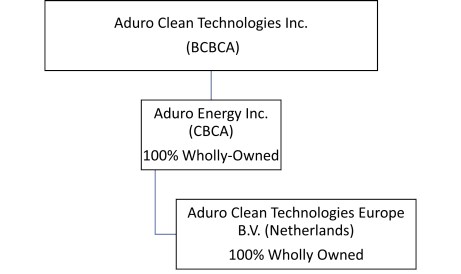
2. GENERAL DEVELOPMENT OF THE BUSINESS
Aduro is an early-stage, Ontario-based clean technology company that has developed a highly flexible chemical recycling platform featuring three water-based technologies: Hydrochemolytic™ Plastics Upcycling, Hydrochemolytic™ Bitumen Upgrading, and Hydrochemolytic™ Renewables Upgrading. As at of today, the Company owns, through acquisition and development, ten patents, seven granted and three pending.
Aduro currently directs its HCT platform toward these three principal application areas. Aduro's technology transforms lower-value feedstocks into useful, higher- value chemical feedstocks and fuels. Although Aduro's technology can be implemented in stand-alone operations, management believes its greatest economic relevance and impact is achieved through integration into thermal operation infrastructure at existing plants. Accordingly, Aduro aims to create strategic partnerships to demonstrate and implement the technology through licensing arrangements.
Aduro has developed its technology platform to address different applications and market sectors. The Company is currently in the stage of scaling up its technology to a commercial process for its plastic and bitumen applications. Aduro's first significant scale-up step is the development of a semi commercial process which will be designed, built and tested on a pilot scale and subsequently scaled up further to demonstrate on a commercial scale. Aduro has incurred recurring losses since inception and its technology platform has not yet been tested in a commercial setting. Commercializing its technology platform presents several challenges, including that the technology may not perform as expected under real-world conditions, rapid advancements in chemical recycling technology may result in new, more efficient technologies emerging, potentially rendering parts of its technology platform as less efficient, and securing funding may be difficult given the substantial investment required to scale up the technology platform on a commercial scale. The Company does not have a definitive timeline for scaling up its technology to a commercial process for plastic and bitumen applications. In the meantime, Aduro is continuing to engage with prospective customers through technology evaluation projects to guide ongoing development.
Aduro faces a number of challenges since its technology is different from existing approaches in its industry. In particular, the Company's platform is a new and different concept from the existing approaches in its industry and its technology is not yet tested in a commercial setting. The Company also faces many of the common challenges in upscaling of chemical processes, including challenges related to mass and heat transfer, and equipment design. Some particular challenges include the handling of solid or semi-solid feedstock (plastic waste, bitumen), and the high degree of contamination (especially in waste plastic). In addition, the Company's industry has a significant amount of unsettled regulation and many different approaches and strategies.
To deal with these various challenges, Aduro has adopted an early stage approach to connecting with its prospective customers and potential partners on its path towards the commercial development of the Company's technology. The primary objective of these connections, which the Company describes as customer engagements, is to provide Aduro with guidance for the development of its technology and business. Apart from the invaluable guidance in its technological development, the Company regards the connections in its "Customer Engagement Program" as an endorsement of its efforts by reputable and established organizations.
While Aduro has been successful with these engagements for the evaluation of its technology so far, and it is currently in discussions with a number of prospective customers and potential partners for possible collaboration, the Company currently does not have any definitive partnership agreements in place.
2.1 Three Year History
Securities Exercises Since May 31, 2025
Since May 31, 2025, 47,004 shareholder warrants were exercised at an exercise price of $5.20, 146,444 options were exercised at an exercise price of $2.1125, 21,000 options were exercised at an exercise price of $2.34, 48,616 options were exercised at an exercise price of $3.25, 9,000 options were exercised at an exercise price of $3.5425, and 6,885 options were exercised at an exercise price of $6.50, for total proceeds of $837,561. Additionally, 50,119 Share Warrants from November 2024 were exercised on a cashless basis resulting in the issuance of 24,742 common shares and the cancelation of 25,377 warrants.
On July 3, 2025, the Company granted an aggregate of 743,500 stock options to purchase up to 734,500 Common Shares of the Company to certain directors, officers, employees and a consultant of the Company. The options are exercisable for a period of 5 years from the date of grant at a price of $13.50 per Common Share. The options will vest on a monthly basis over a period of two years from the date of grant. In addition, the Company granted 100,000 RSUs to a consultant of the Company. The RSUs will vest in three tranches, with the 35,000 RSUs vesting immediately upon the date of grant, 35,000 RSUs vesting on the date which is 6 months following the date of grant, and 30,000 RSUs vesting on the date which is 12 months following the date of grant. All 743,500 of the Options, 100,000 of the RSUs, and the common shares underlying such Options and RSUs are subject to a hold period of four months and one day from the date of issuance.
On June 26, 2025, the Company announced the appointment of David Weizenbach, P.Eng., as Chief Operating Officer, effective July 1st 2025. With over 30 years of experience in engineering leadership, operations, and industrial technology integration, including 25 years at NOVA Chemicals, For the past six months, Mr. Weizenbach has been working closely with the Company in a consulting capacity, supporting operational planning and scale-up strategy.
On June 20, 2025, the Company announced the underwriters of its public offering which closed on June 11, 2025 fully exercised their over-allotment option to purchase an additional 142,180 Common Shares and 71,090, Warrants for total gross proceeds of approximately US$1.2 million. The Common Shares issued pursuant to the over-allotment option were sold in combination with an accompanying half Warrant (with each whole Warrant being exercisable into one common share of the Company). Each whole Warrant has an exercise price of US$10.13 per share and are exercisable immediately and will expire three years from the date of issuance.
On June 11, 2025, the Company announced it closed a public offering of 947,868 Common Shares and 473,934 Warrants at a public offering price of US$8.44 per each Common Share and accompanying half Warrant. The Company received aggregate gross proceeds of approximately US$8.00 million from the public offering, before deducting underwriting discounts and other related expenses. In addition, the Company has granted the underwriters a 45-day option to purchase up to an additional 142,180 Common Shares and/or an additional 71,090 Warrants, representing 15% of the Common Shares sold in the public offering, at the public offering price less underwriting discounts.
Financial Year Ended May 31, 2025
On May 21, 2025, the Company announced that that it has engaged Delphi, a leading Canadian sustainability consultancy, to conduct a life cycle assessment of the Company's Hydrochemolytic™ technology for waste plastic processing. The life cycle assessment is part of Aduro's strategic roadmap to independently assess and quantify the environmental performance of its chemical recycling platform through a phased, data-driven process. With increasing regulatory and market emphasis on measurable environmental outcomes, the life cycle assessment provides a foundation for engaging stakeholders with credible, third party-reviewed information. Additionally, the life cycle assessment will provide critical data to assist in identifying and minimizing inefficiencies and energy consumption throughout the process, assisting in maximizing resource efficiency and reducing operational costs.
On May 13, 2025, the Company announced an agreement with Generation IACP Inc. to provide market making services aimed at improving the liquidity of Aduro's common shares. The agreement, effective May 12, 2025, includes an initial six-month term with automatic renewals. Generation will receive a monthly fee starting at US$8,000, increasing to US$9,000 in the first renewal term, and subsequently increasing by 3% annually. Generation, which is arm's length to Aduro, will trade shares to correct temporary imbalances in supply and demand without receiving stock options or other compensation.
On May 8, 2025, the Company announced the signing of a memorandum of understanding with Cleanfarms Inc. This memorandum outlines a multi-phase collaboration to evaluate the technical and economic feasibility of using Aduro's Hydrochemolytic™ Technology as a potential commercial-scale solution for the chemical recycling of on-farm plastic waste. Cleanfarms, a Canadian Producer Responsibility Organization focused on agricultural waste management, will leverage its expertise to support the evaluation of HCT on real-world farm plastic materials. The collaboration will progress through three stage-gated phases. Phases A and B are binding, while Phase C is non-binding and contingent on the successful outcomes of the earlier phases. In Phase A, Aduro will conduct laboratory-scale testing on representative agricultural plastic waste samples provided by Cleanfarms, including mixed silage film, bale wrap, grain bags, bale netting, and polypropylene twine in their collected, unprocessed form. Aduro will assess sorting and pre-treatment requirements and conduct batch Hydrochemolytic™ processing trials to determine contaminant tolerance, conversion efficiency, and product composition. In Phase B, Cleanfarms will supply larger volumes of field-grade agricultural plastics for processing in Aduro's Next Generation Pilot plant. Aduro will evaluate system performance under continuous flow, investigate preprocessing needs, and assess operational stability. This phase will also include the development of a preliminary techno-economic and eco-efficiency model. Finally, in Phase C, contingent on the successful completion of Phases A and B, agricultural plastics may be evaluated as a potential feedstock for inclusion in Aduro's planned demonstration plant. This phase would support validation of continuous operation with agricultural plastics and further refine the techno-economic model.
On May 1, 2025, the Company announced a strategic collaboration with Siemens Canada to supply advanced control systems and engineering services for Aduro's Next Generation Process Pilot Plant. This collaboration focuses on integrating Siemens' SIMATIC PCS neo distributed control system into the Pilot Plant, scheduled for commissioning in Q3 2025. Siemens will provide instrumentation, operator interfaces, and engineering services to support the plant's commissioning and performance optimization. Siemens is providing the automation and controls scope in alignment with Zeton Inc., the builder of the Pilot Plant, to ensure seamless system integration and efficient commissioning. Additionally, Siemens will contribute technical input as Aduro begins preparing for the design of a demonstration plant.
On March 13, 2025, the Company announced the signing of a memorandum of understanding with NexGen Polymers. This memorandum of understanding details a framework for a proposed collaboration to develop a demonstration-scale HCT plant including securing feedstock supply, potential site selection, and plant operations to optimise data generation for the future development of configurable commercial solutions. NexGen is a leading supplier and broker of virgin and recycled polymers, with over 30 years of experience in polymer supply chain management, infrastructure and logistics. This partnership will leverage NexGen's expertise to support key operational requirements for Aduro's planned demonstration facility. This partnership will leverage NexGen's expertise to support key operational requirements for Aduro's planned demonstration facility. The memorandum of understanding includes three stage-gated phases. Phase one is binding between Aduro and NexGen and outlines activities where the parties will collaborate on critical feasibility factors that lay the groundwork for the next demonstration plant, including (i) feedstock brokerage services to develop a robust supply chain; (ii) site selection, evaluation and preparation; (iii) site permitting, zoning and building approvals; (iv) and preliminary engineering and business model development. Phases two and three of the memorandum of understanding are non-binding and outline a framework for the execution of a potential joint venture agreement as well as a proposed collaboration on the commissioning and operations of a demonstration plant.
On February 27, 2025, the Company announced the appointment of Neha Nisar as Vice President of Finance. She brings over two decades of experience in financial leadership, risk management and strategic planning across diverse industries. Neha is a Chartered Accountant who has held key leadership roles at Marriott International, Canada Goose, and MEDNOW.
On January 30, 2025, the Company announced that it filed a patent application in the United States for a novel process design for effective implementation of its HCT. The design will be integrated into the NGP Pilot Plant, which remains on schedule for completion in the third quarter of 2025. This new patent application strengthens Aduro's position in advancing HCT chemistry and its practical implementation, allowing the Company to continue advancing its commercial path by building on its expanded intellectual property assets. The application also marks the achievement of a key milestone the Company set as part of its main objectives for the current year.
On January 23, 2025, the Company announced its successful completion of the basic engineering design phase for its HCT Pilot Plant, marking a significant milestone in the commercialization of its platform technology. This milestone marks a pivotal step in Aduro's journey to commercialize its HCT platform technology. With the Pilot Plant on track for completion in the third quarter of this year, the completion of the basic engineering design represents the culmination of many years of extensive research and development. Aduro has partnered with Zeton, a global leader in modular pilot and demonstration-scale plant design. Together, the two organizations are working diligently to advance the project toward installation and commissioning.
On January 23, 2025 the Company hosted a virtual fireside chat for shareholders.
On January 17, 2025, the Company rang the closing bell at the Nasdaq MarketSite in Times Square, New York.
On January 14, 2025, the Company appointed Dr. Arturo Gomez as Vice President of Engineering. The Company also entered into a marketing and consulting agreement with OTBC to build awareness as the Company continues to work on delivering key milestones and to provide marketing consulting and investor relations services, including marketing through OTBC's social media channels and online media distribution. Specifically, OTBC will employ various social media platforms, including Reddit, Discord, Telegram, X, StockTwits, YouTube, and Facebook to bring investor awareness to the Company. Under the OTBC Agreement, for an initial term of twelve months starting on January 15th, 2025 (the "Effective Date"), Aduro will pay OTBC an aggregate cash compensation of C$360,000 plus applicable taxes, with C$180,000 due within 7 days of the Effective Date, C$126,000 due within 3 months after the Effective Date and the remaining C$54,000 due within 6 months after the Effective Date. Additionally, Aduro has agreed to grant to OTBC 40,000 stock options of the Company. These options will be fully vested on the date of grant and exercisable for a one-year term at a price equal to the higher of: (i) the closing market price on the CSE on the trading day prior to the date of grant; (ii) the closing market price on the CSE on the date of grant; or (iii) C$9.00.
On December 11, 2024, the underwriters of its US Offering partially exercised their over-allotment option to purchase an additional 22,470 Common Shares at the public offering price of US$4.25 per Common Share. After giving effect to the partial exercise of the over-allotment option, the Company sold an aggregate 1,063,647 Common Shares for gross proceeds of approximately US$4.52 million, before deducting underwriter discounts and other related expenses.
On December 3, 2024, the underwriters of its US Offering partially exercised their over-allotment option to purchase an additional 100,000 Common Shares at the public offering price of US$4.25 per Common Share. After giving effect to the partial exercise of the over-allotment option, the Company sold an aggregate 1,041,177 Common Shares to the underwriters for gross proceeds of approximately US$4.43 million, before deducting underwriter discounts and other related expenses.
On November 22, 2024, the Company held its 2023/2024 annual general meeting at which all matters placed before the shareholders were approved.
On November 21, 2024, the Company participated in the Advanced Recycling Conference 2024 in Cologne, Germany at which Eric Appelman presented "An Effective Alternative to Pyrolysis in Chemical Recycling," highlighting the advantages of Hydrochemolytic™ Technology in handling mixed plastic waste with lower energy consumption and higher-value product yields.
On November 19, 2024, the Company announced it engaged Zeton, a globally recognized leader in the design and fabrication of pilot plants, demonstration plants, and small-scale commercial units. With over 800 projects delivered across 45+ countries, Zeton brings unmatched expertise and scale to the industry. Leveraging over three decades of experience, Zeton specializes in bridging the gap between laboratory innovation and commercial production. Its proven track record, global reach, and precision engineering capabilities position it as a trusted partner for Aduro. Together, Zeton and Aduro will design, build, and commission an HCT Pilot Plant, marking a key milestone in Aduro's commercialization pathway for transforming waste plastics into valuable chemicals. Previously referred to as the "Next Generation Process (NGP)" this 10 kg/hour HCT Pilot Plant represents Aduro's evolved focus on rightsized, modular, and scalable solutions. A key objective for 2024 has been the completion of the Pilot Plant design, which remains on schedule. Fabrication, delivery, installation, and commissioning are targeted for the third quarter of 2025. Concurrently, site preparation, staff training, and materials sourcing are progressing to ensure alignment with the project timeline.
On November 12, 2024, the Company announced it entered into a memorandum of understanding (MOU) with GF Building Flow Solutions Americas, a leader in sustainable building solutions and global provider of Uponor-branded products. This MOU marks an important step as the two companies explore a structured pathway to a formal collaboration agreement aimed at enhancing GF's ongoing efforts to convert Uponor crosslinked polyethylene (PEX) production waste into valuable raw materials. GF is one of the leading international producers of pipes used to move water for buildings and infrastructure, including pipes made of cross-linked polyethylene (PEX). PEX pipes are commonly used in energy efficient heating and safe plumbing due to their robustness, temperature resistance and longevity. The engagement between Aduro and GF seeks to demonstrate that chemical recycling through Aduro's proprietary HCT can convert Uponor brand PEX waste into high-quality feedstock, enabling the consecutive manufacturing of products with the same high-quality and properties as in their previous life.
On November 8, 2024, the Company announced it closed its US Offering of 941,177 Common Shares at a public offering price of US$4.25 per Common Share. The Company received aggregate gross proceeds of approximately US$4.00 million from the US Offering, before deducting underwriting discounts and other related expenses. In addition, the Company has granted the underwriters a 45-day option to purchase up to an additional 141,176 Common Shares, representing 15% of the Common Shares sold in the US Offering, at the public offering price less underwriting discounts.
On November 7, 2024, the Common Shares were listed on the Nasdaq under the symbol "ADUR" and were delisted from the OTC Market Group Inc.'s OTCQB Venture Market.
On November 6 to 10, 2024, Aduro joined the Canadian Trade Commissioner Service at the Canadian CleanTech Roadshow in Mexico, showcasing its Hydrochemolytic™ Technology to potential collaborators and investors in the region. This event highlighted Aduro's commitment to exploring new markets and building international partnerships.
On October 29, 2024, the Company filed registration statement on Form F-1 relating to the US Offering with the SEC as amended, and was declared effective by the SEC on October 29, 2024.
On October 3 and 4, 2024, the Company participated in the International Refining & Petroleum Conference 2024 (IRPC) in Houston, TX, highlighting advancements and fostering potential partnerships to support ongoing innovation and commercialization efforts. The Company's Chief Revenue Officer, Eric Appelman, presented Hydrochemolytic™ Technology as a cost-effective alternative to pyrolysis and shared insights on a patent-pending process to produce BTX chemicals from waste plastics and renewable oils.
On September 4, 2024, the Company announced it submitted a patent for a cost-effective and efficient process to produce BTX chemicals (benzene, toluene, and xylenes) from waste plastics and renewable oils, strengthening Aduro's IP and addressing high-demand markets. BTX compounds are essential building blocks for a wide array of high-value chemicals and materials, including plastics, paints, sealants, coatings, and pharmaceuticals. Aromatic chemicals like BTX are key building blocks, accounting for 40% of petrochemical production by volume. The new patent application marks significant progress towards a key objective set out by Aduro at the beginning of 2024, the expansion of the Company's technology and intellectual property position.
On August 31, 2024, Gene Cammack retired from his position as the COO of the Company.
On August 20, 2024, the Company consolidated its Pre-Split Common Shares on the basis of three and one quarter (3.25) pre-consolidation Common Shares for one (1) post-consolidation Common Share.
On August 14, 2024, 13,333,328 Pre-Split Class B Special Warrants were converted into Common Shares upon achievement of the Second Milestone for no additional consideration on a one-for-one basis.
On August 7, 2024, the Company granted an aggregate of 826,169 Pre-Split stock options to purchase up to 826,169 Common Shares of the Company to certain directors, officers, employees and a consultant of the Company. The options are exercisable for a period of 5 years from the date of grant at a price of $6.50 per Common Share. The options will vest on a monthly basis over a period of two years from the date of grant.
On July 30, 2024, the Company announced a new collaboration with TotalEnergies. This collaboration follows previously announced technical evaluations and underscores the growing interest in Hydrochemolytic™ technology being developed by Aduro. After positive preliminary technical evaluations by TotalEnergies, the Company is now entering a R&D collaboration phase. This phase will focus on a more diverse range of waste plastic materials, particularly those with higher concentrations of polyolefins, polyurethane, metals, and other challenging contaminants. The project aims to establish process parameters to manage these variable and hard-to-recycle feedstocks, optimize the process design and operating conditions, and lay the groundwork for a commercial process. Aduro's innovation is centered on deconstructing these materials into high value feedstocks suitable for the chemical industry. TotalEnergies will provide a confidential and non-material level of financial support to R&D activities and technology development, which will be spread over six phases based on the achievement of certain milestones. TotalEnergies also provides in-kind support to the Company, including access to technical resources and expertise in refining and petrochemical platforms. This collaboration aims to generate valuable data that will accelerate Aduro's technology development and scale-up. This includes establishing process parameters to manage diverse waste plastic materials, particularly those with higher concentrations of polyolefins, polyurethane, metals, and other challenging contaminants. The collaboration aims to develop a practical and scalable commercial process for converting plastic waste into valuable feedstocks, aligning with TotalEnergies' objective of producing 30% circular polymers by 2030.
On July 16, 2024, the Company provided updates on its NGP for waste plastics. Following the successful completion of a series of tests and work done over the last 6 months, the Company is now conducting semi-industrial scale experiments to finalize reactor configurations. These experiments are crucial for determining the necessary configurations for the NGP. Aduro aims to begin constructing the NGP by the end of 2024. Initial engagements with design, engineering, and fabrication firms have begun. For 2024, Aduro has outlined three strategic initiatives: advancing the NGP design, converting participants in the CEP into the next phase of collaborations, and expanding its intellectual property portfolio further unlocking the value and addressable market for the HCT platform. All three strategic initiatives are integrated and collectively support the Company's path towards commercialization. Since early 2024, Aduro has conducted extensive testing and optimization on both its pilot-scale Hydrochemolytic™ continuous flow reactor for plastics and its laboratory batch reactors. Working in parallel to in-house programs, the Company has carried out ongoing research with external resources like the Western University and CHILL in Geleen, Netherlands. In addition to supporting all three of the outlined strategic initiatives for 2024, this work focused on key project areas, including: process conditions, usage of different feedstocks, specifications of products, and pre- and post-treatment processes. Significant progress has been made in the following areas:
• Confirming the unique ability of HCT to produce substantially saturated hydrocarbons without the requirement for costly hydrogenation.
• Maximising yield and achieving lower losses to char and fuel gas.
• Ability to work with common undesirable polymers in the feedstock like polyester and polyamide.
• Confirming the effectiveness of HCT in processing difficult-to-recycle crosslinked polymers.
• Operating continuously for extended periods in a stable operating condition.
Additionally, the Company embarked on a process design strategy that pursues three parallel directions with different time horizons: the first working with relatively clean waste streams and relatively pure outputs, to be realized in a relatively simple process, the second working with more complex but still clean feedstocks, and the third where low-value contaminated feedstocks are converted. This provides a framework designed to generate valuable commercial solutions progressively and maximises speed to market.
On July 9, 2024, the Company announced it entered into an investor relations and digital services agreement (the "KCSA Agreement") with an arm's length marketing firm, KCSA of New York City, New York. KCSA provides investor relations and digital services, including building and managing Aduro's brand through their AmplifIR digital IR platform (the "Services"), for an initial term of six months beginning July 15, 2024 (the "Initial Term"), which Services shall continue thereafter unless either the Company or KCSA provides written termination notice not less than 30 days prior to the end of the Initial Term, and thereafter upon at least 30 days' written notice by either the Company or KCSA. In consideration for the Services, Aduro will pay KCSA a monthly fee of US$10,000 for investor relations services, a one-time project fee of US$12,500 upon execution of the KCSA Agreement, and US$106,400 for digital marketing services paid in two installments of US$53,200 over 2 months.
On June 17, 2024, the Company completed a non-brokered private placement pursuant to which it has issued an aggregate of 2,711,077 Pre-Split units, at a Pre-Split price of $1.30 per unit for gross proceeds of $3,524,400. Each unit was comprised of one Pre-Split Common Share and one‐half of one Pre-Split Common Share purchase warrant. Each full warrant entitles the holder to acquire one Common Share at a Pre-Split exercise price of $1.60 per Common Share for a period of two years from the date the units are issued. If during the exercise period of the Warrants, but after the resale restrictions on the shares have expired, the Common Shares trade at or above a closing Pre-Split price of $1.90 per Common Share on the CSE (or such other exchange on which the common shares may be traded at such time) for a period of ten (10) consecutive trading days, the Company may accelerate the expiry time of the Warrants by giving written notice to warrant holders by dissemination of a news release that the Warrants will expire on the 30th day from the date of providing such notice. The Company paid cash finder's fee of $144,054 and issued 74,059 Pre-Split finder's Warrants to certain finders in connection with the offering. Each finder's Warrant is exercisable into one share at a Pre-Split price of $1.60 per Common Share for a period of two years after the closing date.
Financial Year Ended May 31, 2024
On April 15, 2024, the Company appointed Marcus Trygstad to the role of Principal Scientist. He previously held the role of Chief Technology Officer from April 23, 2021 to April 14, 2024.
On March 27, 2024, the Company announced the onboarding of a leading, multinational building materials company ("MBM Company") to its CEP. MBM Company has extensive manufacturing operations across over 20 countries and a global distribution reach. MBM Company is recognized for its vast range of building materials and is dedicated to promoting sustainability through material circularity, emphasizing the recycling and reuse of materials across its product lines. Their extensive product line includes solutions for infrastructure, energy systems, municipal sewer, ventilation, and water treatment. The engagement will begin with a technical evaluation project focused on assessing the potential of HCT for recycling crosslinked polymers, a key material in the client's product range. The test samples will be sourced from waste streams at the client's production facilities.
On March 5, 2024, the Company announced the onboarding of a leading, global multinational food packaging company ("MFP Company") to its CEP. MFP Company operates in over 15 countries and is a prominent player in the global food processing and distribution sector, boasting a portfolio of well‐known brands. At the core of its operations, MFP Company integrates environmental, social, and governance (ESG) principles, focusing on innovation and efficiency. The MFP Company is dedicated to recycling or recovering 90% of its solid waste and aims to reduce plastic use, increase the use of biodegradable and recycled materials, and minimize the use of virgin plastic. The technical evaluation project is focused on assessing the potential of HCT for recycling the MFP Company's plastic waste from food packaging. Through this project, the Company is conducting direct tests of HCT on the specific types of plastic waste produced by MFP Company with the objective of showcasing the technology's effectiveness and gaining a deeper understanding of the unique waste management challenges faced by the food industry. The goal is to highlight the advantages of HCT to MFP Company and develop a customized chemical recycling solution tailored to the specific needs for recycling food packaging plastic waste, positioning HCT as a viable solution for advanced recycling in the food industry.
On January 26, 2024, Ofer Vicus was appointed to the role of Executive Chairman of the Company.
On November 30, 2023, the Company announced the expansion of the phase one testing scope with the CEP participant announced previously on October 11, 2023. The additional testing included a more diverse range of waste plastic materials, specifically targeting those with higher concentrations of PET, polyurethane, metals, and other challenging contaminants. This testing expansion indicated the participant's interest in assessing the broader capabilities of the Company's technology. The expanded scope provides important data that will support its development and scale-up program as well as increase the respective project funding committed for phase one testing.
On November 7, 2023, the Company appointed Marie Grönborg to the Board. Also on November 7, 2023, Chris Parr resigned from the Board.
On October 11, 2023, the Company announced the addition of two new participants to its CEP. The confidential participants are large global petrochemical leaders with significant influence in the chemicals and plastics sector that extends into the global energy market. As part of the paid engagement, the participants will contribute funding to support the work being conducted by Aduro while also providing the opportunity for Aduro to perform analysis and experimentation using diverse waste polymers sourced from different locations and businesses across the world, each with varying compositions and contaminant levels.
On September 5, 2023, the Company announced that it had passed the project midpoint as part of the Shell GameChanger program and is underway with the tasks outlined for phase four. The tasks outlined for the first three phases involved evaluating the performance of HCT using pure and mixed plastic feeds, measuring the impact of HCT when contaminants are present, and understanding and optimizing the key additives in the process for effectiveness and economics. All three phases achieved results that aligned with mutually agreed performance targets. During phase four, Aduro will be demonstrating the efficiency of HCT process in a continuous flow set-up, focusing on operability and product quality. Additionally, Aduro will be examining how the process transitions from batch to a continuous system and evaluating the 'tunability' to maximize naphtha cracker feed yield.
On September 1, 2023, the Company appointed Eric Appelman to the position of Chief Revenue Officer.
The Company's participation in the Shell GameChanger Program was for technology evaluation only, with no commercial or ongoing commitments by Shell plc or the Shell GameChanger Program to the Company. The non-dilutive funding the Company received from the Shell GameChanger Program was minimal relative to its capitalization and was short term, and not regular or recurring, in nature. The Company's participation in the Shell GameChanger Program is nearing the final stages and any future relationship with Shell plc and/or the Shell GameChanger Program will depend solely on future agreements, if any. As of the date hereof, the Company has no such agreements for any further relationship or definitive partnership agreement with Shell plc or the Shell GameChanger Program.
On June 15, 2023, the Company announced the establishment of its European subsidiary, Aduro Clean Technologies Europe BV, based in Geleen, Netherlands. The Company's European subsidiary serves as the European hub and a conduit for achieving strategic goals in the region. The Netherlands was selected due to the Company's robust regional relationships, including its partnerships with Brightlands and CHILL. Aduro Clean Technologies Europe is focused on advancing the Hydrochemolytic™ process for plastics upcycling within the European market with the primary goal of constructing a future demonstration unit at the Brightlands site, showcasing the Company's patented HCT platform for tackling hard-to-recycle mixed plastics, mainly those rejected from other processes such as mechanical recycling.
Financial Year Ended May 31, 2023
On March 2, 2023, the Company announced a partnership with CHILL to execute an experimentation program at Brightlands in Geleen, Limburg, the Netherlands, with the aim to optimize its next generation chemical recycling platform and to accelerate its path to commercialization. The Company agreed to provide financial support to CHILL and in return, the Company received access to skilled researchers, specialized equipment for testing and analysis of data, and additional services including access to CHILL partner events and public relations campaigns.
Under their "Community for Development" program, CHILL executes focused experiments around the Hydrochemolytic™ process for plastics upcycling. The engagement provides an opportunity for the Company to work on several defined-scope projects that accelerate the scale-up of its Hydrochemolytic™ Technology . These projects complement the Company's scale-up and research activities currently being completed, including the commissioning and operations of the pilot-scale R2 Plastic reactor and the work being conducted at Western on different contaminants in plastic feedstocks. All intellectual property generated from the projects conducted at CHILL is owned by Aduro Energy. This project with CHILL was completed in December 2024 and the data generated by the project was combined with other Aduro research programs to support its strategic goals.
On February 2, 2023, the Company provided a progress update on its joint research project "Tuning Supercritical Fluids for Polymer Recycling to Monomers and Chemicals". The three-year research project, led by Dr. Paul A. Charpentier and Dr. Cedric L. Briens of Western University, began in January 2023. As at February 2, 2023, the principal investigators have recruited a team of 6 research members who started working on the first-year project deliverables. In year one of the project, the research team will conduct a thorough review of the literature on intrinsic and extrinsic contaminants in different plastics and composites. They will also design, build, and commission a view cell reactor system to study different types of plastics. Additionally, experiments will be performed in a batch reactor system to optimize the understanding of the behaviour of additives and fillers, as well as the study of the solubility of chain and step-growth plastics in different solvents. The ultimate objective is to determine the interactions and product quality of mixed plastics for upcycling.
On December 29, 2022, the Company granted an aggregate of 2,075,000 Pre-Split stock options to purchase up to 2,075,000 Pre-Split Common Shares to certain directors, officers, employees and consultants of the Company. The options are exercisable for a period of 5 years from the date of grant at a price of $1.00 per Pre-Split Common Share. A total of 1,775,000 Pre-Split options vest on a monthly basis over a period of two years from the date of grant and 300,000 Pre-Split options vested immediately. The Company also awarded 150,000 Pre-Split RSUs of the Company to an officer of the Company pursuant to the Company's Plan which was approved by the shareholders at the Company's annual general meeting held on February 23, 2023. Each RSU represents the right to receive, once vested, one Common Share in the capital of the Company. All of the RSUs vested immediately upon the date of award.
On December 15, 2022, the Company announced that since September 1, 2022, it had received total proceeds of $1,109,103 from the exercise of 1,638,390 Pre-Split Warrants at a Pre-Split exercise price of $0.50, 118,635 Pre-Split Warrants at a Pre-Split exercise price of $0.80, and 300,000 Pre-Split stock options at a Pre-Split exercise price of $0.65. Accordingly, the Company issued 2,057,025 Pre-Split Common Shares upon exercise of the Warrants and stock options. The Pre-Split $0.50 Warrants were issued pursuant to a private placement that closed on February 4, 2021 and had an expiry date of February 4, 2025. The Pre-Split $0.80 warrants were issued pursuant to a private placement that closed on May 14, 2021 and had an expiry date of May 14, 2023.
On December 1, 2022, the Company announced it had completed construction and mechanical assembly of its pilot-scale R2 Plastic reactor. Plans for testing and certifications are in place and final certification by the Technical Standard and Safety Authority is progressing with registration expected later this month. Once certified, the reactor unit will be moved to the newly expanded laboratory in London, Ontario for final testing and commissioning. The R2 Plastic unit is the Company's customer engagement unit and is designed to handle various plastic feedstocks such as polyethylene, polypropylene, and polystyrene as single-stream materials, followed by a mixture of these feedstock streams. The R2 Plastic will also be used to evaluate the impact of materials found in multilayer plastics, such as paper, paper board, polymeric materials, metalized layers, and aluminum foil, effectively advancing Aduro's plans of processing higher contaminated materials which are currently rejected by existing technologies. This is important data that will support the Company's established scale-up and optimization program for the scaled-up pilot: R3 Plastic.
During 2022, the Company undertook several projects including the construction of both the plastic upcycling and bitumen upgrading reactor units, the construction of a flash drum unit for pre-processing bitumen feedstock, and the expansion of laboratory facilities and laboratory capabilities that will centralize the Company's resources for more efficient execution of the Company's R&D, scale-up and commercialization plans. Completion of these projects positions the Company to execute in 2023 the R2 Plastic reactor research and testing optimization program, the implementation of the customer engagement program and the delivery of reactor unit design, equipment procurement, fabrication, and commissioning of the scaled-up pre-commercial R3 Reactor unit.
On November 3, 2022, the Company announced the successful selection and acceptance into the Shell GameChanger program. Shell GameChanger is an accelerator program designed to partner with businesses to deliver innovative solutions that have the potential to drastically impact the future of energy and the transition to net-zero emissions. Following a rigorous selection process, Aduro has been selected by the Shell GameChanger program to apply its novel HCT to produce sustainable naphtha cracker feedstock from polyethylene, and polypropylene, individually or on a mixed basis, and to also convert polystyrene into useful platform chemicals. HCT deconstructs hard-to-recycle chain growth polymers at temperatures lower than those used in current technologies. While legacy technologies produce complex product mixtures that require excess investment of resources for further processing and purification, HCT is expected to create higher-value, saturated products from polyethylene and polypropylene, in high yield and purity using lower energy, and to be more tolerant to feedstock contaminants. The HCT final output may be then directly used for the production of new plastics in support of full circularity. To support the project, Shell will contribute non-dilutive funding with the contribution payments being spread over six project phases, each phase and associated payment being contingent on meeting the objectives set for the previous phase. In addition, the Company anticipates that Shell will provide technical expertise to help Aduro develop reliable process designs and optimize the HCT for commercial implementation. Shell GameChanger will also mentor Aduro in developing its commercial strategy and market position. Aduro's project with Shell GameChanger is a 12 month, 6 phase project, starting from small scale batch reactors, moving through a continuous flow reactor and into design basis of commercial style facilities. The project is devised to support the rapid movement of the process to commercialization while reducing the developmental risk for the technology.
During the month of October 2022, 300,000 Pre-Split options were exercised at a Pre-Split exercise price of $0.65 and 662,649 Pre-Split Warrants were exercised at a Pre-Split exercise price of $0.50 for total proceeds of $526,325. During the month of September 2022, 75,000 Pre-Split options were cancelled.
On October 27, 2022, a joint research project by the Company, in partnership with Western University, entitled "Tuning Supercritical Fluids for Polymer Recycling to Monomers and Chemicals," was approved and awarded $1.15 million in non-repayable funds by the NSERC and Mitacs. Over the duration of the project, Aduro will contribute $382,500 (plus applicable taxes) with NSERC and Mitacs contributing a total of $1,147,500. The research project commenced in November 2022 and will continue for a period of three years.
On July 19, 2022, the Company closed a non-brokered private placement offering of units. The Company issued 2,599,579 Pre-Split units at a price of $0.72 per Pre-Split July 2022 Unit for aggregate gross proceeds of $1,871,697. Each July 2022 Unit is comprised of one Common Share and one-half of one Common Share purchase warrant. Each July 2022 Warrant entitles the holder to acquire one Common Share at a price of $1.00 Pre-Split per share, for a period of two years from the date the July 2022 Units are issued. If during the exercise period of the Warrants, but after the resale restrictions on the shares have expired, the Common Shares trade at or above a closing price of $1.25 Pre-Split per share for ten (10) consecutive trading days, the Company may accelerate the expiry time of the July 2022 Warrants by giving written notice to the holders of the July 2022 Warrants by dissemination of a news release that the July 2022 Warrants will expire 30 days from the date of providing such notice. No finders' fees were paid in connection with the closing.
On June 29, 2022, the Company announced the expansion of its laboratory facilities to accelerate its research and scale-up capabilities and to increase its capacity to host potential customer trials and demonstrations. The expanded lab is in the Newbold Business Park in London, Ontario. The multi-tenant complex is zoned light industrial. The 4,371 ft2 facility will accommodate renovated offices, modern laboratory space, new additional analytical equipment, and will host the bench scale R2 Plastics reactor.
On June 29, 2022, the Company entered into an investor relations agreement with Investment Publishing to provide investor relations services. The IP Agreement provides for a fee of $8,000 per month. The IP Agreement will continue on a monthly basis for twelve months and either party may terminate the IP Agreement by providing 30 days written notice. On June 20, 2022, Pre-Split 150,000 stock options were granted to the principal of Investment Publishing in his capacity as a consultant of the Company.
On June 20, 2022, the Company granted 550,000 Pre-Split Options to purchase up to 550,000 Common Shares in the capital of the Company to an officer of the Company and a consultant in accordance with the Option Plan. Of the 550,000 Pre-Split Options, 400,000 Pre-Split Options were granted to the officer of the Company and are exercisable for a period of 10 years and 150,000 Pre-Split Options were granted to the consultant and are exercisable for a period of 2 years, unless terminated pursuant to the terms of the Option Plan. The Options are exercisable at a Pre-Split exercise price of $0.70 per Common Share. The Options granted to the officer vest monthly over 24 months. The Options granted to the consultant vest monthly over 12 months.
2.2 Significant Acquisitions
The Company did not complete any significant acquisitions during the year ended May 31, 2025.
3. DESCRIPTION OF BUSINESS
3.1 General Summary
Business Overview
Prior to the Transaction
Since inception until June 30, 2020, the Company's initial business was as a technology company focused on developing, marketing, and acquiring software in the investment and securities trading industries. In July 2018, while pursuing its previous business, the Company purchased a software application, including source code, website and other intellectual property rights, from Zimtu in exchange for the issuance of 3,333,333 Common Shares valued at $0.09 per Common Share for a total value of $300,000. The application was developed to provide investors an advantage when following the stock market, including receiving stock alerts and special notifications for public companies. The Company also entered into a previous licensing agreement in respect of its former software application and an application development agreement to further develop and market its software. These agreements were subsequently all cancelled by June 2020 as the Company looked to pursue more viable opportunities.
The Company also pursued several other business opportunities between September 2019 until June 2020, including entering a share exchange agreement dated December 11, 2019 with Digital Cavalier Technology Services Inc., an artificial intelligence software developer. For various reasons, including due diligence matters and economic conditions, the Company did not proceed with this transaction and the agreement was terminated.
Acquisition of Aduro Energy
On July 13, 2020, the Company entered into a Letter of Intent with Aduro Energy pursuant to which it agreed to acquire all of the issued and outstanding shares of Aduro Energy. Pursuant to the Letter of Intent, the agreed to advance the Bridge Loan to Aduro Energy in the principal amount of $500,000 payable through a series of promissory notes.
On August 7, 2020, the Company advanced $50,000 to Aduro Energy under the First Promissory Note and also entered into the General Security Agreement with Aduro Energy which secured the Bridge Loan against the current and after acquired property of Aduro Energy, including Aduro Energy Intellectual Property. Subsequently, Aduro advanced an additional aggregate amount of $450,000 under the Bridge Loan pursuant to the six additional promissory notes.
On October 22, 2020, the Company entered into a definitive Securities Exchange Agreement in respect of the acquisition of all the issued and outstanding shares in the capital of Aduro Energy from the shareholders of Aduro Energy by way of a share exchange. Upon completion of the Transaction, Aduro Energy became a wholly-owned subsidiary of the Company. For accounting purposes, the Transaction represented a reverse takeover of the Company by Aduro Energy.
Pursuant to the Securities Exchange Agreement, at closing, the Company agreed to issue 13,333,328 Pre-Split Common Shares, pro rata, to the shareholders of Aduro Energy at a deemed price of $0.15 per Pre-Split Common Share, and issued 26,666,656 Pre-Split Special Warrants which were divided equally between the Class A Special Warrants and Class B Special Warrants, at a deemed Pre-Split price equal to the greater of: (i) 0.65 times the volume weighted average trading price of the Common Shares for the five trading days prior to the achievement date of the First Milestone (as defined herein), and (ii) $0.15. The Special Warrants were held in trust by Ofer Vicus, as Special Warrant Trustee, until distributed to Aduro Energy Noteholders and Aduro Energy shareholders upon the Company's achievement of the Milestones in the development of its business, as set forth below.
The First Milestone, which was to be achieved within 2 years of the Closing of the Transactions contemplated by the Securities Exchange Agreement, required the Company to operate a Show Room Unit to successfully demonstrate the obtaining of product, meaning one or more taken from the group consisting of, lighter petroleum oil obtained by upgrading heavier petroleum feedstocks or its components, or deoxygenated hydrocarbons obtained from upgrading renewable oil feedstocks, or liquid hydrocarbons obtained by upgrading of certain plastic or rubber feedstocks, by application of Aduro Energy's technology. The operation of the Show Room Unit to obtain Product by application of Aduro Energy's technology needed to be independently validated by Dr. Paul Charpentier, a professor in the Department of Chemical and Biochemical Engineering at Western University, or such other independent third party agreed upon by the Company and Aduro Energy.
The Second Milestone requires achievement of any one or more of the following additional business objectives within 4 years of Closing (on a pre-Consolidation basis):
1. A completed financial transaction with an institution which clearly has the capacity to finance Aduro Energy's majority owned commercial operation of a manufacturing plant producing Product for commercial sale; 2. Product produced by a manufacturing plant owned in part by Aduro Energy where Aduro Energy's portion of the plant's equity is at least $2,000,000 greater than Aduro Energy's investment;
3. A third party entering into a license agreement with Aduro Energy in respect of the technology which Aduro Energy and such third-party estimate will generate at least $5,000,000 in revenue for Aduro Energy over a three year period;
4. A third-party equity investment in the Company of at least $3,000,000 at a company pre-money valuation of $40,000,000 or more;
5. The total market capitalization of the Company remaining at or above $65,000,000 for 19 out of any 20 consecutive trading days;
6. The Company having completed a public offering or private placement raising at least $4,000,000 at a minimum price per Pre-Split Common Share of $1.05, or a combination of grants, $1.05 Pre-Split share offering and other financing transaction raising at least $4,000,000; or
7. A third party enters into an agreement to acquire all of the issued and outstanding Common Shares at a minimum value of $3.00 per Pre-Split share.
The actual number of Class A Special Warrants to be distributed by the Special Warrants Trustee to the Aduro Energy Noteholders was determined by application of a specified formula on the date that the First Milestone was achieved. The actual number of Class B Special Warrants to be distributed to each Aduro Energy shareholder was determined with reference only to the number of Common Shares issued to each Aduro Energy shareholder. Related parties were entitled to receive up to 22,069,376 Pre-Split Special Warrants of the total of 26,666,656 Special Warrants held in trust on achievement of the milestones.
On April 23, 2021, the Company completed the acquisition of Aduro Energy. In consideration for the Transaction, the Company issued, on a Pre-Split basis (a) an aggregate of 13,333,328 Common Shares, pro rata, to the Aduro Energy shareholders at a deemed price of $0.15 per Common Share; (b) 26,666,656 Special Warrants, which are divided equally between Class A Special Warrants and Class B Special Warrants, at a deemed price equal to the greater of (i) 0.65 times the volume weighted average trading price of the Common
Shares for the five trading days prior to the achievement date of the First Milestone, and (ii) $0.15 per Common Share; and, (c) 2,813,357 warrants which are exercisable on cashless basis at a price of $0.50 per Common Share on for a period of 48 months from the date of Closing, subject to an acceleration provision.
On April 23, 2021, concurrent with the Closing of the Transaction with Aduro Energy, the Company completed the Previous Consolidation.
Also on April 23, 2021, the Company changed its name to "Aduro Clean Technologies Inc." and its Board was reconstituted to consist of four directors, one of which was the Company's former CEO, Chris Parr, and three of which were nominees of Aduro Energy, consisting of Ofer Vicus, William Marcus Trygstad and Peter Kampian.
The Listing Statement describing the Company and Aduro Energy, as well as the terms of the Transaction, prepared in accordance with the policies of the CSE, was posted on SEDAR+ at www.sedarplus.ca (the "Listing Statement") on April 28, 2021. The summary information set out herein is qualified in its entirety by reference to the relevant descriptions in the Listing Statement.
On January 18, 2022, Aduro Energy achieved the First Milestone upon receipt of a report covering Aduro Energy's patented chemical conversion technology issued by Dr. Paul Charpentier, a professor in the Department of Chemical and Biochemical Engineering at Western University who is an expert in chemistry and alternative energy applications. Accordingly, 13,333,328 Pre-Split Class A Special Warrants held by the Special Warrants Trustee were deemed to be distributed in accordance with the Securities Exchange Agreement and were automatically converted on a one-for-one basis into Common Shares for no additional consideration and were subsequently distributed to the former security holders of Aduro Energy. Furthermore, 13,333,328 Pre-Split Class B Special Warrants also held by the Special Warrants Trustee were distributed in accordance with the terms of the Securities Exchange Agreement.
On August 14, 2024, 13,333,328 Pre-Split Class B Special Warrants were converted into common shares upon achievement of the Second Milestone for no additional consideration on a one-for-one basis.
Post-Transaction
Following Closing of the Transaction with Aduro Energy, the Company's sole business is the business carried out by Aduro Energy. Aduro Energy has developed a novel chemical conversion process to transform waste plastics and low-grade renewable oils into renewable fuels and specialty chemicals. Aduro Energy is an early-stage, Ontario-based clean technology company that has developed a highly flexible chemical recycling platform featuring three unique technologies: Hydrochemolytic™ Plastics Upcycling, Hydrochemolytic™ Bitumen Upgrading, and Hydrochemolytic™ Renewables Upgrading.
As of the date hereof, through acquisition and development, the Company owns ten patents, seven granted and three pending. The Company's future business model is based principally on licensing, royalties, and research and development. However, the Company is still investigating different business models that may be a better fit to its operations. Monetization of the Company's platform through licensing model reduces the Company's need for capital while enabling a pathway to commercialization that its management believes is relatively straightforward, timely, and capital efficient. The Company is developing commercial partnerships by means of demonstration projects. The Company's management believes that this strategy has been demonstrated to be very effective for building a pipeline of customer interests and agreements. Among the intended business benefits are developing long term customer and partner relationships, a better understanding of geographical territories behaviors and characteristics and the potential impact of the technology from an environmental, social, and governance (ESG) criteria. Additional benefits are in gaining direct marketing information and guidelines that helps the Company shape its value proposition and tailor its offering to be most competitive in the market. In addition to commercial partnerships, partnering with organisations such as research partners enable significant leveraging of the dollar value shareholders are committing into the Company while advancing its commercialization interests.
For the founders of the Company, Ofer Vicus, CEO, and Marcus Trygstad, Principal Scientist, the impetus for the formation of the Company was the vision to develop Hydrochemolytic™ Technology for upgrading heavy oils. However, through scientific R&D efforts, it was discovered that certain principals of HCT could be applied beneficially in the seemingly unrelated fields of plastic and tire rubber upcycling and renewable oil upgrading, leading ultimately to discovery of the more powerful and versatile technology that overcomes severe limitations and related approaches practiced by others. As the key element of the Company's technology platform and the basis for its pathway to commercialization for plastics upcycling and bitumen upgrading, HCT and its application represents essential "Intellectual Property" in the form of proprietary know-how and ten patents (seven granted and three pending).
The purpose of the Company's technology platform is to enable commercialization solutions that transform lower-value feedstocks into useful, higher-value chemical feedstocks and fuels. Such solutions offer the possibility for stand-alone implementation, but management believes their greatest economic relevance and impact will be achieved through integration into thermal operation infrastructure at existing plants. Accordingly, the Company aims to create strategic partnerships to demonstrate and implement the technology through licensing arrangements.
A key strength of the Company's approach is technology versatility that may confer both economic and operational flexibility to minimize implementation risks and costs and maximize implementation speed while adapting to a given customer's specific needs. The following are examples of specific applications, under consideration or being pursued, which illustrate the technology's adaptability:
1. Plastics Upcycling: This application converts waste plastics into feedstocks for producing new plastics or hydrocarbon fuels. Possible implementations may include those at (a) existing oil refineries for mass processing of waste plastic and tire rubber into petroleum streams; (b) small and large waste disposal sites for direct production of fuels and high-value chemical feedstocks, thereby avoiding the negative impact of transportation emissions and reducing the footprint of the landfill in an advanced material processing ecosystem; and (c) manufacturers of plastic products interested in avoiding disposing of volumes of waste cuts into the waste streams.
2. Bitumen Upgrading: Principally directed toward upstream bitumen production operations in Alberta but also may be applied in the 128 petroleum refineries in North America (or the 280 refineries globally) to enhance yields from the bottom-of-the-barrel bitumen output from vacuum distillation units.
3. Upgrading of Corn Distillers Oil: A byproduct from ethanol production, this and other renewable oils may be converted to renewable diesel feedstocks by the application of Hydrochemolytic™ Technology to produce an intermediate feedstock and the subsequent conversion of the latter by thermocatalytic deoxygenation also developed and patented by us. Besides integration into the backend of plants that produced ethanol from corn, this process may be applied to renewable oils from crushed oil seed operations, beef and poultry processing plants. It also may be integrated with existing biodiesel plants to produce renewable feedstocks for diesel and other specialty chemicals.
Intangible Properties - Technology
The Company's mission is to develop and commercialize applications based on its novel, patent-protected HCT platform that enables the transformation of lower-value feedstocks into higher-value chemicals and fuels. In doing so, the Company believes it addresses important and pressing issues faced by the global community. Originally conceived to radically enhance aspects of petroleum processing, the patent protected technology is based on leveraging unique properties of water to achieve two important outcomes. First is the transformation of intractable post-consumer plastics and tire rubber, as well as renewable oils and bitumen, into manageable liquid intermediates. Then follows their stabilization by the generation of a latent form of hydrogen derived from cheap, non-petroleum sources such as biomass ("H-source"). This second step performs the function of decades-old processes that rely on fossil-fuel-derived molecular hydrogen applied at elevated temperatures and pressure in the presence of expensive catalysts. By contrast, HCT activates the renewable H-source under significantly milder conditions without the requirement for such catalysts.
The Company believes its technology is novel since it is founded upon seven granted US-based patents, and three US-based patents pending, and because novelty is one of the main preconditions for receiving a patent grant. In particular, the Company has discovered a unique combination of chemical reactions occurring concurrently under selected circumstances to achieve the highly desirable objective of breaking down stubborn and contaminated mixtures of polymers to much more valuable products. Examples include the conversion of mixed plastic waste to input for base chemical processes like steam cracking, and the conversion of highly viscous bitumen to pipeline-transportable and processable look-alike crude oil.
To the best of the Company's knowledge, compared to current approaches designed to process petroleum feedstocks, the Company's HCT is designed to operate at relatively low temperatures. Based on the Company's research, this design may contribute to improved product quality, energy efficiency, and a reduced environmental footprint when compared to current approaches such as pyrolysis, Hydrothermal Liquefaction (HTL), or gasification. It is also highly configurable, supporting the vision of stand-alone, distributed deployment on smaller scales and volume feedstock or integration with existing operations, from biodiesel and ethanol plants to facilities for waste collection and recycling, to petrochemical plants. In addition, current findings suggest that the Company's technology offers the possibility for partial upgrading of crude oil that is relatively greener and cleaner than blending and conventional partial upgrading methods. Instead of being a single-purpose technology, the Company's Hydrochemolytic chemical recycling platform solutions can be applied in multiple ways that could lead to a reduced operational and environmental footprint. Unlike conventional methods for partial upgrading which rely on high temperatures and molecular hydrogen, the HCT process reduces the expected process complexity and energy requirements and therefore suggests higher performance with the use of lower energy consumption resulting in an overall greener approach.
Aduro has conducted extensive research on the HCT through numerous controlled technology evaluation sessions where interested organizations benchmark select materials provided by the interested organization. These evaluations are supported by data and reports which validate the environmental benefits of HCT. Based on Aduro's comparative studies through these technology evaluations, the following environmental benefits of HCT have been noted:
Equally important, the Company believes that it also reduces the environmental impact associated with some petroleum production and processing, landfilling, waste incineration, and gasification. Aduro's technology reduces the environmental impact of petroleum products as the Company's HCT has the ability to recycle more material that is rejected from current approaches and that otherwise could be destined for incineration and landfill, thus reducing the ultimate environmental impact compared to if the same materials were not recycled. Additionally, by increasing the overall recycling rate of waste plastics into oils that would go into the production of plastic, while saving the need to produce and process molecular hydrogen, HCT reduces the expected negative environmental impact by providing a solution for producing new plastic products from more recycled plastics and in return offers a way to reduce the production of new plastics that come from petroleum production.
The core HCT developed by the Company's team of experienced scientists and engineers demonstrates high versatility. Through their ingenuity and knowledge, they have enhanced and tuned it to address problems in three important techno-commercial sectors.
1. Hydrochemolytic™ Plastics Upcycling
The Company's patented HCT can process harder to recycle plastic that would otherwise end up in landfills or be incinerated, thereby regenerating higher volumes of waste plastics. The application of HCT to waste polyethylene and polypropylene can generate high-quality feed for naphtha crackers that produce starting materials for platform chemicals and more plastics. Polystyrene, which is problematic for some chemical recycling technologies, also can be converted to valuable chemicals that include the starting material used to make polystyrene. All of this increases the volume of feedstock that could be turned for production of products by applying a circular philosophy. A significant portion of this waste, such as mixed plastic waste and contaminated packaging films, cannot be recycled mechanically and is either incinerated or discarded in the environment. The Company's regenerative chemical recycling technology picks up where mechanical recycling leaves off. It can convert difficult-to-recycle plastic waste into useful platform chemicals, feedstocks for the production of more plastics in a circular regime, and/or transportation fuels.
2. Hydrochemolytic™ Bitumen Upgrading
The Company's HCT also improves the quality and value of bitumen to greatly reduce the requirement for diluent so that producers can increase their profitability. The relatively low operating temperatures reduce energy requirements and associated carbon emissions, keeping them out of the atmosphere. HCT efficiently deconstructs the heavy components into lighter molecules. It does so without relying on the common technique of cracking at elevated temperatures, nor is it a hydrothermal approach or one that uses supercritical water. Instead, HCT involves chemical conversion. It works with water at lower temperatures through chemical reactions that selectively cut components like heavy asphaltenes into smaller pieces and then stabilizes them. This lowers viscosity and density to reduce or eliminate the requirement for dilution. Beyond that, HCT-upgraded bitumen also has lower values for sulfur, metals, and acid number. Metals recovered through HCT-based upgrading, which include nickel and vanadium, potentially may generate additional potential revenue as high-value commodities for diverse applications including power-grid energy storage batteries.
3. Hydrochemolytic™ Renewables Upgrading
Unlocking the hydrocarbon content of seeds or fruit of plants offers the possibility to reduce the demand for "below surface" crude oil (petroleum), but this is not easy because of the way oxygen is bound up in renewable oils. Removing that oxygen is necessary to maximize the usefulness as feedstocks for chemicals and fuels. The challenge is to do quickly what happened in the geological time frames that eliminated oxygen from petroleum. Chemical reactions that selectively eliminate oxygen from renewable oils produce high purity hydrocarbons that can serve as feedstocks for fuels and chemicals normally produced from petroleum. The process can be configured for stand- alone operation or integrated with existing biofuel operations to increase their efficiency.
The Company has established a patent strategy for its technology based on initial lab experiments that explored early Hydrochemolytic™ concepts. The Company's HCT is protected by the following seven patents and three patents pending as of the date hereof:
1. SYSTEM AND METHOD FOR CONTROLLING AND OPTIMIZING THE HYDROTHERMAL UPGRADING OF HEAVY CRUDE OIL AND BITUMEN US
(i) Patent Number: 9,783,742 B2
(ii) Type: Original filing
(iii) Inventor(s): W. Marcus Trygstad
(iv) Assignee: Aduro Energy, Inc.
(v) Filed: October 28, 2013
(vi) Issued: October 10, 2017
(vii) Expires: December 8, 2035 (anticipated)
(viii) Foreign: Canada, Germany, France, Italy, Russian Federation, United Kingdom
2. SYSTEM AND METHOD FOR CONTROLLING AND OPTIMIZING THE HYDROTHERMAL UPGRADING OF HEAVY CRUDE OIL AND BITUMEN
(i) US Patent Number: 9,644,455 B2
(ii) Type: Continuation in part from US 9,783,742 B2
(iii) Inventor(s): W. Marcus Trygstad
(iv) Assignee: Aduro Energy, Inc.
(v) Filed: March 18, 2014
(vi) Issued: May 9, 2017
(vii) Expires: November 4, 2034 (anticipated)
(viii) Foreign: Canada, Germany, France, Italy, Russian Federation, United Kingdom
3. METHOD FOR EXTRACTING AND UPGRADING OF HEAVY AND SEMI-HEAVY OILS AND BITUMENS
(i) US Patent Number: 8,372,347 B2
(ii) Type Original filing
(iii) Inventor(s) Brian Berkowitz, Stephen R. Dunn, and Ishai Dror
(iv) Orig. Assignee Yeda Research and Development Co Ltd.
(v) Owner Aduro Energy, Inc. (by legal agreement)
(vi) Filed April 11, 2011
(vii) Issued February 12, 2013
(viii) Expires November 14, 2025 (anticipated)
(ix) Foreign: Canada
4. SYSTEM AND METHOD FOR PRODUCING HYDROTHERMAL RENEWABLE DIESEL AND SATURATED FATTY ACIDS
(i) US: Patent Number 11414606
(ii) Type: Original from Provisional 62/757,520 filed Nov 8, 2018
(iii) Inventor(s): W. Marcus Trygstad, Anil K. Jhawar, Muhammad B. I. Chowdhury, and Shaun J. Fraser
(iv) Assignee: Aduro Energy, Inc.
(v) Filed: November 7, 2019
(vi) Issued: August 16, 2022
(vii) Expires: 2039 anticipated
(viii) Foreign: n/a
5. SYSTEM AND METHOD FOR HYDROTHERMAL UPGRADING OF FATTY ACID FEEDSTOCK
(i) US Patent Number: 10,900,327
(ii) Type: Continuation in part from US 10,323,492
(iii) Inventor(s): W. Marcus Trygstad
(iv) Assignee: Aduro Energy, Inc.
(v) Filed: November 20, 2017
(vi) Issued: January 26, 2021
(vii) Expires: 2037 (anticipated)
(viii) Foreign: n/a
6. SYSTEM AND METHOD OF CONTROLLING AND OPTIMIZING THE HYDROTHERMAL UPGRADING OF HEAVY CRUDE AND BITUMEN
(i) US Patent Number: 10,323,492
(ii) Type: Continuation of US 9,644,455
(iii) Inventor: W. Marcus Trygstad
(iv) Assignee: Aduro Energy, Inc.
(v) Filed: May 5, 2017
(vi) Issued: June 18, 2019
(vii) Expires: 2037 (anticipated)
(viii) Foreign: n/a
7. METHOD FOR EXTRACTING AND UPGRADING OF HEAVY AND SEMI-HEAVY OILS AND BITUMENS
(i) US Patent Number: 7,947,165
(ii) Inventor: Brian Berkowitz et al.
(iii) Assignee: Aduro Energy, Inc.
(iv) Filed: September 14, 2005
(v) Issued: May 24, 2011
(vi) Expires: 2033 (anticipated)
(vii) Foreign
The Company has three additional patents that are currently pending, as follows:
8. CHEMOLYTIC UPGRADING OF LOW-VALUE MACROMOLECULE FEEDSTOCKS TO HIGHER-VALUE FUELS AND CHEMICALS
(i) US Application Numbers: Serial #: 17494360
(ii) Type: Original Filing from two Provisionals
(iii) Inventor(s): W. Marcus Trygstad and Anil K. Jhawar
(iv) Assignee: Aduro Energy, Inc.
9. SYSTEMS AND METHOD FOR CONVERTING WASTE POLYOLEFINS AND RENEWABLE OILS TO AROMATIC COMPOUNDS
(i) US Application Numbers: Serial #: 63683142
(ii) Type: Provisional
(iii) Inventor(s): Satyam Dixit, Anil K. Jhawar, Birendra Adhikari, W. Marcus Trygstad
(iv) Assignee: Aduro Energy, Inc. (in progress)
(v) Filed: August 14, 2024
10. METHOD AND APPARATUS FOR CONVERTING LOW-VALUE MACRO-MOLECULE FEEDSTOCKS TO HIGHER-VALUE FUELS AND CHEMICALS
(i) US Application Numbers: Serial #: 63750098
(ii) Type: Provisional
(iii) Inventor(s): W. Marcus Trygstad, Anil K. Jhawar, Birendra Adhikari
(iv) Assignee: Aduro Energy, Inc. (in progress)
(v) Filed: January 27, 2025
Technology Development Status
The Company has developed its technology platform to address different applications and market sectors. The Company has developed a significant amount of proprietary know-how which is the basis for its patents and expects to continue to generate additional know-how which in return is expected to result in the further expanding its intellectual property patent portfolio. The Company is currently in the stage of scaling up its technology to a commercial process for its plastic and bitumen applications.
The significant milestones required to be completed for the NGP Pilot Plant include the completion of the basic engineering design and the detailed design phase, which, as discussed in more detail below, have both been completed. The procurement of critical long-lead equipment is scheduled for completion between June and July of 2025. The site preparation and infrastructure enhancements necessary for the installation of the NGP Pilot Plant are scheduled for completion in July 2025. The installation of the Pilot Plant is scheduled for September 2025 with the initial commissioning process to be initiated immediately upon installation.
The Company completed the basic engineering design phase for its HCT Pilot Plant on January 23, 2025, marking a significant milestone in the commercialization of its platform technology. This process will be designed, built and tested on a pilot scale and subsequently scaled up further to demonstrate on a commercial scale. On January 30, 2025, the Company filed a patent application for a novel process design that will be integrated into the Pilot Plant. With the Pilot Plant on track for completion in the third quarter of 2025, the completion of the basic engineering design represents the culmination of many years of extensive research and development. To further the process, Aduro announced its collaboration with Zeton, a global leader in modular pilot and demonstration-scale plant design, on November 19, 2024. Together, the two organizations are working diligently to advance the project toward installation and commissioning of the Pilot Plant in the third quarter of 2025.
The project has surpassed the detailed design phase, where Aduro leveraged Zeton's proven expertise in pilot plant engineering, with a specific emphasis on modularity and scalability. The Pilot Plant is positioned to play a pivotal role in supporting Aduro's CEP by highlighting the application of HCT on simpler materials that offer near-term commercial viability. Concurrently, the plant will function as a testing and development platform for gaining the necessary expertise to process more challenging, harder-to-recycle, and lower-value feedstocks. This phased approach aligns seamlessly with Aduro's commercialization strategy, ensuring the technology evolves into a highly adaptable solution capable of addressing a wide range of feedstocks effectively.
To advance the development of the demonstration unit, the Company announced it entered into a memorandum of understanding with NexGen Polymers. This memorandum of understanding details a framework for a proposed collaboration to develop a demonstration-scale HCT plant including securing feedstock supply, potential site selection, and plant operations to optimise data generation for the future development of configurable commercial solutions. The memorandum of understanding includes three stage-gated phases. Phase one is binding between Aduro and NexGen and outlines activities where the parties will collaborate on critical feasibility factors that lay the groundwork for the next demonstration plant, including (i) feedstock brokerage services to develop a robust supply chain; (ii) site selection, evaluation and preparation; (iii) site permitting, zoning and building approvals; (iv) and preliminary engineering and business model development. Phase two involves the detailed design and procurement of long-lead equipment necessary for the demonstration plant and this phase is currently ongoing. Phase three encompasses the construction and commissioning of the demonstration-scale Pilot Plant, and is part of the continuous development process of the Pilot Plant. Phases two and three of the memorandum of understanding are non-binding and outline a framework for the execution of a potential joint venture agreement.
Additional information on the status of the Company's projects and CEP are detailed in the "Summary of Current Projects" section of this document.
Customer Engagement Program
Switch Energy, CHILL, Brightlands, the Shell Game Changer Program, MFP Company, MBM Company, TotalEnergies and others are part of the Company's CEP. As discussed herein, the Company has adopted an approach where it engages with prospective customers and potential partners at a relatively early stage in its development process. These prospective customers and potential partners include petrochemical companies (that are looking to source circular feedstock to meet future circularity regulation), waste management companies (that are seeking to optimize the value realized from waste), users of plastic goods such as packaging for fast moving consumer goods (that are and will be confronted with "Extended Producer Responsibility" and the related costs), and resource companies (that want ways to transport bitumen to have it converted into more valuable products).
The primary objective of these connections, which the Company describes as customer engagements, is to provide the Company with guidance for the development of its technology and business. The Company's industry has a very unsettled regulatory landscape, various waste plastic streams, alternative valorization strategies, corporate strategies and competing technologies. A secondary objective of the CEP is to access complementary knowledge within the larger, and more established organizations of its potential partners. Apart from the invaluable guidance in the Company's technological development, the Company regards the connections in its CEP as an endorsement of its efforts by reputable and established organizations.
The CEP has three successive stages as follows:
1. Technology evaluation - in this stage, prospective customers are evaluating the benefits of the Company's technology.
2. Collaboration - in this stage, prospective customers are provided with a more in depth understanding of the Company's technology with possible customization for their specific needs.
3. Commercialization - in this stage, customers will be committing to commercial projects by entering into an agreement with the Company.
Presently, all of the relationships with prospective customers and potential partners in the Company's CEP are in the technology evaluation and collaboration stages and the Company does not have any definitive partnership or material collaboration agreements in place. The Company's engagement with prospective customers is largely driven by ongoing purchase orders whereby prospective customers agree to certain milestones or activities as part of its R&D roadmap. Following completion of the milestone, the Company reports back to the prospective customers with data to assist the customer in evaluating its technology, analyzing how the technology is performing over time, and gaining a deeper understanding of how a future commercial solution can support the customers' commercial requirements. The purchase orders contain specific technical deliverables for each particular engagement which are required for its completion. However, the purchase orders do not contain any milestones that guarantee any further work or agreements thereafter. The Company considers these engagements to be normal course evaluations of its technology and there are no guarantees that any subsequent purchase orders, letters of intent or definitive partnership agreements will result from any of the Company's existing relationships with prospective customers.
Principal Markets
The Company is directing its HCT into applications or uses in three principal markets. The following provides further explanation about these markets and the Company's potential customers.
Hydrochemolytic™ Plastics Upcycling
Demand for a solution to handle plastic waste has been gaining attention on diverse fronts globally, being driven by growing public concern, media coverage, attention from various global agencies, and policy development by local and national governments. The global plastics pollution problem is in the spotlight due to the sheer quantities of plastic waste and the absence of integrated, large-scale solutions.
Key potential customers include the following:
1. refineries;
2. polymer producers;
3. global and local energy companies;
4. remote communities;
5. national and International waste collection companies;
6. municipalities; and
7. governments.
Hydrochemolytic™ Bitumen Upgrading
Alberta heavy oil industry is under pressure to develop more efficient, more environmentally friendly methods to transport heavy crude oils. Likewise, the range of traditional options that the industry has relied on is being severely tested and seems to deliver incremental improvements where a paradigm change is needed. The Company's HBU technology represents an example of such sort of change, which will enable producers to recover profit margins while gaining significant environmental benefits. This can be done by reducing crude blending costs while increasing the value of the final product. HBU does this by minimizing or eliminating the cost, energy and resources required to procure and deliver light hydrocarbon diluent commonly used to reduce bitumen viscosity and density. Blending is limited to improving the physical properties of bitumen but limits the amount of extracted bitumen that can be transported in the pipeline as part of the pipeline volume is now occupied by the blending diluent. On the other hand, the Company's HBU process improves both the physical and chemical properties of the bitumen, thus reducing or eliminating the diluent required and increasing the volume fraction of crude. This could effectively increase the net capacity of pipelines by as much as one-third.
Key potential customers include:
1. Canadian provincial heavy oil producers;
2. international heavy oil producers; and
3. refineries.
Hydrochemolytic™ Renewables Upgrading
This technology offers the possibility to transform renewable oils into renewable motor fuels, SAF, and specialty chemicals in scalable formats that can be integrated straightforwardly into existing operations.
Potential customers include:
1. ethanol producers;
2. seed crushing plants that produce renewable oils;
3. biodiesel plants seeking to respond to market demands;
4. farmers seeking diversification through growing non-food oil seed crops on marginal lands; and The Company's business model is based principally on licensing, royalties, and research and development.
5. poultry and beef producers.
Production and Services
However, the Company is still investigating different business models that may be a better fit to its operations. Monetization of the Company's clean energy platform through licensing model reduces its needs for cash while enabling a pathway to commercialization that is relatively straightforward and fast. The Company aims to develop commercial partnerships by means of demonstration projects. This strategy has been demonstrated to be very effective for securing customer feedstock and funding commitments. Deliverables include reports that detail: the technology; its performance (including yields and mass balance); the key parameters and operational variables including chemical characterization of the feedstock and products; economic considerations covering product value and operational costs; operational considerations, and environmental considerations including GHG footprint and life cycle analysis. Among the business benefits are developing long term relations, evaluation of different business models and better understanding of geographical territories behaviors and characteristic. The Company is currently in discussions with several organizations to establish a project to substantiate and quantify its GHG footprint and provide a life cycle analysis that will be unique to its platform and products. The Company anticipates this project will commence during the 2025 calendar year and will operate in parallel to the development of the Company's NGP. The GHG footprint and life cycle analysis will help the Company further understand the environmental impact of its products and processes, and provide insight into where more sustainable practices can be incorporated, if any.
Specialized Skill and Knowledge - Research and Development
The Company has discovered and developed the chemistry that undergirds its HCT for Hydrochemolytic Bitumen Upgrading, Hydrochemolytic Renewables Upgrading for converting renewable oils to renewable chemicals and fuels, and Hydrochemolytic Renewables Upgrading that recovers value from components in plastic waste for the circular economy. Thus, HCT is not one thing, but an approach or platform that the Company configures for different applications. Certainly, doing that depends critically on an understanding of how HCT works at the molecular level. But equally, it requires deep knowledge about the unique properties of the various feedstocks. Beyond that, the Company has the chemical engineering expertise required for scaling up to commercial reality. The Company is in full possession of its Intellectual Property that includes critical know-how and patents. These are the product the Company's creative, skilled team of R&D chemists and engineers, including its Principal Scientist. Yet, the Company's capability to continue developing and commercializing HCT in diverse applications does not reside with any individual, but is distributed amongst team members and protected in patents, internal reports, and extensive laboratory documentation.
Competitive Conditions
The Company has developed a technology platform that applies subcritical water in the presence of relatively low-cost catalyst and a low-cost chemical agent used as hydrogen equivalent to promote selective carbon-carbon bond scission in hydrocarbons. The platform can be used to upgrade bitumen, convert oils and fats to biofuel, and convert waste plastics to high-quality feedstock for virgin plastics.
The Company believes that its HCT platform represents a new scientific approach which may offer potential advantages over existing processes (including those involving plastic waste) in the form of reduced capex, higher profitability at smaller scales, higher yields, higher quality output, reduced requirements for output posttreatment, more feedstock flexibility enabling the potential use of cheaper feedstocks, and higher tolerance for contamination in feedstock. Further, the Company is not aware of any competing technologies that employ this Hydrochemolytic approach commercially and, as a result, it is not aware of any direct competition for its particular technology platform. However, the Company acknowledges the existence of multiple technologies, some of which are currently in development, and it continues to evaluate the competitive landscape as the market and industry evolve.
However, with multiple industry applications, the Company's competitive landscape varies greatly across the industry. In particular, the Company faces competition from companies that use established blending and upgrading approaches as well as a variety of other recycling processes. For example, many organizations employ technologies that aim to conduct chemical recycling for waste plastics, with the "pyrolysis approach" being the main and direct competitor.
These competing technologies have been developed over many years by different organizations that have pursued this approach, yet they share the same "DNA" with all pyrolytic technologies. In the Company's view, such processes suffer from some chemical and/or economic limitations and thus the anticipated commercial benefits of the HCT platform differentiate its technology from current competitors.
The Company's process deploys a new approach where a new set of chemical reactions result in an overall better performance. The Company has discovered and patented a unique combination of chemical reactions occurring concurrently under selected circumstances to achieve the highly desirable objective of breaking down stubborn and contaminated mixtures of polymers to much more valuable products.
Marketing and Investor Relations
Aduro has engaged with multiple marketing and investor relations service providers at different times over the past several years as these providers have different areas of expertise and reach for their audiences. This strategic approach allows Aduro to leverage diverse skills and networks to enhance its investor relations and marketing efforts. The only active engagements of this nature as of the date of this AIF are between Aduro and the following:
OTBC: This engagement is for digital marketing services. This engagement began on January 15, 2025 and remains active for a one year term. OTBC specializes in digital marketing services through various social media channels, including Reddit, Discord, Telegram, Twitter, and StockTwits12. OTBC's focus is on creating increased Company awareness and investor engagement among current and prospective shareholders.
KCSA: This engagement is for investor relations and digital marketing services in the United States. This engagement began on July 9, 2024 and continued for an initial term of 6 months and thereafter on a month to month basis. KCSA is a leading New York-based communications firm that provides investor relations and digital marketing services. KCSA employs a comprehensive communications program designed to increase awareness of the Company across the investment community, leveraging their AmplifIR digital IR platform.
CRA: This engagement is for the creation and distribution of an executive informational overview report and quarterly updates on the Company through CRA's social media channels and online media distribution. This engagement began on February 1, 2024 and remains active for a two year term. CRA employs a comprehensive approach, leveraging channels like Bloomberg, Thomson Reuters, FactSet, and social media platforms to enhance investor awareness and engagement.
CCM: This engagement is for market communications and digital content services. It began on April 14, 2023, for an initial term of six months and continues month-to-month. CCM uses a blend of digital content and strategic communications to provide awareness to shareholders. The communications are delivered on cleantechstocks.com/aduro and through Google display and video ads.
New Products
The Company has not publicly announced the introduction of a new product.
Components
Aduro Energy is an early-stage business is focusing on research and development and as such has not started production of any finished products. As a result, there is no information on sources, pricing and availability of raw materials.
Environmental Protection
The Company has a leased laboratory facility where it stores its R&D pilot units located at 1283 Plank Road, Sarnia, Ontario, Canada. This property is approximately 2,400 square feet. The Company uses this property for storage and operating of the pilot units. There are no encumbrances on this property.
The Company also has its own laboratory facility at 542 Newbold St., London, Ontario, N6E 2S5, Canada. This property is approximately 4,371 square feet. The Company uses this property for R&D, experimentation programs, and customer technology trials programs. There are no encumbrances on this property.
Other than as detailed below, there are no environmental issues that may affect the Company's utilization of the Company's assets.
Both of the Company's sites operate under current government regulations, as such they are controlled and monitored to comply with current regulations. Both sites test or process samples of products and do not process commercial volume of products. Therefore, to the best of the Company's knowledge, exposure to unexpected release of products such as gas or liquid is expected to have a minimal and localized environmental impact if any.
Employees
As of May 31, 2025, 2024 and 2023, the Company had 25, 25 and 19 employees, respectively. The Company's employees are not members of a labor union.
The Company's workforce is based out of its laboratory facilities and office in Sarnia and London Ontario, Canada.
The breakdown of full-time employees and contractors by main category of activity and geographic location, as at May 31, 2025 is as follows:
| Activity | Number of Full-Time Employees/Contractors |
Location |
| Engineering, Research & Development | 7 | Sarnia, Ontario, Canada |
| Engineering, Research & Development | 8 | London, Ontario, Canada |
| Engineering, Research & Development | 1 | Edmonton, Alberta, Canada |
| Principal Scientist | 1 | Texas, USA |
| Sales & Marketing | 1 | Germany |
| General & Administration | 2 | Toronto, Ontario, Canada |
| General & Administration | 1 | Richmond, British Columbia, Canada |
| General & Administration | 1 | Mexico |
| Executives | 1 | North York, Ontario, Canada |
| Executives | 1 | Richmond, British Columbia, Canada |
| Executives | 1 | Netherlands |
Cycles
The business of the Company generally is not affected by seasonality.
Economic Dependence
The Company does not expect to be affected in the current financial year by renegotiation or termination of contracts or sub-contracts.
The Company does not have any material contracts upon which it is substantially dependent upon. See Section 13 - "Materials Contracts" for further information regarding the material contracts of the Company.
Foreign Operations
The Company does not have any foreign operations but certain of its personnel are located outside of Canada.
Lending Operations
The Company is not engaged in the business of lending and does not intend to advance loans to third parties.
Bankruptcy, Receivership or Similar Proceedings
The Company has not been subject to any voluntary or involuntary bankruptcy, receivership or similar proceedings.
Reorganizations
See Section 3 - "Business Overview" for more information.
Social or Environmental Policies
As the Company is still in its development stages, it has not implemented any social or environmental policies that are fundamental to its operations.
Regulatory Environment
The Company's current and planned operations are and will be subject to environmental, health and safety regulation and standards in the jurisdictions in which it and any of its facilities operate, including but not limited to the Canadian Environmental Protection Act and the Environmental Protection Act of Ontario. These regulations require the Company to obtain certain approvals and permits to operate its facilities as well as mandate, among other things, the maintenance of air, water, and soil quality standards. These regulations also establish limitations on emissions and discharges to water, air and land, the generation, handling, transportation, storage and disposal of solid and hazardous waste, and employee health and safety.
The current governmental regulatory landscape in which the Company operates is highly dynamic and continuing to develop. Key areas and trends relating to the regulatory landscape include the following:
- Increased general acceptance and regulatory framework supporting chemical recycling. For many years, only mechanical recycling had been considered as proper recycling because it left the polymer intact. However, in the end, only about 25% of all plastic waste can be treated this way, not only because the remainder is too dirty to recycle, but also because standards for new plastic goods related to safety (food packaging as an example) or performance (like high-performance automotive parts) effectively block the use of mechanically recycled material. Upcoming regulations in the European Union, for instance, are now recognizing the complementary nature of mechanical and chemical recycling.
- Increased general acceptance and regulatory framework around the use of mass-balance in recycling. This is about being able to label a part of a chemical factory's output as recycled, based on the amount of recycled feedstock taken in. If a mixture of recycled and non-recycled feedstock is used, it is impossible to distinguish on a molecular level, and failure to apply a mass balance approach will restrict chemical recycling. Mass balance has already been accepted as a viable approach in industry and is now increasingly being accepted in regulatory frameworks as well.
- Increased general acceptance and regulatory framework around "minimal recycled content" requirements. This kind of regulation will create a market for recycled materials even in circumstances where recycling pathways have difficulty to compete financially with material based on virgin mineral oil (which benefits from more than 100 years of optimization and scaling of its technologies).
- Increased regulatory framework around Extended Producer Responsibility regulation. These regulations make the party that puts plastic articles in the market financially responsible for its collection and safe recycling. This regulation makes for instance consumer good companies like supermarkets, brand owners that market anything from shampoo to peanut butter, and car producers, pay cash for every ton of plastic they use, typically to a body that subsequently contracts separate collection and waste management. Extended Producer Responsibility regulation is already in place in much of Europe and Canada and is likely to become a cornerstone of United Nations policies to reduce plastic waste globally.
All of these regulatory developments (and the overview above is not intended to provide an exhaustive list) are developing in directions which are generally favorable for chemical recycling and the Company, although the speed and details of regulatory changes vary from country to country.
There may be a negative effect on the Company's business by the developing regulatory environment, however, no such negative effect is immediately foreseen by the Company as of the date hereof. The Company's technology operates at relatively mild conditions with non-hazardous auxiliary chemicals and waste streams that do not present any risks uncommon to the chemical industry. Furthermore, given the nature of the Company's technology platform applications, the Company believes that future regulation related to emissions of greenhouse gases, waste management, microplastics and circularity will increase the demand for technological solutions such as ours.
3.2 Summary of Current Projects
Brightlands Chemelot Campus
On November 2, 2021, the Company entered into partnership discussions with Brightlands, an international shared innovation community located in Geleen, Limburg, the Netherlands. The objective of the proposed partnership is to complete an installation that applies HCT, a novel technology developed by the Company that deconstructs hard to recycle chain growth polymers at temperatures lower than those used in current technologies, to demonstrate, on a tons per day scale, the conversion of post-consumer polyethylene to useful feedstock for chemical processes. Interest in this project by Brightlands is a result of its comprehensive and detailed review of HCT. The review concluded that HCT offers distinct advantages over traditional pyrolysis for bringing polyethylene into the circular economy through chemical recycling to obtain valuable, high-purity products, such as value-added chemicals or feedstock for production of new, virgin polyethylene. Brightlands is an innovation park in the Netherlands that is home to many global organizations working in the future chemical industry as it relates to electrification, recycling and the use of biogenic raw materials. Aduro is providing regular updates to Brightlands on operational progress. Both organisations continue to evaluate the optimal strategy and timeline for the potential partnership and related project based on the stage of development of Aduro's pilot plant plans. The Company has not yet entered into a definitive partnership agreement in connection with this project.
On March 2, 2023, the Company announced a partnership with CHILL to execute an experimentation program at Brightlands in Geleen, Limburg, the Netherlands, with the aim to optimize Aduro's next generation chemical recycling platform and to accelerate Aduro's path to commercialization. Aduro agreed to provide financial support to CHILL and in return, receive access to skilled researchers, specialized equipment for testing and analysis of data, and additional services including access to CHILL partner events and public relations campaigns.
Under their "Community for Development" program, CHILL executes focused experiments around the Hydrochemolytic™ process for plastics upcycling. The engagement provides an opportunity for Aduro to work on several defined-scope projects that accelerate the scale-up of the HCT. These projects complement Aduro's scale-up and research activities currently being completed, including the commissioning and operations of the pilot-scale R2 Plastic reactor and the work being conducted at Western University on different contaminants in plastic feedstocks. All intellectual property generated from the projects conducted at CHILL is owned by the Company's subsidiary, Aduro Energy.
On June 15, 2023, the Company announced the establishment of its European subsidiary, Aduro Clean Technologies Europe BV, based in Geleen, Netherlands. Aduro's European subsidiary serves as the European hub and a conduit for achieving strategic goals in the region. The Netherlands was selected due to Aduro's robust relationships in the region, including its partnerships with Brightlands Chemelot Campus and Chemelot Innovation and Learning Labs. Aduro Clean Technologies Europe is focussed on advancing the Hydrochemolytic™ process for plastics upcycling within the European market with the primary goal of constructing a future demonstration unit at the Brightlands site, showcasing the Company's patented HCT platform for tackling hard-to recycle mixed plastics, mainly those rejected from other processes such as mechanical recycling.
Switch Energy
On November 9, 2021, the Company entered into discussions with Switch Energy. The goal of these discussions was to develop a framework whereby the two companies can work together to design, build, install, and operate a pilot plant to process waste polyethylene and other types of waste plastics, such as polypropylene. Switch Energy has over a decade of experience with the collection of agricultural waste, design and development of plastic washing, mechanical shredding, feed systems setup, and product offtake sales and marketing, making it the ideal partner for this pilot plant. Aduro expects to provide expertise in the HCT process design, including identifying optimal finished product specifications and engagement with the chemical and petrochemicals industry for long-term offtake engagement.
On March 29, 2022, following the discussions that commenced in November 2021, Aduro entered into a letter of intent with Switch Energy, a recycler and operator participating in Canada's agricultural and industrial film recycling program by owning and operating the largest collection program for agricultural waste in the province of Ontario. The project was a staggered plan with three main phases. Phase one, which commenced immediately after entering the letter of intent, included the design and development of a pretreatment process and unit to handle agricultural waste plastics, test runs, and process optimization, and the provision of the feedstock required. Phase two included the design, building, and commissioning of the pilot plant. Phase three will detail the framework for expanding the pilot project into a post-pilot commercial phase. Plans for the pilot are to start with waste polyethylene from agricultural waste followed by polypropylene and then to demonstrate the technological benefits of processing waste polystyrene. The small-scale design represents an opportunity to provide a cost-effective solution to the agricultural waste sector. Harvesting value from this waste resource while avoiding fuel, emissions, and other environmental costs associated with the processing and transporting to centralized facilities, incineration, or landfill. The pilot plant will be scaled at a tons-per-day capacity. Thorough study and demonstration of HCT for upcycling real-world waste polyethylene was completed in mid-2023, with the project now progressing into process development of the continuous-flow reactor where efforts are being directed at finalizing a rigorous model to support engineering of the commercial process. There are no steps or milestones set out in the letter of intent with Switch Energy. The project is solely for the purpose of evaluating Aduro's technology and there is no guarantee that the Company will enter into any formal relationship with Switch Energy following completion of the project.
University of Western Ontario
On October 27, 2022, a joint research project by the Company, in partnership with the Western University, titled "Tuning Supercritical Fluids for Polymer Recycling to Monomers and Chemicals," was approved and awarded $1.15 million in nonrepayable funds by the NSERC Alliance and Mitacs. Over the duration of the three-year research project, which commenced in November 2022, the Company will contribute $382,500 (plus tax), with NSERC and Mitacs contributing a total of $1,147,500.
On February 2, 2023, Aduro provided a progress update on Aduro's joint research project "Tuning Supercritical Fluids for Polymer Recycling to Monomers and Chemicals". The three-year research project, led by Dr. Paul A. Charpentier and Dr. Cedric L. Briens of University of Western Ontario began in January 2023. As at February 2, 2023, the principal investigators had recruited a team of 6 research members who started working on the first-year project deliverables. In year one of the project, the research team conducted a thorough review of the literature on intrinsic and extrinsic contaminants in different plastics and composites. They will also design, build, and commission a view cell reactor system to study different types of plastics. Additionally, experiments will be performed in a batch reactor system to optimize the understanding of the behaviour of additives and fillers, as well as the study of the solubility of chain and step-growth plastics in different solvents. The ultimate objective of the project is to determine the interactions and product quality of mixed plastics for upcycling.
Dr. Charpentier is a full professor in the Department of Chemical and Biochemical Engineering at Western University. He has over 30 years of experience working with polymer and reactor technologies/supercritical fluids. Dr. Charpentier has chaired Canada's NSERC on Energy and Natural Resources for Strategic and Network Proposals. He was involved in the development of a supercritical fluid technology at North Carolina State University which was subsequently licensed and commercialized by DuPont. Dr. Charpentier carried out reactor research during his doctorate studies for making polymers with nano catalysts which was commercialized by Dow Chemical. His recent work at Western University has been with many large companies such as Dow Chemical, DuPont, Celestica, BASF and many other small and medium sized companies for commercializing technologies. His recent research awards include Vanier (2016), Ontario Green Chemistry Award (2012), Western Innovation Award (2011), Western Faculty Scholar Award (2010), and Petro Canada's Young Innovator Award (2007).
Dr. Cedric Briens is also a full professor in the Department of Chemical and Biochemical Engineering, Western University. He is also the Director of Research and Development, for the Institute for Chemicals and Fuels from Alternative Resources (ICFAR) at Western University. He holds the NSERC/Syncrude Senior Industrial Research Chair in Fluid Coking Technologies and works with ExxonMobil on the development of new thermal cracking applications of fluidized beds. He was the Scientific Director of the Lignoworks network, which conducted research to develop new processes for the conversion of lignin. His current research projects address the conversion of biomass into valuable fuels/chemicals using fluidization and particulate operations. He is the coinventor of the pyrolysis technology commercialized by AgriTherm, which has been licensed to Sinobioway.
Shell Gamechanger Program
On November 3, 2022, following a rigorous selection process, Aduro was accepted for participation in the Shell GameChanger Program for an evaluation of its technology. The Shell GameChanger Program is an accelerator program operated by Shell plc, a British multinational oil and gas company headquartered in London, England. Shell plc is a public limited company with a primary listing on the London Stock Exchange and secondary listings on Euronext Amsterdam and the New York Stock Exchange. The Shell GameChanger Program is designed to evaluate and provide mentorship to early stage businesses developing innovative solutions that have the potential to drastically impact the future of energy and the transition to net-zero emissions. Aduro was selected by the Shell GameChanger Program to apply its novel HCT to produce sustainable naphtha cracker feedstock from polyethylene and polypropylene, individually or on a mixed basis, and to also convert polystyrene into useful platform chemicals. HCT deconstructs hard-to-recycle chain growth polymers at temperatures lower than those used in current technologies. While legacy technologies produce complex product mixtures that require excess investment of resources for further processing and purification, HCT is expected to create higher-value, saturated products from polyethylene and polypropylene, in high yield and purity using lower energy, and to be more tolerant to feedstock contaminants. The HCT final output may be then directly used for the production of new plastics in support of full circularity.
To support the project, the Shell GameChanger Program contributed a confidential and non-material amount of nondilutive funding to Aduro with the contribution payments being spread over six project phases, each phase and associated payment being contingent on meeting the technical objectives set for the previous phase. In addition, the Shell GameChanger Program provided technical expertise aimed to help us develop reliable process designs and optimize the HCT for commercial implementation. The Shell GameChanger Program also provided mentorship to Aduro in developing its commercial strategy and market position. The Shell GameChanger Program was a 12 month, 6 phase project, starting from small scale batch reactors, moving through a continuous flow reactor and into design basis of commercial style facilities. The Shell GameChanger Program aims to support the rapid movement of the process to commercialization while reducing the developmental risk for the technology.
On September 5, 2023, Aduro announced that it had passed the midpoint of its project as part of the Shell GameChanger program with the successful completion of the first three of six phases. The tasks outlined for the first three phases involved evaluating the performance of HCT using pure and mixed plastic feeds, measuring the impact of HCT when contaminants are present, and understanding and optimizing the key additives in the process for effectiveness and economics. All three phases achieved results that aligned with mutually agreed performance targets. As mentioned above, in July 2023, the Company initiated commissioning runs of the R2 Plastic reactor for HPU. The commissioning aligned well with the performance targets outlined for phase four, including demonstrating the efficiency of HCT process in a continuous flow set-up, focusing on operability, product quality, and yield. Additionally, the Company examined how the process transitions from batch to a continuous system and evaluated the 'tunability' to maximize naphtha cracker feed yield.
Aduro's participation in the Shell GameChanger Program was for technology evaluation only, with no commercial or ongoing commitments by Shell plc or the Shell GameChanger Program to the Company. The non-dilutive funding received from the Shell GameChanger Program was minimal relative to Aduro's capitalization and was short term, and not regular or recurring, in nature. The Company's participation in the Shell GameChanger Program is nearing the final stages and any future relationship with Shell plc and/or the Shell GameChanger Program will depend solely on future agreements, if any. As of the date hereof, Aduro has no such agreements for any further relationship or definitive partnership agreement with Shell plc or the Shell GameChanger Program.
R2 Plastic Reactor
On December 1, 2022, Aduro announced that it had completed construction and mechanical assembly of its pilot-scale Hydrochemolytic™ continuous flow plastic ("R2 Plastic") reactor. The R2 Plastic unit is Aduro's customer engagement unit and is designed to handle various plastic feedstocks such as polyethylene, polypropylene, and polystyrene as single-stream materials, followed by a mixture of these feedstock streams. The R2 Plastic will also be used to evaluate the impact of materials found in multilayer plastics, such as paper, paper board, polymeric materials, metalized layers, and aluminum foil, effectively advancing the Company's plans of processing higher contaminated materials which are currently rejected by existing technologies. This is important data that will support Aduro's established scale-up and optimization program for the next generation reactor.
On March 30, 2023, Aduro announced that it had started the commissioning phase of the pilot-scale R2 Plastic reactor. The HPU technology converts waste chain growth polymers into new, valuable resources. The R2 Plastic system was successfully installed in its operating location in Sarnia, Ontario. System integrity testing was completed and the Technical Standards and Safety Authority and emissions registrations were approved and received. The commissioning of the system was commenced, and all electrical and control systems were energized and tested. Prior to the commissioning, the R2 Plastic reactor had received all of its regulatory compliances including safety. Aduro confirms that the R2 Plastic reactor is operated under the regulatory safety certification of the Technical Standard and Safety Authority. The R2 Plastic reactor is directed towards research and development as well as for customer engagement. The R2 Plastic reactor is currently operating successfully at the Company's pilot site in Sarnia, Ontario and is not operated at the Company's London Lab as the commissioning of the process happened several months before the London lab was completed. To maximize efficiency of operations, the R2 Plastic reactor will continue to operate at Aduro's pilot site in Sarnia, Ontario for the time being.
Zeton
On November 19, 2024, the Company announced it engaged Zeton, a globally recognized leader in the design and fabrication of pilot plants, demonstration plants, and small-scale commercial units. With over 800 projects delivered across 45+ countries, Zeton brings unmatched expertise and scale to the industry. Leveraging over three decades of experience, Zeton specializes in bridging the gap between laboratory innovation and commercial production. Its proven track record, global reach, and precision engineering capabilities position it as a trusted partner for Aduro. Together, Zeton and Aduro will design, build, and commission an HCT Pilot Plant, marking a key milestone in Aduro's commercialization pathway for transforming waste plastics into valuable chemicals. Previously referred to as the "Next Generation Process (NGP)" this 10 kg/hour HCT Pilot Plant represents Aduro's evolved focus on rightsized, modular, and scalable solutions. A key objective for 2024 has been the completion of the Pilot Plant design, which remains on schedule. Fabrication, delivery, installation, and commissioning are targeted for the third quarter of 2025. Concurrently, site preparation, staff training, and materials sourcing are progressing to ensure alignment with the project timeline.
On January 23, 2025, the Company announced its successful completion of the basic engineering design phase for its HCT Pilot Plant, marking a significant milestone in the commercialization of its platform technology. This milestone marks a pivotal step in Aduro's journey to commercialize its HCT platform technology. With the Pilot Plant on track for completion in the third quarter of this year, the completion of the basic engineering design represents the culmination of many years of extensive research and development. Aduro has partnered with Zeton, a global leader in modular pilot and demonstration-scale plant design. Together, the two organizations are working diligently to advance the project toward installation and commissioning.
The project has now surpassed the detailed design phase, where Aduro leveraged Zeton's proven expertise in pilot plant engineering, with a specific emphasis on modularity and scalability. The Pilot Plant is positioned to play a pivotal role in supporting Aduro's CEP by highlighting the application of HCT on simpler materials that offer near-term commercial viability. Concurrently, the plant will function as a testing and development platform for gaining the necessary expertise to process more challenging, harder-to-recycle, and lower-value feedstocks. This phased approach aligns seamlessly with Aduro's commercialization strategy, ensuring the technology evolves into a highly adaptable solution capable of addressing a wide range of feedstocks effectively.
Additional Participants in Customer Engagement Program
On October 11, 2023, the Company announced the addition of two new participants to its CEP. The confidential participants are large global petrochemical leaders with significant influence in the chemicals and plastics sector that extends into the global energy market. As part of the paid engagement, the participants will contribute funding to support the work being conducted by Aduro while also providing the opportunity for Aduro to perform analysis and experimentation using diverse waste polymers sourced from different locations and businesses across the world, each with varying compositions and contaminant levels.
On November 30, 2023, the Company announced the expansion of the phase one testing scope with the CEP participant mentioned above. The additional testing included a more diverse range of waste plastic materials, specifically targeting those with higher concentrations of PET, polyurethane, metals, and other challenging contaminants. This testing expansion indicated the participant's interest in assessing the broader capabilities of our technology. The expanded scope provides important data that will support our development and scale-up program as well as increase the respective project funding committed for phase one testing.
On July 30, 2024, the Company announced it entered into a R&D strategic collaboration phase with the no-longer confidential CEP participant, TotalEnergies SE. This collaboration follows previously announced technical evaluations and underscores the growing interest in the Company's HCT. The collaboration, which will span over 12 months, will focus on a more diverse range of waste plastic materials, particularly those with higher concentrations of polyolefins, polyurethane, metals, and other challenging contaminants. The project aims to establish process parameters to manage these variable and hard-to-recycle feedstocks, optimize the process design and operating conditions, and lay the groundwork for a commercial process. TotalEnergies will provide both financial and in-kind support, including access to technical resources. This collaboration aims to lay the groundwork for a commercial process, as well as to generate valuable data to assist the Company's technology development.
On March 5, 2024, the Company announced the onboarding of a leading, global MFP Company to Aduro's CEP. MFP Company is a prominent player in the global food processing and distribution sector, boasting a portfolio of well‐ known brands. It operates in over 15 countries and generates multi‐billion‐ dollar annual revenues. At the core of its operations, MFP Company integrates environmental, social, and governance (ESG) principles, focusing on innovation and efficiency. The MFP Company is dedicated to recycling or recovering 90% of its solid waste and aims to reduce plastic use, increase the use of biodegradable and recycled materials, and minimize the use of virgin plastic. The technical evaluation project between Aduro and MFP Company is focused on assessing the potential of HCT for recycling the MFP Company's plastic waste from food packaging. Through this collaboration, Aduro is conducting direct tests of HCT on the specific types of plastic waste produced by MFP Company. Aduro's objective is to showcase the technology's effectiveness and gain a deeper understanding of the unique waste management challenges faced by the food industry. The goal is to highlight the advantages of HCT to MFP Company and develop a customized chemical recycling solution tailored to the specific needs for recycling food packaging plastic waste, positioning HCT as a viable solution for advanced recycling in the food industry. Aduro's relationship with MFP Company is currently at the technology evaluation stage, with ongoing purchase orders for non-material and confidential payment amounts made to the Company in exchange for evaluation data that Aduro provides in return. However, Aduro does not have a definitive partnership agreement with MFP Company as of the date hereof.
On March 27, 2024, the Company announced the onboarding of a leading, multinational building materials company ("MBM Company") to our CEP. MBM Company has extensive manufacturing operations across over 20 countries and a global distribution reach. MBM Company is recognized for its vast range of building materials and is dedicated to promoting sustainability through material circularity, emphasizing the recycling and reuse of materials across its product lines. Their extensive product line includes solutions for infrastructure, energy systems, municipal sewer, ventilation, and water treatment. The engagement will begin with a technical evaluation project focused on assessing the potential of HCT for recycling cross-linked polymers, a key material in the client's product range. The test samples will be sourced from waste streams at the client's production facilities.
On November 12, 2024, The Company announced its entry into a memorandum of understanding (MOU) with GF, a leader in sustainable building solutions and global provider of Uponor-branded products. GF is one of the leading international producers of pipes used to move water for buildings and infrastructure, including pipes made of cross-linked polyethylene ("PEX"). PEX pipes are commonly used in energy efficient heating and safe plumbing due to their robustness, temperature resistance and longevity.
GF previously participated in the Aduro CEP to conduct a phase 1 technical evaluation focused on assessing the potential of HCT for recycling cross-linked polymers. Initial results from this technical evaluation have demonstrated that Aduro's HCT has the unique ability to break down cross-linked polyethylene to raw material for the manufacture of ethylene. The MOU marks an important step as the two companies explore a structured pathway to a formal collaboration agreement aimed at enhancing GF's ongoing efforts to convert Uponor PEX production waste into valuable raw materials.
On March 13, 2025, to advance the development of the demonstration unit, the Company announced it entered into a memorandum of understanding with NexGen Polymers. This memorandum of understanding details a framework for a proposed collaboration to develop a demonstration-scale HCT plant including securing feedstock supply, potential site selection, and plant operations to optimise data generation for the future development of configurable commercial solutions. NexGen is a leading supplier and broker of virgin and recycled polymers, with over 30 years of experience in polymer supply chain management, infrastructure and logistics. This partnership will leverage NexGen's expertise to support key operational requirements for Aduro's planned demonstration facility. The memorandum of understanding includes three stage-gated phases. Phase one is binding between Aduro and NexGen and outlines activities where the parties will collaborate on critical feasibility factors that lay the groundwork for the next demonstration plant, including (i) feedstock brokerage services to develop a robust supply chain; (ii) site selection, evaluation and preparation; (iii) site permitting, zoning and building approvals; (iv) and preliminary engineering and business model development. Phases two and three of the memorandum of understanding are non-binding and outline a framework for the execution of a potential joint venture agreement as well as a proposed collaboration on the commissioning and operations of a demonstration plant.
3.3 Risk Factors
There are a number of risks that may have a material and adverse impact on the future operating and financial performance of the Company and could cause the Company's operating and financial performance to differ materially from the estimates described in forward-looking statements relating to the Company. These include widespread risks associated with any form of business and specific risks associated with the Company's business and its involvement in the clean energy technology industry. Management of the Company considers the following risks to be most significant for potential investors in the Company, but such risks do not necessarily comprise all those associated with an investment in the Company.
This section describes risk factors identified as being potentially significant to the Company. Additional risk factors may be included in other documents previously disclosed by the Company.
In addition, other risks and uncertainties not discussed to date or not known to management could have material and adverse effects on the valuation of the Company's securities, existing business activities, financial condition, results of operations, plans and prospects. An investment in securities of the Company involves significant risks, which should be carefully considered by prospective investors before purchasing such securities.
In addition to the other information set forth elsewhere in this AIF, the following risk factors should be carefully considered when considering risks related to Aduro's business.
Risks Related to the Company's Business
The Company has not reached profitability and currently has negative operating cash flows and a negative net tangible book value.
For the year ended May 31, 2025, the Company generated a loss of $(12,145,790), bringing its accumulated deficit to $(35,041,866).
The Company has minimal revenues and expects significant increases in costs and expenses as it invests in expanding its R&D, and operations. Even if the Company is successful in increasing revenues from sales of licensing its technologies, it may be unable to achieve positive cash flow or profitability for a number of reasons, including but not limited to, an inability to control R&D costs, increases in its general and administrative expenses, and a reduction in its licensing revenues price due to competitive or other factors. An inability to generate positive cash flow and profitability until the Company reaches a sufficient level of sales with positive gross margins that cover operating expenses, or an inability to raise additional capital on reasonable terms, will adversely affect the Company's viability as an operating business.
The Company operates in a capital-intensive industry and will require a significant amount of capital to continue operations.
If the revenue from the Company's operations, if any, is not sufficient to cover its cash requirements, the Company will need to raise additional funds through the sale of equity or other securities, or the issuance of additional debt. Financing may not be available at terms that are acceptable to the Company, if at all.
The Company's ability to obtain the necessary financing for its business is subject to a number of factors, including general market conditions and investor acceptance of its business plan. These factors may make the timing, amount, terms and conditions of such financing unattractive or unavailable to the Company. If the Company is unable to raise sufficient funds, it will have to significantly reduce its spending, delay or cancel its planned activities, or substantially change its current operations and plans in order to reduce its cost structure. The Company's competitors, many of which have raised or who have access to significant capital, may be able to compete more effectively in its markets given their access to capital, if the Company's access to capital does not improve or is further limited. The Company might not be able to obtain any funding, and the Company might not have sufficient resources to conduct its business as projected, both of which could mean that it would be forced to curtail or discontinue its operations.
The Company may need to defend itself against intellectual property infringement claims, which may be time-consuming and could cause it to incur substantial costs.
Others, including the Company's competitors, may hold or obtain patents, copyrights, trademarks or other proprietary rights that could prevent, limit or interfere with the Company's ability to develop, market and license its technologies, which could make it more difficult for the Company to operate its business. From time to time, the holders of such intellectual property rights may assert their rights and urge the Company to take licenses, and/or may bring suits alleging infringement or misappropriation of such rights. The Company may consider entering into licensing agreements with respect to such rights, although no assurance can be given that such licenses can be obtained on acceptable terms or that litigation will not occur, and such licenses could significantly increase its operating expenses. In addition, if the Company is determined to have infringed upon a third party's intellectual property rights, it may be required to cease developing, marketing and/or licensing its intellectual properties, to pay substantial damages and/or license royalties, to redevelop or redesign its technologies, and/or to establish and maintain alternative branding for its technologies. In the event that the Company were required to take one or more such actions, its business, prospects, operating results and financial condition could be materially adversely affected. In addition, any litigation or claims, whether or not valid, could result in substantial costs, negative publicity and diversion of resources and management attention.
Patent applications for pending and future patents which are necessary to the Company's commercial operations may be rejected by the US Patent and Trademark Office and the Company may have to invest significant time and resources in prosecuting its patents, including negotiating rejections.
Patent applications for the Company's pending and future patents which are necessary to its ongoing commercial operations may be rejected by the US Patent and Trademark Office and the Company may have to invest significant time and resources in prosecuting its patents, including negotiating application rejections. The patent examination process is inherently subjective. Different patent examiners may interpret prior art and patent claims differently. Their opinions on novelty, non-obviousness, and adequacy of disclosure can vary. This subjectivity increases the risk of rejection, as it depends on the examiner's perspective. To be patentable, an invention must be novel (not previously disclosed) and non-obvious (not an obvious variation of existing technology). If the patent office determines that the invention lacks novelty or is too obvious, it may reject the application. Companies invest substantial time and resources in preparing patent applications. A rejection means wasted effort, delays and increased expenditures in protecting valuable innovations.
The Company depends on certain key personnel who hold substantial knowledge and know-how related to its technology, and its success will depend on its continued ability to retain and attract such qualified personnel.
Much of the knowledge and related know-how that are foundational to the Company's unique Hydrochemolytic™ Technology chemistry, being a core aspect of the Company's value, is held in the collective development history and experience of its technology and executive team, including the Company's CEO and co-founder, Ofer Vicus, and the Company's Principal Scientist and co-founder, Marcus Trygstad.
As a result of this, the Company's future success depends substantially on the continued services of these and other executive officers and key development personnel. If one or more of the Company's executive officers or key development personnel were unable to or unwilling to continue in their present positions, it might not be able to replace them easily or at all. In addition, if any of the Company's executive officers or key employees joins a competitor or forms a competing company, it may lose the historical and experiential knowledge and know-how that these key professionals and team members have developed and possess.
Conflicts of interest may arise due to the Company's directors and officers serving, or serving in the future, as directors and officers of other companies.
Certain directors and officers of the Company also serve, or may serve in the future, as directors and/or officers of other companies, or have significant shareholdings in other technology companies, and consequently conflicts of interest may arise between their duties as officers and directors of the Company and as officers and directors of such other companies. There can be no assurance such conflicts of interests will be resolved to the benefit of the Company. However, any decision made by any of these directors and officers involving the Company must be made in accordance with their duties and obligations to deal fairly and in good faith with a view to the best interests of the Company and its shareholders. In addition, each of the directors is required to declare and refrain from voting on any matter in which these directors may have a conflict of interest in accordance with, and subject to such other procedures and remedies as applicable, under the Business Corporations Act (Canada) and other applicable laws.
The Company is subject to numerous environmental and health and safety laws and any breach of such laws may have a material adverse effect on its business and operating results.
The Company is subject to numerous environmental and health and safety laws, including statutes, regulations, bylaws and other legal requirements. These laws relate to the generation, use, handling, storage, transportation and disposal of regulated substances, including hazardous substances (such as batteries), dangerous goods and waste, emissions or discharges into soil, water and air, including noise and odors (which could result in remediation obligations), and occupational health and safety matters, including indoor air quality. These legal requirements vary by location and can arise under federal, provincial, state or municipal laws. Any breach of such laws, regulations or requirements would have a material adverse effect on the Company and its operating results.
In particular, the Company's current and planned operations are and will be subject to environmental, health and safety regulation and standards in the jurisdictions in which it and any of its facilities operate, including but not limited to the Canadian Environmental Protection Act and the Environmental Protection Act of Ontario. These regulations require the Company to obtain certain approvals and permits to operate the Company's facilities as well as mandate, among other things, the maintenance of air, water, and soil quality standards. These regulations also establish limitations on emissions and discharges to water, air and land, the generation, handling, transportation, storage and disposal of solid and hazardous waste, and employee health and safety. The time required to obtain approvals and permits by such regulatory authorities is unpredictable. Any delay in obtaining the necessary approvals and permits, or failure to obtain such approvals and permits, may significantly delay or impact the Company's business and could have a material adverse effect on its operating results. Failure to comply with applicable environmental, health and safety laws may result in significant fines or other enforcement actions thereunder, including orders issued by regulatory or judicial authorities causing operations to cease or be curtailed, and require the Company to take corrective measures including significant additional capital expenditures for installation of additional equipment. The Company may also be required to compensate those suffering environmental loss or damage by reason of its operations and may have civil or criminal fines or penalties imposed on it for violations of applicable environmental laws or regulations. The Company's management believes that environmental legislation is evolving in a manner that will impose strict standards and enforcement, increased fines and penalties for any non-compliance, more stringent environmental assessments of proposed projects and a heightened degree of responsibility for companies and their officers, directors and employees. Changes to environmental or employee health and safety laws or more vigorous enforcement thereof could require extensive changes the Company's operations, give rise to material liabilities or result in additional costs or delays.
Security breaches and other disruptions to the Company's information technology networks and systems could substantially interfere with the Company's operations and could compromise the confidentiality of its proprietary information, notwithstanding the fact that no such breaches or disruptions have materially impacted the Company to date.
The Company relies upon information technology systems and networks, some of which are managed by third-parties, to process, transmit and store electronic information, and to manage or support a variety of business processes and activities, including supply chain management, manufacturing, invoicing and collection of payments from its customers. Additionally, the Company collects and stores sensitive data, including intellectual property, proprietary business information, the proprietary business information of its suppliers, as well as personally identifiable information of its employees, in data centers and on information technology systems. The secure operation of these information technology systems, and the processing and maintenance of this information, is critical to the Company's business operations and strategy. Despite security measures and business continuity plans, the Company's information technology systems and networks may be vulnerable to damage, disruptions or shutdowns due to attacks by hackers or breaches due to errors or malfeasance by employees, contractors and others who have access to its networks and systems, or other disruptions during the process of upgrading or replacing computer software or hardware, hardware failures, software errors, third-party service provider outages, power outages, computer viruses, telecommunication or utility failures or natural disasters or other catastrophic events. The occurrence of any of these events could compromise the Company's systems and the information stored there could be accessed, publicly disclosed, lost or stolen. Any such access, disclosure or other loss of information could result in legal claims or proceedings, liability or regulatory penalties under laws protecting the privacy of personal information, disrupt operations and reduce the competitive advantage the Company hopes to derive from its investment in technology. The Company's insurance coverage may not be available or adequate to cover all the costs related to significant security attacks or disruptions resulting from such attacks.
Risks Related to the Company
It may be difficult for non-Canadian investors to obtain and enforce judgments against the Company because of its Canadian incorporation and presence.
The Company is a corporation existing under the laws of British Columbia, Canada. Some of the Company's directors and officers, and the experts named in this AIF, are residents of Canada, and all or a substantial portion of their assets, and a substantial portion of the Company's assets, are located outside the United States. Consequently, although the Company has appointed an agent for service of process in the United States, it may be difficult for holders of Common Shares who reside in the United States to effect service within the United States upon the Company's directors and officers and experts who are not residents of the United States. It may also be difficult for holders of Common Shares who reside in the United States to realize in the United States upon judgments of courts of the United States predicated upon the Company's civil liability and the civil liability of its directors, officers and experts under the United States federal securities laws. Investors should not assume that Canadian courts (i) would enforce judgments of United States courts obtained in actions against the Company or its directors, officers or experts predicated upon the civil liability provisions of the United States federal securities laws or the securities or "blue sky" laws of any state within the United States or (ii) would enforce, in original actions, liabilities against the Company or its directors, officers or experts predicated upon the United States federal securities laws or any such state securities or "blue sky" laws.
The Company is an "emerging growth company," and it cannot be certain if the reduced reporting requirements applicable to emerging growth companies will make its Common Shares less attractive to investors.
The Company is an "emerging growth company," as defined in the Jumpstart Our Business Startups Act of 2012, or the "JOBS Act". For as long as the Company continues to be an emerging growth company, it may take advantage of exemptions from various reporting requirements that are applicable to other public companies that are not emerging growth companies, including not being required to comply with the auditor attestation requirements of Section 404 of the Sarbanes-Oxley Act of 2002, reduced disclosure obligations regarding executive compensation in the Company's periodic reports and exemptions from the requirements of holding a non-binding advisory vote on executive compensation and shareholder approval of any golden parachute payments not previously approved.
The Company will cease to be an emerging growth company upon the earliest of:
the last day of the fiscal year during which the Company has total annual gross revenues of US$1,000,000,000 (as such amount is indexed for inflation every five years by the SEC or more);
the last day of the Company's fiscal year following the fifth anniversary of the completion of its first sale of common equity securities pursuant to an effective registration statement under the Securities Act of 1933;
the date on which the Company has, during the previous three-year period, issued more than US$1,000,000,000 in non- convertible debt; or
the date on which the Company is deemed to be a "large accelerated filer", as defined in Rule 12b-2 of the Securities Exchange Act of 1934.
The Company cannot predict if investors will find the Common Shares less attractive because it may rely on these exemptions. If some investors find the Common Shares less attractive as a result, there may be a less active trading market for the Common Shares and the Company's share price may be more volatile.
The Company is an early-stage technology business that faces the risks of product and technology failure, unforeseen research and development delays, weak market acceptance, possible change in government regulatory and competition from new entrants.
The Company's strategy is to focus on developing its clean technology platform. The Company's technology platform is an early-stage technology platform developed to upgrade renewable oils as well as waste plastics, rubber, and bitumen into higher value products. The Company has invested and continue to invest a significant portion of its resources into this segment and will need to raise additional financing to pursue its business strategy. As with other comparable early-stage technology businesses, the Company faces the risks of product and technology failure, unforeseen R&D delays, weak market acceptance, possible change in government regulatory and competition from new entrants. Realization of any of these risks could have a significant negative impact on the Company's anticipated future cash flows and its growth strategy.
The Company's products and services are dependent upon advanced developments in its technologies which are susceptible to the impact of rapid technological change.
The Company's products and services are dependent upon advanced developments in its technologies which are susceptible to the impact of rapid technological change. There can be no assurance that the Company's products and services will not be seriously affected by, or become obsolete as a result of, such technological changes. Further, some of the Company's applications are currently under development and there can be no assurance that these development efforts will result in a viable product or service as conceived by the Company or at all.
Given the highly competitive and rapidly evolving clean energy technology environment in which the Company operates in, where its products and services are subject to rapid technological change and evolving industry standards, it is important for the Company to constantly enhance its existing product offerings, as well as develop new product offerings to meet strategic opportunities as they evolve. The Company's ability to enhance its technologies, products, and services and to develop and introduce new innovative products and services to keep pace with technological developments and industry standards and the increasingly sophisticated needs of its clients and their customers will significantly affect its future success.
The Company's future success depends on the commercialization of its technology, including ability to design and produce new products and services, deliver enhancements to its existing products and services, accurately predict and anticipate evolving technology and respond to technological advances in its industry, and respond to its customers' shifting needs. While the Company anticipates that its R&D experience will allow the Company to explore additional business opportunities, there is no guarantee that those business opportunities will be realized. If the Company is unable to respond to technological changes, or if it fails to or is delayed in developing products and services in a timely and cost-effective manner, the Company's products and services may become obsolete, which would negatively impact potential sales, profitability and the continued viability of the business.
Since developing new products and services in the clean energy sector is very expensive, the Company may encounter delays when developing new technology solutions and services, and the investment in technology development may involve a long payback cycle. The Company's future plans include significant investment in technology solutions, R&D and related product opportunities. The failure to properly manage the expanding offering of products and services as well as the failure to develop and successfully market new products and services at favourable margins could have an adverse effect on the Company's business.
The reliability of the Company's technology will be critical to its success.
The Company's reputation and ability to attract, retain and serve its customers is dependent upon the reliable performance of its technology, products and services. The Company's technology is new, and as such it has no history on which it can build or rely. The Company may experience interruptions, outages and other performance problems related to its technology, products or services. Such disruptions may be due to a variety of factors, including infrastructure changes, human or software errors, capacity constraints and inadequate design. A future rapid expansion of the Company's business could increase the risk of such disruptions. In some instances, the Company may not be able to identify the cause or causes of these performance problems within an acceptable period of time. Any errors, defects or security vulnerabilities discovered in the Company's offerings could result in loss of revenue or delay in revenue recognition, loss of customers and increased service and warranty cost, any of which could adversely affect the Company's business, results of operations and financial condition.
The Company faces competition within its industry that may pose significant risk to its market position, revenue potential, and overall business performance.
The clean technology industry is highly competitive, and the Company competes with a substantial number of companies that have greater financial, technical and marketing resources. As such, the Company is exposed to competition which could lead to loss of contracts or reduced margins and could have an adverse effect on its business. The Company's competitors may offer better solutions or value to its prospective customers or substantially increase the resources devoted to the development and marketing of products and services that compete with those of the Company. There can be no assurance that the Company will be able to compete successfully against current or future competitors or that competitive pressures faced by it in the markets in which it operates will not have a material adverse effect on its business. If the Company's competitors are successful in offering better pricing, service or products than the Company, this could render its product and services offerings less desirable to merchant customers, resulting in the loss of merchant customers or a reduction in the price it could earn for its offerings.
The Company faces vulnerability due to fluctuations in commodity prices, impacting profit margins and overall financial stability.
The potential profitability of the Company's operations will be significantly affected by changes in the market price of various renewable fuels and other commodity prices. The level of interest rates, the rate of inflation, world supply of these minerals and stability of exchange rates can all cause significant fluctuations in renewable fuel and other commodity prices. Such external economic factors are in turn influenced by changes in international investment patterns and monetary systems and political developments. The price of diesel fuel has fluctuated widely in recent years, and future significant price declines could cause continued commercial production to be impracticable. Depending on the price of diesel fuels, potential cash flow from future operations may not be sufficient. Market fluctuations and the price of renewable fuels may render refining uneconomical. Short-term operating factors relating to the production of renewable fuels, such as the increased feedstock costs or drop in renewable fuel prices, could cause a proposed refining operation to be unprofitable in any particular period.
As a foreign private issuer, the Company is not subject to certain United States securities law disclosure requirements that apply to a domestic United States issuer, which may limit the information that would be publicly available to the Company's shareholders.
As a foreign private issuer, the Company will be exempt from certain rules under the Securities Exchange Act of 1934 that impose disclosure requirements as well as procedural requirements for proxy solicitations under Section 14 of the Securities Exchange Act. In addition, the Company's officers, directors and principal shareholders will be exempt from the reporting and "short-swing" profit recovery provisions of Section 16 of the Securities Exchange Act of 1934. Moreover, the Company is not required to file periodic reports and financial statements with the SEC as frequently or as promptly as a company that files as a U.S. domestic issuer whose securities are registered under the Securities Exchange Act of 1934, nor is the Company generally required to comply with the SEC's Regulation FD, which restricts the selective disclosure of material non-public information. For as long as the Company is a "foreign private issuer" the Company intends to file its annual financial statements on Form 20-F and furnish its quarterly updates on Form 6-K to the SEC. However, the information the Company files or furnishes is not the same as the information that is required in annual and quarterly reports on Form 10-K or Form 10-Q for U.S. domestic issuers. Accordingly, there may be less information publicly available concerning the Company than there is for a company that files as a U.S. domestic issuer.
As a foreign private issuer whose shares are listed on Nasdaq, the Company may follow certain home country corporate governance practices instead of certain Nasdaq requirements.
As a foreign private issuer whose shares listed on the Nasdaq, the Company is permitted to follow certain home country corporate governance practices instead of certain requirements of the Nasdaq Capital Market. Among other things, as a foreign private issuer the Company may follow home country practice with regard to the director nomination procedure, and quorum at shareholders' meetings. In addition, the Company may follow its home country law, instead of Nasdaq Listing Rules, which require that it obtains shareholder approval for certain dilutive events such as for the establishment or amendment of certain equity based compensation plans, an issuance that will result in a change of control of the Company, certain transactions other than a public offering involving issuances of a 20% or more interest in the Company, and certain acquisitions of the stock or assets of another company. Accordingly, the Company's shareholders may not be afforded the same protection as provided under Nasdaq's corporate governance requirements. For example, Nasdaq Listing Rule 5615(a)(3) permits a foreign private issuer like the Company to follow home country practices in lieu of certain requirements of Listing Rule 5600, provided that certain requirements are met. Accordingly, the Company has elected to follow home country practice in lieu of the requirements under Nasdaq Listing Rule 5635(d), which requires companies to seek shareholder approval for the issuance of securities in connection with certain transactions other than a public offering involving the sale, issuance or potential issuance of Common Shares at a price less than certain referenced prices, if such shares equal 20% or more of Common Shares or voting power outstanding before the issuance. Instead, and in accordance with the Nasdaq Capital Market home country accommodations, the Company complies with applicable Canadian corporate and securities laws, which do not require shareholder approval for such dilutive events.
Risks Related to the Company's Common Shares
Because the Company can issue additional Common Shares or preferred shares, its shareholders may experience dilution in the future.
The Company is authorized to issue an unlimited number of Common Shares without par value and an unlimited number of preferred shares without par value. The Board has the authority to cause it to issue additional Common Shares or preferred shares and to determine the special rights and restrictions of the shares of one or more series of its preferred shares, without consent of its shareholders. The issuance of any such securities may result in a reduction of the book value or market price of Common Shares. Given the fact that the Company has not achieved profitability or generated positive cash flow historically, and operates in a capital-intensive industry with significant working capital requirements, it may be required to issue additional common equity or securities that are dilutive to existing Common Shares in the future in order to continue its operations. The Company's efforts to fund its intended business plan may result in dilution to existing shareholders. Further, any such issuances could result in a change of control or a reduction in the market price for Common Shares.
Volatility in the Company's common share price may subject it to securities litigation.
The market for Common Shares may have, when compared to seasoned issuers, significant price volatility, and the Company expects that its share price may continue to be more volatile than that of a seasoned issuer for the foreseeable future. In the past, plaintiffs have often initiated securities class action litigation against a company following periods of volatility in the market price of its securities. The Company may, in the future, be the target of similar litigation. Securities litigation could result in substantial costs and liabilities and could divert management's attention and resources away from the day-to-day business operations.
A prolonged and substantial decline in the price of the Company's Common Shares could affect its ability to raise further working capital, thereby adversely impacting its ability to continue operations.
A prolonged and substantial decline in the price of the Company's Common Shares could result in a reduction in the liquidity of its Common Shares and a reduction in its ability to raise capital. Because the Company plans to acquire a significant portion of the funds it needs in order to conduct its planned operations through the sale of equity securities, a decline in the price of the Company's Common Shares could be detrimental to its liquidity and its operations because the decline may cause investors not to choose to invest in its shares. If the Company is unable to raise the funds it requires for all its planned operations and to meet its existing and future financial obligations, the Company may be forced to reallocate funds from other planned uses and may suffer a significant negative effect on its business plan and operations, including its ability to develop new products and continue its current operations. As a result, the Company's business may suffer, and it may go out of business.
Because the Company does not intend to pay any cash dividends on its Common Shares in the near future, its shareholders will not be able to receive a return on their shares unless they sell them.
The Company intends to retain any future earnings to finance the development and expansion of its business. The Company does not anticipate paying any cash dividends on its Common Shares in the near future. The declaration, payment and amount of any future dividends will be made at the discretion of the Board, and will depend upon, among other things, the results of operations, cash flows and financial condition, operating and capital requirements, and other factors as the Board considers relevant. There is no assurance that future dividends will be paid, and if dividends are paid, there is no assurance with respect to the amount of any such dividend. Unless the Company pays dividends, its shareholders will not be able to receive a return on their shares unless they sell them.
The Company may be classified as a "passive foreign investment company," which may have adverse U.S. federal income tax consequences for U.S. shareholders.
The Company will be a "passive foreign investment company," or "PFIC," if, in any particular taxable year, either (a) 75% or more of its gross income for such year consists of certain types of "passive" income or (b) 50% or more of the average quarterly value of its assets (as determined on the basis of fair market value) during such year produce or are held for the production of passive income (the "asset test"). In determining whether the Company is a PFIC, the Company is permitted to take into account the assets and income of its wholly owned subsidiaries because it owns 100% of their stock. However, even if the Company takes into account the assets and income of its subsidiaries, it may still be considered a PFIC for this year and possibly later years, depending on a number of factors, including the composition of its income and assets, how quickly the Company uses its liquid assets, including the cash raised pursuant to this offering (if Aduro determines not to, or is unable to, deploy significant amounts of cash for active purposes the Company's risk of being a PFIC will substantially increase), the market price of Common Shares, and fluctuations in that price. Because there are uncertainties in the application of the relevant rules and PFIC status is a factual determination made annually after the close of each taxable year, there can be no assurance that Aduro will not be a PFIC for this year or any future taxable year.
If Aduro is a PFIC in any taxable year, a U.S. holder may incur significantly increased United States income tax on gain recognized on the sale or other disposition of the Common Shares and on the receipt of distributions on the Common Shares to the extent such gain or distribution is treated as an "excess distribution" under the United States federal income tax rules. A U.S. holder may also be subject to burdensome reporting requirements. Further, if Aduro is a PFIC for any year during which a U.S. holder holds Common Shares, Aduro generally will continue to be treated as a PFIC with respect to that U.S. Holder for all succeeding years during which such U.S. holder holds Common Shares.
4. DIVIDENDS AND DISTRIBUTIONS
The Company has no fixed dividend policy and has not declared any dividends on its Common Shares since its incorporation. Aduro intends to retain its earnings, if any, to finance growth and expand its operations and does not anticipate paying any dividends on its Common Shares in the foreseeable future. Subject to the BCBCA, the actual timing, payment and amount of any dividends declared and paid by the Company will be determined by and at the sole discretion of the Board from time to time based upon, among other factors, the Company's cash flow, results of operations and financial condition, the need for funds to finance ongoing operations and exploration, and such other considerations as the Board in its discretion may consider or deem relevant.
5. DESCRIPTION OF CAPITAL STRUCTURE
5.1 General Description of Capital Structure
Common Shares
The Company is authorized to issue an unlimited number of Common Shares without par value. There are 30,986,032 Common Shares issued and outstanding as of the date of this AIF.
Holders of Common Shares are entitled to one vote for each Common Share held at all meetings of Shareholders, to receive dividends if, as and when declared by the Board, and to participate in any distribution of property or assets upon the liquidation, winding-up or other dissolution of the Company. The Common Shares carry no pre-emptive rights, conversion or exchange rights, or redemption, retraction, repurchase, sinking fund or purchase fund provisions. There are no provisions requiring a holder of Common Shares to contribute additional capital, and no restrictions on the issuance of additional securities by the Company. There are no restrictions on the repurchase or redemption of Common Shares by the Company except to the extent that any such repurchase or redemption would render the Company insolvent.
Preferred Shares
The Company is authorized to issue an unlimited number of preferred shares, of which no Preferred Shares are issued. The holders of preferred shares are neither entitled to attend any general meeting of the Company nor vote at any such meeting. The holders of preferred shares are entitled to receive dividends as and when declared by the Board in such amounts and in such form as the Board may determine from time to time.
In the event of liquidation, dissolution or winding-up of the Company, each holder of preferred shares will be entitled to be paid, in preference to and in priority over any distribution of assets or payment to holders of Shares, an amount per share equal to the amount paid for each preferred share held plus all accrued but unpaid dividends.
5.2 Constraints
There are no constraints on the ownership of securities of the Company.
5.3 Ratings
Neither the Company, nor any of its subsidiaries, has received any ratings.
6. MARKET FOR SECURITIES
6.1 Trading Price and Volume
Following the Closing, on April 27, 2021, the Common Shares were re-listed on the CSE under the trading symbol "ACT". The following table sets forth the reported intraday high and low prices and the trading volume for the Shares on the CSE, as applicable, on a monthly basis for the financial year ended May 31, 2025 and to the date of this AIF:
| Month | High ($) |
Low ($) |
Volume Traded |
| August 1 - August 26, 2025 | 16.79 | 13.90 | 280,689 |
| July 1 - 30, 2025 | 16.95 | 11.88 | 273,097 |
| June 2025 | 17.00 | 10.66 | 539,281 |
| May 2025 | 12.34 | 7.30 | 490,645 |
| April 2025 | 7.80 | 5.01 | 235,031 |
| March 2025 | 7.95 | 6.52 | 221,364 |
| February 2025 | 8.79 | 7.33 | 166,218 |
| January 2025 | 9.31 | 7.70 | 206,971 |
| December 2024 | 9.25 | 7.44 | 187,612 |
| November 2024 | 9.56 | 5.60 | 478,198 |
| October 2024 | 6.76 | 5.50 | 298,041 |
| September 2024 | 6.60 | 5.52 | 331,684 |
| August 2024* | 7.02 | 1.82 | 1,558,117 |
| July 2024 | 2.10 | 1.25 | 2,793,743 |
| June 2024 | 1.345 | 1.23 | 682,875 |
| May 2024 | 1.44 | 1.20 | 1,326,436 |
*Reflects the share consolidation on the basis of one (1) post-consolidation Common Share for three and one quarter (3.25) pre-consolidation Common Share effective August 20, 2024.
6.2 Prior Sales
From June 1, 2024 to the date of this AIF, the Company has issued the class of outstanding unlisted securities in the following table:
| Security | Date of Issuance | Number of Securities |
Issue Price or Exercise Price per Security ($) |
Expiry Date (if applicable) |
| Warrants(1) | June 17, 2024 | 417,088 | 5.20 | June 17, 2026 |
| Finder's Warrants(1) | June 17, 2024 | 22,787 | 5.20 | June 17, 2026 |
| Options(1) | August 6, 2024 | 826,169 | 6.50 | August 6, 2029 |
| Warrants | November 8, 2024 | 47,058 | 4.675 (USD) | November 8, 2029 |
| Warrants | December 03, 2024 | 5,000 | 4.675 (USD) | November 8, 2029 |
| Warrants | December 11, 2024 | 1,123 | 4.675 (USD) | November 8, 2029 |
| Options | January 15, 2025 | 40,000 | 9.00 | January 15, 2026 |
| Options | January 15, 2025 | 270,000 | 9.00 | January 15, 2030 |
| Warrants | June 11, 2025 | 473,934 | 10.13 (USD) | June 11, 2028 |
| Warrants | June 20, 2025 | 71,090 | 10.13 (USD) | June 20, 2028 |
| Options | July 3, 2025 | 743,500 | 13.50 | July 3, 2030 |
| RSUs(2) | July 3, 2025 | 100,000 | - | - |
1. Adjusted on a post-consolidation basis.
2. The RSUs granted on July 3, 2025 will vest in three tranches, with 35,000 RSUs vesting on July 3, 2025, 35,000 RSUs vesting on January 3, 2026 and 30,000 RSUs vesting on July 3, 2026.
7. ESCROWED SECURITIES AND SECURITIES SUBJECT TO CONTRACTUAL RESTRICTIONS ON TRANSFER
As at the date of this AIF, no securities are held in escrow.
8. DIRECTORS AND EXECUTIVE OFFICERS
8.1 Name, Occupation and Security Holding
The following table sets the name, residence and principal occupation of each director and executive officer of the Company. In addition, the table shows the date on which each individual first became a director and/or officer and the number of Common Shares that each individual beneficially owns, or exercises control or direction over, directly or indirectly, as of the date of this AIF. The information as to shares owned beneficially, not being within the knowledge of the Company, has been forwarded by the directors and officers individually.
See summary table on the following page.
| Name, Place of Residence and Position(s) with the Company |
Principal Occupation, Business or Employment for Last Five Years(1) |
Director or Officer Since |
| Ofer Vicus Ontario, Canada CEO, Executive Chair and Director |
Founder and CEO of Aduro Energy Inc. since November 2011, Ofer Vicus has over 15 years of experience in developing and marketing innovative technologies and processes in Canada and abroad. He is the passion behind Aduro and responsible for building its research and business team. He has extensive knowledge in alternative approaches for petrochemical processes with a focus of limiting environmental impacts of the traditional chemical and petrochemical industries. He has distinguished himself through his ability to bring ideas to reality with advanced academic research, strong intellectual property foundations, and support by government programs and industry partners. Mr. Vicus has previously worked in leadership positions with other companies, including Spectronix Ltd. (2004-2006), a company that designed and manufactured EX optical flame detectors. As the Vice President of Business Development for Spectronix Ltd., Mr. Vicus supported the organization through operation and service. Mr. Vicus also served at Qualion NMR (2005-2006) as the Vice President, Marketing, developing marketing channels and tools for the adoption of inline NMR spectrometers by mid and large size refineries. Before launching Aduro, Mr. Vicus worked with the CEO of Curapipe Systems (2007-2010), a Trenchless Automated Leakage Repair (TALR) technology to seal cracks and holes in urban water pipes, as an investor and Vice President of Business Development, to develop the R&D, build an engineering team and establish a pilot unit, and to assist in capital raising. Mr. Vicus holds a Bachelor of Engineering in Industrial Engineering by Sunderland University, School of Engineering and Advanced Technologies and an Executive Master of Business Administration (Northwestern Kellogg / Tel Aviv Recanati University). |
April 23, 2021 to present |
| Name, Place of Residence and Position(s) with the Company |
Principal Occupation, Business or Employment for Last Five Years(1) |
Director or Officer Since |
| David Weizenbach Ontario, Canada COO |
Mr. Weizenbach has been working closely with Aduro since January 2025 in a consulting capacity, supporting operational planning and scale-up strategy, before being appointed COO of the Company effective July 1, 2025. Mr. Weizenbach has over 30 years of experience in engineering leadership, operations, and industrial technology integration, including 25 years at NOVA Chemicals, Mr. Weizenbach combines technical expertise with organizational insight. His background encompasses process automation, safety systems, capital project delivery, and operational governance across a range of heavy industrial environments. Mr. Weizenbach brings a comprehensive background in operations leadership, engineering systems, and risk-informed project planning. His experience in managing complex technical environments and guiding organizations through technology transitions will support the commissioning of the Next Generation Process pilot plant and lay the foundation for the Company's demonstration-scale facility and future commercial deployment. Mr. Weizenbach also spent more than 25 years with NOVA Chemicals where he progressed through senior roles spanning process automation, capital projects, and the United Nation's sustainability initiative, Responsible Care. He unified automation teams into a cohesive function supporting nine operating units, enabling the deployment of advanced alarm management systems, simulator-based operator training, and standardized operator interfaces. As capital projects leader, he managed portfolios ranging from maintenance-scale to multi-year investments, ensuring alignment with corporate schedules, safety goals, and performance metrics. He also led emergency response, occupational health and safety, industrial hygiene, and environmental compliance programs, where he strengthened safety culture and improved risk management systems. |
July 1, 2025 to present |
| Mena Beshay British Columbia, Canada CFO and Secretary |
Mr. Beshay has over 20 years of experience in senior financial leadership positions. He has an extensive background in financial stewardship, strategic planning, mergers & acquisitions, debt, and equity financing, and he has led operational and financial turnarounds. He was appointed as Director on the Board at Charbone Hydrogen, a TSX-V listed company developing Canadian green hydrogen facilities, in April 2022 and resigned from the Board on December 23, 2024. Previously, Mr. Beshay served as Chief Financial Officer and Global Head of Corporate Development at CloudMD, a TSX-V listed company developing a connected healthcare ecosystem. His prior experience also includes senior finance, audit, and compliance roles at Enercare (acquired by Brookfield Infrastructure), Domtar, and Deloitte. Mr. Beshay is a Chartered Professional Accountant and is a graduate of McGill University as part of their Honours in Accounting program. |
May 2, 2022 to present |
| Name, Place of Residence and Position(s) with the Company |
Principal Occupation, Business or Employment for Last Five Years(1) |
Director or Officer Since |
| Eric Appelman, Netherlands Chief Revenue Officer |
Mr. Appelman brings 35 years of experience in a variety of jobs and companies in the chemical industry. Mr. Appelman worked with Unilever in their edible oils' business; he was technical director at Sigma Coatings and EVP for innovation, market development and corporate strategy at the Swedish multinational Perstorp. Most recently Mr. Appelman was CTO and Marketing & Sales Director at Brightlands Chemelot Campus, the largest industrial innovation environment for the chemical industry in the world. Throughout his six-year tenure at the Brightlands Chemelot Campus, Mr. Appelman has been at the forefront of innovation. | September 11, 2023 to present |
| W. Marcus Trygstad Texas, United States Principal Scientist and Director |
Mr. Trygstad served as the Company's CTO from April 23, 2021 to April 14, 2024 and has been the Company's Principal Scientist since April 14, 2024. Co-founder of Aduro Energy, W. Marcus Trygstad, has over 25 years of experience in the development and application of advanced strategies for monitoring, controlling, and optimizing industrial processes, particularly in the downstream refining, petrochemical, pharmaceutical, and specialty chemical industries. His focus on fundamental process chemistry led to the genesis of Aduro's Intellectual Property and early patent applications. Prior to Aduro Energy, Mr. Trygstad was involved in various technology developments as principal inventor and author of patent applications in advanced monitoring technology. Mr. Trygstad previously served as application scientist, business development manager, technical sales consultant, and product manager with various companies including ABB Ltd. (2000-2006), where he served as Application and Business Development Manager and Technical Sales Consultant; Invensys Plc (2006-2009), where he led the collaborative development, productization, and commercialization of sampling technology and measurement solutions for enabling Invensys offerings to the refining industry; and Yokogawa Electric Corporation (2012 - 2019), where he was involved in the technology development of process monitoring and measurement-enabled optimization solutions. Mr. Trygstad holds a B.A. Chemistry (St. Olaf College, Minnesota) and pursued Masters level studies in chemistry, material science & engineering, and chemometrics (University of Utah). |
April 23, 2021 to present |
| Name, Place of Residence and Position(s) with the Company |
Principal Occupation, Business or Employment for Last Five Years(1) |
Director or Officer Since |
| Peter Kampian(2) Ontario, Canada Director |
Peter Kampian is a seasoned financial executive with previous experience in leadership roles in startup and established companies undertaking various transactions, including acquisitions, initial public offerings, managing debts and raising capital. He has experience in a number of sectors, including renewable energy, clean technologies, manufacturing, cannabis and mining. Mr. Kampian is currently Chief Executive Officer of Edge Financial Consulting Services Corp. where he acted as Chief Financial Officer at 4Front Ventures Inc., Chief Restructuring Officer for PharmHouse Inc. and various other consulting and restructuring roles. He previously served as Chief Financial Officer (CFO) of DionyMed Brands Inc. (2017 to 2019) (DYME-CSE) and Mettrum Health Corp (2014-2017) (MT-TSX-V) and Algonquin Income Fund (currently TSX-AQN) (1999-2007). Mr. Kampian is also on the board of Matador Technologies Inc. (TSXV-MATA). Mr. Kampian previously held board positions on various public and private companies in Canada and the United States. Mr. Kampian is a Canadian Chartered Accountant (CPA, CA, 1986), a member of the Institute of Corporate Directors (ICD.D) (2018) and a graduate of Wilfrid Laurier University (Bachelor of Business Administration, 1982). |
April 23 2021 to present |
| James E. Scott(2) Colorado, USA Director |
James (Jim) Scott is an entrepreneur and investor with a unique blend of transaction, operating and leadership experience. Since 1998, Jim has been the Managing Partner of Denver-based The Scott Company LLC, a boutique advisory firm and merchant bank. Jim is also the Managing Partner of Littlehorn Investments, LLC, a Denver-based investment fund focused on investing in, or buying, lower market operating businesses. Jim has served on the boards of several public, private and non-profit companies, including StateHouse Holdings, PaySimple Inc. and the YMCA of Metropolitan Denver. Jim is currently the CEO of California-based, StateHouse Holdings. Jim began his career in investment banking in 1992 with Salomon Brothers Inc. in their domestic mergers and acquisitions group. He also worked for SBC Warburg in their global chemicals investment banking and M&A groups. Jim graduated Summa Cum Laude from Boston University School of Management in finance and operations management. |
February 22, 2022 to present |
| Name, Place of Residence and Position(s) with the Company |
Principal Occupation, Business or Employment for Last Five Years(1) |
Director or Officer Since |
| Marie Grönborg(2) , Sweden Director |
Ms. Grönborg holds an M.Sc. in Chemical Engineering and has more than 30 years of global experience in the chemical and clean-tech industries. Ms. Grönborg was the CEO of the Swedish-based company TreeToTextile, a tex-tech company headquartered in Stockholm, jointly owned by H&M, Stora Enso, IKEA and LSCS Invest, which has developed a new sustainable and cost-efficient technology to produce manmade cellulosic fiber for the textile industry. Before joining TreeToTextile, Ms. Grönborg was the CEO of Purac, a provider of turn-key solutions for water treatment and biogas production. Ms. Grönborg was also an Executive Vice President and a part of the Group Management Team of Perstorp, a specialty chemicals company with a focus on the global resins and coatings, engineered fluids and animal nutrition markets. In addition to her operational roles, Ms. Grönborg currently holds board positions with the Swedish steel company, SSAB, the producer of the world's first fossil-free steel to customers, and with Eolus, an international company with a main business to design and construct facilities for renewable energy and energy storage, focusing mainly on wind power, solar power and battery storage. She is also a new member of the board at Lantmännen, a Swedish agricultural cooperative with activities in the entire value chain from farm to fork, and the Swedish start-up company Bioextrax focusing on bio-based technologies for global companies. During 2020-2024, Ms. Grönborg was also a board member of Permascand, a provider of electrochemical solutions for global green transition, which was acquired by Altor in early 2024. |
November 2023 to present |
(1) Information has been furnished by the respective officers/directors individually.
(2) Member of the Audit Committee
As of the date of this AIF, the directors and executive officers of the Company beneficially own, directly or indirectly, as a group 11,304,484 Common Shares representing approximately 36.48% of all outstanding Common Shares on a non-dilutive basis. Inclusive of vested and unvested options and Warrants, the total share ownership of Aduro's directors and executive officers as of the date of this AIF is 13,584,783 Common Shares representing approximately 43.84% of all outstanding Common Shares on a fully diluted basis.
The Company has one committee of the Board: the Audit Committee. The Audit Committee is comprised of three independent directors with significant experiences on boards and with public and private companies, as described above, such that each director is financially literate. The Audit committee consists of Peter Kampian (Chair), James Scott and Marie Grönborg. The Company's Audit Committee Charter is attached hereto as Schedule A.
8.2 Cease Trade Orders, Bankruptcies, Penalties or Sanctions
Peter Kampian was Chief Financial Officer of DionyMed Brands Inc. from November 2018 to March 2020. A receiver was appointed for DionyMed Brands Inc. by the Supreme Court of British Columbia on October 29, 2019.
Peter Kampian was a director of James E Wagner Cultivation Corporation ("JWC") and also a member of the special committee of the board of JWC, which is mandated to restructure the financial affairs of JWC. JWC filed for protection under the Companies' Creditor Arrangement Act on April 1, 2020. On August 28, 2020, the sale of the JWC assets was completed and Mr. Kampian resigned from the board of JWC.
James Scott was a director of StateHouse Holdings, Inc ("StateHouse") from April 2022 to October 2024. The Ontario Securities Commission issued a failure-to-file cease trade order ("FFCTO") against StateHouse on May 8, 2024. The FFCTO was revoked on August 8, 2024. Additionally, StateHouse made an assignment into bankruptcy pursuant to Canada's Bankruptcy and Insolvency Act on October 10, 2024 after StateHouse's assets located in the United States were put into receivership.
To the knowledge of the Company, other than as disclosed above, no director, officer or promoter of the Company, or a securityholder holding a sufficient number of securities of the Company to affect materially the control of the Company, has been, within 10 years before the date of this AIF, a director, officer or promoter of any person or company that, while that person was acting in that capacity:
(a) was the subject of a cease trade or similar order, or an order that denied the issuer access to any exemptions under applicable securities laws, for a period of more than 30 consecutive days; or
(b) became bankrupt, made a proposal under any legislation relating to bankruptcy or insolvency or was subject to or instituted any proceedings, arrangement or compromise with creditors or had a receiver, receiver manager or trustee appointed to hold its assets.
Bankruptcies
Other than as disclosed above, no director or executive officer of the Company, or a shareholder holding a sufficient number of securities of the Company to affect materially the control of the Company:
(a) is, as at the date of this AIF, or has been within the 10 years before the date of this AIF, a director or executive officer of any company (including the Company) that, while that person was acting in that capacity, or within a year of that person ceasing to act in that capacity, became bankrupt, made a proposal under any legislation relating to bankruptcy or insolvency or was subject to or instituted any proceedings, arrangement or compromise with creditors or had a receiver, receiver manager or trustee appointed to hold its assets; or
(b) has, within the 10 years before the date of this AIF, become bankrupt, made a proposal under any legislation relating to bankruptcy or insolvency, or become subject to or instituted any proceedings, arrangement or compromise with creditors, or had a receiver, receiver manager or trustee appointed to hold the assets of the director, executive officer or shareholder.
Penalties or Sanctions
No director or executive officer of the Company, or a shareholder holding a sufficient number of securities of the Company to affect materially the control of the Company, has been subject to:
(a) any penalties or sanctions imposed by a court relating to securities legislation or by a securities regulatory authority or has entered into a settlement agreement with a securities regulatory authority; or
(b) any other penalties or sanctions imposed by a court or regulatory body that would likely be considered important to a reasonable investor in making an investment decision.
8.3 Conflicts of Interest
The directors of the Company are required by law to act honestly and in good faith with a view to the best interest of the Company and to disclose any interests with they may have in any project or opportunity of the Company. If a conflict of interest arises at a meeting of the Board, any director in a conflict will disclose his interest and abstain from voting on such matter. In determining whether or not the Company will participate in any project or opportunity, that director will primarily consider the degree of risk to which the Company may be exposed and its financial position at that time.
To the knowledge of the Company, there are no known existing or potential conflicts of interest among the Company and its promoters, directors, officers or other members of management, as a result of their outside business interests except that certain of the directors, officers, promoters and other members of management serve as directors, officers, promotes and members of management of other public companies, and therefore it is possible that a conflict may arise between their duties as a director, officer, promoter or member of management of such other companies.
9. PROMOTERS
Mr. Vicus and Mr. Trygstad are promoters of the Company. Both individuals took the initiative in founding and organizing Aduro Energy and were instrumental in facilitating the Transaction. Mr. Vicus beneficially owns, directly or indirectly, or exercise control or direction over, an aggregate of 9,790,015 Common Shares, on an undiluted basis, being 31.59% of the outstanding Shares. Mr. Trygstad beneficially owns, directly or indirectly, or exercise control or direction over, an aggregate of 1,260,762 Common shares, on an undiluted basis, being 4.07% of the outstanding Shares. See "Directors, Officers and Promoters" for additional information.
During the year ended May 31, 2022, Aduro provided Mr. Vicus with cash advancements for a total amount of $62,057 with an additional amount of $16,016 advanced during the year ended May 31, 2023. No further advances have been made to date, with the amount currently due of $78,073 being unsecured, non-interest bearing and with no specific terms of repayment.
10. LEGAL PROCEEDINGS AND REGULATORY ACTIONS
There are no legal proceedings material to the Company to which the Company is a party or of which any of its property is the subject matter, and there are no such proceedings known to the Company to be contemplated.
To the knowledge of the Company, no director, officer or promoter of the Company, or a securityholder holding sufficient securities of the Company to affect materially the control of the Company, has:
(a) been subject to any penalties or sanctions imposed by a court relating to securities legislation or by a securities regulatory authority or has entered into a settlement agreement with a securities regulatory authority; or (b) been subject to any other penalties or sanctions imposed by a court or regulatory body, including a self-regulatory body, that would be likely to be considered important to a reasonable securityholder making a decision about the Transaction.
11. INTEREST OF MANAGEMENT AND OTHERS IN MATERIAL TRANSACTIONS
No director, executive officer or principal shareholder of the Company, or an associate or affiliate of a director, executive officer or principal shareholder of the Company, has any material interest, direct or indirect, in any transaction which has occurred within the three years before the date of this AIF or in any proposed transaction, that has materially affected or will materially affect the Company or a subsidiary of the Company.
12. TRANSFER AGENT AND REGISTRAR
Aduro's transfer agent and registrar for its Common Shares is Computershare Investor Services Inc., of 510 Burrard Street, 3rd Floor, Vancouver, British Columbia V6C 3B9. Transfers may be recorded in Toronto, Ontario or Vancouver, British Columbia.
13. MATERIAL CONTRACTS
Except for contracts made in the ordinary course of business, the following are the only material contracts entered into by the Company during the year ended May 31, 2021 and to the date hereof which are currently in effect and considered to be material:
(a) the Securities Exchange Agreement, as described elsewhere in this AIF;
(b) the Amendment Agreement, as described elsewhere in this AIF; and
(c) the Listing Statement, as described elsewhere in this AIF.
The Company confirms that it has posted on SEDAR+ all material contracts listed in this AIF.
14. INTERESTS OF EXPERTS
No person or company whose profession or business gives authority to a statement made by the person or company and who is named as having prepared or certified a part of this AIF or as having prepared or certified a report or valuation described or included in this AIF holds any beneficial interest, direct or indirect, in any securities or property of the Company or of an Associate or Affiliate of the Company and no such person is expected to be elected, appointed or employed as a director, senior officer or employee of the Company or of an Associate or Affiliate of the Company and no such person is a promoter of the Company or an Associate or Affiliate of the Company. De Visser Gray LLP is independent of the Company in accordance with the rules of professional conduct of the Chartered Professional Accountants of British Columbia.
As a technology company primarily focused on research and development, Aduro collaborates with experts in the science and technology fields.
Dr. Paul Charpentier: Dr. Paul Charpentier is an expert in chemistry and alternative energy applications. He is a professor at Western University and has extensive experience in the field of chemical recycling and renewable energy. Dr. Charpentier has led numerous research projects focused on innovative recycling technologies, including the Hydrochemolytic™ technology (HCT) developed by Aduro Clean Technologies. His work has significantly contributed to the advancement of chemical recycling processes and the development of sustainable energy solutions.
Dr. Cedric Briens: Dr. Cedric Briens is a professor at Western University and an expert in chemical engineering. He has a strong background in process design and optimization, particularly in the context of polymer recycling and chemical processing. Dr. Briens has collaborated with Dr. Charpentier on several research initiatives, including the joint research project with Aduro Clean Technologies. His expertise in supercritical fluids and polymer recycling has been instrumental in advancing the Hydrochemolytic™ technology and its practical applications.
15. ADDITIONAL INFORMATION
Additional information relating to the Company may be found on SEDAR+ at www.sedarplus.ca.
Additional information relating to the Company's Audit Committee may be found in the Company's most recent MD&A, available on SEDAR+ at www.sedarplus.ca. In addition, the Company's Audit Committee Charter is attached hereto as Schedule A.
Additional financial information is provided in Aduro's audited financial statements and related management discussion and analysis for its financial year ended May 31, 2024 available on SEDAR+ at www.sedarplus.ca.
SCHEDULE A
Audit Committee Charter
ADURO CLEAN TECHNOLOGIES INC.
(the "Company")
AUDIT COMMITTEE CHARTER
1. Mandate
The audit committee will assist the board of directors (the "Board") in fulfilling its financial oversight responsibilities. The audit committee will review and consider in consultation with the auditors the financial reporting process, the system of internal control and the audit process. In performing its duties, the committee will maintain effective working relationships with the Board, management, and the external auditors. To effectively perform his or her role, each committee member must obtain an understanding of the principal responsibilities of committee membership as well and the company's business, operations and risks.
2. Composition
The Board will appoint from among their membership an audit committee after each annual general meeting of the shareholders of the Company. The audit committee will consist of a minimum of three directors.
2.1 Independence
A majority of the members of the audit committee must not be officers, employees or control persons of the Company. If the Company ceases to be a "venture issuer" as that term is defined in Multilateral Instrument 52-110 entitled "Audit Committees" ("MI 52-110"), then all of the members of the audit committee shall be free from any material relationship with the Company within the meaning of MI 52-110.
2.2 Financial Literacy of Committee Members
Each member of the audit committee must be financially literate or must become financially literate within a reasonable period of time after his or her appointment to the committee. A person is generally considered "financially literate" if he or she has the ability to read and understand a set of financial statements that present a breadth and level of complexity of accounting issues that are generally comparable to the breadth and complexity of the issues that can reasonably be expected to be raised by the Company's financial statements.
3. Meetings
The audit committee shall meet at least annually with the Company's Chief Financial Officer and external auditors in separate executive sessions.
4. Roles and Responsibilities
The audit committee shall fulfill the following roles and discharge the following responsibilities:
4.1 External Audit
The audit committee shall be directly responsible for overseeing the work of the external auditors in preparing or issuing the auditor's report, including the resolution of disagreements between management and the external auditors regarding financial reporting and audit scope or procedures. In carrying out this duty, the audit committee shall:
a) recommend to the Board the external auditor to be nominated by the shareholders for the purpose of preparing or issuing an auditor's report or performing other audit, review or attest services for the Company;
b) review (by discussion and enquiry) the external auditors' proposed audit scope and approach;
c) review the performance of the external auditors and recommend to the Board the appointment or discharge of the external auditors;
d) review and recommend to the Board the compensation to be paid to the external auditors; and
e) review and confirm the independence of the external auditors by reviewing the non-audit services provided and the external auditors' assertion of their independence in accordance with professional standards.
4.2 Internal Control
The audit committee shall consider whether adequate controls are in place over annual and interim financial reporting as well as controls over assets, transactions and the creation of obligations, commitments and liabilities of the Company. In carrying out this duty, the audit committee shall:
a) evaluate the adequacy and effectiveness of management's system of internal controls over the accounting and financial reporting system within the Company;
b) and ensure that the external auditors discuss with the audit committee any event or matter which suggests the possibility of fraud, illegal acts or deficiencies in internal controls.
4.3 Financial Reporting
The audit committee shall review the financial statements and financial information prior to its release to the public. In carrying out this duty, the audit committee shall:
General
a) review significant accounting and financial reporting issues, especially complex, unusual and related party transactions; and
b) review and ensure that the accounting principles selected by management in preparing financial statements are appropriate.
Annual Financial Statements
a) review the draft annual financial statements and provide a recommendation to the Board with respect to the approval of the financial statements;
b) meet with management and the external auditors to review the financial statements and the results of the audit, including any difficulties encountered; and
c) review management's discussion & analysis respecting the annual reporting period prior to its release to the public.
Interim Financial Statements
a) review and approve the interim financial statements prior to their release to the public; and
b) review management's discussion & analysis respecting the interim reporting period prior to its release to the public.
Release of Financial Information
a) where reasonably possible, review and approve all public disclosure, including news releases, containing financial information, prior to its release to the public.
4.4 Non-Audit Services
All non-audit services (being services other than services rendered for the audit and review of the financial statements or services that are normally provided by the external auditor in connection with statutory and regulatory filings or engagements) which are proposed to be provided by the external auditors to the Company or any subsidiary of the Company shall be subject to the prior approval of the audit committee.
Delegation of Authority
a) The audit committee may delegate to one or more independent members of the audit committee the authority to approve non-audit services, provided any non-audit services approved in this manner must be presented to the audit committee at its next scheduled meeting.
De-Minimis Non-Audit Services
a) The audit committee may satisfy the requirement for the pre-approval of nonaudit services if:
i. the aggregate amount of all non-audit services that were not pre-approved is reasonably expected to constitute no more than five per cent of the total amount of fees paid by the Company and its subsidiaries to the external auditor during the fiscal year in which the services are provided; or
ii. the services are brought to the attention of the audit committee and approved, prior to the completion of the audit, by the audit committee or by one or more of its members to whom authority to grant such approvals has been delegated.
Pre-Approval Policies and Procedures
a) The audit committee may also satisfy the requirement for the pre-approval of nonaudit services by adopting specific policies and procedures for the engagement of nonaudit services, if:
i. the pre-approval policies and procedures are detailed as to the particular service;
ii. the audit committee is informed of each non-audit service; and
iii. the procedures do not include delegation of the audit committee's responsibilities to management.
4.5 Other Responsibilities
The audit committee shall:
a) establish procedures for the receipt, retention and treatment of complaints received by the company regarding accounting, internal accounting controls, or auditing matters;
b) establish procedures for the confidential, anonymous submission by employees of the company of concerns regarding questionable accounting or auditing matters;
c) ensure that significant findings and recommendations made by management and external auditor are received and discussed on a timely basis;
d) review the policies and procedures in effect for considering officers' expenses and perquisites;
e) perform other oversight functions as requested by the Board; and
f) review and update this Charter and receive approval of changes to this Charter from the Board.
4.6 Reporting Responsibilities
The audit committee shall regularly update the Board about committee activities and make appropriate recommendations.

Aduro Clean Technologies Inc.
Consolidated Financial Statements
For the Year Ended May 31, 2025
(Expressed in Canadian Dollars)

REPORT OF INDEPENDENT REGISTERED PUBLIC ACCOUNTING FIRM
To the Board of Directors and Shareholders of Aduro Clean Technologies Inc.
Opinion on the Consolidated Financial Statements
We have audited the accompanying consolidated statements of financial position of Aduro Clean Technologies Inc. (the "Company") as of May 31, 2025 and 2024, and the related consolidated statements of loss and comprehensive loss, changes in equity and cash flows for each of the years in the two-year period ended May 31, 2025, and the related notes (collectively referred to as the consolidated financial statements). In our opinion, the consolidated financial statements present fairly, in all material respects, the financial position of the Company as of May 31, 2025 and 2024, and the results of its operations and its cash flows for each of the years in the two-year period ended May 31, 2025, in conformity with IFRS Accounting Standards as issued by the International Accounting Standards Board.
Basis for Opinion
These consolidated financial statements are the responsibility of the Company's management. Our responsibility is to express an opinion on the Company's consolidated financial statements based on our audits. We are a public accounting firm registered with the Public Company Accounting Oversight Board (United States) ("PCAOB") and are required to be independent with respect to the Company in accordance with U.S. federal securities laws and the applicable rules and regulations of the Securities and Exchange Commission and the PCAOB.
We conducted our audits in accordance with the standards of the PCAOB. Those standards require that we plan and perform the audit to obtain reasonable assurance whether the consolidated financial statements are free of material misstatement, whether due to fraud or error. The Company is not required to have, nor were we engaged to perform, an audit of internal control over financial reporting. As part of our audits, we are required to obtain an understanding of internal control over financial reporting, but not for the purpose of expressing an opinion on the effectiveness of the Company's internal control over financial reporting. Accordingly, we express no such opinion.
Our audits included performing procedures to assess the risks of material misstatement of the consolidated financial statements, whether due to error or fraud, and performing procedures that respond to those risks. Such procedures included examining, on a test basis, evidence regarding the amounts and disclosures in the consolidated financial statements. Our audits also included evaluating the accounting principles used and significant estimates made by management, as well as evaluating the overall presentation of the consolidated financial statements. We believe that our audits provide a reasonable basis for our opinion.

CHARTERED PROFESSIONAL ACCOUNTANTS
We have served as the Company's auditor since 2018.
Vancouver, Canada
August 27, 2025
1054
Aduro Clean Technologies Inc.
Consolidated Statements of Financial Position
Expressed in Canadian Dollars
| May 31, 2025 | May 31, 2024 | |||||
| ASSETS | ||||||
| Current | ||||||
| Cash and cash equivalents | $ | 6,957,846 | $ | 2,814,576 | ||
| Deposits and prepaid expenses (Note 5) | 1,161,722 | 341,244 | ||||
| Other receivables (Note 6) | 304,424 | 328,277 | ||||
| Deferred transaction costs | 137,051 | 218,480 | ||||
| 8,561,043 | 3,702,577 | |||||
| Non-current | ||||||
| Property and equipment (Note 7) | 4,109,459 | 3,128,632 | ||||
| Right of use assets (Note 8) | 163,918 | 125,542 | ||||
| 4,273,377 | 3,254,174 | |||||
| Total Assets | $ | 12,834,420 | $ | 6,956,751 | ||
| LIABILITIES AND SHAREHOLDERS' EQUITY | ||||||
| Current | ||||||
| Trade payables and other current liabilities (Note 12) | $ | 468,037 | $ | 461,947 | ||
| Lease liability - current portion (Note 9) | 60,621 | 40,356 | ||||
| 528,658 | 502,303 | |||||
| Non-current | ||||||
| Lease liability - non-current portion (Note 9) | 110,332 | 98,230 | ||||
| Derivative financial liability (Note 10) | 403,053 | - | ||||
| 513,385 | 98,230 | |||||
| Shareholders' equity (Note 11) | ||||||
| Share capital | 38,114,675 | 22,477,986 | ||||
| Warrant reserve | 453,278 | 1,328,901 | ||||
| Contributed surplus | 8,266,290 | 5,445,407 | ||||
| Accumulated deficit | (35,041,866 | ) | (22,896,076 | ) | ||
| 11,792,377 | 6,356,218 | |||||
| Total Liabilities and Shareholders' Equity | $ | 12,834,420 | $ | 6,956,751 |
Nature and continuance of operations (Note 1)
Subsequent events (Note 22)
Approved on behalf of the Board of Directors on August 27, 2025:
| "Ofer Vicus" , Director | "Peter Kampian" , Director |
The accompanying notes are an integral part of these audited consolidated financial statements.
1
Aduro Clean Technologies Inc.
Consolidated Statements of Loss and Comprehensive Loss
Expressed in Canadian Dollars
| |
Year ended May 31, 2025 |
Year ended May 31, 2024 |
||||
| Revenue (Note 13) | $ | 231,212 | $ | 337,516 | ||
| Expenses | ||||||
| Research and development (Note 16) | 5,458,818 | 3,258,268 | ||||
| General and administrative (Note 15) | 6,093,918 | 4,058,954 | ||||
| Depreciation and amortization (Note 7 and 8) | 536,302 | 431,153 | ||||
| Finance costs (Note 14) | 12,321 | 13,299 | ||||
| Foreign exchange | 67,779 | 10,191 | ||||
| 12,169,138 | 7,771,865 | |||||
| Loss before other items | (11,937,926 | ) | (7,434,349 | ) | ||
| Other items | ||||||
| Change in fair value of derivative financial liability (Note 10) | (220,916 | ) | - | |||
| Other income | 13,052 | - | ||||
| Loss on sale of vehicle | - | (2,512 | ) | |||
| Loss and comprehensive loss | $ | (12,145,790 | ) | $ | (7,436,861 | ) |
| Basic and diluted loss per share | $ | (0.446 | ) | $ | (0.364 | ) |
| Weighted average number of common shares outstanding | 27,225,530 | 20,434,819 |
The accompanying notes are an integral part of these audited consolidated financial statements.
2
Aduro Clean Technologies Inc.
Consolidated Statements of Changes in Equity
Expressed in Canadian Dollars
| Share Capital | |||||||||||||||||||
| Number of Shares |
Amount |
Warrant Reserve |
Contributed Surplus |
Deficit |
Total |
||||||||||||||
| Balance, May 31, 2023 | 19,664,216 | 15,396,907 | 2,557,918 | 4,472,191 | (15,459,215 | ) | $ | 6,967,801 | |||||||||||
| Shares issued on exercise of warrants (Note 11) | 1,860,298 | 6,140,957 | (1,229,017 | ) | (42,521 | ) | - | 4,869,419 | |||||||||||
| Shares issued on exercise of options (Note 11) | 188,462 | 776,622 | - | (300,193 | ) | - | 476,429 | ||||||||||||
| Shares issued on RSU vesting (Note 11) | 46,154 | 163,500 | - | (163,500 | ) | - | - | ||||||||||||
| Share-based compensation expense (Note 17) | - | - | 1,479,430 | - | 1,479,430 | ||||||||||||||
| Net loss for the year | - | - | - | - | (7,436,861 | ) | (7,436,861 | ) | |||||||||||
| Balance, May 31, 2024 | 21,759,130 | $ | 22,477,986 | $ | 1,328,901 | $ | 5,445,407 | $ | (22,896,076 | ) | $ | 6,356,218 | |||||||
| Shares issued on exercise of Class B Special Warrants (Note 11) | 4,102,562 | - | - | - | - | - | |||||||||||||
| Shares and warrants issued - June 17, 2024 (Note 11) | 834,178 | 2,955,153 | 372,155 | 21,536 | - | 3,348,844 | |||||||||||||
| Shares and warrants issued - US Public Offering (Note 11) | 1,063,647 | 5,148,178 | - | - | - | 5,148,178 | |||||||||||||
| Derivative financial liability (Note 10) | - | (182,137 | ) | - | - | - | (182,137 | ) | |||||||||||
| Shares issued on exercise of warrants (Note 11) | 1,647,283 | 6,490,994 | (1,247,778 | ) | (44,166 | ) | - | 5,199,050 | |||||||||||
| Shares issued on exercise of options (Note 11) | 206,378 | 1,224,501 | - | (392,075 | ) | - | 832,426 | ||||||||||||
| Share-based compensation expense (Note 17) | - | - | - | 3,235,588 | - | 3,235,588 | |||||||||||||
| Net loss for the year | - | - | - | - | (12,145,790 | ) | (12,145,790 | ) | |||||||||||
| Balance, May 31, 2025 | 29,613,178 | $ | 38,114,675 | $ | 453,278 | $ | 8,266,290 | $ | (35,041,866 | ) | $ | 11,792,377 | |||||||
The accompanying notes are an integral part of these audited consolidated financial statements.
3
Aduro Clean Technologies Inc.
Consolidated Statement of Cash Flows
Expressed in Canadian Dollars
| Year ended May 31, 2025 |
Year ended May 31, 2024 |
|||||
| Operating Activities | ||||||
| Net loss for the year | $ | (12,145,790 | ) | $ | (7,436,861 | ) |
| Items not affecting cash: | ||||||
| Depreciation and amortization | 536,302 | 431,153 | ||||
| Share-based compensation expense (Note 17) | 3,235,588 | 1,479,430 | ||||
| Interest expense accrued | 11,859 | 10,639 | ||||
| Loss on sale of vehicle | - | 2,512 | ||||
| Change in fair value of derivative financial liability (Note 10) | 220,916 | - | ||||
| Other income | (13,052 | ) | - | |||
| Changes in non-cash working capital (Note 21) | (829,674 | ) | 304,106 | |||
| Cash used in operating activities | (8,983,851 | ) | (5,209,021 | ) | ||
| Financing Activities | ||||||
| Issue of common shares, net of issuing costs (Note 11) | 14,746,978 | 5,345,848 | ||||
| Finance lease repayments (Note 9) | (58,649 | ) | (52,345 | ) | ||
| Term and working capital loan repayments | - | (27,333 | ) | |||
| Deferred transaction costs | (120,549 | ) | (152,402 | ) | ||
| Cash provided by financing activities | 14,567,780 | 5,113,768 | ||||
| Investing activities | ||||||
| Property and equipment acquired | (1,440,659 | ) | (1,147,805 | ) | ||
| Sale of vehicle | - | 11,000 | ||||
| Cash used by investing activities | (1,440,659 | ) | (1,136,805 | ) | ||
| Change in cash during the year | 4,143,270 | (1,232,058 | ) | |||
| Cash and cash equivalents, start of year | 2,814,576 | 4,046,634 | ||||
| Cash and cash equivalents, end of year | $ | 6,957,846 | $ | 2,814,576 | ||
| Supplementary disclosure of non-cash activities: | ||||||
| Property and equipment additions in accounts payable at year-end | 33,885 | 11,248 | ||||
| New right of use asset and related lease liability recognised at start of lease | 161,949 | 49,648 | ||||
| Deferred transaction costs in accounts payable at year-end | 82,580 | 66,078 |
The accompanying notes are an integral part of these audited consolidated financial statements.
4
| Aduro Clean Technologies Inc. Notes to the Consolidated Financial Statements For the year ended May 31, 2025 Expressed in Canadian Dollars |
1. NATURE AND CONTINUANCE OF OPERATIONS
Aduro Clean Technologies Inc. (the "Company") was incorporated in the Province of British Columbia on January 10, 2018, under the Business Corporations Act of British Columbia. On February 12, 2019, the Company's shares commenced trading on the Canadian Securities Exchange ("CSE") under the symbol "DFT." On April 23, 2021, the Company changed its name to "Aduro Clean Technologies Inc." from Dimension Five Technologies Inc. and the Company's shares were re-listed under the symbol ACT. On July 28, 2021, the Company's shares commenced trading on the Frankfurt Exchange in Germany under the symbol "9D50". On November 7, 2024, the Company's common shares commenced trading on the Nasdaq Capital Market under the ticker symbol "ADUR".
The Company's primary business is the holding company of Aduro Energy Inc. ("Aduro"). Aduro is an early-stage business focusing on developing environmentally responsible technology for converting end-of-life plastics and tire rubber to specialty chemicals and fuels that replace petroleum, upgrading of heavy crude oils and the transformation of renewable oils into renewable fuels and specialty chemicals. The water based chemical recycling platform features three sector focus applications, Hydrochemolytic Plastics Upcycling ("HPU"), Hydrochemolytic Renewables Upgrading ("HRU") and Hydrochemolytic Bitumen Upgrading ("HBU"). As at May 31, 2025, the Company has developed and owns ten patents, seven granted and three pending.
The registered and records office of the Company is located at Suite 2300, Bentall 5, 550 Burrard Street, Vancouver, BC, Canada V6C 2B5, and the head office of the Company is located at 542 Newbold Street, London, ON, Canada N6E 2S5.
During the year ended May 31, 2025 the Company closed a non-brokered private placement and an underwritten U.S. public offering (Note 11) that realized net proceeds of $3,348,844 and $5,166,739, respectively, which will be used for general working capital purposes to advance Aduro's scale-up and path to commercialization. As at May 31, 2025, the Company had a deficit of $35,041,866 since inception and incurred negative operating cash flows. As at May 31, 2025, the Company's working capital balance was $8,032,385 (May 31, 2024: $3,200,274) and available cash of $6,957,846 (May 31, 2024: $2,814,576). Therefore, management concludes that the Company has sufficient funds to fund its operations for the next twelve months. Ultimately the continuing operations of the Company are dependent upon generating profitable operations and obtaining funding, as required, to allow the Company to achieve its business objectives. While the Company's management believes that there are many financing opportunities available, there is no assurance that it will be able to successfully obtain additional financing as needed. These consolidated financial statements have been prepared using accounting policies applicable to a going concern, which contemplates the realization of assets and settlement of liabilities in the normal course of business as they become due and do not reflect any adjustments that would be necessary if the going concern basis was not appropriate. If the going concern basis was not appropriate, significant adjustments would be necessary in the carrying value of assets and liabilities, the reported expenses and the classifications used in the consolidated statements of financial position.
2. BASIS OF PREPARATION
a) Statement of compliance
These consolidated financial statements (the "Financial Statements") have been prepared based on the principles of IFRS Accounting Standards ("IFRS"). Preparation of these Financial Statements in accordance with IFRS requires the use of certain critical accounting estimates. It also requires management to exercise judgement in applying the Company's accounting policies. The areas involving a higher degree of judgement or complexity and areas where assumptions and estimates are significant to these Financial Statements are disclosed in Note 4.
These Financial Statements were authorized for issue by the Board of Directors on August 27, 2025.
b) Basis of consolidation
The Financial Statements of all entities controlled by the Company, including Aduro Energy Inc. and Aduro Clean Technologies Europe B.V., are included in the Financial Statements from the date control commenced. The Company controls an entity when it is exposed to, or has rights to, variable returns from its involvement with the entity and has the ability to affect those returns through its power over the entity. The Company's subsidiaries have the same reporting date as the Company. Intra-group balances and transactions are eliminated on consolidation.
5
|
Aduro Clean Technologies Inc.
|
c) Basis of measurement
The Financial Statements have been prepared using the historical cost basis except as detailed in the Company's accounting policies in Note 3.
d) Functional and presentation currency
These Financial Statements are presented in Canadian dollars, which is the functional currency of the Company and its subsidiaries.
3. MATERIAL ACCOUNTING POLICY INFORMATION
The material accounting policy information set out below has been applied consistently to all periods presented in these Financial Statements, unless otherwise indicated.
a) Foreign currency transaction
The Canadian dollar is the functional and presentation currency of the Company and its subsidiary. Transactions in foreign currencies are translated to the functional currency of the Company at exchange rates in effect on the date of the transactions. Monetary assets and liabilities denominated in foreign currencies at the statement of financial position date are translated to the functional currency at the exchange rate in effect on the statement of financial position date with any resulting foreign exchange gain or loss recognized in net income (loss).
Non-monetary items measured in terms of historical cost in a foreign currency are translated using the exchange rate in effect on the date of the transaction. Foreign currency gains and losses on transactions are reported on a net basis and recognized in foreign exchange under Expenses within Statements of Loss and Comprehensive Loss.
b) Financial instruments
All financial instruments are measured at fair value upon initial recognition of the transaction.
Measurement
Measurement in subsequent periods is dependent on whether the instrument is classified as "amortized cost", "fair value through profit or loss" or "fair value through other comprehensive income".
The Company derecognizes a financial asset when the contractual right to the cash flows from the asset expire or it transfers the right to receive the contractual cash flows from the financial asset in a transaction in which substantially all the risks and rewards of ownership of the financial asset are transferred. The Company derecognizes a financial liability when its contractual obligations are discharged, cancelled or expired.
Financial assets and liabilities are offset, and the net amount presented in the statement of financial position when the Company has a legal right to offset the amounts and intends either to settle on a net basis or to realize the asset and settle the liability simultaneously.
All of the Company's financial assets and liabilities are classified as amortized cost, except for the derivative financial liability, which is measured at fair value through profit or loss.
Trade and other receivables are financial assets with fixed or determinable payments that are not quoted in an active market. Such assets are recognized initially at fair value, adjusted for any directly attributable transaction costs. Subsequent to initial recognition, trade and other receivables are measured at amortized cost using the effective interest method, less any impairment losses.
Financial liabilities are recognized initially at fair value net of any directly attributable transaction costs. Financial liabilities (except for the derivative financial liability) are subsequently measured at amortized cost using the effective interest method.
c) Property and equipment
Items of property and equipment are measured at cost less accumulated depreciation and accumulated impairment losses. Cost includes expenditures that are directly attributable to the acquisition of the asset and bringing the asset to the location and condition necessary for it to be capable of operating in the manner intended by management.
6
|
Aduro Clean Technologies Inc.
|
The cost of replacing a part of an item of property and equipment is recognized in the carrying amount of the item if it is probable that the future economic benefits embodied within the part will flow to the Company and its cost can be measured reliably.
The costs of day-to-day servicing of property and equipment (i.e., repairs and maintenance) are recognized under Expenses in the Statements of Loss and Comprehensive Loss as incurred.
A summary of the expected life and residual values for the Company's property and equipment as at May 31, 2025 and 2024 was as follows:
| Expected Life | Residual Values | |||
| Computer equipment | 5 years | - | ||
| Leasehold improvements | 5 years | - | ||
| Laboratory | 20 years | - | ||
| Motor vehicle | 4 years | - | ||
| Office equipment | 10 years | - | ||
| Research equipment | 20 years | - | ||
Depreciation is calculated based on the cost of the asset, less its estimated residual value. Depreciation is recognized in the Statements of Loss and Comprehensive Loss on a straight-line basis over the estimated useful lives of each class of asset.
An item of property and equipment is derecognized when it is either disposed of or when it is determined that no further economic benefit is expected from the item's future use or disposal. Gains and losses on disposal of an item of property and equipment are determined by comparing the proceeds from disposal, less associated costs of disposal, with the carrying amount of property and equipment, and are recognized in Other Items within the Statements of Loss and Comprehensive Loss.
d) Identifiable intangible assets
Intangible assets are recorded at cost less accumulated amortization and impairment losses. Cost includes the purchase price and the directly attributable costs to bring the assets to the location and condition necessary for them to be capable of operating in the manner intended by management. Finite life intangible assets are amortized on a straight-line basis over their useful lives. Intangible assets with an indefinite useful life are not amortized. Amortization commences when an asset is ready for its intended use. Estimates of remaining useful lives are reviewed annually.
The amount initially recognized for internally-generated intangible assets is the sum of the expenditures incurred from the date that the Company can demonstrate all of the following: (i) the technical feasibility of completing the intangible asset so that it will be available for use or sale; (ii) its intention to complete the intangible asset and use or sell it; (iii) its ability to use or sell the intangible asset; (iv) how the intangible asset will generate probable future economic benefits; (v) the availability of adequate technical, financial and other resources to complete the development and to use or sell the intangible asset; and (vi) its ability to measure reliably the expenditure attributable to the intangible asset during its development. Until these criteria are met, expenditures are expensed as incurred.
A summary of the expected life and residual values for the Company's intangible assets as at May 31, 2025 and 2024 was as follows:
| Expected Life | Residual Values | ||
| Investor relations videos | 5 years | - | |
| Patents | 20 years from day of filing | - |
7
|
Aduro Clean Technologies Inc.
|
e) Right-of-use assets and lease liability
Where the Company has entered a lease, the Company has recognized a right-of-use asset representing its rights to use the underlying assets and a lease liability representing its obligation to make lease payments. The right-of-use asset, where it relates to an operating lease, has been presented net of accumulated amortization and is disclosed under right-of-use assets on the statement of financial position. The right of use assets are depreciated over the shorter of the lease term and their estimated useful lives unless it is reasonably certain that the Company will obtain ownership at the end of the lease term, in which case, the estimated useful life of the asset is used. The lease liability has been disclosed as a separate line item, allocated between current and non-current liabilities. The lease liability associate with all leases is measured at the present value of the expected lease payments at inception and discounted using the interest rate implicit in the lease. If the rate cannot be readily determined, the Company's incremental borrowing rate is used to discount the lease liability. Judgement is required to determine the incremental borrowing rate.
A summary of the expected life and residual values for the Company's right-of-use assets as at May 31, 2025 and 2024 was as follows:
| Expected Life | Residual Values | ||
| Property leases | 2-5 years | - |
f) Impairment
Financial assets
Financial assets are assessed at each reporting date to determine whether there is objective evidence that they are impaired. A financial asset is impaired if objective evidence indicates a loss event has occurred after the initial recognition of the asset and the loss event had a negative effect on the estimated future cash flows of the asset that can be estimated reliably.
Non-financial assets
The carrying amounts of the Company's non-financial assets are reviewed at each reporting date to determine whether there is an indication of impairment. If an indication exists, then the asset's carrying amount is assessed for impairment. An impairment loss is recognized in net income (loss) if the carrying amount of an asset exceeds its estimated recoverable amount. The recoverable amount of an asset is the greater of its value in use and its fair value less costs to sell. In assessing fair value less costs to sell, the Company must estimate the price that would be received to sell the asset less any incremental costs directly attributable to the disposal. In assessing value in use, the estimated cash flows are discounted to their present value using an appropriate discount rate that reflects current market assessments of the time value of money and the risks specific to the asset.
Impairment losses recognized in prior periods are assessed at each reporting date for indications that the loss has decreased or no longer exists. An impairment loss is reversed if there has been a change in the estimates used to determine the recoverable amount and the decrease in impairment loss can be objectively related to an event occurring after the impairment was recognized. An impairment loss is reversed only to the extent that the asset's carrying amount does not exceed the carrying amount that would have been determined, net of depreciation or amortization, if no impairment loss had been recognized. Such reversal is recognized in net income (loss).
g) Share based compensation
Share based compensation expense relates to stock options and restricted share units. Stock-based compensation expense relates to the fair value of the awards being expensed over their respective vesting periods.
Stock Options
The grant date fair value of stock options is measured using the Black-Scholes option pricing model and is recognized as an expense, with a corresponding increase in contributed surplus in equity, over the vesting period. The amount recognized as an expense is based on the estimate of the number of awards expected to vest, which is revised if subsequent information indicates that actual forfeitures are likely to differ from the estimate. Upon exercise of stock options, the consideration paid by the holder is included in share capital and the related contributed surplus associated with the stock options exercised is reclassified into share capital. Where the terms of a stock option are modified, the minimum expense recognized is the expense as if the terms had not been modified. An additional expense is recognized for any modification which increases the total fair value of the share-based compensation arrangement or is otherwise beneficial to the employee as measured at the date of modification over the remaining vesting period. Share-based payments to non-employees are measured at the fair value of the goods or services received or the fair value of the equity instruments issued, if it is determined the fair value of the goods or services cannot be reliably measured and are recorded at the date the goods or services are received.
8
|
Aduro Clean Technologies Inc.
|
Restricted share units ("RSUs")
The fair value of RSUs is measured based on the closing price of the Company's common shares on the date of grant. The fair value of each tranche of RSUs is recognized as expense on a straight-line basis over its vesting period. The fair value of RSUs is charged to profit or loss with a corresponding increase in contributed surplus within equity. The amount recognized as an expense is based on the estimate of the number of awards expected to vest, which is revised if subsequent information indicates that actual forfeitures are likely to differ from the estimate. Upon vesting of equity settled RSUs, the related contributed surplus associated with the RSU is reclassified into share capital.
h) Provisions
A provision is recognized if, as a result of a past event, the Company has a present legal or constructive obligation that can be estimated reliably, and it is probable that an outflow of economic benefits will be required to settle the obligation. Provisions are determined by discounting the expected future cash flows at a pre-tax rate that reflects current market assessments of the time value of money and the risks specific to the liability. The unwinding of the discount is recognized as a finance cost within the Statements of Loss and Comprehensive Loss. As at May 31, 2025, the Company did not have any provisions.
i) Share capital
Share capital represents the amount received on the issue of shares, less issuance costs, net of any underlying income tax benefit from these issuance costs. If shares are issued when options and warrants are exercised, the share capital account also comprises the compensation costs previously recorded as contributed surplus and the fair value recorded under warrant reserve. If shares are issued within the conversion option on convertible securities' exercise, the share capital account also comprises the equity component of any of the convertible securities. Common shares issued for consideration other than cash are valued based on the fair value at the date the common shares are issued.
j) Share purchase warrants
Share purchase warrants when issued were initially measured at fair value using a Black Scholes model and the fair value is recognized in Warrants Reserve. When the share purchase warrants are exercised, the fair value attributable to the warrants exercised are added to the proceeds received and shown under share capital.
k) Derivative financial liability
When the Company issues warrants with exercise prices denominated in currencies other than in the Canadian dollar, the warrants are classified and presented as derivative financial liabilities and measured at fair value. The fair values of such warrants are determined using the Black‐Scholes option pricing model. At the end of each reporting period, the derivative financial liability is re‐measured at fair value with changes in fair value recognized in profit and loss. Derivative financial liabilities have been disclosed in Note 10.
l) Revenue from contracts with customers
Revenue is recognized at the point in time when the customer obtains control of the product and/or service. Control is achieved when a product is delivered to or the service is performed for the customer, the Company has a present right to payment for the product and/or service, significant risks and rewards of ownership have transferred to the customer according to contract terms and there is no unfulfilled obligation that could affect the customer's acceptance of the product and/or service. For contract services that last over a year, revenue is recognized over the duration of the contract.
m) Government grants
Research and experimental development tax credits are recognized using the cost reduction method in the year that they are received by the Company. Investment tax credits are subject to the customary approvals by the pertinent tax authorities. Adjustments, if required, are reflected in the year when such assessments are received.
9
|
Aduro Clean Technologies Inc.
|
n) Finance costs
Finance costs comprise interest expense on borrowings, costs associated with securing debt instruments and unwinding of the discount on provisions.
o) Research and development
Research costs are expensed as incurred. Development costs are only capitalized when the product or process is clearly defined; the technical feasibility has been established; the future market for the product or process is clearly defined; and the Company is committed, and has the resources, to complete the project. During the year ended May 31, 2025 and 2024, no development costs were deferred and accounted for as identified intangible assets.
p) Income tax
Income tax expense is comprised of current and deferred income taxes. Income tax is recognized in net income (loss) and other comprehensive income (loss) except to the extent that it relates to items recognized in equity on the consolidated statements of financial position. Current income tax is calculated using tax rates which are enacted or substantively enacted at the end of the reporting period. Deferred income taxes are recognized, using the liability method, on temporary differences arising between the tax basis of assets and liabilities and their carrying amounts in the Financial Statements. Deferred income taxes are determined using tax rates which are enacted or substantively enacted at the end of the reporting period and are expected to apply when the related deferred income tax asset is realized, or the deferred income tax liability is settled.
Deferred tax liabilities are recognized for all taxable temporary differences. Deferred tax assets are recognized to the extent it is probable that taxable profits will be available against which the deductible balances can be utilized. All deferred tax assets are analyzed at each reporting period and reduced to the extent that it is no longer probable that the asset will be recovered.
q) Earnings (loss) per share
Earnings (loss) per share is computed by dividing the income (loss) available to common shareholders by the weighted average number of common shares outstanding during the period. Under this method, the weighted average number of common shares used to calculate the dilutive effect in the Statements of Loss and Comprehensive Loss assumes that the proceeds that could be obtained upon exercise of options, warrants and similar instruments would be used to purchase common shares at the average market price during the period.
In periods where a net loss is incurred, basic and diluted loss per share is the same as the effect of outstanding stock options and warrants would be anti-dilutive.
r) Operating segment reporting
An operating segment is a component of the Company that engages in business activities from which it may earn revenues and incur expenses, including revenues and expenses that relate to transactions with any of the Company's other operating segments. All operating segments' results are reviewed regularly by senior management to make decisions about resources to be allocated to the operating segment and assess its performance. Operating segment results that are reported to senior management include items directly attributable to an operating segment as well as those that can be allocated on a reasonable basis. The Company has one reportable operating segment.
s) Standards adopted in the year
The Company did not adopt any new accounting standards during the year ended May 31, 2025.
t) New interpretations and amendments not yet adopted
The are no new interpretations or amendments not yet adopted that the Company expects will have a material impact on the consolidated financial statements.
4. CRITICAL ACCOUNTING ESTIMATES
The preparation of the Financial Statements in conformity with IFRS requires management to make estimates, judgments and assumptions that affect the application of accounting policies and the reported amounts of assets, liabilities, revenue and expenses. Actual results may differ from these estimates. Estimates and underlying assumptions are reviewed on an ongoing basis. Revisions to accounting estimates are recognized in the period in which the estimates are revised and in any future periods affected.
10
|
Aduro Clean Technologies Inc.
|
Certain of the Company's accounting policies and disclosures require key assumptions concerning the future and other estimates that have a significant risk of causing a material adjustment to the carrying amounts of assets and liabilities or disclosures within the next fiscal year. Where applicable, further information about the assumptions made is disclosed in the notes specific to that asset or liability. The critical accounting estimates and judgments set out below have been applied consistently to all periods presented in these Financial Statements.
a) Ability to continue as a going concern
Evaluation of the ability of the Company to realize its strategy for funding its future needs for working capital involves making judgments.
b) Property and equipment
Property and equipment are depreciated/amortized over the estimated useful life of the asset to the asset's estimated residual value as determined by management. Assessing the reasonableness of the estimated useful life, residual value and the appropriate depreciation/amortization methodology requires judgment and is based on management's experience and knowledge of the industry.
c) Impairment
An evaluation of whether or not an asset is impaired involves consideration of whether indicators of impairment exist. Factors which could indicate impairment exists include: significant underperformance of an asset relative to historical or projected operating results, significant changes in the manner in which an asset is used or in the Company's overall business strategy, the carrying amount of the net assets of the Company being more than its market capitalization or significant negative industry or economic trends. In some cases, these events are clear. However, in many cases, a clearly identifiable event indicating possible impairment does not occur. Instead, a series of individually insignificant events occur over a period of time leading to an indication that an asset may be impaired. Events can occur in these situations that may not be known until a date subsequent to their occurrence. When there is an indicator of impairment, the recoverable amount of the asset is estimated to determine the amount of impairment, if any. If indicators conclude that the asset is no longer impaired, the Company will reverse impairment losses on assets only to the extent that the asset's carrying amount does not exceed the carrying amount that would have been determined, net of depreciation or amortization, if no impairment loss had been recognized. Similar to determining if an impairment exists, judgment is required in assessing if a reversal of an impairment loss is required.
d) Warrants, stock options, restricted share units, and derivative financial liability
Share purchase warrants, stock options, and derivative financial liabilities are initially valued at fair value, based on the application of the Black-Scholes option pricing model. This pricing model requires management to make various assumptions and estimates which are susceptible to uncertainty, including the volatility of the share price, expected dividend yield, expected term of the warrant or stock option and expected risk-free interest rate.
The fair value of RSUs is measured based on the closing price of the Company's common shares on the date of grant. The fair value of each tranche of RSUs is recognized as expense on a straight-line basis over its vesting period. The fair value of RSUs is charged to profit or loss with a corresponding increase in contributed surplus within equity. The amount recognized as an expense is based on the estimate of the number of awards expected to vest, which is revised if subsequent information indicates that actual forfeitures are likely to differ from the estimate. Upon vesting of equity settled RSUs, the related contributed surplus associated with the RSU is reclassified into share capital.
11
|
Aduro Clean Technologies Inc.
|
5. DEPOSITS AND PREPAID EXPENSES
| |
May 31, 2025 $ |
May 31, 2024 $ |
||||
| Prepaid Insurance | 361,516 | 8,169 | ||||
| Prepaid Equipment | 337,186 | 76,671 | ||||
| Prepaid Investor Relations | 177,418 | 40,983 | ||||
| Prepaid Conferences | 14,126 | 14,207 | ||||
| Prepaid Consulting Fees | 12,215 | 14,050 | ||||
|
Prepaid Marketing and Events |
- | 15,000 | ||||
| Deposits | 50,697 | 45,027 | ||||
| Other | 208,564 | 127,137 | ||||
| Total | 1,161,722 | 341,244 |
6. OTHER RECEIVABLES
| |
May 31, 2025 $ |
May 31, 2024 $ |
||||
| HST receivable | 122,249 | 76,338 | ||||
| Due from related party | 77,353 | 78,853 | ||||
| Services receivable | 104,765 | 172,520 | ||||
| Other | 57 | 566 | ||||
| Total | 304,424 | 328,277 |
The Company's exposure to credit risk related to other receivables is disclosed in Note 19.
12
|
Aduro Clean Technologies Inc.
|
7. PROPERTY AND EQUIPMENT
The following table summarizes the Company's property and equipment as at May 31, 2025 and 2024:
| Motor Vehicle $ |
Furniture & Fixtures $ |
Leasehold Improvement $ |
Computer Equipment $ |
Research Equipment $ |
Capital Work in Progress $ |
Total $ |
|||||||||||||||
| Cost: | |||||||||||||||||||||
| Balance at May 31, 2023 | 78,156 | 110,932 | 990,141 | 63,621 | 36,568 | 1,394,211 | 2,673,629 | ||||||||||||||
| Additions | - | 68,314 | 545,440 | 34,936 | 214,681 | 108,648 | 972,019 | ||||||||||||||
| Disposals | (38,151 | ) | - | - | - | - | - | (38,151 | ) | ||||||||||||
| Transfers | - | - | - | - | 1,502,859 | (1,502,859 | ) | - | |||||||||||||
| Balance at May 31, 2024 | 40,005 | 179,246 | 1,535,581 | 98,557 | 1,754,108 | - | 3,607,497 | ||||||||||||||
| Additions | 18,464 | 5,498 | 53,881 | 17,199 | 398,455 | 969,799 | 1,463,296 | ||||||||||||||
| Balance at May 31, 2025 | 58,469 | 184,744 | 1,589,462 | 115,756 | 2,152,563 | 969,799 | 5,070,793 | ||||||||||||||
| Accumulated depreciation: | |||||||||||||||||||||
| Balance at May 31, 2023 | 23,127 | 14,393 | 59,534 | 19,040 | 3,833 | - | 119,927 | ||||||||||||||
| Charge for the year | 13,180 | 29,230 | 278,273 | 15,963 | 46,931 | - | 383,577 | ||||||||||||||
| Disposals | (24,639 | ) | - | - | - | - | - | (24,639 | ) | ||||||||||||
| Balance at May 31, 2024 | 11,668 | 43,623 | 337,807 | 35,003 | 50,764 | - | 478,865 | ||||||||||||||
| Charge for the year | 12,309 | 35,580 | 309,685 | 21,010 | 103,885 | - | 482,469 | ||||||||||||||
| Balance at May 31, 2025 | 23,977 | 79,203 | 647,492 | 56,013 | 154,649 | - | 961,334 | ||||||||||||||
| Carrying amounts: | |||||||||||||||||||||
| At May 31, 2023 | 55,029 | 96,539 | 930,607 | 44,581 | 32,735 | 1,394,211 | 2,553,702 | ||||||||||||||
| At May 31, 2024 | 28,337 | 135,623 | 1,197,774 | 63,554 | 1,703,344 | - | 3,128,632 | ||||||||||||||
| At May 31, 2025 | 34,492 | 105,541 | 941,970 | 59,743 | 1,997,914 | 969,799 | 4,109,459 |
As at May 31, 2025, the Company had not identified any impairment indicators.
13
|
Aduro Clean Technologies Inc.
|
8. RIGHT OF USE ASSETS
The following table summarizes the Company's right of use assets as at May 31, 2025 and 2024:
| Total $ | |||
| Cost: | |||
| Balance at May 31, 2023 | 168,497 | ||
| Additions | 49,648 | ||
| Balance at May 31, 2024 | 218,145 | ||
| Additions | 161,949 | ||
| Disposal | (144,289 | ) | |
| Balance at May 31, 2025 | 235,805 | ||
| Accumulated Depreciation: | |||
| Balance at May 31, 2023 | 46,393 | ||
| Charge for the year | 46,210 | ||
| Balance at May 31, 2024 | 92,603 | ||
| Charge for the year | 53,833 | ||
| Disposals | (74,549 | ) | |
| Balance at May 31, 2025 | 71,887 | ||
| Carrying amounts: | |||
| At May 31, 2023 | 122,104 | ||
| At May 31, 2024 | 125,542 | ||
| At May 31, 2025 | 163,918 |
The property leases are for Aduro's research office located at 542 Newbold Street, London, Ontario and a leased vehicle.
14
|
Aduro Clean Technologies Inc.
|
9. LEASE LIABILITY
| |
May 31, 2025 $ |
May 31, 2024 $ |
||||
| Gross lease obligations | 188,696 | 154,510 | ||||
| Deferred finance charges | (17,743 | ) | (15,924 | ) | ||
| Total lease liability | 170,953 | 138,586 | ||||
| Less: Current portion | 60,621 | 40,356 | ||||
| Non-current portion | 110,332 | 98,230 | ||||
| Interest on lease liabilities included in finance costs (Note 14) | 11,859 | 10,784 | ||||
| Incremental borrowing rate at Initial Application date | 8.45% | 8.45% | ||||
| Total cash outflow for the lease liability | 58,649 | 52,345 |
The Company's exposure to liquidity risk related to lease liability is disclosed in Note 19.
10. DERIVATIVE FINANCIAL LIABILITY
During the year-ended May 31, 2025, the Company issued a total of 53,181 warrants, for a five-year period, with an exercise price of US$4.675, in connection with the Company's underwritten U.S. public offering. As the warrants have a US dollar exercise price which is not the functional currency of the Company, they do not meet the definition of an equity instrument and as a result have been classified as a derivative financial liability. The derivative financial liability has been recognized at fair value on the date of issuance, being $182,137, as calculated using Black-Scholes pricing model, based on the following assumption ranges:
|
Risk-free interest rate |
From 2.89% to 3.14% |
|
Expected life |
5 years |
|
Expected volatility |
63.05% to 64.06% |
|
Dividend rate |
Nil |
The derivative financial liability is remeasured at fair value at each reporting date, with any changes in fair value recognized in the statement of loss and comprehensive loss. For the year-ended May 31, 2025, the Company recorded an increase in the fair value of the derivative financial liability of $220,916.
The following table summarizes the continuity of the derivative liability for the year-ended May 31, 2025:
| Financial Liability $ |
|||
| Balance at May 31, 2024 | - | ||
| Fair value of the derivative financial liability on the date of issuance | 182,137 | ||
| Fair value changes of the derivative financial liability | 220,916 | ||
| Balance at May 31, 2025 | 403,053 |
15
|
Aduro Clean Technologies Inc.
|
The fair value at May 31, 2025 was estimated using the Black-Scholes pricing model, based on the following assumptions:
|
Risk-free interest rate |
2.84% |
|
Expected life |
4.44 years |
|
Expected volatility |
64.63% |
|
Dividend rate |
Nil |
11. SHARE CAPITAL
Common and Preferred Shares:
Authorized:
i. Unlimited common shares without par value
ii. Unlimited preferred shares without par value
On August 20, 2024, the Company consolidated its common shares on a 3.25:1 basis. All references to the number of shares, options, RSUs, warrants, finder’s warrants and their exercise prices are restated to reflect the consolidation.
Issued and outstanding:
As at May 31, 2025, the issued and outstanding common shares of the Company consisted of 29,613,178 common shares and nil preferred shares (May 31, 2024: 21,759,130 common shares and nil preferred shares).
On June 17, 2024, the Company completed a non-brokered private placement pursuant to which it has issued an aggregate of 834,178 units (each, a "June 2024 Unit"), at a price of $4.225 per June 2024 Unit for gross proceeds of $3,524,400. Each June 2024 Unit is comprised of one common share and one-half of one common share purchase warrant (the "June 2024 Share Warrant"). Each June 2024 Share Warrant entitles the holder to acquire one common share at an exercise price of $5.20 per common share for a period of two years from the closing date. The warrants are also subject to an acceleration right held by the Company if the shares have a closing price of $6.175 or greater per common share on the Canadian Securities Exchange (or such other exchange on which the common shares may be traded at such time) for a period of ten (10) consecutive trading days at any time from the date that is four months and one day after the closing date. The Company paid cash finder's fees of $144,054, all of which were recorded as share issuance costs, and issued 22,789 finder's warrants (the "June 2024 Finder Warrants") to certain finders in connection with the Offering. Each June 2024 Finder Warrant is exercisable into one share at a price of $5.20 per common share for a period of two years after the closing date.
On November 8, 2024, the Company closed an underwritten U.S. public offering of 941,177 common shares at a public offering price of US$4.25 per common share for gross proceeds of US$ 4,000,002. In addition, the Company issued 47,058 warrants, for a five-year period, with an exercise price of US$4.675 in connection with the U.S. public offering which resulted in the recognition of a derivative financial liability (Note 10). On December 3, 2024, the Company closed a partial exercise of over-allotment option of 100,000 common shares at a public offering price of US$4.25 per common share for gross proceeds of US$425,000. In addition, the Company issued 5,000 warrants, for a five-year period, with an exercise price of US$4.675 in connection with the U.S. public offering which resulted in the recognition of a derivative financial liability (Note 10). On December 11, 2024, the Company closed a partial exercise of over-allotment option of 22,470 common shares at a public offering price of US$4.25 per common share for gross proceeds of US$95,498. In addition, the Company issued 1,123 warrants, for a five-year period, with an exercise price of US$4.675 in connection with the U.S. public offering which resulted in the recognition of a derivative financial liability (Note 10).
During the year ended May 31, 2025, 272,228 February 2021 Share Warrants were exercised at an exercise price of $1.625, 313,334 April 2021 Share Warrants were exercised at an exercise price of $1.625, 338,590 July 2022 Share Warrants were exercised at an exercise price of $3.25, 589,935 April 2023 Share Warrants were exercised at an exercise price of $4.225, 38,976 April 2023 Finder Warrants were exercised at an exercise price of $4.225, 92,308 June 2024 Share Warrants were exercised at an exercise price of $5.20, 1,912 June 2024 Finder Warrants were exercised at an exercise price of $5.20, 69,500 options were exercised at an exercise price of $2.1125, 37,692 options were exercised at an exercise price of $2.34, 13,154 options were exercised at an exercise price of $3.25, 23,798 options were exercised at an exercise price of $3.5424, 20,615 options were exercised at an exercise price of $4.843, 1,619 options were exercised at an exercise price of $6.50, and 40,000 options were exercised at an exercise price of $9.00, resulting in the issue of 1,853,661 common shares and gross proceeds of $6,031,476.
16
|
Aduro Clean Technologies Inc.
|
During the year ended May 31, 2024, 198,515 February 2021 Share Warrants were exercised at an exercise price of $1.625, 547,531 April 2021 Share Warrants were exercised at an exercise price of $1.625, 1,018,271 April 2022 Share Warrants were exercised at an exercise price of $3.25, 17,522 July 2022 Share Warrants were exercised at an exercise price of $3.25, 36,154 April 2023 Share Warrants were exercised at an exercise price of $4.225, 41,767 April 2022 Finder Warrants were exercised at an exercise price of $3.25, 538 April 2023 Finder Warrants were exercised at an exercise price of $4.225, 69,231 options were exercised at an exercise price of $2.438, 23,077 options were exercised at an exercise price of $3.413, 23,077 options were exercised at an exercise price of $2.113, 13,538 options were exercised at an exercise price of $2.34, 13,385 options were exercised at an exercise price of $3.25, 46,154 options were exercised at an exercise price of $2.275, and 46,154 granted Restricted Share Units vested, resulting in the issue of 2,094,914 common shares and gross proceeds of $5,345,848.
Stock Options:
As at May 31, 2025, the following table details the stock options outstanding:
| Number of Options | Weighted Average Exercise Price |
Weighted Average Life (years) |
Expiry Date |
| 848,659 | $2.1125 | 5.91 | April 30, 2031 |
| 356,463 | $2.3400 | 6.72 | February 20, 2032 |
| 123,077 | $2.2750 | 7.05 | June 20, 2032 |
| 611,931 | $3.2500 | 2.58 | December 29, 2027 |
| 175,386 | $3.5425 | 3.28 | September 11, 2028 |
| 69,231 | $3.5425 | 3.49 | November 29, 2028 |
| 92,308 | $4.1600 | 0.66 | January 29, 2026 |
| 776,168 | $6.5000 | 4.18 | August 6, 2029 |
| 270,000 | $9.0000 | 4.62 | January 15, 2030 |
| 3,323,223 | $4.0988 | 4.58 |
A continuity schedule of the incentive stock options is as follows:
| May 31, 2025 | May 31, 2024 | |||||||||||
| Number of Options |
Weighted Average Exercise Price |
Number of Options |
Weighted Average Exercise Price |
|||||||||
| Outstanding beginning of year | 2,454,940 | $ | 2.7107 | 2,225,860 | $ | 2.5029 | ||||||
| Granted | 1,136,169 | 7.1821 | 436,004 | 3.7278 | ||||||||
| Exercised | (206,378 | ) | 4.0335 | (188,462 | ) | 2.5279 | ||||||
| Cancelled | (61,508 | ) | 5.8689 | (18,462 | ) | 3.5425 | ||||||
| Outstanding, end of year | 3,323,223 | $ | 4.0988 | 2,454,940 | $ | 2.7107 | ||||||
| Exercisable, end of year | 2,569,926 | $ | 3.2297 | 2,205,637 | $ | 2.6288 | ||||||
| Weighted average life (years) | 4.58 | 5.71 | ||||||||||
17
|
Aduro Clean Technologies Inc.
|
The fair value of the stock options granted were estimated using the Black-Scholes option pricing model based on the following assumption ranges:
|
Risk-free interest rate |
from 3.02% to 3.14% |
|
Expected life |
from 1 to 5 years |
|
Expected volatility |
from 54.41% to 64.16% |
|
Dividend rate |
Nil |
For the year ended May 31, 2025, an expense of $3,235,588 (2024: $1,315,930) was recognized for services provided based on vesting conditions of stock options. The amount recognized reflected the vesting duration of the options.
Share Purchase Warrants:
As at May 31, 2025, the following table details the share purchase warrants issued by the Company:
| Description | Expiry Date | Outstanding at May 31, 2025 |
Exercise price |
Term (years) |
| June 2024 Share Warrants | June 17, 2026 | 324,797 | $ 5.200 | 2 |
| June 2024 Finder Warrants | June 17, 2026 | 20,876 | $ 5.200 | 2 |
| November 2024 Share Warrants | November 7, 2029 | 53,181 | US $ 4.675 | 5 |
| Total outstanding and exercisable | 398,854 | |||
| Weighted average exercise price and remaining term (in years) | $ 5.3643 | 1.4991 | ||
A continuity schedule of the number of share purchase warrants is as follows:
| Total | |||
| Outstanding and exercisable, May 31, 2023 | 3,506,854 | ||
| Cancelled/Expired/Exercised | (1,881,667 | ) | |
| Outstanding and exercisable, May 31, 2024 | 1,625,187 | ||
| Issued | 493,076 | ||
| Cancelled/Expired/Exercised | (1,719,409 | ) | |
| Outstanding and exercisable, May 31, 2025 | 398,854 |
The carrying amounts of the June 2024 Finder Warrants are recognized as part of contributed surplus while the carrying amount of the other share purchase warrants are included in warrant reserve.
During the year ended May 31, 2025, 272,228 February 2021 Share Warrants were exercised at an exercise price of $1.625, 313,334 April 2021 Share Warrants were exercised at an exercise price of $1.625, 338,590 July 2022 Share Warrants were exercised at an exercise price of $3.25, 589,935 April 2023 Share Warrants were exercised at an exercise price of $4.225, 38,976 April 2023 Finder Warrants were exercised at an exercise price of $4.225, 92,308 June 2024 Share Warrants were exercised at an exercise price of $5.20, 1,912 June 2024 Finder Warrants were exercised at an exercise price of $5.20, resulting in the issue of 1,647,283 common shares and $1,247,778 being reclassified from warrants reserve to share capital and $44,166 being reclassified from contributed surplus to share capital.
During the year ended May 31, 2024, 198,515 February 2021 Share Warrants were exercised at an exercise price of $1.625, 547,531 April 2021 Share Warrants were exercised at an exercise price of $1.625, 1,018,271 April 2022 Share Warrants were exercised at an exercise price of $3.25, 17,522 July 2022 Share Warrants were exercised at an exercise price of $3.25, 36,154 April 2023 Share Warrants were exercised at an exercise price of $4.225, 41,767 April 2022 Finder Warrants were exercised at an exercise price of $3.25, and 538 April 2023 Finder Warrants were exercised at an exercise price of $4.225, resulting in the issue of 1,860,298 common shares and $1,229,017 being reclassified from warrants reserve to share capital and $42,521 being reclassified from contributed surplus to share capital.
18
|
Aduro Clean Technologies Inc.
|
The fair value of the warrants issued were estimated using the Black-Scholes option pricing model based on the following assumption ranges:
|
Risk-free interest rate |
from 2.84% to 3.85% |
|
Expected life |
from 2 to 5 years |
|
Expected volatility |
from 50.35% to 64.63% |
|
Dividend rate |
Nil |
Special Warrants
On the closing of the transaction with Aduro Energy Inc. and Aduro's security holders whereby the Aduro's security holders sold their shares to the Company such that all of the issued and outstanding common shares of Aduro are now wholly owned by the Company (the "Transaction"), the Company issued 8,205,124 special warrants (the "SWs"), consisting of 4,102,562 Class A special warrants (the "ASWs") and 4,102,562 Class B special warrants (the "BSWs") at a deemed price equal to the Company's discounted share price (as defined), to Aduro's special warrant trustee to be held in trust until distributed on the first milestone ("FM") achievement date. The SWs are convertible for no additional consideration into the Company's Shares on a one-for-one basis upon the later of the achievement of the FM in the case of the ASWs or the achievement of the second milestone ("SM") in the case of the BSWs, as applicable, and the distribution of the SWs by the trustee. The FM was achieved on January 18, 2022, resulting in the 4,102,562 ASWs distributed and automatically converted on a one-for-one basis into common shares of the Company for no additional consideration and the 4,102,562 BSWs special warrants were issued to the Aduro security holders in accordance with the terms of the securities exchange agreement ("SEA"). The SM was achieved on August 14, 2024, resulting in the automatic conversion of the 4,102,562 BSWs on a one-for-one basis into common shares of the Company for no additional consideration.
Restricted Share Units
On September 11, 2023, the Company awarded 46,154 RSUs to an officer of the company pursuant to the Company's equity incentive plan. All of the RSUs vested immediately upon the date of award, at which time the Company issued 46,154 common shares.
12. RELATED PARTY TRANSACTIONS
Compensation of key management personnel During the years ended May 31, 2025 and 2024, compensation of key management personnel was as follows:
Key management personnel are those persons that have authority and responsibility for planning, directing and controlling the activities of the Company, directly and indirectly, and by definition include all the directors and officers of the Company.
19
|
Aduro Clean Technologies Inc.
|
| |
Year ended May 31, 2025 |
Year ended May 31, 2024 |
||||
| Salary and related costs | 1,054,465 | 632,627 | ||||
| Professional fees | 378,001 | 505,337 | ||||
| Share-based compensation expense (Note 17) | 1,079,812 | 766,132 | ||||
| 2,512,278 | 1,904,096 |
All transactions with related parties are in the normal course of operations and are measured at the exchange amount, being the amount of consideration established and agreed to by the related parties.
As at May 31, 2025 and 2024, the outstanding balances for related parties was comprised of the following:
| |
May 31, 2025 $ |
May 31, 2024 $ |
||||
| Due to key management personnel | 34,668 | 75,939 | ||||
| Due from key management personnel | 77,353 | 78,853 |
These amounts are unsecured, non-interest bearing and have no specific terms of repayment.
13. REVENUE
The Company entered into technical evaluation agreements with confidential publicly traded organisations for execution of a proof of concept and evaluation of the Company's HPU and HBU technology. Revenue in the amount of $231,212 recognized in the Statements of Loss and Comprehensive Loss resulted from services completed during the year ended May 31, 2025, pursuant to the technical evaluation and collaboration agreements (2024: $337,516).
14. FINANCE COSTS
Finance costs recognized in the Statements of Loss and Comprehensive Loss are comprised of the following:
| |
Year ended May 31, 2025 |
Year ended May 31, 2024 |
||||
| Lease finance charges | 11,859 | 10,784 | ||||
| Interest on debt: | ||||||
|
Working capital loan - BDC |
- | 1,083 | ||||
|
Term loan |
- | 170 | ||||
| Other finance costs | 462 | 1,262 | ||||
| Total Finance Costs | 12,321 | 13,299 |
20
|
Aduro Clean Technologies Inc.
|
15. GENERAL AND ADMINISTRATIVE
General and administrative expenses recognized in the Statements of Loss and Comprehensive Loss are comprised of the following:
| |
Year ended May 31, 2025 |
Year ended May 31, 2024 |
||||
| Salary and related costs (Note 17) | 2,601,211 | 1,706,651 | ||||
| Office and general | 1,038,661 | 440,904 | ||||
| Investor relations and communication costs (Note 17) | 837,683 | 764,212 | ||||
| Professional fees (Note 17) | 750,861 | 573,857 | ||||
| Transfer agent and filing costs | 351,242 | 136,295 | ||||
| Travel | 313,784 | 204,732 | ||||
| Conferences | 86,343 | 108,722 | ||||
| Bank charges | 14,779 | 18,393 | ||||
| Automobile | 21,916 | 28,110 | ||||
| Other | 77,438 | 77,078 | ||||
| Total General and Administrative | 6,093,918 | 4,058,954 |
16. RESEARCH AND DEVELOPMENT
Research and development expenses recognized in the Statements of Loss and Comprehensive Loss are comprised of the following:
| |
Year ended May 31, 2025 |
Year ended May 31, 2024 |
||||
| Project related expenses (Note 17) | 1,742,825 | 1,362,990 | ||||
| Salary costs allocated (Note 17) | 3,348,280 | 1,601,946 | ||||
| Payments to research partners | 116,482 | 89,545 | ||||
| Professional fees - patent development costs | 251,231 | 203,787 | ||||
| Total research and development | 5,458,818 | 3,258,268 |
17. SHARE-BASED COMPENSATION EXPENSE
Share-based payment compensation recognized in the Statements of Loss and Comprehensive Loss is comprised of the following:
| |
Year ended May 31, 2025 $ |
Year ended May 31, 2024 $ |
||||
| Expense recognized for services provided based on vesting conditions of stock options (Note 11) | 3,235,588 | 1,315,930 | ||||
| Expense recognized for services provided based on vesting conditions of restricted share units (Note 11) | - | 163,500 | ||||
| Total share-based compensation expense | 3,235,588 | 1,479,430 |
21
|
Aduro Clean Technologies Inc.
|
Share-based compensation expense is included in the Statement of Loss and Comprehensive Loss as follows:
| |
Year ended May 31, 2025 $ |
Year ended May 31, 2024 $ |
||||
| Salary and related costs (Note 15) | 1,279,063 | 724,810 | ||||
| Investor relations and communication costs (Note 15) | 54,548 | 169,038 | ||||
| Professional fees (Note 15) | 12,886 | 9,261 | ||||
| Project related expenses (Note 16) | 411,321 | 214,044 | ||||
| Salary costs allocated (Note 16) | 1,477,770 | 362,277 | ||||
| Total share-based compensation expense | 3,235,588 | 1,479,430 |
18. INCOME TAXES
The following provides a reconciliation of loss before income taxes to total income taxes recognized in the Statements of Loss and Comprehensive Loss:
| |
Year ended May 31, 2025 $ |
Year ended May 31, 2024 $ |
||||
| Loss before income taxes | (12,145,790 | ) | (7,436,861 | ) | ||
| Statutory rate | 26.97% | 26.97% | ||||
| Expected income tax recovery | (3,276,235 | ) | (2,005,665 | ) | ||
| Deductible and non-deductible items | 529,315 | 416,146 | ||||
| True-up of prior year amounts | (386,442 | ) | 283,060 | |||
| Unrecognized benefit of non-capital losses | 3,133,362 | 1,306,459 | ||||
| Total income taxes | - | - |
As at May 31, 2025 and 2024, the nature of the Company's temporary differences was as follows:
| |
Year ended May 31, 2025 $ |
Year ended May 31, 2024 $ |
||||
| Tax loss carry forwards | 25,435,000 | 15,824,000 | ||||
| Property and equipment and intangible assets | (337,000 | ) | (1,374,000 | ) | ||
| Other temporary differences | (11,000 | ) | (11,000 | ) | ||
| Finance costs and financing allowance | 1,162,000 | 193,000 | ||||
| Valuation allowance | (26,249,000 | ) | (14,632,000 | ) | ||
| Total deductible temporary differences not recognized | - | - |
22
|
Aduro Clean Technologies Inc.
|
As at May 31, 2025, the Company has accumulated non-capital losses for the Canadian income tax purposes totaling approximately $25,434,908 (May 31, 2024 - $15,824,263). The losses expire in the following periods:
| |
Year of Origin |
Year of Expiry |
Amount $ |
| 2012 | 2032 | 30,713 | |
| 2013 | 2033 | 127,913 | |
| 2014 | 2034 | 46,501 | |
| 2015 | 2035 | 75,044 | |
| 2016 | 2036 | 103,332 | |
| 2017 | 2037 | 177,009 | |
| 2018 | 2038 | 347,092 | |
| 2019 | 2039 | 457,633 | |
| 2020 | 2040 | 533,468 | |
| 2021 | 2041 | 902,646 | |
| 2022 | 2042 | 3,090,215 | |
| 2023 | 2043 | 4,313,207 | |
| 2024 | 2044 | 6,496,505 | |
| 2025 | 2045 | 8,733,630 | |
| Total tax loss carry forwards | 25,434,908 |
19. FINANCIAL INSTRUMENTS AND FINANCIAL RISK MANAGEMENT
Interest rate risk
The Company is exposed to interest rate risk. The lease liabilities have fixed cost of funds rate until maturity though subject to interest rate fluctuations if refinanced.
Foreign exchange risk
The Company is primarily exposed to foreign currency fluctuations in relation to its US dollar cash and trade payables. US dollar financial instruments subject to foreign exchange risk are summarized below. The Company has assessed the risk and decided not to hedge the risk.
| (US$) |
May 31, 2025 $ |
May 31, 2024 $ |
||||
| Cash and cash equivalents | 3,462,908 | 140 | ||||
|
Services receivable |
12,500 |
- | ||||
| Trade payables | 10,218 | 37,647 | ||||
| Net US dollar exposure | (3,465,190 | ) | 37,507 |
As at May 31, 2025, with other variables unchanged, a $0.10 change in the Canadian dollar against the US dollar would result in a $345,269 pre-tax gain (May 31, 2024: $3,751 loss) from the Company's financial instruments.
Credit risk
Credit risk arises from cash and cash equivalents held with a bank as well as credit exposure to customers in the form of outstanding trade and other receivables but excluding balances receivable from government entities. The maximum exposure to credit risk is equal to the carrying value of the Company's cash and other receivables which reflects management's assessment of the credit risk which at May 31, 2025 was $7,140,021 (May 31, 2024: $3,066,515).
23
|
Aduro Clean Technologies Inc.
|
Impairment losses
The allowance for doubtful accounts in respect of other receivables is used to record impairment losses unless the Company is satisfied that no recovery of the amount owing is possible. At that point, the amounts are considered unrecoverable and are written off against the financial asset directly. The Company did not record any impairment for years ended May 31, 2025 and 2024.
Liquidity risk
Liquidity risk is the exposure of the Company to the risk of not being able to meet its financial obligations as they become due. The Company manages liquidity risk through management of its cash and cash equivalents and working capital balances.
The table below provides an analysis of the expected maturities of the Company's outstanding obligations as at May 31, 2025:
| Total | Due prior to | |||||||||||
| Amount | 2026 | 2027 | 2028 | |||||||||
| $ | $ | $ | $ | |||||||||
| Trade payables and other current liabilities | 468,037 | 468,037 | - | - | ||||||||
| Lease liability (Note 9) | 170,953 | 60,621 | 66,829 | 43,503 | ||||||||
| Total expected maturities | 638,990 | 528,658 | 66,829 | 43,503 | ||||||||
Market risk
Market risk is the risk that changes in market prices, such as foreign exchange rates, interest rates and equity prices will affect the Company's income (loss) or the value of its financial instruments. The objective of market risk management is to manage and control market risk exposures within acceptable parameters while optimizing returns.
Capital management
Management is focused on several objectives while managing the capital structure of the Company, specifically:
| • |
Ensuring the Company has the financing capacity to execute its business plan and meet its strategic objectives while capitalizing on opportunities that add value for the Company's shareholders; |
|
| • |
Maintaining a strong capital base; and |
|
| • |
Safeguarding the Company's ability to continue as a going concern, such that it provides returns for shareholders and benefits for other stakeholders. |
20. OPERATING SEGMENTS
Reportable Segments
The business is in early stage focusing on developing environmentally responsible technology for converting end-of-life plastics and tire rubber to specialty chemicals and fuels that replace petroleum, upgrading of heavy crude oils and the transformation of renewable oils into renewable fuels and specialty chemicals. For management purposes, the Company activities are managed and monitored by senior management as one operating segment. These consolidated financial statements are the same financial statements that management uses to monitor the performance of the Company and for the allocation of resources.
Entity Wide Disclosures
As at May 31, 2025, the Company's operations and assets were in Canada and the Netherlands.
24
|
Aduro Clean Technologies Inc.
|
As at May 31, 2025, geographic information was as follows:
| |
Canada | Netherlands | ||||
| Assets | 12,810,611 | 23,809 | ||||
| Loss and comprehensive loss | (11,885,110 | ) | (260,680 | ) |
As at May 31, 2024, geographic information was as follows:
| |
Canada | Netherlands | ||||
| Assets | 6,949,603 | 7,148 | ||||
| Loss and comprehensive loss | (7,246,353 | ) | (190,508 | ) |
As an early-stage development company, the Company was not yet generating sustainable revenues from its development activities. The revenues of $231,212 for the year ended May 31, 2025 related to revenue earned following the completion of services pursuant to the technical evaluation and collaboration agreements for execution of a proof of concept and evaluation of the Company's HPU and HBU technology (2024: $337,516) (Note 13).
21. SUPPLEMENTAL CASH FLOW INFORMATION
For the years ended May 31, 2025 and 2024, the net change in non-cash working capital balances consists of the following:
| |
May 31, 2025 $ |
May 31, 2024 $ |
||||
| Other receivables | 23,853 | 136,629 | ||||
| Deposits and prepaid expenses | (820,478 | ) | 50,870 | |||
| Trade payables and other current liabilities | (33,513 | ) | 116,143 | |||
| Project contributions payable | 464 | 464 | ||||
| Net change in non-cash working capital balances | (829,674 | ) | 304,106 |
22. SUBSEQUENT EVENTS
Underwritten U.S. Public Offering
On June 11, 2025, the Company closed its underwritten U.S. public offering of 947,868 common shares, together with accompanying warrants to purchase 473,934 common shares. The combined public offering price per common share and accompanying half warrant was US$8.44. The Company received gross proceeds of approximately US$8 million, before deducting underwriting discounts and offering expenses. Each whole warrant has an exercise price of US$10.13 per share and are exercisable immediately and will expire three years from the date of issuance.
On June 20, 2025, the Company closed an underwriters over-allotment option of 142,180 common shares and warrants to purchase an additional 71,090 common shares, for total gross proceeds of approximately US$1.2 million, pursuant to the underwriter's full exercise of its over-allotment option in connection with the Company's underwritten U.S. public offering. Each whole warrant has an exercise price of US$10.13 per share and are exercisable immediately and will expire three years from the date of issuance.
Grant of Stock Options and RSUs
On July 3, 2025, the Company granted an aggregate of 743,500 stock options to purchase up to 743,500 common shares of the Company to certain directors, officers, employees and consultants of the Company in accordance with the Company's Omnibus equity incentive plan. The Options are exercisable for a period of 5 years from the date of Grant at a price of $13.50 per common share. The options will vest on a monthly basis over a period of two years from the date of the grant.
25
|
Aduro Clean Technologies Inc.
|
In addition, the Company granted 100,000 restricted share units of the Company to a consultant of the Company. Each RSU represents the right to receive, once vested, one common share in the capital of the Company. The RSUs will vest in three tranches, with the 35,000 RSUs vesting immediately upon the date of grant, 35,000 RSUs vesting on the date which is 6 months following the date of grant, and 30,000 RSUs vesting on the date which is 12 months following the date of grant. All 743,500 of the options, 100,000 of the RSUs, and the common shares underlying such options and RSUs are subject to a hold period of four months and one day from the date of issuance.
Exercise of options and warrants
Subsequent to May 31, 2025, 47,004 shareholder warrants were exercised at an exercise price of $5.20, 146,444 options were exercised at an exercise price of $2.1125, 21,000 options were exercised at an exercise price of $2.34, 48,616 options were exercised at an exercise price of $3.25, 9,000 options were exercised at an exercise price of $3.5425, and 6,885 options were exercised at an exercise price of $6.50, for total proceeds of $837,561. Additionally, 50,119 November 2024 Share Warrants were exercised on a cashless basis resulting in the issuance of 24,742 common shares and the cancelation of 25,377 warrants.
26

ADURO CLEAN TECHNOLOGIES INC.
Management Discussion & Analysis
For the three months and year ended May 31, 2025
(Expressed in Canadian Dollars)
Management Discussion and Analysis of Financial Condition and Results of Operations for the three months and year ended May 31, 2025
The following Management Discussion and Analysis of Financial Condition and Results of Operations ("MD&A") of Aduro Clean Technologies Inc. (the "Company") should be read in conjunction with the Company's audited financial statements for the year ended May 31, 2025, and the accompanying notes thereto (the "Financial Statements"), which have been prepared in accordance with IFRS Accounting Standards ("IFRS"). The MD&A has been prepared as of August 27, 2025, pursuant to the disclosure requirements under National Instrument 51-102 - Continuous Disclosure Obligations ("NI 51-102") of the Canadian Securities Administrators ("CSA").
All dollar amounts are expressed in Canadian dollars. This MD&A contains forward-looking information within the meaning of Canadian securities laws, and the use of non-IFRS measures (the "Non-IFRS Measures"). Refer to "Cautionary Statement Regarding Forward-Looking Statements" and "Cautionary Statement Regarding Certain Non-IFRS Performance Measures" included within this MD&A. This MD&A and the Company's annual audited financial statements and other disclosure documents required to be filed by applicable securities laws have been filed in Canada on SEDARPLUS at www.sedarplus.com. Additional information can also be found on the Company's website at https://adurocleantech.com.
CAUTIONARY STATEMENT REGARDING FORWARD-LOOKING STATEMENTS
This MD&A contains "forward-looking statements" that reflect the Company's current expectations and projections about its future results. Forward-looking statements are statements that are not historical facts, and include, but are not limited to: estimates and their underlying assumptions; statements regarding plans, objectives and expectations with respect to future operations, capital raising initiatives, the impact of industry and macroeconomic factors on the Company's operations, and market opportunities; and statements regarding future performance. Any statements contained herein that are not statements of historical fact may be deemed to be forward-looking statements, including those identified by the expressions "considers", "plans", "expects" or "does not expect", "is expected", "budget", "scheduled", "estimates", "forecasts", "intends", "anticipates" or "does not anticipate", or "believes", or variations of such words and phrases or statements that certain actions, events or results "may", "could", "would", "might" or "will be taken", "occur" or "be achieved", or the negative of these terms or comparable terminology. In this document, certain forward-looking statements are identified by words including "may", "future", "expected", "will", "intends", and "estimates". By their very nature forward-looking statements involve known and unknown risks, uncertainties, and other factors, which may cause the actual results, performance or achievements of the Company to be materially different from any future results, performance, or achievements expressed or implied by the forward-looking statements. The Company provides no assurance that forward-looking statements will prove to be accurate, as actual results and future events could differ materially from those anticipated in such statements.
Geopolitical uncertainties and disruptions in supply-chains have cast uncertainty on each of the underlying assumptions. There can be no assurance that they continue to be valid. The situation is dynamic and the ultimate duration and magnitude of the impact on the economy and the financial effect on the Company's business remain unknown at this time. These impacts could include, amongst others, an impact on our ability to receive equipment in a timely fashion due to delays in supply chain, an impact on our ability to obtain debt or equity financing, increased credit risk on receivables, and potential future decreases in revenue or profitability of the Company's ongoing operations.
Forward-looking statements used in this MD&A are subject to various risks, uncertainties, and other factors, most of which are difficult to predict and are generally beyond the control of the Company. These risks, uncertainties and other factors may include, but are not limited to, those set forth under "Risks and Uncertainties" below. Forward looking statements in this MD&A include, but are not limited to, the plans of the Company to implement a business model of licensing, royalties and research and development ("R&D"); the intention of the Company to achieve monetization of its clean energy platform by implementation of its business model, thereby reducing its need for cash while enabling an expedient path to commercialization; the Company's plan to develop commercial partnerships by means of demonstration projects; the Company's plans to capitalize on significant growth potential in the clean energy technology sector through the advancement and commercialization of the Company's proprietary technology; the Company's plans to continue to raise equity financing in order to execute its business plan, maintain a strong capital base and safeguard the Company's ability to continue as a going concern such that it can provide future returns for shareholders and benefits for other stakeholders; the Company's plan to engage potential partners and customers through demonstration projects; and the Company's plan to develop, build and supply a pre-commercial pilot plant as a necessary step in it's commercialization program.
Readers are cautioned not to place undue reliance on these forward-looking statements, which speak only as of the date of this MD&A or as of the date otherwise specifically indicated herein. Due to risks, uncertainties and other factors, including the risks, uncertainties and other factors identified above and elsewhere in this MD&A, actual events may differ materially from current expectations and projections. In particular, risk that could change or prevent these statements from coming to fruition include, but are not limited to, that the Company may be unable to implement its business model as anticipated or at all due to a variety of reasons, including lack of future financing and capital, changes in technology or due to competition; the Company may be unable to achieve commercialization of its technology for various reasons; the Company may fail to develop significant commercial partnerships and competitors may offer more attractive products or alternatives; the Company may be unable to engage any potential partners or customers through demonstration projects; the Company may be unable to develop, build and supply a pre-commercial pilot plant; the clean energy technology sector may not develop as anticipated or the Company's technology may otherwise become obsolete; and the Company may be unable to raise additional financing in order to advance its business or continue operations until it can generate significant revenues.
The Company disclaims any intention or obligation to update or revise any forward-looking statements, whether as a result of new information, future events or otherwise, except as required by securities law.
The forward-looking statements contained herein are based on information available as of August 27, 2025.
Cautionary Statement Regarding Non-IFRS Performance Measures
This MD&A makes reference to certain Non-IFRS financial measures that are used by management to evaluate the Company's performance which are commonly used by financial analysts in evaluating the financial performance of companies, including companies in the technology industry. Accordingly, we believe that the Non-IFRS Financial Measures may be useful metrics for evaluating the Company's financial performance, as they are measures that we use internally to assess the Company's performance, in addition to IFRS measures. Readers are cautioned that the Non-IFRS Financial Measures do not have a standardized meaning and should not be used in isolation or as a substitute for net (loss) income, cash flows from operating activities or other income or cash flow statement data prepared in accordance with IFRS.
OPERATIONS PROGRESS AND OUTLOOK
The information in this section is forward-looking and should be read in conjunction with the sections entitled "Cautionary statement regarding forward-looking statements" and "Risk Factors".
The Aduro operations plan for calendar year 2024 was to enable a significant uplift for its HydrochemolyticTM technology development by moving the technology from lab-scale batch reactors into bench-scale, continuous-flow technology demonstration processing units. These new units support the Company's commercialization program and provide the necessary tools to accelerate stakeholder engagement and the building of a commercial pipeline for its platform technology.
To accommodate its growth, the Company also commenced an expansion of its laboratory facilities in calendar year 2023, which was completed in calendar year 2024. The laboratory expansion aligns with the Company's growth, increases the Company's pilot space, accelerates its research and scaleup capabilities, and increases its capacity to host potential customer trials and demonstrations.
As of the date of this MD&A, the status of the facilities and equipment is as follows:
Continuous-flow technology demonstration reactor unit for processing end-of-life plastics is operational and generating key data.
Continuous-flow technology demonstration reactor unit for upgrading bitumen is operational and generating key data.
The expanded laboratory facilities in London Ontario are complete and operational.
The Company is well positioned with the necessary tools to realize its calendar year 2025 plans with a focus on expanding stakeholder engagement while advancing the Company's commercialization interests.
The Company's main goals for calendar year 2025 are as follows:
Commission the Company's Next Generation Process ("NGP") pilot plant for end-of-life plastic. The development phase has already started with the project plan and commissioning expected in calendar year 2025.
Complete the basic design of the Company's Commercial Demonstration plant.
Continue to progress the ongoing technology evaluation projects, solidifying key relationships, and completing initial project scope in preparation for discussions including expanded project scope and collaboration projects.
Accelerate and expand its customer and industry partner engagement by continuing to provide technology demonstrations, data analysis, and customer trials, with the aim of gaining access to diverse real-world feedstocks and understanding of the unique customer needs, and solidifying a future commercial pipeline of projects.
Continue to build on the Company's strong patent portfolio. Continued refinement of chemical and process technology will further enhance company capability to implement and optimize commercial solutions, significantly expanding its intellectual property in the form of proprietary know-how and filings of new patent applications.
BUSINESS PARTNERS AND AGREEMENTS
As part of its strategic planning, the Company has set stakeholder engagement, through technology demonstration, customer trials, and research projects, as one of its key goals to support and advance its commercialization program.
A main component of this strategic approach is connecting with prospective customers on its path towards the commercial development of its technologies through the Company's established Customer Engagement Program ("CEP"). These prospective customers and partners include petrochemical companies, waste management companies, users of plastic goods such as packaging for fast-moving consumer goods, and resource companies.
A primary objective of the customer engagement program is to provide the Company with guidance for the development of its technologies and to access complementary knowledge within larger, established operating companies.
The Company's Customer Engagement Program has three successive stages as follows:
Each of the three CEP stages can have multiple phases with varying timelines depending on the agreed scope of work with each participant. While we have been successful with these engagements for the evaluation of our technology so far, and we currently have one engagement in the collaboration stage of the CEP and are in discussions with other prospective customers to move to the collaboration stage, we currently do not have any commercial partnership agreements in place. As of the date of this MD&A, there are no guarantees that any subsequent definitive partnership agreements will result from any of our existing relationships with prospective customers.
As of the date of this MD&A, the ongoing CEP participants, were as follows:
Switch Energy Corp.:
On March 29, 2022, the Company announced that it has entered a letter of intent with Switch Energy Corp. ("Switch") with the purpose of developing, building, and supplying a pre-commercial pilot plant to convert waste agricultural polyethylene into high-value products. Switch is a recycler and operator participating in Canada's agricultural and industrial film recycling program by owning and operating the largest collection program for agricultural waste in the province of Ontario.
The project is a stage-gated plan with three main phases. The first includes design and development of a pre-processing operation support testing and optimization of feedstock preparation for subsequent upcycling in a configured HCT process system. Next is the design, construction, and commissioning of the pilot plant. In the third phase, the validated designs from the first two will be integrated and upscaled into a post-pilot commercial system. Thorough study and demonstration of HCT technology for upcycling the real-world waste polyethylene was completed in mid-2023, permitting migration of the project into the process development to the continuous-flow reactor where efforts now are directed at finalizing a rigorous model to support engineering of the commercial process.
The engagement with Switch has already yielded concrete benefits directed towards the Aduro scaleup program. However, with the retirement of Switch's founder and the signing of the Memorandum of Understanding (MOU) with Cleanfarms, a Canadian producer responsibility organization with a mandate to manage agricultural plastics across Canada, in May 2025, the Company has shifted its attention in the agriculture waste sector to engaging with the producer responsibility organization. This shift amplifies the Aduro ability to reach a larger number of organizations in the agriculture plastic waste sector and to secure a stable rate of feedstock for its future commercial application. Additionally, this strategy is more inline with the direction the Canadian government is taking with regards to regulations and standardising a framework across Canadian provinces for dealing with waste in general and agriculture waste plastic in particular. The Company does not intend to pursue the Switch letter of intent further.
Shell GameChanger:
On November 3, 2022, the Company announced its successful selection and acceptance into the Shell GameChanger Program to apply Aduro Hydrochemolytic technology for producing sustainable naphtha cracker feedstock from polyethylene, polypropylene, and polystyrene, individually or on a mixed-feed basis. Shell GameChanger is an accelerator program designed to partner with businesses to deliver innovative solutions that have the potential to drastically impact the future of energy and the transition to net-zero emissions.
To support the project, Shell contributes non-dilutive funding with the contribution payments being spread over six project phases, each and its associated payment being contingent on meeting the objectives of the previous. In addition, Shell will provide technical expertise to help Aduro develop reliable process designs and optimize the Hydrochemolytic technology for commercial implementation. Shell GameChanger will also mentor Aduro in developing its commercial strategy and market position.
On September 5, 2023, the Company announced that it had passed the project midpoint as part of the Shell GameChanger program and is underway with the tasks outlined for phase four. The tasks outlined for the first three phases involved evaluating the performance of HCT using pure and mixed plastic feeds, measuring the impact of HCT when contaminants are present, and understanding and optimizing the key additives in the process for effectiveness and economics. All three phases achieved results that met defined performance targets. During phase four, Aduro will demonstrate HCT efficiency in continuous-flow operation with emphasis on operability and product quality. Additionally, Aduro will examine process transitions from batch to continuous-flow and evaluate 'tunability' to maximize naphtha cracker feed yield.
The GameChanger project is ongoing but approaches finalization. Planning and discussions with Shell GameChanger are currently underway to determine project conclusion followed by an expected formal graduation from the program.
TotalEnergies SE:
On October 11, 2023, the Company announced the addition of a new participant to its Customer Engagement Program ("CEP"). The confidential participant is a large global petrochemical leader with significant influence in the chemicals and plastics sector that extends into the global energy market. As part of the paid engagement, the participant will contribute funding to support the work being conducted by Aduro while also providing the opportunity for Aduro to perform analysis and experimentation using diverse waste polymers sourced from different locations and businesses across the world, each with varying compositions and contaminant levels.
On November 30, 2023, the Company announced the expansion beyond the initial testing with the CEP participant mentioned above, which includes testing a more diverse range of waste plastic materials, specifically targeting those with higher concentrations of PET, polyurethane, metals, and other challenging contaminants. This testing expansion indicated the participant's interest in assessing the broader capabilities of our technology. The expanded scope provides important data that will support our development and scaleup program as well as increase the respective project funding committed for phase one testing.
On July 30, 2024, the Company announced it entered into a Research and Development (R&D) strategic collaboration with the no-longer confidential CEP participant, TotalEnergies SE. This collaboration follows technical evaluations announced previously and underscores the growing interest in the Company's Hydrochemolytic Technology (HCT). The Collaboration, which is expected to span over twelve months, will focus on a more diverse range of waste plastic materials, particularly those with higher concentrations of polyolefins, polyurethane, metals, and other challenging contaminants. The project aims to establish process parameters to manage these variable, hard-to-recycle feedstocks, optimize the process design and operating conditions, and lay the groundwork for commercial scaleup. TotalEnergies will provide both financial and in-kind support, including access to technical resources. This collaboration aims to lay the groundwork for a commercial process, as well as to generate valuable data to assist the Company's technology development. The collaboration remains active under the framework of the multi-phase agreement with the final phase expected to be completed by end of year 2025.
Confidential Petrochemical Company:
On October 11, 2023, the Company announced the addition of another participant to its CEP. The participant is a major global petrochemical company with significant market presence in the Americas and worldwide. As part of the paid engagement, the participant has contributed funding to support the work being conducted by Aduro.
Since joining, the participant has provided multiple representative feedstocks for testing under HCT conditions. These feedstocks have been evaluated at Aduro facilities and through analysis conducted independently by the participant. Results of these studies have been encouraging, with the participant expressing particular interest in the quality of the product generated. This engagement remains active.
Multinational Food Packaging Company (MFP Company):
On March 5, 2024, the Company announced the onboarding of a leading, global multinational food packaging company ("MFP Company") to its CEP. MFP Company operates in over 15 countries and is a prominent player in the global food processing and distribution sector, boasting a portfolio of well‐known brands. At the core of its operations, MFP Company integrates environmental, social, and governance (ESG) principles, focusing on innovation and efficiency. The MFP Company is dedicated to recycling or recovering 90% of its solid waste and aims to reduce plastic use, increase the use of biodegradable and recycled materials, and minimize the use of virgin plastic. The technical evaluation project is focused on assessing the potential of HCT for recycling the MFP Company's plastic waste from food packaging. Through this project, the Company is conducting direct tests of HCT on the specific types of plastic waste produced by MFP Company with the objective of showcasing the technology's effectiveness and gaining a deeper understanding of the unique waste management challenges faced by the food industry. The goal is to highlight the advantages of HCT to MFP Company and develop a customized chemical recycling solution to meet the specific needs for recycling food packaging plastic waste and position HCT as a viable solution for advanced recycling in the food industry. This engagement remains active.
GF Building Flow Solutions Americas:
On March 27, 2024, the Company announced the onboarding of a leading, multinational building materials company ("MBM Company") to our CEP. MBM Company has extensive manufacturing operations across over 20 countries and a global distribution reach. MBM Company is recognized for its vast range of building materials and is dedicated to promoting sustainability through material circularity, emphasizing the recycling and reuse of materials across its product lines covering infrastructure, energy systems, municipal sewer, ventilation, and water treatment. The engagement will begin with a technical evaluation project focused on assessing the potential of HCT for recycling cross-linked polymers, a key material in the client's product portfolio. Test samples will be sourced from waste streams at the client's production facilities.
On November 12, 2024, The Company announced its entry into a MOU with GF Building Flow Solutions Americas ("GF"), a leader in sustainable building solutions and global provider of Uponor-branded products. GF Building Flow Solutions Americas is one of the leading international producers of pipes used to move water for buildings and infrastructure, including pipes made of cross-linked polyethylene (PEX), which are commonly used in energy-efficient heating and safe plumbing due to their robustness, temperature resistance and longevity.
GF previously participated in the Aduro Customer Engagement Program (CEP) to conduct a phase 1 technical evaluation focused on assessing the potential of HCT for recycling cross-linked polymers. Initial results from this technical evaluation demonstrated that Aduro HCT has the unique ability to break down cross-linked polyethylene to raw material for the manufacture of ethylene. The MOU marks an important step as the two companies explore a pathway to a formal, structured collaboration to enhancing the ongoing GF effort to convert byproduct from Uponor production of PEX into valuable raw materials. This engagement remains active.
Cleanfarms Inc:
On May 8, 2025, the Company announced the signing of a MOU with Cleanfarms Inc. ("Cleanfarms"), which is known as AgriRÉCUP in Quebec. Cleanfarms is a Canadian Producer Responsibility Organization ("PRO") focused on agricultural waste management. The MOU outlines a multi-phase collaboration to evaluate the technical and economic feasibility of using Aduro Hydrochemolytic Technology as a potential commercial-scale solution for the chemical recycling of on-farm plastic waste that is currently difficult to manage through conventional methods. The MOU and respective collaboration aim to assess the potential of HCT to convert difficult-to-recycle agricultural plastics into usable hydrocarbon products, supporting improved diversion, resource recovery, and circularity in the farming sector.
Cleanfarms operates within Extended Producer Responsibility frameworks in several Canadian provinces and works with more than 200 member companies and a network of over 2,000 collection sites to ensure these materials are responsibly managed. In 2023 Cleanfarms achieved an 87% recovery rate for pesticide and fertilizer containers under 23 litres, reflecting the effectiveness of its programs and the commitment of Canadian farmers to environmental practices. These capabilities make Cleanfarms a critical partner in enabling real-world evaluation of Aduro Hydrochemolytic Technology, which has demonstrated strong performance on contaminated and mixed-polymer feedstocks.
As of the date of this MD&A, other stakeholder engagements, including research, feedstock supply and logistics, and engineering were as follows:
Brightlands and Chemelot Innovation and Learning Labs:
On November 2, 2021, the Company announced that it has entered into discussions with Brightlands Chemelot Campus ("Brightlands"), an international shared innovation community located in Limburg, the Netherlands, to partner and develop the Hydrochemolytic technology for the chemical recycling of waste plastic.
The collaboration's likely objective will be to initiate a project to complete an installation that applies the HCT to demonstrate, on a tons-per-day scale, the conversion of a mixture of waste plastics to useful feedstock for chemical processes. Interest in this project by Brightlands is a result of its comprehensive review of Aduro HCT, which identified the possibility that HCT provides distinct advantages over traditional pyrolysis for transforming mixtures of waste plastics into valuable, high-purity products, such as value-added chemicals or feedstock for the production of virgin polymers.
Aduro and Brightlands continue to engage in discussions and Aduro provides regular updates on its operational progress. Both organizations continue to evaluate the optimal strategy and timeline for the potential partnership and related project based on Aduro strategic goals. Commissioning in 2025 of the Aduro Next Generation Process pilot plant for end-of-life plastic in the Company's facilities in London Ontario, will enable the Company to host additional projects with Brightlands and its members.
On March 2, 2023, the Company announced that it entered a partnership with Chemelot Innovation and Learning Labs (CHILL) for an experimentation program at the Brightlands Chemelot Campus in Geleen, the Netherlands, the purpose being to support optimization of NGP and to accelerate commercialization. The Company provides financial support to CHILL through a Platinum Partnership and in return receives access to skilled researchers, specialized equipment for testing and analysis of data, and additional services including access to CHILL partner events and public relations campaigns. This project was completed in December 2024 and the data generated by the project was combined with other Aduro research programs to support its strategic goals.
Aduro continues to evaluate opportunities for further collaboration at Brightlands.
Joint Research in Partnership with University of Western Ontario:
On October 27, 2022, the Company announced that its joint research project in partnership with the University of Western Ontario ("Western") has been awarded $1.15 million in non-repayable funds by the National Sciences and Engineering Research Council ("NSERC") Alliance and Mitacs Accelerate Grants Program ("Mitacs"). Additionally, over the duration of the project, Aduro will contribute an additional amount of $382,500, for a total project budget of $1.53 million.
The technical objective of this research project is to evaluate the effects of intrinsic and extrinsic contaminants present in plastic feedstocks including food, organic waste, plasticizers, and fillers, under varying conditions to maximize output, quality, and yield. The project also aims to improve pre- and post-processing techniques. This supports the Aduro commercial objective of developing optimal strategies to minimize costs for pre-processing systems that sort and separate waste plastic feedstocks. The project is expected to advance and further augment the implementation of Hydrochemolytic technology for chemical recycling of mixed post-consumer industrial and consumer plastics. All intellectual property generated from the project, which includes know-how, right to protect with patents, and patents themselves, will be owned by Aduro. The project will employ up to 18 professionals all dedicated to Aduro commercialization efforts with Aduro communicating on a bi-weekly basis with the Western University team.
This project continues to advance with ongoing experiments supporting the refinement of feedstock preparation protocols; it remains active and is expected to be completed in calendar year 2026, consistent with its funding timeline.
Zeton:
On November 19, 2024, the Company announced that it has engaged Zeton Inc. ("Zeton") to lead the design and fabrication of its NGP Pilot plant. Zeton is a globally recognized leader in the design and fabrication of pilot plants, demonstration plants, and small-scale commercial units. With over 800 projects delivered across 45+ countries, the company brings significant expertise and scale to the industry.
Zeton has worked closely with Aduro to translate laboratory and bench-scale learnings into a modular system capable of supporting customer engagements and internal development at an increased scale. In parallel, Aduro undertook significant facility upgrades at its London, Ontario laboratory, to prepare for installation. These activities ensured that the laboratory infrastructure is aligned with the requirements of the new facility.
Zeton has advanced the fabrication and build phase of the NGP Pilot Plant on schedule under a coordinated plan with major workstreams progressing in parallel and the start of the commissioning program is expected to start in September 2025.
NexGen Polymers:
On March 13, 2025, the Company announced its MOU with NexGen Polymers ("NexGen"), a leading supplier and broker of virgin and recycled polymers with over 30 years of experience in polymer supply chain management, infrastructure, and logistics. NexGen specializes in securing, storing, and distributing polymer feedstocks through its extensive logistics network, which includes warehousing, rail, and truck infrastructure. The MOU details the proposed collaboration to develop a demonstration-scale HCT plant including securing feedstock supply, potential site selection, and plant operations to optimize data generation for the future development of configurable commercial solutions.
This engagement will apply NexGen expertise to support key operational requirements for the planned facility to demonstrate Aduro technology. The MOU and respective collaboration with NexGen align with Aduro strategic goals, ensuring its scaleup program is progressing efficiently by securing the long lead items necessary for the deployment of the demonstration plant concurrently with the buildout of its NGP plant. The MOU is comprised of three stage-gated phases. Phases two and three of the MOU are non-binding and outline a framework for the execution of a potential joint venture agreement including collaboration on the commissioning and operations of a demonstration plant. The technology, including any improvements or modifications made during the proposed joint venture, will be the sole and exclusive property of Aduro. Phase one is binding between Aduro and NexGen and outlines activities where the parties will collaborate on critical feasibility factors that lay the groundwork for the demonstration plant, including: feedstock brokerage services, site selection and preparation, site permitting and approvals, preliminary engineering, and business model development.
On August 14, 2025, the Company announced that feedstock preparation for its NGP pilot plant was underway, in collaboration with NexGen, to secure and qualify representative waste-plastic streams, catalyst, and other process inputs for its planned start-up and operations. This follows several months of work with NexGen to evaluate a range of potential waste plastic feedstocks to the Aduro NGP pilot plant.
Siemens Canada:
On May 1, 2025, the Company announced a strategic collaboration with Siemens Canada, a leader in industrial automation and digitalization, to supply advanced control systems and engineering services for the Company's NGP Pilot Plant. The role of Siemens is centered on the integration of advanced automation and control systems to ensure reliable operation of the facility and the generation of high-quality process data by providing automation and controls scope for the pilot plant being built by Zeton, to ensure seamless system integration and efficient commissioning.
Siemens remains actively engaged, with integration work underway in preparation for the start of commissioning in September 2025.
Delphi:
On May 21, 2025, the Company announced that it has engaged Delphi, a leading Canadian sustainability consultancy, to conduct a Life Cycle Assessment ("LCA") of the Company's Hydrochemolytic technology for waste plastic processing. The project will begin with a screening-level LCA focused on greenhouse gas ("GHG") emissions and energy use, associated with implementation of Hydrochemolytic technology. This assessment, based on pre-pilot-scale performance data and forward-looking design parameters, will follow ISO 14040 and 14044 frameworks to provide directional insights into the HCT environmental profile. Subsequent phases of the LCA, will incorporate operational data from the Company's Next Generation Process ("NGP") pilot plant, which is currently under construction. A final phase is anticipated to support a comparative LCA, benchmarking the Hydrochemolytic process against other chemical recycling approaches.
EQUITY FINANCINGS
On June 17, 2024, the Company completed a non-brokered private placement pursuant to which it has issued an aggregate of 834,178 units, at a price of $4.225 per unit for gross proceeds of $3,524,400. Each unit is comprised of one common share and one‐half of one common share purchase warrant. Each full warrant entitles the holder to acquire one common share at an exercise price of $5.20 per common share for a period of two years from the date the units are issued. If during the exercise period of the warrants, but after the resale restrictions on the shares have expired, the Company's shares trade at or above a closing price of $6.175 per common share on the Canadian Securities Exchange (or such other exchange on which the common shares may be traded at such time) for a period of ten (10) consecutive trading days, the Company may accelerate the expiry time of the Warrants by giving written notice to warrant holders by dissemination of a news release that the warrants will expire on the 30th day from the date of providing such notice. The Company paid cash finder's fee of $144,054 and issued 22,789 finder's warrants to certain finders in connection with the Offering. Each finder warrant is exercisable into one share at a price of $5.20 per common share for a period of two years after the closing date.
On November 8, 2024, the Company closed an underwritten U.S. public offering of 941,177 common shares at a public offering price of US $4.25 per common share for gross proceeds of US$ 4,000,002. In addition, the Company issued 47,058 warrants, for a five-year period, with an exercise price of US$4.675 in connection with the U.S. public offering which resulted in the recognition of a derivative financial liability.
On December 3, 2024, the Company closed a partial exercise of over-allotment option of 100,000 common shares at a public offering price of US$4.25 per common share for gross proceeds of US$425,000. In addition, the Company issued 5,000 warrants, for a five-year period, with an exercise price of US$4.675 in connection with the U.S. public offering which resulted in the recognition of a derivative financial liability.
On December 11, 2024, the Company closed a partial exercise of over-allotment option of 22,470 common shares at a public offering price of US$4.25 per common share for gross proceeds of US$95,478. In addition, the Company issued 1,123 warrants, for a five-year period, with an exercise price of US$4.675 in connection with the U.S. public offering which resulted in the recognition of a derivative financial liability.
On June 11, 2025, the Company completed a non-brokered private placement pursuant to which it has issued an aggregate of 947,868 common shares, together with accompanying warrants to purchase 473,934 common shares. The combined public offering price per common share and accompanying half warrant was US$8.44. The Company received gross proceeds of approximately US$8 million, before deducting underwriting discounts and offering expenses. The common shares were sold in combination with an accompanying half warrant (with each whole warrant being exercisable into one common share of the Company). Each whole warrant has an exercise price of US$10.13 per share and are exercisable immediately and will expire three years from the date of issuance. In addition, the Company has granted the underwriters a 45-day over-allotment option to purchase up to an additional 142,180 common shares and/or warrants to purchase an additional 71,090 common shares.
On June 20, 2025, the Company closed an underwriters over-allotment option of 142,180 common shares and warrants to purchase an additional 71,090 common shares, for total gross proceeds of approximately US$1.2 million pursuant to D. Boral Capital LLC's full exercise of its underwriter's over-allotment option in connection with the Company's previously announced underwritten U.S. public offering of common shares and accompanying warrants to purchase common shares. Each whole warrant has an exercise price of US$10.13 per share and are exercisable immediately and will expire three years from the date of issuance.
BUSINESS OVERVIEW AND DESCRIPTION
The Company was incorporated in the Province of British Columbia on January 10, 2018, under the Business Corporations Act (British Columbia). On February 12, 2019, the Company's shares commenced trading on the Canadian Securities Exchange ("CSE") under the symbol "DFT". On April 23, 2021, the Company changed its name to "Aduro Clean Technologies Inc." from Dimension Five Technologies Inc. and the Company's shares were re‐listed under the symbol "ACT". On November 7, 2024, the Company's common shares commenced trading on the Nasdaq Capital Market under the ticker symbol "ADUR" and on July 28, 2021, on the Frankfurt Exchange in Germany under the symbol "9D50". The Company's primary activity is as a holding company and its only holding is the investment in Aduro.
Aduro is an early-stage, Ontario-based clean technology company that has developed a highly versatile chemical technology platform featuring three water-based applications: Hydrochemolytic Plastics Upcycling ("HPU"), Hydrochemolytic Bitumen Upgrading ("HBU"), and Hydrochemolytic Renewables Upgrading ("HRU"). As of today, the Company owns through acquisition and development, ten patents, seven granted and three pending.
The future Aduro business model is based principally on licensing, royalties, and research and development. However, the Company is still investigating alternative business models that may better fit the fast-changing and dynamic market in which it finds itself and its future commercial operations. Monetization of the Aduro Clean Technologies chemical technology platform through a licensing model reduces the Company's need for capital while enabling a pathway to commercialization that management of the Company believes is relatively straightforward, timely, and capital-efficient.
Aduro is developing customer relationships by means of demonstration projects. Management believes the effectiveness of this strategy has been demonstrated to be very effective for building a pipeline of customer interests and agreements. Among the intended business benefits are developing long term customer and partner relationships, a better understanding of geographical territories behaviors and characteristics and the potential impact of the technology from an environmental, social, and governance (ESG) criteria. Additional benefits are in gaining direct market information and guidelines that helps the Company shape its value proposition and tailor its offering to be most competitive in the market.
In addition to commercial relationships, partnering with organizations such as research partners enable the Company to leverage its capital to expand relationships and projects while advancing the Company's commercialization interests.
For Aduro founder, Ofer Vicus, Chief Executive Officer ("CEO"), and Marcus Trygstad, Principal Scientist, the impetus for the formation of Aduro was the vision to develop hydrothermal upgrading technology ("HTU") for upgrading heavy oils. But through scientific research & development efforts, the Company discovered that certain principles of HTU could be applied beneficially in the seemingly unrelated fields of plastic and tire rubber upcycling and renewable oil upgrading. This ultimately led to the discovery of the more powerful and versatile Hydrochemolytic technology, HCT, that overcomes severe limitations of HTU and related approaches practiced by others. As the key element of the Aduro technology platform and the basis for the Company's commercialization thrust into plastics upcycling and bitumen upgrading, HCT and its application represent essential "Intellectual Property" in the form of proprietary know-how and ten patents (seven granted and three pending).
The purpose of the Aduro technology platform is to enable commercialization solutions that transform lower-value feedstocks into useful, higher-value chemical feedstocks and fuels. Such solutions offer the possibility for stand-alone implementation, but management believes their greatest economic relevance and impact will be achieved through integration into thermal operation infrastructure at existing plants. Accordingly, Aduro aims to create strategic partnerships to demonstrate and implement the technology through licensing arrangements.
A key strength of the Company's approach is technology versatility that may confer both economic and operational flexibility to minimize implementation risks and costs and maximize implementation speed while adapting to a given customer's specific needs. The following are examples of specific applications, under consideration or being pursued, which illustrate the technology's adaptability:
1) Plastics Upcycling. This application converts plastic waste into feedstocks for producing new plastics or hydrocarbon fuels. Possible implementations may include at (a) existing oil refineries for mass processing of waste plastic and tire rubber into petroleum streams; and (b) small and large waste disposal sites for direct production of fuels and high-value chemical feedstocks, thereby also avoiding the negative impact of transportation emissions and reducing the footprint of the landfill in an advanced material processing ecosystem; and (c) manufacturers of plastic products interested in avoiding disposing of volumes of waste cuts into the waste streams.
2) Bitumen Upgrading. Principally directed toward upstream bitumen production operations in Alberta but also may be applied in the 128 petroleum refineries in North America (or the 280 refineries globally) to enhance yields from the bottom-of-the-barrel bitumen output from vacuum distillation units.
3) Upgrading of Corn Distillers Oil. A byproduct from ethanol production, this and other renewable oils may be converted to renewable diesel feedstocks by the application of HCT to produce an intermediate feedstock and the subsequent conversion of the latter by thermocatalytic deoxygenation ("TCD"), also developed and patented by Aduro. Besides integration into the backend of plants that produced ethanol from corn, this process may be applied to renewable oils from crushed oil seed operations, beef and poultry processing plants. It also may be integrated with existing biodiesel plants to produce renewable feedstocks for diesel and other specialty chemicals.
Aduro has completed a larger laboratory facility in London, Ontario. The 4000 sq. ft. site is used to support the advancement of the Company's commercialization efforts including the CEP, technology demonstration to potential customers, and research and development of new technologies to expand the Aduro technology platform.
TECHNOLOGY DESCRIPTION
The Aduro mission is to develop and commercialize technologies based on its novel, patent-protected, versatile chemical technology platform that enables the transformation of lower-value feedstocks into higher-value chemicals and fuels. In doing so, the Company believes it addresses important and pressing issues faced by the global community. Originally conceived to radically enhance aspects of petroleum processing, the patent protected technology is based on leveraging unique properties of water to achieve two important outcomes. First is the transformation of intractable post-consumer plastics and tire rubber, as well as renewable oils and bitumen, into manageable liquid intermediates. Then follows their stabilization by the generation of a latent form of hydrogen derived from cheap, non-petroleum sources such as biomass ("H-source"). This second step performs the function of decades-old processes that rely on fossil-fuel-derived molecular hydrogen applied at elevated temperatures and pressure in the presence of expensive catalysts. By contrast, HCT activates the renewable H-source under significantly milder conditions without the requirement for such catalysts.
To the Company's knowledge, Aduro HCT demonstrates superior efficiency compared to current approaches designed to process petroleum feedstocks, designed to operate effectively at relatively low temperatures. Based on the Company's research, this design may contribute to improved product quality, energy efficiency, and a reduced environmental footprint when compared to current approaches such as pyrolysis, Hydrothermal Liquefication "Liquefaction (HTL"), or gasification. The technology's modular configuration supports both standalone distributed deployment in remote locations and integration with existing infrastructure - including biodiesel/ethanol plants, waste processing facilities, and petrochemical operations. Current findings further suggest that the Company's technology also offers the possibility for partial upgrading of crude oil upgrading through methods that are cleaner and more sustainable than conventional blending or partial upgrading techniques.
The Aduro chemical recycling technology platform, rather than being single-purpose may be refined and implemented in ways that potentially may lead to a reduced operational and environmental footprint across a range of applications. Equally important, the Company believes that it also reduces the environmental impact associated with certain petroleum production and processing, landfilling, waste incineration and gasification processes.
The core Hydrochemolytic technology developed by the Company's team of experienced scientists and engineers demonstrates high versatility. Through their ingenuity and knowledge, they have enhanced and tuned it to address problems in three important techno-commercial sectors.
1. Hydrochemolytic Plastics Upcycling
The Aduro patented Hydrochemolytic Technology can process a wider range of waste plastics that would otherwise end up in landfills or be incinerated. The application of HCT to waste polyethylene (PE) and polypropylene (PP) offers the possibility to generate high-quality feed for naphtha crackers that produce starting materials for platform chemicals and more plastics like PE and PP. Polystyrene (PS), which is problematic for some chemical recycling technologies, also can be converted to valuable chemicals that include the starting material used to make PS. All of this reduces the demand for plastics produced from petroleum and carbon emissions from incineration of plastics. A significant portion of plastic waste, such as mixed plastic waste and contaminated packaging films, cannot be recycled mechanically and is either incinerated or discarded in the environment. The Aduro regenerative chemical recycling technology picks up where mechanical recycling leaves off: it can convert difficult-to-recycle plastic waste into useful platform chemicals, feedstocks for the production of more plastics in a circular regime, and transportation fuels.
2. Hydrochemolytic Bitumen Upgrading
Aduro Hydrochemolytic Technology also improves the quality and value of bitumen to greatly reduce the requirement for diluent so that producers can increase their profitability. The relatively low operating temperatures reduce energy requirement and associated carbon emissions, keeping them out of the atmosphere. HCT efficiently deconstructs the heavy components into lighter molecules. It does so without relying on the common technique of cracking at elevated temperatures, nor is it a hydrothermal approach or one that uses supercritical water. Instead, HCT involves chemical conversion: it works with water at lower temperatures through chemical reactions that selectively cut components like heavy asphaltenes into smaller pieces and then stabilizes them. This lowers viscosity and density of the feedstock bitumen to reduce or eliminate the requirement for dilution. Beyond that, HCT-upgraded bitumen also has lower values for sulfur, metals, and acid number. Metals recovered through HCT-based upgrading, which include nickel and vanadium, potentially may generate additional revenue as high-value commodities for diverse applications including power-grid energy storage batteries.
3. Hydrochemolytic Renewables Upgrading
Unlocking the hydrocarbon content of seeds or fruit of plants offers the possibility to reduce the demand for "below surface" crude oil (petroleum). But that is not easy because of the way nature binds up oxygen in renewable oils, in oil seeds such as canola and jatropha, and in soy and castor beans. Removing that oxygen is necessary to maximize the usefulness of renewable oils as feedstocks for chemicals and fuels. The challenge is to do quickly what happened in the geological time frames that eliminated oxygen from petroleum. Chemical reactions that selectively eliminate oxygen from renewable oils produce high purity hydrocarbons that can serve as feedstocks for fuels and chemicals normally produced from petroleum. The process can be configured for stand-alone operations or integrated with existing biofuel operations to increase their efficiency.
SELECTED FINANCIAL INFORMATION
The Company prepares its financial statements in accordance with IFRS, and the fiscal year end of the Company is May 31.
The financial information and key performance indicators referenced below are used by the Company's management and directors in evaluating the performance of the Company and assessing the business. These indicators, IFRS and the Non-IFRS Financial Measures are typically used by similar companies operating in this technology industry.
FINANCIAL POSITION AND OPERATIONS
The following should be read in conjunction with the Company's financial statements for the year ended May 31, 2025, for a comprehensive overview and understanding of the financial position and operations of the Company.
The following table presents selected financial information of operations for the three months and year ended May 31, 2025, and 2024.
| Three months ended May 31, 2025 |
Three months ended May 31, 2024 |
Year ended May 31, 2025 |
Year ended May 31, 2024 |
|||||||||
| Revenue | $ | 74,670 | $ | 102,250 | $ | 231,212 | $ | 337,516 | ||||
| Research and development | 1,077,922 | 773,829 | 3,569,727 | 2,681,947 | ||||||||
| Other operating expenses | 1,828,238 | 941,985 | 5,363,823 | 3,610,488 | ||||||||
| Share-based compensation expense | 691,594 | 178,655 | 3,235,588 | 1,479,430 | ||||||||
| Other items - loss/(gain) | - | - | (13,052 | ) | 2,512 | |||||||
| Change in fair value of derivative financial liability | 193,690 | - | 220,916 | - | ||||||||
| Net loss and comprehensive loss | $ | (3,716,774 | ) | $ | (1,792,219 | ) | $ | (12,145,790 | ) | $ | (7,436,861 | ) |
In the Financial Statements, the above selected financial information of operations are classified based on function and the share-based compensation amount is included in research and development and general and administrative.
As the Company is an early-stage business, it has a limited history of operations and as expected has not generated significant revenue. The revenue of $74,670 and $231,212 for the three-month period and year ended May 31, 2025, respectively, related to revenue earned following the completion of services pursuant to customer engagement programs for execution of a proof of concept and evaluation of the Company's HPU technology. This revenue is not recurring and is driven by the amount of technical evaluation work that is conducted during a specific period. Progress made on customer engagement programs and the respective revenue recorded depends on multiple factors including balancing internal resource allocation between the technology scaleup and commercialization program and the ongoing experimentation and analysis program. The Company's ability to generate future revenue depends on the ability to attract and retain adopters and users of its technology. The Company's current financial position is reflective of an early-stage business in the process of raising capital for product research and development, business development, advisory, promotions, and operations.
The Company has granted options to purchase common shares of the Company to various employees, officers, directors and advisors of the Company. An expense of $691,594 and $3,235,588 for the three-month period and year ended May 31, 2025, respectively, were recognized to reflect the vesting schedule of these options.
For the three-month period ended May 31, 2025, the Company's operating expenses were $2,906,160 of which $1,077,922 was for research and development, $1,428,289 for general and administrative expenses, $140,224 for depreciation and amortization, $3,489 for finance and interest costs, and $256,236 for foreign exchange expense. For the three-month period ended May 31, 2024, the Company's operating expenses were $1,715,814 of which $773,829 was for research and development, $810,500 for general and administrative expenses, $123,895 for depreciation and amortization, $3,931 for finance and interest costs, and $3,659 for foreign exchange expense.
Depreciation and amortization increased to $140,224 for the three-month period ended May 31, 2025, from $123,895 for the three-month period ended May 31, 2024, driven by a 41% increase in property and equipment over the past year.
General and administrative expenses were $1,428,289 for the three-month period ended May 31, 2025, compared to $810,500 for the three-month period ended May 31, 2024. The growth was primarily driven by office and general amounting to $266,157 due to increased insurance costs related to the Company's Nasdaq listing, higher recruitment fees and greater website and business development expenditure. Salaries and related costs grew by $150,105 due to addition of finance personnel in January 2025, increased spend related to employee benefits and payroll taxes and an increase in CEO compensation and bonus. Investor relations and communication costs also climbed by $111,358, largely from engaging KCSA for investor relations services starting July 2024, though this was partially offset by reduced expenses after discontinuing services from Arrowhead in July 2024. Additionally, professional fees increased by $19,800 due to additional legal and consulting fees incurred, conference costs increased by $25,276, transfer agent and filing fees increased by $30,921 due to expenses associated with Company's Nasdaq listing and increased capital market transactions. Travel expenses also increased by $19,497, while all other minor expenses saw a net decrease of $5,325.
Research and development expenses increased to $1,077,922 for the three-month period ended May 31, 2025, from $773,829 for the three-month period ended May 31, 2024, driven primarily by $241,897 in higher salary and related costs due to addition of four personnel across Operations and Research and Development teams, coupled with merit-based salary adjustments for eight employees throughout the 12-month period ended May 31, 2025 and an increase in CEO compensation and bonus. Project related costs increased by $112,556 primarily driven by higher subcontractor services and increased laboratory spend. This was offset by payments to research partners which decreased by $9,563, and professional fees related to patent development which decreased by $40,797 due to decrease in patent filings and protection costs.
For the year ended May 31, 2025, the Company's operating expenses were $8,933,550 of which $3,569,727 was for research and development, $4,747,421 for general and administrative expenses, $536,302 for depreciation and amortization, $12,321 for finance and interest costs, and $67,779 for foreign exchange expense. For the year ended May 31, 2024, the Company's operating expenses were $6,292,435 of which $2,681,947 was for research and development, $3,155,845 for general and administrative expenses, $431,153 for depreciation and amortization, $13,299 for finance and interest costs, and $10,191 for foreign exchange expense.
Depreciation and amortization increased to $536,302 for the year-ended May 31, 2025, from $431,153 for the year ended May 31, 2024, driven by a 41% increase in property and equipment over the past year. Additionally, finance costs decreased to $12,321 for the year ended May 31, 2025, compared to $13,299 for the year ended May 31, 2024, with the decrease due to the BDC loan which was fully paid in May 2024 partially offset by higher lease finance charges from amendment of lease.
General and administrative expenses were $ 4,747,421 for the year ended May 31, 2025, compared to $3,155,845 for the year ended May 31, 2024 reflecting a net increase of $ 1,591,576. Salaries and related expenses rose by $340,307 due to hiring of a finance employee in January 2025, CEO bonus paid in April 2025, increase in CEO compensation starting December 2024, higher payroll costs from Netherlands entity on account of CRO joining in September 2023, and greater spend on employee benefits and payroll taxes. Investor relations and communication costs rose by $187,961, mainly due to the engagement of KCSA for investor relations services starting July 2024 and additional media and marketing expenses, partially offset by one-time corporate video creation costs in prior year. Office and general expenses rose by $597,757, mainly driven by higher insurance costs following the Company's Nasdaq listing, along with increased website and recruitment expenses. Transfer agent and filing fees increased by $214,947, largely due to Nasdaq application and listing costs in November 2024, along with increased capital market transactions. Professional fees grew by $173,379 due to higher accounting, audit, and legal fees tied to increased corporate activity. Additionally, travel expenses rose by $109,052, reflecting expanded corporate operations and associated travel needs. These increases were outweighed by decrease in conference expenses by $ 22,379, automobile expenses by $6,194 and bank charges by $3,614.
Research and development expenses increased to $3,569,727 for the year ended May 31, 2025 from $2,681,947 for year ended May 31, 2024 reflecting a net increase of $887,780. Increase of $630,841 is from Salary and related costs driven primarily by addition of four personnel across Operations and Research and Development teams, merit-based salary adjustments for nine employees throughout the 12-month period ended May 31, 2025, increase in CEO compensation starting December 2025 and CEO bonus paid in April 2025. Project related costs increased by $182,558 driven by increased laboratory and sub-contractor costs. Payments to research partners rose by $26,937 driven by increased activity with the university of Western Ontario on joint research initiatives, professional fees related to patent development increased by $47,444 due to increased patent filings and protection. These increases reflect the Company's amplified R&D activity during the period in line with its focus on commissioning the Company's NGP pilot plant for end-of-life plastic in calendar year 2025.
The summary of the quarterly financial results for the available periods are included in the table below.
| May 31, 2025 $ |
February 28, 2025 $ |
November 30, 2024 $ |
August 31, 2024 $ |
May 31, 2024 $ |
February 29, 2024 $ |
November 30, 2023 $ |
August 31, 2023 $ |
|
| Revenues | 74,670 | 63,399 | 38,143 | 55,000 | 102,250 | 103,628 | 73,093 | 58,545 |
| Loss attributable to owners | (3,716,774) | (2,851,772) | (3,114,712) | (2,462,532) | (1,792,219) | (1,996,862) | (2,077,458) | (1,570,322) |
| Loss per share basis | (0.127) | (0.100) | (0.113) | (0.105) | (0.083) | (0.098) | (0.105) | (0.080) |
The quarterly results are reflective of an early-stage business in the process of raising capital for product research and development, business development, advisory, promotions, and operations.
LIQUIDITY AND CAPITAL RESOURCES
As at May 31, 2025, the Company's capital resources were $11,792,377 made up as follows:
| Share capital | $ | 38,114,675 | |
| Warrant reserve | 453,278 | ||
| Contributed surplus | 8,266,290 | ||
| Accumulated deficit | (35,041,866 | ) | |
| Total capital resources | $ | 11,792,377 |
During the year ended May 31, 2025, the Company generated $6,031,476 in cash proceeds from the exercise of 272,228 February 2021 Share Warrants at an exercise price of $1.625, 313,334 April 2021 Share Warrants at an exercise price of $1.625, 338,590 July 2022 Share Warrants at an exercise price of $3.25, 589,935 April 2023 Share Warrants at an exercise price of $4.225, 38,976 April 2023 Finder Warrants at an exercise price of $4.225, 92,308 June 2024 Share Warrants at an exercise price of $5.20, 1,912 June 2024 Finder Warrants at an exercise price of $5.20, 69,500 options at an exercise price of $2.1125, 37,692 options at an exercise price of $2.34, 13,154 options at an exercise price of $3.25, 23,798 at an exercise price of $3.5424, 20,615 options at an exercise price of $4.843, 1,619 options at an exercise price of $6.50, and 40,000 options were exercised at an exercise price of $9.00. Additionally, on June 17, 2024, the Company completed a non-brokered private placement pursuant to which it issued an aggregate of 834,178 units at a price of $4.225 for net proceeds of $3,348,844. On November 8, 2024, the Company closed an underwritten U.S. public offering of 941,177 common shares at a public offering price of US$4.25 per common share for gross proceeds of US$ 4,000,002. In addition, the Company issued 47,058 warrants, for a five-year period, with an exercise price of US$4.675 in connection with the U.S. public offering which resulted in the recognition of a derivative financial liability. Additionally, on December 3, 2024, the Company closed a partial exercise of over-allotment option of 100,000 common shares at a public offering price of US$4.25 per common share for gross proceeds of US$425,000. In addition, the Company issued 5,000 warrants, for a five-year period, with an exercise price of US$4.675 which resulted in the recognition of a derivative financial liability. Additionally, on December 11, 2024, the Company closed a partial exercise of over-allotment option of 22,470 common shares at a public offering price of US$4.25 per common share for gross proceeds of US$95,498. In addition, the Company issued 1,123 warrants, for a five-year period, with an exercise price of US$4.675 which resulted in the recognition of a derivative financial liability.
During the year ended May 31, 2024, the Company generated cash of $5,345,848 from capital raised from the exercise of 198,515 February 2021 Share Warrants were exercised at an exercise price of $1.625, 547,531 April 2021 Share Warrants were exercised at an exercise price of $1.625, 1,018,271 April 2022 Share Warrants were exercised at an exercise price of $3.25, 17,522 July 2022 Share Warrants were exercised at an exercise price of $3.25, 36,154 April 2023 Share Warrants were exercised at an exercise price of $4.225, 41,767 April 2022 Finder Warrants were exercised at an exercise price of $3.25, 538 April 2023 Finder Warrants were exercised at an exercise price of $4.225, 69,231 options were exercised at an exercise price of $2.438, 23,077 options were exercised at an exercise price of $3.413, 23,077 options were exercised at a price of $2.113, 13,538 options were exercised at an exercise price of $2.34, 13,385 options were exercised at an exercise price of $3.25, 46,154 options were exercised at an exercise price of $2.275, and 46,154 granted Restricted Share Units vested.
Subsequent to May 31, 2025, 47,004 shareholder warrants were exercised at an exercise price of $5.20, 146,444 options were exercised at an exercise price of $2.1125, 21,000 options were exercised at an exercise price of $2.34, 48,616 options were exercised at an exercise price of $3.25, 9,000 options were exercised at an exercise price of $3.5425, and 6,885 options were exercised at an exercise price of $6.50, for total proceeds of $837,561. Additionally, 50,119 November 2024 Share Warrants were exercised on a cashless basis resulting in the issuance of 24,742 common shares and the cancelation of 25,377 warrants.
The continuing operations of the Company are dependent upon generating profitable operations and obtaining funding, as required, to allow the Company to achieve its business objectives. The Company intends to continue to raise equity financing in order to execute its business plan, maintain a strong capital base; and safeguard the Company's ability to continue as a going concern, such that it can in the future provide returns for shareholders and benefits for other stakeholders.
WORKING CAPITAL
The following table presents selected financial information of the Company's working capital as at May 31, 2025 and May 31, 2024:
| May 31, 2025 | May 31, 2024 | |||||
| Cash and cash equivalents | $ | 6,957,846 | $ | 2,814,576 | ||
| Deposits and prepaid expenses | 1,161,722 | 341,244 | ||||
| Trade and other receivables | 304,424 | 328,277 | ||||
| Deferred transaction costs | 137,051 | 218,480 | ||||
| Trade payable and other current liabilities | (468,037 | ) | (461,947 | ) | ||
| Lease liability - current portion | (60,621 | ) | (40,356 | ) | ||
| Working Capital | $ | 8,032,385 | $ | 3,200,274 |
The Company defines working capital as current assets less current liabilities and the working capital balance as at May 31, 2025 was $8,032,385 compared to $3,200,274 as at May 31, 2024. Working capital has increased by $4,832,111 due to $3,348,844 of cash generated from a non-brokered private placement completed on June 17, 2024, $4,474,234 of cash generated from the U.S. public offering on November 8, 2024, $549,590 of cash generated from partial exercise of over allotment option on December 3, 2024, $124,354 of cash generated from partial exercise of over allotment option on December 11, 2024, and by the issue of common shares from the exercise of warrants and options during the year ended May 31, 2025 generating gross proceeds of $6,031,476, offset by $8,983,851 of cash used in operating activities and $1,440,659 used in the acquisition of new research and laboratory equipment and leasehold improvements related to the new laboratory facilities in London Ontario during the year ended May 31, 2025.
As at May 31, 2025, the maturity of the Company's obligations are as follows:
| Due prior to | ||||||||||||
| Amount | 2026 | 2027 | 2028 | |||||||||
| $ | $ | $ | $ | |||||||||
| Trade payables and other current liabilities | 468,037 | 468,037 | - | - | ||||||||
| Lease liability | 170,953 | 60,621 | 66,829 | 43,503 | ||||||||
| Total expected maturities | 638,990 | 528,658 | 66,829 | 43,503 | ||||||||
The Company does not expect to generate positive cash flow from operations for the foreseeable future due to additional R&D expenses and operating expenses associated with supporting these activities. It is expected that negative cash flow from operations will continue until such time, if ever, that the Company achieve the necessary conditions for regulatory approval and as a result commercialize any of its products under development and/or obtains revenue from any such products or services that exceeds the Company's expenses.
Subsequent to May 31, 2025 the Company completed a non-brokered private placement pursuant to which it has issued 947,868 common shares, together with accompanying warrants to purchase 473,934 common shares. The combined public offering price per common share and accompanying half warrant was US$8.44. The Company received gross proceeds of approximately US$8 million, before deducting underwriting discounts and offering expenses.
Based upon the available cash and cash equivalents balance of $6,957,846 as at May 31, 2025, the Company believes it has sufficient working capital to meet its obligations for the next twelve months.
SUMMARY OF OUTSTANDING SHARE DATA
As at the date of the MD&A, the following table shows the number of issued and outstanding common shares and exercisable securities:
| Exercise price |
Expiry date |
Number of securities |
|
| Common shares | 31,041,917 | ||
| Share purchase warrants | $ 5.200 | June 17, 2026 | 277,793 |
| Share purchase warrants | $ 5.200 | June 17, 2026 | 20,876 |
| Share purchase warrants | US $ 4.6750 | November 7, 2029 | 3,062 |
| Share purchase warrants | US $ 10.13 | June 10, 2028 | 545,024 |
| Stock options | Average exercise price of $ 6.0159 |
Various dates up to June 20, 2032 |
3,834,778 |
| Total outstanding | 35,723,450 |
OFF-BALANCE SHEET ARRANGEMENTS
The Company does not currently have any off-balance sheet arrangements that have or are reasonably likely to have a material current or future adverse effect on its financial condition, revenue or expenses, results of operations, liquidity, capital expenditures or capital resources.
SUBSEQUENT EVENTS
Underwritten U.S. Public Offering
On June 11, 2025, the Company closed its underwritten U.S. public offering of 947,868 common shares, together with accompanying warrants to purchase 473,934 common shares. The combined public offering price per common share and accompanying half warrant was US$8.44. The Company received gross proceeds of approximately US$8 million, before deducting underwriting discounts and offering expenses. Each whole warrant has an exercise price of US$10.13 per share and are exercisable immediately and will expire three years from the date of issuance.
On June 20, 2025, the Company closed an underwriters over-allotment option of 142,180 common shares and warrants to purchase an additional 71,090 common shares, for total gross proceeds of approximately US$1.2 million, pursuant to the underwriter's full exercise of its over-allotment option in connection with the Company's underwritten U.S. public offering. Each whole warrant has an exercise price of US$10.13 per share and are exercisable immediately and will expire three years from the date of issuance.
Grant of Stock Options and RSUs
On July 3, 2025, the Company granted an aggregate of 743,500 stock options to purchase up to 743,500 common shares of the Company to certain directors, officers, employees and consultants of the Company in accordance with the Company's Omnibus equity incentive plan. The options are exercisable for a period of 5 years from the date of grant at a price of $13.50 per common share. The options will vest on a monthly basis over a period of two years from the date of the grant.
In addition, the Company granted 100,000 restricted share units of the Company to a consultant of the Company. Each RSU represents the right to receive, once vested, one common share in the capital of the Company. The RSUs will vest in three tranches, with the 35,000 RSUs vesting immediately upon the date of grant, 35,000 RSUs vesting on the date which is 6 months following the date of grant, and 30,000 RSUs vesting on the date which is 12 months following the date of grant. All 743,500 of the options, 100,000 of the RSUs, and the common shares underlying such options and RSUs are subject to a hold period of four months and one day from the date of issuance.
Exercise of options and warrants
Subsequent to May 31, 2025, 47,004 shareholder warrants were exercised at an exercise price of $5.20, 146,444 options were exercised at an exercise price of $2.1125, 21,000 options were exercised at an exercise price of $2.34, 48,616 options were exercised at an exercise price of $3.25, 9,000 options were exercised at an exercise price of $3.5425, and 6,885 options were exercised at an exercise price of $6.50, for total proceeds of $837,561. Additionally, 50,119 November 2024 Share Warrants were exercised on a cashless basis resulting in the issuance of 24,742 common shares and the cancelation of 25,377 warrants.
TRANSACTIONS BETWEEN RELATED PARTIES
Key management personnel are those persons that have authority and responsibility for planning, directing and controlling the activities of the Company, directly and indirectly, and by definition include all the directors and officers of the Company.
During the three months and year ended May 31, 2025 and 2024 compensation of key management personnel was as follows:
| Three months ended May 31, 2025 $ |
Three months ended May 31, 2024 $ |
Year ended May 31, 2025 $ |
Year ended May 31, 2024 $ |
|||||||||
| Salary and related costs | 503,060 | 173,917 | 1,054,465 | 632,627 | ||||||||
| Professional fees | 86,000 | 120,001 | 378,001 | 505,337 | ||||||||
| Share-based compensation expense | 174,628 | 262,825 | 1,079,812 | 766,132 | ||||||||
| 763,688 | 556,743 | 2,512,278 | 1,904,096 |
As at May 31, 2025 and May 31, 2024, due to related parties was comprised of the following:
| |
May 31, 2025 $ |
May 31, 2024 $ |
||||
| Due to key management personnel | 34,668 | 75,939 | ||||
| Due from key management personnel | 77,353 | 78,853 |
The amount due from key management personnel are due from the Company's Chief Executive Officer and are unsecured, non-interest bearing and have no specific terms of repayment.
The amount due to key management personnel relate to salaries and related costs incurred prior to May 31, 2025, and paid after May 31, 2025.
FINANCIAL INSTRUMENTS AND FINANCIAL RISK MANAGEMENT
The Company's financial instruments are exposed to a variety of financial risks, which periodically include credit risk, liquidity risk, foreign exchange risk and interest rate risk which could impact the results of operations and financial position. The financial instruments and the financial risk management of these financial instruments of the Company are described in Note 19 of the audited financial statements for the year ended May 31, 2025.
The Company has exposure to credit risk, liquidity risk, market risk, foreign exchange rate risk, interest rate risk, and inflation risk. The board of directors has the overall responsibility for the oversight of these risks and reviews the Company's policies on an ongoing basis to ensure that these risks are appropriately managed. The significant financial risk management policies of the Company are described in the audited financial statements for the year ended May 31, 2025.
CRITICAL ACCOUNTING POLICIES, ESTIMATES, AND JUDGMENTS
The preparation of financial statements requires management to make estimates, assumptions and judgments that affect the reported amounts of assets and liabilities and disclosure of contingent assets and liabilities at the date of the financial statements and the reported amounts of revenues and expenses during the reporting period. Actual results may differ from those estimates. Estimates and assumptions are continually evaluated and are based on historical experience and other factors, including expectations of future events that are believed to be reasonable under the circumstances.
The critical accounting estimates used by the Company are described in Note 4 in the audited financial statements for the year ended May 31, 2025. These critical judgments, estimates and assumptions in applying the Company's accounting policies could result in a material effect on actual results and in the next financial year on carrying amounts of assets and liabilities.
NEW STANDARDS, AMENDMENTS, AND INTERPRETATIONS ADOPTED AND UNADOPTED
There are no new interpretations or amendments not yet adopted that the Company expects will have a material impact on the consolidated financial statements.
RISK FACTORS
There are several risks that may have a material and adverse impact on the future operating and financial performance of the Company and could cause the Company's operating and financial performance to differ materially from the estimates described in the forward-looking statements relating to the Company. These include widespread risks associated with any form of business and specific risks associated with the Company's business and its involvement in the clean technology industry. Management of the Company considers the following risks to be most significant for potential investors in the Company, but such risks do not necessarily comprise all those associated with an investment in the Company.
This section describes risk factors identified as being potentially significant to the Company. Additional risk factors may be included in other documents previously disclosed by the Company.
In addition, other risks and uncertainties not discussed to date or not known to management could have material and adverse effects on the valuation of the Company's securities, existing business activities, financial condition, results of operations, plans and prospects. An investment in securities of the Company involves significant risks, which should be carefully considered by prospective investors before purchasing such securities.
In addition to the other information set forth elsewhere in this MD&A, the following risk factors should be carefully considered when considering risks related to Aduro business.
The Company is an early-stage technology business
The Company's strategy is to focus on developing its clean energy technology platform. The Company's technology platform is an early-stage technology platform developed to upgrade renewable oils, waste plastics, rubber, and Bitumen into higher value products. The Company has invested and continues to invest a significant portion of its resources into this segment and will need to raise additional financing to pursue its business strategy. As with other comparable early-stage technology businesses, the Company faces the risks of product and technology failure, unforeseen research and development delays, weak market acceptance, possible change in government regulatory and competition from new entrants. Realization of any of these risks could have a significant negative impact on the Company's anticipated future cash flows and its growth strategy.
Limited operating history and no assurance of profitability
The Company is a start-up business with a limited operating history and no established brand recognition. The Company will be subject to all the business risks and uncertainties associated with any new business enterprise, including the risks that it will not establish a market for its services, achieve its growth objectives or become profitable. The Company anticipates that it may take several years to achieve cash flow from operations. There can be no assurance that there will be demand for the Company's products or services or that the Company will ever become profitable.
Liquidity concerns and future financing requirements
The Company is in the development phase and has not generated any substantial revenue. It will likely operate at a loss until its business becomes established and will require additional financing to fund future development of its technology and operations. The Company's ability to secure any required financing to sustain its operations will depend in part upon prevailing capital market conditions, as well as the Company's business success. There can be no assurance that the Company will be successful in its efforts to secure any additional financing or additional financing on terms satisfactory to it. If additional financing is raised by issuing common shares from treasury, control of the Company may change, and shareholders will suffer additional dilution. If adequate funds are not available, or are not available on acceptable terms, the Company may be required to scale back its business plan or cease operating.
Operational risks
The Company will be affected by several operational risks against which it may not be adequately insured or for which insurance is not available, including pandemics such as COVID-19; catastrophic accidents; fires; changes in the regulatory environment; impact of non-compliance with laws and regulations; labor disputes; natural phenomena such as inclement weather conditions, floods, earthquakes and ground movements. There is no assurance that the foregoing risks and hazards will not result in damage to, or destruction of, the Company's premises, personal injury or death, environmental damage, resulting in adverse impacts on the Company's operations, costs, monetary losses, potential legal liability and future cash flows, earnings and financial condition. Also, the Company may be subject to or affected by liability or sustain loss for certain risks and hazards against which it cannot insure or which it may elect not to insure because of the cost. This lack of insurance coverage could have an adverse impact on the Company's future cash flows, earnings, results of operations and financial condition.
Technology risk
The Company's products and services are dependent upon advanced developments in its technologies which are susceptible to the impact of rapid technological change. There can be no assurance that the Company's products and services will not be seriously affected by, or become obsolete as a result of, such technological changes. Further, some of the Company's services are currently under development and there can be no assurance that these development efforts will result in a viable product or service as conceived by the Company or at all.
Competition
The clean energy technology industry is highly competitive, and the Company competes with a substantial number of companies that have greater financial, technical and marketing resources. As such, the Company is exposed to competition which could lead to loss of contracts or reduced margins and could have an adverse effect on the Company's business.
The Company's competitors may offer better solutions or value to the Company's prospective customers or substantially increase the resources devoted to the development and marketing of products and services that compete with those of the Company. There can be no assurance that the Company will be able to compete successfully against current or future competitors or that competitive pressures faced by the Company in the markets in which it operates will not have a material adverse effect on the Company's business. If the Company's competitors are successful in offering better pricing, service or products than the Company, this could render the Company's product and services offerings less desirable to merchant customers, resulting in the loss of merchant customers or a reduction in the price it could earn for its offerings.
Dependence on personnel
The Company's future success depends substantially on the continued services of its executive officers and its key development personnel. If one or more of its executive officers or key development personnel were unable to or unwilling to continue in their present positions, the Company might not be able to replace them easily or at all. In addition, if any of its executive officers or key employees joins a competitor or forms a competing company, the Company may lose know-how, key professionals and staff members.
Commodity prices
The potential profitability of the Company's operations will be significantly affected by changes in the market price of various renewable fuels and other commodity prices. The level of interest rates, the rate of inflation, world supply of these minerals and stability of exchange rates can all cause significant fluctuations in renewable fuel and other commodity prices. Such external economic factors are in turn influenced by changes in international investment patterns and monetary systems and political developments. The price of diesel fuel has fluctuated widely in recent years, and future significant price declines could cause continued commercial production to be impracticable. Depending on the price of diesel fuels, potential cash flow from future operations may not be sufficient. Market fluctuations and the price of renewable fuels may render refining uneconomical. Short-term operating factors relating to the production of renewable fuels, such as the increased feedstock costs or drop in renewable fuel prices, could cause a proposed refining operation to be unprofitable in any particular period.
Volatility of common share price
The Company's common shares are listed for trading on the CSE. As such, factors such as announcements of quarterly variations in operating results, revenues, costs and market conditions in the clean energy technology industry may have a significant impact on the market price of the Company's common shares. Global stock markets, including the CSE, have from time-to-time experienced extreme price and volume fluctuations that have often been unrelated to the operations of particular companies. The same applies to companies in the technology and marketing sectors. There can be no assurance that an active or liquid market will develop or be sustained for the Company's common shares.
Dividends
The Company has not paid dividends to its shareholders in the past and does not anticipate paying dividends in the foreseeable future. The Company expects to retain its earnings, if any, to finance growth.
Failure to develop or market products or services
Given the highly competitive and rapidly evolving alternative energy technology environment the Company operates in, where the Company's products and services are subject to rapid technological change and evolving industry standards, it is important for the Company to constantly enhance its existing product offerings, as well as develop new product offerings to meet strategic opportunities as they evolve. The Company's ability to enhance its technologies, products, and services and to develop and introduce new innovative products and services to keep pace with technological developments and industry standards and the increasingly sophisticated needs of its clients and their customers will significantly affect its future success.
The Company's future success depends on its commercialization of the Company's technology, including its ability to design and produce new products and services, deliver enhancements to its existing products and services, accurately predict and anticipate evolving technology and respond to technological advances in its industry, and respond to its customers' shifting needs. While the Company anticipates that its research and development experience will allow it to explore additional business opportunities, there is no guarantee that those business opportunities will be realized. If the Company is unable to respond to technological changes, fails to or is delayed in developing products and services in a timely and cost-effective manner, the Company's products and services may become obsolete, which would negatively impact potential sales, profitability and the continued viability of the business.
Since developing new products and services in the alternative energy sector is very expensive, the Company may encounter delays when developing new technology solutions and services, and the investment in technology development may involve a long payback cycle. The Company's future plans include significant investment in technology solutions, research and development and related product opportunities. The failure to properly manage the expanding offering of products and services as well as the failure to develop and successfully market new products and services at favorable margins could have an adverse effect on the Company's business.
The reliability of the Company's technology will be critical to the success of the Company
The Company's reputation and ability to attract, retain and serve its customers are also dependent upon the reliable performance of its technology, products and services. The Company's technology is new, and as such it has no history on which the Company to build or rely. The Company may experience interruptions, outages and other performance problems related to its technology, products or services. Such disruptions may be due to a variety of factors, including infrastructure changes, human or software errors, capacity constraints and inadequate design. A future rapid expansion of the Company's business could increase the risk of such disruptions. In some instances, the Company may not be able to identify the cause or causes of these performance problems within an acceptable period of time. Any errors, defects or security vulnerabilities discovered in the Company's offerings could result in loss of revenue or delay in revenue recognition, loss of customers and increased service and warranty cost, any of which could adversely affect the business, results of operations and financial condition of the Company.
If the Company is unable to protect its intellectual property rights, the Company's competitive position could be harmed, or the Company could be required to incur significant expenses to enforce its rights
The Company's ability to protect its intellectual property affects the success of the Company's business. The Company relies on trade secret, patent, copyright and trademark laws and confidentiality agreements with employees and third parties, all of which offer only limited protection. The steps the Company has taken to protect its proprietary rights may not be adequate to preclude misappropriation of the Company's proprietary information or infringement of its intellectual property rights, and the Company's ability to police such misappropriation or infringement is uncertain. The intellectual property rights granted to the Company, if any, may not provide it with proprietary protection or competitive advantages, and, as with any technology, competitors may be able to develop similar or superior technologies to the Company, whether now or in the future. There is no guarantee that such parties will abide by the terms of such agreements or that the Company will be able to adequately enforce its rights.
Conflicts of interest
Certain directors and officers of the Company also serve, or may serve in the future, as directors and/or officers of other companies, or have significant shareholdings in other technology companies, and consequently conflicts of interest may arise between their duties as officers and directors of the Company and as officers and directors of such other companies. There can be no assurance such conflicts of interests will be resolved to the benefit of the Company. However, any decision made by any of these directors and officers involving the Company must be made in accordance with their duties and obligations to deal fairly and in good faith with a view to the best interests of the Company and its shareholders. In addition, each of the directors is required to declare and refrain from voting on any matter in which these directors may have a conflict of interest in accordance with, and subject to such other procedures and remedies as applicable, under the BCBCA and other applicable laws.
PROPOSED TRANSACTIONS
There are currently no significant proposed transactions except as otherwise disclosed in this MD&A. Confidentiality agreements and non-binding agreements may be entered into from time to time, with independent entities to allow for discussions of the potential acquisition and/or development of potential business relationships.
APPROVAL
The Board of Directors oversees management's responsibility for financial reporting and internal control systems. The Board of Directors of the Company has approved the financial statements, and the disclosure contained in this MD&A on August 27, 2025.
INTERNAL CONTROLS OVER FINANCING REPORTING
The Company's Chief Executive Officer and Chief Financial Officer, in accordance with National Instrument 52-109 ("NI 52-109"), have both certified that they have reviewed the financial report and this MD&A (the "Filings") and that, based on their knowledge having exercised reasonable diligence, (a) the Filings do not contain any untrue statement of a material fact or omit to state a material fact required to be stated or that is necessary to make a statement not misleading in light of the circumstances under which it was made with respect to the period covered by the filings; and (b) the financial report together with the other financial information included in the Filings fairly present in all material respects the financial condition, financial performance and cash flows of the issuer, as of the date of and for the periods presented in the Filings. The Company's internal controls over financial reporting ("ICFR") are designed to provide reasonable assurance regarding the reliability of financial reporting and the preparation of financial statements for external purposes in accordance with IFRS. The Company's management is responsible for establishing and maintaining adequate ICFR for the Company.
Management, including the CEO and CFO, does not expect that the Company's ICFR will prevent or detect all errors and all fraud or will be effective under all future conditions. A control system is subject to inherent limitations and even those systems determined to be effective can provide only reasonable, but not absolute, assurance that the control objectives will be met with respect to financial statement preparation and presentation.
CSA National Instrument 52-109 requires the CEO and CFO to certify that they are responsible for establishing and maintaining ICFR for the Company and that those internal controls have been designed and are effective in providing reasonable assurance regarding the reliability of financial reporting and the preparation of financial statements in accordance with IFRS. The CEO and CFO are also responsible for disclosing any changes to the Company's internal controls during the most recent period that have materially affected, or are reasonably likely to materially affect, its internal control over financial reporting.
OTHER REQUIREMENTS
Additional disclosure of the Company's material change reports, news releases and other information can be obtained on SEDARPLUS at www.sedarplus.com.
Exhibit 99.4
CERTIFICATION PURSUANT TO RULE 13a-14 OR 15d-14 OF
THE SECURITIES EXCHANGE ACT OF 1934, AS ADOPTED PURSUANT
TO SECTION 302 OF THE SARBANES-OXLEY ACT OF 2002
I, Ofer Vicus, certify that:
1. I have reviewed this annual report on Form 40-F of Aduro Clean Technologies Inc.;
2. Based on my knowledge, this report does not contain any untrue statement of a material fact or omit to state a material fact necessary to make the statements made, in light of the circumstances under which such statements were made, not misleading with respect to the period covered by this report;
3. Based on my knowledge, the financial statements, and other financial information included in this report, fairly present in all material respects the financial condition, results of operations and cash flows of the issuer as of, and for, the periods presented in this report;
4. The issuer's other certifying officer and I are responsible for establishing and maintaining disclosure controls and procedures (as defined in Exchange Act Rules 13a-15(e) and 15d-15(e)) and internal control over financial reporting (as defined in Exchange Act Rules 13a-15(f) and 15d-15(f)) for the issuer and have:
a. Designed such disclosure controls and procedures, or caused such disclosure controls and procedures to be designed under our supervision, to ensure that material information relating to the issuer, including its consolidated subsidiaries, is made known to us by others within those entities, particularly during the period in which this report is being prepared;
b. Designed such internal control over financial reporting, or caused such internal control over financial reporting to be designed under our supervision, to provide reasonable assurance regarding the reliability of financial reporting and the preparation of financial statements for external purposes in accordance with generally accepted accounting principles;
c. Evaluated the effectiveness of the issuer's disclosure controls and procedures and presented in this report our conclusions about the effectiveness of the disclosure controls and procedures, as of the end of the period covered by this report based on such evaluation; and
d. Disclosed in this report any change in the issuer's internal control over financial reporting that occurred during the period covered by the annual report that has materially affected, or is reasonably likely to materially affect, the issuer's internal control over financial reporting; and
5. The issuer's other certifying officer and I have disclosed, based on our most recent evaluation of internal control over financial reporting, to the issuer's auditors and the audit committee of the issuer's board of directors (or persons performing the equivalent functions):
a. All significant deficiencies and material weaknesses in the design or operation of internal control over financial reporting which are reasonably likely to adversely affect the issuer's ability to record, process, summarize and report financial information; and
b. Any fraud, whether or not material, that involves management or other employees who have a significant role in the issuer's internal control over financial reporting.
Date: August 27, 2025
| /s/ Ofer Vicus | |||
| Ofer Vicus | |||
| Chief Executive Officer | |||
| (Principal Executive Officer) |
Exhibit 99.5
CERTIFICATION PURSUANT TO RULE 13a-14 OR 15d-14 OF
THE SECURITIES EXCHANGE ACT OF 1934, AS ADOPTED PURSUANT
TO SECTION 302 OF THE SARBANES-OXLEY ACT OF 2002
I, Mena Beshay, certify that:
1. I have reviewed this annual report on Form 40-F of Aduro Clean Technologies Inc.;
2. Based on my knowledge, this report does not contain any untrue statement of a material fact or omit to state a material fact necessary to make the statements made, in light of the circumstances under which such statements were made, not misleading with respect to the period covered by this report;
3. Based on my knowledge, the financial statements, and other financial information included in this report, fairly present in all material respects the financial condition, results of operations and cash flows of the issuer as of, and for, the periods presented in this report;
4. The issuer's other certifying officer and I are responsible for establishing and maintaining disclosure controls and procedures (as defined in Exchange Act Rules 13a-15(e) and 15d-15(e)) and internal control over financial reporting (as defined in Exchange Act Rules 13a-15(f) and 15d-15(f)) for the issuer and have:
a. Designed such disclosure controls and procedures, or caused such disclosure controls and procedures to be designed under our supervision, to ensure that material information relating to the issuer, including its consolidated subsidiaries, is made known to us by others within those entities, particularly during the period in which this report is being prepared;
b. Designed such internal control over financial reporting, or caused such internal control over financial reporting to be designed under our supervision, to provide reasonable assurance regarding the reliability of financial reporting and the preparation of financial statements for external purposes in accordance with generally accepted accounting principles;
c. Evaluated the effectiveness of the issuer's disclosure controls and procedures and presented in this report our conclusions about the effectiveness of the disclosure controls and procedures, as of the end of the period covered by this report based on such evaluation; and
d. Disclosed in this report any change in the issuer's internal control over financial reporting that occurred during the period covered by the annual report that has materially affected, or is reasonably likely to materially affect, the issuer's internal control over financial reporting; and
5. The issuer's other certifying officer and I have disclosed, based on our most recent evaluation of internal control over financial reporting, to the issuer's auditors and the audit committee of the issuer's board of directors (or persons performing the equivalent functions):
a. All significant deficiencies and material weaknesses in the design or operation of internal control over financial reporting which are reasonably likely to adversely affect the issuer's ability to record, process, summarize and report financial information; and
b. Any fraud, whether or not material, that involves management or other employees who have a significant role in the issuer's internal control over financial reporting.
Date: August 27, 2025
| /s/ Mena Beshay | |||
| Mena Beshay | |||
| Chief Financial Officer | |||
| (Principal Financial Officer) |
Exhibit 99.6
CERTIFICATION PURSUANT TO 18 U.S.C. SECTION 1350,
AS ADOPTED PURSUANT TO
SECTION 906 OF THE SARBANES-OXLEY ACT OF 2002
In connection with the Annual Report of Aduro Clean Technologies Inc. (the "Company") on Form 40-F for the year ended May 31, 2025, as filed with the Securities and Exchange Commission on the date hereof (the "Report"), I, Ofer Vicus, certify, pursuant to 18 U.S.C. section 1350, as adopted pursuant to Section 906 of the Sarbanes-Oxley Act of 2002, that:
1. The Report fully complies with the requirements of Section 13(a) or 15(d) of the Securities Exchange Act of 1934; and
2. The information contained in the Report fairly presents, in all material respects, the financial condition and results of operations of the Company.
Date: August 27, 2025
| /s/ Ofer Vicus | |||
| Ofer Vicus | |||
| Chief Executive Officer | |||
| (Principal Executive Officer) |
Exhibit 99.7
CERTIFICATION PURSUANT TO 18 U.S.C. SECTION 1350,
AS ADOPTED PURSUANT TO
SECTION 906 OF THE SARBANES-OXLEY ACT OF 2002
In connection with the Annual Report of Aduro Clean Technologies Inc. (the "Company") on Form 40-F for the year ended May 31, 2025, as filed with the Securities and Exchange Commission on the date hereof (the "Report"), I, Mena Beshay, certify, pursuant to 18 U.S.C. section 1350, as adopted pursuant to Section 906 of the Sarbanes-Oxley Act of 2002, that:
1. The Report fully complies with the requirements of Section 13(a) or 15(d) of the Securities Exchange Act of 1934; and
2. The information contained in the Report fairly presents, in all material respects, the financial condition and results of operations of the Company.
Date: August 27, 2025
| /s/ Mena Beshay | |||
| Mena Beshay | |||
|
Chief Financial Officer |
|||
| (Principal Financial Officer) |

CONSENT OF INDEPENDENT REGISTERED PUBLIC ACCOUNTING FIRM
We consent to the incorporation by reference in the Annual Report on Form 40-F of Aduro Clean Technologies Inc. of our report dated August 27, 2025, relating to the consolidated financial statements of Aduro Clean Technologies Inc., appearing in the Financial Statements for the year ended May 31, 2025.
Yours truly,

CHARTERED PROFESSIONAL ACCOUNTS
Vancouver, Canada
August 27, 2025