株探米国株
英語
エドガーで原本を確認する
6-K 1 coverpage31.htm 6-K Document


SECURITIES AND EXCHANGE COMMISSION
Washington, D.C. 20549
 
Form 6-K
 
Report of Foreign Issuer
 
Pursuant to Rule 13a-16 or 15d-16 of
the Securities Exchange Act of 1934
 
For the month of October 2025
 
Commission File Number: 001-14554
 
Banco Santander-Chile
Santander-Chile Bank
(Translation of Registrant’s Name into English)
 
Bandera 140, 20th floor
Santiago, Chile
Telephone: 011-562-320-2000
(Address of principal executive office)
 
Indicate by check mark whether the registrant files or will file annual reports under cover of Form 20-F or Form 40-F:
 
Form 20-F ☒    Form 40-F ☐


EXHIBIT INDEX
 
EXHIBIT NO.   DESCRIPTION
99.1  
 
 
SIGNATURE
 
Pursuant to the requirements of the Securities Exchange Act of 1934, the registrant has duly caused this report to be signed on its behalf by the undersigned, thereunto duly authorized.
 
  BANCO SANTANDER-CHILE
     
  By: /s/ Cristian Florence               
  Name:  Cristian Florence
  Title: General Counsel
 
Date: October 30, 2025


EX-99.1 2 a3q25managementcommentar.htm EX-99.1 a3q25managementcommentar
Banco Santander Chile Management Commentary As of September 30, 2025


Important information Banco Santander Chile (“Santander”) cautions that this presentation may contain forward-looking statements and estimates within the meaning of the U.S. Private Securities Litigation Reform Act of 1995. Such forward-looking statements and estimates appear in various places throughout this presentation and include, among other things, comments regarding future business development and profitability. These forward-looking statements and estimates represent our current judgments about future business expectations, but certain risks, uncertainties, and other relevant factors may cause actual results to differ materially from those expected. These factors include: (1) market conditions, macroeconomic factors, regulatory and governmental guidelines; (2) movements in domestic and international stock markets, exchange rates, and interest rates; (3) competitive pressures; (4) technological developments; and (5) changes in the financial position or goodwill of our customers, borrowers, or counterparties. Risk factors and other fundamental factors that we have discussed in our past reports or in future reports, including those filed with regulatory and supervisory bodies, including the U.S. Securities and Exchange Commission (the "SEC"), could materially affect our business and the performance and results described. Other unknown or unforeseeable factors could cause results to differ materially from those described in the forecasts and estimates. Note: This document was approved for release by the Directors and Audit Committee of Banco Santander Chile on October 28, 2025. The information is presented under the accounting standards and instructions issued by the Chilean Financial Market Commission (FMC) for banks in Chile, which are similar to IFRS, but with some differences. Please refer to our 2024 Form 20-F filed with the SEC for an explanation of the main differences between the accounting standards and instructions issued by the FMC and IFRS. However, the consolidated financial statements are prepared based on accounting principles generally accepted in Chile. All figures presented are in nominal terms. Historical figures are not adjusted for inflation. Please note that this information, which is provided for comparative purposes only, may undergo further changes during the year and, therefore, the historical figures, including financial ratios, presented in this report may not be fully comparable with future figures presented by the Bank.


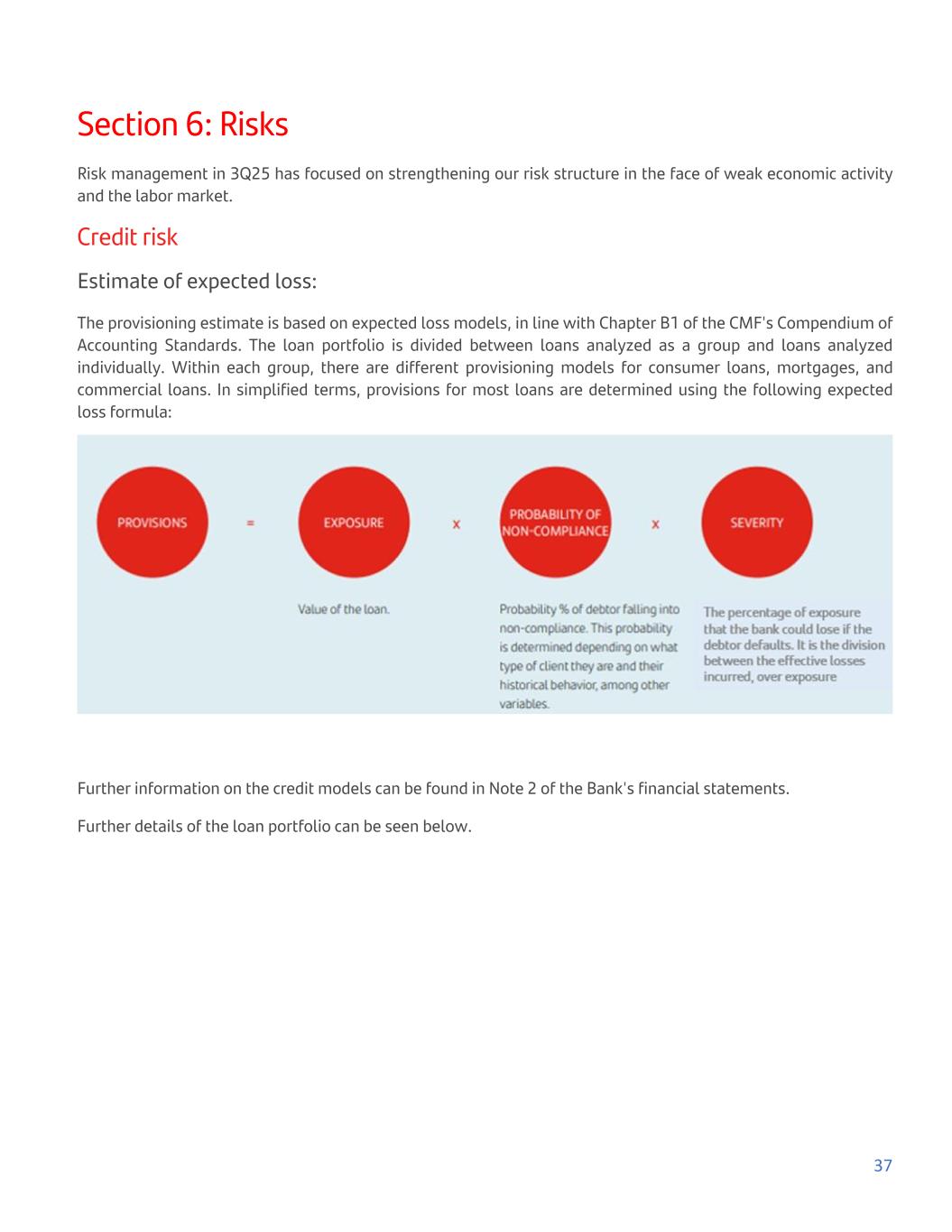
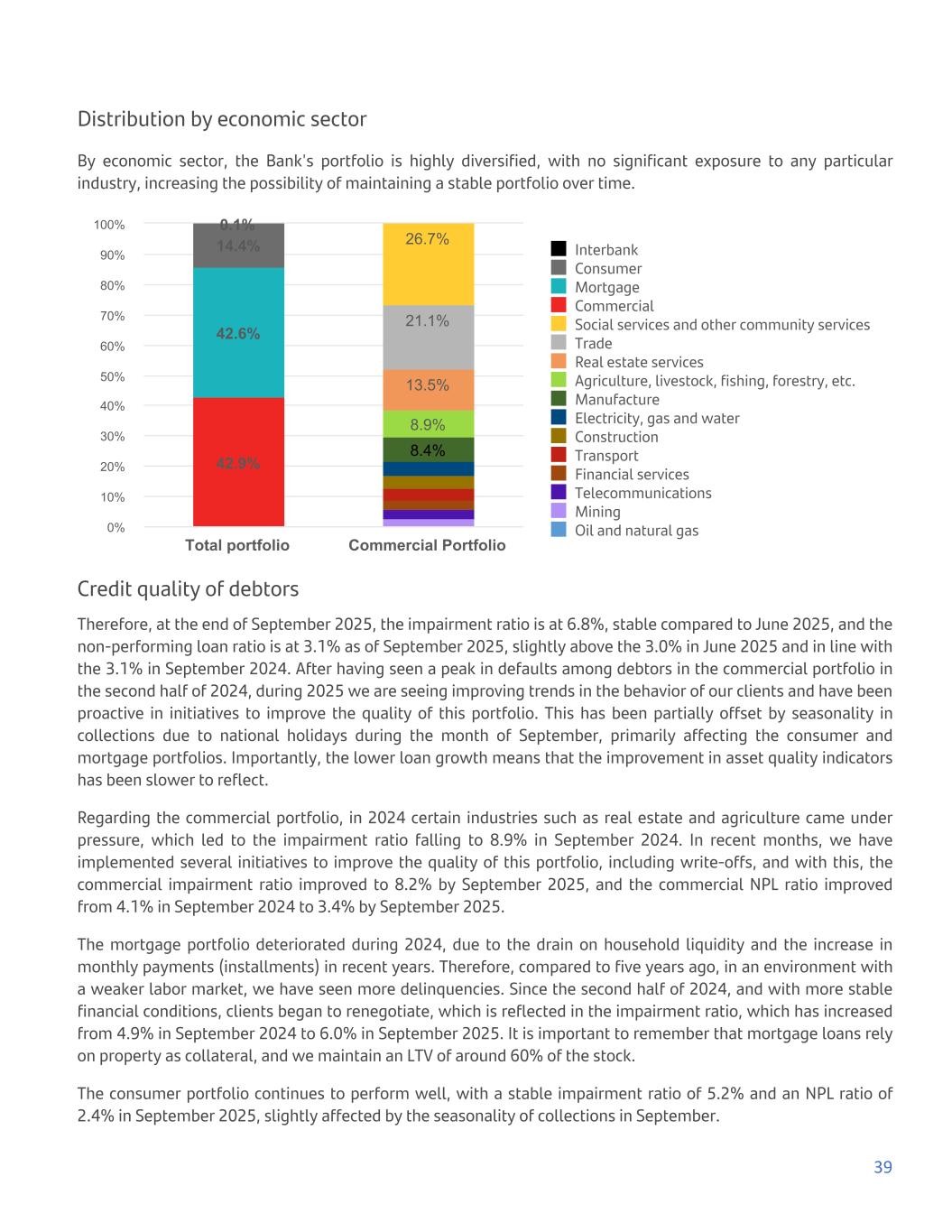
Contents Important information 2 Contents 3 Section 1: Key Information 4 Section 2: Business environment 8 Section 3: Segment Information 15 Section 4: Balance sheet and results 22 Section 5: Expectations 36 Section 6: Risks 37 Section 7: Credit Risk Classifications 46 Section 8: Share Performance 47 Annex 1: Strategy 48 Annex 2: Responsible Banking 53 Annex 3: Balance Sheet 55 Annex 4: Income statement YTD 56 Appendix 5: Quarterly income statement 57 Annex 6: Quarterly key ratios and other relevant information 58 3


Section 1: Key Information Summary of results Solid financial performance with a ROAE1 of 24.0% in 9M252. As of September 30, 2025, the Bank's net income attributable to shareholders totaled $798 billion ($4.23 per share and $1.76 per ADR), representing a 37.3% increase YoY3, with an ROAE of 24.0% in 9M25 compared to a ROAE of 18.2% in 9M244. The increase in results is explained by growth in the Bank's main revenue lines. Operating income increased 14.8% YoY, driven by a better interest and readjustment margin and higher fees and results from financial transactions. Compared to the previous quarter (2Q25), net income attributable to shareholders decreased by 9.2%. The UF variation in 3Q25 was lower than in 2Q25, which reduced QoQ5 readjustment gains from the UF. The quarter also saw lower fees. This was offset by lower provision expenses and good cost control. This resulted in a ROAE of 21.8% in 3Q25, marking the sixth consecutive quarter with ROAEs above 20%. Strong recovery of the NIM6, reaching 4.0% in 9M25 Net interest income and readjustments (NII) accrued as of September 30, 2025, increased 16.6% compared to the same period in 2024. This increase in NII was due to higher net interest income due to the impact of a lower monetary policy rate on our funding cost, which fell from 4.8% to 3.8% in 9M25. As a result, the NIM improved from 3.4% in 9M24 to 4.0% in 9M25. Compared to 2Q25, net interest and readjustment income decreased 7.9% QoQ, primarily due to a lower quarterly variation in UF, which impacted readjustment income. The customer base continues to expand, with a 8.7% YoY increase in total customers. Our strategy of strengthening digital products has led to continued growth in our customer base, reaching approximately 4.6 million customers, of which nearly 2.3 million are digital customers (87% of our active customers). The Bank's market share in checking accounts remains strong at 22.1% as of August 2025, driven by increased customer demand for US dollar checking accounts, as customers can open this type of account digitally through our platform in a few easy steps. This also demonstrates the success of Getnet's strategy to encourage cross- selling of other products, such as checking accounts, to SMEs. 4 1Annualized net income attributable to owners of the Bank divided by the average equity attributable to equity holders. 2The nine months ending September 30, 2025. 3Year over year 4The nine months ending September 30, 2024. 5Quarter over quarter. 6NIM: Net interest margin. Net interest income and annualized adjustments divided by interest-earning assets.


Net commissions increased by 8.0% in 9M25, reaching a recurrence rate7 of 62.1%. Net commissions increased 8.0% in the nine months ended September 30, 2025, compared to the same period in 2024, driven by increased customer numbers and greater product usage. As a result, the recurrence ratio (total net commissions divided by structural support expenses) increased from 60.0% as of September 2024 to 62.1% as of September 2025, demonstrating that more than half of the Bank's expenses are funded by commissions generated by our customers. Best in Class efficiency8 of 35.9% in 9M25. The Bank's efficiency ratio reached 35.9% as of September 30, 2025, better than the 40.0% recorded in the same period last year. Total operating expenses (which include other expenses) increased 3.1% in 9M25 compared to 9M24, driven by administrative expenses primarily related to higher technology expenses in the first quarter, as well as other expenses related to the restructuring of our branch network and the transformation to Work/Cafés. Solid CET19 ratio of 10.8%. Our CET1 ratio remains at a solid 10.8% at the end of September 2025, and the overall Basel III ratio stands at 16.7%. The Bank's capital includes a dividend payout provision for 60% of 2025 earnings to date. 5 7. Recurrence: net commissions divided by structural support costs. 8Operating expenses including impairment and other operating expenses/margin+fees+financial trx and other net operating income. 9Common Equity Tier 1 under Chilean regulation.


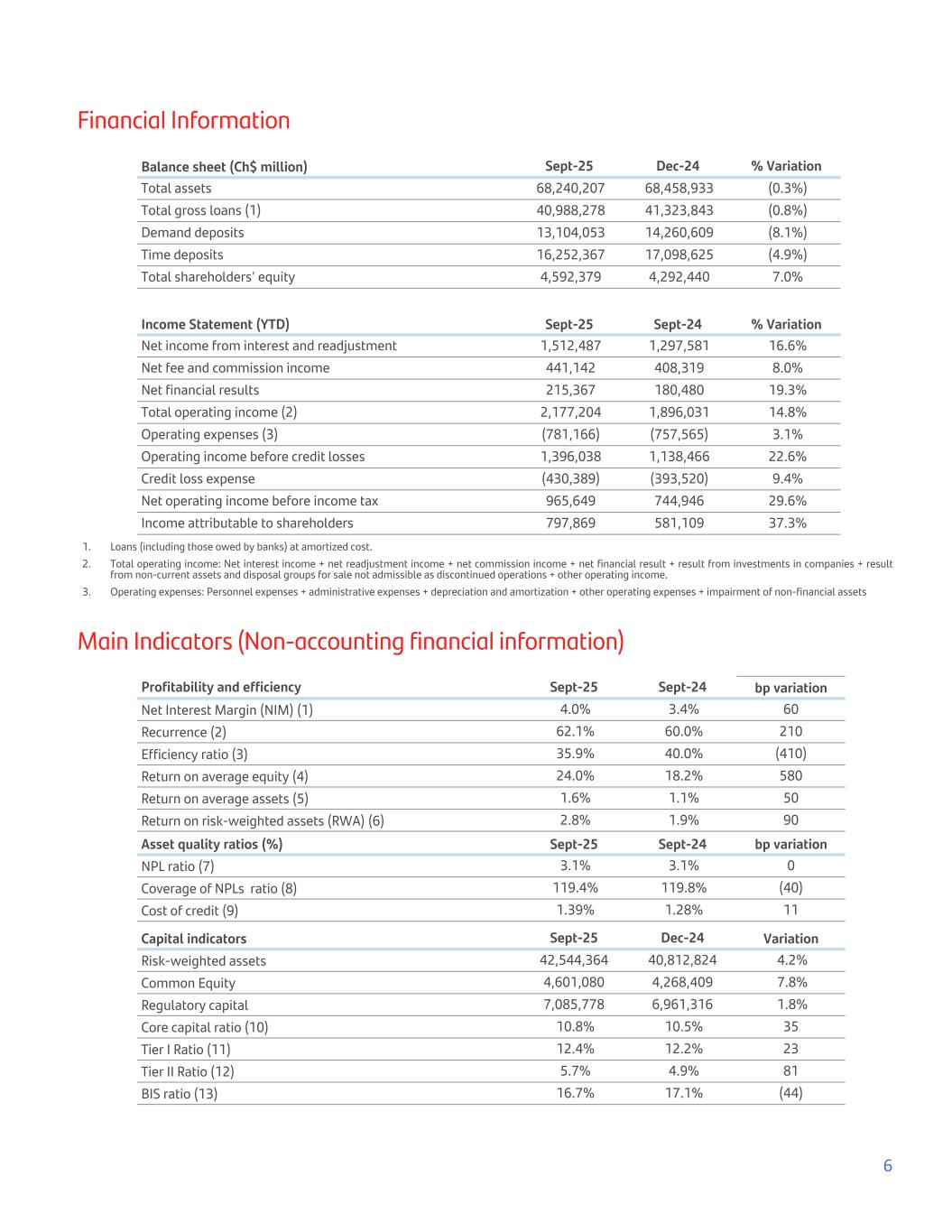
Financial Information Balance sheet (Ch$ million) Sept-25 Dec-24 % Variation Total assets 68,240,207 68,458,933 (0.3%) Total gross loans (1) 40,988,278 41,323,843 (0.8%) Demand deposits 13,104,053 14,260,609 (8.1%) Time deposits 16,252,367 17,098,625 (4.9%) Total shareholders' equity 4,592,379 4,292,440 7.0% Income Statement (YTD) Sept-25 Sept-24 % Variation Net income from interest and readjustment 1,512,487 1,297,581 16.6% Net fee and commission income 441,142 408,319 8.0% Net financial results 215,367 180,480 19.3% Total operating income (2) 2,177,204 1,896,031 14.8% Operating expenses (3) (781,166) (757,565) 3.1% Operating income before credit losses 1,396,038 1,138,466 22.6% Credit loss expense (430,389) (393,520) 9.4% Net operating income before income tax 965,649 744,946 29.6% Income attributable to shareholders 797,869 581,109 37.3% 1. Loans (including those owed by banks) at amortized cost. 2. Total operating income: Net interest income + net readjustment income + net commission income + net financial result + result from investments in companies + result from non-current assets and disposal groups for sale not admissible as discontinued operations + other operating income. 3. Operating expenses: Personnel expenses + administrative expenses + depreciation and amortization + other operating expenses + impairment of non-financial assets Main Indicators (Non-accounting financial information) Profitability and efficiency Sept-25 Sept-24 bp variation Net Interest Margin (NIM) (1) 4.0% 3.4% 60 Recurrence (2) 62.1% 60.0% 210 Efficiency ratio (3) 35.9% 40.0% (410) Return on average equity (4) 24.0% 18.2% 580 Return on average assets (5) 1.6% 1.1% 50 Return on risk-weighted assets (RWA) (6) 2.8% 1.9% 90 Asset quality ratios (%) Sept-25 Sept-24 bp variation NPL ratio (7) 3.1% 3.1% 0 Coverage of NPLs ratio (8) 119.4% 119.8% (40) Cost of credit (9) 1.39% 1.28% 11 Capital indicators Sept-25 Dec-24 Variation Risk-weighted assets 42,544,364 40,812,824 4.2% Common Equity 4,601,080 4,268,409 7.8% Regulatory capital 7,085,778 6,961,316 1.8% Core capital ratio (10) 10.8% 10.5% 35 Tier I Ratio (11) 12.4% 12.2% 23 Tier II Ratio (12) 5.7% 4.9% 81 BIS ratio (13) 16.7% 17.1% (44) 6


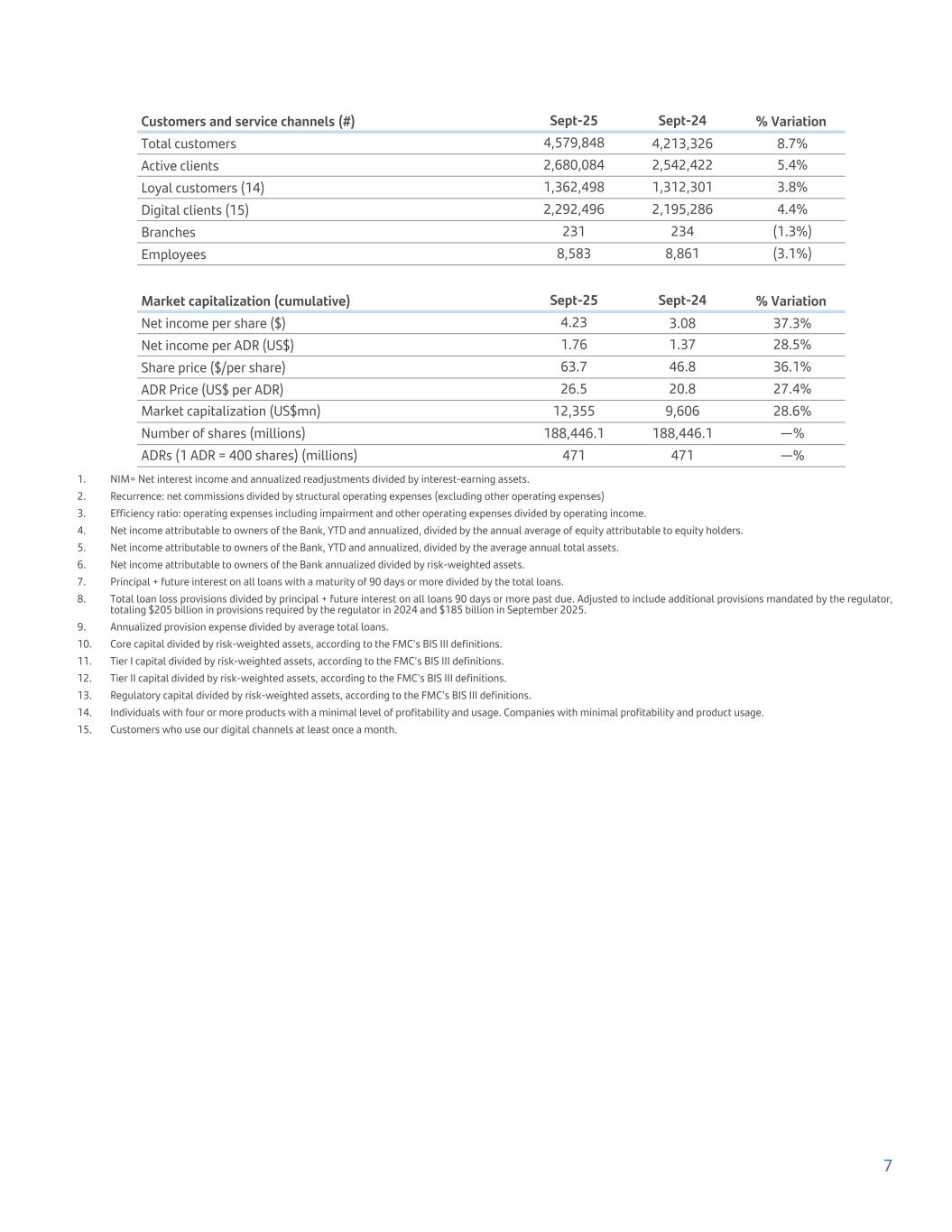
Customers and service channels (#) Sept-25 Sept-24 % Variation Total customers 4,579,848 4,213,326 8.7% Active clients 2,680,084 2,542,422 5.4% Loyal customers (14) 1,362,498 1,312,301 3.8% Digital clients (15) 2,292,496 2,195,286 4.4% Branches 231 234 (1.3%) Employees 8,583 8,861 (3.1%) Market capitalization (cumulative) Sept-25 Sept-24 % Variation Net income per share ($) 4.23 3.08 37.3% Net income per ADR (US$) 1.76 1.37 28.5% Share price ($/per share) 63.7 46.8 36.1% ADR Price (US$ per ADR) 26.5 20.8 27.4% Market capitalization (US$mn) 12,355 9,606 28.6% Number of shares (millions) 188,446.1 188,446.1 —% ADRs (1 ADR = 400 shares) (millions) 471 471 —% 1. NIM= Net interest income and annualized readjustments divided by interest-earning assets. 2. Recurrence: net commissions divided by structural operating expenses (excluding other operating expenses) 3. Efficiency ratio: operating expenses including impairment and other operating expenses divided by operating income. 4. Net income attributable to owners of the Bank, YTD and annualized, divided by the annual average of equity attributable to equity holders. 5. Net income attributable to owners of the Bank, YTD and annualized, divided by the average annual total assets. 6. Net income attributable to owners of the Bank annualized divided by risk-weighted assets. 7. Principal + future interest on all loans with a maturity of 90 days or more divided by the total loans. 8. Total loan loss provisions divided by principal + future interest on all loans 90 days or more past due. Adjusted to include additional provisions mandated by the regulator, totaling $205 billion in provisions required by the regulator in 2024 and $185 billion in September 2025. 9. Annualized provision expense divided by average total loans. 10. Core capital divided by risk-weighted assets, according to the FMC's BIS III definitions. 11. Tier I capital divided by risk-weighted assets, according to the FMC's BIS III definitions. 12. Tier II capital divided by risk-weighted assets, according to the FMC's BIS III definitions. 13. Regulatory capital divided by risk-weighted assets, according to the FMC's BIS III definitions. 14. Individuals with four or more products with a minimal level of profitability and usage. Companies with minimal profitability and product usage. 15. Customers who use our digital channels at least once a month. 7


Section 2: Business environment Competitive position We are the largest bank in the Chilean market in terms of total loans (excluding loans held by subsidiaries of Chilean banks abroad) and the third largest bank in terms of total deposits (excluding deposits held by subsidiaries of Chilean banks abroad). We have a leading presence in all major business segments in Chile and a broad distribution network with national coverage extending throughout the country. We offer unique transaction capabilities to customers through our 231 branches and digital platforms. Our headquarters are in Santiago, and we operate in all major regions of Chile. Santander Chile offers a wide range of banking services to its customers, including commercial, consumer, and mortgage loans, as well as checking accounts, term deposits, savings accounts, and other transactional products. In addition to its traditional banking operations, it offers financial services, including leasing, factoring, foreign trade services, financial advisory services, and mutual fund, securities, and insurance brokerage and acquisition. Market Share (1) Santander Ranking (2) Total loans 16.7% 1 Commercial 13.8% 4 Mortgages 19.9% 1 Consumer 19.4% 1 Demand deposits 19.1% 3 Time deposits 14.3% 3 Checking accounts (#) 22.1% 1 Credit card purchases ($) 24.5% 1 Branches (#) 15.9% 2 Employees (#) 13.7% 4 Indicators (1) Efficiency 35.8% 1 ROAE 24.0% 1 ROAA 1.6% 3 1. Source: FMC as of August 2025. Credit card purchases (last 12 months) as of July 2025. 2. Competition: Banco de Chile, BCI, Banco Estado, Itaú, Scotiabank, Banco Falabella. Banco Santander Chile is one of the companies with the highest risk ratings in Latin America, with an A2 rating from Moody's, A- from Standard & Poor's, A+ from the Japan Credit Rating Agency, AA- from HR Ratings, and A from KBRA. All of our ratings have a stable outlook as of the date of this report. As of September 30, 2025, the Bank had total assets of $68,240,207 million (US$73,258 million), total gross loans (including interbank loans) at amortized cost of $40,988,278 million (US$44,002 million), total deposits of $29,356,420 million (US$31,515 million), and shareholders' equity of $4,592,379 million (US$4,930 million). The BIS capital ratio was 16.7%, with a core capital ratio of 10.8%. As of September 30, 2025, Santander Chile employed 8,583 people and had 231 branches throughout Chile. For more information on the formation of the business, please see here or in the Bank's Integrated Report. 8


Macroeconomic Environment All of our operations and the majority of our customers are located in Chile. Consequently, our financial condition and results of operations depend substantially on prevailing economic conditions in the country. During the third quarter, economic activity showed a slowdown, mainly explained by the mining sector. In August, the Imacec grew 0.5% YoY, with a contraction of 0.7% (seasonally adjusted) for the month. This result was influenced by the weak performance of the mining sector (-8.6% YoY), affected by the work stoppage at El Teniente mine. The decline was greater than suggested by the INE sectoral figures (-6.3% YoY). Beyond the expected weakness in mining, the slowdown in the non-mining sectors was notable, which grew 1.7% YoY but declined 0.5% for the month. In particular, services grew 2.4% YoY, driven by education—favored by the low comparison base resulting from the suspension of classes in 2024—although they registered a seasonally adjusted monthly decline of 0.6%. Trade, for its part, grew 3.9% YoY, with expansions across all components, also supported by the comparison base, but with a limited increase at the margin (0.1% MoM seasonally adjusted). Overall, the August results reflect a loss of momentum at the margin and continued sectoral heterogeneity, with a greater boost from mining investment in contrast to the weaker traction of other sectors. For 2025, we project GDP growth of 2.4%, sustained by a recovery in domestic demand, particularly investment in mining and energy projects, although the pace is expected to moderate toward the end of the year. In the third quarter, the labor market showed more positive trends, with two consecutive months of strong job creation, driven by an increase in the number of self-employed workers. This brought the unemployment rate down slightly to 8.6% (8.7% previous), while labor costs increased around the historical average. CPI (12 months) m ar -2 1 ju n- 21 se pt -2 1 di c- 21 M ar -2 2 ju n- 22 se pt -2 2 di c- 22 M ar -2 3 Ju ne 2 3 S ep t-2 3 D ec -2 3 M ar -2 4 Ju ne 2 4 S ep t-2 4 D ec -2 4 M ar -2 5 Ju ne 2 5 S ep t-2 5 0.0 2.0 4.0 6.0 8.0 10.0 12.0 14.0 16.0 Inflation in September showed a monthly variation of 0.4%, leading to an annual inflation rate of 4.4% (4.0% in August). The underlying inflation also had a monthly variation of 0.4%, maintaining the annual rate at 3.9%. We expect the convergence process to continue, mainly due to the high comparison base for the electricity component. We maintain the projection of 3.8% for year en and we slightly correct the project for 2026 to 2.8% (2.9% previously), due to the expected adjustment next year due to corrections to the methodology in electricity tariffs. As for the UF, its variation in the third quarter was 0.6%, lower than the 1.0% recorded in the second quarter. We estimate that it will accumulate a 3.5% increase in 2025, below the 4.4% recorded in 2024. 9


Despite the support of the copper price (around USD 5 per pound) and the interest rate differential with the U.S., the recent depreciation appears to be due to idiosyncratic factors and a greater perception of external risk. However, we estimate a gradual appreciation towards the end of the year, with a close around 950 pesos per dollar by the end of the year. MPR M ar -2 02 3 Ju n- 20 23 S ep -2 02 3 D ec -2 02 3 M ar -2 02 4 Ju n- 20 24 S ep -2 02 4 D ec -2 02 4 M ar -2 02 5 Ju n- 20 25 S ep -2 02 5 0.0 2.0 4.0 6.0 8.0 10.0 12.0 In monetary policy, the Central Bank has made progress in the normalization process initiated after the peak in rates in 2022. Although no cuts were made during the first half of the year, given a context of still-high inflation and high global uncertainty, marked by trade tensions and the conflict in the Middle East, as of the date of this report, we estimate that one further cut in December of 25 basis points will be made in the second half, bringing the Monetary Policy Rate to 4.50% by the end of 2025 and 4.25% by year end of 2026. Summary of estimated economic data: 2022 2023 2024 2025 (E) 2026 (E) National accounts GDP (real % y/y change) 2.2% 0.5% 2.6% 2.4% 1.8% Domestic demand (real change % y/y) 2.3% -3.7% 1.3% 3.4% 2.1% Total consumption (actual change % y/y) 2.5% -3.4% 1.4% 2.6% 1.9% Private consumption (real % y/y change) 1.6% -4.7% 1.0% 2.5% 1.9% Public consumption (real change % y/y) 6.3% 2.2% 3.0% 3.1% 2.0% Fixed capital formation (real % YoY) 4.6% -0.1% -1.4% 4.7% 2.0% Exports (real % y/y change) 0.8% 0.1% 6.6% 4.3% 0.9% Imports (real % y/y change) 1.3% -10.9% 2.5% 7.5% 2.2% Monetary and Exchange Market CPI inflation 12.6% 3.9% 4.5% 3.8% 2.9% UF inflation 13.3% 4.8% 4.4% 3.5% 2.9% CLP/US$ exchange rate (year-end) 875 879 992 950 930 Monetary policy rate (year-end) 11.3% 8.25% 5.00% 4.5% 4.25% Fiscal Policy Public spending -24.0% 1.0% 3.5% 1.5% 2.5% Central Government Balance Sheet (% GDP) 1.1% -2.4% -2.8% -2.0% -1.8% Estimates from the Banco Santander Chile Studies Department. 10


Pillar 2 – Basel III Implementation In the context of the Basel III implementation, on July 8, the FMC published adjustments to the final standard to assess and quantify the material non-traditional risks to which each bank is exposed, in order to determine the application of regulatory capital charges under Pillar 2. Non-traditional risks include market-based banking book (MBB); credit concentration; reputational; strategic; cybersecurity; geopolitical; climate; among others. The new regulations include adjustments to the calculation of interest-earning capacity and short-term net adjustments (ΔNII) and economic value (ΔEVE) metrics, as well as the modeling and reporting of prepaid cash flows on fixed-rate loans subject to prepayment risk. Specifically, the regulation modifies the definition of atypical banks to prioritized banks, clarifying that these entities will be subject to a detailed review of their level of exposure to RMLB, as well as their financial management and the management framework defined by the bank for this risk. The changes to the RMLB metrics will begin to take effect starting with the December 2025 reports, reflecting the situation as of November of the same year; while other aspects will be implemented starting with the IAPE review process, which will be submitted in April 2027. According to the FMC's regulatory report, based on current figures, a total of 10 banks could be classified as prioritized banks. It should be noted that, under current regulations, on April 11, the FMC (Financial Markets Commission) resolved to establish a requirement of 25 basis points of total capital for Banco Santander Chile, which will be applied progressively, with the first tranche of 50% to be paid before June 30, 2025. The charge will be absorbed by the resources already available within the Bank's effective equity. This update has no impact on the Bank's financial position, solvency, or results, nor did it affect the dividend proposal of the Shareholders' Meeting held on April 22, 2025. Likewise, it does not affect the conditions offered to clients or the strategic projections for shareholders. Dividend Subsidy Law On May 20, 2025, Congress approved the Dividend Subsidy bill, which seeks to facilitate access to homeownership and reactivate the real estate market by reducing interest rates on mortgage loans for the purchase of new homes. The characteristics of this initiative include a mortgage interest rate subsidy of up to 60 basis points. It also includes a state guarantee from the Special Guarantee Fund (FOGAES) that covers up to 60% of the home's value, which could further reduce the total interest rate by up to 100 basis points. The project seeks to provide 50,000 subsidies, 10% of which are earmarked for first-sale homes worth up to 3,000 UF and the remaining percentage for new homes worth up to 4,000 UF. The first tender was held on June 18, with the participation of 12 financial institutions, each of which was awarded a total of 10,000,000 UF. In this first tender, Santander had the largest share, winning 1,832,314 UF, equivalent to 18.3% of the total tendered and 0.4% of Banco Santander Chile's total mortgage portfolio. According to the ABIF (National Institute of Financial Institutions), approximately 11,000 applications had been approved by banks as of the end of August. 11


Pension Reform On January 29, 2025, Congress approved the pension reform after a lengthy process involving various proposals. The main objective is to increase future and current pensions, considering the following changes. A 7% increase in pension contributions, payable by employers and phased in over 9 to 11 years. • Six percent will go to direct and deferred individual capitalization, and 1% to the new Social Security, which will also include the current 1.5% allocated to Disability and Survivors' Insurance. These funds will allow for equal pensions for men and women in similar circumstances at retirement. • Tendering of 10% of the membership pool every two years, in order to increase competition. • Multi-funds are being replaced by generational funds, and new managers are being allowed to join. • Increase in the Guaranteed Universal Pension (PGU) to $250,000 pesos for the 90% of the most vulnerable population. Beyond the details, it is valuable that the reform allows for a gradual recovery of pension savings levels. This is beneficial not only for financing future pensions, but also for the capital market, to the extent that a large portion of this additional percentage is channeled under the current pension fund investment regime. Interchange fees In February 2023, the Interchange Rate Capping Committee proposed new rate caps. These were approved at the end of April 2023, and a phased implementation was established. Card type Previous rate First rate cut (Oct-23) Current rate Second rate cut (oct-24) (Suspended) Debit 0.6% 0.5% 0.35% Credit 1.48% 1.14% 0.80% Prepaid 1.04% 0.94% 0.80% To assess the effects of the gradual implementation of the process for determining limits on interchange rates, the Committee agreed to conduct an impact study on: (i) the application of the preliminary rates; (ii) the first reduction established in the resolution; (iii) the evaluation of the potential effects, or those that are reasonably foreseeable, of the second reduction; and (iv) all aspects of the market that are relevant to the fulfillment of the Committee's objectives established in the aforementioned law. On September 30, 2024, the Committee initiated a review of the interchange fees caps and maintained the caps in effect at that time; that is, the planned reduction scheduled for October 2024 was suspended. Given the timing of the review processes, we estimate that the Committee could determine the fee caps by the end of this year. Consolidated debt In early June 2024, the law creating a free, public Consolidated Debt Registry (Redec) was approved. It will be administered by the Financial Market Commission (FMC). The new law establishes that new institutions, which were not previously required to do so, must report outstanding loans granted to individuals to the FMC. These include servicers of endorsable mortgage loans; family allowance compensation funds; credit card issuers 12


(supervised by the FMC); securitization companies; credit advisory entities regulated by the Fintec Law; and any other entity supervised by the FMC, as determined by the FMC through a General Regulation. Furthermore, it is explicitly stated that the individual is the owner of their data and is guaranteed the right to access, update, rectify, and delete this information. Severe penalties are also defined for negligent or malicious access or use of Redec information. To access the registry information, reporters must have the debtor's prior, express, and unequivocal consent, which will be granted solely for the purpose of assessing their commercial or credit risk for a specific transaction and for a limited period. However, consent will not be required in the case of another legal source, in accordance with Law 19.628, or in the case of anonymized information from groups of debtors. Reporting entities must implement an information system compatible with the regulatory files that will be used in the Redec, which entails higher costs. The registry will be open for institutions identified as reporting entities for 2026 to report starting the first Friday of November 2025. Fintec and Open Finance Law In July 2024, the Financial Market Commission (FMC) published the regulations governing the Open Finance System (SFA) of the Fintec Law, which will come into force in July 2026. The regulation establishes that institutions currently regulated in the financial system - such as banks, payment card issuers, insurance companies, fund managers, savings and credit cooperatives supervised by the FMC - must compulsorily join the SFA in order to provide the information that the user decides to share with other participating institutions, upon prior consent. In addition, the FMC established rules for institutions that voluntarily decide to register with the SFA as financial service providers to users. The regulation establishes an implementation schedule that begins with the gradual submission of information that banks and payment card issuers must share within the first 18 months of its entry into force. This will then become mandatory for all other entities within the following 18 months. Therefore, full implementation of the regulation is estimated to take five years. Recently, the FMC issued for public consultation the technical annex containing operating specifications for the OSS, its participant directory, provisions on signatures and certificates, and other aspects related to security and information transmission. It should be noted that despite this publication, technical and cost-compensation definitions remain pending. In this context, various sectors have requested a review of the implementation timelines, a request that the FMC has indicated it is analyzing. Personal Data Protection Law In December 2024, the law modernizing the protection and processing of personal data in Chile was published, establishing a regulatory framework aligned with international standards such as that of the European Union. It also created the Personal Data Protection Agency, responsible for overseeing, sanctioning, and educating on the proper processing of data. Among the main changes, new rights are recognized for data subjects: access, rectification, erasure, objection, and portability. It also provides for the appointment of a Data Protection Officer, the implementation of security measures, and the notification of incidents to the authorities. Its entry into force is scheduled for December 1, 2026, with a 24-month adaptation period. 13


Framework Law on Sectoral Authorizations The law, published in September 2025 and effective immediately, allows for the simplification of permits associated with public and private investment projects, with the goal of reducing wait times for the execution of investment initiatives by between 30% and 70%. This would be achieved through simultaneous, currently sequential, management of authorizations; the replacement of low-risk permits (approximately 25% of the total) with post-mortem supervision, with anti-fraud sanctions; the creation of a digital one-stop shop (SUPER), allowing for the monitoring of bottlenecks; the establishment of mandatory deadlines, admissibility reviews, and a better definition of administrative silence; the triennial review of all legal and regulatory norms for their adaptation and continuous simplification; the accountability of service heads for failure to meet deadlines; and the alignment of management incentives with results. Regulation and supervision In Chile, only banks may maintain current accounts for their customers, conduct foreign trade transactions, and, along with regulated non-bank financial institutions such as cooperatives, accept term deposits. The primary authorities regulating financial institutions in Chile are the Financial Market Commission (FMC) and the Central Bank. Chilean banks are subject primarily to the General Banking Law and, secondarily, to the extent not inconsistent with this statute, to the provisions of the Chilean Companies Law governing corporations, except for certain provisions that are expressly excluded. For more information about the regulation and supervision of our Bank, see Item 4. Information on the Company, Regulation and Supervision in our 20F here. For more information on the General Banking Law, click here. For more information about the FMC, please visit the following website: www.cmfchile.cl For more information about the Central Bank, please visit the following website: www.bcentral.cl 14


Section 3: Segment Information Segment information is based on the financial information presented to senior management and the Board of Directors. The Bank has aligned segment information consistently with the underlying information used internally for management reporting purposes and with that presented in the Bank's other public documents. The Bank's senior management has been determined to be primarily responsible for the Bank's operational decision-making. The Bank's operating segments reflect its organizational and management structures. Senior management reviews internal information based on these segments to assess performance and allocate resources. During 2025, the Bank maintains the general criteria applied in 2024. Segment description Retail Banking This segment comprises individuals and small businesses with annual sales of less than 400,000 UF. This segment offers a variety of services to clients, including consumer loans, credit cards, commercial loans, foreign trade loans, mortgage loans, debit cards, checking accounts, savings products, mutual funds, stock brokerage, and insurance. Additionally, SME clients are offered loans with state guarantees, leasing, and factoring. Wealth Management & Insurance It comprises the Insurance and Private Banking businesses, and also coordinates the distribution of various investment products and services to the rest of the Santander Group's divisions in Chile. The Santander Insurance business offers personal and corporate protection products, health, life, travel, savings, personal protection, automobile, and unemployment insurance, among others. Finally, for high-net-worth clients, Santander Private Banking offers transactional products and services (credit, cards, foreign trade, stock purchases and sales) to sophisticated products and services such as international investment accounts, structured funds, alternative investment funds, wealth management, and open architecture. Middle Market This segment includes companies with annual sales of over 400,000 UF, without a cap (for specialized sectors in the Metropolitan Region with annual sales of over 100,000 UF, without a cap). It also includes institutional organizations such as universities, government agencies, municipalities and regional governments, and companies in the real estate sector that execute projects for sale to third parties, as well as all construction companies with annual sales exceeding 100,000 UF, without a cap. This segment offers a wide variety of products, including commercial loans, leasing, factoring, foreign trade, credit cards, mortgage loans, checking accounts, transactional services, treasury services, financial consulting, savings products, mutual funds, and insurance. In addition to companies in the real estate sector, we offer specialized services for financing primarily residential projects, with the aim of increasing the sale of mortgage loans. Corporate Investment Banking (CIB) This segment offers a wide variety of products, including commercial loans, leasing, factoring, foreign trade, credit cards, checking accounts, transactional services, treasury services, financial consulting, investment 15


banking, savings products, mutual funds, and insurance. For companies, the requirements are sales greater than EUR 500 million, EBITDA greater than EUR 150 million, and assets greater than EUR 1 billion; for financial institutions, assets greater than 10 trillion Chilean pesos. This segment includes the Treasury Division, which provides sophisticated financial products primarily to companies in the Wholesale and Corporate Banking segments. These include products such as short-term financing and deposits, brokerage services, derivatives, and other products tailored to client needs. The Treasury Division also manages position brokerage and its own investment portfolio. Corporate Activities (“Other”) This segment includes Financial Management, which performs the overall functions of managing the structural exchange rate position, structural interest rate risk, and liquidity risk. It also manages equity, the capital allocation made to each unit, and the financing costs of investments. All of this typically has a negative impact on results. In addition, this segment incorporates all intra-segment results, all activities not assigned to a segment or product with customers. Loan portfolio by segment 9M25 76% 2% 15% 5% 1% Retail WM&I Middle Market CIB Other Net earnings by segment 9M25 51% 4% 19% 21% 5% Retail WM&I Middle Market CIB Other 16


Results by segment Financial accounting information As of September 30, 2025 (Ch$ million) Retail WM&I Middle- Market CIB Total business segments Corporate activities Total Total income 1,654,853 71,254 307,360 310,540 2,344,007 (175,011) 2,168,996 Y/Y variation 7.3% 8.4% 9.4% (13.6%) 4.3% (51.6%) 15.0% Provisions for credit risk (467,726) (4,490) (54,586) 1,640 (525,162) 94,773 (430,389) Y/Y variation 27.0% 54.1% 139.1% (143.7%) 32.0% 2070.7% 9.4% Net operating income 1,187,127 66,764 252,774 312,180 1,818,845 (80,238) 1,738,607 Y/Y variation 1.2% 6.3% (2.1%) (12.2%) (1.7%) (77.5%) 16.5% Retail Banking: Financial accounting information ACTIVITY $ million Sept-25 Sept-25/ Sep-24 3Q25/2 Q25 Loans 31,135,932 (0.8%) (0.2%) Deposits 12,688,682 (0.1%) (0.4%) RESULTS $ million Sept-25 9M25/9M24 3Q25 3Q25/2Q25 Total income 1,654,853 7.3% 557,921 (1.0%) Provisions (467,726) 27.0% (117,700) (11.6%) Net operating income 1,187,127 1.2% 440,221 2.3% LOAN COMPOSITION High income 64% Middle income 16% SMEs 19% Commercial activity: Santander seeks to grow in retail banking responsibly, with a focus on sustainability for our customers, with the highest levels of customer service, and through an efficient and productive phygital distribution strategy. Eighty percent of individual loans go to upper-middle-income individuals; however, the Bank has an innovative strategy for mass income. Within the retail segment, there are individuals, businesses, and Santander Consumer (auto financing), as detailed below. 17


• Individuals: The digital checking account continues to be one of the main contributors to new customer growth, with a digital onboarding process for opening a checking account. These customers are quickly monetized with a monthly fee and access to all of the Bank's products, including credit if they qualify. Additionally, in order to continue our commitment to financial inclusion, we have a 100% digital checking and savings account for the mass market. This product does not charge maintenance or transaction fees; on the other hand, the checking account pays a fixed monthly rate based on the average balance maintained in the account. • Santander Consumer (auto financing): This business has been very proactive in increasing partnerships with various automakers. • Businesses: We continue to open digital checking accounts for these clients, which, combined with Getnet's service offering, completes the range of solutions for their businesses. Results: Total income in the retail segment increased 7.3% YoY, reflecting positive trends across core lines. Margin increased 5.8% YoY due to higher spreads on credit products. Fees and commissions in this segment increased sharply by 12.0% YoY, driven by fees on current accounts and cards due to increased usage and a growing customer base. This was offset by a 27.0% YoY increase in loan loss provisions, primarily due to the reclassification of additional provisions in the consumer portfolio following the change in the provisioning model established by the regulator, which took effect in January 2025. Asset quality has also weakened due to lower economic growth and a weaker labor market. Compared to 2Q25, retail banking income decreased 1.0% QoQ due to a lower margin resulting from subdued retail dynamics in the quarter and lower fees associated with collections and current accounts. This was offset by lower provision expenses. Overall, net operating income increased 2.3% in the quarter. Wealth Management & Insurance: This unit aims to unify the investment offering, enabling greater consistency across all segments and better communication of products and services. Its focus is on generating a specialized investment strategy for each segment, establishing unique digital development and communication plans. Its core businesses are insurance and the distribution of investment instruments for the Retail and Private Banking segments. Financial accounting information ACTIVITY Ch$ million Sept-25 Sept-25/ Sep-24 3Q25/ 2Q25 Loans 862,364 10.6% 1.9% Deposits 3,045,811 14.2% (2.0%) RESULTS Ch$ million Sept-25 9M25/9M24 3Q25 3Q25/2Q25 Total income 71,254 8.4% 24,895 11.6% Provisions (4,490) 54.1% (97) (89.1%) Net operating income 66,764 6.3% 24,798 15.8% 18


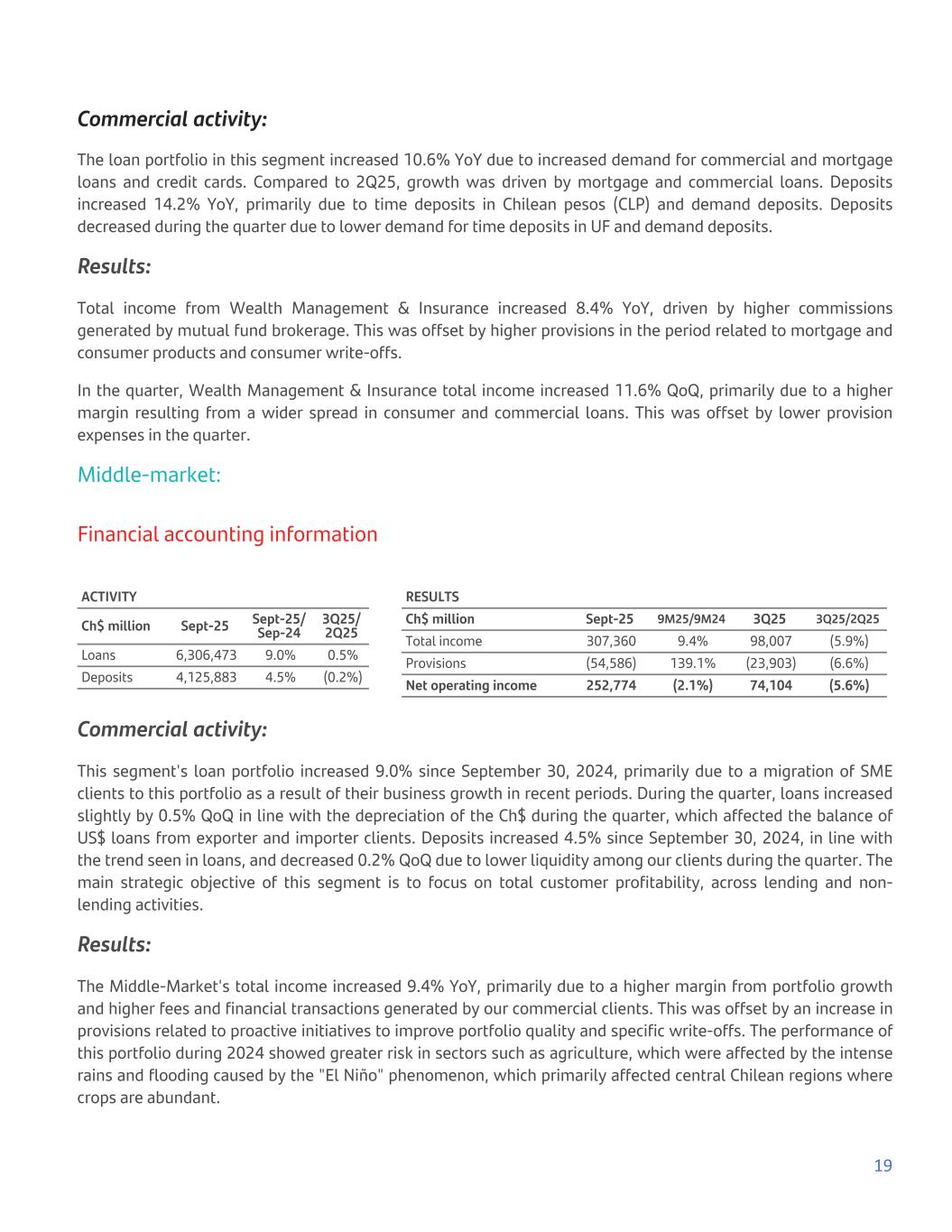
Commercial activity: The loan portfolio in this segment increased 10.6% YoY due to increased demand for commercial and mortgage loans and credit cards. Compared to 2Q25, growth was driven by mortgage and commercial loans. Deposits increased 14.2% YoY, primarily due to time deposits in Chilean pesos (CLP) and demand deposits. Deposits decreased during the quarter due to lower demand for time deposits in UF and demand deposits. Results: Total income from Wealth Management & Insurance increased 8.4% YoY, driven by higher commissions generated by mutual fund brokerage. This was offset by higher provisions in the period related to mortgage and consumer products and consumer write-offs. In the quarter, Wealth Management & Insurance total income increased 11.6% QoQ, primarily due to a higher margin resulting from a wider spread in consumer and commercial loans. This was offset by lower provision expenses in the quarter. Middle-market: Financial accounting information ACTIVITY Ch$ million Sept-25 Sept-25/ Sep-24 3Q25/ 2Q25 Loans 6,306,473 9.0% 0.5% Deposits 4,125,883 4.5% (0.2%) RESULTS Ch$ million Sept-25 9M25/9M24 3Q25 3Q25/2Q25 Total income 307,360 9.4% 98,007 (5.9%) Provisions (54,586) 139.1% (23,903) (6.6%) Net operating income 252,774 (2.1%) 74,104 (5.6%) Commercial activity: This segment's loan portfolio increased 9.0% since September 30, 2024, primarily due to a migration of SME clients to this portfolio as a result of their business growth in recent periods. During the quarter, loans increased slightly by 0.5% QoQ in line with the depreciation of the Ch$ during the quarter, which affected the balance of US$ loans from exporter and importer clients. Deposits increased 4.5% since September 30, 2024, in line with the trend seen in loans, and decreased 0.2% QoQ due to lower liquidity among our clients during the quarter. The main strategic objective of this segment is to focus on total customer profitability, across lending and non- lending activities. Results: The Middle-Market's total income increased 9.4% YoY, primarily due to a higher margin from portfolio growth and higher fees and financial transactions generated by our commercial clients. This was offset by an increase in provisions related to proactive initiatives to improve portfolio quality and specific write-offs. The performance of this portfolio during 2024 showed greater risk in sectors such as agriculture, which were affected by the intense rains and flooding caused by the "El Niño" phenomenon, which primarily affected central Chilean regions where crops are abundant. 19


In the quarter, the Middle-market's net income decreased 5.6% QoQ, primarily due to lower customer activity, with lower interest income and lower fees. This was partially offset by lower provision expenses following higher write-offs in 2Q25. Corporate Investment Banking (CIB): Financial accounting information ACTIVITY Ch$ million Sept-25 Sept-25/ Sep-24 3Q25/2 Q25 Loans 2,240,531 8.1% 2.7% Deposits 7,060,201 (11.6%) 4.0% RESULTS Ch$ million Sept-25 9M25/9M24 3Q25 3Q25/2Q25 Total income 310,540 (13.6%) 106,533 8.9% Provisions 1,640 (143.7%) 1,503 (120.9%) Net operating income 312,180 (12.2%) 108,036 19.1% Commercial activity: The loan portfolio in the CIB segment increased by 8.1% from September 30, 2024, due to a lower comparative base due to asset turnover during 2024 and increased foreign trade, partly explained by the depreciation of the Ch$ and other commercial loans. These trends continued in the quarter. Deposits decreased by 11.6% since September 30, 2024, due to lower term deposits in Chilean pesos. This trend improved in the quarter, with deposits increasing by 4.0% QoQ. Results: Total income for this segment decreased 13.6% YoY, primarily due to lower net interest income due to lower loan volume, lower financial advisory fees, and lower financial transaction results due to the results generated by FX products. This was partially offset by a provision release during the period related to initiatives undertaken to improve portfolio quality. In the quarter, CIB's total income increased 8.9% QoQ due to a higher margin in line with increased commercial lending volume, offset by lower financial advisory services. In addition, provisions were released in line with initiatives to improve portfolio quality and write-offs. Corporate activities: Financial accounting information ACTIVITY Ch$ million Sept-25 Sept-25/ Sep-24 3Q25/2 Q25 Loans 442,978 45.2% (1.1)% Deposits 2,435,843 5.2% (14.4)% RESULTS Ch$ million Sept-25 9M25/9M24 3Q25 3Q25/2Q25 Total income (175,011) (51.6%) (82,766) 47.0% Provisions 94,773 2070.7% (3,428) (118%) Net operating income (80,238) (77.5%) (86,194) 134.0% 20


Results: The results of corporate activities and Asset & Liability Management (ALM) showed an improvement compared to the previous year, with a lower loss in total income of Ch$175,011 million, explained by an improvement in the cost of funding managed by the Asset & Liabilities Committee (ALCO), which was less negative in line with the interest rate cuts. Additionally, the new provisioning model for the consumer portfolio came into effect in January 2025. As a result, the Bank reallocated voluntary provisions to offset the effect of this shift from corporate activities to Retail Banking, resulting in the release during the period. In addition, voluntary provisions related to the commercial portfolio were released in the second quarter. In the quarter, net operting income was a loss of $86.194 billion, primarily explained by a higher margin loss due to a lower quarterly variation in the UF. In the second quarter, we released approximately $20 billion in voluntary provisions related to the commercial portfolio, which was not repeated in the third quarter. 21


Section 4: Balance sheet and results Balance sheet Loan portfolio Loans by product: Financial accounting information YTD Var % (Ch$ Million) Sept-25 Jun-25 Dec-24 Sept-25/ Dec-24 Sept-25/ Jun-25 Consumer loans 5,901,594 5,895,819 5,911,638 (0.2%) 0.1% Santander Consumer (car loans) 1,068,864 1,049,950 1,016,271 5.2% 1.8% Credit card 1,937,595 1,983,768 1,980,680 (2.2%) (2.3%) Other consumer loans 2,895,135 2,862,101 2,914,686 (0.7%) 1.2% Mortgage 17,454,306 17,486,514 17,559,769 (0.6%) (0.2%) Commercial 17,600,148 17,545,364 17,821,154 (1.2%) 0.3% Interbank 32,230 14,845 31,283 3.0% 117.1% Total(1) 40,988,278 40,942,542 41,323,843 (0.8%) 0.1% 1. Total gross loans provisions at amortized cost. Total loans decreased 0.8% compared to December 31, 2024, explained by a decrease in the commercial and mortgage portfolios, and increased 0.1% QoQ, mainly due to higher commercial loans. Approximately 57% of our portfolio is indexed to the UF, mostly mortgage loans and approximately 35% of commercial loans. Approximately 22% of commercial loans (from the Middle-market and CIB segments) are denominated in foreign currency, primarily in US dollars. Therefore, US$-denominated commercial loans have shown volatility in their value in pesos in recent quarters. Commercial loans decreased by 1.2% from December 31, 2024, partly due to the depreciation of the Chilean peso against the US$ and partly due to lower demand for new loan originations. As of September 30, 2025, the Chilean peso recovered, appreciating 3.2% QoQ, partly explaining the 0.3% QoQ increase in this portfolio. In general, commercial loans have been impacted by lower demand related to the macroeconomic environment. Mortgage loan decreased by 0.6% since December 31, 2024, and by 0.2% QoQ. In the recent period, new mortgage loan originations have declined due to continued weak demand, impacted by rising housing prices, inflation, and interest rates in recent years. With the launch of the state mortgage subsidy program, the flow of new mortgage applications and approvals has increased, indicating an improved trend for new loan originations in future periods. Consumer loans decreased 0.2% from December 31, 2024, and increased 0.1% QoQ. Within our consumer loans, our credit cards decreased 2.2% from December 31, 2024, and 2.3% QoQ, while consumer installment loans increased 1.3% QoQ, reflecting more stable borrowing for customers. 22


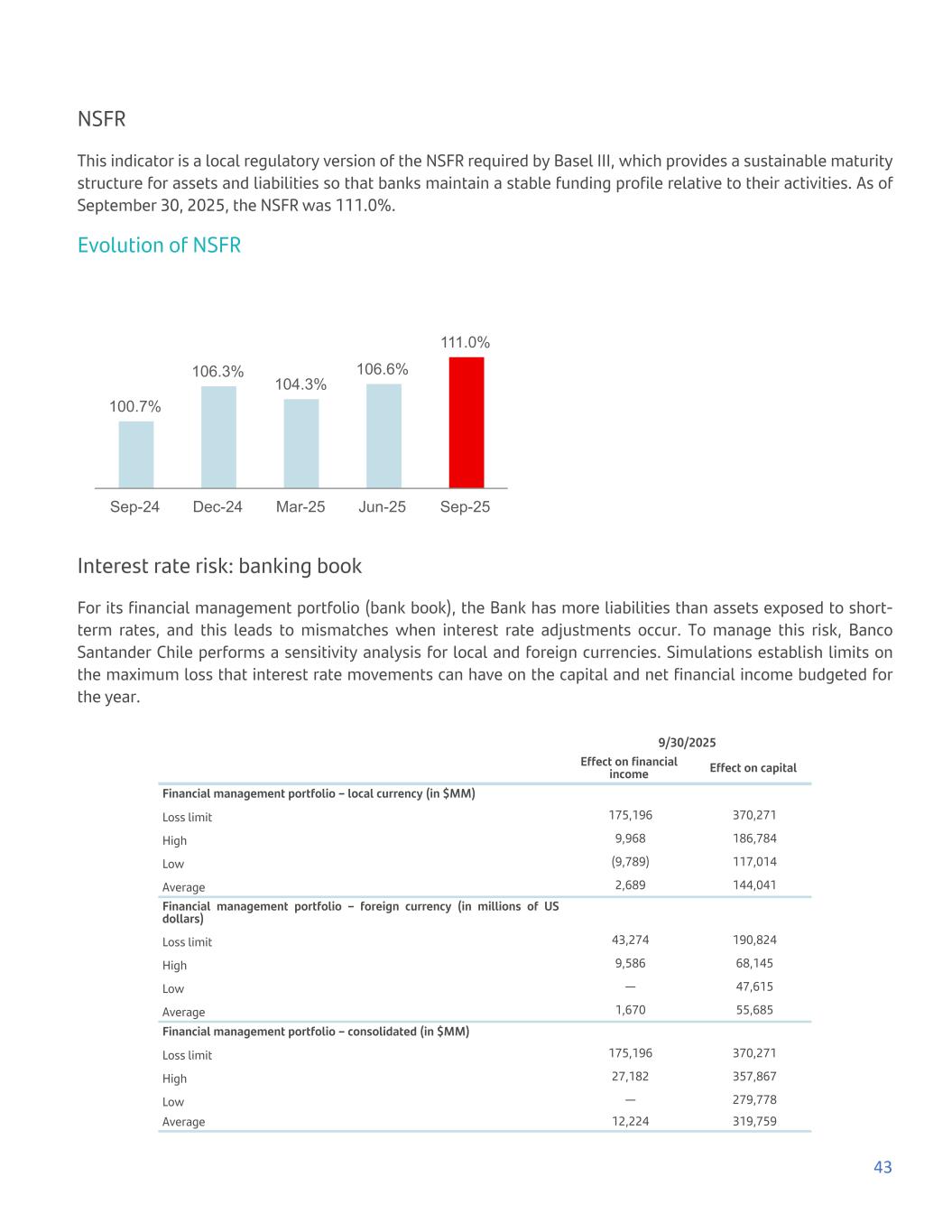
Within our consumer loans is our auto financing business, Santander Consumer, which has shown positive trends with a 5.2% increase since December 2024 and a 1.8% increase in the quarter thanks to increased commercial agreements with dealerships. Financial Investments: Financial accounting information YTD Var % (Ch$ Million) Sept-25 Jun-25 Dec-24 Sept-25/ Dec-24 Sept-25/ Jun-25 Financial assets for trading at fair value through profit or loss (Trading portfolio) 583,742 305,791 329,327 77.3% 90.9% Financial assets at fair value through other comprehensive income (Available-for-sale portfolio) 3,711,132 3,389,513 2,762,388 34.3% 9.5% Financial assets at amortized cost (Portfolio held to maturity) 5,494,359 5,426,720 5,176,005 6.2% 1.2% Total 9,789,233 9,122,024 8,267,720 18.4% 7.3% It's important to note that our financial investment portfolio is primarily composed of HQLA (high-quality liquid assets) such as Central Bank bonds and notes, Chilean sovereign bonds, and U.S. Treasury bonds. Financial assets at fair value through other comprehensive income increased 34.3% in the nine months ending September 30, 2025, due to an increase in bonds and notes with the Chilean Treasury. Financial assets at amortized cost increased 6.2% due to growth in bonds issued by the Treasury. As of September 2025, HTM instruments had a fair market value of Ch$5,553,516 million. Customer funds remain stable in the quarter. Funding: Financial accounting information YTD Var. % (Ch$ Million) Sept-25 Jun-25 Dec-24 Sept-25/ Dec-24 Sept-25/ Jun-25 Demand deposits 13,104,053 13,120,949 14,260,609 (8.1%) (0.1%) Time deposits 16,252,367 16,493,664 17,098,625 (4.9%) (1.5%) Total deposits 29,356,420 29,614,613 31,359,234 (6.4%) (0.9%) Mutual Fund Brokerage (1) 15,276,206 14,799,104 13,587,869 12.4% 3.2% Total Customer Funds 44,632,626 44,413,717 44,947,103 (0.7%) 0.5% Bonds (2) 10,447,129 10,677,237 10,737,354 (2.7%) (2.2%) Liquidity Coverage Ratio (LCR) (3) 171.8% 177.7% 190.8% Net stable funding ratio (NSFR) (3) 111.0% 106.6% 106.3% 1. Banco Santander Chile is the exclusive intermediary for mutual funds managed by Santander Asset Management S.A., a subsidiary of SAM Investment Holdings Limited. This figure is not included in the Bank's consolidated financial statements. 2. Includes regulatory capital financial instruments (AT1 and Tier 2). 3. Calculated in accordance with Chilean regulations. 23


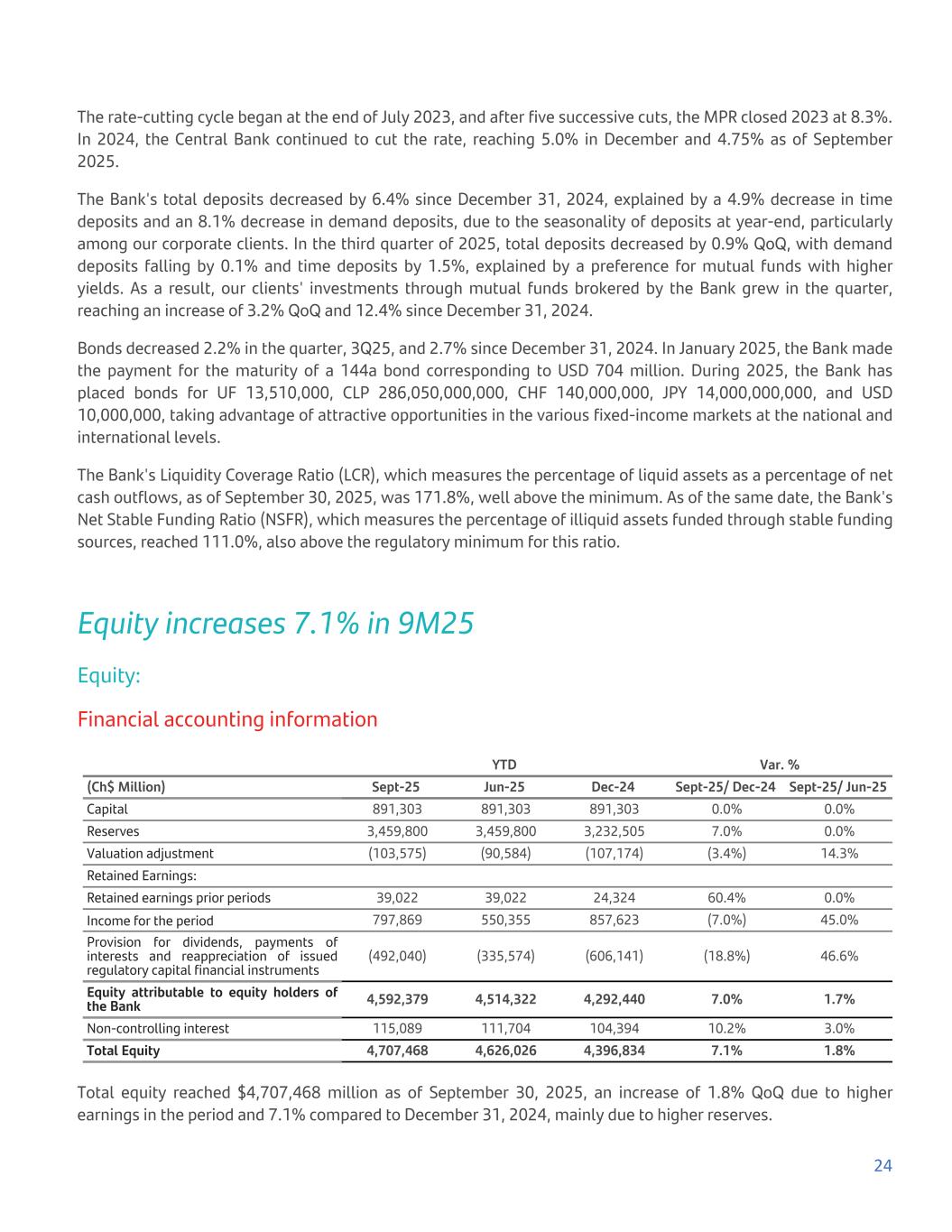
The rate-cutting cycle began at the end of July 2023, and after five successive cuts, the MPR closed 2023 at 8.3%. In 2024, the Central Bank continued to cut the rate, reaching 5.0% in December and 4.75% as of September 2025. The Bank's total deposits decreased by 6.4% since December 31, 2024, explained by a 4.9% decrease in time deposits and an 8.1% decrease in demand deposits, due to the seasonality of deposits at year-end, particularly among our corporate clients. In the third quarter of 2025, total deposits decreased by 0.9% QoQ, with demand deposits falling by 0.1% and time deposits by 1.5%, explained by a preference for mutual funds with higher yields. As a result, our clients' investments through mutual funds brokered by the Bank grew in the quarter, reaching an increase of 3.2% QoQ and 12.4% since December 31, 2024. Bonds decreased 2.2% in the quarter, 3Q25, and 2.7% since December 31, 2024. In January 2025, the Bank made the payment for the maturity of a 144a bond corresponding to USD 704 million. During 2025, the Bank has placed bonds for UF 13,510,000, CLP 286,050,000,000, CHF 140,000,000, JPY 14,000,000,000, and USD 10,000,000, taking advantage of attractive opportunities in the various fixed-income markets at the national and international levels. The Bank's Liquidity Coverage Ratio (LCR), which measures the percentage of liquid assets as a percentage of net cash outflows, as of September 30, 2025, was 171.8%, well above the minimum. As of the same date, the Bank's Net Stable Funding Ratio (NSFR), which measures the percentage of illiquid assets funded through stable funding sources, reached 111.0%, also above the regulatory minimum for this ratio. Equity increases 7.1% in 9M25 Equity: Financial accounting information YTD Var. % (Ch$ Million) Sept-25 Jun-25 Dec-24 Sept-25/ Dec-24 Sept-25/ Jun-25 Capital 891,303 891,303 891,303 0.0% 0.0% Reserves 3,459,800 3,459,800 3,232,505 7.0% 0.0% Valuation adjustment (103,575) (90,584) (107,174) (3.4%) 14.3% Retained Earnings: Retained earnings prior periods 39,022 39,022 24,324 60.4% 0.0% Income for the period 797,869 550,355 857,623 (7.0%) 45.0% Provision for dividends, payments of interests and reappreciation of issued regulatory capital financial instruments (492,040) (335,574) (606,141) (18.8%) 46.6% Equity attributable to equity holders of the Bank 4,592,379 4,514,322 4,292,440 7.0% 1.7% Non-controlling interest 115,089 111,704 104,394 10.2% 3.0% Total Equity 4,707,468 4,626,026 4,396,834 7.1% 1.8% Total equity reached $4,707,468 million as of September 30, 2025, an increase of 1.8% QoQ due to higher earnings in the period and 7.1% compared to December 31, 2024, mainly due to higher reserves. 24


At the Ordinary Shareholders' Meeting held on April 22, 2025, the distribution of a dividend of 70% of 2024 earnings, or approximately Ch$600,336 million, was approved, for which the Bank had already fully provisioned. This represents a dividend per share of Ch$3.19 and a dividend yield of 5.4%. At the end of September 2025, the Bank has established a dividend provision of 60% of earnings in 2025. This reflects its outlook for the Bank's earnings expectations for the year and is in line with historical dividend payments. Solid capital levels with a CET1 of 10.8% and a ROAE of 24.0% in 9M25. Capital adequacy and ROAE: Financial accounting information YTD Var. % (Ch$ Million) Sept-25 Jun-25 Dec-24 Sept-25/ Dec-24 Sept-25/ Jun-25 Core Capital (CET1) 4,601,080 4,512,041 4,268,409 7.8% 1.97% AT1 671,738 650,354 693,382 (3.1%) 3.3% Tier I 5,272,818 5,162,395 4,961,791 6.3% 2.1% Tier II 1,812,960 1,868,318 1,999,525 (9.3%) (3.0%) Regulatory capital 7,085,778 7,030,713 6,961,316 1.8% 0.8% Market risk weighted assets 7,648,752 6,849,732 5,967,201 28.2% 11.7% Operational risk weighted assets 4,964,597 5,037,235 4,923,679 0.8% (1.4%) Credit risk weighted assets 29,931,015 29,603,109 29,921,944 —% 1.1% Risk weighted assets 42,544,364 41,490,076 40,812,824 4.2% 2.5% Core Capital ratio 10.8% 10.9% 10.5% Tier I ratio 12.4% 12.4% 12.2% Tier II ratio 5.7% 4.5% 4.9% BIS ratio 16.7% 17.0% 17.1% Leverage (1) 7.2% 7.3% 6.9% Quarterly ROAE 21.8% 24.5% 26.0% YTD ROAE 24.0% 25.1% 20.2% 1. Leverage: Core capital / Total regulatory assets, as calculated by the FMC. Our CET1 ratio remained strong at 10.8% and the overall Basel III ratio reached 16.7% by the end of September 2025. Risk-weighted assets (RWA) increased 4.2% since December 31, 2024, and 2.5% QoQ, mainly due to higher market risk-weighted assets. In April 2025, the FMC informed the Bank of a Pillar 2 charge of 25bp. Fifty percent of this charge was required to be in place by June 2025, and 56.3% should be comprised of CET1. With this, our minimum CET1 requirement at the end of 2025 is 9.08%. The Bank's ROAE was 21.8% in 3Q25 compared to 24.5% in 2Q25, due to slightly lower inflation in the quarter. During the second quarter of 2025, the dividend provision rate for the fiscal year was set at 60%, in accordance with the powers granted to the Board of Directors by the ordinary shareholders' meeting. 25


Results Interest income and readjustments increased 16.6% compared to the same period in 2024, with a NIM of 4.0% due to a better cost of funds. Interest income and readjustments: Financial accounting information YTD Var. % Quarterly Var. % Ch$ million Sept-25 Sept-24 Sept-25/ Sept-24 3Q25 2Q25 3Q24 3Q25/ 3Q24 3Q25/ 2Q25 Net interest income(1) 1,293,672 1,081,252 19.6% 434,528 435,304 406,526 6.9% (0.2%) Net income from readjustments(2) 218,815 216,329 1.1% 44,412 84,609 70,606 (37.1%) (47.5%) Total net interest income and readjustments 1,512,487 1,297,581 16.6% 478,940 519,913 477,132 0.4% (7.9%) 1. Net income from interest-bearing assets and liabilities plus the financial cost of cash flow hedges. 2. Net income from inflation-indexed assets and liabilities (UF) plus the financial cost of inflation-related cash flow hedges. Margin indicators: Non-accounting financial information YTD Var. % Quarterly Var. % Ch$ million Sept-25 Sept-24 Sept-25/ Sept-24 3Q25 2Q25 3Q24 3Q25/ 3Q24 3Q25/ 2Q25 Average interest-earning assets 50,198,347 51,371,941 (2.3%) 50,627,398 50,519,020 49,129,997 3.0% 0.2% Average loans 41,007,684 40,803,682 0.5% 40,989,877 41,006,752 40,445,853 1.3% —% Avg. net gap in inflation indexed (UF) instruments (1) 7,682,664 7,641,618 3.6% 7,233,773 8,047,514 7,853,557 (7.9%) (10.1%) Interest earning asset yield (2) 7.6% 8.0% 7.13% 7.77% 8.1% Cost of funds (3) 3.8% 4.8% 3.58% 3.91% 4.5% Net interest margin (NIM) (4) 4.0% 3.4% 3.8% 4.1% 3.9% Inflation rate (5) 2.8% 3.0% 0.6% 1.0% 0.9% Central Bank reference rate 4.8% 5.5% 4.8% 5.0% 5.5% Average Central Bank reference rate 4.94% 6.50% 4.83% 5.0% 5.68% 1. The average gap between assets and liabilities indexed to the Unidad de Fomento (UF). 2. Interest income divided by average interest earning assets. 3. Interest expense divided by the sum of interest-earning liabilities and demand deposits. 4. Net interest income divided by average earning assets. 5. Inflation measured as the variation of the UF in the period. 26


Net interest income and readjustments (NII) accumulated as of September 30, 2025 increased 16.6% compared to the same period in 2024. This increase in NII was primarily due to lower interest expenses due to the effect of the lower monetary policy rate on our funding cost, which fell from 4.8% to 3.8% in 9M25. The Bank's interest-bearing liabilities have a shorter duration than its interest-bearing assets, so our liabilities recognize price changes more quickly than our assets. The Central Bank began cutting the MPR in July 2023 from its peak of 11.25%, with five successive cuts to reach 8.25% in December 2023 and continuing through 2024, reaching 5.0% by December 2024, and 4.75% by September 2025. Our time deposits represent 34.3% of our funding at the end of September 2025, and these deposits generally have a duration of 30-60 days, so they quickly reflect the new rate. This has led to a rapid recovery in net interest income, increasing by 19.6% in 9M25 compared to 9M24. Net readjustment income increased 1.1% in 9M25 compared to the same period in 2024. This slight increase is due to the management of the balance sheet and UF exposure (UF GAP) in a scenario of lower UF variation of 2.8% in 9M25 compared to 3.0% in the same period in 2024. In 3Q25, total net interest and readjustment income decreased 7.9% compared to 2Q25, primarily due to lower readjustment income during the quarter. The UF variation was 0.6% in 3Q25, lower than the 1.0% variation in 2Q25, explaining the 47.5% decrease in net readjustment income in 3Q25 compared to 2Q25. On the other hand, net interest income in 3Q25 remained stable compared to 2Q25. Compared to 3Q24, total net interest and readjustment income increased 0.4% in 3Q25 due to higher interest income. Interest income in 3Q25 increased 6.9% compared to 3Q24. This is primarily due to lower funding costs, which decreased from 4.5% in 3Q24 to 3.58% in 3Q25, related to the lower average MPR, which fell from 5.68% to 4.83%. This was offset by a 37.1% decrease in readjustment income compared to 3Q24 due to the lower variation in the UF in the quarter. With these funding cost and inflation dynamics, the NIM increased from 3.4% in 9M24 to 4.0% in 9M25 and from 3.9% in 2Q24 and 4.1% in 2Q25 to 3.8% in 3Q25. Our economists are currently projecting a UF variation of 3.5% during 2025 and an average rate of 4.9%. Therefore, we estimate that our NIM for 2025 could be around 4%. 27


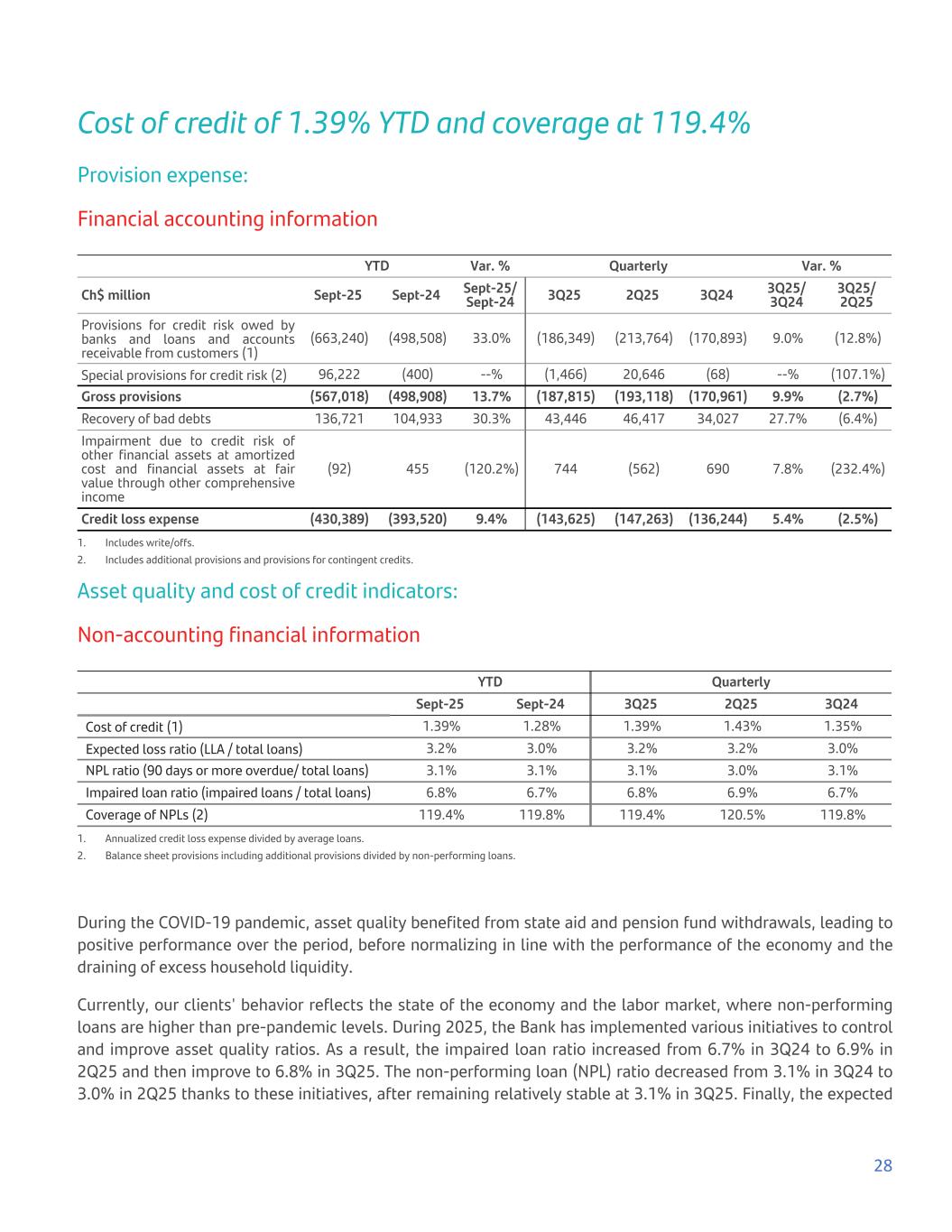
Cost of credit of 1.39% YTD and coverage at 119.4% Provision expense: Financial accounting information YTD Var. % Quarterly Var. % Ch$ million Sept-25 Sept-24 Sept-25/ Sept-24 3Q25 2Q25 3Q24 3Q25/ 3Q24 3Q25/ 2Q25 Provisions for credit risk owed by banks and loans and accounts receivable from customers (1) (663,240) (498,508) 33.0% (186,349) (213,764) (170,893) 9.0% (12.8%) Special provisions for credit risk (2) 96,222 (400) --% (1,466) 20,646 (68) --% (107.1%) Gross provisions (567,018) (498,908) 13.7% (187,815) (193,118) (170,961) 9.9% (2.7%) Recovery of bad debts 136,721 104,933 30.3% 43,446 46,417 34,027 27.7% (6.4%) Impairment due to credit risk of other financial assets at amortized cost and financial assets at fair value through other comprehensive income (92) 455 (120.2%) 744 (562) 690 7.8% (232.4%) Credit loss expense (430,389) (393,520) 9.4% (143,625) (147,263) (136,244) 5.4% (2.5%) 1. Includes write/offs. 2. Includes additional provisions and provisions for contingent credits. Asset quality and cost of credit indicators: Non-accounting financial information YTD Quarterly Sept-25 Sept-24 3Q25 2Q25 3Q24 Cost of credit (1) 1.39% 1.28% 1.39% 1.43% 1.35% Expected loss ratio (LLA / total loans) 3.2% 3.0% 3.2% 3.2% 3.0% NPL ratio (90 days or more overdue/ total loans) 3.1% 3.1% 3.1% 3.0% 3.1% Impaired loan ratio (impaired loans / total loans) 6.8% 6.7% 6.8% 6.9% 6.7% Coverage of NPLs (2) 119.4% 119.8% 119.4% 120.5% 119.8% 1. Annualized credit loss expense divided by average loans. 2. Balance sheet provisions including additional provisions divided by non-performing loans. During the COVID-19 pandemic, asset quality benefited from state aid and pension fund withdrawals, leading to positive performance over the period, before normalizing in line with the performance of the economy and the draining of excess household liquidity. Currently, our clients' behavior reflects the state of the economy and the labor market, where non-performing loans are higher than pre-pandemic levels. During 2025, the Bank has implemented various initiatives to control and improve asset quality ratios. As a result, the impaired loan ratio increased from 6.7% in 3Q24 to 6.9% in 2Q25 and then improve to 6.8% in 3Q25. The non-performing loan (NPL) ratio decreased from 3.1% in 3Q24 to 3.0% in 2Q25 thanks to these initiatives, after remaining relatively stable at 3.1% in 3Q25. Finally, the expected 28


loss ratio (loan loss provisions divided by total loans) increased from 3.0% in 3Q24 to 3.2% in 3Q25 due to higher provisions set aside in recent periods. Net credit loss expenses totaled Ch$430,389 million for the nine-month period ended September 30, 2025, an increase of 9.4% compared to the same period in 2024. Similarly, the cost of credit increased from 1.28% as of September 30, 2024, to 1.39% as of September 30, 2025. In the quarter, loan loss expenses increased 5.4% compared to 3Q24, explained by a release of mortgage provisions in 2Q24, which was not repeated in 2Q25 and offset by lower provision expense for commercial loans due to an improvement in the impaired and non-performing portfolio due to the initiatives carried out by the bank during 2025. On the other hand, net loan loss expense decreased 2.5% compared to 2Q25, which is mainly explained by lower provisions for the commercial portfolio, and partially offset by higher provisions related to the consumer portfolio. Therefore, the cost of credit increased from 1.35% in 3Q24 to 1.43% in 2Q25 and 1.39% in 3Q25. The non-performing loan coverage ratio (which includes voluntary provisions issued by the Board of Directors in recent years) remained stable at 119.8% in 3Q24, 120.5% in 2Q25, and 119.4% in 3Q25. This ratio considers the increase in non-performing loans in the commercial and mortgage portfolio, as well as the greater weight of the mortgage portfolio in total loans, which require less coverage due to the associated collateral. Portfolio quality ratios are also partly affected by the contraction in the loan portfolios. Net provision expense for credit risk by product: Financial accounting information YTD Var. % Quarterly Var. % Ch$ million Sept-25 Sept-24 Sept-25/ Sept-24 3Q25 2Q25 3Q24 3Q25/ 3Q24 3Q25/ 2Q25 Consumer (255,567) (255,770) (0.1%) (98,896) (70,972) (97,898) 1.0% 39.3% Commercial (149,151) (132,551) 12.5% (38,942) (75,594) (62,095) (37.3%) (48.5%) Mortgage (25,672) (5,198) 393.9% (5,787) (698) 23,749 (124.4%) 729.1% Provisions for credit risk (430,390) (393,520) 9.4% (143,625) (147,264) (136,244) 5.4% (2.5%) In January 2025, the regulatory change to the consumer provisioning model was implemented, for which we used additional provisions to cover the initial impact of $94 billion. Consumer loan provisioning expenses decreased 0.1% in 9M25 compared to 9M24 and increased 39.3% compared to 2Q25 and 1.0% compared to 3Q24, demonstrating seasonality due to national holidays in September, which hindered collections. The consumer non-performing loan ratio was 2.3% in 3Q24, improving to 2.2% in 2Q25 and increasing to 2.4% in 3Q25, while the consumer loan impairment ratio increased from 5.3% in 3Q24 to 5.1% in 2Q25 and 5.2% in 3Q25. With the increase in consumer provisions in the first quarter of 2025, coverage has increased slightly, reaching 352.4% by the end of September 2025. Commercial loan provisioning expenses increased 12.5% in 9M25 compared to 9M24. Compared to 2Q25, commercial loan provisions decreased 48.5% in 3Q25 and 37.3% in 4Q24. Following an increase in impairment in this portfolio during 2024 and the stabilization of asset quality in 1Q25, the Bank implemented specific initiatives to improve asset quality (including write-offs) in this portfolio, which had a significant impact during the second quarter of 2025. As a result, the non-performing loan ratio for the commercial portfolio decreased from 3.8% in September 2024 and 4.1% in June 2025 to 3.6% in September 2025, as did the commercial loan impairment 29


ratio, which increased from 8.6% in 3Q24 and 8.6% in 2Q25 to 8.3% in 3Q25. On the other hand, the commercial non-performing loan coverage ratio for this portfolio reached 126.0% by September 2025. Mortgage loan provisions increased 393.9% in 9M25 compared to the same period in 2024, and 729.1% compared to 2Q25 due to a provision release in 3Q24, which was not repeated in 2025. This release was related to improved restructuring and recovery of mortgage loans that were heavily provisioned in the quarters prior to 3Q24. During the quarter, the mortgage delinquency rate increased to 2.9%, with a mortgage impairment ratio of 6.0%. This is explained by a seasonal increase related to national holidays, which impacted collections in September. As a result, the mortgage non-performing loan coverage ratio decreased from 69.0% in September 2024 to 39.3% in June 2025 and 42.0% in September 2025. For further information on credit risk and asset quality, see Section 6: Risk. Commissions increase 8.0% compared to the same period in 2024, due to a larger customer base and product usage. Net fees increased 8.0% in the nine months ended September 30, 2025, compared to the same period in 2024, primarily due to higher fees on our core products: cards, mutual fund brokerage, checking accounts, and Getnet. This was driven by increased customer numbers and increased product usage. Fees decreased 2.7% QoQ in the quarter, with a slightly weaker quarter in cards and checking accounts, partially offset by higher fees in mutual fund brokerage, Getnet, and insurance brokerage. With this, the recurrence ratio (total net fees divided by structural support expenses) increased from 60.0% YTD in September 2024 to 62.1% YTD in September 2025, and from 62.0% in 2Q25 to 62.5% in 3Q25, demonstrating that more than half of the Bank's expenses are financed by fees generated by our customers. 30


Commissions per product: Financial accounting information The evolution of commissions by product was as follows: YTD Var. % Quarterly Var. % Ch$ million Sept-25 Sept-24 Sept-25/ Sept-24 3Q25 2Q25 3Q24 3Q25/ 3Q24 3Q25/ 2Q25 Cards 109,829 95,479 15.0% 34,696 37,539 34,865 (0.5%) (7.6%) Getnet 77,759 55,242 40.8% 27,310 26,097 25,357 7.7% 4.6% Mutual fund brokerage 68,343 55,721 22.7% 24,325 22,516 19,530 24.6% 8.0% Current accounts 59,569 54,101 10.1% 19,426 21,053 18,879 2.9% (7.7%) Collections 47,763 48,591 (1.7%) 15,563 15,302 16,926 (8.1%) 1.7% Insurance brokerage 40,325 46,739 (13.7%) 14,924 13,045 15,266 (2.2%) 14.4% Guarantees 32,374 26,256 23.3% 10,565 9,793 8,411 25.6% 7.9% Prepayment of credits 12,318 12,376 (0.5%) 4,298 4,216 4,566 (5.9%) 1.9% Others (7,138) 13,814 (151.7%) (6,658) (1,119) 2,495 (366.9%) 495.0% Total commissions 441,142 408,319 8.0% 144,449 148,442 146,296 (1.3%) (2.7%) Credit and debit card fees increased 15.0% in 9M25 compared to the same period in 2024. This strong variation is explained by the increased use of our customers' cards, driven by the growth of our customer base, reflecting the success of our strategy. Card fees decreased 7.6% QoQ and 0.5% in 3Q25 compared to 3Q24, due to specific loyalty program campaigns during 3Q25. Getnet, our acquiring business, continues to grow strongly, driving an increase in the Bank's SME customer base, with more than 169,000 SMEs as customers. It currently has more than 312,000 POS machines in operation. Mutual fund brokerage fees grew 22.7% in 9M25 compared to the same period in 2024, 24.6% in 3Q25 compared to 3Q24, and 8.0% QoQ due to customer demand for investment products in the context of the low- rate cycle and lower preference for time deposits and the expansion of the customer base in previous periods. Checking account fees increased 10.1% in 9M25 compared to the same period in 2024 and 2.9% in 3Q25 compared to 3Q24. Growth in account openings continued during the quarter. This brings the Bank's market share of total checking accounts to 22.1% as of August 2025. This also reflects a strong increase in customer demand for US dollar checking accounts, as customers can digitally open this type of account through our platform in a few easy steps. We have opened 91,000 accounts in the last 12 months (through August 2025) to reach a total of 525,721 dollar checking accounts, achieving a total market share of 39.6%. Checking account fees decreased 7.7% QoQ due to the impact of specific loyalty program campaigns during 3Q25. Collection fees decreased 1.7% in 9M25 compared to the same period last year and 8.1% in the quarter compared to 3Q24 due to lower collection fees for credit and insurance-related items. During the third quarter of 2025, collection fees increased 1.7% QoQ due to improved performance in insurance-related collections. Insurance brokerage decreased 13.7% in 9M25 compared to the same period in 2024 and 2.2% in 3Q25 compared to 3Q24 due to lower commissions generated by personal insurance, mainly mortgages but also partly consumer insurance. This performance is consistent with the lower demand we are seeing for retail loans 31


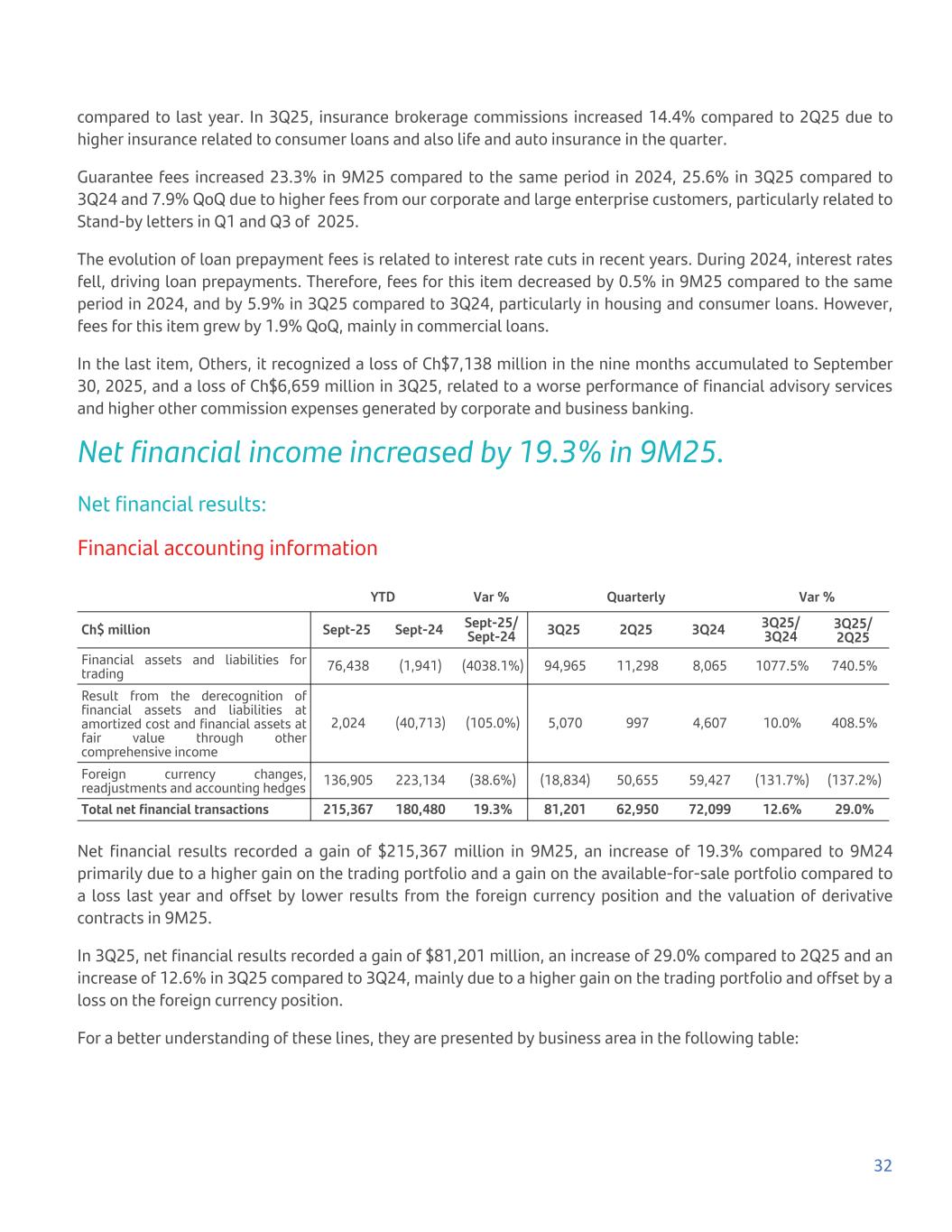
compared to last year. In 3Q25, insurance brokerage commissions increased 14.4% compared to 2Q25 due to higher insurance related to consumer loans and also life and auto insurance in the quarter. Guarantee fees increased 23.3% in 9M25 compared to the same period in 2024, 25.6% in 3Q25 compared to 3Q24 and 7.9% QoQ due to higher fees from our corporate and large enterprise customers, particularly related to Stand-by letters in Q1 and Q3 of 2025. The evolution of loan prepayment fees is related to interest rate cuts in recent years. During 2024, interest rates fell, driving loan prepayments. Therefore, fees for this item decreased by 0.5% in 9M25 compared to the same period in 2024, and by 5.9% in 3Q25 compared to 3Q24, particularly in housing and consumer loans. However, fees for this item grew by 1.9% QoQ, mainly in commercial loans. In the last item, Others, it recognized a loss of Ch$7,138 million in the nine months accumulated to September 30, 2025, and a loss of Ch$6,659 million in 3Q25, related to a worse performance of financial advisory services and higher other commission expenses generated by corporate and business banking. Net financial income increased by 19.3% in 9M25. Net financial results: Financial accounting information YTD Var % Quarterly Var % Ch$ million Sept-25 Sept-24 Sept-25/ Sept-24 3Q25 2Q25 3Q24 3Q25/ 3Q24 3Q25/ 2Q25 Financial assets and liabilities for trading 76,438 (1,941) (4038.1%) 94,965 11,298 8,065 1077.5% 740.5% Result from the derecognition of financial assets and liabilities at amortized cost and financial assets at fair value through other comprehensive income 2,024 (40,713) (105.0%) 5,070 997 4,607 10.0% 408.5% Foreign currency changes, readjustments and accounting hedges 136,905 223,134 (38.6%) (18,834) 50,655 59,427 (131.7%) (137.2%) Total net financial transactions 215,367 180,480 19.3% 81,201 62,950 72,099 12.6% 29.0% Net financial results recorded a gain of $215,367 million in 9M25, an increase of 19.3% compared to 9M24 primarily due to a higher gain on the trading portfolio and a gain on the available-for-sale portfolio compared to a loss last year and offset by lower results from the foreign currency position and the valuation of derivative contracts in 9M25. In 3Q25, net financial results recorded a gain of $81,201 million, an increase of 29.0% compared to 2Q25 and an increase of 12.6% in 3Q25 compared to 3Q24, mainly due to a higher gain on the trading portfolio and offset by a loss on the foreign currency position. For a better understanding of these lines, they are presented by business area in the following table: 32


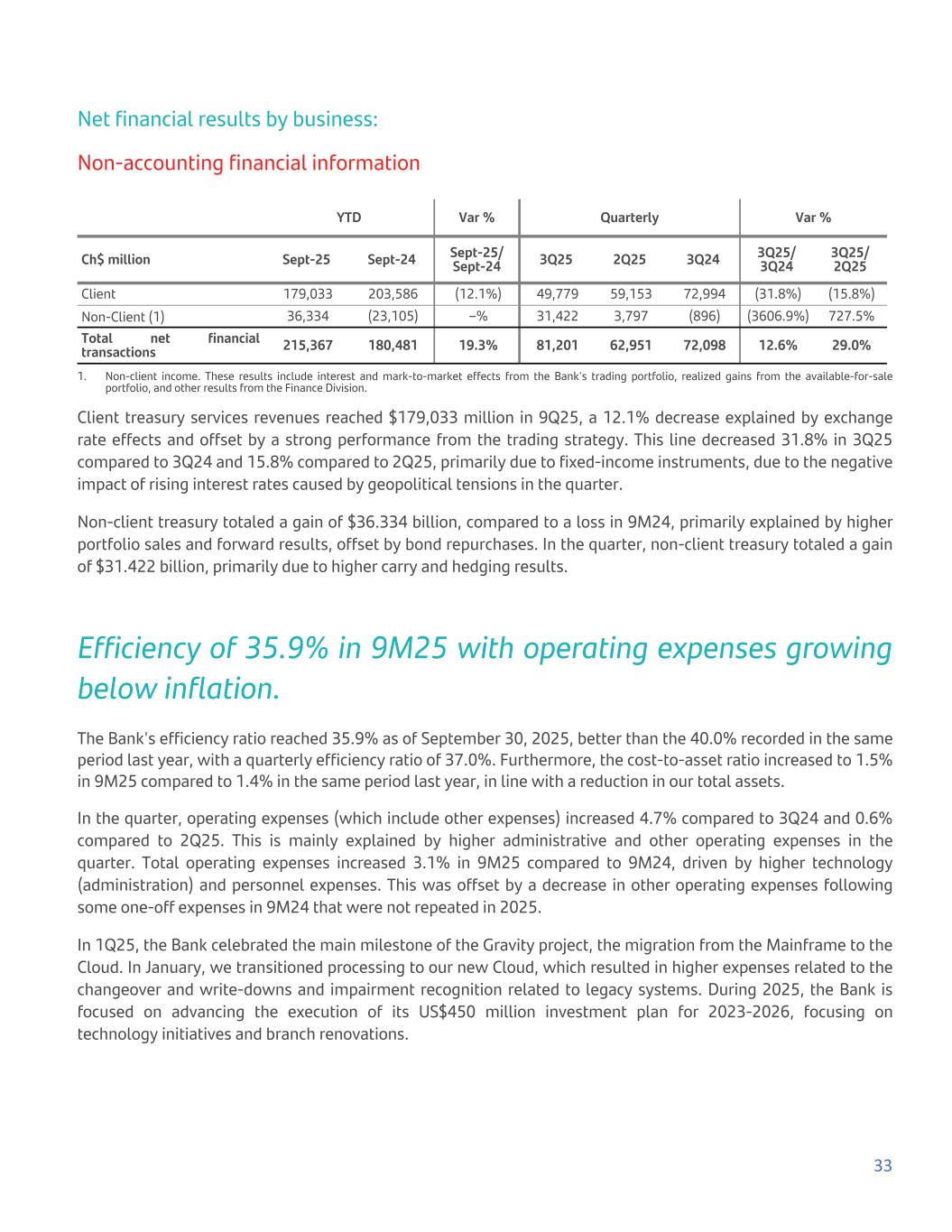
Net financial results by business: Non-accounting financial information YTD Var % Quarterly Var % Ch$ million Sept-25 Sept-24 Sept-25/ Sept-24 3Q25 2Q25 3Q24 3Q25/ 3Q24 3Q25/ 2Q25 Client 179,033 203,586 (12.1%) 49,779 59,153 72,994 (31.8%) (15.8%) Non-Client (1) 36,334 (23,105) –% 31,422 3,797 (896) (3606.9%) 727.5% Total net financial transactions 215,367 180,481 19.3% 81,201 62,951 72,098 12.6% 29.0% 1. Non-client income. These results include interest and mark-to-market effects from the Bank's trading portfolio, realized gains from the available-for-sale portfolio, and other results from the Finance Division. Client treasury services revenues reached $179,033 million in 9Q25, a 12.1% decrease explained by exchange rate effects and offset by a strong performance from the trading strategy. This line decreased 31.8% in 3Q25 compared to 3Q24 and 15.8% compared to 2Q25, primarily due to fixed-income instruments, due to the negative impact of rising interest rates caused by geopolitical tensions in the quarter. Non-client treasury totaled a gain of $36.334 billion, compared to a loss in 9M24, primarily explained by higher portfolio sales and forward results, offset by bond repurchases. In the quarter, non-client treasury totaled a gain of $31.422 billion, primarily due to higher carry and hedging results. Efficiency of 35.9% in 9M25 with operating expenses growing below inflation. The Bank's efficiency ratio reached 35.9% as of September 30, 2025, better than the 40.0% recorded in the same period last year, with a quarterly efficiency ratio of 37.0%. Furthermore, the cost-to-asset ratio increased to 1.5% in 9M25 compared to 1.4% in the same period last year, in line with a reduction in our total assets. In the quarter, operating expenses (which include other expenses) increased 4.7% compared to 3Q24 and 0.6% compared to 2Q25. This is mainly explained by higher administrative and other operating expenses in the quarter. Total operating expenses increased 3.1% in 9M25 compared to 9M24, driven by higher technology (administration) and personnel expenses. This was offset by a decrease in other operating expenses following some one-off expenses in 9M24 that were not repeated in 2025. In 1Q25, the Bank celebrated the main milestone of the Gravity project, the migration from the Mainframe to the Cloud. In January, we transitioned processing to our new Cloud, which resulted in higher expenses related to the changeover and write-downs and impairment recognition related to legacy systems. During 2025, the Bank is focused on advancing the execution of its US$450 million investment plan for 2023-2026, focusing on technology initiatives and branch renovations. 33


Operating expenses: Financial accounting information YTD Var % Quarterly Var % Ch$ million Sept-25 Sept-24 Sept-25/ Sept-24 3Q25 2Q25 3Q24 3Q25/ 3Q24 3Q25/ 2Q25 Personnel expenses (307,995) (298,388) 3.2% (102,189) (111,743) (105,148) (2.8%) (8.5%) Administrative expenses (301,308) (276,019) 9.2% (95,845) (94,741) (91,006) 5.3% 1.2% Depreciation and amortization (101,150) (105,712) (4.3%) (33,124) (32,850) (34,529) (4.1%) 0.8% Core support costs (710,453) (680,119) 4.5% (231,158) (239,334) (230,683) 0.2% (3.4%) Other operational expenses (67,789) (77,446) (12.5%) (30,714) (21,949) (21,295) 44.2% 39.9% Impairment (2,924) - --% (1,826) (934) - --% 95.5% Operating expenses (781,166) (757,565) 3.1% (263,698) (262,217) (251,978) 4.7% 0.6% Productivity and efficiency indicators: Non-accounting financial information YTD Var % Quarterly Var % Ch$ million Sept-25 Sept-24 Sept-25/ Sept-24 3Q25 2Q25 3Q24 3Q25/ 3Q24 3Q25/ 2Q25 Branches 231 234 (1.3%) 231 231 234 (1.3%) —% Traditional 108 120 (10.0%) 108 111 120 (10.0%) (2.7%) WorkCafé 83 81 2.5% 83 80 81 2.5% 3.8% WorkCafé Expresso 11 8 –% 11 11 8 –% –% Business Centers & Payment Centers 17 11 54.5% 17 16 11 54.5% 6.3% Select 12 14 (14.3%) 12 13 14 (14.3%) (7.7%) Employees 8,583 8,861 (3.1%) 8,583 8,660 8,861 (3.1%) (0.9%) Efficiency ratio (1) 35.9% 40.0% (410)pb 37.0% 35.6% 36.3% 70pb 140pb Volume per branch ($mm) (2) 305,531 299,059 2.2% 305,531 307,033 299,059 2.2% (0.5%) Volume per employee ($mm) (3) 8,223 7,898 4.1% 8,223 8,190 7,898 4.1% 0.4% Costs / Assets (4) 1.5% 1.4% 10pb 1.6% 1.6% 1.5% 10pb —pb 1. Operating expenses divided by operating income. 2. Loans + deposits divided by branches (points of sale). 3. Loans + deposits divided by employees. 4. Annualized operating expenses / average total assets. Personnel expenses increased 3.2% in 9M25 compared to the same period in 2024 due to inflation-related salary adjustments and higher severance expenses, offset by a 3.1% drop in employee numbers over the same period. Compared to 2Q25, personnel expenses decreased 8.5% QoQ and 2.8% compared to 3Q24, primarily due to lower short-term incentive expenses in 3Q25. Administrative expenses increased 9.2% in 9M25 compared to the same period in 2024 due to higher technology and data processing expenses, largely related to the aforementioned Gravity project. In 2Q25, administrative expenses increased 5.3% compared to 3Q24 due to higher external service expenses. Compared to 2Q25, administrative expenses increased 1.2%, primarily due to higher IT expenses. 34


Amortization expenses decreased 4.3% in 9M25 compared to the same period in 2024 and 4.1% compared to 3Q24 due to lower amortization of internally generated software. In the quarter, amortization expenses increased slightly by 0.8% QoQ, mainly due to higher equipment depreciation. Other operating expenses decreased 12.5% in 9M25 compared to the same period in 2024, partly due to lower fraud-related expenses thanks to the change in law during 2024, which has helped contain these expenses for the Bank. Other operating expenses increased 44.2% compared to 3Q24, up 39.9% QoQ, mainly explained by higher expenses related to the transformation of the branch network and the progress towards digital banking, which implies a shift from operational to administrative functions. Other operating income, results from investments in companies and taxes: Financial accounting information YTD Var % Quarterly Var % Ch$ million Sept-25 Sept-24 Sept-25/ Sept-24 3Q25 2Q25 3Q24 3Q25/ 3Q24 3Q25/ 2Q25 Other operating income 2,140 6,636 (67.8%) 865 521 (181) (577.9%) 66.0% Result from investments in companies 6,863 6,478 5.9% 2,412 3,238 2,268 6.3% (25.5%) Results of non-current assets and discontinued operations (795) (3,463) --% 3,934 1,053 (2,920) --% 273.6% Tax expense (156,229) (154,136) 1.4% (53,612) (49,820) (59,357) (9.7%) 7.6% Effective rate 16.2% 20.7%   17.6% 15.3% 19.4% Income tax expense for 9M25 totaled $156,229 million, a 1.4% increase compared to the same period in 2024 due to higher pre-tax earnings. For tax purposes, our capital must be adjusted for inflation; therefore, when inflation is high, the effective tax rate tends to be lower. As of September 2025, the effective rate was 16.2%. Income tax expense increased 7.6% QoQ in the quarter due to the interest payment on the AT1 bond in the previous quarter, which reduced the permanent differences and was not repeated this quarter. YTD taxes: Non-accounting financial information Var % Ch$ million Sept-25 Sept-24 Sept-25/ Sept-24 Income before tax 965,649 744,946 29.6% Price level restatement of capital (1) (169,322) (158,993) 6.5% Other permanent differences, deferred taxes (217,704) (15,082) 1343.5% Adjusted income before tax 578,623 570,871 1.4% Tax rate 27.0% 27.0% +0bp Income tax (156,229) (154,136) 1.4% Effective tax rate 16.2% 20.7% +14bp 1. For tax purposes, capital is indexed to the CPI inflation rate. The statutory tax is applied to pre-tax earnings after adjustments for the monetary correction of taxable equity. See note 18 of the Consolidated Financial Statements for further details. 35


Section 5: Expectations With all of the above, the Bank's expectations for volume, capital, and earnings growth by 2025 are as follows: Indicator Expectation Key factor Loans Low-single digit growth Economic growth and demand NIM c. 4% Under current assumptions of the macro environment for rates and inflation and the asset-liability mix. Non NII Crecimiento de high-single digit Customer growth and product usage. Does not include potential regulatory changes related to interchange fees. Efficiency Mid 30%s Inflation, total employees, exchange rate, productivity, and investment plans. Cost of credit c. 1.35% Subject to the evolution of the cycle and economic recovery. ROAE ~23% Updated based on new rate and inflation scenarios. CET1 c. 11% ROE, equity growth and risk-weighted assets, and dividend policy. For 2026, our initial expectations are as follows: Indicator Expectation Key factor Loans Mid single digits Demand reactivation driven by the macro environment. NIM c. 4% Under current assumptions of the macro environment for rates and inflation and the asset-liability mix. Non NII Crecimiento de Mid to High-single digit Customer growth and product usage. Does not include potential regulatory changes related to interchange fees. Efficiency Mid 30%s Inflation, total employees, exchange rate, productivity, and investment plans. Cost of credit c. 1.3% Subject to the evolution of the cycle. ROAE 22-24% Based on our estimates of key components including inflation, rates, business growth. CET1 c. 11% ROE, equity growth and risk-weighted assets, and dividend policy. We estimate that ROAE levels will remain at these levels, above 20%, depending on our macroeconomic projections and other external factors. 36


Section 6: Risks Risk management in 3Q25 has focused on strengthening our risk structure in the face of weak economic activity and the labor market. Credit risk Estimate of expected loss: The provisioning estimate is based on expected loss models, in line with Chapter B1 of the CMF's Compendium of Accounting Standards. The loan portfolio is divided between loans analyzed as a group and loans analyzed individually. Within each group, there are different provisioning models for consumer loans, mortgages, and commercial loans. In simplified terms, provisions for most loans are determined using the following expected loss formula: Further information on the credit models can be found in Note 2 of the Bank's financial statements. Further details of the loan portfolio can be seen below. 37


Loans and accounts receivable from customers As of September 30, 2025 (Ch$ million)) Assets before allowances Total Established allowances Subtotal Deductible guarantees FOGAPECo vid-19 Total Net financial assets Normal Portfolio Substandard Portfolio Non-compliant portfolio Normal portfolio Substandard Portfolio Non-compliant portfolio Assessment Assessment Assessment Assessment Assessment Assessment Individual Group Individual Individual Group Individual Group Individual Individual Group Commercial loans Commercial loans 6,682,776 4,521,974 1,080,590 608,760 464,164 13,358,264 75,292 64,110 49,419 201,003 163,621 553,445 2,706 556,151 12,802,113 Credits for foreign trade Chilean exports 986,998 9,327 41,269 14,707 2,779 1,055,080 19,963 345 4,694 5,221 1,816 32,039 - 32,039 1,023,041 Foreign trade credits for Chilean imports 815,249 75,647 37,398 13,868 3,116 945,278 22,476 2,057 3,212 10,061 1,674 39,480 - 39,480 905,798 Foreign trade credits between third countries 4,933 - 959 - - 5,892 41 - 133 - - 174 - 174 5,718 Current account debtors 55,862 33,913 6,749 953 6,121 103,598 1,436 1,136 805 484 3,366 7,227 - 7,227 96,371 Credit card debtors 30,365 110,170 2,402 696 9,935 153,568 802 3,291 285 312 5,540 10,230 - 10,230 143,338 Factoring operations 801,979 25,290 16,720 5,378 3,918 853,285 11,092 549 1,949 2,781 3,427 19,798 - 19,798 833,487 Commercial financial leasing operations 728,079 147,148 85,819 40,488 11,004 1,012,538 4,160 1,016 1,344 7,001 9,932 23,453 7 23,460 989,078 Student loans - 24,288 - - 8,008 32,296 - 540 - - 2,378 2,918 - 2,918 29,378 Other credits and accounts receivable 6,159 63,612 1,308 1,371 7,899 80,349 75 2,283 59 691 3,269 6,377 - 6,377 73,972 Subtotal 10,112,400 5,011,369 1,273,214 686,221 516,944 17,600,148 135,337 75,327 61,900 227,554 195,023 695,141 2,713 697,854 16,902,294 Mortgage loans Loans with letters of credit - - - - 16 16 - - - - 1 1 - 1 15 Mortgages transferable mutual loans - 236 - - 67 303 - - - - 7 7 - 7 296 Loans with mutual funds financed with mortgage bonds - 76,283 - - 3,245 79,528 - 124 - - 290 414 - 414 79,114 Other mortgage loans with mutual funds - 16,260,820 - - 1,037,963 17,298,783 - 34,619 - - 148,782 183,401 - 183,401 17,115,382 Financial leasing operations for mortgage - - - - - - - - - - - - - - - Other credits and accounts receivable - 66,390 - - 9,286 75,676 - 206 - - 1,161 1,367 - 1,367 74,309 Subtotal - 16,403,729 - - 1,050,577 17,454,306 - 34,949 - - 150,241 185,190 - 185,190 17,269,116 Consumer loans Consumer loans in installments - 3,562,348 - - 262,832 3,825,180 - 162,542 - - 157,724 320,266 - 320,266 3,504,914 Current account debtors - 128,153 - - 8,463 136,616 - 7,183 - - 4,876 12,059 - 12,059 124,557 Credit card debtors - 1,902,407 - - 35,188 1,937,595 - 79,784 - - 20,460 100,244 - 100,244 1,837,351 Consumer financial leasing operations - 1,751 - - 11 1,762 - 45 - - 4 49 - 49 1,713 Other credits and accounts receivable - 23 - - 418 441 - 6 - - 243 249 - 249 192 Subtotal - 5,594,682 - - 306,912 5,901,594 - 249,560 - - 183,307 432,867 - 432,867 5,468,727 TOTAL 10,112,400 27,009,780 1,273,214 686,221 1,874,433 40,956,048 135,337 359,836 61,900 227,554 528,571 1,313,198 2,713 1,315,911 39,640,137


Distribution by economic sector By economic sector, the Bank's portfolio is highly diversified, with no significant exposure to any particular industry, increasing the possibility of maintaining a stable portfolio over time. 8.4% 8.9% 13.5% 21.1% 26.7% 42.9% 42.6% 14.4% 0.1% Interbank Consumer Mortgage Commercial Social services and other community services Trade Real estate services Agriculture, livestock, fishing, forestry, etc. Manufacture Electricity, gas and water Construction Transport Financial services Telecommunications Mining Oil and natural gas Total portfolio Commercial Portfolio 0% 10% 20% 30% 40% 50% 60% 70% 80% 90% 100% Credit quality of debtors Therefore, at the end of September 2025, the impairment ratio is at 6.8%, stable compared to June 2025, and the non-performing loan ratio is at 3.1% as of September 2025, slightly above the 3.0% in June 2025 and in line with the 3.1% in September 2024. After having seen a peak in defaults among debtors in the commercial portfolio in the second half of 2024, during 2025 we are seeing improving trends in the behavior of our clients and have been proactive in initiatives to improve the quality of this portfolio. This has been partially offset by seasonality in collections due to national holidays during the month of September, primarily affecting the consumer and mortgage portfolios. Importantly, the lower loan growth means that the improvement in asset quality indicators has been slower to reflect. Regarding the commercial portfolio, in 2024 certain industries such as real estate and agriculture came under pressure, which led to the impairment ratio falling to 8.9% in September 2024. In recent months, we have implemented several initiatives to improve the quality of this portfolio, including write-offs, and with this, the commercial impairment ratio improved to 8.2% by September 2025, and the commercial NPL ratio improved from 4.1% in September 2024 to 3.4% by September 2025. The mortgage portfolio deteriorated during 2024, due to the drain on household liquidity and the increase in monthly payments (installments) in recent years. Therefore, compared to five years ago, in an environment with a weaker labor market, we have seen more delinquencies. Since the second half of 2024, and with more stable financial conditions, clients began to renegotiate, which is reflected in the impairment ratio, which has increased from 4.9% in September 2024 to 6.0% in September 2025. It is important to remember that mortgage loans rely on property as collateral, and we maintain an LTV of around 60% of the stock. The consumer portfolio continues to perform well, with a stable impairment ratio of 5.2% and an NPL ratio of 2.4% in September 2025, slightly affected by the seasonality of collections in September. 39


Total provisioning expenses increased 9.4% YoY, reflecting asset quality developments, and decreased 2.5% QoQ, reflecting initiatives in the commercial portfolio, which were more significant in the second quarter. As a result, the non-performing loan coverage ratio, including additional provisions, reached 119.4% in September 2025, and the expected loss ratio (credit risk provisions divided by total loans) increased to 3.2%. Asset quality Var % Ch$ million Sept-25 Jun-25 Sept-24 Sept-25/ Sept-24 Sept-25/ Jun-25 Total loans1 40,988,278 40,942,542 40,324,600 1.6% 0.1% Loan loss allowances (LLAs)2 (1,501,054) (1,481,810) (1,498,372) 0.2% 1.3% Non-Performing Loans3 (NPLs) 1,257,571 1,229,830 1,250,929 0.5% 2.3% Consumer NPLs 139,896 129,215 132,605 5.5% 8.3% Commercial NPLs 615,143 629,779 696,704 (11.7%) (2.3%) Mortgage NPLs 502,533 470,836 421,619 19.2% 6.7% Impaired loans4 2,813,387 2,789,706 2,694,292 4.4% 0.8% Consumer impaired loans 306,912 301,420 302,613 1.4% 1.8% Commercial impaired loans 1,455,898 1,470,706 1,521,698 (4.3%) (1.0%) Mortgage impaired loans 1,050,577 1,017,580 869,980 20.8% 3.2% Expected loss ratio5 (LLA / total loans) 3.2% 3.2% 3.0% NPL ratio (NPL / total loans) 3.1% 3.0% 3.1% Consumer NPL ratio 2.4% 2.2% 2.3% Commercial NPL ratio 3.4% 3.6% 4.1% Mortgage NPL ratio 2.9% 2.7% 2.4% Impaired loan ratio (impaired / total loans) 6.8% 6.8% 6.7% Consumer impaired ratio 5.2% 5.1% 5.3% Commercial impaired ratio 8.2% 8.3% 8.9% Mortgage impaired ratio 6.0% 5.8% 4.9% NPL coverage ratio6 119.4% 120.5% 119.8% Coverage ratio without mortgages7 172.0% 169.2% 159.8% Consumer coverage ratio8 352.4% 379.9% 381.5% Commercial coverage ratio9 131.0% 126.0% 117.6% Mortgage coverage ratio10 40.2% 42.0% 41.0% 1. Includes interbank loans. 2. Adjusted to include additional provisions ($299 billion in 2024 and $185 billion in June and September 2025) 3. Total gross loan amount with at least one installment more than 90 days late. 4.. Includes: (a) for loans individually assessed for impairment: (i) the amount of all customer loans classified as C1 to C6 and ii) the amount of all customers with at least one loan in default (other than a mortgage with less than 90 days past due), regardless of category; and (b) for loans collectively assessed for impairment, the amount of all loans from a customer where the customer is delinquent on at least one loan or has been renegotiated. 5. LLA / total loans. Measures the percentage of loans for which the bank provisions given its internal model and FMC regulations. Adjusted to include additional provisions ($299 billion in 2024 and $185 billion in June and September 2025). 6. LLA/NPLs. Adjusted to include additional provisions ($299 billion in 2024 and $185 billion in June and September 2025). 7. Commercial and consumer NPLs. Adjusted to include additional provisions ($282 billion in 2024 and $168 billion in June and September 2025) 8. Consumer LLA/Consumer NPLs. Adjusted to include the $60 billion additional provisions for the consumer portfolio. 9. Commercial/commercial NPLs. Adjusted to include $128 billion in 2024 and $108 billion in June and September 2025. 10. Mortgage LLA/mortgage NPLs. Adjusted to include additional provisions of $17 billion for the mortgage portfolio. Market risk There are four main market risks that can affect the Bank: exchange rate, inflation, interest rate, and liquidity. Their measurement and control are the responsibility of the Market Risk Management Department, which is part of the Risk Division. Limits are approved by the various committees responsible, a responsibility that lies 40


primarily with the Market Committee and the Assets and Liabilities Committee (ALCO). The main market risks are also reviewed by the Integral Risk Committee. The Financial and Capital Management areas, as part of the Finance Division, have the following functions, which are supervised and controlled by the ALCO and Risk Management: • Optimizing the cost of liabilities by seeking the most efficient financing strategies, including bond issuance and bank lines. • Manage regulatory limits on short- and long-term liquidity. • Inflation risk management and exposure. • Manage local and foreign currency exchange rate risk. • Capital adequacy and requirements. Liquidity risk The Financial Management area manages liquidity risk using a portfolio of liquid assets to ensure that the Bank always maintains sufficient liquidity to cover short-term fluctuations and long-term funding, complying with internal regulatory liquidity requirements. The Financial Management Division receives information from all business units on the liquidity profile of their financial assets and liabilities, as well as the breakdown of other projected cash flows arising from future business. Based on this information, the area maintains a portfolio of short-term liquid assets, composed primarily of liquid investments, loans, and advances to other banks, to ensure the Bank has sufficient liquidity. The business units' liquidity needs are covered through short-term transfers from Financial Management to cover short-term fluctuations and long-term funding to address all structural liquidity needs. The Bank monitors its liquidity position daily, determining future inflows and outflows. Additionally, stress tests are conducted at the end of each month, using a variety of scenarios covering both normal and fluctuating market conditions. The liquidity policy and procedures are subject to review and approval by the Bank's Board of Directors. Periodic reports are generated by the Market Risk Department, which detail the liquidity position of the Bank and its subsidiaries, including exceptions and corrective measures adopted. These reports are periodically submitted to the ALCO for review. The Bank obtains demand and fixed-term deposits from retail, Middle-Market, and corporate banks. The Financial Management Department obtains financing from correspondent banks, debt instruments, commercial paper, and wholesale term deposits. Although most obligations to banks and debt instruments mature in more than one year, customer and wholesale deposits tend to have shorter maturities, with a large proportion of them payable within 90 days. The short-term nature of these deposits increases the Bank's liquidity risk; therefore, the Bank actively manages this risk through continuous monitoring of market trends and price management. High-quality liquid assets High-quality liquid assets (HQLAs) are an essential component of liquidity risk management. They consist of balance sheet assets, composed primarily of financial investments that are not pledged as collateral, have low credit risk, and have a deep secondary market. Under Basel III standards, these assets are divided into three tiers, with Tier 1 assets being the most liquid and Tier 3 assets being the least liquid. 41


As of September 30, 2025, the Bank's HQLA amounted to $7,311,310 million and corresponded mainly to Level 1 liquid assets, composed primarily of bonds of the Republic of Chile, the Central Bank of Chile, and the United States Treasury. Liquid Assets (Consolidated Ch$ million) Tier 1: Available, 1,720,316 Tier 1: Fixed income, 5,587,495 Tier 2: Fixed income, 3,499 In terms of liquidity, the main metrics managed by the Bank's Finance Division are the following: 1. Liquidity Coverage Ratio (LCR). 2. Net stable financing ratio (NSFR). LCR Liquidity Coverage Ratio (LCR) measures the percentage of liquid assets relative to net cash outflows. This indicator is required by Basel III standards and provides a sustainable maturity structure for assets and liabilities, allowing banks to maintain a stable funding profile relative to their activities. As of September 30, 2025, this ratio for Banco Santander Chile was 171.8% above the minimum (100%). This reflects the conservative liquidity requirements established by the Board of Directors through the ALCO Committee. Evolution of LCR 179.6% 190.8% 192.9% 177.7% 171.8% Sept-24 Dic-24 Mar-25 Jun-25 Sept-25 42


NSFR This indicator is a local regulatory version of the NSFR required by Basel III, which provides a sustainable maturity structure for assets and liabilities so that banks maintain a stable funding profile relative to their activities. As of September 30, 2025, the NSFR was 111.0%. Evolution of NSFR 100.7% 106.3% 104.3% 106.6% 111.0% Sep-24 Dec-24 Mar-25 Jun-25 Sep-25 Interest rate risk: banking book For its financial management portfolio (bank book), the Bank has more liabilities than assets exposed to short- term rates, and this leads to mismatches when interest rate adjustments occur. To manage this risk, Banco Santander Chile performs a sensitivity analysis for local and foreign currencies. Simulations establish limits on the maximum loss that interest rate movements can have on the capital and net financial income budgeted for the year. 9/30/2025 Effect on financial income Effect on capital Financial management portfolio – local currency (in $MM) Loss limit 175,196 370,271 High 9,968 186,784 Low (9,789) 117,014 Average 2,689 144,041 Financial management portfolio – foreign currency (in millions of US dollars) Loss limit 43,274 190,824 High 9,586 68,145 Low — 47,615 Average 1,670 55,685 Financial management portfolio – consolidated (in $MM) Loss limit 175,196 370,271 High 27,182 357,867 Low — 279,778 Average 12,224 319,759 43


VaR trading portfolio In the case of the trading portfolio, risk is estimated and managed using Value at Risk (VaR) limits, remaining within established risk limits. Due to the rules established by the Asset and Liability Committee (ALCO), the Bank must not have significant exposure to foreign currencies; therefore, all exchange rate risk is included in the trading portfolio and is measured and controlled using Value at Risk (VaR) limits. The table below shows the evolution of the Bank's consolidated VaR of the trading portfolio, which includes the exchange rate risk and the interest rate risk of the trading portfolio. VAR September 30, 2025 US$ million Consolidated: High 2.82 Low 1.53 Average 2.02 Fixed income investments: High 2.09 Low 1.09 Average 1.58 Foreign currency investments High 2.75 Low 0.75 Average 1.53 Inflation risk The Bank has assets and liabilities that are adjusted according to the variation of the Unidad de Fomento (UF). In general, the Bank has more assets than liabilities in UF, and therefore, moderate increases in inflation have a positive effect on readjustment income, while a decrease in the value of the UF negatively affects the Bank's margin. To manage this risk, the ALCO establishes a set of limits on the difference between assets and liabilities denominated in UF as a percentage of interest-earning assets. GAP UF (Ch$ millions) 7,278,999 di c- 21 m ar -2 2 Ju ne 2 2 Se pt -2 2 De c- 22 M ar -2 3 Ju ne 2 3 Se pt -2 3 De c- 23 M ar -2 4 Ju ne 2 4 Se p- 24 De c- 24 M ar -2 5 Ju ne 2 5 Se p- 25 — 5,000,000 10,000,000 15,000,000 44


Operational risk As of September 30, 2025, operating loss increased by 130.3% compared to the same period last year, mainly due to lower external fraud recoveries during the period. Operating losses: Sept-25 Sept-24 Sept-25/ Sept-24 Fraud 24,632 4,960 396.6% Labor 2,983 4,389 (32.0%) Customers and products 393 517 (24.0%) Fixed assets 119 257 (53.7%) Business continuity/systems 84 172 (51.2%) Prosecution 1,639 2,666 (38.5%) Total 29,850 12,961 130.3% 45


Section 7: Credit Risk Classifications The Bank has the following credit ratings: International rankings Moody's Rating Bank Deposit A2/P-1 Baseline Credit Assessment Baa1 Adjusted Baseline Credit Assessment Baa1 Senior Unsecured A2 Outlook Stable Standard and Poor's Rating Long-term Foreign Issuer Credit A- Long-term Local Issuer Credit A- Short-term Foreign Issuer Credit A-2 Short-term Local Issuer Credit A-2 Outlook Stable JCR Rating Foreign Currency Long-term Debt A+ Outlook Stable HR Ratings Rating HR AA- Outlook Stable KBRA Rating Senior Unsecured Debt A Outlook Stable Local classifications Local ratings Feller Rate ICR Shares Level 1 1CN1 Short-term deposits N1+ N1+ Long-term deposits AAA AAA Mortgage finance bonds AAA AAA Senior bonds AAA AAA Subordinated bonds AA+ AA+ 46


Section 8: Share Performance As of September 30, 2025 Shareholder composition Free float 33% Santander Group 67% Volume traded (average) US$ million, Last twelve months to September 30, 2025 10.0 4.3 5.7 Santiago Stock Exchange NYSE Sept-25 Total Return Santander ADR vs. MSCI EM (Base 100 = 12/31/2024) 41.2 48.4 15.5 28.2 BSAC MSCI EM Dec-24 Mar-25 Jun-25 Aug-25 Total Return Santander vs IPSA (base 100= 12/31/2024) 32.1 43.7 23.4 34.3 BSAN IPSA Dec-24 Mar-25 Jun-25 Aug-25 Share price ADR Price (US$) 9M25 30/09/2025: 16.50 Maximum: 26.68 Minimum: 18.24 Local share price ($) 9M25 30/09/2025: 63.68 Maximum: 63.68 Minimum: 46.00 Dividends Year paid $/acción % of profit from previous year 2022 2.47 60% 2023 2.57 60% 2024 1.84 70% 2025 3.19 70% Share information Market capitalization: US$ million 12,355 P/E 12 last 12 months*: 11.10 P/BV (09/30/2025)**: 2.60 Dividend yield***: 5.4% *     Price as of September 30, 2025 / trailing 12-month earnings. **    Price/book value as of September 30, 2025. ***Based on closing price of the record date of the last dividend paid 47


Annex 1: Strategy Our strategy In its more than four decades in Chile, Banco Santander Chile has achieved leadership in market share, asset strength, and profitability. Our success is based on a clear purpose, mission, and way of doing things. Our purpose Our mission Our style Helping people and businesses thrive To be the best financial services company, acting responsibly and earning the loyalty of our employees, customers, shareholders, and communities. Simple, Personal and Fair Our strategy for value creation: Furthermore, the strategy is framed within the Group's global principles, where all operations must aim for organization-wide objectives. 48


Main strategical advances Digital Bank with Work/Cafés Our strategy is based on cutting-edge technology and customer-focused processes and products. We are building a bank with strengths in digital channels that enable secure, fast, and easy-to-use digital onboarding, offering our digital accounts for the mass segment and our SME account, as well as payment services through Getnet for entrepreneurs and small and medium-sized businesses. These initiatives not only encourage our customers to become increasingly digital, but are also increasing financial inclusion in these segments through an initial approach through transactional services, with the potential to expand the offering of other products and financing options, such as credit cards and loans. The transformation of our branch network to Work/Café is a key part of our strategy, assessing the needs of our customers in different areas and providing branches that not only meet their financial needs but also provide a pleasant environment in which to visit us. Customers: Customers: 2022 2023 2024 September 2025 Total customers 3,910,094 4,052,314 4,311,488 4,579,848 Loyal customers 855,156 850,905 1,305,953 1,362,498 Digital clients 1,981,540 2,113,128 2,238,774 2,292,496 Total customers increased by 8.7% YoY, despite the Bank's ongoing closure of unused accounts to protect them from fraud and cyberattacks. Similarly, digital customers grew by 4.4% YoY, due to the success of its digital initiatives. Digital clients: As a result of these efforts, the Bank's market share in checking accounts remains strong. According to the latest publicly available information, which is as of August 2025, our market share in checking accounts stands at 22.1%. These figures do not include our current account. On the other hand, demand for dollar checking accounts continues to grow. As of August 2025, we have a 39.6% market share and have opened 91,000 dollar checking accounts in the last twelve months, thanks to the ease of opening these accounts online and continued customer demand for these types of accounts. Furthermore, digital customers continue to grow, reaching more than 2.3 million digital customers, representing 86% of our active customers. The majority are current account holders. The most popular products are deposits, credit cards, mutual funds, and general insurance. DIGITAL CUSTOMERS 1,076,937 2,299,287 m ar -1 9 Se pt -2 5 * Digital customers are those who access their account online or through the App at least once a month. 49


As for our SMEs, we maintain strong account growth thanks to initiatives such as Getnet (our acquirer) and SME checking accounts, which are 100% digital, providing access to a checking account, debit card, and Office Banking, our business transaction platform. With these initiatives, we offer a wide range of products, meeting their transactional needs and supporting them in the growth of their business. SME CLIENTS: TOTAL AND ACTIVE (Thousands) 339,259 470,336 192,145 262,145 Total customers Active clients Mar-23 Sept-25 NUMBER OF COMPANY ACCOUNTS in CLP and MX (Thousands) 300,748 525,721 Mar-23 Aug-25 + 10% YoY SME clients + 10% YoY active SME clients + 23% YoY Company Current Accounts With these initiatives, including Getnet, we continue to see significant growth in SME and corporate checking accounts, which will increase by 23% YoY by August 2025, reaching a 40% market share according to data published by the FMC. As we build relationships with these SMEs and thanks to the convenience of our digital channels, we are also seeing a 10% YoY increase in SME customer growth. Additionally, for qualifying customers, we offer credit cards and other financing options. Expansion of payment services Getnet's entry into the Chilean acquiring market continues to show positive results. Customer uptake has been strong, with over 312,000 POS terminals in operation, with strong demand from SME customers and expansion into larger clients requiring a Host-to-Host solution, offering an integrated payment system for more sophisticated customers. 50


More recently, Santander's POS has become a financial service point, allowing users to make everything from bill payments to deposits and international transfers at thousands of local businesses. It's even possible to open checking accounts at some retailers in just three minutes, paperless. This helps us offer our SME customers more services in their stores, and we increase our presence in more efficient locations. E-commerce also attracts retailers to sell online. We continue to grow in Work/Café branches By September 2025, we will have a total of 94 Work/Café locations, including different types of Work/Café Investments, StartUps, Expressos, and regular locations. We are in the process of renovating our traditional branches to give them the look and feel of a Work/Café. As part of the Work/Café network, we have 11 Work/Café Expresso locations. These are our transaction centers with cashier or self-service counters, service desks, card printing presses, and product delivery lockers, all in a Work/Café format, where our customers can conduct their transactions in an efficient and secure environment, providing a better customer experience. These high-tech branches provide greater efficiencies in our cash management, allowing us to continue consolidating our branch network. With all of the above, we continue to find efficiencies in our branch network, with more than 34% of our branches now cashless. Leading among our Chilean competitors in NPS As a result of all our efforts, our customers are the most satisfied with us. As of August 2025, our NPS reached 58, and our contact center reached 69. Our digital channels also continue to be our strength, with our app standing out with an NPS of 73 and our website with 71. 51


54 56 59 60 58 55 57 57 56 56 58 60 60 59 59 57 57 58 58 50 51 53 53 54 54 52 56 59 56 47 52 62 63 57 58 57 59 61 45 45 46 48 48 48 51 53 51 51 55 56 56 54 56 54 53 52 54 30 34 38 41 40 42 46 45 43 43 46 50 48 44 47 48 46 47 Santander Peer 1 Peer 2 Peers* Mar- 21 June- 21 Sept- 21 Dec- 21 Mar- 22 June 22 Sept- 22 Dec- 22 Mar- 23 June 23 Sept- 23 Dec- 23 Mar- 24 June 24 Sep- 24 Dec- 24 Mar- 25 June 25 Sept- 25 #1 69 points Contact Center 73 points Application (App) 71 Points Website 1. Source: Activa study for Santander with a reach of 50,000 surveys from our clients and more than 1,200 surveys from each competitor over a six-month period. Measures Overall Net Satisfaction and Net Recommendation across three main attributes: service quality, product quality, and brand image. Percentage of customers who give a rating of 9 and 10, compared with those who give a rating of 1-6. Audited by an external provider. * Competitors: BCI, Banco de Chile, Banco Estado, Itaú, Scotiabank Corporate governance For more information about our corporate governance, Board of Directors, and organizational structure, please see the Corporate Governance section of our website. Latest events Further information on the Bank's latest developments can be found in notes 5 and 49 of the financial statements. Recognitions • Top Employer Certification January 2025 (seventh consecutive year) • Euromoney: Best Bank in Chile, Best Private Bank in Chile for the Ultra High Net Worth Segment. • U.S. Green Building Council: Green Building Leadership Award for its commitment to sustainable infrastructure development, highlighting its strategic vision for sustainability and efficient space design. • Global Finance: Best Bank for SMEs in Chile. 52


Annex 2: Responsible Banking Santander Chile has placed sustainability at the heart of value creation for its various stakeholders. The corporate purpose of helping people and businesses prosper requires a long-term vision, seeking to adapt to new environmental demands with creativity and innovation and managing current and future social and environmental risks. This approach is embedded in the UNEP-FI framework for responsible banking, to whose principles the bank has adhered since 2019. Principles of Responsible Banking Alignment Alignment of commercial strategy with the needs of society. Impact Positive impact and reduction of negative impact. Customers Prosperity shared with customers. Stakeholders Participation of interest groups. Corporate Governance and Culture Corporate Governance and Goal Setting Transparency and accountability of accounts Transparency and responsibility. Sustainability-related objectives Since 2019, Santander Chile has guided its sustainability management with public goals for 2025. This commitment to responsible banking has been achieved gradually and progressively, including an increase in the number of goals, along with early achievement of some of them. These are: Goals 2024 September 2025 Goal Sustainable financing for clients (USD million accumulated since 2021)1 1.234 1.806 1,500 to 2025 Elimination of gender pay gaps (%)2 1.22 1.22 0 to 2025 Women in senior management positions (%) 39 40.55 39.2 to 2025 Financially empowered people (Cumulative number since 2019)3 3,581,997 3,878,704 4,000,000 by 2025 People benefiting from community investment programs (Cumulative number since 2019) 542.1314 583.7534 500,000 by 2024 Women on the Board of Directors (%) 44 44 Maintain 40-60 1. Corresponds to Green + SLL 2. By incorporating benefits granted by the bank, the wage gap tends to zero. Data as of October 2024. 3. It brings together people included in the financial system and people who have received financial education content. 4. After meeting the proposed overall goal for community support initiatives in 2024, Banco Santander Chile will continue to implement and report on these initiatives. Starting in 2025, the people served will be considered financially literate. No new goals related to this area are planned for the short term. 5. Data as of June 2025. 53


ESG indicators As a result of Santander's firm commitment to people development, respect for the environment, and good corporate governance, which is also reflected in its adherence to key sustainable development and responsible banking initiatives, Santander has achieved the following ESG indicators: Included in Chile, MILA and Emerging Markets An international benchmark index that assesses the sustainable performance of companies in the economic, social, and environmental spheres. We currently have a score of 85 points, ranking in the 96th percentile of companies participating in this index. Included in Latam Emerging and Global Emerging Positive evaluations in the environmental and social dimensions, compared to other banks in the index. At the beginning of 2021, the Santiago Stock Exchange launched a new S&P IPSA ESG index. Chile is the third Latin American country to have an index that incorporates these dimensions and uses the same methodology as the DJSI. Of the 30 companies that comprise the IPSA, 29 are included in this index, with Santander having the fifth largest weight. 54


Annex 3: Balance Sheet Sept-25 Dec-24 Sept-25/ Dec-24 ASSETS Ch$ Million % Var. Cash and deposits in banks 1,983,033 2,695,560 (26.4%) Cash items in process of collection 1,973,045 572,552 244.6% Financial assets for trading at fair value through earnings 11,076,950 12,639,097 (12.4%) Financial derivative contracts 10,493,208 12,309,770 (14.8%) Debt financial instruments 583,742 329,327 77.3% Financial assets at fair value with changes in other comprehensive income 3,711,132 2,762,388 34.3% Debt financial instruments 3,478,215 2,687,485 29.4% Other financial instruments 232,917 74,903 211.0% Financial derivative contracts for hedge accounting 408,424 843,628 (51.6%) Financial assets at amortized cost 45,601,016 45,438,590 0.4% Investments under resale agreements - - –% Debt financial instruments 5,494,359 5,176,005 6.2% Interbank loans, net 32,186 31,258 3.0% Credits and accounts receivable from clients - Commercial 16,902,294 17,115,723 (1.2%) Credits and accounts receivable from clients - Mortgage 17,269,116 17,398,598 (0.7%) Credits and accounts receivable from customers - Consumer 5,468,727 5,563,919 (1.7%) Investments in companies 64,808 59,785 8.4% Intangible assets 77,491 88,669 (12.6%) Property, plant and equipment 201,929 198,092 1.9% Assets with leasing rights 86,841 114,546 (24.2%) Current taxes 91 60 (53.6%) Deferred taxes 461,673 459,977 0.4% Other assets 2,538,382 2,535,775 0.1% Non-current assets and disposal groups for sale 55,392 50,214 10.3% TOTAL ASSETS 68,240,207 68,458,933 (0.3%) LIABILITIES Ch$ Million % Var. Cash items in process of being cleared 1,887,590 497,110 279.7% Financial liabilities to be traded at fair value through profit or loss 9,977,817 12,155,024 (17.9%) Financial derivative contracts 9,977,817 12,155,024 (17.9%) Financial derivative contracts for hedge accounting 889,991 898,394 (0.9%) Financial liabilities at amortized cost 44,700,351 44,307,585 0.9% Deposits and other demand obligations 13,104,053 14,260,609 (8.1%) Deposits and other term deposits 16,252,367 17,098,625 (4.9%) Obligations for repurchase agreements and securities loans 3,331,393 276,588 1104.5% Obligations with banks 3,991,709 4,337,947 (8.0%) Debt financial instruments issued 7,832,365 8,133,275 (3.7%) Other financial obligations 188,464 200,541 (6.0%) Lease contract obligations 45,056 66,882 (32.6%) Regulatory capital financial instruments issued 2,614,764 2,604,079 0.4% Provisions for contingencies 136,549 121,638 12.3% Provisions for dividends, interest payments and revaluation of regulatory capital financial instruments issued 492,040 606,141 (18.8%) Special provisions for credit risk 247,013 343,788 (28.1%) Current taxes 37,554 48,548 (22.6%) Deferred taxes 3,611 — –% Other liabilities 2,500,403 2,412,910 3.6% TOTAL LIABILITIES 63,532,739 64,062,099 (0.8%) EQUITY Capital 891,303 891,303 0.0% Reserves 3,459,800 3,232,505 7.0% Other accumulated comprehensive income (103,575) (107,174) (3.4%) Items that will not be reclassified in results 1,747 1,393 129.4% Elements that can be reclassified in results (105,322) (108,567) (3.0%) Accumulated profits (losses) from previous years 39,022 24,324 60.4% Net income (loss) for the year 797,869 857,623 (7.0%) Provisions for dividends, interest payments and revaluation of regulatory capital financial instruments issued (492,040) (606,141) (18.8%) Total Shareholders' Equity 4,592,379 4,292,440 7.0% Non-controlling interest 115,089 104,394 10.2% TOTAL EQUITY 4,707,468 4,396,834 7.1% TOTAL LIABILITIES AND EQUITY 68,240,207 68,458,933 (0.3%) 55


Annex 4: Income statement YTD Sept-25 Sept-24 Sept-25/ Sept-24 Ch$ million % Var. Interest income 2,549,147 2,748,040 (7.2%) Interest expenses (1,255,475) (1,666,788) (24.7%) Net interest income 1,293,672 1,081,252 19.6% Readjustment income 304,514 320,227 (4.9%) Readjustment expenses (85,699) (103,898) (17.5%) Net income from readjustments 218,815 216,329 1.1% Net interest income and readjustments 1,512,487 1,297,581 16.6% Fee and commission income 787,060 708,257 11.1% Fee and commission expenses (345,918) (299,938) 15.3% Net fee and commission income 441,142 408,319 8.0% Financial assets for trading at fair value through earnings 76,438 (1,941) (4038.1%) Result from derecognition of financial assets and liabilities at amortized cost and of financial assets at fair value with changes in other comprehensive income 2,024 (40,713) --% Changes, readjustments and hedge accounting in foreign currency 136,905 223,134 (38.6%) Net financial result 215,367 180,480 19.3% Result from investments in companies 6,863 6,478 5.9% Result of non-current assets and disposal groups not eligible for sale as discontinued operations (795) (3,463) (77.0%) Other operating income 2,140 6,636 (67.8%) Total operating income 2,177,204 1,896,031 14.8% Expenses for employee benefit obligations (307,995) (298,388) 3.2% Administration expenses (301,308) (276,019) 9.2% Depreciation and amortization (101,150) (105,712) (4.3%) Impairment of non-financial assets (2,924) - --% Other operating expenses (67,789) (77,446) (12.5%) Total operating expenses (781,166) (757,565) 3.1% Operating income before credit losses 1,396,038 1,138,466 22.6% Expense for provisions established for credit risk of loans at amortized cost (663,240) (498,508) 33.0% Expense for special provisions for credit risk 96,222 (400) --% Recovery of written-off loans 136,721 104,933 30.3% Impairment for credit risk for other financial assets at amortized cost and financial assets at fair value through other comprehensive income (92) 455 45.8% Credit loss expense (430,389) (393,520) 9.4% Net income from ordinary activities before tax 965,649 744,946 29.6% Income tax (156,229) (154,136) 1.4% Net income from ordinary activities 809,420 590,810 37.0% Income attributable to shareholders 797,869 581,109 37.3% Income for non-controlling interest 11,551 9,701 19.1% 56


Appendix 5: Quarterly income statement 3Q25 2Q25 3Q24 3Q25/3Q24 3Q25/2Q25   Ch$ million % Var. Interest income 857,429 853,701 884,368 (3.0%) 0.4% Interest expenses (422,901) (418,397) (477,842) (11.5%) 1.1% Net interest income 434,528 435,304 406,526 6.9% (0.2%) Readjustment income 44,817 127,814 109,420 (59.0%) (64.9%) Readjustment expenses (405) (43,205) (38,814) (99.0%) 991.5% Net income from readjustments 44,412 84,609 70,606 (37.1%) (47.5%) Net interest income and readjustments 478,940 519,913 477,132 0.4% (7.9%) Fee and commission income 264,085 258,905 244,135 8.2% 2.0% Fee and commission expenses (119,636) (110,463) (97,839) 22.3% 8.3% Net fee and commission income 144,449 148,442 146,296 (1.3%) (2.7%) Financial assets for trading at fair value through earnings 94,965 11,298 8,065 (108.9%) (66.1%) Result from derecognition of financial assets and liabilities at amortized cost and of financial assets at fair value with changes in other comprehensive income 5,070 997 4,607 10.0% --% Changes, readjustments and hedge accounting in foreign currency (18,834) 50,655 59,427 (131.7%) (137.2%) Net financial result 81,201 62,950 72,099 12.6% 29.0% Result from investments in companies 2,412 3,238 2,268 6.3% (25.5%) Result of non-current assets and disposal groups not eligible for sale as discontinued operations 3,934 1,053 (2,920) 14.7% 273.6% Other operating income 865 521 (181) (577.9%) (21.3%) Total operating income 711,801 736,117 694,694 2.5% (3.3%) Expenses for employee benefit obligations (102,189) (111,743) (105,148) (2.8%) (8.5%) Administration expenses (95,845) (94,741) (91,006) 5.3% 1.2% Depreciation and amortization (33,124) (32,850) (34,529) (4.1%) 0.8% Impairment of non-financial assets (1,826) (934) - —% —% Other operating expenses (30,714) (21,949) (21,295) 44.2% 39.9% Total operating expenses (263,698) (262,217) (251,978) 4.7% 0.6% Operating income before credit losses 448,103 473,900 442,716 1.2% (5.4%) Expense for provisions established for credit risk of loans at amortized cost (186,349) (213,764) (170,893) 9.0% (12.8%) Expense for special provisions for credit risk (1,466) 20,646 (68) --% (107.1%) Recovery of written-off loans 43,446 46,417 34,027 27.7% (6.4%) Impairment for credit risk for other financial assets at amortized cost and financial assets at fair value through other comprehensive income 744 (562) 690 7.1% (232.4%) Credit loss expense (143,625) (147,263) (136,244) 5.4% (2.5%) Net income from ordinary activities before tax 304,478 326,637 306,472 (0.7%) (6.8%) Income tax (53,612) (49,820) (59,357) (355.7%) 7.6% Net income from ordinary activities 250,866 276,817 247,115 1.5% (9.4%) Income attributable to shareholders 247,514 272,558 243,133 1.8% (9.2%) Income for non-controlling interest 3,352 4,259 3,982 (15.8%) (21.3%) 57


Annex 6: Quarterly key ratios and other relevant information (Ch$ million) 3Q24 4Q24 1Q25 2Q25 3Q25 Loans Consumer 5,736,486 5,911,637 5,861,160 5,895,818 5,901,595 Mortgage 17,576,584 17,559,769 17,546,297 17,486,514 17,454,306 Commercial 17,009,400 17,821,154 17,653,199 17,545,365 17,600,148 Interbank 2,129 31,283 38,010 14,845 32,230 Total loans (including interbank) 40,324,599 41,323,843 41,098,666 40,942,542 40,988,278 Provisions (1,199,372) (1,214,346) (1,312,668) (1,296,712) (1,315,955) Loans net of provisions 39,125,227 40,109,497 39,785,998 39,645,830 39,672,322 Deposits Demand deposits 13,122,844 14,260,609 13,301,733 13,120,949 13,104,053 Term deposits 16,494,241 17,098,625 17,305,983 16,493,664 16,252,367 Total deposits 29,617,085 31,359,234 30,607,716 29,614,613 29,356,420 Mutual funds (off-balance sheet) 13,295,060 13,587,869 13,870,194 14,799,104 15,276,206 Total Client Funds 42,912,145 44,947,103 44,477,910 44,413,717 44,632,626 Loans / Deposits ¹ 96.4% 93.9% 96.9% 98.4% 100.3% Average balances Average interest earning assets 49,129,997 49,114,919 49,532,730 50,519,020 50,627,398 Average loans 40,445,853 40,811,044 41,032,860 41,006,752 40,989,877 Average assets 66,489,228 67,468,705 67,388,896 67,259,749 67,521,315 Average demand deposits 13,053,755 13,336,196 13,621,947 13,645,304 13,078,837 Average equity 4,202,005 4,252,331 4,319,150 4,455,015 4,541,356 Average available funds (demand + equity) 17,255,760 17,588,527 17,941,097 18,100,319 17,620,192 Capitalization Risk-weighted assets (RWA) 39,881,152 40,812,824 41,003,124 41,490,076 42,544,364 Capital (CET1) 4,267,142 4,268,408 4,387,824 4,512,040 4,601,080 AT1 625,658 693,382 665,820 650,354 671,738 Tier I 4,892,800 4,961,790 5,053,644 5,162,395 5,272,818 Tier II 1,955,774 1,999,526 1,873,248 1,868,319 1,812,960 Regulatory equity 6,848,574 6,961,316 6,926,892 7,030,714 7,085,778 Core Capital ratio 10.7% 10.5% 10.7% 10.9% 10.8% Tier I ratio 12.3% 12.2% 12.3% 12.4% 12.4% Tier II ratio 4.9% 4.9% 4.6% 4.5% 4.3% BIS ratio 17.2% 17.1% 16.9% 16.9% 16.7% Profitability and efficiency Net Interest Margin (NIM) ² 3.9% 4.2% 4.1% 4.1% 3.8% Efficiency ratio ³ 36.3% 36.5% 35.0% 35.6% 37.0% Costs / assets ⁴ 1.5% 1.6% 1.5% 1.6% 1.6% Average demand deposits / generating assets 26.6% 27.2% 27.5% 27.0% 25.8% Return on average equity 23.1% 26.0% 25.7% 24.5% 21.8% Return on average assets 1.5% 1.6% 1.6% 1.6% 1.5% Return on RWA 2.4% 2.7% 2.7% 2.6% 2.9% 58


(Ch$ million) 3Q24 4Q24 1Q25 2Q25 3Q25 Asset quality Impaired portfolio ⁵ 2,694,292 2,782,562 2,852,171 2,789,706 2,813,387 Non-Performing Loans (NPLs) ⁶ 1,250,929 1,311,374 1,314,331 1,229,830 1,257,571 Past due loans (more than 90 days) ⁷ 613,851 640,821 659,099 613,698 664,852 Provisions (1,199,372) (1,214,346) (1,312,668) (1,296,712) (1,315,955) Impaired / total loans 6.7% 6.7% 6.9% 6.8% 6.8% NPLs/total loans 3.1% 3.2% 3.2% 3.0% 3.1% PDL / total loans 1.5% 1.5% 1.6% 1.5% 1.6% NPL coverage (provisions/NPLs) 95.9% 92.6% 99.9% 105.4% 104.6% PDL Coverage (Provisions/PDLs) 195.4% 189.5% 199.2% 211.3% 197.9% Expected loss ratio (provisions/loans) ⁸ 3.0% 2.9% 3.2% 3.2% 3.2% Cost of credit (annualized provision expense/average loans) 1.3% 1.3% 1.4% 1.4% 1.4% Customers and service channels (#) Total customers 4,213,326 4,311,488 4,337,423 4,514,552 4,579,848 Digital clients 2,195,286 2,238,774 2,281,606 2,299,287 2,292,496 Branches 234 236 237 231 231 ATMs (includes depository ATMs) 2,072 2,059 2,085 2,066 2,063 Employees 8,861 8,757 8,712 8,660 8,583 Market information (closing period) Net income per share ($) 1.29 1.47 1.47 1.40 1.30 Net income per ADR (US$) 0.58 0.59 0.62 0.60 0.50 Share price 46.80 47.30 54.00 58.20 63.70 ADR Price 20.80 18.80 22.80 24.60 26.50 Market capitalization (US$mm) 9,606 8,711 10,732 1,773 12,355 Number of shares 188,446 188,446 188,446 188,446 188,446 ADRs (1 ADR = 400 shares) 471 471 471 471 471 Other data Quarterly UF variation ⁹ 0.9% 1.3% 1.2% 1.0% 0.6% Monetary Policy Rate (nominal) 5.5% 5.0% 5.0% 5.0% 4.8% Observed dollar ($/US$) (end of period) 897.45 994.10 954.12 931.50 961.65 1. Ratio = (net loans - portion of mortgages financed with long-term bonds) / (time deposits + demand deposits). 2. NIM = Annualized net interest income divided by interest-earning assets. 3. Efficiency ratio = operating expenses / operating income. 4. Costs / assets = (Personnel expenses + Administrative expenses + depreciation) / Total assets. 5. Impaired Portfolio: Impaired loans include: (A) for loans individually assessed for impairment, (i) the carrying value of all loans to customers that are rated C1 through C6 and (ii) the carrying value of loans to an individual customer with a loan that is delinquent, regardless of category, excluding residential mortgage loans, if the past due amount of the mortgage loan is less than 90 days; and (B) for loans collectively assessed for impairment, (i) the carrying value of total loans to a customer, when a loan to that customer is delinquent or has been renegotiated, excluding outstanding residential mortgage loans, and (ii) if the delinquent or renegotiated loan is a residential mortgage loan, all loans to that customer. 6. NPL: Principal + future interest on all loans with a payment of 90 days or more past due. 7. Past due loans: Total installments plus lines of credit that are more than 90 days past due. 8. Expected Loss Ratio: Based on internal credit models and CMF guidelines. Banks must have 100% coverage of the risk index. 9. UF Variation: Calculated using the variation of the Unidad de Fomento (UF) in the period. 59