00010231282024FYfalseP5DP1Yhttp://fasb.org/us-gaap/2024#AccruedLiabilitiesCurrenthttp://fasb.org/us-gaap/2024#AccruedLiabilitiesCurrenthttp://fasb.org/us-gaap/2024#LongTermDebtAndCapitalLeaseObligationsCurrenthttp://fasb.org/us-gaap/2024#LongTermDebtAndCapitalLeaseObligationsCurrenthttp://fasb.org/us-gaap/2024#LongTermDebtAndCapitalLeaseObligationshttp://fasb.org/us-gaap/2024#LongTermDebtAndCapitalLeaseObligations11111http://fasb.org/us-gaap/2024#OtherNonoperatingIncomeExpensehttp://fasb.org/us-gaap/2024#OtherNonoperatingIncomeExpenseP1YP3Yhttp://fasb.org/us-gaap/2024#OtherAssetsCurrenthttp://fasb.org/us-gaap/2024#LiabilitiesCurrent http://fasb.org/us-gaap/2024#OtherLiabilitiesNoncurrentiso4217:USDxbrli:sharesiso4217:USDxbrli:shareslad:storelad:brandxbrli:purelad:financialInstitutionlad:financeCompanyiso4217:CADiso4217:EURlad:derivativelad:votelad:segment00010231282024-01-012024-12-3100010231282024-06-2800010231282025-02-2400010231282024-10-012024-12-3100010231282024-12-3100010231282023-12-310001023128lad:DebtExcludingNotesPayableMember2024-12-310001023128lad:DebtExcludingNotesPayableMember2023-12-310001023128us-gaap:NotesPayableOtherPayablesMember2024-12-310001023128us-gaap:NotesPayableOtherPayablesMember2023-12-310001023128lad:NewVehicleRetailMember2024-01-012024-12-310001023128lad:NewVehicleRetailMember2023-01-012023-12-310001023128lad:NewVehicleRetailMember2022-01-012022-12-310001023128lad:UsedRetailVehicleMember2024-01-012024-12-310001023128lad:UsedRetailVehicleMember2023-01-012023-12-310001023128lad:UsedRetailVehicleMember2022-01-012022-12-310001023128lad:UsedWholesaleVehicleMember2024-01-012024-12-310001023128lad:UsedWholesaleVehicleMember2023-01-012023-12-310001023128lad:UsedWholesaleVehicleMember2022-01-012022-12-310001023128lad:FinanceAndInsuranceMember2024-01-012024-12-310001023128lad:FinanceAndInsuranceMember2023-01-012023-12-310001023128lad:FinanceAndInsuranceMember2022-01-012022-12-310001023128lad:AftersalesMember2024-01-012024-12-310001023128lad:AftersalesMember2023-01-012023-12-310001023128lad:AftersalesMember2022-01-012022-12-310001023128lad:FleetAndOtherMember2024-01-012024-12-310001023128lad:FleetAndOtherMember2023-01-012023-12-310001023128lad:FleetAndOtherMember2022-01-012022-12-3100010231282023-01-012023-12-3100010231282022-01-012022-12-3100010231282022-12-3100010231282021-12-310001023128us-gaap:CommonStockMember2023-12-310001023128us-gaap:CommonStockMember2022-12-310001023128us-gaap:CommonStockMember2021-12-310001023128us-gaap:CommonStockMember2024-01-012024-12-310001023128us-gaap:CommonStockMember2023-01-012023-12-310001023128us-gaap:CommonStockMember2022-01-012022-12-310001023128us-gaap:CommonStockMember2024-12-310001023128us-gaap:AdditionalPaidInCapitalMember2023-12-310001023128us-gaap:AdditionalPaidInCapitalMember2022-12-310001023128us-gaap:AdditionalPaidInCapitalMember2021-12-310001023128us-gaap:AdditionalPaidInCapitalMember2024-01-012024-12-310001023128us-gaap:AdditionalPaidInCapitalMember2023-01-012023-12-310001023128us-gaap:AdditionalPaidInCapitalMember2022-01-012022-12-310001023128us-gaap:AdditionalPaidInCapitalMember2024-12-310001023128us-gaap:AccumulatedOtherComprehensiveIncomeMember2023-12-310001023128us-gaap:AccumulatedOtherComprehensiveIncomeMember2022-12-310001023128us-gaap:AccumulatedOtherComprehensiveIncomeMember2021-12-310001023128us-gaap:AccumulatedOtherComprehensiveIncomeMember2024-01-012024-12-310001023128us-gaap:AccumulatedOtherComprehensiveIncomeMember2023-01-012023-12-310001023128us-gaap:AccumulatedOtherComprehensiveIncomeMember2022-01-012022-12-310001023128us-gaap:AccumulatedOtherComprehensiveIncomeMember2024-12-310001023128us-gaap:RetainedEarningsMember2023-12-310001023128us-gaap:RetainedEarningsMember2022-12-310001023128us-gaap:RetainedEarningsMember2021-12-310001023128us-gaap:RetainedEarningsMember2024-01-012024-12-310001023128us-gaap:RetainedEarningsMember2023-01-012023-12-310001023128us-gaap:RetainedEarningsMember2022-01-012022-12-310001023128us-gaap:RetainedEarningsMember2024-12-310001023128us-gaap:NoncontrollingInterestMember2023-12-310001023128us-gaap:NoncontrollingInterestMember2022-12-310001023128us-gaap:NoncontrollingInterestMember2021-12-310001023128us-gaap:NoncontrollingInterestMember2024-01-012024-12-310001023128us-gaap:NoncontrollingInterestMember2023-01-012023-12-310001023128us-gaap:NoncontrollingInterestMember2022-01-012022-12-310001023128us-gaap:NoncontrollingInterestMember2024-12-310001023128srt:MinimumMember2024-01-012024-12-310001023128srt:MaximumMember2024-01-012024-12-310001023128srt:MinimumMemberus-gaap:BuildingAndBuildingImprovementsMember2024-12-310001023128srt:MaximumMemberus-gaap:BuildingAndBuildingImprovementsMember2024-12-310001023128srt:MinimumMemberus-gaap:EquipmentMember2024-12-310001023128srt:MaximumMemberus-gaap:EquipmentMember2024-12-310001023128srt:MinimumMemberus-gaap:FurnitureAndFixturesMember2024-12-310001023128srt:MaximumMemberus-gaap:FurnitureAndFixturesMember2024-12-310001023128lad:ContractsInTransitMember2024-12-310001023128lad:ContractsInTransitMember2023-12-310001023128us-gaap:TradeAccountsReceivableMember2024-12-310001023128us-gaap:TradeAccountsReceivableMember2023-12-310001023128lad:VehicleReceivablesMember2024-12-310001023128lad:VehicleReceivablesMember2023-12-310001023128lad:ManufacturerReceivablesMember2024-12-310001023128lad:ManufacturerReceivablesMember2023-12-310001023128lad:OtherCurrentReceivablesMember2024-12-310001023128lad:OtherCurrentReceivablesMember2023-12-310001023128lad:NewVehicleRetailMember2024-12-310001023128lad:NewVehicleRetailMember2023-12-310001023128lad:UsedVehicleMember2024-12-310001023128lad:UsedVehicleMember2023-12-310001023128lad:PartsAndAccessoriesMember2024-12-310001023128lad:PartsAndAccessoriesMember2023-12-310001023128us-gaap:LandMember2024-12-310001023128us-gaap:LandMember2023-12-310001023128us-gaap:BuildingAndBuildingImprovementsMember2024-12-310001023128us-gaap:BuildingAndBuildingImprovementsMember2023-12-310001023128us-gaap:EquipmentMember2024-12-310001023128us-gaap:EquipmentMember2023-12-310001023128us-gaap:FurnitureAndFixturesMember2024-12-310001023128us-gaap:FurnitureAndFixturesMember2023-12-310001023128lad:PropertyPlantAndEquipmentBeforeConstructionInProgressMember2024-12-310001023128lad:PropertyPlantAndEquipmentBeforeConstructionInProgressMember2023-12-310001023128us-gaap:ConstructionInProgressMember2024-12-310001023128us-gaap:ConstructionInProgressMember2023-12-310001023128us-gaap:LoansReceivableMemberus-gaap:AutomobileLoanMember2024-12-310001023128lad:AssetBackedTermFundingMember2024-12-310001023128lad:AssetBackedTermFundingMember2023-12-310001023128lad:WarehouseFacilitiesMember2024-12-310001023128lad:WarehouseFacilitiesMember2023-12-310001023128lad:OtherManagedReceivablesMember2024-12-310001023128lad:OtherManagedReceivablesMember2023-12-310001023128lad:FICOScoreLessThan599Memberus-gaap:AutomobileLoanMember2024-12-310001023128us-gaap:FicoScore600To699Memberus-gaap:AutomobileLoanMember2024-12-310001023128lad:FICOScore700To774Memberus-gaap:AutomobileLoanMember2024-12-310001023128lad:FICOScoreGreaterThan775Memberus-gaap:AutomobileLoanMember2024-12-310001023128us-gaap:AutomobileLoanMember2024-12-310001023128lad:OtherFinanceReceivablesMember2024-12-310001023128lad:FICOScoreLessThan599Memberus-gaap:AutomobileLoanMember2023-12-310001023128us-gaap:FicoScore600To699Memberus-gaap:AutomobileLoanMember2023-12-310001023128lad:FICOScore700To774Memberus-gaap:AutomobileLoanMember2023-12-310001023128lad:FICOScoreGreaterThan775Memberus-gaap:AutomobileLoanMember2023-12-310001023128us-gaap:AutomobileLoanMember2023-12-310001023128lad:OtherFinanceReceivablesMember2023-12-310001023128lad:VehicleOperationsMember2022-12-310001023128lad:FinancingOperationsMember2022-12-310001023128lad:VehicleOperationsMember2023-01-012023-12-310001023128lad:FinancingOperationsMember2023-01-012023-12-310001023128lad:VehicleOperationsMember2023-12-310001023128lad:FinancingOperationsMember2023-12-310001023128lad:VehicleOperationsMember2024-01-012024-12-310001023128lad:FinancingOperationsMember2024-01-012024-12-310001023128lad:VehicleOperationsMember2024-12-310001023128lad:FinancingOperationsMember2024-12-310001023128lad:A2022AcquisitionMember2023-01-012023-12-310001023128lad:A2023AcquisitionMember2023-01-012023-12-310001023128lad:A2023AcquisitionMember2024-01-012024-12-310001023128lad:A2024AcquisitionMember2024-01-012024-12-310001023128us-gaap:FranchiseRightsMember2022-12-310001023128us-gaap:FranchiseRightsMember2023-01-012023-12-310001023128us-gaap:FranchiseRightsMember2023-12-310001023128us-gaap:FranchiseRightsMember2024-01-012024-12-310001023128us-gaap:FranchiseRightsMember2024-12-310001023128lad:A2022AcquisitionMemberus-gaap:FranchiseRightsMember2023-01-012023-12-310001023128lad:A2023AcquisitionMemberus-gaap:FranchiseRightsMember2023-01-012023-12-310001023128lad:A2023AcquisitionMemberus-gaap:FranchiseRightsMember2024-01-012024-12-310001023128us-gaap:USTreasurySecuritiesMember2024-12-310001023128us-gaap:USStatesAndPoliticalSubdivisionsMember2024-12-310001023128us-gaap:CorporateDebtSecuritiesMember2024-12-310001023128lad:PinewoodTechnologiesPLCPINE.LMember2024-12-310001023128lad:WheelsInc.ThroughLMMHMember2024-12-310001023128srt:MinimumMember2024-12-310001023128srt:MaximumMember2024-12-3100010231282025-01-012024-12-3100010231282026-01-012024-12-3100010231282027-01-012024-12-3100010231282028-01-012024-12-3100010231282029-01-012024-12-3100010231282030-01-012024-12-310001023128lad:UsedAndServiceLoanerVehicleInventoryFinancingCommitmentsMemberus-gaap:LineOfCreditMember2024-12-310001023128lad:UsedAndServiceLoanerVehicleInventoryFinancingCommitmentsMemberus-gaap:LineOfCreditMember2023-12-310001023128us-gaap:RevolvingCreditFacilityMemberus-gaap:LineOfCreditMember2024-12-310001023128us-gaap:RevolvingCreditFacilityMemberus-gaap:LineOfCreditMember2023-12-310001023128lad:WarehouseCreditFacilitiesMemberus-gaap:LineOfCreditMember2024-12-310001023128lad:WarehouseCreditFacilitiesMemberus-gaap:LineOfCreditMember2023-12-310001023128us-gaap:NotesPayableOtherPayablesMemberus-gaap:NonrecourseMember2024-12-310001023128us-gaap:NotesPayableOtherPayablesMemberus-gaap:NonrecourseMember2023-12-310001023128lad:SeniorNotesDue2027Memberus-gaap:SeniorNotesMember2024-12-310001023128lad:SeniorNotesDue2027Memberus-gaap:SeniorNotesMember2023-12-310001023128lad:SeniorNotesDue2031Memberus-gaap:SeniorNotesMember2024-12-310001023128lad:SeniorNotesDue2031Memberus-gaap:SeniorNotesMember2023-12-310001023128lad:SeniorNotesDue2029Memberus-gaap:SeniorNotesMember2024-12-310001023128lad:SeniorNotesDue2029Memberus-gaap:SeniorNotesMember2023-12-310001023128lad:RealEstateMortgagesFinanceLeaseObligationAndOtherDebtMember2024-12-310001023128lad:RealEstateMortgagesFinanceLeaseObligationAndOtherDebtMember2023-12-310001023128lad:SyndicatedCreditFacilityMemberus-gaap:LineOfCreditMember2024-02-230001023128lad:SyndicatedCreditFacilityMember2024-02-230001023128lad:SyndicatedCreditFacilityUponExpansionOfOriginalLineOfCreditMember2024-02-230001023128lad:SyndicatedCreditFacilityMemberlad:NewVehicleInventoryFloorplanFinancingMember2024-02-230001023128lad:SyndicatedCreditFacilityMemberlad:UsedVehicleInventoryFloorplanFinancingMember2024-02-230001023128lad:SyndicatedCreditFacilityMemberlad:ServiceLoanerVehicleFloorplanFinancingMember2024-02-230001023128lad:SyndicatedCreditFacilityMemberus-gaap:RevolvingCreditFacilityMember2024-02-230001023128lad:SyndicatedCreditFacilityMemberus-gaap:LineOfCreditMember2024-02-232024-02-230001023128lad:SyndicatedCreditFacilityMemberlad:NewVehicleInventoryFloorplanFinancingMemberus-gaap:LineOfCreditMember2024-02-232024-02-230001023128lad:SyndicatedCreditFacilityMemberlad:UsedVehicleInventoryFloorplanFinancingMemberus-gaap:LineOfCreditMember2024-02-232024-02-230001023128lad:SyndicatedCreditFacilityMemberlad:ServiceLoanerVehicleFloorplanFinancingMemberus-gaap:LineOfCreditMember2024-02-232024-02-230001023128lad:SyndicatedCreditFacilityMemberus-gaap:RevolvingCreditFacilityMemberus-gaap:LineOfCreditMembersrt:MinimumMember2024-02-232024-02-230001023128lad:SyndicatedCreditFacilityMemberus-gaap:RevolvingCreditFacilityMemberus-gaap:LineOfCreditMembersrt:MaximumMember2024-02-232024-02-230001023128lad:SyndicatedCreditFacilityMemberlad:NewVehicleInventoryFloorplanFinancingMemberus-gaap:LineOfCreditMember2024-12-310001023128lad:SyndicatedCreditFacilityMemberlad:UsedVehicleInventoryFloorplanFinancingMemberus-gaap:LineOfCreditMember2024-12-310001023128lad:SyndicatedCreditFacilityMemberlad:ServiceLoanerVehicleFloorplanFinancingMemberus-gaap:LineOfCreditMember2024-12-310001023128lad:SyndicatedCreditFacilityMemberus-gaap:RevolvingCreditFacilityMemberus-gaap:LineOfCreditMember2024-12-310001023128lad:BankOfNovaScotiaCreditAgreementMember2024-12-230001023128lad:BankOfNovaScotiaCreditAgreementMemberlad:WorkingCapitalRevolvingCreditFacilityMember2024-12-230001023128lad:BankOfNovaScotiaCreditAgreementMemberlad:WholesaleFlooringFacilityMember2024-12-230001023128lad:BankOfNovaScotiaCreditAgreementMemberlad:UsedVehiclesFlooringFacilityMember2024-12-230001023128lad:BankOfNovaScotiaCreditAgreementMemberlad:WholesaleLeaseFinancingMember2024-12-230001023128lad:BankOfNovaScotiaCreditAgreementMemberlad:DailyRentalVehicleFacilityMember2024-12-230001023128lad:BankOfNovaScotiaCreditAgreementMemberus-gaap:LineOfCreditMember2024-12-232024-12-230001023128lad:BankOfNovaScotiaCreditAgreementMemberlad:WholesaleFlooringFacilityMemberus-gaap:LineOfCreditMember2024-12-232024-12-230001023128lad:BankOfNovaScotiaCreditAgreementMemberlad:UsedVehicleInventoryFloorplanFinancingMemberus-gaap:LineOfCreditMember2024-12-232024-12-230001023128lad:BankOfNovaScotiaCreditAgreementMemberlad:DailyRentalVehicleFacilityMemberus-gaap:LineOfCreditMember2024-12-232024-12-230001023128lad:BankOfNovaScotiaCreditAgreementMemberlad:WholesaleLeaseFinancingMemberus-gaap:LineOfCreditMember2024-12-232024-12-230001023128lad:BankOfNovaScotiaCreditAgreementMemberus-gaap:RevolvingCreditFacilityMemberus-gaap:LineOfCreditMembersrt:MinimumMember2024-12-232024-12-230001023128lad:BankOfNovaScotiaCreditAgreementMemberus-gaap:RevolvingCreditFacilityMemberus-gaap:LineOfCreditMembersrt:MaximumMember2024-12-232024-12-230001023128lad:BankOfNovaScotiaCreditAgreementMemberlad:WholesaleFlooringFacilityMemberus-gaap:LineOfCreditMember2024-12-310001023128lad:BankOfNovaScotiaCreditAgreementMemberlad:UsedVehiclesFlooringFacilityMemberus-gaap:LineOfCreditMember2024-12-310001023128lad:BankOfNovaScotiaCreditAgreementMemberlad:DailyRentalVehicleFacilityMemberus-gaap:LineOfCreditMember2024-12-310001023128lad:BankOfNovaScotiaCreditAgreementMemberlad:WholesaleLeaseFinancingMemberus-gaap:LineOfCreditMember2024-12-310001023128lad:BankOfNovaScotiaCreditAgreementMemberlad:WorkingCapitalRevolvingCreditFacilityMemberus-gaap:LineOfCreditMember2024-12-310001023128lad:BankOfAmericaCreditFacilityMemberus-gaap:RevolvingCreditFacilityMember2024-07-090001023128lad:BankOfAmericaCreditFacilityMemberus-gaap:RevolvingCreditFacilityMember2024-07-092024-07-090001023128lad:AllyCreditFacilityMemberus-gaap:RevolvingCreditFacilityMember2024-12-200001023128lad:AllyCreditFacilityMemberus-gaap:RevolvingCreditFacilityMember2024-12-202024-12-200001023128lad:AllyCreditFacilityMemberus-gaap:LineOfCreditMember2024-12-310001023128lad:JPMWarehouseFacilityMemberlad:SecuritizationFacilityMember2024-08-150001023128lad:JPMWarehouseFacilityMemberlad:SecuritizationFacilityMemberus-gaap:LineOfCreditMembersrt:MinimumMember2024-08-152024-08-150001023128lad:JPMWarehouseFacilityMemberlad:SecuritizationFacilityMemberus-gaap:LineOfCreditMembersrt:MaximumMember2024-08-152024-08-150001023128lad:MizuhoWarehouseFacilityMemberlad:SecuritizationFacilityMember2024-02-160001023128lad:MizuhoWarehouseFacilityMemberlad:SecuritizationFacilityMemberus-gaap:LineOfCreditMember2024-02-162024-02-160001023128lad:FloorPlanNotesPayableMemberus-gaap:NotesPayableOtherPayablesMembersrt:MinimumMember2024-12-310001023128lad:FloorPlanNotesPayableMemberus-gaap:NotesPayableOtherPayablesMembersrt:MaximumMember2024-12-310001023128lad:FloorPlanNotesPayableNonTradeMemberus-gaap:NotesPayableOtherPayablesMembersrt:MinimumMember2024-12-310001023128lad:FloorPlanNotesPayableNonTradeMemberus-gaap:NotesPayableOtherPayablesMembersrt:MaximumMember2024-12-310001023128us-gaap:CollateralizedAutoLoansMemberus-gaap:NonrecourseMember2024-01-012024-12-310001023128lad:AutoReceivablesTrust20211ClassADMemberus-gaap:NotesPayableOtherPayablesMemberus-gaap:NonrecourseMember2024-12-310001023128lad:AutoReceivablesTrust20211ClassADMemberus-gaap:NotesPayableOtherPayablesMemberus-gaap:NonrecourseMembersrt:MinimumMember2024-12-310001023128lad:AutoReceivablesTrust20211ClassADMemberus-gaap:NotesPayableOtherPayablesMemberus-gaap:NonrecourseMembersrt:MaximumMember2024-12-310001023128lad:AutoReceivablesTrust20221ClassACMemberus-gaap:NotesPayableOtherPayablesMemberus-gaap:NonrecourseMember2024-12-310001023128lad:AutoReceivablesTrust20221ClassACMemberus-gaap:NotesPayableOtherPayablesMemberus-gaap:NonrecourseMembersrt:MinimumMember2024-12-310001023128lad:AutoReceivablesTrust20221ClassACMemberus-gaap:NotesPayableOtherPayablesMemberus-gaap:NonrecourseMembersrt:MaximumMember2024-12-310001023128lad:AutoReceivablesTrust20231ClassADMemberus-gaap:NotesPayableOtherPayablesMemberus-gaap:NonrecourseMember2024-12-310001023128lad:AutoReceivablesTrust20231ClassADMemberus-gaap:NotesPayableOtherPayablesMemberus-gaap:NonrecourseMembersrt:MinimumMember2024-12-310001023128lad:AutoReceivablesTrust20231ClassADMemberus-gaap:NotesPayableOtherPayablesMemberus-gaap:NonrecourseMembersrt:MaximumMember2024-12-310001023128lad:AutoReceivablesTrust20232ClassADMemberus-gaap:NotesPayableOtherPayablesMemberus-gaap:NonrecourseMember2024-12-310001023128lad:AutoReceivablesTrust20232ClassADMemberus-gaap:NotesPayableOtherPayablesMemberus-gaap:NonrecourseMembersrt:MinimumMember2024-12-310001023128lad:AutoReceivablesTrust20232ClassADMemberus-gaap:NotesPayableOtherPayablesMemberus-gaap:NonrecourseMembersrt:MaximumMember2024-12-310001023128lad:AutoReceivablesTrust20233ClassADMemberus-gaap:NotesPayableOtherPayablesMemberus-gaap:NonrecourseMember2024-12-310001023128lad:AutoReceivablesTrust20233ClassADMemberus-gaap:NotesPayableOtherPayablesMemberus-gaap:NonrecourseMembersrt:MinimumMember2024-12-310001023128lad:AutoReceivablesTrust20233ClassADMemberus-gaap:NotesPayableOtherPayablesMemberus-gaap:NonrecourseMembersrt:MaximumMember2024-12-310001023128lad:AutoReceivablesTrust20234ClassADMemberus-gaap:NotesPayableOtherPayablesMemberus-gaap:NonrecourseMember2024-12-310001023128lad:AutoReceivablesTrust20234ClassADMemberus-gaap:NotesPayableOtherPayablesMemberus-gaap:NonrecourseMembersrt:MinimumMember2024-12-310001023128lad:AutoReceivablesTrust20234ClassADMemberus-gaap:NotesPayableOtherPayablesMemberus-gaap:NonrecourseMembersrt:MaximumMember2024-12-310001023128lad:LADAutoReceivablesTrust20241ClassADMemberus-gaap:NotesPayableOtherPayablesMemberus-gaap:NonrecourseMember2024-12-310001023128lad:LADAutoReceivablesTrust20241ClassADMemberus-gaap:NotesPayableOtherPayablesMemberus-gaap:NonrecourseMembersrt:MinimumMember2024-12-310001023128lad:LADAutoReceivablesTrust20241ClassADMemberus-gaap:NotesPayableOtherPayablesMemberus-gaap:NonrecourseMembersrt:MaximumMember2024-12-310001023128lad:LADAutoReceivablesTrust20242ClassADMemberus-gaap:NotesPayableOtherPayablesMemberus-gaap:NonrecourseMember2024-12-310001023128lad:LADAutoReceivablesTrust20242ClassADMemberus-gaap:NotesPayableOtherPayablesMemberus-gaap:NonrecourseMembersrt:MinimumMember2024-12-310001023128lad:LADAutoReceivablesTrust20242ClassADMemberus-gaap:NotesPayableOtherPayablesMemberus-gaap:NonrecourseMembersrt:MaximumMember2024-12-310001023128lad:LADAutoReceivablesTrust20243ClassADMemberus-gaap:NotesPayableOtherPayablesMemberus-gaap:NonrecourseMember2024-12-310001023128lad:LADAutoReceivablesTrust20243ClassADMemberus-gaap:NotesPayableOtherPayablesMemberus-gaap:NonrecourseMembersrt:MinimumMember2024-12-310001023128lad:LADAutoReceivablesTrust20243ClassADMemberus-gaap:NotesPayableOtherPayablesMemberus-gaap:NonrecourseMembersrt:MaximumMember2024-12-310001023128lad:SeniorNotesDue2027Memberus-gaap:SeniorNotesMember2024-01-012024-12-310001023128lad:SeniorNotesDue2029Memberus-gaap:SeniorNotesMember2024-01-012024-12-310001023128lad:SeniorNotesDue2031Memberus-gaap:SeniorNotesMember2024-01-012024-12-310001023128us-gaap:SeniorNotesMember2024-12-310001023128srt:MinimumMemberus-gaap:MortgagesMember2024-12-310001023128srt:MaximumMemberus-gaap:MortgagesMember2024-12-310001023128us-gaap:MortgagesMember2024-12-310001023128lad:OtherDebtMembersrt:MinimumMember2024-12-310001023128lad:OtherDebtMembersrt:MaximumMember2024-12-310001023128us-gaap:OtherDebtSecuritiesMember2024-12-310001023128lad:LongTermDebtExcludingLinesOfCreditAndNotesPayableMember2024-12-310001023128us-gaap:OtherNoncurrentLiabilitiesMember2024-12-310001023128us-gaap:OtherNoncurrentLiabilitiesMember2023-12-310001023128lad:JardineMotorsGroupUKPensionSchemeMember2024-01-012024-12-310001023128lad:JardineMotorsGroupUKPensionSchemeMember2023-01-012023-12-310001023128lad:PendragonGroupPensionSchemeMember2024-01-012024-12-310001023128us-gaap:FairValueInputsLevel1Memberus-gaap:EquityFundsMember2024-12-310001023128us-gaap:FairValueInputsLevel2Memberus-gaap:EquityFundsMember2024-12-310001023128us-gaap:FairValueInputsLevel3Memberus-gaap:EquityFundsMember2024-12-310001023128us-gaap:EquityFundsMember2024-12-310001023128us-gaap:FairValueInputsLevel1Memberus-gaap:EquityFundsMember2023-12-310001023128us-gaap:FairValueInputsLevel2Memberus-gaap:EquityFundsMember2023-12-310001023128us-gaap:FairValueInputsLevel3Memberus-gaap:EquityFundsMember2023-12-310001023128us-gaap:EquityFundsMember2023-12-310001023128us-gaap:FairValueInputsLevel1Memberus-gaap:DefinedBenefitPlanDerivativeMember2024-12-310001023128us-gaap:FairValueInputsLevel2Memberus-gaap:DefinedBenefitPlanDerivativeMember2024-12-310001023128us-gaap:FairValueInputsLevel3Memberus-gaap:DefinedBenefitPlanDerivativeMember2024-12-310001023128us-gaap:DefinedBenefitPlanDerivativeMember2024-12-310001023128us-gaap:FairValueInputsLevel1Memberus-gaap:DefinedBenefitPlanDerivativeMember2023-12-310001023128us-gaap:FairValueInputsLevel2Memberus-gaap:DefinedBenefitPlanDerivativeMember2023-12-310001023128us-gaap:FairValueInputsLevel3Memberus-gaap:DefinedBenefitPlanDerivativeMember2023-12-310001023128us-gaap:DefinedBenefitPlanDerivativeMember2023-12-310001023128us-gaap:FairValueInputsLevel1Memberlad:DefinedBenefitPlanPropertyMember2024-12-310001023128us-gaap:FairValueInputsLevel2Memberlad:DefinedBenefitPlanPropertyMember2024-12-310001023128us-gaap:FairValueInputsLevel3Memberlad:DefinedBenefitPlanPropertyMember2024-12-310001023128lad:DefinedBenefitPlanPropertyMember2024-12-310001023128us-gaap:FairValueInputsLevel1Memberlad:DefinedBenefitPlanPropertyMember2023-12-310001023128us-gaap:FairValueInputsLevel2Memberlad:DefinedBenefitPlanPropertyMember2023-12-310001023128us-gaap:FairValueInputsLevel3Memberlad:DefinedBenefitPlanPropertyMember2023-12-310001023128lad:DefinedBenefitPlanPropertyMember2023-12-310001023128us-gaap:FairValueInputsLevel1Memberlad:DefinedBenefitPlanCreditMember2024-12-310001023128us-gaap:FairValueInputsLevel2Memberlad:DefinedBenefitPlanCreditMember2024-12-310001023128us-gaap:FairValueInputsLevel3Memberlad:DefinedBenefitPlanCreditMember2024-12-310001023128lad:DefinedBenefitPlanCreditMember2024-12-310001023128us-gaap:FairValueInputsLevel1Memberlad:DefinedBenefitPlanCreditMember2023-12-310001023128us-gaap:FairValueInputsLevel2Memberlad:DefinedBenefitPlanCreditMember2023-12-310001023128us-gaap:FairValueInputsLevel3Memberlad:DefinedBenefitPlanCreditMember2023-12-310001023128lad:DefinedBenefitPlanCreditMember2023-12-310001023128us-gaap:FairValueInputsLevel1Memberlad:DefinedBenefitPlanPrivateMarketsMember2024-12-310001023128us-gaap:FairValueInputsLevel2Memberlad:DefinedBenefitPlanPrivateMarketsMember2024-12-310001023128us-gaap:FairValueInputsLevel3Memberlad:DefinedBenefitPlanPrivateMarketsMember2024-12-310001023128lad:DefinedBenefitPlanPrivateMarketsMember2024-12-310001023128us-gaap:FairValueInputsLevel1Memberlad:DefinedBenefitPlanPrivateMarketsMember2023-12-310001023128us-gaap:FairValueInputsLevel2Memberlad:DefinedBenefitPlanPrivateMarketsMember2023-12-310001023128us-gaap:FairValueInputsLevel3Memberlad:DefinedBenefitPlanPrivateMarketsMember2023-12-310001023128lad:DefinedBenefitPlanPrivateMarketsMember2023-12-310001023128us-gaap:FairValueInputsLevel1Memberus-gaap:DefinedBenefitPlanEquitySecuritiesMember2024-12-310001023128us-gaap:FairValueInputsLevel2Memberus-gaap:DefinedBenefitPlanEquitySecuritiesMember2024-12-310001023128us-gaap:FairValueInputsLevel3Memberus-gaap:DefinedBenefitPlanEquitySecuritiesMember2024-12-310001023128us-gaap:DefinedBenefitPlanEquitySecuritiesMember2024-12-310001023128us-gaap:FairValueInputsLevel1Memberus-gaap:DefinedBenefitPlanEquitySecuritiesMember2023-12-310001023128us-gaap:FairValueInputsLevel2Memberus-gaap:DefinedBenefitPlanEquitySecuritiesMember2023-12-310001023128us-gaap:FairValueInputsLevel3Memberus-gaap:DefinedBenefitPlanEquitySecuritiesMember2023-12-310001023128us-gaap:DefinedBenefitPlanEquitySecuritiesMember2023-12-310001023128us-gaap:FairValueInputsLevel1Memberus-gaap:FixedIncomeFundsMember2024-12-310001023128us-gaap:FairValueInputsLevel2Memberus-gaap:FixedIncomeFundsMember2024-12-310001023128us-gaap:FairValueInputsLevel3Memberus-gaap:FixedIncomeFundsMember2024-12-310001023128us-gaap:FixedIncomeFundsMember2024-12-310001023128us-gaap:FairValueInputsLevel1Memberus-gaap:FixedIncomeFundsMember2023-12-310001023128us-gaap:FairValueInputsLevel2Memberus-gaap:FixedIncomeFundsMember2023-12-310001023128us-gaap:FairValueInputsLevel3Memberus-gaap:FixedIncomeFundsMember2023-12-310001023128us-gaap:FixedIncomeFundsMember2023-12-310001023128us-gaap:FairValueInputsLevel1Memberus-gaap:DefinedBenefitPlanCashAndCashEquivalentsMember2024-12-310001023128us-gaap:FairValueInputsLevel2Memberus-gaap:DefinedBenefitPlanCashAndCashEquivalentsMember2024-12-310001023128us-gaap:FairValueInputsLevel3Memberus-gaap:DefinedBenefitPlanCashAndCashEquivalentsMember2024-12-310001023128us-gaap:DefinedBenefitPlanCashAndCashEquivalentsMember2024-12-310001023128us-gaap:FairValueInputsLevel1Memberus-gaap:DefinedBenefitPlanCashAndCashEquivalentsMember2023-12-310001023128us-gaap:FairValueInputsLevel2Memberus-gaap:DefinedBenefitPlanCashAndCashEquivalentsMember2023-12-310001023128us-gaap:FairValueInputsLevel3Memberus-gaap:DefinedBenefitPlanCashAndCashEquivalentsMember2023-12-310001023128us-gaap:DefinedBenefitPlanCashAndCashEquivalentsMember2023-12-310001023128us-gaap:FairValueInputsLevel1Member2024-12-310001023128us-gaap:FairValueInputsLevel2Member2024-12-310001023128us-gaap:FairValueInputsLevel3Member2024-12-310001023128us-gaap:FairValueInputsLevel1Member2023-12-310001023128us-gaap:FairValueInputsLevel2Member2023-12-310001023128us-gaap:FairValueInputsLevel3Member2023-12-310001023128lad:PendragonGroupPensionSchemeMemberlad:DefinedBenefitPlanCreditMember2024-12-310001023128lad:JardineMotorsGroupUKPensionSchemeMemberlad:DefinedBenefitPlanCreditMember2024-12-310001023128lad:PendragonGroupPensionSchemeMemberlad:DiversifiedMember2024-12-310001023128lad:JardineMotorsGroupUKPensionSchemeMemberlad:DiversifiedMember2024-12-310001023128lad:PendragonGroupPensionSchemeMemberus-gaap:DefinedBenefitPlanEquitySecuritiesMember2024-12-310001023128lad:JardineMotorsGroupUKPensionSchemeMemberus-gaap:DefinedBenefitPlanEquitySecuritiesMember2024-12-310001023128lad:PendragonGroupPensionSchemeMemberlad:IlliquidsMember2024-12-310001023128lad:JardineMotorsGroupUKPensionSchemeMemberlad:IlliquidsMember2024-12-310001023128lad:PendragonGroupPensionSchemeMemberlad:LiabilityMatchingMember2024-12-310001023128lad:JardineMotorsGroupUKPensionSchemeMemberlad:LiabilityMatchingMember2024-12-310001023128lad:PendragonGroupPensionSchemeMemberlad:SecureIncomeMember2024-12-310001023128lad:JardineMotorsGroupUKPensionSchemeMemberlad:SecureIncomeMember2024-12-310001023128lad:PendragonGroupPensionSchemeMemberlad:SpecialPurposeInvestmentVehicleMember2024-12-310001023128lad:JardineMotorsGroupUKPensionSchemeMemberlad:SpecialPurposeInvestmentVehicleMember2024-12-310001023128us-gaap:InterestRateCapMemberus-gaap:NondesignatedMember2021-06-150001023128us-gaap:InterestRateCapMemberus-gaap:NondesignatedMember2020-10-022021-06-150001023128us-gaap:InterestRateCapMemberus-gaap:NondesignatedMember2024-12-310001023128us-gaap:InterestRateContractMemberus-gaap:NondesignatedMember2024-12-310001023128us-gaap:RestrictedStockUnitsRSUMember2024-01-012024-12-310001023128us-gaap:RestrictedStockUnitsRSUMember2024-12-310001023128us-gaap:RestrictedStockUnitsRSUMember2023-01-012023-12-310001023128us-gaap:RestrictedStockUnitsRSUMember2022-01-012022-12-3100010231282022-01-012022-03-3100010231282022-04-012022-06-3000010231282022-07-012022-09-3000010231282022-10-012022-12-3100010231282023-01-012023-03-3100010231282023-04-012023-06-3000010231282023-07-012023-09-3000010231282023-10-012023-12-3100010231282024-01-012024-03-3100010231282024-04-012024-06-3000010231282024-07-012024-09-3000010231282021-01-012021-12-310001023128lad:PfaffAutomotivePartnersMember2024-01-012024-12-310001023128lad:PfaffAutomotivePartnersMember2024-12-310001023128lad:PfaffAutomotivePartnersMember2024-01-012024-12-310001023128lad:The2009ESPPMember2024-12-310001023128lad:The2009ESPPMember2024-01-012024-12-310001023128lad:The2009ESPPMember2023-01-012023-12-310001023128lad:The2009ESPPMember2022-01-012022-12-310001023128lad:A2013StockIncentivePlanMember2024-12-310001023128lad:A2013StockIncentivePlanMemberus-gaap:RestrictedStockUnitsRSUMembersrt:MaximumMember2024-01-012024-12-310001023128us-gaap:RestrictedStockUnitsRSUMember2023-12-310001023128lad:TimeVestingRSUMemberlad:A2013StockIncentivePlanMember2024-01-012024-12-310001023128us-gaap:RestrictedStockUnitsRSUMemberlad:A2013StockIncentivePlanMember2024-01-012024-12-310001023128lad:PerformanceAndTimeVestingRSUsMemberlad:A2013StockIncentivePlanMember2024-01-012024-12-310001023128lad:A2013StockIncentivePlanMemberlad:PerformanceAndTimeVestingRSUsMembersrt:MinimumMember2024-01-012024-12-310001023128lad:A2013StockIncentivePlanMemberlad:PerformanceAndTimeVestingRSUsMembersrt:MaximumMember2024-01-012024-12-310001023128lad:A2013StockIncentivePlanMemberus-gaap:RestrictedStockUnitsRSUMembersrt:MinimumMember2024-01-012024-12-310001023128lad:TimeVestingRSUsMember2024-01-012024-12-310001023128lad:TimeVestingRSUsMember2023-01-012023-12-310001023128lad:TimeVestingRSUsMember2022-01-012022-12-310001023128lad:PerformanceAndTimeVestingRSUsMember2024-01-012024-12-310001023128lad:PerformanceAndTimeVestingRSUsMember2023-01-012023-12-310001023128lad:PerformanceAndTimeVestingRSUsMember2022-01-012022-12-310001023128us-gaap:RestrictedStockUnitsRSUMemberus-gaap:SellingGeneralAndAdministrativeExpensesMember2024-01-012024-12-310001023128us-gaap:RestrictedStockUnitsRSUMemberus-gaap:SellingGeneralAndAdministrativeExpensesMember2023-01-012023-12-310001023128us-gaap:RestrictedStockUnitsRSUMemberus-gaap:SellingGeneralAndAdministrativeExpensesMember2022-01-012022-12-310001023128us-gaap:EmployeeStockMemberus-gaap:SellingGeneralAndAdministrativeExpensesMember2024-01-012024-12-310001023128us-gaap:EmployeeStockMemberus-gaap:SellingGeneralAndAdministrativeExpensesMember2023-01-012023-12-310001023128us-gaap:EmployeeStockMemberus-gaap:SellingGeneralAndAdministrativeExpensesMember2022-01-012022-12-310001023128us-gaap:SellingGeneralAndAdministrativeExpensesMember2024-01-012024-12-310001023128us-gaap:SellingGeneralAndAdministrativeExpensesMember2023-01-012023-12-310001023128us-gaap:SellingGeneralAndAdministrativeExpensesMember2022-01-012022-12-310001023128us-gaap:RestrictedStockUnitsRSUMemberlad:A2013StockIncentivePlanMember2024-12-310001023128lad:RestrictedCashCollectionsMember2024-12-310001023128us-gaap:FairValueInputsLevel1Memberlad:RestrictedCashCollectionsMember2024-12-310001023128us-gaap:FairValueInputsLevel2Memberlad:RestrictedCashCollectionsMember2024-12-310001023128us-gaap:FairValueInputsLevel3Memberlad:RestrictedCashCollectionsMember2024-12-310001023128lad:RestrictedCashCollectionsMember2023-12-310001023128us-gaap:FairValueInputsLevel1Memberlad:RestrictedCashCollectionsMember2023-12-310001023128us-gaap:FairValueInputsLevel2Memberlad:RestrictedCashCollectionsMember2023-12-310001023128us-gaap:FairValueInputsLevel3Memberlad:RestrictedCashCollectionsMember2023-12-310001023128lad:RestrictedCashReserveMember2024-12-310001023128us-gaap:FairValueInputsLevel1Memberlad:RestrictedCashReserveMember2024-12-310001023128us-gaap:FairValueInputsLevel2Memberlad:RestrictedCashReserveMember2024-12-310001023128us-gaap:FairValueInputsLevel3Memberlad:RestrictedCashReserveMember2024-12-310001023128lad:RestrictedCashReserveMember2023-12-310001023128us-gaap:FairValueInputsLevel1Memberlad:RestrictedCashReserveMember2023-12-310001023128us-gaap:FairValueInputsLevel2Memberlad:RestrictedCashReserveMember2023-12-310001023128us-gaap:FairValueInputsLevel3Memberlad:RestrictedCashReserveMember2023-12-310001023128us-gaap:CarryingReportedAmountFairValueDisclosureMember2024-12-310001023128us-gaap:FairValueInputsLevel1Memberus-gaap:EstimateOfFairValueFairValueDisclosureMember2024-12-310001023128us-gaap:FairValueInputsLevel2Memberus-gaap:EstimateOfFairValueFairValueDisclosureMember2024-12-310001023128us-gaap:FairValueInputsLevel3Memberus-gaap:EstimateOfFairValueFairValueDisclosureMember2024-12-310001023128us-gaap:CarryingReportedAmountFairValueDisclosureMember2023-12-310001023128us-gaap:FairValueInputsLevel1Memberus-gaap:EstimateOfFairValueFairValueDisclosureMember2023-12-310001023128us-gaap:FairValueInputsLevel2Memberus-gaap:EstimateOfFairValueFairValueDisclosureMember2023-12-310001023128us-gaap:FairValueInputsLevel3Memberus-gaap:EstimateOfFairValueFairValueDisclosureMember2023-12-310001023128us-gaap:CarryingReportedAmountFairValueDisclosureMemberus-gaap:USTreasurySecuritiesMember2024-12-310001023128us-gaap:FairValueInputsLevel1Memberus-gaap:EstimateOfFairValueFairValueDisclosureMemberus-gaap:USTreasurySecuritiesMember2024-12-310001023128us-gaap:FairValueInputsLevel2Memberus-gaap:EstimateOfFairValueFairValueDisclosureMemberus-gaap:USTreasurySecuritiesMember2024-12-310001023128us-gaap:FairValueInputsLevel3Memberus-gaap:EstimateOfFairValueFairValueDisclosureMemberus-gaap:USTreasurySecuritiesMember2024-12-310001023128us-gaap:CarryingReportedAmountFairValueDisclosureMemberus-gaap:USTreasurySecuritiesMember2023-12-310001023128us-gaap:FairValueInputsLevel1Memberus-gaap:EstimateOfFairValueFairValueDisclosureMemberus-gaap:USTreasurySecuritiesMember2023-12-310001023128us-gaap:FairValueInputsLevel2Memberus-gaap:EstimateOfFairValueFairValueDisclosureMemberus-gaap:USTreasurySecuritiesMember2023-12-310001023128us-gaap:FairValueInputsLevel3Memberus-gaap:EstimateOfFairValueFairValueDisclosureMemberus-gaap:USTreasurySecuritiesMember2023-12-310001023128us-gaap:CarryingReportedAmountFairValueDisclosureMemberus-gaap:MunicipalBondsMember2024-12-310001023128us-gaap:FairValueInputsLevel1Memberus-gaap:EstimateOfFairValueFairValueDisclosureMemberus-gaap:MunicipalBondsMember2024-12-310001023128us-gaap:FairValueInputsLevel2Memberus-gaap:EstimateOfFairValueFairValueDisclosureMemberus-gaap:MunicipalBondsMember2024-12-310001023128us-gaap:FairValueInputsLevel3Memberus-gaap:EstimateOfFairValueFairValueDisclosureMemberus-gaap:MunicipalBondsMember2024-12-310001023128us-gaap:CarryingReportedAmountFairValueDisclosureMemberus-gaap:MunicipalBondsMember2023-12-310001023128us-gaap:FairValueInputsLevel1Memberus-gaap:EstimateOfFairValueFairValueDisclosureMemberus-gaap:MunicipalBondsMember2023-12-310001023128us-gaap:FairValueInputsLevel2Memberus-gaap:EstimateOfFairValueFairValueDisclosureMemberus-gaap:MunicipalBondsMember2023-12-310001023128us-gaap:FairValueInputsLevel3Memberus-gaap:EstimateOfFairValueFairValueDisclosureMemberus-gaap:MunicipalBondsMember2023-12-310001023128us-gaap:CarryingReportedAmountFairValueDisclosureMemberus-gaap:CorporateDebtSecuritiesMember2024-12-310001023128us-gaap:FairValueInputsLevel1Memberus-gaap:EstimateOfFairValueFairValueDisclosureMemberus-gaap:CorporateDebtSecuritiesMember2024-12-310001023128us-gaap:FairValueInputsLevel2Memberus-gaap:EstimateOfFairValueFairValueDisclosureMemberus-gaap:CorporateDebtSecuritiesMember2024-12-310001023128us-gaap:FairValueInputsLevel3Memberus-gaap:EstimateOfFairValueFairValueDisclosureMemberus-gaap:CorporateDebtSecuritiesMember2024-12-310001023128us-gaap:CarryingReportedAmountFairValueDisclosureMemberus-gaap:CorporateDebtSecuritiesMember2023-12-310001023128us-gaap:FairValueInputsLevel1Memberus-gaap:EstimateOfFairValueFairValueDisclosureMemberus-gaap:CorporateDebtSecuritiesMember2023-12-310001023128us-gaap:FairValueInputsLevel2Memberus-gaap:EstimateOfFairValueFairValueDisclosureMemberus-gaap:CorporateDebtSecuritiesMember2023-12-310001023128us-gaap:FairValueInputsLevel3Memberus-gaap:EstimateOfFairValueFairValueDisclosureMemberus-gaap:CorporateDebtSecuritiesMember2023-12-310001023128lad:PinewoodTechnologiesPLCPINE.LMemberus-gaap:CarryingReportedAmountFairValueDisclosureMember2024-12-310001023128us-gaap:FairValueInputsLevel1Memberlad:PinewoodTechnologiesPLCPINE.LMemberus-gaap:EstimateOfFairValueFairValueDisclosureMember2024-12-310001023128us-gaap:FairValueInputsLevel2Memberlad:PinewoodTechnologiesPLCPINE.LMemberus-gaap:EstimateOfFairValueFairValueDisclosureMember2024-12-310001023128us-gaap:FairValueInputsLevel3Memberlad:PinewoodTechnologiesPLCPINE.LMemberus-gaap:EstimateOfFairValueFairValueDisclosureMember2024-12-310001023128lad:PinewoodTechnologiesPLCPINE.LMemberus-gaap:CarryingReportedAmountFairValueDisclosureMember2023-12-310001023128us-gaap:FairValueInputsLevel1Memberlad:PinewoodTechnologiesPLCPINE.LMemberus-gaap:EstimateOfFairValueFairValueDisclosureMember2023-12-310001023128us-gaap:FairValueInputsLevel2Memberlad:PinewoodTechnologiesPLCPINE.LMemberus-gaap:EstimateOfFairValueFairValueDisclosureMember2023-12-310001023128us-gaap:FairValueInputsLevel3Memberlad:PinewoodTechnologiesPLCPINE.LMemberus-gaap:EstimateOfFairValueFairValueDisclosureMember2023-12-310001023128lad:SeniorNotesDue2027Memberus-gaap:CarryingReportedAmountFairValueDisclosureMemberus-gaap:SeniorNotesMember2024-12-310001023128us-gaap:FairValueInputsLevel1Memberlad:SeniorNotesDue2027Memberus-gaap:EstimateOfFairValueFairValueDisclosureMemberus-gaap:SeniorNotesMember2024-12-310001023128us-gaap:FairValueInputsLevel2Memberlad:SeniorNotesDue2027Memberus-gaap:EstimateOfFairValueFairValueDisclosureMemberus-gaap:SeniorNotesMember2024-12-310001023128us-gaap:FairValueInputsLevel3Memberlad:SeniorNotesDue2027Memberus-gaap:EstimateOfFairValueFairValueDisclosureMemberus-gaap:SeniorNotesMember2024-12-310001023128lad:SeniorNotesDue2027Memberus-gaap:CarryingReportedAmountFairValueDisclosureMemberus-gaap:SeniorNotesMember2023-12-310001023128us-gaap:FairValueInputsLevel1Memberlad:SeniorNotesDue2027Memberus-gaap:EstimateOfFairValueFairValueDisclosureMemberus-gaap:SeniorNotesMember2023-12-310001023128us-gaap:FairValueInputsLevel2Memberlad:SeniorNotesDue2027Memberus-gaap:EstimateOfFairValueFairValueDisclosureMemberus-gaap:SeniorNotesMember2023-12-310001023128us-gaap:FairValueInputsLevel3Memberlad:SeniorNotesDue2027Memberus-gaap:EstimateOfFairValueFairValueDisclosureMemberus-gaap:SeniorNotesMember2023-12-310001023128lad:SeniorNotesDue2031Memberus-gaap:CarryingReportedAmountFairValueDisclosureMemberus-gaap:SeniorNotesMember2024-12-310001023128us-gaap:FairValueInputsLevel1Memberlad:SeniorNotesDue2031Memberus-gaap:EstimateOfFairValueFairValueDisclosureMemberus-gaap:SeniorNotesMember2024-12-310001023128us-gaap:FairValueInputsLevel2Memberlad:SeniorNotesDue2031Memberus-gaap:EstimateOfFairValueFairValueDisclosureMemberus-gaap:SeniorNotesMember2024-12-310001023128us-gaap:FairValueInputsLevel3Memberlad:SeniorNotesDue2031Memberus-gaap:EstimateOfFairValueFairValueDisclosureMemberus-gaap:SeniorNotesMember2024-12-310001023128lad:SeniorNotesDue2031Memberus-gaap:CarryingReportedAmountFairValueDisclosureMemberus-gaap:SeniorNotesMember2023-12-310001023128us-gaap:FairValueInputsLevel1Memberlad:SeniorNotesDue2031Memberus-gaap:EstimateOfFairValueFairValueDisclosureMemberus-gaap:SeniorNotesMember2023-12-310001023128us-gaap:FairValueInputsLevel2Memberlad:SeniorNotesDue2031Memberus-gaap:EstimateOfFairValueFairValueDisclosureMemberus-gaap:SeniorNotesMember2023-12-310001023128us-gaap:FairValueInputsLevel3Memberlad:SeniorNotesDue2031Memberus-gaap:EstimateOfFairValueFairValueDisclosureMemberus-gaap:SeniorNotesMember2023-12-310001023128lad:SeniorNotesDue2029Memberus-gaap:CarryingReportedAmountFairValueDisclosureMemberus-gaap:SeniorNotesMember2024-12-310001023128us-gaap:FairValueInputsLevel1Memberlad:SeniorNotesDue2029Memberus-gaap:EstimateOfFairValueFairValueDisclosureMemberus-gaap:SeniorNotesMember2024-12-310001023128us-gaap:FairValueInputsLevel2Memberlad:SeniorNotesDue2029Memberus-gaap:EstimateOfFairValueFairValueDisclosureMemberus-gaap:SeniorNotesMember2024-12-310001023128us-gaap:FairValueInputsLevel3Memberlad:SeniorNotesDue2029Memberus-gaap:EstimateOfFairValueFairValueDisclosureMemberus-gaap:SeniorNotesMember2024-12-310001023128lad:SeniorNotesDue2029Memberus-gaap:CarryingReportedAmountFairValueDisclosureMemberus-gaap:SeniorNotesMember2023-12-310001023128us-gaap:FairValueInputsLevel1Memberlad:SeniorNotesDue2029Memberus-gaap:EstimateOfFairValueFairValueDisclosureMemberus-gaap:SeniorNotesMember2023-12-310001023128us-gaap:FairValueInputsLevel2Memberlad:SeniorNotesDue2029Memberus-gaap:EstimateOfFairValueFairValueDisclosureMemberus-gaap:SeniorNotesMember2023-12-310001023128us-gaap:FairValueInputsLevel3Memberlad:SeniorNotesDue2029Memberus-gaap:EstimateOfFairValueFairValueDisclosureMemberus-gaap:SeniorNotesMember2023-12-310001023128us-gaap:CarryingReportedAmountFairValueDisclosureMemberus-gaap:NotesPayableOtherPayablesMemberus-gaap:NonrecourseMember2024-12-310001023128us-gaap:FairValueInputsLevel1Memberus-gaap:EstimateOfFairValueFairValueDisclosureMemberus-gaap:NotesPayableOtherPayablesMemberus-gaap:NonrecourseMember2024-12-310001023128us-gaap:FairValueInputsLevel2Memberus-gaap:EstimateOfFairValueFairValueDisclosureMemberus-gaap:NotesPayableOtherPayablesMemberus-gaap:NonrecourseMember2024-12-310001023128us-gaap:FairValueInputsLevel3Memberus-gaap:EstimateOfFairValueFairValueDisclosureMemberus-gaap:NotesPayableOtherPayablesMemberus-gaap:NonrecourseMember2024-12-310001023128us-gaap:CarryingReportedAmountFairValueDisclosureMemberus-gaap:NotesPayableOtherPayablesMemberus-gaap:NonrecourseMember2023-12-310001023128us-gaap:FairValueInputsLevel1Memberus-gaap:EstimateOfFairValueFairValueDisclosureMemberus-gaap:NotesPayableOtherPayablesMemberus-gaap:NonrecourseMember2023-12-310001023128us-gaap:FairValueInputsLevel2Memberus-gaap:EstimateOfFairValueFairValueDisclosureMemberus-gaap:NotesPayableOtherPayablesMemberus-gaap:NonrecourseMember2023-12-310001023128us-gaap:FairValueInputsLevel3Memberus-gaap:EstimateOfFairValueFairValueDisclosureMemberus-gaap:NotesPayableOtherPayablesMemberus-gaap:NonrecourseMember2023-12-310001023128us-gaap:CarryingReportedAmountFairValueDisclosureMemberlad:RealEstateMortgagesAndOtherDebtMember2024-12-310001023128us-gaap:FairValueInputsLevel1Memberus-gaap:EstimateOfFairValueFairValueDisclosureMemberlad:RealEstateMortgagesAndOtherDebtMember2024-12-310001023128us-gaap:FairValueInputsLevel2Memberus-gaap:EstimateOfFairValueFairValueDisclosureMemberlad:RealEstateMortgagesAndOtherDebtMember2024-12-310001023128us-gaap:FairValueInputsLevel3Memberus-gaap:EstimateOfFairValueFairValueDisclosureMemberlad:RealEstateMortgagesAndOtherDebtMember2024-12-310001023128us-gaap:CarryingReportedAmountFairValueDisclosureMemberlad:RealEstateMortgagesAndOtherDebtMember2023-12-310001023128us-gaap:FairValueInputsLevel1Memberus-gaap:EstimateOfFairValueFairValueDisclosureMemberlad:RealEstateMortgagesAndOtherDebtMember2023-12-310001023128us-gaap:FairValueInputsLevel2Memberus-gaap:EstimateOfFairValueFairValueDisclosureMemberlad:RealEstateMortgagesAndOtherDebtMember2023-12-310001023128us-gaap:FairValueInputsLevel3Memberus-gaap:EstimateOfFairValueFairValueDisclosureMemberlad:RealEstateMortgagesAndOtherDebtMember2023-12-310001023128us-gaap:CapitalLossCarryforwardMember2024-12-310001023128us-gaap:ValuationAllowanceOperatingLossCarryforwardsMemberus-gaap:StateAndLocalJurisdictionMember2024-12-310001023128us-gaap:CapitalLossCarryforwardMemberus-gaap:ForeignCountryMember2024-01-012024-12-310001023128us-gaap:ValuationAllowanceOperatingLossCarryforwardsMemberus-gaap:StateAndLocalJurisdictionMember2024-01-012024-12-310001023128country:CA2024-12-310001023128lad:A2024AcquisitionMember2024-12-310001023128lad:A2023AcquisitionMember2023-12-310001023128us-gaap:OperatingSegmentsMemberlad:VehicleOperationsMember2024-01-012024-12-310001023128us-gaap:OperatingSegmentsMemberlad:VehicleOperationsMember2023-01-012023-12-310001023128us-gaap:OperatingSegmentsMemberlad:VehicleOperationsMember2022-01-012022-12-310001023128us-gaap:OperatingSegmentsMemberlad:FinancingOperationsMember2024-01-012024-12-310001023128us-gaap:OperatingSegmentsMemberlad:FinancingOperationsMember2023-01-012023-12-310001023128us-gaap:OperatingSegmentsMemberlad:FinancingOperationsMember2022-01-012022-12-310001023128us-gaap:OperatingSegmentsMember2024-01-012024-12-310001023128us-gaap:OperatingSegmentsMember2023-01-012023-12-310001023128us-gaap:OperatingSegmentsMember2022-01-012022-12-310001023128lad:CorporateAndEliminationsMember2024-01-012024-12-310001023128lad:CorporateAndEliminationsMember2023-01-012023-12-310001023128lad:CorporateAndEliminationsMember2022-01-012022-12-310001023128us-gaap:MaterialReconcilingItemsMember2024-01-012024-12-310001023128us-gaap:MaterialReconcilingItemsMember2023-01-012023-12-310001023128us-gaap:MaterialReconcilingItemsMember2022-01-012022-12-310001023128country:US2024-01-012024-12-310001023128country:US2023-01-012023-12-310001023128country:US2022-01-012022-12-310001023128country:GB2024-01-012024-12-310001023128country:GB2023-01-012023-12-310001023128country:GB2022-01-012022-12-310001023128country:CA2024-01-012024-12-310001023128country:CA2023-01-012023-12-310001023128country:CA2022-01-012022-12-310001023128country:US2024-12-310001023128country:US2023-12-310001023128country:US2022-12-310001023128country:GB2024-12-310001023128country:GB2023-12-310001023128country:GB2022-12-310001023128country:CA2023-12-310001023128country:CA2022-12-31
UNITED STATES SECURITIES AND EXCHANGE COMMISSION
WASHINGTON, D. C. 20549
FORM 10-K
|
|
|
|
|
|
| ☒ |
ANNUAL REPORT PURSUANT TO SECTION 13 OR 15(d) OF THE SECURITIES EXCHANGE ACT OF 1934 |
For the Fiscal Year Ended: December 31, 2024
OR
|
|
|
|
|
|
| ☐ |
TRANSITION REPORT PURSUANT TO SECTION 13 OR 15(d) OF THE SECURITIES EXCHANGE ACT OF 1934 |
Commission File Number: 001-14733
Lithia Motors, Inc.
(Exact name of registrant as specified in its charter)
|
|
|
|
|
|
|
|
|
|
|
|
| Oregon |
|
93-0572810 |
| (State or other jurisdiction of incorporation or organization) |
|
(I.R.S. Employer Identification No.) |
| 150 N. Bartlett Street, |
Medford, |
Oregon |
97501 |
| (Address of principal executive offices) |
(Zip Code) |
(541) 776-6401
(Registrant’s telephone number including area code)
Securities registered pursuant to Section 12(b) of the Act:
|
|
|
|
|
|
|
|
|
|
|
|
|
|
|
| Title of each class |
|
Trading Symbol(s) |
|
Name of each exchange on which registered |
| Common stock without par value |
|
LAD |
|
The New York Stock Exchange |
Securities registered pursuant to Section 12(g) of the Act: None
Indicate by check mark if the registrant is a well-known seasoned issuer, as defined in Rule 405 of the Securities Act. Yes ☒ No ☐
Indicate by check mark if the registrant is not required to file reports pursuant to Section 13 or Section 15(d) of the Act. Yes ☐ No ☒
Indicate by check mark whether the registrant: (1) has filed all reports required to be filed by Section 13 or 15(d) of the Securities Exchange Act of 1934 during the preceding 12 months (or for such shorter period that the registrant was required to file such reports); and (2) has been subject to such filing requirements for the past 90 days. Yes ☒ No ☐
Indicate by check mark whether the registrant has submitted electronically every Interactive Data File required to be submitted pursuant to Rule 405 of Regulation S-T (§232.405 of this chapter) during the preceding 12 months (or for such shorter period that the registrant was required to submit and post such files). Yes ☒ No ☐
Indicate by check mark whether the registrant is a large accelerated filer, an accelerated filer, a non-accelerated filer, a smaller reporting company, or an emerging growth company. See the definitions of “large accelerated filer,” “accelerated filer,” “smaller reporting company,” and “emerging growth company” in Rule 12b-2 of the Exchange Act.
|
|
|
|
|
|
|
|
|
|
|
|
|
|
|
| Large accelerated filer |
Non-accelerated filer |
Accelerated filer |
Smaller reporting company |
Emerging growth company |
| ☒ |
☐ |
☐ |
☐ |
☐ |
If an emerging growth company, indicate by check mark if the registrant has elected not to use the extended transition period for complying with any new or revised financial accounting standards provided pursuant to Section 13(a) of the Exchange Act. ☐
Indicate by check mark whether the registrant has filed a report on and attestation to its management’s assessment of the effectiveness of its internal control over financial reporting under Section 404(b) of the Sarbanes-Oxley Act (15 U.S.C. 7262(b)) by the registered public accounting firm that prepared or issued its audit report. ☒
If securities are registered pursuant to Section 12(b) of the Act, indicated by check mark whether the financial statements of the registrant included in the filing reflect the correction of an error to previously issued financial statements. ☐
Indicate by check mark whether any of those error corrections are restatements that required a recovery analysis of incentive-based compensation received by any of the registrant’s executive officers during the relevant recovery period pursuant to §240.10D-1(b). ☐
Indicate by check mark whether the registrant is a shell company (as defined in Rule 12b-2 of the Act). Yes ☐ No ☒
The aggregate market value of the voting and non-voting common equity held by non-affiliates of the Registrant was approximately $6,759,770,000 computed by reference to the last sales price ($252.45) as reported by the New York Stock Exchange for the Registrant’s common stock, as of the last business day of the Registrant’s most recently completed second fiscal quarter (June 28, 2024). As of February 24, 2025, there were 26,286,746 shares of the registrant’s common stock outstanding.
DOCUMENTS INCORPORATED BY REFERENCE
The Registrant has incorporated into Part III of Form 10-K, by reference, portions of its Proxy Statement for its 2025 Annual Meeting of Shareholders.
LITHIA MOTORS, INC.
2024 FORM 10-K ANNUAL REPORT
TABLE OF CONTENTS
|
|
|
|
|
|
|
|
|
| Item Number |
Item |
Page |
| GLOSSARY |
|
|
|
|
|
|
|
|
|
|
|
|
|
|
|
|
|
|
|
None |
Item 1C. |
Cybersecurity |
|
|
|
|
|
|
|
|
|
Not applicable |
|
|
|
|
|
|
|
|
|
|
|
|
|
|
|
|
|
|
|
Results of operations |
|
|
Liquidity and capital resources |
|
|
Critical accounting estimates |
|
|
|
|
|
|
|
|
|
None |
|
|
|
|
|
None |
|
|
Not applicable |
|
|
|
|
|
|
|
|
|
|
|
|
|
|
|
|
|
|
|
|
|
|
|
|
|
|
|
|
|
|
|
|
|
|
|
|
| Item 16. |
Form 10-K Summary |
None |
|
|
|
| SIGNATURES |
|
|
GLOSSARY OF DEFINITIONS
The following are abbreviations and definitions of terms used within this report:
|
|
|
|
|
|
|
|
|
| Terms |
|
Definitions |
| AFS |
|
Available-For-Sale |
| ASC |
|
Accounting Standards Codification |
| ASU |
|
Accounting Standards Update |
| BEVs |
|
Battery-Electric Vehicles |
Board |
|
Board of Directors |
| BNS |
|
The Bank of Nova Scotia |
| BPS |
|
Basis Points |
| CAD |
|
Canadian Dollar ($) |
| CERCLA |
|
Comprehensive Environmental Response, Compensation, and Liability Act |
| CFPB |
|
Consumer Financial Protection Bureau |
| CODM |
|
Chief Operating Decision Maker |
| CORRA |
|
Canadian Overnight Repo Rate Average |
| CPO |
|
Certified Pre-Owned |
| DFC |
|
Driveway Finance Corporation |
| EBITDA |
|
Earnings Before Interest, Taxes, Depreciation, and Amortization |
| ERM |
|
Enterprise Risk Management |
| ESPP |
|
Employee Stock Purchase Plan |
| EU |
|
European Union |
| EPS |
|
Earnings Per Share |
FCA |
|
Financial Conduct Authority |
| FASB |
|
Financial Accounting Standards Board |
| F&I |
|
Finance and Insurance |
| GAAP |
|
Generally Accepted Accounting Principles |
GBP |
|
Great Britain Pound (£) |
| GM |
|
General Motors |
| JPM |
|
JPMorgan Chase Bank, N.A. |
| LAD |
|
Lithia and Driveway |
LPG |
|
Lithia Partners Group |
| LMMH |
|
Lithia Marubeni Mobility Holdings |
| MPEE |
|
Multi-Period Excess Earnings |
| Mizuho |
|
Mizuho Bank, Ltd. |
| NADAP |
|
National Automobile Dealer Arbitration Program |
NCI |
|
Non-Controlling Interest |
| NM |
|
Not Meaningful |
| NOL |
|
Net Operating Loss |
NYSE |
|
New York Stock Exchange |
| PINE.L |
|
Pinewood Technologies Group PLC |
| PPA |
|
Purchase Price Allocation |
ROI |
|
Return On Investment |
| RSA |
|
Restricted Share Award |
| RSU |
|
Restricted Stock Units |
| SEC |
|
Securities and Exchange Commission |
| SERP |
|
Supplemental Executive Retirement Plan |
| SG&A |
|
Selling, General, and Administrative |
| SOFR |
|
Secured Overnight Financing Rate |
SONIA |
|
Sterling Overnight Index Average |
| U.K. |
|
United Kingdom |
| U.S. |
|
United States of America |
| USB |
|
US Bank National Association |
| USD |
|
United States Dollar ($) |
| VIE |
|
Variable Interest Entity |
PART I
Item 1. Business
As used in this Annual Report, the terms “Lithia,” “Lithia and Driveway,” “LAD,” “the Company,” “we,” “us,” and “our” refer collectively to Lithia Motors, Inc. and its subsidiaries, unless otherwise required by the context. Our store operations are conducted by our subsidiaries.
Forward-Looking Statements
Certain statements in this Annual Report, including in the sections entitled “Risk Factors,” “Management’s Discussion and Analysis of Financial Condition and Results of Operations,” and “Business” constitute forward-looking statements within the meaning of the “Safe Harbor” provisions of the Private Securities Litigation Reform Act of 1995. Generally, you can identify forward-looking statements by terms such as “project,” “outlook,” “target,” “may,” “will,” “would,” “should,” “seek,” “expect,” “plan,” “intend,” “forecast,” “anticipate,” “believe,” “estimate,” “predict,” “potential,” “likely,” “ensure,” “goal,” “strategy,” “future,” “maintain,” and “continue” or the negative of these terms or other comparable terms. Examples of forward-looking statements in this Form 10-K include, among others, statements regarding:
•Future market conditions, including anticipated car and other sales and gross profit levels and the supply of inventory
•Our business strategy and plans, including our achieving our long-term financial targets
•The growth, expansion, make-up, and success of our network, including our finding accretive acquisitions that meet our target valuations and acquiring additional stores
•Annualized revenues from acquired stores or achieving target returns
•The growth and performance of our Driveway e-commerce home solution and DFC, their synergies and other impacts on our business and our ability to meet Driveway and DFC-related targets
•The impact of sustainable vehicles and other market and regulatory changes on our business, including evolving vehicle distribution models
•Our capital allocations and uses and levels of capital expenditures in the future
•Expected operating results, such as improved store performance, continued improvement of SG&A as a percentage of gross profit and any projections
•Our anticipated financial condition and liquidity, including from our cash and the future availability of our credit facilities, unfinanced real estate, and other financing sources
•Our continuing to purchase shares under our share repurchase program
•Our compliance with financial and restrictive covenants in our credit facilities and other debt agreements
•Our programs and initiatives for team member recruitment, training, and retention
•Our strategies and targets for customer retention, growth, market position, operations, financial results, and risk management
Because forward-looking statements relate to the future, they are subject to inherent uncertainties, risks, and changes in circumstances that are difficult to predict and many of which are outside of our control. Forward-looking statements are not guarantees of future performance, and our actual results of operations, financial condition, and liquidity and development of the industry in which we operate may differ materially from those made in or suggested by the forward-looking statements in this Annual Report. Therefore, you should not rely on any of these forward-looking statements. The risks and uncertainties that could cause actual results to differ materially from estimated or projected results include, without limitation, the factors as discussed in Part I, Item 1A. Risk Factors, and in Part II, Item 7. Management’s Discussion and Analysis of Financial Condition and Results of Operations, and, from time to time, in our other filings we make with the SEC.
Any forward-looking statement made by us in this Annual Report is based only on information currently available to us and speaks only as of the date on which it is made. Except as required by law, we undertake no obligation to publicly update any forward-looking statement, whether written or oral, that may be made from time to time, whether as a result of new information, future developments or otherwise.
Business Overview
Lithia and Driveway (NYSE: LAD) is the largest global automotive retailer providing an array of products and services throughout the vehicle ownership lifecycle. Simple, convenient and transparent experiences are offered through our comprehensive network of physical locations, e-commerce platforms, captive finance solutions, fleet
management offerings, and other synergistic adjacencies. We have delivered consistent profitable growth in a massive and unconsolidated industry. Our highly diversified and competitively differentiated design provides us the flexibility and scale to pursue our vision to modernize personal transportation solutions wherever, whenever, and however consumers desire. As of December 31, 2024, we operated 459 locations representing 52 brands in the United States, the United Kingdom, and Canada.
We offer a wide array of products and services fulfilling the entire vehicle ownership lifecycle including new and used vehicles, financing and insurance products, and aftersales automotive repair and maintenance services. We strive for diversification in our products, services, brands, and geographic locations to reduce dependence on any one manufacturer, reduce susceptibility to changing consumer preferences, manage market risk and maintain profitability. Our diversification, along with our operating structure, provides a resilient and nimble business model.
Founded in 1946 and incorporated in Oregon in 1968, we completed our initial public offering in 1996.
Business Strategy
We seek to provide customers choice with a seamless, blended online and physical retail experience, broad selection, and access to specialized expertise and knowledge. Our comprehensive network provides convenient touch points for customers and provides services throughout the vehicle life cycle. We seek to increase market share and optimize profitability by focusing on the consumer experience and applying proprietary performance measurement systems fueled by data science. Our Driveway and GreenCars brands and online customer portal complement our in-store experiences in the United States and provide convenient, simple, and transparent platforms that serve as our e-commerce home solutions and allow us to deliver differentiated, proprietary digital experiences. Enhancing our business, our captive auto financing division allows us to provide financing solutions for customers and diversify our business model with adjacent products.
Our long-term strategy to create value for our customers, team members, and shareholders includes the following elements:
Driving operational excellence, innovation, and diversification
LAD builds magnetic customer loyalty across our 459 stores, our Driveway and GreenCars e-commerce platforms, and our entire omnichannel ecosystem by focusing on convenient and transparent experiences supported by proprietary data science. Our entrepreneurial model that emphasizes personal accountability for our team powers efficient operations and allows dynamic responsiveness to each of our local markets. Our best-in-class performance management reporting provides the foundation to enable high-performing teams to drive our platform’s full potential.
Investments across our ecosystem built a framework that is responsive to evolving consumer preferences, providing a foundation that supports our current business and our ongoing expansion. These investments, particularly in our digital strategies, connect our experienced, knowledgeable team members with our expansive inventory and physical network of stores to ensure we are agile and adaptable. Additionally, we systematically explore and invest in transformative adjacencies that are synergistic and complementary to our existing business, such as our captive auto finance and fleet management offerings.
These investments support the foundational elements of our strategy. We seek to create durable customer loyalty in our stores and our digital platforms, such as our My Driveway customer portal. These experiences and offerings, backed by our extensive physical network, broad geographic reach, and customized digital offerings, empower our people to provide transparent, flexible, and simple retail experiences.
Our performance-based culture is geared toward an incentive-based compensation structure for a majority of our personnel. We develop pay plans that measure factors such as customer satisfaction, profitability, and individual performance metrics. These plans reward team members for creating customer loyalty, achieving store potential, developing high-performing talent, meeting and exceeding manufacturer requirements, and living our core values.
We centralize many administrative functions to drive efficiencies and streamline store-level operations. These efficiencies allow our local managers to focus on serving customers to increase revenues and gross profit. Our operations are supported by regional and corporate management, as well as dedicated training and personnel development programs which allow us to share best practices across our network and develop talent.
Growth through acquisition and network optimization
Our acquisition growth strategy has been financially and culturally successful. Our disciplined approach focuses on acquiring new vehicle franchises in markets ranging from mid-sized regional markets to metropolitan markets. Acquisition of these businesses increases our proximity to consumers throughout North America and the United Kingdom. While we target annual after tax return of more than 15% for our acquisitions, we have averaged over a 25% return by the third year of ownership due to a disciplined approach focusing on accretive, cash flow positive targets at reasonable valuations. In addition to being financially accretive, acquisitions aim to drive network growth that improves our ability to serve customers through vast selection, greater density, easy access, and the ability to leverage national branding and advertising.
As we focus on expanding our physical network, one of the criteria we evaluate is a valuation multiple between 3x to 6x of investment in intangibles to estimated annualized adjusted EBITDA, with various factors including location, ability to expand our network and talent considered in determining value. We also target an investment in intangibles as a percentage of annualized revenues in the range of 15% to 30%.
During 2024, we acquired 146 stores and divested 10 stores. We invested $1.1 billion, net of floor plan debt, to acquire these stores and we anticipate these acquisitions to add nearly $5.9 billion in annualized revenues.
We regularly optimize and balance our network through strategic divestitures to ensure continued high performance. We believe our disciplined approach provides us with attractive acquisition opportunities and expanded coast-to-coast coverage.
Thoughtful capital allocation
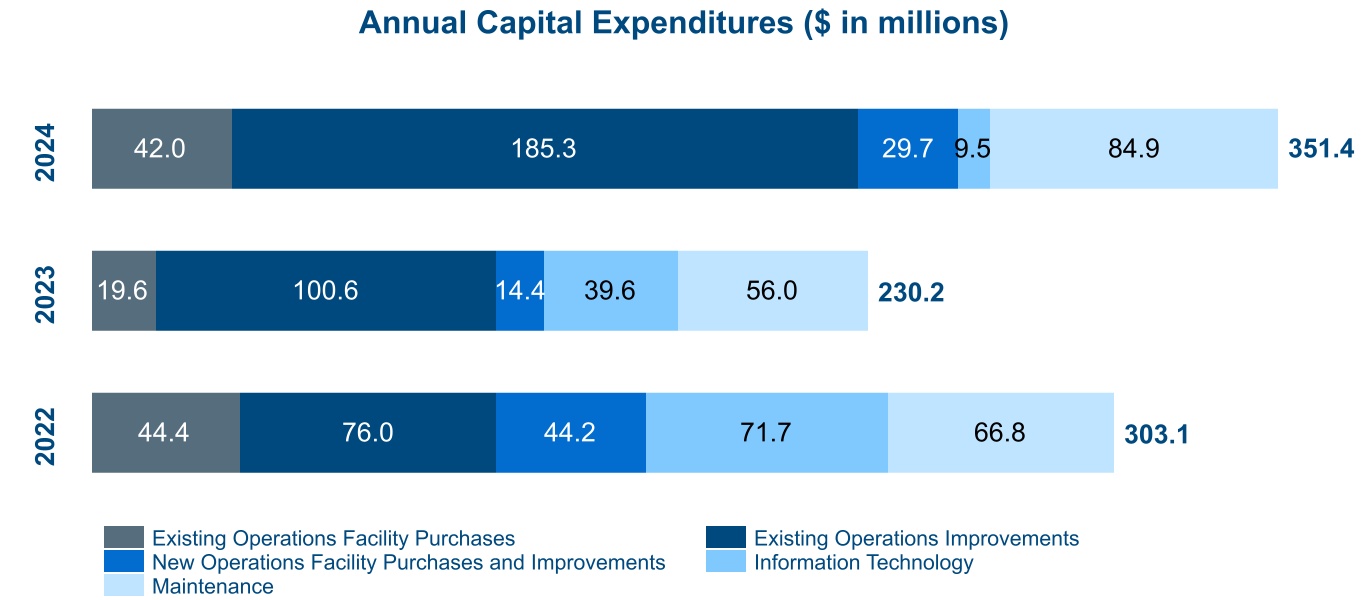
We manage our liquidity and available cash to support our long-term plan focused on growth through acquisitions and investments in our existing business, technology, and adjacencies that expand and diversify our business model. Our current free cash flow deployment strategy has shifted to an allocation of 35% to 45% investment in acquisitions, 25% investment in capital expenditures, innovation, and diversification and 30% to 40% in shareholder return in the form of dividends and share repurchases due to current valuation trends in acquisitions relative to stock price performance. During 2024, we utilized $351.4 million for capital expenditures investing in our existing business and paid $56.5 million in dividends. As of December 31, 2024, we had available liquidity of approximately $1.4 billion, which was comprised of $225.1 million in unrestricted cash, $53.4 million in marketable securities, and $1.1 billion availability on our credit facilities. In addition, our unfinanced real estate could provide additional liquidity of approximately $290.0 million.
Marketing
Lithia & Driveway’s core value, “Earn Customers for Life,” drives our marketing strategy to empower consumers throughout the vehicle ownership lifecycle. To place ease and value at our customers’ fingertips, we are constantly evolving the retail experience so customers can choose transparent, convenient ways to buy, sell, or service their vehicles wherever, whenever, and however they desire.
Our national, regional, and local brands connect with consumers through advertising tailored to the individual brand and market. Utilizing data and omnichannel communications, we strive to create deeper and richer offerings to build lifelong loyalty throughout the vehicle ownership lifecycle.
With a vast selection represented by the largest U.S. new and preowned vehicle inventory for sale online, we employ search engine optimization, search engine marketing, online display, retargeting, social advertising, traditional media, and direct marketing to reach consumers.
Most consumers begin their shopping, buying, or selling activity on our store websites, Driveway.com, and GreenCars.com. Our proprietary customer lifecycle communication platform targets specific stages in the shopping process or ownership lifecycle. In an industry where the competition often relies on third parties to manage their customer data, we manage our data internally. This strategy allows us to leverage our customer insights across many revenue streams and goes beyond automotive needs.
These online channels provide customers with simple, transparent ways to search new and used inventories, view current pricing, apply incentives and offers, calculate payments for purchase or lease, apply for financing, buy online, sell their vehicle, schedule service appointments both in store or at home, schedule vehicle pick-up and delivery, and provide us feedback about their experience.
Driveway, our online experience, puts customers in control of every aspect of their car ownership. They can browse a vast nationwide inventory of new, used, and certified pre-owned vehicles (CPO), and get their vehicle shipped straight to their driveway or pick it up at one of Lithia’s 290+ stores in the Driveway network. In 2024, we reduced our cost per order by 32.5% and our cost per acquisition by 96.3%, through relentlessly testing our media efficiency in conjunction with operational gains. Driveway provides a differentiated retail experience for customers who prefer the simplicity of online shopping and the optionality of home delivery. This platform allows us to significantly increase the geographic reach of our network.
With the industry transitioning to more sustainable practices and alternative-fuel vehicles, we are excited that GreenCars, our online education resource for sustainable mobility, had approximately 11.2 million unique visitors in 2024 at GreenCars.com, a 48% increase from 2023. GreenCars is a leading source of knowledge designed to promote the acceleration of electric vehicle adoption by educating the consumer on such topics as fuel-efficient offerings from model comparisons, personalized incentives, and local rebates to charging network. GreenCars connects consumers with the largest new-and-preowned inventory when they are ready to purchase a sustainable vehicle. GreenCars.com was an important part of the shopping and selection process for 19,000 vehicles across our dealer network in 2024.
Total advertising expense, net of manufacturer credits, was $250.7 million in 2024, $248.2 million in 2023 and $253.6 million in 2022. Over 89% of our advertising spent in 2024 was on digital, social, listings, and one-to-one owner communications. In all of our communications, we seek to convey the promise of a positive customer experience, competitive pricing, and wide selection. Our manufacturer partners influence a significant portion of our advertising expense. Certain advertising and marketing expenditures are offset by manufacturer cooperative programs, which require us to submit requests for reimbursement to manufacturers for qualifying advertising expenditures. These advertising credits are not tied to specific vehicles and are earned as qualifying expenses are incurred. These reimbursements are recognized as a reduction of advertising expense. Manufacturer cooperative advertising credits were $56.2 million in 2024, $54.2 million in 2023 and $46.3 million in 2022.
Franchise Agreements
Each of our stores operates under a separate franchise agreement with the manufacturer of the new vehicle brand it sells.
Typical vehicle franchise agreements specify the locations within a designated market area at which the store may sell vehicles and related products and perform approved services. The designation of the market areas and the allocation of new vehicles among stores are at the discretion of the manufacturer. Franchise agreements do not, however, guarantee exclusivity within a specified territory.
A franchise agreement may impose requirements on the store with respect to:
•facilities and equipment;
•inventories of vehicles and parts;
•minimum working capital;
•training of personnel; and
•performance standards for market share and customer satisfaction.
Each manufacturer closely monitors compliance with these requirements and requires each store to submit monthly financial statements. Franchise agreements also grant a store the right to use and display manufacturers’ trademarks, service marks and designs in the manner approved by each manufacturer.
We have determined the useful life of a franchise agreement is indefinite, even though certain franchise agreements are renewed after one to six years. In our experience, agreements are routinely renewed without substantial cost and there are legal remedies to help prevent termination. Certain franchise agreements have no termination date. In addition, state franchise laws protect franchised automotive retailers. Under certain laws, a manufacturer may not terminate or fail to renew a franchise without good cause or prevent any reasonable changes in the capital structure or financing of a store.
Our typical franchise agreement provides for early termination or non-renewal by the manufacturer upon:
•a change of management or ownership without manufacturer consent;
•insolvency or bankruptcy of the dealer;
•death or incapacity of the dealer/manager;
•conviction of a dealer/manager or owner of certain crimes;
•misrepresentation of certain sales or inventory information to the manufacturer;
•failure to adequately operate the store;
•failure to maintain any license, permit or authorization required for the conduct of business;
•poor market share; or
•low customer satisfaction index scores.
Franchise agreements generally provide for prior written notice before a franchise may be terminated under most circumstances. We also sign master framework agreements with most manufacturers that impose additional requirements. See Item 1A. Risk Factors.
Competition
The retail automotive business is highly competitive. Currently, there are nearly 17,000 new vehicle franchise dealers in the United States, 4,500 in the United Kingdom, and 3,500 in Canada. Many of these franchised dealers are independent stores managed by individuals, families or small retail groups. We compete primarily with other automotive retailers, both publicly- and privately-held and other used-only automotive retailers such as CarMax, Carvana, and Cazoo.
Vehicle manufacturers have designated specific marketing and sales areas within which only one dealer of a vehicle brand may operate. In addition, our franchise agreements typically limit our ability to acquire multiple dealerships of a given brand within a particular market area. Certain jurisdictional franchise laws also restrict us from relocating our dealerships, or establishing new dealerships of a particular brand, within any area that is served by another dealer with the same brand. To the extent that a market has multiple dealers of a particular brand, as certain markets we operate in do, we are subject to significant intra-brand competition.
We are larger and have more financial resources than most private automotive retailers with which we currently compete in the majority of our regional markets. We compete directly with retailers with similar or greater resources in our existing metro and non-metro markets. We also compete based on dealer reputation in the various markets. If we enter other new markets, we may face competitors that have access to greater financial resources or have strong brands. We do not have any cost advantage in purchasing new vehicles from manufacturers. We rely on advertising and merchandising, pricing, our customer guarantees and sales model, our sales expertise, service reputation, and the location of our stores to sell new vehicles.
Regulation
Automotive and Other Laws and Regulations
We operate in a highly regulated industry. A number of laws and regulations affect our business. In every jurisdiction in which we operate, we must obtain various licenses to operate our businesses, including dealer, sales and finance and insurance licenses issued by regulatory authorities. Numerous laws and regulations govern our business, including those relating to our sales, operations, financing, insurance, advertising and employment practices. These laws and regulations include jurisdictional franchise laws and regulations, consumer protection laws, privacy laws, escheatment laws, anti-money laundering laws and wage-hour, anti-discrimination, and other employment practices laws.
Our financing activities with customers are subject to numerous federal, state and local laws and regulations. In recent years, there has been an increase in activity related to oversight of consumer lending by the Consumer Financial Protection Bureau (CFPB), which has broad regulatory powers. The CFPB has supervisory authority over large non-bank auto finance companies, including DFC. The CFPB can use this authority to conduct supervisory examinations to ensure compliance with various federal consumer protection laws. The CFPB does not have direct authority over automotive dealers; however, its regulation of larger automotive finance companies and other financial institutions could affect our financing activities. Claims arising out of actual or alleged violations of law may be asserted against us or our stores by individuals, a class of individuals, or governmental entities. These claims may expose us to significant damages or other penalties, including revocation or suspension of our licenses to conduct store operations and fines.
The vehicles we sell are also subject to rules and regulations of various federal and state regulatory agencies.
Environmental, Health, and Safety Laws and Regulations
Our operations involve the use, handling, storage and contracting for recycling and/or disposal of materials such as motor oil and filters, transmission fluids, antifreeze, refrigerants, paints, thinners, batteries, cleaning products, lubricants, degreasing agents, tires and fuel. Consequently, our business is subject to a complex variety of federal, state, and local requirements that regulate the environment and public health and safety.
Most of our stores use above ground storage tanks, and, to a lesser extent, underground storage tanks, primarily for petroleum-based products. Storage tanks are subject to periodic testing, containment, upgrading and removal under the Resource Conservation and Recovery Act and its state law counterparts. Clean-up or other remedial action may be necessary in the event of leaks or other discharges from storage tanks or other sources. In addition, water quality protection programs under the federal Water Pollution Control Act (commonly known as the Clean Water Act), the Safe Drinking Water Act and comparable state and local programs govern certain discharges from our operations. Similarly, certain air emissions from operations, such as auto body painting, may be subject to the federal Clean Air Act and related state and local laws. Health and safety standards promulgated by the Occupational Safety and Health Administration of the U.S. Department of Labor and related state agencies also apply.
Certain stores may become a party to proceedings under the Comprehensive Environmental Response, Compensation, and Liability Act, or CERCLA, typically in connection with materials that were sent to former recycling, treatment and/or disposal facilities owned and operated by independent businesses. The remediation or clean-up of facilities where the release of a regulated hazardous substance occurred is required under CERCLA and other laws.
We incur certain costs to comply with environmental, health and safety laws and regulations in the ordinary course of our business. We do not anticipate, however, that the costs of compliance will have a material adverse effect on our business, results of operations, cash flows, or financial condition, although such outcome is possible given the nature of our operations and the extensive environmental, public health and safety regulatory framework. We may become aware of minor contamination at certain of our facilities, and we conduct investigations and remediation at properties as needed. In certain cases, the current or prior property owner may conduct the investigation and/or remediation or we have been indemnified by either the current or prior property owner for such contamination. We do not currently expect to incur significant costs for remediation. However, we cannot provide assurance that material environmental commitments or contingencies will not arise in the future, or that they do not already exist but are unknown to us. See Item 1A. Risk Factors.
Human Capital
Our Human Capital and Development strategy is guided by our mission of “Growth Powered by People.” We place a strong emphasis on the professional success, well-being, and safety of each team member. Our strategy for attracting, retaining, rewarding, and developing top talent involves setting clear expectations, offering exceptional training, and celebrating team member milestones and achievements. These initiatives are key to driving high performing results; allowing us to reach potential, earn customers for life, and grow through our dynamic teams. We cultivate an entrepreneurial, high-performance, customer-centric culture that supports internal promotions, skill development, and continuous professional growth opportunities. Our manage by thirds approach to talent management allows us to effectively and efficiently make people related decisions that drive us towards our shared goals.
As of December 31, 2024, our subsidiaries employed approximately 30,000 persons on a full-time equivalent basis in our global network of 459 retail locations. Our total workforce was comprised of approximately 22% female team members and approximately 41% of minorities. Our management consisted of approximately 23% females and approximately 28% minorities in leadership positions.
Some examples of our team member focused efforts include:
•The Lithia Partners Group (LPG), our flagship recognition program which has been running for over 10 years, continues to identify, recognize, and reward our top-performing Leaders. The LPG celebrates exceptional leaders who embody our core values and exemplify Loyalty, Potential, and Growth. These leaders serve as role models for organizational success and earn the prestigious title of LPG Winner—an honor that every team member aspires to achieve. LPG Winners gain access to exclusive events and
opportunities, designed to advance their careers, expand their professional networks, and foster continued personal and professional growth.
•In 2023, we launched a company-wide Culture Poll to amplify the team member voice. With an 80% participation rate, the survey revealed engagement scores surpassing benchmarks, indicating positive progress in creating a positive workplace experience that fosters team member loyalty. The survey also offered valuable insights, leading to the development of action plans by managers to address opportunities to “Improve Constantly.”
•Introduced in 2015, our Women LEAD (Learn, Explore, Achieve, and Develop) program offers a platform for women within the organization to connect, learn, and grow together. Featuring events throughout the year, the program facilitates networking, role modeling, and learning opportunities aimed to foster professional development.
•Originally launched in 2000 as a General Manager readiness cohort, our AMP (Accelerate My Potential) program has evolved to provide high potential leaders an opportunity to showcase General Manager competencies through targeted action plan development, cross-store exposure, and results oriented evaluation. These opportunities combined with coaching, networking, and strategy alignment discussions help accelerate leaders into key roles giving LAD a pipeline of ready candidates which drives internal promotion and growth.
•Our DART (Develop, Analyze, Research, and Transform) program started in 2020 as rotational program for early career talent to gain a diversity of exposure to various areas of the Organization. The DART program targets fact-based, customer-focused, proactive talent with leadership potential who will push our teams to be their best for our customers. DART participants learn the ins and outs of performance standards, gain on the job experience, and build relationships cross-functionally to accelerate their careers.
•Our learning and development initiatives are dedicated to promoting team member growth through curated content paths, specialized curriculums, and tuition reimbursement benefits covering up to 75% of undergraduate or graduate tuition costs. Additional programs provide Master Automotive Service Excellence (ASE) training and certification, along with manufacturer training for technicians.
As one of the largest global automotive retailers, we are committed to ongoing investments in expanding the roles and skills of our workforce to drive customer excellence and operational performance. As our business continues to evolve, our unwavering focus remains on ensuring that our human capital capabilities, systems, and processes are well-aligned with and in support of our strategic objectives and growth plans.
Seasonality and Quarterly Fluctuations
Our North American operations generally experience lower volumes in the first quarter of each year due to consumer purchasing patterns and inclement weather in certain of our markets. As a result, financial performance is expected to be lower during the first quarter than during the second, third, and fourth quarters of each fiscal year. Our U.K. operations generally experience higher volumes in the first and third quarter of each year, due primarily to new vehicle registration practices in the United Kingdom. We believe that interest rates, levels of consumer debt, consumer confidence and manufacturer sales incentives, as well as general economic conditions, also contribute to fluctuations in sales and operating results.
Available Information
We make available free of charge, on our website at www.lithiainvestorrelations.com, our annual reports on Form 10-K, quarterly reports on Form 10-Q, current reports on Form 8-K, and amendments to those reports filed or furnished pursuant to Section 13(a) or 15(d) of the Exchange Act, as soon as reasonably practicable after they are filed electronically with the SEC. The information found on our website is not part of this Annual Report on Form 10-K. You may also obtain copies of these reports by contacting Investor Relations at 877-331-3084.
Item 1A. Risk Factors
You should carefully consider the risks described below before making an investment decision. The risks described below are not the only ones facing our company. Additional risks not presently known to us, or that we currently deem immaterial, may also impair our business operations.
Risks Related to Our Business
The automotive retail industry is sensitive to changing economic conditions and various other factors. Our business and results of operations are substantially dependent on new vehicle sales levels in the United States and in our particular geographic markets and the level of gross profit margins that we can achieve on our sales of new vehicles, all of which are very difficult to predict.
Our business is heavily dependent on consumer demand and preferences. A downturn in overall levels of consumer spending may materially and adversely affect our revenues and gross profit margins. Retail vehicle sales are cyclical and historically have experienced periodic downturns characterized by weak demand. These cycles are often dependent on general economic conditions and consumer confidence, as well as the level of discretionary personal income and credit availability. Additionally, other economic factors, such as rising and sustained periods of high crude oil and fuel prices, may impact consumer demand and preferences. As we operate internationally, including across the United States, the United Kingdom, and Canada, changes in and the severity of economic conditions may vary by market. Economic conditions may be anemic for an extended period of time, or deteriorate in the future. This would have a material adverse effect on our retail business, particularly sales of new and used vehicles.
The economies of the United States, the United Kingdom, and Canada have recently experienced heightened inflationary pressures, impacting the costs of labor, fuel, and other costs. Additionally, interest rates remain significantly elevated above the rates available in 2021, which has impacted new and used vehicle sales and vehicle affordability due to the direct relationship between interest rates and monthly loan payments, a critical factor for many vehicle buyers, and the impact interest rates have on customers’ borrowing capacity and disposable income. Consumer demand may be further adversely impacted if interest rates continue to increase or are sustained at current levels. In an inflationary environment, depending on automotive industry and other economic conditions, we may be unable to raise prices to keep up with the rate of inflation, which would reduce our profit margins. A period of sustained inflationary and interest rate pressures could impact our profitability.
If new vehicle production exceeds the rate at which new vehicles are sold, our gross profit per vehicle could be adversely affected by this excess and any resulting changes in manufacturer incentive and marketing programs. See the risk factor “If manufacturers or distributors discontinue or change sales incentives, warranties, and other promotional programs, our business, results of operations, financial condition, and cash flows may be materially adversely affected” below. Economic conditions and the other factors described above may also materially adversely impact our parts and repair and maintenance aftersales, and automotive finance and insurance (F&I) products.
Natural disasters, adverse weather conditions, and public health emergencies can disrupt our business.
Our dealerships are in states and regions in the United States, the United Kingdom, and Canada in which actual or threatened natural disasters and severe weather events (such as hurricanes, earthquakes, fires, floods, landslides, wind and/or hail storms) or other extraordinary events have in the past, and may in the future, disrupt our dealership operations and impair the value of our dealership property. A disruption in our operations may adversely impact our business, results of operations, financial condition, and cash flows. In addition to business interruption, the automotive retailing business is subject to substantial risk of property loss due to the significant concentration of property at dealership locations. The exposure on any single claim under our property and casualty insurance, medical insurance, and workers’ compensation insurance varies based upon type of coverage. Our maximum exposure on any single claim is $5.5 million, subject to certain aggregate limit thresholds. Under our self-insurance programs, we retain various levels of aggregate loss limits, per claim deductibles and claims-handling expenses. Costs in excess of these retained risks may be insured under various contracts with third-party insurance carriers. As of December 31, 2024, we had total reserve amounts associated with these programs of $95.6 million.
The occurrence of public health emergencies or other extraordinary events, such as regional epidemics or a global pandemic, such as COVID-19, may adversely impact our business, results of operations, financial condition, and cash flows. The extent to which public health emergencies or other extraordinary events impact our business going forward will depend on factors such as the duration and scope of the event; governmental, business, and individuals' actions in response to the event; and the impact on economic activity, including the possibility of recession or financial market instability.
The automotive manufacturing supply chain spans the globe. As such, supply chain disruptions resulting from natural disasters, adverse weather events, or public health emergencies may affect the flow of inventory or parts to us or our manufacturing partners. Such disruptions could have a material adverse effect on our business, financial condition, results of operations, or cash flows.
Increasing competition among automotive retailers reduces our profit margins on vehicle sales and related businesses. Further, the use of the Internet, e-commerce, and digital technology in the car purchasing process could materially adversely affect us.
Vehicle retailing is a highly competitive business. Our competitors include publicly and privately-owned dealerships. Many of our competitors sell the same or similar makes of new and used vehicles that we offer in our markets at competitive prices. We do not have any cost advantage in purchasing new vehicles from manufacturers due to the volume of purchases or otherwise.
Our F&I business and other related businesses, which have higher margins than sales of new and used vehicles, are subject to strong competition from various financial institutions and others.
The Internet has become a significant part of the sales process in our industry. Customers are using the Internet to compare pricing for vehicles and related F&I services, which may further reduce margins for new and used vehicles and profits for related F&I services. If Internet new vehicle sales are allowed to be conducted without the involvement of franchised dealers, our business could be materially adversely affected. In addition, other franchise groups have aligned themselves with services offered on the Internet or are investing heavily in the development of their own Internet capabilities, which could materially adversely affect our business, results of operations, financial condition, and cash flows.
Our franchise agreements do not grant us the exclusive right to sell a manufacturer’s product within a given geographic area. Our revenues or profitability could be materially adversely affected if any of our manufacturers award franchises to others in the same markets where we operate or if existing franchised dealers increase their market share in our markets.
In addition, we may face increasingly significant competition as we strive to gain market share through acquisitions or otherwise. Our operating margins may decline over time as we expand into markets where we do not have a leading position or that operate under higher pressure on margins.
Changes to the automotive industry and consumer views on car ownership could materially adversely affect our business, results of operations, financial condition, and cash flows.
The automotive industry is predicted to experience rapid change in the years to come, including advances in electric vehicle production, driverless technology, and subscription business models. Certain manufacturers and governments have declared commitments to various electric vehicle and zero emissions goals, such as the state of California’s executive order to require all new cars and passenger trucks sold in the state to be zero-emission vehicles by 2035. In addition, the U.K. government has proposed a ban on the sale of gasoline engines in new cars and new vans that would take effect as early as 2030 and a ban on the sale of gasoline hybrid engines in new cars and new vans as early as 2035. The overall impact of these options on the automotive industry is uncertain, and may include costly compliance challenges and lower levels of new vehicle sales or sales through channels that do not include us.
Manufacturers continue to invest in increasing production and quality of electric vehicles, including Battery-Electric Vehicles (BEVs), Hybrid Electric Vehicles, and Plug-in Hybrid Electric Vehicles. BEVs generally require less maintenance than traditional cars and trucks. The effects of BEVs on the automotive industry are uncertain and may include reduced aftersales revenues, as well as changes in the level of sales of certain F&I products such as extended warranty and lifetime lube, oil and filter contracts.
Technological advances are also facilitating the development of driverless vehicles. The eventual timing of availability of driverless vehicles is uncertain due to regulatory requirements, technological hurdles, and uncertain consumer acceptance of these technologies. The effect of driverless vehicles on the automotive industry is uncertain and could include changes in the level of new and used vehicle sales, the price of new vehicles, and the role of franchised dealers, any of which could materially and adversely affect our business.
We compete in a dynamic industry, and we may invest significant resources to pursue strategies, develop new offerings, and enter into adjacent businesses that do not prove effective.
The vehicle retailing industry is experiencing significant changes as the expectations and behaviors of customers are shifting, and e-commerce and digital technology have become a more significant part of the sales process. We have made and may continue to make significant investments to drive the development of and support of e-commerce and digital technology capabilities, including the launch of Driveway, our e-commerce home solution, and DFC, our in-house consumer financing business. We have also recently invested in a dealer-management technology business and a fleet management business. Changes or additions to our offerings or businesses may not prove sufficiently profitable, attract, or engage our customers, and may reduce confidence in our brands, expose us to increased market or legal risks, subject us to new laws and regulations, or otherwise harm our business.
Customers may prefer other channels for vehicle sales and related F&I services, because they may offer different or superior platforms, or because customers find those platforms easier to use, faster, or more cost effective than our services. We may not successfully anticipate or keep pace with industry changes, and we have and may continue to invest considerable financial resources, personnel, or other resources to pursue strategies that do not ultimately prove effective. A failure to capture the anticipated benefits of such investments could harm our results of operations and financial condition.
A decline of affordable and available vehicle financing may adversely affect our vehicle sales.
A significant portion of buyers finance their vehicle purchases. The primary finance sources our customers use in connection with the purchase of a new or used vehicle are manufacturer captive finance companies, DFC, and sub-prime lenders. These consumer vehicle financing sources rely to a certain extent on financing markets and sources to provide the capital necessary to support their financing programs. In addition, these financing sources, including DFC, will occasionally change their loan underwriting criteria to alter the risk profile of their loan portfolio. In the event that the cost to customers to finance vehicles becomes more expensive, due to increases in interest rates by the financing sources or their sources of capital, lenders tighten their credit standards, or available vehicle financing declines, consumers may be unable or less willing to purchase vehicles, which could have a material adverse effect on our business, results of operations, financial condition, and cash flows.
Adverse conditions affecting one or more key manufacturers may negatively affect our business, results of operations, financial condition, and cash flows.
We depend on our manufacturers to provide a supply of vehicles which supports expected sales levels. Any event that adversely affects a manufacturer’s ability to timely deliver new vehicles may adversely affect us by reducing our supply of popular new vehicles, leading to lower sales in our stores during those periods than would otherwise occur. For example, the shortage of chip supply and labor disruptions in 2021 and 2022 caused a significant constraint in the supply of new vehicles resulting in reduced volumes and increased gross profit margins on retail vehicle sales. As new vehicle availability has improved, gross profit margins have been negatively impacted.
We depend on our manufacturers to deliver high-quality, defect-free vehicles. If a manufacturer experiences quality issues, our sales and financial performance may be adversely impacted. In addition, the discontinuance of a particular brand that is profitable to us could negatively impact our revenues and profitability.
Vehicle manufacturers would be adversely affected by economic downturns or recessions, adverse fluctuations in currency exchange rates, significant declines in the sales of their new vehicles, increases in interest rates, declines in their credit ratings, port closures, labor strikes or similar disruptions (including within their major suppliers), supply shortages or rising raw material costs, rising team member benefit costs, adverse publicity that may reduce consumer demand for their products, product defects, vehicle recall campaigns, litigation, poor product mix or unappealing vehicle design, or other adverse events. These and other risks could materially adversely affect any manufacturer and limit its ability to profitably design, market, produce or distribute new vehicles, which, in turn, could materially adversely affect our business, results of operations, financial condition, and cash flows.
We are subject to a concentration of risk in the event of financial distress, including potential reorganization or bankruptcy, of a major vehicle manufacturer. We purchase substantially all of our new vehicles from various manufacturers or distributors at the prevailing prices available to all franchised dealers. Our sales volume could be
materially adversely impacted by a manufacturer’s or distributor’s inability to supply our stores with an adequate supply of vehicles.
In the event of a manufacturer or distributor bankruptcy, we could be held liable for damages related to product liability claims, intellectual property suits or other legal actions. These legal actions are typically directed towards the vehicle manufacturer and it is customary for manufacturers to indemnify us from exposure related to any judgments associated with the claims. However, if damages could not be collected from the manufacturer or distributor, we could be named in lawsuits and judgments could be levied against us.
Many new manufacturers are entering the automotive industry. New companies have raised capital to produce fully electric vehicles or to license battery technology to existing manufacturers. Tesla and Rivian have demonstrated the ability to successfully introduce electric vehicles to the marketplace. Foreign manufacturers from China and India are producing significant volumes of new vehicles and are entering the United States and selecting partners to distribute their products. Because the automotive market in the United States is mature and the overall level of new vehicle sales may not increase in the coming years, the success of new competitors will likely be at the expense of other, established brands. This could have a material adverse impact on our success in the future.
Federal regulations around fuel economy standards and “greenhouse gas” emissions have continued to increase. New requirements may adversely affect any manufacturer’s ability to profitably design, market, produce, and distribute vehicles that comply with such regulations. We could be adversely impacted in our ability to market and sell these vehicles at affordable prices and in our ability to finance these inventories. These regulations could have a material adverse effect on our business, results of operations, financial condition, and cash flows.
If manufacturers or distributors discontinue or change sales incentives, warranties, and other promotional programs, our business, results of operations, financial condition, and cash flows may be materially adversely affected.
We depend upon the manufacturers and distributors for sales incentives, warranties, and other programs that are intended to promote new vehicle sales or supplement dealer income. Manufacturers and distributors routinely make changes to their incentive programs. Key incentive programs include:
•customer rebates;
•dealer incentives on new vehicles;
•special financing rates on certified, pre-owned vehicles; and
•below-market financing on new vehicles and special leasing terms.
Our financial condition could be materially adversely impacted by a discontinuation or change in our manufacturers’ or distributors’ incentive programs. In addition, certain manufacturers use criteria such as a dealership’s manufacturer-determined customer satisfaction index (CSI score), facility image compliance, team member training, digital marketing and parts purchase programs as factors governing participation in incentive programs. To the extent we do not meet minimum score requirements, we may be precluded from receiving certain incentives, which could materially adversely affect our business, results of operations, financial condition, and cash flows.
Franchised automotive retailers perform factory authorized service work and sell original replacement parts on vehicles covered by warranties issued by the automotive manufacturer. For the year ended December 31, 2024, approximately 24% of our aftersales revenue was for work covered by manufacturer warranties or manufacturer-sponsored maintenance services. To the extent a manufacturer reduces the labor rates or markup of replacement parts for such warranty work, our aftersales volume could be adversely affected.
The ability of our stores to make new vehicle sales depends in large part upon the franchise agreements with manufacturers and, therefore, any disruption or change in our relationships could impact our business.
We depend on the manufacturers to provide us with a desirable mix of new vehicles. The most popular vehicles usually produce the highest profit margins and are frequently in short supply. If we cannot obtain sufficient quantities of the most popular models, our profitability may be adversely affected. Sales of less desirable models may reduce our profit margins.
Each of our stores operates pursuant to a franchise agreement with each of the respective manufacturers for which it serves as franchisee. Each of our stores may obtain new vehicles from manufacturers, service vehicles, sell new vehicles, and display vehicle manufacturers’ brand only to the extent permitted under these agreements. As a result of the terms of our franchise agreements, manufacturers exert significant control over the day-to-day operations at our stores. Such agreements contain provisions for termination or non-renewal for a variety of causes, including service retention, facility compliance, customer satisfaction, and sales and financial performance. From time to time, certain of our stores have failed to comply with certain provisions of their franchise agreements, and we cannot ensure that our stores will be able to comply with these provisions in the future.
Our franchise agreements expire at various times, and there can be no assurances that we will be able to renew these agreements on a timely basis or on acceptable terms or at all. Actions taken by a manufacturer to exploit its bargaining position in negotiating the terms of renewals of franchise agreements or otherwise could also have a material adverse effect on our revenues and profitability. If a manufacturer terminates or fails to renew one or more of our significant franchise agreements or a large number of our franchise agreements, such action could have a material adverse effect on our business, results of operations, financial condition, and cash flows.
Our franchise agreements also specify that, except in certain situations, we cannot operate a franchise by another manufacturer in the same building as the manufacturer’s franchised store. This may require us to build new facilities at a significant cost. Moreover, our manufacturers generally require that the store meet defined image standards. These commitments could require us to make significant capital expenditures.
Our franchise agreements do not give us the exclusive right to a given geographic area. Manufacturers may be able to establish new franchises or relocate existing franchises, subject to applicable state franchise laws. The establishment of or relocation of franchises in our markets could have a material adverse effect on the business, financial condition, and results of operations of our stores in the market in which the action is taken.
Changes to manufacturer distribution models may disrupt the way we do business and impact our revenues and profitability.
Generally, state dealer laws restrict the ability of vehicle manufacturers to directly enter the retail market. Manufacturer lobbying efforts and lawsuits have led to the repeal or revision of these laws. For example, Tesla received a favorable ruling in certain states allowing direct to consumer sales and service. In addition, some states are considering introducing legislation to permit direct to consumer auto sales in certain circumstances, allowing additional electric vehicle manufacturers such as Rivian to enter the market. Other manufacturers, such as Scout have signaled a desire to commence a direct-to-consumer model. If manufacturers obtain the ability to directly retail vehicles in our markets, our role in the auto retail market would change and we could experience a loss of revenue and profits and could experience other negative impacts that have a material adverse effect on our business, results of operations, financial condition, and cash flows.
In addition, other changes by manufacturers to their distribution models may impact our operations in the United Kingdom. Certain manufacturers, such as Honda, Volvo, Volkswagen, Mercedes-Benz and Smart, have already transitioned to an agency model in the United Kingdom, whereby the consumer places an order directly with the manufacturer and names a preferred delivery dealer. We have such an agency relationship with Mercedes-Benz with our U.K. dealers. Other manufacturers have announced their intentions to transition to an agency model in coming years, including, among others, BMW, Ford, Jeep, Peugeot, Citroen, Jaguar and Land Rover. Under an agency model, our dealerships receive a fee for facilitating the sale by the manufacturer of a new vehicle but do not hold such vehicle in inventory. The agency model will reduce reported revenues (as only the fee we receive, and not the price of the vehicle, will be reported as revenue), reduce SG&A expenses, and reduce floorplan interest expense, although the other impacts to our results of operations remain uncertain. If manufacturers continue to transition to an agency model in the United Kingdom or another new model is implemented in the United Kingdom or other countries and regions in which we operate, including in the United States and Canada, for the sale of electric or other vehicles, it could negatively affect our revenues, results of operations, and financial condition.
Our indebtedness and lease obligations could materially adversely affect our financial health, limit our ability to finance future acquisitions and capital expenditures and prevent us from fulfilling our financial obligations. Much of our debt is secured by a substantial portion of our assets. Much of our debt has a variable interest rate component that may significantly increase our interest costs in a rising rate environment.
Our indebtedness and lease obligations could have important consequences to us, including the following:
•limitations on our ability to make acquisitions;
•impaired ability to obtain additional financing for acquisitions, capital expenditures, working capital or general corporate purposes;
•reduced funds available for our operations and other purposes, as a larger portion of our cash flow from operations would be dedicated to the payment of principal and interest on our indebtedness; and
•exposure to the risk of increasing interest rates as certain borrowings are, and will continue to be, at variable rates of interest.
In addition, our loan agreements and our senior note indentures contain covenants that limit our discretion with respect to business matters, including incurring additional debt, granting additional security interests in our assets, acquisition activity, disposing of assets, and other business matters. Other covenants are financial in nature, including current ratio, fixed charge coverage, and leverage ratio calculations. A breach of any of these covenants could result in a default under the applicable agreement. In addition, a default under one agreement could result in a default and acceleration of our repayment obligations under the other agreements under the cross-default provisions in such other agreements.
We have granted a security interest in a substantial portion of our assets to certain of our lenders and other secured parties, including those under our $6.0 billion syndicated credit facility and $1.1 billion CAD Canadian syndicated credit facility. If we default on our obligations under those agreements, the secured parties may be able to foreclose upon their security interests and otherwise be entitled to obtain or control those assets.
Certain debt agreements contain subjective acceleration clauses based on a lender deeming itself insecure or if a “material adverse change” in our business has occurred. If these clauses are implicated, and the lender declares that an event of default has occurred, the outstanding indebtedness would likely be immediately due and owing.
If these events were to occur, we may not be able to pay our debts or borrow sufficient funds to refinance them. Even if new financing were available, it may not be on terms acceptable to us. As a result of this risk, we could be forced to take actions that we otherwise would not take, or not take actions that we otherwise might take, in order to comply with these agreements.
In addition, the lenders’ obligations to make loans or other credit accommodations under certain credit agreements is subject to the satisfaction of certain conditions precedent including, for example, the satisfaction of financial covenants and conditions and that our representations and warranties in the agreement are true and correct in all material respects as of the date of the proposed credit extension. If any of the conditions precedent are not satisfied, we may not be able to request new loans or other credit accommodations under those credit facilities, which could have a material adverse impact on our business, results of operations, financial condition, and cash flows.
Additionally, at various times in the future, we will need to refinance portions of our debt. At the time we must refinance, the market for new debt, or our financial condition or asset valuations, might not be favorable. It is possible that financing to replace or renew our debt may be unfavorable, which would adversely affect our financial condition and results of operations. In certain cases, we may turn to equity or other alternative financing.
Our floor plan notes payable, credit facilities and a portion of our real estate debt are subject to variable interest rates. As of December 31, 2024, 66% of our total debt was variable rate. In the event interest rates increase, our borrowing costs may increase substantially. Additionally, fixed rate debt that matures may be renewed at interest rates significantly higher than current levels. As a result, this could have a material adverse impact on our business, results of operations, financial condition, and cash flows. We may use interest rate derivatives to hedge a portion of our variable rate debt, when appropriate, based upon market conditions. See Note 12 – Derivative Financial Instruments, related to current hedge activity.
We may experience greater credit losses in DFC’s portfolio of finance receivables than anticipated.
Customers who finance a vehicle purchase or lease a vehicle through a DFC auto loan or lease may be unable to repay the loans based on the original terms and that the fair value of the vehicles used as collateral against the loans may not be sufficient to ensure full repayment. Credit and residual value losses are an inherent risk of our finance receivable portfolio and could result in a material adverse effect on our results of operations.
We estimate an allowance for credit losses based on a variety of assumptions about DFC’s portfolio of finance receivables. Although management prepares an estimate it believes appropriate based on available information, this allowance for credit losses may not be a sufficient reserve for loan and lease losses. For example, sudden economic changes such as an economic downturn or a change in consumer spending may result in additional losses incurred that we did not estimate in our original allowance for credit losses. Losses in excess of our allowance for credit losses could have a material adverse effect on our business and results of operations.
The growth and success of our DFC business is dependent upon obtaining sufficient capital to grow our finance receivable portfolio.
Changes in the availability or cost of financing to support our finance receivable portfolio under DFC could adversely affect our results of operations. Our finance receivable portfolio is funded through a combination of free cash flows from operations and securitized funding, including asset-backed securitization. Changes in the condition of the asset backed securitization market may result in increased costs to access funds in the market or require us to explore new financing options to fund new auto loans and leases. In the event that there is no alternative financing available, we may be forced to pause our auto loan and lease financing business for a period of time. The impact of reducing or pausing our auto loan and lease financing business could result in a material adverse effect on our results of operations.
Technology and Cybersecurity Risks
Changes to the retail delivery model and increased e-commerce and omnichannel competition could adversely affect our business, results of operations, financial condition and cash flows.
The automotive industry is beginning to experience change and disruption in the retail delivery model, including growing competition in the used vehicle market from companies with a primarily online e-commerce business model. Competition in this market includes companies such as CarMax, Carvana, and Cazoo. In addition, larger traditional automotive retailers are transforming their models to support omnichannel retail experiences, providing consumers with vehicle purchasing experiences outside of the traditional brick and mortar automotive dealership model.
We continue to develop our own internal technology solutions to further expand the reach of the networks of service and delivery points in our geographic markets. We may face increased competition for market share with these other delivery models and omnichannel retailers over time which could materially and adversely affect our results of operations. There can be no assurance that our initiatives will be successful or that the amount we invest in these initiatives will result in our maintaining market share and continued or improved financial performance.
Breaches in our data security systems or in systems used by our vendor partners, including cyber-attacks or unauthorized data distribution by team members or affiliated vendors, or disruptions to access and connectivity of our information systems could impact our operations or result in the loss or misuse of customers’ proprietary information.
Our information technology systems are important to operating our business efficiently. We employ information technology systems, including websites, that allow for the secure handling and processing of customers’ proprietary information. The failure of our information technology systems, and those of our partner software and technology vendors, to perform as we anticipate could disrupt our business and could expose us to a risk of loss or misuse of this information, litigation and potential liability.
Aspects of our operations are subject to privacy, data use, and data security regulations, which impact the way we use and handle data. We collect, process, share, disclose, transfer, and otherwise use personal information about
identifiable individuals including, but not limited to, our customers, team members, partners, and vendors, and so are subject to U.S. and international laws and regulations, regarding data privacy and security such as the California Consumer Privacy Act and the U.K. General Data Protection Regulation. These laws impose comprehensive data privacy compliance obligations in relation to our processing of personal data, including providing privacy rights to the individuals whose data we process and introducing requirements to maintain policies, processes, and procedures regarding our data handing practices. Additionally, our expansion into Canada and the United Kingdom subjects us to additional privacy and security regulations which also impact the way we handle and secure data across borders.
Our internal and third-party systems have been and may in the future be subject to cyber-attacks, viruses, malicious software, ransomware, break-ins, theft, computer hacking, phishing, exploitation of system vulnerabilities or misconfigurations, team member error, or malfeasance or other security breaches or loss of service. We invest in commercially reasonable security technology to protect our data and business processes against many of these risks. We also purchase insurance to mitigate the potential financial impact of many of these risks. Despite the security measures we have in place, our facilities and systems, and those of our third-party service providers, could be vulnerable to security breaches, computer viruses, lost or misplaced data, programming errors, human errors, acts of vandalism, or other events. Any security breach or event resulting in the misappropriation, loss, or other unauthorized disclosure of confidential information, or degradation or loss of services provided by critical business systems, whether by us directly or our third-party service providers, or any other loss of access to such critical business systems, could adversely affect our business operations, sales, reputation with current and potential customers, associates or vendors, as well as other operational and financial impacts derived from investigations, litigation, imposition of penalties or other means. While we have policies and procedures in place for mitigating the impact of a cybersecurity event on our business, which adhere to widely recognized standards for managing cybersecurity risk, these policies and procedures may not ultimately be sufficient or otherwise as effective as intended to eliminate, or in some cases reduce or mitigate, the impact of a cybersecurity event on our business. For example, in June 2024, one of our third-party providers, Global CDK (CDK), suspended information systems used by us in response to a cybersecurity incident impacting CDK. While we activated our cyber incident response procedures as a result of the incident, we still experienced disruption to our business in North America, including to our CDK hosted dealer management system, which temporarily resulted in declines in same store sales during that time. For more information regarding our cybersecurity policies and procedures, see Item 1C. Cybersecurity
Regulatory Risks
Our dealerships and our new vehicle sales model may not be protected if state dealer laws are repealed or weakened, a manufacturer becomes bankrupt or there is a shift to other sales models.
State and provincial dealer laws generally provide that a manufacturer may not terminate or refuse to renew a franchise agreement unless it has first provided the dealer with written notice setting forth good cause and stating the grounds for termination or non-renewal. Certain U.S. state dealer laws allow dealers to file protests or petitions or attempt to comply with the manufacturer’s criteria within the notice period to avoid the termination or non-renewal. If dealer laws are repealed in the states where we operate, manufacturers may be able to terminate our franchises without providing advance notice, an opportunity to cure or a showing of good cause. In Canada, although laws differ by province, provincial law generally provides that both a manufacturer and dealer each has a common law and statutory duty of good faith and fair dealing in performance and enforcement of any franchise agreement. Disputes are generally handled through the National Automobile Dealer Arbitration Program (NADAP). If a manufacturer wished to terminate a franchise, there is no guaranty that we would win such a dispute. Without the protection of state and provincial dealer laws, it may also be more difficult to renew our franchise agreements upon expiration or on terms acceptable to us.
As evidenced by the bankruptcy proceedings of both Chrysler and GM in 2009, state dealer laws do not afford continued protection from manufacturer terminations or non-renewal of franchise agreements. No assurances can be given that a manufacturer will not seek protection under bankruptcy laws, or that, in this event, they will not seek to terminate franchise rights held by us.
Our U.K. dealerships are subject to different regulatory frameworks than our U.S. and Canada operations, and changes to these regulatory frameworks could negatively affect our results of operations.
The majority of our dealerships in the United Kingdom currently operate under franchise agreements with vehicle manufacturers, however, unlike in the United States, the United Kingdom generally does not have automotive dealership franchise laws and, as a result, our U.K. dealerships operate without these types of specific protections that exist in the United States. In addition, our U.K. dealerships are also subject to U.K. antitrust regulations prohibiting certain restrictions on the sale of new vehicles and spare parts and on the provision of repairs and maintenance. For instance, authorized dealers are generally able to, subject to manufacturer facility requirements, relocate or add additional facilities throughout the EU, offer multiple brands in the same facility, allow the operation of service facilities independent of new car sales facilities and ease restrictions on cross supplies (including on transfers of dealerships) between existing authorized dealers within the EU. However, under the EU Motor Vehicle Block Exemption Regulation, which was retained in U.K. law following the United Kingdom’s exit from the EU on January 31, 2020, certain restrictions on dealerships are permissible in franchise agreements provided certain conditions are met. In October 2022, the Competition and Markets Authority of the U.K. published recommendations to introduce an updated U.K. equivalent broadly similar to the EU Motor Vehicle Block Exemption Regulations, however, changes to these protections or rules could negatively affect our revenues, results of operations and financial condition.
Changes to laws or regulatory frameworks applicable to automotive consumer financing transactions could negatively affect our results of operations.
Auto finance agreements between consumers and finance lenders typically include amounts to be paid as commissions to the dealership of purchase. In October 2024, the U.K. Court of Appeals ruled that brokers, including car dealerships, could not lawfully receive commissions from finance lenders without obtaining the customer’s fully informed consent to the commission payments. This ruling is now on appeal to the Supreme Court of the United Kingdom. As a result of the appeals court ruling, car dealerships in the United Kingdom are now required to explicitly disclose to their customers the commissions they receive in connection with auto financing arrangements. In response to this ruling, several major finance lenders in the United Kingdom temporarily stopped underwriting new auto finance agreements to review their policies and practices and make any updates necessary to ensure compliance with the new requirements. While these lenders have resumed underwriting since, the initial pause caused significant disruption in the U.K. motor finance market and led to reduced sales volume. Because many of our customers in the United Kingdom rely on financing arrangements to purchase their vehicles from us, any additional judicial or legislative development that changes any of our or third parties’ obligations with respect to auto finance transactions could lead to further disruption that causes our U.K. sales volumes and related commissions to decline. Similarly, any law, regulation, or court ruling that has a similar impact with respect to auto finance transactions in the United States or Canada could lead to reduced sales volumes and related commissions in those regions. If our sales volume or commissions are reduced as a result of any such changes in the United Kingdom, the United States, or Canada, it could negatively affect our revenues, results of operations, and financial condition.
Import product restrictions, currency valuations, U.S. and foreign trade policies and risks may impair our ability to sell foreign vehicles or parts profitably.
A significant portion of the vehicles we sell are manufactured outside of the geographic regions in which we operate, and all of the vehicles we sell include parts manufactured outside of the geographic regions in which we operate. As a result, our operations are subject to customary risks of importing merchandise, including currency fluctuation, import duties, exchange rates, trade restrictions, work stoppages, transportation costs, natural or man-made disasters, and general political and socioeconomic conditions in other countries. The United States or the countries from which our products are imported, may, from time to time, impose new quotas, duties, tariffs or other restrictions, or adjust presently prevailing quotas, duties or tariffs, which may affect our operations and our ability to purchase imported vehicles and/or parts at reasonable prices. Changes in U.S. trade policies, including the U.S.-Mexico-Canada Agreement or policies intended to penalize foreign manufacturing or imports, and policies of foreign countries in reaction to those changes, could increase the prices we pay for some of the new vehicles and parts we sell. Any changes that increase the costs of vehicles and parts generally, to the extent passed on to customers, could negatively affect customer demand and our revenues and profitability. If not passed on to our customers, any cost increases will adversely affect our profitability. Any cost increase that disproportionately applies to manufacturers that sell to us could adversely affect our business compared to other vehicle retailers.
Our operations are subject to extensive governmental laws and regulations. If we are found to be in violation of or subject to liabilities under any of these laws, or if new laws or regulations are enacted that adversely affect our operations, our business, operating results, and prospects could suffer.
We are subject to federal, state, and local laws and regulations in the geographic regions in which we operate, such as those relating to franchising, motor vehicle sales, retail installment sales, leasing, F&I, marketing, licensing, consumer protection, consumer privacy, escheatment, anti-money laundering, environmental, vehicle emissions and fuel economy, and health and safety. In addition, with respect to employment practices, we are subject to various laws and regulations, including complex federal, state, and local wage and hour and anti-discrimination laws. New laws and regulations are enacted on an ongoing basis. With the number of stores we operate, the number of personnel we employ and the large volume of transactions we handle, it is possible that technical mistakes will be made. These regulations affect our profitability and require ongoing training. Current practices in stores may become prohibited. We are responsible for ensuring that continued compliance with laws is maintained. If there are unauthorized activities, the jurisdictional authorities have the power to impose civil penalties and sanctions, suspend or withdraw dealer licenses or take other actions. These actions could materially impair our activities or our ability to acquire new stores in those states where violations occurred. Further, private causes of action on behalf of individuals or a class of individuals could result in significant damages or injunctive relief.
We may be involved in legal proceedings arising from the conduct of our business, including litigation with customers, team member-related lawsuits, class actions, purported class actions and actions brought by or on behalf of governmental authorities. Claims arising out of actual or alleged violations of law may be asserted against us or any of our dealers by individuals, either individually or through class actions, or by governmental entities in civil or criminal investigations and proceedings. Such actions may expose us to substantial monetary damages and legal defense costs, injunctive relief, criminal and civil fines and penalties, and damage our reputation and sales.
Our financing activities are subject to federal truth-in-lending, consumer leasing, and equal credit opportunity laws and regulations, as well as motor vehicle finance laws, installment finance laws, insurance laws, usury laws and other installment sales laws and regulations. Some states regulate finance, documentation and administrative fees that may be charged in connection with vehicle sales. In recent years, private plaintiffs and state attorneys general in the United States have increased their scrutiny of advertising, sales, and F&I activities in the sale and leasing of motor vehicles. These activities have led many lenders to limit the amounts that may be charged to customers as fee income for these activities. If these or similar activities were to significantly restrict our ability to generate revenue from arranging financing for our customers, we could be adversely affected.
In the United Kingdom, the Financial Conduct Authority (FCA) regulates financial services firms and financial markets, including the practice of dealerships acting as the broker in arranging the financing for vehicle sales. The FCA is investigating the historic use of discretionary commission arrangements amid concerns that this practice may have been unfair to customers. We await the outcome of the FCA’s investigation which is expected sometime in 2025. Any regulatory or judicial outcome that ultimately results in the refund of historical commissions paid to us or that reduces the commissions paid to us could materially and adversely affect us.
If we or any of our team members at any individual dealership violate or are alleged to violate laws and regulations applicable to them or protecting consumers generally, we could be subject to individual claims or consumer class actions, administrative, civil or criminal investigations or actions and adverse publicity. Such actions could expose us to substantial monetary damages and legal defense costs, injunctive relief, and criminal and civil fines and penalties, including suspension or revocation of our licenses and franchises to conduct dealership operations.
Environmental laws and regulations govern, among other things, discharges into the air and water, storage of petroleum substances and chemicals, the handling and disposal of wastes and remediation of contamination arising from spills and releases. In addition, we may also have liability in connection with materials that were sent to third-party recycling, treatment and/or disposal facilities. Jurisdictional statutes impose liability for investigation and remediation of contamination without regard to fault or the legality of the conduct that contributed to the contamination. Similar to many of our competitors, we have incurred and expect to continue to incur capital and operating expenditures and other costs in complying with such statutes. In addition, we may be subject to broad liabilities arising out of contamination at our currently and formerly owned or operated facilities, at locations to which hazardous substances were transported from such facilities, and at such locations related to entities formerly affiliated with us. Although for some such potential liabilities we believe we are entitled to indemnification from other entities, we cannot assure you that such entities will view their obligations as we do or will be able or willing to satisfy them. Failure to comply with applicable laws and regulations, or significant additional expenditures required
to maintain compliance therewith, may have a material adverse effect on our business, results of operations, financial condition, cash flows, and prospects.
Structural and Organizational Risks
Our ability to increase revenues and profitability through acquisitions depends on our ability to acquire and successfully integrate new vehicle franchises.
The vehicle industry in the United States, the United Kingdom, and Canada is considered a mature industry in which minimal growth is expected in unit sales of new vehicles. Accordingly, a principal component of our growth strategy is to make dealership acquisitions in our existing markets and in new geographic markets. Restrictions by our manufacturers and limitations on our access to capital resources may directly or indirectly limit our ability to acquire additional dealerships. In addition, increased competition for acquisitions, including from other national, regional, and local dealership groups, and other strategic and financial buyers, some of which may have greater financial resources than us, could result in fewer acquisition opportunities for us and higher acquisition prices in the future.
We are required to obtain consent from the applicable manufacturer prior to the acquisition of a franchised store, which typically takes 60 to 90 days. In determining whether to approve an acquisition, a manufacturer considers factors including the number of such manufacturers’ stores currently owned, ownership of stores in contiguous markets, performance of existing stores, frequency of acquisitions, and our financial condition. In the past, manufacturers have not consented to our purchase of certain franchised stores and we cannot assure you that manufacturers will approve future acquisitions timely, if at all, which could significantly impair the execution of our acquisition strategy.
We make a substantial capital investment when we acquire dealerships. We finance acquisitions activity primarily with cash flows from our operations, borrowings under our credit arrangements, mortgage financing proceeds, and we may obtain financing from debt and equity capital market offerings. The size of our acquisition activity in recent years magnifies risks associated with debt service obligations. These risks include potential lower earnings per share, our inability to pay dividends and potential negative impacts to the debt covenants we negotiated under our credit agreement. In addition, issuances of equity securities could result in dilution to existing shareholders.
We face other risks commonly encountered with growth through acquisitions. These risks include, without limitation:
•failing to identify suitable acquisition candidates and negotiate acceptable terms;
•failing to assimilate the operations and personnel of acquired dealerships;
•straining our existing systems, procedures, structures and personnel, including by disrupting our ongoing business and diverting our management resources;
•failing to achieve expected performance levels;
•incurring significantly higher capital expenditures and operating expenses, including incurring additional facility renovation costs or other expenses required by the manufacturer;
•entering new, unfamiliar markets;
•encountering undiscovered liabilities and operational difficulties at acquired dealerships;
•failing to maintain uniform standards, controls, and policies;
•impairing relationships with team members, manufacturers, and customers; and
•overvaluing entities to be acquired.
Our failure to address these risks or other problems encountered in connection with our acquisitions could cause us to fail to realize the anticipated benefits of these acquisitions, cause us to incur unanticipated liabilities and otherwise harm our business. Any of these risks, if realized, could materially and adversely affect our business, financial condition, and results of operations.
Risks associated with our international operations may negatively affect our business, results of operations and, financial condition.
We operate dealerships in the United States, the United Kingdom, and Canada. While our operations outside of the United States currently represent less than 25% of our revenues, we anticipate that our international operations will expand. We face regulatory, operational, political, and economic risks and uncertainties with respect to our international operations that may be different from those in the United States. These risks may include, but are not limited to, the following:
•fluctuations in foreign currency translations within our financial statements driven by exchange rate volatility;
•inability to obtain or preserve franchise rights in the foreign countries in which we operate;
•changes in distribution models in the foreign countries in which we operate;
•compliance with changing laws and regulations;
•compliance with U.S. Foreign Corrupt Practices Act and other anti-corruption laws;
•wage inflation;
•treatment of revenue from international sources and changes to tax rules, including being subject to foreign tax laws;
•difficulties in managing foreign operations and dealing with different customs, practices, and local regulations with which we are less familiar;
•large uncertainties, timing delays, and expenses associated with tariffs, labor matters, import or export licenses, and other trade barriers; and
•changes in a country’s economic or political conditions, including inflation, recession, and interest rate fluctuations, and exposure to regional or global public health issues, pandemics, or epidemics, such as the outbreak of the COVID-19 pandemic.
The loss of key personnel or the failure to attract additional qualified management personnel could adversely affect our operations and growth.
Our success depends to a significant degree on the efforts and abilities of our senior management. Further, we have identified Bryan B. DeBoer in most of our store franchise agreements as the individual who controls the franchises and upon whose financial resources and management expertise the manufacturers may rely when awarding or approving the transfer of any franchise. If we lose these key personnel, our business may suffer.
In addition, as we expand into new markets and develop our digital e-commerce solutions, we will need to hire additional managers, engineers, data scientists, and other team members. The market for qualified team members in the automotive and technology-related industries is highly competitive and may subject us to increased labor costs during periods of low unemployment. The loss of the services of key team members or the inability to attract additional qualified personnel could have a material adverse effect on our business, results of operations, financial condition, and cash flows. In addition, the lack of qualified managers or other team members employed by potential acquisition candidates may limit our ability to consummate future acquisitions.
Risks Related to Investing in Our Common Stock
Oregon law and our Restated Articles of Incorporation may impede or discourage a takeover, which could impair the market price of our common stock.
We are an Oregon corporation, and certain provisions of Oregon law and our Restated Articles of Incorporation may have anti-takeover effects. These provisions could delay, defer or prevent a tender offer or takeover attempt that a shareholder might consider to be in his or her best interest. These provisions may also affect attempts that might result in a premium over the market price for the shares held by shareholders and may make removal of the incumbent management and directors more difficult, which, under certain circumstances, could reduce the market price of our common stock.
We may not be able to satisfy our debt obligations upon the occurrence of a change in control under our debt instruments.
Upon the occurrence of a change in control as defined in our credit agreement, the agent under the credit agreement will have the right to declare all outstanding obligations immediately due and payable and to terminate the availability of future advances to us. Upon the occurrence of a change in control, as defined in the indentures
governing our senior notes, the holders of our senior notes will have the right to require us to purchase all or any part of such holders’ notes at a price equal to 101% of the principal amount thereof, plus accrued and unpaid interest, if any. There can be no assurance that we would have sufficient resources available to satisfy all of our obligations under the credit agreement in the event of a change in control or fundamental change. In the event we were unable to satisfy these obligations, it could have a material adverse impact on our business and our common stock holders. A “change in control” as defined in our credit agreement includes, among other events, the acquisition by any person, or two or more persons acting in concert, in either case other than Lithia Holdings Company, L.L.C., Sidney B. DeBoer or Bryan B. DeBoer, of beneficial ownership (within the meaning of Rule 13d-3 of the SEC under the Securities Exchange Act of 1934) of 35% or more of the outstanding shares of our voting stock on a fully diluted basis.
Our issuance of preferred stock could adversely affect holders of common stock.
Our Board is authorized to issue a series of preferred stock without any action on the part of our holders of common stock. Our Board also has the power, without shareholder approval, to set the terms of any such series of preferred stock that may be issued, including voting powers, preferences over our common stock with respect to dividends or if we voluntarily or involuntarily dissolve or distribute our assets, and other terms. If we issue preferred stock in the future that has preference over our common stock with respect to the payment of dividends or upon our liquidation, dissolution or winding up, or if we issue preferred stock with voting rights that dilute the voting power of our common stock, the rights of holders of our common stock or the price of our common stock could be adversely affected.
Item 1C. Cybersecurity
Assessing, identifying, and managing material risks from cybersecurity threats
We are committed to maintaining robust cybersecurity practices to safeguard our information assets and ensure the confidentiality, integrity, and availability of our operations. We employ a comprehensive approach to assess, identify, and manage material risks arising from cybersecurity threats. The identification and oversight of material cybersecurity risks is included in continuous ERM Committee and Board meetings and reporting.
We complete regular cybersecurity assessments to identify potential vulnerabilities and threats, analyzing our infrastructure, systems, and data. Assessments are conducted both internally and by third parties and consider internal and external factors, technological changes, regulatory requirements, and emerging cyber threats. Our cybersecurity program adheres to widely recognized standards for managing cybersecurity risk, including the National Institute of Standards and Technology Cybersecurity Framework, Center for Internet Security Controls and U.K. Cyber Essentials.
We use advanced threat detection tools and technologies to identify potential cybersecurity risks. This includes continuous monitoring, intrusion detection systems, and anomaly detection mechanisms, to promptly identify any unusual activities or security breaches. Threat intelligence sharing with industry partners helps us stay informed about the latest cybersecurity threats.
We assess cybersecurity risks for their potential impact on our operations, data, and reputation. Risks are prioritized based on their severity and likelihood of occurrence before implementing appropriate controls, safeguards, and mitigation measures to address and manage these risks effectively.
We have developed a well-defined and frequently updated information security incident response plan that outlines procedures to be followed in the event of a cybersecurity incident. The plan is periodically drilled with incident response team members and includes robust processes for identification, categorization, escalation and reporting of incidents. Team members are regularly trained on key cybersecurity subjects to ensure awareness. In June 2024, a cybersecurity incident occurred involving CDK, a third-party provider of certain information systems used by us, that triggered our information security incident response plan. Although the incident disrupted our operations, we believe our response plan operated substantially as we intended and the incident did not materially impact our financial condition or results of operations. The incident, however, provided us an opportunity to test our response plan, refine our procedures and consider improvements.
While no company can or will be completely immune from cybersecurity threats, especially as they relate to vendors and government agencies that we rely on, we know of no cybersecurity incident that has or is likely to materially affect us, our business strategy, or our results of operations, or financial condition.
Board of Directors Cybersecurity Oversight
Our Board oversees our cybersecurity and data protection strategy and appoints a director to lead the Board’s efforts. Our Board is briefed on our cybersecurity posture, current and future risks and potential incidents or vulnerabilities on a quarterly basis. Board members and executives participate in engagements on cybersecurity, such as simulated cyber incident response and crisis management exercises. Our Board also regularly receives and reviews third-party cybersecurity assessments, which include assessments of our cyber maturity and cyber risk.
Management’s Assessment and Response to Material Risks from Cybersecurity Threats
Our information security team and its leadership have primary responsibility for assessing and managing cybersecurity risks, within the scope of the overall ERM Committee.
Our Senior Director of Information Security is responsible for identifying, assessing, and managing risks from cybersecurity threats. The Senior Director of Information Security manages our cybersecurity program and receives information regarding cybersecurity incidents and threats from our information security management team, through internal cyber risk management processes. The Senior Director of Information Security reports to the Chief Technology and Innovation Officer (CTIO) and provides frequent and up to date reporting on cyber risk to our ERM Committee, a cross functional executive-level steering group, which includes the CTIO and has a wealth of experience in enterprise risk. The ERM Committee meets on a quarterly basis or as necessary to assess and respond to enterprise risks, including cybersecurity, and reports updates to the Board.
The Senior Director of Information Security has over 10 years of experience in senior level information security roles, has over 20 years' experience in Fortune 500 enterprise IT roles, and holds Associate and Bachelor Degrees and the Certified Information Security Manager (CISM) Professional certification, amongst others. The members of our information security management team have extensive experience in technology and security roles, possessing cybersecurity certifications such as Certified Information Systems Security Professional (CISSP), Cisco Certified Network Professional (CCNP) and Global Certified Incident Handler (GCIH), amongst others."
Item 2. Properties
Our stores and other facilities consist primarily of vehicle showrooms, display lots, service facilities, collision repair and paint shops, supply facilities, vehicle storage lots, parking lots, and offices across the United States, the United Kingdom, and Canada. We believe our facilities are currently adequate for our needs and are in good repair. Some of our facilities do not currently meet manufacturer image or size requirements and we are actively working to find a mutually acceptable outcome in terms of timing and overall cost. We own our corporate headquarters in Medford, Oregon, and numerous other properties used in our operations. Certain of our owned properties are mortgaged or secured as part of commitments on our various real estate credit facilities. As of December 31, 2024, we had outstanding mortgage debt of $904.6 million, none outstanding on our real estate credit facilities, and $1.8 billion committed as part of availability on our working capital lines of credit. We also lease certain properties, providing future flexibility to relocate our retail stores as demographics, economics, traffic patterns or sales methods change. Most leases provide us the option to renew the lease for one or more lease extension periods. We also hold certain vacant facilities and undeveloped land for future expansion.
Item 3. Legal Proceedings
We are party to numerous legal proceedings arising in the normal course of our business. Although we do not anticipate that the resolution of legal proceedings arising in the normal course of business will have a material adverse effect on our business, results of operations, financial condition, or cash flows, we cannot predict this with certainty.
PART II
Item 5. Market for Registrant’s Common Equity, Related Stockholder Matters and Issuer Purchases of Equity Securities
Our common stock trades on the NYSE under the symbol LAD. The number of shareholders of record and approximate number of beneficial holders of common stock as of February 24, 2025 was 424 and 97,452, respectively.
Repurchases of Equity Securities
We made the following repurchases of our common stock during the fourth quarter of 2024:
|
|
|
|
|
|
|
|
|
|
|
|
|
|
|
|
|
|
|
|
|
|
|
|
|
|
|
| For the full calendar month of |
|
Total number of shares purchased (1) |
|
Average price paid per share |
|
Total number of shares purchased as part of publicly announced plan (2) |
|
Maximum dollar value of shares that may yet be purchased under publicly announced plan (in thousands) |
| October |
|
— |
|
|
$ |
— |
|
|
— |
|
|
$ |
560,867 |
|
| November |
|
70,233 |
|
|
374.70 |
|
|
70,147 |
|
|
534,579 |
|
| December |
|
173,324 |
|
|
378.25 |
|
|
173,324 |
|
|
469,020 |
|
| Total |
|
243,557 |
|
|
377.22 |
|
|
243,471 |
|
|
|
(1)86 shares repurchased in the fourth quarter of 2024 were related to tax withholding on the vesting of RSUs.
(2)On June 4, 2024, our Board approved an additional $350 million repurchase authorization of our common stock. This authorization was in addition to the amount previously authorized by the Board for repurchase. There is no expiration date for this share repurchase authorization.
Stock Performance Graph
The stock performance graph and table that follow compare the cumulative total stockholder return on Lithia Motors, Inc.’s common stock with the cumulative total return of the Standard & Poor’s 500 Stock Index (S&P 500 Index), and an auto peer group index composed of Penske Automotive Group, AutoNation, Sonic Automotive, Group 1 Automotive, Asbury Automotive Group, and CarMax for the five years ended December 31, 2024. The peer group indexes utilize the same methods of presentation and assumptions for the total return calculation as does Lithia Motors and the S&P 500 Index. All companies in the peer group indexes are weighted in accordance with their market capitalization.(1)
|
|
|
|
|
|
|
|
|
|
|
|
|
|
|
|
|
|
|
|
|
|
|
|
|
|
|
|
|
|
|
|
|
|
|
|
|
|
|
|
|
Base Period |
|
Indexed Returns for the Year Ended December 31, |
| Company/Index |
|
2019 |
|
2020 |
|
2021 |
|
2022 |
|
2023 |
|
2024 |
| Lithia Motors, Inc. |
|
$100.00 |
|
|
$ |
200.80 |
|
|
$ |
204.49 |
|
|
$ |
141.84 |
|
|
$ |
229.83 |
|
|
$ |
251.20 |
|
| S&P 500 Index - Total Return |
|
100.00 |
|
118.40 |
|
|
152.39 |
|
|
124.79 |
|
|
157.59 |
|
|
197.02 |
|
| Auto Peer Group |
|
100.00 |
|
128.09 |
|
|
178.97 |
|
|
134.01 |
|
|
187.12 |
|
|
204.20 |
|
(1)The graph and table assume that $100 was invested on the last day of trading for the calendar year ended December 31, 2019 in Lithia Motors, Inc’s common stock, the S&P 500 Index, and peer group indexes, and that all dividends were reinvested.
Item 7. Management’s Discussion and Analysis of Financial Condition and Results of Operations
You should read the following discussion in conjunction with Item 1. Business, Item 1A. Risk Factors, and our Consolidated Financial Statements and Notes thereto.
Overview
We are a global automotive retailer ranked #140 on the Fortune 500 in 2024. As of February 24, 2025, we offered 52 brands of new vehicles and all brands of used vehicles in 460 stores in the United States, the United Kingdom, and Canada and online at nearly 400 websites. We offer a wide range of products and services including new and used vehicles, F&I products, and vehicle repair and maintenance aftersales.
Financial Performance
We experienced growth of revenue in all major business lines in 2024 compared to 2023, primarily driven by increases in volume related to acquisitions, complemented by organic growth in new vehicles, and aftersales. Acquisition volume contributed to growth of our total company gross profit, offset by a decrease in new vehicle gross profit. On a same store basis, new and used vehicle retail gross profits experienced declines primarily driven by decreases in gross profit per unit as margins normalize to pre-pandemic levels. Net income decline was primarily driven by this margin normalization, increased interest expense, and increased SG&A as a percentage of gross profit.
Segments
We operate in two reportable segments: Vehicle Operations and Financing Operations. Our Vehicle Operations segment consists of all aspects of our auto merchandising and service operations, excluding financing provided by our Financing Operations segment. Our Financing Operations segment provides financing options to customers
buying and leasing retail vehicles from our Vehicle Operations segment, as well as leasing vehicles from our fleet management division.
Vehicle Operations
|
|
|
|
|
|
|
|
|
|
|
|
|
|
|
|
|
|
|
|
|
|
|
|
|
|
|
|
|
|
|
|
|
|
|
|
|
|
|
|
|
|
|
Year Ended December 31, |
|
|
|
|
|
2024 vs. 2023 |
|
|
|
2023 vs. 2022 |
| ($ in millions, except per vehicle data) |
2024 |
|
2023 |
|
Change |
|
% |
|
2022 |
|
Change |
|
% |
| Revenues |
|
|
|
|
|
|
|
|
|
|
|
|
|
| New vehicle retail |
$ |
17,553.8 |
|
|
$ |
15,154.2 |
|
|
$ |
2,399.6 |
|
|
15.8 |
% |
|
$ |
12,894.5 |
|
|
$ |
2,259.7 |
|
|
17.5 |
% |
| Used vehicle retail |
11,268.5 |
|
|
9,570.2 |
|
|
1,698.3 |
|
|
17.7 |
|
|
9,425.0 |
|
|
145.2 |
|
|
1.5 |
|
|
|
|
|
|
|
|
|
|
|
|
|
|
|
| Finance and insurance |
1,417.7 |
|
|
1,337.0 |
|
|
80.7 |
|
|
6.0 |
|
|
1,285.4 |
|
|
51.6 |
|
|
4.0 |
|
| Aftersales |
3,801.5 |
|
|
3,197.1 |
|
|
604.4 |
|
|
18.9 |
|
|
2,738.8 |
|
|
458.3 |
|
|
16.7 |
|
|
|
|
|
|
|
|
|
|
|
|
|
|
|
| Total revenues |
36,188.2 |
|
|
31,042.3 |
|
|
5,145.9 |
|
|
16.6 |
|
|
28,187.8 |
|
|
2,854.5 |
|
|
10.1 |
|
|
|
|
|
|
|
|
|
|
|
|
|
|
|
| Gross profit |
|
|
|
|
|
|
|
|
|
|
|
|
|
| New vehicle retail |
$ |
1,229.7 |
|
|
$ |
1,394.1 |
|
|
$ |
(164.4) |
|
|
(11.8) |
% |
|
$ |
1,579.7 |
|
|
$ |
(185.6) |
|
|
(11.7) |
% |
| Used vehicle retail |
728.6 |
|
|
721.4 |
|
|
7.2 |
|
|
1.0 |
|
|
825.4 |
|
|
(104.0) |
|
|
(12.6) |
|
|
|
|
|
|
|
|
|
|
|
|
|
|
|
| Finance and insurance |
1,417.7 |
|
|
1,337.0 |
|
|
80.7 |
|
|
6.0 |
|
|
1,285.4 |
|
|
51.6 |
|
|
4.0 |
|
| Aftersales |
2,122.9 |
|
|
1,751.4 |
|
|
371.5 |
|
|
21.2 |
|
|
1,463.1 |
|
|
288.3 |
|
|
19.7 |
|
|
|
|
|
|
|
|
|
|
|
|
|
|
|
| Total gross profit |
5,561.0 |
|
|
5,228.9 |
|
|
332.1 |
|
|
6.4 |
|
|
5,152.4 |
|
|
76.5 |
|
|
1.5 |
|
|
|
|
|
|
|
|
|
|
|
|
|
|
|
| Gross profit margins |
|
|
|
|
|
|
|
|
|
|
|
|
|
| New vehicle retail |
7.0 |
% |
|
9.2 |
% |
|
-220 bps |
|
|
|
12.3 |
% |
|
-310 bps |
|
|
| Used vehicle retail |
6.5 |
|
|
7.5 |
|
|
-100 bps |
|
|
|
8.8 |
|
|
-130 bps |
|
|
|
|
|
|
|
|
|
|
|
|
|
|
|
|
| Finance and insurance |
100.0 |
|
|
100.0 |
|
|
— bps |
|
|
|
100.0 |
|
|
— bps |
|
|
| Aftersales |
55.8 |
|
|
54.8 |
|
|
100 bps |
|
|
|
53.4 |
|
|
140 bps |
|
|
|
|
|
|
|
|
|
|
|
|
|
|
|
|
| Total gross profit margin |
15.4 |
|
|
16.8 |
|
|
-140 bps |
|
|
|
18.3 |
|
|
-150 bps |
|
|
|
|
|
|
|
|
|
|
|
|
|
|
|
|
| Retail units sold |
|
|
|
|
|
|
|
|
|
|
|
|
|
| New vehicle retail |
369,913 |
|
|
314,116 |
|
|
55,797 |
|
|
17.8 |
% |
|
271,596 |
|
|
42,520 |
|
|
15.7 |
% |
| Used vehicle retail |
411,925 |
|
|
325,764 |
|
|
86,161 |
|
|
26.4 |
|
|
311,764 |
|
|
14,000 |
|
|
4.5 |
|
|
|
|
|
|
|
|
|
|
|
|
|
|
|
| Average selling price per retail unit |
|
|
|
|
|
|
|
|
|
|
|
|
|
| New vehicle retail |
$ |
47,454 |
|
|
$ |
48,244 |
|
|
$ |
(790) |
|
|
(1.6) |
% |
|
$ |
47,477 |
|
|
$ |
767 |
|
|
1.6 |
% |
| Used vehicle retail |
27,356 |
|
|
29,378 |
|
|
(2,022) |
|
|
(6.9) |
|
|
30,231 |
|
|
(853) |
|
|
(2.8) |
|
|
|
|
|
|
|
|
|
|
|
|
|
|
|
| Average gross profit per retail unit |
|
|
|
|
|
|
|
|
|
|
|
|
|
| New vehicle retail |
$ |
3,324 |
|
|
$ |
4,438 |
|
|
$ |
(1,114) |
|
|
(25.1) |
% |
|
$ |
5,816 |
|
|
$ |
(1,378) |
|
|
(23.7) |
% |
| Used vehicle retail |
1,769 |
|
|
2,215 |
|
|
(446) |
|
|
(20.1) |
|
|
2,648 |
|
|
(433) |
|
|
(16.4) |
|
| Finance and insurance |
1,813 |
|
|
2,090 |
|
|
(277) |
|
|
(13.3) |
|
|
2,203 |
|
|
(113) |
|
|
(5.1) |
|
Total vehicle (1) |
4,310 |
|
|
5,367 |
|
|
(1,057) |
|
|
(19.7) |
|
|
6,300 |
|
|
(933) |
|
|
(14.8) |
|
(1)Includes the sales and gross profit related to new, used retail, used wholesale and F&I and unit sales for new and used retail
Same Store Operating Data
We believe that same store comparisons are an important indicator of our financial performance. Same store measures demonstrate our ability to grow operations in our existing locations. Therefore, we have integrated same store measures into the discussion below.
Same store measures reflect results for stores that were operating in each comparison period, and only include the months when operations occurred in both periods. For example, a store acquired in November 2023 would be included in same store operating data beginning in December 2024, after its first complete comparable month of operations. The fourth quarter operating results for the same store comparisons would include results for that store in only the period of December for both comparable periods.
|
|
|
|
|
|
|
|
|
|
|
|
|
|
|
|
|
|
|
|
|
|
|
|
|
|
|
|
|
|
|
|
|
|
|
|
|
|
|
|
|
|
|
|
|
|
|
|
|
Year Ended December 31, |
| ($ in millions, except per vehicle data) |
|
|
|
|
2024 vs. 2023 |
|
|
|
|
|
2023 vs. 2022 |
| 2024 |
|
2023 |
|
Change |
|
% |
|
2023 |
|
2022 |
|
Change |
|
% |
| Revenues |
|
|
|
|
|
|
|
|
|
|
|
|
|
|
|
| New vehicle retail |
$ |
15,150.8 |
|
|
$ |
14,884.6 |
|
|
$ |
266.2 |
|
|
1.8 |
% |
|
$ |
13,109.8 |
|
|
$ |
12,430.8 |
|
|
$ |
679.0 |
|
|
5.5 |
% |
| Used vehicle retail |
8,623.9 |
|
|
9,372.6 |
|
|
(748.7) |
|
|
(8.0) |
|
|
8,114.2 |
|
|
9,091.3 |
|
|
(977.1) |
|
|
(10.7) |
|
|
|
|
|
|
|
|
|
|
|
|
|
|
|
|
|
| Finance and insurance |
1,251.0 |
|
|
1,311.4 |
|
|
(60.4) |
|
|
(4.6) |
|
|
1,192.0 |
|
|
1,235.9 |
|
|
(43.9) |
|
|
(3.6) |
|
| Aftersales |
3,220.2 |
|
|
3,128.1 |
|
|
92.1 |
|
|
2.9 |
|
|
2,773.3 |
|
|
2,620.1 |
|
|
153.2 |
|
|
5.8 |
|
|
|
|
|
|
|
|
|
|
|
|
|
|
|
|
|
| Total revenues |
29,634.2 |
|
|
30,446.9 |
|
|
(812.7) |
|
|
(2.7) |
|
|
26,509.3 |
|
|
27,154.0 |
|
|
(644.7) |
|
|
(2.4) |
|
|
|
|
|
|
|
|
|
|
|
|
|
|
|
|
|
| Gross profit |
|
|
|
|
|
|
|
|
|
|
|
|
|
|
|
| New vehicle retail |
$ |
1,030.3 |
|
|
$ |
1,369.1 |
|
|
$ |
(338.8) |
|
|
(24.7) |
% |
|
$ |
1,198.3 |
|
|
$ |
1,527.5 |
|
|
$ |
(329.2) |
|
|
(21.6) |
% |
| Used vehicle retail |
638.4 |
|
|
707.7 |
|
|
(69.3) |
|
|
(9.8) |
|
|
610.3 |
|
|
792.8 |
|
|
(182.5) |
|
|
(23.0) |
|
|
|
|
|
|
|
|
|
|
|
|
|
|
|
|
|
| Finance and insurance |
1,251.0 |
|
|
1,311.4 |
|
|
(60.4) |
|
|
(4.6) |
|
|
1,192.0 |
|
|
1,235.9 |
|
|
(43.9) |
|
|
(3.6) |
|
| Aftersales |
1,799.2 |
|
|
1,719.0 |
|
|
80.2 |
|
|
4.7 |
|
|
1,519.2 |
|
|
1,407.7 |
|
|
111.5 |
|
|
7.9 |
|
|
|
|
|
|
|
|
|
|
|
|
|
|
|
|
|
| Total gross profit |
4,738.1 |
|
|
5,132.5 |
|
|
(394.4) |
|
|
(7.7) |
|
|
4,516.3 |
|
|
4,961.4 |
|
|
(445.1) |
|
|
(9.0) |
|
|
|
|
|
|
|
|
|
|
|
|
|
|
|
|
|
| Gross profit margins |
|
|
|
|
|
|
|
|
|
|
|
|
|
|
|
| New vehicle retail |
6.8 |
% |
|
9.2 |
% |
|
-240 bps |
|
|
|
9.1 |
% |
|
12.3 |
% |
|
-320 bps |
|
|
| Used vehicle retail |
7.4 |
|
|
7.6 |
|
|
-20 bps |
|
|
|
7.5 |
|
|
8.7 |
|
|
-120 bps |
|
|
|
|
|
|
|
|
|
|
|
|
|
|
|
|
|
|
| Finance and insurance |
100.0 |
|
|
100.0 |
|
|
— bps |
|
|
|
100.0 |
|
|
100.0 |
|
|
— bps |
|
|
| Aftersales |
55.9 |
|
|
55.0 |
|
|
90 bps |
|
|
|
54.8 |
|
|
53.7 |
|
|
110 bps |
|
|
|
|
|
|
|
|
|
|
|
|
|
|
|
|
|
|
| Total gross profit margin |
16.0 |
|
|
16.9 |
|
|
-90 bps |
|
|
|
17.0 |
|
|
18.3 |
|
|
-130 bps |
|
|
|
|
|
|
|
|
|
|
|
|
|
|
|
|
|
|
| Retail units sold |
|
|
|
|
|
|
|
|
|
|
|
|
|
|
|
| New vehicle retail |
315,728 |
|
|
308,662 |
|
|
7,066 |
|
|
2.3 |
% |
|
270,756 |
|
|
261,810 |
|
|
8,946 |
|
|
3.4 |
% |
| Used vehicle retail |
306,408 |
|
|
319,225 |
|
|
(12,817) |
|
|
(4.0) |
|
|
283,258 |
|
|
299,772 |
|
|
(16,514) |
|
|
(5.5) |
|
|
|
|
|
|
|
|
|
|
|
|
|
|
|
|
|
| Average selling price per retail unit |
|
|
|
|
|
|
|
|
|
|
|
|
|
|
|
| New vehicle retail |
$ |
47,987 |
|
|
$ |
48,223 |
|
|
$ |
(236) |
|
|
(0.5) |
% |
|
$ |
48,419 |
|
|
$ |
47,480 |
|
|
$ |
939 |
|
|
2.0 |
% |
| Used vehicle retail |
28,145 |
|
|
29,361 |
|
|
(1,216) |
|
|
(4.1) |
|
|
28,646 |
|
|
30,327 |
|
|
(1,681) |
|
|
(5.5) |
|
|
|
|
|
|
|
|
|
|
|
|
|
|
|
|
|
| Average gross profit per retail unit |
|
|
|
|
|
|
|
|
|
|
|
|
|
|
|
| New vehicle retail |
$ |
3,263 |
|
|
$ |
4,436 |
|
|
$ |
(1,173) |
|
|
(26.4) |
% |
|
$ |
4,426 |
|
|
$ |
5,834 |
|
|
$ |
(1,408) |
|
|
(24.1) |
% |
| Used vehicle retail |
2,084 |
|
|
2,217 |
|
|
(133) |
|
|
(6.0) |
|
|
2,154 |
|
|
2,645 |
|
|
(491) |
|
|
(18.6) |
|
| Finance and insurance |
2,011 |
|
|
2,089 |
|
|
(78) |
|
|
(3.7) |
|
|
2,152 |
|
|
2,201 |
|
|
(49) |
|
|
(2.2) |
|
Total vehicle (1) |
4,668 |
|
|
5,368 |
|
|
(700) |
|
|
(13.0) |
|
|
5,384 |
|
|
6,306 |
|
|
(922) |
|
|
(14.6) |
|
(1)Includes the sales and gross profit related to new, used retail, used wholesale and F&I and unit sales for new and used retail
New Vehicles
Under our business strategy, we believe that our new vehicle sales create incremental profit opportunities through certain manufacturer incentive programs, providing used vehicle inventory through trade-ins, arranging of third-party financing, vehicle service and insurance contracts, future resale of used vehicles acquired through trade-in, and parts and service aftersales.
2024 vs. 2023
New vehicle revenue grew 15.8%, resulting from a 17.8% increase in unit sales due to our accelerated growth through strategic acquisitions, offset by a 1.6% decrease in average selling prices. Same store new vehicle revenue was primarily impacted by a 2.3% increase in unit sales, offset by a decrease in average selling prices of 0.5%.
New vehicle gross profit declined 11.8%, primarily due to a 25.1% decrease in average gross profit per unit, partially offset by a 17.8% increase in unit sales driven by acquisitions. On a same store basis, gross profit per new vehicle decreased 26.4%, continuing to normalize to pre-pandemic levels.
2023 vs. 2022
New vehicle revenue grew 17.5%, resulting from a 15.7% increase in unit sales due to acquisitions, complemented by a 1.6% increase in average selling prices. Same store new vehicle revenue was primarily impacted by a 3.4% increase in unit sales, complemented by an increase in average selling prices of 2.0%.
New vehicle gross profit declined 11.7%, primarily due to a 23.7% decrease in average gross profit per unit, partially offset by a 15.7% increase in unit sales driven by acquisitions. On a same store basis, gross profit per new vehicle decreased 24.1%.
Used Vehicles
Used vehicle retail sales are a strategic focus for organic growth. We offer three categories of used vehicles: CPO vehicles; core vehicles, which are late-model vehicles with lower mileage; and value autos, which are vehicles with over 80,000 miles. We continue to focus on procuring vehicles across the full spectrum of the addressable used vehicle market to provide customers with a wide selection meeting all levels of affordability, driving increased used vehicle unit volumes. Our used vehicle operations provide an opportunity to generate sales to customers unable or unwilling to purchase a new vehicle, sell brands other than the store’s new vehicle franchise(s), access additional used vehicle inventory through trade-ins, and increase sales from F&I products and aftersales.
2024 vs. 2023
Used vehicle revenues increased 17.7%, due to increased volume from acquisitions, offset by decreased volume at our seasoned stores. On a same store basis, used vehicle revenues decreased 8.0%, due to a 4.1% decrease in average selling price per retail unit and a 4.0% decrease in unit volume. The same store revenue decrease was driven by a decrease in our CPO vehicle category of 10.0% and a decrease in our core vehicles of 8.3%, partially offset by an increase in our value autos of 1.4%. The decrease in our CPO vehicle category includes an 8.0% decrease in volume and a 2.2% decrease in average selling price per vehicle. The decrease in our core vehicle category includes a 5.8% decrease in volume and a 2.7% decrease in average selling price per vehicle.
Used vehicle gross profits increased 1.0%, due to an increase in unit volume of 26.4%, offset by a 20.1% decrease in average gross profit per unit. On a same store basis, used vehicle gross profit decreased 9.8%, led by a decrease in our CPO vehicles of 24.5% and decrease in our core vehicles of 5.4%, partially offset by an increase in our value auto category of 4.4%. The decrease in our CPO vehicle category was driven by a decrease in gross profit per unit of 18.0% to $2,138, and a decrease in unit volume of 8.0%. Gross profit per unit in our core vehicle category, which accounted for 55.3% of our used vehicle unit sales, increased 0.4% to $1,975. The increase in same store gross profit in our value auto category was driven by an increase in unit volume of 8.6%, offset by a 3.9% decrease in gross profit per unit to $2,331.
2023 vs. 2022
Used vehicle revenues increased 1.5%, due to increased volume from acquisitions, offset by decreased volume at our seasoned stores. Excluding the impact of acquisitions, on a same store basis, used vehicle revenues decreased 10.7%, due to a 5.5% decrease in average selling price per retail unit and 5.5% decrease in unit volume.
Used vehicle gross profits decreased 12.6%, due to a 16.4% decrease in average gross profit per unit, partially offset by a 4.5% increase in units sold. On a same store basis, used vehicle gross profit decreased 23.0%, led by a decrease in average gross profit per unit of 18.6%.
Third-Party Finance and Insurance
We believe that arranging timely vehicle financing is an important part of providing personal transportation solutions, and we attempt to arrange financing for every vehicle we sell. We also offer related products such as extended warranties, insurance contracts, and vehicle and theft protection. Third-party extended warranty and insurance contracts yield higher profit margins than vehicle sales and contribute significantly to our profitability.
2024 vs. 2023
F&I revenue increased 6.0%, primarily due to increased volume related to acquisitions. On a same store basis, F&I revenue decreased 4.6%, to $2,011 per unit. This decrease was driven by a decline in service contract penetration rates and lower finance reserve paid per unit from third-party lenders as a result of the higher interest rate environment.
2023 vs. 2022
F&I revenue increased 4.0%, primarily due to increased volume related to acquisitions. On a same store basis, F&I revenue decreased 3.6%, to $2,152 per unit.
Aftersales
We provide automotive repair and maintenance services for customers for the new vehicle brands sold by our stores, as well as service and repairs for most other makes and models. Our aftersales operations are an integral part of our customer retention and the largest contributor to our overall profitability. Earnings from aftersales have historically been more resilient during economic downturns, when owners have tended to repair their existing vehicles rather than buy new vehicles. With more late-model units in operation, continued increase of vehicles in operation, and a plateauing new vehicle market, we believe the increased number of units in operation will continue to benefit our aftersales revenue in the coming years as more late-model vehicles age, necessitating repairs and maintenance. We focus on retaining customers by offering competitively-priced routine maintenance and through our marketing efforts.
2024 vs. 2023
Our aftersales revenue growth was driven by increases in warranty and customer pay service work, primarily due to our strategic acquisition growth. On a same store basis, aftersales revenue increased 2.9%, primarily driven by an increase in warranty revenue of 14.0% and customer pay of 1.8%. Performance in body shop saw a decrease of
2.8%. Same store aftersales gross profit increased 4.7%. Our gross margins continue to increase as our mix has shifted towards customer pay and warranty, which has higher margins than other service work.
2023 vs. 2022
Aftersales revenue grew in all areas, primarily due to acquisition growth. On a same store basis, aftersales revenue and gross profit increased 5.8% and 7.9%, respectively.
Financing Operations
In the United States, Financing Operations is a captive lender, originating loans only from our stores and Driveway. In Canada, Financing Operations originates loans and leases from both our Canadian stores and third-party dealerships. In the United Kingdom, Financing Operations is related to our fleet funding and management division. These product offerings add diversity to the business model and provide an opportunity to capture additional profits, cash flows, and sales while managing our reliance on third-party finance sources.
Management regularly analyzes Financing Operations’ results by assessing profitability, the performance of the finance receivables, including trends in credit losses and delinquencies, and expenses directly related to Financing Operations. This information is used to assess Financing Operations performance and make operating decisions, including resource allocation.
Our proprietary credit model performs a return on investment (ROI) calculation for each application, ensuring that the return obtained is appropriately balanced with the consumer’s credit risk. On a fully discounted basis, we target earnings at least three times the net finance income earned from third party lenders (finance reserve less commissions paid) over the life of the finance receivable. Actual return of the finance receivables may differ based on the changing risk profile of originations, economic conditions, and rates of recovery for charged off vehicles. Actions taken during 2022 to adjust ROI targets in the context of the uncertain macroeconomic environment, along with the acquisition of dealerships whose brands attract relatively more credit-worthy consumers, resulted in finance receivables originated subsequently having higher weighted average credit scores and lower weighted average contract rate and front-end loan-to-values (FE LTV) than prior periods.
We typically use securitizations, warehouse facilities, third-party asset funding, and internal capital to fund finance receivables originated by our Financing Operations. Financing Operations income reflects the interest, fee, and lease income generated by the portfolio of finance receivables less the interest expense associated with the debt utilized to fund the lending, including internal capital, a provision for estimated losses, depreciation on vehicles leased via operating leases, and directly-related expenses.
Total interest margin reflects the spread between interest and fee charges to consumers and our funding costs. Changes in consumer rates on new originations affect Financing Operations income over time. Increases or decreases in interest rates, which affect Financing Operations’ funding costs, or other competitive pressures on consumer rates, could result in compression or expansion in the interest margin. Changes in the provision for losses as a percentage of ending managed receivables reflect the effect of changes in loss experience, economic factors, and asset-specific risks on our outlook for net losses expected to occur over the remaining contractual life of the finance receivables.
Financing Operations income does not include any allocation of corporate overhead costs. Although Financing Operations benefits from certain overhead expenditures, we have not allocated corporate overhead costs to Financing Operations to avoid making subjective allocation decisions. Examples of corporate overhead costs not allocated to Financing Operations include general corporate and data processing expenses.
See Note 19 – Segments for additional information on Financing Operations income and Note 5 – Finance Receivables of Notes to Consolidated Financial Statements for information on finance receivables, including credit quality.
Selected Financing Operations Financial Information
|
|
|
|
|
|
|
|
|
|
|
|
|
|
|
|
|
|
|
|
|
|
|
|
|
|
|
|
|
|
|
|
|
|
|
|
|
|
|
Year Ended December 31, |
| ($ in millions) |
2024 |
|
% (1) |
|
2023 |
|
% (1) |
|
2022 |
|
% (1) |
|
|
| Interest and fee income |
$ |
347.8 |
|
|
9.5 |
|
|
$ |
249.4 |
|
|
8.9 |
|
|
$ |
116.3 |
|
|
7.5 |
|
|
|
| Interest expense |
(195.1) |
|
|
(5.3) |
|
|
(170.5) |
|
|
(6.1) |
|
|
(52.2) |
|
|
(3.4) |
|
|
|
| Total interest margin |
152.7 |
|
|
4.2 |
|
|
78.9 |
|
|
2.8 |
|
|
64.1 |
|
|
4.2 |
|
|
|
| Lease income |
74.6 |
|
|
|
|
19.1 |
|
|
|
|
17.8 |
|
|
|
|
|
| Lease costs |
(60.3) |
|
|
|
|
(8.4) |
|
|
|
|
(9.5) |
|
|
|
|
|
| Lease income, net |
14.3 |
|
|
|
|
10.7 |
|
|
|
|
8.3 |
|
|
|
|
|
| Provision expense |
(106.7) |
|
|
(2.9) |
|
|
(98.8) |
|
|
(3.5) |
|
|
(44.4) |
|
|
(2.9) |
|
|
|
| Other financing operations expenses |
(44.9) |
|
|
|
|
(36.7) |
|
|
|
|
(32.0) |
|
|
|
|
|
| Financing operations (loss) income |
$ |
15.4 |
|
|
|
|
$ |
(45.9) |
|
|
|
|
$ |
(4.0) |
|
|
|
|
|
|
|
|
|
|
|
|
|
|
|
|
|
|
|
|
|
|
|
|
|
|
|
|
|
|
|
|
|
| Total average managed finance receivables |
$ |
3,659.9 |
|
|
|
|
$ |
2,802.8 |
|
|
|
|
$ |
1,542.6 |
|
|
|
|
|
(1)Percent of total average managed finance receivables.
DFC Portfolio Information(1)
|
|
|
|
|
|
|
|
|
|
|
|
|
|
|
|
|
|
|
Year Ended December 31, |
| ($ in millions) |
2024 |
|
2023 |
|
2022 |
| Loan origination information |
|
|
|
|
|
| Net loans originated |
$ |
2,073.3 |
|
|
$ |
2,118.5 |
|
|
$ |
1,933.9 |
|
| Vehicle units financed |
70,647 |
|
|
70,154 |
|
|
59,604 |
|
Total penetration rate (2) |
11.6 |
% |
|
11.0 |
% |
|
10.2 |
% |
| Weighted average contract rate |
9.8 |
% |
|
9.6 |
% |
|
7.7 |
% |
Weighted average credit score (3) |
738 |
|
|
732 |
|
|
718 |
|
Weighted average FE LTV (4) |
95.4 |
% |
|
95.5 |
% |
|
99.4 |
% |
Weighted average term (in months) |
73 |
|
|
73 |
|
|
73 |
|
|
|
|
|
|
|
| Loan performance information |
|
|
|
|
|
|
|
|
|
|
|
|
|
|
|
|
|
|
|
|
|
|
|
| Allowance for credit losses as a percentage of ending managed receivables |
3.2 |
% |
|
3.2 |
% |
|
3.1 |
% |
| Net credit losses on managed receivables |
88.0 |
|
|
62.0 |
|
|
42.9 |
|
| Net credit losses as a percentage of total average managed receivables |
2.5 |
% |
|
2.3 |
% |
|
3.0 |
% |
Past due accounts as a percentage of ending managed receivables (5) |
4.8 |
% |
|
4.6 |
% |
|
5.4 |
% |
Average recovery rate (6) |
44.3 |
% |
|
49.6 |
% |
|
59.3 |
% |
(1)Excludes Canadian and U.K. portfolios
(2)Units financed as a percentage of total U.S. new and used vehicle retail units sold.
(3)The credit scores represent FICO scores and reflect only receivables with obligors that have a FICO score at the time of application. For receivables with co-borrowers, the FICO score is the primary borrower’s. FICO scores are not a significant factor in our proprietary credit model, which relies on information from credit bureaus and other application information as discussed in Note 5 – Finance Receivables of Notes to Consolidated Financial Statements.
(4)Front-end loan-to-value represents the ratio of the amount financed to the total collateral value, which is measured as the vehicle selling price plus applicable taxes, title and fees.
(5)Past due is defined as loans that have been on the books greater than or equal to 3 months and are 30 or more days delinquent
(6)The average recovery rate represents the average percentage of the outstanding principal balance we receive when a vehicle is repossessed and liquidated, generally at wholesale auctions.
Financing operations income increased from 2023 to 2024 primarily due to increased contract rates on new originations and decreased funding costs as a percentage of average managed receivables, which increased net interest margin from 2.8% in 2023 to 4.2% in 2024, along with decreased provision expense as a percentage of average managed receivables. Given the increased seasoning of the portfolio and as origination levels were flat, there was less of a negative impact to results due to the upfront recognition of loss provisions on new receivables.
The increase in net credit losses was driven by the growth in the portfolio, as net credit losses as a percentage of total averaged managed receivables, along with delinquencies, were relatively consistent with the prior year.
The decline in the average recovery rate was driven by used vehicle price depreciation outpacing the amortization of the principal balance on loan principal balances, due to the relatively limited seasoning of the portfolio.
Operating Expenses
Selling, General, and Administrative
SG&A includes salaries and related personnel expenses, advertising (net of manufacturer cooperative advertising credits), rent, facility costs, and other general corporate expenses.
|
|
|
|
|
|
|
|
|
|
|
|
|
|
|
|
|
|
|
|
|
|
|
|
|
|
|
|
|
|
|
|
|
|
|
|
|
|
|
|
|
|
|
Year Ended December 31, |
|
|
|
|
|
2024 vs. 2023 |
|
|
|
2023 vs. 2022 |
| ($ in millions) |
2024 |
|
2023 |
|
Change |
|
% |
|
2022 |
|
Change |
|
% |
| Personnel |
$ |
2,394.3 |
|
|
$ |
2,163.1 |
|
|
$ |
231.2 |
|
|
10.7 |
% |
|
$ |
2,086.3 |
|
|
$ |
76.8 |
|
|
3.7 |
% |
| Rent and facility costs |
371.1 |
|
|
273.2 |
|
|
97.9 |
|
|
35.8 |
|
|
222.9 |
|
|
50.3 |
|
|
22.6 |
|
| Advertising |
250.7 |
|
|
248.2 |
|
|
2.5 |
|
|
1.0 |
|
|
253.6 |
|
|
(5.4) |
|
|
(2.1) |
|
| Other |
739.1 |
|
|
610.3 |
|
|
128.8 |
|
|
21.1 |
|
|
481.3 |
|
|
129.0 |
|
|
26.8 |
|
| Total SG&A |
$ |
3,755.2 |
|
|
$ |
3,294.8 |
|
|
$ |
460.4 |
|
|
14.0 |
% |
|
$ |
3,044.1 |
|
|
$ |
250.7 |
|
|
8.2 |
% |
|
|
|
|
|
|
|
|
|
|
|
|
|
|
|
|
|
|
|
|
|
|
|
|
|
|
|
|
|
|
|
Year Ended December 31, |
|
|
|
|
|
2024 vs. 2023 |
|
|
|
2023 vs. 2022 |
| As a % of gross profit |
2024 |
|
2023 |
|
Change |
|
2022 |
|
Change |
| Personnel |
43.1 |
% |
|
41.4 |
% |
|
170 |
bps |
|
40.5 |
% |
|
90 |
bps |
| Rent and facility costs |
6.7 |
|
|
5.2 |
|
|
150 |
|
|
4.3 |
|
|
90 |
|
| Advertising |
4.5 |
|
|
4.7 |
|
|
(20) |
|
|
4.9 |
|
|
(20) |
|
| Other |
13.2 |
|
|
11.7 |
|
|
150 |
|
|
9.4 |
|
|
230 |
|
| Total SG&A |
67.5 |
% |
|
63.0 |
% |
|
450 |
bps |
|
59.1 |
% |
|
390 |
bps |
2024 vs. 2023
SG&A increased 14.0%, or $460.4 million, primarily due to increased personnel and other costs resulting from our growth through acquisitions. Other expenses in 2024 included acquisition expenses of $10.0 million and $6.1 million of storm related insurance charges. We also recognized a gain on the disposal of stores of $8.2 million.
On a same store basis and excluding non-core charges, adjusted SG&A as a percentage of gross profit increased across all categories to 66.0% from 62.2% in the prior year.
2023 vs. 2022
SG&A increased 8.2%, or $250.7 million, primarily due to increased personnel costs and other costs which resulted from our growth through acquisitions. Other expenses in 2023 included acquisition expenses of $27.2 million, one-time contract buyouts of $14.3 million, and $5.4 million of storm related insurance charges, offset by a $31.2 million net gain on disposal of stores.
On a same store basis and excluding non-core charges, adjusted SG&A as a percentage of gross profit increased across all categories to 61.9% from 59.5% in the prior year. We also recognized a gain on the disposal of stores of $31.2 million.
SG&A adjusted for non-core charges was as follows:
|
|
|
|
|
|
|
|
|
|
|
|
|
|
|
|
|
|
|
|
|
|
|
|
|
|
|
|
|
|
|
|
|
|
|
|
|
|
|
|
|
|
|
Year Ended December 31, |
|
|
|
|
|
2024 vs. 2023 |
|
|
|
2023 vs. 2022 |
| ($ in millions) |
2024 |
|
2023 |
|
Change |
|
% |
|
2022 |
|
Change |
|
% |
| Personnel |
$ |
2,394.3 |
|
|
$ |
2,163.1 |
|
|
$ |
231.2 |
|
|
10.7 |
% |
|
$ |
2,086.3 |
|
|
$ |
76.8 |
|
|
3.7 |
% |
| Rent and facility costs |
371.1 |
|
|
273.1 |
|
|
98.0 |
|
|
35.9 |
|
|
222.9 |
|
|
50.2 |
|
|
22.5 |
|
| Advertising |
250.7 |
|
|
248.2 |
|
|
2.5 |
|
|
1.0 |
|
|
253.6 |
|
|
(5.4) |
|
|
(2.1) |
|
Adjusted other (1) |
731.2 |
|
|
594.7 |
|
|
136.5 |
|
|
23.0 |
|
|
527.4 |
|
|
67.3 |
|
|
12.8 |
|
Total adjusted SG&A (1) |
$ |
3,747.3 |
|
|
$ |
3,279.1 |
|
|
$ |
468.2 |
|
|
14.3 |
% |
|
$ |
3,090.2 |
|
|
$ |
188.9 |
|
|
6.1 |
% |
|
|
|
|
|
|
|
|
|
|
|
|
|
|
|
|
|
|
|
|
|
|
|
|
|
|
|
|
|
|
|
Year Ended December 31, |
|
|
|
|
|
2024 vs. 2023 |
|
|
|
2023 vs. 2022 |
| As a % of gross profit |
2024 |
|
2023 |
|
Change |
|
2022 |
|
Change |
| Personnel |
43.1 |
% |
|
41.4 |
% |
|
170 |
bps |
|
40.5 |
% |
|
90 |
bps |
| Rent and facility costs |
6.7 |
|
|
5.2 |
|
|
150 |
|
|
4.3 |
|
|
90 |
|
| Advertising |
4.5 |
|
|
4.7 |
|
|
(20) |
|
|
4.9 |
|
|
(20) |
|
Adjusted other (1) |
13.1 |
|
|
11.4 |
|
|
170 |
|
|
10.3 |
|
|
110 |
|
Total adjusted SG&A (1) |
67.4 |
% |
|
62.7 |
% |
|
470 |
bps |
|
60.0 |
% |
|
270 |
bps |
(1)See “Non-GAAP Reconciliations” for more details.
Floor Plan Interest Expense and Floor Plan Assistance
We have floor plan agreements with both manufacturer-affiliated finance companies and as part of our syndicated credit facilities for certain new and used vehicles. The interest rates on these floor plan notes payable commitments vary by lender and are variable rates.
2024 vs. 2023
Floor plan interest expense increased $127.9 million, primarily due to higher interest rates and increases in vehicle inventory levels from acquisitions. Floor plan interest expense increased 41.5% due to higher interest rates, 38.9% due to acquisition volume, and 4.4% due to increases in inventory at existing locations.
2023 vs. 2022
Floor plan interest expense increased $112.1 million, primarily due to higher interest rates, increases in vehicle inventory levels from acquisitions as well as existing locations recovering from prior year inventory shortages.
Floor plan assistance is provided by manufacturers to support store financing of vehicle inventory. Under accounting standards, floor plan assistance is recorded as a component of vehicle gross profit when the specific vehicle is sold. However, because manufacturers provide this assistance to offset inventory carrying costs, we believe a comparison of floor plan interest expense to floor plan assistance is a useful measure of the efficiency of our vehicle sales relative to stocking levels.
The following table details the carrying costs for vehicle inventory and include vehicle floor plan interest net of floor plan assistance earned:
|
|
|
|
|
|
|
|
|
|
|
|
|
|
|
|
|
|
|
|
|
|
|
|
|
|
|
|
|
|
|
|
|
|
|
|
|
|
|
|
|
|
|
Year Ended December 31, |
|
|
|
|
|
2024 vs. 2023 |
|
|
|
2023 vs. 2022 |
| ($ in millions) |
2024 |
|
2023 |
|
Change |
|
% |
|
2022 |
|
Change |
|
% |
| Floor plan interest expense |
$ |
278.8 |
|
|
$ |
150.9 |
|
|
$ |
127.9 |
|
|
84.8 |
% |
|
$ |
38.8 |
|
|
$ |
112.1 |
|
|
288.9 |
% |
| Floor plan assistance (included as an offset to cost of sales) |
(170.3) |
|
|
(160.8) |
|
|
(9.5) |
|
|
(5.9) |
|
|
(130.1) |
|
|
(30.7) |
|
|
(23.6) |
|
| Net vehicle carrying costs (benefit) |
$ |
108.5 |
|
|
$ |
(9.9) |
|
|
$ |
118.4 |
|
|
1,196.0 |
% |
|
$ |
(91.3) |
|
|
$ |
81.4 |
|
|
89.2 |
% |
Depreciation and Amortization
Depreciation and amortization is comprised of depreciation expense related to buildings, significant remodels or improvements, furniture, tools, equipment and signage and amortization related to non-compete agreements.
|
|
|
|
|
|
|
|
|
|
|
|
|
|
|
|
|
|
|
|
|
|
|
|
|
|
|
|
|
|
|
|
|
|
|
|
|
|
|
|
|
|
|
Year Ended December 31, |
|
|
|
|
|
2024 vs. 2023 |
|
|
|
2023 vs. 2022 |
| ($ in millions) |
2024 |
|
2023 |
|
Change |
|
% |
|
2022 |
|
Change |
|
% |
| Depreciation and amortization |
$ |
245.6 |
|
|
$ |
195.8 |
|
|
$ |
49.8 |
|
|
25.4 |
% |
|
$ |
163.2 |
|
|
$ |
32.6 |
|
|
20.0 |
% |
Acquisition activity contributed to the increases in depreciation and amortization in 2024 compared to 2023 and in 2023 compared to 2022. We acquired approximately $409.5 million and $260.5 million of depreciable property as part of our 2024 and 2023 acquisitions, respectively. Capital expenditures totaled $351.4 million and $230.2 million, respectively, in 2024 and 2023. These investments increase the amount of depreciable assets. See the discussion under “Liquidity and Capital Resources” for additional information.
Operating Income
Operating income as a percentage of revenue, or operating margin, was as follows:
|
|
|
|
|
|
|
|
|
|
|
|
|
|
|
|
|
|
|
|
|
|
|
|
|
Year Ended December 31, |
|
2024 |
|
|
|
|
2023 |
|
|
|
|
2022 |
| Operating margin |
4.4 |
% |
|
|
|
|
5.5 |
% |
|
|
|
|
6.9 |
% |
Operating margin adjusted for non-core charges (1) |
4.4 |
|
|
|
|
|
5.5 |
|
|
|
|
|
6.7 |
|
(1)See “Non-GAAP Reconciliations” for additional information
2024 vs. 2023
Our operating margin decreased 110 basis points compared to the prior year, driven by a decline in gross profit per new and used unit sold. Adjusting for non-core charges, including acquisition expenses and storm related insurance charges, offset by a net disposal gain on disposal of stores, our operating margin decreased 110 basis points.
2023 vs. 2022
Our operating margin decreased 140 basis points compared to the prior year, driven by an increase in SG&A as a percentage of gross profit. Adjusting for non-core charges, including acquisition expenses, one-time contract buyouts, and storm insurance charges, offset by a net disposal gain on disposal of stores, our operating margin decreased 120 basis points.
Non-Operating Expenses
Other Interest Expense
Other interest expense includes interest on debt incurred related to issued senior notes, real estate mortgages, our used and service loaner vehicle inventory financing commitments, and our revolving lines of credit.
|
|
|
|
|
|
|
|
|
|
|
|
|
|
|
|
|
|
|
|
|
|
|
|
|
|
|
|
|
|
|
|
|
|
|
|
|
|
|
|
|
|
|
Year Ended December 31, |
|
|
|
|
|
2024 vs. 2023 |
|
|
|
2023 vs. 2022 |
| ($ in millions) |
2024 |
|
2023 |
|
Change |
|
% |
|
2022 |
|
Change |
|
% |
| Senior notes interest |
$ |
76.1 |
|
|
$ |
76.1 |
|
|
$ |
— |
|
|
— |
% |
|
$ |
76.1 |
|
|
$ |
0.0 |
|
|
— |
% |
| Mortgage interest |
50.8 |
|
|
35.8 |
|
|
15.0 |
|
|
41.9 |
|
|
25.9 |
|
|
9.9 |
|
|
38.2 |
|
| Other interest |
136.3 |
|
|
91.9 |
|
|
44.4 |
|
|
48.3 |
|
|
29.7 |
|
|
62.2 |
|
|
209.4 |
|
| Capitalized interest |
(5.4) |
|
|
(2.6) |
|
|
(2.8) |
|
|
(107.7) |
|
|
(2.6) |
|
|
— |
|
|
— |
|
| Total other interest expense |
$ |
257.8 |
|
|
$ |
201.2 |
|
|
$ |
56.6 |
|
|
28.1 |
% |
|
$ |
129.1 |
|
|
$ |
72.1 |
|
|
55.8 |
% |
2024 vs. 2023
The increase in other interest expense was due to higher interest rates and increased borrowings on our credit facilities. See also Note 10 – Credit Facilities and Long-Term Debt of Notes to Consolidated Financial Statements for additional information.
2023 vs. 2022
The increase in other interest expense was due to higher interest rates and increased borrowings on our credit facilities.
Other Income (Expense), Net
Other income (expense), net primarily includes other income associated with investment income and other non-recurring transactions.
|
|
|
|
|
|
|
|
|
|
|
|
|
|
|
|
|
|
|
|
|
|
|
|
|
|
|
|
|
|
|
|
|
|
|
|
|
|
|
|
|
|
|
Year Ended December 31, |
|
|
|
|
|
2024 vs. 2023 |
|
|
|
2023 vs. 2022 |
| ($ in millions) |
2024 |
|
2023 |
|
Change |
|
% |
|
2022 |
|
Change |
|
% |
Other income (expense), net |
$ |
39.3 |
|
|
$ |
22.0 |
|
|
$ |
17.3 |
|
|
NM |
|
$ |
(43.2) |
|
|
$ |
65.2 |
|
|
NM |
2024 vs. 2023
Other income (expense), net increased $17.3 million in 2024 compared to 2023, primarily as a result of increases in equity method investment income and insurance proceeds, partially offset by foreign currency translation losses and reduced interest income from foreign currency deposit accounts.
2023 vs. 2022
Other income (expense), net increased $65.2 million in 2023 compared to 2022, primarily as a result of a reduction in equity method investment losses, foreign currency translation gains, and interest income from foreign currency deposit accounts.
Income Tax Provision
Our effective income tax rate was as follows:
|
|
|
|
|
|
|
|
|
|
|
|
|
|
|
|
|
|
|
Year Ended December 31, |
|
2024 |
|
2023 |
|
2022 |
| Effective income tax rate |
23.8 |
% |
|
25.7 |
% |
|
27.1 |
% |
Effective income tax rate excluding non-core items (1) |
24.7 |
|
|
25.3 |
|
|
27.0 |
|
(1)See “Non-GAAP Reconciliations” for more details
Our effective income tax rate was 23.8% for 2024 compared to 25.7% for 2023. Our effective income tax rate was positively affected by an increase in general business credits and a reduction in valuation allowance.
Adjusting for non-deductible acquisition costs and the benefit of transferable federal tax credits during 2024, our effective income tax rate excluding non-core items is 24.7%, a decrease of 60 basis points compared to the effective income tax rate excluding non-core items for 2023.
Our effective income tax rate in 2023 was positively affected by a reduction in the current and deferred state tax rate, due to changing state mix, and a reduction in valuation allowance. The decrease in tax rate was offset by non-deductible acquisition costs recorded during the period.
Global Implementation of Pillar Two
We are subject to corporation tax on profits in the United States, the United Kingdom, and Canada. The Organization for Economic Co-operation and Development (OECD) and the G20 Inclusive Framework on Base Erosion and Profit Shifting has developed the Pillar Two global minimum tax regime. The Pillar Two rules provide a coordinated system to ensure that multinational enterprises with revenues above €750 million pay a minimum effective tax rate of 15% on the income arising in each of the jurisdictions in which they operate.
On June 20, 2023, the U.K.’s Finance (No. 2) Bill 2023 was enacted, which represents the United Kingdom’s introduction of a Pillar Two regime, effective for annual reporting periods beginning on or after December 31, 2023. On August 4, 2023, Canada released draft legislation to implement the primary taxing rule in Pillar Two for fiscal periods beginning on or after December 31, 2023.
We analyzed the tax impact of the Pillar Two regime based on available guidance and determined these rules do not have a material impact on our overall effective tax rate.
Non-GAAP Reconciliations
Non-GAAP measures do not have definitions under GAAP and may be defined differently by and not comparable to similarly titled measures used by other companies. As a result, we review any non-GAAP financial measures in connection with a review of the most directly comparable measures calculated in accordance with GAAP. We caution you not to place undue reliance on such non-GAAP measures, but also to consider them with the most directly comparable GAAP measures. We believe each of the non-GAAP financial measures below improves the transparency of our disclosures, provides a meaningful presentation of our results from the core business operations because they exclude items not related to our ongoing core business operations and other non-cash items, and improves the period-to-period comparability of our results from the core business operations. We use these measures in conjunction with GAAP financial measures to assess our business, including our compliance with covenants in our credit facilities and in communications with our Board concerning financial performance. These measures should not be considered an alternative to GAAP measures.
The following tables reconcile certain reported non-GAAP measures to the most comparable GAAP measure from our Consolidated Statements of Operations:
|
|
|
|
|
|
|
|
|
|
|
|
|
|
|
|
|
|
|
|
|
|
|
|
|
|
|
|
|
|
|
|
|
|
|
|
|
|
|
|
|
|
|
|
|
|
|
Year Ended December 31, 2024 |
| ($ in millions, except per share amounts) |
As reported |
|
Net gain on disposal of stores |
|
|
|
|
|
Insurance reserves |
|
Acquisition expenses |
|
Premium on redeemable NCI buyout |
|
Tax attribute |
|
Adjusted |
|
|
|
|
|
|
|
|
|
|
|
|
|
|
|
|
|
|
| Selling, general and administrative |
$ |
3,755.2 |
|
|
$ |
8.2 |
|
|
|
|
|
|
$ |
(6.1) |
|
|
$ |
(10.0) |
|
|
$ |
— |
|
|
$ |
— |
|
|
$ |
3,747.3 |
|
| Operating income (loss) |
1,575.6 |
|
|
(8.2) |
|
|
|
|
|
|
6.1 |
|
|
10.0 |
|
|
— |
|
|
— |
|
|
1,583.5 |
|
|
|
|
|
|
|
|
|
|
|
|
|
|
|
|
|
|
|
|
|
|
|
|
|
|
|
|
|
|
|
|
|
|
|
|
|
| Income (loss) before income taxes |
$ |
1,078.3 |
|
|
$ |
(8.2) |
|
|
|
|
|
|
$ |
6.1 |
|
|
$ |
10.0 |
|
|
$ |
— |
|
|
$ |
— |
|
|
$ |
1,086.2 |
|
| Income tax (provision) benefit |
(256.7) |
|
|
4.1 |
|
|
|
|
|
|
(1.6) |
|
|
(0.5) |
|
|
— |
|
|
(13.1) |
|
|
(267.8) |
|
| Net income (loss) |
821.6 |
|
|
(4.1) |
|
|
|
|
|
|
4.5 |
|
|
9.5 |
|
|
— |
|
|
(13.1) |
|
|
818.4 |
|
| Net income attributable to non-controlling interest |
(4.8) |
|
|
— |
|
|
|
|
|
|
— |
|
|
— |
|
|
— |
|
|
— |
|
|
(4.8) |
|
| Net income attributable to redeemable non-controlling interest |
(14.8) |
|
|
— |
|
|
|
|
|
|
— |
|
|
— |
|
|
11.6 |
|
|
— |
|
|
(3.2) |
|
| Net income (loss) attributable to Lithia Motors, Inc. |
$ |
802.0 |
|
|
$ |
(4.1) |
|
|
|
|
|
|
$ |
4.5 |
|
|
$ |
9.5 |
|
|
$ |
11.6 |
|
|
$ |
(13.1) |
|
|
$ |
810.4 |
|
|
|
|
|
|
|
|
|
|
|
|
|
|
|
|
|
|
|
| Diluted earnings (loss) per share attributable to Lithia Motors, Inc. |
$ |
29.65 |
|
|
$ |
(0.15) |
|
|
|
|
|
|
$ |
0.17 |
|
|
$ |
0.35 |
|
|
$ |
0.43 |
|
|
$ |
(0.49) |
|
|
$ |
29.96 |
|
| Diluted share count |
27.1 |
|
|
|
|
|
|
|
|
|
|
|
|
|
|
|
|
|
|
|
|
|
|
|
|
|
|
|
|
|
|
|
|
|
|
|
|
|
|
|
|
|
|
|
|
|
|
|
|
|
|
|
|
|
|
|
|
|
|
|
|
Year Ended December 31, 2023 |
| ($ in millions, except per share amounts) |
As
reported |
|
Net gain on disposal of stores |
|
|
|
|
|
Insurance reserves |
|
Acquisition expenses |
|
Contract buyouts |
|
|
|
Adjusted |
|
|
|
|
|
|
|
|
|
|
|
|
|
|
|
|
|
|
| Selling, general and administrative |
$ |
3,294.8 |
|
|
$ |
31.2 |
|
|
|
|
|
|
$ |
(5.4) |
|
|
$ |
(27.2) |
|
|
$ |
(14.3) |
|
|
|
|
$ |
3,279.1 |
|
Operating income (loss) |
1,692.4 |
|
|
(31.2) |
|
|
|
|
|
|
5.4 |
|
|
27.2 |
|
|
14.3 |
|
|
|
|
1,708.1 |
|
|
|
|
|
|
|
|
|
|
|
|
|
|
|
|
|
|
|
|
|
|
|
|
|
|
|
|
|
|
|
|
|
|
|
|
|
Income (loss) before income taxes |
$ |
1,362.3 |
|
|
$ |
(31.2) |
|
|
|
|
|
|
$ |
5.4 |
|
|
$ |
27.2 |
|
|
$ |
14.3 |
|
|
|
|
$ |
1,378.0 |
|
| Income tax (provision) benefit |
(350.6) |
|
|
8.2 |
|
|
|
|
|
|
(1.4) |
|
|
(1.0) |
|
|
(3.8) |
|
|
|
|
(348.6) |
|
| Net income (loss) |
1,011.7 |
|
|
$ |
(23.0) |
|
|
|
|
|
|
4.0 |
|
|
26.2 |
|
|
10.5 |
|
|
|
|
1,029.4 |
|
| Net income attributable to non-controlling interest |
(6.5) |
|
|
— |
|
|
|
|
|
|
— |
|
|
— |
|
|
— |
|
|
|
|
(6.5) |
|
| Net income attributable to redeemable non-controlling interest |
(4.4) |
|
|
— |
|
|
|
|
|
|
— |
|
|
— |
|
|
— |
|
|
|
|
(4.4) |
|
| Net income (loss) attributable to Lithia Motors, Inc. |
$ |
1,000.8 |
|
|
$ |
(23.0) |
|
|
|
|
|
|
$ |
4.0 |
|
|
$ |
26.2 |
|
|
$ |
10.5 |
|
|
|
|
$ |
1,018.5 |
|
|
|
|
|
|
|
|
|
|
|
|
|
|
|
|
|
|
|
Diluted earnings (loss) per share attributable to Lithia Motors, Inc. |
$ |
36.29 |
|
|
$ |
(0.83) |
|
|
|
|
|
|
$ |
0.15 |
|
|
$ |
0.95 |
|
|
$ |
0.38 |
|
|
|
|
$ |
36.94 |
|
| Diluted share count |
27.6 |
|
|
|
|
|
|
|
|
|
|
|
|
|
|
|
|
|
|
|
|
|
|
|
|
|
|
|
|
|
|
|
|
|
|
|
|
|
|
|
|
|
|
|
|
|
|
|
|
|
|
|
|
|
|
|
|
Year Ended December 31, 2022 |
| ($ in millions, except per share amounts) |
As
reported |
|
Net gain on disposal of stores |
|
|
|
|
|
Insurance reserves |
|
Acquisition expenses |
|
|
|
|
|
Adjusted |
|
|
|
|
|
|
|
|
|
|
|
|
|
|
|
|
|
|
| Selling, general and administrative |
$ |
3,044.1 |
|
|
$ |
66.0 |
|
|
|
|
|
|
$ |
(4.9) |
|
|
$ |
(15.0) |
|
|
|
|
|
|
$ |
3,090.2 |
|
| Operating income (loss) |
1,941.1 |
|
|
(66.0) |
|
|
|
|
|
|
4.9 |
|
|
15.0 |
|
|
|
|
|
|
1,895.0 |
|
|
|
|
|
|
|
|
|
|
|
|
|
|
|
|
|
|
|
|
|
|
|
|
|
|
|
|
|
|
|
|
|
|
|
|
|
| Income (loss) before income taxes |
$ |
1,730.0 |
|
|
$ |
(66.0) |
|
|
|
|
|
|
$ |
4.9 |
|
|
$ |
15.0 |
|
|
|
|
|
|
$ |
1,683.9 |
|
| Income tax (provision) benefit |
(468.4) |
|
|
19.1 |
|
|
|
|
|
|
(1.3) |
|
|
(4.0) |
|
|
|
|
|
|
(454.6) |
|
| Net income (loss) |
1,261.6 |
|
|
(46.9) |
|
|
|
|
|
|
3.6 |
|
|
11.0 |
|
|
|
|
|
|
1,229.3 |
|
| Net income attributable to non-controlling interest |
(4.8) |
|
|
— |
|
|
|
|
|
|
— |
|
|
— |
|
|
|
|
|
|
(4.8) |
|
| Net income attributable to redeemable non-controlling interest |
(5.8) |
|
|
— |
|
|
|
|
|
|
— |
|
|
— |
|
|
|
|
|
|
(5.8) |
|
| Net income (loss) attributable to Lithia Motors, Inc. |
$ |
1,251.0 |
|
|
$ |
(46.9) |
|
|
|
|
|
|
$ |
3.6 |
|
|
$ |
11.0 |
|
|
|
|
|
|
$ |
1,218.7 |
|
|
|
|
|
|
|
|
|
|
|
|
|
|
|
|
|
|
|
| Diluted earnings per share attributable to Lithia Motors, Inc. |
$ |
44.17 |
|
|
$ |
(1.65) |
|
|
|
|
|
|
$ |
0.13 |
|
|
$ |
0.39 |
|
|
|
|
|
|
$ |
43.04 |
|
| Diluted share count |
28.3 |
|
|
|
|
|
|
|
|
|
|
|
|
|
|
|
|
|
Liquidity and Capital Resources
We manage our liquidity and capital resources in the context of our overall business strategy, continually forecasting and managing our cash, working capital balances, and capital structure to meet the short-term and long-term obligations of our business while maintaining liquidity and financial flexibility. Our free cash flow deployment strategy targets an allocation of 35% to 45% investment in acquisitions, 25% investment in capital expenditures, innovation, and diversification, and 30% to 40% in shareholder return in the form of dividends and share repurchases.
We believe we have sufficient sources of funding to meet our business requirements for the next 12 months and in the longer term. Cash flows from operations and borrowings under our credit facilities are our main sources for liquidity. In addition to the above sources of liquidity, potential sources to fund our business strategy include financing of real estate and proceeds from debt or equity offerings. We evaluate all of these options and may select one or more of them depending on overall capital needs and the availability and cost of capital, although no assurances can be provided that these capital sources will be available in sufficient amounts or with terms acceptable to us.
Available Sources
Below is a summary of our immediately available funds:
|
|
|
|
|
|
|
|
|
|
|
|
|
|
|
|
|
|
|
|
|
|
|
|
|
As of December 31, |
|
|
|
|
| ($ in millions) |
2024 |
|
2023 |
|
Change |
|
% Change |
| Cash and cash equivalents |
$ |
225.1 |
|
|
$ |
825.0 |
|
|
$ |
(599.9) |
|
|
(72.7) |
% |
| Marketable securities |
53.4 |
|
|
— |
|
|
53.4 |
|
|
NM |
| Available credit on the credit facilities |
1,075.3 |
|
|
870.4 |
|
|
204.9 |
|
|
23.5 |
% |
| Total current available funds |
$ |
1,353.8 |
|
|
$ |
1,695.4 |
|
|
$ |
(341.6) |
|
|
(20.1) |
% |
Information about our cash flows, by category, is presented in our Consolidated Statements of Cash Flows. The following table summarizes our cash flows:
|
|
|
|
|
|
|
|
|
|
|
|
|
|
|
|
|
|
|
Year Ended December 31, |
| ($ in millions) |
2024 |
|
2023 |
|
2022 |
Net cash provided by (used in) operating activities |
$ |
425.1 |
|
|
$ |
(472.4) |
|
|
$ |
(610.1) |
|
| Net cash used in investing activities |
(1,854.4) |
|
|
(1,270.3) |
|
|
(1,329.8) |
|
| Net cash provided by financing activities |
907.6 |
|
|
2,409.8 |
|
|
2,035.9 |
|
Operating Activities
Cash provided by operating activities increased $897.5 million in 2024 compared to 2023, primarily as a result of maturation of our financing receivables portfolio and a decrease in inventory levels at our seasoned stores, partially offset by net changes in floor plan notes payable and reduced net income.
Borrowings from and repayments to our syndicated credit facilities related to our new vehicle inventory floor plan financing are presented as financing activities. To better understand the impact of changes in inventory, other
assets, and the associated financing, we also consider our adjusted net cash provided by operating activities to include borrowings or repayments associated with our new vehicle floor plan commitment and exclude the impact of our financing receivables activity.
To better understand the impact of these items, adjusted net cash provided by operating activities, a non-GAAP measure, is presented below:
|
|
|
|
|
|
|
|
|
|
|
|
|
|
|
|
|
|
|
|
|
|
|
|
|
|
|
|
|
|
|
Year Ended December 31, |
|
|
|
|
|
2024 vs. 2023 |
|
|
|
2023 vs. 2022 |
| ($ in millions) |
2024 |
|
2023 |
|
Change |
|
2022 |
|
Change |
Net cash provided by (used in) operating activities – as reported |
$ |
425.1 |
|
|
(472.4) |
|
|
$ |
897.5 |
|
|
$ |
(610.1) |
|
|
$ |
137.7 |
|
Add: Net borrowings on floor plan notes payable: non-trade |
304.8 |
|
|
878.7 |
|
|
(573.9) |
|
|
737.9 |
|
|
140.8 |
|
| Less: Borrowings on floor plan notes payable: non-trade associated with acquired new vehicle inventory |
(105.5) |
|
|
(109.2) |
|
|
3.7 |
|
|
(116.5) |
|
|
7.3 |
|
| Adjust: Financing receivables activity |
629.4 |
|
|
1,052.0 |
|
|
(422.6) |
|
|
1,372.5 |
|
|
(320.5) |
|
| Net cash provided by operating activities – adjusted |
$ |
1,253.8 |
|
|
$ |
1,349.1 |
|
|
$ |
(95.3) |
|
|
$ |
1,383.8 |
|
|
$ |
(34.7) |
|
|
|
|
|
|
|
|
|
|
|
Inventories are one of the most significant components of our cash flow from operations. As of December 31, 2024, our new vehicle days’ supply was 59 days, or nine days higher than our days’ supply as of December 31, 2023. Our days’ supply of used vehicles was 53 days, which was eleven days higher than our days’ supply as of December 31, 2023. We calculate days’ supply of inventory on-ground inventory unit levels and a 30-day total units sales volume, both at the end of each reporting period. We have continued to focus on managing our unit mix and maintaining an appropriate level of new and used vehicle inventory.
Investing Activities
Net cash used in investing activities totaled $1.9 billion and $1.3 billion, respectively, for 2024 and 2023. Cash flows from investing activities relate primarily to capital expenditures, acquisition and divestiture activity and sales of property and equipment.
Below are highlights of significant activity related to our cash flows from investing activities:
|
|
|
|
|
|
|
|
|
|
|
|
|
|
|
|
|
|
|
|
|
|
|
|
|
|
|
|
|
|
|
Year Ended December 31, |
|
|
|
|
|
2024 vs. 2023 |
|
|
|
2023 vs. 2022 |
| ($ in millions) |
2024 |
|
2023 |
|
Change |
|
2022 |
|
Change |
| Capital expenditures |
$ |
(351.4) |
|
|
$ |
(230.2) |
|
|
$ |
(121.2) |
|
|
$ |
(303.1) |
|
|
$ |
72.9 |
|
| Cash paid for acquisitions, net of cash acquired |
(1,248.5) |
|
|
(1,185.1) |
|
|
(63.4) |
|
|
(1,243.6) |
|
|
58.5 |
|
| Cash paid for other investments |
(354.7) |
|
|
(11.1) |
|
|
(343.6) |
|
|
(11.8) |
|
|
0.7 |
|
| Proceeds from sales of stores |
85.7 |
|
|
142.9 |
|
|
(57.2) |
|
|
212.1 |
|
|
(69.2) |
|
Capital Expenditures
Below is a summary of our capital expenditure activities:
Many manufacturers provide assistance in the form of additional incentives or assistance if facilities meet manufacturer image standards and requirements. We expect that certain facility upgrades and remodels will generate additional manufacturer incentive payments. Also, tax laws allowing accelerated deductions for capital expenditures reduce the overall investment needed and encourage accelerated project timelines.
We expect to use a portion of our future capital expenditures to upgrade facilities that we recently acquired. This additional capital investment is contemplated in our initial evaluation of the investment return metrics applied to each acquisition and is usually associated with manufacturer image standards and requirements.
If we undertake a significant capital commitment in the future, we expect to pay for the commitment out of existing cash balances, construction financing and borrowings on our credit facilities. Upon completion of the projects, we believe we would have the ability to secure long-term financing and general borrowings from third party lenders for 70% to 90% of the amounts expended, although no assurances can be provided that these financings will be available to us in sufficient amounts or on terms acceptable to us.
Acquisitions
Growth through acquisitions is a key component of our long-term strategy that enables us to increase our network of locations, support maintaining a diverse franchise and geographic mix and improve our ability to serve customers through wider selection and improved proximity. Our disciplined approach focuses on acquiring new vehicle franchises that are accretive and cash flow positive at reasonable valuations.
We are able to subsequently floor new vehicle inventory acquired as part of an acquisition; however, the cash generated by these transactions are recorded as borrowings on floor plan notes payable, non-trade. Adjusted net cash paid for acquisitions, a non-GAAP measure, as well as certain other acquisition-related information is presented below:
|
|
|
|
|
|
|
|
|
|
|
|
|
|
|
|
|
|
|
Year Ended December 31, |
| ($ in millions) |
2024 |
|
2023 |
|
2022 |
| Number of stores acquired |
146 |
|
|
56 |
|
|
31 |
|
| Number of stores opened |
1 |
|
|
— |
|
|
1 |
|
|
|
|
|
|
|
|
|
|
|
|
|
| Cash paid for acquisitions, net of cash acquired |
$ |
(1,248.5) |
|
|
$ |
(1,185.1) |
|
|
$ |
(1,243.6) |
|
| Add: Borrowings on floor plan notes payable: non-trade associated with acquired new vehicle inventory |
105.5 |
|
|
109.2 |
|
|
116.5 |
|
| Cash paid for acquisitions, net of cash acquired – adjusted |
$ |
(1,143.0) |
|
|
$ |
(1,075.9) |
|
|
$ |
(1,127.1) |
|
We evaluate potential capital investments primarily based on targeted rates of return on assets and return on our net equity investment.
Financing Activities
Adjusted net cash provided by financing activities, a non-GAAP measure, which is adjusted for borrowings and repayments on floor plan facilities: non-trade and borrowings and repayments associated with our Financing Operations segment was as follows:
|
|
|
|
|
|
|
|
|
|
|
|
|
|
|
|
|
|
|
Year Ended December 31, |
| ($ in millions) |
2024 |
|
2023 |
|
2022 |
Cash provided by financing activities, as reported |
$ |
907.6 |
|
|
2,409.8 |
|
|
$ |
2,035.9 |
|
Less: Net borrowings on floor plan notes payable: non-trade |
(304.8) |
|
|
(878.7) |
|
|
(737.9) |
|
Less: Net borrowings on non-recourse notes payable |
(403.7) |
|
|
(1,283.4) |
|
|
(104.6) |
|
| Cash provided by financing activities, as adjusted |
$ |
199.1 |
|
|
$ |
247.7 |
|
|
$ |
1,193.4 |
|
|
|
|
|
|
|
|
|
|
|
|
|
Below are highlights of significant activity related to our cash flows from financing activities, excluding borrowings and repayments on floor plan notes payable: non-trade and non-recourse notes payable, which are discussed above:
|
|
|
|
|
|
|
|
|
|
|
|
|
|
|
|
|
|
|
|
|
|
|
|
|
|
|
|
|
|
|
Year Ended December 31, |
|
|
|
|
|
2024 vs. 2023 |
|
|
|
2023 vs. 2022 |
| ($ in millions) |
2024 |
|
2023 |
|
Change |
|
2022 |
|
Change |
Net borrowings on lines of credit |
$ |
346.8 |
|
|
$ |
324.3 |
|
|
$ |
22.5 |
|
|
$ |
2,023.8 |
|
|
$ |
(1,699.5) |
|
| Principal payments on long-term debt and finance lease liabilities, scheduled |
(64.9) |
|
|
(35.2) |
|
|
(29.7) |
|
|
(51.2) |
|
|
16.0 |
|
| Principal payments on long-term debt and finance lease liabilities, other |
(74.3) |
|
|
(10.6) |
|
|
(63.7) |
|
|
(171.7) |
|
|
161.1 |
|
| Proceeds from the issuance of long-term debt |
408.2 |
|
|
79.8 |
|
|
328.4 |
|
|
113.3 |
|
|
(33.5) |
|
| Proceeds from the issuance of common stock |
27.3 |
|
|
29.7 |
|
|
(2.4) |
|
|
36.1 |
|
|
(6.4) |
|
| Payment of debt issuance costs |
(10.7) |
|
|
(16.7) |
|
|
6.0 |
|
|
(11.8) |
|
|
(4.9) |
|
| Repurchases of common stock |
(365.9) |
|
|
(48.9) |
|
|
(317.0) |
|
|
(688.3) |
|
|
639.4 |
|
| Dividends paid |
(56.5) |
|
|
(52.8) |
|
|
(3.7) |
|
|
(45.2) |
|
|
(7.6) |
|
| Other financing activity |
0.8 |
|
|
(7.9) |
|
|
8.7 |
|
|
(4.4) |
|
|
(3.5) |
|
Borrowing and Repayment Activity
During 2024, we raised net proceeds of $408.2 million through the issuance of debt, and had net borrowings of $346.8 million on our lines of credit. These funds were primarily used for acquisitions, share repurchases and capital expenditures.
Our debt to total capital ratio, excluding floor plan notes payable and non-recourse notes payable, was 48.4% at December 31, 2024 compared to 47.1% at December 31, 2023.
Equity Transactions
During 2024, we repurchased 1,229,503 shares at a weighted average price of $283.02 under our current share repurchase authorization, with $469.0 million remaining.
During 2024, we paid dividends on our common stock as follows:
|
|
|
|
|
|
|
|
|
|
|
|
|
|
|
| Dividend paid: |
|
Dividend amount per share |
|
Total amount of dividends paid ($ in millions) |
| March 2024 |
|
$ |
0.50 |
|
|
$ |
13.8 |
|
| May 2024 |
|
0.53 |
|
|
14.4 |
|
| August 2024 |
|
0.53 |
|
|
14.2 |
|
| November 2024 |
|
0.53 |
|
|
14.1 |
|
We evaluate performance and make a recommendation to the Board on dividend payments on a quarterly basis.
Summary of Outstanding Balances on Credit Facilities and Long-Term Debt
Below is a summary of our outstanding balances on credit facilities and long-term debt:
|
|
|
|
|
|
|
|
|
|
|
|
|
|
|
| ($ in millions) |
Outstanding as of December 31, 2024 |
|
Remaining Available as of December 31, 2024 |
|
| Floor plan notes payable: non-trade |
$ |
2,848.0 |
|
|
$ |
— |
|
(1) |
| Floor plan notes payable |
2,055.1 |
|
|
— |
|
|
| Used and service loaner vehicle inventory financing commitments |
975.3 |
|
|
23.3 |
|
(2) |
| Revolving lines of credit |
1,633.2 |
|
|
1,034.6 |
|
(2),(3) |
| Warehouse facilities |
834.0 |
|
|
17.4 |
|
(2) |
Non-recourse notes payable |
2,109.3 |
|
|
— |
|
|
| 4.625% Senior notes due 2027 |
400.0 |
|
|
— |
|
|
| 4.375% Senior notes due 2031 |
550.0 |
|
|
— |
|
|
| 3.875% Senior notes due 2029 |
800.0 |
|
|
— |
|
|
Real estate mortgages, finance lease obligations, and other debt |
1,085.9 |
|
|
— |
|
|
| Unamortized debt issuance costs |
(25.1) |
|
|
— |
|
(4) |
| Total debt |
$ |
13,265.7 |
|
|
$ |
1,075.3 |
|
|
(1)As of December 31, 2024, we had a $2.8 billion new vehicle floor plan commitment as part of our USB credit facility, and a $1.1 billion CAD wholesale floorplan commitment as part of our BNS credit facility.
(2)The amounts available on the credit facilities are limited based on borrowing base calculations and fluctuate monthly.
(3)Available credit is based on the borrowing base amount effective as of November 30, 2024. This amount is reduced by $25.0 million for outstanding letters of credit.
(4)Debt issuance costs are presented on the balance sheet as a reduction from the carrying amount of the related debt liability. See Note 10 – Credit Facilities and Long-Term Debt of Notes to Consolidated Financial Statements included in Part II, Item 8 of this Annual Report.
Contractual Obligations
Our cash requirements greater than twelve months from contractual obligations and commitments include:
Debt Obligations and Interest Payments
Refer to Note 10 – Credit Facilities and Long-Term Debt of the Notes to the Consolidated Financial Statements for further information of our obligations and the timing of expected payments.
Contract Obligations
Refer to Note 9 – Commitments and Contingencies of the Notes to the Consolidated Financial Statements for further information of our obligations and the timing of expected payments.
Operating and Finance Leases
Refer to Note 9 – Commitments and Contingencies of the Notes to the Consolidated Financial Statements for further information of our obligations and the timing of expected payments.
Critical Accounting Policies and Estimates
The preparation of financial statements in conformity with U.S. GAAP requires us to make certain estimates, judgments and assumptions that affect the reported amounts of assets and liabilities, the disclosure of contingent assets and liabilities and reported amounts of revenues and expenses at the date of the financial statements. Certain accounting policies require us to make difficult and subjective judgments on matters that are inherently uncertain. The following accounting policies involve critical accounting estimates because they are particularly dependent on assumptions made by management. While we have made our best estimates based on facts and circumstances available to us at the time, different estimates could have been used in the current period. Changes in the accounting estimates we used are reasonably likely to occur from period to period, which may have a material impact on the presentation of our financial condition and results of operations.
Our most critical accounting estimates include those related to goodwill and franchise value, and acquisitions. We also have other key accounting policies for valuation of finance receivables and expense accruals. However, these policies either do not meet the definition of critical accounting estimates described above or the policies are not currently material items in our financial statements. We review our estimates, judgments, and assumptions periodically and reflect the effects of revisions in the period that they are deemed to be necessary. We believe that these estimates are reasonable. However, actual results could differ materially from these estimates.
Goodwill and Franchise Value
We are required to test our goodwill and franchise value for impairment at least annually on October 1, or more frequently if conditions indicate that an impairment may have occurred. Our reporting units for goodwill impairment testing are North America Vehicle Operations, U.K. Vehicle Operations, and U.S. and Canada Financing Operations. We have the option to qualitatively or quantitatively assess goodwill for impairment and, in 2024, we evaluated our goodwill using a qualitative assessment process. If the qualitative factors determine that it is more likely than not that the fair value of the reporting unit exceeds the carrying amount, goodwill is not impaired. If the qualitative assessment determines it is more likely than not the fair value is less than the carrying amount, we would further evaluate for potential impairment.
As of December 31, 2024, we had $2.1 billion of goodwill on our balance sheet associated with our reporting units. The annual goodwill impairment analysis resulted in no indications of impairment in 2024, 2023, or 2022.
We have determined the appropriate unit of accounting for testing franchise rights for impairment is on an individual legal entity basis. We have the option to qualitatively or quantitatively assess indefinite-lived intangible assets for impairment. In 2024, we evaluated our indefinite-lived intangible assets using a qualitative assessment process. If the qualitative factors determine that it is more likely than not that the fair value of the individual entity’s franchise value exceeds the carrying amount, the franchise value is not impaired, and the second step is not necessary. If the qualitative assessment determines it is more likely than not that the fair value is less than the carrying amount, then a quantitative valuation of our franchise value is performed. An impairment charge is recorded to the extent the fair value is less than the carrying value.
As of December 31, 2024, we had $2.6 billion of franchise value on our balance sheet. No individual entity accounted for more than 3% of our total franchise value as of December 31, 2024. The annual franchise value impairment analysis, which we perform as of October 1 each year, resulted in no indications of impairment in 2024, 2023, or 2022.
We are subject to financial statement risk to the extent that our goodwill or franchise rights become impaired due to decreases in the fair value. A future decline in performance, decreases in projected growth rates or margin assumptions or changes in discount rates could result in a potential impairment, which could have a material adverse impact on our financial position and results of operations. Furthermore, if a manufacturer becomes insolvent, we may be required to record a partial or total impairment on the franchise value and/or goodwill related to that manufacturer. No individual manufacturer accounted for more than 20% of our total franchise value as of December 31, 2024.
See Note 1 – Summary of Significant Accounting Policies and Note 6 – Goodwill and Franchise Value of Notes to Consolidated Financial Statements included in Part II, Item 8. Financial Statements and Supplementary Financial Data of this Annual Report.
Acquisitions
We account for business combinations using the acquisition method of accounting which requires recognition of assets acquired and liabilities assumed at fair value as of the date of the acquisition. Determination of the estimated fair value assigned to each asset acquired or liability assumed can materially impact the net income in subsequent periods through depreciation and amortization and potential impairment charges.
The most significant items we generally acquire in a transaction are inventory, long-lived assets, intangible franchise rights and goodwill. The fair value of acquired inventory is based on manufacturer invoice cost and market data. We estimate the fair value of property and equipment based on a market valuation approach. Additionally, we may use a cost valuation approach to value long-lived assets when a market valuation approach is unavailable. We apply an income approach for the fair value of intangible franchise rights which discounts the projected future net cash flow using an appropriate discount rate that reflects the risks associated with such projected future cash flow.
See Note 1 – Summary of Significant Accounting Policies and Note 17 – Acquisitions of Notes to Consolidated Financial Statements included in Part II, Item 8. Financial Statements and Supplementary Financial Data of this Annual Report.
Item 7A. Quantitative and Qualitative Disclosures About Market Risk
We are exposed to market risks relating to market fluctuations in interest rates, foreign currency exchange rates, and equity values. We do not acquire our market risk sensitive instruments for trading purposes.
Variable Rate Debt
Our credit facilities, other floor plan notes payable, and certain real estate mortgages are structured as variable rate debt. The interest rates on our variable rate debt are tied to either the one-day Secured Overnight Financing Rate (SOFR), the Daily Simple SOFR, the Canadian Overnight Repo Rate Average (CORRA), the Sterling Overnight Index Average (SONIA), or the prime rate. These debt obligations, therefore, expose us to variability in interest payments due to changes in these rates. Certain floor plan debt is based on open-ended lines of credit tied to each individual store from the various manufacturer finance companies.
Our variable-rate floor plan notes payable, variable rate mortgage notes payable, and other credit line borrowings subject us to market risk exposure. As of December 31, 2024, we had $8.7 billion outstanding under such agreements at a weighted average interest rate of 5.8% per annum. A 10% increase in interest rates, or 57.7 basis points, would increase annual interest expense by approximately $37.9 million, net of tax, based on amounts outstanding as of December 31, 2024.
As of December 31, 2023, we had $6.9 billion outstanding under such agreements at a weighted average interest rate of 6.8% per annum. A 10% increase in interest rates, or 68.1 basis points, would increase annual interest expense by approximately $35.0 million, net of tax, based on amounts outstanding as of December 31, 2023.
Fixed Rate Debt
The fair value of our long-term fixed interest rate debt is subject to interest rate risk. Generally, the fair value of fixed interest rate debt will increase as interest rates fall because we would expect to be able to refinance for a lower rate. Conversely, the fair value of fixed interest rate debt will decrease as interest rates rise. The interest rate changes affect the fair value but do not impact earnings or cash flows.
As of December 31, 2024, we had $4.6 billion of long-term fixed interest rate debt outstanding and recorded on the balance sheet, with maturity dates between May 1, 2025 and July 1, 2038. Based on discounted cash flows using current interest rates for comparable debt, we have determined that the fair value of this long-term fixed interest rate debt was approximately $4.1 billion as of December 31, 2024.
As of December 31, 2023, we had $4.1 billion of long-term fixed interest rate debt outstanding and recorded on the balance sheet, with maturity dates between January 1, 2024 and December 31, 2050. Based on discounted cash flows using then current interest rates for comparable debt, we determined that the fair value of this long-term fixed interest rate debt was approximately $3.9 billion as of December 31, 2023.
Foreign Currency Exchange Risk
We have foreign currency risks related to our foreign subsidiaries’ operating activities denominated in currencies other than the USD, including the CAD and the GBP. Our exposure to fluctuating exchange rates relates to the effects of translating financial statements of those subsidiaries into our reporting currency, which we do not hedge against based on our investment strategy in these foreign operations. A 10% devaluation in average exchange rates would have resulted in a $798.5 million and $306.3 million decrease to our revenues for the years ended December 31, 2024, and 2023, respectively.
Risk Management Policies
We assess interest rate cash flow risk by identifying and monitoring changes in interest rate exposures that may adversely impact expected future cash flows and by evaluating hedging opportunities. Our policy is to manage this risk through monitoring our mix of fixed rate and variable rate debt. We currently utilize bank debt, mortgage financing, high-yield debt and internally generated cash flows for growth and investment. We monitor our credit ratings and evaluate the benefit and cost of various debt types to manage, and minimize as best as possible, our interest cost.
We maintain risk management controls to monitor interest rate cash flow attributable to both our outstanding and forecasted debt obligations, as well as our offsetting hedge positions. The risk management controls include assessing the impact to future cash flows of changes in interest rates.
Item 8. Financial Statements and Supplementary Financial Data
The financial statements and notes thereto required by this item begin on page F-1 as listed in Item 15. Exhibits and Financial Statement Schedules of Part IV of this document.
Item 9A. Controls and Procedures
Evaluation of Disclosure Controls and Procedures
Our management evaluated, with the participation and under the supervision of our Chief Executive Officer and Chief Financial Officer, the effectiveness of our disclosure controls and procedures as of the end of the period covered by this Annual Report on Form 10-K. Based on this evaluation, our Chief Executive Officer and our Chief Financial Officer concluded that our disclosure controls and procedures are effective to ensure that information we are required to disclose in reports that we file or submit under the Securities Exchange Act of 1934 is accumulated and communicated to our management, including our Chief Executive Officer and our Chief Financial Officer, as appropriate to allow timely decisions regarding required disclosure and that such information is recorded, processed, summarized and reported within the time periods specified in SEC rules and forms.
Changes in Internal Control Over Financial Reporting
There was no change in our internal control over financial reporting that occurred during our last fiscal quarter that has materially affected or is reasonably likely to materially affect our internal control over financial reporting.
Management’s Report on Internal Control Over Financial Reporting
Our management is responsible for establishing and maintaining adequate internal control over financial reporting. Our internal control over financial reporting is designed to provide reasonable assurance regarding the reliability of financial reporting and the preparation of financial statements for external purposes in accordance with U.S. GAAP.
Our management assessed the effectiveness of our internal control over financial reporting as of December 31, 2024. In making this assessment, we used the criteria set forth in Internal Control – Integrated Framework (2013) issued by the Committee of Sponsoring Organizations of the Treadway Commission.
In accordance with guidance issued by the SEC, companies are permitted to exclude acquisitions from their final assessment of internal controls over financial reporting during the year of the acquisition while integrating the acquired operations. Management’s evaluation of internal control over financial reporting excludes the operations of the 146 stores acquired in 2024, which represented 10% of consolidated total assets as of December 31, 2024 and 14% of consolidated revenues for the year ended December 31, 2024.
Based on our assessment, our management concluded that, as of December 31, 2024, our internal control over financial reporting was effective.
KPMG LLP, our Independent Registered Public Accounting Firm, has issued an attestation report on our internal control over financial reporting as of December 31, 2024, which is included in Item 8. Financial Statements and Supplementary Financial Data of this Form 10-K.
PART III
Item 10. Directors, Executive Officers and Corporate Governance
Information required by this item will be included in our Proxy Statement for our 2025 Annual Meeting of Shareholders and, upon filing with the SEC within 120 days of December 31, 2024, is incorporated herein by reference.
Item 11. Executive Compensation
Information required by this item will be included in our Proxy Statement for our 2025 Annual Meeting of Shareholders and, upon filing with the SEC within 120 days of December 31, 2024, is incorporated herein by reference.
Item 12. Security Ownership of Certain Beneficial Owners and Management and Related Stockholder Matters
Equity Compensation Plan Information
The following table summarizes equity securities authorized for issuance as of December 31, 2024.
|
|
|
|
|
|
|
|
|
|
|
|
|
|
|
|
|
|
|
|
|
|
|
|
|
|
|
Plan Category
|
|
Number of securities to be issued upon exercise of outstanding options, warrants and rights (a) |
|
Weighted average exercise price of outstanding options, warrants and rights (b) |
|
|
Number of securities remaining available for future issuance under equity compensation plans (excluding securities reflected in column (a)) (c) (2) |
|
|
| Equity compensation plans approved by shareholders |
|
683,184 |
|
|
$ |
— |
|
(1) |
|
1,418,888 |
|
|
|
| Equity compensation plans not approved by shareholders |
|
— |
|
|
— |
|
|
|
— |
|
|
|
| Total |
|
683,184 |
|
|
$ |
— |
|
|
|
1,418,888 |
|
|
|
(1)There is no exercise price associated with our RSUs.
(2)Includes 498,122 shares available pursuant to our 2013 Amended and Restated Stock Incentive Plan and 920,766 shares available pursuant to our Employee Stock Purchase Plan.
The additional information required by this item will be included in our Proxy Statement for our 2025 Annual Meeting of Shareholders and, upon filing with the SEC within 120 days of December 31, 2024, is incorporated herein by reference.
Item 13. Certain Relationships and Related Transactions, and Director Independence
Information required by this item will be included in our Proxy Statement for our 2025 Annual Meeting of Shareholders and, upon filing with the SEC within 120 days of December 31, 2024, is incorporated herein by reference.
Item 14. Principal Accounting Fees and Services
Our independent registered public accounting firm is KPMG LLP, Portland, OR, Auditor Firm ID: 185.
Information required by this item will be included in our Proxy Statement for our 2025 Annual Meeting of Shareholders and, upon filing with the SEC within 120 days of December 31, 2024, is incorporated herein by reference.
PART IV
Item 15. Exhibits and Financial Statement Schedules
Financial Statements and Schedules
The Consolidated Financial Statements, together with the reports thereon of KPMG LLP, Independent Registered Public Accounting Firm, are included on the pages indicated below:
|
|
|
|
|
|
|
|
|
|
|
Page |
| Report of Independent Registered Public Accounting Firm |
|
|
Consolidated Balance Sheets as of December 31, 2024 and 2023 |
|
|
Consolidated Statements of Operations for the years ended December 31, 2024, 2023, and 2022 |
|
|
Consolidated Statements of Comprehensive Income for the years ended December 31, 2024, 2023, and 2022 |
|
|
Consolidated Statements of Equity and Redeemable Non-controlling Interest for the years ended December 31, 2024, 2023, and 2022 |
|
|
Consolidated Statements of Cash Flows for the years ended December 31, 2024, 2023, and 2022 |
|
|
| Notes to Consolidated Financial Statements |
|
|
There are no schedules required to be filed herewith.
Exhibit Index
The following exhibits are filed herewith. An asterisk (*) beside the exhibit number indicates the exhibits containing a management contract, compensatory plan or arrangement.
|
|
|
|
|
|
|
|
|
|
|
|
|
|
|
|
|
|
|
|
|
|
|
|
|
|
|
|
|
|
|
|
|
|
|
|
|
|
|
|
|
|
|
Incorporated by Reference |
|
Filed or Furnished Herewith |
| Exhibit Number |
|
Exhibit Description |
|
Form |
|
File Number |
|
Exhibit |
|
Filing Date |
|
|
|
Restated Articles of Incorporation of Lithia Motors, Inc. |
|
10-Q |
|
001-14733 |
|
3.1 |
|
07/28/21 |
|
|
|
|
Bylaws of Lithia Motors, Inc. |
|
8-K |
|
001-14733 |
|
3.1 |
|
07/30/24 |
|
|
|
|
Indenture, dated as of December 9, 2019, among Lithia Motors, Inc., the Guarantors and the Trustee |
|
8-K |
|
001-14733 |
|
4.1 |
|
12/13/19 |
|
|
|
|
Form of 4.625% Senior Notes due 2027 |
|
8-K |
|
001-14733 |
|
4.1 |
|
12/13/19 |
|
|
|
|
Indenture, dated as of October 9, 2020, among Lithia Motors, Inc., the Guarantors and the Trustee |
|
8-K |
|
001-14733 |
|
4.1 |
|
10/09/20 |
|
|
|
|
Form of 4.375% Senior Notes due 2031 |
|
8-K |
|
001-14733 |
|
4.1 |
|
10/09/20 |
|
|
|
|
Indenture, dated as of May 27, 2021, among Lithia Motors, Inc., the Guarantors and the Trustee |
|
8-K |
|
001-14733 |
|
4.1 |
|
05/27/21 |
|
|
|
|
Form of 3.875% senior notes due 2029 |
|
8-K |
|
001-14733 |
|
4.1 |
|
05/27/21 |
|
|
|
|
Description of the Registrant’s Securities under Section 12 of the Exchange Act of 1934 |
|
|
|
|
|
|
|
|
|
X |
|
|
Amended and Restated 2009 Employee Stock Purchase Plan |
|
10-K |
|
001-14733 |
|
10-1 |
|
02/23/24 |
|
|
|
|
Lithia Motors, Inc. 2013 Amended and Restated Stock Incentive Plan |
|
8-K |
|
001-14733 |
|
10.1 |
|
05/02/13 |
|
|
|
|
RSU Deferral Plan |
|
10-K |
|
001-14733 |
|
10.3.1 |
|
02/24/12 |
|
|
|
|
Amendment to RSU Deferral Plan |
|
10-K |
|
001-14733 |
|
10.2.2 |
|
03/02/15 |
|
|
|
|
Restricted Stock Unit (RSU) Deferral Election Form |
|
10-K |
|
001-14733 |
|
10.2.3 |
|
03/02/15 |
|
|
|
|
Form of Restricted Stock Unit Agreement (2022 Performance- and Time-Vesting) (for Senior Executives) |
|
10-K |
|
001-14733 |
|
10.3.3 |
|
02/18/22 |
|
|
|
|
Form of Restricted Stock Unit Agreement (Performance-Vesting) for awards in 2023 and 2024 |
|
10-K |
|
001-14733 |
|
10.3.3 |
|
02/24/23 |
|
|
|
|
Form of Restricted Stock Unit Agreement (Time-Vesting) for awards in 2023 and 2024 |
|
10-K |
|
001-14733 |
|
10.3.4 |
|
02/24/23 |
|
|
|
|
Form of Restricted Stock Unit Agreement (Time-Vesting) for awards beginning in 2023 (for Directors) |
|
10-Q |
|
001-14733 |
|
10.2 |
|
04/28/23 |
|
|
|
|
Form of Restricted Stock Unit Agreement (Performance-Vesting) for awards beginning in 2025 |
|
|
|
|
|
|
|
|
|
X |
|
|
Form of Restricted Stock Unit Agreement (Time-Vesting) for awards beginning in 2025 |
|
|
|
|
|
|
|
|
|
X |
|
|
Lithia Motors, Inc. Short-Term Incentive Plan |
|
8-K |
|
001-14733 |
|
10.1 |
|
12/22/20 |
|
|
|
|
Form of Outside Director Nonqualified Deferred Compensation Agreement |
|
|
|
|
|
|
|
|
|
X |
|
|
|
|
|
|
|
|
|
|
|
|
|
|
|
|
|
|
|
|
|
|
|
|
|
|
|
|
|
|
|
|
|
|
|
|
|
|
|
|
|
|
|
Incorporated by Reference |
|
Filed or Furnished Herewith |
| Exhibit Number |
|
Exhibit Description |
|
Form |
|
File Number |
|
Exhibit |
|
Filing Date |
|
|
|
Amended and Restated Split-Dollar Agreement |
|
10-K |
|
001-14733 |
|
10.17 |
|
02/22/13 |
|
|
|
|
Form of Indemnity Agreement for each Named Executive Officer |
|
8-K |
|
001-14733 |
|
10.1 |
|
05/29/09 |
|
|
|
|
Form of Indemnity Agreement for each Non-Management Director |
|
8-K |
|
001-14733 |
|
10.2 |
|
05/29/09 |
|
|
|
|
Executive Management Non-Qualified Deferred Compensation and Supplemental Executive Retirement Plan |
|
10-Q |
|
001-14733 |
|
10.1 |
|
04/29/16 |
|
|
|
|
Amendment to Executive Management Non-Qualified Deferred Compensation and Long-Term Incentive Plan (Executive Management Non-Qualified Deferred Compensation and Supplemental Executive Retirement Plan) |
|
10-K |
|
001-14733 |
|
10.10.3 |
|
02/25/19 |
|
|
|
|
Supplement to the Lithia Motors, Inc. Executive Management Non-Qualified Deferred Compensation and Long-Term Incentive Plan |
|
|
|
|
|
|
|
|
|
X |
|
|
Form of Executive Management Non-Qualified Deferred Compensation and Supplemental Executive Retirement Plan - Notice of Discretionary Contribution Award |
|
|
|
|
|
|
|
|
|
X |
|
|
Transition Agreement dated September 14, 2015 between Lithia Motors, Inc. and Sidney B. DeBoer |
|
8-K |
|
001-14733 |
|
10.1 |
|
09/17/15 |
|
|
|
|
Amendment to Transition Agreement dated January 22, 2019 between Lithia Motors, Inc. and Sidney B. DeBoer |
|
8-K |
|
001-14733 |
|
10.1 |
|
01/25/19 |
|
|
|
|
Director Service Agreement effective January 1, 2016 between Lithia Motors, Inc. and Sidney B. DeBoer |
|
8-K |
|
001-14733 |
|
10.2 |
|
09/17/15 |
|
|
|
|
Form of Employment and Change in Control Agreement dated February 4, 2016 between Lithia Motors, Inc. and Bryan B. DeBoer |
|
8-K |
|
001-14733 |
|
10.1 |
|
02/05/16 |
|
|
|
|
Fourth Amended and Restated Loan Agreement, dated April 29, 2021, among Lithia Motors, Inc., the subsidiaries of Lithia Motors, Inc. listed on the signature pages of the agreement or that thereafter become borrowers thereunder, the lenders party thereto from time to time, and U.S. Bank National Association. |
|
8-K |
|
001-14733 |
|
10.1 |
|
05/04/21 |
|
|
|
|
First Amendment to Fourth Amended and Restated Loan Agreement, dated February 7, 2022, among Lithia Motors, Inc., the subsidiaries of Lithia Motors, Inc. listed on the signature pages of the agreement or that thereafter become borrowers thereunder, the lenders party thereto from time to time, and U.S. Bank National Association. |
|
10-K |
|
001-14733 |
|
10.13.1 |
|
02/24/23 |
|
|
|
|
Second Amendment to Fourth Amended and Restated Loan Agreement, dated June 2, 2022, among Lithia Motors, Inc., the subsidiaries of Lithia Motors, Inc. listed on the signature pages of the agreement or that thereafter become borrowers thereunder, the lenders party thereto from time to time, and U.S. Bank National Association. |
|
8-K |
|
001-14733 |
|
10.1 |
|
06/08/22 |
|
|
|
|
Third Amendment to Fourth Amended and Restated Loan Agreement, dated November 21, 2022, among Lithia Motors, Inc., the subsidiaries of Lithia Motors, Inc. listed on the signature pages of the agreement or that thereafter become borrowers thereunder, the lenders party thereto from time to time, and U.S. Bank National Association. |
|
10-K |
|
001-14733 |
|
10.13.3 |
|
02/24/23 |
|
|
|
|
Fourth Amendment to Fourth Amended and Restated Loan Agreement, dated February 9, 2023, among Lithia Motors, Inc., the subsidiaries of Lithia Motors, Inc. listed on the signature pages of the agreement or that thereafter become borrowers thereunder, the lenders party thereto from time to time, and U.S. Bank National Association. |
|
8-K |
|
001-14733 |
|
10.1 |
|
02/15/23 |
|
|
|
|
Fifth Amendment to Fourth Amended and Restated Loan Agreement, dated February 23, 2024, among Lithia Motors, Inc., the subsidiaries of Lithia Motors, Inc. listed on the signature pages of the agreement or that thereafter become borrowers thereunder, the lenders party thereto from time to time, and U.S. Bank National Association. |
|
8-K |
|
001-14733 |
|
10.1 |
|
02/27/24 |
|
|
|
|
Lithia Motors, Inc. Corporate Policy Regarding Confidential Information and Insider Trading |
|
|
|
|
|
|
|
|
|
X |
|
|
Subsidiaries of Lithia Motors, Inc. |
|
|
|
|
|
|
|
|
|
X |
|
|
Consent of KPMG LLP, Independent Registered Public Accounting Firm |
|
|
|
|
|
|
|
|
|
X |
|
|
Certification of Chief Executive Officer pursuant to Rule 13a-14(a) of the Securities Exchange Act of 1934. |
|
|
|
|
|
|
|
|
|
X |
|
|
Certification of Chief Financial Officer pursuant to Rule 13a-14(a) of the Securities Exchange Act of 1934. |
|
|
|
|
|
|
|
|
|
X |
|
|
Certification of Chief Executive Officer pursuant to Rule 13a-14(b) of the Securities Exchange Act of 1934 and 18 U.S.C. Section 1350. |
|
|
|
|
|
|
|
|
|
X |
|
|
|
|
|
|
|
|
|
|
|
|
|
|
|
|
|
|
|
|
|
|
|
|
|
|
|
|
|
|
|
|
|
|
|
|
|
|
|
|
|
|
|
Incorporated by Reference |
|
Filed or Furnished Herewith |
| Exhibit Number |
|
Exhibit Description |
|
Form |
|
File Number |
|
Exhibit |
|
Filing Date |
|
|
|
Certification of Chief Financial Officer pursuant to Rule 13a-14(b) of the Securities Exchange Act of 1934 and 18 U.S.C. Section 1350. |
|
|
|
|
|
|
|
|
|
X |
|
|
Lithia Motors, Inc. Clawback Policy |
|
10-K |
|
001-14733 |
|
97 |
|
02/23/24 |
|
|
| 101 |
|
Inline XBRL Document Set for the consolidated financial statements and accompanying notes to consolidated financial statements |
|
|
|
|
|
|
|
|
|
X |
| 104 |
|
Cover page formatted as Inline XBRL and contained in Exhibit 101. |
|
|
|
|
|
|
|
|
|
X |
† Substantially similar agreements exist between Lithia Motors, Inc. and each of Michael Cavanaugh, Adam Chamberlain, John Criddle, Thomas Dobry, Dianna du Preez, Gary Glandon, Scott Hillier, George Hines, Christopher S. Holzshu, Edward Impert, Charles Lietz, Katherine Macaddino, Kris Miller, Tina Miller, Thomas Naso, Bryan Osterhout, Ross Sherman, and David Stork. The “Cash Change in Control Benefits” under the agreements with Michael Cavanaugh, John Criddle, Dianna du Preez, Gary Glandon, Edward Impert, Katherine Macaddino, Kris Miller and Ross Sherman provide for 12 months of base salary rather than 24 months.
†† Certain confidential and immaterial terms redacted pursuant to Item 601(b)(10)(iv) of Regulation S-K.
SIGNATURES
Pursuant to the requirements of Section 13 or 15(d) of the Securities Exchange Act of 1934, the Registrant has duly caused this report to be signed on its behalf by the undersigned, thereunto duly authorized.
|
|
|
|
|
|
|
|
|
| Date: February 24, 2025 |
LITHIA MOTORS, INC. |
|
Registrant |
|
|
|
|
By: |
/s/ Bryan B. DeBoer |
|
|
Bryan B. DeBoer |
|
|
Chief Executive Officer, President, Director, and Principal Executive Officer |
Pursuant to the requirements of the Securities Exchange Act of 1934, this report has been signed below by the following persons on behalf of the Registrant and in the capacities indicated on February 24, 2025:
|
|
|
|
|
|
|
|
|
| /s/ Bryan B. DeBoer |
|
/s/ Tina Miller |
| Bryan B. DeBoer |
|
Tina Miller |
| Chief Executive Officer, President, Director, and Principal Executive Officer |
|
Chief Financial Officer, Senior Vice President, and Principal Accounting Officer |
|
|
|
| /s/ Sidney B. DeBoer |
|
/s/ James E. Lentz |
| Sidney B. DeBoer |
|
James E. Lentz |
| Chairman of the Board and Director |
|
Director |
|
|
|
/s/ Stacy Loretz-Congdon |
|
/s/ Shauna F. McIntyre |
Stacy Loretz-Congdon |
|
Shauna F. McIntyre |
| Director |
|
Director |
|
|
|
| /s/ Cassandra M. McKinney |
|
/s/ Louis P. Miramontes |
| Cassandra M. McKinney |
|
Louis P. Miramontes |
| Director |
|
Director |
|
|
|
| /s/ David J. Robino |
|
|
| David J. Robino |
|
|
| Director |
|
|
Report of Independent Registered Public Accounting Firm
To the Stockholders and Board of Directors
Lithia Motors, Inc.:
Opinion on the Consolidated Financial Statements
We have audited the accompanying consolidated balance sheets of Lithia Motors, Inc. and subsidiaries (the Company) as of December 31, 2024 and 2023, the related consolidated statements of operations, comprehensive income, equity and redeemable non-controlling interest, and cash flows for each of the years in the three-year period ended December 31, 2024, and the related notes (collectively, the consolidated financial statements). In our opinion, the consolidated financial statements present fairly, in all material respects, the financial position of the Company as of December 31, 2024 and 2023, and the results of its operations and its cash flows for each of the years in the three-year period ended December 31, 2024, in conformity with U.S. generally accepted accounting principles.
We also have audited, in accordance with the standards of the Public Company Accounting Oversight Board (United States) (PCAOB), the Company’s internal control over financial reporting as of December 31, 2024, based on criteria established in Internal Control – Integrated Framework (2013) issued by the Committee of Sponsoring Organizations of the Treadway Commission, and our report dated February 24, 2025 expressed an unqualified opinion on the effectiveness of the Company’s internal control over financial reporting.
Basis for Opinion
These consolidated financial statements are the responsibility of the Company’s management. Our responsibility is to express an opinion on these consolidated financial statements based on our audits. We are a public accounting firm registered with the PCAOB and are required to be independent with respect to the Company in accordance with the U.S. federal securities laws and the applicable rules and regulations of the Securities and Exchange Commission and the PCAOB.
We conducted our audits in accordance with the standards of the PCAOB. Those standards require that we plan and perform the audit to obtain reasonable assurance about whether the consolidated financial statements are free of material misstatement, whether due to error or fraud. Our audits included performing procedures to assess the risks of material misstatement of the consolidated financial statements, whether due to error or fraud, and performing procedures that respond to those risks. Such procedures included examining, on a test basis, evidence regarding the amounts and disclosures in the consolidated financial statements. Our audits also included evaluating the accounting principles used and significant estimates made by management, as well as evaluating the overall presentation of the consolidated financial statements. We believe that our audits provide a reasonable basis for our opinion.
Critical Audit Matter
The critical audit matter communicated below is a matter arising from the current period audit of the consolidated financial statements that was communicated or required to be communicated to the audit committee and that: (1) relates to accounts or disclosures that are material to the consolidated financial statements and (2) involved our especially challenging, subjective, or complex judgments. The communication of a critical audit matter does not alter in any way our opinion on the consolidated financial statements, taken as a whole, and we are not, by communicating the critical audit matter below, providing a separate opinion on the critical audit matter or on the accounts or disclosures to which it relates.
Assessment of the Company’s impairment tests over franchise value intangible assets
As disclosed in Note 1 and Note 6 to the consolidated financial statements, the Company had indefinite-lived franchise value intangible assets with a book value of $2,550.3 million as of December 31, 2024. The Company tested its franchise value intangible assets for impairment using a qualitative assessment performed at each individual legal entity level as of October 1, 2024. The Company determined that no impairment existed in 2024.
We identified the assessment of the Company’s qualitative impairment test over franchise value intangible assets for legal entities whose current operating results indicate a higher risk of potential impairment as a critical audit matter. The tests included the qualitative evaluation of factors such as future profitability for
entities with recent losses as well as for entities with declining gross margin, and comparable dealership divestitures, which required especially subjective auditor judgment.
The following are the primary procedures we performed to address this critical audit matter. We evaluated the design and tested the operating effectiveness of certain internal controls over the Company’s franchise value impairment assessment process, including controls related to the identification and development of relevant qualitative factors. We evaluated future profitability assumptions by comparing key financial metrics across entities with similar demographics, including historical legal entity level profitability, and evaluated differences for potential indicators of impairments. We evaluated the Company’s intent and ability to carry out a particular course of action by evaluating the Company’s history of carrying out its stated intentions. Additionally, we evaluated information about recent comparable dealership divestitures to identify potential indicators of impairment.
/s/ KPMG LLP
We have served as the Company’s auditor since 1993.
Portland, Oregon
February 24, 2025
Report of Independent Registered Public Accounting Firm
To the Stockholders and Board of Directors
Lithia Motors, Inc.:
Opinion on Internal Control Over Financial Reporting
We have audited Lithia Motors, Inc. and subsidiaries' (the Company) internal control over financial reporting as of December 31, 2024, based on criteria established in Internal Control – Integrated Framework (2013) issued by the Committee of Sponsoring Organizations of the Treadway Commission. In our opinion, the Company maintained, in all material respects, effective internal control over financial reporting as of December 31, 2024, based on criteria established in Internal Control – Integrated Framework (2013) issued by the Committee of Sponsoring Organizations of the Treadway Commission.
We also have audited, in accordance with the standards of the Public Company Accounting Oversight Board (United States) (PCAOB), the consolidated balance sheets of the Company as of December 31, 2024 and 2023, the related consolidated statements of operations, comprehensive income, equity and redeemable non-controlling interest, and cash flows for each of the years in the three-year period ended December 31, 2024, and the related notes (collectively, the consolidated financial statements), and our report dated February 24, 2025 expressed an unqualified opinion on those consolidated financial statements.
The Company acquired 146 stores during 2024, and management excluded from its assessment of the effectiveness of the Company’s internal control over financial reporting as of December 31, 2024, all of these acquired stores’ internal control over financial reporting. The total assets of these 146 stores represented approximately 10% of consolidated total assets as of December 31, 2024 and approximately 14% of consolidated revenues for the year ended December 31, 2024. Our audit of internal control over financial reporting of the Company also excluded an evaluation of internal control over financial reporting of these 146 stores.
Basis for Opinion
The Company’s management is responsible for maintaining effective internal control over financial reporting and for its assessment of the effectiveness of internal control over financial reporting, included in the accompanying Management's Report on Internal Control Over Financial Reporting. Our responsibility is to express an opinion on the Company’s internal control over financial reporting based on our audit. We are a public accounting firm registered with the PCAOB and are required to be independent with respect to the Company in accordance with the U.S. federal securities laws and the applicable rules and regulations of the Securities and Exchange Commission and the PCAOB.
We conducted our audit in accordance with the standards of the PCAOB. Those standards require that we plan and perform the audit to obtain reasonable assurance about whether effective internal control over financial reporting was maintained in all material respects. Our audit of internal control over financial reporting included obtaining an understanding of internal control over financial reporting, assessing the risk that a material weakness exists, and testing and evaluating the design and operating effectiveness of internal control based on the assessed risk. Our audit also included performing such other procedures as we considered necessary in the circumstances. We believe that our audit provides a reasonable basis for our opinion.
Definition and Limitations of Internal Control Over Financial Reporting
A company’s internal control over financial reporting is a process designed to provide reasonable assurance regarding the reliability of financial reporting and the preparation of financial statements for external purposes in accordance with generally accepted accounting principles. A company’s internal control over financial reporting includes those policies and procedures that (1) pertain to the maintenance of records that, in reasonable detail, accurately and fairly reflect the transactions and dispositions of the assets of the company; (2) provide reasonable assurance that transactions are recorded as necessary to permit preparation of financial statements in accordance with generally accepted accounting principles, and that receipts and expenditures of the company are being made only in accordance with authorizations of management and directors of the company; and (3) provide reasonable assurance regarding prevention or timely detection of unauthorized acquisition, use, or disposition of the company’s assets that could have a material effect on the financial statements.
Because of its inherent limitations, internal control over financial reporting may not prevent or detect misstatements. Also, projections of any evaluation of effectiveness to future periods are subject to the risk that controls may become inadequate because of changes in conditions, or that the degree of compliance with the policies or procedures may deteriorate.
/s/ KPMG LLP
Portland, Oregon
February 24, 2025
|
|
|
|
|
|
|
|
|
|
|
|
| CONSOLIDATED BALANCE SHEETS |
|
December 31, |
| ($ in millions) |
2024 |
|
2023 |
| Assets |
|
|
|
| Current assets: |
|
|
|
| Cash, restricted cash, and cash equivalents |
$ |
402.2 |
|
|
$ |
941.4 |
|
Accounts receivable, net of allowance for doubtful accounts of $2.3 and $7.1 |
1,237.0 |
|
|
1,105.5 |
|
| Inventories, net |
5,911.7 |
|
|
4,753.9 |
|
| Other current assets |
221.3 |
|
|
136.8 |
|
| Total current assets |
7,772.2 |
|
|
6,937.6 |
|
|
|
|
|
Property and equipment, net of accumulated depreciation of $825.5 and $646.7 |
4,629.9 |
|
|
3,981.4 |
|
| Operating lease right-of-use assets |
658.7 |
|
|
478.8 |
|
Finance receivables, net of allowance for credit losses of $123.4 and $106.4 |
3,875.2 |
|
|
3,259.9 |
|
| Goodwill |
2,115.5 |
|
|
1,930.6 |
|
| Franchise value |
2,550.3 |
|
|
2,402.2 |
|
| Other non-current assets |
1,526.1 |
|
|
642.0 |
|
| Total assets |
$ |
23,127.9 |
|
|
$ |
19,632.5 |
|
|
|
|
|
| Liabilities and equity |
|
|
|
| Current liabilities: |
|
|
|
| Floor plan notes payable |
$ |
2,055.1 |
|
|
$ |
1,347.0 |
|
| Floor plan notes payable: non-trade |
2,848.0 |
|
|
2,288.5 |
|
| Current maturities of long-term debt |
134.0 |
|
|
75.7 |
|
| Current maturities of non-recourse notes payable |
58.1 |
|
|
33.9 |
|
| Trade payables |
333.7 |
|
|
288.0 |
|
| Accrued liabilities |
1,122.2 |
|
|
899.1 |
|
| Total current liabilities |
6,551.1 |
|
|
4,932.2 |
|
|
|
|
|
| Long-term debt, less current maturities |
6,119.3 |
|
|
5,483.7 |
|
| Non-recourse notes payable, less current maturities |
2,051.2 |
|
|
1,671.7 |
|
| Deferred revenue |
414.2 |
|
|
264.1 |
|
| Deferred income taxes |
397.1 |
|
|
349.3 |
|
| Non-current operating lease liabilities |
596.5 |
|
|
427.9 |
|
| Other long-term liabilities |
319.1 |
|
|
220.7 |
|
| Total liabilities |
16,448.5 |
|
|
13,349.6 |
|
|
|
|
|
| Redeemable non-controlling interest |
— |
|
|
44.0 |
|
|
|
|
|
| Equity: |
|
|
|
Preferred stock - no par value; authorized 15.0 shares; none outstanding |
— |
|
|
— |
|
Common stock - no par value; authorized 125.0 shares; issued and outstanding 26.4 and 27.4 |
793.1 |
|
|
1,100.6 |
|
| Additional paid-in capital |
107.2 |
|
|
79.9 |
|
Accumulated other comprehensive (loss) income |
(3.6) |
|
|
20.1 |
|
| Retained earnings |
5,758.8 |
|
|
5,013.3 |
|
| Total stockholders’ equity - Lithia Motors, Inc. |
6,655.5 |
|
|
6,213.9 |
|
| Non-controlling interest |
23.9 |
|
|
25.0 |
|
| Total equity |
6,679.4 |
|
|
6,238.9 |
|
| Total liabilities, redeemable non-controlling interest and equity |
$ |
23,127.9 |
|
|
$ |
19,632.5 |
|
See accompanying notes to consolidated financial statements.
|
|
|
|
|
|
|
|
|
|
|
|
|
|
|
|
|
|
| CONSOLIDATED STATEMENTS OF OPERATIONS |
|
Year Ended December 31, |
| ($ in millions, except per share amounts) |
2024 |
|
2023 |
|
2022 |
| Revenues: |
|
|
|
|
|
| New vehicle retail |
$ |
17,553.8 |
|
|
$ |
15,154.2 |
|
|
$ |
12,894.5 |
|
| Used vehicle retail |
11,268.5 |
|
|
9,570.2 |
|
|
9,425.0 |
|
| Used vehicle wholesale |
1,359.0 |
|
|
1,325.3 |
|
|
1,425.2 |
|
| Finance and insurance |
1,417.7 |
|
|
1,337.0 |
|
|
1,285.4 |
|
| Aftersales |
3,801.5 |
|
|
3,197.1 |
|
|
2,738.8 |
|
| Fleet and other |
787.7 |
|
|
458.5 |
|
|
418.9 |
|
| Total revenues |
36,188.2 |
|
|
31,042.3 |
|
|
28,187.8 |
|
| Cost of sales: |
|
|
|
|
|
| New vehicle retail |
16,324.1 |
|
|
13,760.1 |
|
|
11,314.8 |
|
| Used vehicle retail |
10,539.9 |
|
|
8,848.8 |
|
|
8,599.6 |
|
| Used vehicle wholesale |
1,365.3 |
|
|
1,343.7 |
|
|
1,440.6 |
|
| Aftersales |
1,678.5 |
|
|
1,445.7 |
|
|
1,275.8 |
|
| Fleet and other |
719.4 |
|
|
415.1 |
|
|
404.6 |
|
| Total cost of sales |
30,627.2 |
|
|
25,813.4 |
|
|
23,035.4 |
|
| Gross profit |
5,561.0 |
|
|
5,228.9 |
|
|
5,152.4 |
|
|
|
|
|
|
|
| Financing operations income (loss) |
15.4 |
|
|
(45.9) |
|
|
(4.0) |
|
|
|
|
|
|
|
|
|
|
|
|
|
| Selling, general and administrative |
3,755.2 |
|
|
3,294.8 |
|
|
3,044.1 |
|
| Depreciation and amortization |
245.6 |
|
|
195.8 |
|
|
163.2 |
|
| Operating income |
1,575.6 |
|
|
1,692.4 |
|
|
1,941.1 |
|
| Floor plan interest expense |
(278.8) |
|
|
(150.9) |
|
|
(38.8) |
|
| Other interest expense |
(257.8) |
|
|
(201.2) |
|
|
(129.1) |
|
| Other income (expense), net |
39.3 |
|
|
22.0 |
|
|
(43.2) |
|
| Income before income taxes |
1,078.3 |
|
|
1,362.3 |
|
|
1,730.0 |
|
| Income tax provision |
(256.7) |
|
|
(350.6) |
|
|
(468.4) |
|
| Net income |
821.6 |
|
|
1,011.7 |
|
|
1,261.6 |
|
| Net income attributable to non-controlling interests |
(4.8) |
|
|
(6.5) |
|
|
(4.8) |
|
| Net income attributable to redeemable non-controlling interest |
(14.8) |
|
|
(4.4) |
|
|
(5.8) |
|
| Net income attributable to Lithia Motors, Inc. |
$ |
802.0 |
|
|
$ |
1,000.8 |
|
|
$ |
1,251.0 |
|
|
|
|
|
|
|
| Basic earnings per share attributable to Lithia Motors, Inc. |
$ |
29.71 |
|
|
$ |
36.36 |
|
|
$ |
44.38 |
|
| Shares used in basic per share calculations |
27.0 |
|
|
27.5 |
|
|
28.2 |
|
|
|
|
|
|
|
| Diluted earnings per share attributable to Lithia Motors, Inc. |
$ |
29.65 |
|
|
$ |
36.29 |
|
|
$ |
44.17 |
|
| Shares used in diluted per share calculations |
27.1 |
|
|
27.6 |
|
|
28.3 |
|
|
|
|
|
|
|
| Cash dividends paid per share |
$ |
2.09 |
|
|
$ |
1.92 |
|
|
$ |
1.61 |
|
See accompanying notes to consolidated financial statements.
|
|
|
|
|
|
|
|
|
|
|
|
|
|
|
|
|
|
| CONSOLIDATED STATEMENTS OF COMPREHENSIVE INCOME |
|
Year Ended December 31, |
| ($ in millions) |
2024 |
|
2023 |
|
2022 |
| Net income |
$ |
821.6 |
|
|
$ |
1,011.7 |
|
|
$ |
1,261.6 |
|
| Other comprehensive income (loss), net of tax: |
|
|
|
|
|
| Foreign currency translation adjustment |
(36.4) |
|
|
56.5 |
|
|
(16.8) |
|
Pension plan net gain (loss) arising during the period, net of tax benefit (provision) of $12.0, ($10.8) and $0.0 |
14.2 |
|
|
(18.4) |
|
|
— |
|
(Loss) gain on cash flow hedges, net of tax benefit (provision) of $0.5, $0.0 and $(0.7) |
(1.3) |
|
|
— |
|
|
1.8 |
|
Unrealized loss on debt securities, net of tax benefit of $0.0, $0.0, and $0.0, respectively |
(0.2) |
|
|
— |
|
|
— |
|
Total other comprehensive (loss) income, net of tax |
(23.7) |
|
|
38.1 |
|
|
(15.0) |
|
| Comprehensive income |
797.9 |
|
|
1,049.8 |
|
|
1,246.6 |
|
|
|
|
|
|
|
| Comprehensive income attributable to non-controlling interest |
(4.8) |
|
|
(6.5) |
|
|
(4.8) |
|
| Comprehensive income attributable to redeemable non-controlling interest |
(14.8) |
|
|
(4.4) |
|
|
(5.8) |
|
| Comprehensive income attributable to Lithia Motors, Inc. |
$ |
778.3 |
|
|
$ |
1,038.9 |
|
|
$ |
1,236.0 |
|
See accompanying notes to consolidated financial statements.
|
|
|
|
|
|
|
|
|
|
|
|
|
|
|
|
|
|
| CONSOLIDATED STATEMENTS OF EQUITY AND REDEEMABLE NON-CONTROLLING INTEREST |
|
Year Ended December 31, |
| ($ in millions) |
2024 |
|
2023 |
|
2022 |
| Total equity, beginning balances |
$ |
6,238.9 |
|
|
$ |
5,210.4 |
|
|
$ |
4,629.2 |
|
|
|
|
|
|
|
| Common stock, beginning balances |
1,100.6 |
|
|
1,082.1 |
|
|
1,711.6 |
|
| Share-based compensation |
31.1 |
|
|
37.7 |
|
|
22.6 |
|
| Issuance of stock in connection with employee stock purchase plans |
27.3 |
|
|
29.7 |
|
|
36.1 |
|
|
|
|
|
|
|
Repurchase of common stock, including excise tax |
(365.9) |
|
|
(48.9) |
|
|
(688.3) |
|
|
|
|
|
|
|
| Common stock, ending balances |
793.1 |
|
|
1,100.6 |
|
|
1,082.1 |
|
|
|
|
|
|
|
| Additional paid-in capital, beginning balances |
79.9 |
|
|
76.8 |
|
|
58.3 |
|
| Share-based compensation |
27.3 |
|
|
3.1 |
|
|
18.5 |
|
|
|
|
|
|
|
|
|
|
|
|
|
| Additional paid-in capital, ending balances |
107.2 |
|
|
79.9 |
|
|
76.8 |
|
|
|
|
|
|
|
| Accumulated other comprehensive income (loss), beginning balances |
20.1 |
|
|
(18.0) |
|
|
(3.0) |
|
| Foreign currency translation adjustment |
(36.4) |
|
|
56.5 |
|
|
(16.8) |
|
Pension plan net gain (loss) arising during the period, net of tax benefit (provision) of $12.0, ($10.8) and $0.0 |
14.2 |
|
|
(18.4) |
|
|
— |
|
Unrealized loss on debt securities, net of tax benefit of $0.0, $0.0, $0.0 |
(0.2) |
|
|
— |
|
|
— |
|
(Loss) gain on cash flow hedges, net of tax benefit (provision) of $0.5, $0.0 and ($0.7) |
(1.3) |
|
|
— |
|
|
1.8 |
|
| Accumulated other comprehensive income (loss), ending balances |
(3.6) |
|
|
20.1 |
|
|
(18.0) |
|
|
|
|
|
|
|
| Retained earnings, beginning balances |
5,013.3 |
|
|
4,065.3 |
|
|
2,859.5 |
|
|
|
|
|
|
|
| Net income attributable to Lithia Motors, Inc. |
802.0 |
|
|
1,000.8 |
|
|
1,251.0 |
|
| Dividends paid |
(56.5) |
|
|
(52.8) |
|
|
(45.2) |
|
|
|
|
|
|
|
| Retained earnings, ending balances |
5,758.8 |
|
|
5,013.3 |
|
|
4,065.3 |
|
|
|
|
|
|
|
| Non-controlling interest, beginning balances |
25.0 |
|
|
4.2 |
|
|
2.8 |
|
| Net (distributions) contributions of non-controlling interest |
(5.9) |
|
|
14.3 |
|
|
(3.4) |
|
| Net income attributable to non-controlling interest |
4.8 |
|
|
6.5 |
|
|
4.8 |
|
| Non-controlling interest, ending balances |
23.9 |
|
|
25.0 |
|
|
4.2 |
|
|
|
|
|
|
|
| Total equity, ending balances |
$ |
6,679.4 |
|
|
$ |
6,238.9 |
|
|
$ |
5,210.4 |
|
|
|
|
|
|
|
| Redeemable non-controlling interest, beginning balances |
$ |
44.0 |
|
|
$ |
40.7 |
|
|
$ |
34.0 |
|
| Net (distributions) contributions of redeemable non-controlling interest |
(0.1) |
|
|
(1.1) |
|
|
0.8 |
|
| Net income attributable to redeemable non-controlling interest |
14.8 |
|
|
4.4 |
|
|
5.8 |
|
| Redemption of redeemable non-controlling interest |
(58.7) |
|
|
— |
|
|
— |
|
| Redeemable non-controlling interest, ending balances |
$ |
— |
|
|
$ |
44.0 |
|
|
$ |
40.7 |
|
See accompanying notes to consolidated financial statements.
|
|
|
|
|
|
|
|
|
|
|
|
|
|
|
|
|
|
| CONSOLIDATED STATEMENTS OF CASH FLOWS |
|
Year Ended December 31, |
| ($ in millions) |
2024 |
|
2023 |
|
2022 |
| Cash flows from operating activities: |
|
|
|
|
|
| Net income |
$ |
821.6 |
|
|
$ |
1,011.7 |
|
|
$ |
1,261.6 |
|
| Adjustments to reconcile net income to net cash provided by (used in) operating activities: |
|
|
|
|
|
|
|
|
|
|
|
| Depreciation and amortization |
295.3 |
|
|
204.1 |
|
|
172.7 |
|
| Share-based compensation |
58.4 |
|
|
40.8 |
|
|
41.1 |
|
|
|
|
|
|
|
| Gain on disposal of other assets |
(8.2) |
|
|
(3.8) |
|
|
(0.1) |
|
| Net disposal gain on disposal of stores |
(8.2) |
|
|
(31.2) |
|
|
(66.0) |
|
| Investment (gain) loss |
(33.1) |
|
|
— |
|
|
39.2 |
|
| Deferred income taxes |
38.2 |
|
|
58.7 |
|
|
95.2 |
|
| Amortization of operating lease right-of-use assets |
94.5 |
|
|
60.5 |
|
|
55.4 |
|
| Increase (net of acquisitions and dispositions): |
|
|
|
|
|
| Trade receivables, net |
(9.8) |
|
|
(222.1) |
|
|
(122.1) |
|
| Inventories |
(260.9) |
|
|
(863.5) |
|
|
(923.0) |
|
| Finance receivables, net |
(629.4) |
|
|
(1,052.0) |
|
|
(1,372.5) |
|
| Other assets |
(163.4) |
|
|
(59.2) |
|
|
(138.3) |
|
| Increase (decrease) (net of acquisitions and dispositions): |
|
|
|
|
|
| Floor plan notes payable |
194.5 |
|
|
363.7 |
|
|
273.3 |
|
| Trade payables |
9.0 |
|
|
(19.9) |
|
|
25.3 |
|
| Accrued liabilities |
30.8 |
|
|
21.2 |
|
|
(2.3) |
|
| Other long-term liabilities and deferred revenue |
(4.2) |
|
|
18.6 |
|
|
50.4 |
|
| Net cash provided by (used in) operating activities |
425.1 |
|
|
(472.4) |
|
|
(610.1) |
|
| Cash flows from investing activities: |
|
|
|
|
|
|
|
|
|
|
|
|
|
|
|
|
|
| Capital expenditures |
(351.4) |
|
|
(230.2) |
|
|
(303.1) |
|
| Proceeds from sales of assets |
14.5 |
|
|
13.2 |
|
|
16.6 |
|
| Cash paid for other investments |
(354.7) |
|
|
(11.1) |
|
|
(11.8) |
|
| Cash paid for acquisitions, net of cash acquired |
(1,248.5) |
|
|
(1,185.1) |
|
|
(1,243.6) |
|
| Proceeds from sales of stores |
85.7 |
|
|
142.9 |
|
|
212.1 |
|
| Net cash used in investing activities |
(1,854.4) |
|
|
(1,270.3) |
|
|
(1,329.8) |
|
| Cash flows from financing activities: |
|
|
|
|
|
| Borrowings on floor plan notes payable: non-trade, net |
304.8 |
|
|
878.7 |
|
|
737.9 |
|
| Borrowings on lines of credit |
13,666.5 |
|
|
12,738.1 |
|
|
12,160.8 |
|
| Repayments on lines of credit |
(13,319.7) |
|
|
(12,413.8) |
|
|
(10,137.0) |
|
| Principal payments on long-term debt and finance lease liabilities, scheduled |
(64.9) |
|
|
(35.2) |
|
|
(51.2) |
|
| Principal payments on long-term debt and finance lease liabilities, other |
(74.3) |
|
|
(10.6) |
|
|
(171.7) |
|
| Proceeds from issuance of long-term debt |
408.2 |
|
|
79.8 |
|
|
113.3 |
|
| Principal payments on non-recourse notes payable |
(950.2) |
|
|
(589.5) |
|
|
(193.5) |
|
| Proceeds from issuance of non-recourse notes payable |
1,353.9 |
|
|
1,872.9 |
|
|
298.1 |
|
| Payment of debt issuance costs |
(10.7) |
|
|
(16.7) |
|
|
(11.8) |
|
| Proceeds from issuance of common stock |
27.3 |
|
|
29.7 |
|
|
36.1 |
|
| Repurchase of common stock |
(365.9) |
|
|
(48.9) |
|
|
(688.3) |
|
| Dividends paid |
(56.5) |
|
|
(52.8) |
|
|
(45.2) |
|
| Payments of contingent consideration related to acquisitions |
(11.7) |
|
|
(14.0) |
|
|
(7.2) |
|
| Other financing activities |
0.8 |
|
|
(7.9) |
|
|
(4.4) |
|
| Net cash provided by financing activities |
907.6 |
|
|
2,409.8 |
|
|
2,035.9 |
|
| Effect of exchange rate changes on cash and restricted cash |
(4.5) |
|
|
33.4 |
|
|
(3.0) |
|
| (Decrease) increase in cash and restricted cash |
(526.2) |
|
|
700.5 |
|
|
93.0 |
|
| Cash and restricted cash at beginning of year |
972.0 |
|
|
271.5 |
|
|
178.5 |
|
| Cash and restricted cash at end of year |
$ |
445.8 |
|
|
$ |
972.0 |
|
|
$ |
271.5 |
|
See accompanying notes to consolidated financial statements.
|
|
|
|
|
|
|
|
|
|
|
|
|
|
|
|
|
|
| SUPPLEMENTAL DISCLOSURES OF CASH FLOW INFORMATION |
|
Year Ended December 31, |
| ($ in millions) |
2024 |
|
2023 |
|
2022 |
| Reconciliation of cash and restricted cash to the consolidated balance sheets |
Cash, restricted cash, and cash equivalents |
$ |
225.1 |
|
|
$ |
825.0 |
|
|
$ |
168.1 |
|
| Restricted cash from collections on finance receivables |
177.1 |
|
|
116.4 |
|
|
78.6 |
|
| Cash and restricted cash |
402.2 |
|
|
941.4 |
|
|
246.7 |
|
| Restricted cash on deposit in reserve accounts, included in other non-current assets |
43.6 |
|
|
30.6 |
|
|
24.8 |
|
| Total cash and restricted cash reported in the Consolidated Statements of Cash Flows |
$ |
445.8 |
|
|
$ |
972.0 |
|
|
$ |
271.5 |
|
|
|
|
|
|
|
| Supplemental cash flow information: |
|
|
|
|
|
| Cash paid during the period for interest |
$ |
739.7 |
|
|
$ |
514.3 |
|
|
$ |
209.9 |
|
| Cash paid during the period for income taxes, net |
242.7 |
|
|
222.1 |
|
|
449.3 |
|
| Floor plan debt paid in connection with store disposals |
20.6 |
|
|
27.4 |
|
|
29.5 |
|
|
|
|
|
|
|
| Non-cash activities: |
|
|
|
|
|
|
|
|
|
|
|
|
|
|
|
|
|
| Contingent consideration in connection with acquisitions |
$ |
— |
|
|
$ |
7.3 |
|
|
$ |
22.4 |
|
| Debt assumed in connection with acquisitions |
868.1 |
|
|
401.6 |
|
|
0.7 |
|
| Acquisition of finance leases in connection with acquisitions |
22.7 |
|
|
45.0 |
|
|
78.2 |
|
|
|
|
|
|
|
| Non-controlling interest recognized in connection with acquisitions |
— |
|
|
21.1 |
|
` |
— |
|
| Right-of-use assets obtained in exchange for lease liabilities |
290.2 |
|
|
150.0 |
|
|
44.7 |
|
| Unsettled repurchases of common stock |
0.1 |
|
|
— |
|
|
— |
|
See accompanying notes to consolidated financial statements.
|
|
|
|
|
|
|
|
|
|
|
|
|
|
|
|
|
|
|
|
|
|
FINANCIAL STATEMENTS |
F-10 |
|
NOTES TO CONSOLIDATED FINANCIAL STATEMENTS
NOTE 1. SUMMARY OF SIGNIFICANT ACCOUNTING POLICIES
Organization and Business
We are the world’s largest global automotive retailer, operating a unique omnichannel ecosystem of comprehensive sales, financing, leasing, and aftersales. In 2024, we were ranked 140 on the Fortune 500. As of December 31, 2024, we operated 459 locations across the United States, the United Kingdom, and Canada representing 52 brands. We connect customers to their mobility needs through seamlessly integrated physical locations, e-commerce platforms, and tailored solutions including captive finance and fleet management. We focus on creating customer loyalty to maximize the potential of each store. This approach enables us to unlock sustained growth by delivering personalized experiences wherever, whenever, and however customers desire.
Basis of Presentation
The accompanying Consolidated Financial Statements reflect the results of operations, the financial position, and the cash flows for Lithia Motors, Inc. and its directly and indirectly wholly-owned subsidiaries. All intercompany balances and transactions have been eliminated in consolidation.
Cash, Restricted Cash, and Cash Equivalents
Cash and cash equivalents are defined as cash on hand and cash in bank accounts without restrictions. Restricted cash consisted of collections of principal, interest and fee payments on finance receivables that are restricted for repayment on borrowings on our securitization facilities before being unrestricted.
Accounts Receivable
Accounts receivable classifications include the following:
•Contracts in transit are receivables from various lenders for the financing of vehicles that we have arranged on behalf of the customer and are typically received within five to ten days of selling a vehicle.
•Trade receivables are comprised of amounts due from customers, lenders for the commissions earned on financing and others for commissions earned on service contracts and insurance products.
•Vehicle receivables represent receivables for the portion of the vehicle sales price paid directly by the customer.
•Manufacturer receivables represent amounts due from manufacturers, including holdbacks, rebates, incentives, and warranty claims.
Receivables are recorded at invoice and do not bear interest until they are 60 days past due. The historical losses related to these balances are immaterial. The long-term portion of accounts receivable was included as a component of other non-current assets in the Consolidated Balance Sheets. See Note 2 – Accounts Receivable.
Finance Receivables
Finance receivables consist of auto loan and lease contracts originated through our Financing Operations, which are secured by the vehicles we sell. Finance receivables are presented net of an allowance for credit losses. The allowance for credit losses represents the net credit losses expected over the remaining contractual life of our finance receivables. See Note 5 – Finance Receivables for additional information on our significant accounting policies related to finance receivables and the allowance for credit losses.
Inventories
Inventories are valued at the lower of net realizable value or cost, using the specific identification method for new and used vehicles, and the lower of cost (first-in, first-out) or market method for parts. The cost of new and used vehicle inventories includes the cost of any equipment added, reconditioning, and transportation.
Manufacturers reimburse us for holdbacks, floor plan interest assistance, and advertising assistance, which are reflected as a reduction in the carrying value of each vehicle purchased. We recognize advertising assistance, floor plan interest assistance, holdbacks, cash incentives, and other rebates received from manufacturers that are tied to specific vehicles as a reduction to cost of sales as the related vehicles are sold.
|
|
|
|
|
|
|
|
|
|
|
|
|
|
|
|
|
|
|
|
|
|
NOTES TO FINANCIAL STATEMENTS |
F-11 |
|
Parts purchase discounts that we receive from the manufacturer are reflected as a reduction in the carrying value of the parts purchased from the manufacturer and are recognized as a reduction to cost of goods sold as the related inventory is sold. See Note 3 – Inventories and Floor Plan Notes Payable.
Property and Equipment
Property and equipment are stated at cost and depreciated over their estimated useful lives on the straight-line basis. Leasehold improvements made at the inception of the lease or during the term of the lease are amortized on a straight-line basis over the shorter of the life of the improvement or the remaining term of the lease.
The range of estimated useful lives is as follows:
|
|
|
|
|
|
|
|
|
|
|
|
| Buildings and improvements |
5 |
to |
40 years |
| Service equipment |
5 |
to |
15 years |
| Furniture, office equipment, signs, and fixtures |
3 |
to |
10 years |
The cost for maintenance, repairs and minor renewals is expensed as incurred, while significant remodels and betterments are capitalized. In addition, interest on borrowings for major capital projects, significant remodels, and betterments is capitalized. Capitalized interest becomes a part of the cost of the depreciable asset and is depreciated according to the estimated useful lives as previously stated. For the years ended December 31, 2024, 2023, and 2022, we recorded capitalized interest of $5.4 million, $2.6 million and $2.6 million, respectively.
When an asset is retired, or otherwise disposed of, the related cost and accumulated depreciation are removed from the accounts and any gain or loss is credited or charged to income from operations, as a component of SG&A.
Leased property meeting certain criteria are recorded as finance leases. We have finance leases for certain locations, expiring at various dates through August 1, 2037. Our finance lease right-of-use assets are included in property and equipment on our Consolidated Balance Sheets. Amortization of finance lease right-of-use assets is computed on a straight-line basis over the term of the lease, unless the lease transfers title or it contains a bargain purchase option, in which case, it is amortized over the asset’s useful life and is included in depreciation expense. Finance lease liabilities are recorded as the lesser of the estimated fair market value of the leased property or the net present value of the aggregated future minimum payments and are included in current maturities of long-term debt and long-term debt on our Consolidated Balance Sheets. Interest associated with these obligations is included in other interest expense in the Consolidated Statements of Operations. See Note 9 – Commitments and Contingencies.
Long-lived assets held and used by us are reviewed for impairment whenever events or circumstances indicate that the carrying amount of assets may not be recoverable. We consider several factors when evaluating whether there are indications of potential impairment related to our long-lived assets, including store profitability, overall macroeconomic factors and the impact of our strategic management decisions. If recoverability testing is performed, we evaluate assets to be held and used by comparing the carrying amount of an asset to future net undiscounted cash flows associated with the asset, including its disposition. If such assets are considered to be impaired, the amount by which the carrying amount of the assets exceeds the fair value of the assets is recognized as a charge to income from operations. See Note 4 – Property and Equipment.
Goodwill
Goodwill represents the excess purchase price over the fair value of net assets acquired which is not allocable to separately identifiable intangible assets. Other identifiable intangible assets, such as franchise rights, are separately recognized if the intangible asset is obtained through contractual or other legal right or if the intangible asset can be sold, transferred, licensed or exchanged.
Goodwill is not amortized but tested for impairment at least annually, and more frequently if events or circumstances indicate the carrying amount of the reporting unit more likely than not exceeds fair value. We have the option to qualitatively or quantitatively assess goodwill for impairment. We test our goodwill for impairment on October 1 of each year. In 2024, we evaluated our goodwill using a qualitative assessment process. If the qualitative factors determine that it is more likely than not that the fair value of the reporting unit exceeds the carrying amount, goodwill is not impaired. If the qualitative assessment determines it is more likely than not the fair value is less than the carrying amount, we would further evaluate for potential impairment. We have determined the appropriate unit of accounting for testing goodwill for impairment is at our reporting unit level: North America Vehicle Operations, U.K.
|
|
|
|
|
|
|
|
|
|
|
|
|
|
|
|
|
|
|
|
|
|
NOTES TO FINANCIAL STATEMENTS |
F-12 |
|
Vehicle Operations, and U.S. and Canada Financing Operations. See Note 6 – Goodwill and Franchise Value and Note 15 – Fair Value Measurements.
Franchise Value
We enter into agreements (franchise agreements) with our manufacturers. Franchise value represents a right received under franchise agreements with manufacturers and is identified on a legal entity basis.
We evaluated the useful lives of our franchise agreements based on the following factors:
•certain of our franchise agreements continue indefinitely by their terms;
•certain of our franchise agreements have limited terms, but are routinely renewed without substantial cost to us;
•other than franchise terminations related to the unprecedented reorganizations of Chrysler and GM, and allowed by bankruptcy law, we are not aware of manufacturers terminating franchise agreements against the wishes of the franchise owners in the ordinary course of business. A manufacturer may pressure a franchise owner to sell a franchise when the owner is in breach of the franchise agreement over an extended period of time;
•state dealership franchise laws typically limit the rights of the manufacturer to terminate or not renew a franchise;
•we are not aware of any legislation or other factors that would materially change the retail automotive franchise system; and
•as evidenced by our acquisition and disposition history, there is an active market for most automotive dealership franchises. We attribute value to the franchise agreements acquired with the dealerships we purchase based on the understanding and industry practice that the franchise agreements will be renewed indefinitely by the manufacturer.
Accordingly, we have determined that our franchise agreements will continue to contribute to our cash flows indefinitely and, therefore, have indefinite lives.
As an indefinite-lived intangible asset, franchise value is tested for impairment at least annually, and more frequently if events or circumstances indicate the carrying value may exceed fair value. The impairment test for indefinite-lived intangible assets requires the comparison of estimated fair value to carrying value. An impairment charge is recorded to the extent the fair value is less than the carrying value. We have the option to qualitatively or quantitatively assess indefinite-lived intangible assets for impairment. We evaluated our indefinite-lived intangible assets using a qualitative assessment process. We have determined the appropriate unit of accounting for testing franchise value for impairment is each legal entity assigned franchise value.
We test our franchise value for impairment on October 1 of each year. In 2024, we evaluated our franchise value using a qualitative assessment process. If the qualitative factors discussed above determine that it is more likely than not that the fair value of the legal entity’s franchise value exceeds the carrying amount, the franchise value is not impaired and the second step is not necessary. If the qualitative assessment determines it is more likely than not the fair value is less than the carrying value, then a quantitative valuation of our franchise value is performed and an impairment would be recorded. See Note 6 – Goodwill and Franchise Value and Note 15 – Fair Value Measurements.
Variable Interest Entities and Securitization Transactions
We maintain a revolving funding program composed of warehouse facilities that we use to fund finance receivables originated by our Financing Operations.
We use term securitizations to provide long-term funding for most of the finance receivables initially funded through the warehouse facilities. In these transactions, a pool of finance receivables is sold to a bankruptcy-remote, special purpose entity that, in turn, transfers the finance receivables to a special purpose securitization trust. The securitization trust issues asset-backed securities, secured or otherwise supported by the transferred finance receivables, and the proceeds from the sale of the asset-backed securities are used to finance the securitized finance receivables.
The securitization trusts established in connection with asset-backed securitization transactions are variable interest entities (VIE). We are required to evaluate term securitization trusts for consolidation. In our capacity as servicer, we have the power to direct the activities of the trusts that most significantly impact the economic performance of the
|
|
|
|
|
|
|
|
|
|
|
|
|
|
|
|
|
|
|
|
|
|
NOTES TO FINANCIAL STATEMENTS |
F-13 |
|
trusts. In addition, we have the obligation to absorb losses (subject to limitations) and the rights to receive any returns of the trusts, which could be significant. Accordingly, we are the primary beneficiary of the trusts and are required to consolidate them.
We recognize these term securitizations as secured borrowings, which result in recording the finance receivables and the related non-recourse notes payable on our Consolidated Balance Sheets.
These finance receivables can only be used as collateral to settle obligations of the related non-recourse funding vehicles. The non-recourse funding vehicles and investors have no recourse to our assets beyond the related finance receivables, the amounts on deposit in reserve accounts and the restricted cash from collections on finance receivables. We have not provided financial or other support to the non-recourse funding vehicles that was not previously contractually required, and there are no additional arrangements, guarantees, or other commitments that could require us to provide financial support to the non-recourse funding vehicles.
See Note 5 – Finance Receivables and Note 10 – Credit Facilities and Long-Term Debt for additional information on finance receivables and non-recourse notes payable.
Restricted Cash on Deposit in Reserve Accounts
The restricted cash on deposit in reserve accounts is for the benefit of holders of non-recourse notes payable, and these funds are not expected to be available to the company or its creditors. In the event that the cash generated by the related receivables in a given period was insufficient to pay the interest, principal, and other required payments, the balances on deposit in the reserve accounts would be used to pay those amounts. Restricted cash on deposit in reserve accounts is invested in both FDIC insured bank savings accounts as well as money market securities and is included in “Other non-current assets” on our Consolidated Balance Sheets. Restricted cash on deposit in reserve accounts totaled $43.6 million and $30.6 million at December 31, 2024 and 2023, respectively.
Advertising
We expense production and other costs of advertising as incurred as a component of SG&A expense. Additionally, manufacturer cooperative advertising credits for qualifying, specifically-identified advertising expenditures are recognized as a reduction of advertising expense. Advertising expense and manufacturer cooperative advertising credits were as follows:
|
|
|
|
|
|
|
|
|
|
|
|
|
|
|
|
|
|
|
Year Ended December 31, |
| ($ in millions) |
2024 |
|
2023 |
|
2022 |
| Advertising expense, gross |
$ |
306.9 |
|
|
$ |
302.4 |
|
|
$ |
299.9 |
|
| Manufacturer cooperative advertising credits |
(56.2) |
|
|
(54.2) |
|
|
(46.3) |
|
| Advertising expense, net |
$ |
250.7 |
|
|
$ |
248.2 |
|
|
$ |
253.6 |
|
Contract Origination Costs
Contract origination commissions paid to our team members directly related to the sale of our self-insured lifetime lube, oil, and filter service contracts and finance receivables originations are deferred and charged to expense in proportion to the associated revenue to be recognized.
Legal Costs
We are a party to numerous legal proceedings arising in the normal course of business. We accrue for certain legal costs, including attorney fees and potential settlement claims related to various legal proceedings that are estimable and probable. See Note 9 – Commitments and Contingencies.
Share-Based Compensation
Compensation costs associated with equity instruments exchanged for team member and director services are measured at the grant date, based on the fair value of the award. If there is a performance-based element to the award, the expense is recognized based on the estimated attainment level, estimated time to achieve the attainment level and/or the vesting period. Estimates of fair value are not intended to predict actual future events or the value ultimately realized by persons who receive equity awards. The fair value of non-vested share-based awards is based on the closing price of our common stock on the date of grant. We account for forfeitures of share-based awards as they occur. See Note 14 – Share-Based Compensation Plans.
|
|
|
|
|
|
|
|
|
|
|
|
|
|
|
|
|
|
|
|
|
|
NOTES TO FINANCIAL STATEMENTS |
F-14 |
|
Income and Other Taxes
Income taxes are accounted for under the asset and liability method. Deferred tax assets and liabilities are recognized for the future tax consequences attributable to differences between the financial statement carrying amounts of existing assets and liabilities, their respective tax bases, operating loss and tax credit carryforwards. Deferred tax assets and liabilities are measured using enacted tax rates expected to apply to taxable income in the years in which those temporary differences are expected to be recovered or settled. The effect on deferred tax assets and liabilities of a change in tax rates is recognized in income in the period that includes the enactment date. A valuation allowance, if needed, reduces deferred tax assets when it is more likely than not that some or all of the deferred tax assets will not be realized.
When there are situations with uncertainty as to the timing of the deduction, the amount of the deduction, or the validity of the deduction, we adjust our financial statements to reflect only those tax positions that are more-likely-than-not to be sustained. Positions that meet this criterion are measured using the largest benefit that is more than 50% likely to be realized. Interest and penalties are recorded as income tax provision in the period incurred or accrued when related to an uncertain tax position. See Note 16 – Income Taxes.
We account for all taxes assessed by a governmental authority that are directly imposed on a revenue-producing transaction (i.e., sales, use, value-added) on a net (excluded from revenues) basis.
Concentration of Risk and Uncertainties
We purchase substantially all of our new vehicles and inventory from various manufacturers at the prevailing prices charged by auto manufacturers to all franchised dealers. Our overall sales could be impacted by the auto manufacturers’ inability or unwillingness to supply dealerships with an adequate supply of popular models.
We depend on our manufacturers to provide a supply of vehicles which supports expected sales levels. In the event that manufacturers are unable to supply the needed level of vehicles, our financial performance may be adversely impacted.
We depend on our manufacturers to deliver high-quality, defect-free vehicles. In the event that manufacturers experience future quality issues, our financial performance may be adversely impacted.
We are subject to a concentration of risk in the event of financial distress, including potential reorganization or bankruptcy, of a major vehicle manufacturer. Our sales volume could be materially adversely impacted by the manufacturers’ or distributors’ inability to supply the stores with an adequate supply of vehicles. We also receive incentives and rebates from our manufacturers, including cash allowances, financing programs, discounts, holdbacks and other incentives. These incentives are recorded as accounts receivable in our Consolidated Balance Sheets until payment is received. Our financial condition could be materially adversely impacted by the manufacturers’ or distributors’ inability to continue to offer these incentives and rebates at substantially similar terms, or to pay our outstanding receivables.
We enter into franchise agreements with the manufacturers. The franchise agreements generally limit the location of the dealership and provide the auto manufacturer approval rights over changes in dealership management and ownership. The auto manufacturers are also entitled to terminate the franchise agreement if the dealership is in material breach of the terms. Our ability to expand operations depends, in part, on obtaining consents of the manufacturers for the acquisition of additional dealerships. See also “Goodwill” and “Franchise Value” above.
We have a variety of syndicated credit facilities with several of the included financial institutions also providing vehicle financing for certain new vehicles, vehicles that are designated for use as service loaners and mortgage financing. These credit facilities are the primary source of floor plan financing for our new vehicle inventory and also provides used vehicle financing and a revolving line of credit. The terms of the facilities extends through various dates through February 23, 2029. At maturity, our financial condition could be materially adversely impacted if lenders are unable to provide credit that has typically been extended to us or with terms unacceptable to us. Our financial condition could be materially adversely impacted if these providers incur losses in the future or undergo funding limitations. See Note 10 – Credit Facilities and Long-Term Debt.
We anticipate continued organic growth and growth through acquisitions. This growth will require additional credit which may be unavailable or with terms unacceptable to us. If these events were to occur, we may not be able to borrow sufficient funds to facilitate our growth.
|
|
|
|
|
|
|
|
|
|
|
|
|
|
|
|
|
|
|
|
|
|
NOTES TO FINANCIAL STATEMENTS |
F-15 |
|
Use of Estimates
The preparation of financial statements in conformity with U.S. GAAP requires management to make estimates and assumptions that affect the amounts reported in the Consolidated Financial Statements and related Notes to Consolidated Financial Statements. Changes in such estimates may affect amounts reported in future periods.
Estimates are used in the calculation of certain reserves maintained for charge-backs on estimated cancellations of service contracts; life, accident, and disability insurance policies; finance fees from customer financing contracts and uncollectible accounts receivable.
Estimates are also used in our allowance for credit losses, which represents the net credit losses expected over the remaining contractual life of our finance receivables. Because net loss performance can vary substantially over time, estimating net losses requires assumptions about matters that are uncertain. The allowance for credit losses is determined using a net loss timing curve, primarily based on the composition of the portfolio of managed finance receivables and historical gross loss and recovery trends. Determining the appropriateness of the allowance for credit losses requires management to exercise judgement about matters that are inherently uncertain, including the timing and distribution of net losses that could materially affect the allowance for credit losses and, therefore, net earnings.
We also use estimates in the calculation of various expenses, accruals and reserves, including anticipated losses related to workers’ compensation insurance; anticipated losses related to self-insurance components of our property and casualty and medical insurance; self-insured lifetime lube, oil, and filter service contracts; discretionary team member bonuses, the Transition Agreement with Sidney B. DeBoer, our Chairman of the Board; warranties provided on certain products and services; legal reserves and share-based compensation. We also make certain estimates regarding the assessment of the recoverability of long-lived assets, indefinite-lived intangible assets and deferred tax assets.
We offer a limited warranty on the sale of most retail used vehicles. This warranty is based on mileage and time. We also offer a mileage and time based warranty on parts used in our service repair work and on tire purchases. The cost that may be incurred for these warranties is estimated at the time the related revenue is recorded. A reserve for these warranty liabilities is estimated based on current sales levels, warranty experience rates and estimated costs per claim. The annual activity for reserve increases and claims is immaterial.
Fair Value of Assets Acquired and Liabilities Assumed
We estimate the fair value of the assets acquired and liabilities assumed in a business combination using various assumptions. The most significant assumptions used relate to determining the fair value of property and equipment and intangible franchise rights.
We estimate the fair value of property and equipment based on a market valuation approach. We use prices and other relevant information generated primarily by recent market transactions involving similar or comparable assets, as well as our historical experience in divestitures, acquisitions and real estate transactions. Additionally, we may use a cost valuation approach to value long-lived assets when a market valuation approach is unavailable. Under this approach, we determine the cost to replace the service capacity of an asset, adjusted for physical and economic obsolescence. When available, we use valuation inputs from independent valuation experts, such as real estate appraisers and brokers, to corroborate our estimates of fair value.
We estimate the fair value of our franchise rights primarily using the Multi-Period Excess Earnings (MPEE) model. The forecasted cash flows used in the MPEE model contain inherent uncertainties, including significant estimates and assumptions related to growth rates, margins, general operating expenses, and cost of capital. We use primarily internally-developed forecasts and business plans to estimate the future cash flows that each franchise will generate. We have determined that only certain cash flows of the store are directly attributable to the franchise rights. We estimate the appropriate interest rate to discount future cash flows to their present value equivalent taking into consideration factors such as a risk-free rate, a peer group average beta, an equity risk premium and a small stock risk premium. Additionally, we also may use a market approach to determine the fair value of our franchise rights. These market data points include our acquisition and divestiture experience and third-party broker estimates.
|
|
|
|
|
|
|
|
|
|
|
|
|
|
|
|
|
|
|
|
|
|
NOTES TO FINANCIAL STATEMENTS |
F-16 |
|
Revenue Recognition
The following describes our major product lines, which represent the disaggregation of our revenues to transactions that are similar in nature, amount, timing, uncertainties, and economic factors.
New Retail Vehicle and Used Retail Vehicle Sales
Revenue from the retail sale of a vehicle is recognized at a point in time, as all performance obligations are satisfied when a contract is signed by the customer, financing has been arranged or collectibility is probable, and the control of the vehicle is transferred to the customer. The transaction price for a retail vehicle sale is specified in the contract with the customer and includes all cash and non-cash consideration. In a retail vehicle sale, customers often trade in their current vehicle. The trade-in is measured at its stand-alone selling price in the contract, utilizing various third-party pricing sources. There are no other non-cash forms of consideration related to retail sales. All vehicle rebates are applied to the vehicle purchase price at the time of the sale and are therefore incorporated into the price of the contract at the time of the exchange. We do not allow the return of new or used vehicles, except where mandated by law.
Aftersales
Revenue from aftersales is recognized upon the transfer of control of the parts or service to the customer. We allow for customer returns on sales of our parts inventory up to 30 days after the sale. Most parts returns generally occur within one to two weeks from the time of sale and are not significant.
We are the obligor on our lifetime oil contracts. Revenue is allocated to these performance obligations and is recognized over time as services are provided to the customer. The amount of revenue recognized is calculated, net of cancellations, using an input method, which most closely depicts performance of the contracts. Our contract liability balances were $368.3 million and $317.0 million as of December 31, 2024, and December 31, 2023, respectively; and we recognized $59.9 million and $55.2 million of revenue in the years ended December 31, 2024, and December 31, 2023, respectively, related to our opening contract liability balances. Our contract liability balance is included in accrued liabilities and deferred revenue.
Finance and Insurance Sales
Revenue from F&I sales is recognized, net of estimated charge-backs, at the time of the sale of the related vehicle. As a part of the vehicle sale, we seek to arrange financing for customers and sell a variety of add-ons, such as extended warranty service contracts. These products are inherently attached to the governing vehicle and performance of the obligation cannot be performed without the underlying sale of the vehicle. We act as an agent in the sale of these contracts as the pricing is set by the third-party provider, and our commission is preset. A portion of the transaction price related to sales of F&I contracts is considered variable consideration and is estimated and recognized upon the sale of the contract under the standard. Our contract asset balance was $7.3 million and $11.8 million as of December 31, 2024, and December 31, 2023, respectively; and is included in trade receivables and other non-current assets.
Reclassifications
Certain reclassifications of amounts previously reported have been made to the accompanying Consolidated Financial Statements to maintain consistency and comparability between periods presented. We reclassified certain components within our Consolidated Balance Sheets and Consolidated Statement of Cash Flows to present activity and balances associated with Finance Receivables and Accounts Receivable.
Recent Accounting Pronouncements
In November 2023, the Financial Accounting Standards Board (FASB) issued Accounting Standards Update (“ASU”) 2023-07 related to improvements to reportable segment disclosures. The amendments in this update require additional disclosure of significant expenses related to our reportable segments, additional segment disclosures on an interim basis, and qualitative disclosures regarding the decision making process for segment resources. The amendments in this update are effective for fiscal years beginning after December 15, 2023, and interim periods within fiscal years beginning after December 15, 2024. We adopted this pronouncement and made the necessary updates to our segment disclosures. Other than these disclosure updates, the amendments did not have a material effect on our financial statements.
In December 2023, the FASB issued ASU 2023-09 related to improvements to income tax disclosures. The amendments in this update require enhanced jurisdictional and other disaggregated disclosures for the effective tax rate reconciliation and income taxes paid. The amendments in this update are effective for fiscal years beginning
|
|
|
|
|
|
|
|
|
|
|
|
|
|
|
|
|
|
|
|
|
|
NOTES TO FINANCIAL STATEMENTS |
F-17 |
|
after December 15, 2024. We plan to adopt this pronouncement and make the necessary updates to our disclosures for the year ending December 31, 2025, and, aside from these disclosure changes, we do not expect the amendments to have a material effect on our financial statements.
In November 2024, the FASB issued ASU 2024-03 related to the disaggregation of certain income statement expenses. The amendments in this update require public entities to disclose incremental information related to purchases of inventory, team member compensation, and depreciation, which will provide investors the ability to better understand entity expenses and make their own judgements about entity performance. The amendments in this update are effective for fiscal years beginning after December 15, 2026. We plan to adopt this pronouncement and make the necessary updates to our disclosures for the year ending December 31, 2027, and, aside from these disclosure changes, we do not expect the amendments to have a material effect on our financial statements.
NOTE 2. ACCOUNTS RECEIVABLE
Accounts receivable consisted of the following:
|
|
|
|
|
|
|
|
|
|
|
|
|
December 31, |
| ($ in millions) |
2024 |
|
2023 |
| Contracts in transit |
$ |
497.4 |
|
|
$ |
559.7 |
|
| Trade receivables |
166.5 |
|
|
135.7 |
|
| Vehicle receivables |
243.7 |
|
|
191.4 |
|
| Manufacturer receivables |
306.3 |
|
|
216.5 |
|
| Other receivables, current |
25.4 |
|
|
9.3 |
|
| Total accounts receivable |
1,239.3 |
|
|
1,112.6 |
|
| Less: Allowance for doubtful accounts |
(2.3) |
|
|
(7.1) |
|
| Total accounts receivable, net |
$ |
1,237.0 |
|
|
$ |
1,105.5 |
|
The long-term components of accounts receivable were included as a component of other non-current assets in the Consolidated Balance Sheets.
NOTE 3. INVENTORIES AND FLOOR PLAN NOTES PAYABLE
Inventories
The components of inventories consisted of the following:
|
|
|
|
|
|
|
|
|
|
|
|
|
December 31, |
| ($ in millions) |
2024 |
|
2023 |
| New vehicles |
$ |
3,555.3 |
|
|
$ |
2,886.3 |
|
| Used vehicles |
2,085.6 |
|
|
1,637.5 |
|
| Parts and accessories |
270.8 |
|
|
230.1 |
|
| Total inventories |
$ |
5,911.7 |
|
|
$ |
4,753.9 |
|
The new vehicle inventory cost is generally reduced by manufacturer holdbacks and incentives, while the related floor plan notes payable are reflective of the gross cost of the vehicle.
|
|
|
|
|
|
|
|
|
|
|
|
|
December 31, |
| ($ in millions) |
2024 |
|
2023 |
| Floor plan notes payable: non-trade |
$ |
2,848.0 |
|
|
$ |
2,288.5 |
|
| Floor plan notes payable |
2,055.1 |
|
|
1,347.0 |
|
| Total floor plan debt |
$ |
4,903.1 |
|
|
$ |
3,635.5 |
|
See credit facilities discussion in Note 10 – Credit Facilities and Long-Term Debt for more information on our floor plan commitments.
|
|
|
|
|
|
|
|
|
|
|
|
|
|
|
|
|
|
|
|
|
|
NOTES TO FINANCIAL STATEMENTS |
F-18 |
|
NOTE 4. PROPERTY AND EQUIPMENT
Property and equipment consisted of the following:
|
|
|
|
|
|
|
|
|
|
|
|
|
December 31, |
| ($ in millions) |
2024 |
|
2023 |
| Land |
$ |
1,445.0 |
|
|
$ |
1,282.0 |
|
| Building and improvements |
2,647.5 |
|
|
2,274.2 |
|
| Service equipment |
272.7 |
|
|
222.2 |
|
| Furniture, office equipment, signs and fixtures |
909.6 |
|
|
742.5 |
|
|
5,274.8 |
|
|
4,520.9 |
|
| Less accumulated depreciation |
(825.5) |
|
|
(646.7) |
|
|
4,449.3 |
|
|
3,874.2 |
|
| Construction in progress |
180.6 |
|
|
107.2 |
|
| Total property and equipment, net |
$ |
4,629.9 |
|
|
$ |
3,981.4 |
|
Long-Lived Asset Impairment Charges
We determined no triggering events had occurred for the years ended 2024, 2023, and 2022.
NOTE 5. FINANCE RECEIVABLES
Our finance receivables are comprised of auto loan and lease receivables. Our auto loan receivables include amounts due from customers related to vehicle sales financed through U.S. and Canada Financing Operations, secured by the related vehicles. Lease receivables include amounts related to vehicles leased through Canadian Financing Operations, also secured by the related vehicles. These amounts are presented net of an allowance for credit losses.
Interest income on finance receivables is recognized based on the contractual terms of each loan and is accrued until repayment, reaching non-accrual status, charge-off, or repossession. Direct costs associated with finance receivable originations are capitalized and expensed as an offset to interest income when recognized on the finance receivables.
More than 98% of the portfolio is aged less than 60 days past due with less than 2% on non-accrual status. As of December 31, 2024, the allowance for credit losses related to finance receivables was $123.4 million and was included in finance receivables, net. In accordance with ASC Topic 326, the allowance for credit losses is estimated based on our historical write-off experience, current conditions and reasonable and supportable forecasts as well as the value of any underlying assets securing these receivables and is reviewed monthly. Consideration is given to recent delinquency trends and recovery rates. Account balances are charged against the allowance for credit losses upon the earlier of reaching 120 days past due status, the repossession of the vehicle, or the determination that the account is uncollectible.
|
|
|
|
|
|
|
|
|
|
|
|
|
|
|
|
|
|
|
|
|
|
NOTES TO FINANCIAL STATEMENTS |
F-19 |
|
Finance Receivables, net
|
|
|
|
|
|
|
|
|
|
|
|
|
December 31, |
| ($ in millions) |
2024 |
|
2023 |
| Asset-backed term funding |
$ |
2,604.9 |
|
|
$ |
2,146.5 |
|
| Warehouse facilities |
1,052.0 |
|
|
749.3 |
|
| Other managed receivables |
314.2 |
|
|
452.9 |
|
| Total finance receivables |
3,971.1 |
|
|
3,348.7 |
|
| Accrued interest and fees |
27.5 |
|
|
17.6 |
|
| Less: Allowance for credit losses |
(123.4) |
|
|
(106.4) |
|
| Finance receivables, net |
$ |
3,875.2 |
|
|
$ |
3,259.9 |
|
Finance Receivables by FICO Score
|
|
|
|
|
|
|
|
|
|
|
|
|
|
|
|
|
|
|
|
|
|
|
|
|
|
|
|
|
|
|
|
|
|
|
|
|
|
|
|
|
As of December 31, 2024 |
|
Year of Origination |
| ($ in millions) |
2024 |
|
2023 |
|
2022 |
|
2021 |
|
2020 |
|
|
|
Total |
<5991 |
$ |
53.0 |
|
|
$ |
39.7 |
|
|
$ |
22.4 |
|
|
$ |
9.9 |
|
|
$ |
1.4 |
|
|
|
|
$ |
126.4 |
|
| 600-699 |
534.1 |
|
|
406.2 |
|
|
298.8 |
|
|
90.2 |
|
|
8.3 |
|
|
|
|
1,337.6 |
|
| 700-774 |
560.2 |
|
|
402.5 |
|
|
284.9 |
|
|
39.5 |
|
|
3.2 |
|
|
|
|
1,290.3 |
|
| 775+ |
528.1 |
|
|
324.9 |
|
|
176.6 |
|
|
9.1 |
|
|
1.3 |
|
|
|
|
1,040.0 |
|
| Total auto loan receivables |
$ |
1,675.4 |
|
|
$ |
1,173.3 |
|
|
$ |
782.7 |
|
|
$ |
148.7 |
|
|
$ |
14.2 |
|
|
|
|
3,794.3 |
|
Other finance receivables (1) |
|
|
|
|
|
|
|
|
|
|
|
|
176.8 |
|
| Total finance receivables |
|
|
|
|
|
|
|
|
|
|
|
|
$ |
3,971.1 |
|
|
|
|
|
|
|
|
|
|
|
|
|
|
|
|
|
|
|
|
|
|
|
|
|
|
|
|
|
|
|
|
|
|
|
|
|
|
As of December 31, 2023 |
|
Year of Origination |
| ($ in millions) |
2023 |
|
2022 |
|
2021 |
|
2020 |
|
|
|
|
|
Total |
<5991 |
$ |
62.2 |
|
|
$ |
39.0 |
|
|
$ |
17.6 |
|
|
$ |
2.4 |
|
|
|
|
|
|
$ |
121.2 |
|
| 600-699 |
586.6 |
|
|
463.6 |
|
|
152.7 |
|
|
16.1 |
|
|
|
|
|
|
1,219.0 |
|
| 700-774 |
568.1 |
|
|
422.5 |
|
|
63.9 |
|
|
5.9 |
|
|
|
|
|
|
1,060.4 |
|
| 775+ |
490.3 |
|
|
263.5 |
|
|
14.7 |
|
|
2.7 |
|
|
|
|
|
|
771.2 |
|
| Total auto loan receivables |
$ |
1,707.2 |
|
|
$ |
1,188.6 |
|
|
$ |
248.9 |
|
|
$ |
27.1 |
|
|
|
|
|
|
3,171.8 |
|
Other finance receivables (1) |
|
|
|
|
|
|
|
|
|
|
|
|
176.9 |
|
| Total finance receivables |
|
|
|
|
|
|
|
|
|
|
|
|
$ |
3,348.7 |
|
(1)Includes legacy portfolio, loans that are originated with no FICO score available, and finance lease receivables.
Rollforward of Allowance for Credit Losses
Our allowance for credit losses represents the net credit losses expected over the remaining contractual life of our managed finance receivables. During 2024, provision expense and net charge-offs increased primarily due to the higher volume of originations and resulting growth in the finance receivables balance. Also a contributing factor is the 3-4 month lag between charge-off and recovery. Collectively these factors drove an overall increase in the allowance for credit losses. The allowance for credit losses related to finance receivables consisted of the following changes during the period:
|
|
|
|
|
|
|
|
|
|
|
|
|
Year Ended December 31, |
| ($ in millions) |
2024 |
|
2023 |
| Allowance for credit losses at beginning of period |
$ |
106.4 |
|
|
$ |
69.3 |
|
| Charge-offs |
(152.7) |
|
|
(110.0) |
|
| Recoveries |
63.3 |
|
|
47.6 |
|
| Initial allowance for purchased credit-deteriorated loans |
— |
|
|
4.6 |
|
| Sold loans |
(0.3) |
|
|
(3.9) |
|
| Provision expense |
106.7 |
|
|
98.8 |
|
| Allowance for credit losses at end of period |
$ |
123.4 |
|
|
$ |
106.4 |
|
See Note 1 – Summary of Significant Accounting Policies for additional information on the allowance for credit losses related to finance receivables.
|
|
|
|
|
|
|
|
|
|
|
|
|
|
|
|
|
|
|
|
|
|
NOTES TO FINANCIAL STATEMENTS |
F-20 |
|
Charge-off Activity by Year of Origination
|
|
|
|
|
|
|
|
|
|
|
|
|
Year Ended December 31, |
| ($ in millions) |
2024 |
|
2023 |
| 2024 |
$ |
15.3 |
|
|
$ |
— |
|
| 2023 |
62.8 |
|
|
14.2 |
|
| 2022 |
53.5 |
|
|
61.9 |
|
| 2021 |
17.0 |
|
|
29.2 |
|
| 2020 |
1.5 |
|
|
2.8 |
|
| Other finance receivables |
2.6 |
|
|
1.9 |
|
| Total charge-offs |
$ |
152.7 |
|
|
$ |
110.0 |
|
NOTE 6. GOODWILL AND FRANCHISE VALUE
The following is a roll-forward of goodwill:
|
|
|
|
|
|
|
|
|
|
|
|
|
|
|
|
|
|
| ($ in millions) |
Vehicle Operations |
|
Financing Operations |
|
Consolidated |
| Balance as of December 31, 2022 |
$ |
1,443.5 |
|
|
$ |
17.2 |
|
|
$ |
1,460.7 |
|
|
|
|
|
|
|
Additions through acquisitions 1 |
519.1 |
|
|
— |
|
|
519.1 |
|
| Reductions through divestitures |
(51.1) |
|
|
— |
|
|
(51.1) |
|
|
|
|
|
|
|
| Currency translation |
1.5 |
|
|
0.4 |
|
|
1.9 |
|
| Balance as of December 31, 2023 |
1,913.0 |
|
|
17.6 |
|
|
1,930.6 |
|
Adjustments to purchase price allocations 2 |
47.7 |
|
|
— |
|
|
47.7 |
|
Additions through acquisitions 3 |
167.0 |
|
|
— |
|
|
167.0 |
|
| Reductions through divestitures |
(22.1) |
|
|
— |
|
|
(22.1) |
|
|
|
|
|
|
|
| Currency translation |
(6.3) |
|
|
(1.4) |
|
|
(7.7) |
|
| Balance as of December 31, 2024 |
$ |
2,099.3 |
|
|
$ |
16.2 |
|
|
$ |
2,115.5 |
|
(1)Our purchase price allocations (PPA) for the 2022 acquisitions were finalized in 2023. As a result, we added $285.9 million of goodwill. Preliminary PPA for a portion of our 2023 acquisitions resulted in adding $233.2 million of goodwill.
(2)Our PPA for a portion of the 2023 acquisitions recognized in 2023 was adjusted and finalized in 2024 upon the completion of our fair value adjustments for assumed contract liabilities, acquired loan portfolio, and contingent consideration, adding $47.7 million of goodwill.
(3)Our PPA for the 2023 acquisitions were finalized in 2024. As a result, we added $146.6 million of goodwill. Preliminary PPA for a portion of our 2024 acquisitions resulted in adding $20.4 million of goodwill. Our PPA for the remaining 2024 acquisitions is preliminary and goodwill is not yet allocated to our segments. These amounts are included as a component other non-current assets until we finalize our purchase accounting. See Note 17 – Acquisitions.
The following is a roll-forward of franchise value:
|
|
|
|
|
|
| ($ in millions) |
Franchise Value |
| Balance as of December 31, 2022 |
$ |
1,856.2 |
|
|
|
Additions through acquisitions1 |
556.5 |
|
| Reductions through divestitures |
(14.5) |
|
|
|
| Currency translation |
4.0 |
|
| Balance as of December 31, 2023 |
2,402.2 |
|
|
|
Additions through acquisitions2 |
172.5 |
|
| Reductions through divestitures |
(9.5) |
|
|
|
| Currency translation |
(14.9) |
|
| Balance as of December 31, 2024 |
$ |
2,550.3 |
|
(1)Our PPA for the 2022 acquisitions were finalized in 2023. As a result, we added $363.1 million of franchise value. Preliminary PPA for a portion of our 2023 acquisitions resulted in adding $193.4 million of franchise value.
(2)Our PPA for the 2023 acquisitions were finalized in 2024. As a result, we added $172.5 million of franchise value. Our PPA for 2024 acquisitions is preliminary and franchise value is not yet recorded. These amounts are included as a component of other non-current assets until we finalize our purchase accounting. See Note 17 – Acquisitions.
|
|
|
|
|
|
|
|
|
|
|
|
|
|
|
|
|
|
|
|
|
|
NOTES TO FINANCIAL STATEMENTS |
F-21 |
|
NOTE 7. INVESTMENTS
Marketable Securities
In 2024, our captive insurance subsidiary began investing cash in excess of current needs in marketable securities. The marketable securities are recorded within other current assets in the Consolidated Balance Sheets and consist of debt securities accounted for as available-for-sale (AFS) and equity securities measured at fair value. Changes in the fair value of equity securities are recognized as a component of other income (expense), net in the Consolidated Statements of Operations and unrealized gains (losses) on AFS debt securities are recorded as a component of other comprehensive income (loss), net of tax until the security is sold. See Note 15 – Fair Value Measurements.
As of December 31, 2024, equity securities recorded within other current assets in the Consolidated Balance Sheets were $2.2 million. Net unrealized gains recognized during the twelve months ended December 31, 2024 on equity securities held at the reporting date were $0.3 million.
Marketable debt securities accounted for as AFS were as follows:
|
|
|
|
|
|
|
|
|
|
|
|
|
|
|
|
|
|
|
|
|
|
|
|
|
|
|
|
|
|
|
|
|
|
|
|
|
|
|
|
|
|
|
|
|
|
|
As of As of December 31, 2024 |
|
|
|
|
|
|
|
|
|
Fair Value of Securities with Contractual Maturities |
| (in millions) |
Amortized Cost |
|
Gross
Gains1
|
|
Gross Losses1 |
|
Fair Value |
|
Within 1 Year |
|
|
|
|
|
After 1 Year through 5 Years |
|
After 5 Years |
| U.S. Treasury |
$ |
20.4 |
|
|
$ |
— |
|
|
$ |
(0.2) |
|
|
$ |
20.2 |
|
|
$ |
3.4 |
|
|
|
|
|
|
$ |
13.8 |
|
|
$ |
3.1 |
|
| Municipal securities |
10.0 |
|
|
— |
|
|
— |
|
|
10.0 |
|
|
1.5 |
|
|
|
|
|
|
7.0 |
|
|
1.5 |
|
| Corporate debt |
21.0 |
|
|
— |
|
|
(0.1) |
|
|
20.9 |
|
|
4.2 |
|
|
|
|
|
|
13.7 |
|
|
2.9 |
|
| Total |
$ |
51.4 |
|
|
$ |
— |
|
|
$ |
(0.3) |
|
|
$ |
51.1 |
|
|
$ |
9.1 |
|
|
|
|
|
|
$ |
34.5 |
|
|
$ |
7.5 |
|
(1)Represents total unrealized losses for securities with net losses in accumulated other comprehensive income as of December 31, 2024.
There were no sales of AFS securities during the twelve months ended December 31, 2024.
Equity Method Investments
In 2024, we purchased an investment in Pinewood Technologies, PLC (PINE.L), a U.K.-based automotive dealership management system provider. Our investment consists of 25.5% of the common stock voting interests accounted for as an equity method investment, included as a component of “Other non-current assets” on the Consolidated Balance Sheets. The investment is measured at fair value based on quoted market prices, and all fair value changes in the investment are recorded as unrealized gains or losses as a component of other income (expense), net in the Consolidated Statements of Operations. The fair value of our investment was $100.0 million as of December 31, 2024. See Note 15 – Fair Value Measurements.
In 2024, we purchased an investment in Wheels, Inc., an automotive fleet management provider, through LMMH. Our investment in LMMH consists of 26.5% of the common stock voting interests accounted for as an equity method investment. The investment is measured at cost plus or minus our share of equity method investee income or loss as a component of other non-current assets in the Consolidated Balance Sheets. The book value of our investment was $208.2 million as of December 31, 2024.
We reported unrealized gains on equity method investments of $32.8 million for the twelve months ended December 31, 2024. Comparatively, we recorded losses on previously owned equity method investments of $1.7 million and $39.2 million in the same periods of 2023 and 2022, respectively.
NOTE 8. NET INVESTMENT IN OPERATING LEASES
Net investment in operating leases consists primarily of lease contracts for vehicles with individuals and business entities. Assets subject to operating leases are depreciated using the straight-line method over the term of the lease to reduce the asset to its estimated residual value. Estimated residual values are based on assumptions for used vehicle prices at lease termination and the number of vehicles that are expected to be returned.
|
|
|
|
|
|
|
|
|
|
|
|
|
|
|
|
|
|
|
|
|
|
NOTES TO FINANCIAL STATEMENTS |
F-22 |
|
Net investment in operating leases was as follows:
|
|
|
|
|
|
|
|
|
|
|
|
|
December 31, |
| ($ in millions) |
2024 |
|
2023 |
Vehicles, at cost (1) |
$ |
334.4 |
|
|
$ |
102.7 |
|
Accumulated depreciation (1) |
(46.4) |
|
|
(11.2) |
|
| Net investment in operating leases |
$ |
288.0 |
|
|
$ |
91.5 |
|
(1)Vehicles, at cost and accumulated depreciation are recorded in “Other non-current assets” on the Consolidated Balance Sheets.
NOTE 9. COMMITMENTS AND CONTINGENCIES
Leases
We lease certain dealerships, office space, land, and equipment. Leases with an initial term of 12 months or less are not recorded on the balance sheet; we recognize lease expense for these leases on a straight-line basis over the lease term. We have elected not to bifurcate lease and non-lease components related to leases of real property.
Most leases include one or more options to renew, with renewal terms that can extend the lease term from one to 25 or more years. The exercise of lease renewal options is at our sole discretion. Certain leases also include options to purchase the leased property. The depreciable life of assets and leasehold improvements are limited by the expected lease term, unless there is a transfer of title or purchase option reasonably certain of exercise.
Certain of our lease agreements include rental payments based on a percentage of retail sales over contractual levels and others include rental payments adjusted periodically for inflation. Our lease agreements do not contain any material residual value guarantees or material restrictive covenants.
We rent or sublease certain real estate to third parties.
The table below presents the lease-related liabilities and finance lease right-of-use assets recorded on the Consolidated Balance Sheets:
|
|
|
|
|
|
|
|
|
|
|
|
|
December 31, |
| ($ in millions) |
2024 |
|
2023 |
| Operating lease liabilities: |
|
|
|
| Current portion included in accrued liabilities |
$ |
97.6 |
|
|
$ |
68.2 |
|
| Non-current operating lease liabilities |
596.5 |
|
|
427.9 |
|
| Total operating lease liabilities |
694.1 |
|
|
496.1 |
|
|
|
|
|
| Finance lease liabilities: |
|
|
|
| Current portion included in current maturities of long-term debt |
20.6 |
|
|
7.8 |
|
| Long-term portion of lease liabilities in long-term debt |
93.7 |
|
|
91.6 |
|
| Total finance lease liabilities |
114.3 |
|
|
99.4 |
|
| Total lease liabilities |
$ |
808.4 |
|
|
$ |
595.5 |
|
|
|
|
|
| Finance lease right-of-use assets: |
|
|
|
Total finance lease right-of-use assets (1) |
$ |
114.0 |
|
|
$ |
132.7 |
|
| Weighted-average remaining lease term: |
|
|
|
| Operating leases |
11 years |
|
10 years |
| Finance leases |
7 years |
|
8 years |
| Weighted-average discount rate: |
|
|
|
| Operating leases |
5.56 |
% |
|
4.78 |
% |
| Finance leases |
5.64 |
% |
|
5.53 |
% |
(1)Finance lease right-of-use assets included in property and equipment, net of accumulated depreciation.
|
|
|
|
|
|
|
|
|
|
|
|
|
|
|
|
|
|
|
|
|
|
NOTES TO FINANCIAL STATEMENTS |
F-23 |
|
The components of lease costs, which were included in our Consolidated Statements of Operations, were as follows:
|
|
|
|
|
|
|
|
|
|
|
|
|
|
|
|
|
|
|
|
|
|
|
Year Ended December 31, |
| ($ in millions) |
Classification |
2024 |
|
2023 |
|
2022 |
Operating lease cost (1) |
Selling, general and administrative |
$ |
135.9 |
|
|
$ |
96.9 |
|
|
$ |
77.9 |
|
Variable lease cost (2) |
Selling, general and administrative |
7.4 |
|
|
7.1 |
|
|
5.6 |
|
| Amortization of finance lease right-of-use assets |
Depreciation and amortization |
4.4 |
|
|
3.8 |
|
|
4.2 |
|
| Interest on finance lease liabilities |
Other interest expense |
5.7 |
|
|
4.1 |
|
|
3.7 |
|
| Sublease income |
Selling, general and administrative |
(14.0) |
|
|
(9.0) |
|
|
(7.5) |
|
| Total lease costs |
|
$ |
139.4 |
|
|
$ |
102.9 |
|
|
$ |
83.9 |
|
(1)Includes short-term and month-to-month lease costs, which are immaterial.
(2)Variable lease cost generally includes reimbursement for actual costs incurred by our lessors for common area maintenance, property taxes and insurance on leased real estate.
As of December 31, 2024, the maturities of our operating and finance lease liabilities were as follows:
|
|
|
|
|
|
|
|
|
|
|
|
| ($ in millions) |
Operating Lease Liabilities |
|
Finance Lease Liabilities |
| Year Ending December 31, |
|
|
|
| 2025 |
$ |
116.0 |
|
|
$ |
26.7 |
|
| 2026 |
102.0 |
|
|
7.5 |
|
| 2027 |
93.2 |
|
|
28.3 |
|
| 2028 |
84.3 |
|
|
5.9 |
|
| 2029 |
75.3 |
|
|
5.9 |
|
| Thereafter |
406.9 |
|
|
79.3 |
|
| Total minimum lease payments |
877.7 |
|
|
153.6 |
|
| Less: present value adjustment |
(183.6) |
|
|
(39.3) |
|
| Total lease liabilities |
$ |
694.1 |
|
|
$ |
114.3 |
|
Charge-Backs for Various Contracts
We have recorded a liability of $175.0 million as of December 31, 2024 for our estimated contractual obligations related to potential charge-backs for vehicle service contracts and other various insurance contracts that are terminated early by the customer. We estimate that the charge-backs will be paid out as follows:
|
|
|
|
|
|
| Year Ending December 31, |
($ in millions) |
| 2025 |
$ |
98.0 |
|
| 2026 |
47.8 |
|
| 2027 |
20.7 |
|
| 2028 |
6.9 |
|
| 2029 |
1.5 |
|
| Thereafter |
0.1 |
|
| Total |
$ |
175.0 |
|
Contract Liabilities
We retain the obligation for lifetime lube, oil, and filter service contracts and at home valet contracts sold to our customers and assumed the liability of certain existing lifetime lube, oil, and filter contracts. These amounts are recorded as a contract liability. At the time of sale, we defer the full sale price and recognize the revenue based on the rate we expect future costs to be incurred. As of December 31, 2024, we had a contract liability balance of $410.4 million associated with these contracts and estimate the contract liability will be recognized as follows:
|
|
|
|
|
|
| Year Ending December 31, |
($ in millions) |
| 2025 |
$ |
85.0 |
|
| 2026 |
68.0 |
|
| 2027 |
54.1 |
|
| 2028 |
43.2 |
|
| 2029 |
34.8 |
|
| Thereafter |
125.3 |
|
| Total |
$ |
410.4 |
|
|
|
|
|
|
|
|
|
|
|
|
|
|
|
|
|
|
|
|
|
|
|
NOTES TO FINANCIAL STATEMENTS |
F-24 |
|
The contract liability balance is recorded as components of deferred revenue and accrued liabilities in our Consolidated Balance Sheets.
Self-insurance Programs
We self-insure a portion of our property and casualty insurance, vehicle open lot coverage, medical insurance, and workers’ compensation insurance. Third parties are engaged to assist in estimating the loss exposure related to the self-retained portion of the risk associated with these insurances. Additionally, we analyze our historical loss and claims experience to estimate the loss exposure associated with these programs. As of December 31, 2024 and 2023, we had liabilities associated with these programs of $95.6 million and $77.1 million, respectively, recorded as a component of accrued liabilities and other long-term liabilities in our Consolidated Balance Sheets.
Litigation
We are party to numerous legal proceedings arising in the normal course of our business. Although we do not anticipate that the resolution of legal proceedings arising in the normal course of business will have a material adverse effect on our business, results of operations, financial condition, or cash flows, we cannot predict this with certainty.
NOTE 10. CREDIT FACILITIES AND LONG-TERM DEBT
Below is a summary of our outstanding balances on credit facilities and long-term debt:
|
|
|
|
|
|
|
|
|
|
|
|
|
|
|
|
|
|
|
|
|
December 31, |
| ($ in millions) |
Maturity Dates |
|
2024 |
|
2023 |
| Long-term debt: |
|
|
|
|
|
| Used and service loaner vehicle inventory financing commitments |
Various dates through Feb 2029 |
|
$ |
975.3 |
|
|
$ |
902.8 |
|
| Revolving lines of credit |
Various dates through Feb 2029 |
|
1,633.2 |
|
|
1,620.7 |
|
| Warehouse facilities |
Various dates through Nov 2026 |
|
834.0 |
|
|
587.0 |
|
| Non-recourse notes payable |
Various dates through Feb 2032 |
|
2,109.3 |
|
|
1,705.6 |
|
4.625% Senior notes due 2027 |
Dec 2027 |
|
400.0 |
|
|
400.0 |
|
4.375% Senior notes due 2031 |
Jan 2031 |
|
550.0 |
|
|
550.0 |
|
3.875% Senior notes due 2029 |
Jun 2029 |
|
800.0 |
|
|
800.0 |
|
| Real estate mortgages, finance lease obligations, and other debt |
Various dates through Jul 2038 |
|
1,085.9 |
|
|
730.7 |
|
| Total long-term debt |
|
|
8,387.7 |
|
|
7,296.8 |
|
| Less: unamortized debt issuance costs |
|
|
(25.1) |
|
|
(31.8) |
|
| Less: current maturities (net of current debt issuance costs) |
|
|
(192.1) |
|
|
(109.6) |
|
| Long-term debt, net |
|
|
$ |
8,170.5 |
|
|
$ |
7,155.4 |
|
Credit Facilities
US Bank Syndicated Credit Facility
On February 23, 2024, we amended our existing syndicated credit facility (USB credit facility), comprised of 21 financial institutions, including seven manufacturer-affiliated finance companies, maturing February 23, 2029. The amendment increased the total financing commitment and the amount to which the commitment could be further expanded.
This USB credit facility provides for a total financing commitment of $6.0 billion, which may be further expanded, subject to lender approval and the satisfaction of other conditions, up to a total of $6.5 billion. The allocation of the financing commitment is for up to $2.8 billion in new vehicle inventory floorplan financing, up to $900 million in used vehicle inventory floorplan financing, up to $100 million in service loaner vehicle floorplan financing, and up to $2.2 billion in revolving financing for general corporate purposes, including acquisitions and working capital. We have the option to reallocate the commitments under this USB credit facility, provided that the aggregate revolving loan commitment may not be more than 40% of the amount of the aggregate commitment, and the aggregate service loaner vehicle floorplan commitment may not be more than the 3% of the amount of the aggregate commitment. All borrowings from, and repayments to, our lending group are presented in the Consolidated Statements of Cash Flows as financing activities.
Our obligations under our USB credit facility are secured by a substantial amount of our assets, including our inventory (including new and used vehicles, parts and accessories), equipment, accounts receivable (and other rights to payment), and our equity interests in certain of our subsidiaries. Under our USB credit facility, our
|
|
|
|
|
|
|
|
|
|
|
|
|
|
|
|
|
|
|
|
|
|
NOTES TO FINANCIAL STATEMENTS |
F-25 |
|
obligations relating to new vehicle floor plan loans are secured only by collateral owned by borrowers of new vehicle floor plan loans under the USB credit facility.
The interest rate on the USB credit facility varies based on the type of debt, with the rate of one-day SOFR plus a credit spread adjustment of 0.10% plus a margin of 1.10% for new vehicle floor plan financing, 1.40% for used vehicle floor plan financing, 1.20% for service loaner floor plan financing, and a variable interest rate on the revolving financing ranging from 1.00% to 2.00% depending on our leverage ratio. The annual interest rates associated with our commitments are as follows:
|
|
|
|
|
|
| Commitment |
Annual Interest Rate at December 31, 2024 |
| New vehicle floor plan |
5.69% |
| Used vehicle floor plan |
5.99% |
| Service loaner floor plan |
5.79% |
| Revolving line of credit |
5.84% |
Under the terms of our USB credit facility, we are subject to financial covenants and restrictive covenants that limit or restrict our incurring additional indebtedness, making investments, selling or acquiring assets and granting security interests in our assets.
Bank of Nova Scotia Syndicated Credit Facility
On December 23, 2024, we amended our syndicated credit agreement with the Bank of Nova Scotia as agent (BNS credit facility), comprised of six financing institutions, including two manufacturer-affiliated finance companies, to join certain previously excluded Canadian entities.
The BNS credit facility provides for a total financing commitment of approximately $1.1 billion CAD, including a working capital revolving credit facility of up to $125 million CAD, a wholesale flooring facility for new vehicles up to $500 million CAD, used vehicle flooring facility of up to $75 million CAD, wholesale leasing facility of up to $400 million CAD, and daily rental vehicle facility up to $25 million CAD.
The interest rate on the BNS credit facility varies based on the type of debt, with the daily compound rate of the Canadian Overnight Repo Rate Average (CORRA) plus a credit spread adjustment of 0.30% plus a margin of 1.00% for the wholesale flooring facility, 1.25% for the used vehicle flooring facility, 1.20% for the daily rental facility, 1.30% for the wholesale leasing facility, and a variable interest rate on the working capital revolving facility ranging from 1.25% to 2.25% depending on our leverage ratio. The annual interest rates associated with our commitments are as follows:
|
|
|
|
|
|
| Commitment |
Annual Interest Rate at December 31, 2024 |
| Wholesale flooring facility |
4.62% |
| Used vehicle flooring facility |
4.87% |
| Daily rental facility |
4.82% |
| Wholesale leasing facility |
4.92% |
| Working capital revolving facility |
4.87% |
All BNS facilities other than the wholesale flooring facility, which is a demand facility, mature on March 18, 2027. Under the terms of our BNS credit facility, we are subject to compliance with various financial covenants.
Bank of America Revolving Credit Facility
On July 9, 2024 we amended our revolving credit facility agreement with Bank of America. The amendment extended the maturity date to February 22, 2029 and increased the commitment to £100.0 million GBP. The interest rate on the working capital line of credit is based on the Sterling Overnight Index Average (SONIA) plus 1.45%.
|
|
|
|
|
|
|
|
|
|
|
|
|
|
|
|
|
|
|
|
|
|
NOTES TO FINANCIAL STATEMENTS |
F-26 |
|
Ally Real Estate Facility
On December 20, 2024, we amended our existing real estate backed facility with Ally Bank (Ally Capital in Hawaii, Mississippi, Montana and New Jersey), as lender. The credit agreement matures on September 12, 2026 and provides for a revolving line of credit facility (Ally credit facility) of up to $300 million and is secured by real estate owned by us. The Ally credit facility will bear interest at a rate per annum equal to the greater of 3.00% or the prime rate designated by Ally Bank, minus 40 basis points. The Ally credit facility includes financial and restrictive covenants typical of such agreements, lending conditions, and representations and warranties. Financial covenants, including the requirements to maintain minimum fixed charge coverage ratio and a maximum leverage ratio, consistent with those under our existing USB credit facility. The covenants restrict us from disposing of assets and granting additional security interests. As of December 31, 2024, we had no amounts drawn on the Ally credit facility.
JPM Warehouse facility
On August 15, 2024, we amended our securitization facility for our finance receivable portfolio (JPM warehouse facility) with JPMorgan Chase Bank, as administrative agent and account bank, providing initial commitments for borrowings of up to $1.0 billion. The JPM warehouse facility matures on November 16, 2026. The interest rate on the JPM warehouse facility varies based on the Daily Simple SOFR rate plus 1.00% to 1.70%.
Mizuho Warehouse facility
On February 16, 2024, we amended our securitization facility for our finance receivable portfolio (Mizuho warehouse facility), with Mizuho Bank Ltd., as administrative agent and account bank, providing initial commitments for borrowings of up to $750 million and matures on July 20, 2026. The interest rate on the Mizuho warehouse facility varies based on the Daily Simple SOFR rate plus 1.20%.
Floor Plan Notes Payable
We have floor plan agreements with manufacturer-affiliated finance companies and other lenders with direct manufacturer and vendor partnerships for certain new and used vehicles that have not been financed through our new vehicle credit facilities or third-party finance companies. The interest rates on these floor plan notes payable commitments vary by manufacturer and are variable rates ranging from 5.75% to 8.85% as of December 31, 2024. Borrowings from and repayments to manufacturer-affiliated finance companies are classified as operating activities in the Consolidated Statements of Cash Flows.
Floor Plan Notes Payable: Non-Trade
We have floor plan agreements with third-party finance companies for certain new and used vehicles that have not been financed through our new vehicle credit facilities or manufacturer finance companies. The interest rates on these floor plan notes payable non-trade commitments vary by lender and are variable rates ranging from 4.62% to 8.50% as of December 31, 2024. Borrowing from and repayments to third-party finance companies are classified as financing activities in the Consolidated Statements of Cash Flows.
See Note 3 – Inventories and Floor Plan Notes Payable for more information on our floor plan commitments outstanding as of December 31, 2024.
Non-Recourse Notes Payable
DFC finance receivables are temporarily funded through our warehouse facilities until they can be funded through non-recourse asset-backed term transactions. These non-recourse funding vehicles are structured to legally isolate the finance receivables, and we would not expect to be able to access the assets of our non-recourse funding vehicles, even in insolvency, receivership or conservatorship proceedings. Similarly, the investors in the non-recourse notes payable have no recourse to our assets beyond the related receivables, the amounts on deposit in reserve accounts and the restricted cash from collections on finance receivables. We do, however, continue to have the rights associated with the interest we retain in these non-recourse funding vehicles.
|
|
|
|
|
|
|
|
|
|
|
|
|
|
|
|
|
|
|
|
|
|
NOTES TO FINANCIAL STATEMENTS |
F-27 |
|
In 2024, we issued $1.4 billion in non-recourse notes payable related to quarterly asset-backed term funding transactions. Below is a summary of outstanding non-recourse notes payable issued:
|
|
|
|
|
|
|
|
|
|
|
|
|
|
|
|
|
|
| ($ in millions) |
Balance as of December 31, 2024 |
Initial Principal Amount |
Issuance Date |
Interest Rate Range |
Final Distribution Date |
LAD Auto Receivables Trust 2021-1 Class A-D |
$ |
44.8 |
|
$ |
344.4 |
|
11/24/21 |
1.94% to 3.99% |
Various dates through Nov 2029 |
LAD Auto Receivables Trust 2022-1 Class A-C |
80.9 |
|
298.1 |
|
08/17/22 |
5.21% to 6.85% |
Various dates through Apr 2030 |
LAD Auto Receivables Trust 2023-1 Class A-D |
178.3 |
|
479.7 |
|
02/14/23 |
5.48% to 7.30% |
Various dates through Jun 2030 |
LAD Auto Receivables Trust 2023-2 Class A-D |
245.2 |
|
556.7 |
|
05/24/23 |
5.42% to 6.30% |
Various dates through Feb 2031 |
LAD Auto Receivables Trust 2023-3 Class A-D |
220.7 |
|
415.4 |
|
08/23/23 |
5.95% to 6.92% |
Various dates through Dec 2030 |
LAD Auto Receivables Trust 2023-4 Class A-D |
247.5 |
|
421.2 |
|
11/15/23 |
6.10% to 7.37% |
Various dates through Apr 2031 |
| LAD Auto Receivables Trust 2024-1 Class A-D |
219.9 |
|
329.4 |
|
02/14/24 |
5.17% to 6.15% |
Various dates through Jun 2031 |
| LAD Auto Receivables Trust 2024-2 Class A-D |
320.0 |
|
409.6 |
|
06/20/24 |
5.46% to 6.37% |
Various dates through Oct 2031 |
| LAD Auto Receivables Trust 2024-3 Class A-D |
552.0 |
|
614.9 |
|
11/15/24 |
4.52% to 5.18% |
Various dates through Feb 2032 |
| Total non-recourse notes payable |
$ |
2,109.3 |
|
$ |
3,869.4 |
|
|
|
|
Senior Notes
Below is a summary of outstanding senior notes issued:
|
|
|
|
|
|
|
|
|
|
|
|
|
|
|
|
|
|
|
|
|
| ($ in millions) |
Principal Amount |
Earliest Redemption Date |
% Currently Redeemable |
Current Redemption Price |
Maturity Date |
Interest Payment Dates |
4.625% Senior notes due 2027 |
$400.0 |
12/15/22 |
100% |
101.156% |
12/15/27 |
Jun 15, Dec 15 |
3.875% Senior notes due 2029 |
800.0 |
06/01/24 |
100% |
101.938% |
06/01/29 |
Jun 1, Dec 1 |
4.375% Senior notes due 2031 |
550.0 |
10/15/25 |
40% |
104.375% |
01/15/31 |
Jan 15, Jul 15 |
| Total senior notes |
$1,750.0 |
|
|
|
|
|
Real Estate Mortgages, Finance Lease Obligations, and Other Debt
We have mortgages associated with our owned real estate. Interest rates related to this debt ranged from 3.0% to 8.0% at December 31, 2024. We have $904.6 million in mortgages outstanding as of December 31, 2024, which are payable in various installments through July 1, 2038. As of December 31, 2024, we had fixed interest rates on 64.3% of our outstanding mortgage debt.
We have $114.3 million of finance lease obligations with some of our leased real estate as of December 31, 2024. Interest rates related to this debt ranged from 2.5% to 8.5% at December 31, 2024. The leases have terms extending through August 2037.
Our other debt includes a variety of miscellaneous notes payable and bank overdrafts. The interest rates associated with our other debt ranged from 5.0% to 7.8% at December 31, 2024. This debt, which totaled $67.1 million at December 31, 2024, is due in various installments through April 1, 2027. Bank overdraft activity is included as a component of “Other financing activities” within the Consolidated Statements of Cash Flows.
Future Principal Payments
The schedule of future principal payments associated with real estate mortgages, finance lease liabilities, our senior notes, and other debt as of December 31, 2024 was as follows:
|
|
|
|
|
|
| Year Ending December 31, |
($ in millions) |
| 2025 |
$ |
140.7 |
|
| 2026 |
69.5 |
|
| 2027 |
516.6 |
|
| 2028 |
125.3 |
|
| 2029 |
886.1 |
|
| Thereafter |
1,097.7 |
|
| Total principal payments |
$ |
2,835.9 |
|
This table does not include future payments related to revolving lines of credit or non-recourse notes payable.
|
|
|
|
|
|
|
|
|
|
|
|
|
|
|
|
|
|
|
|
|
|
NOTES TO FINANCIAL STATEMENTS |
F-28 |
|
NOTE 11. RETIREMENT PLANS AND POSTRETIREMENT BENEFITS
Company-Sponsored Defined Contribution 401(k) Plan
We have a defined contribution 401(k) plan and trust covering substantially all full-time team members. Contributions of $46.1 million, $44.0 million, and $29.9 million were recognized for the years ended December 31, 2024, 2023, and 2022, respectively. Team members may contribute to the plan if they meet certain eligibility requirements.
Executive Management Non-Qualified Deferred Compensation and Supplemental Executive Retirement Plan
We offer a non-qualified deferred compensation and supplemental executive retirement plan (SERP) to provide certain team members the ability to accumulate assets for retirement on a tax deferred basis. We may, depending on position, also make discretionary contributions to the SERP. These discretionary contributions could vest immediately or over a period of up to five years based on the team member’s age. Additionally, a participant may defer a portion of his or her compensation and receive the deferred amount upon certain events, including termination or retirement.
The following is a summary related to our SERP:
|
|
|
|
|
|
|
|
|
|
|
|
|
|
|
|
|
|
|
Year Ended December 31, |
| ($ in millions) |
2024 |
|
2023 |
|
2022 |
| Compensation expense |
$ |
1.2 |
|
|
$ |
1.3 |
|
|
$ |
1.1 |
|
| Total discretionary contribution |
$ |
1.4 |
|
|
$ |
1.7 |
|
|
$ |
1.0 |
|
| Guaranteed annual return |
5.15 |
% |
|
5.00 |
% |
|
5.00 |
% |
As of December 31, 2024 and 2023, the balance due to participants was $77.7 million and $72.5 million, respectively, and was included as a component of other long-term liabilities in the Consolidated Balance Sheets.
Company-Sponsored Defined Benefit Pension Plan
In January 2024, we acquired the Pendragon Group Pension Scheme, a company-sponsored defined benefit pension of U.K.-based Pendragon PLC, applicable to a portion of the salaried present and past team members. This plan is in addition to the Jardine Motors Group UK Pension Scheme acquired in 2023. Both pension plans are closed to future accrual.
|
|
|
|
|
|
|
|
|
|
|
|
|
|
|
|
|
|
|
|
|
|
NOTES TO FINANCIAL STATEMENTS |
F-29 |
|
The following table shows the changes in the benefit obligation, plan assets, and funded status for the pension benefit plans:
|
|
|
|
|
|
|
|
|
|
|
|
|
Year Ended December 31, |
| ($ in millions) |
2024 |
|
2023 |
| Change in projected benefit obligation: |
|
|
|
| Benefit obligation at beginning of year |
$ |
170.0 |
|
|
$ |
— |
|
|
|
|
|
| Interest cost |
29.3 |
|
|
6.2 |
|
|
|
|
|
|
|
|
|
|
|
|
|
|
|
|
|
|
|
|
|
| Benefit payments |
(31.8) |
|
|
(6.6) |
|
|
|
|
|
|
|
|
|
|
|
|
|
|
|
|
|
| Net transfer in (including the effect of any business combinations/divestitures) |
465.7 |
|
|
172.8 |
|
|
|
|
|
| Actuarial gain |
(44.5) |
|
|
(3.3) |
|
| Exchange rate changes |
33.2 |
|
|
0.9 |
|
| Benefit obligation at end of year |
$ |
621.9 |
|
|
$ |
170.0 |
|
|
|
|
|
| Change in plan assets: |
|
|
|
| Fair value of plan assets at beginning of year |
$ |
185.3 |
|
|
$ |
— |
|
| Actual return on plan assets |
(10.3) |
|
|
(2.2) |
|
| Employer contributions |
18.9 |
|
|
35.6 |
|
|
|
|
|
|
|
|
|
| Benefit payments |
(31.8) |
|
|
(6.6) |
|
|
|
|
|
|
|
|
|
|
|
|
|
|
|
|
|
| Net transfer in (including effect of any business combinations/divestitures) |
466.4 |
|
|
157.5 |
|
|
|
|
|
|
|
|
|
| Exchange rate changes |
34.3 |
|
|
1.0 |
|
| Fair value of plan assets at end of year |
662.8 |
|
|
185.3 |
|
| Funded status at end of year |
$ |
40.9 |
|
|
$ |
15.3 |
|
|
|
|
|
| Amounts recognized in Consolidated Balance Sheets: |
|
|
|
| Other non-current assets |
$ |
40.9 |
|
|
$ |
15.3 |
|
|
|
|
|
|
|
|
|
| Net amount recognized |
$ |
40.9 |
|
|
$ |
15.3 |
|
|
|
|
|
| Amounts recognized in accumulated other comprehensive income (loss) (pre-tax): |
|
|
|
| Net actuarial loss |
$ |
(5.7) |
|
|
$ |
(7.6) |
|
The benefit obligation for our pension benefit is the projected benefit obligation based upon credited service as of the measurement date.
The December 31, 2024 pension funded status was favorably affected by employer contributions during the period together with an increase in the discount rate, partially offset by lower than expected asset returns.
Net Periodic (Benefit) Cost
Interest cost represents the increase in the projected benefit obligation, which is a discounted amount, due to the passage of time. The expected return on plan assets reflects the computed amount of current-year earnings from the investment of plan assets using an estimated long-term rate of return.
|
|
|
|
|
|
|
|
|
|
|
|
|
|
|
Year Ended December 31, |
| ($ in millions) |
2024 |
|
2023 |
|
|
|
|
|
|
|
|
| Interest cost |
$ |
29.3 |
|
|
$ |
6.2 |
|
|
|
| Expected return on plan assets |
(31.9) |
|
|
(8.8) |
|
|
|
|
|
|
|
|
|
|
|
|
|
|
|
|
|
|
|
|
|
|
|
|
|
|
|
|
|
|
|
|
|
| Net periodic (benefit) cost |
$ |
(2.6) |
|
|
$ |
(2.6) |
|
|
|
The components of net periodic pension (benefits) cost are included in other income (expense) in the Consolidated Statements of Operations.
|
|
|
|
|
|
|
|
|
|
|
|
|
|
|
|
|
|
|
|
|
|
NOTES TO FINANCIAL STATEMENTS |
F-30 |
|
Actuarial Assumptions
The weighted-average assumptions used to determine the benefit obligation and net periodic pension cost of our pension plan were as follows:
|
|
|
|
|
|
|
|
|
|
|
|
|
|
|
Year Ended December 31, |
|
2024 |
|
2023 |
|
|
| Actuarial assumption used to determine benefit obligation: |
|
|
|
|
|
| Discount rate |
5.50 |
% |
|
4.78 |
% |
|
|
| Actuarial assumption used to determine net periodic pension cost: |
|
|
|
|
|
Jardine Motors Group UK Pension Scheme |
|
|
|
|
|
| Discount rate |
4.78 |
% |
|
4.86 |
% |
|
|
| Expected return on plan assets |
5.42 |
% |
|
6.79 |
% |
|
|
Pendragon Group Pension Scheme |
|
|
|
|
|
| Discount rate |
4.85 |
% |
|
N/A |
|
|
| Expected return on plan assets |
4.85 |
% |
|
N/A |
|
|
The discount rates used in the determination of pension benefit obligation and pension expense we determined based on a review of long-term high-grade bonds of appropriate duration.
The expected return on plan assets assumption is based upon an analysis of historical long-term returns for various investment categories, as measured by appropriate indices and forward looking expectations of returns. These indices are weighted based upon the extent to which plan assets are invested in the particular categories in arriving at our determination of a composite expected return. The expected rate of return on assets has been set in line with the Trustee’s target return.
Plan Assets
There have been no changes in the methodologies used since the assumption of our pension plans. Factors used in determining the fair value of our plan assets are summarized into three broad categories:
•Level 1 - the unadjusted quoted price in an active market for identical assets or liabilities which the entity can access at the measurement date;
•Level 2 - inputs other than quoted prices included within Level 1 which are observable (i.e. developed using market data) for the asset or liability; and
•Level 3 - inputs which are unobservable (i.e. for which market data is unavailable) for the asset or liability.
The following tables set forth by level, within the fair value hierarchy, the investments at fair value for our company-sponsored defined benefit pension plans:
|
|
|
|
|
|
|
|
|
|
|
|
|
|
|
|
|
|
|
|
|
|
|
|
|
|
|
|
|
|
|
|
|
|
|
|
|
|
|
|
|
|
|
|
|
|
|
|
|
As of December 31, |
|
2024 |
|
2023 |
| ($ in millions) |
Level 1 |
|
Level 2 |
|
Level 3 |
|
Total |
|
Level 1 |
|
Level 2 |
|
Level 3 |
|
Total |
| Diversified Growth Funds |
$ |
— |
|
|
$ |
84.5 |
|
|
$ |
— |
|
|
$ |
84.5 |
|
|
$ |
— |
|
|
$ |
32.4 |
|
|
$ |
— |
|
|
$ |
32.4 |
|
| Liability Driven Instrument |
— |
|
|
226.4 |
|
|
— |
|
|
226.4 |
|
|
— |
|
|
113.7 |
|
|
— |
|
|
113.7 |
|
| Property |
— |
|
|
— |
|
|
28.1 |
|
|
28.1 |
|
|
— |
|
|
— |
|
|
— |
|
|
— |
|
| Credit |
— |
|
|
92.3 |
|
|
— |
|
|
92.3 |
|
|
— |
|
|
— |
|
|
— |
|
|
— |
|
| Private Markets |
— |
|
|
— |
|
|
37.8 |
|
|
37.8 |
|
|
— |
|
|
— |
|
|
— |
|
|
— |
|
| Equity |
— |
|
|
26.1 |
|
|
— |
|
|
26.1 |
|
|
— |
|
|
— |
|
|
— |
|
|
— |
|
| Fixed Income Funds |
— |
|
|
— |
|
|
17.4 |
|
|
17.4 |
|
|
— |
|
|
— |
|
|
— |
|
|
— |
|
Cash and Cash Equivalents |
109.6 |
|
|
40.6 |
|
|
— |
|
|
150.2 |
|
|
39.2 |
|
|
— |
|
|
— |
|
|
39.2 |
|
| Total |
$ |
109.6 |
|
|
$ |
469.9 |
|
|
$ |
83.3 |
|
|
$ |
662.8 |
|
|
$ |
39.2 |
|
|
$ |
146.1 |
|
|
$ |
— |
|
|
$ |
185.3 |
|
We have formal investment policy guidelines for our company-sponsored pension plans. These guidelines were set by our pension plan Trustees. The Trustees have appointed investment managers (Fiduciary Managers) to manage the pension plans’ assets on a discretionary basis and to provide investment advisory services to the Trustees. The balance within and between these investments will be determined from time-to-time at the discretion of the Fiduciary Managers, with the objective of maximizing the probability of achieving the pension plans’ investment strategy set by the Trustees, subject to maintaining risk within a limit agreed by the Trustees. The Trustees’ duties include periodically reviewing and modifying those investment policy guidelines as necessary and ensuring that the policies are adhered to and the investment objectives are met.
|
|
|
|
|
|
|
|
|
|
|
|
|
|
|
|
|
|
|
|
|
|
NOTES TO FINANCIAL STATEMENTS |
F-31 |
|
The Trustees’ investment objectives include the acquisition of suitable assets of appropriate liquidity which will generate an overall level of return that is sufficient to meet all liabilities as and when they fall due, and to ensure the security, quality, and profitability of the portfolio as a whole; to limit the risk of the assets failing to meet the liabilities, both over the long-term and on a shorter-term basis; and to minimize the long-term costs of the pension plans by maximizing the return on the assets while having regard to the investment objectives.
The investment strategies make use of various types of investments:
•a range of low-risk instruments that provide a broad match to changes in liability values (including high-quality corporate bonds);
•a portfolio of secure income assets; and
•a diversified portfolio of return-seeking assets (including equities, listed real assets, diversifying strategies, hedge funds, private markets, alternative credit and downside protection).
The pension plans will hold assets in cash and other money market instruments from time to time as may be deemed appropriate. The long-term asset allocation targets adopted by the Fiduciary Managers are set out below:
|
|
|
|
|
|
|
|
|
|
|
|
|
Pendragon Group Pension Scheme |
|
Jardine Motors Group UK Pension Scheme |
| Credit |
19 |
% |
|
— |
% |
| Diversified |
5 |
% |
|
54 |
% |
| Equities |
5 |
% |
|
— |
% |
| Illiquids |
10 |
% |
|
— |
% |
| Liability matching |
57 |
% |
|
38 |
% |
| Secure income |
— |
% |
|
8 |
% |
| Special purpose investment vehicle |
5 |
% |
|
— |
% |
Periodically, the Trustees reviews the target allocations to determine what adjustments should be made based on changing economic and market conditions and specific liquidity requirements.
We anticipate making pension plan cash contributions of $8.0 million in 2025.
Estimated future benefit payments are as follows for the years indicated:
|
|
|
|
|
|
($ in millions) |
Pension Benefit Plans |
| 2025 |
$ |
36.1 |
|
| 2026 |
37.8 |
|
| 2027 |
39.2 |
|
| 2028 |
40.2 |
|
| 2029 |
40.6 |
|
| 2030 - 2034 |
213.6 |
|
Total estimated future benefit payments |
407.5 |
|
NOTE 12. DERIVATIVE FINANCIAL INSTRUMENTS
We account for derivative financial instruments by recording the fair value as either an asset or liability in our Consolidated Balance Sheets and recognize the resulting gains or losses as adjustments to accumulated other comprehensive income (loss). We do not hold or issue derivative financial instruments for trading or speculative purposes.
We have entered into four offsetting derivative arrangements that do not qualify for hedge accounting. These are related to a securitization facility, effective October 2, 2020 and June 15, 2021. We purchased and sold offsetting interest rate caps, all of which are 5-years long with notional amounts totaling $298 million. As of December 31, 2024, the balance in all four agreements was an offsetting $4.5 million and was located in other current assets and accrued liabilities, respectively.
See Note 15 – Fair Value Measurements for information on the fair value of the derivative contracts.
|
|
|
|
|
|
|
|
|
|
|
|
|
|
|
|
|
|
|
|
|
|
NOTES TO FINANCIAL STATEMENTS |
F-32 |
|
NOTE 13. EQUITY AND REDEEMABLE NON-CONTROLLING INTEREST
Common Stock
The shares of common stock are not convertible into any other series or class of our securities. Holders of common stock are entitled to one vote for each share held of record.
Repurchases of Common Stock
Repurchases of our common stock occurred under repurchase authorizations granted by our Board and related to shares withheld as part of the vesting of RSUs.
Share repurchases under our authorization were as follows:
|
|
|
|
|
|
|
|
|
|
|
|
|
|
|
|
|
|
|
|
|
|
|
|
| |
Repurchases Occurring in 2024 |
|
Cumulative Repurchases as of December 31, 2024 |
| |
Shares |
|
Average Price |
|
Shares |
|
Average Price |
| Share repurchase authorization |
1,229,503 |
|
|
$ |
283.02 |
|
|
8,277,013 |
|
|
$ |
191.01 |
|
As of December 31, 2024, we had $469.0 million available for repurchases pursuant to our share repurchase authorization.
In addition, during 2024, we repurchased 45,989 shares at an average price of $328.63 per share, for a total of $15.1 million, related to tax withholdings associated with the vesting of RSUs. The repurchase of shares related to tax withholdings associated with share-based awards does not reduce the number of shares available for repurchase as approved by our Board.
The following is a summary of our repurchases:
|
|
|
|
|
|
|
|
|
|
|
|
|
|
|
|
|
|
|
Year Ended December 31, |
|
2024 |
|
2023 |
|
2022 |
Shares repurchased pursuant to repurchase authorizations 1 |
1,229,503 |
|
|
142,729 |
|
|
2,428,850 |
|
| Total purchase price ($ in millions) |
$ |
348.0 |
|
|
$ |
34.4 |
|
|
$ |
671.4 |
|
| Average purchase price per share |
$ |
283.02 |
|
|
$ |
240.81 |
|
|
$ |
276.42 |
|
| Shares repurchased in association with tax withholdings on the vesting of RSUs |
45,989 |
|
|
70,692 |
|
|
56,911 |
|
1.Price excludes excise taxes imposed under the Inflation Reduction Act of $2.9 million for the twelve months ended December 31, 2024.
Dividends
We declared and paid dividends on our common stock as follows:
|
|
|
|
|
|
|
|
|
|
|
|
|
|
|
| Quarter declared |
|
Dividend amount per share |
|
Total amount of dividends paid ($ in millions) |
| 2022 |
|
|
|
|
| First quarter |
|
$ |
0.35 |
|
|
$ |
10.3 |
|
| Second quarter |
|
0.42 |
|
|
11.9 |
|
| Third quarter |
|
0.42 |
|
|
11.6 |
|
| Fourth quarter |
|
0.42 |
|
|
11.4 |
|
| 2023 |
|
|
|
|
| First quarter |
|
$ |
0.42 |
|
|
$ |
11.5 |
|
| Second quarter |
|
0.50 |
|
|
13.8 |
|
| Third quarter |
|
0.50 |
|
|
13.8 |
|
| Fourth quarter |
|
0.50 |
|
|
13.7 |
|
| 2024 |
|
|
|
|
| First quarter |
|
$ |
0.50 |
|
|
$ |
13.8 |
|
| Second quarter |
|
0.53 |
|
|
14.4 |
|
| Third quarter |
|
0.53 |
|
|
14.2 |
|
| Fourth quarter |
|
0.53 |
|
|
14.1 |
|
|
|
|
|
|
|
|
|
|
|
|
|
|
|
|
|
|
|
|
|
|
|
NOTES TO FINANCIAL STATEMENTS |
F-33 |
|
Redeemable Non-Controlling Interest
In 2021, we expanded into Canada through a partnership with Toronto-based Pfaff Automotive Partners. As part of the partnership, we were granted the right to purchase (Call Option), and granted Pfaff Automotive a right to sell (Put Option), the remaining ownership interest in the partnership after a three-year period. As a result of this redemption feature, we recorded redeemable NCI that is classified as mezzanine equity in the accompanying Consolidated Balance Sheets.
In 2024, we completed the acquisition of the remaining 10.1% interest in our redeemable non-controlling interest (NCI), resulting in us now owning 100% of our operations in Canada. Prior to this transaction, the acquired entities were fully consolidated in our financial statements due to our majority ownership; however, this acquisition eliminates the redeemable NCI. The transaction was executed for total consideration of $58.7 million, recognized as a component of “Other financing activities” within the Consolidated Statements of Cash Flows, which included an additional premium of $11.6 million recognized as a component of “Net income attributable to redeemable non-controlling interest” in our Consolidated Statements of Operations.
NOTE 14. SHARE-BASED COMPENSATION PLANS
Employee Stock Purchase Plan
The 2009 Employee Stock Purchase Plan (ESPP) allows for the issuance of 3.0 million shares of our common stock. The ESPP is intended to qualify as an “Employee Stock Purchase Plan” under Section 423 of the Internal Revenue Code of 1986, as amended, and is administered by the Compensation Committee of the Board. As of December 31, 2024, 920,766 shares were available for purchase pursuant to the ESPP.
Eligible team members are entitled to defer up to 10% of their base pay for the purchase of stock, up to $25,000 of fair market value of our common stock annually. The purchase price is equal to 85% of the fair market value at the end of the purchase period. Compensation expense related to our ESPP is calculated based on the 15% discount from the per share market price on the date of grant.
For the year ended December 31, 2024, 106,926 shares were purchased pursuant to the ESPP at a weighted average price per share of $253.60, with weighted average per share discount from market value of $44.75.
Following is information regarding our ESPP:
|
|
|
|
|
|
|
|
|
|
|
|
|
|
|
|
|
|
|
Year Ended December 31, |
|
2024 |
|
2023 |
|
2022 |
Cash received related to ESPP purchases ($ in millions) |
$ |
27.1 |
|
|
$ |
29.3 |
|
|
$ |
34.4 |
|
Tax deductions associated with ESPP disqualifying dispositions ($ in millions) |
$ |
3.5 |
|
|
$ |
3.9 |
|
|
$ |
3.1 |
|
Weighted average per share discount for compensation expense recognized |
$ |
44.75 |
|
|
$ |
41.58 |
|
|
$ |
38.57 |
|
Stock Incentive Plan
Our 2013 Stock Incentive Plan, as amended, (Stock Plan) allows for the grant of a total of 3.8 million shares in the form of stock appreciation rights, qualified stock options, non-qualified stock options, RSAs, and RSUs to our officers, key team members, directors, and consultants. The Stock Plan is administered by the Compensation Committee of the Board and permits accelerated vesting of outstanding awards upon the occurrence of certain changes in control. As of December 31, 2024, 498,122 shares of common stock were available for future grants. As of December 31, 2024, there were no stock appreciation rights, qualified stock options, non-qualified stock options or restricted share awards outstanding.
|
|
|
|
|
|
|
|
|
|
|
|
|
|
|
|
|
|
|
|
|
|
NOTES TO FINANCIAL STATEMENTS |
F-34 |
|
Restricted Stock Unit Awards
RSU grants vest over a period of time up to four years from the date of grant. RSU activity was as follows:
|
|
|
|
|
|
|
|
|
|
|
|
|
RSUs |
|
Weighted average per share grant date fair value |
| Balance, December 31, 2023 |
529,676 |
|
|
$ |
159.85 |
|
| Granted |
313,386 |
|
|
338.00 |
|
| Vested |
(113,077) |
|
|
234.48 |
|
| Forfeited |
(46,801) |
|
|
292.82 |
|
| Balance, December 31, 2024 |
683,184 |
|
|
317.66 |
|
We granted 44,773 time-vesting RSUs to members of our Board and team members in 2024. Each grant entitles the holder to receive shares of our common stock upon vesting. A portion of the RSUs vest over three years for team members and vest quarterly for our Board, over their service period.
We granted 268,613 performance and time-vesting RSUs to our team members in 2024. These shares will be earned either over one or three-year performance periods based on attaining various target levels of operational performance, as well as market-based returns. These RSUs will vest in three years or over four years from the grant date.
Time-vesting RSUs and performance and time-vesting RSUs that are based on our financial performance metrics or non-financial operating goals are valued using the market value of our common stock on the date of grant, discounted for the present value of expected dividends. On the date of grant, we estimated the fair value of the total shareholder return (TSR) component of the performance and time-vesting RSUs using a Monte Carlo simulation model. The performance and time-vesting RSUs granted during the years presented are contingent on the achievement of our financial performance metrics, our comparative market-based returns, or the achievement of financial and non-financial operating goals.
The assumptions for the valuation of time-vesting RSUs and performance and time-vesting RSUs granted are summarized as follows:
|
|
|
|
|
|
|
|
|
|
|
|
|
|
|
|
|
|
|
Year Ended December 31, |
|
2024 |
|
2023 |
|
2022 |
Time-vesting RSUs |
|
|
|
|
|
Number of shares granted |
44,773 |
|
|
48,872 |
|
|
18,080 |
|
Grant date fair value per share |
$ |
305.78 |
|
|
$ |
268.60 |
|
|
$ |
283.86 |
|
Weighted-average assumptions/inputs: |
|
|
|
|
|
Expected dividend yield |
0.6 |
% |
|
0.6 |
% |
|
0.5 |
% |
Range of risk-free interest rates |
3.8% - 4.8% |
|
3.6% - 4.7% |
|
1.2% - 4.5% |
|
|
|
|
|
|
Performance and Time-vesting RSUs |
|
|
|
|
|
Number of shares granted |
268,764 |
|
|
279,083 |
|
|
120,340 |
|
Grant date fair value per share |
$ |
350.38 |
|
|
$ |
313.84 |
|
|
$ |
296.28 |
|
Weighted-average assumptions/inputs: |
|
|
|
|
|
Expected dividend yield |
0.6 |
% |
|
0.6 |
% |
|
0.5 |
% |
Range of risk-free interest rates |
3.9% - 4.8% |
|
3.6% - 4.5% |
|
0.4% -3.2% |
Certain information regarding RSU grant vesting was as follows:
|
|
|
|
|
|
|
|
|
|
|
|
|
|
|
|
|
|
|
Year Ended December 31, |
($ in millions) |
2024 |
|
2023 |
|
2022 |
Number of shares vested |
113,077 |
|
182,056 |
|
147,441 |
Weighted average per share fair value of non-vested shares that vested during the period |
$ |
234.48 |
|
|
$ |
174.61 |
|
|
$ |
110.77 |
|
Tax deduction realized related to shares that vested during the period ($ in millions) |
$ |
21.9 |
|
|
$ |
25.8 |
|
|
$ |
20.3 |
|
|
|
|
|
|
|
|
|
|
|
|
|
|
|
|
|
|
|
|
|
|
|
NOTES TO FINANCIAL STATEMENTS |
F-35 |
|
Share-Based Compensation Expense
Share-based compensation is recognized as a component of SG&A in our Consolidated Statements of Operations. SG&A expense related to all share-based compensation is as follows:
|
|
|
|
|
|
|
|
|
|
|
|
|
|
|
|
|
|
|
Year Ended December 31, |
($ in millions) |
2024 |
|
2023 |
|
2022 |
| Restricted stock unit awards |
$ |
53.6 |
|
|
$ |
35.6 |
|
|
$ |
35.0 |
|
| Employee stock purchase plan |
4.8 |
|
|
5.2 |
|
|
6.1 |
|
| Total share-based compensation |
58.4 |
|
40.8 |
|
41.1 |
Tax expense |
(6.0) |
|
|
(7.6) |
|
|
(6.4) |
|
Net expense recognized |
$ |
52.4 |
|
|
$ |
33.2 |
|
|
$ |
34.7 |
|
As of December 31, 2024, unrecognized share-based compensation related to outstanding, but unvested RSUs was $58.3 million , which will be recognized over the remaining weighted average vesting period of 2.4 years.
NOTE 15. FAIR VALUE MEASUREMENTS
Factors used in determining the fair value of our financial assets and liabilities are summarized into three broad categories:
•Level 1 - quoted prices in active markets for identical securities;
•Level 2 - other significant observable inputs, including quoted prices for similar securities, interest rates, prepayment spreads, credit risk; and
•Level 3 - significant unobservable inputs, including our own assumptions in determining fair value.
We determined the carrying value of cash, restricted cash, cash equivalents, accounts receivable, trade payables, accrued liabilities, finance receivables, and short-term borrowings approximate their fair values because of the nature of their terms and current market rates of these instruments. We believe the carrying value of our variable rate debt approximates fair value.
We have money market securities, which include restricted cash from collections on finance receivables, recorded as a component of “Cash, restricted cash, and cash equivalents” in our Consolidated Balance Sheets, as well as restricted cash on deposit in reserve accounts, recorded as a component of “Other non-current assets” in our Consolidated Balance Sheets. These money market securities consist of highly liquid investments with original maturities of three months or less and are classified as Level 1.
We have investments consisting of equity securities, available for sale debt securities, and equity method investment with a fair value election. We calculated the estimated fair value of the equity securities, equity method investment with a fair value election, and U.S. Treasury debt securities using quoted market prices (Level 1). The fair value of corporate and municipal debt securities are measured using observable Level 2 market expectations at each measurement date. See Note 7 – Investments.
We have fixed rate debt primarily consisting of amounts outstanding under our senior notes, non-recourse notes payable, and real estate mortgages. We calculated the estimated fair value of the senior notes using quoted prices for the identical liability (Level 1). The fair value of non-recourse notes payable are measured using observable Level 2 market expectations at each measurement date. The calculated estimated fair values of the fixed rate real estate mortgages and finance lease liabilities use a discounted cash flow methodology with estimated current interest rates based on a similar risk profile and duration (Level 2). The fixed cash flows are discounted and summed to compute the fair value of the debt.
We have derivative instruments consisting of an offsetting set of interest rate caps. The fair value of derivative assets and liabilities are measured using observable Level 2 market expectations at each measurement date and is recorded as other current assets, current liabilities and other long-term liabilities in the Consolidated Balance Sheets. See Note 12 – Derivative Financial Instruments for more details regarding our derivative contracts.
Nonfinancial assets such as goodwill, franchise value, or other long-lived assets are measured and recorded at fair value during a business combination or when there is an indicator of impairment. We evaluate our goodwill and franchise value using a qualitative assessment process. If the qualitative factors determine that it is more likely than not that the carrying value exceeds the fair value, we would further evaluate for potential impairment using a
|
|
|
|
|
|
|
|
|
|
|
|
|
|
|
|
|
|
|
|
|
|
NOTES TO FINANCIAL STATEMENTS |
F-36 |
|
quantitative assessment. The quantitative assessment estimates fair values using unobservable (Level 3) inputs by discounting expected future cash flows of the store. The forecasted cash flows contain inherent uncertainties, including significant estimates and assumptions related to growth rates, margins, working capital requirements, and cost of capital, for which we utilize certain market participant-based assumptions we believe to be reasonable. We estimate the value of other long-lived assets that are recorded at fair value on a non-recurring basis on a market valuation approach. We use prices and other relevant information generated primarily by recent market transactions involving similar or comparable assets, as well as our historical experience in divestitures, acquisitions, and real estate transactions. Additionally, we may use a cost valuation approach to value long-lived assets when a market valuation approach is unavailable. Under this approach, we determine the cost to replace the service capacity of an asset, adjusted for physical and economic obsolescence. When available, we use valuation inputs from independent valuation experts, such as real estate appraisers and brokers, to corroborate our estimates of fair value. Real estate appraisers’ and brokers’ valuations are typically developed using one or more valuation techniques including market, income and replacement cost approaches. Because these valuations contain unobservable inputs, we classified the measurement of fair value of long-lived assets as Level 3.
There were no changes to our valuation techniques during the year ended December 31, 2024.
Below are our assets and liabilities that are measured at fair value on a recurring basis:
|
|
|
|
|
|
|
|
|
|
|
|
|
|
|
|
|
|
|
|
|
|
|
|
|
|
|
|
|
|
|
|
|
|
|
|
|
|
|
|
|
|
|
|
|
|
|
|
|
As of December 31 |
|
2024 |
|
2023 |
| ($ in millions) |
Carrying Value |
|
Level 1 |
|
Level 2 |
|
Level 3 |
|
Carrying Value |
|
Level 1 |
|
Level 2 |
|
Level 3 |
Recorded at fair value |
|
|
|
|
|
|
|
|
|
|
|
|
|
|
|
| Marketable securities |
|
|
|
|
|
|
|
|
|
|
|
|
|
|
|
Restricted cash - collections |
$ |
97.6 |
|
|
$ |
97.6 |
|
|
$ |
— |
|
|
$ |
— |
|
|
$ |
50.6 |
|
|
$ |
50.6 |
|
|
$ |
— |
|
|
$ |
— |
|
Restricted cash - reserve |
30.7 |
|
|
30.7 |
|
|
— |
|
|
— |
|
|
19.4 |
|
|
19.4 |
|
|
— |
|
|
— |
|
Total money market funds |
$ |
128.3 |
|
|
$ |
128.3 |
|
|
$ |
— |
|
|
$ |
— |
|
|
$ |
70.0 |
|
|
$ |
70.0 |
|
|
$ |
— |
|
|
$ |
— |
|
|
|
|
|
|
|
|
|
|
|
|
|
|
|
|
|
| Equity securities |
$ |
2.2 |
|
|
$ |
2.2 |
|
|
$ |
— |
|
|
$ |
— |
|
|
$ |
— |
|
|
$ |
— |
|
|
$ |
— |
|
|
$ |
— |
|
|
|
|
|
|
|
|
|
|
|
|
|
|
|
|
|
| U.S. Treasury |
$ |
20.2 |
|
|
$ |
20.2 |
|
|
$ |
— |
|
|
$ |
— |
|
|
$ |
— |
|
|
$ |
— |
|
|
$ |
— |
|
|
$ |
— |
|
| Municipal debt |
10.0 |
|
|
— |
|
|
10.0 |
|
|
— |
|
|
— |
|
|
— |
|
|
— |
|
|
— |
|
| Corporate debt |
20.9 |
|
|
— |
|
|
20.9 |
|
|
— |
|
|
— |
|
|
— |
|
|
— |
|
|
— |
|
| Total debt securities |
$ |
51.1 |
|
|
$ |
20.2 |
|
|
$ |
30.9 |
|
|
$ |
— |
|
|
$ |
— |
|
|
$ |
— |
|
|
$ |
— |
|
|
$ |
— |
|
|
|
|
|
|
|
|
|
|
|
|
|
|
|
|
|
Equity method investment |
|
|
|
|
|
|
|
|
|
|
|
|
|
|
|
| PINE.L |
$ |
100.0 |
|
|
$ |
100.0 |
|
|
$ |
— |
|
|
$ |
— |
|
|
$ |
— |
|
|
$ |
— |
|
|
$ |
— |
|
|
$ |
— |
|
|
|
|
|
|
|
|
|
|
|
|
|
|
|
|
|
| Derivatives |
|
|
|
|
|
|
|
|
|
|
|
|
|
|
|
| Derivative assets |
$ |
4.5 |
|
|
$ |
— |
|
|
$ |
4.5 |
|
|
$ |
— |
|
|
$ |
12.3 |
|
|
$ |
— |
|
|
$ |
12.3 |
|
|
$ |
— |
|
| Derivative liabilities |
4.5 |
|
|
— |
|
|
4.5 |
|
|
— |
|
|
12.3 |
|
|
— |
|
|
12.3 |
|
|
— |
|
|
|
|
|
|
|
|
|
|
|
|
|
|
|
|
|
Recorded at historical value |
|
|
|
|
|
|
|
|
|
|
|
|
|
|
|
Fixed rate debt (1) |
|
|
|
|
|
|
|
|
|
|
|
|
|
|
|
4.625% Senior notes due 2027 |
400.0 |
|
|
385.0 |
|
|
— |
|
|
— |
|
|
400.0 |
|
|
380.0 |
|
|
— |
|
|
— |
|
4.375% Senior notes due 2031 |
550.0 |
|
|
500.5 |
|
|
— |
|
|
— |
|
|
550.0 |
|
|
492.3 |
|
|
— |
|
|
— |
|
3.875% Senior notes due 2029 |
800.0 |
|
|
732.0 |
|
|
— |
|
|
— |
|
|
800.0 |
|
|
716.0 |
|
|
— |
|
|
— |
|
| Non-recourse notes payable |
2,109.3 |
|
|
— |
|
|
2,115.7 |
|
|
— |
|
|
1,705.6 |
|
|
— |
|
|
1,705.1 |
|
|
— |
|
| Real estate mortgages and other debt |
698.0 |
|
|
— |
|
|
701.3 |
|
|
— |
|
|
603.5 |
|
|
— |
|
|
644.5 |
|
|
— |
|
(1)Excluding unamortized debt issuance cost
No impairment charges were recorded in 2024 or 2023.
|
|
|
|
|
|
|
|
|
|
|
|
|
|
|
|
|
|
|
|
|
|
NOTES TO FINANCIAL STATEMENTS |
F-37 |
|
NOTE 16. INCOME TAXES
Income Tax Provision
The income tax provision was as follows:
|
|
|
|
|
|
|
|
|
|
|
|
|
|
|
|
|
|
|
Year Ended December 31, |
| ($ in millions) |
2024 |
|
2023 |
|
2022 |
| Current: |
|
|
|
|
|
| Federal |
$ |
165.6 |
|
|
$ |
207.5 |
|
|
$ |
269.2 |
|
| State |
49.0 |
|
|
71.7 |
|
|
105.5 |
|
| Foreign |
1.8 |
|
|
7.4 |
|
|
(0.9) |
|
| Total current provision |
216.4 |
|
|
286.6 |
|
|
373.8 |
|
| Deferred: |
|
|
|
|
|
| Federal |
12.4 |
|
|
43.7 |
|
|
73.4 |
|
| State |
12.5 |
|
|
8.1 |
|
|
13.5 |
|
| Foreign |
15.4 |
|
|
12.2 |
|
|
7.7 |
|
| Total deferred provision |
40.3 |
|
|
64.0 |
|
|
94.6 |
|
| Total provision |
$ |
256.7 |
|
|
$ |
350.6 |
|
|
$ |
468.4 |
|
At December 31, 2024, we had income taxes receivable of $8.7 million included as a component of other current assets in our Consolidated Balance Sheet. At December 31, 2023, we had income taxes payable of $28.9 million included as a component of accrued liabilities in our Consolidated Balance Sheet.
The reconciliation between amounts computed using the federal income tax rate of 21% and our income tax provision is shown in the following tabulation:
|
|
|
|
|
|
|
|
|
|
|
|
|
|
|
|
|
|
|
Year Ended December 31, |
| ($ in millions) |
2024 |
|
2023 |
|
2022 |
| Federal tax provision at statutory rate |
$ |
225.1 |
|
|
$ |
286.0 |
|
|
$ |
363.3 |
|
| State taxes, net of federal income tax benefit |
52.0 |
|
|
39.5 |
|
|
76.9 |
|
| Non-deductible items |
11.9 |
|
|
10.8 |
|
|
5.0 |
|
| Permanent differences related to share-based compensation |
(0.5) |
|
|
— |
|
|
(2.4) |
|
| Net change in valuation allowance |
(13.3) |
|
|
19.9 |
|
|
25.0 |
|
| General business credits |
(22.1) |
|
|
(5.3) |
|
|
(2.6) |
|
| Foreign rate differential |
2.5 |
|
|
3.1 |
|
|
1.4 |
|
| Other |
1.1 |
|
|
(3.4) |
|
|
1.8 |
|
| Income tax provision |
$ |
256.7 |
|
|
$ |
350.6 |
|
|
$ |
468.4 |
|
|
|
|
|
|
|
|
|
|
|
|
|
|
|
|
|
|
|
|
|
|
|
NOTES TO FINANCIAL STATEMENTS |
F-38 |
|
Deferred Taxes
Individually significant components of the deferred tax assets and (liabilities) are presented below:
|
|
|
|
|
|
|
|
|
|
|
|
|
December 31, |
| ($ in millions) |
2024 |
|
2023 |
| Deferred tax assets: |
|
|
|
| Deferred revenue and cancellation reserves |
$ |
113.6 |
|
|
$ |
105.2 |
|
| Allowances and accruals |
81.8 |
|
|
80.1 |
|
| Lease liability |
173.5 |
|
|
125.7 |
|
| Credits and other |
23.2 |
|
|
14.7 |
|
| Net operating losses |
45.7 |
|
|
41.6 |
|
| Capital loss |
30.5 |
|
|
33.7 |
|
| Valuation allowance |
(70.6) |
|
|
(71.3) |
|
| Total deferred tax assets |
397.7 |
|
|
329.7 |
|
|
|
|
|
| Deferred tax liabilities: |
|
|
|
| Inventories |
(53.2) |
|
|
(50.3) |
|
| Goodwill |
(317.8) |
|
|
(213.7) |
|
| Property and equipment, principally due to differences in depreciation |
(188.4) |
|
|
(244.1) |
|
| Right of use asset |
(165.7) |
|
|
(121.3) |
|
| Prepaid expenses and other |
(69.7) |
|
|
(49.6) |
|
| Total deferred tax liabilities |
(794.8) |
|
|
(679.0) |
|
| Total |
$ |
(397.1) |
|
|
$ |
(349.3) |
|
We consider whether it is more likely than not that some portion or all of the deferred tax assets will not be realized. The ultimate realization of deferred tax assets is dependent upon future taxable income during the periods in which those temporary differences become deductible. We consider the scheduled reversal of deferred tax liabilities (including the impact of available carryback and carryforward periods), projected future taxable income, and tax-planning strategies in making this assessment.
As of December 31, 2024, we had a $70.6 million valuation allowance recorded associated with our deferred tax assets. Of the total valuation allowance, $30.5 million relates to our capital loss carryover and $40.1 million relates to state net operating losses generated in current and previous years. During the year, the capital loss valuation allowance increased $0.8 million as a result of valuation allowance related to acquired U.K. capital losses offset by available U.S. capital gain during the carryback period and in the current year. The state NOL valuation allowance decreased $1.5 million in the current year as a result of a reduction in state deferred tax rate, offset by losses incurred, the benefits of which are not expected to be realized.
As of December 31, 2024, we had net operating loss (NOL) carryforwards and capital loss carryforwards totaling approximately $76.2 million. Of these carryforwards, approximately $58.0 million will expire, if not utilized, in various years through 2044. The remaining carryforwards have no expiration.
We have taken the position that we intend to indefinitely reinvest the earnings of our Canadian subsidiaries to ensure there is sufficient working capital to expand operations in Canada. Accordingly, we have not recorded a deferred tax liability related to foreign withholding taxes on approximately $77.2 million of undistributed earnings of these Canadian subsidiaries as of December 31, 2024. Approximately $3.8 million of tax would be payable upon the remittance of these undistributed earnings. We do not intend to indefinitely reinvest the earnings of our U.K. subsidiaries, however, we have not recorded a deferred tax liability related to foreign withholding taxes due to a 0% treaty rate on dividends.
Unrecognized Tax Benefits
The following is a reconciliation of our unrecognized tax benefits for December 31, 2024, 2023, and 2022:
|
|
|
|
|
|
| ($ in millions) |
|
Balance, December 31, 2022 |
$ |
0.6 |
|
| Increase related to tax positions taken - current year |
0.3 |
|
Balance, December 31, 2023 |
0.9 |
|
| Increase related to tax positions taken - current year |
— |
|
Balance, December 31, 2024 |
$ |
0.9 |
|
|
|
|
|
|
|
|
|
|
|
|
|
|
|
|
|
|
|
|
|
|
|
NOTES TO FINANCIAL STATEMENTS |
F-39 |
|
Open tax years at December 31, 2024 included the following:
|
|
|
|
|
|
| Federal |
2021 - 2024 |
| States (30) |
2020 - 2024 |
| Canada |
2021 - 2024 |
| United Kingdom |
2021 - 2024 |
NOTE 17. ACQUISITIONS
In 2024, we completed the following acquisitions:
•In January 2024, Pendragon PLC’s Fleet Management and Motor Divisions in the United Kingdom.
•In February 2024, Carousel Motor Group in Minnesota and Wisconsin.
•In May 2024, Pine View Hyundai Store in Ontario, Canada.
•In June 2024, Sunrise Chevrolet Buick GMC at Collierville and Sunrise Buick GMC at Wolfchase in Tennessee.
•In September 2024, Duval Honda, Duval Acura, and Gainesville Subaru in Florida.
•In December 2024, Hyundai of Leicester in the United Kingdom.
Revenue and operating income contributed by the 2024 acquisitions subsequent to the date of acquisition were as follows:
|
|
|
|
|
|
|
Year Ended December 31, |
| ($ in millions) |
2024 |
| Revenue |
$ |
5,172.5 |
|
| Operating income |
122.6 |
|
In 2023, we completed the following acquisitions:
•In February 2023, Thornhill Acura in Canada.
•In March 2023, Jardine Motors Group in the United Kingdom.
•In June 2023, Priority Auto Group in Virginia.
•In June 2023, Wade Ford in Georgia.
•In July 2023, Hill Country Honda in Texas.
•In August 2023, Arden Auto Group in the United Kingdom.
All acquisitions were accounted for as business combinations under the acquisition method of accounting. The results of operations of the acquired stores are included in our Consolidated Financial Statements from the date of acquisition.
The following tables summarize the consideration paid for the acquisitions and the preliminary amount of identified assets acquired and liabilities assumed as of the acquisition date:
|
|
|
|
|
|
|
|
|
|
|
|
|
Year Ended December 31, |
| ($ in millions) |
2024 |
|
2023 |
| Cash paid, net of cash acquired |
$ |
1,248.5 |
|
|
$ |
1,170.1 |
|
|
|
|
|
| Contingent consideration |
— |
|
|
7.3 |
|
|
|
|
|
|
|
|
|
| Non-controlling interest |
— |
|
|
21.1 |
|
|
|
|
|
| Total consideration transferred |
$ |
1,248.5 |
|
|
$ |
1,198.5 |
|
|
|
|
|
|
|
|
|
|
|
|
|
|
|
|
|
|
|
|
|
|
|
NOTES TO FINANCIAL STATEMENTS |
F-40 |
|
|
|
|
|
|
|
|
|
|
|
|
|
|
Year Ended December 31, |
| ($ in millions) |
2024 |
|
2023 |
| Accounts receivables, net |
$ |
119.0 |
|
|
$ |
76.2 |
|
| Inventories, net |
1,017.6 |
|
|
572.7 |
|
| Property and equipment |
581.4 |
|
|
394.8 |
|
| Operating lease right-of-use assets |
262.7 |
|
|
89.6 |
|
| Finance receivables, net |
— |
|
|
5.7 |
|
| Goodwill |
20.6 |
|
|
233.2 |
|
| Franchise value |
— |
|
|
193.4 |
|
| Net investment in operating leases |
181.5 |
|
|
— |
|
| Other assets |
576.0 |
|
|
280.4 |
|
| Floor plan notes payable assumed |
(868.1) |
|
|
(353.7) |
|
| Trade payables |
(39.6) |
|
|
(47.9) |
|
| Debt and finance lease obligations assumed |
(22.7) |
|
|
(92.9) |
|
| Deferred taxes, net |
20.5 |
|
|
5.9 |
|
| Operating lease liabilities |
(286.2) |
|
|
(86.8) |
|
| Other liabilities and deferred revenue |
(314.2) |
|
|
(72.1) |
|
| Total net assets acquired and liabilities assumed |
$ |
1,248.5 |
|
|
$ |
1,198.5 |
|
The PPA for the 2024 acquisitions is preliminary as we have not obtained all of the detailed information to finalize the opening balance sheet related to real estate purchased, leases and contract liabilities assumed, and the allocation of franchise value and goodwill to each reporting unit. Management has recorded the purchase price allocations based on the information that is currently available.
We expect all of the goodwill related to U.S. acquisitions completed in 2024 to be deductible for U.S. federal income tax purposes. Due to local country laws, we do not expect goodwill related to U.K. acquisitions completed in 2024 to be deductible for U.K. income tax purposes.
The PPA for the 2023 acquisitions was finalized in 2024, including amounts posted to real estate, franchise value, and goodwill, reducing the amounts posted to “Other assets” shown in the table above.
We account for franchise value as an indefinite-lived intangible asset. We recognized $10.0 million and $27.2 million, respectively, in acquisition related expenses as a component of SG&A in the Consolidated Statements of Operations in 2024 and 2023, respectively.
The following unaudited pro forma summary presents consolidated information as if the acquisitions had occurred on January 1 of the year:
|
|
|
|
|
|
|
|
|
|
|
|
|
Year Ended December 31, |
($ in millions, except for per share amounts) |
2024 |
|
2023 |
| Revenue |
$ |
36,914.3 |
|
|
$ |
36,714.1 |
|
| Net income |
835.6 |
|
|
1,101.1 |
|
| Basic net income per share |
30.95 |
|
|
40.01 |
|
| Diluted net income per share |
30.89 |
|
|
39.93 |
|
These amounts have been calculated by applying our accounting policies and estimates. The results of the acquired stores have been adjusted to reflect the following: depreciation on a straight-line basis over the expected lives for property, plant, and equipment; accounting for inventory on a specific identification method; and recognition of interest expense for real estate financing related to stores where we purchased the facility. No non-recurring pro forma adjustments directly attributable to the acquisitions are included in the reported pro forma revenues and earnings.
NOTE 18. EARNINGS PER SHARE
We calculate basic EPS by dividing net income attributable to Lithia Motors, Inc. by the weighted average number of common shares outstanding for the period, including vested RSU awards. Diluted EPS is calculated by dividing net income attributable to Lithia Motors, Inc. by the weighted average number of shares outstanding, adjusted for the dilutive effect of unvested RSU awards and employee stock purchases.
|
|
|
|
|
|
|
|
|
|
|
|
|
|
|
|
|
|
|
|
|
|
NOTES TO FINANCIAL STATEMENTS |
F-41 |
|
The following is a reconciliation of net income attributable to Lithia Motors, Inc. and weighted average shares used for our basic EPS and diluted EPS:
|
|
|
|
|
|
|
|
|
|
|
|
|
|
|
|
|
|
|
Year Ended December 31, |
($ in millions, except for per share amounts) |
2024 |
|
2023 |
2022 |
| Net income attributable to Lithia Motors, Inc. and applicable to common stockholders |
$ |
802.0 |
|
|
$ |
1,000.8 |
|
|
$ |
1,251.0 |
|
|
|
|
|
|
|
| Weighted average common shares outstanding – basic |
27.0 |
|
|
27.5 |
|
|
28.2 |
|
| Effect of employee stock purchases and restricted stock units on weighted average common shares |
0.1 |
|
|
0.1 |
|
|
0.1 |
|
| Weighted average common shares outstanding – diluted |
27.1 |
|
|
27.6 |
|
|
28.3 |
|
|
|
|
|
|
|
| Basic earnings per share attributable to Lithia Motors, Inc. |
$ |
29.71 |
|
|
$ |
36.36 |
|
|
$ |
44.38 |
|
| Diluted earnings per share attributable to Lithia Motors, Inc. |
$ |
29.65 |
|
|
$ |
36.29 |
|
|
$ |
44.17 |
|
The effects of antidilutive securities on common stock was evaluated for the years ended 2024, 2023, and 2022 and determined to be immaterial.
NOTE 19. SEGMENTS
As of December 31, 2024, we had two reportable segments: Vehicle Operations and Financing Operations. Our Vehicle Operations consists of all aspects of our auto merchandising and service operations, including our retail automotive, recreational vehicles, and motorcycle franchises that sell new vehicles, used vehicles, parts, repair and maintenance services, and vehicle F&I products. Vehicle Operations excludes financing provided by our Financing Operations. Our Financing Operations segment provides financing to customers buying and leasing retail vehicles from our Vehicle Operations.
All other remaining activity is reported under “Corporate and Other,” including corporate personnel costs, certain unallocated reserves, internal charges, and other unallocated corporate overhead expenses. Internal charges consist of corporate expense allocations which increase segment income for “Corporate and Other” while decreasing segment income for the other operating segments. These internal corporate expense allocations are used to increase comparability of our dealerships and reflect the capital burden a stand-alone dealership would experience. Examples of these internal allocations include internal rent expense, internal floor plan financing charges, and internal fees charged to offset team members within our corporate headquarters that perform certain dealership functions.
The reportable segments identified above represent our business activities for which discrete financial information is available and for which operating results are regularly provided and reviewed by our CODM to allocate resources and assess performance. Our CODM is our Chief Executive Officer. The CODM assesses segment performance using segment income, which is measured as net segment profit before taxes on a U.S. GAAP basis.
In 2024, we adopted ASU 2023-07 related to improvements to reportable segment disclosures. The update includes additional disclosure requirements to report significant segment expenses that are used by our CODM to assess performance, allocate resources, and deploy capital.
Total asset information by segment is not regularly provided to our CODM or utilized for purposes of assessing performance or allocating resources and, as a result, such information has not been presented below. Certain financing operations asset information including total managed receivables are used by the financing operations segment manager to manage operations and are included in various reports regularly provided to our CODM. See Note 5 – Finance Receivables.
|
|
|
|
|
|
|
|
|
|
|
|
|
|
|
|
|
|
|
|
|
|
NOTES TO FINANCIAL STATEMENTS |
F-42 |
|
Certain financial information including significant expense detail on a segment basis is as follows:
|
|
|
|
|
|
|
|
|
|
|
|
|
|
|
|
|
|
|
Year Ended December 31, |
| ($ in millions) |
2024 |
|
2023 |
2022 |
| Vehicle operations |
|
|
|
|
|
| Total revenue |
$ |
36,188.2 |
|
|
$ |
31,042.3 |
|
|
$ |
28,187.8 |
|
|
|
|
|
|
|
| Total gross profit |
5,561.0 |
|
|
5,228.9 |
|
|
5,154.3 |
|
| Floor plan interest expense |
(278.8) |
|
|
(150.9) |
|
|
(38.8) |
|
| Personnel expense |
(2,056.0) |
|
|
(1,850.0) |
|
|
(1,897.3) |
|
| Rent and facility expense |
(701.2) |
|
|
(552.1) |
|
|
(466.7) |
|
| Advertising expense |
(277.4) |
|
|
(271.7) |
|
|
(270.3) |
|
Other vehicle operations expenses1 |
(1,047.1) |
|
|
(808.8) |
|
|
(625.7) |
|
| Vehicle operations income |
1,200.5 |
|
|
1,595.4 |
|
|
1,855.5 |
|
|
|
|
|
|
|
| Financing operations |
|
|
|
|
|
| Interest and fee income |
347.8 |
|
|
249.4 |
|
|
116.3 |
|
| Interest expense |
(195.1) |
|
|
(170.5) |
|
|
(52.2) |
|
| Total interest margin |
152.7 |
|
|
78.9 |
|
|
64.1 |
|
| Lease income |
74.6 |
|
|
19.1 |
|
|
17.8 |
|
| Lease costs |
(60.3) |
|
|
(8.4) |
|
|
(9.5) |
|
| Lease income, net |
14.3 |
|
|
10.7 |
|
|
8.3 |
|
| Provision expense |
(106.7) |
|
|
(98.8) |
|
|
(44.4) |
|
Other financing operations expenses2 |
(44.9) |
|
|
(36.7) |
|
|
(32.0) |
|
Financing operations income (loss) |
15.4 |
|
|
(45.9) |
|
|
(4.0) |
|
|
|
|
|
|
|
| Total segment income for reportable segments |
1,215.9 |
|
|
1,549.5 |
|
|
1,851.6 |
|
|
|
|
|
|
|
Corporate and other3 |
326.5 |
|
|
187.8 |
|
|
213.9 |
|
| Depreciation and amortization |
(245.6) |
|
|
(195.8) |
|
|
(163.2) |
|
| Other interest expense |
(257.8) |
|
|
(201.2) |
|
|
(129.1) |
|
| Other income (expense), net |
39.3 |
|
|
22.0 |
|
|
(43.2) |
|
| Income before income taxes |
$ |
1,078.3 |
|
|
$ |
1,362.3 |
|
|
$ |
1,730.0 |
|
(1)Other vehicle operations expenses includes management fees, data processing fees, outside services fees, insurance expense, office and other supplies expense, banking expense, and certain overhead expenses.
(2)Other financing operations expenses includes personnel expense, data processing fees, outside services fees, expenses attributable to underwriting, funding, and loan servicing, and certain overhead expenses.
(3)Corporate and other includes management fee income.
The following table presents revenue and long-lived assets (all non-current assets except goodwill, franchise value, and other intangible assets) by geographic area:
|
|
|
|
|
|
|
|
|
|
|
|
|
|
|
|
|
|
|
Year Ended December 31, |
($ in millions) |
2024 |
|
2023 |
2022 |
| Revenue from external customers: |
|
|
|
|
|
| United States |
$ |
28,247.0 |
|
|
$ |
27,979.6 |
|
|
$ |
27,131.0 |
|
| United Kingdom |
6,788.5 |
|
|
1,904.6 |
|
|
— |
|
| Canada |
1,152.8 |
|
|
1,158.1 |
|
|
1,056.8 |
|
| Total revenue from external customers |
$ |
36,188.2 |
|
|
$ |
31,042.3 |
|
|
$ |
28,187.8 |
|
|
|
|
|
|
|
| Long-lived assets, net: |
|
|
|
|
|
| United States |
$ |
10,129.6 |
|
|
$ |
8,665.1 |
|
|
$ |
6,837.7 |
|
| United Kingdom |
1,360.4 |
|
|
552.4 |
|
|
— |
|
| Canada |
429.3 |
|
|
436.1 |
|
|
427.1 |
|
| Total long-lived assets |
$ |
11,919.3 |
|
|
9,653.6 |
|
|
$ |
7,264.8 |
|
|
|
|
|
|
|
|
|
|
|
|
|
|
|
|
|
|
|
|
|
|
|
NOTES TO FINANCIAL STATEMENTS |
F-43 |
|
EX-4.7
2
a2024q410-kexx47.htm
EX-4.7
Document
EXHIBIT 4.7
DESCRIPTION OF THE REGISTRANT’S SECURITIES
REGISTERED PURSUANT TO SECTION 12 OF THE
SECURITIES EXCHANGE ACT OF 1934
Description of Common Stock
This section describes the general terms and provisions of the shares of our Common Stock and Preferred Stock based on the provisions of our Amended and Restated Articles of Incorporation, as amended (our “Articles”), our Bylaws (our “Bylaws”) and applicable provisions of the Oregon Business Corporation Act (“OBCA”). This description is not complete and is subject to, and is qualified in its entirety by, reference to our Articles, Bylaws and the OBCA.
Authorized Capital Stock
Our authorized capital stock consists of 125,000,000 shares of Common Stock and 15,000,000 shares of Preferred Stock, each with no par value.
Voting
Holders of Common Stock are entitled to one vote for per share on all matters submitted to a vote of shareholders, including the election of directors. Holders of shares of Common Stock are not entitled to cumulative voting rights.
Dividends and Other Rights
Subject to the preferences applicable to any Preferred Stock outstanding at the time, holders of shares of Common Stock are entitled to dividends if, when and as declared by the Board of Directors from funds legally available therefor, and are entitled, in the event of liquidation, to share ratably in all assets remaining after payment of liabilities and Preferred Stock preferences, if any. Each share of Common Stock is treated equally with respect to dividends and distributions.
The OBCA allows an Oregon business corporation to make a distribution, including payment of dividends, only if, after giving effect to the distribution, in the judgment of the Board of Directors: (a) the corporation would be able to pay its debts as they become due in the usual course of business; and (b) the corporation’s total assets would at least equal the sum of its total liabilities plus, unless the articles of incorporation permit otherwise, the amount that would be needed if the corporation were to be dissolved at the time of the distribution to satisfy the preferential rights upon dissolution of shareholders whose preferential rights are superior to those receiving the distribution. From time to time, our credit facilities may restrict or prohibit the paying of dividends without our lenders’ consent.
Holders of Common Stock have no preemptive rights nor rights to subscribe for additional securities. Shares of Common Stock are not redeemable and there are no sinking fund provisions. Shares of Common Stock are not convertible into any other series or class of our securities.
Transfer Agent; Listing
The transfer agent and registrar for the Common Stock is Broadridge, Edgewood, New York. Our outstanding shares of Common Stock are listed on the New York Stock Exchange under the symbol “LAD.”
Preferred Stock
The Board of Directors may, without further action of our shareholders, issue shares of Preferred Stock in one or more series and fix the rights and preferences thereof, including the dividend rights, dividend rates, conversion rights, voting rights, rights and terms of redemption and sinking fund provisions, redemption price or prices, liquidation preferences and the number of shares constituting any series or the designations of such series, and increase or decrease the number of shares of any such series (but not below the number of such shares then outstanding). The rights of the holders of Common Stock will be subject to, and may be adversely affected by, the rights of holders of any Preferred Stock that may be issued in the future. Issuance of Preferred Stock provides desirable flexibility in connection with acquisitions, raising capital or other corporate purposes. However, our Board of Directors, without further shareholder approval, can issue Preferred Stock with voting and conversion rights that would adversely affect the voting power and other rights of the holders of Common Stock.
Anti-Takeover Effects
Certain provisions of Oregon law, our Articles and our Bylaws, summarized in the following paragraphs, may have anti-takeover effects and could delay, defer or prevent a tender offer or takeover attempt that a shareholder might consider to be in such shareholder’s best interest, including those attempts that might result in a premium over the market price for the shares held by shareholders, and may make removal of the incumbent management and directors more difficult.
Authorized Shares
Our Articles authorize the issuance of 125,000,000 shares of Common Stock. The Common shares that are authorized but unissued provide our Board of Directors with flexibility to effect, among other transactions, financings, acquisitions, stock dividends, stock splits and the granting of equity incentive awards. However, these authorized but unissued shares may also be used by our Board of Directors consistent with its fiduciary duty to deter future attempts to gain control of us.
In addition, our Articles authorize the issuance of “blank check” voting Preferred Stock, which, although intended primarily as a financing tool and not as a defense against takeovers, could potentially be used by management to make uninvited attempts to acquire control more difficult by, for example, diluting the ownership interest or voting power of shareholders, increasing the consideration necessary to effect an acquisition or selling unissued shares to a friendly third party.
Advance Notice Requirements
Our Bylaws provide advance notice procedures for shareholders seeking to bring business before our annual meeting, or to nominate candidates for election as directors. Our Bylaws also specify certain requirements regarding the form and content of a shareholder notice. These provisions may preclude our shareholders from bringing matters before our annual meeting of shareholders or from making nominations for directors at our meetings of shareholders.
Exclusive Forum
Our Bylaws contain a forum selection provision for the adjudication of certain disputes. Unless we consent in writing to the selection of an alternative forum, the sole and exclusive forum for (a) any derivative action or proceeding brought on our behalf; (b) any action asserting a claim of breach of a fiduciary duty owed by any of our directors, officers, or other employees to us or our shareholders; (c) any action asserting a claim arising pursuant to any provision of OBCA; or (d) any action asserting a claim governed by the internal affairs doctrine will be the state courts of the State of Oregon (or, if the state courts do not have jurisdiction, the federal district court for the District of Oregon).
Oregon Control Share Act
We are subject to the Oregon Control Share Act, under which a person who acquires voting stock in a transaction which results in such person holding more than 20%, 33 1/3% or 50% of the total voting power of the corporation cannot vote the shares it acquires in the acquisition unless voting rights are accorded to such control shares by (i) the holders of a majority of the outstanding voting shares, excluding the control shares held by such person and shares held by our officers and inside directors, and (ii) the holders of a majority of the outstanding voting shares, including shares held by our officers and inside directors. This vote would be required at the time an acquiring person's holdings exceed 20% of the total voting power of the corporation, and again at the time the acquiring person's holdings exceed 33 1/3% and 50%, respectively. An acquiring person may include persons acting as a group. A transaction in which voting power is acquired solely by receipt of an immediately revocable proxy does not constitute an acquisition covered by the provisions of the OBCA described here. The acquiring person may, but is not required to, submit to us an “Acquiring Person Statement” setting forth certain information about the acquiring person and its plans with respect to us. The Acquiring Person Statement may also request that we call a special meeting of shareholders to determine whether the control shares will be allowed to retain voting rights. If the acquiring person does not request a special meeting of shareholders, the issue of voting rights of control shares will be considered at the next annual meeting or special meeting of shareholders that is held more than 60 days after the date of the acquisition of control shares. If the acquiring person’s control shares are accorded voting rights and represent a majority or more of all voting power, shareholders who do not vote in favor of the restoration of such voting rights will have the right to receive the appraised “fair value” of their shares, which may not be less than the highest price paid per share by the acquiring person for the control shares.
Oregon Business Combination Act
We are also subject to the Oregon Business Combination Act, which generally provides that in the event a person or entity acquires 15% or more of our voting stock, we and such person or entity, or any affiliated entity, may not engage in the following business combination transactions for a period of three years following the date the person acquired 15% or more of the voting stock:
• a merger or plan of share exchange;
• any sale, lease, mortgage or other disposition of the assets of the corporation where the assets have an aggregate market value equal to 10% or more of the aggregate market value of our assets or outstanding capital stock; and
• transactions that result in the issuance of our capital stock to the shareholder that acquired 15% or more of the voting stock.
These restrictions do not apply if:
• the shareholder that acquired 15% or more of the voting stock, as a result of such acquisition, owns at least 85% of our outstanding voting stock disregarding shares owned by directors who are also officers and certain employee benefit plans;
• our Board of Directors approves the share acquisition or business combination before the shareholder acquired 15% or more of our voting stock; or
• our Board of Directors and the holders of at least two-thirds of our outstanding voting stock, disregarding shares owned by the shareholder that acquired 15% or more of the voting stock, approve the transaction on or subsequent to the date the shareholder acquires 15% or more of our voting stock.
The Oregon Control Share Act and the Oregon Business Combination Act will have the effect of encouraging any potential acquirer to negotiate with our Board of Directors and will also discourage potential acquirers unwilling to comply with the provisions of these laws. An Oregon corporation may provide in its articles of incorporation or bylaws that the laws described above do not apply to its shares.
We have not adopted such a provision and do not currently intend to do so. These laws may make us less attractive for takeover, and thus shareholders may not benefit from a rise in the price of our Common Stock that a takeover could cause.
EX-10.3 5
3
a2024q410-kex1035x2025prsu.htm
EX-10.3. 5
Document
LITHIA MOTORS, INC.
PERFORMANCE-BASED RESTRICTED STOCK UNIT AGREEMENT
This Performance-Based Restricted Stock Unit Agreement (“Agreement”) is entered into pursuant to the 2013 Amended and Restated Stock Incentive Plan (the “Plan”) adopted by the Board of Directors and shareholders of Lithia Motors, Inc., an Oregon corporation (the “Company”), as amended from time to time. Unless otherwise defined herein, capitalized terms in this Agreement have the meanings given to them in the Plan. Any inconsistency between this Agreement and the terms and conditions of the Plan will be resolved in favor of the Plan.
“Recipient” [ ]
Number of Performance-Based Restricted Stock Units (“RSUs”) [ ]
“Date of Grant” [ ]
1.GRANT OF RESTRICTED STOCK UNIT AWARD
1.1 The Grant. The Company hereby awards to Recipient, and Recipient hereby accepts, the RSUs specified above on the terms and conditions set forth in this Agreement and the Plan (the “Award”). Each RSU represents the right to receive one share of Common Stock of the Company (a “Share”) on an applicable Settlement Date, as defined in Section 1.3 of this Agreement, subject to the terms of this Agreement and the Plan.
1.2 Forfeiture; Vesting; Clawback.
(a) Forfeiture. The RSUs are subject to forfeiture determined in accordance with the performance measures, targets and methodology set forth in Section 1.4 and Exhibit A to this Agreement.
(b) Vesting. Any RSUs not forfeited (“Earned RSUs”) will vest according to the schedule set forth in Exhibit A, subject to the conditions set forth in this Agreement and the Plan, and to the continued employment of Recipient with the Company or any Subsidiary through the applicable vesting date(s) (the “Vesting Date”). The RSUs, the Shares issued upon vesting of the RSUs and any proceeds received upon the sale of the Shares are subject to recovery by the Company as specified in Section 1.2(c) and Section 1.5 of this Agreement.
(c) Clawback. The Award is subject to the Company’s recoupment (“clawback”) policies, as they may be amended from time to time by the Committee or the Board in its discretion.
1.3 Settlement of Earned RSUs. There is no obligation for the Company to make payments or distributions with respect to RSUs except, subject to the terms and conditions of this Agreement, the issuance of Shares to settle vested RSUs after the applicable Vesting Date. The Company’s issuance of one Share for each vested Earned RSU (“Settlement”) may be subject to such conditions, restrictions and contingencies as the Committee shall determine. Unless receipt of the Shares is validly deferred pursuant to the RSU Deferral Plan effective January 1, 2012, as amended, and except as otherwise provided in any Amended Employment and Change in Control Agreement between the Company and Recipient (as the same may be amended and/or restated from time to time), Earned RSUs shall be settled as soon as practicable after the applicable Vesting Date (each date of Settlement, a “Settlement Date”), but in no event later than March 15 of the calendar year following the calendar year in which the Vesting Date occurs.
Notwithstanding the foregoing, the payment dates set forth in this Section 1.3 have been specified for the purpose of complying with the short-term deferral exception under Section 409A of the Internal Revenue Code of 1986 (the “Code”), and to the extent payments are made during the periods permitted under Code Section 409A (including applicable periods before or after the specified payment dates set forth in this Section 1.3), the Company shall be deemed to have satisfied its obligations under the Plan and shall be deemed not to be in breach of its payment obligations hereunder.
1.4 Retirement or Other Termination of Recipient’s Employment.
(a) Qualified Retirement. A “Qualified Retirement” means Recipient has attained at least 55 years of age and Recipient has completed a minimum of 10 years of Service, and Recipient voluntarily terminates employment. If Recipient has a Qualified Retirement that occurs on or after one year after the Date of Grant, 100% of the RSUs shall continue to be earned and shall vest as set forth in Exhibit A.
(b) Voluntary or Involuntary Termination. If Recipient’s employment with the Company or any Subsidiary terminates as a result of a voluntary or involuntary termination, and such termination does not qualify as a Qualified Retirement, all outstanding unvested RSUs (whether or not determined to be Earned RSUs) shall immediately be forfeited.
(c) Death or Disability. If Recipient’s employment with the Company or any Subsidiary terminates as a result of Recipient’s death or Disability that occurs on or after one year after the Date of Grant, RSUs shall continue to be earned and shall vest as set forth in Exhibit A.
(d) Committee Discretion. Notwithstanding the foregoing, the Committee may determine in its sole discretion that a voluntary termination where the Recipient has attained at least 55 years of age and Recipient has completed a minimum of 10 years of Service shall not constitute a Qualified Retirement. Further notwithstanding the foregoing, the Committee may determine in its sole discretion to waive the minimum Service requirement for a Qualified Termination.
Notwithstanding anything in this Agreement to the contrary, in no event will any Settlement occur prior to the applicable Vesting Date, and any unsettled RSUs shall be forfeited without consideration immediately upon the breach of any of the following conditions: compliance with non-solicit, non-compete, non-disparagement restrictive covenants and/or any other agreements that were applicable to Recipient while employed during the vesting period.
1.5 Treatment of Award Upon Breach of Restrictive Covenants or Misconduct.
(a) Breach of Restrictive Covenants. The vesting and receipt of benefits under the Award are specifically conditioned on Recipient’s compliance with the covenants set forth in Section 5 of this Agreement (the “Restrictive Covenants”) and any other restrictive covenants, including noncompetition covenants, and/or any other agreements that were applicable to Recipient while employed during the vesting period. To the extent allowed by and consistent with applicable law, and in addition to any remedy provided in Section 1.2(c), Section 1.5(b) or Section 5.7 of this Agreement, if at any time that Recipient has materially breached any of the Restrictive Covenants, any unvested or unsettled portion of the Award shall be immediately and automatically canceled without any payment or right of payment of consideration by the Company. The Committee has the sole discretion to determine whether Recipient breached the Restrictive Covenants.
(b) Misconduct. If at any time (including after receipt of a request for delivery of vested shares) the Committee reasonably believes that Recipient has committed an act of misconduct as described in this Section 1.5(b), and in addition to any remedy provided in Section 1.2(c), Section 1.5(a) or Section 5.7 of this Agreement, the Committee may suspend Recipient’s right to receive delivery of vested shares under the Award pending a determination of whether an act of misconduct has been committed by Recipient. For purposes of this Section 1.5(b), acts of misconduct shall mean (i) an act of embezzlement, fraud, dishonesty, breach of fiduciary duty, breach of Company written polices (including without limitations, those relating to workplace harassment), or violation of securities laws involving the Company, any of its Subsidiaries or any entity or person with whom the Company or any of its Subsidiaries does business, (ii) nonpayment of any obligation to the Company or any Subsidiary, (iii) any conduct and/or breach of Company policy that results in reputational harm to the Company and (iv) any similar conduct that materially and adversely impacts or reflects on the Company. If Recipient is accused of engaging in any such misconduct to which this Section 1.5(b) applies, Recipient shall be provided the opportunity to explain Recipient’s conduct in writing within five business days of notice of the misconduct by the Company. Any determination by the Committee as to whether or not Recipient did engage in misconduct within the meaning of this Section 1.5(b) shall be final, conclusive and binding on all interested parties. If the Committee determines that Recipient engaged in misconduct, any unvested or unsettled portion of the Award shall be immediately canceled without any payment of consideration by the Company. If the Committee determines that Recipient did not engage in misconduct, the Company shall immediately give effect to any request for delivery of vested shares received prior to or during any period of suspension and complete Settlement in accordance with Section 1.3 of this Agreement. The Company shall not have any liability to Recipient for any loss which Recipient may have sustained as a result of any delay in delivering Shares as a result of any suspension.
2.REPRESENTATIONS AND COVENANTS OF RECIPIENT
2.1 No Representations by or on Behalf of the Company. Recipient is not relying on any representation, warranty or statement made by the Company or any agent, employee or officer, director, shareholder or other controlling person of the Company regarding the RSUs or this Agreement.
2.2 Tax Considerations. The Company has advised Recipient to seek Recipient’s own tax and financial advice with regard to the federal and state tax considerations resulting from Recipient’s receipt of the Award, the vesting of the Award and Recipient’s receipt of the Shares upon Settlement of the vested portion of the Award. Recipient understands that the Company, to the extent required by law, will report to appropriate taxing authorities the payment to Recipient of compensation income upon the grant, vesting and/or Settlement of RSUs under the Award and Recipient shall be solely responsible for the payment of all federal and state taxes resulting from such grant, vesting and/or Settlement.
2.3 Agreement to Enter into Lock-Up Agreement with an Underwriter. Recipient understands and agrees that whenever the Company undertakes a firmly underwritten public offering of its securities, Recipient will, if requested to do so by the managing underwriter in such offering, enter into an agreement not to sell or dispose of any securities of the Company owned or controlled by Recipient, including any of the RSUs or the Shares, provided that such restriction will not extend beyond 12 months from the effective date of the registration statement filed in connection with such offering.
3.GENERAL RESTRICTIONS OF TRANSFERS OF RSUS
3.1 No Transfers of Unvested RSUs. Recipient agrees for himself or herself and his or her executors, administrators and other successors in interest that none of the RSUs, nor any interest therein, may be voluntarily or involuntarily sold, transferred, assigned, donated, pledged, hypothecated or otherwise disposed of, gratuitously or for consideration prior to their vesting in accordance with this Agreement.
3.2 Award Adjustments. The number of RSUs granted under this Award shall, at the discretion of the Committee, be subject to adjustment under the Plan in the event the outstanding shares of Common Stock are hereafter increased, decreased, changed into or exchanged for a different number or kind of shares of Common Stock or for other securities of the Company or of another corporation, by reason of any reorganization, merger, consolidation, reclassification, stock split up, combination of shares of Common Stock, or dividend payable in shares of Common Stock or other securities of the Company. If Recipient receives any additional RSUs pursuant to the Plan, such additional (or other) RSUs shall be deemed granted hereunder and shall be subject to the same restrictions and obligations on the RSUs as originally granted as imposed by this Agreement.
3.3 Invalid Transfers. Any disposition of the RSUs other than in strict compliance with the provisions of this Agreement shall be void.
4.PAYMENT OF TAX WITHHOLDING AMOUNTS. To the extent the Company is responsible for withholding income taxes, Recipient must pay to the Company or make adequate provision for the payment of all Tax Withholding. If any RSUs are scheduled to vest during a period in which trading is not permitted under the Company’s insider trading policy, to satisfy the Tax Withholding requirement, Recipient irrevocably elects to settle the Tax Withholding obligation by the Company withholding a number of Shares otherwise deliverable upon vesting having a market value sufficient to satisfy the statutory minimum tax withholding of Recipient. If the Company later determines that additional Tax Withholding was or has become required beyond any amount paid or provided for by Recipient, Recipient will pay such additional amount to the Company immediately upon demand by the Company. If Recipient fails to pay the amount demanded, the Company may withhold that amount from other amounts payable by the Company to Recipient.
5. RESTRICTIVE COVENANTS
5.1 Non-Solicitation of Lithia Employees. Except as may be consented to in writing by the Company, throughout Recipient’s employment and during the 24-month period following the date of Recipient’s termination of employment by the Company or by Recipient regardless of the reason therefore (the “Termination Date”), Recipient will not, directly or indirectly, employ or offer employment to, or assist or be affiliated with any other person in employing, any persons employed by the Company or any Subsidiary in a manager or higher position (“Managers”), and will not, either directly or indirectly, solicit, induce, recruit or encourage any Managers to leave their employment, attempt to solicit, induce, recruit or encourage any Managers to leave their employment, or cause or encourage any person to directly or indirectly solicit, induce, recruit or encourage Managers to leave their employment, either for him or herself or for any other person or entity, unless such person has not been employed by the Company or any of its subsidiaries for at least six months.
For purposes of this paragraph, the terms “solicit, induce, recruit and encourage” means direct and indirect communications of any kind and nature, directed specifically to an individual for the purpose of causing the person to leave their employment with the Company, but does not include general advertisement or notice of job opportunities within an industry.
For purposes of the Agreement, the term “affiliated with” includes Recipient’s ownership of 3% or more of the equity of any person, lending money to any person, or serving as an executive officer, director, manager or consultant to any person.
5.2 No Disparagement. Recipient shall not take any action or make any statement that disparages the Company, its operation, business, or reputation, or any of its officers or directors, or their reputation, and shall not encourage or induce any third parties to disparage such persons (“Disparaging Acts”) throughout Recipient’s employment and for three years following the Termination Date. “Disparaging Acts” means any statement, communication or publication, oral or written, regardless of whether such statement, communication or publication is true, made about such persons or their reputation, that is vilifying and/or derogatory in nature and that reasonably would be expected to result in a negative perception of such person, or that otherwise may have a material adverse effect on such person or their reputation.
5.3 Disclosure of Confidential Information. During Recipient’s employment with the Company, Recipient will have access to and become familiar with certain proprietary and confidential information of the Company and its Subsidiaries not known to the public generally, or by its actual or potential competitors (“Confidential Information”). Recipient acknowledges that such information constitutes valuable, special, and unique assets of the Company’s business, even though such information may not be of a technical nature and may not be protected under trade secret or related laws.
“Confidential Information” includes any Company proprietary information, technical data, trade secrets or know-how, including, but not limited to research, strategic and marketing plans, product plans, products, services, markets, processes, policies, financial or other business information disclosed to, or discovered by, Recipient either directly or indirectly, during Recipient’s employment with the Company. Recipient further understand that Confidential Information does not include any of the foregoing items which has become publicly known and made generally available through no wrongful act or omission of his/her or of others who were under confidentiality obligations as to the item or items involved or improvements or new versions thereof.
Recipient will not, without the prior written approval from an authorized officer of the Company, directly or indirectly (i) reveal, report, publish, disclose or transfer any Confidential Information, other than information that constitutes “trade secrets” under applicable state law (“Company Trade Secrets”), to any person, firm, corporation or entity, or (ii) use any Confidential Information for any purpose or for the benefit of any person, firm, corporation or entity. Further, for so long as such information remains Company Trade Secrets under applicable state laws, Recipient shall not, without the prior written approval from an authorized officer of the Company, directly or indirectly (i) reveal, report, publish, disclose or transfer any information that constitutes Company Trade Secrets to any person, firm, corporation or entity, or (ii) use any of the Company Trade Secrets for any purpose or for the benefit of any person, firm, corporation or entity.
Nothing in this Agreement will be construed to prohibit Recipient from filing a charge, complaint, or report with, or otherwise communicating with, providing information to, or cooperating, or participating with any investigation or proceeding by or before the Equal Employment Opportunity Commission, the U.S. Department of Labor, the National Labor Relations Board, the Occupational Safety and Health Administration, the Securities and Exchange Commission, or any other federal, state or local government agency or commission. Furthermore, in accordance with the Defend Trade Secrets Act of 2016, 18 U.S.C. Section 1833(b), Recipient shall not be held criminally or civilly liable under any federal or state trade secret law for the disclosure of a trade secret that: (i) is made in confidence to a federal, state, or local government official, either directly or indirectly, or to an attorney, and solely for the purpose of reporting or investigating a suspected violation of law; or (ii) is made in a complaint or other document filed in a lawsuit or other proceeding, if such filing is made under seal.
5.4 Creative Work. Recipient agrees that all creative work and work product, including but not limited to all technology, business management tools, processes, software, patents, trademarks, and copyrights developed by Recipient during employment with the Company, regardless of when or where such work or work product was produced, constitutes work made for hire, all rights of which are owned by the Company. Recipient hereby assigns to the Company all rights, title, and interest, whether by way of copyrights, trade secret, trademark, patent, or otherwise, in all such work or work product, regardless of whether the same is subject to protection by patent, trademark, or copyright laws.
5.5 Return of Property. If and when Recipient ceases for any reason to be employed by the Company, Recipient must return to the Company all keys, pass cards, identification cards and any other property of the Company. At the same time, Recipient also must return to the Company all originals and copies (whether in hard copy, electronic or other form) of any documents, drawings, notes, memoranda, designs, devices, diskettes, tapes, manuals, and specifications which constitute proprietary information or material of the Company. The obligations in this paragraph include the return of documents and other materials that may be in Recipient’s desk at work, Recipient’s car or place of residence, or in any other location under Recipient’s control.
5.6 Noncompetition. Through the final Vesting Date for any RSUs following the Termination Date, Recipient will not be “affiliated with” (including, but not limited to, Recipient’s ownership of 3% or more of the equity of any person, lending money to any person, or serving as an executive officer, director, manager or consultant to any person) any Competitor (as defined below). A “Competitor” means (a) any automotive dealership or group of affiliated automotive dealerships that has operations in the U.S. (each a “Competing Automotive Group”) and (b) any person or business whose focus is buying, conglomerating or otherwise acquiring any Competing Automotive Group. For the avoidance of doubt, this Agreement is intended to be a “bonus restriction agreement” as defined in Section 653.295(7)(a) of the Oregon Revised Statutes, and this Agreement shall be interpreted in a manner so that the penalty imposed on Recipient for competition against the Company is limited to forfeiture of profit sharing or other bonus compensation that has not yet been paid to Recipient.
5.7 Injunctive Relief. Recipient acknowledges that it may be impossible to measure in money the damages that will accrue to the Company if Recipient fails to observe the Restrictive Covenants; therefore, in addition to any action at law for damages, and in addition to the remedy provided in Section 1.2(c) or Section 1.5 of this Agreement, the Restrictive Covenants may be enforced by an injunction to prohibit the restricted activity or as allowed by law. Recipient hereby waives the claim or defense that an adequate remedy at law is available to the Company. Nothing set forth herein shall prohibit the Company from pursuing all remedies available to it.
5.8 Reasonableness. The Company and Recipient agree that the Restrictive Covenants are reasonable both as to time and as to area. The Company and Recipient additionally agree (i) that the Restrictive Covenants are necessary for the protection of the Company’s business and goodwill; (ii) that the Restrictive Covenants are not any greater than are reasonably necessary to secure the Company’s business and goodwill; and (iii) that the degree of injury to the public due to the loss of the service and skill of Recipient or the restrictions placed upon Recipient’s opportunity to make a living with Recipient’s skills upon enforcement of said restraints, does not and will not warrant non-enforcement of said restraints. The Company and Recipient agree that if any portion of the Restrictive Covenants is adjudged unreasonably broad, then the Company and Recipient authorize said court or arbitrator to narrow same so as to make it reasonable, given all relevant circumstances, and to enforce the same.
The Company and Recipient agree that if any one provision of this Section 5 is not enforceable, the remaining sections will be enforceable and that in any event, even if a Restrictive Covenant was found to be unenforceable, the termination, cancellation and forfeiture provisions in Section 1.5 will nonetheless be applied as the continuation of an Award for service to the Company is dependent on all of Recipient’s agreements in this Section 5.
6. MISCELLANEOUS PROVISIONS
6.1 Amendment and Modification. Except as otherwise provided by the Plan, this Agreement may be amended, modified and supplemented only by written agreement of all of the parties hereto.
6.2 Assignment. This Agreement and all of the provisions hereof shall be binding upon and inure to the benefit of the parties hereto and their respective successors and permitted assigns, but neither this Agreement nor any of the rights, interests or obligations hereunder shall be assigned by Recipient without the prior written consent of the Company.
6.3 Governing Law. To the extent not preempted by federal law, this Agreement and the rights and obligations of the parties hereunder shall be governed by and construed in accordance with the internal laws of the State of Oregon applicable to the construction and enforcement of contracts wholly executed in Oregon by residents of Oregon and wholly performed in Oregon. Any action or proceeding brought by any party hereto shall be brought only in a state or federal court of competent jurisdiction located in the County of Multnomah in the State of Oregon and all parties hereto hereby submit to the in personal jurisdiction of such court for purposes of any such action or procedure.
6.4 Arbitration. The parties agree to submit any dispute arising under this Agreement to final, binding, private arbitration in Portland, Oregon. This includes not only disputes about the meaning or performance of this Agreement, but disputes about its negotiation, drafting or execution. The dispute will be determined by a single arbitrator in accordance with the then-existing rules of arbitration procedure of Multnomah County, Oregon Circuit Court, except that there shall be no right of de novo review in Circuit Court and the arbitrator may charge his or her standard arbitration fees rather than the fees prescribed in the Multnomah County Circuit Court arbitration procedures. The proceeding will be commenced by the filing of a civil complaint in Multnomah County Circuit Court and a simultaneous request for transfer to arbitration. The parties expressly agree that they may choose an arbitrator who is not on the list provided by the Multnomah County Circuit Court Arbitration Department, but if they are unable to agree upon the single arbitrator within 10 days of receipt of the Arbitration Department list, they will ask the Arbitration Department to make the selection for them. The arbitrator will have full authority to determine all issues, including arbitrability; to award any remedy, including permanent injunctive relief; and to determine any request for costs and expenses in accordance with Section 6.6 of this Agreement. The arbitrator’s award may be reduced to final judgment in Multnomah County Circuit Court. The complaining party shall bear the arbitration expenses and may seek their recovery if it prevails. Notwithstanding any other provision of this Agreement, an aggrieved party may seek a temporary restraining order or preliminary injunction in Multnomah County Circuit Court to preserve the status quo during the arbitration proceeding.
6.5 The Effect of a Leave of Absence on the Award. Recipient’s Service shall not be deemed to have terminated if Recipient is on sick leave, family leave, military leave or any other leave of absence that is approved by the Committee. The Committee, in its sole discretion, may determine whether the
Award shall continue to vest during any sick leave, family leave, military leave or other approved leave of absence.
6.6 Attorney Fees. If any suit, action or proceeding is instituted in connection with any controversy arising out of this Agreement or the enforcement of any right hereunder, the prevailing party will be entitled to recover, in addition to costs, such sums as the court or arbitrator may adjudge reasonable as attorney fees, including fees on any appeal.
6.7 Headings. The headings of the sections and subsections of this Agreement are inserted for convenience only and shall not constitute a part hereof.
6.8 Entire Agreement. This Agreement and the Plan embody the entire agreement and understanding of the parties hereto in respect of the subject matter contained herein and supersedes all prior written or oral communications or agreements all of which are merged herein. There are no restrictions, promises, warranties, covenants or undertakings, other than those expressly set forth or referred to herein.
6.9 No Waiver. No waiver of any provision of this Agreement or any rights or obligations of any party hereunder shall be effective, except pursuant to a written instrument signed by the party or parties waiving compliance, and any such waiver shall be effective only in the specific instance and for the specific purpose stated in such writing.
6.10 Severability of Provisions. In the event that any provision hereof is found invalid or unenforceable pursuant to judicial decree or decision, the remainder of this Agreement shall remain valid and enforceable according to its terms.
6.11 Incorporation by Reference, Etc. The provisions of the Plan are hereby incorporated herein by reference. Except as otherwise set forth herein, this Agreement shall be construed in accordance with the provisions of the Plan and any interpretations, amendments, rules and regulations promulgated by the Committee from time to time pursuant to the Plan. The Committee shall have the final authority to interpret and construe the Plan and this Agreement and to make any and all determinations under them, and its decision shall be final, binding and conclusive upon Recipient and his or her legal representative in respect to any questions arising under the Plan or this Agreement.
6.12 Notices. All notices or other communications pursuant to this Agreement shall be in writing and shall be deemed duly given if delivered personally or by courier service, or if mailed by certified mail, return receipt requested, prepaid and addressed to the Company executive offices to the attention of the Corporate Secretary, or if to Recipient, to the address maintained by the personnel department, or such other address as such party shall have furnished to the other party in writing.
6.13 Acceptance of Agreement. Unless Recipient notifies the Corporate Secretary in writing within 14 days after the Date of Grant that Recipient does not wish to accept this Agreement, Recipient will be deemed to have accepted this Agreement and will be bound by the terms of this Agreement and the Plan.
6.14 No Right of Employment. Nothing contained in the Plan or this Agreement shall be construed as giving Recipient any right to be retained, in any position, as an employee of the Company or any Subsidiary.
[Remainder of this page left blank intentionally.]
Recipient and the Company have executed this Agreement effective as of the Date of Grant.
RECIPIENT
Signature
Type or Print Name:
Social Security Number:
COMPANY LITHIA MOTORS, INC.
By: _____________________________________
Name: Tina Miller
Title: Chief Financial Officer
* Please take the time to read and understand this Agreement. If you have any specific questions or do not fully understand any of the provisions, please contact stockinfo@lithia.com.
EX-10.3 6
4
a2024q410-kex1036x2025rsu.htm
EX-10.3. 6
Document
LITHIA MOTORS, INC.
RESTRICTED STOCK UNIT AGREEMENT
This Restricted Stock Unit Agreement (“Agreement”) is entered into pursuant to the 2013 Amended and Restated Stock Incentive Plan (the “Plan”) adopted by the Board of Directors and shareholders of Lithia Motors, Inc., an Oregon corporation (the “Company”), as amended from time to time. Unless otherwise defined herein, capitalized terms in this Agreement have the meanings given to them in the Plan. Any inconsistency between this Agreement and the terms and conditions of the Plan will be resolved in favor of the Plan.
“Recipient” []
Number of Restricted Stock Units (“RSUs”) []
“Date of Grant” []
1.GRANT OF RESTRICTED STOCK UNIT AWARD
1.1 The Grant. The Company hereby awards to Recipient, and Recipient hereby accepts, the RSUs specified above on the terms and conditions set forth in this Agreement and the Plan (the “Award”). Each RSU represents the right to receive one share of Common Stock of the Company (a “Share”) on an applicable Settlement Date, as defined in Section 1.3 of this Agreement, subject to the terms of this Agreement and the Plan.
1.2 Vesting; Clawback.
(a) Vesting. Subject to the continued employment of Recipient with the Company or any Subsidiary, the RSUs (rounded to the nearest whole RSU) shall vest on the dates set forth in the table below (each, a “Vesting Date”). The RSUs, the Shares issued upon vesting of the RSUs and any proceeds received upon the sale of the Shares are subject to recovery by the Company as specified in Section 1.2(b) and Section 1.5 of this Agreement.
|
|
|
|
|
|
|
|
|
| Vesting Date |
Vesting of
Award
|
Vested RSUs |
| January 1, 20[] |
33% |
|
| January 1, 20[] |
33% |
|
| January 1, 20[] |
34% |
|
(b) Clawback. The Award is subject to the Company’s recoupment (“clawback”) policies, as they may be amended from time to time by the Committee or the Board in its discretion.
1.3 Settlement of RSUs. There is no obligation for the Company to make payments or distributions with respect to RSUs except, subject to the terms and conditions of this Agreement, the issuance of Shares to settle vested RSUs after the applicable Vesting Date. The Company’s issuance of one Share for each vested RSU (“Settlement”) may be subject to such conditions, restrictions and contingencies as the Committee shall determine.
Unless receipt of the Shares is validly deferred pursuant to the RSU Deferral Plan effective January 1, 2012, as amended, and except as otherwise provided in any Amended Employment and Change in Control Agreement between the Company and Recipient (as the same may be amended and/or restated from time to time), RSUs shall be settled as soon as practicable after the applicable Vesting Date (each date of Settlement, a “Settlement Date”), but in no event later than March 15 of the calendar year following the calendar year in which the Vesting Date occurs. Notwithstanding the foregoing, the payment dates set forth in this Section 1.3 have been specified for the purpose of complying with the short-term deferral exception under Section 409A of the Internal Revenue Code of 1986 (the “Code”), and to the extent payments are made during the periods permitted under Code Section 409A (including applicable periods before or after the specified payment dates set forth in this Section 1.3), the Company shall be deemed to have satisfied its obligations under the Plan and shall be deemed not to be in breach of its payment obligations hereunder.
1.4 Retirement or Other Termination of Recipient’s Employment.
(a) Qualified Retirement. A “Qualified Retirement” means Recipient has attained at least 55 years of age and Recipient has completed a minimum of 10 years of Service, and Recipient voluntarily terminates employment. If Recipient has a Qualified Retirement that occurs on or after one year after the Date of Grant, 100% of the RSUs shall continue to vest as set forth in Section 1.2(a).
(b) Voluntary or Involuntary Termination. If Recipient’s employment with the Company or any Subsidiary terminates as a result of a voluntary or involuntary termination, and such termination does not qualify as a Qualified Retirement, all outstanding unvested RSUs shall immediately be forfeited.
(c) Death or Disability. If Recipient’s employment with the Company or any Subsidiary terminates as a result of Recipient’s death or Disability that occurs on or after one year after the Date of Grant, RSUs shall continue to vest as set forth in Section 1.2(a).
(d) Committee Discretion. Notwithstanding the foregoing, the Committee may determine in its sole discretion that a voluntary termination where the Recipient has attained at least 55 years of age and Recipient has completed a minimum of 10 years of Service shall not constitute a Qualified Retirement. Further notwithstanding the foregoing, the Committee may determine in its sole discretion to waive the minimum Service requirement for a Qualified Termination.
Notwithstanding anything in this Agreement to the contrary, in no event will any Settlement occur prior to the applicable Vesting Date and any unsettled RSUs shall be forfeited without consideration immediately upon the breach of any of the following conditions: compliance with non-solicit, non-compete, non-disparagement restrictive covenants and/or any other agreements that were applicable to Recipient while employed during the vesting period.
1.5 Treatment of Award Upon Breach of Restrictive Covenants or Misconduct.
(a) Breach of Restrictive Covenants. The vesting and receipt of benefits under the Award are specifically conditioned on Recipient’s compliance with the covenants set forth in Section 5 of this Agreement (the “Restrictive Covenants”) and any other restrictive covenants, including noncompetition covenants, and/or any other agreements that were applicable to Recipient while employed during the vesting period. To the extent allowed by and consistent with applicable law, and in addition to any remedy provided in Section 1.2(b), Section 1.5(b) or Section 5.7 of this Agreement, if at any time that Recipient has materially breached any of the Restrictive Covenants, any unvested or unsettled portion of the Award shall be immediately and automatically canceled without any payment or right of payment of consideration by the Company. The Committee has the sole discretion to determine whether Recipient breached the Restrictive Covenants.
(b) Misconduct. If at any time (including after receipt of a request for delivery of vested shares) the Committee reasonably believes that Recipient has committed an act of misconduct as described in this Section 1.5(b), and in addition to any remedy provided in Section 1.2(b), Section 1.5(a) or Section 5.7 of this Agreement, the Committee may suspend Recipient’s right to receive delivery of vested shares under the Award pending a determination of whether an act of misconduct has been committed by Recipient. For purposes of this Section 1.5(b), acts of misconduct shall mean (i) an act of embezzlement, fraud, dishonesty, breach of fiduciary duty, breach of Company written polices (including without limitations, those relating to workplace harassment), or violation of securities laws involving the Company, any of its Subsidiaries or any entity or person with whom the Company or any of its Subsidiaries does business, (ii) nonpayment of any obligation to the Company or any Subsidiary, (iii) any conduct and/or breach of Company policy that results in reputational harm to the Company and (iv) any similar conduct that materially and adversely impacts or reflects on the Company. If Recipient is accused of engaging in any such misconduct to which this Section 1.5(b) applies, Recipient shall be provided the opportunity to explain Recipient’s conduct in writing within five business days of notice of the misconduct by the Company. Any determination by the Committee as to whether or not Recipient did engage in misconduct within the meaning of this Section 1.5(b) shall be final, conclusive and binding on all interested parties. If the Committee determines that Recipient engaged in misconduct, any unvested or unsettled portion of the Award shall be immediately canceled without any payment of consideration by the Company. If the Committee determines that Recipient did not engage in misconduct, the Company shall immediately give effect to any request for delivery of vested shares received prior to or during any period of suspension and complete Settlement in accordance with Section 1.3 of this Agreement. The Company shall not have any liability to Recipient for any loss which Recipient may have sustained as a result of any delay in delivering Shares as a result of any suspension.
2.REPRESENTATIONS AND COVENANTS OF RECIPIENT
2.1 No Representations by or on Behalf of the Company. Recipient is not relying on any representation, warranty or statement made by the Company or any agent, employee or officer, director, shareholder or other controlling person of the Company regarding the RSUs or this Agreement.
2.2 Tax Considerations. The Company has advised Recipient to seek Recipient’s own tax and financial advice with regard to the federal and state tax considerations resulting from Recipient’s receipt of the Award, the vesting of the Award and Recipient’s receipt of the Shares upon Settlement of the vested portion of the Award. Recipient understands that the Company, to the extent required by law, will report to appropriate taxing authorities the payment to Recipient of compensation income upon the grant, vesting and/or Settlement of RSUs under the Award and Recipient shall be solely responsible for the payment of all federal and state taxes resulting from such grant, vesting and/or Settlement.
2.3 Agreement to Enter into Lock-Up Agreement with an Underwriter. Recipient understands and agrees that whenever the Company undertakes a firmly underwritten public offering of its securities, Recipient will, if requested to do so by the managing underwriter in such offering, enter into an agreement not to sell or dispose of any securities of the Company owned or controlled by Recipient, including any of the RSUs or the Shares, provided that such restriction will not extend beyond 12 months from the effective date of the registration statement filed in connection with such offering.
3.GENERAL RESTRICTIONS OF TRANSFERS OF RSUS
3.1 No Transfers of Unvested RSUs. Recipient agrees for himself or herself and his or her executors, administrators and other successors in interest that none of the RSUs, nor any interest therein, may be voluntarily or involuntarily sold, transferred, assigned, donated, pledged, hypothecated or otherwise disposed of, gratuitously or for consideration prior to their vesting in accordance with this Agreement.
3.2 Award Adjustments. The number of RSUs granted under this Award shall, at the discretion of the Committee, be subject to adjustment under the Plan in the event the outstanding shares of Common Stock are hereafter increased, decreased, changed into or exchanged for a different number or kind of shares of Common Stock or for other securities of the Company or of another corporation, by reason of any reorganization, merger, consolidation, reclassification, stock split up, combination of shares of Common Stock, or dividend payable in shares of Common Stock or other securities of the Company. If Recipient receives any additional RSUs pursuant to the Plan, such additional (or other) RSUs shall be deemed granted hereunder and shall be subject to the same restrictions and obligations on the RSUs as originally granted as imposed by this Agreement.
3.3 Invalid Transfers. Any disposition of the RSUs other than in strict compliance with the provisions of this Agreement shall be void.
4.PAYMENT OF TAX WITHHOLDING AMOUNTS. To the extent the Company is responsible for withholding income taxes, Recipient must pay to the Company or make adequate provision for the payment of all Tax Withholding. If any RSUs are scheduled to vest during a period in which trading is not permitted under the Company’s insider trading policy, to satisfy the Tax Withholding requirement, Recipient irrevocably elects to settle the Tax Withholding obligation by the Company withholding a number of Shares otherwise deliverable upon vesting having a market value sufficient to satisfy the statutory minimum tax withholding of Recipient. If the Company later determines that additional Tax Withholding was or has become required beyond any amount paid or provided for by Recipient, Recipient will pay such additional amount to the Company immediately upon demand by the Company. If Recipient fails to pay the amount demanded, the Company may withhold that amount from other amounts payable by the Company to Recipient.
5. RESTRICTIVE COVENANTS
5.1 Non-Solicitation of Lithia Employees. Except as may be consented to in writing by the Company, throughout Recipient’s employment and during the 24-month period following the date of Recipient’s termination of employment by the Company or by Recipient regardless of the reason therefore (the “Termination Date”), Recipient will not, directly or indirectly, employ or offer employment to, or assist or be affiliated with any other person in employing, any persons employed by the Company or any Subsidiary in a manager or higher position (“Managers”), and will not, either directly or indirectly, solicit, induce, recruit or encourage any Managers to leave their employment, attempt to solicit, induce, recruit or encourage any Managers to leave their employment, or cause or encourage any person to directly or indirectly solicit, induce, recruit or encourage Managers to leave their employment, either for him or herself or for any other person or entity, unless such person has not been employed by the Company or any of its subsidiaries for at least six months.
For purposes of this paragraph, the terms “solicit, induce, recruit and encourage” means direct and indirect communications of any kind and nature, directed specifically to an individual for the purpose of causing the person to leave their employment with the Company, but does not include general advertisement or notice of job opportunities within an industry.
For purposes of the Agreement, the term “affiliated with” includes Recipient’s ownership of 3% or more of the equity of any person, lending money to any person, or serving as an executive officer, director, manager or consultant to any person.
5.2 No Disparagement. Recipient shall not take any action or make any statement that disparages the Company, its operation, business, or reputation, or any of its officers or directors, or their reputation, and shall not encourage or induce any third parties to disparage such persons (“Disparaging Acts”) throughout Recipient’s employment and for three years following the Termination Date. “Disparaging Acts” means any statement, communication or publication, oral or written, regardless of whether such statement, communication or publication is true, made about such persons or their reputation, that is vilifying and/or derogatory in nature and that reasonably would be expected to result in a negative perception of such person, or that otherwise may have a material adverse effect on such person or their reputation.
5.3 Disclosure of Confidential Information. During Recipient’s employment with the Company, Recipient will have access to and become familiar with certain proprietary and confidential information of the Company and its Subsidiaries not known to the public generally, or by its actual or potential competitors (“Confidential Information”). Recipient acknowledges that such information constitutes valuable, special, and unique assets of the Company’s business, even though such information may not be of a technical nature and may not be protected under trade secret or related laws.
“Confidential Information” includes any Company proprietary information, technical data, trade secrets or know-how, including, but not limited to research, strategic and marketing plans, product plans, products, services, markets, processes, policies, financial or other business information disclosed to, or discovered by, Recipient either directly or indirectly, during Recipient’s employment with the Company. Recipient further understand that Confidential Information does not include any of the foregoing items which has become publicly known and made generally available through no wrongful act or omission of his/her or of others who were under confidentiality obligations as to the item or items involved or improvements or new versions thereof.
Recipient will not, without the prior written approval from an authorized officer of the Company, directly or indirectly (i) reveal, report, publish, disclose or transfer any Confidential Information, other than information that constitutes “trade secrets” under applicable state law (“Company Trade Secrets”), to any person, firm, corporation or entity, or (ii) use any Confidential Information for any purpose or for the benefit of any person, firm, corporation or entity. Further, for so long as such information remains Company Trade Secrets under applicable state laws, Recipient shall not, without the prior written approval from an authorized officer of the Company, directly or indirectly (i) reveal, report, publish, disclose or transfer any information that constitutes Company Trade Secrets to any person, firm, corporation or entity, or (ii) use any of the Company Trade Secrets for any purpose or for the benefit of any person, firm, corporation or entity.
Nothing in this Agreement will be construed to prohibit Recipient from filing a charge, complaint, or report with, or otherwise communicating with, providing information to, or cooperating, or participating with any investigation or proceeding by or before the Equal Employment Opportunity Commission, the U.S. Department of Labor, the National Labor Relations Board, the Occupational Safety and Health Administration, the Securities and Exchange Commission, or any other federal, state or local government agency or commission. Furthermore, in accordance with the Defend Trade Secrets Act of 2016, 18 U.S.C.
Section 1833(b), Recipient shall not be held criminally or civilly liable under any federal or state trade secret law for the disclosure of a trade secret that: (i) is made in confidence to a federal, state, or local government official, either directly or indirectly, or to an attorney, and solely for the purpose of reporting or investigating a suspected violation of law; or (ii) is made in a complaint or other document filed in a lawsuit or other proceeding, if such filing is made under seal.
5.4 Creative Work. Recipient agrees that all creative work and work product, including but not limited to all technology, business management tools, processes, software, patents, trademarks, and copyrights developed by Recipient during employment with the Company, regardless of when or where such work or work product was produced, constitutes work made for hire, all rights of which are owned by the Company. Recipient hereby assigns to the Company all rights, title, and interest, whether by way of copyrights, trade secret, trademark, patent, or otherwise, in all such work or work product, regardless of whether the same is subject to protection by patent, trademark, or copyright laws.
5.5 Return of Property. If and when Recipient ceases for any reason to be employed by the Company, Recipient must return to the Company all keys, pass cards, identification cards and any other property of the Company. At the same time, Recipient also must return to the Company all originals and copies (whether in hard copy, electronic or other form) of any documents, drawings, notes, memoranda, designs, devices, diskettes, tapes, manuals, and specifications which constitute proprietary information or material of the Company. The obligations in this paragraph include the return of documents and other materials that may be in Recipient’s desk at work, Recipient’s car or place of residence, or in any other location under Recipient’s control.
5.6 Noncompetition. Through the final Vesting Date for any RSUs following the Termination Date, Recipient will not be “affiliated with” (including, but not limited to, Recipient’s ownership of 3% or more of the equity of any person, lending money to any person, or serving as an executive officer, director, manager or consultant to any person) any Competitor (as defined below). A “Competitor” means (a) any automotive dealership or group of affiliated automotive dealerships that has operations in the U.S. (each a “Competing Automotive Group”) and (b) any person or business whose focus is buying, conglomerating or otherwise acquiring any Competing Automotive Group. For the avoidance of doubt, this Agreement is intended to be a “bonus restriction agreement” as defined in Section 653.295(7)(a) of the Oregon Revised Statutes, and this Agreement shall be interpreted in a manner so that the penalty imposed on Recipient for competition against the Company is limited to forfeiture of profit sharing or other bonus compensation that has not yet been paid to Recipient.
5.7 Injunctive Relief. Recipient acknowledges that it may be impossible to measure in money the damages that will accrue to the Company if Recipient fails to observe the Restrictive Covenants; therefore, in addition to any action at law for damages, and in addition to the remedy provided in Section 1.2(b) or Section 1.5 of this Agreement, the Restrictive Covenants may be enforced by an injunction to prohibit the restricted activity or as allowed by law. Recipient hereby waives the claim or defense that an adequate remedy at law is available to the Company. Nothing set forth herein shall prohibit the Company from pursuing all remedies available to it.
5.8 Reasonableness. The Company and Recipient agree that the Restrictive Covenants are reasonable both as to time and as to area. The Company and Recipient additionally agree (i) that the Restrictive Covenants are necessary for the protection of the Company’s business and goodwill; (ii) that the Restrictive Covenants are not any greater than are reasonably necessary to secure the Company’s business and goodwill; and (iii) that the degree of injury to the public due to the loss of the service and skill of Recipient or the restrictions placed upon Recipient’s opportunity to make a living with Recipient’s skills upon enforcement of said restraints, does not and will not warrant non-enforcement of said restraints.
The Company and Recipient agree that if any portion of the Restrictive Covenants is adjudged unreasonably broad, then the Company and Recipient authorize said court or arbitrator to narrow same so as to make it reasonable, given all relevant circumstances, and to enforce the same. The Company and Recipient agree that if any one provision of this Section 5 is not enforceable, the remaining sections will be enforceable and that in any event, even if a Restrictive Covenant was found to be unenforceable, the termination, cancellation and forfeiture provisions in Section 1.5 will nonetheless be applied as the continuation of an Award for service to the Company is dependent on all of Recipient’s agreements in this Section 5.
6. MISCELLANEOUS PROVISIONS
6.1 Amendment and Modification. Except as otherwise provided by the Plan, this Agreement may be amended, modified and supplemented only by written agreement of all of the parties hereto.
6.2 Assignment. This Agreement and all of the provisions hereof shall be binding upon and inure to the benefit of the parties hereto and their respective successors and permitted assigns, but neither this Agreement nor any of the rights, interests or obligations hereunder shall be assigned by Recipient without the prior written consent of the Company.
6.3 Governing Law. To the extent not preempted by federal law, this Agreement and the rights and obligations of the parties hereunder shall be governed by and construed in accordance with the internal laws of the State of Oregon applicable to the construction and enforcement of contracts wholly executed in Oregon by residents of Oregon and wholly performed in Oregon. Any action or proceeding brought by any party hereto shall be brought only in a state or federal court of competent jurisdiction located in the County of Multnomah in the State of Oregon and all parties hereto hereby submit to the in personal jurisdiction of such court for purposes of any such action or procedure.
6.4 Arbitration. The parties agree to submit any dispute arising under this Agreement to final, binding, private arbitration in Portland, Oregon. This includes not only disputes about the meaning or performance of this Agreement, but disputes about its negotiation, drafting or execution. The dispute will be determined by a single arbitrator in accordance with the then-existing rules of arbitration procedure of Multnomah County, Oregon Circuit Court, except that there shall be no right of de novo review in Circuit Court and the arbitrator may charge his or her standard arbitration fees rather than the fees prescribed in the Multnomah County Circuit Court arbitration procedures. The proceeding will be commenced by the filing of a civil complaint in Multnomah County Circuit Court and a simultaneous request for transfer to arbitration. The parties expressly agree that they may choose an arbitrator who is not on the list provided by the Multnomah County Circuit Court Arbitration Department, but if they are unable to agree upon the single arbitrator within 10 days of receipt of the Arbitration Department list, they will ask the Arbitration Department to make the selection for them. The arbitrator will have full authority to determine all issues, including arbitrability; to award any remedy, including permanent injunctive relief; and to determine any request for costs and expenses in accordance with Section 6.6 of this Agreement. The arbitrator’s award may be reduced to final judgment in Multnomah County Circuit Court. The complaining party shall bear the arbitration expenses and may seek their recovery if it prevails. Notwithstanding any other provision of this Agreement, an aggrieved party may seek a temporary restraining order or preliminary injunction in Multnomah County Circuit Court to preserve the status quo during the arbitration proceeding.
6.5 The Effect of a Leave of Absence on the Award. Recipient’s Service shall not be deemed to have terminated if Recipient is on sick leave, family leave, military leave or any other leave of absence that is approved by the Committee. The Committee, in its sole discretion, may determine whether the
Award shall continue to vest during any sick leave, family leave, military leave or other approved leave of absence.
6.6 Attorney Fees. If any suit, action or proceeding is instituted in connection with any controversy arising out of this Agreement or the enforcement of any right hereunder, the prevailing party will be entitled to recover, in addition to costs, such sums as the court or arbitrator may adjudge reasonable as attorney fees, including fees on any appeal.
6.7 Headings. The headings of the sections and subsections of this Agreement are inserted for convenience only and shall not constitute a part hereof.
6.8 Entire Agreement. This Agreement and the Plan embody the entire agreement and understanding of the parties hereto in respect of the subject matter contained herein and supersedes all prior written or oral communications or agreements all of which are merged herein. There are no restrictions, promises, warranties, covenants or undertakings, other than those expressly set forth or referred to herein.
6.9 No Waiver. No waiver of any provision of this Agreement or any rights or obligations of any party hereunder shall be effective, except pursuant to a written instrument signed by the party or parties waiving compliance, and any such waiver shall be effective only in the specific instance and for the specific purpose stated in such writing.
6.10 Severability of Provisions. In the event that any provision hereof is found invalid or unenforceable pursuant to judicial decree or decision, the remainder of this Agreement shall remain valid and enforceable according to its terms.
6.11 Incorporation by Reference, Etc. The provisions of the Plan are hereby incorporated herein by reference. Except as otherwise set forth herein, this Agreement shall be construed in accordance with the provisions of the Plan and any interpretations, amendments, rules and regulations promulgated by the Committee from time to time pursuant to the Plan. The Committee shall have the final authority to interpret and construe the Plan and this Agreement and to make any and all determinations under them, and its decision shall be final, binding and conclusive upon Recipient and his or her legal representative in respect to any questions arising under the Plan or this Agreement.
6.12 Notices. All notices or other communications pursuant to this Agreement shall be in writing and shall be deemed duly given if delivered personally or by courier service, or if mailed by certified mail, return receipt requested, prepaid and addressed to the Company executive offices to the attention of the Corporate Secretary, or if to Recipient, to the address maintained by the personnel department, or such other address as such party shall have furnished to the other party in writing.
6.13 Acceptance of Agreement. Unless Recipient notifies the Corporate Secretary in writing within 14 days after the Date of Grant that Recipient does not wish to accept this Agreement, Recipient will be deemed to have accepted this Agreement and will be bound by the terms of this Agreement and the Plan.
6.14 No Right of Employment. Nothing contained in the Plan or this Agreement shall be construed as giving Recipient any right to be retained, in any position, as an employee of the Company or any Subsidiary.
[Remainder of this page left blank intentionally.]
Recipient and the Company have executed this Agreement effective as of the Date of Grant.
RECIPIENT
Signature
Type or Print Name:
Social Security Number:
COMPANY LITHIA MOTORS, INC.
By: _____________________________________
Name: Tina Miller
Title: Chief Financial Officer
* Please take the time to read and understand this Agreement. If you have any specific questions or do not fully understand any of the provisions, please contact stockinfo@lithia.com.
EX-10.5
5
a2024q4ex105xdirectordefer.htm
EX-10.5
Document
LITHIA MOTORS, INC.
DEFERRAL ELECTION FORM
Non-employee directors of the Board of Directors of Lithia Motors, Inc. may use this form to elect to defer payment of their annual cash director fees pursuant to the Executive Management Non-Qualified Deferred Compensation Plan, as amended from time to time (including supplements thereto, the “Deferred Compensation Plan”) and/or the settlement of Restricted Stock Units (“RSUs”) granted under the Lithia Motors, Inc. 2013 Amended and Restated Stock Incentive Plan (“Stock Plan”), as amended from time to time, pursuant to the RSU Deferral Plan effective January 1, 2012 (the “Plan”).
ANNUAL CASH FEE DEFERRAL ELECTION
The payment and deferral alternatives for the annual cash director fees for non-employee members of the Board of Directors of Lithia Motors, Inc. (the “Company”) for the next Board year are:
•non-deferred cash payments (default option),
•deferred cash payments under the Deferred Compensation Plan, or
•a deferred RSU grant under the Stock Plan which will be granted and vest at the same time as annual director RSU awards, but will not settle into shares until a future date specified below, or if earlier, your Separation of Service.
If you make no elections below, you will receive your full annual cash director fees in non-deferred cash.
I, being a non-employee member of the Board of Directors of the Company, hereby make the below elections with respect to my annual cash director fees for the next year of Board service commencing at the next Annual Meeting of Shareholders. If the award of annual cash director fees provide for multiple payment dates, the same percentage will be deferred with respect to each payment date.
|
|
|
|
|
|
|
|
|
Deferral Options for Annual Cash Fees: |
Election Amount
(in increments of 25%)
|
Deferral/Payment Timing |
|
Non-Deferred Cash
(default option)
|
___________%
Either 0%, 25%,
50%, 75% or 100%
|
N/A |
Deferred Cash under the Deferred Compensation Plan |
___________%
Either 0%, 25%,
50%, 75% or 100% |
Deferral Election: I elect to defer payment to the date(s) specified below, or if earlier, my Separation from Service.
Specified Dates: Subject to my Deferral Election above: I elect to defer payment to a fixed date that is__________ year(s) from the last date the deferred cash (or any portion thereof) is originally scheduled to be paid or the deferred RSU grant (or any portion thereof) is originally scheduled to vest (the “Fixed Date”). This election must be a whole number that is no less than 2 and no more than 10 years. Following this Fixed Date, payments shall be made in:
A lump sum,
Annual installments over a fixed period of 5 years, starting on the January 1 that coincides with or next follows the Fixed Date specified above, or
Annual installments over a fixed period of 10 years, starting on the January 1 that coincides with or next follows the Fixed Date specified above.
For clarity, if you elect a Fixed Date and/or installment payments and experience a Separation from Service before the Fixed Date and/or after payment of the installments commences but before all installments have been paid, you shall instead receive all remaining payments as a lump sum payment in connection with your Separation from Service.
|
|
Deferred RSU Grant
(vesting quarterly, but settled in accordance with these elections)
|
___________%
Either 0%, 25%,
50%, 75% or 100%
|
TOTAL |
Must Equal 100% |
|
I understand the following:
•If I elect to receive deferred cash under the Deferred Compensation Plan:
oI will receive my account balance under the Deferred Compensation Plan in cash in a lump sum or a series of installment payments as specified above, taxable as ordinary income, as soon as practicable (and in no event later than thirty (30) days) following the applicable date(s) above or, if earlier, my “Separation from Service” within the meaning under Section 409A of the Internal Revenue Code. A “Separation from Service” generally will be the date my service as a member of the Board of Directors of the Company terminates.
•If I elect to receive an RSU grant:
oMy RSUs will be granted at the same time as my annual RSU grant, following the Annual Meeting of Shareholders, subject to approval by the Board. The number of shares underlying my grant will be determined using the same method used to determine the number of shares under my annual RSU grant.
oMy RSU grant will vest quarterly at the same time as my annual RSU grant, but will not settle into shares of the Company’s common stock until, or as soon as practicable after, the applicable date(s) specified above or, if earlier, my Separation from Service; provided however, such settlement shall occur no later than sixty (60) days after the applicable date specified above or, if earlier, my Separation from Service.
oDividend equivalents will not accrue on the RSU grant until the RSUs settle into shares.
oReceipt of shares of the Company’s common stock pursuant to the RSU grant will be taxed as ordinary income to me based on the closing value of the shares on the date the RSU grant is settled and I receive shares of the Company’s common stock.
ANNUAL EQUITY GRANT DEFERRAL
The settlement and deferral alternatives for the annual equity grant for non-employee members of the Board of Directors of the Company for the next Board year are:
•a non-deferred RSU grant under the Stock Plan which will be granted in the normal course, and vest over the course of the Board service year (default option), or
•a deferred RSU grant under the Stock Plan which will be granted and vest at the same time as a non-deferred annual RSU award, but will not settle into shares until a future date specified below or your Separation from Service.
If you make no elections below, you will receive your full annual equity award in non-deferred RSUs, subject to approval by the Board.
I, being a non-employee member of the Board of Directors of the Company, hereby make the below elections with respect to any annual equity grant under the Stock Plan that is granted to me following the next Annual Meeting of Shareholders for the year of Board service commencing at the next Annual Meeting of Shareholders. If the RSU Agreement provides for multiple settlement dates, the same percentage will be deferred with respect to each settlement date.
|
|
|
|
|
|
|
|
|
Deferral Options for Annual RSU Grant: |
Election Amount
(in increments of 25%)
|
Deferral Timing |
|
Non-Deferred
RSU Grant
(default option)
|
___________%
Either 0%, 25%,
50%, 75% or 100%
|
N/A |
|
|
|
|
|
|
|
|
|
|
Deferred RSU Grant
(vesting quarterly, but settled in accordance with these elections)
|
___________%
Either 0%, 25%,
50%, 75% or 100% |
Deferral Election: I elect to defer payment to the date(s) specified below, or if earlier, my Separation from Service.
Specified Dates: Subject to my Deferral Election above: I elect to defer payment to a fixed date that is__________ year(s) from the last date the deferred RSU grant (or any portion thereof) is originally scheduled to vest (the “Fixed Date”). This election must be a whole number that is no less than 2 and no more than 10 years. Following this Fixed Date, payments shall be made in:
A lump sum,
Annual installments over a fixed period of 5 years, starting on the January 1 that coincides with or next follows the fixed date specified above, or
Annual installments over a fixed period of 10 years, starting on the January 1 that coincides with or next follows the fixed date specified above.
For clarity, if you elect a Fixed Date and/or installment payments and experience a Separation from Service before the Fixed Date and/or after payment of the installments commences but before all installments have been paid, you shall instead receive all remaining payments as a lump sum payment in connection with your Separation from Service.
|
TOTAL |
Must Equal 100% |
|
I understand the following:
•If I do not elect to defer the settlement of my annual RSU grant, subject to approval by the Board, the RSUs will be granted following the date of the Annual Meeting of Shareholders and will vest and settle into shares over the course of the year following grant pursuant to the RSU Agreement. Further, the shares will be taxed as ordinary income on each settlement date based on the closing value of the Company’s common stock on such date, and I will receive the shares as soon as practicable after the applicable vesting date pursuant to the terms of the RSU Agreement.
•If I elect to defer the settlement of my annual RSU grant:
oSubject to approval by the Board, the annual RSU grant will be granted following the date of the Annual Meeting of Shareholders and will vest over the course of the year following grant, but will not settle into shares on the applicable vesting dates.
oInstead, the RSUs will not settle into shares of the Company’s common stock until, or as soon as practicable after, the applicable date(s) specified above, or if earlier, my Separation from Service; provided however, such settlement shall occur no later than sixty (60) days following the applicable date(s) specified above, or if earlier, my Separation from Service.
oDividend equivalents will not accrue on the RSU grant until the RSUs settle into shares.
oReceipt of shares of the Company’s common stock pursuant to the RSU grant will be taxed as ordinary income to me based on the closing value of the shares on the date the RSU grant is settled and I receive shares of the Company’s common stock.
[signature page to follow]
The undersigned elects to defer settlement of his or her annual cash director fees and/or restricted stock units in accordance with the Deferred Compensation Plan, the Stock Plan and the Plan and the elections set forth above. The undersigned acknowledges that this deferral election is irrevocable as of the deadline below.
You must complete this Election Form and return it to Stock@lithia.com by December 31, 2024.
Printed Name: . Date: , 20__
Signature: SSN:
Received by the Company this day of , 20__
By:
EX-10.9 2
6
a2024q4ex1092xsupplementat.htm
EX-10.9. 2
Document
SUPPLEMENT TO THE
LITHIA MOTORS, INC.
EXECUTIVE MANAGEMENT
NON-QUALIFIED DEFERRED COMPENSATION
AND LONG-TERM INCENTIVE PLAN
PURPOSE
The purpose of this Supplement A to the Lithia Motors, Inc. Executive Management Non-Qualified Deferred Compensation Plan, as amended from time to time and supplemented by this Supplement A (the “Plan”) is to enable Non-Employee Directors to elect to defer receipt of their Director Fees (as each is defined herein). This Supplement A to the Plan originally became effective on July 29, 2024 and replaced the Company’s Outside Director Nonqualified Deferred Compensation Agreement, originally approved by the Board on November 22, 2005. This Supplement A was further amended and restated effective November ___, 2024. Except as modified by this Supplement A, all the provisions of the Plan shall be incorporated into this Supplement A. This Supplement A is a part of the Plan and shall be administered in accordance with the provisions thereof.
Article 1
DEFINITIONS
The terms used in this Supplement A shall have the meanings defined in the Plan, except for the following special definitions. Section numbers shall refer exclusively to this Supplement A absent a specific statement to the contrary:
1.“Annual Deferral Amount” shall mean that portion of the Director Fees that a Non-Employee Director defers in accordance with the Plan and Article 2 below for any one Plan Year.
2.“Director Fees” shall mean the annual cash retainer fees earned by a Participant in his or her capacity as a Non-Employee Director, any additional cash retainer fees earned by a Participant in connection with his or her service on any committee of the Board, or other cash fees earned by a Participant in his or her capacity as a Non-Employee Director.
3.“Non-Employee Director” shall mean a member of the Board who is not an employee of the Company or any of its subsidiaries. For purposes of this Supplement A, a Non-Employee Director who elects to defer his or her Director Fees shall be deemed to be a “Participant” for purposes of the terms of the Plan.
4.“Separation from Service” shall include, for any Participant that is a Non-Employee Director, such Participant’s termination of service as a Non-Employee Director that constitutes a “separation from service” within the meaning of Code Section 409A.
Article 2
DEFERRAL OF FEES
1.Deferral of Fees. For each Plan Year, a Non-Employee Director may elect to defer his or her Director Fees pursuant to the terms of the Plan, this Supplement A and the election form approved by the Committee for this purpose.
2.Election to Defer.
(a)Effect of Election. An election under this Article 2 shall be effective only with respect to Director Fees earned after the effective date of the election. Except as otherwise provided in Section 2.2(b), a Non-Employee Director may elect to become a Participant in the Plan for any subsequent Plan Year by electing, no later than December 31 of the immediately preceding Plan Year, to make deferrals under the Plan.
(b)New Non-Employee Directors. Each individual who first becomes a Non-Employee Director after the date this Supplement A becomes effective may elect to become a participant in the Plan by electing to make deferrals under the Plan no later than the deadline set forth in the deferral election form with respect to the Director Fees in connection with such appointment or election.
(c)Limitations on Deferrals. With respect to a Deferral Period, a Non-Employee Director may elect to defer up to 100% of his or her Director Fees.
(d)Deferral Change. A Non-Employee Director’s valid deferral election shall remain in effect for the applicable Deferral Period. The election shall be irrevocable as of December 31 immediately preceding such Deferral Period. Subject to Section 11.11 of the Plan, the Committee shall establish such rules and procedures as it may decide with respect to the modification or termination of a Participation Election prior to it becoming irrevocable and at such other times as the Committee may determine, provided that such rules and procedures are established in a manner intended to comply with the requirements under Code Section 409A.
3.Investment of Deferred Director Fees. The Company shall establish a separate deferred compensation account on its books in the name of each Non-Employee Director who has elected to participate in the Plan. A cash amount shall be credited to each such Non-Employee Director’s account as of each date on which amounts deferred under the Plan would otherwise have been paid to such Non-Employee Director. In accordance with, and subject to, the rules and procedures that are established from time to time by the Company, amounts shall be credited or debited to a Non-Employee Director’s Account Balance in accordance with Section 6.2 of the Plan. The Non-Employee Director’s Account Balance shall become payable as set forth in Article 3 below.
4.Deferral into Stock Unit. The Company may further permit each Non-Employee Director to defer their Director Fees into restricted stock units with deferred settlement to be granted and governed by the 2013 Amended and Restated Stock Incentive Plan, or its successor plan, and the RSU Deferral Plan as adopted January 1, 2023, or its successor, as applicable.
Article 3
PAYMENT OF ACCOUNT BALANCE
1.Distribution. Payment of a Non-Employee Director’s Account Balance shall be paid as soon as practicable following the date(s) specified by the Non-Employee Director in the applicable deferral election form (and in no event later than thirty (30) days following the
applicable date), or if earlier, a Separation from Service. Payments on account of a Separation from Service shall be made to a Non-Employee Director (or, in the case of a Separation from Service due to death, the Non-Employee Director’s Beneficiary) in a lump sum within thirty (30) days following the date of Separation from Service.
EX-10.9 3
7
a2024q4ex1093xserpawardlet.htm
EX-10.9. 3
Document
RLITHIA MOTORS, INC. SUPPLEMENTAL EXECUTIVE RETIREMENT PLAN (SERP)
NOTICE OF DISCRESTIONARY CONTRIBUTION AWARD
FROM: Compensation Committee
TO:
DATE: January 1, ____
This Notice of Discretionary Contribution Award (“Notice”) is to inform you that the Company’s Compensation Committee has awarded you a Discretionary Contribution of $________________ under the Lithia Motors, Inc. Supplemental Executive Retirement Plan (the “Plan”). This Discretionary Contribution will be credited to your “________ Discretionary Contribution Account” under the Plan in _____ and will be governed by and subject to the Plan’s rules, as supplemented by the additional terms and conditions provided in this Notice.
I.Vesting.
Your ____ Discretionary Contribution Account (awarded on January 1, ____) will vest as follows:
a.Service-Based Vesting Schedule. Except as provided below, your ____ Discretionary Contribution Account will vest according to the following schedule provided you remain employed with us on the following Vesting Date(s):
Vesting Date Vested Percent
|
|
|
|
|
|
January 1, YYYY |
20% |
January 1, YYYY |
40% |
January 1, YYYY |
60% |
January 1, YYYY |
80% |
January 1, YYYY |
100% |
b.Age-Based Vesting Schedule. Your _____ Discretionary Contribution Account vesting percentage will be the greater of the Service-Based vesting percentage above or the schedule below assuming you remain employed with us on the date(s) you attain the following ages:
Age Percent
|
|
|
|
|
|
| 62 |
70% |
| 63 |
80% |
| 64 |
90% |
| 65 |
100% |
c.Qualified Retirement Vesting Schedule. If you terminate employment due to a Qualified Retirement that occurs at least one year from the Date of Grant, discretionary contributions will continue to vest as scheduled in Section I(a) of this Agreement.
A “Qualified Retirement” means you voluntarily terminate employment after you have reached fifty-five (55) years of age and completed a minimum of 10 years of service.
d.Vesting Acceleration Events. To the extent you are not already 100% vested in your _____ Discretionary Contribution Account under the above Service or Age-Based schedules, you
will become 100% vested in your _____ Discretionary Contribution Account assuming you remain employed with us at the time any of the following events occur:
1)The Company undergoes a Change in Control;
2)You die; or
3)You become Disabled.
II.Payment Commencement.
Payment of the vested portion of your ____ Discretionary Contribution Account shall commence between the January 1 and March 15 of the calendar year following the calendar year in which you Separate from Service.
Note: If at the time your vested _____ Discretionary Contribution Account becomes payable you are considered a “specified employee” under Section 409A of the Internal Revenue Code of 1986, as amended, your distribution commencement date may be subject to a six (6) month delay.
The Plan document governs the payment, vesting and forfeiture of your ______ Discretionary Contribution Account. Capitalized items used in this Notice that are not herein defined shall have the meanings prescribed to such terms in the Plan document.
This Notice reflects your ______ Discretionary Contribution to be awarded to you by the Compensation Committee on January 1, _____.
LITHIA MOTORS, INC.
EX-19
8
a2024q4ex19xinsidertrading.htm
EX-19
Document
LITHIA MOTORS, INC.
CORPORATE POLICY REGARDING CONFIDENTIAL INFORMATION
AND INSIDER TRADING
Lithia Motors, Inc. and its directors and officers have a responsibility to protect nonpublic information relating to the Company and its subsidiaries, and to abide by federal and state securities laws governing the use of material non-public information as it relates to trading in the Company’s securities. The Board of Directors has adopted this policy to address the use of material nonpublic information concerning the Company so that each director, officer, employee, consultant, contractor and certain family members of such persons are aware of his or her responsibilities.
Inside Information
It is not possible to define all categories of material non-public information. However, information should be regarded as material if there is a substantial likelihood that it would be considered important to a reasonable investor in making an investment decision regarding the purchase or sale of the Company’s securities. It may be difficult under this standard to determine whether particular information is material, but there are categories of information that are particularly sensitive and, as a general rule, should always be considered material. Either positive or negative information may be material.
Examples of such information include:
•financial performance, including quarterly and year-end earnings and key financial metrics
•projections of financial performance, including future earnings or losses or other earnings guidance
•changes in sales levels
•new significant contracts, manufacturer, distributor or strategic relationships, or the loss thereof
•pending or proposed changes in strategic plan
•pending or proposed mergers, acquisitions or tender offers
•new equity or debt offerings
•pending or proposed disposition or acquisition of significant assets
•changes in dividend policy
•the declaration of a stock split or reverse stock split
•establishment of a stock repurchase program
•significant changes in senior management
•significant litigation exposure due to actual or threatened litigation or the resolution of such litigation
•a cybersecurity risk or incident involving the Company’s business, including relating to customer, employee or Company data
•
The fact that information has been disclosed to a few members of the public does not make it public for insider trading purposes. To be “public” the information must have been disseminated broadly to the marketplace in a manner designed to reach investors generally (such as by a press release or an SEC filing), and the investors must be given the opportunity to absorb the information.
Even after public disclosure of information about the Company, you must wait until the close of business on the first trading day after the information was publicly disclosed before you can treat the information as public.
Any material non-public information that has not been formally released to the public through procedures set forth in the Company’s Investor Disclosure Policy, or is not otherwise available to the general public, is referred to in this policy as “Inside Information.”
Persons Covered By Policy
This policy applies to:
•all directors, officers and employees of the Company
•any person who enjoys a contractual relationship with the Company that may place that person in a position to gain knowledge of Inside Information
•any other person who is rendering services to the Company in any capacity pursuant to which such person has access to Inside Information
•any member of the immediate family or household of such persons
•any entity over which any of the above persons has influence or control
•
Confidentiality of Inside Information
Public dissemination of Inside Information shall be made only by authorized persons and in accordance with the Company’s Investor Disclosure Policy. Except as specifically permitted under this policy, you have a duty to treat as confidential all Inside Information about the Company and confidential information regarding others with whom the Company does business. You may not discuss any Inside Information about the Company with anyone other than persons with whom you are expected to deal in the performance of your services for the Company, unless and until the Company has made a public announcement, issued a publication or filed a public document which includes the information or describes the development. Even then, the information may be proprietary, and discussion should be limited to the information which has been made public.
If any officer, director or employee of the Company receives any inquiry from outside the Company, such as a stock analyst, for information (particularly financial results and/or projections) that may be Inside Information, the inquiry should be referred to the Company’s Chief Financial Officer or In-House Counsel (whom we refer to as Securities Compliance Officers) at the corporate offices at (541) 776-6401.
Restrictions on Trading on Inside Information
Background
Federal and state securities laws prohibit the purchase or sale of a company’s securities by persons who are aware of material information about that company that is not generally known or available to the public. These laws also prohibit persons who are aware of such material nonpublic information from disclosing this information to others who may trade. Companies and their controlling persons are also subject to liability if they fail to take reasonable steps to prevent insider trading by company personnel. The SEC and the New York Stock Exchange use sophisticated electronic surveillance techniques to uncover insider trading. Any person who trades in the Company’s securities, or advises, encourages or recommends to others to trade, while aware of, Inside Information will be subject to significant civil or criminal liability including fines and penalties as well as imprisonment. Further, if you violate this policy, the Company may take disciplinary action, including dismissal for cause.
Statement of Policy
No Trading on Inside Information. You may not trade in the Company’s securities, directly or through family members or other persons or entities, when you are aware of Inside Information, commencing with the date that you become aware of Inside Information and ending at the close of business on the first trading day after the information was publicly disclosed by authorized Company spokespersons. Similarly, you may not trade in the securities of any other company if you are aware of material nonpublic information about that company which you obtained in the course of your employment with or provision of services to the Company. If you are unsure whether the information you possess is Inside Information, contact the Securities Compliance Officers.
No Tipping. You may not pass material nonpublic information on to others or recommend to anyone the purchase or sale of any securities when you are aware of Inside Information. This practice, known as “tipping,” also violates the securities laws and can result in the same civil and criminal penalties that apply to insider trading, even though you did not trade and may not gain any benefit from another’s trading.
Blackout and Pre-Clearance Procedures. No director, Vice President (or above) or other persons having access to consolidated financial data of the Company and designated by the CEO, CFO, CAO or COO (collectively, “Reporting Person and Insider”), may trade in the Company’s securities within the period beginning 15 days prior to the close of any fiscal quarter and ending at the close of business on the first business day after the earnings for such quarter have been announced to the public. This period is referred to as the quarterly “closed window” or “blackout” period. If you are unsure whether the Company is in a closed window period, contact the Securities Compliance Officers. The Company may impose additional event-specific blackouts that will be applicable only to designated persons who have knowledge of a specific material nonpublic event, and who may not communicate the event-specific blackout to other persons.
Trading in the Company’s securities during an open window period should not be considered a “safe harbor.” Any such trades are still subject to the restrictions set forth in the prior paragraphs.
In addition to this policy, the Company requires that all directors and executive officers subject to Section 16 of the Securities Exchange Act of 1934 pre-clear all transactions in the Company’s securities, including gifts, at least two business days in advance of the proposed transaction. The Company will notify you if you are subject to these pre-clearance procedures.
Transactions Covered
“Trading” includes purchases and sales of stock, derivative securities such as put and call options, warrants and convertible debentures or preferred stock, and debt securities (debentures, bonds and notes). “Trading” does not include bona fide gifts, unless the person making the gift has reason to believe that the recipient intends to sell the Company securities when the donor is aware of material non-public information, such as a donation of securities to a tax-exempt charitable organization. “Trading” also includes certain transactions under the Company’s equity plans, as described below.
Stock Option Exercises. This restriction on trading generally does not apply to the exercise and hold of a stock option or the Company’s withholding of shares of stock to pay the exercise price or satisfy tax withholding obligations (assuming such withholding is permitted by the Company, in its discretion), though the exercise of a stock option by persons subject to Section 16 of the Exchange Act is subject to pre-clearance. The trading restrictions do apply, however, to any market sale of the underlying stock, including through a cashless exercise of the option through a broker, as this entails selling a portion of the underlying stock to cover the costs of exercise.
Restricted Stock Units, Restricted Units and Restricted Stock Awards. This restriction on trading does not apply to the vesting of restricted stock units, restricted units or restricted stock or the Company’s withholding of shares of stock to satisfy tax withholding obligations upon the vesting of such equity awards (assuming such withholding is permitted by the Company, in its discretion). The trading restrictions do apply, however, to any market sale of the underlying stock following vesting of such awards.
Employee Stock Purchase Plan. This restriction on trading does not apply to purchases of Company securities under such a plan resulting from your periodic payroll contributions to the plan pursuant to the election you made at the time of your enrollment in the plan. However, the trading restrictions do apply (a) to your election to participate in the plan and (b) to your sales of Company securities purchased under the plan.
401(k) Plan. This restriction on trading does not apply to purchases of Company securities under the 401(k) plan resulting from your periodic payroll contributions to the plan pursuant to your payroll deduction election. However, the trading restrictions do apply to elections you may make under the 401(k) plan to (a) increase or decrease the percentage of your periodic contributions that will be allocated to the Company stock fund, (b) make an intra-plan transfer of an existing account balance into or out of the Company stock fund, (c) borrow money against your 401(k) plan account if the loan will result in a liquidation of some or all of your Company stock fund balance, and (d) pre-pay a plan loan if the pre-payment will result in allocation of loan proceeds to the Company stock fund.
This restriction on trading does not apply to transactions made under a trading plan adopted pursuant to Securities and Exchange Commission Rule 10b5-1(c), which is in accordance with the Company’s “Guidelines for Rule 10b5-1 Plans” and is pre-cleared in writing by the Company after consultation with legal counsel (“Pre-Cleared 10b5-1 Plan”). Rule 10b5-1 provides an affirmative defense from insider trading liability under the federal securities laws for trading plans that meet certain requirements. A 10b5-1 plan must be entered into at a time when you are not aware of material non-public information and an open trading window. Transactions under a plan may not be made prior to the expiration of the applicable cooling-off period set forth in Rule 10b5-1.1 Once the plan is adopted, you must not exercise any influence over the amount of securities to be traded, the prices at which they are to be traded or the dates of the trades. Subject to limited exceptions, an individual may only have one Rule 10b5-1 plan in place at a time and may enter into only one “single-trade” plan in any 12-month period. The Company requires that any proposed 10b5-1 plan be submitted to the Securities Compliance Officers for review and pre-clearance at least 10 business days before you intend to adopt the plan. The Company is required to report in each periodic report it files with the Securities and Exchange Commission certain details regarding the adoption, termination or modification of plans by directors and executive officers during the last quarter.
Additional exceptions to these blanket restrictions may be granted in writing under appropriate circumstances by a Securities Compliance Officer after consultation with the Company’s securities counsel.
Additional Guidance
The Company considers it improper and inappropriate for those employed by or associated with the Company to engage in short-term or speculative transactions in the Company’s
1 Directors and executive officers are subject to a cooling off period of at least 90 days following entry into the 10b5-1 plan (or if later, until two business days after the Company files its Form 10-Q or Form 10-K for the quarter in which the 10b5-1 plan was adopted, not to exceed a 120 day cooling off period in this case). Other individuals are subject to a cooling off period of 30 days.
securities or in other transactions in the Company’s securities that may lead to inadvertent violations of the insider trading laws. Accordingly, your trading in Company securities is subject to the following additional restrictions.
•No person subject to this policy may engage in puts, calls, short sales (sales of securities that are not then owned), sales against the box (a sale with delayed delivery) or any other derivative transaction involving the Company securities.
•No transactions in Company securities, including derivative transactions, may be made in fully managed accounts (accounts over which the account holder has no trading discretion), except dispositions of shares permissibly transferred to the account. Any transfer of securities into a managed account is subject to any restrictions applicable to a sale of such securities.
•Standing orders and limit orders (excluding standing and limit orders under Pre-Cleared Rule 10b5-1 trading plans) should be used only for a very brief period of time. A standing order placed with a broker to sell or purchase stock at a specified price leaves you with no control over the timing of the transaction. As a result, a standing order transaction executed by the broker when you are aware of material nonpublic information may result in unlawful insider trading. The Company discourages such standing order transactions on Company securities.
•The Company may halt trading by all employees or certain groups of employees at any time the Company finds it necessary or advisable to do so.
•Hedging or monetization transactions, which can be accomplished through a number of possible mechanisms, including through the use of financial instruments such as prepaid variable forwards, equity swaps, collars and exchange funds, are prohibited for directors and employees.
•Holding Company securities in a margin account or otherwise pledging Company securities as collateral for a loan is prohibited, except that the Board of Directors may grant exceptions to this prohibition when a person wishes to pledge company securities as collateral for a loan (not including margin debt) and demonstrates the financial capacity to repay the loan without resorting to the pledged securities, or in circumstances our Board of Directors determines to be in the best interest of, or not detrimental to, the Company.
Communication of this Policy
The Company will post this policy on the Company intranet accessible by Company employees and will summarize the policy in the acknowledgment made by all Company employees of their annual review of the employee handbook. Reference to the policy will also be included in the Company’s training regarding Company confidential information. The Company will also send a timely email to each Reporting Person and Insider advising them of their status and the commencement date and expiration date of the “closed window” period.
Individual Responsibility and Disciplinary Actions
Every officer, director and other employee, consultant and contractor have the individual responsibility to comply with this policy against insider trading. You may, from time to time, have to forego a proposed transaction in the Company’s securities even if you planned to make the transaction before learning of Inside Information and even though you believe you may suffer an economic loss or forego anticipated profit by waiting.
Directors and officers and other persons identified by the Company must also comply with the reporting obligations and limitations on short-swing transactions set forth in Section 16 of the Exchange Act. The Company has provided, or will provide, separate memoranda and other appropriate materials to its executive officers and directors and other employees regarding compliance with Section 16 and its related rules.
Directors and employees who violate this policy shall also be subject to disciplinary action by the Company, which may include ineligibility for future participation in the Company’s equity incentive plans or immediate termination of employment for cause.
BY ORDER OF THE BOARD OF DIRECTORS
Approved: July 25, 2024
EX-21
9
a2024q4exx21subsidiaries.htm
EX-21
Document
EXHIBIT 21
SUBSIDIARIES OF LITHIA MOTORS, INC.
(as of December 31, 2024)
|
|
|
|
|
|
|
|
|
| NAME OF ENTITY |
JURISDICTION |
ASSUMED BUSINESS NAME(S)
(if different than entity name) |
| US SUBSIDIARIES |
| 797 Valley Street LLC |
New Jersey |
|
| 6200 Centennial Center Holdco, LLC |
Nevada |
|
| 7150 West Sahara Holdco, LLC |
Nevada |
|
| 7200 West Sahara Property Holdco II, LLC |
Nevada |
|
| Ann Arbor-B, LLC |
Michigan |
BMW of Ann Arbor |
| Ann Arbor-CC, LLC |
Michigan |
Suburban Chevrolet Cadillac of Ann Arbor
Suburban Chevrolet Cadillac Collision of Ann Arbor
Suburban Used Car Outlet
|
| Ann Arbor-CJD, LLC |
Michigan |
Suburban Chrysler Dodge Jeep Ram of Ann Arbor |
| Ann Arbor-M, LLC |
Michigan |
Mercedes-Benz of Ann Arbor |
| Austin-H, Inc. |
Texas |
Howdy Honda |
| Austin-KI, Inc. |
Texas |
Kia of North Austin |
| Avondale-N, Inc. |
Arizona |
Avondale Nissan |
| Back in Texas Auto Sales, LLC |
Delaware |
Grapevine Honda |
| Baierl Auto Parts, LLC |
Pennsylvania |
|
| Baierl Automotive Corporation |
Pennsylvania |
Baierl Acura |
| Baierl Chevrolet, Inc. |
Pennsylvania |
Baierl Chevrolet
Baierl Collision Center
|
| Baierl Holding, LLC |
Pennsylvania |
|
| Bellevue-S, LLC |
Washington |
Michael’s Subaru of Bellevue |
| Bellevue-T, LLC |
Washington |
Michael’s Toyota of Bellevue |
| Bend-CDJR, LLC |
Oregon |
Lithia Chrysler Dodge Jeep Ram of Bend |
| Bend-N, LLC |
Oregon |
|
| Cadillac of Portland Lloyd Center, LLC |
Oregon |
Cadillac of Portland |
| Caldwell-Air, LLC |
Idaho |
Boise Airstream Adventures |
| Camp Automotive, Inc. |
Washington |
Camp Chevrolet |
| Carbone Auto Body, LLC |
New York |
|
| Centennial-Hy, LLC |
Nevada |
Centennial Hyundai |
| Chamblee-H, LLC |
Georgia |
Curry Honda |
| Chantilly-N, LLC |
Virginia |
Priority Nissan Chantilly |
| Chesapeake-A, LLC |
Virginia |
Priority Acura |
| Chesapeake-C, LLC |
Virginia |
Priority Chevrolet Greenbrier
Chesapeake Priority Collision Center
|
| Chesapeake-H, LLC |
Virginia |
Priority Honda Chesapeake |
| Chesapeake-Hy, LLC |
Virginia |
Priority Hyundai |
| Chesapeake-I, LLC |
Virginia |
Priority Infiniti |
| Chesapeake-T, LLC |
Virginia |
Priority Toyota Chesapeake |
| Clackamas-Air, LLC |
Oregon |
Portland Airstream Adventures |
| Clackamas Ultimate Airstreams, LLC |
Oregon |
Ultimate Airstreams |
| Clear Lake-I, Inc. |
Texas |
Clear Lake Infiniti |
| Clinton-C, LLC |
Michigan |
|
| Coral Springs-A, LLC |
Florida |
Audi Coral Springs |
| Costa Mesa-CJD, Inc. |
California |
Orange Coast Chrysler Dodge Jeep Ram Fiat |
| Cranberry Automotive, Inc. |
Pennsylvania |
Baierl Toyota |
| Dah Chong Hong CA Trading LLC |
Delaware |
|
| Dah Chong Hong Trading Corporation |
New Jersey |
|
| Dallas-H, Inc. |
Texas |
John Eagle Honda of Dallas |
| Dallas-K, Inc. |
Texas |
Southwest Kia |
| Dallas-T, Inc. |
Texas |
John Eagle Sport City Toyota |
| Daron Motors LLC |
New Jersey |
DCH Academy Honda |
| DCH Bloomfield LLC |
New Jersey |
BMW of Bloomfield |
| DCH (Oxnard) Inc. |
California |
DCH Honda of Oxnard |
| DCH Auto Group (USA) Inc. |
Delaware |
|
| DCH CA LLC |
California |
|
| DCH Calabasas-A, LLC |
California |
Audi Calabasas |
| DCH California Investments LLC |
California |
|
| DCH California Motors Inc. |
California |
DCH Toyota of Oxnard |
EXHIBIT 21
SUBSIDIARIES OF LITHIA MOTORS, INC.
(as of December 31, 2024)
|
|
|
|
|
|
|
|
|
| DCH Del Norte, Inc. |
California |
|
| DCH DMS NJ, LLC |
New Jersey |
|
| DCH Essex Inc. |
New Jersey |
Audi Millburn |
| DCH Financial NJ, LLC |
New Jersey |
|
| DCH Freehold LLC |
New Jersey |
DCH Freehold Toyota |
| DCH Holdings LLC |
Delaware |
|
| DCH Investments Inc. (New Jersey) |
New Jersey |
|
| DCH Investments Inc. (New York) |
New York |
Dah Chong Hong (USA) |
| DCH Korean Imports LLC |
California |
DCH Kia of Temecula |
| DCH Mission Valley LLC |
California |
DCH Honda of Mission Valley |
| DCH Monmouth LLC |
New Jersey |
BMW of Freehold |
| DCH Montclair LLC |
New Jersey |
DCH Montclair Acura |
| DCH Motors LLC |
New Jersey |
DCH Kay Honda |
| DCH Nanuet LLC |
New York |
DCH Honda of Nanuet |
| DCH North America Inc. |
Delaware |
|
| DCH NY Motors LLC |
Delaware |
DCH Wappingers Falls Toyota |
| DCH Oxnard 1521 Imports Inc. |
California |
Audi Oxnard |
| DCH Riverside-S, Inc. |
California |
DCH Subaru of Riverside |
| DCH Support Services, LLC |
New Jersey |
|
| DCH Temecula Imports LLC |
California |
DCH Honda of Temecula |
| DCH Temecula Motors LLC |
California |
DCH Chrysler Dodge Jeep Ram Fiat of Temecula |
| DCH Thousand Oaks-F, Inc. |
California |
DCH Ford of Thousand Oaks |
| DCH TL Holdings LLC |
Delaware |
|
| DCH TL NY Holdings LLC |
Delaware |
|
| DCH Torrance Imports Inc. |
California |
DCH Toyota of Torrance |
| Denver Exotics, LLC |
Colorado |
Ferrari of Denver |
| Desert-CJD, LLC |
Nevada |
Desert 215 Superstore |
| DFC Business Services, LLC |
Delaware |
|
| DFC Funding, LLC |
Delaware |
|
| Doral-A, LLC |
Florida |
Doral Acura |
| Doral-G, LLC |
Florida |
Doral Genesis |
| Doral-Hy, LLC |
Florida |
Doral Hyundai |
| Doral-K, LLC |
Florida |
Doral Kia |
| Doral-VW, LLC |
Florida |
Doral Volkswagen |
| Driveway Motors, LLC |
Delaware |
Driveway Motors
Driveway
|
| Driveway & Logistics LLC |
Delaware |
|
| Edmonds-T, LLC |
Washington |
|
| Elk Grove-F, Inc. |
California |
Elk Grove Ford |
| Fairfield-Air, Inc. |
California |
Bay Area Airstream Adventures |
| Farmington Hills Imports, LLC |
Michigan |
Audi Farmington Hills
Porsche Farmington Hills
Suburban Mazda of Farmington Hills
Suburban Volkswagen of Farmington Hills
|
| Farmington Hills-CJD, LLC |
Michigan |
Suburban Chrysler Dodge Jeep Ram of Farmington Hills |
| Farmington Hills-H, LLC |
Michigan |
Suburban Honda |
| Farmington Hills-N, LLC |
Michigan |
Suburban Nissan of Farmington Hills |
| Farmington Hills-T, LLC |
Michigan |
Suburban Toyota of Farmington Hills |
| Ferndale Collision, LLC |
Michigan |
|
| Ferndale-BG, LLC |
Michigan |
|
| Ferndale-F, LLC |
Michigan |
Suburban Ford of Ferndale |
| FH Collision, LLC |
Michigan |
|
| FL Doral-S, LLC |
Florida |
|
| Florida City-H, LLC |
Florida |
Largo Honda |
| Frisco-K, Inc. |
Texas |
Kia of Frisco |
| Lithia Florida Holding, Inc. |
Florida |
|
| Florida SS, LLC |
Florida |
|
| Fontana-H, Inc. |
California |
Rock Honda |
| Fort Worth-CJD, LLC |
Texas |
Meador Chrysler Dodge Jeep Ram |
EXHIBIT 21
SUBSIDIARIES OF LITHIA MOTORS, INC.
(as of December 31, 2024)
|
|
|
|
|
|
|
|
|
| Wesley Chapel-C, LLC (formerly known as Fort Pierce-CJD, LLC) |
Florida |
Chevrolet of Wesley Chapel |
| Garden City-CJD, LLC |
Michigan |
Suburban Chrysler Dodge Jeep Ram of Garden City |
| Greencars, Inc. |
Oregon |
|
| Hampton-H, LLC |
Virginia |
Priority Honda Hampton |
| Hampton-T, LLC |
Virginia |
|
| Henderson-Hy, LLC |
Nevada |
Henderson Hyundai Superstore |
| Houston-A, Inc. |
Texas |
John Eagle Acura |
| Houston-H, Inc. |
Texas |
John Eagle Honda of Houston |
| Houston-I, Inc. |
Texas |
Southwest Infiniti |
| Hutchins Eugene Nissan, Inc. |
Oregon |
Lithia Nissan of Eugene |
| Hutchins Imported Motors, Inc. |
Oregon |
Lithia Toyota of Springfield |
| Jackson-T, LLC |
Mississippi |
Toyota of Jackson |
| Katy-H, Inc. |
Texas |
Katy Honda |
| Knoxville-CJD, LLC |
Tennessee |
West Knoxville Chrysler Dodge Jeep Ram |
| L253, LLC |
Hawaii |
Honolulu GMC Cadillac |
| L790, LLC |
Nevada |
Reno Airstream Adventures |
| L802, Inc. |
Minnesota |
|
| L814, LLC |
Tennessee |
|
| L815, LLC |
Tennessee |
Sunrise Buick GMC at Wolfchase |
| L816, LLC |
Tennessee |
Sunrise Chevrolet Buick GMC at Collierville |
| L820, LLC |
Florida |
Duval Honda |
| L821, LLC |
Florida |
Duval Acura |
| L822, LLC |
Florida |
Subaru of Gainesville |
| L824 Calibrations, LLC |
New Jersey |
|
| LA Motors Holding, LLC |
California |
|
| LAD Advertising, Inc. |
Oregon |
LAD Advertising
LAD Printing
The Print Shop at the Commons
The Print Shop
|
| LAD Auto Receivables Trust 2021-1 |
Delaware |
|
| LAD Auto Receivables Holding Trust 2021-1 |
Delaware |
|
| LAD Auto Receivables Trust 2022-1 |
Delaware |
|
| LAD Auto Receivables Holding Trust 2022-1 |
Delaware |
|
| LAD Auto Receivables Trust 2023-1 |
Delaware |
|
| LAD Auto Receivables Holding Trust 2023-1 |
Delaware |
|
| LAD Auto Receivables Trust 2023-2 |
Delaware |
|
| LAD Auto Receivables Holding Trust 2023-2 |
Delaware |
|
| LAD Auto Receivables Trust 2023-3 |
Delaware |
|
| LAD Auto Receivables Holding Trust 2023-3 |
Delaware |
|
| LAD Auto Receivables Trust 2023-4 |
Delaware |
|
| LAD Auto Receivables Holding Trust 2023-4 |
Delaware |
|
| LAD Auto Receivables Trust 2024-1 |
Delaware |
|
| LAD Auto Receivables Holding Trust 2024-1 |
Delaware |
|
| LAD Auto Receivables Trust 2024-2 |
Delaware |
|
| LAD Auto Receivables Holding Trust 2024-2 |
Delaware |
|
| LAD Auto Receivables Trust 2024-3 |
Delaware |
|
| LAD Auto Receivables Holding Trust 2024-3 |
Delaware |
|
| LAD Carson-N, LLC |
California |
|
| LAD Mission Viejo-JLR, Inc. |
California |
Jaguar Land Rover Mission Viejo |
| LAD Mobu, Inc. |
Delaware |
|
| LAD-AU, LLC |
California |
Audi Downtown LA |
| LAD-F, LLC |
California |
Ford of Downtown LA |
| LAD-MB, LLC |
California |
Mercedes-Benz of Downtown LA |
| LAD-N, LLC |
California |
Nissan of Downtown LA |
| LAD-P, LLC |
California |
Porsche of Downtown LA |
| LAD-T, LLC |
California |
Toyota of Downtown LA |
| LAD-V, LLC |
California |
Volkswagen of Downtown LA |
| Las Vegas-CJD, LLC |
Nevada |
Sahara Chrysler Dodge Ram |
| Las Vegas-G, LLC |
Nevada |
Genesis of Las Vegas |
EXHIBIT 21
SUBSIDIARIES OF LITHIA MOTORS, INC.
(as of December 31, 2024)
|
|
|
|
|
|
|
|
|
| Las Vegas-Hy, LLC |
Nevada |
Hyundai of Las Vegas |
| Las Vegas-J, LLC |
Nevada |
Jeep Only |
| Latham Ford-F, LLC |
New York |
Ford of Latham |
| Lauderdale-A, LLC |
Florida |
Audi Fort Lauderdale |
LBMP, LLC |
Oregon |
BMW Portland |
League City-H, Inc. |
Texas |
Honda of Clear Lake |
Lexington-CJD, LLC |
Kentucky |
Freedom Chrysler Dodge Ram of Lexington
Freedom RAM Truck Center of Lexington
Freedom Jeep of Lexington
|
| LFKF, LLC |
Oregon |
Lithia Ford of Klamath Falls |
| LGPAC, Inc. |
Oregon |
Lithia’s Grants Pass Auto Center
Xpress Lube
|
| Lithia AcDM, Inc. |
Iowa |
Acura of Johnston |
| Lithia Aircraft, Inc. |
Oregon |
|
| Lithia Anchorage-C, LLC |
Alaska |
Chevrolet of Wasilla |
| Lithia Anchorage-H, LLC |
Alaska |
Lithia Kia of Anchorage |
| Lithia Armory Garage, LLC |
Delaware |
Armory Chrysler Dodge Jeep Ram Fiat of Albany |
| Lithia Auction & Recon, LLC |
Delaware |
Auction & Recon |
| Lithia Auto Services, Inc. |
Oregon |
Lithia Body & Paint |
| Lithia BA Holding, Inc. |
Delaware |
|
| Lithia Baierl-S, LLC |
Pennsylvania |
Baierl Subaru Collision Center |
| Lithia BNM, Inc. (non-operating) |
Oregon |
|
| Lithia Bryan Texas, Inc. |
Texas |
Lithia Chrysler Dodge Jeep Ram Fiat of Bryan College Station |
| Lithia CDH, Inc. |
Montana |
Lithia Chrysler Dodge Jeep Ram Fiat of Helena |
| Lithia CIMR, Inc. |
California |
Lithia Chevrolet of Redding |
| Lithia CJDO, Inc. |
Texas |
All American Chrysler Jeep Dodge of Odessa |
| Lithia CJDSA, Inc. |
Texas |
All American Chrysler Dodge Jeep Ram Fiat of San Angelo
All American Autoplex
|
| Lithia CJDSF, Inc. |
New Mexico |
Lithia Chrysler Dodge Jeep Ram Fiat of Santa Fe |
| Lithia CM, Inc. |
Texas |
All American Chevrolet of Midland
All American Collision of Midland
|
| Lithia CO, Inc. |
Texas |
All American Chevrolet of Odessa
All American Collision
|
| Lithia Community Development Company, Inc. |
Oregon |
|
| Lithia Crater Lake-F, Inc. |
Delaware |
Crater Lake Ford |
| Lithia Crater Lake-M, Inc. |
Delaware |
Crater Lake Mazda |
| Lithia CSA, Inc. |
Texas |
All American Chevrolet of San Angelo
All American Collision Center of San Angelo
|
| Lithia DE, Inc. |
Oregon |
Lithia Chrysler Dodge Jeep Ram Fiat of Eugene |
| Lithia Des Moines-VW, LLC |
Iowa |
Lithia Volkswagen of Des Moines |
| Lithia DM, Inc. |
Oregon |
Lithia Chrysler Dodge Jeep Ram Fiat |
| Lithia DMID, Inc. |
Texas |
All American Chrysler Jeep Dodge Ram of Midland |
| Lithia Dodge of Tri-Cities, Inc. |
Washington |
Lithia Chrysler Dodge Jeep Ram Fiat of Tri-Cities |
| Lithia Eatontown-F, LLC |
New Jersey |
DCH Ford of Eatontown |
| Lithia Financial Corporation (previously Lithia Leasing, Inc. and Lithia Credit, Inc.) |
Oregon |
Lithia Leasing |
| Lithia FLCC, LLC |
Texas |
Access Collision Center |
| Lithia FMF, Inc. |
California |
Lithia Ford Lincoln of Fresno |
| Lithia Ford of Boise, Inc. |
Idaho |
Lithia Ford Lincoln of Boise |
| Lithia Fresno, Inc. |
California |
Lithia Subaru of Fresno |
| Lithia Georgia Real Estate, LLC |
Georgia |
|
| Lithia Hamilton-H, LLC |
New Jersey |
Hamilton Honda |
| Lithia Hazleton-H, LLC |
Pennsylvania |
|
| Lithia HDM, Inc. |
Iowa |
Honda of Ames |
| Lithia HGF, Inc. |
Montana |
|
| Lithia HMID, Inc. |
Texas |
Hyundai of Odessa |
| Lithia HPI, Inc. (non-operating) |
Oregon |
|
| Lithia Idaho Falls-F, Inc. |
Delaware |
Lithia Body and Paint of Idaho Falls |
| Lithia Imports of Anchorage, Inc. |
Alaska |
Lithia Anchorage Auto Body |
EXHIBIT 21
SUBSIDIARIES OF LITHIA MOTORS, INC.
(as of December 31, 2024)
|
|
|
|
|
|
|
|
|
| Lithia Insurance Services, LLC |
Oregon |
|
| Lithia JEF, Inc. |
California |
Lithia Hyundai of Fresno |
| Lithia Klamath, Inc. |
Oregon |
Lithia Chrysler Jeep Dodge of Klamath Falls
Lithia Body and Paint of Klamath Falls
|
| Lithia Klamath-T, Inc. |
Oregon |
Lithia Toyota of Klamath Falls |
| Lithia MBDM, Inc. |
Iowa |
Mercedes-Benz of Des Moines |
| Lithia Medford HON, Inc. |
Oregon |
Lithia Honda |
| Lithia Michigan Holding, Inc. |
Michigan |
|
| Lithia Middletown-L, LLC |
New York |
Lexus of Orange County |
| Lithia Monroeville-F, LLC |
Pennsylvania |
|
| Lithia Moon-S, LLC |
Pennsylvania |
Driveway Subaru of Moon Township |
| Lithia Moon-V, LLC |
Pennsylvania |
Volkswagen of Moon Township |
| Lithia Morgantown-CJD, LLC |
West Virginia |
Chrysler Dodge Jeep Ram Fiat of Morgantown |
| Lithia Morgantown-F, LLC |
West Virginia |
Ford Lincoln of Morgantown |
| Lithia Morgantown-S, LLC |
West Virginia |
Subaru of Morgantown |
| Lithia Motors Support Services, Inc. |
Oregon |
Lithia’s LAD Travel Service |
| Lithia MTLM, Inc. |
Oregon |
Lithia Toyota
Lithia’s Pre-Owned Outlet
|
| Lithia NA, Inc. |
Alaska |
BMW of Anchorage
MINI of Anchorage
|
| Lithia NC, Inc. |
California |
Lithia Nissan of Clovis |
| Lithia ND Acquisition Corp. #1 |
North Dakota |
|
| Lithia ND Acquisition Corp. #3 |
North Dakota |
|
| Lithia NDM, Inc. |
Iowa |
Lithia Nissan of Ames |
| Lithia NE Tech Training, LLC |
New Jersey |
|
| Lithia NF, Inc. |
California |
Lithia Nissan of Fresno |
| Lithia Northeast Real Estate, LLC |
New Jersey |
|
| Lithia Northwest Real Estate, LLC |
Oregon |
|
| Lithia NSA, Inc. |
Texas |
|
| Lithia of Abilene, LLC |
Texas |
|
| Los Angeles-M, Inc. |
California |
Keyes European |
| Lithia of Anchorage, Inc. |
Alaska |
Lithia Chrysler Dodge Jeep Ram Fiat of Anchorage |
| Lithia of Bend #1, LLC |
Oregon |
Bend Honda |
| Lithia of Bend #2, LLC |
Oregon |
Chevrolet of Bend
Lithia Body & Paint of Bend
|
| Lithia of Bennington - 3, LLC |
Vermont |
|
| Lithia of Bennington - 4, LLC |
Vermont |
|
| Lithia of Billings II LLC |
Montana |
Lithia Toyota of Billings |
| Lithia of Billings, Inc. |
Montana |
Lithia Chrysler Jeep Dodge of Billings
Lithia Body and Paint of Billings
|
| Lithia of Casper, LLC |
Wyoming |
Greiner Collision Center
Greiner Ford of Casper
|
| Lithia of Corpus Christi, Inc. |
Texas |
Lithia Body and Paint of Corpus Christi
Lithia Pre-Owned Vehicles
Lithia Chrysler Dodge Jeep Ram of Corpus Christi
|
| Lithia of Des Moines, Inc. |
Iowa |
BMW of Des Moines
Lithia Body and Paint of Des Moines
|
| Lithia of Eureka, Inc. |
California |
|
| Lithia of Fairbanks, Inc. |
Alaska |
Chevrolet GMC of Fairbanks |
| Lithia of Great Falls, Inc. |
Montana |
Lithia Chrysler Dodge Jeep Ram of Great Falls |
| Lithia of Helena, Inc. |
Montana |
Lithia Chevrolet GMC of Helena |
| Lithia of Honolulu-A, Inc. |
Hawaii |
Acura of Honolulu |
| Lithia of Honolulu-F, LLC |
Delaware |
Honolulu Ford |
| Lithia of Honolulu-V, LLC |
Hawaii |
Honolulu Volkswagen |
| Lithia of Killeen, LLC |
Texas |
All American Chevrolet of Killeen |
| Lithia of Lodi, Inc. |
California |
|
| Lithia of Maui-H, LLC |
Hawaii |
Island Honda
Island Auto Center
|
| Lithia of Missoula II, LLC |
Montana |
Lithia Toyota of Missoula |
| Lithia of Missoula III, Inc. |
Montana |
Lithia Ford of Missoula |
| Lithia of Missoula, Inc. |
Montana |
Lithia Chrysler Jeep Dodge of Missoula |
EXHIBIT 21
SUBSIDIARIES OF LITHIA MOTORS, INC.
(as of December 31, 2024)
|
|
|
|
|
|
|
|
|
| Lithia of Pocatello, Inc. |
Idaho |
Lithia Chrysler Dodge Jeep Ram of Pocatello |
| Lithia of Portland I, LLC |
Oregon |
|
| Lithia of Portland, LLC |
Oregon |
Buick GMC of Beaverton |
| Lithia of Robstown, LLC |
Delaware |
Chrysler Dodge Jeep Ram of Calallen |
| Lithia of Roseburg, Inc. |
Oregon |
Lithia Chrysler Dodge Jeep Ram Fiat of Roseburg
Lithia Roseburg Auto Center
|
| Lithia of Santa Rosa, Inc. |
California |
|
| Lithia of Seattle, Inc. |
Washington |
BMW Seattle |
| Lithia of South Central AK, Inc. |
Alaska |
Chevrolet of South Anchorage |
| Lithia of Spokane II, Inc. |
Washington |
Lithia Chrysler Dodge Jeep Ram Fiat of Spokane |
| Lithia of TF, Inc. |
Idaho |
Lithia Chrysler Jeep Dodge of Twin Falls |
| Lithia of Troy, LLC |
New York |
Subaru of Troy |
| Lithia of Utica - 2, LLC |
New York |
Don's Ford Body Shop
Don’s Ford
|
| Lithia of Utica - 3, LLC |
New York |
Subaru of Utica |
| Lithia of Utica - 4, LLC |
Delaware |
|
| Lithia of Walnut Creek, Inc. |
California |
Diablo Subaru of Walnut Creek
Lithia Pre-Owned Center of Walnut Creek
|
| Lithia of Wasilla, LLC |
Alaska |
Lithia Chrysler Jeep Dodge Ram of Wasilla |
| Lithia of Yorkville - 1, LLC |
New York |
|
| Lithia of Yorkville - 2, LLC |
New York |
Chrysler Dodge Jeep Ram of Utica |
| Lithia of Yorkville - 3, LLC |
New York |
|
| Lithia of Yorkville - 5, LLC |
New York |
|
| Lithia Orchard Park-H, LLC |
Delaware |
Ray Laks Honda |
| Lithia Paramus-M, LLC |
New Jersey |
Mercedes-Benz of Paramus |
| Lithia Pittsburgh-S, LLC |
Pennsylvania |
Subaru of South Hills |
| Lithia Ramsey-B, LLC |
New Jersey |
BMW of Ramsey |
| Lithia Ramsey-L, LLC |
New Jersey |
Prestige Lexus of Ramsey |
| Lithia Ramsey-M, LLC |
New Jersey |
MINI of Ramsey |
| Lithia Ramsey-T, LLC |
New Jersey |
Prestige Toyota of Ramsey |
| Lithia Real Estate, Inc. |
Oregon |
|
| Lithia Reno-CJ, LLC |
Nevada |
Lithia Chrysler Jeep of Reno |
| Lithia Reno-VW, LLC |
Nevada |
Lithia Volkswagen of Reno |
| Lithia Reno Sub-HYUN, Inc. |
Nevada |
Lithia Body & Paint
Lithia Reno Subaru
|
| Lithia Rose-FT, Inc. |
Oregon |
Lithia Body & Paint of Roseburg
Lithia Ford of Roseburg
|
| Lithia RV Holdings, Inc. |
Oregon |
Airstream Adventures |
| Lithia Salmir, Inc. |
Nevada |
Lithia Hyundai of Reno |
| Lithia Sea P, Inc. |
California |
Porsche Monterey |
| Lithia Seaside, Inc. |
California |
BMW of Monterey |
| Lithia SOC, Inc. |
Oregon |
Lithia Subaru of Oregon City |
| Lithia Spokane-B, LLC |
Washington |
BMW of Spokane |
| Lithia Spokane-S, LLC |
Washington |
Subaru of Spokane |
| Lithia SSP, LLC |
Oregon |
|
| Lithia TA, Inc. |
Texas |
Lithia Toyota of Abilene |
| Lithia Tennessee Holding, Inc. |
Tennessee |
|
| Lithia TO, Inc. |
Texas |
Lithia Toyota of Odessa |
| Lithia TR, Inc. |
California |
Lithia Toyota of Redding |
| Lithia VA Real Estate, LLC |
Virginia |
|
| Lithia VA Sales and Credit, LLC |
Virginia |
|
| Lithia VAuDM, Inc. |
Iowa |
Audi Des Moines |
| Lithia Virginia Holding, Inc. |
Virginia |
|
| Lithia Wexford-H, LLC |
Pennsylvania |
Baierl Honda |
| LLL Sales Co LLC |
California |
|
| LMBB, LLC |
Oregon |
Mercedes-Benz of Beaverton |
| LMBP, LLC |
Delaware |
Mercedes-Benz of Portland
Smart Center of Portland
|
| LMOP, LLC |
Oregon |
MINI of Portland |
| LSTAR, LLC |
Oregon |
|
EXHIBIT 21
SUBSIDIARIES OF LITHIA MOTORS, INC.
(as of December 31, 2024)
|
|
|
|
|
|
|
|
|
| Madison-H, Inc. |
Wisconsin |
Wilde East Towne Honda |
| Wesley Chapel-M, LLC (formerly known as Margate-CJD, LLC) |
Florida |
Mazda of Wesley Chapel |
| Medford Insurance, LLC |
Oregon |
|
| Mesquite-K, Inc. |
Texas |
Mesquite Kia |
| Mesquite-M, Inc. |
Texas |
|
| Miami Gardens-BG, LLC |
Florida |
Buick GMC of North Miami |
| Miami Gardens-G, LLC |
Florida |
|
| Miami Gardens-Hy, LLC |
Florida |
Hyundai of North Miami
Lehman Auto World Collision Center
|
| Miami Gardens-M, LLC |
Florida |
|
| Miami Gardens-S, LLC |
Florida |
Subaru of North Miami |
| Milton-Air, LLC |
Washington |
Seattle Airstream Adventures |
| Mission Hills-H, Inc. |
California |
Keyes Hyundai of Mission Hills |
| Mobile-S, LLC |
Alabama |
|
| Morgan Hill-Air, Inc. |
California |
|
| MAPO109, Inc. |
Minnesota |
Porsche St. Paul |
| MNAU109, Inc. |
Minnesota |
Audi St. Paul |
| MNAU426, Inc. |
Minnesota |
Audi Minneapolis |
| MNBM391, Inc. |
Minnesota |
BMW of Minnetonka |
| MNFE426, Inc. |
Minnesota |
Twin Cities Performance |
| MNGM056, Inc. |
Minnesota |
|
| MNPO426, Inc. |
Minnesota |
Porsche Minneapolis |
| MNST433, Inc. |
Minnesota |
Coon Rapids Chrysler Dodge Jeep Ram |
| Newport News-C, LLC |
Virginia |
Priority Chevrolet |
| New Port Richey-Moto, LLC |
Florida |
|
| Norfolk-F, LLC |
Virginia |
Priority Ford Norfolk
Norfolk Priority Collision
|
| Northland Ford Inc. |
Pennsylvania |
Baierl Ford |
| Novi-I, LLC |
Michigan |
|
| Orlando-JLR, LLC |
Florida |
Land Rover Orlando |
| Wesley Chapel-Hy, LLC (formerly known as Palm Beach-CJD, LLC) |
Florida |
Hyundai of Wesley Chapel |
| PA Real Estate, LLC |
Pennsylvania |
|
| PA Support Services, LLC |
Pennsylvania |
|
| Panama City-Moto, LLC |
Florida |
|
| Paramus World Motors LLC |
New Jersey |
DCH Paramus Honda |
| Personalized Marketing, LLC |
Oregon |
|
| Philadelphia-F, LLC |
Pennsylvania |
|
| Phoenix-T, Inc. |
Arizona |
Bell Road Certified Collision Center
Bell Road Toyota
|
| Plymouth-C, LLC |
Michigan |
Suburban Cadillac of Plymouth
Suburban Cadillac Collision of Plymouth
|
| PNA Holding LLC |
Delaware |
|
| Ramsey HoldingCo, Inc. |
Iowa |
|
| Redwood-Hy, LLC |
Nevada |
ABC Hyundai |
| RFA Holdings, LLC |
Oregon |
|
| Roanoke-H, LLC |
Virginia |
Priority Honda Roanoke |
| Rock Business Services, Inc. |
California |
|
| Rockwall-H, Inc. |
Texas |
Honda Cars of Rockwall |
| Rockwall-K, Inc. |
Texas |
Rockwall Kia |
| Roseville-C, Inc. |
California |
|
| Roseville-K, Inc. |
California |
|
| Roseville-T, Inc. |
California |
Roseville Toyota |
| Round Rock-K, Inc. |
Texas |
Kia of Round Rock |
| Sacramento-L, Inc. |
California |
Lexus of Sacramento
Lexus of Roseville
|
| Salem-B, LLC |
Oregon |
BMW of Salem |
| Salem-H, LLC |
Oregon |
Honda of Salem |
| Salem-V, LLC |
Oregon |
Volkswagen of Salem |
| San Antonio-H, LLC |
Texas |
Hill Country Honda |
EXHIBIT 21
SUBSIDIARIES OF LITHIA MOTORS, INC.
(as of December 31, 2024)
|
|
|
|
|
|
|
|
|
| Sanford-CJD, LLC |
Florida |
Chrysler Dodge Jeep Ram of Seminole County |
| San Francisco-B, Inc. |
California |
BMW of San Francisco
MINI of San Francisco
|
| SCFC Business Services LLC |
Delaware |
|
| Sharlene Realty LLC |
New Jersey |
DCH Brunswick Toyota |
| Sherman Oaks-A, Inc. |
California |
Audi Van Nuys |
| Sherman Oaks-Ac, Inc. |
California |
Acura of Sherman Oaks |
| Sherman Oaks-B, Inc. |
California |
BMW of Sherman Oaks |
| Shift Portland, LLC |
Oregon |
|
| Smyrna-F, LLC |
Georgia |
Wade Ford
Wade Ford (Pre-Owned)
Wade Ford (Fleet)
|
| Driveway Finance Corporation (formerly known as Southern Cascades Finance Corporation |
Oregon |
|
| Southeast SS, LLC |
Tennessee |
|
| Southwest Realty Holdings Holdco, LLC |
Nevada |
|
| Spokane Valley-Air, LLC |
Washington |
Spokane Airstream Adventures |
| Springfield-T, LLC |
Virginia |
Priority Toyota Springfield |
| Sterling Heights-F, LLC |
Michigan |
Suburban Ford of Sterling Heights |
| Sterling-BM, LLC |
Virginia |
BMW of Sterling
MINI of Sterling
|
| Sterling-RLM, LLC |
Virginia |
Lamborghini Washington
McLaren Washington
Rolls-Royce Motor Cars Washington
Bugatti Washington
|
| New Port Richey-H, LLC (formerly known as Tamarac-CJD, LLC) |
Florida |
Hyundai of New Port Richey
Hyundai of New Port Richey Certified Used Cars
|
| New Port Richey-V, LLC |
Florida |
Volkswagen of New Port Richey |
| Tampa-F, LLC |
Florida |
Elder Ford of Tampa
Elder Ford Collision
|
| Tampa-H, LLC |
Florida |
Tampa Honda |
| Tampa Bay-Moto, LLC |
Florida |
|
| Thousand Oaks-S, Inc. |
California |
DCH Subaru of Thousand Oaks |
| TN Real Estate, LLC |
Tennessee |
|
| Troy Collision, LLC |
Michigan |
Suburban Collision of Troy |
| Troy Exotics, LLC |
Michigan |
Bentley Troy
Lamborghini Troy
Maserati of Troy
McLaren Troy
Rolls-Royce Motor Cars Michigan
|
| Troy-F, LLC |
Michigan |
Suburban Ford of Troy |
| Troy-BG, LLC |
Michigan |
Suburban Buick GMC of Troy |
| Troy-C, LLC |
Michigan |
Suburban Cadillac of Troy |
| Troy-CJD, LLC |
Michigan |
Suburban Chrysler Dodge Jeep Ram of Troy |
| Troy-H, LLC |
Michigan |
Suburban Hyundai of Troy |
| Troy-I, LLC |
Michigan |
|
| Troy-JLR, LLC |
Michigan |
Land Rover Troy |
| Troy-N, LLC |
Michigan |
|
| Troy-S, LLC |
Michigan |
Suburban Subaru of Troy |
| Troy-T, LLC |
Michigan |
Suburban Toyota of Troy |
| Troy-V, LLC |
Michigan |
Suburban Volvo Cars |
| Troy-VW, LLC |
Michigan |
|
| Troy-M, LLC |
Michigan |
Suburban Mazda of Troy |
| Tustin Motors Inc. |
California |
DCH Tustin Acura |
| Union-H, LLC |
New Jersey |
Planet Honda
Planet Auto Body
The Used Car Universe
|
| Union-K, LLC |
New Jersey |
|
| Urbandale-S, LLC |
Iowa |
Ramsey Subaru of Des Moines |
| Van Nuys-C, Inc. |
California |
|
| Van Nuys-H, Inc. |
California |
Keyes Hyundai of Van Nuys |
| Van Nuys-L, Inc. |
California |
Keyes Lexus of Valencia
Keyes Lexus
|
EXHIBIT 21
SUBSIDIARIES OF LITHIA MOTORS, INC.
(as of December 31, 2024)
|
|
|
|
|
|
|
|
|
| Van Nuys-T, Inc. |
California |
Keyes Toyota |
| Vienna-MN, LLC |
Virginia |
|
| Washington-F, LLC |
Michigan |
Suburban Ford of Romeo |
| Waterford-F, LLC |
Michigan |
Suburban Ford of Waterford |
| Waukesha-CJD, Inc. |
Wisconsin |
Wilde Chrysler Dodge Jeep Ram |
| Waukesha-H, Inc. |
Wisconsin |
Wilde Honda |
| Waukesha-S, Inc. |
Wisconsin |
Wilde Subaru |
| Wesley Chapel-H, LLC |
Florida |
Wesley Chapel Honda
Wesley Chapel Pre-Owned Super Center
|
| Wesley Chapel-T, LLC |
Florida |
Wesley Chapel Toyota |
| Wesley Chapel-Moto, LLC |
Florida |
|
| West Allis-T, Inc. |
Wisconsin |
Wilde Toyota |
| WIFO016, Inc. |
Minnesota |
Hudson Ford |
| Yuba City-CJD, Inc. |
California |
Lithia Chrysler Dodge Jeep Ram of Yuba City |
| Zelienople Real Estate, L.L.C. |
Pennsylvania |
|
| Zelienople Real Estate I, LP |
Pennsylvania |
|
| CANADIAN SUBSIDIARIES |
| Autoworks Markham, LP |
Canada |
Pfaff Autoworks
Pfaff Tuning
Pfaff Tuning Markham
Pfaff Autoworks Markham
|
| Autoworks Markham GP, Inc. |
Canada |
|
| Autoworks Woodbridge, LP |
Canada |
Pfaff Autoworks
Pfaff Tuning
|
| Autoworks Woodbridge GP, Inc. |
Canada |
|
| Canada-MC, LP |
Canada |
|
| Canada-MC GP, Inc. |
Canada |
|
| Guelph-S, LP |
Canada |
Pfaff Subaru |
| Guelph-S GP, Inc. |
Canada |
|
| L817, Inc. |
Canada |
Woodbridge Hyundai
Hyundai of Woodbridge
Lithia Woodbridge Hyundai
Lithia Hyundai of Woodbridge
|
| Lithia Canada Holding Company, Inc. |
Canada |
|
| Lithia Canada Leasing, LP |
Canada |
Pfaff Leasing |
| Lithia Canada Leasing GP, Inc. |
Canada |
Pfaff Leasing |
| Lithia Canada Real Estate, Inc. |
Canada |
|
| Lithia Canada Real Estate 2, Inc. |
Canada |
|
| Lithia Master GP Company, Inc. |
Canada |
|
| Lithia Master LP Company, LP |
Canada |
|
| Markham-B, LP |
Canada |
BMW Markham
MINI Markham
Markham BMW
Markham MINI
|
| Markham-B GP, Inc. |
Canada |
|
| Markham-P, LP |
Canada |
Porsche Centre Markham
Centre Markham Porsche
|
| Markham-P GP, Inc. |
Canada |
|
| Mississauga-B, LP |
Canada |
Pfaff BMW
BMW Mississauga
Mississauga BMW
|
| Mississauga-B GP, Inc. |
Canada |
|
| Motus Car Rental, LP |
Canada |
Motus Car Rental |
| Motus Car Rental GP, Inc. |
Canada |
|
| Newmarket-A, LP |
Canada |
Audi Newmarket
H.J. Pfaff Audi
Newmarket Audi
|
| Newmarket-A GP, Inc. |
Canada |
|
| Newmarket-V, LP |
Canada |
Volkswagen of Newmarket
H.J. Pfaff VW
Newmarket Volkswagen
|
| Newmarket-V GP, Inc. |
Canada |
|
EXHIBIT 21
SUBSIDIARIES OF LITHIA MOTORS, INC.
(as of December 31, 2024)
|
|
|
|
|
|
|
|
|
| Richmond Hill-H, LP |
Canada |
Pfaff Harley-Davidson
Harley Davidson Richmond Hill
LiveWire Vaughan
Pfaff LiveWire
|
| Richmond Hill-H GP, Inc. |
Canada |
LiveWire Vaughan
Pfaff LiveWire
|
| Thornhill-A, LP |
Canada |
Acura of Thornhill
Acura of North Toronto
Thornhill Acura
|
| Thornhill-A GP, Inc. |
Canada |
Acura of Thornhill
Acura of North Toronto
Thornhill Acura
|
| Thornhill-H, LP |
Canada |
Honda of Thornhill
Honda Thornhill
Thornhill Honda
Sisley for Honda
Sisley Honda
Thornhill Recon Center
Honda North Toronto
Honda of North Toronto
|
| Thornhill-H GP, Inc. |
Canada |
Honda of Thornhill
Honda Thornhill
Thornhill Honda
Sisley for Honda
Sisley Honda
Thornhill Recon Center
Honda North Toronto
Honda of North Toronto
|
| Vancouver-MP, LP |
Canada |
McLaren Vancouver
Vancouver McLaren
Pfaff Reserve
|
| Vancouver-MP GP, Inc. |
Canada |
Vancouver McLaren
Pfaff Reserve
|
| Vaughan-A, LP |
Canada |
Pfaff Audi
Audi Vaughan
Audi Vaughan Pre-Owned
Pfaff Audi Pre-Owned
|
| Vaughan-A GP, Inc. |
Canada |
Audi Vaughan Pre-Owned |
| Vaughan-D, LP |
Canada |
Ducati Toronto |
| Vaughan-D GP, Inc. |
Canada |
Ducati Toronto |
| Vaughan-P, LP |
Canada |
Pfaff Porsche
Porsche Centre Vaughan
Centre Vaughan Porsche
|
| Vaughan-P GP, Inc. |
Canada |
|
| Vaughan-S, LP |
Canada |
Singer
Vaughan Singer
|
| Vaughan-S GP, Inc. |
Canada |
|
| Woodbridge-MC, LP |
Canada |
McLaren Toronto
Toronto McLaren
Pfaff Reserve
|
| Woodbridge-MC GP, Inc. |
Canada |
|
| Woodbridge-PA, LP |
Canada |
Pfaff Pagani
Pagani of Toronto
Vancouver Pagani
Pagani Vancouver
Pagani Toronto
Pfaff Pagani Toronto
Toronto Pagani
|
| Woodbridge-PA GP, Inc. |
Canada |
Pagani Vancouver |
| UK SUBSIDIARIES |
| Allens (Plymouth) Limited |
England and Wales (UK) |
|
| Alloy Racing Equipment Limited |
England and Wales (UK) |
|
| Andre Baldet Limited |
England and Wales (UK) |
|
| Arden 2 Limited |
England and Wales (UK) |
|
| Arden Aylesford Limited |
England and Wales (UK) |
|
| Arden Maidstone Limited |
England and Wales (UK) |
|
EXHIBIT 21
SUBSIDIARIES OF LITHIA MOTORS, INC.
(as of December 31, 2024)
|
|
|
|
|
|
|
|
|
| Arden Tunbridge Wells Limited |
England and Wales (UK) |
|
| Arena Auto Limited |
England and Wales (UK) |
|
| Bletchley Motor Company Limited |
England and Wales (UK) |
|
| Bletchley Motor Group Limited |
England and Wales (UK) |
|
| Bramall Contracts Limited |
England and Wales (UK) |
|
| Bramall Quicks Dealership Limited |
England and Wales (UK) |
|
| Bramall Quicks Limited |
England and Wales (UK) |
|
| Bridgegate Limited |
England and Wales (UK) |
|
| Brightdart Limited |
England and Wales (UK) |
|
| C D Bramall Dealerships Limited |
England and Wales (UK) |
|
| C D Bramall Limited |
England and Wales (UK) |
|
| C D Bramall Motor Group Limited |
England and Wales (UK) |
|
| C.G.S.B. Holdings Limited |
England and Wales (UK) |
|
| Car Store Limited |
England and Wales (UK) |
|
| Car Store.com Limited |
England and Wales (UK) |
|
| Central Motor Company (Leicester) Limited |
England and Wales (UK) |
|
Charles Sidney Limited |
England and Wales (UK) |
|
| Chatfields Limited |
England and Wales (UK) |
|
| Chatfields-Martin Walter Limited |
England and Wales (UK) |
|
| Deighton Motor Co. Limited (The) |
England and Wales (UK) |
|
| Derwent Vehicles Limited |
England and Wales (UK) |
|
| Dunham & Haines Limited |
England and Wales (UK) |
|
| Evans Halshaw (Cardiff) Limited |
England and Wales (UK) |
|
| Evans Halshaw (Dormants) Limited |
England and Wales (UK) |
|
| Evans Halshaw (Midlands) Limited |
England and Wales (UK) |
|
| Evans Halshaw Limited |
England and Wales (UK) |
|
| Evans Halshaw Motor Holdings Limited |
England and Wales (UK) |
|
| Evans Halshaw.com Limited |
England and Wales (UK) |
|
| G.E. Harper Limited |
England and Wales (UK) |
|
| Godfrey Davis (Trust) Limited |
England and Wales (UK) |
|
| Godfrey Davis Motor Group Limited |
England and Wales (UK) |
|
| Stratstone Cars Limited |
England and Wales (UK) |
|
| Stratstone Motors Group UK Limited |
England and Wales (UK) |
|
| Stratstone Specialist Cars Limited |
England and Wales (UK) |
|
| Stratstone Sports Cars Limited |
England and Wales (UK) |
|
| JMG (Scotland) Limited |
Scotland (UK) |
|
| JMG LP |
Scotland (UK) |
|
| JMGUK Pension Trustees Limited |
England and Wales (UK) |
|
| Lancaster Public Limited Company |
England and Wales (UK) |
|
| Lewcan Limited |
England and Wales (UK) |
|
| Lithia UK Holding Limited |
England and Wales (UK) |
|
| Manchester Garages Holdings Limited |
England and Wales (UK) |
|
| National Fleet Solutions Limited |
England and Wales (UK) |
|
| Paramount Cars Limited |
England and Wales (UK) |
|
| Pendragon Automotive Services Limited |
England and Wales (UK) |
|
| Pendragon Finance and Insurance Services Limited |
England and Wales (UK) |
|
| Pendragon General Partner Limited |
England and Wales (UK) |
|
| Pendragon Group Pensions Trustees Limited |
England and Wales (UK) |
|
| Pendragon Group Services Limited |
England and Wales (UK) |
|
| Pendragon Limited Partner Limited |
England and Wales (UK) |
|
| Pendragon Management Services Limited |
England and Wales (UK) |
|
| Pendragon Motor Group Limited |
England and Wales (UK) |
|
| Pendragon Newco 2 Limited |
England and Wales (UK) |
|
| Pendragon Premier Limited |
England and Wales (UK) |
|
| Pendragon Property Holdings Limited |
England and Wales (UK) |
|
| Pendragon Sabre Limited |
England and Wales (UK) |
|
| Pendragon Scottish Limited Partnership |
Scotland (UK) |
|
| Pendragon Stock Finance Limited |
England and Wales (UK) |
|
| Pendragon Vehicle Management Limited |
England and Wales (UK) |
|
EXHIBIT 21
SUBSIDIARIES OF LITHIA MOTORS, INC.
(as of December 31, 2024)
|
|
|
|
|
|
|
|
|
| Petrogate Limited |
England and Wales (UK) |
|
| Petrogate Properties Limited |
England and Wales (UK) |
|
| Pickford Deighton Limited |
England and Wales (UK) |
|
| Plumtree Motor Company Limited |
England and Wales (UK) |
|
| Quicks (1997) Motor Holdings Limited |
England and Wales (UK) |
|
| Quicks Finance Limited |
England and Wales (UK) |
|
| Reg Vardy (Property Management) Limited |
England and Wales (UK) |
|
| Reg Vardy (TMC) Limited |
England and Wales (UK) |
|
| Reg Vardy (TMH) Limited |
England and Wales (UK) |
|
| Reg Vardy Limited |
England and Wales (UK) |
|
| Skipper Group Limited (The) |
England and Wales (UK) |
|
| Skipper of Darlington Limited |
England and Wales (UK) |
|
| Skipper of Wakefield Limited |
England and Wales (UK) |
|
| Stratstone Automotive Limited |
England and Wales (UK) |
|
| Stratstone Limited |
England and Wales (UK) |
|
| Stratstone Luxury Vehicles Limited |
England and Wales (UK) |
|
| Stratstone Motor Holdings Limited |
England and Wales (UK) |
|
| Stratstone.com Limited |
England and Wales (UK) |
|
| Stripestar Limited |
England and Wales (UK) |
|
| Suresell Limited |
England and Wales (UK) |
|
| The Car and Van Store Limited |
England and Wales (UK) |
|
| Trust Properties Limited |
England and Wales (UK) |
|
| Victoria (Bavaria) Limited |
England and Wales (UK) |
|
| Wayside Trade Parts Limited |
England and Wales (UK) |
|
| Woodseats Motors (Sheffield) Limited |
England and Wales (UK) |
|
EX-23
10
a2024q4exx23cpafirmconsent.htm
EX-23
Document
CONSENT OF INDEPENDENT REGISTERED PUBLIC ACCOUNTING FIRM
We consent to the incorporation by reference in the registration statements (Nos. 333-190192, 333-43593, 333-61802, 333-116839, 333-161590, 333-168737, 333-231255) on Form S-8 of our reports dated February 24, 2025, with respect to the consolidated financial statements of Lithia Motors, Inc. and the effectiveness of internal control over financial reporting.
/s/ KPMG LLP
Portland, Oregon
February 24, 2025
EX-31.1
11
a2024q4exx311ceocertificat.htm
EX-31.1
Document
CERTIFICATION OF CHIEF EXECUTIVE OFFICER
PURSUANT TO RULE 13a-14(a) OF THE SECURITIES EXCHANGE ACT OF 1934
I, Bryan B. DeBoer, certify that:
1.I have reviewed this annual report on Form 10-K of Lithia Motors, Inc.;
2.Based on my knowledge, this report does not contain any untrue statement of a material fact or omit to state a material fact necessary to make the statements made, in light of the circumstances under which such statements were made, not misleading with respect to the period covered by this report;
3.Based on my knowledge, the financial statements, and other financial information included in this report, fairly present in all material respects the financial condition, results of operations and cash flows of the registrant as of, and for, the periods presented in this report;
4. The registrant’s other certifying officer and I are responsible for establishing and maintaining disclosure controls and procedures (as defined in Exchange Act Rules 13a-15(e) and 15d-15(e)) and internal control over financial reporting (as defined in Exchange Act Rules 13a-15(f) and 15d-15(f)) for the registrant and have:
(a) Designed such disclosure controls and procedures, or caused such disclosure controls and procedures to be designed under our supervision, to ensure that material information relating to the registrant, including its consolidated subsidiaries, is made known to us by others within those entities, particularly during the period in which this report is being prepared;
(b) Designed such internal control over financial reporting, or caused such internal control over financial reporting to be designed under our supervision, to provide reasonable assurance regarding the reliability of financial reporting and the preparation of financial statements for external purposes in accordance with generally accepted accounting principles;
(c) Evaluated the effectiveness of the registrant’s disclosure controls and procedures and presented in this report our conclusions about the effectiveness of the disclosure controls and procedures, as of the end of the period covered by this report based on such evaluation; and
(d) Disclosed in this report any change in the registrant’s internal control over financial reporting that occurred during the registrant’s most recent fiscal quarter (the registrant’s fourth fiscal quarter in the case of an annual report) that has materially affected, or is reasonably likely to materially affect, the registrant’s internal control over financial reporting; and
5.The registrant’s other certifying officer and I have disclosed, based on our most recent evaluation of internal control over financial reporting, to the registrant’s auditors and the audit committee of the registrant’s board of directors (or persons performing the equivalent functions):
(a) All significant deficiencies and material weaknesses in the design or operation of internal control over financial reporting which are reasonably likely to adversely affect the registrant’s ability to record, process, summarize and report financial information; and
(b) Any fraud, whether or not material, that involves management or other employees who have a significant role in the registrant’s internal control over financial reporting.
|
|
|
|
|
|
|
|
|
| Date: February 24, 2025 |
By: |
/s/ Bryan B. DeBoer |
|
|
Bryan B. DeBoer |
|
|
Chief Executive Officer, President, Director, and Principal Executive Officer |
EX-31.2
12
a2024q4exx312cfocertificat.htm
EX-31.2
Document
CERTIFICATION OF CHIEF FINANCIAL OFFICER
PURSUANT TO RULE 13a-14(a) OF THE SECURITIES EXCHANGE ACT OF 1934
I, Tina Miller, certify that:
1.I have reviewed this annual report on Form 10-K of Lithia Motors, Inc.;
2.Based on my knowledge, this report does not contain any untrue statement of a material fact or omit to state a material fact necessary to make the statements made, in light of the circumstances under which such statements were made, not misleading with respect to the period covered by this report;
3.Based on my knowledge, the financial statements, and other financial information included in this report, fairly present in all material respects the financial condition, results of operations and cash flows of the registrant as of, and for, the periods presented in this report;
4. The registrant’s other certifying officer and I are responsible for establishing and maintaining disclosure controls and procedures (as defined in Exchange Act Rules 13a-15(e) and 15d-15(e)) and internal control over financial reporting (as defined in Exchange Act Rules 13a-15(f) and 15d-15(f)) for the registrant and have:
(a) Designed such disclosure controls and procedures, or caused such disclosure controls and procedures to be designed under our supervision, to ensure that material information relating to the registrant, including its consolidated subsidiaries, is made known to us by others within those entities, particularly during the period in which this report is being prepared;
(b) Designed such internal control over financial reporting, or caused such internal control over financial reporting to be designed under our supervision, to provide reasonable assurance regarding the reliability of financial reporting and the preparation of financial statements for external purposes in accordance with generally accepted accounting principles;
(c) Evaluated the effectiveness of the registrant's disclosure controls and procedures and presented in this report our conclusions about the effectiveness of the disclosure controls and procedures, as of the end of the period covered by this report based on such evaluation; and
(d) Disclosed in this report any change in the registrant’s internal control over financial reporting that occurred during the registrant’s most recent fiscal quarter (the registrant’s fourth fiscal quarter in the case of an annual report) that has materially affected, or is reasonably likely to materially affect, the registrant's internal control over financial reporting; and
5.The registrant’s other certifying officer and I have disclosed, based on our most recent evaluation of internal control over financial reporting, to the registrant's auditors and the audit committee of the registrant’s board of directors (or persons performing the equivalent functions):
(a) All significant deficiencies and material weaknesses in the design or operation of internal control over financial reporting which are reasonably likely to adversely affect the registrant’s ability to record, process, summarize and report financial information; and
(b) Any fraud, whether or not material, that involves management or other employees who have a significant role in the registrant’s internal control over financial reporting.
|
|
|
|
|
|
|
|
|
| Date: February 24, 2025 |
By: |
/s/ Tina Miller |
|
|
Tina Miller |
|
|
Chief Financial Officer, Senior Vice President, and Principal Accounting Officer |
EX-32.1
13
a2024q4exx321ceocertificat.htm
EX-32.1
Document
CERTIFICATION OF CHIEF EXECUTIVE OFFICER
PURSUANT TO RULE 13a-14(b) OF THE SECURITIES EXCHANGE ACT OF 1934 AND 18 U.S.C. SECTION 1350
In connection with the Annual Report of Lithia Motors, Inc. (the “Company”) on Form 10-K for the year ended December 31, 2024 as filed with the Securities and Exchange Commission on the date hereof (the “Report”), I, Bryan B. DeBoer, President and Chief Executive Officer of the Company, certify, pursuant to 18 U.S.C. § 1350, as adopted pursuant to § 906 of the Sarbanes-Oxley Act of 2002, that:
1.The Report fully complies with the requirements of Section 13(a) or 15(d) of the Securities Exchange Act of 1934; and
2.The information contained in the Report fairly presents, in all material respects, the financial condition and results of operations of the Company.
|
|
|
|
|
|
|
|
|
| Date: February 24, 2025 |
By: |
/s/ Bryan B. DeBoer |
|
|
Bryan B. DeBoer |
|
|
Chief Executive Officer, President, Director, and Principal Executive Officer |
EX-32.2
14
a2024q4exx322cfocertificat.htm
EX-32.2
Document
CERTIFICATION OF CHIEF FINANCIAL OFFICER
PURSUANT TO RULE 13a-14(b) OF THE SECURITIES EXCHANGE ACT OF 1934 AND 18 U.S.C. SECTION 1350
In connection with the Annual Report of Lithia Motors, Inc. (the “Company”) on Form 10-K for the year ended December 31, 2024 as filed with the Securities and Exchange Commission on the date hereof (the “Report”), I, Tina Miller, Senior Vice President and Chief Financial Officer, certify, pursuant to 18 U.S.C. § 1350, as adopted pursuant to § 906 of the Sarbanes-Oxley Act of 2002, that:
1.The Report fully complies with the requirements of Section 13(a) or 15(d) of the Securities Exchange Act of 1934; and
2.The information contained in the Report fairly presents, in all material respects, the financial condition and results of operations of the Company.
|
|
|
|
|
|
|
|
|
| Date: February 24, 2025 |
By: |
/s/ Tina Miller |
|
|
Tina Miller |
|
|
Chief Financial Officer, Senior Vice President, and Principal Accounting Officer |
 エドガーで原本を確認する