株探米国株
英語
エドガーで原本を確認する
00010158202024FYFALSEhttp://fasb.org/us-gaap/2024#CostOfGoodsAndServiceExcludingDepreciationDepletionAndAmortizationhttp://fasb.org/us-gaap/2024#CostOfGoodsAndServiceExcludingDepreciationDepletionAndAmortizationhttp://www.qiagen.com/20241231#RestructuringAcquisitionIntegrationAndOtherExpenseshttp://www.qiagen.com/20241231#RestructuringAcquisitionIntegrationAndOtherExpenseshttp://fasb.org/us-gaap/2024#CostOfGoodsAndServiceExcludingDepreciationDepletionAndAmortizationhttp://fasb.org/us-gaap/2024#CostOfGoodsAndServiceExcludingDepreciationDepletionAndAmortizationhttp://www.qiagen.com/20241231#RestructuringAcquisitionIntegrationAndOtherExpenseshttp://www.qiagen.com/20241231#RestructuringAcquisitionIntegrationAndOtherExpensesP1Yhttp://fasb.org/us-gaap/2024#OtherAssetsNoncurrenthttp://fasb.org/us-gaap/2024#OtherAssetsNoncurrenthttp://www.qiagen.com/20241231#AccruedAndOtherLiabilitiesCurrenthttp://www.qiagen.com/20241231#AccruedAndOtherLiabilitiesCurrenthttp://fasb.org/us-gaap/2024#OtherLiabilitiesNoncurrenthttp://fasb.org/us-gaap/2024#OtherLiabilitiesNoncurrenthttp://fasb.org/us-gaap/2024#OtherNonoperatingIncomeExpensehttp://fasb.org/us-gaap/2024#OtherNonoperatingIncomeExpensehttp://fasb.org/us-gaap/2024#OtherNonoperatingIncomeExpenseP1MP3M0.0156218510.0156195330.012388250.01237630.012374450.97220.97xbrli:sharesiso4217:USDiso4217:EURxbrli:sharesiso4217:USDxbrli:sharesqgen:customerqgen:employeeqgen:countryxbrli:pureqgen:segmentqgen:reportingUnitqgen:variableInterestEntityiso4217:EURqgen:matured_trancheqgen:derivativeiso4217:CHFqgen:equityInstrumentqgen:trading_dayqgen:tranche_dollarqgen:lineOfCreditqgen:patentqgen:defined_benefit_plan00010158202024-01-012024-12-310001015820dei:BusinessContactMember2024-01-012024-12-3100010158202024-12-3100010158202023-12-3100010158202023-01-012023-12-3100010158202022-01-012022-12-310001015820us-gaap:CommonStockMember2021-12-310001015820us-gaap:AdditionalPaidInCapitalMember2021-12-310001015820us-gaap:RetainedEarningsMember2021-12-310001015820us-gaap:AccumulatedOtherComprehensiveIncomeMember2021-12-310001015820us-gaap:TreasuryStockCommonMember2021-12-3100010158202021-12-310001015820us-gaap:RetainedEarningsMember2022-01-012022-12-310001015820us-gaap:AccumulatedOtherComprehensiveIncomeMember2022-01-012022-12-310001015820us-gaap:TreasuryStockCommonMember2022-01-012022-12-310001015820us-gaap:AdditionalPaidInCapitalMember2022-01-012022-12-310001015820us-gaap:CommonStockMember2022-12-310001015820us-gaap:AdditionalPaidInCapitalMember2022-12-310001015820us-gaap:RetainedEarningsMember2022-12-310001015820us-gaap:AccumulatedOtherComprehensiveIncomeMember2022-12-310001015820us-gaap:TreasuryStockCommonMember2022-12-3100010158202022-12-310001015820us-gaap:RetainedEarningsMember2023-01-012023-12-310001015820us-gaap:AccumulatedOtherComprehensiveIncomeMember2023-01-012023-12-310001015820us-gaap:TreasuryStockCommonMember2023-01-012023-12-310001015820us-gaap:AdditionalPaidInCapitalMember2023-01-012023-12-310001015820us-gaap:CommonStockMember2023-12-310001015820us-gaap:AdditionalPaidInCapitalMember2023-12-310001015820us-gaap:RetainedEarningsMember2023-12-310001015820us-gaap:AccumulatedOtherComprehensiveIncomeMember2023-12-310001015820us-gaap:TreasuryStockCommonMember2023-12-310001015820us-gaap:CommonStockMember2024-01-012024-12-310001015820us-gaap:AdditionalPaidInCapitalMember2024-01-012024-12-310001015820us-gaap:TreasuryStockCommonMember2024-01-012024-12-310001015820us-gaap:RetainedEarningsMember2024-01-012024-12-310001015820us-gaap:AccumulatedOtherComprehensiveIncomeMember2024-01-012024-12-310001015820us-gaap:CommonStockMember2024-12-310001015820us-gaap:AdditionalPaidInCapitalMember2024-12-310001015820us-gaap:RetainedEarningsMember2024-12-310001015820us-gaap:AccumulatedOtherComprehensiveIncomeMember2024-12-310001015820us-gaap:TreasuryStockCommonMember2024-12-310001015820country:TR2022-04-012022-04-010001015820country:RU2022-01-012022-12-310001015820currency:EUR2024-12-310001015820currency:EUR2023-12-310001015820currency:EUR2022-12-310001015820currency:GBP2024-12-310001015820currency:GBP2023-12-310001015820currency:GBP2022-12-310001015820currency:CHF2024-12-310001015820currency:CHF2023-12-310001015820currency:CHF2022-12-310001015820currency:JPY2024-12-310001015820currency:JPY2023-12-310001015820currency:JPY2022-12-310001015820currency:CNY2024-12-310001015820currency:CNY2023-12-310001015820currency:CNY2022-12-310001015820us-gaap:SellingAndMarketingExpenseMemberus-gaap:ShippingAndHandlingMember2024-01-012024-12-310001015820us-gaap:SellingAndMarketingExpenseMemberus-gaap:ShippingAndHandlingMember2023-01-012023-12-310001015820us-gaap:SellingAndMarketingExpenseMemberus-gaap:ShippingAndHandlingMember2022-01-012022-12-310001015820us-gaap:PrepaidExpensesAndOtherCurrentAssetsMembersrt:AffiliatedEntityMemberqgen:NotesReceivableFromRelatedPartiesMember2022-12-310001015820qgen:InventoryRelatedCostsMemberqgen:A2024RestructuringPlanMember2024-01-012024-12-310001015820us-gaap:PatentsMembersrt:MinimumMember2024-12-310001015820us-gaap:PatentsMembersrt:MaximumMember2024-12-310001015820us-gaap:ProductConcentrationRiskMemberqgen:ConsumableProductsMembersrt:MinimumMemberus-gaap:SalesRevenueNetMember2022-01-012024-12-310001015820us-gaap:ProductConcentrationRiskMemberqgen:ConsumableProductsMembersrt:MaximumMemberus-gaap:SalesRevenueNetMember2022-01-012024-12-310001015820us-gaap:ProductConcentrationRiskMemberqgen:RelatedRevenueMembersrt:MinimumMemberus-gaap:SalesRevenueNetMember2022-01-012024-12-310001015820us-gaap:ProductConcentrationRiskMemberqgen:RelatedRevenueMembersrt:MaximumMemberus-gaap:SalesRevenueNetMember2022-01-012024-12-310001015820us-gaap:ProductConcentrationRiskMemberqgen:InstrumentsMembersrt:MinimumMemberus-gaap:SalesRevenueNetMember2022-01-012024-12-310001015820us-gaap:ProductConcentrationRiskMemberqgen:InstrumentsMembersrt:MaximumMemberus-gaap:SalesRevenueNetMember2022-01-012024-12-3100010158202025-01-012024-12-3100010158202025-01-01srt:MinimumMember2024-12-3100010158202025-01-01srt:MaximumMember2024-12-310001015820qgen:AccruedandOtherLiabilitiesMember2024-12-310001015820qgen:AccruedandOtherLiabilitiesMember2023-12-310001015820us-gaap:OtherNoncurrentLiabilitiesMember2024-12-310001015820us-gaap:OtherNoncurrentLiabilitiesMember2023-12-310001015820qgen:MolecularDiagnosticsMemberqgen:ConsumablesandRelatedMember2024-01-012024-12-310001015820qgen:MolecularDiagnosticsMemberqgen:ConsumablesandRelatedMember2023-01-012023-12-310001015820qgen:MolecularDiagnosticsMemberqgen:ConsumablesandRelatedMember2022-01-012022-12-310001015820qgen:MolecularDiagnosticsMemberqgen:InstrumentsMember2024-01-012024-12-310001015820qgen:MolecularDiagnosticsMemberqgen:InstrumentsMember2023-01-012023-12-310001015820qgen:MolecularDiagnosticsMemberqgen:InstrumentsMember2022-01-012022-12-310001015820qgen:MolecularDiagnosticsMember2024-01-012024-12-310001015820qgen:MolecularDiagnosticsMember2023-01-012023-12-310001015820qgen:MolecularDiagnosticsMember2022-01-012022-12-310001015820qgen:LifeSciencesMemberqgen:ConsumablesandRelatedMember2024-01-012024-12-310001015820qgen:LifeSciencesMemberqgen:ConsumablesandRelatedMember2023-01-012023-12-310001015820qgen:LifeSciencesMemberqgen:ConsumablesandRelatedMember2022-01-012022-12-310001015820qgen:LifeSciencesMemberqgen:InstrumentsMember2024-01-012024-12-310001015820qgen:LifeSciencesMemberqgen:InstrumentsMember2023-01-012023-12-310001015820qgen:LifeSciencesMemberqgen:InstrumentsMember2022-01-012022-12-310001015820qgen:LifeSciencesMember2024-01-012024-12-310001015820qgen:LifeSciencesMember2023-01-012023-12-310001015820qgen:LifeSciencesMember2022-01-012022-12-310001015820qgen:SampleTechnologiesMember2024-01-012024-12-310001015820qgen:SampleTechnologiesMember2023-01-012023-12-310001015820qgen:SampleTechnologiesMember2022-01-012022-12-310001015820qgen:DiagnosticSolutionsMember2024-01-012024-12-310001015820qgen:DiagnosticSolutionsMember2023-01-012023-12-310001015820qgen:DiagnosticSolutionsMember2022-01-012022-12-310001015820qgen:PCRNucleicAcidAmplificationMember2024-01-012024-12-310001015820qgen:PCRNucleicAcidAmplificationMember2023-01-012023-12-310001015820qgen:PCRNucleicAcidAmplificationMember2022-01-012022-12-310001015820qgen:GenomicsNGSMember2024-01-012024-12-310001015820qgen:GenomicsNGSMember2023-01-012023-12-310001015820qgen:GenomicsNGSMember2022-01-012022-12-310001015820us-gaap:ProductAndServiceOtherMember2024-01-012024-12-310001015820us-gaap:ProductAndServiceOtherMember2023-01-012023-12-310001015820us-gaap:ProductAndServiceOtherMember2022-01-012022-12-310001015820qgen:VerogenIncMember2023-01-030001015820qgen:VerogenIncMember2023-01-032023-01-030001015820qgen:BLIRTSAMember2022-05-112022-05-110001015820qgen:PersonnelRelatedCostsMemberqgen:A2024EfficiencyProgramMember2024-01-012024-12-310001015820qgen:ExitAndOtherCostsMemberqgen:A2024EfficiencyProgramMember2024-01-012024-12-310001015820qgen:A2024EfficiencyProgramMember2024-01-012024-12-310001015820qgen:PersonnelRelatedCostsMemberqgen:A2024EfficiencyProgramMember2024-12-310001015820qgen:ExitAndOtherCostsMemberqgen:A2024EfficiencyProgramMember2024-12-310001015820qgen:A2024EfficiencyProgramMember2024-12-310001015820qgen:ExitCostsMemberqgen:A2024RestructuringPlanMemberus-gaap:CostOfSalesMember2024-01-012024-12-310001015820qgen:EmployeeRelatedCostsMemberqgen:A2024RestructuringPlanMemberus-gaap:CostOfSalesMember2024-01-012024-12-310001015820qgen:IntangibleAssetImpairmentsMemberqgen:A2024RestructuringPlanMemberus-gaap:CostOfSalesMember2024-01-012024-12-310001015820qgen:InventoryRelatedCostsMemberqgen:A2024RestructuringPlanMemberus-gaap:CostOfSalesMember2024-01-012024-12-310001015820qgen:TangibleAssetImpairmentMemberqgen:A2024RestructuringPlanMemberus-gaap:CostOfSalesMember2024-01-012024-12-310001015820us-gaap:CostOfSalesMemberqgen:A2024RestructuringPlanMember2024-01-012024-12-310001015820qgen:ExitCostsMemberqgen:A2024RestructuringPlanMemberqgen:RestructuringAcquisitionIntegrationandOtherMember2024-01-012024-12-310001015820qgen:EmployeeRelatedCostsMemberqgen:A2024RestructuringPlanMemberqgen:RestructuringAcquisitionIntegrationandOtherMember2024-01-012024-12-310001015820qgen:TangibleAssetImpairmentMemberqgen:A2024RestructuringPlanMemberqgen:RestructuringAcquisitionIntegrationandOtherMember2024-01-012024-12-310001015820qgen:OtherAssetWriteDownsMemberqgen:A2024RestructuringPlanMemberqgen:RestructuringAcquisitionIntegrationandOtherMember2024-01-012024-12-310001015820qgen:IntangibleAssetImpairmentsMemberqgen:A2024RestructuringPlanMemberqgen:RestructuringAcquisitionIntegrationandOtherMember2024-01-012024-12-310001015820qgen:RestructuringAcquisitionIntegrationandOtherMemberqgen:A2024RestructuringPlanMember2024-01-012024-12-310001015820qgen:A2024RestructuringPlanMember2024-01-012024-12-310001015820us-gaap:OtherRestructuringMemberqgen:A2024RestructuringPlanMember2024-01-012024-12-310001015820us-gaap:OtherRestructuringMemberqgen:A2024RestructuringPlanMember2024-12-310001015820qgen:EmployeeRelatedCostsMemberqgen:A2024RestructuringPlanMember2024-12-310001015820qgen:A2022RestructuringPlanMember2024-01-012024-12-310001015820us-gaap:CostOfSalesMemberqgen:A2022RestructuringPlanMember2023-01-012023-12-310001015820us-gaap:CostOfSalesMemberqgen:A2022RestructuringPlanMember2022-01-012022-12-310001015820qgen:RestructuringAcquisitionIntegrationandOtherMemberqgen:A2022RestructuringPlanMember2022-01-012022-12-310001015820qgen:RestructuringAcquisitionIntegrationandOtherMemberqgen:A2022RestructuringPlanMember2023-01-012023-12-310001015820qgen:A2022RestructuringPlanMember2023-01-012023-12-310001015820qgen:A2022RestructuringPlanMember2022-01-012022-12-310001015820qgen:PersonnelRelatedCostsMemberqgen:A2024RestructuringPlanMember2022-12-310001015820qgen:ExitAndOtherCostsMemberqgen:A2024RestructuringPlanMember2022-12-310001015820qgen:A2024RestructuringPlanMember2022-12-310001015820qgen:PersonnelRelatedCostsMemberqgen:A2024RestructuringPlanMember2023-01-012023-12-310001015820qgen:ExitAndOtherCostsMemberqgen:A2024RestructuringPlanMember2023-01-012023-12-310001015820qgen:A2024RestructuringPlanMember2023-01-012023-12-310001015820qgen:PersonnelRelatedCostsMemberqgen:A2024RestructuringPlanMember2023-12-310001015820qgen:ExitAndOtherCostsMemberqgen:A2024RestructuringPlanMember2023-12-310001015820qgen:A2024RestructuringPlanMember2023-12-310001015820qgen:PersonnelRelatedCostsMemberqgen:A2024RestructuringPlanMember2024-01-012024-12-310001015820qgen:ExitAndOtherCostsMemberqgen:A2024RestructuringPlanMember2024-01-012024-12-310001015820qgen:PersonnelRelatedCostsMemberqgen:A2024RestructuringPlanMember2024-12-310001015820qgen:ExitAndOtherCostsMemberqgen:A2024RestructuringPlanMember2024-12-310001015820qgen:A2024RestructuringPlanMember2024-12-310001015820us-gaap:MoneyMarketFundsMember2024-12-310001015820us-gaap:MoneyMarketFundsMember2023-12-310001015820us-gaap:CommercialPaperMember2024-12-310001015820us-gaap:CommercialPaperMember2023-12-310001015820us-gaap:LandMember2024-12-310001015820us-gaap:LandMember2023-12-310001015820srt:MaximumMemberus-gaap:BuildingAndBuildingImprovementsMember2024-12-310001015820us-gaap:BuildingAndBuildingImprovementsMember2024-12-310001015820us-gaap:BuildingAndBuildingImprovementsMember2023-12-310001015820srt:MinimumMemberus-gaap:MachineryAndEquipmentMember2024-12-310001015820srt:MaximumMemberus-gaap:MachineryAndEquipmentMember2024-12-310001015820us-gaap:MachineryAndEquipmentMember2024-12-310001015820us-gaap:MachineryAndEquipmentMember2023-12-310001015820srt:MinimumMemberus-gaap:SoftwareAndSoftwareDevelopmentCostsMember2024-12-310001015820srt:MaximumMemberus-gaap:SoftwareAndSoftwareDevelopmentCostsMember2024-12-310001015820us-gaap:SoftwareAndSoftwareDevelopmentCostsMember2024-12-310001015820us-gaap:SoftwareAndSoftwareDevelopmentCostsMember2023-12-310001015820srt:MinimumMemberqgen:FurnitureAndOfficeEquipmentMember2024-12-310001015820srt:MaximumMemberqgen:FurnitureAndOfficeEquipmentMember2024-12-310001015820qgen:FurnitureAndOfficeEquipmentMember2024-12-310001015820qgen:FurnitureAndOfficeEquipmentMember2023-12-310001015820us-gaap:ConstructionInProgressMember2024-12-310001015820us-gaap:ConstructionInProgressMember2023-12-310001015820qgen:TVMLifeScienceVenturesIIIMember2024-12-310001015820qgen:TVMLifeScienceVenturesIIIMember2023-12-310001015820qgen:TVMLifeScienceVenturesIIIMember2024-01-012024-12-310001015820qgen:TVMLifeScienceVenturesIIIMember2023-01-012023-12-310001015820qgen:TVMLifeScienceVenturesIIIMember2022-01-012022-12-310001015820qgen:PreanalytixGmbhMember2024-12-310001015820qgen:PreanalytixGmbhMember2023-12-310001015820qgen:PreanalytixGmbhMember2024-01-012024-12-310001015820qgen:PreanalytixGmbhMember2023-01-012023-12-310001015820qgen:PreanalytixGmbhMember2022-01-012022-12-310001015820qgen:SuzhouFudaBusinessManagementAndConsultingPartnershipMember2024-12-310001015820qgen:SuzhouFudaBusinessManagementAndConsultingPartnershipMember2023-12-310001015820qgen:SuzhouFudaBusinessManagementAndConsultingPartnershipMember2024-01-012024-12-310001015820qgen:SuzhouFudaBusinessManagementAndConsultingPartnershipMember2023-01-012023-12-310001015820qgen:SuzhouFudaBusinessManagementAndConsultingPartnershipMember2022-01-012022-12-310001015820qgen:ApisAssayTechnologiesLtd.Member2024-12-310001015820qgen:ApisAssayTechnologiesLtd.Member2023-12-310001015820qgen:ApisAssayTechnologiesLtd.Member2024-01-012024-12-310001015820qgen:ApisAssayTechnologiesLtd.Member2023-01-012023-12-310001015820qgen:ApisAssayTechnologiesLtd.Member2022-01-012022-12-310001015820qgen:ActomeMember2024-12-310001015820qgen:ActomeMember2023-12-310001015820qgen:ActomeMember2024-01-012024-12-310001015820qgen:ActomeMember2023-01-012023-12-310001015820qgen:ActomeMember2022-01-012022-12-310001015820qgen:HombrechtikonSystemsEngineeringAGMember2024-12-310001015820qgen:HombrechtikonSystemsEngineeringAGMember2023-12-310001015820qgen:HombrechtikonSystemsEngineeringAGMember2024-01-012024-12-310001015820qgen:HombrechtikonSystemsEngineeringAGMember2023-01-012023-12-310001015820qgen:HombrechtikonSystemsEngineeringAGMember2022-01-012022-12-310001015820qgen:InvestmentCommitimentMemberqgen:TVMLifeScienceVenturesIIIMember2024-12-310001015820us-gaap:VariableInterestEntityNotPrimaryBeneficiaryMember2024-12-310001015820us-gaap:OtherNoncurrentAssetsMemberus-gaap:VariableInterestEntityNotPrimaryBeneficiaryMember2024-12-310001015820us-gaap:OtherNoncurrentLiabilitiesMemberus-gaap:VariableInterestEntityNotPrimaryBeneficiaryMember2024-12-310001015820us-gaap:VariableInterestEntityNotPrimaryBeneficiaryMember2023-12-310001015820us-gaap:OtherNoncurrentAssetsMemberus-gaap:VariableInterestEntityNotPrimaryBeneficiaryMember2023-12-310001015820us-gaap:OtherNoncurrentLiabilitiesMemberus-gaap:VariableInterestEntityNotPrimaryBeneficiaryMember2023-12-310001015820qgen:PatentAndLicenseRightsMember2024-01-012024-12-310001015820qgen:PatentAndLicenseRightsMember2024-12-310001015820qgen:PatentAndLicenseRightsMember2023-12-310001015820us-gaap:DevelopedTechnologyRightsMember2024-01-012024-12-310001015820us-gaap:DevelopedTechnologyRightsMember2024-12-310001015820us-gaap:DevelopedTechnologyRightsMember2023-12-310001015820qgen:CustomerBaseTrademarksDevelopmentAndNonCompeteAgreementsMember2024-01-012024-12-310001015820qgen:CustomerBaseTrademarksDevelopmentAndNonCompeteAgreementsMember2024-12-310001015820qgen:CustomerBaseTrademarksDevelopmentAndNonCompeteAgreementsMember2023-12-310001015820us-gaap:InProcessResearchAndDevelopmentMember2024-12-310001015820us-gaap:InProcessResearchAndDevelopmentMember2023-12-310001015820us-gaap:InProcessResearchAndDevelopmentMember2024-01-012024-12-310001015820qgen:IntangibleAssetsMember2024-01-012024-12-310001015820qgen:OtherAssetsNoncurrentMember2024-01-012024-12-310001015820qgen:IntangibleAssetsMember2023-01-012023-12-310001015820srt:MinimumMember2024-12-310001015820srt:MaximumMember2024-12-310001015820us-gaap:PrepaidExpensesAndOtherCurrentAssetsMember2024-12-310001015820us-gaap:PrepaidExpensesAndOtherCurrentAssetsMember2023-12-310001015820qgen:SchuldscheinPrivateCorporateBondMemberqgen:PrivatePlacementBondMember2017-12-310001015820qgen:SchuldscheinPrivateCorporateBondMemberus-gaap:DesignatedAsHedgingInstrumentMemberqgen:PrivatePlacementBondMember2023-12-310001015820qgen:SchuldscheinPrivateCorporateBondMemberus-gaap:DesignatedAsHedgingInstrumentMemberqgen:PrivatePlacementBondMember2024-06-012024-06-300001015820qgen:SchuldscheinPrivateCorporateBondMemberus-gaap:DesignatedAsHedgingInstrumentMemberqgen:PrivatePlacementBondMember2024-12-310001015820qgen:GermanPrivateCorporateBondSchuldschein2022Memberus-gaap:DesignatedAsHedgingInstrumentMemberqgen:PrivatePlacementBondMember2022-07-310001015820qgen:SchuldscheinPrivateCorporateBondMemberus-gaap:DesignatedAsHedgingInstrumentMemberqgen:PrivatePlacementBondMember2024-01-012024-12-310001015820qgen:SchuldscheinPrivateCorporateBondMemberus-gaap:DesignatedAsHedgingInstrumentMemberqgen:PrivatePlacementBondMember2023-01-012023-12-310001015820qgen:DerivativeContracts2015Memberus-gaap:InterestRateSwapMember2015-12-310001015820us-gaap:CashFlowHedgingMember2022-09-012022-09-300001015820us-gaap:InterestRateSwapMemberus-gaap:CashFlowHedgingMember2022-09-3000010158202024-11-012024-11-300001015820us-gaap:InterestRateSwapMemberus-gaap:CashFlowHedgingMember2024-11-012024-11-300001015820qgen:DerivativeContracts2015Memberus-gaap:InterestRateSwapMemberus-gaap:CashFlowHedgingMember2024-11-300001015820us-gaap:InterestRateSwapMemberus-gaap:CashFlowHedgingMemberus-gaap:PrepaidExpensesAndOtherCurrentAssetsMember2024-12-310001015820us-gaap:InterestRateSwapMemberus-gaap:CashFlowHedgingMemberus-gaap:PrepaidExpensesAndOtherCurrentAssetsMember2023-12-310001015820qgen:CashConvertibleNotesEmbeddedCashConversionOptionMember2024-12-3100010158202023-09-012023-09-300001015820us-gaap:ForeignExchangeContractMemberus-gaap:NondesignatedMember2024-12-310001015820us-gaap:ForeignExchangeContractMemberus-gaap:NondesignatedMember2023-12-310001015820us-gaap:InterestRateContractMemberus-gaap:CashFlowHedgingMemberus-gaap:DesignatedAsHedgingInstrumentMember2024-12-310001015820us-gaap:InterestRateContractMemberus-gaap:CashFlowHedgingMemberus-gaap:DesignatedAsHedgingInstrumentMember2023-12-310001015820us-gaap:DesignatedAsHedgingInstrumentMember2024-12-310001015820us-gaap:DesignatedAsHedgingInstrumentMember2023-12-310001015820us-gaap:StockOptionMemberus-gaap:NondesignatedMember2024-12-310001015820us-gaap:StockOptionMemberus-gaap:NondesignatedMember2023-12-310001015820qgen:ForeignExchangeForwardsAndOptionsMemberus-gaap:NondesignatedMember2024-12-310001015820qgen:ForeignExchangeForwardsAndOptionsMemberus-gaap:NondesignatedMember2023-12-310001015820us-gaap:NondesignatedMember2024-12-310001015820us-gaap:NondesignatedMember2023-12-310001015820qgen:CashConvertibleNotesEmbeddedConversionOptionMemberus-gaap:NondesignatedMember2024-12-310001015820qgen:CashConvertibleNotesEmbeddedConversionOptionMemberus-gaap:NondesignatedMember2023-12-310001015820us-gaap:OtherNonoperatingIncomeExpenseMemberus-gaap:DesignatedAsHedgingInstrumentMember2024-01-012024-12-310001015820us-gaap:OtherNonoperatingIncomeExpenseMemberus-gaap:DesignatedAsHedgingInstrumentMember2023-01-012023-12-310001015820us-gaap:OtherNonoperatingIncomeExpenseMemberus-gaap:DesignatedAsHedgingInstrumentMember2022-01-012022-12-310001015820us-gaap:InterestRateContractMemberus-gaap:DesignatedAsHedgingInstrumentMemberus-gaap:OtherNonoperatingIncomeExpenseMember2024-01-012024-12-310001015820us-gaap:InterestRateContractMemberus-gaap:DesignatedAsHedgingInstrumentMemberus-gaap:OtherNonoperatingIncomeExpenseMember2023-01-012023-12-310001015820us-gaap:InterestRateContractMemberus-gaap:DesignatedAsHedgingInstrumentMemberus-gaap:OtherNonoperatingIncomeExpenseMember2022-01-012022-12-310001015820us-gaap:StockOptionMemberus-gaap:NondesignatedMemberus-gaap:OtherNonoperatingIncomeExpenseMember2024-01-012024-12-310001015820us-gaap:StockOptionMemberus-gaap:NondesignatedMemberus-gaap:OtherNonoperatingIncomeExpenseMember2023-01-012023-12-310001015820us-gaap:StockOptionMemberus-gaap:NondesignatedMemberus-gaap:OtherNonoperatingIncomeExpenseMember2022-01-012022-12-310001015820qgen:CashConvertibleNotesEmbeddedCashConversionOptionMemberus-gaap:NondesignatedMemberus-gaap:OtherNonoperatingIncomeExpenseMember2024-01-012024-12-310001015820qgen:CashConvertibleNotesEmbeddedCashConversionOptionMemberus-gaap:NondesignatedMemberus-gaap:OtherNonoperatingIncomeExpenseMember2023-01-012023-12-310001015820qgen:CashConvertibleNotesEmbeddedCashConversionOptionMemberus-gaap:NondesignatedMemberus-gaap:OtherNonoperatingIncomeExpenseMember2022-01-012022-12-310001015820qgen:ForeignExchangeForwardsAndOptionsMemberus-gaap:NondesignatedMemberus-gaap:OtherNonoperatingIncomeExpenseMember2024-01-012024-12-310001015820qgen:ForeignExchangeForwardsAndOptionsMemberus-gaap:NondesignatedMemberus-gaap:OtherNonoperatingIncomeExpenseMember2023-01-012023-12-310001015820qgen:ForeignExchangeForwardsAndOptionsMemberus-gaap:NondesignatedMemberus-gaap:OtherNonoperatingIncomeExpenseMember2022-01-012022-12-310001015820us-gaap:FairValueInputsLevel1Memberus-gaap:FairValueMeasurementsRecurringMember2024-12-310001015820us-gaap:FairValueInputsLevel2Memberus-gaap:FairValueMeasurementsRecurringMember2024-12-310001015820us-gaap:FairValueInputsLevel3Memberus-gaap:FairValueMeasurementsRecurringMember2024-12-310001015820us-gaap:FairValueMeasurementsRecurringMember2024-12-310001015820us-gaap:FairValueInputsLevel1Memberus-gaap:FairValueMeasurementsRecurringMember2023-12-310001015820us-gaap:FairValueInputsLevel2Memberus-gaap:FairValueMeasurementsRecurringMember2023-12-310001015820us-gaap:FairValueInputsLevel3Memberus-gaap:FairValueMeasurementsRecurringMember2023-12-310001015820us-gaap:FairValueMeasurementsRecurringMember2023-12-310001015820us-gaap:FairValueInputsLevel1Memberus-gaap:FairValueMeasurementsRecurringMemberus-gaap:ShortTermInvestmentsMember2024-12-310001015820us-gaap:FairValueInputsLevel2Memberus-gaap:FairValueMeasurementsRecurringMemberus-gaap:ShortTermInvestmentsMember2024-12-310001015820us-gaap:FairValueInputsLevel3Memberus-gaap:FairValueMeasurementsRecurringMemberus-gaap:ShortTermInvestmentsMember2024-12-310001015820us-gaap:FairValueMeasurementsRecurringMemberus-gaap:ShortTermInvestmentsMember2024-12-310001015820us-gaap:FairValueInputsLevel1Memberus-gaap:FairValueMeasurementsRecurringMemberus-gaap:ShortTermInvestmentsMember2023-12-310001015820us-gaap:FairValueInputsLevel2Memberus-gaap:FairValueMeasurementsRecurringMemberus-gaap:ShortTermInvestmentsMember2023-12-310001015820us-gaap:FairValueInputsLevel3Memberus-gaap:FairValueMeasurementsRecurringMemberus-gaap:ShortTermInvestmentsMember2023-12-310001015820us-gaap:FairValueMeasurementsRecurringMemberus-gaap:ShortTermInvestmentsMember2023-12-310001015820us-gaap:FairValueInputsLevel1Memberus-gaap:FairValueMeasurementsRecurringMemberqgen:NonMarketableEquitySecuritiesMember2024-12-310001015820us-gaap:FairValueInputsLevel2Memberus-gaap:FairValueMeasurementsRecurringMemberqgen:NonMarketableEquitySecuritiesMember2024-12-310001015820us-gaap:FairValueInputsLevel3Memberus-gaap:FairValueMeasurementsRecurringMemberqgen:NonMarketableEquitySecuritiesMember2024-12-310001015820us-gaap:FairValueMeasurementsRecurringMemberqgen:NonMarketableEquitySecuritiesMember2024-12-310001015820us-gaap:FairValueInputsLevel1Memberus-gaap:FairValueMeasurementsRecurringMemberqgen:NonMarketableEquitySecuritiesMember2023-12-310001015820us-gaap:FairValueInputsLevel2Memberus-gaap:FairValueMeasurementsRecurringMemberqgen:NonMarketableEquitySecuritiesMember2023-12-310001015820us-gaap:FairValueInputsLevel3Memberus-gaap:FairValueMeasurementsRecurringMemberqgen:NonMarketableEquitySecuritiesMember2023-12-310001015820us-gaap:FairValueMeasurementsRecurringMemberqgen:NonMarketableEquitySecuritiesMember2023-12-310001015820us-gaap:FairValueInputsLevel1Memberus-gaap:FairValueMeasurementsRecurringMemberus-gaap:StockOptionMember2024-12-310001015820us-gaap:FairValueInputsLevel2Memberus-gaap:FairValueMeasurementsRecurringMemberus-gaap:StockOptionMember2024-12-310001015820us-gaap:FairValueInputsLevel3Memberus-gaap:FairValueMeasurementsRecurringMemberus-gaap:StockOptionMember2024-12-310001015820us-gaap:FairValueMeasurementsRecurringMemberus-gaap:StockOptionMember2024-12-310001015820us-gaap:FairValueInputsLevel1Memberus-gaap:FairValueMeasurementsRecurringMemberus-gaap:StockOptionMember2023-12-310001015820us-gaap:FairValueInputsLevel2Memberus-gaap:FairValueMeasurementsRecurringMemberus-gaap:StockOptionMember2023-12-310001015820us-gaap:FairValueInputsLevel3Memberus-gaap:FairValueMeasurementsRecurringMemberus-gaap:StockOptionMember2023-12-310001015820us-gaap:FairValueMeasurementsRecurringMemberus-gaap:StockOptionMember2023-12-310001015820us-gaap:FairValueInputsLevel1Memberus-gaap:FairValueMeasurementsRecurringMemberus-gaap:InterestRateContractMember2024-12-310001015820us-gaap:FairValueInputsLevel2Memberus-gaap:FairValueMeasurementsRecurringMemberus-gaap:InterestRateContractMember2024-12-310001015820us-gaap:FairValueInputsLevel3Memberus-gaap:FairValueMeasurementsRecurringMemberus-gaap:InterestRateContractMember2024-12-310001015820us-gaap:FairValueMeasurementsRecurringMemberus-gaap:InterestRateContractMember2024-12-310001015820us-gaap:FairValueInputsLevel1Memberus-gaap:FairValueMeasurementsRecurringMemberus-gaap:InterestRateContractMember2023-12-310001015820us-gaap:FairValueInputsLevel2Memberus-gaap:FairValueMeasurementsRecurringMemberus-gaap:InterestRateContractMember2023-12-310001015820us-gaap:FairValueInputsLevel3Memberus-gaap:FairValueMeasurementsRecurringMemberus-gaap:InterestRateContractMember2023-12-310001015820us-gaap:FairValueMeasurementsRecurringMemberus-gaap:InterestRateContractMember2023-12-310001015820us-gaap:FairValueInputsLevel1Memberus-gaap:FairValueMeasurementsRecurringMemberqgen:CashConvertibleNotesEmbeddedCashConversionOptionMember2024-12-310001015820us-gaap:FairValueInputsLevel2Memberus-gaap:FairValueMeasurementsRecurringMemberqgen:CashConvertibleNotesEmbeddedCashConversionOptionMember2024-12-310001015820us-gaap:FairValueInputsLevel3Memberus-gaap:FairValueMeasurementsRecurringMemberqgen:CashConvertibleNotesEmbeddedCashConversionOptionMember2024-12-310001015820us-gaap:FairValueMeasurementsRecurringMemberqgen:CashConvertibleNotesEmbeddedCashConversionOptionMember2024-12-310001015820us-gaap:FairValueInputsLevel1Memberus-gaap:FairValueMeasurementsRecurringMemberqgen:CashConvertibleNotesEmbeddedCashConversionOptionMember2023-12-310001015820us-gaap:FairValueInputsLevel2Memberus-gaap:FairValueMeasurementsRecurringMemberqgen:CashConvertibleNotesEmbeddedCashConversionOptionMember2023-12-310001015820us-gaap:FairValueInputsLevel3Memberus-gaap:FairValueMeasurementsRecurringMemberqgen:CashConvertibleNotesEmbeddedCashConversionOptionMember2023-12-310001015820srt:MinimumMember2024-01-012024-12-310001015820srt:MaximumMember2024-01-012024-12-310001015820us-gaap:MeasurementInputDiscountRateMemberus-gaap:IncomeApproachValuationTechniqueMembersrt:MinimumMember2024-12-310001015820us-gaap:MeasurementInputDiscountRateMemberus-gaap:IncomeApproachValuationTechniqueMembersrt:MaximumMember2024-12-310001015820us-gaap:FairValueInputsLevel3Memberqgen:ContingentConsiderationMemberus-gaap:FairValueMeasurementsRecurringMember2023-12-310001015820us-gaap:FairValueInputsLevel3Memberqgen:ContingentConsiderationMemberus-gaap:FairValueMeasurementsRecurringMember2022-12-310001015820us-gaap:FairValueInputsLevel3Memberqgen:ContingentConsiderationMemberus-gaap:FairValueMeasurementsRecurringMember2024-01-012024-12-310001015820us-gaap:FairValueInputsLevel3Memberqgen:ContingentConsiderationMemberus-gaap:FairValueMeasurementsRecurringMember2023-01-012023-12-310001015820us-gaap:FairValueInputsLevel3Memberqgen:ContingentConsiderationMemberus-gaap:FairValueMeasurementsRecurringMember2024-12-310001015820qgen:A1.000SeniorUnsecuredCashConvertibleNotesDue2024Memberqgen:SeniorUnsecuredNotesMember2024-12-310001015820qgen:A1.000SeniorUnsecuredCashConvertibleNotesDue2024Memberqgen:SeniorUnsecuredNotesMember2023-12-310001015820qgen:A0000SeniorUnsecuredConvertibleNotesDue2027Memberqgen:SeniorUnsecuredNotesMember2024-12-310001015820qgen:A0000SeniorUnsecuredConvertibleNotesDue2027Memberqgen:SeniorUnsecuredNotesMember2023-12-310001015820qgen:A2.500SeniorUnsecuredConvertibleNotesDue2031Memberqgen:SeniorUnsecuredNotesMember2024-12-310001015820qgen:A2.500SeniorUnsecuredConvertibleNotesDue2031Memberqgen:SeniorUnsecuredNotesMember2023-12-310001015820qgen:SchuldscheinPrivateCorporateBondMemberqgen:PrivatePlacementBondMember2024-12-310001015820qgen:SchuldscheinPrivateCorporateBondMemberqgen:PrivatePlacementBondMember2023-12-310001015820qgen:GermanPrivateCorporateBondSchuldschein2022Memberqgen:PrivatePlacementBondMember2024-12-310001015820qgen:GermanPrivateCorporateBondSchuldschein2022Memberqgen:PrivatePlacementBondMember2023-12-310001015820qgen:SchuldscheinPrivateCorporateBondMemberqgen:PrivatePlacementBondMember2024-01-012024-12-310001015820qgen:SchuldscheinPrivateCorporateBondMemberqgen:PrivatePlacementBondMember2023-01-012023-12-310001015820qgen:SchuldscheinPrivateCorporateBondMemberqgen:PrivatePlacementBondMember2022-01-012022-12-310001015820qgen:A1.000SeniorUnsecuredCashConvertibleNotesDue2024Memberqgen:SeniorUnsecuredNotesMember2024-01-012024-12-310001015820qgen:A1.000SeniorUnsecuredCashConvertibleNotesDue2024Memberqgen:SeniorUnsecuredNotesMember2023-01-012023-12-310001015820qgen:A1.000SeniorUnsecuredCashConvertibleNotesDue2024Memberqgen:SeniorUnsecuredNotesMember2022-01-012022-12-310001015820qgen:SeniorUnsecuredCashConvertibleNotes0.500InterestRateDue2023Memberqgen:SeniorUnsecuredNotesMember2024-12-310001015820qgen:SeniorUnsecuredCashConvertibleNotes0.500InterestRateDue2023Memberqgen:SeniorUnsecuredNotesMember2024-01-012024-12-310001015820qgen:SeniorUnsecuredCashConvertibleNotes0.500InterestRateDue2023Memberqgen:SeniorUnsecuredNotesMember2023-01-012023-12-310001015820qgen:SeniorUnsecuredCashConvertibleNotes0.500InterestRateDue2023Memberqgen:SeniorUnsecuredNotesMember2022-01-012022-12-310001015820qgen:SeriesBSeniorNotes375InterestRateDueOctober162022Memberqgen:SeniorUnsecuredNotesMember2024-12-310001015820qgen:SeriesBSeniorNotes375InterestRateDueOctober162022Memberqgen:SeniorUnsecuredNotesMember2024-01-012024-12-310001015820qgen:SeriesBSeniorNotes375InterestRateDueOctober162022Memberqgen:SeniorUnsecuredNotesMember2023-01-012023-12-310001015820qgen:SeriesBSeniorNotes375InterestRateDueOctober162022Memberqgen:SeniorUnsecuredNotesMember2022-01-012022-12-310001015820qgen:SeriesCSeniorNotes390InterestRateDueOctober162024Memberqgen:SeniorUnsecuredNotesMember2024-12-310001015820qgen:SeriesCSeniorNotes390InterestRateDueOctober162024Memberqgen:SeniorUnsecuredNotesMember2024-01-012024-12-310001015820qgen:SeriesCSeniorNotes390InterestRateDueOctober162024Memberqgen:SeniorUnsecuredNotesMember2023-01-012023-12-310001015820qgen:SeriesCSeniorNotes390InterestRateDueOctober162024Memberqgen:SeniorUnsecuredNotesMember2022-01-012022-12-310001015820us-gaap:FairValueInputsLevel1Memberqgen:A0000SeniorUnsecuredConvertibleNotesDue2027Memberqgen:SeniorUnsecuredNotesMember2024-12-310001015820us-gaap:FairValueInputsLevel1Memberqgen:A2.500SeniorUnsecuredConvertibleNotesDue2031Memberqgen:SeniorUnsecuredNotesMember2024-12-310001015820us-gaap:FairValueInputsLevel2Memberqgen:SchuldscheinPrivateCorporateBondMemberqgen:PrivatePlacementBondMember2024-12-310001015820us-gaap:FairValueInputsLevel2Memberqgen:GermanPrivateCorporateBondSchuldschein2022Memberqgen:PrivatePlacementBondMember2024-12-310001015820us-gaap:FairValueInputsLevel1Memberqgen:A1.000SeniorUnsecuredCashConvertibleNotesDue2024Memberqgen:SeniorUnsecuredNotesMember2023-12-310001015820us-gaap:FairValueInputsLevel1Memberqgen:A0000SeniorUnsecuredConvertibleNotesDue2027Memberqgen:SeniorUnsecuredNotesMember2023-12-310001015820us-gaap:FairValueInputsLevel2Memberqgen:SchuldscheinPrivateCorporateBondMember2023-12-310001015820us-gaap:FairValueInputsLevel2Memberqgen:GermanPrivateCorporateBondSchuldschein2022Memberqgen:PrivatePlacementBondMember2023-12-310001015820qgen:CashConvertibleNotesMember2024-01-012024-12-310001015820qgen:CashConvertibleNotesMember2023-01-012023-12-310001015820qgen:CashConvertibleNotesMember2022-01-012022-12-310001015820qgen:A2.500SeniorUnsecuredConvertibleNotesDue2031Memberqgen:SeniorUnsecuredNotesMember2024-09-100001015820qgen:A2.500SeniorUnsecuredConvertibleNotesDue2031Memberqgen:SeniorUnsecuredNotesMember2024-09-102024-09-100001015820qgen:A2.500SeniorUnsecuredConvertibleNotesDue2031Memberqgen:SeniorUnsecuredNotesMemberus-gaap:SubsequentEventMember2025-01-310001015820qgen:A2.500SeniorUnsecuredConvertibleNotesDue2031Memberqgen:SeniorUnsecuredNotesMembersrt:MinimumMember2024-09-102024-09-100001015820qgen:A2.500SeniorUnsecuredConvertibleNotesDue2031Memberqgen:SeniorUnsecuredNotesMembersrt:MaximumMember2024-09-102024-09-100001015820qgen:A0000SeniorUnsecuredConvertibleNotesDue2027Memberqgen:SeniorUnsecuredNotesMember2020-12-170001015820qgen:A0000SeniorUnsecuredConvertibleNotesDue2027Memberqgen:SeniorUnsecuredNotesMember2020-12-172020-12-170001015820qgen:A0000SeniorUnsecuredConvertibleNotesDue2027Memberqgen:SeniorUnsecuredNotesMember2021-12-310001015820srt:CumulativeEffectPeriodOfAdoptionAdjustmentMemberus-gaap:AdditionalPaidInCapitalMember2021-01-010001015820srt:CumulativeEffectPeriodOfAdoptionAdjustmentMemberus-gaap:RetainedEarningsMember2021-01-010001015820qgen:A0000SeniorUnsecuredConvertibleNotesDue2027Memberqgen:SeniorUnsecuredNotesMemberus-gaap:SubsequentEventMember2025-01-310001015820qgen:A1.000SeniorUnsecuredCashConvertibleNotesDue2024Memberqgen:CashConvertibleNotesMember2024-11-012024-11-300001015820qgen:A1.000SeniorUnsecuredCashConvertibleNotesDue2024Memberqgen:CashConvertibleNotesMember2018-11-132018-11-130001015820qgen:SeniorUnsecuredCashConvertibleNotes0.500InterestRateDue2023Memberqgen:CashConvertibleNotesMember2023-09-012023-09-300001015820qgen:SeniorUnsecuredCashConvertibleNotes0.500InterestRateDue2023Memberqgen:CashConvertibleNotesMember2017-09-132017-09-130001015820qgen:SeniorUnsecuredCashConvertibleNotes0.500InterestRateDue2023Memberus-gaap:CallOptionMemberqgen:CashConvertibleNotesMember2023-09-012023-09-3000010158202017-01-012017-12-310001015820qgen:SchuldscheinPrivateCorporateBondMemberqgen:PrivatePlacementBondMember2024-06-012024-06-300001015820qgen:SchuldscheinPrivateCorporateBondMemberqgen:PrivatePlacementBondMember2022-10-012022-10-310001015820qgen:SchuldscheinPrivateCorporateBondMemberqgen:DebtInstrumentTrancheSevenMemberus-gaap:NetInvestmentHedgingMember2024-01-012024-12-310001015820qgen:SchuldscheinPrivateCorporateBondMemberqgen:DebtInstrumentTrancheSevenMemberus-gaap:NetInvestmentHedgingMember2024-12-310001015820qgen:SchuldscheinPrivateCorporateBondMemberqgen:DebtInstrumentTrancheSevenMemberus-gaap:NetInvestmentHedgingMember2023-12-310001015820qgen:SchuldscheinPrivateCorporateBondMemberqgen:DebtInstrumentTrancheEightMemberus-gaap:NetInvestmentHedgingMember2024-01-012024-12-310001015820qgen:SchuldscheinPrivateCorporateBondMemberqgen:DebtInstrumentTrancheEightMemberus-gaap:NetInvestmentHedgingMember2024-12-310001015820qgen:SchuldscheinPrivateCorporateBondMemberqgen:DebtInstrumentTrancheEightMemberus-gaap:NetInvestmentHedgingMember2023-12-310001015820qgen:SchuldscheinPrivateCorporateBondMemberqgen:DebtInstrumentTrancheNineMemberus-gaap:NetInvestmentHedgingMember2024-01-012024-12-310001015820qgen:SchuldscheinPrivateCorporateBondMemberqgen:DebtInstrumentTrancheNineMemberus-gaap:NetInvestmentHedgingMember2024-12-310001015820qgen:SchuldscheinPrivateCorporateBondMemberqgen:DebtInstrumentTrancheNineMemberus-gaap:NetInvestmentHedgingMember2023-12-310001015820qgen:SchuldscheinPrivateCorporateBondMemberus-gaap:NetInvestmentHedgingMember2024-12-310001015820qgen:SchuldscheinPrivateCorporateBondMemberus-gaap:NetInvestmentHedgingMember2023-12-310001015820qgen:GermanPrivateCorporateBondSchuldschein2022Memberqgen:PrivatePlacementBondMember2022-08-310001015820qgen:GermanPrivateCorporateBondSchuldschein2022Memberqgen:DebtInstrumentTrancheEightAMember2024-01-012024-12-310001015820qgen:GermanPrivateCorporateBondSchuldschein2022Memberqgen:DebtInstrumentTrancheEightAMember2024-12-310001015820qgen:GermanPrivateCorporateBondSchuldschein2022Memberqgen:PrivatePlacementBondMember2024-01-012024-12-310001015820qgen:GermanPrivateCorporateBondSchuldschein2022Memberqgen:DebtInstrumentTrancheOneAMemberus-gaap:NetInvestmentHedgingMember2024-01-012024-12-310001015820qgen:GermanPrivateCorporateBondSchuldschein2022Memberqgen:DebtInstrumentTrancheOneAMemberus-gaap:NetInvestmentHedgingMember2024-12-310001015820qgen:GermanPrivateCorporateBondSchuldschein2022Memberqgen:DebtInstrumentTrancheOneAMemberus-gaap:NetInvestmentHedgingMember2023-12-310001015820qgen:GermanPrivateCorporateBondSchuldschein2022Memberqgen:DebtInstrumentTrancheTwoAMemberus-gaap:NetInvestmentHedgingMember2024-01-012024-12-310001015820qgen:GermanPrivateCorporateBondSchuldschein2022Memberqgen:DebtInstrumentTrancheTwoAMemberus-gaap:NetInvestmentHedgingMember2024-12-310001015820qgen:GermanPrivateCorporateBondSchuldschein2022Memberqgen:DebtInstrumentTrancheTwoAMemberus-gaap:NetInvestmentHedgingMember2023-12-310001015820qgen:GermanPrivateCorporateBondSchuldschein2022Memberqgen:DebtInstrumentTrancheThreeAMemberus-gaap:NetInvestmentHedgingMember2024-01-012024-12-310001015820qgen:GermanPrivateCorporateBondSchuldschein2022Memberqgen:DebtInstrumentTrancheThreeAMemberus-gaap:NetInvestmentHedgingMember2024-12-310001015820qgen:GermanPrivateCorporateBondSchuldschein2022Memberqgen:DebtInstrumentTrancheThreeAMemberus-gaap:NetInvestmentHedgingMember2023-12-310001015820qgen:GermanPrivateCorporateBondSchuldschein2022Memberqgen:DebtInstrumentTrancheFourAMemberus-gaap:NetInvestmentHedgingMember2024-01-012024-12-310001015820qgen:GermanPrivateCorporateBondSchuldschein2022Memberqgen:DebtInstrumentTrancheFourAMemberus-gaap:NetInvestmentHedgingMember2024-12-310001015820qgen:GermanPrivateCorporateBondSchuldschein2022Memberqgen:DebtInstrumentTrancheFourAMemberus-gaap:NetInvestmentHedgingMember2023-12-310001015820qgen:GermanPrivateCorporateBondSchuldschein2022Memberqgen:DebtInstrumentTrancheFiveAMemberus-gaap:NetInvestmentHedgingMember2024-01-012024-12-310001015820qgen:GermanPrivateCorporateBondSchuldschein2022Memberqgen:DebtInstrumentTrancheFiveAMemberus-gaap:NetInvestmentHedgingMember2024-12-310001015820qgen:GermanPrivateCorporateBondSchuldschein2022Memberqgen:DebtInstrumentTrancheFiveAMemberus-gaap:NetInvestmentHedgingMember2023-12-310001015820qgen:GermanPrivateCorporateBondSchuldschein2022Memberqgen:DebtInstrumentTrancheSixAMemberus-gaap:NetInvestmentHedgingMember2024-01-012024-12-310001015820qgen:GermanPrivateCorporateBondSchuldschein2022Memberqgen:DebtInstrumentTrancheSixAMemberus-gaap:NetInvestmentHedgingMember2024-12-310001015820qgen:GermanPrivateCorporateBondSchuldschein2022Memberqgen:DebtInstrumentTrancheSixAMemberus-gaap:NetInvestmentHedgingMember2023-12-310001015820qgen:GermanPrivateCorporateBondSchuldschein2022Memberqgen:DebtInstrumentTrancheSevenAMemberus-gaap:NetInvestmentHedgingMember2024-01-012024-12-310001015820qgen:GermanPrivateCorporateBondSchuldschein2022Memberqgen:DebtInstrumentTrancheSevenAMemberus-gaap:NetInvestmentHedgingMember2024-12-310001015820qgen:GermanPrivateCorporateBondSchuldschein2022Memberqgen:DebtInstrumentTrancheSevenAMemberus-gaap:NetInvestmentHedgingMember2023-12-310001015820qgen:GermanPrivateCorporateBondSchuldschein2022Memberqgen:DebtInstrumentTrancheEightAMemberus-gaap:NetInvestmentHedgingMember2024-01-012024-12-310001015820qgen:GermanPrivateCorporateBondSchuldschein2022Memberqgen:DebtInstrumentTrancheEightAMemberus-gaap:NetInvestmentHedgingMember2024-12-310001015820qgen:GermanPrivateCorporateBondSchuldschein2022Memberqgen:DebtInstrumentTrancheEightAMemberus-gaap:NetInvestmentHedgingMember2023-12-310001015820us-gaap:NetInvestmentHedgingMember2024-12-310001015820us-gaap:NetInvestmentHedgingMember2023-12-310001015820qgen:ESGLinkedRevolvingCreditFacilityMemberus-gaap:RevolvingCreditFacilityMember2024-12-310001015820us-gaap:LineOfCreditMember2024-01-012024-12-310001015820us-gaap:LineOfCreditMember2024-12-310001015820qgen:ESGLinkedRevolvingCreditFacilityMemberus-gaap:RevolvingCreditFacilityMembersrt:MinimumMember2024-01-012024-12-310001015820qgen:ESGLinkedRevolvingCreditFacilityMemberus-gaap:RevolvingCreditFacilityMembersrt:MaximumMember2024-01-012024-12-310001015820qgen:DebtInstrumentInterestRatePeriodPeriod1Memberqgen:ESGLinkedRevolvingCreditFacilityMemberus-gaap:RevolvingCreditFacilityMember2024-01-012024-12-310001015820qgen:DebtInstrumentInterestRatePeriodPeriod2Memberqgen:ESGLinkedRevolvingCreditFacilityMemberus-gaap:RevolvingCreditFacilityMember2024-01-012024-12-310001015820qgen:DebtInstrumentInterestRatePeriodPeriod3Memberqgen:ESGLinkedRevolvingCreditFacilityMemberus-gaap:RevolvingCreditFacilityMember2024-01-012024-12-310001015820qgen:ESGLinkedRevolvingCreditFacilityMemberus-gaap:RevolvingCreditFacilityMember2024-01-012024-12-310001015820qgen:ESGLinkedRevolvingCreditFacilityMemberus-gaap:RevolvingCreditFacilityMember2023-01-012023-12-310001015820qgen:A2.500SeniorUnsecuredConvertibleNotesDue2031Memberqgen:SeniorUnsecuredNotesMemberus-gaap:SubsequentEventMember2025-01-012025-01-310001015820qgen:A0000SeniorUnsecuredConvertibleNotesDue2027Memberqgen:SeniorUnsecuredNotesMember2024-01-012024-01-310001015820qgen:A0000SeniorUnsecuredConvertibleNotesDue2027Memberqgen:SeniorUnsecuredNotesMemberus-gaap:SubsequentEventMember2025-01-012025-01-310001015820us-gaap:OtherNoncurrentAssetsMember2024-12-310001015820us-gaap:OtherNoncurrentAssetsMember2023-12-310001015820us-gaap:FederalMinistryOfFinanceGermanyMember2024-12-310001015820us-gaap:InternalRevenueServiceIRSMember2024-12-310001015820us-gaap:HerMajestysRevenueAndCustomsHMRCMember2024-12-310001015820us-gaap:TaxAndCustomsAdministrationNetherlandsMember2024-12-310001015820qgen:OtherForeignTaxAuthoritiesMember2024-12-310001015820qgen:AdditionsChargedToIncomeTaxProvisionMember2024-01-012024-12-310001015820qgen:AdditionsChargedToIncomeTaxProvisionMember2023-01-012023-12-310001015820qgen:AdditionsChargedToIncomeTaxProvisionMember2022-01-012022-12-310001015820qgen:DeductionsChargedToIncomeTaxProvisionMember2024-01-012024-12-310001015820qgen:DeductionsChargedToIncomeTaxProvisionMember2023-01-012023-12-310001015820qgen:DeductionsChargedToIncomeTaxProvisionMember2022-01-012022-12-310001015820qgen:CurrencyTranslationMember2024-01-012024-12-310001015820qgen:CurrencyTranslationMember2023-01-012023-12-310001015820qgen:CurrencyTranslationMember2022-01-012022-12-310001015820qgen:A2025SyntheticShareRepurchaseMember2024-12-310001015820qgen:ArticlesOfAssociationAmendmentOneMemberqgen:A2025SyntheticShareRepurchaseMemberus-gaap:SubsequentEventMember2025-01-310001015820qgen:ArticlesOfAssociationAmendmentOneMemberqgen:A2025SyntheticShareRepurchaseMemberus-gaap:SubsequentEventMember2025-01-012025-01-310001015820qgen:ArticlesOfAssociationAmendmentTwoMemberqgen:A2025SyntheticShareRepurchaseMemberus-gaap:SubsequentEventMember2025-01-012025-01-310001015820qgen:ArticlesOfAssociationAmendmentTwoMemberqgen:A2025SyntheticShareRepurchaseMemberus-gaap:SubsequentEventMember2025-01-310001015820qgen:ArticlesOfAssociationAmendmentThreeMemberqgen:A2025SyntheticShareRepurchaseMemberus-gaap:SubsequentEventMember2025-01-310001015820qgen:A2025SyntheticShareRepurchaseMemberus-gaap:SubsequentEventMember2025-01-012025-01-310001015820qgen:A2025SyntheticShareRepurchaseMemberus-gaap:SubsequentEventMember2025-01-310001015820qgen:A2024SyntheticShareRepurchaseMember2023-12-310001015820qgen:ArticlesOfAssociationAmendmentOneMemberqgen:A2024SyntheticShareRepurchaseMember2024-01-310001015820qgen:ArticlesOfAssociationAmendmentTwoMemberqgen:A2024SyntheticShareRepurchaseMember2024-01-012024-01-310001015820qgen:ArticlesOfAssociationAmendmentTwoMemberqgen:A2024SyntheticShareRepurchaseMember2024-01-310001015820qgen:ArticlesOfAssociationAmendmentThreeMemberqgen:A2024SyntheticShareRepurchaseMember2024-01-310001015820qgen:A2024SyntheticShareRepurchaseMember2024-01-012024-01-310001015820qgen:A2024SyntheticShareRepurchaseMember2024-01-012024-12-310001015820qgen:A2024SyntheticShareRepurchaseMember2024-01-310001015820qgen:SeniorUnsecuredCashConvertibleNotes0.500InterestRateDue2023Memberqgen:CashConvertibleNotesMember2017-09-130001015820qgen:A1.000SeniorUnsecuredCashConvertibleNotesDue2024Memberqgen:CashConvertibleNotesMember2018-11-130001015820us-gaap:AccumulatedGainLossCashFlowHedgeIncludingNoncontrollingInterestMember2024-12-310001015820us-gaap:AccumulatedGainLossCashFlowHedgeIncludingNoncontrollingInterestMember2023-12-310001015820us-gaap:AccumulatedDefinedBenefitPlansAdjustmentMember2024-12-310001015820us-gaap:AccumulatedDefinedBenefitPlansAdjustmentMember2023-12-310001015820qgen:AccumulatedForeignCurrencyEffectsFromIntercompanyLongTermInvestmentTransactionsMember2024-01-012024-12-310001015820qgen:AccumulatedForeignCurrencyEffectsFromIntercompanyLongTermInvestmentTransactionsMember2024-12-310001015820qgen:AccumulatedForeignCurrencyEffectsFromIntercompanyLongTermInvestmentTransactionsMember2023-12-310001015820us-gaap:AccumulatedTranslationAdjustmentMember2024-12-310001015820us-gaap:AccumulatedTranslationAdjustmentMember2023-12-310001015820qgen:StockOptionsAndRestrictiveStockMember2024-01-012024-12-310001015820qgen:StockOptionsAndRestrictiveStockMember2023-01-012023-12-310001015820qgen:StockOptionsAndRestrictiveStockMember2022-01-012022-12-310001015820us-gaap:WarrantMember2024-01-012024-12-310001015820us-gaap:WarrantMember2023-01-012023-12-310001015820us-gaap:WarrantMember2022-01-012022-12-310001015820qgen:LitigationMember2024-12-310001015820qgen:LitigationMember2023-12-310001015820qgen:ArcherDxVsQIAGENMemberus-gaap:SettledLitigationMember2021-08-012021-08-310001015820qgen:LitigationMembersrt:MinimumMember2024-12-310001015820qgen:LitigationMembersrt:MaximumMember2024-12-310001015820qgen:ReportableSegmentMember2024-01-012024-12-310001015820qgen:ReportableSegmentMember2023-01-012023-12-310001015820qgen:ReportableSegmentMember2022-01-012022-12-310001015820country:NL2024-01-012024-12-310001015820country:NL2023-01-012023-12-310001015820country:NL2022-01-012022-12-310001015820country:US2024-01-012024-12-310001015820country:US2023-01-012023-12-310001015820country:US2022-01-012022-12-310001015820qgen:OtherAmericasMember2024-01-012024-12-310001015820qgen:OtherAmericasMember2023-01-012023-12-310001015820qgen:OtherAmericasMember2022-01-012022-12-310001015820qgen:TotalAmericasMember2024-01-012024-12-310001015820qgen:TotalAmericasMember2023-01-012023-12-310001015820qgen:TotalAmericasMember2022-01-012022-12-310001015820us-gaap:EMEAMember2024-01-012024-12-310001015820us-gaap:EMEAMember2023-01-012023-12-310001015820us-gaap:EMEAMember2022-01-012022-12-310001015820qgen:AsiaPacificAndRestOfWorldMember2024-01-012024-12-310001015820qgen:AsiaPacificAndRestOfWorldMember2023-01-012023-12-310001015820qgen:AsiaPacificAndRestOfWorldMember2022-01-012022-12-310001015820country:NL2024-12-310001015820country:NL2023-12-310001015820country:US2024-12-310001015820country:US2023-12-310001015820qgen:OtherAmericasMember2024-12-310001015820qgen:OtherAmericasMember2023-12-310001015820qgen:TotalAmericasMember2024-12-310001015820qgen:TotalAmericasMember2023-12-310001015820country:DE2024-12-310001015820country:DE2023-12-310001015820srt:EuropeMember2024-12-310001015820srt:EuropeMember2023-12-310001015820us-gaap:EMEAMember2024-12-310001015820us-gaap:EMEAMember2023-12-310001015820qgen:AsiaPacificAndRestOfWorldMember2024-12-310001015820qgen:AsiaPacificAndRestOfWorldMember2023-12-310001015820qgen:A2005And2014PlansMember2024-12-310001015820us-gaap:StockCompensationPlanMembersrt:MinimumMember2024-01-012024-12-310001015820us-gaap:StockCompensationPlanMembersrt:MaximumMember2024-01-012024-12-310001015820us-gaap:RestrictedStockUnitsRSUMember2024-12-310001015820us-gaap:RestrictedStockUnitsRSUMember2024-01-012024-12-310001015820us-gaap:RestrictedStockUnitsRSUMember2023-12-310001015820us-gaap:RestrictedStockUnitsRSUMember2022-12-310001015820us-gaap:RestrictedStockUnitsRSUMember2023-01-012023-12-310001015820us-gaap:RestrictedStockUnitsRSUMember2022-01-012022-12-310001015820us-gaap:CostOfSalesMember2024-01-012024-12-310001015820us-gaap:CostOfSalesMember2023-01-012023-12-310001015820us-gaap:CostOfSalesMember2022-01-012022-12-310001015820us-gaap:ResearchAndDevelopmentExpenseMember2024-01-012024-12-310001015820us-gaap:ResearchAndDevelopmentExpenseMember2023-01-012023-12-310001015820us-gaap:ResearchAndDevelopmentExpenseMember2022-01-012022-12-310001015820us-gaap:SellingAndMarketingExpenseMember2024-01-012024-12-310001015820us-gaap:SellingAndMarketingExpenseMember2023-01-012023-12-310001015820us-gaap:SellingAndMarketingExpenseMember2022-01-012022-12-310001015820us-gaap:GeneralAndAdministrativeExpenseMember2024-01-012024-12-310001015820us-gaap:GeneralAndAdministrativeExpenseMember2023-01-012023-12-310001015820us-gaap:GeneralAndAdministrativeExpenseMember2022-01-012022-12-310001015820us-gaap:RelatedPartyMember2024-01-012024-12-310001015820us-gaap:RelatedPartyMember2023-01-012023-12-310001015820us-gaap:RelatedPartyMember2022-01-012022-12-310001015820us-gaap:RelatedPartyMember2024-12-310001015820us-gaap:RelatedPartyMember2023-12-31
UNITED STATES
SECURITIES AND EXCHANGE COMMISSION
Washington, D.C. 20549
FORM 20-F
REGISTRATION STATEMENT PURSUANT TO SECTION 12(b) OR (g) OF THE SECURITIES EXCHANGE ACT OF 1934
or
ANNUAL REPORT PURSUANT TO SECTION 13 OR 15(d) OF THE SECURITIES EXCHANGE ACT OF 1934 For the fiscal year ended December 31, 2024
or
TRANSITION REPORT PURSUANT TO SECTION 13 OR 15(d) OF THE SECURITIES EXCHANGE ACT OF 1934 For the transition period from           to            
or
SHELL COMPANY REPORT PURSUANT TO SECTION 13 OR 15(d) OF THE SECURITIES EXCHANGE ACT OF 1934 Date of event requiring this shell company report
Commission File Number 001-38332
QIAGEN_Logo.jpg
QIAGEN N.V.
(Exact name of Registrant as specified in its charter)
n/a
(Translation of Registrant’s name in English)
The Netherlands
(Jurisdiction of incorporation or organization)
Hulsterweg 82
5912 PL Venlo
The Netherlands
011-31-77-355-6600
(Address of principal executive offices)
_____________________________________________
Roland Sackers, Tel: 011-31-77-355-6600, Fax: 011-31-77-355-6658
QIAGEN N.V., Hulsterweg 82, 5912 PL Venlo, The Netherlands
(Name, Telephone, E-mail and/or Facsimile number and Address of Company Contact Person)
_____________________________________________
 Securities registered or to be registered pursuant to Section 12(b) of the Act:
Title of class:
Trading Symbol
Name of each exchange on which registered:
Common Shares, par value EUR 0.01 per share
QGEN
New York Stock Exchange
Securities registered or to be registered pursuant to Section 12(g) of the Act:
None
Securities for which there is a reporting obligation pursuant to Section 15(d) of the Act:
None
 _____________________________________________
The number of outstanding Common Shares as of December 31, 2024 was 222,290,848.
Indicate by check mark if the registrant is a well-known seasoned issuer, as defined in Rule 405 of the Securities Act.    ☒  Yes    ☐  No
If this report is an annual or transition report, indicate by check mark if the registrant is not required to file reports pursuant to Section 13 or 15(d) of the Securities
Exchange Act of 1934.    ☐  Yes    ☒  No
Indicate by check mark whether the registrant (1) has filed all reports required to be filed by Section 13 or 15(d) of the Securities Exchange Act of 1934 during the
preceding 12 months (or for such shorter period that the registrant was required to file such reports), and (2) has been subject to such filing requirements for the past
90 days.    ☒  Yes    ☐  No
Indicate by check mark whether the registrant has submitted electronically every Interactive Data File required to be submitted and posted pursuant to Rule 405 of
Regulation S-T during the preceding 12 months (or for such shorter period that the registrant was required to submit and post such files).    ☒  Yes    ☐  No
Indicate by check mark whether the registrant is a large accelerated filer, an accelerated filer, a non-accelerated filer or an emerging growth company. See definition
of "large accelerated filer," "accelerated filer," and "emerging growth company" in Rule 12b-2 of the Exchange Act.
Large accelerated filer  ☒            Accelerated filer  ☐            Non-accelerated filer  ☐           Emerging Growth Company  ☐
If an emerging growth company that prepares its financial statements in accordance with U.S. GAAP, indicate by check mark if the registrant has elected not to use
the extended transition period for complying with any new or revised financial accounting standards* provided pursuant to Section 13(a) of the Exchange Act.  ☐
* The term "new or revised financial accounting standard" refers to any update issued by the Financial Accounting Standards Board to its Accounting Standards
Codification after April 5, 2012.
Indicate by check mark whether the registrant has filed a report on and attestation to its management's assessment of the effective of its internal control over financial
reporting under Section 404(b) of the Sarbanes-Oxley Act (15 U.S.C. 7262(b)) by the registered public accounting firm that prepared or issued its audit report.    ☒
If securities are registered pursuant to Section 12(b) of the Act, indicate by check mark whether the financial statements of the registrant included in the filing reflect
the correction of an error to previously issued financial statements. ☐
Indicate by check mark whether any of those error corrections are restatements that required a recovery analysis of incentive based compensation received by any of
the registrant’s executive officers during the relevant recovery period pursuant to §240.10D-1(b). ☐
Indicate by check mark which basis of accounting the registrant has used to prepare the financial statements included in this filing:
U.S. GAAP
International Financial Reporting Standards as issued by the International Accounting Standards
Board
Other
If “Other” has been checked in response to the previous question, indicate by check mark which financial statement item the registrant has elected to follow:    ☐  Item
17    ☐ Item 18
If this is an annual report, indicate by check mark whether the registrant is a shell company (as defined in Rule 12b-2 of the Exchange Act).    ☐  Yes    ☒  No 
Unless the context otherwise requires, references herein to “we,” “us,” “our,” the “Company” or to “QIAGEN” are to QIAGEN N.V. and its consolidated subsidiaries.
Totals within tables presented in U.S. dollar millions may contain rounding differences.
EXCHANGE RATES
QIAGEN publishes its financial statements in U.S. dollars. In this Annual Report on Form 20-F, references to “dollars” or “$” are to U.S. dollars, references to CHF are
to the Swiss franc, and references to “EUR”, the “euro” or “€” are to the European Monetary Union euro. Except as otherwise stated herein, all monetary amounts in
this Annual Report on Form 20-F have been presented in U.S. dollars.
The exchange rate used for the euro was obtained from the European Central Bank and is based on the daily concertation procedure between central banks across
Europe, which normally takes place around 2:10 P.M. Central European Time. This rate at March 26, 2025, was $1.0788 per €1.
For information regarding the effects of currency fluctuations on our results, see "Operating and Financial Review."
TRADEMARKS
We have proprietary rights to trademarks, trade names and service marks used in this Annual Report on Form 20-F that are important to our business, many of which
are registered under applicable intellectual property laws. Solely for convenience, trademarks, trade names and service marks referred to in this Annual Report on
Form 20-F may appear without the “®” or “™” symbols, but such references are not intended to indicate, in any way, that we will not assert, to the fullest extent
possible under applicable law, our rights or the rights of the applicable licensor to these trademarks, trade names and service marks. We do not intend our use or
display of other companies’ trademarks, trade names or service marks to imply a relationship with, or endorsement or sponsorship of us by, any other companies.
Each trademark, trade name or service mark of any other company appearing in this Annual Report on Form 20-F is the property of its respective holder.
QIAGEN N.V. | Financial Report 2024
Page 4
Table of Contents
QIAGEN N.V. | Financial Report 2024
Page 5
Overview
QIAGEN Shares
Market Environment
In 2024, the global economy experienced modest growth amid a complex
landscape of challenges and developments. The United Nations reported a
global economic growth rate of 2.8% for 2024, consistent with the previous
year and below the pre-pandemic average of 3.2%. In 2024, global stock
markets exhibited robust performance, with notable regional variations.
The U.S. stock market saw significant growth in 2024, with the S&P 500
gaining 23% and the Dow Jones Industrial Average rising 13%, fueled by
strong performances in technology and industrial sectors alongside easing
inflation and favorable monetary policies. Many mega-cap tech companies
excelled, driven by advancements in AI (artificial intelligence), cloud computing
and digital innovation.
The German stock market, led by the DAX Index of the 40 largest blue-chip
stocks in Germany (which includes QIAGEN), gained 19% in 2024, driven by
economic recovery, declining inflation and supportive European Central Bank
policies that included rate cuts. Key sectors such as industrials, automotive and
renewable energy advanced on strong exports and technological
advancements.
Global Shares listed in the U.S. and Europe
QIAGEN's Global Shares have been traded in the United States since 1996
and are currently traded on the New York Stock Exchange (NYSE: QGEN) and
in Germany on the Frankfurt Stock Exchange (XETRA: QIA) since 1997. Since
2003, they have also been listed in the Prime Standard segment, traded on
both the XETRA electronic platform and the Frankfurt Börse floor.
These shares provide equal rights to all shareholders and are available for
trading in U.S. dollars or euros on either exchange.
QIAGEN's listing on the NYSE allows us to tap into a broad base of
international investors, particularly in the U.S. The NYSE listing supports our
visibility in North American markets, where our products are widely used in
research and healthcare.
Our listing on the Frankfurt Stock Exchange caters to European investors and
reflects the integration of QIAGEN into the European economic landscape as a
company headquartered in the Netherlands along with a strong presence in
Germany.
The dual listing on these important stock exchanges enhances QIAGEN’s global
investor base and improves liquidity for our shares while increasing the
opportunity to attract investors, particularly those in the U.S. restricted to
holding only U.S. dollar-denominated investments.
Share Price and Liquidity
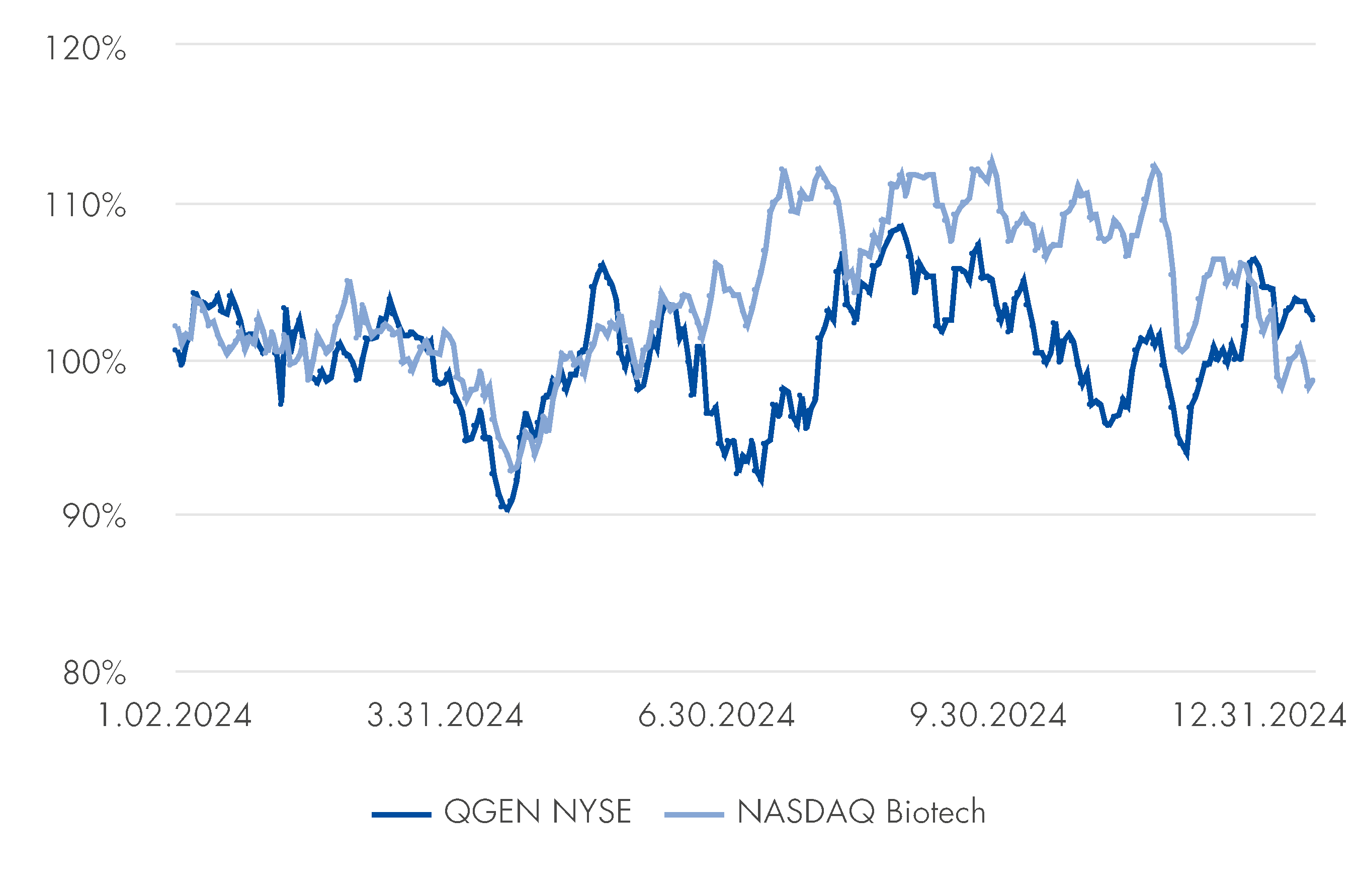
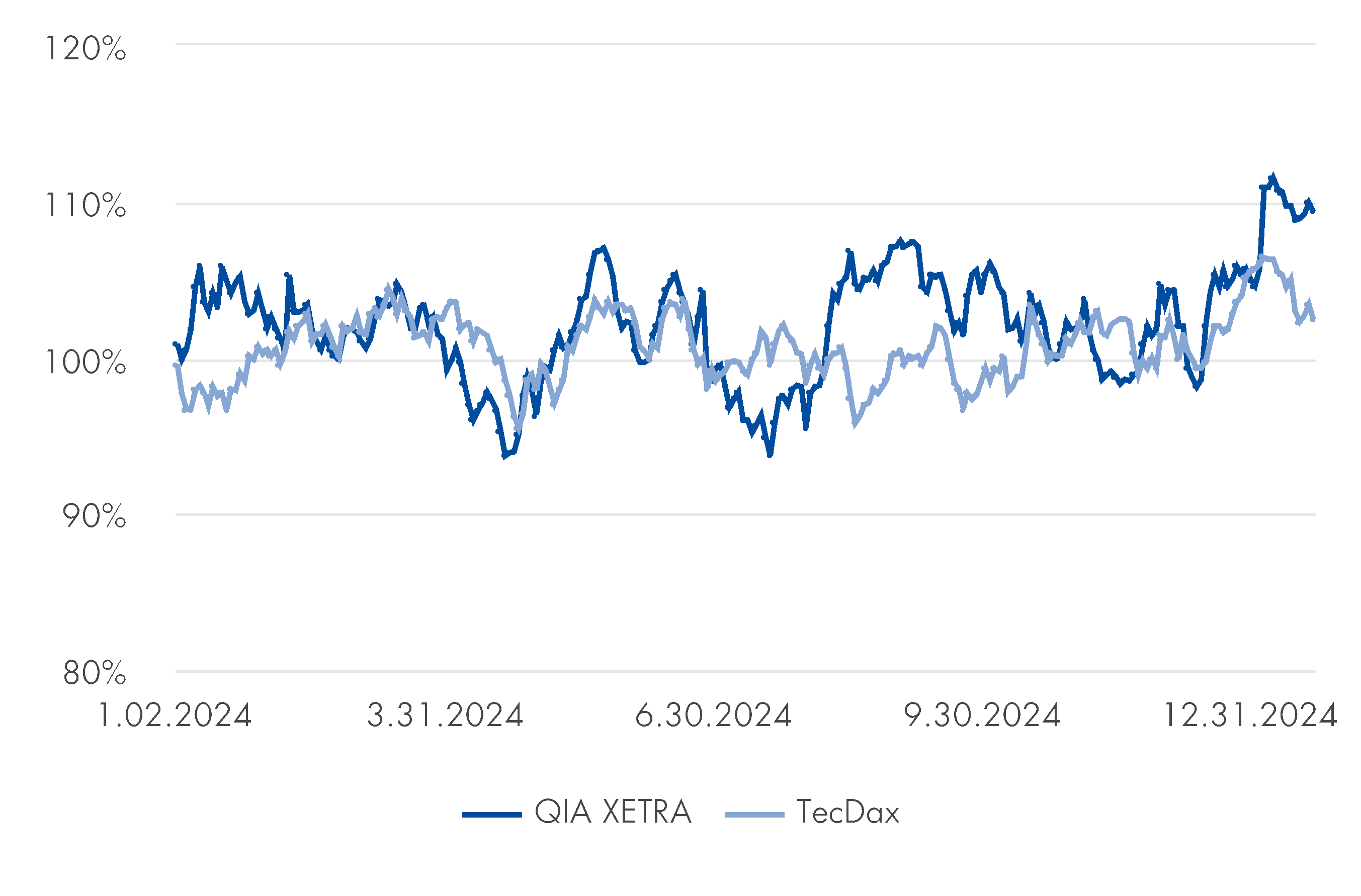
In 2024, QIAGEN, listed as QGEN on the NYSE and QIA on the Frankfurt
Stock Exchange, delivered modest growth in a challenging environment for the
industry. On the NYSE, QGEN grew about 3%, reflecting a steady upward
trend in line with sector peers. Likewise on the Frankfurt Exchange, QIA rose
9% over the year, mirroring the positive trajectory observed on the NYSE.
The stock price increase for QIAGEN in 2024 reflected solid financial
performance against broader adverse market conditions and sector-specific
challenges, leading to relatively flat growth compared to major indices. The
post-pandemic economic recovery drove higher demand for diagnostic and
research tools, while competition to develop new innovations continued in the
Life Sciences sector.
Our shares continued to offer high liquidity, with an average daily trading
volume of approximately 1.7 million in 2024 – approximately 1.1 million in the
U.S. and 0.5 million in Germany.
As of December 31, 2024, the free float, which affects weighting of QIAGEN
shares in various indices, was approximately 99%.
QIAGEN N.V. | Financial Report 2024
Page 6
Overview
Shareholder Structure
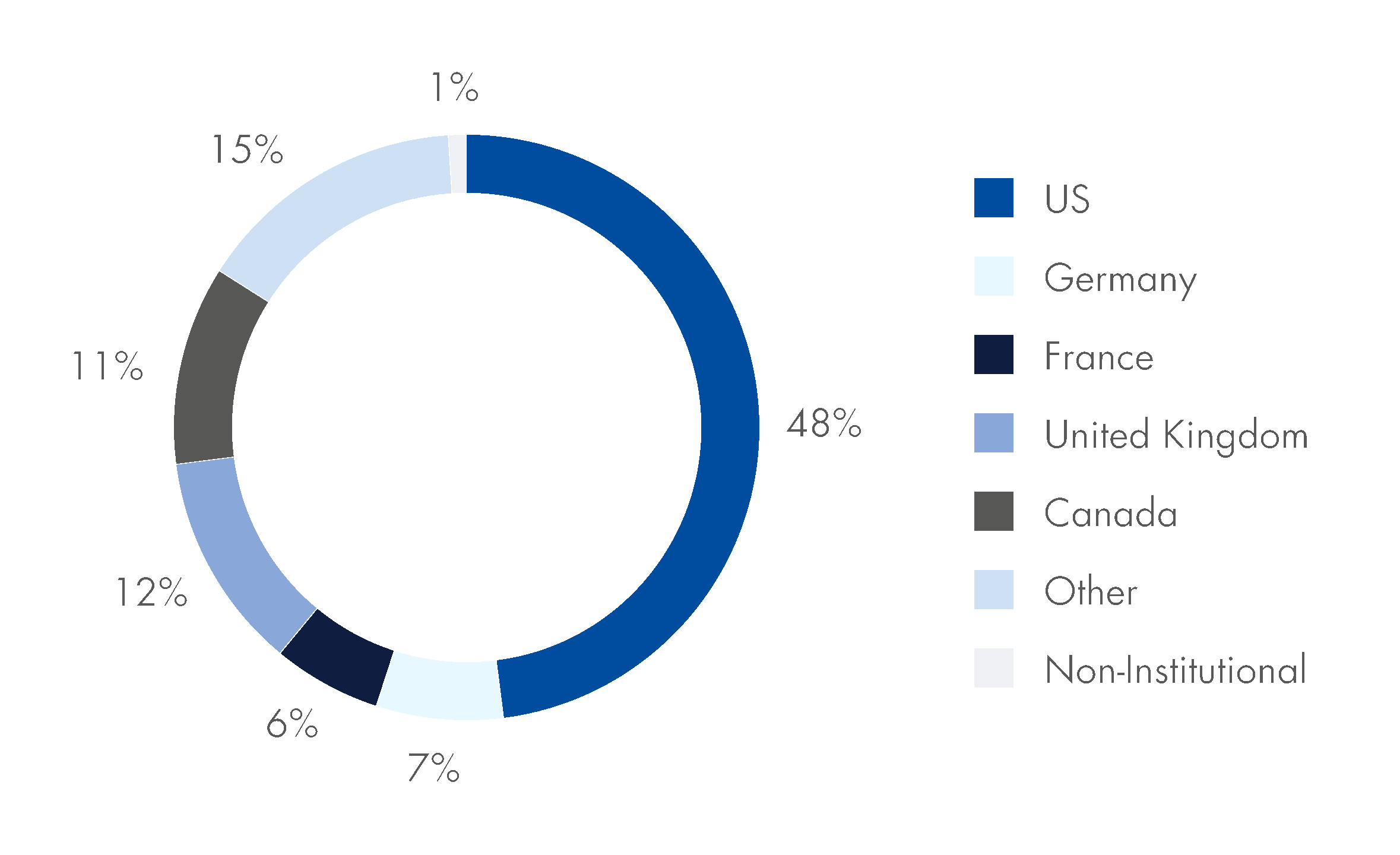
QIAGEN's global investor base includes over 500 identified institutional
investors, with approximately 60% in North America, 35% in Europe and the
remainder in other regions. As of the end of 2024, the Managing Board and
Supervisory Board collectively held less than 1% of QIAGEN’s outstanding
Common Shares.
Market Capitalization
2024
Year-end market capitalization (in $ million)
9,899
Year-end market capitalization (in € million)
9,569
Annual Shareholder Meeting
At the Annual General Meeting on June 21, 2024, in Venlo, The Netherlands,
shareholders overwhelmingly approved all agenda items. A total of 76% of
QIAGEN shares were voted at the meeting, representing approximately 170.7
million of QIAGEN's 223.9 million issued shares as of the record date. Details
of attendance and voting results are available at corporate.QIAGEN.com.
Investor Relations and Shareholder Engagement
QIAGEN is dedicated to providing shareholders, analysts and global
communities with clear, comprehensive and accessible information about its
performance, strategy, vision, mission and future prospects. Engagement efforts
include individual calls, roadshows and participation in broker-sponsored
investor conferences. In June 2024, QIAGEN hosted its Capital Markets Day at
the New York Stock Exchange, outlining its strategic vision and financial targets
through 2028.
QIAGEN's Investor Relations team has been consistently recognized as having
one of the top teams in the EMEA region within the MedTech industry and also
among the top five in the Healthcare sector.
Investor events hosted by QIAGEN have been particularly recognized for
improving investor access through virtual formats.
2024 Shareholder Structure by Geography
5150
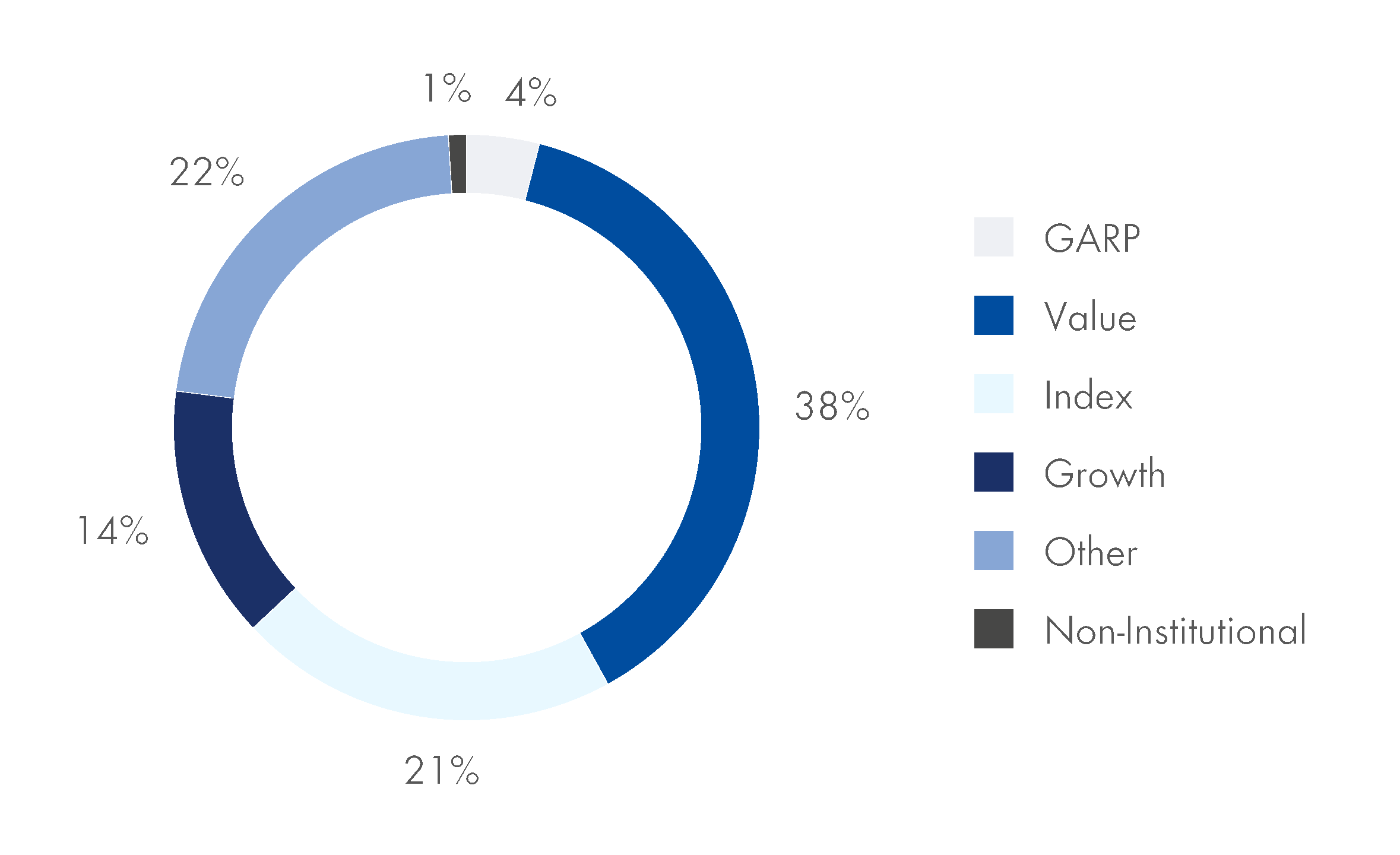
2024 Shareholder Structure by Investor Type
5154
QIAGEN N.V. | Financial Report 2024
Page 7
Overview
QIAGEN Share Indices and Prices - NYSE
Our shares have traded on the New York Stock Exchange (NYSE) since 2018
under the symbol QGEN. Prior to the transition to the NYSE, our Common
Shares were traded on NASDAQ since the IPO (Initial Public Offering) in 1996
under the same QGEN ticker.
New York Stock Exchange (NYSE)
2024
Year-end price
$44.53
High
$47.44
Low
$39.03
Average daily trading volume (in million shares)
1.12
5449
QIAGEN Share Indices and Prices - Germany
Our shares, traded on the Frankfurt Stock Exchange (XETRA) under the symbol
QIA since a secondary IPO in September 1997, joined the DAX Index of the
40 largest blue-chip stocks in September 2021, reflecting our status among
Germany's top publicly traded companies by market capitalization.
Frankfurt Stock Exchange (XETRA)
2024
Year-end price
€43.05
High
€44.13
Low
€36.59
Average daily trading volume (in million shares)
0.54
5788
QIAGEN N.V. | Financial Report 2024
Page 8
Overview
QIAGEN Historical Share Price History - NYSE
The following tables set forth the annual high and low sale prices for the last
five years, the quarterly high and low sale prices for the last two years and the
monthly high and low sale prices for the last six months on the NYSE.
High ($)
Low ($)
Annual:
2020
55.27
32.97
2021
59.00
45.58
2022
55.12
40.38
2023
51.18
34.74
2024
47.44
39.03
High ($)
Low ($)
Quarterly 2023:
First Quarter
51.18
45.08
Second Quarter
46.99
43.80
Third Quarter
47.70
38.98
Fourth Quarter
43.73
34.74
Quarterly 2024:
First Quarter
45.87
42.08
Second Quarter
46.01
39.03
Third Quarter
47.44
39.73
Fourth Quarter
46.66
40.35
Quarterly 2025:
First Quarter (through March 26)
47.93
37.63
 
High ($)
Low ($)
Monthly:
October 2024
45.51
41.51
November 2024
45.35
40.35
December 2024
46.66
43.23
January 2025
47.93
43.55
February 2025
44.20
38.16
March 2025 (through March 26)
40.13
37.63
QIAGEN N.V. | Financial Report 2024
Page 9
Overview
QIAGEN Historical Share Price History - Germany
The following tables set forth the annual high and low sale prices for the last
five years, the quarterly high and low sale prices for the last two years and the
monthly high and low sale prices for the last six months.
High (€)
Low (€)
Annual:
2020
46.95
29.55
2021
51.56
37.38
2022
49.37
37.95
2023
48.36
32.74
2024
44.13
36.59
High (€)
Low (€)
Quarterly 2023:
First Quarter
48.36
41.57
Second Quarter
43.47
39.62
Third Quarter
43.39
36.73
Fourth Quarter
40.07
32.74
Quarterly 2024:
First Quarter
42.19
38.77
Second Quarter
42.36
36.59
Third Quarter
42.81
36.75
Fourth Quarter
44.13
38.13
Quarterly 2025:
First Quarter (through March 26)
47.53
35.00
High (€)
Low (€)
Monthly:
October 2024
41.23
38.36
November 2024
42.69
38.13
December 2024
44.13
40.88
January 2025
47.53
41.35
February 2025
42.84
36.62
March 2025 (through March 26)
37.10
35.00
QIAGEN N.V. | Financial Report 2024
Page 10
Management Report
Business and Operating Environment
Company Overview
QIAGEN is a leading global provider of Sample to Insight solutions, enabling
customers to extract and gain valuable molecular insights from samples
containing the building blocks of life. Our Sample technologies isolate and
process DNA (deoxyribonucleic acid), RNA (ribonucleic acid) and proteins
from blood, tissue and other materials. Assay technologies prepare these
biomolecules for analysis while bioinformatics software and knowledge bases
can be used to interpret data to find actionable insights. Automation solutions
bring these processes together into seamless and cost-effective workflows. We
serve over 500,000 customers globally in Life Sciences (academia, pharma
R&D and industrial applications, primarily forensics) and Molecular Diagnostics
for clinical healthcare. As of December 31, 2024, we employed more than
5,700 people in over 35 locations worldwide.
QIAGEN was founded in 1984 and began operations in 1986 as a pioneer in
the emerging biotechnology sector with a revolutionary method that
standardized and accelerated the extraction and purification of nucleic acids
from biological samples, which means any material containing DNA, RNA or
proteins. As molecular biology and genomic knowledge has grown to influence
many areas of daily life, we have expanded to serve the full spectrum of market
needs while developing new instruments, consumables and digital solutions,
partnering with researchers and pharmaceutical companies, and acquiring
companies and technologies that best complement our portfolio. We continue
to accelerate our portfolio growth and increase our efficiency and effectiveness
while also enhancing our customer experience, our corporate citizenship and
our position as an employer of choice.
Our strategy is anchored by a commitment to deliver solid profitable growth by
focusing our resources on a group of Pillars that represented approximately
70% of sales in 2024 and are expected to reach combined sales of
approximately $2 billion in 2028. The Pillars involve three product groups
where QIAGEN is developing leadership positions: the digital PCR (Polymerase
Chain Reaction) platform QIAcuity, the clinical PCR syndromic testing solution
QIAstat-Dx and the QIAGEN Digital Insights portfolio of bioinformatics solutions
for improved analysis and interpretation of complex genomic data.
Additionally, two Pillars involve product groups where QIAGEN has strong top
positions and where we want to consolidate our leadership: Sample
technologies that are used to gain access to DNA and RNA from a biological
sample and the QuantiFERON technology platform for latent disease detection,
best known for its use in detecting tuberculosis (TB).
Our growth has been funded through internally generated funds as well as
through debt offerings and the public sales of equity securities.
Our Global Shares are listed on the New York Stock Exchange under the ticker
symbol QGEN and on the Frankfurt Stock Exchange as QIA.
QIAGEN N.V. is the holding company for more than 50 consolidated
subsidiaries, many of which have the primary function of distributing our
products and services on a regional basis. Certain subsidiaries also have
research and development or production activities. The Company is registered
under its commercial and legal name QIAGEN N.V. with the trade register
(kamer van koophandel) of the Dutch region Limburg Noord under file number
12036979. QIAGEN N.V. is incorporated under Dutch law as a public limited
liability company (naamloze vennootschap) and is organized as a holding
company. Our principal executive office is located at Hulsterweg 82, 5912 PL
Venlo, The Netherlands, and our telephone number is +31-77-355-6600.
Further information on QIAGEN can be found at www.qiagen.com. The
U.S. Securities and Exchange Commission (SEC) website at www.sec.gov
contains reports, proxy and information statements, and other information
regarding issuers that file electronically with the SEC. Information contained in,
or that can be accessed through, our website is not a part of, and shall not be
incorporated by reference into, this Annual Report. We have included our
website address in this document solely as an inactive textual reference.
QIAGEN N.V. | Financial Report 2024
Page 11
Management Report
Operating Environment
Economic Environment
The global economy grew by approximately 2.8% in 2024, consistent with the
previous year. This growth trajectory can be attributed to persistent inflationary
pressures, elevated borrowing costs and geopolitical uncertainties which
continued to weigh on economic performance. While central banks around the
world made strides in moderating inflation, the effects of sustained monetary
tightening and higher interest rates curtailed growth in developed economies.
The U.S. Dollar Index displayed moderate volatility in 2024, influenced by
varying monetary policies, fluctuating commodity prices and divergent regional
growth trends.
Industry Environment
Life Sciences and Molecular Diagnostics continued to experience diverging
trends in 2024. While weaker markets in China and reduced capital spending
on instruments and automation systems created headwinds for the industry,
certain sectors saw notable growth, particularly in areas such as infectious
disease testing.
The pandemic had led to significant growth in the installed base of instruments,
and companies were now seeking to leverage this base for other applications
in Life Sciences and Molecular Diagnostics. Although numerous smaller
companies have emerged in recent years, larger companies such as QIAGEN
boast the crucial advantages of better global R&D, distribution and production
capacity, as well as brand recognition, to drive the adoption of their platforms
like QIAstat-Dx and QIAcuity for expanded use in infectious disease, oncology,
academic and biopharmaceutical research.
The addressable Life Sciences and Molecular Diagnostics industry segments
generate an estimated $11 billion of annual sales and are expected to
maintain a healthy rate of single-digit sales growth in the coming years. Key
growth drivers include continued research funding to advance our
understanding of biology as well as consistently strong medical demand for
molecular clinical testing.
QIAGEN Products
Our leadership in molecular research and testing solutions leverages our
product portfolio across a wide range of applications. These are grouped into
two main categories:
•Consumables and related revenues involve our consumables kits,
bioinformatics solutions, royalties, co-development milestone payments and
services (89% of total net sales in 2024); and
•Instruments and related services and contracts (11% of total net sales in
2024).
QIAGEN Product Groups
Sample Technologies
Sample technologies represent one of our Pillars and includes products involved
in the first step of any molecular lab process.
QIAGEN N.V. | Financial Report 2024
Page 12
Management Report
20240212 Infographic.jpg
Applications
20240212 Checkmark.jpg
Cloning
20240212 Checkmark.jpg
qPCR / dPCR
20240212 Checkmark.jpg
DNA
amplification
20240212 Checkmark.jpg
Sequencing 
/ NGS
20240212 Checkmark.jpg
Arrays
20240212 Checkmark.jpg
Liquid biopsy
20240212 Checkmark.jpg
Gene editing
20240212 Checkmark.jpg
Microbiome
20240212 Checkmark.jpg
Epigenetics
20240212 Checkmark.jpg
Gene silencing
20240212 Checkmark.jpg
Cellular
analytics
20240212 Checkmark.jpg
Proteomics
Input demands
Processing
Target analytes
Low / high-volume
Manual
Genomic DNA
Low-quantity
Plasmid DNA
Tubes / plates
cfDNA
Input demands
Low-quantity
Automated
mRNA, rRNA
High-quantity
Low-to
miRNA
Tubes / plates
High-throughput
Proteins
Circ. Tumor cells
Selected biological samples
20240212 Checkmark.jpg
Tissue
20240212 Checkmark.jpg
Stool
20240212 Checkmark.jpg
Cells
20240212 Checkmark.jpg
Saliva
20240212 Checkmark.jpg
Blood
20240212 Checkmark.jpg
Other body
fluids
20240212 Checkmark.jpg
Serum
20240212 Checkmark.jpg
Bone
20240212 Checkmark.jpg
Plasma
20240212 Checkmark.jpg
Plants
20240212 Checkmark.jpg
Urine
20240212 Checkmark.jpg
Soil
Our broad portfolio of Sample technologies includes consumables and
instruments used in sample collection, stabilization, storage, purification and
quality control. Some of our consumables are designed to run on our
instruments, while others are universal kits designed for use with any molecular-
testing platform. These products are used in research and applied testing
(forensics/human identification and food safety) in laboratories as well as
clinical testing.
QIAGEN N.V. | Financial Report 2024
Page 13
Management Report
Sample technologies
Selected QIAGEN brands
Primary Sample technology consumables
•Nucleic acid stabilization and purification kits designed for primary sample materials (DNA, RNA), manual and
automated processing for genotyping, gene expression, viral and bacterial analysis
•Mainly based on silica membrane and magnetic bead technologies
•QIAamp
•PAXgene
•AllPrep
•DNeasy
•AdnaTest
•QIAprep&amp
•RNeasy
•MagAttract
•QIAwave
Secondary Sample technology consumables
•Kits and components for purification of nucleic acids from secondary sample materials (e.g., gel, plasmid DNA)
•QIAprep
•QIAGEN Plasmid
•HiSpeed
•QIAquick
•QIAfilter
•EndoFree
•DyeEx
Sample technology instruments
•Instruments for nucleic acid purification, quality control and accessories
•QIAsymphony
•EZ2 Connect
•TissueLyser III
•QIAcube Connect
•EZ2 Connect MDx
•QIAcube HT
•QIAxcel Connect
•QIAcube Connect
MDx
Diagnostic Solutions
Diagnostic solutions include our molecular testing platforms and consumables
covering two of our Pillars with QuantiFERON and QIAstat-Dx, as well as
Precision Diagnostics which involves companion diagnostic co-development
revenues from projects with pharmaceutical companies, regulated assays and
solutions for laboratory developed tests. Additional areas include Oncology
and Sexual & Reproductive Health for detection of various diseases and for
other laboratory processes.
QIAGEN N.V. | Financial Report 2024
Page 14
Management Report
Diagnostic solutions
Selected QIAGEN brands
Immune response consumables
•Interferon-Gamma Release Assay (IGRA) for latent TB testing
•Assays for post-transplant testing, viral load monitoring
•QuantiFERON
Oncology and Sexual & Reproductive health consumables
•Assays for analysis of genomic variants such as mutations, insertions, deletions and fusions
•Assays for prenatal testing and detection of sexually transmitted diseases and HPV
•therascreen
•AmniSure /
PartoSure
•ipsogen
•digene HC2
Sample to Insight instruments and dedicated assays
•One-step molecular analysis of hard-to-diagnose syndromes
•Fully integrated PCR testing
•QIAstat-Dx
•QIAstat-Dx Rise
PCR / Nucleic Acid Amplification
PCR / Nucleic Acid Amplification involves our research and applied PCR
solutions and components. The product group includes another of our Pillars,
QIAcuity. We offer optimized solutions for end-point PCR, quantitative PCR and
digital PCR. Our kits, assays, instruments and accessories amplify and detect
targets and streamline workflow for virtually any application.
PCR / Nucleic acid amplification
Selected QIAGEN brands
Research PCR consumables
•Different generations of PCR, quantitative and digital PCR, reverse transcription and combinations (RT-PCR) kits for
analysis of gene expression, genotyping and gene regulation, running on QIAGEN or third-party instruments and
technologies
•QuantiTect
•OneStep RT-PCR
•OmniScript
•QIAcuity
•QIAGEN Multiplex
•miRCURY
•AllTaq
•GeneGlobe
•QuantiNova
•HotStarTaq
•UltraRun Long
Range
Human ID / Forensics assay consumables
•Short tandem repeat (STR) assays for Human ID, additional assays for food contamination
•Investigator (human
ID / forensics)
PCR instruments
•Digital PCR solutions
•qPCR solutions
•QIAcuity
•Rotor-Gene Q
•QIAgility
•QIAcuityDx
OEM consumables
•Custom-developed and configured enzymes and PCR solutions that are sold to OEM customers
•Provided on an individualized contract basis
QIAGEN N.V. | Financial Report 2024
Page 15
Management Report
Genomics / NGS
This product group includes our universal NGS (next-generation sequencing)
solutions for use with any NGS sequencer as well as the full bioinformatics
portfolio offered by QIAGEN Digital Insights, which also represents one of our
Pillars.
Genomics / NGS
Selected QIAGEN brands
Universal NGS consumables
•Predefined and custom NGS gene panels (DNA, RNA), library prep kits and components, whole genome
amplification, DNA methylation analysis, etc.
•Sequence-based assays for forensic genetic genealogy
•QIAseq
•GeneGlobe
•REPLI-g
•EpiTect
•ForenSeq
Kintelligence
QIAGEN Digital Insights solutions
•Bioinformatics solutions analyze and interpret data to deliver actionable insights from NGS. This includes
freestanding software or cloud-based solutions and is also integrated into many QIAGEN consumables and
instruments
•QCI Secondary
Analysis
•QCI Interpret
•QCI Precision
•CLC Workbenches
•OmicSoft Lands
•Ingenuity Pathway
Analysis
•Biomedical
Knowledge Base
•HGMD
•HSMD
•PGXI
Custom laboratory and genomic services
•Custom services such as DNA sequencing, whole genome amplification and non-cGMP DNA production
•Provided on an individualized contract basis
Other
Revenues from various sources including protein biology products, royalties,
intellectual property and freight charges.
Principal Markets
We sell our products to more than 500,000 customers in two broad customer
groups: Molecular Diagnostics (clinical testing) and Life Sciences (academia,
pharmaceutical R&D and applied testing). Sales to these groups were as
follows:
Net sales (in millions)
2024
2023
2022
Molecular Diagnostics
$1,078.6
$1,035.5
$1,126.2
Life Sciences
899.6
929.8
1,015.3
Total
$1,978.2
$1,965.3
$2,141.5
We estimate the current total addressable market at approximately $11 billion
annually with estimates indicating market growth to approximately $13 to $14
billion annually by 2028.
Molecular Diagnostics
The molecular diagnostics market includes healthcare providers engaged in
many aspects of patient care that require accurate diagnoses and insights to
guide treatment decisions in oncology, infectious diseases and immune
monitoring.
We offer one of the broadest portfolios of molecular technologies for
healthcare. The success of molecular testing in healthcare depends on the
ability to accurately analyze purified nucleic acid samples from sources such as
blood, tissue, body fluids and stool. Automated systems process tests reliably
and efficiently, often handling hundreds of samples simultaneously. Our range
QIAGEN N.V. | Financial Report 2024
Page 16
Management Report
of assays for diseases and biomarkers speeds up and simplifies laboratory
workflow and standardizes lab procedures.
Molecular testing is the most dynamic segment of the global in vitro diagnostics
market. The pandemic has demonstrated the value of molecular testing in
healthcare, and we expect the market to provide significant growth
opportunities.
We have built a position as a preferred partner to co-develop companion
diagnostics paired with targeted drugs and have created a rich pipeline of
molecular tests that are transforming the treatment of cancer and other diseases.
We have more than 30 master collaboration agreements with pharmaceutical
industry customers, some with multiple co-development projects. In 2024, we
continued to expand on these partnerships with new agreements, for example,
a collaboration with Eli Lilly to develop an IVD panel for detecting APOE
genotypes. We also expanded our partnership with AstraZeneca to develop
and commercialize companion diagnostics for complex chronic diseases based
on our QIAstat-Dx platform. Additionally, we entered into a master
collaboration agreement with Myriad to develop lab-developed and
distributable kit-based companion diagnostics in oncology. Companion
diagnostics move through clinical trials and regulatory approvals, along with
the paired drugs, to commercialization and marketing to healthcare providers.
Selected Molecular Diagnostics products
Sample technologies
Assay technologies
Instruments
Bioinformatics
For extraction from:
•Tissue
•Blood
•Swabs, other
Indication areas
•Oncology
•Immune modulation
•Infectious diseases Technologies:
QuantiFERON, Polymerase Chain Reaction
(PCR), Next-generation sequencing (NGS)
•QIAstat-Dx
•QIAsymphony RGQ
•QIAcube Connect MDx
•EZ2 Connect MDx
•QIAstat Rise
QIAGEN Clinical Insight (QCI)
•Hereditary diseases
•Somatic and germline cancers
•Other diseases
Life Sciences
The Life Sciences market includes governments and biotechnology companies,
where researchers and scientists are using molecular testing technologies to
advance scientific knowledge in the pursuit of new breakthroughs that can lead
to new medicines and diagnostics for use in clinical healthcare. This market
also includes the use of molecular testing technologies for applied applications,
in particular for forensics as well as food and veterinary testing. These
customers are all often served by public funding and R&D budgets within
pharmaceutical companies.
We partner with customers across diverse disciplines in academia and industry,
providing sample technologies, assay technologies, bioinformatics and services
to universities and institutes, pharmaceutical and biotech companies,
governments and law enforcement agencies.
We provide Sample to Insight solutions to academic and research institutions
around the world. We focus on enabling researchers to use high-quality
technologies to generate reliable, fast, highly reproducible results, sometimes
replacing time-consuming traditional or in-house methods. We often partner
with leading institutions on research projects and develop customized solutions
such as NGS panels for the sequencing of multiple gene targets.
We are a global leader in solutions for governments and industry, particularly
in forensic testing and human identification. The value of genetic
"fingerprinting" has been proven in criminal investigations and examinations of
paternity or ancestry, as well as in food safety. We provide sample collection
and analytical solutions for law enforcement and human identification labs as
well as advanced technologies for studies of microbiomes and their effect on
health and the environment.
QIAGEN N.V. | Financial Report 2024
Page 17
Management Report
We have deep relationships with pharmaceutical and biotechnology
companies. Drug discovery and development as well as translational research
efforts increasingly employ genomic information, both to guide research in
diseases and to differentiate patient populations that are most likely to respond
to particular therapies. We estimate that about half of our sales to these
companies supports research while the other half supports clinical development,
including stratification of patient populations based on genetic information.
Also, QIAGEN Digital Insights solutions are widely used to guide
pharmaceutical research and treatment options.
Selected Life Sciences products
Sample technologies
Assay technologies
Instruments
Bioinformatics
~300 different kit types for extraction and
purification of DNA, RNA and proteins from
tissue, blood, cells, stool, plants, soil and other
sample types
•Real-time PCR
•Digital PCR
•Next-generation sequencing
•QIAsymphony
•QIAcube Connect
•QIAcuity digital PCR
•Ingenuity Pathway Analysis (IPA)
•Genomics Workbench/Server
•Microbial Pro Suite/RNA-seq
•Microbial Epigenetics
Competition
The markets for most of our products are very competitive. Competitors may
have developed, or could develop in the future, new technologies that compete
with our products or even render our products obsolete. In sample technology
products, we experience competition in various markets from other companies
providing sample preparation products in kit form and assay solutions. These
competitors include, but are not limited to, companies with a focus on nucleic
acid separation and purification kits, assay solutions, reagents and
instrumentation. We compete with other suppliers through innovative
technologies and products, offering a comprehensive solution for nucleic acid
collection, pre-treatment, separation and purification needs as well as
downstream applications. Our products provide significant advantages in terms
of speed, reliability, accuracy, convenience, reproducibility and ease of use.
Some of our other products within our molecular diagnostics customer class,
such as tests for chlamydia, gonorrhea, hepatitis B virus, herpes simplex virus
and CMV (cytomegalovirus), compete against existing screening, monitoring
and diagnostic technologies, including tissue culture and antigen-based
diagnostic methodologies. We believe the primary competitive factors in the
market for gene-based probe diagnostics and other screening devices are
clinical validation, performance and reliability, ease of use, standardization,
cost, proprietary position, competitors' market shares, access to distribution
channels, regulatory approvals and reimbursement.
We believe our competitors typically do not have the same comprehensive
approach to sample to insight solutions as we do, nor do they have the ability
to provide the broad range of technologies and depth of products and services
that we offer.
Current and potential competitors may be in the process of seeking FDA or
foreign regulatory approvals for their respective products. Our continued future
success will depend in large part on our ability to maintain our technological
advantage over competing products, expand our market presence and preserve
customer loyalty. There can be no assurance that we will be able to compete
effectively in the future or that development by others will not render our
technologies or products non-competitive.
Global Presence by Product Category and Geographic Market
Product Category Information
Net sales for the product categories are based on those revenues related to
sample and assay products and related revenues including bioinformatics
solutions, as well as revenues derived from instrumentation sales.
QIAGEN N.V. | Financial Report 2024
Page 18
Management Report
Net sales (in millions)
2024
2023
2022
Consumables and related
revenues
$1,760.2
$1,726.2
$1,888.9
Instrumentation
218.0
239.1
252.6
Total
$1,978.2
$1,965.3
$2,141.5
Geographical Information
We sell our products in more than 170 countries. The following table shows
total revenue by geographic market for the past three years (with net sales
attributed to countries based on the location of the customer, as certain
subsidiaries have international distribution):
Net sales (in millions)
2024
2023
2022
United States
$942.0
$935.3
$909.6
Other Americas
89.6
84.8
88.1
Total Americas
1,031.6
1,020.1
997.8
Europe, Middle East and
Africa
648.5
624.6
733.5
Asia Pacific, Japan and
Rest of World
298.2
320.7
410.3
Total
$1,978.2
$1,965.3
$2,141.5
Seasonality
Our business is not significantly impacted by seasonal factors. Historically, a
portion of our sales has been to researchers, universities, government
laboratories and private foundations whose funding is dependent upon grants
from government agencies, such as the National Institutes of Health and similar
bodies. To the extent that our customers experience increases, decreases or
delays in funding arrangements and budget approvals, and to the extent that
customers' activities are slowed, such as during times of higher unemployment,
vacation periods or delays in approvals of government budgets, we may
experience fluctuations in sales volumes during the year or delays from one
period to the next in the recognition of sales. Additionally, we have customers
who are active in the diagnostics testing market, and sales to these customers
fluctuate to the extent that their activities are impacted by public health
concerns. For example, the timing and severity of viral infections such as
influenza or the SARS-CoV-2 virus may impact demand for our products.
Research and Development
We are committed to expanding our global leadership in Sample to Insight
solutions in Molecular Diagnostics and Life Sciences. We target our research
and development resources at the most promising technologies to address the
unmet needs of our customers in healthcare and research labs in key
geographic markets.
Innovation at QIAGEN follows parallel paths:
•Creating new systems for automation of workflows - platforms for
laboratories, hospitals and other users of novel molecular technologies.
•Expanding our broad portfolio of novel content - including assays to detect
and measure biomarkers for disease or genetic identification.
•Integrating QIAGEN Digital Insights with the testing process - software and
cloud-based resources to interpret and transform raw molecular data into
useful insights.
Innovation in automation systems positions us in the fast-growing fields of
molecular testing and generates ongoing demand for our consumable products.
We are developing and commercializing a deep pipeline of assays for
preventive screening and diagnostic profiling of diseases, detection of
biomarkers to guide Precision Diagnostics in cancer and other diseases and
other molecular targets. Our assay development program aims to
commercialize tests that will add value to our QIAsymphony and QIAstat-Dx
automation systems in the coming years together with developing next-
generation sequencing (NGS) kits to support our universal NGS franchise and
our in vitro diagnostics partnership with Illumina. We continue to develop
applications for the QIAcuity digital PCR system which is designed to make
digital PCR technology available to Life Sciences and clinical laboratories
worldwide.
QIAGEN N.V. | Financial Report 2024
Page 19
Management Report
Sales and Marketing
We market our products primarily through subsidiaries in markets with the
greatest sales potential in the Americas, Europe, Australia and Asia.
Experienced marketing and sales staff, many of them scientists with academic
degrees in molecular biology or related areas, sell our products and support
our customers. Business managers oversee key accounts to ensure that we serve
customers’ commercial needs, such as procurement processes, financing, data
on costs and the value of our systems, while maintaining collaborative
relationships. In many markets, we have specialized independent distributors
and importers.
Our marketing strategy focuses on providing differentiated, high-quality
products across the value chain from Sample to Insight, integrating components
into end-to-end solutions when possible and enhancing relationships with a
commitment to technical excellence and customer service. Our omni-channel
approach seeks to engage customers through their preferred channels - online,
by phone or in person - and to optimize investment in different customer types.
We continue to drive the growth of our digital marketing channels – including
our website at www.qiagen.com, product-specific sites and social media.
Since the onset of the pandemic, there has been an increase in virtual events
and use of digital sales channels. We have likewise increased the activities in
digital marketing to adapt to these market changes, such as installing an in-
house studio to facilitate creation of video content and live virtual events.
Our eCommerce team works with clients to provide automated processes
supporting a variety of electronic transactions and all major eProcurement
systems.
My QIAGEN is an easy-to-use self-service portal that is personalized to our
customers' needs and enables customers to manage different activities in one
central place. Customers can now easily reorder products, place bulk orders,
apply quotes to their cart and track their order status. Functionality in the
dashboard allows customers to monitor their instrument use and view the status
of licenses and service agreements. Additionally, customers can access our
exclusive content and services, such as webinars, handbooks and other
documents.
Our GeneGlobe Design & Analysis Hub (www.geneglobe.com) is a
valuable outreach to scientists in pharma and academia, enabling researchers
to search and order from approximately 25 million pre-designed and custom
PCR assay kits, NGS assay panels and other products. The new hub brings
next-level experiment planning, execution and follow-up to life science
researchers, linking our QIAGEN Digital Insights solutions with ordering of
assays to accelerate research.
We use a range of tools to provide customers with direct access to technical
support, inform them of new product offerings and enhance our reputation for
technical excellence, high-quality products and commitment to service. For
example, our technical service support allows existing or potential customers to
discuss a wide range of questions about our products and molecular biology
procedures, online or via phone, with Ph.D. and M.Sc. scientists at QIAGEN.
Frequent communication with customers enables us to identify market needs,
learn of new developments and opportunities, and respond with new products.
We also distribute publications, including our catalog, to existing and potential
customers worldwide, providing new product information, updates and articles
about existing and new applications. In addition, we hold numerous scientific
seminars at clinical, academic and industrial research institutes worldwide and
at major scientific and clinical meetings. We conduct direct marketing
campaigns to announce new products and special promotions, and we offer
personalized electronic newsletters and webinars highlighting molecular
biology applications.
For laboratories that frequently rely on our consumables, the QIAstock program
maintains inventory on-site to keep up with their requirements. QIAGEN
representatives make regular visits to replenish the stock and help with other
needs, and we are automating this process with digital technologies. Easy-to-
use digital ordering, inventory monitoring and customer-driven changes make
QIAstock an efficient system for providing ready access to our products for the
hundreds of customers worldwide who use this program.
QIAGEN N.V. | Financial Report 2024
Page 20
Management Report
Intellectual Property, Proprietary Rights and Licenses
We have made, and expect to continue to make, investments in intellectual
property. In 2024, additions to our intangible assets outside of business
combinations totaled $3.5 million, and as of December 31, 2024, patent and
license rights, net totaled $44.0 million. While we do not depend solely on any
individual patent or technology, we are significantly dependent in the
aggregate on technology that we own or license. Therefore, we consider
protection of proprietary technologies and products one of the major keys to
our business success. We rely on a combination of patents, licenses and
trademarks to establish and protect proprietary rights. As of December 31,
2024, we owned 282 issued patents in the United States, 229 issued patents
in Germany and 1,615 issued patents in other major industrialized countries.
We had 346 pending patent applications. Our policy is to file patent
applications in Western Europe, the United States and Japan. Patents in most
countries have a term of 20 years from the date of filing the patent application.
We intend to aggressively prosecute and enforce patents and to otherwise
protect our proprietary technologies. We also rely on trade secrets, know-how,
continuing technological innovation and licensing opportunities to develop and
maintain our competitive position.
Our practice is to require employees, consultants, outside scientific
collaborators, sponsored researchers and other advisers to execute
confidentiality agreements upon commencement of their relationships with us.
These agreements provide that all confidential information developed by or
made known to the individual during the course of the relationship is to be kept
confidential and not disclosed to third parties, subject to a right to publish
certain information in scientific literature in certain circumstances and to other
specific exceptions. In the case of our employees, the agreements provide that
all inventions conceived by individuals in the course of their employment will be
our exclusive property, subject to local laws.
See Risk Factors included in Risks and Risk Management for details regarding
risks related to our reliance on patents and proprietary rights.
Suppliers
We strive to ensure that our quality standards, compliance with laws and
regulations as well as environmental and social standards are maintained
along the entire value chain of suppliers and partners. We demand the same
from our business partners. Suppliers are subjected to a risk analysis with
regard to environmental and social criteria based on their geographic location.
Our supplier policy, which all new suppliers sign, is available on our website
and contains requirements with regard to legal compliance, bribery and
corruption, labor rights, non-discrimination and fair treatment, health and safety
as well as environmental protection and conservation. In addition, first-tier
suppliers must confirm REACH, RoHS and conflict minerals compliance, as
appropriate. As part of our supplier assessment procedures, on a monthly
basis, we evaluate the supply performance of our raw material and component
suppliers. We assess, on a continuous basis, potential alternative sources of
such materials and components and, on a yearly basis, the risks and benefits of
reliance on our existing suppliers.
We strive to maintain inventories at a sufficient level to ensure reasonable
customer service levels and to guard against normal volatility in availability.
We buy materials for our products from many suppliers and are not dependent
on any one supplier or group of suppliers for our business as a whole. Raw
materials generally include chemicals, raw separation media, biologics,
plastics, electronics and packaging. Certain raw materials are produced under
our specifications. We have inventory agreements with the majority of our
suppliers, and we closely monitor stock levels to maintain adequate supplies.
In 2024, the availability of goods improved, and material costs stabilized by
mid-year. To ensure the procurement of raw materials and mitigate availability
issues, we use long-term supply contracts as needed. In 2025, markets are
experiencing increased pressure due to ongoing geopolitical tensions,
especially within Asia. The Company’s strong material positions and thorough
coverage ensure that customer product availability remains unaffected at
present. However, uncertainty remains about how the market might respond.
QIAGEN N.V. | Financial Report 2024
Page 21
Management Report
Conflict minerals
U.S. legislation mandates transparency in sourcing conflict minerals—tantalum,
tin, tungsten and gold—from mines in the Democratic Republic of Congo (DRC)
and its adjoining countries. Some of our instrumentation components,
purchased from third-party suppliers, contain gold. As required, we investigate
our supply chain and disclose any use of conflict minerals from these regions.
Annually, we conduct due diligence to determine the presence and origin of
conflict minerals in our products. Since we do not purchase directly from
smelters or refineries, we rely on supplier declarations. We filed our latest
conflict minerals disclosure with the SEC on Form SD for the year ended
December 31, 2023 on May 31, 2024 and will update our disclosures as
required.
Description of Property
Our primary production and manufacturing facilities for consumable products
are located in Germany, the United States, Spain and China. Our facilities for
software development are located in the United States, Germany, Poland,
Denmark and Romania and our Center of Excellence for the development of
companion diagnostics for personalized healthcare is located in the United
Kingdom. Our production and manufacturing operations are highly integrated
and benefit from sophisticated inventory control. Production management
personnel are highly qualified, and many have advanced degrees in
engineering, business and science. We also have installed, and continue to
expand, production-planning systems that are included in our integrated
information and control system based on the SAP R/3 business software
package from SAP SE. Worldwide, we use SAP R/3 software to integrate most
of our operating subsidiaries and are currently undergoing a multi-year
implementation of S/4HANA.
In recent years, we have made investments in automated and interchangeable
production equipment to increase our production capacity and improve
efficiency. Additionally, in 2024, in an effort to decrease our reliance on
carbon-based energy and lower our carbon emissions, we invested in
equipping our Hilden, Germany facility with an emergency power supply and
renewable heating systems. Capital expenditures for property, plant and
equipment totaled $167.2 million, $149.7 million and $129.2 million for
2024, 2023 and 2022, respectively.
We have an established quality system, including standard manufacturing and
documentation procedures, intended to ensure that products are produced and
tested in accordance with the FDA's Quality System Regulations, which impose
current Good Manufacturing Practice (cGMP) requirements. For facilities that
accommodate cGMP production, special areas were built, and these facilities
operate in accordance with cGMP requirements.
The consumable products manufactured at QIAGEN GmbH in Germany and
QIAGEN Sciences LLC in Maryland are produced under ISO 001: 2015, ISO
13485:2016, MDSAP. By the end of 2025, we aim to complete the
implementation of ISO 50001, a voluntary international standard that aids
organizations in managing their energy usage. Our certifications form part of
our ongoing commitment to provide our customers with high-quality, state-of-the-
art sample and assay technologies under our Total Quality Management
system.
Our corporate headquarters are located in Venlo, The Netherlands. The below
table summarizes our largest facilities. Other subsidiaries throughout the world
lease smaller amounts of space.
QIAGEN N.V. | Financial Report 2024
Page 22
Management Report
Facility location
Country
Purpose
Owned or leased
Square feet
Hilden
Germany
Manufacturing, warehousing, distribution, research and development and administration
Owned
986,000
Germantown, Maryland
U.S.
Manufacturing, warehousing, distribution and administration
Owned
285,000
Ann Arbor, Michigan
U.S.
Manufacturing, warehousing, distribution and administration
Leased
109,000
Shenzhen
China
Development, manufacturing, warehousing, distribution and administration
Leased
107,200
Manchester
U.K.
Development and Service Solutions
Leased
96,300
Frederick, Maryland
U.S.
Development, Service Solutions, manufacturing, warehousing and distribution
Leased
76,500
Wroclaw
Poland
Business service center
Leased
65,100
Beverly, Massachusetts
U.S.
Enzyme manufacturing
Leased
44,000
Barcelona
Spain
Development, manufacturing, warehousing, distribution and administration
Leased
31,900
Manila
Philippines
Business service center
Leased
29,300
Shanghai
China
Service Solutions and administration
Leased
28,400
Gdańsk
Poland
Enzyme manufacturing, development, warehousing and administration
Leased
23,300
Germantown, Maryland
U.S.
Service Solutions and training center
Leased
13,500
Redwood City, California
U.S.
Bioinformatics
Leased
12,700
Gdynia
Poland
Enzyme manufacturing, development and warehousing
Leased
11,200
Each of our owned facilities in Hilden, Germany and Germantown, Maryland
has capacity for future expansion of up to 300,000 square feet of facility
space. Our facility in Ann Arbor, Michigan will be closed in 2025 following
the decision to discontinue the NeuMoDx portfolio as discussed in Note 6 "Exit
Costs and Impairments."
We believe our existing production and distribution facilities can support
anticipated production needs for the next 36 months. Our production and
manufacturing operations are subject to various federal, state and local laws
and regulations, including environmental regulations. We do not believe we
have any material issues relating to these laws and regulations.
Employees
As a company headquartered in the European Union (EU), we recognize
freedom of association and collective bargaining as fundamental to
maintaining a positive relationship between management and employee
representatives. A significant portion of our workforce is employed in
Organization for Security and Co-operation in Europe (OSCE) member states,
and we comply with all applicable labor laws in every region where we
operate. Management values its relationships with regional labor unions and
employees and considers them to be positive.
We are committed to respecting and promoting human rights, as outlined in our
Human Rights Policy, available on our website at www.qiagen.com. This
policy is communicated globally via our Company intranet and provided to all
new employees. We foster an open-door workplace culture where employees
can freely raise concerns with management or Human Resources without fear of
retaliation. Our policy explicitly ensures that employees may discuss working
conditions openly without risk of reprisal, intimidation or harassment.
QIAGEN N.V. | Financial Report 2024
Page 23
Management Report
The following tables provide information on the number of employees by
geographical region and main category of activity as of December 31, 2024,
2023 and 2022:
Employees by region
2024
2023
2022
Americas
1,252
1,329
1,370
Europe, Middle East &
Africa
3,352
3,453
3,558
Asia Pacific, Japan and
Rest of World
1,161
1,185
1,250
Total
5,765
5,967
6,178
Employees by function
2024
2023
2022
Production
28%
28%
29%
Research & Development
18%
18%
17%
Sales
37%
37%
37%
Marketing
6%
6%
6%
Administration
11%
11%
11%
Total
100%
100%
100%
Depending on local laws and customs, there are different types of employment
ranging from long-term fixed contracts to temporary positions, along with
flexible time and programs for employees returning to work after parental
leave. In 2024, part-time employees represented 5.7% of our workforce, and
temporary employees with a fixed-term work contract represented 6.4%.
QIAGEN N.V. | Financial Report 2024
Page 24
Management Report
Operating and Financial Review
This section contains a number of forward-looking statements. These statements
are based on current management expectations, and actual results may differ
materially. Among the factors that could cause actual results to differ from
management’s expectations are those described in Risk Factors and Note
Regarding Forward-Looking Statements and Risk Factors in this Annual Report.
The discussion that follows focuses on 2024 with comparisons to 2023. For
discussion of the year ended December 31, 2023, compared to 2022, refer to
our December 31, 2023 Annual Report.
Operating Results
Overview
Financial highlights of 2024 include:
•In 2024, total net sales increased 1% supported by improving growth trends
and our highly recurring revenues which make up more than 85% of total net
sales. In June 2024, we decided to discontinue the NeuMoDx portfolio.
Sales from our core product portfolio (excluding discontinued products such
as NeuMoDx and DIALUNOX) grew 2% in 2024. Changes in foreign
currency rates negatively impacted net sales by approximately one
percentage point.
•The operating income margin in 2024 was 4.9% of sales compared to
20.9% in 2023, reflecting costs incurred in connection with the initiatives
started in 2024 to streamline operations and improve overall efficiency and
profitability of the company.
•Net cash provided by operating activities increased 47% to $674 million in
2024 from $459 million in 2023. Results in 2024 reflected the reduced
working capital requirements and a strong focus on cash flow optimization.
We continue to invest in growth initiatives with a high level of investment into
research and development for menu expansion of our key platforms as well as
our IT infrastructure. Overall, the financial results for 2024 reflect our strategic
efforts to increase profitability and grow through targeted investment,
positioning us for future success while navigating the associated financial
impacts in the short term.
Foreign Currencies
The reporting currency of QIAGEN N.V. is the U.S. dollar. The functional
currency of most of our subsidiaries are the local currencies of the countries in
which they are headquartered. All amounts in the financial statements of entities
whose functional currency is not the U.S. dollar are translated into U.S. dollar
equivalents at exchange rates as follows: (1) assets and liabilities at period-end
rates, (2) income statement accounts at average exchange rates for the period,
and (3) components of equity at historical rates. Translation gains or losses are
recorded in equity, and transaction gains and losses are reflected in net
income.
QIAGEN N.V. | Financial Report 2024
Page 25
Management Report
Year Ended December 31, 2024, Compared to 2023
Net Sales
(in millions)
2024
2023
Product type
Net sales
% of net sales
Net sales
% of net sales
% change
Consumables and related revenues
$1,760.2
89%
$1,726.2
88%
+2%
Instruments
218.0
11%
239.1
12%
-9%
Net sales
$1,978.2
$1,965.3
+1%
Customer class
Molecular Diagnostics
$1,078.6
55%
$1,035.5
53%
+4%
Life Sciences
899.6
45%
929.8
47%
-3%
Net sales
$1,978.2
$1,965.3
+1%
(in millions)
2024
2023
Product group
Net sales
% of net sales
Net sales
% of net sales
% change
Sample technologies
$642.0
32%
$663.0
34%
-3%
Diagnostic solutions
748.9
38%
697.6
35%
+7%
PCR / Nucleic acid amplification
300.5
15%
300.2
15%
0%
Genomics / NGS
233.6
12%
238.9
12%
-2%
Other
53.2
3%
65.6
3%
-19%
Net sales
$1,978.2
$1,965.3
+1%
Sample technologies involve the sale of consumables kits and instruments
for use in obtaining DNA, RNA and proteins from biological samples. This
product group declined 3% in 2024 to $642.0 million due to a modest sales
decline in manual kits and challenging instrument sales trends that continued
throughout the year. Sales results for 2024 were adversely impacted by
approximately one percentage point of currency movements over the prior
year.
Diagnostic Solutions involve the sale of regulated consumables kits and
instruments for use in clinical healthcare as well as revenues from our Precision
Diagnostics portfolio and companion diagnostic co-development projects with
pharmaceutical companies. Sales in this product group grew 7% in 2024 to
$748.9 million, driven by solid gains in consumables sales that absorbed the
decline in instrument sales. QuantiFERON-TB test for latent tuberculosis (TB)
detection maintained 11% increase in sales, supported by solid demand in all
regions on conversion from tuberculin skin test. QIAstat-DX grew 24% in 2024
on sales gains in both consumables and instrument sales, as syndromic testing
QIAGEN N.V. | Financial Report 2024
Page 26
Management Report
system surpassed the 2024 goal with over 660 new placements. The
NeuMoDx system remains on track for discontinuation in mid-2025.
PCR / Nucleic Acid Amplification involves consumables kits and
instruments used in non-regulated applications. Overall product group sales
were slightly higher in 2024 to $300.5 million, on gains in consumables
despite ongoing challenging instrument purchasing trends. Sales in this product
group were adversely impacted by unfavorable currency movements against
the U.S. dollar by less than one percentage point in 2024.
Genomics / NGS involves our portfolio of universal solutions as well as the
full QIAGEN Digital Insights (QDI) portfolio. Sales in this product group
declined 2% to $233.6 million in 2024 and were adversely impacted by
unfavorable currency movements against the U.S. dollar of one percentage
point. Growth in the clinical portfolio was more than offset by a decline in the
discovery portfolio as well as lower QDI sales which were adversely impacted
by the ongoing transition to SaaS (software-as-a-service) subscription models,
particularly in the pharmaceutical sector, from longer-term licensing
agreements.
Net Sales
(in millions)
Geographic region
2024
2023
% change
Americas
$1,031.6
$1,020.1
+1%
Europe, Middle East and
Africa
648.5
624.6
+4%
Asia Pacific, Japan and
Rest of World
298.2
320.7
-7%
Net sales
$1,978.2
$1,965.3
+1%
The 1% increase in the Americas region in 2024 reflects the U.S. and
improving demand for QuantiFERON, QIAstat-Dx and QIAcuity consumables.
Higher sales were also seen in Canada and Brazil compared to the year-ago
period.
The Europe, Middle East and Africa (EMEA) region's overall sales rose
4% to $648.5 million in 2024. Among the top-performing countries in 2024
were Turkey, Belgium, South Africa, Italy and France.
The Asia Pacific, Japan and Rest of World region saw an overall sales
decline in 2024, reflecting challenging macro trends in China over the prior
year. Sales in this region were adversely impacted by two percentage points
from unfavorable currency movements against the U.S. dollar.
Gross Profit
(in millions)
2024
2023
% change
Gross profit
$967.4
$1,233.7
-22%
Gross margin
48.9%
62.8%
The decline in gross margin in 2024 reflects higher costs stemming from total
charges of $295.1 million which include $93.5 million of inventory write-offs
and $133.7 million of intangible asset impairments recorded in connection with
the 2024 efficiency program discussed in Note 6 "Exit Costs and Impairments."
Following the impairments of acquisition-related intangibles, these higher costs
were partially offset by lower amortization expense which declined to $58.5
million in 2024 compared to $64.2 million in 2023.
Variations in sales levels between periods can lead to fluctuations in gross
profit, as gross margin is affected by changes in the sales mix and performance
of individual products. In 2024, gross margin benefited from a favorable sales
mix, as sales of consumables and related products—which carry a higher gross
margin than instrumentation products—increased by 2%. Additionally, the
impact of the sales mix was also favorable within the instrumentation category,
where net sales declined by 9%, mitigating the effect of lower-margin products.
Furthermore, gross profit was positively impacted by $4.8 million of favorable
currency movements in cost of sales.
QIAGEN N.V. | Financial Report 2024
Page 27
Management Report
Operating Expenses
(in millions)
2024
2023
Expenses
% of net sales
Expenses
% of net sales
% change
Sales and marketing
$450.9
22.8%
$459.9
23.4%
-2 %
Research and development
193.5
9.8%
198.5
10.1%
-3 %
General and administrative
113.4
5.7%
119.3
6.1%
-5 %
Acquisition-related intangible amortization
9.6
0.5%
10.8
0.5%
-11 %
Restructuring, acquisition, integration and other, net
102.2
5.2%
35.3
1.8%
+189 %
Total operating expenses
$869.6
44.0%
$823.8
41.9%
Income from operations
$97.7
4.9%
$409.9
20.9%
Sales and Marketing
Sales and marketing expenses declined 2% to $450.9 million in 2024 and
declined to 22.8% of sales from 23.4% in 2023. The overall decrease in sales
and marketing expenses primarily reflects lower supply chain costs as well as a
favorable currency impact of $3.1 million. Sales and marketing expenses are
primarily associated with personnel, commissions, advertising, trade shows,
publications, freight and logistics expenses, and other promotional expenses.
The increased use of digital customer engagement continues to build on the
new habits of customers and enhance customer engagement with a focus on
greater efficiency and effectiveness.
Research and Development
Research and development expenses decreased 3% to $193.5 million in 2024
and decreased to 9.8% of sales from 10.1% in 2023. The decrease reflects the
June 2024 decision to discontinue the NeuMoDx system partially offset by $1.0
million of unfavorable currency exchange movements. We continue to focus on
investments targeted to drive sustainable growth. As we continue to discover,
develop and acquire new products and technologies, we expect to incur
additional expenses related to facilities, licenses and employees engaged in
research and development. Overall, research and development costs are
expected to increase as a result of seeking regulatory approvals, including U.S.
FDA Pre-Market Approval (PMA), U.S. FDA 510(k) clearance and EU CE
approval of certain assays or instruments. Further, business combinations, along
with the acquisition of new technologies, may increase our research and
development costs in the future. We have a strong commitment to innovation
and expect to continue to make investments in our research and development
efforts.
General and Administrative
General and administrative expenses declined 5% to $113.4 million in 2024
and declined to 5.7% of sales from 6.1% in 2023. These results reflect lower
share-based compensation expense together with efficiency gains across many
administrative functions partially offset by investments into our information
technology systems (including an upgrade of the SAP enterprise resource
planning system) and into cyber security measures. Results for 2024 include a
favorable currency impact of $0.2 million. We expect future costs to increase
due to higher licensing and information technology costs as well as increased
cyber security costs.
Acquisition-Related Intangible Amortization
Amortization expense on acquisition-related intangibles within operating
expense declined 11% to $9.6 million in 2024 from $10.8 million in 2023.
The decrease reflects the full amortization of certain previously acquired assets
and lower amortization following impairments of the NeuMoDx related
intangible assets after the June 2024 decision to discontinue the portfolio.
QIAGEN N.V. | Financial Report 2024
Page 28
Management Report
Amortization expense related to developed technology and patent and license
rights acquired in business combinations are included in cost of sales.
Amortization of trademarks and customer base acquired in business
combinations are recorded in operating expense under the caption
“acquisition-related intangible amortization.” Amortization expenses of
intangible assets not acquired in business combinations are recorded within
cost of sales, research and development, or sales and marketing line items
based on the use of the asset. Our acquisition-related intangible amortization
recorded in operating expenses will increase in the event of future acquisitions.
Restructuring, Acquisition, Integration and Other, net
Restructuring, acquisition, integration and other, net expenses increased to
$102.2 million in 2024, or 5.2% of sales, from $35.3 million, or 1.8% of
sales, in 2023. Expenses incurred in 2024 included charges related to the
2024 efficiency program, as discussed further in Note 6 "Exit Costs and
Impairments," as well as integration costs related to our acquisition of Verogen,
Inc. in January 2023. Expenses incurred in 2023 included charges related to
the 2022 restructuring program as well as costs related to the acquisition of
Verogen, Inc.
Other Income (Expense), net
(in millions)
2024
2023
% change
Interest income
$68.0
$79.0
-14%
Interest expense
(43.8)
(53.4)
-18%
Other expense, net
(0.7)
(5.7)
-87%
Total other income,
net
$23.4
$19.9
+18%
Interest income includes interest earned on cash, cash equivalents and short-
term investments, income related to certain interest rate derivatives as discussed
in Note 14 "Derivatives and Hedging" and other components including the
interest portion of operating lease transactions. The fluctuation in 2024
compared to the prior year was attributable to changing interest rates and the
duration and level of short-term investments held during the period.
Interest expense primarily relates to debt, as discussed in Note 16 "Debt" in the
accompanying notes to consolidated financial statements. The decrease in
2024 compared to 2023 is driven by the repayment of the Cash Convertible
Senior Notes (2024 Notes) that matured in November 2024 totaling $500.0
million and the repayment of two tranches of 2017 Schuldschein in June 2024
for $101.5 million, partially offset by the issuance of convertible notes in
September 2024 totaling $500.0 million. Interest expense was also lowered by
capitalized interest associated with assets under construction.
For the year ended December 31, 2024, other expense, net was $0.7 million
and was comprised of other expense totaling $6.9 million primarily from
foreign currency transactions and impairments in equity method investments,
partially offset by $6.2 million of other income, primarily from equity method
investments.
For the year ended December 31, 2023, other expense, net was $5.7 million
and included a loss of $5.8 million on foreign currency transactions and $4.2
million of impairments in non-marketable investments not accounted for under
the equity method, partially offset by $4.2 million of income from equity method
investments.
Income Tax Expense
(in millions)
2024
2023
% change
Income before income
taxes
$121.1
$429.8
-72%
Income tax expense
37.5
88.5
-58%
Net income
$83.6
$341.3
Effective tax rate
31.0%
20.6%
In 2024, our effective tax rate was 31.0% compared to 20.6% in 2023. Our
effective tax rate differs from the Netherlands' statutory tax rate of 25.8% due
in part to our operating subsidiaries being exposed to statutory tax rates
ranging from zero to 35%. Fluctuations in the distribution of pre-tax income or
loss among our operating subsidiaries can lead to fluctuations of the effective
QIAGEN N.V. | Financial Report 2024
Page 29
Management Report
tax rate in the consolidated financial statements. We record partial tax
exemptions on foreign income primarily derived from operations in Germany.
These foreign tax benefits are due to a combination of favorable tax laws and
exemptions in these jurisdictions, including intercompany foreign royalty income
in Germany which is statutorily exempt from trade tax. Further, we have
intercompany financing arrangements in which the intercompany income is
subject to lower statutory income tax rates. The Organization for Economic Co-
operation and Development (OECD) has implemented a global minimum
corporate tax of 15% for companies with global revenues and profits above
certain thresholds (referred to as Pillar Two) effective January 1, 2024. The
Netherlands formally enacted the Pillar Two legislation into domestic law. We
are subject to the top-up tax in relation to our operations in Dubai (United Arab
Emirates) and Poland in 2024. See Note 17 "Income Taxes" to the
consolidated financial statements for a full reconciliation of the Netherlands'
statutory income tax rate to the effective tax rate.
In future periods, our effective tax rate may fluctuate due to similar or other
factors as discussed in “Changes in tax laws, regulatory interpretations or
reductions in government tax incentives could increase our effective tax rate,
impact our financial flexibility and adversely affect our results of operations.” in
Risk Factors.
Legal Proceedings
As of December 31, 2024, certain claims, suits or legal proceedings arising
out of the normal course of business have been filed or were pending against
QIAGEN N.V. or our subsidiaries. While no assurances can be given
regarding the outcome of any legal proceedings, based on information
currently available, we believe that the resolution of these matters is unlikely to
have a material adverse effect on our financial position or results of future
operations for QIAGEN N.V. as a whole. However, because of the nature and
inherent uncertainties of litigation, should the outcomes be unfavorable, certain
aspects of our business, financial condition, and results of operations and cash
flows could be materially adversely affected.
For information on legal proceedings, see Note 20 "Commitments and
Contingencies" of the Notes to Consolidated Financial Statements.
Liquidity and Capital Resources
To date, we have funded our business through internally generated funds, debt,
as well as private and public sales of equity. Our primary use of cash has been
to strengthen our business operations, to fund the January 2024 capital
repayment to shareholders and to repay debt, while our investing activities
have focused on capital expenditure requirements and acquisitions.
(in millions)
2024
2023
Cash and cash equivalents
$663.6
$668.1
Short-term investments
489.4
389.7
Total cash and cash equivalents and
short-term investments
$1,153.0
$1,057.8
Working capital
$1,416.2
$1,068.3
Cash and cash equivalents are primarily held in U.S. dollars and euros, other
than those cash balances maintained in the local currency of subsidiaries to
meet local working capital needs. At December 31, 2024, cash and cash
equivalents had decreased by $4.5 million from December 31, 2023, primarily
as a result of cash used in financing activities of $422.9 million and cash used
in investing activities of $249.2 million, partially offset by cash provided by
operating activities of $673.6 million as discussed in the Cash Flow Summary
below.
(in millions)
2024
2023
Net cash provided by operating activities
$673.6
$459.5
Net cash used in investing activities
(249.2)
(87.7)
Net cash used in financing activities
(422.9)
(433.8)
Effect of exchange rate changes on cash and
cash equivalents
(6.0)
(0.6)
Net decrease in cash and cash
equivalents
($4.5)
($62.6)
QIAGEN N.V. | Financial Report 2024
Page 30
Management Report
Cash Flow Summary
Operating Activities
For the year ended December 31, 2024, we generated net cash from
operating activities of $673.6 million compared to $459.5 million in 2023,
due to lower working capital requirements and a strong focus on cash flow
optimization. While net income was $83.6 million in 2024, non-cash
components in income included $203.3 million of depreciation and
amortization and $203.4 million non-cash impairments primarily recorded in
connection with the program discussed in Note 6 "Exit Costs and Impairments,"
$43.6 million of share-based compensation and $18.4 million of amortization
of debt discount and issuance costs. Cash flow impacts from operating assets
and liabilities primarily reflect reduced working capital requirements including
improved accounts receivable trends and reduced days in inventory. Given that
we rely heavily on cash generated from our operating activities to fund our
business, a decrease in demand for our products, longer collection cycles or
significant technology advances by competitors could have a negative impact
on our liquidity.
Investing Activities
Approximately $249.2 million of cash was used in investing activities in 2024
compared to $87.7 million in 2023. Investing activities during 2024 consisted
principally of $685.9 million for purchases of short-term investments, $167.2
million in cash paid for purchases of property and equipment and $4.1 million
paid for intangible assets partially offset by $585.0 million from the redemption
of short-term investments and $25.4 million received from our derivative
counterparties to collateralize our derivative liabilities with them as discussed in
Note 14 "Derivatives and Hedging."
Cash used in investing activities during 2023 consisted principally of $1.0
billion for purchases of short-term investments, $149.7 million for purchases of
property, plant and equipment, $149.5 million of net cash paid for the
acquisition of Verogen, Inc., $13.1 million paid for intangible assets and
$66.6 million paid to our derivative counterparties to collateralize our
derivative liabilities with them. This was partially offset by cash inflows of $1.3
billion from the redemption of short-term investments.
Financing Activities
For the year ended December 31, 2024, cash used in financing activities was
$422.9 million compared to $433.8 million in 2023. Financing activities
during 2024 included $601.5 million for the repayment of long-term debt,
$292.1 million capital repayment made as part of a synthetic share repurchase
discussed in Note 18 "Equity" and $34.2 million paid in connection with net
share settlement for tax withholding related to the vesting of stock awards
partially offset by $494.2 million received from the issuance of convertible
notes and $11.4 million received from our derivative counterparties to
collateralize derivative assets that we hold with them.
In 2023, cash used in financing activities totaled $433.8 million and consisted
of $400.0 million for the repayment of long-term debt, $17.7 million paid in
connection with net share settlement for tax withholding related to the vesting of
stock awards and $16.3 million paid to our derivative counterparties to
collateralize derivative assets that we hold with them.
Other Factors Affecting Liquidity and Capital Resources
As of December 31, 2024, we carry $1.4 billion of long-term debt, of which
$0.1 billion is current and $1.3 billion is long-term.
In January 2025, we completed a synthetic share repurchase that combined a
direct capital repayment with a reverse stock split. The transaction was
announced on January 12, 2025 and involved an approach used by various
large, multinational Dutch companies to provide returns to all shareholders in a
faster and more efficient manner than traditional open-market repurchases.
$280.1 million was returned to shareholders through the transaction, which
reduced the total number of issued Common Shares by approximately 2.8% to
217.7 million (of which 1.6 million are held in Treasury Shares) as of January
31, 2025.
In December 2024, we renewed the €400 million syndicated revolving credit
facility with a tenor of five years, and with the ability to be extended twice by a
QIAGEN N.V. | Financial Report 2024
Page 31
Management Report
one-year period. No amounts were utilized during 2024. The facility can be
utilized in euros and bears interest of 0.550% to 1.500% above EURIBOR and
is offered with interest periods of one, three or six months. The interest rate
margin is subject to our leverage ratio. We have additional credit lines totaling
€13.0 million with no expiration date. None of these credit lines were utilized
in 2024.
In September 2024, we issued $500.0 million aggregate principal amount of
2.5% coupon Convertible Notes due 2031 (2031 Notes). The 2031 Notes will
mature on September 10, 2031 unless converted in accordance with their
terms prior to such date as described more fully in Note 16 "Debt."
In January 2024, we completed a synthetic share repurchase that combined a
direct capital repayment with a reverse stock split. The transaction was
announced on January 7, 2024 and involved an approach used by various
large, multinational Dutch companies to provide returns to all shareholders in a
faster and more efficient manner than traditional open-market repurchases.
$295.2 million was returned to shareholders through the transaction, which
reduced the total number of issued Common Shares by approximately 3%.
In July and August 2022, we completed a German private placement bond
(2022 Schuldschein), which was issued in various tranches totaling €370.0
million ($371.5 million) due in various periods through 2035 as described
more fully in Note 16 "Debt." All but one of the tranches have interest rates
linked to our ESG performance. As of December 31, 2024, a total of $383.7
million is outstanding.
In December 2020, we issued $500.0 million aggregate principal amount of
zero coupon Convertible Notes due in 2027 (2027 Notes). The 2027 Notes
will mature on December 17, 2027 unless converted in accordance with their
terms prior to such date as described more fully in Note 16 "Debt."
In November 2018, we issued $500.0 million aggregate principal amount of
Cash Convertible Senior Notes due in 2024 (2024 Notes) which were due and
repaid in November 2024.
In September 2017, we issued $400.0 million aggregate principal amount of
Cash Convertible Senior Notes due in 2023 (2023 Notes) which were due and
repaid in September 2023.
In 2017, we completed a German private placement (2017 Schuldschein)
consisting of various tranches denominated in U.S. dollars or euros at either
floating or fixed rates and due at various dates through June 2027. As of
December 31, 2024, a total of $15.1 million is outstanding.
We have lease obligations, including interest, in the aggregate amount of
$135.3 million, of which $27.1 million was current as of December 31, 2024.
We also have purchase obligations of $83.5 million and license commitments
of $5.9 million. In connection with certain acquisitions that we have completed,
QIAGEN could be required to make additional contingent cash payments of up
to $11.8 million based on the achievement of certain revenue and operating
results milestones. These obligations are further discussed in Note 12 "Leases"
and Note 20 "Commitments and Contingencies" in the consolidated financial
statements.
Liabilities associated with uncertain tax positions, including interest and
penalties, were estimated at $112.9 million as of December 31, 2024.
Ultimate settlement of these liabilities is dependent on factors outside of our
control, such as examinations by the respective taxing authorities and
expiration of statutes of limitation for assessment of additional taxes. Therefore,
we cannot reasonably estimate when, if ever, this amount will be paid.
We did not use special purpose entities and did not have any off-balance sheet
financing arrangements during the years ended December 31, 2024, 2023
and 2022.
We expect that cash from financing activities will continue to be impacted by
issuances of our common shares in connection with our share-based
compensation plans, and that the market performance of our shares will impact
the timing and volume of the issuances. Additionally, we may make future
acquisitions or investments requiring cash payments, the issuance of additional
debt or equity financing.
QIAGEN N.V. | Financial Report 2024
Page 32
Management Report
We believe that funds from operations, existing cash and cash equivalents,
together with the proceeds from any public and private sales of equity, and
availability of financing facilities, would be sufficient to fund our planned
operations and expansion in the coming year. However, any global economic
downturn may have a greater impact on our business than currently expected,
and we may experience a decrease in the sales of our products, which could
impact our ability to generate cash. If our future cash flows from operations and
other capital resources are not adequate to fund our liquidity needs, we may be
required to obtain additional debt or equity financing or to reduce or delay our
capital expenditures, acquisitions or research and development projects. If we
could not obtain financing on a timely basis or at satisfactory terms, or
implement timely reductions in our expenditures, our business could be
adversely affected.
Quantitative and Qualitative Disclosures About Market Risk
Our market risk relates primarily to interest rate exposures on cash, short-term
investments and borrowings, and foreign currency exposures. Financial risk is
centrally managed and is regulated by internal guidelines which require a
continuous internal risk analysis. The overall objective of our risk management
is to reduce the potential negative earnings effects from changes in interest and
foreign exchange rates. Exposures are managed through operational methods
and financial instruments relating to interest rate and foreign exchange risks.
Derivatives and Hedging
In the ordinary course of business, we use derivative instruments, including
swaps, forwards and / or options, to manage potential losses from foreign
currency exposures and variable rate debt. The principal objective of such
derivative instruments is to minimize the risks and / or costs associated with
global financial and operating activities. We do not utilize derivative or other
financial instruments for trading or speculative purposes. We recognize all
derivatives as either assets or liabilities on the balance sheet, measure those
instruments at fair value and recognize the change in fair value in earnings in
the period of change, unless the derivative qualifies as an effective hedge that
offsets certain exposures. In determining fair value, we consider both the
counterparty credit risk and our own creditworthiness, to the extent that the
derivatives are not covered by collateral agreements with the respective
counterparties. To determine our own credit risk, we estimated our own credit
rating by benchmarking the price of our outstanding debt to publicly available
comparable data from rated companies. Using the estimated rating, we
quantify our credit risk by reference to publicly traded debt with a
corresponding rating.
We also make use of economic hedges. Further details of our derivative and
hedging activities can be found in Note 14 "Derivatives and Hedging" in the
accompanying consolidated financial statements.
Foreign Currency Exchange Rate Risk
As a global enterprise, we are subject to risks associated with fluctuations in
foreign currencies with regard to our ordinary operations. This includes foreign
currency-denominated receivables, payables, debt and other balance sheet
positions as well as future cash flows resulting from anticipated transactions
including intra-group transactions. We manage our balance sheet exposure on
a group-wide basis primarily using foreign exchange forward contracts, options
and cross-currency swaps.
A significant portion of our revenues and expenses are earned and incurred in
currencies other than the U.S. dollar. The euro is the most significant currency,
with others including the British pound, Chinese yuan, Japanese yen, and Swiss
franc. Fluctuations in the value of the currencies in which we conduct our
business relative to the U.S. dollar have caused and will continue to cause U.S.
dollar translations of such currencies to vary from one period to another. Due to
the number of currencies involved, the constantly changing currency exposures,
and the potential substantial volatility of currency exchange rates, we cannot
predict the effect of exchange rate fluctuations upon future operating results. In
general terms, depreciation of the U.S. dollar against our other foreign
currencies will increase reported net sales. However, this effect is, at least
partially, offset by the fact that we also incur substantial expenses in foreign
currencies.
QIAGEN N.V. | Financial Report 2024
Page 33
Management Report
We have significant production and manufacturing facilities located in
Germany and inter-company sales of inventory also expose us to foreign
currency exchange rate risk. Inter-company sales of inventory are generally
denominated in the local currency of the subsidiary purchasing the inventory in
order to centralize foreign currency risk with the manufacturing subsidiary. We
use an in-house bank approach to net and settle inter-company payables and
receivables, as well as inter-company foreign exchanged swaps and forward
contracts in order to centralize the foreign exchange rate risk to the extent
possible. We have entered in the past and may enter in the future into foreign
exchange derivatives including forwards, swaps and options to manage the
remaining foreign exchange exposure.
Interest Rate Risk
We use interest rate derivatives to align our portfolio of interest-bearing assets
and liabilities with our risk management objectives. We use interest rate
derivative contracts on certain borrowing transactions to hedge interest rate
exposures. We have previously entered into interest rate swaps in which we
agree to exchange, at specified intervals, the difference between fixed and
floating interest amounts calculated by reference to an agreed-upon notional
principal amount.
At December 31, 2024, we had $663.6 million in cash and cash equivalents
as well as $489.4 million in short-term investments. Interest income earned on
our cash investments is affected by changes in the relative levels of market
interest rates. We only invest in high-grade investment instruments. A
hypothetical adverse 10% movement in market interest rates would have
impacted our financial statements by approximately $5.3 million.
Borrowings against lines of credit are at variable interest rates. We had no
amounts outstanding against our lines of credit at December 31, 2024.
A hypothetical adverse 10% movement in market interest rates would not have
materially impacted our financial statements.
At December 31, 2024, we had $1.4 billion in long-term debt of which
$198.7 million is floating interest rate debt. A hypothetical adverse 10%
movement in market interest rates would not have materially impacted our
financial statements as the increased interest expense would have been
completely offset by increased interest income from our variable rate financial
assets.
Credit Risk
Financial instruments that potentially subject us to concentrations of credit risk
are cash and cash equivalents, financial assets, and accounts receivable. We
attempt to minimize the risks related to cash and cash equivalents and financial
assets by dealing with highly rated financial institutions, and investing in a
broad and diverse range of financial instruments.
We have established guidelines related to credit quality and maturities of
investments intended to maintain safety and liquidity. Concentration of credit
risk with respect to accounts receivable is limited due to a large and diverse
customer base, which is dispersed over different geographic areas. Allowances
are maintained for potential credit losses and such losses have historically been
within expected ranges. There were no significant concentrations of credit risk
during the reporting period. The maximum exposure to credit risk is represented
by the carrying amount of each financial asset in the statement of financial
position.
Credit risk is managed on a total Company basis, except for credit risk relating
to accounts receivable balances. Each local entity is responsible for managing
and analyzing the credit risk for each of their new customers before standard
payment and delivery terms and conditions are offered.
Counterparty Risk
The financial instruments used in managing our foreign currency, equity and
interest rate exposures have an element of risk in that the counterparties may be
unable to meet the terms of the agreements. To the extent that derivatives are
not subject to mutual collateralization agreements, we attempt to minimize this
risk by limiting the counterparties to a diverse group of highly rated
international financial institutions. The carrying values of our financial
instruments incorporate the non-performance risk by using market pricing for
credit risk. However, we have no reason to believe that any counterparties will
default on their obligations and therefore do not expect to record any losses as
QIAGEN N.V. | Financial Report 2024
Page 34
Management Report
a result of counterparty default. In order to minimize our exposure with any
single counterparty, we have entered into all derivative agreements, with the
exception of the Call Spread Overlay which expired in 2024, under master
agreement which allow us to manage the exposure with the respective
counterparty on a net basis. Most of these master agreements, include bilateral
collateral agreements.
Commodities
We have exposure to price risk related to anticipated purchases of certain
commodities used as raw materials in our business.
A change in commodity prices may alter the gross margin but, due to the
limited exposure to any single raw material, a price change is unlikely to have
a material unforeseen impact on earnings.
Policy on Dividend Distribution
Since our inception, we have not paid dividends on our Common Shares.
Credit Rating
We currently do not have a public rating issued by any credit rating agency.
Critical Accounting Estimates
The preparation of our financial statements in accordance with accounting
principles generally accepted in the United States requires management to
make assumptions that affect the reported amounts of assets, liabilities and
disclosure of contingencies as of the date of the financial statements, as well as
the reported amounts of revenues and expenses during the reporting period.
Critical accounting estimates are those that require the most complex or
subjective judgments, often as a result of the need to make estimates about the
effects of matters that are inherently uncertain. Thus, to the extent that actual
events differ from management’s estimates and assumptions, there could be a
material impact to the financial statements. In applying our critical accounting
estimates, at times we used accounting estimates that either required us to make
assumptions about matters that were highly uncertain at the time the estimate
was made, or it is reasonably likely that changes in the accounting estimate
may occur from period to period that would have a material impact on the
presentation of our results of operations, financial position or cash flows. Our
critical accounting estimates are those related to income taxes, share-based
compensation, acquisitions, amortized intangible assets, and fair value
measurements.
Income Taxes
Calculation of our tax provision is complex due to our international operations
and the multiple taxing jurisdictions in which we operate. Some of our deferred
tax assets relate to net operating losses (NOL). The utilization of NOLs is not
assured and is dependent on generating sufficient taxable income in the future.
To the extent that our estimates of future taxable income are insufficient to utilize
all available NOLs, a valuation allowance will be recorded in the provision for
income taxes in the period the determination is made, and the deferred tax
assets will be reduced by this amount, which could be material. In the event that
actual circumstances differ from management’s estimates, or to the extent that
these estimates are adjusted in the future, any changes to the valuation
allowance could materially impact our financial position and results of
operations.
The calculation of our tax liabilities involves dealing with uncertainties in the
application of complex tax laws and regulations in many jurisdictions across
our global operations. ASC 740 states that a tax benefit from an uncertain tax
position may be recognized when it is more likely than not that the position will
be sustained upon examination, including resolutions of any related appeals or
litigation processes on the basis of technical merits. We record unrecognized
tax positions in accordance with ASC 740 and adjust these liabilities when our
judgment changes as a result of the evaluation of new information not
previously available. Because of the complexity of some of these uncertainties,
the ultimate resolution may result in a payment that is materially different from
our current estimate of the unrecognized tax liabilities. These differences will be
reflected as increases or decreases to income tax expense in the period in
which the new information is available.
QIAGEN N.V. | Financial Report 2024
Page 35
Management Report
Share-Based Compensation
Our stock plan allows for the granting of stock rights, incentive stock options, as
well as for non-qualified options, stock grants and stock-based awards. We
grant performance-based stock units subject to performance periods of three
years. Thus, the estimates of performance achieved during the performance
period may be subject to significant changes from period to period as the
performance is completed. Any increase or decrease in share-based
compensation expense resulting from an adjustment in the estimated shares to
be released is treated as a cumulative catch-up in the period of adjustment. If
any of the assumptions or estimates used change significantly, share-based
compensation expense may differ materially from what we have recorded in the
current period.
Acquisitions
In line with our strategy, we enter into business combinations and must
determine whether an acquired entity is considered to be a business or an asset
or group of assets. A portion of the purchase price can only be allocated to
goodwill in a business combination. Transaction costs are expensed in a
business combination, yet capitalized in an asset acquisition. Contingent
payments and in-process research and development costs are also handled
differently. A set of assets is not a business if substantially all of the fair value of
the acquired gross assets is concentrated in a single asset or group of similar
identifiable assets. In determining whether an acquired entity is considered to
be a business or a set of assets, application of the "substantially all" threshold
requires judgment.
The purchase price allocation for acquisitions of a business requires extensive
use of accounting estimates and judgments to allocate the purchase price to the
identifiable tangible and intangible assets acquired, including in-process
research and development, and liabilities assumed based on their respective
fair values. An acquisition may include contingent consideration as part of the
purchase price. Contingent consideration is accounted for at fair value at the
acquisition date, with subsequent changes to the fair value being recognized in
earnings.
We have made several acquisitions of businesses in recent years. The purchase
prices for the acquisitions were allocated to tangible and intangible assets
acquired and liabilities assumed based on their estimated fair values at the
acquisition dates. In most acquisitions, we engage an independent third-party
valuation firm to assist us in determining the estimated fair values of acquired
in-process research and development and identifiable intangible assets. Such a
valuation requires significant estimates and assumptions, including but not
limited to determining the timing and estimated costs to complete the in-process
projects, projecting regulatory approvals, estimating projected revenue and
related growth rates, estimating future cash flows, estimating customer attrition
rates, and developing appropriate discount rates. We believe the estimated fair
values of contingent consideration and assets acquired and liabilities assumed
are based on reasonable assumptions. However, the fair value estimates for the
purchase price allocations may change during the allowable allocation period,
which is up to one year from the acquisition dates, if additional information
becomes available.
Amortized Intangible Assets
We assess amortized intangible assets for impairment immediately upon an
indicator of possible impairment. Intangibles are assessed for recoverability
considering the contract life, where applicable, and the period of time over
which the intangible will contribute to future cash flow. The unamortized cost of
intangible assets, where cash flows are independent and identifiable from other
assets, is evaluated periodically and adjusted, if necessary, if events and
circumstances indicate that a decline in value below the carrying amount has
occurred. Due to the numerous variables associated with our judgments and
assumptions, including assessments about alternative future use, and the effects
of changes in circumstances affecting the valuation, both the precision and
reliability of the resulting estimates are subject to uncertainty. As additional
information becomes known, we may change our estimates.
Fair Value Measurements 
We have categorized our assets and liabilities that are measured at fair value,
based on the priority of the inputs to the valuation techniques, in a three-level
fair value hierarchy: Level 1 - using quoted prices in active markets for identical
QIAGEN N.V. | Financial Report 2024
Page 36
Management Report
assets or liabilities; Level 2 - using observable inputs other than quoted prices;
and Level 3 – using unobservable inputs. We primarily apply the market
approach for recurring fair value measurements, maximize our use of
observable inputs and minimize our use of unobservable inputs. We utilize the
mid-point price between bid and ask prices for valuing the majority of our
assets and liabilities measured and reported at fair value. In addition to using
market data, we make assumptions in valuing assets and liabilities, including
assumptions about risk and the risks inherent in the inputs to the valuation
technique.
Certain of our derivative instruments, which are classified in Level 2 of the fair
value hierarchy, are valued using industry-standard models that consider
various inputs, including time value, volatility factors, and current market and
contractual prices for the underlying instruments, as well as other relevant
economic measures. Substantially all of these inputs are observable in the
marketplace throughout the full term of the instrument, can be derived from
observable data, or are supported by observable prices at which transactions
are executed in the marketplace.
Certain of our acquisitions involve contingent consideration, the payment of
which is contingent on the occurrence of future events. Contingent consideration
is classified in Level 3 of the fair value hierarchy and is initially recognized at
fair value as a cost of the acquisition. After the acquisition, the contingent
consideration liability is remeasured each reporting period. The fair value of
contingent consideration is measured predominantly on unobservable inputs
such as assumptions about the likelihood of achieving specified milestone
criteria, projections of future financial performance, assumed discount rates,
and assumed weightings applied to potential scenarios in deriving a probability
weighted fair value. Significant judgment is used in developing these estimates
and assumptions both at the acquisition date and in subsequent periods. If
actual events differ from management's estimates, or to the extent these
estimates are adjusted in the future, our financial position or results of
operations could be affected in the period of any change.
Additionally, our Level 3 instruments include non-marketable equity security
investments. Under the measurement alternative, the carrying value is measured
at cost, less any impairment, plus or minus changes resulting from observable
price changes in orderly transactions for identical or similar investments of the
same issuer. Adjustments are determined primarily based on a market
approach as of the transaction date.
For other fair value measurements, we generally use an income approach to
measure fair value when there is not a market observable price for an identical
or similar asset or liability. This approach utilizes management’s best
assumptions regarding expectations of projected cash flows, and discounts the
expected cash flows using a commensurate risk-adjusted discount rate.
The above listing is not intended to be a comprehensive list of all our
accounting policies. In many cases, the accounting treatment of a particular
transaction is specifically dictated by generally accepted accounting principles
in the United States, with limited or no need for management’s judgment. There
are also areas in which management’s judgment in selecting available
alternatives may or may not produce a materially different result. See our
audited consolidated financial statements and notes thereto in this Annual
Report, containing a description of accounting policies and other disclosures
required by generally accepted accounting principles in the United States.
QIAGEN N.V. | Financial Report 2024
Page 37
Management Report
Risks and Risk Management
Risk Management
Approach
Our risk management approach is built on four key principles:
(1)Active involvement of the Supervisory Board and senior management
(2)Comprehensive policies and procedures
(3)Robust risk monitoring, management and information systems
(4)Effective internal controls
Governance and Oversight
QIAGEN is managed by a Managing Board and an independent Supervisory
Board, both appointed by the Annual General Meeting of Shareholders. The
Managing Board oversees our risk management system, developing and
implementing strategies, controls and mitigation measures to identify and
manage both current and emerging risks. These risk management policies are
embedded in our corporate governance framework, code of ethics and
financial reporting controls. Dedicated functional experts continuously evaluate
and address business risks.
Risk Classification and Assessment
We categorize risks into three main types:
•Base business risks – Specific to QIAGEN or our industry, threatening our
existing business.
•Business growth risks – Specific to QIAGEN or our industry, impacting future
growth opportunities.
•Underlying business risks – Broad risks affecting many public companies, not
limited to our industry.
All risks are assessed based on their likelihood and potential financial impact
on our ability to achieve business objectives. The goal is to identify risks that
could materially threaten our success and to implement timely mitigation
actions.
Monitoring and Reporting
We report risk assessments and updates regularly to the Audit Committee of the
Supervisory Board. Specific risks that are newly identified or have changed
since the last assessment are reviewed each quarter. At least annually, the
Supervisory Board evaluates the Company’s corporate strategy, risk profile,
and the effectiveness of our risk management and internal control systems.
Internal Controls and Compliance
Our corporate governance framework defines the roles of the Managing Board,
Supervisory Board and Audit Committee, as detailed under Corporate
Governance. We maintain internal controls to ensure the integrity of financial
reporting, further described in Controls and Procedures.
Additionally, our Compliance Committee, composed of senior executives from
multiple functions, oversees compliance with legal and regulatory requirements
and ensures adherence to corporate policies, including our Code of Conduct
and Ethics as described in the Corporate Governance section of this Annual
Report.
QIAGEN N.V. | Financial Report 2024
Page 38
Management Report
Risk Classification
Base Business Risk
•Competitive business threats
•Complexity of product portfolio
•Dependence on key customers for single product groups
•Dependence on individual production sites or suppliers
•Purchasing initiatives, price controls and changes to reimbursements
•Production risks, including contamination prevention and high-quality product assurance
•Defending against intellectual property infringements and maintain competitive advantage after expiration
•Cyber security threats
Business Growth Risk
•Challenges associated with entering new markets and navigating local regulatory landscapes
•Development and successful completion of key R&D projects and subsequent commercialization of new technologies and product adoption
•Adapting to disruptive innovations, emerging competitors and technological advancements
•Successful integration of acquisitions to achieve anticipated benefits
•Meeting evolving regulatory requirements
•Secure development of AI-driven bioinformatics platforms and cloud-based diagnostic solutions
Underlying Business Risk
•Financial risks, including global economic risks, inflationary pressures and exchange rate volatility against the U.S. dollar (our reporting currency)
•Geopolitical instability, trade restrictions, sanctions and potential supply chain disruptions
•Financial reporting risks, including multi-jurisdiction tax compliance
•Impairment events related to goodwill and intangible assets that could impact financial statements
•Cyber security, compliance and legal risks, including protecting against data breaches, fraud, cyber attacks and IT system vulnerabilities that could disrupt operations
•Compliance with anti-bribery, anti-corruption and fair competition laws across multiple jurisdictions
Risk Factors
The risks described below are grouped into main categories, with the risks
within each category listed in the order of their expected significance. This
ordering reflects our current assessment but does not imply that lower-listed risks
cannot have a material adverse impact on our results of operations, liquidity, or
capital resources.
QIAGEN N.V. | Financial Report 2024
Page 39
Management Report
Market & Growth Risks
Our ability to sustain growth relies on the timely development, introduction and
market acceptance of innovative products.
The molecular research and testing markets are characterized by rapid
technological advancements and frequent new product introductions. To remain
competitive, we must continuously develop products that meet evolving customer
needs and regulatory requirements. Delays in product development, regulatory
approvals or market adoption could result in loss of market share that may be
difficult to regain.
Several factors influence market acceptance of new products, including:
•Availability, quality and pricing compared to competitors;
•Timing of launch relative to alternative solutions;
•Perceived utility and published research citations;
•Regulatory approvals and compliance trends; and
•Industry shifts in life sciences, applied markets and molecular diagnostics.
We are making significant investments in intellectual property, software and
manufacturing capacity to support new automation platforms, such as QIAstat-
Dx (syndromic testing) and QIAcuity (digital PCR). These platforms operate
under a razor-razorblade model, where the success of instrument sales drives
demand for consumable kits. The availability and regulatory approval of new
test kits will enhance platform value, influencing adoption rates.
Advancements in artificial intelligence, including AI-driven bioinformatics
platforms and cloud-based diagnostic solutions, may transform the competitive
landscape of the life sciences and diagnostics industries. If we are unable to 
effectively integrate or respond to these emerging technologies, we may face
challenges in maintaining our competitive position, which could adversely
impact our growth prospects and financial performance.
Slower-than-expected adoption of new systems could negatively impact both
instrument and consumables sales, affecting our growth, profitability and
market position. Additionally, higher fixed costs associated with product
development could put pressure on gross margins and operating income until
new products gain sufficient market traction.
If we fail to keep pace with innovation, address market demands or successfully
scale production, our business, financial condition and growth prospects could
be materially impacted.
Failure to effectively manage growth, expand operations or integrate acquisitions
could negatively impact our business and financial performance.
We have grown significantly in recent years, with total net sales increasing
from $1.87 billion in 2020 to $1.98 billion in 2024. This growth has been
driven by both organic expansion and strategic acquisitions, including
Verogen, Inc. (2023) and BLIRT S.A. (2022). We plan to continue acquiring
businesses that align with our Sample to Insight strategy in molecular research
and clinical testing. However, successful integration of acquisitions requires
significant resources, coordination and expense.
Additionally, we are investing in expanding operations and upgrading
facilities, which increases fixed costs and may temporarily reduce gross profit
and operating income until capacity is fully utilized. Managing this growth
places a strain on management, operational systems and financial controls,
requiring ongoing resource allocation, employee expansion and leadership
development.
Our future success depends on our ability to:
•Enhance R&D, product development, manufacturing and customer support;
•Optimize operational and financial control systems;
•Train and manage a growing workforce;
•Seamlessly integrate acquired businesses; and
•Address emerging challenges related to expansion.
QIAGEN N.V. | Financial Report 2024
Page 40
Management Report
There is no guarantee that we can successfully scale our operations, integrate
future acquisitions or sustain profitable growth. Any failure to do so could
materially impact our results of operations.
Acquisitions present new risks, and we may not realize the anticipated benefits of
acquired technologies and businesses.
Over the past several years, we have acquired and integrated multiple
companies, gaining access to new technologies, products and business
opportunities that complement our internally developed portfolio. We expect to
continue pursuing acquisitions to further expand our operations. However,
acquisitions introduce operational and financial risks, including:
•Integration challenges, including assimilating new products, technologies,
operations and personnel;
•Retention of key personnel and technical expertise essential to acquired
businesses;
•Regulatory hurdles, including securing approvals and clearances for
acquired products or technologies;
•Resource allocation risks, as acquisitions may divert focus from existing
products and business strategies;
•Sales generation challenges, including market adoption and competitive
positioning of acquired offerings;
•Standardization and compliance, including implementing uniform
operational controls and cyber security measures;
•Relationship management, including maintaining customer, supplier and
employee relationships;
•Financial risks, such as potential dilution from equity issuances, increased
debt and contingent liabilities;
•Geopolitical uncertainties, including exposure to trade restrictions, regulatory
changes and global economic instability;
•Impairment risks, including the amortization or write-down of acquired
intangible assets; and
•Legal exposure, including patent litigation or other liabilities inherited from
acquired entities.
Failure to successfully address these risks may delay or prevent us from
realizing the anticipated benefits of acquisitions.
Our expansion into potential high-growth markets exposes us to economic,
political and regulatory risks.
In markets emerging across the Middle East and Asia, we may face heightened
risks compared to regions where we have an established presence. These risks
include:
•Economic volatility, particularly in markets reliant on a limited range of
industries;
•Weak legal systems, which may hinder contract enforcement and intellectual
property protection;
•Government instability, policy changes and privatization efforts that could
impact operations;
•Foreign exchange controls that may restrict the movement of funds; and
•Abrupt changes in customs and tax regulations, affecting product movement
and financial performance.
Additionally, conducting business across multiple jurisdictions—such as moving
products between countries or providing services from subsidiaries abroad—
increases exposure to regulatory shifts and compliance challenges. These
factors could negatively impact our operations and financial results.
Increasing customer demands for cost reductions and purchasing efficiencies may
restrict our pricing flexibility and affect our business.
Many customers are consolidating suppliers and negotiating bulk purchasing
agreements to lower costs, often through large distributors that secure
discounted pricing and direct purchasing control. To maintain access to these
QIAGEN N.V. | Financial Report 2024
Page 41
Management Report
customers, we may be required to offer lower prices to distributors, reducing
our margins.
Additionally, large customers, including the U.S. federal government, may seek
special pricing arrangements, such as blanket purchase agreements, further
limiting pricing flexibility.
For some customers, we have facilitated sales through distributors and value-
added partners at their request. If sales through intermediaries increase, our
gross profit and overall financial performance could be adversely impacted.
Our ability to accurately forecast quarterly results is impacted by the timing of
customer purchases, which are often concentrated in the final weeks or days of a
quarter.
Many customers delay purchase decisions until late in the quarter as they assess
budget availability and business needs. Additionally, revenue timing from
companion diagnostic partnerships can be unpredictable, further complicating
forecasts.
While we have historically relied on customer purchasing patterns to project
sales, deviations due to market fluctuations, economic conditions or changing
procurement trends can result in significant differences between projected and
actual results.
Due to these factors, we may not have sufficient real-time visibility to adjust
forecasts accurately. If sales fall short of expectations, the market price of our
Common Shares could be adversely affected.
Macroeconomic & Geopolitical Risks
Global economic uncertainty, rising interest rates, geopolitical conflicts, trade
restrictions and U.S. tariffs on imported goods could adversely impact our
business, financial condition and results of operations.
Our operations are subject to global economic volatility, including inflation,
high energy costs and tightening monetary policies. Since 2022, central banks
in the U.S., U.K. and Eurozone have raised interest rates significantly,
increasing financing costs and limiting access to capital. This could affect our
ability to refinance debt, invest in R&D or fund expansion initiatives.
Additionally, financial pressures on our customers may impact their purchasing
decisions or delay payments, negatively affecting our cash flow.
As a company that primarily manufactures outside the U.S. and exports
products into the U.S. market, we are exposed to trade policy risks, including
tariffs and import restrictions. If the U.S. government imposes new tariffs, duties
or trade barriers on life sciences products, raw materials or components
imported from our manufacturing locations, our costs could increase and our
pricing competitiveness in the U.S. market could be impacted. Retaliatory tariffs
from other countries could further disrupt supply chains or limit market access
for our products. These risks may necessitate supplier diversification, production
adjustments or changes in our U.S. pricing strategy, all of which could increase
operational complexity and costs.
Geopolitical conflicts, such as the wars in Ukraine and the Middle East, have
heightened supply chain disruptions and increased energy and material costs.
Trade restrictions and export controls, as seen during the Russia-Ukraine war,
could further restrict the flow of goods and impact our ability to source critical
materials.
A reduction in U.S. government funding or automatic budget cuts
(sequestration) could also delay or reduce spending by key customers,
including universities, government laboratories and private foundations that rely
on grants from agencies such as the U.S. National Institutes of Health (NIH).
Uncertainty around federal budget allocations may further reduce demand for
our products.
A prolonged economic downturn or trade restrictions could result in:
•Higher import costs due to U.S. tariffs, reducing profit margins on U.S. sales;
•Increased operational costs to shift supply chains or modifying manufacturing
locations in response to trade restrictions;
•Reduced investments in U.S. healthcare infrastructure and life sciences
research, impacting demand;
QIAGEN N.V. | Financial Report 2024
Page 42
Management Report
•More aggressive cost-containment efforts by U.S. government and private
healthcare payors;
•Severely limited access to financing, impacting growth, capital expenditures
and acquisitions;
•Foreign currency volatility, affecting pricing and revenue forecasts; and
•Retaliatory tariffs or trade restrictions from the EU, China or other trading
partners, increasing costs or limiting access to key markets.
If we are unable to mitigate these risks, our business performance, profitability
and market presence in the U.S. could be materially affected.
Our global operations are exposed to government actions, economic instability,
public health crises, geopolitical conflicts, natural disasters and other force
majeure events that may disrupt our supply chain, customers or business
operations.
We manufacture primarily in Germany, the U.S., Spain and China and sell
through subsidiaries and distributors in over 60 countries. While we have
assessed climate change risks at key production and logistics sites, no material
threats have been identified. However, unforeseen events—such as the
COVID-19 pandemic, extreme weather, cyberattacks or geopolitical instability
—could damage facilities, disrupt supply chains, increase costs and impact
production and sales.
Disruptions affecting our suppliers could reduce manufacturing output, leading
to delayed or lost sales. Many of our products are manufactured at single
locations, making it difficult to quickly shift production if operations are halted.
While we may ship from alternative sites, customer facility closures or impaired
logistics infrastructure could further hinder deliveries, negatively impacting
sales, profitability and cash flow.
Geopolitical risks, including the Russia-Ukraine war, Middle East conflicts and
escalating U.S.-China trade tensions, could result in trade restrictions, export
controls, tariffs or sanctions, increasing costs and limiting market access.
Additionally, cyber security threats targeting critical infrastructure pose risks to
our operations.
While we maintain insurance coverage for property damage and business
interruptions, it may not fully cover all potential losses or remain available on
favorable terms. Additionally, recovery costs following a disruption could
further reduce profitability and impact financial results.
Geopolitical conflicts, terrorist attacks and international instability could disrupt
global markets, supply chains and our operations.
Wars, terrorist attacks and regional conflicts can destabilize economies, disrupt
supply chains and drive up energy and raw material costs. The Russia-Ukraine
war, ongoing since February 2022, has led to sanctions, trade restrictions and
heightened regional uncertainty. Any expansion of the conflict could further
impact our European operations and increase costs.
In October 2023, the Israel-Hamas war escalated tensions in the Middle East,
creating regional instability and market uncertainty. Although QIAGEN has no
direct operations in either country, the conflict remains ongoing and its long-
term economic and regional geopolitical effects are unpredictable.
Such conflicts, along with future geopolitical crises, could disrupt financial
markets, weaken supply chains and increase political and social instability.
These risks may also amplify the impact of other uncertainties outlined in this
Annual Report, further affecting our business, operations and financial
performance.
Our global operations expose us to risks related to economic instability, regulatory
changes, supply chain disruptions, exchange rate fluctuations and evolving
environmental, social and governance (ESG) expectations, including diversity,
equity and inclusion (DEI) regulations.
We operate in multiple countries with manufacturing facilities in Germany,
China, Spain and the U.S., a diverse global supply chain, and sales
subsidiaries worldwide. Managing international operations requires
coordination across jurisdictions and time zones, increasing operational
complexity and resource demands. We have heavily invested in integrated
information systems, including a multi-year transition to SAP S/4HANA, to
streamline operations. Any disruptions, data loss or system failures could
negatively impact our business and financial results.
QIAGEN N.V. | Financial Report 2024
Page 43
Management Report
Our international footprint subjects us to macroeconomic and geopolitical risks,
including economic downturns, trade restrictions, tariffs and evolving regulatory
frameworks. Import/export licensing requirements, currency controls, shifting
tax policies and environmental regulations could increase costs and disrupt
supply chains. Additionally, longer payment cycles in certain regions and
compliance with complex local regulations could affect cash flow and financial
performance.
As a global business, we conduct transactions in multiple currencies, with the
U.S. dollar as our reporting currency. Exchange rate fluctuations impact
revenues, costs and profitability, leading to foreign currency transaction gains
and losses. Certain regions face heightened currency instability; for example,
as of April 1, 2022, our Türkiye subsidiary's results are reported under highly
inflationary accounting due to cumulative inflation exceeding 100% over three
years. While we use foreign exchange hedging to mitigate currency risks, we
cannot fully eliminate the impact of exchange rate volatility on our financial
results.
Expanding ESG reporting requirements globally and uncertain U.S. DEI policies
present regulatory and financial challenges. Failure to meet evolving investor,
regulatory or stakeholder expectations could result in reputational damage,
business loss and talent retention challenges. Compliance may require
additional investments, impacting profitability. Ineffective management of these
risks could negatively affect our business, financial performance and global
market position.
Operational & Supply Chain Risks
We rely on secure communication and information systems and are subject to
evolving privacy and data security laws. Any disruption, breach or failure could
adversely affect our business, financial condition and reputation.
We depend on secure information systems to conduct business, storing
intellectual property, proprietary business data and personally identifiable
information (PII) of customers, employees and business partners in our data
centers, networks and cloud-based systems. Despite significant investments in
cyber security awareness, modernized tools and ongoing updates to security
processes, we cannot eliminate the risk of cyber threats.
We occasionally experience minor cyber security incidents, with phishing
attacks posing a growing threat to customers and employees. Unauthorized
access to our systems could result in data theft, intellectual property loss,
financial fraud or operational disruptions. Cyber risks include hacker intrusions,
ransomware, malware, software failures and cyber terrorism, with an increased
threat from state-sponsored cyberattacks due to ongoing geopolitical tensions,
such as the Russia-Ukraine war. Russian ransomware groups, for example, have
threatened critical infrastructure and organizations involved in retaliatory
actions against Russia, increasing the risk of cyber incidents. A significant
security breach could lead to business disruptions, regulatory penalties,
reputational damage and legal liability.
Additionally, we are subject to complex and rapidly evolving data privacy laws
across multiple jurisdictions. These include:
•U.S. state privacy laws, such as the California Consumer Privacy Act (CCPA)
and similar laws in Virginia and Colorado, that impose data processing,
consumer rights and breach notification requirements;
•European privacy regulations, such as the General Data Protection
Regulation (GDPR), which restrict data transfers and mandate strict security
measures; and
•Potential new regulations, including comprehensive federal data privacy
legislation in the U.S. and additional international privacy laws, which could
further complicate compliance.
As privacy laws evolve, we may face new compliance obligations, higher
operational costs and restrictions on data transfers. Failure to comply with these
laws could result in regulatory fines, lawsuits and reputational harm, negatively
impacting our business operations and strategic growth plans.
QIAGEN N.V. | Financial Report 2024
Page 44
Management Report
Our business relies on a complex global supply chain, and disruptions in material
availability, rising costs or shipping delays could adversely impact our operations
and financial results.
We source raw materials, instrumentation and chemicals from multiple
suppliers, but certain key components are available only from single-source
vendors. If these suppliers face delays, shortages, regulatory restrictions or
disruptions, we may be unable to procure materials in a timely manner or at
required quality levels, potentially affecting our ability to manufacture and
deliver products.
The supply chain environment remains challenging but has shown improvement
following extreme volatility in 2021–2022. While material availability
stabilized in 2023, ongoing pressures from inflation, energy costs, geopolitical
instability and trade restrictions continue to affect pricing and logistics. Key
industry concerns in 2024 included increased raw material costs,
semiconductor shortages affecting instrumentation, shifting trade policies and
regional supply chain constraints. Many companies, including ours, are
implementing alternative sourcing strategies, regionalized manufacturing and
risk mitigation efforts to adapt.
We also rely on air cargo carriers and expedited logistics services to ensure
timely delivery of consumables and instrument kits, as many of our customers
maintain limited inventory and require rapid replenishment. Additionally, some
of our products require specialized cold storage and transportation, making
reliable logistics even more critical. If shipping services are suspended, delayed
or disrupted and alternative providers cannot meet our needs, customers may
be forced to halt operations, negatively impacting our customer relationships,
sales and financial performance.
If supply chain disruptions persist, including material shortages, rising costs,
transportation delays or geopolitical trade restrictions, our business, operations
and financial results could be materially impacted.
Increasing global supply chain regulations, including reporting and due diligence
requirements, could increase compliance costs, disrupt sourcing strategies and
impact our operations.
As a global company with primary manufacturing operations in Germany and
significant sales in the U.S., we are subject to an expanding number of supply
chain-related regulations that impose stricter compliance and reporting
obligations. These include:
•The German Supply Chain Act (LkSG), which mandates due diligence on
human rights and environmental risks within supply chains;
•U.S. Conflict Minerals Reporting (Dodd-Frank Act Section 1502), requiring
disclosure of the use of certain minerals sourced from conflict-affected
regions; and
•Similar emerging regulations in the European Union and other jurisdictions,
including proposals under the EU Corporate Sustainability Due Diligence
Directive (CSDDD).
These regulations require us to assess, document and report on supplier
practices, increasing administrative burdens, compliance costs and operational
complexity. Ensuring full transparency and regulatory compliance across a
global supplier base is challenging, particularly for single-source suppliers or
vendors operating in high-risk regions. If we fail to meet these evolving
regulatory requirements, we may face fines, legal action, restrictions on market
access or reputational damage.
Additionally, heightened regulatory scrutiny may limit sourcing options,
increase raw material costs and require supplier requalification or alternative
sourcing strategies, potentially delaying production and affecting profitability.
Compliance with environmental, social and governance (ESG) standards is also
increasingly a factor in customer and investor decision-making, and failure to
align with these expectations could impact our business relationships and
competitive position.
As supply chain regulations continue to expand, our business operations,
supplier relationships and financial performance could be materially impacted
QIAGEN N.V. | Financial Report 2024
Page 45
Management Report
if compliance costs rise, sourcing becomes restricted or regulatory enforcement
actions are imposed.
Talent acquisition and retention are critical to our success.
Our success depends on our ability to attract, retain and develop highly skilled
personnel, particularly in scientific research, management, manufacturing,
digitization, sales and marketing. While we have not faced significant
challenges in hiring or retaining talent, competition for experienced scientists,
managers and industry specialists remains high across the pharmaceutical,
biotechnology and research sectors.
As we continue to expand, we will require additional employees and
leadership development to support growth in R&D, manufacturing and
commercial operations. Failure to recruit, retain or develop key talent could
hinder our ability to innovate, scale operations and execute strategic initiatives,
potentially having a material adverse impact on our results of operations.
Risks Related to Artificial Intelligence (AI) Adoption and Compliance
The integration of Artificial Intelligence (AI) in our operations and products
presents regulatory, cyber security, liability and competitive risks that could
adversely affect our business, financial condition and results of operations.
We are increasingly leveraging Artificial Intelligence (AI) and machine learning
(ML) technologies in our products, services and internal operations, including in
bioinformatics, molecular diagnostics, clinical decision support, automation and
supply chain optimization. The deployment of AI presents several regulatory,
legal, cyber security and ethical risks that could materially and adversely
impact our business.
Regulatory authorities, including the U.S. Food and Drug Administration (FDA),
the European Medicines Agency (EMA) and other global agencies, are
evolving their oversight of AI-driven medical and diagnostic technologies. The
lack of clear or harmonized regulations across jurisdictions could result in
delays in product approvals, increased compliance costs or the need for
additional clinical validation of AI-based products. If regulators impose new AI
transparency, validation or algorithm explainability requirements, we may be
required to modify or revalidate our AI-based solutions, which could increase
costs and delay time-to-market.
AI technologies rely on large datasets, including genomic, clinical and patient
data, making them susceptible to privacy, security and compliance risks under
regulations such as the General Data Protection Regulation (GDPR), the U.S.
Health Insurance Portability and Accountability Act (HIPAA) and China’s Data
Security Law. A breach, misuse or misinterpretation of AI-generated results
could lead to regulatory penalties, litigation and reputational harm.
Additionally, the risk of cyber security threats, including AI-driven cyberattacks,
data poisoning or adversarial manipulation, could compromise the integrity of
our AI models and the security of our systems.
AI algorithms can also exhibit bias, errors or inaccuracies if not properly
trained or validated. If our AI-based diagnostics or research tools generate false
positives, false negatives or unreliable results, this could expose us to liability
claims, regulatory scrutiny or loss of customer confidence. AI-based products
may also face challenges in intellectual property protection, as evolving laws
and patent eligibility criteria for AI-generated inventions may impact our ability
to protect proprietary AI models.
Furthermore, we rely on third-party AI providers and cloud computing
infrastructure for certain AI applications. Any failure, breach or misalignment in
AI development partnerships could lead to disruptions in our operations or loss
of competitive advantage. Additionally, the rapid evolution of AI in healthcare
and life sciences could increase competition from technology firms, startups and
established industry players, potentially impacting our market position.
If we fail to effectively manage these AI-related risks, including regulatory
compliance, data security, algorithmic transparency and liability concerns, our
ability to develop and commercialize AI-driven solutions could be limited, which
may have a material adverse effect on our business, financial condition and
results of operations.
QIAGEN N.V. | Financial Report 2024
Page 46
Management Report
Regulatory & Legal Risks
Obtaining regulatory approval and complying with evolving regulations is costly
and time-consuming, potentially affecting our ability to commercialize products
and generate sales.
We operate in a highly regulated industry, with oversight from agencies such
as the FDA (U.S.), EMA (EU), National Medical Products Administration
(NMPA) in China and the Pharmaceuticals and Medical Devices Agency
(PMDA) in Japan. Regulatory frameworks are frequently updated, and
compliance requires substantial investment in product development, clinical
trials and ongoing monitoring.
Changes in existing regulations or new requirements could:
•Delay or prevent approval of new products, affecting market entry;
•Increase compliance costs for manufacturing, labeling, storage and
promotion; and
•Restrict the sale of approved or cleared products, limiting revenue potential.
Several of our key products and programs are classified as medical devices,
subject to stringent pre- and post-market regulations. Compliance failures may
lead to FDA enforcement actions, including:
•Fines, injunctions, or recalls;
•Denial or withdrawal of approvals; and/or
•Production restrictions or facility shutdowns.
Additionally, some of our products are sold in the U.S. for research use only
(RUO) and labeled accordingly. If the FDA reclassifies an RUO product as
requiring regulatory clearance, we may have to halt sales until approval is
obtained.
With increasing global scrutiny, particularly in areas such as gene editing,
genomic research and in vitro diagnostics (IVD), regulatory hurdles may
intensify. Failure to meet evolving requirements could significantly impact our
business, operations and growth prospects.
We may be subject to costly patent litigation, intellectual property disputes or
licensing requirements that could impact our operations and financial
performance.
The biotechnology and life sciences industries are highly litigious regarding
patents and intellectual property rights, particularly as competitors develop
technologies based on common platforms. We are aware that third parties hold
patents related to sample and assay technologies, some of which are closely
related to those we use.
From time to time, we receive inquiries regarding potential patent infringement.
While we actively monitor developments and believe our technologies do not
infringe third-party rights, there is no guarantee that we will not face legal
challenges. If a dispute arises, we may be required to:
•Modify or discontinue certain products or processes;
•Obtain costly licenses, which may not be available on favorable terms or at
all; or
•Engage in lengthy and expensive litigation to defend against infringement
claims or enforce our own patents.
Additionally, proceedings before regulatory bodies such as the U.S. Patent and
Trademark Office or the International Trade Commission may be necessary to
determine the validity or scope of patents. Unfavorable rulings or settlement
obligations could negatively impact our business, financial condition and
competitive position.
Intellectual property litigation can be costly and time-consuming, diverting
management resources and potentially leading to significant financial liabilities.
Any adverse outcomes could materially affect our results of operations and
market position.
Unethical behavior and non-compliance with laws by our sales representatives,
consultants, commercial partners, distributors or employees could seriously harm
our business.
Our operations include doing business in countries with a history of corruption
and involve transactions with foreign governments. These factors may increase
QIAGEN N.V. | Financial Report 2024
Page 47
Management Report
the risks associated with our international activities. We are subject to the U.S.
Foreign Corrupt Practices Act (FCPA), the U.K. Bribery Act and other laws that
prohibit improper payments or offers of payments to foreign governments and
their officials and political parties by business entities for the purpose of
obtaining or retaining business. We have operations, agreements with third
parties and sales in countries known to experience corruption. Further
international expansion may involve increased exposure to these types of
practices. Our activities in these countries and others create risks of
unauthorized payments or offers of payments, non-compliance with laws or
other unethical behavior by any of our employees, consultants, sales agents or
distributors, that could be in violation of various laws, including the FCPA, even
though these parties are not always subject to our control.
Our policy is to implement safeguards to discourage these or other unethical
practices by our employees and distributors, including online and in-person
employee trainings, periodic internal audits and standard reviews of our
distributors. However, our existing safeguards and any future improvements
may not prove to be effective, and our employees, consultants, sales agents or
distributors may engage in conduct for which we might be held responsible.
Violations of the FCPA and other laws may result in criminal or civil sanctions,
which could be severe, and we may be subject to other liabilities, which could
negatively affect our business, results of operations and financial condition.
Financial Risks
Changes in tax laws, regulatory interpretations or reductions in government tax
incentives could increase our effective tax rate, impact our financial flexibility and
adversely affect our results of operations.
Our effective tax rate benefits from partially tax-exempt income through inter-
company operating and financing structures as well as regional tax rate
variations across our global operations. The statutory corporate tax rate in the
Netherlands is 25.8%, but income or losses in other jurisdictions may be taxed
at higher or lower rates.
Recent global tax reforms, including the OECD’s Pillar Two framework,
introduce a 15% global minimum tax that could significantly impact
multinational businesses, including QIAGEN. The Netherlands has formally
enacted Pillar Two legislation, with certain provisions effective January 1, 2024
and others effective as of January 1, 2025. However, ongoing discussions
among the OECD and participating countries continue to shape its
implementation, creating uncertainty regarding administrative rules and
compliance requirements.
In addition to OECD-driven changes, shifts in U.S. tax policy due to political
uncertainty could lead to corporate tax rate adjustments, changes in transfer
pricing regulations and limitations on deductions for interest and foreign-related
expenses. These changes could increase our tax burden, affect our cash tax
payments and limit our ability to repurchase Common Shares without incurring
adverse tax consequences.
Furthermore, tax authorities or regulatory bodies, such as the European
Commission, may challenge our tax positions, transfer pricing arrangements or
tax credit eligibility, potentially resulting in additional tax liabilities. These
developments could materially impact our financial results, cash flow and ability
to accurately forecast tax-related expenses.
Our debt obligations may impact our financial condition and flexibility.
We carry significant debt with service obligations and restrictive covenants that
may limit our financial flexibility. High indebtedness increases the risk of
default, restricts our ability to borrow additional funds and could impact our
ability to generate sufficient cash flow to meet interest payments and debt
covenants. If we are unable to secure working capital, new financing or equity
funding, we may need to delay or reduce R&D investments.
Our debt levels could:
•Limit our ability to make required debt payments;
•Restrict access to financing for operations, capital expenditures or debt
service;
•Reduce flexibility in responding to industry changes; and/or
•Increase vulnerability to economic downturns.
QIAGEN N.V. | Financial Report 2024
Page 48
Management Report
Managing our debt effectively is critical to maintaining financial stability and
business continuity.
Our business may require substantial additional capital, which may not be
available on acceptable terms, or at all.
Future capital needs will depend on factors such as:
•Marketing, sales and customer support expenses;
•R&D investments;
•Facility expansion;
•Acquisitions of technologies, products or businesses;
•Product demand and operational costs;
•Debt repayment or refinancing; and
•Hedging activities and tax obligations.
We expect to meet short-term capital needs through cash flow from operations
and cash on hand. As of December 31, 2024, we had $1.4 billion in long-
term debt, with $53.5 million due within one year, and may choose to
refinance these obligations.
If our existing resources become insufficient, we may need to raise funds
through public or private debt or equity financing. However, funding may not
be available on favorable terms, potentially requiring us to reduce or delay
R&D, production, marketing, capital expenditures or acquisitions, negatively
impacting our business. Additionally, issuing equity or convertible securities
could result in shareholder dilution.
An impairment of goodwill and intangible assets could reduce our earnings.
At December 31, 2024, our consolidated balance sheet included $2.4 billion
of goodwill and $303.8 million of intangible assets. Goodwill arises when the
purchase price of an acquisition exceeds the fair value of net assets, while
intangible assets represent finite-lived assets such as patents or trademarks.
Under U.S. GAAP, we must test goodwill for impairment annually or when
events indicate potential impairment. Intangible assets are reviewed for
impairment when changes in circumstances suggest their carrying value may
not be recoverable. These reviews are often conducted at an asset group level,
which for goodwill currently applies to the entire company.
If impairment is identified, we must immediately record a charge to earnings,
which could adversely impact our financial results.
Our strategic equity investments may result in losses.
We make strategic investments in businesses as opportunities arise, but these
investments may result in losses. We periodically evaluate their carrying value
based on factors such as recent stock transactions, financial statements and
market conditions. However, valuation fluctuations—driven by factors beyond
our control—may impact our financial results.
Assessing the fair value of non-marketable life science investments is inherently
subjective, and if actual outcomes differ from assumptions, we may be required
to write down investments, leading to potential charges against earnings. There
is no guarantee that these investments will yield long-term benefits.
Product and Competitive Risks
We may encounter delays in receipt, or limits in the amount, of reimbursement
approvals and public health funding, which may negatively impact our ability to
grow revenues in the healthcare market or our profitability.
Changes in the availability or reimbursement of our diagnostic testing products
by insurance providers and health organizations could significantly impact our
results. Third-party payors often hesitate to cover new technologies or novel
diagnostic tests and are increasingly limiting reimbursement coverage or
pressuring suppliers to reduce prices.
Each payor makes individual reimbursement decisions, requiring scientific and
clinical data to justify a test’s clinical benefits. This time-consuming and costly
process can delay market adoption, and there is no guarantee of approval.
Inconsistent or inadequate reimbursement may force us to lower prices or limit
sales, negatively affecting our financial performance.
QIAGEN N.V. | Financial Report 2024
Page 49
Management Report
Additionally, many of our customers rely on government and private insurers to
support their products' marketability. Governments and third-party payors are
focused on controlling healthcare costs and reducing medical product prices.
Uncertainty around U.S. healthcare policy, including the Affordable Care Act
(ACA) and potential reimbursement changes, may delay customer purchasing
decisions, affecting our sales.
Under the Protecting Access to Medicare Act (PAMA) of 2014, Medicare
reimbursement rates for certain diagnostic tests are based on weighted median
private payor rates, leading to lower reimbursement levels across molecular
pathology and other diagnostic tests. If reimbursement remains inadequate, our
business and financial results could suffer.
Reduction in R&D budgets and government funding may result in reduced sales.
Our customers include pharmaceutical and biotechnology companies,
academic institutions, and government and private laboratories. Demand for
our products is influenced by fluctuations in research and development (R&D)
budgets, which can be impacted by funding availability, industry mergers,
shifting spending priorities and institutional policies. Any significant reduction in
life sciences R&D spending could adversely affect our financial performance.
The pharmaceutical and biotechnology industries have undergone significant
restructuring and consolidation in recent years. Further mergers may result in
customer loss, reducing demand for our products and negatively impacting our
results.
We also sell to universities, government laboratories and private foundations,
many of which rely on government grants, particularly from agencies like the
U.S. National Institutes of Health (NIH), the largest source of life sciences
funding in the country. While research funding has increased in recent years,
future levels remain uncertain due to federal and state budget constraints.
Government funding decisions, which are subject to unpredictable political
processes, can cause purchasing delays and impact our sales.
Efforts to reduce budget deficits have previously included cuts to NIH and other
global research agencies. A reduction in government funding for life sciences
research could significantly impact our business and results of operations.
Competition could reduce our sales.
The markets for our products are highly competitive. Many competitors have
greater financial, operational, sales, marketing and R&D resources. They may
develop new technologies that compete with or render our products obsolete
and could gain regulatory approval from agencies such as the U.S. Food and
Drug Administration (FDA) and international regulators. Competitors offering
superior technology, cost-effective solutions or faster regulatory approval could
adversely impact our sales and operations.
Our business growth depends on converting users from competing products to
our sample and assay technologies. However, switching suppliers can be time-
consuming and costly, as customers must integrate new products into their
workflows. If we fail to be first to market with innovative solutions, our
competitive position and sales may suffer.
Additionally, in commercial clinical diagnostics, we often compete with
laboratory-developed tests (LDTs) created by our customers. Converting users
from LDTs to our commercial assays remains a challenge, which may impact
our market adoption and revenue.
We rely on collaborative commercial relationships to develop and/or market
some of our products.
Our long-term strategy includes forming strategic alliances and marketing
arrangements with academic, corporate and other partners for developing,
commercializing and distributing our products. We may face challenges in
negotiating these collaborations and maintaining them, and partners might
develop competing products.
Our Precision Diagnostics business collaborates with pharmaceutical and
biotech companies to co-develop companion diagnostics for their drugs. The
success of these programs depends on our partners' commitment, clinical trial
outcomes and regulatory approvals. Sales of companion diagnostics are closely
tied to the commercial success of the related drugs.
Marketing QIAGEN products often relies on joint ventures or distributorships,
especially in emerging markets where we partner with local companies. The
QIAGEN N.V. | Financial Report 2024
Page 50
Management Report
success of these partnerships impacts our sales and profitability in these
regions.
Real or perceived defects in or misuse of our products could adversely affect our
results of operations, growth prospects and reputation.
We market our products in over 130 countries, directly or through partners.
Due to our extensive operations, tracking end-user usage can be challenging.
Misuse or perceived misuse of our products could harm our reputation and
customer trust, impacting market acceptance.
Our customers, particularly in law enforcement and government, use our
products for critical applications like forensic testing and human identification.
They have low tolerance for defects, which could interfere with justice
administration and damage forensic evidence. Defects or misuse, real or
perceived, could lead to lost sales, increased service and replacement costs,
reputational damage, customer loss, liability for damages and resource
diversion, adversely affecting our business.
If our products are used unethically or unlawfully, it could harm our reputation
and operations. We strive to ensure ethical and lawful use but cannot
guarantee against misuse claims. Allegations of misuse, even if unfounded,
could damage our reputation.
Our brand and reputation are crucial for business success. Maintaining them
depends on delivering high-quality products and services. Negative reviews or
publicity, especially in media, could harm our reputation and sales, adversely
affecting our business and financial results.
We depend on patents and proprietary rights that may fail to protect our business.
Our success depends to a large extent on our ability to develop proprietary
products and technologies and to establish and protect our patent and
trademark rights in these products and technologies. As of December 31,
2024, we owned 282 issued patents in the United States, 229 issued patents
in Germany and 1,615 issued patents in other major industrialized countries. In
addition, as of December 31, 2024, we had 346 pending patent applications,
and we intend to file applications for additional patents as our products and
technologies are developed.
The patent positions of technology-based companies involve complex and
uncertain legal and factual questions, with laws on patent coverage and
enforceability subject to change. U.S. patent applications remain secret until
issued, and scientific or patent literature publications lag behind discoveries.
Thus, there is no guarantee that patents will be granted from our applications
or, if granted, that they will be broad enough to protect our technology. Issued
patents may be challenged, invalidated or circumvented, potentially diminishing
our competitive advantage and revenue as patents expire and competitors
develop similar products.
Some products use third-party licensed patents and technologies, which provide
competitive advantages but impose commercialization and sublicensing
obligations. Non-compliance could convert exclusive licenses to non-exclusive
or terminate them, leading to a loss of competitive edge and revenue.
We also protect trade secrets and proprietary know-how through confidentiality
agreements with employees and consultants. However, these agreements may
not offer meaningful protection or adequate remedies for unauthorized use or
disclosure, and trade secrets could become known or independently developed
by competitors.
Collaborations with academic researchers and institutions may result in third
parties acquiring rights to inventions developed during these partnerships.
Our business exposes us to potential product liability.
Our product marketing and sales involve potential product liability risks.
Although we currently face no significant claims, future claims are possible.
Additionally, our products might be used unethically or illegally, leading to
litigation risks. We have limited product liability insurance, but its adequacy
and affordability are uncertain.
We must comply with various laws and regulations, including those for
handling hazardous substances. Accidental contamination or injury risks exist,
and we could be liable for resulting damages, which could significantly impact
us.
QIAGEN N.V. | Financial Report 2024
Page 51
Management Report
Stock and Shareholder Risks
Fluctuations in operating results may impact the market price of our Common
Shares.
Our operating results can vary significantly from quarter to quarter and year to
year, influenced by multiple factors, including:
•Demand for our products and customer purchasing cycles;
•Timing of research budgets and commercialization efforts;
•Government funding allocations affecting customer spending;
•Regulatory approvals and research & development activities;
•Sales and marketing expenses, as well as exit activities;
•New product launches by us or competitors;
•Competitive market conditions and macroeconomic trends; and
•Exchange rate fluctuations affecting international revenue.
We set expense levels based on anticipated sales trends, but actual sales and
earnings may deviate from expectations, leading to variability in financial
performance. As a result, our quarterly and annual results may not be indicative
of future performance. If our results fail to meet or exceed analyst or investor
expectations, the market price of our Common Shares could decline.
Our Common Shares may have a volatile public trading price.
The market price of our Common Shares has been highly volatile since our
initial public offering in September 1996. Our shares have been listed on the
New York Stock Exchange (NYSE) since January 10, 2018, after previously
trading on NASDAQ. Over the past two years, our stock price has ranged from
$51.18 to $34.74 and from €48.36 to €32.74 on the Frankfurt Stock
Exchange. In addition to overall stock market fluctuations, factors that may have
a significant impact on the price of our Common Shares include:
•New product launches or technological advancements by us or competitors;
•Changes in collaborations or partnerships;
•Quarterly financial performance and comparisons with peer companies;
•Regulatory, tax or patent law changes;
•Developments in intellectual property rights;
•Government funding for life sciences research;
•General market trends in diagnostics, pharmaceuticals and biotechnology;
and
•Foreign exchange rate fluctuations.
The stock market has experienced extreme price and volume fluctuations,
particularly affecting technology-based companies, often unrelated to their
operating performance. These broad market swings may negatively impact the
price of our Common Shares.
Future sales and issuances of our Common Shares could adversely affect our stock
price.
The future sale or issuance of a large number of our Common Shares could
negatively impact their market price. Dutch law allows a company to issue
shares up to its authorized share capital as specified in its Articles of
Association. Our authorized share capital is EUR 9.00 million, divided into
410.0 million common shares, 40.0 million financing preference shares and
450.0 million preference shares, each with a EUR 0.01 par value. As of
December 31, 2024, approximately 222.3 million Common Shares were
outstanding, with an additional 12.9 million reserved under stock plans,
including shares subject to outstanding awards. Furthermore, up to 18.7 million
shares may be issued upon conversion of debt. Most of our outstanding
Common Shares can be sold without restriction, except those held by affiliates,
which have resale limitations.
Shareholders who are U.S. residents could be subject to unfavorable tax
treatment.
We may be classified as a "passive foreign investment company" (PFIC) for
U.S. federal income tax purposes if certain tests are met, potentially reducing
the after-tax return and value of our Common Shares. A PFIC determination
QIAGEN N.V. | Financial Report 2024
Page 52
Management Report
involves either 75% or more of our gross income being passive or 50% of our
assets producing passive income.
Based on our 2024 income, assets and activities, we do not believe we were a
PFIC and do not expect to be one in the future. However, there is no guarantee
that the IRS will not challenge this position or that we will not become a PFIC
later.
Provisions of our Articles of Association and Dutch law and an option we have
granted may make it difficult to replace or remove management and may inhibit
or delay a takeover.
Our Articles of Association require a two-thirds shareholder vote, representing
over 50% of issued share capital, to suspend or dismiss Managing and
Supervisory Directors against their wishes. If proposed by the joint Supervisory
and Managing Boards, a simple majority is sufficient. Shareholders may also
overrule Board nominations with the same two-thirds vote and share capital
threshold. To prevent hostile takeovers, our Supervisory Board can issue
Preference Shares if a third party acquires 20% or more of share capital or is
deemed an "adverse person." This may discourage bids or lead to negotiations
for better terms.
In 2004, we granted Stichting Preferente Aandelen QIAGEN the option to
acquire Preference Shares equal to all outstanding Common Shares minus one
to block or delay an unfavorable change of control. The Foundation must act in
our and stakeholders' interests when exercising this option. Restrictions include:
•The requirement of a public offer announcement; and
•A two-year holding period, during which voting rights must remain below
30% before the period ends.
Note Regarding Forward-Looking Statements and Risk Factors
Our future operating results may be affected by various risk factors, many of
which are beyond our control. Certain statements included in this Annual Report
and the documents incorporated herein by reference may be forward-looking
statements within the meaning of Section 27A of the U.S. Securities Act of
1933, as amended, and Section 21E of the U.S. Securities Exchange Act of
1934, as amended, including statements regarding potential future net sales,
gross profit, net income and liquidity.
These statements can be identified by the use of forward-looking terminology
such as “believe,” “hope,” “plan,” “intend,” “seek,” “may,” “will,” “could,”
“should,” “would,” “expect,” “anticipate,” “estimate,” “continue” or other
similar words. Reference is made in particular to the description of our plans
and objectives for future operations, assumptions underlying such plans and
objectives, and other forward-looking statements. Such statements are based on
management’s current expectations and are subject to a number of factors and
uncertainties that could cause actual results to differ materially from those
described in the forward-looking statements.
We caution investors that there can be no assurance that actual results or
business conditions will not differ materially from those projected or suggested
in such forward-looking statements as a result of various factors.
Factors that could cause such results to differ materially from those described in
the forward-looking statements include those set forth in the risk factors above.
As a result, our future success involves a high degree of risk. When considering
forward-looking statements, you should keep in mind that the risk factors could
cause our actual results to differ significantly from those contained in any
forward-looking statement.
QIAGEN N.V. | Financial Report 2024
Page 53
Corporate Governance
Governance Structure
We understand the significance of clear and transparent corporate governance
rules and have aligned our internal organization and processes with these
principles where appropriate. This section provides an overview of our
corporate governance structure and includes details of the information required
under the Dutch Corporate Governance Code 2022 (published at
www.mccg.nl) (the Dutch Code). The Dutch Code is applicable to QIAGEN
N.V. (in the following, also referred to as QIAGEN or the Company) as a
publicly listed company incorporated under the laws of the Netherlands with a
registered seat in Venlo, The Netherlands. The Dutch Code contains the
principles and concrete provisions which the persons involved in a listed
company (including Managing Board members and Supervisory Board
members) and stakeholders should observe in relation to one another.
QIAGEN is a ‘Naamloze Vennootschap,’ or N.V., a Dutch limited liability
company similar to a corporation in the United States. We have a two-tier
board structure under which QIAGEN is managed by a Managing Board that
consists of executive management and acts under the supervision of an
independent Supervisory Board (non-executives).
It is in the interest of QIAGEN and all of our stakeholders, including
shareholders, that each board performs its functions appropriately with a clear
division of responsibilities, inclusive of interactions with the General Meeting of
Shareholders (General Meeting) and the external auditor, to operate in a well-
functioning system of checks and balances.
The Supervisory Board follows the principle of increasing stakeholder value and
has always pursued the highest standards in corporate governance.
QIAGEN is committed to ensuring a corporate governance structure that best
suits its business and stakeholders and that complies with relevant rules and
regulations. Our corporate governance practices are generally derived from the
provisions of the Dutch Civil Code and the Dutch Corporate Governance Code,
although there are some minor deviations due to factors such as legal
requirements imposed by other jurisdictions in which QIAGEN's Shares are
listed as well as due to industry standards. A brief summary of the principal
differences is presented in the section Dutch Corporate Governance Code -
Comply or Explain.
Requirements – U.S.
Our Shares are registered and traded in the United States on the New York
Stock Exchange (NYSE). Consequently, we must comply with requirements of
U.S. legislation, such as the Sarbanes-Oxley Act of 2002, as well as other
regulations enacted under U.S. securities law. In addition, we are subject to the
NYSE listing standards that are applicable to "foreign private issuers" such as
QIAGEN. A brief summary of the principal differences is presented under the
section NYSE Exemptions.
Requirements – EU and Germany
Our Global Shares are also listed in Germany on the Frankfurt Stock Exchange
in the Prime Standard segment, where QIAGEN is a member of the DAX Index
of the 40 largest blue-chip stocks in Germany. QIAGEN is also a member of
the TecDAX Index composed of the country’s leading technology companies.
Accordingly, we are required to follow the applicable European regulations
and German capital market laws, in particular the EU Market Abuse Regulation
No 596/2014 and the German Securities Trading Act
(Wertpapierhandelsgesetz).
We believe all of our operations are carried out in accordance with legal
frameworks, including Dutch Corporate Law, U.S. laws and regulations, EU
regulations and applicable German and U.S. capital market laws.
QIAGEN N.V. | Financial Report 2024
Page 54
Corporate Governance
QIAGEN operates under a two-tier corporate structure
General Meeting
•Each share carries one vote
•Decisions on key topics (e.g., authorizations to Supervisory Board to issue shares and repurchase shares,
adoption of the remuneration policies for the Managing Board and Supervisory Board and the appointment
of independent auditors)
Arrows-mirrored.jpg
Arrows-mirrored.jpg
Reports to
Elects and ratifies
Reports to
Elects and ratifies
Managing Board
Close cooperation
for the benefit of
the company
Supervisory Board
Executive Committee
•Top management body of
QIAGEN N.V.
•Decisions on issues of business policy
and corporate strategy as well as
annual and multi-year plans
•Four committees
–Audit
–Compensation & Human Resources
–Nomination & Governance
–Science & Technology
•Comprised of experienced leaders
across the Company allowing for
functions, businesses and markets to
be represented at the highest level
•The Managing Board is accountable
for the actions and decisions by the
Executive Committee
Arrowsright-left.jpg
Informs and
reports to
Arrows-right.jpg
Arrows-right.jpg
Advises, oversees,
approves
Arrowsleft.jpg
QIAGEN N.V. | Financial Report 2024
Page 55
Corporate Governance
Managing Board
General
The Managing Board is responsible for the continuity of QIAGEN and its
affiliated enterprise and for defining our strategy for, among other things,
sustainable long-term value creation, and achieving our aims and results
through the management of QIAGEN worldwide. The Managing Board is also
responsible for financing, managing the risks associated with our business
activities and complying with all relevant legislation and regulations. In
accordance with Dutch Law, our Managing Board, which has two members,
has chosen to work with an Executive Committee and is accountable for the
actions and decisions of the Executive Committee. This Committee is comprised
of the CEO, the CFO and certain experienced leaders who are responsible for
the operational management of the Company and the achievement of its
objectives and results. The Managing Board (specifically, the Chief Financial
Officer) is informed of the findings of the Internal Audit function, which operates
under the direct responsibility of the Supervisory Board through the Audit
Committee.
The Managing Board provides timely information to the Supervisory Board for
discussions on the development of QIAGEN and, in particular, reviews internal
risk management and control systems with the Audit Committee.
The Managing Board is accountable for the performance of its duties to the
Supervisory Board and the General Meeting. In discharging its duties, the
Managing Board takes into account the interests of all stakeholders, including
shareholders, in a commitment to sustainable long-term value creation.
Composition and Appointment
The Managing Board consists of one or more members as determined by the
Supervisory Board. The Managing Board members are appointed by the
General Meeting upon a binding nomination by the Joint Meeting of the
Supervisory Board and the Managing Board (the Joint Meeting). The General
Meeting may overrule the binding nature of any nomination by a resolution
adopted by at least a two-thirds majority of the votes cast, if such majority
represents more than half of the issued share capital.
Managing Board members are appointed annually for one-year terms for the
period beginning on the day following the Annual General Meeting up to, and
including, the day of the Annual General Meeting held in the following year.
Managing Board members may be suspended and dismissed by the General
Meeting by a resolution adopted by a two-thirds majority of the votes cast, if
such majority represents more than half of the issued share capital, unless the
proposal was made by the Joint Meeting, in which case a simple majority of
votes cast is sufficient. Furthermore, the Supervisory Board may, at any time,
suspend (but not dismiss) a member of the Managing Board.
QIAGEN N.V. | Financial Report 2024
Page 56
Corporate Governance
Managing Board Members
The following were our Managing Board members for the year ended
December 31, 2024:
Thierry_1200x674.jpg
Thierry Bernard
Chief Executive Officer
(1964, U.S./French)
Thierry Bernard joined QIAGEN in February 2015 to lead our growing
presence in molecular diagnostics, the application of Sample to Insight solutions
for molecular testing in human healthcare. He was named Chief Executive
Officer in March 2020 after serving in this role on an interim basis and
became a member of the Managing Board in 2021. Previously, Mr. Bernard
held roles of increasing responsibility during 15 years with bioMérieux SA,
most recently as Corporate Vice President, Global Commercial Operations,
Investor Relations and the Greater China Region. He also held senior
management roles in several other leading international companies. In March
2023, he was named Chair of the AdvaMedDx Board of Directors, a U.S.
industry trade association, and joined the Board of Directors of Neogen
Corporation (NASDAQ: NEOG) in 2024. Mr. Bernard has earned degrees
and certifications from Sciences Po, LSE, the College of Europe, Harvard
Business School, Centro de Comercio Exterior de Barcelona and has been
appointed Conseiller du Commerce Extérieur by the French government.
roland_sackers.jpg
Roland Sackers
Chief Financial Officer
(1968, German)
Roland Sackers joined QIAGEN in 1999 as Vice President, Finance and has
been Chief Financial Officer since 2004. In 2006, Mr. Sackers became a
member of the Managing Board. From 1995 to 1999, he was an auditor with
Arthur Andersen Wirtschaftsprüfungsgesellschaft Steuerberatungsgesellschaft.
Since 2019, Mr. Sackers has served on the Supervisory Board of Evotec SE, a
publicly listed company based in Germany, becoming Chair of the Audit
Committee in 2019 and Vice Chair of the Supervisory Board in 2021. He is
also a member of the Board of the industry association BIO Deutschland. Mr.
Sackers earned his Diplom-Kaufmann from the University of Münster.
QIAGEN N.V. | Financial Report 2024
Page 57
Corporate Governance
Supervisory Board
General
The Supervisory Board supervises the policies of the Managing Board, the
general course of our business and our strategy for, among other things,
sustainable long-term value creation. The Supervisory Board assists the
Managing Board by providing advice related to the business activities of
QIAGEN. Meetings are held in the absence of the Managing Board for select
topics at each regular meeting. In discharging its duties, the Supervisory Board
takes into account the interests of QIAGEN and all stakeholders, including
shareholders, in its aim to create long-term value. The Supervisory Board is
responsible for the quality of its own performance. In this respect, the
Supervisory Board conducts an annual self-evaluation which periodically takes
place under the supervision of an external expert. Our Supervisory Board has
specified matters requiring its approval, including decisions and actions that
would fundamentally change our assets, financial position or results of
operations.
The Supervisory Board has established four Committees - Audit, Compensation
& Human Resources, Nomination & Governance (formerly the Nomination &
ESG Committee) and Science & Technology - from among its members.
Additional committees can be established, or existing Committees modified,
based on the terms of the charter, as deemed beneficial. The Supervisory Board
has approved charters for each of these Committees. An overview of these
Committees, their operations and meeting attendance is provided in the
Supervisory Board Report.
Composition and Appointment
The Supervisory Board consists of at least three members, or a larger number as
determined by the Joint Meeting. Members of the Supervisory Board are
appointed by the General Meeting upon the Joint Meeting having made a
binding nomination for each vacancy. However, the General Meeting may
overrule the binding nature of any nomination by a resolution adopted by at
least a two-thirds majority of the votes cast, if such majority represents more
than half of the issued share capital.
The Supervisory Board shall be composed in a way that enables it to carry out
its duties properly and enables its members to act critically and independently
of one another, of the Managing Board and of any one particular interest. As a
result, the Supervisory Board has adopted a profile, in terms of its size and
composition, that takes into account the nature of our business, its activities and
the desired diversity, expertise and background of the Supervisory Board
members. The current profile of the Supervisory Board can be found on our
website (www.qiagen.com). The Supervisory Board has appointed a Chair
from among its members, who is subject to adhere to the duties assigned by the
Articles of Association and the Dutch Code.
Members of the Supervisory Board are appointed annually for the period
beginning on the day following the Annual General Meeting of our
shareholders up to, and including, the day of the Annual General Meeting held
in the following year. Members of the Supervisory Board may be suspended
and dismissed by the General Meeting by a resolution adopted by a two-thirds
majority of the votes cast, if such majority represents more than half of the
issued share capital, unless the proposal was made by the Joint Meeting, in
which case a simple majority of votes cast is sufficient.
Our Supervisory Board is composed of individuals with diverse expertise,
backgrounds, nationalities and professional experiences, ensuring a well-
rounded and effective leadership team. The desired qualifications and
composition of the Supervisory Board are outlined in its charters, which are
available on our website under “Supervisory Board.”
Independence
QIAGEN is in compliance with the NYSE listing standards that require a
majority of the Supervisory Board Members to be independent.
Additionally, the Dutch Code distinguishes between certain independence
criteria that may be fulfilled by not more than one Supervisory Board member
(e.g., prior employment with the Company, receiving personal financial
compensation from the Company or having an important business relationship
with the Company) and other criteria that may not be fulfilled by more than the
majority of the Supervisory Board members. In some cases, Dutch
QIAGEN N.V. | Financial Report 2024
Page 58
Corporate Governance
independence requirements are more stringent, such as by requiring a longer
“look back” period (five years) for former executives to become Supervisory
Board members.
In other cases, the NYSE rules are more stringent, such as having a broader
definition of disqualifying affiliations. All of our Supervisory Board members are
independent under the Dutch Code and under the NYSE requirements.
Supervisory Board
Independence under the Dutch Code
13
Independent
Not Independent
Supervisory Board Members
The following is a brief summary of Supervisory Board members for the year
ended December 31, 2024:
Lawrene_Rosen_7446_web_1200x675.jpg
Lawrence A. Rosen
Supervisory Board Chair
Committees: Audit, Nomination & Governance
(1957, U.S.)
Lawrence A. Rosen joined the Supervisory Board in 2013 and has served as
Chair of the Supervisory Board since 2020. He has been a member of the
Audit Committee since 2013 and a member of the Nomination & Governance
Committee since 2020. Mr. Rosen also serves on the Supervisory Boards of
Lanxess AG and Deutsche Post AG, where he previously was a member of the
Board of Management and Chief Financial Officer from 2009 to 2016. He
served as Chief Financial Officer of Fresenius Medical Care AG & Co. KGaA
from 2003 to 2009, and earlier as Senior Vice President and Treasurer of
Aventis SA in Strasbourg. Mr. Rosen holds a bachelor’s degree from the State
University of New York and an MBA from the University of Michigan.
Metin_Coplan_7558_web_1200x675.jpg
Dr. Metin Colpan
Committees: Science & Technology (Chair), Nomination &
Governance
(1955, German)
Metin Colpan Ph.D. co-founded QIAGEN and served as its first Chief Executive
Officer and a Managing Director from 1985 to 2003. Dr. Colpan has been a
member of the Supervisory Board since 2004 and has served as Chair of the
Science & Technology Committee since 2014. He has been a member of the
Nomination & Governance Committee since 2015. Prior to co-founding
QIAGEN, Dr. Colpan was an Assistant Investigator at the Institute for
Biophysics at the University of Düsseldorf. He has extensive experience in
Sample technologies, in particular the separation and purification of nucleic
acids, and has many patents in the field. Dr. Colpan obtained his Ph.D. and
master’s degree from the Darmstadt Institute of Technology.
Toralf_Haag_7496_web_1200x675.jpg
Dr. Toralf Haag
Committee: Audit (Chair and Financial Expert)
(1966, German)
Toralf Haag Ph.D. joined the Supervisory Board and Audit Committee in 2021
and is Chair of the Audit Committee. Since September 2024, Dr. Haag is Chief
Executive Officer and Chairman of the Executive Board of Aurubis AG, a
publicly-listed German company. Previously, Dr. Haag was Chief Executive
Officer and Chairman of the Corporate Board of Management of Voith GmbH
QIAGEN N.V. | Financial Report 2024
Page 59
Corporate Governance
& Co. KGaA, a privately held German technology company. Before joining
Voith as Chief Financial Officer in 2016, Dr. Haag served for more than 11
years as Chief Financial Officer and Member of the Executive Committee of
Lonza Group AG. Dr. Haag earned a degree in business administration from
the University of Augsburg and a Ph.D. from the University of Kiel.
Levine.jpg
Prof. Dr. Ross L. Levine
Committee: Science & Technology
(1972, U.S.)
Ross L. Levine M.D. joined the Supervisory Board and its Science & Technology
Committee in 2016. In 2021, he became Chair of QIAGEN’s Scientific
Advisory Board. A physician-scientist focused on researching and treating
blood and bone-marrow cancers, Dr. Levine is the Laurence Joseph Dineen
Chair in Leukemia Research, the Chief of Molecular Cancer Medicine and an
Attending Physician at Memorial Sloan Kettering Cancer Center, and Professor
of Medicine at Weill Cornell Medicine. Board-certified in internal medicine and
hematology-oncology, Dr. Levine received a bachelor’s degree from Harvard
College and his M.D. from The Johns Hopkins University School of Medicine.
Elaine_Mardis_7356 1_web_1200x675.jpg
Prof. Dr. Elaine Mardis
Committees: Compensation & Human Resources, Science &
Technology
(1962, U.S.)
Elaine Mardis Ph.D. joined the Supervisory Board in 2014. She is also a
member of the Science & Technology Committee and the Compensation &
Human Resources Committee. Dr. Mardis is Co-Executive Director of the Steve
and Cindy Rasmussen Institute for Genomic Medicine at Nationwide Children’s
Hospital in Columbus, Ohio, and Professor of Pediatrics at The Ohio State
University College of Medicine. Previously, she was the Robert E. and Louise F.
Dunn Distinguished Professor of Medical Sciences at Washington University
School of Medicine and President of the American Association for Cancer
Research. Dr. Mardis is a scientific advisor to Scorpion Therapeutics LLC, an
elected member of the U.S. National Academy of Medicine, and a member of
the Board of Directors of Singular Genomics Systems, Inc., a publicly listed
company based in the U.S. Dr. Mardis received her bachelor’s degree and
Ph.D. from the University of Oklahoma.
S_1366_0_CC_GEN_Bert_van_Meurs.jpg
Bert van Meurs
Committee: Nomination & Governance
(1961, Dutch)
Bert van Meurs joined the Supervisory Board and the Nomination &
Governance Committee in April 2024. He is a member of the Executive
Committee at Royal Philips N.V. of the Netherlands, where he serves as
Executive Vice President and Chief Business Leader of Image Guided Therapy,
and also as Chief Business Leader of Precision Diagnosis (ad interim)
responsible for Diagnosis & Treatment. He has more than 30 years of
experience since joining Philips in 1985 in various global business leadership
positions in research and development, clinical science, and marketing and
sales in Europe and Asia. He has a Master’s degree in Physics from the
University of Utrecht and a degree in Business Marketing from the Technical
University of Eindhoven, both in the Netherlands.
S_1366_1_CC_GEN_Eva_van_Pelt.jpg
Eva van Pelt
Committee: Audit Committee
(1965, German)
Eva van Pelt joined the Supervisory Board and the Audit Committee in March
2024. She most recently served as Co-CEO and member of the Management
Board of Eppendorf Group, a privately-held German Life Sciences company
QIAGEN N.V. | Financial Report 2024
Page 60
Corporate Governance
with more than EUR 1.2 billion of annual sales and over 5,000 employees
worldwide. Prior to her time at Eppendorf, she held various international
management positions of increasing responsibility with Siemens, Accenture,
Hitachi Data Systems and Leica Microsystems. She also currently serves as a
member of the Supervisory Board of Paul Hartmann AG, a publicly-listed
German healthcare company, and as President of the German-Dutch Chamber
of Commerce. She earned a Diplom-Kauffrau degree from the Ludwig-
Maximilians-Universität in Munich.
Eva_Pisa_7247_web_1200x675.jpg
Dr. Eva Pisa
Committees: Compensation & Human Resources (Chair)
(1954, Swedish/Swiss)
Eva Pisa Ph.D. joined the Supervisory Board and the Compensation & Human
Resources Committee in 2022. She is an advisor to several life science and
diagnostic companies through her company piMed Consulting, and she
previously held senior leadership positions in Roche Diagnostics International
from 2007 to 2020, most recently as Senior Vice President at Roche
Centralized and POC Solutions. Prior to joining Roche, she was Chief Executive
Officer of Sangtec Molecular Diagnostics AB, a Swedish start-up, from 2001 to
2007. Dr. Pisa holds a Ph.D. from the Karolinska Institutet and an MBA from
Heriot-Watt University.
Steve-Rusckowski_16x9.jpg
Stephen H. Rusckowski
Committees: Compensation & Human Resources, Nomination
& Governance (Chair)
(1957, U.S.)
Stephen H. Rusckowski joined the Supervisory Board in April 2023. He is the
Chair of the Nomination & Governance Committee and serves on the
Compensation & Human Resources Committee. He most recently served as
Chairman, President and Chief Executive Officer of Quest Diagnostics. He
joined Quest Diagnostics as President and Chief Executive Officer in May
2012 and was named Chairman in 2016. He stepped down from his role as
President and CEO in 2022, and as Chairman in early 2023. Prior to joining
Quest Diagnostics, Mr. Rusckowski was CEO of Philips Healthcare, which he
joined in 2001 when Philips acquired the Healthcare Solutions Group that he
was leading at Hewlett-Packard/Agilent Technologies. Mr. Rusckowski also
serves on the Board of Directors of Baxter International Inc. and Tenet
Healthcare Corporation, and previously served as a member of the Board of
Directors of Xerox Holdings Corporation and Covidien plc. He earned a
bachelor’s degree in Mechanical Engineering from Worcester Polytechnic
Institute and a master’s in Management from the Massachusetts Institute of
Technology’s Sloan School of Management.
Elzabeth_Tallett_7535_web_1200x675.jpg
Elizabeth E. Tallett
Committees: Audit, Compensation & Human Resources,
Nomination & Governance
(1949, U.S./British)
Elizabeth E. Tallett joined the Supervisory Board and its Audit Committee and
Compensation & Human Resources Committee in 2011. In 2016, she joined
the Nomination & Governance Committee. Ms. Tallett is Chair of the Board of
Directors of Elevance Health, Inc., and a member of the Board of Directors of
Moderna, Inc., both publicly listed companies based in the U.S. From 2002 to
2015, she was a Principal of Hunter Partners, LLC, a management company for
pharmaceutical, biotechnology and medical device companies, and continues
to consult with early-stage healthcare companies. She previously served as
President and Chief Executive Officer of Transcell Technologies Inc., President
of Centocor Pharmaceuticals, a member of the Parke-Davis Executive
Committee, and Director of Worldwide Strategic Planning for Warner-Lambert
Company. A founding Board member of the Biotechnology Council of New
Jersey, Ms. Tallett received bachelor’s degrees in mathematics and economics
from the University of Nottingham.
QIAGEN N.V. | Financial Report 2024
Page 61
Corporate Governance
Summary of Skills, Qualifications and Background for the
Supervisory Board:
The following tables outline the current Supervisory Board members and a
selection of their skills and experience. This collective expertise provides the
Supervisory Board with comprehensive capabilities to drive innovation, ensure
governance and lead strategic growth in the Life Sciences and healthcare
industries.
Lawrence A. Rosen
Dr. Metin Colpan
Dr. Toralf Haag
Prof. Dr. Ross L. Levine
Prof. Dr. Elaine Mardis
•Financial leadership in healthcare
and corporate sectors: Former Chief
Financial Officer at Deutsche Post
AG and Fresenius Medical Care AG
& Co. KGaA, with extensive
experience in financial management
and corporate strategy.
•Leadership and entrepreneurial
experience: Co-founder and first
CEO of QIAGEN, leading the
company from 1985 to 2003.
•Financial and executive leadership
in healthcare and industry:
Extensive experience as Chief
Financial Officer and CEO for
global companies, including Voith
GmbH, Lonza Group AG and
Aurubis AG.
•Expertise in hematology-oncology
and molecular cancer medicine:
Board-certified physician-scientist
specializing in blood and bone
marrow cancers with leadership roles
at Memorial Sloan Kettering Cancer
Center and Weill Cornell Medicine.
•Leadership in genomic medicine
and cancer research: Co-Executive
Director at the Steve and Cindy
Rasmussen Institute for Genomic
Medicine and former President of the
American Association for Cancer
Research.
•Governance and supervisory
experience: Chair of the Supervisory
Board at QIAGEN since 2020 and
active member of Audit Committee
and Nomination & Governance
Committee.
•Expertise in Sample technologies:
Pioneer in nucleic acid separation
and purification with extensive
patents in the field.
•Governance and audit expertise:
Chair of the Audit Committee at
QIAGEN and a member of its
Supervisory Board since 2021.
•Leadership in scientific advisory
and research initiatives: Laurence
Joseph Dineen Chair in Leukemia
Research.
•Scientific governance and advisory
roles: Member of QIAGEN’s
Science & Technology Committee,
advisor to Scorpion Therapeutics 
and Board Director at Singular
Genomics Systems, Inc.
•Healthcare and multinational
oversight: Supervisory Board
member at Lanxess AG and
Deutsche Post AG, with a strong
background in global corporate
finance and treasury.
•Scientific governance and
innovation oversight: Chair of the
Science & Technology Committee
since 2014 and member of the
Nomination & Governance
Committee since 2015.
•Strategic oversight: Experienced in
managing public and private
healthcare companies with expertise
in business administration and
corporate governance.
•Start-up and biotechnology
ventures: Advises and supports start-
ups in cancer therapies and
molecular diagnostics, providing
scientific expertise and strategic
guidance.
•Academic and clinical excellence:
Professor of Pediatrics at The Ohio
State University College of Medicine
and an elected member of the U.S.
National Academy of Medicine.
QIAGEN N.V. | Financial Report 2024
Page 62
Corporate Governance
Bert van Meurs
Eva van Pelt
Dr. Eva Pisa
Stephen H. Rusckowski
Elizabeth E. Tallett
•Expertise in medical technology
and innovation: Over 30 years of
global business leadership roles at
Royal Philips N.V., specializing in
Image Guided Therapy and
Precision Diagnosis.
•Executive leadership in life sciences
and healthcare: Former Co-CEO of
Eppendorf Group, managing a
global company with over €1.2
billion in annual sales and 5,000+
employees.
•Senior leadership in life sciences
and diagnostics: Former Senior Vice
President at Roche Diagnostics and
CEO of Sangtec Molecular
Diagnostics, with extensive
experience in the diagnostics
industry.
•Leadership in healthcare and
diagnostics: Former Chairman,
President and CEO of Quest
Diagnostics and previous CEO of
Philips Healthcare, with extensive
experience in the healthcare industry.
•Healthcare & biotech leadership:
Chair of Elevance Health, Board
member at Moderna, former CEO of
Transcell Technologies and President
of Centocor Pharmaceuticals.
•Strategic senior leadership and
operational oversight: Member of
the Executive Committee at Royal
Philips, with extensive experience in
research, development, clinical
science and marketing across Europe
and Asia.
•Broad international management
expertise: Held senior roles at
Siemens, Accenture, Hitachi Data
Systems and Leica Microsystems,
with a strong focus on strategic
growth and operations.
•Strategic advisory and business
development: Advisor to life science
and diagnostic companies through
her consultancy, piMed Consulting,
providing expertise in innovation and
commercialization.
•Governance expertise: Serves on
the Boards of Baxter International
Inc. and Tenet Healthcare
Corporation, with prior experience
on the Boards of Xerox Holdings
Corporation and Covidien plc.
•Pharma & biotech strategy: Former
Principal at Hunter Partners and held
senior roles at Warner-Lambert and
Parke-Davis, specializing in strategy,
business development and growth.
•International leadership and market
expansion: Led global business
initiatives across Europe and Asia,
driving growth and innovation in the
medical technology sector.
•Governance & advisory:
Supervisory Board member at Paul
Hartmann AG and President of the
German-Dutch Chamber of
Commerce, specializing in cross-
border collaboration.
•Global healthcare & biotech
leadership: Led business growth and
strategy in Europe, North America
and global markets.
•Technical & management
expertise: B.S. in Mechanical
Engineering (Worcester Polytechnic)
and M.S. in Management (MIT
Sloan).
•Global leadership & governance:
Experienced in leading and advising
healthcare and pharma companies
across the U.S., Europe and
international markets.
QIAGEN N.V. | Financial Report 2024
Page 63
Corporate Governance
Board-Related Matters
Dutch law: Diversity requirements within the Managing Board
and Supervisory Board
On January 1, 2022, a Dutch gender diversity bill became effective. The
gender diversity bill imposes requirements on so-called "large" companies such
as QIAGEN to formulate appropriate and ambitious gender balance targets for
the Supervisory Board, Managing Board and senior management.
Accordingly, we have established gender balance targets that we consider
appropriate and ambitious as follows:
•Our objective is for at least 40% of the Supervisory Board members to be
women and at least 40% men in the mid-term. As of December 31, 2024,
the Supervisory Board was comprised of 40% women.
•Our current Managing Board consists of two members, the CEO and the
CFO, who are ultimately accountable for the actions and decisions of
QIAGEN. If there is a change of a current Managing Board member, an
expansion in the number or a change in the governance structure, we will
seek to have at least 30% women as members and at least 30% men. We
will consider internal candidates from QIAGEN’s senior management who
fulfill the desired profile for any open position or by defining selection criteria
for new hires that include, among other factors, gender diversity.
•In senior management, our goal is to have at least 40% women and 40%
men in these roles in the mid-term. To achieve this goal, gender diversity is a
goal that is part of our annual Team Goals, as well as a priority in our
recruiting practices and talent development programs. As of December 31,
2024, 37% of senior management roles were held by women, having
increased from 28% in 2018.
Although we are not subject to quota requirements for gender diversity within
the Managing Board and Supervisory Board, we support the trend toward
higher participation of women. At the same time, QIAGEN believes that gender
is only one aspect of diversity and strives to ensure a diverse composition in
terms of factors such as age, nationality, public reputation, industry or
academic experience, etc.
We are committed to increasing diversity while pursuing individuals for these
Boards and senior management roles who offer a unique blend of scientific and
commercial expertise combined with leadership capabilities that will contribute
to the future success of QIAGEN. Management development programs support
the career advancement of leaders regardless of gender and other factors. As a
result, the number of women in key leadership roles, particularly in commercial
and operational positions, has increased within QIAGEN in recent years. In
line with this commitment, our Nomination & Governance Committee will
continue to select future members for the Managing Board and Supervisory
Board with due observance of its aim to ensure a diverse leadership team on
the basis of gender, but also on the basis of other factors - all without
compromising our commitment to hiring the best individuals for those positions.
More information about diversity at QIAGEN can be found below under the
section Dutch Corporate Governance Code - Comply or explain.
Culture
At QIAGEN, we foster a culture deeply embedded in quality, ingenuity, and
accessibility, reflecting our core brand values. Our purpose—to help customers
advance science and improve patient outcomes—drives our commitment to a
strong, ethical, and inclusive corporate culture.
Culture’s Contribution to Long-Term Value Creation
Our EMPOWER culture is designed to encourage employees to take ownership
of their work while remaining accountable for decisions that align with the best
interests of QIAGEN, our customers, and stakeholders. This empowerment
fosters innovation, collaboration, and integrity—critical components of our long-
term sustainable value creation.
Our approach to compensation reinforces our cultural aspirations by rewarding
both what goals are achieved and how they are accomplished, ensuring
alignment with our values and ethical standards.
QIAGEN N.V. | Financial Report 2024
Page 64
Corporate Governance
Governance and Compliance: Ensuring Ethical Conduct
QIAGEN maintains a robust framework of checks and balances to uphold
compliance with laws, ethical standards and healthy business practices:
(1)Corporate Code of Conduct and Ethics – Establishes the highest standards
of integrity, ensuring ethical decision-making across all levels of the
organization.
(2)QIAintegrity Line – A web-based, independent and confidential reporting
tool that allows employees and third parties to report misconduct within
QIAGEN or our supply chain, reinforcing transparency and accountability.
(3)Compliance Committee – Comprising senior executives from various
functions, this committee is responsible for overseeing compliance with our
Corporate Code of Conduct and Ethics and ensuring continuous
improvement in ethical governance.
QIAGEN regularly evaluates the effectiveness of these initiatives and remains
committed to fostering a culture that supports sustainable, long-term value
creation while maintaining the highest standards of compliance and integrity.
Conflicts of Interest, Loans or Similar Benefits
Resolutions to enter into transactions that may create a conflict of interest
between a member of the Managing Board or Supervisory Board and QIAGEN
– where such transactions could have material significance for either QIAGEN
or the involved member – must be reported to the Supervisory Board for review
and approval.
In 2024, neither QIAGEN nor any of its Supervisory Board members entered
into any such transactions. No credit, loans or similar benefits were granted to
members of the Managing Board or Supervisory Board. Additionally, the
Managing Board and Supervisory Board members did not receive any benefits
from third parties that were either promised or granted in view of their position
with QIAGEN.
QIAGEN N.V. | Financial Report 2024
Page 65
Corporate Governance
Shareholder Meetings and Share Capital
Shareholder Meetings
Our Shareholders exercise their voting rights through the Annual General
Meeting and also through any Extraordinary General Meeting that may be
called.
Resolutions at a General Meeting are adopted by an absolute majority of votes
cast, unless a different majority of votes or quorum is required by Dutch law or
the Articles of Association. Each Share confers the right to cast one vote.
Furthermore, the Managing Board, or where appropriate the Supervisory
Board, shall provide all shareholders and other stakeholders with equal and
simultaneous public information about any matters deemed to be materially
relevant and could significantly influence QIAGEN's Share price.
QIAGEN is required to convene an Annual General Meeting in the
Netherlands within six months following the end of each year. The agenda must
contain certain matters as specified in our Articles of Association and under
Dutch law, including, among other things, the adoption of the Annual Financial
Statements.
Extraordinary General Meetings are held as often as deemed necessary by the
Managing Board or Supervisory Board, or upon a request to the Managing
Board or Supervisory Board by one or more shareholders and other persons
entitled to attend meetings jointly representing (i) at least 40% of our issued
share capital, with those persons jointly being authorized to convene such
meeting themselves in case the Boards do not timely comply with the request, in
accordance with the Articles of Association, or (ii) at least 10% of our issued
share capital, with those persons jointly being authorized to convene such
meeting themselves in case the Boards do not timely comply with the request,
but only if and to the extent authorized thereto by a competent Dutch court in
accordance with the laws of the Netherlands.
Shareholders are entitled to propose items for the agenda provided that they
hold at least 3% of the issued share capital.
Proposals for agenda items must be submitted at least 60 days prior to the
General Meeting date. The notice convening a General Meeting, accompanied
by the agenda, shall be sent no later than 42 days prior to the meeting date.
QIAGEN informs the General Meeting by means of explanatory notes to the
agenda, providing all information relevant to the proposed resolutions.
Pursuant to the Dutch Code, all transactions between QIAGEN and legal or
natural persons who hold at least 10% of the shares in the Company shall be
agreed on terms that are customary to our industry. Decisions to enter into
transactions in which there are considered to be conflicts of interest of material
significance to the Company and/or to the people involved require the
approval of the Supervisory Board. QIAGEN did not enter into any such
transaction in 2024.
Furthermore, pursuant to the Dutch implementation of the Shareholders Rights
Directive II (SRD II), certain material transactions with related parties (in the
meaning of the standards adopted by the International Accounting Standards
Board and approved by the European Commission) require the approval of the
Supervisory Board or, if all Supervisory Board members are involved in such
transactions, the General Meeting of Shareholders.
QIAGEN N.V. | Financial Report 2024
Page 66
Corporate Governance
Major Shareholders
The following table sets forth certain information concerning the ownership of
our Shares by holders with at least 5% ownership. None of these holders have
any different voting rights than other shareholders.
Name and country of residence
Shares beneficially owned
Number
Percent ownership(1)
BlackRock, Inc., United States and United Kingdom
22,845,802
(2)
10.28%
Massachusetts Financial Services Company, United States and Canada
24,066,569
(3)
10.83%
Wellington Management Group LLP, United States and United Kingdom
23,291,538
(4)
10.48%
(1)The percentage ownership was calculated based on 222,290,848 Common Shares outstanding as of December 31, 2024.
(2)Of the 22,845,802 shares attributed to BlackRock, Inc., it has sole voting power over 21,036,992 and sole dispositive power over all 22,845,802 shares. This information is based solely on the Schedule
13G filed by BlackRock, Inc. with the Securities and Exchange Commission on November 7, 2024, which reported ownership as of October 31, 2024.
(3)The 24,066,569 shares attributed to Massachusetts Financial Services Company are reported as of December 31, 2023. Of the 24,066,569 shares attributed to Massachusetts Financial Services
Company, it has sole voting power over 20,451,464 and sole dispositive power over all 24,066,569 shares. This information is based solely on the Schedule 13G filed by Massachusetts Financial
Services Company with the Securities and Exchange Commission on February 9, 2024, which reported ownership as of December 31, 2023.
(4)Information is based on a report on Schedule 13G jointly filed with the Securities and Exchange Commission on February 6, 2025 by Wellington Management Group LLP, Wellington Group Holdings LLP,
Wellington Investment Advisors Holdings LLP and Wellington Management Company LLP. These shares are owned of record by clients of certain investment advisers including Wellington Management
Company LLP (together, the "Wellington Investment Advisers"), of which Wellington Management Group LLP is the parent holding company. Wellington Investment Advisors Holdings LLP controls directly, or
indirectly through Wellington Management Global Holdings, Ltd, the Wellington Investment Advisers. Wellington Investment Advisors Holding LLP is owned by Wellington Group Holdings LLP. Wellington
Group Holdings LLP is owned by Wellington Management Group LLP. According to this Schedule 13G, of these 23,291,538 shares, each of Wellington Management Group LLP, Wellington Group
Holdings LLP and Wellington Investment Advisors Holdings LLP have shared voting power over 18,485,559 and shared dispositive power over all 23,291,538 shares as of January 31, 2025. Wellington
Management Company LLP has shared voting power over 13,367,076 shares and shared dispositive power over 14,178,191 shares as of January 31, 2025.
Control of Registrant
To our knowledge, QIAGEN is not directly or indirectly owned or controlled by
another corporation, by any foreign government, or by any other natural or
legal person.
As of January 31, 2025, the officers and directors of QIAGEN as a group
beneficially owned approximately 1.0 million Shares, or 0.4% of outstanding
Shares.
Holders of any securities with special control rights
Not applicable.
System of control of any employee share scheme where the
control rights are not exercised directly by the employees
Not applicable.
Restrictions on voting rights
At the General Meeting, each Share shall confer the right to cast one vote,
unless otherwise provided by law or our Articles of Association. No votes may
be cast in respect of Shares that we or our subsidiaries hold, or by
usufructuaries and pledgees.
QIAGEN N.V. | Financial Report 2024
Page 67
Corporate Governance
All shareholders and other persons entitled to vote at General Meetings are
entitled to attend General Meetings, to address the meeting and to vote.
They must notify the Managing Board in writing of their intention to be present
or represented no later than on the third day prior to the day of the General
Meeting, unless the Managing Board permits notification within a shorter
period of time prior to the Meeting. Subject to certain exceptions, resolutions
may be passed by a simple majority of the votes cast.
Agreements between shareholders known to the Company and
may result in restrictions on the transfer of securities and/or
voting rights
Not applicable.
Rules governing the appointment and replacement of Board
members and amendments of the Articles of Association
Supervisory Board and Managing Board members are appointed annually for
the period beginning on the day following the Annual General Meeting up to,
and including, the day of the Annual General Meeting held the following year.
Managing Board members shall be appointed by the General Meeting upon
the Joint Meeting having made a binding nomination. However, the General
Meeting may overrule the binding nature of a nomination by a resolution
adopted by at least a two-thirds majority of the votes cast, if such majority
represents more than half the issued share capital. This is different from the
provisions of many U.S. corporate statutes, including the Delaware General
Corporation Law, which give the directors of a corporation greater authority in
choosing the executive officers.
Under our Articles of Association, the General Meeting may suspend or dismiss
a Managing Board member at any time. The Supervisory Board shall also be
entitled at all times to suspend (but not to dismiss) a Managing Director. The
Articles of Association also provide that the Supervisory Board may adopt
management rules governing the internal organization of the Managing Board.
The Supervisory Board members shall be appointed by the General Meeting
upon the Joint Meeting having made binding nominations. If a vacancy occurs
in the Supervisory Board during the year, the Supervisory Board may appoint a
new member who will cease to hold office at the next Annual General Meeting,
where this member may stand for appointment to a one-year term along with
other Supervisory Board and Managing Board members. This right is limited to
a number up to one-third of its current members.
Under Dutch law, in the event that there is a conflict of interest between a
Supervisory Board member and QIAGEN involving our business, the involved
Supervisory Board member shall not participate in the discussions and voting
on that matter. Additionally, Dutch law stipulates that a Supervisory or
Managing Board member should report any conflict of interest or potential
conflict of interest in a transaction that is of material significance to the
Company and/or to the member to the Chair of the Supervisory Board without
delay. The Supervisory Board should decide, outside the presence of the
involved Supervisory Board member, whether there is a conflict of interest. If all
Supervisory Board members have a conflict of interest, the relevant resolution
shall be voted on by the General Meeting. Decisions to enter into transactions
under which a Supervisory Board member has a conflict of interest require the
approval of the Supervisory Board.
The Nomination & Governance Committee is primarily responsible for the
preparation of selection criteria and appointment procedures for members of
the Supervisory Board and Managing Board as well as the periodic evaluation
of the scope and composition of the two Boards, including the profile of the
Supervisory Board. It also proposes the (re-)appointments of the members for
both Boards and supervises the policy of our Managing Board in relation to
selection and appointment criteria for senior management.
A resolution of the General Meeting to amend our Articles of Association,
dissolve QIAGEN, issue shares or grant rights to subscribe for shares or limit or
exclude any pre-emptive rights to which shareholders shall be entitled is valid
only if proposed to the General Meeting by the Supervisory Board.
A resolution of the General Meeting to amend our Articles of Association is
further only valid if the complete proposal has been made available for
inspection by the shareholders and the other persons entitled to attend General
QIAGEN N.V. | Financial Report 2024
Page 68
Corporate Governance
Meetings at our offices as from the day of notice convening such meeting until
the end of the meeting. A resolution to amend our Articles of Association to
change the rights attached to the shares of a specific class requires the
approval of the relevant class meeting.
Powers of Board members, including to issue or buy back shares
The Managing Board manages QIAGEN and is responsible for defining and
achieving QIAGEN’s aims, strategy, policies and results. It is also responsible
for complying with all relevant legislation and regulations, as well as for
managing the risks associated with our business activities and financing
requirements.
The Managing Board provides the Supervisory Board with timely information
necessary for the exercise of the duties of the Supervisory Board, and takes into
account the interests of QIAGEN, its enterprises and all parties involved in
QIAGEN, including shareholders and other stakeholders.
Supervisory Board members have the powers assigned to them by Dutch law,
the Articles of Association and in certain cases powers assigned by the General
Meeting.
The Supervisory Board assists the Managing Board by providing advice
relating to the business activities and strategy. In discharging its duties, the
Supervisory Board also takes into account the interests of QIAGEN, its
enterprise and all parties involved in QIAGEN, including shareholders and
other stakeholders.
On June 21, 2024, the General Meeting authorized the Supervisory Board until
December 21, 2025 (i) to issue a number of ordinary shares and financing
preference shares and grant rights to subscribe for such shares, the aggregate
par value of which shall be equal to the aggregate par value of fifty percent
(50%) of the shares issued and outstanding in the capital of the Company as at
December 31, 2023, as included in the Annual Accounts for Calendar Year
2023 and (ii) to restrict or exclude the pre-emptive rights with respect to issuing
ordinary shares or granting subscription rights, the aggregate par value of such
shares or subscription rights shall be up to a maximum of ten percent (10%) of
the aggregate par value of all shares issued and outstanding in the capital of
the Company as at December 31, 2023.
We may acquire our own shares, subject to certain provisions of Dutch law and
our Articles of Association, if (i) shareholders’ equity less the payment required
to make the acquisition does not fall below the sum of paid-up and called-up
capital and any reserves required by Dutch law or the Articles of Association,
and (ii) we and our subsidiaries would not thereafter hold shares with an
aggregate nominal value exceeding half of our issued share capital. Shares
that we hold in our own capital or shares held by one of our subsidiaries may
not be voted. The Managing Board, subject to the approval of the Supervisory
Board, may effect the acquisition of shares in our own capital. Our acquisitions
of shares in our own capital may only take place if the General Meeting has
granted to the Managing Board the authority to effect such acquisitions. Such
authority may apply for a maximum period of eighteen months and must specify
the number of shares that may be acquired, the manner in which shares may
be acquired and the price limits within which shares may be acquired. Dutch
corporate law allows for the authorization of the Managing Board to purchase
a number of shares equal to up to 50% of the Company’s issued share capital
on the date of the acquisition. On June 21, 2024, the General Meeting
resolved to extend the authorization of the Managing Board in such manner
that the Managing Board may cause us to acquire shares in our own share
capital, for an 18-month period beginning June 21, 2024, until December 21,
2025, without limitation at a price between one euro cent (EUR 0.01) and one
hundred ten percent (110%) of the higher of the average closing price of our
shares on the New York Stock Exchange or, as applicable, the Frankfurt Stock
Exchange, for the five trading days prior to the day of purchase, or, with
respect to Preference and Financing Preference shares, against a price between
one euro cent (EUR 0.01) and three times the issuance price and in accordance
with applicable provisions of Dutch law and our Articles of Association.
QIAGEN N.V. | Financial Report 2024
Page 69
Corporate Governance
Significant agreements to which the Company is a party and
which take effect after or terminate upon a change of control of
the Company following a takeover bid
Certain other provisions of our Articles of Association allow us, under certain
circumstances, to prevent a third party from obtaining a majority of the voting
control of our Common Shares through the issuance of Preference Shares.
Pursuant to our Articles of Association and the resolution adopted by our
General Meeting, our Supervisory Board is entitled to issue Preference Shares
in case of an intended takeover of our company by (i) any person who alone or
with one or more other persons, directly or indirectly, have acquired or given
notice of an intent to acquire (beneficial) ownership of an equity stake which in
aggregate equals 20% or more of our share capital then outstanding or (ii) an
“adverse person” as determined by the Supervisory Board. If the Supervisory
Board opposes an intended takeover and authorizes the issuance of Preference
Shares, the bidder may withdraw its bid or enter into negotiations with the
Managing Board and/or Supervisory Board and agree on a higher bid price
for our Shares.
In 2004 (as amended in 2012), we granted an option to the Stichting
Preferente Aandelen QIAGEN (the “Foundation” (Stichting)), whereby the
exercise of the option by the Foundation is subject to the conditions described
in the paragraph above and which option allows the Foundation to acquire
preference shares. The option enables the Foundation to acquire such number
of preference shares as equals the number of our outstanding common shares
at the time of the relevant exercise of the right less one share. When exercising
the option and exercising its voting rights on such shares, the Foundation must
act in our interest and the interests of our stakeholders. The purpose of the
Foundation option is to prevent or delay a change of control that would not be
in the best interests of us and our stakeholders. An important restriction on the
Foundation’s ability to prevent or delay a change of control is that issuing
(preference or other) protective shares enabling the Foundation to exercise 30%
or more of the voting rights without the obligation to make a mandatory offer
for all shares held by the remaining shareholders, is only allowed after a public
offer has been announced by a third party. In addition, the holding of such a
block of shares by the Foundation is restricted to two years and, as a
consequence, the size of the protective stake will need to be decreased below
the 30% voting rights threshold before the two-year period lapses.
Pursuant to our stock plans, the vesting and exercisability of certain stock rights
will be accelerated in the event of a change of control, as defined in the
agreements under the 2014 and 2023 Stock Plans. Further, certain of our
employment contracts contain provisions which guarantee the payments of
certain amounts in the event of a change in control, or if the executive is
terminated for reasons other than cause, as defined in the agreements.
Agreements between the Company and its Board members
or employees providing for compensation in case of resignation
or termination without valid reason or if employment ceases
due to a change of control
The Managing Board members are appointed annually to one-year terms by the
General Meeting upon a binding nomination by the Joint Meeting. Further, the
Managing Board members have entered into employment agreements with
QIAGEN N.V. and other QIAGEN affiliates. The terms of these agreements
vary for each Managing Board member due to individual arrangements, and
these go beyond the one-year term of appointment as Managing Directors.
These agreements cannot be terminated without cause and, absent such cause,
have to be fulfilled under the terms. These agreements contain provisions that
guarantee certain payments in the event of a change in control, as defined in
the agreements. There are no arrangements for any extra compensation in case
of resignation or termination.
The Supervisory Board members are also appointed annually by the General
Meeting upon a binding nomination by the Joint Meeting.
There are no additional employments in place and there are no arrangements
for any extra compensation in case of resignation or termination.
The General Meeting determines the remuneration of the members of the
Supervisory Board.
QIAGEN N.V. | Financial Report 2024
Page 70
Corporate Governance
Reporting in accordance with Directive 2004/25/EC of the
European Parliament and of the Council of April 21, 2004, on
takeover bids
Not applicable.
Structure of our capital, including securities which are not
admitted to trading on a regulated market in a Member State of
the European Union
The authorized classes of our shares consist of common shares, Financing
Preference Shares and Preference Shares. No Financing Preference Shares or
Preference Shares have been issued.
As of December 31, 2024, a total of approximately 222.3 million Common
Shares were outstanding along with approximately 3.6 million additional
shares reserved for issuance upon the vesting of outstanding stock awards.
Additionally, convertible debts issued in 2020 and 2024, discussed further in
Note 16 "Debt," cover an aggregate of 14.0 million underlying shares of
common stock or up to a maximum of 18.7 million shares, subject to customary
adjustments under certain circumstances.
Shares - restrictions on the transfer of securities
Our Shares are issued in registered form only. No Share certificates are issued
for our Shares, which are registered in our Shareholders' Register with Equiniti
Trust Company, LLC, our transfer agent and registrar in New York.
The transfer of registered Shares requires a written instrument of transfer and
the written acknowledgment of such transfer by QIAGEN or the New York
Transfer Agent (in our name).
Anti-Takeover Measures
In 2004, the Supervisory Board granted an option to the Dutch Foundation
Stichting Preferente Aandelen QIAGEN that allows the Foundation to acquire
preference shares from QIAGEN if (i) a person has (directly or indirectly)
acquired or has expressed a desire to acquire more than 20% of our issued
share capital, or (ii) a person holding at least a 10% interest in the share
capital has been designated as a hostile person by our Supervisory Board. The
option enables the Foundation to acquire preference shares equal to the
number of our outstanding common shares at the time of the relevant exercise
of the right, less one share. When exercising the option and exercising its
voting rights on these shares, the Foundation must act in the interest of QIAGEN
and the interests of our stakeholders. No preference shares are currently
outstanding.
Additional Information
Cyber Security
Cyber security risks are managed at multiple levels throughout the Company
and are considered in the context of our overall Enterprise Risk Management as
discussed under Risks and Risk Management. Cyber security risks facing our
business that are reasonably likely to materially affect us, including our business
strategy, results of operations or financial condition, are described in Risks and
Risk Management under “We rely on secure communication and information
systems and are subject to evolving privacy and data security laws. Any
disruption, breach or failure could adversely affect our business, financial
condition and reputation.” In the last three years through the date of this annual
report, there have been no breaches of cyber security or other related risk
threats that have, or are reasonably likely to have, a material impact to our
business. We have not incurred any material expenses and have not incurred
any penalties or settlements.
Cyber Security Risk Management and Strategy
Embedded in our risk management strategy, we maintain a cyber security
program to identify and assess material risks to ensure the confidentiality,
integrity and availability of our information assets and to ensure our IT systems
operate effectively. Reporting to our Chief Financial Officer, our Chief
Information Security Officer (CISO) is responsible for our enterprise and cyber
risk management program. A subject-matter expert with more than a decade of
experience leading information security programs, our CISO is supported by a
global team of security professionals. These security professionals focus on
information security and evaluate our global processes and relevant cyber
QIAGEN N.V. | Financial Report 2024
Page 71
Corporate Governance
security threats. The severity and materiality of incidences are address through
an incident reporting process and, if necessary, are escalated internally to
senior management, who assess the need for public disclosure.
Our cyber security program includes appropriate testing and training, and we
engage third parties in connection with such processes to ensure the
effectiveness of our cyber security controls. Additionally, relevant third-party
service providers are subject to cyber security review.
Cyber Security Governance
The Managing Board is ultimately responsible for cyber security management,
which is overseen by our Audit Committee, a committee of our Supervisory
Board. The CISO reports cyber security risks and incidents to the Audit
Committee. This reporting includes an update on cyber risk management,
internal security awareness testing results, cyber incident response and planned
improvements. In the event of a material incidence, the Audit Committee would
be informed in a timely manner and kept updated regarding the mitigation and
remediation of such an incidence. They would also be involved in the
assessment of any public disclosure.
Stock Plans
The stock plan is administered by the Compensation & Human Resources
Committee of the Supervisory Board, which selects participants from among
eligible employees, consultants and directors, and determines the number of
shares subject to the stock-based award, the length of time the award will
remain outstanding, the manner and time of the award's vesting, the price per
share subject to the award, and other terms and conditions of the award
consistent with the Plan. The Compensation & Human Resources Committee's
decisions are subject to the approval of the Supervisory Board.
The Compensation & Human Resources Committee has the power, subject to
Supervisory Board approval, to interpret the plans and to adopt such rules and
regulations (including the adoption of “sub plans” applicable to participants in
specified jurisdictions) as it may deem necessary or appropriate. The
Compensation & Human Resources Committee or the Supervisory Board may,
at any time, amend the plans in any respect, subject to Supervisory Board
approval. Exceptions apply, including (i) no amendment that would adversely
affect the rights of any participant under any option previously granted may be
made without such participant's consent, and (ii) no amendment shall be
effective prior to shareholder approval to the extent such approval is required to
ensure favorable tax treatment for incentive stock options or to ensure
compliance with Rule 16b-3 under the United States Securities Exchange Act of
1934, as amended (the Exchange Act) at such times as any participants are
subject to Section 16 of the Exchange Act.
On June 22, 2023, our shareholders approved the QIAGEN N.V. 2023 Stock
Plan, which replaced the 2014 Stock Plan in May 2024. Further detailed
information regarding stock options and awards granted under the plan can be
found in Note 22 "Share-Based Compensation" included in the Consolidated
Financial Statements.
Corporate Code of Conduct and Ethics and Whistleblower Policy
We have a Corporate Code of Conduct and Ethics that outlines business
principles for our employees and rules of conduct. Our Corporate Code of
Conduct and Ethics is updated annually and meets the requirements of the SEC
and the NYSE Listed Company Manual. The Corporate Code of Conduct and
Ethics applies to all employees including the chief executive officer, chief
financial officer, the principal accounting officer or controller and other persons
performing similar functions. The full text of our Corporate Code of Conduct
and Ethics can be found on our website, www.qiagen.com, on the
Compliance page under About QIAGEN.
Furthermore, we have a formal Whistleblower Policy concerning the reporting
of alleged irregularities within QIAGEN of a general, operational or financial
nature. We have a web-based, independent and confidential reporting tool,
our QIAintegrity Line, that allows employees and third parties to report
misconduct within QIAGEN or our supply chain, reinforcing transparency and
accountability. The QIAintegrity Line can be found on our website,
www.qiagen.com, on the Compliance page under About QIAGEN.
QIAGEN N.V. | Financial Report 2024
Page 72
Corporate Governance
Insider Trading Policy
Dealings in our Shares based on material non-public information about
QIAGEN is strictly prohibited under U.S. and German securities laws.
These laws are complex and penalties can be severe. In order to protect
QIAGEN and its employees from such sanctions, we have adopted an Insider
Trading Policy that outlines basic rules, including procedures governing any
dealings in our Shares, that applies to potential Insiders (individuals with
knowledge of non-public material information) and holders of QIAGEN Shares
(including stock options and Restricted Stock Units). The Insider Trading Policy
applies to the Supervisory Board, Managing Board and all employees of
QIAGEN N.V. and its subsidiaries.
Clawback Policy
To create and maintain a culture that emphasizes integrity and accountability
and that reinforces our pay-for-performance compensation philosophy, the
Managing Board and Supervisory Board adopted a policy which provides for
the recoupment of certain executive compensation in the event of an accounting
restatement resulting from material non-compliance with financial reporting
requirements under the federal securities laws (Clawback Policy). The Clawback
Policy applies to our current and former executive officers, as determined by the
Supervisory Board, in accordance with the requirements of Section 10D of the
Exchange Act and any applicable rules or standards adopted by the SEC and
any national securities exchange on which our securities are listed, and any
such other employees who may, from time to time, be deemed subject to the
Clawback Policy by the Supervisory Board.
Independent Auditors
In accordance with the requirements of Dutch law, our independent auditor for
our statutory consolidated financial statements, prepared in accordance with
International Financial Reporting Standards as adopted by the European Union
and filed with the Netherlands Authority for the Financial Markets (AFM), is
appointed, and may be removed, by the General Meeting. The Supervisory
Board nominates a candidate for the appointment as external auditor, for which
the Audit Committee advises the Supervisory Board. At the Annual General
Meeting in 2024, KPMG Accountants N.V. was appointed as external auditor
for the Company for the 2024 year. The external auditor is invited to attend the
meeting of the Supervisory Board at which the statutory financial statements
prepared in accordance with International Financial Reporting Standards and
filed with the AFM shall be approved. Furthermore, the external auditor is
invited to attend the General Meeting at which the statutory financial statements
are adopted and may be questioned by the General Meeting on its statement
on the fairness of our annual accounts prepared in accordance with
International Financial Reporting Standards.
Following the appointment of KPMG Accountants N.V. for the audit of our
statutory consolidated financial statements, the external auditor for our
consolidated financial statements prepared under U.S. generally accepted
accounting principles is KPMG AG Wirtschaftsprüfungsgesellschaft, which
audited the U.S. GAAP consolidated financial statements as of and for the year
ended December 31, 2024.
The remuneration of the external auditor, and instructions to the external auditor
to provide non-audit services, shall be approved by the Supervisory Board on
the recommendation of the Audit Committee and after consultation with the
Managing Board. At least once every four years, the Supervisory Board and
the Audit Committee shall conduct a thorough assessment of the functioning of
the external auditor. The main conclusions of this assessment shall be
communicated to the General Meeting for the purposes of assessing the
nomination for the appointment of the external auditor.
KPMG Accountants N.V. have been our auditor since 2015. According to
Dutch regulations, an audit firm can be elected only for a period of 10
subsequent years. Therefore, the formal appointment of Ernst & Young
Accountants LLP as external auditor for the reporting year 2025 was approved
by the shareholders at QIAGEN's 2024 Annual General Meeting (AGM).
Dutch Corporate Governance Code – Comply or Explain
The corporate governance structure and compliance with the Dutch Code is the
joint responsibility of the Managing Board and the Supervisory Board. They are
accountable for this responsibility to the General Meeting. We continue to seek
QIAGEN N.V. | Financial Report 2024
Page 73
Corporate Governance
ways to improve our corporate governance by measuring ourselves against
international best practice. The Dutch Code was last amended on December
20, 2022 and can be found at www.mccg.nl.
Non-application of a specific best practice provision is not in itself considered
objectionable by the Dutch Code and may well be justified because of
particular circumstances relevant to a company. In accordance with Dutch law,
we disclose in our Annual Report the application of the Dutch Code's principles
and best practice provisions.
To the extent that we do not apply certain principles and best practice
provisions, or do not intend to apply these in the current or the subsequent
year, we state the reasons.
We take a positive view of the Dutch Code and apply nearly all of the best
practice provisions. However, we prefer not to apply some provisions due to
the international character of our business as well as the fact - acknowledged
by the Commission that drafted the Dutch Code - that existing contractual
agreements between QIAGEN and individual members of the Managing Board
cannot be set aside at will.
The following provides an overview of exceptions that we have identified:
1.Best practice provision 2.2.2 recommends that a Supervisory Board member
is appointed for a period of four years and may then be reappointed once
for another four-year period. The Supervisory Board member may then
subsequently be reappointed again for a period of two years, which
appointment may be extended by at most two years. In the event of a
reappointment after an eight-year period, reasons should be given in the
report of the supervisory board. In any appointment or reappointment, the
profile referred to in best practice provision 2.1.1 should be observed.
Explanation of Supervisory Board Appointment Terms
QIAGEN has adopted the approach to appoint its Supervisory Board
members on an annual basis. Each member is elected for a one-year term,
beginning the day after the General Meeting and concluding at the following
year's General Meeting.
This approach allows for greater flexibility, regular accountability and
ongoing shareholder oversight, ensuring that the Board continues to serve the
best interests of the Company and its stakeholders.
Long-Term Supervisory Board Members and Their Contributions
•Dr. Metin Colpan has been a member of the Supervisory Board since 2004.
His extensive scientific and commercial expertise, particularly as a co-
founder of QIAGEN, brings invaluable strategic insight to the Board. His
experience as a board member of various healthcare industry companies
further enriches discussions with a broad, industry-specific perspective.
•Ms. Elizabeth Tallett, a member since 2011, brings executive and board-
level experience from numerous international companies, particularly in
pharmaceuticals, biotechnology, healthcare and insurance. Her expertise
spans international operations, mergers and acquisitions, strategic planning,
marketing, product development, talent management and executive
compensation.
•Mr. Lawrence A. Rosen, who joined in 2013, is a seasoned executive with
extensive leadership experience at multinational companies, including
Deutsche Post AG, Fresenius Medical Care AG & Co. KGaA and Aventis
SA. His deep knowledge of finance, strategy, mergers and acquisitions,
investor relations, corporate governance and capital markets engagement
makes him a key asset to the Board, particularly given his international
career spanning both Europe and the United States.
•Prof. Dr. Elaine Mardis, a Supervisory Board member since 2014, brings a
strong scientific perspective to QIAGEN. Her internationally recognized
contributions to biological research significantly enhance the Board’s
understanding of scientific and technological advancements relevant to the
Company’s mission.
QIAGEN highly values the commitment and expertise of Dr. Colpan, Ms.
Tallett, Mr. Rosen and Prof. Dr. Mardis. Their diverse backgrounds and deep
industry knowledge strengthen the Supervisory Board, ensuring effective
oversight and strategic guidance. Despite the deviation from the standard
Dutch corporate governance tenure framework, QIAGEN believes that its
QIAGEN N.V. | Financial Report 2024
Page 74
Corporate Governance
annual appointment structure enhances transparency, adaptability and
shareholder engagement, ultimately benefiting the Company’s long-term
success.
2.Best practice provision 2.2.4 recommends that the Supervisory Board should
draw up a retirement schedule in order to avoid, as much as possible,
Supervisory Board members retiring simultaneously. The retirement schedule
should be posted on the company’s website.
The Supervisory Board takes a proactive approach to succession planning by
discussing individual members' retirement plans well in advance. Rather than
adhering to a fixed retirement schedule, as recommended by Dutch
corporate governance best practice provision 2.2.4, QIAGEN believes that
this flexible approach allows for more effective continuity management and
succession planning.
By assessing board composition on an ongoing basis, QIAGEN ensures that
transitions are strategic and well-managed, aligning with the Company's
evolving needs while maintaining strong governance and leadership
stability.
3.Best practice provision 3.1.2 (vi) recommends that when formulating the
remuneration policy, it should be be taken into consideration that shares
awarded to members of the Management Board should be held for at least
five years after they are awarded;
Under the Company’s Remuneration Policy, long-term equity-based
compensation for members of the Managing Board primarily consists of
performance stock units (PSUs). These long-term incentive awards are tied to
the achievement of pre-defined performance goals, ensuring alignment with
the Company’s strategic objectives.
Unlike the Dutch corporate governance best practice provision 3.1.2 (vi),
which recommends that shares be held for at least five years, QIAGEN’s
approach has evolved over time:
•Prior to February 2018, grants of performance stock units (PSUs) and
restricted stock units (RSUs) vested as follows: 40% after three years; 50%
after five years; remaining 10% after ten years
•After February 2018, grants of PSUs and RSUs were structured to vest: 40%
after three years; 60% after five years
•Starting in February 2021, grants of performance stock units vest entirely
after three years.
This approach reflects QIAGEN’s shift toward a three-year vesting schedule,
which differs from the Dutch recommendation but remains aligned with the
Company's long-term incentive strategy. By focusing on performance-based
equity awards, QIAGEN ensures that Managing Board members are
incentivized to drive sustained Company performance while maintaining
effective governance and shareholder alignment.
4.Best practice provision 3.2.3 recommends that the maximum remuneration in
the event of dismissal of a Management Board member should not exceed
one year's salary (the "fixed" remuneration component).
Our Managing Board members have entered into agreements with QIAGEN
N.V. and certain QIAGEN affiliates where they hold managing positions.
Under these agreements, if an employment contract is terminated without
serious cause, as defined by the applicable law, the respective affiliate
remains obligated to compensate the Managing Board member for the
remaining duration of the contract.
This approach ensures contractual consistency and legal compliance across
QIAGEN’s international operations. While it deviates from the Dutch
recommendation, it reflects standard employment practices in certain
jurisdictions where QIAGEN operates and provides stability in leadership
transitions.
QIAGEN N.V. | Financial Report 2024
Page 75
Corporate Governance
5.Best practice provision 3.3.2 recommends that a Supervisory Board member
may not be awarded remuneration in the form of shares and/or rights to
shares.
Since its establishment, QIAGEN granted stock options to Supervisory Board
members as part of their remuneration until 2013, when this practice was
discontinued. However, since 2007, QIAGEN has granted restricted stock
units (RSUs) to Supervisory Board members.
We believe that maintaining a reasonable level of share-based
compensation fosters a positive alignment with shareholder interests while
ensuring that Supervisory Board members remain engaged and committed to
QIAGEN’s long-term success. Additionally, granting share-based
compensation to Supervisory Board members is a common industry practice,
helping QIAGEN to attract and retain highly qualified board members who
bring valuable expertise to the Company.
NYSE Exemptions
Exemptions from the NYSE corporate governance standards are available to
foreign private issuers, such as QIAGEN, when those standards are contrary to
a law, rule or regulation of any public authority exercising jurisdiction over such
issuer or contrary to generally accepted business practices in the issuer’s
country of domicile. In connection with QIAGEN’s listing on the NYSE, the
NYSE accepted QIAGEN's exemptions from certain corporate governance
standards that are contrary to the laws, rules, regulations or generally accepted
business practices of the Netherlands. These exemptions and the practices
followed by QIAGEN are described below:
•QIAGEN is exempt from NYSE’s quorum requirements applicable to
meetings of ordinary shareholders. In keeping with the law of the
Netherlands and generally accepted business practices in the Netherlands,
QIAGEN’s Articles of Association provide that there are no quorum
requirements generally applicable to meetings of the General Meeting.
•QIAGEN is exempt from NYSE’s requirements that shareholder approval be
obtained prior to the establishment of, or material amendments to, stock
option or purchase plans and other share-based compensation arrangements
pursuant to which options or stock may be acquired by directors, officers,
employees or consultants. QIAGEN is also exempt from NYSE’s requirements
that shareholder approval be obtained prior to certain issuances of stock
resulting in a change of control, occurring in connection with acquisitions of
stock or assets of another company or issued at a price less than the greater
of book or market value other than in a public offering. QIAGEN’s Articles of
Association do not require approval of the General Meeting prior to the
establishment of a stock plan. The Articles of Association also permit the
General Meeting to grant the Supervisory Board general authority to issue
shares without further approval of the General Meeting.
QIAGEN N.V. | Financial Report 2024
Page 76
Corporate Governance
Compensation of Managing Board Members
and Supervisory Directors
Managing Board Remuneration Policy
The Remuneration Policy for the Managing Board was approved by
shareholders at the Annual General Meeting (AGM) in June 2021, and came
into force the day after the AGM. This policy complies with the Dutch law
provisions implementing the Shareholders Rights Directive II (EU Directive
2017/828). Under Dutch law, the Supervisory Board is required to submit a
proposal to adopt a Remuneration Policy for the Managing Board no later than
at the AGM to be held in 2025.
Remuneration of Managing Board members consists of a combination of base
salary, short-term variable cash incentive (STI) tied to the achievement of annual
Corporate Goals and Team Goals, and a long-term incentive (LTI) granted in
share units that only vest after multiple years upon the achievement of pre-
defined targets. In addition, Managing Board members can receive deferred
compensation contributions and other benefits in line with market practices.
The Remuneration Policy complies with the best practices in Corporate
Governance in the U.S. and Germany, where our shares are listed on the New
York Stock Exchange (NYSE) and the Frankfurt Stock Exchange, respectively.
The inclusion of perspectives from the U.S. is particularly important given that
this country is the domicile of many of our competitors, and for many members
of our leadership and senior executive team, and also a country that represents
more than 45% of our annual sales.
The remuneration package for Managing Board members is designed to have a
significant portion of total compensation in variable awards. The value of these
awards can differ substantially from year to year depending on actual
performance. Within the variable component, the incentives for short-term
performance targets have a lower weight than those for long-term incentives,
which are aimed at delivering sustainable value creation for our stakeholders,
including shareholders.
A copy of the Remuneration Policy for the Managing Board can be found on
our website with the governance documents under Investor Relations.
QIAGEN N.V. | Financial Report 2024
Page 77
Corporate Governance
Managing Board Compensation for 2024
For the year ended December 31, 2024, the Managing Board members
received the following compensation:
Annual compensation
Long-term compensation
Managing board member
Fixed salary
Variable cash
bonus
Other(1)
Total
Benefit plans
Performance
stock units granted
Thierry Bernard
$978,500
1,127,477
31,890
$2,137,867
$199,700
128,535
Roland Sackers
$588,370
462,240
44,370
$1,094,980
$117,340
74,439
(1)Amounts include, among others, car lease and reimbursed personal expenses such as tax consulting. We also occasionally reimburse our Managing Board members' personal expenses related to attending
out-of-town meetings but not directly related to their attendance. Amounts do not include the reimbursement of certain expenses relating to travel incurred at the request of QIAGEN, other reimbursements or
payments that in total did not exceed $10,000, or tax amounts paid by the Company to taxing authorities in order to avoid double-taxation under multi-tax jurisdiction employment agreements.
Supervisory Board Remuneration Policy
At the Annual General Meeting of Shareholders in 2024, an update to the
Remuneration Policy for the Supervisory Board was adopted to harmonize the
annual compensation granted to members of certain Board committees. This
policy complies with the Dutch law provisions implementing the Shareholders
Rights Directive II (EU Directive 2017/828). Under Dutch law, the Supervisory
Board will be required to submit a proposal to adopt a Remuneration Policy for
the Supervisory Board no later than at the Annual General Meeting to be held
in 2028.
The objective of the Remuneration Policy for the Supervisory Board is to attract,
retain, and motivate highly qualified Board members, taking into account
QIAGEN's mission and vision, as well as strategic initiatives and opportunities
to create value for stakeholders, including shareholders. It focuses on achieving
a total remuneration level, both short-term and long term, that is comparable
with levels provided by other European and U.S.-based companies.
This Policy supports the long-term development and strategy of QIAGEN in a
highly dynamic environment, while aiming to address the requests of various
stakeholders and maintaining an acceptable risk profile. It builds on
remuneration principles and practices that have proven to be both fitting and
effective for us, especially as a Dutch incorporated company with global
operations, as well as stock market listings in the U.S. and Germany. The
Supervisory Board ensures that the Policy and its implementation are linked to
our objectives.
QIAGEN N.V. | Financial Report 2024
Page 78
Corporate Governance
Supervisory Board Remuneration for 2024
The Supervisory Board compensation for 2024 consists of fixed remuneration
and additional amounts for Committee members. Annual remuneration of the
Supervisory Board members is as follows:
Fee payable to the Chair of the Supervisory Board
$150,000
Fee payable to each member of the Supervisory Board
$57,500
Additional compensation payable to members holding the following positions:
Chair of the Audit Committee
$25,000
Member of the Audit Committee
$15,000
Chair of the (i) Compensation & Human Resources Committee, (ii) the Nomination & Governance Committee, or (iii) the Science & Technology Committee
$18,000
Member of the (i) Compensation & Human Resources Committee, (ii) the Nomination & Governance Committee, or (iii) the Science & Technology Committee
$11,000
Chair of other committees
$12,000
Member of other committees
$6,000
Supervisory Board members are reimbursed for tax consulting costs incurred in
connection with the preparation of their tax returns up to an amount of €5,000
per person per year.
Supervisory Board members also receive a variable component, in the form of
share-based compensation. We did not pay any agency or advisory service
fees to members of the Supervisory Board in 2024.
The Supervisory Board meetings and the Supervisory Board committee meetings
are held over a number of days, ensuring there is time for review and
discussion. At each meeting, the Supervisory Board members discuss among
themselves the goals and outcome of the meeting, as well as topics such as the
functioning and composition of the Supervisory Board and the Managing
Board. The Supervisory Board Report contains an overview of the committee
membership and meetings attended in 2024.
QIAGEN N.V. | Financial Report 2024
Page 79
Corporate Governance
For the year ended December 31, 2024, members of the Supervisory Board
received the following compensation:
Supervisory board member
Fixed
compensation
Committee chair
Committee
membership
Total(1)
Restricted
stock units
Lawrence A. Rosen
$150,000
4,500
23,250
$177,750
7,056
Dr. Metin Colpan
$57,500
18,000
11,000
$86,500
7,056
Dr. Toralf Haag
$57,500
25,000
$82,500
7,056
Dr. Ross L. Levine
$57,500
11,000
$68,500
7,056
Dr. Elaine Mardis
$57,500
22,000
$79,500
7,056
Bert van Meurs(2)
$43,130
8,250
$51,380
Eva van Pelt(2)
$47,920
12,500
$60,420
Dr. Eva Pisa
$57,500
13,500
2,750
$73,750
7,056
Stephen H. Rusckowski
$57,500
13,500
11,000
$82,000
7,056
Elizabeth E. Tallett
$57,500
4,500
34,250
$96,250
7,056
(1)Supervisory Board members are reimbursed for travel costs and for any value added tax to be paid on their remuneration. These reimbursements are excluded from the amounts presented herein.
(2)Bert van Meurs and Eva van Pelt joined the Supervisory Board in 2024 and were not eligible for the equity grant for 2024.
QIAGEN N.V. | Financial Report 2024
Page 80
Corporate Governance
Share Ownership
The following table sets forth certain information as of January 31, 2025,
concerning the ownership of Common Shares by members of the Managing
Board and Supervisory Board. In preparing the following table, we have relied
on information furnished by such persons.
Shares beneficially
owned(1)
Stock awards that could
become releasable on or
prior to
April 1, 2025
Thierry Bernard
312,125*
209,850
Roland Sackers
383,089*
162,120
Dr. Metin Colpan(2)
171,792*
8,448
Dr. Toralf Haag
2,551*
2,792
Dr. Ross L. Levine
16,273*
8,448
Dr. Elaine Mardis
3,973*
8,448
Bert van Meurs
0
Eva van Pelt
0
Dr. Eva Pisa
0
Lawrence A. Rosen
14,495*
8,448
Stephen H. Rusckowski
24*
Elizabeth Tallett
47,224*
8,448
(1)*Indicates that the person beneficially owns less than 0.5% of the Common Shares issued and outstanding as of January 31, 2025. The number of Common Shares outstanding as of January 31, 2025,
was 216,116,102. The persons named in the table have sole voting and investment power with respect to all shares shown as beneficially owned by them and have the same voting rights as
shareholders with respect to Common Shares.
(2)Shares beneficially owned include 105,637 shares held by CC Verwaltungs GmbH, an entity which is controlled by Dr. Colpan.
QIAGEN N.V. | Financial Report 2024
Page 81
Consolidated Financial Statements
QIAGEN N.V. | Financial Report 2024
Page 82
Consolidated Financial Statements
Report of Independent Registered Public Accounting Firm
To the Shareholders and Supervisory Board
QIAGEN N.V.:
Opinion on the Consolidated Financial Statements
We have audited the accompanying consolidated balance sheets of QIAGEN N.V. and subsidiaries (the Company) as of
December 31, 2024 and 2023, the related consolidated statements of income, comprehensive income, changes in equity,
and cash flows for each of the years in the three-year period ended December 31, 2024, and the related notes
(collectively, the consolidated financial statements). In our opinion, the consolidated financial statements present fairly, in
all material respects, the financial position of the Company as of December 31, 2024 and 2023, and the results of its
operations and its cash flows for each of the years in the three-year period ended December 31, 2024, in conformity with
U.S. generally accepted accounting principles.
We also have audited, in accordance with the standards of the Public Company Accounting Oversight Board (United
States) (PCAOB), the Company’s internal control over financial reporting as of December 31, 2024, based on criteria
established in Internal Control – Integrated Framework (2013) issued by the Committee of Sponsoring Organizations of the
Treadway Commission, and our report dated March 28, 2025 expressed an unqualified opinion on the effectiveness of the
Company’s internal control over financial reporting.
Basis for Opinion
These consolidated financial statements are the responsibility of the Company’s management. Our responsibility is to
express an opinion on these consolidated financial statements based on our audits. We are a public accounting firm
registered with the PCAOB and are required to be independent with respect to the Company in accordance with the U.S.
federal securities laws and the applicable rules and regulations of the Securities and Exchange Commission and the
PCAOB.
We conducted our audits in accordance with the standards of the PCAOB. Those standards require that we plan and
perform the audit to obtain reasonable assurance about whether the consolidated financial statements are free of material
misstatement, whether due to error or fraud. Our audits included performing procedures to assess the risks of material
misstatement of the consolidated financial statements, whether due to error or fraud, and performing procedures that
respond to those risks. Such procedures included examining, on a test basis, evidence regarding the amounts and
disclosures in the consolidated financial statements. Our audits also included evaluating the accounting principles used and
significant estimates made by management, as well as evaluating the overall presentation of the consolidated financial
statements. We believe that our audits provide a reasonable basis for our opinion.
QIAGEN N.V. | Financial Report 2024
Page 83
Consolidated Financial Statements
Critical Audit Matters
The critical audit matters communicated below are matters arising from the current period audit of the consolidated
financial statements that were communicated or required to be communicated to the audit committee and that: (1) relate to
accounts or disclosures that are material to the consolidated financial statements and (2) involved our especially
challenging, subjective, or complex judgments. The communication of critical audit matters does not alter in any way our
opinion on the consolidated financial statements, taken as a whole, and we are not, by communicating the critical audit
matters below, providing separate opinions on the critical audit matters or on the accounts or disclosures to which they
relate.
Assessment of unrecognized tax benefits
As discussed in Note 17 to the consolidated financial statements, the Company conducts its business globally and
operates more than 50 consolidated subsidiaries in multiple tax jurisdictions. This multi-jurisdictional business operation
involves complex intercompany operating and financing activities. The nature of these activities can result in
uncertainties in the estimation of the related income tax exposures. The Company initially recognizes and subsequently
measures the unrecognized tax benefit in its consolidated financial statements when it is more likely than not that the
position will be sustained upon examination by the taxing authorities. As of December 31, 2024, the Company
recorded unrecognized tax benefits of $108.9 million.
We identified the assessment of unrecognized tax benefits as a critical audit matter. Complex auditor judgment and
specialized skills and knowledge were required in evaluating the Company’s interpretation and application of tax laws
in the jurisdictions where it operates and its estimate of the resolution of the tax position.
The following are the primary procedures we performed to address this critical audit matter. We evaluated the design
and tested the operating effectiveness of certain internal controls related to the Company’s unrecognized tax benefit
process, including controls related to (1) its interpretation and application of tax statutes and legislation, and changes
thereto, in the various jurisdictions in which it operates and (2) its determination of the estimate for the associated
unrecognized tax benefit. We inspected the Company’s legal composition to identify and assess changes in operating
structures and financing arrangements. We inquired of the Company’s tax department in combination with inspecting
correspondence with the responsible taxing authorities with respect to the results of inspections by taxing authorities.
We involved tax and transfer pricing professionals with specialized skills and knowledge, who assisted in:
—analyzing the Company’s interpretation and application of multi-jurisdictional income tax laws, and changes
thereto, and its impact on the unrecognized tax benefit by reading advice obtained from the Company’s external
specialists
QIAGEN N.V. | Financial Report 2024
Page 84
Consolidated Financial Statements
—inspecting the lapse of statute of limitations and settlements with taxing authorities over a selection of unrecognized
tax benefits to evaluate the amount in the settlement documents compared to the unrecognized tax benefit, and
—inspecting a selection of intercompany operating and financing activities between group entities to assess the
sustainability of tax positions based on their technical merits and the probabilities of possible settlement
alternatives.
Impairment of certain long-lived assets
As discussed in Notes 3 and 6 to the consolidated financial statements, the Company reviews their long-lived assets for
impairment whenever events or changes in circumstances indicate that the carrying amount of an asset or a group of
assets may not be recoverable. In 2024, the Company commenced efficiency and profitability initiatives, which also
resulted in the decision to discontinue the NeuMoDx clinical PCR system. Following the decision to discontinue the
NeuMoDx system, the Company performed an impairment test under ASC 360 Property, Plant and Equipment of the
NeuMoDx asset group and fully impaired the asset group, based on the Company’s assumption that the long-lived
assets of the NeuMoDx asset group had no alternative use and no value recoverable in a market disposal.
Additionally, certain property, plant and equipment as well as intangible assets outside of the NeuMoDx asset group
were abandoned (ceased to be used) and impaired as a result of the efficiency program, based on the Company’s
assumption that these assets had no alternative use or salvage value. The Company recorded total impairment
expenses related to these long-lived assets during the year ended December 31, 2024 of $197,913 thousand.
We identified the evaluation of the impairment of certain long-lived assets as a critical audit matter due to the high
degree of complex auditor judgment in evaluating the Company’s assumption that the NeuMoDx asset group impaired
assets have no alternative use or value recoverable in a market disposal and, in respect of such impairments not
included in the NeuMoDx asset group, that the Company had ceased to use the impaired assets and they have no
alternative use or salvage value, as well as the nature of audit evidence obtained regarding the matter.
The following are the primary procedures we performed to address this critical audit matter. We applied auditor
judgment to determine the nature and extent of procedures to be performed over the impairment of these long-lived
assets.
—We evaluated the design and tested the operating effectiveness of an internal control related to the assessment of
alternative uses for the impaired assets and, as applicable, their cease use date.
QIAGEN N.V. | Financial Report 2024
Page 85
Consolidated Financial Statements
—For a sample of the impaired long-lived assets within the NeuMoDx asset group, we evaluated the Company’s
conclusion that the assets had no alternative use or value recoverable in a market disposal through a combination
of:
◦inspecting asset descriptions and uses in underlying documentation; and
◦inquiring with operational management regarding the assets’ potential use by the Company’s other product
areas and value recoverable in a market disposal.
—For a sample of long-lived asset impairments outside of the NeuMoDx asset group, we evaluated the cease use
date and the Company’s conclusion over no alternative use or salvage value through a combination of:
◦inspecting software and hardware descriptions and an underlying license agreement;
◦inquiring with operational management regarding the assets’ underlying uses, cease use dates, potential uses
by the Company’s other product areas and salvage value; and
◦inspecting termination agreements with third party suppliers regarding cease use date.
—We evaluated the sufficiency of audit evidence obtained by assessing the results of procedures performed,
including the appropriateness of the nature of such evidence.
/s/ KPMG AG Wirtschaftsprüfungsgesellschaft
We have served as the Company’s auditor since 2015.
Düsseldorf, Germany
March 28, 2025
QIAGEN N.V. | Financial Report 2024
Page 86
Consolidated Financial Statements
Report of Independent Registered Public Accounting Firm
To the Shareholders and Supervisory Board
QIAGEN N.V.:
Opinion on Internal Control Over Financial Reporting
We have audited QIAGEN N.V. and subsidiaries’ (the Company) internal control over financial reporting as of December
31, 2024, based on criteria established in Internal Control – Integrated Framework (2013) issued by the Committee of
Sponsoring Organizations of the Treadway Commission. In our opinion, the Company maintained, in all material respects,
effective internal control over financial reporting as of December 31, 2024, based on criteria established in Internal
Control – Integrated Framework (2013) issued by the Committee of Sponsoring Organizations of the Treadway
Commission.
We also have audited, in accordance with the standards of the Public Company Accounting Oversight Board (United
States) (PCAOB), the consolidated balance sheets of the Company as of December 31, 2024 and 2023, the related
consolidated statements of income, comprehensive income, changes in equity, and cash flows for each of the years in the
three-year period ended December 31, 2024, and the related notes (collectively, the consolidated financial statements),
and our report dated March 28, 2025 expressed an unqualified opinion on those consolidated financial statements.
Basis for Opinion
The Company’s management is responsible for maintaining effective internal control over financial reporting and for its
assessment of the effectiveness of internal control over financial reporting, included in the accompanying ’Report of
Management on Internal Control over Financial Reporting’. Our responsibility is to express an opinion on the Company’s
internal control over financial reporting based on our audit. We are a public accounting firm registered with the PCAOB
and are required to be independent with respect to the Company in accordance with the U.S. federal securities laws and
the applicable rules and regulations of the Securities and Exchange Commission and the PCAOB.
We conducted our audit in accordance with the standards of the PCAOB. Those standards require that we plan and
perform the audit to obtain reasonable assurance about whether effective internal control over financial reporting was
maintained in all material respects. Our audit of internal control over financial reporting included obtaining an
understanding of internal control over financial reporting, assessing the risk that a material weakness exists, and testing
and evaluating the design and operating effectiveness of internal control based on the assessed risk. Our audit also
included performing such other procedures as we considered necessary in the circumstances. We believe that our audit
provides a reasonable basis for our opinion.
QIAGEN N.V. | Financial Report 2024
Page 87
Consolidated Financial Statements
Definition and Limitations of Internal Control Over Financial Reporting
A company’s internal control over financial reporting is a process designed to provide reasonable assurance regarding the
reliability of financial reporting and the preparation of financial statements for external purposes in accordance with
generally accepted accounting principles. A company’s internal control over financial reporting includes those policies and
procedures that (1) pertain to the maintenance of records that, in reasonable detail, accurately and fairly reflect the
transactions and dispositions of the assets of the company; (2) provide reasonable assurance that transactions are
recorded as necessary to permit preparation of financial statements in accordance with generally accepted accounting
principles, and that receipts and expenditures of the company are being made only in accordance with authorizations of
management and directors of the company; and (3) provide reasonable assurance regarding prevention or timely
detection of unauthorized acquisition, use, or disposition of the company’s assets that could have a material effect on the
financial statements.
Because of its inherent limitations, internal control over financial reporting may not prevent or detect misstatements. Also,
projections of any evaluation of effectiveness to future periods are subject to the risk that controls may become inadequate
because of changes in conditions, or that the degree of compliance with the policies or procedures may deteriorate.
/s/ KPMG AG Wirtschaftsprüfungsgesellschaft
Düsseldorf, Germany
March 28, 2025
QIAGEN N.V. | Financial Report 2024
Page 88
QIAGEN N.V. and Subsidiaries Consolidated Balance Sheets
(in thousands)
 
As of December 31,
Notes
2024
2023
Assets
Current assets:
Cash and cash equivalents
(3)
$663,555
$668,084
Short-term investments
(7)
489,437
389,698
Accounts receivable, net of allowance for credit losses of $18,226 and $17,296, respectively
(3, 24)
349,278
381,877
Inventories, net
(3, 6)
279,256
398,385
Prepaid expenses and other current assets
(8, 24)
178,327
309,516
Total current assets
1,959,853
2,147,560
Long-term assets:
Property, plant and equipment, net of accumulated depreciation of $516,324 and $516,765, respectively
(9)
753,611
765,037
Goodwill
(11)
2,425,418
2,475,732
Intangible assets, net of accumulated amortization of $693,062 and $748,590, respectively
(11, 6)
303,815
526,821
Fair value of derivative instruments - long-term
(14)
3,174
3,083
Other long-term assets
(10, 12, 17)
243,751
196,957
Total long-term assets
3,729,769
3,967,630
Total assets
$5,689,622
$6,115,190
The accompanying notes are an integral part of these consolidated financial statements.
QIAGEN N.V. | Financial Report 2024
Page 89
QIAGEN N.V. and Subsidiaries Consolidated Balance Sheets
(in thousands, except par value)
 
As of December 31,
Notes
2024
2023
Liabilities and equity
Current liabilities:
Current portion of long-term debt
(16)
$53,481
$587,970
Accrued and other current liabilities
(13, 24)
406,876
407,168
Accounts payable
(24)
83,272
84,155
Total current liabilities
543,629
1,079,293
Long-term liabilities:
Long-term debt, net of current portion
(16)
1,338,067
921,824
Fair value of derivative instruments - long-term
(14)
98,908
Other long-term liabilities
(4, 12, 15,17)
240,587
207,401
Total long-term liabilities
1,578,654
1,228,133
Commitments and contingencies
(20)
Equity:
Preference shares, 0.01 EUR par value, authorized—450,000 shares, no shares issued and outstanding
Financing preference shares, 0.01 EUR par value, authorized—40,000 shares, no shares issued and outstanding
Common Shares, 0.01 EUR par value, authorized—410,000 shares, issued—223,904 shares in 2024 and
230,829 in 2023
2,601
2,702
Additional paid-in capital
1,666,070
1,915,115
Retained earnings
2,448,122
2,456,800
Accumulated other comprehensive loss
(18)
(474,539)
(433,830)
Less treasury shares, at cost—1,614 and 2,627 shares, respectively
(18)
(74,915)
(133,023)
Total equity
3,567,339
3,807,764
Total liabilities and equity
$5,689,622
$6,115,190
The accompanying notes are an integral part of these consolidated financial statements.
QIAGEN N.V. | Financial Report 2024
Page 90
QIAGEN N.V. and Subsidiaries Consolidated Statements of Income
(in thousands, except per share data)
 
Years ended December 31,
Notes
2024
2023
2022
Net sales
(3, 4, 24)
$1,978,214
$1,965,311
$2,141,518
Cost of sales:
Cost of sales
(6)
952,323
667,425
696,472
Acquisition-related intangible amortization
(3)
58,541
64,198
60,483
Total cost of sales
1,010,864
731,623
756,955
Gross profit
967,350
1,233,688
1,384,563
Operating expenses:
Sales and marketing
450,929
459,912
474,220
Research and development
(3)
193,494
198,511
189,859
General and administrative
(3)
113,432
119,254
129,725
Acquisition-related intangible amortization
(3)
9,596
10,764
14,531
Restructuring, acquisition, integration and other, net
(1, 3, 6)
102,188
35,309
44,768
Total operating expenses
869,639
823,750
853,103
Income from operations
97,711
409,938
531,460
Other income (expense):
Interest income
68,016
78,992
32,757
Interest expense
(43,841)
(53,410)
(58,357)
Other (expense) income, net
(10, 14)
(739)
(5,711)
6,741
Total other income (expense), net
23,436
19,871
(18,859)
Income before income tax expense
121,147
429,809
512,601
Income tax expense
(3, 17)
37,556
88,506
89,390
Net income
$83,591
$341,303
$423,211
Basic earnings per common share
(19)
$0.38
$1.50
$1.86
Diluted earnings per common share
(19)
$0.37
$1.48
$1.84
Weighted-average common shares outstanding:
Basic
(19)
222,619
228,146
227,577
Diluted
(19)
224,717
230,619
230,136
The accompanying notes are an integral part of these consolidated financial statements.
QIAGEN N.V. | Financial Report 2024
Page 91
QIAGEN N.V. and Subsidiaries Consolidated Statements of Comprehensive Income
(in thousands)
 
Years ended December 31,
Notes
2024
2023
2022
Net income
$83,591
$341,303
$423,211
Other comprehensive (loss) income to be reclassified to profit or loss in subsequent periods:
Gains (losses) on cash flow hedges (net of $30,145 tax expense in 2024 and $18,344
tax benefit in 2023)
(14)
86,698
(52,755)
(24,098)
Reclassification adjustments on cash flow hedges (net of $29,102 tax benefit in 2024 and
$17,183 tax expense in 2023)
(14)
(83,696)
49,417
21,940
Cash flow hedges (net of $1,043 tax expense in 2024 and $1,161 tax benefit in 2023)
3,002
(3,338)
(2,158)
Net investment hedge
(14)
24,552
(18,396)
(14,724)
(Loss) gain on pension (net of $227 tax benefit in 2024, $72 and $528 tax expense in
2023 and 2022, respectively)
(530)
167
1,233
Foreign currency translation adjustments (net of $854 tax benefit in 2022)
(67,733)
(8,172)
(61,772)
Other comprehensive loss
(40,709)
(29,739)
(77,421)
Comprehensive income
$42,882
$311,564
$345,790
The accompanying notes are an integral part of these consolidated financial statements.
QIAGEN N.V. | Financial Report 2024
Page 92
QIAGEN N.V. and Subsidiaries Consolidated Statements of Changes in Equity
(in thousands)
Notes
Common shares
Additional
paid-in
capital
Retained
earnings
Accumulated
other
comprehensive
income (loss)
Treasury shares
Total
equity
Shares
Amount
Shares
Amount
Balance at December 31, 2021
230,829
$2,702
$1,818,508
$1,791,740
($326,670)
(3,755)
($189,730)
$3,096,550
Net income
423,211
423,211
Other comprehensive loss
(77,421)
(77,421)
Issuance of common shares in connection with stock
plan
(22)
(54,778)
1,171
54,899
121
Tax withholding related to vesting of stock awards
(22)
(529)
(25,357)
(25,357)
Share-based compensation
(22)
49,507
49,507
Balance at December 31, 2022
230,829
$2,702
$1,868,015
$2,160,173
($404,091)
(3,113)
($160,188)
$3,466,611
Net income
341,303
341,303
Other comprehensive loss
(29,739)
(29,739)
Issuance of common shares in connection with stock
plan
(22)
(44,676)
873
44,840
164
Tax withholding related to vesting of stock awards
(22)
(387)
(17,675)
(17,675)
Share-based compensation
(22)
47,100
47,100
Balance at December 31, 2023
230,829
$2,702
$1,915,115
$2,456,800
($433,830)
(2,627)
($133,023)
$3,807,764
Capital repayment
(18)
(6,925)
(101)
(292,672)
79
(292,773)
Net income
83,591
83,591
Other comprehensive loss
(40,709)
(40,709)
Issuance of common shares in connection with stock
plan
(22)
(92,269)
1,734
92,269
Tax withholding related to vesting of stock awards
(22)
(800)
(34,161)
(34,161)
Share-based compensation
(22)
43,627
43,627
Balance at December 31, 2024
223,904
$2,601
$1,666,070
$2,448,122
($474,539)
(1,614)
($74,915)
$3,567,339
The accompanying notes are an integral part of these consolidated financial statements.
QIAGEN N.V. | Financial Report 2024
Page 93
QIAGEN N.V. and Subsidiaries Consolidated Statements of Cash Flows
(in thousands)
 
Years ended December 31,
Notes
2024
2023
2022
Cash flows from operating activities:
Net income
$83,591
$341,303
$423,211
Adjustments to reconcile net income to net cash provided by operating activities, net of
effects of businesses acquired:
Depreciation and amortization
203,268
205,336
208,397
Non-cash impairments
(6, 10)
203,408
4,158
12,970
Amortization of debt discount and issuance costs
18,428
30,162
33,701
Share-based compensation expense
(22)
43,627
47,100
49,507
Deferred tax (benefit) expense
(17)
(23,041)
10,731
(9,603)
Loss on marketable securities
426
6,230
Other items, net including fair value changes in derivatives
8,391
7,623
22,732
Net changes in operating assets and liabilities:
Accounts receivable
(3)
12,218
(55,119)
15,451
Inventories
(3, 6)
87,755
(44,787)
(61,950)
Prepaid expenses and other current assets
(8)
14,234
4,390
58,999
Other long-term assets
(1,194)
691
(2,025)
Accounts payable
1,446
(22,417)
(1,756)
Accrued and other current liabilities
(13)
(8,642)
(55,583)
(17,837)
Income taxes
(17)
25,528
(7,458)
(21,894)
Other long-term liabilities
4,108
(6,675)
(869)
Net cash provided by operating activities
673,551
459,455
715,264
Cash flows from investing activities:
Purchases of property, plant and equipment
(167,174)
(149,710)
(129,224)
Purchases of intangible assets
(11)
(4,068)
(13,092)
(20,112)
Purchases of short-term investments
(7)
(685,915)
(976,448)
(1,385,929)
Proceeds from redemptions of short-term investments
(7)
584,979
1,270,551
883,083
Cash paid for acquisitions, net of cash acquired
(5)
(149,532)
(63,651)
Cash received (paid) for collateral asset
(14)
25,414
(66,583)
(9,881)
Purchases of investments, net
(10)
(2,465)
(2,870)
(1,156)
Other investing activities
29
107
Net cash used in investing activities
(249,229)
(87,655)
(726,763)
QIAGEN N.V. | Financial Report 2024
Page 94
QIAGEN N.V. and Subsidiaries Consolidated Statements of Cash Flows
(in thousands)
 
Years ended December 31,
Notes
2024
2023
2022
Cash flows from financing activities:
Proceeds from long-term debt, net of issuance costs
(16)
494,211
371,452
Repayment of long-term debt
(16)
(601,536)
(400,000)
(480,003)
Capital repayment
(18)
(292,099)
Proceeds from exercise of call options related to cash convertible notes
(16)
36,762
Payment of intrinsic value of cash convertible notes
(16)
(36,762)
Tax withholding related to vesting of stock awards
(22)
(34,161)
(17,675)
(25,357)
Cash received (paid) for collateral liability
(14)
11,350
(16,315)
12,556
Cash paid for contingent consideration
(4,572)
Other financing activities
(661)
163
121
Net cash used in financing activities
(422,896)
(433,827)
(125,803)
Effect of exchange rate changes on cash and cash equivalents
(5,955)
(558)
(12,545)
Net decrease in cash and cash equivalents
(4,529)
(62,585)
(149,847)
Cash and cash equivalents, beginning of period
668,084
730,669
880,516
Cash and cash equivalents, end of period
$663,555
$668,084
$730,669
Supplemental cash flow disclosures:
Cash paid for interest
$24,181
$20,348
$23,208
Cash paid for income taxes, net of refunds
$15,684
$82,409
$120,476
Supplemental disclosure of non-cash investing activities:
Equity securities acquired in non-monetary exchange
(10)
$—
$2,604
$1,475
The accompanying notes are an integral part of these consolidated financial statements.
QIAGEN N.V. | Financial Report 2024
Page 95
Notes to the Consolidated Financial Statements
December 31, 2024
1. Corporate Information and Basis of Presentation
Corporate Information
QIAGEN N.V. is a public limited liability company (naamloze vennootschap) under Dutch law with a registered office at
Hulsterweg 82, 5912 PL Venlo, The Netherlands. QIAGEN N.V., a Netherlands holding company, and subsidiaries (we,
our or the Company) is a leading global provider of Sample to Insight solutions, enabling customers to extract and gain
valuable molecular insights from samples containing the building blocks of life. Our Sample technologies isolate and
process DNA, RNA and proteins from blood, tissue and other materials. Assay technologies prepare these biomolecules for
analysis while bioinformatics software and knowledge bases can be used to interpret data to find actionable insights.
Automation solutions bring these processes together into seamless and cost-effective workflows. We serve over 500,000
customers globally in Life Sciences (academia, pharma R&D and industrial applications, primarily forensics) and Molecular
Diagnostics for clinical healthcare. As of December 31, 2024, we employed more than 5,700 people in over 35 locations
worldwide.
Basis of Presentation
The accompanying consolidated financial statements were prepared in accordance with U.S. generally accepted
accounting principles (GAAP) and all amounts are presented in U.S. dollars rounded to the nearest thousand, unless
otherwise indicated.
We undertake acquisitions to complement our own internal product development activities. In January 2023, we acquired
Verogen, Inc., a leader in the use of next-generation sequencing (NGS) technologies to drive the future of human
identification (HID) and forensic investigation located in San Diego, California. In May 2022, we acquired BLIRT S.A., a
supplier of standardized and customized solutions for proteins and enzymes as well as molecular biology reagents located
in Gdańsk, Poland. At the acquisition dates, all the assets acquired and liabilities assumed were recorded at their
respective fair values and our consolidated results of operations include the operating results from the acquired companies
from the acquisition dates. These acquisitions were not significant to the overall consolidated financial statements.
As of April 1, 2022, the results of our subsidiary in Türkiye are reported under highly inflationary accounting as the prior
three-years cumulative inflation rate exceeded 100 percent.
In 2022, we suspended activities in Russia and also with our former commercial partner in Belarus. Due to uncertainties
related to the war in Ukraine, and although not material to our consolidated results of operations, during the year ended
December 31, 2022, we recorded a combination of credit losses, write-offs and impairments related to our subsidiary in
Moscow, Russia totaling $4.0 million. These charges are included in the line item restructuring, acquisition, integration and
other, net in the accompanying consolidated statement of income.
QIAGEN N.V. | Financial Report 2024
Page 96
Notes to the Consolidated Financial Statements
2. Effects of New Accounting Pronouncements
The following new Financial Accounting Standards Board (FASB) Accounting Standards Updates (ASU) were adopted in
2024, 2023 and 2022:
Adoption of New Accounting Standards in 2024
ASU 2023-07, Segment Reporting (Topic 280): Improvements to Reportable Segment Disclosures was issued in response to
stakeholder requests for more decision-useful information about reportable segments. The amendments in ASU 2023-07
improve reportable segment disclosure requirements through enhanced disclosures. This ASU does not change how a
public entity identifies its operating segments, aggregates those operating segments or applies the quantitative thresholds to
determine reportable segments. This ASU is effective for fiscal years beginning after December 15, 2023, and we have
adopted the new disclosures retrospectively to all prior periods presented in the consolidated financial statements in this
annual report for the year ended December 31, 2024 as disclosed in Note 21 "Segment Information."
Adoption of New Accounting Standards in 2023
No adoption of new accounting standards in 2023.
Adoption of New Accounting Standards in 2022
ASU 2021-08, Accounting for Contract Assets and Contract Liabilities from Contracts with Customers, creates an exception
to the recognition and measurement principles in ASC 805, Business Combinations. The amendments require an acquirer
to use the guidance in ASC 606, Revenue from Contracts with Customers, rather than using fair value, when recognizing
and measuring contract assets and contract liabilities related to customer contracts assumed in a business combination. We
early adopted ASU 2021-08 on January 1, 2022. The amended guidance applies on a prospective basis to business
combinations that occur after the adoption date.
New Accounting Standards Not Yet Adopted
The following new FASB Accounting Standards Updates were not yet adopted as of December 31, 2024:
ASU 2023-09, Income Taxes (Topic 740): Improvements to Income Tax Disclosures enhances annual income tax
disclosures to address investor requests for more information about the tax risks and opportunities present in an entity's
worldwide operations. The two primary enhancements disaggregate existing income tax disclosures related to the effective
tax rate reconciliation and income taxes paid. This ASU is effective for annual periods beginning after December 15,
QIAGEN N.V. | Financial Report 2024
Page 97
Notes to the Consolidated Financial Statements
2024, and early adoption is permitted. We will adopt the new disclosures prospectively beginning with the annual
reporting for the year ended December 31, 2025.
ASU 2024-03, Income Statement – Reporting Comprehensive Income – Expense Disaggregation Disclosures (Subtopic
220-40): Disaggregation of Income Statement Expenses improves financial reporting and responds to investor input by
requiring public companies to disclose, in interim and annual reporting periods, additional information about certain
expenses in the notes to financial statements. The amendments in this ASU should be applied either (1) prospectively to
financial statements issued for reporting periods after the effective date of this update or (2) retrospectively to any or all
prior periods presented in the financial statements. The amendments in the ASU are effective for annual reporting periods
beginning after December 15, 2026 and interim reporting periods beginning after December 15, 2027. Early adoption is
permitted.
QIAGEN N.V. | Financial Report 2024
Page 98
Notes to the Consolidated Financial Statements
3. Summary of Significant Accounting Policies
Principles of Consolidation
The consolidated financial statements include the accounts of QIAGEN N.V. and its wholly-owned subsidiaries. All
significant intercompany accounts and transactions have been eliminated. Investments in either common stock or in-
substance common stock of companies where we exercise significant influence over the operations but do not have control,
and where we are not the primary beneficiary, are accounted for using the equity method. All other investments are
accounted for as discussed under "Non-Marketable Investments" below. When there is a portion of equity in an acquired
subsidiary not attributable, directly or indirectly, to the Company, we record the fair value of the noncontrolling interests at
the acquisition date and classify the amounts attributable to noncontrolling interests separately in equity in the consolidated
financial statements. Any subsequent changes in the Company's ownership interest while the Company retains its
controlling financial interest in its subsidiary are accounted for as equity transactions.
Use of Estimates
The preparation of financial statements in conformity with accounting principles generally accepted in the United States
requires management to make estimates and assumptions that affect the reported amounts of assets, liabilities and
disclosure of contingencies at the date of the financial statements as well as the reported amounts of revenues and
expenses during the reporting period. While changing conditions in our global environment present additional uncertainty,
we continue to use the best information available to form our estimates. Actual results could differ from those estimates.
Concentrations of Risk
We buy materials for products from many suppliers and are not dependent on any one supplier or group of suppliers for
the business as a whole. However, key components of certain products, including certain instrumentation components and
chemicals, are available only from a single source. If supplies from these vendors were delayed or interrupted for any
reason, we may not be able to obtain these materials timely or in sufficient quantities to produce certain products, and
sales levels could be negatively affected. Additionally, our customers include researchers at pharmaceutical and
biotechnology companies, academic institutions, and government and private laboratories. Changes in the budgets
dedicated to research and development available to these researchers and their organizations for applications utilizing our
products could have a significant effect on the product demand.
The financial instruments used in managing our foreign currency, equity and interest rate exposures have an element of risk
in that the counterparties may be unable to meet the terms of the agreements. We attempt to minimize this risk by limiting
the counterparties to a diverse group of highly rated international financial institutions. The carrying values of our financial
instruments incorporate the non-performance risk by using market pricing for credit risk. However, we have no reason to
believe that any counterparties will default on their obligations. In order to minimize our exposure with any single
QIAGEN N.V. | Financial Report 2024
Page 99
Notes to the Consolidated Financial Statements
counterparty, we have entered into master agreements which allow us to manage the exposure with the respective
counterparty on a net basis.
Other financial instruments that potentially subject us to concentrations of credit risk are cash and cash equivalents, short-
term investments, and accounts receivable. To mitigate the risks associated with cash and cash equivalents and short-term
investments, we engage with top-rated financial institutions and diversify our investments across a wide array of financial
instruments. We have established guidelines related to credit quality and maturities of investments intended to maintain
safety and liquidity. Concentration of credit risk with respect to accounts receivable is limited due to a large and diverse
customer base which is dispersed over different geographic areas. Allowances are maintained for potential credit losses
and such losses have historically been within expected ranges.
Foreign Currency Translation
Our reporting currency is the U.S. dollar and the functional currencies of our subsidiaries are generally the local currency
of the respective countries in which they are headquartered. All amounts in the financial statements of entities whose
functional currency is not the U.S. dollar, except for Türkiye (which became hyperinflationary in 2022 and reports in U.S.
dollars), are translated into U.S. dollar equivalents at exchange rates as follows: (1) assets and liabilities at period-end
rates, (2) income statement accounts at average exchange rates for the period, and (3) components of equity at historical
rates. Translation gains or losses are recorded in equity, and transaction gains and losses are reflected in net income as a
component of other (expense) income, net. Realized gains or losses on the value of derivative contracts entered into to
hedge the exchange rate exposure of receivables and payables are also included in net income as a component of other
(expense) income, net. The net gain or loss on foreign currency transactions was a net loss of $4.5 million in 2024, a net
loss of $5.8 million in 2023 and a net gain of $2.7 million in 2022 and are included in other (expense) income, net in the
accompanying consolidated statements of income.
The exchange rates of key currencies were as follows:
(USD equivalent for one)
Closing rate at December 31,
Annual average rate
2024
2023
2024
2023
2022
Euro (EUR)
1.0389
1.1050
1.0821
1.0814
1.0542
Pound Sterling (GBP)
1.2529
1.2715
1.2782
1.2435
1.2376
Swiss Franc (CHF)
1.1038
1.1933
1.1362
1.1133
1.0486
Japanese Yen (JPY)
0.0064
0.0071
0.0066
0.0071
0.0077
Chinese Yuan (CNY)
0.1370
0.1408
0.1390
0.1413
0.1489
QIAGEN N.V. | Financial Report 2024
Page 100
Notes to the Consolidated Financial Statements
Segment Information
We determined that we operate as one operating segment in accordance with the Financial Accounting Standards Board
(FASB) Accounting Standards Codification (ASC) Topic 280, Segment Reporting. Our chief operating decision maker
(CODM) makes decisions based on the Company as a whole. In addition, we have a common basis of organization and
types of products and services which derive revenues and consistent product margins. Accordingly, we operate and make
decisions as one reporting unit.
Revenue Recognition
We recognize revenue when control of promised goods or services transfers to our customers in an amount that reflects the
consideration that is expected to be received in exchange for those goods or services. The majority of our sales revenue is
recognized when products are shipped to the customers, at which point control transfers.
Warranty
We provide warranties on our products against defects in materials and workmanship for a period of one year. A
provision for estimated future warranty costs is recorded in cost of sales at the time product revenue is recognized. Product
warranty obligations are included in accrued and other current liabilities in the accompanying consolidated balance
sheets.
Research and Development
Research and product development costs are expensed as incurred. Research and development expenses consist primarily
of salaries and related expenses, facility costs, and payments to contract research organizations and laboratories for the
provision of services and materials. Additionally, these expenses cover costs related to internal use or clinical trials.
Government Grants
We recognize government grants when there is reasonable assurance that all conditions will be complied with and the
grant will be received. Our government grants generally represent subsidies for designated activities and are recognized
as a reduction in the expenses associated with those activities once they are earned. Thus, when the grant relates to
research and development expenses, the grant is recognized over the same period that the related costs are incurred.
Otherwise, amounts received under government grants are recorded as liabilities in the balance sheet. When the grant
relates to an asset, the nominal amount of the grant is deducted from the carrying amount of the asset and recognized over
the depreciable asset life.
Borrowing Costs
Borrowing costs directly attributable to the acquisition, construction or production of an asset that takes a substantial period
of time to prepare for use or sale are capitalized as part of the cost of the respective asset (qualifying asset) when such
borrowing costs are significant. All other borrowing costs are expensed in the period they occur.
QIAGEN N.V. | Financial Report 2024
Page 101
Notes to the Consolidated Financial Statements
Shipping and Handling Income and Costs
Shipping and handling charged to customers is recorded as revenue in the period that the related product sales revenue is
recorded.
Associated costs of shipping and handling are included in sales and marketing expenses. For the years ended
December 31, 2024, 2023 and 2022, shipping and handling costs totaled $33.4 million, $32.4 million and $34.4
million, respectively.
Advertising Costs
The costs of advertising are expensed as incurred and are included as a component of sales and marketing expense.
Advertising costs for the years ended December 31, 2024, 2023 and 2022 were $9.6 million, $11.5 million and $15.8
million, respectively.
General and Administrative
General and administrative expenses primarily represent the costs required to support administrative infrastructure. These
expenses include licensing costs in connection with ongoing investments in information technology, including cyber
security, along with personnel costs of employees in administrative functions.
Restructuring, Acquisition, Integration and Other
We incur indirect acquisition and business integration costs in connection with business combinations which are expensed
when incurred. These costs represent incremental costs that we believe would not have been incurred absent the business
combinations. Major components of these costs include consulting and related fees incurred to integrate or restructure the
acquired operations, payroll and related costs for employees remaining with the Company on a transitional basis and
public relations, advertising and media costs for re-branding of the combined organization.
Restructuring and other costs include employee-related costs (principally termination benefits) as well as contract and other
costs, primarily contract termination costs. Termination benefits are accounted for in accordance with FASB ASC Topic
712, Compensation - Nonretirement Postemployment Benefits, and are recorded when it is probable that employees will be
entitled to benefits and the amounts are known or can be reasonably estimated. Estimates of termination benefits are based
on the frequency of past termination benefits, the similarity of benefits under the current plan and prior plans, and the
existence of statutory required minimum benefits. Contract and other costs are accounted for in accordance with FASB ASC
Topic 420, Exit or Disposal Cost Obligations and are recorded when the liability is incurred. Additionally, expenses
incurred may also include costs that are an integral component of, and are directly attributable to, restructuring activities
which do not qualify as exit and disposal costs, such as intangible asset impairments and other asset related write-offs. The
specific measures and associated estimated costs are based on management's best business judgment under the existing
QIAGEN N.V. | Financial Report 2024
Page 102
Notes to the Consolidated Financial Statements
circumstances at the time the estimates are made. If future events require changes to these estimates, such adjustments will
be reflected in the period of the revised estimate.
Income Taxes
We account for income taxes under the liability method. Under this method, total income tax expense is the amount of
income taxes expected to be payable for the current year plus the change from the beginning of the year for deferred tax
assets and liabilities, established for the expected future tax consequences. Deferred tax assets and liabilities stem from
differences between the financial statement carrying amounts and the tax basis of assets and liabilities and are determined
by multiplying the differences between these values by the enacted tax rates expected to be in effect when such differences
are reversed or settled. Deferred tax assets are reduced by a valuation allowance to arrive at a carrying amount more
likely than not to be realized. Any change in tax rates affecting deferred taxes is recognized in income in the period that
includes the enactment date.
The effects of a tax position are initially recognized in the financial statements when it is more likely than not that the
position will be sustained upon examination by the taxing authorities. Such tax positions are initially and subsequently
measured as the largest amount of tax benefit that has a greater than 50 percent likelihood of being realized upon
settlement, with the taxing authority using the cumulative probability method and assuming the taxing authority has full
knowledge of the position and all relevant facts. Our policy is to recognize interest accrued related to income taxes in
interest expense and record penalties related to income taxes within income tax expense.
Derivative Instruments
We enter into derivative financial instrument contracts to minimize the variability of cash flows or income statement impacts
associated with the anticipated transactions being hedged or to hedge fluctuating interest rates. As changes in foreign
currencies or interest rates impact the value of anticipated transactions, the fair value of the forward or swap contracts also
changes, offsetting foreign currency or interest rate fluctuations. Derivative instruments are recorded on the balance sheet at
fair value. Changes in fair values of derivatives are recorded in current earnings or other comprehensive income (loss),
with the treatment dependent upon whether or not a derivative is designated as part of a hedge transaction.
QIAGEN N.V. | Financial Report 2024
Page 103
Notes to the Consolidated Financial Statements
Share-Based Payments
Compensation costs for all share-based payments are recorded based on the grant date fair value, less an estimate for pre-
vesting forfeitures, recognized in expense over the service period using an accelerated method.
Forfeiture Rate - This is the estimated percentage of grants that are expected to be forfeited or canceled on an annual basis
before fully vesting. We estimated the forfeiture rate based on historical forfeiture experience.
Restricted Stock Units and Performance Stock Units - Restricted stock units and performance stock units represent rights to
receive Common Shares at a future date. The fair market value of restricted and performance stock units is determined
based on the number of stock units granted and the fair market value of our shares on the grant date. The fair market value
at the time of the grant, less an estimate for pre-vesting forfeitures, is recognized in expense over the vesting period. At
each reporting period, the estimated performance achievement of the performance stock units is assessed, and any change
in the estimated achievement is recorded on a cumulative basis in the period of adjustment.
Cash and Cash Equivalents
Cash and cash equivalents consist of cash on deposit in banks and other cash invested temporarily in various instruments
that are short-term and highly liquid with an original maturity of less than three months at the date of purchase. Cash
equivalents are carried at amortized cost which approximates fair value. Cash and cash equivalents as of December 31,
2024 and 2023 were as follows:
(in thousands)
2024
2023
Cash at bank and on hand
$92,705
$87,380
Money market funds
399,917
481,360
Commercial paper
9,982
Short-term bank deposits
170,933
89,362
Cash and cash equivalents
$663,555
$668,084
QIAGEN N.V. | Financial Report 2024
Page 104
Notes to the Consolidated Financial Statements
Short-Term Investments
Short-term investments include cash investments with original maturities of greater than three months, classified as
“available for sale” and stated at fair value, which is equivalent to the amortized cost, in the accompanying consolidated
balance sheet. Interest income is accrued when earned and changes in fair market values are reflected in other (expense)
income, net. The amortization of premiums and accretion of discounts to maturity arising from acquisition are included in
interest income. A decline in fair value that is judged to be other-than-temporary is accounted for as a realized loss and the
write-down is included in the consolidated statements of income. Realized gains and losses, determined on a specific
identification basis on the sale of short-term investments, are included in other (expense) income, net.
Short-term investments consisting of marketable equity securities are reported at fair value with gains and losses recorded in
earnings.
Fair Value of Financial Instruments
The carrying amount of cash and cash equivalents, notes receivable, accounts receivable, accounts payable and accrued
liabilities approximate their fair values because of the short maturities of those instruments. The carrying values of our
variable rate debt and leases approximate their fair values because of the short maturities and/or interest rates, which are
comparable to those available to us on similar terms. The fair values of the zero coupon convertible debt and the cash
convertible notes are based on an estimation using available over-the-counter market information. The fair values of the
German Private Placement are based on an estimation using changes in the euro swap rates.
QIAGEN N.V. | Financial Report 2024
Page 105
Notes to the Consolidated Financial Statements
Accounts Receivable, Loans and Other Receivables and Allowance for Credit Losses
Our accounts receivable consist of unsecured customer obligations, and we are at risk to the extent such amounts become
uncollectible. We establish allowances for credit losses that result from the expected failure or inability of our customers to
fulfill their payment obligations. We recognize allowances for expected credit losses at inception and regularly reassess
these estimates to consider historical experience with bad debts, the aging of the receivables, credit quality of the customer
base, current economic conditions and other reasonable and supportable expectations for future conditions, if applicable.
Once a receivable is determined to be uncollectible, the balance is charged against the allowance.
We sell our products worldwide through sales subsidiaries and distributors. There is no concentration of credit risk with
respect to trade accounts receivable as we have a large number of internationally dispersed customers. Trade accounts
receivable are non-interest bearing and mostly have payment terms of 30 to 90 days. For 2024, 2023, and 2022, no
single customer represented more than ten percent of accounts receivable or consolidated net sales.
The changes in the allowance for credit losses on accounts receivable and loans and other receivables for the years ended
December 31, 2024, 2023 and 2022 are as follows:
(in thousands)
Accounts receivable
Loans and other receivables
2024
2023
2022
2024
2023
2022
Balance at beginning of year
$17,296
$22,880
$23,124
$53
$10,598
$5,142
Provisions for expected credit losses
4,204
(2,873)
4,483
(5)
5
5,574
Deductions from allowance
(2,148)
(2,378)
(2,685)
(10,552)
Currency translation adjustments and other
(1,126)
(333)
(2,042)
(4)
2
(118)
Balance at end of year
$18,226
$17,296
$22,880
$44
$53
$10,598
In 2022, we fully reserved a $10.6 million loan receivable from a related party, and in 2023, the defaulted loan was
written off against the reserve.
QIAGEN N.V. | Financial Report 2024
Page 106
Notes to the Consolidated Financial Statements
Inventories
Inventories are stated at the lower of cost or net realizable value, determined using either a weighted average cost basis or
a standard cost basis which is regularly adjusted to actual. Inventories include material, direct labor and overhead costs
and are reduced for estimated obsolescence. Inventories consisted of the following as of December 31, 2024 and 2023:
(in thousands)
2024
2023
Raw materials
$52,770
$91,204
Work in process
72,675
94,736
Finished goods
153,811
212,445
Total inventories, net
$279,256
$398,385
In 2024, $93.5 million of inventory was impaired in connection with the discontinuation of NeuMoDx, further discussed in
Note 6 "Exit Costs and Impairments."
Property, Plant and Equipment
Property, plant and equipment are stated at cost less accumulated depreciation and amortization. Capitalized internal-use
software costs include only direct costs associated with the development or acquisition of computer software intended
exclusively for internal use and cloud-based applications to deliver our services. The costs encompass those associated with
the design, coding, installation and testing of these systems. Costs associated with preliminary development, such as the
evaluation and selection of alternatives as well as training, maintenance and support, are expensed as incurred.
For software to be sold, leased or otherwise marketed, costs that are related to the conceptual formulation and design are
expensed as incurred. Once technological feasibility has been established, costs incurred to produce software products
and the software components of products to be sold, leased or marketed are capitalized and amortized.
Depreciation is computed using the straight-line method over the estimated useful lives of the assets. Amortization of
leasehold improvements is computed on a straight-line basis over the lesser of the remaining life of the lease or the
estimated useful life of the improvement asset. We have a policy of capitalizing expenditures that materially increase
assets’ useful lives and charging ordinary maintenance and repairs to operations as incurred. When property or equipment
is sold or disposed of, the cost and any related accumulated depreciation or amortization are removed, and any gain or
loss is recorded in earnings.
Leases
At inception of a contract, the Company assesses whether a contract is, or contains, a lease. A contract is, or contains, a
lease if the contract conveys the right to control the use of an identified asset for a period of time in exchange for
consideration.
QIAGEN N.V. | Financial Report 2024
Page 107
Notes to the Consolidated Financial Statements
Company as a Lessee
Leases are recognized as a right-of-use asset and a corresponding liability at the date at which the leased asset is available
for use or at the lease commencement date. Leases are classified as finance or operating based on the criteria under ASC
842 Leases, with the lease classification affecting the pattern of expense recognition and amortization of the right-of-use
asset.
Assets and liabilities arising from a lease are initially measured on a present value basis. Lease liabilities include the net
present value of the following lease payments:
•fixed lease payments, including in-substance fixed payments, less any lease incentives received;
•variable lease payments that are based on an index or a rate;
•amounts expected to be payable to the lessee under residual value guarantees;
•the exercise price of a purchase option, if the lessee is reasonably certain to exercise that option; and
•payments of penalties for terminating the lease, if the lease term reflects the lessee exercising that option.
The lease payments are discounted using the interest rate implicit in the lease. If that rate cannot be determined, the
lessee's incremental borrowing rate at the lease commencement date is used. The incremental borrowing rate is determined
by examining the interest rates the Company would need to pay to obtain financing and takes into account factors such as
the characteristics and location of the asset, collateral, and applicable market terms and conditions. After the initial
measurement, the lease liability balance will increase with interest accretion over time and subsequently be reduced by
lease payments.
Each lease payment is allocated between the liability and finance charges. The interest element of the finance cost is
recognized as interest expense over the lease period to produce a constant periodic rate of interest on the remaining
balance of the liability for each period. In addition, the carrying amount of the lease liability is remeasured if there is a
modification, a change in the lease term, a change in the in-substance fixed lease payments or a change in the assessment
to purchase the underlying asset.
Right-of-use assets are measured at cost comprising the following:
•the amount of the initial measurement of the lease liability;
•any lease payments made at or before the commencement date less any lease incentives received;
•any initial direct costs; and
•restoration costs.
QIAGEN N.V. | Financial Report 2024
Page 108
Notes to the Consolidated Financial Statements
The lease term is the non-cancellable term of the lease, together with any periods covered by an option to extend the lease,
if it is reasonably certain to be exercised, or any periods covered by an option to terminate the lease, if it is reasonably
certain not to be exercised. As part of this assessment, judgment is applied and all relevant factors are considered that
create an economic incentive to exercise the renewal.
The Company leases various items of real estate, vehicles and other equipment. Rental contracts are typically written for
fixed periods but may have extension or termination options.
Company as a Lessor
When functioning as a lessor, the Company assesses whether a lease is a finance lease or an operating lease at lease
inception. Leases in which there is no transfer of substantially all the risks and rewards incidental to ownership of an asset
are classified as operating leases. Lease payments received are recognized under operating leases as income on a
straight-line basis over the lease terms in the Consolidated Statements of Income.
Business Combinations
We include the results of operations of the businesses that we acquire as of the acquisition date. The purchase price of an
acquired business is allocated to the individual assets acquired and liabilities assumed based on their fair values at the
date of acquisition. Those fair values are determined using income, cost and market approaches, most of which depend
upon significant inputs that are not observable in the market, or Level 3 measurements. The excess of purchase price over
the fair value of identifiable assets acquired and liabilities assumed is recorded as goodwill. Acquisition-related expenses
are expensed as incurred.
The purchase price for some business combinations includes consideration that is contingent on the achievement of net
sales or earnings targets by the acquired business. Contingent consideration is measured initially and on a recurring basis
at fair value. Payments to settle the acquisition date fair value of contingent consideration are presented as financing
activities on the statement of cash flows; any payments in excess of the acquisition date fair value are presented as
operating activities.
QIAGEN N.V. | Financial Report 2024
Page 109
Notes to the Consolidated Financial Statements
Acquired Intangibles and Goodwill
Acquired intangibles with future uses are carried at cost less accumulated amortization and consist of licenses to
technology held by third parties and other acquired intangible assets. Amortization related to patents are computed over
the estimated useful life of the underlying patent, which has historically ranged from 1 to 20 years. Purchased intangible
assets acquired in business combinations, other than goodwill, are amortized over their estimated useful lives unless these
lives are determined to be indefinite. Intangibles are assessed for recoverability considering the contract life and the period
of time over which the intangible will contribute to future cash flow. The unamortized cost of intangible assets, where cash
flows are independent and identifiable from other assets, is evaluated periodically and adjusted, if necessary, if events and
circumstances indicate that a decline in value below the carrying amount has occurred.
Amortization expense related to developed technology and patent and license rights that have been acquired in a business
combination is included in cost of sales. Amortization of trademarks, customer base and non-compete agreements acquired
in a business combination is recorded in operating expense under acquisition-related intangible amortization. Amortization
expense for intangible assets not acquired in a business combination is recorded within either the cost of sales, research
and development or sales and marketing line items based on the use of the asset.
We dispose of the gross carrying amount and accumulated amortization of fully amortized intangible assets from historic
business combinations once they are considered fully integrated into our business.
The fair value of in-process research and development (IPR&D) acquired in a business combination is capitalized as an
indefinite-lived intangible asset until completion or abandonment of the related research and development activities. IPR&D
is tested for impairment annually or when any event or circumstance indicates that the fair value may be below the carrying
value. If and when research and development is complete, the associated asset is amortized over the estimated useful life.
Goodwill represents the difference between the purchase price and the estimated fair value of the net assets acquired
arising from business combinations. Goodwill is subject to impairment tests annually or earlier if indicators of potential
impairment exist. We have elected to perform our annual test for indications of impairment as of October 1st of each year.
Following the annual impairment tests for the years ended December 31, 2024, 2023 and 2022, goodwill has not been
impaired.
QIAGEN N.V. | Financial Report 2024
Page 110
Notes to the Consolidated Financial Statements
Non-Marketable Investments
We have investments in non-marketable equity securities issued by privately held companies. These investments are
included in other long-term assets in the accompanying consolidated balance sheets. Non-marketable investments through
which we exercise significant influence but do not have control are accounted for using the equity method, which requires
that we recorded our share of unrealized gains and losses on our equity method investments in other (expense) income,
net. We monitor for changes in circumstances that may require a reassessment of the level of influence. Our non-
marketable equity securities not accounted for under the equity method are accounted for under the measurement
alternative. Under the measurement alternative, the carrying value is measured at cost, less any impairment, plus or minus
changes resulting from observable price changes in orderly transactions for identical or similar investments of the same
issuer. Adjustments are determined primarily based on a market approach as of the transaction date.
Investments are evaluated periodically, or when impairment indicators are noted, to determine if declines in value are
other-than-temporary. In making that determination, we consider all available evidence relating to the realizable value of
the security. This evidence includes, but is not limited to, the following:
•adverse financial conditions of a specific issuer, segment, industry, region or other variables;
•the length of time and the extent to which the fair value has been less than cost; and
•the financial condition and near-term prospects of the issuer.
We consider whether the fair values of any of our non-marketable investments have declined below their carrying value
whenever adverse events or changes in circumstances indicate that recorded values may not be recoverable. If any such
decline is considered to be other-than-temporary (based on various factors, including historical financial results, product
development activities and the overall health of the affiliate’s industry), then a write-down of the investment to its estimated
fair value would be recorded in operating expense. Investment impairments recorded during the year ended December 31,
2024 are discussed in Note 10 "Investments."
Variable Interest Entities
At the inception of each arrangement, we evaluate whether we have made an investment in an entity that is considered a
variable interest entity (VIE) or if we hold other variable interests in an arrangement that is considered a variable interest
entity. We consolidate VIEs when we are the primary beneficiary. The primary beneficiary of a VIE is the party that meets
both of the following criteria: (1) has the power to make decisions that most significantly affect the economic performance
of the VIE; and (2) has the obligation to absorb losses or the right to receive benefits that, in either case, could potentially
be significant to the VIE. Periodically, we assess whether any changes in our interest or relationship with the entity affect
our determination of whether the entity is still a VIE and, if so, whether we are the primary beneficiary. If we are not the
QIAGEN N.V. | Financial Report 2024
Page 111
Notes to the Consolidated Financial Statements
primary beneficiary in a VIE, we account for the investment or other variable interests in a VIE as an investment in a non-
marketable investment or in accordance with other applicable GAAP.
Impairment of Long-Lived Assets
We review our long-lived assets for impairment whenever events or changes in circumstances indicate that the carrying
amount of an asset or a group of assets may not be recoverable. We consider, amongst other indicators, a history of
operating losses or a change in expected sales levels to be indicators of potential impairment. Assets are grouped and
evaluated for impairment at the lowest level for which there are identifiable cash flows that are largely independent of the
cash flows of other groups of assets. If an asset is determined to be impaired, the loss is measured as the amount by which
the carrying amount of the asset exceeds the fair value as determined by applicable market prices, when available. When
market prices are not available, we generally measure fair value by discounting projected future cash flows of the asset.
Considerable judgment is necessary to estimate discounted future cash flows. Accordingly, actual results could differ from
such estimates.
QIAGEN N.V. | Financial Report 2024
Page 112
Notes to the Consolidated Financial Statements
4. Revenue
Nature of Goods and Services
Our revenues are reported net of sales and value added taxes, estimated rebates and returns and mainly come from
consumable and instrumentation product sales, with a smaller portion from services, intellectual property, and technology
sales. Revenue is recognized upon transfer of control of promised products or services to customers in an amount that
reflects the consideration we expect to receive in exchange for those products or services. From time to time, we enter into
contracts that can include various combinations of products and services, which are generally distinct and accounted for as
separate performance obligations. The transaction price is allocated to performance obligations based on their relative
stand-alone selling prices.
We offer warranties on our products. Certain of our warranties are assurance-type in nature and do not cover anything
beyond ensuring that the product is functioning as intended. Based on the guidance in FASB ASC Topic 606, assurance-
type warranties do not represent separate performance obligations. The Company also sells separately-priced service
contracts which qualify as service-type warranties and represent separate performance obligations.
We sell our products and services both directly to customers and through distributors generally under agreements with
payment terms typically less than 90 days and, in most cases, not exceeding one year and therefore, contracts do not
contain a significant financing component.
Consumable and Related Revenues
Consumable Products: In the last three years, revenue from consumable product sales has accounted for between
78-80% of our net sales and revenue is recognized when performance obligations under the terms of a contract with a
customer are satisfied. The majority of our contracts have either a single performance obligation to transfer a single
consumable product or multiple performance obligations to transfer multiple products concurrently. Accordingly, we
recognize revenue when control of the products has transferred to the customer, which is generally at the time of shipment
of products as this is when title and risk of loss have been transferred. In addition, invoicing typically occurs at this time so
this is when we have a present right to payment. Revenue is measured as the amount of consideration we expect to receive
in exchange for transferring products and is generally based upon a negotiated formula, list or fixed price.
Related Revenues: Revenues from related products include software-as-a-service (SaaS), licenses, intellectual property
and patent sales, royalties and milestone payments and, over the last three years, has accounted for between 8-10% of our
net sales.
QIAGEN N.V. | Financial Report 2024
Page 113
Notes to the Consolidated Financial Statements
SaaS arrangements: Revenue from SaaS arrangements, which allow customers to use hosted software over the contract
period without taking possession of the software, is recognized over the duration of the agreement unless the terms of
the agreement indicate that revenue should be recognized in a different pattern, for example, based on usage.
Licenses: Licenses for on-site software, which allow customers to use the software as it exists when made available, are
sold as perpetual licenses or term licenses. Revenue from on-site licenses is recognized at the later of when the software
is made available to the customer or the beginning of the license term. When a portion of the transaction price is
allocated to a performance obligation to provide support and/or updates, revenue is recognized as the updates/
support are provided, generally over the life of the license. Revenues from research collaborations include payments for
technology transfer and access rights. Royalties from licensees of intellectual property are based on sales of licensed
products and revenues are recognized at the later of (i) when the related sales occur or (ii) when the performance
obligation to which some or all of the royalty has been allocated has been satisfied (or partially satisfied).
Milestone Payments: At the inception of each companion diagnostic co-development arrangement that includes
development milestone payments, which represent variable consideration, we evaluate whether the milestones are
probable of being reached and estimate the amount to be included in the transaction price using the most likely
amount method. If it is probable that a significant revenue reversal would not occur, the associated milestone value is
included in the transaction price. Milestone payments that are not within our control, such as milestones which are
achieved through regulatory approvals, are considered to be constrained and excluded from the transaction price until
the required approvals are received. Revenue is recognized following the input method as this is considered to best
depict the timing of the transfer of control. This involves measuring actual hours incurred to date as a proportion of the
total budgeted hours of the project. At the end of each subsequent reporting period, the proportion of completion is
trued-up. We also re-evaluate the probability of achievement of development milestones and any related constraint on
a periodic basis and, if necessary, adjust our estimate of the overall transaction price. Any such adjustments are
recorded on a cumulative catch-up basis, which would affect revenues and earnings in the period of adjustment.
Instruments
Revenue from instrumentation includes the instrumentation equipment, installation, training and other instrumentation
services, such as extended warranty services or product maintenance contracts and, over the last three years, has
accounted for between 11-12% of net sales. Revenue from instrumentation equipment is recognized when the customer
obtains control of the instrument, which is predominantly at the time of delivery or upon customer acceptance, where
applicable. Service revenue is recognized over the term of the service period as the customers benefit from the service
throughout the service period. Revenue related to services performed on a time-and-materials basis is recognized when
performed.
QIAGEN N.V. | Financial Report 2024
Page 114
Notes to the Consolidated Financial Statements
Contract Estimates
The majority of our revenue is derived from (i) contracts with an original expected length of one year or less and (ii)
contracts for which we recognize revenue at the amount in which we have the right to invoice as product is delivered. We
have elected, as a practical expedient, not to disclose the value of remaining performance obligations associated with
these types of contracts.
However, we have certain companion diagnostic co-development contracts to provide research and development activities
in which our performance obligations extend over multiple years. As of December 31, 2024, we have $72.0 million of
remaining performance obligations for which the transaction price is not constrained related to these contracts which we
expect to recognize over the next 12 to 18 months.
Excluding revenue pertaining to contracts that have an original expected duration of one year or less, contracts where
revenue is recognized as invoiced and contracts with variable consideration related to undelivered performance
obligations, revenue expected to be recognized in any future year related to remaining performance obligations is not
material.
Contract Balances
The timing of revenue recognition, billings and cash collections can result in billed accounts receivable, unbilled
receivables (contract assets), and customer advances and deposits (contract liabilities) in the consolidated balance sheet.
Contract assets as of December 31, 2024 and 2023 totaled $14.5 million and $15.0 million, respectively, and are
included in prepaid expenses and other current assets in the accompanying consolidated balance sheets and relate to the
companion diagnostic co-development contracts discussed above.
Contract liabilities primarily relate to non-cancellable advances or deposits received from customers before revenue is
recognized and are primarily related to instrument service and software-as-a-service (SaaS) arrangements. As of
December 31, 2024 and 2023, contract liabilities totaled $88.8 million and $82.1 million, respectively, of which $70.8
million and $66.4 million, respectively, is included in accrued and other current liabilities and $18.0 million and $15.7
million, respectively, is included in other long-term liabilities. During the years ended December 31, 2024 and 2023, we
satisfied the associated performance obligations and recognized revenue of $75.5 million and $66.8 million, respectively,
related to advance customer payments previously received.
QIAGEN N.V. | Financial Report 2024
Page 115
Notes to the Consolidated Financial Statements
Disaggregation of Revenue
We disaggregate our revenue based on product type and customer class as shown below for the years ended
December 31, 2024, 2023 and 2022:
(in thousands)
2024
2023
2022
Consumables and related revenues
$1,005,982
$951,366
$1,029,791
Instruments
72,583
84,111
96,436
Molecular Diagnostics
1,078,565
1,035,477
1,126,227
Consumables and related revenues
754,257
774,847
859,133
Instruments
145,392
154,987
156,158
Life Sciences
899,649
929,834
1,015,291
Total net sales
$1,978,214
$1,965,311
$2,141,518
Additionally, we disaggregate our revenue based on the product categories as shown below for the years ended
December 31, 2024, 2023 and 2022:
(in thousands)
2024
2023
2022
Sample technologies
$642,031
$662,991
$796,932
Diagnostic solutions
748,888
697,630
660,879
PCR / Nucleic acid amplification
300,468
300,204
390,804
Genomics / NGS
233,608
238,910
224,797
Other
53,219
65,576
68,106
Total net sales
$1,978,214
$1,965,311
$2,141,518
Refer to Note 21 "Segment Information" for disclosure of revenue by geographic region.
QIAGEN N.V. | Financial Report 2024
Page 116
Notes to the Consolidated Financial Statements
5. Acquisitions
We undertake acquisitions to complement our own internal product development activities. Our acquisitions have
historically been made at prices above the fair value of the acquired net assets, resulting in goodwill, due to expectations
of synergies of combining the businesses. These synergies include use of our existing infrastructure, such as our sales force,
business service centers, distribution channels and customer relations, to expand sales of an acquired business' products;
use of the infrastructure of the acquired businesses to cost-effectively expand sales of our products; and elimination of
duplicative facilities, functions and staffing.
2023 Business Combination
On January 3, 2023, we acquired 100% of the shares of Verogen, Inc., a leader in the use of next-generation sequencing
(NGS) technologies to drive the future of human identification (HID) and forensic investigation. Verogen, a privately held
company founded in 2017 and based in San Diego, California, supports the global human identification community with
NGS tools and professional services to help resolve criminal and missing-persons cases. The cash consideration, net of
cash acquired was $149.5 million. The acquisition is not significant to the overall consolidated financial statements. At the
acquisition date, all the assets acquired and liabilities assumed were recorded at their respective fair values and our
consolidated results of operations include the operating results from the acquired company from the acquisition date. The
acquisition did not have a material impact to net sales, net income or earnings per common share and therefore no pro
forma information has been provided herein.
2022 Business Combination
On May 11, 2022, we acquired BLIRT S.A., a supplier of standardized and customized solutions for proteins and enzymes
as well as molecular biology reagents located in Gdańsk, Poland. Its offering includes proteins and enzymes that are
critical to the life sciences industry and diagnostic kit manufacturers. The cash consideration, net of cash acquired was
$63.7 million. The acquisition was not significant to the overall consolidated financial statements. At the acquisition date,
all the assets acquired and liabilities assumed were recorded at their respective fair values and our consolidated results of
operations include the operating results from the acquired company from the acquisition date. The acquisition did not have
a material impact to net sales, net income or earnings per share and therefore no pro forma information has been provided
herein.
QIAGEN N.V. | Financial Report 2024
Page 117
Notes to the Consolidated Financial Statements
6. Exit Costs and Impairments
2024 Efficiency Program
In 2024, we commenced initiatives to improve the overall efficiency and profitability of the Company. One of these
initiatives was a comprehensive review of our product portfolio which resulted in the decision to phase out our NeuMoDx
clinical PCR system considering the market development following the COVID-19 pandemic and changing customer needs
for integrated PCR-based clinical molecular testing systems. Following this decision, we are refocusing resources and efforts
on developing and commercializing other innovative solutions within our portfolio. Overall, the initiatives include activities
to improve global efficiency through targeted measures to reduce hierarchies and drive increased digitalization and
automation for improved resource allocation and profitable growth. The costs for the 2024 program largely included non-
cash charges for impairment of long-lived assets and, to a lesser extent, cash-settled charges for employee-related costs and
facility exit and other costs, including contract termination costs.
A summary of the liability, which is recorded in accrued and other current liabilities in the accompanying consolidated
balance sheet, as of December 31, 2024 is as follows:
(in thousands)
Employee-related
costs
Exit and
other costs
Total
Costs incurred
$30,205
$60,287
$90,492
Cash payments
(7,949)
(27,838)
(35,787)
Non-cash settlements
(6,423)
(6,423)
Foreign currency translation adjustment
(421)
454
33
Liability at December 31, 2024
$21,835
$26,480
$48,315
Employee-related costs primarily consist of termination benefits provided to employees who have been involuntarily
terminated and retention bonuses incurred during transition periods. Exit and other costs include contract termination costs,
primarily with suppliers and professional service fees to support the program.
QIAGEN N.V. | Financial Report 2024
Page 118
Notes to the Consolidated Financial Statements
The following is a summary of all charges related to the 2024 program recorded in the consolidated statement of income
for the year ended December 31, 2024.
Classification and Type of Charge
(in thousands)
Year Ended
December 31,
2024
Cost of sales:
Exit costs, including contract termination costs
$43,355
Employee-related costs
8,204
Intangible asset impairments
133,738
Inventories
93,473
Property, plant and equipment impairments
16,288
Total costs in cost of sales
$295,058
Restructuring, acquisition, integration and other, net:
Exit costs
$16,932
Employee-related costs
22,001
Property, plant and equipment impairments
46,351
Other asset write-downs
4,569
Intangible asset impairments
1,536
Total costs in restructuring, acquisition, integration and other, net
$91,389
Total costs
$386,447
Following the decision to discontinue the NeuMoDx system, we wrote-off all NeuMoDx related inventory that was not
expected to be sold by the ultimate date of phase out in mid-2025.
QIAGEN N.V. | Financial Report 2024
Page 119
Notes to the Consolidated Financial Statements
Following an impairment test performed under ASC 360 Property, Plant and Equipment, certain long-lived assets were fully
impaired. The impairment test considered the estimated future cash flows of the NeuMoDx asset group, the lack of
alternative use for the long-lived assets and no value recoverable in a market disposal. As a result, impairments were
recorded for assets under construction, machinery and equipment and computer software. Intangible asset impairments
included the impairment of developed technology related to the NeuMoDx system, the termination of licenses which were
used exclusively in connection with this system and in-process research and development acquired in the acquisition of
NeuMoDx in 2020.
Outside of the NeuMoDx asset group, other long-lived assets, including property, plant and equipment and intangible
assets, were impaired as a result of actions taken in implementing the efficiency program. Such impairments primarily
related to software applications and platforms and related development projects as well as a license agreement which
were abandoned and ceased to be used during the year and determined by management to have no alternative use or
salvage value.
We anticipate total program costs of approximately $400.0 million upon the completion of the program in 2025, with
$15.0 million to $20.0 million of additional costs to be incurred in 2025 primarily for employee-related and other exit
costs.
2022 Restructuring
During the fourth quarter of 2022, we initiated a restructuring plan to discontinue our third-party instrument service business
and realign certain management positions and personnel in order to improve the overall management structure.
The below table shows the pre-tax restructuring charges recorded in 2023 and 2022 in the accompanying consolidated
statements of income. No charges were incurred in 2024 related to this program.
(in thousands)
2023
2022
Cost of sales
$—
$391
Restructuring, acquisition, integration and other, net
6,948
4,612
Total restructuring charges
$6,948
$5,003
Cost of sales charges in 2022 were for inventory write-downs.
QIAGEN N.V. | Financial Report 2024
Page 120
Notes to the Consolidated Financial Statements
A summary of the restructuring liability, which is recorded in accrued and other current liabilities in the accompanying
consolidated balance sheets, as of December 31, 2024 and 2023 is as follows:
(in thousands)
Employee-related
costs
Exit and
other costs
Total
Liability at December 31, 2022
$4,145
$494
$4,639
Cost incurred in 2023
7,457
160
7,617
Release of accruals
(662)
(7)
(669)
Cash payments
(3,667)
(500)
(4,167)
Foreign currency translation adjustment
137
137
Liability at December 31, 2023
$7,410
$147
$7,557
Release of accruals
(941)
(52)
(993)
Cash payments
(5,898)
(94)
(5,992)
Foreign currency translation adjustment
(263)
(1)
(264)
Liability at December 31, 2024
$308
$—
$308
No further charges related to this program are expected to be incurred in 2025.
7. Short-Term Investments
Short-term investments are highly liquid deposits and fixed-income securities denominated in U.S. dollars and euros due
from financial and nonfinancial institutions. As of December 31, 2024 and 2023, short-term investments were as follows:
(in thousands)
2024
2023
Money market deposits
$380,584
$308,675
Commercial paper
108,853
81,023
Total short-term investments
$489,437
$389,698
Money market deposits are interest-bearing deposit accounts, valued at cost with interest income accrued as earned. All
instruments are classified as current assets in the accompanying balance sheet as they have an original maturity of less
than one year. Interest income is determined using the effective interest rate method.
QIAGEN N.V. | Financial Report 2024
Page 121
Notes to the Consolidated Financial Statements
Investments in commercial paper, a marketable debt security, are classified as available for sale investments and are
carried at amortized cost, which approximates fair market value. Interest income is calculated and accrued using the
effective interest method.
8. Prepaid Expenses and Other Current Assets
Prepaid expenses and other current assets are summarized as follows as of December 31, 2024 and 2023:
(in thousands)
Notes
2024
2023
Income taxes receivable
(17)
$46,563
$60,639
Prepaid expenses
41,772
44,854
Other receivables
31,326
38,177
Fair value of derivative instruments
(14)
23,604
43,230
Value added tax
17,291
19,911
Contract assets
(4)
14,525
15,039
Cash collateral
(14)
3,246
87,666
Total prepaid expenses and other current assets
$178,327
$309,516
QIAGEN N.V. | Financial Report 2024
Page 122
Notes to the Consolidated Financial Statements
9. Property, Plant and Equipment
Property, plant and equipment as of December 31, 2024 and 2023 were as follows:
(in thousands)
Estimated useful
lives (in years)
2024
2023
Land
$24,937
$26,239
Buildings and improvements
up to 60
381,506
382,836
Machinery and equipment
3-15
284,161
309,930
Computer software
3-20
274,844
267,572
Furniture and office equipment
3-10
78,332
91,247
Construction in progress
226,155
203,978
Total property, plant and equipment
1,269,935
1,281,802
Less: Accumulated depreciation and amortization
(516,324)
(516,765)
Total property, plant and equipment, net
$753,611
$765,037
During 2024, we incurred impairments in connection with the program discussed in Note 6 "Exit Costs and Impairments."
For the year ended December 31, 2024, construction in progress primarily includes amounts related to projects to expand
production lines and increase capacity of manufacturing as well as ongoing software development projects. For the years
ended December 31, 2024 and 2023, interest capitalized in connection with these projects totaled $2.6 million and
$1.2 million, respectively. No significant interest was capitalized for the year ended December 31, 2022.
For the years ended December 31, 2024, 2023 and 2022, depreciation and amortization expense totaled $91.5 million,
$85.6 million and $89.5 million, respectively. For the years ended December 31, 2024, 2023 and 2022, amortization
related to computer software to be sold, leased or marketed totaled $13.0 million, $11.7 million and $10.8 million,
respectively. As of December 31, 2024 and 2023, the unamortized balance of computer software to be sold, leased or
marketed was $106.9 million and $97.9 million, respectively.
Repairs and maintenance expense was $17.8 million, $19.3 million and $16.8 million in 2024, 2023 and 2022,
respectively.
QIAGEN N.V. | Financial Report 2024
Page 123
Notes to the Consolidated Financial Statements
10. Investments
Non-Marketable Investments
We have made strategic investments in certain privately-held companies without readily determinable market values.
Non-Marketable Investments Accounted for Under the Equity Method
A summary of our non-marketable investments accounted for as equity method investments and included in other long-term
assets in the accompanying consolidated balance sheets is as follows:
(in thousands)
Ownership
percentage
Equity investments
as of December 31,
Share of income (loss)
for the years ended December 31,
2024
2023
2024
2023
2022
TVM Life Science Ventures III
3.10%
$11,807
$7,198
$1,916
$947
($901)
PreAnalytiX GmbH
50.00%
3,965
3,422
4,344
4,977
4,377
Suzhou Fuda Business Management and Consulting Partnership
33.67%
2,469
2,581
(44)
49
Apis Assay Technologies Ltd
19.90%
2,408
(433)
(1,694)
389
Actome GmbH
12.50%
586
(163)
(216)
(201)
Hombrechtikon Systems Engineering AG(1)
19.00%
(193)
(275)
100
100
94
Total
$18,048
$15,920
$5,720
$4,163
$3,758
(1) This investment is included in other long-term liabilities in the accompanying consolidated balance sheet as of December 31, 2024 to the extent that we
are committed to fund losses.
During 2024, impairment charges totaling $2.4 million were recorded in other (expense) income, net in the accompanying
consolidated statement of income. The investments in Apis Assay Technologies Ltd and Actome GmbH were fully impaired
due to adverse changes in the investees' solvency indicating that the carrying value was no longer recoverable.
TVM Life Science Ventures III (TVM) is a limited partnership and we account for our 3.1% investment under the equity
method as we have the ability to exercise significant influence over the limited partnership. This investment is valued at net
asset value (NAV) reported by the counterparty, adjusted as necessary. During the years ended December 31, 2024,
2023 and 2022, we made cash payments to TVM of $2.7 million, $2.4 million and $1.1 million, respectively. As of
December 31, 2024, our remaining unfunded commitment to TVM was $4.1 million through 2029. We do not have the
right to redeem these funds under the normal course of operations of this partnership.
During the years ended December 31, 2024, 2023 and 2022, dividends received from PreAnalytix GmbH totaled $3.6
million, $9.1 million and $7.5 million, respectively. These dividends are a return on investment and therefore classified as
QIAGEN N.V. | Financial Report 2024
Page 124
Notes to the Consolidated Financial Statements
cash flows from operating activities and included in other items, net including fair value changes in derivatives in the
accompanying consolidated statements of cash flows.
As of December 31, 2024, four of our equity method investments are variable interest entities and we are not the primary
beneficiary as we do not hold the power to direct the activities that most significantly impact the economic performance.
Therefore, these investments are not consolidated. As of December 31, 2024, these investments had a total net carrying
value of $11.6 million, of which $11.8 million, representing our maximum exposure to loss, is included in other long-term
assets and $0.2 million is included in other long-term liabilities in the accompanying consolidated balance sheet. As of
December 31, 2023, these investments totaled $9.9 million, of which $10.2 million is included in other long-term assets
and $0.3 million is included in other long-term liabilities in the accompanying consolidated balance sheet.
Non-Marketable Investments Not Accounted for Under the Equity Method
At December 31, 2024 and 2023, we had investments in non-publicly traded companies that do not have readily
determinable fair values with carrying amounts that totaled $4.3 million and $4.4 million, respectively, which are included
in other long-term assets. These investments are measured at cost, less any impairment, plus or minus changes resulting
from observable price changes in orderly transactions for the identical or a similar investment of the same issuer. Changes
resulting from impairment and observable price changes are recognized in the statements of income during the period the
change is identified.
The changes in non-marketable investments not accounted for under the equity method for the years ended December 31,
2024 and 2023 are as follows:
(in thousands)
2024
2023
Balance at beginning of year
$4,435
$5,329
Impairments
(250)
(4,158)
Cash investments in equity securities, net
342
491
Shares received in exchange for services performed
2,604
Foreign currency translation adjustments
(244)
169
Balance at end of year
$4,283
$4,435
Impairments during 2024 and 2023 were recorded to other (expense) income, net in the accompanying consolidated
statements of income. In 2024, an investment value declined following an observable change in price of the underlying
investment and in 2023, there was an adverse change in an investee's solvency that indicated that the carrying value was
no longer recoverable.
QIAGEN N.V. | Financial Report 2024
Page 125
Notes to the Consolidated Financial Statements
11. Goodwill and Intangible Assets
The following sets forth the intangible assets by major asset class as of December 31, 2024 and 2023:
(in thousands)
Weighted
average life
(in years)
2024
2023
Gross carrying
amount
Accumulated
amortization
Gross carrying
amount
Accumulated
amortization
Amortized intangible assets:
Patent and license rights
9.94
$169,436
($125,465)
$202,785
($127,163)
Developed technology
11.20
646,554
(414,699)
798,571
(447,989)
Customer base, trademarks, and non-compete agreements
11.97
180,887
(152,898)
212,285
(173,438)
Total amortized intangible assets
11.13
$996,877
($693,062)
$1,213,641
($748,590)
Unamortized intangible assets:
In-process research and development
$—
$61,770
Goodwill
2,425,418
2,475,732
Total unamortized intangible assets
$2,425,418
$2,537,502
In 2024 and 2023, fully amortized intangible assets with a gross carrying amount of $93.7 million and $87.3 million,
respectively, were retired.
During 2024, $6.4 million of in-process research and development was completed and transferred to developed
technology to be amortized over the estimated useful life of the asset and $55.0 million of in-process research and
development was impaired in connection with the discontinuation of NeuMoDx, further discussed in Note 6 "Exit Costs and
Impairments."
QIAGEN N.V. | Financial Report 2024
Page 126
Notes to the Consolidated Financial Statements
The changes in intangible assets, net excluding goodwill for the years ended December 31, 2024 and 2023 are as
follows:
(in thousands)
2024
2023
Balance at beginning of year
$526,821
$544,796
Additions
3,496
11,077
Additions from acquisitions
58,000
Amortization
(84,869)
(93,755)
Impairments
(135,274)
Foreign currency translation adjustments
(6,359)
6,703
Balance at end of year
$303,815
$526,821
In 2024, $135.3 million of intangible assets were impaired in connection with the discontinuation of NeuMoDx, further
discussed in Note 6 "Exit Costs and Impairments."
Amortization expense on intangible assets totaled approximately $84.9 million, $93.8 million and $93.7 million,
respectively, for the years ended December 31, 2024, 2023 and 2022. Amortization of intangibles for the next five years
for the years ended December 31 is expected to be approximately:
(in thousands)
2025
$67,207
2026
$59,803
2027
$54,138
2028
$47,082
2029
$17,181
Cash paid for purchases of intangible assets during the year ended December 31, 2024 totaled $4.1 million, of which
$3.5 million is related to current year cash payments for intangible assets, $0.4 million is related to current year payments
for assets that were accrued as of December 31, 2023 and $0.2 million is for prepayments recorded in other long-term
assets in the accompanying balance sheet.
Cash paid for purchases of intangible assets during the year ended December 31, 2023 totaled $13.1 million which
includes $10.8 million of cash paid for current year additions and $2.3 million of payments for assets that were accrued
as of December 31, 2022.
QIAGEN N.V. | Financial Report 2024
Page 127
Notes to the Consolidated Financial Statements
The changes in goodwill for the years ended December 31, 2024 and 2023 are as follows:
(in thousands)
2024
2023
Balance at beginning of year
$2,475,732
$2,352,569
Business combinations
95,136
Purchase adjustments
(4,350)
Foreign currency translation adjustments
(50,314)
32,377
Balance at end of year
$2,425,418
$2,475,732
During 2024, the change in goodwill due to foreign currency translation adjustments resulted from changes in the
exchange rates of the euro, Swiss franc and Australian dollar. The changes in goodwill during 2023 resulted from the
January 2023 acquisition of Verogen, Inc. and foreign currency translation adjustments from rate movements in the euro,
Swiss franc and British pound.
QIAGEN N.V. | Financial Report 2024
Page 128
Notes to the Consolidated Financial Statements
12. Leases
We have operating leases primarily for real estate. The leases generally have terms which range from one to 20 years,
some include options to extend or renew, and some include options to early terminate the leases. As of December 31,
2024 and 2023, options to early terminate have not been recognized as part of the right-of-use assets and lease liabilities.
Operating leases can contain variable lease charges based on an index like consumer prices or rates. During the years
ended December 31, 2024 and 2023, amounts recorded as variable lease payments not included in the operating lease
liability were not material.
When the interest rate implicit in each lease is not readily determinable, we apply our incremental borrowing rate in
determining the present value of lease payments. All operating lease expense is recognized on a straight-line basis over the
lease term. For the years ended December 31, 2024 and 2023, we recognized $30.6 million and $28.6 million in total
lease costs, respectively.
Supplemental balance sheet and other information related to operating leases as of December 31, 2024 and 2023 are as
follows:
(in thousands,
except lease term and discount rate)
Location in consolidated balance sheet
2024
2023
Operating lease right-of-use assets
Other long-term assets
$116,238
$105,240
Current operating lease liabilities
Accrued and other current liabilities
$24,335
$22,268
Long-term operating lease liabilities
Other long-term liabilities
$96,658
$79,063
Weighted average remaining lease term
7.38 years
6.80 years
Weighted average discount rate
3.31%
2.85%
Supplemental cash flow information related to operating leases for the years ended December 31, 2024 and 2023 is as
follows:
(in thousands)
2024
2023
Cash paid for operating leases included in cash flows from operating activities
$27,306
$29,300
Operating lease right-of-use assets obtained in exchange for lease obligations
$44,219
$30,911
QIAGEN N.V. | Financial Report 2024
Page 129
Notes to the Consolidated Financial Statements
Future operating lease payments as of December 31, 2024 are as follows:
Years ending December 31,
(in thousands)
2025
$27,056
2026
23,052
2027
19,156
2028
14,535
2029
9,216
Thereafter
42,327
Total lease payments
135,342
Less: Imputed interest
(14,349)
Total
$120,993
As of December 31, 2024, we had entered into an operating lease agreement for a research and development and
manufacturing facility that commences in 2025. The lease involves future undiscounted lease payments totaling $31.4
million over 21 years.
We had not entered into any material finance leases as of December 31, 2024 and 2023.
QIAGEN N.V. | Financial Report 2024
Page 130
Notes to the Consolidated Financial Statements
13. Accrued and Other Current Liabilities
Accrued and other current liabilities at December 31, 2024 and 2023 consist of the following:
(in thousands)
Notes
2024
2023
Payroll and related accruals
$85,579
$81,377
Other liabilities
(6)
82,671
62,819
Deferred revenue
(4)
70,827
66,432
Accrued expenses
51,673
70,007
Income taxes payable
(17)
24,946
12,475
Operating lease liabilities
(12)
24,335
22,268
Accrued contingent consideration and milestone payments
(15)
20,650
18,359
Cash collateral
(14)
16,790
5,440
Fair value of derivative instruments
(14)
13,753
49,774
Accrued interest on long-term debt
(16)
10,554
8,518
Accrued royalties
(20)
5,098
9,699
Total accrued and other current liabilities
$406,876
$407,168
QIAGEN N.V. | Financial Report 2024
Page 131
Notes to the Consolidated Financial Statements
14. Derivatives and Hedging
Objective and Strategy
In the ordinary course of business, we use derivative instruments, including swaps, forwards and/or options, to manage
potential losses from foreign currency exposures and interest-bearing assets or liabilities. The principal objective of such
derivative instruments is to minimize the risks and/or costs associated with our global financial and operating activities.
We do not utilize derivative or other financial instruments for trading or other speculative purposes. We recognize all
derivatives as either assets or liabilities on the balance sheet on a gross basis, measure those instruments at fair value and
recognize the change in fair value in earnings in the period of change, unless the derivative qualifies as an effective hedge
that offsets certain exposures. We have agreed with almost all of our counterparties with whom we had entered into cross-
currency swaps, interest rate swaps or foreign exchange contracts, to enter into bilateral collateralization contracts under
which we will receive or provide cash collateral, as the case may be, for the net position with each of these counterparties.
As of December 31, 2024, cash collateral positions consisted of $16.8 million recorded in accrued and other current
liabilities and $3.2 million recorded in prepaid expenses and other current assets in the accompanying consolidated
balance sheet. As of December 31, 2023, we had cash collateral positions consisting of $5.4 million recorded in accrued
and other current liabilities and $87.7 million recorded in prepaid expenses and other current assets in the accompanying
consolidated balance sheet.
Non-Derivative Hedging Instrument
Net Investment Hedge
We are party to a foreign currency non-derivative hedging instrument that is designated and qualifies as a net investment
hedge. The objective of the hedge is to protect part of the net investment in foreign operations against adverse changes in
the exchange rate between the euro and the U.S. dollar. The non-derivative hedging instrument is the German private
corporate bond (2017 Schuldschein) which was issued in 2017 in both U.S. dollars and euros for a total of $331.1
million as described in Note 16 "Debt." Of the $331.1 million, €109.5 million remained outstanding and designated as
the hedging instrument as of December 31, 2023 against a portion of our euro net investments in our foreign operations.
As further described in Note 16, two tranches of the 2017 Schuldschein matured and were paid in June 2024. As a result,
as of December 31, 2024, €14.5 million remained designated as a hedging instrument. In July 2022, we issued an
additional €370.0 million German private corporate bond (2022 Schuldschein) as described in Note 16, and it is
designated in its entirety as the hedging instrument against a portion of our euro net investments in our foreign operations.
The relative changes in both the hedged item and hedging instrument are calculated by applying the change in spot rate
between two assessment dates against the respective notional amount. The effective portion of the hedge is recorded in the
cumulative translation adjustment account within accumulated other comprehensive loss. Based on the spot rate method, the
unrealized loss recorded in equity as of December 31, 2024 and 2023 is $10.7 million and $35.2 million, respectively.
QIAGEN N.V. | Financial Report 2024
Page 132
Notes to the Consolidated Financial Statements
Since we are using the debt as the hedging instrument, which is also remeasured based on the spot rate method, there is
no hedge ineffectiveness related to the net investment hedge as of December 31, 2024 and 2023.
Derivatives Designated as Hedging Instruments
Cash Flow Hedges
As of December 31, 2024 and 2023, we held derivative instruments that are designated and qualify as cash flow hedges,
where the effective portion of the gain or loss on the derivative is reported as a component of other comprehensive loss
and reclassified into earnings in the same period or periods during which the hedged transaction affects earnings. Gains
and losses on the derivative representing either hedge ineffectiveness or hedge components excluded from the assessment
of effectiveness are recognized in current earnings. To date, we have not recorded any hedge ineffectiveness related to
any cash flow hedges in earnings. Based on their valuation as of December 31, 2024, we expect approximately $0.9
million of derivative gains included in accumulated other comprehensive loss will be reclassified into income during the
next 12 months. The cash flows derived from derivatives are classified in the consolidated statements of cash flows in the
same category as the hedged item.
We use interest rate derivative contracts to align our portfolio of interest-bearing assets and liabilities with our risk
management objectives. Since 2015, we have been a party to five cross-currency interest rate swaps through 2025 for a
total notional amount of €180.0 million which qualify for hedge accounting as cash flow hedges. In September 2022, we
entered into five cross-currency interest rate swaps through 2025 for a total notional amount of CHF 542.0 million which
qualify for hedge accounting as cash flow hedges. In November 2024, we settled these cross-currency interest rate swaps
and as a result, reclassified $5.4 million of derivative losses included in accumulated other comprehensive loss to income
in other (expense) income, net in the accompanying consolidated statement of income. In November 2024, we entered
into eight new cross-currency interest rate swaps with various maturities through 2026 for a total notional amount of
CHF 280.0 million which qualify for hedge accounting as cash flow hedges.
We determined that no ineffectiveness exists related to the remaining swaps. As of December 31, 2024 and 2023, interest
receivables of $3.2 million and $8.4 million, respectively, are recorded in prepaid expenses and other current assets in the
accompanying consolidated balance sheets.
QIAGEN N.V. | Financial Report 2024
Page 133
Notes to the Consolidated Financial Statements
Derivatives Not Designated as Hedging Instruments
Call Options
Prior to 2024, we entered into Call Options which, along with the sale of the Warrants, represent the Call Spread Overlay
entered into in connection with the Cash Convertible Notes which were due in 2023 and 2024 and which are more fully
described in Note 16 "Debt." As of December 31, 2024, all remaining call options had expired unexercised. In these
transactions, the Call Options addressed the equity price risk inherent in the cash conversion feature of each instrument by
offsetting cash payments in excess of the principal amount due upon any conversion of the cash convertible notes.
Accordingly, the derivative was presented as either current or long-term based upon the classification of the related debt.
Aside from the initial payment of premiums for the Call Options, we were not required to make any cash payments under
the Call Options. We were, however, entitled to receive under the terms of the Call Options, an amount of cash generally
equal to the amount by which the market price per share of our common stock exceeded the exercise price of the Call
Options during the relevant valuation period. The exercise price under the Call Options was equal to the conversion price
of the cash convertible notes.
The Call Options, for which our common stock was the underlying security, were derivative assets that required mark-to-
market accounting treatment. The Call Options were measured and reported at fair value on a recurring basis within Level
2 of the fair value hierarchy. The change in fair value was recognized immediately in our consolidated statements of
income in other (expense) income, net.
Cash Convertible Notes Embedded Cash Conversion Option
The embedded cash conversion option within the Cash Convertible Notes due 2023 and 2024 discussed in Note 16
"Debt" was required to be separated from the cash convertible notes and accounted for separately as a derivative liability,
with changes in fair value reported in our consolidated statements of income in other (expense) income, net until the cash
conversion option settled or expired. The embedded cash conversion option was measured and reported at fair value on a
recurring basis within Level 2 of the fair value hierarchy.
Because the terms of the cash convertible notes' embedded cash conversion option were substantially similar to those of the
Call Options, discussed above, we expected the effect on earnings from these two derivative instruments to mostly offset
each other. In November 2024, the Cash Convertible Notes due 2024 were repaid at maturity, and the related Call
Options expired unexercised as described in Note 16, resulting in a $1.4 million gain recognized in other (expense)
income, net in the accompanying consolidated statement of income. In September 2023, the Cash Convertible Notes due
2023 and the related Call Options have been settled as described in Note 16, and we recognized a gain of $0.9 million
in other (expense) income, net in the accompanying consolidated statement of income.
QIAGEN N.V. | Financial Report 2024
Page 134
Notes to the Consolidated Financial Statements
Foreign Exchange Contracts
As a globally active enterprise, we are subject to risks associated with fluctuations in foreign currencies in our ordinary
operations. This includes foreign currency-denominated receivables, payables, debt and other balance sheet positions
including intercompany items. We manage balance sheet exposure on a group-wide basis using foreign exchange forward
contracts, foreign exchange options and cross-currency swaps.
We are party to various foreign exchange forward, option and swap arrangements which had an aggregate notional
value of $645.7 million at December 31, 2024 and expire at various dates through July 2025. At December 31, 2023,
these arrangements had an aggregate notional value of $590.9 million, which expired at various dates through September
2024. The transactions have been entered into to offset the effects from short-term balance sheet exposure to foreign
currency exchange risk. Changes in the fair value of these arrangements have been recognized in other (expense) income,
net.
Fair Values of Derivative Instruments
The following tables summarize the fair value amounts of derivative instruments reported in the consolidated balance sheets
as of December 31, 2024 and 2023:
(in thousands)
2024
2023
Current asset
Long-term asset
Current asset
Long-term asset
Assets:
Derivative instruments designated as hedges
Interest rate contracts - cash flow hedge(1)
$17,843
$3,174
$—
$3,083
Total derivative instruments designated as hedges
17,843
3,174
3,083
Undesignated derivative instruments
Equity options
39,759
Foreign exchange forwards and options
5,761
3,471
Total undesignated derivative instruments
5,761
43,230
Total derivative assets
$23,604
$3,174
$43,230
$3,083
QIAGEN N.V. | Financial Report 2024
Page 135
Notes to the Consolidated Financial Statements
(in thousands)
2024
2023
Current liability
Long-term liability
Current liability
Long-term liability
Liabilities:
Derivative instruments designated as hedges
Interest rate contracts - cash flow hedge(1)
$—
$—
$—
($98,908)
Total derivative instruments designated as hedges
(98,908)
Undesignated derivative instruments
Cash convertible notes embedded conversion option
(39,830)
Foreign exchange forwards and options
(13,752)
(9,944)
Total undesignated derivative instruments
(13,752)
(49,774)
Total derivative liabilities
($13,752)
$—
($49,774)
($98,908)
(1)The fair value amounts for the interest rate contracts do not include accrued interest.
QIAGEN N.V. | Financial Report 2024
Page 136
Notes to the Consolidated Financial Statements
Gains and Losses on Derivative Instruments
The following tables summarize the gains and losses on derivative instruments for the years ended December 31, 2024,
2023 and 2022:
(in thousands)
2024
2023
2022
Other (expense)
income, net
Other (expense)
income, net
Other (expense)
income, net
Total amounts presented in the Consolidated Statements of Income in which the effects of cash flow and fair value
hedges are recorded
($739)
($5,711)
$6,741
Gains (losses) on derivatives in cash flow hedges:
Interest rate contracts
Amount of (loss) gain reclassified from accumulated other comprehensive loss
($24,689)
$66,600
$21,940
Amounts excluded from effectiveness testing
Gains (losses) on derivatives in fair value hedges:
Interest rate contracts
Hedged item
1,971
Derivatives designated as hedging instruments
(1,971)
Gains (losses) on derivatives not designated as hedging instruments:
Equity options
(39,759)
(182,011)
(130,801)
Cash convertible notes embedded cash conversion option
39,830
182,802
131,227
Foreign exchange forwards and options
(8,399)
(8,610)
72,641
Total (losses) gains on derivative instruments
($33,017)
$58,781
$95,007
QIAGEN N.V. | Financial Report 2024
Page 137
Notes to the Consolidated Financial Statements
15. Financial Instruments and Fair Value Measurements
Assets and liabilities are measured at fair value according to a three-tier fair value hierarchy which prioritizes the inputs
used in measuring fair value as follows:
•Level 1. Observable inputs, such as quoted prices in active markets;
•Level 2. Inputs, other than the quoted price in active markets, that are observable either directly or indirectly; and
•Level 3. Unobservable inputs in which there is little or no market data, which require the reporting entity to develop its
own assumptions.
The following table presents our fair value hierarchy for our financial assets and liabilities measured at fair value on a
recurring basis as of December 31, 2024 and 2023:
(in thousands)
2024
2023
Level 1
Level 2
Level 3
Total
Level 1
Level 2
Level 3
Total
Assets:
Cash equivalents
$399,917
$—
$—
$399,917
$481,360
$9,982
$—
$491,342
Short-term investments
81,023
81,023
Non-marketable equity securities
4,283
4,283
4,435
4,435
Equity options
39,759
39,759
Foreign exchange forwards and options
5,761
5,761
3,471
3,471
Interest rate contracts - cash flow hedge
21,017
21,017
3,083
3,083
Total financial assets
$399,917
$26,778
$4,283
$430,978
$481,360
$137,318
$4,435
$623,113
Liabilities:
Cash convertible notes embedded
conversion option
$—
$—
$—
$—
$—
($39,830)
$—
($39,830)
Foreign exchange forwards and options
(13,752)
(13,752)
(9,944)
(9,944)
Interest rate contracts - cash flow hedge
(98,908)
(98,908)
Contingent consideration
(20,650)
(20,650)
(18,359)
(18,359)
Total financial liabilities
$—
($13,752)
($20,650)
($34,402)
$—
($148,682)
($18,359)
($167,041)
QIAGEN N.V. | Financial Report 2024
Page 138
Notes to the Consolidated Financial Statements
The carrying values of financial instruments, including cash and cash equivalents, accounts receivable, accounts payable
and other accrued liabilities, approximate their fair values due to their short-term maturities.
Our assets and liabilities measured at fair value on a recurring basis consist of cash equivalents and short-term investments,
which are classified in Level 1 and Level 2 of the fair value hierarchy; derivative contracts used to hedge currency and
interest rate risk and derivative financial instruments entered into in connection with the cash convertible notes discussed in
Note 16 "Debt," which are classified in Level 2 of the fair value hierarchy; contingent consideration accruals, which are
classified in Level 3 of the fair value hierarchy; and non-marketable equity securities remeasured during the years ended
December 31, 2024 and 2023 classified within Level 3 in the fair value hierarchy. There were no transfers between levels
for the year ended December 31, 2024.
In determining fair value for Level 2 instruments, we apply a market approach using quoted active market prices relevant to
the particular instrument under valuation, giving consideration to the credit risk of both the respective counterparty to the
contract and the Company. To determine our credit risk, we estimated our credit rating by benchmarking the price of
outstanding debt to publicly-available comparable data from rated companies. Using the estimated rating, our credit risk
was quantified by reference to publicly traded debt with a corresponding rating. The Level 2 derivative financial
instruments included the Call Options asset and the embedded conversion option liability on the cash convertible notes.
See Note 16 "Debt" and Note 14 "Derivatives and Hedging" for further information. The derivatives were not actively
traded and were valued based on an option pricing model that used observable market data for inputs. Significant market
data inputs used to determine fair values included our common stock price, the risk-free interest rate and the implied
volatility of our common stock. The Call Options asset and the embedded cash conversion option liability were designed
with the intent that changes in their fair values would substantially offset, with limited net impact to our earnings. Therefore,
the sensitivity of changes in the unobservable inputs to the option pricing model for such instruments was substantially
mitigated.
Our Level 3 instruments include non-marketable equity security investments. Under the measurement alternative, the
carrying value is measured at cost, less any impairment, plus or minus changes resulting from observable price changes in
orderly transactions for identical or similar investments of the same issuer. Adjustments are determined primarily based on
a market approach as of the transaction date. Refer to Note 10 "Investments" for the change in non-marketable equity
securities with Level 3 inputs during the years ended December 31, 2024 and 2023.
Our Level 3 instruments also include contingent consideration liabilities. We value contingent consideration liabilities using
unobservable inputs, applying the income approach, such as the discounted cash flow technique or the probability-
weighted scenario method. Contingent consideration arrangements obligate us to pay the sellers of an acquired entity if
specified future events occur or conditions are met, such as the achievement of technological or revenue milestones. We
use various key assumptions, such as the probability of achievement of the milestones (0% to 100%) and the discount rate
QIAGEN N.V. | Financial Report 2024
Page 139
Notes to the Consolidated Financial Statements
(between 6.5% and 6.6%), to represent the non-performing risk factors and time value when applying the income
approach. We regularly review the fair value of the contingent consideration and reflect any change in the accrual in the
consolidated statements of income in the line items commensurate with the underlying nature of milestone arrangements.
In connection with a previous business combination, we have contingent consideration liabilities with Level 3 inputs. The
following table summarizes the activity for the years ended December 31, 2024 and 2023:
(in thousands)
2024
2023
Balance at beginning of year
($18,359)
($18,088)
Changes in fair value
(2,291)
(271)
Balance at end of year
($20,650)
($18,359)
As of December 31, 2024 and 2023, $20.7 million and $18.4 million, respectively, was accrued for contingent
consideration and is included in accrued and other current liabilities in the accompanying consolidated balance sheets.
The estimated fair value of long-term debt, as disclosed in Note 16 "Debt," was based on current interest rates for similar
types of borrowings. The estimated fair values may not represent actual values of the financial instruments that could be
realized as of the balance sheet date or that will be realized in the future.
The fair values of the financial instruments are presented in Note 16 "Debt" and were determined as follows:
Convertible Notes: Fair value is based on an estimation using available over-the-counter market information on the
Convertible Notes due in 2027 and 2031.
German Private Placements: Fair value is based on an estimation using changes in the euro swap rates.
There were no adjustments in the years ended December 31, 2024 and 2023 for nonfinancial assets or liabilities required
to be measured at fair value on a nonrecurring basis.
QIAGEN N.V. | Financial Report 2024
Page 140
Notes to the Consolidated Financial Statements
16. Debt
At December 31, 2024 and 2023, total long-term debt, net of debt issuance costs of $7.9 million and $4.0 million,
respectively, consists of the following:
(in thousands)
2024
2023
1.000% Senior Unsecured Cash Convertible Notes due 2024
$—
$483,019
0.000% Senior Unsecured Convertible Notes due 2027
498,402
497,869
2.500% Senior Unsecured Convertible Notes due 2031
494,421
German Private Placement (2017 Schuldschein)
15,050
120,956
German Private Placement (2022 Schuldschein)
383,675
407,950
Total long-term debt
1,391,548
1,509,794
Less: Current portion
53,481
587,970
Long-term portion
$1,338,067
$921,824
The notes are all unsecured obligations that rank pari passu.
Repayments of long-term debt for the years ended December 31, 2024, 2023 and 2022 consisted of:
(in thousands)
2024
2023
2022
German Private Placement (2017 Schuldschein)
$101,536
$—
$153,003
1.000% Senior Unsecured Cash Convertible Notes due 2024
500,000
0.500% Senior Unsecured Cash Convertible Notes due 2023
400,000
3.75% Series B Senior Notes due October 16, 2022
300,000
3.90% Series C Senior Notes due October 16, 2024
27,000
Total repayment of long-term debt
$601,536
$400,000
$480,003
QIAGEN N.V. | Financial Report 2024
Page 141
Notes to the Consolidated Financial Statements
The principal amount, carrying amount and fair values of long-term debt instruments as of December 31, 2024 and 2023
are summarized below:
(in thousands)
2024
Principal
amount
Unamortized debt
discount and
issuance costs
Carrying
amount
Fair value
Amount
Leveling
Convertible Notes due 2027
$500,000
($1,598)
$498,402
$475,835
Level 1
Convertible Notes due 2031
500,000
(5,579)
494,421
511,150
Level 1
German Private Placement (2017 Schuldschein)
15,069
(19)
15,050
14,560
Level 2
German Private Placement (2022 Schuldschein)
384,393
(718)
383,675
380,180
Level 2
$1,399,462
($7,914)
$1,391,548
$1,381,725
(in thousands)
2023
Principal
amount
Unamortized debt
discount and
issuance costs
Carrying
amount
Fair value
Amount
Leveling
Cash Convertible Notes due 2024
$500,000
($16,981)
$483,019
$513,500
Level 1
Convertible Notes due 2027
500,000
(2,131)
497,869
453,185
Level 1
German Private Placement (2017 Schuldschein)
121,009
(53)
120,956
118,978
Level 2
German Private Placement (2022 Schuldschein)
408,846
(896)
407,950
401,684
Level 2
$1,529,855
($20,061)
$1,509,794
$1,487,347
QIAGEN N.V. | Financial Report 2024
Page 142
Notes to the Consolidated Financial Statements
Future maturities of long-term debt stated at the carrying values as of December 31, 2024 are as follows:
Years ending December 31,
(in thousands)
2025
$53,481
2026
2027
608,380
2028
2029
145,189
Thereafter
584,498
$1,391,548
Interest expense on long-term debt was $42.6 million, $52.4 million and $55.1 million for the years ended December 31,
2024, 2023 and 2022, respectively.
Interest expense for the years ended December 31, 2024, 2023 and 2022 related to the 2031 Notes, 2027 Notes and
cash convertible notes was comprised of the following:
(in thousands) 
2024
2023
2022
Coupon interest
$8,604
$4,169
$7,000
Amortization of original issuance discount
16,075
27,341
30,170
Amortization of debt issuance costs
1,690
2,328
2,593
Total interest expense related to the convertible notes
$26,369
$33,838
$39,763
QIAGEN N.V. | Financial Report 2024
Page 143
Notes to the Consolidated Financial Statements
Convertible Notes due 2031
On September 10, 2024, we issued 2.50% convertible notes in an aggregate principal amount of $500.0 million with a
maturity date of September 10, 2031 (2031 Notes). The 2031 Notes carry interest of 2.50% per annum payable semi-
annually in arrears. The net proceeds of the 2031 Notes totaled $494.2 million, after debt issuance costs of $5.8 million.
Debt issuance costs are amortized to interest expense over the term of the 2031 Notes. The effective interest rate of the
2031 Notes is 2.68%.
The 2031 Notes are convertible into common shares based on an initial conversion rate, subject to adjustment, of
3,124.3702 shares per $200,000 principal amount of notes (which represents an initial conversion price of $64.0129
per share or 7.8 million underlying shares). Following the January 2025 synthetic share repurchase discussed in Note 18
"Equity," the adjusted conversion rate became 3,123.9066 shares per $200,000 principal amount of notes, which
represents an adjusted conversion price per share of $64.0224. At conversion, we will settle the 2031 Notes by repaying
the principal portion in cash and any excess of the conversion value over the principal amount in common shares.
The 2031 Notes may be redeemed at the option of each noteholder at their principal amount on September 10, 2029 or
in connection with a change of control or delisting event.
The 2031 Notes are convertible in whole, but not in part, at the option of the noteholders on a net share settlement basis,
at the prevailing conversion price, in the following circumstances beginning after October 21, 2024 through March 9,
2031:
•if the daily volume-weighted average trading price of our common shares for at least 20-consecutive trading days during
a period of 30-consecutive trading days ending on the last trading day of the immediately preceding calendar quarter is
greater than or equal to 150% of the applicable conversion price on each such trading day; or
•if we undergo certain fundamental changes, including a change of control or delisting event, as defined in the
agreement; or
•if a parity event or trading price unavailability event, as the case may be, occurs during the period of 10 days,
commencing on and including the first business day following the relevant trading price notification date; or
•if we distribute assets or property to all or substantially all of the holders of our common shares and those assets or other
property have a value of more than 25% of the average daily volume-weighted average trading price of our common
shares for the prior 20 consecutive trading days; or
•in case of early redemption in respect of the outstanding notes at our option, where the conversion date falls in the
period from (and including) the date on which the call notice is published to (and including) the 45th business day prior
to the redemption date; or
QIAGEN N.V. | Financial Report 2024
Page 144
Notes to the Consolidated Financial Statements
•if we experience certain customary events of default, including defaults under certain other indebtedness, until such event
of default has been cured or waived; or
•if an acquisition of control occurs, where the conversion date falls in the period from (and including) the date on which
the acquisition notice is published to the record date established in connection with the acquisition of control, established
to be no less than 40 days and no more than 60 days from acquisition notice; or
•if a take-over bid is published, where the conversion date falls in the period from (and including) the date of notice of the
take-over bid to the last day of the applicable legal acceptance period.
The noteholders may convert their notes at any time, without condition, during the period beginning on March 10, 2031
and ending on the 45th business day prior to September 10, 2031.
No contingent conversion conditions were triggered for the 2031 Notes as of December 31, 2024.
Convertible Notes due 2027
On December 17, 2020, we issued zero coupon convertible notes in an aggregate principal amount of $500.0 million
with a maturity date of December 17, 2027 (2027 Notes). The 2027 Notes carry no coupon interest. The net proceeds of
the 2027 Notes totaled $497.6 million, after payment of debt issuance costs of $3.7 million.
In accounting for the issuance of the 2027 Notes in 2020 prior to the adoption of ASU 2020-06, we separated the 2027
Notes into liability and equity components. We allocated $445.9 million of the 2027 Notes to the liability component,
representing the fair value of a similar debt instrument that does not have an associated convertible feature; and
$54.1 million to the equity component, representing the conversion option, which did not meet the criteria for separate
accounting as a derivative as it is indexed to our own stock. ASU 2020-06 was adopted on January 1, 2021, and this
resulted in a decrease of $54.1 million to additional paid-in capital and an increase of $0.3 million to retained earnings
for the conversion feature related to the liability for the 2027 Notes.
The effective interest rate of the 2027 Notes is 1.65%, which is imputed based on the amortization of the fair value of the
embedded conversion option over the remaining term of the 2027 Notes.
The 2027 Notes are convertible into common shares based on an initial conversion rate, subject to adjustment, of
2,477.65 shares per $200,000 principal amount of notes (which represented an initial conversion price of $80.7218 per
share or 6.2 million underlying shares). The conversion rate was adjusted to 2,475.26 following the January 2024
synthetic share repurchase, and following the January 2025 synthetic share repurchase discussed in Note 18 "Equity," the
conversion rate was further adjusted to 2,474.89 shares per $200,000 principal amount of notes, which represents an
adjusted conversion price per share of $80.8116. At conversion, we will settle the 2027 Notes by repaying the principal
portion in cash and any excess of the conversion value over the principal amount in common shares.
QIAGEN N.V. | Financial Report 2024
Page 145
Notes to the Consolidated Financial Statements
The notes may be redeemed at the option of each noteholder at their principal amount on December 17, 2025 or in
connection with a change of control or delisting event (as further described in the 2027 Notes).
The 2027 Notes are convertible in whole, but not in part, at the option of the noteholders on a net share settlement basis,
at the prevailing conversion price, in the following circumstances beginning after January 27, 2021 through June 16,
2027:
•if the last reported sale price of our common shares for at least 20-consecutive trading days during a period of 30-
consecutive trading days ending on the last trading day of the immediately preceding calendar quarter is greater than
or equal to 130% of the conversion price on each applicable trading day; or
•if we undergo certain fundamental changes, including a change of control, as defined in the agreement; or
•if a parity event or trading price unavailability event, as the case may be, occurs during the period of 10 days,
including the first business day following the relevant trading price notification date; or
•if we distribute assets or property to all or substantially all of the holders of our common shares and those assets or other
property have a value of more than 25% of the average daily volume-weighted average trading price of our common
shares for the prior 20 consecutive trading days; or
•in case of early redemption in respect of the outstanding notes at our option, where the conversion date falls in the
period from (and including) the date on which the call notice is published to (and including) the 45th business day prior
to the redemption date; or
•if we experience certain customary events of default, including defaults under certain other indebtedness, until such event
of default has been cured or waived.
The noteholders may convert their notes at any time, without condition, on or after June 17, 2027 until the 45th business
day prior to December 17, 2027.
No contingent conversion conditions were triggered for the 2027 Notes as of December 31, 2024 or December 31,
2023.
QIAGEN N.V. | Financial Report 2024
Page 146
Notes to the Consolidated Financial Statements
Cash Convertible Notes due 2023 and 2024
In November 2024, we repaid at maturity $500.0 million of Cash Convertible Senior Notes (2024 Notes) that had been
issued on November 13, 2018 with net proceeds of $468.9 million after payment of the net cost of the Call Spread
Overlay and transaction costs.
In September 2023, we repaid at maturity $400.0 million of Cash Convertible Senior Notes (2023 Notes) that had been
issued on September 13, 2017 with net proceeds of $365.6 million after payment of the net cost of the Call Spread
Overlay and transaction costs.
Cash Convertible Notes Call Spread Overlay
Concurrent with the issuance of the cash convertible notes, we entered into privately negotiated hedge transactions (Call
Options) with, and issued warrants to purchase shares of our common stock (Warrants) to, certain financial institutions. We
refer to the Call Options and Warrants collectively as the “Call Spread Overlay.” The Call Options were intended to offset
any cash payments payable by us in excess of the principal amount due upon any conversion of the cash convertible
notes. The Call Options are derivative financial instruments and are discussed further in Note 14 "Derivatives and
Hedging." The Warrants are equity instruments and are further discussed in Note 18 "Equity."
Aside from the initial payment of a premium, we will not be required to make any cash payments under the Call Options,
and will be entitled to receive an amount of cash, generally equal to the amount by which the market price per share of our
common shares exceeds the exercise price of the Call Options during the relevant valuation period. The exercise price
under the Call Options is initially equal to the conversion price of the cash convertible notes.
In connection with the repayment of the 2023 Notes, we received $36.8 million in cash upon the exercise of Call Options
in 2023. In the same transaction, we paid $36.8 million for the intrinsic value of the 2023 Notes' embedded conversion
option. The Call Options related to the 2024 Notes expired unexercised in November 2024.
The Warrants that were issued with our cash convertible notes could have a dilutive effect to the extent that the price of our
common stock exceeds the applicable strike price of the Warrants. For each Warrant that is exercised, we will deliver to
the holder a number of shares of our common stock equal to the amount by which the settlement price exceeds the exercise
price, plus cash in lieu of any fractional shares. We will not receive any proceeds if the Warrants are exercised. All
Warrants related to the 2024 Notes and 2023 Notes expired unexercised in November 2024 and September 2023,
respectively, upon maturity.
QIAGEN N.V. | Financial Report 2024
Page 147
Notes to the Consolidated Financial Statements
German Private Placement (2017 Schuldschein)
In 2017, we completed a German private placement bond (2017 Schuldschein) which was issued in several tranches
totaling $331.1 million due in various periods through 2027. The 2017 Schuldschein consisted of one U.S. dollar and
several euro-denominated tranches. In June 2024, we repaid a total of $101.5 million at maturity of two tranches as
shown in the table below. In October 2022, we repaid $153.0 million for four tranches that matured. The euro tranches
are designated as a foreign currency non-derivative hedging instrument that qualifies as a net investment hedge as
described in Note 14 "Derivatives and Hedging." Based on the spot rate method, the change in the carrying value of the
euro-denominated tranches attributed to the net investment hedge as of December 31, 2024 totaled $1.1 million of
unrealized gain and is recorded in equity. We paid $1.2 million in debt issuance costs which are being amortized through
interest expense using the effective interest method over the lifetime of the notes.
A summary of the tranches is as follows:
Carrying value (in thousands)
as of December 31,
Notional amount
Interest rate
Maturity
2024
2023
€64.0 million
Fixed 1.09%
June 2024
$—
$70,704
€31.0 million
Floating EURIBOR + 0.7%
June 2024
34,247
€14.5 million
Fixed 1.61%
June 2027
15,050
16,005
$15,050
$120,956
German Private Placement (2022 Schuldschein)
In July and August 2022, we completed another German private placement bond (2022 Schuldschein) which was issued
in several tranches totaling €370.0 million due in various periods through 2035. The 2022 Schuldschein consists of euro-
denominated tranches which have either a fixed or floating rate. All tranches except for the €70.0 million fixed 3.04%
tranche due August 2035 are ESG-linked wherein the interest rate is subject to adjustment of +/- 0.025% if our ESG rating
changes. The euro tranches are designated as a foreign currency non-derivative hedging instrument that qualifies as a net
investment hedge as described in Note 14 "Derivatives and Hedging." Based on the spot rate method, the change in the
carrying value of the euro-denominated tranches attributed to the net investment hedge as of December 31, 2024 totaled
$11.8 million of unrealized loss and is recorded in equity. We paid $1.2 million in debt issuance costs which are being
amortized through interest expense using the effective interest method over the lifetime of the notes.
QIAGEN N.V. | Financial Report 2024
Page 148
Notes to the Consolidated Financial Statements
A summary of the tranches is as follows:
Carrying value (in thousands)
as of December 31,
Notional amount
Interest rate
Maturity
2024
2023
€51.5 million
Floating 6M EURIBOR + 0.55%
July 2025
$53,481
$56,836
€62.0 million
Fixed 2.741%
July 2027
64,323
68,388
€29.5 million
Floating 6M EURIBOR + 0.70%
July 2027
30,605
32,539
€37.0 million
Fixed 3.044%
July 2029
38,371
40,803
€103.0 million
Floating 6M EURIBOR + 0.85%
July 2029
106,818
113,586
€9.5 million
Fixed 3.386%
July 2032
9,849
10,475
€7.5 million
Floating 6M EURIBOR + 1.0%
July 2032
7,776
8,269
€70.0 million
Fixed 3.04%
August 2035
72,452
77,054
$383,675
$407,950
Revolving Credit Facility
Our credit facilities available and undrawn at December 31, 2024 total €413.0 million (approximately $429.1 million).
This includes a €400.0 million syndicated revolving credit facility expiring December 2029 and two other lines of credit
amounting to €13.0 million with no expiration date. The €400.0 million facility can be utilized in euro and bears interest
of 0.550% to 1.500% above EURIBOR, offered with interest periods of one, three or six months. The commitment fee is
calculated based on 35% of the applicable margin. Commitment fees of $0.8 million and $0.9 million were paid for years
ended December 31, 2024 and 2023, respectively. The revolving facility agreement contains certain non-financial
covenants including, but not limited to, restrictions on the encumbrance of assets. We were in compliance with these
covenants at December 31, 2024. The credit facilities are for general corporate purposes and no amounts were utilized at
December 31, 2024.
QIAGEN N.V. | Financial Report 2024
Page 149
Notes to the Consolidated Financial Statements
17. Income Taxes
Income before income tax expense for the years ended December 31, 2024, 2023 and 2022 consisted of:
(in thousands)
2024
2023
2022
Pretax income in the Netherlands
$20,624
$63,676
$61,431
Pretax income from foreign operations
100,523
366,133
451,170
Total income before income tax expense
$121,147
$429,809
$512,601
Income tax expense for the years ended December 31, 2024, 2023 and 2022 are as follows:
(in thousands)
2024
2023
2022
Current:
The Netherlands
$14,347
$11,393
$9,672
Foreign
46,250
66,382
89,321
60,597
77,775
98,993
Deferred:
The Netherlands
9,137
(5,535)
(683)
Foreign
(32,178)
16,266
(8,920)
(23,041)
10,731
(9,603)
Total income tax expense
$37,556
$88,506
$89,390
The Netherlands' statutory income tax rate, the income tax rate of our country of domicile, was 25.8% for the years ended
December 31, 2024, 2023 and 2022. Income from foreign subsidiaries is generally taxed at the statutory income tax
rates applicable in the respective countries of domicile.
QIAGEN N.V. | Financial Report 2024
Page 150
Notes to the Consolidated Financial Statements
The principal items comprising the differences between income taxes computed at the Netherlands' statutory income tax
rate and our effective tax rate for the years ended December 31, 2024, 2023 and 2022 are as follows:
(percent)
2024
2023
2022
The Netherlands' statutory income tax rate
25.8%
25.8%
25.8%
Taxation of foreign operations, net(1)
(13.5)
(7.6)
(4.9)
Unrecognized tax benefits(2)
15.9
3.1
0.9
Share-based compensation
2.8
(0.3)
(0.5)
Prior year taxes
1.2
0.3
(1.1)
Government incentives(3)
(2.8)
(1.0)
(0.5)
Changes in tax laws and rates
(0.2)
0.2
(0.2)
Tax impact from nondeductible (deductible) items
1.2
1.3
(1.9)
Valuation allowance
(0.8)
(1.8)
0.0
Other items, net
1.4
0.6
(0.2)
Effective tax rate
31.0%
20.6%
17.4%
(1)Our effective tax rate reflects our global operations where certain income or loss is taxed at rates higher or lower than the Netherlands’ statutory
income tax rate as well as the benefit of some income being partially exempt from income taxes. These foreign tax benefits are due to a combination
of favorable tax laws, regulations and exemptions in certain jurisdictions. Partial tax exemptions exist on foreign income primarily derived from
operations in Germany. Further, we have intercompany financing arrangements in which the intercompany income is subject to lower statutory income
tax rates. The Organization for Economic Co-operation and Development (OECD) has implemented a global minimum corporate tax of 15% for
companies with global revenues and profits above certain thresholds (referred to as Pillar Two) effective January 1, 2024. The Netherlands formally
enacted the Pillar Two legislation into domestic law. We recorded $11.5 million top-up tax in relation to our operations in Dubai (United Arab
Emirates) and Poland in 2024.
(2)Unrecognized tax benefits include the impact from reassessment of accruals for tax contingencies, primarily related to ongoing taxing authority
examinations.
(3)Government incentives include tax credits in the U.S. relating to research and development expense.
We conduct business globally and, as a result, file numerous consolidated and separate income tax returns in the
Netherlands, Germany and the U.S. federal jurisdiction, as well as in various other state and foreign jurisdictions. In the
normal course of business, we are subject to examination by taxing authorities throughout the world. Tax years in the
Netherlands are potentially open back to 2012 for income tax examinations by the Netherlands taxing authority. The
German group is open to examination for the tax years starting in 2017 and in 2022, the German taxing authority
commenced an examination covering the 2017 to 2019 tax years. The U.S. consolidated group is subject to federal and
most state income tax examinations by taxing authorities beginning with the year ended December 31, 2021 through the
QIAGEN N.V. | Financial Report 2024
Page 151
Notes to the Consolidated Financial Statements
current period. In late 2023, the U.S. Internal Revenue Service commenced a U.S. federal income tax examination for the
periods 2014 to 2020. The examination was triggered by our 5-year net operating loss carryback under the CARES Act.
Our other subsidiaries, with few exceptions, are no longer subject to income tax examinations by taxing authorities for
years before 2020.
Changes in the amount of unrecognized tax benefits for the years ended December 31, 2024, 2023 and 2022 are as
follows: 
(in thousands)
2024
2023
2022
Balance at beginning of year
$95,558
$79,283
$103,618
Additions based on tax positions related to the current year
9,447
9,632
9,754
Additions for tax positions of prior years
10,402
7,839
4,544
Decrease for tax position of prior years
(271)
(3,832)
(8,958)
Decrease related to settlements
(439)
(119)
(23,346)
Decrease due to lapse of statute of limitations
(580)
(Decrease) increase from currency translation
(5,770)
2,755
(5,749)
Balance at end of year
$108,927
$95,558
$79,283
At December 31, 2024 and 2023, our net unrecognized tax benefits totaled approximately $108.9 million and $95.6
million, respectively, which, if recognized, would favorably affect our effective tax rate in any future period. It is
reasonably possible that approximately $32.5 million of the unrecognized tax benefits may be released or utilized during
the next 12 months due to lapse of statute of limitations or settlements with taxing authorities. However, various events
could cause our current expectations to change in the future. The above unrecognized tax benefits, if ever recognized in
the financial statements, would be recorded in the statements of income as part of income tax expense.
Our policy is to recognize interest accrued related to income taxes in interest expense and penalties within income tax
expense. For the years ended December 31, 2024, 2023 and 2022, we recognized expense (income) for interest and
penalties of $0.8 million, ($0.4) million and ($0.4) million, respectively. At December 31, 2024 and 2023, we have
accrued interest and penalties of $3.9 million and $3.3 million, respectively, which are not included in the table above.
QIAGEN N.V. | Financial Report 2024
Page 152
Notes to the Consolidated Financial Statements
At December 31, 2024 and 2023, in the consolidated balance sheets, we have recorded deferred tax assets of
$70.1 million and $38.6 million, respectively, in other long-term assets and deferred tax liabilities of $22.7 million and
$12.8 million, respectively, in other long-term liabilities. The components of the net deferred tax assets at December 31,
2024 and 2023 are as follows:
(in thousands)
2024
2023
Deferred tax assets:
Net operating loss and tax credit carryforwards
$33,875
$42,944
Intangible assets
47,409
30,084
Accrued and other liabilities
27,746
25,375
Share-based compensation
15,899
25,598
Property, plant and equipment
3,397
2,249
Convertible notes
1,215
2,173
Inventories
5,392
4,268
Disallowed interest carryforwards
683
1,157
Other
8,662
7,133
Total deferred tax assets before valuation allowance
144,278
140,981
Valuation allowance
(10,894)
(13,214)
Total deferred tax assets, after valuation allowance
$133,384
$127,767
Deferred tax liabilities:
Intangible assets
($41,386)
($50,723)
Property, plant and equipment
(38,900)
(46,536)
Inventories
(716)
(579)
Other
(5,010)
(4,178)
Total deferred tax liabilities
($86,012)
($102,016)
Deferred tax assets, net
$47,372
$25,751
QIAGEN N.V. | Financial Report 2024
Page 153
Notes to the Consolidated Financial Statements
Before considering the impact of unrecognized tax benefits, at December 31, 2024, we had $529.1 million in total net
operating loss (NOL) carryforwards which included $316.0 million for Germany, $128.5 million for the U.S., $29.8
million for the U.K., $8.7 million for the Netherlands and $46.1 million for other foreign jurisdictions. The NOL
carryforwards in Germany, the Netherlands and the U.K. carryforward indefinitely. The entire NOL carryforward in the
U.S. is subject to limitations under Section 382 of the U.S. Internal Revenue Code which limits the amount that can be used
each year. The NOL carryforwards in the U.S. expire between 2025 and 2035. NOL carryforwards of $18.5 million in
other foreign jurisdictions expire between 2025 and 2029 while the remainder can be carried forward indefinitely. There
is no NOL carryforward in Germany when including the impact of unrecognized tax benefits. At December 31, 2024, tax
credits total $6.0 million and expire between 2033 and 2042.
As of December 31, 2024, the valuation allowance principally relates to net operating loss carryforwards. A deferred tax
asset can only be recognized to the extent it is "more likely than not" that the assets will be realized. Judgments around
realizability depend on the availability and weight of both positive and negative evidence.
The changes in the valuation allowance for the years ended December 31, 2024, 2023 and 2022 were as follows:
(in thousands)
2024
2023
2022
Balance at beginning of year
($13,214)
($21,265)
($21,326)
Additions charged to income tax expense
(405)
(2,015)
(4,470)
Deductions charged to income tax expense
1,383
9,719
4,287
Currency translation
1,342
347
244
Balance at end of year
($10,894)
($13,214)
($21,265)
As of December 31, 2024, a deferred tax liability has not been recognized for residual income taxes in the Netherlands
on the undistributed earnings of the majority of our foreign subsidiaries as these earnings are considered to be either
indefinitely reinvested or can be repatriated tax free under the Dutch participation exemption. The indefinitely reinvested
earnings retained by our subsidiaries that would be subject to tax if distributed amounted to $1.2 billion at December 31,
2024. Estimating the amount of the unrecognized deferred tax liability on indefinitely reinvested foreign earnings is not
practicable. Should the earnings be remitted as dividends, we may be subject to taxes including withholding tax. We have
$14.6 million of undistributed earnings that we do not consider indefinitely reinvested and have recorded a deferred tax
liability at December 31, 2024 and 2023 of $0.7 million and $0.7 million, respectively.
QIAGEN N.V. | Financial Report 2024
Page 154
Notes to the Consolidated Financial Statements
18. Equity
Shares
The authorized classes of our shares consist of Common Shares (410 million authorized), Preference Shares (450 million
authorized) and Financing Preference Shares (40 million authorized). All classes of shares have a par value of €0.01. No
Financing Preference Shares or Preference Shares have been issued. Common Shares are translated to U.S. dollars at the
foreign exchange rates in effect when the shares are issued.
2025 Synthetic Share Repurchase
In January 2025, we completed a synthetic share repurchase that combined a direct capital repayment with a reverse
stock split. The transaction was announced on January 12, 2025. The synthetic share repurchase was implemented through
a series of amendments to our Articles of Association which were approved by our shareholders. The first amendment
involved an increase in share capital by an increase in the nominal value per common share from EUR 0.01 to EUR 1.24
and a corresponding reduction in additional paid in capital. The second amendment involved a reduction in common
shares whereby 36 existing common shares with a nominal value of EUR 1.24 each were consolidated into 35 new
common shares with a nominal value of EUR 1.28 each. The third amendment was a reduction of the nominal value per
common share from EUR 1.28 to EUR 0.01. As a result of these amendments, which in substance constitute a synthetic
share buyback, $280.1 million was returned to shareholders through the transaction which reduced the total number of
outstanding shares by 6.2 million, or 2.8%, to 216.1 million shares outstanding as of January 31, 2025.
2024 Synthetic Share Repurchase
In January 2024, we completed a capital repayment program through a synthetic share repurchase that combined a direct
capital repayment with a reverse stock split. The synthetic share repurchase was implemented through a series of
amendments to our Articles of Association which were approved by our shareholders. The first amendment involved an
increase in share capital by an increase in the nominal value per common share from EUR 0.01 to EUR 1.18 and a
corresponding reduction in additional paid in capital. The second amendment involved a reduction in common shares
whereby 25 existing common shares with a nominal value of EUR 1.18 each were consolidated into 24.25 new common
shares with a nominal value of EUR 1.22 each. The third amendment was a reduction of the nominal value per common
share from EUR 1.22 to EUR 0.01. As a result of these amendments, which in substance constitute a synthetic share
buyback, $292.1 million was repaid to our shareholders, and the outstanding number of common shares was reduced by
6.8 million, or 3.0%. Total expenses incurred related to the capital repayment and share consolidation amounted to $0.8
million and were charged to equity during 2024.
QIAGEN N.V. | Financial Report 2024
Page 155
Notes to the Consolidated Financial Statements
Issuance and Conversion of Warrants
In connection with the issuance of the cash convertible notes as described in Note 16 "Debt," we issued Warrants as
summarized in the table below. All Warrants related to the 2023 Notes and the 2024 Notes expired unexercised.
Cash
convertible notes
Issued on
Number of share
warrants issued
(in millions)
Weighted
average exercise
price
per share
Proceeds from
issuance of
warrants,
net of issuance costs
(in millions)
Warrants expired
over a period of
50 trading days
beginning on
2023 Notes
September 13, 2017
9.7
$49.9775
$45.3
June 26, 2023
2024 Notes
November 13, 2018
10.9
$50.3346
$72.4
August 27, 2024
Accumulated Other Comprehensive Loss
The following table is a summary of the components of accumulated other comprehensive loss as of December 31, 2024
and 2023:
(in thousands)
2024
2023
Net unrealized loss on hedging contracts, net of tax
($9,818)
($37,372)
Net unrealized gain on pension, net of tax
282
812
Foreign currency effects from intercompany long-term investment transactions, net of tax
benefits of $13.2 million in 2024 and 2023
(33,962)
(33,648)
Foreign currency translation adjustments
(431,041)
(363,622)
Accumulated other comprehensive loss
($474,539)
($433,830)
QIAGEN N.V. | Financial Report 2024
Page 156
Notes to the Consolidated Financial Statements
19. Earnings Per Common Share
We present basic and diluted earnings per common share. Basic earnings per common share is calculated by dividing the
net income by the weighted average number of common shares outstanding. Diluted earnings per common share reflect the
potential dilution of earnings that would occur if all “in the money” securities to issue common shares were exercised.
The following schedule summarizes the information used to compute earnings per common share for the years ended
December 31, 2024, 2023 and 2022:
(in thousands, except per share data)
2024
2023
2022
Net income
$83,591
$341,303
$423,211
Weighted average number of common shares used to compute basic
earnings per common share
222,619
228,146
227,577
Dilutive effect of outstanding stock options and restricted stock units
2,098
2,473
2,555
Dilutive effect of outstanding warrants
4
Weighted average number of common shares used to compute
diluted earnings per common share
224,717
230,619
230,136
Outstanding stock options and awards having no dilutive effect, not included
in above calculation
26
1
146
Outstanding warrants having no dilutive effect, not included in above
calculation
9,531
17,562
20,556
Basic earnings per common share
$0.38
$1.50
$1.86
Diluted earnings per common share
$0.37
$1.48
$1.84
For purposes of considering the 2027 Notes and the 2031 Notes, as discussed further in Note 16 "Debt," in determining
diluted earnings per common share, only an excess of the conversion value over the principal amount would have a
dilutive impact using the treasury stock method. Since the 2027 Notes and the 2031 Notes were out of the money and
anti-dilutive during the period from January 1, 2022 through December 31, 2024, they were excluded from the diluted
earnings per common share calculations in 2022, 2023 and 2024.
QIAGEN N.V. | Financial Report 2024
Page 157
Notes to the Consolidated Financial Statements
20. Commitments and Contingencies
Licensing and Purchase Commitments
We have licensing agreements with companies, universities and individuals, some of which require certain up-front
payments. Royalty payments are required on net product sales ranging from 0.45 percent to 20 percent of covered
products or based on quantities sold. Several of these agreements have minimum royalty requirements. The accompanying
consolidated balance sheets include accrued royalties relating to these agreements in the amount of $5.1 million and $9.7
million at December 31, 2024 and 2023, respectively. Royalty expense relating to these agreements amounted to $13.9
million for each of the years ended December 31, 2024 and 2023 and $15.5 million for the year ended December 31,
2022. Royalty expense is primarily recorded in cost of sales, with a small portion recorded as research and development
expense depending on the use of the technology under license. Some of these agreements also have minimum raw material
purchase requirements and requirements to perform specific types of research.
At December 31, 2024, we had commitments to purchase goods or services and to make future license and royalty
payments. They are as follows:
Years ending December 31,
(in thousands)
Purchase
commitments
License & royalty
commitments
2025
$38,232
$1,416
2026
30,701
779
2027
12,607
801
2028
1,035
601
2029
918
506
Thereafter
1,771
$83,493
$5,874
Contingent Consideration Commitments
Pursuant to the purchase agreements for certain acquisitions, we could be required to make additional contingent cash
payments for a previous business combination based on the achievement of certain FDA approval milestones. Milestone
payments totaling $20.7 million, which represent the maximum potential payment, are included in accrued and other
current liabilities in the accompanying consolidated balance sheet as of December 31, 2024. Refer to Note 15 "Financial
Instruments and Fair Value Measurements" for changes in the contingent consideration liabilities.
QIAGEN N.V. | Financial Report 2024
Page 158
Notes to the Consolidated Financial Statements
Employment Agreements
Certain of our employment contracts contain provisions which guarantee payments in the event of a change in control, as
defined in the agreements, or if the executive is terminated for reasons other than cause, as defined in the agreements. At
December 31, 2024, the commitment under these agreements totaled $9.8 million.
Contingencies
In the ordinary course of business, we provide a warranty to customers that our products are free of defects and will
conform to published specifications. Generally, the applicable product warranty period is one year from the date of
delivery of the product to the customer or of site acceptance, if required. Additionally, we typically provide limited
warranties with respect to our services. We provide for estimated warranty costs at the time of the product sale. The
changes in the carrying amount of warranty obligations for the years ended December 31, 2024 and 2023 are as
follows:
(in thousands)
2024
2023
Balance at beginning of year
$3,944
$4,899
Provision charged to cost of sales
2,675
3,947
Usage
(2,643)
(3,451)
Adjustments to previously provided warranties, net
(1,016)
(1,501)
Currency translation
(150)
50
Balance at end of year
$2,810
$3,944
Litigation
From time to time, we may be party to legal proceedings incidental to our business. As of December 31, 2024, certain
claims, suits or legal proceedings arising out of the normal course of business have been filed or were pending against
QIAGEN N.V. or its subsidiaries. These matters have arisen in the ordinary course and conduct of business as well as
through acquisition. Because litigation is inherently unpredictable and unfavorable resolutions could occur, assessing
litigation contingencies is highly subjective and requires judgments about future events. Although it is not possible to predict
the outcome of such litigation, we assess the degree of probability and evaluate the reasonably possible losses that we
could incur as a result of these matters. We accrue for any estimated loss when it is probable that a liability has been
incurred and the amount of probable loss can be estimated. Litigation accruals recorded in accrued and other current
liabilities as of December 31, 2024 and 2023 totaled $0.2 million and $4.8 million, respectively. As of December 31,
2024 and 2023, $4.7 million was accrued in other long-term liabilities in the accompanying consolidated balance sheets.
QIAGEN N.V. | Financial Report 2024
Page 159
Notes to the Consolidated Financial Statements
We are not party to any material legal proceeding as of the date of this report except for the matters listed below.
Patent Litigation
Archer DX
In 2018, ArcherDX (a company which spun out as an independent company in conjunction with QIAGEN's acquisition of
Enzymatics in 2015 and was later acquired by Invitae in 2021) and Massachusetts General Hospital (MGH) sued
QIAGEN for patent infringement. In August 2021, a federal jury ruled that QIAGEN infringed two patents owned by
ArcherDX and awarded damages of $4.7 million which were accrued in 2021 and remain accrued as of December 31,
2024 in other long-term liabilities in the accompanying consolidated balance sheet. We filed an appeal in August 2023
after the verdict was entered.
Bio-Rad Laboratories, Inc.
In April 2022, QIAGEN filed a lawsuit in a U.S. federal court against Bio-Rad Laboratories, Inc. (Bio-Rad) seeking a
declaratory judgment of non-infringement of certain Bio-Rad patents related to digital PCR technology. In July 2023, the
parties agreed to a settlement that provided for a cross-licensing agreement granting each company mutual rights to their
respective digital PCR technologies.
Other Litigation Matters
For all other matters, a total of $0.2 million is accrued as of December 31, 2024 in accrued and other current liabilities.
The estimated range of possible losses for these other matters as of December 31, 2024 is between zero and $4.6 million.
Based on the facts known to QIAGEN and after consultation with legal counsel, management believes that such litigation
will not have a material adverse effect on our financial position or results of operations above the amounts accrued.
However, the outcome of these matters is ultimately uncertain. Any settlements or judgments against us in excess of
management's expectations could have a material adverse effect on our financial position, results of operations or cash
flows.
QIAGEN N.V. | Financial Report 2024
Page 160
Notes to the Consolidated Financial Statements
21. Segment Information
We manage our business activities on a consolidated basis and operate as a single operating segment, focusing on the
development and distribution of sample and assay technologies in the molecular diagnostics and life sciences markets. We
have a common basis of organization and the single operating segment reflects the way in which our Chief Executive
Officer, who is the Chief Operating Decision Maker (CODM), evaluates the Company’s financial performance, makes
decisions with regards to business operations and allocates resources based on evaluations of QIAGEN as a whole.
We are a leader in molecular research and testing solutions, and our products and services are offered globally. Our
product portfolio addresses a wide range of applications and is grouped into two main categories:
•Consumables and related revenues involve our consumables kits, bioinformatics solutions, royalties, co-development
milestone payments and services; and
•Instruments and related services, which include laboratory automation platforms, such as sample preparation systems,
which streamline workflows in research and diagnostic labs.
Refer to Note 4 "Revenue" for disaggregation of revenue based on product category, product type and customer class.
We generate revenue from a diverse customer base. For the years ended December 31, 2024, 2023 and 2022, no single
external customer accounted for 10% or more of the Company’s total consolidated revenue.
The CODM assesses the performance of the Company using consolidated net income as the measure of segment profit or
loss because it captures the financial impact of the Company’s operating and financing decisions as well as its tax
obligations. This measure provides a holistic view of the Company’s profitability and is considered the most relevant metric
for decision-making for the Company as a whole.
The CODM utilizes consolidated net income to make strategic decisions about:
•Investment Priorities: Determining the allocation of resources to growth initiatives, research and development or other key
operational areas.
•Investment in Research and Development: Determining the appropriate level of funding for R&D initiatives to drive
innovation and maintain the Company's competitive edge.
•Market Expansion: Assessing the financial viability of entering new markets or expanding in existing ones to foster
growth.
•Cost Management: Evaluating the efficiency of current operations, identifying opportunities for cost optimization and
improving operational efficiency across the organization.
QIAGEN N.V. | Financial Report 2024
Page 161
Notes to the Consolidated Financial Statements
•Capital Deployment: Assessing the Company’s ability to reinvest profits into the business or return value to shareholders
through capital repayments, dividends or share repurchases.
The CODM reviews certain significant expense categories when evaluating the Company’s operational performance. These
include adjusted costs of sales and the resulting adjusted gross profit and margin as well as adjusted operating expenses
and the associated adjusted operating income and margin.
The following table presents selected financial information with respect to the Company’s single operating segment for the
years ended December 31, 2024, 2023 and 2022:
(in thousands)
2024
2023
2022
Net sales
$1,978,214
$1,965,311
$2,141,518
Cost of sales:
Adjusted cost of sales
653,403
659,001
691,438
Other cost of sales (1)
357,461
72,622
65,517
Total cost of sales
1,010,864
731,623
756,955
Gross profit
967,350
1,233,688
1,384,563
Operating expenses:
Adjusted operating expenses
757,855
777,677
793,805
Other operating costs (1)
111,784
46,073
59,298
Total operating expenses
869,639
823,750
853,103
Income from operations
97,711
409,938
531,460
Total other income (expense), net
23,436
19,871
(18,859)
Income before income tax expense
121,147
429,809
512,601
Income tax expense
37,556
88,506
89,390
Net income
$83,591
$341,303
$423,211
(1)Other costs include amortization of intangible assets acquired in business combinations and costs related to acquisitions, restructuring and integrations.
As QIAGEN N.V. operates as a single operating segment, the segment information disclosed aligns with the amounts
presented in the consolidated financial statements.
The CODM does not review assets in evaluating results and therefore, such information is not presented for segment
reporting. See the consolidated financial statements for other financial information regarding the Company’s operating
segment.
QIAGEN N.V. | Financial Report 2024
Page 162
Notes to the Consolidated Financial Statements
Geographical Information
Net sales are attributed to countries based on the location of the customer. Intercompany sales are excluded from
consolidated net sales. No single customer represents more than ten percent of consolidated net sales. Our country of
domicile is the Netherlands, which reported net sales of $20.9 million, $20.3 million and $31.5 million for the years
ended 2024, 2023 and 2022, respectively, and these amounts are included in the line item Europe, Middle East and
Africa in the table below.
Net sales by geographical location for the years ended December 31, 2024, 2023 and 2022 are as follows:
(in thousands)
2024
2023
2022
Americas:
United States
$942,009
$935,281
$909,616
Other Americas
89,557
84,774
88,139
Total Americas
1,031,566
1,020,055
997,755
Europe, Middle East and Africa
648,494
624,573
733,469
Asia Pacific, Japan and Rest of World
298,154
320,683
410,294
Total net sales
$1,978,214
$1,965,311
$2,141,518
QIAGEN N.V. | Financial Report 2024
Page 163
Notes to the Consolidated Financial Statements
Long-lived assets include property, plant and equipment. The Netherlands, which is included in the balances for Europe in
the table below, reported long-lived assets of $0.7 million and $1.3 million as of December 31, 2024 and 2023,
respectively.
Long-lived assets by geographical location as of December 31, 2024 and 2023 are as follows:
(in thousands)
2024
2023
Americas:
United States
$143,894
$164,865
Other Americas
2,122
3,657
Total Americas
146,016
168,522
Europe, Middle East and Africa:
Germany
526,251
496,386
Other Europe, Middle East and Africa
64,714
76,306
Total Europe, Middle East and Africa
590,965
572,692
Asia Pacific, Japan and Rest of World
16,630
23,823
Total long-lived assets
$753,611
$765,037
Accounting Policies
The accounting policies used to prepare segment information are consistent with those used in the preparation of the
Company’s consolidated financial statements in accordance with U.S. GAAP.
QIAGEN N.V. | Financial Report 2024
Page 164
Notes to the Consolidated Financial Statements
22. Share-Based Compensation
We adopted the QIAGEN N.V. Amended and Restated 2005 Stock Plan (the 2005 Plan) in 2005 and the QIAGEN N.V.
2014 Stock Plan (the 2014 Plan) in 2014. The 2005 Plan expired by its terms in April 2015 and no further awards will be
granted under the 2005 Plan. The 2014 Plan expired in May 2024. The QIAGEN N.V. 2023 Stock Plan (the 2023 Plan)
was approved at the June 2023 Annual General Meeting and at December 31, 2024, we had approximately 12.9 million
Common Shares reserved and available for issuance under the 2005, 2014 and 2023 Plans.
The plans allow for the granting of stock rights and incentive stock options, as well as non-qualified options, stock grants
and stock-based awards, generally with terms of up to 3 years, with previous grants through 2020 having terms of 5 years
subject to earlier termination in certain situations. The vesting and exercisability of certain stock rights will be accelerated in
the event of a Change of Control, as defined in the plans. We issue Treasury Shares upon the vesting of stock-based
awards.
Stock Units
Stock units represent rights to receive Common Shares at a future date and include restricted stock units which are subject
to time-vesting only and performance stock units which include performance conditions in addition to time-vesting. The final
number of performance stock units earned is based on the performance achievement which for some grants can reach up
to 200% of the granted shares. There is no exercise price and the fair market value at the time of the grant is recognized
over the requisite vesting period. The fair market value is determined based on the number of stock units granted and the
market value of our shares on the grant date. Pre-vesting forfeitures were estimated to be approximately 6.0%. At
December 31, 2024, there was $58.7 million remaining in unrecognized compensation cost net of estimated forfeitures
related to these awards, which is expected to be recognized over a weighted average period of 1.34 years. The weighted
average grant date fair value of stock units granted during the years ended December 31, 2024, 2023 and 2022 was
$42.88, $44.37 and $45.49, respectively. The total fair value of stock units that vested during the years ended
December 31, 2024, 2023 and 2022 was $74.1 million, $39.4 million and $55.8 million, respectively.
QIAGEN N.V. | Financial Report 2024
Page 165
Notes to the Consolidated Financial Statements
A summary of stock units as of December 31, 2024 and changes during the year are presented below.
Stock units
Number of
stock units
(in thousands)
Weighted
average
contractual term
(in years)
Aggregate
intrinsic value
(in thousands)
Outstanding at January 1, 2024
4,015
Granted
1,556
Vested
(1,734)
Forfeited
(231)
Outstanding at December 31, 2024
3,606
1.34
$160,592
Vested and expected to vest at December 31, 2024
3,317
1.29
$147,700
We net share settle for the tax withholding upon the vesting of awards. Shares are issued on the vesting dates net of the
applicable statutory tax withholding to be paid by us on behalf of our employees. As a result, fewer shares are issued than
the number of stock units outstanding. We record a liability for the tax withholding to be paid by us as a reduction to
treasury shares.
Compensation Expense
Share-based compensation expense before income taxes for the years ended December 31, 2024, 2023 and 2022
totaled approximately $43.6 million, $47.1 million and $49.5 million, respectively, as shown in the table below.
(in thousands)
2024
2023
2022
Cost of sales
$4,317
$3,296
$2,577
Research and development
6,691
7,484
6,504
Sales and marketing
12,122
14,495
16,076
General and administrative
20,497
21,825
24,350
Share-based compensation expense
43,627
47,100
49,507
Less: Income tax benefit(1)
10,394
11,035
10,703
Share-based compensation expense, after tax
$33,233
$36,065
$38,804
(1)Does not include the excess tax benefit realized for the tax deductions of the share-based payment arrangements which totaled $1.3 million and $2.7
million for the years ended December 31, 2023 and 2022, respectively. There was no excess tax benefit realized for the year ended December 31,
2024.
QIAGEN N.V. | Financial Report 2024
Page 166
Notes to the Consolidated Financial Statements
The variability in share-based compensation expense primarily reflects the impact from performance achievement levels
and forfeitures.
23. Employee Benefits
We maintain various benefit plans, including defined contribution and defined benefit plans. Our U.S. defined contribution
plan is qualified under Section 401(k) of the Internal Revenue Code and covers substantially all U.S. employees.
Participants may contribute a portion of their compensation not exceeding a limit set annually by the Internal Revenue
Service. This plan includes a provision for us to match a portion of employee contributions. Total expenses under the
401(k) plans were $4.1 million for the year ended December 31, 2024 and $4.5 million for each of the years ended
December 31, 2023 and 2022. We also have a defined contribution plan which covers certain executives. We make
matching contributions up to an established maximum. Matching contributions made to the plan, and expensed, totaled
approximately $0.1 million for each of the years ended December 31, 2024, 2023 and 2022.
We have seven defined benefit, non-contributory retirement or termination plans that cover certain employees in Germany,
France, Italy, Japan, Poland, Philippines and the United Arab Emirates. These defined benefit plans provide benefits to
covered individuals satisfying certain age and/or service requirements. For certain plans, we calculate the vested benefits
to which employees are entitled if they separate immediately. The benefits accrued on a pro-rata basis during the
employees’ employment period are based on the individuals’ salaries, adjusted for inflation. All defined benefit plans are
unfunded. The liability under the defined benefit plans totaled $8.4 million and $7.4 million as of December 31, 2024
and 2023, respectively, and is included as a component of other long-term liabilities on the accompanying consolidated
balance sheets.
24. Related Party Transactions
From time to time, we have transactions with other companies in which we hold an interest as summarized in the table
below.
Net sales to related parties for the years ended December 31, 2024, 2023 and 2022 are as follows:
(in thousands)
2024
2023
2022
Net sales
$3,073
$9,039
$8,474
QIAGEN N.V. | Financial Report 2024
Page 167
Notes to the Consolidated Financial Statements
As of December 31, 2024 and 2023, balances with related parties are as follows:
(in thousands)
2024
2023
Accounts receivable
$1,848
$2,890
Prepaid expenses and other current assets
$52
$78
Accounts payable
$872
$700
Accrued and other current liabilities
$1,367
$2,893
Prepaid expenses and other current assets include supplier advances from companies with which we have an investment or
partnership interest.
25. Subsequent Event
In January 2025, we completed a synthetic share repurchase that combined a direct capital repayment with a reverse
stock split as discussed in Note 18 "Equity."
QIAGEN N.V. | Financial Report 2024
Page 168
Appendices
Articles of Association
We are a public company with limited liability (naamloze vennootschap)
incorporated under Dutch law and registered with the Dutch Trade Register
under file number 12036979. Set forth below is a summary of certain
provisions of our Articles of Association, as lastly amended on January 28,
2025, and Dutch law, where appropriate. The below also contains information
on provisions of the Dutch Corporate Governance Code 2022 (the Dutch
Code), which contains principles of good corporate governance and best
practice provisions that regulate relations between the Managing Board, the
Supervisory Board and the Shareholders. The principles and provisions are
aimed at defining responsibilities for sustainable long-term value creation, risk
control, effective management and supervision, remuneration and the
relationships with Shareholders, including the General Meeting, and other
stakeholders. A listed company should either comply or, if not, explain in its
management report why, and to what extent, it does not comply with the
principles of the Dutch Code. The Dutch Code has been taken into account in
the summary below.
This summary does not purport to be complete and is qualified in its entirety by
reference to the Articles of Association, Dutch Law and the Dutch Code.
Corporate Purpose
Our objectives include, without limitation, the performance of activities in the
biotechnology industry as well as incorporating, acquiring, participating in,
financing, managing and having any other interest in companies or enterprises
of any nature, raising and lending funds and such other acts as may be
conducive to our business.
Managing Directors
QIAGEN shall be managed by a Managing Board consisting of one or more
Managing Directors under the supervision of the Supervisory Board. The
Managing Board is responsible for our continuity and our affiliated enterprise.
The Managing Board focuses on our sustainable long-term value creation and
our affiliated enterprise, taking into account the impact the actions of the
Company and its affiliated enterprise have on people, the environment and our
stakeholders' interests that are relevant in this context, which include, but are
not limited to, our shareholders. Managing Directors shall be appointed by the
General Meeting upon a binding nomination by the joint meeting of the
Supervisory Board and the Managing Board (Joint Meeting). However, the
General Meeting may at all times overrule the binding nature of such a
nomination by a resolution adopted by at least a two-thirds majority of the votes
cast, if such majority represents more than half the issued share capital. This is
different from the provisions of many American corporate statutes, including the
Delaware General Corporation Law, which give the directors of a corporation
greater authority in choosing the executive officers of a corporation. Under our
Articles of Association, the General Meeting may suspend or dismiss a
Managing Director at any time by a resolution adopted by at least a two-thirds
majority of the votes cast, if such majority represents more than half of the
issued share capital, or by a simple majority of votes cast without any quorum
requirements required to be satisfied, if the suspension or dismissal is proposed
by the Joint Meeting. The Supervisory Board shall also at all times be entitled to
suspend (but not to dismiss) a Managing Director. The Articles of Association
provide that the Supervisory Board may adopt management board rules
governing the internal organization of the Managing Board.
Furthermore, the Supervisory Board shall determine the salary, the bonus, if
any, and the other compensation terms and conditions of service of the
Managing Directors within the scope of the remuneration policy. The current
remuneration policy of the Managing Board was adopted in our Annual
General Meeting on June 29, 2021.
Resolutions of the Managing Board shall be validly adopted, if adopted by
simple majority of votes, at least one of whom voting in favor of the proposal
must be the Chairman. Each Managing Director has the right to cast one vote.
Under Dutch law, in the event that there is a conflict of interest between a
Managing Director and us and our business on a certain matter, that Managing
Director shall not participate in the discussions and voting on that matter. If all
QIAGEN N.V. | Financial Report 2024
Page 169
Appendices
Managing Directors have a conflict of interest, such resolution shall be adopted
by the Supervisory Board. If all Supervisory Directors have a conflict of interest
as well, the General Meeting will be authorized to resolve on the matter.
According to the Dutch Code, any conflict of interest between the Company
and Managing Directors should be prevented. To avoid conflicts of interest,
adequate measures should be taken. Under the Dutch Code, the Supervisory
Board is responsible for the decision-making on dealing with conflicts of interest
regarding Managing Directors, Supervisory Directors and majority shareholders
in relation to us. A Managing Director should report any potential conflict of
interest in a transaction that is of material significance to the Company and/or
to such Managing Director to the Chairman of the Supervisory Board and to the
other members of the Managing Board without delay. The Supervisory Board
should decide, outside the presence of the Managing Director concerned,
whether there is a conflict of interest. All transactions in which there are
conflicts of interest with Managing Directors shall be agreed on terms that are
customary in the sector concerned. Decisions to enter into transactions under
which a Managing Director would have a conflict of interest that are of material
significance to QIAGEN and/or to the Managing Director concerned, require
the approval of the Supervisory Board.
Supervisory Directors
The Supervisory Board shall be responsible for supervising the policy pursued
by the Managing Board and our general course of affairs. Under our Articles of
Association, the Supervisory Directors are required to serve the interests of our
Company and our business and the interest of all stakeholders (which includes,
but is not limited to, our shareholders) in fulfilling their duties. The Supervisory
Board shall consist of such number of members as the Joint Meeting may, from
time to time, determine, with a minimum of three members. The Supervisory
Directors shall be appointed by the General Meeting upon the Joint Meeting
having made a binding nomination for each vacancy. However, the General
Meeting may at all times overrule the binding nature of such a nomination by a
resolution adopted by at least a two-thirds majority of the votes cast, if such
majority represents more than half the issued share capital. If, during a
financial year, a vacancy occurs in the Supervisory Board, the Supervisory
Board may appoint a Supervisory Director who will cease to hold office at the
next Annual General Meeting, provided that the number of Supervisory
Directors that may be appointed in this manner is limited to one-third of the
number of Supervisory Directors determined by the Joint Meeting. This is
different from the provisions of many American corporate statutes, including the
Delaware General Corporation Law, which provides that directors may vote to
fill vacancies on the board of directors of a corporation. Under our Articles of
Association, the General Meeting may suspend or dismiss a Supervisory
Director at any time by a resolution adopted by at least a two-thirds majority of
the votes cast, if such majority represents more than half of the issued share
capital, or by a simple majority of votes cast without any quorum requirements
required to be satisfied, if the suspension or dismissal is proposed by the Joint
Meeting.
Under Dutch law, in the event that there is a conflict of interest between a
Supervisory Director and us and our business on a certain matter, that
Supervisory Director shall not participate in the discussions and voting on that
matter. Under the Dutch Code, a Supervisory Director should report any conflict
of interest or potential conflict of interest in a transaction that is of material
significance to the Company and/or to such Supervisory Director to the
Chairman of the Supervisory Board without delay. The Supervisory Board
should decide, outside the presence of the Supervisory Director concerned,
whether there is a conflict of interest. If all Supervisory Directors have a conflict
of interest, the relevant resolution shall be adopted by the General Meeting. All
transactions in which there are conflicts of interest with Supervisory Directors
shall be agreed on terms that are customary in the sector concerned. Decisions
to enter into transactions under which a Supervisory Director would have a
conflict of interest that are of material significance to QIAGEN and/or to the
Supervisory Director concerned, require the approval of the Supervisory Board.
In accordance with Dutch law and the Dutch Code, the General Meeting
determines the compensation of the Supervisory Directors upon the proposal of
the Compensation & Human Resources Committee with due observance of the
remuneration policy for Supervisory Directors as adopted at the 2024 Annual
General Meeting. Under the Dutch Code, any shares held by a Supervisory
QIAGEN N.V. | Financial Report 2024
Page 170
Appendices
Director in the Company on whose board he or she sits should be long-term
investments.
Liability of Managing Directors and Supervisory Directors
Under Dutch law, as a general rule, Managing Directors and Supervisory
Directors are not liable for obligations we incur. Under certain circumstances,
however, they may become liable, either towards QIAGEN (internal liability) or
to others (external liability), although some exceptions are described below.
Liability towards QIAGEN
Failure of a Managing Director or Supervisory Director to perform his or her
duties does not automatically lead to liability. Liability is only incurred in the
case of a clear, indisputable shortcoming about which no reasonably judging
business-person would have any doubt. In addition, the Managing Director or
Supervisory Director must be deemed to have been grossly negligent.
Managing Directors are jointly and severally liable for failure of the Managing
Board as a whole, but an individual Managing Director will not be held liable
if he or she is determined not to have been responsible for the mismanagement
and has not been negligent in preventing the consequences. Supervisory
Directors are jointly and severally liable for failure of the Supervisory Board as
a whole, but an individual Supervisory Director will not be held liable if he or
she is determined not to have been responsible for the mismanagement and has
not been negligent in preventing the consequences.
Liability for Misrepresentation in Annual Accounts
Managing Directors and Supervisory Directors are also jointly and severally
liable to any third party for damages suffered as a result of misrepresentation in
the annual accounts, management commentary or interim statements of
QIAGEN, although a Managing Director or Supervisory Director will not be
held liable if found not to be personally responsible for the misrepresentation.
Moreover, a Managing Director or Supervisory Director may be found to be
criminally liable if he or she deliberately publishes false annual accounts or
deliberately allows the publication of such false annual accounts.
Tort Liability
Under Dutch law, there can be liability if one has committed a tort
(onrechtmatige daad) against another person. Although there is no clear
definition of “tort” under Dutch law, breach of a duty of care towards a third
party is generally considered to be tort. Therefore, a Dutch corporation may be
held liable by any third party under the general rule of Dutch laws regarding
tort claims. In exceptional cases, Managing Directors and Supervisory Directors
have been found liable on the basis of tort under Dutch common law, but it is
generally difficult to hold a Managing Director or Supervisory Director
personally liable for a tort claim. Shareholders cannot base a tort claim on any
losses which derive from and coincide with losses we suffered. In such cases,
only we can sue the Managing Directors or Supervisory Directors.
Criminal Liability
Under Dutch law, if a legal entity has committed a criminal offense, criminal
proceedings may be instituted against the legal entity itself as well as against
those who gave order to or were in charge of the forbidden act. As a general
rule, it is held that a Managing Director is only criminally liable if he or she
played a reasonably active role in the criminal act.
Indemnification
Article 27 of our Articles of Association provides that we shall indemnify every
person who is or was a Managing Director or Supervisory Director against all
expenses (including attorneys’ fees), judgments, fines and amounts paid in
settlement with respect to any threatened pending or completed action, suit or
proceeding as well as against expenses (including attorneys’ fees) actually and
reasonably incurred in connection with the defense or settlement of an action or
proceeding, if such person acted in good faith and in a manner he or she
reasonably could believe to be in or not opposed to our best interests. An
exception is made in respect to any claim, issue or matter as to which such
person shall have been adjudged to be liable for gross negligence or willful
misconduct in the performance of his or her duty to us.
QIAGEN N.V. | Financial Report 2024
Page 171
Appendices
Classes of Shares
The authorized classes of our shares consist of Common Shares, Financing
Preference Shares and Preference Shares. No Financing Preference Shares or
Preference Shares have been issued.
Common Shares
Common Shares are issued in registered form only. No share certificates are
issued for Common Shares and Common Shares are registered in our
shareholders' register with Equiniti Trust Company, LLC, our transfer agent and
registrar in New York.
The transfer of registered shares requires a written instrument of transfer and the
written acknowledgment of such transfer by us or the New York Transfer Agent
(in our name).
Financing Preference Shares
No Financing Preference Shares are currently issued or outstanding. If issued,
Financing Preference Shares will be issued in registered form only. No share
certificates are issued for Financing Preference Shares. Financing Preference
Shares must be fully paid up upon issue. The preferred dividend rights attached
to Financing Preference Shares are described under “Dividends” below. We
have no present plans to issue any Financing Preference Shares.
Preference Shares
No Preference Shares are currently issued or outstanding. If issued, Preference
Shares will be issued in registered form only. No share certificates shall be
issued for Preference Shares. Only 25% of the nominal value thereof is required
to be paid upon subscription for Preference Shares. The obligatory payable
part of the nominal amount (or the call) must be equal for each Preference
Share. The Managing Board may, subject to the approval of the Supervisory
Board, resolve on which day and up to which amount a further call must be
paid on Preference Shares which have not yet been paid up in full. The
preferred dividend rights attached to Preference Shares are described under
“Dividends” below.
Pursuant to our Articles of Association, QIAGEN’s Supervisory Board is entitled,
if and in so far as the Supervisory Board has been designated by our General
Meeting, to resolve to issue Preference Shares in the event that (i) any person
who alone or with one or more other persons, directly or indirectly, have
acquired or given notice of an intent to acquire (beneficial) ownership of an
equity stake which in aggregate equals 20% or more of our share capital then
outstanding, or (ii) the Supervisory Board has determined a person to be an
“adverse person.” For this purpose, an “adverse person” is generally
any (legal) person, alone or together with affiliates or associates, with an equity
stake in our Company which the Supervisory Board considers to be substantial,
which must be at least 10% of the issued share capital, and where the
Supervisory Board is of the opinion that this (legal) person has engaged in an
acquisition that is intended to cause or pressure QIAGEN to enter into
transactions intended to provide such person with short-term financial gain
under circumstances that would not be in the interest of QIAGEN and our
shareholders or whose ownership is reasonably likely to cause a material
adverse impact on our business prospects. Currently, the Supervisory Board has
not been designated to issue Preference Shares.
On August 2, 2004, we entered into an agreement (Option Agreement) with
Stichting Preferente Aandelen QIAGEN (SPAQ) which was most recently
amended on June 4, 2012. Pursuant to the Option Agreement, SPAQ was
granted an option to acquire such number of Preference Shares as are equal to
the total number of all outstanding Common Shares minus one in our share
capital at the time of the relevant exercise of the right. SPAQ may exercise its
right to acquire the Preference Shares in all situations that it believes that our
interest or our stakeholders' interests are at risk (which situations include but are
not limited to (i) receipt of a notification from the Managing Board that a
takeover is imminent, and (ii) receipt of a notification from the Managing Board
that one or more activist shareholders take a position that is not in the interest of
QIAGEN, our shareholders or our other stakeholders), provided that the
conditions mentioned in the previous paragraph have been met. Due to the
implementation of the EC Directive on Takeover Bids in Dutch legislation, the
exercise of the option to acquire Preference Shares by SPAQ and the
subsequent issuance of Preference Shares to SPAQ needs to be done with due
QIAGEN N.V. | Financial Report 2024
Page 172
Appendices
observance and in consideration of the restrictions imposed by the Public Offer
Rules.
SPAQ was incorporated on August 2, 2004. Its principal office is located at
Hulsterweg 82, 5912 PL Venlo, The Netherlands. Its statutory objectives are to
protect our interests and our enterprise and the enterprises of companies which
are linked to us. SPAQ shall attempt to accomplish its objectives by way of
acquiring Preference Shares in the share capital of QIAGEN and to exercise
the voting rights in our interests and the interests of our stakeholders.
The board of SPAQ shall consist of at least two directors. Upon incorporation of
SPAQ, two members were appointed to the board of SPAQ who resigned in
2019. In December 2019, two new members were appointed. After serving on
the board of SPAQ for four years, at the end of 2023, each of these board
members were reappointed for an additional two year term. The board of
SPAQ may appoint additional members to the board. Board resolutions will be
adopted by unanimity of the votes cast. SPAQ will be represented either by its
board or by the chairman of its board.
Issuance of shares
Under our Articles of Association, the Supervisory Board has the power to issue
Shares, determine the issue price and establish further conditions of any such
issuance, provided that it has been authorized by the General Meeting to do
so. The authorization referred to in the preceding sentence can only be granted
for a specific period of time not exceeding five years and may be extended in
the same manner. If there is no designation of the Supervisory Board to issue
shares in force, the General Meeting shall have authority to issue shares, but
only upon the proposal of, and in accordance with the issue price and further
conditions as determined by, the Supervisory Board. For these purposes,
issuances of shares include the granting of rights to subscribe for shares, such
as options and warrants, but not the issue of shares upon exercise of such
rights.
On June 21, 2024, the General Meeting resolved to authorize the Supervisory
Board until December 21, 2025, to issue Common Shares and Financing
Preference Shares or grant rights to subscribe for such shares, the aggregate
par value of which shall be equal to the aggregate par value of 50% of the
shares issued and outstanding in the capital of the Company as of December
31, 2023, as included in the Annual Accounts for Calendar Year 2023.
Pre-emptive Rights
Under our Articles of Association, existing holders of Common Shares will have
pre-emptive rights in respect of future issuances of Common Shares in
proportion to the number of Common Shares held by them, unless limited or
excluded as described below. Holders of Common Shares shall not have pre-
emptive rights in respect of future issuances of Financing Preference Shares or
Preference Shares. Holders of Financing Preference Shares and Preference
Shares shall not have pre-emptive rights in respect of any future issuances of
share capital. Pre-emptive rights do not apply with respect to shares issued
against contributions other than in cash or shares issued to employees of the
Company or one of our group companies. Under our Articles of Association,
the Supervisory Board has the power to limit or exclude any pre-emptive rights
to which shareholders may be entitled, provided that it has been authorized by
the General Meeting to do so. The authority of the Supervisory Board to limit or
exclude pre-emptive rights can only be exercised if, at that time, the Supervisory
Board's authority to issue shares is in full force and effect. The authority to limit
or exclude pre-emptive rights may be extended in the same manner as the
authority to issue shares. If there is no designation of the Supervisory Board to
limit or exclude pre-emptive rights in force, the General Meeting shall have
authority to limit or exclude such pre-emptive rights, but only upon the proposal
of the Supervisory Board.
Resolutions of the General Meeting (i) to limit or exclude pre-emptive rights or
(ii) to designate the Supervisory Board as the corporate body that has the
authority to limit or exclude pre-emptive rights, require a majority of at least
two-thirds of the votes cast in a meeting of shareholders if less than 50% of the
issued share capital is present or represented. For these purposes, issuances of
shares include the granting of rights to subscribe for shares, such as options
and warrants, but not the issue of shares upon exercise of such rights.
On June 21, 2024, the General Meeting resolved to grant the authority to
restrict or exclude pre-emptive rights until December 21, 2025. However, the
QIAGEN N.V. | Financial Report 2024
Page 173
Appendices
General Meeting has limited this authority in a way that the Supervisory Board
can only exclude or limit the pre-emptive rights in relation to no more than 10%
of the aggregate par value of all shares issued and outstanding in the capital of
the Company as of December 31, 2023.
Acquisition of Our Own Shares
We may acquire our own shares, subject to certain provisions of Dutch law and
our Articles of Association, if (i) shareholders’ equity less the payment required
to make the acquisition does not fall below the sum of paid-up and called-up
capital and any reserves required by Dutch law or the Articles of Association,
and (ii) we and our subsidiaries would not thereafter hold shares with an
aggregate nominal value exceeding half of our issued share capital. Shares
that we hold in our own capital or shares held by one of our subsidiaries may
not be voted. The Managing Board, subject to the approval of the Supervisory
Board, may effect the acquisition of shares in our own capital. Our acquisitions
of shares in our own capital may only take place if the General Meeting has
granted the authority to effect such acquisitions to the Managing Board. Such
authority may apply for a maximum period of eighteen months and must specify
the number of shares that may be acquired, the manner in which shares may
be acquired and the price limits within which shares may be acquired. Dutch
corporate law allows for the authorization of the Managing Board to purchase
a number of shares equal to up to 50% of the Company’s issued share capital
on the date of the acquisition. On June 21, 2024, the General Meeting
resolved to extend the authorization of the Managing Board in such manner
that the Managing Board may, for the 18-month period beginning June 21,
2024, until December 21, 2025, cause us to acquire shares in our own share
capital, up to 10% of the Company's issued share capital on the date of the
acquisition and provided that the Company or any subsidiary shall not hold
more than 10% of the Company's issued share capital at any time, without
limitation at a price between one euro cent (euro 0.01) and one hundred ten
percent (110%) of the higher of the average closing price of our shares on the
New York Stock Exchange or, as applicable, the Frankfurt Stock Exchange, for
the five trading days prior to the day of purchase, or, with respect to Preference
and Financing Preference shares, against a price between one euro cent (euro
0.01) and three times the issuance price and in accordance with applicable
provisions of Dutch law and our Articles of Association.
Synthetic share repurchase
During the Annual General Meeting held on June 21, 2024, the General
Meeting approved a proposal to allow the Managing Board, subject to the
approval of the Supervisory Board, to, during a period of 18 months from the
date of the Annual General Meeting, i.e., until December 21, 2025, adjust the
Company's capital structure and to repay capital to our shareholders via a
synthetic share repurchase within predetermined boundaries. The key
consequences of such a synthetic share repurchase included: (i) an amount to
be determined by the Managing Board, subject to the approval of the
Supervisory Board, of up to a maximum $300 million would be paid to our
shareholders as a capital repayment, and (ii) the number of outstanding
Common Shares would at least be decreased by a number of Common Shares
approximately equal to the number of Common Shares that the Company,
theoretically, could have repurchased for the aggregate amount repaid to our
shareholders.
For more information on the synthetic share repurchase, refer to the explanatory
notes to agenda item 17 in the proxy statement relating to the Annual General
Meeting of June 21, 2024 as well as our press release of January 16, 2025.
Capital Reduction
Subject to the provisions of Dutch law and our Articles of Association, the
General Meeting may, upon the proposal of the Supervisory Board, resolve to
reduce the issued share capital by (i) canceling shares, or (ii) reducing the
nominal value of shares through an amendment of our Articles of Association.
Cancellation with repayment of shares or partial repayment on shares or
release from the obligation to pay up may also be made or given exclusively
with respect to Common Shares, Financing Preference Shares or Preference
Shares.
QIAGEN N.V. | Financial Report 2024
Page 174
Appendices
Financial Year, Annual Accounts and Independent Registered
Public Accounting Firm
Our financial year coincides with the calendar year. Dutch law requires that
within four months after the end of the financial year, the Managing Board must
make available a report with respect to such financial year, including our
financial statements for such year prepared under International Financial
Reporting Standards and accompanied by an Independent Auditor's Report.
The annual report is submitted to the Annual General Meeting for adoption.
The General Meeting appoints the external auditor of our statutory financial
statements prepared in accordance with International Financial Reporting
Standards and to issue a report thereon. On June 21, 2024, our shareholders
appointed KPMG Accountants N.V. to serve as our external auditor for our
statutory consolidated financial statements prepared in accordance with
International Financial Reporting Standards for the year ended December 31,
2024. Additionally, on June 21, 2024, our shareholders appointed Ernst &
Young Accountants LLP to serve as our external auditor for our statutory
consolidated financial statements prepared in accordance with International
Financial Reporting Standards for the year ending December 31, 2025.
Dividends and Other Distributions
Subject to certain exceptions, dividends may only be paid out of profits as
shown in our annual financial statements as adopted by the General Meeting.
Distributions may not be made if the distribution would reduce shareholders’
equity below the sum of the paid-up and called-up capital and any reserves
required by Dutch law or our Articles of Association.
Out of profits, dividends must first be paid on any outstanding Preference
Shares (the Preference Share Dividend) in a percentage (the Preference Share
Dividend Percentage) of the obligatory call amount paid up on such shares at
the beginning of the financial year in respect of which the distribution is made.
The Preference Share Dividend Percentage is equal to the average main
refinancing rates during the financial year for which the distribution is made.
Average main refinancing rate shall be understood to mean the average value
on each individual day during the financial year for which the distribution is
made of the main refinancing rates prevailing on such day. The main
refinancing rate shall be understood to mean the rate of the Main Refinancing
Operation as determined and published from time to time by the European
Central Bank. If and to the extent that profits are not sufficient to pay the
Preference Share Dividend in full, the deficit shall be paid out of the reserves,
with the exception of any reserve which was formed as share premium reserve
upon the issue of Financing Preference Shares. If, in any financial year, the
profit is not sufficient to make the distributions referred to above and if no
distribution or only a partial distribution is made from the reserves referred to
above, such that the deficit is not fully made good, no further distributions will
be made as described below until the deficit has been made good.
Out of profits remaining after payment of any dividends on Preference Shares,
the Supervisory Board shall determine such amounts as shall be kept in reserve.
Out of any remaining profits not allocated to reserves, a dividend (the
Financing Preference Share Dividend) shall be paid on the Financing Preference
Shares equal to a percentage (the Financing Preference Share Dividend
Percentage) over the nominal value of the Financing Preference Shares,
increased by the amount of share premium that was paid upon the first issue of
Financing Preference Shares. The Financing Preference Shares Dividend
Percentage is a function of the average effective yield on the prime interest rate
on corporate loans in the United States as quoted in the Wall Street Journal,
following the calculation set forth in article 40.4 of our Articles of Association. If
and to the extent that the profits are not sufficient to pay the Financing
Preference Share Dividend in full, the deficit may be paid out of the reserves if
the Managing Board so decides with the approval of the Supervisory Board,
with the exception of the reserve which was formed as share premium upon the
issue of Financing Preference Shares.
Insofar as the profits have not been distributed or allocated to reserves as
specified above, the General Meeting may act to allocate such profits,
provided that no further dividends will be distributed on the Preference Shares
or the Financing Preference Shares.
The Managing Board may, with due observance of Article 2:105 of the Dutch
Civil Code and with the approval of the Supervisory Board, distribute an
QIAGEN N.V. | Financial Report 2024
Page 175
Appendices
interim dividend, if and to the extent that the profits so permit. Interim dividends
may be distributed on one class of shares only.
The General Meeting may resolve on the proposal of the Supervisory Board, to
distribute dividends or reserves, wholly or partially, in the form of shares.
Distributions as described above are payable as from a date to be determined
by the Supervisory Board. Distributions will be made payable at an address or
addresses in the Netherlands, to be determined by the Supervisory Board, as
well as at least one address in each country where the shares are listed or
quoted for trading. The Supervisory Board may determine the method of
payment of cash distributions. Distributions in cash that have not been collected
within five years and two days after they have become due and payable shall
revert to QIAGEN.
Dutch law provides that the declaration of dividends out of the profits that are
at the free disposal of the General Meeting is the exclusive right of the General
Meeting. This is different from the corporate law of most jurisdictions in the
United States, which permits a corporation’s board of directors to declare
dividends.
Shareholder Meetings, Voting Rights and Other Shareholder
Rights
The Annual General Meeting is required to be held within six months after the
end of each financial year for the purpose of, among other things, adopting the
annual accounts and filling of any vacancies on the Managing Board and
Supervisory Board.
Extraordinary General Meetings are held as often as deemed necessary by the
Managing Board or Supervisory Board, or upon a request to the Managing
Board or Supervisory Board by one or more shareholders and other persons
entitled to attend meetings jointly representing (i) at least 40% of our issued
share capital, with those persons jointly being authorized to convene such a
meeting themselves in case the Boards do not timely comply with the request, in
accordance with the Articles of Association, or (ii) at least 10% of our issued
share capital, with those persons jointly being authorized to convene such a
meeting themselves in case the Boards do not timely comply with the request,
but only if and to the extent authorized thereto by a competent Dutch court in
accordance with the laws of the Netherlands.
General Meetings are held in Amsterdam, Haarlemmermeer (Schiphol Airport),
Arnhem, Maastricht, Rotterdam, Venlo or The Hague. The notice convening a
General Meeting must be given in such manner as shall be authorized by law
including, but not limited to, an announcement published by electronic means
no later than the forty-second day prior to the day of the General Meeting. The
notice will contain the agenda for the meeting or the notice is published along
with the agenda.
The agenda shall contain such subjects to be considered at the General
Meeting, as the persons convening or requesting the meeting shall decide.
Under Dutch law, holders of shares representing solely or jointly at least three
hundredth part of the issued share capital may request QIAGEN, not later than
on the sixtieth day prior to the day of the General Meeting, to include certain
subjects in the notice convening a meeting. No valid resolutions can be
adopted at a General Meeting in respect of subjects which are not mentioned
in the agenda.
Dutch corporate law sets a mandatory (participation and voting) record date for
Dutch listed companies fixed at the twenty-eighth day prior to the day of the
shareholders’ meeting. Shareholders registered at such record date are entitled
to attend and exercise their rights as shareholders at the General Meeting,
regardless of a sale of shares after the record date.
General Meetings are presided over by the Chairman of the Supervisory Board
or, in his absence, by any person nominated by the Supervisory Board.
At the General Meeting, each share shall confer the right to cast one vote,
unless otherwise provided by law or our Articles of Association. No votes may
be cast in respect of shares that we or our subsidiaries hold, or by
usufructuaries and pledgees. All shareholders and other persons entitled to vote
at General Meetings are entitled to attend General Meetings, to address the
meeting and to vote. They must notify the Managing Board in writing of their
intention to be present or represented not later than on the third day prior to the
day of the meeting, unless the Managing Board permits notification within a
QIAGEN N.V. | Financial Report 2024
Page 176
Appendices
shorter period of time prior to any such meeting. Subject to certain exceptions,
resolutions may be passed by a simple majority of the votes cast.
Except for resolutions to be adopted by the meeting of holders of Preference
Shares, our Articles of Association do not allow the adoption of shareholder
resolutions by written consent (or otherwise without holding a meeting).
A resolution of the General Meeting to amend our Articles of Association,
dissolve QIAGEN, issue shares or grant rights to subscribe for shares or limit or
exclude any pre-emptive rights to which shareholders shall be entitled is valid
only if proposed to the General Meeting by the Supervisory Board.
Further, a resolution of the General Meeting to amend our Articles of
Association is only valid if the complete proposal has been made available for
inspection by the shareholders and the other persons entitled to attend General
Meetings at our offices as from the day of notice convening such meeting until
the end of the meeting. A resolution to amend our Articles of Association to
change the rights attached to the shares of a specific class requires the
approval of the relevant class meeting.
Resolutions of the General Meeting in a meeting that has not been convened by
the Managing Board and/or the Supervisory Board, or resolutions included on
the agenda for the meeting at the request of shareholders, will be valid only if
adopted with a majority of two-thirds of votes cast representing more than half
the issued share capital, unless our Articles of Association require a greater
majority or quorum.
A resolution of the General Meeting to approve a legal merger or the sale of all
or substantially all of our assets is valid only if adopted by a vote of at least
two-thirds of the issued share capital, unless proposed by the Supervisory
Board, in which case a simple majority of the votes cast shall be sufficient.
A shareholder shall, upon request, be provided, free of charge, with written
evidence of the contents of the share register with regard to the shares
registered in its name. Furthermore, any shareholder shall, upon written request,
have the right, during normal business hours, to inspect our share register and
a list of our shareholders and their addresses and shareholdings, and to make
copies or extracts therefrom. Such request must be directed to our Managing
Directors at our registered office in the Netherlands or at our principal place of
business. Financial records and other company documents (other than those
made public) are not available in this manner for shareholder review, but an
extract of the minutes of the General Meeting shall be made available.
According to Dutch law and our Articles of Association, certain resolutions of
the Managing Board regarding a significant change in the identity or nature of
us or our enterprise are subject to the approval of the General Meeting. The
following resolutions of the Managing Board require the approval of the
General Meeting in any event:
(1)the transfer of our enterprise, or practically our entire enterprise, to a third
party;
(2)the entry into or termination of a long-term cooperation by us or one of our
subsidiaries (dochtermaatschappijen) with another legal person or
partnership or as a fully liable general partner of a limited partnership or a
general partnership, if such cooperation or termination is of far-reaching
significance for us; and
(3)the acquisition or divestment by us or one of our subsidiaries
(dochtermaatschappijen) of a participating interest in the capital of a
company with a value of at least one-third of the sum of our assets
according to our consolidated balance sheet and explanatory notes in our
last adopted annual accounts.
No Derivative Actions; Right to Request Independent Inquiry
Dutch law does not afford shareholders the right to institute actions on behalf of
us or in our interest. Shareholders, acting alone or together, holding at least
one-tenth of our issued capital, or shares representing an aggregate nominal
value of EUR 225,000, may inform the Managing Board and the Supervisory
Board of their objections as to our policy or the course of our affairs and, within
a reasonable time thereafter, may request the Enterprise Chamber of the Court
of Appeal in Amsterdam to order an inquiry into the policy and the course of
our affairs by independent investigators. If such an inquiry is ordered and the
investigators conclude that there has been mismanagement, the shareholders
QIAGEN N.V. | Financial Report 2024
Page 177
Appendices
can request the Enterprise Chamber to order certain measures such as a
suspension or annulment of resolutions.
Dissolution and Liquidation
The General Meeting may resolve to dissolve QIAGEN upon the proposal of
the Supervisory Board. If QIAGEN is dissolved, the liquidation shall be carried
out by the person designated for that purpose by the General Meeting, under
the supervision of the Supervisory Board. The General Meeting shall, upon the
proposal of the Supervisory Board, determine the remuneration payable to the
liquidators and to the person responsible for supervising the liquidation.
During the liquidation process, the provisions of our Articles of Association will
remain applicable to the extent possible.
In the event of our dissolution and liquidation, the assets remaining after
payment of all debts and liquidation expenses will be distributed among
registered holders of Common Shares in proportion to the nominal value of
their Common Shares, subject to liquidation preference rights of holders of
Preference Shares and Financing Preference Shares, if any.
Restrictions on Transfer of Preference Shares
The Supervisory Board, upon application in writing, must approve each transfer
of Preference Shares. If approval is refused, the Supervisory Board will
designate prospective purchasers willing and able to purchase the shares,
otherwise, the transfer will be deemed approved.
Limitations in our Articles of Association on Rights to Own
Securities
Other than with respect to usufructuaries and pledgees who have no voting
rights, our Articles of Association do not impose limitations on rights to own our
securities including the rights of non-resident or foreign shareholders to hold or
exercise voting rights on the securities imposed by foreign law or by the charter
or other constituent document of the Company or state.
Provisions which May Defer or Prevent a Change in Control
The Option Agreement and our Articles of Association could, under certain
circumstances, prevent a third party from obtaining a majority of the voting
control of our shares by issuing Preference Shares. Under the Option
Agreement, SPAQ could acquire Preference Shares subject to the provisions
referred to under "Preference Shares."
If SPAQ acquires the Preference Shares, the bidder may withdraw its bid or
enter into negotiations with the Managing Board and/or Supervisory Board
and agree on a higher bid price for our shares.
Shareholders who obtain control of a company are obliged to make a
mandatory offer to all other shareholders. The threshold for a mandatory offer is
set at the ability to exercise 30% of the voting rights at the general meeting of
shareholders in a Dutch public limited company (naamloze vennootschap)
whose securities are admitted to trading on a regulated market in the EU, such
as QIAGEN.
Ownership Threshold Requiring Disclosure
Our Articles of Association do not provide an ownership threshold above which
ownership must be disclosed. However, there are statutory requirements to
disclose share ownership above certain thresholds under Dutch law. See
“Obligation of Shareholders to Disclose Major Holdings.”
Obligation of Shareholders to Disclose Major Holdings
Holders of our shares or rights to acquire shares (which include options and
convertible bonds - see also below) may be subject to notification obligations
under the Dutch Financial Markets Supervision Act (FMSA or Wet op het
financieel toezicht).
Pursuant to the FMSA, any person who, directly or indirectly, acquires or
disposes of an interest (including a potential interest, such as options and
convertible bonds) in our issued share capital or voting rights must notify the
Netherlands Authority for the Financial Markets (AFM) without delay, if as a
result of such acquisition or disposal, the percentage of capital interest or voting
rights held by such person in QIAGEN reaches, exceeds or falls below any of
the following thresholds: 3%, 5%, 10%, 15%, 20%, 25%, 30%, 40%, 50%,
60%, 75% and 95%. The notifications should be made electronically through
the notification system of the AFM.
QIAGEN N.V. | Financial Report 2024
Page 178
Appendices
A notification requirement also applies if a person's capital interest or voting
rights reaches, exceeds or falls below the above-mentioned thresholds as a
result of a change in our total issued share capital or voting rights. Such
notification has to be made no later than the fourth trading day after the AFM
has published our notification as described below.
Under the FMSA, we are required to notify the AFM without delay of the
changes to our total issued share capital or voting rights if our issued share
capital or voting rights changes by 1% or more since our previous notification.
We must furthermore quarterly notify the AFM within eight days after the end of
the relevant quarter, in the event our issued share capital or voting rights
changed by less than 1% in that relevant quarter since our previous notification.
Furthermore, each person who is or ought to be aware that, as a result of the
exchange of certain financial instruments, such as options for shares, his actual
capital or voting interest in QIAGEN, reaches, exceeds or falls below any of
the following thresholds: 3%, 5%, 10%, 15%, 20%, 25%, 30%, 40%, 50%,
60%, 75% and 95%, vis-à-vis his most recent notification to the AFM, must give
notice to the AFM no later than the fourth trading day after he became or ought
to be aware of this change.
Controlled entities, within the meaning of the FMSA, do not have notification
obligations under the FMSA, as their direct and indirect interests are attributed
to their (ultimate) parent. Any person may qualify as a parent for purposes of
the FMSA, including an individual. A person who has a 3% or larger interest in
our share capital or voting rights and who ceases to be a controlled entity for
these purposes must notify the AFM without delay. As of the date of that
notification, all notification obligations under the FMSA will become applicable
to that entity.
For the purpose of calculating the percentage of capital interest or voting rights,
the following interests must, inter alia, be taken into account: (i) our shares or
voting rights on our shares directly held (or acquired or disposed of) by a
person, (ii) our shares or voting rights on our shares held (or acquired or
disposed of) by such person's controlled entity, or by a third party for such
person's account or by a third party with whom such person has concluded an
oral or written voting agreement (including a discretionary power of attorney),
and (iii) our shares or voting rights on our shares which such person, or any
subsidiary or third party referred to above, may acquire pursuant to any option
or other right held by such person (or acquired or disposed of, including, but
not limited to, on the basis of convertible bonds). Special rules apply with
respect to the attribution of our shares or voting rights on our shares which are
part of the property of a partnership or other community of property. A holder
of a pledge or right of usufruct (vruchtgebruik) in respect of our shares can also
be subject to the notification obligations of the FMSA, if such person has, or
can acquire, the right to vote on our shares or, in the case of depository
receipts, our underlying shares. The acquisition of (conditional) voting rights by
a pledgee or usufructuary may also trigger the notification obligations as if the
pledgee or beneficial owner were the legal holder of our shares or voting rights
on our shares. A holding in certain cash settled derivatives (such as cash settled
call options and total equity return swaps) referencing to our shares should also
be taken into account for the purpose of calculating the percentage of capital
interest.
Gross short positions in our shares must also be notified to the AFM. For these
gross short positions, the same thresholds apply for notifying an actual or
potential interest in our issued share capital and/or voting rights as referred to
above, and without any set-off against long positions.
In addition, pursuant to Regulation (EU) No 236/2012, each person holding a
net short position amounting to 0.2% of our issued share capital is required to
report such position to the AFM. Each subsequent increase of this position by
0.1% above 0.2% will also need to be reported. Each net short position equal
to 0.5% of our issued share capital, and any subsequent increase of that
position by 0.1%, will be made public via the AFM short selling register. To
calculate whether a natural person or legal person has a net short position,
their short positions and long positions must be set-off. A short transaction in a
share can only be contracted if a reasonable case can be made that the shares
sold can actually be delivered, which requires confirmation of a third party that
the shares have been located.
QIAGEN N.V. | Financial Report 2024
Page 179
Appendices
The AFM does not issue separate public announcements of the above
notifications. However, it does keep a public register of all notifications made
pursuant to the above disclosure obligations under the FMSA on its website
www.afm.nl. Third parties can request to be notified automatically by e-mail
of changes to the public register in relation to a particular company’s shares or
a particular notifying party.
Non-compliance with the notification obligations under the FMSA may lead to
criminal fines, administrative fines, imprisonment or other sanctions. In addition,
non-compliance with the shareholding disclosure obligations under the FMSA
may lead to civil sanctions, including suspension of the voting rights relating to
our shares held by the offender for a period of not more than three years and a
prohibition applicable to the offender to acquire any of our shares or voting
rights on our shares for a period of up to five years.
Management Notifications
Pursuant to the FMSA, each Managing Director and each Supervisory Director
must notify the AFM: (a) within two weeks after his or her appointment of the
number of our shares or rights to acquire shares he or she holds and the
number of votes he or she is entitled to cast in respect to our issued share
capital, and (b) subsequently, each change in the number or our shares or
rights to acquire shares such member holds and of each change in the number
of votes he or she is entitled to cast in respect of our issued share capital,
immediately after the relevant change. If a Managing Director or Supervisory
Director has notified the AFM of a change in shareholding under the FMSA as
described above under “Obligation of Shareholders to Disclose Major
Holdings,” such notification is sufficient for the purposes as described in this
paragraph.
Furthermore, pursuant to European Union Regulation (EU) No 596/2014 (the
Market Abuse Regulation) and the regulations promulgated thereunder, any
Managing Director and Supervisory Director, as well as any other person
discharging managerial responsibilities in respect of QIAGEN who has regular
access to inside information relating directly or indirectly to QIAGEN and the
power to take managerial decisions affecting future developments and business
prospects of QIAGEN, must notify the AFM and QIAGEN by means of a
standard form of any transactions conducted for his or her own account relating
to the shares or debt instruments of QIAGEN or to derivatives or other financial
instruments linked thereto.
In addition, pursuant to the Market Abuse Regulation, certain persons who are
closely associated with Managing Directors and Supervisory Directors or any of
the other persons as described above, are required to notify the AFM and
QIAGEN of any transactions conducted for their own account relating to the
shares or debt instruments of QIAGEN or to derivatives or other financial
instruments linked thereto. The Market Abuse Regulation covers, inter alia, the
following categories of persons: (i) the spouse or any partner considered by
national law as equivalent to the spouse; (ii) dependent children; (iii) other
relatives who have shared the same household for at least one year at the
relevant transaction date; and (iv) any legal person, trust or partnership whose,
among other things, managerial responsibilities are discharged by a person
referred to under (i) to (iii) above or by the relevant Managing Directors and
Supervisory Directors or other person discharging the managerial
responsibilities in respect of QIAGEN as described above.
The notifications pursuant to the Market Abuse Regulation described above
must be made to the AFM no later than the third business day following the
relevant transaction date. Under certain circumstances, these notifications may
be postponed until all transactions within a calendar year have reached a total
amount of €5,000 (calculated without netting). Any subsequent transaction must
be notified as set forth above. If a Managing Director or Supervisory Director
has notified a change in the number of our shares or options to acquire shares
the member holds or a change in the number of votes he or she is entitled to
cast to the AFM under the FMSA as described in the first paragraph above,
such notification - but only to the extent there is an overlap with the notification
obligations under the Market Abuse Regulation - is sufficient for the purposes of
the Market Abuse Regulation as described in this paragraph.
QIAGEN N.V. | Financial Report 2024
Page 180
Appendices
Principal Accountant Fees and Services
Audit Committee Pre-Approval Policies and Procedures
Our independent registered public accounting firm is KPMG AG
Wirtschaftsprüfungsgesellschaft, Düsseldorf, Germany, Auditor Firm ID: 1021.
The Audit Committee has adopted a policy that requires the pre-approval of all
services performed for us by our independent registered public accounting firm.
Additionally, the Audit Committee has delegated to the Audit Committee Chair
full authority to approve any management request for pre-approval, provided
the Chair presents any approval given at its next scheduled meeting. All audit-
related services, tax services and other services rendered by our independent
registered public accounting firm or their affiliates were pre-approved by the
Audit Committee and are compatible with maintaining the auditor’s
independence.
Set forth below are the total fees billed (or expected to be billed), on a
consolidated basis, by the independent registered public accounting firm or
their affiliates for providing audit and other professional services in each of the
last two years:
(in millions)
2024
2023
Audit fees
$3.4
$2.9
Consolidated financial statements
2.4
2.4
Statutory financial statements
1.0
0.5
Audit-related fees
0.1
Tax fees
0.1
0.2
All other fees
Total
$3.6
$3.1
Audit fees consist of fees and expenses billed for the annual audit and quarterly
review of QIAGEN’s consolidated financial statements and for providing
assurance on the sustainability reporting. They also include fees billed for other
audit services, which are those services that only the statutory auditor can
provide, and include the review of documents filed with the U.S. Securities and
Exchange Commission.
Audit-related fees consist of fees and expenses billed for assurance and related
services that are related to the performance of the audit or review of QIAGEN’s
financial statements and include consultations concerning financial accounting
of capital market transactions and reporting standards and review of the
opening balance sheets of newly acquired companies.
Tax fees include fees and expenses billed for tax compliance services. All other
fees include various fees and expenses billed for services, such as transaction
due diligence, as approved by the Audit Committee and as permitted by the
Sarbanes-Oxley Act of 2002.
Change in Registrant's Certifying Accountant
In accordance with Dutch law, the external auditor of our statutory consolidated
financial statements prepared in accordance with International Financial
Reporting Standards and filed with the Netherlands Authority for the Financial
Markets (AFM), is appointed by our general meeting of shareholders on the
proposal of the Supervisory Board, after the Supervisory Board has been
advised by the Audit Committee. Further, under the Dutch Audit Profession Act,
we are required to rotate our external audit firm at least every ten years, which
would require us to change our external auditor for the year ended 2025. The
Audit Committee advised the Supervisory Board to recommend that our
shareholders approve EY Accountants B.V. (formerly Ernst & Young Accountants
LLP) as our statutory auditor at the 2024 Annual General Meeting of
Shareholders. At our 2024 Annual General Meeting of Shareholders held on
June 21, 2024, our shareholders appointed EY Accountants B.V. as the
Company's external auditor for the year ending December 31, 2025.
Following the appointment of EY Accountants B.V. for the audit of our statutory
consolidated financial statements, the external auditor for our consolidated
financial statements prepared under U.S. generally accepted accounting
principles was changed to EY GmbH & Co. KG Wirtschaftsprüfungsgesellschaft
QIAGEN N.V. | Financial Report 2024
Page 181
Appendices
who will audit the consolidated financial statements as of and for the year
ended December 31, 2025.
The reports on our financial statements for the past two years did not contain an
adverse opinion or a disclaimer of opinion and were not qualified or modified
as to uncertainty, audit scope or accounting principles.
In connection with the audits of our financial statements for each of the two
years ended December 31, 2024 and 2023, and in the subsequent interim
period through March 28, 2025, (i) there were no disagreements with KPMG
AG Wirtschaftsprüfungsgesellschaft on any matters of accounting principles or
practices, financial statement disclosure, or auditing scope or procedures which
disagreements if not resolved to the satisfaction would have caused them to
make reference in connection with their opinion to the subject matter of the
disagreement; and (ii) there were no "reportable events" as that term is
described in Item 304(a)(1)(v) of Regulation S-K.
The audit reports of KPMG AG Wirtschaftsprüfungsgesellschaft on the
consolidated financial statements of QIAGEN N.V. and subsidiaries as of and
for the years ended December 31, 2024 and 2023 did not contain any
adverse opinion or disclaimer of opinion, nor were they qualified or modified
as to uncertainty, audit scope, or accounting principles.
The Company has provided KPMG AG Wirtschaftsprüfungsgesellschaft with a
copy of the foregoing disclosures and requested that KPMG AG
Wirtschaftsprüfungsgesellschaft furnish it with a letter addressed to the U.S.
Securities and Exchange Commission whether KPMG AG
Wirtschaftsprüfungsgesellschaft agrees with the above statements. A copy of the
letter from KPMG AG Wirtschaftsprüfungsgesellschaft is attached as Exhibit
15.3 to this Form 20-F.
Taxation
The following is a general summary of certain material United States federal
income tax consequences to holders of our Common Shares who are “U.S.
Holders” (as such term is defined below) and certain material Netherlands tax
consequences to holders of our Common Shares who are “non-resident
Shareholders” or “Shareholders” (as each term is defined below). This summary
does not discuss every aspect of such taxation that may be relevant to such
holders. Therefore, all prospective purchasers of our Common Shares described
above are advised to consult their own tax advisors with respect to the United
States federal, state and local tax consequences, as well as the Netherlands tax
consequences, of the ownership of our Common Shares.
The statements of the Netherlands and United States tax laws set out below are
based on the laws in force as of the date of this Annual Report on Form 20-F
and, as a consequence, are subject to any changes in United States or the
Netherlands law, or in the taxation conventions concluded by the United States
and the Netherlands, occurring after such date. Tax considerations associated
with currently enacted laws which are not in force as of this date have not been
addressed in this description.
Netherlands Tax Considerations
The following describes the material tax consequences of an investment in our
Common Shares under Netherlands law. Such description is based on current
understanding of Netherlands' tax law currently in force as interpreted under
officially published case law and in published policy, and it is limited to the tax
implications for an owner of our Common Shares who is not, or is not deemed
to be, a resident of the Netherlands for purposes of the relevant tax laws (a
“non-resident Shareholder” or “Shareholder”).
Dividend Withholding Tax
General
Upon distribution of dividends, we are obligated to withhold 15% dividend tax
at source and to pay the amount withheld to the Netherlands taxing authorities.
The term “dividends” means income from shares or other rights participating in
profits as well as income from other corporate rights that are subjected to the
same taxation treatment as income from shares by the laws of the Netherlands.
Dividends include dividends in cash or in kind, constructive dividends, certain
repayments of capital qualified as dividends, interest on loans that are treated
as equity instruments for Netherlands corporate income tax purposes and
QIAGEN N.V. | Financial Report 2024
Page 182
Appendices
liquidation proceeds in excess of, for Netherlands tax purposes, recognized
paid-in capital. Stock dividends are also subject to dividend withholding tax,
unless derived from our paid-in share premium that is recognized as equity for
Netherlands tax purposes.
No dividend withholding tax should apply on the proceeds resulting from the
sale or disposition of our Common Shares to persons other than QIAGEN and
our affiliates. A disposition of our Common Shares to QIAGEN or to our
affiliates should, in general, be subject to dividend withholding tax.
A domestic exemption from the Netherlands dividend withholding tax may
apply when dividends are paid to a corporate Shareholder that owns 5% or
more of the nominal paid-up share capital and qualifies as a beneficial owner
and is solely resident in an EU/EEA Member State or in a country with which
the Netherlands has concluded a tax convention that includes a dividend
article. This general exemption does not apply to abusive structures. A structure
is deemed abusive if a corporate Shareholder owns our Common Shares with
the main purpose, or one of the main purposes, to avoid tax for another
individual or entity and the structure is considered artificial (i.e., not put into
place for valid commercial reasons that reflect economic reality). This domestic
exemption may under conditions further not apply in case of hybrid
mismatches.
A corporate Shareholder may also be eligible for relief of the Netherlands
dividend withholding tax under Netherlands' tax law or under a tax convention
that is in force between the country of residence of the Shareholder and the
Netherlands.
Specific for U.S. Shareholders
The regular 15% dividend withholding tax is withheld by us on dividends we
pay to a resident of the United States. For a corporate U.S. Shareholder that
cannot benefit from the Dutch domestic exemption (as explained above),
withholding tax on dividends may still be reduced to 5% or 0% if the recipient
is entitled to benefits under the Tax Convention between the Netherlands and
the United States (the Convention) and the relevant specific conditions are met.
Dividends we pay to U.S. pension funds and U.S. tax-exempt organizations
may be eligible for an exemption from dividend withholding tax under the
Convention.
Dividend Stripping
A refund, reduction, exemption or credit of the Netherlands dividend
withholding tax on the basis of the Netherlands' tax law, or on the basis of a
tax convention between the Netherlands and another state, will only be granted
if the dividends are paid to the beneficial owner (uiteindelijk gerechtigde) of the
dividends. A recipient of a dividend is amongst others not considered to be the
beneficial owner of a dividend in an event of “dividend stripping.” In general
terms, “dividend stripping” can be described as the situation in which a foreign
or domestic person (usually, but not necessarily, the original shareholder) has
transferred, in return for a consideration, its shares or its entitlement to the
dividend distributions to a party that has a more favorable right to a refund or
reduction of the Netherlands dividend withholding tax than the foreign or
domestic person. In these situations, the foreign or domestic person (usually the
original shareholder) avoids the Netherlands dividend withholding tax while
retaining an interest in the shares and the dividend distributions, by transferring
its shares or its entitlement to the dividend distributions in exchange for a
consideration.
Income Tax and Corporate Income Tax
General
A non-resident Shareholder will not be subject to Netherlands income tax or
corporate income tax with respect to dividends we distribute on our Common
Shares, or with respect to capital gains derived from the sale or disposition of
our Common Shares, provided that:
a.the non-resident Shareholder does not carry on, or have an interest in, a
business in the Netherlands through a permanent establishment or a
permanent representative to which or to whom the Common Shares are
attributable or deemed to be attributable;
b.the non-resident Shareholder does not have a direct or indirect substantial or
deemed substantial interest (aanmerkelijk belang, as defined in the
QIAGEN N.V. | Financial Report 2024
Page 183
Appendices
Netherlands' tax law) in our share capital or, in the case of an individual,
such a substantial interest, such interest is a “business asset,” or, in the case
of a corporate Shareholder, the arrangement or a series of arrangements are
not put in place with the main purpose, or one of the main purposes, to
avoid Netherlands income tax for another person or cannot be considered
artificial. An arrangement, or series of arrangements, are considered
artificial to the extent they have not been put in place for valid commercial
reasons that reflect economic reality; and
c.the non-resident Shareholder is not entitled to a share in the profits of an
enterprise to which our Common Shares are attributable, and that is
effectively managed in the Netherlands, other than by way of securities or
through an employment contract.
In general terms, a substantial interest (aanmerkelijk belang) in our share
capital does not exist if the Shareholder (individuals as well as corporations),
alone or together with his partner, does not own, directly or indirectly, 5% or
more of the issued capital of (a class of) our shares; does not have the right to
acquire 5% or more of the issued capital of (a class of) our shares; and does
not have the right to share in our profit or liquidation revenue amounting to 5%
or more of the annual profits or liquidation revenue.
There is no all-encompassing definition of the term “business asset.” Whether
this determination can be made in general depends on the facts presented and,
in particular, on the activities performed by the Shareholder. If the Shareholder
materially conducts a business activity, while the key motive of his investment in
our Shares may not be his earnings out of the investment in our Shares but our
economic activity, an investment in our Shares will generally be deemed to
constitute a business asset, in particular if the Shareholder’s involvement in our
business will exceed regular monitoring of his investment in our Shares.
A non-resident Shareholder that holds a substantial interest in our share capital
may be eligible for an exemption or a reduction of Netherlands income tax or
corporate income tax under a tax convention.
Specific for U.S. Shareholders
U.S. Shareholders that do not own a substantial interest should not be subject to
Dutch Personal Income Tax or Dutch Corporate Income Tax (as explained
above). For U.S. Shareholders that do own a substantial interest, Dutch
Personal Income Tax or Dutch Corporate Income Tax could be due. However,
U.S. Shareholders that are entitled to benefits of the Convention may be eligible
for tax relief.
Gift and Inheritance Tax
A gift or inheritance of our Common Shares from a non-resident Shareholder
should generally not be subject to a Netherlands gift and inheritance tax,
provided that the Shareholder is not considered a (deemed) resident of the
Netherlands. The Netherlands has concluded a tax convention with the United
States based on which double taxation on inheritances may be avoided if the
inheritance is subject to Netherlands and/or U.S. inheritance tax and the
deceased was a resident of either the Netherlands or the United States.
United States Federal Income Tax Considerations
The following summary describes certain U.S. federal income tax
considerations generally applicable to U.S. Holders (as defined below) of our
Common Shares. This summary deals only with our Common Shares held as
capital assets within the meaning of Section 1221 of the Internal Revenue Code
of 1986, as amended (the Code). This summary also does not address the tax
consequences that may be relevant to holders in special tax situations including,
without limitation, dealers in securities; traders that elect to use a mark-to-market
method of accounting; pass-through entities such as partnerships, S
corporations, disregarded entities for U.S. federal income tax purposes and
limited liability companies (and investors therein); holders that own our
Common Shares as part of a “straddle,” “hedge,” “conversion transaction,” or
other integrated investment; banks or other financial institutions; individual
retirement accounts and other tax-deferred accounts; insurance companies; tax-
exempt organizations; U.S. expatriates; holders whose functional currency is
not the U.S. dollar; holders subject to the alternative minimum tax; holders that
acquired our Common Shares in a compensatory transaction; holders subject to
special tax accounting rules as a result of any item of gross income with respect
QIAGEN N.V. | Financial Report 2024
Page 184
Appendices
to the Common Shares being taken into account in an applicable financial
statement; or holders that have owned or will (directly, indirectly or
constructively) own 10% or more of the total voting power or value of our
Common Shares.
This summary is based upon the Code, applicable U.S. Treasury regulations,
administrative pronouncements and judicial decisions, in each case as in effect
on the date hereof, all of which are subject to change (possibly with retroactive
effect). No ruling will be or has been requested from the Internal Revenue
Service (IRS) regarding the tax consequences described herein, and there can
be no assurance that the IRS will agree with the discussion set out below. This
summary does not address any consequences other than U.S. federal income
tax consequences (such as the estate and gift tax, the Medicare tax on net
investment income, state and local tax or non-U.S. tax). Except as specifically
set forth below, this summary does not discuss applicable tax reporting
requirements.
As used herein, the term “U.S. Holder” means a beneficial owner of our
Common Shares that is, for U.S. federal income tax purposes, (i) a citizen or
resident of the United States, (ii) a corporation or other entity taxable as a
corporation created in or organized under the laws of the United States or any
state thereof or therein or the District of Columbia, (iii) an estate, the income of
which is subject to U.S. federal income taxation regardless of its source, or
(iv) a trust (a) that is subject to the supervision of a court within the United States
and under the control of one or more United States persons as described in
Section 7701(a)(30) of the Code, or (b) that has a valid election in effect under
applicable U.S. Treasury regulations to be treated as a United States person.
If an entity or other arrangement classified as a partnership for U.S. federal
income tax purposes acquires our Common Shares, the tax treatment of a
partner in the partnership generally will depend upon the status of the partner
and the activities of the partnership. Partners of a partnership considering an
investment in our Common Shares should consult their tax advisors regarding
the U.S. federal income tax consequences of acquiring, owning and disposing
our Common Shares.
Taxation of Dividends
Subject to the discussion below under “Passive Foreign Investment Company
Status,” the sum of any cash plus the fair market value of any property that we
distribute (before reduction for Netherlands withholding tax) to a U.S. Holder
with respect to our Common Shares generally will be included in the U.S.
Holder’s gross income as a dividend, taxable as ordinary income from foreign
sources to the extent of our current or accumulated earnings and profits (as
determined for U.S. federal income tax purposes).
Dividends paid to a non-corporate U.S. Holder by a “qualified foreign
corporation” may be subject to a reduced rate of tax if certain conditions are
met, including the following: QIAGEN must not be classified as a "passive
foreign investment company" (PFIC) (discussed below), QIAGEN must be a
“qualified foreign corporation” (as defined below), the U.S. Holder must satisfy
a holding period requirement, and the distribution must not be treated to the
U.S. Holder as “investment income” for purposes of the investment interest
deduction rules. A “qualified foreign corporation” generally includes a foreign
corporation (other than a foreign corporation that is a PFIC with respect to the
relevant U.S. Holder for the taxable year in which the dividends are paid or for
the preceding taxable year) (i) whose Common Shares are readily tradable on
an established securities market in the United States, or (ii) which is eligible for
benefits under a comprehensive U.S. income tax treaty that includes an
exchange of information program and which the U.S. Treasury Department has
determined is satisfactory for these purposes. Our Common Shares are
expected to be readily tradable on the NYSE, an established securities market.
U.S. Holders should consult their own tax advisors regarding the availability of
the reduced tax rate on dividends in light of their particular circumstances.
Dividends on our Common Shares generally will not be eligible for the
dividends received deduction available to corporations in respect of dividends
received from other U.S. corporations.
Distributions in excess of our earnings and profits (as determined for U.S.
federal income tax purposes) will be treated as a non-taxable return of capital
to the extent of the U.S. Holder’s adjusted tax basis in our Common Shares and
thereafter as capital gain. However, we do not intend to calculate our earnings
QIAGEN N.V. | Financial Report 2024
Page 185
Appendices
and profits under U.S. federal income tax principles. Therefore, U.S. Holders
should expect that a distribution will generally be treated as a dividend even if
that distribution would otherwise be treated as a non-taxable return of capital or
as capital gain under the rules described above.
Foreign Tax Credit
Subject to the PFIC rules discussed below, a U.S. Holder that is subject to
Netherlands withholding tax with respect to dividends paid on the Common
Shares generally will be entitled, at the election of such U.S. Holder, to receive
either a deduction or a credit for such Netherlands withholding tax. Generally,
subject to the limitations described in the next paragraph, a credit will reduce a
U.S. Holder’s U.S. federal income tax liability on a dollar-for-dollar basis,
whereas a deduction will reduce a U.S. Holder’s income subject to U.S. federal
income tax. This election is made on a year-by-year basis and generally applies
to all foreign taxes paid (whether directly or through withholding) or accrued by
a U.S. Holder during a year.
Limitations apply to the foreign tax credit, including the general limitation that
the credit cannot exceed the proportionate share of a U.S. Holder’s U.S.
federal income tax liability (determined before application of the foreign tax
credit) that such U.S. Holder’s “foreign source” taxable income bears to such
U.S. Holder’s worldwide taxable income. In applying this limitation, a U.S.
Holder’s various items of income and deduction must be classified, under
complex rules, as either “foreign source” or “U.S. source” and the limitation is
calculated separately for each with respect to specific categories of income.
Generally, dividends paid by a foreign corporation should be treated as
foreign source for this purpose, and gains recognized on the sale of stock of a
foreign corporation by a U.S. Holder should generally be treated as U.S.
source for this purpose, except as otherwise provided in an applicable income
tax treaty or if an election is properly made under the Code. However, the
amount of a distribution with respect to the Common Shares that is treated as a
“dividend” may be lower for U.S. federal income tax purposes than it is for
Netherlands tax purposes, resulting in a reduced foreign tax credit allowance
to a U.S. Holder.
Each U.S. Holder should consult its own U.S. tax advisor regarding the foreign
tax credit rules.
Disposition of our Common Shares
Subject to the PFIC rules discussed below, upon the sale or other disposition of
our Common Shares, a U.S. Holder will recognize capital gain or loss for U.S.
federal income tax purposes equal to the difference between the amount
realized on the disposition of our Common Shares and the U.S. Holder’s
adjusted tax basis in our Common Shares. Such capital gain or loss generally
will be subject to U.S. federal income tax. In general, capital gains recognized
by a non-corporate U.S. Holder, including an individual, are subject to a lower
rate under current law if such U.S. Holder held shares for more than one year.
The deductibility of capital losses is subject to limitations. Any such gain or loss
generally will be treated as U.S. source income or loss for purposes of the
foreign tax credit. A U.S. Holder’s initial tax basis in Common Shares generally
will equal the cost of such shares.
Passive Foreign Investment Company Status
We may be classified as a PFIC for U.S. federal income tax purposes if certain
tests are met. We will be a PFIC with respect to a U.S. Holder if, for any
taxable year in which the U.S. Holder held our Common Shares, either (i) 75%
or more of our gross income for the taxable year is passive income; or (ii) the
average value of our assets (during the taxable year) which produce or are
held for the production of passive income is at least 50% of the average value
of all assets for such year. Passive income means, in general, dividends,
interest, royalties, rents (other than rents and royalties derived in the active
conduct of a trade or business and not derived from a related person), annuities
and gains from assets which would produce such income other than sales of
inventory. Passive assets for this purpose generally include assets held for the
production of passive income. Accordingly, passive assets generally include
any cash, cash equivalents and cash invested in short-term, interest-bearing
debt instruments or bank deposits that are readily convertible into cash. For the
purpose of the PFIC tests, if a foreign corporation owns at least 25% (by value)
of the stock of another corporation, the foreign corporation is treated as owning
its proportionate share of the assets of the other corporation and as if it had
QIAGEN N.V. | Financial Report 2024
Page 186
Appendices
received directly its proportionate share of the income of such other corporation
(the “look-through rule”). The effect of the look-through rule with respect to
QIAGEN and our ownership of our subsidiaries is that, for purposes of the
income and assets tests described above, we will be treated as owning our
proportionate share of the assets of our subsidiaries and of earning our
proportionate share of each of our subsidiary’s income, if any, so long as we
own, directly or indirectly, at least 25% of the value of the particular
subsidiary’s stock. Active business income of our subsidiaries will be treated as
our active business income, rather than as passive income. Based on our
income, assets and activities, we do not believe that we were a PFIC for our
taxable years ended December 31, 2022, December 31, 2023 and December
31, 2024 and do not expect to be a PFIC for the current taxable year. No
assurances can be made, however, that the IRS will not challenge this position
or that we will not subsequently become a PFIC. Following the close of any tax
year, we intend to promptly send a notice to all shareholders of record at any
time during such year, if we determine that we are a PFIC.
If we are considered a PFIC for any taxable year that a U.S. Holder holds our
Common Shares, any gain recognized by the U.S. Holder on a sale or other
disposition of our Common Shares would be allocated pro-rata over the U.S.
Holder’s holding period for our Common Shares. The amounts allocated to the
taxable year of the sale or other disposition, and to any year before we
became a PFIC, would be taxed as ordinary income. The amount allocated to
each other taxable year would be subject to tax at the highest rate in effect for
individuals or corporations, as appropriate, for that taxable year, and an
interest charge would be imposed with respect to any amount allocated to any
prior taxable year that we were a PFIC. Further, if we are a PFIC for any
taxable year, to the extent that any distribution received by a U.S. Holder on
our Common Shares exceeds 125% of the average of the annual distributions
on our Common Shares received during the preceding three years or the U.S.
Holder’s holding period, whichever is shorter, such excess amount would be
subject to taxation in the same manner as gain on the sale or other disposition
of Common Shares if we were a PFIC, described above. Certain elections may
be available that would result in alternative treatments (such as mark-to-market
treatment) of our Common Shares. If we are treated as a PFIC with respect to a
U.S. Holder for any taxable year, the U.S. Holder will be deemed to own
shares in any of our subsidiaries that also are PFICs. A timely election to treat
us as a qualified electing fund under the Code would result in an alternative
treatment. However, we do not intend to prepare or provide the information
that would enable U.S. Holders to make a qualified electing fund election. If we
are considered a PFIC, a U.S. Holder also will be subject to annual information
reporting requirements.
Prospective purchasers of our Common Shares are urged to consult their tax
advisors regarding the potential application of the PFIC rules to an investment in
the Common Shares.
Foreign Currency Issues
If dividends on our Common Shares are paid in euros, the amount of the
dividend distribution included in the income of a U.S. Holder will be the U.S.
dollar value of the payments made in euros, determined at a spot, euro/U.S.
dollar rate applicable to the date such dividend is includible in the income of
the U.S. Holder, regardless of whether the payment is in fact converted into
U.S. dollars. Generally, gain or loss (if any) resulting from currency exchange
fluctuations during the period from the date the dividend is paid to the date
such payment is converted into U.S. dollars will be treated as ordinary income
or loss.
Backup Withholding and Information Reporting
U.S. backup withholding and information reporting requirements generally
apply to payments made to non-corporate holders of Common Shares that are
paid within the United States or through certain U.S. related financial
intermediaries. Information reporting will apply to payments of dividends on,
and to proceeds from the disposition of, Common Shares by a paying agent
within the United States (or through certain U.S. related financial intermediaries)
to a U.S. Holder, other than U.S. Holders that are exempt from information
reporting and properly certify their exemption. A paying agent within the
United States (or through certain U.S. related financial intermediaries) will be
required to withhold at the applicable statutory rate, currently 24%, in respect
of any payments of dividends on, and the proceeds from the disposition of,
QIAGEN N.V. | Financial Report 2024
Page 187
Appendices
Common Shares to a U.S. Holder (other than U.S. Holders that are exempt from
backup withholding and properly certify their exemption) if the holder fails to
furnish its correct taxpayer identification number or otherwise fails to comply
with applicable backup withholding requirements. U.S. Holders who are
required to establish their exempt status generally must provide a properly
completed IRS Form W-9.
Backup withholding is not an additional tax. Amounts withheld as backup
withholding may be credited against a U.S. Holder’s U.S. federal income tax
liability. A U.S. Holder generally may obtain a refund of any amounts withheld
under the backup withholding rules that exceed such U.S. Holder’s income tax
liability by filing a refund claim with the IRS in a timely manner and furnishing
required information.
Foreign Financial Asset Reporting
Certain U.S. Holders who hold “specified foreign financial assets” (as defined
in Section 6038D of the Code), including stock of a non-U.S. corporation that is
not held in an account maintained by a U.S. “financial institution” (as defined
in Section 6038D of the Code), whose aggregate value exceeds $50,000 on
the last day of the taxable year or $75,000 at any time during the tax year,
may be required to attach to their tax returns for the year certain specified
information (on IRS Form 8938) (higher thresholds apply to married individuals
filing a joint return and certain individuals residing outside of the United States).
Persons who fail to timely furnish the required information may be subject to
substantial penalties. Additionally, in the event a U.S. Holder does not file such
a report, the statute of limitations on the assessment and collection of U.S.
federal income taxes of such U.S. Holder for the related tax year may not close
before such report is filed. U.S. Holders (including entities) should consult their
own tax advisors regarding their reporting obligations and the possible
application of such reporting obligations to the holding of Common Shares.
Government Regulations
We are subject to a variety of laws and regulations in the European Union, the
United States and other countries. The level and scope of the regulation varies
depending on the country or defined economic region, but may include, among
other things, the research, development, testing, clinical trials, manufacture,
storage, recordkeeping, approval, labeling, promotion and commercial sales
and distribution of many of our products.
European Union Regulations
In the European Union, in vitro diagnostic medical devices (IVDs) had been
regulated under EU-Directive 98/79/EC (IVD Directive) and corresponding
national provisions. The IVD Directive required that medical devices meet the
essential requirements, including those relating to device safety and efficacy,
set out in an annex of the Directive. According to the IVD Directive, EU Member
States have presumed compliance with these essential requirements for devices
that are in conformity with the relevant national standards transposing the
harmonized standards, such as ISO 13485:2016, the quality system standard
for medical device manufacturers.
IVD medical devices, other than devices for performance evaluation, must bear
the CE marking of conformity when they are placed on the European market.
The CE mark is a declaration by the manufacturer that the product meets all the
appropriate provisions of the applicable legislation implementing the relevant
European Directive. As a general rule, the manufacturer must follow the EU
declaration of conformity procedure to obtain or apply a CE mark.
In May 2022, the Directive was replaced by the In Vitro Diagnostic Device
Regulation (IVDR) (EU) 2017/746 that was published in May 2017 and given
a 5-year transition period until its full implementation on May 26, 2022. Unlike
the IVD Directive, the IVDR has binding legal force throughout every Member
State. The major goal of the IVDR was to standardize diagnostic procedures
within the EU, increase reliability of diagnostic analysis and enhance patient
safety. Under the IVDR as enacted by the European Commission (EC), IVDs are
subject to additional legal requirements. Among other things, the IVDR
introduces a new risk-based classification system and requirements for
conformity assessments. Under subsequent amendments of IVDR, IVDs already
certified under the IVD Directive by a Notified Body may remain on the market
until December 31, 2027, and IVDs certified under the IVD Directive without
the involvement of a Notified Body may be placed on the market up to
QIAGEN N.V. | Financial Report 2024
Page 188
Appendices
December 31, 2027 (IVDR class D IVDs), December 31, 2028 (IVDR class C
IVDs) and December 31 2029 (IVDR class B and class A sterile IVDs). The
deadline for IVDR Class A in vitro diagnostic devices remained as May 26,
2022. The sell-off date was removed in subsequent amendments to the IVDR. As
a result, there is no longer a limit for making available IVD products or putting
into service IVD instruments that have been placed on the market according to
these dates. IVD instruments that were placed on the market under the IVD
Directive may remain indefinitely until decommission, if properly maintained.
Nonetheless, manufacturers of devices certified under the IVD Directive without
the involvement of a Notified Body must comply with specific requirements in
the IVDR according to the timelines established, but ultimately, such products, as
with all new IVDs, will have to undergo the IVDR’s conformity assessment
procedures. Under the IVD Directive the majority of QIAGEN products were
classified as non-listed Annex II devices (i.e., self-certified without the
involvement of a Notified Body), while under the IVDR most of QIAGEN
products will require the involvement of a Notified Body, and those that are in
the highest risk class (IVDR class D) will have to be tested by a designated EU
Reference Laboratory. In addition, the IVDR imposes additional requirements
relating to post-market surveillance and submission of post-market performance
follow-up reports.
The EC has designated thirteen (13) Notified Bodies to perform conformity
assessments under the IVDR, including QIAGEN’s Notified Bodies, TÜV
Rheinland LGA Products GmbH (NB0197) and BSI Group The Netherlands B.V.
(NB 2797). MedTech Europe has issued guidance relating to the IVDR in
several areas, e.g., clinical benefit, technical documentation, state of art,
accessories, and EUDAMED. On December 5, 2023, the European
Commission adopted Implementing Regulation (EU) 2023/2713 designating
five EU Reference Laboratories covering the following types of high risk, class D
IVDs: hepatitis and retroviruses; herpesviruses; bacterial agents; respiratory
viruses that cause life-threatening diseases. The designated EU Reference
Laboratories are responsible for verifying performance of IVDs in accordance
with common specifications, batch testing of IVDR class D IVDs, collaborating
with Notified Bodies to develop best practices for IVD conformity assessments,
and providing scientific and technical assistance on the implementation of the
IVDR.
IVDR defines an In-House Device (IHD) as a device that is manufactured and
used only within a Health Institution established in the Union and that meets all
conditions set in Article 5(5) of such regulation. QIAGEN cannot design,
manufacture or use IHDs. However, Health Institutions can lawfully use
QIAGEN's products, such as those for non-clinical applications, IVDs, enzymes,
or oligos, to create their own IHDs workflows according to Article 5(5)
requirements.
Some products manufactured by QIAGEN are intended for non-clinical use.
These may include products intended for use in discovering and developing
medical knowledge related to human disease and conditions and products for
molecular research, genotyping, forensic and human identity testing, food and
animal feed safety and quality testing, cancer research, microbiological
research and animal pathogen research. These products do not have medical
purpose and thus they are not considered medical devices under the scope of
the IVDR.
A subset of products intended for non-clinical use are those that are sold for
research purposes in the European Union territory and are therefore labeled
“For Research Use Only” (RUO)”. The other products intended for non-clinical
use, are referred by QIAGEN to as “for molecular biology applications” or
more recently directly as “for non-clinical applications” (mainly instruments).
QIAGEN acknowledges that products intended for non-clinical use can be
lawfully used by Health Institutions to develop IHDs in accordance with Article
5(5) of the IVDR. QIAGEN does not promote any of their products for non-
clinical applications for use in IHDs or assist in the development of such IHDs
for IVD purposes. Nonetheless, QIAGEN may participate in creating a
workflow for non-clinical applications. The Laboratory, at its sole discretion and
responsibility, may later decide to transition this into an IHD workflow,
adhering to the restrictions outlined in Article 5(5) of the IVDR.
The General Data Protection Regulation (GDPR) of the European Union,
imposes restrictions on the transfer, access, use, and disclosure of health and
QIAGEN N.V. | Financial Report 2024
Page 189
Appendices
other personal information. We have implemented the requirements set forth by
the GDPR, which took effect on May 25, 2018. GDPR and other EU data
privacy and security laws impact our business either directly or indirectly. Our
failure to comply with applicable privacy or security laws or significant changes
in these laws could significantly impact our business and future business plans.
For example, we may be subject to regulatory action, fines, or lawsuits in the
event we fail to comply with applicable privacy laws. We may face significant
liability in the event any of the personal information we maintain is lost or
otherwise subject to misuse or other wrongful use, access or disclosure.
Recent publication of the Cyber Resilience Act in the European Official Journal
(20/11/2024) imposes significant cyber security requirements on QIAGEN
products that are not regulated as medical devices (i.e., for non-clinical
applications). Most provisions, such as CE marking and compliance with cyber
security requirements, will become applicable 36 months later (i.e: December
2027). However, reporting requirements will take effect 21 months after the
entry into force (i.e: September 2026).
The Artificial Intelligence (AI) Act (Regulation (EU) 2024/1689 laying down
harmonized rules on artificial intelligence) provides AI developers and
deployers with clear requirements and obligations regarding specific uses of AI.
The EU AI Act was published in the EU Official Journal on July 12, 2024, and
is the first comprehensive horizontal legal framework for the regulation of AI
across the EU. The EU AI Act enters into force on August 1, 2024, and will be
effective from August 2, 2026. QIAGEN devices implementing AI will be
subject to this regulation.
United Kingdom
The U.K.’s withdrawal from the EU has major ramifications for IVD
manufacturers. Among other things, companies now have to follow new
procedures that apply in the U.K., including appointment of a U.K. Responsible
Person rather than relying on European Authorized Representatives, to manage
their compliance efforts in the U.K.
The U.K. Medicine and Healthcare Products Regulatory Agency (MHRA) issued
guidance on how the country will regulate IVDs after January 1, 2021.
According to MHRA, IVDs will require certification in the U.K., which is defined
as England, Scotland and Wales, while companies will still be able to sell tests
in Northern Ireland under existing EU IVD regulations. Under subsequent
amendments to MHRA guidance, MHRA will continue to recognize CE marks
for IVDs certified under the IVD Directive until the earlier of June 30, 2030 or
the expiration of the certificate and for IVDs certified under the IVDR until June
30, 2030. Companies must register with the MHRA before placing IVDs on the
U.K. market. To continue marketing CE marked IVDs in the U.K. once the
designated MHRA recognition period has lapsed, companies selling in the U.K.
will have to obtain a new marking authorization, called a U.K. Conformity
Assessed mark (UKCA), for each IVD product.
United States
In the United States, IVDs are subject to regulation by the FDA as medical
devices to the extent that they are intended for use in the diagnosis, treatment,
mitigation or prevention of disease or other conditions.
Certain types of tests, like some that QIAGEN manufactures and sells in the
United States for non-clinical applications, including those classified for
research use only (RUO), are not subject to the FDA’s premarket review and
controls because QIAGEN does not promote these tests for IVD applications.
Other tests, known as laboratory developed tests (LDTs), which are IVDs that
are designed, manufactured and used within a single, CLIA-certified, clinical
laboratory that meets applicable requirements to perform high-complexity
testing, have generally been subject to enforcement discretion and not actively
regulated by the FDA. As LDTs have increased in complexity, the FDA has taken
a risk-based approach to the regulation of LDTs. Congress has also signaled
interest in clarifying the regulatory landscape for LDTs. Following several years
of inaction by Congress on this issue, the FDA issued a final rule in May 2024
(Docket FDA-2023-N-2177 “Medical Devices; Laboratory Developed Tests”) to
regulate LDTs under the current medical device framework and proposing to
phase out the current enforcement discretion policy; the final rule became
effective on July 5, 2024.
QIAGEN N.V. | Financial Report 2024
Page 190
Appendices
The LDT enforcement policy phase-out process under the final rule will occur in
gradual stages over a total period of four years, with premarket approval
applications for high-risk tests to be enforced by November 6, 2027. Moderate-
risk and low-risks tests are expected to be in compliance by May 6, 2028,
although FDA has stated that if premarket submissions are pending review it
will continue to exercise enforcement discretion with respect to those tests. The
FDA’s final rule is complex and, concurrently, the agency announced several
exceptions from the requirement to comply with full medical device regulatory
controls, depending upon the specific nature of the LDT and the clinical
laboratory that is offering such LDT for use by health care providers.
Publication of the LDT final rule prompted the American Clinical Laboratory
Association (ACLA) and one of its members, on May 29, 2024, and
separately, the Association for Molecular Pathology (AMP) and one of its
members, on August 19, 2024, to file complaints against the FDA in the
Eastern District of Texas and the Southern District of Texas, respectively. Both
complaints allege that the agency does not have authority to promulgate the
LDT final rule and seek to vacate the FDA’s action; the two cases were
subsequently consolidated into a single action pending in the Eastern District of
Texas. Briefing is ongoing in the consolidated case and the outcome is
uncertain. The ongoing litigation could potentially affect the FDA’s plans to
implement the steps required to phase-out enforcement discretion for LDTs,
making the implementation timeline somewhat uncertain although no
preliminary injunction has been issued to date. Accordingly, the agency has
continued its implementation efforts by actively providing guidance and training
to clinical laboratories on how to comply with medical device general controls.
Following the November 2024 federal elections, it is unclear whether the
incoming Trump Administration will continue to defend the FDA’s rulemaking
action in the consolidated litigation in Texas or if it will take steps to rescind or
modify the LDT final rule.
Affected stakeholders also continue to press for a comprehensive legislative
solution to create a harmonized paradigm for oversight of LDTs by both the
FDA and CMS, instead of implementation of the FDA’s final rule, which may be
disruptive to the industry and to patient access to certain diagnostic tests.
Ensuring compliance with the agency’s implementation plans for bringing LDTs
under the medical device framework is expected to require significant time,
financial resources, and other resources, including specialized personnel, on
the part of clinical laboratories engaged in developing and offering such
diagnostic tests. However, this FDA rulemaking was initiated after years of
failed congressional attempts to harmonize the regulatory paradigms
applicable to LDTs and other IVDs, making it unclear whether any legislative
efforts would be successful going forward. The outcome of the November 2024
elections on the composition of the 2025-2026 Congress, with both the Senate
and House transitions to Republican control, also creates uncertainties for the
diagnostic industry.
QIAGEN cannot design, manufacture or use LDTs. However, laboratories can
lawfully use QIAGEN's products, such as those for non-clinical applications,
IVDs, enzymes, or oligos, to create their own LDT workflows according to
Docket FDA-2023-N-2177 requirements
Medical devices, including IVDs, are classified into one of three classes
depending on the controls deemed by the FDA to be necessary to reasonably
assure their safety and effectiveness. Class I devices are generally exempt from
premarket review and are subject to general controls, including adherence to
the FDA’s Quality System Regulation (QSR), which describes device-specific
current good manufacturing practices, as well as regulations requiring facility
registration and product listing, reporting of adverse medical events, and
appropriate, truthful and non-misleading labeling, advertising and promotional
materials. Class II devices are generally subject to premarket notification (or
510(k) clearance), general controls and special controls, including performance
standards, post-market surveillance, patient registries or FDA guidance
documents describing device-specific special controls. Class III devices are
subject to most of the previously identified requirements as well as to premarket
approval (PMA). The payment of a user fee, which is typically adjusted
annually, to the FDA is usually required upon filing a premarket submission
(e.g., premarket notification, premarket approval application, or De Novo
classification request) for FDA review.
QIAGEN N.V. | Financial Report 2024
Page 191
Appendices
On January 31, 2024, the FDA issued a final rule amending the device current
good manufacturing practice (CGMP) requirements of the QSR under 21 CFR
820 to align more closely with the international consensus standard for Quality
Management Systems for medical devices (ISO 13485:2016) used by many
other global regulatory authorities. The final rule establishes the Quality
Management System Regulation (QMSR) which will take effect two years from
publication (on February 2, 2026). The QMSR incorporates ISO 13485:2016
by reference and maintains certain FDA requirements from the QSR related to
record keeping and medical device reporting. As QIAGEN’s QMS is already
certified to ISO 13485:2016, the change will have minimal impact; QIAGEN
has completed a gap analysis and is progressing towards implementation of
identified actions.
510(k) Premarket Notification
A 510(k) premarket notification requires the sponsor to demonstrate that a
medical device is substantially equivalent to another device, termed a
“predicate device,” that is legally marketed in the United States and is not
subject to premarket approval. A device is substantially equivalent to a
predicate device if its intended use(s), performance, safety and technological
characteristics are similar to those of the predicate; or has a similar intended
use but different technological characteristics, where the information submitted
to the FDA does not raise new questions of safety and effectiveness and
demonstrates that the device is at least as safe and effective as the legally
marketed device.
If the FDA determines that the device (1) is not substantially equivalent to a
predicate device, (2) has a new intended use compared to the identified
predicate, (3) has different technological characteristics that raise different
questions of safety and effectiveness, or (4) has new indications for use or
technological characteristics and required performance data were not
provided, it will issue a “Not Substantially Equivalent” (NSE) determination. If
the FDA determines that the applicant’s device is substantially equivalent to the
identified predicate device(s), the agency will issue a 510(k) clearance letter
that authorizes commercial marketing of the device for one or more specific
indications for use.
De Novo Classification
If a previously unclassified new medical device does not qualify for the 510(k)
premarket notification process because no predicate device to which it is
substantially equivalent can be identified, the device is automatically classified
into Class III. However, if such a device would be considered low or moderate
risk (in other words, it does not rise to the level of requiring the approval of a
PMA), it may be eligible for the De Novo classification process. The De Novo
classification process allows a device developer to request that the novel
medical device be reclassified as either a Class I or Class II device, rather than
having it regulated as a high risk Class III device subject to the PMA
requirements. If the manufacturer seeks reclassification into Class II, the
classification request must include a draft proposal for special controls that are
necessary to provide a reasonable assurance of the safety and effectiveness of
the medical device.
Premarket Approval
The PMA process is more complex, costly and time consuming than either the
510(k) process or the De Novo classification process. A PMA must be
supported by more detailed and comprehensive scientific evidence, including
clinical data, to demonstrate the safety and efficacy of the medical device for its
intended purpose. A clinical trial involving a “significant risk” device may not
begin until the sponsor submits an investigational device exemption (IDE)
application to the FDA and obtains approval to begin the trial.
After the PMA is submitted, the FDA has 45 days to make a threshold
determination that the PMA is sufficiently complete to permit a substantive
review. If the PMA is complete, the FDA will file the PMA and begin the
substantive review process. The FDA is subject to a performance goal review
time for a PMA that is 180 days from the date of filing, although in practice this
review time is longer. Questions from the FDA, requests for additional data and
referrals to advisory committees may delay the process considerably. The total
process may take several years and there is no guarantee that the PMA will
ever be approved. Even if approved, the FDA may limit the indications for
which the device may be marketed. The FDA may also request additional
clinical data as a condition of approval or after the PMA is approved. Any
QIAGEN N.V. | Financial Report 2024
Page 192
Appendices
changes to the medical device may require a supplemental PMA to be
submitted and approved before the modified device may be marketed.
Any products manufactured and sold by us pursuant to FDA clearances or
approvals will be subject to pervasive and continuing regulation by the FDA,
including quality system requirements, record-keeping requirements, reporting
of adverse experiences with the use of the device and restrictions on the
advertising and promotion of our products. Device manufacturers are required
to register their establishments and list their devices with the FDA and are
subject to periodic inspections by the FDA and certain state agencies.
Noncompliance with applicable FDA requirements can result in, among other
things, warning letters, fines, injunctions, civil penalties, recalls or seizures of
products, total or partial suspension of production, refusal of the FDA to grant
for new devices, withdrawal of existing marketing authorizations and criminal
prosecution.
Regulation of Companion Diagnostic Devices
If a sponsor or the FDA believes that a diagnostic test is essential for the safe
and effective use of a corresponding therapeutic product, the sponsor of the
therapeutic product will typically work with a collaborator to develop an in vitro
companion diagnostic device. The FDA defines an IVD companion diagnostic
device as a device that provides information that is essential for the safe and
effective use of a corresponding therapeutic product.
The FDA has also introduced the concept of complementary diagnostics that are
distinct from companion diagnostics because they provide additional
information about how a drug is used or identify patients who are likely to
derive the greatest benefit from therapy without being required for the safe and
effective use of that drug. The FDA has not yet provided much guidance on the
regulation and use of complementary diagnostics, but several have been
approved.
The FDA applies a risk-based approach to determine the regulatory pathway
for IVD companion diagnostic devices, as it does with all medical devices. This
means that the regulatory pathway will depend on the level of risk to patients,
based on the intended use of the IVD companion diagnostic device and the
controls necessary to provide a reasonable assurance of safety and
effectiveness. We expect that any IVD companion diagnostic device that we
develop will utilize the PMA pathway and that a clinical trial performed under
an IDE will have to be completed before the PMA may be submitted.
The FDA expects that the therapeutic sponsor will address the need for an IVD
companion diagnostic device in its therapeutic product development plan and
that, in most cases, the therapeutic product and its corresponding IVD
companion diagnostic device will be developed contemporaneously. If the
companion diagnostic test will be used to make critical treatment decisions such
as patient selection, treatment assignment, or treatment arm, it will likely be
considered a significant risk device for which a clinical trial will be required.
The sponsor of the IVD companion diagnostic device will be required to comply
with the FDA’s IDE requirements that apply to clinical trials of significant risk
devices. If the diagnostic test and the therapeutic drug are studied together to
support their respective approvals, the clinical trial must meet both the IDE and
IND requirements.
Products Intended for Non-clinical Use
Some products manufactured by QIAGEN are intended for non-clinical use.
These may include products intended for use in discovering and developing
medical knowledge related to human disease and conditions and products for
molecular research, genotyping, forensic and human identity testing, food and
animal feed safety and quality testing, cancer research, microbiological
research and animal pathogen research. They are not intended to produce
results for clinical use and are not themselves the object of the research. These
products do not have medical purpose and thus they are not considered
medical devices under FDA regulations.
A subset of products intended for non-clinical use are those that are sold for
research purposes and are therefore labeled “For Research Use Only” (RUO)”.”
RUO refers to devices that are in the laboratory phase of development or are
intended only for non-clinical research purposes with goals other than the
development of a commercial IVD product, while investigational use only, or
IUO, refers to devices that are in the product testing phase of development.
QIAGEN N.V. | Financial Report 2024
Page 193
Appendices
These types of devices are exempt from most regulatory controls pursuant to
long-standing FDA guidance on RUO/IUO diagnostics (refer to “Distribution of
In Vitro Diagnostic Products Labeled for Research Use Only or Investigational
Use Only. Guidance for Industry and Food and Drug Administration Staff”,
issued November 25, 2013).
The other products intended for non-clinical use are referred to by QIAGEN as
“for molecular biology applications” or more recently directly as “for non-
clinical applications” (mainly instruments).
Because QIAGEN does not promote non-clinical use products for IVD purposes,
we believe that these products are exempt from the FDA’s premarket review
and other requirements. If the FDA were to disagree with our designation of
any of these products, we could be forced to stop selling the product until we
obtain appropriate regulatory clearance or approval.
Further, it is possible that some of our products intended for non-clinical use
may be lawfully used by some laboratories in their LDTs, which they may then
develop, validate and use for IVD purposes. QIAGEN does not promote any
products for non-clinical applications for use in LDTs or assist in the
development of such LDTs for IVD purposes.
HIPAA and Other Privacy and Security Laws
The Health Insurance Portability and Accountability Act of 1996 (HIPAA)
established comprehensive federal standards for the privacy and security of
health information. The HIPAA standards apply to health plans, healthcare
clearing houses, and healthcare providers that conduct certain healthcare
transactions electronically (Covered Entities,), as well as individuals or entities
that perform services for them involving the use, or disclosure of, individually
identifiable health information or “protected health information” under HIPAA.
Such service providers are called “Business Associates." Title II of HIPAA, the
Administrative Simplification Act, contains provisions that address the privacy of
health data, the security of health data, the standardization of identifying
numbers used in the healthcare system and the standardization of certain
healthcare transactions. The privacy regulations protect medical records and
other protected health information by limiting their use and release, giving
patients the right to access their medical records and limiting most disclosures
of health information to the minimum amount necessary to accomplish an
intended purpose. The HIPAA security standards require the adoption of
administrative, physical, and technical safeguards and the adoption of written
security policies and procedures to maintain the security of protected health
information.
Congress subsequently enacted Subtitle D of the Health Information Technology
for Economic and Clinical Health Act (HITECH) provisions of the American
Recovery and Reinvestment Act of 2009. HITECH expanded and strengthened
HIPAA, created new targets for enforcement, imposed new penalties for
noncompliance and established new breach notification requirements for
Covered Entities and Business Associates.
Under HITECH's breach notification requirements, Covered Entities must report
breaches of protected health information that has not been encrypted or
otherwise secured. Required breach notices must be made as soon as is
reasonably practicable, but no later than 60 days following discovery of the
breach. Reports must be made to affected individuals and to the Secretary and,
in some cases depending on the size of the breach, they must be reported
through local and national media. Breach reports can lead to investigation,
enforcement and civil litigation, including class action lawsuits.
Our Redwood City entity serves in some cases as a Business Associate to
customers who are subject to the HIPAA regulations. In this capacity, we
maintain an active compliance program that is designed to identify security
incidents and other issues in a timely fashion and enable us to remediate,
mitigate harm or report if required by law. We are subject to prosecution and/
or administrative enforcement and increased civil and criminal penalties for
non-compliance, including a four-tiered system of monetary penalties adopted
under HITECH. We are also subject to enforcement by state attorneys general
who were given authority to enforce HIPAA under HITECH. To avoid penalties
under the HITECH breach notification provisions, we must ensure that breaches
of protected health information are promptly detected and reported within the
company, so that we can make all required notifications on a timely basis.
QIAGEN N.V. | Financial Report 2024
Page 194
Appendices
However, even if we make required reports on a timely basis, we may still be
subject to penalties for the underlying breach.
California has also adopted the California Consumer Privacy Act of 2018, or
CCPA, which took effect on January 1, 2020 and became enforceable by the
state attorney general on July 1, 2020. The CCPA establishes a new privacy
framework for covered businesses by creating an expanded definition of
personal information, establishing new data privacy rights for consumers in the
State of California, imposing special rules on the collection of consumer data
from minors, and creating a new and potentially severe statutory damages
framework for violations of the CCPA and for businesses that fail to implement
reasonable security procedures and practices to prevent data breaches.
The regulations issued under the CCPA have been modified several times.
Additionally, a new privacy law, the California Privacy Rights Act, or CPRA,
was approved by California voters in the election on November 3, 2020. The
CPRA imposes additional data protection obligations on companies doing
business in California, including additional consumer rights processes,
limitations on data uses, new audit requirements for higher risk data, and opt
outs for certain uses of sensitive data. It also created a new California data
protection agency authorized to issue substantive regulations and could result in
increased privacy and information security enforcement. The majority of the
provisions became effective on January 1, 2023, and additional compliance
investment and potential business process changes may be required. Similar
laws have been adopted in other states (for example, Nevada, Virginia,
Connecticut, Utah and Colorado) or proposed in other states and at the federal
level, and if passed, such laws may have potentially conflicting requirements
that would make compliance challenging.
Many states have also implemented genetic testing and privacy laws imposing
specific patient consent requirements and protecting test results by strictly
limiting the disclosure of those results. State requirements are particularly
stringent regarding predictive genetic tests, due to the risk of genetic
discrimination against healthy patients identified through testing as being at a
high risk for disease. We believe that we have taken the steps required of us to
comply with health information privacy and security statutes and regulations,
including genetic testing and genetic information privacy laws in all
jurisdictions, both state and federal. However, these laws constantly change,
and we may not be able to maintain compliance in all jurisdictions where we
do business. Failure to maintain compliance, or changes in state or federal laws
regarding privacy or security could result in civil and/or criminal penalties,
significant reputational damage and could have a material adverse effect on
our business.
Cyber Security and Artificial Intelligence
The FDA has recently published new guidance’s to regulate significant aspects
of cyber security and artificial intelligence and more are expected to come at
the time of closing this report. QIAGEN is taking measures to update either
standalone software or software driving IVD instruments, either for new devices
or legacy devices, to fulfill the most recent requirements.
U.S. Fraud and Abuse Laws and Other Healthcare Regulations
A variety of state and federal laws prohibit fraud and abuse involving state and
federal healthcare programs, as well as commercial insurers. These laws are
interpreted broadly and enforced aggressively by various federal and state
agencies, including the Centers for Medicare & Medicaid Services (CMS), the
Department of Justice (DOJ), and the Office of Inspector General for the U.S.
Department of Health and Human Services (OIG). The Company seeks to
conduct its business in compliance with all applicable federal and state laws.
State and federal fraud and abuse laws may be interpreted and applied
differently, and arrangements and business practices could be subject to
scrutiny under them by federal or state enforcement agencies. Sanctions for
violations of these laws could result in a wide range of penalties, including but
not limited to significant criminal sanctions and civil fines, among other
penalties.
The Anti-Kickback Statute
The federal Anti-Kickback Statute (AKS) is a criminal statute that prohibits, in
pertinent part, persons from knowingly and willfully soliciting, receiving,
offering or paying remuneration, directly or indirectly, in cash or in kind, in
exchange for or to induce a person:
QIAGEN N.V. | Financial Report 2024
Page 195
Appendices
•To refer an individual to a person for the furnishing or arranging for the
furnishing of any item or service for which payment may be made by federal
healthcare programs; or
•To purchase, lease, order, or arrange for or recommend purchasing, leasing,
or ordering, any good, facility, service, or item for which payment may be
made by a federal healthcare program.
A person or entity does not need to have actual knowledge of the AKS or
specific intent to violate it to have committed a violation. Recognizing that the
AKS is broad and potentially applies to innocuous or beneficial arrangements,
the OIG issued regulations, commonly known as “safe harbors,” which set forth
certain requirements that, if fully met, insulate a given arrangement or conduct
from prosecution under the AKS. The AKS also has statutory exceptions that
provide protection similar to that of safe harbors. If, however, an arrangement
does not meet every requirement of an exception or safe harbor, the
arrangement does not necessarily violate the AKS. A facts-and-circumstances
analysis is necessary to determine AKS compliance or lack thereof. Potential
statutory penalties for violating the AKS include imprisonment and criminal
fines. In addition, through application of other laws, conduct that violates the
AKS can give rise to civil monetary penalties and possible exclusion from
participation in Medicare, Medicaid, and other federal healthcare programs.
Claims including items or services resulting from a violation of the AKS also
constitute a false or fraudulent claim for purposes of the False Claims Act.
In addition to the federal AKS, many states have their own anti-kickback laws.
Often, these laws closely follow the language of the federal law, although they
do not always have the same scope, exceptions, safe harbors or sanctions. In
some states, these anti-kickback laws apply to both state healthcare programs
and commercial insurers. The penalties for violating state anti-kickback
provisions can be severe, including criminal and civil penalties (including
penalties under the state false claims law), imprisonment, and exclusion from
state healthcare programs.
The False Claims Act
The federal False Claims Act (FCA) imposes civil liability on any person or
entity that, among other things, knowingly presents, or causes to be presented,
to the federal government, claims for payment that are false or fraudulent;
knowingly makes, uses, or causes to be made or used, a false statement or
record material to a false or fraudulent claim or obligation to pay or transmit
money or property to the federal government; or knowingly conceals or
knowingly and improperly avoids or decreases an obligation to pay money to
the federal government. The FCA also prohibits the knowing retention of
overpayments (sometimes referred to as “reverse false claims”).
In addition, the FCA permits a private individual acting as a
“whistleblower” (also referred to as a “relator”) to bring FCA actions on behalf
of the federal government under the statute’s qui tam provisions, and to share in
any monetary recovery. The federal government may elect or decline to
intervene in such matters, but if the government declines intervention, the
whistleblower may still proceed with the litigation on the government’s behalf.
Penalties for violating the FCA include payment of up to three times the actual
damages sustained by the government, plus substantial per-claim statutory
penalties, as well as possible exclusion from participation in federal healthcare
programs.
Various states have enacted similar laws modeled after the FCA that apply to
items and services reimbursed under Medicaid and other state healthcare
programs, and, in several states, such laws apply to claims submitted to any
payor, including commercial insurers.
There is also a federal criminal false claims statute that prohibits, in pertinent
part, the making or presentation of a false claim, knowing such claim to be
false, to any person or officer in the civil, military, or naval service or any
department or agency thereof. Potential penalties for violating this statute
include fines or imprisonment.
QIAGEN N.V. | Financial Report 2024
Page 196
Appendices
Healthcare Fraud and False Statements
The federal healthcare fraud statute criminalizes, in pertinent part, knowingly
and willfully defrauding a healthcare benefit program, which is defined to
include commercial insurers. A violation of this statute may result in fines,
imprisonment, or exclusion from participation in federal healthcare programs.
The federal criminal statute prohibiting false statements relating to health care
matters prohibits, in pertinent part, knowingly and willfully (i) falsifying,
concealing, or covering up a material fact, or (ii) making a materially false,
fictitious, or fraudulent statement or representation, or making or using any
materially false writing or document knowing that writing or document to
contain any materially false, fictitious, or fraudulent statements, in connection
with the delivery of or payment for healthcare benefits, items, or services. This
statute also applies to healthcare benefit programs. A violation of this statute
may result in fines or imprisonment.
Civil Monetary Penalties Law
The federal Civil Monetary Penalties Law (CMP Law) prohibits, among other
things, (1) the offering or transfer of remuneration to a beneficiary of Medicare
or a state healthcare program if the person knows or should know it is likely to
influence the beneficiary’s selection of a particular provider, practitioner, or
supplier of services reimbursable by Medicare or a state healthcare program,
unless an exception applies; (2) employing or contracting with an individual or
entity that the provider knows or should know is excluded from participation in
a federal healthcare program; (3) billing for services requested by an
unlicensed physician or an excluded provider; and (4) billing for medically
unnecessary services. The potential penalties for violating the CMP Law include
exclusion from participation in federal healthcare programs, substantial fines,
and payment of up to three times the amount billed, depending on the nature of
the offense.
Physician Payments Sunshine Act
The federal Physician Payments Sunshine Act (Sunshine Act) imposes reporting
requirements on manufacturers of certain devices, drugs, biologics, and
medical supplies for which payment is available under Medicare, Medicaid, or
the Children’s Health Insurance Program (CHIP), with certain exceptions.
Manufacturers to which the Sunshine Act applies must collect and report
annually certain data on certain payments and transfers of value by them (and
in some cases their distributors) to physicians, teaching hospitals, and certain
advanced non-physician healthcare practitioners, as well as ownership and
investment interests held by physicians and their immediate family members.
The reporting program (known as the Open Payments program) is administered
by CMS.
There are also an increasing number of state “sunshine” laws that require
manufacturers to provide reports to state governments on pricing and marketing
information. Several states have enacted legislation requiring manufacturers,
including medical device companies to, among other things, establish
marketing compliance programs, file periodic reports with the state, make
periodic public disclosures on sales and marketing activities, and to prohibit or
limit certain other sales and marketing practices.
Failure to comply with the Sunshine Act or state equivalents could result in civil
monetary penalties, among other sanctions, depending upon the nature of the
violation.
Foreign Corrupt Practices Act
Despite extensive procedures to ensure compliance, we may also be exposed
to liabilities under the U.S. Foreign Corrupt Practices Act (FCPA), which
generally prohibits companies and their intermediaries from making corrupt
payments to foreign officials for the purpose of obtaining or maintaining
business or otherwise obtaining favorable treatment, and requires companies to
maintain adequate record-keeping and internal accounting practices to
accurately reflect the transactions of the company. We are also subject to a
number of other laws and regulations relating to money laundering,
international money transfers and electronic fund transfers. These laws apply to
companies, individual directors, officers, employees and agents.
Environment, Health and Safety
We are subject to laws and regulations related to the protection of the
environment, the health and safety of our employees and the handling,
transportation and disposal of medical specimens, infectious and hazardous
QIAGEN N.V. | Financial Report 2024
Page 197
Appendices
waste and radioactive materials. For example, the U.S. Occupational Safety
and Health Administration (OSHA) has established extensive requirements
relating specifically to workplace safety for healthcare employers in the United
States This includes requirements to develop and implement multi-faceted
programs to protect workers from exposure to blood-borne pathogens, such as
HIV and hepatitis B and C, including preventing or minimizing any exposure
through needle stick injuries. For purposes of transportation, some biological
materials and laboratory supplies are classified as hazardous materials and are
subject to regulation by one or more of the following agencies: the U.S.
Department of Transportation, the U.S. Public Health Service, the U.S. Postal
Service and the International Air Transport Association. The U.S. Environmental
Protection Agency (EPA) has also promulgated regulations setting forth
importation, labelling, and registration requirements, among others, which may
apply to certain products and/or establishments of the company.
Rest of the World Regulation
In addition to regulations in the United States and the EU, we are subject to a
variety of regulations governing clinical studies and commercial sales and
distribution of molecular testing instruments, consumables and digital solutions
in other jurisdictions around the world. These laws and regulations typically
require the licensing of manufacturing facilities, as well as controlled research,
testing and governmental authorization of product candidates. Additionally,
they may require adherence to good manufacturing, clinical and laboratory
practices.
We must obtain marketing authorization from regulatory authorities in all
countries where we distribute our products. The requirements governing the
conduct of product authorization, pricing and reimbursement vary greatly from
country to country. If we fail to comply with applicable regulatory requirements,
we may be subject to, among other things, fines, suspension or withdrawal of
regulatory authorizations, product recalls, seizure of products, operating
restrictions, or criminal prosecution.
Reimbursement
United States
In the United States, payments for diagnostic tests come from several sources,
including commercial insurers, (which might include health maintenance
organizations and preferred provider organizations); government healthcare
programs (such as Medicare or Medicaid); and, in many cases, the patients
themselves. For many years, federal and state governments in the United States
have pursued methods to reduce the cost of healthcare delivery. For example,
in 2010, the United States enacted major healthcare reform legislation known
as the Patient Protection and Affordable Care Act (ACA). Such changes have
had, and are expected to continue to have, an impact on our business.
In addition, in August 2011, the Budget Control Act of 2011, among other
things, created measures for spending reductions by Congress. A Joint Select
Committee on Deficit Reduction, tasked with recommending a targeted deficit
reduction of at least $1.2 trillion for the years 2013 through 2021, was unable
to reach required goals, thereby triggering the legislation’s automatic reduction
to several government programs. This includes aggregate reductions of
Medicare payments to providers up to 2% per fiscal year, and, due to
subsequent legislative amendments, will remain in effect through 2032 unless
additional Congressional action is taken.
We frequently identify value propositions on our products and communicate
them to payors, providers, and patient stakeholders and attempt to positively
impact coverage, coding and payment pathways. However, we have no direct
control over payor decisions with respect to coverage and payment levels for
our products. The manner and level of reimbursement may depend on the site
of care, the procedure(s) performed, the final patient diagnosis, the device(s)
and/or drug(s) utilized, the available budget, or a combination of these factors,
and coverage and payment levels are determined at each payor’s discretion.
Changes in reimbursement levels or methods may positively or negatively affect
sales of our products in any given country for any given product. At QIAGEN,
we work with several specialized reimbursement consulting companies and
maintain regular contact with payors.
QIAGEN N.V. | Financial Report 2024
Page 198
Appendices
As government programs seek to expand healthcare coverage for their citizens,
they have at the same time sought to control costs by limiting the amount of
reimbursement they will pay for particular procedures, products or services.
Many third-party payors have developed payment and delivery mechanisms to
support cost control efforts and to focus on paying for quality. Such mechanisms
include payment reductions, pay-for-performance metrics, quality-based
performance payments, restrictive coverage policies, studies to compare
effectiveness and patient outcomes, and technology assessments. These
changes have increased emphasis on the delivery of more cost-effective and
quality-driven healthcare.
Code Assignment
In the United States, a third-party payor's decisions regarding coverage and
payment are impacted, in large part, by the specific Current Procedural
Terminology (CPT) code used to identify a test. The American Medical
Association (AMA) publishes the CPT, which identifies codes, along with
descriptions, for reporting medical services and procedures. The purpose of the
CPT is to provide a uniform language that accurately describes medical,
surgical, and diagnostic services and thereby to ensure reliable nationwide
communication among healthcare providers, patients, and third-party payors.
CMS uses its own Healthcare Common Procedure Coding System (HCPCS)
codes for medical billing and reimbursement purposes. Level I HCPCS codes
are comprised of current CPT codes, while Level II HCPCS codes primarily
represent non-physician services and Level III HCPCS codes are local codes
developed by Medicaid agencies, Medicare contractors and commercial
insurers. Proprietary Laboratory Analyses (PLA) Codes are an addition to the
CPT® code set approved by the AMA CPT® Editorial Panel. They are alpha-
numeric CPT codes with a corresponding descriptor for laboratories or
manufacturers that want to more specifically identify their test.
A manufacturer of in vitro diagnostic kits or a provider of laboratory services
may request establishment of a Category I CPT code for a new product or a
PLA Code or both. In addition, Z-Code identifiers are unique five-character
alphanumeric codes associated with a specific molecular diagnostic test. When
a claim is submitted to a payor for molecular diagnostic testing, it includes the
associated CPT code and, if required, the applicable Z-Code identifier.
Assignment of a specific CPT code ensures routine processing and payment for
a diagnostic test by both commercial insurers and government payors.
The AMA has specific procedures for establishing a new CPT code and, if
appropriate, for modifying existing nomenclature to incorporate a new test into
an existing code. If the AMA concludes that a new code or modification of
nomenclature is unnecessary, the AMA will inform the requestor how to use one
or more existing codes to report the test.
While the AMA's decision is pending, billing and collection may be sought
under an existing, non-specific CPT code (among other existing CPT codes). A
manufacturer or provider may also decide not to request assignment of a CPT
code and instead use an existing, non-specific (or other) CPT code (or codes)
for reimbursement purposes. However, use of non-specific codes may result in
more frequent denials and/or requests for supporting clinical documentation
from the third-party payor and in lower reimbursement rates, which may vary
based on geographical location.
CMS reimbursement rates for clinical diagnostic tests are defined by CPT and
HCPCS codes in the Clinical Laboratory Fee Schedule (CLFS). In 2012, the
AMA added 127 new CPT codes for molecular pathology services that became
effective on January 1, 2013. These new CPT codes are biomarker specific and
were designed to replace the previous methodology of billing for molecular
pathology testing, which involved “stacking” a series of non-biomarker specific
CPT codes together to describe the testing performed. CMS issued final national
reimbursement amounts for the new CPT codes in November 2013. These
federal reimbursement amounts are widely acknowledged to be lower than the
reimbursement obtained by the now outdated “stacking” method, but
commercial insurers and Medicare contractors are still in the process of
solidifying their coverage and reimbursement policies for the testing described
by these new CPT codes.
As of January 1, 2018, in accordance with the Protecting Access to Medicare
Act of 2014 (PAMA), applicable laboratories are required to report to CMS
commercial insurer payment rates and volumes for their tests. CMS uses the
QIAGEN N.V. | Financial Report 2024
Page 199
Appendices
data reported and the HCPCS code associated with the test to calculate a
weighted median payment rate for each test, which is used to establish revised
Medicare CLFS reimbursement rates for certain clinical diagnostic laboratory
tests (CDLTs), subject to certain phase-in limits. For a CDLT that is assigned a
new or substantially revised CPT code, the initial payment rate is assigned
using the gap-fill methodology.
If the test at issue falls into the category of new advanced diagnostic laboratory
test (ADLT) instead of CDLT, the test will be paid based on an actual list charge
for an initial period of three quarters, before being shifted to the weighted
median commercial insurer rate reported by the laboratory performing the
ADLT. Laboratories offering ADLTs are subject to recoupment if the actual list
charge exceeds the weighted median private payor rate by a certain amount.
Since December 2019, Congress has passed a series of laws to modify
PAMA’s statutory requirements related to the data reporting period and phase-
in of payment reductions under the CLFS for CDLTs that are not ADLTs. Most
recently, the Continuing Appropriations and Extensions Act, 2025 2025 (Pub.
L. 118-83, enacted on September 26, 2024) further delayed the reporting
requirement as well as the application of the 15 percent phase-in reduction.
Under these statutory provisions, the next data reporting period for CDLTs that
are not ADLTs will be January 1, 2026 through March 31, 2026, and will be
based on the most recent data collection period of January 1, 2019 through
June 30, 2019. After this data reporting period, the three-year data reporting
cycle for these tests will resume (e.g., 2029, 2032, etc.).
This same series of laws passed since December 2019 also modified the phase-
in of payment reductions resulting from private payor rate implementation so
that a 0.0 percent reduction limit was applied for calendar years 2021 through
2024, as compared to the payment amounts for a test the preceding year. The
Continuing Appropriations and Extensions Act, 2025 further applied a 0.0
reduction limit for calendar year 2025. As a result, payment may not be
reduced by more than 15 percent per year for calendar years 2026, 2027,
and 2028, as compared to the payment amount established for a test the prior
year.
CMS’s methodology under PAMA (as well as the willingness of commercial
insurers to recognize the value of diagnostic testing and pay for that testing
accordingly) renders commercial insurer payment levels even more significant.
This calculation methodology has resulted in significant reductions in
reimbursement, even though CMS imposed caps on those reductions. Given the
many uncertainties built into PAMA’s price-setting process, it is difficult to
predict how payments made by CMS under the CLFS may change from year to
year.
Coverage Decisions
When deciding whether to cover a particular diagnostic test, third-party payors
generally consider whether the test is a medically necessary and, if so, whether
the test will directly impact clinical decision making. For coverage, the testing
method should be considered scientifically valid to identify the specific gene
biomarker or gene mutation, and must have been demonstrated to improve
clinical outcomes for the patient’s condition. Coverage of a drug therapy and
its companion diagnostic for cancer treatment indications may be validated by
a NCCN category 1, 2A or 2B recommendation. However, most third-party
payors do not cover experimental services. Coverage determinations are often
influenced by current standards of practice and clinical data, particularly at the
local level. CMS has the authority to make coverage determinations on a
national basis, but most Medicare coverage decisions are made at the local
level by contractors that administer the Medicare program in specified
geographic areas. Commercial insurers and government payors have separate
processes for making coverage determinations, and commercial insurers may or
may not follow Medicare's coverage decisions. If a third-party payor has a
coverage determination in place for a particular diagnostic test, billing for that
test must comply with the established policy. Otherwise, the third-party payor
makes reimbursement decisions on a case-by-case basis.
Payment
Payment for covered diagnostic tests is determined based on various
methodologies, including prospective payment systems and fee schedules. In
addition, commercial insurers may negotiate contractual rates with participating
providers, establish fee schedule rates, or set rates as a percentage of the billed
QIAGEN N.V. | Financial Report 2024
Page 200
Appendices
charge. Diagnostic tests furnished to Medicare inpatients generally are included
in the bundled payment made to the hospital under Medicare's Inpatient
Prospective Payment System, utilizing Diagnosis Related Groups (DRGs)
depending on the patient’s condition. Payment rates for diagnostic tests
furnished to Medicare beneficiaries in outpatient settings are the lesser of the
amount billed, the local fee for a geographic area, or a national limit. Each
year, the fee schedule is updated for inflation and could be modified by
Congress in accordance with the CLFS rules and provisions. Medicaid
programs generally pay for diagnostic tests based on a fee schedule, but
reimbursement varies by geographic region.
European Union
In the European Union, the reimbursement mechanisms used by private and
public health insurers vary by country. For the public systems, reimbursement is
determined by guidelines established by the legislator or responsible national
authority. As elsewhere, inclusion in reimbursement catalogues focuses on the
medical usefulness, need, quality and economic benefits to patients and the
healthcare system. Acceptance for reimbursement comes with cost, use and
often volume restrictions which, again, can vary by country.
Exchange Controls
There are currently no limitations, either under the laws of the Netherlands or in
our Articles of Association, to the rights of shareholders from outside the
Netherlands to hold or vote Common Shares. Under current foreign exchange
regulations in the Netherlands, there are no material limitations on the amount
of cash payments that we may remit to residents of foreign countries.
Documents on Display
Documents referred to in this Annual Report may be inspected at our principal
executive office located at Hulsterweg 82, 5912 PL Venlo, The Netherlands.
We file reports, including annual reports on Form 20-F, furnish periodic reports
on Form 6-K and other information with the SEC, pursuant to the rules and
regulations of the SEC that apply to foreign private issuers. The SEC maintains
an Internet site at www.sec.gov that contains reports, proxy and information
statements, and other information regarding issuers that file electronically with
the SEC, from which the public may obtain any materials the company files with
the SEC. The address of the SEC’s website is provided solely for information
purposes and is not intended to be an active link.
Controls and Procedures
Disclosure Controls and Procedures
Our Managing Directors, with the assistance of other members of management,
performed an evaluation of the effectiveness of the design and operation of our
disclosure controls and procedures, as that term is defined in Rules 13a-15(e)
and 15d-15(e) of the Securities Exchange Act of 1934, as amended, within 90
days of the date of this Annual Report. Based on that evaluation, they
concluded that, as of December 31, 2024, our disclosure controls and
procedures were effective to ensure that information required to be disclosed by
us in the reports that we file or submit under the Exchange Act: (1) is recorded,
processed, summarized and reported within the time periods specified in the
SEC’s rules and forms, and (2) is accumulated and communicated to our
management, including our Managing Directors, as appropriate to allow timely
decisions regarding required disclosure.
There are inherent limitations to the effectiveness of any system of disclosure
controls and procedures, no matter how well designed, such as the possibility
of human error and the circumvention or overriding of the controls and
procedures. Therefore, even those systems determined to be effective may not
prevent or detect misstatements and can provide only reasonable assurance of
achieving their control objectives. In addition, any determination of
effectiveness of controls is not a projection of any effectiveness of those controls
to future periods, as those controls may become inadequate because of
changes in conditions or that the degree of compliance with the policies or
procedures may deteriorate.
QIAGEN N.V. | Financial Report 2024
Page 201
Appendices
Report of Management on Internal Control over Financial
Reporting
Our management is responsible for establishing and maintaining adequate
internal control over financial reporting as defined in Rules 13a-15(f) and
15d-15(f) under the Securities Exchange Act of 1934, as amended. The
Company’s system of internal controls over financial reporting is designed to
provide reasonable assurance regarding the reliability of financial reporting
and the preparation of the consolidated financial statements in accordance with
generally accepted accounting principles.
Because of its inherent limitations, internal control over financial reporting may
not prevent or detect misstatements and, even when determined to be effective,
can provide only reasonable assurance with respect to financial statement
preparation and presentation. Projections of any evaluation of effectiveness to
future periods are subject to the risk that controls may become inadequate
because of changes in conditions or that the degree of compliance with the
policies or procedures may deteriorate.
Our management assessed the effectiveness of the Company’s internal control
over financial reporting as of December 31, 2024. In making this assessment,
management used the updated criteria set forth in 2013 by the Committee of
Sponsoring Organizations of the Treadway Commission (COSO) in the Internal
Control-Integrated Framework.
Based on our assessment under the COSO Internal Control-Integrated
Framework, management believes that, as of December 31, 2024, our internal
control over financial reporting is effective.
Attestation Report of the Independent Registered Public
Accounting Firm
KPMG AG Wirtschaftsprüfungsgesellschaft, the independent registered public
accounting firm that audited our consolidated financial statements prepared in
accordance with U.S. generally accepted accounting principles (GAAP) as of
and for the year ended December 31, 2024, has also audited the effectiveness
of the Company's internal control over financial reporting as of December 31,
2024. Their reports are included in this Annual Report on Form 20-F beginning
on page 82.
Changes in Internal Control over Financial Reporting
There has been no change in our internal control over financial reporting
during 2024 that has materially affected, or is reasonably likely to materially
affect, our internal control over financial reporting.
Disclosure pursuant to Section 219 of the Iran
Threat Reduction & Syria Human Rights Act (ITRA)
QIAGEN is a global leader in Sample to Insight solutions that transform
biological samples into valuable molecular insights. QIAGEN GmbH, our
subsidiary located in Hilden, Germany, has conducted limited business with
certain Iranian and Syrian entities consisting of sales for our consumables and
instrumentation products. In 2024, sales to Iran totaled $1.3 million, or
approximately 0.06% of our consolidated net sales, and were primarily for
consumables labelled for use in diagnostic testing for tuberculosis
(QuantiFERON tests) and the detection of amniotic fluid (AmniSure ROM test).
These transactions were processed through two distributors and under general
license by the Office of Foreign Assets Control (OFAC) for Medicine and
Medical Devices and in compliance with German and European Union customs
regulations and do not include any products that are “dual-use” products or
products requiring special clearance from the German customs authorities.
There were no sales to Syria in 2024.
QIAGEN N.V. | Financial Report 2024
Page 202
Appendices
Although these activities are compliant with applicable law and not financially
material, the Iran Threat Reduction and Syria Human Rights Act of 2012 (the
Act) requires us to include the following disclosures in this Annual Report. U.S.
affiliates, or foreign affiliates controlled by U.S. affiliates, are not involved in
these sales activities, and we have not knowingly conducted a transaction or
dealt with a person or entity designated in U.S. Executive Orders No. 13224
and 13382. No business has been transacted with the Governments of Iran or
Syria as defined in the Act. We do not believe any of our activities are
sanctionable under the Iran Sanctions Act or the Comprehensive Iran Sanctions,
Accountability, and Divestment Act of 2010.
In light of the nature of the products concerned, we do not currently anticipate
any change in activities in Iran that would result in a material impact on
QIAGEN. We do not have any employees in Iran or Syria.
QIAGEN N.V. | Financial Report 2024
Page 203
Appendices
Reference Table Form 20-F
Item
Form 20-F Caption
Section
Location in this Document
Page
Part I
Item 1.
Identity of Directors, Senior Management and Advisers
Not applicable.
Item 2.
Offer Statistics and Expected Timetable
Not applicable.
Item 3.
Key Information
A. [Reserved]
B. Capitalization and Indebtedness
Not applicable.
C. Reasons for the Offer and Use of Proceeds
Not applicable.
D. Risk Factors
MR
Item 4.
Information on the Company
A. History and Development of the Company
MR
B. Business Overview
MR
MR
APP
C. Organizational Structure
MR
D. Property, Plants and Equipment
MR
Item 4A.
Unresolved Staff Comments
Not applicable.
Item 5.
Operating and Financial Review and Prospects
A. Operating Results
MR
B. Liquidity and Capital Resources
MR
C. Research and Development, Patents and Licenses, etc.
MR
MR
MR
QIAGEN N.V. | Financial Report 2024
Page 204
Appendices
Item
Form 20-F Caption
Section
Location in this Document
Page
Item 5.
D. Trend Information
MR
E. Critical Accounting Estimates
MR
Item 6.
Directors, Senior Management and Employees
A. Directors and Senior Management
CG
B. Compensation
CG
C. Board Practices
CG
D. Employees
MR
E. Share Ownership
CG
F. Disclosure of a registrant’s action to recover erroneously awarded
compensation
Not applicable.
Item 7.
Major Shareholders and Related Party Transactions
A. Major Shareholders
CG
B. Related Party Transactions
FS
C. Interests of Experts and Counsel
Not applicable.
Item 8.
Financial Information
A. Consolidated Statements and Other Financial Information
FS
MR
MR
B. Significant Changes
APP
Item 9.
The Offer and Listing
A. Offer and Listing Details
QS
B. Plan of Distribution
Not applicable.
C. Markets
QS
D. Selling Shareholders
Not applicable.
E. Dilution
Not applicable.
F. Expenses of the Issue
Not applicable.
QIAGEN N.V. | Financial Report 2024
Page 205
Appendices
Item
Form 20-F Caption
Section
Location in this Document
Page
Item 10.
Additional Information
A. Share Capital
Not applicable.
B. Memorandum and Articles of Association
APP
C. Material Contracts
Not applicable.
D. Exchange Controls
APP
E. Taxation
APP
F. Dividends and Paying Agents
Not applicable.
G. Statement by Experts
Not applicable.
H. Documents on Display
APP
I. Subsidiary Information
Not applicable.
J. Annual Report to Security Holders
Not applicable.
Item 11.
Quantitative and Qualitative Disclosures about Market Risk
MR
Item 12.
Description of Securities Other than Equity Securities
Not applicable.
Part II
Item 13.
Defaults, Dividend Arrearages and Delinquencies
Not applicable.
Item 14.
Material Modifications to the Rights of Security Holders and Use of
Proceeds
Not applicable.
Item 15.
Controls and Procedures
APP
Item 16.
[Reserved]
Item 16A.
Audit Committee Financial Expert
CG
Item 16B.
Code of Ethics
CG
Item 16C.
Principal Accountant Fees and Services
APP
Item 16D.
Exemptions from the Listing Standards for Audit Committees
Not applicable.
Item 16E.
Purchases of Equity Securities by the Issuer and Affiliated Purchasers
Not applicable.
Item 16F.
Change in Registrant’s Certifying Accountant
APP
QIAGEN N.V. | Financial Report 2024
Page 206
Appendices
Item
Form 20-F Caption
Section
Location in this Document
Page
Item 16G.
Corporate Governance
CG
Item 16H.
Mine Safety Disclosure
Not applicable.
Item 16I.
Disclosure Regarding Foreign Jurisdictions that Prevent Inspections
Not applicable.
Item 16J.
Insider Trading Policies
CG
Item 16K.
Cybersecurity
CG
Part III
Item 17.
Financial Statements
See Item 18.
Item 18.
Financial Statements
FS
Item 19.
Exhibits
EX
This document includes references to certain information contained on QIAGEN's website. The information contained on QIAGEN's website is not incorporated by reference and does not form
part of this document.
Section abbreviations:
APP
Appendices
CG
Corporate Governance
EX
Exhibit Index
FS
Financial Statements
MR
Management Report
QS
QIAGEN Shares
QIAGEN N.V. | Financial Report 2024
Page 207
Exhibit Index
Exhibit No.
Description
Incorporated by reference
Filed herewith
Form
Exhibit
Filing date
Articles of Association as confirmed by notarial deed as of January 28, 2025 (English translation)
*
Schuldscheindarlehensvertrag Form of Loan Agreement dated as of June 19, 2017
20-F
2.11
March 6, 2018
2.2
Global Bearer Bond Representing Convertible Bonds due 2027 dated as of December 17, 2020
20-F
2.12
March 5, 2021
Purchase Agent Agreement dated as of December 10, 2020
20-F
2.13
March 5, 2021
Subscription Agreement dated as of December 10, 2020
20-F
2.14
March 5, 2021
Schuldscheindarlehensvertrag Form of Loan Agreement dated as of July 13, 2022
20-F
2.13
March 13, 2023
2.6
Namensschuldverschreibungen Agreement dated as of August 16, 2022
20-F
2.14
March 13, 2023
Global Bearer Bond Representing Convertible Bonds due 2031 dated as of September 5, 2024
*
Purchase Agent Agreement dated as of September 3, 2024
*
Subscription Agreement dated as of September 3, 2024
*
Description of Securities
20-F
2.12
March 2, 2020
QIAGEN N.V. Amended and Restated 2005 Stock Plan
S-8
99.1
November 17, 2011
QIAGEN N.V. 2014 Stock Plan
S-8
99.1
April 2, 2015
QIAGEN N.V. 2023 Stock Plan
S-8
99.1
May 30, 2024
List of Subsidiaries
*
QIAGEN N.V. Insider Trading Policy
20-F
11.1
March 11, 2024
Certification under Section 302; Thierry Bernard, Managing Director and Chief Executive Officer
*
Certification under Section 302; Roland Sackers, Managing Director and Chief Financial Officer
*
Certifications under Section 906; Thierry Bernard, Managing Director and Chief Executive Officer and
Roland Sackers, Managing Director and Chief Financial Officer
*
Consent of Independent Registered Public Accounting Firm
*
Letter from KPMG Regarding Item 16F
*
QIAGEN N.V. Clawback Policy
20-F
97.1
March 11, 2024
101
Inline XBRL Interactive Data File
*
104
Cover Page Interactive Data File (formatted as Inline XBRL and contained in Exhibit 101)
*
QIAGEN N.V. | Financial Report 2024
Page 208
Signatures
The registrant hereby certifies that it meets all of the requirements for filing on Form 20-F and that it has duly caused and
authorized the undersigned to sign this annual report on its behalf.
QIAGEN N.V.
Dated:
March 28, 2025
By:
/s/ Thierry Bernard
Thierry Bernard, Chief Executive Officer
/s/ Roland Sackers
Roland Sackers, Chief Financial Officer
EX-1.1 2 exhibit11articlesofassocia.htm EX-1.1 Document
Exhibit 1.1

image.jpg


The undersigned:

Casper Robert Nagtegaal, candidate civil law notary, acting as deputy of the vacant office of Professor Martin van Olffen, at the time civil law notary Amsterdam,
declares with respect to the articles of association (the "Articles of Association") of the public limited liability company: QIAGEN N.V., with seat in Venlo,
the Netherlands (the "Company") as follows:

(i)    the Articles of Association correspond with the document in the Dutch
language which is attached to this declaration;

(ii)    the document in the English language attached to this declaration is an unofficial translation of the Articles of Association; if differences occur in the translation, the Dutch text will govern by law; and

(iii)    the Articles of Association were mostly recently amended by deed (the "Deed") executed on 28 January 2025 before a deputy of Professor M. van Olffen, at the time civil law notary in Amsterdam.

When issuing the statements included above under (i) and (iii) I, C.R. Nagtegaal, deputy, based any observations entirely on the information stated in the extract from the Trade Register of the registration of the Company and on an official copy of the Deed.

Signed in Amsterdam on 28 January 2025.


1

image.jpg
ARTICLES OF ASSOCIATION
of:
QIAGEN N.V.
with seat in Venlo
dated 28 January 2025


Name, Seat.
Article 1.
1.1. The name of the company is: QIAGEN N.V.
1.2. The company is established at Venlo, the Netherlands.
Objects.
Article 2.
The objects of the company are:
a.to incorporate, acquire, participate in, finance, manage and to have any other interest in
other companies or enterprises of any nature;
b.to perform activities in the field of the biotechnology industry;
c.to raise funds by way of securities, bank loans, bond issues, notes and to borrow in any
other way, to lend, to provide guarantees, including guarantees for debts of other persons,
to assume commitments in the name of any enterprises with which it may be associated
within a group of companies,
and to perform all acts which in the broadest sense of the term, may be connected with or may be conducive to the foregoing.
Capital.
Article 3.
3.1.    The authorised capital of the company amounts to nine million euro (EUR 9,000,000),
divided into four hundred and ten million (410,000,000) ordinary shares of one eurocent
(EUR 0.01) each, forty million (40,000,000) financing preference shares of one eurocent
(EUR 0.01) each and four hundred and fifty million (450,000,000) preference shares of
one eurocent (EUR 0.01) each.
3.2.    Where in these articles of association reference is made to shares and shareholders it
shall include respectively the ordinary shares, the financing preference shares and the
preference shares and the holders of ordinary shares, the holders of financing
preference shares and the holders of preference shares unless the contrary is
expressly stated.
Issuance of shares. Pre-emptive rights.
Article 4.
4.1. The supervisory board shall have the power to resolve upon the issue of shares and to determine the price and further terms and conditions of such share issue, if and in so far as the supervisory board has been designated by the general meeting of shareholders, hereinafter referred to as: the general meeting, as the authorized "orgaan" (corporate body) for this purpose. A designation as referred to above shall only be valid for a specific period of no more than five years and may from time to time be extended with a period of no more than five years.
LGB/MVO/SBA
M43536482/1/74671316
STEP III

2

image.jpg
4.2.    If a designation as referred to in paragraph 1 is not in force, the general meeting of
shareholders shall have power to resolve upon the issue of shares, but only upon the
proposal of and for a price and against such further terms and conditions to be
determined by the supervisory board.
4.3.    In the event of an issue of ordinary shares, the shareholders shall have a pre-emptive
right in proportion to the number of ordinary shares which they own. Holders of
preference shares and holders of financing preference shares shall have no pre-
emptive right in respect of shares to be issued. Holders of ordinary shares shall have no
pre-emptive right in respect of preference shares or financing preference shares to be
issued. In respect of the issue of shares there shall be no pre-emptive right to shares
issued against a contribution other than in cash or issued to employees of the company
or of a group company. The supervisory board shall have the power to limit or exclude
any pre-emptive rights to which shareholders shall be entitled, but only if and in so far
as it has been granted such authority by the general meeting, and provided further that
the supervisory board can only exercise such authority if at that time it also has
authority to resolve upon the issue of shares. The provisions in the second sentence of
paragraph 1 of this article shall equally apply.
4.4.     If a designation as referred to in paragraph 3 is not in force, the general meeting shall
have power to limit or exclude any pre-emptive rights to which shareholders shall be
entitled, but only upon the proposal of the supervisory board.
4.5.    A resolution by the general meeting in accordance with paragraph 3 or 4 of this article
requires in order to be validly adopted a majority of at least two-thirds of the votes cast
in a meeting of shareholders if less than fifty per cent (50%) of the issued share capital
is present or represented.
4.6.    A previous or simultaneous approving resolution of each group of holders of shares of
the same class whose rights are prejudiced by such issue shall be required for the
validity of a resolution of the general meeting to issue shares or to designate the
supervisory board as referred to above.
4.7.    This article 4 shall equally apply to the granting of rights to subscribe for shares, but
shall not apply to the issue of shares to a person who exercises a previously acquired
right to subscribe for shares, in which case no pre-emptive right exists.
4.8.    A resolution to issue preference shares shall only be valid in the event that:


3

image.jpg
1) in the opinion of the supervisory board, a Person, who is not a Founding Shareholder of the company as defined below, shall, alone or pursuant to a mutual arrangement for co-operation jointly with one or more other Persons, directly or indirectly have acquired or given notice of an intent to acquire (beneficial) ownership of a nominal amount of ordinary shares or financing preference shares, which in aggregate equals twenty percent (20%) or more of the share capital of the company then outstanding in the form of ordinary shares and of financing preference shares; or 2) the supervisory board shall declare any Person to be an Adverse Person, upon a determination that such Person, alone or together with its Affiliates and Associates, has become the (beneficial) owner of a nominal amount of ordinary shares or financing preference shares which the supervisory board determines to be substantial (which amount shall in no event be less than ten per cent (10%) of the shares then outstanding) and a determination by the supervisory board after reasonable inquiry and investigation, which may include a review of the public record regarding such Person and any information the supervisory board may request from such Person and consultation with such persons as such board members shall deem appropriate, that (a) such (beneficial) Ownership by such Person is intended to cause the company to repurchase the shares (beneficially) owned by such Person or to cause pressure on the company to take action or enter into a transaction or series of transactions intended to provide such Person with short- term financial gain under circumstances where such members of the supervisory board determine that the best long term interest of the company and its shareholders would not be served by taking such action or entering into such transaction or series of transactions at that time or (b) such (beneficial) ownership by such Person is causing or is reasonably likely to cause a material adverse impact (including but not limited to, impairment of relationships with customers or impairment of the company's ability to maintain its competitive position) on the business prospects of the company.
The holding of shares, or the acquisition of shares for the purposes of the
preceding sentence includes the having of a right of usufruct or a right of pledge,
or the acquisition of a right of usufruct or a right of pledge, in or on shares,
insofar as in addition to this the voting right vests in the holder of a usufruct
or pledge.
A Person shall be deemed the ("beneficial) owner" of and shall be deemed to
("beneficially) own" any shares:
(i)    which such Person or any of such Person's Affiliates or Associates
(beneficially) owns, directly or indirectly, where a (beneficial) owner of a
share includes any Person who, directly or indirectly, has or shares (a)
voting power which includes the power to vote, or to direct the voting of
such shares; and/or (b) investment power which includes the power to
dispose, or to direct the disposition of, such shares;
(ii)    of which such Person or any of such Person's Affiliates or Associates,
directly or indirectly, has the right to acquire (beneficial) ownership
pursuant to any agreement, arrangement or understanding, or upon the
exercise of conversion rights, exchange rights, rights, warrants or options,
or otherwise; or
(iii)    which are (beneficially) owned, directly or indirectly, by any other Person
(or any Affiliate or Associate of such other Person) with which such Person
or any of such Person's Affiliates or Associates has any agreement,


4

image.jpg

arrangement or understanding for the purpose of acquiring, holding, voting
or disposing of any securities of the company.
Notwithstanding anything in this provision to the contrary, the phrase "then
outstanding," when used with reference to a Person's (beneficial) ownership of
securities of the company, shall mean the total number of shares of the company
then issued and outstanding together with the number of such shares not then
actually issued and outstanding which such Person would be deemed to own
(beneficially) hereunder. As used above, the term "Associate" of a specified
Person means a Person that directly or indirectly controls or is controlled by, or is
under common control with, the Person specified and the term "Affiliate" means
(i) any corporation or organization of which such Person is an officer or partner or
is, directly or indirectly, the (beneficial) owner of ten percent (10%) or more of
any class of equity securities, (ii) any trust or other estate in which such Person
has a substantial beneficial interest or as to which such Person serves as trustee
or in a similar fiduciary capacity, or (iii) any relative or spouse of such Person, or
any relative of such spouse, who has the same home as such Person.
"Person", for the purposes of this paragraph, shall mean any natural Person,
company, government or political subdivision, agency or instrumentality of a government, and a "Founding Shareholder", for the purposes of this paragraph,
shall include those persons who acquired shares pursuant to the deed of
incorporation of the company.
4.9.    A resolution to grant a right to subscribe for preference shares shall only be valid if the
exercise of such right is subject to an event as described in paragraph 8.
4.10.    All notifications to shareholders must be made in accordance with the provisions
relating to the convening of a general meeting as set out in article 30, paragraph 2.
Issuance price. Payment of shares.
Article 5.
5.1.    Without prejudice to what has been provided in section 2:80.2 Civil Code, shares shall
at no time be issued below par. Ordinary shares and financing preference shares must
be fully paid up upon issue.
    Preference shares may be issued against partial payment, with the proviso that the
obligatory payable part of the nominal amount (call) must be equal in respect of each preference share - regardless of the time of issue of such preference share - and that at
least one-fourth part of the nominal amount must be paid upon subscription for the
share.
5.2.    The managing board may with the approval of the supervisory board resolve on which
day and up to which amount a further call must be paid on preference shares which
have not yet been paid up in full. The managing board shall give immediate notice of
such resolution to the holders of preference shares; the period intervening between that notice and the day, on which the call must have been paid, must be at least thirty days.
5.3.    Payment must be made in cash to the extent that no other contribution has been agreed
upon. If the company so agrees, payment in cash can be made in a currency other than
Dutch currency.


5

image.jpg
    In the event of payment in a foreign currency the obligation to pay is fulfilled to the
extent of the sum for which the payment is freely convertible into Dutch currency. The
decisive factor is the rate of exchange on the day of payment, or as the case may be
after application of the next sentence, on the day mentioned therein.
    The company can require payment at the rate of exchange on a certain day within two
months prior to the ultimate day on which payment must be made, provided the shares
or depositary receipts issued therefor shall immediately upon their issue be admitted to
a listing at a stock exchange outside of the Netherlands.
Acquisition by the company of its shares.
Article 6.
Subject to authorisation by the general meeting and with due observance of the other provisions
of Section 2:98 Civil Code, the managing board may cause the company to acquire for
consideration fully paid up shares in its own share capital.
Reduction of capital. Cancellation of shares.
Article 7.
With due observance of the provisions of Section 2:99 Civil Code, upon the proposal of the
supervisory board, the general meeting may resolve to reduce the issued capital by cancelling
shares or by reducing the nominal amount of the shares by an amendment of the company's
articles of association. The shares referred to in such resolution must be designated therein and
provisions for the implementation of the resolution must be made therein.
Cancellation with repayment of shares or partial repayment on shares or release from the
obligation to pay up as referred to in Section 2:99 Civil Code may also be made or be given
exclusively with respect to ordinary shares or exclusively with respect to preference shares or
exclusively with respect to financing preference shares.
A partial repayment or release must be made pro rata to all shares concerned. The pro rata
requirement may be waived with the consent of all the shareholders concerned.
Shares. Share certificates.
Article 8.
8.1.    Shares shall be issued in registered form only. The managing board may decide to
identify all or part of the shares in such a manner that it deems appropriate, or to
change or cancel the identification of all or part of the shares.
8.2.    No share certificates shall be issued for shares.
Share certificates.
Article 9.
Deleted.
Share register.
Article 10.
10.1.    Notwithstanding the applicable statutory provisions in respect of registered shares, a
share register shall be kept by or on behalf of the company, which register shall be
regularly updated and, at the discretion of the managing board, may, in whole or in part,
be kept in more than one copy and at more than one address.
    Part of the register may be kept abroad in order to comply with applicable foreign
statutory provisions or applicable provisions set by a foreign stock exchange.


6

image.jpg
10.2.    Each shareholder's name, his address and such further information as required by law
and such further information as the managing board deems appropriate, whether at the
request of a shareholder or not, shall be recorded in the register.
10.3.     The form and the contents of the register shall be determined by the managing board
with due observance of the provisions of paragraphs 1 and 2 of this article.
10.4.    Upon his request a shareholder shall be provided with written evidence of the contents
of the register with regard to the shares registered in his name free of charge, and the
statement so issued may be validly signed on behalf of the company by a person to be
designated for that purpose by the managing board.
10.5.    The provisions of paragraphs 1 up to and including 4 of this article shall equally apply to
persons who hold a right of usufruct or a right of pledge on one or more shares.
10.6.    The managing board and supervisory board shall have power and authority to permit
inspection of the register and to provide information recorded therein as well as any
other information regarding the direct or indirect shareholding of a shareholder of which
the company has been notified by that shareholder to the authorities entrusted with the
supervision and/or implementation of the trading of securities on a foreign stock
exchange on behalf of the company and its shareholders, in order to comply with
applicable foreign statutory provisions or applicable provisions set by such foreign stock
exchange, if and to the extent such requirements apply to the company and its
shareholders as a result of the listing of shares in the share capital of the company on
such stock exchange or the registration of such shares or the registration of an offering
of such shares under applicable foreign securities laws.
10.7.    Any shareholder shall, upon written request, have the right during the usual hours for
business to inspect the company's share register and a list of its shareholders and their
addresses and shareholdings, and to make copies or extracts therefrom. The request
shall be directed to the managing directors of the company at its registered office in the
Netherlands or at its principal place of business.
Fractional shares.
Article 11.
11.1.    Each ordinary share consists of thirty-six (36) fractional shares. Each fractional share
represents a one/thirty-sixth (1/36th) portion of the value of an ordinary share.
11.2.    Every fractional share shall be in registered form.
11.3.    Without prejudice to the other provisions of this article 11, the provisions of Title 4 of
Book 2 of the Dutch Civil Code on shares and shareholders shall apply accordingly to
fractional shares and holders of fractional shares, to the extent not stipulated otherwise
in those provisions.
11.4.    The provisions of these articles of association with respect to shares and shareholders
shall apply accordingly to fractional shares and holders of fractional shares, to the
extent not stipulated otherwise in paragraphs 5 and 6 of this article 11.
11.5. A holder of one or more fractional shares may exercise the meeting and voting rights attaching to an ordinary share together with one or more other holders of one or more fractional shares to the extent the total number of fractional shares held by such holders of fractional shares equals thirty-six (36) or a multiple thereof. These rights shall be exercised either by one of them who has been authorized to that effect by the others in writing, or by a proxy authorized to that effect by those holders of fractional shares in writing.


7

image.jpg
11.6.    Every holder of a fractional share is entitled to a one/thirty-sixth (1/36th) part of the
(interim) dividend and any other distribution to which the holder of one (1) ordinary
share is entitled.
11.7.    In the event the holder of one or more fractional shares acquires such number
of fractional shares that the total number of fractional shares held by him at least equals
thirty-six (36), then each time thirty-six (36) fractional shares held by him shall by
operation of law be consolidated into one (1) ordinary share; this shall be recorded in
the shareholders' register.
11.8.    One or more shares held by the company in its own share capital, can be divided into
thirty-six (36) fractional shares upon a resolution by the managing board. Fractional
shares created in this way, will not be consolidated in accordance with article 11.7 as
long as those fractional shares are held by the company, unless the managing board resolves to consolidate in accordance with article 11.7.
Transfer of shares.
Article 12.
12.1.    The transfer of title to shares or the transfer of title to or a termination of a right of
usufruct on shares or the creation or release of a right of usufruct or of a right of pledge
on shares shall be effected by way of a written instrument of transfer, and in
accordance with the (further) provisions set forth in section 2:86, or, as the case may
be, section 2:86c, Civil Code.
12.2.    The provisions of paragraph 1 of this article shall equally apply to (i) the allotment of
shares in the event of a judicial partition of any community of property, (ii) the transfer
of a registered share as a consequence of foreclosure of a right of pledge and (iii) the
creation of limited rights in rem on a registered share.
12.3.    Any requests made pursuant to and in accordance with the provisions of article 10 and
this article 12 may be sent to the company at such address(es) as to be determined by
the managing board, at all times including an address in the municipality or city where a
stock exchange on which shares in the share capital of the company are listed has its
principal place of business.
12.4.    The company is authorized to charge such amounts as may be determined by the
managing board provided they do not exceed cost price, to persons who have made a
request pursuant to and in accordance with the provisions of article 10 and this article
12.
Restriction on the transfer of preference shares.
Article 13.
13.1.    Each transfer of preference shares shall require the approval of the supervisory board.
The approval shall be applied for in writing, stating the name and address of the
intended transferee, as well as the price or other consideration which the intended
transferee is willing to pay or give.
13.2. If the approval is refused, the supervisory board shall at the same time designate one or more prospective purchasers who are willing and able to purchase all the shares to which the request for approval relates, against cash payment at a price to be fixed mutually by the transferor and the supervisory board within two months following such designation.


8

image.jpg
13.3.    If, within three months of receipt by the company of the request to approve the intended
transfer, the transferor has not received a written notice to that end from the company
or due written refusal to approve the transfer was not simultaneously accompanied by
designation of one or more prospective purchasers as referred to in paragraph 2, the
approval to transfer shall be deemed granted following expiry of said period or upon receipt
of the notice of refusal.
13.4.    If the transferor and the supervisory board have failed to reach agreement on the price meant
in paragraph 2 within two months of the refusal of the approval, such price shall
be fixed by an expert, to be designated by the transferor and the managing board by
mutual agreement or, failing agreement about that within three months following the
refusal of the approval, by the President of the Chamber of Commerce and Industry in
the district in which the Company has its corporate seat according to its articles of
association, at the request of the party who is first to take action.
13.5.    The transferor shall have the right to abandon the transfer, provided he so notifies the
managing board in writing within one month of his being informed of both the name of
the designated prospective purchaser(s) and the fixed price.
13.6.    In the event of approval of the transfer in the sense of paragraph 1 or paragraph 3 the
transferor shall be entitled to transfer all shares, to which his request relates, to the
purchaser mentioned in the request at the price or consideration mentioned by him,
referred to in paragraph 1 of this article.
13.7.    The costs connected with the transfer for the Company may be charged to the new
transferee.
Usufructuaries. Pledgees. Holders of depositary receipts.
Article 14.
14.1.    The usufructuary, who in conformity with the provisions of section 2:88, Civil Code has
no right to vote, and the pledgee who in conformity with the provisions of section 2:89,
Civil Code has no right to vote, shall not be entitled to the rights which by law have
been conferred on holders of depositary receipts for shares issued with the cooperation
of the company.
14.2.    Where in these articles of association persons are mentioned who are entitled to attend
meetings of shareholders, this shall include the holders of depositary receipts for
shares issued with the cooperation of the company, and persons who in pursuance of
section 2:88.4 or section 2:89.4, Civil Code have the rights that by law have been
conferred on holders of depositary receipts for shares issued with the cooperation of the
company.
Managing board.
Article 15.
15.1.    The company shall be managed by a managing board consisting of one or more
managing directors under the supervision of the supervisory board. The number of
members of the managing board shall be determined by the supervisory board.


9

image.jpg
15.2.    Managing directors shall be appointed by the general meeting upon the joint meeting of
the supervisory board and the managing board hereinafter referred to as: the "Joint
Meeting" having made a binding nomination for each vacancy. The managing board
shall invite the Joint Meeting to make a nomination within sixty days. However, the
general meeting may at all times overrule the binding nature of such a nomination by a
resolution adopted by at least a two thirds majority of the votes cast, if such majority
represents more than half the issued share capital. A second general meeting as
referred to in article 2:120, paragraph 3 Civil Code may not be convened.
    The nomination shall be included in the notice of the general meeting at which the
appointment shall be considered.
    If a nomination has not been made or has not been made in due time, this shall be
stated in the notice and the general meeting shall make such appointment at its
discretion. The managing directors appointed by the general meeting shall be appointed
for the period commencing on the date following the annual general meeting which
must be held by virtue of section 2:108.2, Civil Code up to and including the date of that
meeting held in the following financial year.
15.3.    With due observance of these articles of association, the supervisory board may adopt
a "directiereglement" (rules governing the internal organisation, hereinafter the
"management rules") and the supervisory board shall have authority to amend the
management rules from time to time.
    Furthermore, the supervisory board may divide the duties among the managing
directors, whether or not by way of a provision to that effect in the management rules.
The management rules shall include directions to the managing board concerning the
general financial, economic, personnel and social policy of the company, to be taken
into consideration by the managing board in the performance of its duties.
15.4.    The company has a policy in the area of remuneration of the managing board. The
policy will be adopted by the general meeting upon a proposal of the supervisory board.
    The remuneration of members of the managing board will, with due observance of the
policy as referred to in the preceding sentence, be determined by the supervisory
board.
Suspension or dismissal of managing directors.
Article 16.
16.1.    The general meeting shall at all times be entitled to suspend or dismiss a managing
director. The general meeting may only adopt a resolution to suspend or dismiss a
managing director by at least a two thirds majority of the votes cast, if such majority
represents more than half of the issued share capital, unless the proposal was made by
the Joint Meeting in which case a simple majority is sufficient.
    A second general meeting as referred to in Article 2:120, paragraph 3 Civil Code may
not be convened.
16.2.    The supervisory board shall also at all times be entitled to suspend (but not to dismiss)
a managing director. Within three months after a suspension of a managing director has
taken effect, a general meeting of shareholders shall be held, in which meeting a
resolution must be adopted to either terminate or extend the suspension for a maximum
period of another three months. If neither such resolution is adopted nor the general


10

image.jpg

meeting of shareholders has resolved to dismiss the managing director, the suspension
shall terminate after the period of suspension has expired.
    The managing director shall be given the opportunity to account for his actions at that
meeting.
Representation.
Article 17.
17.1.    The entire managing board as well as each managing director acting individually may
represent the company and bind it vis-a-vis third parties.
17.2.    The managing board may grant special and general powers of attorney to persons,
whether or not such persons are employed by the company, authorizing them to
represent the company and bind it vis-a-vis third parties. The scope and limits of such
powers of attorney shall be determined by the managing board. The managing board
may in addition grant to such persons such titles as it deems appropriate.
    The powers of the managing board in this paragraph 2 shall be subject to the approval
of the supervisory board to be specified in a resolution adopted pursuant to Article 19,
paragraph 1.
17.3.    The managing board shall have power to enter into and perform agreements and all
"rechtshandelingen" (legal acts) contemplated thereby as specified in section 2:94.1,
Civil Code in so far as such power is not expressly excluded or limited by any provision
of these articles or by any resolution of the supervisory board.
Chairman of the managing board. Resolutions of the managing board.
Article 18.
18.1.    The supervisory board shall appoint one of the managing directors as chairman of the
managing board, who shall have the title of Chief Executive Officer.
18.2.    Resolutions of the managing board shall be validly adopted, if adopted by simple
majority of votes, at least one of whom so voting in favour of the proposal must be the
chairman. Each managing director has the right to cast one vote. In case of absence a
managing director may issue a proxy, however, only to another managing director.
18.3.    The managing board may adopt resolutions without holding a meeting, provided such
resolutions are adopted in writing or by legible and reproducible electronic
communications and no managing director has objected to this method of adoption of a
resolution.
18.4.    A certificate signed by a managing director confirming that the managing board has
adopted a particular resolution, shall constitute evidence of such resolution vis-a-vis
third parties.
18.5.    The management rules shall include provisions on the manner of convening board
meetings and the internal procedure at such meetings. These meetings may be held by
telephone conference communications, as well as by video communications, provided
all participating managing directors can hear each other simultaneously.
Mandatory prior approval for management action.
Article 19.
19.1. Without prejudice to any other applicable provisions of these articles of association, the managing board shall require the prior approval of the supervisory board for any action specified from time to time by a resolution to that effect adopted by the supervisory board, of which the managing board has been informed in writing.


11

image.jpg
19.2.    Without prejudice to any other applicable provisions of these articles of association, the
managing board shall require the approval of the general meeting of shareholders if
required by law and the provisions of these articles of association.
Prevented from acting.
Article 20.
20.1.    In case a managing director is "belet of ontstent" (prevented from acting), the remaining
managing directors or managing director shall temporarily be responsible for the entire
management. In case all managing directors are, or the only managing director is
prevented from acting, one or more persons appointed by the supervisory board for this
purpose from time to time shall be temporarily responsible for the management.
20.2.    In case a supervisory director is "belet of ontstent" (prevented from acting), the
remaining supervisory directors or supervisory director shall temporarily be responsible
for the supervision, notwithstanding article 22, paragraph 2.
    In case all supervisory directors are prevented from acting, the managing board shall
designate one or more temporary supervisory directors who shall then take the
necessary measures to make a definitive arrangement.
Supervisory board.
Article 21.
21.1.    The supervisory board shall be responsible for supervising the policy pursued by the
managing board and the general course of affairs of the company and the business
enterprise which it operates. The supervisory board shall assist the managing board
with advice relating to the general policy aspects connected with the activities of the
company. In fulfilling their duties the supervisory directors shall serve the interests of
the company and the business enterprise which it operates.
21.2.    The managing board shall provide the supervisory board in good time with all relevant
information as well as with all other information as the supervisory board may request,
in connection with the exercise of its duties.
21.3.    The general meeting shall determine the compensation of the members of the
supervisory board, upon the (non-binding) recommendation by the compensation
committee. Expenses incurred by the supervisory directors shall be reimbursed.
Number of supervisory directors. Appointment.
Article 22.
22.1.    The supervisory board shall consist of such number of members as the Joint Meeting
may from time to time determine, with a minimum of three members. Notwithstanding
the provisions of paragraph 2 of this article the supervisory directors shall be appointed
by the general meeting upon the Joint Meeting having made a binding nomination for
each vacancy. Article 15, paragraph 2 applies equally. The supervisory directors
appointed by the general meeting shall be appointed for the period commencing on the
date following the annual general meeting which must be held by virtue of section
2:108.2, Civil Code up to and including the date of that meeting held in the following
financial year.


12

image.jpg
22.2.    If during a financial year a vacancy occurs in the supervisory board, the supervisory
board may appoint a supervisory director who will cease to hold office at the next
following annual general meeting as referred to in the previous paragraph. The
supervisory board may in such manner appoint supervisory directors up to a maximum
of one third (1/3) of the number of supervisory directors as determined in accordance
with paragraph 1 of this article.
22.3.    The supervisory board shall appoint one of its members as its chairman.
22.4.    Whenever a supervisory director must be appointed by the general meeting the
information referred to in section 2:142.3, Civil Code shall be made available to the
shareholders for their prior inspection.
Organisation of the supervisory board.
Article 23.
23.1.    With due observance of these articles of association, the supervisory board may adopt
a "commissarissen reglement" (rules governing the internal organisation of the
supervisory board, hereinafter the "supervision rules") and it may further establish such
committees as it shall deem appropriate, provided that the powers and authority of such
committees are set forth in the supervision rules.
23.2.    The supervisory board may decide that one or more of its members shall have access
to all premises of the company and that they shall be authorized to examine all books,
correspondence and other records and to be fully informed of all actions which have
taken place.
23.3.    At the expense of the company, the supervisory board may obtain such advice from
experts as the supervisory board deems desirable for the proper fulfillment of its duties.
23.4.    If there is only one supervisory director in office, such supervisory director shall have all
rights and obligations granted to and imposed on the supervisory board and the
chairman of the supervisory board by law and by these articles of association.
Suspension or dismissal of supervisory directors.
Article 24.
24.1.    The general meeting shall at all times be entitled to suspend or dismiss a supervisory
director. Article 16, paragraph 1, second and third sentence applies equally.
24.2.    Within three months after a suspension of a supervisory director has taken effect, a
general meeting shall be held, in which meeting a resolution must be adopted to either
terminate or extend the suspension for a maximum period of another three months. If
neither such resolution is adopted nor the general meeting of shareholders has
resolved to dismiss the supervisory director, the suspension shall terminate after the
period of suspension has expired. The supervisory director shall be given the
opportunity to account for his actions at that meeting.
Resolutions by the supervisory board.
Article 25.
25.1. Resolutions of the supervisory board shall be validly adopted, if adopted by simple majority of votes in a meeting at which the majority of the supervisory directors is present or represented. Each supervisory director has the right to cast one vote. In case of absence, a supervisory director may issue a proxy, however, only to another supervisory director. The supervisory board may also adopt resolutions without holding a meeting, provided such resolutions are adopted in writing or by legible and reproducible electronic communications and no supervisory director has objected to this method of adoption of a resolution.


13

image.jpg
25.2.    A certificate signed by a supervisory director confirming that the supervisory board has
adopted a particular resolution, shall constitute evidence of such resolution vis-a-vis
third parties.
25.3.    The managing directors shall attend meetings of the supervisory board at the latter's
request.
25.4.    The supervisory board shall meet whenever two or more of its members or the
managing board so requests. Meetings of the supervisory board shall be convened by
the chairman of the supervisory board, either at the request of two or more supervisory
directors or at the request of the managing board, or by the supervisory directors
requesting the meeting to be held. If the chairman fails to convene a meeting so that it
can be held within four weeks of the receipt of the request, the supervisory board
members making the request are entitled to convene the meeting.
25.5.    The supervisory rules shall include provisions on the manner of convening board
meetings and the internal procedure at such meetings. These meetings may be held by
telephone conference communications, as well as by video communications, provided
all participating supervisory directors can hear each other simultaneously.
Joint Meeting. Resolutions of the Joint Meeting.
Article 26.
26.1.    The Joint Meeting as referred to in these articles of association consists of the
members of the supervisory board and the members of the managing board. The sole
responsibility of the Joint Meeting shall be to make a binding nomination for each
vacancy in the managing board and the supervisory board and the actions as referred
to in article 16, paragraph 1 and article 22, paragraph 1.
26.2.    The chairman of the supervisory board is the chairman of the Joint Meeting. The Joint
Meeting shall appoint one of its members as secretary.
26.3.    The Joint Meeting may only adopt resolutions if the majority of the members of the
supervisory board and the majority of the members of the managing board are present
or represented in such meeting. Resolutions of the Joint Meeting shall be validly
adopted, if adopted by simple majority of votes. Each member of the Joint Meeting has
the right to cast one vote. In case of absence a member of the Joint Meeting may issue
a proxy, however, only to another member of the Joint Meeting.
26.4.    The Joint Meeting may adopt its resolutions without holding a meeting, provided that
such resolutions are adopted in writing or by legible and reproducible electronic
communications and no member of the Joint Meeting has objected to this method of
adoption of a resolution.
26.5.    A certificate signed by the chairman of the Joint Meeting confirming that the Joint
Meeting has adopted a particular resolution, shall constitute evidence of such resolution
vis-a-vis third parties.


14

image.jpg
26.6.    The Joint Meeting shall adopt Joint Meeting rules. The Joint Meeting rules shall include
provisions on the manner of convening meetings and the internal procedure at such
meetings. These meetings may be held by telephone conference communications, as
well as by video communications, provided all participating members can hear each
other simultaneously.
Indemnification.
Article 27.
27.1.    The company shall indemnify any person who was or is a party or is threatened to be
made a party to any threatened, pending or completed action, suit or proceeding,
whether civil, criminal, administrative or investigative (other than an action by or in the
right of the company) by reason of the fact that he is or was a supervisory director,
managing director, officer or agent of the company, or was serving at the request of the
company as a supervisory director, managing director, officer or agent of another
company, a partnership, joint venture, trust or other enterprise, against all expenses
(including attorneys' fees) judgments, fines and amounts paid in settlement actually and
reasonably incurred by him in connection with such action, suit or proceeding if he
acted in good faith and in a manner he reasonably believed to be in or not opposed to
the best interests of the company, and, with respect to any criminal action or
proceeding, had no reasonable cause to believe his conduct was unlawful or out of his
mandate. The termination of any action, suit or proceeding by a judgment, order,
settlement, conviction, or upon a plea of nolo contendere or its equivalent, shall not, of
itself, create a presumption that the person did not act in good faith and not in a manner
which he reasonably could believe to be in or not opposed to the best interests of the
company, and, with respect to any criminal action or proceeding, had reasonable cause
to believe that his conduct was unlawful.
27.2. The company shall indemnify any person who was or is a party or is threatened to be made a party to any threatened, pending or completed action or proceeding by or in the right of the company to procure a judgment in its favor, by reason of the fact that he is or was a supervisory director, managing director, officer or agent of the company, or is or was serving at the request of the company as a supervisory director, managing director, officer or agent of another company, a partnership, joint venture, trust or other enterprise, against expenses (including attorneys' fees) actually and reasonably incurred by him in connection with the defense or settlement of such action or proceeding if he acted in good faith and in a manner he reasonably could believe to be in or not opposed to the best interests of the company and except that no indemnification shall be made in respect of any claim, issue or matter as to which such person shall have been adjudged to be liable for gross negligence or wilful misconduct in the performance of his duty to the company, unless and only to the extent that the court in which such action or proceeding was brought or any other court having appropriate jurisdiction shall determine upon application that, despite the adjudication of liability but in view of all the circumstances of the case, such person is fairly and reasonably entitled to indemnification against such expenses which the court in which such action or proceeding was brought or such other court having appropriate jurisdiction shall deem proper.


15

image.jpg
27.3.    To the extent that a supervisory director, managing director, officer or agent of the
company has been successful on the merits or otherwise in defense of any action, suit
of proceeding, referred to in paragraphs 1 and 2, or in defense of any claim, issue or
matter therein, he shall be indemnified against expenses (including attorney's fees)
actually and reasonable incurred by him in connection therewith.
27.4.    Any indemnification by the company referred to in paragraphs 1 and 2 shall (unless
ordered by a court) only be made upon a determination that indemnification of the
supervisory director, managing director, officer or agent is proper in the circumstances
because he had met the applicable standard of conduct set forth in paragraphs 1 and 2.
Such determination shall be made:
(a)    either by the supervisory board by a majority vote in a meeting consisting of supervisory directors who were not parties to such action, suit or proceeding; or
(b)    if the majority referred to under (a) adopts a resolution to that effect, by
independent legal counsel in a written opinion; or
(c)    by the general meeting of shareholders.
27.5.    Expenses incurred in defending a civil or criminal action, suit or proceeding may be paid
by the company in advance of the final disposition of such action, suit or proceeding
upon a resolution of the supervisory board with respect to the specific case upon receipt
of an undertaking by or on behalf of the supervisory director, managing director, officer
or agent to repay such amount if it shall ultimately be determined that he is not entitled
to be indemnified by the company as authorized in this article.
27.6.    The indemnification provided for by this article shall not be deemed exclusive of any
other right to which a person seeking indemnification may be entitled under any by-
laws, agreement, resolution of the general meeting of shareholders or of the
disinterested supervisory directors or otherwise, both as to actions in his official
capacity and as to actions in another capacity while holding such position, and shall
continue as to a person who has ceased to be a supervisory director, managing
director, officer or agent and shall also inure to the benefit of the heirs, executors and
administrators of such a person.
27.7.    The company shall have the power to purchase and maintain insurance on behalf of
any person who is or was a supervisory director, managing director, officer or agent of
the company, or is or was serving at the request of the company as a supervisory
director, managing director, officer, employee or agent of another company, a
partnership, joint venture, trust or other enterprise, against any liability asserted against
him and incurred by him in any such capacity or arising out of his capacity as such,
whether or not the company would have the power to indemnify him against such
liability under the provisions of this article.
27.8.    Whenever in this article reference is made to the company, this shall include, in addition
to the resulting or surviving company also any constituent company (including any
constituent company of a constituent company) absorbed in a consolidation or merger
which, if its separate existence had continued, would have had the power to indemnify


16

image.jpg

its supervisory directors, managing directors, officers and agents, so that any person
who is or was a supervisory director, managing director, officer or agent of such
constituent company, or is or was serving at the request of such constituent company
as a supervisory director, managing director, officer or agent of another company, a
partnership, joint venture, trust or other enterprise, shall stand in the same position
under the provisions of this article with respect to the resulting or surviving company as
he would have with respect to such constituent company if its separate existence had
continued.
General meeting of shareholders.
Annual general meeting of shareholders.
Article 28.
28.1.    The annual general meeting shall be held within six months after the close of the
financial year.
28.2.    At this general meeting the following subjects shall be considered:
a.    the written annual report prepared by the managing board on the course of
business of the company and the conduct of its affairs during the past financial
year, and the report of the supervisory board on the annual accounts;
b.    the adoption of the annual accounts;
c.    the filling of any vacancies in the managing board and the supervisory board;    
d.    the proposals placed on the agenda by the managing board or by the supervisory
board, together with proposals made by shareholders in accordance with
paragraph 2 of Article 31.
28.3.    If the agenda of a general meeting includes the granting of discharge to the members of
the managing board and the supervisory board with respect to the performance of their
duties in the respective financial year, the item of discharge will be put on the agenda
as a separate item for the managing board and the supervisory board, respectively.
Extraordinary general meetings.
Article 29.
29.1.    Extraordinary general meetings shall be held as often as deemed necessary by the
managing board and/or the supervisory board and shall be held if one or more
shareholders and other persons entitled to attend such meetings jointly representing at
least forty per cent (40%) of the issued share capital make a written request to that
effect to the managing board or supervisory board, specifying in detail the business to
be considered.
29.2.    If the managing board or the supervisory board fail to comply with a request referred to
in paragraph 1 of this article in such manner that the general meeting can be held within
twelve weeks after the request, the persons who have made the request may convene
the meeting themselves.
Place and notice of the general meetings.
Article 30.
30.1. General meetings shall be held at Amsterdam, Haarlemmermeer (SchipholAirport), Rotterdam, Arnhem, Maastricht, Venlo or The Hague. The notice convening the meeting shall inform the shareholders and other persons entitled to attend the general meeting accordingly.


17

image.jpg
30.2.    The notice convening a general meeting shall be given in such manner as shall be
authorized by law including but not limited to an announcement published by electronic
means.
30.3.    The notice convening a general meeting shall be sent by either the managing board, the
supervisory board or the persons who according to the law or these articles of
association are entitled thereto.
Notice period. Agenda.
Article 31.
31.1.    The notice convening a general meeting shall be given with due observance of the
statutory notice period. The notice shall contain the agenda and other meeting materials
as required by applicable law or these articles of association.
31.2.    The agenda shall contain such subjects to be considered at the meeting as the
person(s) convening the meeting or requesting the meeting pursuant to article 29,
paragraph 1 shall decide.
    Furthermore an item, which is requested in writing by one or more shareholders, who
are entitled thereto pursuant to the law, shall be included in the agenda and announced
in the same manner, provided such request is made in writing or by legible and
reproducible electronic communications in the form of a reasoned request or a proposal
for a resolution to the supervisory board and the managing board, and such request is
received no later than on the sixtieth day prior to the day of the meeting.
    The agenda shall further specify that resolutions regarding such subjects can only be
validly adopted in accordance with article 43, paragraph 1. No valid resolutions can be
adopted at a general meeting of shareholders in respect of subjects which are not
mentioned in the agenda.
Chairman of general meetings. Minutes.
Article 32.
32.1.    General meetings shall be presided by the chairman of the supervisory board. In case
of absence of the chairman of the supervisory board the meeting shall be presided by
any other person nominated by the supervisory board. The chairman of the meeting
shall appoint the secretary of that meeting.
32.2.    The secretary of the meeting shall keep the minutes of the business transacted at the
meeting, which minutes shall in evidence of their adoption be signed by the chairman
and the secretary.
32.3.    The chairman of the supervisory board may request a "notaris" (civil law notary) to
include the minutes of the meeting in a "notarieel proces-verbaal" (notarial report).
Attendance of general meetings.
Article 33.
33.1.    All shareholders and other persons entitled to vote at general meetings are entitled to
attend the general meetings, to address the general meeting and to vote, provided that
he has notified the managing board in writing of his intention to be present at the
meeting or to be represented not later than on the close of business on the third day


18

image.jpg

prior to the day of the meeting, unless the managing board determines to permit
notification within a shorter period of time prior to any such meeting.
    For the purpose of the provisions of this paragraph holders of a usufruct who have a
voting right and holders of a pledge who have a voting right are put on a par with
shareholders.
33.2.    The managing board may decide that the business transacted at a shareholders'
meeting can be monitored by electronic means of communication.
33.3.    The managing board may decide that each person entitled to attend general meetings
(and vote thereat) may, either in person or by written proxy, vote at that meeting and/or
participate in that meeting by electronic means of communication, provided that such
person can be identified through the electronic means of communication and that such
person can directly monitor the business transacted at the general meeting concerned.
The managing board may attach conditions to the use of the electronic means of
communication, provided these conditions are reasonable and necessary for the
identification of such person and for the reliability and safety of the communication.
Those conditions shall be made public at the convocation of the general meeting and
shall be posted on the company's website.
33.4.    Persons entitled to attend the general meeting are those who at the record date have
these rights and have been registered as such in a register designated by the managing
board for that purpose, regardless of who would have been entitled to attend the
general meeting if no record date would apply. The record date shall be on such date
prior to the day of the general meeting as prescribed by law. The convocation notice for
the meeting shall state the record date and the manner in which the persons entitled to
attend the general meeting may register and exercise their rights.
33.5.    The general meeting may adopt rules regarding, inter alia, the length of time for which
shareholders may speak. In so far as such rules are not applicable, the chairman may
determine the time for which shareholders may speak if he considers this desirable with
a view to the orderly proceeding of the meeting.
33.6.    The shareholders or their proxies must sign the attendance list, stating the number of
the shares represented by them - insofar as applicable - the number of votes to be cast
by them.
Proxies.
Article 34.
34.1.    Shareholders and other persons entitled to attend a general meeting of shareholders
may be represented by proxies duly authorised in writing, and such proxies shall be
admitted upon production of such written instrument.
34.2.    All matters regarding the admittance to the general meeting of shareholders, the
exercise of voting rights and the result of votings, as well as any other matters
regarding the proceedings at the general meeting of shareholders shall be decided
upon by the chairman of that meeting, with due observance of the provisions of section
2:13, Civil Code.


19

image.jpg
Adoption of resolutions.
Article 35.
35.1.    Unless otherwise stated in these articles, resolutions shall be validly adopted if adopted
by a simple majority of votes cast. Blank and invalid votes shall not be counted. The
chairman shall decide on the method of voting and on the possibility of voting by
acclamation.
35.2.    If the voting concerns the appointment of a person and more than one person has been
nominated for appointment, then votes shall be taken until one of the nominees has
obtained a simple majority of the votes cast, unless there is a tie vote concerning the
appointment of persons, who have been named in a binding nomination, in which case
the person first named in such nomination shall be deemed to have obtained most
votes. The further votes may, at the chairman's discretion, be taken at a subsequent
meeting.
35.3.    Except as provided in paragraph 2, in case of an equality of the votes cast the
supervisory board shall decide.
Voting right per share.
Article 36.
At the general meeting of shareholders each share shall confer the right to cast one vote, unless
the law or the articles of association provides otherwise.
Class meetings.
Article 37.
37.1.    A class meeting shall be held whenever a resolution by such meeting is required.
Furthermore, such meeting shall be held if required by either the managing board or the
supervisory board.
37.2.    The articles 30 up to and including 36 shall be equally applicable to resolutions to be
adopted by the meeting of holders of shares of a specific class, provided that the notice
shall be sent not later than on the sixth day prior to the meeting, that the meeting itself
appoints its chairman and that the meeting of holders of preference shares may also
adopt all resolutions outside a meeting if so proposed by the supervisory board. A
resolution outside a meeting is only valid if all holders of preference shares have cast
their votes in writing by cable, by telex or by telecopier in favour of the proposal
concerned.
Annual accounts. Report of the board of management.
Article 38.
38.1.    The financial year of the company shall run from the first day of January up to and
including the thirty-first day of December.
38.2.    Each year the managing board shall cause annual accounts to be drawn up, consisting
of a balance sheet as at the thirty-first day of December and a profit and loss account in
respect of the preceding financial year, together with the explanatory notes thereto. The
managing board shall furthermore prepare a report on the course of business of the
company in the preceding year.


20

image.jpg
38.3.    The managing board shall, within the provisions of the law, make available: the annual
accounts, the annual report, the accountant(s) declaration and all other documents
pursuant to the law.
38.4.    The managing board shall draw up the annual accounts in accordance with applicable
generally accepted accounting principles and all other applicable provisions of the law.
38.5.    The supervisory board shall on behalf of the company, cause the annual accounts to be
examined by one or more registered accountant(s) designated for the purposes by the
general meeting of shareholders or other experts designated for the purpose in
accordance with section 2:393, Civil Code. The auditor or the other expert designated
shall report on his examination to the supervisory board and the managing board and
shall issue a certificate containing the results thereof. The supervisory board shall
ensure that the report on the annual accounts shall be available at the offices of the
company for the shareholders.
38.6.    Copies of the annual accounts, the annual report of the managing board, the report of
the supervisory board, and the information to be added to each of such documents
pursuant to the law shall be made available at the office of the company for inspection
by the shareholders and the other persons entitled to attend meetings of shareholders,
as from the date of the notice convening the general meeting of shareholders at which
meeting they shall be discussed, until the close thereof.
Discharge of managing board and supervisory board.
Article 39.
If the agenda of a general meeting includes the granting of discharge to the members of the
managing board and the supervisory board and if such discharge is granted, the members of the
managing board and the supervisory board shall be fully discharged from liability in respect of the
exercise of their duties during the financial year concerned, unless a proviso is made by the
general meeting of shareholders, and without prejudice to the provisions of sections 2:138 and
2:149, Civil Code.
Profit and loss.
Article 40.
40.1.    Out of the profit made in any financial year first of all, if possible, shall be distributed on
the preference shares the percentage to be mentioned hereinafter of the amount (call)
paid obligatory on those shares as at the commencement of the financial year for which
the distribution is made.
    The above-mentioned percentage shall be equal to the Average Main Refinancing
Rates during the financial year for which the distribution is made. Average Main
Refinancing Rate shall be understood to mean the average value on each individual
day during the financial year for which the distribution is made of the Main Refinancing
Rates prevailing on such day. Main Refinancing Rate shall be understood to mean the
rate of the Main Refinancing Operation as determined and published from time to time
by the European Central Bank.
If the amount paid obligatory on the preference shares has been decreased or, in pursuance of a resolution on a further call, has been increased in the financial year for which the above-mentioned distribution is made, the distribution shall be decreased, or, if possible, increased by an amount equalling the above-mentioned percentage of the amount of the decrease, or increase, calculated as from the date of the decrease, or as from the point of time, at which the further call has become obligatory.


21

image.jpg
    If preference shares have been issued in the course of any financial year, the dividend
on the preference shares shall be decreased pro rata for such financial year until the
date of issue, in which connection part of a month shall be counted as a full month.
    If and to the extent that the profit is not sufficient to make the payment referred to in this
paragraph in full, the deficit will be distributed against the reserves, with the exception
of the reserve which was formed as share premium upon the issue of financing
preference shares.
40.2.    In the event of cancellation with repayment of preference shares a distribution will be
made on the cancelled preference shares on the day of repayment, which distribution
will be calculated as much as possible in accordance with the provisions of paragraph 1
and 3 of this article and pro rata temporis to be calculated on the period from the day on
which a distribution as meant in paragraphs 1 and 3 was made for the last time - or if
the preference shares have been issued following such day: from the day of issue - until
the day of repayment, without prejudice to the provisions of article 2:105, paragraph 4
Civil Code.
40.3.    If in any financial year the profit meant in paragraph 1 is not sufficient to make the
distributions described above in this article and in addition no distribution or only a part
distribution is made from the reserves, as meant in paragraph 1, such that the deficit is
not fully distributed, the provisions above in this article and the provisions of paragraphs
4 and 7 shall not be applied until the deficit has been recovered.
40.4.    Out of the profit remaining after application of the previous paragraphs such amounts
shall be allocated to reserve as the supervisory board shall determine.
Insofar as the profit is not allocated to reserve upon application of the preceding
sentence:
a.    if possible, a dividend shall be distributed on each financing preference share
equalling a percentage calculated on the nominal amount, increased by the
amount of share premium that was paid upon the first issue of financing
preference shares and which percentage is related to the average effective yield
on the prime interest rate on corporate loans in the United States of America as
quoted in the Wall Street Journal, calculated and fixed in the manner as stated
hereinafter.
b.    The percentage of the dividend for the financing preference shares is calculated
by taking the average effective yield of the above-mentioned loans, for the last
twenty exchange days, prior to the day on which financing preference shares are
issued for the first time or on which the dividend percentage is adjusted, possibly
increased or decreased by a maximum of one per cent point, depending on the
then prevailing market conditions, as the managing board shall resolve subject to
the approval of the supervisory board.
c. For the first time on the first of January of the calendar year following on the day after three years have lapsed since the day on which financing preference shares are issued for the first time and every time three years later, the dividend percentage of all financing preference shares concerned may be adjusted to the then average effective yield of the prime interest rate on corporate loans in the United States of America as quoted in the Wall Street Journal, calculated and fixed in the manner as stated in b.


22

image.jpg
40.5.    If in any financial year the distributions meant above in paragraph 4 of this article have
not been made, the provisions of paragraphs 4 second sentence and 7 of this article
shall not be applied until the deficit has been recovered and after the provisions above
in paragraphs 1 and 3 become applicable. The managing board shall be authorised
subject to the approval of the supervisory board to decide to distribute an amount equal
to the deficit meant in the previous sentence against the reserves, with the exception of
the reserve which was formed as share premium upon the issue of financing preference
shares.
40.6.    If financing preference shares are issued in the course of any financial year, the
dividend on the financing preference shares shall be decreased pro rata for such
financial year until the first day of issue.
40.7.    Insofar as the profit is not distributed or allocated to reserve upon application of the
previous paragraphs of this article, it shall be at the free disposal of the general
meeting, with the proviso that no further dividend will be distributed on the preference
shares and the financing preference shares.
40.8.    The managing board may with due observance of Article 2:105 Civil Code and with the
approval of the supervisory board distribute an interim dividend, if and to the extent that
the profit so permits. Interim dividends may be distributed on one class of shares only.
40.9.    The general meeting may resolve on a proposal made by the supervisory board wholly
or partly to distribute dividends or reserves, instead of cash, in the form of shares in the
capital of the company.
40.10.    In the event of cancellation with repayment of financing preference shares a distribution
will be made on the cancelled financing preference shares on the day of repayment,
which distribution will be calculated as much as possible in accordance with the
provisions of paragraph 4 and 5 of this article that pro rata temporis to be calculated on
the period from the day on which a distribution as meant in paragraphs 1 and 3 was
made for the last time - or if the financing preference shares have been issued following
such day: from the day of issue - until the day of repayment, without prejudice to the
provisions of article 2:105.4 Civil Code.
40.11.    A deficit as meant in article 2:104 Civil Code, may only be applied against the share
premium formed upon the issue of financing preference shares, if all other reserves are
depleted.
40.12.    The company can only declare distributions in so far as its "eigen vermogen"
(shareholders equity) exceeds the amount of the paid up and called portion of the share
capital, plus the "wettelijke" (statutory) reserves.
Distributions charged to share premium reserves or other reserves.
Article 41.


23

image.jpg
Notwithstanding the provisions of article 40, paragraph 12, the supervisory board may cause the
company to declare distributions out of a share premium reserve or out of any other reserve
shown in the annual accounts, not being a "wettelijke" (statutory) reserve.
Distributions. Payments.
Article 42.
42.1.    Distributions pursuant to article 40 or article 41 shall be payable as from a date to be
determined by the supervisory board.
42.2.    Distributions under article 40 or article 41 shall be made payable at an address or
addresses in the Netherlands, to be determined by the supervisory board, as well as at
least one address in each country where the shares of the company are listed on a
stock exchange.
42.3.    The supervisory board may determine the method of payment of cash distributions on
shares.
42.4.    The person entitled to a distribution shall be the person in whose name the share is
registered at the date to be determined for that purpose by the supervisory board in
respect of each distribution, which date should be between the date of determination of
distributions and the date of payment.
42.5.    Notice of distributions and of the dates and addresses referred to in the preceding
paragraphs of this article shall in any event be published in the Netherlands, in a daily
newspaper and further in such manner as the supervisory board may deem desirable.
42.6.    Distributions in cash that have not been collected within five years and two days after
they have become due and payable shall revert to the company.
42.7.    In case of a distribution in the form of shares in the share capital of the company
pursuant to article 40, paragraph 8, such shares shall be recorded in the share register.
42.8.    The provisions of paragraph 5 shall apply equally in respect of distributions - including
pre-emptive subscription rights in the event of a share issue - made otherwise than
pursuant to article 40 or article 41, provided that in addition thereto in the
"Staatscourant" (Dutch Official Gazette) shall be announced the issue of shares with a
pre-emptive subscription right and the period within which such right can be exercised.
    Such pre-emptive subscription right can be exercised during at least two weeks after
the day of notice in the "Staatscourant" (Dutch Official Gazette).
Special resolutions of the general meeting.
Article 43.
43.1.    Resolutions of the general meeting in a meeting that has not been convened by the
managing board and/or the supervisory board or resolutions regarding subjects
included on the agenda for the meeting at the request of shareholders pursuant to
article 31, paragraph 2 shall only be valid if adopted with a majority of two thirds (2/3) of
the votes cast representing more than half of the issued share capital, unless these
articles require a greater majority or quorum, in which case the greater majority or
quorum shall apply, and provided , however, that as set forth in paragraph 2 of this
article certain resolutions shall only be valid if proposed by the supervisory board. A
second general meeting as referred to in Article 2:120, paragraph 3, Civil Code may not
be convened.


24

image.jpg
43.2.    A resolution of the general meeting to:
a.    amend the articles of association;
b.    dissolve the company;
c.    issue shares or to grant rights to subscribe for shares;
d.    limit or exclude any pre-emptive rights to which shareholders shall be entitled,
shall only be valid if such resolution has been proposed to the general meeting by the supervisory board.
43.3.    A resolution of the general meeting to:
a.    a legal merger ("juridische fusie"), or
b.    approve or authorize the managing board to sell all or substantially all of the
assets of the company,
shall only be valid if such resolution:
(i)    either has been proposed to the general meeting by the supervisory board and is
adopted by a simple majority of the votes cast; or
(ii)     such resolution is adopted by a majority representing at least two thirds (2/3) of
the issued share capital.
A second general meeting as referred to in Article 2:120, paragraph 3 Civil Code may
not be convened.
43.4.    A resolution of the general meeting to amend the articles of association shall further
only be valid if:
(i)    the complete proposal has been made available for inspection by the
shareholders and the other persons entitled to attend the general meeting of
shareholders, at the office of the company as from the day of notice convening
such meeting until the close of that meeting; and
(ii)    a resolution to amend the articles of association by which the rights conferred on
holders of shares of a specific class as such are changed has been approved by
the relevant class meeting.
Dissolution. Liquidation.
Article 44.
44.1.    If the company is dissolved, the liquidation shall be carried out by the person
designated for that purpose by the general meeting of shareholders, under the
supervision of the supervisory board.
44.2.    The general meeting of shareholders shall upon the proposal of the supervisory board
determine the remuneration payable to the liquidators and to the person responsible for
supervising the liquidation.
44.3.    The liquidation shall take place with due observance of the provisions of the law. During
the liquidation period these articles of association shall, to the extent possible, remain in
full force and effect.
44.4.    After settling the liquidation, the liquidators shall render account in accordance with the
provisions of the law.
44.5.    After the company has ceased to exist, the books and records of the company shall
remain in the custody of the person designated for that purpose by the liquidators
during a seven-year period.


25

image.jpg
Distribution to shareholders upon dissolution.
Article 45.
After payment of all liabilities and the cost of liquidation, the balance of the assets of the
Company shall be divided as follows:
a.in the first place, if possible, the holders of preference shares shall be paid the nominal
amount paid on their preference shares, increased by the shortfall in the payment under
article 40 and increased by an amount equal to the percentage on the nominal amount
meant in article 40, calculated for the period, commencing on the first day of the last
completely expired financial year preceding the dissolution and ending on the day of the
distribution on preference shares meant in this article, with the proviso that all dividends
which haven been paid on the preference shares for this period shall be deducted from the
distribution pursuant to this section;
b.subsequently the holders of financing preference shares shall be paid the nominal amount
paid on their financing preference shares, as well as the premium reserve paid on their
shares upon issue of the same, increased by the shortfall in the payment under article 40
and increased by an amount equal to the percentage on the nominal amount meant in
paragraph 4.a. of article 40 (as possibly adjusted on the basis of the provision of that
article paragraph 4.c.) on the nominal amount after such amount has been increased by
the premium reserve paid on their shares upon issue of the same, calculated for the
period, commencing on the first day of the last completely expired financial year preceding
the dissolution and ending on the day of the distribution on financing preference shares
meant in this article, with the proviso that all dividends which haven been paid on the
preference shares for this period shall be deducted from the distribution pursuant to this
section;
c.the balance then remaining shall be distributed among the holders of ordinary shares in
proportion to the number of ordinary shares held by each of them.
Unclaimed distributions upon dissolution.
Article 46.
Any amounts payable to shareholders or due to creditors which are not claimed within six (6)
months after the last distribution was made payable, shall be deposited with the "consignatiekas"
(Public Administrator of Unclaimed Debts).

EX-2.7 3 exhibit27globalbondreprese.htm EX-2.7 Document
Exhibit 2.7
Global Bond

THIS GLOBAL BOND AND THE SHARES TO BE DELIVERED UPON THE CONVERSION OF THE BONDS HAVE NOT AND WILL NOT BE REGISTERED UNDER THE UNITED STATES SECURITIES ACT OF 1933, AS AMENDED (THE "SECURITIES ACT"). NEITHER THIS GLOBAL BOND NOR ANY PORTION HEREOF MAY BE OFFERED OR SOLD WITHIN THE UNITED STATES OF AMERICA OR TO, OR FOR THE ACCOUNT OR BENEFIT OF, U.S. PERSONS UNLESS AN EXEMPTION FROM THE REGISTRATION REQUIREMENTS OF THE SECURITIES ACT IS AVAILABLE. THE GLOBAL BOND MAY NOT BE CONVERTED INTO SHARES BY OR ON BEHALF OF A PERSON LOCATED WITHIN THE UNITED STATES UNLESS REGISTERED UNDER THE SECURITIES ACT OR AN EXEMPTION FROM SUCH REGISTRATION IS AVAILABLE.
ISIN: DE000A3L06J9
Common Code: 289817557 German Securities Code (WKN): A3L06J
QIAGEN N.V.
with corporate seat (statutaire zeten in Venlo, The Netherlands

(the "Issuer") GLOBAL BEARER BOND
representing
USD 500million
(in words: five hundred million US dollars)
Convertible Bonds due 2031
convertible into ordinary registered shares of QIAGEN N.V.,
divided into bearer bonds in the principal amount of USD 200,000 each and ranking pari passu among themselves.
This global bearer bond (the "Global Bond") represents convertible bonds of the Issuer in the aggregate principal amount of USD 500 million, divided into Bonds in the principal amount of USD 200,000 each (the "Bonds"), and having the provisions specified, in the Terms and Conditions as annexed hereto. Definitive notes representing the Bonds will not be issued. References in this Global Bond to the "Terms and Conditions" shall be to the Terms and Conditions as annexed hereto. Words and expressions defined or set out in the Terms and Conditions shall have the same meaning when used in this Global Bond.
The Issuer, subject to and in accordance with the Terms and Conditions, agrees to pay to the bearer of this Global Bond for on-payment to the Bondholders any sums payable in respect thereof under the Terms and Conditions.
The Issuer, subject to and in accordance with the Terms and Conditions, undertakes to deliver to the Bondholders upon conversion ordinary registered shares of the Issuer.
This Global Bond shall be deposited with Clearstream Banking AG, Frankfurt am Main ("Clearstream Frankfurt"), and is issued exclusively for the purpose of being held in safe custody by or for the account of Clearstream Frankfurt.
Clearstream Frankfurt is authorised to reduce the principal amount of this Global Bond by the aggregate of the principal amounts of the Bonds in relation to which the conversion has been exercised or which have been redeemed and cancelled.
___________________________________________________________________


The relevant number of Bonds which are represented by this Global Bond will result from the relevant current electronic data documentation of Clearstream Frankfurt.
This Global Bond is governed by, and shall be construed in accordance with, the laws of the Federal Republic of Germany.
This Global Bond will only be valid if it bears the handwritten signatures of two duly authorised representatives of the Issuer and the control signature of a person duly authorised by Deutsche Bank Aktiengesellschaft.
Venlo, 5 September 2024
QIAGEN N.V.
By: By:
/s/ Melanie Prang /s/ Axel Backheuer
(Authorised Signatory) (Authorised Signatory)
Authentication Signature
(without liability, warranty or recourse):
/s/ Wei Zhou /s/ Thorsten Metz
(Authorised Signatory)


__________________________________________________________________________________

S-2


NOT FOR DISTRIBUTION IN OR INTO THE U.S., AUSTRALIA, JAPAN, SOUTH AFRICA OR ANY OTHER JURISDICTION IN WHICH OFFERS OR SALES WOULD BE PROHIBITED BY APPLICABLE LAW OR TO US PERSONS
Terms and Conditions of the Bonds
(the "Terms and Conditions")
§ 1    Certain Definitions
In these Terms and Conditions, the following terms will have the following meanings:
(a)General Definitions.
"Agent(s)" has the meaning set out in § 13(a).
"Aggregate Conversion Principal Amount" means the aggregate principal amount of Bonds delivered by a Bondholder for conversion with a single Conversion Notice as determined by the Principal Conversion Agent in accordance with § 8(b)(iii).
"BGB" means the German Civil Code (Bürgerliches Gesetzbuch), as amended. "Bond(s)" has the meaning set out in § 2(a).
"Bondholder" means the holder of a co-ownership interest or similar right in the Global Bond.
"Business Day" means each day (other than a Saturday or Sunday) on which (a) the Clearing System settles payments and (b) commercial banks and foreign exchange markets in New York City and Frankfurt am Main are open for business.
"Calculation Agent" has the meaning set out in § 13(a).
"Calculation Period" means, in respect of any Conversion Date, the period comprising the actual number of Trading Days falling in the Scheduled Calculation Period in respect of such Conversion Date (such number of Trading Days, the "Number of Trading Days" in respect of such Calculation Period).
"Capital Markets Indebtedness" means any present or future obligation for the payment or repayment of borrowed monies (including obligations by reason of any guarantee or other assumption of liability for any such obligation of a third-party) under any bonds, notes or other securities with an original maturity of more than one year which are or are capable of being quoted, listed, dealt in or traded on a stock exchange, an over-the-counter-market or other recognized securities market.
"Clearing System" means Clearstream Banking AG, Frankfurt am Main ("Clearstream Frankfurt") or any successor in such capacity.
"Closing Price" on any Trading Day means:
(i)the official closing price of the Ordinary Share on the relevant Trading Day as reported for the primary trading session on the Relevant Market; or
(ii)if no such official closing price of the Ordinary Share can be so determined, the last reported official quotation of the Ordinary Share on the Relevant Market during the primary trading session on the relevant Trading Day; or
(iii)if the Closing Price cannot be so determined, the Closing Price as determined by an Independent Expert on the basis of such quotations or other information as such Independent Expert considers appropriate; any such determination will be conclusive. Any reference in these Terms and Conditions to the Closing Price will include, if the reporting of the Closing Price is
__________________________________________________________________________________

S-1


discontinued, a reference to a quotation which replaces the Closing Price (x) by operation of law or (y) on the basis of generally accepted market practice,
in each case translated (if necessary) into US dollars at the Relevant FX Rate on such Trading Day.
"Custodian" means any bank or other financial institution with which the Bondholder maintains a securities account in respect of any Bonds and having an account maintained with the Clearing System and includes Clearstream Frankfurt.
"Delisting Event" has the meaning set out in § 5(e)(iii).
"Delisting Event Period" has the meaning set out in § 5(e)(iii).
"Event of Default" has the meaning set out in § 12(a).
"Financial Year" means the financial year as set out in the articles of association of the Issuer.
"Global Bond" has the meaning set out in § 2(b).
"Independent Expert" means an independent bank of international standing or an independent financial adviser with relevant expertise appointed by the Issuer at its own expense, which may be the Calculation Agent.
"Issuer" means QIAGEN N.V., a company existing under the laws of the Netherlands, with Dutch Trade Register number 12036979.
"Material Subsidiary" means a Subsidiary of the Issuer that, on a non-consolidated basis, has combined third-party revenues (from non-affiliated parties) prepared in accordance with accounting principles generally accepted in the United States, in excess of 5 per cent. of the consolidated revenues of the Issuer for the most recently completed fiscal year.
"Maturity Date" means 10 September 2031.
"Ordinary Share" means the ordinary registered share of the Issuer, with ISIN NL0012169213 as at the date of issue of the Bonds.
"Principal Amount" has the meaning set out in § 2(a).
"Principal Conversion Agent" has the meaning set out in § 13(a).
"Principal Paying Agent" has the meaning set out in § 13(a).
"Redemption Date" means the date fixed for redemption of the Bonds in the Issuer's notice in accordance with and subject to § 5(b) or § 5(c), which must be a Business Day.
"Relevant FX Rate" means on any day, and, in respect of the conversion of any currency into US dollars the spot mid-rate of exchange at 9:00 a.m. New York City time on that day for such pair of currencies as appearing on Bloomberg page BFIX (or any successor page thereto).
If the Relevant FX Rate cannot be determined in accordance with the foregoing provisions, the Relevant FX Rate shall be the exchange rate determined in accordance with the foregoing provisions mutatis mutandis but with respect to the last day preceding such day on which such rate can be determined. If the Relevant FX Rate cannot be so determined, an Independent Expert will determine the Relevant FX Rate on the basis of such quotations or other information as such Independent Expert considers appropriate; any such determination will be conclusive.


__________________________________________________________________________________

S-2


"Relevant Market" means:
(i)in the case of the Ordinary Share, the New York Stock Exchange, or if at the relevant time the Ordinary Share is no longer traded on the New York Stock Exchange, such other stock exchange or securities market on which the Ordinary Share is mainly traded at the relevant time; and
(ii)in the case of any other securities, rights or other assets, such stock exchange or securities market on which such other securities, rights or other assets are mainly traded at the relevant time.
"Scheduled Calculation Period" means, in respect of any Conversion Date, the period of 25 consecutive Scheduled Trading Days from and including the second Scheduled Trading Day immediately following such Conversion Date.
"Scheduled Trading Day" means each day (other than a Saturday or a Sunday) on which the Relevant Market for the Ordinary Shares is scheduled to be open for business as set out in the trading calendar first published by such Relevant Market in respect of the relevant calendar year, regardless of whether
(i) the Relevant Market is actually open for business on such day or (ii) such day is a Trading Day for the Ordinary Share.
"Share Price" on any Trading Day means:
(i)the volume-weighted average price (where the Relevant Market is the New York Stock Exchange, the Nasdaq Global Select or the Nasdaq Global Market (or any of their respective successors), in composite transactions) of the Ordinary Share on the Relevant Market on the relevant Trading Day as appearing on Bloomberg screen page HP in respect of the Ordinary Share (setting "Weighted Average Line") on the Bloomberg information system (or any successor screen page or setting) (such Bloomberg page being, as at the date of issue of the Bonds, QGEN US Equity HP); or
(ii)if no volume-weighted average price of the Ordinary Share is available from the Bloomberg information system as described in clause (i) above, the volume-weighted average price (where the Relevant Market is the New York Stock Exchange, the Nasdaq Global Select or the Nasdaq Global Market (or any of their respective successors), in composite transactions) of the Ordinary Share during the primary trading session on the Relevant Market on the relevant Trading Day as derived from such Relevant Market (or other appropriate source as determined by an Independent Expert); or
(iii)if no volume-weighted average price of the Ordinary Share can be so determined, the official closing price of the Ordinary Share on the relevant Trading Day as reported for the primary trading session on the Relevant Market; or
(iv)if no such official closing price of the Ordinary Share can be so determined, the last reported official quotation of the Ordinary Share on the Relevant Market during the primary trading session on the relevant Trading Day; or
(v)if the Share Price cannot be determined in accordance with clauses (i) to (iv) above, the Share Price as determined by an Independent Expert on the basis of such quotations or other information as such Independent Expert considers appropriate; any such determination will be conclusive. Any reference in these Terms and Conditions to the Share Price will include, if the reporting of the Share Price is discontinued, a reference to a quotation which replaces the Share Price (x) by operation of law or (y) on the basis of generally accepted market practice,
in each case translated (if necessary) into US dollars at the Relevant FX Rate on such Trading Day as determined by the Calculation Agent.
__________________________________________________________________________________

S-3


"Shareholders" means the holders of the Issuer's Ordinary Shares.
"Subsidiary" means (a) with respect to any Person, any corporation, association, partnership or other business entity of which more than 50 per cent. of the total voting power of shares of capital stock or other interests (including partnership interests) are entitled (without regard to the occurrence of any contingency) to vote in the election of directors, managers, general partners or trustees thereof and is at the time owned or controlled, directly or indirectly, by (i) such Person; (ii) such Person and one or more Subsidiaries of such Person; or (iii) one or more Subsidiaries of such Person or (b) a subsidiary within the meaning of Article 2:24a of the Dutch Civil Code.
"Trading Day" means,
(i)(other than for purposes of the determination of any Security Price pursuant to clause (ii) below), each day on which the Relevant Market for the Ordinary Shares is open for business and the Share Price can be determined in accordance with clauses (i) to (iv) of the definition of such term, or (if at the relevant time of determination there is no Relevant Market for the Ordinary Shares) a Business Day; or
(ii)for purposes of the determination of any Security Price, each day on which the Relevant Market for any other securities, rights or other assets is open for business and Security Prices can be determined in accordance with clauses (i) to (iii) of the definition of such term.
"United States" means the United States of America (including the States thereof and the District of Columbia) and its possessions (including Puerto Rico, the U.S. Virgin Islands, Guam, American Samoa, Wake Island and Northern Mariana Islands).
"WpÜG" means the German Securities Acquisition and Take-Over Act (Wertpapiererwerbs- und Übernahmegesetz), as amended.
(b)Definitions relating to conversion.
"CoCo Conversion Period" means, in respect of each Bond, any of the following periods:
(i)if the Bonds are called by the Issuer for redemption in accordance with § 5(b) or § 5(c), the period from and including the date on which the call notice pursuant to § 5(b) or § 5(c) is published to and including the 45th Business Day prior to the Redemption Date;
(ii)if any Event of Default in accordance with § 12(a) occurs, the period from and including the date on which the Event of Default occurs to but excluding the earlier of (x) the date the Bondholder has declared the termination of the relevant Bond in accordance with § 12(c) and
(y) the date on which such Event of Default shall have been cured or waived;
(iii)if an Acquisition of Control occurs, the period from and including the date on which the Issuer gives notice in accordance with § 11(a)(i) of an Acquisition of Control to 4:00 p.m. (Frankfurt time) on the Control Record Date at the latest;
(iv)if a Take-over Bid is published, the period from and including the date of the notice of the Take- over Bid in accordance with § 11(b)(i) to 4:00 p.m. (Frankfurt time) on the last day of the Conditional Conversion Notice Period at the latest;
(v)if the Issuer announces a distribution, allotment or grant to its Shareholders of any securities, rights or other assets (including cash amounts), and if the Fair Market Value on the CoCo Reference Date of such securities, rights or other assets distributed, allotted or granted per Share, as determined by the Calculation Agent, is greater than 25 per cent. of the arithmetic average of the Share Prices on each Trading Day during the period of 20 consecutive Trading Days ending on and including the last Trading Day prior to the CoCo Reference Date (or the Adjusted FMV Date, if applicable), the period:
__________________________________________________________________________________

S-4


(A)from and including the Business Day immediately following the later of the following days:
(I)the CoCo Reference Date; and
(II)the date on which the Fair Market Value can be determined,
(B)to and including the last Business Day before the later of the following days:
(I)the Ex-Date of such distribution, allotment or grant; and
(II)the 10th Business Day following the date determined to be applicable pursuant to clause (A);
(vi)if at any time the Share Price on each of not less than 20 consecutive Trading Days during an observation period of 30 consecutive Trading Days ending on (and including) the Trading Day immediately preceding the final Trading Day of the immediately preceding Quarter exceeds 150 per cent. of the applicable Conversion Price on each such Trading Day (as verified by the Calculation Agent no later than on the second Business Day following the relevant Conversion Date), the period from and including the first Business Day of the immediately following Quarter to and including the last Business Day of such Quarter;
(vii)if a Delisting Event occurs, the Delisting Event Period; or
(viii)if a Parity Event or an IA Parity Event has (or is deemed to have) occurred, the period of 10 Business Days commencing on and including the first Business Day following the relevant Notification Date.
Neither the Issuer nor the Calculation Agent shall be under any duty to monitor the occurrence of a CoCo Conversion Period. In addition, neither the Issuer nor the Calculation Agent shall be under any duty to notify (other than where specifically provided otherwise in § 8(e) below) Bondholders of the occurrence of a CoCo Conversion Period.
Whether a Parity Event or an IA Parity Event has (or is deemed to have) occurred will be determined in accordance with § 8(e).
"CoCo Reference Date" means the date on which the Issuer for the first time publicly announces the terms of the distribution, allotment or grant to its Shareholders of any securities, rights or other assets.
"Conversion Date" has the meaning set out in § 8(b)(iv). "Conversion Notice" has the meaning set out in § 8(b)(i). "Conversion Period" means:
(i)any CoCo Conversion Period commencing during the period from and including 21 October 2024 to but excluding 10 March 2031; and
(ii)the period from and including the last day of the CoCo Conversion Period to and including the earlier of the following times and days:
(x)4:00 p.m. (Frankfurt time) on the 45th Business Day prior to the Maturity Date; or
(y)if the Bonds are redeemed by the Issuer in accordance with § 5(b) or § 5(c), 4:00 p.m. (Frankfurt time) on the 45th Business Day prior to the Redemption Date.

__________________________________________________________________________________

S-5


"Conversion Price" means initially US$ 64.0129, which is subject to adjustment from time to time in accordance with these Terms and Conditions.
"Conversion Ratio" per Bond on any day is equal to the Principal Amount divided by the Conversion Price in effect on such day.
"Conversion Right" has the meaning set out in § 8(a)(i). "IA Parity Event" has the meaning set out in § 8(e). "Investor Notice Date" has the meaning set out in § 8(e). "Notification Date" has the meaning set out in § 8(e). "Parity Event" has the meaning set out in § 8(e).
"Person" means any individual, corporation, partnership, joint venture, association, joint-stock company, trust, unincorporated organization, government or any agency, instrumentality or political subdivision thereof, or any other entity.
"Quarter" means the three calendar months ended 31 March, 30 June, 30 September and 31 December in each year, commencing with the three months ending 31 December 2024.
"Scheduled Settlement Date" means:
(x)where the relevant Conversion Date is pursuant to clause (C) of the definition of that term, the fifth Business Day following the occurrence of the Acceptance Event;
(y)otherwise, the 15th Business Day following the end of the relevant Scheduled Calculation Period.
"Settlement Date" means, in respect of any exercise of Conversion Rights, the date on which the Issuer delivers the relevant Settlement Shares in accordance with these Terms and Conditions (or, where no such Settlement Shares are to be delivered in respect of such exercise of Conversion Rights, (i) the Business Day immediately following the last day of the relevant Scheduled Calculation Period or (ii) where the relevant Conversion Date is pursuant to clause (C) of the definition of that term, the Business Day immediately following such Conversion Date).
"Settlement Shares" has the meaning set out in § 9(a).
(c)Definitions relating to Adjustment of the Conversion Price. "Adjusted FMV Date" has the meaning set out in § 10(m). "Adjustment Date" has the meaning set out in § 10(j).
"Ex-Date" has the meaning set out in § 10(m).
"Fair Market Value" has the meaning set out in § 10(m). "FMV Date" has the meaning set out in § 10(m).
"Number of Trading Days" has the meaning set out in the definition of "Calculation Period". "Record Date" has the meaning set out in § 10(m).
"Security Price" has the meaning set out in § 10(m).
(d)Definitions relating to Acquisition of Control, Take-over Bid. "Acceptance Event" has the meaning set out in § 11(e).
__________________________________________________________________________________

S-6


"Acquisition of Control" has the meaning set out in § 11(e).
"Conditional Conversion Notice Period" has the meaning set out in § 11(e). "Conditional Conversion Notice" has the meaning set out in § 11(b)(ii)(A). "Control Record Date" has the meaning set out in § 11(e).
"Control" has the meaning set out in § 11(e). "Take-over Bid" has the meaning set out in § 11(e).
§ 2    Form and Denomination
(a)The issue by the Issuer of convertible bonds in the aggregate principal amount of
US$ 500,000,000
(in words: US dollars five hundred million)
is divided into bonds in bearer form with a principal amount of US$ 200,000 (the "Principal Amount") each, which rank pari passu among themselves (the "Bonds" and each a "Bond").
(b)The Bonds are represented by a global bond (the "Global Bond") without interest coupons. The Global Bond will be signed manually by two authorized signatories of the Issuer and will be authenticated by or on behalf of the Principal Paying Agent.
Definitive bond certificates and interest coupons will not be issued. The Bondholders will have no right to request physical delivery of the Global Bond or to require the issue of definitive bond certificates or interest coupons.
The Global Bond will be deposited with Clearstream Frankfurt, will be held by Clearstream Frankfurt and may not be transferred by Clearstream Frankfurt until the Issuer has satisfied and discharged all its obligations under the Bonds. The Issuer grants Clearstream Frankfurt a permanent, irrevocable and absolute possession right in the Global Bond. Copies of the Global Bond are available for each Bondholder at the Principal Paying Agent, where no such copy is itself an enforceable bearer instrument.
(c)The Bondholders will receive proportional co-ownership interests or rights in the Global Bond, which are transferable in accordance with applicable law and the rules and regulations of the Clearing System.
§ 3 Status of the Bonds; Negative Pledge
(a)Status of the Bonds.
The Bonds constitute unsubordinated and unsecured obligations of the Issuer ranking pari passu among themselves and, in the event of the dissolution, liquidation or insolvency of the Issuer or any proceeding to avoid insolvency of the Issuer, pari passu with all other present and future unsubordinated and unsecured obligations of the Issuer, save for such obligations which may be preferred by applicable law.
(b)Negative Pledge of the Issuer.

__________________________________________________________________________________

S-7


So long as any amounts remain outstanding under the Bonds, but only up to the time all amounts payable to Bondholders under the Bonds in accordance with these Terms and Conditions have been placed at the disposal of the Clearing System, the Issuer undertakes and will procure (to the extent legally possible and permissible) that none of the Issuer and any Material Subsidiary will create or permit to subsist any mortgage, pledge, lien, charge or security interest in rem (each a "Security Interest") upon, or with respect to, any present or future assets or revenues of the Issuer or any Material Subsidiary, for the purpose of securing any (i) Capital Markets Indebtedness or (ii) guarantee of any Capital Markets Indebtedness, unless in such case the Issuer or any Material Subsidiary, as the case may be, shall simultaneously with, or prior to, the creation of such Security Interest, take any and all action necessary to procure that all amounts payable by it in respect of the Bonds are secured equally and ratably with the Capital Markets Indebtedness or the guarantee for any Capital Markets Indebtedness secured by such Security Interest or benefit from an equivalent other Security Interest which will be approved by an Independent Expert as being equivalent security. The undertaking pursuant to sentence 1 of this § 3(b) will not apply to a Security Interest which (i) is mandatory according to applicable laws or (ii) is required as a prerequisite for governmental approvals.
Any Security Interest which is to be provided in accordance with this § 3(b) may also be provided to a person acting as trustee for the Bondholders.
§ 4    Interest
(a)The Bonds will bear interest on their Principal Amount at a rate of 2.50 per cent. per annum from and including 10 September 2024 (the "Interest Commencement Date"). Interest for each Interest Period is payable semi-annually in arrear on each Interest Payment Date.
(b)Each Bond will cease to bear interest as follows:
(i)If a Bondholder exercises the Conversion Right in respect of any Bond, interest will cease to accrue on the Bond so converted from the end of the day immediately preceding the Interest Payment Date immediately preceding the relevant Conversion Date, provided that the Bond so converted will not pay any interest if the relevant Conversion Date falls before the first Interest Payment Date.
(ii)If a Bond is redeemed, interest will cease to accrue on the Bond from the end of the day immediately preceding the date on which the Bond becomes due for redemption.
(c)If the Issuer fails to redeem the Bonds when due, interest will continue to accrue on the Principal Amount beyond the end of the day immediately preceding the due date for redemption until the end of the day immediately preceding the actual date of redemption of the Bonds. In this case the applicable rate of interest will be determined in accordance with this § 4. The assertion of further damages incurred by the Bondholder as a result of the default remains unaffected.
(d)Interest in respect of any period of time will be calculated on the basis of the Day Count Fraction.
(e)In these Terms and Conditions:
"Day Count Fraction" means, in respect of the calculation of an amount of interest on the Bonds for any period of time (the "Interest Calculation Period"), the number of days in the Interest Calculation Period divided by 360, calculated in accordance with the following formula:
DCF =
[360 x (Y2—Y1)] + [30 x (M2—M1)] + (D2—D1)
360
Where:

"DCF" means Day Count Fraction;
"Y1" is the year, expressed as a number, in which the first day of the Interest Calculation Period falls;
"Y2" is the year, expressed as a number, in which the day immediately following the last day included in the Interest Calculation Period falls;
__________________________________________________________________________________

S-8


"M1" is the calendar month, expressed as a number, in which the first day of the Interest Calculation Period falls;
"M2" is the calendar month, expressed as a number, in which the day immediately following the last day included in the Interest Calculation Period falls;
"D1" is the first calendar day, expressed as a number, of the Interest Calculation Period, unless such number would be 31, in which case D1 will be 30; and
"D2" is the calendar day, expressed as a number, immediately following the last day included in the Interest Calculation Period, unless such number would be 31 and D1 is greater than 29, in which case D2 will be 30.
"Interest Payment Date" means 10 March and 10 September in each year, commencing on 10 March 2025.
"Interest Period" means the period from and including the Interest Commencement Date to but excluding the first Interest Payment Date and thereafter each period from and including an Interest Payment Date to but excluding the next following Interest Payment Date.
§ 5 Maturity, Redemption and Purchase
(a)To the extent the Bonds have not previously been redeemed, converted, or repurchased and cancelled they will be redeemed at their Principal Amount on the Maturity Date.
(b)The Issuer may, on giving not less than 55 and no more than 70 Business Days' prior notice to the Bondholders in accordance with § 14, redeem all, but not some only, of the outstanding Bonds with effect on the Redemption Date (which shall be no earlier than 1 October 2029 and no later than on the last day of the Conversion Period in accordance with clause (ii)(x) of the definition of the term "Conversion Period"). However, such notice may only be given if the Share Price on not less than 20 Trading Days during an observation period of 30 consecutive Trading Days is equal to or exceeds 150 per cent. of the Conversion Price in effect on each such Trading Day. In the case such notice is given, the Issuer will redeem the Bonds at their Principal Amount plus any accrued interest on the Redemption Date.
The Issuer must publish the notice of early redemption no later than on the fifth Business Day after the last day of the relevant 30 consecutive Trading Days' observation period.
The notice of early redemption is irrevocable and must specify (i) the Redemption Date, (ii) the last day on which Conversion Rights may be exercised by Bondholders in accordance with § 8(a) in connection with clause (ii)(y) of the definition of the term "Conversion Period" and (iii) the facts which establish the right of the Issuer to redeem the Bonds.
(c)The Issuer may, on giving not less than 55 and no more than 70 Business Days' prior notice to the Bondholders in accordance with § 14, redeem all, but not some only, of the outstanding Bonds with effect on the Redemption Date (which shall fall no later than on the last day of the Conversion Period in accordance with clause (ii)(x) of the definition of the term "Conversion Period") if at any time the aggregate principal amount of the Bonds outstanding and held by persons other than the Issuer and its Subsidiaries has fallen to 20 per cent. or less of the aggregate principal amount of the Bonds originally issued (including any Bonds additionally issued in accordance with § 15). In the event such notice is given, the Issuer will redeem the Bonds at their Principal Amount plus any accrued interest on the Redemption Date.
The notice of early redemption is irrevocable and must specify (i) the Redemption Date, (ii) the last day on which Conversion Rights may be exercised by Bondholders in accordance with § 8(a) in connection with clause (ii)(y) of the definition of the term "Conversion Period" and (iii) the facts which establish the right of the Issuer to redeem the Bonds.
__________________________________________________________________________________

S-9


(d)Any Bondholder may, at its option, by submitting a redemption notice in accordance with this § 5(d) demand from the Issuer redemption of any or all of its Bonds for which the Conversion Right was not exercised, and which were not declared due for early redemption by the Issuer in accordance with
§ 5(b) or § 5(c), at their Principal Amount plus any accrued interest on the Put Effective Date. "Put Effective Date" means 10 September 2029.
Any redemption notice will be made by means of a notice in text form to be delivered by the Bondholder through the Custodian to the Principal Paying Agent. Redemption notices will be irrevocable. The Principal Paying Agent must be in receipt of the redemption notice by no less than 30 calendar days prior to the Put Effective Date.
The exercise of the put right in accordance with this § 5(d) further requires that the Bonds to be redeemed will be delivered to the Principal Paying Agent by transferring the Bonds to the Clearstream Frankfurt account of the Principal Paying Agent (book-entry transfer).
(e)Delisting Event.
(i)If a Delisting Event occurs, the Issuer will, as soon as practicable after becoming aware thereof, give notice in accordance with § 14 of the Delisting Event (a "Delisting Event Notice"). The Delisting Event Notice shall contain a statement informing Bondholders of their entitlement to exercise their Conversion Rights as provided in these Terms and Conditions and their entitlement to exercise their rights to require redemption of their Bonds pursuant to § 5(e)(ii).
The Delisting Event Notice must specify:
(A)all information concerning the Delisting Event;
(B)the Conversion Price immediately prior to the occurrence of the Delisting Event;
(C)the Share Price on the most recent Trading Day prior to the publication of the Delisting Event Notice;
(D)the Delisting Event Period; and
(E)the Delisting Put Effective Date.
(ii)If a Delisting Event occurs, any Bondholder may, at its option, by submitting a redemption notice in accordance with this § 5(e)(ii) demand from the Issuer redemption of any or all of its Bonds for which the Conversion Right was not exercised and which were not declared due for early redemption by the Issuer in accordance with § 5(b) or § 5(c), at their Principal Amount plus any accrued interest on the Delisting Put Effective Date.
Any redemption notice will be made by means of a notice in text form to be delivered by the Bondholder through the Custodian to the Principal Paying Agent. Redemption notices will be irrevocable. The Principal Paying Agent must be in receipt of the redemption notice by no less than 10 calendar days prior to the Delisting Put Effective Date.
The exercise of the put right in accordance with this § 5(e) further requires that the Bonds to be redeemed will be delivered to the Principal Paying Agent by transferring the Bonds to the Clearstream Frankfurt account of the Principal Paying Agent (book-entry transfer).


__________________________________________________________________________________

S-10


(iii)Definitions
A "Delisting Event" shall occur if:
(A)the Ordinary Shares at any time are not admitted to listing and trading on a Relevant Market which is the New York Stock Exchange, the Nasdaq Global Select Market or the Nasdaq Global Market (or any of their respective successors) or an internationally recognized, regularly operating and regulated stock exchange; or
(B)if any announcement is made by the Issuer or by the Relevant Market for the Ordinary Shares that the Ordinary Shares will cease to be admitted to trading and listing on such Relevant Market, unless in any such case the Ordinary Shares are already, or such announcement confirms that the Ordinary Shares are to be immediately upon such cessation, admitted to trading and/or listing on an internationally recognized, regularly operating and regulated stock exchange which is expected to be Relevant Market for the Ordinary Shares upon such cessation.
"Delisting Event Period" means the period from and including the date on which the Delisting Event occurred to and including the 60th calendar day following the date on which the Delisting Event occurred (or the following Business Day if such day is not a Business Day).
"Delisting Put Effective Date" means the 10th Business Day after the expiry of the Delisting Event Period.
(f)The Issuer and any of its affiliates may at any time purchase Bonds in the open market or otherwise. Any Bonds purchased by the Issuer or any of its affiliates may be cancelled or held and resold.
§ 6 Payments
(a)All payments on the Bonds will be made to the Principal Paying Agent for transfer to the Clearing System or to its order for credit to the accounts of the relevant account holders of the Clearing System outside the United States. Payments on the Bonds made to the Clearing System or to its order will discharge the liability of the Issuer under the Bonds to the extent of the sums so paid.
(b)All payments of amounts due in respect of the Bonds shall be made in US dollars and will be subject to (i) applicable fiscal and other laws and regulations, and (ii) any withholding or deduction required pursuant to an agreement described in Section 1471(b) of the US Internal Revenue Code of 1986 (the "Code") or otherwise imposed pursuant to Sections 1471 through 1474 of the Code, any regulations or agreements thereunder, any official interpretations thereof, or any law implementing an intergovernmental approach thereto.
(c)If the due date for payment of any amount in respect of the Bonds is not a Business Day, then the Bondholder will not be entitled to payment until the next day which is a Business Day. In such case the Bondholders will not be entitled to any further interest or to any other compensation on account of such delay.
§ 7 Taxes
All payments in respect of the Bonds will be made without withholding or deduction of taxes or other duties, unless such withholding or deduction is required by law.
The Issuer will not be obliged to pay any additional amounts of principal and/or interest as a result of such withholding or deduction.
__________________________________________________________________________________

S-11


§ 8    Conversion
(a)Conversion Right.
(i)The Issuer grants to each Bondholder the right (the "Conversion Right") to convert each Bond in whole, but not in part, at the Conversion Price in accordance with this § 8 on any Business Day during each Conversion Period.
(ii)The Conversion Right in accordance with § 8(a), or in accordance with § 8(a) in conjunction
§ 11(a)(ii), if applicable, may not be exercised by a Bondholder if such Bondholder has terminated its Bonds in accordance with § 5(d), § 5(e), § 11(a)(iii) or § 12 or has submitted a Conditional Conversion Notice in accordance with § 11(b)(ii)(A).
(b)Exercise of Conversion Right.
(i)To exercise the Conversion Right, the Bondholder must deliver at its own expense during the Conversion Period to the Principal Conversion Agent via its Custodian and the Clearing System a duly completed and executed exercise notice (the "Conversion Notice") (which may be by fax/email) using the then valid form (from time to time current) obtainable from the Principal Conversion Agent which must be received by the Principal Conversion Agent by 4:00 p.m. (Frankfurt time) on a Business Day. Any Conversion Notice received by the Principal Conversion Agent after 4:00 p.m. (Frankfurt time) on any Business Day, or on any day which is not a Business Day, shall be deemed to have been received by the Principal Conversion Agent on the immediately following Business Day; provided that if such following Business Day falls after the end of the Conversion Period, the relevant exercise of the Conversion Right shall be null and void. The Conversion Notice is irrevocable and will, among other things:
(A)state the name, date of birth and address (natural persons) or name, domicile and address (legal persons) as well as the fax number and email address of the exercising Bondholder;
(B)specify the aggregate principal amount of Bonds with respect to which the Conversion Right will be exercised;
(C)designate the securities account of the Bondholder or its nominee at a participant in, or account holder of, the Clearing System to which the Settlement Shares are to be delivered;
(D)give directions to the Principal Conversion Agent for the payment of any cash amount which the Bondholder is entitled to receive in accordance with these Terms and Conditions and which are to be paid by way of transfer to a US dollar denominated cash account; and
(E)if such Conversion Notice is a Conditional Conversion Notice, designate the securities account of the Bondholder or its nominee at a participant in, or account holder of, the Clearing System to which the Bonds delivered for conversion are to be redelivered if no Acceptance Event occurs, or if the requirements specified in § 8(b)(i) and (ii) for the valid exercise of the Conversion Right are not fulfilled and any Bonds are required to be redelivered in accordance with the ultimate paragraph of § 8(b)(iii).
(ii)The exercise of the Conversion Right further requires that the Bonds to be converted will be delivered to the Principal Conversion Agent by transferring the Bonds to the account of the Principal Conversion Agent (book-entry transfer or assignment). The transfer of any such Bond as aforesaid is irrevocable. Any Bond transferred to the Principal Conversion Agent after 4:00
p.m. (Frankfurt time) on any Business Day, or on any day which is not a Business Day, shall be

__________________________________________________________________________________

S-12


deemed to have been so transferred to the Principal Conversion Agent on the immediately following Business Day; provided that if such following Business Day falls after the end of the Conversion Period, the relevant exercise of the Conversion Right shall be null and void.
(iii)Upon fulfilment of all requirements specified in § 8(b)(i) and (ii) for the exercise of the Conversion Right, the Principal Conversion Agent will verify whether the aggregate principal amount of Bonds delivered to the Principal Conversion Agent exceeds or falls short of the aggregate principal amount of Bonds specified in the Conversion Notice. The Principal Conversion Agent will determine the Aggregate Conversion Principal Amount. If the aggregate principal amount of Bonds specified in the Conversion Notice exceeds or falls short of the aggregate principal amount of Bonds in fact delivered, the Principal Conversion Agent will determine the Aggregate Conversion Principal Amount on the basis of the lower of the following amounts:
(A)the aggregate principal amount of Bonds set forth in the Conversion Notice; or
(B)the aggregate principal amount of Bonds in fact delivered for conversion.
Any Bonds delivered in excess of the number of Bonds specified in the Conversion Notice will be redelivered to the Bondholder at its cost. The Principal Conversion Agent will act in accordance with the regulations of the Clearing System.
(iv)The Conversion Right will be validly exercised on the relevant Conversion Date. The term "Conversion Date" has the following meaning:
(A)Subject to clauses (B), (C), (D) and (E) below, "Conversion Date" means the first Business Day on which all requirements for the valid exercise of the Conversion Right specified in § 8(b)(i) and (ii) have been fulfilled.
(B)If an Acquisition of Control occurs and a Bondholder validly exercises the Conversion Right in respect of any Bond in accordance with § 11(a)(ii) during the relevant Acquisition of Control Conversion Period, "Conversion Date" means the first Business Day on which all requirements for the valid exercise of the Conversion Right specified in § 8(b)(i) and (ii) have been fulfilled.
(C)If (I) a Bondholder has, during the Conditional Conversion Notice Period, (x) given a valid Conditional Conversion Notice in accordance with § 11(b)(ii)(A) and (y) delivered to the Principal Conversion Agent the Bonds to be converted in accordance with
§ 11(b)(ii)(B), and (II) the Conditional Conversion Notice has become unconditional in accordance with § 11(b)(iii)(A), "Conversion Date" means the first Business Day following the date on which the Acceptance Event has occurred.
(D)Any valid Conversion Notice received by the Principal Conversion Agent within the last 30 days of the Conversion Period in accordance with clause (ii)(x) of the definition of the term "Conversion Period" will be treated as if it were received on the last day of the Conversion Period. In such case "Conversion Date" means the last day of the Conversion Period, provided that the relevant Bondholder has fulfilled all requirements for the valid exercise of the Conversion Right specified in § 8(b)(i) and (ii) before the end of the Conversion Period.
(E)Any valid Conversion Notice received by the Principal Conversion Agent during the period from and including the date on which the Issuer has published the redemption notice in accordance with § 5(b) or § 5(c) to and including the last day of the Conversion Period in accordance with clause (ii)(y) of the definition of the term "Conversion Period"
__________________________________________________________________________________

S-13


will be treated as if it were received on the last day of the Conversion Period. In such case "Conversion Date" means the last day of the Conversion Period, provided that the relevant Bondholder has fulfilled all requirements for the valid exercise of the Conversion Right specified in § 8(b)(i) and (ii) before the end of the Conversion Period.
(c)Net Share Settlement.
(i)The Issuer, upon any valid exercise of the Conversion Rights in respect of any Bond, will, in respect of each such Bond,
(A)(if the Net Shares are not equal to zero) convert a portion of such Principal Amount as is equal to the number of Net Shares multiplied with the Conversion Price in effect on the relevant Conversion Date into such number of Settlement Shares as is equal to the number of Net Shares, and issue and/or deliver the number of Settlement Shares in accordance with § 8(d)(i) as soon as practicable after the end of the Scheduled Calculation Period and no later than on the relevant Scheduled Settlement Date (subject to § 9(c)); and
(B)pay to the relevant Bondholder the Cash Conversion Amount by transfer to the cash account specified in the relevant Conversion Notice as soon as practicable after the end of the Scheduled Calculation Period and no later than the relevant Scheduled Settlement Date.
(ii)On the first Business Day following the end of each Scheduled Calculation Period (or, if the Cash Conversion Amount is not capable of being determined in accordance with this § 8(c)(ii) on such Business Day, as soon as practicable thereafter) the Calculation Agent will determine the Cash Conversion Amount in accordance with this § 8(c)(ii).
"Cash Conversion Amount" means, in respect of any exercise of Conversion Rights, the sum (rounded to the nearest US$ 0.01, with US$ 0.005 being rounded upwards) of the Daily Cash Conversion Amounts as determined by the Calculation Agent in respect of each Trading Day in the relevant Calculation Period.
"Daily Cash Conversion Amount" means, in respect of a Trading Day comprised in the relevant Calculation Period, the lower of the following amounts:
(A)an amount equal to the Principal Amount divided by the Number of Trading Days in respect of such Calculation Period; and
(B)the Daily Conversion Value in respect of such Trading Day, all as determined by the Calculation Agent.
"Daily Conversion Value" or "DCV" means, in respect of any Trading Day comprised in the relevant Calculation Period, the amount determined by the Calculation Agent in accordance with the following formula:
DCV =
CR x VWAP
NTD

Where:
"CR" means the Conversion Ratio in effect on the relevant Conversion Date (subject to adjustment to but excluding the relevant Settlement Date in accordance with § 10).
"NTD" means the Number of Trading Days in respect of the relevant Calculation Period.

__________________________________________________________________________________

S-14


"VWAP" means the Share Price on such Trading Day, provided that:
(A)if on any Trading Day during the relevant Calculation Period the Ordinary Share is quoted "ex dividend" or "ex subscription right" or "ex" any other distribution, allotment or grant of securities, rights or other assets the Record Date of which falls on or after the Settlement Date, the Share Price on such Trading Day shall be increased by the Fair Market Value of such distribution or other entitlement per Ordinary Share on the first Trading Day on which the Ordinary Share is traded "ex dividend" or "ex subscription right" or "ex" any other distribution, allotment or grant of securities, rights or other assets, as determined by the Calculation Agent;
(B)if on any Trading Day during the relevant Calculation Period the Ordinary Share is quoted "cum dividend" or "cum subscription right" or "cum" any other distribution, allotment or grant of securities, rights or other assets (the Record Date of which falls prior to the relevant Settlement Date) in respect of which an adjustment to the Conversion Price is required to be made in accordance with § 10 and the Adjustment Date (as defined in § 10(j)) in respect thereof falls prior to the relevant Settlement Date, the Share Price on such Trading Day shall be multiplied by the adjustment factor subsequently determined to apply to the Conversion Price in accordance with § 10 in respect thereof, as determined by the Calculation Agent; and
(C)if the VWAP is not capable of being determined as aforesaid on or prior to the third Business Day prior to the relevant Scheduled Settlement Date in respect of the relevant exercise of the Conversion Right, the VWAP shall instead be determined by an Independent Expert on or prior to the third Business Day prior to such Scheduled Settlement Date.
(iii)On the first Business Day following the end of each Scheduled Calculation Period (or, if the Cash Conversion Amount is not capable of being determined in accordance with this § 8(c)(iii) on such Business Day, as soon as practicable thereafter) the Calculation Agent will determine the Net Shares (if any) in accordance with this § 8(c)(iii).
"Net Shares" means the sum (rounded to the nearest whole multiple of 0.00001, with 0.000005 rounded upwards) of the Daily Net Shares determined by the Calculation Agent in respect of each Trading Day in the Calculation Period.
"Daily Net Shares" means,
(A)in respect of any Trading Day in respect of which the Daily Conversion Value is equal to or lower than the Principal Amount divided by the Number of Trading Days in respect of the relevant Calculation Period, zero; and
(B)in respect of any Trading Day in respect of which the Daily Conversion Value exceeds the Principal Amount divided by the Number of Trading Days in respect of the relevant Calculation Period, the number of Settlement Shares determined by the Calculation Agent in accordance with the following formula:
A
VWAP
Where:
"A" means the (x) the Daily Conversion Value on such Trading Day minus (y) the result of the division of the Principal Amount by the Number of Trading Days in respect of the relevant Calculation Period.
__________________________________________________________________________________

S-15


"VWAP" shall have the meaning given to this term in the definition of "Daily Conversion Value" or "DCV".
(iv)If the Issuer gives notice in accordance with § 11(b)(i) of a Take-over Bid and the Conversion Right is exercised in accordance with § 11(b), notwithstanding anything to the contrary in these Terms and Conditions, the provisions in § 11(b)-(e) shall apply.
(d)Delivery of Settlement Shares.
(i)If the Net Shares in respect of any exercise of the Conversion Right are not equal to zero, the Issuer will, upon any such exercise, issue and/or deliver such number of Settlement Shares as is equal to the aggregate number of Net Shares in respect of the Aggregate Conversion Principal Amount so converted, rounded down to the nearest full Settlement Share. Any remaining fraction of a Settlement Share will not be delivered and will not be compensated in cash. Subject to § 9(c), the Settlement Shares to be delivered will be transferred to the securities account of the Bondholder specified in the Conversion Notice as soon as practicable after the end of the Scheduled Calculation Period and no later than on the relevant Scheduled Settlement Date. Until transfer of the Settlement Shares has been made no claims arising from the Settlement Shares will exist. In relation to delivery of the Settlement Shares § 9 will apply.
(ii)The Issuer will only be required to deliver the Settlement Shares and to pay the Cash Conversion Amount in accordance with § 8(c)(i)(A) if the Bondholder has paid all taxes or other duties and costs, if any, which may arise in connection with the exercise of the Conversion Right or the delivery of the Settlement Shares or the payment in accordance with § 8(c)(i)(A).
(e)Determination of the occurrence of a Parity Event or IA Parity Event
Whether a Parity Event or an IA Parity Event has (or is deemed to have) occurred will be determined as follows:
(i)Investor Notice
If a Bondholder (the "Notifying Bondholder") has delivered to the Principal Paying Agent a valid Investor Notice, the Issuer will be required to instruct the Calculation Agent no later than the second Trading Day following the Investor Notice Date (as defined below) to verify whether a Parity Event or an IA Parity Event, as the case may be, has occurred.
In order to be validly given the Investor Notice must be:
(A)received by the Principal Paying Agent no later than at 4:00 p.m. (Frankfurt time) on the fifth Business Day after the last Trading Day of the relevant Investor Reference Period;
(B)delivered by the Notifying Bondholder together with reasonable evidence that, on each Trading Day during the relevant Investor Reference Period, either:
(I)the Quote for the Bonds on such Trading Day could not be determined pursuant to clause (i) of the definition of the term "Quote for the Bonds"; or
(II)the Quote for the Bonds on such Trading Day as determined pursuant to clause
(i) of the definition of the term "Quote for the Bonds" was less than 98 per cent. of the Closing Parity Value in respect of such Trading Day; and
(C)delivered by the Notifying Bondholder together with evidence that the Notifying Bondholder at the time of such notice is a holder of the relevant Bonds by means of a certificate of its Custodian or in any other appropriate manner.


__________________________________________________________________________________

S-16


(ii)Verification by the Calculation Agent, Issuer Notification
Upon instruction by the Issuer the Calculation Agent will verify whether a Parity Event or an IA Parity Event, as the case may be, has occurred. If in doing so the Calculation Agent determines:
(A)that the Parity Event or the IA Parity Event, as the case may be, has occurred in respect of the relevant Reference Period, the Issuer shall publish a notice to the Bondholders in accordance with § 14 specifying the relevant CoCo Conversion Period as soon as practicable following the relevant determination by the Calculation Agent and in any case no later than on the relevant Notification Date; or
(B)that no Parity Event or IA Parity Event has occurred in the relevant Reference Period, the Issuer shall notify the Notifying Bondholder thereof as soon as practicable following the relevant determination by the Calculation Agent and in any case no later than on the relevant Notification Date.
Any determination by the Calculation Agent (and, as the case may be, by an Independent Expert pursuant to this § 8(e)) will, in the absence of manifest error, be conclusive in all respects and binding upon the Issuer and all Bondholders.
When verifying whether a Parity Event or IA Parity Event has occurred, whether and at which level any Quote for the Bonds is available on any day shall be determined on such day at such time at which such Quote for the Bonds is determined by the Calculation Agent (or, as the case may be, an Independent Expert).
(iii)If, upon receipt of any valid Investor Notice, the Issuer fails to duly notify, by no later than the relevant Notification Date, (x) the Bondholders in accordance with § 8(e)(ii)(A) of the occurrence of the Parity Event or the IA Parity Event, as the case may be, or (y) the Notifying Bondholder in accordance with § 8(e)(ii)(B) that such alleged Parity Event or IA Parity Event, as the case may be, has not occurred, then a Parity Event (and the Notification Date in relation thereto) will be deemed to have occurred up to and including any Trading Day on which the Issuer makes such notification, and the Bondholders may exercise their Conversion Right during the relevant CoCo Conversion Period as set forth in clause (viii) of the definition of the term "CoCo Conversion Period".
In this § 8(e):
"Bond Price Determination Date" means the fifth Trading Day following the relevant Bond Price Unavailability Date.
A "Bond Price Unavailability Date" shall have occurred in respect of any Reference Period, as determined by the Calculation Agent, if no Quote for the Bonds is available on at least six Trading Days comprised in such Reference Period, and in any such case the Bond Price Unavailability Date shall be such sixth Trading Day.
"Close of Business" means 4:00 p.m. New York City time or (if the then prevailing Relevant Market for the Ordinary Share is not a U.S. national securities exchange) the scheduled close of trading of the primary trading session on such Relevant Market.
"Closing Parity Value" means, in respect of any Trading Day, the amount determined in good faith by the Calculation Agent and calculated as follows:
CPV = N x ClP
Where:
__________________________________________________________________________________

S-17


CPV = the Closing Parity Value;
ClP = the Closing Price on such Trading Day, provided that if on such Trading Day the Ordinary Share is quoted "ex dividend" or "ex subscription right" or "ex" any other distribution, allotment or grant of securities, rights or other assets in respect of which an adjustment to the Conversion Price is required to be made in accordance with § 10 and such Trading Day falls prior to the relevant Adjustment Date, the Share Price on such Trading Day shall be divided by the adjustment factor subsequently determined to apply to the Conversion Price in accordance with
§ 10 in respect thereof, as determined by the Calculation Agent, and provided further that if such adjustment cannot be determined in accordance with these Terms and Conditions prior to the relevant Notification Date, the Closing Price shall instead be adjusted in such manner as is determined to be appropriate by an Independent Expert; and
N = the Principal Amount divided by the Conversion Price in effect on such Trading Day.
An "IA Parity Event" shall occur in respect of any Reference Period if, as determined by the Calculation Agent, (i) a Bond Price Unavailability Date has occurred in respect of such Reference Period, and (ii) the Quote for the Bonds on the Bond Price Determination Date (and if no such Quotes for the Bonds is available, the fair mid-market value as at as at or around 5:00 p.m. (Frankfurt time) on the Bond Price Determination Date per Bond (as determined by an Independent Expert)) is less than 98 per cent. of the Closing Parity Value in respect of such Bond Price Determination Date.
"Investor Notice" means a notice by a Notifying Bondholder to the Principal Paying Agent in text form specifying that in its opinion either a Parity Event or an IA Parity Event has occurred, together with reasonable supporting evidence.
"Investor Notice Date" means the date on which the Principal Paying Agent has received from a Notifying Bondholder a valid Investor Notice.
"Investor Reference Period" means the period of five consecutive Trading Days specified for this purpose by the Notifying Bondholder in the relevant Investor Notice.
"Leading Institution" means any bank or financial institution which is a leading, internationally recognized market maker in trading exchangeable and/or convertible bonds.
"Notification Date" means the second Business Day following (in the case of the occurrence of a Parity Event in respect of the relevant Reference Period) the Parity Event Occurrence Date or (in the case of the occurrence of an IA Parity Event in respect of the relevant Reference Period, or if neither a Parity Event nor an IA Parity Event has occurred in respect of the relevant Reference Period) the fifth Trading Day following the end of the relevant Reference Period.
A "Parity Event" shall occur in relation to any Reference Period if, as determined by the Calculation Agent, (i) the Quote for the Bonds is available in respect of at least five Trading Days comprised in such Reference Period, and (ii) on each Trading Day comprised in such Reference Period in respect of which the Quote for the Bonds is available, such Quote for the Bonds is less than 98 per cent. of the Closing Parity Value in respect of such Trading Day (and the fifth such Trading Day, the "Parity Event Occurrence Date" in respect of such Reference Period).
"Quote for the Bonds" on any Trading Day means:
(i)the mid Bloomberg Generic Price (or any successor thereto) per US$ 200,000 in principal amount of Bonds as at the Close of Business on such Trading Day as displayed on or derived from Bloomberg page DE000A3L06J9 Corp HP (using the setting "Last Price" or any successor page or setting), as determined by the Calculation Agent; or
__________________________________________________________________________________

S-18


(ii)if the Quote for the Bonds cannot be determined pursuant to clause (i) above, the mid-market price per US$ 200,000 in principal amount of Bonds as displayed on or derived from any other page on Bloomberg or any successor to Bloomberg providing substantially similar data to those that would otherwise have been determined pursuant to clause (i) above, as determined by an Independent Expert; or
(iii)if the Quote for the Bonds cannot be determined pursuant to neither clause (i) nor (ii) above, the mid-market price per US$ 200,000 in principal amount of Bonds as derived from any other public source (if any) providing substantially similar data to those that would otherwise have been determined pursuant to clause (i) above, as determined by an Independent Expert; or
(iv)if the Quote for the Bonds cannot be determined pursuant to neither clause (i), (ii) nor (iii) above, the arithmetic average of the mid-market prices per US$ 200,000 in principal amount of Bonds as provided by two Leading Institutions selected by an Independent Expert (if any such prices are capable of being so obtained), all as determined by an Independent Expert.
"Reference Period" means a period of 10 consecutive Trading Days commencing on the second Trading Day following the Investor Notice Date.
§ 9 Procurement of Settlement Shares, Settlement Disruption
(a)The Ordinary Shares to be issued or delivered, as the case may be, upon execution of the conversion (the "Settlement Shares") will, at the sole discretion of the Issuer
(i)either be newly issued by the Issuer; or
(ii)be existing Ordinary Shares, held by the Issuer as treasury shares, of the same class as the new shares to be delivered by or on behalf of the Issuer, provided that such delivery of existing Ordinary Shares can be legally effected and does not impair the rights which the relevant Bondholder would otherwise have.
The Settlement Shares will be credited as fully paid up and free of pre-emption rights accruing to the Shareholders on the relevant Settlement Date and will in all respects rank pari passu with the fully paid-up Shares in issue on the relevant Settlement Date.
(b)The Issuer will take all necessary steps to procure that the number of Settlement Shares as is equal to the number of Net Shares to be issued or delivered, as the case may be, to the relevant Bondholder(s) (rounded down to the nearest full Settlement Share, as provided for in § 8(d)(i)) on conversion are credited to the Bondholder(s) as soon as practicable after the end of the Scheduled Calculation Period and no later than on the relevant Scheduled Settlement Date. Further, the Issuer will procure that the Settlement Shares so issued or delivered are admitted to listing on the Relevant Market and admitted to trading on the Relevant Market on delivery to the relevant Bondholder(s).
The Issuer will procure delivery of the Settlement Shares through the Principal Conversion Agent.
(c)If a Settlement Disruption Event occurs and the delivery of any Settlement Shares cannot be effected on or before the relevant Scheduled Settlement Date, then the Issuer is required to deliver the relevant Settlement Shares on the first succeeding Business Day on which delivery of the Settlement Shares can take place through the Clearing System or in any other commercially reasonable manner.
"Settlement Disruption Event" means an event beyond the control of the Issuer as a result of which the Clearing System cannot settle book-entry transfers of such Settlement Shares.


__________________________________________________________________________________

S-19


(d)Under no circumstances will the Issuer be required to pay to a converting Bondholder the value of the Net Shares (or the value of the Acceptance Event Net Shares, as the case may be) in cash or other assets upon a valid exercise of the Conversion Right.
§ 10 Adjustment of the Conversion Price
(a)Capital Increase from Conversion of the Capital Reserve or Retained Earnings, Share Split or Combining of Shares and Capital Decrease.
(i)If, prior to the relevant Settlement Date, the Issuer increases its share capital by way of conversion of the capital reserve or retained earnings by issuing new Ordinary Shares (other than constituting a Scrip Dividend), the Conversion Price will be adjusted in accordance with the following formula:
CPa =
CP X
No
Nn
Where:
CPa = the adjusted Conversion Price;
CP = the Conversion Price in effect immediately prior to the Adjustment Date (subject to
§ 10(h));
Nn = the number of issued Ordinary Shares after the share capital increase; and No = the number of issued Ordinary Shares before the share capital increase.
If the share capital increase by way of conversion of the capital reserve or retained earnings is not effected by issuing new Ordinary Shares but by means of an increase of the nominal amount (nominale waarde) per Ordinary Share, the Conversion Price will not be adjusted and will remain unchanged. In this case the relevant Settlement Shares will be delivered with their increased nominal amount per Ordinary Share.
(ii)If, prior to the relevant Settlement Date, the Issuer:
(A)increases the number of Ordinary Shares issued by reduction of the nominal amount per Ordinary Share (share split) or reduces the number of issued Ordinary Shares by increasing the nominal amount per share with no change in the share capital (reverse share split); or
(B)reduces its share capital by combining Ordinary Shares,
the Conversion Price will be adjusted in accordance with § 10(a)(i) to the extent not otherwise provided for in § 10(a)(iii).
(iii)If, prior to the relevant Settlement Date, the Issuer decreases the share capital of the Issuer by way of a reduction of the nominal amount per Ordinary Share, the Conversion Price will not be adjusted and will remain unchanged. In this case the relevant Settlement Shares will be delivered with their respective new nominal amount per Ordinary Share.
No adjustment of the Conversion Price will be made in case of a capital decrease by cancelling Ordinary Shares held in treasury.
(b)Capital Increase against cash contributions with Subscription Rights. If, prior to the relevant Settlement Date, the Issuer increases its share capital through the issuance of new Ordinary Shares against cash contributions while granting its Shareholders a direct or indirect subscription right (rights issue) (other than constituting a Scrip Dividend), at consideration receivable per Ordinary Share which
__________________________________________________________________________________

S-20


is less than 95 per cent. of the Share Price on the date on which the terms of such issue or grant are for the first time publicly announced, the Conversion Price will be adjusted in accordance with the following formula:
CPa =
CP X [
No
X (
1—
I + D ) + I + D ]
Nn
M M
Where:

CPa = the adjusted Conversion Price;
CP = the Conversion Price in effect immediately prior to the Adjustment Date (subject to § 10(h));
Nn = the sum of (i) No (as defined below) and (ii) the maximum number of Ordinary Shares as may be issued pursuant to such share capital increase (determined on the basis of the number of issued Ordinary Shares before the share capital increase in respect of which such direct or indirect subscription right has been granted);
No = the number of issued Ordinary Shares on the Record Date of the share capital increase;
I = the subscription price of the new Ordinary Shares (translated (if necessary) into US dollars at the Relevant FX Rate on the Ex-Date) as determined by the Calculation Agent;
D = the dividend disadvantage (not discounted) (converted (if necessary) into US dollars at the Relevant FX Rate on the Ex-Date as determined by the Calculation Agent), if any, of the new Ordinary Shares compared to the existing Ordinary Shares on the Record Date of the share capital increase, as determined by the Calculation Agent; and
M = the Average Market Price.
There will be no adjustment of the Conversion Price if CPa would, by applying the above formula, be greater than CP.
(c)Issue of Other Securities with Subscription Rights. If, prior to the relevant Settlement Date, the Issuer grants to its Shareholders direct or indirect subscription rights in relation to
(i)any Ordinary Shares held in treasury (other than constituting a Scrip Dividend);
(ii)any securities with subscription, option or conversion rights or conversion obligations in relation to Ordinary Shares (but excluding the granting of subscription rights in the course of share capital increases in accordance with § 10(b)); or
(iii)any other debt securities, participation rights or other securities of the Issuer
(the securities listed in (i) through (iii) together, the "Other Securities"), the Conversion Price will be adjusted in accordance with the following formula:
CPa =
CP X
M—F
M
Where:
CPa = the adjusted Conversion Price;
CP = the Conversion Price in effect immediately prior to the Adjustment Date (subject to § 10(h));
M = the Average Market Price; and
F = the Fair Market Value of the direct or indirect rights to subscribe for such Other Securities to which a Shareholder is entitled per Ordinary Share on the Ex-Date of such grant,
provided that an adjustment will only be made if F > 0.
__________________________________________________________________________________

S-21


(d)Distributions. If, prior to the relevant Settlement Date, the Issuer distributes, allots or grants to its Shareholders:
(i)any assets (not falling under clauses (ii), (iii) or (iv) below) including any dividend in kind but excluding any Cash Dividend and excluding any Spin-off Shares; or
(ii)any Cash Dividend; or
(iii)any debt securities, warrants or conversion rights (with the exclusion of the rights mentioned above in § 10(c)); or
(iv)any put options in the case of a repurchase of Ordinary Shares,
the Conversion Price will be adjusted in accordance with the following formula:
CPa =
CP X
M—F
M
Where:
CPa = the adjusted Conversion Price;
CP = the Conversion Price in effect immediately prior to the Adjustment Date (subject to § 10(h));
M = the Average Market Price;
F = the Fair Market Value of such assets, Cash Dividend, debt securities, warrants, conversion rights or put options distributed, allotted or granted per Ordinary Share to which a Shareholder is entitled on the Ex-Date of such distribution, allotment or grant,
provided that an adjustment will only be made if F > 0.
Several adjustments in accordance with § 10(d) will be made and calculated independently and separately of each other, even if the relevant resolutions and/or distributions are made on the same day.
(e)Merger or Split-up. If a merger or a split-up of the Issuer as transferor entity occurs prior to the relevant Settlement Date, each Bondholder will be entitled to receive equivalent rights in the transferee entity or entities.
(f)Demerger. If a demerger of the entire business or a part thereof of the Issuer or one or more of its Subsidiaries occurs prior to the relevant Settlement Date, the Conversion Price will be adjusted in accordance with the following formula:
CPa =
CP X
M—F
M
Where:
CPa = the adjusted Conversion Price;
CP = the Conversion Price in effect immediately prior to the Adjustment Date (subject to § 10(h));
M = the Average Market Price; and
F = the Fair Market Value of the number of Spin-off Shares to which a Shareholder is entitled per Ordinary Share, on the Ex-Date of the demerger,
provided that an adjustment will only be made if F > 0.
(g)If a merger of the Issuer as the acquiring entity, or a hive down of one asset or several assets by the Issuer, or an analogous event occurs prior to the relevant Settlement Date, the Conversion Price will remain unchanged.
__________________________________________________________________________________

S-22


(h)If adjustments of the Conversion Price are required under more than one of § 10(a), (b), (c), (d), (e) and/or (f), or if the calculation of an adjustment under one of these provisions is based on market values which are required to be adjusted under another of these provisions beforehand, then such adjustment will be made:
(x)in the case of adjustments with the same Record Date, by applying, first § 10(a)(ii), second
§ 10(d), third § 10(a)(i), fourth § 10(b), fifth § 10(c), sixth § 10(e) and finally § 10(f), but only to the extent each such provision is applicable in accordance with its terms; and
(y)in all other cases, by applying the relevant clauses in the sequence in which their Adjustment Dates occur.
If in any of the cases referred to in this § 10(h), the calculation of an adjustment under one of the clauses above is made subsequent to the application of any of the other clauses, and if the calculation of the second or any subsequent adjustment refers to the Average Market Price or the Share Price in a period prior to the Ex-Date for a measure requiring adjustment in accordance with the clause which is to be applied first, the Average Market Price or the Share Price for those periods, for purposes of the calculation of the subsequent adjustments, will be multiplied by the factor used for the multiplication of the preceding adjustment. To the extent that a Fair Market Value is to be calculated in consideration of the value of the Ordinary Share during such period, the Calculation Agent or an Independent Expert, as the case may be, will calculate the relevant Fair Market Value, where applicable, on the basis of the value of the Ordinary Share so adjusted.
(i)If
(x)the Issuer determines, or
(y)the Principal Paying Agent has received notices from Bondholders holding Bonds in an aggregate principal amount of at least 10 per cent. of the aggregate principal amount of all Bonds then outstanding in which the Bondholders determine
that another adjustment for dilution should be made as a result of one or more events or circumstances not referred to above in § 10(a) to (h) (except for events or circumstances that are specifically excluded from the operation of § 10(a) to (h)), the Issuer will, at its own expense and in consultation with the Calculation Agent, request an Independent Expert to determine as soon as practicable what further adjustment (if any) is fair and reasonable to take account thereof and the Adjustment Date. The Independent Expert will determine such adjustment (if any) which will take effect in accordance with such determination on the Adjustment Date.
No adjustments will be made in relation to the issuance of shares (including Ordinary Shares), stock options or convertible participation rights and/or stock ownership programs and/or similar programs for any members of the management board (bestuur) (or, in the case of affiliates, their corporate bodies or boards) and/or employees of the Issuer and/or any of its affiliates.
No adjustments shall furthermore be made in relation to the issue of Ordinary Shares or Other Securities for which the subscription right of the Shareholders has been indirectly or directly excluded.
(j)Adjustments in accordance with this § 10 will become effective as of the beginning of the Adjustment Date.
"Adjustment Date" means:
(i)in the case of an adjustment in accordance with § 10(a), the date on which the relevant event triggering the adjustment becomes effective, as determined by the Calculation Agent;
__________________________________________________________________________________

S-23


(ii)in the case of an adjustment in accordance with § 10(b), § 10(c), § 10(d) or § 10(f), the relevant Ex-Date or, if later, the first date on which such adjustment is capable of being determined;
(iii)in the case of an adjustment in accordance with § 10(e), the date on which the merger or the split-up of the Issuer becomes effective; or
(iv)in the case of an adjustment in accordance with § 10(i), the date on which such adjustment becomes effective, as determined by the Independent Expert.
In the case of any Bond in respect of which the Conversion Right has been exercised no adjustments in accordance with this § 10 will be made if:
(i)the Adjustment Date falls on or after the relevant Settlement Date; or
(ii)the Record Date of the relevant event triggering an adjustment to the Conversion Price in accordance with § 10 falls on or after the relevant Settlement Date.
(k)Adjustments in accordance with this § 10 or § 11(c)(i) will be calculated by the Calculation Agent (unless otherwise specified), subject to § 13(c). The Conversion Price determined in accordance with this § 10 or § 11(c)(i), if not an integral multiple of US$ 0.0001, will be rounded down to the nearest whole multiple of US$ 0.0001, and any subsequent adjustment to the Conversion Price shall be made on the basis of such Conversion Price so rounded.
(l)Notwithstanding anything to the contrary in these Terms and Conditions, the Conversion Price applicable in respect of any exercise of Conversion Rights shall never be lower than the nominal amount per Ordinary Share prevailing on the relevant Conversion Date. If the Conversion Price in effect on such date is lower than such nominal amount per Ordinary Share, the Conversion Price applicable to such exercise shall instead be such nominal amount per Ordinary Share, and the Issuer will not be obliged to compensate the Bondholders by a cash payment or in any other way.
(m)In these Terms and Conditions, the following terms will have the following meanings:
"Average Market Price" means the arithmetic average of the daily Share Prices on the three consecutive Trading Days ending on (and including) the Trading Day immediately preceding the Ex- Date, as calculated by the Calculation Agent.
"Cash Dividend" means any cash dividend or other cash distribution paid by the Issuer per Ordinary Share prior to deduction of any withholding tax.
If the Issuer grants to its Shareholders an option to receive any Cash Dividend distributed in the form of Ordinary Shares or other securities, rights or assets in lieu of the cash amount thereof (the cash dividend subject to such option, a "Scrip Dividend"), then such Scrip Dividend shall be deemed to be a Cash Dividend in an amount determined in accordance with clause (ii) of the definition of the term "Fair Market Value".
"Ex-Date" means the first Trading Day on which the Ordinary Share is traded "ex dividend" or "ex subscription right" or "ex" any other distribution, allotment or grant of securities, rights or other assets.
"Fair Market Value" of a dividend, a subscription right or any other distribution, allotment or grant of securities (including Spin-off Shares), rights or other assets, on any FMV Date, means,
(i)if the Issuer pays to its Shareholders a Cash Dividend (other than a Scrip Dividend) or distributes any other cash amount, the amount of such Cash Dividend or the amount of such other distribution in cash per Ordinary Share prior to deduction of any withholding tax on such FMV Date, as determined by the Calculation Agent;

__________________________________________________________________________________

S-24


(ii)in the case of a Scrip Dividend, the greater, as determined by the Calculation Agent, of the following amounts:
(A)the cash amount thereof on such FMV Date; and
(B)the value of the Ordinary Shares or other securities, rights or assets offered by the Issuer as an alternative to such cash amount. Such value will be equal to,
(I)in the case of Ordinary Shares,
(1)the fair market value of such Ordinary Shares on such FMV Date as calculated pursuant to the formula in clause (iii) below, or
(2)if the Scrip Determination Date falls on or after the Ex-Date of the Scrip Dividend, the product of the number of Ordinary Shares distributed per existing Ordinary Share and the arithmetic average of the daily Share Prices on the three consecutive Trading Days ending on and including the Trading Day immediately preceding the Scrip Determination Date (provided that if the Ordinary Share is quoted "cum" such Scrip Dividend on one or more of such Trading Days, the relevant daily Share Price on each such Trading Day shall be reduced by an amount equal to the fair market value of such Scrip Dividend on the Ex-Date of such Scrip Dividend), and
(II)in the case of other securities, rights or other assets, the fair market value of such other securities, rights or other assets, as determined pursuant to clause (iv) or, as the case may be, clause (v) below, on the later of the following days: (1) the Ex- Date of the Scrip Dividend and (2) the Scrip Determination Date, all as determined by the Calculation Agent;
(iii)in the case of Ordinary Shares (for the purposes of § 10(d)(i) or clause (ii)(B)(I)(1) above), the amount calculated by the Calculation Agent in accordance with the following formula:
F =
M x N
(1 + N)
Where:
F    = the Fair Market Value on such FMV Date;
M    = the Average Market Price; and
N    = the number of Ordinary Shares distributed per existing Ordinary Share;
(iv)in the case of any other distribution, allotment or grant of other securities (including Spin-off Shares), rights or other assets which are publicly traded on a Relevant Market of adequate liquidity (as determined by the Calculation Agent), the number of such other securities, rights or other assets distributed, allotted or granted per Ordinary Share multiplied by the arithmetic average of the daily Security Prices of such security, right or other asset on the five Trading Days (or such shorter period as such securities, rights or other assets are publicly traded) beginning on such FMV Date (or, if later, the Adjusted FMV Date), as calculated by the Calculation Agent; or
(v)in the case of any other distribution, allotment or grant of other securities (including Spin-off Shares), rights or other assets which are not publicly traded on a stock exchange or securities market of adequate liquidity, the fair market value on such FMV Date of such other securities,


__________________________________________________________________________________

S-25


rights or other assets distributed, allotted or granted per Ordinary Share as determined by an Independent Expert,
in each case translated (if necessary) into US dollars at the Relevant FX Rate on the relevant FMV Date (or the relevant Adjusted FMV Date, if applicable).
Where:
"Adjusted FMV Date" means the first such Trading Day on which the relevant securities, rights or other assets are publicly traded.
"FMV Date" means any date for which the Fair Market Value of any security, right or other asset is to be determined.
"Scrip Determination Date" means, in respect of a Scrip Dividend, the later of the following days: (i) the last date on which a Shareholder can make such election as is referred to in the definition of "Scrip Dividend", and (ii) the date on which the number of Ordinary Shares or other securities, rights or assets granted per existing Ordinary Share is determined.
"Record Date" means the relevant time for the determination of the entitlement of the Shareholders to receive securities, rights, subscription rights, option or conversion rights, a dividend, a distribution or Spin-off Shares or other entitlement (or any other equivalent time in respect of the relevant circumstances as determined by the Calculation Agent (provided that the Calculation Agent determines, in its sole discretion, that it is capable, acting in such Calculation Agent capacity, of performing such determination) or an Independent Expert).
"Security Price" on any Trading Day means
(i)the volume-weighted average price of the relevant security, right or other asset on the Relevant Market on the relevant Trading Day
(A)appearing on the Bloomberg screen page HP (setting "Weighted Average Line") for such security, right or other asset in respect of the Relevant Market and the relevant Trading Day on the Bloomberg information system (or any successor screen page or setting), or
(B)if no such volume-weighted average price of the security, right or other asset is available as aforesaid from the Bloomberg information system, the volume-weighted average price of such security, right or other asset during the primary trading session on the Relevant Market on the relevant Trading Day as derived from the Relevant Market (or other appropriate source as determined by an Independent Expert), or
(ii)if no such volume-weighted average price of the security, right or other asset is available, the official closing price of the security, right or other asset as reported for the primary trading session on the Relevant Market on the relevant Trading Day, or
(iii)if no such official closing price of the security, right or other asset is reported on the Relevant Market on the relevant Trading Day, the last reported official quotation of the security, right or other asset on the Relevant Market, during the primary trading session on the relevant Trading Day, or
(iv)if no such quotations or prices are available, an Independent Expert will determine the Security Price on the basis of such quotations or other information as such Independent Expert considers appropriate; any such determination will be conclusive. Any reference in these Terms and Conditions to the Security Price will include, if the determination of the Security Price is

__________________________________________________________________________________

S-26


discontinued, a reference to a quotation which replaces the Security Price (x) by operation of law or (y) on the basis of generally accepted market practice,
in each case translated (if necessary) into US dollars at the Relevant FX Rate on such Trading Day.
"Spin-off Shares" means the shares in the acquiring entity (or acquiring entities) which a shareholder of the Issuer is entitled to receive in the course of the demerger.
(n)The Issuer will give notice in accordance with § 14 of an adjustment to the Conversion Price pursuant to this § 10 or § 11(c)(i) and/or any other adjustment to the terms of the Conversion Right as soon as practicable.
(o)In making any calculation or determination of a Share Price, a Security Price, a Fair Market Value or an Average Market Price, adjustments (if any) shall be made as the Calculation Agent (provided that the Calculation Agent determines, in its sole discretion, that it is capable, acting in such Calculation Agent capacity, of performing such adjustment) or as an Independent Expert considers necessary and appropriate to reflect any issue of Ordinary Shares as a result of a share capital increase from the conversion of the capital reserve or retained earnings (§ 10(a)(i)), any share split/reverse share split of the Ordinary Shares or combining of Ordinary Shares (§ 10(a)(ii)), any issue of Ordinary Shares as a result of a share capital increase with subscription rights (§ 10(b)), any issue of Other Securities with subscription rights (§ 10(c)) or any similar event, or to take account (to the extent as such Independent Expert considers necessary and appropriate) of any distribution or other entitlement in respect of which the Ordinary Share is quoted "cum" or "ex" on the relevant day or during part or all of the relevant period.
§ 11 Acquisition of Control, Take-over Bid
(a)Acquisition of Control.
(i)If an Acquisition of Control occurs (whether or not in the context of a Take-over Bid), the Issuer will, as soon as practicable after becoming aware thereof, fix the Control Record Date and give notice in accordance with § 14 of the Acquisition of Control, the Control Record Date and the adjusted Conversion Price determined in accordance with § 11(c)(i).
(ii)If, during the Conversion Period, an Acquisition of Control occurs and a Bondholder validly exercises the Conversion Right in respect of any Bond during the relevant Acquisition of Control Conversion Period such that the Conversion Date falls on or prior to the last day of the Acquisition of Control Conversion Period, then the Conversion Price for purposes of § 8 will be the Conversion Price adjusted in accordance with § 11(c)(i).
"Acquisition of Control Conversion Period" in relation to any relevant Acquisition of Control means the period from and including the date on which the Issuer gives notice in accordance with § 11(a)(i) of such Acquisition of Control to and including the earlier of (A) 4:00 pm (Frankfurt time) on the Control Record Date and (B) the end of the Conversion Period.
The Conversion Right in accordance with this § 11(a)(ii) in conjunction with § 8(a) may not be exercised by a Bondholder if such Bondholder has terminated its Bonds in accordance with
§ 5(d), § 5(e), § 11(a)(iii) or § 12 or has submitted a Conditional Conversion Notice in accordance with § 11(b)(ii)(A).
(iii)If the Issuer gives notice in accordance with § 11(a)(i) of the Acquisition of Control, each Bondholder may, at its option, during the period from and including the date on which such notice is given and ending at 4:00 p.m. (Frankfurt time) on the date falling 10 Business Days prior to the Control Record Date, declare all or some only of its Bonds not previously converted

__________________________________________________________________________________

S-27


or redeemed due by giving notice in accordance with § 11(a)(iv) which notice will take effect on the Control Record Date.
(iv)The relevant Bondholder must give the notice by delivering it in text form via its Custodian to the Principal Paying Agent in accordance with the rules and procedures of the Clearing System. The notice is irrevocable. The relevant Bondholder must provide evidence by means of a certificate from its Custodian or in any other appropriate manner that they are the holder of the respective Bond(s) at the time of giving the notice and deliver to the Principal Paying Agent the Bond(s) for which the put right is being exercised.
If a Bondholder gives notice in accordance with this § 11(a)(iv), the Issuer must redeem the Bond(s) for which the put right is being exercised at their Principal Amount plus any accrued interest on the Control Record Date.
(b)Take-over Bid.
(i)If, during the Conversion Period, any Bidder publishes a Take-over Bid in accordance with
§ 14(2) WpÜG, the Issuer will give notice in accordance with § 14 of the Take-over Bid and of the prospective Acceptance Record Date as soon as practicable after becoming aware of the publication.
(ii)Conditional Conversion Notice
(A)If (I) the Issuer gives notice in accordance with § 11(b)(i) of a Take-over Bid and if
(II) the Acceptance Record Date falls on or prior to the last day of the Conversion Period, each Bondholder has the conditional right to convert each Bond in whole, but not in part, at the Conversion Price adjusted in accordance with § 11(c)(i) by delivering, at its own expense, a Conversion Notice that is conditional on the occurrence of an Acceptance Event and designated as conditional (the "Conditional Conversion Notice") using the then valid form of Conditional Conversion Notice obtainable from the Principal Conversion Agent. § 8(b)(i) shall apply mutatis mutandis to the Conditional Conversion Notice, subject to the following: the Conditional Conversion Notice must be received by the Principal Conversion Agent during the Conditional Conversion Notice Period, and it is irrevocable even if the acceptance period pursuant to § 16(1) WpÜG is extended after the submission of the Conditional Conversion Notice or if an Acquisition of Control occurs prior to the Settlement Date. Where any such Conditional Conversion Notice is validly submitted on a day which falls in more than one Conditional Conversion Notice Periods, such notice shall specify in respect of which Take-over Bid the Conditional Conversion Notice applies.
(B)In addition, the Bondholder is required to deliver to the Principal Conversion Agent the Bonds to be converted in accordance with § 8(b)(ii) during the Conditional Conversion Notice Period. § 8(b)(ii) will apply mutatis mutandis to the delivery of Bonds in respect of a Conditional Conversion Notice.
(iii)If, on or prior to the last day of the Conversion Period, an Acceptance Event occurs and the requirements specified in § 11(b)(ii)(A) and (B) for the exercise of the conditional Conversion Right are fulfilled, then the following applies:
(A)Any Conditional Conversion Notice becomes unconditional (and the Conversion Right in respect of the relevant Bonds shall be deemed to have been exercised pursuant to
§ 11(b)(ii) and (iii)) on the day on which the Acceptance Event occurs, regardless of whether that day is a Business Day.


__________________________________________________________________________________

S-28


(B)The Issuer will give notice in accordance with § 14 of this fact, the adjusted Conversion Price determined in accordance with § 11(c)(i) and the Acceptance Record Date as soon as practicable after the publication by the Bidder of the announcement triggering the occurrence of the Acceptance Event.
(C)The relevant Conversion Date will be determined in accordance with § 8(b)(iv)(C).
(D)The number of Settlement Shares determined in accordance with § 11(d) and § 8(d)(i) must be transferred to the securities account of the converting Bondholder or its nominee specified in the Conditional Conversion Notice as soon as practicable after the occurrence of the Acceptance Event and no later than on the relevant Scheduled Settlement Date.
(iv)If it is certain that no Acceptance Event will occur, or if the Acceptance Event occurs after the last day of the Conversion Period, the Conditional Conversion Notice expires.
(v)If, during the Conditional Conversion Notice Period, a Bondholder delivers a Conversion Notice that is not designated as a Conditional Conversion Notice, such notice will be treated as a normal Conversion Notice in accordance with § 8(a) or in accordance with § 8(a) in conjunction with
§ 11(a)(ii), if applicable, and § 11(b)(ii) and (iii) will not apply to such Conversion Notice.
If a Bondholder delivers to the Principal Conversion Agent the Conditional Conversion Notice and/or the Bonds to be converted after the end of the Conditional Conversion Notice Period, such notice likewise will be treated as a Conversion Notice in accordance with § 8(a) or in accordance with § 8(a) in conjunction with § 11(a)(ii), if applicable, and § 11(b)(ii) and (iii) will not apply to such Conversion Notice.
(vi)The conditional Conversion Right in accordance with this § 11(b) may not be exercised by a Bondholder if such Bondholder has terminated its Bonds in accordance with § 5(d), § 5(e),
§ 11(a)(iii) or § 12 or has submitted a Conversion Notice in accordance with § 8(a) or in accordance with § 11(a)(ii) in conjunction with § 8(a), if applicable.
(c)Adjustment of the Conversion Price.
(i)If
(A)upon the occurrence of an Acquisition of Control, a Bondholder exercises its Conversion Right in accordance with § 8(a) in conjunction with § 11(a)(ii) such that the Conversion Date falls on or prior to the last day of the Acquisition of Control Conversion Period; or
(B)a Bondholder has validly submitted a Conditional Conversion Notice which has become unconditional in accordance with § 11(b)(iii)(A),
then the Conversion Price in respect of any such exercise of the Conversion Right (or the conditional Conversion Right, as the case may be) shall be adjusted as follows:
CPa =
CP
1 + Pr
X c
t
Where:
CPa = the adjusted Conversion Price;
CP = the Conversion Price on the day immediately preceding the day on which the Acceptance Event or the Acquisition of Control, as applicable, occurs, subject to § 11(c)(iii);
Pr = the initial conversion premium of 44.0 per cent.;
__________________________________________________________________________________

S-29


c = the number of days from and including the date on which the Acquisition of Control or the Acceptance Event, as applicable, occurs to but excluding the Maturity Date, subject to
§ 11(c)(iii); and
t = the number of days from and including the date of issue of the Bonds to but excluding the Maturity Date.
The Conversion Price so adjusted in respect of the relevant exercise of the Conversion Right (or the conditional Conversion Right, as the case may be) shall remain subject to adjustment in accordance with § 10 (but not any repeated adjustment in accordance with this §11(c)(i)).
(ii)Adjustment in accordance with clause (i) becoming effective
In the case of an Acquisition of Control and any conversion in accordance with § 11(b)(ii) and (iii), the adjustment to the Conversion Price in accordance with this § 11(c) will become effective on the date on which the Acquisition of Control occurs.
In the case of a Take-over Bid, the adjustment to the Conversion Price in accordance with this
§ 11(c) will become effective the date on which the Acceptance Event occurs.
(iii)Exclusion of multiple adjustments
In the case of a Take-over Bid, in which an Acceptance Event as well as an Acquisition of Control occurs, the Conversion Price shall be adjusted in accordance with § 11(c)(i) only once.
In no event shall the Conversion Price be adjusted more than once in accordance with § 11(c)(i) during any period starting with the notice by the Issuer of an Acquisition of Control or a Take- over Bid and ending on the Control Record Date (in case of an Acquisition of Control) or the day of the settlement of the Take-over Bid (in case of a Take-over Bid).
(iv)§ 10(k), (l) and (n) apply mutatis mutandis.
(d)Net Share Settlement following an Acceptance Event.
(i)The Issuer, upon any valid exercise of the Conversion Rights in accordance with § 11(b), will, in respect of the Principal Amount per Bond,
(A)convert a portion of the Principal Amount as is equal to the number of Acceptance Event Net Shares multiplied with the Conversion Price adjusted in accordance with § 11(c) into such number of Settlement Shares as is equal to the number of Acceptance Event Net Shares, and issue and/or deliver the number of Settlement Shares in accordance with
§ 8(d)(i) applied mutatis mutandis as soon as practicable after the occurrence of the Acceptance Event and no later than on the relevant Scheduled Settlement Date (subject to § 9(c)); and
(B)pay to the relevant Bondholder the Acceptance Event Cash Conversion Amount by transfer to the cash account specified in the relevant Conditional Conversion Notice as soon as practicable after the occurrence of the Acceptance Event and on the relevant Scheduled Settlement Date.
(ii)On or prior to the Conversion Date the Calculation Agent will determine the Acceptance Event Cash Conversion Amount in accordance with this § 11(e)(ii).
"Acceptance Event Cash Conversion Amount" means the lower of the following amounts:
(A)the Principal Amount; and


__________________________________________________________________________________

S-30


(B)the Acceptance Event Conversion Value,
all as determined by the Calculation Agent.

"Acceptance Event Conversion Value" or "AECV" means the amount (rounded to the nearest US$ 0.01, with US$ 0.005 being rounded upwards) determined by the Calculation Agent in accordance with the following formula:
AECV = AECR x OP
Where:
"AECR" or "Acceptance Event Conversion Ratio" per Bond is equal to the Principal Amount divided by the Conversion Price adjusted in accordance with § 11(c); and
"OP" means the Offer Price, translated (if necessary) into US dollars at the Relevant FX Rate on the Acceptance Record Date.
(iii)On or prior to the Conversion Date the Calculation Agent will determine the Acceptance Event Net Shares in accordance with this § 11(d)(iii).
"Acceptance Event Net Shares" means,
(A)if the Acceptance Event Conversion Value is equal to or lower than the Principal Amount, zero; and
(B)if the Acceptance Event Conversion Value exceeds the Principal Amount, the number of Settlement Shares determined by the Calculation Agent in accordance with the following formula (rounded to the nearest whole multiple of 0.00001, with 0.000005 rounded upwards):
B
OP
Where:
"B" means (x) the Acceptance Event Conversion Value minus (y) the Principal Amount; and "OP" has the meaning set out in clause (ii) above.
(e)Definitions. In these Terms and Conditions, the following terms will have the following meanings:
An "Acceptance Event" occurs when upon a Take-over Bid (i) after the expiry of the Initial Acceptance Period, the Bidder has published an announcement pursuant to § 23(1) sentence 1 No. 2 WpÜG according to which the Take-over Bid has been accepted for a number of Ordinary Shares which (together with Ordinary Shares already held by or attributable to the Bidder pursuant to the provisions of § 30 WpÜG) corresponds at least to such number of Ordinary Shares as are necessary to provide Control, and (ii) the Bidder has published an announcement according to which all offer conditions (including any minimum acceptance thresholds) have been satisfied at the latest upon expiry of the Initial Acceptance Period, except for (x) such offer conditions that have been validly waived and
(y) such offer conditions the satisfaction of which may remain pending upon the expiration of the Initial Acceptance Period (such as conditions in relation to regulatory approvals, in particular merger control approvals, or the completion of capital measures of the Bidder in order to secure the offer consideration); provided, however, that an Acceptance Event cannot occur anymore if any offer condition cannot be fulfilled (already before or at the same time) any longer and the offer has, thus, failed.
"Acceptance Record Date" means the last day of the Initial Acceptance Period.

__________________________________________________________________________________

S-31


An "Acquisition of Control" will be deemed to have occurred:
(i)if after the date of issue of the Bonds any Person or Persons ("Relevant Person(s)") and/or any Person or Persons acting on behalf of any such Relevant Person(s), (irrespective of whether the management board or the supervisory board of the Issuer has given its consent thereto) acquire(s) Control of the Issuer (unless the acquirer is a credit institution, financial service provider or agent that acquires the relevant Ordinary Shares only temporarily in a transitory function in connection with the implementation of a capital measure or corporate action; or
(ii)in the event of a Mandatory Offer for Ordinary Shares of the Issuer a situation arises in which
(x)Ordinary Shares of the Issuer already in the direct or indirect, legal and/or beneficial, ownership (within the meaning of the Dutch Act on Financial Supervision) of the Bidder and
(y)Shares in the Issuer in relation to which the Mandatory Offer has already been accepted, carry in aggregate 50 per cent. or more of the voting rights in the Issuer.
"Bidder" is the Person making the Take-over Bid or the Mandatory Offer.
"Conditional Conversion Notice Period" means the period from and including the day on which the Issuer gives notice in accordance with § 11(b)(i) to and including the earlier of (x) 4:00 pm (Frankfurt time) on the Acceptance Record Date and (y) the end of the Conversion Period.
"Control" means direct or indirect ownership of Ordinary Shares, alone or acting in concert with other parties (within the meaning of article 5:70 of the Dutch Act on Financial Supervision), carrying an aggregate 50 per cent. or more of the voting rights in the Issuer.
"Control Record Date" means the Business Day fixed by the Issuer in accordance with § 11(a)(i) which will be not less than 40 and no more than 60 days after the date on which the notice of the Acquisition of Control is published in accordance with § 14.
"Initial Acceptance Period" means the acceptance period pursuant to § 16(1) WpÜG (taking into account extensions of this period, if any, pursuant to, or in accordance with, applicable laws and regulations), but not the additional acceptance period pursuant to § 16(2) WpÜG.
"Mandatory Offer" means any mandatory offer for Ordinary Shares, pursuant to article 5:70 of the Dutch Act on Financial Supervision or – in case the Issuer is not or no longer subject to the Dutch Act on Financial Supervision but to the comparable takeover regulation of another jurisdiction – according to this comparable takeover regulation, which is addressed to the Shareholders by any Person other than the Issuer.
"Offer Price" means the consideration offered by the Bidder, including subsequent increases of the consideration to the extent that the Bidder publishes such increases no later than the date on which the Acceptance Event occurs, provided that:
(i)if the consideration comprises solely cash which is expressed by the Bidder in the relevant offer document as a single fixed amount in a single currency, the Offer Price shall be deemed to be such fixed cash amount in the currency in which it is so expressed by the Bidder (whether or not such cash amount may be subsequently paid to certain holders of the Ordinary Shares in another currency based on the exchange rate prevailing at or around the date of payment of such cash amount); and
(ii)in any other case, including without limitation if the consideration is a fixed cash amount expressed in more than one currency, if the consideration comprises shares, or if there is more than a single type of consideration, the Offer Price shall be the amount of any such consideration


__________________________________________________________________________________

S-32


as at 4:00 pm (Frankfurt time) on the Acceptance Record Date, as determined by an Independent Expert.
"Take-over Bid" means any voluntary take-over bid for the acquisition of Ordinary Shares of the Issuer, subject to the Dutch Act on Financial Supervision or – in case the Issuer is not or no longer subject to the Dutch Act on Financial Supervision but to the comparable takeover regulation of another jurisdiction – according to this comparable takeover regulation, which is addressed to the Shareholders by any Person other than the Issuer.
§ 12 Termination Rights of the Bondholders
(a)Each Bondholder will be entitled to declare all or some only of its Bonds due and demand immediate redemption of such Bonds at the Principal Amount plus any accrued interest if any of the following events (each an "Event of Default") occurs:
(i)the Issuer fails to pay principal or any other amount in respect of the Bonds within three Business Days from the relevant due date;
(ii)the Issuer fails to duly perform any other obligation arising from the Bonds and such default, except where such default is incapable of remedy, continues unremedied for more than 60 calendar days after the Issuer (through the Principal Paying Agent) has received notice thereof from a Bondholder;
(iii)(A) any Capital Markets Indebtedness of the Issuer or any Material Subsidiary is declared to be due and payable prior to its stated maturity as a result of any default (however described) and the aggregate amount of all Capital Markets Indebtedness referred to herein reaches or exceeds US$ 50,000,000 (or its equivalent in any other currency or currencies); or
(B) any Capital Markets Indebtedness of the Issuer or any Material Subsidiary is not paid when due and payable after expiration of any applicable grace period and the aggregate amount of all Capital Markets Indebtedness referred to herein reaches or exceeds US$ 50,000,000 (or its equivalent in any other currency or currencies).
(iv)the Issuer or any Material Subsidiary suspends its payments in their entirety or announces its inability to meet its financial obligations;
(v)a competent court opens insolvency proceedings against the Issuer or any Material Subsidiary which is not dismissed or stayed within 60 days after the commencement thereof, or the Issuer or any Material Subsidiary institutes such a proceeding;
(vi)the Issuer ceases all or substantially all of its business operations or sells or otherwise transfers all or substantially all of its assets to third parties (except for any Subsidiary); or
(vii)the Issuer is wound up, unless this is effected in connection with a merger or another form of amalgamation with another company or in connection with a restructuring, and the other or the new company assumes all obligations of the Issuer arising under the Bonds.
The right to declare Bonds due will terminate if the situation giving rise to it has been cured before such right is exercised.
(b)Any notice declaring Bonds due in accordance with § 12(a) will be made by means of a declaration in text form in the German or English language to the Principal Paying Agent in accordance with the rules and procedures of the Clearing System. Evidence that such Bondholder at the time of such notice is a


__________________________________________________________________________________

S-33


holder of the relevant Bonds shall be attached to the declaration. Such evidence can be provided by means of a certificate of the Custodian or in any other appropriate manner.
(c)In the event specified in § 12(a)(ii) or § 12(a)(iii), any notice declaring Bonds due shall, unless at the time such notice is received any of the Events of Default specified in § 12(a)(i) or § 12(a)(iv)-(vii) has occurred, become effective only when the Principal Paying Agent has received such default notices from the Bondholders representing at least 25 per cent. of the aggregate principal amount of the Bonds then outstanding.
(d)Termination notices received by the Principal Paying Agent after 4:00 p.m. (Frankfurt time) only become effective on the immediately succeeding Business Day.
§ 13 Paying Agents, Conversion Agents and Calculation Agent
(a)Deutsche Bank AG will be the principal paying agent (the "Principal Paying Agent", and together with any additional paying agent appointed by the Issuer in accordance with § 13(b), the "Paying Agents"). Deutsche Bank AG will be the principal conversion agent (the "Principal Conversion Agent", and together with any additional conversion agent appointed by the Issuer in accordance with
§ 13(b), the "Conversion Agents").
The address of the specified offices of the Principal Paying Agent and the Principal Conversion Agent is:
Deutsche Bank Aktiengesellschaft, Taunusanlage 12, 60325 Frankfurt am Main, Federal Republic of Germany, Attention: Trust & Agency Services
Conv-Ex Advisors Limited, 30 Crown Place, London EC2A 4EB, United Kingdom, will be the calculation agent (the "Calculation Agent" and together with the Paying Agents and the Conversion Agents, the "Agents").
In no event will the specified office of any Agent be within the United States.
(b)The Issuer will procure that there will be a Principal Paying Agent, a Principal Conversion Agent and a Calculation Agent at all times. The Issuer is entitled to appoint other banks of international standing as Paying Agents or Conversion Agents, or, in the case of the Calculation Agent only, a bank of international standing or a financial adviser with relevant expertise. Furthermore, the Issuer is entitled to terminate the appointment of any Agent. In the event of such termination or such Agent being unable or unwilling to continue to act as Agent in the relevant capacity, the Issuer will appoint another bank of international standing as Paying Agent or Conversion Agent, or, in the case of the Calculation Agent only, a bank of international standing or a financial adviser with relevant expertise. Such appointment or termination will be published as soon as practicable in accordance with § 14, or should this not be possible, be published in another appropriate manner.
(c)All determinations, calculations and adjustments made by any Agent will be made in conjunction with the Issuer and will, in the absence of manifest error, be conclusive in all respects and binding upon the Issuer and all Bondholders.
Each Agent may engage the advice or services of any lawyers or other experts whose advice or services it deems necessary and may rely upon any advice so obtained. No Agent will incur any liability as against the Issuer or the Bondholders in respect of any action taken, or not taken, or suffered to be taken, or not taken, in accordance with such advice in good faith.
(d)Each Agent acting in such capacity, acts only as agent of, and upon request from, the Issuer. There is no agency or fiduciary relationship between any Agent and the Bondholders (only in the case of the


__________________________________________________________________________________

S-34


Principal Conversion Agent except with respect to the execution of the conversion of the Bonds), and no Agent shall incur any liability as against the Bondholders or any other Agent.
(e)If the Issuer appoints an Independent Expert in accordance with these Terms and Conditions, § 13(c) and (d) shall apply mutatis mutandis to the Independent Expert.
§ 14    Notices
(a)The Issuer will, subject to § 17(f), publish all notices concerning the Bonds on its homepage (www.qiagen.com). Any such notice will be deemed to have been given when so published by the Issuer.
(b)If the Bonds are listed on any stock exchange at the initiative of the Issuer, and the rules of that stock exchange so require, all notices concerning the Bonds will be made in accordance with the rules of the stock exchange on which the Bonds are listed.
(c)In addition, the Issuer will deliver all notices concerning the Bonds to the Clearing System for communication by the Clearing System to the Bondholders.
(d)A notice effected in accordance with § 14(a) to (c) above will be deemed to be effected on the date on which the first such communication is, or is deemed to be, effective.
§ 15 Issue of Additional Bonds
The Issuer reserves the right from time to time without the consent of the Bondholders to issue additional Bonds with identical terms (save for, inter alia, the issue date and the interest commencement date), so that the same will be consolidated, form a single issue with and increase the aggregate principal amount of these Bonds. The term "Bonds" will, in the event of such increase, also comprise such additionally issued Bonds.
§ 16 Presentation Period
The period for presentation of the Bonds pursuant to § 801(1) sentence 1 BGB will be 10 years.
§ 17 Amendments to the Terms and Conditions, by resolution of the Bondholders; Joint Representative
(a)Amendment of the Terms and Conditions. The Issuer may amend the Terms and Conditions with the consent of a majority resolution of the Bondholders pursuant to § 5 et seqq. of the German Act on Issues of Debt Securities (Gesetz über Schuldverschreibungen aus Gesamtemissionen), as amended (the "SchVG"). In particular, the Bondholders may consent to amendments which materially change the substance of the Terms and Conditions, including such measures as provided for under § 5 paragraph 3 SchVG by resolutions passed by such majority of the votes of the Bondholders as stated under § 17(b) below. A duly passed majority resolution shall be binding equally upon all Bondholders. There will be no amendment of the Terms and Conditions without the Issuer's consent.
(b)Majority. Except as provided by the following sentence and provided that the quorum requirements are being met, the Bondholders may pass resolutions by simple majority of the voting rights participating in the vote. Resolutions which materially change the substance of the Terms and Conditions, in particular in the cases of § 5 paragraph 3 numbers 1 through 9 SchVG or relating to material other matters may only be passed by a majority of at least 75 per cent. of the voting rights participating in the vote (a "Qualified Majority").
(c)Passing of resolutions. The Bondholders can pass resolutions in a meeting (Gläubigerversammlung) in accordance with § 5 et seqq. SchVG or by means of a vote without a meeting (Abstimmung ohne Versammlung) in accordance with § 18 and § 5 et seqq. SchVG.


__________________________________________________________________________________

S-35


(i)Attendance at the meeting and exercise of voting rights is subject to the Bondholders' registration. The registration must be received at the address stated in the convening notice no later than the third day preceding the meeting. As part of the registration, Bondholders must provide evidence of their eligibility to participate in the vote by means of a special confirmation of the Custodian in accordance with § 18(d)(i)(A) and (B) hereof in text form and by submission of a blocking instruction by the Custodian stating that the relevant Bonds are not transferable from and including the day such registration has been sent until and including the stated end of the meeting.
(ii)Together with casting their vote, Bondholders must provide evidence of their eligibility to participate in the vote without a meeting by means of a special confirmation of the Custodian in accordance with § 18(d)(i)(A) and (B) hereof in text form and by submission of a blocking instruction by the Custodian stating that the relevant Bonds are not transferable from and including the day such vote has been cast until and including the day the voting period ends.
(d)Second Meeting. If it is ascertained that no quorum exists for the meeting in accordance with § 17(c)(i) or the vote without a meeting in accordance with § 17(c)(ii), in case of a meeting the chair (Vorsitzender) may convene a second meeting in accordance with § 18(4) sentence 2 and § 15 paragraph 3 sentence 2 SchVG or in case of a vote without a meeting the scrutineer (Abstimmungsleiter) may convene a second meeting within the meaning of § 15 paragraph 3 sentence 3 SchVG. Attendance at the second meeting and exercise of voting rights is subject to the Bondholders' registration. The provisions set out in § 17(c)(i) shall apply mutatis mutandis to Bondholders' registration for a second meeting.
(e)Bondholders' Representative. The Bondholders may by majority resolution provide for the appointment or dismissal of a bondholders' representative (the "Bondholders' Representative"), the duties and responsibilities and the powers of such Bondholders' Representative, the transfer of the rights of the Bondholders to the Bondholders' Representative and a limitation of liability of the Bondholders' Representative. Appointment of a Bondholders' Representative may only be passed by a Qualified Majority if such Bondholders' Representative is to be authorized to consent, in accordance with § 17(b) hereof, to a material change in the substance of the Terms and Conditions or other material matters.
(f)Publication. Any notices concerning this § 17 shall be made exclusively pursuant to the provisions of the SchVG.
§ 18    Final Clauses
(a)The form and content of the Bonds and the rights of the Bondholders and the obligations of the Issuer, including the choice of forum clause below, will in all respects be governed by the laws of the Federal Republic of Germany.
(b)Place of performance is Frankfurt am Main, Federal Republic of Germany.
(c)To the extent legally permitted, the courts of Frankfurt am Main, Federal Republic of Germany will have jurisdiction for any action or other legal proceedings arising out of or in connection with the Bonds. This is subject to any exclusive court of venue for specific legal proceedings in connection with the SchVG.
(d)Any Bondholder may in any proceedings against the Issuer or to which the Bondholder and the Issuer are parties protect and enforce in its own name the rights arising under the Bonds on the basis of:
(i)a certificate issued by the Custodian


__________________________________________________________________________________

S-36


(A)stating the full name and address of the Bondholder;
(B)specifying the aggregate principal amount of Bonds credited on the date of such statement to such Bondholder's securities accounts maintained with the Custodian; and
(C)confirming that the Custodian has given a notice to the Clearing System and the Principal Paying Agent containing the information specified in (A) and (B) and bearing acknowledgements of the Clearing System and the relevant account holder in the Clearing System; as well as
(ii)a copy of the Global Bond, certified as being a true copy by a duly authorized officer of the Clearing System or the Principal Paying Agent.

__________________________________________________________________________________

S-37
EX-2.8 4 exhibit28purchaseagentagre.htm EX-2.8 Document
Exhibit 2.8


QIAGEN N.V.
as Issuer

and
DEUTSCHE BANK AKTIENGESELLSCHAFT
as Principal Paying Agent, Principal Conversion Agent and Issuing Agent

and
CONV-EX ADVISORS LIMITED
as Calculation Agent


AGENCY AGREEMENT
relating to the
USD 500 million Convertible Bonds due 2031 ISIN DE000A3L06J9
convertible into ordinary registered shares of QIAGEN N.V.


Table of Contents
Annex A Form of Terms and Conditions of the Bonds............................................................................    17
Annex C Form of standard Conversion Notice for the Bonds.............................................................    56
Annex D Form of Conditional Conversion Notice for the Bonds......................................................... 59 THIS AGENCY AGREEMENT (the "Agreement") is made on 4 September, 2024 between:


(1)QIAGEN N.V., a public company with limited liability (naamloze vennootschap) incorporated under the laws of The Netherlands, having its corporate seat (statutaire zetel) in Venlo, The Netherlands, and having its registered office at Hulsterweg 82, 5912 PL Venlo, The Netherlands, and registered with the trade register of the Dutch Chamber of Commerce under number 12036979 (the "Issuer");
(2)DEUTSCHE BANK AKTIENGESELLSCHAFT, Taunusanlage 12, 60325 Frankfurt am Main, Federal Republic of Germany (in its capacity as paying agent, the "Principal Paying Agent", or, in its capacity as issuing agent, the "Issuing Agent" or, in its capacity as principal conversion agent, the "Principal Conversion Agent"); and
(3)CONV-EX ADVISORS LIMITED, 30 Crown Place, London EC2A 4EB, United Kingdom ("Conv-Ex Advisors", or in its capacity as calculation agent the "Calculation Agent" and, together with the Principal Paying Agent, the Issuing Agent and the Principal Conversion Agent, the "Agents");
(for the purposes of this Agreement, the parties under (1) through (3) above are also referred to as a "Party" and collectively as the "Parties").
Recitals:
(A)The Issuer intends to issue convertible bonds with an aggregate principal amount of USD 500 million due 2031, ISIN DE000A3L06J9 (the "Bonds"). Each Bond will be issued in a principal amount of USD 200,000 and with conversion rights for ordinary registered shares of the Issuer. The Bonds will be offered without being registered under the United States Securities Act of 1933, as amended, in reliance on Regulation S.
(B)The Bonds will, subject to and in accordance with the terms and conditions of the Bonds (the “Terms and Conditions”), be convertible by the bondholders into new or existing fully paid ordinary registered shares (ISIN: NL0012169213) of the Issuer to be issued or delivered, as applicable, upon conversion of the Bonds (the "Settlement Shares").
(C)The Bonds will be issued and purchased as set out in the subscription agreement between the Issuer and the bookrunners, dated 3 September, 2024 (the "Subscription Agreement").
(D)The Parties wish to enter into this Agreement according to the terms set out herein.
IT IS AGREED as follows:

1Definitions and Interpretation
Capitalised terms used herein and not otherwise defined in this Agreement shall have the same meanings as in the Terms and Conditions. The Terms and Conditions are set out in Annex A and any reference to a particularly numbered Condition (§) will be to that Condition (§) appearing in the Terms and Conditions.
In this Agreement:
"Affiliate" means, in relation to an entity, another entity directly or indirectly controlled by that entity, another entity directly or indirectly controlling that entity, or another entity under common control with that entity.


3202808770
1


"Business Day" means a day (other than a Saturday or Sunday) on which (i) commercial banks and foreign exchange markets in New York and Frankfurt am Main are open for business and (ii) the Clearing System settles payments.
"Subsidiary” means a consolidated subsidiary of the Issuer.

2Appointments
2.1The Issuer hereby appoints Deutsche Bank Aktiengesellschaft as Principal Paying Agent, Issuing Agent and Principal Conversion Agent in accordance with the Terms and Conditions, and Deutsche Bank Aktiengesellschaft accepts its appointments hereunder.
2.2The Issuer hereby appoints Conv-Ex Advisors as Calculation Agent pursuant to this Agreement to perform those calculations, adjustments or determinations as may be expressly provided by it in, and in accordance with the Terms and Conditions, and Conv-Ex Advisors accepts its appointments hereunder.
2.3In acting hereunder and in connection with the Bonds, the Agents shall act solely as agents of the Issuer and will not thereby assume any obligations towards, or relationship of agency or trust for, any of the Bondholders. The Agents shall have no implied duties other than as provided for in the Terms and Conditions and in this Agreement.
2.4The obligations of each of the Agents shall be several and not joint.

3The Bonds, Shares and Issuing Agency
3.1The Bonds will be represented by a global bond (the "Global Bond") in bearer form. The Global Bond shall be substantially in the form as set out in Annex B of this Agreement. The Global Bond shall be manually signed by one or more authorised representatives of the Issuer and manually authenticated by or on behalf of the Principal Paying Agent. The Issuer hereby authorises the Principal Paying Agent to authenticate the Global Bond. The Issuer shall deliver to the Principal Paying Agent the duly executed Global Bond no later than 2:00
p.m. CET three Business Days before 10 September 2024 or such later date as agreed between the Issuer and the Joint Bookrunners and notified to the Principal Paying Agent (the "Closing Date"). The Global Bond shall be deposited with Clearstream Banking AG (Clearstream Frankfurt) by the Principal Paying Agent on behalf of the Issuer no later than 2:00 p.m. CET two Business Days before the Closing Date. Definitive certificates representing individual Bonds will not be issued. The Terms and Conditions of the Bonds will be attached to the Global Bond.
3.2Issuing Agency and Settlement
3.2.1The Issuing Agent will:
(i)provide the Issuer with its account details required for settlement versus payment not later than three Business Days prior to the Closing Date;
(ii)provide all relevant settlement instructions to the Clearing System on the Closing Date, in accordance with versus-payment settlement instructions received from the Issuer;
(iii)promptly notify the Issuer of any mismatches during the settlement process;
(iv)use its reasonable endeavours to ensure that versus-payment settlement is properly and successfully completed; and

3202808770
2


(v)maintain records of all documents received by it in connection with its duties hereunder and making such records available for inspection at all reasonable times by the Issuer.
3.2.2The Issuer will:
(i)provide (by email or facsimile), no later than three Business Days prior to the Closing Date, the Issuing Agent with a versus-payment settlement instruction;
(ii)specify and notify the Issuing Agent in writing (by email or by facsimile) of the Closing Date and the relevant issue amount of the Bonds;
(iii)procure that Deutsche Bank Aktiengesellschaft (the "Settlement Lead Manager") inputs or procures that its custodian inputs the relevant versus- payment settlement instructions prior to the Closing Date; and
(iv)use its reasonable endeavours to ensure that a versus-payment settlement is properly and successfully completed by the Settlement Lead Manager.
3.3Subject to the procedures set out in the Terms and Conditions, for the purposes of this Clause 3 the Principal Paying Agent and the Settlement Agent are entitled to treat a telephone or email or facsimile communication (including documents bearing electronic signatures) from a person purporting to be (and who the relevant Agent believes in good faith to be) the authorised representative of the Issuer named in the list referred to in, or notified pursuant to, Clause 10.10 as sufficient instructions and authority of the Issuer for the relevant Agent to act in accordance with this Clause 3.

4Paying Agency
4.1The Principal Paying Agent shall perform such duties as are set out in this Agreement and in the Terms and Conditions. No obligations or duties of the Principal Paying Agent which are not expressly stated herein or in the Terms and Conditions shall be implied.
4.2The Paying Agent may, in connection with its services hereunder:
4.2.1except as ordered by a court of competent jurisdiction or as required by law, treat the bearer of any Bond as the owner thereof and make payments thereon accordingly;
4.2.2assume that the terms of the Global Bond as issued are correct; and
4.2.3refer any question relating to the ownership of any Bond or the adequacy or sufficiency of any evidence supplied in connection with the replacement of any Bond to the Issuer for determination by the Issuer and rely upon any determination so made.
4.3The Principal Paying Agent shall specify in a written notice (via facsimile or e-mail) to the Issuer to be sent not later than one week prior to the relevant payment date the amount required to be paid on the relevant payment date, provided that failure to do so will not release the Issuer from its obligations to the Bondholders. The Issuer shall at the latest by 3:00 p.m. CET on the relevant payment date pay the necessary amount in same day funds for the payment of interest and principal falling due on the relevant payment date into a USD account maintained free of charge at such bank as the Principal Paying Agent may from time
3202808770
3


to time by notice to the Issuer specify for such purpose. All sums payable to the Principal Paying Agent shall be paid in USD.
4.4The Issuer shall on or before 10:00 a.m. CET on the third Business Day prior to each payment date in respect of the Bonds procure that the bank through which such payment is to be made will send to the Principal Paying Agent by fax, e-mail or SWIFT confirmation that it has received from the Issuer an irrevocable instruction to make the relevant payment.
4.5Subject to the payments set out in Clause 4.3 having been duly made, the Principal Paying Agent shall pay or cause to be paid on behalf of the Issuer on the relevant payment date the amounts due to be paid in respect to the Bonds on such payment date in accordance with the Terms and Conditions. If for any reason the Principal Paying Agent does not by the date specified in Clause 4.3 above receive unconditionally the full amount payable on such payment date, the Principal Paying Agent shall notify the Issuer in accordance with Clause 12 by facsimile. Failure of the Principal Paying Agent to notify the Issuer about non- receipt of such payable amounts does not discharge the Issuer from paying amounts due. In this case, the Principal Paying Agent shall not be bound to pay any relevant claim in respect of the Bonds until it has received or there has been made available to its order the full amount of the moneys then due and payable in respect of all outstanding Bonds. If the Principal Paying Agent in its discretion makes any payment under the Bonds prior to its unconditional receipt of the full amount then due and payable in respect of all outstanding Bonds, the Issuer shall promptly pay such amount to the Principal Paying Agent and shall compensate the Principal Paying Agent for its costs of funding such amount paid by the Principal Paying Agent.
4.6The Principal Paying Agent shall be entitled to deal with money paid to it by the Issuer for the purpose of this Agreement in the same manner as with other money paid to a banker by its customers and shall not be liable to the Issuer for any interest thereon. No money held by the Principal Paying Agent needs to be segregated except as required by law.
4.7The Principal Paying Agent undertakes to forward on the relevant payment date any funds received from the Issuer to Clearstream Frankfurt for credit to the relevant account holders in Clearstream Frankfurt, in each case in accordance with the Terms and Conditions and this Agreement.
4.8The Principal Paying Agent shall not be obliged to inquire as to the entitlement of any Bondholder.
4.9The Principal Paying Agent shall not exercise any right of set-off or lien or similar claim over money paid to it or by it under this Agreement.
4.10Subject to Clause 4.11, the Issuer agrees to pay stamp duty and any similar taxes payable in connection with this Agreement.
4.11All payments by the Issuer under this Clause 4 shall be made without deduction or withholding of any present or future taxes, duties or governmental charges of any nature whatsoever imposed, levied or collected by way of deduction or withholding at source by, in or on behalf of the Federal Republic of Germany, The Netherlands or by or on behalf of any political subdivision or authority thereof or therein having power to tax, unless such deduction or withholding is required by law. The Issuer shall not be required to make any additional payments to the Bondholders in respect of such deduction or withholding required by law. No obligation shall arise on any Agent to gross up any amounts if any such withholding or deduction occurs. If the Issuer is, in respect of any payment, compelled to withhold or deduct
3202808770
4


any amount for or on account of taxes, duties, assessments or governmental charges as specifically contemplated under the Terms and Conditions, it shall give notice of that fact to each Agent promptly upon becoming aware of the requirement to make the withholding or deduction and shall give to each Agent such information as it may require to enable it to comply with the requirement.
4.12The Principal Paying Agent shall maintain a record of the Global Bond and of the payment, redemption, conversion and cancellation of the Bonds represented thereby. The Principal Paying Agent shall make such records available for inspection at all reasonable times by the Issuer.

5Early Redemption of the Bonds
5.1If the Issuer intends to redeem the Bonds pursuant to § 5(b) or § 5(c) of the Terms and Conditions, it shall give notice in writing to the Principal Paying Agent at least five Business Days' time before the latest date for the publication of the notice of redemption required to be given to the Bondholders stating the date on which such Bonds are to be redeemed, the Principal Amount and the amount of interest payable as of the date of early redemption. The respective notice period shall be read in conjunction with the Terms and Conditions under which such notice is considered to be received by the Bondholders.
5.2If the Principal Paying Agent receives a redemption notice according to § 5(d) or § 5(e)(ii) of the Terms and Conditions, the Principal Paying Agent shall as soon as reasonably practicable and without undue delay notify the Issuer of receipt of such notice.
5.3If the Principal Paying Agent receives any termination notice pursuant to § 12 of the Terms and Conditions, the Principal Paying Agent shall without undue delay notify the Issuer of receipt of such notice.
5.4If the Principal Paying Agent receives any redemption notice pursuant to § 11(a)(iv) of the Terms and Conditions, the Principal Paying Agent shall notify the Issuer without undue delay of receipt of such notice.

6Duties of Notification of the Principal Paying Agent
6.1The Principal Paying Agent shall upon request of the Issuer make on behalf of the Issuer all public notifications required in the Terms and Conditions in accordance with § 14 of the Terms and Conditions and shall be authorised to take all measures it deems necessary or appropriate in this context on behalf and for the account of the Issuer.
6.2The Issuer shall supply the Principal Paying Agent not later than 2:00 p.m. CET on the fifth Business Day before any notice shall be published with the final version of such notices by fax or e-mail together with an instruction signed manually or electronically by duly authorised signatories. In determining the time limits set out above the Issuer shall take into account the respective periods according to the Terms and Conditions after the expiration of which such notices are deemed to have been validly given to Bondholders.
6.3The Issuer shall reimburse the Principal Paying Agent for all properly incurred expenses and any applicable value added tax of all publications.
3202808770
5


7Cancellation Procedure
7.1Upon fulfilment by the Issuer of all its obligations under the Bonds, the Principal Paying Agent will procure that the Global Bond is cancelled and provide the Issuer upon request with a destruction protocol. The Principal Paying Agent shall bear no further responsibility for the Global Bond after cancellation and destruction.
7.2Subject to receipt of the relevant information, the Principal Paying Agent shall, upon request by the Issuer, after the end of each calendar year during which any redemption, conversion or payment (as the case may be) takes place, furnish the Issuer with a certificate stating (as applicable): (i) the aggregate amounts paid in respect of Bonds redeemed or purchased by the Issuer and cancelled; and (ii) the aggregate principal amount of Bonds converted and cancelled.

8Conversion Agency
8.1The Principal Conversion Agent shall perform such duties as are set out in this Agreement and the Terms and Conditions. No obligations or duties of the Principal Conversion Agent which are not expressly stated herein or in the Terms and Conditions shall be implied.
8.2The Issuer shall inform the Principal Conversion Agent in respect of any event according to
§§ 5(e) or 8(e) of the Terms and Conditions as soon as practicable after determining or becoming aware thereof.
8.3Upon a conversion in accordance with § 8 of the Terms and Conditions, the Principal Conversion Agent shall provide the Bondholders upon their request with blank forms of the Conversion Notice, substantially in the form as set out in Annex C hereto. Upon receipt of a Conversion Notice and the Bonds to be converted in its Clearstream Frankfurt account, the Principal Conversion Agent will verify that (i) the Conversion Notice contains all information required pursuant to the Terms and Conditions and (ii) the conditions for the exercise of the Conversion Right pursuant to § 8(b)(i), § 8(b)(ii) and § 8(b)(iii) of the Terms and Conditions have been met, and will notify the Issuer and the Calculation Agent (by forwarding a copy of the Conversion Notice by e-mail) without undue delay, but in any event no later than 4:00
p.m. CET on the first Business Day following the receipt of the Conversion Notice, of the exercise of Conversion Rights.
8.4The Issuer shall inform the Principal Conversion Agent in respect of any event according to
§ 11 of the Terms and Conditions as soon as practicable after becoming aware thereof. In case a Take-over Bid pursuant to § 11(b) of the Terms and Conditions will be published the Issuer shall inform the Principal Conversion Agent as soon as practicable after becoming aware thereof. The Principal Conversion Agent shall provide the Bondholders upon their request with blank forms of the Conditional Conversion Notice, substantially in the form as set out in Annex D hereto. Upon receipt of a Conditional Conversion Notice, the Principal Conversion Agent will verify that all requirements specified in § 8(b)(i) and (ii) are fulfilled. Upon fulfilment of the respective requirements the Issuer hereby instructs the Principal Conversion Agent to hold the Bonds to be conditionally converted in custody.
8.5Following receipt by the Issuer of notice of the exercise of a Conversion Right in accordance with Clause 9.3, the Issuer shall procure that all actions required to be taken and all documents required to be prepared in connection with the delivery of Settlement Shares shall be taken and prepared prior to the delivery of such Settlement Shares to the Principal Conversion Agent.
3202808770
6


8.6Following receipt by the Issuer of notice from the Calculation Agent in accordance with Clause 9.3 of either (i) the Aggregate Conversion Principal Amount, the total number of Settlement Shares deliverable and the Cash Conversion Amount payable in respect of a Conversion Notice, or (ii) in the event of a Take-over Bid, the total number of Settlement Shares deliverable and the Acceptance Event Cash Conversion Amount payable in respect of a Conditional Conversion Notice, the Issuer shall as soon as practicable, but in any event by 2:00 p.m. on the first Business Day following receipt of such notice, notify the Principal Conversion Agent and the Calculation Agent whether it will deliver new or existing Settlement Shares. The Issuer shall deliver the relevant number of Settlement Shares to the Principal Conversion Agent no later than 10:00 a.m. CET on the Scheduled Settlement Date and, in the event of a Take-over Bid, the Issuer shall deliver the relevant number of Settlement Shares to the Principal Conversion Agent on the Business Day immediately prior to the Scheduled Settlement Date. The Principal Conversion Agent will deliver such Settlement Shares on conversion of a Bond in accordance with § 8(c)(i) and § 9(a) of the Terms and Conditions by way of book-entry transfer. Remaining fractions of Settlement Shares shall not be delivered and shall not be compensated.
8.7The Issuer shall pay the aggregate Cash Conversion Amount to the Principal Conversion Agent at the latest by 3:00 p.m. CET on the Scheduled Settlement Date and the Principal Conversion Agent shall pay the aggregate Cash Conversion Amount to the cash account specified by the converting Bondholder in the Conversion Notice on the Scheduled Settlement Date. In the event of a Take-over Bid, the Issuer shall pay the aggregate Acceptance Event Cash Conversion Amount to the Principal Conversion Agent at the latest by 3:00 p.m. CET on the Scheduled Settlement Date and the Principal Conversion Agent shall pay the aggregate Acceptance Event Cash Conversion Amount to the cash account specified by the converting Bondholder in the Conditional Conversion Notice on the Scheduled Settlement Date.
8.8For the avoidance of doubt, the Principal Conversion Agent shall have no obligation to verify payment of taxes, duties or governmental charges by Bondholders as set forth in § 8(d)(ii) of the Terms and Conditions.
8.9The Issuer shall provide the Principal Conversion Agent with all necessary information in connection with the exercise of the conversion. Furthermore, if any questions should arise in connection with the conversion, the Issuer shall instruct the Principal Conversion Agent, upon request, as to the appropriate procedure.

9Calculation Agency
9.1The Calculation Agent shall perform such duties as are set out in this Agreement and the Terms and Conditions. No obligations or duties of the Calculation Agent which are not expressly stated herein shall be implied.
9.2The Issuer will inform the Calculation Agent, with a copy to the Principal Conversion Agent, without undue delay of any event requiring, or which may require, the Calculation Agent to perform calculations, adjustments or determinations as may be expressly specified to be performed by it in, and in accordance with, the Terms and Conditions (including but not limited to any event requiring an adjustment to the Conversion Price to be made in accordance with § 10 or § 11(c) of the Terms and Conditions), together with a statement of the facts requiring such adjustment giving the necessary details in order to enable the Calculation Agent to perform any such calculation, adjustment or determinations.
3202808770
7


9.3Whenever a Conversion Right has been validly exercised (by fulfilling the requirements set out in § 8(b)(i) and § 8(b)(ii) of the Terms and Conditions) and the verification pursuant to
§ 8(b)(iii) of the Terms and Conditions has been made, the Principal Conversion Agent will, without undue delay, inform the Calculation Agent (with a copy to the Issuer and the Principal Paying Agent) thereof, specifying the Aggregate Conversion Principal Amount and giving any other details, if any, necessary in order to enable the Calculation Agent to calculate:
9.3.1the aggregate Cash Conversion Amount payable and the aggregate number of Settlement Shares deliverable in respect of such Aggregate Conversion Principal Amount; or
9.3.2in the event of a Take-over Bid, the aggregate Acceptance Event Cash Conversion Amount payable and the aggregate number of Settlement Shares deliverable in respect of such Aggregate Conversion Principal Amount.
9.4Subject as provided for in Clause 9.1, the Calculation Agent shall inform the Issuer, the Principal Conversion Agent and the Principal Paying Agent:
9.4.1no later than on the first Business Day (5:00 p.m. CET) following the end of the Calculation Period about the aggregate number of Settlement Shares deliverable and the aggregate Cash Conversion Amount payable in respect of such Conversion Notice; or
9.4.2in the event of a Take-over Bid, no later than on the first Business Day (5:00 p.m. CET) following the occurrence of the Acceptance Event, of the aggregate number of Settlement Shares deliverable and the aggregate Acceptance Event Cash Conversion Amount payable in respect of such Conditional Conversion Notice.
9.5The Issuer will inform the Principal Conversion Agent and the Calculation Agent as soon as possible after becoming aware of an Acquisition of Control or a Take-over Bid, each as defined in § 11 of the Terms and Conditions.
9.6Upon notification from the Issuer in accordance with Clause 9.1 (and, as the case may be, Clause 9.3), the Calculation Agent shall perform promptly such calculations, adjustments or determinations as may be expressly specified to be performed by it in, and in accordance with, the Terms and Conditions.
9.7Calculations, adjustments or determinations so performed by the Calculation Agent will be (in the absence of manifest error) binding on all parties concerned.
9.8The Calculation Agent shall inform the Issuer, the Principal Paying Agent and the Principal Conversion Agent of the result of any such adjustments, calculations and determinations as aforesaid so performed without undue delay.
9.9The Calculation Agent shall maintain a record of all relevant quotations obtained by it and of all relevant amounts, rates and other items determined or calculated by it and will make such record available for inspection at all reasonable times during normal business hours by the Issuer.

10Remuneration, Liability and Indemnification
10.1The Issuer shall pay to each of the Agents a fee to be separately agreed upon between the Issuer and each of the Agents for the performance of their services hereunder.

3202808770
8


10.2The Issuer shall reimburse each of the Agents for all expenses (including without limitation legal, publication, communication expenses and insurance costs and any applicable value added tax) properly incurred in connection with the repayment of the Bonds and its services hereunder.
10.3The Issuer shall pay stamp duty and all documentary, registration, publication, and other similar taxes and duties (including any interest and penalties thereon or in connection therewith) which may be payable upon or in connection with the execution and delivery of this Agreement and any letters of appointment under which the Agents are appointed as agents hereunder.
10.4Each Agent can treat itself as being released from any obligation to take any action hereunder which it reasonably expects will result in any expense or liability to it, the payment of which within a reasonable time is not, in its reasonable opinion, assured to it.
10.5Each Agent can engage at the expense of the Issuer any lawyers or other experts whose advice or services it deems necessary and may rely upon any advice so obtained. The Agents shall be protected and shall incur no liability as against the Issuer in respect of any action taken, or suffered to be taken, or not taken in accordance with such advice and in good faith. The Issuer shall reimburse the Agents for all properly incurred expenses in respect of consultation with such legal or other professional advisers.
10.6Each Agent shall incur no liability for or in respect of any action properly taken, omitted or suffered in reliance upon any instruction or order from the Issuer, Conversion Notice, resolution, direction, consent, certificate, affidavit, statement, transmissions or other paper or document including documents bearing electronic signatures believed by it in good faith to be genuine and to have been delivered, signed or sent by the proper parties.
10.7Each Agent shall be entitled to refrain from acting, without liability, if conflicting, unclear or equivocal instructions have been received or in order to comply with any law applicable to them. In the event the Agent considers, in its reasonable discretion, that instructions are unclear, equivocal or conflicting, the Agent will advise the instructing party as soon as reasonably practicable.
10.8Neither the Principal Paying Agent nor the Principal Conversion Agent shall be obliged to repay any moneys paid to it by the Issuer in respect of any Note unless or until claims against the Issuer in respect of the relevant Notes are prescribed or the obligation to make the relevant payment ceases in accordance with the Terms and Conditions. In such event they shall upon the request of the Issuer repay as soon as reasonably practicable to the Issuer such portion of such amount as relates to such claim or payment by paying the same by credit transfer to such account with such bank as the Issuer may by notice to the relevant Agent have specified for this purpose.
10.9The Issuer recognises and acknowledges that documents signed by electronic signatures may not be resilient to fraud and therefore represent a security risk. The Issuer is authorised and able to execute instructions signed with electronic signatures and the Agents are authorised to act on and may rely without liability on any instruction or document signed with electronic signatures.
10.10The Issuer shall provide the Principal Paying Agent with a list of persons authorised to execute documents and take action on its behalf in connection with this Agreement, such list to include specimen signatures (including qualified electronic signatures) and be signed by one duly authorised signatory of the Issuer. The Issuer shall notify the Principal Paying Agent
3202808770
9


promptly (unverzüglich) if any of such persons ceases to be so authorised or if any additional person becomes so authorised, in each case by notice signed by one duly authorised signatory for the Issuer.
10.11The Issuer shall, upon the request from time to time of the Principal Paying Agent, promptly supply or procure the supply of such documentation and other evidence as is reasonably requested by the Principal Paying Agent in order for the Principal Paying Agent to carry out and be satisfied that it has complied with all necessary "know your customer" or similar checks under all applicable laws and regulations.
10.12The Issuer hereby represents and warrants to each of the Agents that:
10.12.1it is a company duly organized and in good standing in every jurisdiction where it is required so to be,
10.12.2it has the power and authority to sign and to perform its obligations under this Agreement,
10.12.3this Agreement is duly authorised and signed and is its legal, valid and binding obligation,
10.12.4any consent, authorisation or instruction required in connection with the execution and performance of this Agreement has been provided by any relevant third party,
10.12.5any act required by any relevant governmental or other authority to be done in connection with the execution and performance of this Agreement has been or will be done (and will be renewed if necessary) and
10.12.6its performance of this Agreement will not violate or breach any applicable law, regulation, contract or other requirement.
10.13The Issuer will indemnify and hold harmless each of the Agents against any liability which any of them may reasonably incur or which may be made against any of them arising out of or in connection with their appointment or the exercise of their powers and duties hereunder (including fees and expenses of legal advisers), as well as the properly incurred costs and expenses and any applicable value added tax of defending any claim of such liability, provided that this indemnity shall not apply to the extent such liability, expense or cost result from wilful misconduct (Vorsatz) or gross negligence (grobe Fahrlässigkeit) of the respective Agent. The Agents undertake to inform the Issuer in writing without undue delay (ohne schuldhaftes Zögern) about legal action threatened or instituted against any of them in this regard.
10.14Each of the Principal Paying Agent, the Issuing Agent and the Principal Conversion Agent shall severally indemnify the Issuer against any claim, demand, action, liability, loss or expense (including legal fees and any applicable value added tax) which the Issuer may reasonably incur, as a result or arising out of any gross negligence (grobe Fahrlässigkeit) or wilful breach by such Agent of its obligations under this Agreement.
10.15The liability of the Agents and their directors, officers, agents or persons acting on its behalf shall be limited to wilful breach or gross negligence (grobe Fahrlässigkeit). In no event shall the Agents have any liability for special, indirect, punitive or consequential losses or damages of any kind whatsoever (including, but not limited to, lost profits) irrespective of whether the Agents have been advised of the likelihood of such loss or damage and regardless of the form of action.
3202808770
10


10.16In acting hereunder and in connection with the Bonds, the Agents shall not be liable for the legality, validity or enforceability of any Bond issued in compliance with this Agreement.
10.17The Issuer hereby represents and warrants to each of the Agents that, except, in respect of limbs 10.17.2 and 10.17.3, in respect of certain matters either already in the public domain or otherwise not material for disclosure to potential investors in the Bonds and disclosed in a letter from Philipp von Hugo dated 3 September, 2024, none of the Issuer, nor any of its Subsidiaries, nor any director, officer or, to the knowledge of the Issuer, agent, employee, or Affiliate (other than any Subsidiary of the Issuer) of the Issuer is an individual or entity ("Person"):
10.17.1with whom dealings are restricted or prohibited by, or are sanctionable under, any economic sanctions or trade restrictions administered or enforced by the U.S. government (including, without limitation, those administered or enforced by the U.S. Department of Treasury’s Office of Foreign Assets Control, the U.S. Department of Commerce, or the U.S. Department of State), the United Nations Security Council, the European Union, His Majesty’s Treasury, The Netherlands, or any other authority with jurisdiction over the Issuer or any of its Subsidiaries (collectively, "Sanctions", and each such Person, a "Sanctioned Person"); or
10.17.2located, organized, operating or resident in a country or territory that is the subject of Sanctions (currently the Crimea region, Cuba, Iran, North Korea, Sudan, and Syria) (each, a "Sanctioned Country"), save as disclosed in "Item 8. Financial Information—Disclosure pursuant to Section 219 of the Iran Threat Reduction & Syria Human Rights Act (ITRA)" of the 2023 20-F; or
10.17.3owned or controlled by, or acting on behalf of, a Person identified in 10.17.1 or 10.17.2;
and to the knowledge of the Issuer, the Issuer, its Subsidiaries and its directors, officers, agents, employees and Affiliates (other than Subsidiaries) are currently in compliance with, and at all times within the past five years have been in compliance with, and have not engaged nor plan to engage in any conduct sanctionable under, any applicable Sanctions laws, and there are not now, nor have there been within the past five years, any formal or informal proceedings, allegations, investigations, or inquiries pending, expected or, to the knowledge of the Issuer, threatened against the Issuer, its Subsidiaries, or the directors and officers of the Issuer and its Subsidiaries, or, to the knowledge of the Issuer, its Affiliates (other than Subsidiaries), or, to the knowledge of the Issuer, any of the employees of the Issuer, its Subsidiaries or other Affiliates concerning violations or potential violations of, or conduct sanctionable under, any Sanctions and the Issuer, its Subsidiaries and, to the knowledge of the Issuer, its Affiliates (other than Subsidiaries) have instituted and maintain policies and procedures designed to ensure, and which are reasonably expected to continue to ensure, continued compliance with Sanctions; any provision of this Clause 10.17 shall not apply if and to the extent it is illegal, invalid or unenforceable as a result of any applicable Blocking Regulation or German law (including section 7 of the Foreign Trade and Payments Ordinance, Außenwirtschaftsverordnung, as amended) and, in such case, the legality, validity and enforceability of this Clause 10.17shall not otherwise be affected;
for purposes of this Agreement, "Blocking Regulation" means any provision of Council Regulation (EC) No 2271/1996 of 22 November 1996, as amended (or any law or regulation
3202808770
11


implementing such Regulation in any member state of the European Union), Council Regulation (EC) No 2271/1996 as it forms part of domestic law in the United Kingdom by virtue of the European Union (Withdrawal) Act 2018, or any similar blocking or anti-boycott law, regulation or statute in force from time to time.
10.18The Issuer undertakes that the Issuer will not, directly or indirectly, use the proceeds of the bonds offer, or lend, contribute or otherwise make available such proceeds to any Subsidiary, joint venture partner or other individual or entity to fund or facilitate any activities or business of or with any Sanctioned Person or with any person located, operating, organized or resident in any Sanctioned Country, or in any other manner that in each case would result in a violation of Sanctions by any Person (including any individual or entity participating in the offering, whether as underwriter, advisor, investor or otherwise) or otherwise be sanctionable under any Sanctions. Any provision of this Clause 10.18 shall not apply if and to the extent it is illegal, invalid or unenforceable as a result of any applicable Blocking Regulation or German law (including section 7 of the Foreign Trade and Payments Ordinance, Außenwirtschaftsverordnung, as amended) and, in such case, the legality, validity and enforceability of this Clause 10.18shall not otherwise be affected.
10.19The indemnities set out in Clauses 10.13 through 10.14 above shall continue in full force and effect notwithstanding any termination or expiry of this Agreement.

11Term of the Agreement; Variation of Appointment
11.1This Agreement enters into force upon execution and terminates when the Issuer has redeemed, converted or repurchased and cancelled the Bonds or all obligations under the Bonds have been fulfilled by the Issuer and the Agents have performed all their duties as provided in this Agreement or by termination by any party hereto according to this Clause 11. All remuneration and indemnity provisions in Clause 10 of this Agreement shall continue to be in full force and effect notwithstanding any such termination.
11.2Subject to the provisions of § 13(b) of the Terms and Conditions, the Issuer may at any time terminate the appointment of any Agent upon giving the relevant Agent not less than thirty
(30) days' prior notice by publication of such termination in accordance with § 14 of the Terms and Conditions as well as a written notice to the relevant Agent.
11.3Any Agent may at any time resign as Agent by giving at least thirty (30) days' written notice to the Issuer of such intention on its part, specifying the date on which its desired resignation shall become effective.
11.4Any resignation under Clause 11.3 shall only take effect upon the appointment by the Issuer of (i) in the case of the Principal Paying Agent, the Issuing Agent and Principal Conversion Agent, a bank maintaining its head office or a branch in Germany and (ii) in the case of the Calculation Agent only, a financial institution of international standing or financial advisor with appropriate expertise as the successor Agent and the giving of not less than thirty (30) days' notice of any such appointment by publication in accordance with § 14 of the Terms and Conditions. If the Issuer fails to appoint a successor Agent by the tenth day before the expiration of the notice given by the Agent in accordance with Clause 11.3 above, then the relevant Agent may itself appoint as its replacement any reputable and experienced financial institution meeting the terms of the previous sentence as a suitable successor Agent in the name and for the account of the Issuer, and give notice thereof to the Bondholders by publication in accordance with § 14 of the Terms and Conditions.
11.5Upon its resignation or removal becoming effective, the relevant Agent:
3202808770
12


11.5.1shall forthwith transfer all moneys held by it hereunder to the successor Agent and transfer the documents and records concerning the Bonds maintained by the relevant Agent pursuant to this Agreement to the successor Agent; and
11.5.2shall be entitled to the payment by the Issuer of its fees and expenses for the services rendered hereunder in accordance with the terms of Clause 10 of this Agreement.
11.6Upon its appointment becoming effective, a successor Agent shall, without further act, become vested with all the rights, duties and obligations of its predecessor with like effect as if originally named as Agent hereunder.
11.7If any Agent determines to change its specified office it shall give to the Issuer and any other Agent written notice of such determination giving the address of the new specified office and stating the date on which such change is to take effect, which shall not be less than forty- five (45) days thereafter. The relevant Agent, on behalf of the Issuer, shall within fifteen (15) days of receipt of such notice (unless the appointment of the relevant Agent is to terminate pursuant to the above provisions of this Clause 11 on or prior to the date of such change) give or cause to be given not more than forty-five (45) days' nor less than thirty (30) days' notice thereof to the Bondholders by publication in accordance with § 14 of the Terms and Conditions.
11.8The right of the Issuer and any Agent to terminate this Agreement for severe cause (Kündigung aus wichtigem Grund) shall not be affected hereby.

12Addresses and Notices
12.1All notices and communications under this Agreement shall be in written form transmitted by e-mail, letter or by facsimile. Each notice or communication shall be given as follows or any other form of communication, including by telephone, if so agreed between the parties.
12.2Every notice or communication sent in accordance with Clause 12.1 above shall be effective as follows:
12.2.1If sent by letter, when delivered;
12.2.2if sent by facsimile when the relevant delivery receipt is received by the sender; and
12.2.3if sent by e-mail, when the relevant receipt of such communication being read is given, or where no read receipt is requested by the sender, at the time of receipt of confirmation of receipt of the original email.
12.3In the case of Clause 12.2 above, any such notice or communication which would otherwise take effect after 4:00 p.m. in the place of the addressee on any particular day shall not take effect until 10:00 a.m. on the immediately succeeding Business Day in the place of the addressee.
3202808770
13


12.4All communication intended for the Issuer shall be sent to:
QIAGEN N.V.
Hulsterweg 82
5912 PL Venlo The Netherlands
Attention: Global Treasury Tel:    + 31 (77) 355-6642
Email:    melanie.prang@qiagen.com and global.treasury@qiagen.com
12.5All communications intended for the Principal Paying Agent shall be sent to:
Deutsche Bank Aktiengesellschaft
Taunusanlage 12
60325 Frankfurt am Main Federal Republic of Germany
Attention: Trust & Agency Services Phone:    + 49 69 910 30094
Facsimile: + 49 69 910 38672
Email:    frankfurt.debtservices@db.com
12.6All communications intended for the Issuing Agent shall be sent to:
Deutsche Bank Aktiengesellschaft
Taunusanlage 12
60325 Frankfurt am Main Federal Republic of Germany
Attention: Trust & Agency Services Phone:    + 49 69 910 43530
Facsimile: + 49 69 910 41527 Email:    frankfurt.mmi@db.com
12.7All communications intended for the Principal Conversion Agent shall be sent to:
Deutsche Bank Aktiengesellschaft
Taunusanlage 12
60325 Frankfurt am Main Federal Republic of Germany
Attention: Trust & Agency Services Phone:    + 49 69 910 37392
Facsimile: + 49 69 910 38672
Email:    frankfurt.corpactions@db.com earlyredemptions.desk@db.com
12.8All communications intended for the Calculation Agent shall be sent to:
Conv-Ex Advisors Limited
30 Crown Place London, EC2A 4EB United Kingdom
Attention: Calculation Agency Team
Email:    Calculation.agent@conv-ex.com
3202808770
14


12.9Changes to these addresses are effective upon delivery of written notice of change of address to the parties hereto.
12.10Unless otherwise stated in this Agreement all information, statements and documents in connection with this Agreement to be furnished to the Issuer or to any of the Agents shall be in English or German (with respect to the Calculation Agent in English only).

13Conclusion of this Agreement
13.1This Agreement may also be concluded by an exchange of signed signature pages, transmitted by means of telecommunication (telekommunikative Übermittlung), by fax or by electronic photocopy.
13.2If this Agreement is concluded in accordance with Clause 13.1 above, the parties will transmit the executed signature pages to William Cresswell of Linklaters LLP, Frankfurt am Main, william.cresswell@linklaters.com ("Recipient"). The Agreement is considered concluded once the Recipient has actually received the executed signature pages from all parties and at the time of the receipt of the last outstanding signature pages.
13.3For the purposes of this Clause 13 only, each of the parties appoints the Recipient as its proxy (Empfangsbote) and expressly permits (ermächtigen) the Recipient to collect the signed signature pages from all and for all parties to this Agreement.
13.4For the avoidance of doubt, the Recipient has no further duties connected with its position as Recipient. In particular, the Recipient can assume the conformity to the authentic originals of the signature pages transmitted to it by means of telecommunication, the genuineness of all signatures on the original signature pages and the signing authority of the signatories.

14Partial Invalidity
Should any of the provisions of this Agreement be or become void (nichtig), invalid or due to any reason ineffective (unwirksam) in any respect under the law of any relevant jurisdiction, this will indisputably (unwiderlegbar) not affect the validity or effectiveness of the remaining provisions and this Agreement will remain valid and effective, save for the void, invalid or ineffective provisions, without any party having to argue (darlegen) and/or prove (beweisen) the parties intent to uphold this Agreement even without the void, invalid or ineffective provisions. The void, invalid or ineffective provision is deemed replaced by such valid and effective provision that in legal and economic terms comes closest to what the parties intended or would have intended in accordance with the purpose of this Agreement if they had considered the point at the time of conclusion of this Agreement. The aforesaid applies mutatis mutandis to any unintended gap (Regelungslücke) in this Agreement.

15Governing Law, Place of Performance, Jurisdiction
15.1This Agreement, including the choice of forum Clause 15.3 below, and any non-contractual obligations arising out of or in connection with it is governed by, and construed in accordance with, the laws of the Federal Republic of Germany.
15.2The place of performance shall be Frankfurt am Main.
15.3Non-exclusive place of jurisdiction to settle any dispute arising out of or in connection with this Agreement (including a dispute relating to the existence, validity or termination of this
3202808770
15


Agreement or any non-contractual obligation arising out of or in connection with this Agreement) shall be the competent courts in Frankfurt am Main.

16Miscellaneous
16.1The Annexes form part of this Agreement.
16.2All determinations, calculations and adjustments made by the Agents will be made in conjunction with the Issuer and will, in the absence of manifest error, be conclusive in all aspects and binding upon the Issuer and all Bondholders.
16.3Each Agent (any of its affiliates) may purchase, hold and dispose of Bonds and may enter into any transaction (including, among other transactions, any depositary, trust or agency transaction) with any Bondholder or with any party hereto in the same manner as if it had not been appointed as the Agent of the Issuer.
16.4Changes and amendments to this Agreement shall only be valid if made in writing. This requirement may only be annulled in writing.
16.5This Agreement is signed in three counterparts, one for the Issuer and one for each of the Agents.

3202808770
16


Annex A
Form of Terms and Conditions of the Bonds

NOT FOR DISTRIBUTION IN OR INTO THE U.S., AUSTRALIA, JAPAN, SOUTH AFRICA OR ANY OTHER JURISDICTION IN WHICH OFFERS OR SALES WOULD BE
PROHIBITED BY APPLICABLE LAW OR TO US PERSONS
Terms and Conditions of the Bonds
(the "Terms and Conditions")
§ 1    Certain Definitions
In these Terms and Conditions, the following terms will have the following meanings:
(a)General Definitions.
"Agent(s)" has the meaning set out in § 13(a).
"Aggregate Conversion Principal Amount" means the aggregate principal amount of Bonds delivered by a Bondholder for conversion with a single Conversion Notice as determined by the Principal Conversion Agent in accordance with § 8(b)(iii).
"BGB" means the German Civil Code (Bürgerliches Gesetzbuch), as amended. "Bond(s)" has the meaning set out in § 2(a).
"Bondholder" means the holder of a co-ownership interest or similar right in the Global Bond.
"Business Day" means each day (other than a Saturday or Sunday) on which (a) the Clearing System settles payments and (b) commercial banks and foreign exchange markets in New York City and Frankfurt am Main are open for business.
"Calculation Agent" has the meaning set out in § 13(a).
"Calculation Period" means, in respect of any Conversion Date, the period comprising the actual number of Trading Days falling in the Scheduled Calculation Period in respect of such Conversion Date (such number of Trading Days, the "Number of Trading Days" in respect of such Calculation Period).
"Capital Markets Indebtedness" means any present or future obligation for the payment or repayment of borrowed monies (including obligations by reason of any guarantee or other assumption of liability for any such obligation of a third-party) under any bonds, notes or other securities with an original maturity of more than one year which are or are capable of being quoted, listed, dealt in or traded on a stock exchange, an over-the-counter-market or other recognized securities market.
"Clearing System" means Clearstream Banking AG, Frankfurt am Main ("Clearstream Frankfurt") or any successor in such capacity.
"Closing Price" on any Trading Day means:
(i)the official closing price of the Ordinary Share on the relevant Trading Day as reported for the primary trading session on the Relevant Market; or
(ii)if no such official closing price of the Ordinary Share can be so determined, the last reported official quotation of the Ordinary Share on the Relevant Market during the primary trading session on the relevant Trading Day; or
3202808770
17


(iii)if the Closing Price cannot be so determined, the Closing Price as determined by an Independent Expert on the basis of such quotations or other information as such Independent Expert considers appropriate; any such determination will be conclusive. Any reference in these Terms and Conditions to the Closing Price will include, if the reporting of the Closing Price is discontinued, a reference to a quotation which replaces the Closing Price (x) by operation of law or (y) on the basis of generally accepted market practice,
in each case translated (if necessary) into US dollars at the Relevant FX Rate on such Trading Day.
"Custodian" means any bank or other financial institution with which the Bondholder maintains a securities account in respect of any Bonds and having an account maintained with the Clearing System and includes Clearstream Frankfurt.
"Delisting Event" has the meaning set out in § 5(e)(iii). "Delisting Event Period" has the meaning set out in § 5(e)(iii). "Event of Default" has the meaning set out in § 12(a).
"Financial Year" means the financial year as set out in the articles of association of the Issuer. "Global Bond" has the meaning set out in § 2(b).
"Independent Expert" means an independent bank of international standing or an independent financial adviser with relevant expertise appointed by the Issuer at its own expense, which may be the Calculation Agent.
"Issuer" means QIAGEN N.V., a company existing under the laws of the Netherlands, with Dutch Trade Register number 12036979.
"Material Subsidiary" means a Subsidiary of the Issuer that, on a non-consolidated basis, has combined third-party revenues (from non-affiliated parties) prepared in accordance with accounting principles generally accepted in the United States, in excess of 5 per cent. of the consolidated revenues of the Issuer for the most recently completed fiscal year.
"Maturity Date" means 10 September 2031.
"Ordinary Share" means the ordinary registered share of the Issuer, with ISIN NL0012169213 as at the date of issue of the Bonds.
"Principal Amount" has the meaning set out in § 2(a).
"Principal Conversion Agent" has the meaning set out in § 13(a). "Principal Paying Agent" has the meaning set out in § 13(a).
"Redemption Date" means the date fixed for redemption of the Bonds in the Issuer's notice in accordance with and subject to § 5(b) or § 5(c), which must be a Business Day.
"Relevant FX Rate" means on any day, and, in respect of the conversion of any currency into US dollars the spot mid-rate of exchange at 9:00 a.m. New York City time on that day for such pair of currencies as appearing on Bloomberg page BFIX (or any successor page thereto).
If the Relevant FX Rate cannot be determined in accordance with the foregoing provisions, the Relevant FX Rate shall be the exchange rate determined in accordance with the foregoing provisions mutatis mutandis but with respect to the last day preceding such day on which such rate can be determined. If the Relevant FX Rate cannot be so determined, an Independent Expert

3202808770
18


will determine the Relevant FX Rate on the basis of such quotations or other information as such Independent Expert considers appropriate; any such determination will be conclusive.
"Relevant Market" means:
(i)in the case of the Ordinary Share, the New York Stock Exchange, or if at the relevant time the Ordinary Share is no longer traded on the New York Stock Exchange, such other stock exchange or securities market on which the Ordinary Share is mainly traded at the relevant time; and
(ii)in the case of any other securities, rights or other assets, such stock exchange or securities market on which such other securities, rights or other assets are mainly traded at the relevant time.
"Scheduled Calculation Period" means, in respect of any Conversion Date, the period of 25 consecutive Scheduled Trading Days from and including the second Scheduled Trading Day immediately following such Conversion Date.
"Scheduled Trading Day" means each day (other than a Saturday or a Sunday) on which the Relevant Market for the Ordinary Shares is scheduled to be open for business as set out in the trading calendar first published by such Relevant Market in respect of the relevant calendar year, regardless of whether (i) the Relevant Market is actually open for business on such day or (ii) such day is a Trading Day for the Ordinary Share.
"Share Price" on any Trading Day means:
(i)the volume-weighted average price (where the Relevant Market is the New York Stock Exchange, the Nasdaq Global Select or the Nasdaq Global Market (or any of their respective successors), in composite transactions) of the Ordinary Share on the Relevant Market on the relevant Trading Day as appearing on Bloomberg screen page HP in respect of the Ordinary Share (setting "Weighted Average Line") on the Bloomberg information system (or any successor screen page or setting) (such Bloomberg page being, as at the date of issue of the Bonds, QGEN US Equity HP); or
(ii)if no volume-weighted average price of the Ordinary Share is available from the Bloomberg information system as described in clause (i) above, the volume-weighted average price (where the Relevant Market is the New York Stock Exchange, the Nasdaq Global Select or the Nasdaq Global Market (or any of their respective successors), in composite transactions) of the Ordinary Share during the primary trading session on the Relevant Market on the relevant Trading Day as derived from such Relevant Market (or other appropriate source as determined by an Independent Expert); or
(iii)if no volume-weighted average price of the Ordinary Share can be so determined, the official closing price of the Ordinary Share on the relevant Trading Day as reported for the primary trading session on the Relevant Market; or
(iv)if no such official closing price of the Ordinary Share can be so determined, the last reported official quotation of the Ordinary Share on the Relevant Market during the primary trading session on the relevant Trading Day; or
(v)if the Share Price cannot be determined in accordance with clauses (i) to (iv) above, the Share Price as determined by an Independent Expert on the basis of such quotations or other information as such Independent Expert considers appropriate; any such determination will be conclusive. Any reference in these Terms and Conditions to the Share Price will include, if the reporting of the Share Price is discontinued, a reference to a quotation which replaces the Share Price (x) by operation of law or (y) on the basis of generally accepted market practice,

3202808770
19


in each case translated (if necessary) into US dollars at the Relevant FX Rate on such Trading Day as determined by the Calculation Agent.
"Shareholders" means the holders of the Issuer's Ordinary Shares.
"Subsidiary" means (a) with respect to any Person, any corporation, association, partnership or other business entity of which more than 50 per cent. of the total voting power of shares of capital stock or other interests (including partnership interests) are entitled (without regard to the occurrence of any contingency) to vote in the election of directors, managers, general partners or trustees thereof and is at the time owned or controlled, directly or indirectly, by
(i) such Person; (ii) such Person and one or more Subsidiaries of such Person; or (iii) one or more Subsidiaries of such Person or (b) a subsidiary within the meaning of Article 2:24a of the Dutch Civil Code.
"Trading Day" means,
(i)(other than for purposes of the determination of any Security Price pursuant to clause (ii) below), each day on which the Relevant Market for the Ordinary Shares is open for business and the Share Price can be determined in accordance with clauses (i) to (iv) of the definition of such term, or (if at the relevant time of determination there is no Relevant Market for the Ordinary Shares) a Business Day; or
(ii)for purposes of the determination of any Security Price, each day on which the Relevant Market for any other securities, rights or other assets is open for business and Security Prices can be determined in accordance with clauses (i) to (iii) of the definition of such term.
"United States" means the United States of America (including the States thereof and the District of Columbia) and its possessions (including Puerto Rico, the U.S. Virgin Islands, Guam, American Samoa, Wake Island and Northern Mariana Islands).
"WpÜG" means the German Securities Acquisition and Take-Over Act (Wertpapiererwerbs- und Übernahmegesetz), as amended.
(b)Definitions relating to conversion.
"CoCo Conversion Period" means, in respect of each Bond, any of the following periods:
(i)if the Bonds are called by the Issuer for redemption in accordance with § 5(b) or § 5(c), the period from and including the date on which the call notice pursuant to § 5(b) or § 5(c) is published to and including the 45th Business Day prior to the Redemption Date;
(ii)if any Event of Default in accordance with § 12(a) occurs, the period from and including the date on which the Event of Default occurs to but excluding the earlier of (x) the date the Bondholder has declared the termination of the relevant Bond in accordance with § 12(c) and
(y) the date on which such Event of Default shall have been cured or waived;
(iii)if an Acquisition of Control occurs, the period from and including the date on which the Issuer gives notice in accordance with § 11(a)(i) of an Acquisition of Control to 4:00 p.m. (Frankfurt time) on the Control Record Date at the latest;
(iv)if a Take-over Bid is published, the period from and including the date of the notice of the Take- over Bid in accordance with § 11(b)(i) to 4:00 p.m. (Frankfurt time) on the last day of the Conditional Conversion Notice Period at the latest;
(v)if the Issuer announces a distribution, allotment or grant to its Shareholders of any securities, rights or other assets (including cash amounts), and if the Fair Market Value on the CoCo

3202808770
20


Reference Date of such securities, rights or other assets distributed, allotted or granted per Share, as determined by the Calculation Agent, is greater than 25 per cent. of the arithmetic average of the Share Prices on each Trading Day during the period of 20 consecutive Trading Days ending on and including the last Trading Day prior to the CoCo Reference Date (or the Adjusted FMV Date, if applicable), the period:
(A)from and including the Business Day immediately following the later of the following days:
(I)the CoCo Reference Date; and
(II)the date on which the Fair Market Value can be determined,
(B)to and including the last Business Day before the later of the following days:
(I)the Ex-Date of such distribution, allotment or grant; and
(II)the 10th Business Day following the date determined to be applicable pursuant to clause (A);
(vi)if at any time the Share Price on each of not less than 20 consecutive Trading Days during an observation period of 30 consecutive Trading Days ending on (and including) the Trading Day immediately preceding the final Trading Day of the immediately preceding Quarter exceeds 150 per cent. of the applicable Conversion Price on each such Trading Day (as verified by the Calculation Agent no later than on the second Business Day following the relevant Conversion Date), the period from and including the first Business Day of the immediately following Quarter to and including the last Business Day of such Quarter;
(vii)if a Delisting Event occurs, the Delisting Event Period; or
(viii)if a Parity Event or an IA Parity Event has (or is deemed to have) occurred, the period of 10 Business Days commencing on and including the first Business Day following the relevant Notification Date.
Neither the Issuer nor the Calculation Agent shall be under any duty to monitor the occurrence of a CoCo Conversion Period. In addition, neither the Issuer nor the Calculation Agent shall be under any duty to notify (other than where specifically provided otherwise in § 8(e) below) Bondholders of the occurrence of a CoCo Conversion Period.
Whether a Parity Event or an IA Parity Event has (or is deemed to have) occurred will be determined in accordance with § 8(e).
"CoCo Reference Date" means the date on which the Issuer for the first time publicly announces the terms of the distribution, allotment or grant to its Shareholders of any securities, rights or other assets.
"Conversion Date" has the meaning set out in § 8(b)(iv). "Conversion Notice" has the meaning set out in § 8(b)(i). "Conversion Period" means:
(i)any CoCo Conversion Period commencing during the period from and including 21 October 2024 to but excluding 10 March 2031; and

3202808770
21


(ii)the period from and including the last day of the CoCo Conversion Period to and including the earlier of the following times and days:
(x)4:00 p.m. (Frankfurt time) on the 45th Business Day prior to the Maturity Date; or
(y)if the Bonds are redeemed by the Issuer in accordance with § 5(b) or § 5(c), 4:00 p.m. (Frankfurt time) on the 45th Business Day prior to the Redemption Date.
"Conversion Price" means initially US$ 64.0129, which is subject to adjustment from time to time in accordance with these Terms and Conditions.
"Conversion Ratio" per Bond on any day is equal to the Principal Amount divided by the Conversion Price in effect on such day.
"Conversion Right" has the meaning set out in § 8(a)(i). "IA Parity Event" has the meaning set out in § 8(e). "Investor Notice Date" has the meaning set out in § 8(e). "Notification Date" has the meaning set out in § 8(e). "Parity Event" has the meaning set out in § 8(e).
"Person" means any individual, corporation, partnership, joint venture, association, joint-stock company, trust, unincorporated organization, government or any agency, instrumentality or political subdivision thereof, or any other entity.
"Quarter" means the three calendar months ended 31 March, 30 June, 30 September and 31 December in each year, commencing with the three months ending 31 December 2024.
"Scheduled Settlement Date" means:
(x)where the relevant Conversion Date is pursuant to clause (C) of the definition of that term, the fifth Business Day following the occurrence of the Acceptance Event;
(y)otherwise, the 15th Business Day following the end of the relevant Scheduled Calculation Period.
"Settlement Date" means, in respect of any exercise of Conversion Rights, the date on which the Issuer delivers the relevant Settlement Shares in accordance with these Terms and Conditions (or, where no such Settlement Shares are to be delivered in respect of such exercise of Conversion Rights, (i) the Business Day immediately following the last day of the relevant Scheduled Calculation Period or (ii) where the relevant Conversion Date is pursuant to clause
(C) of the definition of that term, the Business Day immediately following such Conversion Date).
"Settlement Shares" has the meaning set out in § 9(a).
(c)Definitions relating to Adjustment of the Conversion Price. "Adjusted FMV Date" has the meaning set out in § 10(m). "Adjustment Date" has the meaning set out in § 10(j).
"Ex-Date" has the meaning set out in § 10(m).
"Fair Market Value" has the meaning set out in § 10(m). "FMV Date" has the meaning set out in § 10(m).
3202808770
22


"Number of Trading Days" has the meaning set out in the definition of "Calculation Period". "Record Date" has the meaning set out in § 10(m).
"Security Price" has the meaning set out in § 10(m).
(d)Definitions relating to Acquisition of Control, Take-over Bid. "Acceptance Event" has the meaning set out in § 11(e). "Acquisition of Control" has the meaning set out in § 11(e).
"Conditional Conversion Notice Period" has the meaning set out in § 11(e). "Conditional Conversion Notice" has the meaning set out in § 11(b)(ii)(A). "Control Record Date" has the meaning set out in § 11(e).
"Control" has the meaning set out in § 11(e). "Take-over Bid" has the meaning set out in § 11(e).
§ 2    Form and Denomination
(a)The issue by the Issuer of convertible bonds in the aggregate principal amount of
US$ 500,000,000
(in words: US dollars five hundred million)
is divided into bonds in bearer form with a principal amount of US$ 200,000 (the "Principal Amount") each, which rank pari passu among themselves (the "Bonds" and each a "Bond").
(b)The Bonds are represented by a global bond (the "Global Bond") without interest coupons. The Global Bond will be signed manually by two authorized signatories of the Issuer and will be authenticated by or on behalf of the Principal Paying Agent.
Definitive bond certificates and interest coupons will not be issued. The Bondholders will have no right to request physical delivery of the Global Bond or to require the issue of definitive bond certificates or interest coupons.
The Global Bond will be deposited with Clearstream Frankfurt, will be held by Clearstream Frankfurt and may not be transferred by Clearstream Frankfurt until the Issuer has satisfied and discharged all its obligations under the Bonds. The Issuer grants Clearstream Frankfurt a permanent, irrevocable and absolute possession right in the Global Bond. Copies of the Global Bond are available for each Bondholder at the Principal Paying Agent, where no such copy is itself an enforceable bearer instrument.
(c)The Bondholders will receive proportional co-ownership interests or rights in the Global Bond, which are transferable in accordance with applicable law and the rules and regulations of the Clearing System.
§ 3 Status of the Bonds; Negative Pledge
(a)Status of the Bonds.
The Bonds constitute unsubordinated and unsecured obligations of the Issuer ranking pari passu among themselves and, in the event of the dissolution, liquidation or insolvency of the Issuer or any proceeding to avoid insolvency of the Issuer, pari passu with all other present and future unsubordinated and unsecured obligations of the Issuer, save for such obligations which may be preferred by applicable law.

3202808770
23


(b)Negative Pledge of the Issuer.
So long as any amounts remain outstanding under the Bonds, but only up to the time all amounts payable to Bondholders under the Bonds in accordance with these Terms and Conditions have been placed at the disposal of the Clearing System, the Issuer undertakes and will procure (to the extent legally possible and permissible) that none of the Issuer and any Material Subsidiary will create or permit to subsist any mortgage, pledge, lien, charge or security interest in rem (each a "Security Interest") upon, or with respect to, any present or future assets or revenues of the Issuer or any Material Subsidiary, for the purpose of securing any (i) Capital Markets Indebtedness or (ii) guarantee of any Capital Markets Indebtedness, unless in such case the Issuer or any Material Subsidiary, as the case may be, shall simultaneously with, or prior to, the creation of such Security Interest, take any and all action necessary to procure that all amounts payable by it in respect of the Bonds are secured equally and ratably with the Capital Markets Indebtedness or the guarantee for any Capital Markets Indebtedness secured by such Security Interest or benefit from an equivalent other Security Interest which will be approved by an Independent Expert as being equivalent security. The undertaking pursuant to sentence 1 of this
§ 3(b) will not apply to a Security Interest which (i) is mandatory according to applicable laws or (ii) is required as a prerequisite for governmental approvals.
Any Security Interest which is to be provided in accordance with this § 3(b) may also be provided to a person acting as trustee for the Bondholders.
§ 4 Interest
(a)The Bonds will bear interest on their Principal Amount at a rate of 2.50 per cent. per annum from and including 10 September 2024 (the "Interest Commencement Date"). Interest for each Interest Period is payable semi-annually in arrear on each Interest Payment Date.
(b)Each Bond will cease to bear interest as follows:
(i)If a Bondholder exercises the Conversion Right in respect of any Bond, interest will cease to accrue on the Bond so converted from the end of the day immediately preceding the Interest Payment Date immediately preceding the relevant Conversion Date, provided that the Bond so converted will not pay any interest if the relevant Conversion Date falls before the first Interest Payment Date.
(ii)If a Bond is redeemed, interest will cease to accrue on the Bond from the end of the day immediately preceding the date on which the Bond becomes due for redemption.
(c)If the Issuer fails to redeem the Bonds when due, interest will continue to accrue on the Principal Amount beyond the end of the day immediately preceding the due date for redemption until the end of the day immediately preceding the actual date of redemption of the Bonds. In this case the applicable rate of interest will be determined in accordance with this § 4. The assertion of further damages incurred by the Bondholder as a result of the default remains unaffected.
(d)Interest in respect of any period of time will be calculated on the basis of the Day Count Fraction.
(e)In these Terms and Conditions:
"Day Count Fraction" means, in respect of the calculation of an amount of interest on the Bonds for any period of time (the "Interest Calculation Period"), the number of days in the Interest Calculation Period divided by 360, calculated in accordance with the following formula:
DCF =
[360 x (Y2—Y1)] + [30 x (M2—M1)] + (D2—D1)
360
3202808770
24


Where:
"DCF" means Day Count Fraction;
"Y1" is the year, expressed as a number, in which the first day of the Interest Calculation Period falls;
"Y2" is the year, expressed as a number, in which the day immediately following the last day included in the Interest Calculation Period falls;
"M1" is the calendar month, expressed as a number, in which the first day of the Interest Calculation Period falls;
"M2" is the calendar month, expressed as a number, in which the day immediately following the last day included in the Interest Calculation Period falls;
"D1" is the first calendar day, expressed as a number, of the Interest Calculation Period, unless such number would be 31, in which case D1 will be 30; and
"D2" is the calendar day, expressed as a number, immediately following the last day included in the Interest Calculation Period, unless such number would be 31 and D1 is greater than 29, in which case D2 will be 30.
"Interest Payment Date" means 10 March and 10 September in each year, commencing on 10 March 2025.
"Interest Period" means the period from and including the Interest Commencement Date to but excluding the first Interest Payment Date and thereafter each period from and including an Interest Payment Date to but excluding the next following Interest Payment Date.
§ 5 Maturity, Redemption and Purchase
(a)To the extent the Bonds have not previously been redeemed, converted, or repurchased and cancelled they will be redeemed at their Principal Amount on the Maturity Date.
(b)The Issuer may, on giving not less than 55 and no more than 70 Business Days' prior notice to the Bondholders in accordance with § 14, redeem all, but not some only, of the outstanding Bonds with effect on the Redemption Date (which shall be no earlier than 1 October 2029 and no later than on the last day of the Conversion Period in accordance with clause (ii)(x) of the definition of the term "Conversion Period"). However, such notice may only be given if the Share Price on not less than 20 Trading Days during an observation period of 30 consecutive Trading Days is equal to or exceeds 150 per cent. of the Conversion Price in effect on each such Trading Day. In the case such notice is given, the Issuer will redeem the Bonds at their Principal Amount plus any accrued interest on the Redemption Date.
The Issuer must publish the notice of early redemption no later than on the fifth Business Day after the last day of the relevant 30 consecutive Trading Days' observation period.
The notice of early redemption is irrevocable and must specify (i) the Redemption Date, (ii) the last day on which Conversion Rights may be exercised by Bondholders in accordance with
§ 8(a) in connection with clause (ii)(y) of the definition of the term "Conversion Period" and
(iii)the facts which establish the right of the Issuer to redeem the Bonds.
(c)The Issuer may, on giving not less than 55 and no more than 70 Business Days' prior notice to the Bondholders in accordance with § 14, redeem all, but not some only, of the outstanding Bonds with effect on the Redemption Date (which shall fall no later than on the last day of the Conversion Period
3202808770
25


in accordance with clause (ii)(x) of the definition of the term "Conversion Period") if at any time the aggregate principal amount of the Bonds outstanding and held by persons other than the Issuer and its Subsidiaries has fallen to 20 per cent. or less of the aggregate principal amount of the Bonds originally issued (including any Bonds additionally issued in accordance with § 15). In the event such notice is given, the Issuer will redeem the Bonds at their Principal Amount plus any accrued interest on the Redemption Date.
The notice of early redemption is irrevocable and must specify (i) the Redemption Date, (ii) the last day on which Conversion Rights may be exercised by Bondholders in accordance with
§ 8(a) in connection with clause (ii)(y) of the definition of the term "Conversion Period" and
(iii) the facts which establish the right of the Issuer to redeem the Bonds.
(d)Any Bondholder may, at its option, by submitting a redemption notice in accordance with this § 5(d) demand from the Issuer redemption of any or all of its Bonds for which the Conversion Right was not exercised, and which were not declared due for early redemption by the Issuer in accordance with
§ 5(b) or § 5(c), at their Principal Amount plus any accrued interest on the Put Effective Date. "Put Effective Date" means 10 September 2029.
Any redemption notice will be made by means of a notice in text form to be delivered by the Bondholder through the Custodian to the Principal Paying Agent. Redemption notices will be irrevocable. The Principal Paying Agent must be in receipt of the redemption notice by no less than 30 calendar days prior to the Put Effective Date.
The exercise of the put right in accordance with this § 5(d) further requires that the Bonds to be redeemed will be delivered to the Principal Paying Agent by transferring the Bonds to the Clearstream Frankfurt account of the Principal Paying Agent (book-entry transfer).
(e)Delisting Event.
(i)If a Delisting Event occurs, the Issuer will, as soon as practicable after becoming aware thereof, give notice in accordance with § 14 of the Delisting Event (a "Delisting Event Notice"). The Delisting Event Notice shall contain a statement informing Bondholders of their entitlement to exercise their Conversion Rights as provided in these Terms and Conditions and their entitlement to exercise their rights to require redemption of their Bonds pursuant to § 5(e)(ii).
The Delisting Event Notice must specify:
(A)all information concerning the Delisting Event;
(B)the Conversion Price immediately prior to the occurrence of the Delisting Event;
(C)the Share Price on the most recent Trading Day prior to the publication of the Delisting Event Notice;
(D)the Delisting Event Period; and
(E)the Delisting Put Effective Date.
(ii)If a Delisting Event occurs, any Bondholder may, at its option, by submitting a redemption notice in accordance with this § 5(e)(ii) demand from the Issuer redemption of any or all of its Bonds for which the Conversion Right was not exercised and which were not declared due for early redemption by the Issuer in accordance with § 5(b) or § 5(c), at their Principal Amount plus any accrued interest on the Delisting Put Effective Date.

3202808770
26


Any redemption notice will be made by means of a notice in text form to be delivered by the Bondholder through the Custodian to the Principal Paying Agent. Redemption notices will be irrevocable. The Principal Paying Agent must be in receipt of the redemption notice by no less than 10 calendar days prior to the Delisting Put Effective Date.
The exercise of the put right in accordance with this § 5(e) further requires that the Bonds to be redeemed will be delivered to the Principal Paying Agent by transferring the Bonds to the Clearstream Frankfurt account of the Principal Paying Agent (book-entry transfer).
(iii)Definitions
A "Delisting Event" shall occur if:
(A)the Ordinary Shares at any time are not admitted to listing and trading on a Relevant Market which is the New York Stock Exchange, the Nasdaq Global Select Market or the Nasdaq Global Market (or any of their respective successors) or an internationally recognized, regularly operating and regulated stock exchange; or
(B)if any announcement is made by the Issuer or by the Relevant Market for the Ordinary Shares that the Ordinary Shares will cease to be admitted to trading and listing on such Relevant Market, unless in any such case the Ordinary Shares are already, or such announcement confirms that the Ordinary Shares are to be immediately upon such cessation, admitted to trading and/or listing on an internationally recognized, regularly operating and regulated stock exchange which is expected to be Relevant Market for the Ordinary Shares upon such cessation.
"Delisting Event Period" means the period from and including the date on which the Delisting Event occurred to and including the 60th calendar day following the date on which the Delisting Event occurred (or the following Business Day if such day is not a Business Day).
"Delisting Put Effective Date" means the 10th Business Day after the expiry of the Delisting Event Period.
(f)The Issuer and any of its affiliates may at any time purchase Bonds in the open market or otherwise. Any Bonds purchased by the Issuer or any of its affiliates may be cancelled or held and resold.
§ 6 Payments
(a)All payments on the Bonds will be made to the Principal Paying Agent for transfer to the Clearing System or to its order for credit to the accounts of the relevant account holders of the Clearing System outside the United States. Payments on the Bonds made to the Clearing System or to its order will discharge the liability of the Issuer under the Bonds to the extent of the sums so paid.
(b)All payments of amounts due in respect of the Bonds shall be made in US dollars and will be subject to (i) applicable fiscal and other laws and regulations, and (ii) any withholding or deduction required pursuant to an agreement described in Section 1471(b) of the US Internal Revenue Code of 1986 (the "Code") or otherwise imposed pursuant to Sections 1471 through 1474 of the Code, any regulations or agreements thereunder, any official interpretations thereof, or any law implementing an intergovernmental approach thereto.
(c)If the due date for payment of any amount in respect of the Bonds is not a Business Day, then the Bondholder will not be entitled to payment until the next day which is a Business Day. In such case the

3202808770
27


Bondholders will not be entitled to any further interest or to any other compensation on account of such delay.
§ 7    Taxes
All payments in respect of the Bonds will be made without withholding or deduction of taxes or other duties, unless such withholding or deduction is required by law.
The Issuer will not be obliged to pay any additional amounts of principal and/or interest as a result of such withholding or deduction.
§ 8    Conversion
(a)Conversion Right.
(i)The Issuer grants to each Bondholder the right (the "Conversion Right") to convert each Bond in whole, but not in part, at the Conversion Price in accordance with this § 8 on any Business Day during each Conversion Period.
(ii)The Conversion Right in accordance with § 8(a), or in accordance with § 8(a) in conjunction
§ 11(a)(ii), if applicable, may not be exercised by a Bondholder if such Bondholder has terminated its Bonds in accordance with § 5(d), § 5(e), § 11(a)(iii) or § 12 or has submitted a Conditional Conversion Notice in accordance with § 11(b)(ii)(A).
(b)Exercise of Conversion Right.
(i)To exercise the Conversion Right, the Bondholder must deliver at its own expense during the Conversion Period to the Principal Conversion Agent via its Custodian and the Clearing System a duly completed and executed exercise notice (the "Conversion Notice") (which may be by fax/email) using the then valid form (from time to time current) obtainable from the Principal Conversion Agent which must be received by the Principal Conversion Agent by 4:00 p.m. (Frankfurt time) on a Business Day. Any Conversion Notice received by the Principal Conversion Agent after 4:00 p.m. (Frankfurt time) on any Business Day, or on any day which is not a Business Day, shall be deemed to have been received by the Principal Conversion Agent on the immediately following Business Day; provided that if such following Business Day falls after the end of the Conversion Period, the relevant exercise of the Conversion Right shall be null and void. The Conversion Notice is irrevocable and will, among other things:
(A)state the name, date of birth and address (natural persons) or name, domicile and address (legal persons) as well as the fax number and email address of the exercising Bondholder;
(B)specify the aggregate principal amount of Bonds with respect to which the Conversion Right will be exercised;
(C)designate the securities account of the Bondholder or its nominee at a participant in, or account holder of, the Clearing System to which the Settlement Shares are to be delivered;
(D)give directions to the Principal Conversion Agent for the payment of any cash amount which the Bondholder is entitled to receive in accordance with these Terms and Conditions and which are to be paid by way of transfer to a US dollar denominated cash account; and
(E)if such Conversion Notice is a Conditional Conversion Notice, designate the securities account of the Bondholder or its nominee at a participant in, or account holder of, the Clearing System to which the Bonds delivered for conversion are to be redelivered if no

3202808770
28


Acceptance Event occurs, or if the requirements specified in § 8(b)(i) and (ii) for the valid exercise of the Conversion Right are not fulfilled and any Bonds are required to be redelivered in accordance with the ultimate paragraph of § 8(b)(iii).
(ii)The exercise of the Conversion Right further requires that the Bonds to be converted will be delivered to the Principal Conversion Agent by transferring the Bonds to the account of the Principal Conversion Agent (book-entry transfer or assignment). The transfer of any such Bond as aforesaid is irrevocable. Any Bond transferred to the Principal Conversion Agent after 4:00
p.m. (Frankfurt time) on any Business Day, or on any day which is not a Business Day, shall be deemed to have been so transferred to the Principal Conversion Agent on the immediately following Business Day; provided that if such following Business Day falls after the end of the Conversion Period, the relevant exercise of the Conversion Right shall be null and void.
(iii)Upon fulfilment of all requirements specified in § 8(b)(i) and (ii) for the exercise of the Conversion Right, the Principal Conversion Agent will verify whether the aggregate principal amount of Bonds delivered to the Principal Conversion Agent exceeds or falls short of the aggregate principal amount of Bonds specified in the Conversion Notice. The Principal Conversion Agent will determine the Aggregate Conversion Principal Amount. If the aggregate principal amount of Bonds specified in the Conversion Notice exceeds or falls short of the aggregate principal amount of Bonds in fact delivered, the Principal Conversion Agent will determine the Aggregate Conversion Principal Amount on the basis of the lower of the following amounts:
(A)the aggregate principal amount of Bonds set forth in the Conversion Notice; or
(B)the aggregate principal amount of Bonds in fact delivered for conversion.
Any Bonds delivered in excess of the number of Bonds specified in the Conversion Notice will be redelivered to the Bondholder at its cost. The Principal Conversion Agent will act in accordance with the regulations of the Clearing System.
(iv)The Conversion Right will be validly exercised on the relevant Conversion Date. The term "Conversion Date" has the following meaning:
(A)Subject to clauses (B), (C), (D) and (E) below, "Conversion Date" means the first Business Day on which all requirements for the valid exercise of the Conversion Right specified in § 8(b)(i) and (ii) have been fulfilled.
(B)If an Acquisition of Control occurs and a Bondholder validly exercises the Conversion Right in respect of any Bond in accordance with § 11(a)(ii) during the relevant Acquisition of Control Conversion Period, "Conversion Date" means the first Business Day on which all requirements for the valid exercise of the Conversion Right specified in § 8(b)(i) and (ii) have been fulfilled.
(C)If (I) a Bondholder has, during the Conditional Conversion Notice Period, (x) given a valid Conditional Conversion Notice in accordance with § 11(b)(ii)(A) and (y) delivered to the Principal Conversion Agent the Bonds to be converted in accordance with
§ 11(b)(ii)(B), and (II) the Conditional Conversion Notice has become unconditional in accordance with § 11(b)(iii)(A), "Conversion Date" means the first Business Day following the date on which the Acceptance Event has occurred.
(D)Any valid Conversion Notice received by the Principal Conversion Agent within the last 30 days of the Conversion Period in accordance with clause (ii)(x) of the definition of the term "Conversion Period" will be treated as if it were received on the last day of the

3202808770
29


Conversion Period. In such case "Conversion Date" means the last day of the Conversion Period, provided that the relevant Bondholder has fulfilled all requirements for the valid exercise of the Conversion Right specified in § 8(b)(i) and (ii) before the end of the Conversion Period.
(E)Any valid Conversion Notice received by the Principal Conversion Agent during the period from and including the date on which the Issuer has published the redemption notice in accordance with § 5(b) or § 5(c) to and including the last day of the Conversion Period in accordance with clause (ii)(y) of the definition of the term "Conversion Period" will be treated as if it were received on the last day of the Conversion Period. In such case "Conversion Date" means the last day of the Conversion Period, provided that the relevant Bondholder has fulfilled all requirements for the valid exercise of the Conversion Right specified in § 8(b)(i) and (ii) before the end of the Conversion Period.
(c)Net Share Settlement.
(i)The Issuer, upon any valid exercise of the Conversion Rights in respect of any Bond, will, in respect of each such Bond,
(A)(if the Net Shares are not equal to zero) convert a portion of such Principal Amount as is equal to the number of Net Shares multiplied with the Conversion Price in effect on the relevant Conversion Date into such number of Settlement Shares as is equal to the number of Net Shares, and issue and/or deliver the number of Settlement Shares in accordance with § 8(d)(i) as soon as practicable after the end of the Scheduled Calculation Period and no later than on the relevant Scheduled Settlement Date (subject to § 9(c)); and
(B)pay to the relevant Bondholder the Cash Conversion Amount by transfer to the cash account specified in the relevant Conversion Notice as soon as practicable after the end of the Scheduled Calculation Period and no later than the relevant Scheduled Settlement Date.
(ii)On the first Business Day following the end of each Scheduled Calculation Period (or, if the Cash Conversion Amount is not capable of being determined in accordance with this § 8(c)(ii) on such Business Day, as soon as practicable thereafter) the Calculation Agent will determine the Cash Conversion Amount in accordance with this § 8(c)(ii).
"Cash Conversion Amount" means, in respect of any exercise of Conversion Rights, the sum (rounded to the nearest US$ 0.01, with US$ 0.005 being rounded upwards) of the Daily Cash Conversion Amounts as determined by the Calculation Agent in respect of each Trading Day in the relevant Calculation Period.
"Daily Cash Conversion Amount" means, in respect of a Trading Day comprised in the relevant Calculation Period, the lower of the following amounts:
(A)an amount equal to the Principal Amount divided by the Number of Trading Days in respect of such Calculation Period; and
(B)the Daily Conversion Value in respect of such Trading Day, all as determined by the Calculation Agent.
"Daily Conversion Value" or "DCV" means, in respect of any Trading Day comprised in the relevant Calculation Period, the amount determined by the Calculation Agent in accordance with the following formula:

3202808770
30


DCV =
CR x VWAP
NTD
Where:
"CR" means the Conversion Ratio in effect on the relevant Conversion Date (subject to adjustment to but excluding the relevant Settlement Date in accordance with § 10).
"NTD" means the Number of Trading Days in respect of the relevant Calculation Period. "VWAP" means the Share Price on such Trading Day, provided that:
(A)if on any Trading Day during the relevant Calculation Period the Ordinary Share is quoted "ex dividend" or "ex subscription right" or "ex" any other distribution, allotment or grant of securities, rights or other assets the Record Date of which falls on or after the Settlement Date, the Share Price on such Trading Day shall be increased by the Fair Market Value of such distribution or other entitlement per Ordinary Share on the first Trading Day on which the Ordinary Share is traded "ex dividend" or "ex subscription right" or "ex" any other distribution, allotment or grant of securities, rights or other assets, as determined by the Calculation Agent;
(B)if on any Trading Day during the relevant Calculation Period the Ordinary Share is quoted "cum dividend" or "cum subscription right" or "cum" any other distribution, allotment or grant of securities, rights or other assets (the Record Date of which falls prior to the relevant Settlement Date) in respect of which an adjustment to the Conversion Price is required to be made in accordance with § 10 and the Adjustment Date (as defined in § 10(j)) in respect thereof falls prior to the relevant Settlement Date, the Share Price on such Trading Day shall be multiplied by the adjustment factor subsequently determined to apply to the Conversion Price in accordance with § 10 in respect thereof, as determined by the Calculation Agent; and
(C)if the VWAP is not capable of being determined as aforesaid on or prior to the third Business Day prior to the relevant Scheduled Settlement Date in respect of the relevant exercise of the Conversion Right, the VWAP shall instead be determined by an Independent Expert on or prior to the third Business Day prior to such Scheduled Settlement Date.
(iii)On the first Business Day following the end of each Scheduled Calculation Period (or, if the Cash Conversion Amount is not capable of being determined in accordance with this § 8(c)(iii) on such Business Day, as soon as practicable thereafter) the Calculation Agent will determine the Net Shares (if any) in accordance with this § 8(c)(iii).
"Net Shares" means the sum (rounded to the nearest whole multiple of 0.00001, with 0.000005 rounded upwards) of the Daily Net Shares determined by the Calculation Agent in respect of each Trading Day in the Calculation Period.
"Daily Net Shares" means,
(A)in respect of any Trading Day in respect of which the Daily Conversion Value is equal to or lower than the Principal Amount divided by the Number of Trading Days in respect of the relevant Calculation Period, zero; and
(B)in respect of any Trading Day in respect of which the Daily Conversion Value exceeds the Principal Amount divided by the Number of Trading Days in respect of the relevant Calculation Period, the number of Settlement Shares determined by the Calculation Agent in accordance with the following formula:
3202808770
31


A
VWAP
Where:
"A" means the (x) the Daily Conversion Value on such Trading Day minus (y) the result of the division of the Principal Amount by the Number of Trading Days in respect of the relevant Calculation Period.
"VWAP" shall have the meaning given to this term in the definition of "Daily Conversion Value" or "DCV".
(iv)If the Issuer gives notice in accordance with § 11(b)(i) of a Take-over Bid and the Conversion Right is exercised in accordance with § 11(b), notwithstanding anything to the contrary in these Terms and Conditions, the provisions in § 11(b)-(e) shall apply.
(d)Delivery of Settlement Shares.
(i)If the Net Shares in respect of any exercise of the Conversion Right are not equal to zero, the Issuer will, upon any such exercise, issue and/or deliver such number of Settlement Shares as is equal to the aggregate number of Net Shares in respect of the Aggregate Conversion Principal Amount so converted, rounded down to the nearest full Settlement Share. Any remaining fraction of a Settlement Share will not be delivered and will not be compensated in cash. Subject to § 9(c), the Settlement Shares to be delivered will be transferred to the securities account of the Bondholder specified in the Conversion Notice as soon as practicable after the end of the Scheduled Calculation Period and no later than on the relevant Scheduled Settlement Date. Until transfer of the Settlement Shares has been made no claims arising from the Settlement Shares will exist. In relation to delivery of the Settlement Shares § 9 will apply.
(ii)The Issuer will only be required to deliver the Settlement Shares and to pay the Cash Conversion Amount in accordance with § 8(c)(i)(A) if the Bondholder has paid all taxes or other duties and costs, if any, which may arise in connection with the exercise of the Conversion Right or the delivery of the Settlement Shares or the payment in accordance with § 8(c)(i)(A).
(e)Determination of the occurrence of a Parity Event or IA Parity Event
Whether a Parity Event or an IA Parity Event has (or is deemed to have) occurred will be determined as follows:
(i)Investor Notice
If a Bondholder (the "Notifying Bondholder") has delivered to the Principal Paying Agent a valid Investor Notice, the Issuer will be required to instruct the Calculation Agent no later than the second Trading Day following the Investor Notice Date (as defined below) to verify whether a Parity Event or an IA Parity Event, as the case may be, has occurred.
In order to be validly given the Investor Notice must be:
(A)received by the Principal Paying Agent no later than at 4:00 p.m. (Frankfurt time) on the fifth Business Day after the last Trading Day of the relevant Investor Reference Period;
(B)delivered by the Notifying Bondholder together with reasonable evidence that, on each Trading Day during the relevant Investor Reference Period, either:
(I)the Quote for the Bonds on such Trading Day could not be determined pursuant to clause (i) of the definition of the term "Quote for the Bonds"; or
3202808770
32


(II)the Quote for the Bonds on such Trading Day as determined pursuant to clause
(i)of the definition of the term "Quote for the Bonds" was less than 98 per cent. of the Closing Parity Value in respect of such Trading Day; and
(C)delivered by the Notifying Bondholder together with evidence that the Notifying Bondholder at the time of such notice is a holder of the relevant Bonds by means of a certificate of its Custodian or in any other appropriate manner.
(ii)Verification by the Calculation Agent, Issuer Notification
Upon instruction by the Issuer the Calculation Agent will verify whether a Parity Event or an IA Parity Event, as the case may be, has occurred. If in doing so the Calculation Agent determines:
(A)that the Parity Event or the IA Parity Event, as the case may be, has occurred in respect of the relevant Reference Period, the Issuer shall publish a notice to the Bondholders in accordance with § 14 specifying the relevant CoCo Conversion Period as soon as practicable following the relevant determination by the Calculation Agent and in any case no later than on the relevant Notification Date; or
(B)that no Parity Event or IA Parity Event has occurred in the relevant Reference Period, the Issuer shall notify the Notifying Bondholder thereof as soon as practicable following the relevant determination by the Calculation Agent and in any case no later than on the relevant Notification Date.
Any determination by the Calculation Agent (and, as the case may be, by an Independent Expert pursuant to this § 8(e)) will, in the absence of manifest error, be conclusive in all respects and binding upon the Issuer and all Bondholders.
When verifying whether a Parity Event or IA Parity Event has occurred, whether and at which level any Quote for the Bonds is available on any day shall be determined on such day at such time at which such Quote for the Bonds is determined by the Calculation Agent (or, as the case may be, an Independent Expert).
(iii)If, upon receipt of any valid Investor Notice, the Issuer fails to duly notify, by no later than the relevant Notification Date, (x) the Bondholders in accordance with § 8(e)(ii)(A) of the occurrence of the Parity Event or the IA Parity Event, as the case may be, or (y) the Notifying Bondholder in accordance with § 8(e)(ii)(B) that such alleged Parity Event or IA Parity Event, as the case may be, has not occurred, then a Parity Event (and the Notification Date in relation thereto) will be deemed to have occurred up to and including any Trading Day on which the Issuer makes such notification, and the Bondholders may exercise their Conversion Right during the relevant CoCo Conversion Period as set forth in clause (viii) of the definition of the term "CoCo Conversion Period".
In this § 8(e):
"Bond Price Determination Date" means the fifth Trading Day following the relevant Bond Price Unavailability Date.
A "Bond Price Unavailability Date" shall have occurred in respect of any Reference Period, as determined by the Calculation Agent, if no Quote for the Bonds is available on at least six Trading Days comprised in such Reference Period, and in any such case the Bond Price Unavailability Date shall be such sixth Trading Day.

3202808770
33


"Close of Business" means 4:00 p.m. New York City time or (if the then prevailing Relevant Market for the Ordinary Share is not a U.S. national securities exchange) the scheduled close of trading of the primary trading session on such Relevant Market.
"Closing Parity Value" means, in respect of any Trading Day, the amount determined in good faith by the Calculation Agent and calculated as follows:
CPV = N x ClP
Where:
CPV = the Closing Parity Value;
ClP = the Closing Price on such Trading Day, provided that if on such Trading Day the Ordinary Share is quoted "ex dividend" or "ex subscription right" or "ex" any other distribution, allotment or grant of securities, rights or other assets in respect of which an adjustment to the Conversion Price is required to be made in accordance with § 10 and such Trading Day falls prior to the relevant Adjustment Date, the Share Price on such Trading Day shall be divided by the adjustment factor subsequently determined to apply to the Conversion Price in accordance with
§ 10 in respect thereof, as determined by the Calculation Agent, and provided further that if such adjustment cannot be determined in accordance with these Terms and Conditions prior to the relevant Notification Date, the Closing Price shall instead be adjusted in such manner as is determined to be appropriate by an Independent Expert; and
N = the Principal Amount divided by the Conversion Price in effect on such Trading Day.
An "IA Parity Event" shall occur in respect of any Reference Period if, as determined by the Calculation Agent, (i) a Bond Price Unavailability Date has occurred in respect of such Reference Period, and (ii) the Quote for the Bonds on the Bond Price Determination Date (and if no such Quotes for the Bonds is available, the fair mid-market value as at as at or around 5:00
p.m. (Frankfurt time) on the Bond Price Determination Date per Bond (as determined by an Independent Expert)) is less than 98 per cent. of the Closing Parity Value in respect of such Bond Price Determination Date.
"Investor Notice" means a notice by a Notifying Bondholder to the Principal Paying Agent in text form specifying that in its opinion either a Parity Event or an IA Parity Event has occurred, together with reasonable supporting evidence.
"Investor Notice Date" means the date on which the Principal Paying Agent has received from a Notifying Bondholder a valid Investor Notice.
"Investor Reference Period" means the period of five consecutive Trading Days specified for this purpose by the Notifying Bondholder in the relevant Investor Notice.
"Leading Institution" means any bank or financial institution which is a leading, internationally recognized market maker in trading exchangeable and/or convertible bonds.
"Notification Date" means the second Business Day following (in the case of the occurrence of a Parity Event in respect of the relevant Reference Period) the Parity Event Occurrence Date or (in the case of the occurrence of an IA Parity Event in respect of the relevant Reference Period, or if neither a Parity Event nor an IA Parity Event has occurred in respect of the relevant Reference Period) the fifth Trading Day following the end of the relevant Reference Period.
A "Parity Event" shall occur in relation to any Reference Period if, as determined by the Calculation Agent, (i) the Quote for the Bonds is available in respect of at least five Trading Days comprised in such Reference Period, and (ii) on each Trading Day comprised in such

3202808770
34


Reference Period in respect of which the Quote for the Bonds is available, such Quote for the Bonds is less than 98 per cent. of the Closing Parity Value in respect of such Trading Day (and the fifth such Trading Day, the "Parity Event Occurrence Date" in respect of such Reference Period).
"Quote for the Bonds" on any Trading Day means:
(i)the mid Bloomberg Generic Price (or any successor thereto) per US$ 200,000 in principal amount of Bonds as at the Close of Business on such Trading Day as displayed on or derived from Bloomberg page DE000A3L06J9 Corp HP (using the setting "Last Price" or any successor page or setting), as determined by the Calculation Agent; or
(ii)if the Quote for the Bonds cannot be determined pursuant to clause (i) above, the mid-market price per US$ 200,000 in principal amount of Bonds as displayed on or derived from any other page on Bloomberg or any successor to Bloomberg providing substantially similar data to those that would otherwise have been determined pursuant to clause (i) above, as determined by an Independent Expert; or
(iii)if the Quote for the Bonds cannot be determined pursuant to neither clause (i) nor (ii) above, the mid-market price per US$ 200,000 in principal amount of Bonds as derived from any other public source (if any) providing substantially similar data to those that would otherwise have been determined pursuant to clause (i) above, as determined by an Independent Expert; or
(iv)if the Quote for the Bonds cannot be determined pursuant to neither clause (i), (ii) nor (iii) above, the arithmetic average of the mid-market prices per US$ 200,000 in principal amount of Bonds as provided by two Leading Institutions selected by an Independent Expert (if any such prices are capable of being so obtained), all as determined by an Independent Expert.
"Reference Period" means a period of 10 consecutive Trading Days commencing on the second Trading Day following the Investor Notice Date.
§ 9 Procurement of Settlement Shares, Settlement Disruption
(a)The Ordinary Shares to be issued or delivered, as the case may be, upon execution of the conversion (the "Settlement Shares") will, at the sole discretion of the Issuer
(i)either be newly issued by the Issuer; or
(ii)be existing Ordinary Shares, held by the Issuer as treasury shares, of the same class as the new shares to be delivered by or on behalf of the Issuer, provided that such delivery of existing Ordinary Shares can be legally effected and does not impair the rights which the relevant Bondholder would otherwise have.
The Settlement Shares will be credited as fully paid up and free of pre-emption rights accruing to the Shareholders on the relevant Settlement Date and will in all respects rank pari passu with the fully paid-up Shares in issue on the relevant Settlement Date.
(b)The Issuer will take all necessary steps to procure that the number of Settlement Shares as is equal to the number of Net Shares to be issued or delivered, as the case may be, to the relevant Bondholder(s) (rounded down to the nearest full Settlement Share, as provided for in § 8(d)(i)) on conversion are credited to the Bondholder(s) as soon as practicable after the end of the Scheduled Calculation Period and no later than on the relevant Scheduled Settlement Date. Further, the Issuer will procure that the Settlement Shares so issued or delivered are admitted to listing on the Relevant Market and admitted to trading on the Relevant Market on delivery to the relevant Bondholder(s).

3202808770
35


The Issuer will procure delivery of the Settlement Shares through the Principal Conversion Agent.
(c)If a Settlement Disruption Event occurs and the delivery of any Settlement Shares cannot be effected on or before the relevant Scheduled Settlement Date, then the Issuer is required to deliver the relevant Settlement Shares on the first succeeding Business Day on which delivery of the Settlement Shares can take place through the Clearing System or in any other commercially reasonable manner.
"Settlement Disruption Event" means an event beyond the control of the Issuer as a result of which the Clearing System cannot settle book-entry transfers of such Settlement Shares.
(d)Under no circumstances will the Issuer be required to pay to a converting Bondholder the value of the Net Shares (or the value of the Acceptance Event Net Shares, as the case may be) in cash or other assets upon a valid exercise of the Conversion Right.
§ 10 Adjustment of the Conversion Price
(a)Capital Increase from Conversion of the Capital Reserve or Retained Earnings, Share Split or Combining of Shares and Capital Decrease.
(i)If, prior to the relevant Settlement Date, the Issuer increases its share capital by way of conversion of the capital reserve or retained earnings by issuing new Ordinary Shares (other than constituting a Scrip Dividend), the Conversion Price will be adjusted in accordance with the following formula:
CPa =
CP X
No
Nn
Where:
CPa = the adjusted Conversion Price;
CP = the Conversion Price in effect immediately prior to the Adjustment Date (subject to
§ 10(h));
Nn = the number of issued Ordinary Shares after the share capital increase; and No = the number of issued Ordinary Shares before the share capital increase.
If the share capital increase by way of conversion of the capital reserve or retained earnings is not effected by issuing new Ordinary Shares but by means of an increase of the nominal amount (nominale waarde) per Ordinary Share, the Conversion Price will not be adjusted and will remain unchanged. In this case the relevant Settlement Shares will be delivered with their increased nominal amount per Ordinary Share.
(ii)If, prior to the relevant Settlement Date, the Issuer:
(A)increases the number of Ordinary Shares issued by reduction of the nominal amount per Ordinary Share (share split) or reduces the number of issued Ordinary Shares by increasing the nominal amount per share with no change in the share capital (reverse share split); or
(B)reduces its share capital by combining Ordinary Shares,
the Conversion Price will be adjusted in accordance with § 10(a)(i) to the extent not otherwise provided for in § 10(a)(iii).
(iii)If, prior to the relevant Settlement Date, the Issuer decreases the share capital of the Issuer by way of a reduction of the nominal amount per Ordinary Share, the Conversion Price will not be

3202808770
36


adjusted and will remain unchanged. In this case the relevant Settlement Shares will be delivered with their respective new nominal amount per Ordinary Share.
No adjustment of the Conversion Price will be made in case of a capital decrease by cancelling Ordinary Shares held in treasury.
(b)Capital Increase against cash contributions with Subscription Rights. If, prior to the relevant Settlement Date, the Issuer increases its share capital through the issuance of new Ordinary Shares against cash contributions while granting its Shareholders a direct or indirect subscription right (rights issue) (other than constituting a Scrip Dividend), at consideration receivable per Ordinary Share which is less than 95 per cent. of the Share Price on the date on which the terms of such issue or grant are for the first time publicly announced, the Conversion Price will be adjusted in accordance with the following formula:
CPa =
CP X [
No
X (
1—
I + D ) + I + D ]
Nn
M M
Where:
CPa = the adjusted Conversion Price;
CP = the Conversion Price in effect immediately prior to the Adjustment Date (subject to § 10(h));
Nn = the sum of (i) No (as defined below) and (ii) the maximum number of Ordinary Shares as may be issued pursuant to such share capital increase (determined on the basis of the number of issued Ordinary Shares before the share capital increase in respect of which such direct or indirect subscription right has been granted);
No = the number of issued Ordinary Shares on the Record Date of the share capital increase;
I = the subscription price of the new Ordinary Shares (translated (if necessary) into US dollars at the Relevant FX Rate on the Ex-Date) as determined by the Calculation Agent;
D = the dividend disadvantage (not discounted) (converted (if necessary) into US dollars at the Relevant FX Rate on the Ex-Date as determined by the Calculation Agent), if any, of the new Ordinary Shares compared to the existing Ordinary Shares on the Record Date of the share capital increase, as determined by the Calculation Agent; and
M = the Average Market Price.
There will be no adjustment of the Conversion Price if CPa would, by applying the above formula, be greater than CP.
(c)Issue of Other Securities with Subscription Rights. If, prior to the relevant Settlement Date, the Issuer grants to its Shareholders direct or indirect subscription rights in relation to
(i)any Ordinary Shares held in treasury (other than constituting a Scrip Dividend);
(ii)any securities with subscription, option or conversion rights or conversion obligations in relation to Ordinary Shares (but excluding the granting of subscription rights in the course of share capital increases in accordance with § 10(b)); or
(iii)any other debt securities, participation rights or other securities of the Issuer
(the securities listed in (i) through (iii) together, the "Other Securities"), the Conversion Price will be adjusted in accordance with the following formula:
CPa =
CP X
M—F
M
3202808770
37


Where:
CPa = the adjusted Conversion Price;
CP = the Conversion Price in effect immediately prior to the Adjustment Date (subject to § 10(h)); M = the Average Market Price; and
F = the Fair Market Value of the direct or indirect rights to subscribe for such Other Securities to which a Shareholder is entitled per Ordinary Share on the Ex-Date of such grant,
provided that an adjustment will only be made if F > 0.
(d)Distributions. If, prior to the relevant Settlement Date, the Issuer distributes, allots or grants to its Shareholders:
(i)any assets (not falling under clauses (ii), (iii) or (iv) below) including any dividend in kind but excluding any Cash Dividend and excluding any Spin-off Shares; or
(ii)any Cash Dividend; or
(iii)any debt securities, warrants or conversion rights (with the exclusion of the rights mentioned above in § 10(c));or
(iv)any put options in the case of a repurchase of Ordinary Shares,
the Conversion Price will be adjusted in accordance with the following formula:
CPa =
CP X
M—F
M
Where:
CPa = the adjusted Conversion Price;
CP = the Conversion Price in effect immediately prior to the Adjustment Date (subject to § 10(h)); M = the Average Market Price;
F = the Fair Market Value of such assets, Cash Dividend, debt securities, warrants, conversion rights or put options distributed, allotted or granted per Ordinary Share to which a Shareholder is entitled on the Ex-Date of such distribution, allotment or grant,
provided that an adjustment will only be made if F > 0.
Several adjustments in accordance with § 10(d) will be made and calculated independently and separately of each other, even if the relevant resolutions and/or distributions are made on the same day.
(e)Merger or Split-up. If a merger or a split-up of the Issuer as transferor entity occurs prior to the relevant Settlement Date, each Bondholder will be entitled to receive equivalent rights in the transferee entity or entities.
(f)Demerger. If a demerger of the entire business or a part thereof of the Issuer or one or more of its Subsidiaries occurs prior to the relevant Settlement Date, the Conversion Price will be adjusted in accordance with the following formula:
CPa =
CP X
M—F
M
Where:
CPa = the adjusted Conversion Price;
3202808770
38


CP = the Conversion Price in effect immediately prior to the Adjustment Date (subject to § 10(h)); M    = the Average Market Price; and
F    = the Fair Market Value of the number of Spin-off Shares to which a Shareholder is entitled per Ordinary Share, on the Ex-Date of the demerger,
provided that an adjustment will only be made if F > 0.
(g)If a merger of the Issuer as the acquiring entity, or a hive down of one asset or several assets by the Issuer, or an analogous event occurs prior to the relevant Settlement Date, the Conversion Price will remain unchanged.
(h)If adjustments of the Conversion Price are required under more than one of § 10(a), (b), (c), (d), (e) and/or (f), or if the calculation of an adjustment under one of these provisions is based on market values which are required to be adjusted under another of these provisions beforehand, then such adjustment will be made:
(x)in the case of adjustments with the same Record Date, by applying, first § 10(a)(ii), second
§ 10(d), third § 10(a)(i), fourth § 10(b), fifth § 10(c), sixth § 10(e) and finally § 10(f), but only to the extent each such provision is applicable in accordance with its terms; and
(y)in all other cases, by applying the relevant clauses in the sequence in which their Adjustment Dates occur.
If in any of the cases referred to in this § 10(h), the calculation of an adjustment under one of the clauses above is made subsequent to the application of any of the other clauses, and if the calculation of the second or any subsequent adjustment refers to the Average Market Price or the Share Price in a period prior to the Ex-Date for a measure requiring adjustment in accordance with the clause which is to be applied first, the Average Market Price or the Share Price for those periods, for purposes of the calculation of the subsequent adjustments, will be multiplied by the factor used for the multiplication of the preceding adjustment. To the extent that a Fair Market Value is to be calculated in consideration of the value of the Ordinary Share during such period, the Calculation Agent or an Independent Expert, as the case may be, will calculate the relevant Fair Market Value, where applicable, on the basis of the value of the Ordinary Share so adjusted.
(i)If
(x)the Issuer determines, or
(y)the Principal Paying Agent has received notices from Bondholders holding Bonds in an aggregate principal amount of at least 10 per cent. of the aggregate principal amount of all Bonds then outstanding in which the Bondholders determine
that another adjustment for dilution should be made as a result of one or more events or circumstances not referred to above in § 10(a) to (h) (except for events or circumstances that are specifically excluded from the operation of § 10(a) to (h)), the Issuer will, at its own expense and in consultation with the Calculation Agent, request an Independent Expert to determine as soon as practicable what further adjustment (if any) is fair and reasonable to take account thereof and the Adjustment Date. The Independent Expert will determine such adjustment (if any) which will take effect in accordance with such determination on the Adjustment Date.
No adjustments will be made in relation to the issuance of shares (including Ordinary Shares), stock options or convertible participation rights and/or stock ownership programs and/or similar
3202808770
39


programs for any members of the management board (bestuur) (or, in the case of affiliates, their corporate bodies or boards) and/or employees of the Issuer and/or any of its affiliates.
No adjustments shall furthermore be made in relation to the issue of Ordinary Shares or Other Securities for which the subscription right of the Shareholders has been indirectly or directly excluded.
(j)Adjustments in accordance with this § 10 will become effective as of the beginning of the Adjustment Date.
"Adjustment Date" means:
(i)in the case of an adjustment in accordance with § 10(a), the date on which the relevant event triggering the adjustment becomes effective, as determined by the Calculation Agent;
(ii)in the case of an adjustment in accordance with § 10(b), § 10(c), § 10(d) or § 10(f), the relevant Ex-Date or, if later, the first date on which such adjustment is capable of being determined;
(iii)in the case of an adjustment in accordance with § 10(e), the date on which the merger or the split-up of the Issuer becomes effective; or
(iv)in the case of an adjustment in accordance with § 10(i), the date on which such adjustment becomes effective, as determined by the Independent Expert.
In the case of any Bond in respect of which the Conversion Right has been exercised no adjustments in accordance with this § 10 will be made if:
(i)the Adjustment Date falls on or after the relevant Settlement Date; or
(ii)the Record Date of the relevant event triggering an adjustment to the Conversion Price in accordance with § 10 falls on or after the relevant Settlement Date.
(k)Adjustments in accordance with this § 10 or § 11(c)(i) will be calculated by the Calculation Agent (unless otherwise specified), subject to § 13(c). The Conversion Price determined in accordance with this § 10 or § 11(c)(i), if not an integral multiple of US$ 0.0001, will be rounded down to the nearest whole multiple of US$ 0.0001, and any subsequent adjustment to the Conversion Price shall be made on the basis of such Conversion Price so rounded.
(l)Notwithstanding anything to the contrary in these Terms and Conditions, the Conversion Price applicable in respect of any exercise of Conversion Rights shall never be lower than the nominal amount per Ordinary Share prevailing on the relevant Conversion Date. If the Conversion Price in effect on such date is lower than such nominal amount per Ordinary Share, the Conversion Price applicable to such exercise shall instead be such nominal amount per Ordinary Share, and the Issuer will not be obliged to compensate the Bondholders by a cash payment or in any other way.
(m)In these Terms and Conditions, the following terms will have the following meanings:
"Average Market Price" means the arithmetic average of the daily Share Prices on the three consecutive Trading Days ending on (and including) the Trading Day immediately preceding the Ex-Date, as calculated by the Calculation Agent.
"Cash Dividend" means any cash dividend or other cash distribution paid by the Issuer per Ordinary Share prior to deduction of any withholding tax.
If the Issuer grants to its Shareholders an option to receive any Cash Dividend distributed in the form of Ordinary Shares or other securities, rights or assets in lieu of the cash amount thereof (the cash dividend subject to such option, a "Scrip Dividend"), then such Scrip Dividend shall

3202808770
40


be deemed to be a Cash Dividend in an amount determined in accordance with clause (ii) of the definition of the term "Fair Market Value".
"Ex-Date" means the first Trading Day on which the Ordinary Share is traded "ex dividend" or "ex subscription right" or "ex" any other distribution, allotment or grant of securities, rights or other assets.
"Fair Market Value" of a dividend, a subscription right or any other distribution, allotment or grant of securities (including Spin-off Shares), rights or other assets, on any FMV Date, means,
(i)if the Issuer pays to its Shareholders a Cash Dividend (other than a Scrip Dividend) or distributes any other cash amount, the amount of such Cash Dividend or the amount of such other distribution in cash per Ordinary Share prior to deduction of any withholding tax on such FMV Date, as determined by the Calculation Agent;
(ii)in the case of a Scrip Dividend, the greater, as determined by the Calculation Agent, of the following amounts:
(A)the cash amount thereof on such FMV Date; and
(B)the value of the Ordinary Shares or other securities, rights or assets offered by the Issuer as an alternative to such cash amount. Such value will be equal to,
(I)in the case of Ordinary Shares,
(1)the fair market value of such Ordinary Shares on such FMV Date as calculated pursuant to the formula in clause (iii) below, or
(2)if the Scrip Determination Date falls on or after the Ex-Date of the Scrip Dividend, the product of the number of Ordinary Shares distributed per existing Ordinary Share and the arithmetic average of the daily Share Prices on the three consecutive Trading Days ending on and including the Trading Day immediately preceding the Scrip Determination Date (provided that if the Ordinary Share is quoted "cum" such Scrip Dividend on one or more of such Trading Days, the relevant daily Share Price on each such Trading Day shall be reduced by an amount equal to the fair market value of such Scrip Dividend on the Ex-Date of such Scrip Dividend), and
(II)in the case of other securities, rights or other assets, the fair market value of such other securities, rights or other assets, as determined pursuant to clause (iv) or, as the case may be, clause (v) below, on the later of the following days: (1) the Ex- Date of the Scrip Dividend and (2) the Scrip Determination Date, all as determined by the Calculation Agent;
(iii)in the case of Ordinary Shares (for the purposes of § 10(d)(i) or clause (ii)(B)(I)(1) above), the amount calculated by the Calculation Agent in accordance with the following formula:
F =
M x N
(1 + N)
Where:
F    = the Fair Market Value on such FMV Date;
M    = the Average Market Price; and
N    = the number of Ordinary Shares distributed per existing Ordinary Share;

3202808770
41


(iv)in the case of any other distribution, allotment or grant of other securities (including Spin-off Shares), rights or other assets which are publicly traded on a Relevant Market of adequate liquidity (as determined by the Calculation Agent), the number of such other securities, rights or other assets distributed, allotted or granted per Ordinary Share multiplied by the arithmetic average of the daily Security Prices of such security, right or other asset on the five Trading Days (or such shorter period as such securities, rights or other assets are publicly traded) beginning on such FMV Date (or, if later, the Adjusted FMV Date), as calculated by the Calculation Agent; or
(v)in the case of any other distribution, allotment or grant of other securities (including Spin-off Shares), rights or other assets which are not publicly traded on a stock exchange or securities market of adequate liquidity, the fair market value on such FMV Date of such other securities, rights or other assets distributed, allotted or granted per Ordinary Share as determined by an Independent Expert,
in each case translated (if necessary) into US dollars at the Relevant FX Rate on the relevant FMV Date (or the relevant Adjusted FMV Date, if applicable).
Where:
"Adjusted FMV Date" means the first such Trading Day on which the relevant securities, rights or other assets are publicly traded.
"FMV Date" means any date for which the Fair Market Value of any security, right or other asset is to be determined.
"Scrip Determination Date" means, in respect of a Scrip Dividend, the later of the following days: (i) the last date on which a Shareholder can make such election as is referred to in the definition of "Scrip Dividend", and (ii) the date on which the number of Ordinary Shares or other securities, rights or assets granted per existing Ordinary Share is determined.
"Record Date" means the relevant time for the determination of the entitlement of the Shareholders to receive securities, rights, subscription rights, option or conversion rights, a dividend, a distribution or Spin-off Shares or other entitlement (or any other equivalent time in respect of the relevant circumstances as determined by the Calculation Agent (provided that the Calculation Agent determines, in its sole discretion, that it is capable, acting in such Calculation Agent capacity, of performing such determination) or an Independent Expert).
"Security Price" on any Trading Day means
(i)the volume-weighted average price of the relevant security, right or other asset on the Relevant Market on the relevant Trading Day
(A)appearing on the Bloomberg screen page HP (setting "Weighted Average Line") for such security, right or other asset in respect of the Relevant Market and the relevant Trading Day on the Bloomberg information system (or any successor screen page or setting), or
(B)if no such volume-weighted average price of the security, right or other asset is available as aforesaid from the Bloomberg information system, the volume-weighted average price of such security, right or other asset during the primary trading session on the Relevant Market on the relevant Trading Day as derived from the Relevant Market (or other appropriate source as determined by an Independent Expert), or

3202808770
42


(ii)if no such volume-weighted average price of the security, right or other asset is available, the official closing price of the security, right or other asset as reported for the primary trading session on the Relevant Market on the relevant Trading Day, or
(iii)if no such official closing price of the security, right or other asset is reported on the Relevant Market on the relevant Trading Day, the last reported official quotation of the security, right or other asset on the Relevant Market, during the primary trading session on the relevant Trading Day, or
(iv)if no such quotations or prices are available, an Independent Expert will determine the Security Price on the basis of such quotations or other information as such Independent Expert considers appropriate; any such determination will be conclusive. Any reference in these Terms and Conditions to the Security Price will include, if the determination of the Security Price is discontinued, a reference to a quotation which replaces the Security Price (x) by operation of law or (y) on the basis of generally accepted market practice,
in each case translated (if necessary) into US dollars at the Relevant FX Rate on such Trading Day.
"Spin-off Shares" means the shares in the acquiring entity (or acquiring entities) which a shareholder of the Issuer is entitled to receive in the course of the demerger.
(n)The Issuer will give notice in accordance with § 14 of an adjustment to the Conversion Price pursuant to this § 10 or § 11(c)(i) and/or any other adjustment to the terms of the Conversion Right as soon as practicable.
(o)In making any calculation or determination of a Share Price, a Security Price, a Fair Market Value or an Average Market Price, adjustments (if any) shall be made as the Calculation Agent (provided that the Calculation Agent determines, in its sole discretion, that it is capable, acting in such Calculation Agent capacity, of performing such adjustment) or as an Independent Expert considers necessary and appropriate to reflect any issue of Ordinary Shares as a result of a share capital increase from the conversion of the capital reserve or retained earnings (§ 10(a)(i)), any share split/reverse share split of the Ordinary Shares or combining of Ordinary Shares (§ 10(a)(ii)), any issue of Ordinary Shares as a result of a share capital increase with subscription rights (§ 10(b)), any issue of Other Securities with subscription rights (§ 10(c)) or any similar event, or to take account (to the extent as such Independent Expert considers necessary and appropriate) of any distribution or other entitlement in respect of which the Ordinary Share is quoted "cum" or "ex" on the relevant day or during part or all of the relevant period.
§ 11 Acquisition of Control, Take-over Bid
(a)Acquisition of Control.
(i)If an Acquisition of Control occurs (whether or not in the context of a Take-over Bid), the Issuer will, as soon as practicable after becoming aware thereof, fix the Control Record Date and give notice in accordance with § 14 of the Acquisition of Control, the Control Record Date and the adjusted Conversion Price determined in accordance with § 11(c)(i).
(ii)If, during the Conversion Period, an Acquisition of Control occurs and a Bondholder validly exercises the Conversion Right in respect of any Bond during the relevant Acquisition of Control Conversion Period such that the Conversion Date falls on or prior to the last day of the Acquisition of Control Conversion Period, then the Conversion Price for purposes of § 8 will be the Conversion Price adjusted in accordance with § 11(c)(i).

3202808770
43


"Acquisition of Control Conversion Period" in relation to any relevant Acquisition of Control means the period from and including the date on which the Issuer gives notice in accordance with § 11(a)(i) of such Acquisition of Control to and including the earlier of (A) 4:00 pm (Frankfurt time) on the Control Record Date and (B) the end of the Conversion Period.
The Conversion Right in accordance with this § 11(a)(ii) in conjunction with § 8(a) may not be exercised by a Bondholder if such Bondholder has terminated its Bonds in accordance with § 5(d), § 5(e), § 11(a)(iii) or § 12 or has submitted a Conditional Conversion Notice in accordance with § 11(b)(ii)(A).
(iii)If the Issuer gives notice in accordance with § 11(a)(i) of the Acquisition of Control, each Bondholder may, at its option, during the period from and including the date on which such notice is given and ending at 4:00 p.m. (Frankfurt time) on the date falling 10 Business Days prior to the Control Record Date, declare all or some only of its Bonds not previously converted or redeemed due by giving notice in accordance with § 11(a)(iv) which notice will take effect on the Control Record Date.
(iv)The relevant Bondholder must give the notice by delivering it in text form via its Custodian to the Principal Paying Agent in accordance with the rules and procedures of the Clearing System. The notice is irrevocable. The relevant Bondholder must provide evidence by means of a certificate from its Custodian or in any other appropriate manner that they are the holder of the respective Bond(s) at the time of giving the notice and deliver to the Principal Paying Agent the Bond(s) for which the put right is being exercised.
If a Bondholder gives notice in accordance with this § 11(a)(iv), the Issuer must redeem the Bond(s) for which the put right is being exercised at their Principal Amount plus any accrued interest on the Control Record Date.
(b)Take-over Bid.
(i)If, during the Conversion Period, any Bidder publishes a Take-over Bid in accordance with
§ 14(2) WpÜG, the Issuer will give notice in accordance with § 14 of the Take-over Bid and of the prospective Acceptance Record Date as soon as practicable after becoming aware of the publication.
(ii)Conditional Conversion Notice
(A)If (I) the Issuer gives notice in accordance with § 11(b)(i) of a Take-over Bid and if
(II) the Acceptance Record Date falls on or prior to the last day of the Conversion Period, each Bondholder has the conditional right to convert each Bond in whole, but not in part, at the Conversion Price adjusted in accordance with § 11(c)(i) by delivering, at its own expense, a Conversion Notice that is conditional on the occurrence of an Acceptance Event and designated as conditional (the "Conditional Conversion Notice") using the then valid form of Conditional Conversion Notice obtainable from the Principal Conversion Agent. § 8(b)(i) shall apply mutatis mutandis to the Conditional Conversion Notice, subject to the following: the Conditional Conversion Notice must be received by the Principal Conversion Agent during the Conditional Conversion Notice Period, and it is irrevocable even if the acceptance period pursuant to § 16(1) WpÜG is extended after the submission of the Conditional Conversion Notice or if an Acquisition of Control occurs prior to the Settlement Date. Where any such Conditional Conversion Notice is validly submitted on a day which falls in more than one Conditional Conversion Notice

3202808770
44


Periods, such notice shall specify in respect of which Take-over Bid the Conditional Conversion Notice applies.
(B)In addition, the Bondholder is required to deliver to the Principal Conversion Agent the Bonds to be converted in accordance with § 8(b)(ii) during the Conditional Conversion Notice Period. § 8(b)(ii) will apply mutatis mutandis to the delivery of Bonds in respect of a Conditional Conversion Notice.
(iii)If, on or prior to the last day of the Conversion Period, an Acceptance Event occurs and the requirements specified in § 11(b)(ii)(A) and (B) for the exercise of the conditional Conversion Right are fulfilled, then the following applies:
(A)Any Conditional Conversion Notice becomes unconditional (and the Conversion Right in respect of the relevant Bonds shall be deemed to have been exercised pursuant to
§ 11(b)(ii) and (iii)) on the day on which the Acceptance Event occurs, regardless of whether that day is a Business Day.
(B)The Issuer will give notice in accordance with § 14 of this fact, the adjusted Conversion Price determined in accordance with § 11(c)(i) and the Acceptance Record Date as soon as practicable after the publication by the Bidder of the announcement triggering the occurrence of the Acceptance Event.
(C)The relevant Conversion Date will be determined in accordance with § 8(b)(iv)(C).
(D)The number of Settlement Shares determined in accordance with § 11(d) and § 8(d)(i) must be transferred to the securities account of the converting Bondholder or its nominee specified in the Conditional Conversion Notice as soon as practicable after the occurrence of the Acceptance Event and no later than on the relevant Scheduled Settlement Date.
(iv)If it is certain that no Acceptance Event will occur, or if the Acceptance Event occurs after the last day of the Conversion Period, the Conditional Conversion Notice expires.
(v)If, during the Conditional Conversion Notice Period, a Bondholder delivers a Conversion Notice that is not designated as a Conditional Conversion Notice, such notice will be treated as a normal Conversion Notice in accordance with § 8(a) or in accordance with § 8(a) in conjunction with
§ 11(a)(ii), if applicable, and § 11(b)(ii) and (iii) will not apply to such Conversion Notice.
If a Bondholder delivers to the Principal Conversion Agent the Conditional Conversion Notice and/or the Bonds to be converted after the end of the Conditional Conversion Notice Period, such notice likewise will be treated as a Conversion Notice in accordance with § 8(a) or in accordance with § 8(a) in conjunction with § 11(a)(ii), if applicable, and
§ 11(b)(ii) and (iii) will not apply to such Conversion Notice.
(vi)The conditional Conversion Right in accordance with this § 11(b) may not be exercised by a Bondholder if such Bondholder has terminated its Bonds in accordance with § 5(d), § 5(e),
§ 11(a)(iii) or § 12 or has submitted a Conversion Notice in accordance with § 8(a) or in accordance with § 11(a)(ii) in conjunction with § 8(a), if applicable.
(c)Adjustment of the Conversion Price.
(i)If

3202808770
45


(A)upon the occurrence of an Acquisition of Control, a Bondholder exercises its Conversion Right in accordance with § 8(a) in conjunction with § 11(a)(ii) such that the Conversion Date falls on or prior to the last day of the Acquisition of Control Conversion Period; or
(B)a Bondholder has validly submitted a Conditional Conversion Notice which has become unconditional in accordance with § 11(b)(iii)(A),
then the Conversion Price in respect of any such exercise of the Conversion Right (or the conditional Conversion Right, as the case may be) shall be adjusted as follows:
CPa =
CP
1 + Pr
X c
t
Where:
CPa = the adjusted Conversion Price;
CP = the Conversion Price on the day immediately preceding the day on which the Acceptance Event or the Acquisition of Control, as applicable, occurs, subject to § 11(c)(iii);
Pr    = the initial conversion premium of 44.0 per cent.;
c = the number of days from and including the date on which the Acquisition of Control or the Acceptance Event, as applicable, occurs to but excluding the Maturity Date, subject to
§ 11(c)(iii); and
t = the number of days from and including the date of issue of the Bonds to but excluding the Maturity Date.
The Conversion Price so adjusted in respect of the relevant exercise of the Conversion Right (or the conditional Conversion Right, as the case may be) shall remain subject to adjustment in accordance with § 10 (but not any repeated adjustment in accordance with this §11(c)(i)).
(ii)Adjustment in accordance with clause (i) becoming effective
In the case of an Acquisition of Control and any conversion in accordance with
§ 11(b)(ii) and (iii), the adjustment to the Conversion Price in accordance with this
§ 11(c) will become effective on the date on which the Acquisition of Control occurs.
In the case of a Take-over Bid, the adjustment to the Conversion Price in accordance with this § 11(c) will become effective the date on which the Acceptance Event occurs.
(iii)Exclusion of multiple adjustments
In the case of a Take-over Bid, in which an Acceptance Event as well as an Acquisition of Control occurs, the Conversion Price shall be adjusted in accordance with
§ 11(c)(i) only once.
In no event shall the Conversion Price be adjusted more than once in accordance with
§ 11(c)(i) during any period starting with the notice by the Issuer of an Acquisition of Control or a Take-over Bid and ending on the Control Record Date (in case of an Acquisition of Control) or the day of the settlement of the Take-over Bid (in case of a Take-over Bid).
3202808770
46


(iv)§ 10(k), (l) and (n) apply mutatis mutandis.
(d)Net Share Settlement following an Acceptance Event.
(i)The Issuer, upon any valid exercise of the Conversion Rights in accordance with § 11(b), will, in respect of the Principal Amount per Bond,
(A)convert a portion of the Principal Amount as is equal to the number of Acceptance Event Net Shares multiplied with the Conversion Price adjusted in accordance with § 11(c) into such number of Settlement Shares as is equal to the number of Acceptance Event Net Shares, and issue and/or deliver the number of Settlement Shares in accordance with
§ 8(d)(i) applied mutatis mutandis as soon as practicable after the occurrence of the Acceptance Event and no later than on the relevant Scheduled Settlement Date (subject to § 9(c)); and
(B)pay to the relevant Bondholder the Acceptance Event Cash Conversion Amount by transfer to the cash account specified in the relevant Conditional Conversion Notice as soon as practicable after the occurrence of the Acceptance Event and on the relevant Scheduled Settlement Date.
(ii)On or prior to the Conversion Date the Calculation Agent will determine the Acceptance Event Cash Conversion Amount in accordance with this § 11(e)(ii).
"Acceptance Event Cash Conversion Amount" means the lower of the following amounts:
(A)the Principal Amount; and
(B)the Acceptance Event Conversion Value, all as determined by the Calculation Agent.
"Acceptance Event Conversion Value" or "AECV" means the amount (rounded to the nearest US$ 0.01, with US$ 0.005 being rounded upwards) determined by the Calculation Agent in accordance with the following formula:
AECV = AECR x OP
Where:
"AECR" or "Acceptance Event Conversion Ratio" per Bond is equal to the Principal Amount divided by the Conversion Price adjusted in accordance with § 11(c); and
"OP" means the Offer Price, translated (if necessary) into US dollars at the Relevant FX Rate on the Acceptance Record Date.
(iii)On or prior to the Conversion Date the Calculation Agent will determine the Acceptance Event Net Shares in accordance with this § 11(d)(iii).
"Acceptance Event Net Shares" means,
(A)if the Acceptance Event Conversion Value is equal to or lower than the Principal Amount, zero; and
(B)if the Acceptance Event Conversion Value exceeds the Principal Amount, the number of Settlement Shares determined by the Calculation Agent in accordance with the following formula (rounded to the nearest whole multiple of 0.00001, with 0.000005 rounded upwards):
3202808770
47


B
OP
Where:
"B" means (x) the Acceptance Event Conversion Value minus (y) the Principal Amount; and
"OP" has the meaning set out in clause (ii) above.
(e)Definitions. In these Terms and Conditions, the following terms will have the following meanings:
An "Acceptance Event" occurs when upon a Take-over Bid (i) after the expiry of the Initial Acceptance Period, the Bidder has published an announcement pursuant to § 23(1) sentence 1 No. 2 WpÜG according to which the Take-over Bid has been accepted for a number of Ordinary Shares which (together with Ordinary Shares already held by or attributable to the Bidder pursuant to the provisions of § 30 WpÜG) corresponds at least to such number of Ordinary Shares as are necessary to provide Control, and (ii) the Bidder has published an announcement according to which all offer conditions (including any minimum acceptance thresholds) have been satisfied at the latest upon expiry of the Initial Acceptance Period, except for (x) such offer conditions that have been validly waived and (y) such offer conditions the satisfaction of which may remain pending upon the expiration of the Initial Acceptance Period (such as conditions in relation to regulatory approvals, in particular merger control approvals, or the completion of capital measures of the Bidder in order to secure the offer consideration); provided, however, that an Acceptance Event cannot occur anymore if any offer condition cannot be fulfilled (already before or at the same time) any longer and the offer has, thus, failed.
"Acceptance Record Date" means the last day of the Initial Acceptance Period. An "Acquisition of Control" will be deemed to have occurred:
(i)if after the date of issue of the Bonds any Person or Persons ("Relevant Person(s)") and/or any Person or Persons acting on behalf of any such Relevant Person(s), (irrespective of whether the management board or the supervisory board of the Issuer has given its consent thereto) acquire(s) Control of the Issuer (unless the acquirer is a credit institution, financial service provider or agent that acquires the relevant Ordinary Shares only temporarily in a transitory function in connection with the implementation of a capital measure or corporate action; or
(ii)in the event of a Mandatory Offer for Ordinary Shares of the Issuer a situation arises in which
(x)Ordinary Shares of the Issuer already in the direct or indirect, legal and/or beneficial, ownership (within the meaning of the Dutch Act on Financial Supervision) of the Bidder and
(y)Shares in the Issuer in relation to which the Mandatory Offer has already been accepted, carry in aggregate 50 per cent. or more of the voting rights in the Issuer.
"Bidder" is the Person making the Take-over Bid or the Mandatory Offer.
"Conditional Conversion Notice Period" means the period from and including the day on which the Issuer gives notice in accordance with § 11(b)(i) to and including the earlier of
(x) 4:00 pm (Frankfurt time) on the Acceptance Record Date and (y) the end of the Conversion Period.
"Control" means direct or indirect ownership of Ordinary Shares, alone or acting in concert with other parties (within the meaning of article 5:70 of the Dutch Act on Financial Supervision), carrying an aggregate 50 per cent. or more of the voting rights in the Issuer.
3202808770
48


"Control Record Date" means the Business Day fixed by the Issuer in accordance with
§ 11(a)(i) which will be not less than 40 and no more than 60 days after the date on which the notice of the Acquisition of Control is published in accordance with § 14.
"Initial Acceptance Period" means the acceptance period pursuant to § 16(1) WpÜG (taking into account extensions of this period, if any, pursuant to, or in accordance with, applicable laws and regulations), but not the additional acceptance period pursuant to § 16(2) WpÜG.
"Mandatory Offer" means any mandatory offer for Ordinary Shares, pursuant to article 5:70 of the Dutch Act on Financial Supervision or – in case the Issuer is not or no longer subject to the Dutch Act on Financial Supervision but to the comparable takeover regulation of another jurisdiction – according to this comparable takeover regulation, which is addressed to the Shareholders by any Person other than the Issuer.
"Offer Price" means the consideration offered by the Bidder, including subsequent increases of the consideration to the extent that the Bidder publishes such increases no later than the date on which the Acceptance Event occurs, provided that:
(i)if the consideration comprises solely cash which is expressed by the Bidder in the relevant offer document as a single fixed amount in a single currency, the Offer Price shall be deemed to be such fixed cash amount in the currency in which it is so expressed by the Bidder (whether or not such cash amount may be subsequently paid to certain holders of the Ordinary Shares in another currency based on the exchange rate prevailing at or around the date of payment of such cash amount); and
(ii)in any other case, including without limitation if the consideration is a fixed cash amount expressed in more than one currency, if the consideration comprises shares, or if there is more than a single type of consideration, the Offer Price shall be the amount of any such consideration as at 4:00 pm (Frankfurt time) on the Acceptance Record Date, as determined by an Independent Expert.
"Take-over Bid" means any voluntary take-over bid for the acquisition of Ordinary Shares of the Issuer, subject to the Dutch Act on Financial Supervision or – in case the Issuer is not or no longer subject to the Dutch Act on Financial Supervision but to the comparable takeover regulation of another jurisdiction – according to this comparable takeover regulation, which is addressed to the Shareholders by any Person other than the Issuer.
§ 12 Termination Rights of the Bondholders
(a)Each Bondholder will be entitled to declare all or some only of its Bonds due and demand immediate redemption of such Bonds at the Principal Amount plus any accrued interest if any of the following events (each an "Event of Default") occurs:
(i)the Issuer fails to pay principal or any other amount in respect of the Bonds within three Business Days from the relevant due date;
(ii)the Issuer fails to duly perform any other obligation arising from the Bonds and such default, except where such default is incapable of remedy, continues unremedied for more than 60 calendar days after the Issuer (through the Principal Paying Agent) has received notice thereof from a Bondholder;
(iii)(A) any Capital Markets Indebtedness of the Issuer or any Material Subsidiary is declared to be due and payable prior to its stated maturity as a result of any default (however described) and the aggregate amount of all Capital Markets Indebtedness referred to

3202808770
49


herein reaches or exceeds US$ 50,000,000 (or its equivalent in any other currency or currencies); or
(B) any Capital Markets Indebtedness of the Issuer or any Material Subsidiary is not paid when due and payable after expiration of any applicable grace period and the aggregate amount of all Capital Markets Indebtedness referred to herein reaches or exceeds US$ 50,000,000 (or its equivalent in any other currency or currencies).
(iv)the Issuer or any Material Subsidiary suspends its payments in their entirety or announces its inability to meet its financial obligations;
(v)a competent court opens insolvency proceedings against the Issuer or any Material Subsidiary which is not dismissed or stayed within 60 days after the commencement thereof, or the Issuer or any Material Subsidiary institutes such a proceeding;
(vi)the Issuer ceases all or substantially all of its business operations or sells or otherwise transfers all or substantially all of its assets to third parties (except for any Subsidiary); or
(vii)the Issuer is wound up, unless this is effected in connection with a merger or another form of amalgamation with another company or in connection with a restructuring, and the other or the new company assumes all obligations of the Issuer arising under the Bonds.
The right to declare Bonds due will terminate if the situation giving rise to it has been cured before such right is exercised.
(b)Any notice declaring Bonds due in accordance with § 12(a) will be made by means of a declaration in text form in the German or English language to the Principal Paying Agent in accordance with the rules and procedures of the Clearing System. Evidence that such Bondholder at the time of such notice is a holder of the relevant Bonds shall be attached to the declaration. Such evidence can be provided by means of a certificate of the Custodian or in any other appropriate manner.
(c)In the event specified in § 12(a)(ii) or § 12(a)(iii), any notice declaring Bonds due shall, unless at the time such notice is received any of the Events of Default specified in § 12(a)(i) or § 12(a)(iv)-(vii) has occurred, become effective only when the Principal Paying Agent has received such default notices from the Bondholders representing at least 25 per cent. of the aggregate principal amount of the Bonds then outstanding.
(d)Termination notices received by the Principal Paying Agent after 4:00 p.m. (Frankfurt time) only become effective on the immediately succeeding Business Day.
§ 13    Paying Agents, Conversion Agents and Calculation Agent
(a)Deutsche Bank AG will be the principal paying agent (the "Principal Paying Agent", and together with any additional paying agent appointed by the Issuer in accordance with § 13(b), the "Paying Agents"). Deutsche Bank AG will be the principal conversion agent (the "Principal Conversion Agent", and together with any additional conversion agent appointed by the Issuer in accordance with
§ 13(b), the "Conversion Agents").
The address of the specified offices of the Principal Paying Agent and the Principal Conversion Agent is:
Deutsche Bank Aktiengesellschaft, Taunusanlage 12, 60325 Frankfurt am Main, Federal Republic of Germany, Attention: Trust & Agency Services

3202808770
50


Conv-Ex Advisors Limited, 30 Crown Place, London EC2A 4EB, United Kingdom, will be the calculation agent (the "Calculation Agent" and together with the Paying Agents and the Conversion Agents, the "Agents").
In no event will the specified office of any Agent be within the United States.
(b)The Issuer will procure that there will be a Principal Paying Agent, a Principal Conversion Agent and a Calculation Agent at all times. The Issuer is entitled to appoint other banks of international standing as Paying Agents or Conversion Agents, or, in the case of the Calculation Agent only, a bank of international standing or a financial adviser with relevant expertise. Furthermore, the Issuer is entitled to terminate the appointment of any Agent. In the event of such termination or such Agent being unable or unwilling to continue to act as Agent in the relevant capacity, the Issuer will appoint another bank of international standing as Paying Agent or Conversion Agent, or, in the case of the Calculation Agent only, a bank of international standing or a financial adviser with relevant expertise. Such appointment or termination will be published as soon as practicable in accordance with § 14, or should this not be possible, be published in another appropriate manner.
(c)All determinations, calculations and adjustments made by any Agent will be made in conjunction with the Issuer and will, in the absence of manifest error, be conclusive in all respects and binding upon the Issuer and all Bondholders.
Each Agent may engage the advice or services of any lawyers or other experts whose advice or services it deems necessary and may rely upon any advice so obtained. No Agent will incur any liability as against the Issuer or the Bondholders in respect of any action taken, or not taken, or suffered to be taken, or not taken, in accordance with such advice in good faith.
(d)Each Agent acting in such capacity, acts only as agent of, and upon request from, the Issuer. There is no agency or fiduciary relationship between any Agent and the Bondholders (only in the case of the Principal Conversion Agent except with respect to the execution of the conversion of the Bonds), and no Agent shall incur any liability as against the Bondholders or any other Agent.
(e)If the Issuer appoints an Independent Expert in accordance with these Terms and Conditions, § 13(c) and (d) shall apply mutatis mutandis to the Independent Expert.
§ 14 Notices
(a)The Issuer will, subject to § 17(f), publish all notices concerning the Bonds on its homepage (www.qiagen.com). Any such notice will be deemed to have been given when so published by the Issuer.
(b)If the Bonds are listed on any stock exchange at the initiative of the Issuer, and the rules of that stock exchange so require, all notices concerning the Bonds will be made in accordance with the rules of the stock exchange on which the Bonds are listed.
(c)In addition, the Issuer will deliver all notices concerning the Bonds to the Clearing System for communication by the Clearing System to the Bondholders.
(d)A notice effected in accordance with § 14(a) to (c) above will be deemed to be effected on the date on which the first such communication is, or is deemed to be, effective.
§ 15 Issue of Additional Bonds
The Issuer reserves the right from time to time without the consent of the Bondholders to issue additional Bonds with identical terms (save for, inter alia, the issue date and the interest commencement date), so that the same will be consolidated, form a single issue with and increase the

3202808770
51


aggregate principal amount of these Bonds. The term "Bonds" will, in the event of such increase, also comprise such additionally issued Bonds.
§ 16    Presentation Period
The period for presentation of the Bonds pursuant to § 801(1) sentence 1 BGB will be 10 years.
§ 17 Amendments to the Terms and Conditions, by resolution of the Bondholders; Joint Representative
(a)Amendment of the Terms and Conditions. The Issuer may amend the Terms and Conditions with the consent of a majority resolution of the Bondholders pursuant to § 5 et seqq. of the German Act on Issues of Debt Securities (Gesetz über Schuldverschreibungen aus Gesamtemissionen), as amended (the "SchVG"). In particular, the Bondholders may consent to amendments which materially change the substance of the Terms and Conditions, including such measures as provided for under § 5 paragraph 3 SchVG by resolutions passed by such majority of the votes of the Bondholders as stated under § 17(b) below. A duly passed majority resolution shall be binding equally upon all Bondholders. There will be no amendment of the Terms and Conditions without the Issuer's consent.
(b)Majority. Except as provided by the following sentence and provided that the quorum requirements are being met, the Bondholders may pass resolutions by simple majority of the voting rights participating in the vote. Resolutions which materially change the substance of the Terms and Conditions, in particular in the cases of § 5 paragraph 3 numbers 1 through 9 SchVG or relating to material other matters may only be passed by a majority of at least 75 per cent. of the voting rights participating in the vote (a "Qualified Majority").
(c)Passing of resolutions. The Bondholders can pass resolutions in a meeting (Gläubigerversammlung) in accordance with § 5 et seqq. SchVG or by means of a vote without a meeting (Abstimmung ohne Versammlung) in accordance with § 18 and § 5 et seqq. SchVG.
(i)Attendance at the meeting and exercise of voting rights is subject to the Bondholders' registration. The registration must be received at the address stated in the convening notice no later than the third day preceding the meeting. As part of the registration, Bondholders must provide evidence of their eligibility to participate in the vote by means of a special confirmation of the Custodian in accordance with § 18(d)(i)(A) and (B) hereof in text form and by submission of a blocking instruction by the Custodian stating that the relevant Bonds are not transferable from and including the day such registration has been sent until and including the stated end of the meeting.
(ii)Together with casting their vote, Bondholders must provide evidence of their eligibility to participate in the vote without a meeting by means of a special confirmation of the Custodian in accordance with § 18(d)(i)(A) and (B) hereof in text form and by submission of a blocking instruction by the Custodian stating that the relevant Bonds are not transferable from and including the day such vote has been cast until and including the day the voting period ends.
(d)Second Meeting. If it is ascertained that no quorum exists for the meeting in accordance with § 17(c)(i) or the vote without a meeting in accordance with § 17(c)(ii), in case of a meeting the chair (Vorsitzender) may convene a second meeting in accordance with § 18(4) sentence 2 and § 15 paragraph 3 sentence 2 SchVG or in case of a vote without a meeting the scrutineer (Abstimmungsleiter) may convene a second meeting within the meaning of § 15 paragraph 3 sentence 3 SchVG. Attendance at the second meeting and exercise of voting rights is subject to the Bondholders' registration. The provisions set out in § 17(c)(i) shall apply mutatis mutandis to Bondholders' registration for a second meeting.

3202808770
52


(e)Bondholders' Representative. The Bondholders may by majority resolution provide for the appointment or dismissal of a bondholders' representative (the "Bondholders' Representative"), the duties and responsibilities and the powers of such Bondholders' Representative, the transfer of the rights of the Bondholders to the Bondholders' Representative and a limitation of liability of the Bondholders' Representative. Appointment of a Bondholders' Representative may only be passed by a Qualified Majority if such Bondholders' Representative is to be authorized to consent, in accordance with § 17(b) hereof, to a material change in the substance of the Terms and Conditions or other material matters.
(f)Publication. Any notices concerning this § 17 shall be made exclusively pursuant to the provisions of the SchVG.
§ 18    Final Clauses
(a)The form and content of the Bonds and the rights of the Bondholders and the obligations of the Issuer, including the choice of forum clause below, will in all respects be governed by the laws of the Federal Republic of Germany.
(b)Place of performance is Frankfurt am Main, Federal Republic of Germany.
(c)To the extent legally permitted, the courts of Frankfurt am Main, Federal Republic of Germany will have jurisdiction for any action or other legal proceedings arising out of or in connection with the Bonds. This is subject to any exclusive court of venue for specific legal proceedings in connection with the SchVG.
(d)Any Bondholder may in any proceedings against the Issuer or to which the Bondholder and the Issuer are parties protect and enforce in its own name the rights arising under the Bonds on the basis of:
(i)a certificate issued by the Custodian
(A)stating the full name and address of the Bondholder;
(B)specifying the aggregate principal amount of Bonds credited on the date of such statement to such Bondholder's securities accounts maintained with the Custodian; and
(C)confirming that the Custodian has given a notice to the Clearing System and the Principal Paying Agent containing the information specified in (A) and (B) and bearing acknowledgements of the Clearing System and the relevant account holder in the Clearing System; as well as
(ii)a copy of the Global Bond, certified as being a true copy by a duly authorized officer of the Clearing System or the Principal Paying Agent.
3202808770
53


Annex B
Form of Global Bond

THIS GLOBAL BOND AND THE SHARES TO BE DELIVERED UPON THE CONVERSION OF THE BONDS HAVE NOT AND WILL NOT BE REGISTERED UNDER THE UNITED STATES SECURITIES ACT OF 1933, AS AMENDED (THE "SECURITIES ACT"). NEITHER THIS GLOBAL BOND NOR ANY PORTION HEREOF MAY BE OFFERED OR SOLD WITHIN THE UNITED STATES OF AMERICA OR TO, OR FOR THE ACCOUNT OR BENEFIT OF, U.S. PERSONS UNLESS AN EXEMPTION FROM THE REGISTRATION REQUIREMENTS OF THE SECURITIES ACT IS AVAILABLE. THE GLOBAL BOND MAY NOT BE CONVERTED INTO SHARES BY OR ON BEHALF OF A PERSON LOCATED WITHIN THE UNITED STATES UNLESS REGISTERED UNDER THE SECURITIES ACT OR AN EXEMPTION FROM SUCH REGISTRATION IS AVAILABLE.
ISIN: DE000A3L06J9
Common Code: 289817557 German Securities Code (WKN): A3L06J
QIAGEN N.V.
with corporate seat (statutaire zetel) in Venlo, The Netherlands

(the "Issuer")
GLOBAL BEARER BOND
representing
up to USD [•] million
(in words: [•] million US dollars)
Convertible Bonds due 2031
convertible into ordinary registered shares of QIAGEN N.V.,
divided into bearer bonds in the principal amount of USD 200,000 each and ranking pari passu among themselves.
This global bearer bond (the "Global Bond") represents convertible bonds of the Issuer in the aggregate principal amount of up to USD [●], divided into Bonds in the principal amount of USD 200,000 each (the "Bonds"), and having the provisions specified, in the Terms and Conditions as annexed hereto. Definitive bonds representing the Bonds will not be issued. References in this Global Bond to the "Terms and Conditions" shall be to the Terms and Conditions as annexed hereto. Words and expressions defined or set out in the Terms and Conditions shall have the same meaning when used in this Global Bond.
The Issuer, subject to and in accordance with the Terms and Conditions, agrees to pay to the bearer of this Global Bond for on-payment to the Bondholders any sums payable in respect thereof under the Terms and Conditions.
The Issuer, subject to and in accordance with the Terms and Conditions, undertakes to deliver to the Bondholders upon conversion ordinary registered shares of the Issuer.
This Global Bond shall be deposited with Clearstream Banking AG, Frankfurt am Main ("Clearstream Frankfurt"), and is issued exclusively for the purpose of being held in safe custody by or for the account of Clearstream Frankfurt.

3202808770
54


Clearstream Frankfurt is authorised to reduce the principal amount of this Global Bond by the aggregate of the principal amounts of the Bonds in relation to which the conversion has been exercised or which have been redeemed and cancelled. The relevant number of Bonds which are represented by this Global Bond will result from the relevant current electronic data documentation of Clearstream Frankfurt.
This Global Bond is governed by, and shall be construed in accordance with, German law.
This Global Bond will only be valid if it bears the handwritten signatures of two duly authorised representatives of the Issuer and the control signature of a person duly authorised by Deutsche Bank Aktiengesellschaft.
Venlo, [●] September 2024
QIAGEN N.V.
By:
By:
(Authorised Signatory)


Authentication Signature
(without liability, warranty or recourse):
(Authorised Signatory)


[The Terms and Conditions must be annexed hereto.]

3202808770
55


Annex C
Form of standard Conversion Notice for the Bonds

ISIN DE000A3L06J9 WKN A3L06J COMMON CODE 289817557
QIAGEN N.V.
with corporate seat (statutaire zetel) in Venlo, The Netherlands


(the "Issuer")
USD [•] million Convertible Bonds due 2031
(the "Bonds")
When completed, the holder of the Bonds shall deliver this Conversion Notice to its custodian bank (Depotbank) (the "Custodian") for further processing.
The Custodian shall forward the Conversion Notice by facsimile to be confirmed in writing or delivered in writing to the Principal Conversion Agent at the offices specified below:
To:
Deutsche Bank Aktiengesellschaft Attention: Frankfurt Corpactions Taunusanlage 12
60325 Frankfurt am Main Federal Republic of Germany
Tel:    + 49 69 910 30819
Fax:    + 49 69 910 38672
Email: frankfurt.corpactions@db.com; earlyredemptions.desk@db.com (the "Principal Conversion Agent")
Failure to deliver properly and completely this Conversion Notice (in the determination of the Principal Conversion Agent) may result in this Conversion Notice being treated as null and void. Expressions defined in the terms and conditions of the Bonds (the "Terms and Conditions") shall bear the same meaning herein.
I/We*, the Account Holder(s) specified in paragraph 1 below, being the Account Holder(s) of the Bond(s) referred to above, hereby exercise the right under the Bond(s) to convert such Bond(s) into ordinary registered shares in the Issuer (the "Shares") as more fully set forth in § 8 and § 9 of the Terms and Conditions.
1Name(s), Date of birth, Address(es) and domicile (in case of legal persons) of Account Holder(s)
Name:    ................................................................................................
Date of birth:    ................................................................................................
Address (including fax number
and email address):    ................................................................................................

_____________________________
* Delete as appropriate.

3202808770
56


................................................................................................
2Aggregate principal amount of Bonds to be converted:
Total number of Bonds to be
converted    ................................................................................................
3Instructions to the Custodian
(a)I/We* hereby irrevocably authorise and instruct the Custodian to:
debit the principal amount of Bond(s) referred to above from the Account referred to below on the Conversion Date in relation to Bond(s) being converted held through Clearstream Banking AG ("Clearstream Frankfurt") or a participant thereof; and
debit the account referred to below with an amount equal to the costs and expenses referred to in 3(b) of this Conversion Notice and to pay such amount to the Principal Conversion Agent, respectively, in immediately available funds.
Name:    ................................................................................................
Account:    ................................................................................................
(b)Undertaking to pay stamp duty and other similar taxes

I/We* hereby undertake to pay all costs and expenses and any applicable stamp duty, stamp duty reserve tax and/or other similar taxes or duties due by reason of the conversion of the Bonds referred to in the Terms and Conditions and I/we* hereby authorise the Issuer to deduct any costs and expenses and any such taxes or duties from any amount payable by the Issuer to the Bondholder in connection with the conversion of such Bonds.
4Settlement of the Conversion Right
I/We* irrevocably instruct the Principal Conversion Agent to make arrangements to (i) deliver the relevant number of Settlement Shares on behalf of the Issuer to the following securities account, and (ii) transfer the Cash Conversion Amount and any other cash sum I/we* are entitled to receive pursuant to the Terms and Conditions to the following US dollar denominated cash account, each with a bank or other financial intermediary.
The securities account to which the Settlement Shares should be transferred to has the following details.
Name:     ………..................................................................
Address:     ………..................................................................
………..................................................................
Account No.:    ………..................................................................
Bank Sort Code:    ………..................................................................
The US dollar denominated cash account to which any sum of cash should be transferred to has the following details.
Name:    ………..................................................................
Address:    ………..................................................................

3202808770
57


………..................................................................
IBAN:    ………..................................................................
BIC:    ………..................................................................
5Power of attorney for the Principal Conversion Agent
I/We* herewith grant power of attorney to the Principal Conversion Agent to represent me/us* in accordance with the instructions contained in the Conversion Notice in any way whatsoever in connection with the conversion of the Bonds. The Principal Conversion Agent is hereby granted exemption from the restrictions of § 181 of the German Civil Code (Bürgerliches Gesetzbuch) and any similar restrictions of the applicable laws of other countries in connection with the exercise of the Conversion Rights.
6Representations
I/We* hereby represent and warrant that the Bonds referred to above are free from all liens, charges, encumbrances and other third party rights.
7Certification of beneficial ownership by non-U.S. Persons
I/We* hereby represent and warrant that I/we* am/are* not, and* I/we* am/are* not exercising the Conversion Right on behalf of, a U.S. Person (as that term is defined in Regulation S under the U.S. Securities Act of 1933, as amended). I/We* certify that such Conversion Right is being exercised outside the United States (as such term is defined in Regulation S under the U.S. Securities Act of 1933, as amended).
8Authorisation of production in proceedings
I/We* hereby authorise the production of this Conversion Notice in any administrative or legal proceedings instituted in connection with the Bond(s) to which this Conversion Notice relates.


Signed:    Date:
Account Holder or authorised representative


Copies: one (1) to be retained by the Account Holder

3202808770
58


Annex D
Form of Conditional Conversion Notice for the Bonds

ISIN DE000A3L06J9 WKN A3L06J    COMMON CODE 289817557
QIAGEN N.V.
with corporate seat (statutaire zetel) in Venlo, The Netherlands

(the "Issuer")
USD [•] million Convertible Bonds due 2031
(the "Bonds")
When completed, the holder of the Bonds shall deliver this Conditional Conversion Notice to its custodian bank (Depotbank) (the "Custodian") for further processing.
The Custodian shall forward the Conversion Notice by facsimile to be confirmed in writing or delivered in writing to the Principal Conversion Agent at the offices specified below:
To:
Deutsche Bank Aktiengesellschaft Attention: Frankfurt Corpactions Taunusanlage 12
60325 Frankfurt am Main Federal Republic of Germany

Tel:    + 49 69 910 30819
Fax:    + 49 69 910 38672
Email: frankfurt.corpactions@db.com; earlyredemptions.desk@db.com (the "Principal Conversion Agent")
Failure to deliver properly and completely this Conditional Conversion Notice (in the determination of the Principal Conversion Agent) may result in this Conditional Conversion Notice being treated as null and void. Expressions defined in the terms and conditions of the Bonds (the "Terms and Conditions") shall bear the same meaning herein.
I/We*, the Account Holder(s) specified in paragraph 1 below, being the Account Holder(s) of the Bond(s) referred to above, hereby exercise the right under the Bond(s) to convert such Bond(s) into ordinary registered shares in the Issuer (the "Shares") as more fully set forth in § 8 and § 9 of the Terms and Conditions.
1Name(s), Date of birth, Address(es) and domicile (in case of legal persons) of Account Holder(s)
Name:    ................................................................................................
Date of birth:    ................................................................................................
Address (including fax number
and email address):    ................................................................................................

_____________________________
* Delete as appropriate.

3202808770
59


................................................................................................
2Aggregate principal amount of Bonds to be converted:
Total number of Bonds to be
converted    ................................................................................................
3Instructions to the Custodian
(a)I/We* hereby irrevocably authorise and instruct the Custodian to:
debit the principal amount of Bond(s) referred to above from the Account referred to below on the Conversion Date in relation to Bond(s) being converted held through Clearstream Banking AG ("Clearstream Frankfurt") or a participant thereof; and
debit the account referred to below with an amount equal to the costs and expenses referred to in 3(b) of this Conversion Notice and to pay such amount to the Principal Conversion Agent, respectively, in immediately available funds.
Name:    ................................................................................................
Account:    ................................................................................................
(b)Undertaking to pay stamp duty and other similar taxes

I/We* hereby undertake to pay all costs and expenses and any applicable stamp duty, stamp duty reserve tax and/or other similar taxes or duties due by reason of the conversion of the Bonds referred to in the Terms and Conditions and I/we* hereby authorise the Issuer to deduct any costs and expenses and any such taxes or duties from any amount payable by the Issuer to the Bondholder in connection with the conversion of such Bonds.
4Instruction in case of a non-occurrence of an Acceptance Event
I/We* hereby irrevocably authorise and instruct the Principal Conversion Agent to redeliver the Bonds, if no Acceptance Event occurs.
Name:    …………………………………………………………. Securities Deposit Account:    …………………………………………………………. or
Nominee at a participant / account
holder of the Clearing System:    ………………………………………………………….


Securities Deposit Account:    ………………………………………………………….
5Settlement of the Conversion Right
I/We* irrevocably instruct the Principal Conversion Agent to make arrangements to (i) deliver the relevant number of Settlement Shares on behalf of the Issuer to the following securities account, and (ii) transfer the Cash Conversion Amount and any other cash sum I/we* are entitled to receive pursuant to the Terms and Conditions to the following US dollar denominated cash account, each with a bank or other financial intermediary.

3202808770
60


The securities account to which the Settlement Shares should be transferred to has the following details.
Name:    ………..................................................................
Address:    ………..................................................................
………..................................................................
Account No.:    ………..................................................................
Bank Sort Code:    ………..................................................................
The US dollar denominated cash account to which any sum of cash should be transferred to has the following details.
Name:    ………..................................................................
Address:    ………..................................................................
………..................................................................
IBAN:    ………..................................................................
BIC:    ………..................................................................
6Power of attorney for the Principal Conversion Agent
I/We* herewith grant power of attorney to the Principal Conversion Agent to represent me/us* in accordance with the instructions contained in the Conversion Notice in any way whatsoever in connection with the conversion of the Bonds. The Principal Conversion Agent is hereby granted exemption from the restrictions of § 181 of the German Civil Code (Bürgerliches Gesetzbuch) and any similar restrictions of the applicable laws of other countries in connection with the exercise of the Conversion Rights.
7Representations
I/We* hereby represent and warrant that the Bonds referred to above are free from all liens, charges, encumbrances and other third party rights.
8Certification of beneficial ownership by non-U.S. Persons
I/We* hereby represent and warrant that I/we* am/are* not, and* I/we* am/are* not exercising the Conversion Right on behalf of, a U.S. Person (as that term is defined in Regulation S under the U.S. Securities Act of 1933, as amended). I/We* certify that such Conversion Right is being exercised outside the United States (as such term is defined in Regulation S under the U.S. Securities Act of 1933, as amended).
9Authorisation of production in proceedings
I/We* hereby authorise the production of this Conversion Notice in any administrative or legal proceedings instituted in connection with the Bond(s) to which this Conversion Notice relates.


Signed:    Date:
Account Holder or authorised representative
Copies: one (1) to be retained by the Account Holder
3202808770
61


Signature Pages
to the Agency Agreement
This Agency Agreement has been entered into on the date first stated above.
QIAGEN N.V.


/s/ Roland Sackers /s/ Melanie Prang
By: Roland Sackers By: Melanie Prang
      Managing Director, CFO       VP Head of Global Treasury and Insurances


_________________________________________________________________________________

S-1


DEUTSCHE BANK AKTIENGESELLSCHAFT


/s/ Bernd Birck /a/ Soren Lindequist
By: Bernd Birck, Vice President By: Soren Lindequist, Vice President


_________________________________________________________________________________

S-2


CONV-EX ADVISORS LIMITED


/s/ Francois Cormier /s/ Jan Stodieck
By: Francois Cormier, Executive Director By: Jan Stodieck, Vice President


_________________________________________________________________________________

S-3
EX-2.9 5 exhibit29subscriptionagree.htm EX-2.9 Document
Exhibit 2.9
EXECUTION VERSION


QIAGEN N.V.
as Issuer

and
BOFA SECURITIES EUROPE SA
and
GOLDMAN SACHS BANK EUROPE SE
and
DEUTSCHE BANK AKTIENGESELLSCHAFT
as Joint Global Coordinators and Joint Bookrunners and
BNP PARIBAS
and
CITIGROUP GLOBAL MARKETS EUROPE AG
and
J.P. MORGAN SE
as Joint Bookrunners

SUBSCRIPTION AGREEMENT
relating to the QIAGEN N.V.
up to USD 500 million Convertible Bonds due 2031 ISIN DE000A3L06J9
convertible into ordinary registered shares of QIAGEN N.V.


3202806704


Table of Contents
11Termination (Rücktritt)..............................................................................................................    22
3202806704
i


THIS SUBSCRIPTION AGREEMENT (the "Agreement") is made on 3 September 2024 between:
(1)QIAGEN N.V., a public company with limited liability (naamloze vennootschap) incorporated under the laws of The Netherlands, having its corporate seat (statutaire zetel) in Venlo, The Netherlands, and having its registered office at Hulsterweg 82, 5912 PL Venlo, The Netherlands, and registered with the trade register of the Dutch Chamber of Commerce under number 12036979 (the "Issuer");
(2)BOFA SECURITIES EUROPE SA, 51 rue La Boétie, 75008 Paris, France ("Bofa" or the "Structuring Global Coordinator"), GOLDMAN SACHS BANK EUROPE SE, Marienturm, Taunusanlage 9-10, 60329 Frankfurt am Main, Germany and DEUTSCHE BANK AKTIENGESELLSCHAFT, Taunusanlage 12, 60325 Frankfurt am Main, Germany (together, the "Joint Global Coordinators"); and
(3)BNP PARIBAS, 16, boulevard des Italiens, 75009 Paris, France, CITIGROUP GLOBAL MARKETS EUROPE AG, Reuterweg 16, 60323 Frankfurt am Main, Germany and J.P. MORGAN SE, Taunustor 1 (TaunusTurm), 60310 Frankfurt am Main, Germany (together with the Joint Global Coordinators, the "Joint Bookrunners").
Recitals:
(A)The Issuer intends to issue Convertible Bonds due 2031, ISIN DE000A3L06J9, in an aggregate principal amount of up to USD 500 million (the "Bonds", which expression where the context so admits shall include the Global Bond (as defined below) to be delivered in respect of the Bonds).
(B)The Bonds will have the terms and conditions substantially in the form attached hereto as
Schedule 1 (the "Terms and Conditions").
(C)The Bonds will, subject to and in accordance with the Terms and Conditions, be convertible by each holder of a Bond (the "Bondholders") into new or already existing fully paid ordinary registered shares (ISIN: NL0012169213) of the Issuer to be issued by the Issuer upon conversion of the Bonds from its authorised and unissued share capital or to be delivered by or on behalf of the Issuer in the form of existing shares held by the Issuer as treasury shares of the same class as the new shares (the "Settlement Shares"), provided that such delivery of existing shares can be legally effected and does not impair the rights which the relevant Bondholder would otherwise have.
(D)Pursuant to article 3.1 of the current articles of association of the Issuer (the "Articles"), the authorised share capital of the Issuer amounts to nine million Euro (EUR 9,000,000), which is divided into four hundred and ten million (410,000,000) ordinary shares with a nominal value of one Euro cent (EUR 0.01) each, forty million (40,000,000) financing preference shares with a nominal value of one Euro cent (EUR 0.01) each and four hundred and fifty million (450,000,000) preference shares with a nominal value of one Euro cent (EUR 0.01) each. At the date of this Agreement, the total issued share capital of the Issuer amounts to 223,904,429 ordinary shares with a nominal value of EUR 0.01 each (the "Existing Shares") and as such, 186,095,571 ordinary shares remain available for issue under the Issuer's current authorised share capital.
(E)The issuance of the Bonds have been resolved upon by the managing board of the Issuer in a written resolution dated 3 September 2024, and the grant of rights to acquire the Settlement Shares and the exclusion of pre-emptive rights relating thereto was resolved upon by the supervisory board of the Issuer in a written resolution dated 26 August 2024, in

3202806704
1


accordance with the mandates granted by the general meeting of shareholders of the Issuer on 21 June 2024 (the "Authorisation").
(F)Payments and other functions in respect of the Bonds will be made or performed on behalf of the Issuer by the agents appointed under a paying, conversion and calculation agency agreement expected to be dated on or before the Closing Date (the "Agency Agreement") between the Issuer and such agents named therein (the "Agents").
(G)The Issuer and Clearstream Banking AG, Frankfurt ("Clearstream Frankfurt"), will, on or before the Closing Date, enter into a book-entry registration agreement pursuant to which the Issuer will appoint Clearstream Frankfurt as its book-entry registrar in respect of the Bonds and will agree to maintain a register showing the aggregate number of the Bonds represented by the Global Bond under the name of Clearstream Frankfurt, and Clearstream Frankfurt will agree, as agent of the Issuer, to maintain records of the Bonds credited to the accounts of the accountholders of Clearstream Frankfurt for the benefit of the holders of the co-ownership interests in the Global Bond, and the Issuer and Clearstream Frankfurt will agree, for the benefit of the holders of co-ownership interests in the Global Bond, that the actual number of Bonds from time to time shall be evidenced by the records of Clearstream Frankfurt (the "Book-Entry Registration Agreement").
(H)The Issuer is a public company with limited liability (naamloze vennootschap) incorporated under the laws of The Netherlands, having its corporate seat (statutaire zetel) in Venlo, The Netherlands, and having its registered office at Hulsterweg 82, 5912 PL Venlo, The Netherlands, and registered with the trade register of the Dutch Chamber of Commerce under number 12036979.
(I)The Joint Bookrunners will offer the Bonds to non-U.S. persons outside the United States of America (the "United States") within the meaning of and pursuant to Regulation S ("Regulation S") under the Securities Act for sale to institutional investors in an offshore international private offering, in reliance on an exemption from registration in the United States pursuant to Regulation S under the Securities Act (the "Bonds Offer").
(J)The Issuer has prepared and delivered to each Joint Bookrunner copies of
(i)the launch term sheet used in the Bonds Offer, dated the day of this Agreement, describing the terms of the Bonds except for the pricing information (the "Launch Term Sheet"); and
(ii)a form of the pricing term sheet describing the terms of the Bonds including the pricing information, which will be finally dated the Pricing Date (the "Pricing Term Sheet"),
each for use by such Joint Bookrunner in connection with the Bonds Offer.
(K)The Issuer will apply for the Bonds to be quoted on the open market segment (Freiverkehr) of the Frankfurt Stock Exchange (the "Open Market").
3202806704
2


IT IS AGREED as follows:

1Definitions and Interpretation
1.1In this Agreement (including the recitals):
"Affiliate" means, in relation to an entity, another entity directly or indirectly controlled by that entity, another entity directly or indirectly controlling that entity, or another entity under common control with that entity;
"Aggregate Principal Amount" means the final aggregate principal amount of the Bonds to be issued fixed in the Pricing Agreement;
"Business Day" means a day (other than a Saturday or a Sunday) on which (i) banks are open for business in Frankfurt am Main and (ii) the Clearing System settles payments;
"Clearing System" means Clearstream Frankfurt;
"Closing Date" means 10 September 2024 or such later date as the Issuer and the Joint Bookrunners may agree in writing;
"Commission" means the U.S. Securities and Exchange Commission;
"Contracts" means this Agreement, the Pricing Agreement, the Agency Agreement and the Book-Entry Registration Agreement;
"control" means the holding of more than 50 per cent. of the voting shares or other ownership interests of the relevant corporation or business entity;
"Conversion Period" means the conversion period as defined in § 1 of the Terms and Conditions;
"Global Bond" means the permanent global bearer bond representing the Bonds substantially in the form as set forth in Schedule 2 to this Agreement with the Terms and Conditions attached to it;
"Group" means the Issuer and its Subsidiaries taken as a whole;
"Issue Price" is a price in per cent. of the principal amount of the Bonds fixed in the Pricing Agreement;
"MAR" means Regulation (EU) No 596/2014 of the European Parliament and of the council of 16 April 2014 on market abuse (market abuse regulation as amended) and repealing Directive 2003/6/EC of the European Parliament and of the Council and Commission Directives 2003/124/EC, 2003/125/EC and 2004/72/EC, as amended from time to time;
"Material Adverse Change" means any change or any development or event involving a prospective change which is materially adverse to the business, shareholders' equity, assets, financial position and results of operations (Vermögens-, Finanz- und Ertragslage) or the prospects of the Issuer or the Group whether or not arising in the ordinary course of business;
"Material Adverse Effect" means any Material Adverse Change, or any material adverse effect on the ability of the Issuer to perform its respective obligations under this Agreement, the Contracts, or the Bonds, as the case may be, or which is otherwise material in the context of the issue of the Bonds;

3202806704
3


"Offering Materials" means each of the following documents prepared by the Issuer and provided to the Joint Bookrunners for use by the Joint Bookrunners in connection with the Bonds Offer:
(i)the following documents announcing the Bonds Offer: the Launch Term Sheet (as defined above) and the launch ad-hoc release and launch press release each dated the date of this Agreement;
(ii)the form of Terms and Conditions;
(iii)the Pricing Term Sheet (as defined above), the pricing press release, and the reference price press release dated the Pricing Date;
(iv)any of the other documents or materials distributed or issued by the Issuer in connection with the Bond Offer (and any amendment or supplement to any of such documents);
"Previously Publicly Disclosed Information" means any information having been made public by or on behalf of the Issuer on or after 31 December 2023 under general corporate or other regulatory laws, rules or regulations or otherwise (including, but not limited to all filings required by the Frankfurt Stock Exchange, the New York Stock Exchange, the U.S. Securities and Exchange Commission, the German Federal Financial Supervisory Authority (Bundesanstalt für Finanzdienstleistungsaufsicht – BaFin), the Dutch Authority for the Financial Markets (Stichting Autoriteit Financiële Markten - AFM) and/or German law or Dutch law), in each case which may reasonably be expected to be taken into consideration by investors when making an investment decision in respect of the Bond Offer;
"Securities Act" means the U.S. Securities Act of 1933 (as amended); "Settlement Lead Manager" means BofA Securities Europe SA; and "Subsidiary" means a consolidated subsidiary of the Issuer.
1.2References to capitalised terms not defined in this Agreement are to those terms as defined in the Terms and Conditions, as applicable, except where the context requires otherwise. Words importing the plural shall include the singular and vice versa.

2Issue of the Bonds
2.1Subject to the execution of the Pricing Agreement (as defined below), the Issuer agrees to issue the Bonds to the Joint Bookrunners and to deliver the Bonds to the Joint Bookrunners on the Closing Date.
2.2The Bonds will be represented by a Global Bond. The Global Bond will not be exchangeable for definitive Bonds.

3Bonds Offer, Subscription; Commissions, Costs and Expenses
3.1The Joint Bookrunners will conduct the Bonds Offer, on a best efforts basis, during the bookbuilding period which is expected to take place on the date of this Agreement. For the avoidance of doubt, the Bonds Offer may be terminated following a termination of this Agreement in accordance with Clause 11.
3.1.1The final terms and conditions of the Bonds, in particular the Aggregate Principal Amount, the Issue Price and the Conversion Premium will be determined in the bookbuilding process, and fixed in the pricing agreement to be entered into between

3202806704
4


the Issuer and the Joint Bookrunners immediately following the completion of the Bonds Offer on the Pricing Date, as the Issuer and the Joint Bookrunners may agree, substantially in the form as set forth in Schedule 3 (the "Pricing Agreement"). None of the parties hereto shall be obliged to enter into the Pricing Agreement.
3.1.2Without undue delay after such determination has been so made, the Issuer will announce the Reference Share Price and the initial Conversion Price (being the Conversion Premium fixed in the Pricing Agreement above the Reference Share Price).
3.2Subject to the execution of the Pricing Agreement by all parties thereto, and subject to the terms and conditions of this Agreement and the Pricing Agreement, and subject to the satisfaction or waiver of the conditions precedent in accordance with Clause 4.2, each Joint Bookrunner will subscribe for its proportion of the Aggregate Principal Amount of the Bonds for which the Joint Bookrunners have successfully procured subscribers at the Issue Price on the Closing Date, namely:

Proportion
BofA Securities Europe SA ....................................................
22.50 per cent.
Goldman Sachs Bank Europe SE ..........................................
22.50 per cent.
Deutsche Bank Aktiengesellschaft .........................................
22.50 per cent.
BNP PARIBAS........................................................................
10.83 per cent.
Citigroup Global Markets Europe AG .....................................
10.83 per cent.
J.P. Morgan SE.......................................................................
10.83 per cent.
3.3The Joint Bookrunners will be severally liable (Einzelschuldner) and be neither joint debtors (Schuldner zur gesamten Hand) nor joint and several debtors (Gesamtschuldner) with respect to any of their obligations, nor joint creditors (Gesamtgläubiger) with respect to any of their rights, under this Agreement. Each of the Joint Bookrunners will acquire sole title to the Bonds which it subscribes pursuant to Clause 3.2 and Clause 3.4, if any, and there shall be no joint ownership in the Bonds by the Joint Bookrunners.
3.4In connection with the Bonds Offer, each Joint Bookrunner and any of their respective affiliates (each acting as an investor for its own account) may take up Bonds and in that capacity may retain, purchase or sell Bonds for their own account and any other securities of the Issuer or related investments and may offer or sell such securities or other investments otherwise than in connection with the Bonds Offer. Accordingly, references in the Agreement to the Bonds being offered or placed should be read as including any offering of securities to each Joint Bookrunner and any of its respective affiliates acting in such capacity. The Joint Bookrunners do not intend to disclose the extent of any such investment or transactions otherwise than in accordance with any legal or regulatory obligation to do so.
3.5Commissions; Costs and Expenses
3.5.1Commissions:
(i)In consideration of the Joint Bookrunners' efforts regarding the Bonds Offer and the subscription and sale of the Bonds, the Issuer agrees to pay to the Joint Bookrunners a combined management, underwriting and selling commission of 0.70 per cent. of the gross proceeds of the Bonds Offer

3202806704
5


calculated at the Issue Price (the "Base Fee"). The Base Fee will be split among the Joint Bookrunners equal to their respective quota set out in Clause 3.2.
(ii)The Issuer may, in addition to the Base Fee, pay at its sole discretion to the Joint Bookrunners an additional fee of up to 0.30 per cent. of the gross proceeds of the Bonds Offer calculated at the Issue Price (the "Discretionary Fee"). The Issuer will determine the amount of the Discretionary Fee, which may be zero, on or prior to the Closing Date and pay the Discretionary Fee no later than 30 calendar days following the Pricing Date at its sole discretion based upon the performance of the Joint Bookrunners. Any Discretionary Fee paid will be split among the Joint Bookrunners at the sole discretion of the Issuer.
3.5.2Costs and Expenses: Irrespective of whether the Bonds Offer is consummated or not, the Issuer will be responsible for the costs and expenses of its legal counsel(s) and accountants, as well as all other expenses relating to the Bonds Offer including, but not limited to, public relations, advertising and listing fees, the fees for the use of bookbuilding software, fees of the Agent and the Clearing System and the fees and expenses of the Joint Bookrunners' legal counsel (which shall include such Joint Bookrunners' legal counsel's disbursements and any VAT), it being understood that such Joint Bookrunners' legal counsel's fees shall not exceed EUR 130,000 (including expenses of such Joint Bookrunners' legal counsel but excluding VAT).
3.5.3The Base Fee will be due and payable to the Settlement Lead Manager on behalf of the Joint Bookrunners on the Closing Date and shall be deducted by the Settlement Lead Manager from the gross proceeds of the Bonds Offer and transferred to each Joint Bookrunner in the respective Amount.
3.5.4All fees, costs and expenses payable to the Joint Bookrunners under this Agreement are to be made, free and clear of any set-off or claim and exclusive of Value Added Tax or any similar taxes ("VAT") and any withholding tax. All fees, costs and expenses charged by the Joint Bookrunners will be invoiced together with VAT, where applicable. The Issuer shall pay such additional amounts as shall be required so that the net amount received by the Joint Bookrunners after such deduction, withholding or imposition shall equal the amount otherwise due to the Joint Bookrunners. Expenses shall become due and payable within ten Business Days after the Issuer has received from the Settlement Lead Manager on behalf of the Joint Bookrunners an invoice specifying such expenses.
3.6Execution of this Agreement by each Joint Bookrunner constitutes acceptance by it of the ICMA Agreement Among Joint Bookrunners Version 2 German law version, save that clause 3 thereof shall not apply and subject to any other amendment notified to the Joint Bookrunners by the Joint Global Coordinators in writing at any time prior to the date of this Agreement, and provided that references therein to "Lead Manager" shall be deemed to be to each Joint Global Coordinator.

4Closing; Conditions Precedent
4.1Closing
4.1.1The Issuer will cause the Global Bond representing the Bonds to be delivered in or substantially in the form set out herein, duly executed and authenticated, to the

3202806704
6


Clearing System no later than 2.00 p.m. (Frankfurt am Main time) two Business Day before the Closing Date.
4.1.2At 10.00 a.m. (Frankfurt am Main time) (or such other time as may be agreed between the Issuer and the Joint Bookrunners) on the Closing Date, the Issuer will cause the Bonds to be transferred to the Settlement Lead Manager on behalf of the Joint Bookrunners, by way of book-entry transfer to the relevant account of the Settlement Lead Manager maintained with the Clearing System (as separately notified by the Settlement Lead Manager to the Issuer prior to the Closing Date) or as the Settlement Lead Manager may otherwise direct the Issuer no later than two Business Days prior to the Closing Date.
4.1.3Against transfer of the Bonds in accordance with Clause 4.1.2, the Settlement Lead Manager on behalf of the Joint Bookrunners will pay or cause to be paid to the Issuer the aggregate purchase price payable for the Bonds, being the Issue Price. Such payment shall be made by the Settlement Lead Manager on behalf of the Joint Bookrunners, in US dollars in immediately available funds to such account as shall be notified by the Issuer to the Settlement Lead Manager on behalf of the Joint Bookrunners, evidence of such payment taking the form of a confirmation by the Settlement Lead Manager that it has made the relevant payment to the Issuer.
4.2Conditions Precedent: The obligations of the Joint Bookrunners under this Agreement and the Pricing Agreement are conditional upon:
4.2.1on each of the date hereof, the date of the Pricing Agreement and the Closing Date, all representations and warranties made by the Issuer in this Agreement being true and correct, and as if made, at the date of this Agreement, the date of the Pricing Agreement and the Closing Date;
4.2.2the Issuer having performed all of its obligations under this Agreement on or before the Closing Date and not being in breach of any provision of this Agreement;
4.2.3no Force Majeure Event (as defined in Clause 11.1.3) having occurred on or before the Closing Date;
4.2.4no action having been taken and no statute, rule, regulation or order having been enacted, adopted or issued by any governmental or regulatory authority that would prevent the issuance and sale of the Bonds; and no preliminary injunction or order of any court having been applied for or served on the Issuer prohibiting or substantially inhibiting the Issuer from executing the transactions contemplated in this Agreement;
4.2.5the Issuer having validly executed all Contracts on or before the Closing Date;
4.2.6the Authorisation remaining in full force and effect without modification;
4.2.7the Issuer having signed the Global Bond and delivered it to the Clearing System in accordance with the Agency Agreement on the Business Day immediately preceding the Closing Date;
4.2.8there having been, as at the Pricing Date and the Closing Date, no Material Adverse Change, and no development reasonably likely to result in a Material Adverse Change, since the time of the execution of this Agreement;

3202806704
7


4.2.9the Settlement Lead Manager on behalf of the Joint Bookrunners having received the documents set out in paragraph 1 of Schedule 4 no later than on the Pricing Date and prior to the signing of the Pricing Agreement; and
4.2.10the Settlement Lead Manager on behalf of the Joint Bookrunners having received the documents set out in paragraph 2 of Schedule 4 no later than at 10.00 a.m. (Frankfurt am Main time) on the Closing Date.
4.3Waiver: The Joint Bookrunners acting jointly may, at their discretion and upon such terms as they see fit, waive compliance with the whole or any part of Clause 4.2 and Schedule 4.

5Selling Restrictions
Each Joint Bookrunner, severally and not jointly, represents and warrants that it has complied, and agrees that it will comply, with the selling restrictions set out in Schedule 5.

6Quotation of the Bonds, Listing of the Settlement Shares
6.1Quotation of the Bonds: The Issuer will, with the assistance of an admission agent to be appointed by the Issuer, at its own expense, cause to be made an application for the Bonds to be admitted to trading on the Open Market at the latest within six weeks after the Closing Date. In connection with such application, the Issuer shall provide the admission agent appointed by it with all information or acts necessary to obtain such inclusion as promptly as practicable and take such other steps as may be required for the purpose of obtaining and maintaining such admission. The Issuer will use its reasonable endeavours to obtain and maintain such quotation for as long as any Bond is outstanding.
6.2Listing of the Settlement Shares: The Issuer undertakes to procure that any Settlement Shares to be issued or delivered, as the case may be, upon conversion of the Bonds subject to and in accordance with the Terms and Conditions will, upon issue or delivery as provided in the Terms and Conditions, have been admitted to trading on the New York Stock Exchange and the Prime Standard of the Frankfurt Stock Exchange (Frankfurter Wertpapierbörse).

7Representations and Warranties
7.1Representations and Warranties in respect of the Issuer: The Issuer hereby represents and warrants to each of the Joint Bookrunners by way of an independent guarantee irrespective of fault (selbständige verschuldensunabhängige Garantiehaftung) that, as of the date of this Agreement, as of the Pricing Date and as of the Closing Date:
7.1.1Capacity, Validity, Consents
(i)the Issuer is a limited liability company (naamloze vennootschap) duly established, incorporated and validly existing under the laws of The Netherlands and each Subsidiary has been duly incorporated and is validly existing and in good standing, where applicable, under the laws of its jurisdiction of incorporation and under the laws of each other jurisdiction in which it owns or leases properties or conducts any business so as to require such qualification, other than where the failure to have such power or be so qualified, or in good standing would not have a Material Adverse Effect, each with full power and authority to own its assets and to conduct its business as described in the Articles and the Offering Materials. The Existing Shares are

3202806704
8


admitted to trading on the New York Stock Exchange and on the Prime Standard of the Frankfurt Stock Exchange;
(ii)the Issuer is not in insolvency or liquidation and no reasons for the opening of insolvency proceedings exist;
(iii)the Issuer has full power and capacity to enter into this Agreement, to issue the Bonds free and clear of all liens, encumbrances, claims or other third party rights, to execute the Contracts, to undertake and perform all obligations expressed to be assumed by it in this Agreement, under the Bonds and under the Contracts and any related agreements to the full extent and to issue the Settlement Shares to be issued upon conversion of the Bonds;
(iv)(a) this Agreement has been duly authorised by all required corporate action by and on behalf of the Issuer, executed and delivered by the Issuer and constitutes, and on the Pricing Date and on the Closing Date will constitute, valid, legally binding and enforceable obligations of the Issuer in accordance with its terms, and (b) the other Contracts have been, or will prior to their execution by the Issuer be, duly authorised by all required corporate action by and on behalf of the Issuer and on the date of their respective execution, on the Pricing Date (if they have been executed by then) and on the Closing Date will constitute valid, legally binding and enforceable obligations of the Issuer in accordance with their terms, subject in each case to the laws of insolvency or bankruptcy, applicable overriding mandatory provisions of Dutch law and other laws affecting the rights of creditors generally;
(v)the issuance of the Bonds have been duly authorised by the Issuer and, when duly executed, authenticated and delivered, will constitute valid, enforceable and legally binding obligations of the Issuer and upon delivery of such Bonds and payment therefor, good and valid title to such Bonds, free and clear of all liens, encumbrances, claims or other third party rights, will pass to the several Joint Bookrunners and there are no restrictions on subsequent transfers of the Bonds under the laws of The Netherlands, the United States or Germany or the Articles or other constituent documents of the Issuer except as described in the Offering Materials;
(vi)(a) as of the date hereof, except for the actions contemplated by the Contracts which are due after the date hereof (including the actions and the provisions of documents set out in Schedule 4), all licences, consents, approvals, authorisations, orders and clearances from all regulatory authorities required by the Issuer, for or in connection with, the Bonds Offer, the creation of the Bonds, the execution and issue of, and compliance by the Issuer with the terms of the Bonds and the execution of, and compliance with, the terms of, this Agreement and the Contracts and the issue of the Settlement Shares to be issued upon conversion of the Bonds, have been obtained and are in full force and effect and (b) as of the Closing Date, all licences, consents, approvals, authorisations, orders, and clearances from all regulatory authorities required by the Issuer, for or in connection with, the creation of the Bonds, the Bonds Offer and the execution and issue of, and compliance by the Issuer with the terms of, the Bonds and the execution of, and compliance with, the terms of, this Agreement and the Contracts, and

3202806704
9


the issue and delivery of the Settlement Shares to be issued upon conversion of the Bonds, have been obtained and are in full force and effect, in each case except for lodging by the Issuer with Clearstream Frankfurt of one or more duly signed global share certificates (together with global dividend coupon(s), if applicable) representing the Settlement Shares and the listing of the Settlement Shares as provided in Clause 6.2;
(vii)the execution and delivery of the Contracts, the Bonds Offer, the issue of the Bonds, the carrying out of the other transactions contemplated by the Contracts and compliance with their respective terms do not and will not
(a) conflict with or result in a breach of any of the provisions of the Articles or other constituent documents of the Issuer or of any Subsidiary, (b) conflict with or result in a breach of any agreement or instrument to which the Issuer is a party or by which it or its properties is bound, or (c) infringe any existing applicable law, rule, regulation, judgment, order or decree of any government, governmental body or court, domestic or foreign, having jurisdiction over the Issuer or any of its properties, except, with respect to (b) and (c) above only, for any such conflicts, breaches or infringements that would not, individually or in the aggregate, result in a Material Adverse Effect;
(viii)neither the Issuer nor any Subsidiary is (a) in violation of its articles of association or other constituent documents or (b) in default in the performance or observance of any obligation, covenant or condition contained in any indenture, mortgage, deed of trust, loan agreement, lease or other agreement or instrument to which it is a party or by which it or any of its properties may be bound except, in the case of (ii), where such default or non observance would not, individually or in the aggregate, have a Material Adverse Effect;
7.1.2Capitalisation, Shares, Authorised Share Capital
(i)all Existing Shares have been duly authorised (i.e. their issue has been approved by all necessary corporate action), validly issued with all pre- emptive rights complied with or validly limited or excluded and are fully paid- up and all of the issued shares of capital stock of each Subsidiary (except for directors' qualifying shares) are owned directly or indirectly by the Issuer free and clear of all liens, encumbrances, equities or claims;
(ii)except as described in the Previously Publicly Disclosed Information:
(a)there are no securities or other rights in issue of the Issuer or any of its Subsidiaries which are convertible into or exchangeable for shares in the share capital of the Issuer;
(b)there are no claims against the Issuer to buy or any obligations of the Issuer or any of its Subsidiaries to issue, any shares in the share capital of the Issuer; and
(c)there are, or will be, as the case may be, no restrictions on the transfer or voting of any of the Settlement Shares in the share capital of the Issuer pursuant to the Articles or any agreement to which the Issuer is a party;

3202806704
10


(iii)the Settlement Shares to be issued or delivered, as the case may be, upon conversion of the Bonds subject to and in accordance with the Terms and Conditions will be validly issued or delivered, as the case may be, and fully paid up from the principal amount of the Bonds and entitled to dividends from the moment they are issued;
(iv)the Issuer has available for issue and has the required authority to subscribe, free from pre-emption rights accruing to shareholders in respect of such issue, sufficient authorised share capital to enable the conversion rights attaching to the Bonds to be satisfied in full pursuant to and subject to and in accordance with the Terms and Conditions;
(v)all pre-emptive rights accruing to existing shareholders of the Issuer in connection with the offer, issue and the sale of the Bonds have been, or will at the time of signing the Pricing Agreement have been, validly excluded;
(vi)the Existing Shares are admitted to trading on the stock exchange(s) referred to in Clause 6.2. The Existing Shares are freely tradable on such stock exchange(s) and at the date of this Agreement and at the Closing Date, the Issuer is, or will be, in compliance with, and will continue to comply, with all applicable listing rules relating to the Existing Shares, and it has made and will continue to make all applicable regulatory filings in respect of the listing and admission to trading of the Existing Shares;
(vii)the Settlement Shares to be issued or delivered, as the case may be, upon conversion of the Bonds subject to and in accordance with the Terms and Conditions will rank pari passu with, and will be of the same class as, the Existing Shares on the relevant Settlement Date (as defined in the Terms and Conditions) (except that the dividend entitlement may vary as described in the Terms and Conditions);
(viii)the Settlement Shares will be free of any rights of any third person and freely transferable;
(ix)the statements made in the Recitals (D), (E) and (H) are correct;
7.1.3Financial Information, Proceedings, Insurance
(i)the consolidated financial statements of the Issuer and its consolidated subsidiaries as of 31 December 2023 and 31 December 2022 and for the
years ended 31 December 2023, 2022 and 2021 (the "Audited Financial Statements"), the unaudited condensed consolidated financial statements and schedules of the Issuer and its consolidated subsidiaries as of and for the three months ended 31 March 2024 and the unaudited condensed consolidated financial statements and schedules of the Issuer and its consolidated subsidiaries as of and for the three and six months ended 30 June 2024 (together, the "2024 Interim Financial Statements") in the Previously Published Disclosure Information present fairly in all material respects the financial condition, results of operations and cash flows of the Issuer as of the dates and for the periods indicated, comply as to form with the applicable accounting requirements of the Securities Act and the related rules and regulations adopted by the Commission, and have been prepared in conformity with generally accepted accounting principles in the United

3202806704
11


States ("U.S. GAAP") applied on a consistent basis throughout the periods involved (except as otherwise noted therein) the 2024 Interim Financial Statements have been prepared on a basis consistent with that of the Audited Financial Statements;
(ii)KPMG AG Wirtschaftsprüfungsgesellschaft, have audited and issued an unqualified audit opinion (uneingeschränkte Bestätigungsvermerke) with regard to Audited Financial Statements;
(iii)Since 31 December 2023, the Issuer has made public all information required to be made public by applicable law and regulation. No Previously Publicly Disclosed Information made public by or on behalf of the Issuer since 31 December 2023 (save to the extent amended in or superseded by subsequent Previously Publicly Disclosed Information) contains an untrue statement of material fact or omits to state a material fact required to be stated therein or necessary to make the statements therein, in light of the circumstances under which they were made, not misleading and all forecasts, estimates, expressions of opinion, intention and expectation contained in the Previously Publicly Disclosed Information were when made and remain fairly and honestly held and were made after due and careful consideration based on reasonable grounds and there were no other facts known, or which on reasonable enquiry could have been known, to the Issuer, the omission of which would make any statement or expression therein misleading or which were or might have been material in the context in which the document or the announcement was issued;
(iv)neither the Issuer nor any of its Subsidiaries has entered into any Off- Balance Sheet Arrangements that could be considered as material in respect of the Group. For purposes of this Clause 7.1.3(iv), "Off-Balance Sheet Arrangements" means any transaction, agreement or other contractual arrangement to which an entity unconsolidated with the Issuer is a party under which the Issuer or any of its Subsidiaries has (a) any obligation under a guarantee contract pursuant to which the Issuer or any of its Subsidiaries could be required to make payments to the guaranteed party including, without limitation, any standby letter of credit, market value guarantee, performance guarantee, indemnification agreement (other than indemnification obligations arising from standard business agreements), keep-well or other support agreement, (b) any retained or contingent interest in assets transferred to such unconsolidated entity that serves as credit, liquidity or market risk support to the entity in respect of such assets, (c) any variable interest held in such unconsolidated entity where such entity provides financing, liquidity, market risk or credit risk support to, or engages in leasing, hedging or research and development services with the Issuer or any of its Subsidiaries, and (d) any other similar liability or obligation (whether absolute, accrued, contingent or otherwise) that in any of the cases (a) through (d) would not be required to be reflected in the Issuer's consolidated financial statements under U.S. GAAP or the notes thereto;
(v)save as disclosed in the Previously Publicly Disclosed Information, there has been no Material Adverse Change since 31 December 2023;

3202806704
12


(vi)save as disclosed in the Previously Publicly Disclosed Information, there are no pending legal or governmental proceedings, actions or suits against or affecting either the Issuer or any member of the Group, or, to the knowledge of the Issuer, investigations pending to which the Issuer or any Subsidiary is a party or of which any property of the Issuer or any Subsidiaries is the subject, which, if determined adversely to it, would alone or in the aggregate have a Material Adverse Effect; and to the best of the Issuer's knowledge no such proceedings, actions or suits are threatened or contemplated;
(vii)all information provided by the Issuer and/or its representatives to the Joint Bookrunners and the Joint Bookrunners' legal counsel with respect to the Bonds Offer in oral or written form is in all material respects true and correct and not misleading;
(viii)the Issuer and each Subsidiary have paid all material federal, state, local, Dutch and other non-U.S. taxes and filed all material tax returns required to be paid or filed through the date hereof, except for any taxes which are being contested in good faith by appropriate proceedings for which adequate reserves have been provided. There is no material tax deficiency that has been, or could reasonably be expected to be, asserted against the Issuer or any Subsidiary or any of their respective properties or assets;
7.1.4Bonds, Offering Materials
(i)the Bonds have been duly authorised (i.e. their issue has been approved by all necessary corporate action) and issued by the Issuer and, when duly issued, authenticated, executed and/or delivered, will constitute direct, unconditional, unsecured, valid and legally binding obligations of the Issuer;
(ii)the Bonds will rank as set forth in § 3(a) of the Terms and Conditions;
(iii)no stamp or other duty or similar tax is assessable or payable in, and no withholding or deduction for or on account of, any taxes, duties, assessments or governmental charges of whatever nature is required to be made by or within Germany, The Netherlands or other subdivision of or authority therein or thereof having power to tax, in each case in connection with the authorisation, execution or delivery of the Bonds or, other than as disclosed in the Launch Term Sheet and provided that upon issue of the Settlement Shares, the nominal value of each Settlement Share will be paid up out of the Aggregate Principal Amount, the performance of the obligations of the Issuer under the Contracts and the Bonds or any payment it may make or be required to make on the Bonds, unless as required by the Dutch Withholding Tax Act 2021 (Wet bronbelasting 2021);
(iv)the information in the Offering Materials is true and correct and not misleading. There are no other facts with respect to the Issuer or the Bonds the omission of which would, in the context of the issue of the Bonds, make any information contained in the Offering Materials misleading in any material respect and the Issuer has made all reasonable enquiries to ascertain all facts material for the purposes of the Offering Materials and to verify the accuracy of all such statements;

3202806704
13


(v)no event has occurred or circumstance arisen which, had the Bonds already been issued, might (whether or not with the giving of notice and/or the passage of time and/or the fulfilment of any other requirement) constitute an Acquisition of Control, give rise to an adjustment of the Conversion Price in accordance with § 10 of the Terms and Conditions or constitute an event of default giving rise to a termination right of the Bondholders pursuant to § 12 of the Terms and Conditions;
7.1.5Compliance general
(i)except for the transactions contemplated by this Agreement or the Contracts, the Issuer is not aware of any inside information as defined in Article 7 of the MAR with respect to the Issuer, the Group, the Bonds or the Existing Shares that is required to be published in accordance with Article 17 of the MAR; the Issuer does not make use of its rights under Article 17(4) of the MAR or any other applicable laws or regulations in relation to the Issuer, the Group, the Bonds or the Existing Shares to temporarily exempt itself from its obligation to publicly disclose inside information relating to itself;
(ii)except, in respect of limbs (b) and (c), in respect of certain matters either already in the public domain or otherwise not material for disclosure to potential investors in the Bonds and disclosed in a letter from Philipp von Hugo dated 3 September 2024, none of the Issuer, nor any of its Subsidiaries, nor any director, officer or, to the knowledge of the Issuer, agent, employee, or Affiliate (other than any Subsidiary) of the Issuer or its Subsidiaries is an individual or entity ("Person"):
(a)with whom dealings are restricted or prohibited by, or are sanctionable under, any economic sanctions or trade restrictions administered or enforced by the U.S. government (including, without limitation, those administered or enforced by the U.S. Department of Treasury's Office of Foreign Assets Control, the U.S. Department of Commerce, or the
U.S. Department of State), the United Nations Security Council, the European Union, His Majesty's Treasury, The Netherlands, or any other authority with jurisdiction over the Issuer or any of its Subsidiaries (collectively, "Sanctions", and each such Person, a "Sanctioned Person"); or
(b)located, organized, operating or resident in a country or territory that is the subject of Sanctions (currently Russia, the Crimea region, and the regions of Donetsk, Luhansk and Zaporizhzhia Oblast, Cuba, Iran, North Korea, Sudan, and Syria) (each, a "Sanctioned Country"), save as disclosed in "Appendices —Disclosure pursuant to Section 219 of the Iran Threat Reduction & Syria Human Rights Act (ITRA)" of the 2023 20-F; or
(c)owned or controlled by, or acting on behalf of, a Person identified in
(a) or (b);
and the Issuer, its Subsidiaries and its directors, officers, and to the knowledge of the Issuer, its agents, employees and Affiliates (other than Subsidiaries) are currently in compliance with, and at all times within the past five years have been in compliance with, and have not engaged nor plan to
3202806704
14


engage in any conduct sanctionable under, any applicable Sanctions laws, and there are not now, nor have there been within the past five years, any formal or informal proceedings, allegations, investigations, or inquiries pending, expected or, to the knowledge of the Issuer, threatened against the Issuer, its Subsidiaries, or the directors and officers of the Issuer and its Subsidiaries, or, to the knowledge of the Issuer, its Affiliates (other than Subsidiaries), or, to the knowledge of the Issuer, any of the employees of the Issuer, its Subsidiaries or other Affiliates concerning violations or potential violations of, or conduct sanctionable under, any Sanctions and the Issuer, its Subsidiaries and, to the knowledge of the Issuer, its Affiliates (other than Subsidiaries) have instituted and maintain policies and procedures designed to ensure, and which are reasonably expected to continue to ensure, continued compliance with Sanctions; any provision of this Clause (ii) shall not apply if and to the extent it is illegal, invalid or unenforceable as a result of any applicable Blocking Regulation or German law (including section 7 of the German Foreign Trade and Payments Ordinance, Außenwirtschaftsverordnung, as amended) and, in such case, the legality, validity and enforceability of this Clause (ii) shall not otherwise be affected;
for purposes of this Agreement, "Blocking Regulation" means any provision of Council Regulation (EC) No 2271/1996 of 22 November 1996, as amended (or any law or regulation implementing such Regulation in any member state of the European Union), Council Regulation (EC) No 2271/1996 as it forms part of domestic law in the United Kingdom by virtue of the European Union (Withdrawal) Act 2018, or any similar blocking or anti- boycott law, regulation or statute in force from time to time;
(iii)neither the Issuer nor any of its Subsidiaries, nor any director of the Issuer or any of its Subsidiaries, nor, to the knowledge of the Issuer, any agent, Affiliate (other than any Subsidiary), or other person working for or on behalf of the Issuer or any of its Subsidiaries has violated (i) any applicable provision of the U.S. Foreign Corrupt Practices Act of 1977 and the applicable rules and regulations promulgated thereunder; (ii) any applicable provisions of the U.K. Bribery Act 2010 and the applicable rules and regulations promulgated thereunder; or (iii) any other anti-corruption or anti- bribery laws of any other applicable jurisdictions (together, "Anti-Corruption Laws"); and the Issuer, its Subsidiaries and, to the knowledge of the Issuer, its Affiliates (other than Subsidiaries) have instituted and maintain policies and procedures designed to ensure, and which are reasonably expected to continue to ensure, continued compliance with applicable Anti-Corruption Laws; neither the Issuer nor any of its Subsidiaries, nor any director or officer of the Issuer, nor, to the knowledge of the Issuer, any director or officer of any of the Issuer's Subsidiaries, or any agent, employee or Affiliate (other than any Subsidiary), or other person working for or on behalf of the Issuer or any of its Subsidiaries is or has been the subject of any investigation, action, inquiry or enforcement proceedings regarding any breach or alleged breach of the Anti-Corruption Laws within the past five years, and (X) to the knowledge of the Issuer, no such investigation, action, inquiry or proceedings have been threatened or are pending and (Y) there are no circumstances likely to give rise to any such investigation, action, inquiry or proceedings;

3202806704
15


(iv)neither the Issuer nor any of its Subsidiaries has (i) used any corporate funds for any unlawful contribution, gift, entertainment or other unlawful expense relating to political activity; (ii) made any direct or unlawful payment to any foreign or domestic government official or employee from corporate funds;
(iii) cause the Issuer or any of its Subsidiaries to be in violation of any applicable national or local law regulating payments to government officials or employees; or (iv) made any unlawful payments;
(v)the operations of the Issuer and its Subsidiaries and, so far as the Issuer is aware, each of its and their Affiliates (other than Subsidiaries) are and have been conducted at all times in compliance with the money laundering statutes of all jurisdictions to which the Issuer and its Subsidiaries, and each of its and their Affiliates (other than Subsidiaries), are subject and any related rules and regulations thereunder and any related or similar rules, regulations or guidelines issued, administered or enforced by any governmental agency including regulations governing predicate offences for money laundering (collectively, the "Anti-Money Laundering Laws"), and no action, suit, or proceeding by or before any court or governmental agency, authority or body or any arbitrator involving the Issuer or its managing board or any of its Subsidiaries with respect to the Anti-Money Laundering Laws is pending, or to the knowledge of the Issuer, threatened; and the Issuer, its Subsidiaries and, to the knowledge of the Issuer, its Affiliates (other than Subsidiaries) have instituted and maintained, and will continue to maintain and enforce, policies and procedures designed to ensure, and which are reasonably expected to continue to ensure, continued compliance with applicable Anti- Money Laundering Laws;
(vi)unless expressly provided for in this Agreement, the Issuer has not instructed anyone in return for payment to arrange offers to purchase the Bonds;
(vii)the Issuer has not distributed and will not distribute to any prospective investors any materials or documents in connection with the Bonds Offer without the prior consent of the Joint Bookrunners;
(viii)there are no acquisitions or disposals of businesses or assets pending or currently being negotiated by the Issuer or any of its Subsidiaries scheduled to be closed within six months after the Closing Date or to be announced within three months after the date of this Agreement which have not been disclosed to the Joint Bookrunners and which would, in the opinion of the Issuer, have a Material Adverse Effect;
(ix)in conducting their business, the Issuer and its Subsidiaries are not in violation of any law, regulation or governmental decree relating to trade law, trade regulation, license requirements, competition/antitrust law (save for any information already in the public domain), the German or Dutch Criminal Code and other similar laws in other jurisdictions, in which the Issuer and its Subsidiaries are engaged in their business, except where such violation could not reasonably be expected to have a Material Adverse Effect; to the best of the Issuer's knowledge, there are no indications that the Issuer and its Subsidiaries have violated any applicable competition/antitrust laws (save for any information already in the public domain) that could reasonably be expected to have a Material Adverse Effect;

3202806704
16


(x)the Issuer and each of its Subsidiaries have obtained all necessary authorisations, consents, approvals, licenses and permits of and from all supra-national, national, provincial and other governmental authorities which are material to the conduct of the business of the Group as currently conducted (collectively, "Permits"); save for any information already in the public domain the Issuer and each of its Subsidiaries have fulfilled and performed their obligations with respect to such Permits, except where a violation of such obligations or not obtaining such Permits would not have a Material Adverse Effect; and save for any information already in the public domain there are no pending or imminent proceedings aiming at a withdrawal or amendment of any such Permits, which, in the case of an adverse decision, decree or declaration, whether separately or taken as a whole, would have a Material Adverse Effect;
(xi)the Issuer and each Subsidiary maintains a system of internal accounting controls sufficient to provide reasonable assurance that (i) transactions are executed in accordance with management's general or specific authorizations; (ii) transactions are recorded as necessary to permit preparation of financial statements in conformity with generally accepted accounting principles and to maintain asset accountability; (iii) access to assets is permitted only in accordance with management's general or specific authorization; and (iv) the recorded accountability for assets is compared with the existing assets at reasonable intervals and appropriate action is taken with respect to any differences, other than where the failure to do so would not have a Material Adverse Effect; Since the end of the Issuer's most recent audited fiscal year, there has been (i) no material weakness in the Issuer's internal control over financial reporting (whether or not remediated) and (ii) no change in the Issuer's internal control over financial reporting that has materially affected, or is reasonably likely to materially affect, the Issuer's internal control over financial reporting. The Issuer and each Subsidiary maintain an effective system of disclosure controls and procedures that are designed to ensure that information required to be disclosed by the Issuer in the reports that it files or submits is recorded, processed, summarized and reported, within the applicable time periods and is accumulated and communicated to the Issuer's management, including its principal executive officer or officers and principal financial officer or officers, as appropriate, to allow timely decisions regarding disclosure, other than, in each case, where the failure to do so would not have a Material Adverse Effect;
7.1.6Miscellaneous
(i)the Issuer and each Subsidiary own or possess adequate rights to use its respective trademarks, trade names, patents, service mark registrations, technology, know how, copyrights, confidential information and other intellectual property necessary for the conduct of their respective businesses, except as would not have a Material Adverse Effect; to the knowledge of the Issuer, neither the Issuer nor any Subsidiary is infringing or otherwise violating any such rights of others, except for such violations or infringements as would not, individually or in the aggregate, have a Material Adverse Effect; and the Issuer and each of its Subsidiaries have no reason

3202806704
17


to believe that the conduct of their respective businesses will conflict with, and have not received any notice of any claim of conflict or infringement with, any such rights of others except for such violation which would not have a Material Adverse Effect;
7.1.7Compliance with U.S. law
(i)it is a "foreign issuer" within the meaning of Regulation S under the Securities Act;
(ii)each of the Issuer, its Affiliates and each person acting on its or their behalf (other than the Joint Bookrunners, their Affiliates or any person acting on behalf of them, as to which no representation is made) has complied and will comply with the offering restrictions requirement of Rule 903 of Regulation S;
(iii)neither the Issuer nor any of its Affiliates nor any persons acting on its or their behalf (other than the Joint Bookrunners, their Affiliates or any person acting on behalf of them, as to which no representation is made) have engaged in any "directed selling efforts" (as defined in Regulation S) with respect to the Bonds or the Settlement Shares;
(iv)neither the Issuer nor any of its Affiliates, nor any person acting on its or any of its Affiliates' behalf (other than the Joint Bookrunners, their Affiliates or any person acting on behalf of any of them, as to which no representation is made), directly or indirectly, (i) has made or will make offers or sales of any security, (ii) has solicited or will solicit offers to buy any security or (iii) otherwise has negotiated or will negotiate in respect of any security, in any case, under circumstances that would require registration of the Bonds or the Settlement Shares under the Securities Act; and
(v)the Issuer is not, and as a result of the offer and sale of the Bonds and the application of the proceeds from the sale of the Bonds will not be, an "investment company" as such term is defined under the U.S. Investment Company Act of 1940, as amended (the "Investment Company Act").
7.2The representations and warranties pursuant to this Clause 7 shall continue in full force and effect in relation to each Joint Bookrunner notwithstanding (A) the actual or constructive knowledge of such Joint Bookrunner (if any) with respect to any of the matters referred to therein, and (B) the completion of the arrangements set out in this Agreement and the Pricing Agreement, if any, for the subscription and issue of the Bonds or the termination of this Agreement.

8Undertakings by the Issuer
The Issuer undertakes with the Joint Bookrunners and each of them as follows:
8.1Representations and Warranties: The Issuer will forthwith notify the Joint Bookrunners if at any time prior to payment of the proceeds of the Bonds to the Issuer on the Closing Date anything occurs which renders or may reasonably be expected to render any of the representations, warranties and agreements contained in Clause 7 untrue or incorrect and will, without prejudice to the rights of the Joint Bookrunners under this Agreement, which shall remain unaffected, forthwith take such steps as the Joint Bookrunners may reasonably require to remedy and/or publicise the fact.
3202806704
18


8.2Announcements: Between the date hereof and the earlier of (A) the completion (in the determination of the Joint Bookrunners) of the distribution of the Bonds or (B) 30 calendar days after the Closing Date (both dates inclusive) the Issuer will not, and the Issuer will procure that no affiliate (as defined in Rule 405 under the Securities Act) of the Issuer or any other party acting on their behalf, will, without the prior approval of the Joint Bookrunners, make any press or other public announcement which would have a Material Adverse Effect on the marketability of the Bonds, except to the extent such public announcement is required by law in which case the Issuer will, if and to the extent permitted by law and practicable, give prior notice to the Joint Bookrunners.
8.3Lock-up: During the period commencing on the date of this Agreement and ending 90 days after the Closing Date and without the prior written consent of the Joint Global Coordinators, on behalf of the Joint Bookrunners, the Issuer
8.3.1will not offer, sell or otherwise undertake to sell or to dispose of (i) bonds convertible or exchangeable into shares of the Issuer or (ii) shares of the Issuer or (iii) other securities which are convertible into or exchangeable for or grant the right to subscribe or receive shares of the Issuer, and
8.3.2will not enter into any swap or other agreement that transfers to another party, in whole or in part, any of the economic consequences of ownership of shares of the Issuer, whether any such transaction described in this sentence is to be settled by delivery of securities, in cash or otherwise.
The foregoing undertakings do not apply to (i) the issuance of the Bonds and Settlement Shares to be issued or delivered following conversion of the Bonds, (ii) the issuance of shares of the Issuer regarding employee share participation plans, (iii) shares of the Issuer issued under any stock option or similar equity compensation plans of the Issuer implemented as of the date of this Agreement, (iv) shares of the Issuer issued in connection with any warrants outstanding at the date of this Agreement, (v) shares of the Issuer issued in connection with an acquisition or joint venture directly to another party to such acquisition or joint venture, provided that each person so acquiring shares issued by the Issuer shall have agreed in writing to be bound by the terms of this Clause 8.3.
8.4Compliance with Selling Restrictions: Neither the Issuer nor its Subsidiaries or any other persons acting on behalf or for the account of the Issuer or its Subsidiaries (save for the Joint Bookrunners or any of their affiliates, or any person acting on behalf of any of them, as to whom the Issuer makes no undertaking) will, directly or indirectly, take any action in any jurisdiction to advertise or request offers to purchase the Bonds that would constitute a public offer of the Bonds pursuant to the laws applicable in such jurisdictions.
8.5No directed selling efforts: Neither the Issuer nor any of its Affiliates, nor any person acting on its or their behalf (except for the Joint Bookrunners or any of their affiliates, or any person acting on behalf of any of them, as to whom the Issuer makes no undertaking) will engage in any "directed selling efforts" (as defined in Regulation S) with respect to the Bonds or the Settlement Shares to be issued and/or delivered upon conversion of the Bonds.
8.6Offering restrictions: The Issuer and its Affiliates and each person acting on its or their behalf (except for the Joint Bookrunners or any of their affiliates, or any person acting on behalf of any of them, as to whom the Issuer makes no undertaking) will comply with the offering restrictions requirement of Rule 903 of Regulation S.

3202806704
19


8.7Issue or delivery of Settlement Shares: So long as any of the Bonds remain outstanding the Issuer will have available for issue and will be authorised to issue sufficient Settlement Shares from its authorised capital or will have available for delivery Existing Shares held by the Issuer as treasury shares, as the case may be, to enable conversion of the Bonds and issue or delivery, as the case may be, of Settlement Shares subject to and in accordance with the Terms and Conditions.
8.8Stabilisation: The Issuer will not and will cause its Subsidiaries not to take, directly or indirectly, any action designed to or that might be reasonably expected to cause or result in stabilisation or manipulation of the price of the Bonds or the Settlement Shares, whether to facilitate the sale or resale of the Bonds or Existing Shares or otherwise.
8.9Taxes: The Issuer will pay (A) any stamp, issue, registration, documentary or other taxes and duties, including interest and penalties, payable in connection with the creation, issue and the Bonds Offer and/or the execution or delivery of the Contracts; and (B) in addition to any amount payable by it under this Agreement, any VAT payable in respect of that amount.
8.10Delivery of Closing Documents: If the Joint Bookrunners consent to close the transaction upon delivery of a copy of a document which, pursuant to Clauses 4.2.9 and 4.2.10 hereof and Schedule 4 hereto, has to be delivered by the Pricing Date or the Closing Date in certified form or as an original, the Issuer undertakes to send the relevant certified copy or original, respectively, to the Settlement Lead Manager on behalf of the Joint Bookrunners, promptly (unverzüglich) after the Closing Date.
8.11Use of Proceeds: The Issuer will use the net proceeds of the Bonds Offer for general corporate purposes, including the refinancing of existing indebtedness. Such net proceeds shall be applied in compliance with Clause 7.1.5(iii).
The Issuer will not, directly or indirectly, use such proceeds, or lend, contribute or otherwise make available such proceeds to any Subsidiary, joint venture partner or other individual or entity to fund or facilitate any activities or business of or with any Sanctioned Person or with any person located, operating, organized or resident in any Sanctioned Country, or in any other manner that in each case would result in a violation of Sanctions by any Person (including any individual or entity participating in the offering, whether as underwriter, advisor, investor or otherwise) or otherwise be sanctionable under any Sanctions, and the Issuer will not use, lend, contribute or otherwise make available, directly or indirectly, such proceeds in furtherance of an offer, payment, promise to pay, or authorization of the payment or giving of money, or anything else of value, to any person in violation of any applicable Anti-Corruption Laws and/or Anti-Money Laundering Laws. Any provision of this Clause 8.11 shall not apply if and to the extent it is illegal, invalid or unenforceable as a result of any applicable Blocking Regulation or German law (including section 7 of the Foreign Trade and Payments Ordinance, Außenwirtschaftsverordnung, as amended) and, in such case, the legality, validity and enforceability of this Clause 8.11 shall not otherwise be affected.

9Indemnity
9.1Without prejudice to the other rights or remedies of the Joint Bookrunners, the Issuer undertakes with each of the Joint Bookrunners that it will indemnify (freistellen) and hold harmless (schadlos halten) each Joint Bookrunner, its affiliates, and each person who controls such Joint Bookrunner (within the meaning of section 15 of the Securities Act or section 20 of the U.S. Securities Exchange Act of 1934) and each of their directors, officers, employees, and agents (each an "Indemnified Person") against any liability, damages, loss,
3202806704
20


claim, action, cost and expense (including, without limitation, legal fees, costs and expenses properly incurred and documented) (each a "Loss"), which such Indemnified Person may incur or which may be made against it as a result of or in relation to:
9.1.1Failure to Issue: any failure by the Issuer to issue the Bonds on the Closing Date (unless such failure is a result of the failure by the Joint Bookrunners to pay the net subscription monies for the Bonds); or
9.1.2Breach of Representations, Warranties and Undertakings: any actual or (in case of a claim originally brought by a party other than the Indemnified Persons) alleged breach of the representations, warranties and undertakings contained in or made by the Issuer under this Agreement or any of the other Contracts in connection with the Bonds Offer; or
9.1.3Inaccuracy of Offering Material or Previously Publicly Disclosed Information: any untrue or incorrect or misleading, or allegedly untrue or incorrect or misleading, statement (i) in any Offering Material or any additional written information specifically provided by the Issuer to the Joint Bookrunners in the context of this Agreement for use in connection with the Bonds Offer or (ii) in any issued or published Previously Publicly Disclosed Information, as amended from time to time,
and shall pay to the relevant Indemnified Person on demand an amount equal to such Loss.
9.2The indemnity by the Issuer under Clauses 9.1.1 and 9.1.2 shall not apply to the extent that it is finally judicially determined that such actions, losses, claims, damages or liabilities resulted primarily from (and then only to the extent of) the respective Joint Bookrunner's or any of its affiliates' wilful default. The indemnification obligations of the Issuer shall survive termination of this Agreement and the completion of the Offers. If any action, proceeding, claim, or demand is brought, asserted or threatened against any Indemnified Person by a third party in relation to Clauses 9.1.1 to 9.1.3 above, the relevant Joint Bookrunner shall, promptly after becoming aware thereof, notify the Issuer thereof. The Issuer shall not be liable in respect of any settlement of any such action, proceeding, claim, or demand effected without its consent, such consent not to be unreasonably withheld or delayed.
9.3The Issuer agrees that its undertakings pursuant to Clauses 9.1.2 and 9.1.3 above constitute separate and absolute guarantees and that its obligation to indemnify any Indemnified Person shall exist irrespective of whether its own fault or that of its organs, directors, officers, employees, or agents is involved.
9.4The foregoing indemnities shall continue in full force and effect notwithstanding the completion of the arrangements set out in this Agreement for the Bonds Offer and for the subscription and issue of the Bonds or the termination of this Agreement.
9.5The obligations of the Issuer under this Clause 9 shall be in addition to any liabilities which the parties to this Agreement may otherwise have.

10No Fiduciary Duties
The Issuer acknowledges and agrees that the Joint Bookrunners are acting solely pursuant to a contractual relationship with the Issuer on an at arm's length basis with respect to the Bonds Offer and not as a financial advisor, agent or a fiduciary to the Issuer or any other person. Additionally, the Issuer acknowledges that no Joint Bookrunner is advising the Issuer or any other person as to any legal, tax, investment, accounting or regulatory matters in any jurisdiction, nor is any Joint Bookrunner providing any investment advice or acting as a
3202806704
21


financial adviser. The Issuer shall consult with their own advisors concerning such matters and shall be responsible for making its own independent investigation and appraisal of the transactions contemplated hereby, and the Joint Bookrunners shall have no responsibility and liability to the Issuer with respect thereto. The Issuer further acknowledges and agrees that any review by the Joint Bookrunners of the Offering Materials, the Issuer, the issue of the Bonds and the Bonds Offer and other matters relating thereto will be performed solely for the benefit of the Joint Bookrunners and shall not be on behalf of the Issuer or any other person. To the extent permissible by law, the Issuer acknowledges that no fiduciary duty is owed to it by any Joint Bookrunner in relation to the timing, terms or structure of the Bonds Offer, or for the pricing of the Bonds in the Bonds Offer.

11Termination (Rücktritt)
11.1Joint Bookrunners' ability to terminate: Notwithstanding anything contained in this Agreement, the Joint Global Coordinators, on behalf of the Joint Bookrunners may, by notice to the Issuer, which may be given at any time prior to payment to the Issuer of the net subscription monies for the Bonds on the Closing Date, terminate this Agreement in any of the following circumstances:
11.1.1if there shall have come to the notice of any of the Joint Bookrunners any breach of, or any event rendering untrue or incorrect, any of the warranties and representations of the Issuer contained in Clause 7 or any failure by the Issuer to perform any of its undertakings or agreements in this Agreement; or
11.1.2if any of the conditions specified in Clause 4.2 and Schedule 4 has not been satisfied and has not been waived by the Joint Global Coordinators, on behalf of the Joint Bookrunners; or
11.1.3if there shall have occurred a Force Majeure Event which would in the opinion of the Joint Global Coordinators, on behalf of Joint Bookrunners, be impracticable or inadvisable to market the Bonds or to enforce contracts for the sale of the Bonds and/or likely to prejudice materially the success of the Bonds Offer, the issue and placement of the Bonds, the distribution of the Bonds or dealings in the Bonds in the secondary market.
A "Force Majeure Event" shall be deemed to have occurred in the following events:
(A) a suspension or material limitation in trading in securities of the Issuer or in securities generally on the London Stock Exchange, Euronext Amsterdam, Frankfurt Stock Exchange, NASDAQ or the New York Stock Exchange; (B) a general moratorium on banking activities in Amsterdam, Frankfurt, London or New York declared by the relevant authorities or a material disruption in commercial banking or securities settlement, payment or clearance services in the European Economic Area or the United States; (C) the outbreak or escalation of hostilities involving the United States, the United Kingdom, The Netherlands or Germany, or the declaration by the United States, the United Kingdom or any Member State of the European Economic Area of a national emergency or war which have a material adverse impact on the financial markets in the United States, the United Kingdom, The Netherlands or Germany; or (D) the occurrence of any acts of terrorism or any other calamity or crisis or any change in financial, political or economic conditions or currency exchange rates or currency control in the United States, the United Kingdom or any Member State of the European Economic Area which have a material adverse impact on the financial markets in the United States, the United

3202806704
22


Kingdom, The Netherlands or Germany; or (E) a change or development involving a prospective change in Dutch taxation affecting the Issuer, the Bonds or the transfer thereof.
11.2Consequences of termination: Upon such notice being given, this Agreement shall terminate and be of no further effect and no party shall be under any liability to any other in respect of this Agreement, except that the Issuer shall remain liable for the payment of all costs and expenses referred to in Clause 3.5.2 and already incurred or incurred in consequence of such termination. The right of the Joint Bookrunners to any further claims the Joint Bookrunners may be entitled to make against the Issuer (including, but not limited to, the indemnities under Clause 9 hereof) will also remain unaffected by the termination.

12Communications
12.1Addresses: Any communication shall be given by letter, fax or e-mail
(a)if to the Issuer, to it at:
QIAGEN N.V.
Hulsterweg 82
5912 PL Venlo The Netherlands

Tel:    (+31) 77 355 6642
E-mail:    melanie.prang@qiagen.com and global.treasury@qiagen.com Attention: Global Treasury
(b)if to the Joint Bookrunners, to them at:
BofA Securities Europe SA
51 rue La Boétie 75008 Paris France
Email:    ecm_paris@bofa.com
Attention: Equity Capital Markets Syndicate Desk


Goldman Sachs Bank Europe SE Marienturm, Taunusanlage 9-10 60329 Frankfurt am Main
Germany

Email:    eq-synd-GSBE@ny.email.gs.com Attention: Equity Capital Markets


Deutsche Bank Aktiengesellschaft
Taunusanlage 12
60325 Frankfurt am Main Germany

3202806704
23


Tel:    +49(69)910-34398
Email:    db.project.pegasus@list.db.com Attention: Heiko Leopold


BNP PARIBAS
16, boulevard des Italiens 75009 Paris
France
Email:    dl.ecmcoo@bnpparibas.com Attention: ECM COO


Citigroup Global Markets Europe AG
Reuterweg 16
60323 Frankfurt am Main Germany

Email:    emeaecm.notices@citi.com Attention: Equity Syndicate Desk


J.P. Morgan SE Taunustor 1 (TaunusTurm) 60310 Frankfurt am Main Germany
Email:    ECM_-_Europe_Syndicate_Desk@jpmorgan.com Attention: EMEA ECM Syndicate Desk


12.2Effectiveness: Any such communication shall take effect upon actual receipt (Zugang).

13Product Governance
13.1Solely for the purposes of the requirements of Article 9(8) of the MiFID Product Governance rules under EU Delegated Directive 2017/593 (the "Product Governance Rules") regarding the mutual responsibilities of manufacturers under the product governance requirements contained within: (a) Directive 2014/65/EU on markets in financial instruments, as amended ("MiFID II"); (b) Articles 9 and 10 of the Delegated Directive; and (c) local implementing measures (the "MiFID II Product Governance Requirements"):
13.1.1Each of the Joint Bookrunners (each a "Manufacturer" and together the "Manufacturers") acknowledges to each other Manufacturer that it understands the responsibilities conferred upon it under the Product Governance Rules relating to each of the product approval process, the target market and the proposed distribution channels as applying to the Bonds.
13.1.2The Issuer notes the application of the Product Governance Rules and acknowledges the target market and distribution channels identified as applying to the Bonds by the Manufacturers.
3202806704
24


14Recognition of the U.S. Special Resolution Regimes
14.1In the event that any Joint Bookrunner that is a Covered Entity becomes subject to a proceeding under a U.S. Special Resolution Regime, the transfer from such Joint Bookrunner of this Agreement, and any interest and obligation in or under this Agreement, will be effective to the same extent as the transfer would be effective under the U.S. Special Resolution Regime if this Agreement, and any such interest and obligation, were governed by the laws of the United States or a state of the United States.
14.2In the event that any Joint Bookrunner that is a Covered Entity or a Covered Affiliate of any such Joint Bookrunner becomes subject to a proceeding under a U.S. Special Resolution Regime, Default Rights under this Agreement that may be exercised against such Joint Bookrunner are permitted to be exercised to no greater extent than such Default Rights could be exercised under the U.S. Special Resolution Regime if this Agreement were governed by the laws of the United States or a state of the United States.
"Covered Affiliate" has the meaning assigned to the term "affiliate" in, and shall be interpreted in accordance with, 12 U.S.C. § 1841(k).
"Covered Entity" means any of the following:
(i)a "covered entity" as that term is defined in, and interpreted in accordance with, 12 C.F.R. § 252.82(b);
(ii)a "covered bank" as that term is defined in, and interpreted in accordance with, 12 C.F.R. § 47.3(b); or
(iii)a "covered FSI" as that term is defined in, and interpreted in accordance with, 12 C.F.R. § 382.2(b).
"Default Right" has the meaning assigned to that term in, and shall be interpreted in accordance with, 12 C.F.R. §§ 252.81, 47.2 or 382.1, as applicable.
"U.S. Special Resolution Regime" means each of (i) the U.S. Federal Deposit Insurance Act and the regulations promulgated thereunder and (ii) Title II of the U.S. Dodd-Frank Wall Street Reform and Consumer Protection Act and the regulations promulgated thereunder.

15Final Clauses
15.1This Agreement, including the choice of forum clause below, shall be governed by, and construed in accordance with, the laws of the Federal Republic of Germany.
15.2Any non-contractual rights and obligations arising out of or in connection with this Agreement shall also be governed by the laws of the Federal Republic of Germany.
15.3Place of performance is Frankfurt am Main, Germany.
15.4Any action or other legal proceedings (the "Proceedings") arising out of or in connection with this Agreement may be brought in the District Court (Landgericht) in Frankfurt am Main, Germany. Nothing contained herein shall limit the right of any party hereto to take Proceedings against any other party hereto in any other court of competent jurisdiction, nor shall the taking of Proceedings in one or more jurisdictions preclude the taking of Proceedings in any other jurisdiction, whether concurrently or not.
15.5Any provision of this Agreement, including this Clause 15.5, may be amended or supplemented only if the Issuer and the Joint Bookrunners so agree in writing.
3202806704
25


15.6Should any provision contained in this Agreement be or become invalid, illegal or unenforceable or incomplete in any jurisdiction, the validity, legality and enforceability of the remaining provisions (or of such provision in any other jurisdiction) will not in any way be affected or impaired thereby with respect to any other party or parties hereto to the fullest extent legally possible. Such invalid, illegal or unenforceable provision shall be replaced by means of supplementary interpretation (ergänzende Vertragsauslegung) by a valid, legal and enforceable provision, which most closely approximates the parties' commercial intention. This shall also apply mutatis mutandis to any unintended gaps (Vertragslücken) in this Agreement.
15.7The Schedules to this Agreement form part of this Agreement.
15.8The Issuer acknowledges (i) that Bank of America Corporation (“BAC”) is the ultimate parent company of BofA and that BAC and its subsidiaries and affiliates are a financial services group, and (ii) that each Joint Bookrunner is part of its own financial services group (for the purposes of this Clause 15.8, each referred to as a “group”). Each of the Joint Bookrunners and BAC is a full service securities firm and commercial bank engaged in activities and businesses, including, among others, securities, commodities and derivatives trading, foreign exchange and other brokerage activities, research publication, and principal investing, as well as providing investment, corporate and private banking, asset and investment management, financing and financial advisory services and other commercial services and products to a wide range of corporations, governments and individuals from which conflicting interests or duties, or a perception thereof, may arise. The Issuer expressly acknowledges that, in the ordinary course of business, each of the Joint Bookrunners and other parts of their respective groups at any time (i) may invest on a principal basis or manage funds that invest, make or hold long or short positions, finance positions or trade or otherwise effect transactions, for their own accounts or the accounts of customers, in equity, debt or other securities or financial instruments (including derivatives, bank loans or other obligations) of the Issuer or any other company that may be involved in any proposed transaction, and (ii) may provide or arrange financing and other financial services to other companies that may be involved in any proposed transaction or a competing transaction, in each case whose interests may conflict with those of the Issuer. Each of the Joint Bookrunners has established and maintains internal arrangements restricting the movement of information within its group, so that information obtained and held in the course of its carrying on one part of the business is withheld from, or is not used for, itself or for a client for whom it acts, in the course of carrying on another part of its business. BAC may receive a benefit, including an annual discount, credit or other accommodation, from counsels acting for BAC based on aggregate levels of fees that such counsels may receive annually, on a global or regional basis, on account of their relationship with BAC including, without limitation, fees paid by the Issuer pursuant hereto.

16Counterparts
This Agreement may be executed in any number of counterparts, all of which, taken together, shall constitute one and the same agreement and any party may enter into this Agreement by executing a counterpart, whereby the parties to this Agreement agree that the exchange of electronic copies of signed documents shall have the same validity as originals.
3202806704
26


Schedule 1
Form of Terms and Conditions of the Bonds

NOT FOR DISTRIBUTION IN OR INTO THE U.S., AUSTRALIA, JAPAN, SOUTH AFRICA OR ANY OTHER JURISDICTION IN WHICH OFFERS OR SALES WOULD BE PROHIBITED BY APPLICABLE LAW OR TO US PERSONS
Terms and Conditions of the Bonds
(the "Terms and Conditions")
§ 1    Certain Definitions
In these Terms and Conditions, the following terms will have the following meanings:
(a)General Definitions.
"Agent(s)" has the meaning set out in § 13(a).
"Aggregate Conversion Principal Amount" means the aggregate principal amount of Bonds delivered by a Bondholder for conversion with a single Conversion Notice as determined by the Principal Conversion Agent in accordance with § 8(b)(iii).
"BGB" means the German Civil Code (Bürgerliches Gesetzbuch), as amended. "Bond(s)" has the meaning set out in § 2(a).
"Bondholder" means the holder of a co-ownership interest or similar right in the Global Bond.
"Business Day" means each day (other than a Saturday or Sunday) on which (a) the Clearing System settles payments and (b) commercial banks and foreign exchange markets in New York City and Frankfurt am Main are open for business.
"Calculation Agent" has the meaning set out in § 13(a).
"Calculation Period" means, in respect of any Conversion Date, the period comprising the actual number of Trading Days falling in the Scheduled Calculation Period in respect of such Conversion Date (such number of Trading Days, the "Number of Trading Days" in respect of such Calculation Period).
"Capital Markets Indebtedness" means any present or future obligation for the payment or repayment of borrowed monies (including obligations by reason of any guarantee or other assumption of liability for any such obligation of a third-party) under any bonds, notes or other securities with an original maturity of more than one year which are or are capable of being quoted, listed, dealt in or traded on a stock exchange, an over-the-counter-market or other recognized securities market.
"Clearing System" means Clearstream Banking AG, Frankfurt am Main ("Clearstream Frankfurt") or any successor in such capacity.
"Closing Price" on any Trading Day means:
(i)the official closing price of the Ordinary Share on the relevant Trading Day as reported for the primary trading session on the Relevant Market; or
(ii)if no such official closing price of the Ordinary Share can be so determined, the last reported official quotation of the Ordinary Share on the Relevant Market during the primary trading session on the relevant Trading Day; or
3202806704
27


(iii)if the Closing Price cannot be so determined, the Closing Price as determined by an Independent Expert on the basis of such quotations or other information as such Independent Expert considers appropriate; any such determination will be conclusive. Any reference in these Terms and Conditions to the Closing Price will include, if the reporting of the Closing Price is discontinued, a reference to a quotation which replaces the Closing Price (x) by operation of law or (y) on the basis of generally accepted market practice,
in each case translated (if necessary) into US dollars at the Relevant FX Rate on such Trading Day.
"Custodian" means any bank or other financial institution with which the Bondholder maintains a securities account in respect of any Bonds and having an account maintained with the Clearing System and includes Clearstream Frankfurt.
"Delisting Event" has the meaning set out in § 5(e)(iii). "Delisting Event Period" has the meaning set out in § 5(e)(iii). "Event of Default" has the meaning set out in § 12(a).
"Financial Year" means the financial year as set out in the articles of association of the Issuer. "Global Bond" has the meaning set out in § 2(b).
"Independent Expert" means an independent bank of international standing or an independent financial adviser with relevant expertise appointed by the Issuer at its own expense, which may be the Calculation Agent.
"Issuer" means QIAGEN N.V., a company existing under the laws of the Netherlands, with Dutch Trade Register number 12036979.
"Material Subsidiary" means a Subsidiary of the Issuer that, on a non-consolidated basis, has combined third-party revenues (from non-affiliated parties) prepared in accordance with accounting principles generally accepted in the United States, in excess of 5 per cent. of the consolidated revenues of the Issuer for the most recently completed fiscal year.
"Maturity Date" means 10 September 2031.
"Ordinary Share" means the ordinary registered share of the Issuer, with ISIN NL0012169213 as at the date of issue of the Bonds.
"Principal Amount" has the meaning set out in § 2(a).
"Principal Conversion Agent" has the meaning set out in § 13(a). "Principal Paying Agent" has the meaning set out in § 13(a).
"Redemption Date" means the date fixed for redemption of the Bonds in the Issuer's notice in accordance with and subject to § 5(b) or § 5(c), which must be a Business Day.
"Relevant FX Rate" means on any day, and, in respect of the conversion of any currency into US dollars the spot mid-rate of exchange at 9:00 a.m. New York City time on that day for such pair of currencies as appearing on Bloomberg page BFIX (or any successor page thereto).
If the Relevant FX Rate cannot be determined in accordance with the foregoing provisions, the Relevant FX Rate shall be the exchange rate determined in accordance with the foregoing provisions mutatis mutandis but with respect to the last day preceding such day on which such rate can be determined. If the Relevant FX Rate cannot be so determined, an Independent Expert will determine

3202806704
28


the Relevant FX Rate on the basis of such quotations or other information as such Independent Expert considers appropriate; any such determination will be conclusive.
"Relevant Market" means:
(i)in the case of the Ordinary Share, the New York Stock Exchange, or if at the relevant time the Ordinary Share is no longer traded on the New York Stock Exchange, such other stock exchange or securities market on which the Ordinary Share is mainly traded at the relevant time; and
(ii)in the case of any other securities, rights or other assets, such stock exchange or securities market on which such other securities, rights or other assets are mainly traded at the relevant time.
"Scheduled Calculation Period" means, in respect of any Conversion Date, the period of 25 consecutive Scheduled Trading Days from and including the second Scheduled Trading Day immediately following such Conversion Date.
"Scheduled Trading Day" means each day (other than a Saturday or a Sunday) on which the Relevant Market for the Ordinary Shares is scheduled to be open for business as set out in the trading calendar first published by such Relevant Market in respect of the relevant calendar year, regardless of whether
(i) the Relevant Market is actually open for business on such day or (ii) such day is a Trading Day for the Ordinary Share.
"Share Price" on any Trading Day means:
(i)the volume-weighted average price (where the Relevant Market is the New York Stock Exchange, the Nasdaq Global Select or the Nasdaq Global Market (or any of their respective successors), in composite transactions) of the Ordinary Share on the Relevant Market on the relevant Trading Day as appearing on Bloomberg screen page HP in respect of the Ordinary Share (setting "Weighted Average Line") on the Bloomberg information system (or any successor screen page or setting) (such Bloomberg page being, as at the date of issue of the Bonds, QGEN US Equity HP); or
(ii)if no volume-weighted average price of the Ordinary Share is available from the Bloomberg information system as described in clause (i) above, the volume-weighted average price (where the Relevant Market is the New York Stock Exchange, the Nasdaq Global Select or the Nasdaq Global Market (or any of their respective successors), in composite transactions) of the Ordinary Share during the primary trading session on the Relevant Market on the relevant Trading Day as derived from such Relevant Market (or other appropriate source as determined by an Independent Expert); or
(iii)if no volume-weighted average price of the Ordinary Share can be so determined, the official closing price of the Ordinary Share on the relevant Trading Day as reported for the primary trading session on the Relevant Market; or
(iv)if no such official closing price of the Ordinary Share can be so determined, the last reported official quotation of the Ordinary Share on the Relevant Market during the primary trading session on the relevant Trading Day; or
(v)if the Share Price cannot be determined in accordance with clauses (i) to (iv) above, the Share Price as determined by an Independent Expert on the basis of such quotations or other information as such Independent Expert considers appropriate; any such determination will be conclusive. Any reference in these Terms and Conditions to the Share Price will include, if the reporting of the Share Price is discontinued, a reference to a quotation which replaces the Share Price (x) by operation of law or (y) on the basis of generally accepted market practice,
3202806704
29


in each case translated (if necessary) into US dollars at the Relevant FX Rate on such Trading Day as determined by the Calculation Agent.
"Shareholders" means the holders of the Issuer's Ordinary Shares.
"Subsidiary" means (a) with respect to any Person, any corporation, association, partnership or other business entity of which more than 50 per cent. of the total voting power of shares of capital stock or other interests (including partnership interests) are entitled (without regard to the occurrence of any contingency) to vote in the election of directors, managers, general partners or trustees thereof and is at the time owned or controlled, directly or indirectly, by (i) such Person; (ii) such Person and one or more Subsidiaries of such Person; or (iii) one or more Subsidiaries of such Person or (b) a subsidiary within the meaning of Article 2:24a of the Dutch Civil Code.
"Trading Day" means,
(i)(other than for purposes of the determination of any Security Price pursuant to clause (ii) below), each day on which the Relevant Market for the Ordinary Shares is open for business and the Share Price can be determined in accordance with clauses (i) to (iv) of the definition of such term, or (if at the relevant time of determination there is no Relevant Market for the Ordinary Shares) a Business Day; or
(ii)for purposes of the determination of any Security Price, each day on which the Relevant Market for any other securities, rights or other assets is open for business and Security Prices can be determined in accordance with clauses (i) to (iii) of the definition of such term.
"United States" means the United States of America (including the States thereof and the District of Columbia) and its possessions (including Puerto Rico, the U.S. Virgin Islands, Guam, American Samoa, Wake Island and Northern Mariana Islands).
"WpÜG" means the German Securities Acquisition and Take-Over Act (Wertpapiererwerbs- und Übernahmegesetz), as amended.
(b)Definitions relating to conversion.
"CoCo Conversion Period" means, in respect of each Bond, any of the following periods:
(i)if the Bonds are called by the Issuer for redemption in accordance with § 5(b) or § 5(c), the period from and including the date on which the call notice pursuant to § 5(b) or § 5(c) is published to and including the 45th Business Day prior to the Redemption Date;
(ii)if any Event of Default in accordance with § 12(a) occurs, the period from and including the date on which the Event of Default occurs to but excluding the earlier of (x) the date the Bondholder has declared the termination of the relevant Bond in accordance with § 12(c) and
(y) the date on which such Event of Default shall have been cured or waived;
(iii)if an Acquisition of Control occurs, the period from and including the date on which the Issuer gives notice in accordance with § 11(a)(i) of an Acquisition of Control to 4:00 p.m. (Frankfurt time) on the Control Record Date at the latest;
(iv)if a Take-over Bid is published, the period from and including the date of the notice of the Take- over Bid in accordance with § 11(b)(i) to 4:00 p.m. (Frankfurt time) on the last day of the Conditional Conversion Notice Period at the latest;
(v)if the Issuer announces a distribution, allotment or grant to its Shareholders of any securities, rights or other assets (including cash amounts), and if the Fair Market Value on the CoCo Reference Date of such securities, rights or other assets distributed, allotted or granted per Share,
3202806704
30


as determined by the Calculation Agent, is greater than 25 per cent. of the arithmetic average of the Share Prices on each Trading Day during the period of 20 consecutive Trading Days ending on and including the last Trading Day prior to the CoCo Reference Date (or the Adjusted FMV Date, if applicable), the period:
(A)from and including the Business Day immediately following the later of the following days:
(I)the CoCo Reference Date; and
(II)the date on which the Fair Market Value can be determined,
(B)to and including the last Business Day before the later of the following days:
(I)the Ex-Date of such distribution, allotment or grant; and
(II)the 10th Business Day following the date determined to be applicable pursuant to clause (A);
(vi)if at any time the Share Price on each of not less than 20 consecutive Trading Days during an observation period of 30 consecutive Trading Days ending on (and including) the Trading Day immediately preceding the final Trading Day of the immediately preceding Quarter exceeds 150 per cent. of the applicable Conversion Price on each such Trading Day (as verified by the Calculation Agent no later than on the second Business Day following the relevant Conversion Date), the period from and including the first Business Day of the immediately following Quarter to and including the last Business Day of such Quarter;
(vii)if a Delisting Event occurs, the Delisting Event Period; or
(viii)if a Parity Event or an IA Parity Event has (or is deemed to have) occurred, the period of 10 Business Days commencing on and including the first Business Day following the relevant Notification Date.
Neither the Issuer nor the Calculation Agent shall be under any duty to monitor the occurrence of a CoCo Conversion Period. In addition, neither the Issuer nor the Calculation Agent shall be under any duty to notify (other than where specifically provided otherwise in § 8(e) below) Bondholders of the occurrence of a CoCo Conversion Period.
Whether a Parity Event or an IA Parity Event has (or is deemed to have) occurred will be determined in accordance with § 8(e).
"CoCo Reference Date" means the date on which the Issuer for the first time publicly announces the terms of the distribution, allotment or grant to its Shareholders of any securities, rights or other assets.
"Conversion Date" has the meaning set out in § 8(b)(iv). "Conversion Notice" has the meaning set out in § 8(b)(i). "Conversion Period" means:
(i)any CoCo Conversion Period commencing during the period from and including 21 October 2024 to but excluding 10 March 2031; and
(ii)the period from and including the last day of the CoCo Conversion Period to and including the earlier of the following times and days:
(x)4:00 p.m. (Frankfurt time) on the 45th Business Day prior to the Maturity Date; or

3202806704
31


(y)if the Bonds are redeemed by the Issuer in accordance with § 5(b) or § 5(c), 4:00 p.m. (Frankfurt time) on the 45th Business Day prior to the Redemption Date.
"Conversion Price" means initially US$ [●], which is subject to adjustment from time to time in accordance with these Terms and Conditions.
"Conversion Ratio" per Bond on any day is equal to the Principal Amount divided by the Conversion Price in effect on such day.
"Conversion Right" has the meaning set out in § 8(a)(i). "IA Parity Event" has the meaning set out in § 8(e). "Investor Notice Date" has the meaning set out in § 8(e). "Notification Date" has the meaning set out in § 8(e). "Parity Event" has the meaning set out in § 8(e).
"Person" means any individual, corporation, partnership, joint venture, association, joint-stock company, trust, unincorporated organization, government or any agency, instrumentality or political subdivision thereof, or any other entity.
"Quarter" means the three calendar months ended 31 March, 30 June, 30 September and 31 December in each year, commencing with the three months ending 31 December 2024.
"Scheduled Settlement Date" means:
(x)where the relevant Conversion Date is pursuant to clause (C) of the definition of that term, the fifth Business Day following the occurrence of the Acceptance Event;
(y)otherwise, the 15th Business Day following the end of the relevant Scheduled Calculation Period.
"Settlement Date" means, in respect of any exercise of Conversion Rights, the date on which the Issuer delivers the relevant Settlement Shares in accordance with these Terms and Conditions (or, where no such Settlement Shares are to be delivered in respect of such exercise of Conversion Rights, (i) the Business Day immediately following the last day of the relevant Scheduled Calculation Period or (ii) where the relevant Conversion Date is pursuant to clause (C) of the definition of that term, the Business Day immediately following such Conversion Date).
"Settlement Shares" has the meaning set out in § 9(a).
(c)Definitions relating to Adjustment of the Conversion Price. "Adjusted FMV Date" has the meaning set out in § 10(m). "Adjustment Date" has the meaning set out in § 10(j).
"Ex-Date" has the meaning set out in § 10(m).
"Fair Market Value" has the meaning set out in § 10(m). "FMV Date" has the meaning set out in § 10(m).
"Number of Trading Days" has the meaning set out in the definition of "Calculation Period". "Record Date" has the meaning set out in § 10(m).
"Security Price" has the meaning set out in § 10(m).
3202806704
32


(d)Definitions relating to Acquisition of Control, Take-over Bid. "Acceptance Event" has the meaning set out in § 11(e). "Acquisition of Control" has the meaning set out in § 11(e).
"Conditional Conversion Notice Period" has the meaning set out in § 11(e). "Conditional Conversion Notice" has the meaning set out in § 11(b)(ii)(A). "Control Record Date" has the meaning set out in § 11(e).
"Control" has the meaning set out in § 11(e). "Take-over Bid" has the meaning set out in § 11(e).
§ 2    Form and Denomination
(a)The issue by the Issuer of convertible bonds in the aggregate principal amount of
US$ [●]
(in words: US dollars [●] million)
is divided into bonds in bearer form with a principal amount of US$ 200,000 (the "Principal Amount") each, which rank pari passu among themselves (the "Bonds" and each a "Bond").
(b)The Bonds are represented by a global bond (the "Global Bond") without interest coupons. The Global Bond will be signed manually by two authorized signatories of the Issuer and will be authenticated by or on behalf of the Principal Paying Agent.
Definitive bond certificates and interest coupons will not be issued. The Bondholders will have no right to request physical delivery of the Global Bond or to require the issue of definitive bond certificates or interest coupons.
The Global Bond will be deposited with Clearstream Frankfurt, will be held by Clearstream Frankfurt and may not be transferred by Clearstream Frankfurt until the Issuer has satisfied and discharged all its obligations under the Bonds. The Issuer grants Clearstream Frankfurt a permanent, irrevocable and absolute possession right in the Global Bond. Copies of the Global Bond are available for each Bondholder at the Principal Paying Agent, where no such copy is itself an enforceable bearer instrument.
(c)The Bondholders will receive proportional co-ownership interests or rights in the Global Bond, which are transferable in accordance with applicable law and the rules and regulations of the Clearing System.
§ 3 Status of the Bonds; Negative Pledge
(a)Status of the Bonds.
The Bonds constitute unsubordinated and unsecured obligations of the Issuer ranking pari passu among themselves and, in the event of the dissolution, liquidation or insolvency of the Issuer or any proceeding to avoid insolvency of the Issuer, pari passu with all other present and future unsubordinated and unsecured obligations of the Issuer, save for such obligations which may be preferred by applicable law.
(b)Negative Pledge of the Issuer.
So long as any amounts remain outstanding under the Bonds, but only up to the time all amounts payable to Bondholders under the Bonds in accordance with these Terms and Conditions have been
3202806704
33


placed at the disposal of the Clearing System, the Issuer undertakes and will procure (to the extent legally possible and permissible) that none of the Issuer and any Material Subsidiary will create or permit to subsist any mortgage, pledge, lien, charge or security interest in rem (each a "Security Interest") upon, or with respect to, any present or future assets or revenues of the Issuer or any Material Subsidiary, for the purpose of securing any (i) Capital Markets Indebtedness or (ii) guarantee of any Capital Markets Indebtedness, unless in such case the Issuer or any Material Subsidiary, as the case may be, shall simultaneously with, or prior to, the creation of such Security Interest, take any and all action necessary to procure that all amounts payable by it in respect of the Bonds are secured equally and ratably with the Capital Markets Indebtedness or the guarantee for any Capital Markets Indebtedness secured by such Security Interest or benefit from an equivalent other Security Interest which will be approved by an Independent Expert as being equivalent security. The undertaking pursuant to sentence 1 of this § 3(b) will not apply to a Security Interest which (i) is mandatory according to applicable laws or (ii) is required as a prerequisite for governmental approvals.
Any Security Interest which is to be provided in accordance with this § 3(b) may also be provided to a person acting as trustee for the Bondholders.
§ 4 Interest
(a)The Bonds will bear interest on their Principal Amount at a rate of [●] per cent. per annum from and including 10 March 2025. Interest for each Interest Period is payable semi-annually in arrear on each Interest Payment Date.
(b)Each Bond will cease to bear interest as follows:
(i)If a Bondholder exercises the Conversion Right in respect of any Bond, interest will cease to accrue on the Bond so converted from the end of the day immediately preceding the Interest Payment Date immediately preceding the relevant Conversion Date, provided that the Bond so converted will not pay any interest if the relevant Conversion Date falls before the first Interest Payment Date.
(ii)If a Bond is redeemed, interest will cease to accrue on the Bond from the end of the day immediately preceding the date on which the Bond becomes due for redemption.
(c)If the Issuer fails to redeem the Bonds when due, interest will continue to accrue on the Principal Amount beyond the end of the day immediately preceding the due date for redemption until the end of the day immediately preceding the actual date of redemption of the Bonds. In this case the applicable rate of interest will be determined in accordance with this § 4. The assertion of further damages incurred by the Bondholder as a result of the default remains unaffected.
(d)Interest in respect of any period of time will be calculated on the basis of the Day Count Fraction.
(e)In these Terms and Conditions:
"Day Count Fraction" means, in respect of the calculation of an amount of interest on the Bonds for any period of time (the "Interest Calculation Period"), the number of days in the Interest Calculation Period divided by 360, calculated in accordance with the following formula:
DCF =
[360 x (Y2—Y1)] + [30 x (M2—M1)] + (D2—D1)
360
Where:
"DCF" means Day Count Fraction;
"Y1" is the year, expressed as a number, in which the first day of the Interest Calculation Period falls;
3202806704
34


"Y2" is the year, expressed as a number, in which the day immediately following the last day included in the Interest Calculation Period falls;
"M1" is the calendar month, expressed as a number, in which the first day of the Interest Calculation Period falls;
"M2" is the calendar month, expressed as a number, in which the day immediately following the last day included in the Interest Calculation Period falls;
"D1" is the first calendar day, expressed as a number, of the Interest Calculation Period, unless such number would be 31, in which case D1 will be 30; and
"D2" is the calendar day, expressed as a number, immediately following the last day included in the Interest Calculation Period, unless such number would be 31 and D1 is greater than 29, in which case D2 will be 30.
"Interest Payment Date" means 10 March and 10 September in each year, commencing on 10 March 2025.
"Interest Period" means the period from and including the Interest Commencement Date to but excluding the first Interest Payment Date and thereafter each period from and including an Interest Payment Date to but excluding the next following Interest Payment Date.
§ 5 Maturity, Redemption and Purchase
(a)To the extent the Bonds have not previously been redeemed, converted, or repurchased and cancelled they will be redeemed at their Principal Amount on the Maturity Date.
(b)The Issuer may, on giving not less than 55 and no more than 70 Business Days' prior notice to the Bondholders in accordance with § 14, redeem all, but not some only, of the outstanding Bonds with effect on the Redemption Date (which shall be no earlier than 1 Oktober 2029 and no later than on the last day of the Conversion Period in accordance with clause (ii)(x) of the definition of the term "Conversion Period"). However, such notice may only be given if the Share Price on not less than 20 Trading Days during an observation period of 30 consecutive Trading Days is equal to or exceeds 150 per cent. of the Conversion Price in effect on each such Trading Day. In the case such notice is given, the Issuer will redeem the Bonds at their Principal Amount plus any accrued interest on the Redemption Date.
The Issuer must publish the notice of early redemption no later than on the fifth Business Day after the last day of the relevant 30 consecutive Trading Days' observation period.
The notice of early redemption is irrevocable and must specify (i) the Redemption Date, (ii) the last day on which Conversion Rights may be exercised by Bondholders in accordance with § 8(a) in connection with clause (ii)(y) of the definition of the term "Conversion Period" and (iii) the facts which establish the right of the Issuer to redeem the Bonds.
(c)The Issuer may, on giving not less than 55 and no more than 70 Business Days' prior notice to the Bondholders in accordance with § 14, redeem all, but not some only, of the outstanding Bonds with effect on the Redemption Date (which shall fall no later than on the last day of the Conversion Period in accordance with clause (ii)(x) of the definition of the term "Conversion Period") if at any time the aggregate principal amount of the Bonds outstanding and held by persons other than the Issuer and its Subsidiaries has fallen to 20 per cent. or less of the aggregate principal amount of the Bonds originally issued (including any Bonds additionally issued in accordance with § 15). In the event such notice is given, the Issuer will redeem the Bonds at their Principal Amount plus any accrued interest on the Redemption Date.

3202806704
35


The notice of early redemption is irrevocable and must specify (i) the Redemption Date, (ii) the last day on which Conversion Rights may be exercised by Bondholders in accordance with § 8(a) in connection with clause (ii)(y) of the definition of the term "Conversion Period" and (iii) the facts which establish the right of the Issuer to redeem the Bonds.
(d)Any Bondholder may, at its option, by submitting a redemption notice in accordance with this § 5(d) demand from the Issuer redemption of any or all of its Bonds for which the Conversion Right was not exercised, and which were not declared due for early redemption by the Issuer in accordance with
§ 5(b) or § 5(c), at their Principal Amount plus any accrued interest on the Put Effective Date. "Put Effective Date" means 10 September 2029.
Any redemption notice will be made by means of a notice in text form to be delivered by the Bondholder through the Custodian to the Principal Paying Agent. Redemption notices will be irrevocable. The Principal Paying Agent must be in receipt of the redemption notice by no less than 30 calendar days prior to the Put Effective Date.
The exercise of the put right in accordance with this § 5(d) further requires that the Bonds to be redeemed will be delivered to the Principal Paying Agent by transferring the Bonds to the Clearstream Frankfurt account of the Principal Paying Agent (book-entry transfer).
(e)Delisting Event.
(i)If a Delisting Event occurs, the Issuer will, as soon as practicable after becoming aware thereof, give notice in accordance with § 14 of the Delisting Event (a "Delisting Event Notice"). The Delisting Event Notice shall contain a statement informing Bondholders of their entitlement to exercise their Conversion Rights as provided in these Terms and Conditions and their entitlement to exercise their rights to require redemption of their Bonds pursuant to § 5(e)(ii).
The Delisting Event Notice must specify:
(A)all information concerning the Delisting Event;
(B)the Conversion Price immediately prior to the occurrence of the Delisting Event;
(C)the Share Price on the most recent Trading Day prior to the publication of the Delisting Event Notice;
(D)the Delisting Event Period; and
(E)the Delisting Put Effective Date.
(ii)If a Delisting Event occurs, any Bondholder may, at its option, by submitting a redemption notice in accordance with this § 5(e)(ii) demand from the Issuer redemption of any or all of its Bonds for which the Conversion Right was not exercised and which were not declared due for early redemption by the Issuer in accordance with § 5(b) or § 5(c), at their Principal Amount plus any accrued interest on the Delisting Put Effective Date.
Any redemption notice will be made by means of a notice in text form to be delivered by the Bondholder through the Custodian to the Principal Paying Agent. Redemption notices will be irrevocable. The Principal Paying Agent must be in receipt of the redemption notice by no less than 10 calendar days prior to the Delisting Put Effective Date.
The exercise of the put right in accordance with this § 5(e) further requires that the Bonds to be redeemed will be delivered to the Principal Paying Agent by transferring the Bonds to the Clearstream Frankfurt account of the Principal Paying Agent (book-entry transfer).
3202806704
36


(iii)Definitions
A "Delisting Event" shall occur if:
(A)the Ordinary Shares at any time are not admitted to listing and trading on a Relevant Market which is the New York Stock Exchange, the Nasdaq Global Select Market or the Nasdaq Global Market (or any of their respective successors) or an internationally recognized, regularly operating and regulated stock exchange; or
(B)if any announcement is made by the Issuer or by the Relevant Market for the Ordinary Shares that the Ordinary Shares will cease to be admitted to trading and listing on such Relevant Market, unless in any such case the Ordinary Shares are already, or such announcement confirms that the Ordinary Shares are to be immediately upon such cessation, admitted to trading and/or listing on an internationally recognized, regularly operating and regulated stock exchange which is expected to be Relevant Market for the Ordinary Shares upon such cessation.
"Delisting Event Period" means the period from and including the date on which the Delisting Event occurred to and including the 60th calendar day following the date on which the Delisting Event occurred (or the following Business Day if such day is not a Business Day).
"Delisting Put Effective Date" means the 10th Business Day after the expiry of the Delisting Event Period.
(f)The Issuer and any of its affiliates may at any time purchase Bonds in the open market or otherwise. Any Bonds purchased by the Issuer or any of its affiliates may be cancelled or held and resold.
§ 6 Payments
(a)All payments on the Bonds will be made to the Principal Paying Agent for transfer to the Clearing System or to its order for credit to the accounts of the relevant account holders of the Clearing System outside the United States. Payments on the Bonds made to the Clearing System or to its order will discharge the liability of the Issuer under the Bonds to the extent of the sums so paid.
(b)All payments of amounts due in respect of the Bonds shall be made in US dollars and will be subject to (i) applicable fiscal and other laws and regulations, and (ii) any withholding or deduction required pursuant to an agreement described in Section 1471(b) of the US Internal Revenue Code of 1986 (the "Code") or otherwise imposed pursuant to Sections 1471 through 1474 of the Code, any regulations or agreements thereunder, any official interpretations thereof, or any law implementing an intergovernmental approach thereto.
(c)If the due date for payment of any amount in respect of the Bonds is not a Business Day, then the Bondholder will not be entitled to payment until the next day which is a Business Day. In such case the Bondholders will not be entitled to any further interest or to any other compensation on account of such delay.
§ 7 Taxes
All payments in respect of the Bonds will be made without withholding or deduction of taxes or other duties, unless such withholding or deduction is required by law.
The Issuer will not be obliged to pay any additional amounts of principal and/or interest as a result of such withholding or deduction.
3202806704
37


§ 8    Conversion
(a)Conversion Right.
(i)The Issuer grants to each Bondholder the right (the "Conversion Right") to convert each Bond in whole, but not in part, at the Conversion Price in accordance with this § 8 on any Business Day during each Conversion Period.
(ii)The Conversion Right in accordance with § 8(a), or in accordance with § 8(a) in conjunction
§ 11(a)(ii), if applicable, may not be exercised by a Bondholder if such Bondholder has terminated its Bonds in accordance with § 5(d), § 5(e), § 11(a)(iii) or § 12 or has submitted a Conditional Conversion Notice in accordance with § 11(b)(ii)(A).
(b)Exercise of Conversion Right.
(i)To exercise the Conversion Right, the Bondholder must deliver at its own expense during the Conversion Period to the Principal Conversion Agent via its Custodian and the Clearing System a duly completed and executed exercise notice (the "Conversion Notice") (which may be by fax/email) using the then valid form (from time to time current) obtainable from the Principal Conversion Agent which must be received by the Principal Conversion Agent by 4:00 p.m. (Frankfurt time) on a Business Day. Any Conversion Notice received by the Principal Conversion Agent after 4:00 p.m. (Frankfurt time) on any Business Day, or on any day which is not a Business Day, shall be deemed to have been received by the Principal Conversion Agent on the immediately following Business Day; provided that if such following Business Day falls after the end of the Conversion Period, the relevant exercise of the Conversion Right shall be null and void. The Conversion Notice is irrevocable and will, among other things:
(A)state the name, date of birth and address (natural persons) or name, domicile and address (legal persons) as well as the fax number and email address of the exercising Bondholder;
(B)specify the aggregate principal amount of Bonds with respect to which the Conversion Right will be exercised;
(C)designate the securities account of the Bondholder or its nominee at a participant in, or account holder of, the Clearing System to which the Settlement Shares are to be delivered;
(D)give directions to the Principal Conversion Agent for the payment of any cash amount which the Bondholder is entitled to receive in accordance with these Terms and Conditions and which are to be paid by way of transfer to a US dollar denominated cash account; and
(E)if such Conversion Notice is a Conditional Conversion Notice, designate the securities account of the Bondholder or its nominee at a participant in, or account holder of, the Clearing System to which the Bonds delivered for conversion are to be redelivered if no Acceptance Event occurs, or if the requirements specified in § 8(b)(i) and (ii) for the valid exercise of the Conversion Right are not fulfilled and any Bonds are required to be redelivered in accordance with the ultimate paragraph of § 8(b)(iii).
(ii)The exercise of the Conversion Right further requires that the Bonds to be converted will be delivered to the Principal Conversion Agent by transferring the Bonds to the account of the Principal Conversion Agent (book-entry transfer or assignment). The transfer of any such Bond as aforesaid is irrevocable. Any Bond transferred to the Principal Conversion Agent after 4:00
p.m. (Frankfurt time) on any Business Day, or on any day which is not a Business Day, shall be
3202806704
38


deemed to have been so transferred to the Principal Conversion Agent on the immediately following Business Day; provided that if such following Business Day falls after the end of the Conversion Period, the relevant exercise of the Conversion Right shall be null and void.
(iii)Upon fulfilment of all requirements specified in § 8(b)(i) and (ii) for the exercise of the Conversion Right, the Principal Conversion Agent will verify whether the aggregate principal amount of Bonds delivered to the Principal Conversion Agent exceeds or falls short of the aggregate principal amount of Bonds specified in the Conversion Notice. The Principal Conversion Agent will determine the Aggregate Conversion Principal Amount. If the aggregate principal amount of Bonds specified in the Conversion Notice exceeds or falls short of the aggregate principal amount of Bonds in fact delivered, the Principal Conversion Agent will determine the Aggregate Conversion Principal Amount on the basis of the lower of the following amounts:
(A)the aggregate principal amount of Bonds set forth in the Conversion Notice; or
(B)the aggregate principal amount of Bonds in fact delivered for conversion.
Any Bonds delivered in excess of the number of Bonds specified in the Conversion Notice will be redelivered to the Bondholder at its cost. The Principal Conversion Agent will act in accordance with the regulations of the Clearing System.
(iv)The Conversion Right will be validly exercised on the relevant Conversion Date. The term "Conversion Date" has the following meaning:
(A)Subject to clauses (B), (C), (D) and (E) below, "Conversion Date" means the first Business Day on which all requirements for the valid exercise of the Conversion Right specified in § 8(b)(i) and (ii) have been fulfilled.
(B)If an Acquisition of Control occurs and a Bondholder validly exercises the Conversion Right in respect of any Bond in accordance with § 11(a)(ii) during the relevant Acquisition of Control Conversion Period, "Conversion Date" means the first Business Day on which all requirements for the valid exercise of the Conversion Right specified in § 8(b)(i) and (ii) have been fulfilled.
(C)If (I) a Bondholder has, during the Conditional Conversion Notice Period, (x) given a valid Conditional Conversion Notice in accordance with § 11(b)(ii)(A) and (y) delivered to the Principal Conversion Agent the Bonds to be converted in accordance with
§ 11(b)(ii)(B), and (II) the Conditional Conversion Notice has become unconditional in accordance with § 11(b)(iii)(A), "Conversion Date" means the first Business Day following the date on which the Acceptance Event has occurred.
(D)Any valid Conversion Notice received by the Principal Conversion Agent within the last 30 days of the Conversion Period in accordance with clause (ii)(x) of the definition of the term "Conversion Period" will be treated as if it were received on the last day of the Conversion Period. In such case "Conversion Date" means the last day of the Conversion Period, provided that the relevant Bondholder has fulfilled all requirements for the valid exercise of the Conversion Right specified in § 8(b)(i) and (ii) before the end of the Conversion Period.
(E)Any valid Conversion Notice received by the Principal Conversion Agent during the period from and including the date on which the Issuer has published the redemption notice in accordance with § 5(b) or § 5(c) to and including the last day of the Conversion Period in accordance with clause (ii)(y) of the definition of the term "Conversion Period"

3202806704
39


will be treated as if it were received on the last day of the Conversion Period. In such case "Conversion Date" means the last day of the Conversion Period, provided that the relevant Bondholder has fulfilled all requirements for the valid exercise of the Conversion Right specified in § 8(b)(i) and (ii) before the end of the Conversion Period.
(c)Net Share Settlement.
(i)The Issuer, upon any valid exercise of the Conversion Rights in respect of any Bond, will, in respect of each such Bond,
(A)(if the Net Shares are not equal to zero) convert a portion of such Principal Amount as is equal to the number of Net Shares multiplied with the Conversion Price in effect on the relevant Conversion Date into such number of Settlement Shares as is equal to the number of Net Shares, and issue and/or deliver the number of Settlement Shares in accordance with § 8(d)(i) as soon as practicable after the end of the Scheduled Calculation Period and no later than on the relevant Scheduled Settlement Date (subject to § 9(c)); and
(B)pay to the relevant Bondholder the Cash Conversion Amount by transfer to the cash account specified in the relevant Conversion Notice as soon as practicable after the end of the Scheduled Calculation Period and no later than the relevant Scheduled Settlement Date.
(ii)On the first Business Day following the end of each Scheduled Calculation Period (or, if the Cash Conversion Amount is not capable of being determined in accordance with this § 8(c)(ii) on such Business Day, as soon as practicable thereafter) the Calculation Agent will determine the Cash Conversion Amount in accordance with this § 8(c)(ii).
"Cash Conversion Amount" means, in respect of any exercise of Conversion Rights, the sum (rounded to the nearest US$ 0.01, with US$ 0.005 being rounded upwards) of the Daily Cash Conversion Amounts as determined by the Calculation Agent in respect of each Trading Day in the relevant Calculation Period.
"Daily Cash Conversion Amount" means, in respect of a Trading Day comprised in the relevant Calculation Period, the lower of the following amounts:
(A)an amount equal to the Principal Amount divided by the Number of Trading Days in respect of such Calculation Period; and
(B)the Daily Conversion Value in respect of such Trading Day, all as determined by the Calculation Agent.
"Daily Conversion Value" or "DCV" means, in respect of any Trading Day comprised in the relevant Calculation Period, the amount determined by the Calculation Agent in accordance with the following formula:
DCV =
CR x VWAP
NTD
Where:
"CR" means the Conversion Ratio in effect on the relevant Conversion Date (subject to adjustment to but excluding the relevant Settlement Date in accordance with § 10).
"NTD" means the Number of Trading Days in respect of the relevant Calculation Period.
3202806704
40


"VWAP" means the Share Price on such Trading Day, provided that:
(A)if on any Trading Day during the relevant Calculation Period the Ordinary Share is quoted "ex dividend" or "ex subscription right" or "ex" any other distribution, allotment or grant of securities, rights or other assets the Record Date of which falls on or after the Settlement Date, the Share Price on such Trading Day shall be increased by the Fair Market Value of such distribution or other entitlement per Ordinary Share on the first Trading Day on which the Ordinary Share is traded "ex dividend" or "ex subscription right" or "ex" any other distribution, allotment or grant of securities, rights or other assets, as determined by the Calculation Agent;
(B)if on any Trading Day during the relevant Calculation Period the Ordinary Share is quoted "cum dividend" or "cum subscription right" or "cum" any other distribution, allotment or grant of securities, rights or other assets (the Record Date of which falls prior to the relevant Settlement Date) in respect of which an adjustment to the Conversion Price is required to be made in accordance with § 10 and the Adjustment Date (as defined in § 10(j)) in respect thereof falls prior to the relevant Settlement Date, the Share Price on such Trading Day shall be multiplied by the adjustment factor subsequently determined to apply to the Conversion Price in accordance with § 10 in respect thereof, as determined by the Calculation Agent; and
(C)if the VWAP is not capable of being determined as aforesaid on or prior to the third Business Day prior to the relevant Scheduled Settlement Date in respect of the relevant exercise of the Conversion Right, the VWAP shall instead be determined by an Independent Expert on or prior to the third Business Day prior to such Scheduled Settlement Date.
(iii)On the first Business Day following the end of each Scheduled Calculation Period (or, if the Cash Conversion Amount is not capable of being determined in accordance with this § 8(c)(iii) on such Business Day, as soon as practicable thereafter) the Calculation Agent will determine the Net Shares (if any) in accordance with this § 8(c)(iii).
"Net Shares" means the sum (rounded to the nearest whole multiple of 0.00001, with 0.000005 rounded upwards) of the Daily Net Shares determined by the Calculation Agent in respect of each Trading Day in the Calculation Period.
"Daily Net Shares" means,
(A)in respect of any Trading Day in respect of which the Daily Conversion Value is equal to or lower than the Principal Amount divided by the Number of Trading Days in respect of the relevant Calculation Period, zero; and
(B)in respect of any Trading Day in respect of which the Daily Conversion Value exceeds the Principal Amount divided by the Number of Trading Days in respect of the relevant Calculation Period, the number of Settlement Shares determined by the Calculation Agent in accordance with the following formula:
A
VWAP
Where:
"A" means the (x) the Daily Conversion Value on such Trading Day minus (y) the result of the division of the Principal Amount by the Number of Trading Days in respect of the relevant Calculation Period.
3202806704
41


"VWAP" shall have the meaning given to this term in the definition of "Daily Conversion Value" or "DCV".
(iv)If the Issuer gives notice in accordance with § 11(b)(i) of a Take-over Bid and the Conversion Right is exercised in accordance with § 11(b), notwithstanding anything to the contrary in these Terms and Conditions, the provisions in § 11(b)-(e) shall apply.
(d)Delivery of Settlement Shares.
(i)If the Net Shares in respect of any exercise of the Conversion Right are not equal to zero, the Issuer will, upon any such exercise, issue and/or deliver such number of Settlement Shares as is equal to the aggregate number of Net Shares in respect of the Aggregate Conversion Principal Amount so converted, rounded down to the nearest full Settlement Share. Any remaining fraction of a Settlement Share will not be delivered and will not be compensated in cash. Subject to § 9(c), the Settlement Shares to be delivered will be transferred to the securities account of the Bondholder specified in the Conversion Notice as soon as practicable after the end of the Scheduled Calculation Period and no later than on the relevant Scheduled Settlement Date. Until transfer of the Settlement Shares has been made no claims arising from the Settlement Shares will exist. In relation to delivery of the Settlement Shares § 9 will apply.
(ii)The Issuer will only be required to deliver the Settlement Shares and to pay the Cash Conversion Amount in accordance with § 8(c)(i)(A) if the Bondholder has paid all taxes or other duties and costs, if any, which may arise in connection with the exercise of the Conversion Right or the delivery of the Settlement Shares or the payment in accordance with § 8(c)(i)(A).
(e)Determination of the occurrence of a Parity Event or IA Parity Event
Whether a Parity Event or an IA Parity Event has (or is deemed to have) occurred will be determined as follows:
(i)Investor Notice
If a Bondholder (the "Notifying Bondholder") has delivered to the Principal Paying Agent a valid Investor Notice, the Issuer will be required to instruct the Calculation Agent no later than the second Trading Day following the Investor Notice Date (as defined below) to verify whether a Parity Event or an IA Parity Event, as the case may be, has occurred.
In order to be validly given the Investor Notice must be:
(A)received by the Principal Paying Agent no later than at 4:00 p.m. (Frankfurt time) on the fifth Business Day after the last Trading Day of the relevant Investor Reference Period;
(B)delivered by the Notifying Bondholder together with reasonable evidence that, on each Trading Day during the relevant Investor Reference Period, either:
(I)the Quote for the Bonds on such Trading Day could not be determined pursuant to clause (i) of the definition of the term "Quote for the Bonds"; or
(II)the Quote for the Bonds on such Trading Day as determined pursuant to clause
(i) of the definition of the term "Quote for the Bonds" was less than 98 per cent. of the Closing Parity Value in respect of such Trading Day; and
(C)delivered by the Notifying Bondholder together with evidence that the Notifying Bondholder at the time of such notice is a holder of the relevant Bonds by means of a certificate of its Custodian or in any other appropriate manner.
3202806704
42


(ii)Verification by the Calculation Agent, Issuer Notification
Upon instruction by the Issuer the Calculation Agent will verify whether a Parity Event or an IA Parity Event, as the case may be, has occurred. If in doing so the Calculation Agent determines:
(A)that the Parity Event or the IA Parity Event, as the case may be, has occurred in respect of the relevant Reference Period, the Issuer shall publish a notice to the Bondholders in accordance with § 14 specifying the relevant CoCo Conversion Period as soon as practicable following the relevant determination by the Calculation Agent and in any case no later than on the relevant Notification Date; or
(B)that no Parity Event or IA Parity Event has occurred in the relevant Reference Period, the Issuer shall notify the Notifying Bondholder thereof as soon as practicable following the relevant determination by the Calculation Agent and in any case no later than on the relevant Notification Date.
Any determination by the Calculation Agent (and, as the case may be, by an Independent Expert pursuant to this § 8(e)) will, in the absence of manifest error, be conclusive in all respects and binding upon the Issuer and all Bondholders.
When verifying whether a Parity Event or IA Parity Event has occurred, whether and at which level any Quote for the Bonds is available on any day shall be determined on such day at such time at which such Quote for the Bonds is determined by the Calculation Agent (or, as the case may be, an Independent Expert).
(iii)If, upon receipt of any valid Investor Notice, the Issuer fails to duly notify, by no later than the relevant Notification Date, (x) the Bondholders in accordance with § 8(e)(ii)(A) of the occurrence of the Parity Event or the IA Parity Event, as the case may be, or (y) the Notifying Bondholder in accordance with § 8(e)(ii)(B) that such alleged Parity Event or IA Parity Event, as the case may be, has not occurred, then a Parity Event (and the Notification Date in relation thereto) will be deemed to have occurred up to and including any Trading Day on which the Issuer makes such notification, and the Bondholders may exercise their Conversion Right during the relevant CoCo Conversion Period as set forth in clause (viii) of the definition of the term "CoCo Conversion Period".
In this § 8(e):
"Bond Price Determination Date" means the fifth Trading Day following the relevant Bond Price Unavailability Date.
A "Bond Price Unavailability Date" shall have occurred in respect of any Reference Period, as determined by the Calculation Agent, if no Quote for the Bonds is available on at least six Trading Days comprised in such Reference Period, and in any such case the Bond Price Unavailability Date shall be such sixth Trading Day.
"Close of Business" means 4:00 p.m. New York City time or (if the then prevailing Relevant Market for the Ordinary Share is not a U.S. national securities exchange) the scheduled close of trading of the primary trading session on such Relevant Market.
"Closing Parity Value" means, in respect of any Trading Day, the amount determined in good faith by the Calculation Agent and calculated as follows:
CPV = N x ClP
Where:

3202806704
43


CPV = the Closing Parity Value;
ClP = the Closing Price on such Trading Day, provided that if on such Trading Day the Ordinary Share is quoted "ex dividend" or "ex subscription right" or "ex" any other distribution, allotment or grant of securities, rights or other assets in respect of which an adjustment to the Conversion Price is required to be made in accordance with § 10 and such Trading Day falls prior to the relevant Adjustment Date, the Share Price on such Trading Day shall be divided by the adjustment factor subsequently determined to apply to the Conversion Price in accordance with
§ 10 in respect thereof, as determined by the Calculation Agent, and provided further that if such adjustment cannot be determined in accordance with these Terms and Conditions prior to the relevant Notification Date, the Closing Price shall instead be adjusted in such manner as is determined to be appropriate by an Independent Expert; and
N = the Principal Amount divided by the Conversion Price in effect on such Trading Day.
An "IA Parity Event" shall occur in respect of any Reference Period if, as determined by the Calculation Agent, (i) a Bond Price Unavailability Date has occurred in respect of such Reference Period, and (ii) the Quote for the Bonds on the Bond Price Determination Date (and if no such Quotes for the Bonds is available, the fair mid-market value as at as at or around 5:00 p.m. (Frankfurt time) on the Bond Price Determination Date per Bond (as determined by an Independent Expert)) is less than 98 per cent. of the Closing Parity Value in respect of such Bond Price Determination Date.
"Investor Notice" means a notice by a Notifying Bondholder to the Principal Paying Agent in text form specifying that in its opinion either a Parity Event or an IA Parity Event has occurred, together with reasonable supporting evidence.
"Investor Notice Date" means the date on which the Principal Paying Agent has received from a Notifying Bondholder a valid Investor Notice.
"Investor Reference Period" means the period of five consecutive Trading Days specified for this purpose by the Notifying Bondholder in the relevant Investor Notice.
"Leading Institution" means any bank or financial institution which is a leading, internationally recognized market maker in trading exchangeable and/or convertible bonds.
"Notification Date" means the second Business Day following (in the case of the occurrence of a Parity Event in respect of the relevant Reference Period) the Parity Event Occurrence Date or (in the case of the occurrence of an IA Parity Event in respect of the relevant Reference Period, or if neither a Parity Event nor an IA Parity Event has occurred in respect of the relevant Reference Period) the fifth Trading Day following the end of the relevant Reference Period.
A "Parity Event" shall occur in relation to any Reference Period if, as determined by the Calculation Agent, (i) the Quote for the Bonds is available in respect of at least five Trading Days comprised in such Reference Period, and (ii) on each Trading Day comprised in such Reference Period in respect of which the Quote for the Bonds is available, such Quote for the Bonds is less than 98 per cent. of the Closing Parity Value in respect of such Trading Day (and the fifth such Trading Day, the "Parity Event Occurrence Date" in respect of such Reference Period).
"Quote for the Bonds" on any Trading Day means:
(i)the mid Bloomberg Generic Price (or any successor thereto) per US$ 200,000 in principal amount of Bonds as at the Close of Business on such Trading Day as displayed on or derived from Bloomberg page DE000A3L06J9 Corp HP (using the setting "Last Price" or any successor page or setting), as determined by the Calculation Agent; or
3202806704
44


(ii)if the Quote for the Bonds cannot be determined pursuant to clause (i) above, the mid-market price per US$ 200,000 in principal amount of Bonds as displayed on or derived from any other page on Bloomberg or any successor to Bloomberg providing substantially similar data to those that would otherwise have been determined pursuant to clause (i) above, as determined by an Independent Expert; or
(iii)if the Quote for the Bonds cannot be determined pursuant to neither clause (i) nor (ii) above, the mid-market price per US$ 200,000 in principal amount of Bonds as derived from any other public source (if any) providing substantially similar data to those that would otherwise have been determined pursuant to clause (i) above, as determined by an Independent Expert; or
(iv)if the Quote for the Bonds cannot be determined pursuant to neither clause (i), (ii) nor (iii) above, the arithmetic average of the mid-market prices per US$ 200,000 in principal amount of Bonds as provided by two Leading Institutions selected by an Independent Expert (if any such prices are capable of being so obtained), all as determined by an Independent Expert.
"Reference Period" means a period of 10 consecutive Trading Days commencing on the second Trading Day following the Investor Notice Date.
§ 9 Procurement of Settlement Shares, Settlement Disruption
(a)The Ordinary Shares to be issued or delivered, as the case may be, upon execution of the conversion (the "Settlement Shares") will, at the sole discretion of the Issuer
(i)either be newly issued by the Issuer; or
(ii)be existing Ordinary Shares, held by the Issuer as treasury shares, of the same class as the new shares to be delivered by or on behalf of the Issuer, provided that such delivery of existing Ordinary Shares can be legally effected and does not impair the rights which the relevant Bondholder would otherwise have.
The Settlement Shares will be credited as fully paid up and free of pre-emption rights accruing to the Shareholders on the relevant Settlement Date and will in all respects rank pari passu with the fully paid-up Shares in issue on the relevant Settlement Date.
(b)The Issuer will take all necessary steps to procure that the number of Settlement Shares as is equal to the number of Net Shares to be issued or delivered, as the case may be, to the relevant Bondholder(s) (rounded down to the nearest full Settlement Share, as provided for in § 8(d)(i)) on conversion are credited to the Bondholder(s) as soon as practicable after the end of the Scheduled Calculation Period and no later than on the relevant Scheduled Settlement Date. Further, the Issuer will procure that the Settlement Shares so issued or delivered are admitted to listing on the Relevant Market and admitted to trading on the Relevant Market on delivery to the relevant Bondholder(s).
The Issuer will procure delivery of the Settlement Shares through the Principal Conversion Agent.
(c)If a Settlement Disruption Event occurs and the delivery of any Settlement Shares cannot be effected on or before the relevant Scheduled Settlement Date, then the Issuer is required to deliver the relevant Settlement Shares on the first succeeding Business Day on which delivery of the Settlement Shares can take place through the Clearing System or in any other commercially reasonable manner.
"Settlement Disruption Event" means an event beyond the control of the Issuer as a result of which the Clearing System cannot settle book-entry transfers of such Settlement Shares.

3202806704
45


(d)Under no circumstances will the Issuer be required to pay to a converting Bondholder the value of the Net Shares (or the value of the Acceptance Event Net Shares, as the case may be) in cash or other assets upon a valid exercise of the Conversion Right.
§ 10 Adjustment of the Conversion Price
(a)Capital Increase from Conversion of the Capital Reserve or Retained Earnings, Share Split or Combining of Shares and Capital Decrease.
(i)If, prior to the relevant Settlement Date, the Issuer increases its share capital by way of conversion of the capital reserve or retained earnings by issuing new Ordinary Shares (other than constituting a Scrip Dividend), the Conversion Price will be adjusted in accordance with the following formula:
CPa =
CP X
No
Nn
Where:
CPa = the adjusted Conversion Price;
CP = the Conversion Price in effect immediately prior to the Adjustment Date (subject to
§ 10(h));
Nn = the number of issued Ordinary Shares after the share capital increase; and No = the number of issued Ordinary Shares before the share capital increase.
If the share capital increase by way of conversion of the capital reserve or retained earnings is not effected by issuing new Ordinary Shares but by means of an increase of the nominal amount (nominale waarde) per Ordinary Share, the Conversion Price will not be adjusted and will remain unchanged. In this case the relevant Settlement Shares will be delivered with their increased nominal amount per Ordinary Share.
(ii)If, prior to the relevant Settlement Date, the Issuer:
(A)increases the number of Ordinary Shares issued by reduction of the nominal amount per Ordinary Share (share split) or reduces the number of issued Ordinary Shares by increasing the nominal amount per share with no change in the share capital (reverse share split); or
(B)reduces its share capital by combining Ordinary Shares,
the Conversion Price will be adjusted in accordance with § 10(a)(i) to the extent not otherwise provided for in § 10(a)(iii).
(iii)If, prior to the relevant Settlement Date, the Issuer decreases the share capital of the Issuer by way of a reduction of the nominal amount per Ordinary Share, the Conversion Price will not be adjusted and will remain unchanged. In this case the relevant Settlement Shares will be delivered with their respective new nominal amount per Ordinary Share.
No adjustment of the Conversion Price will be made in case of a capital decrease by cancelling Ordinary Shares held in treasury.
(b)Capital Increase against cash contributions with Subscription Rights. If, prior to the relevant Settlement Date, the Issuer increases its share capital through the issuance of new Ordinary Shares against cash contributions while granting its Shareholders a direct or indirect subscription right (rights issue) (other than constituting a Scrip Dividend), at consideration receivable per Ordinary Share which

3202806704
46


is less than 95 per cent. of the Share Price on the date on which the terms of such issue or grant are for the first time publicly announced, the Conversion Price will be adjusted in accordance with the following formula:
CPa =
CP X [
No
X (
1—
I + D ) + I + D ]
Nn
M M
Where:
CPa = the adjusted Conversion Price;
CP = the Conversion Price in effect immediately prior to the Adjustment Date (subject to § 10(h));
Nn = the sum of (i) No (as defined below) and (ii) the maximum number of Ordinary Shares as may be issued pursuant to such share capital increase (determined on the basis of the number of issued Ordinary Shares before the share capital increase in respect of which such direct or indirect subscription right has been granted);
No = the number of issued Ordinary Shares on the Record Date of the share capital increase;
I = the subscription price of the new Ordinary Shares (translated (if necessary) into US dollars at the Relevant FX Rate on the Ex-Date) as determined by the Calculation Agent;
D = the dividend disadvantage (not discounted) (converted (if necessary) into US dollars at the Relevant FX Rate on the Ex-Date as determined by the Calculation Agent), if any, of the new Ordinary Shares compared to the existing Ordinary Shares on the Record Date of the share capital increase, as determined by the Calculation Agent; and
M = the Average Market Price.
There will be no adjustment of the Conversion Price if CPa would, by applying the above formula, be greater than CP.
(c)Issue of Other Securities with Subscription Rights. If, prior to the relevant Settlement Date, the Issuer grants to its Shareholders direct or indirect subscription rights in relation to
(i)any Ordinary Shares held in treasury (other than constituting a Scrip Dividend);
(ii)any securities with subscription, option or conversion rights or conversion obligations in relation to Ordinary Shares (but excluding the granting of subscription rights in the course of share capital increases in accordance with § 10(b)); or
(iii)any other debt securities, participation rights or other securities of the Issuer
(the securities listed in (i) through (iii) together, the "Other Securities"), the Conversion Price will be adjusted in accordance with the following formula:
CPa =
CP X
M—F
M
Where:
CPa = the adjusted Conversion Price;
CP = the Conversion Price in effect immediately prior to the Adjustment Date (subject to § 10(h));
M = the Average Market Price; and
F = the Fair Market Value of the direct or indirect rights to subscribe for such Other Securities to which a Shareholder is entitled per Ordinary Share on the Ex-Date of such grant,
provided that an adjustment will only be made if F > 0.
3202806704
47


(d)Distributions. If, prior to the relevant Settlement Date, the Issuer distributes, allots or grants to its Shareholders:
(i)any assets (not falling under clauses (ii), (iii) or (iv) below) including any dividend in kind but excluding any Cash Dividend and excluding any Spin-off Shares; or
(ii)any Cash Dividend; or
(iii)any debt securities, warrants or conversion rights (with the exclusion of the rights mentioned above in § 10(c)); or
(iv)any put options in the case of a repurchase of Ordinary Shares,
the Conversion Price will be adjusted in accordance with the following formula:
CPa =
CP X
M—F
M
Where:
CPa = the adjusted Conversion Price;
CP = the Conversion Price in effect immediately prior to the Adjustment Date (subject to § 10(h));
M = the Average Market Price;
F = the Fair Market Value of such assets, Cash Dividend, debt securities, warrants, conversion rights or put options distributed, allotted or granted per Ordinary Share to which a Shareholder is entitled on the Ex-Date of such distribution, allotment or grant,
provided that an adjustment will only be made if F > 0.
Several adjustments in accordance with § 10(d) will be made and calculated independently and separately of each other, even if the relevant resolutions and/or distributions are made on the same day.
(e)Merger or Split-up. If a merger or a split-up of the Issuer as transferor entity occurs prior to the relevant Settlement Date, each Bondholder will be entitled to receive equivalent rights in the transferee entity or entities.
(f)Demerger. If a demerger of the entire business or a part thereof of the Issuer or one or more of its Subsidiaries occurs prior to the relevant Settlement Date, the Conversion Price will be adjusted in accordance with the following formula:
CPa =
CP X
M—F
M
Where:
CPa = the adjusted Conversion Price;
CP = the Conversion Price in effect immediately prior to the Adjustment Date (subject to § 10(h));
M = the Average Market Price; and
F    = the Fair Market Value of the number of Spin-off Shares to which a Shareholder is entitled per Ordinary Share, on the Ex-Date of the demerger,
provided that an adjustment will only be made if F > 0.
(g)If a merger of the Issuer as the acquiring entity, or a hive down of one asset or several assets by the Issuer, or an analogous event occurs prior to the relevant Settlement Date, the Conversion Price will remain unchanged.
3202806704
48


(h)If adjustments of the Conversion Price are required under more than one of § 10(a), (b), (c), (d), (e) and/or (f), or if the calculation of an adjustment under one of these provisions is based on market values which are required to be adjusted under another of these provisions beforehand, then such adjustment will be made:
(x)in the case of adjustments with the same Record Date, by applying, first § 10(a)(ii), second
§ 10(d), third § 10(a)(i), fourth § 10(b), fifth § 10(c), sixth § 10(e) and finally § 10(f), but only to the extent each such provision is applicable in accordance with its terms; and
(y)in all other cases, by applying the relevant clauses in the sequence in which their Adjustment Dates occur.
If in any of the cases referred to in this § 10(h), the calculation of an adjustment under one of the clauses above is made subsequent to the application of any of the other clauses, and if the calculation of the second or any subsequent adjustment refers to the Average Market Price or the Share Price in a period prior to the Ex-Date for a measure requiring adjustment in accordance with the clause which is to be applied first, the Average Market Price or the Share Price for those periods, for purposes of the calculation of the subsequent adjustments, will be multiplied by the factor used for the multiplication of the preceding adjustment. To the extent that a Fair Market Value is to be calculated in consideration of the value of the Ordinary Share during such period, the Calculation Agent or an Independent Expert, as the case may be, will calculate the relevant Fair Market Value, where applicable, on the basis of the value of the Ordinary Share so adjusted.
(i)If
(x)the Issuer determines, or
(y)the Principal Paying Agent has received notices from Bondholders holding Bonds in an aggregate principal amount of at least 10 per cent. of the aggregate principal amount of all Bonds then outstanding in which the Bondholders determine
that another adjustment for dilution should be made as a result of one or more events or circumstances not referred to above in § 10(a) to (h) (except for events or circumstances that are specifically excluded from the operation of § 10(a) to (h)), the Issuer will, at its own expense and in consultation with the Calculation Agent, request an Independent Expert to determine as soon as practicable what further adjustment (if any) is fair and reasonable to take account thereof and the Adjustment Date. The Independent Expert will determine such adjustment (if any) which will take effect in accordance with such determination on the Adjustment Date.
No adjustments will be made in relation to the issuance of shares (including Ordinary Shares), stock options or convertible participation rights and/or stock ownership programs and/or similar programs for any members of the management board (bestuur) (or, in the case of affiliates, their corporate bodies or boards) and/or employees of the Issuer and/or any of its affiliates.
No adjustments shall furthermore be made in relation to the issue of Ordinary Shares or Other Securities for which the subscription right of the Shareholders has been indirectly or directly excluded.
(j)Adjustments in accordance with this § 10 will become effective as of the beginning of the Adjustment Date.
"Adjustment Date" means:
(i)in the case of an adjustment in accordance with § 10(a), the date on which the relevant event triggering the adjustment becomes effective, as determined by the Calculation Agent;

3202806704
49


(ii)in the case of an adjustment in accordance with § 10(b), § 10(c), § 10(d) or § 10(f), the relevant Ex-Date or, if later, the first date on which such adjustment is capable of being determined;
(iii)in the case of an adjustment in accordance with § 10(e), the date on which the merger or the split-up of the Issuer becomes effective; or
(iv)in the case of an adjustment in accordance with § 10(i), the date on which such adjustment becomes effective, as determined by the Independent Expert.
In the case of any Bond in respect of which the Conversion Right has been exercised no adjustments in accordance with this § 10 will be made if:
(i)the Adjustment Date falls on or after the relevant Settlement Date; or
(ii)the Record Date of the relevant event triggering an adjustment to the Conversion Price in accordance with § 10 falls on or after the relevant Settlement Date.
(k)Adjustments in accordance with this § 10 or § 11(c)(i) will be calculated by the Calculation Agent (unless otherwise specified), subject to § 13(c). The Conversion Price determined in accordance with this § 10 or § 11(c)(i), if not an integral multiple of US$ 0.0001, will be rounded down to the nearest whole multiple of US$ 0.0001, and any subsequent adjustment to the Conversion Price shall be made on the basis of such Conversion Price so rounded.
(l)Notwithstanding anything to the contrary in these Terms and Conditions, the Conversion Price applicable in respect of any exercise of Conversion Rights shall never be lower than the nominal amount per Ordinary Share prevailing on the relevant Conversion Date. If the Conversion Price in effect on such date is lower than such nominal amount per Ordinary Share, the Conversion Price applicable to such exercise shall instead be such nominal amount per Ordinary Share, and the Issuer will not be obliged to compensate the Bondholders by a cash payment or in any other way.
(m)In these Terms and Conditions, the following terms will have the following meanings:
"Average Market Price" means the arithmetic average of the daily Share Prices on the three consecutive Trading Days ending on (and including) the Trading Day immediately preceding the Ex- Date, as calculated by the Calculation Agent.
"Cash Dividend" means any cash dividend or other cash distribution paid by the Issuer per Ordinary Share prior to deduction of any withholding tax.
If the Issuer grants to its Shareholders an option to receive any Cash Dividend distributed in the form of Ordinary Shares or other securities, rights or assets in lieu of the cash amount thereof (the cash dividend subject to such option, a "Scrip Dividend"), then such Scrip Dividend shall be deemed to be a Cash Dividend in an amount determined in accordance with clause (ii) of the definition of the term "Fair Market Value".
"Ex-Date" means the first Trading Day on which the Ordinary Share is traded "ex dividend" or "ex subscription right" or "ex" any other distribution, allotment or grant of securities, rights or other assets.
"Fair Market Value" of a dividend, a subscription right or any other distribution, allotment or grant of securities (including Spin-off Shares), rights or other assets, on any FMV Date, means,
(i)if the Issuer pays to its Shareholders a Cash Dividend (other than a Scrip Dividend) or distributes any other cash amount, the amount of such Cash Dividend or the amount of such other distribution in cash per Ordinary Share prior to deduction of any withholding tax on such FMV Date, as determined by the Calculation Agent;

3202806704
50


(ii)in the case of a Scrip Dividend, the greater, as determined by the Calculation Agent, of the following amounts:
(A)the cash amount thereof on such FMV Date; and
(B)the value of the Ordinary Shares or other securities, rights or assets offered by the Issuer as an alternative to such cash amount. Such value will be equal to,
(I)in the case of Ordinary Shares,
(1)the fair market value of such Ordinary Shares on such FMV Date as calculated pursuant to the formula in clause (iii) below, or
(2)if the Scrip Determination Date falls on or after the Ex-Date of the Scrip Dividend, the product of the number of Ordinary Shares distributed per existing Ordinary Share and the arithmetic average of the daily Share Prices on the three consecutive Trading Days ending on and including the Trading Day immediately preceding the Scrip Determination Date (provided that if the Ordinary Share is quoted "cum" such Scrip Dividend on one or more of such Trading Days, the relevant daily Share Price on each such Trading Day shall be reduced by an amount equal to the fair market value of such Scrip Dividend on the Ex-Date of such Scrip Dividend), and
(II)in the case of other securities, rights or other assets, the fair market value of such other securities, rights or other assets, as determined pursuant to clause (iv) or, as the case may be, clause (v) below, on the later of the following days: (1) the Ex- Date of the Scrip Dividend and (2) the Scrip Determination Date, all as determined by the Calculation Agent;
(iii)in the case of Ordinary Shares (for the purposes of § 10(d)(i) or clause (ii)(B)(I)(1) above), the amount calculated by the Calculation Agent in accordance with the following formula:
F =
M x N
(1 + N)
Where:
F    = the Fair Market Value on such FMV Date;
M    = the Average Market Price; and
N    = the number of Ordinary Shares distributed per existing Ordinary Share;
(iv)in the case of any other distribution, allotment or grant of other securities (including Spin-off Shares), rights or other assets which are publicly traded on a Relevant Market of adequate liquidity (as determined by the Calculation Agent), the number of such other securities, rights or other assets distributed, allotted or granted per Ordinary Share multiplied by the arithmetic average of the daily Security Prices of such security, right or other asset on the five Trading Days (or such shorter period as such securities, rights or other assets are publicly traded) beginning on such FMV Date (or, if later, the Adjusted FMV Date), as calculated by the Calculation Agent; or
(v)in the case of any other distribution, allotment or grant of other securities (including Spin-off Shares), rights or other assets which are not publicly traded on a stock exchange or securities market of adequate liquidity, the fair market value on such FMV Date of such other securities,

3202806704
51


rights or other assets distributed, allotted or granted per Ordinary Share as determined by an Independent Expert,
in each case translated (if necessary) into US dollars at the Relevant FX Rate on the relevant FMV Date (or the relevant Adjusted FMV Date, if applicable).
Where:
"Adjusted FMV Date" means the first such Trading Day on which the relevant securities, rights or other assets are publicly traded.
"FMV Date" means any date for which the Fair Market Value of any security, right or other asset is to be determined.
"Scrip Determination Date" means, in respect of a Scrip Dividend, the later of the following days: (i) the last date on which a Shareholder can make such election as is referred to in the definition of "Scrip Dividend", and (ii) the date on which the number of Ordinary Shares or other securities, rights or assets granted per existing Ordinary Share is determined.
"Record Date" means the relevant time for the determination of the entitlement of the Shareholders to receive securities, rights, subscription rights, option or conversion rights, a dividend, a distribution or Spin-off Shares or other entitlement (or any other equivalent time in respect of the relevant circumstances as determined by the Calculation Agent (provided that the Calculation Agent determines, in its sole discretion, that it is capable, acting in such Calculation Agent capacity, of performing such determination) or an Independent Expert).
"Security Price" on any Trading Day means
(i)the volume-weighted average price of the relevant security, right or other asset on the Relevant Market on the relevant Trading Day
(A)appearing on the Bloomberg screen page HP (setting "Weighted Average Line") for such security, right or other asset in respect of the Relevant Market and the relevant Trading Day on the Bloomberg information system (or any successor screen page or setting), or
(B)if no such volume-weighted average price of the security, right or other asset is available as aforesaid from the Bloomberg information system, the volume-weighted average price of such security, right or other asset during the primary trading session on the Relevant Market on the relevant Trading Day as derived from the Relevant Market (or other appropriate source as determined by an Independent Expert), or
(ii)if no such volume-weighted average price of the security, right or other asset is available, the official closing price of the security, right or other asset as reported for the primary trading session on the Relevant Market on the relevant Trading Day, or
(iii)if no such official closing price of the security, right or other asset is reported on the Relevant Market on the relevant Trading Day, the last reported official quotation of the security, right or other asset on the Relevant Market, during the primary trading session on the relevant Trading Day, or
(iv)if no such quotations or prices are available, an Independent Expert will determine the Security Price on the basis of such quotations or other information as such Independent Expert considers appropriate; any such determination will be conclusive. Any reference in these Terms and Conditions to the Security Price will include, if the determination of the Security Price is

3202806704
52


discontinued, a reference to a quotation which replaces the Security Price (x) by operation of law or (y) on the basis of generally accepted market practice,
in each case translated (if necessary) into US dollars at the Relevant FX Rate on such Trading Day.
"Spin-off Shares" means the shares in the acquiring entity (or acquiring entities) which a shareholder of the Issuer is entitled to receive in the course of the demerger.
(n)The Issuer will give notice in accordance with § 14 of an adjustment to the Conversion Price pursuant to this § 10 or § 11(c)(i) and/or any other adjustment to the terms of the Conversion Right as soon as practicable.
(o)In making any calculation or determination of a Share Price, a Security Price, a Fair Market Value or an Average Market Price, adjustments (if any) shall be made as the Calculation Agent (provided that the Calculation Agent determines, in its sole discretion, that it is capable, acting in such Calculation Agent capacity, of performing such adjustment) or as an Independent Expert considers necessary and appropriate to reflect any issue of Ordinary Shares as a result of a share capital increase from the conversion of the capital reserve or retained earnings (§ 10(a)(i)), any share split/reverse share split of the Ordinary Shares or combining of Ordinary Shares (§ 10(a)(ii)), any issue of Ordinary Shares as a result of a share capital increase with subscription rights (§ 10(b)), any issue of Other Securities with subscription rights (§ 10(c)) or any similar event, or to take account (to the extent as such Independent Expert considers necessary and appropriate) of any distribution or other entitlement in respect of which the Ordinary Share is quoted "cum" or "ex" on the relevant day or during part or all of the relevant period.
§ 11 Acquisition of Control, Take-over Bid
(a)Acquisition of Control.
(i)If an Acquisition of Control occurs (whether or not in the context of a Take-over Bid), the Issuer will, as soon as practicable after becoming aware thereof, fix the Control Record Date and give notice in accordance with § 14 of the Acquisition of Control, the Control Record Date and the adjusted Conversion Price determined in accordance with § 11(c)(i).
(ii)If, during the Conversion Period, an Acquisition of Control occurs and a Bondholder validly exercises the Conversion Right in respect of any Bond during the relevant Acquisition of Control Conversion Period such that the Conversion Date falls on or prior to the last day of the Acquisition of Control Conversion Period, then the Conversion Price for purposes of § 8 will be the Conversion Price adjusted in accordance with § 11(c)(i).
"Acquisition of Control Conversion Period" in relation to any relevant Acquisition of Control means the period from and including the date on which the Issuer gives notice in accordance with § 11(a)(i) of such Acquisition of Control to and including the earlier of (A) 4:00 pm (Frankfurt time) on the Control Record Date and (B) the end of the Conversion Period.
The Conversion Right in accordance with this § 11(a)(ii) in conjunction with § 8(a) may not be exercised by a Bondholder if such Bondholder has terminated its Bonds in accordance with
§ 5(d), § 5(e), § 11(a)(iii) or § 12 or has submitted a Conditional Conversion Notice in accordance with § 11(b)(ii)(A).
(iii)If the Issuer gives notice in accordance with § 11(a)(i) of the Acquisition of Control, each Bondholder may, at its option, during the period from and including the date on which such notice is given and ending at 4:00 p.m. (Frankfurt time) on the date falling 10 Business Days prior to the Control Record Date, declare all or some only of its Bonds not previously converted

3202806704
53


or redeemed due by giving notice in accordance with § 11(a)(iv) which notice will take effect on the Control Record Date.
(iv)The relevant Bondholder must give the notice by delivering it in text form via its Custodian to the Principal Paying Agent in accordance with the rules and procedures of the Clearing System. The notice is irrevocable. The relevant Bondholder must provide evidence by means of a certificate from its Custodian or in any other appropriate manner that they are the holder of the respective Bond(s) at the time of giving the notice and deliver to the Principal Paying Agent the Bond(s) for which the put right is being exercised.
If a Bondholder gives notice in accordance with this § 11(a)(iv), the Issuer must redeem the Bond(s) for which the put right is being exercised at their Principal Amount plus any accrued interest on the Control Record Date.
(b)Take-over Bid.
(i)If, during the Conversion Period, any Bidder publishes a Take-over Bid in accordance with
§ 14(2) WpÜG, the Issuer will give notice in accordance with § 14 of the Take-over Bid and of the prospective Acceptance Record Date as soon as practicable after becoming aware of the publication.
(ii)Conditional Conversion Notice
(A)If (I) the Issuer gives notice in accordance with § 11(b)(i) of a Take-over Bid and if
(II) the Acceptance Record Date falls on or prior to the last day of the Conversion Period, each Bondholder has the conditional right to convert each Bond in whole, but not in part, at the Conversion Price adjusted in accordance with § 11(c)(i) by delivering, at its own expense, a Conversion Notice that is conditional on the occurrence of an Acceptance Event and designated as conditional (the "Conditional Conversion Notice") using the then valid form of Conditional Conversion Notice obtainable from the Principal Conversion Agent. § 8(b)(i) shall apply mutatis mutandis to the Conditional Conversion Notice, subject to the following: the Conditional Conversion Notice must be received by the Principal Conversion Agent during the Conditional Conversion Notice Period, and it is irrevocable even if the acceptance period pursuant to § 16(1) WpÜG is extended after the submission of the Conditional Conversion Notice or if an Acquisition of Control occurs prior to the Settlement Date. Where any such Conditional Conversion Notice is validly submitted on a day which falls in more than one Conditional Conversion Notice Periods, such notice shall specify in respect of which Take-over Bid the Conditional Conversion Notice applies.
(B)In addition, the Bondholder is required to deliver to the Principal Conversion Agent the Bonds to be converted in accordance with § 8(b)(ii) during the Conditional Conversion Notice Period. § 8(b)(ii) will apply mutatis mutandis to the delivery of Bonds in respect of a Conditional Conversion Notice.
(iii)If, on or prior to the last day of the Conversion Period, an Acceptance Event occurs and the requirements specified in § 11(b)(ii)(A) and (B) for the exercise of the conditional Conversion Right are fulfilled, then the following applies:
(A)Any Conditional Conversion Notice becomes unconditional (and the Conversion Right in respect of the relevant Bonds shall be deemed to have been exercised pursuant to
§ 11(b)(ii) and (iii)) on the day on which the Acceptance Event occurs, regardless of whether that day is a Business Day.

3202806704
54


(B)The Issuer will give notice in accordance with § 14 of this fact, the adjusted Conversion Price determined in accordance with § 11(c)(i) and the Acceptance Record Date as soon as practicable after the publication by the Bidder of the announcement triggering the occurrence of the Acceptance Event.
(C)The relevant Conversion Date will be determined in accordance with § 8(b)(iv)(C).
(D)The number of Settlement Shares determined in accordance with § 11(d) and § 8(d)(i) must be transferred to the securities account of the converting Bondholder or its nominee specified in the Conditional Conversion Notice as soon as practicable after the occurrence of the Acceptance Event and no later than on the relevant Scheduled Settlement Date.
(iv)If it is certain that no Acceptance Event will occur, or if the Acceptance Event occurs after the last day of the Conversion Period, the Conditional Conversion Notice expires.
(v)If, during the Conditional Conversion Notice Period, a Bondholder delivers a Conversion Notice that is not designated as a Conditional Conversion Notice, such notice will be treated as a normal Conversion Notice in accordance with § 8(a) or in accordance with § 8(a) in conjunction with
§ 11(a)(ii), if applicable, and § 11(b)(ii) and (iii) will not apply to such Conversion Notice.
If a Bondholder delivers to the Principal Conversion Agent the Conditional Conversion Notice and/or the Bonds to be converted after the end of the Conditional Conversion Notice Period, such notice likewise will be treated as a Conversion Notice in accordance with § 8(a) or in accordance with § 8(a) in conjunction with § 11(a)(ii), if applicable, and § 11(b)(ii) and (iii) will not apply to such Conversion Notice.
(vi)The conditional Conversion Right in accordance with this § 11(b) may not be exercised by a Bondholder if such Bondholder has terminated its Bonds in accordance with § 5(d), § 5(e),
§ 11(a)(iii) or § 12 or has submitted a Conversion Notice in accordance with § 8(a) or in accordance with § 11(a)(ii) in conjunction with § 8(a), if applicable.
(c)Adjustment of the Conversion Price.
(i)If
(A)upon the occurrence of an Acquisition of Control, a Bondholder exercises its Conversion Right in accordance with § 8(a) in conjunction with § 11(a)(ii) such that the Conversion Date falls on or prior to the last day of the Acquisition of Control Conversion Period; or
(B)a Bondholder has validly submitted a Conditional Conversion Notice which has become unconditional in accordance with § 11(b)(iii)(A),
then the Conversion Price in respect of any such exercise of the Conversion Right (or the conditional Conversion Right, as the case may be) shall be adjusted as follows:
CPa =
CP
1 + Pr
X c
t
Where:
CPa = the adjusted Conversion Price;
CP = the Conversion Price on the day immediately preceding the day on which the Acceptance Event or the Acquisition of Control, as applicable, occurs, subject to § 11(c)(iii);
Pr    = the initial conversion premium of [●] per cent.;
3202806704
55


c = the number of days from and including the date on which the Acquisition of Control or the Acceptance Event, as applicable, occurs to but excluding the Maturity Date, subject to
§ 11(c)(iii); and
t = the number of days from and including the date of issue of the Bonds to but excluding the Maturity Date.
The Conversion Price so adjusted in respect of the relevant exercise of the Conversion Right (or the conditional Conversion Right, as the case may be) shall remain subject to adjustment in accordance with § 10 (but not any repeated adjustment in accordance with this §11(c)(i)).
(ii)Adjustment in accordance with clause (i) becoming effective
In the case of an Acquisition of Control and any conversion in accordance with § 11(b)(ii) and (iii), the adjustment to the Conversion Price in accordance with this § 11(c) will become effective on the date on which the Acquisition of Control occurs.
In the case of a Take-over Bid, the adjustment to the Conversion Price in accordance with this
§ 11(c) will become effective the date on which the Acceptance Event occurs.
(iii)Exclusion of multiple adjustments
In the case of a Take-over Bid, in which an Acceptance Event as well as an Acquisition of Control occurs, the Conversion Price shall be adjusted in accordance with § 11(c)(i) only once.
In no event shall the Conversion Price be adjusted more than once in accordance with § 11(c)(i) during any period starting with the notice by the Issuer of an Acquisition of Control or a Take- over Bid and ending on the Control Record Date (in case of an Acquisition of Control) or the day of the settlement of the Take-over Bid (in case of a Take-over Bid).
(iv)§ 10(k), (l) and (n) apply mutatis mutandis.
(d)Net Share Settlement following an Acceptance Event.
(i)The Issuer, upon any valid exercise of the Conversion Rights in accordance with § 11(b), will, in respect of the Principal Amount per Bond,
(A)convert a portion of the Principal Amount as is equal to the number of Acceptance Event Net Shares multiplied with the Conversion Price adjusted in accordance with § 11(c) into such number of Settlement Shares as is equal to the number of Acceptance Event Net Shares, and issue and/or deliver the number of Settlement Shares in accordance with
§ 8(d)(i) applied mutatis mutandis as soon as practicable after the occurrence of the Acceptance Event and no later than on the relevant Scheduled Settlement Date (subject to § 9(c)); and
(B)pay to the relevant Bondholder the Acceptance Event Cash Conversion Amount by transfer to the cash account specified in the relevant Conditional Conversion Notice as soon as practicable after the occurrence of the Acceptance Event and on the relevant Scheduled Settlement Date.
(ii)On or prior to the Conversion Date the Calculation Agent will determine the Acceptance Event Cash Conversion Amount in accordance with this § 11(e)(ii).
"Acceptance Event Cash Conversion Amount" means the lower of the following amounts:
(A)the Principal Amount; and
3202806704
56


(B)the Acceptance Event Conversion Value,
all as determined by the Calculation Agent.
"Acceptance Event Conversion Value" or "AECV" means the amount (rounded to the nearest US$ 0.01, with US$ 0.005 being rounded upwards) determined by the Calculation Agent in accordance with the following formula:
AECV = AECR x OP
Where:
"AECR" or "Acceptance Event Conversion Ratio" per Bond is equal to the Principal Amount divided by the Conversion Price adjusted in accordance with § 11(c); and
"OP" means the Offer Price, translated (if necessary) into US dollars at the Relevant FX Rate on the Acceptance Record Date.
(iii)On or prior to the Conversion Date the Calculation Agent will determine the Acceptance Event Net Shares in accordance with this § 11(d)(iii).
"Acceptance Event Net Shares" means,
(A)if the Acceptance Event Conversion Value is equal to or lower than the Principal Amount, zero; and
(B)if the Acceptance Event Conversion Value exceeds the Principal Amount, the number of Settlement Shares determined by the Calculation Agent in accordance with the following formula (rounded to the nearest whole multiple of 0.00001, with 0.000005 rounded upwards):
B
OP
Where:
"B" means (x) the Acceptance Event Conversion Value minus (y) the Principal Amount; and "OP" has the meaning set out in clause (ii) above.
(e)Definitions. In these Terms and Conditions, the following terms will have the following meanings:
An "Acceptance Event" occurs when upon a Take-over Bid (i) after the expiry of the Initial Acceptance Period, the Bidder has published an announcement pursuant to § 23(1) sentence 1 No. 2 WpÜG according to which the Take-over Bid has been accepted for a number of Ordinary Shares which (together with Ordinary Shares already held by or attributable to the Bidder pursuant to the provisions of § 30 WpÜG) corresponds at least to such number of Ordinary Shares as are necessary to provide Control, and (ii) the Bidder has published an announcement according to which all offer conditions (including any minimum acceptance thresholds) have been satisfied at the latest upon expiry of the Initial Acceptance Period, except for (x) such offer conditions that have been validly waived and
(y) such offer conditions the satisfaction of which may remain pending upon the expiration of the Initial Acceptance Period (such as conditions in relation to regulatory approvals, in particular merger control approvals, or the completion of capital measures of the Bidder in order to secure the offer consideration); provided, however, that an Acceptance Event cannot occur anymore if any offer condition cannot be fulfilled (already before or at the same time) any longer and the offer has, thus, failed.
"Acceptance Record Date" means the last day of the Initial Acceptance Period.

3202806704
57


An "Acquisition of Control" will be deemed to have occurred:
(i)if after the date of issue of the Bonds any Person or Persons ("Relevant Person(s)") and/or any Person or Persons acting on behalf of any such Relevant Person(s), (irrespective of whether the management board or the supervisory board of the Issuer has given its consent thereto) acquire(s) Control of the Issuer (unless the acquirer is a credit institution, financial service provider or agent that acquires the relevant Ordinary Shares only temporarily in a transitory function in connection with the implementation of a capital measure or corporate action; or
(ii)in the event of a Mandatory Offer for Ordinary Shares of the Issuer a situation arises in which
(x)Ordinary Shares of the Issuer already in the direct or indirect, legal and/or beneficial, ownership (within the meaning of the Dutch Act on Financial Supervision) of the Bidder and
(y)Shares in the Issuer in relation to which the Mandatory Offer has already been accepted, carry in aggregate 50 per cent. or more of the voting rights in the Issuer.
"Bidder" is the Person making the Take-over Bid or the Mandatory Offer.
"Conditional Conversion Notice Period" means the period from and including the day on which the Issuer gives notice in accordance with § 11(b)(i) to and including the earlier of (x) 4:00 pm (Frankfurt time) on the Acceptance Record Date and (y) the end of the Conversion Period.
"Control" means direct or indirect ownership of Ordinary Shares, alone or acting in concert with other parties (within the meaning of article 5:70 of the Dutch Act on Financial Supervision), carrying an aggregate 50 per cent. or more of the voting rights in the Issuer.
"Control Record Date" means the Business Day fixed by the Issuer in accordance with § 11(a)(i) which will be not less than 40 and no more than 60 days after the date on which the notice of the Acquisition of Control is published in accordance with § 14.
"Initial Acceptance Period" means the acceptance period pursuant to § 16(1) WpÜG (taking into account extensions of this period, if any, pursuant to, or in accordance with, applicable laws and regulations), but not the additional acceptance period pursuant to § 16(2) WpÜG.
"Mandatory Offer" means any mandatory offer for Ordinary Shares, pursuant to article 5:70 of the Dutch Act on Financial Supervision or – in case the Issuer is not or no longer subject to the Dutch Act on Financial Supervision but to the comparable takeover regulation of another jurisdiction – according to this comparable takeover regulation, which is addressed to the Shareholders by any Person other than the Issuer.
"Offer Price" means the consideration offered by the Bidder, including subsequent increases of the consideration to the extent that the Bidder publishes such increases no later than the date on which the Acceptance Event occurs, provided that:
(i)if the consideration comprises solely cash which is expressed by the Bidder in the relevant offer document as a single fixed amount in a single currency, the Offer Price shall be deemed to be such fixed cash amount in the currency in which it is so expressed by the Bidder (whether or not such cash amount may be subsequently paid to certain holders of the Ordinary Shares in another currency based on the exchange rate prevailing at or around the date of payment of such cash amount); and
(ii)in any other case, including without limitation if the consideration is a fixed cash amount expressed in more than one currency, if the consideration comprises shares, or if there is more than a single type of consideration, the Offer Price shall be the amount of any such consideration
3202806704
58


as at 4:00 pm (Frankfurt time) on the Acceptance Record Date, as determined by an Independent Expert.
"Take-over Bid" means any voluntary take-over bid for the acquisition of Ordinary Shares of the Issuer, subject to the Dutch Act on Financial Supervision or – in case the Issuer is not or no longer subject to the Dutch Act on Financial Supervision but to the comparable takeover regulation of another jurisdiction – according to this comparable takeover regulation, which is addressed to the Shareholders by any Person other than the Issuer.
§ 12 Termination Rights of the Bondholders
(a)Each Bondholder will be entitled to declare all or some only of its Bonds due and demand immediate redemption of such Bonds at the Principal Amount plus any accrued interest if any of the following events (each an "Event of Default") occurs:
(i)the Issuer fails to pay principal or any other amount in respect of the Bonds within three Business Days from the relevant due date;
(ii)the Issuer fails to duly perform any other obligation arising from the Bonds and such default, except where such default is incapable of remedy, continues unremedied for more than 60 calendar days after the Issuer (through the Principal Paying Agent) has received notice thereof from a Bondholder;
(iii)(A) any Capital Markets Indebtedness of the Issuer or any Material Subsidiary is declared to be due and payable prior to its stated maturity as a result of any default (however described) and the aggregate amount of all Capital Markets Indebtedness referred to herein reaches or exceeds US$ 50,000,000 (or its equivalent in any other currency or currencies); or
(B) any Capital Markets Indebtedness of the Issuer or any Material Subsidiary is not paid when due and payable after expiration of any applicable grace period and the aggregate amount of all Capital Markets Indebtedness referred to herein reaches or exceeds US$ 50,000,000 (or its equivalent in any other currency or currencies).
(iv)the Issuer or any Material Subsidiary suspends its payments in their entirety or announces its inability to meet its financial obligations;
(v)a competent court opens insolvency proceedings against the Issuer or any Material Subsidiary which is not dismissed or stayed within 60 days after the commencement thereof, or the Issuer or any Material Subsidiary institutes such a proceeding;
(vi)the Issuer ceases all or substantially all of its business operations or sells or otherwise transfers all or substantially all of its assets to third parties (except for any Subsidiary); or
(vii)the Issuer is wound up, unless this is effected in connection with a merger or another form of amalgamation with another company or in connection with a restructuring, and the other or the new company assumes all obligations of the Issuer arising under the Bonds.
The right to declare Bonds due will terminate if the situation giving rise to it has been cured before such right is exercised.
(b)Any notice declaring Bonds due in accordance with § 12(a) will be made by means of a declaration in text form in the German or English language to the Principal Paying Agent in accordance with the rules and procedures of the Clearing System. Evidence that such Bondholder at the time of such notice is a

3202806704
59


holder of the relevant Bonds shall be attached to the declaration. Such evidence can be provided by means of a certificate of the Custodian or in any other appropriate manner.
(c)In the event specified in § 12(a)(ii) or § 12(a)(iii), any notice declaring Bonds due shall, unless at the time such notice is received any of the Events of Default specified in § 12(a)(i) or § 12(a)(iv)-(vii) has occurred, become effective only when the Principal Paying Agent has received such default notices from the Bondholders representing at least 25 per cent. of the aggregate principal amount of the Bonds then outstanding.
(d)Termination notices received by the Principal Paying Agent after 4:00 p.m. (Frankfurt time) only become effective on the immediately succeeding Business Day.
§ 13 Paying Agents, Conversion Agents and Calculation Agent
(a)Deutsche Bank AG will be the principal paying agent (the "Principal Paying Agent", and together with any additional paying agent appointed by the Issuer in accordance with § 13(b), the "Paying Agents"). Deutsche Bank AG will be the principal conversion agent (the "Principal Conversion Agent", and together with any additional conversion agent appointed by the Issuer in accordance with
§ 13(b), the "Conversion Agents").
The address of the specified offices of the Principal Paying Agent and the Principal Conversion Agent is:
Deutsche Bank Aktiengesellschaft, Taunusanlage 12, 60325 Frankfurt am Main, Federal Republic of Germany, Attention: Trust & Agency Services
Conv-Ex Advisors Limited, 30 Crown Place, London EC2A 4EB, United Kingdom, will be the calculation agent (the "Calculation Agent" and together with the Paying Agents and the Conversion Agents, the "Agents").
In no event will the specified office of any Agent be within the United States.
(b)The Issuer will procure that there will be a Principal Paying Agent, a Principal Conversion Agent and a Calculation Agent at all times. The Issuer is entitled to appoint other banks of international standing as Paying Agents or Conversion Agents, or, in the case of the Calculation Agent only, a bank of international standing or a financial adviser with relevant expertise. Furthermore, the Issuer is entitled to terminate the appointment of any Agent. In the event of such termination or such Agent being unable or unwilling to continue to act as Agent in the relevant capacity, the Issuer will appoint another bank of international standing as Paying Agent or Conversion Agent, or, in the case of the Calculation Agent only, a bank of international standing or a financial adviser with relevant expertise. Such appointment or termination will be published as soon as practicable in accordance with § 14, or should this not be possible, be published in another appropriate manner.
(c)All determinations, calculations and adjustments made by any Agent will be made in conjunction with the Issuer and will, in the absence of manifest error, be conclusive in all respects and binding upon the Issuer and all Bondholders.
Each Agent may engage the advice or services of any lawyers or other experts whose advice or services it deems necessary and may rely upon any advice so obtained. No Agent will incur any liability as against the Issuer or the Bondholders in respect of any action taken, or not taken, or suffered to be taken, or not taken, in accordance with such advice in good faith.
(d)Each Agent acting in such capacity, acts only as agent of, and upon request from, the Issuer. There is no agency or fiduciary relationship between any Agent and the Bondholders (only in the case of the

3202806704
60


Principal Conversion Agent except with respect to the execution of the conversion of the Bonds), and no Agent shall incur any liability as against the Bondholders or any other Agent.
(e)If the Issuer appoints an Independent Expert in accordance with these Terms and Conditions, § 13(c) and (d) shall apply mutatis mutandis to the Independent Expert.
§ 14    Notices
(a)The Issuer will, subject to § 17(f), publish all notices concerning the Bonds on its homepage (www.qiagen.com). Any such notice will be deemed to have been given when so published by the Issuer.
(b)If the Bonds are listed on any stock exchange at the initiative of the Issuer, and the rules of that stock exchange so require, all notices concerning the Bonds will be made in accordance with the rules of the stock exchange on which the Bonds are listed.
(c)In addition, the Issuer will deliver all notices concerning the Bonds to the Clearing System for communication by the Clearing System to the Bondholders.
(d)A notice effected in accordance with § 14(a) to (c) above will be deemed to be effected on the date on which the first such communication is, or is deemed to be, effective.
§ 15 Issue of Additional Bonds
The Issuer reserves the right from time to time without the consent of the Bondholders to issue additional Bonds with identical terms (save for, inter alia, the issue date and the interest commencement date), so that the same will be consolidated, form a single issue with and increase the aggregate principal amount of these Bonds. The term "Bonds" will, in the event of such increase, also comprise such additionally issued Bonds.
§ 16 Presentation Period
The period for presentation of the Bonds pursuant to § 801(1) sentence 1 BGB will be 10 years.
§ 17 Amendments to the Terms and Conditions, by resolution of the Bondholders; Joint Representative
(a)Amendment of the Terms and Conditions. The Issuer may amend the Terms and Conditions with the consent of a majority resolution of the Bondholders pursuant to § 5 et seqq. of the German Act on Issues of Debt Securities (Gesetz über Schuldverschreibungen aus Gesamtemissionen), as amended (the "SchVG"). In particular, the Bondholders may consent to amendments which materially change the substance of the Terms and Conditions, including such measures as provided for under § 5 paragraph 3 SchVG by resolutions passed by such majority of the votes of the Bondholders as stated under § 17(b) below. A duly passed majority resolution shall be binding equally upon all Bondholders. There will be no amendment of the Terms and Conditions without the Issuer's consent.
(b)Majority. Except as provided by the following sentence and provided that the quorum requirements are being met, the Bondholders may pass resolutions by simple majority of the voting rights participating in the vote. Resolutions which materially change the substance of the Terms and Conditions, in particular in the cases of § 5 paragraph 3 numbers 1 through 9 SchVG or relating to material other matters may only be passed by a majority of at least 75 per cent. of the voting rights participating in the vote (a "Qualified Majority").
(c)Passing of resolutions. The Bondholders can pass resolutions in a meeting (Gläubigerversammlung) in accordance with § 5 et seqq. SchVG or by means of a vote without a meeting (Abstimmung ohne Versammlung) in accordance with § 18 and § 5 et seqq. SchVG.

3202806704
61


(i)Attendance at the meeting and exercise of voting rights is subject to the Bondholders' registration. The registration must be received at the address stated in the convening notice no later than the third day preceding the meeting. As part of the registration, Bondholders must provide evidence of their eligibility to participate in the vote by means of a special confirmation of the Custodian in accordance with § 18(d)(i)(A) and (B) hereof in text form and by submission of a blocking instruction by the Custodian stating that the relevant Bonds are not transferable from and including the day such registration has been sent until and including the stated end of the meeting.
(ii)Together with casting their vote, Bondholders must provide evidence of their eligibility to participate in the vote without a meeting by means of a special confirmation of the Custodian in accordance with § 18(d)(i)(A) and (B) hereof in text form and by submission of a blocking instruction by the Custodian stating that the relevant Bonds are not transferable from and including the day such vote has been cast until and including the day the voting period ends.
(d)Second Meeting. If it is ascertained that no quorum exists for the meeting in accordance with § 17(c)(i) or the vote without a meeting in accordance with § 17(c)(ii), in case of a meeting the chair (Vorsitzender) may convene a second meeting in accordance with § 18(4) sentence 2 and § 15 paragraph 3 sentence 2 SchVG or in case of a vote without a meeting the scrutineer (Abstimmungsleiter) may convene a second meeting within the meaning of § 15 paragraph 3 sentence 3 SchVG. Attendance at the second meeting and exercise of voting rights is subject to the Bondholders' registration. The provisions set out in § 17(c)(i) shall apply mutatis mutandis to Bondholders' registration for a second meeting.
(e)Bondholders' Representative. The Bondholders may by majority resolution provide for the appointment or dismissal of a bondholders' representative (the "Bondholders' Representative"), the duties and responsibilities and the powers of such Bondholders' Representative, the transfer of the rights of the Bondholders to the Bondholders' Representative and a limitation of liability of the Bondholders' Representative. Appointment of a Bondholders' Representative may only be passed by a Qualified Majority if such Bondholders' Representative is to be authorized to consent, in accordance with § 17(b) hereof, to a material change in the substance of the Terms and Conditions or other material matters.
(f)Publication. Any notices concerning this § 17 shall be made exclusively pursuant to the provisions of the SchVG.
§ 18    Final Clauses
(a)The form and content of the Bonds and the rights of the Bondholders and the obligations of the Issuer, including the choice of forum clause below, will in all respects be governed by the laws of the Federal Republic of Germany.
(b)Place of performance is Frankfurt am Main, Federal Republic of Germany.
(c)To the extent legally permitted, the courts of Frankfurt am Main, Federal Republic of Germany will have jurisdiction for any action or other legal proceedings arising out of or in connection with the Bonds. This is subject to any exclusive court of venue for specific legal proceedings in connection with the SchVG.
(d)Any Bondholder may in any proceedings against the Issuer or to which the Bondholder and the Issuer are parties protect and enforce in its own name the rights arising under the Bonds on the basis of:
(i)a certificate issued by the Custodian
3202806704
62


(A)stating the full name and address of the Bondholder;
(B)specifying the aggregate principal amount of Bonds credited on the date of such statement to such Bondholder's securities accounts maintained with the Custodian; and
(C)confirming that the Custodian has given a notice to the Clearing System and the Principal Paying Agent containing the information specified in (A) and (B) and bearing acknowledgements of the Clearing System and the relevant account holder in the Clearing System; as well as
(ii)a copy of the Global Bond, certified as being a true copy by a duly authorized officer of the Clearing System or the Principal Paying Agent.
3202806704
63


Schedule 2 Form of Global Bond
THIS GLOBAL BOND AND THE SHARES TO BE DELIVERED UPON THE CONVERSION OF THE BONDS HAVE NOT AND WILL NOT BE REGISTERED UNDER THE UNITED STATES SECURITIES ACT OF 1933, AS AMENDED (THE "SECURITIES ACT"). NEITHER THIS GLOBAL BOND NOR ANY PORTION HEREOF MAY BE OFFERED OR SOLD WITHIN THE UNITED STATES OF AMERICA OR TO, OR FOR THE ACCOUNT OR BENEFIT OF, U.S. PERSONS UNLESS AN EXEMPTION FROM THE REGISTRATION REQUIREMENTS OF THE SECURITIES ACT IS AVAILABLE. THE GLOBAL BOND MAY NOT BE CONVERTED INTO SHARES BY OR ON BEHALF OF A PERSON LOCATED WITHIN THE UNITED STATES UNLESS REGISTERED UNDER THE SECURITIES ACT OR AN EXEMPTION FROM SUCH REGISTRATION IS AVAILABLE.
ISIN: DE000A3L06J9
Common Code: 289817557 German Securities Code (WKN): A3L06J
QIAGEN N.V.
with corporate seat (statutaire zetel) in Venlo, The Netherlands

(the "Issuer")
GLOBAL BEARER BOND
representing USD [●] million
(in words: [●] US dollars)
Convertible Bonds due 2031
convertible into ordinary registered shares of QIAGEN N.V.,
divided into bearer bonds in the principal amount of USD 200,000 each and ranking pari passu among themselves.
This global bearer bond (the "Global Bond") represents convertible bonds of the Issuer in the aggregate principal amount of USD [●] million, divided into Bonds in the principal amount of USD 200,000 each (the "Bonds"), and having the provisions specified, in the Terms and Conditions as annexed hereto. Definitive notes representing the Bonds will not be issued. References in this Global Bond to the "Terms and Conditions" shall be to the Terms and Conditions as annexed hereto. Words and expressions defined or set out in the Terms and Conditions shall have the same meaning when used in this Global Bond.
The Issuer, subject to and in accordance with the Terms and Conditions, agrees to pay to the bearer of this Global Bond for on-payment to the Bondholders any sums payable in respect thereof under the Terms and Conditions.
The Issuer, subject to and in accordance with the Terms and Conditions, undertakes to deliver to the Bondholders upon conversion ordinary registered shares of the Issuer.
This Global Bond shall be deposited with Clearstream Banking AG, Frankfurt am Main ("Clearstream Frankfurt"), and is issued exclusively for the purpose of being held in safe custody by or for the account of Clearstream Frankfurt.

3202806704
64


Clearstream Frankfurt is authorised to reduce the principal amount of this Global Bond by the aggregate of the principal amounts of the Bonds in relation to which the conversion has been exercised or which have been redeemed and cancelled. The relevant number of Bonds which are represented by this Global Bond will result from the relevant current electronic data documentation of Clearstream Frankfurt.
This Global Bond is governed by, and shall be construed in accordance with, the laws of the Federal Republic of Germany.
This Global Bond will only be valid if it bears the handwritten signatures of two duly authorised representatives of the Issuer and the control signature of a person duly authorised by Deutsche Bank Aktiengesellschaft.
Venlo, [•] 2024
QIAGEN N.V.

By:
By:
(Authorised Signatory)


Authentication Signature
(without liability, warranty or recourse):
(Authorised Signatory)


[The Terms and Conditions must be annexed hereto.]
3202806704
65


Schedule 3
Form of Pricing Agreement

3 September 2024

QIAGEN N.V.
as Issuer

and
BOFA SECURITIES EUROPE SA
and
GOLDMAN SACHS BANK EUROPE SE
and
DEUTSCHE BANK AKTIENGESELLSCHAFT
as Joint Global Coordinators and Joint Bookrunners and
BNP PARIBAS
and
CITIGROUP GLOBAL MARKETS EUROPE AG
and
J.P. MORGAN SE
as Joint Bookrunners


PRICING AGREEMENT
relating to the QIAGEN N.V.
USD [●] million Convertible Bonds due 2031 ISIN DE000A3L06J9
convertible into ordinary registered shares of QIAGEN N.V.


This Pricing Agreement (the "Pricing Agreement") is dated 3 September 2024 and made between:
(1)QIAGEN N.V., a public company with limited liability (naamloze vennootschap) incorporated under the laws of The Netherlands, having its corporate seat (statutaire zetel) in Venlo, The Netherlands, and having its registered office at Hulsterweg 82, 5912 PL Venlo, The Netherlands, and registered with the trade register of the Dutch Chamber of Commerce under number 12036979 (the "Issuer");
(2)BOFA SECURITIES EUROPE SA, 51 rue La Boétie, 75008 Paris, France, GOLDMAN
SACHS BANK EUROPE SE, Marienturm, Taunusanlage 9-10, 60329 Frankfurt am Main, Germany and DEUTSCHE BANK AKTIENGESELLSCHAFT, Taunusanlage 12, 60325 Frankfurt am Main, Germany (together, the "Joint Global Coordinators"); and
(3)BNP PARIBAS, 16, boulevard des Italiens, 75009 Paris, France, CITIGROUP GLOBAL MARKETS EUROPE AG, Reuterweg 16, 60323 Frankfurt am Main, Germany and J.P. MORGAN SE, Taunustor 1 (TaunusTurm), 60310 Frankfurt am Main, Germany (together with the Joint Global Coordinators, the "Joint Bookrunners").
Recital:
On 3 September 2024, the Issuer and the Joint Bookrunners entered into a subscription agreement with respect to the issuance of Convertible Bonds due 2031, ISIN DE000A3L06J9, in an aggregate principal amount of USD [●] million (the "Bonds", which expression where the context so admits shall include the Global Bond (as defined below) to be delivered in respect of the Bonds) (the "Subscription Agreement") which provides that the final terms and conditions of the Bonds, in particular the aggregate principal amount and the conversion price of the Bonds will be determined in a bookbuilding process and fixed in this Pricing Agreement.
IT IS AGREED as follows:
1Certain Definitions; Subscription Agreement
1.1References to capitalised terms not defined in this Pricing Agreement are to those terms as defined in the Subscription Agreement and in the Terms and Conditions (as defined in the Subscription Agreement), except where the context requires otherwise.
1.2In case of any conflicts between the provisions contained in (A) this Pricing Agreement,
(B) the Subscription Agreement or (C) any other agreement entered into between the Issuer and the Joint Bookrunners prior to the date of this Pricing Agreement and relating to the transaction contemplated by this Pricing Agreement, the provisions contained in this Pricing Agreement shall prevail.
2Terms of the Issuance of the Bonds
The terms of the Bonds have been agreed between the parties to this Pricing Agreement as follows:

Maturity Date:
[●] 2031
Aggregate Principal Amount of Bonds:
USD [●] million
Issue Price:
[100.00] per cent.
Reference Share Price:
USD [●] per share
Conversion Premium:
[●] per cent.
3202806704
67


Initial Conversion Price:
USD [●]


3Miscellaneous
3.1This Pricing Agreement, including the choice of forum clause below, shall be governed by, and construed in accordance with, the laws of the Federal Republic of Germany.
3.2Any non-contractual rights and obligations arising out of or in connection with this Pricing Agreement shall also be governed by the laws of the Federal Republic of Germany.
3.3Place of performance is Frankfurt am Main, Germany.
3.4Any action or other legal proceedings (the "Proceedings") arising out of or in connection with this Pricing Agreement may be brought in the District Court (Landgericht) in Frankfurt am Main, Germany. Nothing contained herein shall limit the right of any party hereto to take Proceedings against any other party hereto in any other court of competent jurisdiction, nor shall the taking of Proceedings in one or more jurisdictions preclude the taking of Proceedings in any other jurisdiction, whether concurrently or not.
3.5Any provision of this Pricing Agreement, including this Clause 3.5, may be amended or supplemented only if the Issuer and the Joint Bookrunners agree in writing.
3.6Should any provision contained in this Pricing Agreement be or become invalid, illegal or unenforceable or incomplete in any jurisdiction, the validity, legality and enforceability of the remaining provisions (or of such provision in any other jurisdiction) will not in any way be affected or impaired thereby with respect to any other party or parties hereto to the fullest extent legally possible. Such invalid, illegal or unenforceable provision shall be replaced by means of supplementary interpretation (ergänzende Vertragsauslegung) by a valid, legal and enforceable provision, which most closely approximates the parties' commercial intention. This shall also apply mutatis mutandis to any unintended gaps (Vertragslücken) in this Pricing Agreement.
3202806704
68


Signature Page
to the Pricing Agreement
This Pricing Agreement has been entered into on the date first stated above.
QIAGEN N.V.


By:
By:
3202806704
S-1


BOFA SECURITIES EUROPE SA


By:
3202806704
S-2


GOLDMAN SACHS BANK EUROPE SE


By:
By:
3202806704
S-3


DEUTSCHE BANK AKTIENGESELLSCHAFT


By:
By:
3202806704
S-4


BNP PARIBAS


By:
By:
3202806704
S-5


CITIGROUP GLOBAL MARKETS EUROPE AG


By:
By:
3202806704
S-6


J.P. MORGAN SE


By:
By:
3202806704
S-7


Schedule 4
List of Documents to be delivered pursuant to Clause 4.2.9 and Clause 4.2.10

1List of Documents to be delivered pursuant to Clause 4.2.9
A copy of each of the following documents relating to the Issuer:
1.1the current Articles certified by authorised signatories of the Issuer;
1.2an electronic extract from the Trade Register of the Chamber of Commerce (Kamer van Koophandel, afdeling Handelsregister) regarding the Issuer dated the Pricing Date; and
1.3copies of all corporate and other consents, approvals or authorisations, including the managing board resolutions (including a power of attorney) and the supervisory board resolutions (which resolutions include the Authorisation), required by the Issuer in connection with the issuance of the Bonds and the entry into the Contracts and the performance by the Issuer of its obligations under the Bonds and the Contracts, which shall be delivered to the Settlement Lead Manager on behalf of the Joint Bookrunners on or before the Closing Date.
2List of Documents to be delivered pursuant to Clause 4.2.10
2.1Executed legal opinions, in form and substance satisfactory to the Joint Bookrunners, dated the Closing Date, of:
2.1.1Clifford Chance PmbB, legal advisers to the Joint Bookrunners as to German law;
2.1.2Linklaters LLP, legal advisers to the Issuer as to German law; and
2.1.3De Brauw Blackstone Westbroek N.V., legal advisers to the Issuer as to Dutch law.
2.2An original certificate, dated the Closing Date, signed by two duly authorised officers of the Issuer, substantially in the form set out in Schedule 6 (the "Closing Certificate").
2.3An electronic extract from the Trade Register of the Chamber of Commerce (Kamer van Koophandel, afdeling Handelsregister) regarding the Issuer dated the Closing Date.
76


Schedule 5 Selling Restrictions
1General: No action has been or will be taken in any jurisdiction by the Joint Bookrunners that would to the best of their knowledge permit a public offer of the Bonds, or possession or distribution of any offering or publicity material relating to the Bonds, in any country or jurisdiction where action for that purpose is required.
2Prohibition of Sales to Retail Investors in the EEA: The Bonds are not intended, to be offered, sold or otherwise made available to and should not be offered, sold or otherwise made available to any retail investor in the European Economic Area ("EEA"). For these purposes, a retail investor means a person who is one (or more) of: (i) a retail client as defined in point (11) of Article 4(1) of Directive 2014/65/EU ("MiFID II") or (ii) a customer within the meaning of Directive 2016/97/EU (the "Insurance Distribution Directive"), where that customer would not qualify as a professional client as defined in point (10) of Article 4(1) of MiFID II. Accordingly, each Joint Bookrunner represents, warrants and agrees that it has not offered or sold, and will not offer or sell, any of the Bonds to any retail investor in the EEA.
3Prohibition of Sales to Retail Investors in the United Kingdom: The Bonds are not intended, to be offered, sold or otherwise made available to and should not be offered, sold or otherwise made available to any retail investor in the United Kingdom. For these purposes, a retail investor means a person who is one (or more) of: (i) a retail client as defined in point (8) of Article 2 of Regulation (EU) No 2017/565 as it forms part of domestic law by virtue of the European Union (Withdrawal) Act 2018 ("EUWA") or (ii) a customer within the meaning of the provisions of the Financial Services and Markets Act 2000 (as amended, the "FSMA") and any rules and regulations made under the FSMA to implement Directive (EU) 2016/97, where that customer would not qualify as a professional client, as defined in point (8) of Article 2(1) of Regulation (EU) No 600/2014 as it forms part of domestic law by virtue of the EUWA. Accordingly, each Joint Bookrunner represents, warrants and agrees that it has not offered or sold, and will not offer or sell, any of the Bonds to any retail investor in the United Kingdom.
4United States:
4.1The Bonds and the Settlement Shares: The Bonds and the Settlement Shares to be delivered on conversion of the Bonds (together, the "Securities") have not been and will not be registered under the U.S. Securities Act of 1933 (the "Securities Act") and may not be offered or sold in the United States or to, or for the account or benefit of, U.S. persons, except pursuant to an exemption from, or in a transaction not subject to, the registration requirements of the Securities Act. Each of the Joint Bookrunners represents that it has not offered or sold, and agrees that it will not offer or sell, any of the Securities constituting part of its allotment except outside of the United States to non-U.S. persons in an "offshore transaction" accordance with Rule 903 of Regulation S under the Securities Act ("Regulation S"). Accordingly, neither it, its affiliates nor any persons acting on its or their behalf have engaged or will engage in any directed selling efforts with respect to the Bonds and the Settlement Shares to be delivered upon conversion of the Bonds and all such persons have complied and will comply with the offering restrictions requirement of Regulation S. Terms used in this paragraph have the meanings given to them by Regulation S.
77


4.2Such Joint Bookrunner has offered and sold the Bonds, and will offer and sell the Bonds, (i) as part of their distribution at any time and (ii) otherwise until 40 days after the later of the commencement of the offering of the Bonds and the Closing Date, only in accordance with Regulation S.
4.3At or prior to the confirmation of sale of any Bonds sold in reliance on Regulation S, such Joint Bookrunner will have sent to each distributor, dealer or other person receiving a selling concession, fee or other remuneration that purchase Bonds from it during the distribution compliance period a confirmation or notice to substantially the following effect:
"The Bonds covered hereby have not been registered under the U.S. Securities Act of 1933, as amended (the Securities Act), and may not be offered or sold within the United States or to, or for the account or benefit of, U.S. persons (i) as part of their distribution at any time or
(ii) otherwise until 40 days after the later of the commencement of the offering of the Bonds and the date of original issuance of the Bonds, except in accordance with Regulation S. Terms used above have the meanings given to them by Regulation S."
4.4Each Joint Bookrunner represents that it has not entered and agrees that it will not enter into any contractual arrangement with any distributor (as that term is defined in Regulation S) with respect to the distribution or delivery of the Securities, except with its affiliates or with the prior written consent of the Issuer.
5Canada: Each Joint Bookrunner acknowledges that the Bonds and the Settlement Shares (the “Securities”) have not been and will not be qualified for distribution by prospectus under the securities laws of any province or territory of Canada and may not be offered or sold in Canada except pursuant to an exemption from, or in a transaction not subject to, the prospectus requirements of Canadian securities laws. Each of the Joint Bookrunners acknowledges and agrees that the Bonds are being made available for sale in Canada only to purchasers who qualify as both an “accredited investor” and a "permitted client" within the meaning of applicable Canadian securities laws.
6United Kingdom of Great Britain and Northern Ireland: Each Joint Bookrunner represents, warrants and agrees that:
(a)it has only communicated or caused to be communicated and will only communicate or cause to be communicated any invitation or inducement to engage in investment activity (within the meaning of section 21 of the FSMA) received by it in connection with the issue or sale of any Bonds and the Bonds Offer in circumstances in which section 21(1) of the FSMA does not apply to the Issuer; and
(b)it has complied and will comply with all applicable provisions of the FSMA with respect to anything done by it in relation to the Bonds and the Bonds Offer in, from or otherwise involving the United Kingdom.
78


Schedule 6
Form of Closing Certificate

[On the letterhead of the Issuer]

BofA Securities Europe SA
51 rue La Boétie 75008 Paris France
Goldman Sachs Bank Europe SE Marienturm, Taunusanlage 9-10 60329 Frankfurt am Main
Germany
Deutsche Bank Aktiengesellschaft
Taunusanlage 12
60325 Frankfurt am Main Germany
BNP Paribas
16, boulevard des Italiens 75009 Paris
France
Citigroup Global Markets Europe AG
Reuterweg 16
60323 Frankfurt am Main Germany
J.P. Morgan SE Taunustor 1 (TaunusTurm) 60310 Frankfurt am Main Germany
(together the "Joint Bookrunners" of the issue of Bonds referred to below)

Dear Sirs,
QIAGEN N.V.
with corporate seat (statutaire zetel) in Venlo, The Netherlands
(the "Issuer")
USD [450] million Convertible Bonds due 2031
ISIN DE000A3L06J9
convertible into ordinary registered shares of QIAGEN N.V.,
(the "Bonds")
Closing Certificate
Reference is made to the subscription agreement in respect of the Bonds dated 3 September 2024 (the "Subscription Agreement") and the pricing agreement in respect of the Bonds dated 3 September 2024 (the "Pricing Agreement"). References to capitalised terms used but not defined herein are to those terms as defined in the Subscription Agreement.
We hereby certify on behalf of the Issuer that
(a)as at the date hereof there has been no Material Adverse Change in relation to the Issuer or the Group since the time of the execution of the Subscription Agreement;
(b)the representations and warranties of the Issuer contained in the Subscription Agreement are true and correct in all respects as at, and as if made on, the date hereof; and
(c)the Issuer has performed all of its obligations under the Subscription Agreement to be performed on or before the date hereof and is not in breach of any provision of the Contracts.
79


In addition, we hereby confirm that
(x)the articles of association (Satzung) of the Issuer, dated as of 29 January 2024, and delivered to you on [●] 2024 are, as at the date hereof, still valid and in full force and effect and since their date no shareholders' resolution has been passed to amend the same and no invitation for a shareholders' meeting of the Issuer containing a proposal to amend the same has been published; and
(y)each copy of documents with respect to the Issuer delivered to you in accordance with Clause 4.2.9 and Clause 4.2.10 of, and Schedule 4 to, the Subscription Agreement is a true copy of the relevant original.
[●] 2024
Yours sincerely,
QIAGEN N.V.


By: By:
Title:
Title:
80


Signature Page
to the Subscription Agreement
This Subscription Agreement has been entered into on the date first stated above.


/s/ Roland Sackers /s/ Melanie Prang
By: Roland Sackers
By: Melanie Prang
      Managing Director, CFO      VP Head of Global Treasury and Insurances
3202806704
S-1


BOFA SECURITIES EUROPE SA


/s/ Jerome Renard
By: Jerome Renard
3202806704
S-2


GOLDMAN SACHS BANK EUROPE SE


/s/ Florian Gravier /s/ Philipp Suess
By: Florian Gravier
By: Philipp Suess, Managing Director
3202806704
S-3


DEUTSCHE BANK AKTIENGESELLSCHAFT


/s/ Heiko Leopold /s/ Rico Pedrett
By: Heiko Leopold, Managing Director
By: Rico Pedrett, Director
3202806704
S-4


BNP PARIBAS


/s/ Stefan Baum /s/ Thierry Petit
By: Stefan Baum, Managing Director
By: Thierry Petit, Managing Director
3202806704
S-5


CITIGROUP GLOBAL MARKETS EUROPE AG


/s/ Maite Hopp /s/ Christian H. Schwab
By: Maite Hopp, Managing Director
By: Christian H. Schwab
3202806704
S-6


J.P. MORGAN SE


/s/ Michele Iozzolino /s/ Stefan Weiner
By: Michele Iozzolino
By: Stefan Weiner
3202806704
S-7
EX-8.1 6 exhibit812024listofsubsidi.htm EX-8.1 Document

Exhibit 8.1
LIST OF SUBSIDIARIES
The following is a list of the Registrant’s subsidiaries as of December 31, 2024, other than certain subsidiaries that did not in the aggregate constitute a significant subsidiary.
 
Company Name Jurisdiction
of Incorporation
Amnisure International LLC U.S.
DIALUNOX GmbH i. L. Germany
Life Biotech Partners B.V. Netherlands
NeuMoDx Molecular, Inc. U.S.
QIAGEN Aarhus A/S Denmark
QIAGEN AB Sweden
QIAGEN AG Switzerland
QIAGEN Australia Holding Pty. Ltd. Australia
QIAGEN Benelux B.V. Netherlands
QIAGEN Beverly LLC U.S.
QIAGEN Biotecnologia Brasil Ltda. Brazil
QIAGEN Business Management MEA Ltd. UAE
QIAGEN China (Shanghai) Co., Ltd. China
QIAGEN Deutschland Holding GmbH Germany
QIAGEN Distribution B.V. Netherlands
QIAGEN France S.A.S. France
QIAGEN Gaithersburg LLC U.S.
QIAGEN Gdańsk Sp. z.o.o. Poland
QIAGEN GmbH Germany
QIAGEN Hamburg GmbH Germany
QIAGEN Healthcare Biotechnologies Ltd. U.K.
QIAGEN Healthcare Biotechnologies Systems GmbH Germany
QIAGEN Healthcare Biotechnologies Systems Ltd. U.K.
QIAGEN Hong Kong Pte. Ltd. China
QIAGEN Inc. Canada
QIAGEN India Pvt. Ltd. India
QIAGEN K.K. Japan
QIAGEN Korea Ltd. Korea (South)
QIAGEN LLC U.S.
QIAGEN Ltd. U.K.
QIAGEN Luxembourg S.à r.l. Luxembourg
QIAGEN Manchester Ltd. U.K.
QIAGEN Manila Inc. Philippines
QIAGEN North American Holdings, Inc. U.S.
QIAGEN POLAND INVEST Fundusz Inwestycyjny Zamknięty Aktywów Niepublicznych Poland
QIAGEN Pty. Ltd. Australia
QIAGEN Redwood City, Inc. U.S.
QIAGEN S.r.l. Italy
QIAGEN Sciences, LLC U.S.
QIAGEN Singapore Pte. Ltd. Singapore
QIAGEN Taiwan Co. Ltd. Taiwan
QIAGEN Wroclaw Sp.z.o.o. Poland
STAT-Dx Life S.L. Spain
Verogen, Inc. U.S.


EX-12.1 7 exhibit1212024certificatio.htm EX-12.1 Document

Exhibit 12.1
CERTIFICATION UNDER SECTION 302
I, Thierry Bernard, certify that:
1.I have reviewed this annual report on Form 20-F of QIAGEN N.V;
2.Based on my knowledge, this report does not contain any untrue statement of a material fact or omit to state a material fact necessary to make the statements made, in light of the circumstances under which such statements were made, not misleading with respect to the period covered by this report;
3.Based on my knowledge, the financial statements, and other financial information included in this report, fairly present in all material respects the financial condition, results of operations and cash flows of the company as of, and for, the periods presented in this report;
4.The company’s other certifying officer(s) and I are responsible for establishing and maintaining disclosure controls and procedures (as defined in Exchange Act Rules 13a-15(e) and 15d-15(e)) and internal control over financial reporting (as defined in Exchange Act Rules 13a-15(f) and 15d-15(f)) for the company and have:
(a)Designed such disclosure controls and procedures, or caused such disclosure controls and procedures to be designed under our supervision, to ensure that material information relating to the company, including its consolidated subsidiaries, is made known to us by others within those entities, particularly during the period in which this report is being prepared;
(b)Designed such internal control over financial reporting, or caused such internal control over financial reporting to be designed under our supervision, to provide reasonable assurance regarding the reliability of financial reporting and the preparation of financial statements for external purposes in accordance with generally accepted accounting principles;
(c)Evaluated the effectiveness of the company’s disclosure controls and procedures and presented in this report our conclusions about the effectiveness of the disclosure controls and procedures, as of the end of the period covered by this report based on such evaluation; and
(d)Disclosed in this report any change in the company’s internal control over financial reporting that occurred during the period covered by the annual report that has materially affected, or is reasonably likely to materially affect, the company’s internal control over financial reporting; and
5.The company’s other certifying officer(s) and I have disclosed, based on our most recent evaluation of internal control over financial reporting, to the company’s auditors and the audit committee of the company’s board of directors (or persons performing the equivalent functions):
(a)All significant deficiencies and material weaknesses in the design or operation of internal control over financial reporting which are reasonably likely to adversely affect the company’s ability to record, process, summarize and report financial information; and
(b)Any fraud, whether or not material, that involves management or other employees who have a significant role in the company’s internal control over financial reporting.
Date: March 28, 2025
/s/ Thierry Bernard
Thierry Bernard
Managing Director and Chief Executive Officer

EX-12.2 8 exhibit1222024certificatio.htm EX-12.2 Document

Exhibit 12.2
CERTIFICATION UNDER SECTION 302
I, Roland Sackers, certify that:
1.I have reviewed this annual report on Form 20-F of QIAGEN N.V;
2.Based on my knowledge, this report does not contain any untrue statement of a material fact or omit to state a material fact necessary to make the statements made, in light of the circumstances under which such statements were made, not misleading with respect to the period covered by this report;
3.Based on my knowledge, the financial statements, and other financial information included in this report, fairly present in all material respects the financial condition, results of operations and cash flows of the company as of, and for, the periods presented in this report;
4.The company’s other certifying officer(s) and I are responsible for establishing and maintaining disclosure controls and procedures (as defined in Exchange Act Rules 13a-15(e) and 15d-15(e)) and internal control over financial reporting (as defined in Exchange Act Rules 13a-15(f) and 15d-15(f)) for the company and have:
(a)Designed such disclosure controls and procedures, or caused such disclosure controls and procedures to be designed under our supervision, to ensure that material information relating to the company, including its consolidated subsidiaries, is made known to us by others within those entities, particularly during the period in which this report is being prepared;
(b)Designed such internal control over financial reporting, or caused such internal control over financial reporting to be designed under our supervision, to provide reasonable assurance regarding the reliability of financial reporting and the preparation of financial statements for external purposes in accordance with generally accepted accounting principles;
(c)Evaluated the effectiveness of the company’s disclosure controls and procedures and presented in this report our conclusions about the effectiveness of the disclosure controls and procedures, as of the end of the period covered by this report based on such evaluation; and
(d)Disclosed in this report any change in the company’s internal control over financial reporting that occurred during the period covered by the annual report that has materially affected, or is reasonably likely to materially affect, the company’s internal control over financial reporting; and
5.The company’s other certifying officer(s) and I have disclosed, based on our most recent evaluation of internal control over financial reporting, to the company’s auditors and the audit committee of the company’s board of directors (or persons performing the equivalent functions):
(a)All significant deficiencies and material weaknesses in the design or operation of internal control over financial reporting which are reasonably likely to adversely affect the company’s ability to record, process, summarize and report financial information; and
(b)Any fraud, whether or not material, that involves management or other employees who have a significant role in the company’s internal control over financial reporting.
Date: March 28, 2025
/s/ Roland Sackers
Roland Sackers
Managing Director and Chief Financial Officer

EX-13.1 9 exhibit1312024certificatio.htm EX-13.1 Document

Exhibit 13.1
CERTIFICATIONS UNDER SECTION 906

Pursuant to section 906 of the Sarbanes-Oxley Act of 2002 (subsections (a) and (b) of section 1350, chapter 63 of title 18, United States Code), each of the undersigned officers of QIAGEN N.V., does hereby certify, to such officer’s knowledge, that:
The Annual Report for the year ended December 31, 2024 (the “Form 20-F”) of the Company fully complies with the requirements of Section 13(a) or 15(d) of the Securities Exchange Act of 1934, and the information contained in the Form 20-F fairly presents, in all material respects, the financial condition and results of operations of the Company.


Dated:
March 28, 2025
/s/ Thierry Bernard
Thierry Bernard
Managing Director and Chief Executive Officer
Dated:
March 28, 2025
/s/ Roland Sackers
Roland Sackers
Managing Director and Chief Financial Officer


EX-15.1 10 exhibit1512024consentofind.htm EX-15.1 Document

Exhibit 15.1
Consent of Independent Registered Public Accounting Firm

We consent to the incorporation by reference in the registration statement (No. 333-162052) on Form F-3 and the registration statements (Nos. 333-279834, 333-178035, 333-127393, 333-145171, 333-203220, and 333-217742) on Form S-8 of our reports dated March 28, 2025, with respect to the consolidated financial statements of QIAGEN N.V. and the effectiveness of internal control over financial reporting.

/s/ KPMG AG Wirtschaftsprüfungsgesellschaft
Düsseldorf, Germany
March 28, 2025


EX-15.3 11 exhibit1532024letterfromkp.htm EX-15.3 Document

Exhibit 15.3


March 28, 2025
Securities and Exchange Commission
Washington, D.C. 20549

Ladies and Gentlemen:

We are currently principal accountants for QIAGEN N.V. (the “Company”) and, under the date of March 28, 2025, we reported on the consolidated financial statements of QIAGEN N.V. as of and for the years ended December 31, 2024 and 2023, and the effectiveness of internal control over financial reporting as of December 31, 2024.

On June 21, 2024, the shareholders of Qiagen N.V. appointed EY GmbH & Co. KG Wirtschaftsprüfungsgesellschaft to serve as the Company’s new principal accountant for the year ending December 31, 2025 and KPMG AG Wirtschaftsprüfungsgesellschaft has declined to stand for reelection upon completion of the audit of the Company’s consolidated financial statements as of and for the year ended December 31, 2024, and the effectiveness of internal control over financial reporting as of December 31, 2024, and the issuance of our reports thereon.

We have read the Company’s statements included under Item 16F, Change in Registrant’s Certifying Accountant, of its Form 20-F to be filed on March 28, 2025, and we agree with such statements.

Very truly yours,

/s/ KPMG AG Wirtschaftsprüfungsgesellschaft

Düsseldorf, Germany