 エドガーで原本を確認する
UNITED STATES
SECURITIES AND EXCHANGE COMMISSION
WASHINGTON, D.C. 20549
FORM 20-F
☐ REGISTRATION STATEMENT PURSUANT TO SECTION 12(b) OR (g) OF THE SECURITIES EXCHANGE ACT OF 1934
OR
☒ ANNUAL REPORT PURSUANT TO SECTION 13 OR 15(d) OF THE SECURITIES EXCHANGE ACT OF 1934
For the fiscal year ended December 31, 2024
OR
☐ TRANSITION REPORT PURSUANT TO SECTION 13 OR 15(d) OF THE SECURITIES EXCHANGE ACT OF 1934
OR
☐ SHELL COMPANY REPORT PURSUANT TO SECTION 13 OR 15(d) OF THE SECURITIES EXCHANGE ACT OF 1934
Date of event requiring this shell company report
For the transition period from to
Commission file number: 001-41674
Shengfeng Development Limited
(Exact name of Registrant as specified in its charter)
N/A
(Translation of Registrant’s name into English)
Cayman Islands
(Jurisdiction of incorporation or organization)
Shengfeng Building, No. 478 Fuxin East
Road
Jin’an District, Fuzhou City
Fujian Province, People’s Republic of China, 350001
+86-591-83619860
(Address of principal executive offices)
Guoping Zheng, Chief Financial Officer
Telephone: +86-591-83619860
Email: guoping.zheng@sfwl.com.cn
At the address of the Company set forth above
(Name, Telephone, E-mail and/or Facsimile number and Address of Company Contact Person)
Copies to:
Charlotte Westfall, Esq.
The Crone Law Group, P.C.
12121 Wilshire Blvd., Suite 810
Los Angeles, CA 90025
Phone: +1(818) 930-5686
Securities registered or to be registered pursuant to Section 12(b) of the Act.
| Title of each class | Trading Symbol(s) | Name of each exchange on which registered |
||
| Class A Ordinary Shares | SFWL | The Nasdaq Capital Market |
Securities registered or to be registered pursuant to Section 12(g) of the Act.
None
(Title of Class)
Securities for which there is a reporting obligation pursuant to Section 15(d) of the Act.
None
(Title of Class)
Indicate the number of outstanding shares of each of the issuer’s classes of capital or stock as of the close of the period covered by the annual report.
40,617,513 Class A Ordinary Shares, par value $0.0001 per share
41,880,000 Class B Ordinary Shares, par value $0.0001 per share
Indicate by check mark if the registrant is a well-known seasoned issuer, as defined in Rule 405 of the Securities Act.
Yes ☐ No ☒
If this report is an annual or transition report, indicate by check mark if the registrant is not required to file reports pursuant to Section 13 or 15(d) of the Securities Exchange Act of 1934.
Yes ☐ No ☒
Indicate by check mark whether the registrant (1) has filed all reports required to be filed by Section 13 or 15(d) of the Securities Exchange Act of 1934 during the preceding 12 months (or for such shorter period that the registrant was required to file such reports), and (2) has been subject to such filing requirements for the past 90 days.
Yes ☒ No ☐
Indicate by check mark whether the registrant has submitted electronically every Interactive Data File required to be submitted pursuant to Rule 405 of Regulation S-T (§232.405 of this chapter) during the preceding 12 months (or for such shorter period that the registrant was required to submit such files).
Yes ☒ No ☐
Indicate by check mark whether the registrant is a large accelerated filer, an accelerated filer, a non-accelerated filer, or an emerging growth company. See definition of “large accelerated filer,” “accelerated filer,” and “emerging growth company” in Rule 12b-2 of the Exchange Act.
| Large accelerated filer | ☐ | Accelerated filer | ☐ | |
| Non-accelerated filer | ☒ | Emerging growth company | ☒ |
If an emerging growth company that prepares its financial statements in accordance with U.S. GAAP, indicate by check mark if the registrant has elected not to use the extended transition period for complying with any new or revised financial accounting standards provided pursuant to Section 13(a) of the Exchange Act. ☐
| † | The term “new or revised financial accounting standard” refers to any update issued by the Financial Accounting Standards Board to its Accounting Standards Codification after April 5, 2012. |
Indicate by check mark whether the registrant has filed a report on and attestation to its management’s assessment of the effectiveness of its internal control over financial reporting under Section 404(b) of the Sarbanes-Oxley Act (15 U.S.C. 7262(b)) by the registered public accounting firm that prepared or issued its audit report. ☐
If securities are registered pursuant to Section 12(b) of the Act, indicate by check mark whether the financial statements of the registrant included in the filing reflect the correction of an error to previously issued financial statements. ☐
Indicate by check mark whether any of those error corrections are restatements that required a recovery analysis of incentive based compensation received by any of the registrant’s executive officers during the relevant recovery period pursuant to §240.10D-1(b). ☐
Indicate by check mark which basis of accounting the registrant has used to prepare the financial statements included in this filing:
| U.S. GAAP ☒ | International Financial Reporting Standards as issued by the International Accounting Standards Board ☐ | Other ☐ |
| * | If “Other” has been checked in response to the previous question, indicate by check mark which financial statement item the registrant has elected to follow. Item 17 ☐ Item 18 ☐ |
If this is an annual report, indicate by check mark whether the registrant is a shell company (as defined in Rule 12b-2 of the Exchange Act). Yes ☐ No ☒
TABLE OF CONTENTS
ABOUT THIS ANNUAL REPORT
In this annual report on Form 20-F, unless the context otherwise requires, references to:
| ● | “Affiliated Entities” are to our subsidiaries and Shengfeng Logistics (defined below) and the VIE’s subsidiaries (defined below); | |
| ● | “China” or the “PRC” are to the People’s Republic of China, and “mainland China”, unless otherwise specified herein, are to the People’s Republic of China excluding, for the purpose of this annual report only, Taiwan, the Hong Kong Special Administrative Region, and the Macau Administrative Region; | |
| ● | “Class A Ordinary Shares” are to Class A ordinary shares of Shengfeng Cayman (defined below), par value $0.0001 per share; | |
| ● | “Class B Ordinary Shares” are to Class B ordinary shares of Shengfeng Cayman, par value $0.0001 per share; | |
| ● | “Our subsidiaries” are to Shengfeng HK (defined below) and Tianyu (defined below), each a subsidiary of Shengfeng Cayman; | |
| ● | “RMB” are to the legal currency of China; | |
| ● | “Shengfeng HK” are to our wholly owned subsidiary, Shengfeng Holding Limited, a Hong Kong corporation; | |
| ● | “Shengfeng Logistics” or “the VIE” are to Shengfeng Logistics Group Co., Ltd., a limited liability company organized under the laws of the PRC, which we control via a series of contractual arrangements among Tianyu (defined below), Shengfeng Logistics, and shareholders of Shengfeng Logistics; | |
| ● | “Shengfeng WFOE,” “Tianyu,” or “our PRC subsidiary” are to Tianyu Shengfeng Logistics Group Co., Ltd., a limited liability company organized under the laws of the PRC, which is wholly owned by Shengfeng HK; | |
| ● | “U.S. dollars,” “$,” and “dollars” are to the legal currency of the United States; | |
| ● | “VIE’s subsidiaries” are to the 43 subsidiaries of Shengfeng Logistics as listed in “Item 3. Key Information—Our Corporate Structure;” |
| ● | “we,” “us,” “our,” “Shengfeng Cayman,” “our Company,” or the “Company” are to Shengfeng Development Limited, an exempted company with limited liability incorporated under the laws of the Cayman Islands on July 16, 2020 with registered company number 364401; and | |
| ● | “WFOE” are to wholly foreign-owned enterprise. |
PRESENTATION OF FINANCIAL INFORMATION
The functional currency of Shengfeng Logistics, the VIE in the PRC, and the VIE’s subsidiaries and branch offices, is Renminbi (“RMB”), the currency of China. Our consolidated financial statements are presented in U.S. dollars. In this annual report, we refer to assets, obligations, commitments, and liabilities in our consolidated financial statements in U.S. dollars. These dollar references are based on the exchange rate of RMB to U.S. dollars, determined as of a specific date or for a specific period. Changes in the exchange rate will affect the amount of our obligations and the value of our assets in terms of U.S. dollars which may result in an increase or decrease in the amount of our obligations (expressed in dollars) and the value of our assets, including accounts receivable (expressed in dollars).
CAUTIONARY STATEMENT REGARDING FORWARD-LOOKING STATEMENTS
This annual report contains statements of a forward-looking nature. All statements other than statements of historical facts are forward-looking statements. These forward-looking statements are made under the “safe harbor” provision under Section 21E of the Securities Exchange Act of 1934, as amended, or the Exchange Act, and as defined in the Private Securities Litigation Reform Act of 1995. These statements involve known and unknown risks, uncertainties and other factors that may cause our actual results, performance or achievements to be materially different from those expressed or implied by the forward-looking statements. In some cases, these forward-looking statements can be identified by words or phrases such as “may,” “will,” “expect,” “anticipate,” “aim,” “estimate,” “intend,” “plan,” “believe,” “potential,” “continue,” “is/are likely to” or other similar expressions.
These forward-looking statements relate to, among others:
| ● | our goal and strategies; | |
| ● | our expansion plans; | |
| ● | our future business development, financial condition and results of operations; | |
| ● | our expectations regarding demand for, and market acceptance of, our products; and | |
| ● | general economic and business conditions. |
We have based these forward-looking statements largely on our current expectations and projections about future events and financial trends that we believe may affect our financial condition, results of operations, business strategy and financial needs.
You should read these statements in conjunction with the risks disclosed in “Item 3. Key Information—D. Risk Factors” of this annual report and other risks outlined in our other filings with the Securities and Exchange Commission, or the SEC. The forward-looking statements made in this annual report relate only to events or information as of the date on which the statements are made in this annual report. Except as required by law, we undertake no obligation to update any forward-looking statements to reflect events or circumstances after the date on which the statements are made or to reflect the occurrence of unanticipated events. You should read this annual report and the documents that we have referred to in this annual report, completely and with the understanding that our actual future results may be materially different from what we expect.
Part I
Item 1. Identity of Directors, Senior Management and Adviser
Not Applicable.
Item 2. Offer Statistics and Expected Timetable
Not Applicable.
Item 3. Key Information
Our Corporate History
We began our operations in 2001 through Shengfeng Logistics, a limited liability company established pursuant to PRC laws. Shengfeng Logistics formed or controlled 31 majority owned/wholly owned subsidiaries pursuant to PRC laws.
In connection with our initial public offering (“IPO”), which was completed on April 4, 2023, we undertook a reorganization of our corporate structure (the “Reorganization”) in the following steps:
| ● | On July 16, 2020, we incorporated Shengfeng Cayman under the laws of the Cayman Islands; | |
| ● | On August 18, 2020, we incorporated Shengfeng HK in Hong Kong as a wholly owned subsidiary of Shengfeng Cayman; | |
| ● | On December 16, 2020, we incorporated Tianyu pursuant to PRC laws as a WFOE and a wholly owned subsidiary of Shengfeng HK; | |
| ● | On December 18, 2020, our Company and our shareholders undertook a series of corporate actions, including an amendment and a subdivision of our share capital, among others. See “—History of Share Issuances” below; and | |
| ● | On January 7, 2021, Tianyu entered into a series of contractual arrangements with Shengfeng Logistics and its shareholders, through which Tianyu has gained full control over the management and receives the economic benefits of Shengfeng Logistics. For more details, see “—Our VIE Agreements.” |
Our shares and per share data as of December 31, 2024 and 2023 have been presented on a retroactive basis to reflect the Reorganization.
History of Share Issuances
The following is a summary of our share issuances since incorporation.
On July 16, 2020, Quality Corporate Services Ltd., the subscriber to our memorandum of association, initially subscribed for and was issued 1 ordinary share, par value $1.00, which was subsequently transferred to Shengfeng International Limited on the same date. Also on July 16, 2020, we issued 49,999 ordinary shares, par value $1.00 per share, to Shengfeng International Limited, of which 6,000 ordinary shares were transferred to Everbright International Development Limited on September 29, 2020.
On December 18, 2020, we undertook the following corporate actions:
| (i) | a repurchase of 43,999 ordinary shares held by Shengfeng International Limited and 6,000 ordinary shares held by Everbright International Development Limited; | |
| (ii) | an amendment of our share capital from $50,000 divided into 50,000 ordinary shares of $1.00 par value per share to $50,000 divided into 40,000 Class A Ordinary Shares of $1.00 par value per share and 10,000 Class B Ordinary Shares of $1.00 par value per share; | |
| (iii) | a re-designation of one issued ordinary share held by Shengfeng International Limited into one Class B Ordinary Share; and | |
| (iv) | a subdivision of our share capital from $50,000 divided into 40,000 Class A Ordinary Shares of $1.00 par value per share and 10,000 Class B Ordinary Shares of $1.00 par value per share to US$50,000 divided into 400,000,000 Class A Ordinary Shares of $0.0001 par value per share and 100,000,000 Class B Ordinary Shares of $0.0001 par value per share. |
On December 18, 2020, we issued an aggregate of 38,120,000 Class A Ordinary Shares to 12 investors for an aggregate consideration of $3,812.
On December 18, 2020, we issued 41,870,000 Class B Ordinary Shares to Shengfeng International Limited for a consideration of $4,187. After such issuance and as of the date of this annual report, Shengfeng International Limited holds an aggregate of 41,880,000 of our Class B Ordinary Shares.
On April 4, 2023, we completed our IPO of 2,400,000 Class A Ordinary Shares at a public offering price of $4.00 per share. The net proceeds raised from the IPO were approximately $8.5 million after deducting underwriting discounts and the offering expenses payable by us. In connection with the IPO, we issued to Univest Securities, LLC, as the representative of the underwriters, a warrant that is exercisable for a period of one year after the effective date of the registration statement, entitling the holder of the warrant to purchase an aggregate of up to 144,000 Class A Ordinary Shares at a per share price of $4.46.
On October 25, 2023, we issued 97,513 Class A Ordinary Shares to Univest Securities, LLC, as it fully and cashlessly exercised its warrant with a cost basis of $13.815 per share on October 19, 2023.
Our Corporate Structure
Shengfeng Development Limited is a holding company incorporated in the Cayman Islands. As a holding company with no material operations of its own, its operations have been conducted in China by its subsidiaries and through certain contractual arrangements (“the VIE Agreements”) with a VIE, Shengfeng Logistics and the VIE’s subsidiaries. For accounting purposes, we control and receive the economic benefits of the VIE and the VIE’s subsidiaries’ business operations through the VIE Agreements, which enables us to consolidate the financial results of the VIE and the VIE’s subsidiaries in our consolidated financial statement under U.S. GAAP. Neither we nor our subsidiaries own any equity interests in the VIE or the VIE’s subsidiaries.
The following diagram illustrates our corporate structure, including our subsidiaries and the VIE and the VIE’s subsidiaries, as of the date of this annual report.
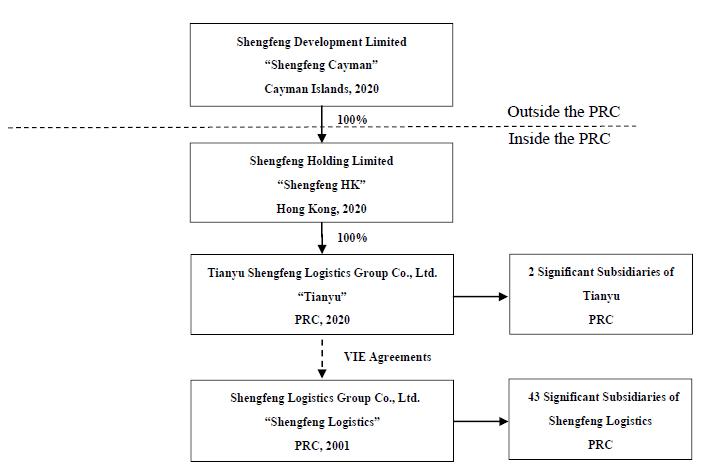
| (1) | As of the date of this annual report, Shengfeng Logistics is held by Fujian Yunlian Shengfeng Industry Co., Ltd., which is 90% owned by Yongxu Liu, who is our chief executive officer, chairman of the board and president, as to 54.58%, Yongxu Liu directly as to 30.99%, Zhoushan Zhongxin Equity Investment Partnership (Limited Partnership) as to 1.5%, Zhoushan Guancheng Equity Investment Partnership (Limited Partnership) as to 2%, Daqiu Tang as to 0.85%, Yelie Song as to 0.97%, Zhiping Yang as to 1.58%, Chaoxin Yang as to 0.96%, Guangsheng Lin as to 0.85%, Zhuangyuan Lin as to 2.59%, Zhongdeng Pan as to 2.13% and Yufan Chen as to 1%, who collectively hold 100% of the shares of Shengfeng Logistics. We refer to the above shareholders of Shengfeng Logistics as the “Shengfeng Logistics Shareholders.” |
For details of our principal shareholders’ ownership, please refer to the beneficial ownership table in the section captioned “Item 6. Directors, Senior Management and Employees—E. Share Ownership.”
Significant subsidiaries of Shengfeng Cayman and significant subsidiaries of Shengfeng Logistics, as that term is defined under Section 1-02 of Regulation S-X under the Securities Act, consist of the following entities:
| No. | Name of subsidiaries | Place of incorporation |
Date of incorporation or acquisition |
Percentage of direct or indirect |
Principal activities | ||||||
| 1 | Shengfeng Holding Limited (“Shengfeng HK”) | Hong Kong | August 18, 2020 | 100 | % | Investment holding of Tianyu | |||||
| 2 | Tianyu Shengfeng Logistics Group Co., Ltd. (“Tianyu”, formerly known as “Fujian Tianyu Shengfeng Logistics Co., Ltd.”) | Fujian, the PRC | December 16, 2020 | 100 | % | Investment holding of Shengfeng VIE | |||||
| VIE and VIE’s subsidiaries: | |||||||||||
| 3 | Shengfeng Logistics Group Co., Ltd. (“Shengfeng VIE” or “Shengfeng Logistics”) | Fujian, the PRC | December 7, 2001 | 100 | % | Transportation and warehouse storage management service | |||||
| 4 | Fuqing Shengfeng Logistics Co., Ltd. | Fujian, the PRC | April 15, 2011 | 100 | % | Transportation and warehouse storage management service | |||||
| 5 | Xiamen Shengfeng Logistics Co., Ltd. | Fujian, the PRC | December 22, 2011 | 100 | % | Transportation and warehouse storage management service | |||||
| 6 | Guangdong Shengfeng Logistics Co., Ltd. | Guangdong, the PRC | December 30, 2011 | 100 | % | Transportation and warehouse storage management service | |||||
| 7 | Hainan Shengfeng Supply Chain Management Co., Ltd. | Hainan, the PRC | August 18, 2020 | 51 | % | Transportation and warehouse storage management service | |||||
| 8 | Beijing Tianyushengfeng E-commerce Technology Co., Ltd. | Beijing, the PRC | January 9, 2004 | 100 | % | Transportation and warehouse storage management service | |||||
| 9 | Beijing Shengfeng Supply Chain Management Co., Ltd. | Beijing, the PRC | April 13, 2016 | 100 | % | Transportation and warehouse storage management service | |||||
| 10 | Shengfeng Logistics (Guizhou) Co., Ltd. | Guizhou, the PRC | August 15, 2017 | 100 | % | Transportation and warehouse storage management service | |||||
| 11 | Shengfeng Logistics (Tianjin) Co., Ltd. | Tianjin, the PRC | March 8, 2016 | 100 | % | Transportation and warehouse storage management service | |||||
| 12 | Shengfeng Logistics (Shandong) Co., Ltd. | Shandong, the PRC | March 15, 2016 | 100 | % | Transportation and warehouse storage management service | |||||
| 13 | Shengfeng Logistics Hebei Co., Ltd. | Hebei, the PRC | February 17, 2016 | 100 | % | Transportation and warehouse storage management service | |||||
| 14 | Shengfeng Logistics (Henan) Co., Ltd. | Henan, the PRC | March 28, 2016 | 100 | % | Transportation and warehouse storage management service | |||||
| 15 | Shengfeng Logistics (Liaoning) Co., Ltd. | Liaoning, the PRC | March 2, 2016 | 100 | % | Transportation and warehouse storage management service | |||||
| 16 | Shengfeng Logistics (Yunnan) Co., Ltd. | Yunnan, the PRC | January 25, 2016 | 100 | % | Transportation and warehouse storage management service | |||||
| 17 | Shengfeng Logistics (Guangxi) Co., Ltd. | Guangxi, the PRC | February 1, 2016 | 100 | % | Transportation and warehouse storage management service | |||||
| 18 | Hubei Shengfeng Logistics Co., Ltd. | Hubei, the PRC | December 15, 2010 | 100 | % | Transportation and warehouse storage management service |
| No. | Name of subsidiaries | Place of incorporation |
Date of incorporation or acquisition |
Percentage of direct or indirect |
Principal activities | ||||||
| 19 | Shengfeng Logistics Group (Shanghai) Supply Chain Management Co., Ltd. | Shanghai, the PRC | August 26, 2015 | 100 | % | Transportation and warehouse storage management service | |||||
| 20 | Shanghai Shengxu Logistics Co., Ltd. | Shanghai, the PRC | June 4, 2003 | 100 | % | Transportation and warehouse storage management service | |||||
| 21 | Hangzhou Shengfeng Logistics Co., Ltd. | Zhejiang, the PRC | June 10, 2010 | 100 | % | Transportation and warehouse storage management service | |||||
| 22 | Nanjing Shengfeng Logistics Co., Ltd. | Jiangsu, the PRC | August 30, 2011 | 100 | % | Transportation and warehouse storage management service | |||||
| 23 | Suzhou Shengfeng Logistics Co., Ltd. | Jiangsu, the PRC | January 14, 2005 | 90 | % | Transportation and warehouse storage management service | |||||
| 24 | Suzhou Shengfeng Supply Chain Management Co., Ltd. | Jiangsu, the PRC | August 9, 2019 | 100 | % | Transportation and warehouse storage management service | |||||
| 25 | Shengfeng Supply Chain Management Co., Ltd. | Fujian, the PRC | June 19, 2014 | 100 | % | Transportation and warehouse storage management service | |||||
| 26 | Fuzhou Shengfeng Transportation Co., Ltd. | Fujian, the PRC | April 18, 2019 | 100 | % | Transportation and warehouse storage management service | |||||
| 27 | Sichuan Shengfeng Logistics Co., Ltd. | Sichuan, the PRC | June 27, 2019 | 100 | % | Transportation and warehouse storage management service | |||||
| 28 | Fujian Shengfeng Logistics Co., Ltd. | Fujian, the PRC | April 2, 2020 | 100 | % | Transportation and warehouse storage management service | |||||
| 29 | Fujian Dafengche Information Technology Co. Ltd. | Fujian, the PRC | August 26, 2020 | 100 | % | Software engineering | |||||
| 30 | Ningde Shengfeng Logistics Co. Ltd | Fujian, the PRC | November 12, 2018 | 51 | % | Transportation and warehouse storage management service | |||||
| 31 | Shengfeng Logistics (Zhejiang) Co., Ltd. | Zhejiang, the PRC | February 1, 2021 | 100 | % | Transportation and warehouse storage management service | |||||
| 32 | Chengdu Shengfeng Supply Chain Management Co., Ltd. | Chengdu, the PRC | October 12, 2021 | 100 | % | Supply chain management service | |||||
| 33 | Shengfeng Logistics Group (Ningde) Supply Chain Management Co., Ltd. | Fujian, the PRC | September 23, 2022 | 100 | % | Supply chain management service | |||||
| 34 | Anhui Shengfeng Supply Chain Management Co., Ltd. | Anhui, the PRC | November 29, 2023 | 100 | % | Transportation and warehouse storage management service | |||||
| 35 | Shenzhen Tianyu Shengfeng Supply Chain Management Co., Ltd. (a) | Guangdong, the PRC | May 19, 2023 | 100 | % | Transportation and supply chain management service | |||||
| 36 | Ningbo Shengfeng Supply Chain Co., Ltd. | Zhejiang, the PRC | April 16, 2024 | 100 | % | Transportation and warehouse storage management service | |||||
| 37 | Qingdao Shengfeng Supply Chain Co., Ltd. | Shandong, the PRC | April 22, 2024 | 100 | % | Transportation and warehouse storage management service | |||||
| 38 | Zhongshan Shengfeng Supply Chain Management Co., Ltd. | Guangdong, the PRC | May 15, 2024 | 100 | % | Transportation and warehouse storage management service | |||||
| 39 | Hunan Shengfeng Supply Chain Management Co., Ltd. | Hunan, the PRC | May 23, 2024 | 100 | % | Transportation and warehouse storage management service | |||||
| 40 | Jiangxi Shengfeng Supply Chain Management Co., Ltd. | Jiangxi, the PRC | May 24, 2024 | 100 | % | Transportation and warehouse storage management service |
| No. | Name of subsidiaries | Place of incorporation |
Date of incorporation or acquisition |
Percentage of direct or indirect |
Principal activities | ||||||
| 41 | Dongguan Shengfeng Supply Chain Management Co., Ltd. | Guangdong, the PRC | July 7, 2024 | 100 | % | Transportation and warehouse storage management service | |||||
| 42 | Langfang Shengfeng Logistics Co., Ltd | Hebei, the PRC | August 27, 2024 | 100 | % | Transportation and warehouse storage management service | |||||
| 43 | Liaoning Tianyu Changsheng Supply Chain Management Co., Ltd. | Liaoning, the PRC | October 16, 2024 | 66 | % | Transportation and warehouse storage management service | |||||
| 44 | Chongqing Tianyu Shengfeng Supply Chain Management Co., Ltd | Chongqin, the PRC | October 21, 2024 | 100 | % | Transportation and supply chain management service | |||||
| 45 | Fujian Shengfeng Fulai Low Altitude Comprehensive Service Co., Ltd. | Fujian, the PRC | November 7, 2024 | 51 | % | Transportation and cargo packaging service | |||||
| 46 | Fujian Shengfeng Zhuoyue Shipping Engineering Technology Co., Ltd. | Fujian, the PRC | December 9, 2024 | 51 | % | Technical services and development | |||||
| Significant subsidiaries of Tianyu: | |||||||||||
| 47 | Yichun Shengfeng Logistics Co., Ltd. | Jiangxi, the PRC | December 1, 2022 | 100 | % | Transportation and warehouse storage management service | |||||
| 48 | Fujian Shengfeng Smart Technology Co., Ltd. (“SF Smart”)(b) | Fujian, the PRC | April 20, 2023 | 0 | % | Property management service | |||||
| 49 | Fujian Pingtan Tianyu Shengfeng Technology Co., Ltd. (“Pingtan SF”) (c) | Fujian, the PRC | September 27, 2023 | 0 | % | Supply chain management service | |||||
| 50 | Hubei Tianyu Shengfeng Logistics Co., Ltd | Hubei, the PRC | November 14, 2023 | 100 | % | Transportation and supply chain management service | |||||
| 51 | Wanzai Shengfeng Logistics Co., Ltd (d) | Jiangxi, the PRC | January 4, 2024 | 0 | % | Transportation and supply chain management service |
| (a) | On June 12, 2024, Tianyu transferred its 100% equity interests in Shenzhen Tianyu Shengfeng Supply Chain Management Co., Ltd. to Shengfeng Logistics. |
| (b) | On April 20, 2023, SF Smart was set up in Fujian, China, with 55% of the equity interests owned by Tianyu, and 45% of the equity interests owned by Shengfeng Supply Chain Management Co., Ltd. During the year ended December 31, 2023, Tianyu entered into an equity purchase agreement to sell its 51% equity interest in Pingtan SF and Pingtan SF’s subsidiary (SF Smart) to a third party. The transaction was completed on March 13, 2024. |
| On June 3, 2024, Shengfeng Supply Chain Management Co., Ltd. entered into an equity purchase agreement to sell its 49% equity interest in Pingtan SF and Pingtan SF’s subsidiary (SF Smart) to a third party. The equity transfer was completed on June 19, 2024. |
| (c) | On September 27, 2023, Pingtan SF was set up in Fujian, China, with 51% of the equity interests owned by Tianyu, and 49% of the equity interests owned by Shengfeng Supply Chain Management Co., Ltd. Tianyu further entered into an agreement to sell 51% equity interest of Pingtan SF and Pingtan SF’s subsidiary (SF Smart) to a third party for a consideration of $7.2 million (RMB51.0 million). Tianyu received $2.8 million (RMB20.0 million) as of December 31, 2023 and received the remaining balance on January 12, 2024. The transaction was completed on March 13, 2024. |
| On June 3, 2024, Shengfeng Supply Chain Management Co., Ltd. entered into an agreement to sell 49% equity interest of Pingtan SF and Pingtan SF’s subsidiary (SF Smart) to a third party for a consideration of $6.8 million (RMB49.0 million). Shengfeng Supply Chain Management Co., Ltd. received $6.1 million (RMB44.0 million) as of December 31, 2024. The remaining consideration shall be paid before June 30, 2025. The equity transfer was completed on June 19, 2024. |
| (d) | Wanzai Shengfeng Logistics Co., Ltd. was deregistered on October 29, 2024 |
Our VIE Agreements
Neither we nor our subsidiaries own any share in Shengfeng Logistics or the VIE’s subsidiaries. Instead, for accounting purposes, we control and receive the economic benefits of Shengfeng Logistics’ business operation through the VIE Agreements entered into by and among WFOE, Shengfeng Logistics and its shareholders on January 7, 2021, which enables us to consolidate the financial results of the VIE and the VIE’s subsidiaries in our consolidated financial statement under U.S. GAAP. The VIE Agreements are designed to provide Tianyu with the power, rights, and obligations to Shengfeng Logistics, including control rights and the rights to the assets, property, and revenue of Shengfeng Logistics, as set forth under the VIE Agreements. The VIE Agreements have not been tested in a court of law in China as of the date of this annual report and may not be effective in providing control over the VIE. We are, therefore, subject to risks due to the uncertainty of the interpretation and application of the laws and regulations of the PRC, regarding the VIE and the VIE structure, including, but not limited to, regulatory review of overseas listing of PRC companies through a special purpose vehicle, and the validity and enforcement of the contractual arrangements with the VIE.
We have evaluated the guidance in FASB ASC 810 and determined that we are regarded as the primary beneficiary of the VIE, for accounting purposes, as a result of our direct ownership in Tianyu and the provisions of the VIE Agreements. Accordingly, we treat the VIE and the VIE’s subsidiaries as our consolidated entities under U.S. GAAP. We have consolidated the financial results of the VIE and the VIE’s subsidiaries in our consolidated financial statements in accordance with U.S. GAAP.
Although we take every precaution available to effectively enforce the contractual and corporate relationship, the VIE structure has its inherent risks that may affect your investment, including less effectiveness and certainties than direct ownership and potential substantial costs to enforce the terms of the VIE Agreements. For example, Shengfeng Logistics and the Shengfeng Logistics Shareholders could breach their contractual arrangements with us by, among other things, failing to conduct their operations in an acceptable manner or taking other actions that are detrimental to our interests. If we had direct ownership of Shengfeng Logistics, we would be able to exercise our rights as a shareholder to effect changes in the board of directors of Shengfeng Logistics, which in turn could implement changes, subject to any applicable fiduciary obligations, at the management and operational level. However, under the current VIE Agreements, we rely on the performance by Shengfeng Logistics and the Shengfeng Logistics Shareholders of their respective obligations under the contracts to exercise control over Shengfeng Logistics. The Shengfeng Logistics Shareholders may not act in the best interests of our Company or may not perform their obligations under these contracts. Such risks exist throughout the period in which we intend to operate certain portions of our business through the VIE Agreements with Shengfeng Logistics. Furthermore, failure of the VIE shareholders to perform certain obligations could compel the Company to rely on legal remedies available under PRC laws, including seeking specific performance or injunctive relief, and claiming damages, which may not be effective. Additionally, if any disputes relating to these contracts remain unresolved, we will have to enforce our rights under these contracts through the operations of PRC law and arbitration, litigation, and other legal proceedings and therefore will be subject to uncertainties in the PRC legal system and the Company may incur substantial costs to enforce the terms of the VIE Agreements. We, as a Cayman Islands holding company, may have difficulty in enforcing any rights we may have under the VIE Agreements with the VIE, its founders and owners, in PRC because all of our VIE Agreements are governed by the PRC laws and provide for the resolution of disputes through arbitration in the PRC, where legal environment in the PRC is not as developed as in the United States. Also, these VIE Agreements may not be enforceable in China if PRC government authorities or courts take a view that such VIE Agreements contravene PRC laws and regulations or are otherwise not enforceable for public policy reasons. In the event we are unable to enforce these VIE Agreements, we may not be able to exert effective control over Shengfeng Logistics, and our ability to conduct our business may be materially and adversely affected. In addition, there is uncertainty as to whether the courts of the Cayman Islands or the PRC would recognize or enforce judgments of U.S. courts against us or such persons predicated upon the civil liability provisions of the securities laws of the United States or any state. See “Item 3. Key Information—D. Risk Factors—Risks Relating to Our Corporate Structure” and “—D. Risk Factors—Risks Relating to Doing Business in the PRC” for more information. In particular, see “—D. Risk Factors—Risks Relating to Our Corporate Structure—Our VIE Agreements with Shengfeng Logistics and the Shengfeng Logistics Shareholders may not be effective in providing control over Shengfeng Logistics,” “—D. Risk Factors—Risks Relating to Our Corporate Structure—The Shengfeng Logistics Shareholders have potential conflicts of interest with our Company which may adversely affect our business and financial condition,” “—D. Risk Factors—Risks Relating to Our Corporate Structure—Our VIE Agreements are governed by the laws of the PRC and we may have difficulty in enforcing any rights we may have under these contractual arrangements” and “—D. Risk Factors—Risks Relating to Doing Business in the PRC—We may be required to obtain permission from Chinese authorities (i) to issue our Class A Ordinary Shares to foreign investors and/or (ii) for the VIE’s operations, and if either or both are required and we are not able to obtain such permission in a timely manner, the securities currently being offered may substantially decline in value and become worthless.”
Each of the VIE Agreements is described in detail below:
Exclusive Technical Consultation and Service Agreement
Pursuant to the Technical Consultation and Service Agreement between Shengfeng Logistics and Tianyu, Tianyu provides Shengfeng Logistics with consultation and services in the areas of funding, human, technology and intellectual properties, including, but not limited to, training and technical support, marketing consultation services, general advice and assistance relating to management and operation of Shengfeng Logistics’ business, and other consultation and services which are necessary for Shengfeng Logistics’ business, on an exclusive basis, utilizing its resources. For services rendered to Shengfeng Logistics by Tianyu under the Technical Consultation and Service Agreement, Tianyu is entitled to collect a service fee, or the “Service Fee.” The Service Fees are composed of the basic annual fee, which is equal to 50% of the after-tax income of Shengfeng Logistics, and a floating fee, which shall not exceed the after-tax income after deducting paid basic annual fees. The floating fees shall be determined by both parties based on several factors including the number and the qualifications of the employees used by Tianyu, the time Tianyu spent on providing the services, the costs being paid for providing the services and the content, the value of the services provided and the operation revenue of Shengfeng Logistics.
The Technical Consultation and Service Agreement became effective on January 7, 2021 and will remain effective for 20 years. Such agreement can be extended if Tianyu provides its notice of extension to Shengfeng Logistics unilaterally prior to the expiration date of this agreement. Shengfeng Logistics shall use its best efforts to renew its business license and extend its operation term until and unless otherwise instructed by Tianyu.
The Technical Consultation and Service Agreement does not prohibit related party transactions. The Company’s audit committee is required to review and approve in advance any related party transactions, including transactions involving Tianyu or Shengfeng Logistics.
Equity Pledge Agreement
Under the Equity Pledge Agreement by and among Tianyu, Shengfeng Logistics and the Shengfeng Logistics Shareholders, together holding 100% of the shares in Shengfeng Logistics, the Shengfeng Logistics Shareholders pledged their shares in Shengfeng Logistics to Tianyu to guarantee the performance of Shengfeng Logistics and/or Shengfeng Logistics Shareholders’ obligations under the Technical Consultation and Service Agreement. Under the terms of the Equity Pledge Agreement, in the event that Shengfeng Logistics or the Shengfeng Logistics Shareholders breach their respective contractual obligations under the Technical Consultation and Service Agreement, Tianyu, as pledgee, will be entitled to certain rights, including, but not limited to, the right to collect dividends generated by the pledged shares. The Shengfeng Logistics Shareholders also agreed that upon occurrence of any event of default, as set forth in the Equity Pledge Agreement, Tianyu is entitled to dispose of the pledged shares in accordance with applicable PRC laws. The Shengfeng Logistics Shareholders further agreed not to assign the pledged shares prior to the full payment of the service fees.
The Equity Pledge Agreement is effective until the full payment of the service fees under the Technical Consultation and Service Agreement and upon termination of Shengfeng Logistics’ obligations under the Technical Consultation and Service Agreement, or upon the transfer of shares of the Shengfeng Logistics Shareholders.
The purposes of the Equity Pledge Agreement are to (1) guarantee the performance of Shengfeng Logistics’ obligations under the Technical Consultation and Service Agreement, (2) make sure the Shengfeng Logistics Shareholders do not transfer or assign the pledged shares, or create or allow any encumbrance that would prejudice Tianyu’s interests without Tianyu’s prior written consent, and (3) provide Tianyu control over Shengfeng Logistics under certain circumstances. In the event Shengfeng Logistics breaches its contractual obligations under the Technical Consultation and Service Agreement, Tianyu will be entitled to dispose of the pledged shares in accordance with relevant PRC laws.
As of the date of this annual report, the share pledges under the Equity Pledge Agreement have been registered with the competent PRC regulatory authority.
Exclusive Call Option Agreement
Under the Call Option Agreement, the Shengfeng Logistics Shareholders, together holding 100% of the shares in Shengfeng Logistics, irrevocably granted Tianyu (or its designee) an exclusive option to purchase, to the extent permitted under PRC law, once or at multiple times, at any time, part or all of their shares in Shengfeng Logistics in consideration of the payment of RMB1. The purchase price shall be the lowest price allowed by the laws of China.
Under the Call Option Agreement, Tianyu may at any time under any circumstances, purchase or have its designee purchase, at its discretion, to the extent permitted under PRC law, all or part of the Shengfeng Logistics Shareholders’ shares in Shengfeng Logistics. The Call Option Agreement, together with the Equity Pledge Agreement, the Technical Consultation and Service Agreement, the Voting Rights Proxy Agreement, and the Shareholders’ Powers of Attorney, enable Tianyu to exercise effective control over Shengfeng Logistics.
The Call Option Agreement remains effective until all the equity of Shengfeng Logistics is legally transferred under the name of Tianyu and/or other entity or individual designated by it.
Shareholders’ Powers of Attorney
Under each of the Powers of Attorney, the Shengfeng Logistics Shareholders authorized Tianyu to act on their behalf as their exclusive agent and attorney with respect to all rights as shareholders, including, but not limited to: (a) attending shareholders’ meetings; (b) exercising all the shareholder’s rights, including voting, that shareholders are entitled to under the laws of China and the Articles of Association, including, but not limited to, the sale or transfer or pledge or disposition of shares in part or in whole; and (c) designating and appointing on behalf of shareholders the legal representative, the executive director, supervisor, the chief executive officer, and other senior management members of Shengfeng Logistics.
The Powers of Attorney is irrevocable and continuously valid from the date of execution of the Powers of Attorney, so long as the Shengfeng Logistics Shareholders are shareholders of Shengfeng Logistics.
Voting Rights Proxy Agreement
Pursuant to the Voting Rights Proxy Agreements, the Shengfeng Logistics Shareholders unconditionally and irrevocably entrust Tianyu or Tianyu’s designee to exercise all their rights as shareholders of Shengfeng Logistics under the articles of association of Shengfeng Logistics, including without limitation to: (a) propose to hold a shareholders’ meeting in accordance with the articles of association of Shengfeng Logistics and attend shareholders’ meeting of Shengfeng Logistics as the agent and attorney of such shareholders; (b) exercise all shareholders’ voting rights with respect to all matters to be discussed and voted in the shareholders’ meeting of Shengfeng Logistics, including, but not limited to, the right to designate and appoint the director, the chief executive officer and other senior management members of Shengfeng Logistics; (c) exercise other voting rights the shareholders are entitled to under the laws of China promulgated from time to time; and (d) exercise other voting rights the shareholders are entitled to under the articles of associations of Shengfeng Logistics from time to time.
The Voting Rights Proxy Agreement became effective on January 7, 2021 and will remain effective for 20 years. Such agreement can be extended if Tianyu provides its notice of extension unilaterally prior to the expiration date of this agreement. All other parties shall agree with such extension without reserve.
Spousal Consent Letters
The spouses of certain of the Shengfeng Logistics Shareholders agreed, via a spousal consent letter, to the execution of certain of the VIE Agreements, including: (a) the Equity Pledge Agreement entered into with Tianyu and Shengfeng Logistics; (b) the Call Option Agreement entered into with Tianyu and Shengfeng Logistics; and (c) the Voting Rights Proxy Agreement entered into with Tianyu and Shengfeng Logistics, and the disposal of the shares of Shengfeng Logistics held by the Shengfeng Logistics Shareholders and registered in their names.
The spouses of certain of the Shengfeng Logistics Shareholders have further undertaken to not to make any assertions in connection with the shares of Shengfeng Logistics which are held by the Shengfeng Logistics Shareholders. The spouses of certain of the Shengfeng Logistics Shareholders have confirmed in spousal consent letters that the Shengfeng Logistics Shareholders can perform, amend, or terminate certain VIE Agreements without their authorization or consent and have agreed to execute all necessary documents and take all necessary actions to ensure appropriate performance of such VIE Agreements.
Risks Associated with our Corporate Structure and the VIE Agreements
Because we do not directly hold equity interests in the VIEs, we are subject to risks and uncertainties of the interpretations and applications of PRC laws and regulations, including but not limited to, regulatory review of overseas listing of PRC companies through special purpose vehicles and the validity and enforcement of the VIE Agreements. We are also subject to the risks and uncertainties about any future actions of the PRC government in this regard that could disallow the VIE structure, which would likely result in a material change in our operations, and the value of our Class A Ordinary Shares may depreciate significantly or become worthless. The VIE Agreements have not been tested in a court of law in China as of the date of this annual report. See “—D. Risk Factors—Risks Relating to Our Corporate Structure,” “—D. Risk Factors—Risks Relating to Doing Business in the PRC,” and “—D. Risk Factors—Risks Relating to Our Class A Ordinary Shares and the Trading Market.”
The VIE Agreements may not be as effective as direct ownership in providing operational control. For instance, the VIE and the VIE’s subsidiaries could breach their contractual arrangements with us by, among other things, failing to conduct their operations in an acceptable manner or taking other actions that are detrimental to our interests. The VIE and the VIE’s subsidiaries may not act in the best interests of our Company or may not perform their obligations under these contracts. Such risks exist throughout the period in which we intend to operate certain portions of our business through the VIE Agreements. In the event that the VIE or the VIE’s subsidiaries fail to perform their respective obligations under the VIE Agreements, we may have to incur substantial costs and expend additional resources to enforce such arrangements. In addition, even if legal actions are taken to enforce such arrangements, there is uncertainty as to whether the courts of the PRC would recognize or enforce judgments of U.S. courts against us or such persons predicated upon the civil liability provisions of the securities laws of the U.S. or any state. See “—D. Risk Factors—Risks Relating to Our Corporate Structure—Our VIE Agreements with Shengfeng Logistics and the Shengfeng Logistics Shareholders may not be effective in providing control over Shengfeng Logistics,” “—D. Risk Factors—Risks Relating to Our Corporate Structure—The Shengfeng Logistics Shareholders have potential conflicts of interest with our Company which may adversely affect our business and financial condition,” “—D. Risk Factors—Risks Relating to Our Corporate Structure—Our VIE Agreements are governed by the laws of the PRC and we may have difficulty in enforcing any rights we may have under these contractual arrangements” and “—D. Risk Factors—Risks Relating to Doing Business in the PRC—We may be required to obtain permission from Chinese authorities (i) to issue our Class A Ordinary Shares to foreign investors and/or (ii) for the VIE’s operations, and if either or both are required and we are not able to obtain such permission in a timely manner, the securities currently being offered may substantially decline in value and become worthless.”
Risks Associated with being based in the PRC
We are subject to certain legal and operational risks associated with having the majority of our operations in China, which could cause the value of our securities to significantly decline or become worthless. PRC laws and regulations governing our current business operations are sometimes vague and uncertain, and as a result these risks may result in material changes in the operations of the VIE and the VIE’s subsidiaries, significant depreciation or a complete loss of the value of our Class A Ordinary Shares, or a complete hindrance of our ability to offer, or continue to offer, our securities to investors. Recently, the PRC government adopted a series of regulatory actions and issued statements to regulate business operations in China with little advance notice, including cracking down on illegal activities in the securities market, adopting new measures to extend the scope of cybersecurity reviews, and expanding the efforts in anti-monopoly enforcement. As of the date of this annual report, we, our PRC subsidiary, and VIE and the VIE’s subsidiaries have not been involved in any investigations on cybersecurity review initiated by any PRC regulatory authority, nor has any of them received any inquiry, notice, or sanction. We believe that we are not subject to cybersecurity review with the Cyberspace Administration of China (the “CAC”) under the Cybersecurity Review Measures that became effective on February 15, 2022, given that: (i) we presently possesses personal information of less than one (1) million individual users in our business operations, as of the date of this annual report; and (ii) data processed in our business is less likely to have a bearing on national security, thus it may not be classified as core or important data by the authorities; we are also not subject to network data security review by the CAC even if the Regulations on the Network Data Security Administration (the “Security Administration”) has come into effect on January 1, 2025, since we currently do not have over one million users’ personal information and do not collect data that affects or may affect national security and we do not anticipate that we will be collecting over one million users’ personal information or data that affects or may affect national security in the foreseeable future, which we understand might otherwise subject us to the Security Administration. See “—D. Risk Factors—Risks Relating to Doing Business in the PRC—Our business generates and processes a large quantity of data, and improper handling of or unauthorized access to such data may adversely affect our business. In light of recent events indicating greater oversight by the Cyberspace Administration of China, or CAC, over data security, particularly for companies seeking to list on a foreign exchange, we are subject to a variety of laws and other obligations regarding cybersecurity and data protection, and any failure to comply with applicable laws and obligations could have a material and adverse effect on our business, our continued listing on Nasdaq, our financial condition, results of operations, and the subsequent offering.”
Since 2021, the Chinese government has strengthened its anti-monopoly supervision, mainly in three aspects: (i) establishing the National Anti-Monopoly Bureau; (ii) revising and promulgating anti-monopoly laws and regulations, including: the Anti-Monopoly Law of the PRC (amended on June 24, 2022 and effective on August 1, 2022), the anti-monopoly guidelines for various industries, and the Detailed Rules for the Implementation of the Fair Competition Review System; and (iii) expanding the anti-monopoly law enforcement targeting Internet companies and large enterprises. As of the date of this annual report, the Chinese government’s recent statements and regulatory actions related to anti-monopoly concerns have not impacted our or the PRC operating entities’ ability to conduct business or our ability to accept foreign investments or issue our securities to foreign investors because neither we and our subsidiaries, nor the VIE and the VIE’s subsidiaries engage in monopolistic behaviors that are subject to these statements or regulatory actions.
On February 17, 2023, the China Securities Regulatory Commission (the “CSRC”) promulgated the Trial Administrative Measures of Overseas Securities Offering and Listing by Domestic Companies (the “Trial Measures”) and five supporting guidelines, which came into effect on March 31, 2023. See “—D. Risk Factors—Risks Relating to Doing Business in the PRC—We may be required to obtain permission from Chinese authorities (i) to issue our Class A Ordinary Shares to foreign investors and/or (ii) for the VIE’s operations, and if either or both are required and we are not able to obtain such permission in a timely manner, the securities currently being offered may substantially decline in value and become worthless..” Other than the foregoing, as of the date of this annual report, according to our PRC counsel, AllBright Law Offices, or “AllBright”, no relevant PRC laws or regulations in effect require that we obtain permission from any PRC authorities to issue securities to foreign investors, and we have not received any inquiry, notice, warning, sanction, or any regulatory objection to our offerings from the CSRC, the CAC, or any other PRC authorities that have jurisdiction over our operations. Since these statements and regulatory actions are newly published, however, official guidance and related implementation rules have not been issued. It is highly uncertain what the potential impact such modified or new laws and regulations will have on the daily business operations of the VIE and the VIE’s subsidiaries, our ability to accept foreign investments, and our listing on a U.S. exchange. The Standing Committee of the National People’s Congress (the “SCNPC”) or PRC regulatory authorities may in the future promulgate additional laws, regulations, or implementing rules that require us, our subsidiaries, or the VIE and the VIE’s subsidiaries to obtain regulatory approval from Chinese authorities before listing in the U.S. If we do not receive or maintain such approval, or inadvertently conclude that such approval is not required, or applicable laws, regulations, or interpretations change such that we are required to obtain approval in the future, we may be subject to an investigation by competent regulators, fines or penalties, or an order prohibiting us from conducting an offering, and these risks could result in a material adverse change in our operations and the value of our Class A Ordinary Shares, significantly limit or completely hinder our ability to offer or continue to offer securities to investors, or cause such securities to significantly decline in value or become worthless.
Holding Foreign Companies Accountable Act
Our Class A Ordinary Shares may be prohibited from trading on a national exchange or over-the-counter under the Holding Foreign Companies Accountable Act (the “HFCA Act”) if the Public Company Accounting Oversight Board (United States) (the “PCAOB”) is unable to inspect our auditors for three consecutive years beginning in 2021. As of the date of the annual report, the Company’s auditor prior to November 11, 2022, Friedman LLP (“Friedman”), headquartered in New York, New York, has been inspected by the PCAOB on a regular basis, with the last inspection in October 2020. Our current auditor, Marcum Asia CPAs LLP (“Marcum Asia”), has been inspected by the PCAOB on a regular basis. Neither Friedman nor Marcum Asia is subject to the determinations announced by the PCAOB on December 16, 2021. If trading in our Class A Ordinary Shares is prohibited under the HFCA Act in the future because the PCAOB determines that it cannot inspect or fully investigate our auditor at such future time, Nasdaq may determine to delist our Class A Ordinary Shares and trading in our Class A Ordinary Shares could be prohibited. On June 22, 2021, the U.S. Senate passed the Accelerating Holding Foreign Companies Accountable Act, and on December 29, 2022, legislation entitled “Consolidated Appropriations Act, 2023” (the “Consolidated Appropriations Act”) was signed into law by President Biden, which contained, among other things, an identical provision to the Accelerating Holding Foreign Companies Accountable Act and amended the HFCA Act by requiring the U.S. Securities and Exchange Commission (the “SEC”) to prohibit an issuer’s securities from trading on any U.S. stock exchanges if its auditor is not subject to PCAOB inspections for two consecutive years instead of three, thus reducing the time period for triggering the prohibition on trading. On August 26, 2022, the CSRC, the Ministry of Finance of the PRC (the “MOF”), and the PCAOB signed a Statement of Protocol (the “Protocol”) governing inspections and investigations of audit firms based in mainland China and Hong Kong, taking the first step toward opening access for the PCAOB to inspect and investigate registered public accounting firms headquartered in mainland China and Hong Kong. Pursuant to the fact sheet with respect to the Protocol disclosed by the SEC, the PCAOB shall have independent discretion to select any issuer audits for inspection or investigation and has the unfettered ability to transfer information to the SEC. On December 15, 2022, the PCAOB Board determined that the PCAOB was able to secure complete access to inspect and investigate registered public accounting firms headquartered in mainland China and Hong Kong and voted to vacate its previous determinations to the contrary. However, should PRC authorities obstruct or otherwise fail to facilitate the PCAOB’s access in the future, the PCAOB Board will consider the need to issue a new determination. See “—D. Risk Factors—Risks Relating to Doing Business in the PRC—Recent joint statement by the SEC and the Public Company Accounting Oversight Board (United States), or the “PCAOB,” rule changes by Nasdaq, and an act passed by the U.S. Senate all call for additional and more stringent criteria to be applied to emerging market companies upon assessing the qualification of their auditors, especially the non-U.S. auditors who are not inspected by the PCAOB. These developments could add uncertainties to our offerings and affect our ability to list our securities on the Nasdaq Capital Market.”
Permissions Required from the PRC Authorities for The VIE’s Operations and the Company’s Issuance of Securities to Foreign Investors
We are currently not required to obtain permission from any of the PRC authorities to operate and issue our Class A Ordinary Shares to foreign investors. In addition, neither we, our subsidiaries, the VIE nor the VIE’s subsidiaries are required to obtain permission or approval from the PRC authorities including the CSRC and CAC for the VIE’s operation, nor have we, our subsidiaries, the VIE nor the VIE’s subsidiaries received any denial for the VIE’s operations. However, recently, the General Office of the Central Committee of the Communist Party of China and the General Office of the State Council jointly issued the “Opinions on Severely Cracking Down on Illegal Securities Activities According to Law,” or the “Opinions,” which was made available to the public on July 6, 2021. The Opinions emphasized the need to strengthen the administration over illegal securities activities, and the need to strengthen the supervision over overseas listings by Chinese companies. Effective measures, such as promoting the construction of relevant regulatory systems, will be taken to deal with the risks and incidents of China-concept overseas listed companies, and cybersecurity and data privacy protection requirements and similar matters. On February 17, 2023, the CSRC promulgated the Trial Measures and five supporting guidelines, or the “New Overseas Listing Rules”, which came into effect on March 31, 2023. The New Overseas Listing Rules require Chinese domestic enterprises to complete filings with relevant governmental authorities and report related information under certain circumstances, such as, a) an issuer making an application for initial public offering and listing in an overseas market; b) an issuer making an overseas securities offering after having been listed on an overseas market; c) an issuer offering securities on an overseas market to purchase assets after having been listed overseas; and d) a domestic company seeking an overseas direct or indirect listing of its assets through single or multiple acquisition(s), share swap, transfer of shares or other means. Pursuant to the Trial Measures, domestic companies that seek to offer or list securities overseas, both directly and indirectly, shall complete filing procedures with the CSRC pursuant to the requirements of the Trial Measures within three working days following its submission of initial public offerings or listing application. If a domestic company fails to complete required filing procedures or conceals any material fact or falsifies any major content in its filing documents, such domestic company may be subject to administrative penalties, such as an order to rectify, warnings, fines, and its controlling shareholders, actual controllers, the person directly in charge and other directly liable persons may also be subject to administrative penalties, such as warnings and fines.
According to the Notice on the Administrative Arrangements for the Filing of the Overseas Securities Offering and Listing by Domestic Companies from the CSRC, or the CSRC Notice, the domestic companies that have already been listed overseas before the effective date of the Overseas Listing Trial Measures (i.e. March 31, 2023) shall be deemed as existing issuers (the “Existing Issuers”). Existing Issuers are not required to complete the filing procedures immediately, and they shall be required to file with the CSRC for any subsequent offerings. Further, according to the CSRC Notice, domestic company obtained approval from overseas regulatory authorities or securities exchanges (for example, the effectiveness of a registration statement for offering and listing in the U.S. has been obtained) for their indirect overseas offering and listing prior March 31, 2023 but have not yet completed their indirect overseas issuance and listing, are granted a six-month transition period from March 31, 2023 to September 30, 2023. Those that complete their indirect overseas offering and listing within such six-month period are deemed as Existing Issuers and are not required to file with the CSRC for their indirect overseas offerings and listings. Within such six-month transition period, however, if such domestic companies fail to complete their indirect overseas issuance and listing, they shall complete the filing procedures with the CSRC.
On February 24, 2023, the CSRC, together with Ministry of Finance of the PRC, National Administration of State Secrets Protection and National Archives Administration of China, revised the Provisions on Strengthening Confidentiality and Archives Administration for Overseas Securities Offering and Listing, which were issued by the CSRC, National Administration of State Secrets Protection and National Archives Administration of China in 2009, or the Provisions. The revised Provisions were issued under the title the “Provisions on Strengthening Confidentiality and Archives Administration of Overseas Securities Offering and Listing by Domestic Companies”, and came into effect on March 31, 2023 together with the Trial Measures. One of the major revisions to the revised Provisions is expanding their application to cover indirect overseas offering and listing, as is consistent with the Trial Measures. The revised Provisions require that, including, but not limited to, (a) a domestic company that plans to, either directly or indirectly through its overseas listed entity, publicly disclose or provide to relevant individuals or entities including securities companies, securities service providers and overseas regulators, any documents and materials that contain state secrets or working secrets of government agencies, shall first obtain approval from competent authorities according to law, and file with the secrecy administrative department at the same level; and (b) domestic company that plans to, either directly or indirectly through its overseas listed entity, publicly disclose or provide to relevant individuals and entities including securities companies, securities service providers and overseas regulators, any other documents and materials that, if leaked, will be detrimental to national security or public interest, shall strictly fulfill relevant procedures stipulated by applicable national regulations.
As of the date of this annual report, the revised Provisions have come into effect, and any failure or perceived failure by the Company, its PRC Subsidiary or the VIE to comply with the above confidentiality and archives administration requirements under the revised Provisions and other PRC laws and regulations may result in the relevant entities being held legally liable by competent authorities, and referred to the judicial organ to be investigated for criminal liability if suspected of committing a crime. See “Item 4. Information on the Company—B. Business Overview—Regulations—Regulations on Mergers & Acquisitions and Overseas Listings.” The Opinions, the Trial Measures, the revised Provisions and any related implementing rules to be enacted may subject us to compliance requirement in the future. Given the current regulatory environment in the PRC, we are still subject to the uncertainty of different interpretation and enforcement of the rules and regulations in the PRC adverse to us, which may take place quickly with little advance notice. Notwithstanding the foregoing, as of the date of this annual report, we are not aware of any PRC laws or regulations in effect requiring that we obtain permission from any PRC authorities to issue securities to foreign investors, and we have not received any inquiry, notice, warning, sanction or any regulatory objection from the CSRC, the CAC, or any other Chinese authorities that have jurisdiction over our operations. If we inadvertently conclude that we are not required to obtain any permission or approval from any of the PRC authorities for the VIE’s operations and/or our issuance of securities to foreign, or applicable laws, regulations, or interpretations change and we are required to obtain such permission or approval in the future, we may be subject to investigations by competent regulators, fines, or penalties, ordered to suspend our relevant operations and rectify any non-compliance, prohibited from engaging in relevant business or conducting any offering, or incur additional costs to procure such approval or permission, and there is no guarantee that we can successfully obtain such approval or permission. These risks could result in a material adverse change in our operations, significantly limit or completely hinder our ability to offer or continue to offer securities to investors, or cause such securities to significantly decline in value or become worthless. See “—D. Risk Factors—Risks Relating to Our Corporate Structure” and “—D. Risk Factors—Risks Relating to Doing Business in the PRC” for more information. In particular, see “—D. Risk Factors—Risks Relating to Doing Business in the PRC—Uncertainties in the interpretation and enforcement of PRC laws and regulations could limit the legal protection available to you and us. Any changes in such laws and regulations may impair our ability to operate profitably,” “—D. Risk Factors—Risks Relating to Doing Business in the PRC—The Chinese government exerts substantial influence over the manner in which we must conduct our business activities. Any actions by the Chinese government, including any decision to intervene or influence our operations or to exert control over any offering of securities conducted overseas and/or foreign investment in China-based issuers, may cause us to make material changes to our operation, may limit or completely hinder our ability to offer or continue to offer securities to investors, and may cause the value of such securities to significantly decline or be worthless” and “—D. Risk Factors—Risks Relating to Doing Business in the PRC—We may be required to obtain permission from Chinese authorities (i) to issue our Class A Ordinary Shares to foreign investors and/or (ii) for the VIE’s operations, and if either or both are required and we are not able to obtain such permission in a timely manner, the securities currently being offered may substantially decline in value and become worthless.”
Dividend Distributions, Cash Transfer, and Tax Consequences
Shengfeng Cayman transfers cash to its wholly owned Hong Kong subsidiary, Shengfeng HK, by making capital contributions or providing loans, and Shengfeng HK transfers cash to its wholly owned subsidiary Tianyu Shengfeng Logistics Group Co., Ltd. (“Tianyu”) based in China by making capital contributions or providing loans to it. Because Shengfeng Cayman consolidates the financial statements of the VIE under the U.S. GAAP in reliance upon contractual arrangements and is regarded as the primary beneficiary of the VIE for accounting purposes, Shengfeng Cayman’s subsidiaries are not able to make direct capital contributions to the VIE and their subsidiaries. However, Shengfeng Cayman’s subsidiaries may transfer cash to the VIEs by making loans or payments to the VIEs for inter-group transactions. For the fiscal year ended December 31, 2024, VIE and the VIE’s subsidiaries paid approximately $6.6 million to WFOE and WFOE’s subsidiaries as operating cash payments, WFOE and WFOE’s subsidiaries paid approximately $3.0 million to VIE and the VIE’s subsidiaries as operating cash payments. For the fiscal year ended December 31, 2023, Shengfeng Cayman transferred approximately $6.7 million to Shengfeng HK for working capital loans. Shengfeng HK paid approximately $6.7 million to WFOE as a capital contribution. Shengfeng Supply Chain Management Co., Ltd. paid approximately $7.0 million to Pingtan SF as a capital contribution. No inter-company cash transfers or transfers of other assets have occurred among Shengfeng Cayman, Shengfeng HK, WFOE, the VIE and the VIE’s subsidiaries for the fiscal year ended December 31, 2022.
We intend to keep any future earnings to finance the expansion of our business, and we do not anticipate that any cash dividends will be paid in the foreseeable future. Our board of directors has complete discretion on whether to distribute dividends, subject to applicable laws. See “—D. Risk Factors— Risks Relating to Our Class A Ordinary Shares and the Trading Market—We do not intend to pay dividends for the foreseeable future.” As of the date of this annual report, none of our subsidiaries, nor the consolidated VIE and VIE’s subsidiaries have made any dividends or distributions to our Company. Additionally, no dividends or distributions have been made to U.S. investors as of the date of this annual report.
Under Cayman Islands law, a Cayman Islands company may pay a dividend on its shares out of either profit or share premium amounts, provided that in no circumstance may a dividend be paid if such payment would result in the company being unable to pay its debts due in the ordinary course of business.
If we determine to pay dividends on any of our Class A Ordinary Shares or Class B Ordinary Shares in the future, in the absence of available profits or share premium, as a holding company, we will be dependent on receipt of funds from our Hong Kong subsidiary, Shengfeng HK.
Current PRC regulations permit our PRC subsidiary to pay dividends to Shengfeng HK only out of its accumulated profits, if any, determined in accordance with Chinese accounting standards and regulations. In addition, each of our Affiliated Entities in China is required to set aside at least 10% of its after-tax profits each year, if any, to fund a statutory reserve until such reserve reaches 50% of its registered capital. Each of such entities in China is also required to further set aside a portion of its after-tax profits to fund the employee welfare fund, although the amount to be set aside, if any, is determined at the discretion of its board of directors. Although the statutory reserves can be used, among other things, to increase the registered capital and eliminate future losses in excess of retained earnings of the respective companies, the reserve funds are not distributable as cash dividends except in the event of liquidation.
The PRC government also imposes controls on the conversion of RMB into foreign currencies and the remittance of currencies out of the PRC. For instance, the Circular on Promoting the Reform of Foreign Exchange Management and Improving Authenticity and Compliance Review, or “SAFE Circular 3,” issued on January 26, 2017, provides that banks shall, when dealing with dividend remittance transactions from a domestic enterprise to its offshore shareholders of more than $50,000, review the relevant board resolutions, original tax filing form, and audited financial statements of such domestic enterprise based on the principal of genuine transaction. Furthermore, if our Affiliated Entities in the PRC incur debt on their own in the future, the instruments governing the debt may restrict their ability to pay dividends or make other payments. If we or our PRC subsidiary is unable to receive all of the revenue from the operations of the VIE and the VIE’s subsidiaries, we may be unable to pay dividends on our Class A Ordinary Shares or Class B Ordinary Shares, should we desire to do so in the future. See “—D. Risk Factors—Risk Relating to Doing Business in the PRC—Governmental control of currency conversion may affect the value of your investment and our payment of dividends.”
Cash dividends, if any, on our Class A Ordinary Shares or Class B Ordinary Shares would be paid in U.S. dollars. Shengfeng HK may be considered a non-resident enterprise for tax purposes, so that any dividends Tianyu pays to Shengfeng HK may be regarded as China-sourced income and, as a result, may be subject to PRC withholding tax at a rate of up to 10%. See “Item 10. Additional Information—E. Taxation—People’s Republic of China Enterprise Taxation (for the purpose of this paragraph, PRC does not include Taiwan and the special administrative regions of Hong Kong and Macau).”
In order for us to pay dividends to our shareholders, we will rely on payments made from Shengfeng Logistics to Tianyu, pursuant to contractual arrangements between such parties, and the distribution of such payments to Shengfeng HK as dividends from Tianyu. Certain payments from Shengfeng Logistics to Tianyu are subject to PRC taxes, including Value-Added Tax. If Shengfeng Logistics or the VIE’s subsidiaries incur debt on their own behalf in the future, the instruments governing the debt may restrict any such party’s ability to pay dividends or make other distributions to us.
Pursuant to the Arrangement between Mainland China and the Hong Kong Special Administrative Region for the Avoidance of Double Taxation and Tax Evasion on Income, or the Double Tax Avoidance Arrangement, the 10% withholding tax rate may be lowered to 5% if a Hong Kong resident enterprise owns no less than 25% of a PRC entity. The 5% withholding tax rate, however, does not automatically apply and certain requirements must be satisfied, including, without limitation, the requirement that (a) the Hong Kong entity must be the beneficial owner of the relevant dividends; and (b) the Hong Kong entity must directly hold no less than 25% share ownership in the PRC entity during the 12 consecutive months preceding its receipt of the dividends. In current practice, a Hong Kong entity must obtain a tax resident certificate from the Hong Kong tax authority to apply for the 5% lower PRC withholding tax rate. As the Hong Kong tax authority will issue such a tax resident certificate on a case-by-case basis, we cannot assure you that we will be able to obtain the tax resident certificate from the relevant Hong Kong tax authority and enjoy the preferential withholding tax rate of 5% under the Double Taxation Arrangement with respect to any dividends paid by our PRC subsidiary to its immediate holding company, Shengfeng HK. As of the date of this annual report, we have not applied for the tax resident certificate from the relevant Hong Kong tax authority. Shengfeng HK intends to apply for the tax resident certificate if and when Tianyu plans to declare and pay dividends to Shengfeng HK. See “—D. Risk Factors—Risks Relating to Doing Business in the PRC—There are significant uncertainties under the EIT Law relating to the withholding tax liabilities of our PRC subsidiary, and dividends payable by our PRC subsidiary to our offshore subsidiaries may not qualify to enjoy certain treaty benefits.” Subject to certain contractual, legal and regulatory restrictions, cash and capital contributions may be transferred among our Cayman Islands holding company and our subsidiaries. U.S. investors will not be subject to Cayman Islands, mainland China, or Hong Kong taxation on dividend distributions, and no withholding will be required on the payment of dividends or distributions to them, while they may be subject to U.S. federal income tax for receiving dividends, to the extent that the distribution is paid out of our current or accumulated earnings and profits, as determined under U.S. federal income tax principles. See “Item 10. Additional Information—E. Taxation.”
We conduct substantially all of our business in China through the VIE, Shengfeng Logistics, and the VIE’s subsidiaries. Substantially all of Shengfeng Development Limited’s revenues, costs and net income in China are directly or indirectly generated through the VIE and the VIE’s subsidiaries. We maintain our bank accounts and balances primarily in licensed banks in Mainland China. In addition, cash transfers from our Cayman Islands holding company are subject to applicable PRC laws and regulations on loans and direct investment. For details, see “—D. Risk Factors—Risk Relating to Doing Business in the PRC — PRC regulation of parent/subsidiary loans and direct investment by offshore holding companies to PRC entities may delay or prevent us from using the proceeds of future financial activities to make loans or additional capital contributions to our PRC subsidiary and to make loans to Shengfeng Logistics, which could materially and adversely affect our liquidity and our ability to fund and expand our business.”
Cash transfers from our Cayman Islands holding company are subject to applicable PRC laws and regulations on loans and direct investment. For example, any loans from Shengfeng Cayman to our wholly owned subsidiary in the PRC, Tianyu, to finance its activities cannot exceed statutory limits and must be registered with the local counterpart of SAFE, or filed with SAFE in its information system. Pursuant to relevant PRC regulations, we may provide loans to Tianyu up to the larger amount of (i) the balance between the registered total investment amount and registered capital of Tianyu, or (ii) twice the amount of the net assets of Tianyu calculated in accordance with the Circular on Full-Coverage Macro-Prudent Management of Cross-Border Financing, or the “PBOC Circular 9.” Moreover, any medium or long-term loan to be provided by us to Tianyu or other domestic PRC entities must also be filed and registered with National Development and Reform Commission, or the “NDRC.” We may also decide to finance Tianyu by means of capital contributions. These capital contributions are subject to registration with the State Administration for Market Regulation or its local branch, reporting of foreign investment information with MOFCOM, or registration with other governmental authorities in China. Due to the restrictions imposed on loans in foreign currencies extended to PRC domestic companies, we are not likely to make such loans to Shengfeng Logistics, which is a PRC domestic company. Further, we are not likely to finance the activities of Shengfeng Logistics and the VIE’s subsidiaries by means of capital contributions, due to regulatory restrictions relating to foreign investment in PRC domestic enterprises, which may be engaged in certain businesses, such as the Foreign Investment Law, which provides that foreign investors shall not invest in any field with investment prohibited by the negative list for foreign investment access. Additionally, the PRC government imposes controls on the convertibility of Renminbi into foreign currencies and, in certain cases, the remittance of currency out of China. If the foreign exchange control system prevents us from obtaining sufficient foreign currencies to satisfy our foreign currency demands, we may not be able to pay dividends in foreign currencies to our shareholders. For a more detailed description of the restrictions and limitations on our ability to transfer cash or distribute earnings to our Cayman Islands holding company and the investors, see “—D. Risk Factors—Risks Relating to Doing Business in the PRC—PRC regulation of parent/subsidiary loans and direct investment by offshore holding companies to PRC entities may delay or prevent us from using the proceeds of future financial activities to make loans or additional capital contributions to our PRC subsidiary and to make loans to Shengfeng Logistics, which could materially and adversely affect our liquidity and our ability to fund and expand our business,” “—D. Risk Factors— Risks Relating to Doing Business in the PRC—Governmental control of currency conversion may affect the value of your investment and our payment of dividends,” and “Item 14. Material Modifications to the Rights of Security Holders and Use of Proceeds.” In addition, current PRC regulations permit our PRC subsidiary to pay dividends to its shareholders only out of its accumulated profits, if any, determined in accordance with PRC accounting standards and regulations. For details, see “—D. Risk Factors—Risks Relating to Doing Business in the PRC—Our PRC subsidiary is subject to restrictions on paying dividends or making other payments to us, which may have a material adverse effect on our ability to conduct our business.”
If needed, cash can be transferred between our holding company and subsidiaries through intercompany fund advances, and there are currently no restrictions on transferring funds between our Cayman Islands holding company and subsidiaries in Hong Kong and mainland China, other than certain restrictions and limitations imposed by the PRC government. Currently, there are no restrictions or limitations imposed by the Hong Kong government on the transfer of capital within, into and out of Hong Kong (including funds from Hong Kong to the PRC), except for transfer of funds involving money laundering and criminal activities. Additionally, under existing PRC foreign exchange regulations, payment of current account items, such as profit distributions and trade and service-related foreign exchange transactions, can be made in foreign currencies without prior approval from the SAFE, by complying with certain procedural requirements. Therefore, our PRC subsidiary is able to pay dividends in foreign currencies to us without prior approval from SAFE, subject to the condition that the remittance of such dividends outside of the PRC complies with certain procedures under PRC foreign exchange regulations, such as the overseas investment registrations by our shareholders or the ultimate shareholders of our corporate shareholders who are PRC residents. Approval from, or registration with, appropriate government authorities is, however, required where the RMB is to be converted into foreign currency and remitted out of China to pay capital expenses such as the repayment of loans denominated in foreign currencies. The PRC government may also at its discretion restrict access in the future to foreign currencies for current account transactions. Current PRC regulations permit our PRC subsidiary to pay dividends to shareholders only out of its accumulated profits, if any, determined in accordance with Chinese accounting standards and regulations. See “—D. Risk Factors—Governmental control of currency conversion may affect the value of your investment and our payment of dividends” and “—D. Risk Factors — Risks Relating to Doing Business in the PRC — Our PRC subsidiary is subject to restrictions on paying dividends or making other payments to us, which may have a material adverse effect on our ability to conduct our business.” For the fiscal year ended December 31, 2024, VIE and the VIE’s subsidiaries paid approximately $6.6 million to WFOE and WFOE’s subsidiaries as operating cash payments, WFOE and WFOE’s subsidiaries paid approximately $3.0 million to VIE and the VIE’s subsidiaries as operating cash payments.. For the fiscal year ended December 31, 2023, Shengfeng Cayman transferred approximately $6.7 million to Shengfeng HK for working capital loans. Shengfeng HK paid approximately $6.7 million to WFOE as a capital contribution. Shengfeng Supply Chain Management Co., Ltd. paid approximately $7.0 million to Pingtan SF for capital contribution. No cash transfers, dividends, or distributions have occurred among our Company, our subsidiaries, and the VIE for the fiscal year ended December 31, 2022. As of the date of this annual report, none of our subsidiaries or the VIE have made any dividends or distributions to our Company and our Company has not made any dividends or distributions to our shareholders.
Selected Condensed Consolidating Financial Schedule of Shengfeng Cayman and Its Subsidiaries and the VIEs
On December 18, 2020, the Company completed a reorganization of entities under common control of its then existing shareholders, who collectively owned all of the equity of the Company prior to the reorganization. The Company and Shengfeng HK were each established as the holding companies of Shengfeng WFOE. Through Shengfeng WFOE, the Company entered into the VIE agreements with the VIE. Pursuant to the VIE agreements, the Company was established as the primary beneficiary of the VIE and its subsidiaries to transfer the economic benefits from the VIE to the Company and to direct the activities of the VIE.
We conduct substantially all of our business in China through the VIE, and the VIE’s subsidiaries. Substantially all of the Company’s revenues, costs and net income in China are directly or indirectly generated through the VIE and the VIE’s subsidiaries.
The following tables present selected condensed consolidating financial data of Shengfeng Cayman and its subsidiaries, the VIE, and the VIE’s subsidiaries for the fiscal years ended December 31, 2024, 2023 and 2022, and balance sheet data as of December 31, 2024, 2023 and 2022, which have been derived from our audited consolidated financial statements for those years.
As of and for the fiscal year ended December 31, 2024
| Shengfeng Development Limited (Shengfeng Cayman) | Shengfeng HK (100% owned by Shengfeng Cayman) |
Tianyu Shengfeng Logistics Group Co., Ltd. (WFOE) (100% owned by Shengfeng HK) |
Shengfeng Logistics Group Co., Ltd. and its subsidiaries (VIE) |
Eliminations | Consolidated Total | |||||||||||||||||||
| $ in thousands | ||||||||||||||||||||||||
| Condensed Consolidating Schedule – Balance Sheet | ||||||||||||||||||||||||
| Assets: | ||||||||||||||||||||||||
| Current assets | $ | 376 | $ | 10 | $ | 5,531 | $ | 203,213 | $ | (3,892 | ) | $ | 205,238 | |||||||||||
| Receivable from VIE | $ | - | $ | - | $ | 109,912 | $ | - | $ | (109,912 | ) | $ | - | |||||||||||
| Investments in subsidiaries | $ | 116,768 | $ | 116,758 | $ | - | $ | - | $ | (233,526 | ) | $ | - | |||||||||||
| Non-current assets | $ | 116,768 | $ | 123,408 | $ | 112,245 | $ | 102,559 | $ | (350,088 | ) | $ | 104,892 | |||||||||||
| Total assets | $ | 117,144 | $ | 123,418 | $ | 117,776 | $ | 305,772 | $ | (353,980 | ) | $ | 310,130 | |||||||||||
| Liabilities: | ||||||||||||||||||||||||
| Current liabilities | $ | - | $ | 6,660 | $ | 943 | $ | 165,668 | $ | (10,587 | ) | $ | 162,684 | |||||||||||
| Payable to WFOE | $ | - | $ | - | $ | - | $ | 109,912 | $ | (109,912 | ) | $ | - | |||||||||||
| Non-current liabilities | $ | - | $ | - | $ | 75 | $ | 23,925 | $ | - | $ | 24,000 | ||||||||||||
| Total liabilities | $ | - | $ | 6,660 | $ | 1,018 | $ | 299,505 | $ | (120,499 | ) | $ | 186,684 | |||||||||||
| Total equity | $ | 117,144 | $ | 116,758 | $ | 116,758 | $ | 6,267 | $ | (233,481 | ) | $ | 123,446 | |||||||||||
| Total liabilities and equity | $ | 117,144 | $ | 123,418 | $ | 117,776 | $ | 305,772 | $ | (353,980 | ) | $ | 310,130 | |||||||||||
| Condensed Consolidating Schedule – Statement of Operations | ||||||||||||||||||||||||
| Revenues | $ | - | $ | - | $ | 14,979 | $ | 498,122 | $ | (8,943 | ) | $ | 504,158 | |||||||||||
| Cost of revenues | $ | - | $ | - | $ | (14,063 | ) | $ | (453,365 | ) | $ | 9,554 | $ | (457,874 | ) | |||||||||
| Gross profit | $ | - | $ | - | $ | 916 | $ | 44,757 | $ | 611 | $ | 46,284 | ||||||||||||
| Operating expenses | $ | (259 | ) | $ | - | $ | (1,053 | ) | $ | (30,306 | ) | $ | - | $ | (31,618 | ) | ||||||||
| Technical service income from VIE and its subsidiaries (1) | $ | - | $ | - | $ | 10,490 | $ | - | $ | (10,490 | ) | $ | - | |||||||||||
| Technical Service expense in WFOE (1) | $ | - | $ | - | $ | - | $ | (10,490 | ) | $ | 10,490 | $ | - | |||||||||||
| Income for equity method investments | $ | 10,477 | $ | 10,477 | $ | - | $ | - | $ | (20,954 | ) | $ | - | |||||||||||
| Net income | $ | 10,218 | $ | 10,477 | $ | 10,477 | $ | 10,490 | $ | (30,835 | ) | $ | 10,827 | |||||||||||
| Condensed Consolidating Schedule – Statement of Cash Flows | ||||||||||||||||||||||||
| Net cash provided by (used in) operating activities | $ | (522 | ) | $ | - | $ | 1,574 | $ | 13,958 | $ | - | $ | 15,010 | |||||||||||
| Net cash used in investing activities | $ | - | $ | - | $ | (5,805 | ) | $ | (26,824 | ) | $ | - | $ | (32,629 | ) | |||||||||
| Net cash provided by financing activities | $ | - | $ | - | $ | - | $ | 29,072 | $ | - | $ | 29,072 | ||||||||||||
| Effects of exchange rate changes on cash, cash equivalents and restricted cash | $ | - | $ | - | $ | 23 | $ | (556 | ) | $ | - | $ | (533 | ) | ||||||||||
| Net increase (decrease) in cash, cash equivalents and restricted cash | $ | (522 | ) | $ | - | $ | (4,208 | ) | $ | 15,650 | $ | - | $ | 10,920 | ||||||||||
| Cash, cash equivalents and restricted cash, beginning of year | $ | 542 | $ | 10 | $ | 4,528 | $ | 24,213 | - | $ | 29,293 | |||||||||||||
| Cash, cash equivalents and restricted cash, end of year | $ | 20 | $ | 10 | $ | 320 | $ | 39,863 | $ | - | $ | 40,213 | ||||||||||||
| Inter-company cash transfers | ||||||||||||||||||||||||
| Transfer from VIE to WFOE | $ | - | $ | - | $ | 6,579 | $ | (6,579 | ) | $ | - | $ | - | |||||||||||
| Transfer from WFOE to VIE | $ | - | $ | - | $ | (3,036 | ) | $ | 3,036 | $ | - | $ | - | |||||||||||
As of and for the fiscal year ended December 31, 2023
| Shengfeng Development Limited (Shengfeng Cayman) | Shengfeng HK (100% owned by Shengfeng Cayman) |
Tianyu Shengfeng Logistics Group Co., Ltd. (WFOE) (100% owned by Shengfeng HK) |
Shengfeng Logistics Group Co., Ltd. and its subsidiaries (VIE) |
Eliminations | Consolidated Total | |||||||||||||||||||
| $ in thousands | ||||||||||||||||||||||||
| Condensed Consolidating Schedule – Balance Sheet | ||||||||||||||||||||||||
| Assets: | ||||||||||||||||||||||||
| Current assets | $ | 635 | $ | 10 | $ | 14,434 | $ | 146,894 | $ | (12,868 | ) | $ | 149,105 | |||||||||||
| Receivable from VIE | $ | - | $ | - | $ | 93,425 | $ | - | $ | (93,425 | ) | $ | - | |||||||||||
| Investments in subsidiaries | $ | 107,312 | $ | 107,302 | $ | - | $ | - | $ | (214,614 | ) | $ | - | |||||||||||
| Non-current assets | $ | 107,312 | $ | 113,952 | $ | 114,021 | $ | 103,055 | $ | (321,607 | ) | $ | 116,733 | |||||||||||
| Total assets | $ | 107,947 | $ | 113,962 | $ | 128,455 | $ | 249,949 | $ | (334,475 | ) | $ | 265,838 | |||||||||||
| Liabilities: | ||||||||||||||||||||||||
| Current liabilities | $ | - | $ | 6,660 | $ | 21,061 | $ | 127,603 | $ | (18,948 | ) | $ | 136,376 | |||||||||||
| Payable to WFOE | $ | - | $ | - | $ | - | $ | 93,425 | $ | (93,425 | ) | $ | - | |||||||||||
| Non-current liabilities | $ | - | $ | - | $ | 92 | $ | 17,057 | $ | - | $ | 17,149 | ||||||||||||
| Total liabilities | $ | - | $ | 6,660 | $ | 21,153 | $ | 238,085 | $ | (112,373 | ) | $ | 153,525 | |||||||||||
| Total equity | $ | 107,947 | $ | 107,302 | $ | 107,302 | $ | 11,864 | $ | (222,102 | ) | $ | 112,313 | |||||||||||
| Total liabilities and equity | $ | 107,947 | $ | 113,962 | $ | 128,455 | $ | 249,949 | $ | (334,475 | ) | $ | 265,838 | |||||||||||
| Condensed Consolidating Schedule – Statement of Operations | ||||||||||||||||||||||||
| Revenues | $ | - | $ | - | $ | 14,098 | $ | 401,825 | $ | (11,802 | ) | $ | 404,121 | |||||||||||
| Cost of revenues | $ | - | $ | - | $ | (13,137 | ) | $ | (355,662 | ) | $ | 11,184 | $ | (357,615 | ) | |||||||||
| Gross profit | $ | - | $ | - | $ | 961 | $ | 46,163 | $ | (618 | ) | $ | 46,506 | |||||||||||
| Operating expenses | $ | (421 | ) | $ | - | $ | (472 | ) | $ | (31,743 | ) | $ | 36 | $ | (32,600 | ) | ||||||||
| Technical service income from VIE and its subsidiaries (1) | $ | - | $ | - | $ | 10,828 | $ | - | $ | (10,828 | ) | $ | - | |||||||||||
| Technical Service expense in WFOE (1) | $ | - | $ | - | $ | - | $ | (10,828 | ) | $ | 10,828 | $ | - | |||||||||||
| Income for equity method investments | $ | 11,310 | $ | 11,310 | $ | - | $ | - | $ | (22,620 | ) | $ | - | |||||||||||
| Net income | $ | 10,889 | $ | 11,310 | $ | 11,310 | $ | 10,828 | $ | (34,029 | ) | $ | 10,308 | |||||||||||
| Condensed Consolidating Schedule – Statement of Cash Flows | ||||||||||||||||||||||||
| Net cash provided by (used in) operating activities | $ | (514 | ) | $ | - | $ | 2,982 | $ | 9,645 | $ | - | $ | 12,113 | |||||||||||
| Net cash used in investing activities | $ | (6,660 | ) | $ | (6,650 | ) | $ | (19,080 | ) | $ | (6,694 | ) | $ | 20,263 | $ | (18,821 | ) | |||||||
| Net cash provided by (used in) financing activities | $ | 7,669 | $ | 6,660 | $ | 20,842 | $ | (1,717 | ) | $ | (20,263 | ) | $ | 13,191 | ||||||||||
| Effects of exchange rate changes on cash, cash equivalents and restricted cash | $ | - | $ | - | $ | (216 | ) | $ | (342 | ) | $ | - | $ | (558 | ) | |||||||||
| Net increase in cash, cash equivalents and restricted cash | $ | 495 | $ | 10 | $ | 4,670 | $ | 750 | $ | - | $ | 5,925 | ||||||||||||
| Cash, cash equivalents and restricted cash, beginning of year | $ | 47 | $ | - | $ | - | $ | 23,321 | - | $ | 23,368 | |||||||||||||
| Cash, cash equivalents and restricted cash, end of year | $ | 542 | $ | 10 | $ | 4,528 | $ | 24,213 | $ | - | $ | 29,293 | ||||||||||||
| Inter-company cash transfers | ||||||||||||||||||||||||
| Transfer from Shengfeng Cayman to Shengfeng HK | $ | (6,660 | ) | $ | 6,660 | $ | - | $ | - | $ | - | $ | - | |||||||||||
| Transfer from Shengfeng HK to WFOE | $ | - | $ | (6,650 | ) | $ | 6,650 | $ | - | $ | - | $ | - | |||||||||||
| Transfer from VIE to WFOE | $ | - | $ | - | $ | 6,954 | $ | (6,954 | ) | $ | - | $ | - | |||||||||||
As of and for the fiscal year ended December 31, 2022
| Shengfeng Development Limited (Shengfeng Cayman) | Shengfeng HK (100% owned by Shengfeng Cayman) |
Tianyu Shengfeng Logistics Group Co., Ltd. (WFOE) (100% owned by Shengfeng HK) |
Shengfeng Logistics Group Co., Ltd. and its subsidiaries (VIE) |
Eliminations | Consolidated Total | |||||||||||||||||||
| $ in thousands | ||||||||||||||||||||||||
| Condensed Consolidating Schedule – Balance Sheet | ||||||||||||||||||||||||
| Assets: | ||||||||||||||||||||||||
| Current assets | $ | 47 | $ | - | $ | - | $ | 135,650 | $ | - | $ | 135,697 | ||||||||||||
| Receivable from VIE | $ | - | $ | - | $ | 91,695 | $ | - | $ | (91,695 | ) | $ | - | |||||||||||
| Investments in subsidiaries | $ | 91,695 | $ | 91,695 | $ | - | $ | - | $ | (183,390 | ) | $ | - | |||||||||||
| Non-current assets | $ | 91,776 | $ | 91,695 | $ | 91,695 | $ | 109,481 | $ | (275,085 | ) | $ | 109,562 | |||||||||||
| Total assets | $ | 91,823 | $ | 91,695 | $ | 91,695 | $ | 245,131 | $ | (275,085 | ) | $ | 245,259 | |||||||||||
| Liabilities: | ||||||||||||||||||||||||
| Current liabilities | $ | 600 | $ | - | $ | - | $ | 130,196 | $ | - | $ | 130,796 | ||||||||||||
| Payable to WFOE | $ | - | $ | - | $ | - | $ | 91,695 | $ | (91,695 | ) | $ | - | |||||||||||
| Non-current liabilities | $ | - | $ | - | $ | - | $ | 111,072 | $ | (91,695 | ) | $ | 19,377 | |||||||||||
| Total liabilities | $ | 600 | $ | - | $ | - | $ | 241,268 | $ | (91,695 | ) | $ | 150,173 | |||||||||||
| Total equity | $ | 91,223 | $ | 91,695 | $ | 91,695 | $ | 3,863 | $ | (183,390 | ) | $ | 95,086 | |||||||||||
| Total liabilities and equity | $ | 91,823 | $ | 91,695 | $ | 91,695 | $ | 245,131 | $ | (275,085 | ) | $ | 245,259 | |||||||||||
| Condensed Consolidating Schedule – Statement of Operations | ||||||||||||||||||||||||
| Revenues | $ | - | $ | - | $ | - | $ | 370,325 | $ | - | $ | 370,325 | ||||||||||||
| Cost of revenues | $ | - | $ | - | $ | - | $ | (328,793 | ) | $ | - | $ | (328,793 | ) | ||||||||||
| Gross profit | $ | - | $ | - | $ | - | $ | 41,532 | $ | - | $ | 41,532 | ||||||||||||
| Operating expenses | $ | (472 | ) | $ | - | $ | - | $ | (31,214 | ) | $ | - | $ | (31,686 | ) | |||||||||
| Technical service income from VIE and its subsidiaries (1) | $ | - | $ | - | $ | 8,298 | $ | - | $ | (8,298 | ) | $ | - | |||||||||||
| Technical Service expense in WFOE (1) | $ | - | $ | - | $ | - | $ | (8,298 | ) | $ | 8,298 | $ | - | |||||||||||
| Income for equity method investments | $ | 8,298 | $ | 8,298 | $ | - | $ | - | $ | (16,596 | ) | $ | - | |||||||||||
| Net income | $ | 7,826 | $ | 8,298 | $ | 8,298 | $ | - | $ | (16,596 | ) | $ | 7,826 | |||||||||||
| Condensed Consolidating Schedule – Statement of Cash Flows | ||||||||||||||||||||||||
| Net cash provided by (used in) operating activities | $ | (472 | ) | $ | - | $ | - | $ | 7,402 | $ | - | $ | 6,930 | |||||||||||
| Net cash used in investing activities | $ | - | $ | - | $ | - | $ | (6,715 | ) | $ | - | $ | (6,715 | ) | ||||||||||
| Net cash provided by financing activities | $ | 519 | $ | - | $ | - | $ | 5,530 | $ | - | $ | 6,049 | ||||||||||||
| Effects of exchange rate changes on cash, cash equivalents and restricted cash | $ | - | $ | - | $ | - | $ | (1,814 | ) | $ | - | $ | (1,814 | ) | ||||||||||
| Net increase in cash, cash equivalents and restricted cash | $ | 47 | $ | - | $ | - | $ | 4,403 | $ | - | $ | 4,450 | ||||||||||||
| Cash, cash equivalents and restricted cash, beginning of year | $ | - | $ | - | $ | - | $ | 18,918 | - | $ | 18,918 | |||||||||||||
| Cash, cash equivalents and restricted cash, end of year | $ | 47 | $ | - | $ | - | $ | 23,321 | $ | - | $ | 23,368 | ||||||||||||
| Inter-company cash transfers (2) | - | - | - | - | - | - | ||||||||||||||||||
| (1) | Represents technical service fee, including the basic annual fee and the floating fee, which equals to 100% of the VIE’s income net of tax, pursuant to the Exclusive Technical Consultation and Service Agreements. |
| (2) | There were no inter-company cash transfers among Shengfeng Cayman, Shengfeng HK, WFOE, the VIE and the VIE’s subsidiaries for the years ended December 31, 2022. |
A. [Reserved]
B. Capitalization and Indebtedness.
Not applicable.
C. Reasons for the Offer and Use of Proceeds.
Not applicable.
D. Risk Factors.
Risks Relating to Our Corporate Structure
Our corporate structure, in particular our WFOE’s contractual arrangements (the “VIE Agreements”) with Shengfeng Logistics and the Shengfeng Logistics Shareholders, together holding 100% of the shares in Shengfeng Logistics, are subject to significant risks, as set forth in the following risk factors.
If the PRC government deems that the contractual arrangements in relation to the VIE do not comply with applicable PRC law or PRC regulatory restrictions on foreign investment in the relevant industries, or if these regulations or the interpretation of existing regulations change in the future, we could be subject to severe penalties or be forced to relinquish our interests in those operations.
We currently operate our business through Shengfeng Logistics, a VIE, pursuant to the VIE Agreements, and the VIE’s subsidiaries. As a result of these contractual arrangements, under U.S. GAAP, the assets and liabilities of Shengfeng Logistics are treated as our assets and liabilities and the results of operations of Shengfeng Logistics are treated in all aspects as if they were the results of our operations. For a description of these contractual arrangements, see “Item 3. Key Information—Our VIE Agreements.”
In the opinion of AllBright, our PRC counsel, based on its understandings of the relevant PRC laws and regulations, (i) the ownership structures of Shengfeng Logistics in China and Tianyu, our wholly owned subsidiary in China currently are not in violation of applicable PRC laws and regulations currently in effect; and (ii) each of the contracts among Tianyu, Shengfeng Logistics, and the Shengfeng Logistics Shareholders is legal, valid, binding, and enforceable in accordance with its terms and applicable PRC laws. However, our PRC counsel has also advised us that there are substantial uncertainties regarding the interpretation and application of current or future PRC laws and regulations. In addition, our VIE Agreements have not been tested in a court of law in China as of the date of this annual report. Accordingly, the PRC regulatory authorities may ultimately take a view contrary to the opinion of our PRC counsel in the future. It is uncertain whether any new PRC laws or regulations relating to VIE structures will be adopted or, if adopted, what they would provide. Furthermore, it is uncertain whether any future actions by the government of China will significantly affect the enforceability of the VIE Agreements.
If (i) the applicable PRC authorities invalidate the VIE Agreements for violation of PRC laws, rules and regulations, (ii) the VIE or its shareholders terminate the contractual arrangements (iii) the VIE or its shareholders fail to perform their respective obligations under such VIE Agreements, or (iv) if these regulations change or are interpreted differently in the future, our business operations in China would be materially and adversely affected, and the value of our Class A Ordinary Shares would substantially decrease or even become worthless. Further, if we fail to renew such VIE Agreements upon their expiration, we would not be able to continue our business operations unless the then current PRC law allows us to directly operate businesses in China.
In addition, if the VIE or the VIE’s subsidiaries or all or part of their respective assets become subject to liens or rights of third-party creditors, we may be unable to continue some or all of our business activities, which could materially and adversely affect our business, financial condition and results of operations. If any of the VIE or the VIE’s subsidiaries undergoes a voluntary or involuntary liquidation proceeding, its respective shareholders or unrelated third-party creditors may claim rights to some or all of these assets, thereby hindering our ability to operate our business, which could materially and adversely affect our business and our ability to generate revenue.
All of the VIE Agreements are governed by PRC law and provide for the resolution of disputes through arbitration in the PRC. The legal environment in the PRC is not as developed as in some other jurisdictions, such as the United States. As a result, uncertainties in the PRC legal system could limit our ability to enforce such VIE Agreements.
If our corporate structure and the VIE Agreements are determined to be illegal or invalid by a PRC court, arbitral tribunal, or regulatory authorities, we may lose control of the VIE and have to modify such structure to comply with regulatory requirements. However, there can be no assurance that we can achieve a structural modification without material disruption to our business. Further, if our corporate structure and contractual arrangements are found to be in violation of any existing or future PRC laws or regulations, or we or Shengfeng Logistics fails to obtain or maintain any required permits or approvals, the relevant regulatory authorities would have broad discretion in dealing with such violations, including:
| ● | revoking the business or operating licenses or both of Tianyu or Shengfeng Logistics; | |
| ● | discontinuing or restricting the operations of Tianyu or Shengfeng Logistics; |
| ● | imposing conditions or requirements with which we, Tianyu, or Shengfeng Logistics may not be able to comply; | |
| ● | requiring us, Tianyu, or Shengfeng Logistics to change our corporate structure and contractual arrangements; | |
| ● | restricting or prohibiting our use of the proceeds from our initial public offering to finance our business and operations in China; and | |
| ● | imposing fines. |
The imposition of any of these penalties would result in a material and adverse effect on our ability to conduct our business. In addition, it is unclear what impact the PRC government actions would have on us and on our ability to consolidate the financial results of Shengfeng Logistics in our consolidated financial statements, if the PRC government authorities were to find our legal structure and VIE Agreements to be in violation of PRC laws and regulations. If the imposition of any of these government actions causes us to lose our right to direct the activities of Shengfeng Logistics or our right to receive substantially all the economic benefits and residual returns from Shengfeng Logistics and we are not able to restructure our ownership structure and operations in a satisfactory manner, we would no longer be able to consolidate the financial results of Shengfeng Logistics in our consolidated financial statements. Either of these results, or any other significant penalties that might be imposed on us in this event, would have a material adverse effect on our financial condition and results of operations.
Furthermore, if the PRC government determines that the contractual arrangements constituting part of our VIE structure do not comply with PRC regulations, or if these regulations change or are interpreted differently in the future, our Class A Ordinary Shares may decline in value or become worthless if we are unable to assert our contractual control rights over the assets of the VIE and the VIE’s subsidiaries that conduct substantially all of our operations in China.
Our VIE Agreements with Shengfeng Logistics and the Shengfeng Logistics Shareholders may not be effective in providing control over Shengfeng Logistics.
Shengfeng Development Limited is a holding company incorporated under the laws of the Cayman Islands and it is not a Chinese operating company. As a holding company with no material operations of its own, its operations have been conducted in China by its subsidiaries and through contractual arrangements, or VIE Agreements, with a VIE, Shengfeng Logistics, and the VIE’s subsidiaries. For accounting purposes, we control and receive the economic benefits of the VIE and the VIE’s subsidiaries’ business operations through the VIE Agreements, which enable us to consolidate the financial results of the VIE and the VIE’s subsidiaries in our consolidated financial statement under U.S. GAAP. Neither we nor our subsidiaries own any equity interests in the VIE or the VIE’s subsidiaries. As an investor of our Class A Ordinary Shares, you may be subject to unique risks due to our VIE structure. The VIE Agreements are designed to provide our wholly owned subsidiary, Tianyu, with the power, rights, and obligations to Shengfeng Logistics, including control rights and the rights to the assets, property, and revenue of the VIE, as set forth under the VIE Agreements. Our VIE Agreements have not been tested in a court of law in China as of the date of this annual report. We have evaluated the guidance in FASB ASC 810 and determined that we are regarded as the primary beneficiary of the VIE, for accounting purposes, as a result of our direct ownership in Tianyu and the provisions of the VIE Agreements. Accordingly, we treat the VIE and the VIE’s subsidiaries as our consolidated entities under U.S. GAAP. We have consolidated the financial results of the VIE and the VIE’s subsidiaries in our consolidated financial statements in accordance with U.S. GAAP.
Our Class A Ordinary Shares are shares of our offshore holding company in the Cayman Islands instead of shares of the VIE or the VIE’s subsidiaries in China, therefore, you will not directly hold equity interests in the VIE or the VIE’s subsidiaries, and you may never directly hold equity interests in the VIE or the VIE’s subsidiaries through your investment in our Class A Ordinary Shares. For a description of the VIE Agreements, see “Item 3. Key Information—Our VIE Agreements.”
We primarily have relied, and expect to continue to rely on the VIE Agreements to control and operate the business of Shengfeng Logistics. However, the VIE Agreements may not be as effective in providing us with the necessary control over Shengfeng Logistics and its operations. For example, Shengfeng Logistics and the Shengfeng Logistics Shareholders could breach their contractual arrangements with us by, among other things, failing to conduct their operations in an acceptable manner or taking other actions that are detrimental to our interests. If we had direct ownership of Shengfeng Logistics, we would be able to exercise our rights as a shareholder to effect changes in the board of directors of Shengfeng Logistics, which in turn could implement changes, subject to any applicable fiduciary obligations, at the management and operational level. However, under the current VIE Agreements, we rely on the performance by Shengfeng Logistics and the Shengfeng Logistics Shareholders of their respective obligations under the contracts to exercise control over Shengfeng Logistics. As of the date of this annual report, Shengfeng Logistics is owned by Fujian Yunlian Shengfeng Industry Co., Ltd. as to 54.58%, Yongxu Liu, our chief executive officer, chairman of the board and president, as to 30.99%, and the other Shengfeng Logistics Shareholders who collectively own 14.43% of the VIE. Fujian Yunlian Shengfeng Industry Co., Ltd. is 90% owned by Yongxu Liu. As a result, Mr. Liu directly and indirectly owns 80.12% of Shengfeng Logistics. The Shengfeng Logistics Shareholders may not act in the best interests of our Company or may not perform their obligations under these contracts. Such risks exist throughout the period in which we intend to operate certain portions of our business through the VIE Agreements with Shengfeng Logistics. Furthermore, failure of the VIE shareholders to perform certain obligations could compel the Company to rely on legal remedies available under PRC laws, including seeking specific performance or injunctive relief, and claiming damages, which may not be effective. If any disputes relating to these contracts remain unresolved, we will have to enforce our rights under these contracts through the operations of PRC law and arbitration, litigation, and other legal proceedings and therefore will be subject to uncertainties in the PRC legal system and the Company may incur substantial costs to enforce the terms of such contracts. Therefore, our VIE Agreements with Shengfeng Logistics and the Shengfeng Logistics Shareholders may not be as effective in ensuring our control over the relevant portion of our business operations as direct ownership would be. Additionally, our VIE Agreements have not been tested in a court of law in China, as of the date of this annual report, and may not be effective in providing control over the VIE. We are, therefore, subject to risks due to the uncertainty of the interpretation and application of the laws and regulations of the PRC, regarding the VIE and the VIE structure, including, but not limited to, regulatory review of overseas listing of PRC companies through a special purpose vehicle, and the validity and enforcement of the contractual arrangements with the VIE. The VIE Agreements may not be enforceable in China if the PRC government authorities or courts take a view that such VIE Agreements contravene PRC laws and regulations or are otherwise not enforceable for public policy reasons. In the event that we are unable to enforce the VIE Agreements, we may not be able to exert effective control over Shengfeng Logistics, and our ability to conduct our business may be materially and adversely affected.
Our VIE Agreements are governed by the laws of the PRC and we may have difficulty in enforcing any rights we may have under these contractual arrangements.
As our VIE Agreements are governed by PRC laws and provide for the resolution of disputes through arbitration in the PRC, they would be interpreted in accordance with PRC law and any disputes would be resolved in accordance with PRC legal procedures. Disputes arising from the VIE Agreements will be resolved through arbitration in the PRC, although these disputes do not include claims arising under the United States federal securities law and thus do not prevent you from pursuing claims under the United States federal securities law. The legal environment in the PRC is not as developed as in the United States. As a result, uncertainties in the PRC legal system could further limit our ability to enforce these contractual arrangements, through arbitration, litigation, and other legal proceedings remain in the PRC, which could limit our ability to enforce these contractual arrangements and exert effective control over Shengfeng Logistics. Furthermore, these contracts may not be enforceable in the PRC if the PRC government authorities or courts take a view that such contracts contravene PRC laws and regulations or are otherwise not enforceable for public policy reasons. In the event we are unable to enforce these contractual arrangements, we may not be able to exert effective control over Shengfeng Logistics, and our ability to conduct our business may be materially and adversely affected. In addition, there is uncertainty as to whether the courts of the Cayman Islands or the PRC would recognize or enforce judgments of U.S. courts against us or such persons predicated upon the civil liability provisions of the securities laws of the United States or any state.
We may not be able to consolidate the financial results of Shengfeng Logistics or such consolidation could materially and adversely affect our operating results and financial condition.
Our business is conducted through Shengfeng Logistics, which currently is considered for accounting purposes as a VIE, and we are considered the primary beneficiary for accounting purposes, enabling us to consolidate the financial results of Shengfeng Logistics in our consolidated financial statements. In the event that in the future Shengfeng Logistics would no longer meet the definition of a VIE, or we are deemed not to be the primary beneficiary for accounting purposes, we would not be able to consolidate line by line its financial results in our consolidated financial statements for PRC purposes. Furthermore, if in the future an affiliate company becomes a VIE and we become the primary beneficiary for accounting purposes, we would be required to consolidate that entity’s financial results in our consolidated financial statements for PRC purposes. If such entity’s financial results were negative, this could have a corresponding negative impact on our operating results for PRC purposes. However, any material variations in the accounting principles, practices, and methods used in preparing financial statements for PRC purposes from the principles, practices, and methods generally accepted in the United States and in the SEC accounting regulations must be discussed, quantified, and reconciled in financial statements for the United States and SEC purposes.
The VIE Agreements may result in adverse tax consequences.
PRC laws and regulations emphasize the requirement of an arm’s length basis for transfer pricing arrangements between related parties. The laws and regulations also require enterprises with related party transactions to prepare transfer pricing documentation to demonstrate the basis for determining pricing, the computation methodology, and detailed explanations. Related party arrangements and transactions may be subject to challenge or tax inspection by the PRC tax authorizes.
Under a tax inspection, if our transfer pricing arrangements between Tianyu and Shengfeng Logistics are judged as tax avoidance, or related documentation does not meet the requirements, Tianyu and Shengfeng Logistics may be subject to material adverse tax consequences, such as transfer pricing adjustment. A transfer pricing adjustment could result in a reduction, for PRC tax purpose, of adjustments recorded by Tianyu, which could adversely affect us by (i) increasing Shengfeng Logistics’ tax liabilities without reducing Tianyu’s tax liabilities, which could further result in interest being levied to us for unpaid taxes; or (ii) imposing late payment fees and other penalties on Shengfeng Logistics for the adjusted but unpaid taxes according to the applicable regulations. In addition, if Tianyu requests the Shengfeng Logistics Shareholders to transfer their equity interests in Shengfeng Logistics at nominal or no value pursuant to the VIE Agreements, such transfer may be viewed as a gift and subject Tianyu to PRC income tax. As a result, our financial position could be materially and adversely affected if Shengfeng Logistics’ tax liabilities increase or if it is required to pay late payment fees and other penalties.
The Shengfeng Logistics Shareholders have potential conflicts of interest with our Company which may adversely affect our business and financial condition.
The Shengfeng Logistics Shareholders may have potential conflicts of interest with us. These shareholders may not act in the best interest of our Company or may breach, or cause Shengfeng Logistics to breach the existing contractual arrangements we have with them and Shengfeng Logistics, which would have a material and adverse effect on our ability to effectively control Shengfeng Logistics and receive economic benefits from it. For example, the shareholders may be able to cause our agreements with Shengfeng Logistics to be performed in a manner adverse to us by, among other things, failing to remit payments due under the contractual arrangements to us on a timely basis. We cannot assure you that when conflicts of interest arise, any or all of these shareholders will act in the best interests of our Company or such conflicts will be resolved in our favor.
Currently, we do not have any arrangements to address potential conflicts of interest between these shareholders and our Company, except that we could exercise our purchase option under the exclusive call option agreements with these shareholders to request them to transfer all of their equity interests in Shengfeng Logistics to a PRC entity or individual designated by us, to the extent permitted by PRC law. If we cannot resolve any conflicts of interest or disputes between us and those shareholders, we would have to rely on legal proceedings, which may materially disrupt our business. There is also substantial uncertainty as to the outcome of any such legal proceeding.
We rely on the approvals, certificates, and business licenses held by Shengfeng Logistics and any deterioration of the relationship between Tianyu and Shengfeng Logistics could materially and adversely affect our overall business operations.
Pursuant to the VIE Agreements, our business in the PRC will be undertaken on the basis of the approvals, certificates, business licenses, and other requisite licenses held by Shengfeng Logistics. There is no assurance that Shengfeng Logistics will be able to renew its licenses or certificates when their terms expire with substantially similar terms as the ones they currently hold.
Further, our relationship with Shengfeng Logistics is governed by the VIE Agreements, which are intended to provide us, through our indirect ownership of Tianyu, with effective control over the business operations of Shengfeng Logistics. However, the VIE Agreements may not be effective in providing control over the applications for and maintenance of the licenses required for our business operations. Shengfeng Logistics could violate the VIE Agreements, go bankrupt, suffer from difficulties in its business, or otherwise become unable to perform its obligations under the VIE Agreements and, as a result, our operations, reputation, business, and stock price could be severely harmed.
The exercise of our option to purchase part or all of the shares in Shengfeng Logistics under the exclusive call option agreement might be subject to certain limitations and substantial costs.
Our exclusive call option agreement with Shengfeng Logistics and the Shengfeng Logistics Shareholders gives Tianyu the option to purchase up to 100% of the shares in Shengfeng Logistics. Such transfer of shares may be subject to approvals from, filings with, or reporting to competent PRC authorities, such as the Ministry of Commerce of the PRC, or “MOFCOM,” the State Administration for Market Regulation, and/or their local competent branches. In addition, the shares transfer price may be subject to review and tax adjustment by the relevant tax authorities. The shares transfer price to be received by Shengfeng Logistics under the VIE Agreements may also be subject to enterprise income tax, and these amounts could be substantial.
Risks Relating to Doing Business in the PRC
There are uncertainties under the Foreign Investment Law relating to the status of businesses in China controlled by foreign invested projects primarily through contractual arrangements, such as our business.
The NDRC and the MOFCOM promulgated the Special Administrative Measures (Negative List) for Foreign Investment Access (2024 Edition) (the “2024 National Negative List”) on September 6, 2024, effective on November 1, 2024.
On March 15, 2019, the National People’s Congress approved the Foreign Investment Law of the PRC, which came into effect on January 1, 2020, repealing simultaneously the Law of the PRC on Sino-foreign Equity Joint Ventures, the Law of the PRC on Wholly Foreign-owned Enterprises, and the Law of the PRC on Sino-foreign Cooperative Joint Ventures, together with their implementation rules and ancillary regulations. Pursuant to the Foreign Investment Law, foreign investment refers to any investment activity directly or indirectly carried out by foreign natural persons, enterprises, or other organizations, including investment in new construction project, establishment of foreign funded enterprise or increase of investment, merger and acquisition, and investment in any other way stipulated under laws, administrative regulations, or provisions of the State Council of the PRC, or the “State Council.” The Foreign Investment Law does not explicitly stipulate the contractual arrangements as a form of foreign investment. On December 26, 2019, the State Council promulgated the Implementation Regulations on the Foreign Investment Law, which came into effect on January 1, 2020. However, the Implementation Regulations on the Foreign Investment Law still remain silent on whether contractual arrangements should be deemed to be a form of foreign investment. Though these regulations do not explicitly classify contractual arrangements as a form of foreign investment, there is still uncertainty regarding whether the VIE would be identified as a foreign-invested enterprise in the future. As a result, there is no assurance that foreign investment via contractual arrangements would not be interpreted as a type of indirect foreign investment activities under the definition in the future.
If we are deemed to have a non-PRC entity as a controlling shareholder, the provisions regarding control through contractual arrangements could apply to our VIE Agreements, and as a result Shengfeng Logistics might become subject to restrictions on foreign investment, which may materially impact the viability of our current and future operations. Specifically, we may be required to modify our corporate structure, change our current scope of operations, obtain approvals, or face penalties or other additional requirements, compared to entities which do have PRC controlling shareholders. Uncertainties exist with respect to the interpretation and implementation of the Foreign Investment Law and how it may impact the viability of our current corporate structure, corporate governance, and business operations.
It is uncertain whether we would be considered as ultimately controlled by Chinese parties. As of the date of this annual report, Mr. Yongxu Liu, our chief executive officer and Chairman and a PRC citizen beneficially and indirectly owns 41,880,000 Class B Ordinary Shares, representing approximately 91.16% of the voting rights in our Company. It is uncertain, however, if these factors would be sufficient to give them control over us under the Foreign Investment Law. If future revisions or implementation rules of the Foreign Investment Law mandate further actions, such as the MOFCOM market entry clearance or certain restructuring of our corporate structure and operations, there may be substantial uncertainties as to whether we can complete these actions in a timely manner, if at all, and our business and financial condition may be materially and adversely affected.
China’s economic, political and social conditions, laws and regulations, as well as possible interventions and influences of any government policies and actions are uncertain and their changes may be quick with little advance notice. Therefore, such uncertainties and changes could have a material adverse effect on our business, operations and the value of our Class A Ordinary Shares.
Our assets and operations are currently located in China. Accordingly, our business, financial condition, results of operations, and prospects may be influenced to a significant degree by political, economic, and social conditions in China generally. The Chinese economy differs from the economies of most developed countries in many respects, including the level of government involvement, level of development, growth rate, control of foreign exchange, and allocation of resources. Although the Chinese government has implemented measures emphasizing the utilization of market forces for economic reform, including the reduction of state ownership of productive assets and the establishment of improved corporate governance in business enterprises, a substantial portion of productive assets in China is still owned by the government. In addition, the Chinese government continues to play a significant role in regulating industry development by imposing industrial policies. The Chinese government also exercises significant control over China’s economic growth by allocating resources, controlling payment of foreign currency-denominated obligations, setting monetary policy, and providing preferential treatment to particular industries or companies. In addition, although the PRC includes also Hong Kong Special Administrative Region and Macau Special Administrative Region, they are subject to different legal systems from mainland China. For example, according to Basic Law of Hong Kong Special Administrative Region of the PRC (the “Basic Law”), the Hong Kong Special Administrative Region is an inalienable part of the People’s Republic of China. The National People’s Congress (the “NPC”) of the PRC authorizes the Hong Kong Special Administrative Region to exercise a high degree of autonomy and to enjoy executive, legislative and independent judicial power, including that of final adjudication, in accordance with the provisions of the Basic Law. The laws previously in force in Hong Kong, that is, the common law, rules of equity, ordinances, subordinate legislation and customary law shall be maintained, except for any that contravene the Basic Law and subject to any amendment by the legislature of the Hong Kong Special Administrative Region. PRC national laws shall not be applied in the Hong Kong Special Administrative Region except for those listed in the Basic Law. The Standing Committee of the National People’s Congress may add to or delete from the list of laws in Annex III of Basic Law after consulting its Committee for the Basic Law of the Hong Kong Special Administrative Region and the government of the Hong Kong Special Administrative Region. Laws listed in Annex III to this Law shall be confined to those relating to national defense and foreign affairs as well as other matters outside the limits of the autonomy of the Hong Kong Special Administrative Region as specified by the Basic Law. In the event that the Standing Committee of the National People’s Congress decides to declare a state of war or, by reason of turmoil within the Hong Kong Special Administrative Region which endangers national unity or security and is beyond the control of the government of the Region, decides that the Hong Kong Special Administrative Region is in a state of emergency, the Central People’s Government may issue an order applying the relevant national laws in the Hong Kong Special Administrative Region. As of the date of this annual report, the PRC national laws applicable to the Hong Kong Special Administrative Region include the following: Resolution on the Capital, Calendar, National Anthem and National Flag of the People’s Republic of China, Resolution on the National Day of the People’s Republic of China, Declaration of the Government of the People’s Republic of China on the Territorial Sea, Nationality Law of the People’s Republic of China, Regulations of the People’s Republic of China Concerning Diplomatic Privileges and Immunities, Law of the People’s Republic of China on the National Flag, Regulations of the People’s Republic of China concerning Consular Privileges and Immunities, Law of the People’s Republic of China on the National Emblem, Law of the People’s Republic of China on the Territorial Sea and the Contiguous Zone, Law of the People’s Republic of China on the Garrisoning of the Hong Kong Special Administrative Region, Law of the People’s Republic of China on the Exclusive Economic Zone and the Continental Shelf, Law of the People’s Republic of China on the National Anthem, and Law of the People’s Republic of China on Safeguarding National Security in the Hong Kong Special Administrative Region. However, due to the uncertainty of the PRC legal system and changes in laws, regulations or policies, including how those laws, regulations or policies would be interpreted or implemented, and the national laws applicable in Hong Kong, the Basic Law might be revised in the future, and as a consequence, we may face certain legal and operational risks associated with operating in the PRC, which may also apply to our operations in Hong Kong, including those of Shengfeng HK. However, as of the date of this annual report, we, believe that since the list of laws in Annex III of Basic Law is currently limited to national defense and foreign affairs, PRC national laws listed in the Basic Law does not apply to our operations in Hong Kong. Moreover, our HK subsidiary, Shengfeng HK, does not have any business operations in Hong Kong. Nevertheless, Shengfeng HK, as an entity incorporated under law of Hong Kong, shall be subject to Hong Kong law in general.
While the Chinese economy has experienced significant growth over the past decades, growth has been uneven, both geographically and among various sectors of the economy. Any adverse changes in economic conditions in China, in the policies of the Chinese government, or in the laws and regulations in China could have a material adverse effect on the overall economic growth of China. Such developments could adversely affect our business and operating results, reduce demand for our products, and weaken our competitive position. The Chinese government has implemented various measures to encourage economic growth and guide the allocation of resources. Some of these measures may benefit the overall Chinese economy, but may have a negative effect on us. For example, our financial condition and results of operations may be adversely affected by government control over capital investments or changes in tax regulations. In addition, in the past the Chinese government has implemented certain measures, including interest rate adjustments, to control the pace of economic growth. These measures may cause decreased economic activities in China, which may adversely affect our business and operating results.
China’s economic, political and social conditions, laws and regulations, as well as possible interventions and influences of any government policies and actions are uncertain and could have a material adverse effect on our business, operations and the value of our Class A Ordinary Shares. Furthermore, the PRC government authorities may strengthen oversight and control over offerings that are conducted overseas and/or foreign investment in China-based issuers like us. Such actions taken by the PRC government authorities may intervene or influence our operations at any time, which are beyond our control. Any such action may adversely affect our operations and significantly limit or completely hinder our ability to offer or continue to offer our Class A Ordinary Shares to investors and reduce the value of such securities.
Furthermore, our Company, the VIE and the VIE’s subsidiaries, and our investors may face uncertainty about future actions by the government of China that could significantly affect the VIE and the VIE’s subsidiaries’ financial performance and operations, including the enforceability of the contractual arrangements. As of the date of this annual report, neither our Company nor the VIE has received or was denied permission from Chinese authorities to list on U.S. exchanges. However, there is no guarantee that our Company or VIE will receive or not be denied permission from Chinese authorities to list on U.S. exchanges in the future.
Uncertainties in the interpretation and enforcement of PRC laws and regulations could limit the legal protection available to you and us. Any changes in such laws and regulations may impair our ability to operate profitably.
The PRC legal system is based on written statutes. Unlike common law systems, it is a system in which legal cases have limited value as precedents. In the late 1970s, the PRC government began to promulgate a comprehensive system of laws and regulations governing economic matters in general. The legislation over the past three decades has significantly increased the protection afforded to various forms of foreign or private-sector investment in China. Our PRC Affiliated Entities are subject to various PRC laws and regulations generally applicable to companies in China. Since these laws and regulations are relatively new and the PRC legal system continues to rapidly evolve, however, the interpretations of many laws, regulations, and rules are not always uniform and enforcement of these laws, regulations, and rules involve uncertainties.
From time to time, we may have to resort to administrative and court proceedings to enforce our legal rights. Since PRC administrative and court authorities have significant discretion in interpreting and implementing statutory and contractual terms, however, it may be more difficult to evaluate the outcome of administrative and court proceedings and the level of legal protection we enjoy in the PRC legal system than in more developed legal systems. Furthermore, the PRC legal system is based in part on government policies and internal rules (some of which are not published in a timely manner or at all) that may have retroactive effect. As a result, we may not be aware of our violation of these policies and rules until sometime after the violation. Such uncertainties, including uncertainties over the scope and effect of our contractual, property (including intellectual property) and procedural rights, and any failure to respond to changes in the regulatory environment in China could materially and adversely affect our business and impede our ability to continue our operations.
For example, recently, the General Office of the Central Committee of the Communist Party of China and the General Office of the State Council jointly issued the “Opinions on Severely Cracking Down on Illegal Securities Activities According to Law,” or the Opinions, which was made available to the public on July 6, 2021. The Opinions emphasized the need to strengthen the administration over illegal securities activities, and the need to strengthen the supervision over overseas listings by Chinese companies. Effective measures, such as promoting the construction of relevant regulatory systems, will be taken to deal with the risks and incidents of China-concept overseas listed companies, and cybersecurity and data privacy protection requirements and similar matters. On February 17, 2023, the CSRC promulgated the Trial Administrative Measures of Overseas Securities Offering and Listing by Domestic Companies, or the Trial Measures, and five supporting guidelines, which came into effect on March 31, 2023. According to the Trial Measures, (1) domestic companies that seek to offer or list securities overseas, both directly and indirectly, should fulfill the filing procedure to the CSRC; (2) if the issuer meets both of the following conditions, the overseas offering and listing shall be determined as an indirect overseas offering and listing by a domestic company: (i) any of the total assets, net assets, revenues or profits of the domestic operating entities of the issuer in the most recent accounting year accounts for more than 50% of the corresponding figure in the issuer’s audited consolidated financial statements for the same period; (ii) its major operational activities are carried out in China or its main places of business are located in China, or the senior managers in charge of operation and management of the issuer are mostly Chinese citizens or are domiciled in China; and (3) where a domestic company seeks to indirectly offer and list securities in an overseas market, the issuer shall designate a major domestic operating entity responsible for all filing procedures with the CSRC, and where an issuer makes an application for initial public offering and listing in an overseas market, the issuer shall submit filings with the CSRC within three business days after such application is submitted. The New Overseas Listing Rules further require Chinese domestic enterprises to complete filings with relevant governmental authorities and report related information under certain circumstances, such as: a) an issuer making an application for initial public offering and listing in an overseas market; b) an issuer making an overseas securities offering after having been listed on an overseas market; and c) a domestic company seeking an overseas direct or indirect listing of its assets through single or multiple acquisition(s), share swap, transfer of shares or other means. The required filing scope is not limited to the initial public offering, but also includes subsequent overseas securities offering, single or multiple acquisition(s), share swap, transfer of shares or other means to seek an overseas direct or indirect listing and a secondary listing or dual major listing of issuers already listed overseas. If a domestic company fails to complete the required filing procedures or conceals any material fact or falsifies any major content in its filing documents, such domestic company may be subject to administrative penalties, such as orders to rectify, warnings, fines, and its controlling shareholders, actual controllers, the person directly in charge and other directly liable persons may also be subject to administrative penalties, such as warnings and fines.
According to the Notice on the Administrative Arrangements for the Filing of the Overseas Securities Offering and Listing by Domestic Companies from the CSRC, or the CSRC Notice, the domestic companies that have already been listed overseas before the effective date of the Overseas Listing Trial Measures (i.e. March 31, 2023) shall be deemed as the Existing Issuers. Existing Issuers are not required to complete the filing procedures immediately, and they shall be required to file with the CSRC for any subsequent offerings. Further, according to the CSRC Notice, domestic company obtained approval from overseas regulatory authorities or securities exchanges (for example, the effectiveness of a registration statement for offering and listing in the U.S. has been obtained) for their indirect overseas offering and listing prior to March 31, 2023 but have not yet completed their indirect overseas issuance and listing, are granted a six-month transition period from March 31, 2023 to September 30, 2023. Those that complete their indirect overseas offering and listing within such six-month period are deemed as Existing Issuers and are not required to file with the CSRC for their indirect overseas offerings and listings. Within such six-month transition period, however, if such domestic companies fail to complete their indirect overseas issuance and listing, they shall complete the filing procedures with the CSRC. Based on the foregoing, according to our PRC counsel, since our registration statement on Form F-1 was declared effective on March 30, 2023, and we completed our IPO and listing before September 30, 2023, we were not required to complete the filing procedures pursuant to the Trial Measures for our IPO.
On February 24, 2023, the CSRC, together with Ministry of Finance of the PRC, National Administration of State Secrets Protection and National Archives Administration of China, revised the Provisions, which were issued by the CSRC, National Administration of State Secrets Protection and National Archives Administration of China in 2009. The revised Provisions were issued under the title the “Provisions on Strengthening Confidentiality and Archives Administration of Overseas Securities Offering and Listing by Domestic Companies”, and came into effect on March 31, 2023 together with the Trial Measures. One of the major revisions to the revised Provisions is expanding their application to cover indirect overseas offering and listing, as is consistent with the Trial Measures. The revised Provisions require that, including, but not limited to, (a) a domestic company that plans to, either directly or indirectly through its overseas listed entity, publicly disclose or provide to relevant individuals or entities including securities companies, securities service providers and overseas regulators, any documents and materials that contain state secrets or working secrets of government agencies, shall first obtain approval from competent authorities according to law, and file with the secrecy administrative department at the same level; and (b) domestic company that plans to, either directly or indirectly through its overseas listed entity, publicly disclose or provide to relevant individuals and entities including securities companies, securities service providers and overseas regulators, any other documents and materials that, if leaked, will be detrimental to national security or public interest, shall strictly fulfill relevant procedures stipulated by applicable national regulations. As of the date of this annual report, the revised Provisions came into effect and we are not aware of any PRC laws or regulations in effect requiring that we obtain permission from any PRC authorities to issue securities to foreign investors, nor have we received any inquiry, notice, warning, sanction or any regulatory objection from the CSRC, the CAC, or any other Chinese authorities that have jurisdiction over our operations. However, any failure or perceived failure by the Company, its PRC Subsidiary or the VIE to comply with the above confidentiality and archives administration requirements under the revised Provisions and other PRC laws and regulations may result in the relevant entities being held legally liable by competent authorities, and referred to the judicial organ to be investigated for criminal liability if suspected of committing a crime. The Opinions, the Trial Measures, the revised Provisions and any related implementing rules to be enacted may subject us to compliance requirement in the future. Therefore, we cannot assure you that we will remain fully compliant with all new regulatory requirements of the Opinions, the Trial Measures or any future implementation rules on a timely basis, or at all.
Uncertainties regarding the enforcement of laws and the fact that rules and regulations in China can change quickly with little advance notice, along with the risk that the Chinese government may intervene or influence our operations at any time, or may exert more control over offerings conducted overseas and/or foreign investment in China-based issuers could result in a material change in our operations, financial performance and/or the value of our Class A Ordinary Shares or impair our ability to raise money.
You may experience difficulties in effecting service of legal process, enforcing foreign judgments, or bringing actions in China against us or our management named in the annual report based on foreign laws. It may also be difficult for you or overseas regulators to conduct investigations or collect evidence within China.
We are an exempted company with limited liability incorporated under the laws of the Cayman Islands, and we conduct our operations in China and our assets are located in China. In addition, all our senior executive officers reside within China for a significant portion of the time and are PRC nationals. As a result, it may be difficult for you to effect service of process upon us or those persons inside mainland China. In addition, there is uncertainty as to whether the courts of the Cayman Islands or the PRC would recognize or enforce judgments of U.S. courts against us or such persons predicated upon the civil liability provisions of the securities laws of the U.S. or any state.
We have been advised by our Cayman Islands legal counsel, Ogier (Cayman) LLP, that the courts of the Cayman Islands are unlikely (i) to recognize or enforce against us, judgments of courts of the United States obtained against us or our directors or officers predicated upon the civil liability provisions of the securities laws of the United States or any state in the United States; and (ii) in original actions brought in the Cayman Islands, to impose liabilities against us or our directors or officers predicated upon the civil liability provisions of the securities laws of the United States or any state in the United States, so far as the liabilities imposed by those provisions are penal in nature. In those circumstances, although there is currently no statutory enforcement or treaty between the United States and the Cayman Islands providing for enforcement of judgments obtained in the United States. The courts of the Cayman Islands will recognize and enforce a foreign money judgment of a foreign court of competent jurisdiction without retrial on the merits based on the principle that a judgment of a competent foreign court imposes upon the judgment debtor an obligation to pay the sum for which judgment has been given provided certain conditions are met. For a foreign judgment to be enforced in the Cayman Islands, such judgment must be final and conclusive, given by a court of competent jurisdiction (the courts of the Cayman Islands will apply the rules of Cayman Islands private international law to determine whether the foreign court is a court of competent jurisdiction), and must not be in respect of taxes or a fine or penalty, inconsistent with a Cayman Islands judgment in respect of the same matter, impeachable on the grounds of fraud or obtained in a manner, and or be of a kind the enforcement of which is, contrary to natural justice or the public policy of the Cayman Islands. Furthermore, it is uncertain that Cayman Islands courts would enforce: (1) judgments of U.S. courts obtained in actions against us or other persons that are predicated upon the civil liability provisions of the U.S. federal securities laws; or (2) original actions brought against us or other persons predicated upon the Securities Act. Ogier (Cayman) LLP has informed us that there is uncertainty with regard to Cayman Islands law relating to whether a judgment obtained from the U.S. courts under civil liability provisions of the securities laws will be determined by the courts of the Cayman Islands as penal and punitive in nature. A Cayman Islands Court may stay enforcement proceedings if concurrent proceedings are being brought elsewhere.
The recognition and enforcement of foreign judgments are provided for under the PRC Civil Procedures Law. PRC courts may recognize and enforce foreign judgments in accordance with the requirements of the PRC Civil Procedures Law based either on treaties between China and the country where the judgment is made or on principles of reciprocity between jurisdictions. China does not have any treaties or other forms of written arrangement with the U.S. that provide for the reciprocal recognition and enforcement of foreign judgments. In addition, according to the PRC Civil Procedures Law, the PRC courts will not enforce a foreign judgment against us or our directors and officers if they decide that the judgment violates the basic principles of PRC laws or national sovereignty, security, or public interest. As a result, it is uncertain whether and on what basis a PRC court would enforce a judgment rendered by a court in the U.S.
It may also be difficult for you or overseas regulators to conduct investigations or collect evidence within China. For example, in China, there are significant legal and other obstacles to obtaining information needed for shareholder investigations or litigation outside China or otherwise with respect to foreign entities. Although the authorities in China may establish a regulatory cooperation mechanism with its counterparts of another country or region to monitor and oversee cross-border securities activities, such regulatory cooperation with the securities regulatory authorities in the United States may not be efficient in the absence of a practical cooperation mechanism. Furthermore, according to Article 177 of the PRC Securities Law, or “Article 177,” which became effective in March 2020, no overseas securities regulator is allowed to directly conduct investigations or evidence collection activities within the territory of the PRC. Article 177 further provides that Chinese entities and individuals are not allowed to provide documents or materials related to securities business activities to foreign agencies without prior consent from the securities regulatory authority of the State Council and the competent departments of the State Council. While detailed interpretation of or implementing rules under Article 177 have yet to be promulgated, the inability for an overseas securities regulator to directly conduct investigation or evidence collection activities within China may further increase difficulties faced by you in protecting your interests.
Recent joint statement by the SEC and the Public Company Accounting Oversight Board (United States), or the “PCAOB,” rule changes by Nasdaq, and an act passed by the U.S. Senate all call for additional and more stringent criteria to be applied to emerging market companies upon assessing the qualification of their auditors, especially the non-U.S. auditors who are not inspected by the PCAOB. These developments could add uncertainties to our offerings and affect our ability to list our securities on the Nasdaq Capital Market.
On April 21, 2020, SEC Chairman Jay Clayton and PCAOB Chairman William D. Duhnke III, along with other senior SEC staff, released a joint statement highlighting the risks associated with investing in companies based in or have substantial operations in emerging markets including China. The joint statement emphasized the risks associated with lack of access for the PCAOB to inspect auditors and audit work papers in China and higher risks of fraud in emerging markets.
On May 18, 2020, Nasdaq filed three proposals with the SEC to (i) apply a minimum offering size requirement for companies primarily operating in a “Restrictive Market,” (ii) adopt a new requirement relating to the qualification of management or the board of directors for Restrictive Market companies, and (iii) apply additional and more stringent criteria to an applicant or listed company based on the qualifications of the company’s auditor. On October 4, 2021, the SEC approved Nasdaq’s revised proposal for the rule changes.
On May 20, 2020, the U.S. Senate passed the HFCA Act, requiring a foreign company to certify it is not owned or manipulated by a foreign government if the PCAOB is unable to audit specified reports because the company uses a foreign auditor not subject to PCAOB inspection. If the PCAOB is unable to inspect the company’s auditor for three consecutive years, the issuer’s securities are prohibited to trade on a national exchange or in the over-the-counter trading market in the United States. On December 2, 2020, the U.S. House of Representatives approved the HFCA Act. On December 18, 2020, the HFCA Act was signed into law.
On June 4, 2020, the U.S. President issued a memorandum ordering the President’s working group on financial markets, or the “PWG,” to submit a report to the President within 60 days of the date of the memorandum that should include recommendations for actions that can be taken by the executive branch and by the SEC or PCAOB to enforce U.S. regulatory requirements on Chinese companies listed on U.S. stock exchanges and their audit firms.
On August 6, 2020, the PWG released a report recommending that the SEC take steps to implement the five recommendations outlined in the report. In particular, to address companies from jurisdictions that do not provide the PCAOB with sufficient access to fulfill its statutory mandate, or “NCJs”, the PWG recommends enhanced listing standards on U.S. stock exchanges. This would require, as a condition to initial and continued exchange listing, PCAOB access to work papers of the principal audit firm for the audit of the listed company. Companies unable to satisfy this standard as a result of governmental restrictions on access to audit work papers and practices in NCJs may satisfy this standard by providing a co-audit from an audit firm with comparable resources and experience where the PCAOB determines it has sufficient access to audit work papers and practices to conduct an appropriate inspection of the co-audit firm. The report permits the new listing standards to provide for a transition period until January 1, 2022 for listed companies, but would apply immediately to new listings once the necessary rulemakings and/or standard-setting are effective.
On August 10, 2020, the SEC announced that SEC Chairman had directed the SEC staff to prepare proposals in response to the PWG Report, and that the SEC was soliciting public comments and information with respect to these proposals. If we are listed on Nasdaq and fail to meet the new listing standards before the deadline specified thereunder due to factors beyond our control, we could face possible de-listing from the Nasdaq Capital Market, deregistration from the SEC, and/or other risks, which may materially and adversely affect, or effectively terminate, the trading of our Ordinary Shares in the United States.
The HFCA Act requires certain issuers of securities to establish that they are not owned or controlled by a foreign government. Specifically, an issuer must make this certification if the PCAOB is unable to audit specified reports because the issuer has retained a foreign public accounting firm not subject to inspection by the PCAOB. Furthermore, if the PCAOB is unable to inspect the issuer’s public accounting firm for three consecutive years, the issuer’s securities are banned from trade on a national exchange or in the over-the-counter trading market in the United States or through other methods.
On March 24, 2021, the SEC announced that it had adopted interim final amendments to implement congressionally mandated submission and disclosure requirements of the HFCA Act. The interim final amendments will apply to registrants that the SEC identifies as having filed an annual report on Forms 10-K, 20-F, 40-F or N-CSR with an audit report issued by a registered public accounting firm that is located in a foreign jurisdiction and that the PCAOB has determined it is unable to inspect or investigate completely because of a position taken by an authority in that jurisdiction. The SEC will implement a process for identifying such a registrant and any such identified registrant will be required to submit documentation to the SEC establishing that it is not owned or controlled by a governmental entity in that foreign jurisdiction, and will also require disclosure in the registrant’s annual report regarding the audit arrangements of, and governmental influence on, such a registrant.
On June 22, 2021, the U.S. Senate passed the Accelerating HFCA Act, which, if passed by the U.S. House of Representatives and signed into law, would decrease the number of non-inspection years for foreign companies to comply with PCAOB audits from three to two, thus reducing the time period before their securities may be prohibited from trading or delisted.
On September 22, 2021, the PCAOB adopted a final rule implementing the HFCA Act, which provides a framework for the PCAOB to use when determining, as contemplated under the HFCA Act, whether the PCAOB is unable to inspect or investigate completely registered public accounting firms located in a foreign jurisdiction because of a position taken by one or more authorities in that jurisdiction.
On November 5, 2021, the SEC approved the PCAOB’s Rule 6100, Board Determinations Under the Holding Foreign Companies Accountable Act. Rule 6100 provides a framework for the PCAOB to use when determining, as contemplated under the HFCA Act, whether it is unable to inspect or investigate completely registered public accounting firms located in a foreign jurisdiction because of a position taken by one or more authorities in that jurisdiction.
On December 2, 2021, the SEC issued amendments to finalize rules implementing the submission and disclosure requirements in the HFCA Act, which became effective on January 10, 2022. The rules apply to registrants that the SEC identifies as having filed an annual report with an audit report issued by a registered public accounting firm that is located in a foreign jurisdiction and that PCAOB is unable to inspect or investigate completely because of a position taken by an authority in foreign jurisdictions.
On December 16, 2021, the PCAOB issued a report on its determinations that it is unable to inspect or investigate completely PCAOB-registered public accounting firms headquartered in mainland China and in Hong Kong because of positions taken by mainland China and Hong Kong authorities in those jurisdictions. The PCAOB has made such designations as mandated under the HFCA Act. Pursuant to each annual determination by the PCAOB, the SEC will, on an annual basis, identify issuers that have used non-inspected audit firms and thus are at risk of such suspensions in the future. As of the date of this annual report, our auditor is not subject to the determinations announced by the PCAOB on December 16, 2021. On August 26, 2022, the PCAOB signed the Statement of Protocol (SOP) Agreements with the China Securities Regulatory Commission (CSRC) and China’s Ministry of Finance. The SOP, together with two protocol agreements governing inspections and investigations (together, the “SOP Agreements”), establish a specific, accountable framework to make possible complete inspections and investigations by the PCAOB of audit firms based in mainland China and Hong Kong, as required under U.S. law. On December 15, 2022, the PCAOB Board determined that the PCAOB was able to secure complete access to inspect and investigate registered public accounting firms headquartered in mainland China and Hong Kong and voted to vacate its previous determinations to the contrary. However, should PRC authorities obstruct or otherwise fail to facilitate the PCAOB’s access in the future, the PCAOB Board will consider the need to issue a new determination.
On December 23, 2022, the Accelerating HFCA Act was signed into law, which amended the HFCA Act by requiring the SEC to prohibit an issuer’s securities from trading on any U.S. stock exchanges if its auditor is not subject to PCAOB inspections for two consecutive years instead of three. On December 29, 2022, the Consolidated Appropriations Act was signed into law by President Biden. The Consolidated Appropriations Act contained, among other things, an identical provision to Accelerating HFCA Act, which reduces the number of consecutive non-inspection years required for triggering the prohibitions under the HFCA Act from three years to two.
The SEC may propose additional rules or guidance that could impact us if our auditor is not subject to PCAOB inspection in the future.
Our auditor, Marcum Asia CPAs LLP (“Marcum Asia”), the independent registered public accounting firm that issue the audit report included elsewhere in this annual report, as auditors of companies that are traded publicly in the United States and firms registered with the PCAOB, has been subject to laws in the United States pursuant to which the PCAOB conducts regular inspections to assess its compliance with the applicable professional standards. Marcum Asia, has been inspected by the PCAOB on a regular basis. Marcum Asia is not subject to the determinations announced by the PCAOB on December 16, 2021. The PCAOB is expected to continue to demand complete access to inspections and investigations against accounting firms headquartered in mainland China and Hong Kong in the future and states that it has already made plans to resume regular inspections in early 2023 and beyond. Each year, the PCAOB will determine whether it can inspect and investigate completely accounting firms headquartered in mainland China and Hong Kong. Furthermore, the Accelerating HFCA Act, which requires that the PCAOB be permitted to inspect the issuer’s public accounting firm within two years, may result in the delisting of our Company in the future if the PCAOB is unable to inspect our accounting firm at such future time. Our securities may be prohibited from trading if our auditor cannot be fully inspected. While the Company’s auditor is based in the U.S. and is registered with PCAOB and subject to PCAOB inspection, in the event it is later determined that the PCAOB is unable to inspect or investigate completely the Company’s auditor because of a position taken by an authority in a foreign jurisdiction, then such inability could cause trading in the Company’s securities to be prohibited under the Accelerating HFCA Act, and ultimately result in a determination by a securities exchange to delist the Company’s securities. If trading in our Class A Ordinary Shares is prohibited under the Accelerating HFCA Act in the future because the PCAOB determines that it cannot inspect or fully investigate our auditor at such future time, Nasdaq may determine to delist our Class A Ordinary Shares. A termination in the trading of our securities or any restriction on the trading in our securities would be expected to have a negative impact on the Company as well as on the value of our securities.
It remains unclear what the SEC’s implementation process related to the above rules will entail or what further actions the SEC, the PCAOB or Nasdaq will take to address these issues and what impact those actions will have on the companies that have significant operations in the PRC and have securities listed on a U.S. stock exchange (including a national securities exchange or over-the-counter stock market). In addition, the above amendments and any additional actions, proceedings, or new rules resulting from these efforts to increase U.S. regulatory access to audit information could create some uncertainty for investors, the market price of our Class A Ordinary Shares could be adversely affected, and we could be delisted if we and our auditor are unable to meet the PCAOB inspection requirement or being required to engage a new audit firm, which would require significant expense and management time.
Furthermore, new laws and regulations or changes in laws and regulations in both the United States and China could affect our ability to list our securities on the Nasdaq Capital Market, which could materially impair the market for and the market price of our securities.
The custodians or authorized users of our controlling non-tangible assets, including chops and seals, may fail to fulfill their responsibilities, or misappropriate or misuse these assets.
Under the PRC law, legal documents for corporate transactions, including agreements and contracts are usually executed using the chop or seal of the signing entity or with the signature of a legal representative whose designation is registered and filed with relevant PRC market regulation administrative authorities.
In order to secure the use of our chops and seals, we have established internal control procedures and rules for using these chops and seals. In any event that the chops and seals are intended to be used, the responsible personnel will submit the application through our office automation system and the application will be verified and approved by authorized employees in accordance with our internal control procedures and rules. In addition, in order to maintain the physical security of our chops, we generally have them stored in secured locations accessible only to authorized employees. Although we monitor such authorized employees, the procedures may not be sufficient to prevent all instances of abuse or negligence. There is a risk that our employees could abuse their authority, for example, by entering into a contract not approved by us or seeking to gain control of one of our subsidiaries or the VIE. If any employee obtains, misuses or misappropriates our chops and seals or other controlling non-tangible assets for whatever reason, we could experience disruption to our normal business operations. We may have to take corporate or legal action, which could involve significant time and resources to resolve and divert management from our operations.
Increases in labor costs in the PRC may adversely affect our business and our profitability.
China’s economy has experienced increases in labor costs in recent years. China’s overall economy and the average wage in China are expected to continue to grow. The average wage level for our employees has also increased in recent years. We expect that our labor costs, including wages and employee benefits, will continue to increase. Unless we are able to pass on these increased labor costs to our clients by increasing prices for our services, our profitability and results of operations may be materially and adversely affected.
In addition, we have been subject to stricter regulatory requirements in terms of entering into labor contracts with our employees and paying various statutory employee benefits, including pensions, housing fund, medical insurance, work-related injury insurance, unemployment insurance, and maternity insurance to designated government agencies for the benefit of our employees. Pursuant to the PRC Labor Contract Law, or the “Labor Contract Law,” that became effective in January 2008 and its amendments that became effective in July 2013 and its implementing rules that became effective in September 2008, employers are subject to stricter requirements in terms of signing labor contracts, minimum wages, paying remuneration, determining the term of employees’ probation, and unilaterally terminating labor contracts. In the event that we decide to terminate some of our employees or otherwise change our employment or labor practices, the Labor Contract Law and its implementation rules may limit our ability to effect those changes in a desirable or cost-effective manner, which could adversely affect our business and results of operations.
We are currently not in full compliance with all PRC labor-related laws and regulations in certain respects. As of the date of this annual report, we have not made adequate social insurance and housing fund contributions for all employees as required by PRC regulations. We believe that the estimated unpaid contribution amounts the Company was required to reserve in respect of the social insurance and housing fund contribution is not material. The Company has taken measures to comply with related laws and regulations. Such measures include, but are not limited to, outsourcing our labor-related matters and making payments for unpaid social insurance and housing fund contributions, which may increase the costs of our business and operations. We are endeavoring to have sufficient funds to address our social insurance and housing fund contribution requirements by the end of next year. However, our estimate of unpaid contributions may not be accurate or sufficient and may not be accumulated by such time.
Additionally, the Labor Contract Law provides that enterprises accepting labor dispatch services shall strictly control the number of dispatched workers and the proportion of dispatched workers shall not exceed the percentage prescribed by competent labor administrative departments. The Interim Provisions on Labor Dispatching, issued by the Ministry of Human Resources and Social Security of the People’s Republic of China on January 24, 2014, which came into effect on March 1, 2014, require the number of dispatched workers not to exceed 10% of the total number of 1) the employees that are employed directly by an enterprise and 2) the dispatched workers. For more details, please see “Item 4. Information on the Company—B. Business Overview—Regulations—The Labor Law and the Labor Contract Law” and “Item 4. Information on the Company—B. Business Overview—Regulations—The Interim Provisions on Labor Dispatching.” The term “labor dispatch” refers to an atypical employment relationship pursuant to which the dispatch work agencies enter into employment agreements with the workers, and then send such dispatched workers to the enterprises which have entered into labor dispatch service agreements with the dispatch work agencies to provide services. In such circumstances, dispatched workers are under the supervision and management of the enterprises they work in. According to the Labor Contract Law, any labor dispatching unit or employer who violates the provisions of such law in respect of labor dispatching will be ordered by the labor administrative authorities to take corrective action within a stipulated period. If such correction is not made within the stipulated period, a fine ranging from RMB5,000 (approximate USD720) to RMB10,000 (approximate USD1,400) per person will be imposed on such labor dispatching unit or employer, and the labor dispatching business permit of such labor dispatching unit will be revoked. Our number of dispatched workers exceeded the 10% limitation required by the Interim Provisions on Labor Dispatching in the fiscal year ended December 31, 2022. The Company had taken measures to try to comply with related laws and regulations in the fiscal year ended December 31, 2023. Such measures include, but are not limited to, decreasing the number of dispatched workers and increasing the number of employees and outsourced workers, which is expected to increase the costs of our business and operations. As of the date of this annual report, the number of our dispatched workers is lower than 10% of the total number of the employees directly employed by the Company and the dispatched workers. While we are endeavoring to stay compliant with the Interim Provisions on Labor Dispatching and relevant regulations, we can not assure you that we will be able to continue to keep the rate of dispatched workers among our total employees and dispatched workers lower than 10%, as required by the Interim Provisions on Labor Dispatching. If we fail to keep the rate of dispatched workers among our total employees and dispatched workers lower than 10%, we may be required by the competent authorities to decrease our number of dispatched workers within a stipulated period. If we fail to correct such shortfall within the prescribed time limit, the relevant administrative authorities may impose a fine ranging from RMB5,000 (approximate USD720) to RMB10,000 (approximate USD1,400) per person upon us. Accordingly, if the relevant PRC authorities determine that we are subject to fines in relation to our failure to decrease the number of our dispatched workers within the prescribed time limit, our business, financial condition, and results of operations may be adversely affected. We believe that the estimated amount of costs in respect of taking the measures to keep the rate of dispatched workers among our total employees and dispatched workers lower than 10% is not material. However, our estimate of costs may not be accurate or sufficient and may not be accumulated by such time.
Other than the social insurance and housing fund contributions and the estimate of costs to maintain or reduce the number of dispatched workers, we are currently not able to quantify the contribution amounts that we will need to make for us to be in full compliance with all PRC labor-related laws and regulations. To the best of our knowledge, as of the date of this annual report, based on all the information available to us, we do not believe that the estimated amount of contributions that we will need to make in order to be in full compliance with all PRC labor-related laws and regulations is material for our business operations. We will continue investigating and monitoring our compliance status in connection with PRC labor-related laws and regulations in order to promptly address any shortfall going forward.
The interpretation and implementation of labor-related laws and regulations are still constantly evolving which may be further amended from time to time. Due to the constant evolution of the labor-related laws, we cannot assure you that our current employment practices will not violate any future labor-related laws and regulations in China, which may subject us to labor disputes or government investigations. If we are deemed to have violated relevant labor laws and regulations, we could be required to provide additional compensation to our employees, and our business, financial condition and results of operations could be materially and adversely affected.
Our PRC Affiliated Entities have not made adequate social insurance and housing fund contributions for all employees as required by PRC regulations, which may subject us to penalties.
According to the PRC Social Insurance Law and the Administrative Regulations on the Housing Funds, companies operating in China are required to participate in pension insurance, work-related injury insurance, medical insurance, unemployment insurance, maternity insurance (collectively known as “social insurance”), and housing funds plans, and the employers must pay all or a portion of the social insurance premiums and housing funds for their employees. For more details, please see “Item 4. Information on the Company—B. Business Overview—Regulations—Regulations Related to Employment and Social Welfare—Social Insurance and Housing Fund.” The requirement of social insurance and housing fund has not been implemented consistently by the local governments in China given the different levels of economic development in different locations.
Our PRC Affiliated Entities have not made adequate social insurance and housing fund contributions for all employees. We may be required to make up the social insurance contributions as well as to pay late fees at the rate of 0.05% per day of the outstanding amount from the due date. If we fail to make up for the shortfalls within the prescribed time limit, the relevant administrative authorities will impose a fine of one (1) to three (3) times the outstanding amount upon us. With respect to housing fund plans, we may be required to pay and deposit housing funds in full and on time within the prescribed time limit. If we fail to do so, relevant authorities could file applications to competent courts for compulsory enforcement of payment and deposit. Accordingly, if the relevant PRC authorities determine that we shall make supplemental social insurance and housing fund contributions or that we are subject to fines and legal sanctions in relation to our failure to make social insurance and housing fund contributions in full for our employees, our business, financial condition, and results of operations may be adversely affected. However, as of the date of this annual report, the relevant local authorities confirmed in writing that no records of violation were found on our PRC Entities for social insurance and/or housing fund contribution obligations. Further, these PRC Entities have never received any demand or order from the competent authorities.
PRC regulations relating to offshore investment activities by PRC residents may subject our PRC resident beneficial owners or our PRC subsidiary to liability or penalties, limit our ability to inject capital into our PRC subsidiary, limit our PRC subsidiary’s ability to increase its registered capital or distribute profits to us, or may otherwise adversely affect us.
On July 4, 2014, SAFE issued the Circular on Issues Concerning Foreign Exchange Control over the Overseas Investment and Financing and Round-trip Investment by Domestic Residents via Special Purpose Vehicles, or “SAFE Circular 37.” According to SAFE Circular 37, prior registration with the local SAFE branch is required for PRC residents, (including PRC individuals and PRC corporate entities as well as foreign individuals that are deemed to be PRC residents for foreign exchange administration purpose), in connection with their direct or indirect contribution of domestic assets or interests to offshore special purpose vehicles, or “SPVs.” SAFE Circular 37 further requires amendments to the SAFE registrations in the event of any changes with respect to the basic information of the offshore SPV, such as change of a PRC individual shareholder, name and operation term, or any significant changes with respect to the offshore SPV, such as an increase or decrease of capital contribution, share transfer or exchange, or mergers or divisions. SAFE Circular 37 is applicable to our shareholders who are PRC residents and may be applicable to any offshore acquisitions that we make in the future. In February 2015, SAFE promulgated a Notice on Further Simplifying and Improving Foreign Exchange Administration Policy on Direct Investment, or “SAFE Notice 13,” effective in June 2015. Under SAFE Notice 13, applications for foreign exchange registration of inbound foreign direct investments and outbound overseas direct investments, including those required under SAFE Circular 37, will be filed with qualified banks instead of SAFE. The qualified banks will directly examine the applications and accept registrations under the supervision of SAFE.
In addition to SAFE Circular 37 and SAFE Notice 13, our ability to conduct foreign exchange activities in China may be subject to the interpretation and enforcement of the Implementation Rules of the Administrative Measures for Individual Foreign Exchange promulgated by SAFE in January 2007 (as amended and supplemented, the “Individual Foreign Exchange Rules”). Under the Individual Foreign Exchange Rules, any PRC individual seeking to make a direct investment overseas or engage in the issuance or trading of negotiable securities or derivatives overseas must make the appropriate registrations in accordance with SAFE provisions, the failure of which may subject such PRC individual to warnings, fines, or other liabilities.
As of the date of this annual report, Mr. Yongxu Liu has completed the initial registrations of SAFE Circular 37 with the qualified banks, as required by the regulations. We may not be informed of the identities of all the PRC residents holding direct or indirect interest in our Company, however, and we have no control over any of our future beneficial owners. Thus, we cannot provide any assurance that our current or future PRC resident beneficial owners will comply with our request to make or obtain any applicable registrations or continuously comply with all registration procedures set forth in these SAFE regulations. Such failure or inability of our PRC residents beneficial owners to comply with these SAFE regulations may subject us or our PRC resident beneficial owners to fines and legal sanctions, restrict our cross-border investment activities, or limit our PRC subsidiary’s ability to distribute dividends to or obtain foreign-exchange-dominated loans from us, or prevent us from being able to make distributions or pay dividends, as a result of which our business operations and our ability to distribute profits to you could be materially and adversely affected.
PRC regulation of parent/subsidiary loans and direct investment by offshore holding companies to PRC entities may delay or prevent us from using the proceeds of future financial activities to make loans or additional capital contributions to our PRC subsidiary and to make loans to Shengfeng Logistics, which could materially and adversely affect our liquidity and our ability to fund and expand our business.
We are an offshore holding company conducting our operations in China through our PRC subsidiary Tianyu, Shengfeng Logistics, and the subsidiaries of Shengfeng Logistics. We may make loans to these entities, or we may make additional capital contributions to Tianyu, or we may establish new PRC subsidiaries and make capital contributions to these new PRC subsidiaries.
Most of these ways are subject to PRC regulations and approvals or registration. For example, any loans to Tianyu, which is treated as a foreign-invested enterprise under PRC law, are subject to PRC regulations and foreign exchange loan registrations. For example, loans by us to Tianyu to finance its activities cannot exceed statutory limits and must be registered with the local counterpart of SAFE, or filed with SAFE in its information system. Pursuant to relevant PRC regulations, we may provide loans to Tianyu up to the larger amount of (i) the balance between the registered total investment amount and registered capital of Tianyu, or (ii) twice the amount of the net assets of Tianyu calculated in accordance with the Circular on Full-Coverage Macro-Prudent Management of Cross-Border Financing, or the “PBOC Circular 9.” Moreover, any medium or long-term loan to be provided by us to Tianyu or other domestic PRC entities must also be filed and registered with the NDRC. We may also decide to finance Tianyu by means of capital contributions. These capital contributions are subject to registration with the State Administration for Market Regulation or its local branch, reporting of foreign investment information with MOFCOM, or registration with other governmental authorities in China. Due to the restrictions imposed on loans in foreign currencies extended to PRC domestic companies, we are not likely to make such loans to Shengfeng Logistics, which is a PRC domestic company. Further, we are not likely to finance the activities of Shengfeng Logistics and the VIE’s subsidiaries by means of capital contributions due to regulatory restrictions relating to foreign investment in PRC domestic enterprises, which may be engaged in certain business, such as the Foreign Investment Law, which provides that foreign investors shall not invest in any field with investment prohibited by the negative list for foreign investment access.
On March 30, 2015, SAFE issued the Circular of the State Administration of Foreign Exchange on Reforming the Administrative Approach Regarding the Settlement of the Foreign Exchange Capital of Foreign-invested Enterprises, or “SAFE Circular 19,” which took effect and replaced previous regulations effective on June 1, 2015. Pursuant to SAFE Circular 19, up to 100% of foreign currency capital of a foreign-invested enterprise may be converted into RMB capital according to the actual operation, and within the business scope, of the enterprise at its will. Although SAFE Circular 19 allows for the use of RMB converted from the foreign currency-denominated capital for equity investments in the PRC, the restrictions continue to apply as to foreign-invested enterprises’ use of the converted RMB for purposes beyond their business scope, for entrusted loans or for inter-company RMB loans. On June 9, 2016, SAFE promulgated the Notice of the State Administration of Foreign Exchange on Reforming and Standardizing the Foreign Exchange Settlement Management Policy of Capital Account, or “SAFE Circular 16,” effective on June 9, 2016, which reiterates some rules set forth in Circular 19, but changes the prohibition against using RMB capital converted from foreign currency-denominated registered capital of a foreign-invested company to issue RMB entrusted loans to a prohibition against using such capital to issue loans to non-affiliated enterprises. SAFE Circular 19 and SAFE Circular 16 may significantly limit our ability to transfer any foreign currency we hold, including the net proceeds from future financial activities, to Tianyu, which may adversely affect our liquidity and our ability to fund and expand our business in China. On October 23, 2019, the SAFE issued the Notice of the State Administration of Foreign Exchange on Further Facilitating Cross-border Trade and Investment, or “SAFE Circular 28,” which, among other things, expanded the use of foreign exchange capital to domestic equity investment area. Non-investment foreign-funded enterprises are allowed to lawfully make domestic equity investments by using their capital on the premise without violation to prevailing special administrative measures for access of foreign investments (negative list) and the authenticity and compliance with the regulations of domestic investment projects. However, since SAFE Circular 28 is newly promulgated, it is unclear how SAFE and competent banks will carry it out in practice.
In light of the various requirements imposed by PRC regulations on loans to and direct investment in PRC entities by offshore holding companies, including SAFE Circular 19, SAFE Circular 16, and other relevant rules and regulations, we cannot assure you that we will be able to complete the necessary registrations or obtain the necessary government approvals on a timely basis, if at all, with respect to future loans to Tianyu, Shengfeng Logistics, and subsidiaries of Shengfeng Logistics, or future capital contributions by us to Tianyu. As a result, uncertainties exist as to our ability to provide prompt financial support to Tianyu, Shengfeng Logistics, or subsidiaries of Shengfeng Logistics when needed. If we fail to complete such registrations or obtain such approvals, our ability to use the proceeds we received or expect to receive from our offshore offerings and to capitalize or otherwise fund our PRC operations may be negatively affected, which could materially and adversely affect our business, including our liquidity and our ability to fund and expand our business.
Fluctuations in exchange rates could have a material and adverse effect on our results of operations and the value of your investment.
The value of RMB against the U.S. dollar and other currencies may fluctuate and is affected by, among other things, changes in political and economic conditions in China and by China’s foreign exchange policies. On July 21, 2005, the PRC government changed its decade-old policy of pegging the value of RMB to the U.S. dollar, and RMB appreciated more than 20% against the U.S. dollar over the following three years. Between July 2008 and June 2010, this appreciation halted and the exchange rate between RMB and the U.S. dollar remained within a narrow band. Since June 2010, RMB has fluctuated against the U.S. dollar, at times significantly and unpredictably. It is difficult to predict how market forces or PRC or U.S. government policy may impact the exchange rate between RMB and the U.S. dollar in the future.
Our business is conducted in the PRC, and our books and records are maintained in RMB, which is the currency of the PRC. The financial statements that we file with the SEC and provide to our shareholders are presented in U.S. dollars. Changes in the exchange rates between RMB and U.S. dollar affect the value of our assets and the results of our operations, when presented in U.S. dollars. The value of RMB against the U.S. dollar and other currencies may fluctuate and is affected by, among other things, changes in the PRC’s political and economic conditions and perceived changes in the economy of the PRC and the United States. Any significant revaluation of RMB may materially and adversely affect our cash flows, revenue, and financial condition. Further, since our Class A Ordinary Shares are offered in U.S. dollars, we will need to convert the net proceeds we receive into RMB in order to use the funds for our business. Changes in the conversion rate among the U.S. dollar and RMB will affect the amount of proceeds we will have available for our business.
Very limited hedging options are available in China to reduce our exposure to exchange rate fluctuations. As of the date of this annual report, we have not entered into any hedging transactions in an effort to reduce our exposure to foreign currency exchange risk. While we may decide to enter into more hedging transactions in the future, the availability and effectiveness of these hedges may be limited and we may not be able to adequately hedge our exposure or at all. In addition, our currency exchange losses may be magnified by PRC exchange control regulations that restrict our ability to convert RMB into foreign currency. As a result, fluctuations in exchange rates may have a material adverse effect on your investment.
Under the PRC Enterprise Income Tax Law, we may be classified as a PRC “resident enterprise” for PRC enterprise income tax purposes. Such classification would likely result in unfavorable tax consequences to us and our non-PRC shareholders and have a material adverse effect on our results of operations and the value of your investment.
Under the PRC Enterprise Income Tax Law, or the “EIT Law,” that became effective in January 2008, an enterprise established outside the PRC with “de facto management bodies” within the PRC is considered a “resident enterprise” for PRC enterprise income tax purposes and is generally subject to a uniform 25% enterprise income tax rate on its worldwide income. Under the implementation rules to the EIT Law, a “de facto management body” is defined as a body that has material and overall management and control over the manufacturing and business operations, personnel and human resources, finances, and properties of an enterprise. In addition, a circular, known as “SAT Circular 82,” issued in April 2009 by the State Administration of Taxation, or the “SAT,” specifies that certain offshore incorporated enterprises controlled by PRC enterprises or PRC enterprise groups will be classified as PRC resident enterprises if the following are located or resident in the PRC: senior management personnel and departments that are responsible for daily production, operation and management; financial and personnel decision making bodies; key properties, accounting books, company seal, and minutes of board meetings and shareholders’ meetings; and half or more of the senior management or directors having voting rights. Further to SAT Circular 82, the SAT issued a bulletin, known as SAT Bulletin 45, which took effect in September 2011, to provide more guidance on the implementation of SAT Circular 82 and clarify the reporting and filing obligations of such “Chinese-controlled offshore incorporated resident enterprises.” SAT Bulletin 45 provides procedures and administrative details for the determination of resident status and administration on post-determination matters. Although both SAT Circular 82 and SAT Bulletin 45 only apply to offshore enterprises controlled by PRC enterprises or PRC enterprise groups, not those controlled by PRC individuals or foreign individuals, the determining criteria set forth in SAT Circular 82 and SAT Bulletin 45 may reflect the SAT’s general position on how the “de facto management body” test should be applied in determining the tax resident status of offshore enterprises, regardless of whether they are controlled by PRC enterprises, PRC enterprise groups, or by PRC or foreign individuals.
If the PRC tax authorities determine that the actual management organ of Shengfeng Cayman is within the territory of China, Shengfeng Cayman may be deemed to be a PRC resident enterprise for PRC enterprise income tax purposes and a number of unfavorable PRC tax consequences could follow. First, we will be subject to the uniform 25% enterprise income tax on our world-wide income, which could materially reduce our net income. In addition, we will also be subject to PRC enterprise income tax reporting obligations. Finally, dividends payable by us to our investors and gains on the sale of our shares may become subject to PRC withholding tax, at a rate of 10% in the case of non-PRC enterprises or 20% in the case of non-PRC individuals (in each case, subject to the provisions of any applicable tax treaty), if such gains are deemed to be from PRC sources. It is unclear whether non-PRC shareholders of our Company would be able to claim the benefits of any tax treaties between their country of tax residence and the PRC in the event that we are treated as a PRC resident enterprise. Any such tax may reduce the returns on your investment in our shares. Although up to the date of this annual report, Shengfeng Cayman has not been notified or informed by the PRC tax authorities that it has been deemed to be a resident enterprise for the purpose of the EIT Law, we cannot assure you that it will not be deemed to be a resident enterprise in the future.
We face uncertainty with respect to indirect transfers of equity interests in PRC resident enterprises by their non-PRC holding companies.
In February 2015, SAT issued a Public Notice Regarding Certain Corporate Income Tax Matters on Indirect Transfer of Properties by Non-Tax Resident Enterprises, or “SAT Circular 7.” SAT Circular 7 provides comprehensive guidelines relating to indirect transfers of PRC taxable assets (including equity interests and real properties of a PRC resident enterprise) by a non-resident enterprise. In addition, in October 2017, SAT issued an Announcement on Issues Relating to Withholding at Source of Income Tax of Non-resident Enterprises, or “SAT Circular 37,” effective in December 2017, which, among others, amended certain provisions in SAT Circular 7 and further clarify the tax payable declaration obligation by non-resident enterprise. Indirect transfer of equity interest and/or real properties in a PRC resident enterprise by their non-PRC holding companies are subject to SAT Circular 7 and SAT Circular 37.
SAT Circular 7 provides clear criteria for an assessment of reasonable commercial purposes and has introduced safe harbors for internal group restructurings and the purchase and sale of equity through a public securities market. As stipulated in SAT Circular 7, indirect transfers of PRC taxable assets are considered as reasonable commercial purposes if the shareholding structure of both transaction parties falls within the following situations: i) the transferor directly or indirectly owns 80% or above equity interest of the transferee, or vice versa; ii) the transferor and the transferee are both 80% or above directly or indirectly owned by the same party; iii) the percentages in bullet points i) and ii) shall be 100% if over 50% the share value of a foreign enterprise is directly or indirectly derived from PRC real properties. Furthermore, SAT Circular 7 also brings challenges to both foreign transferor and transferee (or other person who is obligated to pay for the transfer) of taxable assets. Where a non-resident enterprise transfers PRC taxable assets indirectly by disposing of the equity interests of an overseas holding company, which is an indirect transfer, the non-resident enterprise as either transferor or transferee, or the PRC entity that directly owns the taxable assets, may report such indirect transfer to the relevant tax authority and the PRC tax authority may disregard the existence of the overseas holding company if it lacks a reasonable commercial purpose and was established for the purpose of reducing, avoiding, or deferring PRC tax. As a result, gains derived from such indirect transfer may be subject to PRC enterprise income tax, and the transferee or other person who is obligated to pay for the transfer is obligated to withhold the applicable taxes, currently at a rate of 10% for the transfer of equity interests in a PRC resident enterprise. Both the transferor and the transferee may be subject to penalties under PRC tax laws if the transferee fails to withhold the taxes and the transferor fails to pay the taxes.
According to SAT Circular 37, where the non-resident enterprise fails to declare the tax payable pursuant to Article 39 of the EIT Law, the tax authority may order it to pay the tax due within required time limits, and the non-resident enterprise shall declare and pay the tax payable within such time limits specified by the tax authority. If the non-resident enterprise, however, voluntarily declares and pays the tax payable before the tax authority orders it to do so within required time limits, it shall be deemed that such enterprise has paid the tax in time.
We face uncertainties as to the reporting and assessment of reasonable commercial purposes and future transactions where PRC taxable assets are involved, such as offshore restructuring, sale of the shares in our offshore subsidiaries, and investments. In the event of being assessed as having no reasonable commercial purposes in an indirect transfer transaction, we may be subject to filing obligations or taxed if we are a transferor in such transactions, and may be subject to withholding obligations (to be specific, a 10% withholding tax for the transfer of equity interests) if we are a transferee in such transactions, under SAT Circular 7 and SAT Circular 37. For transfer of shares by investors who are non-PRC resident enterprises, our PRC subsidiary may be requested to assist in the filing under the SAT circulars. As a result, we may be required to expend valuable resources to comply with the SAT circulars or to request the relevant transferors from whom we purchase taxable assets to comply with these circulars, or to establish that we should not be taxed under these circulars, which may have a material adverse effect on our financial condition and results of operations.
Our PRC subsidiary is subject to restrictions on paying dividends or making other payments to us, which may have a material adverse effect on our ability to conduct our business.
We are a holding company incorporated in the Cayman Islands. We may need dividends and other distributions on equity from our PRC subsidiary to satisfy our liquidity requirements, including the funds necessary to pay dividends and other cash distributions to our shareholders and service any debt we may incur. If our PRC subsidiary incurs debt on its own behalf in the future, the instruments governing the debt may restrict its ability to pay dividends or make other distributions to us. In addition, the PRC tax authorities may require our PRC subsidiary to adjust its taxable income under the contractual agreements Tianyu currently has in place with Shengfeng Logistics in a manner that would materially and adversely affect its ability to pay dividends and other distribution to us. See “Item 3. Key Information—D. Risk Factors—Risks Relating to Our Corporate Structure—The VIE Agreements may result in adverse tax consequences.”
Current PRC regulations permit our PRC subsidiary to pay dividends to us only out of its accumulated profits, if any, determined in accordance with PRC accounting standards and regulations. In addition, our PRC subsidiary is required to set aside at least 10% of its respective accumulated profits each year, if any, to fund certain reserve funds until the total amount set aside reaches 50% of their respective registered capital. Our PRC subsidiary may also allocate a portion of its respective after-tax profits based on PRC accounting standards to employee welfare and bonus funds at its discretion. These reserves are not distributable as cash dividends. These limitations on the ability of our PRC subsidiary to pay dividends or make other distributions to us could materially and adversely limit our ability to grow, make investments, or acquisitions that could be beneficial to our business, pay dividends, or otherwise fund and conduct our business.
Governmental control of currency conversion may affect the value of your investment and our payment of dividends.
The PRC government imposes controls on the convertibility of RMB into foreign currencies and, in certain cases, the remittance of currency out of China. We receive substantially all of our revenue in RMB. Under our current corporate structure, Shengfeng Cayman may rely on dividend payments from our PRC subsidiary, Tianyu, to fund any cash and financing requirements we may have. Under existing PRC foreign exchange regulations, payments of current account items, such as profit distributions and trade and service-related foreign exchange transactions, can be made in foreign currencies without prior approval from SAFE by complying with certain procedural requirements. Therefore, our PRC subsidiary is able to pay dividends in foreign currencies to us without prior approval from SAFE, subject to the condition that the remittance of such dividends outside of the PRC complies with certain procedures under PRC foreign exchange regulation, such as the overseas investment registrations by our shareholders or the ultimate shareholders of our corporate shareholders who are PRC residents. Approval from or registration with appropriate government authorities is, however, required where RMB is to be converted into foreign currency and remitted out of China to pay capital expenses such as the repayment of loans denominated in foreign currencies. The PRC government may also at its discretion restrict access in the future to foreign currencies for current account transactions. If the foreign exchange control system prevents us from obtaining sufficient foreign currencies to satisfy our foreign currency demand, we may not be able to pay dividends in foreign currencies to our shareholders.
There are significant uncertainties under the EIT Law relating to the withholding tax liabilities of our PRC subsidiary, and dividends payable by our PRC subsidiary to our offshore subsidiaries may not qualify to enjoy certain treaty benefits.
Under the EIT Law and its implementation rules, the profits of a foreign-invested enterprise generated through operations, which are distributed to its immediate holding company outside the PRC, will be subject to a withholding tax rate of 10%. Pursuant to the Arrangement between the Mainland China and the Hong Kong Special Administrative Region for the Avoidance of Double Taxation and Tax Evasion on Income, or the “Double Tax Avoidance Arrangement,” a withholding tax rate of 10% may be lowered to 5% if the PRC enterprise is at least 25% held by a Hong Kong enterprise for at least 12 consecutive months prior to distribution of the dividends and is determined by the relevant PRC tax authority to have satisfied other conditions and requirements under the Double Tax Avoidance Arrangement and other applicable PRC laws.
However, based on the Circular on Certain Issues with Respect to the Enforcement of Dividend Provisions in Tax Treaties, or the “SAT Circular 81,” which became effective on February 20, 2009, if the relevant PRC tax authorities determine, in their discretion, that a company benefits from such reduced income tax rate due to a structure or arrangement that is primarily tax-driven, such PRC tax authorities may adjust the preferential tax treatment. According to Circular on Several Issues regarding the “Beneficial Owner” in Tax Treaties, which became effective as of April 1, 2018, when determining an applicant’s status as the “beneficial owner” regarding tax treatments in connection with dividends, interests, or royalties in the tax treaties, several factors will be taken into account. Such factors include whether the business operated by the applicant constitutes actual business activities, and whether the counterparty country or region to the tax treaties does not levy any tax, grant tax exemption on relevant incomes, or levy tax at an extremely low rate. This circular further requires any applicant who intends to be proved of being the “beneficial owner” to file relevant documents with the relevant tax authorities. Our PRC subsidiary is wholly owned by our Hong Kong subsidiary. However, we cannot assure you that our determination regarding our qualification to enjoy the preferential tax treatment will not be challenged by the relevant PRC tax authority or we will be able to complete the necessary filings with the relevant PRC tax authority and enjoy the preferential withholding tax rate of 5% under the Double Tax Avoidance Arrangement with respect to dividends to be paid by our PRC subsidiary to our Hong Kong subsidiary, in which case, we would be subject to the higher withdrawing tax rate of 10% on dividends received.
If we become directly subject to the scrutiny, criticism, and negative publicity involving U.S.-listed Chinese companies, we may have to expend significant resources to investigate and resolve the matter which could harm our business operations, stock price, and reputation.
U.S. public companies that have substantially all of their operations in China have been the subject of intense scrutiny, criticism, and negative publicity by investors, financial commentators, and regulatory agencies, such as the SEC. Much of the scrutiny, criticism, and negative publicity has centered on financial and accounting irregularities and mistakes, a lack of effective internal controls over financial accounting, inadequate corporate governance policies or a lack of adherence thereto and, in many cases, allegations of fraud. As a result of the scrutiny, criticism, and negative publicity, the publicly traded stock of many U.S. listed Chinese companies sharply decreased in value and, in some cases, has become virtually worthless. Many of these companies are now subject to shareholder lawsuits and SEC enforcement actions and are conducting internal and external investigations into the allegations. It is not clear what effect this sector-wide scrutiny, criticism, and negative publicity will have on us, our business, and the price of our Class A Ordinary Shares. If we become the subject of any unfavorable allegations, whether such allegations are proven to be true or untrue, we will have to expend significant resources to investigate such allegations and/or defend our Company. This situation will be costly and time consuming and distract our management from developing our business. If such allegations are not proven to be groundless, we and our business operations will be severely affected and you could sustain a significant decline in the value of our Class A Ordinary Shares.
The approval of the China Securities Regulatory Commission, or the “CSRC,” may be required in connection with future financial activities under a regulation adopted in August 2006, and, if required, we cannot assure you that we will be able to obtain such approval, in which case we may face sanctions by the CSRC or other PRC regulatory agencies for failure to seek the CSRC approval for future financial activities.
The Regulations on Mergers and Acquisitions of Domestic Companies by Foreign Investors, or the “M&A Rules,” adopted by six PRC regulatory agencies in 2006 and amended in 2009, requires an overseas SPV formed for listing purposes through acquisitions of PRC domestic companies and controlled by PRC companies or individuals to obtain the approval of the CSRC, prior to the listing and trading of such SPV’s securities on an overseas stock exchange. In September 2006, the CSRC published a notice on its official website specifying documents and materials required to be submitted to it by an SPV seeking the CSRC approval of its overseas listings. The application of the M&A Rules remains unclear.
Our PRC legal counsel has advised us, based on their understanding of the current PRC law, rules, and regulations that the CSRC’s approval is not required for the listing and trading of our shares on Nasdaq, given that:
| ● | we established our PRC subsidiary by means of direct investment rather than by merger with or acquisition of PRC domestic companies as defined in the M&A Rules; | |
| ● | the CSRC already promulgated the Trial Measures and its supporting guidelines, which came into effect on March 31, 2023. The Trial Measures and its supporting guidelines shall apply to overseas securities offerings and/or listings conducted by companies incorporated overseas which normally have been treated as overseas special purpose vehicles with operations primarily in the PRC and valued on the basis of interests in PRC domestic companies; and | |
| ● | no explicit provision in the M&A Rules or the Trial Measures classifies the VIE Agreements as a type of acquisition transaction subject to the M&A Rules. |
Our PRC legal counsel, however, has further advised us that there remains some uncertainty as to how the M&A Rules will be interpreted or implemented in the context of an overseas offering and its opinions summarized above are subject to any new laws, rules and regulations or detailed implementations and interpretations in any form relating to the M&A Rules. We cannot assure you that relevant PRC governmental agencies, including the CSRC, would reach the same conclusion as we do. If it is determined that the CSRC approval is required for future financial activities, we may face sanctions by the CSRC or other PRC regulatory agencies if we fail to seek the CSRC approval for future financial activities. These sanctions may include fines and penalties on our operations in the PRC, limitations on our operating privileges in the PRC, delays in or restrictions on the repatriation of the proceeds from future financial activities into the PRC, restrictions on or prohibition of the payments or remittance of dividends by our PRC subsidiary, or other actions that could have a material and adverse effect on our business, financial condition, results of operations, reputation, and prospects, as well as the trading price of our Class A Ordinary Shares. The CSRC or other PRC regulatory agencies may also take actions requiring us, or making it advisable for us, to halt the financial activities before the settlement and delivery of the Class A Ordinary Shares that we are offering. Consequently, if you engage in market trading or other activities in anticipation of and prior to the settlement and delivery of the Class A Ordinary Shares we are offering, you would be doing so at the risk that the settlement and delivery may not occur.
We may be required to obtain permission from Chinese authorities (i) to issue our Class A Ordinary Shares to foreign investors and/or (ii) for the VIE’s operations, and if either or both are required and we are not able to obtain such permission in a timely manner, the securities currently being offered may substantially decline in value and become worthless.
On July 6, 2021, the General Office of the Central Committee of the Communist Party of China and the General Office of the State Council jointly issued the Opinions on Severely Cracking Down on Illegal Securities Activities According to Law, or the “Opinions.” The Opinions emphasized the need to strengthen the administration over illegal securities activities, and the need to strengthen the supervision over overseas listings by Chinese companies. Furthermore, they proposed to take measures, including promoting the construction of relevant regulatory systems to control the risks and handle the incidents from China-based overseas-listed companies. On February 17, 2023, the CSRC promulgated the Trial Measures, and five supporting guidelines, which came into effect on March 31, 2023. According to the Trial Measures, (1) domestic companies that seek to offer or list securities overseas, both directly and indirectly, should fulfill the filing procedure to the CSRC; (2) if the issuer meets both of the following conditions, the overseas offering and listing shall be determined as an indirect overseas offering and listing by a domestic company: (i) any of the total assets, net assets, revenues or profits of the domestic operating entities of the issuer in the most recent accounting year accounts for more than 50% of the corresponding figure in the issuer’s audited consolidated financial statements for the same period; (ii) its major operational activities are carried out in China or its main places of business are located in China, or the senior managers in charge of operation and management of the issuer are mostly Chinese citizens or are domiciled in China; and (3) where a domestic company seeks to indirectly offer and list securities in an overseas market, the issuer shall designate a major domestic operating entity responsible for all filing procedures with the CSRC, and where an issuer makes an application for initial public offering and listing in an overseas market, the issuer shall submit filings with the CSRC within three business days after such application is submitted. The New Overseas Listing Rules further require Chinese domestic enterprises to complete filings with relevant governmental authorities and report related information under certain circumstances, such as: a) an issuer making an application for initial public offering and listing in an overseas market; b) an issuer making an overseas securities offering after having been listed on an overseas market; and c) a domestic company seeking an overseas direct or indirect listing of its assets through single or multiple acquisition(s), share swap, transfer of shares or other means. The required filing scope is not limited to the initial public offering, but also includes subsequent overseas securities offering, single or multiple acquisition(s), share swap, transfer of shares or other means to seek an overseas direct or indirect listing and a secondary listing or dual major listing of issuers already listed overseas. If a domestic company fails to complete the required filing procedures or conceals any material fact or falsifies any major content in its filing documents, such domestic company may be subject to administrative penalties, such as orders to rectify, warnings, fines, and its controlling shareholders, actual controllers, the person directly in charge and other directly liable persons may also be subject to administrative penalties, such as warnings and fines.
On February 24, 2023, the CSRC, together with Ministry of Finance of the PRC, National Administration of State Secrets Protection and National Archives Administration of China, revised the Provisions, which were issued by the CSRC, National Administration of State Secrets Protection and National Archives Administration of China in 2009. The revised Provisions were issued under the title the “Provisions on Strengthening Confidentiality and Archives Administration of Overseas Securities Offering and Listing by Domestic Companies”, and came into effect on March 31, 2023 together with the Trial Measures. One of the major revisions to the revised Provisions is expanding their application to cover indirect overseas offering and listing, as is consistent with the Trial Measures. The revised Provisions require that, including, but not limited, to (a) a domestic company that plans to, either directly or indirectly through its overseas listed entity, publicly disclose or provide to relevant individuals or entities including securities companies, securities service providers and overseas regulators, any documents and materials that contain state secrets or working secrets of government agencies, shall first obtain approval from competent authorities according to law, and file with the secrecy administrative department at the same level; and (b) domestic company that plans to, either directly or indirectly through its overseas listed entity, publicly disclose or provide to relevant individuals and entities including securities companies, securities service providers and overseas regulators, any other documents and materials that, if leaked, will be detrimental to national security or public interest, shall strictly fulfill relevant procedures stipulated by applicable national regulations. As of the date of this annual report, the revised Provisions have come into effect and we are not aware of any PRC laws or regulations in effect requiring that we obtain permission from any PRC authorities to issue securities to foreign investors, nor have we received any inquiry, notice, warning, sanction or any regulatory objection from the CSRC, the CAC, or any other Chinese authorities that have jurisdiction over our operations. However, any failure or perceived failure by the Company, its PRC Subsidiary or the VIE to comply with the above confidentiality and archives administration requirements under the revised Provisions and other PRC laws and regulations may result in the relevant entities being held legally liable by competent authorities, and referred to the judicial organ to be investigated for criminal liability if suspected of committing a crime The Opinions, the Trial Measures, the revised Provisions and any related implementing rules to be enacted may subject us to compliance requirement in the future. We are currently not required to obtain any permission or approval from Chinese authorities to list on U.S. exchanges nor to execute the VIE Agreements. However, if we inadvertently conclude that such permission or approval is not required, or applicable laws, regulations, or interpretations change and the VIE or the holding company are required to obtain such permission or approval in the future and are denied such permission or approval from the Chinese authorities to list on U.S. exchanges, we will not be able to continue listing on U.S. exchanges or continue to offer securities to investors, which could cause significant depreciation of the price of our Class A Ordinary Shares and materially affect the interest of the investors.
According to the Notice on the Administrative Arrangements for the Filing of the Overseas Securities Offering and Listing by Domestic Companies from the CSRC, or the CSRC Notice, the domestic companies that have already been listed overseas before the effective date of the Overseas Listing Trial Measures (i.e. March 31, 2023) shall be deemed as the Existing Issuers. Existing Issuers are not required to complete the filing procedures immediately, and they shall be required to file with the CSRC for any subsequent offerings. Further, according to the CSRC Notice, domestic company obtained approval from overseas regulatory authorities or securities exchanges (for example, the effectiveness of a registration statement for offering and listing in the U.S. has been obtained) for their indirect overseas offering and listing prior to March 31, 2023 but have not yet completed their indirect overseas issuance and listing, are granted a six-month transition period from March 31, 2023 to September 30, 2023. Those that complete their indirect overseas offering and listing within such six-month period are deemed as Existing Issuers and are not required to file with the CSRC for their indirect overseas offerings and listings. Within such six-month transition period, however, if such domestic companies fail to complete their indirect overseas issuance and listing, they shall complete the filing procedures with the CSRC.
On February 24, 2023, the CSRC, together with Ministry of Finance of the PRC, National Administration of State Secrets Protection and National Archives Administration of China, revised the Provisions, which was issued by the CSRC, National Administration of State Secrets Protection and National Archives Administration of China in 2009. The revised Provisions is issued under the title the “Provisions on Strengthening Confidentiality and Archives Administration of Overseas Securities Offering and Listing by Domestic Companies”, and came into effect on March 31, 2023 together with the Trial Measures. One of the major revisions to the revised Provisions is expanding their application to cover indirect overseas offering and listing, as is consistent with the Trial Measures. The revised Provisions require that, including, but not limited to, (a) a domestic company that plans to, either directly or indirectly through its overseas listed entity, publicly disclose or provide to relevant individuals or entities including securities companies, securities service providers and overseas regulators, any documents and materials that contain state secrets or working secrets of government agencies, shall first obtain approval from competent authorities according to law, and file with the secrecy administrative department at the same level; and (b) domestic company that plans to, either directly or indirectly through its overseas listed entity, publicly disclose or provide to relevant individuals and entities including securities companies, securities service providers and overseas regulators, any other documents and materials that, if leaked, will be detrimental to national security or public interest, shall strictly fulfill relevant procedures stipulated by applicable national regulations. Any new rules or regulations promulgated in the future in that regard may impose additional requirements or restrictions on us. If we fail to comply with these regulatory requirements, relevant regulatory authorities may impose fines and penalties on our operations in China, limit our ability to pay dividends outside of China, limit our operating privileges in China, delay or restrict the repatriation of the proceeds into China, or even take other actions that could materially and adversely affect our business, financial condition, results of operations, prospects and the trading price of our shares.
The Chinese government has exercised and continued to exercise substantial control over virtually every sector of the Chinese economy through regulations and state ownership. Our ability to operate in the PRC may be significantly harmed by changes in its laws and regulations, including those relating to taxation, environment, land use rights, property, cybersecurity and other matters. The central or local governments of these jurisdictions may impose new and stricter regulations or interpretations of existing regulations with little or no advance notice that would require additional expenditures and efforts on our part to ensure our compliance with such regulations or interpretations. Accordingly, government actions in the future, including regional or local variations in the implementation of economic policies, could have a significant effect on the economic conditions in China or particular regions thereof, and could result in our divesting ourselves of any interest we then hold in our operations in China.
Furthermore, it is uncertain when and whether we will be required to obtain permission or approval from the PRC government to list on U.S. exchanges or to execute the VIE Agreements in the future, when such permission will be obtained, if at all, or whether it will be denied or rescinded. Although we are currently not required to obtain permission or approval from any of the PRC central or local governments for the VIE’s operations and/or the Company’s issuance of securities to foreign investors, nor have we received any denial to list on the U.S. exchange or to execute the VIE Agreements, our operations could be adversely affected, directly or indirectly, by existing or future laws and regulations relating to our business or industry. As indicated by the recent statements from the PRC government, the PRC government may take actions to exert more oversight and control over the offerings that are conducted overseas and/or foreign investment in PRC-based issuers, which could significantly limit or completely hinder our ability to offer or continue to offer securities to investors and cause the value of our securities to significantly decline or become worthless.
The M&A Rules and certain other PRC regulations establish complex procedures for certain acquisitions of Chinese companies by foreign investors, which could make it more difficult for us to pursue growth through acquisitions in China.
The M&A Rules and recently adopted PRC regulations and rules concerning mergers and acquisitions established additional procedures and requirements that could make merger and acquisition activities by foreign investors more time consuming and complex. For example, the M&A Rules require that MOFCOM be notified in advance of any change-of-control transaction in which a foreign investor takes control of a PRC domestic enterprise, if (i) any important industry is concerned, (ii) such transaction involves factors that have or may have impact on the national economic security, or (iii) such transaction will lead to a change in control of a domestic enterprise which holds a famous trademark or PRC time-honored brand. Mergers or acquisitions that allow one market player to take control of or to exert decisive impact on another market player must also be notified in advance to MOFCOM when the threshold under the Provisions on Thresholds for Prior Notification of Concentrations of Undertakings, or the “Prior Notification Rules,” issued by the State Council in August 2008 is triggered.
In addition, the security review rules issued by MOFCOM that became effective in September 2011 specify that mergers and acquisitions by foreign investors that raise “national defense and security” concerns and mergers and acquisitions through which foreign investors may acquire de facto control over domestic enterprises that raise “national security” concerns are subject to strict review by MOFCOM, and the rules prohibit any activities attempting to bypass a security review, including by structuring the transaction through a proxy or contractual control arrangement. In the future, we may grow our business by acquiring complementary businesses. Complying with the requirements of the above-mentioned regulations and other relevant rules to complete such transactions could be time consuming, and any required approval processes, including obtaining approval from MOFCOM or its local counterparts may delay or inhibit our ability to complete such transactions. It is clear that our business would not be deemed to be in an industry that raises “national defense and security” or “national security” concerns. MOFCOM or other government agencies, however, may publish explanations in the future determining that our business is in an industry subject to the security review, in which case our future acquisitions in the PRC, including those by way of entering into contractual control arrangements with target entities, may be closely scrutinized or prohibited. Our ability to expand our business or maintain or expand our market share through future acquisitions would as such be materially and adversely affected.
The Chinese government exerts substantial influence over the manner in which we must conduct our business activities. Any actions by the Chinese government, including any decision to intervene or influence our operations or to exert control over any offering of securities conducted overseas and/or foreign investment in China-based issuers, may cause us to make material changes to our operation, may limit or completely hinder our ability to offer or continue to offer securities to investors, and may cause the value of such securities to significantly decline or be worthless.
The Chinese government has exercised and may continue to exercise substantial control over virtually every sector of the Chinese economy through regulation and state ownership. Our ability to operate in China may be harmed by changes in its laws and regulations, including those relating to taxation, environmental regulations, land use rights, property and other matters. The central or local governments of these jurisdictions may impose new, stricter regulations or interpretations of existing regulations that would require additional expenditures and efforts on our part to ensure our compliance with such regulations or interpretations. Accordingly, government actions in the future, including any decision not to continue to support recent economic reforms and to return to a more centrally planned economy or regional or local variations in the implementation of economic policies, could have a significant effect on economic conditions in China or particular regions thereof, and could require us to divest ourselves of any interest we then hold in Chinese properties.
As such, the Company’s business segments may be subject to various government and regulatory interference in the provinces in which they operate. The Company could be subject to regulation by various political and regulatory entities, including various local and municipal agencies and government sub-divisions. The Company may incur increased costs necessary to comply with existing and newly adopted laws and regulations or penalties for any failure to comply.
Furthermore, it is uncertain when and whether the Company will be required to obtain permission from the PRC government to list on U.S. exchanges or enter into VIE Agreements in the future, and even when such permission is obtained, whether it will be denied or rescinded. Although the Company is currently not required to obtain permission from any of the PRC federal or local government to obtain such permission and has not received any denial to list on the U.S. exchange and or enter into VIE Agreements, our operations could be adversely affected, directly or indirectly, by existing or future laws and regulations relating to our business or industry.
Risks Relating to Our Business and Our Industry
Any service disruption experienced by our regional sorting centers, cloud-based order fulfillment centers (“Cloud OFCs”), or service outlets may adversely affect our business operations.
Our daily operations heavily rely on the orderly performance of our regional sorting centers, Cloud OFCs, service outlets, freight sorting facilities, and storages. Any service disruption due to: automated facilities failures, under-capacity during peak freight volume periods, force majeure events, third-party sabotage and disputes, employee delinquencies, worker strikes, governmental inspections, orders, or mandates, or shutdowns (temporary or permanent) will adversely impact our business operations by causing delays, suspensions, interruptions, or halts. In the event of a service disruption, freights will be redirected to other nearby regional sorting centers, Cloud OFCs, or service outlets, but the rerouting process will likely increase the risks in delay and delivery errors. At the same time, rerouting freights will increase pressures such as capacity and operation in freight sorting, storage, or pickup and delivery to local sorting centers, Cloud OFCs, or service outlets and spread further across the rest of our network. Any of the foregoing events may result in significant operational interruptions and slowdowns, client complaints, and reputational damage.
We face risks associated with the freight handled through our network.
We, through the VIE and the VIE’s subsidiaries, handle a large volume of freights across our network daily, and we face challenges with respect to the protection and examination of freights. Freights within our network may be stolen, damaged, or lost for various reasons, and we or third-party transportation providers or both may be perceived or found liable for such incidents. In addition, we may fail to screen freight and detect unsafe, prohibited, or restricted items. Unsafe items, such as flammables, explosives, toxic, radioactive, or corrosive items and materials, may damage other freights within our network, injure recipients, and harm the personnel and assets of us and/or third-party transportation providers. Furthermore, if we fail to prevent prohibited or restricted items from entering into our network and if we participate in the transportation and delivery of such items, we may be subject to administrative or even criminal penalties, and if any personal injury or property damage is concurrently caused, we may be further liable for civil compensation.
The transportation of freight also involves inherent risks. We constantly have a large number of vehicles and personnel in transportation, and are therefore subject to risks associated with transportation safety, and the insurance maintained by us may not fully cover the damages caused by transportation related injuries or loss. From time to time, our vehicles and personnel may be involved in transportation accidents, and the freight carried by them may be lost or damaged. In addition, frictions or disputes may occasionally arise from the direct interactions between our pickup and delivery personnel with freight senders and recipients. Personal injuries or property damages may arise if such incidents escalate.
Any of the foregoing could disrupt our services, cause us to incur substantial expenses, and divert the time and attention of our management. We and third-party transportation providers may face claims and incur significant liabilities if found liable or partially liable for any of injuries, damages, or losses. Claims against us may exceed the amount of our insurance coverage, or may not be covered by insurance at all. Governmental authorities may also impose significant fines on us or require us to adopt costly preventive measures. Furthermore, if our services are perceived to be insecure or unsafe by our clients, our business volume may be significantly reduced, and our business, financial condition, and results of operations may be materially and adversely affected.
Our technology systems are critical to our business operations and growth prospects.
The satisfactory performance, reliability, and availability of our technology system is critical to our ability to provide high-quality client services. We rely on our proprietary Shengfeng Transportation Management System, or “Shengfeng TMS,” to efficiently operate our network, and our warehouse management system, or “WMS,” to optimize our warehouse storage and management services. These integrated systems support the smooth performance of certain key functions of our business, such as shipment transportation and tracking management, payment calculation, client services, storage management and order management. In addition, the maintenance and processing of various operating and financial data is essential to the daily operations of our business and formulation of our development strategies. Therefore, our business operations and growth prospects depend, in part, on our ability to maintain and make timely and cost-effective enhancements and upgrades to our technology systems and to introduce innovative additions which can meet changing operational needs. Failure to invest enough in information technology and equipment could cause economic losses and put us at a disadvantage to our competitors. We can provide no assurance that we will be able to keep up with technological improvements or that the technology developed by others will not render our services less competitive or attractive.
Any interruptions caused by telecommunications failures, computer viruses, hacking, or other attempts to harm our systems that result in the unavailability or slowdown of our systems could quickly impact the workflow in a large portion of, if not the entire, network. We can provide no assurance that our current security mechanisms will be sufficient to protect our technology systems from any third-party intrusions, viruses or hacker attacks, information or data theft, or other similar activities. Any such occurrences could disrupt our services, damage our reputation, and harm our results of operations.
Failure to renew our current leases or locate desirable alternatives for our facilities could materially and adversely affect our business.
We, through the VIE and the VIE’s subsidiaries, lease properties for a majority of our offices, regional sorting centers, Cloud OFCs and service outlets. We may not be able to successfully extend or renew such leases upon expiration of the current term on commercially reasonable terms or at all, and may therefore be forced to relocate the affected operations. This could disrupt our operations and result in significant relocation expenses, which could adversely affect our business, financial condition, and results of operations. In addition, we compete with other businesses for premises at certain locations or of desirable sizes. As a result, even though we, through the VIE and the VIE’s subsidiaries, could extend or renew our leases, rental payments may significantly increase as a result of the high demand for the leased properties. In addition, we may not be able to locate desirable alternative sites for our facilities as our business continues to grow and failure in relocating our affected operations could adversely affect our business and operations.
Moreover, certain lessors have not provided us with valid ownership certificates. Under the relevant PRC laws and regulations, if the lessors are unable to obtain certificates of title because such properties were built illegally or failed to pass the inspection or other reasons, such lease agreements may be recognized as void and as a result, we may be required to vacate the relevant properties. In addition, if our lessors are not the owners of the properties and they have not obtained consents from the owners or their lessors or permits from the relevant government authorities, our leases could be invalidated. As a result, we may be subject to challenges, lawsuits or other actions taken against us with respect to the properties leased to us that are without valid title certificates from the relevant lessors.
Under PRC laws, all lease agreements are required to be registered with the local housing authorities. Some of our lease agreements have not been registered with the relevant government authorities. Failure to complete these required registrations may expose our landlords, lessors and the Company to potential monetary fines.
Our business and results of operations may be materially and adversely affected if we or third-party transportation providers are unable to provide high-quality services to our clients.
The success of our business largely depends on our ability to maintain and further enhance our service quality. About 17% of our freight transportation services are provided, through the VIE and the VIE’s subsidiaries, by our self-owned fleet and the balance is provided by third-party transportation providers. Together with third-party transportation providers, we, through the VIE and the VIE’s subsidiaries, provide B2B freight transportation services, cloud storage, and value-added services to our clients. If we or third-party transportation providers are unable to provide services in a timely, reliable, safe, and secure manner, our reputation and client loyalty could be negatively affected. If our client service personnel fail to satisfy client needs and respond effectively to client complaints, we may lose potential or existing clients and experience a decrease in client orders, which could have a material adverse effect on our business, financial condition and results of operations.
We face intense competition which could adversely affect our results of operations and market share.
We operate in a highly competitive and fragmented industry. We compete with many local, regional, and national logistics providers including Sinotrans Logistics Ltd., Beijing Changjiu Logistics Co., Ltd., and Kerry Logistics (EAS) Limited. We compete with them based on a number of factors, including service pricing, transportation speed, service offerings, and service quality. In particular, we may face downward pricing pressure from our competitors. If we cannot effectively control our costs to remain competitive, our market share and revenue may decline.
Furthermore, as we diversify service offerings and further expand our client base, we may face competition from existing or new players in those new sectors. In particular, we may face competition from existing or new express delivery service providers which may expand their service offerings to freight transportation and logistics services or adopt a business model disruptive to our business and compete with us for hiring delivery personnel. Similarly, existing players in an adjacent or sub-market may choose to leverage their existing infrastructure and expand their services to serve our clients. If these players succeed in doing so, our business could be encroached by their entrance and adversely affected.
Certain of our current and potential competitors, as well as international logistics operators with presence in China, may have significantly greater resources, longer operating histories, larger client bases, and greater brand recognition than us. They may be acquired by, receive investment from, or enter into strategic relationships with, established and well-financed companies or investors which would help enhance their competitiveness. In view of this, some of our competitors may adopt more aggressive pricing policies or devote greater resources to marketing and promotional campaigns than us. We may not be able to compete successfully against current or future competitors, and competitive pressures may have a material and adverse effect on our business, financial condition, and results of operations.
We may be subject to catastrophic events.
A disruption or failure of our systems or operations in the event of a major earthquake, weather event, cyber-attack, heightened security measures, actual or threatened terrorist attack, strike, civil unrest, pandemic including COVID-19, or other catastrophic event could cause delays in providing services or performing other critical functions. A catastrophic event that results in the destruction or disruption of any of our critical business or information systems could harm our ability to conduct normal business operations and adversely impact our operating results.
Changes in industry regulations and industrial policies may affect our future performance.
Providing logistics services requires business licensing and is subject to various laws, administrative rules and industry standards. In order to support the development of the logistics industry, governments at various levels have successively introduced a number of industrial support and encouragement policies.
Pursuant to the Administrative Provisions Concerning the Running of Cargo Vehicles with Out-of-Gauge Goods promulgated by the PRC Ministry of Transport, which was amended and became effective on August 11, 2021, cargo vehicles running on public roads shall not carry cargo weighing more than, and their dimensions shall not exceed, the limits set forth by such provisions. The operation of our vehicle fleet is subject to these provisions. If our trucks are not in compliance with such provisions, we may be required to reduce the length of our trucks or purchase new ones to replace them. Otherwise, we may be subject to penalties if we continue to operate those trucks that exceed the limits set forth in the provisions.
New laws and regulations may be promulgated from time to time and substantial uncertainties exist regarding the interpretation and implementation of current and future PRC laws and regulations applicable to our businesses. If the PRC government promulgates new laws and regulations that require additional approvals or licenses or imposes additional restrictions on our daily operations, it has the authority, among other things, to levy fines, confiscate income, revoke business licenses, and require us to discontinue our relevant business or impose restrictions on the affected portion of our business. Any of these actions by the PRC government may have a material and adverse effect on our results of operations.
Relevant state policies on environmental protection may affect our future performance.
Logistics service companies and provides rely on various types and models of transportation vehicles to perform its daily operations, but due to heavy regulations in environmental protection, energy conservation, and emission reductions, an increase in expenses is expected to incurred; which may directly or indirectly affect our future performances.
If our clients are able to reduce their logistics and supply chain costs or increase utilization of their internal solutions, our business and operating results may be materially and adversely affected.
One of the main reasons that clients use contract logistics companies is because traditional logistics is comprised of high cost, high degree of difficulties in association with developing in-house logistics and supply chain expertise, and operational deficiencies. If, however, our clients are able to develop their own logistics and supply chain solutions, increase utilization of their in-house supply chain, reduce their logistics spending, or otherwise choose to terminate our services, our business and operating results may be materially and adversely affected.
We may not be able to maintain and enhance our ecosystem, which could negatively affect our business and prospects.
Our ability to maintain our ecosystem that creates strong network effects among our participants is critical to our success. See “Item 4. Information on the Company—B. Business Overview—Our Ecosystem.” While our ecosystem provides synergies and economies of scale across services and among our ecosystem participants, the extent to which we are able to maintain and strengthen the attractiveness of our ecosystem depends on our ability to offer a mutually beneficial platform for all participants, maintain the quality of our services and solutions, develop attractive services and solutions that meet the evolving needs of our ecosystem participants, reinforce the scope and scale of our ecosystem, and retain our participants. We must also provide sufficient geographic coverage to cement the effectiveness of our transportation network, continue to utilize data to improve service quality and operational efficiency of all ecosystem participants, and maintain and improve our technology infrastructure as part of our single interoperable system to ensure seamless operations.
In addition, our ecosystem participants may compete with one another, which may complicate the management of our ecosystem. Further, changes made to enhance our ecosystem or balance the interests of participants may be viewed positively by one participant but may have negative effects upon another. If we fail to balance the interests of all participants in our ecosystem, we may fail to further attract and retain additional ecosystem participants, which could adversely impact our business and financial condition.
We face risks from fuel price fluctuation.
Transportation cost is one of the major costs of companies in the contract logistics industry, and fuel cost is a component of transportation cost. Fluctuation of fuel prices will have a certain impact on the profitability of contract logistics service providers. Fuel costs accounted for approximately 1.62% of our total cost of revenue for the fiscal year ended December 31, 2024. Considering the number of vehicles we own, it is estimated that if the fuel price fluctuates by +/- 5%, the cost of revenue may increase or decrease by $0.37 million for the current year, which will either increase or decrease our net profit by a maximum of $0.28 million. Fuel costs accounted for approximately 2.45% of our total cost of revenue for the fiscal year ended December 31, 2023. Considering the number of vehicles we own, it is estimated that if the fuel price fluctuates by +/- 5%, the cost of revenue may increase or decrease by $0.44 million for the current year, which will either increase or decrease our net profit by a maximum of $0.33 million. Fuel costs accounted for approximately 4.13% of our total cost of revenue for the fiscal year ended December 31, 2022. Considering the number of vehicles we own, it was estimated that if the fuel price fluctuated by +/- 5%, the cost of revenue may increase or decrease by $0.68 million for the fiscal year ended December 31, 2022, which would either increase or decrease our net profit by a maximum of $0.51 million. If fuel prices rise significantly in the future, we will experience the pressure of increased costs.
Our past growth rates may not be indicative of our future growth, and if we are not able to manage our growth effectively, our business and prospects may be materially and adversely affected.
Our business has grown substantially in recent years, but our past growth rates may not be indicative of our future growth. Our expansion has placed, and will continue to place, substantial demands on our managerial, operational, technological, and other resources. To manage and support our continued growth, we must continue to improve our operational, administrative, financial, and technological systems, procedures, and controls, and expand, train, and manage our growing employee and agent base. Even if we are able to expand our network as planned, we may not be able to continue to integrate and optimize a larger network. We cannot assure you that our current and planned personnel, systems, procedures, and controls will be adequate to support our future operations. Any failure to effectively and efficiently manage our expansion could materially and adversely affect our ability to capitalize on new business opportunities, which in turn could have a material adverse effect on our results of operations.
Client demand is difficult to forecast accurately, and as a result we may be unable to make planning and spending decisions to match such demand.
We make planning and spending decisions, including capacity expansion, procurement commitments, personnel needs, and other resource requirements based on our estimates of client demand. The freight volume we generate from clients can vary significantly and unexpectedly, reducing our ability to accurately estimate future client demand. In particular, we may potentially experience capacity and resource shortages in fulfilling client orders during peak season of e-commerce consumption or following special promotional campaigns on any e-commerce platforms. Failure to meet client demand in a timely fashion or at all adversely affect our financial condition and results of operations.
Our future success depends on the continuing efforts of our senior management team and other key personnel, and our business may be harmed if we lose their services.
Our future success depends heavily upon the continuing services of the members of our senior management team and other key personnel, in particular Mr. Yongxu Liu, our chairman of the board, or “Chairman,” and chief executive officer. In addition, because of the importance of training to our business, our team of dedicated training professionals plays a key role in our operations. If one or more of our senior executives or other key personnel, including key training personnel, are unable or unwilling to continue in their present positions, we may not be able to replace them easily or at all, and our business may be disrupted and our financial condition and results of operations may be materially and adversely affected. Competition for senior management and key personnel is intense, the pool of qualified candidates is very limited, and we may not be able to retain the services of our senior executives or key personnel, or attract and retain high-quality senior executives or key personnel in the future. As is customary in the PRC, we do not have insurance coverage for the loss of our senior management team or other key personnel.
In addition, if any member of our senior management team or any of our other key personnel joins a competitor or forms a competing company, we may lose clients, sensitive trade information, and key professionals and staff members. Each of our executive officers and key employees has entered into an employment agreement with us which contains confidentiality and non-competition provisions. These agreements generally have an initial term of three years, and are automatically extended for successive one-year terms unless terminated earlier pursuant to the terms of the agreement. If any disputes arise between any of our senior executives or key personnel and us, we cannot assure you of the extent to which any of these agreements may be enforced.
We use third-party services in connection with our business, and any disruption to these services could result in a disruption to our business, negative publicity, and a slowdown in the growth of our customer base, materially and adversely affecting our business, financial condition, and results of operations.
Our business depends on the services provided by, and relationships with, various third parties, including third-party transportation providers, among others. For the fiscal years ended December 31, 2024, 2023 and 2022, about 83%, 77% and 71% of our freight transportation services were provided by third-party transportation providers, respectively, which included owner-operators of a single truck, private fleets, and large trucking companies. Several third-party transportation providers contributed a significant part of the total cost of revenue of the Company. In particular, for the year ended December 31, 2024, Hubei LuGe Logistics Co., Ltd. contributed approximately 22.0% of total cost of revenues of the Company and Fujian Jinwang Yuntong Logistics Technology Co., Ltd. contributed approximately 12.3% of total cost of revenues of the Company. For the fiscal year ended December 31, 2023, Fujian Jinwang Yuntong Logistics Technology Co., Ltd. contributed approximately 32.7% of the total cost of revenue of the Company. For the fiscal year ended December 31, 2022, Fujian Jinwang Yuntong Logistics Technology Co., Ltd. contributed approximately 23.5% of the total cost of revenue of the Company. The failure of these and other third parties to perform in compliance with our agreements may negatively impact our business.
Damages to brand image and corporate reputation could materially and adversely impact our business.
We believe our brand image and corporate reputation play an increasingly important role in enhancing our competitiveness and maintaining our business growth. Many factors, some of which are beyond our control, may negatively impact our brand image and corporate reputation if not properly managed. These factors include our ability to provide superior services to our clients, successfully conduct marketing and promotional activities, manage complaints and events of negative publicity, and maintain positive perception of our Company, our peers, and the contract logistics industry in general. Any actual or perceived deterioration of our service quality, which is based on an array of factors including client satisfaction, rate of complaint, and rate of accident, could subject us to damages such as loss of important clients. Any negative publicity against us or our peers could cause damages to our corporate reputation and changes to the government policies and regulatory environment. If we are unable to promote our brand image and protect our corporate reputation, we may not be able to maintain and grow our client base, and our business and growth prospects may be adversely affected.
We may not be able to prevent others from unauthorized use of our intellectual property, which could harm our business and competitive position.
We regard our trademarks, domain names, trade secrets, proprietary technologies, and other intellectual property as critical to our business. We rely on a combination of intellectual property laws and contractual arrangements to protect our proprietary rights. It is often difficult to register, maintain, and enforce intellectual property rights in China. Statutory laws and regulations are subject to judicial interpretation and enforcement and may not be applied consistently due to the lack of clear guidance on statutory interpretation. Confidentiality agreements and license agreements may be breached by counterparties, and there may not be adequate remedies available to us for any such breach. Accordingly, we may not be able to effectively protect our intellectual property rights or to enforce our contractual rights in China. Policing any unauthorized use of our intellectual property is difficult and costly and the steps we have taken may be inadequate to prevent the misappropriation of our intellectual property. In the event that we resort to litigation to enforce our intellectual property rights, such litigation could result in substantial costs and a diversion of our managerial and financial resources. We can provide no assurance that we will prevail in such litigation. In addition, our trade secrets may be leaked or otherwise become available to, or be independently discovered by, our competitors. Any failure in protecting or enforcing our intellectual property rights could have a material adverse effect on our business, financial condition, and results of operations.
Our business generates and processes a large quantity of data, and improper handling of or unauthorized access to such data may adversely affect our business. In light of recent events indicating greater oversight by the Cyberspace Administration of China, or CAC, over data security, particularly for companies seeking to list on a foreign exchange, we are subject to a variety of laws and other obligations regarding cybersecurity and data protection, and any failure to comply with applicable laws and obligations could have a material and adverse effect on our business, our continued listing on Nasdaq, our financial condition, results of operations, and the subsequent offering.
Our business involves collecting and retaining certain internal and end customer personal data. For example, our PRC Subsidiaries collect end customer’s personal information in the ordinary course of business. We and our PRC Subsidiaries also maintain information about various aspects of our operations as well as regarding our employees. The integrity and protection of our customers, employees and company data is critical to our business. Our customers and employees expect that we and our PRC Subsidiaries will adequately protect their personal information. We and our PRC Subsidiaries are required by applicable laws to keep strictly confidential the personal information that we and our and our PRC Subsidiaries collect, and to take adequate security measures to safeguard such information. However, we face risks related to complying with applicable laws, rules, and regulations relating to the collection, use, disclosure, and security of personal information, as well as any requests from regulatory and government authorities relating to such data. We could be subject to cybersecurity review in the future.
The PRC regulatory and enforcement regime with regard to data security and data protection has continued to evolve. There are uncertainties on how certain laws and regulations will be implemented in practice. PRC regulators have been increasingly focused on regulating data security and data protection. We expect that these areas will receive greater attention from regulators, as well as attract public scrutiny and attention going forward. This greater attention, scrutiny, and enforcement, including more frequent inspections, could increase our compliance costs and subject us to heightened risks and challenges associated with data security and protection. If we are unable to manage these risks, our reputation and results of operations could be materially and adversely affected. See “Item 4. Information on the Company—B. Business Overview—Regulation—Regulations Relating to Internet Security.”
The Cybersecurity Law, which was adopted by the National People’s Congress on November 7, 2016 and came into force on June 1, 2017 provide that network operators must not, without users’ consent, collect their personal information, and may only collect users’ personal information necessary to provide their services. Providers are also obliged to provide security maintenance for their products and services and shall comply with provisions regarding the protection of personal information as stipulated under the relevant laws and regulations. The Cybersecurity Law also provides that personal information and important data collected and generated by a critical information infrastructure operator (“CIIO”) in the course of its operations in China must be stored in China. Due to the lack of further interpretations, the exact scope of what constitute a “CIIO” remains unclear.
On June 10, 2021, the Standing Committee of the National People’s Congress promulgated the Data Security Law which took effect in September 2021. The Data Security Law requires that data shall not be collected by theft or other illegal means, and it also provides that a data classification and hierarchical protection system. The data classification and hierarchical protection system protects data according to its importance in economic and social development, and the damages it may cause to national security, public interests, or the legitimate rights and interests of individuals and organizations if the data is falsified, damaged, disclosed, illegally obtained or illegally used, which protection system is expected to be built by the state for data security in the near future. In addition, on August 30, 2024, The State Council promulgated the Administration Measures for Cyber Data Security, or the “Cyber Data Security Measure”, which took effect on January 1, 2025. The Cyber Data Security Measure provides that network data processors processing personal information of more than 10 million users shall also comply with the provisions governing important data processor, including but not limited to: important data processor shall specify the person in charge of network data security and the management body for network data security. The management body for network data security shall perform the following responsibilities of network data security protection: (a) formulating and implementing network data security management systems and operation procedures as well as emergency response plans for network data security incidents; (b) organizing activities such as network data security risk monitoring, risk assessment, emergency drills, publicity, education and training on a regular basis, and promptly disposing of network data security risks and incidents; and (c) accepting and handling complaints and reports about network data security. On December 28, 2021, the CAC, the NDRC, the Ministry of Industry and Information Technology, or “MIIT,” the Ministry of Public Security, the Ministry of State Security, the Ministry of Finance, the Ministry of Commerce, People’s Bank of China, or “PBOC,” the State Administration for Market Regulation, or “SAMR,” the State Administration of Radio and Television, CSRC, the State Secrecy Administration and the State Cryptography Administration jointly promulgated the Cybersecurity Review Measures, or the “Cybersecurity Review Measures,” which became effective on February 15, 2022. Pursuant to the Cybersecurity Review Measures, if critical information infrastructure operators purchase network products and services, or network platform operators conduct data processing activities that affect or may affect national security, they will be subject to cybersecurity review. A network platform operator holding more than one million users/users’ individual information also shall be subject to cybersecurity review before listing abroad. The cybersecurity review will evaluate, among others, the risk of critical information infrastructure, core data, important data, or a large amount of personal information being influenced, controlled or maliciously used by foreign governments and risk of network data security after going public overseas. The Cybersecurity Review Measures also provide the following key points: (i) companies who are engaged in data processing are also subject to the regulatory scope; (ii) the CSRC is included as one of the regulatory authorities for purposes of jointly establishing the state cybersecurity review working mechanism; and (iii) the risks of core data, material data or large amounts of personal information being stolen, leaked, destroyed, damaged, illegally used or transmitted to overseas parties and the risks of critical information infrastructure, core data, material data or large amounts of personal information being influenced, controlled or used maliciously shall be collectively taken into consideration during the cybersecurity review process.
On July 7, 2022, the CAC published the Outbound Data Transfer Security Assessment Measures (the “Outbound Data Transfer Security Assessment Measures”), which became effective on September 1, 2022, specifies the circumstances in which data processors providing data outbound shall apply for outbound data transfer security assessment coordinated by the CAC, and applies to: (i) any data processor that transfers important data overseas; (ii) any critical information infrastructure operator or data processor that processes personal information of over 1 million people and provides such personal information overseas; (iii) any data processor that provides personal information overseas and has already provided personal information of more than 100,000 people or sensitive personal information of more than 10,000 people overseas since January 1st of the previous year and; and (iv) other circumstances under which the data cross-border transfer security assessment is required as prescribed by the CAC. However, the Outbound Data Transfer Security Assessment Measures do not clarify the other circumstances under which the CAC would require the outbound data transfer security assessment, which leaves additional uncertainty in its application and enforcement. If we are deemed to be a data handler providing important data outbound, we could be subject to the outbound data security assessment with the national Cyberspace Administration as mentioned above. As of the date of this annual report, we believe we do not meet the circumstances mentioned above that would require an application for a security assessment for outbound data transfer to the CAC.
As of the date of this annual report, we have not received any notice from any authorities identifying us as a CIIO or requiring us to undertake a cybersecurity review by the CAC. We also believe we are not subject to the cybersecurity review by the CAC, given that: (i) we presently possesses personal information of less than one (1) million individual users in our business operations as of the date of this annual report; and (ii) each of our PRC Subsidiaries is not a CIIO, as neither of them has been notified by the competent PRC government authorities for such purposes; and (iii) data processed in our business is less likely to have a bearing on national security, thus it may not be classified as core or important data by the authorities. However, there remains uncertainty as to how the Cybersecurity Review Measures will be interpreted or implemented and whether the PRC regulatory agencies, including the CAC, may adopt new laws, regulations, rules, or detailed implementation and interpretation related to the Cybersecurity Review Measures. If any such new laws, regulations, rules, or implementation and interpretation come into effect, we expect to take all reasonable measures and actions to comply. We cannot assure you that PRC regulatory agencies, including the CAC, would take the same view as we do, and there is no assurance that we can fully or timely comply with such laws should they be deemed applicable to our operations. We may be required to suspend new user registration in China or experience other disruptions to our operations should we be required to have a cybersecurity review by the CAC. Any cybersecurity review could also result in negative publicity with respect to our Company, diversion of our managerial and financial resources, and decrease in value of our Class A Ordinary Shares. There is no certainty as to how such review or prescribed actions would impact our operations and we cannot guarantee that any clearance can be obtained or any actions that may be required can be taken in a timely manner, or at all. For instance, if we or any of our PRC Subsidiaries are deemed to be a critical information infrastructure operator or if the number of individual end customers in our business operations increases to or even exceeds one (1) million, we and/or our PRC Subsidiaries may be still required to undertake a cybersecurity review by the CAC, and if so, we or our PRC Subsidiaries may not be able to pass such review in a timely manner or at all. Any failure or delay in the completion of the cybersecurity review procedures or any other non-compliance with the related laws and regulations may result in fines or other penalties, including suspension of business, website closure, and revocation of prerequisite licenses, as well as reputational damage or legal proceedings or actions against us, which could materially and adversely affect our business and impede our ability to continue our operations.
We, through the VIE and the VIE’s subsidiaries, currently offer our mobile and desktop applications in China, and use authorization systems which granted different users with different access authority based on their positions and roles, to protect personal information in our system for data security protection. Although we have taken measures to protect personal information and privacy in our systems and platforms, we can provide no assurance that the measures we have taken are effective and that our systems and platforms are not subject to data breach. The regulatory requirements with respect to cybersecurity and data privacy are constantly evolving and can be subject to varying interpretations, and significant changes, resulting in uncertainties about the scope of our responsibilities in that regard. Failure to comply with the cybersecurity and data privacy requirements in a timely manner, or at all, may subject us to government enforcement actions and investigations, fines, penalties, suspension or disruption of our operations, among other things.
We also grant limited access to specified data on our technology platform to certain other ecosystem participants. These third parties face the same challenges and risks inherent in handling and protecting large volumes of data. Any system failure or security breach or lapse on our part or on the part of any of such third parties that results in the release of user data could harm our reputation and brand and, consequently, our business, in addition to exposing us to potential legal liability.
See “Item 4. Information on the Company—B. Business Overview—Regulations—Regulations relating to Internet Information Security and Privacy Protection.”
We have limited insurance coverage which could expose us to significant costs and business disruption.
We maintain various insurance policies to safeguard against risks and unexpected events. We, through the VIE and the VIE’s subsidiaries, have purchased compulsory motor vehicle liability insurance and commercial insurance such as automobile third-party liability insurance, property insurance, and cargo insurance. We, through the VIE and the VIE’s subsidiaries, have purchased employer liability insurance. We also provide work-related injury insurance to our employees. We are not legally required to maintain insurance for freight transportation of non-hazardous items. We do not maintain business interruption insurance, nor do we maintain key-man life insurance. We cannot assure you that our insurance coverage is sufficient to prevent us from any loss or that we will be able to successfully claim our losses under our current insurance policies on a timely basis, or at all. If we incur any loss that is not covered by our insurance policies, or the compensated amount is significantly less than our actual loss, our business, financial condition, and results of operations could be materially and adversely affected.
If we fail to comply with regulations on commercial franchising may result in penalties to us.
Pursuant to the Regulations on Commercial Franchising promulgated by the State Council in February 2007 and Provisions on Administration of the Record Filing of Commercial Franchises issued by Ministry of Commerce in December 2011, collectively the Regulations and Provisions on Commercial Franchising, commercial franchising refers to the business activities where an enterprise that possesses the registered trademarks, enterprise logos, patents, proprietary technology, or any other business resources allows such business resources to be used by another business operator through contract and the franchisee follows the uniform business model to conduct business operation and pay franchising fees according to the contract. We and certain of our network partners may therefore be subject to regulations on commercial franchising. Under the relevant regulations, we may be required to file our cooperation arrangements with the network partners with the Ministry of Commerce or its local counterparts, but we have not made such filings. As of the date of this annual report, we have not received any order from any governmental authorities to make such filing. If relevant authorities determine that we have failed to report franchising activities in accordance with the regulations, we may be subject to fines ranging from RMB10,000 (approximately USD1,400) to RMB50,000 (approximately USD7,200) and if we fail to comply within the rectification period determined by the competent governmental authority, we may be subject to an additional fine ranging from RMB50,000 (approximately USD7,200) to RMB100,000 (approximately USD14,000) and the relevant authority may issue a public reprimand.
We face challenges associated with diversifying our service offerings.
We, through the VIE and the VIE’s subsidiaries, have in the past launched new service lines such as cloud storage services and other initiatives, and intend to continue to diversify our service offerings in the future. New services or new types of clients may involve risks and challenges we do not currently face. Such new initiatives may require us to devote significant financial and managerial resources and may not perform as expected.
In addition, we may not be able to successfully anticipate and address client demand and preferences in connection with new service offerings and our existing network and facilities may not be adaptable to the new services or clients. For example, different service offerings may impose different requirements and service standards. We may also be inexperienced with the operating models and cost structures associated with a new type of client or service offerings. If we take ineffective measures and cannot promptly adopt new and more effective measures, we may suffer losses. Further, we may not be able to ensure adequate service quality, and therefore may receive complaints or incur costly liability claims, which would harm our overall reputation and financial performance. We may not be able to achieve profitability or recoup our investments with respect to any new services or new types of clients in time or at all.
Risks Relating to Our Class A Ordinary Shares and the Trading Market
If we fail to establish and maintain an effective system of internal control over financial reporting, our ability to accurately and timely report our financial results or prevent fraud may be adversely affected, and investor confidence and the market price of our Class A Ordinary Shares may be adversely impacted.
We are subject to reporting obligations under U.S. securities laws. The SEC adopted rules pursuant to Section 404 of the Sarbanes-Oxley Act of 2002 requiring every public company to include a management report on such company’s internal control over financial reporting in its annual report, which contains management’s assessment of the effectiveness of its internal control over financial reporting.
Our independent registered public accounting firm has not conducted an audit of our internal control over financial reporting. However, in preparing our consolidated financial statements as of and for the year ended December 31, 2024, we have identified material weaknesses in our internal control over financial reporting, as defined in the standards established by the PCAOB, and other control deficiencies. The material weaknesses identified are (i) lack of accounting staff and resources with appropriate knowledge of U.S. GAAP and SEC reporting and compliance requirements and (ii) lack of proper controls designed and implemented in IT environment and IT general control activities, which mainly associated with areas of change management, access / logical security. See “Item 15. Controls and Procedures—Disclosure Controls and Procedures”.
Our management is currently in the process of evaluating the steps necessary to remediate the ineffectiveness, such as (i) hiring more qualified accounting personnel with relevant U.S. GAAP and SEC reporting experience and qualifications to strengthen the financial reporting functions and to set up a financial and system control framework; (ii) implementing regular and continuous U.S. GAAP accounting and financial reporting training programs for our accounting and financial reporting personnel; and (iii) strengthening the supervision and controls on the IT functions, including the enhancement of logical security and work management. Measures that we expect to implement may not fully address the material weakness in our internal control over financial reporting and we may not be able to conclude that the material weakness has been fully remedied.
Failure to correct the material weakness and other control deficiencies or failure to discover and address any other control deficiencies could result in inaccuracies in our consolidated financial statements and could also impair our ability to comply with applicable financial reporting requirements and make related regulatory filings on a timely basis. As a result, our business, financial condition, results of operations, and prospects, as well as the trading price of our Class A Ordinary Shares, may be materially and adversely affected. Due to the material weakness in our internal control over financial reporting as described above, our management concluded that our internal control over financial reporting was not effective as of December 31, 2024. This could adversely affect the market price of our Class A Ordinary Shares due to a loss of investor confidence in the reliability of our reporting processes.
The dual class structure of our ordinary shares has the effect of concentrating voting control with our Chairman, and his interest may not be aligned with the interests of our other shareholders.
We have a dual-class voting structure consisting of Class A Ordinary Shares and Class B Ordinary Shares. Under this structure, holders of Class A Ordinary Shares are entitled, on a vote conducted by way of poll, to one vote per one Class A Ordinary Share, and holders of Class B Ordinary Shares are entitled to 10 votes per one Class B Ordinary Share, which may cause the holders of Class B Ordinary Shares to have an unbalanced, higher concentration of voting power. As of the date of this annual report, Mr. Yongxu Liu, our chief executive officer and Chairman, beneficially owns 41,880,000, or 100%, of our issued Class B Ordinary Shares, representing approximately 91.16% of the voting rights in our Company. As a result, until such time as Mr. Yongxu Liu’s voting power is below 50%, Mr. Yongxu Liu as the controlling shareholder has substantial influence over our business, including decisions regarding mergers, consolidations and the sale of all or substantially all of our assets, election of directors, and other significant corporate actions. He may take actions that are not in the best interests of us or our other shareholders. These corporate actions may be taken even if they are opposed by our other shareholders. Further, such concentration of voting power may discourage, prevent, or delay the consummation of change of control transactions that shareholders may consider favorable, including transactions in which shareholders might otherwise receive a premium for their shares. Future issuances of Class B Ordinary Shares may also be dilutive to the holders of Class A Ordinary Shares. As a result, the market price of our Class A Ordinary Shares could be adversely affected.
The dual-class structure of our ordinary shares may adversely affect the trading market for our Class A Ordinary Shares.
Several shareholder advisory firms have announced their opposition to the use of multiple class structures. As a result, the dual class structure of our ordinary shares may cause shareholder advisory firms to publish negative commentary about our corporate governance practices or otherwise seek to cause us to change our capital structure. Any actions or publications by shareholder advisory firms critical of our corporate governance practices or capital structure could also adversely affect the value of our Class A Ordinary Shares.
Since we are a “controlled company” within the meaning of the Nasdaq listing rules, we may follow certain exemptions from certain corporate governance requirements that could adversely affect our public shareholders.
Our largest shareholder, Mr. Yongxu Liu, owns more than a majority of the voting power of our outstanding ordinary shares. Under the Nasdaq listing rules, a company of which more than 50% of the voting power is held by an individual, group, or another company is a “controlled company” and is permitted to phase in its compliance with the independent committee requirements. Although we do not intend to rely on the “controlled company” exemptions under the Nasdaq listing rules even if we are a “controlled company,” we could elect to rely on these exemptions in the future. If we were to elect to rely on the “controlled company” exemptions, a majority of the members of our board of directors might not be independent directors and our nominating and corporate governance and compensation committees might not consist entirely of independent directors. Accordingly, if we rely on the exemptions, during the period we remain a controlled company and during any transition period following a time when we are no longer a controlled company, you would not have the same protections afforded to shareholders of companies that are subject to all of the corporate governance requirements of Nasdaq.
Substantial future sales of our Class A Ordinary Shares or the anticipation of future sales of our Class A Ordinary Shares in the public market could cause the price of our Class A Ordinary Shares to decline.
Sales of substantial amounts of our Class A Ordinary Shares in the public market, or the perception that these sales could occur, could cause the market price of our Class A Ordinary Shares to decline. An aggregate of 40,617,513 Class A Ordinary Shares are outstanding as of the date of this annual report. Sales of these shares into the market could cause the market price of our Class A Ordinary Shares to decline.
We do not intend to pay dividends for the foreseeable future.
We currently intend to retain any future earnings to finance the operation and expansion of our business, and we do not expect to declare or pay any dividends in the foreseeable future. As a result, you may only receive a return on your investment in our Class A Ordinary Shares if the market price of our Class A Ordinary Shares increases.
If securities or industry analysts do not publish research or reports about our business, or if the publish a negative report regarding our Class A Ordinary Shares, the price of our Class A Ordinary Shares and trading volume could decline.
Any trading market for our Class A Ordinary Shares may depend in part on the research and reports that industry or securities analysts publish about us or our business. We do not have any control over these analysts. If one or more of the analysts who cover us downgrade us, the price of our Class A Ordinary Shares would likely decline. If one or more of these analysts cease coverage of our company or fail to regularly publish reports on us, we could lose visibility in the financial markets, which could cause the price of our Class A Ordinary Shares and the trading volume to decline.
The market price of our Class A Ordinary Shares may be volatile or may decline regardless of our operating performance, and you may not be able to resell your shares at or above the public offering price.
The trading price of our Class A Ordinary Shares may be volatile and could fluctuate widely due to factors beyond our control. This may happen because of broad market and industry factors, including the performance and fluctuation of the market prices of other companies with business operations located mainly in China that have listed their securities in the United States. The securities of some of these companies have experienced significant volatility since their initial public offerings, including, in some cases, substantial price declines in their trading prices. The trading performances of other Chinese companies’ securities after their offerings may affect the attitudes of investors toward Chinese companies listed in the United States in general and consequently may impact the trading performance of our Class A Ordinary Shares, regardless of our actual operating performance.
The market price of our Class A Ordinary Shares may fluctuate significantly in response to numerous factors, many of which are beyond our control, including:
| ● | actual or anticipated fluctuations in our revenue and other operating results; |
| ● | the financial projections we may provide to the public, any changes in these projections or our failure to meet these projections; |
| ● | actions of securities analysts who initiate or maintain coverage of us, changes in financial estimates by any securities analysts who follow our company, or our failure to meet these estimates or the expectations of investors; |
| ● | announcements by us or our competitors of significant products or features, technical innovations, acquisitions, strategic partnerships, joint ventures, or capital commitments; |
| ● | price and volume fluctuations in the overall stock market, including as a result of trends in the economy as a whole; |
| ● | lawsuits threatened or filed against us; and |
| ● | other events or factors, including those resulting from war or incidents of terrorism, or responses to these events. |
In addition, the stock markets have experienced extreme price and volume fluctuations that have affected and continue to affect the market prices of equity securities of many companies. Stock prices of many companies have fluctuated in a manner unrelated or disproportionate to the operating performance of those companies. In the past, shareholders have filed securities class action litigation following periods of market volatility. If we were to become involved in securities litigation, it could subject us to substantial costs, divert resources and the attention of management from our business, and adversely affect our business.
The price of our Class A Ordinary Shares could be subject to rapid and substantial volatility. Such volatility, including any stock run-ups, may be unrelated to our actual or expected operating performance and financial condition or prospects, making it difficult for prospective investors to assess the rapidly changing value of our Class A Ordinary Shares.
There have been instances of extreme stock price run-ups followed by rapid price declines and strong stock price volatility with recent initial public offerings, especially among those with relatively smaller public floats. As a relatively small-capitalization company with a relatively small public float, we may experience greater share price volatility, extreme price run-ups, lower trading volume, and less liquidity than large-capitalization companies. In particular, our Class A Ordinary Shares may be subject to rapid and substantial price volatility, low volumes of trades, and large spreads in bid and ask prices. Such volatility, including any stock run-ups, may be unrelated to our actual or expected operating performance and financial condition or prospects, making it difficult for prospective investors to assess the rapidly changing value of our Class A Ordinary Shares.
In addition, if the trading volumes of our Class A Ordinary Shares are low, persons buying or selling in relatively small quantities may easily influence the price of our Class A Ordinary Shares. This low volume of trades could also cause the price of our Class A Ordinary Shares to fluctuate greatly, with large percentage changes in price occurring in any trading day session. Holders of our Class A Ordinary Shares may also not be able to readily liquidate their investment or may be forced to sell at depressed prices due to low volume trading. Broad market fluctuations and general economic and political conditions may also adversely affect the market price of our Class A Ordinary Shares. As a result of this volatility, investors may experience losses on their investment in our Class A Ordinary Shares. A decline in the market price of our Class A Ordinary Shares also could adversely affect our ability to issue additional Class A Ordinary Shares or other securities and our ability to obtain additional financing in the future. No assurance can be given that an active market in our Class A Ordinary Shares will develop or be sustained. If an active market does not develop, holders of our Class A Ordinary Shares may be unable to readily sell the shares they hold or may not be able to sell their shares at all.
If we cease to qualify as a foreign private issuer, we would be required to comply fully with the reporting requirements of the Exchange Act applicable to U.S. domestic issuers, and we would incur significant additional legal, accounting, and other expenses that we would not incur as a foreign private issuer.
As a foreign private issuer, we are exempt from the rules under the Exchange Act prescribing the furnishing and content of proxy statements, and our officers, directors, and principal shareholders are exempt from the reporting and short-swing profit recovery provisions contained in Section 16 of the Exchange Act. In addition, we are not required under the Exchange Act to file periodic reports and financial statements with the SEC as frequently or as promptly as United States domestic issuers, and we are not required to disclose in our periodic reports all of the information that United States domestic issuers are required to disclose. While we currently are deemed to be a foreign private issuer, we may cease to qualify as a foreign private issuer in the future, in which case we would incur significant additional expenses that could have a material adverse effect on our results of operations.
Because we are a foreign private issuer and are exempt from certain Nasdaq corporate governance standards applicable to U.S. issuers, you will have less protection than you would have if we were a domestic issuer.
As a Cayman Islands company listed on the Nasdaq Capital Market, we are subject to the Nasdaq corporate governance listing standards. Nasdaq rules, however, permit a foreign private issuer like us to follow the corporate governance practices of its home country. Certain corporate governance practices in the Cayman Islands, which is our home country, may differ significantly from the Nasdaq corporate governance listing standards.
Nasdaq Listing Rule 5635 generally provides that shareholder approval is required of U.S. domestic companies listed on Nasdaq prior to issuance (or potential issuance) of securities (i) equaling 20% or more of the company’s ordinary share or voting power for less than the greater of market or book value (ii) resulting in a change of control of the company; and (iii) which is being issued pursuant to a stock option or purchase plan to be established or materially amended or other equity compensation arrangement made or materially amended. Notwithstanding this general requirement, Nasdaq Listing Rule 5615(a)(3)(A) permits foreign private issuers to follow their home country practice rather than these shareholder approval requirements. The Cayman Islands do not require shareholder approval prior to any of the foregoing types of issuances. We, therefore, are not required to obtain such shareholder approval prior to entering into a transaction with the potential to issue securities as described above. We intend to comply with the requirements of Nasdaq listing rules in determining whether shareholder approval is required on such matters. We may, however, consider following home country practice in lieu of the requirements under Nasdaq listing rules with respect to certain corporate governance standards which may afford less protection to investors.
Nasdaq Listing Rule 5605(b)(1) requires listed companies to have, among other things, a majority of its board members be independent. As a foreign private issuer, however, we are permitted to, and we may follow home country practice in lieu of the above requirement. The corporate governance practice in our home country, the Cayman Islands, does not require a majority of our board to consist of independent directors. Currently, a majority of our board members are independent. However, if we change our board composition such that independent directors do not constitute a majority of our board of directors, our shareholders may be afforded less protection than they would otherwise enjoy under Nasdaq’s corporate governance requirements applicable to U.S. domestic issuers.
If we cannot satisfy, or continue to satisfy, the continued listing requirements and other rules of the Nasdaq Capital Market, our securities may not be listed or may be delisted, which could negatively impact the price of our securities and your ability to sell them.
Our Class A Ordinary Shares are listed on the Nasdaq Capital Market. In order to maintain our listing on the Nasdaq Capital Market, we are required to comply with certain rules of the Nasdaq Capital Market, including those regarding minimum shareholders’ equity, minimum share price, minimum market value of publicly held shares, and various additional requirements. Even if we currently meet the listing requirements and other applicable rules of the Nasdaq Capital Market, we may not be able to continue to satisfy these requirements and applicable rules. If we are unable to satisfy the Nasdaq Capital Market criteria for maintaining our listing, our securities could be subject to delisting.
If the Nasdaq Capital Market subsequently delists our securities from trading, we could face significant consequences, including:
| ● | a limited availability for market quotations for our securities; |
| ● | reduced liquidity with respect to our securities; |
| ● | a determination that our Class A Ordinary Share is a “penny stock,” which will require brokers trading in our Class A Ordinary Share to adhere to more stringent rules and possibly result in a reduced level of trading activity in the secondary trading market for our Class A Ordinary Share; |
| ● | limited amount of news and analyst coverage; and |
| ● | a decreased ability to issue additional securities or obtain additional financing in the future. |
Because we are an “emerging growth company,” we may not be subject to requirements that other public companies are subject to, which could affect investor confidence in us and our Class A Ordinary Shares.
For as long as we remain an “emerging growth company,” as defined in the Jumpstart Our Business Startups Act of 2012, we will elect to take advantage of certain exemptions from various reporting requirements that are applicable to other public companies that are not “emerging growth companies,” including, but not limited to, not being required to comply with the auditor attestation requirements of Section 404 of the Sarbanes-Oxley Act of 2002, reduced disclosure obligations regarding executive compensation in our periodic reports and proxy statements, and exemptions from the requirements of shareholder approval of any golden parachute payments not previously approved. Because of these lessened regulatory requirements, our shareholders would be left without information or rights available to shareholders of more mature companies. If some investors find our Class A Ordinary Shares less attractive as a result, there may be a less active trading market for our Class A Ordinary Shares and our share price may be more volatile.
The laws of the Cayman Islands may not provide our shareholders with benefits comparable to those provided to shareholders of corporations incorporated in the United States.
We are an exempted company incorporated under the laws of the Cayman Islands with limited liability. Our corporate affairs are governed by our amended and restated memorandum and articles of association, by the Companies Act (Revised) of the Cayman Islands and by the common law of the Cayman Islands. The rights of shareholders to take action against our directors, actions by minority shareholders and the fiduciary responsibilities of our directors to us under Cayman Islands law are to a large extent governed by the common law of the Cayman Islands. The common law in the Cayman Islands is derived in part from comparatively limited judicial precedent in the Cayman Islands and from English common law. Appeals from the Cayman Islands Courts to the Privy Council (which is the final Court of Appeal for British overseas territories such as the Cayman Islands) are binding on the courts in the Cayman Islands. Decisions of the English courts, and particularly the Supreme Court and the Court of Appeal are generally of persuasive authority but are not binding in the courts of the Cayman Islands. Decisions of courts in other Commonwealth jurisdictions are similarly of persuasive but not binding authority. The rights of our shareholders and the fiduciary responsibilities of our directors under Cayman Islands law are not as clearly established as they would be under statutes or judicial precedents in the U.S. In particular, the Cayman Islands has a different body of securities laws relative to the U.S. Therefore, our public shareholders may have more difficulty protecting their interests in the face of actions by our management, directors or controlling shareholders than would shareholders of a corporation incorporated in a jurisdiction in the U.S.
Cayman Islands law provides shareholders with only limited rights to requisition a general meeting, and does not provide shareholders with any right to put any proposal before a general meeting. These rights, however, may be provided in a company’s amended and restated articles of association. Our amended and restated articles of association allow our shareholders holding shares representing in aggregate not less than 10% of our voting share capital in issue, to requisition a general meeting of our shareholders, in which case our directors are obliged to call such meeting.
Advance notice of at least 21 Clear Days’ is required for the convening of our annual general shareholders’ meeting and at least 14 Clear Days’ notice must be given for any other general meeting of our shareholders. A quorum required for a meeting of shareholders consists of at least one shareholder present or by proxy, representing not less than one-third of the total outstanding ordinary shares carrying the right to vote at such general meeting of the Company.
Shareholders of Cayman Islands exempted companies have no general rights under Cayman Islands law to inspect corporate records or to obtain copies of lists of shareholders of these companies (other than copies of our memorandum and articles of association, register of mortgages and charges, and any special resolutions passed by our shareholders). Under Cayman Islands law, the names of our current directors can be obtained from a search conducted at the Registrar of Companies. Pursuant to our articles of association, shareholders will not have any right to inspect any account or book or document of the Company except as conferred by Companies Act or as authorized by our directors or by ordinary resolution of our shareholders. This may make it more difficult for you to obtain the information needed to establish any facts necessary for a shareholder motion or to solicit proxies from other shareholders in connection with a proxy contest.
As a result of all of the above, public shareholders may have more difficulty in protecting their interests in the face of actions taken by our management, members of the board of directors, or controlling shareholders than they would as public shareholders of a company incorporated in the U.S.
You may be unable to present proposals before annual general meetings or extraordinary general meetings not called by shareholders.
Cayman Islands law provides shareholders with only limited rights to requisition a general meeting, and does not provide shareholders with any right to put any proposal before a general meeting. These rights, however, may be provided in a company’s articles of association. Our articles of association allow our shareholders holding shares representing in aggregate not less than 10% of our voting share capital in issue, to requisition a general meeting of our shareholders, in which case our directors are obliged to call such meeting. If the directors do not convene such meeting for a date not later than 21 clear days’ after the date of receipt of the written requisition, those shareholders who requested the meeting may convene the general meeting themselves within three months after the end of such period of 21 clear days in which case reasonable expenses incurred by them as a result of the directors failing to convene a meeting shall be reimbursed by us.
Advance notice of at least 21 clear days is required for the convening of our annual general shareholders’ meeting and at least 14 clear days’ notice any other general meeting of our shareholders. A quorum required for a meeting of shareholders consists of at least one or more shareholders present or by proxy, representing not less than one-third of the total issued shares carrying the right to vote at a general meeting of the Company. For these purposes, “clear days” means that period excluding (a) the day when the notice is given or deemed to be given and (b) the day for which it is given or on which it is to take effect.
If we are classified as a PFIC, United States taxpayers who own our Class A Ordinary Shares may have adverse United States federal income tax consequences.
A non-U.S. corporation such as ourselves will be classified as a PFIC, for any taxable year if, for such year, either:
| ● | At least 75% of our gross income for the year is passive income; or |
| ● | The average percentage of our assets (determined at the end of each quarter) during the taxable year which produce passive income or which are held for the production of passive income is at least 50%. |
Passive income generally includes dividends, interest, rents and royalties (other than rents or royalties derived from the active conduct of a trade or business), and gains from the disposition of passive assets.
If we are determined to be a PFIC for any taxable year (or portion thereof) that is included in the holding period of a U.S. taxpayer who holds our Class A Ordinary Shares, the U.S. taxpayer may be subject to increased U.S. federal income tax liability and may be subject to additional reporting requirements.
Depending on the amount of cash we have and any other assets held for the production of passive income, it is possible that, for our current taxable year or for any subsequent year, more than 50% of our assets may be assets which produce passive income, in which case we would be deemed a PFIC, which could have adverse U.S. federal income tax consequences for U.S. taxpayers who are shareholders. We will make this determination following the end of any particular tax year.
Although the law in this regard is unclear, we treat the PRC operating entities as being owned by us for United States federal income tax purposes, not only because we exercise effective control over the operations of such entities but also because we are entitled to substantially all of their economic benefits, and, as a result, we consolidate their operating results in our consolidated financial statements. For purposes of the PFIC analysis, in general, a non-U.S. corporation is deemed to own its pro rata share of the gross income and assets of any entity in which it is considered to own at least 25% of the equity by value.
For a more detailed discussion of the application of the PFIC rules to us and the consequences to U.S. taxpayers if we were or are determined to be a PFIC, see “Item 10. Additional Information—E. Taxation—United States Federal Income Taxation—PFIC.”
Anti-takeover provisions in our amended and restated memorandum and articles of association may discourage, delay, or prevent a change in control.
Some provisions of our amended and restated memorandum and articles of association may discourage, delay, or prevent a change in control of our company or management that shareholders may consider favorable, including, among other things, the following:
| ● | provisions that authorize our board of directors to issue shares with preferred, deferred, or other special rights or restrictions without any further vote or action by our shareholders; and |
| ● | provisions that restrict the ability of our shareholders to call meetings and to propose special matters for consideration at shareholder meetings. |
Item 4. Information on the Company
A. History and Development of the Company.
For the history and development of the Company, please refer to “Item 3. Key Information—Our Corporate History.”
On March 31, 2023, our Class A Ordinary Shares commenced trading on the Nasdaq Capital Market under the symbol “SFWL.” On April 4, 2023, we closed our initial public offering. We raised $9.60 million in gross proceeds from our initial public offering, before deducting underwriting discounts and other related expenses.
Corporate Information
Our principal executive office is located at Shengfeng Building, No. 478 Fuxin East Road, Jin’an District, Fuzhou City, Fujian Province, China, and our phone number is +86-591-83619860. Our registered office in the Cayman Islands is located at Suite 102, Cannon Place, P.O. Box 712, North Sound Rd., George Town Grand Cayman, KY1-9006 Cayman Islands, and the phone number of our registered office is +1-(345) 947-7275. We maintain corporate websites at sfwl.com.cn. The information contained in, or accessible from, our websites or any other website does not constitute a part of this annual report. Our agent for service of process in the U.S. is Cogency Global Inc., located at 122 East 42nd Street, 18th Floor, New York, NY 10168.
The SEC maintains a website at www.sec.gov that contains reports, proxy, and information statements, and other information regarding issuers that file electronically with the SEC using its EDGAR system.
For information regarding our principal capital expenditures, see “Item 5. Operating and Financial Review and Prospects—B. Liquidity and Capital Resources—Capital Expenditures.”
B. Business Overview.
Our Mission
The VIE is one of the leading contract logistics service providers in China. Since the establishment of the VIE in 2001, our mission has been to provide logistics solutions to companies in need of storage and delivery assistance in China. Through our experienced management team, we apply our well-established management system and operation procedures to assist companies in China to increase efficiency and improve their own management systems with respect to transportation, warehousing and time management. We aim to provide our clients with superior and customized services. Our business slogan is “When you entrust us with your goods, we cherish them as our own.”
Overview
Contract logistics is a comprehensive process that merges traditional logistics with supply chain management. Contract logistics companies outsource resource management tasks to third-party companies and handle activities such as planning and designing supply chains, designing facilities, processing orders, collecting payments, managing inventories, and providing client services.
We are a contract logistics company with consolidated revenue of approximately $504.2 million, $404.1 million and $370.3 million for the fiscal years ended December 31, 2024, 2023 and 2022, respectively.
Our integrated logistics solutions are comprised of three business streams: (1) B2B freight transportation services; (2) cloud storage services; and (3) value-added services. Since the VIE’s inception, we, through the VIE and the VIE’s subsidiaries, have developed extensive and reliable transportation networks in China, covering 382 cities across 32 provinces, as of December 31, 2024. Furthermore, we, through the VIE and the VIE’s subsidiaries, serve more than 4,000 manufacturers and trading companies (medium-scale to large-scale) throughout China, including brand names such as CATL Battery, Bright Dairy, SF Express, Schneider Electric, Tesla and Xiaomi.
We, through the VIE and the VIE’s subsidiaries, operate on a scalable integrated network model, which we believe is best suited to support our business and maintain the quality of our comprehensive logistics services. As a contract logistics company, we, through the VIE and the VIE’s subsidiaries, directly own and operate all of our regional sorting centers, Cloud OFCs and service outlets. We, through the VIE and the VIE’s subsidiaries, also directly own and operate our fleets. In order to establish a broader network and provide more efficient services, we, through the VIE and the VIE’s subsidiaries, cooperate with third-party transportation providers in providing freight transportation services and with some network partners to promote our business. The integrated network model aims to satisfy the need for reliability, visuality, and timeliness; while we concentrate on the establishment of our network, continuous improvement in our comprehensive logistics services, and construction of our logistics ecosystem. We believe this network model allows us to achieve strong operating results while maintaining and minimizing fixed costs and capital requirements, which results in higher return on earnings and equities.
Operational efficiency, cost management, and competitive pricing are critical to the success of a contract logistics company. As of December 31, 2024, we, through the VIE and the VIE’s subsidiaries, have achieved strong operational efficiency through centralized control and management of 26 regional sorting centers, 39 Cloud OFCs, 24 service outlets, approximately 410 self-owned trucks and vehicles, and over 110,000 transportation providers, route planning and optimization, and transportation and management system.
Our goal is to provide high-quality professional services to our clients. We, through the VIE and the VIE’s subsidiaries, have established proven systems and procedures that are critical in achieving standardization and control over the quality of services rendered by us and third-party transportation providers. We constantly monitor and attempt to improve on our series of key metrics in service-quality control and management such as late delivery rate, complaint rate, and damaged or lost freight rate, as we strive to become the best in the industry by improving each of the stated key metrics. We intend to improve the stated key metrics in the following ways: (i) formulating relevant service standards and training our operators and partners; (ii) monitoring the operation of key indicators through the system and making timely improvements when problems occur; and (iii) reviewing the actual and target values of key indicators every month to find an optimal solution. Our superior service quality was demonstrated when the VIE was ranked 32nd among the 50 listed privately owned logistics companies by CFLP, the first association in the logistics and procurement industry in China and an association approved by the State Council of China, on August 24, 2022. In September 2020, the VIE was recognized by CFLP as one of the leading freight companies for our high-quality and professional services during the COVID-19 pandemic.
Our total transportation volume increased from approximately 10,170,000 tons for the fiscal year ended December 31, 2023 to approximately 16,510,000 tons for the fiscal year ended December 31, 2024, representing an increase of approximately 62.3%. For the fiscal years ended December 31, 2024 and 2023, net revenue generated from providing our services were approximately $504.2 million and $404.1 million, respectively. Our total net revenue increased by approximately 24.8% during 2024 compared to 2023. We generated operating profit of approximately $14.7 million and $13.9 million for the fiscal years ended December 31, 2024 and 2023, respectively. Our operating profit margin was approximately 2.9% and 3.4% for the fiscal years ended December 31, 2024 and 2023, respectively. We recorded net profit of approximately $10.8 million and $10.3 million for the fiscal years ended December 31, 2024 and 2023, respectively.
Shengfeng Development Limited is a holding company incorporated under the laws of the Cayman Islands and it is not a Chinese operating company. As a holding company with no material operations of its own, its operations have been conducted in China by its subsidiaries and through contractual arrangements, or the VIE Agreements, with a VIE, Shengfeng Logistics, and the VIE’s subsidiaries. For accounting purposes, we control and receive the economic benefits of the VIE and the VIE’s subsidiaries’ business operations through the VIE Agreements, which enables us to consolidate the financial results of the VIE and the VIE’s subsidiaries in our consolidated financial statement under U.S. GAAP. Neither we nor our subsidiaries own any equity interests in the VIE or the VIE’s subsidiaries. As an investor, you may be subject to unique risks due to our VIE structure. The VIE Agreements are designed to provide our wholly owned subsidiary, Tianyu, with the power, rights, and obligations to Shengfeng Logistics, including control rights and the rights to the assets, property, and revenue of the VIE, as set forth under the VIE Agreements. Our VIE Agreements have not been tested in a court of law in China, as of the date of this annual report, and may not be effective in providing control over the VIE. We are, therefore, subject to risks due to the uncertainty of the interpretation and application of the laws and regulations of the PRC, regarding the VIE and the VIE structure, including, but not limited to, regulatory review of overseas listing of PRC companies through a special purpose vehicle, and the validity and enforcement of the contractual arrangements with the VIE. We have evaluated the guidance in FASB ASC 810 and determined that we are regarded as the primary beneficiary of the VIE, for accounting purposes, as a result of our direct ownership in Tianyu and the provisions of the VIE Agreements. Accordingly, we treat the VIE and the VIE’s subsidiaries as our consolidated entities under U.S. GAAP. We have consolidated the financial results of the VIE and the VIE’s subsidiaries in our consolidated financial statements in accordance with U.S. GAAP.
Our Class A Ordinary Shares are shares of our offshore holding company in the Cayman Islands instead of shares of the VIE or the VIE’s subsidiaries in China, therefore, you will not directly hold equity interests in the VIE or the VIE’s subsidiaries, and you may never directly hold equity interests in the VIE or the VIE’s subsidiaries through your investment in our Class A Ordinary Shares. For a description of the VIE Agreements, see “Item 3. Key Information—Our VIE Agreements.”
Our Competitive Strengths
We believe we have the following competitive strengths:
Contract Logistics Service Provider with Established Operating History in China
Since 2001, and as of the date of this annual report, we, through the VIE and the VIE’s subsidiaries, have operated as a contract logistics service provider for 23 years. Our main business operates as a less than truckload, or “LTL,” freight carriers in China, and we, through the VIE and the VIE’s subsidiaries, also provide full truckload, “FTL,” freight transportation services.
Through years of operation, we, through the VIE and the VIE’s subsidiaries, have developed extensive and reliable transportation networks in China, covering 382 cities across 32 provinces, as of December 31, 2024. We, through the VIE and the VIE’s subsidiaries, have also established a broad clientele base across more than 4,000 manufacturers and trading companies (medium-scale to large-scale) throughout China, including brand names such as CATL Battery, Bright Dairy, SF Express, Schneider Electric, and Xiaomi.
We have achieved significant growth while maintaining profitability. We had an annual net profit growth of approximately 17.8% in 2022, approximately 31.7% in 2023 and approximately 5.0% in 2024. Our net profit amounted to approximately $10.8 million $10.3 million and $7.8 million for the fiscal years ended December 31, 2024, 2023 and 2022, respectively; our net profit margins for the fiscal years ended December 31, 2024, 2023 and 2022 were approximately 2.1%, 2.6% and 2.1%, respectively.
Operational Efficiency Driven by Detailed Operational Guidelines
We, through the VIE, have designed and implemented a series of systematic guidelines as part of our daily business operations to ensure efficiency.
Systematic Clients Management – Every client’s order is tracked on a real-time basis. Furthermore, we generate a summary report, periodically, for each client with respect to its orders. Our client management systematically allows us to analyze current conditions, which in turn will help us to improve our efficiency and increase our margin. For orders with a gross margin below 5%, we will conduct cost analyzations and adjust unit prices, frights units, frights types, and/or transportation routes accordingly in order to conserve resources and mitigate cost.
Through Shengfeng TMS and our Customer Relationship Management System (the “CRM”), we maintain a profile for each client, which includes the client’s information and corresponding contract details, in order to closely and efficiently monitor our performance for each order. We will also follow up with clients on a regular basis to collect feedbacks in order to improve our efficiency. See “—Our Technology Infrastructure.”
Streamline Purchase Orders Management – Our real-time tracking is available throughout the entire process. Moreover, revenue will be recognized and costs will be incurred at every stage of our operations, i.e. receipt, trunk, and distribution, and split between each cooperative branch. By tracking the whole process, we are able to further meticulously analyze revenue and cost for each order.
Prioritize Capacity Arrangement – On a daily basis, every station and routing center will, based on our system’s support and their industry experience, adjust, arrange, and prioritize each and every order based on clients, weights, and routes in order to fulfill every order and maximize cost efficiency.
Finance and Accounting Management –Part of our management in finance and accounting management process is to utilize our Shengfeng TMS, which allows us to monitor cash inflows and outflows and costs incurred on a real time basis. This process also allows us to analyze and evaluate the profitability of our line-haul and short-haul routes and execute decisions strategically so that we can improve efficiency.
Interdepartmental Management Meeting – In order to connect all departments, from headquarters to our 35 operating branches, we hold monthly business meetings during which we summarize our monthly operations, provide feedbacks to market changes, track business progress, boost employee morals, and ensure meeting objectives.
Scalable Integrated Network Model
We believe our scalable integrated network model is best suited to support our growth. We believe that we have the capability to utilize our integrated network model to influence, support, and serve these ongoing, high market demands. Our model is well-suited to serve fragmented market clientele base and cope with seasonal demand. Furthermore, our national network’s fast growth allows us to provide clients with greater geographic reach at a lower cost.
We, through the VIE and the VIE’s subsidiaries, directly own and operate our own regional sorting centers, Cloud OFCs and service outlets. We, through the VIE and the VIE’s subsidiaries, also directly own and operate our fleets. In order to establish broader network and provide more efficient services, we, through the VIE and the VIE’s subsidiaries, cooperate with third-party transportation providers in providing freight transportation services and with some network partners to promote our business. As of December 31, 2024, the VIE and the VIE’s subsidiaries’ transportation and sorting network is comprised of 26 regional sorting centers, 39 Cloud OFCs and 24 service outlets. Our network in China covered 382 cities in over 32 provinces as of December 31, 2024.
Extensive and Growing Ecosystem
Our ecosystem is comprised of the Company, clients, and transportation providers. We, through the VIE and the VIE’s subsidiaries, have established business relationships with over 4,000 medium to large-scale corporate clients, and over 110,000 transportation providers, as of December 31, 2024. Moreover, our reach extends to individual consumers, small and medium corporate clients, and large-cap companies through our network. We, through the VIE and the VIE’s subsidiaries, serve various industries and have developed a strong presence in the manufacturing, fast-moving consumer goods and publishing industry.
Superior Service Quality
We endeavor to consistently provide superior services to our clients. We believe we have successfully designed, established and streamlined policies and processes to achieve standardization and control over service quality delivered across our networks. We constantly monitor a variety of key service quality metrics, such as delivery date rate, complaint rate, and damaged or lost freight rate, and we continuously strive to improve each of these rates. In addition, we, through the VIE and the VIE’s subsidiaries, operate a call center system to provide real-time assistance to our clients 10 hours a day, 7 days a week. We believe that our clients choose our services due to our superior service quality.
Experienced Management Team with a Proven Track Record
Our management has extensive experience, knowledge, and proven track records within the logistics industry, which brings us to a deeper understanding of business operations as well as deep industry connections. The majority of our senior management team has been with the Company for many years, and some of them have been with us since our inception in 2001. Mr. Yongxu Liu, our Chairman, chief executive officer and President, has over 20 years of experience in the logistics industry. Mr. Yongxu Liu founded our Company with a vision to provide accessible, reliable, and high-quality logistics solutions to Chinese businesses and to become a leading player in the industry. Under his leadership, our Company started off in 2001 from being a small-sized logistics service provider with only 60 employees, to becoming one of the largest logistics service providers in China with total transportation volume of approximately 16,510,000 tons for the fiscal year ended December 31, 2024 and we have 1,263 employees as of December 31, 2024. For further details on our directors and senior management, see “Management.”
Our Growth Strategies
We aspire to be a leading company in the contract logistics market in China, and we intend to pursue the following strategies in furtherance of our growth:
Expand Market Share
We currently intend to build our business upon our current position and presence with the goal to become more influential in the contract logistics market in China. We will continue working on enhancing our brand recognition and image, improving value propositions, and achieving greater economies of scale. This will also help us to attract new clients and increase our share of existing clients’ logistics budgets through more frequent use of our services.
Broaden Our Service Offerings
We intend to broaden our service offerings. Through our existing transportation network, we aim to provide express delivery services and supplement our current cloud storage services with supply chain management solutions. In addition, we plan to continue enhancing the quality of our services in order to meet the individual needs of our clients and enhance client retention.
Further Strengthen Our Nationwide Transportation Networks
We plan to further strengthen our nationwide transportation networks to cover more geographic areas in China and boost future growth. Specifically, we intend to enhance our network density by penetrating into the greater Beijing area, Yangtze River Delta, western China, and northeastern China by setting up additional regional sorting centers, Cloud OFCs, and service outlets as well as expanding our existing ones.
Enhance Our Technology Platform and Infrastructure
We intend to continue investing in information technology and equipment in order to enhance our operational efficiency, reliability, and scalability, improve client experience, and reduce costs. Our initiatives include route planning optimization, sorting automation, and supply chain automation. To this end, we plan to hire, train, and retain the best talents in the industry and invest in research and development, including automated, smart, and high-tech warehouse equipment and systems. Our ultimate goal is to be able to fulfill various demands and requests from our clients by providing them with an integrated and one-stop warehousing and distribution services and experience.
Transition to Focus on B2B Freight Transportation Services and Outsourcing of Transportation Service.
We have implemented a new policy to focus on developing B2B freight transportation services in anticipation of using our current resources in a more concentrated and efficient manner, as we pursue lower operating costs and higher profits. We aim to focus mainly on contract logistics, primarily catering to and targeting major corporate clients. Therefore, under the new policy, we plan to gradually reduce the number of our service outlets, as their main function is to provide receipt, collection, and small-scale freight shipment orders for individual clients. As of the date of this annual report, we have closed 9 service outlets and reduced the number of relevant employees by removing some positions held by the relevant employees after they resigned voluntarily and have been recruiting fewer workers since December 2023.
In addition, as our integration of internal, self-owned, and external, third-party transportation providers’ vehicle resources have become increasingly mature, we have decided to rely more heavily on third-party transportation providers to perform the transportation service and have reduced our fleet of self-owned trucks and vehicles to lower the operating costs. In addition, we intend to gradually phase out a certain proportion of our gasoline-powered trucks and vehicles while simultaneously endeavoring to seek replacement by new energy vehicles to promote the development of green logistics. Consequently, we have disposed of more than 410 self-owned gasoline-powered trucks and vehicles and purchased 16 electric heavy-duty trucks as of the date of this annual report. We have also reduced the number of relevant employees by removing some positions, including drivers, held by the relevant employees after they resigned voluntarily and we have been recruiting fewer workers to fill in the residual vacancies.
Pursue Strategic Alliances and Acquisition Opportunities
From time to time, we may selectively form strategic alliances with other logistics companies or other business partners that bring synergies with our business. We may also selectively pursue acquisitions that will complement our business and operations. As of the date of this annual report, we have not identified any specific strategic alliances or acquisition opportunities.
Our Service Offerings
Through our integrated network model, we, through the VIE and the VIE’s subsidiaries, provide B2B freight transportation services and cloud storage services to our clients. As an integral part of our freight transportation services and cloud storage services, we, through the VIE and the VIE’s subsidiaries, also provide a wide range of value-added logistics services, such as collection on delivery services, customs declaration services, packaging services, and shipment protection services. We, through the VIE and the VIE’s subsidiaries, execute these service commitments by investing in and retaining talented employees, developing innovative proprietary systems and processes, and utilizing a network of transportation provided by us and third-party transportation providers. While industry definitions vary, given our extensive contracting to create a flexible network of solutions, we are generally referred to in the industry as a contract logistics company.
The following chart sets out the services provided by us through the VIE and the VIE’s subsidiaries.

Freight Transportation Services (Transportation Services)
Freight transportation service is currently the largest category in our business and source of income. The revenue from freight transportation service increased from approximately $383.2 million, or 94.8% of the total revenue for the fiscal year ended December 31, 2023 to approximately $484.8 million, or 96.1% of the total revenue for the fiscal year ended December 31, 2024.
We, through the VIE and the VIE’s subsidiaries, mainly offer FTL freight transportation and LTL freight transportation to enterprises for goods weighing over 500 kilograms as follows:
| ● | FTL: We provide professional transportation solutions with accurate FTL and special-truck delivery services. FTL freight transportation services are specially designed for heavy shipments which typically weigh over 3,000 kilograms. We have access to dry vans, flatbeds, hazardous parcel vans, and bulk capacity. We may connect our clients with our transportation network and third-party transportation providers that specialize in their transportation lanes and product types, and optimize the usage of our equipment. |
| ● | LTL: LTL freight transportation involves the shipment of single or multiple pallets of freight. LTL shipments typically weigh between 15 kilograms and 3,000 kilograms. We mainly provide transportation services for B2B LTL shipments weighing between 500 kilograms and 3,000 kilograms. |
We, through the VIE and the VIE’s subsidiaries, offer FTL freight transportation services when (i) the freight is large enough to require its own truck, (ii) the freight is fragile and it requires special handling, or (iii) the shipment has time critical or time-definite restrictions on the transit time of the freight; otherwise, we, through the VIE and the VIE’s subsidiaries, offer LTL freight transportation services, and our vehicles carry as many different orders of freight as they can manage and deliver them in whichever order best suits the journey. About 17% of our freight transportation services are provided by our self-owned fleet and the rest are provided by third-party transportation providers. For further details on these transportation providers, see “—Our Transportation Providers.”
To meet our clients’ different needs, we typically provide individualized transportation services on a contractual basis. We, through the VIE and the VIE’s subsidiaries, usually enter into freight transportation agreements directly with our clients for a series of freight transportation orders over a year. The service pricing, freight routes, settlement terms and other terms will be set forth in the agreements. Other than the clients who enter into service agreements with us for LTL or FTL freight transportation services, we also provide LTL freight transportation services to some retail clients based on the shipment orders generated from time to time.
For the fiscal years ended December 31, 2024, 2023, and 2022, we, through the VIE and the VIE’s subsidiaries, provided freight transportation services for 1,923, 2,160 and 2,291 clients, respectively, in the industries of, among others, manufacturing, energy, new energy (vehicle), telecommunications, internet, fashion, fast moving consumer goods, publishing, agriculture and e-commerce.
Shipment Flow
The following diagram illustrates the process for the completion of a typical freight transportation order.
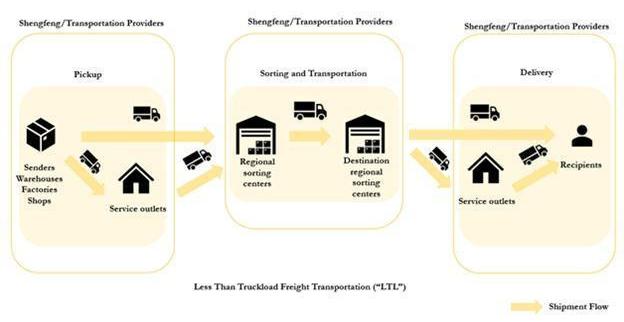

Step 1: Freight Pickup
Our regional sorting center arranges for vans to collect the freight from the senders once it receives shipment orders. These vans are provided either by us or by third-party transportation providers. Through each waybill, we assign a unique tracking number and corresponding barcode to each parcel. The waybills, coupled with our automated systems, enable us to track the status of each individual parcel throughout the entire pickup, sorting, transportation, and delivery process. Our service outlets also receive small shipment orders and collect and send freight to our regional sorting centers from time to time.
Step 2: Freight Sorting and Line-Haul Transportation
Upon receiving freight, the regional sorting center will sort, pack, and dispatch the freights to the destination regional sorting center (line-haul transportation services between our regional sorting centers are provided). Barcodes attached to the freight are scanned as they pass each sorting and transportation gateway so that we and our clients can keep track of real-time delivery progress.
Step 3: Freight Delivery
Our destination regional sorting center unloads and sorts the freight, which is then delivered directly to the recipients’ sites using vans operated by us or third-party transportation providers. Recipients may also elect to pick up their freight at our delivery outlets. Once the recipient confirms receipt through signature, our whole service cycle is completed and the settlement of delivery service fee promptly appears on our payment settlement system.
For FTL shipments, we generally pick up the freight directly from the clients’ sites and transport them to the recipients’ destination using our line-haul transportation, without combining orders from different clients for an FTL shipment. For LTL shipments, we combine orders from different clients into an FTL shipment at our sorting centers and transport them to the designated location. Through our line-haul and short-haul transportation lines, regional sorting centers, and information system, we have consolidated freight and freight information to best provide valuable and concise information to our clients.
Freight Transportation Services Pricing
Our pricing, for each order of freight transportation, depends on the weight, route, type, and value-added services.
We determine our pricing based on various factors, including, but not limited to, operating costs, general market conditions, competitions, and service quality. Our service pricing may also be influenced by market conditions and competitions. From time to time, we may evaluate and adjust our service pricing based on, among other factors, market conditions and operating costs.
Cloud Storage Services (Warehouse Storage and Management Services)
We, through the VIE and the VIE’s subsidiaries, offer warehouse management, order fulfillment, delivery process management, in-warehouse processing, and inventory optimization management services to our clients to optimize their inventory and delivery process management. We, through the VIE and the VIE’s subsidiaries, also provide and arrange transportation services and coordinate shipments from merchants to our Cloud OFCs and from there to other locations designated by our clients as part of our order fulfillment services.
Inventory Management
Cloud OFCs differ from traditional warehouses in that they can support direct order fulfillment and dispatch operations in addition to storage functions. They are “cloud-based” because we take full responsibility for the optimal allocation of our clients’ inventory into different Cloud OFCs and save our clients from the hassle of day-to-day operations, therefore, from our clients’ point of view, these Cloud OFCs are “in the cloud.”
As of December 31, 2024, we, through the VIE and the VIE’s subsidiaries, directly operated 39 Cloud OFCs across China with a total area of approximately 4,095,491 square feet, among which 13 Cloud OFCs were multistory facilities. All the Cloud OFCs use our technology infrastructure and are connected to various information systems across our platform. Therefore, we can allocate inventory of our clients effectively within our Cloud OFCs and coordinate our services, including subsequent transportation and delivery, accordingly. We constantly monitor the service quality of our Cloud OFCs to ensure we uphold the standard of our services. The following map illustrates our Cloud OFCs network as of December 31, 2024.


By utilizing our Cloud OFCs, we provide the following services to our clients through the VIE and the VIE’s subsidiaries:
| ● | Storage. We offer reliable and convenient storage solutions for a variety of commercial needs through the warehouses owned or leased by us. Our warehouse facilities are temperature-controlled, secured, and fire-preventive to protect the integrity of our client’s products. |
| ● | Pick and Pack. After receiving pick tickets from our clients, our team of trained professionals retrieve clients’ orders according to the instructions on the corresponding pick tickets and pack the items in preparation for shipping. |
| ● | Kitting and Assembly. Based on the instructions of our clients, we arrange individual items and assemble the separate pieces into a single ready-to-ship set according to specified combinations. |
| ● | Fulfillment. We receive orders from clients via our WMS or e-mail. We then generate pick-up tickets, and send these tickets to the warehouse for packing, before the goods are picked up by the clients’ designated transportation carriers. Ownership and responsibility of the goods are then transferred to such carriers. |
| ● | Delivery Process Management. We conduct the handover of the shipments of our clients to their transportation and distribution carriers pursuant to the standard operating procedures set forth in our agreements with the clients. |
| ● | Other Value-added Services. We also offer some value-added services such as inbound qualify testing, repackaging, labeling, and inventory shelf-life management. |
| ● | Inventory Optimization Management. We regularly provide our clients with different reports reflecting the status of their storage and inventory so that they can make business decisions accordingly to optimize their inventory structure. |
With our WMS, we are able to effectively monitor the capacity of our warehouses on a real-time basis and track each and every movement of a good from its entry into our warehouse to its delivery at its destination, including receiving, storing, packing, and shipping. For details of our WMS, see “—Our technology infrastructure.”
We normally enter into 1-year to 5-year service contracts with our cloud storage service clients. Our contracts specify the details of our services based on the client’s expected sale volumes and the floor areas to be used. Our contracts typically state the unit price of each service we provide. The amount of revenue we generate depends on the unit price and volume.
Logistics
We, through the VIE and the VIE’s subsidiaries, have integrated our transportation network and Shengfeng TMS with our client’s respective logistics network and systems. By leveraging our technologies and professional expertise, we are capable of creating and designing solutions for optimizing, transforming, and upgrading our clients’ supply chains as well as reducing their costs. Our national footprint allows us to provide these services to our clients and their manufacturing partners across many regions of China.
The following diagram illustrates the product flow in a typical supply chain. Each client, based on its individual needs and recommendations from our solution design, may elect to use any combination of the various services we provide at each step of the product flow.

| ● | Inbound Logistics. We craft and optimize inbound logistics networks for our clients to ensure that the flow of goods and materials into their business meets their operational objectives. We use different delivery methods specific to the various goods we handle. For instance, a milk run is a delivery method used to transport mixed loads of raw materials from various suppliers to one client. Instead of having each of our client’s suppliers transport raw materials individually, we will visit the client’s suppliers on a prearranged date, pick up raw materials, and deliver them to the client. |
| ● | Line-haul and Short-haul Distribution. We assist clients in the transportation of intermediate goods and products between their factories and warehouses and between warehouses in different regions. Our line-haul and short-haul transportation network makes the process efficient and keeps the costs low for our clients. |
| ● | Outbound Logistics. We assist clients in the transportation of products to ender users or distribution centers through line-haul and short-haul transportation, regional distribution, or last mile delivery, depending on the destinations and the amount of freight. |
| ● | Reverse Logistics. In reverse logistics, the goods move from the end user back to the seller or manufacturer, our clients. We help clients manage activities after the initial sales, including returns, refurbishing, packaging, and unsold goods. Through the process, we aim to reduce storage and distribution costs, improve clients’ reputation among its end users, satisfy client’s needs, and create a more sustainable supply chain for our clients. |
Value-added Services
In addition to our B2B freight transportation and cloud storage services, we, through the VIE and the VIE’s subsidiaries, provide a wide range of value-added services to our clients to meet their diversified needs.
Collection on delivery services. Under circumstances where a seller ships goods to a buyer, we provide the seller with the option to authorize us to collect payments from the recipient on its behalf. We charge collection fees equal to 4% of the collected payment for a transaction, and we wire the collected payment back to the seller on the same day of collection.
Customs declaration services. Some of our clients require international shipping services, in response, we provide customs declaration on an as-needed basis to assist them in meeting the legal requirements such as import and export, and trade. We engage third-party service providers that maintain the licenses required under applicable PRC laws and regulations for providing customs declaration services.
Delivery upstairs services. We offer door-to-door delivery services. In China, it is customary for logistics companies to charge additional fees based on the floor level. The higher the floor, the higher the fees. Fees are calculated based on a number of factors, including, but not limited to, weight of the goods, destination floor, and elevator availability.
Packaging services. We provide shipment packaging services to our clients. In addition to regular packaging materials, we provide a few other options. For instance, we have introduced temperature control materials for packing fruits and vegetables or otherwise perishable goods, shock absorbing materials for packing fragile goods in order to reduce damages that may occur during transportation, and wooden materials for carrying heavier goods.
Other than the regular and necessary packaging protection on shipments we provide at no additional costs to the clients, we also provide additional packaging protection services in two options: active protection and protection upon request. Active protection will be provided free of charge based on our own judgment and experience without requests from our clients. It mostly involves shipments of special products or under certain extreme natural conditions, such as high precision instruments which need special fixing protection, or liquids being sent to cold areas in the winter which need cold resistant protection. Additional packaging protection upon request from our clients will incur additional fees based on the shipment and the requests.
Pay-at-arrival services. We typically require senders to pay for shipment fees as we collect freight from them. Alternatively, senders may select the pay-at-arrival option, which authorizes us to collect shipment fees from recipients upon freight arrival. In this case, the Company will deliver the shipment upon the receipt of shipment fees from the recipients.
Return proof of delivery. For this service, we issue receipts with either the recipients’ signatures or other credible documentations back to the senders, which allows senders to obtain proof of receipt from recipients. We also offer senders the option to receive and view such receipts electronically on their desktop or phones.
Shipment protection. We provide shipment protection services to our clients. For the clients who enter into service agreements with us, terms and conditions of shipment insurance are generally set forth under the service agreements, and they are usually responsible for the insurance premium in the amounts as set forth under the agreements on a case-by-case basis. For the retail clients, they can decide on whether to purchase shipment protection insurance policy or not at their sole discretion. If they choose to purchase such insurance policy, they will usually be charged an insurance premium of approximately 0.3% of the declared value of the shipments. If a client has purchased shipment protection services, in case of lost, stolen, or damaged shipment during transit, he/she should first provide us with a claim letter and proof of value. Once we verify those materials, we will reimburse the client’s loss accordingly based on the terms and conditions set forth under the service agreements. Afterwards, we will claim for reimbursement from the insurance company based on the insurance policies. The insurance company will then claim for reimbursement from the parties at fault, if the Company is not at fault. If a client has not purchased shipment protection services, then in case of lost, stolen, or damaged shipment during transit, we will reimburse for the client’s loss in the amount equal to 1 to 3 times of the shipping fees.
Our Network and Infrastructure
Our network consists of regional sorting centers, Cloud OFCs, service outlets, the line-haul and short-haul transportation network operated by us, and our network partners across China.
Regional Sorting Centers
Our regional sorting centers are connected by a line-haul transportation network that we operate. They collect freight directly from clients or from service outlets within their coverage area, sort it according to destinations, and dispatch the freight to the designated regional sorting centers. As of December 31, 2024, we, through the VIE and the VIE’s subsidiaries, operated 26 regional sorting hubs in Fujian, Guangdong, Shanghai, Beijing, Zhejiang, Hubei, and 15 other provinces in China. Under our operational guidelines, our regional sorting centers did not experience any significant service interruption during the COVID-19 pandemic or peak seasons.
The following map shows our nationwide sorting center network as of December 31, 2024.
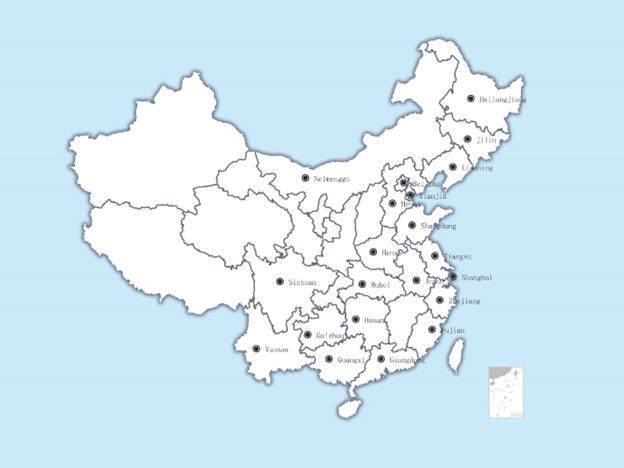
Our centralized planning team coordinates the development and expansion of new and existing regional sorting centers, including site selection, facility layout design, and equipment purchase. As we strive to provide seamless and efficient logistic solutions to our clients, we regularly contemplate our opportunities to improve our services. We will consider adding new regional sorting centers if they help optimize our route or increase our capacity in the surrounding areas. We select the locations based on certain factors, including, but not limited to: (i) client density, (ii) ease of access, (iii) rent pricing, (iv) payment method, (v) regulatory compliance, (vi) safety, and (vii) surrounding infrastructure and environment.
We design our regional sorting centers in a uniform manner to deliver a consistent brand image and build in extra capacity for volume growth in the foreseeable future. We hire 20 to 400 employees in each of our regional sorting center, depending on the local freight volume, and we provide each center with sorting and loading equipment.
When planning routes, we prioritize the efficiency of the entire network. We dispatch freight to the regional sorting center closest to its destination even if the regional sorting center and the destination are located in different administrative regions. This reduces transportation time and lowers our and our clients’ transportation costs. Our route planning and management benefit from our years of experiences and information technology infrastructures, and they enable us to track freight movement on a real-time basis.
Among our regional sorting centers, 3 are located on lands that we own and the remaining 23 are located on leased lands.
Cloud OFCs
See “—Service Offerings by Us—Cloud Storage Services” above.
Line-haul and Short-haul Transportation Network
We, through the VIE and the VIE’s subsidiaries, operate over 650 line-haul and short-haul routes. We utilize our self-owned fleet in addition to the vehicles owned and operated by third-party transportation providers to form both our line-haul transportation network for long-distance, high-capacity transportation, and our short-haul transportation network for short-distance, low-capacity pickup and delivery. Because we control route planning and vehicle dispatch of our entire line-haul and short-haul transportation system, we plan our routes with the goal to lower transportation costs and transit times.
As of December 31, 2024, our own line-haul fleet is comprised of 278 truck headstocks and over 700 cabinets for ordinary shipments and 5 truck headstocks and 14 cabinets for hazardous shipments. We, through the VIE and the VIE’s subsidiaries, invest in our fleet with our own funds so we are able to adjust the ratio of different vehicle models swiftly to react to changes based on operational needs. We mostly use 16-meter-long trucks, which have nearly twice the loading capacity of 9.6-meter-long trucks (commonly used in the industry), to minimize marginal costs and lower unit line-haul transportation costs. The uniform design of our regional sorting centers with extra parking space also allows us to lower transportation cost of freight. To increase our transportation efficiency, we utilize the drop and pull transportation method.
As of December 31, 2024, we, through the VIE and the VIE’s subsidiaries, also owned 131 vehicles for our short-haul transportation.
For the fiscal years ended December 31, 2024 and 2023, approximately 17% and 23% of our freight transportation services were provided by our self-owned fleet and the balance was outsourced and provided by independent third-party transportation providers. For the fiscal years ended December 31, 2024 and 2023, we had 135,197 and 82,051 outsourced vehicles for over 13.69 million and 7.88 million shipments, respectively. The price we pay to third-party transportation providers is based on our market insights on cost factors, including (i) toll cost based on route, (ii) fuel cost based on route, type of truck used, and fuel price, and (iii) other costs such as drivers’ compensation, depreciation, and maintenance cost. For details on third-party transportation providers, see “—Our Transportation Providers.”
Service Outlets
As of December 31, 2024, we, through the VIE and the VIE’s subsidiaries, operated 24 service outlets across China. Our service outlets, in their assigned geographical areas, will (1) create shipment orders and accept goods for shipment from our LTL clients; (2) deliver goods for shipment to our regional sorting centers for freight transportation; and (3) accept shipments from regional sorting centers for the clients to pick up. Each service outlet typically has 3 to 5 employees.
We will consider adding new service outlets if they help optimize our route or increase our capacity in the surrounding areas. We select the locations based on certain factors, including, but not limited to: (i) client density, (ii) ease of access, (iii) rent pricing, (iv) internal layout, (v) regulatory compliance, and (vi) surrounding infrastructure and environment.
Network Partners
To increase our client base and network coverage, we, through the VIE and the VIE’s subsidiaries, have also entered into some network partner agreements. Our network partners will create shipment orders and accept goods for shipment from their clients. Afterwards, they will deliver the goods to our regional sorting centers for our freight transportation. The network partners are solely responsible for the rights and obligations under the service agreements entered into by and between them and their clients. For the fiscal year ended December 31, 2022, our network partners contributed approximately 0.31% of our income from operations. For the fiscal year ended December 31, 2023, our network partners contributed approximately 0.14% of our income from operations. For the fiscal year ended December 31, 2024, our network partners contributed 0% of our income from operations because we terminated the Network Partners cooperation model at the end of 2023.
Our Ecosystem
We have built a growing ecosystem with various types of participants, including the Company, clients, and transportation providers. As our Company continues to expand, we expect that more participants will join our ecosystem, which in turn, we believe, will bring us more business. The current ecosystem has enhanced our user experience and brand value. We expect this will drive our growth.
The following graphic illustrates the participants and the network effect of our ecosystem.

Our Clients
We, through the VIE and the VIE’s subsidiaries, mainly serve clients in connection with the delivery of their products to consumers and other businesses. We have clients in various industries, including manufacturing, energy, new energy (vehicle), telecommunications, internet, fashion, fast moving consumer goods, publishing, agriculture and e-commerce. Our largest clients include CATL Battery, Bright Dairy, SF Express, Schneider Electric, Tesla and Xiaomi. We served 2,209 and 2,503 clients during the fiscal years ended December 31, 2024 and 2023, respectively, and no client accounted for more than 5% of our total revenue during those years. The following table sets forth the top three industries our clients are in by percentage as of December 31, 2024:
| Industry | Percentage | |||
| New energy (vehicle) | 20.24 | % | ||
| Fast moving customer goods | 13.34 | % | ||
| Manufacturing | 8.20 | % | ||
| Total | 41.78 | % | ||
Client Service
We believe that our client service enhances our client loyalty and brand image. Therefore, we provide ongoing trainings to our employees and transportation providers, and we conduct regular performance reviews to ensure the quality of our services.
We, through the VIE and the VIE’s subsidiaries, operate a call center system to provide real-time assistance to our clients by our approximately 203 client service representatives 10 hours a day, 7 days a week. Our automated system continues to respond to inquiries outside of the normal business hours and forwards complicated inquiries to our client service representatives for further handling. Our call centers are localized with branch offices in over 20 provinces in China with mostly local hires to leverage their local knowledge. All branches can be reached via a unified number and use the same call system and database. Our call system automatically forwards incoming calls to the local branch near the caller’s location. Our client service representatives adhere to the same client service standards nationwide and their local knowledge contributes to enhanced client service effectiveness. At the end of each call, we ask the caller to grade the quality of our client service and a designated call-back team will follow up on all incidences of dissatisfaction. In addition, we hold regular training sessions for our client service representatives and conduct regular performance reviews to ensure that they provide high quality client service.
Our Transportation Providers
During the fiscal years ended December 31, 2024, 2023 and 2022, we, through the VIE and the VIE’s subsidiaries, cooperated with approximately 119,467, 64,090 and 45,558 transportation providers, respectively. These transportation providers are of all sizes, including owner-operators of a single truck, private fleets, and large trucking companies. All these transportation providers provide vehicles to carry out transportation tasks within our line-haul and short-haul transportation network. The table below sets out the number of each category of transportation providers.
| Fiscal Years Ended December 31, |
||||||||||||
| 2024 | 2023 | 2022 | ||||||||||
| Owner-operators of a single truck (#) | 117,649 | 62,263 | 43,932 | |||||||||
| Private fleets (#) | - | - | 25 | |||||||||
| Large trucking companies (#) | 1,818 | 1,827 | 1,601 | |||||||||
| Total transportation providers | 119,467 | 64,090 | 45,558 | |||||||||
To strengthen and maintain our relationships with transportation providers, our employees regularly communicate with them and try to assist them by increasing their equipment utilization, reducing their empty miles, and repositioning their equipment.
To ensure that we only cooperate and work with qualified transportation providers, our management formed an evaluation standard to control the quality of their services:
| ● |
Selection. We carefully examine transportation providers’ operating permits, vehicle condition, vehicle model, and whether the vehicles are connected with the BeiDou Navigation Satellite System, a Chinese satellite navigation system, and select qualified and reliable providers.
Regarding the cooperation with owner-operators of a single truck and private fleets, we also participate in the process to select drivers. We will verify and examine the drivers’ licenses and take into consideration the history of cooperation between the Company and the drivers. |
| ● | Inspection. After a transportation provider begins cooperating with us, we regularly inspect its performance during different stages of the cooperation according to detailed specifications and timeline for services in our agreement. |
| ● | Review. We review the performance of each provider and rate them according to quality of services, timeliness, prices, and client services. Depending on the performance, we can increase, decrease, or terminate the cooperation with a provider. |
We, through the VIE and the VIE’s subsidiaries, typically enter into transportation contracts with providers (i) for a specific period of time, typically one year, or (ii) for a specific order. Our contracts will specify the rights and obligations of the Company and the service providers, including, but not limited to, quantities, specification, unit price, delivery timeline, payment date, liabilities and remedies. Service providers shall be responsible for accidents, including economic loss caused to the Company, if they are at fault.
On September 1, 2020, we, through Shengfeng Logistics, entered into a Road Freight Transportation Platform Cooperation Agreement with Hefei Weitian Yuntong Information Technology Co., Ltd. (“Hefei Weitian”). This agreement provides that Hefei Weitian, including Hubei Luge and Anhui Luge as its designated subsidiaries, as an Internet logistics platform, shall provide road freight transportation services in China to Shengfeng Logistics and its designated subsidiaries, through its platform, on the goods agreed upon and confirmed by both parties from time to time. The term of this agreement was from September 1, 2020 to August 31, 2021. On September 1, 2021, we, through Shengfeng Logistics, renewed this agreement in which the term was from September 1, 2021 to December 31, 2023. On January 1, 2024, we, through Shengfeng Logistics, renewed the agreement in which the new term is from January 1, 2024 to December 31, 2025. Shengfeng Logistics shall pay Hefei Weitian a shipping fee per shipment equal to the amount of shipping fee paid by Hefei Weitian to the actual operator divided by 95.1%. Anhui Luge and Hubei Luge are affiliates under the control of Hefei Weitian.
Security and Safety
We have designed and integrated safety policies and procedures across the full scope of our business. Our key safety measures include:
Operational Security and Safety
We, through the VIE and the VIE’s subsidiaries, have established security screening protocols to inspect freights before acceptance. We have listed prohibited items for ground transportation such as flammables, explosives, gunpowder, and gasoline. We also implement X-ray screenings to find hazardous or prohibited items. Our safety screening system will continue to evolve in order to meet ever changing technologies.
Workplace safety and transportation safety are important to our business. We have implemented protocols for safety of ground transportation for the operations of our regional sorting centers, Cloud OFCs, and service outlets to minimize risks of accidents. We provide periodic trainings to our employees and transportation providers to recognize hazards, mitigate risks and avoid injuries of themselves and others at work.
Data Privacy and Safety
We, through the VIE and the VIE’s subsidiaries, have designed and implemented comprehensive procedures and guidelines to regulate our employees and transportation providers’ actions in relation to confidential data and information to ensure data security. We employ a variety of technical solutions to prevent and detect risks and vulnerabilities in our data privacy and safety, such as encryption and a firewall. We store and transmit all confidential data and information in encrypted format on separate servers and back up our data and information on a regular basis. We do not share our data or allow third parties to access our data stored on our servers without prior authorization, and we periodically test our systems and procedures to detect and eliminate information security risks and privacy risks.
Our Technology Infrastructure
In order to build our core technology systems and software to meet our needs, we, through the VIE and the VIE’s subsidiaries, maintain an in-house team for our technology research and development. For details of our research and development, see “—Research and Development.” We, through the VIE and the VIE’s subsidiaries, have also contracted with some third-party software design companies for licenses to use some of the systems they designed and developed, such as some financial reporting and accounting systems. Our goal is to utilize these technologies to increase efficiency in operations, enhance client experience, and contribute to our success.
Shengfeng TMS is the main system for our transportation services, which is a comprehensive management system that allows us to effectively monitor and manage the various stages of transportation, payment, and client service. Shengfeng TMS has the following key functions:
Shipment transportation and tracking management. Our shipments are sorted and dispatched based on the automatic routing calculation function provided by Shengfeng TMS. Our GPS trackers, attached to every vehicle, is synchronized with Shengfeng TMS, which will allow us to track the status and location of each shipment on a real time basis. We also integrate our GPS tracking with BeiDou Navigation Satellite System, WeChat mini programs, and manual recording, also available on our website and official WeChat account. This integration will allow our clients to track shipments and search our service outlet locations and sorting center locations.
Payment calculation. Shengfeng TMS tracks each client’s order and allows us to view and issue bills to our clients and track client payments.
Client portal and service support. We maintain an online client portal, where our clients may register their own accounts. Through our online client portal, our clients may view all of their order histories, track shipment status in real time, and make direct service requests. Our client service representatives have access to Shengfeng TMS’s database through which they can provide a better and more effective service to our clients on a real time basis. In particular, our employees will load and unload the shipments according to the preferences of the clients, stored in the TMS system and sent through the portal, and our drivers will provide delivery services based on the instructions and requirements sent from the portal to cater for the needs of the clients.
Portals for third-party transportation providers. Our management relies on Shengfeng TMS to effectively manage transport providers. We create an individual profile for each of our service providers and store all corporate records or other material information into the system. Service providers are required to register for accounts on the system prior to their cooperation with us, which allows them to monitor the real-time status and location of each shipment they have been assigned. This also allows us to keep track of those shipments in the hands of third-party transportation providers, as service providers are required to report location and shipments status of transport to Shengfeng TMS on a regular basis. In addition, Shengfeng TMS is also capable of handling payment settlements.
We, through the VIE and the VIE’s subsidiaries, own and operate a data center to support our core operational systems such as Shengfeng TMS and WMS. Our data center provides the network infrastructure for our managerial, network safety, authority authentication, data backup, and other non-core functions.
In order to optimize our warehouse storage and management services, we utilize our WMS. It has six core functions: a) storage location management; b) order management; c) “First-In, First-Out” management; d) order and operation review; e) bar code management and tracking; and f) storage management. With WMS, we are able to increase the accuracy of goods dispatching, to enhance the efficiency of the operation, to improve the quality management and to control and realize the warehouse management process visualization.
Our WMS operates according to certain rules of warehouse management including rules of pick-up, quality inspection, warehouse and storage separation and arrangement. Rules of the WMS can be set based on the characteristics of different projects on site. Depending on the features of the goods, we perform certain procedures accordingly after their receipt, such as counting, quality inspection, box combination, storage location designation, and storage on the shelves. After the goods are stored in our warehouse, we keep track of their storage locations and we may move them from time to time in preparation of upcoming shipments or for better utilization of storage space. Once we receive any order for shipment, we make plans, create good pick-up orders, pick up the goods and verify the process again to control our accuracy and our service quality. Goods will also be tracked until delivery and such result will be reflected in our system. With our WMS, we are able to effectively monitor the capacity of our warehouses on a real-time basis and track each and every movement of a good from its entry into our warehouse to its delivery at its destination, including receiving, storing, packing, and shipping.
Intellectual Property
We rely on a combination of trademark, patents, copyrights, trade secret, and contractual agreements to protect our proprietary rights.
Trademark
As of the date of this annual report, we had registered, through the VIE and the VIE’s subsidiaries, 38 trademarks, including 35 trademarks with the Trademark Office of the State Administration for Industry and Commerce in China, such as our Company’s Chinese name, “Shengfeng (盛丰),” 1 trademark with the Economic Affairs Bureau of Macao Special Administrative Region, 1 trademark with Trade Marks Registry Intellectual Property Department of the Government of the Hong Kong Special Administrative Region and 1 trademark with the Intellectual Property Office of Taiwan.
Copyright
As of the date of this annual report, we had registered, through the VIE and the VIE’s subsidiaries, 117 computer software copyrights, including those that relate to Shengfeng TMS, with the PRC National Copyright Administration.
Patent
As of the date of this annual report, we had registered, through Guangdong Shengfeng Logistics Co., Ltd., one of the VIE’s subsidiaries, 2 invention patents and 5 utility model patents with the National Intellectual Property Administration.
Domain Name
As of the date of this annual report, we had registered, through the VIE, 12 domain names, including our main website. The following table summarizes our domain name registration:
| Domain Name | Territory | |
| sfwl.com.cn | China | |
| sfwl.ink | International | |
| sfwl.net | International | |
| sfwl.online | International | |
| sfwl.vip | International | |
| tysfwl.com.cn | China | |
| tysfwl.com | International | |
| tysfwl.cn | China | |
| tysfwl.net | International | |
| 4008556688.cn | China | |
| 4008556688.com.cn | China | |
| 4008556688.net | International |
Despite our efforts to protect our proprietary rights, unauthorized parties may attempt to infringe upon our intellectual property rights. In addition, third parties may initiate litigation against us alleging infringement of their proprietary rights. See “Item 3. Key Information—D. Risk Factors—Risks Related to Our Business and Industry—We may not be able to prevent others from unauthorized use of our intellectual property, which could harm our business and competitive position.”
As of the date of this annual report, we have not been subject to any material dispute or claims for infringement upon third-party trademarks, licenses, and other intellectual property rights in China.
Competition
The contract logistics industry in China is highly fragmented, and we compete with many local, regional, and national logistics companies with more resources including Sinotrans Logistics Ltd., Beijing Changjiu Logistics Co., Ltd., and Kerry Logistics (EAS) Limited. The competitions among contract logistics companies are primarily based off of service pricing, transportation speeds, service offerings, and other factors. We believe our relatively long operating history, superior operational capabilities, well-established national transportation networks, and high-quality services give us the competitive advantages over others.
Entry into the contract logistics industry requires significant initial investment in network construction, equipment and vehicle purchases, and formulation and attraction of new business partners. However, other express delivery service providers or e-commerce companies which may be more established, may utilize or further improve their existing proprietary delivery and transportation infrastructure to compete with us. Furthermore, as we look to expand our service offerings and client base, we may face competition from players in those new sectors.
Branding and Marketing
We strive to enhance our brand awareness through high service quality and various marketing initiatives. Shengfeng Logistics was recognized as one of China’s outstanding logistics companies by the China Communications and Transportation Association (the “CCTA”). Furthermore, Shengfeng Logistics was classified as an AAAAA class logistics company and among the top 10 companies with logistics informatization capacity by the China Federation of Logistics and Purchasing in 2018. Shengfeng Logistics was also recognized as a top 100 logistics companies in China by the CCTA in 2016 and 2018, respectively.
We, through the VIE and the VIE’s subsidiaries, launched various programs and marketing activities to promote our brand and services. We rely on various social network mobile applications such as WeChat, a multifunctional platform widely used in China for messaging, social networking, and mobile payments, to distribute business updates and corporate news. Additionally, we offer convenient features such as shipment tracking, service outlet locator, shipment booking through our WeChat official account.
We participate in conferences and exhibitions in different industries to expand our pool of potential clients. We also design and develop different service packages to cater for the demands of clients in different industries so that we could extend our reach of potential clients in similar industries and upstream and downstream suppliers. We pay close attention to the development of innovative industries such as new energy vehicles, shared bikes and Internet TV, and have formed cooperation relationships with companies in such industries.
We bring in new clients through promotion activities by our sales employees, market bidding activities, research on upstream and downstream entities of our current clients, participation in conferences and exhibitions, meetings, calls, referrals, and other activities. In addition, we require our own fleet to apply our logos onto transportation vehicles and personnel uniforms in a consistent and unified manner in order to further enhance our brand recognition during interactions with the clients.
We plan to develop and improve our marketing strategies by focusing on the following: a) maintaining existing client relationships; b) establishing new client relationships; c) enhancing our service quality and efficiency; and d) managing our marketing system and expertise. We will make specific marketing plans and take different approaches based on the various industries, sizes, contract amounts and needs of our clients.
Employees
As of December 31, 2024, 2023, and 2022, we, through the VIE and the VIE’s subsidiaries, had a total of 1,263, 1,341 and 1,550 full-time employees located in China, respectively. The following table sets forth the breakdown of our employees by function as of December 31, 2024:
| Function | Number | % of Total | ||||||
| Stevedore | 34 | 2.69 | % | |||||
| Transportation | 130 | 10.29 | % | |||||
| Management Administration | 292 | 23.12 | % | |||||
| Client Service | 203 | 16.07 | % | |||||
| Operation Support | 540 | 42.76 | % | |||||
| Sales and Marketing | 43 | 3.41 | % | |||||
| Technology and Engineering | 21 | 1.66 | % | |||||
| Total | 1,263 | 100 | % | |||||
In addition to our own full-time employees, our workforce also includes 916 contractors, as of December 31, 2024. In addition, third-party transportation providers retain their own employees according to their individual operational needs.
We believe our employees’ compensation packages are competitive and we have created a merit-based work environment that encourages initiative. As a result, we have generally been able to attract and retain qualified personnel and maintain a stable core management team.
We are required by applicable PRC laws and regulations to participate in various statutory employee benefit plans, including social insurance, medical insurance, maternity insurance, workplace injury insurance, unemployment insurance, and pension benefits through a PRC government-mandated multi-employer defined contribution plan. Pursuant to PRC regulations, we are required to contribute specific percentage of salaries, bonuses, and allowances (up to a maximum amount, specified by local governmental regulations) to the employee benefit plan. As of the date of this annual report, we have not made adequate social insurance and housing fund contributions for all employees as required by PRC regulations, but we have taken measures to comply with related laws and regulations. Such measures include, but are not limited to, outsourcing our labor-related matters and making payments for unpaid social insurance and housing fund contributions, which may increase the costs of our business and operation.
We enter into standard labor agreements with our full-time employees with standard confidentiality and non-compete provisions.
We believe that we maintain a good working relationship with our employees, and we have not experienced any major labor disputes.
Research and Development
As information technology plays an essential role in our business and services, we endeavor to develop and adopt advanced information technology to increase efficiency and accuracy in operations, enhance client experience and satisfaction, and ultimately contribute to our growth and success.
We, through the VIE and the VIE’s subsidiaries, maintain an in-house R&D team which consists of four departments in Shengfeng Logistics as of the date of this report: Product Department (3 employees and 1 manager), Operation and Maintenance Department (2 employees), TMS Research and Development Department (8 employees and 2 managers) and WMS Research and Development Department (4 employees and 1 manager). All of the said departments are under the supervision of the Director of the Information Section of Shengfeng Logistics. Product Department is mainly responsible for the gathering of product development requests and opinions, coordinating the communication among different parties on product development and providing necessary trainings to support new products. Operation and Maintenance Department is mainly responsible for maintaining the computer network, operating systems, software and hardware, and other equipment to ensure they function properly and are secured. TMS Research and Development Department and WMS Research and Development Department are mainly responsible for the research and development of TMS and WMS. At least once or twice per year, the Director of the Information Section will call for a meeting with certain managers and qualified employees from the R&D departments to discuss the necessity and possibility of new information technology developments and technology upgrades. Any proposal discussed and approved during the meeting will be presented to the management for further discussion and decision.
From time to time, we contract with some third-party software design companies for licenses to use some of the systems they designed and developed, such as some financial reporting and accounting systems. They will also maintain the systems and provide necessary supports to us.
Our passion and dedication for improvement and innovation have been translated into our ability to develop and introduce new and diversified services with a fast pace, converting our advantage in research and development into our commercial competitive advantage in the logistic industry. Through years of effort, as of December 31, 2024, we have registered 117 computer software copyrights with the PRC National Copyright Administration and 2 invention patent with the National Intellectual Property Administration. Since 2012, Shengfeng TMS has been our main system, which is a comprehensive management system that allows us to effectively monitor and manage the various stages of transportation, payment, and client service. It is the Company’s plan to continue its dedication to the research and development on information technology to enhance efficiency and client experience.
For more details on our technology infrastructure and intellectual property, please refer to “—Our Technology Infrastructure” and “—Intellectual Property.”
Properties and Facilities
Our principal executive office is located at Shengfeng Building, No. 478 Fuxin East Road, Jin’an District, Fuzhou City, Fujian Province, People’s Republic of China, 350001, where we, through Shengfeng Logistics, lease such property from a related party, Fuzhou Tianyu Shengfeng Industrial Co., Ltd., a company controlled by Yongxu Liu, our CEO and Chairman, with an area of approximately 24,886.16 square feet, with a lease term from November 1, 2020 to October 31, 2022 and was renewed to October 31, 2027 with a monthly rent of RMB115,648 (approximately US$16,412). We also need to pay a monthly property management fee of RMB15,564 (approximately US$2,209). We have priority to renew the lease as long as we use the property for the same purpose, but we are required to notify the landlord at least two months in advance if we would like to renew the lease. For the years ended December 31, 2024, 2023 and 2022, the Company recorded related rent of $226,870, $227,552 and $305,120 in general and administrative expenses, respectively. For the years ended December 31, 2024, 2023 and 2022, the Company recorded related property management fee of $46,744, $17,029 and $35,420 in general and administrative expenses, respectively.
As of December 31, 2024, we, through two of the VIE’s subsidiaries, owned 3 office buildings in China with aggregate gross floor areas of approximately 105,586.00 square feet are on the land we own, and we, through the VIE and the VIE’s subsidiaries, leased 12 office buildings in China with aggregate gross floor areas of approximately 60,523 square feet. The terms of such leases range from 1 to 5 years.
In addition, as of December 31, 2024, 3 of the regional sorting centers operated by the VIE and the VIE’s subsidiaries with an aggregate gross floor area of approximate 64,838.16 square feet are on the land we own, and 23 of the regional sorting centers operated by the VIE and the VIE’s subsidiaries with an aggregate gross floor area of approximately 1,097,544.06 square feet are on leased land. The terms of such leases range from 1 to 5 years.
As of the date of December 31, 2024, we, through the VIE and the VIE’s subsidiaries, directly operate 39 Cloud OFCs across China to provide warehouse storage and management services. As of December 31, 2024, 3 of the Cloud OFCs operated by the VIE and the VIE’s subsidiaries with an aggregate gross floor area of approximate 1,365,641.74 square feet are on the land we own, and 36 of the Cloud OFCs operated by the VIE and the VIE’s subsidiaries with an aggregate gross floor area of approximately 2,729,849.10 square feet are on the land we leased. The terms of such leases range from 1 to 3 years.
As of the date of December 31, 2024, we, through the VIE and the VIE’s subsidiaries, directly operate 24 service outlets across China. As of December 31, 2024, all of the service outlets operated by us with an aggregate gross floor area of approximately 102,016.85 square feet are on the land we leased. The terms of such leases range from 1 to 5 years.
As of the date of this annual report, we, through one of the VIE’s subsidiaries, hold land use rights with respect to one property with an aggregate gross area of approximately 484,700 square feet and an aggregate gross floor area of approximately 592,000 square feet in Ningde City, Fujian Province, China. The land is subject to a 50-year use term.
As of the date of this annual report, we, through one of the VIE’s subsidiaries, owned 4 land use rights with aggregate gross areas of approximately 340,388.43 square feet in Tong Zhou District, Beijing, China. The use terms of such land is 50 years. Construction is currently underway on the land for the purpose of developing warehouse storage and management services and establishing a regional sorting center.
The areas of self-owned properties and leased premises are based on the figures specified in the certificates of land use or the corresponding lease agreements.
The following table shows pertinent information of the properties we, through three of the VIE’s subsidiaries, own as of December 31, 2024:
| Location | Area (Square Feet) |
Term of Use | Current Use | |||||
| Tong Zhou District, Beijing, China |
159,901.66 | October 31, 1994 to October 30, 2044 | Construction is currently underway as of the date of this annual report. | |||||
| Tong Zhou District, Beijing, China |
155,027.65 | October 31, 1994 to October 30, 2044 | Construction is currently underway as of the date of this annual report. | |||||
| Tong Zhou District, Beijing, China |
12,531.02 | January 23, 1995 to January 22, 2045 | Construction is currently underway as of the date of this annual report. | |||||
| Tong Zhou District, Beijing, China |
12,928.10 | January 23, 1995 to January 22, 2045 | Construction is currently underway as of the date of this annual report. | |||||
| Fuqing City, Fuzhou Province, China |
349,132.7 | Until April 10, 2063 | 318,390.98 for Warehouse Storage and Management Services, 28,588.95 for Regional Sorting Center and 2,152.78 for offices | |||||
| Suzhou City, Jiangsu Province, China |
187,515.50 | Until December 30, 2056 | 131,319.7 for Warehouse Storage and Management Services and 56,195.8 for offices | |||||
| Suzhou City, Jiangsu Province, China |
406,527.71 | Until January 29, 2058 | 370,278.5 for Warehouse Storage and Management Services and 36,249.21 for Regional Sorting Center | |||||
| Ningde City, Fujian Province, China |
592,889.96 | Until April 12, 2073 | 545,652.54 for Warehouse Storage and Management Services and 47,237.42 for offices | |||||
We believe that the facilities that we currently own and lease are generally adequate to meet our current needs, but we expect to seek additional space as needed to accommodate our future growth.
As of December 31, 2024, we, through the VIE and the VIE’s subsidiaries, own line-haul fleet is comprised of 278 truck headstocks and over 700 cabinets for ordinary shipments and 7 truck headstocks and 14 cabinets for hazardous shipments. We also owned 131 vehicles for our short-haul transportation as of the same date.
Tangible properties of our regional sorting centers, Cloud OFCs, service outlets, and line-haul and short-haul transportation network operated by the VIE and the VIE’s subsidiaries across China include transportation and electronic equipment.
Seasonality
Our operating results have been subject to seasonal trends as a result of, or influenced by, numerous factors, including national holidays, weather patterns, consumer demands, economic conditions, and others. Although seasonal changes have not significantly impacted on our cash flow or affected our operations, we cannot guarantee that it will not adversely impact us in the future.
Insurance
We, through the VIE and the VIE’s subsidiaries, maintain various insurance policies to safeguard against risks and unexpected events. We have purchased compulsory motor vehicle liability insurance and commercial insurance such as automobile third-party liability insurance, property insurance, and cargo insurance. We have purchased employer liability insurance. We also provide work-related injury insurance to our employees.
We do not purchase insurance for items delivered by us. Instead, our clients may purchase shipment protection services for valuable items, and we will compensate those clients based on the declared value in the event of loss or damage that was caused by us. For more details, please see “—Value-added Services—Shipment Protection.” Our clients are responsible for purchasing insurance for hazardous items delivered in the shipments, subject to the provisions set forth under the respective shipping agreements. We do not maintain business interruption insurance nor key-man insurance. Our management will evaluate the adequacy of our insurance coverages from time to time and purchase additional insurance policies as needed.
Unless otherwise set forth in their respective agreements, third-party transportation providers will be responsible solely for the shipment insurance. When an accident occurs, a transportation provider will reimburse and compensate our loss pursuant to our agreements and any third parties’ loss. If the transportation provider is not able to compensate the full amount of the loss to us or any other third parties, our insurance company will pay for the compensation under our insurance policies. Afterwards, the transportation provider shall reimburse our insurance company.
Legal Proceedings
From time to time, we are subject to legal proceedings, investigations, and claims incidental to the conduct of our business. We are not a party to, nor are we aware of, any legal proceeding, investigation, or claim which, in the opinion of our management, is likely to have an adverse material effect on our business, financial condition, or operation result. We may periodically be subject to legal proceedings, investigations, and claims relating to our business. We may also initiate legal proceedings to protect our rights and interests.
PRC Regulations
This section sets forth a summary of the principal laws and regulations relevant to our business and operations in the PRC.
Regulations Relating to Foreign Investment
The PRC Foreign Investment Law
The Foreign Investment Law, promulgated by the National People’s Congress on March 15, 2019, has come into effect on January 1, 2020 and has replaced the major existing laws and regulations governing foreign investment in the PRC, including the Sino-foreign Equity Joint Ventures Enterprises Law, the Sino-foreign Co-operative Enterprises Law, the Wholly Foreign-invested Enterprise Law, and their implementation rules and ancillary regulations. Pursuant to Foreign Investment Law, the existing foreign invested enterprises established prior to the effective date of the Foreign Investment Law may keep their corporate organization forms within five years after the effective date of the Foreign Investment Law before such existing foreign invested enterprise change their organization forms, organization structures, and their activities of foreign-invested enterprises in accordance with the Company Law, the Partnership Enterprise Law and other laws. According to the Foreign Investment Law, “foreign-invested enterprises” thereof refers to enterprises that are wholly or partly invested by foreign investors and registered within China under the PRC laws, “foreign investment” thereof refers to any foreign investor’s direct or indirect investment in China, including: (1) establishing foreign-invested enterprises in China either individually or jointly with other investors; (2) obtaining stock shares, stock equity, property shares, other similar interests in Chinese domestic enterprises; (3) investing in new projects in China either individually or jointly with other investors; and (4) making investment through other means provided by laws, administrative regulations, or State Council provisions.
According to the Foreign Investment Law, the State Council will publish or approve to publish a catalogue for special administrative measures, or the “negative list.” The Foreign Investment Law grants national treatment to foreign invested entities, except for those foreign invested entities that operate in industries deemed to be either “restricted” or “prohibited” in the “negative list”. The NDRC and the MOFCOM promulgated the Special Administrative Measures (Negative List) for Foreign Investment Access (2024 Edition) (the “2024 National Negative List”) on September 6, 2024, effective on November 1, 2024. Compared to the last Special Administrative Measures for Market Access of Foreign Investment (Negative List) promulgated by the NDRC and the MOFCOM in December 2021, the 2024 National Negative List cuts down the number of items restricted or prohibited to foreign investors from 31 to 29, and the restrictive measures on foreign investment access in the manufacturing sector were completely cancelled, resulting in zero restrictions on the manufacturing sector. Therefore, in the manufacturing sector, there is now equal national treatment of domestic and foreign investments.
However, the 2024 Negative List prescribes that any domestic enterprise engaging in businesses prohibited by the Negative Lists that lists, issues securities and trades shares overseas must obtain pre-approval consent from relevant competent regulator; overseas investors must not engage in the operation and management of the enterprise, and the percentage of foreign shareholding is subject to the relevant provisions in the administrative measures for domestic securities investments by foreign investors. The Foreign Investment Law provides that foreign invested entities operating in foreign restricted or prohibited industries will require market entry clearance and other approvals from relevant PRC governmental authorities.
On December 26, 2019 the State Council issued the Implementation Regulations for the Foreign Investment Law, or the Implementation Regulations which came into effect on January 1, 2020. According to the Implementation Regulations, in the event of any discrepancies between the Foreign Investment Law, the Implementation Regulations and relevant provisions on foreign investment promulgated prior to January 1, 2020, the Foreign Investment Law and the Implementation Regulations shall prevail. The Implementation Regulations also indicated that foreign investors that invest in sectors on the Negative List in which foreign investment is restricted shall comply with special management measures with respect to shareholding, senior management personnel and other matters in the Negative List.
The PRC Company Law
The formation, operation, and management of corporate entities in China is governed by the PRC Company Law, which was promulgated by the SCNPC on December 29, 1993 and became effective on July 1, 1994. The latest amendment of the PRC Company Law is dated December 29, 2023 (“Company Law (2023)”), which will become effective on July 1, 2024. The PRC Company Law defines a “company” as a limited liability company or a joint stock limited company, both of which have the status of an enterprise legal person, and the liability of shareholders of a limited liability company or a joint stock limited company is limited to the amount of their capital contributions or shareholdings. Company Law (2023) further governs the formation, dissolution, organizational structure, capitalization, and social responsibility of a company, as well as the duties of officers and shareholders. Pursuant to Company Law (2023), all registered capital of a PRC limited liability company subscribed to by a shareholder must be fully paid for by such shareholder within five years from the date of the formation of the limited liability company, unless applicable laws or regulations provide otherwise. The State Counsel’s Provisions on Implementing the Registered Capital Recording and Administration System under the PRC Company Law, which was issued on July 1, 2024, allows limited liability companies established on or before June 30, 2024 (“existing LLCs”) until June 30, 2027 to adjust their capital contribution payment timeframe to be in compliance with Company Law (2023) if their existing capital contribution period exceeds five years. If the capital contribution period of an existing LLC ends within five years from June 30, 2027, the existing LLC needs not adjust its capital contribution period. However, if the capital contribution period of an existing LLC ends more than five years from June 30, 2027, it must require all capital contributions to be paid within five years from June 30, 2027, i.e., on or before June 30, 2032, and record such adjustments in the company’s articles of association. If a limited liability company fails to adjust its capital contribution payment period and registered its capital in accordance with these regulations, the relevant authority such as the State Administration for Market Supervision and its local counterparts shall order the company to make corrections; if the company fails to make corrections within the deadline set by the relevant authority, the authority shall publicize the non-compliance. Pursuant to Company Law (2023), where any shareholder fails to make payment for any of their shares prior to the deadline provided in the company’s articles of association, their unpaid equity interests may be forfeited.
Regulations Relating to Road Transportation
Pursuant to the PRC Regulations on Road Transportation promulgated by the State Council in April 2004 and most recently amended in July 2023, and the Provisions on Administration of Road Freight Transportation and Stations (Sites) issued by the Ministry of Transportation in June 2005 and most recently amended in November 2023, or the Road Freight Provisions, the business operations of road freight transportation refer to commercial road freight transportation activities that provide public services. The road freight transportation includes general road freight transportation, special road freight transportation, road transportation of large articles, and road transportation of dangerous cargos. Special road freight transportation refers to freight transportation using special vehicles such as vehicles with containers, refrigeration equipment, or tank containers. The Road Freight Provisions set forth detailed requirements with respect to vehicles and drivers.
Under the Road Freight Provisions, anyone engaging in the business of operating road freight transportation or stations (sites) must obtain a road transportation operation permit from the local county-level road transportation administrative bureau, and each vehicle used for road freight transportation must have a road transportation certificate from the same authority. The incorporation of a subsidiary of a road freight transportation operator that intends to engage in road transportation business is subject to the same approval procedure. If a road freight transportation operator intends to establish a branch, it should file with the local road transportation administrative bureau where the branch is to be established.
Although the road transportation operation permits have no limitation with respect to geographical scope, several provincial governments in China, including Shanghai and Beijing, promulgated local rules on administration of road transportation, stipulating that permitted operators of road freight transportation registered in other provinces should also make filings with the local road transportation administrative bureau where it carries out its business.
The VIE and the VIE’s subsidiaries have obtained road transportation operation permits to operate general road freight transportation or station (sites).
Pursuant to the Measures for the Administration of Road Transportation Safety of Hazardous Goods, or the “Measures,” jointly promulgated by the Ministry of Transport, the Ministry of Industry & Information Technology, the Ministry of Public Security, the Ministry of Ecology and Environment, the Ministry of Emergency Management and the State Administration for Market Regulation in China, which took effect on January 1, 2020, the transportation of hazardous goods with road transportation vehicles and relevant activities shall be governed by the Measures. Under the Measures, carriers of hazardous goods shall carry hazardous goods within the business scope permitted by the competent transport departments. Carriers of hazardous goods shall maintain carrier’s liability insurance for the hazardous goods they carry. The Measures set forth detailed requirements with respect to consignors, carriers, loaders and drivers.
Regulations Relating to Cargo Vehicles
Pursuant to the Administrative Provisions concerning the Running of Cargo Vehicles with Out-of-Gauge Goods promulgated by the Ministry of Transportation, or the “Cargo Provisions,” took effect in August 2016 and most recently amended in August 2021, cargo vehicles running on public roads shall not carry cargo weighing more than the limits prescribed by this regulation and their dimensions shall not exceed those as set forth in the same regulation. Vehicle operators who violate this regulation may be subject to a fine of up to RMB30,000 (approximately $4,300) for each violation. In the event of repeated violations, the regulatory authority may suspend the operating license of the vehicle operator and/or revoke the business operation registration of the relevant vehicle. Under the Cargo Provisions and the Regulations on Protecting Highway Safety promulgated by the State Council in China, or the “Highway Regulations,” which took effect on July 1, 2011, in the event of repeated violations, the regulatory authority may suspend the operating license of the vehicle operator and/or revoke the business operation registration of the relevant vehicle. In the event that more than 10% of the total vehicles of any road transportation enterprise are not in compliance with the Highway Regulations in any year, such road transportation enterprise’s business shall be suspended for rectification and its road transportation license may be revoked.
We rely on trucks and other vehicles owned and operated by third-party trucking companies, and the operation of our fleet is subject to this new regulation. We have an obligation to educate and manage vehicle operators as well as to urge them to comply with this regulation. We weigh and measure each cargo truck as they enter and leave our hubs and sortation centers to ensure their compliance with this regulation in terms of cargo weight. If any truck is not in compliance with this regulation, we will replace it with another vehicle that complies with this regulation. Otherwise, we may be subject to penalties under this regulation if we operate those trucks that exceed the limits set forth in the regulation.
Regulations Relating to Product Quality
Pursuant to the Product Quality Law of the PRC, or the Product Quality Law, which was promulgated by the Standing Committee of the National People’s Congress on February 22, 1993, became effective on September 1, 1993, and was recently amended on December 29, 2018, business operators, including manufacturers and sellers, are required to assume certain obligations in respect of product quality. Violations of the Product Quality Law may result in the imposition of fines. In addition, a company in violation of the Product Quality Law may be ordered to suspend its operations and its business license may be revoked. Criminal liability may be incurred under severe circumstances. A consumer or other victim who suffers injury or property losses due to product defects may demand compensation from the manufacturer as well as from the seller. Where the responsibility lies with the manufacturer, the seller shall, after settling compensation with the consumer, have the right to recover such compensation from the manufacturer, and vice versa.
According to the Law of the People’s Republic of China on Liability for Infringement of Rights, which was promulgated on December 26, 2009 and came into effect on July 1, 2010, the producer of a defective product that causes damage to another person shall be liable for the infringement. The infringed party may claim damages from the manufacturer of the product or the seller of the product. If the product defect is caused by the producer, the seller shall have the right to recover the damages from the producer after compensation, and vice versa. With respect to environmental issues, the Law of the People’s Republic of China on Liability for Tort emphasizes the principle that polluters are liable for damages caused by environmental pollution, regardless of whether they have violated national environmental protection regulations.
Regulations Relating to Pricing
In China, the prices of a small number of products and services are guided or fixed by the government. According to the Pricing Law of the PRC, or the Pricing Law promulgated by the SCNPC on December 29, 1997 and became effective on May 1, 1998, business operators must, as required by the government departments in charge of pricing, mark the prices explicitly and indicate the name, origin of production, specifications and other related particulars clearly. Business operators may not sell products at a premium or charge any fees that are not explicitly indicated. Business operators must not commit the specified unlawful pricing activities, such as colluding with others to manipulate the market price, using false or misleading prices to deceive consumers to transact, or conducting price discrimination against other business operators. Any business operator who fails to comply with the Pricing Law may be subject to administrative sanctions such as warning, ceasing unlawful activities, compensation, confiscating illegal gains and fines. The business operators may be ordered to suspend business for rectification or have their business licenses revoked under severe circumstances.
We are subject to the Pricing Law as a service provider and believe that our pricing activities are currently in compliance with the law in all material aspects.
Regulations Relating to Leasing
Pursuant to the Law on Administration of Urban Real Estate of the PRC promulgated by the SCNPC on July 5, 1994, amended on August 30, 2007, August 27, 2009, August 26, 2019 and took effect on January 1, 2020, when leasing premises, the lessor and lessee are required to enter into a written lease contract, containing provisions such as the leasing term, use of the premises, rental and repair liabilities, and other rights and obligations of both parties. Pursuant to the Administrative Measures for Commodity House Leasing promulgated by the Ministry of Housing & Urban-Rural Development in China promulgated on December 2010 and took effect in February 1, 2011, both lessor and lessee are also required to register the lease with the real estate administration department. If the lessor and lessee fail to complete the registration procedures, both lessor and lessee may be subject to fines ranging from RMB1,000 (approximately $140) to RMB10,000 (approximately $1,400). In addition, although the unregistered lease agreements are considered binding agreements, in practice, some of the remedies generally available to the registered lease agreements may not be fully applicable to the unregistered lease agreements, such as specific performance of lease agreement against new purchasers of the property. Some of our leases have not completed the registration.
According to the Civil Code of the PRC, the lessee may sublease the leased and occupies premises to a third party, subject to the consent of the lessor. Where the lessee subleases the premises, the lease contract between the lessee and the lessor remains valid. The lessor is entitled to terminate the lease contract if the lessee subleases the premises without the consent of the lessor. In addition, if the lessor transfers the premises, the lease contract between the lessee and the lessor will still remain valid.
Pursuant to the Civil Code of the PRC, if a mortgagor leases the mortgaged property before the mortgage contract is executed, the previously established leasehold interest will not be affected by the subsequent mortgage. The Supreme People’s Court has revised a judicial interpretation regarding disputes over lease contracts on urban buildings, which took effect in January 2021, providing that if the ownership of the leased premises changes during the term of lessee’s occupation in accordance with the lease contract, and the lessee requests the assignee of such premises to continue to perform the original lease contract, the PRC court shall support such request unless the mortgage right has been established before the leasing and the ownership changes due to the mortgagee’s realization of the mortgage right.
Regulations relating to Internet Information Security and Privacy Protection
On December 28, 2012, SCNPC issued Decision of the Standing Committee of the National People’s Congress on Strengthening Information Protection on Networks, pursuant to which network service providers and other enterprises and institutions shall, when gathering and using electronic personal information of citizens in business activities, publish their collection and use rules and adhere to the principles of legality, rationality and necessarily, explicitly state the purposes, manners and scopes of collecting and using information, and obtain the consent of those from whom information is collected, and shall not collect and use information in violation of laws and regulations and the agreement between both sides; and the network service providers and other enterprises and institutions and their personnel must strictly keep such information confidential and may not divulge, alter, damage, sell, or illegally provide others with such information.
On July 16, 2013, the Ministry of Industry and Information Technology, or the MIIT, issued the Provisions on the Protection of Personal Information of Telecommunication and Internet User, which was effective as of September 1, 2013. The requirements under this order are stricter and wider compared to the above decision issued by the National People’s Congress. According to the provisions, if a network service provider wishes to collect or use personal information, it may do so only if such collection is necessary for the services it provides. Furthermore, it must disclose to its users the purpose, method and scope of any such collection or usage, and must obtain consent from the users whose information is being collected or used. Network service providers are also required to establish and publish their protocols relating to personal information collection or usage, keep any collected information strictly confidential and take technological and other measures to maintain the security of such information. Network service providers are required to cease any collection or usage of the relevant personal information, and provide services for the users to de-register the relevant user account, when a user stops using the relevant Internet service. Network service providers are further prohibited from divulging, distorting or destroying any such personal information, or selling or providing such personal information unlawfully to other parties. In addition, if a network service provider appoints an agent to undertake any marketing or technical services that involve the collection or usage of personal information, the network service provider is required to supervise and manage the protection of the information. The provisions state, in broad terms, that violators may face warnings, fines, public exposure and, criminal liability whereas the case constitutes a crime.
The Cybersecurity Law of the PRC, as adopted by the National People’s Congress on November 7, 2016, has come into force on June 1, 2017. Considered as the fundamental law in the area of cybersecurity in China, the Cybersecurity Law regulates network operators and others from the following perspectives: the principle of Cyberspace sovereignty, security obligations of network operators and providers of network products and services, protection of personal information, protection of critical information infrastructure, data use and cross-border transfer, network interoperability and standardization. Network operators shall, according to the requirements of the rules for graded protection of cybersecurity, fulfill security protection obligations to ensure that the network is free from interference, damage or unauthorized access, and prevent network data from being divulged, stolen or falsified. In addition, any network operators collecting personal information shall follow the principles of legitimacy, rationality and necessity and shall not collect or use any personal information without due authorization of the person whose personal information is collected. Each individual is entitled to request a network operator to delete his or her personal information if he or she finds that the collection and use of such information by such operator violate the laws, administrative regulations or the agreement by and between such network operator and such individual; and is entitled to request any network operator to make corrections if he or she finds errors in such information collected and stored by such network operator. Such network operator shall take measures to delete the information or correct the errors. Pursuant to this law, the violators may be subject to: (i) warning; (ii) confiscation of illegal gains and fines equal to one to ten times of the illegal gains; or if without illegal gains, fines up to RMB1,000,000; or (iii) an order to shut down the website, suspend the business operation for rectification, or revocation of the business license. Besides, responsible persons may be subject to fines between RMB10,000 and RMB100,000.
According to the Regulations for Security Protection of Critical Information Infrastructure, or the CIIO Regulation Promulgated by State Council in July 2021, effective on September 1, 2021, critical information infrastructure refers to any important network facilities or information systems of an important industry or field, such as public communication and information services, energy, transport, water conservation, finance, public services, e-government affairs, science, and technology industry for national defense, among other industries and sectors that may pose a serious threat to national security, people’s livelihood, and public interests in the event of damage, loss of function, or data leakage. In addition, relevant administrative departments of each critical industry and sector are responsible for formulating eligibility criteria and determining the critical information infrastructure in the respective industry or sector. The operators will be informed about the final determination as to whether they are categorized as critical information infrastructure operators, or CIIOs. We have purchased certain server or network facilities for our mobile and desktop application which we believe are less likely to severely jeopardize national security, people’s livelihood and public interests. As of the date of this annual report, we have not received any notice from any authorities identifying us as a CIIO. Due to the unclear scope of what may constitute a CIIO, we cannot assure you that the PRC regulatory agencies would agree with our conclusion. If we are identified as a CIIO, we may be required to, among others: (i) ensure that our data centers to be constructed have the function of supporting the stable and continuous operation of business; (ii) perform security protection obligations to protect critical information infrastructure from being disturbed, damaged or unauthorized accessed, and to prevent network data from leakage, theft or tampering; (iii) have a dedicated cybersecurity management body and person in charge of cybersecurity, conduct background reviews on the person-in-charge and other persons holding key positions, conduct cybersecurity education, technology trainings and skill assessments for relevant staff on a regular basis, implement disaster recovery backup for important systems and databases, adopt remedial measures to promptly address security risks such as system vulnerabilities, and make emergency plans for cybersecurity incidents and conduct regular rehearsals of these plans; and (iv) establish and improve a security inspection and evaluation system. In addition, if our purchase of a network product or service may affect national security, we have to pass a cybersecurity review conducted by the cybersecurity review authority in advance, and enter into a security and confidentiality agreement with the provider.
In August 2021, the Standing Committee of the National People’s Congress officially promulgated the Personal Information Protection Law, effective on November 1, 2021, which provides detailed rules on handling personal information and legal responsibilities, including, but not limited to the scope of personal information and the ways of processing personal information, the establishment of rules for processing personal information, and the individual’s rights and the processor’s obligations in the processing of personal information. The Personal Information Protection Law also strengthens the punishment for those who illegally process personal information.
On August 30, 2024, The State Council promulgated the Administration Measures for Cyber Data Security, or the “Cyber Data Security Measure”, which took effect on January 1, 2025. The Cyber Data Security Measure provides that data processors shall in accordance with the provisions of laws and administrative regulations and the mandatory requirements of national standards, and on the basis of classified protection of cybersecurity, strengthen the protection of network data security, establish and perfect the system of network data security management, take technical measures to protect network data, and prevent illegal and criminal activities aiming at and using network data.
On December 28, 2021, the CAC, NDRC, MIIT, the Ministry of Public Security, the Ministry of State Security, the Ministry of Finance, the Ministry of Commerce, PBOC, SAMR, the State Administration of Radio and Television, CSRC, the State Secrecy Administration and the State Cryptography Administration jointly promulgated the Cybersecurity Review Measures, or the “Cybersecurity Review Measures,” which became effective on February 15, 2022. Pursuant to the Cybersecurity Review Measures, if critical information infrastructure operators purchase network products and services, or network platform operators conduct data processing activities that affect or may affect national security, they will be subject to cybersecurity review. A network platform operator holding more than one million users/users’ individual information also shall be subject to cybersecurity review before listing abroad. The cybersecurity review will evaluate, among others, the risk of critical information infrastructure, core data, important data, or a large amount of personal information being influenced, controlled or maliciously used by foreign governments and risk of network data security after going public overseas.
As of the date of this annual report, we have not received any notice from any authorities requiring us to undertake a cybersecurity review by the CAC. Pursuant to the Cybersecurity Review Measures, we believe we are not subject to the cybersecurity review by the CAC, given that: (i) we presently possesses personal information of less than one (1) million individual users in our business operations, as of the date of this annual report; and (ii) each of our PRC Subsidiaries is not a CIIO as neither of them has been notified by the competent PRC government authorities for such purposes; and (iii) data processed in our business is less likely to have a bearing on national security, thus it may not be classified as core or important data by the authorities. However, there remains uncertainty as to how the Cybersecurity Review Measures will be interpreted or implemented and whether the PRC regulatory agencies, including the CAC, may adopt new laws, regulations, rules, or detailed implementation and interpretation related to the Cybersecurity Review Measures. If any such new laws, regulations, rules, or implementation and interpretation come into effect, we will take all reasonable measures and actions to comply. We cannot assure you that PRC regulatory agencies, including the CAC, would take the same view as we do, and there is no assurance that we can fully or timely comply with such laws should they be deemed applicable to our operations. There is no certainty as to how such review or prescribed actions would impact our operations and we cannot guarantee that any clearance can be obtained or any actions that may be required can be taken in a timely manner, or at all. As there are no detailed rules or official interpretation being introduced yet, the definition of “online platform operators listing in a foreign country with more than one (1) million users’ personal information data” remains unclear as of the date of this annual report. It is possible that CAC may require us to file the cybersecurity review. The cybersecurity review procedure usually takes 45-70 business days, and sometimes even longer in special situations, to complete. See “Item 3. Key Information—D. Risk Factors—Risks Related to Our Business and Our Industry—Our business generates and processes a large quantity of data, and improper handling of or unauthorized access to such data may adversely affect our business. In light of recent events indicating greater oversight by the Cyberspace Administration of China, or CAC, over data security, particularly for companies seeking to list on a foreign exchange, we are subject to a variety of laws and other obligations regarding cybersecurity and data protection, and any failure to comply with applicable laws and obligations could have a material and adverse effect on our business, our continued listing on Nasdaq, our financial condition, results of operations, and the subsequent offering.”
On December 29, 2011, the MIIT promulgated the Several Provisions on Regulating the Market Order of Internet Information Services, which became effective on March 15, 2012. On December 28, 2012, the SCNPC promulgated the Decision on Strengthening Network Information Protection to enhance the legal protection of information security and privacy on the internet. The Provisions on Protection of Personal Information of Telecommunications and Internet Users promulgated by the MIIT on July 16, 2013 contain detailed requirements on the use and collection of personal information as well as the security measures to be taken by internet service providers. Specifically, (1) the users’ personal information shall not be collected without prior consent; (2) the personal information shall not be collected or used other than those necessary for internet service providers to provide services; (3) the personal information shall be kept strictly confidential; and (4) a series of detailed measures shall be taken to prevent any divulge, damage, tamper or loss of personal information of users.
Pursuant to the Notice of the Supreme People’s Court, the Supreme People’s Procuratorate and the Ministry of Public Security on Legally Punishing Criminal Activities Infringing upon the Personal Information of Citizens, issued in April 2013, and the Interpretation of the Supreme People’s Court and the Supreme People’s Procuratorate on Several Issues regarding Legal Application in Criminal Cases Infringing upon the Personal Information of Citizens, which was issued on May 8, 2017 and took effect on June 1, 2017, the following activities may constitute the crime of infringing upon a citizen’s personal information: (1) providing a citizen’s personal information to specified persons or releasing a citizen’s personal information online or through other methods in violation of relevant national provisions; (2) providing legitimately collected information relating to a citizen to others without such citizen’s consent (unless the information is processed, not traceable to a specific person and not recoverable); (3) collecting a citizen’s personal information in violation of applicable rules and regulations when performing a duty or providing services; or (4) collecting a citizen’s personal information by purchasing, accepting or exchanging such information in violation of applicable rules and regulations. In addition, on May 28, 2020, the National People’s Congress of the PRC approved the PRC Civil Code, which took effect on January 1, 2021. Pursuant to the PRC Civil Code, the collection, storage, use, process, transmission, provision and disclosure of personal information shall follow the principles of legitimacy, properness and necessity.
On March 12, 2021, the CAC, MIIT, the Ministry of Public Security and the SAMR, announced the Provisions on the Scope of Necessary Personal Information for Common Types of Mobile Internet Applications, which provide that the operators of mobile internet applications shall not deny the users who do not consent to the collection of unnecessary information from using basic functional services of such applications. Specifically, such provisions further provide that the basic functional service of mail and express delivery refers to “delivery service of items such as mails, packages and printed matters” and the necessary personal information for that category shall include identity information (i.e. name, type and number of ID cards) of the sender, the address and contact phone of the sender, the name and address and contact phone of the recipient as well as the name and nature and amount of the items for delivery. Violations could be reported to the proper authority and will be dealt with in accordance with PRC laws.
On July 7, 2022, CAC promulgated the Measures for the Security Assessment of Data Cross-border Transfer, effective on September 1, 2022, which requires the data processors to apply for data cross-border security assessment coordinated by the CAC under the following circumstances: (i) any data processor transfers important data to overseas; (ii) any critical information infrastructure operator or data processor who processes personal information of over 1 million people provides personal information to overseas; (iii) any data processor who provides personal information to overseas and has already provided personal information of more than 100,000 people or sensitive personal information of more than 10,000 people to overseas since January 1st of the previous year and; and (iv) other circumstances under which the data cross-border transfer security assessment is required as prescribed by the CAC.
Pursuant to the Notice of the Supreme People’s Court, the Supreme People’s Procuratorate and the Ministry of Public Security on Legally Punishing Criminal Activities Infringing upon the Personal Information of Citizens, issued in April 2013, and the Interpretation of the Supreme People’s Court and the Supreme People’s Procuratorate on Several Issues regarding Legal Application in Criminal Cases Infringing upon the Personal Information of Citizens, which was issued on May 8, 2017 and took effect on June 1, 2017, the following activities may constitute the crime of infringing upon a citizen’s personal information: (1) providing a citizen’s personal information to specified persons or releasing a citizen’s personal information online or through other methods in violation of relevant national provisions; (2) providing legitimately collected information relating to a citizen to others without such citizen’s consent (unless the information is processed, not traceable to a specific person and not recoverable); (3) collecting a citizen’s personal information in violation of applicable rules and regulations when performing a duty or providing services; or (4) collecting a citizen’s personal information by purchasing, accepting or exchanging such information in violation of applicable rules and regulations. In addition, on May 28, 2020, the National People’s Congress of the PRC approved the PRC Civil Code, which took effect on January 1, 2021. Pursuant to the PRC Civil Code, the collection, storage, use, process, transmission, provision and disclosure of personal information shall follow the principles of legitimacy, properness and necessity.
We, through the VIE and the VIE’s subsidiaries, adopted certain policies to protect the privacy of our clients, such as the policies in our software for our client. Our current software and systems are in compliance with PRC laws and regulations in material respects. Any failure, or perceived failure, by us to comply with any regulatory requirements or privacy protection related laws, rules and regulations could result in proceedings or actions against us by governmental entities or other proper authorities. These proceedings or actions could subject us to significant penalties and negative publicity, require us to change our business practices, increase our costs and severely disrupt our business.
Regulations relating to Intellectual Property Rights
Patent
Patents in the PRC are principally protected under the Patent Law of the PRC promulgated by the SCNPC in 1984 and then respectively amended in 1992, 2000, 2008, 2020, of which the amendment in 2020 has become effective on June 1, 2021, and its implementation rules. Novelty, inventiveness and practicality are three essential ingredients of patens in the PRC. The latest amendment provides that, in general, the protection period is 20 years for an invention patent, 10 years for a utility model patent and 15 years for a design patent, commencing from their respective application dates.
Copyright
The PRC Copyright Law, promulgated in 1990 and amended in 2001, 2010 and 2020, of which the amendment in 2020 has become effective on June 1, 2021, or the Copyright Law, and its related implementing regulations, promulgated in 2002 and amended in 2013, are the principal laws and regulations governing copyright related matters. The Copyright Law provides that Chinese citizens, legal persons, or other organizations shall, whether published or not, enjoy copyright of their works, which includes, among others, works of literature, art, natural science, social science, engineering technology and computer software. Under the Copyright Law, the term of protection for copyrighted software is 50 years. The Regulation on the Protection of the Right to Communicate Works to the Public over Information Networks, which was most recently amended on January 30, 2013, provides specific rules on fair use, statutory license, and a safe harbor for the use of copyrights and copyright management technology, and specifies the liabilities of various entities for violations, including copyright holders, libraries and internet service providers.
In accordance with the Regulations on the Protection of Computer Software promulgated by the State Council on December 20, 2001 and last amended on January 30, 2013, Chinese citizens, legal persons or other entities own the copyright, including the right of publication, right of authorship, right of modification, right of reproduction, distribution right, rental right, right of network communication, translation right and other rights software copyright owners shall have in software developed by them, regardless of whether it has been published.
In accordance with the Measures for the Registration of Computer Software Copyright promulgated by the National Copyright Administration on April 6, 1992 and last amended on February 20, 2002, software copyrights, exclusive licensing contracts for software copyrights and software copyright transfer contracts shall be registered, and the National Copyright Administration shall be the competent authority for the administration of software copyright registration and designates the Copyright Protection Center of China as a software registration authority. The Copyright Protection Center of China shall grant a registration certification to a computer software copyright applicant who complies with regulations. Under the Copyright Law, the term of protection for copyrighted software is 50 years.
Trademark
The PRC Trademark Law was adopted in 1982 and then amended in 1993, 2001, 2013 and 2019 respectively. The implementation rules of the PRC Trademark Law were adopted in 1983 and amended in 2014. Registered trademarks are protected under the Trademark Law of the PRC and related rules and regulations. The Trademark Office of National Intellectual Property Administration handles trademark registrations and grants a protection term of ten years to registered trademarks. Where registration is sought for a trademark that is identical or similar to another trademark which has already been registered or given preliminary examination and approval for use in the same or similar category of commodities or services, such application for registration of this trademark may be rejected. Trademark registrations are effective for a renewable ten-year period, unless otherwise revoked.
Domain name
The MIIT, promulgated the Administrative Measures on Internet Domain Name, or the Domain Name Measure on August 24, 2017 to protect domain names. According to the Domain Name Measures, domain name applicants are required to duly register their domain names with domain name registration service institutions. The applicants will become the holder of such domain names upon the completion of the registration procedures. The permits for registered domain names are effective for five years, which are subject to renewals, cancellations or revocations.
Trade secrets
According to the PRC Anti-Unfair Competition Law, promulgated by the SCNPC in September 1993, as amended in November 4, 2017 and April 23, 2019 respectively, the term “trade secrets” refers to technical, operational or other commercial information that is unknown to the public, has utility, may create business interests or profits for its legal owners or holders, and is maintained as a secret by its legal owners or holders through corresponding confidentiality measures. Under the PRC Anti-Unfair Competition Law, business persons are prohibited from infringing others’ trade secrets by: (1) obtaining the trade secrets from the legal owners or holders by any unfair methods such as theft, bribery, fraud, coercion, electronic intrusion, or any other illicit means; (2) disclosing, using or permitting others to use the trade secrets obtained illegally under item (1) above; or (3) disclosing, using or permitting others to use the trade secrets, in violation of any contractual agreements or any requirements of the legal owners or holders to keep such trade secrets in confidence. Pursuant to the PRC Civil Code, if one intentionally infringes upon the intellectual property rights of others and the circumstance is severe, the infringed party is entitled to the corresponding punitive compensation; or (4) abetting a person, or tempting, or aiding a person into or in acquiring, disclosing, using, or allowing another person to use the trade secret of the rightful holder in violation of his or her non-disclosure obligations or the requirements of the rightful holder for keeping the trade secret confidential.
Regulations relating to Leasing
Pursuant to the Law on Administration of Urban Real Estate of the PRC promulgated by the SCNPC on July 5, 1994, amended on August 30, 2007, August 27, 2009, August 26, 2019 and took effect on January 1, 2020, when leasing premises, the lessor and lessee are required to enter into a written lease contract, containing provisions such as the leasing term, use of the premises, rental and repair liabilities, and other rights and obligations of both parties. Both lessor and lessee are also required to register the lease with the real estate administration department. If the lessor and lessee fail to complete the registration procedures, both lessor and lessee may be subject to fines ranging from RMB1,000 (approximately USD$155.3) to RMB10,000 (approximately USD$1,553). In addition, although the unregistered lease agreements are considered binding agreements, in practice, some of the remedies generally available under the registered lease agreements may not be fully applicable to the unregistered lease agreements, such as specific performance of lease agreements against new purchasers of the property. Some of our leases have not completed the registration.
According to the Civil Code of the PRC, the lessee may sublease the leased and occupied premises to a third party, subject to the consent of the lessor. Where the lessee subleases the premises, the lease contract between the lessee and the lessor remains valid. The lessor is entitled to terminate the lease contract if the lessee subleases the premises without the consent of the lessor. In addition, if the lessor transfers the premises, the lease contract between the lessee and the lessor will still remain valid.
Regulations relating to Employment
The Labor Law and the Labor Contract Law
According to the Labor Law of the PRC, or the Labor Law, which was promulgated on July 5, 1994 and last amended and came into effect on December 29, 2018, enterprises and institutions shall establish, provide and improve their system of workplace safety and sanitation, strictly follow state rules and standards on workplace safety and the relevant articles of occupational protection, and educate employees in occupational safety and sanitation in the PRC. Occupational safety and sanitation facilities shall comply with state-fixed standards.
The Labor Contract Law of the PRC, or the Labor Contract Law, which was issued on June 29, 2007, amended on December 28, 2012 and became effective on July 1, 2013, and its implementation rules provide requirements concerning employment contracts between an employer and its employees. If an employer fails to enter into a written employment contract with an employee after the lapse of more than one month, but less than one year from the date on which the employment relationship is established, the employer must rectify the situation by entering into a written employment contract with the employee and pay the employee twice the employee’s salary for the period from the date following the lapse of one month from the date of establishment of the employment relationship to the day prior to the execution of the written employment contract. The Labor Contract Law and its implementation rules also require compensation to be paid upon certain terminations. In addition, if an employer intends to enforce a non-compete provision in an employment contract or non-competition agreement with an employee, it has to compensate the employee on a monthly basis during the term of the restriction period after the termination or expiration of the labor contract. Employers in most cases are also required to provide severance payments to their employees after their employment relationships are terminated. The Labor Contract Law also provides that enterprises accepting labor dispatch services shall strictly control the number of dispatched workers and the proportion of dispatched workers shall not exceed the percentage prescribed by competent labor administrative departments. As of the date of this annual report, other than that we have not made adequate social insurance and housing fund contributions for all employees as required by PRC regulations, we believe that we are currently compliant with the foregoing laws and regulation in all material respects.
The Interim Provisions on Labor Dispatching
The Interim Provisions on Labor Dispatching, issued by the Ministry of Human Resources and Social Security of the People’s Republic of China on January 24, 2014, which came into effect on March 1, 2014, require the number of dispatched workers not to exceed 10% of the total number of 1) the employees that are employed directly by an enterprise and 2) the dispatched workers. As of the date of this annual report, the number of our dispatched workers is lower than 10% of the total number of the employees and the dispatched workers of the Company. Therefore, the Company is currently in compliance with the Interim Provisions on Labor Dispatching. See “Item 3. Key Information—D. Risk Factors—Risks Relating to Doing Business in the PRC—Increases in labor costs in the PRC may adversely affect our business and our profitability.”
Social Insurance and Housing Funds
Pursuant to the Interim Regulations on Levying Social Insurance Premiums, promulgated on January 22, 1999 and revised on March 24, 2019, Decisions of the State Council on Modifying the Basic Endowment Insurance System for Enterprise Employees, promulgated on December 3, 2005, Decision on Establishment of Basic Medical System for Urban Employee, issued by State Council and became effective on December 14, 1998, the Regulations on Unemployment Insurance, became effective on January 22, 1999, Regulations on Work-Related Injury Insurance, promulgated on April 27, 2003, amended on December 20, 2010 and became effective on January 1, 2011, and the Interim Measures concerning the Maternity Insurance for Enterprise Employees, promulgated on December 14, 1994 and became effective on January 1, 1995, employers are required to register with the competent social insurance authorities and provide their employees with welfare schemes covering pension insurance, unemployment insurance, maternity insurance, work-related injury insurance and medical insurance.
Pursuant to Opinions of the General Office of the State Council on Comprehensively Advancing Combined Implementation of Maternity Insurance and Basic Medical Insurance for Employees, promulgated by the General Office of State Council on March 6, 2019, maternity insurance funds shall merge into the basic medical care insurance funds for employees so as to unify payment and harmonize consolidation level. The new ratio of employers’ contribution to basic medical care insurance for employees is determined based on the aggregate of the ratios of employers’ contribution to maternity insurance and basic medical care insurance for employees, and an individual is not required to pay for maternity insurance. Therefore, after March 6, 2019, our Company has no record of maternity insurance funds in the payment details of social security, since it has been merged into the basic medical care insurance funds.
Pursuant to the Social Insurance Law of the PRC, or the Social Insurance Law, which became effective on July 1, 2011 with last amendment on December 29, 2018, all employees are required to participate in basic pension insurance, basic medical insurance schemes and unemployment insurance, which must be contributed by both the employers and the employees. All employees are required to participate in work-related injury insurance and maternity insurance schemes, which must be contributed by the employers. Employers are required to complete registrations with local social insurance authorities. Moreover, the employers must timely make all social insurance contributions. Except for mandatory exceptions such as force majeure, social insurance premiums shall not be paid late, reduced or be exempted. Where an employer fails to make social insurance contributions in full and on time, the social insurance contribution collection agencies shall order it to make all or outstanding contributions within a specified period and impose a late payment fee at the rate of 0.05% per day from the date on which the contribution becomes due. If such employer fails to make the overdue contributions within such time limit, the relevant administrative department may impose a fine equivalent to 1—3 times the overdue amount. We are in compliance with laws and regulations related to social insurance and housing funds in China in material aspects.
Pursuant to the Emergency Notice on Practicing Principles of the State Council Executive Meeting and Stabilizing Work on Collecting Social Insurance Premiums, promulgated by the Ministry of Human Resources and Social Security on September 21, 2018, local authorities are prohibited from recovering the unpaid social insurance premiums from enterprises.
Pursuant to the Administrative Regulations on the Housing Provident Fund, which became effective on April 3, 1999 and was amended on March 24, 2002 and March 24, 2019, enterprises are required to register with the competent administrative centers of housing provident fund and open bank accounts for housing provident funds for their employees. Employers are also required to timely pay all housing fund contributions for their employees. Where an employer fails to submit and deposit registration of housing provident funds or fails to complete the formalities of opening housing provident fund accounts for its employees, the housing provident fund management center shall order it to complete the formalities within a prescribed time limit. Failing to comply by the expiration of the time limit will subject the employer to a fine ranging from RMB10,000 (approximately $1,400) to RMB50,000 (approximately $7,200). When an employer fails to pay housing provident funds due in full and on time, housing provident fund center is entitled to order it to rectify, and failing to comply could result in enforcement exerted by the court.
Regulations Relating to Taxes
Enterprise income tax
According to the Enterprise Income Tax Law of the PRC, or the EIT Law, which was promulgated on March 16, 2007, became effective from January 1, 2008 and was amended on February 24, 2017 and December 29, 2018, an enterprise established outside the PRC with de facto management bodies within the PRC is considered a resident enterprise for PRC enterprise income tax purposes and is generally subject to a uniform 25% enterprise income tax rate on its worldwide income. The Implementing Rules of the Enterprise Income Law of the PRC, or the Implementing Rules of the EIT Law defines a “de facto management body” as a managing body that in practice exercises “substantial and overall management and control over the production and operations, personnel, accounting, and properties” of the enterprise. Non-PRC resident enterprises without any branches in the PRC pay an enterprise income tax in connection with their income originating from the PRC at the tax rate of 10%.
Enterprises that are recognized as high and new technology enterprises in accordance with the Administrative Measures for the Determination of High and New Tech Enterprises issued by the Ministry of Science, the MOF, and the State Administration of Taxation, or the SAT, are entitled to enjoy a preferential enterprise income tax rate of 15%. The validity period of the high and new technology enterprise qualification shall be three years from the date of issuance of the certificate. An enterprise can re-apply for such recognition before or after the previous certificate expires.
On February 3, 2015, the SAT issued the Announcement on Several Issues Concerning the Enterprise Income Tax on Indirect Transfer of Assets by Non-Resident Enterprises, or the SAT Circular 7. The SAT Circular 7 repeals certain provisions in the Notice of the State Administration of Taxation on Strengthening the Administration of Enterprise Income Tax on Income from Equity Transfer by Non-Resident Enterprises, or the SAT Circular 698, issued by SAT on December 10, 2009, and the Announcement on Several Issues Relating to the Administration of Income Tax on Non-resident Enterprises, issued by SAT on March 28, 2011, and clarifies certain provisions in the SAT Circular 698. The SAT Circular 7 provides comprehensive guidelines relating to, and heightens the Chinese tax authorities’ scrutiny on, indirect transfers of assets by a non-resident enterprise (including assets of organizations and premises in PRC, immovable property in the PRC, equity investments in PRC resident enterprises), or the PRC Taxable Assets. For instance, when a non-resident enterprise transfers equity interests in an overseas holding company that directly or indirectly holds certain PRC Taxable Assets and if the transfer is believed by the PRC tax authorities to have no reasonable commercial purpose other than to evade enterprise income tax, the SAT Circular 7 allows the PRC tax authorities to reclassify the indirect transfer of PRC Taxable Assets into a direct transfer and therefore impose a 10% rate of PRC enterprise income tax on the non-resident enterprise. The SAT Circular 7 lists several factors to be taken into consideration by tax authorities in determining if an indirect transfer has a reasonable commercial purpose. However, regardless of these factors, the overall arrangements in relation to an indirect transfer satisfying all the following criteria will be deemed lack of a reasonable commercial purpose: (i) 75% or more of the equity value of the intermediary enterprise being transferred is derived directly or indirectly from PRC Taxable Assets; (ii) at any time during the one-year period before the indirect transfer, 90% or more of the asset value of the intermediary enterprise (excluding cash) is comprised directly or indirectly of investments in the PRC, or during the one-year period before the indirect transfer, 90% or more of its income is derived directly or indirectly from the PRC; (iii) the functions performed and risks assumed by the intermediary enterprise and any of its subsidiaries and branches that directly or indirectly hold the PRC Taxable Assets are limited and are insufficient to prove their economic substance; and (iv) the foreign tax payable on the gain derived from the indirect transfer of the PRC Taxable Assets is lower than the potential PRC tax on the direct transfer of those assets. However, indirect transfers falling into the scope of the safe harbors under the SAT Circular 7 may not be subject to PRC tax under the SAT Circular 7. The safe harbors include qualified group restructurings, public market trades and exemptions under tax treaties or arrangements.
On October 17, 2017, SAT issued the Announcement on Issues Relating to Withholding at Source of Income Tax of Non-resident Enterprises, or the SAT Circular 37, which took effect on December 1, 2017. Certain provisions of the SAT Circular 37 were repealed by the Announcement of the State Administration of Taxation on Revising Certain Taxation Normative Documents. According to the SAT Circular 37, the balance after deducting the equity net value from the equity transfer income shall be the taxable income amount for equity transfer income. Equity transfer income shall mean the consideration collected by the equity transferor from the equity transfer, including various income in monetary form and non-monetary form. Equity net value shall mean the tax computation basis for obtaining the said equity. The tax computation basis for equity shall be: (i) the capital contribution costs actually paid by the equity transferor to a Chinese resident enterprise at the time of investment and equity participation, or (ii) the equity transfer costs actually paid at the time of acquisition of such equity to the original transferor of the said equity. Where there is reduction or appreciation of value during the equity holding period, and the gains or losses may be confirmed pursuant to the rules of the finance and tax authorities of the State Council, the equity net value shall be adjusted accordingly. When an enterprise computes equity transfer income, it shall not deduct the amount in the shareholders’ retained earnings, such as undistributed profits, from the investee enterprise, which may be distributed in accordance with the said equity. In the event of partial transfer of equity under multiple investments or acquisitions, the enterprise shall determine the costs corresponding to the transferred equity in accordance with the transfer ratio, out of all costs of the equity.
Under the SAT Circular 7 and the Law of the PRC on the Administration of Tax Collection promulgated by the SCNPC on September 4, 1992 and newly amended on April 24, 2015, in the case of an indirect transfer, entities or individuals obligated to pay the transfer price to the transferor shall act as withholding agents. If they fail to make withholding or withhold the full amount of tax payable, the transferor of equity shall declare and pay taxes to the relevant tax authorities within seven days from the occurrence of the tax payment obligation. Where the withholding agent does not make the withholding, and the transferor of the equity does not pay the tax payable amount, the tax authority may impose late payment interest on the transferor. In addition, the tax authority may also hold the withholding agents liable and impose a penalty ranging from 50% to 300% of the unpaid tax on them.
Value-added Tax
Pursuant to the Interim Regulations on Value-Added Tax of the PRC, which was promulgated by the State Council on December 13, 1993 and amended on November 5, 2008, February 6, 2016 and November 19, 2017, and the Implementation Rules for the Interim Regulations on Value-Added Tax of the PRC, which was promulgated by the MOF and SAT on December 15, 2008, became effective on January 1, 2009 and amended on October 28, 2011, entities or individuals engaging in sale of goods, provision of processing services, repairs and replacement services or importation of goods within the territory of the PRC shall pay value-added tax, or the VAT. Unless otherwise provided, the rate of VAT is 17% on sales and 6% on the services. On April 4, 2018, MOF and SAT jointly promulgated the Circular of the MOF and the SAT on Adjustment of Value-Added Tax Rates, or the Circular 32, according to which (i) for VAT taxable sales acts or import of goods originally subject to VAT rates of 17% and 11% respectively, such tax rates shall be adjusted to 16% and 10%, respectively; (ii) for purchase of agricultural products originally subject to tax rate of 11%, such tax rate shall be adjusted to 10%; (iii) for purchase of agricultural products for the purposes of production and sales or consigned processing of goods subject to tax rate of 16%, such tax shall be calculated at the tax rate of 12%; (iv) for exported goods originally subject to tax rate of 17% and export tax refund rate of 17%, the export tax refund rate shall be adjusted to 16%; and (v) for exported goods and cross-border taxable acts originally subject to tax rate of 11% and export tax refund rate of 11%, the export tax refund rate shall be adjusted to 10%. Circular 32 became effective on May 1, 2018 and shall supersede existing provisions which are inconsistent with Circular 32.
Since November 16, 2011, the MOF and the SAT have implemented the Pilot Plan for Imposition of Value-Added Tax to Replace Business Tax, or the VAT Pilot Plan, which imposes VAT in lieu of business tax for certain “modern service industries” in certain regions and eventually expanded to nation-wide application in 2013. According to the Implementation Rules for the Pilot Plan for Imposition of Value-Added Tax to Replace Business Tax released by the MOF and the SAT on the VAT Pilot Program, the “modern service industries” include research, development and technology services, information technology services, cultural innovation services, logistics support, lease of corporeal properties, attestation and consulting services. The Notice on Comprehensively promoting the Pilot Plan of the Conversion of Business Tax to Value-Added Tax, which was promulgated on March 23, 2016, became effective on May 1, 2016 and was amended on July 11, 2017, sets out that VAT in lieu of business tax be collected in all regions and industries.
On March 20, 2019, MOF, SAT and the General Administration of Customs jointly promulgated the Announcement on Relevant Policies for Deepening Value-Added Tax Reform, which became effective on April 1, 2019, and provides that (i) with respect to VAT taxable sales acts or import of goods originally subject to VAT rates of 16% and 10% respectively, such tax rates shall be adjusted to 13% and 9%, respectively; (ii) with respect to purchase of agricultural products originally subject to tax rate of 10%, such tax rate shall be adjusted to 9%; (iii) with respect to purchase of agricultural products for the purposes of production or consigned processing of goods subject to tax rate of 13%, such tax shall be calculated at the tax rate of 10%; (iv) with respect to export of goods and services originally subject to tax rate of 16% and export tax refund rate of 16%, the export tax refund rate shall be adjusted to 13%; and (v) with respect to export of goods and cross-border taxable acts originally subject to tax rate of 10% and export tax refund rate of 10%, the export tax refund rate shall be adjusted to 9%.
Dividend withholding tax
Under the Law of the PRC on Wholly Foreign-Owned Enterprises, which was promulgated by the National People’s Congress of the PRC in 1986, revised by the SCNPC on October 31, 2000 and September 3, 2016 and repealed on January 1, 2020, foreign-invested enterprises in the PRC may pay dividends only out of their accumulated profits, if any, determined in accordance with PRC accounting standards and regulations. In addition, wholly foreign-owned enterprises in the PRC are also required to allocate at least 10% of their respective accumulated profits after tax each year, if any, to certain reserve funds unless these accumulated reserves have reached 50% of the registered capital of such enterprises. These reserves are not distributable as cash dividends.
According to the EIT Law and its implementing rules, dividends paid to investors of an eligible PRC resident enterprise can be exempted from EIT and dividends paid to foreign investors are subject to a withholding tax rate of 10%, unless relevant tax agreements entered into by the PRC government provide otherwise.
The PRC State Administration of Taxation, or the SAT, and the government of Hong Kong entered into the Arrangement between the Mainland of the PRC and the Hong Kong Special Administrative Region for the Avoidance of Double Taxation and the Prevention of Fiscal Evasion with respect to Taxes on Incomes, or the Arrangement, on August 21, 2006. According to the Arrangement, 5% withholding tax rate shall apply to the dividends paid by a mainland China company to a Hong Kong resident, provided that such Hong Kong resident directly holds at least 25% of the equity interests in the mainland China company, and 10% of withholding tax rate shall apply if the Hong Kong resident holds less than 25% of the equity interests in the mainland China company.
Pursuant to the Circular on Relevant Issues Relating to the Implementation of Dividend Clauses in Tax Treaties, which was promulgated by the SAT and became effective on February 20, 2009, all of the following requirements shall be satisfied when a fiscal resident as the other party of a tax agreement needs to be entitled to be taxed at a tax rate specified in the tax agreement for the dividends paid to it by a PRC resident company: (i) such a fiscal resident who obtains dividends shall be a company as provided in the tax agreement; (ii) owner’s equity interests and voting shares of the PRC resident company directly owned by such a fiscal resident reaches a specified percentage; and (iii) the equity interests of the PRC resident company directly owned by such a fiscal resident, at any time during the 12 months prior to obtaining the dividends, reach a percentage specified in the tax agreement.
According to the Tentative Administrative Measures on Tax Convention Treatment for Non-Residents which was promulgated by the SAT on August 24, 2009 and became effective on October 1, 2009, if a non-resident enterprise that receives dividends from a PRC resident enterprise wishes to enjoy the favorable tax benefits under the tax arrangements, it shall submit an application for approval to the competent tax authority. Without being approved, the non-resident enterprise may not enjoy the favorable tax treatment provided in the tax agreements.
The Tentative Administrative Measures on Tax Convention Treatment for Non-Residents was repealed by the Administrative Measures on Tax Convention Treatment for Non-Resident Taxpayers, which was promulgated by the SAT on August 27, 2015 and became effective on November 1, 2015 with last amendment on June 15, 2018, if a non-resident enterprise receives dividends from a PRC resident enterprise, it could directly enjoy the favorable tax benefits under the tax arrangements at tax returns, and be subject to the subsequent regulation of the competent tax authority. The Administrative Measures on Tax Convention Treatment for Non-Resident Taxpayers has subsequently been repealed by the Administrative Measures on Treaty Benefits Treatment for Non-Resident Taxpayers, promulgated by the SAT on October 14, 2019 and became effective on January 1, 2020, which still adopts the same provisions as the Tentative Administrative Measures on Tax Convention Treatment for Non-Residents.
Regulations relating to Foreign Exchange
Pursuant to the Foreign Exchange Administration Regulations of the PRC, or the Foreign Exchange Administrative Regulation, as amended in August 2008, Renminbi is freely convertible for current account items, including the distribution of dividends, interest payments, trade and service-related foreign exchange transactions, but not for capital account items, such as direct investments, loans, repatriation of investments and investments in securities outside of China, unless the SAFE’s prior approval is obtained and prior registration with the SAFE is made. On May 10, 2013, the SAFE promulgated the Circular of the SAFE on Printing and Distributing the Administrative Provisions on Foreign Exchange in Domestic Direct Investment by Foreign Investors and Relevant Supporting Documents, or the SAFE Circular No. 21, which was last amended and became effective on December 30, 2019. It provided for and simplified the operational steps and regulations on foreign exchange matters related to direct investment by foreign investors, including foreign exchange registration, account opening and use, receipt and payment of funds, and settlement and sales of foreign exchange.
Pursuant to the Notice of the SAFE on Further Improving and Adjusting Foreign Exchange Administration Policies for Direct Investment, or the SAFE Circular No. 59, promulgated by the SAFE on November 19, 2012, became effective on December 17, 2012 and was further amended on May 4, 2015, October 10, 2018, and December 30, 2019, approval is not required for opening a foreign exchange account and depositing foreign exchange into the account relating to the direct investments. The SAFE Circular No. 59 also simplified the capital verification and confirmation formalities for foreign invested entities, the foreign capital and foreign exchange registration formalities required for the foreign investors to acquire equities from Chinese parties, and further improved the administration on exchange settlement of foreign exchange capital of foreign invested entities.
SAFE Circular 37
In July 2014, SAFE promulgated SAFE Circular 37, which replaces the previous SAFE Circular 75. SAFE Circular 37 requires PRC residents, including PRC individuals and PRC corporate entities, to register with SAFE or its local branches in connection with their direct or indirect offshore investment activities. SAFE Circular 37 is applicable to our shareholders who are PRC residents and may be applicable to any offshore acquisitions that we may make in the future.
Under SAFE Circular 37, PRC residents who make, or have prior to the implementation of SAFE Circular 37 made, direct or indirect investments in offshore special purpose vehicles, or SPVs, are required to register such investments with SAFE or its local branches. In addition, any PRC resident who is a direct or indirect shareholder of an SPV, is required to update its registration with the local branch of SAFE with respect to that SPV, to reflect any change of basic information or material events. If any PRC resident shareholder of such SPV fails to make the required registration or to update the registration, the subsidiary of such SPV in China may be prohibited from distributing its profits or the proceeds from any capital reduction, share transfer or liquidation to the SPV, and the SPV may also be prohibited from making additional capital contributions into its subsidiaries in China. In February 2015, SAFE promulgated SAFE Notice 13. Under SAFE Notice 13, applications for foreign exchange registration of inbound foreign direct investments and outbound direct investments, including those required under SAFE Circular 37, must be filed with qualified banks instead of SAFE. Qualified banks should examine the applications and process registrations under the supervision of SAFE. As of the date of this annual report, Mr. Yongxu Liu has completed the initial registrations with the qualified banks as required by the regulations.
Regulations Relating to Employee Stock Incentive Plan
On February 15, 2012, the SAFE promulgated the Notice of the State Administration of Foreign Exchange on Issues concerning the Foreign Exchange Administration of Domestic Individuals’ Participation in Equity Incentive Plans of Overseas Listed Companies, or the “Notice”. In accordance with the Notice and relevant rules and regulations, PRC citizens or non-PRC citizens residing in China for a continuous period of not less than one year, who participate in any stock incentive plan of an overseas publicly listed company, subject to a few exceptions, are required to register with the SAFE through a domestic qualified agent, which could be a PRC subsidiary of such overseas listed company, and complete certain procedures. We and our employees who are PRC citizens or who reside in China for a continuous period of not less than one year and who participate in our stock incentive plan will be subject to such regulation. In addition, the SAT has issued circulars concerning employee share options or restricted shares. Under these circulars, employees working in the PRC who exercise share options, or whose restricted shares vest, will be subject to PRC individual income tax, or the IIT. The PRC subsidiaries of an overseas listed company have obligations to file documents related to employee share options or restricted shares with relevant tax authorities and to withhold IIT of those employees related to their share options or restricted shares. If the employees fail to pay, or the PRC subsidiaries fail to withhold, their IIT according to relevant laws, rules and regulations, the PRC subsidiaries may face sanctions imposed by the tax authorities or other PRC government authorities.
Regulations relating to Dividend Distributions
The principal regulations governing distribution of dividends of foreign-invested enterprises include the newly enacted Foreign Investment Law, which came into effect on January 1, 2020, and its implementation rules. Under these laws and regulations, wholly foreign-owned enterprises in China may pay dividends only out of their accumulated after-tax profits, if any, determined in accordance with PRC accounting standards and regulations. In addition, wholly foreign-owned enterprises in China are required to allocate at least 10% of their respective accumulated profits each year, if any, to fund certain reserve funds until these reserves have reached 50% of the registered capital of the enterprises. These reserves are not distributable as cash dividends. Furthermore, under the EIT Law, which became effective in January 2008, the maximum tax rate for the withholding tax imposed on dividend payments from PRC foreign invested companies to their overseas investors that are not regarded as “resident” for tax purposes is 20%. The rate was reduced to 10% under the Implementing Regulations for the EIT Law issued by the State Council. However, a lower withholding tax rate might be applied if there is a tax treaty between China and the jurisdiction of the foreign holding companies, such as tax rate of 5% in the case of Hong Kong companies that holds at least 25% of the equity interests in the foreign-invested enterprise, and certain requirements specified by PRC tax authorities are satisfied.
Regulations on Mergers & Acquisitions and Overseas Listings
On August 8, 2006, six PRC regulatory agencies, including the CSRC, promulgated the Rules on the Merger and Acquisition of Domestic Enterprises by Foreign Investors, or the M&A Rules, which became effective on September 8, 2006 and were amended on June 22, 2009. The M&A Rules, among other things, require offshore special purpose vehicles formed for overseas listing purposes through acquisitions of PRC domestic companies and controlled by PRC domestic enterprises or individuals to obtain the approval of the CSRC prior to the listing and trading of such special purpose vehicle’s securities on an overseas stock exchange. In September 2006, the CSRC published on its official website procedures regarding its approval of overseas listings by special purpose vehicles. The CSRC approval procedures require the filing of a number of documents with the CSRC. Although (i) The CSRC currently has not issued any definitive rule or interpretation concerning whether offerings like ours are subject to the M&A Rules; and (ii) no provision in the M&A Rules clearly classifies contractual arrangements as a type of transaction subject to the M&A Rules, the interpretation and application of the regulations remain unclear, future financial activities may ultimately require approval from the CSRC. If CSRC approval is required, it is uncertain whether it would be possible for us to obtain the approval and any failure to obtain or delay in obtaining CSRC approval for future financial activities would subject us to sanctions imposed by the CSRC and other PRC regulatory agencies.
The M&A Rules, and other regulations and rules concerning mergers and acquisitions established additional procedures and requirements that could make merger and acquisition activities by foreign investors more time-consuming and complex. For example, the M&A Rules require a foreign investor to obtain the approval from MOFCOM or its local counterpart upon (i) its acquisition of a domestic enterprise’s equity interest; (ii) its subscription of the increased capital of a domestic enterprise; or (iii) establishes and operates a foreign-invested enterprise with assets acquired from a domestic enterprise and such transactions raise “national defense and security” concerns or through such transactions foreign investors may acquire de facto control over domestic enterprises that raise “national security” concerns. It is unclear whether our business would be deemed to be in an industry that raises “national defense and security” or “national security” concerns. However, MOFCOM or other government agencies may publish explanations in the future determining that our business is in an industry subject to the security review, in which case our future acquisitions in China, including those by way of entering into contractual control arrangements with target entities, may be closely scrutinized or prohibited.
In addition, according to the Notice on Establishing the Security Review System for Mergers and Acquisitions of Domestic Enterprises by Foreign Investors issued by the General Office of the State Council on February 3, 2011 and became effective on March 4, 2011, the Rules on Implementation of Security Review System for the Merger and Acquisition of Domestic Enterprises by Foreign Investors issued by MOFCOM on August 25, 2011 and became effective on September 1, 2011, mergers and acquisitions by foreign investors that raise “national defense and security” concerns and mergers and acquisitions through which foreign investors may acquire de facto control over domestic enterprises that raise “national security” concerns are subject to strict review by MOFCOM, and the regulations prohibit any activities attempting to bypass such security review, including by structuring the transaction through a proxy or contractual control arrangement.
On July 6, 2021, the General Office of the Central Committee of the Communist Party of China and the General Office of the State Council jointly issued the Opinions on Severely Cracking Down on Illegal Securities Activities According to Law, or the “Opinions.” The Opinions emphasized the need to strengthen the administration over illegal securities activities, and the need to strengthen the supervision over overseas listings by Chinese companies. Measures, including promoting the construction of relevant regulatory systems, will be taken to control the risks and handle the incidents from China-concept overseas listed companies. On February 17, 2023, the CSRC promulgated the Trial Measures, and five supporting guidelines, which came into effect on March 31, 2023. According to the Trial Measures, (1) domestic companies that seek to offer or list securities overseas, both directly and indirectly, should fulfill the filing procedure to the CSRC; (2) if the issuer meets both of the following conditions, the overseas offering and listing shall be determined as an indirect overseas offering and listing by a domestic company: (i) any of the total assets, net assets, revenues or profits of the domestic operating entities of the issuer in the most recent accounting year accounts for more than 50% of the corresponding figure in the issuer’s audited consolidated financial statements for the same period; (ii) its major operational activities are carried out in China or its main places of business are located in China, or the senior managers in charge of operation and management of the issuer are mostly Chinese citizens or are domiciled in China; and (3) where a domestic company seeks to indirectly offer and list securities in an overseas market, the issuer shall designate a major domestic operating entity responsible for all filing procedures with the CSRC, and where an issuer makes an application for initial public offering and listing in an overseas market, the issuer shall submit filings with the CSRC within three business days after such application is submitted. The New Overseas Listing Rules further require Chinese domestic enterprises to complete filings with relevant governmental authorities and report related information under certain circumstances, such as: a) an issuer making an application for initial public offering and listing in an overseas market; b) an issuer making an overseas securities offering after having been listed on an overseas market; and c) a domestic company seeking an overseas direct or indirect listing of its assets through single or multiple acquisition(s), share swap, transfer of shares or other means. The required filing scope is not limited to the initial public offering, but also includes subsequent overseas securities offering, single or multiple acquisition(s), share swap, transfer of shares or other means to seek an overseas direct or indirect listing and a secondary listing or dual major listing of issuers already listed overseas. According to the Notice on the Administrative Arrangements for the Filing of the Overseas Securities Offering and Listing by Domestic Companies from the CSRC, or the CSRC Notice, the domestic companies that have already been listed overseas before the effective date of the Overseas Listing Trial Measures (i.e. March 31, 2023) shall be deemed as the Existing Issuers. Existing Issuers are not required to complete the filing procedures immediately, and they shall be required to file with the CSRC for any subsequent offerings. Further, according to the CSRC Notice, domestic company obtained approval from overseas regulatory authorities or securities exchanges (for example, the effectiveness of a registration statement for offering and listing in the U.S. has been obtained) for their overseas offering and listing prior to March 31, 2023 but have not yet completed their overseas issuance and listing, are granted a six-month transition period from March 31, 2023 to September 30, 2023. Those that complete their overseas offering and listing within such six-month period are deemed as Existing Issuers and are not required to file with the CSRC for their overseas offerings and listings. Within such six-month transition period, however, if such domestic companies fail to complete their overseas issuance and listing, they shall complete the filing procedures with the CSRC. If a domestic company fails to complete the required filing procedures or conceals any material fact or falsifies any major content in its filing documents, such domestic company may be subject to administrative penalties, such as orders to rectify, warnings, fines, and its controlling shareholders, actual controllers, the person directly in charge and other directly liable persons may also be subject to administrative penalties, such as warnings and fines.
On February 24, 2023, the CSRC, together with Ministry of Finance of the PRC, National Administration of State Secrets Protection and National Archives Administration of China, revised the Provisions, which were issued by the CSRC, National Administration of State Secrets Protection and National Archives Administration of China in 2009. The revised Provisions were issued under the title “Provisions on Strengthening Confidentiality and Archives Administration of Overseas Securities Offering and Listing by Domestic Companies”, and came into effect on March 31, 2023 together with the Trial Measures. One of the major revisions to the revised Provisions is expanding their application to cover indirect overseas offering and listing, as is consistent with the Trial Measures. The revised Provisions require that, including, but not limited to, (a) a domestic company that plans to, either directly or indirectly through its overseas listed entity, publicly disclose or provide to relevant individuals or entities including securities companies, securities service providers and overseas regulators, any documents and materials that contain state secrets or working secrets of government agencies, shall first obtain approval from competent authorities according to law, and file with the secrecy administrative department at the same level; and (b) domestic company that plans to, either directly or indirectly through its overseas listed entity, publicly disclose or provide to relevant individuals and entities including securities companies, securities service providers and overseas regulators, any other documents and materials that, if leaked, will be detrimental to national security or public interest, shall strictly fulfill relevant procedures stipulated by applicable national regulations. As of the date of this annual report, the revised Provisions have come into effect and we are not aware of any PRC laws or regulations in effect requiring that we obtain permission from any PRC authorities to issue securities to foreign investors, nor have we received any inquiry, notice, warning, sanction or any regulatory objection from the CSRC, the CAC, or any other Chinese authorities that have jurisdiction over our operations. However, any failure or perceived failure by the Company, its PRC Subsidiary or the VIE to comply with the above confidentiality and archives administration requirements under the revised Provisions and other PRC laws and regulations may result in the relevant entities being held legally liable by competent authorities, and referred to the judicial organ to be investigated for criminal liability if suspected of committing a crime. The Opinions, the Trial Measures and any related implementing rules to be enacted may subject us to additional compliance requirements in future financial activities. See “Item 3. Key Information—D. Risk Factors—Risks Relating to Doing Business in the PRC—The M&A Rules and certain other PRC regulations establish complex procedures for certain acquisitions of Chinese companies by foreign investors, which could make it more difficult for us to pursue growth through acquisitions in China.”
C. Organizational Structure.
See “—A. History and Development of the Company.”
D. Property, Plants and Equipment.
See “—B. Business Overview—Properties.”
Item 4A. Unresolved Staff Comments
Not applicable.
Item 5. Operating and Financial Review and Prospects
You should read the following discussion and analysis of our financial condition and results of operations in conjunction with our combined financial statements and consolidated financial statements and the related notes included in this annual report. This discussion contains forward-looking statements that involve risks and uncertainties. Our actual results and the timing of selected events could differ materially from those anticipated in these forward-looking statements as a result of various factors, including those set forth under “Risk Factors” and elsewhere in this annual report.
A. Operating Results.
Overview
We are a holding company incorporated in the Cayman Islands and are not a Chinese operating company. As a holding company with no material operations of our own, our operations have been conducted in China by our subsidiaries and through the VIE Agreements, with the VIE and the VIE’s subsidiaries. For accounting purposes, we control and receive the economic benefits of the VIE and the VIE’s subsidiaries’ business operations through such VIE Agreements, which enables us to consolidate the financial results of the VIE and the VIE’s subsidiaries in our consolidated financial statement under U.S. GAAP. Neither we nor our subsidiaries own any equity interests in the VIE or the VIE’s subsidiaries. We have evaluated the guidance in FASB ASC 810 and determined that we are regarded as the primary beneficiary of the VIE, for accounting purposes, as a result of our direct ownership in Tianyu and the provisions of the VIE Agreements. Accordingly, we treat the VIE and the VIE’s subsidiaries as our consolidated entities under U.S. GAAP. We have consolidated the financial results of the VIE and the VIE’s subsidiaries in our consolidated financial statements in accordance with U.S. GAAP.
Our Class A Ordinary Shares are shares of our offshore holding company in the Cayman Islands instead of shares of the VIE or the VIE’s subsidiaries in China, therefore, as an investor, you will not directly hold equity interests in the VIE or the VIE’s subsidiaries, and you may never directly hold equity interests in the VIE or the VIE’s subsidiaries through your investment in our Class A Ordinary Shares. For a description of the VIE Agreements, see “Item 3. Key Information—Our VIE Agreements.”
The VIE is a contract logistics service provider in China. Contract logistics is a comprehensive process that merges traditional logistics with supply chain management. Contract logistics companies outsource resource management tasks to third-party companies and handle activities such as planning and designing supply chains, designing facilities, processing orders, collecting payments, managing inventories, and providing client services.
Our integrated logistics solution services are comprised of three business streams: (1) B2B freight transportation; (2) cloud storage; and (3) value-added services. Since 2001, we, through the VIE and the VIE’s subsidiaries, have developed extensive and reliable transportation networks in China, covering 382 cities in over 32 provinces as of December 31, 2024.
We, through the VIE and the VIE’s subsidiaries, operate on a scalable integrated network model, which we believe is best suited to support our business and maintain the quality of our comprehensive logistics services. As a contract logistics company, we, through the VIE and the VIE’s subsidiaries, directly own and operate all of our regional sorting centers, Cloud OFCs, and service outlets. We, through the VIE and the VIE’s subsidiaries, also directly own and operate our fleets. In order to establish a broader network and provide more efficient services, we, through the VIE and the VIE’s subsidiaries, cooperate with third-party transportation providers in providing freight transportation services. We believe this network model allows us to achieve strong operating results while maintaining and minimizing fixed costs and capital requirements, which results in higher return on earnings and equities.
Operational efficiency, cost management, and competitive pricing are critical to the success of a contract logistics company. We, through the VIE and the VIE’s subsidiaries, have achieved strong operational efficiency through centralized control and management of 26 regional sorting centers, 39 Cloud OFCs, 24 service outlets, approximately 410 self-owned trucks and vehicles, and over 110,000 transportation providers, route planning and optimization, and transportation and managements system.
For the fiscal years ended December 31, 2024 and 2023, our net revenue, mainly generated from providing transportation and warehouse storage management services, was approximately $504.2 million and $404.1 million, respectively. Our total net revenue increased by approximately 24.8% during 2024 compared to 2023, primarily driven by the higher net revenue from transportation services. We recorded net income of approximately $10.8 million and $10.3 million for the years ended December 31, 2024 and 2023, respectively.
For the fiscal years ended December 31, 2023 and 2022, our net revenue, mainly generated from providing transportation and warehouse storage management services, was approximately $404.1 million and $370.3 million, respectively. Our total net revenue increased by approximately 9.1% during 2023 compared to 2022, primarily driven by the higher net revenue from transportation services. We recorded net income of approximately $10.3 million and $7.8 million for the years ended December 31, 2023 and 2022, respectively.
General Factors Affecting Our Results of Operations
Our business and operating results are affected by a number of general factors in China’s transportation industry, including, but not limited to:
| ● | China’s overall economic growth, level of urbanization and level of consumption; |
| ● | the development of the manufacturing industry, fast moving consumer goods industry, telecommunication industry, and publishing industry; and |
| ● | market competition. |
Unfavorable changes in any of these general factors could materially and adversely affect our business and our results of operations.
Key Factors Affecting Our Results of Operations
Our ability to expand our customer base
We will continue to seek to expand our customer base to achieve sustainable growth. We aim to attract new customers and maintain our existing customers. We acquire customers for our transportation services through the referral of our existing customers and our own efforts including online and off-line advertising. We plan to strengthen our partnerships by improving the quality and variety of our services. Additionally, we plan to put on more efforts to acquire more warehouse storage management service customers through our existing transportation service customers.
Strategic Acquisitions and Investments
We may selectively pursue acquisitions, investments, joint ventures and partnerships that we believe are strategic and complementary to our operations and technology. The business or financial performance of the companies we have invested in as well as our ability to successfully integrate these investments with our existing business would impact our results of operations and financial conditions.
Results of Operations
The following consolidated results of operations include the results of operations of the Company, its wholly owned subsidiaries and consolidated VIE and the VIE’s subsidiaries.
The following table summarizes our consolidated results of operations, both in absolute amounts and as percentages of our total net revenue for the periods presented. The operating results in any historical period are not necessarily indicative of the results that may be expected for any future period.
For the years ended December 31, 2024 and 2023
| Years Ended December 31, | ||||||||||||||||||||||||
| 2024 | 2023 | Change | ||||||||||||||||||||||
| Amount in thousand |
% | Amount in thousand |
% | (Amount in thousand) |
% | |||||||||||||||||||
| Revenue | ||||||||||||||||||||||||
| Transportation | $ | 484,754 | 96.1 | % | $ | 383,211 | 94.8 | % | $ | 101,543 | 26.5 | % | ||||||||||||
| Warehouse storage management services | 16,432 | 3.3 | % | 18,160 | 4.5 | % | (1,728 | ) | (9.5 | )% | ||||||||||||||
| Other revenue | 2,972 | 0.6 | % | 2,750 | 0.7 | % | 222 | 8.1 | % | |||||||||||||||
| Net revenue | 504,158 | 100 | % | 404,121 | 100 | % | 100,037 | 24.8 | % | |||||||||||||||
| Cost of revenue | (457,874 | ) | (90.8 | )% | (357,615 | ) | (88.5 | )% | (100,259 | ) | 28.0 | % | ||||||||||||
| Gross profit | $ | 46,284 | 9.2 | % | $ | 46,506 | 11.5 | % | $ | (222 | ) | (0.5 | )% | |||||||||||
Net revenues
Transportation services
We, primarily through the VIE and the VIE’s subsidiaries, provide transportation services to companies in mainland China. Our major customers are in the manufacturing industry, the fast-moving consumer goods industry, the new energy (vehicle) industry, the telecommunication industry, and the publishing industry. Revenue from transportation services is recognized upon customers’ receipt of the transported goods.
Warehouse storage management services
We, primarily through the VIE and the VIE’s subsidiaries, generate revenue of warehouse storage management services through the provision of warehouse storage management services to various customers. We help companies place the goods and maintain the daily input and output of the goods. We primarily charge our customers service fees for our storage services and the daily management services. Revenue from the warehouse storage management services is recognized over the service period.
Our net revenues increased by approximately 24.8% from approximately $404.1 million for the year ended December 31, 2023 to approximately $504.2 million for the year ended December 31, 2024. The increase was primarily driven by a significant increase in revenue from our transportation services.
Net revenues generated from our transportation services increased by approximately 26.5% from approximately $383.2 million for the year ended December 31, 2023 to approximately $484.8 million for the year ended December 31, 2024. The growth was primarily driven by the expansion of services with new clients, particularly in the new energy (vehicle) sector. The Company saw significant growth, due to increased demand within this sector, reflecting a deepened partnership and expanded service offerings.
Net revenue generated from our warehouse storage management services decreased by approximately 9.5% from approximately $18.2 million for the year ended December 31, 2023 to approximately $16.4 million for the year ended December 31, 2024, primarily due to a shifting of focus on transportation services for the year ended December 31, 2024.
Cost of revenues
Our cost of revenue consists of cost of transportation services and cost of warehouse storage management services. The cost of transportation services comprises cooperation cost (the payments made to third-party transportation providers), depreciation and amortization expenses, toll fees, employee wages and benefits and fuel cost. Cooperation cost is the direct cost of transportation paid by the Company to third-party transportation providers, who are independent contractors and third-party carriers. The cost of warehouse storage management services consists of rental fees, handling fees, employee wages and benefits in connection with our services to our clients.
Our cost of revenues increased by approximately 28.0%, from approximately $357.6 million for the year ended December 31, 2023 to approximately $457.9 million for the year ended December 31, 2024, which was in line with the increase in revenue with a higher percentage of increase (see explanations in gross profit).
Gross profit
Our overall gross profit decreased by approximately 0.5% from approximately $46.5 million for the year ended December 31, 2023 to approximately $46.3 million for the year ended December 31, 2024. For the years ended December 31, 2024 and 2023, our overall gross margin was approximately 9.2% and 11.5%, respectively. The gross margin decreased mainly due to decreased average selling prices, driven by market competition, for the year ended December 31, 2024. Accordingly, our total revenues had a lower proportional increase than the increase in cost of revenues during the same period, leading to a lower overall gross profit margin.
| Years Ended December 31, | ||||||||||||||||
| 2024 | 2023 | Change | ||||||||||||||
| (Amount in thousand) |
(Amount in thousand) |
(Amount in thousand) |
% | |||||||||||||
| Operating expenses | ||||||||||||||||
| Selling and marketing | $ | (5,964 | ) | $ | (6,688 | ) | $ | 724 | (10.8 | )% | ||||||
| General and administrative | (25,654 | ) | (25,912 | ) | 258 | (1.0 | )% | |||||||||
| Total operating expenses | $ | (31,618 | ) | $ | (32,600 | ) | $ | 982 | (3.0 | )% | ||||||
Operating expenses
Our operating expenses decreased by approximately 3.0% from approximately $32.6 million for the year ended December 31, 2023 to approximately $31.6 million for the year ended December 31, 2024 for the following reasons:
Selling and marketing expenses
Our selling and marketing expenses consist primarily of employee wages, rental expenses, benefits for sales and marketing staff, depreciation expenses and other daily expenses which are related to the sales and marketing functions.
Our selling and marketing expenses decreased by approximately 10.8% from approximately $6.7 million for the year ended December 31, 2023 to approximately $6.0 million for the year ended December 31, 2024, which was attributable to decreased related employee wages and benefits due to workforce optimization practices, which led to a reduction in the number of employees for related sales and marketing activities.
General and administrative expenses
Our general and administrative expenses consist primarily of employee wages and benefits for corporate employees, rental expenses, depreciation and amortization expense and other expenses which are related to the general corporate functions.
Our general and administrative expenses decreased by approximately 1.0% from approximately $25.9 million for the year ended December 31, 2023 to approximately $25.7 million for the year ended December 31, 2024, which was due to decrease of employee cost (specially for bonus) and decreased provision for credit losses, partially offset by increased professional consulting service fee.
Income from operations
As a result of the foregoing, our profit from operations increased by approximately 5.5% from approximately $13.9 million for the year ended December 31, 2023 to approximately $14.7 million for the year ended December 31, 2024.
| Years Ended December 31, | ||||||||||||||||
| 2024 | 2023 | Change | ||||||||||||||
| (Amount in thousand) |
(Amount in thousand) |
(Amount in thousand) |
% | |||||||||||||
| Other income (expense) | ||||||||||||||||
| Interest income | $ | 159 | $ | 126 | $ | 33 | 26.2 | % | ||||||||
| Interest expense | (1,972 | ) | (1,775 | ) | (197 | ) | 11.1 | % | ||||||||
| Other (expense) income, net | (360 | ) | 371 | (731 | ) | (197.0 | )% | |||||||||
| Total other expense, net | $ | (2,173 | ) | $ | (1,278 | ) | $ | (895 | ) | 70.0 | % | |||||
Our total net other expense increased by approximately 70.0% from approximately $1.3 million for the year ended December 31, 2023 to approximately $2.2 million for the year ended December 31, 2024 for the following reasons.
Other (expense) income, net
Our other (expense) income mainly consists of government subsidies, penalties and others. Other expense, net was approximately $0.4 million for the year ended December 31, 2024, as compared to other income, net of approximately $0.4 million for the year ended December 31, 2023. The change was due to loss on disposal of property and equipment as well as decreased one-time compensation income.
Interest expense
Our interest expense increased by approximately 11.1% from approximately $1.8 million for the year ended December 31, 2023 to approximately $2.0 million for the year ended December 31, 2024, due to increased borrowings during the year ended December 31, 2024.
| Years Ended December 31, | ||||||||||||||||
| 2024 | 2023 | Change | ||||||||||||||
| (Amount in thousand) |
(Amount in thousand) |
(Amount in thousand) |
% | |||||||||||||
| Income before income taxes | $ | 12,493 | $ | 12,628 | $ | (135 | ) | (1.1 | )% | |||||||
| Provision for income taxes | (1,666 | ) | (2,320 | ) | 654 | (28.2 | )% | |||||||||
| Net income | $ | 10,827 | $ | 10,308 | $ | 519 | 5.0 | % | ||||||||
Income before income taxes
As a result of the foregoing, our income before income taxes decreased by 1.1% from approximately $12.6 million for the year ended December 31, 2023 to approximately $12.5 million for the year ended December 31, 2024.
Provision for income taxes
The effective income tax rate decreased from approximately 18.4% for the year ended December 31, 2023 to approximately 13.3% for the year ended December 31, 2024, due to higher tax savings achieved through the subsidiaries and VIE’s subsidiaries with preferential tax treatment for the year ended December 31, 2024.
Net income
As a result of the foregoing, our net income increased by 5.0% from approximately $10.3 million for the year ended December 31, 2023 to approximately $10.8 million for the year ended December 31, 2024.
For the years ended December 31, 2023 and 2022
| Years Ended December 31, | ||||||||||||||||||||||||
| 2023 | 2022 | Change | ||||||||||||||||||||||
| Amount in thousand |
% | Amount in thousand |
% | (Amount in thousand) |
% | |||||||||||||||||||
| Revenue | ||||||||||||||||||||||||
| Transportation | $ | 383,211 | 94.8 | % | $ | 346,039 | 93.4 | % | $ | 37,172 | 10.7 | % | ||||||||||||
| Warehouse storage management services | 18,160 | 4.5 | % | 20,322 | 5.5 | % | (2,162 | ) | (10.6 | )% | ||||||||||||||
| Other revenue | 2,750 | 0.7 | % | 3,964 | 1.1 | % | (1,214 | ) | (30.6 | )% | ||||||||||||||
| Net revenue | 404,121 | 100 | % | 370,325 | 100 | % | 33,796 | 9.1 | % | |||||||||||||||
| Cost of revenue | (357,615 | ) | (88.5 | )% | (328,793 | ) | (88.8 | )% | (28,822 | ) | 8.8 | % | ||||||||||||
| Gross profit | $ | 46,506 | 11.5 | % | $ | 41,532 | 11.2 | % | $ | 4,974 | 12.0 | % | ||||||||||||
Net revenues
Transportation services
We, primarily through the VIE and the VIE’s subsidiaries, provide transportation services to companies in mainland China. Our major customers are in the manufacturing industry, the fast-moving consumer goods industry, the new energy (vehicle) industry, the telecommunication industry, and the publishing industry. Revenue from transportation services is recognized upon customers’ receipt of the transported goods.
Warehouse storage management services
We, primarily through the VIE and the VIE’s subsidiaries, generate revenue of warehouse storage management services through the provision of warehouse storage management services to various customers. We help companies place the goods and maintain the daily input and output of the goods. We primarily charge our customers service fees for our storage services and the daily management services. Revenue from the warehouse storage management services is recognized over the service period.
Our net revenues increased by approximately 9.1% from approximately $370.3 million for the year ended December 31, 2022 to approximately $404.1 million for the year ended December 31, 2023. The increase was primarily driven by a significant increase in revenue from our transportation services.
Net revenues generated from our transportation services increased by approximately 10.7% from approximately $346.0 million for the year ended December 31, 2022 to approximately $383.2 million for the year ended December 31, 2023. The increase was mainly driven by increasing orders from some new customers, as well as the growth of other existing clients’ businesses.
Net revenue generated from our warehouse storage management services decreased by approximately 10.6% from approximately $20.3 million for the year ended December 31, 2022 to approximately $18.2 million for the year ended December 31, 2023, primarily due to shutting down redundant warehouses and shift focusing on transportation services for the year ended December 31, 2023.
Cost of revenues
Our cost of revenue consists of cost of transportation services and cost of warehouse storage management services. The cost of transportation services comprises cooperation cost (the payments made to third-party transportation providers), depreciation and amortization expenses, toll fees, employee wages and benefits and fuel cost. Cooperation cost is the direct cost of transportation paid by the Company to third-party transportation providers, who are independent contractors and third-party carriers. The cost of warehouse storage management services consists of rental fees, handling fees, employee wages and benefits in connection with our services to our clients.
Our cost of revenues increased by approximately 8.8%, from approximately $328.8 million for the year ended December 31, 2022 to approximately $357.6 million for the year ended December 31, 2023, which was in line with the increase of revenue.
Gross profit
Our overall gross profit increased by approximately 12.0% from approximately $41.5 million for the year ended December 31, 2022 to approximately $46.5 million for the year ended December 31, 2023. For the years ended December 31, 2023 and 2022, our overall gross margin was approximately 11.5% and 11.2%, respectively. The gross margin increased mainly due to our cost optimization structure by outsourcing transport service, reducing redundant departments, and incorporating workforce optimization practices for the year ended December 31, 2023. Accordingly, our total revenues had higher proportional increase than the increase in cost of revenues during the same period, led a higher overall gross profit margin.
| Years Ended December 31, | ||||||||||||||||
| 2023 | 2022 | Change | ||||||||||||||
| (Amount in thousand) |
(Amount in thousand) |
(Amount in thousand) |
% | |||||||||||||
| Operating expenses | ||||||||||||||||
| Selling and marketing | $ | (6,688 | ) | $ | (7,427 | ) | $ | 739 | (10.0 | )% | ||||||
| General and administrative | (25,912 | ) | (24,259 | ) | (1,653 | ) | 6.8 | % | ||||||||
| Total operating expenses | $ | (32,600 | ) | $ | (31,686 | ) | $ | (914 | ) | 2.9 | % | |||||
Operating expenses
Our operating expenses increased by approximately 2.9% from approximately $31.7 million for the year ended December 31, 2022 to approximately $32.6 million for the year ended December 31, 2023 for the following reasons:
Selling and marketing expenses
Our selling and marketing expenses consist primarily of employee wages, rental expenses, benefits for sales and marketing staff, depreciation expenses and other daily expenses which are related to the sales and marketing functions. Selling and marketing expenses decreased by approximately 10.0% from approximately $7.4 million for the year ended December 31, 2022 to approximately $6.7 million for the year ended December 31, 2023, which was attributable to decreased related employee wages and benefits due to workforce optimization practices.
General and administrative expenses
Our general and administrative expenses consist primarily of employee wages and benefits for corporate employees, rental expenses, depreciation and amortization expense and other expenses which are related to the general corporate functions.
Our general and administrative expenses increased by approximately 6.8% from approximately $24.3 million for the year ended December 31, 2022 to approximately $25.9 million for year ended December 31, 2023, which was attributable to the increase in employee salaries and benefits, due to increased revenue and increased headcount of G&A department to support our expended business.
Income from operations
As a result of the foregoing, our profit from operations increased by approximately 41.2% from approximately $9.8 million for the year ended December 31, 2022 to approximately $13.9 million for the year ended December 31, 2023.
| Years Ended December 31, | ||||||||||||||||
| 2023 | 2022 | Change | ||||||||||||||
| (Amount in thousand) |
(Amount in thousand) |
(Amount in thousand) |
% | |||||||||||||
| Other income (expense) | ||||||||||||||||
| Interest income | $ | 126 | $ | 1,274 | $ | (1,148 | ) | (90.1 | )% | |||||||
| Interest expense | (1,775 | ) | (2,227 | ) | 452 | (20.3 | )% | |||||||||
| Other income, net | 371 | 532 | (161 | ) | (30.3 | )% | ||||||||||
| Total other expense, net | $ | (1,278 | ) | $ | (421 | ) | $ | (857 | ) | 203.6 | % | |||||
Our total net other expense increased by approximately 203.6% from approximately $0.4 million for the year ended December 31, 2022 to approximately $1.3 million for the year ended December 31, 2023 for the following reasons.
Interest income
Our interest income decreased by approximately 90.1% from approximately $1.3 million for the year ended December 31, 2022 to approximately $0.1 million for the year ended December 31, 2023, which was driven by a decreased interest income from deposit for investment.
Interest expense
Our interest expense decreased by approximately 20.3% from approximately $2.2 million for the year ended December 31, 2022 to approximately $1.8 million for the year ended December 31, 2023, as a result of a decreased average balance and interest rate of bank loans for the year ended December 31, 2023 compared with the year ended December 31, 2022.
| Years Ended December 31, | ||||||||||||||||
| 2023 | 2022 | Change | ||||||||||||||
| (Amount in thousand) |
(Amount in thousand) |
(Amount in thousand) |
% | |||||||||||||
| Income before income taxes | $ | 12,628 | $ | 9,425 | $ | 3,203 | 34.0 | % | ||||||||
| Provision for income taxes | (2,320 | ) | (1,599 | ) | (721 | ) | 45.1 | % | ||||||||
| Net income | $ | 10,308 | $ | 7,826 | $ | 2,482 | 31.7 | % | ||||||||
Income before income taxes
As a result of the foregoing, our income before income taxes increased by 34.0% from approximately $9.4 million for the year ended December 31, 2022 to approximately $12.6 million for the year ended December 31, 2023.
Provision for income taxes
The effective income tax rate increased from approximately 17.0% for the year ended December 31, 2022 to approximately 18.4% for the year ended December 31, 2023, due to the higher profit made in subsidiaries and VIE’s subsidiaries, which didn’t have preferential tax treatment for the year ended December 31, 2023.
Net income
As a result of the foregoing, our net income increased by 31.7% from approximately $7.8 million for the year ended December 31, 2022 to approximately $10.3 million for the year ended December 31, 2023.
Impact of Foreign Currency Fluctuations
The reporting currency of the Company is USD. The Company in China conducts its businesses in the local currency, Renminbi (RMB), as its functional currency. Assets and liabilities are translated at the unified exchange rate as quoted by the People’s Bank of China at the end of the period. The statement of income accounts is translated at the average translation rates and the equity accounts are translated at historical rates. Translation adjustments resulting from this process are included in accumulated other comprehensive income (loss). Transaction gains and losses that arise from exchange rate fluctuations on transactions denominated in a currency other than the functional currency are included in the results of operations as incurred. The foreign currency translation from RMB to USD could materially affect our financial condition and results of operations due to the fluctuation of exchange rate. The exchange rates in effect are shown below:
| U.S. Dollar Exchange Rate | December 31, 2024 |
December 31, 2023 |
December 31, 2022 |
|||||||||
| At the end of the period - USD: RMB | US$1=RMB7.1884 | US$1=RMB7.0827 | US$1=RMB6.9646 | |||||||||
| Average rate for the period - USD: RMB | US$1=RMB7.1217 | US$1=RMB7.0467 | US$1=RMB6.7261 |
We did not have any foreign currency investments hedged by currency borrowings or other hedging instruments in years ended December 31, 2024, 2023 and 2022.
B. Liquidity and Capital Resources.
The PRC government imposes controls on the convertibility of RMB into foreign currencies and, in certain cases, the remittance of currency out of China. Under existing PRC foreign exchange regulations, our PRC subsidiary is able to pay dividends in foreign currencies to us without prior approval from SAFE. Approval from or registration with appropriate government authorities is, however, required where RMB is to be converted into foreign currency and remitted out of China to pay capital expenses such as the repayment of loans denominated in foreign currencies. See “Risk Factors—Governmental control of currency conversion may affect the value of your investment and our payment of dividends.”
Current PRC regulations permit our PRC subsidiary to pay dividends to us only out of its accumulated profits, if any, determined in accordance with PRC accounting standards and regulations. In addition, our PRC subsidiary is required to set aside at least 10% of its respective accumulated profits each year, if any, to fund certain reserve funds until the total amount set aside reaches 50% of their respective registered capital. We had various outstanding bank loans of approximately $55.8 million as of December 31, 2024. We have also entered into non-cancellable operating lease agreements for several offices, operating facilities and warehouses. The following table sets forth our contractual obligations as of December 31, 2024:
| Payments Due by Period (Amount in thousand) | ||||||||||||||||||||
| Total | Within 1 Year |
1-3 Years | 3-5 Years | More than 5 Years |
||||||||||||||||
| Bank loans | $ | 55,791 | $ | 39,401 | $ | 2,458 | $ | 4,098 | $ | 9,834 | ||||||||||
| Operating lease commitments | 9,863 | 4,371 | 3,963 | 827 | 702 | |||||||||||||||
| Total | $ | 65,654 | $ | 43,772 | $ | 6,421 | $ | 4,925 | $ | 10,536 | ||||||||||
Cash flows and working capital
The following table sets forth a summary of our cash flows for the periods indicated:
| December 31, | December 31, | December 31, | ||||||||||
| 2024 | 2023 | 2022 | ||||||||||
| (Amount in thousand) |
(Amount in thousand) |
(Amount in thousand) |
||||||||||
| Net cash provided by operating activities | $ | 15,010 | $ | 14,135 | $ | 4,811 | ||||||
| Net cash used in investing activities | (32,629 | ) | (18,821 | ) | (6,715 | ) | ||||||
| Net cash flows provided by financing activities | 29,072 | 11,169 | 8,168 | |||||||||
| Effects of exchange rate changes on cash, cash equivalent and restricted cash | (533 | ) | (558 | ) | (1,814 | ) | ||||||
| Cash, cash equivalent and restricted cash, beginning of year | 29,293 | 23,368 | 18,918 | |||||||||
| Cash, cash equivalent and restricted cash, end of year | $ | 40,213 | $ | 29,293 | $ | 23,368 | ||||||
As a holding company with no material operations of our own, we conduct a substantial majority of our operations through our PRC subsidiary and the VIE in China. We are permitted under PRC laws and regulations to provide funding to our PRC subsidiary in China through capital contributions or loans, subject to the approval of government authorities and limits on the amount of capital contributions and loans. In addition, our subsidiaries in China may provide Renminbi funding to the VIE only through loans. Foreign currency capital of a foreign-invested enterprise may be converted into Renminbi capital at its will according to the actual operation of the enterprise, as long as it is within such enterprise’s business scope.
Cash flows in Operating Activities
For the year ended December 31, 2024, net cash provided by operating activities was approximately $15.0 million, primarily comprised of net income of approximately $10.8 million and adjusted for non-cash items such as depreciation and amortization for property and equipment of approximately $6.4 million, approximately $6.6 million for amortization of operating lease right-of-use assets and interest of operating lease liabilities, decrease of prepayments and other current assets approximately $4.8 million, increase of accounts payable approximately $29.3 million, decrease of other non-current assets of approximately $2.9 million. Net cash generated from operating activities was partially offset by approximately $31.2 million increase in account receivable, approximately $8.2 million decrease in accrued expenses and other current liabilities, approximately $6.8 million decrease in operating lease liabilities, and approximately $1.5 million decrease in salary and welfare payable.
For the year ended December 31, 2023, net cash provided by operating activities was approximately $14.1 million, primarily comprised of net income of approximately $10.3 million and adjusted for non-cash items such as depreciation and amortization expense for property and equipment of approximately $6.4 million, approximately $9.3 million for amortization of operating lease right-of-use assets and interest of operating lease liabilities, deferred income taxes expenses of approximately $1.5 million, decrease of prepayments and other current assets approximately $3.5 million, increase of accounts payable approximately $4.5 million and increase of salary and welfare payable of approximately $1.5 million. Net cash generated from operating activities was partially offset by approximately $9.4 million decrease in operating lease liabilities, approximately $10.7 million increase in account receivable and approximately $3.7 million increase in other non-current assets.
For the year ended December 31, 2022, net cash provided by operating activities was approximately $6.9 million, primarily comprised of net income of approximately $7.8 million and adjusted for non-cash items such as depreciation and amortization expense for property and equipment of approximately $7.0 million, approximately $10.8 million for amortization of operating lease right-of-use assets and interest of operating lease liabilities, deferred income taxes expenses of approximately $1.2 million, increase of accounts payable of approximately $7.9 million. Net cash generated from operating activities was partially offset by approximately $11.3 million decrease in operating lease liabilities, approximately $1.0 million decrease in salary and welfare payables, approximately $2.0 million increase in prepayments and other current assets, approximately $17.0 million increase in account receivable and approximately $1.0 million increase in notes receivable.
Cash flows in Investing Activities
For the year ended December 31, 2024, net cash used in investing activities was approximately $32.6 million, consisting primarily of approximately $29.5 million cash used to acquire property and equipment, approximately $9.1 million cash used for purchasing intangible assets, approximately $9.1 million cash paid for investments deposit and approximately $5.8 million loan to a third party, partially offset by cash proceeds received from disposal of subsidiaries of approximately $9.7 million and investment deposit refund of approximately $6.8 million, loan repayment from a third party of approximately $2.8 million and cash received from disposal property and equipment of approximately $1.3 million.
For the year ended December 31, 2023, net cash used in investing activities was approximately $18.8 million, consisting primarily of approximately $10.8 million cash used to acquire property and equipment and approximately $17.9 million cash used for purchasing intangible assets, offset by cash proceeds received from disposal of property and equipment of approximately $1.2 million, investment deposit refund of approximately $5.7 million and consideration deposit received from a third party of approximately $2.8 million.
For the year ended December 31, 2022, net cash used in investing activities was approximately $6.7 million, consisted primarily of approximately $6.9 million cash used to acquire property and equipment and approximately $0.3 million cash used for purchasing intangible assets, offset by cash proceeds received from disposal of property and equipment of approximately $0.5 million.
Cash flows in Financing Activities
For the year ended December 31, 2024, net cash provided by financing activities was approximately $29.1 million, consisting primarily of cash proceeds from bank loans of approximately $66.8 million, proceeds from notes payable of approximately $34.0 million and cash contribution from non-controlling shareholders of approximately $2.1 million, partially offset by repayment of bank loans of approximately $46.5 million and repayment of notes payable of approximately $27.4 million.
For the year ended December 31, 2023, net cash provided by financing activities was approximately $11.2 million, consisting primarily of cash proceeds from bank loans of approximately $37.9 million, proceeds from the initial public offering of approximately $8.5 million, proceeds from notes payable of approximately $8.5 million and advance from a third party of approximately $7.2 million, partially offset by repayment of bank loans of approximately $48.7 million and repayment of notes payable of approximately $2.0 million.
For the year ended December 31, 2022, net cash provided by financing activities was approximately $8.2 million, consisted primarily of cash proceeds from bank loans of approximately $61.3 million and cash proceeds from notes payable of approximately $2.1 million, partially offset by repayment of bank loans of approximately $55.5 million.
Capital Expenditures
Our capital expenditures are incurred primarily in connection with purchase of fixed assets, including electronic equipment, office equipment and vehicles, and intangible assets. Our capital expenditures were approximately $38.6 million, $28.7 million and $7.2 million for the fiscal years ended December 31, 2024, 2023 and 2022, respectively. Subsequent to December 31, 2024 and as of the date of this annual report, we made capital expenditures of approximately $2.7 million. We intend to fund our future capital expenditures with our existing cash balance, proceeds of bank loans and proceeds from the initial public offering.
Off-Balance Sheet Commitments and Arrangements
As of December 31, 2024, the Company had letters of guarantee in aggregate of approximately $6.1 million (RMB43.8 million) issued by several banks to the customers, which terms extend through 2027. The Company was required to maintain restricted cash of approximately $2.1 million (RMB14.9 million) for letters of guarantee.
As of December 31, 2024, we have not recorded any liabilities related to these letters of guarantee, as there are no indications of default. However, these commitments represent potential obligations that could result in liabilities if we fail to fulfill agreement terms.
We have not entered into any derivative contracts indexed to our shares that are classified as shareholder’s equity or that are not reflected in our consolidated financial statements. Additionally, we do not have any retained or contingent interests in assets transferred to an unconsolidated entity that serves as credit, liquidity, or market risk support to such entity. We do not have any variable interests in any unconsolidated entity that provides financing, liquidity, market risk, or credit support to us or engages in leasing, hedging, or product development services with us.
C. Research and Development, Patents and Licenses, etc.
See “Item 4. Information on the Company—B. Business Overview—Our Technology” and “Item 4. Information on the Company—B. Business Overview—Intellectual Property.”
D. Trend Information.
Other than as described elsewhere in this annual report, we are not aware of any trends, uncertainties, demands, commitments or events that are reasonably likely to have a material adverse effect on our revenue, income from continuing operations, profitability, liquidity or capital resources, or that would cause our reported financial information not necessarily to be indicative of future operating results or financial condition.
E. Critical Accounting Estimates.
We prepare our financial statements in conformity with U.S. GAAP. The preparation of these financial statements requires us to make estimates, judgments, and assumptions that can have a meaningful effect on the reporting of consolidated financial statements. We continually evaluate these estimates and assumptions based on the most recently available information, our own historical experience and various other assumptions that we believe to be reasonable under the circumstances. Since the use of estimates is an integral component of the financial reporting process, actual results could differ from our expectations because of changes in our estimates. Critical accounting estimates are defined as those reflective of significant judgments, estimates and uncertainties, which may result in materially different results under different assumptions and conditions. For the year ended December 31, 2024, we identified no critical accounting estimates in the preparation of our financial statements.
Item 6. Directors, Senior Management and Employees
A. Directors and senior management.
The following table sets forth information regarding our directors and executive officers as of the date of this annual report. The business address of all of our directors and executive officers is Shengfeng Building, No. 478 Fuxin East Road, Jin’an District, Fuzhou City, Fujian Province, People’s Republic of China, 350001.
| Name | Age | Position(s) | ||
| Yongxu Liu | 54 | Chief Executive Officer, Director, President and Chairman | ||
| Guoping Zheng | 39 | Chief Financial Officer and Vice President | ||
| Zhiping Yang | 43 | Director | ||
| Dan Liu | 58 | Independent Director | ||
| Wen Li | 58 | Independent Director | ||
| Qingyan Ye | 40 | Independent Director |
The following is a brief biography of each of the executive officers and directors listed above:
Yongxu Liu has been our chief executive officer, president and chairman since May 20, 2021 and director since July 16, 2020. Mr. Liu is the founder of Shengfeng Logistics and has served as its chairman and chief executive officer since December 2001. Mr. Liu served as the vice chairman of Fujian Province Logistics Association in 2006 and the vice chairman of Fuzhou City Logistics Association in 2007. Mr. Liu also served as the deputy to Fuzhou Municipal People’s Congress in 2011. Prior to founding Shengfeng Logistics, Mr. Liu was the manager of Department of Vehicle Management of Shenghui Logistics Group Co., Ltd. from 1997 to 2001. Before the formal formation of Shenghui Logistics Group Co., Ltd., Mr. Liu worked for such entity from 1992 to 1997 as a self-employed individual of logistics transportation. Mr. Liu received his master’s degree in Executive Master of Business Administration from Tsinghua University in 2016.
Guoping Zheng has been our chief financial officer and vice president since May 20, 2021. Mr. Zheng has served as the vice president and chief financial officer of Shengfeng Logistics, principal of its Strategy Department and its Finance Department since 2016. Prior to that, Mr. Zheng served as the senior director of the Financial Management Department of East China and North China in Deppon Logistics Co., Ltd. from 2008 to 2016. Mr. Zheng received his bachelor’s degree in Financial Management from Xiamen University in 2008.
Zhiping Yang has been our director since April 7, 2021. Mr. Yang joined Shengfeng Logistics in 2001. He has served as the vice president of Shengfeng Logistics since 2020 and the general manager of the Operation Center in Shengfeng Logistics since 2014. Mr. Yang has served as the director of Shengfeng Logistics from December 2018 to April 2021. From 2001 to 2013, he served as the General Manager of Beijing Shengfeng Supply Chain Management Co., Ltd., a subsidiary wholly owned by Shengfeng Logistics. Mr. Yang received his bachelor’s degree in Applied Psychology from Xi ‘an Institute of Political Science of the People’s Liberation Army in 2015. He also completed a Human Resources Advanced Training Class conducted by Tsinghua University in 2014.
Dan Liu is an independent director. Ms. Liu has been a professor in the School of Economics and Management of Fuzhou University since 2017. Prior to that, she served as an associate professor in the same school of Fuzhou University from 2006 to 2017. From 2001 to 2006, Ms. Liu served as an associate professor in Fuzhou Polytechnic. From 2000 to 2001, she was a senior lecturer of the Department of Vocational Education of Fujian Economics and Management Cadre Institute after being a lecturer in the same department from 1994 to 2000. From 1987 to 1994, she served as a teaching assistant under the same department. Ms. Liu received her bachelor’s degree in Material Management Engineering from Huazhong University of Science & Technology (formerly named Huazhong Institute of Technology) in 1987, her master’s degree in Business Management from Fuzhou University in 2005 and her Ph.D. in Logistics Management from Fuzhou University in 2012.
Wen Li is an independent director. Ms. Li has served as a financial director of Fujian Qunsheng Property Limited Company in China since 2013 and an independent director of Shenzhen Coship Electronics Co., Ltd. since March 2021. From 2006 to 2012, she served as an independent director of Fufa Group Co., Ltd. in Fujian Province. She also served as the financial director of Fuzhou TV Station from 2008 to 2013 and the financial director of Fujian Zhongcheng Group from 2006 to 2008. Prior to that, she was the general manager of Department of Finance of Fujian Huafu Securities Company from 1997 to 2005 and the general manager of Department of Finance of Fujian Huafu Real Estate Company from 1989 to 1997. Ms. Li received her bachelor’s degree in Economics from Fuzhou University in 1989. She also completed a Master course in Finance conducted by Xiamen University in 1999. She has been certified as a Senior Accountant in China since 2001, obtained Securities Practitioner qualification in China since 2002 and Independent Director qualification in Shenzhen Stock Exchange since 2007.
Qingyan Ye is an independent director. Ms. Ye has been serving as the General Manager of the Investment and Financing Department at Minfa Industrial Group Limited since April 2019. She previously held the position of Deputy General Manager at the same company from April 2016 to April 2019. Ms. Ye also worked as a Team Leader at the Fuzhou Branch of Xiamen Rural Commercial Bank from March 2015 to March 2016 and as a Customer Manager at Ping An Bank Fuzhou Branch from August 2008 to April 2014. Ms. Ye obtained her Bachelor’s degree in Finance from Fujian Normal University, graduating in January 2015. Ms. Ye has been chosen as a director appointee because of her extensive financial knowledge and extensive work experience in the investment and financing field.
Family Relationships
None of our directors or executive officers has a family relationship as defined in Item 401 of Regulation S-K.
Controlled Company
Mr. Yongxu Liu, our chief executive officer, president and chairman of the board of directors, currently beneficially owns approximately 91.27% of the aggregate voting power of our outstanding ordinary shares. As a result, we are a “controlled company” within the meaning of the Nasdaq listing rules. As a controlled company, we are permitted to elect to rely on certain exemptions from the obligations to comply with certain corporate governance requirements, including:
| ● | the requirement that a majority of the board of directors consist of independent directors; |
| ● | the requirement that our director nominees be selected or recommended solely by independent directors; and |
| ● | the requirement that we have a nominating and corporate governance committee and a compensation committee that are composed entirely of independent directors with a written charter addressing the purposes and responsibilities of the committees. |
Although we do not intend to rely on the controlled company exemptions under the Nasdaq listing rules even if we are a controlled company, we could elect to rely on these exemptions in the future, and if so, you would not have the same protection afforded to shareholders of companies that are subject to all of the corporate governance requirements of Nasdaq.
Additionally, our biggest shareholder, Shengfeng International Limited, has the ability to control the outcome of matters submitted to the shareholders for approval, including the election of directors and any merger, consolidation, or sale of all or substantially all of our assets.
B. Compensation.
| Yongxu Liu | $ | 92,393.85 | ||
| Guoping Zheng | $ | 85,844.47 | ||
| Zhiping Yang | $ | 110,065.90 |
C. Board practices.
Board of Directors
Our board of directors consists of five (5) directors. Our board of directors has determined that our three independent director, Dan Liu, Wen Li, and Qingyan Ye, satisfy the “independence” requirements of the Nasdaq corporate governance rules.
Pursuant to our amended and restated articles of association, the minimum number of directors shall consist of not less than one person provided however that the Company may by ordinary resolution increase or reduce the limits in the numbers of directors. Unless fixed by ordinary resolution of the Company, the maximum number of directors is unlimited. Unless removed or re-appointed, each director shall be appointed for a term expiring at the next-following annual general meeting, if any is held. At any annual general meeting held, our directors will be elected by ordinary resolution. At each annual general meeting, each director so elected shall hold office for a one-year term and until the election of their respective successors in office or removed pursuant to our amended and restated articles of association.
A director shall not, as a director, vote in respect of any contract, transaction, arrangement or proposal in which they have an interest which (together with any interest of any person connected with them) is a material interest (otherwise then by virtue of their interests, direct or indirect, in shares or debentures or other securities of, or otherwise in or through, the Company) and if they shall do so their vote shall not be counted, nor in relation thereto shall they be counted in the quorum present at the meeting, but (in the absence of some other material interest than is mentioned below) none of these prohibitions shall apply to: (a) the giving of any security, guarantee or indemnity in respect of: (i) money lent or obligations incurred by them or by any other person for the benefit of the Company or any of its subsidiaries; or (ii) a debt or obligation of the Company or any of its subsidiaries for which the director themself has assumed responsibility in whole or in part and whether alone or jointly with others under a guarantee or indemnity or by the giving of security; (b) where the Company or any of its subsidiaries is offering securities in which offer the director is or may be entitled to participate as a holder of securities or in the underwriting or sub-underwriting of which the director is to or may participate; (c) any contract, transaction, arrangement or proposal affecting any other body corporate in which he is interested, directly or indirectly and whether as an officer, shareholder, creditor or otherwise howsoever, provided that he (together with persons connected with them) does not to their knowledge hold an interest representing one per cent or more of any class of the equity share capital of such body corporate (or of any third body corporate through which his interest is derived) or of the voting rights available to members of the relevant body corporate; (d) any act or thing done or to be done in respect of any arrangement for the benefit of the employees of the Company or any of its subsidiaries under which they are not accorded as a director any privilege or advantage not generally accorded to the employees to whom such arrangement relates; (e) any matter connected with the purchase or maintenance for any director of insurance against any liability or (to the extent permitted by the Companies Act (Revised) of the Cayman Islands) indemnities in favor of directors, the funding of expenditure by one or more directors in defending proceedings against him or them or the doing of any thing to enable such director or directors to avoid incurring such expenditure; or (f) any contract, transaction, arrangement or proposal in which the director has an interest which is not a material interest.
Duties of Directors
Under Cayman Islands law, all of our directors owe three types of duties to us: (i) statutory duties, (ii) fiduciary duties, and (iii) common law duties. The Companies Act (Revised) of the Cayman Islands imposes a number of statutory duties on a director. A Cayman Islands director’s fiduciary duties are not codified, however the courts of the Cayman Islands have held that a director owes the following fiduciary duties: (a) a duty to act in what the director bona fide considers to be in the best interests of the company, (b) a duty to exercise their powers for the purposes they were conferred, (c) a duty to avoid fettering his or her discretion in the future and (d) a duty to avoid conflicts of interest and of duty. The common law duties owed by a director are those to act with skill, care and diligence that may reasonably be expected of a person carrying out the same functions as are carried out by that director in relation to the company and, also, to act with the skill, care and diligence in keeping with a standard of care commensurate with any particular skill they have which enables them to meet a higher standard than a director without those skills. In fulfilling their duty of care to us, our directors must ensure compliance with our amended and restated articles of association. We have the right to seek damages if a duty owed by any of our directors is breached.
Subject to the Companies Act (Revised) of the Cayman Islands and our memorandum and articles of association, our business shall be managed by the directors who may for that purpose exercise all the powers of the Company.
Terms of Directors and Executive Officers
Unless removed or re-appointed, each director shall be appointed for a term expiring at the next-following annual general meeting, if one is held. At any annual general meeting held, our directors will be elected by an ordinary resolution of our shareholders. At each annual general meeting, each director so elected shall hold office for a one-year term and until the election of their respective successors in office or removed.
A director may be removed by ordinary resolution.
A director may at any time resign or retire from the office by giving us notice in writing. Unless the notice specifies a different date, the director shall be deemed to have resigned on the date that the notice is delivered to us. A director’s office shall be terminated if the director (i) is prohibited under the law of the Cayman Islands from acting as a director; (ii) becomes bankrupt or makes any arrangement or composition with his creditors; (iii) resigned his office by notice to the company; (iv) only held office as a director for a fixed term and such term expires; (v) in the opinion of a registered medical practitioner by whom the director is being treated, the director becomes physically or mentally incapable of acting as a director; (vi) is given notice by the majority of the other directors (not being less than two in number) to vacate office, without prejudice to any claim for damages for breach of any agreement relating to the provision of the services of such director; (vii) is made subject to any law relating to mental health or incompetence, whether by court order or otherwise; or (viii) without the consent of the other directors, is absent from meetings of directors for a continuous period of six months. All of our executive officers are appointed by and serve at the discretion of our board of directors.
Qualification
There is currently no shareholding qualification for directors, although a shareholding qualification for directors may be fixed by our shareholders by ordinary resolution.
Employment Agreements and Indemnification Agreements
We have entered into employment agreements with each of our executive officers. Pursuant to such employment agreements, we have agreed to employ each of our executive officers for a specified time period, which may be renewed upon both parties’ agreement 30 days before the end of the current employment term. We may terminate the employment for cause, at any time, without notice or remuneration, for certain acts of the executive officer, including, but not limited to, the commitments of any serious or persistent breach or non-observance of the terms and conditions of the employment, conviction of a criminal offense, willful disobedience of a lawful and reasonable order, fraud or dishonesty, receipt of bribery, or severe neglect of his or her duties. An executive officer may terminate his or her employment at any time with a one-month prior written notice. Each executive officer agrees to hold, both during and after the employment agreement expires, in strict confidence and not to use or disclose to any person, corporation or other entity without written consent, any confidential information.
We have also entered into indemnification agreements with each of our directors and executive officers. Under these agreements, we have agreed to indemnify our directors and executive officers against certain liabilities and expenses incurred by such persons in connection with claims made by reason of their being a director or officer of our Company.
Insider Participation Concerning Executive Compensation
Before the establishment of our Compensation Committee, our chief executive officer, president and chairman, Mr. Yongxu Liu, made all determinations regarding executive officer compensation from the inception of the Company. Since the establishment of our Compensation Committee, it has been making all determinations regarding executive officer compensation (please see below).
Committees of the Board of Directors
We have established three committees under the board of directors: an audit committee, a compensation committee, and a nominating and corporate governance committee. Our independent directors serve on each of the committees. We have adopted a charter for each of the three committees. Each committee’s members and functions are described below.
Audit Committee. Our audit committee consists of our three independent director appointees, Dan Liu, Wen Li, and Qingyan Ye. Wen Li is the chairperson of our audit committee. We have determined that each of our independent directors also satisfy the “independence” requirements of Rule 5602(a)(2) of the Listing Rules of the Nasdaq Stock Market and Rule 10A-3 under the Securities Exchange Act. Our board also has determined that Wen Li qualifies as an audit committee financial expert within the meaning of the SEC rules or possesses financial sophistication within the meaning of the Nasdaq listing rules. The audit committee oversees our accounting and financial reporting processes and the audits of the financial statements of our Company. The audit committee is responsible for, among other things:
| ● | appointing the independent auditors and pre-approving all auditing and non-auditing services permitted to be performed by the independent auditors; |
| ● | reviewing with the independent auditors any audit problems or difficulties and management’s response; |
| ● | discussing the annual audited financial statements with management and the independent auditors; |
| ● | reviewing the adequacy and effectiveness of our accounting and internal control policies and procedures and any steps taken to monitor and control major financial risk exposures; |
| ● | reviewing and approving all proposed related party transactions; |
| ● | meeting separately and periodically with management and the independent auditors; and |
| ● | monitoring compliance with our code of business conduct and ethics, including reviewing the adequacy and effectiveness of our procedures to ensure proper compliance. |
Compensation Committee. Our compensation committee consists of our three independent director appointees, Dan Liu, Wen Li, and Qingyan Ye. Dan Liu is the chairperson of our compensation committee. We have determined that each of our independent directors also satisfy the “independence” requirements of Rule 5602(a)(2) of the Listing Rules of the Nasdaq Stock Market and Rule 10C-1 under the Securities Exchange Act. The compensation committee assists the board in reviewing and approving the compensation structure, including all forms of compensation, relating to our directors and executive officers. Our chief executive officer may not be present at any committee meeting during which his compensation is deliberated. The compensation committee is responsible for, among other things:
| ● | reviewing and approving the total compensation package for our most senior executive officers; |
| ● | approving and overseeing the total compensation package for our executives other than the most senior executive officers; |
| ● | reviewing and recommending to the board with respect to the compensation of our directors; |
| ● | reviewing periodically and approving any long-term incentive compensation or equity plans; |
| ● | selecting compensation consultants, legal counsel or other advisors after taking into consideration all factors relevant to that person’s independence from management; and |
| ● | reviewing programs or similar arrangements, annual bonuses, employee pension and welfare benefit plans. |
Nominating and Corporate Governance Committee. Our nominating and corporate governance committee consists of our three independent director appointees, Dan Liu, Wen Li, and Qingyan Ye. Qingyan Ye is the chairperson of our nominating and corporate governance committee. The nominating and corporate governance committee assists the board of directors in selecting individuals qualified to become our directors and in determining the composition of the board and its committees. The nominating and corporate governance committee is responsible for, among other things:
| ● | identifying and recommending nominees for election or re-election to our board of directors or for appointment to fill any vacancy; |
| ● | reviewing annually with our board of directors its current composition in light of the characteristics of independence, age, skills, experience and availability of service to us; |
| ● | identifying and recommending to our board the directors to serve as members of committees; |
| ● | advising the board periodically with respect to significant developments in the law and practice of corporate governance as well as our compliance with applicable laws and regulations, and making recommendations to our board of directors on all matters of corporate governance and on any corrective action to be taken; and |
| ● | monitoring compliance with our code of business conduct and ethics, including reviewing the adequacy and effectiveness of our procedures to ensure proper compliance. |
Code of Business Conduct and Ethics
Our board of directors has adopted a code of business conduct and ethics applicable to all of our directors, officers, and employees. We have made our code of business conduct and ethics publicly available on our website.
Compensation Recovery Policy
We have adopted a compensation recovery policy to provide for the recovery of erroneously-awarded incentive compensation, as required by the Dodd-Frank Wall Street Reform and Consumer Protection Act, final SEC rules, and applicable listing standards.
D. Employees.
See “Item 4. Information on the Company—B. Business Overview—Employees.”
E. Share ownership.
The following table sets forth information with respect to the beneficial ownership, within the meaning of Rule 13d-3 under the Exchange Act, of our Class A Ordinary Shares and Class B Ordinary Shares as of the date of this annual report for:
| ● | each of our directors and executive officers; and |
| ● | each person known to us to own beneficially more than 5% of our Class A Ordinary Shares or Class B Ordinary Shares. |
Beneficial ownership includes voting or investment power with respect to the securities. Except as indicated below, and subject to applicable community property laws, the persons named in the table have sole voting and investment power with respect to all Class A Ordinary Shares or and Class B Ordinary Shares shown as beneficially owned by them. Percentage of beneficial ownership of each listed person is based on 40,617,513 Class A Ordinary Shares outstanding, and 41,880,000 Class B Ordinary Shares outstanding as of the date of this annual report.
Information with respect to beneficial ownership has been furnished by each director, officer, or beneficial owner of 5% or more of our Class A Ordinary Shares or Class B Ordinary Shares. Beneficial ownership is determined in accordance with the rules of the SEC and generally requires that such person have voting or investment power with respect to securities. In computing the number of Class A Ordinary Shares beneficially owned by a person listed below and the percentage ownership of such person, Class A Ordinary Shares underlying options, warrants, or convertible securities, including Class B Ordinary Shares, held by each such person that are exercisable or convertible within 60 days of the date of this annual report are deemed outstanding, but are not deemed outstanding for computing the percentage ownership of any other person.
| Class A Ordinary Shares Beneficially Owned |
Class B Ordinary Shares Beneficially Owned |
Voting Power* |
||||||||||||||||||
| Number | % | Number | % | % | ||||||||||||||||
| Directors, Director Appointees, and Executive Officers(1): | ||||||||||||||||||||
| Yongxu Liu(2) | 500,000 | 1.23 | % | 41,880,000 | 100 | % | 91.27 | % | ||||||||||||
| Guoping Zheng | — | — | — | — | — | |||||||||||||||
| Zhiping Yang | — | — | — | — | — | |||||||||||||||
| Dan Liu | — | — | — | — | — | |||||||||||||||
| Wen Li | — | — | — | — | — | |||||||||||||||
| Qingyan Ye | — | — | — | — | — | |||||||||||||||
| All directors, director appointees, and executive officers as a group (6 individuals): | 500,000 | 1.23 | % | 41,880,000 | 100 | % | 91.27 | % | ||||||||||||
| 5% Shareholders: | ||||||||||||||||||||
| Shengfeng International Limited(2) | — | — | % | 41,880,000 | 100 | % | 91.16 | % | ||||||||||||
| Everbright International Development Limited(3) | 8,736,000 | 21.51 | % | — | — | 1.90 | % | |||||||||||||
| Double Sun Capital Limited(4) | 2,332,011 | 5.74 | % | — | — | 0.51 | % | |||||||||||||
| Changle International Limited(5) | 3,904,000 | 9.61 | % | — | — | 0.85 | % | |||||||||||||
| Chia-Yu Chen | 3,519,251 | 8.66 | % | — | — | 0.77 | % | |||||||||||||
| Yuansheng International Limited(6) | 3,784,000 | 9.32 | % | — | — | 0.82 | % | |||||||||||||
| Mid-Castle Development Limited(7) | 3,412,636 | 8.40 | % | — | — | 0.74 | % | |||||||||||||
| Sky Top Capital International Limited(8) | 2,880,000 | 7.09 | % | — | — | 0.63 | % | |||||||||||||
| * | Represents the voting power with respect to all of our Class A Ordinary Shares and Class B Ordinary Shares, voting as a single class. Each holder of Class A Ordinary Shares is entitled to one vote per one Class A Ordinary Share and each holder of Class B Ordinary Shares is entitled to ten votes per one Class B Ordinary Share. |
| (1) | Unless otherwise indicated, the business address of each of the individuals is Shengfeng Building, No. 478 Fuxin East Road, Jin’an District, Fuzhou City, Fujian Province, People’s Republic of China, 350001 |
| (2) | The number of Class B Ordinary Shares beneficially owned represents 41,880,000 Class B Ordinary Shares held by Shengfeng International Limited, a British Virgin Islands company, which is 100% owned by Yongxu Liu, our CEO, Chairman and President. The registered address of Shengfeng International Limited is 30 de Castro Street, Wickhams Cay 1, P.O. Box 4519, Road Town, Tortola, British Virgin Islands. |
| (3) | The number of Class A Ordinary Shares beneficially owned represents 8,736,000 Class A Ordinary Shares held by Everbright International Development Limited, a British Virgin Islands company. Guangsheng Lin, the general manager of Shengfeng Logistics and one of the Shengfeng Logistics Shareholders, who serves as a director of Everbright International Development Limited, has the dispositive and voting power of the shares held by Everbright International Development Limited. The registered address of Everbright International Development Limited is 4th Floor, Water’s Edge Building, Meridian Plaza, Road Town, Tortola, VG1110, British Virgin Islands. |
| (4) | The number of Class A Ordinary Shares beneficially owned represents 2,332,011 Class A Ordinary Shares held by Double Sun Capital Limited, a British Virgin Islands company, which is 100% owned by Yiping Wu. The registered address of Double Sun Capital Limited is 4th Floor, Water’s Edge Building, Meridian Plaza, Road Town, Tortola, VG1110, British Virgin Islands. |
| (5) | The number of Class A Ordinary Shares beneficially owned represents 3,904,000 Class A Ordinary Shares held by Changle International Limited, a British Virgin Islands company, which is 100% owned by Rong Zheng. The registered address of Changle International Limited is 4th Floor, Water’s Edge Building, Meridian Plaza, Road Town, Tortola, VG1110, British Virgin Islands. |
| (6) | The number of Class A Ordinary Shares beneficially owned represents 3,784,000 Class A Ordinary Shares held by Yuansheng International Limited, a British Virgin Islands company, which is 100% owned by Yusheng Yang. The registered address of Yuansheng International Limited is 4th Floor, Water’s Edge Building, Meridian Plaza, Road Town, Tortola, VG1110, British Virgin Islands. |
| (7) | The number of Class A Ordinary Shares beneficially owned represents 3,412,636 Class A Ordinary Shares held by Mid-Castle Development Limited, a British Virgin Islands company, which is 100% owned by Qing Lin. The registered address of Mid-Castle Development Limited is 4th Floor, Water’s Edge Building, Meridian Plaza, Road Town, Tortola, VG1110, British Virgin Islands. |
| (8) | The number of Class A Ordinary Shares beneficially owned represents 2,880,000 Class A Ordinary Shares held by Sky Top Capital International Limited, a British Virgin Islands company, which is 100% owned by Qiang Lin. The registered address of Sky Top Capital International Limited is 4th Floor, Water’s Edge Building, Meridian Plaza, Road Town, Tortola, VG1110, British Virgin Islands. |
As of the date of this annual report, approximately 42.94% of our issued and outstanding Class A Ordinary Shares are held in the United States by one record holder (CEDE & CO), representing 3.80% of the aggregated voting power.
We are not aware of any arrangement that may, at a subsequent date, result in a change of control of our Company.
F. Disclosure of a registrant’s action to recover erroneously awarded compensation.
Not applicable.
Item 7. Major Shareholders and Related Party Transactions
A. Major shareholders.
See “Item 6. Directors, Senior Management and Employees—E. Share Ownership.”
B. Related Party Transactions.
The VIE Agreements
See “Item 3. Key Information—Our VIE Agreements.”
Material Transactions with Related Parties
The relationship and the nature of related party transactions are summarized as follow:
The table below sets forth the major related parties and their relationships with the Company as of December 31, 2024 and 2023, and for the years ended December 31, 2024, 2023 and 2022:
| Name of related parties | Relationship with the Company | |
| Fujian Bafang Shengfeng Logistics Co., Ltd (“Fujian Bafang”) | An equity investee of the Company | |
| Fuzhou Tianyu Shengfeng Industrial Co., Ltd (“Fuzhou Tianyu”) | A company controlled by Yongxu Liu, CEO and Chairman of the Company | |
| Fuzhou Tianyu Shengfeng Property Management Co., Ltd (“Fuzhou Tianyu Management”) | A company under the control of a shareholder | |
| Fuzhou Tianyu Yuanmei Catering Co., Ltd (“Fuzhou Tianyu Catering”) | A company under the control of a shareholder | |
| Fujian Desheng Logistics Co., Ltd (“Fujian Desheng”) | A company under the control of a shareholder | |
| Yongxu Liu | The Company’s CEO and Chairman | |
| Yongteng Liu | CEO’s brother | |
| Fujian Yunlian Shengfeng Industry Co., Ltd., (“Fujian Yunlian”) | Shengfeng VIE’s shareholder | |
| Fuzhou Puhui Technology Co., Ltd | Non-controlling shareholder of Ningde Shengfeng Logistics Co. Ltd. | |
| Chongqing Changjiang River Moulding Material (Group) Co., Ltd. (“Chongqing Changjiang”) | Non-controlling shareholder of Liaoning Tianyu Changsheng Supply Chain Management Co., Ltd. | |
| Zhangwu Changjiang Materials Technology Co., Ltd. (“Zhangwu Changjiang”) | A company under the control of Chongqing Changjiang | |
| Changjiang Modeling Materials (Group) Kezuohou Banner Co., Ltd (“Changjiang Modeling”) | A company under the control of Chongqing Changjiang | |
| Kunshan Changjiang Modeling Materials Co., Ltd. (“Kunshan Changjiang”) | A company under the control of Chongqing Changjiang |
| i) | Significant transactions with related parties were as follows: |
| Year ended December 31, 2024 |
Year ended December 31, 2023 |
Year ended December 31, 2022 |
||||||||||
| (All amounts in thousands) | ||||||||||||
| Transportation services to Fujian Bafang | $ | - | $ | - | $ | 18 | ||||||
| Transportation services to Fujian Desheng | 157 | 37 | - | |||||||||
| Transportation services to Zhangwu Changjiang | 24 | - | - | |||||||||
| Transportation services to Changjiang Modeling | 539 | - | - | |||||||||
| Transportation services to Kunshan Changjiang | 12 | - | - | |||||||||
| Total | $ | 732 | $ | 37 | $ | 18 | ||||||
| Year ended December 31, 2024 |
Year ended December 31, 2023 |
Year ended December 31, 2022 |
||||||||||
| (All amounts in thousands) | ||||||||||||
| Transportation services from Fujian Bafang | $ | 1,799 | $ | 1,108 | $ | 1,196 | ||||||
| Lease services from Fuzhou Tianyu | $ | 227 | $ | 228 | $ | 305 | ||||||
| Lease services from Fuzhou Tianyu Management | $ | 47 | $ | 17 | $ | 35 | ||||||
| Catering services from Tianyu Catering | $ | 1 | $ | 2 | $ | - | ||||||
| ii) | Guarantees |
The Company’s shareholder, CEO and Chairman, Yongxu Liu, his brother, Yongteng Liu, Fujian Yunlian and Fuzhou Puhui Technology Co., Ltd, were the guarantors of the Company’s short-term bank loans.
| iii) | Significant balances with related parties were as follows: |
| As of December 31, 2024 |
As of December 31, 2023 |
|||||||
| Due from related parties (All amounts in thousands) | ||||||||
| Fuzhou Tianyu | $ | 41 | $ | 41 | ||||
| Fujian Desheng | 39 | 40 | ||||||
| Zhangwu Changjiang | 26 | - | ||||||
| Changjiang Modeling | 582 | - | ||||||
| Kunshan Changjiang | 13 | - | ||||||
| Total | $ | 701 | $ | 81 | ||||
| As of December 31, 2024 |
As of December 31, 2023 |
|||||||
| Due to related parties (All amounts in thousands) | ||||||||
| Fujian Bafang (a) | $ | 1,662 | $ | 1,622 | ||||
| Fuzhou Tianyu | 18 | 48 | ||||||
| Fuzhou Tianyu Management | 7 | 34 | ||||||
| Total | $ | 1,687 | $ | 1,704 | ||||
| (a) | On December 10, 2007, the Company entered into an interest-free loan agreement with Fujian Bafang for a principal amount of approximately $1.4 million (RMB 9.6 million). Such loan is due on demand. |
C. Interests of experts and counsel.
Not applicable.
Item 8. Financial Information
A. Consolidated Statements and Other Financial Information.
We have appended consolidated financial statements filed as part of this annual report. See “Item 18. Financial Statements.”
Legal Proceedings
From time to time, we may become a party to various legal or administrative proceedings arising in the ordinary course of our business, including actions with respect to intellectual property infringement, violation of third-party licenses or other rights, breach of contract, and labor and employment claims. We are currently not a party to, and we are not aware of any threat of, any legal or administrative proceedings that, in the opinion of our management, are likely to have any material and adverse effect on our business, financial condition, cash flow, or results of operations.
Dividend Policy
See “Item 3. Key Information—Dividend Distributions, Cash Transfer, and Tax Consequences.”
B. Significant Changes.
Except as disclosed elsewhere in this annual report, we have not experienced any significant changes since the date of our audited consolidated financial statements included in this annual report.
Item 9. The Offer and Listing.
A. Offer and listing details.
Our Class A Ordinary Shares have been listed on the Nasdaq Capital Market since March 31, 2023 under the symbol “SFWL.”
B. Plan of distribution.
Not applicable.
C. Markets.
Our Class A Ordinary Shares have been listed on the Nasdaq Capital Market since March 31, 2023 under the symbol “SFWL.”
D. Selling shareholders.
Not applicable.
E. Dilution.
Not applicable.
F. Expenses of the issue.
Not applicable.
Item 10. Additional Information.
A. Share capital.
Not applicable.
B. Memorandum and articles of association.
We incorporate by reference into this annual report the description of our amended and restated memorandum and articles of association, Exhibit 3.1, and the description of differences in corporate laws contained in our registration statement on Form F-1 (File No. 333-267367), as amended, initially filed with the SEC on September 9, 2022.
C. Material contracts.
We have not entered into any material contracts other than in the ordinary course of business and other than those described in “Item 4. Information on the Company” or elsewhere in this annual report.
D. Exchange Controls.
See “Item 4. Information on the Company—B. Business Overview—Regulations—Regulations Relating to Foreign Exchange.”
E. Taxation.
People’s Republic of China Enterprise Taxation (for the purpose of this paragraph, PRC does not include Taiwan and the special administrative regions of Hong Kong and Macau)
The following brief description of Chinese enterprise income taxation is designed to highlight the enterprise-level taxation on our earnings, which will affect the amount of dividends, if any, we are ultimately able to pay to our shareholders. See “Item 3. Key Information—Dividend Distributions, Cash Transfer, and Tax Consequences.”
According to the EIT Law, which was promulgated by the SCNPC on March 16, 2007, became effective on January 1, 2008, and was last amended on December 29, 2018, and the Implementation Rules of the EIT Law, which were promulgated by the State Council on December 6, 2007, and became effective on January 1, 2008, enterprises are divided into resident enterprises and non-resident enterprises. Resident enterprises pay enterprise income tax on their incomes obtained in and outside the PRC at the rate of 25%. Non-resident enterprises setting up institutions in the PRC pay enterprise income tax on the incomes obtained by such institutions in and outside the PRC at the rate of 25%. Non-resident enterprises with no institutions in the PRC, and non-resident enterprises with income having no substantial connection with their institutions in the PRC, pay enterprise income tax on their income obtained in the PRC at a reduced rate of 10%.
We are a holding company incorporated in the Cayman Islands and we gain substantial income by way of dividends paid to us from our PRC subsidiary. The EIT Law and its implementation rules provide that China-sourced income of foreign enterprises, such as dividends paid by a PRC subsidiary to its equity holders that are non-resident enterprises, will normally be subject to PRC withholding tax at a rate of 10%, unless any such foreign investor’s jurisdiction of incorporation has a tax treaty with China that provides for a preferential tax rate or a tax exemption.
Under the EIT Law, an enterprise established outside of China with a “de facto management body” within China is considered a “resident enterprise,” which means that it is treated in a manner similar to a Chinese enterprise for enterprise income tax purposes. Although the implementation rules of the EIT Law define “de facto management body” as a managing body that actually, comprehensively manage and control the production and operation, staff, accounting, property, and other aspects of an enterprise, the only official guidance for this definition currently available is set forth in SAT Notice 82, which provides guidance on the determination of the tax residence status of a Chinese-controlled offshore incorporated enterprise, defined as an enterprise that is incorporated under the laws of a foreign country or territory and that has a PRC enterprise or enterprise group as its primary controlling shareholder. Although Shengfeng Cayman does not have a PRC enterprise or enterprise group as our primary controlling shareholder and is therefore not a Chinese-controlled offshore incorporated enterprise within the meaning of SAT Notice 82, in the absence of guidance specifically applicable to us, we have applied the guidance set forth in SAT Notice 82 to evaluate the tax residence status of Shengfeng Cayman and its subsidiaries organized outside the PRC.
According to SAT Notice 82, a Chinese-controlled offshore incorporated enterprise will be regarded as a PRC tax resident by virtue of having a “de facto management body” in China and will be subject to PRC enterprise income tax on its worldwide income only if all of the following criteria are met: (i) the places where senior management and senior management departments that are responsible for daily production, operation and management of the enterprise perform their duties are mainly located within the territory of China; (ii) financial decisions (such as money borrowing, lending, financing and financial risk management) and personnel decisions (such as appointment, dismissal and salary and wages) are decided or need to be decided by organizations or persons located within the territory of China; (iii) main property, accounting books, corporate seal, the board of directors and files of the minutes of shareholders’ meetings of the enterprise are located or preserved within the territory of China; and (iv) one half (or more) of the directors or senior management staff having the right to vote habitually reside within the territory of China.
We believe that we do not meet some of the conditions outlined in the immediately preceding paragraph. For example, as a holding company, the key assets and records of Shengfeng Cayman, including the resolutions and meeting minutes of our board of directors and the resolutions and meeting minutes of our shareholders, are located and maintained outside the PRC. In addition, we are not aware of any offshore holding companies with a corporate structure similar to ours that has been deemed a PRC “resident enterprise” by the PRC tax authorities. Accordingly, we believe that Shengfeng Cayman and its offshore subsidiaries should not be treated as a “resident enterprise” for PRC tax purposes if the criteria for “de facto management body” as set forth in SAT Notice 82 were deemed applicable to us. However, as the tax residency status of an enterprise is subject to determination by the PRC tax authorities and uncertainties remain with respect to the interpretation of the term “de facto management body” as applicable to our offshore entities, we will continue to monitor our tax status.
The implementation rules of the EIT Law provide that, (i) if the enterprise that distributes dividends is domiciled in the PRC or (ii) if gains are realized from transferring equity interests of enterprises domiciled in the PRC, then such dividends or gains are treated as China-sourced income. It is not clear how “domicile” may be interpreted under the EIT Law, and it may be interpreted as the jurisdiction where the enterprise is a tax resident. Therefore, if we are considered as a PRC tax resident enterprise for PRC tax purposes, any dividends we pay to our overseas shareholders which are non-resident enterprises as well as gains realized by such shareholders from the transfer of our shares may be regarded as China-sourced income and as a result become subject to PRC withholding tax at a rate of up to 10%. AllBright, our PRC counsel, is unable to provide a “will” opinion because it believes that it is more likely than not that we and our offshore subsidiaries would be treated as non-resident enterprises for PRC tax purposes because we do not meet some of the conditions outlined in SAT Notice 82. Therefore, AllBright believes that it is possible but highly unlikely that the income received by overseas shareholders who are not PRC residents will be regarded as China-sourced income.
See “Item 3. Key Information—D.Risk Factors—Risks Relating to Doing Business in the PRC—Under the PRC Enterprise Income Tax Law, we may be classified as a PRC ‘resident enterprise’ for PRC enterprise income tax purposes. Such classification would likely result in unfavorable tax consequences to us and our non-PRC shareholders and have a material adverse effect on our results of operations and the value of your investment.”
Currently, as resident enterprises in the PRC, Tianyu as well as Shengfeng Logistics and its subsidiaries in PRC are subject to the enterprise income tax at the rate of 25%, except that once an enterprise meets certain requirements and is identified as a small-scale minimal profit enterprise, For qualified small and thin-profit enterprises, the annual taxable income up to RMB3 million is subject to an effective EIT rate of 5% from January 1, 2023 to December 31, 2027. The EIT is calculated based on the entity’s global income as determined under PRC tax laws and accounting standards. If the PRC tax authorities determine that Shengfeng Cayman is a PRC resident enterprise for enterprise income tax purposes, we may be required to withhold a 10% withholding tax from dividends we pay to our shareholders that are non-resident enterprises. In addition, non-resident enterprise shareholders may be subject to a 10% PRC withholding tax on gains realized on the sale or other disposition of our Class A Ordinary Shares or Class B Ordinary Shares, if such income is treated as sourced from within the PRC. It is unclear whether our non-PRC individual shareholders would be subject to any PRC tax on dividends or gains obtained by such non-PRC individual shareholders in the event we are determined to be a PRC resident enterprise. If any PRC tax were to apply to dividends or gains realized by non-PRC individuals, it would generally apply at a rate of 20% unless a reduced rate is available under an applicable tax treaty. However, it is also unclear whether our non-PRC shareholders would be able to claim the benefits of any tax treaties between their country of tax residence and the PRC in the event that we are treated as a PRC resident enterprise. There is no guidance from the PRC government to indicate whether or not any tax treaties between the PRC and other countries would apply in circumstances where a non-PRC company was deemed to be a PRC tax resident, and thus there is no basis for expecting how tax treaty between the PRC and other countries may impact non-resident enterprises.
Hong Kong Taxation
Entities incorporated in Hong Kong are subject to two-tier profit tax rates. The profits tax rate for the first HKD 2 million of assessable profits of a corporation will be subject to the lowered tax rate of 8.25%, while the remaining assessable profits will be subject to the legacy tax rate of 16.5%.
Cayman Islands Taxation
The Cayman Islands currently levies no taxes on individuals or corporations based upon profits, income, gains, or appreciation and there is no taxation in the nature of inheritance tax or estate duty. There are no other taxes likely to be material to us levied by the Government of the Cayman Islands except for stamp duties which may be applicable on instruments executed in, or, after execution, brought within the jurisdiction of the Cayman Islands. No stamp duty is payable in the Cayman Islands on the issue of shares by, or any transfers of shares of, Cayman Islands companies (except those which hold interests in land in the Cayman Islands). There are no exchange control regulations or currency restrictions in the Cayman Islands.
Payments of dividends and capital in respect of our Class A Ordinary Shares or Class B Ordinary Shares will not be subject to taxation in the Cayman Islands and no withholding will be required on the payment of a dividend or capital to any holder of our Class A Ordinary Shares or Class B Ordinary Shares, as the case may be, nor will gains derived from the disposal of our Class A Ordinary Shares or Class B Ordinary Shares be subject to Cayman Islands income or corporation tax.
United States Federal Income Taxation
The following does not address the tax consequences to any particular investor or to persons in special tax situations such as:
| ● | banks; | |
| ● | financial institutions; |
| ● | insurance companies; | |
| ● | regulated investment companies; | |
| ● | real estate investment trusts; | |
| ● | broker-dealers; | |
| ● | persons that elect to mark their securities to market; | |
| ● | U.S. expatriates or former long-term residents of the U.S.; | |
| ● | governments or agencies or instrumentalities thereof; | |
| ● | tax-exempt entities; |
| ● | persons liable for alternative minimum tax; | |
| ● | persons holding our Class A Ordinary Shares as part of a straddle, hedging, conversion or integrated transaction; | |
| ● | persons that actually or constructively own 10% or more of our voting power or value (including by reason of owning our Class A Ordinary Shares); | |
| ● | persons who acquired our Class A Ordinary Shares pursuant to the exercise of any employee share option or otherwise as compensation; | |
| ● | persons holding our Class A Ordinary Shares through partnerships or other pass-through entities; | |
| ● | beneficiaries of a Trust holding our Class A Ordinary Shares; or | |
| ● | persons holding our Class A Ordinary Shares through a trust. |
The discussion set forth below is addressed only to U.S. Holders that purchase Class A Ordinary Shares. Prospective purchasers are urged to consult their own tax advisors about the application of the U.S. federal income tax rules to their particular circumstances as well as the state, local, foreign and other tax consequences to them of the purchase, ownership and disposition of our Class A Ordinary Shares.
INVESTORS SHOULD CONSULT THEIR TAX ADVISORS ABOUT THE APPLICATION OF THE UNITED STATES FEDERAL TAX RULES TO THEIR PARTICULAR CIRCUMSTANCES AS WELL AS THE STATE AND LOCAL, FOREIGN AND OTHER TAX CONSEQUENCES TO THEM OF THE OWNERSHIP AND DISPOSITION OF OUR CLASS A ORDINARY SHARES AND THE POSSIBLE EFFECTS OF ANY CHANGES IN APPLICABLLE TAX LAWS.
Material Tax Consequences Applicable to U.S. Holders of Our Class A Ordinary Shares
The following sets forth the material U.S. federal income tax consequences related to the ownership and disposition of our Class A Ordinary Shares. It is directed to U.S. Holders (as defined below) of our Class A Ordinary Shares and is based upon laws and relevant interpretations thereof in effect as of the date of this annual report, all of which are subject to change. This description does not deal with all possible tax consequences relating to ownership and disposition of our Class A Ordinary Shares or U.S. tax laws, other than the U.S. federal income tax laws, such as the tax consequences under non-U.S. tax laws, state, local and other tax laws.
The following brief description applies only to U.S. Holders (defined below) that hold Class A Ordinary Shares as capital assets and that have the U.S. dollar as their functional currency. This brief description is based on the federal income tax laws of the United States in effect as of the date of this annual report and on U.S. Treasury regulations in effect or, in some cases, proposed, as of the date of this annual report, as well as judicial and administrative interpretations thereof available on or before such date. All of the foregoing authorities are subject to change, which change could apply retroactively and could affect the tax consequences described below.
The brief description below of the U.S. federal income tax consequences to “U.S. Holders” will apply to you if you are a beneficial owner of Class A Ordinary Shares and you are, for U.S. federal income tax purposes,
| ● | an individual who is a citizen or resident of the United States; | |
| ● | a corporation (or other entity taxable as a corporation for U.S. federal income tax purposes) organized under the laws of the United States, any state thereof or the District of Columbia; | |
| ● | an estate whose income is subject to U.S. federal income taxation regardless of its source; or | |
| ● | a trust that (1) is subject to the primary supervision of a court within the United States and the control of one or more U.S. persons for all substantial decisions or (2) has a valid election in effect under applicable U.S. Treasury regulations to be treated as a U.S. person. |
If a partnership (or other entities treated as a partnership for United States federal income tax purposes) is a beneficial owner of our Class A Ordinary Shares, the tax treatment of a partner in the partnership will depend upon the status of the partner and the activities of the partnership. Partnerships and partners of a partnership holding our Class A Ordinary Shares are urged to consult their tax advisors regarding an investment in our Class A Ordinary Shares.
Taxation of Dividends and Other Distributions on our Class A Ordinary Shares
Subject to the PFIC (defined below) rules discussed below, the gross amount of distributions made by us to you with respect to the Class A Ordinary Shares (including the amount of any taxes withheld therefrom) will generally be includable in your gross income as dividend income on the date of receipt by you, but only to the extent that the distribution is paid out of our current or accumulated earnings and profits (as determined under U.S. federal income tax principles). With respect to corporate U.S. Holders, the dividends will not be eligible for the dividends-received deduction allowed to corporations in respect of dividends received from other U.S. corporations. During the fiscal year ended December 31, 2023, we did not declare any dividends.
With respect to non-corporate U.S. Holders, including individual U.S. Holders, dividends will be taxed at the lower capital gains rate applicable to qualified dividend income, provided that (1) the Class A Ordinary Shares are readily tradable on an established securities market in the United States, or we are eligible for the benefits of an approved qualifying income tax treaty with the United States that includes an exchange of information program, (2) we are not a PFIC (defined below) for either our taxable year in which the dividend is paid or the preceding taxable year, and (3) certain holding period requirements are met. Because there is no income tax treaty between the United States and the Cayman Islands, clause (1) above can be satisfied only if the Class A Ordinary Shares are readily tradable on an established securities market in the United States. Under U.S. Internal Revenue Service authority, Class A Ordinary Shares are considered for purpose of clause (1) above to be readily tradable on an established securities market in the United States if they are listed on certain exchanges, which presently include the NYSE and the Nasdaq Stock Market. On March 31, 2023, our Class A Ordinary Shares were listed and started to be traded on the Nasdaq Capital Market. You are urged to consult your tax advisors regarding the availability of the lower rate for dividends paid with respect to our Class A Ordinary Shares, including the effects of any change in law after the date of this annual report.
Dividends will constitute foreign source income for foreign tax credit limitation purposes. If the dividends are taxed as qualified dividend income (as discussed above), the amount of the dividend taken into account for purposes of calculating the foreign tax credit limitation will be limited to the gross amount of the dividend, multiplied by the reduced rate divided by the highest rate of tax normally applicable to dividends. The limitation on foreign taxes eligible for credit is calculated separately with respect to specific classes of income. For this purpose, dividends distributed by us with respect to our Class A Ordinary Shares will constitute “passive category income” but could, in the case of certain U.S. Holders, constitute “general category income.”
To the extent that the amount of the distribution exceeds our current and accumulated earnings and profits (as determined under U.S. federal income tax principles), it will be treated first as a tax-free return of your tax basis in your Class A Ordinary Shares, and to the extent the amount of the distribution exceeds your tax basis, the excess will be taxed as capital gain. We did not calculate our earnings and profits under U.S. federal income tax principles and did not declare or pay any dividends for the fiscal year ended December 31, 2023. Therefore, a U.S. Holder should expect that a distribution, if any will be treated as a dividend even if that distribution would otherwise be treated as a non-taxable return of capital or as capital gain under the rules described above.
Taxation of Dispositions of Class A Ordinary Shares
Subject to the passive foreign investment company rules discussed below, you will recognize taxable gain or loss on any sale, exchange or other taxable disposition of a share equal to the difference between the amount realized (in U.S. dollars) for the share and your tax basis (in U.S. dollars) in the Class A Ordinary Shares. The gain or loss will be capital gain or loss. If you are a non-corporate U.S. Holder, including an individual U.S. Holder, who has held the Class A Ordinary Shares for more than one year, you will generally be eligible for reduced tax rates. The deductibility of capital losses is subject to limitations. Any such gain or loss that you recognize will generally be treated as United States source income or loss for foreign tax credit limitation purposes which will generally limit the availability of foreign tax credits.
Passive Foreign Investment Company (“PFIC”) Consequences
A non-U.S. corporation is considered a PFIC, as defined in Section 1297(a) of the US Internal Revenue Code, for any taxable year if either:
| ● | at least 75% of its gross income for such taxable year is passive income; or | |
| ● | at least 50% of the value of its assets (based on an average of the quarterly values of the assets during a taxable year) is attributable to assets that produce or are held for the production of passive income (the “asset test”). |
Passive income generally includes dividends, interest, rents and royalties (other than rents or royalties derived from the active conduct of a trade or business) and gains from the disposition of passive assets. We will be treated as owning our proportionate share of the assets and earning our proportionate share of the income of any other corporation in which we own, directly or indirectly, at least 25% (by value) of the stock. In determining the value and composition of our assets for purposes of the PFIC asset test, (1) the cash we raise in this offering will generally be considered to be held for the production of passive income and (2) the value of our assets must be determined based on the market value of our Class A Ordinary Shares from time to time, which could cause the value of our non-passive assets to be less than 50% of the value of all of our assets (including the cash raised in this offering) on any particular quarterly testing date for purposes of the asset test.
Based on our operations and the composition of our assets, we have determined that we are not a PFIC under the current PFIC rules for the fiscal year ended December 31, 2023. We must make a separate determination each year as to whether we are a PFIC, however, and there can be no assurance with respect to our status as a PFIC for our current taxable year or any future taxable year. Depending on the amount of cash we raised in our offering, together with any other assets held for the production of passive income, it is possible that, for any subsequent taxable year, more than 50% of our assets may be assets held for the production of passive income. We will make the determination following the end of any particular tax year. Although the law in this regard is unclear, we are treating the VIE as being owned by us for United States federal income tax purposes, not only because we control their management decisions, but also because we are entitled to the economic benefits associated with the VIE, and as a result, we are treating the VIE as our wholly owned subsidiary for U.S. federal income tax purposes. If we are not treated as owning the VIE for United States federal income tax purposes, we would likely be treated as a PFIC. In addition, because the value of our assets for purposes of the asset test will generally be determined based on the market price of our Class A Ordinary Shares and because cash is generally considered to be an asset held for the production of passive income, our PFIC status will depend in large part on the market price of our Class A Ordinary Shares and the amount of cash we raise in this offering. Accordingly, fluctuations in the market price of the Class A Ordinary Shares may cause us to become a PFIC. In addition, the application of the PFIC rules is subject to uncertainty in several respects and the composition of our income and assets will be affected by how, and how quickly, we spend the cash we raise in this offering. We are under no obligation to take steps to reduce the risk of our being classified as a PFIC, and as stated above, the determination of the value of our assets will depend upon material facts (including the market price of our Class A Ordinary Shares from time to time and the amount of cash we raise in this offering) that may not be within our control. If we are a PFIC for any year during which you hold Class A Ordinary Shares, we will continue to be treated as a PFIC for all succeeding years during which you hold Class A Ordinary Shares. If we cease to be a PFIC and you did not previously make a timely “mark-to-market” election as described below, however, you may avoid some of the adverse effects of the PFIC regime by making a “purging election” (as described below) with respect to the Class A Ordinary Shares.
If we are a PFIC for your taxable year(s) during which you hold Class A Ordinary Shares, you will be subject to special tax rules with respect to any “excess distribution” that you receive and any gain you realize from a sale or other disposition (including a pledge) of the Class A Ordinary Shares, unless you make a “mark-to-market” election as discussed below. Distributions you receive in a taxable year that are greater than 125% of the average annual distributions you received during the shorter of the three preceding taxable years or your holding period for the Class A Ordinary Shares will be treated as an excess distribution. Under these special tax rules:
| ● | the excess distribution or gain will be allocated ratably over your holding period for the Class A Ordinary Shares; | |
| ● | the amount allocated to your current taxable year, and any amount allocated to any of your taxable year(s) prior to the first taxable year in which we were a PFIC, will be treated as ordinary income, and | |
| ● | the amount allocated to each of your other taxable year(s) will be subject to the highest tax rate in effect for that year and the interest charge generally applicable to underpayments of tax will be imposed on the resulting tax attributable to each such year. |
The tax liability for amounts allocated to years prior to the year of disposition or “excess distribution” cannot be offset by any net operating losses for such years, and gains (but not losses) realized on the sale of the Class A Ordinary Shares cannot be treated as capital, even if you hold the Class A Ordinary Shares as capital assets.
A U.S. Holder of “marketable stock” (as defined below) in a PFIC may make a mark-to-market election under Section 1296 of the US Internal Revenue Code for such stock to elect out of the tax treatment discussed above. If you make a mark-to-market election for first taxable year which you hold (or are deemed to hold) Class A Ordinary Shares and for which we are determined to be a PFIC, you will include in your income each year an amount equal to the excess, if any, of the fair market value of the Class A Ordinary Shares as of the close of such taxable year over your adjusted basis in such Class A Ordinary Shares, which excess will be treated as ordinary income and not capital gain. You are allowed an ordinary loss for the excess, if any, of the adjusted basis of the Class A Ordinary Shares over their fair market value as of the close of the taxable year. Such ordinary loss, however, is allowable only to the extent of any net mark-to-market gains on the Class A Ordinary Shares included in your income for prior taxable years. Amounts included in your income under a mark-to-market election, as well as gain on the actual sale or other disposition of the Class A Ordinary Shares, are treated as ordinary income. Ordinary loss treatment also applies to any loss realized on the actual sale or disposition of the Class A Ordinary Shares, to the extent that the amount of such loss does not exceed the net mark-to-market gains previously included for such Class A Ordinary Shares. Your basis in the Class A Ordinary Shares will be adjusted to reflect any such income or loss amounts. If you make a valid mark-to-market election, the tax rules that apply to distributions by corporations which are not PFICs would apply to distributions by us, except that the lower applicable capital gains rate for qualified dividend income discussed above under “—Taxation of Dividends and Other Distributions on our Class A Ordinary Shares” generally would not apply.
The mark-to-market election is available only for “marketable stock,” which is stock that is traded in other than de minimis quantities on at least 15 days during each calendar quarter (“regularly traded”) on a qualified exchange or other market (as defined in applicable U.S. Treasury regulations), including the Nasdaq Capital Market. If the Class A Ordinary Shares are regularly traded on Nasdaq and if you are a holder of Class A Ordinary Shares, the mark-to-market election would be available to you were we to be or become a PFIC.
Alternatively, a U.S. Holder of stock in a PFIC may make a “qualified electing fund” election under Section 1295(b) of the US Internal Revenue Code with respect to such PFIC to elect out of the tax treatment discussed above. A U.S. Holder who makes a valid qualified electing fund election with respect to a PFIC will generally include in gross income for a taxable year such holder’s pro rata share of the corporation’s earnings and profits for the taxable year. The qualified electing fund election, however, is available only if such PFIC provides such U.S. Holder with certain information regarding its earnings and profits as required under applicable U.S. Treasury regulations. We do not currently intend to prepare or provide the information that would enable you to make a qualified electing fund election. If you hold Class A Ordinary Shares in any taxable year in which we are a PFIC, you will be required to file U.S. Internal Revenue Service Form 8621 in each such year and provide certain annual information regarding such Class A Ordinary Shares, including regarding distributions received on the Class A Ordinary Shares and any gain realized on the disposition of the Class A Ordinary Shares.
If you do not make a timely “mark-to-market” election (as described above), and if we were a PFIC at any time during the period you hold our Class A Ordinary Shares, then such Class A Ordinary Shares will continue to be treated as stock of a PFIC with respect to you even if we cease to be a PFIC in a future year, unless you make a “purging election” for the year we cease to be a PFIC. A “purging election” creates a deemed sale of such Class A Ordinary Shares at their fair market value on the last day of the last year in which we are treated as a PFIC. The gain recognized by the purging election will be subject to the special tax and interest charge rules treating the gain as an excess distribution, as described above. As a result of the purging election, you will have a new basis (equal to the fair market value of the Class A Ordinary Shares on the last day of the last year in which we are treated as a PFIC) and holding period (which new holding period will begin the day after such last day) in your Class A Ordinary Shares for tax purposes.
IRC Section 1014(a) provides for a step-up in basis to the fair market value for our Class A Ordinary Shares when inherited from a decedent that was previously a holder of our Class A Ordinary Shares. However, if we are determined to be a PFIC and a decedent that was a U.S. Holder did not make either a timely qualified electing fund election for our first taxable year as a PFIC in which the U.S. Holder held (or was deemed to hold) our Class A Ordinary Shares, or a mark-to-market election and ownership of those Class A Ordinary Shares are inherited, a special provision in IRC Section 1291 provides that the new U.S. Holder’s basis should be reduced by an amount equal to the Section 1014 basis minus the decedent’s adjusted basis just before death. As such if we are determined to be a PFIC at any time prior to a decedent’s passing, the PFIC rules will cause any new U.S. Holder that inherits our Class A Ordinary Shares from a U.S. Holder to not get a step-up in basis under Section 1014 and instead will receive a carryover basis in those Class A Ordinary Shares.
You are urged to consult your tax advisors regarding the application of the PFIC rules to your investment in our Class A Ordinary Shares and the elections discussed above.
Information Reporting and Backup Withholding
Dividend payments with respect to our Class A Ordinary Shares and proceeds from the sale, exchange or redemption of our Class A Ordinary Shares may be subject to information reporting to the U.S. Internal Revenue Service and possible U.S. backup withholding under Section 3406 of the US Internal Revenue Code with at a current flat rate of 24%. Backup withholding will not apply, however, to a U.S. Holder who furnishes a correct taxpayer identification number and makes any other required certification on U.S. Internal Revenue Service Form W-9 or who is otherwise exempt from backup withholding. U.S. Holders who are required to establish their exempt status generally must provide such certification on U.S. Internal Revenue Service Form W-9. U.S. Holders are urged to consult their tax advisors regarding the application of the U.S. information reporting and backup withholding rules.
Backup withholding is not an additional tax. Amounts withheld as backup withholding may be credited against your U.S. federal income tax liability, and you may obtain a refund of any excess amounts withheld under the backup withholding rules by filing the appropriate claim for refund with the U.S. Internal Revenue Service and furnishing any required information. We do not intend to withhold taxes for individual shareholders. Transactions effected through certain brokers or other intermediaries, however, may be subject to withholding taxes (including backup withholding), and such brokers or intermediaries may be required by law to withhold such taxes.
Under the Hiring Incentives to Restore Employment Act of 2010, certain U.S. Holders are required to report information relating to our Class A Ordinary Shares, subject to certain exceptions (including an exception for Class A Ordinary Shares held in accounts maintained by certain financial institutions), by attaching a complete Internal Revenue Service Form 8938, Statement of Specified Foreign Financial Assets, with their tax return for each year in which they hold Class A Ordinary Shares. Failure to report such information could result in substantial penalties. You should consult your own tax advisor regarding your obligation to file a Form 8938.
F. Dividends and paying agents.
Not applicable.
G. Statement by experts.
Not applicable.
H. Documents on display.
We are subject to the periodic reporting and other informational requirements of the Exchange Act. Under the Exchange Act, we are required to file reports and other information with the SEC. Specifically, we are required to file annually a Form 20-F within four months after the end of each fiscal year. The SEC maintains a website at http://www.sec.gov that contains reports, proxy and information statements, and other information regarding registrants that make electronic filings with the SEC using its EDGAR system. As a foreign private issuer, we are exempt from the rules of the Exchange Act prescribing, among other things, the furnishing and content of proxy statements to shareholders, and our executive officers, directors and principal shareholders are exempt from the reporting and short-swing profit recovery provisions contained in Section 16 of the Exchange Act.
I. Subsidiary Information.
Not applicable.
J. Annual Report to Security Holders.
Not applicable.
Item 11. Quantitative and Qualitative Disclosures About Market Risk.
Concentration of credit risk
Financial instruments that potentially subject the Company to significant concentrations of credit risk consist primarily of cash. As of December 31, 2024 and 2023, approximately $40.2 million and $29.3 million were deposited with financial institutions located in the PRC, respectively, where there is a RMB500,000 deposit insurance limit for a legal entity’s aggregated balance at each bank. While management believes that these financial institutions are of high credit quality, it also continually monitors their credit worthiness.
The Company is also exposed to risk from its accounts receivable and other receivables. These assets are subjected to credit evaluations. An allowance has been made for estimated unrecoverable amounts which have been determined by reference to past default experience and the current economic environment.
Concentration of customers and suppliers
Substantially all revenue was derived from customers located in China. There are no customers from whom revenue individually represent greater than 10% of our total revenue in any of the periods presented.
For the year ended December 31, 2024, Hubei LuGe Logistics Co., Ltd. contributed approximately 22.0% of total cost of revenues of the Company and Fujian Jinwang Yuntong Logistics Technology Co., Ltd. contributed approximately 12.3% of total cost of revenues of the Company. For the year ended December 31, 2023, Fujian Jinwang Yuntong Logistics Technology Co., Ltd. contributed approximately 32.7% of total cost of revenue of the Company. For the year ended December 31, 2022, Fujian Jinwang Yuntong Logistics Technology Co., Ltd. contributed approximately 23.5% of total cost of revenue of the Company.
As of December 31, 2024 and 2023, no customers accounted more than 10% of the account receivables.
As of December 31, 2024, Hubei LuGe Logistics Co., Ltd. contributed approximately 10.9% of total account payable balances and Jilin Baoqi Smart Logistics Industry Center Co., Ltd. contributed approximately 10.8% of total account payable balances. As of December 31, 2023, Fujian Jinwang Yuntong Logistics Technology Co., Ltd. contributed approximately 13.7% of total account payable balances.
Interest Rate Risk
The Company’s exposure to changes in interest rates relates primarily to the Company’s outstanding debt. While the Company is exposed to interest rate fluctuations, the Company’s interest income and expense are most sensitive to fluctuations in China interest rates. Changes in rates affect the interest earned on the Company’s cash as costs associated with interest paid on the Company’s bank loans. We have not been exposed to material risks due to changes in interest rates, and we have not used any derivative financial instruments to manage our interest risk exposure.
Foreign Currency Exchange Rate Risk
Our revenue is denominated in Renminbi. And our costs are denominated in Renminbi as well. Our management considers that the business is not exposed to any significant foreign exchange risk and we have not used any derivative financial instruments to hedge exposure to such risk.
In July 2005, the PRC government changed its decades-old policy of pegging the value of the Renminbi to the U.S. dollar, and the Renminbi appreciated more than 20% against the U.S. dollar over the following three years. Between July 2008 and June 2010, this appreciation halted and the exchange rate between the Renminbi and the U.S. dollar remained within a narrow band. Since June 2010, the Renminbi has fluctuated against the U.S. dollar, at times significantly and unpredictably. The RMB depreciated by 1.70% in the year ended December 31, 2023 and further depreciated by 1.49% in the year ended December 31, 2024. It is difficult to predict how market forces or PRC or U.S. government policy may impact the exchange rate between the Renminbi and the U.S. dollar in the future.
To the extent that we need to convert U.S. dollars into RMB for our operations, appreciation of RMB against the U.S. dollar would reduce the RMB amount we receive from the conversion. Conversely, if we decide to convert RMB into U.S. dollars for the purpose of making payments for dividends on our ordinary shares, servicing our outstanding debt, or for other business purposes, appreciation of the U.S. dollar against the RMB would reduce the U.S. dollar amounts available to us.
As of December 31, 2024, we had RMB-denominated cash and restricted cash of approximately $40.2 million. A 10% depreciation of RMB against U.S. dollar based on the foreign exchange rate on December 31, 2024 would result in a decrease of approximately $4.0 million in cash and restricted cash. A 10% appreciation of RMB against U.S. dollar based on the foreign exchange rate on December 31, 2024 would result in an increase of approximately $4.0 million in cash and restricted cash. As of December 31, 2023, we had RMB-denominated cash and restricted cash of approximately $28.7 million. A 10% depreciation of RMB against U.S. dollar based on the foreign exchange rate on December 31, 2023 would result in a decrease of approximately $2.9 million in cash and restricted cash. A 10% appreciation of RMB against U.S. dollar based on the foreign exchange rate on December 31, 2023 would result in an increase of approximately $2.9 million in cash and restricted cash.
Item 12. Description of Securities Other than Equity Securities.
A. Debt Securities.
Not applicable.
B. Warrants and Rights.
Not applicable.
C. Other Securities.
Not applicable.
D. American Depositary Shares.
Not applicable.
Part II
Item 13. Defaults, Dividend Arrearages and Delinquencies.
None.
Item 14. Material Modifications to the Rights of Security Holders and Use of Proceeds.
On March 30, 2023, the SEC declared effective our registration statement on Form F-1 (File Number 333-267367), as amended, filed in connection with our IPO (the “Registration Statement”). On April 4, 2023, we completed our IPO in which we issued and sold an aggregate of 2,400,000 Class A Ordinary Shares, at a price of $4.00 per share for $9.60 million. Univest Securities, LLC was the representative of the underwriters of our IPO. We received net proceeds of approximately $8.5 million, after deducting underwriting discounts, commissions and offering expenses of $1.1 million. No payments for such expenses were made directly or indirectly to (i) any of our officers or directors or their associates, (ii) any persons owning 10% or more of any class of our equity securities or (iii) any of our affiliates. The offering terminated after the sale of all securities registered pursuant to the Registration Statement.
For the year ended December 31, 2023, approximately $8.1 million of our IPO proceeds have been used. The remaining of our IPO proceeds have been used for the year ended December 31, 2024.
Below is a summary of the use of the net proceeds from our IPO:
| ● | approximately 8% for expanding and increasing the number of our regional sorting centers; and |
| ● | approximately 92% for working capital and other general corporate purposes. |
Item 15. Controls and Procedures.
Disclosure Controls and Procedures
Under the supervision and with the participation of our management, including our chief executive officer and chief financial officer, we carried out an evaluation of the effectiveness of our disclosure controls and procedures, which is defined in Rules 13a-15(e) of the Exchange Act, as of December 31, 2024.
Based on that evaluation, our management has concluded that as of December 31, 2024, our disclosure controls and procedures were not effective. Notwithstanding management’s assessment that our internal control over financial reporting was ineffective as of December 31, 2024 due to the material weakness described below, we believe that the consolidated financial statements included in this annual report on Form 20-F correctly present our financial position, results of operations and cash flows for the fiscal years covered thereby in all material respects.
Management’s Annual Report on Internal Control over Financial Reporting
As required by Rule 13a-15(c) of the Exchange Act, our management conducted an evaluation of our Company’s internal control over financial reporting as of December 31, 2024 based on the framework in Internal Control—Integrated Framework (2013) issued by the Committee of Sponsoring Organizations of the Treadway Commission. Based on this evaluation, our management concluded that our internal control over financial reporting was not effective as of December 31, 2024. In the course of auditing our consolidated financial statements as of December 31, 2024, we identified material weaknesses in our internal control over financial reporting, as defined in the standards established by the Public Company Accounting Oversight Board of the United States. A material weakness is a deficiency, or a combination of deficiencies, in internal control over financial reporting such that there is a reasonable possibility that a material misstatement of our annual or interim financial statements will not be prevented or detected on a timely basis.
As of December 31, 2024, we identified the material weaknesses related to (i) lack of sufficient in-house personnel in our accounting department with sufficient knowledge of the U.S. GAAP and SEC reporting rules and (ii) lack of proper controls designed and implemented in IT environment and IT general control activities, which mainly associated with areas of change management, access / logical security.
Our management is currently in the process of evaluating the steps necessary to remediate the ineffectiveness, such as (i)hiring more qualified accounting personnel with relevant U.S. GAAP and SEC reporting experience and qualifications to strengthen the financial reporting functions and to set up a financial and system control framework; (ii) implementing regular and continuous U.S. GAAP accounting and financial reporting training programs for our accounting and financial reporting personnel; and (iii) strengthening the supervision and controls on the IT functions, including the enhancement of logical security and work management.
While the implementation of the remediation plan remains ongoing, as of the date of this annual report, we have: (i) engaged an external consultant with extensive expertise in accounting and SEC matters to assist management in enhancing our overall U.S. GAAP and SEC reporting functions; (ii) formulated accounting policies that will be maintained, reviewed, and updated regularly to align with the latest U.S. GAAP standards; (iii) provided additional training to all relevant personnel, focusing on the documentation and evidencing of control operations.
Attestation Report of the Registered Public Accounting Firm
This annual report on Form 20-F does not include an attestation report of our registered public accounting firm regarding internal control over financial reporting. Management’s report was not subject to attestation by our registered public accounting firm pursuant to rules of the SEC where domestic and foreign registrants that are non-accelerated filers, which we are, and “emerging growth companies,” which we also are, are not required to provide the auditor attestation report.
Changes in Internal Control over Financial Reporting
Other than as described above, there were no changes in our internal controls over financial reporting that occurred during the period covered by this annual report on Form 20-F that have materially affected, or are reasonably likely to materially affect, our internal control over financial reporting.
Item 16. [Reserved]
Item 16A. Audit committee financial expert.
Wen Li qualifies as an “audit committee financial expert” as defined in Item 16A of Form 20-F. Wen Li satisfies the “independence” requirements of Section 5605(a)(2) of the NASDAQ Listing Rules as well as the independence requirements of Rule 10A-3 under the Exchange Act.
Item 16B. Code of Ethics.
Our board of directors has adopted a code of business conduct and ethics, which is applicable to all of our directors, officers, and employees. Our code of business conduct and ethics is publicly available on our website.
Item 16C. Principal Accountant Fees and Services.
The following table sets forth the aggregate fees by categories specified below in connection with certain professional services rendered and billed by Marcum Asia CPAs LLP, our independent registered public accounting firm, since November 11, 2022, and Friedman LLP, our independent registered public accounting firm before November 11, 2022, for the periods indicated.
| For the Years Ended December 31, | ||||||||||||
| 2024 | 2023 | 2022 | ||||||||||
| Audit fees (1) | $ | 365,000 | $ | 365,000 | $ | 315,000 | ||||||
| Audit-Related fees | - | 80,000 | 50,000 | |||||||||
| Total | $ | 365,000 | $ | 445,000 | $ | 365,000 | ||||||
| (1) | Audit fees include the aggregate fees billed for each of the fiscal years for professional services rendered by our independent registered public accounting firm for the audit of our annual financial statements and review of the interim financial statements in connection with statutory and regulatory filings |
The policy of our audit committee is to pre-approve all audit and non-audit services provided by our independent registered public accounting firm, including audit services, audit-related services, tax services, and other services as described above.
Item 16D. Exemptions from the Listing Standards for Audit Committees.
Not applicable.
Item 16E. Purchases of Equity Securities by the Issuer and Affiliated Purchasers.
None.
Item 16F. Change in Registrant’s Certifying Accountant.
There has been no change in independent accountants for our Company during the two most recent fiscal years or any subsequent interim period except as previously reported in our registration statement on Form F-1(File No. 333- 267367), as amended, initially filed with the SEC on September 9, 2022. There have been no disagreements of the type required to be disclosed by Item 16F(b).
Item 16G. Corporate Governance.
As a Cayman Islands company listed on the Nasdaq Capital Market, we are subject to the Nasdaq corporate governance listing standards. Nasdaq rules, however, permit a foreign private issuer like us to follow the corporate governance practices of its home country. Certain corporate governance practices in the Cayman Islands, which is our home country, may differ significantly from the Nasdaq corporate governance listing standards.
Nasdaq Listing Rule 5635 generally provides that shareholder approval is required of U.S. domestic companies listed on Nasdaq prior to issuance (or potential issuance) of securities (i) equaling 20% or more of the company’s ordinary share or voting power for less than the greater of market or book value (ii) resulting in a change of control of the company; and (iii) which is being issued pursuant to a stock option or purchase plan to be established or materially amended or other equity compensation arrangement made or materially amended. Notwithstanding this general requirement, Nasdaq Listing Rule 5615(a)(3)(A) permits foreign private issuers to follow their home country practice rather than these shareholder approval requirements. The Cayman Islands do not require shareholder approval prior to any of the foregoing types of issuances. We, therefore, are not required to obtain such shareholder approval prior to entering into a transaction with the potential to issue securities as described above. We intend to comply with the requirements of Nasdaq listing rules in determining whether shareholder approval is required on such matters. We may, however, consider following home country practice in lieu of the requirements under Nasdaq listing rules with respect to certain corporate governance standards which may afford less protection to investors.
Nasdaq Listing Rule 5605(b)(1) requires listed companies to have, among other things, a majority of its board members be independent. As a foreign private issuer, however, we are permitted to, and we may follow home country practice in lieu of the above requirements. The corporate governance practice in our home country, the Cayman Islands, does not require a majority of our board to consist of independent directors. Currently, a majority of our board members are independent. However, if we change our board composition such that independent directors do not constitute a majority of our board of directors, our shareholders may be afforded less protection than they would otherwise enjoy under Nasdaq’s corporate governance requirements applicable to U.S. domestic issuers. See “Item 3. Key Information—D. Risk Factors—Risks Relating to Our Class A Ordinary Shares and the Trading Market—Because we are a foreign private issuer and are exempt from certain Nasdaq corporate governance standards applicable to U.S. issuers, you will have less protection than you would have if we were a domestic issuer.”
Item 16H. Mine Safety Disclosure.
Not applicable.
Item 16I. Disclosure Regarding Foreign Jurisdictions that Prevent Inspections.
Not applicable.
Item 16J. Insider trading policies.
Our board of directors has adopted insider trading policies and procedures governing the purchase, sale, and other dispositions of our securities by directors, senior management, and employees that are reasonably designed to promote compliance with applicable insider trading laws, rules, and regulations, and any listing standards applicable to us.
Our board of directors has also adopted a compensation recovery policy required by the Nasdaq Listing Rule 5608, the form of which is attached as Exhibit 97.1 to this annual report.
Item 16K. Cybersecurity.
We believe cybersecurity is fundamental to our operations and are committed to maintaining robust governance and oversight of cybersecurity risks. We implement comprehensive processes to identify, assess, and manage material risks from cybersecurity threats as part of our broader risk management framework.
Cybersecurity Risk Management and Strategy
Our cybersecurity strategy prioritizes detection, analysis, and response to known, anticipated, or unexpected threats; effective management of security risks; and resilience against incidents. With the evolving cybersecurity landscape, our senior management and board of directors allocate significant resources to cybersecurity risk management, supported by advanced technologies and processes. We assess the impact of cybersecurity threats on our business—strategic direction, operational performance, and financial stability—using insights from known incidents in the shipping industry.
We have implemented risk-based processes, including access controls, data encryption, and regular cybersecurity training for employees. These are designed to evaluate vulnerabilities and threats, minimizing their impact on our operations and stakeholders. Our IT security services are provided by an ISO 27001-certified third-party vendor. We also oversee risks from third-party providers we depend on, conducting due diligence to assess their cybersecurity measures and compliance with regulatory requirements.
Data Privacy and Safety
We have comprehensive procedures to ensure data security, employing encryption and firewalls to prevent and detect risks. Confidential data is stored and transmitted encrypted on separate servers, with regular backups. We prohibit unauthorized third-party access to our data and periodically test our systems to address security and privacy risks.
Governance
Our board of directors oversees cybersecurity risks and incidents, including disclosure compliance and law enforcement cooperation, as we lack a dedicated cybersecurity committee. Senior management regularly discusses cyber risks with the board and reports material incidents. We consult outside counsel on materiality and disclosure matters, with the board making final decisions. Our external IT provider’s cybersecurity auditing team independently tests our controls.
Key Elements of Our Approach
| 1. | Continuous monitoring of cybersecurity threats using data analytics and network systems. |
| 2. | Engagement of third-party consultants to assess vulnerabilities in our security systems. |
| 3. | Materiality assessment of incidents by senior management and the board, with external input as needed. |
| 4. | Board oversight of cybersecurity risks and disclosure compliance. |
| 5. | Training—We maintain cybersecurity policies and provide periodic employee training to ensure compliance and risk reporting. |
Investment and Impact
We continue to invest in cybersecurity systems and controls. Our operations and financial condition have not been materially affected by cybersecurity threats or past incidents, but future risks could have an impact. While we dedicate resources to managing these risks, our efforts may not fully prevent or remediate incidents, potentially affecting our business, reputation, and financial condition.
Part III
Item 17. Financial Statements.
We have elected to provide financial statements pursuant to Item 18.
Item 18. Financial Statements.
The consolidated financial statements of Shengfeng Cayman, and its operating entities are included at the end of this annual report.
Item 19. Exhibits.
EXHIBIT INDEX
List all exhibits filed as part of the registration statement or annual report, including exhibits incorporated by reference.
| * | Filed herewith. |
| ** | Furnished herewith. |
SIGNATURES
The registrant hereby certifies that it meets all of the requirements for filing on Form 20-F and that it has duly caused and authorized the undersigned to sign this annual report on its behalf.
| Shengfeng Development Limited | ||
| By: | /s/ Yongxu Liu | |
| Yongxu Liu | ||
| Chief Executive Officer, President, Director, and Chairman | ||
| (Principal Executive Officer) | ||
| Date: March 28, 2025 | ||
SHENGFENG DEVELOPMENT LIMITED
INDEX TO CONSOLIDATED FINANCIAL STATEMENTS
TABLE OF CONTENTS
F-

Report of Independent Registered Public Accounting Firm
To the Shareholders and Board of Directors of
Shengfeng Development Limited
Opinion on the Consolidated Financial Statements
We have audited the accompanying consolidated balance sheets of Shengfeng Development Limited (the “Company”) as of December 31, 2024 and 2023, the related consolidated statements of income and comprehensive income (loss), changes in equity and cash flows for each of the three years in the period ended December 31, 2024, and the related notes (collectively referred to as the “consolidated financial statements”). In our opinion, the consolidated financial statements present fairly, in all material respects, the financial position of the Company as of December 31, 2024 and 2023, and the results of its operations and its cash flows for each of the three years in the period ended December 31, 2024, in conformity with accounting principles generally accepted in the United States of America.
Basis for Opinion
These financial statements are the responsibility of the Company’s management. Our responsibility is to express an opinion on the Company’s consolidated financial statements based on our audits. We are a public accounting firm registered with the Public Company Accounting Oversight Board (United States) (“PCAOB”) and are required to be independent with respect to the Company in accordance with the U.S. federal securities laws and the applicable rules and regulations of the Securities and Exchange Commission and the PCAOB.
We conducted our audits in accordance with the standards of the PCAOB. Those standards require that we plan and perform the audits to obtain reasonable assurance about whether the consolidated financial statements are free of material misstatement, whether due to error or fraud. The Company is not required to have, nor were we engaged to perform, an audit of its internal control over financial reporting. As part of our audits we are required to obtain an understanding of internal control over financial reporting but not for the purpose of expressing an opinion on the effectiveness of the Company’s internal control over financial reporting. Accordingly, we express no such opinion.
Our audits included performing procedures to assess the risks of material misstatement of the consolidated financial statements, whether due to error or fraud, and performing procedures that respond to those risks. Such procedures included examining, on a test basis, evidence regarding the amounts and disclosures in the consolidated financial statements. Our audits also included evaluating the accounting principles used and significant estimates made by management, as well as evaluating the overall presentation of the consolidated financial statements. We believe that our audits provide a reasonable basis for our opinion.
/s/ Marcum Asia CPAs llp
Marcum Asia CPAs llp
We have served as the Company’s auditor since 2020 (such date takes into account the acquisition of certain assets of Friedman LLP by Marcum Asia CPAs LLP effective September 1, 2022).
New York, New York
March 28, 2025
F-
SHENGFENG DEVELOPMENT LIMITED
CONSOLIDATED BALANCE SHEETS
(All amounts in thousands of USD, except for share and per share data, unless otherwise noted)
| December 31, | December 31, | |||||||
| 2024 | 2023 | |||||||
| Assets | ||||||||
| Current Assets: | ||||||||
| Cash and cash equivalents | $ | 34,668 | $ | 26,725 | ||||
| Restricted cash | 5,545 | 2,568 | ||||||
| Notes receivable | 7,340 | 7,496 | ||||||
| Accounts receivable, net | 127,300 | 97,698 | ||||||
| Prepayments and other current assets, net | 29,684 | 14,537 | ||||||
| Due from related parties | 701 | 81 | ||||||
| Total Current Assets | 205,238 | 149,105 | ||||||
| Property and equipment, net | 59,968 | 41,069 | ||||||
| Intangible assets, net | 11,413 | 12,160 | ||||||
| Operating lease right-of-use assets, net | 9,918 | 18,020 | ||||||
| Long-term investments | 1,900 | 1,913 | ||||||
| Deposits for investment | 10,573 | 8,471 | ||||||
| Deferred tax assets | 1,434 | 6,247 | ||||||
| Other non-current assets | 9,686 | 28,853 | ||||||
| Total Assets | $ | 310,130 | $ | 265,838 | ||||
| Liabilities and Equity | ||||||||
| Current Liabilities | ||||||||
| Notes payable | $ | 14,907 | $ | 8,471 | ||||
| Accounts payable | 88,734 | 60,584 | ||||||
| Short-term bank loans | 39,401 | 36,130 | ||||||
| Due to related parties | 1,687 | 1,704 | ||||||
| Salary and welfare payables | 3,047 | 4,636 | ||||||
| Accrued expenses and other current liabilities | 7,673 | 16,258 | ||||||
| Operating lease liabilities, current | 4,218 | 6,315 | ||||||
| Tax payables | 3,017 | 2,278 | ||||||
| Total Current Liabilities | 162,684 | 136,376 | ||||||
| Long-term bank loans | 16,390 | |||||||
| Operating lease liabilities, non-current | 4,719 | 10,899 | ||||||
| Deferred tax liabilities | 53 | 4,254 | ||||||
| Other non-current liabilities | 2,838 | 1,996 | ||||||
| Total Liabilities | 186,684 | 153,525 | ||||||
| Commitments and Contingencies | ||||||||
| Equity | ||||||||
| Class A Ordinary share, $0.0001 par value, 400,000,000 shares authorized; 40,617,513 shares issued and outstanding as of December 31, 2024 and 2023 | 4 | 4 | ||||||
| Class B Ordinary share, $0.0001 par value, 100,000,000 shares authorized; 41,880,000 shares issued and outstanding as of December 31, 2024 and 2023 | 4 | 4 | ||||||
| Additional paid-in capital | 83,762 | 83,762 | ||||||
| Statutory reserves | 5,959 | 4,854 | ||||||
| Retained earnings | 36,462 | 26,689 | ||||||
| Accumulated other comprehensive loss | (9,047 | ) | (7,366 | ) | ||||
| Total Shengfeng Development Limited’s Shareholders’ Equity | 117,144 | 107,947 | ||||||
| Non-controlling Interests | 6,302 | 4,366 | ||||||
| Total Equity | 123,446 | 112,313 | ||||||
| Total Liabilities and Equity | $ | 310,130 | $ | 265,838 | ||||
The accompanying notes are an integral part of these consolidated financial statements.
F-
SHENGFENG DEVELOPMENT LIMITED
CONSOLIDATED STATEMENTS OF INCOME AND COMPREHENSIVE INCOME (LOSS)
(All amounts in thousands of USD, except for share and per share data, unless otherwise noted)
| Years ended December 31, | ||||||||||||
| 2024 | 2023 | 2022 | ||||||||||
| Revenues | ||||||||||||
| Transportation | $ | 484,754 | $ | 383,211 | $ | 346,039 | ||||||
| Warehouse storage management service | 16,432 | 18,160 | 20,322 | |||||||||
| Others | 2,972 | 2,750 | 3,964 | |||||||||
| Total revenues | 504,158 | 404,121 | 370,325 | |||||||||
| Cost of revenues | (457,874 | ) | (357,615 | ) | (328,793 | ) | ||||||
| Gross profit | 46,284 | 46,506 | 41,532 | |||||||||
| Operating expenses | ||||||||||||
| Selling and marketing | (5,964 | ) | (6,688 | ) | (7,427 | ) | ||||||
| General and administrative | (25,654 | ) | (25,912 | ) | (24,259 | ) | ||||||
| Total operating expenses | (31,618 | ) | (32,600 | ) | (31,686 | ) | ||||||
| Income from operations | 14,666 | 13,906 | 9,846 | |||||||||
| Other income (expense) | ||||||||||||
| Interest income | 159 | 126 | 1,274 | |||||||||
| Interest expense | (1,972 | ) | (1,775 | ) | (2,227 | ) | ||||||
| Other (expense) income, net | (360 | ) | 371 | 532 | ||||||||
| Income before income taxes | 12,493 | 12,628 | 9,425 | |||||||||
| Provision for income taxes | (1,666 | ) | (2,320 | ) | (1,599 | ) | ||||||
| Net income | 10,827 | 10,308 | 7,826 | |||||||||
| Less: (Loss) income attributable to non-controlling interests | (51 | ) | 14 | 39 | ||||||||
| Net income attributable to Shengfeng Development Limited’s shareholders | $ | 10,878 | $ | 10,294 | $ | 7,787 | ||||||
| Comprehensive income (loss) | ||||||||||||
| Net income | 10,827 | 10,308 | 7,826 | |||||||||
| Foreign currency translation adjustment | (1,764 | ) | (1,824 | ) | (8,384 | ) | ||||||
| Total comprehensive income (loss) | 9,063 | 8,484 | (558 | ) | ||||||||
| Less: comprehensive loss attributable to non-controlling interests | (134 | ) | (53 | ) | (188 | ) | ||||||
| Total comprehensive income (loss) attributable to Shengfeng Development Limited | $ | 9,197 | $ | 8,537 | $ | (370 | ) | |||||
| Weighted average shares outstanding used in calculating basic and diluted earnings per share: | ||||||||||||
| Class A and Class B ordinary shares - Basic and diluted | 82,497,513 | 81,806,660 | 80,000,000 | |||||||||
| Earnings per share | ||||||||||||
| Class A and Class B ordinary shares - Basic and diluted | $ | 0.13 | $ | 0.13 | $ | 0.10 | ||||||
The accompanying notes are an integral part of these consolidated financial statements.
F-
SHENGFENG DEVELOPMENT LIMITED
CONSOLIDATED STATEMENTS OF CHANGES IN EQUITY
(All amounts in thousands of USD, except for share and per share data, unless otherwise noted)
| Class A Ordinary Shares ($0.0001 par value) |
Class B Ordinary Shares ($0.0001 par value) |
Additional paid-in |
Statutory | Retained | Accumulated other comprehensive income |
Non- controlling |
Total | |||||||||||||||||||||||||||||||||
| Shares | Amount | Shares | Amount | capital | reserves | earnings | (loss) | interests | equity | |||||||||||||||||||||||||||||||
| Balance as of December 31, 2021 | 38,120,000 | $ | 4 | 41,880,000 | $ | 4 | $ | 75,575 | $ | 3,430 | $ | 10,032 | $ | 2,548 | $ | 4,305 | $ | 95,898 | ||||||||||||||||||||||
| Net income | - | - | 7,787 | 39 | 7,826 | |||||||||||||||||||||||||||||||||||
| Currency translation adjustments | - | - | (8,157 | ) | (227 | ) | (8,384 | ) | ||||||||||||||||||||||||||||||||
| Dividend to non-controlling shareholders | - | - | (254 | ) | (254 | ) | ||||||||||||||||||||||||||||||||||
| Appropriations to statutory reserves | - | - | 544 | (544 | ) | |||||||||||||||||||||||||||||||||||
| Balance as of December 31, 2022 | 38,120,000 | $ | 4 | 41,880,000 | $ | 4 | $ | 75,575 | $ | 3,974 | $ | 17,275 | $ | (5,609 | ) | $ | 3,863 | $ | 95,086 | |||||||||||||||||||||
| Net income | - | - | 10,294 | 14 | 10,308 | |||||||||||||||||||||||||||||||||||
| Currency translation adjustments | - | - | (1,757 | ) | (67 | ) | (1,824 | ) | ||||||||||||||||||||||||||||||||
| Capital contribution from non-controlling shareholders | - | - | 556 | 556 | ||||||||||||||||||||||||||||||||||||
| Appropriations to statutory reserves | - | - | - | 880 | (880 | ) | - | |||||||||||||||||||||||||||||||||
| Net proceeds from initial public offering-shares | 2,400,000 | 7,819 | 7,819 | |||||||||||||||||||||||||||||||||||||
| Net proceeds from initial public offering - warrants | - | - | 368 | 368 | ||||||||||||||||||||||||||||||||||||
| Shares issued for warrants exercised | 97,513 | |||||||||||||||||||||||||||||||||||||||
| Balance as of December 31, 2023 | 40,617,513 | $ | 4 | 41,880,000 | $ | 4 | $ | 83,762 | $ | 4,854 | $ | 26,689 | $ | (7,366 | ) | $ | 4,366 | $ | 112,313 | |||||||||||||||||||||
| Net income (loss) | - | - | 10,878 | (51 | ) | 10,827 | ||||||||||||||||||||||||||||||||||
| Currency translation adjustments | - | - | (1,681 | ) | (83 | ) | (1,764 | ) | ||||||||||||||||||||||||||||||||
| Capital contribution from non-controlling shareholders | - | - | 2,070 | 2,070 | ||||||||||||||||||||||||||||||||||||
| Appropriations to statutory reserves | - | - | 1,105 | (1,105 | ) | |||||||||||||||||||||||||||||||||||
| Balance as of December 31, 2024 | 40,617,513 | $ | 4 | 41,880,000 | $ | 4 | $ | 83,762 | $ | 5,959 | $ | 36,462 | $ | (9,047 | ) | $ | 6,302 | $ | 123,446 | |||||||||||||||||||||
The accompanying notes are an integral part of these consolidated financial statements.
F-
SHENGFENG DEVELOPMENT LIMITED
CONSOLIDATED STATEMENTS OF CASH FLOWS
(All amounts in thousands of USD, except for share and per share data, unless otherwise noted)
| Years Ended December 31, | ||||||||||||
| 2024 | 2023 | 2022 | ||||||||||
| Cash flows from operating activities: | ||||||||||||
| Net income | $ | 10,827 | $ | 10,308 | $ | 7,826 | ||||||
| Adjustments to reconcile net income to net cash provided by operating activities: | ||||||||||||
| Depreciation and amortization of property and equipment | 6,355 | 6,446 | 6,955 | |||||||||
| Amortization of operating lease expense | 6,581 | 9,337 | 10,813 | |||||||||
| Amortization of intangible assets | 652 | 591 | 526 | |||||||||
| Provision for credit losses | 88 | 566 | 1,184 | |||||||||
| Income from equity method investment | (15 | ) | (19 | ) | (82 | ) | ||||||
| Loss (gain) on disposal of property and equipment | 315 | (283 | ) | 89 | ||||||||
| (Gain) loss from disposal of subsidiaries | (8 | ) | 90 | |||||||||
| Deferred income taxes | 589 | 1,524 | 1,238 | |||||||||
| Changes in operating assets and liabilities: | ||||||||||||
| Notes receivable | (724 | ) | (682 | ) | (1,043 | ) | ||||||
| Accounts receivable | (31,241 | ) | (10,734 | ) | (16,978 | ) | ||||||
| Prepayments and other current assets | 4,823 | 3,450 | (1,992 | ) | ||||||||
| Due from related parties | (626 | ) | (40 | ) | ||||||||
| Other non-current assets | 2,939 | (3,670 | ) | |||||||||
| Accounts payable | 29,313 | 4,509 | 7,897 | |||||||||
| Due to related parties | 8 | (80 | ) | |||||||||
| Salary and welfare payable | (1,536 | ) | 1,457 | (965 | ) | |||||||
| Accrued expenses and other current liabilities | (8,220 | ) | 177 | 551 | ||||||||
| Operating lease liabilities | (6,769 | ) | (9,417 | ) | (11,294 | ) | ||||||
| Tax payables | 779 | 105 | (453 | ) | ||||||||
| Other non-current liabilities | 880 | 500 | 539 | |||||||||
| Net cash provided by operating activities | 15,010 | 14,135 | 4,811 | |||||||||
| Cash flows from investing activities: | ||||||||||||
| Investments deposit refund | 6,810 | 5,676 | ||||||||||
| Investments deposit | (9,057 | ) | ||||||||||
| Loan to a third party | (5,757 | ) | ||||||||||
| Loan repaid from a third party | 2,808 | |||||||||||
| Purchase of intangible assets | (9,096 | ) | (17,932 | ) | (340 | ) | ||||||
| Purchase of property and equipment | (29,465 | ) | (10,780 | ) | (6,908 | ) | ||||||
| Proceeds from disposal of property and equipment | 1,332 | 1,212 | 533 | |||||||||
| Proceeds from disposal of subsidiaries | 9,656 | 51 | ||||||||||
| Consideration deposit received from third parties | 140 | 2,838 | ||||||||||
| Dividend received from investment | 114 | |||||||||||
| Net cash used in investing activities | (32,629 | ) | (18,821 | ) | (6,715 | ) | ||||||
| Cash flows from financing activities: | ||||||||||||
| Proceeds from initial public offering | 8,547 | |||||||||||
| Proceeds from notes payable | 34,003 | 8,515 | 2,119 | |||||||||
| Repayments of notes payable | (27,381 | ) | (2,022 | ) | ||||||||
| Proceeds from short-term bank loans | 50,301 | 37,876 | 61,269 | |||||||||
| Repayments of short-term bank loans | (46,464 | ) | (48,661 | ) | (55,485 | ) | ||||||
| Proceeds from long-term bank loans | 16,543 | |||||||||||
| Due to related parties | (600 | ) | 600 | |||||||||
| Capital contribution from non-controlling shareholders | 2,070 | 556 | ||||||||||
| Dividend to non-controlling shareholders | (254 | ) | ||||||||||
| Payment of deferred issuance costs | (279 | ) | (81 | ) | ||||||||
| Advance from a third-party | 7,237 | |||||||||||
| Net cash provided by financing activities | 29,072 | 11,169 | 8,168 | |||||||||
| Effects of exchange rate changes on cash, cash equivalents and restricted cash | (533 | ) | (558 | ) | (1,814 | ) | ||||||
| Net increase in cash, cash equivalents and restricted cash | 10,920 | 5,925 | 4,450 | |||||||||
| Cash, cash equivalents and restricted cash, beginning of year | 29,293 | 23,368 | 18,918 | |||||||||
| Cash, cash equivalents and restricted cash, end of year | $ | 40,213 | $ | 29,293 | $ | 23,368 | ||||||
| Supplemental cash flow information: | ||||||||||||
| Cash paid for income tax | $ | 589 | $ | 634 | $ | 187 | ||||||
| Cash paid for interest | $ | 1,924 | $ | 1,775 | $ | 2,227 | ||||||
| Non-cash transaction in investing and financing activities: | ||||||||||||
| Liabilities incurred (settled) for purchase of property and equipment | $ | 344 | $ | (387 | ) | $ | (1,214 | ) | ||||
| Operating lease right-of-use assets (extinguished) obtained in exchange for operating lease liabilities | $ | (2,115 | ) | $ | (1,347 | ) | $ | 9,674 | ||||
| Reclassification of deferred issuance costs | $ | $ | 81 | $ | ||||||||
| Reconciliation to amount on consolidated balance sheets: | ||||||||||||
| Cash and cash equivalents | $ | 34,668 | $ | 26,725 | $ | 21,285 | ||||||
| Restricted cash | 5,545 | 2,568 | 2,083 | |||||||||
| Total cash, cash equivalents and restricted cash | $ | 40,213 | $ | 29,293 | $ | 23,368 | ||||||
The accompanying notes are an integral part of these consolidated financial statements.
F-
SHENGFENG DEVELOPMENT LIMITED
NOTES TO CONSOLIDATED FINANCIAL STATEMENTS
(All amounts in thousands of USD, except for share and per share data, unless otherwise noted)
| 1. | ORGANIZATION AND NATURE OF OPERATIONS |
Shengfeng Development Limited (“Shengfeng” or the “Company”), is a holding company incorporated under the laws of the Cayman Islands on July 16, 2020, as an exempted company with limited liability. The Company has no substantive operations other than holding all of the outstanding share capital of Shengfeng Holding Limited (“Shengfeng HK”) established under the laws of Hong Kong on August 18, 2020.
Shengfeng HK is also a holding company holding all of the outstanding equity of Fujian Tianyu Shengfeng Logistics Co., Ltd. (“Tianyu” or “Shengfeng WFOE” or “WFOE”), which was established on December 16, 2020 under the laws of the People’s Republic of China (“PRC” or “China”).
The Company, through its variable interest entity (“VIE”), Shengfeng Logistics Group Co., Ltd. (“Shengfeng VIE” or “VIE”), and its subsidiaries, operates as a transportation and warehouse storage management services provider in the PRC. Shengfeng VIE was incorporated on December 7, 2001 under the laws of the PRC. Paid-in capital of Shengfeng VIE was approximately $27.17 million (approximately RMB189.6 million) as of December 31, 2024.
On December 18, 2020, the Company completed a reorganization of entities under common control of its then existing shareholders, who collectively owned all of the equity interests of the Company prior to the reorganization. The Company, and Shengfeng HK were established as the holding companies of Shengfeng WFOE. Shengfeng WFOE is the primary beneficiary of Shengfeng VIE and its subsidiaries, and all of these entities included in the Company are under common control which results in the consolidation of Shengfeng VIE and its subsidiaries which have been accounted for as a reorganization of entities under common control at carrying value. The consolidated financial statements are prepared on the basis as if the reorganization became effective as of the beginning of the first period presented in the accompanying consolidated financial statements of the Company.
The accompanying consolidated financial statements reflect the activities of the Company and each of the following entities, including its WFOE and VIE:
| No. | Name of subsidiaries | Place of incorporation | Date of incorporation or acquisition | Percentage of direct or indirect | Principal activities | ||||||
| 1 | Shengfeng Holding Limited (“Shengfeng HK”) | Hong Kong | August 18, 2020 | 100 | % | Investment holding of Tianyu | |||||
| 2 | Tianyu Shengfeng Logistics Group Co., Ltd. (“Tianyu”, formerly known as “Fujian Tianyu Shengfeng Logistics Co., Ltd “) | Fujian, the PRC | December 16, 2020 | 100 | % | Investment holding of Shengfeng VIE | |||||
| VIE and VIE’s subsidiaries: | |||||||||||
| 3 | Shengfeng Logistics Group Co., Ltd. (“Shengfeng VIE” or “Shengfeng Logistics”) | Fujian, the PRC | December 7, 2001 | 100 | % | Transportation and warehouse storage management service | |||||
| 4 | Fuqing Shengfeng Logistics Co., Ltd. | Fujian, the PRC | April 15, 2011 | 100 | % | Transportation and warehouse storage management service | |||||
| 5 | Xiamen Shengfeng Logistics Co., Ltd. | Fujian, the PRC | December 22, 2011 | 100 | % | Transportation and warehouse storage management service | |||||
| 6 | Guangdong Shengfeng Logistics Co., Ltd. | Guangdong, the PRC | December 30, 2011 | 100 | % | Transportation and warehouse storage management service |
F-
SHENGFENG DEVELOPMENT LIMITED
NOTES TO CONSOLIDATED FINANCIAL STATEMENTS
(All amounts in thousands of USD, except for share and per share data, unless otherwise noted)
| 1. | ORGANIZATION AND NATURE OF OPERATIONS (CONTINUED) |
| No. | Name of subsidiaries | Place of incorporation | Date of incorporation or acquisition | Percentage of direct or indirect | Principal activities | ||||||
| 7 | Hainan Shengfeng Supply Chain Management Co., Ltd. | Hainan, the PRC | August 18, 2020 | 51 | % | Transportation and warehouse storage management service | |||||
| 8 | Beijing Tianyushengfeng E-commerce Technology Co., Ltd. | Beijing, the PRC | January 9, 2004 | 100 | % | Transportation and warehouse storage management service | |||||
| 9 | Beijing Shengfeng Supply Chain Management Co., Ltd. | Beijing, the PRC | April 13, 2016 | 100 | % | Transportation and warehouse storage management service | |||||
| 10 | Shengfeng Logistics (Guizhou) Co., Ltd. | Guizhou, the PRC | August 15, 2017 | 100 | % | Transportation and warehouse storage management service | |||||
| 11 | Shengfeng Logistics (Tianjin) Co., Ltd. | Tianjin, the PRC | March 8, 2016 | 100 | % | Transportation and warehouse storage management service | |||||
| 12 | Shengfeng Logistics (Shandong) Co., Ltd. | Shandong, the PRC | March 15, 2016 | 100 | % | Transportation and warehouse storage management service | |||||
| 13 | Shengfeng Logistics Hebei Co., Ltd. | Hebei, the PRC | February 17, 2016 | 100 | % | Transportation and warehouse storage management service | |||||
| 14 | Shengfeng Logistics (Henan) Co., Ltd. | Henan, the PRC | March 28, 2016 | 100 | % | Transportation and warehouse storage management service | |||||
| 15 | Shengfeng Logistics (Liaoning) Co., Ltd. | Liaoning, the PRC | March 2, 2016 | 100 | % | Transportation and warehouse storage management service | |||||
| 16 | Shengfeng Logistics (Yunnan) Co., Ltd. | Yunnan, the PRC | January 25, 2016 | 100 | % | Transportation and warehouse storage management service | |||||
| 17 | Shengfeng Logistics (Guangxi) Co., Ltd. | Guangxi, the PRC | February 1, 2016 | 100 | % | Transportation and warehouse storage management service | |||||
| 18 | Hubei Shengfeng Logistics Co., Ltd. | Hubei, the PRC | December 15, 2010 | 100 | % | Transportation and warehouse storage management service | |||||
| 19 | Shengfeng Logistics Group (Shanghai) Supply Chain Management Co., Ltd. | Shanghai, the PRC | August 26, 2015 | 100 | % | Transportation and warehouse storage management service | |||||
| 20 | Shanghai Shengxu Logistics Co., Ltd. | Shanghai, the PRC | June 4, 2003 | 100 | % | Transportation and warehouse storage management service | |||||
| 21 | Hangzhou Shengfeng Logistics Co., Ltd. | Zhejiang, the PRC | June 10, 2010 | 100 | % | Transportation and warehouse storage management service |
F-
SHENGFENG DEVELOPMENT LIMITED
NOTES TO CONSOLIDATED FINANCIAL STATEMENTS
(All amounts in thousands of USD, except for share and per share data, unless otherwise noted)
| 1. | ORGANIZATION AND NATURE OF OPERATIONS (CONTINUED) |
| No. | Name of subsidiaries | Place of incorporation | Date of incorporation or acquisition | Percentage of direct or indirect | Principal activities | ||||||
| 22 | Nanjing Shengfeng Logistics Co., Ltd. | Jiangsu, the PRC | August 30, 2011 | 100 | % | Transportation and warehouse storage management service | |||||
| 23 | Suzhou Shengfeng Logistics Co., Ltd. | Jiangsu, the PRC | January 14, 2005 | 90 | % | Transportation and warehouse storage management service | |||||
| 24 | Suzhou Shengfeng Supply Chain Management Co., Ltd. | Jiangsu, the PRC | August 9, 2019 | 100 | % | Transportation and warehouse storage management service | |||||
| 25 | Shengfeng Supply Chain Management Co., Ltd. | Fujian, the PRC | June 19, 2014 | 100 | % | Transportation and warehouse storage management service | |||||
| 26 | Fuzhou Shengfeng Transportation Co., Ltd. | Fujian, the PRC | April 18, 2019 | 100 | % | Transportation and warehouse storage management service | |||||
| 27 | Sichuan Shengfeng Logistics Co., Ltd. | Sichuan, the PRC | June 27, 2019 | 100 | % | Transportation and warehouse storage management service | |||||
| 28 | Fujian Shengfeng Logistics Co., Ltd. | Fujian, the PRC | April 2, 2020 | 100 | % | Transportation and warehouse storage management service | |||||
| 29 | Fujian Dafengche Information Technology Co. Ltd. | Fujian, the PRC | August 26, 2020 | 100 | % | Software engineering | |||||
| 30 | Ningde Shengfeng Logistics Co. Ltd. | Fujian, the PRC | November 12, 2018 | 51 | % | Transportation and warehouse storage management service | |||||
| 31 | Shengfeng Logistics (Zhejiang) Co., Ltd. | Zhejiang, the PRC | February 1, 2021 | 100 | % | Transportation and warehouse storage management service | |||||
| 32 | Chengdu Shengfeng Supply Chain Management Co., Ltd. | Chengdu, the PRC | October 12, 2021 | 100 | % | Supply chain management service |
F-
SHENGFENG DEVELOPMENT LIMITED
NOTES TO CONSOLIDATED FINANCIAL STATEMENTS
(All amounts in thousands of USD, except for share and per share data, unless otherwise noted)
| 1. | ORGANIZATION AND NATURE OF OPERATIONS (CONTINUED) |
| No. | Name of subsidiaries | Place of incorporation | Date of incorporation or acquisition | Percentage of direct or indirect | Principal activities | ||||||
| 33 | Shengfeng Logistics Group (Ningde) Supply Chain Management Co., Ltd. | Fujian, the PRC | September 23, 2022 | 100 | % | Supply chain management service | |||||
| 34 | Anhui Shengfeng Supply Chain Management Co., Ltd. | Anhui, the PRC | November 29, 2023 | 100 | % | Transportation and warehouse storage management service | |||||
| 35 | Shenzhen Tianyu Shengfeng Supply Chain Management Co., Ltd. (a) | Guangdong, the PRC | May 19, 2023 | 100 | % | Transportation and supply chain management service | |||||
| 36 | Ningbo Shengfeng Supply Chain Co., Ltd. | Zhejiang, the PRC | April 16, 2024 | 100 | % | Transportation and warehouse storage management service | |||||
| 37 | Qingdao Shengfeng Supply Chain Co., Ltd. | Shandong, the PRC | April 22, 2024 | 100 | % | Transportation and warehouse storage management service | |||||
| 38 | Zhongshan Shengfeng Supply Chain Management Co., Ltd. | Guangdong, the PRC | May 15, 2024 | 100 | % | Transportation and warehouse storage management service | |||||
| 39 | Hunan Shengfeng Supply Chain Management Co., Ltd. | Hunan, the PRC | May 23, 2024 | 100 | % | Transportation and warehouse storage management service | |||||
| 40 | Jiangxi Shengfeng Supply Chain Management Co., Ltd. | Jiangxi, the PRC | May 24, 2024 | 100 | % | Transportation and warehouse storage management service | |||||
| 41 | Dongguan Shengfeng Supply Chain Management Co., Ltd. | Guangdong, the PRC | July 7, 2024 | 100 | % | Transportation and warehouse storage management service | |||||
| 42 | Langfang Shengfeng Logistics Co., Ltd | Hebei, the PRC | August 27, 2024 | 100 | % | Transportation and warehouse storage management service |
F-
SHENGFENG DEVELOPMENT LIMITED
NOTES TO CONSOLIDATED FINANCIAL STATEMENTS
(All amounts in thousands of USD, except for share and per share data, unless otherwise noted)
| 1. | ORGANIZATION AND NATURE OF OPERATIONS (CONTINUED) |
| No. | Name of subsidiaries | Place of incorporation | Date of incorporation or acquisition | Percentage of direct or indirect | Principal activities | ||||||
| 43 | Liaoning Tianyu Changsheng Supply Chain Management Co., Ltd. | Liaoning, the PRC | October 16, 2024 | 66 | % | Transportation and warehouse storage management service | |||||
| 44 | Chongqing Tianyu Shengfeng Supply Chain Management Co., Ltd | Chongqin, the PRC | October 21, 2024 | 100 | % | Transportation and supply chain management service | |||||
| 45 | Fujian Shengfeng Fulai Low Altitude Comprehensive Service Co., Ltd. | Fujian, the PRC | November 7, 2024 | 51 | % | Transportation and cargo packaging service | |||||
| 46 | Fujian Shengfeng Zhuoyue Shipping Engineering Technology Co., Ltd. | Fujian, the PRC | December 9, 2024 | 51 | % | Technical services and development | |||||
| Significant subsidiaries of Tianyu: | |||||||||||
| 47 | Yichun Shengfeng Logistics Co., Ltd. | Jiangxi, the PRC | December 1, 2022 | 100 | % | Transportation and warehouse storage management service | |||||
| 48 | Fujian Shengfeng Smart Technology Co., Ltd. (“SF Smart”) (b) | Fujian, the PRC | April 20, 2023 | 0 | % | Property management service | |||||
| 49 | Fujian Pingtan Tianyu Shengfeng Technology Co., Ltd. (“Pingtan SF”) (c) | Fujian, the PRC | September 27, 2023 | 0 | % | Supply chain management service | |||||
| 50 | Hubei Tianyu Shengfeng Logistics Co., Ltd | Hubei, the PRC | November 14, 2023 | 100 | % | Transportation and supply chain management service | |||||
| 51 | Wanzai Shengfeng Logistics Co., Ltd. (d) | Jiangxi, the PRC | January 4, 2024 | 0 | % | Transportation and supply chain management service | |||||
| (a) | On June 12, 2024, Tianyu transferred its 100% equity interests in Shenzhen Tianyu Shengfeng Supply Chain Management Co., Ltd. to Shengfeng Logistics. |
| (b) | On April 20, 2023, SF Smart was set up in Fujian, China, with 55% of the equity interests owned by Tianyu, and 45% of the equity interests owned by Shengfeng Supply Chain Management Co., Ltd. During the year ended December 31, 2023, Tianyu entered into an equity purchase agreement to sell its 51% equity interest in Pingtan SF and Pingtan SF’s subsidiary (SF Smart) to a third party. The transaction was completed on March 13, 2024. |
| On June 3, 2024, Shengfeng Supply Chain Management Co., Ltd. entered into an equity purchase agreement to sell its 49% equity interest in Pingtan SF and Pingtan SF’s subsidiary (SF Smart) to a third party. The equity transfer was completed on June 19, 2024. |
| (c) | On September 27, 2023, Pingtan SF was set up in Fujian, China, with 51% of the equity interests owned by Tianyu, and 49% of the equity interests owned by Shengfeng Supply Chain Management Co., Ltd. Tianyu further entered into an agreement to sell 51% equity interest of Pingtan SF and Pingtan SF’s subsidiary (SF Smart) to a third party for a consideration of $7.2 million (RMB51.0 million). Tianyu received $2.8 million (RMB20.0 million) as of December 31, 2023 and received the remaining balance on January 12, 2024. The transaction was completed on March 13, 2024. |
| On June 3, 2024, Shengfeng Supply Chain Management Co., Ltd. entered into an agreement to sell 49% equity interest of Pingtan SF and Pingtan SF’s subsidiary (SF Smart) to a third party for a consideration of $6.8 million (RMB49.0 million). Shengfeng Supply Chain Management Co., Ltd. received $6.1 million (RMB44.0 million) as of December 31, 2024. The remaining consideration shall be paid before June 30, 2025. The equity transfer was completed on June 19, 2024. |
| (d) | Wanzai Shengfeng Logistics Co., Ltd. was deregistered on October 29, 2024 |
F-
SHENGFENG DEVELOPMENT LIMITED
NOTES TO CONSOLIDATED FINANCIAL STATEMENTS
(All amounts in thousands of USD, except for share and per share data, unless otherwise noted)
| 1. | ORGANIZATION AND NATURE OF OPERATIONS (CONTINUED) |
Contractual Agreements
The Company conducts its operations through a series of agreements with the VIE and its subsidiaries as stated above. The VIE and its subsidiaries are utilized solely to facilitate the Company’s participation in transportation and warehouse storage management services in the PRC where foreign ownership is restricted. As such, Shengfeng VIE is controlled through contractual arrangements in lieu of direct equity ownership by the Company or any of its subsidiaries. Such contractual arrangements were made effective by a series of six agreements (collectively the “Contractual Arrangements”, or the VIE Agreements, which were signed on January 7, 2021).
As a result of the direct ownership in Tianyu and the Contractual Arrangements, the Company is regarded as the primary beneficiary of the VIE and its subsidiaries. Therefore, the VIE and its subsidiaries were treated as the consolidated entities under U.S. GAAP.
The significant terms of the Contractual Arrangements are as follows:
Equity Pledge Agreements
Each equity holder of the VIE has pledged all of his/her shares in the VIE and all other rights relevant to the shares to WFOE, as a collateral security for his/her and/or the VIE’s obligations to pay off all debt to WFOE, including consulting and services fees payable to WFOE. In the event of default of any payment obligation, WFOE will be entitled to certain rights, including transferring the pledged shares to itself and disposing the pledged shares through a sale or auction.
The Equity Pledge Agreement is effective until the full payment of the service fees under the Technical Consultation and Service Agreement and upon termination of Shengfeng Logistics’ obligations under the Technical Consultation and Service Agreement, or upon the transfer of shares of the Equity Shareholders.
The purposes of the Equity Pledge Agreement are to (1) guarantee the performance of Shengfeng Logistics’ obligations under the Technical Consultation and Service Agreement, (2) make sure the Equity Shareholders do not transfer or assign the pledged shares, or create or allow any encumbrance that would prejudice Tianyu’s interests without Tianyu’s prior written consent, and (3) provide Tianyu control over Shengfeng Logistics under certain circumstances. In the event Shengfeng Logistics breaches its contractual obligations under the Technical Consultation and Service Agreement, Tianyu will be entitled to dispose of the pledged shares in accordance with relevant PRC laws.
As of the date of this annual report, the share pledges under the Equity Pledge Agreement have been registered with the competent PRC regulatory authority.
Exclusive Technical Consultation and Service Agreements
The VIE has entered into an exclusive technical consultation and service agreement with WFOE, pursuant to which, WFOE is engaged to provide certain technical services to the VIE, depending on the licenses obtained and held by the VIE. This technical consultation and service agreement will remain effective for 20 years and it can be extended by WFOE unilaterally. WFOE is entitled to collect service fees for the services it provides to the VIE, and the service fees are adjusted annually through written agreements. Technical service fees are composed of the basic annual fee, which is equal to 50% of the after-tax income of the VIE, and a floating fee, which shall not exceed the after-tax income after deducting paid basic annual fees. Due to its control over the VIE, WFOE has the right to determine the service fees to be charged to the VIE by considering, among others, the technical complexity of the services, the actual costs that may be incurred for providing the services and the VIE’s revenue.
F-
SHENGFENG DEVELOPMENT LIMITED
NOTES TO CONSOLIDATED FINANCIAL STATEMENTS
(All amounts in thousands of USD, except for share and per share data, unless otherwise noted)
| 1. | ORGANIZATION AND NATURE OF OPERATIONS (CONTINUED) |
Contractual Agreements (continued)
The Technical Consultation and Service Agreement became effective on January 7, 2021 and will remain effective for 20 years. Such agreement can be extended if Tianyu provides its notice of extension to Shengfeng Logistics unilaterally prior to the expiration date of this agreement. Shengfeng Logistics shall use its best efforts to renew its business license and extend its operation term until and unless otherwise instructed by Tianyu.
The Technical Consultation and Service Agreement does not prohibit related party transactions. The Company’s audit committee is required to review and approve in advance any related party transactions, including transactions involving Tianyu or Shengfeng Logistics.
Exclusive Call Option Agreements
The equity shareholders of the VIE (the “Equity Shareholders”) have granted WFOE the exclusive and irrevocable right to purchase or to designate one or more person(s) at their discretion to purchase part or all of the equity interests in the VIE from the Equity Shareholders for a purchase price at any time, subject to the lowest price permitted by PRC laws and regulations. The VIE and its Equity Shareholders have agreed that without prior written consent of WFOE, the respective Equity Shareholders cannot sell, transfer, pledge or dispose their equity interests, and the VIE cannot sell, transfer, pledge or dispose, including but not limited to, the equity interests, significant assets, significant revenue and significant business. Also as agreed, the VIE cannot declare any dividend or change capitalization structure of the VIE and cannot enter into any loan or investment agreements without prior written consent of WFOE. Furthermore, the Equity Shareholders of the VIE have agreed that any proceeds from, including but not limited to, the sales of the Equity Shareholders’ equity interests in the VIE should be gratuitously paid to WFOE or one or more person(s) at their discretion. The Call Option Agreement will remain effective until all equity options in VIE held by such Equity Shareholders are transferred or assigned to WFOE or their designated representatives.
The Call Option Agreement remains effective until all the equity of Shengfeng Logistics is legally transferred under the name of Tianyu and/or other entity or individual designated by it.
Voting Rights Proxy Agreement
Pursuant to the irrevocable power of attorney, each of the Equity Shareholders of the VIE appointed WFOE as his or her attorney-in-fact to exercise such shareholder’s rights under PRC law and the relevant articles of association, including but not limited to, attending shareholders meetings, voting on their behalf on all matters requiring shareholders’ approval, including but not limited to, sale, transfer, pledge, or disposition of all or part of the Equity Shareholders’ equity interests, and designating and appointing the legal representative, directors, supervisors, chief executive officer and other senior management members of the VIE. Each power of attorney will remain in force until such Equity Shareholder ceases to be a shareholder of the VIE. Each shareholder has waived all his or her rights in connection with his or her equity interests, and confirmed that such rights have been authorized to WFOE under each power of attorney.
The Voting Rights Proxy Agreement became effective on January 7, 2021 and will remain effective for 20 years. Such agreement can be extended if Tianyu provides its notice of extension unilaterally prior to the expiration date of this agreement. All other parties shall agree with such extension without reserve.
F-
SHENGFENG DEVELOPMENT LIMITED
NOTES TO CONSOLIDATED FINANCIAL STATEMENTS
(All amounts in thousands of USD, except for share and per share data, unless otherwise noted)
| 1. | ORGANIZATION AND NATURE OF OPERATIONS (CONTINUED) |
Contractual Agreements (continued)
Power of attorney
Each of the Equity Shareholders has signed a power of attorney (the “Power of Attorney”), pursuant to which, each of the Equity Shareholders has authorized WFOE to act as his or her exclusive agent and attorney with respect to all rights of such individual as a shareholder of the VIE, including but not limited to: (a) attending shareholders’ meetings; (b) exercising all the shareholder’s rights that shareholders are entitled to under PRC laws and the Articles of Association of the VIE, including but not limited to, sale, transfer, pledge and disposition of the equity interests of the VIE; and (c) designating and appointing the legal representative, chairperson, directors, supervisors, chief executive officer and other senior management members of the VIE. The Power of Attorney has the same term as the Voting Rights Proxy Agreement.
The Powers of Attorney is irrevocable and continuously valid from the date of execution of the Powers of Attorney, so long as the Equity Shareholders are shareholders of Shengfeng Logistics.
Spousal consent letter
Each of the respective spouses of the individual Equity Shareholders has executed an additional spousal consent letter which contains terms as described below. Pursuant to the spousal consent letters, each of the respective spouse of the individual Equity Shareholders, unconditionally and irrevocably agreed that the equity interests in the VIE held by and registered in the name of his/her spouse will be disposed of pursuant to the equity pledge agreement, the exclusive call option agreement and the shareholders’ voting rights proxy agreement. The spouse agreed not to assert any rights over the equity interests in the VIE held by his/her spouse.
Based on the foregoing Contractual Arrangements, which grant Shengfeng WFOE the effective control of Shengfeng VIE and enable Shengfeng WFOE to receive all of their expected residual returns, the Company accounts for Shengfeng VIE as a VIE. Accordingly, the Company consolidates the accounts of Shengfeng VIE for the periods presented herein, in accordance with Regulation S-X-3A-02 promulgated by the Securities Exchange Commission (“SEC”), and Accounting Standards Codification (“ASC”) 810-10, Consolidation.
| 2. | SUMMARY OF SIGNIFICANT ACCOUNTING POLICIES |
Basis of presentation
The accompanying audited consolidated financial statements have been prepared in accordance with accounting principles generally accepted in the United States of America (“U.S. GAAP”) for information pursuant to the rules and regulations of the SEC.
F-
SHENGFENG DEVELOPMENT LIMITED
NOTES TO CONSOLIDATED FINANCIAL STATEMENTS
(All amounts in thousands of USD, except for share and per share data, unless otherwise noted)
| 2. | SUMMARY OF SIGNIFICANT ACCOUNTING POLICIES (CONTINUED) |
Principles of Consolidation
The consolidated financial statements include the financial statements of the Company, its subsidiaries, the VIE and the VIE’s subsidiaries over which the Company exercises control and, where applicable, entities for which the Company has a controlling financial interest or is the primary beneficiary. All significant transactions and balances between the Company, its subsidiaries, the VIE and the VIE’s subsidiaries have been eliminated upon consolidation.
Subsidiaries are those entities in which the Company, directly or indirectly, controls more than one half of the voting power; or has the power to govern the financial and operating policies, to appoint or remove the majority of the members of the board of directors, or to cast a majority of votes at the meeting of directors.
A VIE is an entity in which the Company, or its subsidiary, through contractual arrangements, bears the risks of, and enjoys the rewards normally associated with, ownership of the entity, and therefore the Company or its subsidiary is the primary beneficiary of the entity.
Non-controlling interest represents the portion of the net assets of subsidiaries attributable to interests that are not owned or controlled by the Company. The non-controlling interest is presented in the consolidated balance sheets, separately from equity attributable to the shareholders of the Company. Non-controlling interest’s operating results are presented on the face of the consolidated statements of income and comprehensive income as an allocation of the total income for the year between non-controlling shareholders and the shareholders of the Company.
All significant transactions and balances between the Company, its subsidiaries, the VIE and the VIE’s subsidiaries have been eliminated upon consolidation.
Use of Estimate and Assumptions
The preparation of the Company’s consolidated financial statements in conformity with U.S. GAAP requires management to make estimates and assumptions that affect the reported amounts of assets and liabilities and disclosure of contingent assets and liabilities at the dates of the consolidated financial statements and the reported amounts of revenues and expenses during the reporting periods presented. Estimates are adjusted to reflect actual experience when necessary. Actual results could differ from these estimates.
Variable Interest Entities
The Company applies the guidance codified in Accounting Standard Codification 810, Consolidations (“ASC 810”) on accounting for the VIE and its respective subsidiaries, which requires certain variable interest entities to be consolidated by the primary beneficiary of the entity in which it has a controlling financial interest. A VIE is an entity with one or more of the following characteristics: (a) the total equity investment at risk is not sufficient to permit the entity to finance its activities without additional financial support; (b) as a group, the holders of the equity investment at risk lack the ability to make certain decisions, the obligation to absorb expected losses or the right to receive expected residual returns, or (c) an equity investor has voting rights that are disproportionate to its economic interest and substantially all of the entity’s activities are on behalf of the investor. The accompanying consolidated financial statements include the financial statements of the Company, its subsidiaries and the VIE.
The Company is considered the primary beneficiary of a VIE or its subsidiaries if the Company had variable interests, that will absorb the entity’s expected losses, receive the entity’s expected residual returns, or both.
F-
SHENGFENG DEVELOPMENT LIMITED
NOTES TO CONSOLIDATED FINANCIAL STATEMENTS
(All amounts in thousands of USD, except for share and per share data, unless otherwise noted)
| 2. | SUMMARY OF SIGNIFICANT ACCOUNTING POLICIES (CONTINUED) |
Variable Interest Entities (continued)
The Company’s total assets and liabilities presented in the accompanying consolidated financial statements represent substantially all of the total assets and liabilities of the VIE because the other entities in the consolidation are non-operating holding entities with nominal assets and liabilities. The following financial statement amounts and balances of the VIE were included in the accompanying audited consolidated financial statements for the years ended December 31, 2024, 2023 and 2022, respectively:
| As of | As of | |||||||
| December 31, 2024 |
December 31, 2023 |
|||||||
| Assets | ||||||||
| Current Assets: | ||||||||
| Cash and cash equivalents | $ | 34,318 | $ | 21,645 | ||||
| Restricted cash | 5,545 | 2,568 | ||||||
| Notes receivable | 7,309 | 5,525 | ||||||
| Accounts receivable, net | 126,467 | 97,006 | ||||||
| Due from related parties | 662 | 41 | ||||||
| Prepayments and other current assets, net | 28,912 | 20,109 | ||||||
| Total Current Assets | 203,213 | 146,894 | ||||||
| Property and equipment, net | 57,827 | 38,265 | ||||||
| Intangible assets, net | 11,413 | 12,160 | ||||||
| Operating lease right-of-use assets, net | 9,827 | 17,918 | ||||||
| Long-term investments | 1,900 | 8,831 | ||||||
| Deposits for investment | 10,573 | 8,471 | ||||||
| Deferred tax assets | 1,396 | 6,219 | ||||||
| Other non-current assets | 9,623 | 11,191 | ||||||
| Total Assets | $ | 305,772 | $ | 249,949 | ||||
| Liabilities and Equity | ||||||||
| Current Liabilities | ||||||||
| Notes payable | $ | 14,907 | $ | 8,471 | ||||
| Accounts payable | 91,936 | 62,628 | ||||||
| Short-term bank loans | 39,401 | 36,130 | ||||||
| Due to related parties | 1,687 | 1,704 | ||||||
| Salary and welfare payables | 3,017 | 4,582 | ||||||
| Accrued expenses and other current liabilities | 7,508 | 5,524 | ||||||
| Operating lease liabilities, current | 4,218 | 6,315 | ||||||
| Tax payables | 2,994 | 2,249 | ||||||
| Total Current Liabilities | 165,668 | 127,603 | ||||||
| Long-term bank loans | 16,390 | |||||||
| Operating lease liabilities, non-current | 4,648 | 10,831 | ||||||
| Deferred tax liabilities | 49 | 4,229 | ||||||
| Other non-current liabilities | 2,839 | 1,997 | ||||||
| Total Liabilities | 189,594 | 144,660 | ||||||
| Net assets | $ | 116,178 | $ | 105,289 | ||||
| Years Ended December 31, | ||||||||||||
| 2024 | 2023 | 2022 | ||||||||||
| Total revenues | $ | 498,122 | $ | 401,825 | $ | 370,325 | ||||||
| Cost of revenues | $ | (453,365 | ) | $ | (355,662 | ) | $ | (328,793 | ) | |||
| Income from operations | $ | 14,450 | $ | 14,420 | $ | 10,318 | ||||||
| Net income | $ | 10,490 | $ | 10,828 | $ | 8,298 | ||||||
F-
SHENGFENG DEVELOPMENT LIMITED
NOTES TO CONSOLIDATED FINANCIAL STATEMENTS
(All amounts in thousands of USD, except for share and per share data, unless otherwise noted)
| 2. | SUMMARY OF SIGNIFICANT ACCOUNTING POLICIES (CONTINUED) |
Foreign currencies translation and transaction
The reporting currency of the Company is the U.S. dollar. The Company in mainland China conducts its businesses in the local currency, Renminbi (RMB), as its functional currency. Monetary assets and liabilities are translated at the unified exchange rate as quoted by the People’s Bank of China at the end of the period. The statement of income accounts is translated at the average translation rates and the equity accounts are translated at historical rates. Translation adjustments resulting from this process are included in accumulated other comprehensive income (loss). Transaction gains and losses that arise from exchange rate fluctuations on transactions denominated in a currency other than the functional currency are included in the results of operations as incurred.
Translation adjustments included in accumulated other comprehensive loss amounted to $9,047 and $7,366 as of December 31, 2024 and 2023, respectively. The balance sheet amounts, with the exception of shareholders’ equity, at December 31, 2024 and 2023 were translated at RMB7.1884 and RMB7.0827, respectively. The shareholders’ equity accounts were stated at their historical rates. The average translation rates applied to the statements of income accounts for the years ended December 31, 2024, 2023 and 2022 were RMB7.1217, RMB7.0467 and RMB6.7261 to $1.00 respectively. Cash flows are also translated at average translation rates for the periods, therefore, amounts reported on the consolidated statements of cash flows will not necessarily agree with changes in the corresponding balances on the consolidated balance sheets.
Cash and cash equivalents
Cash and cash equivalents represent demand deposits placed with banks or other financial institutions, which are unrestricted as to withdrawal or use, and which have original maturities of three months or less and are readily convertible to known amounts of cash. The Company maintains most of its bank accounts in the mainland of China. Cash balances in bank accounts in mainland China are insured by the People’s Bank of China Financial Stability Department (“FSD”) while there is a RMB500,000 deposit insurance limit for a legal entity’s aggregated balance at each bank. As of December 31, 2024 and 2023, the Company had approximately $34.7 million and $26.7 million, respectively, of cash in banks, most held in the banks located in the mainland of China. Most of cash balance as of December 31, 2024 and 2023 are denominated in RMB.
Restricted cash
Restricted cash represents cash that cannot be withdrawn without the permission of third parties. The Company’s restricted cash is substantially cash balance in designated bank accounts as security for payment processing lawsuit, bank acceptance notes payables, letters of credit and letters of guarantee. Restriction on the use of such cash and the interest earned thereon is imposed by the banks and remains effective throughout the term of the security period. Upon maturities of the security period, the bank’s deposits are available for general use by the Company.
F-
SHENGFENG DEVELOPMENT LIMITED
NOTES TO CONSOLIDATED FINANCIAL STATEMENTS
(All amounts in thousands of USD, except for share and per share data, unless otherwise noted)
| 2. | SUMMARY OF SIGNIFICANT ACCOUNTING POLICIES (CONTINUED) |
Fair value of financial instruments
ASC 825-10 requires certain disclosures regarding the fair value of financial instruments. Fair value is defined as the price that would be received to sell an asset or paid to transfer a liability in an orderly transaction between market participants at the measurement date. A three-level fair value hierarchy prioritizes the inputs used to measure fair value. The hierarchy requires entities to maximize the use of observable inputs and minimize the use of unobservable inputs. The three levels of inputs used to measure fair value are as follows:
| ● | Level 1 — inputs to the valuation methodology are quoted prices (unadjusted) for identical assets or liabilities in active markets. |
| ● | Level 2 — inputs to the valuation methodology include quoted prices for similar assets and liabilities in active markets, quoted market prices for identical or similar assets in markets that are not active, inputs other than quoted prices that are observable and inputs derived from or corroborated by observable market data. |
| ● | Level 3 — inputs to the valuation methodology are unobservable. |
Unless otherwise disclosed, the fair value of the Company’s financial instruments, including cash and cash equivalents, restricted cash, accounts receivable, prepayments and other current assets, due from related parties, accounts payable, due to related parties, short-term bank loans, salary and welfare payables, accrued expenses and other current liabilities, current operating lease liabilities and taxes payable, approximates their recorded values due to their short-term maturities. The carrying value of long-term lease liabilities approximated its fair value as of December 31, 2024 and 2023 as the interest rates applied reflect the current market yield for comparable financial instruments.
Notes receivable
Notes receivable represents trade accounts receivable due from various customers where the customers’ banks have guaranteed the payments. The notes are non-interest bearing and normally paid within three to twelve months. The Company has the ability to submit request for payment to the customer’s bank earlier than the scheduled payment date but will incur an interest charge and a processing fee. As of December 31, 2024 and 2023, no notes were pledged for the Company’s notes payable.
Accounts receivable, net
Accounts receivable are recognized in the period when the Company has provided services to its customers and when its right to consideration is unconditional. On January 1, 2023, the Company adopted ASU 2016-13, “Financial Instruments — Credit Losses (Accounting Standards Codification (“ASC” Topic 326): Measurement on Credit Losses on Financial Instruments”, including certain subsequent amendments, transitional guidance and other interpretive guidance within ASU 2018-19, ASU 2019-04, ASU 2019-05, ASU 2019-11, ASU 2020-02 and ASU 2020-03 (collectively, including ASU 2016-13, “ASC 326”). ASC 326 introduces an approach based on expected losses to estimate the allowance for doubtful accounts, which replaces the previous incurred loss impairment model. The adoption of this guidance did not have a material impact on the Company’s consolidated financial statements. The Company’s estimation of allowance for credit losses considers factors such as historical credit loss experience, age of receivable balances, current market conditions, reasonable and supportable forecasts of future economic conditions, as well as an assessment of receivables due from specific identifiable counterparties to determine whether these receivables are considered at risk or uncollectible. The Company evaluates its accounts receivable for expected credit losses on a regular basis. The Company maintains an estimated allowance for credit losses to reduce its accounts receivable to the amount that it believes will be collected. The Company considers factors in assessing the collectability of its receivables, such as the age of the amounts due, the customer’s payment history, credit-worthiness and other specific circumstances related to the accounts. The Company adjusts the allowance percentage periodically when there are significant differences between estimated bad debts and actual bad debts. If there is strong evidence indicating that the accounts receivable is likely to be unrecoverable, the Company also makes specific allowance in the period in which a loss is determined to be probable. Accounts receivable balances are written off after all collection efforts have been exhausted. The allowance for credit losses was approximately $3.0 million and $3.3 million as of December 31, 2024 and 2023, respectively.
F-
SHENGFENG DEVELOPMENT LIMITED
NOTES TO CONSOLIDATED FINANCIAL STATEMENTS
(All amounts in thousands of USD, except for share and per share data, unless otherwise noted)
| 2. | SUMMARY OF SIGNIFICANT ACCOUNTING POLICIES (CONTINUED) |
Prepayments and other assets, net
Prepayment and other assets primarily consist of VAT recoverable, advances to vendors for purchasing goods, long-lived assets or services that have not been received or provided, advances to employees, security deposits made to customers and advances to employees. Prepayment and other assets are classified as either current or non-current based on the terms of the respective agreements. These advances are unsecured and are reviewed periodically to determine whether their carrying value has become impaired. The Company considers the assets to be impaired if the collectability and recoverability of the advance becomes doubtful. The Company uses the aging method to estimate the allowance for uncollectible balances. The allowance is also based on management’s best estimate of specific losses on individual exposures, as well as a provision on historical trends of collections and utilizations. Actual amounts received or utilized may differ from management’s estimate of credit worthiness and the economic environment. The allowance for credit losses for prepayments and other assets were approximately $0.6 million and $0.4 million as of December 31, 2024 and 2023, respectively.
Property and equipment, net
Property and equipment are stated at cost less accumulated depreciation and amortization. Depreciation and amortization are computed using the straight-line method over the following estimated useful lives, taking into account any estimated residual value.
| Useful Life | ||
| Building | 10-40 years | |
| Office equipment | 5-10 years | |
| Machinery and tools | 5 years | |
| Vehicles | 5-7 years | |
| Leasehold improvements | Lesser of the lease term or the estimated useful lives of the assets |
The Company constructs certain of its property and equipment. In addition to costs under the construction contracts, external costs that are directly related to the construction and acquisition of such property and equipment are capitalized. Depreciation and amortization is recorded at the time assets are ready for their intended use. Such properties are classified to the appropriate categories of property and equipment when completed and ready for intended use. Depreciation and amortization of these assets, on the same basis as other property assets, commences when the assets are ready for their intended use.
The cost and related accumulated depreciation and amortization of assets sold or otherwise retired are eliminated from the accounts and any gain or loss is included in the consolidated statements of income and comprehensive income (loss). Expenditures for maintenance and repairs are charged to earnings as incurred, while additions, renewals and betterments, which are expected to extend the useful life of assets, are capitalized. The Company also re-evaluates the periods of depreciation and amortization to determine whether subsequent events and circumstances warrant revised estimates of useful lives.
F-
SHENGFENG DEVELOPMENT LIMITED
NOTES TO CONSOLIDATED FINANCIAL STATEMENTS
(All amounts in thousands of USD, except for share and per share data, unless otherwise noted)
| 2. | SUMMARY OF SIGNIFICANT ACCOUNTING POLICIES (CONTINUED) |
Intangible assets, net
Intangible assets consist primarily of land use rights and licensed software acquired, which are stated at cost less accumulated amortization and impairment, if any. Intangible assets are amortized using the straight-line method over the estimated useful lives, which are generally 5 to 50 years or based on the contract terms. The estimated useful lives of amortized intangible assets are reassessed if circumstances occur that indicate the original estimated useful lives have changed.
The estimated useful lives are as follows:
| Useful life | ||
| Land use right | 32 - 50 years | |
| Licensed software | 5 years |
Impairment of long-lived assets
The Company evaluates its long-lived assets, including property and equipment and intangibles with finite lives, for impairment whenever events or changes in circumstances, such as a significant adverse change to market conditions that will impact the future use of the assets, indicate that the carrying amount of an asset may not be fully recoverable. When these events occur, the Company evaluates the recoverability of long-lived assets by comparing the carrying amount of the assets to the future undiscounted cash flows expected to result from the use of the assets and their eventual disposition. If the sum of the expected undiscounted cash flows is less than the carrying amount of the assets, the Company recognizes an impairment loss based on the excess of the carrying amount of the assets over their fair value. Fair value is generally determined by discounting the cash flows expected to be generated by the assets, when the market prices are not readily available. The adjusted carrying amount of the assets become new cost basis and are depreciated over the assets’ remaining useful lives. Long-lived assets are grouped with other assets and liabilities at the lowest level for which identifiable cash flows are largely independent of the cash flows of other assets and liabilities. Given no events or changes in circumstances indicating the carrying amount of long-lived assets may not be recovered through the related future net cash flows, the Company did not recognize any impairment loss on long-lived assets for the years ended December 31, 2024, 2023 and 2022.
Long-term investments
Long-term investments are primarily consisted of equity investments in privately held entities accounted for using equity investments accounted for using the equity method. On January 1, 2019, the Company adopted ASU 2016-01 Financial Instruments-Overall (Subtopic 825-10): Recognition and Measurement of Financial Assets and Financial Liabilities. According to the guidance, the Company started to record equity investments at fair value, with gains and losses recorded through net earnings. And the Company elected to measure certain equity investments without readily determinable fair value at cost, less impairments, plus or minus observable price changes and assess for impairment quarterly.
Equity investments accounted for using the equity method
The Company accounts for its equity investment over which it has significant influence but does not own a majority equity interest or otherwise control, using the equity method. The Company adjusts the carrying amount of the investment and recognizes investment income or loss for its share of the earnings or loss of the investee after the date of investment. The Company assesses its equity investment for other-than-temporary impairment by considering factors including, but not limited to, current economic and market conditions, operating performance of the entity, including current earnings trends and undiscounted cash flows, and other entity-specific information. The fair value determination, particularly for investments in a privately held entity, requires judgment to determine appropriate estimates and assumptions. Changes in these estimates and assumptions could affect the calculation of the fair value of the investment and determination of whether any identified impairment is other-than-temporary.
F-
SHENGFENG DEVELOPMENT LIMITED
NOTES TO CONSOLIDATED FINANCIAL STATEMENTS
(All amounts in thousands of USD, except for share and per share data, unless otherwise noted)
| 2. | SUMMARY OF SIGNIFICANT ACCOUNTING POLICIES (CONTINUED) |
Notes payable
Notes payable represents trade accounts payable due to various suppliers where the Company’s banks have guaranteed the payment. The notes are non-interest bearing and normally paid within three to twelve months. The Company shall keep sufficient cash in designated bank accounts or notes receivable pledged to the bank as security for payment processing.
Revenue recognition
The Company adopted ASC Topic 606. The core principle of the guidance is that an entity should recognize revenue to depict the transfer of promised goods or services to customers in an amount that reflects the consideration to which the entity expects to be entitled in exchange for those goods or services. Revenue is the transaction price the Company expects to be entitled to in exchange for the promised services in a contract in the ordinary course of the Company’s activities and is recorded net of value-added tax (“VAT”). To achieve that core principle, the Company applies the following steps:
Step 1: Identify the contract (s) with a customer
Step 2: Identify the performance obligations in the contract
Step 3: Determine the transaction price
Step 4: Allocate the transaction price to the performance obligations in the contract
Step 5: Recognize revenue when (or as) the entity satisfies a performance obligation
The Company generates revenues from providing transportation services and warehouse storage management services. No practical expedients were used when adopting ASC 606. Revenue recognition policies for each type of revenue stream are as follows:
Transportation services
The Company derives its transportation service revenue by providing logistic services based on customers’ orders. The Transportation service is considered a performance obligation as the customer can only obtain benefits when the goods are delivered to the destination. The transaction price is predetermined according to the distance of the transportation as well as the volume of the goods. Generally, the credit term is within two months. There is no other obligation in our contracts, such as return, refund or warranties. Revenue is recognized at the point in time when delivery of goods is made and the customer has accepted delivery.
Warehouse storage management services
The Company derives revenue from the warehouse storage management service provided to third-party companies, including handling services, security and other services. The promised services in each warehouse storage management service contract are accounted as a single performance obligation, as the promised services in a contract are not distinct and are considered as a significant integrated service. The consideration is predetermined in the contract according to the unit price, space and term as well as the services used with no other obligations such as return, refund or warranties. No variable considerations exist such as discounts, rebates, refunds, credits, price concession, incentive performance bonuses or penalties. Pursuant to the service agreement, the Company provides the customers with warehouse storage management service during the service period. Service fees for which are paid by such customers on a monthly basis. The revenue is recognized on a straight-line basis over the period of the warehouse storage management service term, as customers simultaneously receive and consume the benefits of these services throughout the service period.
F-
SHENGFENG DEVELOPMENT LIMITED
NOTES TO CONSOLIDATED FINANCIAL STATEMENTS
(All amounts in thousands of USD, except for share and per share data, unless otherwise noted)
| 2. | SUMMARY OF SIGNIFICANT ACCOUNTING POLICIES (CONTINUED) |
Revenue recognition (continued)
Principal and Agent Considerations
In the Company’s transportation business, the Company utilizes independent contractors and third-party carriers in the performances of some transportation services as and when needed. GAAP requires us to evaluate, using a control model, whether the Company itself promises to provide services to the customers (as a principal) or to arrange for services to be provided by another party (as an agent). Based on the Company’s evaluation using a control model, the Company determined that in all of its major business activities, it serves as a principal rather than an agent within their revenue arrangements. Revenue and the associated purchased transportation costs are both reported on a gross basis within the consolidated statements of income and comprehensive income.
Contract liabilities
A contract liability is recognized when a payment is received or a payment is due (whichever is earlier) from a customer before the Company transfers the related services. Contract liabilities are recognized as revenue when the Company performs under the contract. Revenue recognized that was included in contract liabilities at the beginning of the year was approximately $0.8 million, $0.8 million and $0.7 million for the years ended December 31, 2024, 2023 and 2022, respectively. As of December 31, 2024 and 2023, contract liabilities amounted to approximately $1.6 million and $1.0 million, respectively, were included in “accrued expenses and other current liabilities.”
Disaggregated information of revenues by services:
| Years Ended December 31, | ||||||||||||
| 2024 | 2023 | 2022 | ||||||||||
| Revenues: | ||||||||||||
| Transportation | $ | 484,754 | $ | 383,211 | $ | 346,039 | ||||||
| Warehouse storage management service | 16,432 | 18,160 | 20,322 | |||||||||
| Others | 2,972 | 2,750 | 3,964 | |||||||||
| Total revenues | $ | 504,158 | $ | 404,121 | $ | 370,325 | ||||||
F-
SHENGFENG DEVELOPMENT LIMITED
NOTES TO CONSOLIDATED FINANCIAL STATEMENTS
(All amounts in thousands of USD, except for share and per share data, unless otherwise noted)
| 2. | SUMMARY OF SIGNIFICANT ACCOUNTING POLICIES (CONTINUED) |
Revenue recognition (continued)
As of December 31, 2024 and 2023, the Company had outstanding contracts for providing transportation and warehouse management services amounting to approximately $0.5 million and $0.9 million, all of which is expected to be completed within 12 months from December 31, 2024 and 2023, respectively.
The Company’s operations are primarily based in the PRC, where the Company derived a substantial portion of revenues. Disaggregated information of revenues by geographic locations are as follows:
| Years Ended December 31 | ||||||||||||
| 2024 | 2023 | 2022 | ||||||||||
| Fujian | $ | 362,620 | $ | 267,393 | $ | 218,523 | ||||||
| Beijing | 30,721 | 29,110 | 36,958 | |||||||||
| Zhejiang | 18,297 | 15,448 | 15,782 | |||||||||
| Guangdong | 14,343 | 14,130 | 17,848 | |||||||||
| Shangdong | 10,500 | 11,189 | 14,159 | |||||||||
| Others | 67,677 | 66,851 | 67,055 | |||||||||
| Total | $ | 504,158 | $ | 404,121 | $ | 370,325 | ||||||
Government Subsidies
The Company’s PRC based subsidiaries received government subsidies from certain local governments. The Company’s government subsidies consisted of specific subsidies and other subsidies. Specific subsidies are subsidies that the local government has provided for a specific purpose, such as truck station subsidies. Other subsidies are the subsidies that the local government has not specified its purpose for and are not tied to future trends or performance of the Company; receipt of such subsidy income is not contingent upon any further actions or performance of the Company and the amounts do not have to be refunded under any circumstances. The Company recorded specific subsidies as accrued expenses and other current liabilities when received. For specific subsidies, they are recognized as other income on a straight-line method within the useful life of relevant assets. Other subsidies are recognized as other income which is included in the consolidated statements of income upon receipt as further performance by the Company is not required. The government subsidies were approximately $0.2 million, $0.2 million and $0.8 million for the years ended December 31, 2024, 2023 and 2022, respectively.
Advertising expenses
Advertising expenditures are expensed as incurred and such expenses were included as part of selling and marketing expenses. For the years ended December 31, 2024, 2023 and 2022, the advertising expenses amounted to approximately $0.1 million, $0.1 million and $0.05 million, respectively.
F-
SHENGFENG DEVELOPMENT LIMITED
NOTES TO CONSOLIDATED FINANCIAL STATEMENTS
(All amounts in thousands of USD, except for share and per share data, unless otherwise noted)
| 2. | SUMMARY OF SIGNIFICANT ACCOUNTING POLICIES (CONTINUED) |
Employee defined contribution plan
Full-time employees of the Company in the PRC participate in a government-mandated multi-employer defined contribution plan pursuant to which certain pension benefits, medical care, unemployment insurance, employee housing fund and other welfare benefits are provided to them. Chinese labor regulations require that the Company make contributions to the government for these benefits based on government prescribed percentage of the employee’s salaries. The Company has no legal obligation for the benefits beyond the contributions. The total amount was expensed as incurred. For the years ended December 31, 2024, 2023 and 2022, employee welfare contribution expenses amounted to approximately $2.3 million, $2.5 million and $1.3 million, respectively.
Leases
The Company has elected the package of practical expedients permitted which allows the Company not to reassess the following at the adoption date: (i) whether any expired or existing contracts are or contains a lease, (ii) the lease classification for any expired or existing leases, and (iii) initial direct costs for any expired or existing leases (i.e. whether those costs qualify for capitalization under ASU 2016-02). The Company also elected the short-term lease exemption for certain classes of underlying assets including office space, warehouses and equipment, with a lease term of 12 months or less.
The Company determines whether an arrangement is or contains a lease at inception. A lease for which substantially all the benefits and risks incidental to ownership remain with the lessor is classified by the lessee as an operating lease. All leases of the Company are currently classified as operating leases. Operating leases are included in operating lease right-of-use (“ROU”) assets, operating lease liability, current, and operating lease liability, non-current in the Company’s consolidated balance sheets. Please refer to Note 13 for the disclosures regarding the Company’s method of adoption of ASC 842 and the impacts of adoption on its financial position, results of operations and cash flows.
ROU assets represent the Company’s right to use an underlying asset for the lease term and lease liabilities represent its obligation to make lease payments arising from the lease. The operating lease ROU assets and lease liabilities are recognized at lease commencement date based on the present value of lease payments over the lease term. As most of the Company’s leases do not provide an implicit rate, the Company uses its incremental borrowing rate based on the information available at the lease commencement date in determining the present value of lease payments. The operating lease ROU assets also includes any lease payments made and excludes lease incentives. The Company’s lease terms may include options to extend or terminate the lease. Renewal options are considered within the ROU assets and lease liabilities when it is reasonably certain that the Company will exercise that option. Lease expenses for lease payments are recognized on a straight-line basis over the lease term.
For operating leases with a term of one year or less, the Company has elected not to recognize a lease liability or ROU asset on its consolidated balance sheet. Instead, it recognizes the lease payments as expenses on a straight-line basis over the lease term. Short-term lease costs are immaterial to its consolidated statements of income and cash flows. The Company has operating lease agreements with insignificant non-lease components and have elected the practical expedient to combine and account for lease and non-lease components as a single lease component.
The Company reviews the impairment of its ROU assets consistent with the approach applied for its other long-lived assets. The Company reviews the recoverability of its long-lived assets when events or changes in circumstances occur that indicate that the carrying value of the asset may not be recoverable. The assessment of possible impairment is based on its ability to recover the carrying value of the asset from the expected undiscounted future pre-tax cash flows of the related operations. The Company has elected to include the carrying amount of operating lease liabilities in any tested asset group and include the associated operating lease payments in the undiscounted future pre-tax cash flows.
F-
SHENGFENG DEVELOPMENT LIMITED
NOTES TO CONSOLIDATED FINANCIAL STATEMENTS
(All amounts in thousands of USD, except for share and per share data, unless otherwise noted)
| 2. | SUMMARY OF SIGNIFICANT ACCOUNTING POLICIES (CONTINUED) |
Value added tax (“VAT”)
Revenue represents the invoiced value of goods and service, net of VAT. The VAT is based on gross sales price and VAT rates range up to 13%, depending on the type of products sold or services provided. Entities that are VAT general taxpayers are allowed to offset qualified input VAT paid to suppliers against their output VAT liabilities. Net VAT balance between input VAT and output VAT is recorded in taxes payable. All of the VAT returns filed by the Company’s subsidiaries in PRC remain subject to examination by the tax authorities for five years from the date of filing.
Income taxes
The Company follows the liability method of accounting for income taxes in accordance with ASC 740 (“ASC 740”), Income Taxes. The Company accounts for current income taxes in accordance with the laws of the relevant tax authorities. Deferred income taxes are recognized when temporary differences exist between the tax bases of assets and liabilities and their reported amounts in the consolidated financial statements. Deferred tax assets and liabilities are measured using enacted tax rates expected to apply to taxable income in the years in which those temporary differences are expected to be recovered or settled. The effect on deferred tax assets and liabilities of a change in tax rates is recognized in income in the period including the enactment date. Valuation allowances are established, when necessary, to reduce deferred tax assets to the amount expected to be realized.
An uncertain tax position is recognized as a benefit only if it is “more likely than not” that the tax position would be sustained in a tax examination. The amount recognized is the largest amount of tax benefit that is greater than 50% likely of being realized on examination. For tax positions not meeting the “more likely than not” test, no tax benefit is recorded. Penalties and interest incurred related to underpayment of income tax are classified as income tax expense in the period incurred. No significant penalties or interest relating to income taxes have been incurred during the years ended December 31, 2024, 2023 and 2022. All of the tax returns of the Company’s subsidiaries in PRC remain subject to examination by the tax authorities for five years from the date of filing.
Statutory reserves
The Company’s PRC subsidiaries and the VIE are required to allocate at least 10% of their after-tax profit to the general reserve in accordance with the PRC accounting standards and regulations. The allocation to the general reserve will cease if such reserve has reached to 50% of the registered capital of respective company. Appropriations to discretionary surplus reserve are at the discretion of the board of directors of the VIE. These reserves can only be used for specific purposes and are not transferable to the Company in form of loans, advances, or cash dividends. There is no such regulation of providing statutory reserve in Hong Kong.
Comprehensive income (loss)
Comprehensive income (loss) consists of two components, net income (loss) and other comprehensive income (loss). Other comprehensive income (loss) refers to revenue, expenses, gains and losses that under GAAP are recorded as an element of equity but are excluded from net income. Other comprehensive income (loss) consists of a foreign currency translation adjustment resulting from the Company not using the U.S. dollar as its functional currencies.
F-
SHENGFENG DEVELOPMENT LIMITED
NOTES TO CONSOLIDATED FINANCIAL STATEMENTS
(All amounts in thousands of USD, except for share and per share data, unless otherwise noted)
| 2. | SUMMARY OF SIGNIFICANT ACCOUNTING POLICIES (CONTINUED) |
Earnings per share
The Company computes earnings per share (“EPS”) in accordance with ASC 260, “Earnings per Share.” ASC 260 requires companies to present basic and diluted EPS. Basic EPS is measured as net income divided by the weighted average common share outstanding for the period. Diluted EPS presents the dilutive effect on a per-share basis of the potential Ordinary Shares (e.g., convertible securities, options and warrants) as if they had been converted at the beginning of the periods presented, or issuance date, if later. Potential Ordinary Shares that have an anti-dilutive effect (i.e., those that increase income per share or decrease loss per share) are excluded from the calculation of diluted EPS.
The rights, including the liquidation and dividend rights, of the holders of the Company’s Class A and Class B Ordinary Shares are identical, except with respect to voting and conversion rights. Each Class A Ordinary Share is entitled to one vote; and each Class B Ordinary Share is entitled to ten votes and is convertible into one Class A Ordinary Share at any time by the holder thereof. Class A Ordinary Shares are not convertible into Class B Ordinary Shares under any circumstances. As the liquidation and dividend rights are identical, the undistributed earnings are allocated on a proportionate basis. For the years ended December 31, 2024, 2023 and 2022, the net earnings per share amounts are the same for Class A and Class B Ordinary Shares because the holders of each class are entitled to equal per share dividends or distributions in liquidation.
Reclassifications
Certain prior year amounts have been reclassified to conform to the current period presentation. These reclassifications had no effect on the reported revenues and net income.
Risks and Concentration
| a) | Interest rate risk |
Interest rate risk is the risk that the fair value or future cash flows of a financial instrument will fluctuate because of changes in market interest rates. The Company’s interest rate risk arises primarily from bank loans. Bank loans issued at variable rates and fixed rates expose the Company to cash flow interest rate risk and fair value interest rate risk respectively.
| b) | Concentration of credit risk |
Financial instruments that potentially subject the Company to significant concentrations of credit risk consist primarily of cash. As of December 31, 2024 and 2023, approximately $40.2 million and $29.3 million were deposited with financial institutions located in the PRC, respectively, where there is a RMB500,000 deposit insurance limit for a legal entity’s aggregated balance at each bank. As a result, the amounts not covered by deposit insurance were approximately $37.7 million and $26.4 million as of December 31, 2024 and 2023, respectively.
The Company is also exposed to risk from its accounts receivable and other receivables. These assets are subjected to credit evaluations. An allowance has been made for estimated unrecoverable amounts which have been determined by reference to past default experience and the current economic environment.
A majority of the Company’s expense transactions are denominated in RMB and a significant portion of the Company and its subsidiaries’ assets and liabilities are denominated in RMB. RMB is not freely convertible into foreign currencies. In the PRC, certain foreign exchange transactions are required by law to be transacted only by authorized financial institutions at the exchange rates set by the People’s Bank of China (“PBOC”). Remittances in currencies other than RMB by the Company in China must be processed through the PBOC or other China foreign exchange regulatory bodies which require certain supporting documentation in order to process the remittance.
F-
SHENGFENG DEVELOPMENT LIMITED
NOTES TO CONSOLIDATED FINANCIAL STATEMENTS
(All amounts in thousands of USD, except for share and per share data, unless otherwise noted)
| 2. | SUMMARY OF SIGNIFICANT ACCOUNTING POLICIES (CONTINUED) |
Risks and Concentration (continued)
Shengfeng WFOE and its subsidiaries, Shengfeng VIE and its subsidiaries (collectively “Shengfeng PRC entities”), the functional currency is the RMB, and the Company’s consolidated financial statements are presented in U.S. dollars. The RMB depreciated by 1.70% in the year ended December 31, 2023 and further depreciated by 1.49% in the year ended December 31, 2024. It is difficult to predict how market forces or PRC or U.S. government policy may impact the exchange rate between the RMB and the U.S. dollar in the future. The change in the value of the RMB relative to the U.S. dollar may affect its financial results reported in the U.S. dollar terms without giving effect to any underlying changes in its business or results of operations. Currently, the Company’s assets, liabilities, revenues and costs are denominated in RMB.
To the extent that the Company needs to convert U.S. dollars into RMB for capital expenditures and working capital and other business purposes, appreciation of RMB against U.S. dollar would have an adverse effect on the RMB amount the Company would receive from the conversion. Conversely, if the Company decides to convert RMB into U.S. dollar for the purpose of making payments for dividends, strategic acquisition or investments or other business purposes, appreciation of U.S. dollar against RMB would have a negative effect on the U.S. dollar amount available to the Company.
| c) | Concentration of customers and suppliers |
Substantially all revenue was derived from customers located in China. There are no customers from whom revenue individually represented greater than 10% of the total revenue of the Company in any of the periods presented.
For the year ended December 31, 2024, Hubei LuGe Logistics Co., Ltd. contributed approximately 22.0% of total cost of revenues of the Company and Fujian Jinwang Yuntong Logistics Technology Co., Ltd. contributed approximately 12.3% of total cost of revenues of the Company.
For the year ended December 31, 2023, Fujian Jinwang Yuntong Logistics Technology Co., Ltd. contributed approximately 32.7% of total cost of revenues of the Company.
For the year ended December 31, 2022, Fujian Jinwang Yuntong Logistics Technology Co., Ltd. contributed approximately 23.5% of total cost of revenues of the Company.
As of December 31, 2024 and 2023, no customers accounted more than 10% of the account receivables.
As of December 31, 2024, Hubei LuGe Logistics Co., Ltd. contributed approximately 10.9% of total account payable balances and Jilin Baoqi Smart Logistics Industry Center Co., Ltd. contributed approximately 10.8% of total account payable balances. As of December 31, 2023, Fujian Jinwang Yuntong Logistics Technology Co., Ltd., contributed approximately 13.7% of total account payable balances.
| d) | The VIE risk |
Under the Contractual Agreements with the consolidated the VIE, the Company has the power to direct activities of the consolidated the VIE and the VIE’s subsidiaries through the Company’s PRC subsidiary, and can have assets transferred freely out of the consolidated the VIE and the VIE’s subsidiaries without restrictions. Therefore, the Company considers that there is no asset of the consolidated the VIE that can only be used to settle obligations of the respective consolidated the VIE, except for the registered capital of the consolidated the VIE amounting to approximately $27.2 million as of December 31, 2024 and 2023. Since the consolidated the VIE and the VIE’s subsidiaries are incorporated as limited liability companies under the PRC Law, creditors of the consolidated the VIE and the VIE’s subsidiaries do not have recourse to the general credit of the Company.
F-
SHENGFENG DEVELOPMENT LIMITED
NOTES TO CONSOLIDATED FINANCIAL STATEMENTS
(All amounts in thousands of USD, except for share and per share data, unless otherwise noted)
| 2. | SUMMARY OF SIGNIFICANT ACCOUNTING POLICIES (CONTINUED) |
Risks and Concentration (continued)
The Company believes that the Company’s PRC subsidiary’s Contractual Arrangements with the consolidated the VIE and the Equity Shareholders are in compliance with PRC laws and regulations, as applicable, and are legally binding and enforceable. However, uncertainties in the PRC legal system could limit the Company’s ability to enforce these Contractual Arrangements.
In addition, if the current structure or any of the Contractual Arrangements were found to be in violation of any existing or future PRC law, the Company may be subject to penalties, which may include, but not limited to, cancellation or revocation of the Company’s business and operating licenses and being required to restructure the Company’s operations or terminate the Company’s operating activities. The imposition of any of these or other penalties may result in a material and adverse effect on the Company’s ability to conduct its operations. In such case, the Company may not be able to operate or control the VIE, which may result in deconsolidation of the VIE.
Contingencies
From time to time, the Company is a party to various legal actions arising in the ordinary course of business. The Company accrues costs associated with these matters when they become probable and the amount can be reasonably estimated. Legal costs incurred in connection with loss contingencies are expensed as incurred. The Company’s management does not expect any liability from the disposition of such claims and litigation individually or in the aggregate would have a material adverse impact on the Company’s consolidated financial position, results of operations and cash flows.
Related parties
Parties, which can be a corporation or individual, are considered to be related if the Company has the ability, directly or indirectly, to control the other party or exercise significant influence over the other party in making financial and operating decisions. Companies are also considered to be related if they are subject to common control or common significant influence, such as a family member or relative, shareholder, or a related corporation.
Segment reporting
The Company’s chief operating decision-maker (“CODM”) has been identified as its Chief Executive Officer, who reviews the consolidated results when making decisions about allocating resources and assessing the performance of the Company as a whole and hence, the Company has only one reportable segment. The Company does not distinguish between markets or segments for the purpose of internal reporting. The Company’s long-lived assets are all located in the PRC and substantially all of the Company’s revenues are derived from the PRC. Therefore, no geographical segments are presented.
Recent Accounting Pronouncements
The Company considers the applicability and impact of all accounting standards updates (“ASUs”). Management periodically reviews new accounting standards that are issued. Under the Jumpstart Our Business Startups Act of 2012, as amended (the “JOBS Act”), the Company meets the definition of an emerging growth company, or EGC, and has elected the extended transition period for complying with new or revised accounting standards, which delays the adoption of these accounting standards until they would apply to private companies.
F-
SHENGFENG DEVELOPMENT LIMITED
NOTES TO CONSOLIDATED FINANCIAL STATEMENTS
(All amounts in thousands of USD, except for share and per share data, unless otherwise noted)
| 2. | SUMMARY OF SIGNIFICANT ACCOUNTING POLICIES (CONTINUED) |
Recent Accounting Pronouncements (continued)
In June 2022, the FASB issued ASU 2022-03 Fair Value Measurement (Topic 820): Fair Value Measurement of Equity Securities Subject to Contractual Sale Restrictions. The update clarifies that a contractual restriction on the sale of an equity security is not considered part of the unit of account of the equity security and, therefore, is not considered in measuring fair value. The update also clarifies that an entity cannot, as a separate unit of account, recognize and measure a contractual sale restriction. The update also requires certain additional disclosures for equity securities subject to contractual sale restrictions. For public business entities, the amendments in this Update are effective for fiscal years beginning after December 15, 2023, and interim periods within those fiscal years. For all other entities, the amendments are effective for fiscal years beginning after December 15, 2024, and interim periods within those fiscal years. Early adoption is permitted for both interim and annual financial statements that have not yet been issued or made available for issuance. As an emerging growth company, the standard is effective for the Company for the year ended December 31, 2025. The Company is in the process of evaluating the impact of the new guidance on its consolidated financial statements.
In October 2023, the FASB issued ASU 2023-06, Disclosure Improvements: Codification Amendments in Response to the SEC’s Disclosure Update and Simplification Initiative. This ASU aligns the requirements in the ASC to the removal of certain disclosure requirements set out in Regulation S-X and Regulation S-K, announced by the SEC. The effective date for each amended topic in the ASC is either the date on which the SEC’s removal of the related disclosure requirement from Regulation S-X or Regulation S-K becomes effective, or on June 30, 2027, if the SEC has not removed the requirements by that date. Early adoption is prohibited. The Company is currently evaluating the impact of adopting ASU 2023-06 on its consolidated financial statements.
In December 2023, the FASB issued ASU 2023-09, which is an update to Topic 740, Income Taxes. The amendments in this update related to the rate reconciliation and income taxes paid disclosures improve the transparency of income tax disclosures by requiring (1) consistent categories and greater disaggregation of information in the rate reconciliation and (2) income taxes paid disaggregated by jurisdiction. The amendments allow investors to better assess, in their capital allocation decisions, how an entity’s worldwide operations and related tax risks and tax planning and operational opportunities affect its income tax rate and prospects for future cash flows. The other amendments in this Update improve the effectiveness and comparability of disclosures by (1) adding disclosures of pretax income (or loss) and income tax expense (or benefit) to be consistent with U.S. Securities and Exchange Commission (SEC) Regulation S-X 210.4-08(h), Rules of General Application—General Notes to Financial Statements: Income Tax Expense, and (2) removing disclosures that no longer are considered cost beneficial or relevant. For public business entities, the amendments in this Update are effective for annual periods beginning after December 15, 2024. For entities other than public business entities, the amendments are effective for annual periods beginning after December 15, 2025. Early adoption is permitted for annual financial statements that have not yet been issued or made available for issuance. The amendments in this Update should be applied on a prospective basis. Retrospective application is permitted. The Company is in the process of evaluating the impact of the new guidance on its consolidated financial statements.
In March 2024, the FASB issued ASU 2024-02, “Codification Improvements – Amendments to Remove References to the Concept Statements” (“ASU 2024-02”). ASU 2024-02 contains amendments to the FASB Accounting Standards Codification that remove references to various FASB Concepts Statements. In most instances, the references are extraneous and not required to understand or apply the guidance. In other instances, the references were used in prior Statements to provide guidance in certain topical areas. ASU 2024-02 is effective for fiscal years beginning after December 15, 2024. Early adoption is permitted. The Company is currently evaluating the potential impact of adopting this guidance on Financial Statements.
Except for the above-mentioned pronouncements, there are no new recent issued accounting standards that will have a material impact on the consolidated balance sheets, consolidated statements of income and comprehensive income (loss), changes in equity and cash flows Accounts receivable, net consisted of the following:
F-
SHENGFENG DEVELOPMENT LIMITED
NOTES TO CONSOLIDATED FINANCIAL STATEMENTS
(All amounts in thousands of USD, except for share and per share data, unless otherwise noted)
| 3. | ACCOUNTS RECEIVABLE, NET |
| As of December 31, 2024 |
As of December 31, 2023 |
|||||||
| Accounts receivable | $ | 130,345 | $ | 100,967 | ||||
| Less: Allowance for credit losses for accounts receivable | (3,045 | ) | (3,269 | ) | ||||
| Total | $ | 127,300 | $ | 97,698 | ||||
Movement of allowance of credit losses for accounts receivable
| Year Ended December 31, 2024 |
Year Ended December 31, 2023 |
Year Ended December 31, 2022 |
||||||||||
| Beginning balance | $ | 3,269 | $ | 3,115 | $ | 2,398 | ||||||
| (Recovery of) provision for credit losses | (61 | ) | 608 | 1,130 | ||||||||
| Written-off | (117 | ) | (401 | ) | (178 | ) | ||||||
| Exchange rate effect | (46 | ) | (53 | ) | (235 | ) | ||||||
| Ending balance | $ | 3,045 | $ | 3,269 | $ | 3,115 | ||||||
| 4. | PREPAYMENTS AND OTHER ASSETS, NET |
The prepayments and other assets, net consisted of the following:
| As of December 31, 2024 |
As of December 31, 2023 |
|||||||
| Deposits (a) | $ | 14,510 | $ | 13,134 | ||||
| Prepayments for goods and services | 3,390 | 2,973 | ||||||
| VAT recoverable (b) | 5,600 | 1,955 | ||||||
| Prepayments and other receivables for property and equipment (c) | 5,232 | 7,539 | ||||||
| Prepayments for intangible assets (d) | 17,661 | |||||||
| Loan receivable (e) | 9,738 | |||||||
| Disposal consideration (e) | 696 | |||||||
| Advances to employees | 81 | 58 | ||||||
| Others | 696 | 475 | ||||||
| Prepayments and other assets | 39,943 | 43,795 | ||||||
| Less: Allowance for credit losses for prepayments and other assets | (573 | ) | (405 | ) | ||||
| Prepayments and other assets, net | 39,370 | 43,390 | ||||||
| Less: Prepayments and other current assets, net | (29,684 | ) | (14,537 | ) | ||||
| Other non-current assets | $ | 9,686 | $ | 28,853 | ||||
| (a) | Deposits represent the refundable deposits to the lessors for the leased warehouses and office space. |
| (b) | VAT recoverable represents the balances that the Company can utilize to deduct its value-added tax liabilities within the next 12 months. |
F-
SHENGFENG DEVELOPMENT LIMITED
NOTES TO CONSOLIDATED FINANCIAL STATEMENTS
(All amounts in thousands of USD, except for share and per share data, unless otherwise noted)
| 4. | PREPAYMENTS AND OTHER ASSETS, NET (CONTINUED) |
| (c) | Prepayments and other receivables for property and equipment represent mainly prepayments and other receivables for constructions of logistic stations. |
| (d) | On September 30, 2023, SF Smart and Fujian Yingfu Integrated Circuit Co., Ltd. (“Yingfu”) entered into an agreement, pursuant to which, SF Smart agreed to pay Yingfu approximately $8.4 million (RMB59.7 million) as additional consideration for purchasing the land use right (located at Tongnan Village, Nanyu Town, Minhou County, Fuzhou, Fujian Province, or the “Target land”) (for more details please refer to Note 8). From October 2023 to November 2023, SF Smart fully paid the consideration of approximately $8.4 million (RMB59.7 million) to Yingfu.
On December 22, 2023, SF Smart made a deposit of approximately $9.2 million (RMB65.1 million) to local government authority Fuzhou High-tech Development Zone Municipal Bureau of Natural Resources for the bidding of Target land, which was previously held by Yingfu (see Note 8). On January 9, 2024, SF Smart signed a Land Use Right Transfer Agreement with local government for a consideration of approximately $18.3 million (RMB129.5 million). On January 12, 2024, the Company made the remaining payment of approximately $9.0 million (RMB64.4 million) to local government authority. The certificate of land use right was still being progressed before SF Smart was disposed.
The above prepaid balance was disposed through the disposition of SF Smart on March 13, 2024. |
| (e) | (i) On June 3, 2024, Shengfeng Supply Chain Management Co., Ltd. entered into an agreement to sell 49% equity interest of Pingtan SF and Pingtan SF’s subsidiary (SF Smart) to a third party for a consideration of approximately $6.8 million (RMB49.0 million). Shengfeng Supply Chain Management Co., Ltd. received approximately $6.1 million (RMB44.0 million) as of December 31, 2024. The remaining consideration approximately $0.7 million (RMB5.0 million) shall be paid before June 30, 2025. The equity transfer was completed on June 19, 2024.
In additional, according to the agreement, Pingtan SF and Pingtan SF’s subsidiary (SF Smart) shall repay borrowing of approximately $6.8 million (RMB49.0 million) to the Company before July 30, 2024. As of December 31, 2024, the Company have received repayment of approximately $2.8 million (RMB20.0 million), the Company expects to receive the remaining balance of approximately $4.0 million (RMB29.0 million) in the next twelve months.
(ii) On June 11, 2024, for the purpose of acquiring a land use right to expand the Company’s logistic business, the Company signed Memorandum of Understanding of Share Purchase Agreement (“2024 MOU”) with two shareholders of Hubei Tongzhou Information Harbor Co., Ltd (“Tongzhou”) to acquire 100% equity interest of Tongzhou, which owns land use right and constructed certain office and warehouse on such land use right. As of December 31, 2024, the Company made a loan of approximately $5.7 million(RMB41.0 million)to Tongzhou to secure the transaction and provide working capital for its further development. As of the date of this report, the transaction is not completed yet. |
Movement of allowance for credit losses for prepayments and other assets
| Year Ended December 31, 2024 |
Year Ended December 31, 2023 |
Year Ended December 31, 2022 |
||||||||||
| Beginning balance | $ | 405 | $ | 454 | $ | 439 | ||||||
| Provisions for (recovery of) credit losses for prepayments and other assets | 176 | (42 | ) | 54 | ||||||||
| Exchange rate effect | (8 | ) | (7 | ) | (39 | ) | ||||||
| Ending balance | $ | 573 | $ | 405 | $ | 454 | ||||||
F-
SHENGFENG DEVELOPMENT LIMITED
NOTES TO CONSOLIDATED FINANCIAL STATEMENTS
(All amounts in thousands of USD, except for share and per share data, unless otherwise noted)
| 5. | PROPERTY AND EQUIPMENT, NET |
Property and equipment, net consisted of the following:
| As of December 31, 2024 |
As of December 31, 2023 |
|||||||
| Buildings | $ | 25,838 | $ | 26,249 | ||||
| Office equipment | 2,887 | 3,181 | ||||||
| Machinery and tools | 1,562 | 1,736 | ||||||
| Vehicles | 31,007 | 35,338 | ||||||
| Leasehold improvements | 5,776 | 5,632 | ||||||
| Constructions in progress | 28,479 | 3,255 | ||||||
| Subtotal | 95,549 | 75,391 | ||||||
| Less: accumulated depreciation and amortization | (35,581 | ) | (34,322 | ) | ||||
| Property and equipment, net | $ | 59,968 | $ | 41,069 | ||||
As of December 31, 2024 and 2023, property and equipment with net book value amounted to approximately $16.3 million and $17.6 million, respectively, were pledged for obtaining various loans (See Note 10 Notes payables and Note 11 Bank loans).
Depreciation and amortization expenses for the years ended December 31, 2024, 2023 and 2022, amounted to approximately $6.4 million, $6.4 million and $7.0 million, respectively. For the years ended December 31, 2024, 2023 and 2022, depreciation and amortization included in the cost of revenue were approximately $5.7 million, $5.7 million and $6.1 million, respectively. For the years ended December 31, 2024, 2023 and 2022, depreciation and amortization included in selling, general and administrative expenses were approximately $0.7 million, $0.7 million and $0.9 million, respectively.
| 6. | INTANGIBLE ASSETS, NET |
The Company’s intangible assets with definite useful lives primarily consisted of land use rights and licensed software. The following table summarizes the components of acquired intangible asset balances.
| As of December 31, 2024 |
As of December 31, 2023 |
|||||||
| Land use rights | $ | 13,878 | $ | 14,086 | ||||
| Licensed software | 2,086 | 2,038 | ||||||
| Subtotal | 15,964 | 16,124 | ||||||
| Less: accumulated amortization | (4,551 | ) | (3,964 | ) | ||||
| Intangible assets, net | $ | 11,413 | $ | 12,160 | ||||
As of December 31, 2024 and 2023, land use rights with net book value amounted to approximately $8.3 million and $8.6 million, respectively, were pledged for obtaining various of loans (See Note 10 Notes payables and Note 11 Bank loans).
Amortization expenses for the years ended December 31, 2024, 2023 and 2022, amounted to approximately $0.7 million, $0.6 million and $0.5 million, respectively.
F-
SHENGFENG DEVELOPMENT LIMITED
NOTES TO CONSOLIDATED FINANCIAL STATEMENTS
(All amounts in thousands of USD, except for share and per share data, unless otherwise noted)
| 6. | INTANGIBLE ASSETS, NET (CONTINUED) |
The future amortization for the intangible assets is expected to be as follows:
| Twelve months ending December 31, | Estimated amortization expense |
|||
| 2025 | $ | 449 | ||
| 2026 | 445 | |||
| 2027 | 400 | |||
| 2028 | 340 | |||
| 2029 | 338 | |||
| Thereafter | 9,441 | |||
| Total | $ | 11,413 | ||
| 7. | LONG-TERM INVESTMENTS |
The Company’s long-term investments consisted of the following:
| As of December 31, 2024 |
As of December 31, 2023 |
|||||||
| Equity investments accounted for using the equity method | $ | 1,900 | $ | 1,913 | ||||
For the years ended December 31, 2024, 2023 and 2022, the Company has the following equity investments which were accounted for using the equity method:
Movement of equity method investment
| Year Ended December 31, 2024 |
Year Ended December 31, 2023 |
Year Ended December 31, 2022 |
||||||||||
| Beginning balance | $ | 1,913 | $ | 2,040 | $ | 2,142 | ||||||
| Share of income in equity method investee | 15 | 19 | 82 | |||||||||
| Dividend received | (114 | ) | ||||||||||
| Exchange rate effect | (28 | ) | (32 | ) | (184 | ) | ||||||
| Ending balance | $ | 1,900 | $ | 1,913 | $ | 2,040 | ||||||
In 2007, the Company acquired 40% of the equity interests of Fujian Bafang Shengfeng Logistics Co., Ltd (“Fujian Bafang”) with a cash consideration of approximately $1.7 million (RMB12 million). As the Company is able to exercise significant influence over Fujian Bafang after such acquisition, the Company therefore accounted for this investment under the equity method of accounting.
No impairment loss was recognized for the long-term investments for the years ended December 31, 2024, 2023 and 2022.
F-
SHENGFENG DEVELOPMENT LIMITED
NOTES TO CONSOLIDATED FINANCIAL STATEMENTS
(All amounts in thousands of USD, except for share and per share data, unless otherwise noted)
| 8. | DEPOSITS FOR INVESTMENT |
| As of December 31, 2024 |
As of December 31, 2023 |
|||||||
| Fujian Yingfu Integrated Circuit Co., Ltd. (a) | $ | 1,600 | $ | 8,471 | ||||
| Hubei Tongzhou Information Port Co., Ltd. (b) | 8,973 | |||||||
| Deposits for investment | $ | 10,573 | $ | 8,471 | ||||
| (a) | Historically, the Company signed a series of Share Purchase Agreements with Huasheng Group Limited (the “Huasheng”) and the parent company of Fujian Yingfu Integrated Circuit Co., Ltd. (“Yingfu” or the “Target Company”) to purchase 100% equity interest of Yingfu or a new established subsidiary of Yingfu, in order to obtain the Target land (see Note 4)
On September 30, 2023, the Company, Yingfu and Huasheng reached a termination agreement. Pursuant to the termination agreement, all parties agreed to terminate the Share Purchase Agreements, and Yingfu shall refund the deposit of RMB100 million (approximately $13.9 million) to the Company.
In October and November 2023, Yingfu refunded RMB40 million (approximately $5.6 million) to the Company. On February 7, 2024, Yingfu further refunded RMB48.5 million (approximately $6.7 million) to the Company. |
| (b) | On June 11, 2024, for the purpose of acquiring a land use right to expand the Company’s logistic business, the Company signed 2024 MOU with two shareholders of Tongzhou to acquire 100% equity interest of Tongzhou, which owns land use right and constructed certain office and warehouse on such land use right. In accordance with 2024 MOU, the Company made prepayment of approximately $9.0 million (RMB64.5 million) by December 31, 2024 to secure the transaction. |
F-
SHENGFENG DEVELOPMENT LIMITED
NOTES TO CONSOLIDATED FINANCIAL STATEMENTS
(All amounts in thousands of USD, except for share and per share data, unless otherwise noted)
| 9. | RELATED PARTY TRANSACTIONS |
The table below sets forth the major related parties and their relationships with the Company as of December 31, 2024 and 2023, and for the years ended December 31, 2024, 2023 and 2022:
| Name of related parties | Relationship with the Company | |
| Fujian Bafang Shengfeng Logistics Co., Ltd (“Fujian Bafang”) | An equity investee of the Company | |
| Fuzhou Tianyu Shengfeng Industrial Co., Ltd (“Fuzhou Tianyu”) | A company controlled by Yongxu Liu, CEO and Chairman of the Company | |
| Fuzhou Tianyu Shengfeng Property Management Co., Ltd (“Fuzhou Tianyu Management”) | A company under the control of a shareholder | |
| Fuzhou Tianyu Yuanmei Catering Co., Ltd (“Fuzhou Tianyu Catering”) | A company under the control of a shareholder | |
| Fujian Desheng Logistics Co., Ltd (“Fujian Desheng”) | A company under the control of a shareholder | |
| Yongxu Liu | The Company’s CEO and Chairman | |
| Yongteng Liu | CEO’s brother | |
| Fujian Yunlian Shengfeng Industry Co., Ltd., (“Fujian Yunlian”) | Shengfeng VIE’s shareholder | |
| Fuzhou Puhui Technology Co., Ltd | Non-controlling shareholder of Ningde Shengfeng Logistics Co. Ltd. | |
| Chongqing Changjiang River Moulding Material (Group) Co., Ltd. (“Chongqing Changjiang”) | Non-controlling shareholder of Liaoning Tianyu Changsheng Supply Chain Management Co., Ltd. | |
| Zhangwu Changjiang Materials Technology Co., Ltd. (“Zhangwu Changjiang”) | A company under the control of Chongqing Changjiang | |
| Changjiang Modeling Materials (Group) Kezuohou Banner Co., Ltd (“Changjiang Modeling”) | A company under the control of Chongqing Changjiang | |
| Kunshan Changjiang Modeling Materials Co., Ltd. (“Kunshan Changjiang”) | A company under the control of Chongqing Changjiang |
| i) | Significant transactions with related parties were as follows: |
| Year ended December 31, 2024 |
Year ended December 31, 2023 |
Year ended December 31, 2022 |
||||||||||
| Transportation services to Fujian Bafang | $ | - | $ | - | $ | 18 | ||||||
| Transportation services to Fujian Desheng | 157 | 37 | ||||||||||
| Transportation services to Zhangwu Changjiang | 24 | |||||||||||
| Transportation services to Changjiang Modeling | 539 | |||||||||||
| Transportation services to Kunshan Changjiang | 12 | |||||||||||
| Total | $ | 732 | $ | 37 | $ | 18 | ||||||
| Year ended December 31, 2024 |
Year ended December 31, 2023 |
Year ended December 31, 2022 |
||||||||||
| Transportation services from Fujian Bafang | $ | 1,799 | $ | 1,108 | $ | 1,196 | ||||||
| Lease services from Fuzhou Tianyu | $ | 227 | $ | 228 | $ | 305 | ||||||
| Lease services from Fuzhou Tianyu Management | $ | 47 | $ | 17 | $ | 35 | ||||||
| Catering services from Tianyu Catering | $ | 1 | $ | 2 | $ | |||||||
F-
SHENGFENG DEVELOPMENT LIMITED
NOTES TO CONSOLIDATED FINANCIAL STATEMENTS
(All amounts in thousands of USD, except for share and per share data, unless otherwise noted)
| 9. | RELATED PARTY TRANSACTIONS (CONTINUED) |
| ii) | Guarantees |
The Company’s shareholder, CEO and Chairman, Yongxu Liu, his brother, Yongteng Liu, Fujian Yunlian and Fuzhou Puhui Technology Co., Ltd, were the guarantors of the Company’s bank loans.
| iii) | Significant balances with related parties were as follows: |
| As of December 31, 2024 |
As of December 31, 2023 |
|||||||
| Due from related parties | ||||||||
| Fuzhou Tianyu | $ | 41 | $ | 41 | ||||
| Fujian Desheng | 39 | 40 | ||||||
| Zhangwu Changjiang | 26 | |||||||
| Changjiang Modeling | 582 | |||||||
| Kunshan Changjiang | 13 | |||||||
| Total | $ | 701 | $ | 81 | ||||
| As of December 31, 2024 |
As of December 31, 2023 |
|||||||
| Due to related parties | ||||||||
| Fujian Bafang (a) | $ | 1,662 | $ | 1,622 | ||||
| Fuzhou Tianyu | 18 | 48 | ||||||
| Fuzhou Tianyu Management | 7 | 34 | ||||||
| Total | $ | 1,687 | $ | 1,704 | ||||
| (a) | On December 10, 2007, the Company entered into an interest-free loan agreement with Fujian Bafang for a principal amount of approximately $1.4 million (RMB 9.6 million). Such loan is due on demand. |
F-
SHENGFENG DEVELOPMENT LIMITED
NOTES TO CONSOLIDATED FINANCIAL STATEMENTS
(All amounts in thousands of USD, except for share and per share data, unless otherwise noted)
| 10. | NOTES PAYABLE |
| As of December 31, 2024 |
As of December 31, 2023 |
|||||||
| Bank acceptance notes payable issued by Industrial Bank Fuzhou Branch | $ | 6,955 | $ | |||||
| Commercial acceptance notes payable guaranteed by China Minsheng Bank Fuzhou Branch | 8,471 | |||||||
| Commercial acceptance notes payable guaranteed by China Postal Savings Bank Fuzhou Branch | 4,196 | |||||||
| Letters of Credit issued by Industrial Bank Fuzhou Branch (a) | 3,756 | |||||||
| Total | $ | 14,907 | $ | 8,471 | ||||
| (a) | On September 30 2024 and October 31, 2024, Industrial Bank Fuzhou Branch issued letter of credits approximately $1.8 million (RMB13.0 million) and approximately $1.9 million (RMB14.0 million) to the Company with due date of September 23, 2025 and September 30, 2025. These letters of credit were drawn down from Industrial Bank Fuzhou Branch’s credit line, |
The movement of notes payable is as follows:
| Year ended December 31, 2024 |
Year ended December 31, 2023 |
Year ended December 31, 2022 |
||||||||||
| Beginning balance | $ | 8,471 | $ | 2,046 | $ | |||||||
| Additions | 34,003 | 8,515 | 2,119 | |||||||||
| Repayments | (27,381 | ) | (2,022 | ) | ||||||||
| Exchange rate effect | (186 | ) | (68 | ) | (73 | ) | ||||||
| Total | $ | 14,907 | $ | 8,471 | $ | 2,046 | ||||||
| 11. | BANK LOANS |
The following table presents bank loans from commercial banks as of December 31, 2024 and 2023:
| As of December 31, 2024 |
As of December 31, 2023 |
|||||||
| Bank of China Fuzhou Jin’an Branch | $ | 11,129 | $ | 11,295 | ||||
| China Merchant Bank Fuzhou Branch | 10,340 | 10,589 | ||||||
| Xiamen International Bank Co., Ltd. Fuzhou Branch | 6,956 | 7,059 | ||||||
| Haixia Bank of Fujian Fuzhou Jin’an Branch | 1,113 | 1,412 | ||||||
| Fujian Fuzhou Rural Commercial Bank Co., Ltd. Yuefeng Branch | 1,391 | |||||||
| Shanghai Pudong Development Bank Co., Ltd. Fuzhou Branch | 2,087 | 2,118 | ||||||
| Industrial Bank Fuzhou Branch | 4,994 | 2,245 | ||||||
| Haixia Bank of Fujian Fuzhou Minjiang Branch | 1,391 | 1,412 | ||||||
| Bank of China Ningde Branch | 16,390 | |||||||
| Total | 55,791 | 36,130 | ||||||
| Less: Short-term bank loans | (39,401 | ) | (36,130 | ) | ||||
| Long-term bank loans | $ | 16,390 | $ | |||||
F-
SHENGFENG DEVELOPMENT LIMITED
NOTES TO CONSOLIDATED FINANCIAL STATEMENTS
(All amounts in thousands of USD, except for share and per share data, unless otherwise noted)
| 11. | BANK LOANS (CONTINUED) |
The movement of bank loans is as follows:
| Year ended December 31, 2024 |
Year ended December 31, 2023 |
Year ended December 31, 2022 |
||||||||||
| Beginning balance | $ | 36,130 | $ | 47,655 | $ | 45,956 | ||||||
| Additions | 66,844 | 37,876 | 61,269 | |||||||||
| Repayments | (46,464 | ) | (48,661 | ) | (55,485 | ) | ||||||
| Exchange rate effect | (719 | ) | (740 | ) | (4,085 | ) | ||||||
| Total | $ | 55,791 | $ | 36,130 | $ | 47,655 | ||||||
For the years ended December 31, 2024, 2023 and 2022, the capitalized interest for the above bank loans was approximately $0.3 million, $nil and $nil, respectively. For the years ended December 31, 2024, 2023 and 2022, the interest expense for the above bank loans was approximately $1.3 million,1.4 million and 2.1 million, respectively. The bank loans outstanding for the years ended December 31, 2024, 2023 and 2022 carried a weighted average interest rate of approximately 3.55%, 3.94% and 4.08% per annum, respectively.
The repayment schedule for the bank loans is as follows:
| Twelve months ending December 31, | Repayment | |||
| 2025 | $ | 39,401 | ||
| 2026 | 819 | |||
| 2027 | 1,639 | |||
| 2028 | 2,049 | |||
| 2029 | 2,049 | |||
| Thereafter | 9,834 | |||
| Total | $ | 55,791 | ||
As of December 31, 2024 and 2023, certain plant and land use right of the Company with the aggregated net book value of approximately $24.6 million and approximately $26.2 million, respectively, were pledged for certain notes payable and bank loans.
As of December 31, 2024, the Company had an aggregate credit line of approximately $92.4 million (RMB664.0 million) and approximately $75.7 million (RMB544.3 million) was used for the loan balance, bank acceptance notes payable, letters of credit and letters of guarantee.
F-
SHENGFENG DEVELOPMENT LIMITED
NOTES TO CONSOLIDATED FINANCIAL STATEMENTS
(All amounts in thousands of USD, except for share and per share data, unless otherwise noted)
| 12. | ACCRUED EXPENSES AND OTHER LIABILITIES |
Accrued expenses and other current liabilities consisted of the following:
| As of December 31, 2024 |
As of December 31, 2023 |
|||||||
| Rental and freight logistics deposits received | $ | 6,160 | $ | 4,286 | ||||
| Payables for long-term assets | 965 | 1,326 | ||||||
| Government subsidies | 1,022 | 1,070 | ||||||
| Contract liabilities | 1,629 | 1,040 | ||||||
| Advance from third party (a) | 7,201 | |||||||
| Consideration deposit received from a third party (b) | 139 | 2,824 | ||||||
| Others | 596 | 507 | ||||||
| Total | $ | 10,511 | $ | 18,254 | ||||
| Less: accrued expenses and other current liabilities | (7,673 | ) | (16,258 | ) | ||||
| Other non-current liabilities | $ | 2,838 | $ | 1,996 | ||||
| (a) | On September 26, 2023, the Company entered into a shareholder agreement with a third party. Pursuant to the agreement: (i) the Company will develop the land together with the third party through SF Smart as a project management company. (ii) the third party will obtain 51% equity interest in Pingtan SF for a consideration of approximately $7.2 million (RMB51.0 million). (iii) the third party and the Company will advance approximately $7.2 million (RMB51.0 million) and $6.9 million (RMB49.0 million) to SF Smart, respectively, these advances are due on demand, bearing interest rate at the loan prime for one-year of the People’s Bank of China. As of December 31, 2023, the Company received the advance from this third party in full of approximately $7.2 million (RMB51.0 million) and the consideration deposit of approximately $2.8 million (approximately RMB20.0 million) for the equity interest. On January 12, 2024, the Company received the remaining equity consideration of approximately $4.4 million (RM31.0 million) from the third party. The transaction was completed on March 13, 2024. |
| (b) | On September 2, 2024, the Company entered into a Memorandum of Understanding with a third party to sell 90% equity interest in Suzhou Shengfeng Logistics Co., Ltd. The Company have received consideration deposit of approximately $0.1 million (RMB1.0 million). |
| 13. | LEASES |
Operating leases as lessee
As of December 31, 2024 and 2023, the Company has operating leases recorded on its consolidated balance sheets for certain office spaces and warehouses that expire on various dates through 2044. The Company terminated leases for certain facilities with lower usage, the termination of the leases reduced operating ROU assets of approximately $5.4 million and operating lease liabilities of approximately $5.3 million, respectively, during such periods. The Company does not plan to cancel the remaining existing lease agreements for its existing facilities prior to their respective expiration dates. When determining the lease term, the Company considers options to extend or terminate the lease when it is reasonably certain that it will exercise or not exercise that option. The Company’s lease arrangements may contain both lease and non-lease components. The Company has separately accounted for lease and non-lease components based on their nature. Payments under the Company’s lease arrangement are fixed.
F-
SHENGFENG DEVELOPMENT LIMITED
NOTES TO CONSOLIDATED FINANCIAL STATEMENTS
(All amounts in thousands of USD, except for share and per share data, unless otherwise noted)
| 13. | LEASES (CONTINUED) |
The following table shows ROU assets and lease liabilities, and the associated financial statement line items:
| As of December 31, 2024 |
As of December 31, 2023 |
|||||||
| Assets | ||||||||
| Operating lease right-of-use assets, net | $ | 9,918 | $ | 18,020 | ||||
| Liabilities | ||||||||
| Operating lease liabilities, current | $ | 4,218 | $ | 6,315 | ||||
| Operating lease liabilities, non-current | $ | 4,719 | $ | 10,899 | ||||
| Weighted average remaining lease term (in years) | 3.25 | 4.67 | ||||||
| Weighted average discount rate (%) | 5.84 | 5.84 | ||||||
Information related to operating lease activities during the years ended December 31, 2024, 2023 and 2022 is set forth follows:
| Year ended December 31, 2024 |
Year ended December 31, 2023 |
Year ended December 31, 2022 |
||||||||||
| Operating lease right-of-use assets (extinguished) obtained in exchange for lease liabilities | $ | (2,115 | ) | $ | (1,347 | ) | $ | 9,674 | ||||
| Operating lease expense | ||||||||||||
| Amortization of operating lease right-of-use assets | 5,796 | 8,096 | 9,157 | |||||||||
| Interest of operating lease liabilities | 785 | 1,241 | 1,656 | |||||||||
| Total | $ | 6,581 | $ | 9,337 | $ | 10,813 | ||||||
Maturities of lease liabilities were as follows:
| Lease Liabilities |
||||
| Twelve months ending December 31, | ||||
| 2025 | $ | 4,371 | ||
| 2026 | 2,595 | |||
| 2027 | 1,368 | |||
| 2028 | 529 | |||
| 2029 | 298 | |||
| Thereafter | 702 | |||
| Total lease payments | 9,863 | |||
| Less: imputed interest | (926 | ) | ||
| Total | $ | 8,937 | ||
F-
SHENGFENG DEVELOPMENT LIMITED
NOTES TO CONSOLIDATED FINANCIAL STATEMENTS
(All amounts in thousands of USD, except for share and per share data, unless otherwise noted)
| 14. | TAXES |
| (a) | Corporate Income Taxes (“CIT”) |
Cayman Islands
Under the current tax laws of Cayman Islands, the Company is not subject to tax on income or capital gain. Additionally, the Cayman Islands does not impose a withholding tax on payments of dividends to shareholders.
Hong Kong
Under the current Hong Kong Inland Revenue Ordinance, the Company’s subsidiary incorporated in Hong Kong is subject to two-tier profit tax rates. The profits tax rate for the first HKD 2 million of assessable profits of a corporation will be subject to the lowered tax rate, 8.25% while the remaining assessable profits will be subject to the legacy tax rate, 16.5%. Additionally, payments of dividends by the subsidiary incorporated in Hong Kong to the Company are not subject to any Hong Kong withholding tax. The Company did not make any provision for Hong Kong profit tax as there were no assessable profits derived from or earned in Hong Kong since inception.
PRC
The Company’s PRC subsidiaries, the VIE and the VIE’s subsidiaries are governed by the income tax laws of the PRC and the income tax provision in respect to operations in the PRC is calculated at the applicable tax rates on the taxable income for the periods based on existing legislation, interpretations and practices in respect thereof. Under the Enterprise Income Tax Laws of the PRC (the “CIT Laws”), domestic enterprises and Foreign Investment Enterprises (the “FIE”) are usually subject to a unified 25% enterprise income tax rate while preferential tax rates, tax holidays and even tax exemption may be granted on case-by-case basis. The total impact of preferential tax rates amounted to approximately $1.4 million, $0.8 million and $0.3 million for the years ended December 31, 2024, 2023 and 2022, respectively and the impact to EPS is not significant for the years ended December 31, 2024, 2023 and 2024.
Under the CIT Laws, an enterprise which qualifies as a High and New Technology Enterprise (“the HNTE”) is entitled to a preferential tax rate of 15% provided it continues to meet HNTE qualification standards on an annual basis. Beijing Shengfeng Supply Chain Management Co., Ltd. as an HNTE and is entitled for a preferential tax rate of 15% from 2020 to 2025. Guangdong Shengfeng Logistics Co., Ltd. as an HNTE and is entitled for a preferential tax rate of 15% from 2020 to 2022. Beijing Tianyushengfeng e-commerce Technology Co. Ltd. as an HNTE and is entitled for a preferential tax rate of 15% from 2021 to 2026 to the extent it has taxable income under the CIT Laws. Shengfeng Supply Chain Management Co. Ltd. is eligible to enjoy a preferential tax rate of 15% from 2020 to 2022 and further extended to 2025 to the extent it has taxable income under the CITLaws due to the local preferential tax policy.
Several subsidiaries and the VIE’s subsidiaries, including Chengdu Shengfeng Supply Chain Management Co., Ltd., Shengfeng Logistics (Liaoning) Co., Ltd., Shengfeng Logistics (Guangxi) Co., Ltd., etc., are qualified as small and low-profit, thus the preferential effective tax rates of 2.5%-5% are applied to these entities.
F-
SHENGFENG DEVELOPMENT LIMITED
NOTES TO CONSOLIDATED FINANCIAL STATEMENTS
(All amounts in thousands of USD, except for share and per share data, unless otherwise noted)
| 14. | TAXES (CONTINUED) |
| (a) | Corporate Income Taxes (“CIT”) (continued) |
| i) | The components of income (loss) before income taxes are as follows: |
| Year ended December 31, 2024 |
Year ended December 31, 2023 |
Year ended December 31, 2022 |
||||||||||
| Non-PRC | $ | (258 | ) | $ | (421 | ) | $ | (472 | ) | |||
| PRC | 12,751 | 13,049 | 9,897 | |||||||||
| Total | $ | 12,493 | $ | 12,628 | $ | 9,425 | ||||||
| ii) | The components of the income tax provision are as follows: |
| Year ended December 31, 2024 |
Year ended December 31, 2023 |
Year ended December 31, 2022 |
||||||||||
| Current income tax expense | $ | 1,077 | $ | 796 | $ | 361 | ||||||
| Deferred income tax expense | 589 | 1,524 | 1,238 | |||||||||
| Total income tax expense | $ | 1,666 | $ | 2,320 | $ | 1,599 | ||||||
| iii) | The following table reconciles PRC statutory rates to the Company’s effective tax rate: |
The following table reconciles the China statutory rates to the Company’s effective tax rate for the years ended December 31, 2024, 2023 and 2022:
| Year ended December 31, 2024 |
Year ended December 31, 2023 |
Year ended December 31, 2022 |
||||||||||
| PRC statutory income tax rate | 25.0 | % | 25.0 | % | 25.0 | % | ||||||
| Effect of preferential tax rates (a) | (10.8 | )% | (6.2 | )% | (2.8 | )% | ||||||
| Eligible additional deduction (b) | (2.4 | )% | (3.5 | )% | (3.3 | )% | ||||||
| Impact of different tax rates in other jurisdictions | 0.5 | % | 0.8 | % | 1.3 | % | ||||||
| Non-taxable and exemptions | 0.0 | % | (0.3 | )% | (3.3 | )% | ||||||
| Permanent differences (c) | 1.0 | % | 2.6 | % | 0.1 | % | ||||||
| Effective income tax rate | 13.3 | % | 18.4 | % | 17.0 | % | ||||||
| (a) | Preferential tax rates for small and micro low-profit and high-tech entities. |
| (b) | Eligible additional deduction mainly consisted of research and development super deduction and disabled staff super deduction. |
| (c) | Permanent differences mainly consisted of non-deductible meal and entertainment fees in PRC tax returns. |
F-
SHENGFENG DEVELOPMENT LIMITED
NOTES TO CONSOLIDATED FINANCIAL STATEMENTS
(All amounts in thousands of USD, except for share and per share data, unless otherwise noted)
| 14. | TAXES (CONTINUED) |
| (a) | Corporate Income Taxes (“CIT”) (continued) |
| iv) | The following table summarizes deferred tax assets and liabilities resulting from differences between financial accounting basis and tax basis of assets and liabilities: |
| As of December 31, 2024 |
As of December 31, 2023 |
|||||||
| Deferred tax assets: | ||||||||
| Net operating losses carryforward | $ | 280 | $ | 609 | ||||
| Allowance for credit losses | 791 | 913 | ||||||
| Deferred income (a) | 256 | 267 | ||||||
| Intangible assets (b) | 193 | 155 | ||||||
| Operating lease liabilities | 1,806 | 4,303 | ||||||
| Total deferred tax assets | 3,326 | 6,247 | ||||||
| Less: valuation allowance | ||||||||
| Total deferred tax assets, net of valuation allowance | 3,326 | 6,247 | ||||||
| Net off against deferred tax liabilities | (1,892 | ) | ||||||
| Net deferred tax assets | $ | 1,434 | $ | 6,247 | ||||
| Deferred tax liabilities: | ||||||||
| Property and equipment (c) | $ | 41 | $ | |||||
| Operating lease right-of-use assets | 1,904 | 4,254 | ||||||
| Deferred tax liabilities | 1,945 | 4,254 | ||||||
| Net off against deferred tax assets | (1,892 | ) | ||||||
| Net deferred tax liabilities | $ | 53 | $ | 4,254 | ||||
| (a) | Deferred income represents the assets related government subsidies, which will amortize on a straight-line basis within the useful life of related assets. The tax basis is recognized when the Company received the subsidies. |
| (b) | Intangible asset represents the amortization temporary difference of licensed software. Management uses 10 years useful life as the tax basis, which is different from the 5 years useful life in accounting basis. |
| (c) | Property and equipment represent the amortized temporary difference between the tax basis and the accounting basis. |
The ultimate realization of deferred tax assets is dependent upon the generation of future taxable income during the periods in which those temporary differences become deductible. Management considers the cumulative earnings and projected future taxable income in making this assessment. Recovery of substantially all of the Company’s deferred tax assets is dependent upon the generation of future income, exclusive of reversing taxable temporary differences. Based upon the level of historical taxable income and projections for future taxable income over the periods in which the deferred tax assets are recoverable, valuation allowances of nil were provided for the Company’s certain subsidiaries with net operating loss carryforwards as of December 31, 2024 and 2023.
According to PRC tax regulations, the PRC enterprise net operating loss can generally carry forward for no longer than five years, and HNTE’s net operating losses can be carried forward for no more than 10 years, starting from the year subsequent to the year in which the loss was incurred. Carryback of losses is not permitted. The Group will re-apply for the HNTE certificate when the prior certificate expires in the foreseeable future. Total net operating losses (NOLs) carryforwards of the Group’s VIEs in mainland China is $1.7 million and $2.8 million as of December 31, 2024 and 2023, respectively. As of December 31, 2024, net operating loss carryforwards from PRC will expire in calendar years 2026 to 2030, and 2033, if not utilized.
F-
SHENGFENG DEVELOPMENT LIMITED
NOTES TO CONSOLIDATED FINANCIAL STATEMENTS
(All amounts in thousands of USD, except for share and per share data, unless otherwise noted)
| 14. | TAXES (CONTINUED) |
| (a) | Corporate Income Taxes (“CIT”) (continued) |
Uncertain tax positions
According to the PRC Tax Administration and Collection Law, the statute of limitation is three years if the underpayment of taxes is due to computational errors made by the taxpayer or the withholding agent. The statute of limitation is extended to five years under special circumstances where the underpayment of taxes is more than RMB100. In the case of transfer pricing issues, the statute of limitation is 10 years. The Company evaluates each uncertain tax position (including the potential application of interest and penalties) based on the technical merits, and measures the unrecognized benefits associated with the tax positions. As of December 31, 2024 and 2023, the Company did not have any significant unrecognized uncertain tax positions. The Company did not incur interests and penalties tax for the years ended December 31, 2024, 2023 and 2022.
| (b) | Tax payable |
Tax payable consisted of the following:
| As of December 31, 2024 |
As of December 31, 2023 |
|||||||
| Value-added tax payable | $ | 1,879 | $ | 1,665 | ||||
| Income tax payable | 821 | 343 | ||||||
| Other taxes payable | 317 | 270 | ||||||
| Total | $ | 3,017 | $ | 2,278 | ||||
| 15. | EQUITY |
Ordinary shares
The Company was established as a holding company under the laws of Cayman Islands on July 16, 2020. The original authorized number of ordinary shares is 50,000 shares with par value of $1.00 per share. On December 18, 2020, the Company amended the Memorandum of Association to increase the authorized share capital to 400,000,000 Class A ordinary Shares and 100,000,000 Class B ordinary Shares and reduced the par value to $0.0001 per share.
Initial Public Offering
On April 4, 2023, the Company completed its initial public offering (the “IPO”) of 2,400,000 Class A ordinary shares at a public offering price of $4.00 per share. The gross proceeds were $9.6 million from the offering, before deducting underwriting discounts and other related expenses. The Company received approximately $8.5 million after deducting offering costs.
F-
SHENGFENG DEVELOPMENT LIMITED
NOTES TO CONSOLIDATED FINANCIAL STATEMENTS
(All amounts in thousands of USD, except for share and per share data, unless otherwise noted)
| 15. | EQUITY (CONTINUED) |
Underwriter’s Warrants
In connection with the IPO, the Company issued to Univest Securities, LLC, and its affiliates, as the representative of the underwriters, warrants that are exercisable for a period of one year after the effective date of the registration statement, entitling the holders of the warrants to purchase an aggregate of up to 144,000 Class A ordinary shares at a per share price of $4.46. Management determined that these warrants meet the requirements for equity classification under ASC 815-40 because they are indexed to the Company’s Class A ordinary shares and meet the requirements for equity classification. The warrants were recorded at their fair value on the date of grant as a component of shareholders’ equity. The fair value of these warrants was $368,454, which was considered a direct cost of IPO and included in additional paid-in capital. The fair value has been estimated using the Black-Scholes pricing model with the following weighted-average assumptions: market value of underlying share of $4.05, risk free rate of 4.5%; expected term of one year; exercise price of the warrants of $4.46, volatility of 183.5%; and expected future dividends of nil. On October 19, 2023, the underwriters opted to exercise all warrants on a cashless basis. On October 25, 2023, the Company issued 97,513 Class A ordinary shares to the underwriters.
As of December 31, 2024, 40,617,513 Class A ordinary shares and 41,880,000 Class B ordinary shares were issued and outstanding. The shares are presented on a retroactive basis to reflect the recapitalization.
Non-controlling interests
For the year ended December 31, 2024, one of the non-controlling shareholders made capital contributions totaling approximately $2.1 million to the Company. For the year ended December 31, 2023, one of the non-controlling shareholders made capital contributions totaling approximately $0.6 million to the Company. On December 31, 2022, Suzhou Shengfeng, one of VIE subsidiaries declared a dividend of approximately $2.5 million based on the subsidiary’s performance up to October 31, 2022, of which approximately $0.3 million was paid to the non-controlling shareholders.
Statutory reserves
The Company is required to make appropriations to certain reserve funds, comprising the statutory surplus reserve and the discretionary surplus reserve, based on after-tax net income determined in accordance with generally accepted accounting principles of the PRC (“PRC GAAP”). Appropriations to the statutory surplus reserve are required to be at least 10% of the after-tax net income determined in accordance with PRC GAAP until the reserve is equal to 50% of the entity’s registered capital. Appropriations to the discretionary surplus reserve are made at the discretion of the Board of Directors. The statutory reserve as determined pursuant to PRC statutory laws totaled approximately $6.0 million and $4.9 million as of December 31, 2024 and 2023, respectively.
F-
SHENGFENG DEVELOPMENT LIMITED
NOTES TO CONSOLIDATED FINANCIAL STATEMENTS
(All amounts in thousands of USD, except for share and per share data, unless otherwise noted)
| 15. | EQUITY (CONTINUED) |
Restricted assets
The Company’s ability to pay dividends is primarily dependent on the Company receiving distributions of funds from its subsidiary. Relevant PRC statutory laws and regulations permit payments of dividends by Shengfeng WFOE and its subsidiaries, Shengfeng VIE and its subsidiaries (collectively “Shengfeng PRC entities”) only out of retained earnings, if any, as determined in accordance with PRC accounting standards and regulations. The results of operations reflected in the accompanying consolidated financial statements prepared in accordance with U.S. GAAP differ from those reflected in the statutory financial statements of Shengfeng PRC entities.
Shengfeng PRC entities are required to set aside at least 10% of their after-tax profits each year, if any, to fund certain statutory reserve funds until such reserve funds reach 50% their of its registered capital. In addition, Shengfeng PRC entities may allocate a portion of their after-tax profits based on PRC accounting standards to enterprise expansion fund and staff bonus and welfare fund at their discretion. Shengfeng PRC entities may allocate a portion of their after-tax profits based on PRC accounting standards to a discretionary surplus fund at its discretion. The statutory reserve funds and the discretionary funds are not distributable as cash dividends. Remittance of dividends by a wholly foreign-owned company out of China is subject to examination by the banks designated by State Administration of Foreign Exchange.
As a result of the foregoing restrictions, Shengfeng PRC entities are restricted in their ability to transfer their assets to the Company. Foreign exchange and other regulation in the PRC may further restrict Shengfeng PRC entities from transferring funds to the Company in the form of dividends, loans and advances. As of December 31, 2024 and 2023, amounts restricted are the paid-in-capital and statutory reserve of Shengfeng PRC entities, which amounted to approximately $88.2 million and $87.1 million, respectively.
| 16. | COMMITMENTS AND CONTINGENCIES |
| (a) | Commitments |
As of December 31, 2024, the Company had letters of guarantee in aggregate of approximately $6.1 million (RMB43.8 million) issued by serval banks to the customers, which terms extend through 2027. The Company was required to maintain restricted cash of approximately $2.1 million (RMB14.9 million) for letters of guarantee.
| (b) | Contingencies |
The Company is subject to legal proceedings and regulatory actions in the ordinary course of business. The results of such proceedings cannot be predicted with certainty, but the Company does not anticipate that the final outcome arising out of any such matters will have a material adverse effect on our consolidated financial position, cash flows or results of operations on an individual basis or in the aggregate. As of December 31, 2024, the Company had various legal proceedings or disputes in aggregate of approximately $4.2 million (RMB30.2 million) related to the customers, suppliers, labor contracts and traffic accidents, which were still pending court decisions. Approximately $1.3 million (RMB9.5 million) was frozen in a bank due to the pending lawsuits, which amount was included in restricted cash as of December 31, 2024. As of the date of these unaudited condensed consolidated financial statements, the above-mentioned amount is still frozen in bank and the other legal proceedings or disputes have no material impact on the Company’s business or financial performances.
F-
SHENGFENG DEVELOPMENT LIMITED
NOTES TO CONSOLIDATED FINANCIAL STATEMENTS
(All amounts in thousands of USD, except for share and per share data, unless otherwise noted)
| 16. | COMMITMENTS AND CONTINGENCIES (CONTINUED) |
| (c) | Variable interest entity structure |
It is the opinion of management that (i) the corporate structure of the Company is in compliance with existing PRC laws and regulations; (ii) the Contractual Arrangements are valid and binding, and do not result in any violation of PRC laws or regulations currently in effect; and (iii) the business operations of Tianyu and the VIE are in compliance with existing PRC laws and regulations in all material respects.
However, there are substantial uncertainties regarding the interpretation and application of current and future PRC laws and regulations. Accordingly, the Company cannot be assured that PRC regulatory authorities will not ultimately take a contrary view to the foregoing opinion of the Company’s management. If the current corporate structure of the Company or the Contractual Arrangements is found to be in violation of any existing or future PRC laws and regulations, the Company may be required to restructure its corporate structure and operations in the PRC to comply with changing and new PRC laws and regulations. In the opinion of management, the likelihood of loss in respect of the Company’s current corporate structure or the Contractual Arrangements is remote based on current facts and circumstances.
| 17. | SUBSEQUENT EVENTS |
The Company evaluated all events and transactions that occurred after December 31, 2024 up through the date the Company issued these consolidated financial statements, for disclosure or recognition in the consolidated financial statements of the Company as appropriate.
| 18 | UNAUDITED CONDENSED FINANCIAL INFORMATION OF THE PARENT COMPANY |
The Company’s PRC subsidiaries are restricted in their ability to transfer a portion of their net assets to the Company. Payment of dividends by entities organized in the PRC are subject to limitations, procedures and formalities. Regulations in the PRC currently permit payments of dividends only out of accumulated profits as determined in accordance with accounting standards and regulations in the PRC. The Company’s PRC subsidiaries are also required to set aside at least 10% of its after-tax profit based on PRC accounting standards each year to its statutory reserves account until the accumulative amount of such reserves reaches 50% of its respective registered capital. The aforementioned reserves can only be used for specific purposes and are not distributable as cash dividends.
In addition, the Company’s operations and revenues are conducted and generated in the PRC, all of the Company’s revenue being earned and currency received is denominated in RMB. RMB is subject to the foreign exchange control regulation in China, and, as a result, the Company may be unable to distribute any dividends outside of China due to PRC foreign exchange control regulations that restrict the Company’s ability to convert RMB into USD.
Regulation S-X requires that the condensed financial information of registrant shall be filed when the restricted net assets of consolidated subsidiaries exceed 25 percent of consolidated net assets as of the end of the most recently completed fiscal year. For purposes of the above test, restricted net assets of consolidated subsidiaries shall mean that amount of the registrant’s proportionate share of net assets of consolidated subsidiaries (after intercompany eliminations) which as of the end of the most recent fiscal year may not be transferred to the parent company by subsidiaries in the form of loans, advances or cash dividends without the consent of a third party. The condensed parent company financial statements have been prepared in accordance with Rule 12-04, Schedule I of Regulation S-X as the restricted net assets of the Company’s PRC subsidiary exceed 25% of the consolidated net assets of the Company.
Certain information and footnote disclosures normally included in financial statements prepared in conformity with generally accepted accounting principles have been condensed or omitted. The Company’s investment in subsidiary is stated at cost plus equity in undistributed earnings of subsidiaries.
F-
SHENGFENG DEVELOPMENT LIMITED
NOTES TO CONSOLIDATED FINANCIAL STATEMENTS
(All amounts in thousands of USD, except for share and per share data, unless otherwise noted)
| 18. | UNAUDITED CONDENSED FINANCIAL INFORMATION OF THE PARENTCOMPANY (CONTINUED) |
CONDENSED BALANCE SHEETS
(Unaudited)
| December 31, | December 31, | |||||||
| 2024 | 2023 | |||||||
| ASSETS | ||||||||
| Current assets | ||||||||
| Cash | $ | 20 | $ | 542 | ||||
| Prepayments and other current assets | 356 | 93 | ||||||
| Total Current Assets | 376 | 635 | ||||||
| Deferred issuance costs | ||||||||
| Investment in subsidiaries and VIEs (restricted) | 116,768 | 107,312 | ||||||
| Non-current assets | 116,768 | 107,312 | ||||||
| Total Assets | $ | 117,144 | $ | 107,947 | ||||
| Liabilities and Shareholders’ Equity | ||||||||
| Current liabilities | ||||||||
| Due to a related party | ||||||||
| Total Current Liabilities | ||||||||
| Total liabilities | ||||||||
| Commitments and Contingencies | ||||||||
| Shareholders’ Equity | ||||||||
| Class A Ordinary share, $0.0001 par value, 400,000,000 shares authorized; 40,617,513 shares issued and outstanding as of December 31, 2024 and 2023. | 4 | 4 | ||||||
| Class B Ordinary share, $0.0001 par value, 100,000,000 shares authorized; 41,880,000 shares issued and outstanding as of December 31, 2024 and 2023. | 4 | 4 | ||||||
| Additional paid-in capital | 83,762 | 83,762 | ||||||
| Retained earnings | 42,421 | 31,543 | ||||||
| Accumulated other comprehensive loss | (9,047 | ) | (7,366 | ) | ||||
| Total Shareholders’ Equity | 117,144 | 107,947 | ||||||
| Total Liabilities and Shareholders’ Equity | $ | 117,144 | $ | 107,947 | ||||
F-
SHENGFENG DEVELOPMENT LIMITED
NOTES TO CONSOLIDATED FINANCIAL STATEMENTS
(All amounts in thousands of USD, except for share and per share data, unless otherwise noted)
| 18. | UNAUDITED CONDENSED FINANCIAL INFORMATION OF THE PARENTCOMPANY (CONTINUED) |
CONDENSED STATEMENTS OF INCOME AND COMPREHENSIVE INCOME (LOSS)
(Unaudited)
| Years Ended December 31, | ||||||||||||
| 2024 | 2023 | 2022 | ||||||||||
| Equity in earnings of subsidiaries | $ | 11,137 | $ | 10,715 | $ | 8,259 | ||||||
| General and administrative expenses | (259 | ) | (421 | ) | (472 | ) | ||||||
| NET INCOME | 10,878 | 10,294 | 7,787 | |||||||||
| OTHER COMPREHENSIVE LOSS | ||||||||||||
| Foreign currency translation adjustment | (1,681 | ) | (1,757 | ) | (8,157 | ) | ||||||
| COMPREHENSIVE INCOME (LOSS) | $ | 9,197 | $ | 8,537 | $ | (370 | ) | |||||
CONDENSED STATEMENTS OF CASH FLOW
(Unaudited)
| Years Ended December 31, | ||||||||||||
| 2024 | 2023 | 2022 | ||||||||||
| Cash flows from operating activities | ||||||||||||
| Net income | $ | 10,878 | $ | 10,294 | $ | 7,787 | ||||||
| Adjustments to reconcile net income to net cash used in operating activities: | ||||||||||||
| Equity income of subsidiaries and VIEs | (11,137 | ) | (10,715 | ) | (8,259 | ) | ||||||
| Prepaid expenses and other current assets | (263 | ) | (92 | ) | ||||||||
| Net cash used in operating activities | (522 | ) | (513 | ) | (472 | ) | ||||||
| Cash flows from investing activities | ||||||||||||
| Loan to a subsidiary | (6,660 | ) | ||||||||||
| Net cash used in investing activities | (6,660 | ) | ||||||||||
| Cash flows from financing activities | ||||||||||||
| Due to a related party | (600 | ) | 600 | |||||||||
| Deferred issuance costs | (279 | ) | (81 | ) | ||||||||
| Proceeds from initial public offering | 8,547 | |||||||||||
| Net cash provided by financing activities | 7,668 | 519 | ||||||||||
| Net (decrease) increase in cash | (522 | ) | 495 | 47 | ||||||||
| Cash, beginning of year | $ | 542 | $ | 47 | $ | |||||||
| Cash, end of year | $ | 20 | $ | 542 | $ | 47 | ||||||
F-
Exhibit 4.14
Fixed Asset Loan Contract
Contract Number: [To be filled]
Borrower:
Unified Social Credit Code: [To
be filled]
Legal Representative/Person in Charge: [To be filled]
Address: [To be filled]
Postal Code: [To be filled]
Bank and Account Number: [To be filled]
Telephone: [To be filled]
Fax: [To be filled]
Lender: Bank of China Co., Ltd. [Branch to
be filled]
Legal Representative/Person in Charge: [To be filled]
Address: [To be filled]
Postal Code: [To be filled]
Telephone: [To be filled]
Fax: [To be filled]
The Borrower and the Lender, through equal negotiation, have reached an agreement on the Lender providing a fixed asset loan to the Borrower and hereby enter into this contract.
Article 1: Loan Amount
Currency: RMB
Amount:
| ● | (In words): [To be filled] |
| ● | (In figures): [To be filled] |
Article 2: Loan Term
Term: 120 months, calculated from the actual withdrawal date. If the loan is withdrawn in installments, the term starts from the first actual withdrawal date.
The Borrower shall strictly adhere to the agreed withdrawal schedule. If the actual withdrawal date is later than the agreed date, the Borrower must still repay the loan according to the repayment schedule stipulated in this contract.
Article 3: Loan Purpose
Purpose: For the construction of the “Ningde Shengfeng Smart Logistics Center” project.
Without the Lender’s written consent, the Borrower shall not change the loan purpose, including but not limited to using the loan for stock or other securities investments, projects prohibited by laws, regulations, regulatory requirements, or national policies, unapproved projects, relending, purchasing financial products for arbitrage, illegally increasing local government hidden debt, or any projects or purposes prohibited from bank loan financing.
Article 4: Loan Interest Rate and Interest Settlement
The Lender shall inform the Borrower of the annualized interest rate under this contract through the attachment “Annualized Interest Rate Notification Letter.” If the annualized interest rate is calculated solely based on Clause 1 of this Article, the aforementioned notification letter shall not apply.
| 1. |
Interest Rate
The interest rate (annualized, simple interest for RMB loans; for foreign currency loans, choose one: ☐ Simple Interest / ☐ Combined Simple and Compound Interest) shall adopt Option (2):
(1) Fixed Rate: Annual rate of [To be filled]%. The contract rate remains unchanged during the loan term.
☐ Source of fixed rate for RMB loans: Based on the most recent ☐ 1-year / ☐ 5-year+ (choose one) Loan Prime Rate (LPR) published by the National Interbank Funding Center as of the working day prior to the contract’s effective date, ☐ plus / ☐ minus (choose one) [To be filled] basis points.
☐ Source of fixed rate for foreign currency loans:
A. Benchmark rate applicable on the contract effective date (T day) plus [To be filled] basis points. The benchmark rate is the [Term] ☐ USD TERM SOFR / ☐ JPY TIBOR / ☐ EUR EURIBOR / ☐ [To be filled] rate from Bloomberg or Reuters, observed ☐ T-2 / ☐ T-3 working days prior. If negative, the benchmark rate is zero. Working days refer to the local working days of the benchmark rate administrator.
B. Benchmark rate applicable on the contract effective date (T day, or the nearest prior working day if T day is not a working day) plus [To be filled] basis points. The benchmark rate is the ☐ USD Overnight SOFR / ☐ GBP Overnight SONIA / ☐ JPY Overnight TONA / ☐ EUR Overnight ESTR / ☐ CHF Overnight SARON / ☐ [To be filled] rate from Bloomberg, observed T-5 working days prior. If negative, the benchmark rate is zero. Working days refer to the local working days of the benchmark rate administrator.
C. The most recent [Term] [Benchmark rate] from Reuters as of 9:00 a.m. Beijing time on the working day prior to the contract effective date, plus [To be filled] basis points. If negative, the benchmark rate is zero.
(2) Floating Rate: Starting from the actual withdrawal date (or the first withdrawal date for multiple withdrawals), the rate floats every 3 months with repricing on the first day of each floating period (i.e., the corresponding day of the start date in the repricing month, or the last day of the month if no corresponding day exists). For daily floating periods, repricing occurs daily.
For each withdrawal:
RMB Floating Rate:
A. Initial period (from withdrawal date to the end of the first floating period): Based on the most recent 5-year+ LPR published by the National Interbank Funding Center as of the working day prior to withdrawal, ☐ plus / ☐ minus 30 basis points.
B. On repricing day, repriced together with other withdrawals based on the most recent 5-year+ LPR as of the working day prior to repricing, ☐ plus / ☐ minus 30 basis points, as the applicable rate for that floating period.
☐ Foreign Currency Floating Rate: [Not applicable as per document] |
| 2. |
Interest Calculation
(1) For Clause 1(1) fixed rate and Clause 1(2) RMB floating rate:
Interest accrues from the actual withdrawal date, calculated based on the actual amount and days used.
Formula: Interest = Principal × Actual Days × Daily Rate
Daily rate basis: 360 days/year; Daily Rate = Annual Rate / 360 |
| 3. |
Interest Settlement
The Borrower shall settle interest per Option (1):
(1) Quarterly, with the settlement date as the 20th of the last month of each quarter and payment date as the 21st.
If the final principal repayment date does not coincide with a payment date, it becomes the payment date, and all due interest must be settled. |
| 4. |
Penalty Interest
(1) For overdue or misused loans, penalty interest applies from the overdue or misuse date on the overdue or misused portion at the rates below until fully repaid. For loans both overdue and misused, the higher penalty rate applies.
(2) Unpaid interest (including penalties) incurs compound interest per the settlement method in Clause 3 at the penalty rates below.
(3) Penalty Rates:
RMB Loans:
☐ Floating Rate Loans:
A. Floating period aligns with Clause 1(2), repriced on the corresponding day of the overdue/misuse date in the repricing month (or the last day if no corresponding day).
B. Overdue penalty rate: Base rate per C below plus 50%; Misuse penalty rate: Base rate per C below plus 50%.
C. Initial period base rate: Actual rate at the time of overdue/misuse; subsequent periods repriced per Clause 1(2). |
| 5. |
Other
(1) “Interest rate” and “penalty rate” include VAT per applicable laws.
(2) If the floating rate benchmark changes significantly, it will follow effective market rules, and the Borrower shall cooperate if a supplemental agreement is required.
(3) “Pricing benchmark” and “benchmark rate” have the same meaning.
(4) Definitions of benchmark rates (e.g., TERM SOFR, TIBOR) are provided as per standard sources. |
Article 5: Withdrawal Conditions
The Borrower must meet the following conditions for withdrawal:
| 1. | This contract and its attachments are effective. |
| 2. | The Borrower has provided files, documents, seals, personnel lists, and signature samples related to this contract and completed relevant vouchers. |
| 3. | The Borrower has opened required accounts as per the Lender’s instructions. |
| 4. | At least 5 banking days before withdrawal, the Borrower submits a written withdrawal application and proof of loan purpose (e.g., project permits, shareholder commitments, usage proof), which must be true, legal, and valid. |
| 5. | The Borrower has submitted board or authorized body resolutions and authorizations for signing and performing this contract. |
| 6. | Capital funds proportional to the loan are fully in place, and project progress matches the invested amount. |
| 7. | For large-scale or technically complex projects with staged payments, the Lender may require written confirmation of progress and quality from third-party supervisors, assessors, or inspectors. |
| 8. | Guarantees required by the Lender are provided, effective, and legally approved/registered. |
| 9. |
Other conditions as per laws or agreement: [To be filled].
If these conditions are unmet, the Lender may refuse withdrawal, unless it agrees to disburse. |
Article 6: Withdrawal Timing and Method
| 1. | The Borrower shall withdraw per Option (4): |
(4) The Borrower applies for withdrawals based on project progress with Lender approval, fully withdrawing by [Year] [Month] [Day].
| 2. | The Lender may refuse withdrawals not made within the above timeframe. |
| 3. | Loan Commitment Service: For the commitment period (from contract effectiveness to the agreed withdrawal date), the Lender offers a service for unwithdrawn amounts. By mutual agreement, no commitment fee is charged, with an estimated waived amount of RMB [To be filled]. |
Article 7: Loan Fund Payment
| 1. |
Disbursement Account:
Name: [To be filled]
Account Number: [To be filled]
Loan disbursement and payment shall occur through this account. |
| 2. |
Payment Method:
(1) Payment complies with laws, regulations, and this contract, confirmed in the withdrawal application. The Lender may adjust or stop payment if the method is deemed inappropriate.
(2) Lender-Delegated Payment: The Lender pays the Borrower’s transaction counterparty per the Borrower’s application and delegation.
A. Per CBIRC rules, payments exceeding 5% of total project investment ([Currency] [Amount]) or RMB 5 million must use this method. Payments below RMB 500,000 may use independent payment if risk is controllable.
B. Other agreed scenarios: [To be filled].
(3) Borrower-Independent Payment: The Lender disburses funds to the Borrower’s account for independent payment to the counterparty, except where delegated payment is required.
(4) Payment Changes: Post-application changes requiring delegated payment must be requested in writing with updated documents. |
| 3. |
Delegated Payment Requirements:
(1) The Borrower’s application must specify payment details (e.g., counterparty name, account, amount).
(2) The Borrower provides account details and proof of purpose, ensuring accuracy and completeness. The Lender is not liable for delays due to faulty documents.
(3) The Lender reviews and pays via the Borrower’s account if approved, rejecting or requiring corrections if documents are deficient. Refunds from counterparties allow the Lender to freeze funds, requiring resubmission.
(4) The Borrower shall not split payments to evade delegated payment. |
Article 8: Repayment
| 1. |
Unless otherwise agreed, the Borrower repays per Option (3):
(3) Starting from the third year after the first withdrawal: at least [Amount] repaid in Year 3, [Amount] in Year 4, [Amount] in Year 5, [Amount] in Year 6, [Amount] in Year 7, [Amount] in Year 8, [Amount] in Year 9, and full repayment by Year 10 (final date: [Month] [Day], 2033). If not fully withdrawn, annual amounts adjust proportionally. Repayments occur at least semi-annually.
Changes require a written request 7 banking days before maturity and mutual written confirmation. |
| 2. | The Lender determines the repayment order for principal, interest, and enforcement costs if multiple obligations are overdue. |
| 3. |
Early repayment requires 15 banking days’ notice, applied to the latest maturities first. For combined simple/compound interest loans, accrued interest must be settled.
☐ The Lender may charge a penalty of [To be filled] on early repayment. |
| 4. | Repayment per Option (2): |
(2) The Borrower deposits sufficient funds 1 banking day before each due date into:
Name: [To be filled]
Account Number: [To be filled]
The Lender may deduct funds on due dates.
Article 9: Guarantee
| 1. | Guarantees: |
| o | Land use rights by [Provider], under Mortgage Contract No. [To be filled], with this contract as the principal contract. |
| o | Joint liability guarantees by [Provider], under Guarantee Contract No. [To be filled], and similarly for additional guarantors. |
| o | In-progress project mortgage added when conditions are met, under Mortgage Contract No. [To be filled]. |
| 2. | If events impair the Borrower’s or guarantor’s ability (e.g., financial decline, litigation, collateral loss), the Lender may require new or additional guarantees. |
Article 10: Insurance
The Borrower shall insure project-related equipment, construction, transportation, and operational risks with an insurer agreed by the Lender, for an amount not less than the loan principal, with premiums borne by [To be filled]. The original policy must be delivered within [Days] of contract effectiveness. Insurance must not lapse before full repayment, or the Lender may renew it at the Borrower’s expense ([To be filled]). The Borrower notifies the Lender within 3 days of an insurance event and claims per policy terms, bearing losses from delays. Insurance proceeds prioritize loan repayment unless otherwise agreed.
Article 11: Invoice Issuance
| 1. | The Borrower may request a VAT invoice (☐ Special / ☐ Ordinary) after payment confirmation. |
| 2. | Requests are made at the Lender’s designated institution. |
| 3. | The payer, contract signatory, and invoice buyer must be the same entity; discrepancies are the Borrower’s risk. |
| 4. | Lost invoices are not reissued. |
| 5. | Discounts reduce invoice amounts accordingly. |
| 6. | Free services do not receive invoices. |
| 7. | The Borrower verifies invoice details and requests corrections promptly if errors occur. |
Article 12: Declarations and Commitments
| 1. |
Declarations:
(1) The Borrower is legally registered, capable of signing and performing this contract, with good credit if a new project entity.
(2) Signing and performing this contract is duly authorized and lawful.
(3) All provided documents are true, complete, and accurate.
(4) Transactions are lawful, with legitimate purposes and sources.
(5) No adverse events affecting credit or performance are concealed.
(6) The project complies with industrial, land, and environmental laws and capital requirements.
(7) The project meets environmental standards without significant energy/pollution risks.
(8) Other: [To be filled]. |
| 2. |
Commitments:
(1) Provide financial reports and meet indicators: [To be filled].
(2) Use funds as agreed.
(3) Counter-guarantee agreements with guarantors do not impair Lender rights.
(4) Accept Lender supervision, including account monitoring and reporting within 15 days post-withdrawal and monthly.
(5) Obtain Lender consent for mergers, equity changes, or asset disposals; notify of significant changes (e.g., dissolution, litigation).
(6) Lender debts take precedence over shareholder loans, with no repayment to shareholders until cleared.
(7) No dividends until cleared.
(8) Guarantees not to exceed net assets; loan-formed assets not used for third-party guarantees without consent.
(9) No transfers to same-name/affiliate accounts without proof.
(10) Cooperate with due diligence and provide ownership/transaction details.
(11) ☐ Loan conditions not inferior to those offered to other institutions.
(12) ☐ Handle forex loan registration and approvals.
(13) ☐ Submit ESG risk reports and accept supervision.
(14) Other: |
| 1. | Project permits are compliant and complete. |
| 2. | Self-funded capital ≥ [Amount] (≥ [Percentage]%), with [Amount] invested first, and excess self-funding ([Amount]) proportional to loan; total financing ≤ [Amount]. |
| 3. | Open a supervised account with a formal agreement, ensuring income ≥ credit proportion for repayment. |
| 4. | Major actions (e.g., new financing, dividends) require Lender consent; project assets not mortgaged elsewhere. |
Article 13: Group Affiliate Transaction Disclosure
Option (2) applies:
2. The Borrower is a group client per the “Guidelines on Risk Management of Group Client Credit Business of Commercial Banks.” The Borrower reports affiliate transactions exceeding 10% of net assets, including relationships, nature, amounts, and pricing.
Article 14: Breach Events and Remedies
| 1. |
Breach Events:
(1) Non-payment.
(2) Misuse or evasion of delegated payment.
(3) False declarations or broken commitments.
(4) Failure to provide new guarantees when required.
(5) Defaults under other contracts with the Lender or affiliates.
(6) Guarantor breaches.
(7) Business cessation or bankruptcy.
(8) Legal or administrative actions affecting performance.
(9) Key personnel issues affecting performance.
(10) Insufficient capital funding.
(11) Project delays.
(12) Significant project setbacks.
(13) Substandard project quality.
(14) Credit or financial decline breaching agreed indicators.
(15) Adverse findings in annual reviews.
(16) ☐ Energy-saving project failures or financial distress.
(17) Refusal of due diligence or illegal activities.
(18) Other breaches. |
| 2. |
Remedies:
(1) Demand correction.
(2) Adjust or terminate credit lines.
(3) Suspend or cancel withdrawals.
(4) Declare loans due early.
(5) Alter payment conditions or recover misused funds.
(6) Terminate contracts.
(7) Demand compensation for losses (e.g., legal fees).
(8) Deduct funds from Borrower accounts.
(9) Enforce guarantees.
(10) Other measures deemed necessary. |
Article 15: Reservation of Rights
Non-exercise of rights or obligations does not constitute a waiver. Forbearance or delays do not affect rights or imply waivers.
Article 16: Amendment and Termination
Amendments require mutual written consent and form part of this contract. The contract remains effective until fully performed unless otherwise required by law or agreed. Invalid clauses do not affect others’ validity.
Article 17: Applicable Law and Dispute Resolution
Law: Laws of the People’s Republic of China.
Disputes are resolved by negotiation or Option (2):
2. Litigation: Filed at the court of the Lender’s or its exercising affiliate’s domicile, unless otherwise specified.
Article 18: Attachments
| 1. | Withdrawal Application (Format) |
| 2. | Annualized Interest Rate Notification Letter (Format) |
Article 19: Other Agreements
| 1. | No assignment of rights/obligations without Lender consent. |
| 2. | The Lender may delegate rights/obligations to other Bank of China affiliates, which the Borrower acknowledges. |
| 3. | The contract binds successors and assignees. |
| 4. | Notices use the addresses herein; changes require 3 days’ prior notice, or prior service remains valid. |
| 5. | Transactions are independent; affiliate relationships do not affect fairness. |
| 6. | Titles are for reference only. |
| 7. | The Lender may report or query credit information per regulations. |
| 8. | Withdrawal/repayment dates shift to the next working day if on holidays. |
| 9. | The Lender is not liable for termination or changes due to legal/regulatory shifts. |
| 10. | The Borrower may consult or complain via the Lender’s contact number. |
Article 20: Service Clause
| 1. |
Notices use the following addresses:
Borrower: [Address], Postal Code: [To be filled], Contact: [To be filled], Phone: [To be filled]
☐ Agrees / ☐ Disagrees to electronic service: SMS: [To be filled], Fax: [To be filled], Email: [To be filled]
Lender: [Address], Postal Code: [To be filled], Contact: [To be filled], Phone: [To be filled]
☐ Agrees / ☐ Disagrees to electronic service: SMS: [To be filled], Fax: [To be filled], Email: [To be filled]
Changes require 3 days’ notice; electronic service equals other methods. |
| 2. | Addresses apply to all notices and legal proceedings; inaccuracies or non-notification bear consequences on the providing party. |
| 3. | This clause is independent of the contract’s overall validity. |
Article 21: Effectiveness
This contract takes effect upon signing and sealing by the legal representatives or authorized signatories of both parties. It is executed in duplicate, with one copy each for the Borrower and Lender, both having equal legal effect.
Borrower: [Signature/Seal]
Authorized Signatory: [To be filled]
Date: December 7, 2023
Lender: Bank of China Co., Ltd. [Branch]
Authorized Signatory: [To be filled]
Date: December 7, 2023
10
Exhibit 4.15
Supplementary Contract
Number: [Number]
Debtor (Party A): [Company Name]
Address: [Address]
Creditor (Party B): [Xiamen International Bank Co., Ltd.]
Address: [Address]
Guarantor (Party C): [Individual Name]
Address: [Address]
Identity Document Name and Number: [Document Type, Number]
On [ ], Party A and Party B entered into the “Comprehensive Credit Limit Contract” (hereinafter referred to as the “Loan Contract”) numbered [Number]. Party B and Party C entered into the “Guarantee Contract” numbered [Number]. Due to changes in the terms of these contracts, certain provisions of the Loan Contract need to be amended and supplemented. The parties hereby enter into this Supplementary Contract:
1. Specific Supplements or Amendments to Terms
This Supplementary Contract serves as an amendment and supplement to the Loan Contract and Guarantee Contract:
1.1 Starting from [Month] [Day], [Year] (inclusive), the interest rate for loans already disbursed and outstanding, as well as newly disbursed loans under the Loan Contract, shall be adjusted to a fixed rate of [Rate]% (annual interest rate). This fixed rate is determined based on the one-year Loan Prime Rate (LPR) published by the National Interbank Funding Center on the last working day prior to [Month] [Day], [Year], plus [Percentage]% (or minus [Percentage]%), and shall remain unchanged throughout the term of the Loan Contract.
1.2 Article 4(10) of the Loan Contract is amended as follows:
(10) Others: Limited to Party A’s use for payment of transportation fees, fuel costs, and highway tolls.
1.3 All parties agree that the following provisions shall no longer apply:
| ● | Article 16.3 of the Loan Contract |
| ● | Article 16.7 of the Loan Contract |
| ● | Article 7.9.1 of the Guarantee Contract |
| ● | Article 7.9.4 of the Guarantee Contract |
1.4 The Guarantee Contract is amended to add Article 7.9.6: Unless otherwise specified, references to “Party A” under this contract shall include Party A and its spouse (if applicable), and this interpretation applies throughout the contract.
1.5 All parties to this Supplementary Contract agree that if the Creditor (Party B) waives all or part of its security interest in the collateral or modifies all or part of the security interest, the other guarantors shall not be relieved of their guarantee obligations to the extent that the Creditor loses its priority repayment rights. The other guarantors shall remain liable for all debts owed by the Debtor (Party A) under the Loan Contract, the original Supplementary Contract (if any), and this Supplementary Contract.
1.6 All parties to this Supplementary Contract agree that if the Creditor (Party B) releases all or part of the joint and several liability of certain guarantors, the other guarantors shall not be relieved of their guarantee obligations to the extent that the Creditor is unable to recover from the released guarantors. The other guarantors shall continue to provide joint and several liability guarantees for all debts owed by the Debtor (Party A) under the Loan Contract, the original Supplementary Contract (if any), and this Supplementary Contract.
2. Guarantee Conditions
(1) Except as amended and supplemented by this contract, the original guarantee conditions remain unchanged. The Guarantor (Party C) shall continue to provide full joint and several liability credit guarantees for the loans under the Loan Contract and this Supplementary Contract.
This Supplementary Contract forms an integral and inseparable part of the Loan Contract and Guarantee Contract. Except for the terms amended and supplemented herein, all other provisions of the Loan Contract and Guarantee Contract remain unchanged and unaffected in their legal effect.
This Supplementary Contract shall take effect upon the signing or affixing of seals by the authorized signatories of all parties and the affixing of their official seals. This contract is executed in four copies, with Party A holding one copy, Party B holding two copies, and Party C holding one copy, each having equal legal effect.
Party A (Debtor):
[Signature of Company Name]
Party B (Creditor):
[Signature and Seal of Xiamen International Bank Co., Ltd.]
Party C (Guarantor):
[Signature of Individual Name]
Date of Signing: January 18, 2024
Place of Signing: [Location]
Witness: [Name]
Exhibit 4.16
Working Capital Loan Contract
Contract No.:
Borrower: **********
Unified Social Credit Code:
Legal Representative/Person in Charge:
Domicile: __________ Postal Code: __________
Banking Institution and Account Number:
Telephone: __________ Fax: __________
Lender: Bank of China Co., Ltd.
Legal Representative/Person in Charge:
Domicile: __________ Postal Code: __________
Telephone: __________ Fax: __________
The Borrower and the Lender, through equal negotiation, have reached an agreement on the Lender providing a working capital loan to the Borrower and hereby enter into this contract.
This contract is a specific agreement under the “Credit Line Agreement” numbered __________ signed between ********** and Bank
of China Co., Ltd..
Article 1: Loan Amount
Loan Currency: Chinese Yuan (RMB).
Loan Amount: (In words) __________;
(In figures) __________.
Article 2: Loan Term
Loan Term: 12 months, calculated from the actual withdrawal date; if withdrawn in installments, calculated from the first actual withdrawal date.
The Borrower shall strictly adhere to the agreed withdrawal schedule. If the actual withdrawal date is later than the agreed withdrawal date, the Borrower shall still repay the loan according to the repayment schedule stipulated in this contract.
Article 3: Loan Purpose
Loan Purpose: __________.
Without the Lender’s prior written consent, the Borrower shall not change the loan purpose, including but not limited to using the loan for fixed assets, equity investments, or any areas or purposes prohibited by laws, regulations, regulatory provisions, or national policies. The loan shall not be used for re-lending, purchasing financial products for arbitrage, irregularly increasing hidden local government debt, or other purposes prohibited for bank loans.
Article 4: Loan Interest Rate and Interest Calculation/Settlement
The Lender shall inform the Borrower of the annualized interest rate of the loan under this contract through the attachment “Annualized Loan Interest Rate Notification Letter.” If the annualized interest rate under this contract is calculated solely based on the loan interest rate specified in Clause 1 of this Article, the aforementioned “Annualized Loan Interest Rate Notification Letter” shall not apply.
| 1. |
Loan Interest Rate
The loan interest rate (annualized, simple interest for RMB loans, ☒ simple interest / ☒ combined simple and compound interest for foreign currency loans [select one]) shall be determined by the following option (2):
(1) Fixed Interest Rate: Annual interest rate of ___ / ___%. The contract interest rate remains unchanged during the loan term.
☒ Fixed interest rate source for RMB loans: The latest ☒ 1-year / ☒ over 5-year [select one] Loan Prime Rate (LPR) published by the National Interbank Funding Center one working day prior to the effective date of this contract, ☒ plus / ☒ minus [select one] ___ / ___ basis points.
☒ Fixed interest rate source for foreign currency loans:
A. Benchmark interest rate applicable on the effective date of this contract (T day) plus ___ / ___ basis points. The benchmark interest rate is the ___ / ___ (term) ☒ USD TERM SOFR ☒ JPY TIBOR ☒ EUR EURIBOR ☒ ___ / ___ rate for the agreed loan currency under this contract, as displayed on the Bloomberg financial terminal or obtained from the Reuters system, for ☒ T-2 ☒ T-3 working days. If the foreign currency benchmark rate is negative, it shall be deemed zero. Working days in this clause refer to those in the locality of the pricing benchmark managing authority for the relevant currency.
B. Benchmark interest rate applicable on the effective date of this contract (T day; if not a working day, the most recent prior working day is T day) plus ___ basis points. The benchmark interest rate is the ☒ USD overnight SOFR ☒ GBP overnight SONIA ☒ JPY overnight TONA ☒ EUR overnight ESTR ☒ CHF overnight SARON ☒ ___ / ___ rate for the agreed loan currency under this contract, as displayed on the Bloomberg financial terminal, for T-5 working days. If the foreign currency benchmark rate is negative, it shall be deemed zero. Working days in this clause refer to those in the locality of the pricing benchmark managing authority for the relevant currency.
C. The latest ___ / ___-month ___ / ___ (foreign currency benchmark rate) obtained from the Reuters system before 9:00 a.m. (Beijing time) one working day prior to the effective date of this contract, plus ___ / ___ basis points. If the foreign currency benchmark rate is negative, it shall be deemed zero. |
(2) Floating Interest Rate: Starting from the actual withdrawal date (or the first actual withdrawal date for installment withdrawals), every 12 months constitutes a floating cycle, with repricing occurring once per cycle. The repricing date is the first day of the next floating cycle, i.e., the corresponding day of the start date in the repricing month; if there is no corresponding day, it shall be the last day of that month. If the floating cycle is daily, the repricing date is the day of the next floating cycle.
For each withdrawal:
RMB Loan Floating Interest Rate:
A. The initial period (from the actual withdrawal date to the end of the current floating cycle) interest rate is the latest ☒ 1-year / □ over 5-year [select one] Loan Prime Rate (LPR) published by the National Interbank Funding Center one working day prior to the actual withdrawal date, □ plus / □ minus [select one] ___ basis points.
B. On the repricing date, together with other installment withdrawals, the rate is repriced based on the latest ☒ 1-year / □ over 5-year [select one] LPR published by the National Interbank Funding Center one working day prior to the repricing date, □ plus / □ minus [select one] ___ basis points, as the applicable rate for that floating cycle.
☒ Foreign Currency Loan Floating Interest Rate:
If a term interest rate applies, the interest rate is determined as follows: The initial period (from the actual withdrawal date to the end of the current floating cycle) interest rate is the benchmark rate applicable on the actual withdrawal date (T day) plus ___ / ___ basis points spread, with the benchmark rate being the ___ / ___ (term) ☒ USD TERM SOFR ☒ JPY TIBOR ☒ EUR EURIBOR ☒ ___ / ___ rate for the agreed loan currency under this contract, as displayed on the Bloomberg financial terminal or obtained from the Reuters system, for ☒ T-2 ☒ T-3 working days. On the repricing date (T day), together with other installment withdrawals, the rate is determined by the same benchmark rate for ☒ T-2 ☒ T-3 working days plus ___ / ___ basis points spread as the applicable rate for that floating cycle. The spread remains unchanged during the contract term. If the foreign currency benchmark rate is negative, it shall be deemed zero. Working days in this clause refer to those in the locality of the pricing benchmark managing authority for the relevant currency.
If an overnight interest rate applies, the interest rate is determined as follows: The rate for each interest calculation day (i.e., each calendar day during the loan term) is based on the agreed loan currency’s ☒ USD overnight SOFR ☒ GBP overnight SONIA ☒ JPY overnight TONA ☒ EUR overnight ESTR ☒ CHF overnight SARON ☒ ___ / ___ benchmark rate plus ___ / ___ basis points spread. The Lender subsequently determines the daily interest rate based on the applicable benchmark rate and spread for each interest calculation day. The daily pricing benchmark rate is determined as follows: The first interest determination date is the actual withdrawal date, with subsequent dates being each interest calculation day thereafter. The benchmark rate applicable on the interest determination date (T day; if not a working day, the most recent prior working day is T day) is the ___ / ___ rate for the agreed loan currency as displayed on the Bloomberg financial terminal, for T-5 working days. The spread remains unchanged during the contract term. If the foreign currency benchmark rate is negative, it shall be deemed zero. Working days in this clause refer to those in the locality of the pricing benchmark managing authority for the relevant currency.
C. The initial period (from the actual withdrawal date to the end of the current floating cycle) interest rate is the latest ___ / ___-month ___ / ___ (foreign currency benchmark rate) obtained from the Reuters system before 9:00 a.m. (Beijing time) one working day prior to the actual withdrawal date, plus ___ / ___ basis points. On the repricing date, together with other installment withdrawals, the rate is repriced based on the latest same-cycle ___ / ___ (foreign currency benchmark rate) obtained from the Reuters system before 9:00 a.m. (Beijing time) one working day prior to the repricing date, plus ___ / ___ basis points, as the applicable rate for that floating cycle. If the foreign currency benchmark rate is negative, it shall be deemed zero.
| 2. |
Interest Calculation
(1) For fixed interest rates under Clause 1(1), RMB floating interest rates under Clause 1(2), and foreign currency floating interest rates A and C under Clause 1(2):
Interest accrues from the actual withdrawal date, calculated based on the actual withdrawal amount and days of use.
Interest formula: Interest = Principal × Actual Days × Daily Interest Rate.
The daily interest rate is based on a 360-day year, calculated as: Daily Interest Rate = Annual Interest Rate / 360.
(2) For foreign currency floating interest rate B under Clause 1(2):
Interest accrues from the actual withdrawal date, calculated based on the actual withdrawal amount and days of use.
☒ Simple Interest: Both the portion calculated based on the pricing benchmark and the spread are calculated using simple interest.
☒ Combined Simple and Compound Interest: For the portion calculated based on the pricing benchmark, interest for each working day = (Loan principal + Total accrued interest of this portion up to the previous day) × Applicable benchmark daily interest rate for that day; non-working days use simple interest. The spread portion uses simple interest.
The daily interest rate is based on a 360-day year, calculated as: Daily Interest Rate = Annual Interest Rate / 360.
Working days in this clause refer to those in the locality of the pricing benchmark managing authority for the relevant currency. |
| 3. |
Interest Settlement Method
The Borrower shall settle interest according to option (1) below:
(1) Quarterly settlement, with the 20th of the last month of each quarter as the settlement date and the 21st as the payment date.
(2) Monthly settlement, with the 20th of each month as the settlement date and the 21st as the payment date.
If the final repayment date of the loan principal does not fall on an interest payment date, that repayment date shall be deemed the final interest payment date, and the Borrower shall pay all outstanding interest in full. |
| 4. |
Penalty Interest
(1) For overdue loans or loans not used in accordance with the contract’s agreed purpose, penalty interest shall accrue on the overdue or misused portion from the date of default or misuse, at the penalty interest rate stipulated in this clause, until the principal and interest are fully repaid.
For loans that are both overdue and misused, the higher penalty interest rate shall apply.
(2) For interest and penalty interest not paid on time by the Borrower, compound interest shall accrue based on the settlement method in Clause 3 of this Article, at the penalty interest rate stipulated in this clause.
(3) Penalty Interest Rates
RMB Loan Penalty Interest Rates:
☒ Fixed Interest Rate Loan Penalty Interest Rate:
A. Floating rate with a floating cycle of ___ / ___ months/years. Repricing occurs once per floating cycle from the date of default or misuse. The repricing date is the corresponding day of the default or misuse date in the repricing month; if no corresponding day exists, it is the last day of that month.
B. Overdue loan penalty interest rate is the base penalty rate determined in Item C below plus ___ / ___%; misused loan penalty interest rate is the base penalty rate determined in Item C below plus ___ / ___%.
C. For the first floating cycle, the base penalty rate is the loan interest rate stipulated in Clause 1 of this Article. After each floating cycle, the base penalty rate for the next cycle is determined based on the latest ☒ 1-year / ☒ over 5-year [select one] LPR published by the National Interbank Funding Center one working day prior to the repricing date, ☒ plus / ☒ minus [select one] ___ / ___ basis points.
Floating Interest Rate Loan Penalty Interest Rate:
A. From the date of default or misuse, the penalty rate floats per the floating cycle stipulated in Clause 1 of this Article. The penalty repricing date is the corresponding day of the default or misuse date in the repricing month; if no corresponding day exists, it is the last day of that month.
B. Overdue loan penalty interest rate is the base penalty rate determined in Item C below plus 50%; misused loan penalty interest rate is the base penalty rate determined in Item C below plus 50%.
C. For the first floating cycle, the base penalty rate is the loan interest rate actually applied in the period of default or misuse. After each floating cycle, the base penalty rate for the next cycle is repriced on the repricing date per the method stipulated in Clause 1 of this Article. |
Foreign Currency Loan Penalty Interest Rates:
☒ Fixed Interest Rate Loan Penalty Interest Rate:
Overdue loan penalty interest rate is the loan interest rate determined in Clause 1(1) of this Article plus ___ / ___ basis points; misused loan penalty interest rate is the loan interest rate determined in Clause 1(1) of this Article plus ___ / ___ basis points.
☒ Floating Interest Rate Loan Penalty Interest Rate:
The floating cycle and repricing date for penalty interest are determined per Clause 1(2) of this Article. For the first floating cycle, the base penalty rate is the loan interest rate actually applied in the period of default or misuse. After each floating cycle, the base penalty rate for the next cycle is repriced on the repricing date per the method stipulated in Clause 1(2) of this Article.
B. Overdue loan penalty interest rate is the base penalty rate determined in Item A above plus ___ / ___ basis points; misused loan penalty interest rate is the base penalty rate determined in Item A above plus ___ / ___ basis points.
☒ Floating Interest Rate Loan Penalty Interest Rate:
A. From the date of default or misuse, the base penalty rate floats per the interest settlement cycle, with the base penalty rate for each cycle being the actual interest rate applied in the previous cycle.
B. Overdue loan penalty interest rate is the base penalty rate determined in Item A above plus ___ / ___ basis points; misused loan penalty interest rate is the base penalty rate determined in Item A above plus ___ / ___ basis points.
| 5. |
Other
(1) The “loan interest rate” and “penalty interest rate” under this contract are tax-inclusive rates, meaning the interest charged by the Lender to the Borrower includes value-added tax as required by national laws and regulations.
(2) If the pricing benchmark for the floating interest rate under this contract undergoes significant changes, it shall be handled per the effective market rules at that time. If the Lender requires the Borrower to sign a supplementary agreement regarding related matters, the Borrower shall cooperate.
(3) The terms “pricing benchmark” and “benchmark interest rate” in this Article have the same meaning.
(4) Under this contract: “TERM SOFR” refers to TERM SOFR published and managed by the Chicago Mercantile Exchange (or its successor); “TIBOR” refers to TIBOR published and managed by the Japanese Bankers Association (or its successor); “EURIBOR” refers to EURIBOR published and managed by the European Money Markets Institute (or its successor); “Overnight SOFR” refers to overnight SOFR published and managed by the Federal Reserve Bank of New York (or its successor); “Overnight SONIA” refers to overnight SONIA published and managed by the Bank of England (or its successor); “Overnight TONA” refers to overnight TONA published and managed by the Bank of Japan (or its successor); “Overnight ESTR” refers to overnight ESTR published and managed by the European Central Bank (or its successor); “Overnight SARON” refers to overnight SARON published and managed by the SIX Swiss Exchange (or its successor). |
Article 5: Withdrawal Conditions
The Borrower’s withdrawal is subject to the following conditions:
| 1. | This contract and its attachments have taken effect; |
| 2. | The Borrower has provided guarantees as required by the Lender, and the guarantee contracts have taken effect and completed statutory approval, registration, or filing procedures; |
| 3. | The Borrower has provided the Lender with documents, receipts, seals, personnel lists, and signature samples related to the conclusion and performance of this contract, and completed the relevant vouchers; |
| 4. | The Borrower has opened accounts necessary for performing this contract as required by the Lender; |
| 5. | At least 3 banking business days prior to withdrawal, the Borrower has submitted a written withdrawal application and relevant proof of loan purpose to the Lender and completed the withdrawal procedures; |
| 6. | The Borrower has submitted to the Lender a resolution and authorization from its board of directors or other competent authority approving the signing and performance of this contract; |
| 7. |
Other withdrawal conditions stipulated by law or agreed by both parties: ___ / ___.
If the above withdrawal conditions are not met, the Lender has the right to reject the Borrower’s withdrawal application, except where the Lender agrees to disburse the loan. |
Article 6: Withdrawal Time and Method
| 1. |
The Borrower shall withdraw the loan according to option (2) below:
(1) Full withdrawal on ___ / ___ [Year] ___ / ___ [Month] ___ / ___ [Day].
(2) Full withdrawal within __________ from ___ [Year] ___ [Month] ___ [Day].
(3) Installment withdrawals according to the following schedule:
Withdrawal Date | Withdrawal Amount ___ / ___ | ___ / ___ |
| 2. | For any portion not withdrawn by the above deadlines, the Lender has the right to reject the Borrower’s withdrawal application. |
| 3. |
Loan Commitment Service
The Lender provides a commitment service for the Borrower’s unwithdrawn loan amount (hereinafter “Unwithdrawn Loan”) that is available but not withdrawn during the commitment period (from the effective date of this contract to the agreed withdrawal date). Upon mutual agreement between the Borrower and the Lender:
□ The Lender, based on the “fee reduction and benefit-sharing” principle, waives the commitment fee for the above commitment service, with the assessed waived amount being RMB ___________. |
Article 7: Loan Fund Payment
Loan Disbursement Account
The Borrower has opened the following account with the Lender as the loan disbursement account, and the disbursement and payment of the loan shall be processed through this account:
Account Name: **********
Account Number: __________
| 2. |
Loan Fund Payment Method
(1) The payment method for loan funds shall comply with laws, regulations, regulatory provisions, and this contract. The payment method for each withdrawal shall be confirmed in the withdrawal application. If the Lender deems the selected payment method in the withdrawal application non-compliant, it has the right to change the payment method or suspend the disbursement and payment of loan funds.
(2) Lender’s Entrusted Payment: The Lender, based on the Borrower’s withdrawal application and payment entrustment, pays the loan funds to the Borrower’s transaction counterparties in accordance with the agreed purpose. Per the China Banking Regulatory Commission and the Lender’s internal management rules, loan fund payments meeting any of the following conditions shall adopt the Lender’s entrusted payment method:
A. The Lender and Borrower have newly established a credit relationship, and the Borrower’s credit rating does not meet the Lender’s internal requirements;
B. The payment recipient is specified (with a clear account and name) in the withdrawal application, and the single payment amount exceeds RMB 10 million (excluding this amount; foreign currency converted at the ___ / ___ exchange rate on the actual withdrawal date);
C. Other circumstances stipulated by the Lender or agreed with the Borrower: ___ / ___.
(3) Borrower’s Autonomous Payment: The Lender disburses the loan funds to the Borrower’s account based on the withdrawal application, after which the Borrower independently pays its transaction counterparties in accordance with the agreed purpose. Except for cases requiring the Lender’s entrusted payment as stipulated in the previous clause, other loan fund payments shall adopt the Borrower’s autonomous payment method.
(4) Change of Payment Method: After submitting the withdrawal application, if conditions such as external payments or credit rating change, loan funds under autonomous payment meeting the conditions in Clause 2(2) of this Article shall switch to a different payment method. For changes in payment method, entrusted payment amount, recipient, or loan purpose, the Borrower shall provide a written change request to the Lender, resubmit the withdrawal application, and provide relevant transaction documents proving the fund purpose. |
| 3. |
Specific Requirements for Lender’s Entrusted Payment
(1) Payment Entrustment: For payments meeting the Lender’s entrusted payment conditions, the Borrower’s withdrawal application shall include a clear payment entrustment, authorizing and delegating the Lender to pay the loan funds directly to the Borrower’s specified transaction counterparty account in accordance with the agreed purpose after transferring the funds to the designated Borrower’s account. The Borrower shall provide necessary payment information, including the transaction counterparty’s name, account, and payment amount.
(2) Transaction Document Submission: For payments meeting the Lender’s entrusted payment conditions, the Borrower shall provide the Lender with its disbursement account and transaction counterparty account information, as well as proof that the withdrawal complies with the contract’s agreed purpose, for each withdrawal. The Borrower guarantees that all provided documents are true, complete, and valid. The Lender shall not be liable for delays in fulfilling its entrusted payment obligations due to untrue, inaccurate, or incomplete transaction documents provided by the Borrower, and the Borrower’s repayment obligations under this contract remain unaffected.
(3) Fulfillment of Lender’s Entrusted Payment Obligations:
A. For entrusted payments, after the Borrower submits the payment entrustment and relevant transaction documents, the Lender, upon approval, pays the loan funds to the Borrower’s transaction counterparty through the Borrower’s account.
B. If the Lender finds the purpose proof or other transaction documents provided by the Borrower non-compliant with this contract or defective, it may require the Borrower to supplement, replace, explain, or resubmit the documents. The Lender has the right to refuse disbursement and payment until the Borrower provides documents deemed satisfactory by the Lender.
C. If the transaction counterparty’s bank returns the funds, preventing the Lender from timely paying the loan funds to the counterparty as entrusted, the Lender shall not be liable, and the Borrower’s repayment obligations under this contract remain unaffected. The Borrower authorizes the Lender to freeze the returned funds. In such cases, the Borrower shall resubmit the payment entrustment and relevant transaction documents proving the purpose.
(4) The Borrower shall not circumvent the Lender’s entrusted payment by splitting payments. |
| 4. | After loan disbursement, the Borrower shall promptly provide records and documents of loan fund usage as required by the Lender, including but not limited to payment vouchers. |
| 5. |
In any of the following circumstances, the Lender has the right to redetermine the disbursement and payment conditions or suspend the disbursement and payment of loan funds:
(1) The Borrower breaches this contract by splitting payments to circumvent the Lender’s entrusted payment;
(2) The Borrower’s credit status declines or its core business profitability weakens;
(3) Abnormalities occur in the use of loan funds;
(4) The Borrower fails to timely provide records and documents of loan fund usage as required by the Lender;
(5) The Borrower breaches the payment provisions of this Article. |
Article 8: Repayment
| 1. |
The Borrower designates the following account as the fund return account, into which the Borrower’s returned funds shall be deposited. The Borrower shall promptly provide details of the account’s inflows and outflows. The Lender has the right to require the Borrower to explain large or abnormal fund inflows and outflows in this account and to supervise the account.
Account Name: **********
Account Number: __________ |
| 2. |
Unless otherwise agreed, the Borrower shall repay the loan under this contract per option (1) below:
(1) Repay the full loan amount under this contract on the maturity date.
(2) Repay the loan under this contract per the following schedule:
Repayment Date | Repayment Amount ___ / ___ | ___ / ___ ___ / ___ | ___ / ___
(3) Other repayment plan: ___ / ___.
To change the above repayment plan, the Borrower shall submit a written application to the Lender at least 10 banking business days before the relevant loan maturity date, and the change must be confirmed in writing by both parties. |
| 3. | Unless otherwise agreed, if the Borrower defaults on both principal and interest or fees for realizing claims, the Lender has the right to determine the repayment order of principal, interest, or fees. For installment repayments with multiple due or overdue loans under this contract, the Lender has the right to determine the repayment order of each payment. If multiple matured loan contracts exist between the Borrower and the Lender, the Lender has the right to determine which contract each repayment fulfills. |
| 4. |
Unless otherwise agreed, the Borrower may repay the loan early but must notify the Lender in writing at least 10 banking business days in advance. Early repayment amounts shall first repay the last maturing loan, in reverse order.
For loans using combined simple and compound interest, early or partial repayment requires full settlement of the interest corresponding to the repaid principal.
The Lender has the right to charge an early repayment penalty for the early repaid portion based on the interest receivable on the agreed repayment date. |
| 5. |
The Borrower shall repay the loan per option (1) below:
(1) No later than 3 banking business days before each principal and interest due date, the Borrower shall deposit sufficient funds in the following repayment account for repayment, and the Lender has the right to deduct the funds from this account on each due date:
Repayment Account Name: **********
Account Number: __________.
(2) Other repayment method agreed by both parties: ___ / ___. |
Article 9: Guarantee
| 1. |
The guarantee method for the debts under this contract is:
□ This contract is a principal contract under the “Maximum Amount Guarantee Contract” numbered __________ signed between guarantor __________ and the Lender, secured by its maximum amount guarantee.
□ This contract is a principal contract under the “Maximum Amount Mortgage Contract” numbered __________ signed between mortgagor __________ and the Lender, secured by its maximum amount guarantee. |
| 2. | If the Borrower or guarantor experiences an event that the Lender deems may affect its performance capability, or if the guarantee contract becomes invalid, revoked, or terminated, or the Borrower’s or guarantor’s financial condition deteriorates, or they are involved in major litigation or arbitration, or their accounts are seized, or other reasons may affect their performance capability, or the guarantor breaches the guarantee contract or other contracts with the Lender, or the collateral depreciates, is damaged, lost, or seized, weakening or eliminating its guarantee value, the Lender has the right to require, and the Borrower is obligated to provide, new guarantees or replace the guarantor to secure the debts under this contract. |
Article 10: Invoice Issuance
| 1. | The Borrower may apply to the Lender for a value-added tax invoice (□ special VAT invoice / □ ordinary VAT invoice) after the Lender confirms receipt of payment. The Lender shall issue the VAT invoice upon receiving the Borrower’s application. |
| 2. | The Borrower may apply for the VAT invoice at the relevant business handling institution or other institution designated by the Lender. |
| 3. | The Borrower must ensure that the payer, contract signatory, and purchaser listed on the VAT invoice are the same tax entity. If inconsistent, any resulting inability to record the invoice or deduct input tax shall be borne by the Borrower. |
| 4. | If the Borrower loses the invoice after receiving it, the Lender is not obligated to reissue a VAT invoice. |
| 5. | If the Lender provides a discount to the Borrower upon negotiation, the VAT invoice amount shall reflect the discounted price. |
| 6. | If the Lender provides free services to the Borrower, no VAT invoice shall be issued. |
| 7. | The Lender shall issue the VAT invoice to the Borrower, and the Borrower shall promptly verify the invoice information. If the information is incorrect, the Borrower shall promptly request the Lender to reissue the VAT invoice. |
Article 11: Declarations and Commitments
| 1. |
Declarations by the Borrower:
(1) The Borrower is legally registered and validly existing, with full civil rights and capacity to sign and perform this contract;
(2) The signing and performance of this contract reflect the Borrower’s true intent, duly authorized per its articles of association or other internal management documents, without violating any binding agreements, contracts, or legal documents. The Borrower has obtained or will obtain all necessary approvals, permits, filings, or registrations required to sign and perform this contract;
(3) All documents, financial statements, vouchers, and other materials provided by the Borrower to the Lender under this contract are true, complete, accurate, and valid;
(4) The transaction background for the business applied for with the Lender is true and lawful, not involving money laundering, terrorist financing, proliferation financing of weapons of mass destruction, tax evasion, fraud, or violations of UN, Chinese, or other applicable sanctions;
(5) The Borrower has not concealed any events that may affect its or the guarantor’s financial condition or performance capability;
(6) The Borrower and the loan project meet national environmental standards, are not energy-intensive or polluting enterprises/projects identified by national authorities as needing rectification, and pose no energy consumption or pollution risks;
(7) The loan purpose and repayment sources are true and lawful;
(8) Other declarations by the Borrower: ___ / ___. |
| 2. |
Commitments by the Borrower:
(1) Provide financial statements (including but not limited to annual, quarterly, and monthly reports) and other relevant materials to the Lender periodically or promptly as required. The Borrower ensures continuous compliance with the following financial indicators: A. The latest single and consolidated financial statements show an asset-liability ratio not exceeding 65% and a current ratio not less than 1; B. The Borrower’s working capital loan balance does not exceed RMB 400 million and 25% of its consolidated annual revenue;
(2) If the Borrower has or will sign a counter-guarantee agreement or similar arrangement with the guarantor regarding its guarantee obligations, such agreement shall not impair the Lender’s rights under this contract;
(3) Accept the Lender’s credit inspections and supervision, providing sufficient assistance and cooperation. For autonomous payments, periodically report loan fund payment and usage to the Lender as required, specifically on a monthly basis;
(4) Obtain the Lender’s prior written consent before undertaking mergers, divisions, capital reductions, equity transfers, external investments, substantial debt financing increases, major asset or receivable transfers, or other actions that may adversely affect its repayment capacity. The Borrower shall promptly notify the Lender of the following: |
| ● | Changes to the Borrower’s or guarantor’s articles of association, business scope, registered capital, or legal representative; |
| ● | Changes in business model, such as joint operations, foreign joint ventures, partnerships, contract operations, restructurings, reforms, or planned listings; |
| ● | Involvement in major litigation or arbitration, or seizure, detention, or supervision of property or collateral, or creation of new guarantees on collateral; |
| ● | Closure, dissolution, liquidation, suspension for rectification, revocation, cancellation of business license, or (application for) bankruptcy; |
| ● | Involvement of shareholders, directors, or current senior management in major cases or economic disputes; |
| ● | Breach of other contracts; |
| ● |
Operational difficulties or financial deterioration;
(5) The Borrower’s repayment obligations to the Lender take precedence over loans from its shareholders and are not inferior to similar debts owed to other creditors. From the effective date of this contract until full repayment of the loan principal, interest, and fees, the Borrower shall not repay loans from its shareholders;
(6) In any fiscal year where after-tax net profit is zero or negative, or insufficient to offset cumulative losses from prior years, or pre-tax profit is not used to repay principal, interest, and fees due in that year or insufficient to cover the next installment’s principal, interest, and fees, the Borrower shall not distribute dividends or profits to shareholders in any form;
(7) The Borrower shall not dispose of its assets in a manner that reduces its repayment capacity and commits that the total amount of external guarantees does not exceed twice its net assets and complies with the limits set in its articles of association;
(8) Unless in accordance with the agreed purpose or approved by the Lender, the Borrower shall not transfer loan funds under this contract to accounts under the same name or related parties. For such transfers, the Borrower shall provide corresponding proof;
(9) The guarantee conditions, loan interest rate pricing, repayment priority, and other loan terms provided to the Lender under this contract shall not be less favorable than those currently or in the future provided to any other financial institution;
(10) The Lender has the right to recall the loan early based on the Borrower’s fund return status;
(11) The Borrower shall submit its environmental (climate), social, and governance (ESG) risk report to the Lender, declare and guarantee enhanced ESG risk management, and commit to the Lender’s supervision. Breach of this commitment constitutes or is deemed a breach under this contract, allowing the Lender to take remedial measures per this contract;
(12) Cooperate with the Lender’s due diligence, provide and update information about itself and its beneficial owners, and provide transaction background information;
(13) Other commitments by the Borrower: ___ / ___. |
Article 12: Disclosure of Internal Related-Party Transactions within the Borrower’s Group
The parties agree to apply option 1 below:
| 1. | The Borrower is not a group client as determined by the Lender per the “Guidelines on Risk Management of Credit Business for Group Clients of Commercial Banks” (hereinafter “Guidelines”). |
| 2. | The Borrower is a group client as determined by the Lender
per the “Guidelines.” The Borrower shall promptly report related-party transactions exceeding 10% of its net assets to the
Lender, including the relationship between the parties, transaction details, nature, amount or proportion, and pricing policy (including
transactions with no or nominal amounts). In any of the following circumstances, the Lender may unilaterally suspend payment of the Borrower’s unused loan and recall part or all of the loan principal and interest early: |
| ● | Using fictitious contracts with related parties, discounting or pledging receivables such as notes or accounts receivable without actual trade background to obtain bank funds or credit; |
| ● | Major mergers, acquisitions, or restructurings that the Lender deems may affect loan safety; |
| ● | Intentionally evading bank claims through related-party transactions; |
| ● | Other circumstances under Article 18 of the “Guidelines.” |
Article 13: Breach Events and Handling
Any of the following constitutes or is deemed a breach by the Borrower under this contract:
| 1. | The Borrower fails to fulfill its payment or repayment obligations to the Lender as stipulated in this contract; |
| 2. | The Borrower fails to use the loan funds as stipulated or uses them for purposes other than agreed, including re-lending or purchasing financial products for arbitrage, or irregularly increasing hidden local government debt; |
| 3. | The Borrower’s declarations in this contract are untrue, or it breaches its commitments herein; |
| 4. | Circumstances under Clause 2(4) of Article 11 occur, which the Lender deems may affect the Borrower’s or guarantor’s financial condition or performance capability, and the Borrower fails to provide new guarantees or replace the guarantor as stipulated; |
| 5. | The Borrower’s credit status declines, or its profitability, repayment capacity, operational capacity, or cash flow deteriorates, breaching the financial indicator constraints or other financial agreements in this contract; |
| 6. | The Borrower breaches other contracts with the Lender or other institutions of Bank of China Co., Ltd., or credit contracts with other financial institutions; |
| 7. | The guarantor breaches the guarantee contract or other contracts with the Lender or other institutions of Bank of China Co., Ltd.; |
| 8. | The Borrower ceases operations or undergoes dissolution, revocation, or bankruptcy; |
| 9. | The Borrower is involved or may be involved in major economic disputes, litigation, or arbitration, or its assets are seized, detained, or enforced, or it is investigated or penalized by judicial, tax, or industrial authorities, affecting or potentially affecting its obligations under this contract; |
| 10. | Abnormal changes, disappearance, or judicial investigation/restriction of personal freedom of the Borrower’s major investors or key management personnel, affecting or potentially affecting its obligations under this contract; |
| 11. | During the Lender’s annual review (every year from the effective date) of the Borrower’s financial condition and performance capability, circumstances are identified that may affect the Borrower’s or guarantor’s financial condition or performance capability; |
| 12. | Large or abnormal fund inflows/outflows occur in the designated fund return account, and the Borrower fails to provide explanations acceptable to the Lender; |
| 13. | Severe delays in energy-saving project construction, significant defects in energy-saving technology or equipment, substantial reductions in production capacity causing sharp declines in energy use, actual energy savings significantly below forecasts, energy-saving proceeds not timely returned to the designated account, Borrower’s involvement in usurious lending, unauthorized external guarantees or new debt, or severe deterioration of key financial indicators; |
| 14. | The Borrower refuses to cooperate with the Lender’s due diligence, or the Borrower or its transaction counterparties are suspected of money laundering, terrorist financing, nuclear proliferation, violating applicable sanctions, or other illegal activities, or the Borrower or guarantor is listed on UN, Chinese, or other applicable sanctions lists; |
| 15. | The Borrower breaches other provisions regarding the rights and obligations of the parties in this contract. |
Upon occurrence of the above breach events, the Lender may, depending on the circumstances, take one or more of the following measures:
| 1. | Require the Borrower or guarantor to correct the breach within a specified period; |
| 2. | Reduce, suspend, cancel, or terminate the Borrower’s credit line in whole or part; |
| 3. | Suspend or terminate, in whole or part, the Borrower’s withdrawal or other business applications under this contract or other contracts with the Lender; suspend, cancel, or terminate, in whole or part, the disbursement, payment, or handling of undisbursed loans or unprocessed trade financing; |
| 4. | Declare all or part of the outstanding loan/trade financing principal, interest, and other payables under this contract or other contracts with the Lender immediately due; |
| 5. | Terminate or rescind this contract, or terminate or rescind, in whole or part, other contracts with the Lender; |
| 6. | Require the Borrower to compensate for losses caused by its breach, including but not limited to litigation fees, attorney fees, notary fees, enforcement fees, and other related expenses; |
| 7. | Deduct funds from the Borrower’s accounts with the Lender or other institutions of Bank of China Co., Ltd. to repay all or part of the Borrower’s debts under this contract. Premature funds in the account are deemed due early. For accounts in a different currency from the Lender’s business pricing currency, conversion is based on the Lender’s applicable exchange rate at the time of deduction; |
| 8. | Exercise rights over the collateral; |
| 9. | Demand the guarantor assume guarantee liability; |
| 10. | Other measures deemed necessary and feasible by the Lender. |
Article 14: Reservation of Rights
A party’s failure to exercise part or all of its rights under this contract, or to require the other party to fulfill part or all of its obligations or responsibilities, does not constitute a waiver of such rights or an exemption from such obligations or responsibilities.
Any tolerance, extension, or delay by one party in exercising its rights under this contract shall not affect any rights it enjoys under this contract or applicable laws and regulations, nor be deemed a waiver of such rights.
Article 15: Amendment, Modification, and Termination
Upon mutual agreement, this contract may be amended or modified in writing, and any amendment or modification forms an integral part of this contract.
Unless otherwise provided by laws, regulations, or agreed by the parties, this contract shall not be terminated before all rights and obligations hereunder are fully performed.
Unless otherwise provided by laws, regulations, or agreed by the parties, the invalidity of any provision of this contract does not affect the legal validity of other provisions.
Article 16: Applicable Law and Dispute Resolution
This contract is governed by the laws of the People’s Republic of China.
After this contract takes effect, any disputes arising from its conclusion or performance shall be resolved through negotiation. If negotiation fails, either party may resolve the dispute per option 2 below:
| 1. |
Arbitration: Submit to:
☒ China International Economic and Trade Arbitration Commission
☒ Beijing Arbitration Commission (Beijing International Arbitration Center)
☒ ___ / ___ Arbitration Commission
Arbitration shall be conducted in ___ / ___ (arbitration location) per the commission’s effective arbitration rules at the time of application. The arbitration award is final and binding on all parties. |
| 2. |
Litigation: The parties may agree to resolve the dispute through litigation in Chinese courts:
☒ File a lawsuit with the people’s court at the Lender’s domicile or the domicile of other Bank of China Co., Ltd. institutions exercising rights and obligations under this contract or specific agreements.
☒ File a lawsuit with the Supreme People’s Court International Commercial Court (for international commercial disputes with a subject matter value exceeding RMB 300 million).
☒ File a lawsuit with a competent people’s court.
During dispute resolution, if the dispute does not affect the performance of other provisions of this contract, such provisions shall continue to be performed. |
Article 17: Attachments
The following attachments and other attachments mutually confirmed by both parties form an integral part of this contract and have the same legal effect:
| 1. | Withdrawal Application (Format); |
| 2. | “Annualized Loan Interest Rate Notification Letter” (Format). |
Article 18: Other Agreements
| 1. | Without the Lender’s written consent, the Borrower shall not transfer any rights or obligations under this contract to a third party. |
| 2. | If the Lender, due to business needs, delegates other institutions of Bank of China Co., Ltd. to perform its rights and obligations under this contract, or transfers the loan business under this contract to another institution of Bank of China Co., Ltd. for management, the Borrower acknowledges this. Such authorized or transferee institutions have the right to exercise all rights under this contract and may file lawsuits, submit disputes to arbitration, or apply for enforcement in their own name regarding disputes under this contract. |
| 3. | Unless otherwise affecting other provisions of this contract, this contract is legally binding on both parties and their respective legal successors and assignees. |
| 4. |
Unless otherwise agreed, the parties designate the domiciles specified in this contract as their communication and contact addresses and confirmed effective service addresses. The service addresses apply to all notifications, documents, and legal documents during contract performance and dispute resolution, including first instance, second instance, retrial, and enforcement proceedings in arbitration or litigation.
If the above address changes, the changing party shall notify the other party in writing of the updated address at least 5 working days in advance. In arbitration or litigation, the changing party shall notify the arbitration institution or court of the address change. Failure to notify as required deems the original address confirmed in this contract as the valid service address.
If legal documents cannot be received due to inaccurate service addresses provided or confirmed by a party, failure to promptly notify the other party and the court of a change, or refusal by the designated recipient, for postal service, the date of return is deemed the service date; for direct service, the date the situation is recorded on the service receipt is deemed the service date. |
| 5. | Transactions under this contract are conducted based on each party’s independent interests. If other transaction parties constitute related parties or persons of the Lender per relevant laws, regulations, and regulatory requirements, the parties shall not use such relationships to affect the fairness of the transaction. |
| 6. | Titles and business names in this contract are for reference convenience only and shall not be used to interpret the content of provisions or the rights and obligations of the parties. |
| 7. | The Lender has the right to provide information related to this contract and other Borrower information to the Financial Credit Information Database and other legally established credit databases per relevant laws and regulations, for query and use by qualified institutions or individuals. The Lender may also query the Borrower’s relevant information through such databases for the purposes of concluding and performing this contract. |
| 8. | If the withdrawal or repayment date falls on a statutory holiday, it shall be postponed to the first working day following the holiday. |
| 9. | If the Lender cannot perform this contract or perform as agreed due to changes in laws, regulations, or regulatory requirements, the Lender may terminate or amend the performance of this contract accordingly. The Lender is exempt from liability if such termination or amendment prevents performance as agreed. |
| 10. | The Borrower may consult or complain about this contract, its business, or fees via the Lender’s contact telephone number listed in this contract. |
Service Clause
| 1. |
Any notices, letters, or electronic messages sent by one party to the other under this contract shall be in writing and sent to the service addresses specified below. If a party changes its service address or electronic service information, it shall notify the other party in writing within 3 days of the change. Service prior to receipt of the change notice remains valid. Electronic service has the same legal effect as other service methods.
Borrower’s confirmed service address:
Address: ___, Postal Code: ___, Contact Person: ___, Telephone: ___.
Borrower (□ agrees / √ disagrees) with the following electronic service methods:
SMS: ___ / ___ / Fax: ___ / ___ / Instant Messaging (WeChat ID): ___ / ___ / Email: ___ / ___. |
| 2. |
The service address specified in Article 19(1) is used for work-related correspondence, legal documents, and service by courts/arbitration institutions during dispute resolution, applicable to all stages of litigation/arbitration, including first instance, second instance, retrial, special procedures, and enforcement.
Service by courts/arbitration institutions using one or more of the above methods takes effect based on the earliest service date among them.
The parties guarantee the accuracy and validity of the provided service addresses/electronic service information. If the provided address/information is inaccurate or not updated promptly, the party bears any resulting legal consequences.
If legal documents cannot be received due to inaccurate addresses/electronic information provided or confirmed, failure to promptly notify changes, or refusal by the recipient, for direct service, the date the document is left at the address is deemed the service date; for postal service, the date of return is deemed the service date; for electronic service, the date the information reaches the recipient’s designated system is deemed the service date. |
| 3. | The service clause is an independent provision and is not affected by the validity of the contract as a whole or other provisions. |
Article 20: Contract Effectiveness
This contract takes effect upon signing by the legal representatives (or persons in charge) or their authorized signatories of both parties and affixing their official seals.
This contract is executed in triplicate, with each party holding one copy, each having equal legal effect.
Borrower: **********
Authorized Signatory:
April 2, 2024
Lender: Bank of China Co., Ltd.
Authorized Signatory:
April 2, 2024
Attachment: Annualized Loan Interest Rate Notification
Letter
No.: ___ / ___
To: ___ / ___ (Borrower)
| 1. |
Our bank has signed the “Working Capital Loan Contract” numbered ___ / ___ with your company. Under the aforementioned contract, as the Lender, we provide your company with a loan at an annualized interest rate of ___ / ___. This annualized interest rate (□ simple interest / □ combined simple and compound interest [select one]) includes:
(1) Loan interest calculated per Clause 1 of Article 4 of the aforementioned contract;
(2) Various fees directly related to the loan as stipulated in Clause ___ / ___ of the aforementioned contract; (delete if not applicable)
(3) Various fees directly related to the loan as stipulated in the ___ / ___ numbered ___ / ___ separately signed with our bank. (delete if not applicable) |
| 2. | This notification letter, as an attachment to the aforementioned contract, forms an integral part thereof with the same legal effect. Matters not specified herein are subject to the provisions of the aforementioned contract. |
Lender: ___ / ___
Authorized Signatory: ___ / ___
___ / ___ [Year] ___ / ___ [Month] ___ / ___ [Day]
18
Exhibit 4.17
Loan Contract
Contract No.:
☐ This contract is a specific contract under the “Credit Agreement” numbered __________ (if applicable, mark “√” in the “☐”).
Lender: __________________________ (hereinafter referred to as Party A)
Borrower: ________________________ (hereinafter referred to as Party B)
Party B has applied to Party A for a loan, and Party A, upon review, agrees to grant this loan. Both Party A and Party B, in accordance with relevant legal provisions and after full negotiation, have reached an agreement on the following terms and hereby enter into this contract.
1. Currency and Amount of the Loan
Currency: __________ (in words) __________ Yuan (in full).
2. Purpose of the Loan
This loan is a working capital loan and may only be used for ______________. Without the prior written consent of Party A, Party B shall not divert it for other purposes.
3. Loan Term
The loan term is __________, commencing from the actual disbursement date of the loan, as specified in the loan receipt (or Party A’s system records).
During the loan term, Party A may disburse the loan in installments based on Party B’s actual funding needs. The specific amount and start/end dates of each installment shall be as recorded in the loan receipt (or Party A’s system).
☐ Party A has the right to require Party B to repay the loan in installments according to the following schedule during the loan term (if this clause applies, mark “√” in the “☐”):
[Schedule to be filled in].
4. Account Information
☐ 4.1 Special Loan Account (mark “√” in the “☐” if this clause applies)
All disbursements and external payments of the loan funds under this contract must be processed through the following account:
| ● | Account Name: |
| ● | Account Number: |
| ● | Bank of Deposit: |
4.2 Fund Return Account
4.2.1 Both Party A and Party B agree to designate the following account as Party B’s fund return account:
| ● | Account Name: |
| ● | Account Number: |
| ● | Bank of Deposit: |
4.2.2 Monitoring requirements for this account are as follows:
Party A has the right to recall the loan early based on the status of fund returns to this account. When funds are returned to this account, the corresponding loan amount may be deemed due early, and Party A has the right to directly deduct funds from this account to repay that portion of the loan.
4.2.3 Party B shall provide quarterly statements of the inflows and outflows of the above account and cooperate with Party A in monitoring the account and returned funds.
5. Loan Interest Rate and Interest
5.1 Determination of RMB Loan Interest Rate During the Contract Term (if applicable, mark “√” in the “☐”):
5.1.1 This loan adopts (select one by marking “√”):
☐ Fixed Interest Rate ☐ Floating Interest Rate
If this loan adopts a floating interest rate, the floating cycle shall be ______ months/days, and the benchmark interest rate applicable within each floating cycle shall be determined in accordance with Clause 5.1.4.
5.1.2 The interest rate is based on:
☐ The Loan Prime Rate (LPR) for ☐ 1-year / ☐ over 5-year term, as published by the National Interbank Funding Center one working day prior to the pricing date, as the benchmark interest rate, ☐ plus / ☐ minus ______ basis points (BPs);
OR
☐ ______________ as the benchmark interest rate, ☐ plus / ☐ minus ______ basis points (BPs), OR ☐ increased / ☐ decreased by ______%.
The agreed floating percentage above or below the benchmark interest rate (hereinafter referred to as the “floating percentage”) or the addition/subtraction of basis points (hereinafter referred to as “basis points”) refers to the floating percentage and/or basis points determined at the time of signing this contract. In case of any discrepancy between the interest rate terms agreed herein and those recorded in the loan receipt (or Party A’s system), the latter shall prevail.
5.1.3 The pricing date refers to the reference date used to determine the benchmark interest rate for the loan term or floating cycle. For a fixed interest rate loan, the pricing date is the actual disbursement date. For a floating interest rate loan, the pricing date shall be determined in accordance with Clause 5.1.4.
5.1.4 The actual disbursement date of the loan is the pricing date for the first floating cycle. Thereafter, the first day of each subsequent floating cycle shall be the pricing date for that cycle.
5.1.5 During the loan term, if the People’s Bank of China adjusts loan interest rate regulations, such regulations shall apply.
5.1.6 Unless otherwise specified, the RMB loan interest rate under this contract shall be calculated using the simple interest method.
5.1.7 Interest calculation and settlement method: Interest shall accrue from the date the loan is credited to Party B’s account, based on the actual disbursement amount and the number of days the funds are utilized. The interest settlement date is:
☐ 20th of each month / ☐ 20th of the last month of each quarter / ☐ loan maturity date / ☐ other date: ______________.
The daily interest rate for RMB = annual interest rate / 360.
If the loan maturity date falls on a public holiday, the loan shall automatically be extended to the first working day following the holiday, with interest calculated based on the actual number of days the funds are utilized.
5.2 Determination of Foreign Currency Loan Interest Rate (select option A/B/C/D):
A. Based on the ______-month/day __________ (term interest rate, to be specified based on the applicable pricing benchmark) for the same currency as the loan, ☐ plus / ☐ minus ______ basis points (BPs), with the spread remaining unchanged during the contract term. The pricing benchmark interest rate shall be determined as follows: The first interest determination date is ☐ the actual disbursement date / ☐ other date: ______ [Year] [Month] [Day]. Subsequent adjustments to the pricing benchmark shall follow option (a/b):
a. Subsequent adjustments shall occur every ______ months/days as the floating cycle, with the benchmark interest rate for each floating cycle determined in accordance with Clause 5.2.2. The first interest determination date is the start of the first floating cycle, and the first day of each subsequent floating cycle is the interest determination date for that cycle.
b. No adjustments during the entire financing term.
If the applicable benchmark interest rate is negative during an interest calculation cycle, the benchmark interest rate for that cycle shall be deemed 0. The pricing benchmark applicable on the interest determination date shall be determined per Clause 5.2.2.
B. Based on the __________ (overnight interest rate, to be specified based on the applicable pricing benchmark) applicable to each interest calculation day (i.e., each calendar day during the loan term), ☐ plus / ☐ minus ______ basis points (BPs), with the spread remaining unchanged during the contract term. Party A shall determine the interest rate for each interest calculation day based on the applicable pricing benchmark and the aforementioned spread. The first interest determination date is the actual disbursement date, with subsequent interest determination dates being each interest calculation day following the first date. If the applicable pricing benchmark is negative on an interest calculation day, the benchmark interest rate for that day shall be deemed 0. The pricing benchmark applicable on the interest determination date shall be determined per Clause 5.2.2.
C. Fixed interest rate of ______% per annum, remaining unchanged during the contract term.
D. Other: ______________.
5.2.1 Interest calculation and settlement method for foreign currency loans: Unless otherwise agreed in this contract, foreign currency loans under this contract shall be calculated using the simple interest method. Interest shall accrue daily from the actual disbursement date, settled:
☐ monthly / ☐ quarterly / ☐ semi-annually / ☐ annually / ☐ in full upon maturity.
Principal and interest shall be settled in full upon maturity. The conversion between daily and annual interest rates shall be determined by Party A in accordance with international practices for the relevant currency.
5.2.2 Applicable pricing benchmark on the interest determination date: For interest rates determined under options A or B, the pricing benchmark applicable on the interest determination date (T day; if T day is not a working day, the most recent prior working day shall be T day) shall be the interest rate value corresponding to the pricing benchmark for the loan currency under this contract, as displayed on the __________ financial terminal page, for T minus ______ working days. The aforementioned working days refer to those in the location of the authority managing the pricing benchmark for the loan currency.
5.2.3 Interest settlement dates: Monthly settlement on the 20th of each month; quarterly settlement on the 20th of the last month of each quarter; semi-annual settlement on June 20 and December 20 each year; annual settlement on December 20 each year. For loans settled in full upon maturity (i.e., principal and interest together), if involving early or partial repayment, the interest corresponding to the principal must be settled in full at that time. If the loan maturity date falls on a Chinese public holiday, the loan shall automatically be extended to the first working day following the holiday, with interest calculated based on the actual number of days the funds are utilized.
5.3 Interest Settlement Periods
The first interest settlement period runs from the actual disbursement date to the first interest settlement date; the last interest settlement period runs from the day following the end of the previous interest period to the final repayment date; other interest settlement periods run from the day following the end of the previous interest period to the next interest settlement date. For loans with interest settled in full upon maturity, the interest settlement period runs from the date the loan is credited to Party B’s account to the final repayment date.
5.4 Other Provisions
If the floating interest rate pricing benchmark under this contract undergoes significant changes, the matter shall be handled in accordance with the effective market rules at that time. If Party A requires Party B to sign a supplementary agreement regarding related matters, Party B shall cooperate accordingly.
5.5 Party A has the right to periodically or irregularly adjust the benchmark interest rate or interest rate pricing method based on changes in national policies, domestic and international market conditions, or Party A’s own credit policies. Such adjustments shall take effect after Party A notifies Party B (notification methods include announcements at Party A’s outlets or on China Merchants Bank’s official website, or sending notices to any contact address/method pre-provided by Party B in this contract). The specific benchmark interest rate, floating percentage, and/or basis points for newly drawn loans by Party B, as well as loans drawn and outstanding prior to the effective date of the notice, shall be implemented as per Party A’s notice. If Party B does not accept the adjustment, it may repay the loan early; otherwise, it shall be deemed to have accepted the adjustment as notified. In case of any inconsistency with other provisions of this contract, this clause shall prevail.
5.6 If Party B fails to use the loan in accordance with the agreed purpose, the portion misused shall, from the date of misuse, accrue penalty interest at a rate 100% above the original interest rate. The original interest rate refers to the loan’s applicable interest rate as agreed in this contract.
If Party B fails to repay the loan on time, the overdue portion shall, from the date of default, accrue overdue interest (i.e., penalty interest) at a rate 50% above the original interest rate. The original interest rate refers to the contractually applicable interest rate prior to the maturity date (including early maturity; for floating rates, the rate applicable in the last floating cycle before maturity).
If the loan is both overdue and misused, the higher of the above penalty rates shall apply.
5.7 Interest payment: Party B must pay interest on each interest settlement date. Party A may directly deduct the payable interest from any account held by Party B at China Merchants Bank. If the final repayment date of the loan principal does not coincide with an interest settlement date, that repayment date shall be deemed the final interest payment date, and Party B shall pay all interest corresponding to the loan principal on that date. If Party B fails to pay interest on time, compound interest shall accrue on the unpaid interest (including penalty interest) at the overdue loan interest rate specified in this clause.
6. Early Repayment
6.1 If Party B applies for early repayment, it shall submit a written application to Party A at least 7 working days prior to the planned early repayment date and pay an early repayment penalty (except for Party B if it is a small or micro-enterprise under national standards). The early repayment penalty = early repayment amount × penalty rate. The specific penalty rate shall be determined by Party A based on the loan term agreed in this contract and the loan’s actual duration. After Party A reviews and approves Party B’s early repayment application and notifies Party B in writing of the specific penalty rate, Party B shall pay the full early repayment penalty to Party A within the time required by Party A; otherwise, Party A retains the right to reject the early repayment application. Party A has the right, but not the obligation, to waive or reduce the early repayment penalty at its discretion based on factors such as the remaining loan term at the time of early repayment.
6.2 For early repayment by Party B, the interest rate shall still be calculated as stipulated in this contract, and the payable interest shall be computed based on the actual loan duration.
7. Party B’s Obligations as Required by Party A
(Select applicable options by marking “√” in the “☐” based on actual circumstances):
☐ Insure its core assets, designating Party A as the first-priority beneficiary;
☐ Refrain from selling or mortgaging assets specified by Party A, namely ______________, until the loan is fully repaid;
☐ Restrict dividend distributions to its shareholders during the loan term as follows, per Party A’s requirements: ______________.
Party B shall ensure that its financial indicators during the loan term meet the following minimum requirements: ______________.
8. Guarantee Provisions
8.1 All debts owed by Party B to Party A under this contract shall be secured by property mortgage/pledge or joint and several guarantees provided by Party B or a third party approved by Party A. Party B or the third-party guarantor shall issue or sign separate guarantee documents as required by Party A.
8.2 If this contract is a specific contract under a “Credit Agreement,” the debts hereunder shall automatically fall within the scope of guarantees provided by guarantors who have signed a maximum-amount mortgage/pledge contract with Party A or issued an irrevocable maximum-amount guarantee letter to Party A.
8.3 Where a guarantor provides real estate mortgage security for all debts owed by Party B to Party A under this contract, if Party B becomes aware that the mortgaged property has been or may be included in a government demolition or expropriation plan, Party B shall immediately notify Party A and urge the mortgagor to continue securing Party B’s debts with compensation provided by the demolition party, in accordance with the mortgage contract, and promptly complete the relevant guarantee procedures, or provide other security measures acceptable to Party A as required.
8.4 If the guarantor fails to sign the guarantee documents or complete the guarantee procedures as required (including situations where the debtor of pledged accounts receivable raises defenses against the accounts receivable prior to the pledge), Party A has the right to refuse to disburse the loan to Party B.
9. Preconditions for Loan Disbursement
The disbursement of the loan (including each installment if disbursed in phases) under this contract is subject to Party B meeting the following conditions. If Party B fails to satisfy any of these conditions, Party A has the right to refuse disbursement:
9.1 Party B has provided the relevant documents as required by this contract;
9.2 Party B has cooperated with Party A’s supervision and inspection as required by this contract;
9.3 For loans already disbursed, Party B has fulfilled its repayment obligations in full and on time;
9.4 Party B has not committed any breach of this contract;
9.5 Party B’s credit status, profitability, and debt repayment capacity have not declined;
9.6 Party B has not violated any other provisions of this contract.
These preconditions are established to protect Party A’s rights, and Party A reserves the right to unilaterally adjust the requirements for these preconditions.
10. Rights and Obligations of Party B
10.1 Rights of Party B:
10.1.1 The right to draw and use the full loan amount as stipulated in this contract;
10.1.2 The right to require Party A to keep Party B’s production, operation, property, and account information confidential, except as otherwise provided in this contract;
10.1.3 The right to transfer debts to a third party with Party A’s prior written consent.
10.2 Obligations of Party B:
10.2.1 Provide truthful documents and information as required by Party A (including but not limited to authentic financial records/statements and annual financial reports on a cycle required by Party A, significant decisions and changes in production, operation, and management, withdrawal/usage information, and information related to collateral), as well as details of all bank accounts, account numbers, and deposit/loan balances, and cooperate with Party A’s investigations, reviews, and inspections;
10.2.2 Accept Party A’s supervision of the use of loan funds and related production, operation, and financial activities, and promptly adopt reasonable measures in response to Party A’s suggestions or requirements;
10.2.3 Use the loan strictly in accordance with the purpose agreed in this contract and comply with Party A’s requirements regarding loan fund payment management;
10.2.4 Repay the loan principal, interest, and fees in full and on time as stipulated in this contract;
10.2.5 Obtain Party A’s written consent before transferring all or part of the debts under this contract to a third party;
10.2.6 Immediately notify Party A and cooperate with Party A to implement measures ensuring the full and timely repayment of the loan principal, interest, and all related fees as required by Party A in the event of the following:
10.2.6.1 Significant financial losses, asset losses, or other financial crises;
10.2.6.2 Providing loans or guarantees for the benefit of a third party or to protect a third party from losses, or providing mortgage/pledge guarantees with its own property (rights) (or property/rights owned by its actual controller or affiliates);
10.2.6.3 Decline in credit status or weakening of profitability in core business;
10.2.6.4 Suspension of operations, revocation or cancellation of business license, application or being applied for bankruptcy, dissolution, delisting, or changes in critical company information such as name, registered address, operating location, beneficial owner, or changes in controlling shareholder/actual controller;
10.2.6.5 Major crises in the operations or finances of its controlling shareholder, actual controller, or other affiliates affecting normal operations; or changes in legal representative/key personnel, directors, or senior management, or penalties/restrictions on personal freedom by competent authorities due to legal or disciplinary violations, or disappearance for over 7 days, potentially affecting normal operations;
10.2.6.6 Significant related-party transactions with its controlling shareholder, other affiliates, or actual controller amounting to more than 10% of Party B’s net assets (notification shall at least include the relationship between the parties, transaction details, amount or proportion, and pricing policy, including transactions with no or nominal amounts);
10.2.6.7 Any litigation, arbitration, or criminal/administrative penalties with significant adverse effects on its operations or financial condition;
10.2.6.8 Party B or its actual controller engaging in large-scale usurious lending; or adverse records such as loan rollovers, overdue payments, or interest arrears at other banks; or internal funding chain disruptions or debt crises among Party B’s affiliates; or potential money laundering or sanctions compliance risks posed by Party B, its key stakeholders, or subsidiaries; or suspension/delay of Party B’s projects or significant investment failures;
10.2.6.9 Other significant events that may affect the debt repayment capacity of Party B and/or its controlling shareholder/actual controller.
10.2.7 Refrain from neglecting the management or collection of its due receivables or disposing of major existing assets gratuitously or otherwise improperly;
10.2.8 Obtain Party A’s prior written consent before undertaking mergers, divisions, reorganizations, joint ventures (partnerships), property transfers, shareholding reforms, or significant actions such as external investments, providing guarantees, or substantially increasing debt financing that may affect its debt repayment capacity;
10.2.9 Ensure that its settlement, payment, and other income/expenditure activities are primarily conducted through bank settlement accounts opened with Party A. During the loan term, the proportion of settlement transactions in the designated account shall at least match the proportion of Party A’s financing to Party B relative to Party B’s total financing from all banks;
10.2.10 Where Party B (or a third party) provides pledges such as cash deposits, certificates of deposit, or bills, if the value of the collateral falls below 105% of the corresponding business amount due to exchange rate fluctuations, Party B shall, at Party A’s request, supplement the cash deposit or provide additional guarantees.
11. Rights and Obligations of Party A
11.1 Rights of Party A:
11.1.1 Require Party B to repay the loan principal, interest, and fees in full and on time;
11.1.2 Require Party B to provide loan-related information;
11.1.3 Understand Party B’s production, operation, and financial activities;
11.1.4 Supervise Party B’s use of the loan in accordance with the purpose agreed in this contract;
11.1.5 Monitor Party B’s accounts opened with Party A and delegate other China Merchants Bank institutions outside Party A to monitor Party B’s accounts, controlling loan fund payments in accordance with the agreed purpose and scope; unilaterally suspend or restrict Party B’s corporate online banking, mobile app, or other online functions (including but not limited to disabling such functions, presetting payee lists, single payment limits, or periodic payment limits), restrict other electronic payment channels, sale of settlement vouchers, counter payments and transfers, and non-counter channels such as telephone banking or mobile banking;
11.1.6 Directly deduct funds from any account opened by Party B at any China Merchants Bank institution to repay debts owed by Party B under this contract and related specific business documents (for non-RMB debts, Party A may purchase foreign exchange or conduct forex transactions at the exchange rate published by Party A at the time of deduction to repay principal, interest, and fees);
11.1.7 Transfer its claims against Party B and notify Party B of the transfer or conduct debt collection by means deemed appropriate by Party A, including but not limited to fax, mail, personal delivery, or public media announcements;
11.1.8 In buyer’s credit with seller-paid interest or seller’s credit with buyer-paid interest, refuse to disburse the loan to Party B until receiving a “Letter of Interest Payment Commitment” from the seller/buyer; 11.1.9 Recall the loan early based on Party B’s fund return status;
11.1.10 Monitor Party B’s accounts and delegate other China Merchants Bank institutions outside Party A to monitor Party B’s accounts, controlling loan fund payments in accordance with the agreed purpose and scope;
11.1.11 Upon discovering any circumstance under Clause 10.2.6, require Party B to implement measures ensuring the safe repayment of the loan principal, interest, and all related fees as per Party A’s requirements, or directly take one or more remedies for breach as stipulated in the “Breach Events and Handling” clause of this contract;
11.1.12 Report Party B’s newly incurred hidden local government debt to regulatory authorities;
11.1.13 Other rights stipulated in this contract.
11.2 Obligations of Party A:
11.2.1 Disburse the loan to Party B in accordance with the conditions stipulated in this contract;
11.2.2 Keep Party B’s financial, production, and operational information confidential, except as otherwise required by laws, regulations, regulatory authorities, or when provided to Party A’s superior or subordinate entities, or external auditors, accountants, or lawyers under the same confidentiality obligations.
12. Special Warranties of Party B
12.1 Party B is a legally established and validly existing entity with corporate status under Chinese law, with authentic, lawful, and valid registration and annual report procedures, and possesses full civil capacity to sign and perform this contract.
12.2 The signing and performance of this contract have been fully and effectively authorized by its board of directors or other competent authority, and this contract is legally binding on Party B from the date of signing.
12.3 The loan business and borrowing matters comply with legal and regulatory requirements. The loan shall not be used for shareholder dividends, bonus payments, fines, or investments in financial assets, fixed assets, equity, securities trading, futures, or real estate; nor for mutual lending to obtain illegal profits; nor for areas or purposes prohibited by the state; nor for purposes other than those specified in this contract.
12.4 Where loan funds are paid autonomously by Party B, Party B shall periodically (at least monthly) provide Party A with a summary report on the payment status. Party A has the right to verify compliance with the agreed purpose through account analysis, voucher inspection, on-site investigation, etc.
12.5 If Party B uses online banking for loan payments with Party A’s consent, Party B is obliged to accept restrictions imposed by Party A on online banking, including presetting payee lists, single payment limits, and periodic payment limits.
12.6 All documents, information, and certificates provided by Party B regarding itself, guarantors, mortgagors/pledgors, and collateral are true, accurate, complete, and valid, without material errors or omissions of significant facts.
12.7 At the time of signing this contract, there are no lawsuits, arbitrations, or criminal/administrative penalties with significant adverse effects on Party B or its major assets, and none shall occur during the contract term. If such events occur, Party B shall immediately notify Party A.
12.8 Party B strictly complies with national laws and regulations in its operations, conducts business within the scope specified in its “Enterprise Legal Person Business License,” and completes enterprise registration, annual reporting, and term extension procedures on time.
12.9 Maintain or improve current operational and management levels, ensure the preservation and appreciation of existing assets, refrain from waiving any due receivables, and avoid disposing of major existing assets gratuitously or improperly.
12.10 Party B warrants that it has no performance obligations under external guarantees for domestic loans. If such situations arise, Party B shall promptly notify Party A, and Party A may suspend signing new external guarantee contracts or processing new withdrawals. Party B warrants that, in case of guarantee performance, the sum of outstanding principal and existing external liabilities shall not exceed its cross-border financing risk-weighted balance, with Party B bearing any risks arising from exceeding this limit.
12.11 Party B’s Declarations and Warranties on Environmental, Social, and Governance (ESG) Risks
ESG risks refer to potential risks related to environmental, social, and governance factors in the construction, production, and operational activities of Party B, its affiliates, major contractors, and suppliers, including ecological protection, environmental pollution, climate change, biodiversity, water resource use, workplace safety, occupational health, gender equality, employee rights, land acquisition, demolition, and resettlement. Regarding ESG risk management, Party B declares and warrants as follows:
12.11.1 Establish and maintain an internal ESG risk management system that complies with legal and regulatory requirements and is effectively implemented;
12.11.2 Ensure all ESG-related actions and performance are compliant, with no significant lawsuits, arbitrations, or legal proceedings related to ESG risks;
12.11.3 Establish an emergency response mechanism and measures for ESG risk incidents, designate a specific department and/or personnel to handle ESG matters, and specify responsibilities, obligations, and penalties in internal policies; respond appropriately or take necessary actions in the face of strong public or stakeholder concerns about Party B’s ESG risk management;
12.11.4 Urge affiliates, major contractors, and suppliers to strengthen management to prevent their ESG risks from affecting Party B;
12.11.5 Submit ESG risk reports as required by Party A, cooperate with Party A or its approved third parties in ESG risk assessments, and promptly notify Party A of ESG risk control matters, including but not limited to permits, approvals, and authorizations during project commencement, construction, operation, and closure; assessments or inspections by ESG regulatory authorities or their approved entities; construction and operation of environmental facilities; pollutant emissions and compliance; employee safety and health; significant complaints or protests from neighboring communities; major ESG claims; and other significant ESG-related matters as deemed by Party A; 12.11.6 Comply with and urge affiliates, major contractors, and suppliers to comply with laws and regulations on ecology, environment, land, health, and safety in the project’s jurisdiction, adhere to relevant international practices or standards, and ensure project management aligns substantially with international best practices;
12.11.7 Fulfill other obligations deemed by Party A to be related to ESG risk control.
12.12 Party B warrants compliance with national regulatory requirements on hidden local government debt and shall not illegally incur additional hidden local government debt after signing this contract. Hidden local government debt in this contract refers to:
12.12.1 Debt identified as hidden by national financial or audit authorities;
12.12.2 Debt not yet identified as hidden but incurred beyond statutory government debt limits, actually repaid with fiscal funds or supported by credit (including guarantees or repurchases).
12.13 Party B shall strictly comply with and implement national anti-money laundering policies and regulations in its operations and adhere to Party A’s anti-money laundering rules as required.
12.14 At the time of signing and performing this contract, Party B has not experienced any significant events affecting its ability to fulfill obligations hereunder.
13. Withdrawal and Use of the Loan
13.1 Methods of Loan Utilization by Party B:
The loan under this contract may be utilized through autonomous payment or entrusted payment.
13.1.1 Autonomous Payment:
Autonomous payment refers to Party A disbursing loan funds to Party B’s account based on Party B’s withdrawal application, after which Party B independently pays its transaction counterparties in accordance with the agreed purpose.
13.1.2 Entrusted Payment:
Entrusted payment refers to Party A, based on Party B’s withdrawal application and payment entrustment, paying loan funds through Party B’s account to Party B’s transaction counterparties in accordance with the agreed purpose.
13.1.3 Party B must unconditionally adopt entrusted payment in full under the following circumstances:
13.1.3.1 Single payment to a single transaction counterparty exceeding RMB 10 million (or equivalent in foreign currency);
13.1.3.2 Required by Party A based on regulatory requirements or risk management needs.
13.1.4 For entrusted payment, external payments after loan disbursement must be approved by Party A. Party B shall not circumvent Party A’s supervision through online banking, reverse check issuance, or splitting payments.
13.2 When withdrawing the loan, Party B shall submit a withdrawal application (which may bear Party B’s official seal or pre-registered seal with Party A), a loan receipt, and additional documents required by Party A based on the autonomous or entrusted payment method. Otherwise, Party A has the right to reject the withdrawal application. Party B shall bear any delays or failures in fund payments due to inaccurate or incomplete payment information provided, and Party A shall not be liable for any resulting breaches or losses to Party B’s transaction counterparties.
13.3 Upon receipt and approval of the above documents, Party A shall disburse the loan. The actual disbursement amount, start/end dates, purpose, interest rate, and other details of each loan/withdrawal shall be as recorded in the loan receipt (or Party A’s system). Any matters not specified therein shall remain subject to this contract’s provisions. For loan funds under entrusted payment, Party B authorizes Party A to pay the funds through Party B’s account to its transaction counterparties on the disbursement date (or the next working day).
14. Loan Extension
If Party B cannot repay the loan under this contract on time and requires an extension, it shall submit a written application to Party A one month prior to the contract’s maturity date. If Party A approves the extension after review, both parties shall separately sign an extension agreement. If Party A does not approve the extension, this contract remains effective, and Party B shall repay the utilized loan and accrued interest as stipulated herein.
15. Fees
☐ 15.1 Insurance Fees (if Party B is required to purchase accident insurance with Party A as the first beneficiary, mark “√” in the “☐” to indicate the applicable cost-sharing method):
☐ Party A bears the cost.
☐ Party A and Party B share the cost as follows: Party A ___%, Party B ___%.
☐ 15.2 Notary Fees for Compulsory Enforcement (excluding fees for issuing compulsory enforcement certificates; mark “√” in the “☐” to indicate the applicable cost-sharing method):
☐ Party A bears the cost.
☐ Party A and Party B share the cost as follows: Party A ___%, Party B ___%.
15.3 For other services provided by third parties, the related fees shall be borne by the delegating party. If both parties jointly delegate, each shall bear 50%.
If Party B fails to repay the loan principal, interest, and fees on time, all expenses incurred by Party A to enforce its claims (e.g., legal fees, litigation fees, travel expenses, fees for issuing compulsory enforcement certificates) shall be fully borne by Party B. Party B authorizes Party A to deduct such amounts directly from its bank accounts. If the deducted amount is insufficient, Party B guarantees to repay the shortfall upon Party A’s notice without requiring any proof from Party A.
16. Breach Events and Handling
16.1 Breach Events by Party B:
Party B shall be deemed in breach under any of the following circumstances:
16.1.1 Any warranties provided by Party B under this contract are untrue or incomplete, or Party B breaches or fails to fulfill its warranties;
16.1.2 Party B fails to use the loan for the agreed purpose, repay the principal, interest, or fees on time as stipulated, use the fund return account funds as required by Party A, accept Party A’s supervision, or promptly rectify issues upon Party A’s request;
16.1.3 Party B commits a material breach under a legally valid contract with another creditor, unresolved within three months of the breach; or any affiliate of Party B commits a material breach against China Merchants Bank or another creditor, unresolved within three months, which Party A reasonably determines may adversely affect Party B’s performance (regardless of whether Party B breaches this contract). A material breach refers to a breach enabling the creditor to claim over RMB 1 million from Party B;
16.1.4 Party B breaches other obligations under this contract, or Party A reasonably determines that Party B’s credit status has declined, its operational or financial condition has significantly deteriorated, loan fund usage is abnormal, or other circumstances may affect Party A’s realization of its claims;
16.1.5 Party B uses the loan in a “split payment” manner to circumvent the requirement that Party B delegate Party A to make external payments;
16.1.6 If Party B is a listed company (or NEEQ-listed enterprise) or intends to apply for listing/NEEQ listing, it delists, faces significant obstacles or suspension in its listing/NEEQ application, receives three or more regulatory warnings, corrective orders, or restrictions on securities account transactions, or faces disciplinary actions or delisting;
16.1.7 As a supplier to a government procurement entity, the government entity delays payments for three consecutive or cumulative periods, posing risks to Party A’s credit, or Party B is disqualified as a supplier (entering a government procurement blacklist), delays deliveries, provides unstable product quality, faces operational difficulties, exhibits clear financial deterioration (insolvency), or halts projects;
16.1.8 Party B’s financial indicators fail to continuously meet the requirements of this contract, or any preconditions for Party A’s loan/financing to Party B (if any) are not continuously satisfied;
16.1.9 Party B fails to diligently fulfill or meet its ESG risk management declarations and warranties, is penalized by regulatory authorities for poor ESG risk management, faces strong public/media scrutiny, or commits other ESG-related breaches, including breaches by Party B, its affiliates, major contractors, or suppliers of ESG commitments with their creditors;
16.1.10 Party B uses related-party transactions to harm or evade Party A’s or other China Merchants Bank institutions’ claims; related-party transactions refer to resource or obligation transfers between related parties, whether or not payment is involved;
16.1.11 Party B or its legal representative is listed as a dishonest judgment debtor;
16.1.12 Other circumstances Party A deems harmful to its legitimate rights and interests.
16.2 Breach Events by Guarantors:
If a guarantor experiences any of the following, and Party A believes it may affect the guarantor’s guarantee capacity, requests the guarantor to eliminate the adverse impact, or requires Party B to enhance/replace guarantee conditions, and the guarantor and Party B fail to cooperate, it shall be deemed a breach:
16.2.1 Any circumstance similar to Clause 10.2.6 occurs, or Clause 10.2.8 is violated without Party A’s consent;
16.2.2 The guarantor conceals its actual guarantee capacity when issuing an irrevocable guarantee letter or lacks authorization from a competent authority;
16.2.3 The guarantor fails to complete registration, annual reporting, or term extension procedures on time;
16.2.4 The guarantor neglects managing or collecting due receivables or disposes of major existing assets gratuitously or improperly;
16.2.5 The guarantor breaches any obligations, commitments, or declarations in its irrevocable guarantee letter.
16.3 Breach Events by Mortgagors/Pledgors:
If a mortgagor/pledgor experiences any of the following, and Party A believes it may render the mortgage/pledge invalid or the collateral insufficient, requests the mortgagor/pledgor to eliminate the adverse impact, or requires Party B to enhance/replace guarantee conditions, and the mortgagor/pledgor and Party B fail to cooperate, it shall be deemed a breach:
16.3.1 The mortgagor/pledgor lacks ownership or disposal rights over the collateral, or its ownership is disputed;
16.3.2 The collateral has not completed mortgage/pledge registration, or is leased, subject to residency rights, seized, detained, regulated, co-owned, subject to statutory prior rights (e.g., construction payment priority, movable property purchase price mortgage priority, seller’s retention of ownership priority, lessor’s financing lease priority), or such circumstances are concealed;
16.3.3 Without Party A’s written consent, the mortgagor transfers, leases, establishes residency rights, re-mortgages, or otherwise improperly disposes of the collateral or creates any encumbrance; or, even with Party A’s consent, fails to use the proceeds as required by Party A to repay debts owed to Party A;
16.3.4 The mortgagor fails to properly maintain or repair the collateral, causing significant depreciation, directly endangers it, reducing its value, or fails to insure/renew insurance as required by Party A during the mortgage period;
16.3.5 The collateral is or may be subject to expropriation or demolition risks, and the mortgagor fails to immediately notify Party A or fulfill obligations under the mortgage contract;
16.3.6 Where the mortgagor uses residual value mortgage security with China Merchants Bank mortgage property, the mortgagor repays its personal mortgage loan early without Party A’s consent before Party B repays debts under this contract;
16.3.7 Where the pledgor pledges financial products, the source of funds for purchasing such products is illegal/non-compliant;
16.3.8 Other events occur or may occur affecting the collateral’s value or Party A’s mortgage/pledge rights;
16.3.9 The mortgagor/pledgor breaches any obligations, commitments, or declarations in the mortgage/pledge contract.
16.4 The mortgagor/pledgor poses money laundering or sanctions compliance risks that may harm Party A’s interests.
16.5 Where the guarantee under this contract includes accounts receivable pledges, if the accounts receivable debtor experiences significant operational deterioration, transfers assets/evades debts, colludes with the pledgor to alter payment paths preventing funds from entering the designated return account, loses commercial credibility, loses or may lose performance capacity, or other significant events affecting its debt repayment capacity, Party A may require Party B to provide corresponding guarantees or new valid accounts receivable for pledge. If Party B fails to comply, it shall be deemed a breach.
16.6 Remedies Upon Breach:
Upon occurrence of any breach event above, Party A may simultaneously or separately take the following measures:
16.6.1 Modify entrusted payment conditions for loan funds or cancel Party B’s use of autonomous payment;
16.6.2 Suspend or terminate the disbursement and payment of loan funds;
16.6.3 Recall the disbursed loan principal, interest, and related fees early;
16.6.4 Require Party B to rectify the breach;
16.6.5 Downgrade Party B’s loan risk classification or reduce its credit line;
16.6.6 Directly freeze/deduct deposits in Party B’s settlement or other accounts, delegate other China Merchants Bank institutions to freeze/deduct Party B’s deposits at those institutions to repay all debts under this contract, stop opening new settlement accounts for Party B, and suspend issuing new credit cards to Party B’s legal representative;
16.6.7 Report Party B’s breach and dishonesty to credit agencies and banking associations, and share or publicize such information among banking institutions or to the public as appropriate;
16.6.8 Dispose of mortgaged/pledged collateral or pursue recourse against guarantors per guarantee documents;
16.6.9 Require Party B to provide additional acceptable property as new collateral; if Party B fails to comply, it shall pay a penalty equal to 30% of the loan amount under this contract;
16.6.10 Pursue recourse as stipulated in this contract.
16.7 Funds recovered by Party A shall be applied in the following order: fees, penalties, compound interest, penalty interest, interest, and finally loan principal, until all principal, interest, and related fees are fully repaid.
For loans disbursed in installments, recovered funds shall be applied to installments in reverse order of maturity dates, with the repayment order within each installment following the above sequence. Party A may unilaterally adjust this repayment order unless otherwise required by laws or regulations.
17. Amendment and Termination of the Contract
This contract may be amended or terminated by mutual agreement between Party A and Party B through a written agreement. Until such a written agreement is reached, this contract remains effective. Neither party may unilaterally amend, modify, or terminate this contract without authorization.
18. Miscellaneous
18.1 Changed Circumstances and Force Majeure
18.1.1 If changes in applicable laws or policies render Party A’s lending under this contract illegal, Party A may terminate this contract and declare all disbursed loans due early, and Party B shall repay them immediately as required by Party A.
18.1.2 If changes in applicable laws or policies increase Party A’s costs in fulfilling its lending obligations under this contract, Party B shall compensate Party A for such additional costs as required.
18.1.3 If either or both parties encounter force majeure during the performance of this contract, the affected party shall not be liable for losses suffered by the other party as a result, but must promptly notify the other party and take reasonable measures to prevent loss escalation; otherwise, it shall be liable for the escalated losses.
18.2 Reservation of Rights
During the effective term of this contract, any tolerance, grace period, or delay by Party A in exercising its rights or remedies due to Party B’s breach or delay shall not impair, affect, or limit Party A’s rights and remedies as a creditor under this contract and applicable laws, nor constitute permission or recognition of any breach, nor be deemed a waiver of Party A’s right to take action against existing or future breaches.
18.3 Notification
Notifications, demands, or other documents related to this contract between Party A and Party B shall be in writing (including but not limited to letters, faxes, emails, China Merchants Bank corporate online banking/mobile app platforms, SMS, or WeChat). Party B confirms its service address and method as follows:
18.3.1 Party B confirms and agrees that any contact address, email, fax number, mobile number, or WeChat ID retained in its China Merchants Bank corporate online banking/mobile app platform or specified in this contract may serve as the service address for notifications, demands, or other documents related to this contract.
18.3.2 Party B confirms and agrees: For personal delivery (including by lawyers/notaries or couriers), receipt by the recipient constitutes service (if refused, service is deemed effective on the date of refusal/return or 7 days from dispatch, whichever is earlier); for postal delivery, service is deemed effective 7 days after dispatch; for fax, email, China Merchants Bank corporate online banking/mobile app announcements/notifications, SMS, or WeChat, service is deemed effective on the date Party A’s system/equipment shows successful transmission. For Party A’s public media announcements of creditor rights transfers or debt collection, service is deemed effective on the announcement date.
18.3.3 If Party B changes its contact address, email, fax number, mobile number, or WeChat ID, it shall notify Party A in writing of the updated information within 5 working days of the change; otherwise, Party A may serve notices to the original address or information. Party B bears any resulting losses, which shall not affect the legal validity of service.
18.3.4 Judicial/arbitration documents or notarial documents served by courts, arbitration institutions, or notaries to the agreed service address in the agreed manner shall be deemed validly served (specific service standards follow the above provisions). Party B further agrees that courts may serve judicial documents electronically via platforms such as the China Judicial Process Information Network or National Unified Service Platform, with the date of successful transmission displayed on such platforms deemed the service date.
18.3.5 The service address and method agreed in this clause apply to the contract performance period, dispute resolution period, arbitration period, court proceedings (first instance, second instance, retrial), and enforcement stages.
18.4 Integral Parts of the Contract
Withdrawal applications, loan receipts, business information recorded in Party A’s system, and written supplementary agreements reached by mutual consent on unresolved or amended matters under this contract constitute integral parts of this contract.
18.5 Operational Convenience
For operational convenience, Party A’s various transaction-related operations (including but not limited to application acceptance, document review, disbursement, transaction confirmation, deduction, inquiries, receipt printing, debt collection, and fund deductions, as well as various notifications) may be handled, generated, signed, or issued by any of Party A’s branches, and such actions and documents shall be deemed Party A’s actions, binding on Party B.
18.6 Related Parties and Key Stakeholders
In corporate finance and operational decisions, if one party can directly or indirectly control, jointly control, or exert significant influence over another, or if two or more parties are controlled by the same party, they are related parties under this contract, as determined by Party A. “Key stakeholders” refer to Party B’s legal representative, authorized signatory, actual controller, beneficial owner, major investors, major investees, major creditors, or controlled entities, as determined by Party A.
18.7 Other Agreements:
[To be filled in].
19. Applicable Law and Dispute Resolution
19.1 The formation, interpretation, and dispute resolution of this contract shall be governed by the laws of the People’s Republic of China (excluding laws of Hong Kong, Macao, and Taiwan), and the rights of Party A and Party B are protected by PRC laws.
19.2 Disputes arising during the performance of this contract shall be resolved through negotiation between Party A and Party B. If negotiation fails, either party shall (select one by marking “√” in the “☐”):
☐ 19.2.1 File a lawsuit in a competent people’s court at Party A’s location;
☐ 19.2.2 File a lawsuit in a competent people’s court at the contract signing location, which is ____________;
☐ 19.2.3 Apply to ____________ (specify the arbitration institution) for arbitration under its effective arbitration rules at the time, with the arbitration location being ____________.
19.3 After this contract is notarized with compulsory enforcement effect, Party A may directly apply to a competent people’s court for compulsory enforcement to recover Party B’s overdue debts hereunder.
20. Effectiveness of the Contract
This contract shall take effect upon signing by the authorized representatives of both parties and affixing their official seals/contract-specific seals (if Party A uses an electronic seal, it takes effect upon Party A affixing its electronic seal/contract-specific seal and Party B’s authorized representative signing/affixing their name seal and official seal/contract-specific seal). It shall remain effective until all loan principal, interest, and related fees under this contract are fully repaid, at which point it shall automatically terminate.
21. Supplementary Provisions
This contract is executed in ______ originals, each with equal legal effect. Party A, Party B, and ____________, ____________ each hold one copy.
Declaration by Party B:
All terms of this contract have been fully negotiated by both parties. Party B has paid special attention to clauses that exempt or limit Party A’s liability and other terms significantly affecting Party B’s interests, and Party A has provided explanations for such clauses at Party B’s request. Party B fully and accurately understands these terms. Both signing parties have a consistent understanding of the contract terms.
(No further text below)
(Signature Section for the “Loan Contract” numbered ____________)
Party A: ____________ (Bank Seal)
Authorized Signatory (Signature/Name Seal):
Contact Address:
Company Email:
Company Fax:
Contact Person’s Mobile Number:
Company WeChat ID:
Party B: ____________ (Seal)
Authorized Signatory (Signature/Name Seal):
Contact Address:
Company Email:
Company Fax:
Contact Person’s Mobile Number:
Company WeChat ID:
Date: November 28, 2024
Exhibit 4.18
Working Capital Loan Contract
Contract Number: [To be filled]
Important Signing Notice
To safeguard your entity’s rights, please carefully read, review, and confirm the following matters before signing this contract:
| 1. | Your entity has the authority to sign this contract, and if consent from others is legally required, your entity has obtained full authorization. |
| 2. | Your entity has thoroughly read and fully understands the contract terms, paying special attention to provisions regarding liability, exemptions or limitations of the Lender’s liability, and the bolded sections. |
| 3. | The Lender has provided explanations of the relevant terms of this contract, and your entity fully understands the meaning and legal consequences of all terms, agreeing to abide by these terms. |
| 4. | Your entity ensures that the loan materials provided are true, legal, and valid, and is willing to assume legal responsibility for the authenticity, legality, and validity of such materials. |
Working Capital Loan Contract
Parties’ Information: Refer to Article 7 of the Special Provisions of this contract. In accordance with relevant national laws and regulations, both the Borrower and the Lender, through mutual negotiation, hereby enter into this contract. This contract consists of General Provisions and Special Provisions.
General Provisions
Article 1: Loan Details
The loan amount, term, interest rate, and other details are specified in Article 8 of the Special Provisions.
| 1. | Joint Commitment of Borrower and Co-Borrower: The loan amount, purpose, term, interest rate, and repayment method under this contract shall be based on the loan receipt or electronic records. Any borrowing or repayment operations conducted using the Borrower’s account and password through the Lender’s business platforms (e.g., counter services, online banking, mobile banking, self-service terminals, etc.) shall be deemed as performed by the Borrower, and the legal consequences shall be jointly borne by the Borrower and Co-Borrower. The Borrower is not required to sign a loan receipt for each transaction, and the Lender’s electronic records shall prevail, unless the Borrower or Co-Borrower provides evidence proving issues with the security or reliability of the Lender’s business platform. The loan receipt and electronic records form an integral part of this contract and have the same legal effect. Loan receipts and electronic records will not be separately delivered to the Co-Borrower. |
| 2. | Loan Prime Rate (LPR): The Loan Prime Rate refers to the rate published by the National Interbank Funding Center as authorized by the People’s Bank of China. In case of adjustments to the interest rate policy by the People’s Bank of China, such adjustments shall apply accordingly. |
| 3. | Interest Rate Adjustments: When the loan interest rate is adjusted based on the LPR, the Lender is not required to separately notify the Borrower or Co-Borrower. |
| 4. | Interest Calculation Method: The Lender has the right to choose between the cumulative interest method or the per-transaction interest method. |
| 5. | Loan Disbursement Conditions: The Lender shall disburse the loan when the following conditions are met: |
| (1) | The Borrower provides transaction contracts or other proof of fund usage as required by the Lender. |
| (2) | The guarantor has completed guarantee procedures, and any collateral or pledged assets requiring insurance have been insured. |
| (3) | Other conditions for loan disbursement as required by the Lender. |
| 6. | Loan Fund Payment: |
| (1) | The payment of loan funds under this contract shall adopt one of the following methods: |
| a. | Lender-Delegated Payment: The Lender, based on the Borrower’s withdrawal application and payment delegation, disburses the loan funds to the Borrower’s transaction counterparty in accordance with the agreed purpose. This method shall be used for working capital loans in the following cases: |
| o | A newly established credit relationship with the Borrower and the Borrower’s credit status is average. |
| o | The payment recipient is specific, and a single payment to one of the Borrower’s transaction counterparties exceeds RMB 10 million. |
| o | Other circumstances determined by the Lender. |
| b. | Borrower-Independent Payment: The Lender, based on the Borrower’s withdrawal application, disburses the loan funds directly to the Borrower’s account, and the Borrower independently pays the funds to the transaction counterparty in accordance with the agreed purpose. After independent payment, the Borrower shall periodically report or inform the Lender of the payment status. |
| (2) | The Borrower shall provide proof of fund usage, such as payment details and transaction contracts, as required by the Lender. |
| (3) | The Lender has the right to supervise, manage, and control the payment of loan funds per the contract, including reviewing and verifying whether the Borrower’s payment applications and proof of fund usage align with the actual purpose. Working capital loans shall not be used for shareholder dividends, investments in financial assets, fixed assets, or equity, nor for areas or purposes prohibited by the state. |
| (4) | If the Borrower circumvents the Lender-delegated payment by splitting payments or if abnormal usage of loan funds occurs, the Lender may alter the conditions or methods of loan disbursement and payment or treat it as a breach by the Borrower. |
| 7. | Early Repayment: The Borrower and Co-Borrower intending to repay the principal early shall submit an application to the Lender 15 days in advance and obtain the Lender’s consent. The Lender may arrange the early repayment date based on actual circumstances. The Borrower and Co-Borrower shall execute the early repayment plan on the designated date, settling the principal, accrued interest, and any other due amounts. |
Article 2: Rights and Obligations of Borrower and Co-Borrower
| 1. | The Borrower and Co-Borrower jointly designate the Borrower as the recipient and payment instructor for the loan funds under this contract. The Lender’s disbursement of loan funds to the Borrower or per the Borrower’s instructions (delegation) shall be deemed as fulfillment of the payment obligation to the Co-Borrower. The Borrower and Co-Borrower are jointly liable for the debt. The Borrower has the right to obtain and use the loan as agreed, and the purpose shall not be altered without the Lender’s written consent. |
| 2. | Fulfill repayment obligations per the contract, ensuring full repayment of principal and interest by 18:00 on the repayment date. If an extension is needed, the Borrower and Co-Borrower shall submit a written application to the Lender 15 days before the loan maturity date. Upon the Lender’s approval, an extension agreement shall be signed, with the interest rate determined based on the cumulative term. |
| 3. | Provide true, accurate, complete, and legally valid income and asset proofs, environmental and social risk reports, financial statements, account numbers of all banks, and other relevant materials as required by the Lender. If VAT invoices are needed, provide invoicing information. |
| 4. | Accept the Lender’s inspection and supervision of their production, operations, financial activities, and loan usage. |
| 5. | Shall not maliciously transfer assets, withdraw funds, or arbitrarily transfer shares to evade debts under this contract. |
| 6. | When providing guarantees for other debts, notify the Lender in advance, ensuring it does not affect the Lender’s rights. Without the Lender’s written consent, assets formed by this loan shall not be used as guarantees for other debts. |
| 7. | Notify the Lender in writing 10 days in advance of changes to the entity’s name, legal representative, articles of association, business address, scope of operations, or registered capital. |
| 8. | For the following actions, notify the Lender in writing 30 days in advance, obtain the Lender’s consent, and either secure debt repayment measures acceptable to the Lender or repay the debt under this contract early: |
| (1) | Changes or potential changes to the operational or ownership structure, including but not limited to contracting, leasing, shareholding reform, joint operations, mergers, acquisitions, spin-offs, joint ventures, ownership transfers, external investments, significant increases in debt financing, applications for suspension, dissolution, or bankruptcy. |
| (2) | Signing contracts materially affecting operations or financial status. |
| (3) | Providing guarantees for own or others’ debts. |
| (4) | Disposing of significant assets through sale, gift, lease, loan, or transfer. |
| (5) | Other actions that may alter the creditor-debtor relationship or affect the Lender’s rights. |
| 9. | In the following circumstances, notify the Lender in writing within 3 days of occurrence or potential occurrence, and implement creditor protection measures acceptable to the Lender or repay the debt early: |
| (1) | Suspension of production, closure, cancellation of registration, or revocation of business license. |
| (2) | Legal representative, key personnel, or actual controller engaging in illegal activities, litigation, or arbitration. |
| (3) | Operational difficulties, deteriorating financial status, breach of agreed financial indicators, cross-default events, or environmental/social risks. |
| (4) | Changes to name, articles of association, legal representative, address, or scope of operations. |
| (5) | Related-party transactions with controlling shareholders or affiliates (e.g., sales, leasing, raw material supply, fund transfers), changes in affiliate relationships, or deterioration in the operations or finances of controlling shareholders or affiliates. |
| (6) | Other circumstances adversely affecting debt repayment under this contract. |
| 10. | If the guarantee under this contract undergoes changes unfavorable to the Lender’s rights, promptly inform the Lender and provide alternative guarantees acceptable to the Lender. “Changes” include but are not limited to: guarantor’s suspension, closure, dissolution, bankruptcy, deteriorating operations or finances, involvement in litigation or arbitration, reduction or potential reduction in collateral value, or collateral being seized, frozen, or otherwise encumbered. |
| 11. | Bear all expenses related to this contract and its guarantees (e.g., insurance, transportation, registration, storage, appraisal, notarization, announcement) and all costs incurred by the Lender to enforce its rights (e.g., litigation fees, arbitration fees, attorney fees, preservation costs, etc.), except where specific national regulations or separate agreements apply. |
| 12. | The Borrower agrees that the Lender may recall the loan early based on the Borrower’s fund recovery status. |
| 13. | Authorize the Lender to deduct periodic principal, interest, and other due amounts from accounts opened by the Borrower and Co-Borrower within the Fujian Rural Credit Union system (including rural commercial banks). |
| 14. | Authorize the Lender to provide personal information (e.g., name, ID number, former phone numbers) to telecom operators, Fujian Jinfuyun Credit Co., Ltd., mediation organizations, arbitration bodies, and other third-party platforms to obtain contact details for user outreach, legal debt collection, mediation, arbitration, and credit reporting. Agree to telecom operators recording and retaining calls when contacted by the Lender, mediation organizations, or arbitration bodies. |
Article 3: Rights and Obligations of the Lender
| 1. | The Lender may request production, operational, environmental, social risk, and financial data from the Borrower and Co-Borrower, and supervise their operations, environmental and social risk management, financial activities, and loan usage. |
| 2. | Disburse the loan fully and on time as agreed, provided the Borrower and Co-Borrower fulfill their obligations, except where delayed by national policy changes beyond the Lender’s control. |
| 3. | If the Borrower or Co-Borrower fails to repay as agreed (including when the Lender declares early maturity), the Lender may inquire into their accounts within the Fujian Rural Credit Union system and freeze or deduct funds in RMB or other currencies to cover principal, interest, penalties, compound interest, damages, and enforcement costs. The Lender shall notify (but is not required to pre-notify) the Borrower and Co-Borrower of such actions. |
| 4. | The Lender may monitor the cash flow of the Borrower’s designated fund recovery account and take measures (e.g., requiring rectification, early recall, additional guarantees) if anomalies or risks are detected. |
| 5. | Keep confidential the Borrower’s and Co-Borrower’s commercial secrets and other sensitive information as required, except for internal use or where required by law. |
| 6. | Participate in significant financing, asset sales, mergers, spin-offs, restructuring, or bankruptcy proceedings of the Borrower and Co-Borrower to protect its rights, per applicable laws and this contract. |
| 7. | Require the Borrower and Co-Borrower to maintain or improve their annual financial status compared to the previous year at the time of loan application. If financial indicators deteriorate, the Lender may demand improvement within a specified period, failing which it may stop undisbursed loans or recall the full loan early. |
| 8. | If the Borrower’s or Co-Borrower’s credit record with the People’s Bank of China worsens during the loan term, the Lender may stop undisbursed loans or recall the full loan early. |
| 9. | Determine the repayment order of principal, interest, penalties, compound interest, damages, or related fees. |
| 10. | The Lender is not liable for delays in borrowing, repayment, or inquiries due to uncontrollable events (e.g., system failures, power outages), but shall notify the Borrower and Co-Borrower promptly and mitigate losses. |
| 11. | Use identity, property, and account information collected during loan processing solely for loan or guarantee purposes, per legal and agreed terms. |
| 12. | Provide personal information to telecom operators, Fujian Jinfuyun Credit Co., Ltd., mediation organizations, arbitration bodies, and third-party platforms for contact, collection, mediation, arbitration, and credit reporting purposes, with consent for call recording. |
Article 4: Breach Events
In any of the following events, the Lender may, individually or simultaneously: require correction within a deadline; alter payment conditions; stop disbursement and recall the loan early; adjust interest rates; reduce credit limits; downgrade risk classification; demand additional guarantees; notify regulators, associations, or relatives of the breach; announce collection via public channels; take asset preservation measures; or terminate the contract:
| 1. | Principal or interest overdue by 10 days or more. |
| 2. | Other debts to the Lender overdue by 30 days or more. |
| 3. | Unauthorized change of loan purpose. |
| 4. | Adverse income changes. |
| 5. | Suspension or revocation of business license, or major operational setbacks. |
| 6. | Illegal activities. |
| 7. | Involvement in litigation or enforcement actions. |
| 8. | Credit deterioration, debt evasion, or loss of contact. |
| 9. | Loss or potential loss of repayment ability. |
| 10. | Collateral value reduction, damage, loss, seizure, or freezing. |
| 11. | Events under Article 2, Clause 8. |
| 12. | Events under Article 2, Clauses 9 or 10. |
| 13. | Explicit or behavioral refusal to fulfill obligations. |
| 14. | Inability to meet other debts or obligations. |
| 15. | Unauthorized property transfers. |
| 16. | Falsified application materials or failure to provide required documents. |
| 17. | Improper withdrawal or payment of loan funds. |
| 18. | Circumvention of delegated payment or improper payment methods. |
| 19. | Freezing or stop-payment of designated accounts. |
| 20. | Involvement in money laundering or telecom fraud. |
| 21. | National policy adjustments. |
| 22. | Other events deemed to affect the Lender’s rights. |
Article 5: Other Agreements
| 1. | The Borrower and Co-Borrower agree that the Lender may report breaches to regulators or associations and that they accept joint disciplinary measures (e.g., credit reduction, account restrictions). |
| 2. | If the Borrower or Co-Borrower fails to exercise rights against third parties affecting the Lender’s rights, the Lender may exercise subrogation rights, with the Borrower and Co-Borrower waiving defenses. |
| 3. | Third-party performance of obligations requires the Lender’s consent; the Lender’s refusal does not relieve the Borrower or Co-Borrower of liability. |
| 4. | The Lender may submit credit information to financial credit databases and query credit reports for risk management, per applicable regulations. |
| 5. | Service Address: The parties agree that legal documents shall be served to the household registration address and the mailing address, phone number, email, fax, WeChat ID, and judicial platforms specified in Article 7 of the Special Provisions. Changes must be notified within 5 days, or service to the original address is deemed valid. |
Article 6: Declarations
| 1. | The Borrower and Co-Borrower are fully aware of the Lender’s business scope and authority. |
| 2. | They have read and understood all terms, with the Lender providing detailed explanations, especially of bolded sections, and they have no doubts about the terms or legal consequences. |
| 3. | They guarantee their legal capacity to sign and perform this contract, or else compensate the Lender fully. |
| 4. | They promise not to use loan funds for equity investments, dividends, securities, real estate, illegal lending, or prohibited areas. |
Special Provisions
Article 7: Parties’ Information
Borrower: [To be filled]
| ● | ID Type and Number: [To be filled] |
| ● | Legal Representative: [To be filled] |
| ● | Authorized Agent: [To be filled] |
| ● | Service Address: |
| 1. | Mailing Address: [To be filled] |
| 2. | Contact Number: [To be filled] |
| 3. | Email: [To be filled] |
| 4. | Fax: [To be filled] |
| 5. | WeChat ID: [To be filled] |
Co-Borrower: [To be filled]
| ● | ID Type and Number: [To be filled] |
| ● | Service Address: |
| 1. | Mailing Address: [To be filled] |
| 2. | Contact Number: [To be filled] |
| 3. | Email: [To be filled] |
| 4. | Fax: [To be filled] |
| 5. | WeChat ID: [To be filled] |
Lender: Fujian Fuzhou Rural Commercial Bank Co., Ltd. [Branch to be filled]
| ● | Legal Representative: [To be filled] |
| ● | Authorized Agent: [To be filled] |
| ● | Service Address: |
| 1. | Mailing Address: [To be filled] |
| 2. | Contact Number: [To be filled] |
| 3. | Email: [To be filled] |
| 4. | Fax: [To be filled] |
| 5. | WeChat ID: [To be filled] |
Article 8: Loan Details
The Lender agrees to provide the following loan to the Borrower and Co-Borrower:
| 1. | Loan Amount: (Currency) RMB (In words) [To be filled]. |
| 2. | Loan Purpose: Payment of transportation fees for working capital. |
| 3. | Loan Term: From [Year] [Month] [Day] to [Year] [Month] [Day]. |
| 4. | Interest Rate: Annual rate (simple interest), adopting Option (1): |
| (1) | Fixed Rate: [Rate to be filled], based on the most recent 1-year LPR on the working day prior to signing, plus/minus [N basis points]. The rate remains unchanged during the contract term, independent of LPR adjustments. |
| o | The most recent 1-year LPR prior to signing is [Rate], and the 5-year+ LPR is [Rate]. |
| o | One basis point equals 0.01 percentage points. |
| 5. | Repayment Method: Option (1): |
| (1) | Interest paid monthly (including penalties and compound interest), principal due at maturity. Interest payment date is the 21st of each month. Unpaid interest shall be settled with the principal on the final repayment date. |
| 6. | Early Repayment: Interest rate remains unchanged. |
Article 9: Post-Loan Fund Supervision
The Borrower shall establish a designated fund recovery account:
| ● | Account Number: [To be filled] |
| ● | Bank: Fujian Fuzhou Rural Commercial Bank Co., Ltd. The Borrower shall provide fund transaction details as required by the Lender, and operational cash flows from this loan shall be settled through this account. |
Article 10: Breach of Contract
| 1. | Misuse of loan funds incurs a penalty interest rate of 100% above the contract rate from the date of misuse. |
| 2. | Overdue principal incurs a penalty interest rate of 50% above the contract rate from the overdue date. |
| 3. | Unpaid interest (pre- or post-maturity) incurs compound interest at the overdue penalty rate. |
| 4. | If a loan is both overdue and misused, the higher penalty rate applies. |
| 5. | Early repayment incurs a penalty as per [Rule to be filled], except for small and micro-enterprise loans. |
Article 11: Other Agreements
| 1. | Loan guarantee: Refer to Guarantee Contract No. Jin’an Branch 20231004104. |
Article 12: Co-Borrower
The Co-Borrower voluntarily shares joint liability for the debt and all costs incurred by the Lender to enforce its rights, agreeing to fulfill all Borrower obligations.
Article 13: Dispute Resolution
Disputes may be resolved through negotiation or:
| 1. | Litigation: Under the jurisdiction of the court at the Lender’s location, loan branch, or signing location. |
Applicable law: Laws of the People’s Republic of China (excluding Hong Kong, Macao, and Taiwan).
Article 14: Effectiveness
This contract takes effect upon signing by both parties. It is executed in triplicate, with one copy each for the Borrower, Co-Borrower (if applicable), and Lender, all having equal legal effect.
Confirmation of Key Signing Contents
[Repeats Article 6 declarations]
Borrower (Signature/Seal):
Legal Representative:
Authorized Agent:
Co-Borrower (Signature/Seal):
Lender (Signature/Seal):
Legal Representative:
Authorized Agent:
Signing Date: August 20, 2024
Signing Location: Fujian Fuzhou Rural Commercial Bank Co., Ltd.
Exhibit 4.19
Working Capital Loan Line Usage Contract
Contract No.:
Borrower:**********
Lender: Fujian Haixia Bank Co., Ltd.
Loan Amount for This Transaction:
Remaining Credit Line After This Loan:
Purpose of Loan:
Loan Term:
Annual Interest Rate (Calculated Using Simple Interest):
% [This rate is based on the LPR (select “one-year” or “over five years”) published in [Year] [Month], (select “plus” or “minus”) [Number] basis points (one basis point equals 0.01%)]
Settlement Account:
Fund Return Account:
I. Payment Method for Loan Funds Under This Contract
The loan funds under this contract shall be paid in accordance with the following Clause [Number]:
| 1. | All loan funds under this contract shall be paid through the lender’s entrusted payment method. |
| 2. | The lender’s entrusted payment method shall be adopted under any of the following circumstances: |
| (1) | The borrower has newly established a credit relationship with the lender and the borrower’s credit status is average; |
| (2) | The payment recipient is clear, and a single payment to a specific transaction counterparty of the borrower exceeds RMB 10 million; |
| (3) | [To be filled in]. |
II. Adjustment of Loan Interest Rate
| 1. | Before Loan Disbursement: |
After this contract is signed but before the loan is disbursed, if the LPR changes, the following Clause [Number] shall apply:
| (1) | The loan interest rate shall not be adjusted and shall continue to follow the annual interest rate agreed in this contract. |
| (2) | For loans disbursed before (including the day of) the LPR announcement in the current month, the interest rate shall be based on the LPR published in the previous month, adjusted by the agreed plus/minus basis points in this contract. For loans disbursed after (excluding the day of) the LPR announcement in the current month, the interest rate shall be based on the LPR published in the current month, adjusted by the agreed plus/minus basis points in this contract. |
| 2. | After Loan Disbursement: |
If the LPR changes after the loan is disbursed, the agreed plus/minus basis points in this contract remain unchanged, and the loan interest rate shall be adjusted in accordance with the following Clause [Number]:
| (1) | The loan interest rate shall not be adjusted and shall continue to follow the interest rate specified in the loan receipt. |
| (2) | The interest rate shall be adjusted accordingly on the day following the monthly LPR announcement. |
| (3) | The interest rate shall be adjusted annually starting from January 1 based on the LPR published in December of the previous year. |
| (4) | The interest rate shall be adjusted annually on the anniversary of the disbursement date (or the day following the LPR announcement if it coincides with the announcement date) based on the applicable LPR on that day. If there is no corresponding date, the adjustment shall occur on the last day of the month based on the LPR for that month. |
| 3. | Penalty Interest Rates for Breach of Contract: |
| (1) | For the borrower’s failure to use the loan for the agreed purpose, the penalty interest rate shall be the loan interest rate plus an increase of [Percentage]%. |
| (2) | For the borrower’s failure to repay the principal and interest within the agreed term, the overdue penalty interest rate shall be the loan interest rate plus an increase of [Percentage]%. |
| (3) | If the loan interest rate changes, the penalty interest rate for misuse of funds and overdue payments shall be adjusted accordingly. |
| 4. | Changes in People’s Bank of China Interest Rate Policy: |
In the event of changes in the interest rate policy of the People’s Bank of China, the lender may directly implement the relevant regulations of the People’s Bank of China.
III. Repayment Method
| 1. | The interest settlement cycle is [Number] months. |
| 2. | The borrower and lender agree to adopt the following repayment method under Clause [Number]: |
| (1) | Lump-sum repayment of principal and interest: The borrower shall repay the loan principal and interest in full on the maturity date of the loan term. |
| (2) | Lump-sum repayment of principal with periodic interest payments: The borrower shall pay interest according to the interest settlement cycle and repay the principal and remaining interest in full on the maturity date of the loan term. |
| (3) | Flexible repayment: The borrower shall repay according to a repayment plan agreed by both parties, with interest paid based on the interest settlement cycle. However, all accrued but unpaid interest must be settled on the principal repayment date of each period,不受结息周期规定的限制 (not restricted by the interest settlement cycle). The specific repayment plan shall be separately confirmed by both parties. |
| (4) | Other repayment methods: [To be filled in]. |
IV. Other Matters
[To be filled in].
V. Relationship to Master Credit Agreement
This contract is a specific business contract under the “Master Credit Agreement” numbered [Number].
VI. Effectiveness
This contract shall take effect upon being stamped with the official seals of the borrower and the lender.
VII. Copies
This contract is executed in [Number] originals, with the borrower holding [Number] copies and the lender holding [Number] copies.
VIII. Execution
This contract was signed on September 29, 2024 in Fuzhou.
Borrower (Official Seal):
Lender (Official Seal):
Exhibit 4.20
Working Capital Loan Agreement
Number: [Number]
Lender: Industrial Bank Co., Ltd.
Address: [Address]
Legal Representative/Person in Charge: [Name]
Borrower: [Borrower Name]
Address: [Borrower Address]
Legal Representative/Person in Charge: [Name]
Date of Signing: February 29, 2024
Place of Contract Signing: [Location]
Important Tips for Signing
In order to safeguard your rights, please carefully read, check, and confirm the following before signing this contract:
| ● | You and your company have the right to sign this contract. If the consent of others is required by law, you and your company have obtained sufficient authorization. If it involves handling personal information of others, you and your company have obtained written consent for Industrial Bank to handle their personal information. |
| ● | You and your company have carefully read and fully understood the terms of the contract, paying special attention to the content related to liability, exemption or reduction of Industrial Bank’s responsibility, personal information processing, and the content in bold font, which is of significant interest to you and your company. |
| ● | You and your company have fully understood the meaning of the contract terms and the corresponding legal consequences, and are willing to accept these terms. |
| ● | You and your company have particularly noted the clauses regarding the use of credit funds according to the contract, prohibition of misappropriation of credit funds (including but not limited to using credit funds to purchase or invest in real estate), and the requirement to provide a letter of commitment for the use of funds to Industrial Bank. Furthermore, you and your company have fully realized and understood that Industrial Bank will take measures and legal consequences against the misappropriation of credit funds, including early loan repayment, suspension of the disbursement of loans/financing under this contract, suspension of payment of outstanding loans/financing under this contract, reduction or suspension of credit, etc. |
| ● | Your and related individuals’ signing of this contract indicates that you agree and authorize Industrial Bank to process your and related individuals’ personal information and to preserve it according to Industrial Bank’s regulations. You and the related individuals are aware of the rights regarding the processing of personal information, including the right to be informed, the right to decide, the right to withdraw consent, the right to limit or refuse the processing by third parties. Industrial Bank has provided information and decision-making services on the processing of personal information through various means (including but not limited to on-site notification). If you or related individuals intend to revoke, limit, or refuse the authorization for Industrial Bank to process personal information, it can be done according to the terms of this contract or Industrial Bank’s management procedures. |
| ● | The contract text provided by Industrial Bank is a sample text with blank lines left after each contract clause, and a “Supplementary Clause” has been added at the end of the contract for the parties to modify, add, or delete clauses as necessary. |
| ● | If you and your company have any questions about this contract or if you find any illegal or irregular business fee items under the contract, please promptly call Industrial Bank or directly complain or inquire at an Industrial Bank branch. Contact number: 95561. |
Loan Contract Important Information
In order to clarify the rights and obligations of both parties and to abide by credit, the Lender and the Borrower, based on the relevant laws and regulations of the People’s Republic of China, have signed this contract through equal consultation for mutual compliance.
The Lender and the Borrower confirm that the loans under this contract fall under the special provisions of Article 23 of this contract.
Article 1: Definitions and Interpretation
Unless there is a separate written agreement between the parties, the following terms in this contract will have the following definitions and interpretations:
| ● | “Working Capital Loan” refers to the domestic and foreign currency loans that the Borrower applies for and receives from the Lender for the daily production and operation turnover needs. |
| ● | “Debt” or “Principal Debt” refers to the financing provided by the Lender to the Borrower based on this contract, including the principal, interest, penalty interest, compound interest, default interest, damages, and the costs incurred by the creditor in enforcing the debt. The creditor’s rights against the Borrower and the Borrower’s obligations to the creditor under this contract correspond correspondingly. |
The following terms in this contract are defined as follows:
| ● | “Fixed Interest Rate” refers to an interest rate that remains constant during the loan period. If the loan is disbursed in installments, the interest rate remains unchanged from the actual disbursement date to the loan maturity date. |
| ● | “Floating Interest Rate” refers to an interest rate that changes according to the agreed period and amplitude between the Lender and the Borrower during the loan period. |
| ● | “Floating Period” refers to the frequency at which the interest rate changes according to the agreement between the Lender and the Borrower. Within a floating period, the interest rate remains unchanged based on the pricing benchmark interest rate and the agreed pricing method. When the floating period expires and a new one begins, the interest rate is determined based on the new floating period’s pricing benchmark interest rate and the agreed pricing method, with the interest rate remaining unchanged within the floating period. |
| ● | “Pricing Benchmark Interest Rate” refers to the interest rate standard used to determine the loan interest rate in this contract, including but not limited to the published benchmark interest rates in China or related countries, regions, and markets, such as LPR, SHIBOR, SOFR, SOFR term rates, €STR, SONIA, TSRR, TONA, SARON, HIBOR, SIBOR, central bank’s RMB deposit benchmark interest rate, etc. |
| ● | “LPR” refers to the loan market quoted interest rate calculated and published by the National Interbank Funding Center authorized by the People’s Bank of China. As per banking industry convention, both parties agree to determine the rule for the pricing benchmark interest rate in this contract as the LPR on the previous working day of the day when the loan interest rate is determined, with “T” being the day of the loan interest rate determination and “T-1” being the previous working day of that day. |
| ● | “SHIBOR” refers to the Shanghai Interbank Offered Rate published by the National Interbank Funding Center and applicable on that day. |
| ● | “SOFR” refers to the Secured Overnight Financing Rate, denominated in US dollars. According to banking industry practice, both parties unanimously agree to determine the pricing benchmark interest rate rule for this contract as T-5 SOFR, where “T” indicates the day the loan interest rate is determined, and “T-1” represents the five working days preceding that day. |
| ● | “SOFR term rates” refer to the Secured Overnight Financing Rate futures, denominated in US dollars. In accordance with banking industry practice, both parties unanimously agree to determine the pricing benchmark interest rate rule for this contract as T-2 SOFR term rates, where “T” denotes the day the loan interest rate is determined, and “T-2” represents the two working days preceding that day. |
| ● | “€STR” refers to the Euro Short-Term Rate, denominated in Euros. According to banking industry practice, both parties unanimously agree to determine the pricing benchmark interest rate rule for this contract as T-5 €STR, where “T” indicates the day the loan interest rate is determined, and “T-5” represents the five working days preceding that day. |
| ● | “SONIA” refers to the Sterling Overnight Index Average, denominated in British pounds. In adherence to banking industry practice, both parties unanimously agree to determine the pricing benchmark interest rate rule for this contract as T-5 SONIA, where “T” denotes the day the loan interest rate is determined, and “T-5” represents the five working days preceding that day. |
| ● | “TSRR” refers to the Term SONIA Reference Rate, denominated in British pounds. In accordance with banking industry practice, both parties unanimously agree to determine the pricing benchmark interest rate rule for this contract as T-2 TSRR, where “T” denotes the day the loan interest rate is determined, and “T-2” represents the two working days preceding that day. |
| ● | “TONA” refers to the Tokyo Overnight Average Rate, denominated in Japanese yen. As per banking industry practice, both parties unanimously agree to determine the pricing benchmark interest rate rule for this contract as T-5 TONA, where “T” denotes the day the loan interest rate is determined, and “T-5” represents the five working days preceding that day. |
| ● | “SARON” refers to the Swiss Average Rate Overnight, denominated in Swiss francs. Per banking industry practice, both parties unanimously agree to determine the pricing benchmark interest rate rule for this contract as T-5 SARON, where “T” denotes the day the loan interest rate is determined, and “T-5” represents the five working days preceding that day. |
| ● | “HIBOR” refers to the Hong Kong Interbank Offered Rate. In accordance with banking industry practice, both parties unanimously agree to determine the pricing benchmark interest rate rule for this contract as T-2 HIBOR, where “T” denotes the day the loan interest rate is determined, and “T-2” represents the two working days preceding that day. |
| ● | “SIBOR” refers to the Singapore Interbank Offered Rate, applicable only to the Singapore dollar. As per banking industry practice, both parties unanimously agree to determine the pricing benchmark interest rate rule for this contract as T-2 SIBOR, where “T” denotes the day the loan interest rate is determined, and “T-2” represents the two working days preceding that day. |
| ● | “People’s Bank of China RMB deposit benchmark interest rate” refers to the benchmark interest rate for RMB deposits published by the People’s Bank of China. |
The currencies and specific values of the LPR, SHIBOR, SOFR, SOFR term rates, €STR, SONIA, TSRR, TONA, SARON, HIBOR, SIBOR, and the “People’s Bank of China RMB deposit benchmark interest rate” determined based on the applicable pricing benchmark interest rate rules under this contract are subject to the Industrial Bank’s core system query results. The loan interest rate determination date can be the actual disbursement date, the contract signing date, or the repricing date.
The “loan interest rate” refers to the execution interest rate generated by adding or subtracting points based on the pricing benchmark interest rate on the loan interest rate determination day according to the loan interest rate pricing formula agreed upon by both parties in the contract.
Article 13 of this contract defines “material transaction” as (including but not limited to): any transaction that is determined to have a significant impact on the basic structure of the Borrower’s company, changes in company shareholders, existing or potential liabilities, cash flow, profit capability, core business secrets, core competitiveness, significant assets, significant debts, debt repayment capability, or the ability to fulfill the contract, or any other transaction deemed by the Lender and/or Borrower to constitute a material transaction.
Further, Article 13 of this contract defines “material event” as (including but not limited to): any event that is determined or has the potential to significantly affect the senior management’s ability to fulfill their duties, employment and termination of employees engaged in the company’s core business, company’s core business secrets, core competitiveness, basic structure, changes in shareholders, existing or potential liabilities, company’s continuity, legality of the company’s operations, stability, development, profit-making capability, debt repayment capability, the ability to fulfill the contract, or any other event deemed by the Lender and/or Borrower to constitute a material event.
Additionally, in this contract, “working day” refers to the statutory working days in the People’s Republic of China (excluding the Hong Kong, Macao, and Taiwan regions) excluding legal holidays and weekends. “Business day” in this contract refers to the Lender’s bank business day, and in the process of contract performance, if a drawdown or repayment date falls on a non-business day, it will be postponed to the next business day.
Article 2: Loan Amount
The Lender agrees to provide the Borrower with the loan currency and amount as stipulated in Article 33 of this Contract under special agreement.
Article 3: Purpose of the Loan
The purpose of the loan is as specified in Article 23 of this Contract under special agreement five. Without the prior written consent of the Lender, the Borrower shall not divert the loan for other purposes.
Article 4: Loan Term
The loan term is as specified in Article 23 of this Contract under special agreement six.
| ● | In the case of a one-time disbursement, the disbursement date is based on the actual disbursement date recorded in the loan certificate or loan document. If the actual disbursement date is later than the disbursement date recorded in the aforementioned, the loan maturity date will be correspondingly extended. |
| ● | For planned multiple disbursements, details are outlined in Article 23 of this Contract under special agreement seven. The Borrower shall apply to the Lender for withdrawal procedures three working days before each withdrawal date or at other times as requested by the Lender in writing. |
| ● | If the Borrower fails to withdraw the loan amount according to the agreed schedule and amount, the Lender has the right to request the Borrower to pay a penalty in accordance with the provisions of Article 23 of this Contract under special agreement seven. If the Borrower qualifies as a small or micro-enterprise in accordance with national regulations and policies, the penalty will not be applied. |
| ● | Subject to meeting the prerequisites for withdrawal as stipulated in Article 6 of this Contract, the Lender shall disburse the loan funds in accordance with the provisions of Article 7 of this Contract. |
| ● | The Lender reserves the right to adjust the planned multiple disbursements of the loan appropriately based on factors such as whether the loan complies with relevant laws, regulations, and policies, the prerequisites for withdrawal, the conditions for payment of loan funds, the time for signing corresponding guarantee contracts, the processing of guarantee procedures, and other factors deemed necessary by the Lender. |
| ● | For multiple disbursements, each disbursement date is based on the actual disbursement date recorded in the loan certificate or loan document, with the same maturity date for all disbursements. Therefore, the maturity date for each installment of the loan disbursed separately shall be the same as the maturity date determined in the loan certificate or loan document of the first disbursement. |
| ● | If the Lender demands early repayment of the loan according to the circumstances specified in this Contract, it shall be deemed that the loan maturity date has correspondingly advanced. |
Article 5: Loan Interest Rate and Interest Calculation
Loan Interest Rate (hereinafter referred to as the annualized interest rate calculated using the simple interest method):
| 1. | The pricing benchmark interest rate shall be executed in accordance with the provisions of special agreement eight in Article 23 of this Contract. |
| 2. | The loan interest rate pricing formula can be found in special agreement nine in Article 23 of this Contract. |
| 3. | The loan interest rate shall be executed in accordance with the provisions of special agreement ten in Article 23 of this Contract. |
| 4. | The pricing benchmark interest rate for the loan under this Contract shall be determined based on the actual disbursement date (or repricing date, if any) of each loan. During the loan tenure, unless otherwise agreed in the contract, the Borrower will not be notified in the event of an adjustment to the loan interest rate according to the contract. |
| 5. | In the event of the cancellation of the pricing benchmark interest rate under this Contract by the PRC or relevant countries/regions, or the discontinuation of the publication of the pricing benchmark interest rate in the market, or upon request by the regulatory authorities, the Lender reserves the right to notify the Borrower and accordingly adjust the loan interest rate based on the prevailing interest rate policies in the PRC or relevant countries/regions, industry norms, interest rate conditions, and other applicable factors, in a fair and honest manner. If the Borrower disagrees, they should negotiate with the Lender. If no agreement is reached within five working days from the date of the Lender’s notification, the Lender reserves the right to demand early repayment of the loan, and the Borrower must immediately repay the outstanding principal and interest. If required by the Lender or national/regulatory policies, the Borrower should cooperate in signing supplementary agreements on relevant matters. |
Repayment Method of Loan Interest:
| 1. | Calculation of loan interest: Interest on the principal amount of the foreign currency loan shall be calculated from the date the Lender transfers the loan to the Borrower’s account. Interest should be calculated daily using the following formula: Current day’s loan balance × Daily interest rate. The conversion between daily interest rate and annual interest rate shall be carried out in accordance with the regulations of the People’s Bank of China and international practices. |
| 2. | The repayment method of loan interest shall be carried out in accordance with the provisions of special agreement eleven in Article 23 of this Contract. |
Penalty Interest and Compound Interest:
| 1. | If the Borrower uses the loan for purposes not agreed upon in this Contract, the Lender has the right to charge penalty interest on the misappropriated loan from the date of misappropriation, as specified in special agreement twelve in Article 23 of this Contract. If the Borrower fails to repay the loan on time and does not reach an agreement with the Lender on an extension, the Lender has the right to charge penalty interest on the overdue loan from the date of overdue payment, as specified in special agreement thirteen in Article 23 of this Contract. The Lender has the right to charge compound interest based on the loan overdue interest rate specified in this Contract for interest not paid on time (including interest before the loan maturity and after the loan maturity, misappropriation penalty interest, and overdue penalty interest). For the same loan that is both overdue and used for purposes not agreed upon in the contract, the higher interest rate will apply. |
| 2. | If a fixed interest rate is applied to the loan, the penalty interest rate will also be fixed; if a floating interest rate is applied to the loan, the penalty interest rate will also be floating, with the same adjustment frequency as the loan interest rate. |
| 3. | The calculation and collection of penalty interest and compound interest shall be carried out in accordance with the repayment method of loan interest specified in this contract. |
Article 6: Prerequisites for Loan Disbursement
The Borrower may apply for disbursement of the loan under this Contract, only after meeting the following prerequisites as required by the Lender:
| 1. | The Borrower has submitted the following documents to the Lender. The conditions stated in the documents remain unchanged and are continuously valid, or the Borrower has provided explanations and clarifications satisfactory to the Lender for any changes: |
| o | Loan application, including but not limited to the main details of the loan project such as project name, amount, purpose, term, repayment plan, and repayment source. |
| o | Valid and legitimate business license of the Borrower, articles of association (loan card and password/credit code, list and signatures of the legal representative and board members, principal responsible person, financial responsible person, valid identification document of the legal representative or its authorized representative, written consent of the legal representative or its authorized representative and related natural persons for the Lender to handle their personal information, and other corporate documents deemed necessary by the Lender). |
| o | Real, legitimate, and valid resolution of the board of directors or shareholders’ meeting, approved by the legal number of directors or shareholders, regarding the approval to apply for the loan under this Contract and specifying the loan purpose, and acceptance of all loan conditions required by the Lender, or other documents deemed necessary by the Lender. |
| o | Approved annual reports for the last three years (with audit reports and notes), as well as the latest and previous year’s financial statements. For Borrowers established for less than three years, provide annual reports since establishment. |
| o | Information about affiliated enterprises. |
| o | For temporary working capital loans, provide relevant contracts, purchase orders, debt certificates, or other related documents or evidence. |
| o | In case of intending to use pledge/collateral, provide proof of ownership of the pledge/collateral, evaluation value report, and completion of pledge/collateral registration procedures as required by relevant laws and regulations. The original documents of ownership proof, registration certificates, etc., have been submitted to the Lender as requested. In the case of using third-party guarantees, provide relevant guarantee documents according to the requirements mentioned in points 2 to 4, and the guarantee contract is effective and continuously valid. |
| o | If the Lender requires insurance for pledged/collateral assets, the insurance procedures naming the Lender as the primary beneficiary have been completed, and the original insurance policy has been submitted to the Lender, and the insurance is continuously valid. The Borrower hereby transfers the right to claim insurance benefits due to an insurance event to the Lender. |
| o | Special industry enterprises must provide special industry production and operation licenses or enterprise qualification certificates issued by the authorized department. |
| o | If notarization or other procedures are required by either party under this contract, the relevant notarization procedures have been completed. |
| o | The Borrower has opened an account at the Lender’s institution as required by the Lender, and voluntarily accepts the Lender’s credit and payment supervision. |
| o | For foreign exchange project loans, provide valid documents proving the use of the foreign exchange loan and approvals from relevant departments, in compliance with foreign exchange management policies. |
| o | Provide value-added tax, business tax, and income tax declaration forms as requested by the Lender. |
| o | The Borrower has issued a commitment letter regarding the use of credit funds as required by the Lender. |
| o | The Borrower and related natural persons have provided written consent to the Lender for handling their personal information, as requested by the Lender. |
| o | Other documents, reports, vouchers, or any other materials as requested by the Lender. |
| 2. | The Borrower has been lawfully established, operates in compliance with laws and regulations, possesses sustainable operational capabilities, and has a lawful source of repayment. |
| 3. | The loan purpose is clear, and complies with laws and regulations. |
| 4. | The statements and commitments made by the Borrower in Article 11 of this Contract remain true and effective; there have been no occurrences of default or potential events of default on or before the day of the loan application. |
| 5. | The Borrower has filled out the promissory note or loan certificate related to the loan. The promissory note or loan certificate is an integral part of this Contract and holds equal legal validity with this Contract. In the event of any inconsistency regarding the loan amount, loan term, loan interest rate, etc., between this Contract and the promissory note or loan certificate, the details in the promissory note or loan certificate shall prevail. |
| 6. | The Borrower has a good credit standing with no significant adverse records; if the Borrower is a newly established legal entity, its controlling shareholder should have a good credit standing as well (the Borrower should provide written consent from the natural person controlling shareholder for the Lender to handle their personal information) and have no significant adverse records. |
| 7. | Other prerequisites for loan disbursement required by the Lender. |
The Lender’s fulfillment of obligations under this Contract shall be predicated upon the satisfaction of the prerequisites for loan disbursement as specified in this article. The Lender reserves the right to unilaterally decide to reduce or waive some of the prerequisites for loan disbursement, and the Borrower or guarantor may not use such conditions as a basis to dispute the Lender’s actions.
The Lender is entitled to make appropriate adjustments to the disbursement of the loan based on factors such as the compliance of the financing project with relevant laws, regulations, policies, the fulfillment of prerequisites for loan disbursement required by the Lender, the signing of corresponding guarantee contracts under this Contract, and the time required for handling the guarantee procedures.
The Borrower hereby agrees that if, after the signing of this Contract, any disbursement made by the Borrower fails to meet the prerequisites for loan disbursement as stipulated in this Contract or the conditions for the payment of the loan funds, the Lender has the right to cease disbursement, suspend the payment of loan funds, or terminate this loan agreement. Any resulting responsibilities or losses shall be borne by the Borrower. The Lender shall notify the Borrower of the contract termination, and the Borrower’s objection period is five working days from the date of the termination notice, delivered to the Borrower in the manner specified in this Contract. If the Borrower does not raise any objections, the Contract shall be automatically terminated upon the expiration of the objection period. If the Borrower raises objections but the parties fail to reach an agreement within five working days after the expiration of the objection period, the Lender has the right to demand early repayment of the loan as specified in this Contract.
Upon the Lender’s verification that the Borrower meets the prerequisites for loan disbursement as stipulated in this Contract, the Lender shall disburse the loan funds in accordance with the provisions of Article 7 of this Contract.
Article 7: Account Monitoring and Disbursement of Loan Funds
Account Monitoring:
In accordance with the relevant national laws, regulations, and regulatory requirements, the Borrower undertakes to satisfy the prerequisites for loan disbursement as agreed in the contract before applying for the loan disbursement and agrees to the Lender’s supervision of the use of the loan funds for the agreed purposes. The Lender has the right to conduct account monitoring over the Borrower’s basic deposit account, general deposit account, and special deposit account, and to supervise and control the disbursement, payment, and repayment of loan funds in accordance with the provisions of the contract. The Borrower shall promptly provide the fund inflow and outflow situation of the designated fund recirculation account specified in Article 23 of this Contract.
The Lender may, based on the Borrower’s credit standing, financing situation, etc., negotiate and sign a separate account management agreement with the Borrower to specify the management of the inflow and outflow of funds in the designated account for fund recirculation. The Lender has the right to demand early repayment of the loan based on the Borrower’s fund recirculation situation.
Disbursement of Loan Funds:
| 1. | The Lender has the right to manage and control the disbursement of loan funds through trustee payments or self-payment by the Borrower. |
| o | “Trustee payment” by the Lender refers to the Borrower authorizing the Lender to make payment of the loan funds to the borrowing counterparty, who meets the agreed purposes of this contract. When using the trustee payment method, before the disbursement of loan funds, the Borrower shall provide relevant transaction information in accordance with the agreed purposes of this contract. Upon the Lender’s approval after verification, the loan funds shall be promptly paid to the borrowing counterparty through the Borrower’s account. If using the trustee payment method, after the loan funds have been paid to the borrowing counterparty, and if for reasons such as the underlying transaction contract being revoked, terminated, or declared invalid, resulting in the refund of the loan funds, the Lender has the right to demand early repayment of the loan according to the provisions of Article 12 of this Contract. |
| o | “Self-payment” by the Borrower means that the Lender disburses the loan funds to the Borrower’s account, and the Borrower independently makes payments to the relevant borrowing counterparty in line with the agreed purposes of this contract. When using the self-payment method, the Borrower shall regularly report to the Lender the details of the loan funds payment. The Lender has the right to verify the loan payment compliance with the agreed purposes through account analysis, document verification, on-site investigation, and other means. |
| 2. | Trustee Payment: When the loan funds disbursement falls under the circumstances specified in Article 23, Special Provisions, Clause 15 of this Contract, trustee payment by the Lender shall be used. |
| 3. | During the loan disbursement and payment process, if the Borrower encounters the following situations, the Lender may require additional conditions for loan disbursement and payment and has the right to implement stricter disbursement and payment conditions and to stop the disbursement and payment of loan funds, taking corresponding measures as stipulated in Article 14, Clause 2 of this Contract: |
| o | Deteriorating credit standing; |
| o | Weak profitability in the main business operations; |
| o | Abnormal use of the loan funds; |
| o | Other circumstances as deemed by the Lender. |
Article 8: Repayment of Principal and Interest
The principal amount of the loan under this Contract shall be repaid in accordance with the method specified in Article 22, Special Provisions, Clause 16 of this Contract.
The Borrower shall duly and fully repay the principal and interest of the loan under this Contract to the Lender on the agreed repayment and interest payment dates.
If a repayment date falls on a non-business day for the Lender, the repayment shall be postponed to the next business day for the Lender, and the non-business day shall be counted as the actual days the loan is utilized. When making the final repayment of the principal amount, the interest shall be paid along with the principal, without being bound by the interest payment date specified in Article 5 of this Contract.
If the Borrower fails to repay the loan under the loan agreement on time and requires an extension of the repayment, the Borrower should submit a written application for loan extension to the Lender in advance according to the provisions of Article 13, Special Provisions, Clause 17 of this Contract. Upon the Lender’s review and consent, both parties shall sign a “Loan Extension Contract” as a supplementary agreement to this Contract.
Early Repayment:
The Borrower shall repay the principal and interest of the loan on the agreed dates specified in this Contract.
If the Borrower requests early partial or full repayment of the principal and interest, the Borrower should provide a written advance notice to the Lender and obtain written consent from the Lender in accordance with the provisions of Article 23, Special Provisions, Clause 18 of this Contract. Upon the Lender’s written consent, after the Borrower’s early repayment of a portion of the loan principal and interest, both parties shall negotiate and determine the subsequent repayment terms, repayment schedule, and repayment amount. Interest on the early repayment of the loan principal shall be calculated based on the actual usage period and the loan interest rate specified in this Contract. The Lender shall not adjust the interest already accrued on the early repayment of the loan principal.
If the Borrower requests early repayment, the Lender has the right to require the Borrower to pay a prepayment penalty in accordance with the provisions of Article 23, Special Provisions, Clause 18 of this Contract. However, if the Borrower belongs to small and micro enterprises as defined by national regulations and policies, the prepayment penalty shall not be imposed.
In the event that the Borrower fails to fulfill the obligations as stipulated in this Contract, the Borrower hereby irrevocably authorizes the Lender to directly deduct payments from any accounts held by the Borrower at the Lender and its affiliated branches or subsidiaries of the Industrial and Commercial Bank, without the need for judicial procedures. Such deductions may include, but are not limited to, loan principal and interest (including principal, interest, penalty interest, compound interest), default penalties, damages, and costs associated with the realization of the Lender’s rights. The Borrower agrees that the Lender has the right to determine the specific order of deduction. If the currency in the accounts differs from the loan currency, the Lender has the right to convert and deduct based on the exchange rate published by the Lender on the day of deduction. If any of the mentioned accounts involve financial products or structured deposits, the Borrower hereby irrevocably authorizes the Lender to directly initiate the redemption of related products or take other necessary measures to ensure a smooth deduction, and the Borrower shall provide all necessary cooperation.
Article 9: Guarantee
The guarantee contract for this Contract is specified in Article 23, Special Provisions, Clause 19 of this Contract.
In addition to the signed guarantee contracts mentioned above, in the event of exchange rate fluctuations or any other events deemed by the Lender as potentially impacting the Borrower’s or guarantor’s ability to fulfill their obligations, the Lender has the right to request the Borrower to provide additional collateral or new guarantees and to sign relevant guarantee contracts. The Borrower shall cooperate with the Lender as required.
Until the guarantee contract under this Contract is signed and the guarantee procedures are completed, the Lender has the right to temporarily refrain from performing various obligations under this Contract, such as disbursement of the loan.
Article 10: Rights and Obligations of Both Parties
Rights and Obligations of the Lender:
| 1. | Rights of the Lender: |
| o | The Lender has the right to request the Borrower to provide true information, including personal information. |
| o | The Lender has the right to demand that the Borrower duly repay the principal and interest of the loan on time. |
| o | The Lender has the right to request the Borrower to provide all relevant information related to the loan. |
| o | The Lender has the right to understand the Borrower’s production, operation, and financial conditions. |
| o | The Lender has the right to supervise the Borrower’s use of the loan for the purposes agreed upon in this Contract. |
| o | The Lender has the right to monitor the use of the loan and make requests. |
| o | In the event that the Borrower has multiple debts of the same type with the Lender and the funds paid by the Borrower are insufficient or potentially insufficient to settle all debts, the Lender has the right to determine the specific order of settlement or deduction when settling the debts. |
| o | The Lender has the right to directly deduct loan principal and interest (including principal, interest, penalty interest, compound interest), default penalties, damages, and costs associated with the realization of the Lender’s rights from any accounts held by the Borrower at the Lender and its affiliated branches or subsidiaries of the Industrial and Commercial Bank, without the need for judicial procedures. The Borrower agrees that the Lender has the right to determine the specific order of deduction. If the currency in the accounts differs from the loan currency, the Lender has the right to convert and deduct based on the exchange rate published by the Lender on the day of deduction. If any of the mentioned accounts involve financial products or structured deposits, the Borrower hereby irrevocably authorizes the Lender to directly initiate the redemption of related products or take other necessary measures to ensure a smooth deduction, and the Borrower shall provide all necessary cooperation. |
| o | The Lender has the right to transfer all claims and guarantee rights under this Contract to a third party at any time without the need for the Borrower’s consent. Even after the Lender transfers the loan and guarantee rights under this Contract, the Borrower still bears all obligations under this Contract. |
| o | If the Borrower fails to repay the loan principal and interest as agreed in the contract, fails to implement the repayment of the principal and interest, or breaches any obligations under this Contract, the Lender has the right to report the Borrower’s default and dishonesty information to the People’s Bank of China and its credit reporting agencies or credit systems, or to banking associations, banking regulatory authorities, or other administrative/judicial/supervision departments and their established or recognized information management systems or news media, and take legal measures such as collection, litigation, arbitration, or application for an enforcement certificate from a notary office, as well as take or jointly take with other banking and financial institutions measures to reduce or suspend credit facilities, suspend the opening of new settlement accounts, or suspend the Borrower’s legal representative/Borrower’s new credit card, and other joint credit punishment measures. |
| o | The Lender has the right to decide on early loan recovery based on the Borrower’s fund inflow situation. |
| o | The Borrower has the obligation to provide additional collateral or pledge guarantees as requested by the Lender or to implement other risk mitigation measures accepted by the Lender in the event of exchange rate fluctuations or other circumstances deemed by the Lender to potentially affect the security of its rights. |
| o | The Lender has the right to enjoy other rights provided by laws, regulations, or stipulated in this Contract. |
| 2. | Lender’s Obligations: |
| o | To disburse and pay out the loan funds according to the provisions of this Contract. |
| o | To keep confidential the Borrower’s debts, financial, production, and operational status, except in the following cases: |
| 1. | Required by laws and regulations. |
| 2. | Required by regulatory authorities or supervisory bodies. |
| 3. | Disclosure to the Lender’s partners or collaborators. |
Rights and Obligations of the Borrower:
| 1. | Rights of the Borrower: |
| o | The right to withdraw and use the entire loan as provided in this Contract. |
| o | The right to demand that the Lender fulfill confidentiality obligations for the information provided by the Borrower as per the terms of this Contract. |
| 2. | Obligations of the Borrower: |
| o | To truthfully provide the documents and materials requested by the Lender, including information on all bank accounts, account numbers, and loan balances, as well as relevant personal information, and to cooperate with the Lender’s investigations, reviews, and inspections. |
| o | To accept the Lender’s supervision or inspection of the use of credit funds, as well as the Borrower’s production, operations, and financial activities, and to promptly take reasonable measures in response to the Lender’s suggestions or requests. |
| o | To use the loan for the purposes specified in this Contract, without diversion to other uses, and to ensure that the loan is not used for fixed asset investment; equity investments; activities in areas and sectors prohibited by the state; speculative trading of stocks, securities, futures, wealth management products, or real estate; intra-company or company-to-individual lending activities; illegal income generation; illegal means to acquire credit funds; or any other illegal or non-compliant activities according to national laws and policies, as well as to refrain from activities where banking credit funds are prohibited from entering by regulatory authorities. |
| o | In accordance with the provisions of Article 7 of this Contract, to accept the Lender’s monitoring of the Borrower’s account and the management of loan funds disbursement. |
| o | To repay the loan principal and interest in a timely and full manner as stipulated in this Contract. |
| o | Without the Lender’s written consent, the Borrower may not transfer all or part of the debt under this Contract to a third party. |
| o | The Borrower may not reduce its registered capital in any way. Without the Lender’s written consent, the Borrower may not extend the period for the payment or subscription of registered capital. |
| o | Prior to significant events such as mergers, divisions, equity transfers, outward investments, or significant increases in debt financing, the Borrower should notify the Lender in writing at least 30 working days in advance and obtain written consent from the Lender. The Borrower should actively implement measures to ensure the timely and full repayment of the loan principal and interest under this Contract in accordance with the Lender’s requirements. Significant events include but are not limited to: |
| 1. | Applying for loans or additional debts from third parties, providing loans to third parties, or providing guarantees for third-party debts that could impact or potentially impact the repayment of the loan principal and interest. |
| 2. | Making significant changes to property rights, methods of operation, or other business adjustments (including but not limited to signing joint ventures or cooperation contracts with foreign, Hong Kong, Macao, or Taiwan businesses; dissolution, closure, production suspension, or restructuring; mergers, acquisitions, being acquired; restructuring, or transforming into a joint-stock company; outward investments; exchanging property rights, operating rights through leasing, contracting, joint ventures, or trustee management; or investing in stocks or shares of companies using real estate, machinery, equipment, state-owned assets, trademarks, patents, proprietary technologies, or land use rights, etc.). |
| 3. | Changes in equity reaching the circumstances specified in Clause 20 of the special provisions under Article 23 of this Agreement. |
| o | Within 7 working days from the occurrence or potential occurrence of any of the following circumstances, the Borrower should notify the Lender in writing and actively implement measures to ensure the timely and full repayment of the loan principal and interest under this Contract in accordance with the Lender’s requirements: |
| 1. | Significant financial losses, asset losses, or other financial crises. |
| 2. | Suspension of business, revocation of business license, application for bankruptcy, dissolution, or any similar circumstances. |
| 3. | Major crises in the operations or finances of the Borrower’s controlling shareholder and other associated companies that may affect normal operations. |
| 4. | Significant changes in the Borrower’s legal representative, directors, or senior management that may affect normal operations. |
| 5. | Changes in the guarantor’s equity reaching the circumstances specified in Clause 21 of the special provisions under Article 23 of this Agreement. |
| 6. | Significant related party transactions between the Borrower and its controlling shareholder and other associated companies, affecting normal operations. |
| 7. | Lawsuits, arbitration, criminal or administrative penalties resulting in significant adverse consequences for the Borrower’s business or financial situation. |
| 8. | Other significant events that may affect the Borrower’s solvency. |
| o | Upon the Lender’s request (unless due to the occurrence of a default event or potential default event, or due to specific circumstances that do not require prior notification), to allow the Lender’s representatives to engage in the following activities during normal business hours: |
| 1. | Visit the premises where the Borrower conducts business operations. |
| 2. | Inspect the Borrower’s premises, facilities, factories, and equipment. |
| 3. | Access the Borrower’s ledger records and all other related records. |
| 4. | Inquire with the Borrower’s employees, agents, subcontractors, or subcontractors who have knowledge or potentially have knowledge of the required information by the Lender. |
| o | The Borrower guarantees to maintain its financial condition within the scope stipulated in Clause 22 of the special provisions under Article 23 of this Contract, including current assets, net asset value, asset-liability ratio, and asset liquidity ratio, during the loan period. |
| o | The Borrower must sign and return any collection letters or documents sent by the Lender, and provide the signed receipt to the Lender. |
Article 11: Declaration and Commitment of the Borrower
The Borrower voluntarily makes the following declaration and commitment, assuming legal responsibility for the veracity of its contents:
| ● | The Borrower is a legal entity validly established in accordance with the laws of the People’s Republic of China and possesses full capacity for civil conduct. The Borrower undertakes to provide the Lender with relevant certifications, permits, certificates, and any other documents as required by the Lender. |
| ● | The Borrower has the necessary capability to fulfill all obligations and responsibilities under this Contract, and any change in instructions or financial circumstances, or any agreements made with other entities, shall not reduce or exempt the Borrower’s repayment obligations. |
| ● | The Borrower has been duly authorized and has legal rights to sign this Contract. The Borrower has obtained and fulfilled all necessary approvals, authorizations, registrations, consents, permits, and other related procedures for signing and executing this Contract. All such approvals, registrations, consents, permits, authorizations, and related procedures retain full legality and effectiveness. |
| ● | The signing of this Contract by the Borrower is in full compliance with the Borrower’s articles of association, internal decisions, and resolutions of the shareholders’ meeting and the board of directors. The Borrower guarantees that these internal decisions and resolutions fully comply with national laws and regulations, as well as the provisions of the company’s articles of association, with no instances of invalid, non-establishing, or revocable circumstances. This Contract does not conflict or violate any of the Borrower’s articles of association, internal decisions and resolutions, or the Borrower’s policies. |
| ● | The signing and execution of this Contract by the Borrower are based on the Borrower’s genuine intentions. The financing complies with legal requirements, and the signing and execution of this Contract do not contravene any binding laws, regulations, ordinances, or contractual provisions. This Contract is legal, valid, and enforceable, and if the Borrower’s rights are found to be defective during the signing and execution of this Contract, the Borrower will immediately and unconditionally compensate the Lender for all losses. |
| ● | The Borrower guarantees that all documents, financial statements, and other information provided to the Lender under this Contract are true, complete, accurate, and valid, and continually maintain all financial indicators as required by the Lender. |
| ● | The Borrower agrees that the loan business under this Contract is subject to the regulations, conventions, and practices of the Lender. The Lender has the right to recall the loan based on the Borrower’s fund inflow situation. |
| ● | In the event that the Borrower has multiple debts of the same kind, and the funds paid by the Borrower are insufficient or potentially insufficient to settle all debts, the Lender has the discretion to determine the specific order of settlement or deduction. |
| ● | Should the Borrower fail to fulfill its obligations as per this Contract, the Borrower authorizes the Lender to directly deduct loan principal and interest (including principal, interest, penalty interest, compound interest), default penalties, damages, and costs related to the realization of the Lender’s rights from any accounts held by the Borrower at the Lender and its affiliated branches or subsidiaries of the Industrial and Commercial Bank, without the need for judicial procedures. The Borrower agrees that the Lender has the right to determine the specific order of deduction. If the currency in the accounts differs from the loan currency, the Lender has the right to convert and deduct based on the exchange rate published by the Lender on the day of deduction. If any of the mentioned accounts involve financial products or structured deposits, the Borrower hereby irrevocably authorizes the Lender to directly initiate the redemption of related products or take other necessary measures to ensure a smooth deduction, and the Borrower shall provide all necessary cooperation. |
| ● | Regardless of before or after the signing of this Contract, should the Borrower submit any documents related to specific transactions for the Lender’s review, the Borrower guarantees the truthfulness of all documents. The Lender will only determine the superficial authenticity of the transaction documents. The Lender will not participate in or be aware of the specific transactions engaged in by the Borrower, nor assume any responsibility. |
| ● | The Borrower confirms that, except as disclosed in writing to the Lender, the Borrower has not concealed any events that have occurred or may occur which might lead to the Lender’s refusal to disburse the loans under this Contract, including: |
| 1. | Debts or contingent liabilities assumed by the Borrower, including but not limited to any undisclosed mortgages, pledges, liens, or other encumbrances on the Borrower’s assets or income. |
| 2. | Significant cases of misconduct, violation of laws, or claims involving the Borrower or its key personnel. |
| 3. | Default by the Borrower in any debt contract with any other creditor. |
| 4. | Pending or potential litigation, arbitration, or administrative penalty proceedings against the Borrower or its properties, initiated actively or passively by a third party. |
| 5. | Other events that may affect the Borrower’s financial condition and repayment capabilities. |
| ● | The Borrower promises to use the loan for the purpose specified in this Contract and not in any manner contrary to the intended purpose. The Borrower agreed to accept and cooperate with the Lender’s loan disbursement and post-loan management, as well as related inspections. The Borrower should also comply with the Lender’s supervision, inspection, and inventory of the use of loan funds, the Borrower’s production and operations, financial activities, inventory, assets, liabilities, bank deposits, and cash, or any other requirements considered necessary or appropriate by the Lender. |
| ● | Provide sufficient, valid, or other acceptable guarantees recognized by the Lender. If the collateral under this Contract involves real estate mortgages, the Borrower should promptly notify the Lender when notified of the potential demolition of the mortgaged property. In case of a demolition, if the compensation method chosen includes a property rights exchange, the Lender has the right to request early repayment of the debt, or to re-establish the collateral and sign a new mortgage agreement. Before the original collateral property’s registration is void but the new mortgage registration has not been completed, the Borrower should provide a guarantor capable of providing security. |
| ● | For any expropriation-based compensation for the demolition real estate, the Borrower is responsible for requiring the mortgagor to continue providing assurances for the principal debt through the establishment of a compensation account or deposit certificate, ensuring that the security for the principal debt is maintained. |
| ● | The Borrower may not reduce its registered capital in any way. Without obtaining the Lender’s prior written consent, the Borrower may not transfer all or part of the debt under this Contract to a third party. Prior to the complete repayment of the debts under this Contract, the Borrower may not prematurely repay its debts with other creditors (excluding other branches of the Industrial and Commercial Bank) without obtaining the Lender’s written consent. |
| ● | The Borrower must promptly notify the Lender of any significant adverse events that may affect the Borrower’s repayment capabilities. Before engaging in mergers, divisions, equity transfers, outward investments, or significant increases in debt financing, the Borrower must obtain the Lender’s written consent. |
| ● | If the Lender becomes involved in legal actions, arbitrations, or disputes with the Borrower or any third party associated with the Borrower due to the fulfillment of the obligations under this Contract, the Borrower shall bear all litigation or arbitration costs, legal fees, and other expenses incurred by the Lender. |
| ● | For settlement transactions under this Contract, the Borrower is required to settle through accounts opened with the Lender. |
| ● | The Borrower guarantees that the information disclosed in the Comprehensive Public Credit Information System for Businesses is true, complete, and legally effective, and undertakes to continuously allow the Lender to query both disclosed and undisclosed information in this system. If the Lender requests asset verification, the Borrower agrees to undergo asset verification according to the Lender’s requirements and provide an asset verification report issued by a professional agency. |
| ● | The Borrower hereby declares and authorizes: the Lender is entitled to conduct necessary investigations into the Borrower’s credit status in accordance with national laws and relevant policies, including inquiring about the Borrower’s credit information from the national financial credit information database and submitting relevant credit information to the national financial credit information database, in accordance with the requirements of the People’s Bank of China on the construction of corporate and personal credit. |
| ● | The Borrower hereby declares and authorizes: the Lender is entitled to submit information related to this Contract and other relevant information to the relevant administrative/judicial/supervisory departments, banking regulatory agencies, banking associations, and their established or recognized information management systems as needed for information management, and allows authorized parties to legitimately query relevant information. |
| ● | If the Borrower defaults under this Contract or any circumstances occur that might jeopardize the Lender’s rights realization, the Lender is entitled to demand the Borrower’s shareholders to accelerate their subscribed capital obligations, and the Borrower is committed to ensuring that its shareholders comply with the Lender’s timely capital subscription requirements. The Lender can also demand that the Borrower and its shareholders refrain from distributing dividends. |
| ● | The Borrower promises that the transaction background of this loan business is truthful, legal, and not used for illegal activities such as money laundering. |
| ● | The Borrower hereby irrevocably commits that in the event of any breach of obligations under this Contract, the Lender may report the Borrower’s default and dishonesty information to the People’s Bank of China and its established or approved credit agencies and credit systems, or to the banking industry associations, banking regulatory agencies, or other administrative/judicial/supervisory departments and their established or approved information management systems, as well as news media for disclosure and announcement. |
| ● | The Borrower also irrevocably authorizes relevant banking industry associations to share the Borrower’s default information among the banking industry financial institutions and even make it publicly available through appropriate channels. |
| ● | The Borrower understands that the Lender has the right to take various measures as stipulated in this Contract, and is aware that the Lender or other banking industry financial institutions have the right to jointly reduce or suspend credit, cease opening new settlement accounts, or suspend the Borrower’s legal representative/new credit cards through joint credit punishment and protection measures. |
| ● | The Borrower’s declaration and commitment to other matters can be found in Article 23, Special Provision 4 of this Contract. |
Article 12: Early Repayment
During the loan period, if any of the following circumstances occur with the Borrower or the Guarantor (including but not limited to the surety, mortgagor, or pledgor):
| 1. | Providing false materials or concealing important business and financial facts, or submitting any proofs, documents, or any one of the statements and commitments in Article 11 of this Contract that is proven to be untrue, inaccurate, incomplete, or deliberately misleading; |
| 2. | Altering the original purpose of the loan without the written consent of the Lender, misappropriating the loan, or engaging in illegal or irregular transactions with the loan funds; |
| 3. | Utilizing false contracts between affiliated parties to discount or pledge receivables, accounts receivable, or other assets with no real trade background as collateral to obtain Lender’s funds or credit; |
| 4. | Refusing to accept the Lender’s supervision and inspection of the use of credit funds and related business and financial activities; |
| 5. | Involvement in mergers, divisions, acquisitions, restructurings, equity transfers, outward investments, or significant increases in debt financing, which the Lender deems might affect the security of the loan; |
| 6. | Evasively transferring debts through related-party transactions; |
| 7. | Deterioration of credit status, significant weakening of repayment capacity (including contingent liabilities); |
| 8. | The occurrence of cross-default situations as stipulated in Article 15 of this Contract by the Borrower or its affiliated enterprise, or by the Guarantor or its affiliated enterprise; |
| 9. | Failure by the Borrower to repay the principal and interest of the loan under this Contract on time; |
| 10. | Default on debts, or indicating an inability to repay the debts when due; |
| 11. | Suspension of business operations, bankruptcy declaration, dissolution, revocation of business license, revocation, or deterioration of financial conditions, etc.; |
| 12. | Failure by the Borrower to fulfill the obligations stipulated in Article 10 and Article 13 of this Contract, or any other obligations stipulated in this Contract, or failure by the Guarantor to fulfill the obligations stipulated in the guarantee contract; |
| 13. | A significant depreciation or possible significant reduction in value of the collateral, or the realization of the rights of the pledged assets having to be completed before the loan’s maturity; |
| 14. | Abnormal changes, disappearance or legal investigation or restriction of personal freedom of the legal representative, major investor, directors, supervisors, or senior management personnel of the Borrower or the Guarantor which have or might affect the performance of the obligations under this Contract; |
| 15. | Involvement in major litigation, arbitration, or other disputes by the Borrower/Guarantor, the Borrower/Guarantor’s controlling shareholders, actual controllers, or their related parties, or the freezing, deduction, compulsory execution, or the adoption of other similar measures involving major assets, which might endanger or damage the Lender’s interests; |
| 16. | Other events as stipulated in this Contract, or events based on the Borrower’s fund recovery situation, or other events which might endanger or damage the Lender’s interests. |
In cases of the premature repayment circumstances mentioned above, the Lender may unilaterally decide whether to grant the Borrower a certain grace period based on the Borrower’s production and operation, financial condition, and fund recovery, etc. If the Lender grants the Borrower a grace period, and the Borrower fails to take remedial measures within the grace period or the measures taken do not meet the Lender’s requirements, the Lender has the right to unilaterally decide on early repayment. The Lender may also choose not to grant the Borrower a grace period and directly decide on early repayment.
When early repayment occurs, the Lender has the right to take corresponding measures as stipulated in the second paragraph of Article 14 of this Contract.
Article 13: The Borrower’s Obligation to Disclose Major Transactions and Events to the Lender
The Borrower shall promptly provide written reports to the Lender regarding any major transactions and events that have occurred.
If the Borrower is a group client, the Borrower shall, in accordance with relevant regulations, promptly report to the Lender any related-party transactions exceeding 10% of the Borrower’s net assets, including but not limited to:
(a) The relationship between the parties involved in the transaction;
(b) The transaction’s project and nature;
(c) The amount of the transaction or its corresponding proportion;
(d) Pricing policies (including transactions with no specified amount or only nominal amounts).
In the event of significant changes in the fundamental conditions of this contract that were unforeseeable at the time of signing and do not fall under commercial risks, and require renegotiation, the Borrower shall promptly inform the Lender within three working days after the occurrence of such changes.
Article 14: Breach of Contract Liabilities
After this contract takes effect, both the Borrower and the Lender shall fulfill the obligations stipulated in this contract. If either party fails to fulfill or only partially fulfills the obligations stipulated in this contract, such party shall bear the corresponding breach of contract liabilities.
If the Borrower fails to use the loan for its intended purpose as stipulated in this contract, fails to use the loan funds in the specified manner, breaches declarations and commitments, provides false information in loan application documents, breaches agreed financial indicators, or occurs in serious cross-default events or any other failure to meet the provisions of this contract, the Lender has the right to take one or more of the following measures:
(a) Require the Borrower to rectify the breach within a specified period;
(b) Suspend the disbursement of the undisbursed loans under this contract and stop the disbursement of undisbursed loan funds under this contract;
(c) Require the Borrower to supplement the loan disbursement and payment conditions in compliance with the Lender’s requirements, or cancel the Borrower’s use of the loan “self-pay” method;
(d) Unilaterally decide to prematurely call the entire or partial debt;
(e) Unilaterally terminate or rescind this contract, demand the Borrower to repay the principal and interest due or outstanding under the loan, and pay or compensate for relevant losses;
(f) Require the Borrower to pay overdue penalty interest in case of loan delinquency, pay misappropriation penalty interest in case of loan diversion, and pay compound interest on unpaid interest (including interest, penalty interest for diversion, and overdue penalty interest) if applicable;
(g) Require the Borrower to add or replace guarantors, collateral, or pledge rights;
(h) Exercise any rights under any guarantee related to the loan; (i) Directly withhold funds from any account opened by the Borrower at the Lender and its branches and subsidiaries, or entrust a third party to deduct funds from the Borrower’s account, including but not limited to loan principal, interest, penalty interest, compound interest, default fines, and the Lender’s costs for realizing its rights. The Borrower agrees that the Lender has the right to determine the specific sequence of deductions. If the currency in the account differs from the loan currency, the Lender has the right to convert the currency at the daily exchange rate published by the Lender for deductions. If any accounts covered by this provision involve wealth management products or structured deposits, the Lender has the right to directly initiate redemption requests for such products or take other appropriate measures to ensure the successful deduction of the aforementioned funds;
(j) Initiate legal proceedings, arbitration, or apply to a notary office for an enforcement certificate, and require the Borrower to pay the loan interest and bear the costs for the Lender to realize its rights;
(k) The Lender has the right to seize or retain any movable or immovable property, tangible or intangible assets under the control and possession of the Borrower through any appropriate measures deemed by the Lender;
(l) The Lender has the right to report the Borrower’s default and untrustworthy information to the People’s Bank of China and its established or approved credit institutions and credit system, or banking associations, banking supervisory authorities, or other government/judicial/supervisory departments, and their established or recognized information management systems or news media. Additionally, the Lender may reduce or suspend credit lines, stop opening new settlement accounts, or suspend the issuance of credit cards to the legal representatives or new credit card applicants of the Borrower, jointly with other banking and financial institutions, under joint default punishment measures;
(m) Other measures stipulated by laws and regulations, this contract, or deemed appropriate by the Lender.
If the Lender fails to provide the loan on the agreed date and amount, causing losses to the Borrower under the prerequisites for loan disbursement and payment conditions stipulated in this contract, the Lender should compensate the Borrower for the direct economic losses incurred. However, regardless of the situation, the Lender shall not be liable for any foreseeable or unforeseeable indirect losses incurred by the Borrower.
During the performance of this contract, if the materials provided by the Borrower are untrue, inaccurate, incomplete, or flawed in any way, leading to the Lender’s erroneous or delayed disbursement, or the Borrower’s violation of the self-payment method as agreed in this Contract or causing other losses, the Lender shall not bear any responsibility.
The Lender shall not be held responsible for any disputes arising from loan disbursement and payment, or any other losses incurred due to the freezing of the loan disbursement account or payment recipient account, or other reasons stipulated in this contract.
If any of the guarantors under this contract (i.e., sureties, mortgagors, pledgors) experiences any of the following circumstances, the Lender has the right to take measures as stipulated in the second paragraph of this article:
(a) The surety fails to fulfill the obligations under the guarantee contract, or its qualification deteriorates, or other events occur that weaken the surety’s ability;
(b) The mortgagor fails to fulfill the obligations under the mortgage contract, intentionally damages the mortgaged property, or the value of the mortgaged property may have significantly decreased or has already decreased, or other events that are detrimental to the Lender’s mortgage rights occur;
(c) The pledgor fails to fulfill the obligations under the pledge contract, and the value of the pledged property has significantly decreased or may decrease, or the pledged rights must be realized before the loan is repaid, or other events that are detrimental to the Lender’s pledge rights occur.
Article 15: Cross Default
If the Borrower or its affiliated enterprises, and the Guarantor or its affiliated enterprises, encounter any of the following circumstances, it shall be deemed as concurrent default under this contract. The Lender has the right to prematurely demand repayment in accordance with Article 12 of this contract and require the Borrower to assume the corresponding liability for breach of contract as stipulated in Article 14 of this contract:
| 1. | Any borrowing, financing, or debt encounters or may encounter default or is declared to be due prematurely; |
| 2. | Any guarantee obligations are not fulfilled, or there is a possibility of non-fulfillment; |
| 3. | Failure to fulfill or violation of legal documents or contracts related to debt guarantees and other similar obligations, or there exists non-compliance or unreliability; |
| 4. | Situations of being unable to repay the due debts or due loans/financing; |
| 5. | Declared bankrupt or on the verge of being declared bankrupt through legal proceedings; |
| 6. | Transfer of assets or properties to other creditors; |
| 7. | Other situations that jeopardize the security of principal and interest under the loans in this contract. |
Article 16: Continuity of Obligations
All obligations of the Borrower under this contract are continuous and fully and equally binding on its successors, agents, receivers, assignees, as well as on entities resulting from mergers, reorganizations, name changes, and other changes.
Article 17: Acceleration of Principal and Interest Clause
The Borrower agrees that in the event that the Borrower fails to fulfill the declarations and commitments under Article 11 of this contract, or fails to fulfill any obligation under this contract, the Lender has the right to demand immediate repayment of all outstanding and future principal, interest (including penalty interest and compound interest) obligations of the Borrower to the Lender, including the loans under this contract, upon default.
Article 18: Subrogation
The Borrower expressly declares that regardless of whether the Lender’s claim has matured, if the Borrower’s claim or any related subrogation rights are approaching the expiration of the statute of limitations, or if the Borrower has not timely declared bankruptcy claims, or if the Borrower defaults or is unable to repay the Lender’s advanced payments (including but not limited to principal, interest, and expenses) that are already due, affecting the realization of the Lender’s rights, the Lender has the right to exercise subrogation rights regarding any claims against third parties, accounts receivable, and other property rights and interests owned by the Borrower, as well as any subrogation rights associated with the aforementioned claims. This includes, but is not limited to, subrogating the Borrower’s rights to demand the performance of obligations from third parties, making claims to the bankruptcy administrator, or taking other necessary actions, and the Borrower waives all defenses.
Article 19: Applicable Law, Jurisdiction, and Dispute Resolution
The establishment, effectiveness, performance, termination, and interpretation, and resolution of disputes of this contract shall be governed by the laws of China (excluding the laws of the Hong Kong Special Administrative Region, Macao Special Administrative Region, and Taiwan local laws).
Any disputes arising from this contract shall be resolved through amicable negotiation between the Borrower and the Lender. If amicable negotiation fails, both parties agree to resolve the disputes in the manner stipulated in Article 24 of this contract.
During the period of disputes, the provisions of this contract not subject to dispute shall still be upheld.
Article 20: Correspondence, Communication, and Notices
The Borrower agrees and confirms that the address stipulated in Article 25 of this contract shall be the designated address for notifications under this contract, as well as legal documents in the event of disputes (arbitration), litigation, notarization, etc. The Borrower agrees that the Lender, notary agencies, judicial authorities, and other issuers of notifications and legal documents have the right to choose paper or electronic methods of delivery. Electronic delivery methods include, but are not limited to, email, China’s judicial process information disclosure network, national unified delivery platform, local or specialized court network service platforms, and electronic platforms of the issuers.
The period of validity of the designated delivery address stipulated in the first paragraph of this article includes pre-litigation stages and all stages after disputes enter arbitration or legal proceedings, including first instance, second instance, retrial, execution, realization of security rights, supervision procedures, and mandatory execution notarization. If there is any change to the above delivery address, the Borrower shall notify the Lender in writing in advance (during the arbitration or litigation proceedings, the arbitration tribunal or court shall also be informed in writing, and if mandatory execution notarization has been conducted, the original notary institution shall also be informed) to confirm the new delivery address and obtain acknowledgment. Failure to provide advance notice will be deemed as no change, and the corresponding legal consequences will be borne by the Borrower.
Any documents, communications, notifications, and legal documents sent to any of the addresses stipulated in the first paragraph shall be deemed delivered on the following dates (delivery to the designated recipient’s agent shall be considered as delivery to the recipient):
(a) Mailing (including express delivery, ordinary mail, registered mail): the fifth working day after the mailing date shall be considered the delivery date;
(b) Fax, email, mobile SMS, WeChat, QQ, or other electronic communication addresses: the date of sending shall be considered the delivery date;
(c) Personal delivery: the date of receipt as signed by the recipient shall be considered the delivery date. If the recipient refuses, the issuer of the delivery can record the delivery process via photography or video, and leaving the document unclaimed shall still be considered as delivery.
If the Borrower provides or confirms inaccurate or false delivery addresses, or if there is a failure to notify the other party, arbitration institutions, people’s courts, or notary institutions of a change in the delivery address, which leads to the actual delivery being unachievable, the Borrower shall bear the corresponding legal consequences and it shall be deemed as valid delivery as follows:
(a) For deliveries by mail, the date of return of the document shall be considered as the delivery date;
(b) For personal delivery, the date on which the issuer records the situation on the return receipt shall be considered as the delivery date;
(c) For deliveries through electronic methods, the date of sending shall be considered as the delivery date.
The Lender’s designated domicile shall be the delivery address specified in the contract. If the Lender sends notifications via announcements on its website, online banking, telephone banking, or business outlets, the date of announcement shall be deemed as the delivery date. The Lender in no case shall be held responsible for any delivery errors, omissions, or delays arising from postal services, fax, phone calls, or any other communication systems.
It is agreed by all parties that the official seals, office seals, financial dedicated seals, contract-specific seals, receiving and dispatching seals, and credit business-specific seals of each party are valid for correspondence, delivery of legal documents, and letters. As for correspondence, communication, and notifications, all employees of the Borrower are authorized recipients.
This provision is an independently existing clause in the contract and shall not be affected by the effectiveness of this contract or other terms of the contract.
Article 21: Contract Effectiveness and Other Matters
This contract shall come into effect from the date of signature, seal, or fingerprint by both parties.
During the effectiveness of this contract, any tolerance, extension, or deferment granted by the Lender to the Borrower or Guarantor, in the exercise of the rights or benefits enjoyed under this contract, shall not impair, affect, or restrict the Lender’s rights and benefits as provided for by relevant laws and this contract. It shall not be deemed as a waiver of the Lender’s rights or benefits under this contract, and shall not affect the Borrower’s obligations under this contract.
In the event that changes in national laws or regulations, or regulatory policies, result in the failure of the Lender to fulfill the loan disbursement obligation as stipulated in this contract, the Lender shall have the right to unilaterally terminate the contract, declare all loans disbursed prematurely due, and require the Borrower to repay immediately upon the Lender’s request. If the Lender is unable to fulfill or perform according to the terms of the contract due to such reasons, the Lender shall bear no legal responsibility.
The Lender shall not be held responsible for any delay in loan disbursement or payment processing due to force majeure, communication or network failures, or Lender system malfunctions, but shall promptly notify the Borrower.
The Lender has the right to authorize or delegate other branches of Industrial Bank to exercise the rights and obligations under this contract (including but not limited to signing relevant contracts), or transfer the management of the loans under this contract to other branches of Industrial Bank. The Borrower acknowledges and agrees to the above actions of the Lender, and no further consent from the Borrower is required.
The Borrower agrees that the Lender has the right to unilaterally reduce or cancel the unused loan amount under this contract based on the Borrower’s production and operation conditions, repayment status, and other factors related to credit from other financial institutions. If the Lender decides to reduce or cancel, the Borrower shall be notified in writing five working days in advance, without the need for additional consent from the Borrower.
If at any time, any provision of this contract is or becomes illegal, invalid, or unenforceable in any aspect, the legality, validity, or enforceability of the other provisions of this contract shall not be affected or impaired.
The Lender has specifically drawn the Borrower’s attention to the “Important Notice for Signing the Contract”. The Borrower has carefully read and fully understood all the rights and obligations under the contract and the “Important Notice for Signing the Contract”. The Lender has fully explained and clarified the relevant terms and personal information handling rules as requested by the applicant, and both parties have a complete consensus on the understanding of the terms of this contract without any objection to its content.
The section headings in this contract are for convenient reading purposes only and shall not be used in the interpretation of this contract or for any other purpose.
The appendices to this contract are an integral part of this contract and have the same legal effect as the main text of this contract.
The total number of copies of this contract and the copies held by each party are specified in Article 26 of this contract. All copies of the contract have equal legal effect.
Article 22: Notarization and Voluntary Acceptance of Compulsory Enforcement
If either party to this contract requests notarization, the other party agrees to undergo notarization at the designated notary organization as required by the country’s regulations.
Contracts undergoing compulsory enforcement notarization shall be legally enforceable. In the event that the Borrower fails to perform or improperly performs their obligations, or if circumstances arise where the Lender is entitled to realize its rights as provided by law or this contract, the Borrower agrees that the Lender may apply to the notary organization for a compulsory enforcement certificate. The Borrower voluntarily agrees to accept the Lender’s application for compulsory enforcement measures directly to the competent people’s court based on the enforcement certificate, acknowledging the corresponding legal consequences, and committing to not raise any objections or defenses.
All parties agree that before the notary organization issues the enforcement certificate, they have the right to verify the default or related breach of contract by the Borrower in accordance with the “Correspondence, Communication, and Notices” provisions of this contract, using any or a combination of mailing, telephone, fax, email, mobile SMS, WeChat, QQ, personal delivery, or face-to-face conversation. If verification is carried out through telephone or face-to-face conversation, it shall be considered as delivered upon the conclusion of the conversation. If verification is done through mailing, fax, email, mobile SMS, WeChat, QQ, personal delivery, the delivery date shall be subject to the provisions of the “Correspondence, Communication, and Notices” clause of this contract.
If the Borrower objects to the verified default facts mentioned above, the Borrower should, within five working days from the date of delivery, provide written evidence to the notary organization and present sufficient proof. Failure to submit evidence within the stipulated period, or if the notary organization deems the evidence to be insufficient to support the claim, shall be considered as the Borrower’s confirmation of non-performance or improper performance of the obligations or related breach of contract, and the Borrower agrees to the notary organization’s issuance of an enforcement certificate based on the Lender’s application. The notary organization shall govern any provisions regarding the verification method and the evidence presentation period.
Parties agree to implement a notarization verification method and evidence presentation period as prescribed by the notary organization.
Article 23: Special Agreement Clauses
right to charge penalty interest on the overdue loan from the date of default at an interest rate that is [Rate]% higher than the loan interest rate specified in this contract.
The Borrower designates the following account as the fund recirculation account under this contract:
| ● | Account Name: [Account Name] |
| ● | Account Number: [Account Number] |
| ● | Bank: [Bank Name] |
The Borrower shall promptly provide details of the inflow and outflow of funds in the above account as requested by the Lender.
The Lender shall disburse the loan funds in the following manner:
(a) Trustee Payment: When the single transaction amount of the loan exceeds [Amount] Yuan or [Percentage]% of the total loan amount, or when the cumulative amount disbursed exceeds [Amount] Yuan, the Lender shall adopt the trustee payment method, disbursing the loan funds directly to the Borrower’s transaction counterparty in accordance with the agreed purpose of this contract.
(b) Self-Payment: For amounts below the threshold specified in (a), the Lender shall disburse the loan funds to the Borrower’s designated account, and the Borrower shall independently make payments to the transaction counterparty in line with the agreed purpose.
The repayment method for the loan principal shall be executed according to the following agreed-upon options:
(a) Repayment in installments as per the following schedule: [Installment Details]
(b) Full repayment of the principal upon maturity on [Date].
If the Borrower requires an extension of the repayment period, it shall submit a written application to the Lender [X] working days prior to the due date. Upon the Lender’s consent, a supplementary “Loan Extension Contract” shall be signed.
For early repayment, the Borrower shall notify the Lender in writing [X] working days in advance and obtain the Lender’s written consent. Upon approval:
| ● | Interest shall be calculated based on the actual usage period and the agreed loan interest rate. |
| ● | The Lender may charge a prepayment penalty at [Rate]% of the early repaid amount, unless the Borrower qualifies as a small or micro-enterprise under national regulations, in which case no penalty shall apply. |
| ● | The repayment schedule for the remaining principal shall be renegotiated and agreed upon by both parties. |
The guarantee for this contract shall be provided as follows:
(a) [Guarantee Type]: [Details of Guarantee, e.g., surety, mortgage, pledge]
(b) Guarantee Contract Number: [Number]
(c) Guarantor: [Guarantor Name]
The Borrower shall ensure the guarantee remains effective throughout the loan term. If the Lender deems the guarantee insufficient due to changes in circumstances, the Borrower shall provide additional or alternative guarantees as requested.
In the event of equity changes in the Borrower reaching [X]% or more, the Borrower shall notify the Lender in writing within [X] working days and obtain the Lender’s consent. Such changes include but are not limited to mergers, divisions, equity transfers, or significant investments.
In the event of equity changes in the Guarantor reaching [X]% or more, the Guarantor shall notify the Lender in writing within [X] working days, and the Borrower shall ensure the Lender’s consent is obtained or provide alternative guarantees if required.
The Borrower undertakes to maintain the following financial conditions during the loan term:
(a) Current Ratio: [Minimum Value]
(b) Net Asset Value: [Minimum Value]
(c) Asset-Liability Ratio: [Maximum Value]
(d) Liquidity Ratio: [Minimum Value]
The Borrower shall provide financial statements and related documentation quarterly/annually as requested by the Lender to verify compliance with these indicators.
Disputes arising from this contract shall be resolved as follows:
(a) Submitted to the people’s court with jurisdiction at the Lender’s domicile.
(b) Submitted to [Arbitration Institution] for arbitration in [Location], with the arbitration award being final and binding.
The designated address for notices under this contract is:
| ● | Lender: [Address] |
| ● | Borrower: [Address] |
Any changes to these addresses must be notified in writing as per Article 20.
26
Exhibit 4.21
Working Capital Loan Agreement
Borrower: [Company Name]
Primary Business Address: [Address]
Contact: [Contact Name]
Phone: [Phone Number]
Fax: [Fax Number]
Email: [Email Address]
Lender: [Bank Name, Branch]
Primary Business Address: [Address]
Contact: [Contact Name]
Phone: [Phone Number]
Date of Signing: February 21, 2024
Whereas:
The Borrower, due to the need for capital turnover, has applied to the Lender for a working capital loan. Upon review, the Lender agrees to provide the loan in accordance with the terms and conditions of this contract. To clarify the rights and obligations of both parties, and in compliance with the relevant laws, regulations, and rules of the People’s Republic of China, the parties have jointly agreed upon this contract.
Part One: Business Terms
Type of Loan: Short-term Working Capital Loan
Loan Amount: [Amount in Numbers]
Purpose of Loan: For daily operational turnover.
Loan Term: From the date of the first disbursement until [Term Duration] thereafter. The actual disbursement date and repayment date are based on the dates recorded in the loan documents (loan certificate) issued by both the Lender and the Borrower. The final repayment date shall not exceed the agreed loan term in this contract. The loan document (loan certificate) is an integral part of this contract and cannot be separated.
Loan Interest Rate:
(1) RMB Loan Interest Rate:
The loan interest rate for each disbursement under this contract is calculated as the one-year Loan Prime Rate (LPR) published by the National Interbank Funding Center on the day before the actual disbursement date + [Basis Points] basis points (BPS). If the calculated interest rate is less than 0%, it shall be deemed as 0%. (The Loan Prime Rate is an annual interest rate and can be checked on the National Interbank Funding Center and the website of the People’s Bank of China.)
Once a loan is disbursed under this contract, if there is an adjustment to the Loan Prime Rate during the loan term, the loan interest rate will remain unchanged, and it is a fixed interest rate.
Interest Repayment Method: Monthly interest repayment, with the interest due on the [Day] of each month; the loan principal and interest repayment is made together for each disbursement under this contract.
Penalty Interest Rate:
(1) The penalty interest rate for overdue payments under this contract is [Percentage]% higher than the current loan interest rate.
(2) The penalty interest rate for unauthorized use of the loan proceeds is [Percentage]% higher than the current loan interest rate.
If the loan currency is foreign, any other agreement specified in the foreign currency interest rate supplementary contract or foreign currency interest rate amendment contract signed by both parties to this contract shall apply.
Loan Drawdown Period: From [Start Date] to [End Date]. The initial disbursement is to be made on or before [End Date].
Prepayment Penalty: [Percentage]% of the total outstanding amount or [Amount in Numbers] (in words: [Amount in Words]).
Minimum Principal Amount for Early Repayment: [Amount in Numbers] (in words: [Amount in Words]).
Account Opening: Non-special account model:
(1) General Settlement Account:
| ● | Bank: [Bank Name, Branch] |
| ● | Account Name: [Company Name] |
| ● | Account No.: [Account Number] |
(2) Fund Repatriation Account:
| ● | Bank: [Bank Name, Branch] |
| ● | Account Name: [Company Name] |
| ● | Account No.: [Account Number] |
Part Two: General Terms
Article 1: Borrowing
The Borrower irrevocably agrees and confirms that the Lender has the right, in the event of changes in laws, regulations, and policies, or due to government macroeconomic and monetary policies, financial regulatory policies, or based on market conditions, fund positions, financial costs, the Lender’s own business needs, the Borrower’s performance capability, or financial condition, to adjust, increase, or impose new conditions for loan disbursement, or to temporarily defer, reduce, or cancel the disbursement, and notify the Borrower.
The borrowing under this contract must be used for the purposes specified in this contract, and the Borrower shall not divert or misappropriate the loan for fixed asset investments, equity investments, or for activities in sectors and purposes prohibited by the state or any other activities that do not align with the purposes of the working capital loan.
Article 2: Loan Interest Rate and Calculation Method
Unless otherwise specified in this contract, the loan interest under this contract shall be calculated based on the actual disbursement amount and the number of days the funds are utilized, from the date the loan is disbursed. The days of fund utilization include the first day and exclude the last day. The daily interest rate is the monthly interest rate divided by 30, and the monthly interest rate is the annual interest rate divided by 12. In other words, the daily interest rate is the annual interest rate divided by 360, but when the loan currency is in pounds, Hong Kong dollars, or Singapore dollars, the daily interest rate is the annual interest rate divided by 365.
The Lender has the right to charge overdue penalty interest on the outstanding loan principal due from the Borrower upon maturity (including situations where the Lender declares early loan maturity) from the date of default, based on the actual number of days past due, in accordance with the agreed-upon overdue interest rate in this contract, until the Borrower repays the principal and interest.
If the Borrower fails to use the loan funds as agreed, the Lender has the right to charge penalty interest on the misused loan amount, based on the actual number of days in default, in accordance with the agreed-upon penalty interest rate, until the Borrower repays the principal and interest.
If the Borrower fails to pay interest on time (including regular interest, overdue interest, and misused penalty interest), the Lender has the right to charge compound interest from the date of default, based on the actual number of days past due, in accordance with the agreed-upon overdue interest rate in this contract.
Unless otherwise agreed upon by both parties in this contract, the loan interest calculation method under this contract is the “simple interest method.” The interest calculation method can be checked on the website of the People’s Bank of China. After the disbursement of the loan under this contract, if on the relevant interest rate pricing date, there is no applicable Loan Prime Rate (LPR) (applicable to RMB) or LIBOR/HIBOR/SIBOR (applicable to foreign currency), the Borrower should negotiate with the Lender to determine an alternative interest rate. If, after five (5) business days from the start of the negotiation, no consensus is reached, the Borrower should repay the entire loan principal and interest within thirty (30) business days from the date consensus couldn’t be reached. If both parties have signed a foreign currency interest rate supplementary contract or foreign currency interest rate amendment contract simultaneously with this contract, the interest rate shall be determined in accordance with the supplementary contract or amendment contract.
Article 3: Loan Withdrawal
Prior to the First Withdrawal: The Borrower shall fulfill the following conditions:
(1) Submit the withdrawal application in accordance with the time and method specified in this contract (the format is attached as Annex 1 or Annex 2), the completed “Loan Certificate,” and other relevant documents;
(2) This contract and the corresponding guarantee contract (if any) have been signed and remain valid, and the guarantee rights have been effectively established;
(3) Submit the current valid business license, articles of association of the Borrower, and recent financial statements of the withdrawal date (including but not limited to the annual financial report audited by a registered accountant for the previous year and the current period);
(4) Provide the Borrower’s board of directors/shareholders’ resolution or equivalent institution’s resolution on the loan, a power of attorney from the legal representative authorizing the authorized representative, and the original specimen of the legal representative’s and authorized representative’s signatures;
(5) The Borrower has opened the relevant account at the request of the Lender;
(6) The Borrower has fulfilled the obligations stipulated in this contract and no default event as stipulated in this contract has occurred;
(7) Other documents or conditions requested by the Lender.
Before Each Withdrawal: In addition to the conditions for the first withdrawal, the Borrower shall also meet the following conditions:
(1) Submit the withdrawal application in accordance with the time and method specified in this contract (the format is attached as Annex 1 or Annex 2), the completed “Loan Certificate,” and other relevant documents;
(2) The representations and warranties made by the Borrower under this contract remain valid;
(3) The Borrower has fulfilled the obligations stipulated in this contract and no default event as stipulated in this contract has occurred;
(4) Other documents or conditions requested by the Lender.
Withdrawal:
(1) The Borrower shall withdraw the loan in a lump sum or in installments according to the withdrawal plan specified in this contract, and make the withdrawal procedures to the Lender at least three (3) business days before the expiration date of each withdrawal date;
(2) If the Borrower needs to postpone or change the withdrawal date, the Borrower shall obtain the consent of the Lender at least three (3) business days before the expiration date of the withdrawal date, and the Lender has the right to request the Borrower to compensate for the interest loss incurred by the Lender (the interest loss shall be the interest loss due to the postponed withdrawal date minus the interest on the demand deposit for the same period);
(3) If the Borrower requests to cancel all or part of the outstanding undrawn loan, the Borrower shall submit the application to the Lender at least three (3) business days before the determined withdrawal date or the termination date of the withdrawal period, and such cancellation shall only be effective after obtaining the Lender’s consent;
(4) If the Borrower fails to complete the withdrawal procedures by the determined withdrawal date or the end of the withdrawal period and does not apply for a postponement, the Lender has the right to cancel the undrawn loan; The Lender has the right to waive one or more of the above withdrawal conditions without affecting any rights enjoyed by the Lender under this contract.
Article 4: Account Opening and Management
When signing this contract, the Borrower shall have opened a general settlement account and a fund recycling account at the Lender’s place (see Part I of this contract), as well as a working capital loan special account as agreed by both parties (if any). The Borrower agrees that the Lender shall monitor the aforementioned accounts of the Borrower.
If a working capital loan special account is not opened, the general settlement account shall be used to reconcile the disbursement and payment of the loan funds applied by the Borrower at the Lender’s place.
If a working capital loan special account is opened, it shall be used to reconcile the disbursement and payment of the loan funds applied by the Borrower at the Lender’s place, and the funds in the account shall be subject to demand deposit interest. The Borrower agrees that, in addition to keeping the Borrower’s reserved seal in the working capital loan special account, a special seal for monitoring the payment of loan funds by the Lender shall also be reserved. Without the Lender’s written consent, the Borrower shall not arbitrarily change the reserved seal in the working capital loan special account.
The Borrower acknowledges that the fund recycling account is the income account and the repayment reserve account under this contract. The Borrower’s income cash flow or the Borrower’s overall cash flow should flow into the fund recycling account.
The Borrower guarantees that the balance of funds in the repayment reserve account shall not be less than the amount of the Borrower’s current repayment and interest payment three (3) days before each repayment date under this contract. The Borrower agrees that the Lender has the right to restrict or refuse the Borrower’s external payments that may result in the balance of funds in the repayment reserve account falling below the amount due for repayment and interest payment, three (3) days before each repayment date or its preceding three (3) days, to ensure that the balance of funds in the repayment reserve account is sufficient to pay the amount due for repayment and interest payment.
The Lender has the right to monitor the fund recycling account, and if there is any abnormal flow of funds in the fund recycling account, the Lender has the right to inquire with the Borrower about the reasons and take corresponding measures.
Article 5: Payment Supervision
The Borrower agrees that the Lender has the right to manage and control the disbursement of the loan funds through entrusted payment by the Lender and/or independent payment by the Borrower, in order to supervise the use of the loan funds for the purposes as specified in this contract.
The entrusted payment by the Lender refers to the Lender, based on the Borrower’s withdrawal application and payment commission, making payments from the Borrower’s account to the trading parties that meet the purposes stipulated in this contract.
The independent payment by the Borrower refers to the Lender, based on the Borrower’s withdrawal application, disbursing loan funds to the Borrower’s account, and then the Borrower independently making payments to the trading parties that meet the purposes stipulated in the contract.
The Borrower agrees that in the following circumstances—where the Borrower and the Lender have a newly established credit relationship, and the Borrower’s credit status is fair, or if the payment recipient is clear and the individual payment amount exceeds the amount stipulated in this contract (see Part I of this contract), or in other circumstances as determined by the Lender—the Lender may require the use of the entrusted payment by the Lender.
In the case of entrusted payment by the Lender, the Lender has the right to verify whether the payment objects listed in the Borrower’s payment application, the payment amounts, and other information provided by the Borrower, are consistent with the corresponding commercial contract and other supporting documents as stipulated in the loan agreement. After the verification is approved, the Lender will pay the loan funds to the trading parties via the Borrower’s account.
When the Borrower requests an external payment of the loan funds to the Lender, the Borrower shall submit proof materials that comply with the Lender’s requirements, including but not limited to:
(1) Proof documents demonstrating that the payment purpose complies with the designated use in this contract;
(2) Commercial contracts and written documents that truly reflect the Borrower’s payment obligations. For expenses that do not require a contract but must be paid, the Borrower should provide the approved fee policy and standards by the competent authority;
(3) Corresponding invoices or receipts; if they cannot be obtained at the time of payment, the Borrower shall promptly submit the corresponding expenditure invoices or receipts after the payment is completed;
(4) Legally valid payment vouchers;
(5) Other documents requested by the Lender.
The Lender has the right to waive one or more of the above proof materials without affecting any rights enjoyed by the Lender under this contract.
If a working capital loan special account is not opened, the Borrower shall submit a withdrawal application to the Lender three (3) business days before the planned withdrawal date (the format is attached as Annex 1 to this contract), and simultaneously indicate whether it is to be executed through entrusted payment by the Lender or independent payment by the Borrower. The Borrower confirms that the Lender has the right to review whether the Borrower’s relevant information complies with the payment conditions stipulated in this contract and has the decision-making power over the corresponding loan payment methods.
If a working capital loan special account is opened, and entrusted payment by the Lender is to be used, the Borrower shall submit a payment application with the Borrower’s reserved seal affixed to the working capital loan special account three (3) business days before the payment date to the Lender (the format is attached as Annex 3 to this contract). The Lender has the right to review whether the Borrower’s submitted information complies with the payment conditions stipulated in this contract. If the review is approved, the Lender will affix a special seal for monitoring loan fund payment to the payment voucher and make the external payment. If the independent payment by the Borrower is to be used, the Borrower shall submit the payment application (the format is attached as Annex 3 to this contract) and related information to the Lender three (3) business days in advance. The Lender has the right to review whether the Borrower’s submitted information complies with the stipulated conditions in this contract. After the Lender’s review is approved, the Borrower shall complete the payment voucher (the total amount on each summarized payment voucher cannot exceed the amount entrusted for payment as stipulated in this contract). The Lender will then affix the special seal for monitoring loan fund payment on the summarized payment voucher and transfer the corresponding funds to the Borrower’s general settlement account.
In the case of independent payment by the Borrower, the Borrower shall submit a regular summary report to the Lender on the independent disbursement of the loan funds. The Lender has the right to verify the Borrower’s loan payments using account analysis, voucher inspection, and on-site inspections to ensure compliance with the agreed purposes and payment methods.
The Borrower acknowledges that it should directly pay the remittance fees incurred due to the payment of the loan funds, and the Lender has the right to directly deduct the actual amount when it occurs.
During the loan disbursement and payment process, if the Borrower encounters any of the following circumstances, the Lender has the right to request the Borrower to supplement the withdrawal and payment conditions or change the loan payment method, or stop the disbursement and payment of the loan funds:
(1) Decreased credit status;
(2) Weak profitability in the main business;
(3) Abnormal use of loan funds.
Article 6: Repayment
The Borrower shall timely and in full repay the principal and interest of the loan as well as related fees as stipulated in this contract. The Borrower hereby irrevocably authorizes the Lender to actively debit the above-mentioned amount from the Borrower’s account opened with the Lender on the loan maturity date or when the conditions as stipulated in this contract are met, for the purpose of repaying the Lender’s credit.
If the Borrower intends to repay the loan in advance, the Borrower shall submit a written application to the Lender and obtain the Lender’s written consent at least ten (10) banking days before the expected repayment date. Without the Lender’s prior written consent, the Borrower shall still repay the principal and interest in accordance with the agreed terms and interest rate as stipulated in the contract. The early repayment with the Lender’s approval shall be deemed as the loan maturing in advance. In this case, the Lender also has the right to request the Borrower to pay a certain amount of penalty as stipulated in the first part of this contract. The interest for the early repayment shall be calculated based on the actual days of borrowing and repaid together with the principal. The amount of the early repayment of the principal shall not be less than the limit stipulated in the first part of this contract. The repaid principal shall be offset against the loan principal in reverse order according to the repayment plan stipulated in this contract.
If the Borrower is unable to repay the loan on time due to legitimate reasons, the Borrower shall submit an application for loan renewal to the Lender and prepare the necessary documents for handling the renewal procedures no later than the thirtieth (30th) banking day before the repayment deadline as stipulated in this contract. If the loan under this contract is guaranteed, mortgaged, or pledged, written consent from the guarantor, mortgagor, or pledgor should also be obtained. The decision to approve the renewal is at the discretion of the Lender, and in the event that the Borrower does not apply for renewal or the application is not approved by the Lender, the loan shall be deemed overdue from the day after the maturity date.
The Borrower shall not reuse any repaid loan funds.
Article 7: Representations and Warranties
The Borrower makes the following representations and warranties to the Lender, which are made at the time of the signing of this contract and remain valid throughout the term of this contract:
The Borrower is a legal entity or other economic organization established in accordance with applicable laws, with independent legal personality, a sound financial system, and the ability to repay, and has the legal right to enter into and perform this contract.
The Borrower has the right to sign this contract and has obtained all authorizations and approvals required from the shareholders’ meeting, the board of directors, or other authorized institutions to sign and fulfill its obligations under this contract. All the terms of this contract represent the true intention of the Borrower and are legally binding on the Borrower.
The signing and performance of this contract do not violate any laws and regulations that the Borrower is required to comply with (the laws under this contract include laws, regulations, rules, local regulations, judicial interpretations, and other relevant documents of competent authorities that the Borrower is required to comply with), and do not conflict with the articles of incorporation of the Borrower or any other contracts, agreements, or obligations that the Borrower has signed.
The Borrower guarantees that all financial statements issued by the Borrower (if any) comply with applicable laws and regulations, and truthfully, completely, and fairly reflect the financial condition of the Borrower.
The Borrower adheres to the principle of honesty and trustworthiness in the process of signing and performing this contract, and all information, documents, and materials provided to the Lender by the Borrower, including those of the guarantor (including but not limited to business licenses, project approval documents, feasibility studies, self-raised fund implementation certificates, financial statements, etc.), are true, valid, accurate, complete, and without any concealment or omission.
The Borrower guarantees that all necessary filings, registrations, or other procedures required for the validity and legal performance of this contract have been completed.
There has been no significant adverse change in the Borrower’s business or financial condition since the issuance of the most recently audited financial statements.
Strictly adhere to the legal provisions in business operations, conduct various businesses in strict accordance with the business scope specified in the Borrower’s business license or as lawfully approved, carry out annual registration procedures on time, operate and produce in a lawful and compliant manner, have the ability for continuous operation, and possess legal sources of repayment.
Not to waive any matured claims and not to dispose of existing major assets without proper consideration or in an inappropriate manner.
The Borrower has disclosed to the Lender any important facts and conditions, known to it or that it should know, which are crucial for the Lender’s decision on whether to grant the loan under this contract, including but not limited to the business and financial situation, and external guarantee situation.
The Borrower guarantees that its credit is in good standing and there are no significant adverse records.
The Borrower guarantees that there are no other circumstances or events that exist or may exist, which would significantly affect the Borrower’s ability to fulfill its obligations.
Article 8: Stipulations
The Borrower and the Lender agree as follows:
The Borrower guarantees to operate lawfully and use the loan for the purpose as specified in this contract without diversion. The Borrower must provide various financial and accounting documents, including monthly and annual reports, as requested by the Lender and actively cooperate with the Lender in supervising the use of the loan and the Borrower’s business operations. The Lender has the right to inspect and supervise the use of the loan in various ways at any time.
The Borrower shall repay the principal and interest under this contract according to the time, amount, currency, and interest rate specified in this contract, the application, and the “Loan (Credit) Voucher.”
The Borrower guarantees that once any event occurs or is about to occur, which could have a significant adverse impact on the financial condition of the guarantor or its ability to fulfill the guarantee obligation, the Borrower will provide new collateral, which is approved by the Lender, promptly.
The Borrower undertakes not to take the following actions without the prior written consent of the Lender:
(1) Transfer (including sale, gift, debt offset, exchange, etc.), mortgage, pledge, or dispose of all or most of its major assets.
(2) Contract, joint venture, make significant external investments, change the actual controller or major shareholder, carry out shareholding reforms, mergers, acquisitions, joint ventures, division, share transfer, substantial increase in debt financing, establishment of subsidiaries, property transfer, reduction of capital, cessation of business, dissolution, filing for bankruptcy, restructuring, cancellation, or any other act that may affect the Borrower’s repayment ability.
(3) Provide guarantees to third parties that could have a significant adverse impact on its financial condition or its ability to fulfill obligations under this contract.
(4) Early repayment of other long-term debts that may have a significant adverse impact on the Borrower’s ability to fulfill obligations under this contract.
(5) Sign contracts/agreements or assume related obligations that may have a significant adverse impact on the Borrower’s ability to fulfill obligations under this contract.
The Borrower promises to immediately notify the Lender in writing of the occurrence of the following events and deliver the original notice to the Lender (stamped with the official seal) within five (5) banking days from the date of occurrence:
(1) Events that result in the Borrower’s representations and warranties in this contract being untrue, inaccurate, or invalid.
(2) Involvement of the Borrower, its controlling shareholder, actual controller, or related parties in litigation, arbitration, asset seizure, attachment, freezing, enforcement, or similar measures, or involvement of its legal representative/principal in litigation, arbitration, or other enforcement measures.
(3) Changes in the Borrower’s legal representative, authorized agent, responsible person, chief financial officer, contact address, enterprise name, office premises, etc.
(4) Application for reorganization, bankruptcy by other creditors, or revocation by higher supervisory authorities.
(5) Other significant adverse events that could affect the Borrower’s debt repayment ability.
The Borrower guarantees not to prioritize the repayment of other loans over the normal repayment order and undertakes not to sign any contracts or agreements, now or in the future, that would subordinate the loans under this contract.
The Borrower shall make every effort to repay and settle the principal and interest under this contract in the same currency. If the Borrower repays the debt in a different currency, the Borrower should, on its own or authorize the Lender to convert the funds in different currencies into the currency of the loan under this contract according to the “deduction agreement” specified in this contract, and the expenses arising from this will be borne by the Borrower. If the guarantor repays the debt on behalf of the Borrower in a different currency, the expenses arising from this, as specified in the “deduction agreement” of the guarantee contract, will also be borne by the Borrower.
In case of specific circumstances or changes related to the guarantee under this contract, the Borrower shall provide other acceptable guarantees as required by the Lender in a timely manner. Such specific circumstances or changes include but are not limited to the guarantor’s suspension of production, closure, dissolution, operating difficulties, revocation or annulment of business license, application for or being subject to reorganization or bankruptcy, significant changes in business or financial conditions, involvement in major litigation or arbitration, involvement of the legal representative, directors, supervisors, or key management personnel in a case, reduction in value or possible reduction in value of the collateral, or the imposition of property preservation measures, breach of contract under the guarantee contract, or request for the cancellation of the guarantee contract, etc.
The Lender has the right to conduct on-site or off-site due diligence on the Borrower, carry out post-loan inspections of the Borrower’s business operations, financial condition, external guarantee situation, use of loan funds, and repayment status. The Borrower is obligated to actively cooperate with the Lender in loan payment management, post-loan management, and related inspections.
The Lender has the right to accelerate the recovery of the loan funds under this contract based on the Borrower’s fund recovery situation.
Special Stipulations for Group Clients (Applicable to Group Clients):
If the Borrower under this contract is a group client, the Borrower undertakes to:
(1) Timely report related-party transactions exceeding 10% of the actual recipient’s net assets, including: ① the relationship between the parties involved in the transaction; ② the transaction items and nature; ③ the transaction amount or corresponding ratio; ④ pricing policy (including transactions with no amount or only nominal amounts).
(2) If the actual recipient has the following situations, it shall be deemed a default by the Borrower under this contract, and the Lender has the right to unilaterally decide to cancel the unused credit granted to the client, and recover part or all of the used credit, or require the client to add up to 100% of the guarantee deposit: ① providing false materials or concealing important operational and financial facts; ② unilaterally changing the intended use of the credit without the consent of the Lender, misusing the credit, or engaging in illegal or irregular transactions with bank credit; ③ using fictitious contracts with related parties to discount or pledge bills receivable, accounts receivable, and other claims with no actual trade background, thus diverting bank funds or credit; ④ refusing to accept the Lender’s supervision and inspection of its credit fund use and related operational and financial activities; ⑤ major mergers, acquisitions, or reorganizations, which the Lender deems may affect the security of the credit; ⑥ intentionally avoiding or evading bank debts through related transactions.
Special Guarantees, Promises, and Agreements on Green Credit (Applicable to Borrowers whose construction, production, and business operations have the potential to significantly change the environmental conditions and produce irremediable adverse environmental and social consequences, including borrowers involved in nuclear power plants, large hydropower stations, water conservancy projects, and resource exploration projects, as well as borrowers in petroleum processing, coking, nuclear fuel processing, chemical raw material, and chemical product manufacturing, etc., whose construction, production, and business operations are likely to produce adverse environmental and social consequences but can be eliminated through mitigating measures):
(1) The Borrower undertakes to submit an environmental, social, and governance risk report to the Lender and declares and ensures the strengthening of environmental, social, and governance risk management, including: ① ensuring that internal management documents related to environmental, social, and governance risks comply with legal and regulatory requirements and are effectively implemented; ② no significant litigation related to environmental, social, and governance risks exists.
(2) The Borrower undertakes to accept the Lender’s supervision, strengthen environmental, social, and governance risk management including: ① committing to compliance with all activities and performances related to environmental, social, and governance risks; ② establishing a sound internal management system for environmental, social, and governance risks, detailing the responsibilities, obligations, and penalties of relevant personnel of the Borrower; ③ establishing a sound emergency mechanism and measures for environmental, social, and governance risk emergencies; ④ setting up a dedicated department and/or designating special personnel responsible for environmental, social, and governance risk matters; ⑤ cooperating with the Lender or its recognized third party for the assessment and inspection of the Borrower’s environmental, social, and governance risks; ⑥ committing to appropriately respond to strong public or other stakeholders’ questions about the Borrower’s control of environmental, social, and governance risks, or taking other necessary actions; ⑦ pledging to urge the Borrower’s vital related parties to enhance management to prevent the transmission of environmental, social, and governance risks from related parties to the Borrower; ⑧ fulfilling other matters that the Lender deems related to the control of environmental, social, and governance risks.
(3) The Borrower promises to promptly and fully notify the Lender when the following situations occur: ① the status of various permits, approvals, and authorizations related to environmental, social, and governance risks in the construction, operation, and shutdown processes; ② evaluations and inspections of the Borrower’s environmental, social, and governance risks by environmental regulatory agencies or their recognized agencies; ③ the construction and operational status of environmental facilities; ④ emission and compliance status of pollutants; ⑤ the safety and health of employees; ⑥ major complaints and protests from neighboring communities against the Borrower; ⑦ major environmental and social claims; ⑧ other major situations that the Lender considers related to environmental, social, and governance risks.
(4) If the Borrower or the actual recipient has the following, it shall be deemed as a default event by the Borrower under this contract: ① the Borrower’s declaration, guarantee, and promises regarding environmental, social, and governance risk management are not being diligently fulfilled; ② the Borrower is penalized by relevant government departments due to poor environmental, social, and governance risk management; ③ the Borrower receives strong public and/or media questioning due to poor environmental, social, and governance risk management; ④ other default events related to environmental, social, and governance risk management as agreed between the Lender and the Borrower, including cross-default events.
In the event of the aforementioned default events by the Borrower, the Lender has the unilateral right to: ① cancel the credit commitment already made; ② suspend the disbursement of the loan until the Borrower takes satisfactory remedial measures; ③ prematurely recover the disbursed loan; ④ exercise related pledges and other punitive measures in advance if the loan cannot be repaid; ⑤ other punitive measures agreed between the Lender and the Borrower.
The Borrower undertakes not to illegitimately increase local government implicit debts. Otherwise, the Lender has the right to immediately suspend/terminate the Borrower’s drawdown and declare the partial or full early maturity of the loan already disbursed. At the same time, the Lender has the right to report the relevant situation to the relevant regulatory authorities.
Regarding the Anti-Money Laundering Agreement: The Borrower acknowledges and agrees that the Lender has the right, in accordance with applicable anti-money laundering laws and regulations, as well as internal management requirements, to conduct anti-money laundering risk assessments on transactions under this contract. If the Borrower violates the Lender’s anti-money laundering management rules, or if the Lender has reasonable grounds to suspect the Borrower and/or transactions under this contract are involved in money laundering, sanctions, terrorist financing, proliferation financing of weapons of mass destruction, export control, or tax evasion activities identified by the United Nations Security Council, the Financial Action Task Force, China, the United States, the European Union, the United Kingdom, Singapore, and other international organizations or countries, the Lender has the right to take necessary control measures in accordance with the anti-money laundering regulatory requirements of the People’s Bank of China and internal management rules. At the same time, the Lender has the right to restrict or suspend all or part of the business under this contract without notifying the Borrower, declare the loan’s early maturity, terminate this contract, and request the Borrower to bear all losses incurred by the Lender.
The Borrower agrees and irrevocably authorizes the Lender to provide all information related to the contracts/agreements/commitments signed by the Borrower with the Lender, including performance information related to all the aforementioned contracts/agreements/commitments, as well as the basic information and other information provided by the Borrower to the national financial credit information base, for qualified units to query and use in accordance with the requirements of the Credit Reporting Management Regulations and supervisory regulations, as well as the data collection requirements of the national financial credit information base. At the same time, the Lender also has the right to query and use the credit information of the Borrower already entered into the national financial credit information base. This authorization covers all necessary business management processes under this contract before and after the signing of this contract and expires when this contract is terminated.
The Borrower hereby confirms that it fully understands and is aware of the Lender’s opposition to its employees using their positions to seek any form of benefit, and undertakes to avoid such situations based on the principles of integrity and fairness. The Borrower shall not provide any form of kickbacks, gifts, securities, valuable items, various rewards, personal expense reimbursements, private travel, high-cost entertainment, or any improper benefits to the Lender’s employees.
Article 9: Deduction Agreement
The Borrower agrees that when any debt related to the loan under this contract becomes due for payment, the Lender has the right to directly deduct funds from the repayment reserve account opened by the Borrower in [Bank Name] to settle the due debts. If the funds in the repayment reserve account are insufficient to settle the debts, the Lender has the right to deduct funds from any other account opened by the Borrower at any branch of [Bank Name].
The Lender has the right to choose the funds obtained for the repayment of the loan principal, interest, or other expenses. If there are multiple matured debts that have not been paid, the Lender shall determine the sequence of repayment of the debts.
If the currency of the funds obtained for deduction is different from the currency to be repaid, it shall be processed as follows:
(1) If the loan currency is RMB, the funds obtained will be converted into RMB at the buying rate announced by the Lender at the time of deduction for the currency to be deducted, and then used to settle the loan principal and interest.
(2) If the loan currency is non-RMB and the deduction currency is RMB, the funds will be converted into the loan currency at the selling rate announced by the Lender at the time of deduction for the RMB, and then used to settle the loan principal and interest.
(3) If both the loan currency and the deduction currency are non-RMB and different, the funds will be first converted into RMB at the buying rate announced by the Lender at the time of deduction for the currency to be deducted, and then converted into the loan currency at the selling rate announced by the Lender on the same day for the RMB, and then used to settle the loan principal and interest.
Article 10: Proof of Debt Rights
The Lender, in accordance with its consistent business practices, maintains accounting entries related to the business activities involved in this contract in its accounting books to prove the amount of the loan. The Borrower acknowledges that the valid evidence of the loan rights under this contract is based on the accounting vouchers or other valid documentary evidence issued and recorded by the Lender according to its own business regulations.
Article 11: Agreement on Delivery Address
The Lender confirms that the address listed on the first page of this contract is its valid delivery address. All notices sent directly or by mail from the Borrower to the Lender under this contract shall be sent to the address listed on the first page of this contract until the Lender announces a change to the address. The Borrower agrees that all notices sent to the Lender must be deemed as delivered when actually received by the Lender.
The Borrower confirms that the address, fax number, email address, and other delivery information listed on the first page of this contract are valid for mailing or electronic delivery. For all types of non-litigation notices and documents under this contract, as well as any legal documents issued during any litigation process (including first instance, second instance, retrial, and any enforcement procedures) related to this contract, as long as they are sent by mail or by fax, email, or other electronic delivery methods to the mailing or electronic delivery address listed on the first page of this contract, they shall be deemed as delivered. The specific delivery date shall be governed by the provisions on the delivery date in the Civil Procedure Law. Any change to the aforementioned mailing or electronic delivery address that has not been notified to the Lender in advance shall not take effect, and the delivery address confirmed in this contract shall still be considered as a valid delivery address.
Article 12: Events of Default and Handling
Events of Default:
The following circumstances constitute a default by the Borrower towards the Lender:
(1) The Borrower’s statements, guarantees, notifications, authorizations, approvals, agreements, certificates, or any other documents made under this contract are incorrect, misleading, proven to be incorrect or misleading, expired, revoked, or legally ineffective.
(2) The Borrower has violated any provisions of the “Other Agreements between the Parties” (if any) in the first part of this contract or any provisions of Article 8 in the second part.
(3) The Borrower has committed a material default, including but not limited to, violating any other loan or credit agreement or agreement signed by the Borrower; or failing to pay debts due under other loan or credit agreements or agreements signed by the Borrower.
(4) The Borrower’s investors have diverted funds, transferred assets, or transferred equity without authorization.
(5) The guarantor no longer has or will no longer have the ability to provide the corresponding guarantee for the loan, or has violated the terms of the guarantee documents signed by the guarantor.
(6) The Borrower suspends operations, halts production, ceases operations, undergoes reorganization, restructuring, liquidation, receivership, dissolution, revocation or cancellation of business license, or bankruptcy.
(7) The Borrower’s or guarantor’s financial condition deteriorates, their operations encounter severe difficulties, or events or circumstances occur that have an adverse impact on their normal operations, financial condition, or debt repayment capacity.
(8) The Borrower, its controlling shareholder, actual controller, or related parties are involved in major litigation, arbitration, or significant assets are seized, sealed, frozen, forcibly executed, or other equally effective measures are taken; or its legal representative/principal, directors, supervisors, or senior management members are involved in litigation, arbitration, or other mandatory measures that have an adverse impact on the Borrower’s debt repayment capacity.
(9) Failure to repay the principal and interest on time, or failure to use the loan for the agreed purpose.
(10) Failure to make loan fund payments in the agreed manner.
(11) Submission of false or erroneous information and documents for the loan application.
(12) Failure to comply with or exceed the relevant financial constraints specified in this contract.
(13) The balance in the repayment reserve account is less than the amount of principal and interest due within three (3) days prior to any principal and interest repayment date under this contract.
(14) Abnormal fund flow in the general settlement account/fund retrieval account.
(15) Suspected involvement in money laundering, sanctions violations, terrorism financing, mass destruction weapon proliferation financing, export control violations, tax evasion, or other illegal activities.
(16) Irregular addition of local government’s hidden debts.
(17) Any other behavior that violates this contract and is sufficient to hinder the normal performance of this contract or to impair the legitimate interests of the Lender.
Handling of Default:
(1) When one or more of the default situations listed above occur, the Lender may, at its discretion, take one or more of the following measures:
| ● | Require the Borrower to correct the default within a specified period. |
| ● | Cancel the unused portion of the loan, suspend disbursement and payment of the unused portion of the loan to the Borrower. |
| ● | Declare the full or partial early maturity of the loan principal under this contract, and demand immediate repayment of all or part of the loan, settle the due interest, and immediately recover from the guarantor or the Borrower through various means. |
| ● | Charge default interest on overdue and embezzled loans, and compound interest. |
| ● | Deduct from any account opened by the Borrower at any branch of [Bank Name]. |
| ● | Require the Borrower to fulfill additional loan disbursement and payment conditions, or change the loan payment method. |
| ● | Require the Borrower to provide additional guarantees approved by the Lender. |
| ● | Other necessary measures as required by law. |
| (2) | In addition to the above measures, the Lender may also require the Borrower to assume liability for the default, and request the Borrower to pay liquidated damages (the calculation method of the liquidated damages is specified in the first part of this contract). If the liquidated damages are not sufficient to compensate for the losses suffered by the Lender, the Borrower shall compensate the Lender for all losses incurred. |
| (3) | If the Borrower fails to fully and timely repay the principal and interest, the Borrower shall also bear all the expenses incurred by the Lender in realizing its rights and guarantees, including but not limited to collection costs, litigation costs, attorney fees, travel expenses, and various other payable expenses. |
Article 13: Effectiveness, Amendment, and Termination
This contract shall come into effect upon being signed by the legal representative or authorized agent of the Borrower (or affixed with official seal), and by the legal representative (or person in charge) or authorized agent of the Lender (or affixed with official seal or specific seal for contracts). This contract shall terminate upon full repayment of all the debts under this contract.
After this contract comes into effect, neither party shall unilaterally amend or terminate this contract. If it is necessary to amend or terminate this contract, it shall be agreed upon by both parties through negotiation and documented in a written agreement.
Article 14: Other Provisions
Definitions:
(1) The “entire debt” referred to in this contract refers to the loan principal, interest, liquidated damages, and various expenses incurred to realize the creditor’s rights.
(2) The “interest” referred to in this contract includes interest, default interest, and compound interest.
(3) The “bank business day” referred to in this contract refers to the normal business days of the Lender’s public business at the location of the Lender, excluding Saturdays, Sundays (except for those open for public business due to holiday adjustments), or other statutory holidays.
Applicable Law:
This contract shall be governed by the laws of the People’s Republic of China (excluding the laws of the Hong Kong Special Administrative Region, the Macao Special Administrative Region, and Taiwan for the purposes of this contract), and shall be interpreted accordingly.
Dispute Resolution:
Any disputes arising from this contract shall be resolved through amicable negotiation. In the event that an amicable resolution cannot be reached, the dispute shall be referred to the people’s court at the location of the Lender for litigation. During the dispute, the parties shall continue to perform the clauses not in dispute.
Miscellaneous:
(1) If there are any matters not covered in this contract that require supplementation, the parties may agree and record them in the first part of this contract, or they may reach a separate written agreement to be annexed to this contract. The annexes to this contract (refer to the first part of this contract) are an integral part of this contract and have the same legal effect as the main body of this contract.
(2) During the validity of this contract, the Lender’s indulgence or delay in taking action against the Borrower’s default or other behaviors shall not prejudice, affect, or restrict the rights or interests that the Lender should enjoy as a creditor according to the law or this contract, nor shall it be considered as the Lender’s approval of the Borrower’s breach of the contract. Furthermore, it shall not be deemed as a waiver by the Lender of the right to take action against the Borrower’s existing or future default.
(3) The invalidity of any provision of this contract shall not affect the validity of other provisions of this contract. In the event that this contract becomes invalid for any reason, the Borrower shall still be responsible for repaying all debts owed to the Lender under this contract. In such case, the Lender shall have the right to immediately terminate the execution of this contract and demand immediate repayment of all debts owed by the Borrower under this contract.
(4) The Lender may assign all or part of its rights and/or obligations under this contract, and in such case, the assignee shall enjoy and/or assume the same rights and/or obligations as a party to this contract that the Lender should enjoy and/or assume. Upon receiving the notice of the assignment of rights from the Lender, the Borrower shall assume responsibility to the assignee in accordance with the provisions of this contract.
(5) Unless otherwise specified in this contract, the relevant terms and expressions in the annexes to this contract have the same meanings as in this contract.
(6) The titles under this contract are for reference convenience only and shall not be used as the basis for the contents under such title.
Exhibit 4.22
Shengfeng Building Lease Contract
Party A (Lessor): Fuzhou Tianyu Shengfeng Industrial Co., Ltd.
Party B (Lessee): Shengfeng Logistics Group Co., Ltd.
In accordance with the contract law of the People’s Republic of China and relevant laws and regulations, Party A and Party B, on the basis of equality and voluntariness, enter into this Agreement on the lease of the house by Party A to Party B and the lease of the house by Party B in order to clarify the rights and obligations of both parties.
Article 1 The subject matter and its use
1. Party A will lease the 2312.96 square meter commercial office building on the 4th and 6th floors of Shengfeng Building, No. 478, Fuxin East Road, Gushan Town, Jin’an District, Fuzhou City to Party B for office use. Without the written consent of Party A, Party B shall not change the use of the house.
Article 2 Lease period
1. The rental period: from 2024/11/1 (YYYY/MM/DD) to 2027/10/31 (YYYY/MM/DD).
2. Lease renewal: Party A will continue to rent under the condition that the purpose of the house remains unchanged, and Party B will have priority of the rents under the same conditions. However, if Party B needs to renew the lease upon the expiration of the lease term, it shall notify Party A in writing two months before the expiration of the lease term, and both parties shall re-sign the lease contract.
Article 3 Decoration period
Party A agrees to give Party B a / month(s) decoration period. The decoration period starts from / (YYYY/MM/DD) to / (YYYY/MM/DD), and no rent will be charged during the decoration period. However, the water, electricity, property management and other expenses incurred during the rent-free period shall be borne by Party B.
-
Article 4 Rent, property management fees, water and electricity fees, performance bond and payment methods.
4.1 Rent (tax included): from November 1, 2024 to October 31, 2027, the monthly rent is RMB115,648. Party B shall pay the rent of the current month by transfer before the 10th of each month.
4.2 Property management fee: the property management fee shall be paid according to the standard of RMB5 / square meter / month. The total property management fee is RMB11,564/ month. Party B shall pay the property management fee of the current month by transfer before the 10th day of each month.
4.3 Water and electricity fees: Party A shall collect the water and electricity charges from Party B according to the actual usage of Party B according to the collection sheet, and the water and electricity charges of the public part shall be apportioned and calculated according to the rental area (including sharing) of Party B. Party B shall pay the water and electricity charges to Party A by transfer before the 10th day of each month.
4.4 Parking fees: if Party B applies for monthly car card, Party A will temporarily charge the parking fee of RMB100 / month / car.
4.5 Performance bond: Party B shall pay a one-time deposit of RMB231,296 to Party A on the date of signing this contract as the guarantee for Party B to perform its obligations and responsibilities under this agreement. Upon the expiration of this contract, after both parties have settled their claims and debts, Party A shall return the deposit without interest within 7 working days when Party B has no breach of contract.
Article 5 Rights and Obligations of Party A and Party B
5.1 Party A’s rights and obligations.
5.1.1 The rent and other related fees shall be collected in accordance with the provisions of this contract.
5.1.2 Party A is responsible for providing paid water and electricity for the normal use of the leased house.
5.1.3To formulate property management regulations, to supervise and inspect Party B’s use of leased houses, to stop Party B’s use of leased houses in breach of contract, and conduct unified management and maintenance of related objects.
-
5.1.4 Does not interfere with or obstruct Party B’s legal business activities but has the right to stop Party B’s illegal or inconsistent business activities as stipulated in this contract.
5.2 Party B’s rights and obligations
5.2.1 Collect rent and other related fees according to the contract.
5.1.2 responsible for providing water and electricity for normal use of the leased house with compensation.
5.1.3to formulate property management regulations, to supervise and inspect Party B’s use of the leased house, to stop Party B’s breach of contract in using the leased house, and carry out unified management and maintenance of relevant objects.
5.1.4 Party A shall not interfere or obstruct Party B’s legitimate business activities, but shall have the right to stop Party B’s illegal or non-conforming business activities.
5.2.3 Party B must strictly abide by the property management regulations formulated by Party A or the property management agency entrusted by Party A. Without the written consent of Party A, Party B shall not renovate or modify the structure of the leased property without authorization.
5.2.4 Party B’s decoration plan shall be designed in strict accordance with the relevant national regulations and meet the national safety construction standards. If it needs to be approved, Party B shall submit it to the relevant departments for approval, and the expenses shall be borne by Party B. If Party A is needed to provide information, Party A shall provide assistance, and Party B’s decoration construction blueprints shall be submitted to Party A before decoration construction.
5.2.5 During the lease period, Party B shall apply for the business license and related licenses by itself in accordance with the regulations. Party A provide necessary assistance and materials, and the expenses shall be borne by Party B.
5.2.6 Party B shall be responsible for the proper use and maintenance of the leased property and accessories, and shall promptly eliminate all possible faults and dangers, so as to avoid all possible hidden dangers.
5.2.7 In case of any damage of the leased property and its ancillary facilities due to Party B’s fault or negligence such as improper or unreasonable use, Party B shall be liable for compensation or maintenance. If Party B refuses to repair, Party A can repair on behalf of Party B, and the cost shall be borne by Party B.
5.2.8 During the lease period, Party B must strictly abide by the relevant provisions of the “Fire Control Regulations of the People’s Republic of China” and the “Safety Production Law of the People’s Republic of China”, timely rectify and eliminate potential safety hazards, and actively cooperate with Party A for fire protection. In the event of a security incident during the lease period, all economic and legal responsibilities shall be borne by Party B and have nothing to do with Party A.
-
5.2.9 If Party B no longer uses Party A’s properties, it shall not damage the renovated parts and the structure of the house.
5.2.10 When the lease expires or the contract is terminated early, the movable materials added by Party B in the leased property shall be removed by Party B within 15 working days. If the lease is overdue, it shall be deemed to have been given up by Party B and belong to Party A, and Party A shall take back the leased property; All the materials in the leased property other than the movable materials purchased by Party B shall be owned by Party A free of charge, and Party B shall transfer them to Party A in good condition within 15 working days.
5.2.11 Party B has the right to independently carry out legitimate business activities in accordance with the provisions of this contract.
5.2.12 During the lease term, Party B has no right to sublet part or all of its leased property to a third party.
5.2.13 Party B shall complete the cancellation or change of address procedures of all licenses, approvals or permits with the leased place as the registered address within 30 days after the termination of this contract. If it is overdue, the lessee shall pay liquidated damages at the rate of twice the standard daily rent of the month before the termination of the contract for each overdue day.
Article 6 Liability for breach of contract
6.1 If Party B fails to pay rent, utilities and other expenses in full and on time, for each day overdue, Party B shall pay Party A the penalty of 5‰ of the total amount of overdue.
6.2 In case of any of the following circumstances in the process of Party B’s performance of this contract, it is a fundamental breach of contract by Party B. in addition to the losses caused to Party A, Party A shall have the right to terminate this contract (except article 6.2.5), and the performance bond paid by Party B shall be used as liquidated damages to Party A, which shall not be returned. Party A shall recover the lease and recover the arrears:
6.2.1 Pay rent, utilities, and other expenses more than 30 days overdue.
6.2.2 Conduct business activities illegally in violation of the provisions of this contract.
-
6.2.3 Violation of clause 5.2.3 of this contract to alter the structure of the leased property without authorization or to renovate the leased property without the written consent of Party A.
6.2.4 Violation of clause 5.2.4 of this contract, decoration construction drawings in violation of relevant national regulations, decoration without authorization.
6.2.5 Cancel this contract in advance without authorization.
6.2.6 Party B fails to obtain Party A’s agreement to change the lease use and unauthorized sublease.
6.2.7 In the event of force majeure or unforeseeable and objective reasons of both parties, this contract cannot be continued, the contract shall be terminated in advance, and the parties shall settle their claims and debts and shall not bear each other’s liability for breach of contract.
Article 7 Supplementary Provisions
7.1 For matters not covered in this contract, both parties shall negotiate amicably, and a supplementary contract may be concluded.
7.2 Parties to fulfill this contract dispute shall be settled through friendly consultations. If the negotiation fails, the dispute shall be submitted to the people’s court where Party B is domiciled for arbitration.
7.3 This contract becomes effective after both parties have signed and sealed and Party B has paid the performance bond in full as agreed in this contract.
7.4 The annex to this contract has the same legal effect as the contract.
7.5 There are two copies of this contract, each of which is held by Party A and Party B, with the same legal effect.
| Annex:1. | “Red Line Map of Lease Objects” | |
| 2. | “Safety Responsibility Agreement” |
| Party A: Fuzhou Tianyu Shengfeng Industrial Co., Ltd. | Party B: Shengfeng Logistics Group Co., Ltd. |
| Representative: | Representative: |
| Phone: | Phone: |
Signing Date:
-
Exhibit 8.1
| No. | Name of subsidiaries | Place of incorporation |
Date of incorporation or acquisition |
Percentage of direct or indirect |
Principal activities | ||||||
| 1 | Shengfeng Holding Limited (“Shengfeng HK”) | Hong Kong | August 18, 2020 | 100 | % | Investment holding of Tianyu | |||||
| 2 | Tianyu Shengfeng Logistics Group Co., Ltd. (“Tianyu”, formerly known as “Fujian Tianyu Shengfeng Logistics Co., Ltd “) | Fujian, the PRC | December 16, 2020 | 100 | % | Investment holding of Shengfeng VIE | |||||
| VIE and VIE’s subsidiaries: | |||||||||||
| 3 | Shengfeng Logistics Group Co., Ltd. (“Shengfeng VIE” or “Shengfeng Logistics”) | Fujian, the PRC | December 7, 2001 | 100 | % | Transportation and warehouse storage management service | |||||
| 4 | Fuqing Shengfeng Logistics Co., Ltd. | Fujian, the PRC | April 15, 2011 | 100 | % | Transportation and warehouse storage management service | |||||
| 5 | Xiamen Shengfeng Logistics Co., Ltd. | Fujian, the PRC | December 22, 2011 | 100 | % | Transportation and warehouse storage management service | |||||
| 6 | Guangdong Shengfeng Logistics Co., Ltd. | Guangdong, the PRC | December 30, 2011 | 100 | % | Transportation and warehouse storage management service |
| No. | Name of subsidiaries | Place of incorporation |
Date of incorporation or acquisition |
Percentage of direct or indirect |
Principal activities | ||||||
| 7 | Hainan Shengfeng Supply Chain Management Co., Ltd. | Hainan, the PRC | August 18, 2020 | 100 | % | Transportation and warehouse storage management service | |||||
| 8 | Beijing Tianyushengfeng E-commerce Technology Co., Ltd. | Beijing, the PRC | January 9, 2004 | 100 | % | Transportation and warehouse storage management service | |||||
| 9 | Beijing Shengfeng Supply Chain Management Co., Ltd. | Beijing, the PRC | April 13, 2016 | 100 | % | Transportation and warehouse storage management service | |||||
| 10 | Shengfeng Logistics (Guizhou) Co., Ltd. | Guizhou, the PRC | August 15, 2017 | 100 | % | Transportation and warehouse storage management service | |||||
| 11 | Shengfeng Logistics (Tianjin) Co., Ltd. | Tianjin, the PRC | March 8, 2016 | 100 | % | Transportation and warehouse storage management service | |||||
| 12 | Shengfeng Logistics (Shandong) Co., Ltd. | Shandong, the PRC | March 15, 2016 | 100 | % | Transportation and warehouse storage management service | |||||
| 13 | Shengfeng Logistics Hebei Co., Ltd. | Hebei, the PRC | February 17, 2016 | 100 | % | Transportation and warehouse storage management service | |||||
| 14 | Shengfeng Logistics (Henan) Co., Ltd. | Henan, the PRC | March 28, 2016 | 100 | % | Transportation and warehouse storage management service | |||||
| 15 | Shengfeng Logistics (Liaoning) Co., Ltd. | Liaoning, the PRC | March 2, 2016 | 100 | % | Transportation and warehouse storage management service | |||||
| 16 | Shengfeng Logistics (Yunnan) Co., Ltd. | Yunnan, the PRC | January 25, 2016 | 100 | % | Transportation and warehouse storage management service | |||||
| 17 | Shengfeng Logistics (Guangxi) Co., Ltd. | Guangxi, the PRC | February 1, 2016 | 100 | % | Transportation and warehouse storage management service | |||||
| 18 | Hubei Shengfeng Logistics Co., Ltd. | Hubei, the PRC | December 15, 2010 | 100 | % | Transportation and warehouse storage management service | |||||
| 19 | Shengfeng Logistics Group (Shanghai) Supply Chain Management Co., Ltd. | Shanghai, the PRC | August 26, 2015 | 100 | % | Transportation and warehouse storage management service | |||||
| 20 | Shanghai Shengxu Logistics Co., Ltd. | Shanghai, the PRC | June 4, 2003 | 100 | % | Transportation and warehouse storage management service | |||||
| 21 | Hangzhou Shengfeng Logistics Co., Ltd. | Zhejiang, the PRC | June 10, 2010 | 100 | % | Transportation and warehouse storage management service |
| No. | Name of subsidiaries | Place of incorporation |
Date of incorporation or acquisition |
Percentage of direct or indirect |
Principal activities | ||||||
| 22 | Nanjing Shengfeng Logistics Co., Ltd. | Jiangsu, the PRC | August 30, 2011 | 100 | % | Transportation and warehouse storage management service | |||||
| 23 | Suzhou Shengfeng Logistics Co., Ltd. | Jiangsu, the PRC | January 14, 2005 | 90 | % | Transportation and warehouse storage management service | |||||
| 24 | Suzhou Shengfeng Supply Chain Management Co., Ltd. | Jiangsu, the PRC | August 9, 2019 | 100 | % | Transportation and warehouse storage management service | |||||
| 25 | Shengfeng Supply Chain Management Co., Ltd. | Fujian, the PRC | June 19, 2014 | 100 | % | Transportation and warehouse storage management service | |||||
| 26 | Fuzhou Shengfeng Transportation Co., Ltd. | Fujian, the PRC | April 18, 2019 | 100 | % | Transportation and warehouse storage management service | |||||
| 27 | Sichuan Shengfeng Logistics Co., Ltd. | Sichuan, the PRC | June 27, 2019 | 100 | % | Transportation and warehouse storage management service | |||||
| 28 | Fujian Shengfeng Logistics Co., Ltd. | Fujian, the PRC | April 2, 2020 | 100 | % | Transportation and warehouse storage management service | |||||
| 29 | Fujian Dafengche Information Technology Co. Ltd. | Fujian, the PRC | August 26, 2020 | 100 | % | Software engineering | |||||
| 30 | Ningde Shengfeng Logistics Co. Ltd. | Fujian, the PRC | November 12, 2018 | 51 | % | Transportation and warehouse storage management service | |||||
| 31 | Shengfeng Logistics (Zhejiang) Co., Ltd. | Zhejiang, the PRC | February 1, 2021 | 100 | % | Transportation and warehouse storage management service | |||||
| 32 | Chengdu Shengfeng Supply Chain Management Co., Ltd. | Chengdu, the PRC | October 12, 2021 | 100 | % | Supply chain management service |
| No. | Name of subsidiaries | Place of incorporation |
Date of incorporation or acquisition |
Percentage of direct or indirect |
Principal activities | ||||||
| 33 | Shengfeng Logistics Group (Ningde) Supply Chain Management Co., Ltd. | Fujian, the PRC | September 23, 2022 | 100 | % | Supply chain management service | |||||
| 34 | Anhui Shengfeng Supply Chain Management Co., Ltd. | Anhui, the PRC | November 29, 2023 | 100 | % | Transportation and warehouse storage management service | |||||
| 35 | Shenzhen Tianyu Shengfeng Supply Chain Management Co., Ltd. (a) | Guangdong, the PRC | May 19, 2023 | 100 | % | Transportation and supply chain management service | |||||
| 36 | Ningbo Shengfeng Supply Chain Co., Ltd. | Zhejiang, the PRC | April 16, 2024 | 100 | % | Transportation and warehouse storage management service | |||||
| 37 | Qingdao Shengfeng Supply Chain Co., Ltd. | Shandong, the PRC | April 22, 2024 | 100 | % | Transportation and warehouse storage management service | |||||
| 38 | Zhongshan Shengfeng Supply Chain Management Co., Ltd. | Guangdong, the PRC | May 15, 2024 | 100 | % | Transportation and warehouse storage management service | |||||
| 39 | Hunan Shengfeng Supply Chain Management Co., Ltd. | Hunan, the PRC | May 23, 2024 | 100 | % | Transportation and warehouse storage management service | |||||
|
40 |
Jiangxi Shengfeng Supply Chain Management Co., Ltd. | Jiangxi, the PRC | May 24, 2024 | 100 | % | Transportation and warehouse storage management service | |||||
| 41 | Dongguan Shengfeng Supply Chain Management Co., Ltd. | Guangdong, the PRC | July 7, 2024 | 100 | % | Transportation and warehouse storage management service | |||||
| 42 | Langfang Shengfeng Logistics Co., Ltd | Hebei, the PRC | August 27, 2024 | 100 | % | Transportation and warehouse storage management service |
| No. | Name of subsidiaries | Place of incorporation |
Date of incorporation or acquisition |
Percentage of direct or indirect |
Principal activities | ||||||
| 43 | Liaoning Tianyu Changsheng Supply Chain Management Co., Ltd. | Liaoning, the PRC | October 16, 2024 | 66 | % | Transportation and warehouse storage management service | |||||
| 44 | Chongqing Tianyu Shengfeng Supply Chain Management Co., Ltd | Chongqin, the PRC | October 21, 2024 | 100 | % | Transportation and supply chain management service | |||||
| 45 | Fujian Shengfeng Fulai Low Altitude Comprehensive Service Co., Ltd. | Fujian, the PRC | November 7, 2024 | 51 | % | Transportation and cargo packaging service | |||||
| 46 | Fujian Shengfeng Zhuoyue Shipping Engineering Technology Co., Ltd. | Fujian, the PRC | December 9, 2024 | 51 | % | Technical services and development | |||||
| Significant subsidiaries of Tianyu: | |||||||||||
| 47 | Yichun Shengfeng Logistics Co., Ltd. | Jiangxi, the PRC | December 1, 2022 | 100 | % | Transportation and warehouse storage management service | |||||
| 48 | Hubei Tianyu Shengfeng Logistics Co., Ltd | Hubei, the PRC | November 14, 2023 | 100 | % | Transportation and supply chain management service | |||||
Exhibit 12.1
CERTIFICATION OF THE CHIEF EXECUTIVE OFFICER
PURSUANT TO SECTION 302 OF THE
SARBANES-OXLEY ACT OF 2002
I, Yongxu Liu, certify that:
1. I have reviewed this annual report on Form 20-F of Shengfeng Development Limited (the “Company”);
2. Based on my knowledge, this report does not contain any untrue statement of a material fact or omit to state a material fact necessary to make the statements made, in light of the circumstances under which such statements were made, not misleading with respect to the period covered by this report;
3. Based on my knowledge, the financial statements, and other financial information included in this report, fairly present in all material respects the financial condition, results of operations and cash flows of the Company as of, and for, the periods presented in this report;
4. The Company’s other certifying officer and I are responsible for establishing and maintaining disclosure controls and procedures (as defined in Exchange Act Rules 13a-15(e) and 15d-15(e)) and internal control over financial reporting (as defined in Exchange Act Rules 13a-15(f) and 15d-15(f)) for the Company and have:
(a) Designed such disclosure controls and procedures, or caused such disclosure controls and procedures to be designed under our supervision, to ensure that material information relating to the Company, including its consolidated subsidiaries, is made known to us by others within those entities, particularly during the period in which this report is being prepared;
(b) Designed such internal control over financial reporting, or caused such internal control over financial reporting to be designed under our supervision, to provide reasonable assurance regarding the reliability of financial reporting and the preparation of financial statements for external purposes in accordance with generally accepted accounting principles;
(c) Evaluated the effectiveness of the Company’s disclosure controls and procedures and presented in this report our conclusions about the effectiveness of the disclosure controls and procedures, as of the end of the period covered by this report based on such evaluation; and
(d) Disclosed in this report any change in the Company’s internal control over financial reporting that occurred during the period covered by the annual report that has materially affected, or is reasonably likely to materially affect, the Company’s internal control over financial reporting; and
5. The Company’s other certifying officer and I have disclosed, based on our most recent evaluation of internal control over financial reporting, to the Company’s auditors and the audit committee of the Company’s board of directors (or persons performing the equivalent functions):
(a) All significant deficiencies and material weaknesses in the design or operation of internal control over financial reporting which are reasonably likely to adversely affect the Company’s ability to record, process, summarize and report financial information; and
(b) Any fraud, whether or not material, that involves management or other employees who have a significant role in the Company’s internal control over financial reporting.
Date: March 28, 2025
| By: | /s/ Yongxu Liu | ||
| Name: | Yongxu Liu | ||
| Title: | Chief Executive Officer | ||
Exhibit 12.2
CERTIFICATION OF THE CHIEF FINANCIAL OFFICER
PURSUANT TO SECTION 302 OF THE
SARBANES-OXLEY ACT OF 2002
I, Guoping Zheng, certify that:
1. I have reviewed this annual report on Form 20-F of Shengfeng Development Limited (the “Company”);
2. Based on my knowledge, this report does not contain any untrue statement of a material fact or omit to state a material fact necessary to make the statements made, in light of the circumstances under which such statements were made, not misleading with respect to the period covered by this report;
3. Based on my knowledge, the financial statements, and other financial information included in this report, fairly present in all material respects the financial condition, results of operations and cash flows of the Company as of, and for, the periods presented in this report;
4. The Company’s other certifying officer and I are responsible for establishing and maintaining disclosure controls and procedures (as defined in Exchange Act Rules 13a-15(e) and 15d-15(e)) and internal control over financial reporting (as defined in Exchange Act Rules 13a-15(f) and 15d-15(f)) for the Company and have:
(a) Designed such disclosure controls and procedures, or caused such disclosure controls and procedures to be designed under our supervision, to ensure that material information relating to the Company, including its consolidated subsidiaries, is made known to us by others within those entities, particularly during the period in which this report is being prepared;
(b) Designed such internal control over financial reporting, or caused such internal control over financial reporting to be designed under our supervision, to provide reasonable assurance regarding the reliability of financial reporting and the preparation of financial statements for external purposes in accordance with generally accepted accounting principles;
(c) Evaluated the effectiveness of the Company’s disclosure controls and procedures and presented in this report our conclusions about the effectiveness of the disclosure controls and procedures, as of the end of the period covered by this report based on such evaluation; and
(d) Disclosed in this report any change in the Company’s internal control over financial reporting that occurred during the period covered by the annual report that has materially affected, or is reasonably likely to materially affect, the Company’s internal control over financial reporting; and
5. The Company’s other certifying officer and I have disclosed, based on our most recent evaluation of internal control over financial reporting, to the Company’s auditors and the audit committee of the Company’s board of directors (or persons performing the equivalent function):
(a) All significant deficiencies and material weaknesses in the design or operation of internal control over financial reporting which are reasonably likely to adversely affect the Company’s ability to record, process, summarize and report financial information; and
(b) Any fraud, whether or not material, that involves management or other employees who have a significant role in the Company’s internal control over financial reporting.
Date: March 28, 2025
| By: | /s/ Guoping Zheng | ||
| Name: | Guoping Zheng | ||
| Title: | Chief Financial Officer | ||
Exhibit 13.1
CERTIFICATION OF THE CHIEF EXECUTIVE OFFICER
PURSUANT TO SECTION 906 OF THE
SARBANES-OXLEY ACT OF 2002
In connection with the Annual Report of Shengfeng Development Limited (the “Company”) on Form 20-F for the year ended December 31, 2024, as filed with the Securities and Exchange Commission on the date hereof (the “Report”), I, Yongxu Liu, Chief Executive Officer of the Company, certify, pursuant to 18 U.S.C. Section 1350, as adopted pursuant to Section 906 of the Sarbanes-Oxley Act of 2002, that to my knowledge:
(1) The Report fully complies with the requirements of Section 13(a) or 15(d) of the Securities Exchange Act of 1934; and
(2) The information contained in the Report fairly presents, in all material respects, the financial condition and results of operations of the Company.
Date: March 28, 2025
| By: | /s/ Yongxu Liu | ||
| Name: | Yongxu Liu | ||
| Title: | Chief Executive Officer | ||
Exhibit 13.2
CERTIFICATION OF THE CHIEF FINANCIAL OFFICER
PURSUANT TO SECTION 906 OF THE
SARBANES-OXLEY ACT OF 2002
In connection with the Annual Report of Shengfeng Development Limited (the “Company”) on Form 20-F for the year ended December 31, 2024, as filed with the Securities and Exchange Commission on the date hereof (the “Report”), I, Guoping Zheng, Chief Financial Officer of the Company, certify, pursuant to 18 U.S.C. Section 1350, as adopted pursuant to Section 906 of the Sarbanes-Oxley Act of 2002, that to my knowledge:
(1) The Report fully complies with the requirements of Section 13(a) or 15(d) of the Securities Exchange Act of 1934; and
(2) The information contained in the Report fairly presents, in all material respects, the financial condition and results of operations of the Company.
Date: March 28, 2025
| By: | /s/ Guoping Zheng | ||
| Name: | Guoping Zheng | ||
| Title: | Chief Financial Officer | ||