株探米国株
日本語 英語
エドガーで原本を確認する
0001623526false00016235262025-08-122025-08-12


UNITED STATES
SECURITIES AND EXCHANGE COMMISSION
WASHINGTON, D.C. 20549


FORM 8-K


CURRENT REPORT

Pursuant to Section 13 or 15(d) of the Securities Exchange Act of 1934

Date of Report (Date of earliest event reported): August 12, 2025


Stoke Therapeutics, Inc.

(Exact name of Registrant as Specified in Its Charter)


Delaware

001-38938

47-1144582

(State or Other Jurisdiction
of Incorporation)

(Commission File Number)

(IRS Employer
Identification No.)


45 Wiggins Ave


Bedford, Massachusetts


01730

(Address of Principal Executive Offices)


(Zip Code)


Registrant’s Telephone Number, Including Area Code: (781) 430-8200


(Former Name or Former Address, if Changed Since Last Report)


Check the appropriate box below if the Form 8-K filing is intended to simultaneously satisfy the filing obligation of the registrant under any of the following provisions:

☐Written communications pursuant to Rule 425 under the Securities Act (17 CFR 230.425)
☐Soliciting material pursuant to Rule 14a-12 under the Exchange Act (17 CFR 240.14a-12)
☐Pre-commencement communications pursuant to Rule 14d-2(b) under the Exchange Act (17 CFR 240.14d-2(b))
☐Pre-commencement communications pursuant to Rule 13e-4(c) under the Exchange Act (17 CFR 240.13e-4(c))

Securities registered pursuant to Section 12(b) of the Act:


Title of each class


Trading
Symbol(s)


Name of each exchange on which registered

Common Stock, $0.0001 par value per share


STOK


Nasdaq Global Select Market

Indicate by check mark whether the registrant is an emerging growth company as defined in Rule 405 of the Securities Act of 1933 (§ 230.405 of this chapter) or Rule 12b-2 of the Securities Exchange Act of 1934 (§ 240.12b-2 of this chapter).

Emerging growth company ☐

If an emerging growth company, indicate by check mark if the registrant has elected not to use the extended transition period for complying with any new or revised financial accounting standards provided pursuant to Section 13(a) of the Exchange Act. ☐


Item 2.02 Results of Operations and Financial Condition.

On August 12, 2025, Stoke Therapeutics, Inc. (the “Company”) issued a press release announcing its financial results for the quarter ended June 30, 2025, and providing business updates, including new data from its ongoing open label extension (“OLE”) studies of zorevunersen extending out to three years and the initiation of the Phase 1 clinical study of STK-002 in patients with Autosomal Dominant Optic Atrophy (ADOA). A copy of the press release is attached as Exhibit 99.1 to this report.

Item 7.01 Regulation FD.

On August 12, 2025, the Company will be hosting an investor presentation (the “Presentation”), which will include business updates and certain key findings from an analysis of the ongoing OLE studies of zorevunersen. A copy of the Presentation is attached as Exhibit 99.2 to this report.

The information with this report, including Exhibits 99.1 and 99.2 to this report, shall not be deemed to be “filed” for purposes of Section 18 of the Securities Exchange Act of 1934, as amended (the “Exchange Act”), or otherwise subject to the liabilities of that section or Sections 11 and 12(a)(2) of the Securities Act of 1933, as amended (the “Securities Act”). The information contained in this report, including Exhibits 99.1 and 99.2 to this report, shall not be incorporated by reference into any other filing under the Exchange Act or the Securities Act, except as shall be expressly set forth by specific reference in such filing.

Item 9.01 Financial Statements and Exhibits.

(d) Exhibits.

Exhibit

Number

Description

99.1

Press release issued by Stoke Therapeutics, Inc. regarding its second quarter 2025 financial results, dated August 12, 2025

99.2


Presentation, dated as of August 12, 2025

104

Cover Page Interactive Data File (embedded within the Inline XBRL document)


SIGNATURES

Pursuant to the requirements of the Securities Exchange Act of 1934, the registrant has duly caused this report to be signed on its behalf by the undersigned hereunto duly authorized.


STOKE THERAPEUTICS, INC.


Date:

August 12, 2025

By:

/s/ Thomas E. Leggett


Thomas E. Leggett
Chief Financial Officer


EX-99.1 2 stok-ex99_1.htm EX-99.1 EX-99.1


EX 99.1


Stoke Therapeutics Reports Second Quarter 2025 Financial Results and Provides Business Updates


– First patient dosed in the Phase 3 EMPEROR study of zorevunersen in patients with Dravet syndrome –


– New 3-year zorevunersen OLE data provide additional support for disease modification: continuing and durable reductions in seizures and improvements in cognition and behavior and generally well tolerated –


– Phase 1 study of STK-002 initiated in patients with Autosomal Dominant Optic Atrophy (ADOA), the most common inherited optic nerve disorder –


– As of June 30, 2025, the Company had $355.0 million in cash, cash equivalents, and marketable securities, anticipated to fund operations to mid-2028 and into launch readiness –


– Webcast and conference call for analysts and investors at 4:30PM Eastern Time today –


BEDFORD, Mass., August 12, 2025 – Stoke Therapeutics, Inc. (Nasdaq: STOK) is a biotechnology company dedicated to restoring protein expression by harnessing the body’s potential with RNA medicine and has a lead investigational medicine, zorevunersen, in development as a first-in-class potential disease-modifying treatment for Dravet syndrome. The Company today reported financial results for the second quarter ended June 30, 2025 and provided business updates.


“This quarter was defined by strong execution that is driving momentum across our business,” said Ian F. Smith, Interim Chief Executive Officer and Director of Stoke Therapeutics. “Our Phase 1/2 and open-label extension studies have provided a strong foundational understanding of zorevunersen and support the EMPEROR Phase 3 registrational study design. We continue to generate long-term data that are helping us appreciate the disease modifying potential of zorevunersen. At the same time, we see growing awareness of Dravet syndrome as a severe neurodevelopmental disease, which is bringing attention to our work and a high degree of interest in zorevunersen.”


Smith continued, “Beyond Dravet, we have initiated clinical development in a second disease area, advancing STK-002 into a Phase 1 study in patients with Autosomal Dominant Optic Atrophy. Without any treatments approved for ADOA, patients are at risk of progressive loss of sight caused primarily by insufficient OPA1 protein levels. Our pre-clinical data support the potential for STK-002 to restore naturally-occurring protein expression to maintain or improve vision in these patients. We look forward to continuing to expand our approach into new disease areas where we believe we can deliver first-in-class, disease modifying medicines for severe genetic diseases.”


Recent Program Highlights


·
Yesterday, the Company announced that the first patient has been dosed in the global Phase 3 EMPEROR study of zorevunersen for the treatment of Dravet syndrome. Sites have been initiated in the U.S., UK, Japan and are planned for Europe.
·
Today, the Company announced new positive findings from the long-term open-label extension (OLE) studies of zorevunersen in children and adolescents with Dravet syndrome. Substantial and durable reductions in convulsive seizure frequency on top of standard-of-care medicines were observed through three years of zorevunersen treatment. The data also demonstrate continued improvements in cognition and behavior during the 3-year OLE period beyond the initial 9 months of treatment in the Phase 1/2 studies.
·
Today, the Company announced the Phase 1 study (OSPREY) of STK-002 in patients with Autosomal Dominant Optic Atrophy (ADOA) is now underway.
·
In July, the Company presented data at the European Paediatric Neurology Society (EPNS) Congress from an analysis that evaluated the potential effects on cognition and behavior of a dosing regimen similar to the one now being evaluated in Phase 3. (For full details, see the press release).


Upcoming Anticipated Milestones

·
The Company plans to present additional data from the zorevunersen clinical development program at upcoming medical congresses in 2025.
·
Lead optimization is underway to identify a clinical candidate for the treatment of SYNGAP-1 in 2026. SYNGAP-1 is a severe and rare genetic neurodevelopmental disease.


Second Quarter 2025 Financial Results

·
As of June 30, 2025, the Company had $355.0 million in cash, cash equivalents, and marketable securities, anticipated to fund operations to mid-2028.
·
Revenue recognized for upfront license fees and services provided from the License and Collaboration Agreement with Acadia Pharmaceuticals for the three months ended June 30, 2025 was $10.6 million, compared to $4.8 million, for the same period in 2024.
·
Revenue recognized from the License and Collaboration Agreement with Biogen for the three months ended June 30, 2025 was $3.2 million. There was no revenue for the same period in 2024.
·
Net loss for the three months ended June 30, 2025 was $23.5 million, or $0.40 per share, compared to a net loss of $25.7 million, or $0.46 per share for the same period in 2024.
·
Research and development expenses for the three months ended June 30, 2025 were $25.9 million, compared to $21.1 million for the same period in 2024.
·
General and administrative expenses for the three months ended June 30, 2025 were $15.3 million, compared to $13.0 million for the same period in 2024.


Year-to-Date 2025 Financial Results

·
Revenue recognized for upfront license fees and services provided from the License and Collaboration Agreement with Acadia Pharmaceuticals for the six months ended June 30, 2025 was $16.8 million, compared to $9.0 million for the same period in 2024.


·
Revenue recognized from the License and Collaboration Agreement with Biogen for the six months ended June 30, 2025 was $155.6 million. There was no revenue for the same period in 2024.
·
Net income for the six months ended June 30, 2025 was $89.4 million, or $1.50 per diluted share, compared to a net loss of $52.1 million, or $1.02 per share, for the same period in 2024.
·
Research and development expenses for the six months ended June 30, 2025 were $58.5 million, compared to $43.5 million for the same period in 2024.
·
General and administrative expenses for the six months ended June 30, 2025 were $29.9 million, compared to $23.3 million for the same period in 2024.
·
The increase in operating expenses for the three and six month periods ending June 30, 2025 over the same periods in 2024 primarily relate to increases in costs associated with an increase in personnel and launch readiness expense.


Stoke Webcast and Conference Call for Analysts and Investors

Stoke management will host a webcast and conference call for analysts and investors on Tuesday, August 12, 2025, at 4:30pm Eastern Time. The webcast will be available on the Investors & News section of Stoke’s website at https://investor.stoketherapeutics.com/. Research analysts who plan to join the call and participate in the Q&A session may register here to receive the dial-in details and a unique PIN. All other participants are invited to access the listen-only webcast by clicking here. A replay of the webcast will be archived and available for at least 90 days following the event.


About Dravet Syndrome

Dravet syndrome is a severe developmental and epileptic encephalopathy (DEE) characterized by severe, recurrent seizures as well as significant cognitive and behavioral impairments. Most cases of Dravet are caused by mutations in one copy of the SCN1A gene, leading to insufficient levels of NaV1.1 protein in neuronal cells in the brain. More than 90 percent of patients continue to experience seizures despite treatment with the best available anti-seizure medicines. Complications of the disease often contribute to a poor quality of life for patients and their caregivers. Developmental and cognitive impairments often include intellectual disability, developmental delays, movement and balance issues, language and speech disturbances, growth defects, sleep abnormalities, disruptions of the autonomic nervous system and mood disorders. Compared with the general epilepsy population, people living with Dravet syndrome have a higher risk of sudden unexpected death in epilepsy, or SUDEP. Dravet syndrome occurs globally and is not concentrated in a particular geographic area or ethnic group. Currently, it is estimated that up to 38,000 people are living with Dravet syndrome in the U.S. (~16,000), UK, EU-4 and Japan.1


About Zorevunersen

Zorevunersen is an investigational antisense oligonucleotide that is designed to treat the underlying cause of Dravet syndrome by increasing NaV1.1 protein production in brain cells from the non-mutated (wild-type) copy of the SCN1A gene. This highly differentiated mechanism of action aims to reduce seizure frequency beyond what has been achieved with anti-seizure medicines and to improve neurodevelopment, cognition, and behavior.


Zorevunersen has demonstrated the potential for disease modification and has been granted orphan drug designation by the FDA and the EMA. The FDA has also granted zorevunersen rare pediatric disease designation and Breakthrough Therapy Designation for the treatment of Dravet syndrome with a confirmed mutation not associated with gain-of-function, in the SCN1A gene. Stoke has a strategic collaboration with Biogen to develop and commercialize zorevunersen for Dravet syndrome. Under the collaboration, Stoke retains exclusive rights for zorevunersen in the United States, Canada, and Mexico; Biogen receives exclusive rest of world commercialization rights.


About Autosomal Dominant Optic Atrophy (ADOA)
Autosomal dominant optic atrophy (ADOA) is the most common inherited optic nerve disorder. It is a rare disease that causes progressive and irreversible vision loss in both eyes starting in the first decade of life. Severity can vary and the rate of vision loss can be difficult to predict. Roughly half of people with ADOA fail driving standards and up to 46% are registered as legally blind. More than 400 different OPA1 mutations have been reported in people diagnosed with ADOA. ADOA affects approximately one in 30,000 people globally with a higher incidence in Denmark of one in 10,000 due to a founder effect. Currently there is no approved treatment for people living with ADOA.


About STK-002
STK-002 is a proprietary antisense oligonucleotide (ASO) in clinical development for the treatment of Autosomal Dominant Optic Atrophy (ADOA). ADOA causes progressive and irreversible vision loss in both eyes starting in the first decade of life. Stoke believes that STK-002 has the potential to be the first disease-modifying therapy for people living with ADOA. An estimated 65% to 90% of cases are caused by mutations in the OPA1 gene, most of which lead to a haploinsufficiency resulting in 50% OPA1 protein expression and disease manifestation. STK-002 is designed to upregulate OPA1 protein expression by leveraging the non-mutant (wild-type) copy of the OPA1 gene to restore OPA1 protein expression with the aim to maintain or improve vision in patients with ADOA. Stoke has generated preclinical data demonstrating proof-of-mechanism and proof-of-concept for STK-002. STK-002 has been granted orphan drug designation by the FDA as a potential new treatment for ADOA. A Phase 1 study (OSPREY) of STK-002 in patients with ADOA is now underway.


About Stoke Therapeutics

Stoke Therapeutics (Nasdaq: STOK), is a biotechnology company dedicated to restoring protein expression by harnessing the body’s potential with RNA medicine. Using Stoke’s proprietary TANGO (Targeted Augmentation of Nuclear Gene Output) approach, Stoke is developing antisense oligonucleotides (ASOs) to selectively restore naturally-occurring protein levels. Stoke’s first medicine in development, zorevunersen, has demonstrated the potential for disease modification in patients with Dravet syndrome and is currently being evaluated in a Phase 3 study. Stoke’s initial focus are diseases of the central nervous system and the eye that are caused by a loss of ~50% of normal protein levels (haploinsufficiency). Proof of concept has been demonstrated in other organs, tissues, and systems, supporting broad potential for Stoke’s proprietary approach.


Stoke is headquartered in Bedford, Massachusetts. For more information, visit https://www.stoketherapeutics.com/.


Cautionary Note Regarding Forward-Looking Statements

This press release contains forward-looking statements within the meaning of the “safe harbor” provisions of the Private Securities Litigation Reform Act of 1995, including, but not limited to: the Company’s quarterly results and cash runway; its future operating results and current or future financial position and liquidity; the ability of zorevunersen to treat the underlying causes of Dravet syndrome and reduce seizures or show improvements in behavior and cognition at the indicated dosing levels or at all; the design, timing and results of clinical studies, data readouts, regulatory decisions and other presentations for zorevunersen and STK-002; the ability of STK-002 to treat the underlying causes of Autosomal Dominant Optic Atrophy (ADOA) and maintain or improve vision; our expectations, plans, aspirations and goals, including those related to the potential of zorevunersen and our collaborations with Biogen and Acadia. Statements including words such as “anticipate,” “expect,” “plan,” “will,” or “may” and statements in the future tense are forward-looking statements. These forward-looking statements involve risks and uncertainties, as well as assumptions, which, if they prove incorrect or do not fully materialize, could cause the Company’s results to differ materially from those expressed or implied by such forward-looking statements, including, but not limited to, risks and uncertainties related to: the Company’s ability to advance, obtain regulatory approval and ultimately commercialize its product candidates; that if Biogen were to breach or terminate the collaboration, the Company would not obtain the anticipated financial or other benefits; the possibility that the Company and Biogen may not be successful in their development of zorevunersen and that, even if successful, they may be unable to successfully commercialize zorevunersen; positive results in a clinical trial may not be replicated in subsequent trials or successes in early stage clinical trials may not be predictive of results in later stage trials; the Company’s ability to protect its intellectual property; the Company’s ability to fund development activities and achieve development goals through mid-2028; and the other risks and uncertainties described under the heading “Risk Factors” in the Company’s Annual Report on Form 10-K for the year ended December 31, 2024, its quarterly reports on Form 10-Q, and the other documents it files with the Securities and Exchange Commission. These forward-looking statements speak only as of the date of this press release, and the Company undertakes no obligation to revise or update any forward-looking statements to reflect events or circumstances after the date hereof.

Reference:

1.
Based on Stoke Therapeutics’ preliminary estimates, which scaled annual incidence to prevalence using country-specific live birth rates over the past 85 years and adjusted for Dravet-specific mortality. The estimate is based on incidence rates published by Wu et al., Pediatrics, 2015.


Financial Tables Follow


Stoke Therapeutics, Inc. and subsidiary

Consolidated balance sheets

(in thousands, except share and per share amounts)

(unaudited)


June 30,


December 31,


2025


2024


Assets


Current assets:


Cash and cash equivalents


$

101,472


$

127,983


Marketable securities - current


146,236


88,916


Prepaid expenses


13,694


11,117


Restricted cash - current


75


75


Interest receivable


1,622


700


Other current assets


6,871


3,965


Total current assets


$

269,970


$

232,756


Marketable securities - long-term


107,256


29,824


Restricted cash - long-term


721


721


Operating lease right-of-use assets


3,218


4,345


Property and equipment, net


3,343


3,909


Total assets


$

384,508


$

271,555


Liabilities and stockholders’ equity


Current liabilities:


Accounts payable


$

4,313


$

2,498


Accrued and other current liabilities


25,616


18,567


Deferred revenue - current portion


8,749


18,991


Total current liabilities


$

38,678


$

40,056


Deferred revenue - net of current portion


9,632


Other long term liabilities


1,255


2,478


Total long term liabilities


10,887


2,478


Total liabilities


$

49,565


$

42,534


Stockholders’ equity


Common stock, par value of $0.0001 per share; 300,000,000 shares authorized, 54,723,455 and 54,032,826 shares issued and outstanding as of June 30, 2025 and December 31, 2024, respectively


5


5


Additional paid-in capital


736,276


719,997


Accumulated other comprehensive income (loss)


96


(151

)

Accumulated deficit


(401,434

)


(490,830

)

Total stockholders’ equity


$

334,943


$

229,021


Total liabilities and stockholders’ equity


$

384,508


$

271,555


Stoke Therapeutics, Inc. and subsidiary

Consolidated statements of operations and comprehensive income (loss)

(in thousands, except share and per share amounts)

(unaudited)


Three Months Ended June 30,


Six Months Ended June 30,


2025


2024


2025


2024


Revenue


$

13,817


$

4,831


$

172,386


$

9,048


Operating expenses:


Research and development


25,855


21,136


58,531


43,504


General and administrative


15,262


13,037


29,915


23,258


Total operating expenses


41,117


34,173


88,446


66,762


Income (loss) from operations


(27,300

)


(29,342

)


83,940


(57,714

)

Other income (expense):


Interest income (expense), net


3,789


3,695


6,678


6,121


Other income (expense), net


28


(48

)


57


(476

)

Total other income (expense)


3,817


3,647


6,735


5,645


Income (loss) before income taxes


$

(23,483

)


$

(25,695

)

$

90,675


$

(52,069

)

Provision for income taxes


1,278


Net income (loss)


$

(23,483

)


$

(25,695

)

$

89,397


$

(52,069

)

Net income (loss) per share:


Basic


$

(0.40

)


$

(0.46

)

$

1.54


$

(1.02

)

Diluted


(0.40

)


(0.46

)

$

1.50


(1.02

)

Weighted-average common shares outstanding:


Basic


58,353,855


55,765,948


$

58,109,622


51,288,222


Diluted


58,353,855


55,765,948


$

59,681,472


51,288,222


Comprehensive income (loss):


Net income (loss)


$

(23,483

)


$

(25,695

)

$

89,397


$

(52,069

)

Other comprehensive gain (loss):


Unrealized gain (loss) on marketable securities


200


(15

)


247


9


Total other comprehensive gain (loss)


$

200


$

(15

)

$

247


$

9


Comprehensive income (loss)


$

(23,283

)


$

(25,710

)

$

89,644


$

(52,060

)


Stoke Media & Investor Contacts:

Dawn Kalmar

Chief Communications Officer

dkalmar@stoketherapeutics.com

781-303-8302


Doug Snow

Director, Communications & Investor Relations

IR@stoketherapeutics.com

508-642-6485


EX-99.2 3 stok-ex99_2.htm EX-99.2

Slide 1

Stoke Therapeutics Second Quarter 2025 Business Update Webcast for Investors & Analysts August 12, 2025


Slide 2

Long-Term 36-Month OLE Data Kimberly Parkerson, M.D., Ph.D., SVP, Head of Neurology Clinical Development Q&A Agenda CEO Opening Remarks Ian F. Smith, Interim Chief Executive Officer & Director Pipeline Update: ADOA Preclinical Data and Development Plan Barry Ticho, M.D., Ph.D., Chief Medical Officer Financial Update Thomas Leggett, Chief Financial Officer Phase 3 Design and Progress Barry Ticho, M.D., Ph.D., Chief Medical Officer CEO Closing Remarks Ian F. Smith, Interim Chief Executive Officer & Director


Slide 3

Forward-Looking Statements and Other Legal Notices This presentation has been prepared by Stoke Therapeutics, Inc. ("Stoke" or "us") for informational purposes only and not for any other purpose. Nothing contained in this presentation is, or should be construed as, a recommendation, promise or representation by the presenter(s) or Stoke or any officer, director, employee, agent or advisor of Stoke. This presentation does not purport to be all-inclusive or to contain all of the information you may desire. Information provided in this presentation speaks only as of the date hereof. Stoke assumes no obligation to publicly update any information or forward-looking statement, whether written or oral, that may be made from time to time, whether as a result of new information, future developments, subsequent events, or circumstances after the date hereof, or to reflect the occurrence of unanticipated events. This presentation contains forward-looking statements within the meaning of the "safe harbor" provisions of the Private Securities Litigation Reform Act of 1995, including, but not limited to: the ability of zorevunersen to treat the underlying causes of Dravet syndrome and reduce seizures or show improvements in behavior or cognition at the indicated dosing levels or at all; the design, timing and results of clinical studies, data readouts, regulatory decisions and other presentations for zorevunersen and STK-002; the potential for zorevunersen to be a first-in-class, disease-modifying therapy for Dravet syndrome; the timing of regulatory interactions or the outcomes thereof; the ability of STK-002 to treat the underlying causes of Autosomal Dominant Optic Atrophy (ADOA) and maintain or improve vision; our expectations, plans, aspirations and goals, including those related to the potential of zorevunersen and our collaborations with Biogen and Acadia; the anticipated market for zorevunersen; our future operating results, financial position and cash runway and ability to fund operations beyond Phase 3 and into launch readiness to mid-2028. Statements including words such as "anticipate," "believe," "hope," "plan," "will," "continue," expect," "ongoing," or "potential" and statements in the future tense are forward-looking statements. These forward-looking statements involve risks and uncertainties, as well as assumptions, which, if they prove incorrect or do not fully materialize, could cause our results to differ materially from those expressed or implied by such forward-looking statements, including, but not limited to, risks and uncertainties related to: our ability to advance, obtain regulatory approval of, and ultimately commercialize our product candidates, including zorevunersen and STK-002; the timing of data readouts and interim and final results of nonclinical and clinical studies; nonclinical and clinical data are voluminous and detailed, and regulatory authorities may interpret or weigh the importance of data differently and reach different conclusions than us or others, request additional information, have additional recommendations or change their guidance or requirements before or after approval; receiving Breakthrough Therapy Designation may not lead to a faster development or regulatory review or approval and does not mean zorevunersen will receive marketing approval; our ability to fund development activities and achieve development goals; our ability to protect our intellectual property; global business, political and macroeconomic conditions, including inflation, interest rate volatility, cybersecurity events, uncertainty with respect to the federal budget, instability in the global banking system and volatile market conditions, and global events, including public health crises and ongoing geopolitical conflicts, such as the conflicts in Ukraine and the Middle East; and other risks and uncertainties described under the heading "Risk Factors" in our Annual Report on Form 10-K for the year ended December 31, 2024, our quarterly reports on Form 10-Q and the other documentation we file from time to time with the Securities and Exchange Commission. These forward-looking statements speak only as of the date of this presentation, and we undertake no obligation to revise or update any forward-looking statements to reflect events or circumstances after the date hereof. By attending or receiving this presentation you acknowledge that you are cautioned not to place undue reliance on these forward-looking statements, which speak only as of the date such statements are made, you will be solely responsible for your own assessment of the market and our market position, and that you will conduct your own analysis and be solely responsible for forming your own view of the potential future performance of Stoke. Certain information contained in or that may orally accompany this presentation relate to or are based on studies, research, publications, surveys and other data obtained from third-party sources and our own internal estimates and research. While we believe these third-party studies, research, publications, surveys and other data to be reliable as of the date of this presentation, we have not independently verified, and we make no representation as to the adequacy, fairness, accuracy or completeness of any information obtained from third-party sources. This presentation discusses product candidates, including zorevunersen and STK-002, that have not yet been approved for marketing by the U.S. Food and Drug Administration or any other regulatory agency.


Slide 4

Opening Remarks Ian F. Smith Interim Chief Executive Officer​ & Director


Slide 5

Stoke is Positioned to Deliver in Dravet and Beyond Execution Clinical Data Platform Expansion Strength to Deliver Clear path to value creation supported by clinical progress, financial strength, and investment in core capabilities Global Phase 3 Underway First patient dosed in EMPEROR study Robust trial design to support potential disease-modifying medicine 3-year OLE Results Support the long-term disease-modifying potential of zorevunersen Second program in the clinic Phase 1 study of STK-002 for ADOA initiated in the UK Supported by safety and efficacy from pre-clinical data Well-funded and positioned for success Biogen collaboration Runway through Ph3 readout to mid-2028 Key leadership hires Increased focus on Medical Affairs, Regulatory, and Commercial capabilities


Slide 6

Phase 3 Design and Progress Barry Ticho, M.D., Ph.D. Chief Medical Officer​


Slide 7

Current Treatments for Dravet Aim to Reduce Seizures But Do Not Treat the Cognitive and Behavioral Challenges Bromide Clobazam Fenfluramine Stiripentol  Valproate  Cannabinoid Diazepam Levetiracetam Topiramate  Zonisamide ? ASM, antiseizure medication; DS, Dravet syndrome; SOC, standard of care. 1. Lagae L, et al. Dev Med Child Neurol 2018; 60 (1): 63–72. Appendix S4. 2. Lagae L, et al. Dev Med Child Neurol 2018; 60 (1): 63–72. Seizure Management MULTIPLE MEDICINES available for Dravet syndrome Currently NO MEDICINES available to address the seizures, cognition and behavioral aspects of Zorevunersen is in Phase 3 development as the first potential disease-modifying medicine for Dravet syndrome

Slide 8

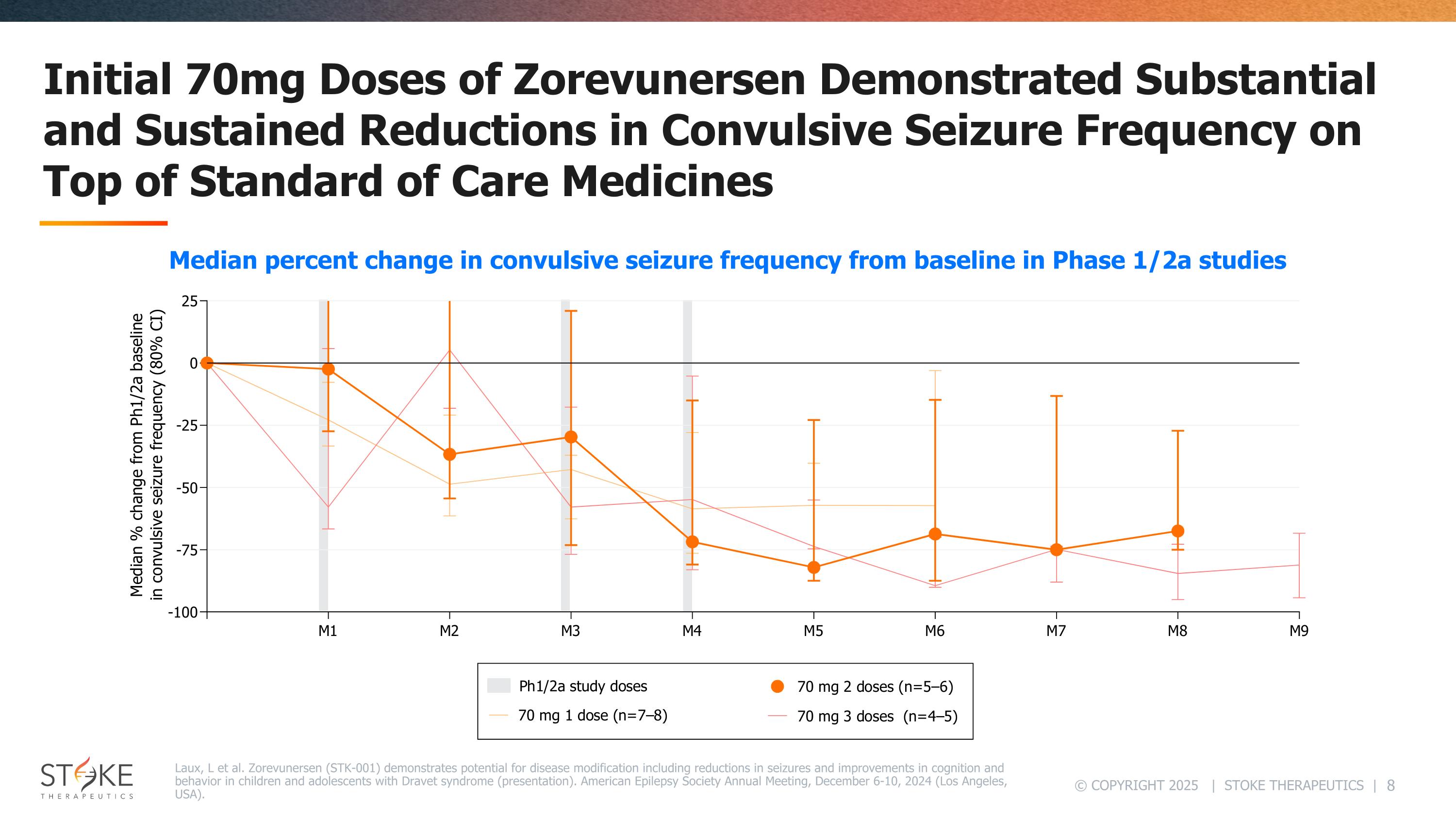
Initial 70mg Doses of Zorevunersen Demonstrated Substantialand Sustained Reductions in Convulsive Seizure Frequency on Top of Standard of Care Medicines Laux, L et al. Zorevunersen (STK-001) demonstrates potential for disease modification including reductions in seizures and improvements in cognition and behavior in children and adolescents with Dravet syndrome (presentation). American Epilepsy Society Annual Meeting, December 6-10, 2024 (Los Angeles, USA). Median percent change in convulsive seizure frequency from baseline in Phase 1/2a studies


Slide 9

Ongoing Zorevunersen Treatment Demonstrated Substantial and Durable Reductions in Major Motor Seizure Frequency OLE data cut 30 May 2025. 1 patient in the 70 mg 1 dose group who experienced <4 seizures during Phase 1/2 baseline period was excluded. Patients were not included in 6M after last Ph1/2a dose time point if they didn’t enter OLE. No exclusions were made for ASM modification. Intervals with <50% diary data were excluded for individual patients. For patients who received 1 dose of 70 mg in Ph1/2a, n = 7, 8, 8, 8, 8, 8, 8, 8, 8, 8, 8, 8, 7, 8, 8, 8, 6, 7, 7, 7, 7 at each timepoint; 2 doses of 70 mg in Ph1/2a, n = 5 for all time points; and 3 doses of 70 mg in Ph1/2a, n = 4 for all time points. ASM, antiseizure medication; CI, confidence interval; M, month; OLE, open label extension; Ph1/2a, Phase 1/2a. OLE results for patients treated with initial doses of 70 mg in the Ph1/2a studies


Slide 10

Substantial Improvements in Cognition and Behavior with Zorevunersen Treatment Support Phase 3 Design Dravet syndrome natural history study patients Patients treated with zorevunersen Phase 1/2a data cut: December 12, 2023 (after End of Study); OLE data cut: June 28, 2024. Mixed-effects models for repeated measures (MMRM) were developed using clinical data from the Phase 1/2a ADMIRAL study (n=18 at baseline) and LONGWING OLE study (n=13 at OLE Week 32). Ten patients in ADMIRAL who received 2 doses of 70mg (n=6) or 3 doses of 45mg (n=4) are represented on the left. Matching of baseline characteristics was performed using population-adjusted least squares means to allow for cross-trial comparison with the BUTTERFLY natural history study (right, n=36 at baseline, n=26-27 at Month 12, n=22 at Month 18). LS, least squares;  OLE, open-label extension; Vineland-3, Vineland Adaptive Behavior Scales – Third Edition. Brunklaus A, et al. Zorevunersen demonstrates potential as a disease‑modifying therapy in patients with Dravet syndrome. Presented at the 16th European Paediatric Neurology Society (EPNS) Congress; July 10, 2025. Due to differences between trials, cross-study comparisons may provide limited information on the efficacy or safety of a drug.


Slide 11

First Phase 3 Study Designed to Assess Disease Modification in Dravet Syndrome 1:1 randomization 52-WEEK EFFICACY TREATMENT PERIOD LOADING DOSES (sham or 70mg zorevunersen) MAINTENANCE DOSES (sham or 45mg zorevunersen) 8-week baseline period Dose 1 D1 Dose 4 W40 Dose 2 W8 Dose 3 W24 Dosing regimen of 2x70mg followed by 2x45mg over a 52-week treatment period based on positive data from Phase 1/2a and OLE studies Regulatory discussions ongoing


Slide 12

Primary endpoint Seizures Percent change from baseline in major motor seizure frequency in patients receiving zorevunersen as compared with sham at Week 28 Key secondaries Durability of effect on major motor seizure frequency measured at Week 52 Improvements in behavior & cognition measured by Vineland-3 subdomains Other Endpoints Safety, CGI-C, CaGI-C, BSID-IV, and others Study Design: Sham-controlled, 1:1 randomization Dosing Regimen: 2x70mg + 2x45mg Study Start: First patient dosed August 2025 Population: 2 to <18 years with a confirmed variant in the SCN1A gene not associated with gainof function Number of Patients Randomized: ~170 Sites: ~70 globally Duration: 8-week baseline, 52-week efficacy treatment period Data Anticipated: 2H 2027 EMPEROR Phase 3 Study Overview Regulatory discussions ongoing Phase 3 design and dose regimen aligned with Ph1/2a and OLE studies


Slide 13

EMPEROR Study Supported by Data; First Patient Dosed and Significant Demand to Enter Trial Large Data Set Informed Phase 3 Study Design Significant & Growing Demand Natural history reflects patient need Ph1/2 data established loading doses OLE data support maintenance regimen Improvements in cognition and behavior using Vineland-3 support key secondary endpoint selection and powering Pre-screening has identified ~130 patients >10 clinical trial sites now initiated in the U.S., UK, and Japan First patient dosed in August 2025 Increasing awareness of Dravet syndrome and the potential of zorevunersen


Slide 14

Potential for Disease Modification Kimberly Parkerson, M.D., Ph.D. Head of Neurology Clinical Development


Slide 15

Substantial, Durable Reductions in Seizures on Top of SOC Observed Through Three Years of Treatment with Zorevunersen OLE data cut 30 May 2025. One patient who received an incorrect dose of zorevunersen in Phase 1/2a, 3 patients who experienced less than the minimum number of convulsive seizures during Phase 1/2a baseline, and 1 patient who transferred into OLE with a delay of approximately 10 months were excluded. Patients were not included in 6M after last Ph1/2a dose time point if they didn’t enter OLE. No exclusions were made for ASM modification. Intervals with <50% diary data were excluded for individual patients. For all enrolled patients who received doses of less than 70 mg in Ph1/2a, n = 52, 53, 53, 53, 53, 52, 52, 52, 46, 46, 47, 47, 45, 45, 45, 41, 38, 41, 41, 40, 38, 39, 39, 39, 36, 36, 36, 36, 32, 30, 30, 30, 25, 20, 19, 19, 16 at each time point. For patients who received 70 mg (1, 2, or 3 doses) in Ph1/2a and up to 45 mg in OLE, n = 16, 17, 17, 17, 17, 17, 17, 17, 17, 17, 17, 17, 16, 17, 17, 17, 15, 16, 16, 16, 16 at each time point. All enrolled patients received up to 45 mg zorevunersen in the OLEs. ASM, antiseizure medication; CI, confidence interval; M, month; OLE, open label extension; Ph1/2a, Phase 1/2a. Data for all patients who continued treatment in the OLEs separated by dose received in the Ph1/2a studies


Slide 16

The Effects of Dravet Go Beyond “Just Seizures” DS, Dravet syndrome. Voice of the patient report. Externally-Led Patient-Focused Drug Development Meeting on Dravet Syndrome. Available at: https://dravetfoundation.org/dsf-funded-research/externally-led-pfdd-meeting/. Accessed March 2025. Difficulties with balance, walking, and gait Seizures Developmental deficits Behavioral changes Sleepdisruptions Communication and speechchallenges Polytherapy Stress Financialburden Workproductivity Socialisolation Mental healthstrain Familydynamics All aspects of life are affected, not only for the individual living with DS, but for their caregivers and families


Slide 17

Development in Patients with Dravet Syndrome Differs Markedly from that of Neurotypical Children Comparison of developmental trajectory between neurotypical children and patients with Dravet syndrome Graph provided for illustrative purposes only. Sullivan et al Natural history of children and adolescents with Dravet syndrome: A 24-month follow-up. Submitted. Neurodevelopmental progress Age


Slide 18

The Vineland-3 Assessment Tool is Commonly Used to Evaluate Non‑Seizure Outcomes in Dravet Syndrome COMMUNICATION Receptive:Responds upon hearing name called​ Expressive:Says “Dada”, “Mama”, or caregiver name​ Written:Writes alphabet letters using correct orientation MOTOR SKILLS Gross Motor:Moves, scoots, or crawls across the floor Fine Motor:Picks up small objects with thumb and fingers SOCIALIZATION Interpersonal Relationships:Responds upon hearing name called​ Play and Leisure:Responds when parent or caregiver is playful Coping Skills:Transitions easily from one activity to another DAILY LIVING SKILLS Personal:Cooperates in dressing and undressing Domestic:Puts away books, toys, etc. when done Community:Talks with a familiar person using a phone Domains Subdomains Vineland-3 Adaptive Behavior Scales* DS, Dravet syndrome; Vineland-3, Vineland Adaptive Behavior Scales, Third Edition. *Maladaptive Behavior is an additional optional domain of the Vineland-3 depending on age and developmental requirements. Its subdomains include Externalizing, Internalizing, and Other.


Slide 19

36 Month Data from Ongoing OLE Studies of Zorevunersen:Continuing Improvements in Cognition and Behavior OLE data cut: 30 May 2025. Mixed-effects model for repeated measures constructed using available data from enrolled patients in OLE studies. One patient who received incorrect dose in Ph1/2a study excluded; OLE sample sizes: n=74 at OLE baseline, n=66 at Month 12, n=44 at Month 24, and n=19 at Month 36. CI, confidence interval; OLE, open-label extension; Ph1/2a, Phase 1/2a; Vineland-3, Vineland Adaptive Behavior Scales – Third Edition. Month 12 (n=66) Month 24 (n=44) Month 36 (n=19) EMPEROR Phase 3 Subdomains Vineland-3 subdomains results for 12, 24, and 36 months compared to OLE baseline


Slide 20

Zorevunersen Generally Well-Tolerated with Long-Term Dosing Phase 1/2a data cut: December 12, 2023 (after End of Study); OLE data cut: May 30, 2025. *≥1 CSF protein value >50 mg/dL. Percentage based on 72/75 patients who had ≥1 post-baseline CSF protein value in the OLE studies, of whom 62/72 (86.1%) had an elevation. CSF, cerebrospinal fluid; SUSAR, suspected unexpected serious adverse reaction; TEAE, treatment-emergent adverse event; TESAE, treatment-emergent serious adverse event. >700 doses administered to date Patients have received treatment for up to 4.5 years No new safety concerns have emerged CSF protein elevation* occurred in 86% of patients and was classified as a TEAE in 45% No clinical manifestations associated with CSF protein elevation were observed One patient discontinued treatment due to elevated CSF protein 30% of patients experienced a study drug–related TEAE Most common: CSF protein elevations (14%) and procedural vomiting (5%) 22% of patients experienced a TESAE All were unrelated to the study drug except for one patient with SUSARs Phase 1/2a studies (n=81) OLE studies (n=75)


Slide 21

Pipeline Update Autosomal Dominant Optic Atrophy (ADOA) Preclinical Data and Development Plan ​


Slide 22

Autosomal Dominant Optic Atrophy (ADOA): A Progressive Vision Disorder Caused by OPA1 Haploinsufficiency Sources: Kjer. Acta Ophthalmologica Scandinavica. 1996; Yu-Wai-Man P et al. Ophthalmology, 2010; Yu-Wai-Man P, Chinnery PF. Ophthalmology, 2013; Physician and Payer Interviews; P. Amati-Bonneau P et al. The International Journal of Biochemistry & Cell Biology, 2009; Lenaers G, Hamel C, Delettre C, et al. Orphanet J Rare Dis, 2012; Chun BY and Rizzo JF III. Curr Opin Ophthalmol, 2016; Le Roux B, Lenaers G, Zanlonghi X et al. Orphanet J Rare Dis, 2019; “What is ADOA?” Autosomal Dominant Optic Atrophy Association. Accessed August 11, 2025, from https://www.adoaa.org/what-is-adoa NaV1.1 protein expression people are affected globally with a higher incidence of ~1 out of 10,000 in Denmark due to a founder effect ~13,000 people affected in the U.S., U.K., EU-4, and Denmark 1 out of 30,000 >400 Different OPA1 mutations reported in ADOA patients of patients are registered legally blind of patients are symptomatic by age 10 46% 80% 65-90% of cases caused by mutations in one allele of the OPA1 gene, most of which lead to a HAPLOINSUFFICIENCY 50% OPA1 protein expression and disease manifestation Up to RESULTING in


Slide 23

Compelling Preclinical Findings Support Further Development of STK-002 Summary of Key Preclinical Data Increased OPA1 protein and ATP-linked respiration in ADOA patient fibroblasts Dose-dependent increases in OPA1 protein expression detected in mouse and rabbit retinas Well tolerated for up to 29 days after intravitreal injection in rabbit Dose-related increase in OPA1 protein expression was observed in NHP RGCs Single doses well-tolerated in NHPs New evidence of early efficacy and tolerability in ADOA NHP model Sources: Venkatesh A, et al. STK-002, an Antisense Oligonucleotide (ASO) for the Treatment of Autosomal Dominant Optic Atrophy (ADOA), is Taken Up by Retinal Ganglion Cells (RGC) and Upregulates OPA-1 Protein Expression After Intravitreal Administration to Non-human Primates (NHPs). ASGCT; May 16-19, 2022.


Slide 24

New Evidence of Early Efficacy and Tolerability of STK-002 in ADOA Non-Human Primate Model Continued improvement in retinal function (PhNR¥) PhNR as measured by ERG PhNR amplitude increased over baselineNumber of eyes (6 control, 6 treated eyes) Continued improvement or stabilization in mitochondrial function (FPF*) FPF as measured by Beacon Global FPF stabilized or improved Number of eyes (6 control, 6 treated eyes) 6 5 4 3 2 1 0 3 MOS 5 MOS control STK-002 3 MOS 5 MOS 6 5 4 3 2 1 0 control STK-002 *Flavoprotein fluorescence; ¥Photopic negative response, amplitude measured at 72 ms Dept. of Surgical & Radiological Sciences, School of Veterinary Medicine; Dept. of Ophthalmology & Vision Science, School of Medicine; California National Primate Research Center, University of California, Davis, Davis, California, USA Evidence of continued improvement in mitochondrial and retinal function at 5 months


Slide 25

Phase 1 Study in ADOA Patients Now Underway in UK Phase 1 Study (OSPREY) Design (UK and Europe) 1 2 3 4 Intravitreal injection in one eye 48-week duration Patients ages ≥18 to <55y (n=21) Single ascending doses (0.1, 0.3, 0.5, & 0.7 mg/eye) Primary Endpoint: Safety, tolerability, and exposure of single ascending doses of STK-002 Secondary Endpoints: Changes in visual function (LCVA), ocular structures, quality of life, and electroretinographic measures (e.g., ERG, PhNR) after single doses of STK-002 Exploratory Endpoints: Mitochondrial function as measured by OcuMet Beacon FPF Open-label study to investigate safety, tolerability, and exposure of STK-002 in ADOA Notes: LCVA = low contrast visual acuity, ERG= Electroretinogram, PhNR = ¥Photopic negative response, FPF=Flavoprotein fluorescence


Slide 26

Financial Summary Tommy Leggett Chief Financial Officer​


Slide 27

Closing Remarks Ian F. Smith Interim Chief Executive Officer & Director​


Slide 28

Stoke is Positioned to Deliver in Dravet and Beyond Execution Clinical Data Platform Expansion Strength to Deliver Clear path to value creation supported by clinical progress, financial strength, and investment in core capabilities Global Phase 3 Underway First patient dosed in EMPEROR study Robust trial design to support potential disease-modifying medicine 3-year OLE Results Support the long-term disease-modifying potential of zorevunersen Second program in the clinic Phase 1 study of STK-002 for ADOA initiated in the UK Supported by safety and efficacy from pre-clinical data Well-funded and positioned for success Biogen collaboration Runway through Ph3 readout to mid-2028 Key leadership hires Increased focus on Medical Affairs, Regulatory, and Commercial capabilities


Slide 29

Q&A
