EX-99.1
Exhibit 99.1

URC:TSX | UROY:NASDAQ
ANNUAL INFORMATION FORM
for the fiscal year ended April 30, 2025
July 16, 2025
1830 – 1188 West Georgia Street, Vancouver, British Columbia, Canada V6E 4A2
TABLE OF CONTENTS
|
|
|
|
|
|
|
INTRODUCTORY NOTES |
1 |
|
RISK FACTORS |
61 |
|
Currency Presentation and Exchange Rate Information |
1 |
|
|
Risks Related to the Business of URC |
62 |
|
Cautionary Statement Regarding Forward-Looking Information |
1 |
|
|
Risks Related to the Company's Securities |
74 |
|
Technical and Third-Party Information |
3 |
|
DIVIDENDS AND DISTRIBUTIONS |
76 |
|
Note Regarding Mineral Reserve and Resource Estimates |
4 |
|
DESCRIPTION OF CAPITAL STRUCTURE |
77 |
GLOSSARY |
5 |
|
|
Authorized Capital |
77 |
CORPORATE STRUCTURE |
6 |
|
MARKET FOR SECURITIES |
78 |
|
Name, Address and Incorporation |
6 |
|
|
Trading Price and Volume |
78 |
|
Intercorporate Relationships |
6 |
|
|
Prior Sales |
79 |
GENERAL DEVELOPMENT OF THE BUSINESS |
6 |
|
DIRECTORS AND OFFICERS |
80 |
|
Public Offerings |
6 |
|
|
Name, Occupation and Security Holding |
80 |
|
At-the-Market Equity Program |
6 |
|
|
Cease Trade Orders, Bankruptcies, Penalties and Sanctions |
83 |
|
Graduation to the TSX |
7 |
|
|
Conflicts of Interest |
84 |
|
Royalty Acquisitions |
7 |
|
AUDIT COMMITTEE |
84 |
|
Physical Uranium |
7 |
|
|
Audit Committee Charter |
84 |
|
Developments Subsequent to April 30, 2025 |
8 |
|
|
Composition of the Audit Committee |
85 |
DESCRIPTION OF THE BUSINESS |
8 |
|
|
Relevant Education and Experience |
85 |
|
General |
8 |
|
|
Audit Committee Oversight |
86 |
|
Business Strategy |
8 |
|
|
Pre-Approval Policies and Procedures |
86 |
|
Uranium Uses and Production Process |
9 |
|
|
External Auditor Service Fees |
86 |
|
The URC Business Model |
12 |
|
LEGAL PROCEEDINGS AND REGULATORY ACTIONS |
86 |
|
Competitive Strengths |
13 |
|
INTEREST OF MANAGEMENT AND OTHERS IN MATERIAL TRANSACTIONS |
86 |
|
Summary of Royalty and Other Interests |
14 |
|
TRANSFER AGENTS AND REGISTRARS |
86 |
|
Competitive Conditions |
16 |
|
MATERIAL CONTRACTS |
86 |
|
Regulation |
16 |
|
INTERESTS OF EXPERTS |
87 |
|
Environmental Policies |
18 |
|
ADDITIONAL INFORMATION |
87 |
|
Employees |
18 |
|
APPENDIX "A" ADDITIONAL TECHNICAL DISCLOSURE |
A-1 |
|
Foreign Operations |
18 |
|
|
MCARTHUR RIVER |
A-1 |
THE URC ASSET PORTFOLIO |
19 |
|
|
CIGAR LAKE |
A-16 |
|
Yellow Cake Agreement and Uranium Option |
19 |
|
APPENDIX "B" AUDIT COMMITTEE CHARTER |
B-1 |
|
Royalty Interest |
21 |
|
|
Mineral Reserve and Resource Estimates |
59 |
|
INTRODUCTORY NOTES
References to "we", "our", "us", the "Company" or "URC" in this annual information form (this "Annual Information Form") is to the consolidated operations of Uranium Royalty Corp. and its subsidiaries.
Unless otherwise indicated, the information in this Annual Information Form is given as of the date of this Annual Information Form.
Currency Presentation and Exchange Rate Information
Our reporting currency is the Canadian dollar. Unless otherwise noted, financial information and amounts contained in this Annual Information Form are in Canadian dollars and references herein to "$" are to Canadian dollars. References herein to "US$" are to United States dollars and references herein to "A$" are to Australian dollars.
The table below sets out the high and low rates of exchange for one United States dollar expressed in Canadian dollars during each of the periods noted, the average rates of exchange during such periods and the rates of exchange in effect at the end of such periods, each based on the daily exchange rate reported by the Bank of Canada for conversion of United States dollars.
|
|
|
|
|
Year ended April 30, |
|
2025 |
|
2024 |
Canadian dollars per United States dollar |
|
|
|
Highest rate during the period |
1.4603 |
|
1.3875 |
Lowest rate during the period |
1.3460 |
|
1.3128 |
Average rate during the period |
1.3940 |
|
1.3503 |
Rate at the end of the period |
1.3812 |
|
1.3746 |
Cautionary Statement Regarding Forward-Looking Information
Certain statements contained in this Annual Information Form constitute "forward-looking information" within the meaning of applicable Canadian securities laws and "forward-looking statements" within the meaning of securities laws in the United States (collectively, "Forward-Looking Statements"). These statements relate to the expectations of management about future events, results of operations and the Company's future performance (both operational and financial) and business prospects. All statements other than statements of historical fact are Forward-Looking Statements. The use of any of the words "anticipate", "plan", "contemplate", "continue", "estimate", "expect", "intend", "propose", "might", "may", "will", "shall", "project", "should", "could", "would", "believe", "predict", "forecast", "target", "aim", "pursue", "potential", "objective" and "capable" and the negative of these terms or other similar expressions are generally indicative of Forward-Looking Statements. These statements involve known and unknown risks, uncertainties and other factors that may cause actual results or events to differ materially from those anticipated in such Forward-Looking Statements. No assurance can be given that these expectations will prove to be correct and such Forward-Looking Statements should not be unduly relied on. These statements speak only as of the date hereof. In addition, this Annual Information Form may contain Forward-Looking Statements attributed to third party industry sources. Without limitation, this Annual Information Form contains Forward-Looking Statements pertaining to the following:
|
|
• the ongoing operations of the properties in which the Company holds or may hold uranium interests;
• future events or performance;
• the impact of general business and economic conditions;
• future financial capacity, liquidity and capital resources;
• anticipated future sources of funds to meet working capital requirements;
• future capital expenditures and contractual commitments;
|
• expectations respecting future financial results;
• expectations with respect to the Company's financial position;
• expectations regarding uranium prices and the impacts of the United States and other governmental policies on uranium demand;
• expectations regarding supply and demand for uranium;
• conditions, trends and practices pertaining to the uranium industry and other industries in which uranium is used;
|
|
|
• expectations regarding the Company's business plans, strategies, growth and results of operations;
• the financial and operational strength of counterparties;
|
• mineral resources and mine life;
• governmental regulatory regimes with respect to environmental matters.
|
With respect to Forward-Looking Statements contained in this Annual Information Form, assumptions have been made regarding, among other things, the following:
|
|
• market prices of uranium;
• global economic and financial conditions;
• global political conditions and trade policies;
• the ongoing operation of the properties in which the Company holds or may hold uranium interests;
|
• future operations and developments on the properties in which the Company holds or may hold interests; and
• the accuracy of public statements and disclosure, including future plans and expectations, made by the owners or operators of the properties underlying the Company's interests.
|
Actual results could differ materially from those anticipated in these Forward-Looking Statements as a result of, among other things, the risk factors set forth below and included elsewhere in this Annual Information Form, including the following:
|
|
• limited or no access to data or the operations underlying the Company's interests;
• dependence on third party operators;
• dependence on future payments from owners and operators;
• a majority of the Company's assets are non-producing;
• royalties, streams and similar interests may not be honoured by operators of a project;
• defects in, or disputes relating to, the existence, validity, enforceability, terms and geographic extent of royalties, streams and similar interests;
• royalty, stream and similar interests may be subject to buy-down right provisions or pre-emptive rights;
• project costs may influence the Company's future royalty returns;
• risks faced by owners and operators of the properties underlying the Company's interests;
• title, permit or licensing disputes related to any of the properties in which the Company holds or may hold royalties, streams or similar interests;
• excessive cost escalation, as well as development, permitting, infrastructure, operating or technical difficulties on any of the properties underlying royalties, streams or similar interests;
• volatility in market prices and demand for uranium and the market price of the Company's other investments, including as a result of geopolitical factors such as the ongoing conflict in Ukraine;
• changes in general economic, financial, market and business conditions in the industries in which uranium is used;
|
• risks related to mineral reserve and mineral resource estimates;
• replacement of depleted mineral reserve;
• the public acceptance of nuclear energy in relation to other energy sources;
• alternatives to and changing demand for uranium;
• the absence of any public market for uranium;
• changes in legislation, including permitting and licensing regimes and taxation policies;
• the effects of the spread of illness or other public health emergencies;
• commodities price risks, which may affect revenue derived by the Company from its asset portfolio;
• risks associated with future acquisitions;
• competition and pricing pressures;
• any inability of the Company to obtain necessary financing when required on acceptable terms or at all;
• regulations and political or economic developments in any of the jurisdictions where properties in which the Company holds or may hold royalties, streams or similar interests are located;
• compliance with laws and regulations relating to environmental, social and governance matters;
• macroeconomic developments and changes in global general economic, financial, market and business conditions, including as a result of changes in trade policies and regulations;
• fluctuations in the market prices of the Company's investments;
• liquidity in equity investments;
• fluctuations in foreign exchange rate;
|
|
|
• any inability to attract and retain key employees;
• disruptions to the information technology systems of the Company or third-party service providers;
• risks associated with First Nations land claims;
• potential conflicts of interest;
|
• any inability to ensure compliance with anti-bribery and anti-corruption laws;
• any future expansion of the Company's business activities outside of areas of expertise;
• any failure to maintain effective internal controls;
• negative cash flow from operating activities; and
• the other risks described under "Risk Factors" herein.
|
Should one or more of these risks and uncertainties materialize, or should underlying assumptions prove incorrect, actual results may vary materially from those described in Forward-Looking Statements. Forward-Looking Statements are based on management's beliefs, estimates and opinions on the date the statements are made, and the Company undertakes no obligation to update Forward-Looking Statements if these beliefs, estimates and opinions or other circumstances should change, other than as required by applicable laws. Investors are cautioned against attributing undue certainty to Forward-Looking Statements.
The risk factors referenced herein should not be construed as exhaustive. Except as required under applicable laws, the Company undertakes no obligation to update or revise any Forward-Looking Statements. An investment in the Company is speculative and involves a high degree of risk due to the nature of our business and the present state of exploration of our projects.
Please carefully consider the risk factors set out herein under "Risk Factors" starting at page 61 of this Annual Information Form.
Technical and Third-Party Information
This Annual Information Form includes market information, industry data and forecasts obtained from independent industry publications, market research and analyst reports, surveys and other publicly available sources. Although the Company believes these sources to be generally reliable, market and industry data is subject to interpretation and cannot be verified with complete certainty due to limits on the availability and reliability of raw data, the voluntary nature of the data gathering process and other limitations and uncertainties inherent in any statistical survey. Accordingly, the accuracy and completeness of this data is not guaranteed. Actual outcomes may vary materially from those forecast in such reports, surveys or publications, and the prospect for material variation can be expected to increase as the length of the forecast period increases. The Company has not independently verified any of the data from third party sources referred to herein nor ascertained the underlying assumptions relied on by such sources.
Except where otherwise stated, the disclosures herein relating to properties underlying the Company's royalty and other interests has been prepared in accordance with the exemption set forth in Section 9.2 of National Instrument 43-101 – Standards of Disclosure for Mineral Projects ("NI 43-101") and is based on information publicly disclosed by the owners or operators of such properties. Specifically, as a royalty holder, the Company has limited, if any, access to the properties subject to its interests and the publicly available information on such properties may sometimes relate to a larger property area than that covered by the Company's interests. The Company generally relies on publicly available information regarding these properties and related operations and generally has no ability to independently verify such information, and there can be no assurance that such third-party information is complete and accurate. Additionally, the Company has, and may from time to time, receive operating information from the owners and operators of these properties, which it is not permitted to disclose to the public.
As of the date of this Annual Information Form, the Company considers its royalty interest in the McArthur River Operation and Cigar Lake Project (each as defined herein), each located in Saskatchewan, Canada as its material properties for the purposes of NI 43-101. See "URC Asset Portfolio – Royalty Interests – McArthur River" and " URC Asset Portfolio – Royalty Interests – Cigar Lake".
Unless otherwise indicated, the scientific and technical information contained herein or in the documents incorporated by reference regarding: (i) McArthur River has been derived from the technical report titled "McArthur River Operation, Northern Saskatchewan, Canada, National Instrument 43-101 Technical Report" (the "McArthur River Technical Report"), with an effective date of December 31, 2018; and (ii) Waterbury Lake / Cigar Lake has been derived from the technical report titled "Cigar Lake Operation, Northern Saskatchewan, Canada, National Instrument 43-101 Technical Report", with an effective date of December 31, 2023 (the "Cigar Lake Technical Report"), each prepared for Cameco Corporation ("Cameco") as well as Cameco's Annual Information Form for the year ended December 31, 2024 (the "Cameco 2024 AIF") and Cameco's other public disclosures, copies of which are available under its profile on the System for Electronic Document Analysis and Retrieval+ at www.sedarplus.ca ("SEDAR+").
Note Regarding Mineral Reserve and Resource Estimates
This Annual Information Form has been prepared in accordance with the requirements of Canadian securities laws, which differ from the requirements of United States securities laws. Unless otherwise indicated, all mineral reserve and resource estimates included in this Annual Information Form have been prepared for or by the current or former owners and operators of the relevant properties, as and to the extent indicated by them, in accordance with NI 43-101, the CIM Definition Standards, JORC or Regulation S-K 1300, as applicable.
As a foreign private issuer that is eligible to file reports with the United States Securities and Exchange Commission (the "SEC") pursuant to the multijurisdictional disclosure system, the Company is not required to provide disclosures under Regulation S-K 1300, which is applicable to domestic issuers in the United States. Accordingly, United States investors are cautioned that while terms are substantially similar to CIM Definition Standards, there are differences in the definitions under Regulation S-K 1300 and the CIM Definition Standards and there is no assurance any mineral reserves or mineral resources that the Company may report as "proven mineral reserves", "probable mineral reserves", "measured mineral resources", "indicated mineral resources" and "inferred mineral resources" under NI 43-101 would be the same had the Company prepared the reserve or resource estimates under the standards adopted under Regulation S-K 1300.
Investors are also cautioned that they should not assume that any part or all of the mineralization in these categories will ever be converted into a higher category of mineral resources or into mineral reserves. Mineralization described using these terms has a greater amount of uncertainty as to their existence and feasibility than mineralization that has been characterized as reserves. Accordingly, investors are cautioned not to assume that any "measured mineral resources", "indicated mineral resources", or "inferred mineral resources" that the Company reports are or will be economically or legally mineable. Further, "inferred resources" have a greater amount of uncertainty as to their existence and as to whether they can be mined legally or economically. In accordance with Canadian rules, estimates of "inferred mineral resources" cannot form the basis of feasibility or other economic studies, except in limited circumstances where permitted under NI 43-101. In addition, the project stage classifications utilized by the Company under NI 43-101 do not conform to defined project stages under Regulation S-K 1300.
The owners and operators of certain projects underlying the Company's interests have prepared resource estimates which are referenced herein or in the Company's other disclosure documents, under JORC and/or Regulation S-K 1300, which differ from the requirements of NI 43-101. Accordingly, information contained herein may contain descriptions of the projects underlying the Company's interests that differ from similar project information made available by other Canadian issuers.
GLOSSARY
Unless the context otherwise requires, when used in this Annual Information Form, the defined technical terms and abbreviations below shall have the meanings ascribed thereto. Words importing the singular number shall include the plural and vice versa and words importing any gender shall include all genders.
"CIM" means the Canadian Institute of Mining, Metallurgy and Petroleum.
"CIM Definitions Standards" means the CIM Definition Standards on Mineral Resources and Reserves adopted by the CIM council on November 27, 2010, or the CIM Definition Standards on Mineral Resources and Reserves adopted by the CIM council on May 10, 2014, as applicable in the context used.
"eU3O8" or "U3O8 equivalent" means radiometric equivalent U3O8.
"GRR" means gross revenue royalty, a form of royalty interest entitling the holder thereof to a share of the total revenue stream from the sale of production from a property, which may or may not include deductions. GRR may also be referred to as a "gross value royalty", or GVR, a "gross proceeds royalty", or GPR, or a "gross overriding royalty", or "GORR".
"ISR" means in-situ recovery, one of two primary extraction methods currently used to extract uranium from underground.
"JORC" or "JORC Code" means the 2012 Edition of the Australasian Code for Reporting of Exploration Results, Mineral Resources and Ore Reserves.
"LOM" or "life of mine" means the time in which, through the employment of the available capital, the ore reserves, or such reasonable extension of the ore reserves as conservative geological analysis may justify, will be extracted.
"Mlbs" means millions of pounds.
"NPI" means net profit interest, a form of royalty based on the profit realized after deducting costs related to production. NPI may also be referred to as "net proceeds royalties", or NPR.
"NSR" means net smelter returns royalty, a form of royalty based on the value of production or net proceeds received by the operator from a smelter or refinery.
"ppm" means parts per million.
"PR" means production royalty, a form of royalty based on metal produced, often at a predetermined fixed price.
"Regulation S-K 1300" means the mining disclosure rules under sub-part 1300 of SEC Regulation S-K under the Securities Act of 1933, as amended, titled – Disclosure by Registrants Engaged in Mining Operations.
"U3O8" means triuranium octoxide, a compound of uranium that is converted to UF6 for the purpose of uranium enrichment.
"UF6" means uranium hexafluoride, a compound used in the uranium enrichment process that produces fuel for nuclear reactors and nuclear weapons.
"V2O5" means vanadium pentoxide, a compound of vanadium that is often mined as a co-product of uranium in conventional deposits in the southwestern United States. It is often used as a catalyst in chemical reactions.
CORPORATE STRUCTUREName, Address and Incorporation
The Company was incorporated under the Canada Business Corporations Act (the "CBCA") on April 21, 2017, under the name "Uranium Royalty Corp."
The Company's head office is located at 1188 West Georgia Street, Suite 1830, Vancouver, British Columbia V6E 4A2 and its registered and records office is located at 925 West Georgia Street, Suite 1000, Vancouver, British Columbia V6C 3L2.
The Company's common shares without par value (the "Common Shares") are listed on the Toronto Stock Exchange (the "TSX") under the symbols "URC". The Common Shares are also listed on the Nasdaq Capital Market ("NASDAQ") under the stock symbol "UROY".
Intercorporate Relationships
The Company has two wholly-owned subsidiaries, Uranium Royalty (USA) Corp., a corporation incorporated under the laws of the State of Delaware on October 24, 2018, and Reserve Minerals, LLC, a limited liability company existing under the laws of the State of Delaware.
GENERAL DEVELOPMENT OF THE BUSINESS
Key aspects of the development of the Company's business over the last three completed financial years are discussed below.
Public Offerings
On October 17, 2023, the Company completed an underwritten bought deal public offering of 10,205,000 Common Shares (the "2023 Offered Shares") at a price of US$2.94 per 2023 Offered Share for gross proceeds of $40.9 million (the "2023 Offering"). Uranium Energy Corp. ("UEC") purchased 1,930,750 Common Shares, representing approximately 19% of the number of 2023 Offered Shares, under the 2023 Offering.
On February 9, 2024, the Company completed an underwritten bought deal public offering of 6,724,600 Common Shares (the "2024 Offered Shares") at a price of US$3.40 per 2024 Offered Share for gross proceeds of $30.8 million (the "2024 Offering"). UEC purchased 1,047,614 Common Shares representing approximately 16% of the number of 2024 Offered Shares under the 2024 Offering.
At-the-Market Equity Program
On August 29, 2024, the Company renewed its at-the-market equity distribution program (the "ATM Program"). The ATM Program allows the Company to distribute up to US$39 million (or the equivalent in Canadian dollars) of its Common Shares (the "ATM Shares"). Sales of ATM Shares through the ATM Program are made pursuant to an equity distribution agreement dated August 29, 2024, with a syndicate of agents led by BMO Nesbitt Burns Inc., and including BMO Capital Markets Corp., H.C. Wainwright & Co. LLC, Canaccord Genuity Corp., Canaccord Genuity LLC, Paradigm Capital Inc., TD Securities Inc. and TD Securities (USA) LLC (collectively, the "Agents").
The ATM Shares sold under the ATM Program are sold at the prevailing market price on the TSX or the NASDAQ, or any other market on which the Common Shares may be listed and posted for trading, as applicable, at the time of sale. Unless earlier terminated by the Company or the Agents as permitted therein, the ATM Program will terminate upon the earlier of (a) the date that the aggregate gross sales proceeds of the ATM Shares sold under the ATM Program reaches the aggregate amount of US$39 million (or the equivalent in Canadian dollars); or (b) August 20, 2025.
During the year ended April 30, 2025, no ATM Shares were distributed by the Company under the ATM Program.
During the year ended April 30, 2024, a total of 870,910 Common Shares were distributed by the Company under the ATM Program through the facilities of the TSX and NASDAQ for gross proceeds of $3.5 million, of which approximately $0.7 million (representing net proceeds of $0.7 million), at an average selling price of $4.05 per Common Share, was raised through the facilities of the TSX, and US$2.1 million ($2.8 million) (representing net proceeds of US$2.0 million ($2.7 million)), at an average selling price of US$2.98 per Common Share, was raised through the facilities of the NASDAQ. The Agents were paid aggregate commissions on such sales of approximately $0.02 million and US$0.5 million (representing 2.50% of the gross proceeds of the ATM Shares sold).
During the year ended April 30, 2023, a total of 4,029,021 Common Shares were distributed by the Company under the ATM Program through the facilities of the TSX Venture Exchange ("TSX-V") and the NASDAQ for gross proceeds of $14.6 million, of which approximately $3.2 million (representing net proceeds of $3.1 million) was raised through the facilities of the TSX-V and US$8.7 million ($11.4 million) (representing net proceeds of US$8.4 million ($11.1 million)) was raised through the facilities of the NASDAQ. The Agents were paid aggregate commissions on such sales of approximately $0.08 million and US$0.2 million (representing 2.50% of the gross proceeds of the ATM Shares sold).
Graduation to the TSX
On July 6, 2023, the Company graduated from the TSX-V to the TSX. Common Shares are listed on the TSX under the symbol "URC".
Royalty Acquisitions
On February 7, 2023, the Company completed its acquisition of a portfolio of royalties consisting of:
o
a 2% NSR royalty on portions of the San Rafael Project, located in Utah, USA, operated by Western Uranium & Vanadium Corp. ("Western Uranium");
o
a 2% - 4% sliding scale GVR royalty on portions of the Whirlwind Project, located in Colorado and Utah, USA, operated by Energy Fuels Inc. ("Energy Fuels");
o
a 1% GVR royalty (applicable to uranium and vanadium sales) on portions of the Energy Queen Project, located in Utah and Colorado, USA, operated by Energy Fuels; and
o
a 2% - 4% sliding scale royalty on portions of the Dewey-Burdock Project located in South Dakota, USA, operated by enCore Energy Corp. ("enCore").
The consideration paid by the Company was $2.0 million (US$1.5 million) in cash.
On July 3, 2024, the Company acquired a 0.375% NSR royalty on the Salamanca project for cash consideration of $0.7 million. This royalty includes the Retortillo, Zona 7 and Alameda projects, located in Spain.
On July 31, 2024, the Company acquired GORR of 6% "Mine Price" on a portion of the Churchrock Project for cash consideration of $4.9 million (US$3.5 million). The royalty is based on gross revenues after recovery of certain reasonable and actual costs to transport the mineral to the final point of sale. The royalty covers the 10 patented mining claims in Section 8 property (640 acres) that comprise New Mexico Mineral Survey 2220 on the Churchrock Project.
On October 25, 2024, the Company acquired a 10% NPI royalty on an approximate 20.6955% participating interest in the Millennium and Cree Extension projects for cash consideration of $6.0 million. As a profit-based NPI, the acquired royalty is calculated based upon generated revenue, with deductions for certain expenses and costs, which include cumulative expense accounts, including development costs.
Physical Uranium
As of the date hereof, the Company holds 2,379,637 pounds of U3O8 at a weighted average acquisition cost of US$59.73 per pound. As at April 30, 2025, the Company held 2,729,637 pounds of U3O8 at a weighted average cost of US$59.73 per pound.
In October 2023, the Company received 300,000 pounds of U3O8 purchased under existing agreements with CGN Global Uranium Ltd ("CGN"), pursuant to which the Company agreed to purchase an aggregate of 500,000 pounds U3O8 at a weighted average price of US$47.71 per pound.
In July 2024, the Company received an additional 100,000 pounds of U3O8 purchased under existing agreements with CGN. The delivery of the remaining 100,000 pounds for payment of approximately $6.8 million is expected to occur in January 2026. The delivery was originally scheduled to be delivered in April 2025 but was deferred to January 2026 by the parties.
In August 2024, the Company entered into a physical uranium sale and repurchase arrangement with a third party, in which the Company sold 160,000 pounds U3O8 for approximately $18.0 million (US$13.4 million) in August 2024 and repurchased 160,000 pounds U3O8 for approximately $19.7 million (US$13.7 million) in December 2024.
During the year ended April 30, 2025, the Company sold 150,000 pounds of U3O8 for approximately $15.5 million, generating a gross profit of $3.5 million.
On March 14, 2025, Orano Canada Inc. ("Orano") settled the royalty payment for the McArthur River Royalty for calendar year 2024 by delivering 18,366 pounds U3O8 to the Company's storage account at Cameco's Blind River uranium refining facility, located in Ontario, Canada.
Developments Subsequent to April 30, 2025
On June 4, 2025, the Company acquired a 2.0% GRR royalty on the Aberdeen project for cash consideration of $1.0 million. The royalty is subject to a buyback option, pursuant to which one quarter of the royalty may be repurchased upon payment to the Company of $1,000,000. This option is only exercisable for a period of six months following the announcement of a successful pre-feasibility study and expires on June 4, 2032.
Subsequent to April 30, 2025, the Company sold 350,000 pounds U3O8 at a price of US$69.27 per pound for cash consideration of $33.2 million (US$24.2 million).
On June 20, 2025, the Company participated in a public offering launched by Sprott Physical Uranium Trust ("Sprott") and purchased 1,456,028 units for cash consideration of $34.3 million (US$25 million).
DESCRIPTION OF THE BUSINESSGeneral
URC is a pure-play uranium royalty company focused on gaining exposure to uranium prices by making strategic investments in uranium interests, including royalties, streams, debt and equity investments in uranium companies, as well as through holdings of physical uranium.
Business Strategy
To date, the Company has assembled a portfolio of royalty interests on uranium projects and physical uranium holdings. URC's long-term strategy is to gain exposure to uranium prices by owning and managing a portfolio of geographically diversified uranium interests, including uranium royalties and streams, debt and equity investments in uranium companies and physical uranium. From time to time, the Company also seeks further exposure to uranium through investments in funds and other equities.
In executing its royalty strategy, the Company seeks interests that provide it with direct exposure to uranium prices, without the direct operating costs and concentrated risks that are associated with the exploration, development and mining of uranium.
The Company's strategy recognizes the inherent cyclicality of valuations based on uranium prices, including the impact of such cyclicality on the availability of capital within the uranium sector. The Company implements its strategy by leveraging the deep industry knowledge and expertise of its management team and its board of directors to identify and evaluate opportunities in the uranium industry.
The Company's primary focus is to identify, evaluate and acquire:
•
royalties on uranium projects, pursuant to which the Company would receive payments from operators of uranium mines based on production and/or sales of uranium products;
•
uranium streams, pursuant to which the Company would make an upfront payment to a project owner or operator in exchange for long-term rights to purchase a fixed percentage of future uranium production; and
•
off-take or other agreements, pursuant to which the Company would enter into long-term purchase agreements or options to acquire physical uranium products.
Such interests may be acquired by the Company directly from the owner or operator of a project or indirectly from third party holders. The Company may also seek to acquire direct joint venture or other interests in existing uranium projects, where such interests would provide the Company with exposure to a project as a non-operator or where the Company believes there is potential to convert such interests into royalties, streams or similar interests. In evaluating potential transactions, the Company utilizes a disciplined approach to manage its fiscal profile.
Ancillary to its core business, the Company also seeks to identify and complete direct strategic equity or debt investments in companies engaged in the exploration, development and/or production of uranium.
The Company also engages in purchases and sales of uranium inventories from time to time. Purchases are made where the Company believes there is an opportunity to provide attractive commodity price exposure. Sales may occur from time to time based upon market conditions and the Company's liquidity requirements. Purchases may be made pursuant to its existing option under its strategic arrangement with Yellow Cake plc ("Yellow Cake") or by other means, including direct purchases from producers or market purchases. See "The URC Asset Portfolio – Yellow Cake Strategic Investment and Uranium Option" and "General Development of the Business – Physical Uranium".
Uranium Uses and Production Process
The predominant use for uranium is as a fuel for nuclear power plants. Through the process of nuclear fission, the uranium isotope U-235 can undergo a nuclear reaction whereby its nucleus is split into smaller particles. This process releases significant amounts of energy, creating heat to generate steam to spin a turbine, and is the basis of power generation in the nuclear power industry.
Uranium has other commercial uses in the fields of medical diagnosis, agriculture, carbon dating and other industries. However, the volume of demand generated by these uses is very small compared to nuclear power generation. Uranium is also used as a feedstock for over 200 private nuclear reactors, which are operated for research purposes and the production of isotopes for commercial uses. Uranium is also the propulsion fuel source for nuclear-powered aircraft carriers, submarines and ice-breaking vessels.
Uranium Production Process
There are three main uranium mining processes:
(i)
Conventional – Open Pit Mining – This method of mining involves removal of the rock and soil over the economic ore using various types of heavy equipment and often drilling and explosive blasting methods, resulting in an open pit. The rock ore is removed by surface equipment and processed in order to access the minerals. This method is generally used where the ore is close enough to surface to make this method economical, especially in uranium mines with lower grades, but larger tonnages of ore.
(ii)
Conventional – Underground Mining – Mineral deposits that cannot be economically mined using surface mining techniques may require mining by underground methods. Underground methods are quite diverse in their techniques, due to the various sizes, shapes and orientations of underground ore bodies. This method typically uses vertical mine shafts and horizontal development tunnels. The method of extraction can vary and include open stoping, cut and fill and caving methods. In some uranium mines, a lack of geotechnical stability can result in the requirement to freeze the ore body and utilize more specialized mining methods.
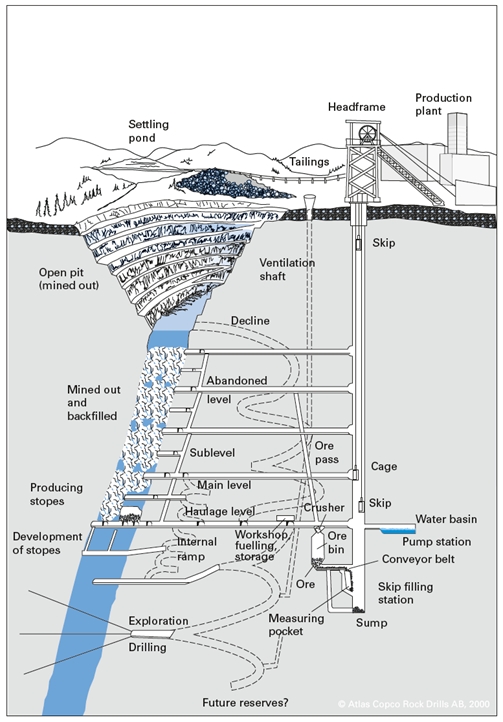
Source: Atlas Copco – Mining Methods in Underground Mining, 2007
(iii)
ISR Mining – In situ recovery, or "ISR", involves leaving the ore where it is in the ground, and recovering the minerals from it by dissolving them and pumping the pregnant solution to the surface where the minerals can be recovered. Consequently, there is little surface disturbance and no tailings or waste rock generated. Uranium in situ leaching uses the native groundwater in the orebody which is fortified with a complexing agent and in most cases an oxidant. It is then pumped through the underground orebody to recover the minerals in it by leaching.
Once the pregnant solution is returned to the surface, the uranium is recovered in much the same way as in any other uranium processing plant (mill).
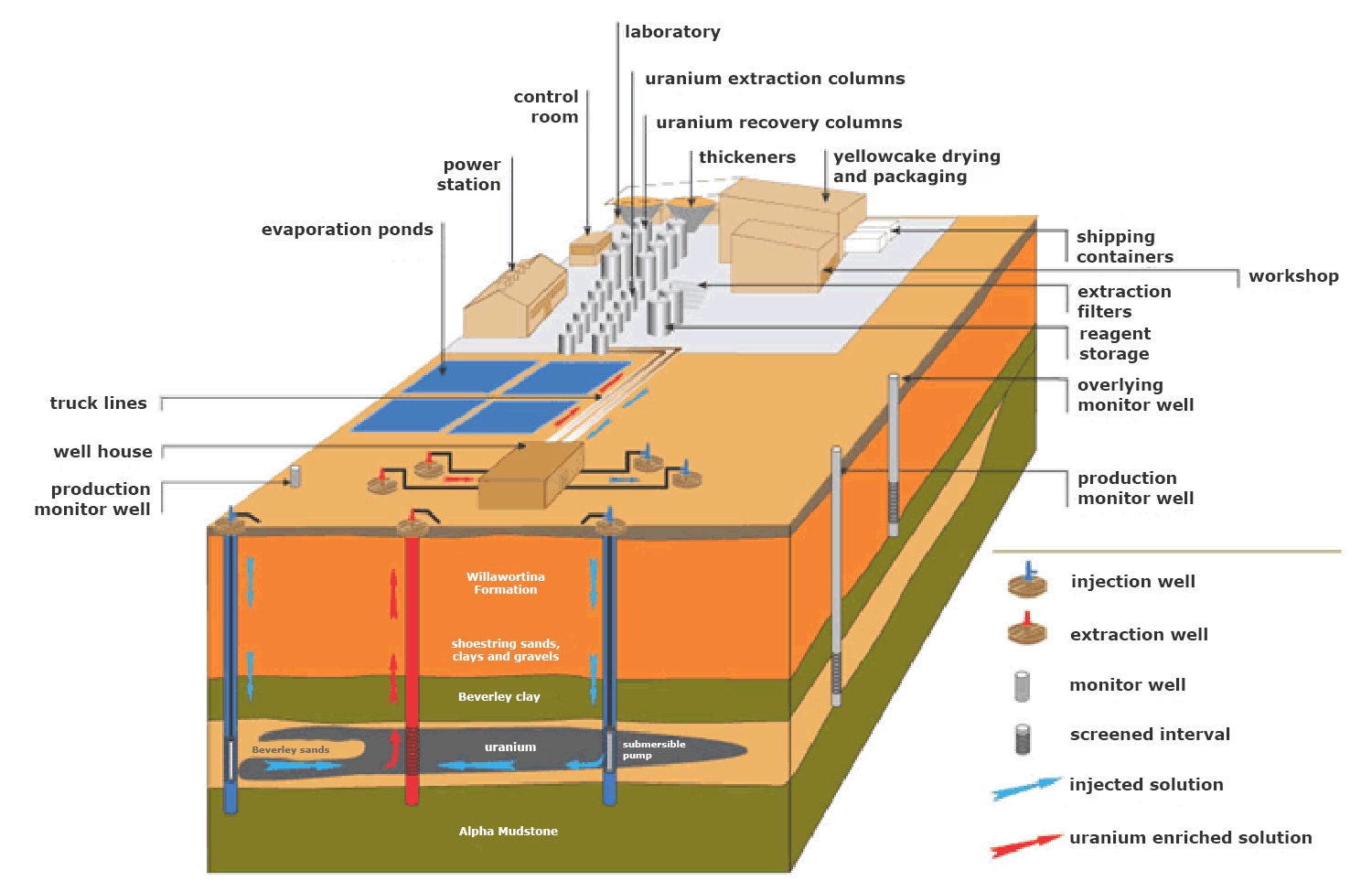
Source: WNA website – In-situ Leach Mining of Uranium, courtesy of Heathgate Resources
An increasing amount of current global annual uranium production, now over 50%, is generated from ISR mining (World Nuclear Association). ISR mining generally requires lower start-up costs than conventional mining operations and involves relatively lower cash costs for inputs such as labor, machinery and maintenance.
After uranium is mined and recovered, uranium ore is processed and milled to produce U3O8 concentrates. The ore from open pit or underground methods is crushed, pulverized and ground into a fine slurry. Chemicals are added through a series of processing steps to separate and concentrate the uranium. These U3O8 concentrates generally contain 80% - 90% U3O8. The resulting U3O8 is converted to UF6 (or for Candu-type reactors, to UO2).
In order to convert U3O8 to UF6, uranium concentrates are shipped to a uranium conversion facility where such conversion takes place. At temperatures greater than 56°C, UF6 becomes a gas and can be enriched in centrifuges to produce fuel for the majority of reactors. Following the production of UF6, enrichment and fuel fabrication are the next steps before the nuclear fuel is ready for loading into a nuclear reactor.
The figure below provides a general illustration of the nuclear fuel cycle.
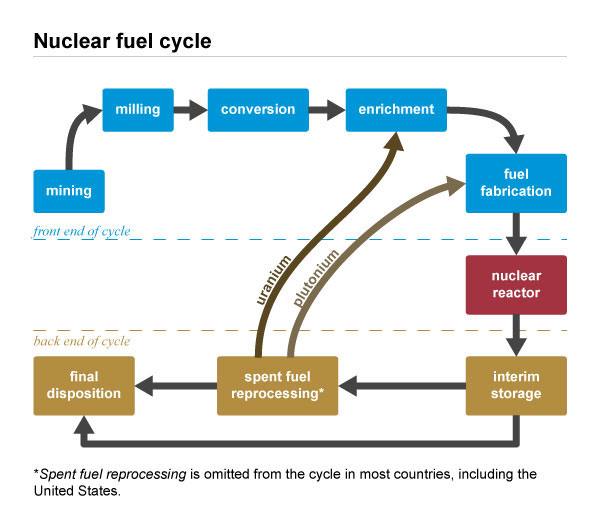
Source: United States Energy Information Administration
The URC Business Model
The Company does not operate mines, develop projects or conduct exploration. URC's business model is focused on managing and growing its portfolio of uranium royalty and other uranium interests. The Company believes that the advantages of this business model include the following:
•
Lower Volatility Through Diversification. By investing in diversified uranium interests across a spectrum of geographies, the Company reduces its dependency on any one asset, project, location or counterparty.
•
Exposure to Uranium Price Optionality without Project Costs and Overhead. The Company believes that its model provides exposure to any future improvements in the uranium market, while at the same time minimizing fixed operating, exploration, development and sustaining costs associated with directly owning and operating uranium projects. Additionally, as the Company's interests are non-operational, the Company is not required to satisfy cash calls in order to maintain its interests in such projects.
•
Focus and Scalability. As the Company's directors and officers do not handle operational decisions and tasks relating to uranium projects, they are free to focus their time and energy on carrying out the Company's acquisition strategy and identifying and executing on growth opportunities. As such, URC's business model allows it to acquire and manage more uranium interests than an operating company can effectively manage.
The table below provides a comparison of royalty companies, mining companies, exchange traded funds and funds that hold physical uranium.
|
|
|
|
|
|
Royalty Companies |
Operating Companies |
Uranium ETF |
Physical Funds |
Exposure to Uranium Price |
ü |
ü |
ü |
ü |
Fixed Operating Costs |
ü |
û |
ü |
ü |
No Development or Sustaining Capital Costs |
ü |
û |
ü |
ü |
Exploration and Expansion Upside without the Associated Costs |
ü |
û |
û |
û |
Diversified Asset Portfolio |
ü |
ü |
ü |
û |
Ability to Grow without Increased Management |
ü |
û |
ü |
ü |
Competitive Strengths
The Company believes that its competitive strengths include the following:
•
First and Only Pure-Play Uranium Royalty Company. The Company believes that it is the first and only company to focus solely on acquiring uranium royalties, streams and other uranium interests. The Company believes that such focus gives it an advantage in seeking additional interests by providing it with increased visibility and recognition amongst potential counterparties. Additionally, URC's management has the advantage of focusing solely on growth, as it is not responsible for day-to-day project operations or development decisions respecting the projects underlying its interests.
•
Experience and Expertise. URC's directors and management have extensive experience in the uranium and nuclear energy sectors, including critical experience in mine finance, project identification and evaluation, mine development and uranium sales and trading with leading companies and institutions in the uranium and nuclear energy industries. URC seeks to leverage the experience and network of such individuals to identify, finance and execute acquisitions in furtherance of its long-term strategy.
•
Broad Geographic and Counterparty Diversification. URC's existing royalties are located in multiple mining friendly jurisdictions, giving URC exposure to diverse uranium markets, while reducing country specific risks relating to permitting, operations and other factors. At the same time, such royalty interests involve a range of counterparties, reducing the Company's reliance on any single operator or project.
•
Lean Operating Structure. The Company's relatively lean operating structure allows it to quickly assess whether a particular acquisition or investment opportunity meets its strategic requirements and respond promptly to all suitable business opportunities. The Company carefully selects the opportunities it investigates and does not move forward unless it has a high level of confidence that such an opportunity fits within its objectives and long-term strategy.
Summary of Royalty and Other Interests
The Company's royalty interests do not generate significant revenues to the Company. Only the McArthur River, Cigar Lake and Langer Heinrich mines are in production. In addition, the Company's stated business objectives include the acquisition of physical uranium from time to time through other sources.
The following map sets forth the locations of the projects underlying URC's existing royalty interests.
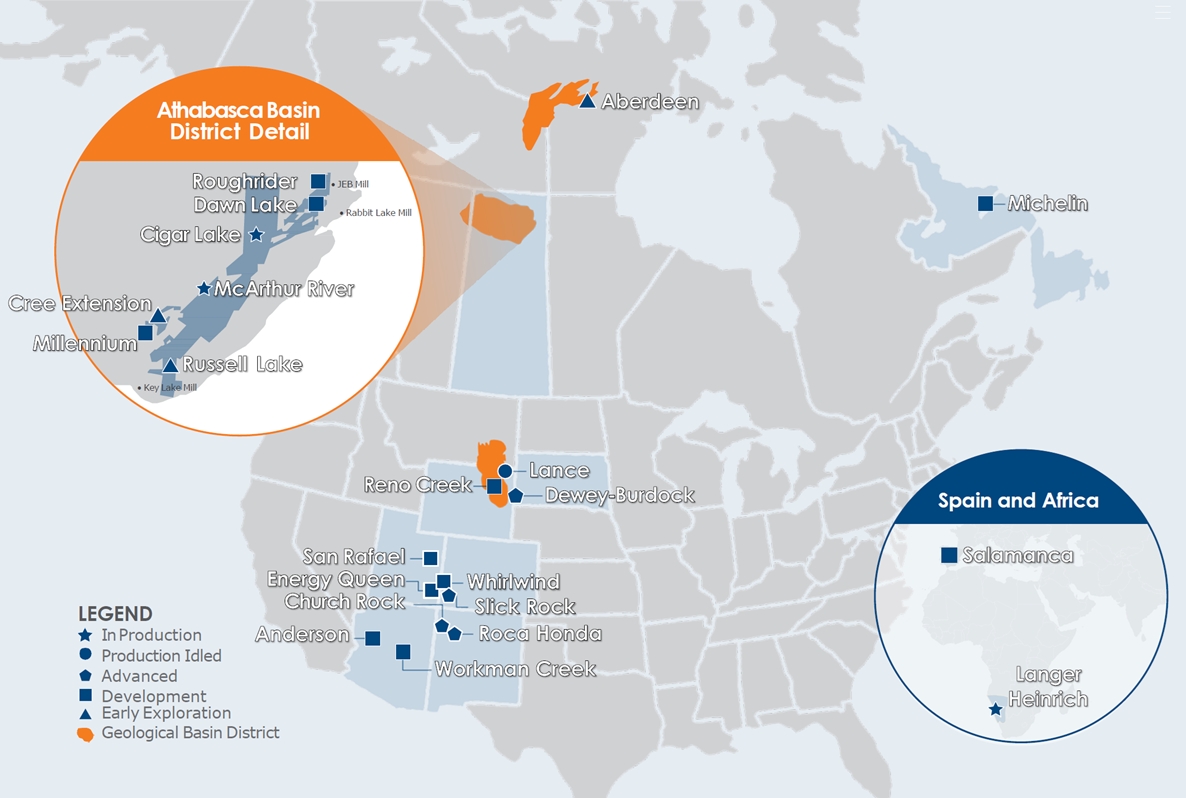
The table below summarizes the royalty interests held by URC as of the date of this Annual Information Form.
|
|
|
|
|
|
|
Project |
Operator |
Location |
District |
Interest |
Mining Method |
Project Stage |
Material Properties |
Cigar Lake / Waterbury Lake(1)(3)(4) |
Cameco / Orano
|
SK, Canada |
Athabasca Basin |
10% - 20% NPI |
Conventional – Underground |
In Production |
McArthur River(1)(6) |
Cameco |
SK, Canada |
Athabasca Basin |
1.0% GORR |
Conventional – Underground |
In Production |
Other Properties |
Aberdeen(2) |
Forum Energy Metals Corp. ("Forum") |
Nunavut, Canada |
Thelon Basin |
2.0% GRR |
N/A |
Early Exploration |
Anderson |
UEC
|
AZ, USA
|
Date Creek Basin
|
1.0% NSR
|
Conventional – Open Pit / Underground |
Development |
|
|
|
|
|
|
|
Project |
Operator |
Location |
District |
Interest |
Mining Method |
Project Stage |
|
Churchrock
|
Laramide Resources Ltd. ("Laramide")
|
NM, USA
|
Grants Mineral Belt
|
4.0% NSR
6.0% GORR(1)
|
ISR
|
Advanced
|
Cree Extension(7) |
Cameco |
SK, Canada |
Athabasca Basin |
10% NPI |
Conventional |
Early Exploration |
Dawn Lake(1)(3)(5) |
Cameco / Orano |
SK, Canada |
Athabasca Basin |
10% - 20% NPI |
N/A |
Development |
Dewey-Burdock(1) |
enCore |
SD, USA |
Black Hills Uplift |
30% NPR
2% - 4% GVR
|
ISR |
Advanced |
Energy Queen(1) |
Energy Fuels |
UT, USA |
La Sal District |
1% GVR |
Conventional – Underground |
Development |
Lance |
Peninsula Energy Limited ("Peninsula") |
WY, USA |
Powder River Basin |
4.0% GRR(1)
1.0% GRR
|
ISR |
Production Idled |
Langer Heinrich |
Langer Heinrich Uranium (Pty) Ltd. |
Namibia, Africa |
Central Namib Desert |
A$0.12 per kg U3O8 PR |
Conventional – Open Pit |
In Production |
Michelin |
Paladin Energy Ltd. ("Paladin") |
NL, Canada |
Central Mineral Belt of Labrador |
2.0% GRR |
Conventional – Open Pit / Underground |
Development |
Millennium(7) |
Cameco |
SK, Canada |
Athabasca Basin |
10% NPI |
Conventional |
Development |
Reno Creek(1)(8) |
UEC |
WY, USA |
Powder River Basin |
0.5% NPI |
ISR |
Development |
Roca Honda(1)(9) |
Energy Fuels |
NM, USA |
Grants Mineral Belt |
4.0% GRR |
Conventional – Underground |
Advanced |
Roughrider(10) |
UEC |
SK, Canada |
Athabasca Basin |
1.9766% NSR |
Conventional – Underground |
Development |
Russell Lake and Russell Lake South(10) |
Skyharbour Resources Ltd. ("Skyharbour") |
SK, Canada |
Athabasca Basin |
1.9766% NSR |
N/A |
Early Exploration |
Salamanca |
Berkeley Energia Limited ("Berkeley") |
Retortillo, Spain |
Salamanca Uranium District |
0.375% NSR |
Conventional – Open Pit |
Development |
San Rafael(1) |
Western Uranium |
UT, USA |
San Rafael Uranium District |
2% NSR |
Conventional – Underground |
Development |
Slick Rock |
Anfield Energy Inc. ("Anfield") |
CO, USA |
Uravan Mineral Belt |
1.0% NSR |
Conventional – Underground |
Advanced |
Whirlwind(1) |
Energy Fuels |
UT/CO, USA |
Uravan Mineral Belt |
2% - 4% GVR |
Conventional – Underground |
Development |
Workman Creek |
UEC |
AZ, USA |
Sierra Ancha / Apache Basin |
1.0% NSR |
Conventional – Underground |
Development |
Notes:
(1)
Royalty applies to only a portion of the project.
(2)
Royalty subject to the buy back right of the operator, whereby a 0.5% GRR may be repurchased for $1 million after the announcement of a successful pre-feasibility study, exercisable for a period of six months and expiring on June 4, 2032.
(3)
Royalty to decrease to a 10% NPI after 200 Mlbs of uranium production from the combined royalty lands of the Dawn Lake and Waterbury Lake/ Cigar Lake projects.
(4)
Royalty applies to a 3.75% share of overall uranium production, drawn from Orano's 40.453% ownership interest
(5)
Royalty applies to a 7.5% share of overall uranium production.
(6)
Royalty applies to an approximate 9% share of uranium production derived from an approximate 30.195% ownership interest of Orano.
(7)
Royalty applies to an approximate 20.6955% participating interest in the project. The royalties on the Cree Extension and Millennium projects are represented by the same royalty instrument.
(8)
Royalty subject to a maximum amount payable of US$2.5 million.
(9)
Royalty subject to the right of the payor to purchase the royalty for US$5 million at any time prior to the first royalty payment becoming due thereunder.
(10)
The royalties on the Roughrider Project and Russell Lake and Russell Lake South projects are represented by the same royalty instrument.
Note on Classification of Project Stages
The Company classifies its projects based on the stage of current and historical exploration, development and production. The following is a description of the categories utilized by the Company to classify the project stage of each of its royalty interests.
|
|
Project Stage |
Description |
|
|
Early Exploration |
A project is considered to be in the Early Exploration stage when there is no current or historic mineral resource or mineral reserve defined for the project. |
|
|
Development |
A project is considered to be in the Development stage when the project has a current or historic mineral resource or reserve defined for the project, but there is no current preliminary economic assessment, pre-feasibility study or feasibility study completed by the operator thereof to support the potential economic viability of such resource or reserve. |
|
|
Advanced |
A project is considered to be in the Advanced stage when there is a current mineral resource or mineral reserve defined for the project, which is supported by a preliminary economic assessment, a pre-feasibility study or a feasibility study. |
|
|
Production Idled |
A project is considered to be in the Production Idled stage when the project, or part of it, has been in production at any time during the past three calendar years, but such production has been idled due to market conditions or otherwise. |
|
|
In Production |
A project is considered to be in the In Production stage when the underlying property, or part of it, is subject to steady-state uranium production operations. In the case of some NPI royalties, projects may be in production without the generation of royalty revenue. |
|
|
Competitive Conditions
The Company competes with other companies to identify suitable opportunities for the acquisition of royalties, streams and other uranium interests. The mining industry in general, and the royalty and streaming segments in particular, are extremely competitive. The Company competes with other royalty and streaming companies, mine operators, and financial buyers in efforts to acquire royalty, streaming and similar interests. The Company also competes with the lenders, investors, and other royalty and streaming companies providing financing to operators of mineral properties in our efforts to create new interests.
In addition, the uranium industry is small compared to other commodity industries and, in particular, other energy commodity industries. Uranium demand is international in scope, but supply is characterized by a relatively small number of companies operating in only a few countries.
The Company's competitors may be larger than it is and may have greater resources and access to capital than it has. Key competitive factors in the royalty and stream acquisition and financing business include the ability to identify and evaluate potential opportunities, transaction structures and access to capital.
The ability of the Company to complete additional acquisitions of royalties, streams and other uranium interests will depend on its ability to identify and enter into agreements for such acquisitions. See "Risk Factors – Acquisition Strategy".
Regulation
The production, handling, storage, conversion, upgrading and use of uranium are subject to extensive governmental controls and regulations.
Operators of the mines and projects that are subject to our interests must comply with numerous environmental, mine safety, land use, waste disposal, remediation and public health laws and regulations promulgated by federal, state, provincial and local governments in Canada, the United States, Namibia and Spain where the Company holds interests. Although the Company, as a royalty owner, is not responsible for ensuring compliance with these laws and regulations, failure by the operators to comply with applicable laws, regulations and permits can result in injunctive action, orders to suspend or cease operations, damages, and civil and criminal penalties on the operators, which could have a material adverse effect on our results of operations and financial condition.
Physical uranium holdings are subject to applicable laws, regulations and guidelines in the applicable jurisdictions. The Company is unable to predict what additional legislation or amendments may be proposed that might affect the uranium industry or when any proposals, if enacted, might become effective. The following is an outline of certain regulations and other governmental controls which apply to storage and shipment of uranium. As set forth above, the operations of projects underlying the Company's royalties are subject to additional regulation respecting uranium mining.
International Treaty on the Non-Proliferation of Nuclear Weapons
The Treaty on the Non-Proliferation of Nuclear Weapons (the "NPT") is an international treaty that was established in 1970. It has three principal objectives: (i) to prevent the spread of nuclear weapons and weapons technology; (ii) to foster the peaceful uses of nuclear energy; and (iii) to further the goal of achieving general and complete nuclear disarmament. The NPT establishes a safeguards system under the responsibility of the International Atomic Energy Agency (the "IAEA"). Almost all countries are signatories to the NPT, including Canada and the United States. The NPT provides that each party thereto will undertake not to provide fissionable material, or equipment designed for the processing of fissionable material, to other states unless the fissionable material will be subject to the safeguards of the NPT as enforced by the IAEA.
Uranium Regulation in Canada
The federal government of Canada has recognized that the uranium industry has special importance in relation to the national interest and therefore regulates the industry through regulations and policy announcements. Federal legislation applies to any work or undertaking in Canada for the development, production or use of nuclear energy or for the mining, production, refinement, conversion, enrichment, processing, reprocessing, possession or use of a nuclear substance. Federal policy requires that any property or plant used for any of these purposes must be legally and beneficially owned by a company incorporated in Canada.
The Nuclear Safety and Control Act (the "NSCA") is the primary federal legislation governing the control of mining, extraction, processing, use and export. The legislation grants the Canadian Nuclear Safety Commission (the "CNSC") licensing authority for all nuclear activities in Canada, including the issuance of new licences and the amendment and renewal of existing licences. A person may only possess or dispose of nuclear substances and construct, operate and decommission their nuclear facilities in accordance with the terms of a CNSC licence. Licensees must satisfy the specific conditions of the licence in order to maintain the right to operate their nuclear facilities.
Regulations made under the NSCA include those dealing with the specific licence requirements of facilities, radiation protection, physical security for all nuclear facilities and the transport of radioactive materials. The CNSC has also issued regulatory documents to assist licensees in complying with regulatory requirements, such as decommissioning, emergency planning, and optimizing radiation protection measures.
The Company's physical uranium is stored at facilities that are governed primarily by licences granted by the CNSC. Failure to comply with licence conditions or applicable statutes and regulations may result in orders being issued which may cause operations to cease or be curtailed or may require installation of additional equipment, other remedial action or the incurring of additional capital or other expenditures to remain compliant. In the event that the Company determines to export future uranium acquired and held at facilities in Canada, if any, the Company must secure export licences and export permits from the CNSC and Global Affairs Canada in order to export such uranium. These arrangements are governed by the bi-lateral and multi-lateral agreements that are in place between governments.
Uranium Regulation in the United States
In the United States, the uranium industry is primarily regulated by the United States Nuclear Regulatory Commission (the "NRC"). The Atomic Energy Act of 1954 (the "Atomic Energy Act") is the principal legislation in the United States governing civilian and military uses of nuclear materials. The Atomic Energy Act requires that civilian uses of nuclear materials and facilities be licenced, and it empowers the NRC to establish by rule or order, and to enforce, such standards to govern these uses as it may deem necessary or desirable in order to protect health and safety and minimize danger to life and property.
The NRC regulates, among other things, the export of uranium from the United States and the transport of nuclear materials within the United States. It does not review or approve specific sales contracts. In addition, the NRC grants export licences to ship uranium outside the United States. Pursuant to applicable regulations, any licensee that transfers, receives or adjusts its inventory of uranium source material or who exports or imports uranium source material, must complete a requisite transaction report in accordance with the NRC's instructions. This report is the primary mechanism for tracking physical uranium movements in the United States or any other origin uranium to foreign and domestic buyers.
Environmental Policies
The Company's sustainability governance practices are designed to grow its business, ensure the effective oversight of sustainability-related risks, and promote the interests of its stakeholders, including investors, operators and their host communities. Sustainability governance goals and objectives are set by the Chief Executive Officer. The Vice President, Environmental, Social and Governance, reporting directly to the Chief Executive Officer, assists with managing the Company's sustainability due diligence efforts and works with the executive and management team on engagement with potential or existing operators regarding their management of related risks and opportunities. The Company's board of directors reviews the Company's sustainability objectives and goals, related action plans, disclosures, and the results of sustainability due diligence as they relate to new opportunities.
The Company has adopted a Sustainability Policy, which outlines the Company's commitment to the environment and its community and is designed to ensure that sustainability-related risks and opportunities facing the Company and operators with which the Company holds royalty, stream or similar interests are assessed appropriately as part of the Company's overall investment and risk management processes.
The Company publishes its annual Sustainability Reports, which aim to enhance transparency by communicating the Company's policies, priorities and performance to its stakeholders. These reports include disclosures containing relevant, industry-specific information and data aligned with globally recognized standards, including the Sustainability Accounting Standards Board. In November 2024, the Company published its second annual Sustainability Report, in which the Company provided its first disclosure aligned with the Task Force on Climate-Related Financial Disclosures, including the Company's first disclosure and reporting on the Company's financed emissions.
The Company's Sustainability Policy and Sustainability Reports do not form part of, nor are either incorporated by reference into, this Annual Information Form. Copies of the Company's Sustainability Policy and Sustainability Reports are available on the Company's website at www.uraniumroyalty.com.
Employees
As of April 30, 2025, the Company had fourteen employees. The Company relies upon and engages consultants on a contract basis to provide services, management and personnel who assist the Company to carry on our administrative, shareholder communication and acquisition activities in Canada and in the other jurisdictions.
Foreign Operations
URC currently holds royalties in mines and projects in Canada, the United States, Namibia and Spain. Additionally, URC may, in the future, acquire interests in other projects, or purchase uranium from mines located, outside of Canada. Changes in legislation, regulations or governments in such countries are beyond the Company's control and could adversely affect the Company's business. The effect of these factors cannot be predicted with any accuracy by the Company or its management. See "Risk Factors – Risks related to foreign jurisdictions and emerging markets" for further information.
THE URC ASSET PORTFOLIO
As of April 30, 2025, URC's asset portfolio includes the following assets:
•
royalties on 21 uranium projects (not including Aberdeen, which was acquired in June 2025); and
•
2.73 Mlbs U3O8 held in the Company's account at Cameco's Port Hope / Blind River facilities.
As at the date of this Annual Information Form, the Company has determined that the McArthur River Royalty (as defined herein) and Cigar Lake Royalty (as defined herein) are the only royalty assets that are material to the Company on a standalone basis. Please refer to "- Royalty Interests" below and Appendix "A" for further information.
Yellow Cake Agreement and Uranium Option
Overview
On June 7, 2018, the Company entered into an agreement (as amended, the "Yellow Cake Agreement") with Yellow Cake, pursuant to which, among other things, the Company received an option to acquire physical uranium. The Yellow Cake Agreement is a strategic asset for URC, as it provides exposure to Yellow Cake's physical uranium, provides URC with the option to acquire physical uranium and provides for future cooperation and collaboration in relation to acquisitions of physical uranium, royalties, streams and similar interests, as described in more detail below.
Yellow Cake is a specialist company operating in the uranium sector, created to purchase and hold U3O8 with the stated objectives of offering its shareholders exposure to the price of U3O8 through the purchase and storage of physical uranium and exploiting a range of expected opportunities connected with owning U3O8, and uranium-based financing initiatives, such as commodity streaming and royalties.
The Company may, in the future, acquire additional physical uranium pursuant to its option under the Yellow Cake Agreement or otherwise. Pursuant to the Yellow Cake Agreement, the Company may acquire between US$2.5 million and US$10 million of U3O8 per year from Yellow Cake under its supply agreement that will expire on January 1, 2028, up to a maximum aggregate amount of US$21.25 million worth of U3O8. No purchases occurred under this agreement during the years ended April 30, 2022, 2023, 2024 and 2025.
Kazatomprom Agreement
JSC National Atomic Company "Kazatomprom" ("Kazatomprom"), a company existing under the laws of Kazakhstan, the state-owned uranium company of Kazakhstan, is the world's largest producer of uranium.
On May 18, 2018, Yellow Cake entered into a framework agreement with Kazatomprom, in relation to the long-term sale and purchase of uranium (the "Kazatomprom Agreement"). Pursuant to the terms of the Kazatomprom Agreement, Yellow Cake has the right to acquire up to US$100 million of U3O8 from Kazatomprom in each of the nine calendar years following July 5, 2018.
Yellow Cake Storage Arrangement
Yellow Cake has disclosed that all U3O8 owned by it will be stored at a small number of licenced conversion facilities located in Canada, the United States and France. Yellow Cake expects that any transfers of U3O8 held by Yellow Cake at such conversion facilities held by licenced operators will be completed by book transfer and that Yellow Cake will not have the right to remove, or request the removal of, the U3O8 held in storage on its behalf.
On May 18, 2018, Yellow Cake signed a storage agreement with Cameco, which provides for the storage of Yellow Cake's U3O8 at Cameco's Port Hope / Blind River facilities, located in Ontario, Canada. Under this storage agreement, if Yellow Cake elects to sell any U3O8 owned by it and stored at such facility, it will be required to sell to a purchaser that has been approved by Cameco to store U3O8 in a storage account at such facility and who wishes to store the purchased U3O8 at such facility. Any potential purchaser wishing to purchase and transfer Yellow Cake's U3O8 out of its storage accounts at the Port Hope / Blind River facilities would require, among other things, a specific governmental licence to possess and use nuclear substances in Canada.
URC Storage Arrangement
On February 1, 2019, the Company entered into a transfer and storage account agreement with Cameco, with provisions substantially the same as those described above. The agreement provides for the storage of U3O8 at Cameco's Port Hope / Blind River facilities, located in Ontario, Canada, which will permit the Company to store U3O8 received as royalty in-kind from operators and U3O8 acquired from Yellow Cake's inventory, open market purchases, book transfers and other physical uranium acquired through counterparties at the Port Hope / Blind River facilities.
As of the date of this Annual Information Form, the Company has 2,729,637 pounds U3O8 held in the Company's account at Cameco's Port Hope / Blind River facilities.
The Yellow Cake Agreement
The Yellow Cake Agreement provides for a long-term strategic relationship between URC and Yellow Cake, including, among other things:
•
Option to Purchase U3O8: Yellow Cake granted URC an option to acquire between US$2.5 million and US$10 million of U3O8 per year between January 1, 2019, and January 1, 2028, up to a maximum aggregate amount of US$21.25 million worth of U3O8. If URC exercises this option, Yellow Cake will, in turn, exercise its rights under the Kazatomprom Agreement to acquire the relevant quantity of U3O8 from Kazatomprom and sell such quantity of U3O8 to the Company at the same price at which Yellow Cake acquires the U3O8 pursuant to the Kazatomprom Agreement. To date, the Company has exercised its option to acquire 348,068 pounds U3O8 from Yellow Cake at a price of US$28.73 per pound.
In the event that URC elects to acquire U3O8 pursuant to its option under the Yellow Cake Agreement, the Yellow Cake Agreement provides that URC and Yellow Cake will agree, acting in good faith, on the conversion facility to which the underlying U3O8 will be delivered to under the Kazatomprom Agreement, provided that Yellow Cake will not be required to use a conversion facility where it does not already have a storage agreement in place. Any U3O8 acquired by URC from Yellow Cake under the Yellow Cake Agreement will be delivered to URC by book transfer at the agreed conversion facility.
•
Future Royalty and Streaming Opportunities: Yellow Cake has agreed to inform URC of any opportunities for royalties, streams or similar interests identified by Yellow Cake with respect to uranium and URC has an irrevocable option to elect to acquire up to 50% of any such opportunity alongside Yellow Cake, in which case the parties shall work together in good faith to pursue any such opportunities jointly.
•
Physical Uranium Opportunities: The Company has agreed to inform Yellow Cake of potential opportunities that it identifies in relation to the purchase and taking delivery of physical U3O8 by the Company. If such opportunities are identified, the parties will work together in good faith to negotiate, finalize and agree upon the terms of a strategic framework that is mutually agreeable from a commercial standpoint for both parties (including as to form and consideration) and a potential participation by Yellow Cake with URC in such opportunities.
Furthermore, URC and Yellow Cake have agreed to, so far as it is commercially reasonable to do so, cooperate to identify potential opportunities to work together on other uranium-related joint participation endeavours.
Royalty Interests
A description of the Company's existing royalties is set forth below. See "Mineral Reserve and Resource Estimates" for information regarding mineral resource estimates for the projects relating to these interests.
In addition, for a detailed description regarding McArthur River or Cigar Lake, please refer to Appendix "A".
McArthur River
Unless otherwise indicated, the scientific and technical information herein regarding McArthur River has been derived from the McArthur River Technical Report, the Cameco 2024 AIF and Cameco's other public disclosures, copies of which are available under its profile on SEDAR+.

Royalty Description
The royalty is a 1% GORR (the "McArthur River Royalty") on a 9.063% share of uranium production derived from Orano's current 30.195% production interest in the McArthur River operations and mine on the McArthur River property (the "McArthur River Operation") located near Toby Lake in northern Saskatchewan (the "McArthur River Royalty"). The royalty payor is Orano. The McArthur River Royalty includes an option for the holder to receive physical uranium as payment thereunder.
The McArthur River Royalty does not apply to the entirety of the project lands. However, the Company believes that the McArthur River Royalty applies to substantially all areas of the project underlying the existing mine and areas underlying estimates of mineral reserve and mineral resource. The McArthur River Royalty includes most of the area known as the McArthur River mine and the Company believes that the royalty applies to the reported reserves at the mine other than portions that are covered by the adjacent Read Lake project area which represents a nominal portion of the reported reserves and resources at the project.
In addition, the Company has the option to receive physical uranium in lieu of the royalty payment. On March 14, 2025, Orano settled the royalty payment related to the production from the McArthur River mine for calendar year 2024 by delivering 18,366 pounds U3O8 to the Company's storage account at Blind River in Canada.
About McArthur River
The McArthur River Operation includes the fully developed McArthur River mine operation, being a currently In Production underground mine operation, located in northern Saskatchewan, Canada approximately 620 km north of Saskatoon. Cameco has disclosed that the project is currently owned by a joint venture between Cameco (69.805%) and Orano (30.195%).
The current McArthur River Operation is comprised of a portion of one mineral lease, ML 5516, covering 1,380 hectares, and a further 28 mineral claims totaling 87,747 hectares as outlined in the Cameco 2024 AIF. The McArthur River deposit was discovered in 1988, and the mine went into production in 1999. In 2018, production was suspended at the mine and mill until put back into production in November 2022.
McArthur River mine is the world's largest high-grade uranium mine, with ore grades that are 100 times the world average. Estimated operating costs of $20.31 per pound for McArthur River based on operating and capital cost estimates for the estimated life of mine, stated in constant 2024 dollars and reflecting a forecast life of mine mill production of 360.0 Mlbs U3O8, including estimated milling costs. This would place McArthur River amongst the lowest-cost uranium projects in the world. McArthur River has a licenced capacity of 25.0 Mlbs U3O8 per year.
On February 20, 2025, Cameco announced that total packaged production from McArthur River mine and Key Lake mill in 2024 was 20.3 Mlbs U3O8 on a 100% basis (15.8 Mlbs U3O8 was produced at the mine and 20.3 Mlbs U3O8 packaged at the mill).
Project Milestones & Recent Developments
Cameco began construction and development of the McArthur River mine in 1997. Federal authorities issued the operating licence, and mining began at the project in December 1999 and commercial production was achieved in November 2000. Production was suspended at McArthur River mine and Key Lake mill in January 2018 due to a weak global uranium market for a period of four years before Cameco restarted both operations in November 2022. In October 2023, federal authorities granted a 20-year renewal of the licences for McArthur River mine and the Cameco operated Key Lake mill.
The operation successfully extracted 358.1 Mlbs U3O8 (100% basis) since mining began in 1999 until the end of 2024. In the Cameco 2024 AIF, Cameco disclosed estimated: (i) proven and probable mineral reserves of 359.6 Mlbs U3O8 at an average grade of 6.55% U3O8; and (ii) measured and indicated resources, exclusive of reserves, of 6.7 Mlbs at an average grade of 2.30% U3O8 and inferred resources of 2.4 Mlbs at an average grade of 2.95% U3O8. See "Mineral Reserve and Resource Estimates" and Appendix "A" for further information.
In the Cameco 2024 AIF, Cameco disclosed that a total of 20.3 Mlbs U3O8 (on a 100% basis) was produced at McArthur River mine and Key Lake mill in 2024, exceeding its plan of 19.0 Mlbs U3O8. The McArthur River mine produced 15.8 Mlbs U3O8, which was less than its planned production for the period of 18.3 Mlbs U3O8, primarily due to a shutdown at the mine to accommodate ventilation repairs to shaft two.
On February 20, 2025, Cameco announced that it plans to produce 18 Mlbs (100% basis) in calendar year 2025. Although the performance of the Key Lake mill in 2024 demonstrated production rates and capacities that, when annualized, exceeded 18 Mlbs, Cameco attributes the operation's output constraints to the McArthur River mine's limited ability to increase the production of mined ore to feed the mill, and due to the depletion of the previously mined, excess broken ore inventory. In 2025, Cameco disclosed its plans to bring zone 1 into production and advance zone 4 south development. It disclosed that the risk of unforeseen challenges during the development of these areas could impact its production schedule, the extent of which will depend on the magnitude of the delay and the mine's ability to substitute with production from alternative mining areas.
In its management's discussion and analysis for the quarter ended March 31, 2025, Cameco disclosed total production of 4.6 Mlbs U3O8 from McArthur River mine and Key Lake mill for the three months ended March 31, 2025, compared to 5.0 Mlbs U3O8 in the same period of 2024, due to differences in the annual mine plans.
For further information regarding McArthur River, please refer to Appendix "A".
Waterbury Lake / Cigar Lake
Unless otherwise indicated, the scientific and technical information herein regarding Waterbury Lake / Cigar Lake has been derived from the Cigar Lake Technical Report, the Cameco 2024 AIF and Cameco's other public disclosures, copies of which are available under Cameco's profile on SEDAR+.

Royalty Description
The royalty is a sliding scale 10% to 20% NPI on a 3.75% share of overall uranium production, derived from Orano's current 40.453% production interest in the Waterbury Lake / Cigar Lake Project (the "Cigar Lake Project") located in Saskatchewan, Canada (the "Cigar Lake Royalty"). The royalty payor is Orano.
The Cigar Lake Royalty does not apply to the entirety of the project lands. However, the Company believes that the Cigar Lake Royalty applies to substantially all areas of the project underlying the existing mine and areas underlying estimates of mineral reserve and mineral resource.
The sliding scale royalty percentage for the Cigar Lake Royalty is based upon historical production and recoverable reserves of the combined Cigar Lake and Dawn Lake project lands, with the royalty rate having already achieved the maximum of 20% as the Cigar Lake mine has achieved such production and reserve threshold. The royalty rate adjusts to 10% in the future upon production of 200 Mlbs from the combined Cigar Lake and the Dawn Lake project lands. Cameco has reported a total of 155.4 Mlbs packaged production as at December 31, 2024, from the Cigar Lake mine. As a profit-based NPI interest, this royalty is calculated based upon generated revenue, with deductions for certain expenses and costs, which include cumulative expense accounts, including development costs. As such and given the significant amount of expenditures made in developing the existing operations at the Cigar Lake mine, the Cigar Lake Royalty will only generate revenue to the Company after these significant cumulative expenses are exhausted and the Company is treating the Cigar Lake Royalty as a potential medium to long-term revenue generation opportunity.
About the Cigar Lake Project
The Cigar Lake Project includes the fully developed Cigar Lake mine, currently in production as an underground mining operation, and is located near Waterbury Lake in northern Saskatchewan, Canada, approximately 660 km north of Saskatoon. Cameco has reported that the project is currently owned by a joint venture of three companies: Cameco (54.547%), Orano (40.453%), and TEPCO Resources Inc. (5%).
Under the Cigar Lake Joint Venture Agreement and related agreements, made effective January 1, 2002, the Mineral Lease and Mineral Claims were divided into the Cigar Lake lands, consisting of ML-5521 and claim S-106558, and the Waterbury Lake lands, consisting of the remaining 38 claims.
Cameco has been the operator for the Cigar Lake lands since 2002 and Orano is the operator of the Waterbury Lake lands and is also the contract exploration operator of the remaining Cigar Lake lands.
Cigar Lake is the world's highest-grade uranium mine with grades that are 100 times the world average. Cameco disclosed that the mine has a licenced capacity of 18 Mlbs U3O8 annually. Cameco also disclosed that estimated operating costs for the mine are $21.12 per pound U3O8 based on operating and capital cost estimates for the estimated life of mine, stated in constant 2024 dollars and reflecting a forecast life of mine mill production of 190.2 Mlbs U3O8, including estimated milling costs. This would place Cigar Lake amongst the lowest cost uranium projects in the world. The Cigar Lake mine produced 155.4 Mlbs U3O8 from 2014 through 2024.
Project Milestones & Recent Developments
The Cigar Lake uranium deposit was discovered in 1981 and the development of the Cigar Lake underground mine began in 2005. Development of the Cigar Lake mine suffered several setbacks as a result of three water inflow incidents between 2006 and 2008, before re-entry into the main mine workings was achieved in 2010 and work to secure the mine was completed in 2011. Commercial production declared in May 2015.
Cameco has disclosed that, federally, Cigar Lake holds a "Uranium Mine Licence" from the CNSC (expiring June 30, 2031) with a corresponding Licence Conditions Handbook and, provincially, Cigar Lake holds an "Approval to Operate Pollutant Control Facilities" from the Saskatchewan Ministry of Environment (expiring in 2030) and a "Water Rights Licence to Use Surface Water and Approval to Operate Works" from the Saskatchewan Watershed Authority (expiring in 2028).
Cameco disclosed in the Cameco 2024 AIF that, as at December 31, 2024, estimated: (i) proven and probable mineral reserves of 192.9 Mlbs U3O8 at an average grade of 15.87% U3O8; and (ii) measured and indicated resources, exclusive of reserves, of 23.6 Mlbs at an average grade of 4.92% U3O8 and inferred resources of 20.0 Mlbs at an average grade of 5.55% U3O8, for the project. See "Mineral Reserve and Resource Estimates" and Appendix "A" for further information.
Cameco disclosed in the Cameco 2024 AIF that a total of 16.9 Mlbs U3O8 (on a 100% basis) was produced at Cigar Lake in 2024, failing to meet expectations, and cited challenges at the McClean Lake mill caused by ore quality variances and unplanned maintenance issues. The effects of these challenges on the potential value of the Company's royalty are a reduction in near-term production and related decreases in the near-term revenue; the return to the permitted production rate is expected to have a positive impact on future cash flows under the Company's royalty interest over the medium-to-long-term.
On February 20, 2025, Cameco announced its plans to produce 18 Mlbs U3O8 (on a 100% basis) at Cigar Lake in 2025. In 2025, Cameco plans to continue production and development activities in the eastern part of the deposit, where production has been ongoing since 2014 ("Cigar Lake Main" or "CLMain"), as well as development drifts to access the western part of the deposit ("Cigar Lake Extension" or "CLExt") in alignment with the long-term mine plan. Cameco is expected to continue earthworks and construction of surface services to support the expansion of freeze activities required for future production from Cigar Lake Extension. Cameco has disclosed that the planned annual production rate for Cigar Lake Extension represents a change to the provincial approval development that will require Ministerial approval, and that Cameco plans to submit the information required to obtain this approval in 2025.
In its management's discussion and analysis for the quarter ended March 31, 2025, Cameco disclosed total packaged production of 5.0 Mlbs U3O8 from Cigar Lake for the three months ended March 31, 2025, compared to 4.2 Mlbs U3O8 in the same period of 2024, due to better availability of mill assets in 2025.
For further information regarding Cigar Lake, please refer to Appendix "A".
Langer Heinrich
Unless otherwise indicated, the scientific and technical information herein for the Langer Heinrich mine, located in Namibia, Africa (the "Langer Heinrich Mine"), has been derived from the public disclosure of Paladin.
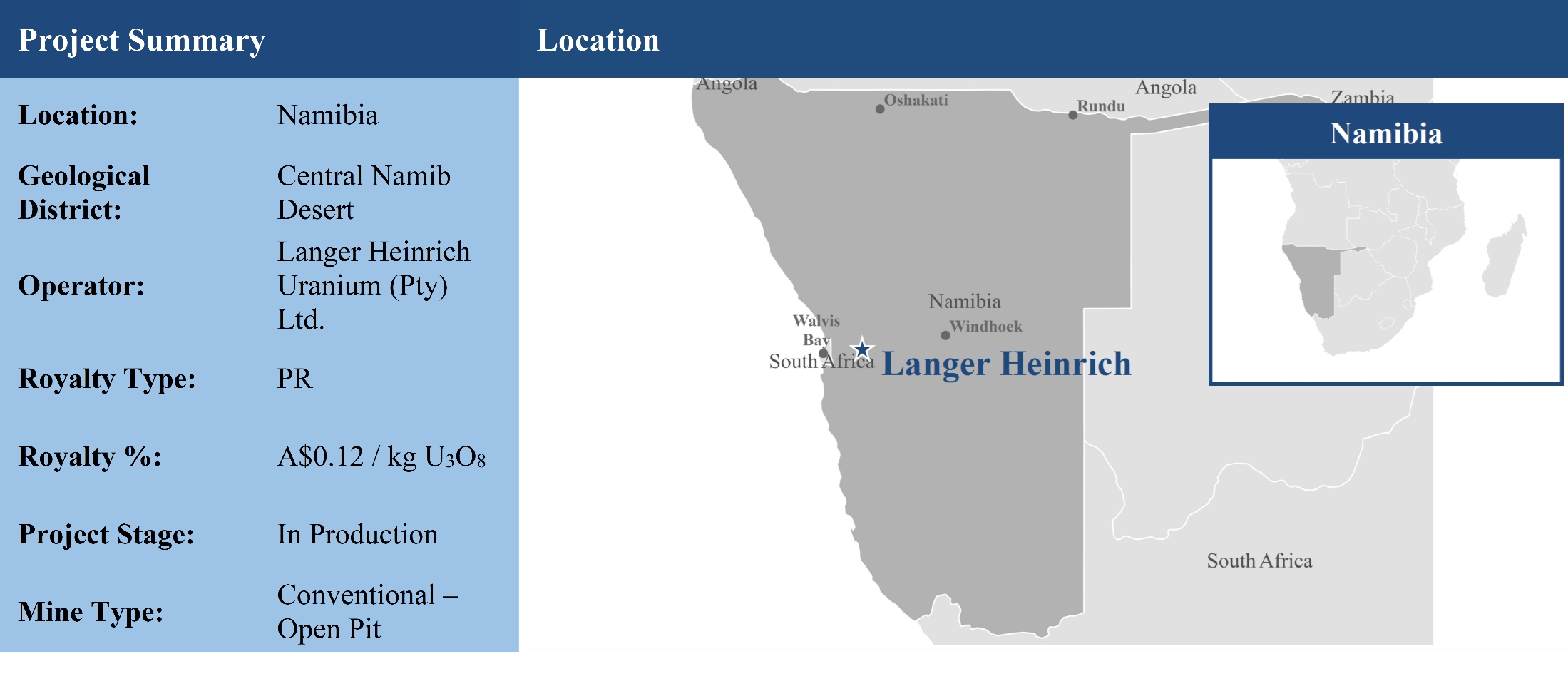
Royalty Description
The royalty is comprised of a PR of A$0.12 per kilogram of yellowcake (U3O8) produced from the Langer Heinrich Mine and sold by Paladin and Paladin Energy Metals Ltd.
About the Langer Heinrich Mine
According to publicly available information, the Langer Heinrich Mine is located in Namibia, 80 kilometres east of the major seaport of Walvis Bay and approximately 40 kilometres south-east of the large-scale, hard-rock Rossing uranium project operated by China National Uranium Corporation, a subsidiary of China National Nuclear Corporation ("CNNC"). The mine is a surficial calcrete type uranium deposit. The project is operated by Langer Heinrich Uranium (Pty) Ltd., a company that is 75% owned by Paladin and 25% owned by CNNC Overseas Uranium Holding Limited, a wholly owned subsidiary of CNNC.
On April 2, 2024, Paladin announced that the mine resumed commercial production on March 30, 2024.
Project Milestones & Recent Developments
The Langer Heinrich deposit was discovered in 1973. Between the late 1970s and 1980, substantial technical work was completed, including a full project-evaluation study, metallurgical studies, multiple exploratory shafts and construction of a 300,000 tonne per year dry screen plant and pilot plant at the Langer Heinrich project. In July 2005, Paladin announced that the Ministry of Mines and Energy in Namibia approved the grant of a mining licence covering the Langer Heinrich deposit for a 25-year term. Initial construction at the Langer Heinrich project started in September 2005, leading to the mine's official opening in March 2007. Langer Heinrich mine was placed under full care and maintenance in May 2018. Commercial production was recommenced in late March 2024.
In a release dated November 4, 2021, Paladin disclosed a 17-year mine life supported by ore reserves of 84.8 million tonnes with an average U3O8 grade of 448 ppm. The life of mine production target increased to 77.4 Mlbs U3O8 (previously 76.1 Mlbs). The estimated life of mine C1 costs were updated to US$27.40 per pound (previously US$26.90 per pound), primarily due to increased estimated contract mining rates.
In a release dated November 4, 2021, Paladin disclosed updated JORC mineral resource and ore reserve estimates for the Langer Heinrich mine, including a resource estimate with measured resources of 78.6 Mlbs U3O8 (79.1 million tonnes at an average grade of 0.045% U3O8) and indicated resources of 19.5 Mlbs U3O8 (23.5 million tonnes at an average grade of 0.0375% U3O8).
It further reports additional measured resources in medium-grade stockpiles totaling 7.1 Mlbs U3O8 (6.3 million tonnes at an average grade of 0.051% U3O8) and low-grade stockpiles totaling 14.5 Mlbs U3O8 (20.2 million tonnes at an average grade of 0.0325% U3O8). A 200 ppm U3O8 cut-off was applied to in-situ mineral resources and a 250 ppm U3O8 cut-off was applied to stockpiles at the time of mining. Mineral resources are reported on a 100% ownership basis, of which Paladin has a 75% interest. The measured and indicated U3O8 mineral resources are inclusive of those mineral resources modified to produce the ore reserves (as reported below). Such resource estimate was reported on a depleted basis to June 30, 2018. Paladin also disclosed updated ore reserves, with proved reserves of 52.0 Mlbs U3O8 (48.3 million tonnes at an average grade of 0.0488% U3O8) and probable reserves of 10.2 Mlbs U3O8 (10.0 million tonnes at an average grade of 0.0464% U3O8). Paladin further reported additional proved reserves in stockpiles totaling 21.6 Mlbs U3O8 (26.5 million tonnes at an average grade of 0.0369% U3O8). Ore reserves are reported on a dry basis. Proved ore reserves are inclusive of ore stockpiles. A 250 ppm U3O8 cut-off was applied. The updated ore reserve was estimated using a metal price assumption of US$50.00 per pound U3O8. Tonnage figures have been rounded and may not add up to the totals quoted. Ore reserves reported on a 100% ownership basis, of which Paladin has a 75% interest.
See "Mineral Reserve and Resource Estimates" for further information regarding the foregoing mineral resource estimate. Such estimate was prepared in accordance with the JORC standard. See "Note Regarding Mineral Reserve and Resource Estimates".
In June 2024, Paladin forecast production of 4.0 Mlbs to 4.5 Mlbs U3O8 for the 2025 financial year at a cost of US$28 to US$31 per pound. On November 12, 2024, Paladin disclosed that it had revised its fiscal year 2025 guidance down to 3.0 to 3.6 Mlbs U3O8. It also withdrew all other guidance in relation to 2025. Paladin stated that October 2024 production (186,667 pounds U3O8) was lower than planned primarily due to continued variability in the stockpiled ore processed, resulting in a lower than planned average feed grade for the month, and disruptions to the supply of water from its local water supplier, NamWater, which restricted the throughput volume of ore tonnes processed through the plant.
In its quarterly activities report for the quarter ended March 31, 2025, Paladin stated that the Langer Heinrich mine produced 745,484 pounds U3O8 during the quarter, a 17% increase on the previous quarter's production, totaling over 2.0 Mlbs U3O8 production for the financial year to date.
On March 21, 2025, Paladin announced the temporary suspension of operations at Langer Heinrich mine following flooding caused by unseasonal heavy rainfall. The rainfall delayed the mobilization of key mining equipment and personnel to site and resulted in water ingress into the open mining pits, saturation of the stockpiles and impacts on the processing plant chemistry. Additionally, flooding in the pit identified for early commencement of mining, along with delays in the delivery and mobilization of mining equipment, caused disruptions to the start of the planned mining ramp up. Local access roads and civil infrastructure were also damaged by the widespread rainfall. However, Paladin disclosed that there was no significant damage to the processing plant and, on March 27, 2025, Paladin announced that access had been re-established and processing plant operations had resumed. The unseasonal heavy rainfall adversely impacted production volumes in early April, due to the prior temporary suspension of operations, including feed delays to the plant and process inventory losses.
On March 26, 2025, Paladin announced that it would be withdrawing production guidance for 2025, stating that Paladin still expects to improve production levels in the second half of calendar 2025 with the blending of ore from the open pit mines. Paladin has stated that, due to the disruption to the anticipated start of mining, it does not expect the mine to achieve nameplate run-rate guidance of 6 Mlbs U3O8 by the end of 2025. The acceleration of mining was a key initiative in offsetting the underperformance of stockpile ore and achieving nameplate production.
Aberdeen
Unless otherwise indicated, the scientific and technical information herein regarding the Aberdeen Project has been derived from Forum's management discussions and analysis for the years ended November 30, 2022, 2023 and 2024.
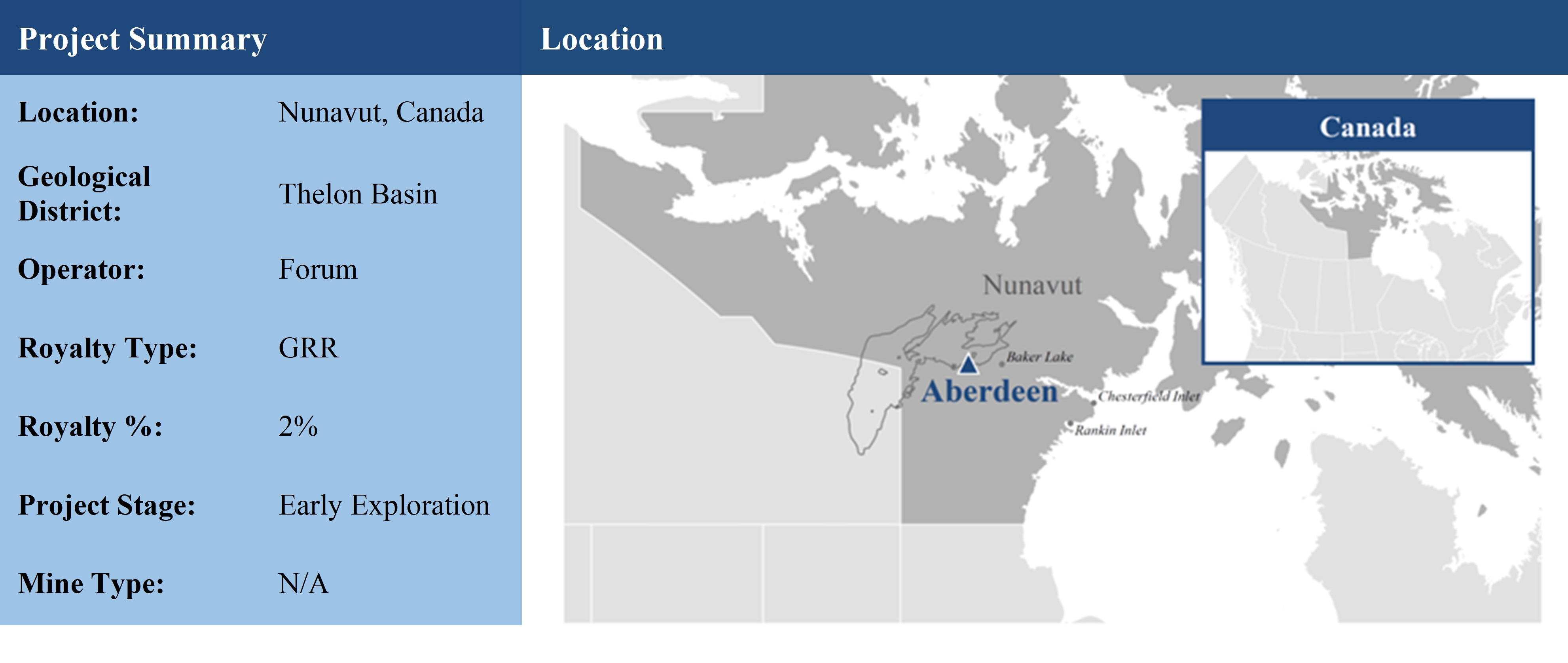
Royalty Description
The Company owns a 2.0% GRR uranium royalty on the Aberdeen Project located in Nunavut, Canada. Forum may buy back one quarter (0.5%) of the Royalty upon payment to the Company of $1,000,000 for a period of six months following the announcement of a successful pre-feasibility study. This option expires seven years after the royalty is issued.
About the Aberdeen Project
The Aberdeen project is an Early Exploration stage conventional uranium project, covering 95,519 hectares, and located on the northeast edge of the Thelon Basin in Nunavut, Canada, approximately 100 km west of the hamlet of Baker Lake. The Aberdeen Project is 100% owned by Forum.
Project Milestones & Recent Developments
Cameco completed drilling exploration work on the project claims between 2008 and 2012. The Qavvik uranium deposit was discovered in 2009 and the Tatiggaq uranium deposit was discovered in 2010. The claims were later abandoned. On February 1, 2022, Forum announced that it acquired the Aberdeen Project by staking 40 claims totaling 53,402 hectares of ground formerly held by Cameco. Forum staked further claims through 2022 and conducted additional exploration work on its legacy claims bringing its total claims held to 95,518 hectares.
The Qavvik uranium deposit consists of four steeply lenses 5 - 20 m wide, to a depth of 350 m, over a strike length of 250 m. Drill Hole DDH SAN-002 intersected four discreet mineralized intervals grading 0.92% U3O8 over 2.5m, 1.18% U3O8 over 4.3 m, 0.57% U3O8 over 1.6m, and 0.62% U3O8 over 2.2 m. The highest-grade mineralization intersected graded 5.69% U3O8 over 0.3 m. The Tatiggaq uranium deposit consists of two zones: the Main and West Zones, which average 30 m in thickness at a shallow depth of 80 - 100 m, and strike lengths of 80 m and 60 m respectively. Discovery Hole TUR-014A intersected 0.85% U3O8 over 13.7 m and 4.03% U3O8 over 0.5 m. Grades of up to 24% U3O8 over 10 - 30 cm widths with average grades of approximately 1% U3O8 were reported over these two mineralized zones.
Forum completed its drill program on the project in 2023, completing five holes on two uranium targets, Tatiggaq and Ned, for a total of 991 metres. In news releases dated September 12, September 26, and October 23, 2023, Forum announced assay results from drill holes on the Tatiggaq zone, including 2.25% U3O8 over 11.1 metres, 0.40% U3O8 over 12.8 metres and 0.82% U3O8 over 8.5 metres.
On October 1, 2024, Forum announced that its 2024 drilling program at the Aberdeen Project had concluded after thirty (30) diamond drill holes were completed between late June and late September for a total of 6,962 metres. In releases on November 26, 2024, and January 13, 2025, Forum reported result from the Tatiggaq zone, including 1.15% U3O8 over 2.4 m in hole TAT24-012, 1.31% U3O8 over 7.6 m in hole TAT24-014, 0.11% U3O8 over 35.3 m in hole TAT24-011, and 0.38% U3O8 over 0.3 m in hole TAT24-021. On January 21, 2025, Forum announced drill results from the program on the Qavvik zone, intersected a 296-metre-wide zone of uranium mineralization with grades up to 8.2% U3O8 in a newly identified lens and resulted in more than 20 assays with grades greater than 1% U3O8. On February 18, 2025, Forum announced drill results for the Ayra, Loki and Ned grids. The Ayra and Loki grids host strong clay alteration and elevated uranium values up to 72.8 ppm in the sandstone and 323 ppm in the basement.
On June 24, 2025, Forum announced that it had entered into a definitive arrangement whereby Baselode Energy Corp. will acquire all of the issued and outstanding common shares of Forum pursuant to a court-approved plan of arrangement. The combined company will continue under the name "Geiger Energy Corporation". Completion of the plan of arrangement is subject to approval by the Supreme Court of British Columbia and the affirmative vote of Forum shareholders at a special meeting that is expected to be held in August of 2025.
Anderson
Unless otherwise indicated, the scientific and technical information herein regarding the Anderson Project has been derived from the S-K 1300 Technical Report Summary dated July 1, 2022, prepared for UEC and titled "Anderson Uranium Project- Initial Assessment, US SEC Subpart 1300 Regulation S-K Report, Yavapai County, Arizona, USA" (the "Anderson SEC Technical Report Summary"), a copy of which is available under UEC's profile at www.sec.gov and UEC's other public disclosures, copies of which are available under its profile on SEDAR+ and at www.sec.gov.
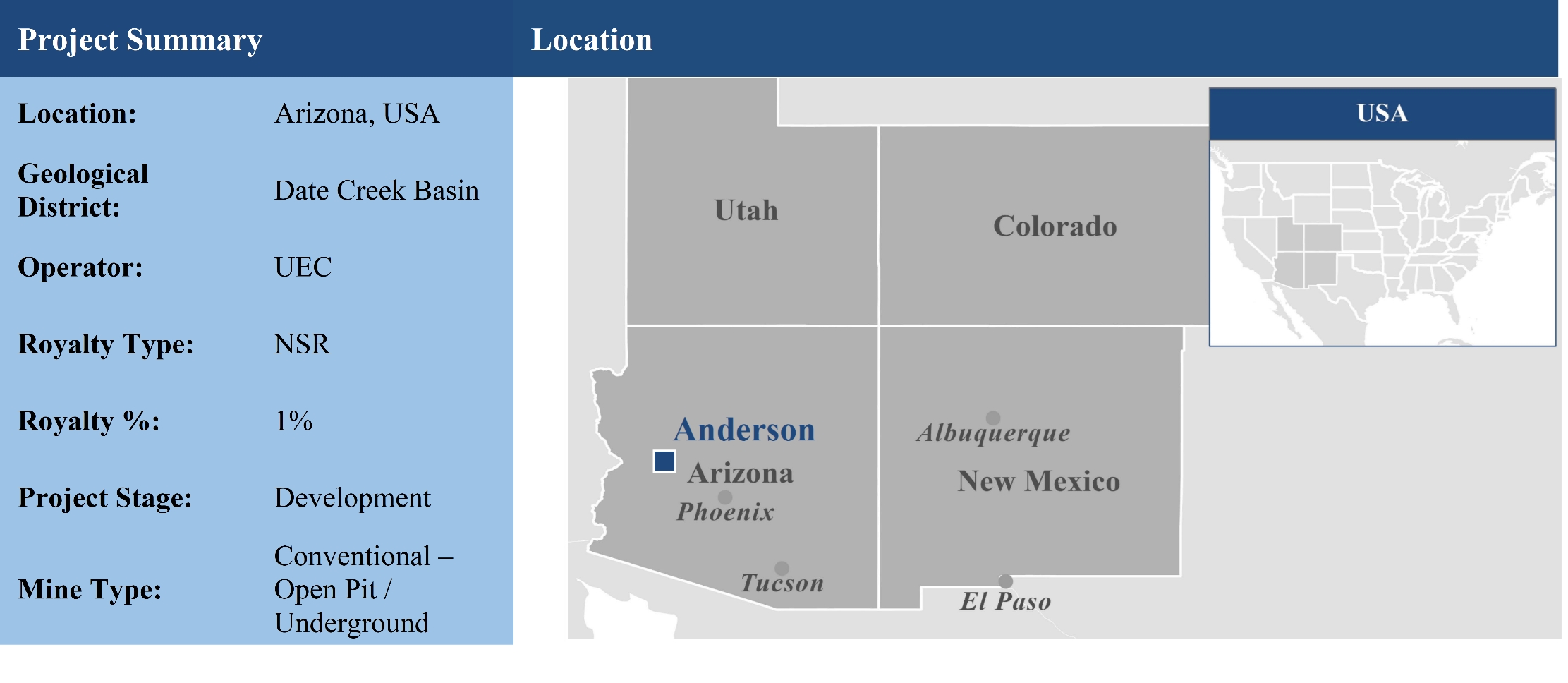
Royalty Description
The Company owns a 1.0% NSR uranium royalty on the Anderson Project located in Arizona, USA.
About the Anderson Project
The Anderson Project is a Development stage conventional uranium project, covering 8,268 acres in Yavapai County, west-central Arizona, approximately 75 miles northwest of Phoenix and 43 miles northwest of Wickenburg. The Anderson Project is 100% owned by UEC Concentric Merge Corp., a wholly-owned subsidiary of UEC.
Project Milestones & Recent Developments
The Anderson Project was in production between 1955 and 1959, when production was stopped due to the termination of a purchasing program by the United States Atomic Energy Commission (the "AEC"). The Anderson SEC Technical Report Summary discloses that, between 1967 and 1980, the Anderson Project was explored by several companies, including Getty Oil Company, Urangesellschaft USA, Inc. and Minerals Exploration Company, and included the completion of 1,289 rotary drill holes and 117 core holes during the period. The Anderson SEC Technical Report Summary further discloses that the project was re-staked in 2001 by Concentric Energy Corp., which completed 25 drill holes of confirmation drilling in 2006, to confirm the reproducibility of the project's historical exploration database. In May of 2011, UEC acquired the Anderson Project through its merger with Concentric Energy Corp. In May of 2012, UEC completed a resource estimate for the Anderson Project.
The mineral resource estimate disclosed in the Anderson SEC Technical Report Summary included an indicated resource of 32.055 Mlbs eU3O8 (16.175 million tonnes at grade of 0.099 eU3O8). Mineral resources were estimated separately for each mineralized zone. See "Mineral Reserve and Resource Estimates" for further information regarding the foregoing mineral resource estimate.
No update was provided in UEC's annual report on Form 10-K for the year ended July 31, 2024.
Churchrock
Unless otherwise indicated, the scientific and technical information herein regarding the Churchrock Project has been derived from the technical report titled "Technical Report on the Churchrock Uranium Project, McKinley County, New Mexico, USA" (the "Churchrock Technical Report") with an effective date of February 22, 2023, prepared for Laramide and Laramide's other public disclosures, copies of which are available under Laramide's profile on SEDAR+.
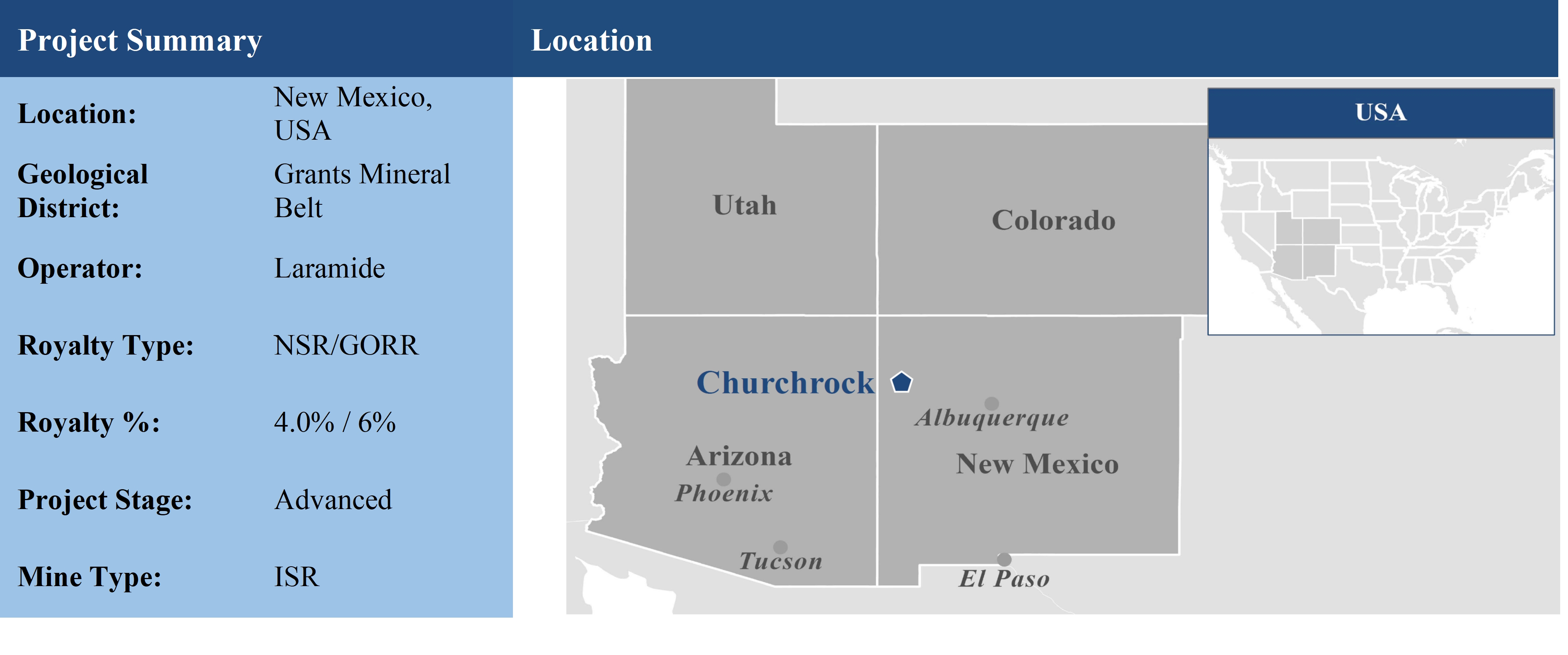
Royalty Description
The Company owns two royalties on the Churchrock Project, which forms part of the larger Churchrock property located in New Mexico, USA. The first is a 4.0% net returns royalty with net returns calculated based on the gross value received by the payor from the sale of ores, metals, minerals and materials from the property, less certain specified deductions for transportation, insurance, storage, sale, tolling and refining costs and any governmental royalties that are paid in respect of such production (the "Churchrock 4% Royalty"). The second is a 6% mine price royalty, with the mine price calculated as the value of U3O8 eventually mined/recovered, processed, and sold from the royalty area, considering the costs of transportation and potentially additional costs such as insurance, storage, and other costs required to finalize sale of the product at the point of sale (the "Churchrock 6% Royalty").
About the Churchrock Project
The Churchrock Project is a Development stage, ISR uranium project located in the Grants Mineral Belt in New Mexico, USA, approximately 12 miles north-northeast of Gallup, New Mexico. Laramide has disclosed that the Churchrock Project and nearby properties represent one of the largest and highest-grade undeveloped ISR uranium projects in the United States. The Churchrock Technical Report disclosed that the project consists of two groups of property parcels, Churchrock and Crownpoint, separated by approximately 22 miles. The Churchrock area consists of all or portions of eight sections of land totaling approximately 4,683 acres. The mineral rights to the Churchrock properties consist of a mix of private mineral leases on Sections 7, 9, 16 and 17, T16N, R16W and Section 13, T16N, R17W, as well as 72 unpatented federal lode mining claims and 10 patented federal lode mining claims situated in Sections 4 and 8, T16N, R16W and Section 12, T16N, R17W. The Churchrock Project is owned and operated by NuFuels, Inc. ("NuFuels"), a wholly owned subsidiary of Laramide. URC's royalty does not cover the resources and potential production from the Crownpoint property.
A single NRC license (SUA-1580) covers parts of Churchrock and Crownpoint and is in timely renewal status. Further renewals of the NRC license and other permits, including a State of New Mexico aquifer injection permit, will be required before production activities can commence.
In addition to the Churchrock 4% Royalty and Churchrock 6% Royalty, Laramide has disclosed that portions of the Churchrock Project are subject to royalties, including a sliding scale royalty of 5% to 25%, held by Laramide.
Laramide has disclosed that it holds several regulatory clearances in connection with the Churchrock Project, including: (a) a final Environmental Impact Statement prepared by the NRC in connection with the United States Bureau of Land Management (the "BLM") and the United States Bureau of Indian Affairs, dated February of 1997; (b) a radioactive materials licence from the NRC, issued in 1998 and amended in 2006 and in "timely renewal"; (c) an aquifer exemption issued by the United States Environmental Protection Agency (the "EPA"), dated 1989; and (d) a water rights transfer, approved by the office of the New Mexico State Engineer, dated October 19, 1999.
Except for the final approval of an aquifer exemption from the EPA, the Safe Drinking Water Act (the "SDWA") allows for the permits issued by the underground injection control ("UIC") regulatory programs of states in place of an EPA UIC permit required under the SDWA. New Mexico has been granted primacy for its UIC program and New Mexico Environmental Department ("NMED") has jurisdiction under the New Mexico Water Quality Act to regulate UIC activities by granting a Discharge Plan. The EPA aquifer exemption has been approved for the initial Section 8 production area. A NMED Discharge Plan will be required in the initial production area. Section 17 will require an EPA UIC permit. Exploration and ISR activities on unpatented mining claims are subject to the regulations of the BLM. These regulations require an operator to prevent unnecessary or undue degradation of the land by obtaining a plan of operations and a reclamation plan. Like the NRC, permitting by the BLM is a federal action, and the National Environmental Policy Act requires that an Environmental Assessment be conducted as part of the permit review process and an Environmental Impact Statement be prepared if the BLM determines that the proposed action is "Significant". No BLM authorization is required in the initial production area.
Except for on land that is held in trust by the Bureau of Indian Affairs, new water rights are required, or existing water rights are changed in point of diversion or in purpose or place of use, under the administrative authority of the Office of the State Engineer. Water rights have been acquired for the initial production area. These existing rights will require renewal and their point of diversion moved to new wellfields over the life of the project. Other permits such as Discharge Permits or Air Quality permits may be required over the life of the project. The need for such permits will be subject to operational choices and the regulations that are in place at the time.
Project Milestones & Recent Developments
The history of exploration and mine development activities on the project date back to the late 1950s. Drilling on the property commenced in 1957 by Phillips Petroleum and continued intermittently until the early 1990s by various contractors on various sections across the project. Mine development activities at the Section 17 property at the Churchrock Project were conducted in the early 1960s by Phillips Petroleum and in the early 1980s by United Nuclear Corporation. The Old Churchrock Mine, which occupied a portion of Section 17 of the project, produced uranium between 1958 and 1963, when it was shut down due to declines in the price of uranium. The majority of the exploration drilling on the property was completed during the 1960s and 1970s.
Exploration and development activities continued through the early 1990s by Uranium Resources, Inc. In 2004, Strathmore Minerals Corp. ("Strathmore Minerals") acquired the Churchrock Project. Strathmore Minerals was subsequently acquired by Energy Fuels in 2013. Energy Fuels transferred the property to Uranium Resources, Inc. in 2015, prior to the property being acquired by Laramide in early 2017.
On August 24, 2023, Laramide disclosed that NuFuels has been awarded a United States Department of Energy grant in the amount of US$1,756,778 to provide the funding for a joint research project with Los Alamos National Laboratory to develop advanced ISR related groundwater restoration technology. The 2-year project is designed to develop groundwater restoration technology in the laboratory that will address the modern groundwater restoration standards in New Mexico and lower the full cycle cost related to ISR by reducing the amount of water used during the groundwater restoration process through in-situ restoration techniques.
The Churchrock Technical Report included an inferred mineral resource estimate of 50.82 Mlbs U3O8 (33.88 million short tons or 30.73 million tonnes at a grade of 0.075% U3O8). The resources have not changed since the previous technical report. See " Mineral Reserve and Resource Estimates" for further information regarding the foregoing mineral resource estimate.
On January 11, 2024, Laramide announced the results of a preliminary economic assessment at the Churchrock Project. The preliminary economic assessment is set out in the Churchrock Technical Report and evaluates uranium mineral recovery by ISR methods at the Churchrock Project location and processing in a proposed new facility at the nearby Crownpoint Project location where significant project infrastructure already exists. The preliminary economic assessment set out in the Churchrock Technical Report highlights a large, long-life project with 31.2 Mlbs produced over 31 years; initial capital costs of US$47.5 million; unit operating costs (including taxes and royalties) of US$27.70 per pound and all-in sustaining costs of US$34.83 per pound; pre- tax internal rate of return of 62% and net present value (8%) of US$278 million (at US$75 per pound U3O8); post- tax internal rate of return of 56% and net present value (8%) of US$239 million (at US$75 per pound U3O8); life of project post-tax cash flow exceeds US$1 billion.
The foregoing preliminary economic assessment is preliminary in nature and includes inferred mineral resources that are considered too speculative geologically to have the economic considerations applied to them that would enable them to be categorized as mineral reserves. Accordingly, there is no certainty that the preliminary economic assessment will be realized.
On June 2, 2025, Laramide announced that Crownpoint-Churchrock had been designated a Covered Projects under Title 41 of the Fixing America's Surface Transportation Act by the Federal Permitting Improvement Steering Council (Permitting Council), potentially streamlining its federal review process.
Cree Extension
Unless otherwise indicated, the scientific and technical information herein for the Cree Extension project has been derived from the Cameco 2024 AIF and Cameco's other public disclosures.

Royalty Description
The Company owns a 10% NPI royalty on an approximate 20.6955% participating interest in the Cree Extension project (the "Cree Extension Royalty"), which participating interest was previously transferred to the existing owners in 1992. As a profit-based NPI interest, the acquired royalty is calculated based upon generated revenue, with deductions for certain expenses and costs, which include cumulative expense accounts, including development costs. The royalty interests on the Cree Extension and Millennium projects are represented by the same royalty instrument. The Cree Extension Royalty does not apply to the entirety of the current project lands.
The Cree Extension Royalty will only generate revenue to the Company after these cumulative expenditures are exhausted, and the Company is treating the Cree Extension Royalty as a potential long-term revenue generation opportunity.
About the Cree Extension Project
The Cree Extension project is an Early Exploration stage project, located 36 km northwest of Cameco's Key Lake Mill in northern Saskatchewan, Canada. The lands are located west of Denison's Wheeler River project and southwest of Cameco's McArthur River project. The project is a joint venture between Cameco, Orano, and JCU (Canada) Exploration Company, Limited ("JCU"). Cameco is the operator of the project.
Project Milestones and Recent Developments
In 1998, Cameco became the operator of the Cree Extension project. The most recent exploration work on the project has been carried out between 1999 and 2013, primarily focused on the Millennium project area until the Millennium claim was split out from the Cree Extension project in 2012.
Dawn Lake
Unless otherwise indicated, the scientific and technical information herein for the Dawn Lake Project has been derived from the Cameco 2024 AIF and Cameco's other public disclosures.
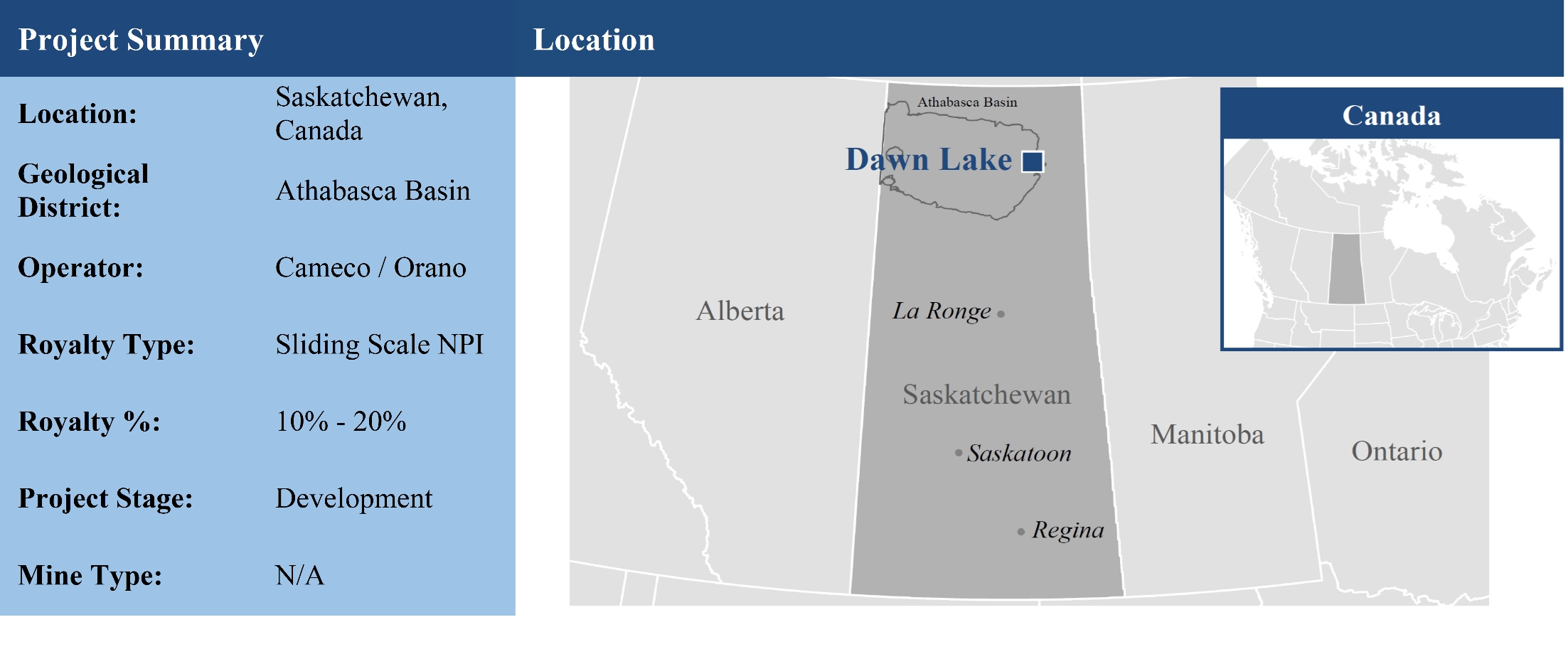
Royalty Description
The Dawn Lake Royalty is a sliding scale 10% to 20% NPI on a 7.5% share of overall uranium production from the Dawn Lake Project lands.
The sliding scale royalty percentage for the Dawn Lake Royalty is based upon historical production and recoverable reserves on the combined Dawn Lake and Cigar Lake project lands, with the royalty rate having already achieved the maximum of 20% as the Cigar Lake mine has achieved the production and reserve threshold. The sliding royalty percentage will decrease to 10% upon production of 200 Mlbs U3O8 from the combined Dawn Lake and Cigar Lake project lands (Cameco has reported 155.4 Mlbs production to date). For further clarity, production from Cigar Lake will be considered to adjust the royalty percentage on Dawn Lake. As a profit based NPI interest, the Dawn Lake Royalty is calculated based upon generated revenue, with deductions for certain expenses and costs, which include cumulative expense accounts, including development costs. The royalty will only generate revenue to the holder after cumulative expenses are exhausted.
The Dawn Lake Royalty does not apply to the entirety of the project lands. However, the Company believes that the Dawn Lake Royalty applies to substantially all areas of the project underlying the existing deposits and areas underlying estimates of mineral reserve and mineral resource.
About the Dawn Lake Project
The Dawn Lake Project is a large, development stage project located in northern Saskatchewan, Canada, approximately 700 km north of Saskatoon. The majority of the project grounds cover an area approximately between the McClean Lake mill and Cigar Lake mine. The Dawn Lake Project is a joint venture operated by Cameco and partnered with Orano.
Project Milestones and Recent Developments
The Cameco 2024 AIF disclosed that Cameco has one deposit with current resources stated on the Dawn Lake Project. The Tamarack deposit is estimated to include, as of December 31, 2023, reported as 17.9 Mlbs U3O8 in 183,800 tonnes grading 4.42% U3O8 in the Indicated category and 1.0 Mlbs U3O8 in 45,600 tonnes grading 1.02% U3O8 in the Inferred category. The deposit is unconformity-related at approximately 175 to 200 m depth, located 10 km to the southwest of the McClean Lake mill.
No uranium has been produced from the project to date and Cameco has stated no production plans for the currently defined Tamarack deposit.
In Cameco's Annual Information Form for the year ended December 31, 2023, it disclosed that approximately $4.5 million was spent on "brownfields" exploration in Saskatchewan, primarily focused on the extension of the mine life at Cigar Lake and advanced exploration on Dawn Lake. Cameco further disclosed that in calendar year 2023, exploration drilling at Dawn Lake expanded the footprint of known uranium mineralization with mineralized intercepts in excess of 60% U3O8 over several metres.
The Cameco 2024 AIF disclosed that approximately $4.0 million was spent on exploration in Saskatchewan, primarily focused on advanced exploration on Dawn Lake. Cameco further stated that 2024 exploration drilling continued to expand the footprint of known uranium mineralization on the LaRocque Lake corridor of the Dawn Lake project with additional high-grade mineralized intercepts. Cameco further stated that, although the deposit remains at a very early stage of exploration, the high-grade results and geological conditions observed to date are comparable to those of other mines and known deposits in the Athabasca Basin.
Dewey-Burdock
Unless otherwise indicated, the scientific and technical information herein regarding the Dewey-Burdock Project has been derived from the technical report titled "Dewey Burdock Project, South Dakota, USA, National Instrument 43-101 Preliminary Economic Assessment Technical Report", with an effective date of October 8, 2024 (the "Dewey Burdock Technical Report"), prepared for enCore and enCore's other public disclosures, copies of which are available under enCore's profile on SEDAR+.
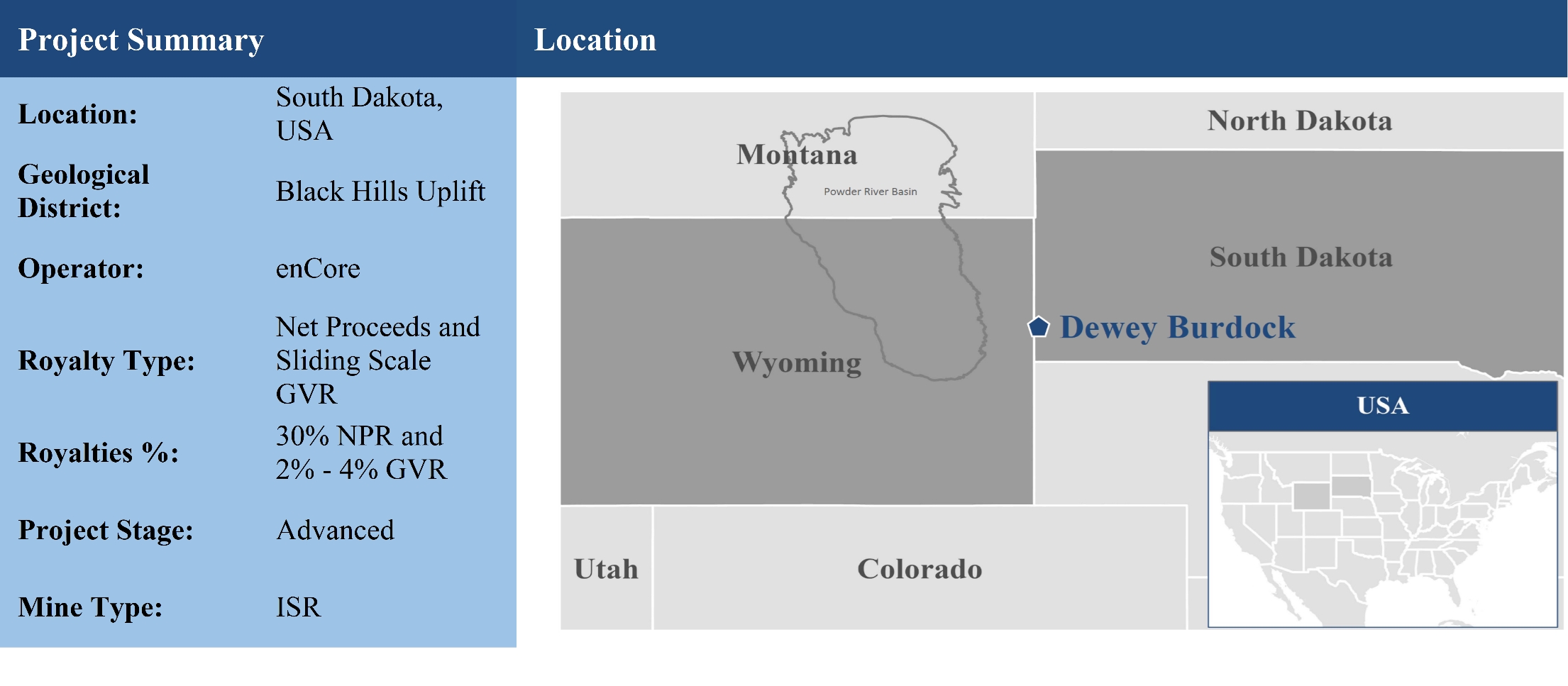
Royalty Description
The Company holds two royalties on the Dewey-Burdock Project located in South Dakota, USA. Between the royalty coverage of the Dewey-Burdock 30% NPR (as defined below) and the Dewey-Burdock Sliding Scale Royalty (as defined below), the Company's royalty interest covers approximately 34% of the total permit area.
The first royalty is equal to 30% of net proceeds received by the payor from the sale of minerals, less certain deemed production costs (the "Dewey-Burdock 30% NPR"). Until the project has produced 6,250,000 pounds of uranium oxide, the deemed production costs are US$40.50 per pound of uranium and thereafter are US$27.05 per pound of uranium, adjusted for inflation in each case.
The Dewey-Burdock 30% NPR does not apply to the entire Dewey-Burdock Project area. The Company believes that the royalty currently applies to approximately 1,700 acres, or approximately 16% of the currently proposed permitted area, with an additional 1,227 acres of coverage outside such permitted area. The aggregate surface and minerals rights disclosed in the Dewey-Burdock Technical Report is 16,962 acres. The Company believes that the area subject to the Dewey-Burdock 30% NPR represents 10% of such aggregate acreage.
The second royalty is equal to between a 2% and 4% production royalty determined by the market price at the time of production (the "Dewey-Burdock Sliding Scale Royalty"). On commencement of commercial production, the Company is entitled to receive payments based on the pounds of uranium produced calculated per pound as follows:
1.
2% of the market price of uranium at the time of production if the market price is less than US$25.00 per pound; or
2.
3% of the market price of uranium at the time of production if the market price is from US$25.00 per pound to US$40.00 per pound; or
3.
4% of the market price of uranium at the time of production if the market price is over US$40.00 per pound.
The Dewey-Burdock Sliding Scale Royalty does not apply to the entire Dewey-Burdock Project area. The royalty currently applies to approximately 1,868 acres, or approximately 18%, of the currently proposed Dewey-Burdock Project NRC permit area total of 10,580 acres, with an additional 590 acres of coverage outside such permitted area. The net mineral rights disclosed in the Dewey-Burdock Technical Report are 16,962 acres. The area subject to the Dewey-Burdock Sliding Scale Royalty represents 11% of such aggregate acreage.
About the Dewey-Burdock Project
The Dewey-Burdock Project is an advanced stage ISR uranium exploration project located in the Edgemont uranium mining district of South Dakota, USA and is comprised of 12,613 surface acres and 16,960 net mineral acres. According to publicly available information, the property is owned and operated by Powertech Uranium (USA), Inc., a wholly-owned subsidiary of enCore, which has announced that the Dewey-Burdock Project is its initial development priority.
Project Milestones & Recent Developments
Exploration started in the Edgemont Uranium District in the early 1950's. Since enCore's acquisition of the Dewey-Burdock Project in 2021 no exploration has been conducted. The project has its source and byproduct materials license, issued by the NRC in April 2024, and its UIC Class III and V wells (injection and/or deep disposal) permit and aquifer exemption, issued by the EPA in November 2020.
enCore stated in its management's discussion and analysis for the three months ended March 31, 2024, that the UIC permits were appealed to the EPA's Environmental Appeals Board ("EAB") and the aquifer exemption was appealed to the 8th Circuit Court of Appeals. The Oglala Sioux Tribe chose not to appeal the decision of the source and byproduct materials license to the United States Supreme Court. Based on the successful outcome for enCore of the appeal of the NRC license, it disclosed that it believed it would also be successful in the appeals of the EPA's UIC permits and aquifer exemption. On September 3, 2024, enCore announced that the EAB issued its ruling on the UIC permits, stating that the EAB decision is consistent with the ruling by the D.C. Circuit Court of Appeals where both appeals involved similar issues.
In a news release dated January 16, 2025, enCore disclosed an updated preliminary economic assessment based on the previously disclosed mineral resource estimate, which is included in the Dewey-Burdock Technical Report. The report included the previously estimated measured and indicated resources of 17,122,147 pounds eU3O8 or 7,388,222 short tons at 0.12% average grade eU3O8 and inferred resources of 712,624 pounds eU3O8 or 656,546 short tons at 0.06% grade eU3O8. The mineral resource was prepared under NI 43-101 and S-K 1300 and the estimate utilized a minimum grade-thickness cut-off of 0.20 ft% U3O8 and was based on the use of ISR for mineral extraction.
Excluding inferred resources, the preliminary economic assessment estimated an after-tax net present value of US$133.6 million for the project using an 8% discount rate and a project internal rate of return of 33%. For the life of project, it disclosed estimated total capital costs of US$264.2 million, estimated operating cost of US$23.81 per pound U3O8, including central processing plant and wellfield operations, administrative costs, reclamation, and decommissioning.
The foregoing preliminary economic assessment is preliminary in nature and includes inferred mineral resources that are considered too speculative geologically to have the economic considerations applied to them that would enable them to be categorized as mineral reserves. Accordingly, there is no certainty that the preliminary economic assessment will be realized. The Company is unable to confirm the exact portion of the identified resources that are covered by the royalty with the information currently available.
Energy Queen
The Energy Queen Project, located in Utah and Colorado, USA, is currently part of a larger land package held by Energy Fuels termed the La Sal Project that includes the Energy Queen, Redd Block, Beaver and Pandora areas. Unless otherwise indicated, the scientific and technical information herein regarding the Energy Queen Project has been derived from the technical report titled "Technical Report on the La Sal Uranium Project, McKinley County, State of New Mexico, U.S.A.", with an effective date of February 22, 2022, prepared for Energy Fuels (the "La Sal Technical Report") and from Energy Fuels' annual report on Form 10-K for the year ended December 31, 2024 (the "Energy Fuels 2024 10-K"), copies of which are available under its profile on at www.sec.gov.
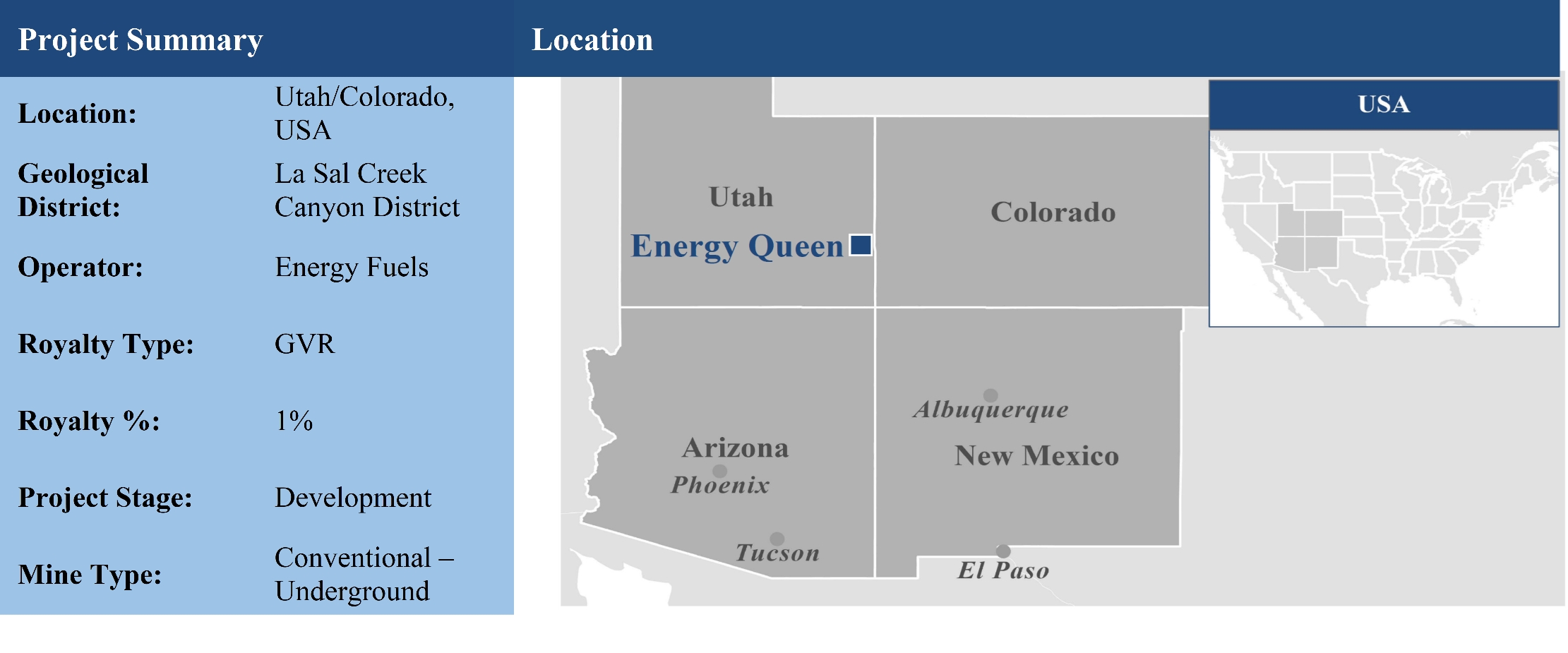
Royalty Description
The Company owns a one percent (1%) GVR royalty (the "Energy Queen Royalty") on the production of uranium- or vanadium- bearing ores, yellowcake and black flake produced from uranium/vanadium ore and all other mineral products and all by-products mined or extracted from the Energy Queen property, less costs of weighing, sampling, assaying, and analysis, sales brokerage costs, allowable transportation costs, and any allowable taxes where applicable. The Energy Queen Royalty covers Utah State mineral lease ML-49313, covering 483.58 acres, and the Buck#1, Jude#1, and Jude#2 mining leases, covering a total of 61.98 acres combined. The Energy Queen Royalty currently applies to approximately 546 acres, or approximately 6%, of the overall La Sal Project area.
In lieu of the royalty payment, the Company may at its election, on an annual basis, take its royalty as an in-kind production royalty of concentrates with 30 days' notice prior to the beginning of the calendar year.
About the Energy Queen Project
According to publicly available information, the Energy Queen Project is a Development stage conventional uranium project located in Utah and Colorado, USA. The Energy Queen Project is currently part of a larger land package termed the La Sal Project that includes the Energy Queen, Redd Block, Beaver, and Pandora areas. The project is 100% owned by EFR Colorado Plateau LLC, a wholly-owned subsidiary of Energy Fuels. The larger La Sal Project covers 9,500 acres of mineral rights.
Project Milestones & Recent Developments
Numerous underground mines near outcrops in the eastern part of the La Sal Trend (La Sal Creek Canyon District) extracted vanadium and uranium during the early 1900s. Deeper deposits of the central La Sal Trend (the area of the La Sal Project) were discovered in the 1960s and developed for production in the 1970s through vertical shafts and declines. The Energy Queen mine, then known as the Hecla Shaft, was started in 1979 by the Union Carbide/Hecla Joint Venture. The Energy Queen mine stopped production in 1983 due to inadequate uranium prices.
Low uranium and vanadium prices forced all production throughout the district to cease about 1991.
Denison Mines Corp. ("Denison") began producing from the Pandora Mine in 2006 and later from the Beaver Shaft/La Sal decline following its acquisition by International Uranium Corporation. Ore production by Denison and by Energy Fuels (following its acquisition of Denison's United States Mining Division) between 2006 and 2012 from the mines in the La Sal Project area totaled approximately 412,000 tons (1,658,000 lbs. U3O8 at an average grade of 0.20% U3O8 and 8,431,000 lbs. V2O5 at an average grade of 1.02% V2O5). From 2008 through mid-2012, Denison drilled 220 exploration and fill-in (confirmation) holes in the project area. Energy Fuels drilled another 27 holes on the Energy Queen property and the State land to the northwest of the Energy Queen from 2007 through 2012. Due to declining uranium prices, production ceased in October 2012 at the Beaver/La Sal Mines and in December 2012 at the Pandora Mine.
In February of 2022, Energy Fuels filed the La Sal Technical Report, which includes a mineral resource estimate for the Energy Queen Project. The report disclosed an estimated inferred mineral resource of 749,000 lbs. eU3O8 (147 thousand short tons or 133 thousand tonnes at an average grade of 0.25% eU3O8). In addition, the report states inferred resources of 3.13 Mlbs of V2O5 (147 thousand short tons or 133 thousand tonnes at an average grade of 0.1.07% V2O5). Due to a lack of information on the location of the inferred mineral resources on the Energy Queen Project in the La Sal Technical Report, the Company is not able to determine the relative proportion of resources that are covered by the Energy Queen Royalty. See "Mineral Reserve and Resource Estimates" for further information regarding the foregoing mineral resource estimate.
Energy Fuels states that uranium resources are estimated at a cut-off grade of 0.17% U3O8, that vanadium resources are estimated based on calculations from U3O8 vs V2O5 regression analysis. In addition, the cut-off grade is calculated using a metal price of US$65 per pound U3O8 and that no minimum mining width was used in determining mineral resources, and that figures are based on a tonnage factory of 14.5 ft3/ton (Bulk density 0.0690 ton/ft3 or 2.21 t/m3).
The La Sal Technical Report states that only limited mining took place at the Energy Queen Mine between 1981 and 1982. Most of the underground work was development focused and material was only mined when it was encountered during this development. The mine shut down prior to any significant mining activities. The La Sal Technical Report states that records from the Union Carbide/Hecla joint venture indicate that 11,791 tons at average grades of 0.17% U3O8 and 0.84% V2O5 (40,043 lbs. U3O8 and 198,607 lbs. V2O5) were mined. The La Sal Technical Report states that, due to the underground surveys not being fully reliable to remove the material in the same way as Beaver/La Sal and Pandora, the total tons and pounds were subtracted from the Energy Queen mineral resource.
In the Energy Fuels 2024 10-K, Energy Fuels stated that production had started at the La Sal Project. The La Sal Project includes the Energy Queen, Redd Block, Beaver, and Pandora properties. Energy Fuels described production out of the La Sal/Beaver and Pandora mines but did not describe production attributable to the Energy Queen property. Energy Fuels stated that the Energy Queen workings and shaft are currently flooded and that a groundwater discharge permit may also be required prior to resuming dewatering operations at the Energy Queen property.
Lance
Unless otherwise indicated, the scientific and technical information herein regarding the Lance Project has been derived from the public disclosures of Peninsula.
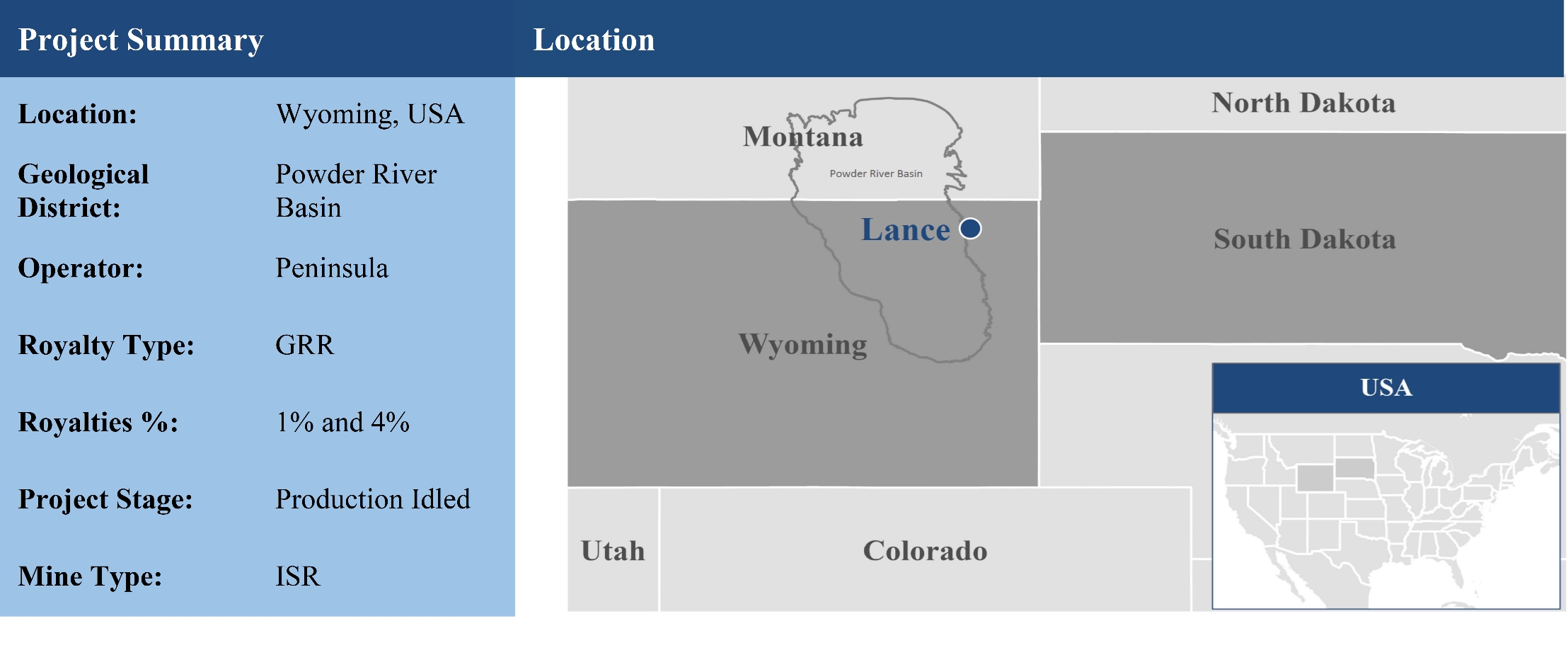
Royalty Description
The Company holds two royalties on portions of the Lance Project: (a) a 4.0% gross income royalty from certain portions of the Lance Project (the "4% Lance Royalty"); and (b) a 1% GRR interest that covers the entirety of the current permitted Ross Project Area, Kendrick Project Area and Barber Project Area (the "1% Lance Royalty").
The 4% Lance Royalty is equal to 4.0% of the gross income from the underlying property without any deduction, provided that such royalty cannot exceed 7% of the gross income from the underlying property when combined with royalties paid to the State of Wyoming. The 4% Lance Royalty does not apply to the entire Lance Project area. The Company believes that this royalty currently applies to approximately 5,586 acres of an estimated 67,500 permit acres or 8% of the currently proposed permitted area. The aggregate surface and minerals rights disclosed by Peninsula in its quarterly report for the period ended March 31, 2024, is 51,449 acres. The Company believes that the area subject to the 4% Lance Royalty represents approximately 11% of such aggregate acreage.
The 1% Lance Royalty is applicable to all uranium and related minerals from the Lance Project area and the royalty is calculated based on gross sales proceeds, with no deductions for costs or expenses.
About the Lance Project
According to publicly available information, the Lance Project is an ISR uranium project located on the north-east flank of the Powder River Basin in Wyoming, USA. The Lance Project is one of the largest uranium projects in the U.S. and is made up of the Ross Project Area, Kendrick Project Area and Barber Project Area. According to Peninsula's annual report for the year ended June 30, 2024, the Lance Project is licensed for 3.0 Mlbs of U3O8 per annum with the expandable 2.0 Mlbs per annum central processing plant design providing a platform for substantial production rates.
Project Milestones & Recent Developments
Mineralization in the area was discovered in the 1970s. An ISR pilot plant was constructed and operated from October of 1977 to April of 1978, but was shut down and remediated after the incident at Three Mile Island. According to publicly available information, Peninsula acquired the precursor Sundance project from PacMag Metals Limited in February of 2007. Metallurgical testing announced in August of 2009 confirmed that the project was amenable to ISR extraction. Between 2009 and 2015, Peninsula completed additional work to progress the project toward production, including completion of permitting and relevant studies.
Commercial operations commenced at the Lance Project in December of 2015 using an alkaline ISR recovery plant and were suspended in 2019 to prepare for the transformation in process chemistry applications to the pH ISR process. Necessary amendments to the regulatory authorizations for the Lance Projects to operate using a low-pH ISR process in addition to the originally authorized alkaline ISR process were obtained in 2019 and 2020. A field demonstration of the low-pH ISR process concluded in November 2021 and confirmed the optimal operating conditions for resuming production activities. Preparatory works for production commenced in February 2022 for the expansion of the recovery plant and auxiliary facilities, including construction of a central processing plant capable of producing a finished dry yellowcake product. Operations were restarted within selected areas of Mine Unit 1 in late December 2024.
In its annual reports for the years ended June 30, 2017, 2018, 2019 and 2020, Peninsula disclosed that the Lance Project produced 144,502 pounds U3O8, 155,035 pounds U3O8, 85,188 pounds U3O8 and 5,708 pounds U3O8, respectively. In its quarterly activities report for the quarter ended December 31, 2024, Peninsula disclosed that the Lance Project produced approximately 1,000 pounds U3O8. Peninsula stated that completion of the central processing plant is expected for the June quarter of 2025, and production of the first dry yellowcake is expected in June 2025.
An initial production and life of mine plan for the Lance Project was disclosed by Peninsula in a JORC compliant feasibility study dated September 17, 2018. A revised production and life of mine plan for the Ross Project Area and Kendrick Project Area was announced by Peninsula in a news release dated August 31, 2023, with production then-scheduled in December 2024. The new ISR plant is anticipated to produce up to 2.0 Mlbs U3O8 per year. It disclosed direct operating expenditures over the life of mine of US$21.69 per pound U3O8 produced, capital expenditures to first production of US$53.4 million, ramp-up period capital expenditures of US$17.4 million, life of mine all-in sustaining cost average of US$42.46 per pound U3O8 produced. The study included life of mine production of 14.8 Mlbs U3O8 over a 10-year mine life. Peninsula stated the updated mine plan is expected to achieve a sustainable monthly positive cash flow in the first full year of production in calendar year 2025 with a payback period of 3.5 years from August 2025, life of mine revenue for the Ross Project Area and Kendrick Project Area of US$988 million, a net present value of US$116.2 million at a discount rate of 8% and internal rate of return of 26%, based on an average sales price assumption of US$67.07 per pound U3O8. In its quarterly activities report for the quarter ended December 31, 2024, Peninsula projected the final plant expansion capital cost to be approximately US$49 million, with the cost overrun of US$9.5 million, decreased estimated ramp-up production rate of 600,000 pounds U3O8 (previously between 700,000 and 900,000 pounds U3O8) and decreased production rate between 2025 and 2027, with the cumulative total decreasing by approximately 300,000 to 500,000 pounds U3O8.
On May 13, 2024, Peninsula announced an update to the JORC compliant definitive feasibility study completed on August 15, 2022 ("Historic DFS") for the Ross Project Area and Kendrick Project Area. An updated JORC compliant mineral resource estimate for the Lance Project was announced by Peninsula in a news release dated May 13, 2024. The update was based on the results of additional drilling in 2023 within the Ross Project Area and Kendrick Project Areas. The estimate included measured and indicated resource of 16.2 Mlbs U3O8 (14.3 million tonnes at an average grade of 0.051% U3O8) and an inferred resource of 41.7 Mlbs U3O8 (38.3 million tonnes at an average grade of 0.049% U3O8). The resource estimate was calculated by applying a combined constraint of a grade thickness product (GT) of 0.2 contour and 200ppm U3O8. The resources in the Barber Project Area remain unchanged from the Historic DFS. Please see Peninsula's announcement dated May 13, 2024, for further details.
On May 13, 2025, Peninsula announced that the Wyoming Department of Environmental Quality ("WDEQ") had granted approval for the Permit to Mine and Source Materials License amendment to include the Kendrick Project Area as an expansion to the already approved Ross Project Area. In addition, the EPA had approved the UIC Program aquifer exemption request for the proposed injection zone of the Kendrick Project Area. These represent the final key approvals required by the WDEQ and its Uranium Recovery Program, enabling commencement of mining operations at the Kendrick Project Area.
See "Mineral Reserve and Resource Estimates" for further information regarding the foregoing mineral resource estimate. Such estimate was prepared in accordance with the JORC standard. See "Note Regarding Mineral Reserve and Resource Estimates".
Michelin
Unless otherwise indicated, the scientific and technical information herein for the Michelin Project has been derived from the public disclosure of Paladin.
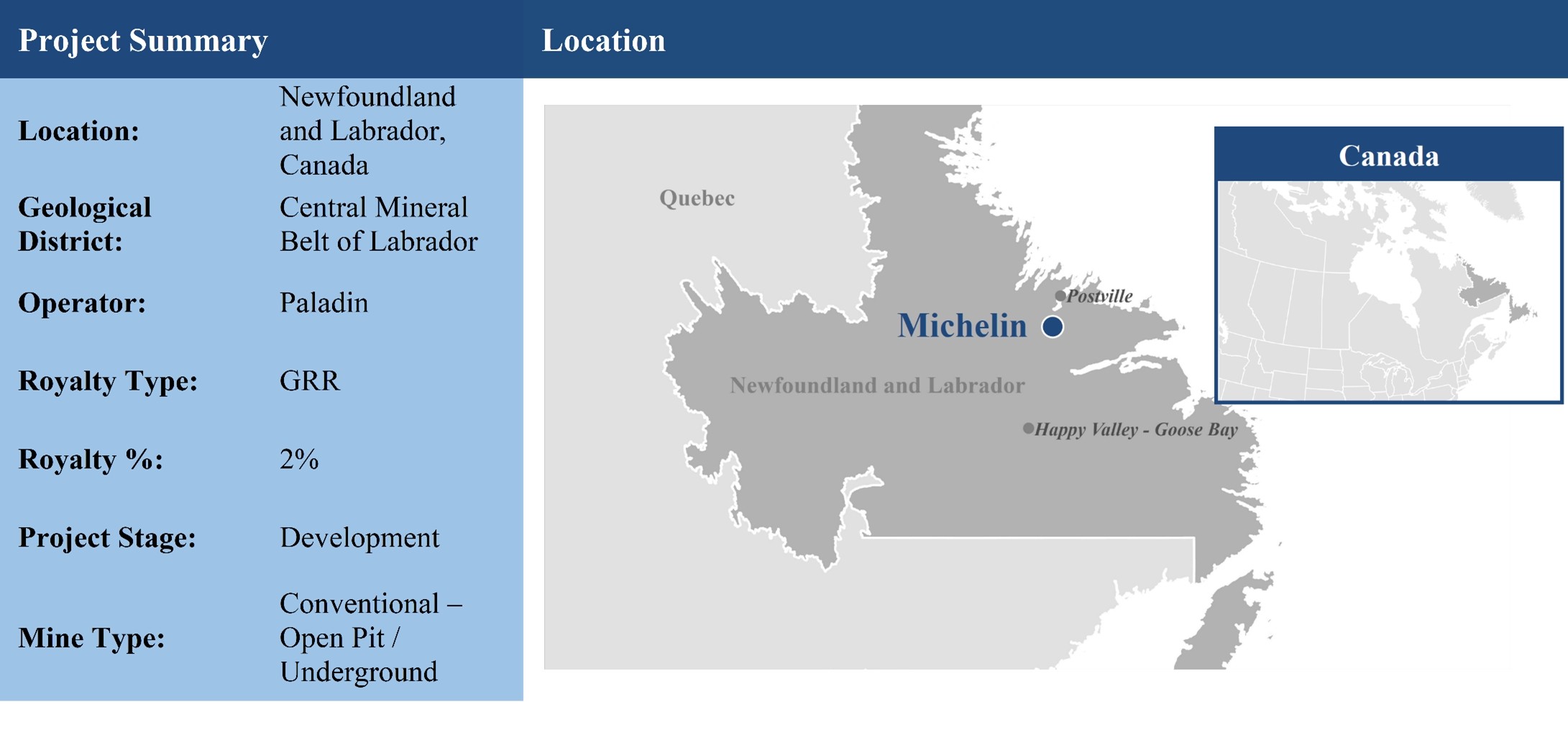
Royalty Description
The Company owns a 2.0% GRR on uranium recovered from the Michelin Project located in Newfoundland, Canada, calculated based on the actual proceeds of sales of uranium, without deductions.
About the Michelin Project
According to publicly available information, including Paladin's annual report for the year ended June 30, 2023, the Michelin Project is a Development stage conventional uranium project located in Labrador and Newfoundland, Canada; the project covers approximately 52,250 hectares of mineral claims and is located approximately 140 kilometres north of Happy Valley-Goose Bay, and 40 kilometres southwest of Postville, Newfoundland and Labrador. Paladin has expanded the size of the Michelin Project, acquiring an additional nine claims on October 18, 2023, but Paladin has not provided an updated hectare total for the Michelin Project to date. The Michelin Project is owned by Aurora Energy Ltd., a 100% owned subsidiary of Paladin.
Project Milestones & Recent Developments
The deposit at the Michelin Project was initially discovered in 1968. According to publicly available information, Aurora Energy Resources Inc. held the rights to the Michelin Project when it completed its initial public offering in 2006. In early 2008, Fronteer Development Group Inc. ("Fronteer") completed its acquisition of Aurora Energy Resources Inc. in April of 2009 at which point it valued the total acquisition at approximately $180 million. Following the acquisition, Fronteer completed a preliminary economic assessment on the Michelin Project in 2009.
In February of 2011, Paladin acquired Aurora Energy Resources Inc. from Fronteer for $261 million. In December of 2011, the moratorium on uranium mining was lifted. In August 2012, Paladin announced that it had entered into a long-term off-take agreement with a major utility and that it had granted such utility security in connection therewith over 60.1% of its interest in the Michelin Project.
In 2014, Paladin announced the completion of a mineral resource estimate for the Michelin Project and, in 2017, announced a JORC compliant resource estimate for the Michelin Project that included a measured and indicated resource of 105.60 Mlbs U3O8 (54.4 million tonnes at an average grade of 0.088% U3O8) and an inferred resource of 22.10 Mlbs U3O8 (13.10 million tonnes at an average grade of 0.077% U3O8). In its annual report for the year ended June 30, 2021, Paladin disclosed that it believes that the Michelin deposit at the project is open along strike and at depth and that the deposit contains a total JORC Code (2012) compliant Mineral Resource of 92.0 Mlbs U3O8, 82.2 Mlbs of which is classified Measured and Indicated.
See "Mineral Reserve and Resource Estimates" for further information regarding the foregoing mineral resource estimate. Such estimate was prepared in accordance with the JORC standard. See "Note Regarding Mineral Reserve and Resource Estimates".
In a presentation dated March 2021, Paladin disclosed that US$75 million of total historical in ground exploration had occurred at the project. In June of 2018, Paladin disclosed that, as a consequence of the continuing weakness in the uranium spot price, the Michelin Project currently operates on minimum activity and expenditure at a level intended to maintain the claims in good standing. In Paladin's quarterly activities report for the quarter ended December 31, 2022, Paladin announced completion of the summer exploration field program conducted at Michelin in Labrador, Canada, with the analysis of data collected nearing completion. Paladin stated that this analysis will assist in deriving a new exploration model designed to generate new drill targets for future exploration drilling programs.
In its quarterly activities report for the quarter ended September 30, 2023, Paladin stated that it now holds a 100% interest in the Michelin Project as a result of the surrender of a 25% participating interest by a joint venture partner of the joint venture agreement. Paladin also stated that it had been granted additional mineral licenses for prospective new ground adjoining the Michelin Project.
In its quarterly activities report for the quarter ended June 30, 2024, Paladin stated that substantial work was completed at Michelin and that it planned to commence a pre-feasibility study in its fiscal year ended June 30, 2025, with completion of such study expected in the following fiscal year. Additionally, it disclosed that exploration activities are continuing, aimed at identifying and defining additional shallow deposit resource extensions.
In its quarterly activities report for the quarter ended March 31, 2025, Paladin stated that the winter drilling program at the Michelin Project was conducted within a reduced radius from the Michelin deposit as part of a strategy to enhance the future operational potential of the project by locating mineralization areas within a reasonable distance of each other. It stated that results from this program will be used as the basis for planning the summer drilling program. Paladin continues to engage with the local communities, including providing updates on the project progress.
Millennium
Unless otherwise indicated, the scientific and technical information herein for the Millennium project has been derived from the Cameco 2024 AIF and Cameco's other public disclosures.
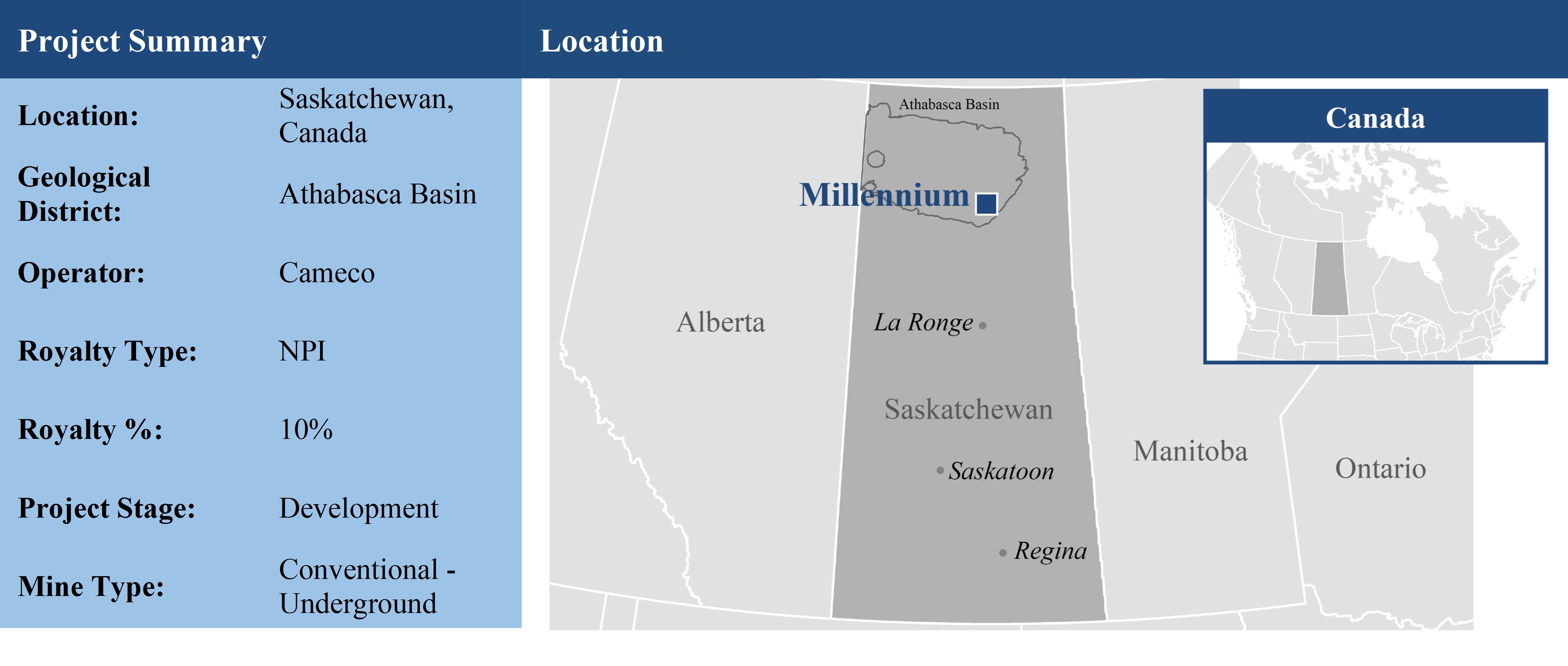
Royalty Description
The Company owns a 10% NPI royalty on an approximate 20.6955% participating interest in the Millennium project (the "Millennium Royalty"), which participating interest was previously transferred to the existing owners in 1992. As a profit-based NPI interest, the acquired royalty is calculated based upon generated revenue, with deductions for certain expenses and costs, which include cumulative expense accounts, including development costs. The royalty interests on the Cree Extension and Millennium projects are represented by the same royalty instrument.
The Millennium Royalty will only generate revenue to the Company after these cumulative expenditures are exhausted, and the Company is treating the Millennium Royalty as a potential long-term revenue generation opportunity.
About the Millennium Project
The Millennium project is a Development stage project, located 36 km northwest of Cameco's Key Lake Mill in northern Saskatchewan, Canada. The project is a joint venture between Cameco and JCU. Cameco is the operator of the project.
Project Milestones and Recent Developments
In the Cameco 2024 AIF, Cameco disclosed a mineral resource estimate for the Millennium project with indicated resources of 75.9 Mlbs U3O8 (1,442.6 thousand tonnes at an average grade of 2.39% U3O8) on a 100% ownership basis and inferred resources of 29.0 Mlbs U3O8 (412.4 thousand tonnes at an average grade of 3.19% U3O8).
Cameco has disclosed that it submitted a draft Environmental Impact Statement ("EIS") to CNSC for the project in 2012, which submission included anticipated production of 150,000 to 200,000 tonnes of ore per year through conventional underground mining with a potential mine life of 10 years. The EIS received ministerial approval in December 2013. In May 2014, Cameco notified the CNSC that it did not wish to proceed with the licensing process at that time due to market conditions. Cameco stated that the provincial approval was renewed in 2018 and again in 2023 and remains valid and may be reopened at Cameco's request.
No uranium has been produced from the project to date and Cameco has stated no production plans for the currently defined Millennium deposit.
Reno Creek
Unless otherwise indicated, the scientific and technical information herein regarding the Reno Creek Project has been derived from the S-K 1300 Technical Report Summary for UEC's Wyoming Assets In-Situ Recovery hub-and-spoke-project titled "S-K 1300 Mineral Resource Report Wyoming Assets ISR Hub and Spoke Project, WY USA" dated March 31, 2022, prepared for UEC (the "Reno Creek SEC Technical Report Summary"), a copy of which is available under UEC's profile at www.sec.gov and UEC's other public disclosures, copies of which are available under its profile on SEDAR+ and at www.sec.gov. The Reno Creek SEC Technical Report Summary also includes disclosure regarding projects other than Reno Creek, on which the Company does not hold royalty interests.

Royalty Description
The Company owns a 0.5% NPI royalty, with a maximum amount payable thereunder of US$2.5 million (the "Reno Creek Royalty"), on a portion of the Reno Creek Project located in Wyoming, USA.
The Reno Creek Royalty does not apply to the entire project area for the Reno Creek Project. The Company believes that the royalty currently applies to approximately 16,679 acres of the total project area of 18,763 acres disclosed by UEC. The royalty covers approximately 4,270 acres, or approximately 70% of the 6,057 acres of permitted area that defines the North Reno and South Reno Creek Mine Units.
About the Reno Creek Project
The Reno Creek Project is a Development stage ISR uranium project located in the Pumpkin Buttes Uranium District in Campbell County, Wyoming, USA, in the south-central portion of the Powder River Basin. The Reno Creek Project is 100% owned by a wholly-owned subsidiary of UEC.
Project Milestones & Recent Developments
The Reno Creek Project resulted from the consolidation of certain lands acquired by Strathmore Minerals and American Uranium Corporation between 2004 and 2007 into a joint venture. In 2017, UEC acquired the North Reno Creek, Southwest Reno Creek, Moore, Pine Tree, and Bing units of the project through its acquisition of Reno Creek Holdings Inc. from Pacific Road. In 2018, UEC acquired additional units in North Reno Creek as a result of its acquisition of Uranerz Energy Corporation from Energy Fuels. The Reno Creek Royalty does not apply to the North Reno Creek units acquired from Uranerz Energy Corporation.
The mineral resource estimate disclosed in the Reno Creek SEC Technical Report Summary includes a measured and indicated resource of 26.00 Mlbs U3O8 (32.0 million short tons or 29.0 million tonnes at an average grade of 0.041% U3O8) and an inferred resource of 1.49 Mlbs U3O8 (1.92 million short tons or 1.74 million tonnes at an average grade of 0.039% U3O8), with approximately 45% of the measured and indicated resource and approximately 85% of the inferred resource contained in the North Reno Creek area of the project.
See "Mineral Reserve and Resource Estimates" for further information regarding the mineral resource estimates disclosed in the Reno Creek SEC Technical Report Summary.
UEC has disclosed that the Reno Creek Project is construction-ready and fully permitted, having obtained its Wyoming Department of Environmental Quality permit to mine in July of 2015, its aquifer exemption from the EPA in October of 2015 and its Source and Byproduct Materials Licence from the NRC in February of 2017.
In its annual report on Form 10-K for the year ended July 31, 2022, UEC disclosed that it plans to complete permit and license amendments to add new mineable acreage to the Reno Creek Project. In UEC's annual report on Form 10-K for the year ended July 31, 2024, they stated that development is in the planning stage with no immediate plans for exploration or delineation drilling.
Roca Honda
Unless otherwise indicated, the scientific and technical information herein regarding the Roca Honda Project has been derived from the technical report titled "Technical Report on the Roca Honda Project, McKinley County, New Mexico, USA" with an effective date of February 22, 2022 (the "Roca Honda Technical Report"), prepared for Energy Fuels and Energy Fuels' other public disclosures, copies of which are available under its profile on SEDAR+.
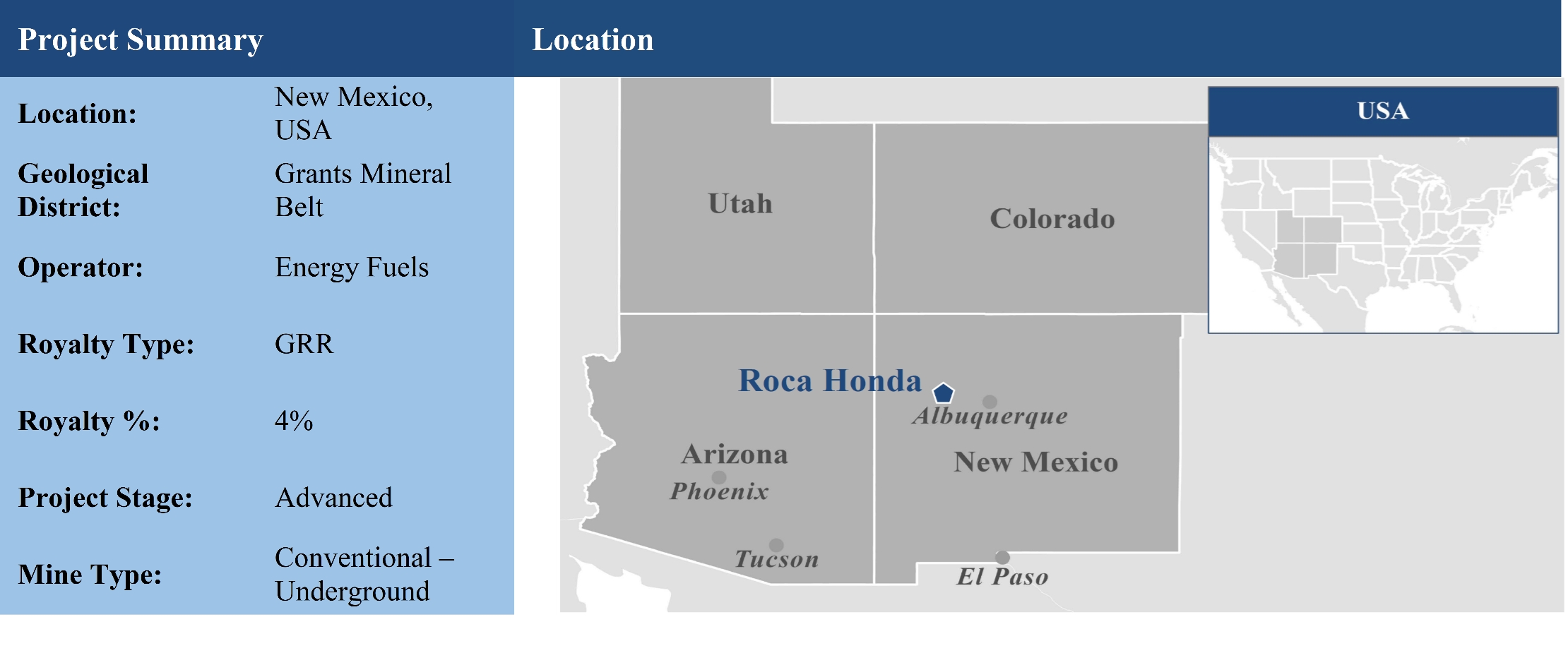
Royalty Description
The Company owns a 4.0% GVR royalty (the "Roca Honda Royalty") from the sale of U3O8 produced from a portion of the Roca Honda Project, located in New Mexico, USA.
The Roca Honda Royalty is equal to 4.0% of the gross value from the sale of U3O8 produced from Section 17 of the Roca Honda Project, less certain specified deductions, including sales brokerage, transportation costs, state severance taxes imposed on the value of product sold, weighting, sampling and assaying charges at the converter and penalties, surcharges or deductions levied by the converter. "Section 17" refers to section 17 of Township 13N/Range 8W, comprising 640 acres of the 4,440 acres (14%) of the Roca Honda Project. The Roca Honda Royalty is subject to the right of the payor to purchase the royalty for US$5 million at any time prior to the first royalty payment becoming due thereunder.
The Roca Honda Royalty does not apply to the entire project area for the Roca Honda Project. The Company believes that the royalty currently applies to approximately 640 acres, or approximately 14% of the current project area.
About the Roca Honda Project
The Roca Honda Project is an Advanced stage, conventional uranium project located in New Mexico, USA, approximately three miles northwest of San Mateo, New Mexico and covers approximately 4,440 acres. The Roca Honda Project is 100% owned by Strathmore Resources (US) Ltd. ("Strathmore Resources"), a wholly-owned subsidiary of Energy Fuels. Energy Fuels also owns the White Mesa Mill, an existing conventional uranium mill located near Blanding, Utah, USA, approximately 275 miles from the Roca Honda Project.
Project Milestones & Recent Developments
Mineralization was initially discovered in the area of the Roca Honda Project in 1970 by Kerr-McGee Oil Industries. The project claims were acquired by Strathmore Minerals in 2004. Upon completion of a joint venture agreement with Sumitomo Corporation in 2007, Strathmore Minerals completed baseline water quality, environmental and tailings disposal studies between 2007 and 2009 and a technical report was completed on portions of the project (not including Section 17) in 2010.
In August of 2013, Energy Fuels acquired a 60% interest in the Roca Honda Project through the acquisition of Strathmore Minerals and, in May of 2016, acquired the remaining 40% interest in the Roca Honda Project from Sumitomo Corporation. Strathmore Resources acquired Section 17 in 2015 from Uranco Inc., a wholly-owned subsidiary of Westwater Resources Inc. (formerly known as Uranium Resources Inc.).
In its quarterly report for the three months ended September 30, 2020, Energy Fuels disclosed that it is actively advancing certain permits at the Roca Honda Project. In its annual report for the year ended December 31, 2019, Energy Fuels disclosed that the Roca Honda Project is at an advanced stage of permitting, with a draft Environmental Impact Statement completed by the United States Forest Service in February of 2013 with an additional scoping process initiated in September of 2016 to incorporate Section 17 and development drilling into the mine plan. Energy Fuels has disclosed that it expects a Record of Decision to be issued by the United States Forest Service in 2023. In such annual report, Energy Fuels disclosed that other major permits required for the Roca Honda Project included a Permit to Mine to be issued by the New Mexico Mining and Minerals Division, a discharge permit to be issued by the NMED and a Mine Dewatering Permit to be issued by the New Mexico State Engineer's Office.
The Roca Honda Technical Report includes updated NI 43-101 and Regulation S-K 1300 compliant resources that now include Section 17, totaling 17.6 Mlbs U3O8 (1.85 million tonnes at an average grade of 0.48% U3O8) in the Measured and Indicated categories, as well as an additional 13.8 Mlbs (1.51 million tonnes at an average grade of 0.46% U3O8) in the Inferred category as at December 31, 2021.
The Roca Honda Technical Report included a preliminary economic assessment, which included Section 17 and other areas of the project not covered by the Roca Honda Royalty. A proposed production schedule has the mineralization from Section 17 mined in the first three years of the mine life, with a total of 4.23 Mlbs U3O8 produced in Section 17 from a total of 587.68 thousand tons of ore. This represents approximately 14.6% of the total pounds mined from the project over the LOM.
Overall, the technical report states total mill feed processed of 4.02 million short tons, recovering 27.5 Mlbs U3O8 over the 11 years of mine life with average annual U3O8 sales of 2.5 Mlbs per year for the entirety of the project, which covers an area greater than the Roca Honda Royalty. The study utilizes a static uranium price of US$65.00 per pound U3O8. The preproduction period is stated at 54 months, with LOM capital costs totaling US$482.3 million and LOM operating costs of US$945.9 million. On an after-tax basis, the report states the undiscounted cash flow for the base case totals US$253.7 million over the LOM. The after-tax net present value at a 5% discount rate is estimated at US$55.9 million and the internal rate of return is stated at 7.6%, with simple payback from the start of commercial production occurring in 8.1 years.
The foregoing preliminary economic assessment is preliminary in nature and includes inferred mineral resources that are considered too speculative geologically to have the economic considerations applied to them that would enable them to be categorized as mineral reserves. Accordingly, there is no certainty that the preliminary economic assessment will be realized.
Energy Fuels states in its annual report on Form 10-K for the year ended December 31, 2023, that Energy Fuels intends to continue its permitting and related activities at the Roca Honda Project during calendar year 2024. These activities would include the integration of properties adjacent to the Roca Honda Project into the permitting efforts underway, including the submittal of a revised National Pollutant Discharge Elimination System permit application to the EPA and continuation of a supplement to the draft Environmental Impact Statement through the United States Forest Service, an agency of the United States Department of Agriculture.
Roughrider
Unless otherwise indicated, the scientific and technical information herein regarding the Roughrider Project has been derived from the technical report summary titled "S-K 1300 Initial Assessment Report – Roughrider Uranium Project, Saskatchewan, Canada" issued on November 5, 2024 prepared for UEC (the "Roughrider Initial Assessment Report") and UEC's other public disclosures, copies of which are available under its profile on SEDAR+ and at www.sec.gov.
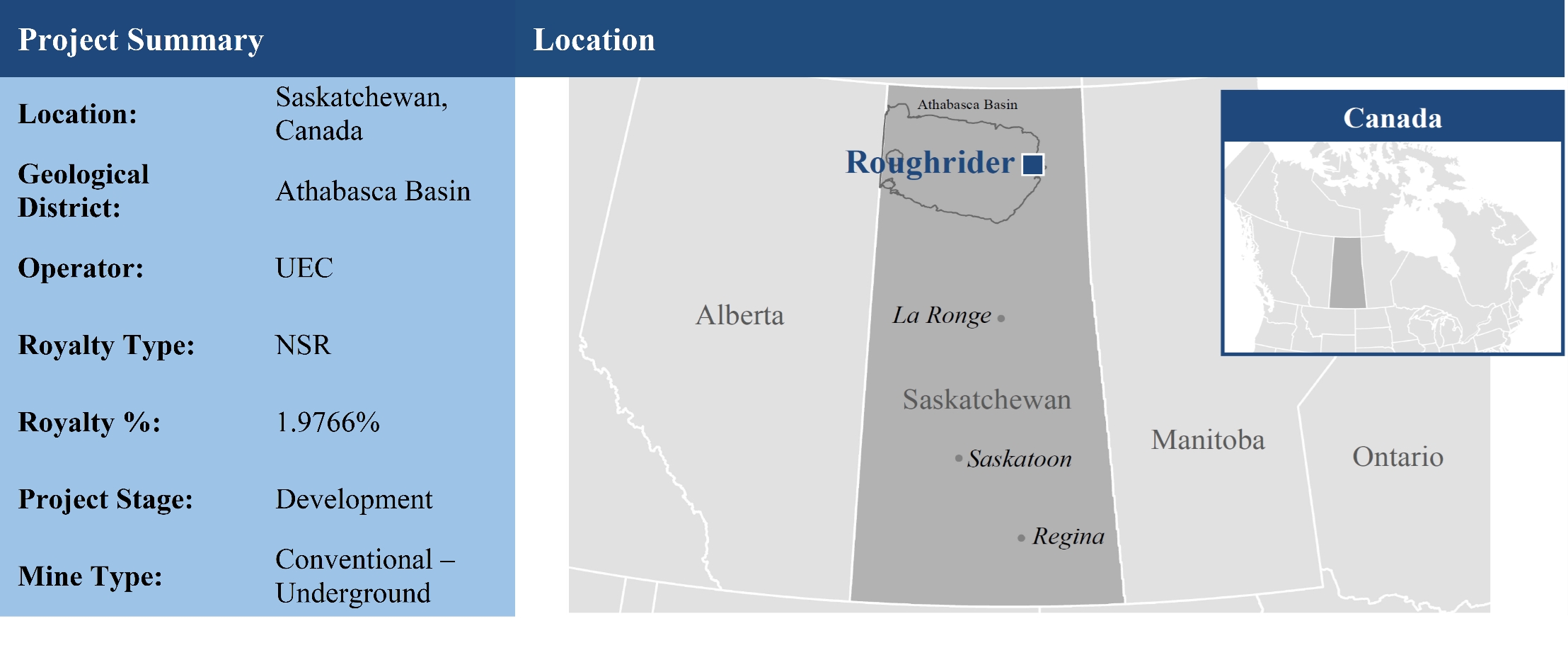
Royalty Description
The Company owns a 1.9766% NSR royalty on the Roughrider Project located in Saskatchewan, Canada, payable pursuant to the interest that UEC or any of its subsidiaries, assignees or successors holds from time to time in the underlying property. For the Roughrider project, the royalty covers substantially all of the single Mineral Lease 5547 that overlies the Roughrider deposit.
About the Roughrider Project
The Roughrider Project is a Development stage, conventional underground uranium project located in the eastern Athabasca Basin of northern Saskatchewan and is located approximately seven kilometres north of Points North Landing and covers an area of approximately 598 hectares. The Roughrider Project is 100% owned by a wholly-owned subsidiary of UEC. The royalties on the Roughrider Project and Russell Lake and Russell Lake South Projects are represented by the same royalty instrument. The Russell Lake projects are detailed in the following section.
The Roughrider Project was the flagship asset of Hathor Exploration Ltd. ("Hathor"), which Rio Tinto Limited ("Rio Tinto") acquired for US$550 million between 2011 and 2012 pursuant to a competitive take-over bid that included a competing bid from Cameco.
On October 17, 2022, UEC acquired the Roughrider Project from a subsidiary of Rio Tinto for total consideration of US$150 million comprised of US$80 million in cash and US$70 million in UEC shares.
Project Milestones & Recent Developments
The Roughrider Project was first explored in 2008 by Hathor, which completed an initial mineral resource estimate on a portion of the project in 2009. Hathor continued to develop the Roughrider Project, filing a historic technical report with an effective date of September 13, 2011. After acquiring the Roughrider Project in January of 2012, Rio Tinto continued to advance it; however, in August of 2017, Rio Tinto announced that it had fully impaired the Roughrider asset.
On May 2, 2023, UEC announced an updated mineral resource estimate in a Technical Report Summary with an issue date of April 25, 2023, outlining 27.8 Mlbs U3O8 in 389,000 tonnes grading 3.25% U3O8 in the Indicated category and 36.0 Mlbs U3O8 in 359,000 tonnes grading 4.55% U3O8 in the Inferred category.
On November 8, 2024, UEC announced the results of the Roughrider Initial Assessment Report, based on the previously announced mineral resource estimate and expanded to include economic factors. The Roughrider Initial Assessment Report stated an estimated post-tax NPV of US$946 million, an internal rate of return of 40%, and a post-tax payback period of 1.4 years based on a long-term uranium price of US$85 per pound U3O8 and utilizing an 8% discount rate. The expected LOM production is stated at 61.2 Mlbs U3O8 produced over nine years with an average annual production rate of 6.8 Mlbs U3O8. The stated initial capex was estimated at US$545 million including mill and underground mine. The all-in sustaining cost was estimated at $20.48 per pound U3O8. The economic analysis is stated as preliminary in nature and includes inferred mineral resources that are considered too speculative geologically to have modifying factors applied to them that would enable them to be categorized as mineral reserves, and there is no certainty that this economic assessment will be realized.
In UEC's annual report on Form 10-K for the year ended July 31, 2024, UEC disclosed that it intends to complete additional resource delineation work in the 2025 fiscal year to further advance the project.
See "Mineral Reserve and Resource Estimates" for further information regarding the mineral resource estimates disclosed in the Roughrider Technical Report Summary.
Russell Lake and Russell Lake South
Unless otherwise indicated, the scientific and technical information herein regarding the Russell Lake Project has been derived from the technical report titled "Technical Report on the Russell Lake Property, Northern Saskatchewan, Canada" with an effective date of June 6, 2022, prepared for Skyharbour and Skyharbour's other public disclosures, copies of which are available under its profile on SEDAR+.

Royalty Description
The Company owns a 1.9766% NSR royalty (the "Russell Lake Royalty") on the Russell Lake and Russell Lake South Projects.
The Russell Lake Royalty is a 1.9766% NSR payable pursuant to the interest that Skyharbour, Rio Tinto or any of their subsidiaries, assignees or successors holds from time to time in the underlying property. The Company believes that its royalty applies to 23 of the 26 claims that currently comprise the exploration project.
About the Russell Lake and Russell Lake South Projects
The Russell Lake Project is an Early Exploration stage uranium project totaling 73,294 ha located in the southeastern rim of the Athabasca Basin near the Key Lake mine and mill.
In a news release dated May 19, 2022, Skyharbour announced it had entered into an Option Agreement with Rio Tinto Exploration Canada Inc. ("RTEC") (as amended on January 15, 2024) to acquire up to 100% of the Russell Lake uranium project. On October 23, 2024, Skyharbour, as an earn-in partner with RTEC, earned a 51% interest in the property by initially paying a cash payment of $508,200, issuing 3,584,014 common shares to RTEC and incurring an aggregate $5,717,250 in exploration expenditures on the Russell Lake uranium project over the 3-year term of the earn-in. Skyharbour has a second option to earn an additional 19% interest for a total of 70%, and a further possible option to obtain the remaining 30% interest in the Russell Lake uranium project for an undivided 100% ownership interest. Skyharbour and RTEC have formed a joint venture to further explore the Russell Lake Project, with Skyharbour holding a 51% ownership interest and Rio Tinto holding a 49% ownership interest.
Project Milestones & Recent Developments
The Russell Lake Project has seen extensive exploration by numerous companies since 1969. Most of the historical exploration carried out at Russell Lake was conducted before 2010 prior to the discovery of several major deposits in and around the Athabasca Basin. This early work involved numerous airborne and ground geophysical surveys, ground geological, geochemical and prospecting surveys as well as overburden reverse circulation drilling and diamond drilling.
Several notable exploration targets exist on the property including the Grayling Zone, the M-Zone Extension target, the Little Man Lake target, the Christie Lake target, the Fox Lake Trail target and the newly identified Fork Zone target (discussed below). Currently, no mineral resources are stated on the project and the project remains at an Early Exploration stage.
On January 24, 2023, Skyharbour announced commencement of a 10,000 m exploration drilling program on the Russell Lake Project. In a news release dated February 9, 2023, Skyharbour announced the signing of an exploration agreement with English River First Nation ("ERFN") for the Russell Lake and Moore Uranium Projects in respect of Skyharbour's exploration and evaluation activities within the traditional territory of ERFN.
On November 2, 2023, Skyharbour announced the results of its inaugural drilling program on the Russell Lake project. Fifteen holes were drilled on the historical Grayling zone and four holes were drilled in the Fox Trail target area. Skyharbour stated that most holes at the Grayling zone intersected uranium mineralization, with the best result returning 5.9 metres of 0.151% U3O8 at a depth of 338.4 meters from assays in hole RSL23-01. In a news release dated January 30, 2024, Skyharbour stated it had initiated a planned 5,000 m drilling program on the Russell Lake Project, comprised of ten to twelve drill holes.
On July 9, 2024, Skyharbour announced initial results from the first phase of its 2024 winter drill program. The first phase consisted of six drill holes totaling 3,094 metres. Skyharbour discovered an intersection in hole RSL24-02, which returned 2.5 metres of 0.721% U3O8 at a depth of 338.1 metres downhole. It disclosed that this intercept represented a new prospect, termed the Fork Target, discovered by Skyharbour.
On October 24, 2024, Skyharbour announced the results from its 2024 winter and spring drilling programs at the project. It disclosed that a total of 5,152 metres was drilled in 10 holes and that the first phase of drilling consisted of a total of 3,094 metres in six holes, while the second phase of drilling consisted of 2,058 metres of drilling in four holes. It disclosed that the best intercept of uranium mineralization to date on the property was intersected in RSL24-02, which returned a 2.5-metre-wide intercept of 0.721% U3O8 at a relatively shallow depth of 338.1 metres, including 2.99% U3O8 over 0.5 metres at 339.6 metres, just above the unconformity in the sandstone.
On January 16, 2025, Skyharbour announced plans to drill 18 to 20 holes totaling 10,000 to 11,000 metres of drilling at the project in 2025. On February 25, 2025, Skyharbour announced that it commenced drilling at the project, intending to drill 5,000 metres of diamond drilling on the Fork and Sphinx targets within the broader Grayling target area, as well as the M-Zone Extension target and the Fox Lake Trail target.
Salamanca
Unless otherwise indicated, the scientific and technical information herein regarding the Salamanca Project has been derived from Berkeley's annual report for the year ended June 30, 2024 (the "Berkeley 2024 Annual Report"), its quarterly activities report for the period ended March 31, 2024 and its other public disclosures, copies of which are available under its website.
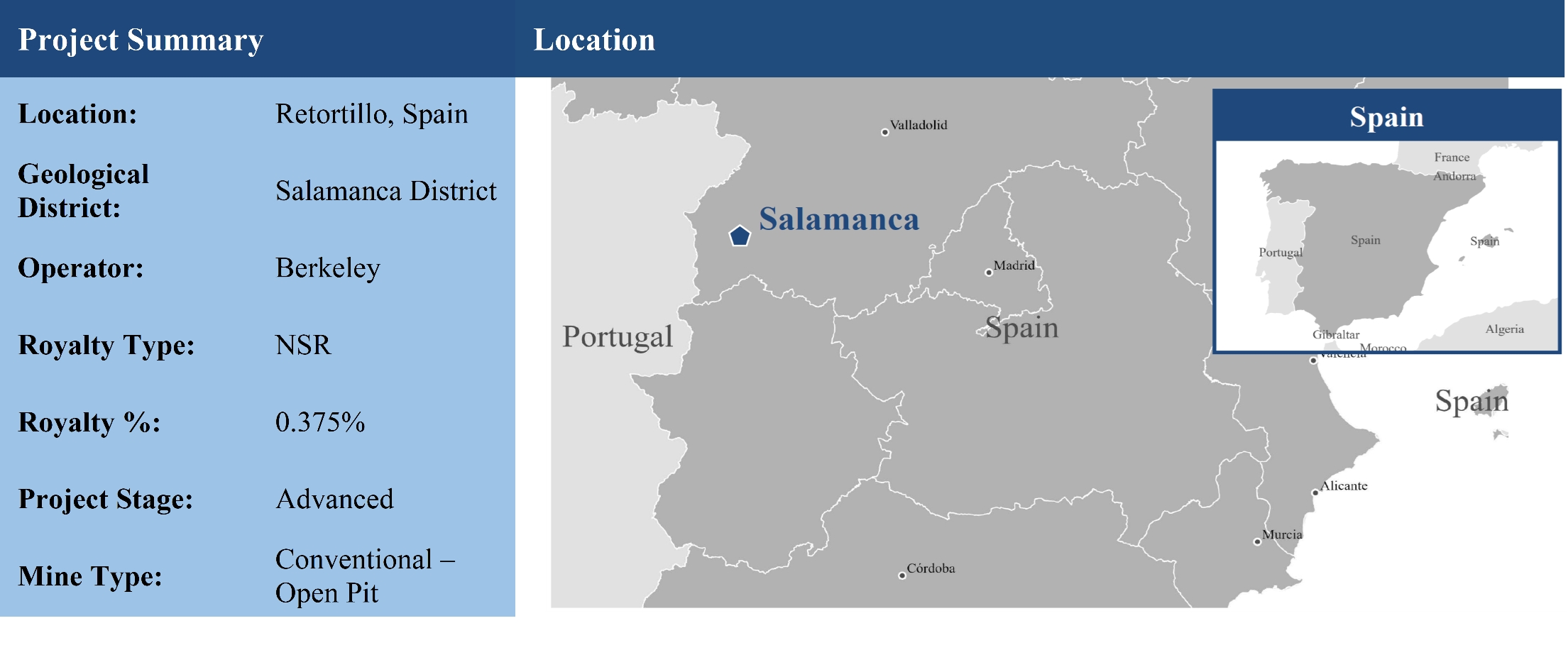
Royalty Description
The Company owns a 0.375% NSR royalty on the Salamanca Project located in northwestern Spain. The royalty was established in an agreement between Berkeley Minera España S.L. ("BME"), Berkeley, Berkeley Exploration Limited ("BEL"), and RCF V Annex Fund L.P. on June 30, 2016. The royalty allows for deductions for smelting, refining, sampling and assay treatment charges, penalty charges, smelting assay costs, umpire assay costs, transportation costs between the mining area and the smelter/refinery, taxes based directly or assessed on the value or quantity of product, and costs related to marketing or sale of the product.
About the Salamanca Project
The Salamanca Project is located in a historic uranium mining area in Western Spain about three hours west of Madrid. The project is operated by BME, a wholly owned subsidiary of Berkeley.
Project Milestones & Recent Developments
In 2016, Berkeley published the results of a Definitive Feasibility Study for the Salamanca Project (the "Salamanca DFS"), and in news release dated May 28, 2024, Berkeley announced a JORC resource estimate for the Salamanca Project with estimated measured mineral resources of 12.3 Mlbs U3O8 (9.3 million tonnes at an average grade of 0.06% U3O8), indicated mineral resources of 47.5 Mlbs U3O8 (41.8 million tonnes at an average grade of 0.05% U3O8), and inferred mineral resources of 29.6 Mlbs U3O8 (31.5 million tons at an average grade of 0.04% U3O8). The cut-off grade applied to resources was 200 ppm U3O8 for all deposits.
See "Mineral Reserve and Resource Estimates" for further information regarding the foregoing mineral resource estimate. Such estimate was prepared in accordance with the JORC standard. See "Note Regarding Mineral Reserve and Resource Estimates".
As disclosed in the Salamanca DFS, as at the date thereof, Berkeley had received all the European Union-, National-, Regional- and Provincial- level approvals required for the commencement of initial infrastructure development of the project, including a 30 year mining license valid until 2044 and renewable for two further 30 year periods, a Favorable Declaration of Environmental Impact and approvals from the water authority and initial authorization for the process plant.
Berkeley received the Authorization of Exceptional Land Use ("AEUL") and the Urbanism License ("UL") in July 2017 and August 2020 by the Regional Commission of Environment and Urbanism, and the Municipality of Retortillo respectively.
As disclosed in the Berkeley 2024 Annual Report, during the year ended June 30, 2024, BME submitted a contentious-administrative appeal before the Spanish National Court. This submission followed notification from the Ministry for Ecological Transition and the Demographic Challenge ("MITECO") in relation to the rejection of the administrative appeal filed by BME against MITECO's rejection of the Authorisation for Construction for the uranium concentrate plant as a radioactive facility at the Salamanca project.
On December 26, 2023, the Superior Court of Justice of Castilla y León issued two rulings in which it declared null and void the AEUL and UL. In January 2024, the High Court of Justice of Castilla y León rejected the appeal presented by Berkeley against the ruling issued by the Superior Court of Justice of Castilla y León.
On May 28, 2024, Berkeley announced that BEL had filed a Request for Arbitration for its investments in Spain through its Spanish subsidiary BME, initiating arbitration proceedings against Spain at the World Bank's International Centre for Settlement of Investment Disputes. BME withdrew the cassation appeals against the High Court of Justice of Castilla y León judgements before the Spanish Supreme Court to preserve BEL's rights under international arbitration.
In Berkeley's quarterly activity report for the quarter ended March 31, 2025, Berkeley disclosed that the Tribunal was formally constituted with the first tribunal session to be held in early May 2025, where the timetable and arbitration rules will be established.
There can be no assurance that such proceedings will be successful.
San Rafael
Unless otherwise indicated, the scientific and technical information herein regarding the San Rafael Project has been summarized from Western Uranium's annual report on Form 10-K for the year ended December 31, 2024, a copy of which is
available under Western Uranium's profile at www.sec.gov, from Western Uranium's other public disclosure, and the technical report titled "NI 43-101 Technical Report on the San Rafael Uranium Project (including the: Deep Gold Uranium Deposit and the Down Yonder Uranium Deposit), Emery County, Utah, USA", with an effective date of November 19, 2014 (the "Historic San Rafael Technical Report"), available under Western Uranium's profile on SEDAR+. The Historic San Rafael Technical Report was originally prepared for Pinion Ridge Mining LLC, Homeland Uranium Inc., and Homeland Uranium Inc. (Canada).

Royalty Description
The Company owns a 2% NSR royalty (the "San Rafael Royalty") of production of subject minerals mined or extracted from the San Rafael property. This includes all metals, minerals, ores, etc. that are found on the property except coal, oil, gas, and associated hydrocarbons. The royalty is calculated as either actual proceeds of sales of subject minerals as defined in the agreement, less certain expenses relating to weighing, assaying, analysis, sales brokerage costs, allowable transportation costs and allowable taxes or, in the case of non-arms' length sales, the market value of such products as determined in accordance with the underlying royalty agreement.
The San Rafael Royalty does not apply to the entire project area for the San Rafael Project. The San Rafael Royalty is applicable only to the 136 BM unpatented federal lode mining claims that comprise the majority of the project.
About the San Rafael Project
According to publicly available information, the San Rafael Project is a Development stage, conventional uranium project located in east-central Emery County, Utah, USA. The property is located on the eastern side of the San Rafael Swell in east-central Utah, approximately 140 air miles southeast of Salt Lake City. The San Rafael Project is 100% owned by Pinion Ridge Mining LLC, a wholly-owned subsidiary of Western Uranium.
Project Milestones & Recent Developments
The Deep Gold deposit was originally discovered by Continental Oil Company ("Conoco") and Pioneer Uravan geologists in the late 1960s and 1970s to early 1980s, respectively. Exploration drilling was conducted just east of the core of the Tidwell Mineral Belt and north-northeast of the Acerson Mineral Belt. The area containing the deposits was considered to contain highly prospective paleo trunk stream channel trends. Some of the larger historic producing mines in the area were Atlas Minerals' Snow, Probe, and Lucky Mines. In addition to Conoco, Pioneer Uravan and Atlas Minerals, the AEC and other companies (Union Carbide Corporation, Energy Fuels Nuclear, Inc., and others) conducted exploration drilling and mining in the area.
The Tidwell mineral Belt and the San Rafael Uranium District have been the sites of considerable historic exploration, drilling and production, with over 4.0 Mlbs of uranium and 5.4 Mlbs of vanadium produced. Production from the Snow, immediately up dip of the Deep Gold deposit, which produced for nine years, starting in March 1973, and ending in January 1982 consisted of 650,292 pounds U3O8 contained in 173,330 tons of material at an average grade of 0.188% U3O8.
The Historic San Rafael Technical Report stated a combined Indicated Mineral Resource for the entire San Rafael Project comprises a resource of 758,000 tons at 0.225% U3O8 containing 3,404,600 lbs. U3O8 and an Inferred Mineral Resource of 453,800 tons at 0.205% U3O8 containing 1,859,500 lbs. U3O8. The Company is treating the Historic San Rafael Technical Report and the mineral resource estimate therein as historical in nature and notes that a qualified person has not done sufficient work to classify the historical estimates as current mineral resources. The Company is disclosing the historical estimates contained therein for illustrative purposes, to provide readers with relevant information regarding the San Rafael Project. There are numerous uncertainties inherent in the historical estimate, which is subject to all of the assumptions, parameters and methods used to prepare such historical estimate. In addition, the Company is unable to confirm the exact portion of the identified historical resources that are covered by the royalty with the information currently available.
Western Uranium stated that the San Rafael Project is currently being held as a property that is exploratory in nature with no identified reserves. Exploration and mining plans have not been prepared for the project. Western Uranium has not yet undertaken any development work at the property. Power and water sources have not yet been formally assessed. During 2024, Western Uranium conducted work to make the San Rafael Project its second mining production center. Western Uranium has acquired an exploration permit which will allow the installation of monitor wells as a next step.
See "Mineral Reserve and Resource Estimates" for further information regarding the foregoing mineral resource estimate.
Slick Rock
Unless otherwise indicated, the scientific and technical information herein regarding the Slick Rock Project has been derived from the technical report titled "The Shootaring Canyon Mill and Velvet-Wood and Slick Rock Uranium Projects, Preliminary Economic Assessment, National Instrument 43-101" with an effective date of May 6, 2023 (the "Slick Rock Technical Report"), prepared for Anfield and Anfield's other public disclosures, copies of which are available under its profile on SEDAR+.
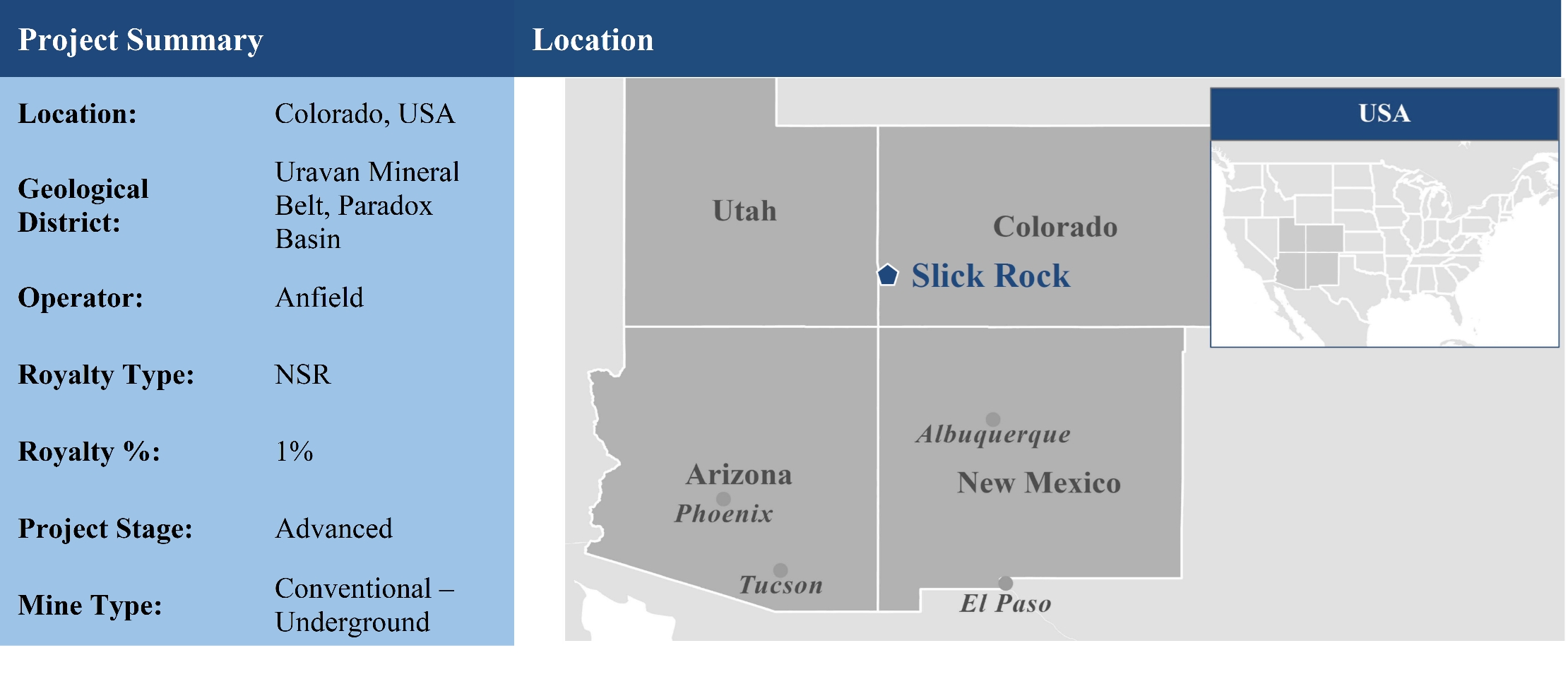
Royalty Description
The Company owns a 1.0% NSR uranium royalty on the Slick Rock Project located in Colorado, USA. The royalty applies only to uranium produced at the project and does not apply to vanadium or other minerals.
About the Slick Rock Project
The Slick Rock Project is an Advanced stage conventional uranium and vanadium project located in San Miguel County, Colorado, USA, approximately 23.9 miles north of the town of Dove Creek, and consists of 268 contiguous mineral lode claims and covers approximately 4,976 acres.
The Slick Rock Technical Report states that a total of 312 drill holes are available for the Slick Rock Project area. All of the drill holes are considered historic.
In a news release dated June 8, 2022, Anfield announced that it had completed the settlement of indebtedness with UEC. As part of the settlement, an asset swap was completed where Anfield acquired UEC's interest in the Slick Rock Project.
Project Milestones & Recent Developments
The information below regarding project milestones and recent developments for the Slick Rock Project has been summarized from the Slick Rock Technical Report as well as Anfield's public disclosure.
Surficial to shallow uranium/vanadium mineralization has been known in the Slick Rock area since the early 1900s (then called the McIntyre district). First mined for radium and minor uranium until 1923, numerous companies sporadically operated small scale mining and processing facilities along the Dolores River. In 1931, a mill was constructed by Shattuck Chemical Co. to process vanadium ore. In 1944, the area was worked by the Union Mines Development Corp. for uranium/vanadium ore.
By December of 1955, Union Carbide Nuclear Corp. ("UCNC") had drilled out a sufficient resource on the north side of Burro Canyon and began sinking three shafts. In December 1957, the shaft sinking was complete on the Burro No. 3, 5, and 7 mines to total depths of 408 feet, 414 feet, and 474 feet, respectively.
In the same year, initial ore shipments were made to UCNC's concentrating mill at Slick Rock.
The Slick Rock Technical Report states an updated preliminary economic assessment for the combined Velvet-Wood and Slick Rock Projects. Project cost estimates are based on a conventional random room and pillar underground mine operation at the Velvet-Wood and Slick Rock mine areas. Mined material would be hauled by truck to the Shootaring Canyon mill approximately 180 miles from Velvet-Wood and 200 miles from Slick Rock. Commodity prices used in the preliminary economic assessment are US$70.00 per pound. for uranium oxide and US$12.00 per pound. for V2O5. Respective mill recoveries are estimated at 92% U3O8 and 75% V2O5. Total initial capital expenditures, not including current and sunk costs, is estimated at US$122.3 million. Total weighted average operating expenses is estimated at US$244 per ton mined and processed. The total cost per ton to produce saleable uranium and vanadium products is estimated at US$290 per ton. This compares to an estimated gross value of US$741 per ton.
The preliminary economic assessment set out a pre-tax project internal rate of return of 40% and a net present value of US$238 million, based on a discount rate of 8% and a uranium price of US$70.00 per pound, along with a vanadium price of US$12.00 per pound. for the two combined projects. The report states average annual production of approximately 750,000 pounds of uranium and 2.5 Mlbs of vanadium per year is estimated over the 15-year mine life. The technical report estimates 1.7 million tons containing some 7.7 Mlbs eU3O8 for the Slick Rock project alone, with a vanadium to uranium ratio of 6 to 1.
The preliminary economic assessment referenced above is preliminary in nature and includes inferred mineral resources that are considered too speculative geologically to have the economic considerations applied to them that would enable them to be categorized as mineral reserves. Accordingly, there is no certainty that the preliminary economic assessment will be realized.
In a news release dated April 9, 2024, Anfield disclosed that it had submitted its production reactivation plan for the Shootaring Canyon mill to the State of Utah's Department of Environmental Quality. It disclosed that the plan addresses the updating of the mill's radioactive materials license from its current standby status to operational status and the increasing of both throughput capacity and the tripling of licensed production capacity. Following approval of the reactivation plan and mill refurbishment, Anfield will be able to both recommence uranium production and start vanadium production in 2026.
In a news release dated June 17, 2024, Anfield announced that it had received final approvals for its drill permit application to commence a 20-hole, 20,000-foot rotary drill program at its Slick Rock uranium and vanadium project. Anfield expected the drill program to commence in the third quarter of the calendar year 2024.
In a news release dated August 2, 2024, Anfield announced that it had engaged BRS, Inc., an engineering firm, to complete an updated uranium and vanadium resource for the Slick Rock property.
In an announcement on January 29, 2025, Anfield announced the completion of the previously disclosed drill program, intended to be used in updating the Slick Rock mineral resource. The objective of Anfield's initial drilling program was to verify the historical drilling dataset of 285 drill holes at Slick Rock which was generated by the United States Geological Survey and various subsequent operators. Anfield further stated that they intend to align the development timelines for both the Slick Rock and Velvet-Wood mines. It disclosed that its aim is to have both projects ready for production prior to the restart of the Shootaring Canyon mill, with initial feed ready for transport once the mill is ready to receive it.
See "Mineral Reserve and Resource Estimates" for further information regarding the foregoing mineral resource estimate.
Whirlwind
Unless otherwise indicated, the scientific and technical information herein regarding the project history for the Whirlwind Project has been summarized from the Historic NI 43-101 Technical Report titled "Updated Technical Report on Energy Fuels Resources Corporations' Whirlwind Property (Including Whirlwind, Far West, and Crosswind Claim Groups and Utah State Metalliferous Minerals Lease ML-49312), Mesa County, Colorado and Grand County, Utah", with an effective date of March 15, 2011 (the "Historic Whirlwind Technical Report"), a copy of which is available under Energy Fuels' profile on SEDAR, and in Energy Fuels' public disclosure, available under Energy Fuels' profile at www.sec.gov.
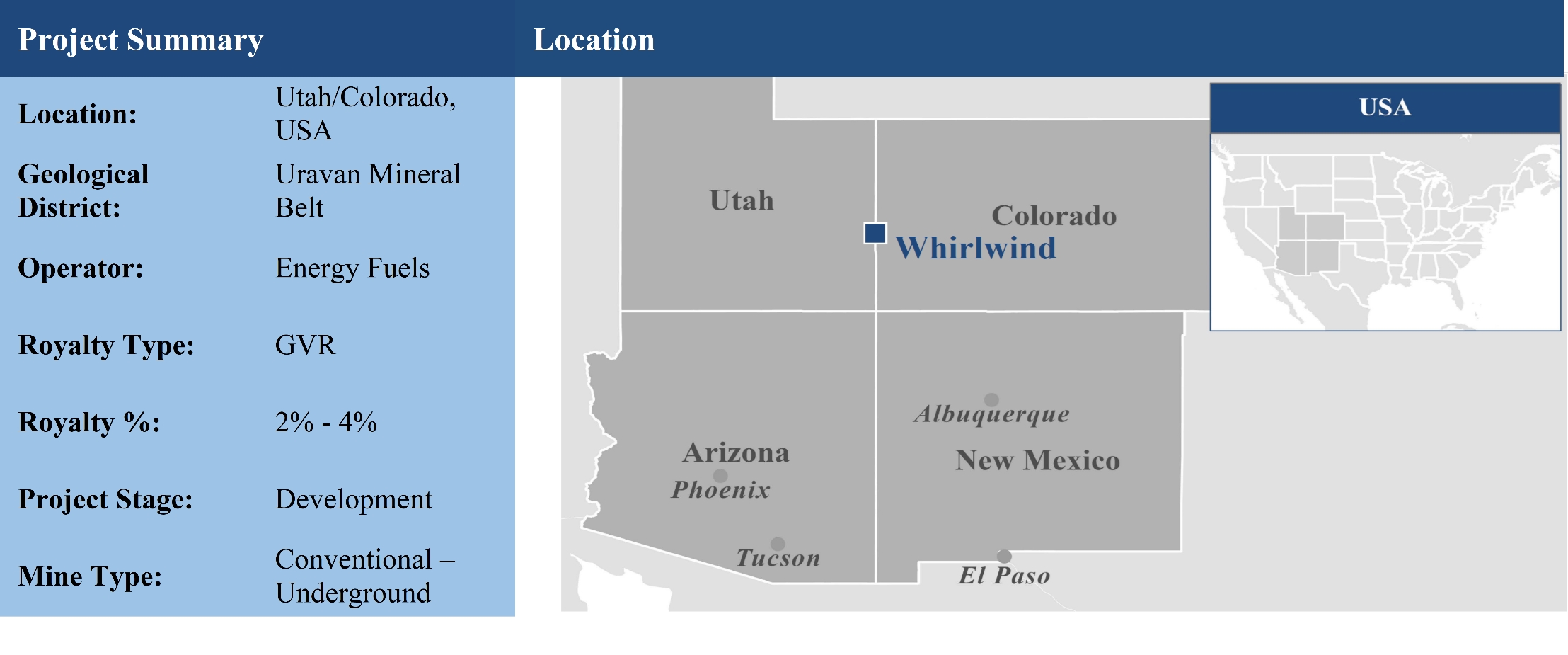
Royalty Description
The Company owns a 2% - 4% sliding scale GVR royalty (the "Whirlwind Royalty") on Utah State Mining Lease ML49312 comprising approximately 320 acres.
The Whirlwind Royalty is a GORR equal to 2% - 4% of the gross value from the sale of uranium oxide (commonly referred to as "yellowcake") and vanadium pentoxide (commonly referred to as "black flake") derived from ore mined from Utah State Mining Lease 49312, less certain specified deductions, including actual charges or costs of weighing, sampling, assaying, and analysis, sales brokerage costs, allowable transportation costs, and any allowable taxes as defined in the agreement. In lieu of the royalty payment, URC may at its election, on an annual basis, take its royalty as an in-kind production royalty of ore or concentrates for both yellowcake and black flake directly from the Whirlwind mine site. The Whirlwind Royalty does not apply to the entire project area for the Whirlwind Project. The royalty currently applies to approximately 320 acres, or approximately 11% of the currently defined project area.
About the Whirlwind Project
The Whirlwind Project is a Development stage, conventional uranium project that straddles the Utah/Colorado border, 4.5 miles southwest of Gateway, Colorado, USA. The project is located in the Beaver Mesa District of the Uravan Mineral Belt. The Whirlwind Project comprises 126 unpatented lode mining claims covered by three Mineral Leases and Utah State Mineral Lease ML49312 covering 320 acres for a total acreage of about 2,800 acres. The Utah State Mining Lease ML49312 covers the West ½ of Section 16, Township 25 South, Range 26 East, SLPM.
The Whirlwind Project is 100% owned by EFR Colorado Plateau LLC, a wholly-owned subsidiary of Energy Fuels. Energy Fuels also owns the White Mesa Mill, an existing conventional uranium mill located near Blanding, Utah, approximately 130 miles from the Whirlwind Project.
Project Milestones & Recent Developments
Ores in this and other parts of the Uravan Mineral Belt were mined intensively in the early 20th century for radium (about 1914 - 1923). The Gateway/Beaver Mesa District of the Uravan Mineral Belt was mostly idle from the 1920s until about 1937 when several mills were built to process the ore for its vanadium content. Uranium became the emphasis of the district when the United States Army's Manhattan Project came to the area in 1943. The AEC purchased concentrates from the several area mills from 1947 through 1970. Mining diminished until the mid-1970s when the private market price of uranium began rising to record levels. The area boomed until 1985 when the uranium price decline brought on by the Three Mile Island nuclear plant incident made most mining here unprofitable. When the price of vanadium experienced a brief spike in 1989-1990, several mines in the Uravan Mineral Belt were reactivated, including some on the Whirlwind property. The last underground mining within the property boundary was in 1990 when the Umetco Minerals Corporation ("Umetco") contractor mined 4,200 tons at 0.44% U3O8 and 1.06% V2O5 from the west end of the La Sal No.6 area, accessed through the Packrat portal.
In the 1970s, the area covered by the Whirlwind Project was held by several entities. The resources of the Whirlwind mine were developed by Pioneer Uravan, which did not control any of the nearby mines that had portals in the canyon rim. Umetco, who controlled the Packrat and several other mines to the north, acquired the property from Pioneer Uravan in about 1984. Cotter Corporation ("Cotter") staked the same area later in 1994 as the Liberty group. Neither Umetco nor Cotter did any underground work in the mine. Cotter conducted a small drilling project which resulted in a minor increase to associated vent holes, and Cotter reclaimed its Liberty Mine (Whirlwind) portal in the next few years. As the uranium and vanadium prices began increasing in 2004, Lee Sutherland of Little Maverick Mining Company staked new claims beginning in January 2005, covering the old mines and an area of indicated mineral resources. The claims of the Whirlwind group include the Packrat, part of the Hubbard, and some of the Lumsden group of mines, as well as the La Sal and southern end of the Bonanza mine areas.
When initial development was stopped in September 1981, there were two main headings in the Whirlwind mine. The Whirlwind mine has been rehabilitated to both faces and the main haulage drifts enlarged to accommodate larger haul trucks. Due to the declining uranium price, the mine was placed on standby following the rehabilitation work in late 2008. In order to conserve cash, a decision to stop pumping and treating water was made in December 2009.
Stated historical indicated resources totaled 1.10 Mlbs U3O8 and 3.60 Mlbs V2O5 in 188,000 tons of ore grading 0.29% eU3O8 and 0.96% V2O5 respectively. Stated historical inferred resources totaled 2.00 Mlbs U3O8 and 6.47 Mlbs V2O5 in 437,000 tons of ore grading 0.23% eU3O8 and 0.74% V2O5 respectively. The historical resources were estimated at a uranium cut-off grade of 0.06% eU3O8. This cut-off grade is based on using a long-term uranium price of US$77.50 per pound U3O8 and a vanadium price of US$7.50 per pound V2O5. Vanadium grades are based on assays where taken and otherwise estimated at the average V2O5:U3O8 ratio of 3.24:1.
The Company is treating the Historic Whirlwind Technical Report and the mineral resource estimate therein as historical in nature and notes that a qualified person has not done sufficient work to classify the historical estimates as current mineral resources. With the institution of the new Regulation S-K 1300 regulatory framework, the previous resources stated under NI 43-101 are no longer current and Energy Fuels no longer states resources for the Whirlwind Project. The Company is disclosing the historical estimates contained therein for illustrative purposes, to provide readers with relevant information regarding the Whirlwind Project. There are numerous uncertainties inherent in the historical estimate, which is subject to all of the assumptions, parameters and methods used to prepare such historical estimate.
Energy Fuels states in its annual report on Form 10-K for the year ended December 31, 2022, that work was initiated at Whirlwind in 2022 to rehabilitate the existing decline. Work progressed until December 2022, when it was put on hold due to inclement weather. Energy Fuels has stated plans to finish rehabilitation work on the Whirlwind decline in 2023, but no current reserves have been identified on the project.
Energy Fuels stated in its Quarterly Report on Form 10-Q for the quarter ended September 30, 2024 that it expected to continue rehabilitation and development work at the Whirlwind mine in preparation for future production. It stated that the timing of plans to extract and process mineralized materials from the Whirlwind mine will be based on contract requirements, inventory levels, and/or sustained improvements in general market conditions. Energy Fuels currently expects the Whirlwind mine to commence uranium production within one year from a "go" decision.
See "Mineral Reserve and Resource Estimates" for further information regarding the foregoing mineral resource estimate.
Workman Creek
Unless otherwise indicated, the scientific and technical information herein regarding the Workman Creek Project has been derived from the technical report titled "2022 Initial Assessment on the Workman Creek Project, US SEC Subpart 1300 Regulation S-K Report, Gila County, Arizona, USA", with an effective date of February 14, 2023 (the "Workman Creek Technical Report"), prepared for UEC and UEC's other public disclosures, a copy of which is available under UEC's profile on SEDAR+ and at www.sec.gov.

Royalty Description
The Company owns a 1.0% NSR uranium royalty on the Workman Creek Project located in Arizona, USA (the "Workman Creek Project").
About the Workman Creek Project
According to publicly available information, the Workman Creek Project is a Development stage conventional uranium project located in the Sierra Ancha region in Gila County, Arizona, approximately 70 miles northeast of Phoenix and about 31 miles northwest of Globe. The project consists of three claim blocks, the main contiguous claim block along Workman Creek and two non-contiguous claim blocks (Pendleton and Oak Creek), totaling 198 unpatented mining claims comprising approximately 4,036 acres.
Project Milestones & Recent Developments
Exploration in the Workman Creek Project area commenced in 1954, when the AEC carried out reconnaissance exploration work that led to a staking rush and increased activity until the late 1970s. UEC has disclosed that in 1975, Wyoming Minerals Corporation, a subsidiary of Westinghouse Corporation, re-evaluated and acquired mining rights to the most prominent pre-1960 uranium showings in the region, which included and led to the development of, among others, the Workman Creek Project area, and, by 1980, had drilled at least 432 drill holes in the Workman Creek Project area and completed a feasibility study. Shortly after the feasibility study was completed, the uranium market saw a prolonged depression.
Rodinia Minerals Inc. began exploration at the Workman Creek Project in 2005, which included radiometric, geochemical and radon-gas surveys on several claim blocks and the completion of a resource estimate.
In February of 2023, UEC filed the Workman Creek Technical Report, which includes a Regulation S-K 1300 mineral resource estimate for the Workman Creek Project. The report disclosed an estimated inferred mineral resource of 4.459 Mlbs U3O8 (1.981 million short tons or 1.797 million tonnes at an average grade of 0.113% U3O8).
UEC stated that economic factors were applied to the estimates in consideration of reasonable prospects for economic extraction using a commodity price of US$75.00 per pound. uranium oxide and that metallurgical recovery was assumed at 90%. See "Mineral Reserve and Resource Estimates" for further information regarding the foregoing mineral resource estimate. Mineral Reserve and Resource Estimates The tables below set forth the estimated mineral reserve and resources for the projects underlying the Company's existing royalty interests and those it has options to acquire. The information set forth in the tables below is based on publicly available information as of the date of this Annual Information Form. See "Technical and Third-Party Information". The mineral reserve estimates have been estimated in accordance with CIM Definition Standards and NI 43-101 and the mineral resources set forth in the tables below have been estimated in accordance with CIM Definition Standards and NI 43-101, JORC or Regulation S-K 1300. Mineral resources that are not mineral reserves do not have demonstrated economic viability. See "Note Regarding Mineral Reserve and Resource Estimates". The scientific and technical information in the tables below was publicly disclosed by the companies that own the projects, or their affiliates, in various documents that are referenced in the notes below. The figures in the tables below have been rounded and, in some instances, may not exactly match the figures that were disclosed. Certain of the Company's royalty interests do not cover the entire property associated with the operator's publicly reported figures and the Company is not in a position to report separate resource estimates for those properties. Please see the individual property disclosures in this Annual Information Form for further information.
Royalty Interests
The following sets forth selected information regarding mineral resource estimates respecting the Company's royalty interests.
|
|
|
|
|
|
|
|
|
|
|
|
|
Resources(1) |
|
Deposit
|
Measured |
Indicated |
Total Measured and Indicated |
Inferred |
Tonnes |
Grade |
U3O8 |
Tonnes |
Grade |
U3O8 |
Tonnes |
Grade |
U3O8 |
Tonnes |
Grade |
U3O8 |
(millions) |
(% U3O8) |
(Mlbs) |
(millions) |
(% U3O8) |
(Mlbs) |
(millions) |
(% U3O8) |
(Mlbs) |
(millions) |
(% U3O8) |
(Mlbs) |
|
|
|
|
|
|
|
|
|
|
|
|
|
Anderson(2) |
- |
- |
- |
14.674 |
0.10 |
32.06 |
14.674 |
0.10 |
32.06 |
- |
- |
- |
Churchrock(3) |
- |
- |
- |
- |
- |
- |
- |
- |
- |
33.88 |
0.075 |
50.82 |
Cigar Lake(4) |
0.08 |
4.88 |
8.10 |
0.14 |
4.95 |
15.40 |
0.22 |
4.92 |
23.50 |
0.16 |
5.55 |
20.00 |
Dawn Lake(5) |
- |
- |
- |
0.18 |
4.42 |
17.90 |
0.18 |
4.42 |
17.9 |
0.046 |
1.02 |
1.00 |
Dewey-Burdock(6) |
4.92 |
0.132 |
14.29 |
1.79 |
0.072 |
2.84 |
6.70 |
0.116 |
17.12 |
0.59 |
0.055 |
0.71 |
Energy Queen(7) |
- |
- |
- |
- |
- |
- |
- |
- |
- |
0.133 |
0.25 |
0.75 |
Lance(8) |
3.3 |
0.051 |
3.8 |
11.0 |
0.051 |
12.4 |
14.3 |
0.051 |
16.20 |
38.3 |
0.049 |
41.70 |
Langer Heinrich(9) |
104.5 |
0.043 |
99.0 |
23.5 |
0.038 |
19.48 |
128.0 |
0.042 |
118.5 |
11.0 |
0.034 |
8.40 |
McArthur(10) |
0.072 |
2.28 |
3.60 |
0.060 |
2.31 |
3.10 |
0.13 |
2.30 |
6.70 |
0.036 |
2.95 |
2.40 |
Michelin(11) |
17.80 |
0.097 |
38.00 |
36.70 |
0.083 |
67.60 |
54.50 |
0.097 |
105.60 |
13.10 |
0.076 |
22.10 |
Millennium(12) |
-
|
-
|
-
|
1.44 |
2.39 |
75.90 |
1.44 |
2.39 |
75.90 |
0.41 |
3.19 |
29.00 |
Reno Creek(13) |
13.60 |
0.04 |
12.92 |
15.40 |
0.04 |
13.07 |
29.00 |
0.04 |
25.99 |
1.74 |
0.04 |
1.49 |
Roca Honda(14) |
0.19 |
0.48 |
1.98 |
1.49 |
0.48 |
15.64 |
1.68 |
0.48 |
17.62 |
1.37 |
0.457 |
13.84 |
Roughrider(15) |
- |
- |
- |
0.389 |
3.25 |
27.84 |
0.389 |
3.25 |
27.84 |
0.359 |
4.55 |
36.04 |
Salamanca(16) |
9.3 |
0.06 |
12.3 |
41.8 |
0.05 |
47.5 |
51.1 |
0.05 |
59.8 |
31.5 |
0.04 |
29.6 |
Slick Rock(17) |
- |
- |
- |
- |
- |
- |
- |
- |
- |
1.59 |
0.23 |
7.86 |
Workman Creek(18) |
- |
- |
- |
- |
- |
- |
- |
- |
- |
1.80 |
0.11 |
4.46 |
Notes:
(1)
Where applicable, third-party resource estimates disclosed in tons have been converted to metric tonnes for presentation purposes.
(2)
The mineral resources were estimated in accordance with Regulation S-K 1300 standards in the United States and are disclosed in the Anderson SEC Technical Report Summary. Estimated indicated mineral resources are at a 0.02% eU3O8 grade cutoff and a 0.1 ft% GT (grade x thickness per intercept) cutoff. Mineral resources were estimated separately for each mineralized zone. The total contained mineralized material was first estimated with the foregoing metrics, then reasonable prospects for economic extraction were applied. Indicated mineral resources are reported within the Conceptual Mining envelopes of the historical NI 43-101 technical report on the project that was completed by UEC in July of 2014 as having reasonable prospects for economic extraction and represent an 18% reduction from the estimate of total mineralized material.
(3)
The mineral resources were estimated in accordance with NI 43-101 and are disclosed in the Churchrock Technical Report. The effective date of the mineral resource estimate is February 22, 2023, and the estimate was prepared using a cut-off grade of 0.02% eU3O8, minimum thickness of 2.0 feet, internal maximum dilution of 5 feet, grade values have not been adjusted for disequilibrium, tonnage factor of 15 cubic feet per ton.
(4)
The mineral resources were estimated in accordance with NI 43-101 and are disclosed in Cameco 2024 AIF. The resources do not include amounts that have been identified as mineral reserves.
(5)
The mineral resources were estimated in accordance with NI 43-101 and are disclosed in Cameco 2024 AIF. The resources do not include amounts that have been identified as mineral reserves.
(6)
Both the Dewey-Burdock 30% NPR and Dewey-Burdock Slide Scale Royalty do not apply to the entire project area covered by this estimate. The Dewey-Burdock 30% NPR covers approximately 10% and the Dewey-Burdock Sliding Scale Royalty covers approximately 11% of the aggregate surface and mineral rights disclosed in the Dewey-Burdock Technical Report respectively. The mineral resources were estimated in accordance with NI 43-101 and are disclosed in the Dewey-Burdock Technical Report. The effective date of the mineral resource estimate is December 3, 2019, and the estimate was prepared using a cut-off grade of 0.02% U3O8 and a GT (grade x thickness per intercept) cut-off of 0.20 m% U3O8 for use in the GT (grade x thickness per intercept) contour method.
(7)
The Energy Queen Royalty does not apply to the entire project area covered by this estimate. Regulation S-K 1300 definitions were followed for all Mineral Resource categories. These definitions are also consistent with CIM (2014) definitions in NI 43-101. Uranium Mineral Resources are estimated at a cut-off grade of 0.17% U3O8. The cut-off grade is calculated using a metal price of US$65 per pound U3O8. No minimum mining width was used in determining Mineral Resources. Mineral Resources are based on a tonnage factor of 14.5 ft3/ton (Bulk density 0.0690 ton/ft3 or 2.21 t/m3).
(8)
The 4% Lance Royalty does not apply to the entire project area covered by this estimate and covers approximately 15% of the stated Peninsula holdings owned. The 1% Lance Royalty applies to all uranium and related minerals from the entire project area. The mineral resources were estimated in accordance with JORC. The mineral resources were calculated using a GT (grade x thickness per intercept) product contour of 0.2 m% and a cut-off of 200 ppm U3O8. The resource estimate is set forth in Peninsula's announcement dated May 13, 2024.
(9)
Resources are reported according to the JORC Code. Measured resources include those identified as stockpiles. The measured and indicated U3O8 mineral resources are inclusive of those mineral resources modified to produce the ore reserves. 200 ppm U3O8 cut-off applied to in-situ mineral resources – 250 ppm U3O8 cut-off applied to stockpiles at the time of mining. Resources are depleted for mining. Mineral resources are reported on a 100% ownership basis, of which Paladin has a 75% interest. The estimate was disclosed in Paladin's annual report for the year ended June 30, 2024.
(10)
The mineral resources were estimated in accordance with NI 43-101 and are disclosed in Cameco 2024 AIF. The resources do not include amounts that have been identified as mineral reserves. The royalty does not cover those resources and reserves attributed to the adjacent Read Lake project which represents a nominal portion of the reported reserves and resources at the project.
(11)
The mineral resources were estimated in accordance with JORC and are disclosed in Paladin's annual report for the year ended June 30, 2024. Cut-off grades for all deposits except Jacques Lake reflect the use of open cut (200 ppm) and underground (500 ppm) mining methodologies in the determination of prospects for eventual economic extraction.
For Jacques Lake, there were insufficient mineral resources remaining after pit optimization studies to warrant any portion being considered for underground mining.
(12)
The mineral resources were estimated in accordance with NI 43-101 and are disclosed in Cameco 2024 AIF. The resources do not include amounts that have been identified as mineral reserves.
(13)
The Reno Creek Royalty does not apply to the entire North Reno Creek area, which represents approximately 45% of the measured and indicated resource and approximately 85% of the inferred resource contained in the North Reno Creek area of the project. The operator disclosed such resource estimates under Regulation S-K 1300 standards in the United States. The estimate was prepared using a cut-off grade 0.2 GT (grade x thickness per intercept).
(14)
The Roca Honda Royalty does not apply to the entire project area covered by this estimate. The estimate was prepared by the operator under Regulation S-K 1300 standards in the United States. Mineral resources are estimated at a U3O8 cut-off grade of 0.19% U3O8. A minimum mining thickness of six feet was used, along with US$241/ton operating costs, US$65 per pound U3O8 price, and 95% recovery. Bulk density is 0.067 ton/ft3 (15.0 ft3/ton or 2.14 t/m3).
(15)
The mineral resources were estimated under Regulation S-K 1300. Mineral resources are disclosed in the Roughrider Technical Report Summary and are reported as of January 1, 2023. Mineral resources are reported diluted within the Mine Stope Optimization shapes based on a U3O8 price of US$56.00 per pound U3O8 and metallurgical recovery of 97%. Cut and Fill and Long Hole Open Stope scenario cut-off grades are 0.52% and 0.45% U3O8, respectively.
(16)
Resources are reported according to the JORC Code. Mineral Resources are disclosed in the Berkeley 2024 Annual Report. The measured and indicated U3O8 mineral resources are inclusive of those mineral resources modified to produce the ore reserves. The cut-off grade applied to resources was 200 ppm U3O8 for all deposits.
(17)
The mineral resources were estimated in accordance with NI 43-101 and are disclosed in the Slick Rock Technical Report. The effective date of the mineral resource estimate is May 6, 2023, and the estimate was prepared using a GT (grade x thickness per intercept) cut-off of 0.40 m% U3O8 for use in the GT (grade x thickness per intercept) contour method.
(18)
The mineral resources were estimated under Regulation S-K 1300. Mineral resources are disclosed in the Workman Creek Technical Report and are reported as of February 14, 2023. Economic factors have been applied to the estimates in consideration of reasonable prospects for economic extraction using a commodity price of US$75.00 per pound uranium oxide. Metallurgical recovery was assumed at 90%.
|
|
|
|
|
|
|
|
|
|
|
|
|
Historical Resources(1) |
|
Deposit
|
Measured |
Indicated |
Total Measured and Indicated |
Inferred |
Tonnes |
Grade |
U3O8 |
Tonnes |
Grade |
U3O8 |
Tonnes |
Grade |
U3O8 |
Tonnes |
Grade |
U3O8 |
('000s) |
(% U3O8) |
(Mlbs) |
(millions) |
(% U3O8) |
(Mlbs) |
(millions) |
(% U3O8) |
(Mlbs) |
(millions) |
(% U3O8) |
(Mlbs) |
San Rafael(2) |
- |
- |
- |
0.69 |
0.23 |
3.40 |
0.69 |
0.23 |
3.40 |
0.41 |
0.21 |
1.86 |
Whirlwind(3) |
- |
- |
- |
0.15 |
0.30 |
1.00 |
0.15 |
0.30 |
1.00 |
0.40 |
0.23 |
2.00 |
Notes:
(1)
Historical resource estimates cannot be considered current mineral resources and may ultimately prove unreliable.
(2)
The San Rafael Royalty does not apply to the entire project area covered by this estimate. The San Rafael Royalty is applicable only to the 136 BM unpatented federal lode mining claims that comprise the majority of the project. The mineral resources were estimated in accordance with NI 43-101 and are disclosed in the Historic San Rafael Technical Report. The Company is treating the resource estimates as historical in nature and notes that a qualified person has not done sufficient work to classify the historical estimates as current mineral resources.
(3)
The Whirlwind Royalty does not apply to the entire project area covered by this estimate. The royalty currently applies to approximately 320 acres, or approximately 11% of the currently defined project area. The mineral resources were estimated in accordance with NI 43-101 and are disclosed in the Historic Whirlwind Technical Report. The Company is treating the resource estimates as historical in nature and notes that a qualified person has not done sufficient work to classify the historical estimates as current mineral resources.
The following are mineral reserve estimates for McArthur River, Cigar Lake and Langer Heinrich.
|
|
|
|
|
|
|
|
|
|
|
|
Proven |
Probable |
Total Mineral Reserves |
|
Property |
Tonnes ('000s) |
Grade % U3O8 |
Content (Mlbs U3O8) |
Tonnes ('000s) |
Grade % U3O8 |
Content (lbs. U3O8) |
Tonnes ('000s) |
Grade % U3O8 |
Content (Mlbs. U3O8) |
Metallurgical Recovery (%) |
|
Cigar Lake(1)
|
322.0 |
16.68 |
118.4 |
229.4 |
14.73 |
74.5 |
551.4 |
15.87 |
192.9 |
98.7 |
McArthur River(1) |
1,970.3 |
6.81 |
295.8 |
520.4 |
5.56 |
63.0 |
2,490.7 |
6.55 |
359.6 |
99.2 |
|
Proved |
Probable |
Total Mineral Reserves |
|
|
Property
|
Tonnes ('000s)
|
Grade % U3O8
|
Content (Mlbs U3O8)
|
Tonnes ('000s)
|
Grade % U3O8
|
Content (lbs. U3O8)
|
Tonnes ('000s)
|
Grade % U3O8
|
Content (Mlbs. U3O8)
|
Metallurgical Recovery (%)
|
Langer Heinrich(2) |
74.8 |
0.04 |
73.6 |
10.0 |
0.05 |
10.2 |
84.8 |
0.04 |
83.8 |
90.0 |
Notes:
(1)
The mineral reserves were estimated in accordance with NI 43-101, as disclosed in the Cameco 2024 AIF, effective as of December 31, 2024. The reserve estimate was estimated by Cameco using a constant dollar average uranium price of approximately US$63.00 per pound U3O8 and an exchange rate of US$1.00 = $1.28.
(2)
Ore reserves are reported according to the JORC Code. Ore Reserves are reported on a dry basis. Proved ore reserves are inclusive of ore stockpiles. 250 ppm cut-off applied. A metal price of US$50.00 per pound U3O8 was used. Tonnage figures have been rounded and may not add up to the totals quoted. Ore Reserves reported on a 100% ownership basis, of which Paladin has a 75% interest.
RISK FACTORS
Investing in the securities of the Company is speculative and involves a high degree of risk due to the nature of the Company's business and the present stage of its development. The risk factors outlined in this section and elsewhere in this Annual Information Form should be carefully considered by investors when evaluating an investment in the Company. These risk factors list some, but not all, of the risks and uncertainties that may have a material adverse effect on the Company's securities, future business, operations and financial condition and that could cause actual events to differ materially from those set forth in Forward-Looking Statements.
Additional risks and uncertainties not currently known to the Company or that the Company currently deems to be immaterial may also impair the Company's business operations. If the Company is unable to prevent events that have a negative effect from occurring, then its business, results of operations, financial condition and cash flows and the market price of its securities could be materially and adversely affected.
Risks Related to the Business of URC
Limited or no access to data or the operations underlying the Company's interests.
The Company is not, and will not be, the owner or operator of any of the properties underlying its current or future royalties, streams and similar interests and has no input in the exploration, development or operation of such properties. Consequently, the Company has limited or no access to related exploration, development or operational data, including information underlying resource and reserve estimates, or to the properties themselves. This could affect the Company's ability to assess the value of a royalty or similar interest. This could also result in delays in cash flow from that anticipated by the Company, based on the stage of development of the properties underlying its royalties and similar interests. The Company's entitlement to payments in relation to such interests may be calculated by the royalty payors in a manner different from the Company's projections and the Company may not have rights of audit with respect to such interests. In addition, some royalties, streams or similar interests may be subject to confidentiality arrangements that govern the disclosure of information with regard to such interests and, as a result, the Company may not be in a position to publicly disclose related non-public information. The limited access to data and disclosure regarding the exploration, development and production of minerals from, or the continued operation of, the properties in which the Company has an interest may restrict the Company's ability to assess value, which may have a material adverse effect on the Company's business, results of operations and financial condition. The Company attempts to mitigate this risk by building relationships with various owners, operators and counterparties, in order to encourage information sharing.
Dependence on third party operators.
The Company is not and will not be directly involved in the exploration, development and production of minerals from, or the continued operation of, the mineral projects underlying the royalties, streams and similar interests that are or may be held by the Company. The exploration, development and operation of such properties is determined and carried out by third party owners and operators thereof and any revenue that may be derived from the Company's asset portfolio will be based on production by such owners and operators. Third-party owners and operators will generally have the power to determine the manner in which the properties are exploited, including decisions regarding feasibility, exploration and development of such properties or decisions to commence, continue or reduce, or suspend or discontinue production from a property.
The interests of third-party owners and operators and those of the Company may not always be aligned. As an example, it will usually be in the interest of the Company to advance development and production on properties as rapidly as possible, in order to maximize near-term cash flow, while third party owners and operators may take a more cautious approach to development, as they are exposed to risk on the cost of exploration, development and operations. Likewise, it may be in the interest of owners and operators to invest in the development of, and emphasize production from, projects or areas of a project that are not subject to royalties, streams or similar interests that are or may be held by the Company.
The inability of the Company to control or influence the exploration, development or operations for the properties in which the Company holds or may hold royalties, streams and similar interests may have a material adverse effect on the Company's business, results of operations and financial condition. In addition, the owners or operators may take action contrary to the Company's policies or objectives; be unable or unwilling to fulfill their obligations under their agreements with the Company; or experience financial, operational or other difficulties, including insolvency, which could limit the owner or operator's ability to advance such properties or perform its obligations under arrangements with the Company.
The Company may not be entitled to any compensation if the properties in which it holds or may hold royalties, streams and similar interests discontinue exploration, development or operations on a temporary or permanent basis.
The owners or operators of the projects in which the Company holds an interest may, from time to time, announce transactions, including the sale or transfer of the projects or of the operator itself, over which the Company has little or no control. If such transactions are completed, it may result in a new operator, which may or may not explore, develop or operate the project in a similar manner to the current operator, which may have a material adverse effect on the Company's business, results of operations and financial condition.
The effect of any such transaction on the Company may be difficult or impossible to predict.
Dependence on future payments from owners and operators.
The Company will be dependent to a large extent on the financial viability and operational effectiveness of owners and operators of the properties underlying the royalties, streams and similar interests that are or may be held by the Company. Payments from production generally flow through the operator and there is a risk of delay and additional expense in receiving such revenues. Payments may be delayed by restrictions imposed by lenders, delays in the sale or delivery of products, recovery by the operators of expenses, the establishment by the operators of mineral reserves for such expenses or the bankruptcy, insolvency or other adverse financial condition of the operator. The Company's rights to payment under royalties and similar interests must, in most cases, be enforced by contract without the protection of a security interest over property that the Company could readily liquidate. This inhibits the Company's ability to collect outstanding royalties in the event of a default. In the event of bankruptcy, insolvency or other arrangement of an operator or owner, the Company will be treated like any other unsecured creditor, and therefore have a limited prospect for full recovery of royalty or similar revenue.
A majority of the Company's assets are non-producing.
A substantial majority of the Company's royalty interests are on non-producing properties, or on properties that do not have established mineral reserves under applicable Canadian or United States disclosure standards. While a number of the properties underlying the Company's current royalty interests are relatively advanced, only the McArthur River, Cigar Lake and Langer Heinrich mines are currently in production. Both of the McArthur River and Langer Heinrich royalties are currently paying, with the McArthur River Royalty being paid through our election to receive physical uranium. Plans are advancing for the restart of the Lance mine. There is also a risk that production plans change. These and any future royalty, streaming or similar interests the Company acquires may not achieve production or produce any revenues.
While the discovery of uranium deposits may result in substantial rewards, few properties that are explored are ultimately developed into producing mines. Major expenditures may be required to locate and establish mineral reserves, to develop metallurgical processes and to construct mining and processing facilities at a particular site. It is impossible to ensure that exploration or development programs planned by the owners or operators of the properties underlying royalties, streams and similar interests that are or may be held by the Company will result in profitable commercial mining operations. Whether a mineral deposit will be commercially viable depends on a number of factors, including cash costs associated with extraction and processing; the particular attributes of the deposit, such as size, grade and proximity to infrastructure; mineral prices, which are highly cyclical; government regulations, including regulations relating to prices, taxes, royalties, land tenure, land use, importing and exporting of minerals and environmental protection; and political stability. The exact effect of these factors cannot be accurately predicted but the combination of these factors may result in one or more of the properties underlying the Company's current or future interests not receiving an adequate return on invested capital. Accordingly, there can be no assurance the properties underlying the Company's current or future interests will be brought into a state of commercial production or that projects on care and maintenance will recommence production activities.
The failure of any of the properties underlying the Company's non-producing interests to achieve production on schedule or at all would have a material adverse effect on the Company's asset carrying values or the other benefits the Company expects to realize from its royalties and other interests or the acquisition of royalty interests, and potentially our business, results of operations, cash flows and financial condition.
Royalties, streams and similar interests may not be honoured by operators of a project.
Royalties, streams and similar interests are typically contractually based. Parties to contracts do not always honour contractual terms and contracts themselves may be subject to interpretation or technical defects.
Operators and other parties to the agreements governing our existing or future royalty or other interests may interpret our interests in a manner adverse to us or otherwise may not abide by their contractual obligations. Non-performance by the Company's counterparties may occur if such counterparties find themselves unable to honour their contractual commitments due to financial distress or other reasons. In such circumstances, the Company may not be able to secure similar agreements on as-competitive terms or at all.
No assurance can be given that the Company's financial results will not be adversely affected by the failure of a counterparty or counterparties to fulfill their contractual obligations in the future. Such failure could have a material adverse effect on the Company's business, results of operations and financial condition.
To the extent grantors of royalties, streams and similar interests that are or may be held by the Company do not abide by their contractual obligations, the Company may be forced to take legal action to enforce its contractual rights. Such litigation may be time-consuming and costly, and the Company may or may not be successful in enforcing its rights. Should any such decision be determined adversely to the Company, it may have a material adverse effect on the Company's business, results of operations and financial condition.
Disputes could arise challenging, among other things, methods for calculating the royalty interest; various rights of the operator or third parties in or to the royalty interest or the underlying property; the obligations of a current or former operator to make payments on royalty interests; and various defects or ambiguities in the agreement governing a royalty interest.
Defects in or disputes relating to the existence, validity, enforceability, terms and geographic extent of royalties, streams and similar interests.
Defects in or disputes relating to the royalty interests the Company holds or acquire may prevent it from realizing the anticipated benefits from these interests and could have a material adverse effect on business, results of operations, cash flows and financial condition of the Company. Material changes could also occur that may adversely affect management's estimate of the carrying value of the Company's royalty interests and could result in impairment charges.
While the Company seeks to confirm the existence, validity, enforceability, terms and geographic extent of the royalty interests it acquires, there can be no assurance that disputes or other problems concerning these, and other matters or other problems will not arise. Confirming these matters is complex and is subject to the application of the laws of each jurisdiction to the particular circumstances of each parcel of mining property and to the agreement reflecting the royalty interest. Similarly, in many jurisdictions, royalty interests are contractual in nature, rather than interests in land, and therefore may be subject to risks resulting from change of control, bankruptcy or insolvency of operators, and our royalty interests could be materially restricted or set aside through judicial or administrative proceedings. The Company's financial condition and results of operations may also be negatively impacted as a result of an event of insolvency or bankruptcy involving the owners or operators of the properties underlying our interests.
Royalty, stream and similar interests may be subject to buy-down right provisions or pre-emptive rights.
Some royalty, stream and similar interests that are or may be held by the Company may be subject to buy-down right provisions, pursuant to which an operator may buy-back all or a portion of the stream or royalty, or pre-emptive rights, pursuant to which parties have the right of first refusal or first offer with respect to a proposed sale or assignment of the stream or royalty. The exercise of any such rights by the holders thereof may adversely affect the value of the applicable royalty, stream or similar interest of the Company. Any compensation received as a result may be significantly less than what the Company had budgeted receiving for the applicable interest and may have a material adverse effect on its results of operations, financial position and business.
Project costs may influence the Company's future royalty returns.
Net profit interest royalties and similar interests allow the operator to account for the effect of certain costs on the project before calculating a royalty, including, typically, costs of labour, equipment, electricity, environmental compliance, and numerous other capital, operating and production inputs. Payments under such royalties generally only begin after payback of capital costs and ongoing operating costs and some also allow deductions for prior exploration and interest costs. Such costs will fluctuate in ways the Company will not be able to predict, will be beyond the control of the Company and can have a dramatic effect on the revenue payable on these royalties and similar interests. Any increase in the costs incurred by operators on applicable properties will likely result in a decline in the royalty revenue received by the Company. This, in turn, will affect overall revenue generated by the Company, which may have a material adverse effect on its business, results of operations and financial condition.
For example, the Company's NPI royalty interests, including the Cigar Lake Royalty, include cost accounts for costs associated with, among other things, the development of the underlying mine. In the case of the Cigar Lake Royalty, given the significant expenditures at the project to date, these cost accounts are significant and will need to be recovered prior to the royalty generating any revenues for the holder thereof.
Risks faced by owners and operators of the properties underlying the Company's interests.
To the extent that they relate to the exploration, development and production of minerals from, or the continued operation of, the properties in which the Company holds or may hold royalties, streams or similar interests, the Company will be subject to the risk factors applicable to the owners and operators of such mines or projects.
Due to their size and scale, the success of resource-based projects often depends on the ability of the owners to raise the capital required to successfully explore, develop and operate a project. As such, the Company's ability to generate revenues from its interests can be dependent on the underlying operators' ability to secure financing when required. This ability may be affected by, among other things, general economic and market conditions. Any inability of the operators of the projects underlying the Company's interests to raise required financing for such projects on favourable terms or at all may impact the future prospects of such interests and have a material and adverse effect on the Company's results of operation and financial condition.
Mineral exploration, development and production generally involves a high degree of risk. Such operations are subject to all of the hazards and risks normally encountered in the exploration, development and production of metals, including weather related events, unusual and unexpected geology formations, seismic activity, environmental hazards and the discharge of toxic chemicals, explosions and other conditions involved in the drilling, blasting and removal of material, any of which could result in damage to, or destruction of, mines and other producing facilities, damage to property, injury or loss of life, environmental damage, work stoppages, delays in exploration, development and production, increased production costs and possible legal liability. Any of these hazards and risks and other acts of God could shut down such activities temporarily or permanently. Mineral exploration, development and production is subject to hazards such as equipment failure or failure of retaining dams around tailings disposal areas, which may result in environmental pollution and consequent liability for the owners or operators thereof. Additionally, operators are subject to the risks that they will not receive and/or maintain required licenses and permits for the operations or risks. The exploration for, and development, mining and processing of, mineral deposits involve these and other significant risks that even a combination of careful evaluation, experience and knowledge may not eliminate.
Title, permit or licensing disputes related to any of the properties in which the Company holds or may hold royalties, streams or similar interests.
The Company's business is subject to the risk that operators of mining projects and holders of exploration or mining claims, tenements, concessions, licenses or other interests in land and minerals may lose their exploration or mining rights, allow them to expire, or have their rights to explore and mine properties contested by private parties or the government. Internationally, exploration and mining tenures are subject to loss for many reasons, including expiration, failure of the holder to meet specific legal qualifications, failure to establish a deposit capable of economic extraction, failure to pay maintenance fees or meet expenditure or work requirements, reduction in geographic extent upon passage of time or upon conversion from an exploration tenure to a mining tenure, failure of title, expropriation and similar risks. If title to exploration or mining tenures subject to the Company's royalty, stream or similar interests has not been properly established or is not properly maintained, or is successfully contested, the Company's royalty, stream or similar interests could be adversely affected.
Excessive cost escalation, as well as development, permitting, infrastructure, operating or technical difficulties on any of the properties underlying royalties, streams or similar interests.
Many of the projects or properties in which the Company holds an interest are in the permitting, construction, development and/or expansion stage and such projects are subject to numerous risks including, but not limited to, delays in obtaining equipment, materials and services essential to the construction and development of such projects in a timely manner, delays or inability to obtain required permits or licenses, changes in environmental or other regulations, currency exchange rates or controls, labour shortages, cost escalations and fluctuations in metal prices. There can be no assurance that the owners or operators of such projects will have the financial, technical and operational resources to complete permitting, licensing, construction, development and/or expansion of such projects in accordance with current expectations or at all.
Volatility in market prices and demand for uranium and the market price of the Company's other investments, including as a result of geopolitical factors such as the ongoing conflict in Ukraine.
Some of the properties on which the Company holds or will hold royalties, streams or similar interests are located outside of Canada, including the Langer Heinrich Mine in Namibia. In addition, future investments and physical uranium acquisitions expose the Company to additional jurisdictions. The exploration, development and production of minerals from, or the continued operation of, these properties by their owners and operators are subject to the risks normally associated with conducting business in foreign countries. These risks include, depending on the country, nationalization and expropriation, social unrest, political instability and war, less developed legal and regulatory systems, uncertainties in perfecting mineral titles, trade barriers, exchange controls and material changes in taxation. These risks may, among other things, limit or disrupt the ownership, development or operation of properties, mines or projects in respect of which the royalties, streams or similar interests that are or may be held by the Company, restrict the movement of funds, or result in the deprivation of contractual rights or the taking of property by nationalization or expropriation without fair compensation.
In particular, Namibia is considered an "emerging market". In addition to the risks noted above, heightened risks associated with emerging markets include, without limitation, the risk of war, terrorism or nationalization; limitations on the removal of funds or other assets, or diplomatic developments that affect investments; policies which may restrict the rights of the owner, operator or Company, including restrictions on investment in the mining industry and requirements that government approval be obtained prior to any such investment by foreign persons; policies that may restrict the Company's repatriation of income or capital, including temporary restrictions on foreign capital remittances; the lack of uniform legal, accounting and auditing standards and/or standards that are different from the standards required in Canada; potential difficulties in enforcing contractual obligations; and less development and/or obsolescence in banking systems and practices, postal systems, communications and information technology and transportation networks.
In February of 2022, Russia commenced a military invasion of Ukraine. In response, governments in the United States, the European Union, the United Kingdom, Canada and others imposed financial and economic sanctions on certain industry segments and various parties in Russia. While the threat of such sanctions, import bans and other changes in trade patterns resulting from the political unrest and war in Ukraine are expected to positively impact demand for North American uranium, it may adversely impact demand for uranium produced in Kazakhstan and increase regional trade and logistical barriers. The Company will continue to monitor the conflict including the potential impact of financial and economic sanctions on the global economy and particularly on the economy of Kazakhstan. Although the Company has no operations in Russia or Ukraine, the destabilizing effects of the war in Ukraine could have other adverse effects on our business.
The Company's policy is to apply various methods, where practicable, to identify, assess and, where possible, mitigate these risks prior to entering into agreements to acquire royalties, streams and similar interests. Such methods generally include conducting due diligence on the political, social, legal and regulatory systems and on the ownership, title and regulatory compliance of the properties subject to the royalties, streams or similar interests; engaging experienced local counsel and other advisors in the applicable jurisdiction; and negotiating where possible so that the applicable acquisition agreement contains appropriate protections, representations and/or warranties, in each case as the Company deems necessary or appropriate in the circumstances, all applied on a risk-adjusted basis. Notwithstanding all of the foregoing, there can be no assurance, however, that the Company will be able to identify or mitigate all risks relating to holding royalties, streams or similar interests in respect of properties, mines and projects located in foreign jurisdictions (including emerging markets), and the occurrence of any of the factors and uncertainties described above could have a material adverse effect on the Company's business, results of operations and financial condition.
Changes in general economic, financial, market and business conditions in the industries in which uranium is used.
The international uranium industry, including the supply of uranium concentrates, is relatively small, highly competitive and heavily regulated. Worldwide demand for uranium is directly tied to the demand for electricity produced by the nuclear power industry, which is also subject to extensive government regulation and policies. In addition, the international marketing and trade of uranium is subject to potential changes in governmental policies, regulatory requirements and international trade restrictions (including trade agreements, customs, duties and taxes). International agreements, governmental policies and trade restrictions are beyond the control of the Company. Changes in regulatory requirements, customs, duties or taxes may affect the supply of uranium to the United States and Europe, which are currently the largest consumption markets for uranium in the world, as well as the future of supply to developing markets, such as China and India.
The supply of uranium is affected by a number of international trade agreements and government legislation and policies. These and any similar future agreements, governmental legislation, policies or trade restrictions are beyond our control and may affect the supply of uranium available in the United States, Europe and Asia, the world's largest markets for uranium. There is no assurance that the United States or other governments will not enact legislation or take other actions that restricts who can buy or supply uranium or facilitates a new supply of uranium. Any political decisions about the uranium market could affect the prospects of the projects underlying our royalty and other interests, the price of uranium and our financial condition and results of operations.
Risks related to mineral reserve and mineral resource estimates.
The estimated mineral reserves and resources on properties underlying the royalties, streams or similar interests that are or may be held by the Company are estimates only, and no assurance can be given that the estimated reserves and resources are accurate or that the indicated level of minerals will be produced. Such estimates are, in large part, based on interpretations of geological data obtained from drill holes and other sampling techniques. Actual mineralization or formations may be different from those predicted by the owners or operators of the properties. Further, it may take many years from the initial phase of drilling before production is possible and, during that time, the economic feasibility of exploiting a discovery may change. Market price fluctuations of commodities, as well as increased production and capital costs or reduced recovery rates, may render the proven and probable reserves on properties underlying the royalties, streams or similar interests that are or may be held by the Company unprofitable to develop at a particular site or sites for periods of time or may render reserves containing relatively lower grade mineralization uneconomic. Moreover, short-term operating factors relating to the reserves, such as the need for the orderly development of ore bodies or the processing of new or different ore grades, may cause reserves to be reduced or not extracted. Estimated reserves may have to be recalculated based on actual production experience. The economic viability of a mineral deposit may also be impacted by other attributes of a particular deposit, such as size, grade and proximity to infrastructure; by governmental regulations and policy relating to price, taxes, royalties, land tenure, land use permitting, the import and export of minerals and environmental protection; and by political and economic stability.
Resource estimates in particular must be considered with caution. Resource estimates for properties that have not commenced production are based, in many instances, on limited and widely spaced drill holes or other limited information, which is not necessarily indicative of the conditions between and around drill holes. Such resource estimates may require revision as more drilling or other exploration information becomes available or as actual production experience is gained. Further, resources may not have demonstrated economic viability and may never be extracted by the operator of a property. It should not be assumed that any part or all of the mineral resources on properties underlying the royalties, streams or similar interests that are or may be held by the Company constitute or will be converted into reserves. Any of the foregoing factors may require operators to reduce their reserves and resources, which may have a material adverse effect on the Company's business, results of operations and financial condition.
Replacement of depleted mineral reserve.
Mines have a limited time of operation as a result of the proven and probable mineral reserves attributed to a specific mine. A mining company operating a specific mine will be required to replace and expand mineral reserves depleted by a mine's production to maintain production levels over the long term. It is possible to replace depleted mineral reserves by expanding known ore bodies through exploration, locating new deposits or acquiring new mines or projects. Mineral exploration is highly speculative in nature. It can take several years to develop a potential site of mineralization. There is no assurance that current or future exploration programs conducted by mining companies will be successful. There is a risk that the depletion of mineral reserves by mining companies on the projects underlying the Company's interests will not be replenished by discoveries or acquisitions which could reduce the income the Company would have expected to receive from a particular interest.
Public acceptance of nuclear energy and competition from other energy sources.
The growth of the uranium and nuclear energy industry will depend upon continued and increased acceptance of nuclear technology as a means of generating electricity. The nuclear industry is affected by unique political, technological and environmental factors. Accordingly, the industry is subject to public opinion risks, which could have an adverse impact on the demand for nuclear power and result in increased government regulation.
An accident at a nuclear reactor anywhere in the world could impact the continued acceptance by the public and regulatory authorities of nuclear energy and the future prospects for nuclear energy, which could have a material adverse effect on the Company's prospects, results of operations and financial condition.
Alternatives to and changing demand for uranium.
Nuclear energy competes with other sources of energy, including natural gas, coal and hydroelectricity. These other energy sources are, to some extent, interchangeable with nuclear energy. Sustained lower prices of oil, natural gas, coal and hydroelectricity, as well as the possibility of developing other low-cost sources for energy, may result in lower demand for uranium. Technical advancements in renewable and other alternate forms of energy, such as wind and solar power, could make these forms of energy more commercially viable and ultimately put additional pressure on the demand for uranium concentrates.
Absence of any public market for uranium.
There is no public market for the sale of physical uranium. The uranium futures market on the New York Mercantile Exchange does not provide for physical delivery of uranium, only cash on settlement, and the trading forum by certain buyers does not offer a formal market but rather facilitates the introduction of buyers to sellers. The Company may not be able to sell any physical uranium acquired at a desired price level for some time. The pool of potential purchasers and sellers is limited, and each transaction may require the negotiation of specific provisions. Accordingly, a purchase or sale cycle may take several weeks to complete. The inability to sell any acquired uranium on a timely basis in sufficient quantities could have a material adverse effect on the financial condition of the Company.
Changes in legislation, including permitting and licensing regimes and taxation policies.
The properties on which the Company holds a royalty, stream or similar interest are located in multiple legal jurisdictions and political systems. There is sovereign risk in investing in foreign countries, including the risk that the resource concessions may be susceptible to revision or cancellation by new laws, may not be renewed as anticipated or may otherwise be adversely impacted by changes in direction by the government in question. It is possible that changes in applicable laws, regulations, or in their enforcement or regulatory interpretation could result in adverse changes to mineral or uranium operations. These are matters over which the Company has no control. There is no assurance that future political and economic conditions in such countries will not result in the adoption of different policies or attitudes respecting the development and ownership of resources.
Any such changes in policy or attitudes may result in changes in laws affecting ownership of assets, land tenure and resource concessions, licensing fees, taxation, royalties, price controls, exchange rates and controls, export controls, environmental protection, labour relations, foreign investment, nationalization, expropriation, repatriation of income and return of capital, which may affect both the ability to undertake exploration and development on, or production from, the properties in which the Company holds a royalty, stream or similar interest.
Effects of the spread of illness or other public health emergencies.
Pandemics and other public health crises may impact the ability of the owners and operators of the properties underlying the Company's royalty and other interests to conduct activities at, or operate, such properties. Additionally, volatility in metal prices and the global economy resulting from pandemics or other public health emergencies, could cause the delay, suspension or termination of exploration, development or operational activities at the projects underlying our royalty or other interests, which could adversely impact the Company's financial condition and results of operations. The global economy, metal prices and financial markets have experienced, and may in the future experience, significant volatility and uncertainty due to the effects of the spread of illness or other public health emergencies. Travel and other restrictions could limit or delay acquisition opportunities or other business activities. In addition, economic volatility, supply chain issues, labor shortages, disruptions in the financial markets, or severe price declines for gold or other metals could adversely affect the Company's ability to obtain future debt or equity financing for acquisitions on acceptable terms or at all.
Commodities price risks, which may affect revenue derived by the Company from its asset portfolio.
The value derived by the Company from its asset portfolio is directly tied to uranium prices and is particularly sensitive to changes in the market price of uranium. This is especially the case for physical uranium inventories acquired by the Company from time to time. Additionally, the value of the Company's royalty interests, including the amount of payment thereunder, and the potential future development of the projects underlying its interests are directly related to the market price of uranium and other commodity prices.
Uranium prices fluctuate on a daily basis and are affected by numerous factors beyond the control of the Company, including levels of supply and demand, industrial development levels, inflation and the level of interest rates, the strength of the United States dollar and other currencies, geopolitical events in significant mining countries and a number of other factors. Such external economic factors are, in turn, influenced by changes in international investment patterns, monetary systems and political developments. Uranium, being a commodity, is by its nature subject to wide price fluctuations and future material price declines could result in a decrease in revenue or, in the case of severe declines that cause a suspension or termination of production by relevant operators, a complete cessation of revenue from royalties, streams or similar interests that the Company may hold. Any such price decline may have a material adverse effect on the Company's business, results of operations and financial condition.
Risks associated with future acquisitions.
In the ordinary course of business, the Company engages in a continual review of opportunities to acquire uranium royalties, streams or similar interests, as well as physical uranium, from third party natural resource companies and others. In pursuit of such opportunities, the Company may fail to select appropriate acquisition targets or negotiate acceptable arrangements, including arrangements to finance acquisitions. The Company cannot ensure that it can complete any acquisition, transaction or business arrangement that it pursues, or is pursuing, on favourable terms or at all, or that any acquisition, transaction or business arrangement completed will ultimately benefit the Company. The Company may consider obtaining debt commitments for acquisition financing. In the event that the Company chooses to raise debt capital to finance any acquisition, its leverage may be increased. The Company may also issue common shares to fund acquisitions. Issuances of common shares could dilute existing shareholders and may reduce some or all of the Company's per share financial measures.
Competition and pricing pressure.
The business of the Company is competitive in all phases, with many companies engaged in the acquisition of royalties, streams and similar interests, including large, established companies with substantial financial resources and long earnings records. Moreover, there is only a limited number of active uranium projects globally and, accordingly, there will be limited opportunities for additional acquisitions and investments by the Company. The Company may be at a competitive disadvantage in acquiring additional interests, whether by way of royalty, stream or other form of investment, as competitors may have greater financial resources and technical staff. There can be no assurance that the Company will be able to compete successfully against other companies in acquiring additional royalties, streams or similar interests. In addition, the Company may be unable to acquire royalties, streams or similar interests at acceptable valuations, which may have a material adverse effect on the Company's business, results of operations and financial condition.
Any inability of the Company to obtain necessary financing when required on acceptable terms or at all.
The Company has no current source of operating revenue and may require additional equity and/or debt financing in order to fund its business plan. The Company's ability to arrange such financing in the future will depend, in part, on prevailing economic and market conditions. If additional financing is raised by the issuance of Common Shares or securities exchangeable for or convertible into Common Shares, investors may suffer additional dilution. In the event that the Company incurs indebtedness, the level of such indebtedness could impair its ability to obtain additional financing on a timely basis.
There can be no assurance that the Company will be successful in any efforts to arrange any such additional financing on terms satisfactory to it, or at all. This may impair the Company's ability to execute its business plan or take advantage of business opportunities as they may arise, which may have a material and adverse effect on its results of operations and financial condition.
Regulations and political or economic developments in any of the jurisdictions where properties in which the Company holds or may hold royalties, streams or other interests are located.
The Company's royalty and other interests on properties outside of Canada are located in the United States, Namibia and Spain. In addition, future acquisitions may expose the Company to new jurisdictions. The Company's activities and those of the operators of properties on which it holds royalty interests are subject to the risks normally associated with conducting business in foreign countries or within the jurisdiction of Indigenous peoples that may be recognized as sovereign entities in the United States and elsewhere. These risks may impact the operators of the Company's interests, depending on the jurisdiction, and include such things as:
•
expropriation or nationalization of mining property;
•
seizure of mineral production;
•
exchange and currency controls and fluctuations;
•
limitations on foreign exchange and repatriation of earnings;
•
restrictions on mineral production and price controls;
•
import and export regulations, including changes to trade policies, tariffs, trade sanctions and restrictions on the export of uranium;
•
changes in legislation and government policies, including changes related to taxation, government royalties, tariffs, imports, exports, duties, currency, foreign ownership, foreign trade, foreign investment and other forms of government take;
•
challenges to mining, processing and related permits and licenses, or to applications for permits and licenses, by or on behalf of regulatory authorities, Indigenous populations, non-governmental organizations or other third parties;
•
changes in economic, trade, diplomatic and other relationships between countries, and the effect on global and economic conditions, the stability of global financial markets, and the ability of key market participants to operate in certain financial markets;
•
high rates of inflation;
•
labor practices and disputes;
•
enforcement of unfamiliar or uncertain foreign real estate, mineral tenure, contract, water use, mine safety and environmental laws and policies;
•
renegotiation, nullification or forced modification of existing contracts, licenses, permits, approvals, concessions or the like;
•
war, crime, terrorism, sabotage, blockades and other forms of civil unrest, and uncertain political and economic environments;
•
exposure to liabilities under anti-corruption and anti-money laundering laws, including the United States Foreign Corrupt Practices Act and similar laws and regulations in other jurisdictions to which the Company, but not necessarily the Company's competitors, may be subject;
•
suspension of the enforcement of creditors' rights and shareholders' rights; and
•
loss of access to government-controlled infrastructure, such as roads, bridges, rails, ports, power sources and water supply.
These risks may limit or disrupt the exploration and development of mines or projects on which the Company holds royalty, stream or similar interests, restrict the movement of funds, or result in the deprivation of contract rights or the taking of property by nationalization or expropriation without fair compensation, and could have a material adverse effect on the Company's business, results of operations, cash flows and financial condition.
Compliance with laws and regulations relating to environmental, social and governance matters.
Exploration, development and mining are subject to potential risks and liabilities associated with pollution of the environment and the disposal of waste products occurring as a result of mineral exploration and production. Laws and regulations intended to ensure the protection of the environment are constantly changing and evolving in a manner expected to result in stricter standards and enforcement, larger fines and liability, and potentially increased capital expenditures and operating costs. Furthermore, mining may be subject to significant environmental and other permitting requirements regarding the use of raw materials needed for operations, particularly water and power. Concerns regarding climate change have resulted in international, national and local treaties, legislation and initiatives that affect mineral exploration and production, including those intended to reduce industrial emissions and increase energy efficiency. Compliance with all such laws and regulations, treaties and initiatives could increase permitting requirements, result in stricter standards and enforcement, and require significant increases in capital expenditures and operating costs by operators of properties subject to the Company's interests. Further, breach of an environmental law, regulation, treaty or initiative may result in the imposition of fines and penalties or other adverse impacts on operators and their properties, which may be material. If an operator is forced to incur significant costs to comply with environmental laws and regulations, treaties and initiatives or becomes subject to related restrictions that limit its ability to develop our projects, or expand operations, or if an operator were to lose its right to use or access power, water or other raw materials necessary to operate a mine, or if the costs to comply with such laws and regulations, treaties and initiatives materially increased the capital or operating costs on the properties where we hold royalties, our revenues could be reduced, delayed or eliminated.
Macroeconomic developments and changes in global general economic, financial, market and business conditions.
Global financial conditions have been characterized by ongoing volatility. Global financial conditions could suddenly and rapidly destabilize in response to future events, as government authorities may have limited resources to respond to future crises. Global capital markets have continued to display increased volatility in response to global events. Future crises may be precipitated by any number of causes, including natural disasters, pandemics, geopolitical instability, inflation, changes to interest rates, energy prices or sovereign defaults. Continued levels of high inflation or a return to a recession or a weak recovery, due to factors including disruptions in financial markets in the United States or globally, natural disasters, trade policy issues, changes in energy prices, political upheavals, war or unrest could cause adversely impact our results of operations, including by negatively impacting the ability of the operators of the properties underlying our royalty and other interests to continue development or production operations.
Any sudden or rapid destabilization of global economic conditions could negatively impact the Company's ability to obtain equity or debt financing, on acceptable terms or at all. Additionally, global economic conditions could impact the ability of the owners and operators of the properties underlying the Company's interests to obtain any necessary financing arrangements to maintain or continue planned development, production or other activities on such properties, which may adversely affect our financial condition or results of operations. Increased levels of volatility and market turmoil can adversely impact the operations of the Company, the price of uranium and the value and the price of the Common Shares could be adversely affected.
Fluctuations in the market prices of the Company's investments.
The value of the Company's current and future equity investments is and will be, exposed to fluctuations in the quoted market price depending on a number of factors, including general market conditions, company-specific operating performance and the market price of uranium. The Company does not currently utilize any derivative contracts to reduce this exposure. The Company may be unable to sell its entire interest in an investment without having an adverse effect on the fair value of the security due to low trading volumes on some investments.
Liquidity in equity investments.
The Company owns common shares of other publicly listed companies, and the Company may make additional investments in securities of companies involved in the uranium industry in the future. Some of the companies in which the Company may hold equity interests in or in which it may invest may be thinly traded or have no market at all. There are no restrictions on the investment by the Company in illiquid securities. It is possible that the Company may not be able to sell such positions, in whole or in part, without facing substantially adverse prices. If the Company is required to transact in such securities before its intended investment horizon, the performance of the Company could suffer.
Fluctuations in foreign exchange rate.
While the Company reports its financial results in Canadian dollars, uranium prices and many of its royalty interests are denominated and payable in United States dollars or Australian dollars. Accordingly, the Company is exposed to foreign currency fluctuations. The Company does not currently enter into any derivative contracts to reduce this exposure.
Any inability to attract and retain key employees.
The Company's success is highly dependent on the retention of key personnel who possess specialized expertise and are well versed in the natural resource, nuclear energy and finance sectors. The availability of persons with the necessary skills to execute the Company's business strategy is very limited and competition for such persons is intense. As the Company's business activity grows, additional key financial and administrative personnel, as well as additional staff, may be required. Although the Company believes it will be successful in attracting, training and retaining qualified personnel, there can be no assurance of such success. If the Company is not successful in attracting, training and retaining qualified personnel, the efficiency of its operations may be affected.
Disruptions to the information technology systems of the Company or third-party service providers.
The Company relies on a variety of information technology and automated operating systems to manage and support its operations. For example, the Company depends on its information technology systems for financial reporting, operational and investment management, and email. The Company does not directly use artificial intelligence ("AI") in material operations of the Company, but may do so in the future. These systems contain, among other information, the Company's proprietary business information and personally identifiable information of its employees. The proper functioning of these systems and the security of such data is critical to the efficient operation and management of the Company's business, and these functions are outsourced by the Company to third-party service providers on whom the Company relies for the security and proper functioning of these systems. Third-party service providers may rely on AI systems in implementing and maintaining the security and proper functioning of these systems, for which the Company has no direct oversight. In addition, these systems could require modifications or upgrades from time to time as a result of technological changes or growth in the Company's business, and the Company might change the third-party service providers with whom it contracts to maintain the functioning or security of these systems from time to time, which modifications, upgrades or changes could be costly and disruptive to operations and could impose substantial demands on management's time. Adoption of new technologies, including AI systems, may introduce operational risks, such as unintended consequences, misinformation, inaccuracies and errors, bias and technological challenges, and increased regulatory risks for compliance and challenges associated with new and evolving AI regulation. Non-adoption of new technologies, including AI systems, may introduce adverse competitive risks.
The Company's systems, and those of its third-party service providers, could be vulnerable to damage or disruption caused by catastrophic events, power outages, natural disasters, computer system or network failures, viruses, ransomware or malware, physical or electronic break-ins, unauthorized access, or cyber-attacks. Any security breach could compromise the Company's networks, and the information stored on them could be improperly accessed, disclosed, lost, stolen or restricted. Because techniques used to sabotage, obtain unauthorized access to systems or prohibit authorized access to systems change frequently and generally are not detected until successfully launched against a target, the Company or its third-party service providers might be unable to anticipate these techniques, and the steps that the Company or its third-party service providers have taken to secure the Company's systems and electronic information might not be adequate to prevent a disruption or attack. Any unauthorized activities could disrupt the Company's operations or those of its third-party service providers on which the Company is dependent, damage the Company's reputation, or result in legal claims or proceedings, any of which could adversely affect the Company's business, reputation, or operating results.
Litigation risks.
The Company may become party to legal claims arising in the ordinary course of business. There can be no assurance that any such legal claims will not result in significant costs to the Company. In addition, potential litigation may arise on a property underlying the royalties, streams and similar interests that are or may be held by the Company (for example, litigation between joint venture partners or between operators and original property owners or neighbouring property owners). As a royalty, stream or similar interest holder, the Company will not generally have any influence on the litigation and will not generally have any access to data.
Any such litigation that inhibits the exploration, development and production of minerals from, or the continued operation of, a property underlying the royalties, streams and similar interests that are or may be held by the Company could have a material adverse effect on the Company's business, results of operations and financial condition.
Risks associated with First Nations land claims.
In Canada, First Nations rights may be claimed on Crown properties or other types of tenure with respect to which mining rights have been conferred. The Supreme Court of Canada's 2014 decision in Tsilhqot'in Nation v. British Columbia marked the first time in Canadian history that a court has declared First Nations title to lands outside of a reserve. The Company is not aware of any First Nations land claims having been asserted or any legal actions relating to native issues having been instituted with respect to any of the Canadian land which is covered by its royalty interests. The legal basis of a land claim is a matter of considerable legal complexity and the impact of a land claim settlement and self-government agreements cannot be predicted with certainty. In the event that First Nations title is asserted and proved on Canadian land which is covered by its royalty interests, provincial and federal laws will continue to be valid provided that any infringements of First Nations title, including mining and exploration, are either consented to by First Nations groups or are justified. However, no assurance can be given that a broad recognition of First Nations rights by way of a negotiated settlement or judicial pronouncement would not have an adverse effect on the Company's activities. Such impact could be marked and, in certain circumstances, could delay or even prevent exploration or mining activities on Canadian land which is covered by the Company's royalty interests.
Potential conflicts of interest.
Certain of the directors and officers of the Company also serve as directors or officers of, or have significant shareholdings in, other companies involved in natural resources investment, exploration, development and production and, to the extent that such other companies may engage in transactions or participate in the same ventures in which the Company participates, or in transactions or ventures in which the Company may seek to participate, the directors and officers of the Company may have a conflict of interest in negotiating and concluding terms respecting the extent of such participation. In all cases where directors and officers have an interest in other companies, such other companies may also compete with the Company for the acquisition of royalties, streams or similar interests. Such conflicts of the directors and officers may have a material adverse effect on the Company's business, results of operations and financial condition.
Any inability to ensure compliance with anti-bribery and anti-corruption laws.
The Company is subject to anti-bribery and anti-corruption laws, including the Corruption of Foreign Public Officials Act (Canada) and the Foreign Corruption Practices Act (United States). Failure to comply with these laws could subject the Company to, among other things, reputational damage, civil or criminal penalties, other remedial measures and legal expenses, which may have a material adverse effect on the Company's business, results of operations and financial condition. It may not be possible for the Company to ensure compliance with anti-bribery and anti-corruption laws in every jurisdiction in which its employees, agents or subcontractors are located or may be located in the future.
In recent years, there has been a general increase in both the frequency of enforcement and the severity of penalties under anti-bribery and anti-corruption laws, resulting in greater scrutiny and punishment of companies convicted of violating such laws. Furthermore, a company may be found liable for violations by not only its employees, but also by its contractors and third-party agents. If the Company is the subject of an enforcement action or is otherwise in violation of such laws, it may result in significant penalties, fines and/or sanctions imposed on the Company, which may have a material adverse effect on the Company's business, results of operations and financial condition.
Any future expansion of the business activities outside areas of expertise.
The Company's operations and expertise are currently focused on the acquisition and management of its royalty and other uranium-focused interests. While it does not currently expect to do so, in the future, the Company may pursue acquisitions outside this area, including potentially acquiring and/or investing in producing, developing or exploration stage resource projects. Expansion of the Company's activities into new areas would present challenges and risks that it has not faced in the past. If the Company does not manage these challenges and risks successfully, it may have a material adverse effect on the Company's business, results of operations and financial condition.
Any failure to maintain effective internal controls.
If the Company fails to maintain an effective system of internal controls, the Company may not be able to report its financial results accurately or prevent fraud; and in that case, shareholders and investors could lose confidence in the Company's financial reporting, which would harm the Company's business and could negatively impact the price of the Common Shares. In addition, if the Company suffers any future material weaknesses in its internal controls and procedures or fails to maintain the adequacy of its internal controls and procedures, the Company could be the subject of regulatory scrutiny, penalties or litigation, all of which could harm the Company's business and negatively impact the price of the Common Shares.
Internal controls over financial reporting are procedures designed to provide reasonable assurance that transactions are properly authorized, assets are safeguarded against unauthorized or improper use, and transactions are properly recorded and reported. Disclosure controls and procedures are designed to ensure that information required to be disclosed by a company in reports filed with securities regulatory agencies is recorded, processed, summarized, and reported on a timely basis and is accumulated and communicated to a company's management, including its chief executive officer and chief financial officer, as appropriate, to allow timely decisions regarding required disclosure. A control system, no matter how well designed and operated, can provide only reasonable, not absolute, assurance with respect to the reliability of reporting, including financial reporting and financial statement preparation.
Negative cash flow from operating activities.
The Company had negative cash flow from operating activities in the fiscal periods since its incorporation, and the major sources of financing to date have been the prior issuance by way of sales of Common Shares, sales of short-term investments and uranium inventories, cash receipts from the repayment of a promissory note in a prior year, and a prior margin loan facility. The Company does not anticipate generating operating profits for the foreseeable future, and the Company's ability to meet its obligations and finance acquisition activities depends on its ability to generate cash flow from selling its inventories and/or through the issuance of securities of the Company pursuant to equity financings and short-term or long-term loans. Capital markets may not be receptive to offerings of new equity from treasury or debt, whether by way of private or public offerings. The Company's growth and success is dependent on external sources of financing which may not be available on acceptable terms, or at all.
Risks Related to the Company's Securities
High risk, speculative nature of investment.
An investment in the securities of the Company carries a high degree of risk and should be considered speculative by investors. The Company has no history of earnings, a limited business history, has not paid dividends, and is unlikely to pay dividends in the immediate or near future. The Company's operations are not sufficiently established such that it can mitigate the risks associated with the Company's planned activities.
Dilution.
Issuances of additional securities will result in a dilution of the equity interests of the Company's shareholders. The Company may issue additional Common Shares or securities exchangeable for or convertible into Common Shares in the future in connection with acquisitions of interests, if further capital is required and/or as the result of grants under the Company's long-term incentive plan or other rights to acquire Common Shares that the Company may, in the future, issue. If additional Common Shares or securities exchangeable for or convertible into Common Shares are sold or issued, such sales or issuances may substantially dilute the interests of the Company's shareholders.
Volatility of share price.
Securities markets have a high level of price and volume volatility and the market prices of the securities of many companies have experienced wide fluctuations in price which have not necessarily been related to the operating performance, underlying asset values or prospects of such companies. Factors unrelated to the financial performance or prospects of the Company include global macroeconomic developments and market perceptions of the attractiveness of particular industries. There can be no assurance that continued fluctuations in the price of uranium will not occur. As a result of any of these factors, the market price of the securities at any given point in time may not accurately reflect the long-term value of the Company.
At times, following periods of volatility in the market price of a company's securities, shareholders have instituted class action securities litigation against those companies. Such litigation, if instituted, could result in substantial costs and diversion of management attention and resources, which could significantly harm profitability and the reputation of the Company.
Dividend policy.
No dividends on the Common Shares have been paid by the Company to date and the Company may not declare or pay any cash dividends in the foreseeable future. Payment of any future dividends will be at the discretion of the Company's board of directors after taking into account many factors, including the Company's operating results, financial condition and current and anticipated cash needs.
Different shareholder protections between the United States and Canada.
The Company is organized and exists under the laws of Canada and, accordingly, is governed by the CBCA. The CBCA differs in certain material respects from laws generally applicable to United States corporations and shareholders, including the provisions relating to interested directors, mergers and similar arrangements, takeovers, shareholders' suits, indemnification of directors and inspection of corporation records.
The Company is a foreign private issuer within the meaning of the rules under the Exchange Act, and is exempt from certain provisions applicable to United States domestic public companies.
As a "foreign private issuer" under the Exchange Act, the Company is exempt from certain provisions of the securities rules and regulations in the United States that are applicable to United States domestic issuers, including:
•
the rules under the Exchange Act requiring the filing of quarterly reports on Form 10-Q or current reports on Form 8-K with the SEC;
•
the sections of the Exchange Act regulating the solicitation of proxies, consents or authorizations in respect of a security registered under the Exchange Act;
•
the sections of the Exchange Act requiring insiders to file public reports of their stock ownership and trading activities and liability for insiders who profit from trades made in a short period of time; and
•
the selective disclosure rules by issuers of material non-public information under Regulation FD.
The Company is required to file an annual report on Form 40-F with the SEC within three months of the end of each fiscal year. The Company does not intend to voluntarily file annual reports on Form 10-K and quarterly reports on Form 10-Q in lieu of Form 40-F requirements.
As a foreign private issuer, the Company is also exempt from the requirements of Regulation FD (Fair Disclosure) which, generally, are meant to ensure that select groups of investors are not privy to specific information about an issuer before other investors. As a result of such varied reporting obligations, shareholders should not expect to receive the same information at the same time as information provided by United States domestic companies.
In addition, as a foreign private issuer, the Company has the option to follow certain Canadian corporate governance practices rather than those required of United States domestic issuers, except to the extent contrary to United States securities laws, and provided that the Company discloses the requirements it is not following and describes the Canadian practices the Company follows instead. As a result, the Company's shareholders may not have the same protections afforded to shareholders of companies that are subject to all domestic United States corporate governance requirements.
For so long as the Company chooses to only comply with foreign private issuer requirements, the information it is required to file with or furnish to the SEC will be less extensive and less timely compared to that required to be filed with the SEC by United States domestic issuers.
The Company may lose foreign private issuer status in the future, which could result in significant additional costs and expenses to the Company.
The Company may in the future lose foreign private issuer status if a majority of the Company's Common Shares are held in the United States and the Company fails to meet the additional requirements necessary to avoid loss of foreign private issuer status, such as if: (i) a majority of the Company's directors or executive officers are United States citizens or residents; (ii) a majority of the Company's assets are located in the United States; or (iii) the Company's business is administered principally in the United States. The regulatory and compliance costs to the Company under United States securities laws as a United States domestic issuer will be significantly more than the costs incurred as a Canadian foreign private issuer. If the Company is not a foreign private issuer, the Company would be required to file periodic and current reports and annual reports on United States domestic issuer forms with the SEC, which are generally more detailed and extensive than the forms available to a foreign private issuer.
In addition, the Company may lose the ability to rely upon exemptions from corporate governance requirements that are available to foreign private issuers. Further, if the Company engages in capital raising activities after losing foreign private issuer status, there is a higher likelihood that investors may require the Company to file resale annual reports with the SEC as a condition to any such financing.
The Company may be treated as a "passive foreign investment company" under the United States Internal Revenue Code of 1986, which could result in materially adverse United States federal income tax consequences for United States investors.
United States investors should be aware that they could be subject to certain adverse United States federal income tax consequences if the Company is classified as a passive foreign investment company ("PFIC") for United States federal income tax purposes. The determination of whether the Company is a PFIC for a taxable year depends, in part, on the application of complex United States federal income tax rules, which are subject to differing interpretations, and such determination will depend on the composition of our income, expenses and assets from time to time and the nature of the activities performed by the Company's officers and employees. United States investors should consult their own tax advisors regarding the likelihood and consequences of the Company being treated as a PFIC for United States federal income tax purposes, including the advisability of making certain elections that may mitigate certain possible adverse income tax consequences but may result in an inclusion in gross income without receipt of such income.
DIVIDENDS AND DISTRIBUTIONS
The Company currently intends to retain future earnings, if any, for use in its business and does not anticipate paying dividends on Common Shares in the foreseeable future. Any determination to pay future dividends will remain at the discretion of the Company's board of directors and will be made taking into account its financial condition and other factors deemed relevant by the board of directors. The Company has not paid any dividends on its Common Shares since its incorporation.
The Company is subject to certain restrictions on the declaration and payment of dividends as set out in the CBCA. In particular, the CBCA provides that a company will not declare or pay a dividend in property, including money, if there are reasonable grounds for believing that the Company is insolvent, or the payment of the dividend would render the Company insolvent.
DESCRIPTION OF CAPITAL STRUCTURE
Authorized Capital
The authorized capital of the Company consists of an unlimited number of Common Shares and an unlimited number of preferred shares (the "Preferred Shares").
As of the close of business on the date of this Annual Information Form, the Company had 133,636,119 Common Shares outstanding and no Preferred Shares outstanding.
Common Shares
The Common Shares are not subject to any future call or assessment, do not have any pre-emptive, conversion or redemption rights and all have equal voting rights. There are no special rights or restrictions of any nature attached to any of the Common Shares, all of which rank equally as to all benefits which might accrue to the holders of the Common Shares.
All holders of Common Shares are entitled to receive notice of, attend and vote at any meeting to be convened by the Company. At any meeting, subject to the restrictions on joint registered owners of Common Shares, each holder of Common Shares has one vote for each Common Share of which such holder is the registered owner. Voting rights may be exercised in person or by proxy. Subject to any prior rights of the registered holders of the Preferred Shares or any other class of shares ranking senior to the Common Shares, registered holders of the Common Shares are entitled to share pro rata in any dividends if, as and when declared by the board of directors, in its discretion, and such of the Company's assets as are distributable to them on liquidation, dissolution or winding-up of the Company. Rights pertaining to the Common Shares may only be amended in accordance with applicable corporate law. Preferred Shares The Preferred Shares may be issued at any time, or from time to time, in one or more series. Before any Preferred Shares of a particular series are issued, the board of directors shall, by resolution, fix the number of Preferred Shares that will form such series and shall, by resolution, fix the designation, rights, privileges, restrictions and conditions to be attached to the Preferred Shares of such series. The Preferred Shares of each series shall rank on a parity with the Preferred Shares of every other series with respect to priority in payment of dividends and in the distribution of assets in the event of liquidation, dissolution or winding-up of the Company or other distribution of assets of the Company among its security holders, for the purpose of winding-up of its affairs. The Preferred Shares shall be entitled to preference over the Common Shares and any other shares of the Company ranking junior to the Preferred Shares with respect to the payment of dividends and the distribution of assets in the event of the liquidation, dissolution or winding-up of the Company, or any other distribution of the assets of the Company among its shareholders for the purpose of winding-up its affairs. The Preferred Shares may also be given such other preferences over the Common Shares and any other shares of the Company ranking junior to the Preferred Shares as may be fixed by the board of directors as to the respective series authorized to be issued. The registered holders of the Preferred Shares shall not be entitled (except as specifically provided in the rights, privileges, restrictions, and conditions attaching to the shares of any series and except as provided in the CBCA) to receive notice of or attend any meeting of the shareholders of the Company or to vote at any such meeting for any purpose. MARKET FOR SECURITIES Trading Price and Volume Common Shares The following table sets forth the monthly price ranges and volume of the Common Shares on the TSX for the financial year ended April 30, 2025, and subsequent period. Trading Summary High ($) Low ($) Volume Traded (#) 2024 May 3.88 3.20 3,241,697 June 3.62 3.07 2,502,231 July 3.64 3.01 3,000,119 August 3.34 2.75 4,225,970 September 3.52 2.53 4,347,182 October 4.30 3.27 6,305,021 November 4.02 3.39 4,982,062
|
|
|
|
December |
3.79 |
2.96 |
5,128,943 |
2025 |
|
|
|
January |
3.85 |
3.14 |
4,687,721 |
February |
3.68 |
2.84 |
2,521,463 |
March |
3.01 |
2.28 |
4,801,699 |
April |
2.67 |
2.00 |
4,028,024 |
May |
3.44 |
2.48 |
3,385,883 |
June |
3.52 |
2.93 |
4,079,228 |
July 1 – 15 |
3.45 |
3.13 |
1,175,695 |
|
|
|
|
The following table sets forth the monthly price ranges and volume of the Common Shares on the NASDAQ for the financial year ended April 30, 2025, and subsequent period.
|
|
|
|
|
Trading Summary |
|
High
(US$)
|
Low
(US$)
|
Volume Traded
(#)
|
2024 |
|
|
|
May |
2.86 |
2.32 |
22,544,543 |
June |
2.66 |
2.23 |
17,433,891 |
July |
2.68 |
2.16 |
24,396,520 |
August |
2.40 |
1.92 |
33,722,511 |
September |
2.62 |
1.86 |
30,517,768 |
October |
3.12 |
2.45 |
46,615,413 |
November |
2.89 |
2.44 |
41,353,007 |
December |
2.70 |
2.06 |
51,010,831 |
2025 |
|
|
|
January |
2.68 |
2.18 |
43,382,222 |
February |
2.58 |
1.96 |
41,426,474 |
March |
2.08 |
1.57 |
59,244,565 |
April |
1.92 |
1.43 |
69,850,424 |
May |
2.45 |
1.81 |
78,950,595 |
June |
2.59 |
2.13 |
87,530,165 |
July 1 - 15 |
2.54 |
2.29 |
21,197,290 |
Prior Sales
The Company issued the following securities during the financial year ended April 30, 2025 and subsequent period.
|
|
|
|
Date of Issuance |
Type of Security |
Number of Securities |
Issuance Price per Security |
June 24, 2024 |
Common Shares |
95,588(1) |
$1.40 |
August 19, 2024 |
Common Shares |
250(2) |
$2.92(3) |
October 31, 2024 |
Common Shares |
17,500(2) |
$3.49(3) |
February 21, 2025 |
Common Shares |
25,000(2) |
$2.88(3) |
February 21, 2025 |
Common Shares |
19,000(2) |
$2.92(3) |
Notes:
(1)
Common Shares issued from the exercise of common share purchase warrants.
(2)
Common Shares issued from the exercise of stock options.
(3)
Represents the exercise price of stock options.
The Company has options to purchase Common Shares ("Stock Options") outstanding but not listed or quoted on a marketplace. During the financial year ended April 30, 2025, and subsequent period, the Company issued the number of Stock Options at the prices and on the dates indicated below:
|
|
|
|
Date of Issue |
Type of Security Issued |
Number of Securities |
Issue or Exercise Price per Security |
October 17, 2024 |
Stock Options |
374,500 |
$3.92 |
October 30, 2024 |
Stock Options |
17,000 |
$4.00 |
DIRECTORS AND OFFICERS
Name, Occupation and Security Holding
The table below sets out the names and the province or state and country of residence of the directors and executive officers of the Company, their positions and offices with the Company, their present principal occupation and the number of Common Shares held by each of them as at the date hereof.
|
|
AMIR ADNANI |
|
|
Age: 47
Chairman and Director Since:
August 23, 2019
Residence:
Vancouver, British Columbia, Canada
|
Business Experience and Qualifications
Mr. Adnani has served as the Chairman and a director of the Company since August 23, 2019. Mr. Adnani is a founder and serves as the President, Chief Executive Officer and a director of UEC, a uranium mining and exploration company listed on the NYSE American, since January 2005. Mr. Adnani is also the founder and Co-Chairman of GoldMining Inc., a publicly-listed gold acquisition and development company, since January 2011. Mr. Adnani was a director of Gold Royalty Corp., a precious metals-focused royalty and streaming company, from November 2020 to March 2023. Mr. Adnani serves as a Board of Management of World Nuclear Association since April 2025. Mr. Adnani holds a Bachelor of Science degree from the University of British Columbia and was a director of the university's Alumni Association from 2015 to 2021.
Principal Occupation / Employment for Past Five Years
President, Chief Executive Officer and a director of UEC, a uranium mining and exploration company, since January of 2005.
|
Securities Held 1.77%: |
2,363,400 Shares(1)(2) 142,000 Options |
(1)
Excludes 17,978,364 Common Shares held by UEC, of which Mr. Adnani is President, Chief Executive Officer and a director.
(2)
Includes 1,363,400 Common Shares held by Amir Adnani Corp., a company wholly-owned by Mr. Adnani.
|
|
SCOTT MELBYE |
|
|
Age: 62
Director Since:
April 21, 2017
President and Chief Executive Officer Since:
October 8, 2019
Residence:
Castle Rock, Colorado, USA
|
Business Experience and Qualifications
Mr. Melbye has served as a director of the Company since April 21, 2017. Mr. Melbye has over 41 years of experience in the nuclear energy industry and has held leadership positions in various uranium mining companies and industry organizations. Mr. Melbye has served as an Executive Vice President of UEC since September 8, 2014, where he is responsible for uranium marketing and sales and strategic growth objectives, and as Advisor to the Nuclear Engineering Program at the Colorado School of Mines. Previously, Mr. Melbye was the Vice President of Commercial at Uranium Participation Corporation (now Sprott Physical Uranium Trust) from 2014 to 2018 and concurrently served as an advisor to the Chairman of Kazatomprom, the national uranium company of Kazakhstan, until March 2018. Prior to that, Mr. Melbye held the position of Executive Vice President of Marketing at Uranium One Inc. from 2011 to 2014, and, from 1989 to 2010, held various positions at Cameco Corporation, including President of their global marketing subsidiary, Cameco, Inc. Mr. Melbye is currently the President of the Uranium Producers of America and is a past Chair of the Board of Governors of the World Nuclear Fuel Market. Mr. Melbye holds a Bachelor of Science (B.Sc.) in Business Administration from Arizona State University.
Principal Occupation / Employment for Past Five Years
Executive Vice President, UEC, a uranium mining and exploration company listed on the NYSE American, since September 2014; and President and Chief Executive Officer of the Company, from October 2019 to present.
|
Securities Held 0.41%: |
550,000 Shares(1) 356,000 Options |
(1)
Excludes 17,978,364 Common Shares held by UEC, of which Mr. Melbye is Executive Vice President.
|
|
VINA PATEL |
|
|
Age: 60
Independent Director Since:
October 23, 2019
Lead Independent Director Since:
November 1, 2021
Committee Membership:
Audit Committee
Compensation Committee
Nominating and Corporate Governance Committee (chair)
Residence:
London, England, UK
|
Business Experience and Qualifications
Ms. Patel has served as a director of the Company since October 23, 2019. Ms. Patel is a capital markets professional with over 20 years of experience. Ms. Patel is Director of Night Star Consulting Ltd., a company which provides consulting and marketing services to mining companies, since July 2011. Ms. Patel began her capital markets career on the Institutional Equity team at Canaccord Genuity Corp. with a focus on UK and European markets. Ms. Patel successfully setup a new London office for Westwind Partners (now Stifel Financial) and for 5 years subsequent, Ms. Patel was head of London institutional sales at Haywood Securities Inc. Over the course of her career, Ms. Patel has specialized in raising capital from institutional investors for exploration and mining companies including a number of uranium companies. She has established long standing and successful relationships with both mining corporates and the investment community, gaining extensive knowledge and experience of the sector. Ms. Patel graduated with an MBA from Warwick Business School in 1999, where she was also awarded a Women's Scholarship. Prior to this she was a senior school teacher and holds a Master of Arts in Education from the University of London.
Principal Occupation / Employment for Past Five Years
Director of Night Star Consulting Ltd., a company which provides consulting and marketing services to mining companies, since July 2011.
|
Securities Held 0.05%: |
70,000 Shares(1) 74,000 Options |
(1)
These Common Shares are held by Night Star Consulting Ltd, a company wholly-owned by Ms. Patel.
|
|
NEIL GREGSON |
|
|
Age: 63
Independent Director Since:
October 13, 2020
Committee Membership:
Audit Committee
Compensation Committee (chair)
Nominating and Corporate Governance Committee
Residence:
London, England, UK
|
Business Experience and Qualifications
Mr. Gregson has served as a director of the Company since October 13, 2020. Mr. Gregson is a qualified mining engineer with over 30 years of experience in the resources sector. From September 2010 to April 2020, Mr. Gregson was a Portfolio Manager at J.P. Morgan Asset Management Global Equities Team based in London where he was responsible for global natural resources mandates. He held prior investment management roles at CQS Asset Management as a Senior Portfolio Manager focused on natural resources and at Credit Suisse Asset Management as Head of Emerging Markets and related sector funds. Mr. Gregson has a BSc (Hons) Mining Engineering from Nottingham University. Mr. Gregson became an associate of the Institute of Investment Management and Research of London in 1994. Mr. Gregson holds a Diploma in Business Management from Damelin College, Johannesburg (1988) and a Mine Managers Certificate of Competency, South Africa (1985).
Principal Occupation / Employment for Past Five Years
Portfolio Manager at J.P. Morgan Asset Management from September 2010 to April 2020.
|
Securities Held 0%: |
Nil Shares 74,000 Options |
|
|
DONNA WICHERS |
|
|
Age: 71
Independent Director Since:
October 17, 2024
Committee Membership:
Audit Committee
Nominating and Corporate Governance Committee
Residence:
Hamilton, Montana, USA
|
Business Experience and Qualifications
Ms. Wichers has served as a director of the Company since October 17, 2024. Ms. Wichers has over 40 years of experience in senior roles with ISR and conventional uranium mines in the USA, including past positions with mining subsidiaries of Uranium One Americas Inc. (now named UEC Wyoming Corp.) ("Uranium One"), and Orano SA, in the USA, Rio Algom, Arizona Public Service and Westinghouse, and provides annual consultancies services to the International Atomic Energy Commission since 2015. Ms. Wichers is a past member of the boards of directors of the National Mining Association, the Wyoming Mining Association and the Uranium Producers of America and is a past Chairman of the Society of Mining Engineers of American Institute of Mining, Metallurgical, and Petroleum Engineers, Incorporated (AIME), Wyoming Mining and Metals Section. Ms. Wichers holds a Master of Science in Water Resources and a Bachelor of Science with Honors in Microbiology, both from the University of Wyoming.
|
|
|
|
Principal Occupation / Employment for Past Five Years
Vice President of Uranium One since 2019. Chief Operating Officer of Uranium One (now named UEC Wyoming Corp.) from 2019 until August 1, 2024. Vice President of Wyoming Operations of UEC from May 1, 2022 to February 2025, and Senior Vice President, Production Growth of UEC since February 2025. Uranium One was acquired by UEC on December 17, 2021.
|
Securities Held 0%: |
Nil Shares 17,000 Options |
|
|
KEN ROBERTSON |
|
|
Age: 70
Independent Director Since:
October 28, 2024
Committee Membership:
Audit Committee (chair)
Compensation Committee
Nominating and Corporate Governance Committee
Residence:
Vancouver, British Columbia, Canada
|
Business Experience and Qualifications
Mr. Robertson has served as a director of the Company since October 28, 2024. Mr. Robertson was previously a partner and Global Mining & Metals Group Leader with Ernst & Young LLP ("EY") from 1979 to 2015. During his career at EY in Canada and the United Kingdom, Mr. Robertson developed extensive experience in initial public offerings, financings, governance and securities regulatory compliance. Mr. Robertson is a Chartered Professional Accountant. Mr. Robertson currently serves as a director of Gold Royalty Corp., a precious metals-focused royalty and streaming company listed on the NYSE American, since November 2020, and of Silvercorp Metals Inc., a silver exploration company listed on the TSX and NYSE American, since September 2022. Mr. Robertson previously served as a director of Mountain Province Diamonds Inc., a diamond exploration and mining company listed on the TSX, from June 2020 to June 2024, of Avcorp Industries Inc. ("Avcorp"), a supplier of airframe structures, from June 2017 to November 2022, and of SAIS Limited (formerly Sarment Holding Limited), a technology services company, from March 2019 to July 2020. Mr. Robertson is a Chartered Professional Accountant, holds a Bachelor of Commerce degree from McMaster University and the ICD.D designation from the Institute of Corporate Directors.
Principal Occupation / Employment for Past Five Years
Consultant for financial reporting and litigation support services since 2015.
|
Securities Held 0%: |
Nil Shares 17,000 Options |
|
|
JOSEPHINE MAN |
|
|
Age: 51
Chief Financial Officer Since:
August 30, 2018
Corporate Secretary Since:
August 13, 2024
Residence:
Vancouver, British Columbia, Canada
|
Business Experience and Qualifications
Ms. Man has been the Chief Financial Officer of the Company since August 2018. Ms. Man has over 28 years of experience in financial reporting, corporate finance, mergers and acquisitions, and risk management. Ms. Man presently serves as Chief Financial Officer of UEC, a uranium mining and exploration company listed on the NYSE American, where she is responsible for leading all finance functions and risk management. Recent prior roles include Chief Financial Officer of Gold Royalty Corp., from July 2020 to December 2022. From 2010 to 2013, Ms. Man was an audit partner with EY in Vancouver. Ms. Man is a Chartered Professional Accountant, Certified Public Accountant (Washington) and Certified Public Accountant (Hong Kong). Ms. Man holds a Bachelor of Business Administration from Simon Fraser University and a Master of Business Administration from the University of British Columbia.
Principal Occupation / Employment for Past Five Years
Chief Financial Officer of the Company since August 2018. Chief Financial Officer of UEC, a uranium mining and exploration company listed on the NYSE American, since October 2024. Chief Financial Officer of Gold Royalty Corp., a precious metals-focused royalty and streaming company, from July 2020 to December 2022.
|
Securities Held 0%: |
Nil Shares 276,000 Options |
|
|
|
|
DARCY HIRSEKORN |
|
|
Age: 52
Chief Technical Officer Since:
April 1, 2018
Residence:
Martensville, Saskatchewan, Canada
|
Business Experience and Qualifications
Mr. Hirsekorn has been the Chief Technical Officer for the Company since April 2018. He is a seasoned professional geoscientist with over 25 years of experience in uranium mining and exploration. He started working for Cameco Corporation in 1996 and held increasingly senior roles culminating in the position of District Geologist in 2016. He was part of an exploration group at Cameco that outlined over 250 Mlbs of uranium resources, including the Millennium, Fox Lake and Tamarack deposits. Since joining URC, Mr. Hirsekorn has technically evaluated projects in nearly all global uranium jurisdictions and at all stages of mine development. Mr. Hirsekorn is an executive of the local Canadian Institute of Mining Geological Section and previously held the role of Chairman of the Environment and Sustainability Committee for the Association of Professional Engineers and Geoscientists of Saskatchewan. He holds a Bachelor of Science Degree in Geology from the University of Saskatchewan and a Certificate in Applied Project Management from Sask Polytech.
Principal Occupation / Employment for Past Five Years
Chief Technical Officer of the Company since April 2018, and District Geologist, UEC, a uranium mining and exploration company, since 2017.
|
Securities Held 0.06%: |
85,900 Shares 284,000 Options |
The term of office for the Company's directors expires at each annual general meeting. The Company's board of directors currently has three board committees, being the Audit Committee, which presently consists of Ken Robertson (Chair), Neil Gregson, Vina Patel and Donna Wichers; the Compensation Committee, which presently consists of Neil Gregson (Chair), Vina Patel, and Ken Robertson; and the Nominating and Corporate Governance Committee, which presently consists of Vina Patel (Chair), Neil Gregson, Donna Wichers and Ken Robertson.
Cease Trade Orders, Bankruptcies, Penalties and Sanctions
To the knowledge of the Company, except as disclosed below, no director or executive officer of the Company, is, or within ten years prior to the date of this Annual Information Form has been, a director, chief executive officer or chief financial officer of any company that:
(i)
was subject to a cease trade order, an order similar to a cease trade order or an order that denied the relevant company access to any exemption under securities legislation, that was in effect for a period of more than 30 consecutive days, that was issued while the director or executive officer was acting in the capacity as director, chief executive officer or chief financial officer; or
(ii)
was subject to a cease trade order, an order similar to a cease trade order or an order that denied the relevant company access to any exemption under securities legislation, that was in effect for a period of more than 30 consecutive days, that was issued after the director or executive officer ceased to be a director, chief executive officer or chief financial officer and which resulted from an event that occurred while that person was acting in the capacity as director, chief executive officer or chief financial officer.
Mr. Robertson was a director of Avcorp from 2017 to November 2022. On April 9, 2018, Avcorp received a cease trade order, issued by the British Columbia Securities Commission, for not filing its annual financial statements for the fiscal year ended December 31, 2017. The annual financial filings were filed on SEDAR+ on July 10, 2018. On September 12, 2018, the cease trade order was revoked.
No director or executive officer of the Company, or a shareholder holding a sufficient number of securities of the Company to affect materially control of the Company:
(i)
is, or within ten years prior to the date of this Annual Information Form has been, a director or executive officer of any company that, while that person was acting in that capacity, or within a year of that person ceasing to act in that capacity, became bankrupt, made a proposal under any legislation relating to bankruptcy or insolvency or was subject to or instituted any proceedings, arrangement or compromise with creditors or had a receiver, receiver manager or trustee appointed to hold its asset; or
(ii)
has, within ten years prior to the date hereof, become bankrupt, made a proposal under any legislation relating to bankruptcy or insolvency, or become subject to or instituted any proceedings, arrangement or compromise with creditors, or had a receiver, receiver manager or trustee appointed to hold the assets of the director, executive officer or shareholder.
No director or executive officer of the Company, or a shareholder holding a sufficient number of securities of the Company to affect materially the control of the Company, has been subject to (i) any penalties or sanctions imposed by a court relating to securities legislation or by a securities regulatory authority or has entered into a settlement agreement with a securities regulatory authority; or (ii) any other penalties or sanctions imposed by a court or regulatory body that would likely be considered important to a reasonable investor in making an investment decision.
Conflicts of Interest
The Company's directors are required to act honestly and in good faith with a view to the best interests of the Company and to disclose any interests which they may have in any project or opportunity of the Company. However, the Company's directors and officers may serve on the boards and/or as officers of other companies, which may compete in the same industry as the Company, giving rise to potential conflicts of interest. To the extent that such other companies may participate in ventures in which the Company may participate, the Company's directors may have a conflict of interest in negotiating and concluding terms respecting the extent of such participation. In the event that such conflicts of interest arise at a meeting of the Company's directors, such conflicts of interest must be declared, and the declaring parties must abstain from voting for or against the approval of such participation in compliance with the CBCA. The remaining directors will determine whether the Company will participate in any such project or opportunity.
The Company's directors and officers are aware of the existence of laws governing accountability of directors and officers for corporate opportunities and requiring disclosures by directors of conflicts of interest, and the Company will rely on such laws in respect of any directors' and officers' conflicts of interest or in respect of any breaches of duty by any of the Company's directors or officers. Such directors or officers, in accordance with the CBCA and the Code of Conduct, will disclose all such conflicts and they will govern themselves in respect thereof to the best of their ability in accordance with the obligations imposed on them by law.
UEC currently owns 17,978,364 Common Shares of the Company, which represents approximately 13.45% of the issued and outstanding Common Shares. Amir Adnani, Scott Melbye, Josephine Man and Donna Wichers each have a conflict of interest in connection with UEC, in that Mr. Adnani, the Chairman and a director of URC, serves as the Chief Executive Officer, President and a director of UEC, Mr. Melbye, President and Chief Executive Officer and a director of URC, serves as Executive Vice President of UEC, Ms. Man, Chief Financial Officer of URC, serves as Secretary, Treasurer and Chief Financial Officer of UEC, and Ms. Wichers, a director of URC, serves as the Senior Vice President of Production Growth of UEC.
AUDIT COMMITTEE
Pursuant to the rules of the TSX and National Instrument 52-110 – Audit Committees ("NI 52-110"), the Company is required to have an Audit Committee comprised of at least three directors, each of whom must be independent under NI 52-110. The Audit Committee must operate pursuant to the provisions of a written charter, which sets out its duties and responsibilities (the "Audit Committee Charter").
Audit Committee Charter
The Audit Committee operates under the Audit Committee Charter that sets out its duties and responsibilities. A copy of the Audit Committee Charter is attached to this Annual Information Form as Appendix "B".
Composition of the Audit Committee
The members of the Audit Committee are Ken Robertson (Chair), Neil Gregson, Vina Patel and Donna Wichers. Each member of the Audit Committee is financially literate and independent under NI 52-110.
Relevant Education and Experience
All of the Audit Committee members are senior-level businesspersons with experience in financial matters; each has an understanding of accounting principles used to prepare financial statements and varied experience as to general application of such accounting principles, as well as the internal controls and procedures necessary for financial reporting, garnered from working in their individual fields of endeavour.
Ken Robertson
Mr. Robertson was previously a partner and Global Mining & Metals Group Leader with EY from 1979 to 2015. During his career at EY in Canada and the United Kingdom, Mr. Robertson developed extensive experience in initial public offerings, financings, governance and securities regulatory compliance. Mr. Robertson is a Chartered Professional Accountant. Mr. Robertson currently serves as a director of Gold Royalty Corp., a precious metals-focused royalty and streaming company listed on the NYSE American, since November 2020, and of Silvercorp Metals Inc., a silver exploration company listed on the TSX and NYSE American, since September 2022. Mr. Robertson previously served as a director of Mountain Province Diamonds Inc., a diamond exploration and mining company listed on the TSX, from June 2020 to June 2024, of Avcorp Industries Inc., a supplier of airframe structures, from June 2017 to November 2022, and of SAIS Limited (formerly Sarment Holding Limited), a technology services company, from March 2019 to July 2020. Mr. Robertson is a Chartered Professional Accountant, holds a Bachelor of Commerce degree from McMaster University and the ICD.D designation from the Institute of Corporate Directors.
Neil Gregson
Mr. Gregson is a qualified mining engineer with over 30 years of experience in the resources sector. His most recent role was as portfolio manager at J.P. Morgan Asset Management Global Equities Team based in London where he was responsible for global natural resources mandates. He held prior investment management roles at CQS Asset Management as a Senior Portfolio Manager focused on natural resources and at Credit Suisse Asset Management as Head of Emerging Markets and related sector funds. Mr. Gregson has a BSc (Hons) Mining Engineering from Nottingham University. He became an associate of the Institute of Investment Management and Research of London in 1994. He holds a Diploma in Business Management from Damelin College, Johannesburg (1988) and a Mine Managers Certificate of Competency, South Africa (1985).
Vina Patel
Ms. Patel is a capital markets professional with over 20 years of experience. Ms. Patel began her capital markets career on the Institutional Equity team at Canaccord Genuity Corp. with a focus on UK and European markets. Ms. Patel successfully set up a new London office for Westwind Partners (now Stifel Financial) and for 5 years subsequent, Ms. Patel was head of London institutional sales at Haywood Securities Inc. Over the course of her career, Ms. Patel has specialized in raising capital from institutional investors for exploration and mining companies, including a number of uranium companies. She has established long-standing and successful relationships with both mining corporate and the investment community, gaining extensive knowledge and experience of the sector. Ms. Patel graduated with a Master of Business Administration from Warwick Business School in 1999, where she was also awarded a Women's Scholarship.
Donna Wichers
Ms. Wichers has over 40 years of experience in senior roles with ISR and conventional uranium mines in the USA, including past positions with mining subsidiaries of Uranium One (now named UEC Wyoming Corp.), and Orano SA, in the USA, Rio Algom, Arizona Public Service and Westinghouse, and provides annual consultancies services to the International Atomic Energy Commission since 2015. Ms. Wichers is a past member of the boards of directors of the National Mining Association, the Wyoming Mining Association and the Uranium Producers of America and is a past Chairman of the Society of Mining Engineers of American Institute of Mining, Metallurgical, and Petroleum Engineers, Incorporated (AIME), Wyoming Mining and Metals Section. Ms.
Wichers holds a Master of Science in Water Resources and a Bachelor of Science with Honors in Microbiology, both from the University of Wyoming.
Audit Committee Oversight
At no time since the commencement of the Company's most recently completed financial year was a recommendation of the Audit Committee to nominate or compensate an external auditor not adopted by the board of directors.
Pre-Approval Policies and Procedures
The Audit Committee Charter provides that the Audit Committee shall pre-approve all non-audit services to be provided by the external auditors of the Company.
External Auditor Service Fees
PricewaterhouseCoopers LLP has served as the Company's auditors since June 1, 2020. For the financial years ended April 30, 2024, and 2025, audit fees were for services rendered by PricewaterhouseCoopers LLP. See details in the table below:
|
|
|
|
|
Year Ended April 30, |
Audit Fees(1)
($)
|
Audit-Related Fees(2)
($)
|
Tax Fees(3)
($)
|
All Other Fees
($)
|
2025 |
96,942 |
138,290 |
- |
- |
2024 |
92,288 |
209,353 |
9,095 |
- |
Notes:
(1)
Audit fees relate to professional services rendered by the auditors for the audit of the Company's consolidated financial statements.
(2)
Audit-related fees relate to professional services rendered by the Company's auditor related to interim reviews and related services, including comfort letters, consents, and other services related to the SEC.
(3)
Tax fees relate to professional services rendered by the Company's auditor for tax advice.
LEGAL PROCEEDINGS AND REGULATORY ACTIONS
The Company is not aware of any legal proceedings, contemplated or actual, involving the Company that would be material to the financial condition or results of operations of the Company. Management of the Company is not aware of any penalties or sanctions imposed against the Company by a court relating to provincial and territorial securities legislation or by a securities regulatory authority within the three years immediately preceding the date of this Annual Information Form, or any other penalties or sanctions imposed against the Company. The Company has not entered into any settlement agreements before any court relating to provincial and territorial securities legislation or with a securities regulatory body.
INTEREST OF MANAGEMENT AND OTHERS IN MATERIAL TRANSACTIONS
Except as otherwise disclosed herein, no informed person (as that term is defined in National Instrument 51-102 – Continuous Disclosure Obligations) or any associate or affiliate of any of them, has or has had any material interest, direct or indirect, in any transaction within the three most recently completed financial years or since the commencement of the Company's most recently completed financial year or in any proposed transaction that has materially affected or would materially affect the Company.
TRANSFER AGENTS AND REGISTRARS
The transfer agent and registrar of the Company is Computershare Investor Services Inc., 510 Burrard Street, 3rd Floor, Vancouver, British Columbia, V6C 3B9.
MATERIAL CONTRACTS
The Company is party to the equity distribution agreement dated August 29, 2024, among the Company and the Agents, which provides for the Company's ATM Program and distribution of ATM Shares. See "General Development of the Business – At-the-Market Equity Program".
INTERESTS OF EXPERTS
Darcy Hirsekorn, the Company's Chief Technical Officer, has supervised the preparation of and reviewed the technical information contained in this Annual Information Form. He holds a B.Sc. in Geology from the University of Saskatchewan, is a qualified person as defined in NI 43-101 and is registered as a professional geoscientist in Saskatchewan.
As of the date hereof, to the Company's knowledge, the aforementioned firms and persons held either less than one percent or no securities of the Company or of any associate or affiliate of the Company when they prepared the technical reports or information referred to or following the preparation of such reports or information. None of the aforementioned firms or persons, nor any directors, officers or employees of such firms, are currently, or are expected to be elected, appointed or employed as, a director, officer or employee of the Company or of any associate or affiliate of the Company.
The Company's independent registered public accounting firm is PricewaterhouseCoopers LLP, Chartered Professional Accountants, who have issued a Report of Independent Registered Public Accounting Firm dated July 16, 2025, in respect of the Company's consolidated financial statements as at April 30, 2025 and April 30, 2024 and for each of the years ended. PricewaterhouseCoopers LLP has advised that they are independent with respect to the Company within the meaning of the relevant rules and related interpretations prescribed by the relevant professional bodies in Canada, including the Chartered Professional Accountants of British Columbia Code of Professional Conduct and any applicable legislation or regulations, as well as the rules of the SEC and the Public Company Accounting Oversight Board (PCAOB) on auditor independence.
ADDITIONAL INFORMATION
Additional information including directors' and officer's remuneration and indebtedness, principal holders of our securities and securities authorized for issuance under equity compensation plans, if applicable, is contained in our management information circular for our annual general meeting held on October 17, 2024, which is available on SEDAR+. Additional financial information is provided in our audited consolidated financial statements and related management's discussion and analysis for the year ended April 30, 2025, which are available on SEDAR+. Additional information relating to URC may be found on SEDAR+.
APPENDIX "A"
ADDITIONAL TECHNICAL DISCLOSURE
MCARTHUR RIVER
The information set out below has been sourced from the McArthur River Technical Report and the Cameco 2024 AIF, copies of which are available under Cameco's profile at SEDAR+. Readers should consult these documents for further information regarding the McArthur River Operation.
The Company acquired the McArthur River Royalty on May 7, 2021, pursuant to the Royalty Purchase Agreement.
Project Description, Location and Access
The McArthur River mine site is located near Toby Lake, approximately 620 kilometres north of Saskatoon. The mine site is in close proximity to other uranium production operations: the Key Lake mill is 80 kilometres southwest by road and the Cigar Lake mine is 46 kilometres northeast by air.
Access to the property is by an all-weather gravel road and by air. Supplies are transported by truck from Saskatoon and elsewhere. There is a 1.6-kilometre unpaved air strip and an air terminal one kilometre east of the mine site, on the surface lease.
Saskatoon, a major population centre south of the McArthur River property, has highway and air links to the rest of North America.
The McArthur River Joint Venture (the "MRJV") acquired the right to use and occupy the lands necessary to mine the deposit under a surface lease agreement with the province of Saskatchewan. The lease covers 1,425 hectares and expires in May 2043.
The Company believes that the royalty covers the majority of the current project, covering 22 of the 28 claims that currently comprise the defined McArthur River Operation lands. The McArthur Royalty includes most of the area known as the McArthur River mine and the Company believes that the royalty applies to the reported reserves at the mine other than portions that are covered by the adjacent Read Lake project area.
Cameco has the right to mine the deposit under ML 5516, granted to them by the province of Saskatchewan. The lease covers 1,380 hectares and expires in March 2034. Cameco has the right to renew the lease for a further 10-year term.
A mineral claim gives Cameco the right to explore for minerals and to apply for a mineral lease. There are 28 mineral claims, totaling 87,747 hectares, adjoining the mineral lease and surrounding the deposit. The mineral claims are in good standing until 2025, or later.
The climate is typical of the continental sub-arctic region of northern Saskatchewan. Summers are short and cool even though daily temperatures can sometimes reach above 30°C. The mean daily temperature for the coldest month is below -20°C, and winter daily temperatures can reach below -40°C.
The deposit is 40 kilometres inside the eastern margin of the Athabasca Basin in northern Saskatchewan. The topography and environment are typical of the taiga forested lands in the Athabasca Basin.
No communities are in the immediate vicinity of McArthur River. The community of Wollaston Lake is approximately 120 kilometres by air to the east of the mine site. The community of Pinehouse is approximately 300 kilometres south of the mine by road.
Athabasca Basin community resident employees and contractors fly to the mine site from designated pick-up points. Other employees and contractors fly to the mine from Saskatoon with pick-up points in Prince Albert and La Ronge.
Geological Setting, Mineralization and Deposit Type
The deposit is in the southeastern portion of the Athabasca Basin in northern Saskatchewan, within the southwest part of the Churchill structural province of the Canadian Shield. The deposit is located at or near the unconformity contact between the Athabasca Group sandstones and underlying metasedimentary rocks of the Wollaston Domain.
Cameco states that the deposit is similar to other Athabasca Basin deposits but is distinguished by its very high-grade and overall size. Unlike Cigar Lake, there is no development of extensive hydrothermal clay alteration in the sandstone above the uranium mineralization and the deposit is geochemically simple with negligible amounts of other metals.
McArthur River's geological setting is similar to the Cigar Lake deposit in that the sandstone that overlies the deposit and basement rocks contains large volumes of water at significant pressure.
McArthur River's mineralization is structurally controlled by a northeast-southwest trending reverse fault (the P2 fault), which dips 40-65 degrees to the southeast and has thrust a wedge of basement rock into the overlying sandstone with a vertical displacement ranging between 60 and 80 metres.
The deposit consists of nine mineralized zones with delineated mineral resources and/or reserves: Zones 1, 2, 3, 4, 4 South, A, B, McA North 1 and McA North 2. These and three under-explored mineralized showings, known as McA North 3, McA North 4 and McA South 1, as well as other mineralized occurrences have also been identified over a strike length of 2,700 metres.
The main part of the mineralization, generally at the upper part of the basement wedge, averages 12.7 metres in width and has a vertical extent ranging between 50 metres and 120 metres.
The deposit has two distinct styles of mineralization:
•
high-grade mineralization at the unconformity near the P2 reverse fault and within both sandstone and basement rocks; and
•
fracture controlled and vein-like mineralization that occurs in the sandstone away from the unconformity and within the basement quartzite.
The high-grade mineralization along the unconformity constitutes the majority of the mineralization within the McArthur River deposit. Mineralization occurs across a zone of strongly altered basement rocks and sandstone across both the unconformity and the P2 structure. Mineralization is generally within 15 metres of the basement/sandstone contact with the exception of Zone 2.
Uranium oxide in the form of uraninite and pitchblende (+/- coffinite) occurs as disseminated grains in aggregates ranging in size from millimetres to decimetres, and as massive mineralization up to several metres thick.
Geochemically, the deposit does not contain any significant quantities of the elements nickel, copper, cobalt, lead, zinc, molybdenum and arsenic that are present in other unconformity related Athabasca uranium deposits although locally elevated quantities of these elements have been observed in Zone B.
McArthur River is an unconformity-associated uranium deposit. Deposits of this type are believed to have formed through an oxidation-reduction reaction at a contact where oxygenated fluids meet with reducing fluids. The geological model was confirmed by surface drilling, underground drilling, development and production activities.
About the McArthur River Operation
Cameco has disclosed that, beginning in February 2018, it instituted a planned production suspension. In response to market conditions, in July 2018 Cameco decided to extend the suspension for an indeterminate duration. In February 2022, Cameco announced plans to transition from care and maintenance to planned production of 15 Mlbs per year (100% basis) by 2024. In February 2022, Cameco announced and began the transition from care and maintenance back into production.
Cameco began construction and development of the McArthur River mine in 1997 and completed it on schedule. Mining began in December 1999 and commercial production on November 1, 2000. Cameco disclosed that the operation has successfully extracted over 340 Mlbs (100% basis) since mining began in 1999.
The mineral reserves at McArthur River are contained within seven zones: Zones 1, 2, 3, 4, 4 South, A and B. Prior to care and maintenance, there were two active mining zones and one where development was significantly advanced.
Zone 2 has been actively mined since production began in 1999. The ore zone was initially divided into three freeze panels. As the freeze wall was expanded, the inner connecting freeze walls were decommissioned to recover the inaccessible uranium around the active freeze pipes. Mining of Zone 2 is almost complete. About 3.1 Mlbs of mineral reserves remain secured behind a freeze wall, and we expect to recover them using a combination of raise bore and blasthole stope mining.
Zone 4 has been actively mined since 2010. The zone was divided into four freeze panels, and like in Zone 2, as the freeze wall was expanded, the inner connecting freeze walls were decommissioned. Zone 4 has 87.5 Mlbs of mineral reserves secured behind freeze walls, and it will be the main source of production for the next several years. Raise bore and blasthole stope mining will be used to recover the mineral reserves.
Zone 1 is the next planned mine area to be brought into production. Freeze hole drilling was completed in 2023 and brine distribution construction and commissioning was completed in 2024. All freeze walls are actively freezing and it is predicted that an active freeze wall will be in place in the second quarter of 2025. Once an active freeze wall has been established, drill and extraction chamber development will need to be completed prior to the start of production (first production expected late 2025). Once complete, an additional 48.0 Mlbs of mineral reserves will be secured behind freeze walls. Blasthole stope mining is currently planned as the main extraction method in Zone 1.
Zone 4 South remains in the early development stages. Development for the freeze drifts is in progress on the lower levels and freeze drilling continues on the completed upper freeze drifts. Brine distribution work is scheduled to begin on the upper levels in 2025.
Cameco plans to expand both underground and surface exploration activities in 2025.
Permits
Cameco disclosed that three key permits are required to operate the McArthur River mine:
•
Uranium Mine Operating Licence – renewed in 2023 and expires on October 31, 2043 (from the CNSC);
•
Approval to Operate Pollutant Control Facilities – renewed in 2022 and expires on June 30, 2028 (from the Saskatchewan Ministry of Environment ("SMOE")); and
•
Water Rights Licence and Approval to Operate Works – amended in 2011 and valid for an undefined term (from the Saskatchewan Watershed Authority).
The CNSC licence conditions handbook allows McArthur River to produce up to 25.0 Mlbs (100% basis) per year.
Infrastructure
Surface facilities are 550 metres above sea level. The site includes:
•
an underground mine with three shafts: one full surface shaft and two ventilation shafts
•
1.6-kilometre gravel airstrip and air terminal
•
water containment ponds and treatment plant
•
backup electrical generators
•
an administration and maintenance shop building
•
a permanent residence and recreation facilities
•
an ore slurry load out facility Toby Lake, which is nearby and easy to access, has enough water to satisfy all surface water requirements.
Water, Power and Heat
Collection of groundwater entering into shafts is sufficient to meet all underground process water requirements. The site is connected to the provincial power grid, and it has backup generators in case there is an interruption in grid power.
McArthur River operates throughout the year despite cold winter conditions. During the winter, Cameco heats the fresh air necessary to ventilate the underground workings using propane-fired burners.
Employees
Employees are recruited with preference given to residents of northern Saskatchewan.
The collective agreement with the United Steelworkers Local 8914 expired in December 2022 and a new three-year contract was approved by union membership in July 2024. The new collective agreement expires in December 2025.
Mining Methods and Techniques
The McArthur River deposit presents unique challenges that are not typical of traditional hard or soft rock mines. These challenges are the result of mining in or near high-pressure ground water in challenging ground conditions with significant radiation concerns due to the high-grade uranium ore. Cameco has disclosed that they take significant steps and precautions to reduce the risks. Mine designs and mining methods are selected based on Cameco's ability to mitigate hydrological, radiological, and geotechnical risks. Cameco states that operational experience gained since the start of production has resulted in a significant reduction in risk. Cameco discloses however, that there is no guarantee that their efforts to mitigate risk will be successful.
All the mineralized areas discovered to date at McArthur River are in, or partially in, water-bearing ground with significant pressure at mining depths.
There are three approved mining methods at McArthur River: raise bore mining, blasthole stope mining and boxhole mining. However, only raise bore and blasthole stope mining remain in use. Before Cameco begins mining an area, they freeze the ground around it by circulating chilled brine through freeze holes to form an impermeable frozen barrier.
Blasthole Stoping
Blasthole stoping began in 2011 and was the main extraction method prior to the production suspension. It is planned in areas where blastholes can be accurately drilled and small stable stopes excavated without jeopardizing the freeze wall integrity. The use of this method has allowed the site to improve operating costs by increasing overall extraction efficiency by reducing underground development, concrete consumption, mineralized waste generation and improving extraction cycle time.
Raise bore Mining
Raise bore mining is an innovative non-entry approach that was adapted to meet the unique challenges at McArthur River, and it has been used since mining began in 1999. This method is favourable for mining the weaker rock mass areas of the deposit and is suitable for massive high-grade zones where there is access both above and below the ore zone.
Initial Processing
McArthur River produces two product streams, high-grade slurry and low-grade mineralized rock. Both product streams are shipped to the Key Lake mill to produce uranium ore concentrate.
The high-grade material is ground and thickened into a slurry paste underground and then pumped to surface. The material is then thickened and blended for grade control and shipped to Key Lake mill in slurry totes using haul trucks.
The low-grade mineralized material is hoisted to surface and shipped as a dry product to Key Lake mill using covered haul trucks. Once at Key Lake mill, the material is ground, thickened and blended with the high-grade slurry to a nominal 5% U3O8 mill feed grade. It is then processed into uranium ore concentrate and packaged in drums for further processing off-site.
Tailings
McArthur River does not have a tailings management facility (TMF) as it ships all mineralized material to Key Lake for final milling and processing.
Waste Rock
The waste rock piles are confined to a small footprint on the surface lease and managed in contained facilities. These are separated into three categories:
•
clean waste (includes mine development waste, crushed waste, and various piles for concrete aggregate and backfill)
•
low-grade mineralization temporarily stored on lined pads until trucked to Key Lake
•
waste with acid-generating potential – temporarily stored on lined pads – for concrete aggregate
Water Inflow Incidents
Cameco disclosed that there have been two notable water inflow incidents at the McArthur River mine. These two inflows have strongly influenced the mine design, inflow risk mitigation and inflow preparedness:
Bay 12 Inflow: Production was temporarily suspended on April 6, 2003, as increased water inflow due to a rock fall in a new development area (Bay 12 located just above the 530-metre level) began to flood the lower portions of the mine, including the underground grinding circuit area. Additional dewatering capacity was installed, and the flooded areas were dewatered and repaired. Mining resumed in July 2003 and sealed off the excess water inflow in July 2004.
590-7820N Inflow: In November 2008, there was a small water inflow in the lower Zone 4 development area on the 590-metre level. Cameco disclosed that it did not impact production but did delay local development for approximately one year. In January 2010, the inflow was sealed off and local development was resumed.
Pumping and Capacity Treatment Limits
The standard for this mine is to secure pumping capacity of at least one and a half times the estimated maximum sustained inflow. Cameco disclosed that it reviews the dewatering system and requirements at least once a year and before any work begins on any new zone. As the mine plan is advanced, the dewatering system will be expanded to handle water from the new mine areas. Cameco has stated it believes it has sufficient pumping, water treatment and surface storage capacity to handle the estimated maximum sustained inflow.
Production
Cameco disclosed that no mining took place from February 2018 through October 2022. In 2022, Cameco produced 0.64 Mlbs, in 2023, Cameco produced 14.8 Mlbs, and in 2024, Cameco produced 15.8 Mlbs on a 100% basis. Cameco plans to produce 18 Mlbs (100% basis) in 2025.
The mine plan is designed to extract all of the current McArthur River mineral reserves. The following is a general summary of the mine plan production schedule parameters on a 100% basis for these mineral reserves:
Total mine production
•
357.7 Mlbs U3O8, based on current unmined mineral reserves.
•
Average grade of 7.78% U3O8
•
200 to 360 tonnes per day, varying with ore grade (18 Mlbs annual mine rate)
Note: Broken ore inventory (previously mined material) is not included in the mine production plan total. Current broken inventory consists of 0.6 Mlbs U3O8 at McArthur River and 1.3 Mlbs U3O8 at Key Lake.
Cameco disclosed that no milling took place from February 2018 through October 2022. In 2022, Cameco packaged 1.1 Mlbs, in 2023, Cameco packaged 13.5 Mlbs, and in 2024, Cameco packaged 20.3 Mlbs on a 100% basis.
The mill plan is designed to process all the current McArthur River mineral reserves plus Key Lake low-grade mineralization remaining from the Deilmann and Gaertner pits. In addition, a small amount of recycled product from Blind River and Port Hope facilities is planned to be processed. The following is a general summary of the mill plan production schedule parameters on a 100% basis for these mineral reserves, mineralized material, and product:
Total mill production
•
3,283,000 tonnes of mill feed including blend and recycle material
•
Average feed grade of 5.01% U3O8
•
360 Mlbs U3O8 packaged based on an average recovery of 99.2%
Production Suspension
In 2018, Cameco reported a temporary planned production suspension and in July 2018 it extended the suspension for an indeterminate duration. There was nominal production in 2018 and no production from 2019 through 2021. A reduced workforce remained at McArthur River mine and Key Lake mill to keep the facilities in a state of safe care and maintenance. Care and maintenance activities included mine dewatering, water treatment, freeze wall maintenance, and environmental monitoring, as well as preservation maintenance and monitoring of critical facilities.
Production Resumption Plan
Cameco announced in February 2022 to transition McArthur River and Key Lake from care and maintenance to resuming production, through most of 2022, Cameco undertook the necessary operational readiness activities prior to restarting production.
Cameco further announced in November 2022 that the first pounds of uranium ore from the McArthur River mine had been milled and packaged at the Key Lake mill, marking the achievement of initial production as these facilities transition back into normal operations. Total packaged production from McArthur River and Key Lake in 2022 was 1.1 Mlbs (0.8 Mlbs Cameco's share).
Operational readiness activities consisted of recruitment, training, infrastructure upgrades and commissioning as well as reactivation of mobile equipment previously stored for care and maintenance. Operational activities included mine dewatering, water treatment, freeze wall maintenance, and environmental monitoring.
In 2022, production forecasts were revised as Cameco worked through normal commissioning issues to integrate the existing and new assets with upgraded operational technology which caused some delays to the schedule at the mill. During 2022, Cameco expensed operational readiness costs of approximately $169 million directly to cost of sales. With the restart of production in 2023, Cameco will no longer expense monthly operational readiness costs.
Production ramp-up activities continued in 2023 and 2024. The McArthur River mine produced 15.8 Mlbs in 2024, which was less than its plan to mine 18.3 Mlbs. The production shortfall was due primarily to an unplanned shutdown at the mine to accommodate ventilation repairs in shaft 2. In addition, the mine's performance was impacted by the availability of mobile equipment (mainly due to the time required to order, receive and commission new mining equipment) and skilled workforce. However, total packaged production from McArthur River and Key Lake in 2024 was 20.3 Mlbs compared to 13.5 Mlbs in 2023 on a 100% basis. Total packaged production in 2024 exceeded Cameco's' annual expectation of 19 Mlbs principally due to investments during care and maintenance focused to improve and optimize the Key Lake mill, and by having sufficient ore feed material available, which included the ore mined at McArthur River in 2024 (which was lower than plan), supplemented by broken ore inventory at McArthur River and Key Lake that was carried over from 2023.
All required mining and milling activities have now resumed at McArthur and Key Lake and Cameco plans to produce 18 Mlbs in 2025. Although the performance of the Key Lake mill in 2024 demonstrated production rates and capacities that, when annualized, exceeded 18 Mlbs, the operation's output is currently constrained by McArthur River's limited ability to increase the production of mined ore to feed the mill, and because the majority of the previously mined excess broken ore inventory that allowed the mill to exceed production expectations in 2024 has been processed. There are several operational risks that could impact the 2025 production plan, including the availability of personnel with the necessary skills and experience, aging infrastructure, and the potential impact of supply chain challenges on the availability of materials, reagents and equipment that carry with them the risks of not achieving our production plans. A significant amount of new equipment is expected to be delivered to site in 2025.
In addition, some of the equipment is customized for use specifically at McArthur River and it therefore requires extensive testing and commissioning time, resulting in notable operational risks related to mobile equipment availability in 2025.
Licensed Annual Production Capacity
The McArthur River mine and Key Lake mill are both licensed to produce up to 25 Mlbs (100% basis) per year. To achieve annual production at the licensed capacity, Cameco states that additional investment will be required.
Cameco states that they are addressing aging infrastructure and potential bottlenecks at Key Lake and the advancement of freezing at McArthur River to ensure reliability and sustainability. While these projects are required to support and maintain capacity at current production levels, they have been classified as growth because they also position Cameco for future production flexibility, including to its licensed annual capacity of 25 Mlbs, although no decision on future production levels has been made.
Key Lake Mill
The Key Lake mill is located in northern Saskatchewan, 570 kilometres north of Saskatoon. The site is nine kilometres long and five kilometres wide and is connected to McArthur River by an 80-kilometre all-weather road. There is a 1.6-kilometre unpaved air strip and an air terminal on the east edge of the site. The Company notes that the Cigar Lake Royalty does not apply to the Key Lake mill itself.
Cameco disclosed that it requires two key permits to operate the Key Lake mill:
•
Uranium Mill Operating Licence – renewed in 2023 and expires on October 31, 2043 (from the CNSC); and
•
Approval to Operate Pollutant Control Facilities – renewed in 2021 and expires on November 30, 2029 (from the SMOE).
The CNSC licence conditions handbook allows the Key Lake mill to produce up to 25.0 Mlbs (100% basis) per year.
Supply
All McArthur River ore is milled at Key Lake. Cameco does not have a formal toll milling agreement with the Key Lake joint venture.
In June 1999, the Key Lake joint venture (Cameco and Uranerz Exploration and Mining Ltd. ("UEM")) entered into a toll milling agreement with Orano to process their total share of McArthur River ore. The terms of the agreement (as amended in January 2001) include the following:
•
processing is at cost, plus a toll milling fee; and
•
the Key Lake joint venture owners are responsible for decommissioning the Key Lake mill and for certain capital costs, including the costs of any tailings management associated with milling Orano's share of McArthur River ore.
Cameco discloses that the following changes were made to the agreement in 2009:
•
the fees and expenses related to Orano's pro rata share of ore produced just before the UEM distribution (16.234% – the first ore stream) have not changed. Orano is not responsible for any capital or decommissioning costs related to the first ore stream; and
•
the fees and expenses related to Orano's pro rata share of ore produced as a result of the UEM distribution (an additional 13.961% – the second ore stream) have not changed. Orano's responsibility for capital and decommissioning costs related to the second ore stream are, however, as a Key Lake joint venture owner under the original agreement.
The agreement was amended again in 2011 and now requires:
•
milling of the first ore stream at the Key Lake mill until May 31, 2028; and
•
milling of the second ore stream at the Key Lake mill for the entire life of the McArthur River mine.
Processing
The McArthur River low-grade mineralization, including legacy low-grade mineralized waste rock stored at Key Lake, is slurried, ground and thickened at Key Lake and then blended with McArthur River high-grade slurry to a nominal 5% U3O8 mill feed grade. All remaining uranium processing (leaching through to calcined uranium ore concentrate packaging) and tailings disposal also occur at Key Lake.
The Key Lake mill comprises the following eight plants:
•
ore slurry receiving plant
•
leaching/counter current decantation plant
•
solvent extraction plant
•
yellowcake precipitation/dewatering/calcining/packing/ammonium sulphate plant
•
bulk neutralization/lime handling/tailings pumping
•
powerhouse/utilities/acid plant/oxygen plant complex
Recovery and Metallurgical Testing
Cameco discloses that the original McArthur River flowsheet was largely based on the use of conventional mineral processing concepts and equipment. Where necessary, test work was undertaken to prove design concepts or adapt conventional equipment for unique services. Simulated ore was utilized in much of the test work because the off-site testing facilities were not licenced to receive radioactive materials. Test work at the Key Lake metallurgical laboratory also confirmed the suitability of the Key Lake mill circuit for processing McArthur River ore with some Key Lake circuit modifications.
Cameco further states that, to date, numerous changes have been made to both the McArthur River and Key Lake processing and water treatment circuits to improve their operational reliability and efficiency. From a uranium recovery perspective, the most important was to change the McArthur River grinding circuit classification system from screens to cyclones. This was completed in late 2009 and provided a measurable recovery increase as well as reduced particle segregation issues. From 2012 to 2017 Key Lake achieved an annual mill recovery of 99.2% and this is assumed to continue.
Cameco states that testing at Key Lake has shown that use of a silica coagulant was able to alleviate the issues caused by the cement dilution in the ore from McArthur River. This has eliminated the need to operate the gravity concentrator circuit as well as increased the solvent extraction circuit capacity.
Waste Rock
There are five rock stockpiles at the Key Lake site:
•
three contain non-mineralized waste rock. These will be decommissioned when the site is closed; and
•
two contain low-grade mineralized material. These are used to reduce the grade of McArthur River ore slurry before it enters the mill circuits to maintain a nominal 5% U3O8 ore feed grade.
Treatment of Effluent
Cameco modified Key Lake's effluent treatment process to satisfy licence and permit requirements.
Tailings Capacity
There are two TMFs at the Key Lake site:
•
an above-ground impoundment facility, where tailings are stored within compacted till embankments. Cameco states it has not deposited tailings here since 1996, and are looking at several options for decommissioning this facility in the future; and
•
the Deilmann pit, which was mined out in the 1990s. Tailings from processing McArthur River ore are deposited in the Deilmann TMF.
Cameco discloses that, beginning in July 2001, periodic sloughing of the pit walls in the western portion of the Deilmann TMF was experienced. Cameco therefore implemented a long-term stabilization plan and the final phase was completed in 2019.
Based upon the current licence conditions, Cameco expects to have sufficient tailings capacity to mill all of the known McArthur River mineral reserves and resources, should they be converted to reserves, with additional capacity to toll mill ore from other regional deposits.
Decommissioning and Financial Assurances
Cameco states that updated preliminary decommissioning plans for McArthur River and Key Lake were submitted in 2017 and 2018 as part of the regular five-year update schedule. Prior to revising the letters of credit, approval of the updated plans is required from the province of Saskatchewan and CNSC staff as well as formal approval from the CNSC through a Commission proceeding. The necessary approvals were received. The documents included their estimated cost for implementing the plans and addressing known environmental liabilities.
Cameco further discloses that, in 2022, as part of the required five-year update schedule, Cameco submitted revised preliminary decommissioning estimates for McArthur River and Key Lake, which are currently being reviewed by the province of Saskatchewan and CNSC staff.
Operating and Capital Costs
The following is a summary of Cameco's operating and capital cost estimates for the life of mine, stated in constant 2024 dollars and reflecting a forecast life of mine mill production of 360 Mlbs U3O8 packaged.
|
|
|
Operating Costs ($Cdn million) |
|
Total
(2024 – 2044)
|
McArthur River Mining |
|
|
Site administration |
|
$1,192.9 |
Mining costs |
|
$2,115.8 |
Process |
|
$344.2 |
Corporate overhead |
|
$311.0 |
Total mining costs |
|
$3,953.9 |
Key Lake Milling |
|
|
Administration |
|
$1,014.9 |
Milling costs |
|
$2,033.9 |
Corporate overhead |
|
$307.6 |
Total milling costs |
|
$3,356.4 |
Total operating costs |
|
$7,310.3 |
Total operating cost per pound U3O8 |
|
$20.31 |
Note: Presented as total cost to the McArthur River Joint Venture
Estimated operating costs to the MRJV consist of annual expenditures at McArthur River to mine the mineral reserves, process it underground, including grinding, thickening, pumping the resulting slurry to surface and transporting it to Key Lake, as well as the costs associated with the low-grade mineralized waste brought to surface and transported to Key Lake for ore blending purposes.
Operating costs at Key Lake consist of costs for receipt of the slurry, grinding of mineralized waste for blending, processing of the ore up to and including precipitation, dewatering, calcining and packaging of the yellowcake into drums, including the cost of tailings placement for long-term storage in the Deilmann TMF.
Cameco expects increased operating costs primarily related to maintaining the long-term reliability of their assets at both sites. Maintenance costs have increased substantially in the past year due to increases in the costs of materials and supplemental contractor labour.
|
|
|
Capital Costs ($Cdn million) |
|
Total
(2024 – 2044)
|
McArthur River Mine Development |
|
$458.6 |
|
|
|
McArthur River Mine Capital |
|
|
Freeze infrastructure |
|
$141.3 |
Water management |
|
$22.9 |
Concrete Batching and Delivery |
|
$34.7 |
Other mine capital |
|
$433.8 |
Total mine capital |
|
$632.7 |
Key Lake Mill Sustaining |
|
|
Total mill capital |
|
$621.6 |
Total capital costs |
|
$1,712.9 |
Notes:
1.
Presented as total cost to the McArthur River Joint Venture
2.
Mine development includes delineation drilling, mine development, probe and grout drilling, freeze drilling and minor support infrastructure.
Estimated capital costs to the MRJV include sustaining costs for both McArthur River and Key Lake, as well as underground development at McArthur River to bring mineral reserves into production. Overall, the largest segment of capital at McArthur River is mine development. Other significant capital includes freeze infrastructure costs.
Capital costs have increased due to investments required to refresh aging infrastructure to help ensure reliable and sustainable production, including work required to upgrade the calciner and crystallization circuit at Key Lake.
The economic analysis, effective as of December 31, 2018, being the effective date of the technical report, resulted in an estimated pre-tax net present value (NPV) (at a discount rate of 8%) to Cameco for net cash flows from January 1, 2019, forward of $2.97 billion for its share of the current McArthur River mineral reserves. Using the total capital invested to December 31, 2018, along with the operating and capital estimates for the remainder of the mineral reserves, the pre-tax internal rate of return (IRR) was estimated to be 11.6%.
The analysis was from the point of view of Cameco, which owns 69.805% of the MRJV, and incorporated a projection of Cameco's sales revenue from its proportionate share of the related production, less its share of related operating and capital costs of the MRJV, as well as royalties and surcharges that will be payable on the sale of concentrates.
Cameco states that, for the purpose of the economic analysis, the projected impact of income taxes was excluded due to the nature of the required calculations. McArthur River operates as an unincorporated joint venture and is therefore not subject to direct income taxation at the joint venture level. It is not practical to allocate a resulting income tax cost to Cameco's portion of the McArthur River operation, as Cameco's tax expense is a function of several variables, most of which are independent of its investment in McArthur River.
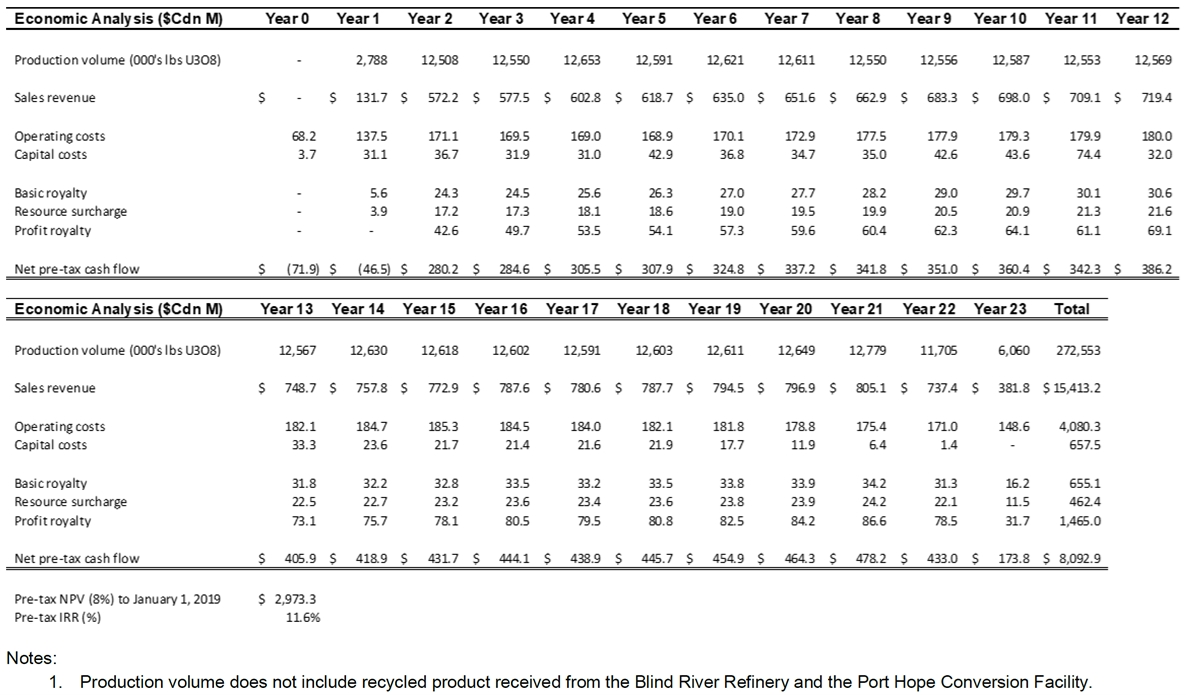
Cameco disclosed that its expectations and plans regarding McArthur River/Key Lake, including forecasts of operating and capital costs, net cash flow, production and mine life are forward-looking information and are based specifically on the risks and assumptions discussed on pages 4, 5 and 6 of the Cameco 2024 AIF. Cameco further discloses that it may change their operating or capital spending plans in 2025, depending upon uranium markets, Cameco's financial position, results of operation, or other factors. Cameco also discloses that estimates of expected future production, and capital and operating costs are inherently uncertain, particularly beyond one year, and may change materially over time.
Exploration, Drilling, Sampling, Data Quality and Estimates
Cameco states that there are no historical mineral resource estimates within the meaning of NI 43-101 to report. Cameco further states that the original McArthur River mineral resource estimates were derived from surface diamond drilling from 1980 to 1992. In 1988 and 1989, this drilling first revealed significant uranium mineralization. By 1992, Cameco had delineated the mineralization over a strike length of 1,700 metres at depths of between 500 to 640 metres. Following the drillhole results, development of an underground exploration project was undertaken in 1993.
Exploration
Drilling has been carried out extensively from both surface and underground to locate and delineate mineralization. Surface exploration drilling is initially used in areas where underground access is not available. The results are used to guide future underground exploration activities.
Drilling
Surface Drilling
Cameco has carried out surface drilling since 2004, to test the extension of mineralization identified from the historical surface drillholes, to test new targets along the strike and to evaluate the P2 trend northeast and southwest of the mine. Surface drilling since 2004 has extended the potential strike length to more than 2,700 metres.
Cameco has completed preliminary drill tests of the P2 trend at 300 metre intervals or less over 11.5 kilometres (5.0 kilometres northeast and 6.4 kilometres southwest of the McArthur River deposit) of the total 13.75 kilometres strike length of the P2 trend. Surface exploration drilling in 2015 focused on additional evaluation in the southern part of the P2 trend south of the P2 main mineralization.
Starting in 2016, exploration efforts shifted away from the P2 trend to the north part of the property.
Underground Drilling
In 1993, regulators approved an underground exploration program, consisting of shaft sinking, lateral development and drilling. The shaft was completed in 1994.
Cameco has drilled more than 1,280 underground drillholes since 1993 to get detailed information along 1,800 metres of strike length. The drilling was primarily completed from the 530 and 640 metre levels.
Other Data
In addition to the exploration drilling, geological data has been collected from the underground probe and grout, service, drain, freeze and geotechnical drill programs.
Recent Activity
Cameco states that underground exploration at McArthur River continued in 2024 with the main focus areas being infill drilling of Zones A and B.
Sampling, Analysis and Data Verification
Surface holes were generally drilled on sections spaced between 50 and 200 metres with 12 to 25 metres between holes on a section when necessary. Drilled depths average 670 metres.
The orientation of mineralization is variable but, in general, vertical holes generally intersect mineralization at angles of 25 to 45 degrees, resulting in true widths being 40 to 70% of the intersected width. Angled holes usually intercept mineralization closer to perpendicular, giving intercepts that are closer to true width.
Any stratigraphy exhibiting noteworthy alteration, structures or radiometric anomalies is split and sampled. Given that the vast majority of the deposit has been delineated from underground, few surface holes are currently sampled and used for mineral resource and reserve estimation purposes.
Underground samples
Cameco discloses that underground drilling is generally planned to provide close to true thicknesses results. All underground exploration holes are core drilled and gamma probed whenever possible. McArthur River uses a high-flux gamma probe designed and constructed by alphaNUCLEAR, a member of the Cameco group of companies. This high-flux gamma probe utilizes two Geiger Mϋller tubes to detect the amount of gamma radiation emanating from the surroundings. The count rate obtained from the high-flux probe is compared against chemical assay results to establish a correlation to convert corrected probe count rates into equivalent % U3O8 grades for use when assay results are unavailable. The consistency between probe data and chemical assays demonstrates that secular equilibrium exists within the deposit. A small portion of the data used to estimate mineral resources is obtained from assays, and in these cases, the core depth is validated by comparing the downhole gamma survey results with a hand-held scintillometer on core before it is logged, photographed, and then sampled for uranium analysis. Attempts are made to avoid having samples cross geological boundaries.
When sampled, the entire core from each sample interval is taken for assay or other measurements are used to characterize the physical and geochemical properties of the deposit. This reduces the sample bias inherent when splitting core. Core recovery throughout the deposit has generally been very good. However, in areas of poor core recovery uranium grade determination is generally based on radiometric probe results.
The typical sample collection process at McArthur River includes the following procedures:
•
marking the sample intervals on the core boxes, at the nominal 0.5 m sample length;
•
collection of the samples in plastic bags, taking the entire core;
•
documentation of the sample location, including assigning a sample number, and description of the sample, including radiometric values from a hand-held device; Cameco states that current sampling protocols dictate that all samples are collected and prepared under the close supervision of a qualified geoscientist in a restricted core processing facility.
•
bagging and sealing, with sample tags inside bags and sample numbers on the bags; and
•
placement of samples in steel drums for shipping.
Sample security
The core samples are collected and transferred from the core boxes to high-strength plastic sample bags, then sealed. The sealed bags are then placed in steel drums and shipped in compliance with the Transport of Dangerous Goods regulations with tamper-proof security seals. Chain of custody documentation is present from inserting samples into steel drums to the final delivery of results by the Saskatchewan Research Council Geoanalytical Laboratories ("SRCGL").
All samples collected are prepared and analysed under the close supervision of qualified personnel at SRCGL, which is a restricted access laboratory licenced by the CNSC.
Analysis
Cameco states that drill core assay sample preparation is performed at SRCGL's main laboratory, which is independent of the participants of the MRJV. It involves jaw crushing to 80% passing at less than 2 mm and splitting out a 100 – 200 g sub-sample using a riffle splitter. The sub-sample is pulverized to 90% at less than 106 microns using a puck and ring grinding mill. The pulp is then transferred to a labelled plastic snap-top vial. Assaying by SRC involved digesting an aliquot of pulp in a 100 ml volumetric flask in concentrated 3:1 HCI:HNO3, on a hot plate for approximately one hour. The lost volume is then made up using deionized water prior to analysis by ICP-OES. Instruments used in the analysis are calibrated using certified commercial solutions. This method is ISO/IEC 17025:2017 accredited by the Standards Council of Canada.
Quality Control and Data Verification
As set forth above, the Company is not in a position to verify quality control and data verification measures at the McArthur River Operation. The following information regarding quality control and data verification is solely based on Cameco's disclosure in the Cameco 2024 AIF.
Cameco states that the quality assurance and quality control procedures used during early drilling programs were typical for the time. Many of the original signed assay certificates from surface drilling are available and have been reviewed by Cameco geologists.
More recent sample preparation and assaying was completed under the close supervision of qualified personnel at SRC and includes preparing and analysing standards, duplicates and blanks. At least two standards are analyzed for each 40-sample batch. They also include a pulp repeat and one split sample repeat with every group. Samples that fail quality controls are re-analyzed.
Cameco disclosed that, in 2013, McArthur River implemented an SQL server based centralized geological data management system to manage all drillhole and sample related data. All core logging, sample collection, downhole probing and sample dispatching activities are carried out and managed within this system. All assay, geochemical and physical analytical results obtained from the external laboratory are uploaded directly into the centralized database, thereby mitigating the potential for manual data transfer errors. The database used for the current mineral resource and mineral reserve estimates was validated by Cameco qualified geoscientists.
Additional quality control measures procedures taken include:
•
surveyed drillhole collar coordinates and downhole deviations are entered into the database and visually validated and compared to the planned location of the holes;
•
comparison of the information in the database against the original data, including paper logs, assay certificates and original probing data files as required;
•
validation of core logging information in plan and section views, and review of logs against photographs of the core;
•
checking for data errors such as overlapping intervals and out of range values;
•
radiometric probes undergo annual servicing and re-calibration as well as additional checks including control probing to ensure precision and accuracy of the probes. Servicing and re-calibration of the probes were performed to support 2024 drilling activities. Control probing results in 2024 have been within acceptable tolerances; and
•
validating uranium grades comparing radiometric probing, core radioactivity measurements and chemical assay results. New measurement data collected in 2023 was reviewed. No issues were observed.
Cameco states that no mineral resource estimation work was performed in 2024. Quality control and data verification activities described above will be finalized prior to the next resource estimate update.
Since the start of commercial production, Cameco has regularly compared information collected from production activities, such as freeze holes, raise bore pilot holes, radiometric scanning of scoop tram buckets and mill feed sampling, to the drillhole data. Cameco also compares the uranium block model with mine production results on a quarterly basis to ensure an acceptable level of accuracy is maintained.
Results in 2024 were within acceptable tolerances.
Cameco states that company geoscientists, including a qualified person as such term is defined in NI 43-101, have witnessed or reviewed drilling, core handling, radiometric probing, logging and sampling facilities used at the McArthur River operation and consider the methodologies to be satisfactory and the results representative and reliable. Cameco further states that there has been no indication of significant inconsistencies in the data used or verified nor any failures to adequately verify the data.
Cameco has stated that it is satisfied with the quality of data and considers it valid for use in the estimation of mineral resources and reserves for McArthur River. Comparison of the actual mine production with the expected production supports this opinion.
Mineral Reserve and Resource Estimates
The following are mineral reserve and mineral resource estimates for McArthur River as disclosed by Cameco in the Cameco 2024 AIF as at December 31, 2024.
Mineral Reserves
(tonnes in thousands; pounds in millions; on a 100% basis)
|
|
|
|
|
|
|
|
|
|
|
|
Proven |
Probable |
Total Mineral Reserves |
|
Property |
Tonnes |
Grade % U3O8 |
Content (lbs U3O8) |
Tonnes |
Grade % U3O8 |
Content (lbs. U3O8) |
Tonnes |
Grade % U3O8 |
Content (lbs. U3O8) |
Metallurgical Recovery (%) |
McArthur River |
1,970.3 |
6.81 |
295.8 |
520.4 |
5.56 |
63.7 |
2,490.7 |
6.55 |
359.6 |
99.2 |
Note that the estimates in the above table:
•
Use a constant dollar average uranium price of approximately US$63.00 per pound U3O8.
•
Are based on exchange rates of US$1.00 US = $1.28.
Cameco reports mineral reserves as the quantity of contained ore supporting the current mining plan and provides an estimate of the metallurgical recovery. The estimate of the amount of valuable product that can be physically recovered by the metallurgical extraction process is obtained by multiplying the quantity of contained metal (content) by the planned metallurgical recovery percentage. The content in the table above is before accounting for estimated metallurgical recovery.
Mineral Resources
(tonnes in thousands; pounds in millions; on a 100% basis)
|
|
|
|
|
|
|
|
|
|
|
|
Measured |
Indicated |
|
Inferred |
Property |
Tonnes |
Grade % U3O8 |
Content (lbs U3O8) |
Tonnes |
Grade % U3O8 |
Content (lbs. U3O8) |
Total M+I Content
(lbs U3O8)
|
Tonnes |
Grade % U3O8 |
Content (lbs. U3O8) |
McArthur River |
71.8 |
2.28 |
3.6 |
60.3 |
2.31 |
3.1 |
6.7 |
36.4 |
2.95 |
2.4 |
Note that the estimates in the above table:
•
do not include amounts that have been identified as mineral reserves;
•
do not have demonstrated economic viability; and
•
totals may not add due to rounding.
Key Assumptions, Parameters and Methods
Cameco discloses the following key assumptions and parameters in connection with the above mineral reserve and mineral resource estimates:
•
mineral resources and mineral reserves have been estimated based on the use of raise bore and blasthole stoping methods grades of U3O8 were obtained from chemical assaying of drill core or from equivalent % U3O8 grades obtained from radiometric probing results.
•
In areas of poor core recovery (usually < 75%) or missing samples, the grade was determined from probing
•
when not measured, densities are determined using formulas based on the relation between density measurements of drill core and chemical assay grades
•
reasonable expectation for eventual economic extraction of the mineral resources is based on a uranium price of $64 (US) per pound U3O8, anticipated exchange rates, mining and process recoveries, production costs, royalties and mineralized area tonnage, grade, and spatial continuity considerations
•
mineral resources have been estimated at a minimum mineralized thickness of 1.0 metre and at a minimum grade of 0.50% U3O8
•
the reference point at which mineral reserves are defined is when the ore is delivered to the Key Lake mill
•
mining rates and operating costs assume annual packaged production of at least 18 Mlbs
•
operating costs used in the cut-off calculation are based on 2025 current or estimated costs
•
mineral reserves assume a 99.4% planned mine recovery and have allowances for expected waste (34.4% average) and backfill (5.7% average) dilution as part of the normal mining extraction process
•
reported mineral reserves are based on pounds U3O8 recovered per excavation, translating into an average cut-off grade of 0.88% U3O8
•
an average uranium price of $63.00 (US) per pound with a $1.00 (US) = $1.28 (Cdn) fixed exchange rate was used to estimate the mineral reserves
•
reported mineral reserves are not adjusted for the estimated mill recovery of 99.2%
Cameco discloses the following key methods in connection with the above mineral reserve and mineral resource estimates:
•
the models were created from the geological interpretation in section views and in 3-dimensions from surface and underground drillhole information
•
mineral resources were estimated using 3-dimensional block models. Ordinary kriging and inverse distance squared methods were used to estimate the grade and density
•
only measured and indicated mineral resources are considered for conversion to mineral reserves
•
mineral reserves have been estimated on the basis of designed raise bore and blasthole stopes in conjunction with freeze curtains with positive economics from the estimated recovered uranium
•
dilution and mining recovery parameters are assigned to each excavation to determine diluted and recovered ore tonnes and metal content
•
revenue from each excavation is based on recovered (packaged) uranium multiplied by the metal price less royalties
•
all planned mine zones have been assessed to ensure sufficient recoverable pounds are present to pay for capital and fixed operating costs
•
excavations that are not profitable based on the cut-off calculation are removed from the mineral reserves The information set out below has been sourced from the Cigar Lake Technical Report and the Cameco 2024 AIF, copies of which are available under Cameco's profile on SEDAR+.
CIGAR LAKE
Readers should consult these documents for further information regarding Waterbury Lake / Cigar Lake.
The Company acquired the Cigar Lake Royalty on May 7, 2021, pursuant to an amended and restated royalty purchase agreement, dated effective February 10, 2021 (the "Royalty Purchase Agreement") among the Company, Reserve Minerals Inc. and Reserve Industries Corp. (collectively, the "Royalty Vendors").
Project Description, Location and Access
The Cigar Lake underground mine began development in 2005, but development was delayed due to water inflows. In October 2014, the McClean Lake mill produced the first uranium concentrate from ore mined at the Cigar Lake operation. Commercial production was declared in May 2015.
The Cigar Lake mine site is located near Waterbury Lake, approximately 660 kilometres north of Saskatoon. The mine site is in close proximity to other uranium production operations: McClean Lake mill is 69 kilometres northeast by road and McArthur River mine is 46 kilometres southwest by air from the mine site.
Access to the property is by an all-weather road and by air. Site activities occur year-round, including supply deliveries. There is an unpaved airstrip and air terminal east of the mine site.
Saskatoon, a major population centre south of the Cigar Lake deposit, has highway and air links to the rest of North America.
Cameco states that the Cigar Lake Joint Venture (the "CLJV") acquired the right to use and occupy the lands necessary to mine the deposit under a surface lease agreement with the province of Saskatchewan. The lease covers approximately 715 hectares and expires in May 2044. The CLJV has the right to mine the deposit under ML 5521, granted to the CLJV by the province of Saskatchewan. The lease covers 308 hectares and expires on November 30, 2031. The CLJV has the right to renew the lease for further 10-year terms.
Cameco states that a mineral claim gives the CLJV the right to explore for minerals and to apply for a mineral lease. There are 39 mineral claims totaling 96,102 hectares, adjoining the mineral lease and surrounding the site. The mineral claims are in good standing until 2026 or later.
The Cigar Lake Royalty does not apply to the entirety of the project lands. However, the Company believes that the Cigar Lake Royalty applies to substantially all areas of the project underlying the existing mine and areas underlying estimates of mineral reserve and mineral resource.
Environmental, social and community factors
The climate is typical of the continental sub-arctic region of northern Saskatchewan. Summers are short and cool even though daily temperatures can sometimes reach above 30°C. The mean daily temperature for the coldest month is below -20°C, and winter daily temperatures can reach below -40°C.
The deposit is 40 kilometres west of the eastern margin of the Athabasca Basin in northern Saskatchewan. The topography and environment are typical of the taiga forested lands in the Athabasca Basin. This area is covered with 30 to 50 metres of overburden. Vegetation is dominated by black spruce and jack pine. There is a lake known as "Cigar Lake" which, in part, overlays the deposit.
The closest inhabited site is Points North Landing, 56 kilometres northeast by road. The community of Wollaston Lake is approximately 80 kilometres by air to the east of the mine site. Athabasca Basin community resident employees and contractors fly to the mine site from designed pick-up points. Other employees and contractors fly to site from Saskatoon with pick-up points in Prince Albert and La Ronge.
Geological Setting, Mineralization, and Deposit Types
The deposit is at the unconformity contact separating late Paleoproterozoic to Mesoproterozoic sandstone of the Athabasca Group from middle Paleoproterozoic metasedimentary gneiss and plutonic rocks of the Wollaston Group. The Key Lake, McClean Lake and Collins Bay deposits all have a similar structural setting. While Cigar Lake shares many similarities with these deposits, it is distinguished by its flat-lying geometry, size, the intensity of its alternation process, the high degree of associated hydrothermal clay alteration and the presence of massive, extremely rich, high-grade uranium mineralization.
Cigar Lake's geological setting is similar to McArthur River's: the permeable sandstone, which overlays the deposit and basement rocks, contains large volumes of water at significant pressure. Unlike McArthur River, however, the deposit is flat-lying with the ore zone being overlain by variably developed clay alteration as opposed to silica enrichment.
The Cigar Lake deposit has the shape of a flat- to cigar-shaped lens and is approximately 1,950 metres in length, 25 to 100 metres in width, and ranges up to 15.7 metres thick, with an average thickness of about 5.4 metres. It occurs at depths ranging between 410 to 450 metres below the surface. The eastern part of Cigar Lake is approximately 670 metres long by 100 metres wide and the western part is approximately 1,280 metres long by 75 metres wide.
The deposit has two distinct styles of mineralization:
•
high-grade mineralization at the unconformity which includes all of the mineral resources and mineral reserves; and
•
low-grade, fracture controlled, vein-like mineralization which is located either higher up in the sandstone or in the basement rock mass.
The uranium oxide in the form of uraninite and pitchblende occurs as disseminated grains in aggregates ranging in size from millimetres to decimetres, and as massive lenses of mineralization up to a few metres thick in a matrix of sandstone and clay. Coffinite (uranium silicate) is estimated to form less than 3% of the total uranium mineralization.
Geochemically, the deposit contains quantities of the elements nickel, copper, cobalt, lead, zinc, molybdenum and arsenic, but in non-economic concentrations. Higher concentrations of these elements are associated with massive pitchblende or massive sections of arseno-sulphides.
Cigar Lake is an unconformity-associated uranium deposit. Deposits of this type are believed to have formed through an oxidation-reduction reaction at a contact where oxygenated fluids meet with reducing fluids. The geological model was confirmed by surface drilling, development, and production activities.
About the Cigar Lake Operation
Cigar Lake is a developed property with sufficient surface rights to meet current mining operation needs. Cameco is currently mining in the CLMain ore body.
Infrastructure
Surface facilities are 490 metres above sea level. The site includes:
|
|
• an underground mine with two shafts
• access road joining the provincial highway and McClean Lake
• site roads and site grading
• employee residence and construction camp
• Shaft No. 1 and No. 2 surface facilities
• freeze plants and brine distribution equipment
• waste rock stockpiles and aggregate processing infrastructure
• garbage disposal landfill
• administration, maintenance, and warehousing facilities
|
• water supply, storage and distribution for industrial water, potable water and fire suppression
• propane, diesel and gasoline storage and distribution
• electrical power substation and distribution
• compressed air supply and distribution
• mine water storage ponds and water treatment
• sewage collection and treatment
• surface and underground pumping system installation
• emergency power generating facilities
|
The Cigar Lake mine site contains all the necessary services and facilities to operate a remote underground mine, including personnel accommodation, access to water, airport, site roads and other necessary buildings and infrastructure.
Water, Power and Heat
Waterbury Lake, which is nearby, provides water for the industrial activities and the camp. The site is connected to the provincial electricity grid and has standby generators in case there is an interruption in grid power.
Cigar Lake operates throughout the year despite cold winter conditions. During the winter, Cameco uses propane-fired burners to heat the fresh air necessary to ventilate the underground workings.
Employees
Employees are recruited with preference given to residents of northern Saskatchewan.
Mining
The Cigar Lake deposit presents unique challenges that are not typical of traditional hard or soft rock mines. These challenges are the result of mining in or near high-pressure ground water in challenging ground conditions with significant radiation concerns due to the high-grade uranium and elements of concern in the orebody with respect to water quality. Cameco takes significant steps and precautions to reduce the risks. Cameco further states that mine designs and the mining method are selected based on their ability to mitigate hydrological, radiological, and geotechnical risks. Operational experience gained since the start of production has resulted in a significant reduction in risk. However, there is no guarantee that Cameco's efforts to mitigate risk will be successful.
Mining Methods
At Cigar Lake, the permeable sandstone which overlays the deposit and basement rocks, contains large volumes of water at significant pressure. Before Cameco begins mining, they freeze the ore zone and surrounding ground. Cameco uses the jet boring system (JBS) method to mine the Cigar Lake deposit.
Artificial Ground Freezing ("AGF")
The current method of mining the Cigar Lake orebody uses progressive block freezing of portions of the mineralized zone and adjacent host rock. Freezing the orebody reduces the risk of potential inflow of groundwater and release of radon gas into the workplace, while increasing cavity stability and standup time during mining. The freezing strategy is to bulk freeze the ore zone and the surrounding area prior to start of mining in a given area. Frozen cavity criteria are applied to each cavity prior to mining to ensure it meets the minimum standard prior to excavation.
This AGF system freezes the deposit and surrounding rock to between -5°C and -25°C in two to four years, depending on freeze pipe geometry and ground properties such as water content and thermal conductivity.
JBS Mining
As a result of the unique geological conditions at Cigar Lake, they are unable to utilize traditional mining methods that require access above the ore, which necessitated the development of a non-entry mining method specifically adapted for this deposit. After many years of test mining, Cameco selected jet boring, a non-entry mining method, and it has been used since Cameco began mining in 2014. This method involves:
•
drilling a pilot hole into the frozen orebody, inserting a high-pressure water jet and cutting a cavity out of the frozen ore;
•
collecting the ore and water mixture (slurry) from the cavity and pumping it to storage (sump storage), allowing it to settle;
•
using a clamshell, transporting the ore from sump storage to an underground grinding and processing circuit;
•
once mining is complete, filling each cavity in the orebody with concrete; and
•
starting the process again with the next cavity.

Figure 1 - Jet Boring Technique - Source - Cameco 2024 AIF
This is a non-entry method, which means mining is carried out from headings in the basement rock below the deposit, so employees are not exposed to the ore. Cameco discloses that this mining approach is highly effective at managing worker exposure to radiation levels. It further discloses that, combined with ground freezing and the cuttings collection and hydraulic conveyance system, jet boring reduces radiation exposure to acceptable levels that are below regulatory limits.
The mine equipment fleet at Cigar Lake is currently comprised of three JBS units plus other equipment to support mine development, drilling and other services. Two additional scooptrams, plus some smaller ancillary equipment, will be added to the current equipment fleet to meet the production and development requirements for the remainder of the mine life.
Cameco has divided the orebody into production panels. At least three production panels need to be frozen at one time to achieve the full annual production rate of 18 Mlbs U3O8. One JBS machine will be located below each frozen panel and the three JBS machines required are currently in operation. Two machines actively mine at any given time while the third is moving, setting up, or undergoing maintenance.
Mine Development
Mine development for construction and operation uses two basic approaches: drill and blast and mechanical excavation with conventional ground support is applied in areas with a competent rock mass, and New Austrian Tunnelling Method ("NATM") principles in areas of weak or poor quality rock mass. Most permanent areas of the mine, which contain the majority of the installed equipment and infrastructure, are hosted in competent rock mass and are excavated and supported conventionally. The production tunnels immediately below the orebody are primarily in poor, weak rock mass and are excavated and supported using NATM. NATM was adopted as the primary method of developing new production cross-cuts, replacing the former Mine Development System ("MDS").
NATM, as applied at Cigar Lake, involves a multi-stage sequential mechanical excavation, extensive external ground support and a specialized shotcrete liner. The liner system incorporates yielding elements which permit controlled deformation required to accommodate additive pressure from mining and ground freezing activities. The production tunnels have an inside diameter of five metres and are approximately circular in profile.
Cameco plans the mine development to take place away from known groundwater sources whenever possible. In addition, Cameco assesses all planned mine development for relative risk and applies extensive additional technical and operating controls for all higher risk development.
In order to successfully achieve the planned production schedule, Cameco must continue to successfully transition into new mining areas, which includes mine development and investment in critical support infrastructure. If development work is delayed for any reason, including availability of storage capacity for waste rock, Cameco's ability to meet their future production plans may be impacted.
Mine Access
There are two main levels in the mine: the 480 and 500 metre levels. Both levels are located in the basement rocks below the unconformity. Mining is conducted from the 480-metre level which is located approximately 40 metres below the ore zone. The main underground processing and infrastructure facilities are located on this level. The 500-metre level is accessed via a ramp from the 480-metre level. The 500-metre level provides for the main ventilation exhaust drift for the mine, the mine dewatering sump and additional processing facilities.
All construction required for production has been completed.
Processing
Cigar Lake ore is processed at two locations:
Crushing and grinding of the ore is conducted underground at Cigar Lake, while leaching, purification and final yellowcake production and packaging occurs at the McClean Lake mill. The ore is trucked as a thickened finely ground slurry from Cigar Lake to the McLean Lake mill in purpose-built containers identical to those used to transport McArthur River ore slurry to the Key Lake mill.
Recovery and Metallurgical Testing
Extensive metallurgical test work was performed on core samples of Cigar Lake ore from 1992 to 1999. Samples used for the metallurgical test work during this period may not have been representative of the deposit as a whole. Additional test work completed by Orano in 2012 with drill core samples verified that a high uranium recovery rate could be achieved regardless of the variability of the ore. Test work also concluded that more hydrogen gas evolution took place than previously anticipated, which resulted in safety related modifications being implemented in the leaching circuit. Leaching modifications began in 2013 and were completed in 2014, with mill start-up in September 2014. Since 2014, the McClean Lake mill has processed on a daily basis a range of ore grades, at times in excess of 28% U (33% U3O8).
Additional testing was completed by Orano in 2018 and 2019 on samples from CLExt. The test work, combined with ongoing optimization and operating experience at the McClean Lake mill, confirmed that no modifications would be required to the mill circuits to process CLExt ore. Tailings neutralization and aging tests also completed during this period verified that the current operating practices at the McClean Lake mill will produce tailings that are stable over the long-term.
Based on the test results and past mill performance, an overall uranium recovery of 98.8% for CLMain and 98.5% for CLExt is expected for the remainder of the mine life.
Specific ore induced risks include:
•
Elevated arsenic concentration in the mill feed may result in increased leaching circuit solution temperatures. This could result in a reduction in mill feed rates and additional capital and operating expense to modify the leaching process.
•
Hydrogen evolution rates in leaching may exceed the design capacity of the hydrogen gas control system resulting in reduced leach feed rates. Additional capital expense may be required to increase the capacity of the hydrogen gas control system.
Tailings
The Cigar Lake site does not have a TMF. The ore is processed at the McClean Lake mill. See Toll milling agreement below for a discussion of the McClean Lake TMF.
Waste Rock
The waste rock piles are separated into three categories:
•
clean rock – will remain on the mine site for use as aggregate for roads, concrete backfill and future site reclamation;
•
mineralized waste (>0.03% U3O8) – will be disposed of underground at the Cigar Lake mine; and
•
waste with acid-generating potential – temporarily stored on lined pads.
The latter two stockpiles are contained on lined pads; however, no significant mineralized waste has been identified during development to date.
Production
Cameco's mine plan is disclosed to be designed to extract all of the current Cigar Lake mineral reserves. The following is a general summary of the mine plan production schedule parameters on a 100% basis for these mineral reserves:
Total mill production
•
190.2 Mlbs U3O8, based on current mineral reserves and an overall milling recovery of 98.8% for CLMain and 98.5% for CLExt
•
Full annual production of 18 Mlbs U3O8.
Total mine production
Average annual mine production
•
115 to 150 tonnes per day during peak production, depending on ore grade.
Average mill feed grade
Total packaged production from Cigar Lake in 2024 was 16.9 Mlbs U3O8 compared to 15.1 Mlbs U3O8 in 2023. In 2024, Cameco was successful in catching up on development work that had been deferred from 2021. In 2024, lower productivity from the mine was primarily the result of a lower production rate at the McClean Lake mill. At various times during the year, the mill was impacted by ore quality variances, like lower ore grades and/or higher arsenic levels, and by unplanned maintenance at the McClean Lake mill. The majority of downtime occurred in the first and third quarters of the year.
Cameco has disclosed that it expects to produce at the licensed rate of 18 Mlbs (100% basis) per year in 2025.
Cameco further discloses that inflation, the availability of personnel with the necessary skills and experience, and the impact of supply chain challenges on the availability of materials and reagents carry with them the risk of not achieving Cameco's production plans, production delays and increased costs in 2025 and future years.
Decommissioning and Financial Assurances
An updated preliminary decommissioning plan for Cigar Lake was submitted in 2017 and 2018 as part of the regular five-year update schedule. Prior to revising the letters of credit, approval of the updated plan is required from the province and CNSC staff as well as formal approval from the CNSC through a Commission proceeding. The necessary approvals were received. The document included Cameco's estimated cost for implementing the plan and addressing known environmental liabilities.
The reclamation and remediation activities associated with waste rock and tailings at the McClean Lake mill are covered by the plans and cost estimates for this facility.
In 2022, as part of the required five-year update schedule, Cameco submitted a revised preliminary decommissioning estimate for Cigar Lake, which is currently awaiting CNSC review and approval.
Water Inflow and Mine/Mill Development
Cigar Lake Water Inflow Incidents
From 2006 through 2008, the Cigar Lake Project suffered several setbacks as a result of three water inflow incidents. The first occurred in 2006, resulting in the flooding of the then partially completed Shaft No. 2. The two subsequent incidents involved inflows in the mine workings connected to Shaft No. 1 and resulted in flooding of the mine workings. Cameco executed recovery and remediation plans for all three inflows. Re-entry into the main mine workings was achieved in 2010 and work to secure the mine was completed in 2011. The mine is fully remediated and entered commercial production in 2015.
Lessons learned from the inflows have been applied to the subsequent mine plan and development to reduce the risk of future inflows and improve our ability to manage them should they occur.
Increased Pumping Capacity
In 2012, Cameco increased the installed mine dewatering capacity to 2,500 cubic metres per hour. Mine water treatment capacity has been increased to 2,550 cubic metres per hour, and regulatory approval to discharge routine and non-routine treated water to Seru Bay is in place. Cameco disclosed that, as a result, it believes the operation has sufficient pumping, water treatment and surface storage capacity to handle the estimated maximum inflow.
Current Status of Development
Construction of all major permanent underground development and process facilities required for the duration of the mine life is complete. A number of underground access drifts and production crosscuts remain to be driven as part of ongoing mine development to sustain production rates.
On surface, construction of all infrastructure associated with CLMain required to achieve nameplate capacity has been completed, while infrastructure associated with CLExt remains to be installed.
Underground mine development continued in 2024. Cameco completed development of two production crosscuts; one in the eastern portion and one in the western portion of CLMain. Development also continued for access to the CLExt orebody.
Underground mine development continued in 2024. Cameco completed development of two production crosscuts; one in the eastern portion and one in the western portion of CLMain. Development also continued for access to the CLExt orebody.
During 2024, Cameco has:
•
produced from and continued development work in the CLMain orebody in alignment with our long-term production plan;
•
successfully executed a planned 28-day annual maintenance outage;
•
fully completed the ground freezing program for the CLMain orebody by finishing the outfitting of the final freeze holes;
•
began physical surface work for development of the CLExt portion of the orebody;
•
completed an expansion of the waste rock storage pads to support the remaining mine development, including development in both the CLMain and CLExt portions of the orebody
In 2025, Cameco plans to:
•
continue production and development activities in CLMain as well as development drifts to access CLExt in alignment with our long-term mine plan;
•
continue earthworks and construction of surface services to support the expansion of freeze activities required for future production from CLExt;
Toll Milling Agreement
The McClean Lake joint venture agreed to process Cigar Lake's ore slurry at its McClean Lake mill, according to the terms in its agreement with the CLJV: JEB toll milling agreement (effective January 1, 2002, and amended and restated effective November 30, 2011), dedicating the necessary McClean Lake mill capacity to process and package 18 Mlbs of Cigar Lake uranium concentrate annually.
The CLJV pays a toll milling fee and its share of milling expenses.
The McClean Lake mill started receiving Cigar Lake ore in March 2014 and produced its first drum of Cigar Lake yellowcake in October 2014. All of Cigar Lake's ore slurry from current mineral reserves will be processed at the McClean Lake mill, operated by Orano. Orano does not expect any new major infrastructure is necessary at McClean Lake mill in order to receive and process Cigar Lake's mineral reserves. Minor mill upgrades, in the spirit of continual improvement, related to throughput optimisation and reagent efficiency continue to be implemented.
The McClean Lake joint venture commenced work in 2012 to optimize its TMF to accommodate all of Cigar Lake's current mineral reserves. This optimization included periodic raising of a bentonite amended liner, the most recent of which was completed in 2023.
In 2022, Orano received regulatory approval for the expansion of the JEB TMF.
The expansion will be achieved by the continued construction of an engineered embankment and placement of a bentonite amended liner. Following the staged expansion, the TMF is expected to have the capacity to receive tailings from processing all of Cigar Lake's current mineral reserves.
The McClean Lake joint venture is responsible for all costs of decommissioning the McClean Lake mill. As well, the joint venture is responsible for the liabilities associated with tailings produced from processing Cigar Lake ore at the McClean Lake mill.
The collective agreement with unionized employees at the McClean Lake mill ends on May 31, 2025.
Regulatory Approvals
There are three key permits that are required to operate the mine.
Operating and Processing Licences
Federally, Cigar Lake holds a "Uranium Mine Licence" from the CNSC with a corresponding Licence Conditions Handbook (LCH). Provincially, Cigar Lake holds an "Approval to Operate Pollutant Control Facilities" from the SMOE and a "Water Rights Licence to Use Surface Water and Approval to Operate Works" from the Saskatchewan Watershed Authority.
The CNSC licence expires on June 30, 2031. The SMOE approval was extended to January 31, 2024 and then renewed in 2024 and the current approval now expires in 2030. The Saskatchewan Watershed Authority water rights licence was obtained in 1988 and was amended in 2023 and now expires in 2028.
The current Cigar Lake LCH authorizes an annual production rate up to 18 Mlbs per year. The CNSC licence and LCH for the McClean Lake operation, issued by the CNSC in 2017, authorizes the production of up to 24 Mlbs U3O8 annually. The licence and LCH were amended in 2022 to authorize the expansion of the JEB TMF.
Approvals, issued by the SMOE pursuant to the Saskatchewan Environmental Assessment Act, for Cigar Lake are based on estimated annual production rates of 18 Mlbs U3O8 for CLMain and 6 Mlbs U3O8 for CLExt. As such, it is anticipated that the planned annual production rate of 18 Mlbs U3O8 for CLExt represents a change to the approved development that will require Ministerial Approval. Cameco plans to submit the information required to obtain this approval in 2025.
Water Treatment / Effluent Discharge System
The mine dewatering system was designed and constructed to handle both routine and non-routine water treatment and effluent discharge, and it has been approved and licenced by the CNSC and the SMOE.
The mine began discharging treated water to Seru Bay in August 2013 following the receipt of regulatory approvals.
The Cigar Lake orebody contains elements of concern with respect to the water quality and the receiving environment. The distribution of elements such as arsenic, molybdenum, selenium and others is non-uniform throughout the orebody, and this can present challenges in attaining and maintaining the required effluent concentrations.
There have been ongoing efforts to optimize the current water treatment process and water handling systems to ensure acceptable environmental performance.
Operating and Capital Costs
The following summary of the Cigar Lake operating and capital cost estimates for the remaining life of mine, stated in constant 2024 dollars and reflecting a forecast life-of-mine mill production of 190.2 Mlbs.
|
|
|
Operating Costs ($Cdn million) |
|
Total
(2025 – 2036)
|
Cigar Lake Mining |
|
|
Site administration |
|
$648.6 |
Mining costs |
|
$965.8 |
Process |
|
$320.6 |
Corporate overhead |
|
$183.9 |
Total mining costs |
|
$2,118.9 |
McClean Lake Milling |
|
|
Administration |
|
$513.8 |
Milling costs |
|
$1,119.8 |
Corporate overhead |
|
$94.4 |
Toll milling |
|
$170.9 |
Total milling costs |
|
$1,898.9 |
Total operating costs |
|
$4,017.8 |
Total operating cost per pound U3O8 |
|
$21.12 |
Note: Presented as total cost to the CLJV (100% basis)
Operating costs consist of annual expenditures at Cigar Lake to mine the ore, treat the ore underground, including crushing, grinding and density control, followed by pumping the resulting slurry to surface for transportation to McClean Lake.
The operating costs at McClean Lake consist of the cost of offloading and leaching the Cigar Lake ore slurry into uranium solution and further processing into calcined U3O8 product.
|
|
|
Capital Costs ($Cdn million) |
|
Total
(2025 – 2036)
|
Cigar Lake Mine Development |
|
$378.2 |
Cigar Lake Mine Capital |
|
|
Underground infrastructure and production Tunnel outfitting |
|
$302.1 |
Ground freezing system |
|
$146.8 |
Other mine capital |
|
$214.0 |
Total mine capital |
|
$662.9 |
Tailings Expansion |
|
$52.6 |
Other mill capital |
|
$230.8 |
Total mill capital |
|
$283.4 |
Total capital costs |
|
$1,324.5 |
Note: Presented as total cost to the CLJV (100% basis)
Estimated capital costs to the CLJV include sustaining capital for Cigar Lake and McClean Lake mill, as well as underground development at Cigar Lake to bring mineral reserves into production. Overall, the largest capital cost at Cigar Lake is surface freeze drilling and brine distribution infrastructure. Other significant capital includes tunnel outfitting and mine development costs.
The expectations and plans regarding Cigar Lake, including forecasts of operating and capital costs, production and mine life are forward-looking information, and are based specifically on risks and assumptions discussed in the Cameco 2024 AIF. It further disclosed that it may change operating or capital spending plans in 2025, depending on uranium markets, its financial position, results of operations and other factors. Estimates of expected future production and capital and operating costs are inherently uncertain, particularly beyond one year, and may change materially over time.
Exploration, Drilling, Sampling, Data Quality and Estimates
There are no historical estimates within the meaning of NI 43-101 to report. The Cigar Lake uranium deposit was discovered in 1981 by surface exploration drilling. Cameco disclosed that it focuses most of its exploration activities on mineral lease ML 5521. Orano is responsible for exploration activity on the 38 surrounding mineral claims. The data from the exploration program on the 39 mineral claims is not part of the database used for the estimate of the mineral resources and mineral reserves at Cigar Lake.
Exploration
After the 2006 water inflow events, it was recognized that more detailed geophysical information in the immediate deposit area was required. Since 2006, a number of geophysical surveys over the Cigar Lake deposit provided additional knowledge on geological structures and fault zones. In the fall of 2007, a supplementary geophysical program was conducted over a portion of the CLMain area of the deposit to identify major structures within the sandstone column. In 2015, Cameco conducted a geotechnical drill program consisting of nine surface diamond holes (drilled to a vertical depth of 525 metres) over the western portion of the CLMain area of the deposit. Downhole cross-well seismic was done within these boreholes to image major fault structures and geotechnical characteristics of this portion of the deposit.
This information has since been incorporated into Cameco's geological models. These are regularly updated as additional information is collected, allowing for better mine planning and mitigation of potential risk.
Drilling
Surface Drilling – Mineral Lease
The last diamond drillhole of the 1981 program was located south of Cigar Lake and was the discovery hole for the Cigar Lake uranium deposit. The deposit was subsequently delineated by surface drilling between 1982 and 1986, followed by several small drilling campaigns to gather geotechnical and infill data between 1986 and 2007. Additional drilling campaigns were conducted by Cameco after 2007 which targeted a broad range of technical objectives, including geotechnical, geophysical, delineation and ground freezing. Since 2012, diamond drilling managed by Cameco has mainly focused on underground geotechnical and surface ground freezing programs on CLMain along with continued delineation drilling on CLExt. Drill depths for surface delineation holes range from approximately 460 to 550 metres.
Delineation drilling in the CLMain zone was originally completed at a nominal drillhole fence spacing of 25 to 50 metres (east-west), with holes at 20 to 25 metres (north-south) spacing on the fences. Since then, the entire portion of the CLMain deposit has had surface freeze holes installed at a nominal 7 x 7 metre pattern.
The CLExt zone was historically drilled at a nominal drillhole fence spacing of 200 metres, with holes at 20 metre spacing on the fences. Subsequent drill programs occurring between 2011 and 2023 have since reduced the drillhole spacing down to approximately 15 x 15 metres in local areas of the deposit.
Drilling results have been used to delineate and interpret the 3-dimensional geometry of the mineralized areas, the lithostructural settings, the geotechnical conditions, and to estimate the distribution and content of uranium and other elements.
Surface freeze hole drilling over the CLMain zone, ongoing since 2012, has been completed. Freeze hole drilling over the CLExt zone is planned to begin in 2026.
Underground Drilling – Mineral Lease
Diamond drilling from underground is primarily to ascertain rock mass characteristics in advance of development and mining. Cigar Lake Mining Corporation, the previous operator, and Cameco have conducted underground geotechnical drilling since 1989. A total of 522 underground geotechnical holes have been completed on CLMain and 51 have been completed on CLExt.
At one time, freeze holes were drilled from underground into the deposit for the purpose of freezing the ground prior to mining. No underground freeze holes have been drilled since 2006. None of them are currently used for freezing or for mineral resource and reserve estimation purposes.
Sampling, Analysis and Data Verification
Sampling
Vertical surface drilling generally represents the true thickness of the zone given the flat-lying mineralization. All holes are core drilled and gamma probed whenever possible. Cigar Lake uses a high-flux gamma probe designed and constructed by alphaNUCLEAR, a member of the Cameco group of companies. This high-flux gamma probe utilizes two Geiger Mϋller tubes to detect the amount of gamma radiation emanating from the surroundings. The count rate obtained from the high-flux probe is compared against chemical assay results to establish a correlation to convert corrected probe count rates into equivalent % U3O8 grades for use when assay results are unavailable.
The consistency between probe data and chemical assays demonstrates that secular equilibrium exists within the deposit. Approximately 25% of the data used to estimate mineral resources is obtained from assays in CLMain, while for CLExt, all core has been assayed. In these cases, the core depth is validated by comparing the downhole gamma survey results with a hand-held scintillometer on core before it is logged, photographed, and then sampled for uranium analysis. Attempts are made to avoid having samples cross geological boundaries.
When sampled, the entire core from each sample interval is taken for assay or other measurements to characterize the physical and geochemical properties of the deposit, except for some of the earliest sampling in 1981 and 1982 (which were validated or removed following subsequent delineation drilling and whole core assay measurements). This was done to reduce the potential for sampling bias, given the high-grade nature and variability of the grades of the mineralization, and to minimize human exposure to gamma radiation and radon gas during the sampling process.
The typical sample collection process at Cigar Lake included the following procedures:
•
marking the sample intervals on the core boxes at nominal 0.5 metre sample lengths;
•
collection of the samples in plastic bags, taking the entire core;
•
documentation of the sample location, assigning a sample number, and description of the sample, including radiometric values from a hand-held device;
•
bagging and sealing, with sample tags inside bags and sample numbers on the bags; and
•
placement of samples in steel drums for shipping.
Sample Security
Current sampling protocols dictate that all samples are collected and prepared in a restricted core processing facility. Core samples are collected and transferred from core boxes to high-strength plastic sample bags, then sealed. The sealed bags are then placed in steel drums and shipped in compliance with the Transport of Dangerous Goods regulations with tamper-proof security seals. Chain of custody documentation is present from inserting samples into steel drums to final delivery of results by SRCGL.
All samples collected are prepared and analysed under close supervision of qualified personnel at SRCGL, which is a restricted access laboratory licensed by the CNSC.
Analysis
Since 2002, assay sample preparation has been done at SRCGL, which is independent of the participants of CLJV. It involves jaw crushing to 80% passing at less than two millimetres and splitting out a 100 – 200 gram sub-sample using a riffle splitter. The sub-sample is pulverized to 90% at less than 106 microns using a puck and ring grinding mill. The pulp is then transferred to a bar coded plastic snap top vial. Assaying by SRC involves digesting an aliquot of pulp in concentrated 3:1 HCL:HNO3 on a hot plate for approximately one hour. The volume is then made up in a 100 ml volumetric flask using deionized water prior to analysis by ICP-OES. Instruments used in the analysis are calibrated using certified commercial solutions. This method is ISO/IEC 17025:2017 accredited by the Standards Council of Canada.
Quality Control and Data Verification
As set forth above, the Company is not in a position to verify quality control and data verification measures at the Cigar Lake Project. The following information regarding quality control and data verification is solely based on Cameco's disclosure in the Cameco 2024 AIF.
Cameco discloses that the quality assurance and quality control procedures used during the early drilling programs were typical for the time. The majority of uranium assays in the database were obtained from Loring Laboratories Ltd., which is independent of the participants of CLJV. For uranium assays up to 5% U3O8, 12 standards and two blanks were run with each batch of samples and for uranium assays over 5% U3O8, a minimum of four standards were run with each batch of samples.
More recent sample preparation and assaying is being completed under the close supervision of qualified personnel at SRCGL and includes preparing and analyzing standards, duplicates, and blanks. At least two standards are analyzed for each 40-sample batch. They also include a pulp repeat and one split sample repeat with every group. Samples that fail quality controls are re-analyzed.
The original database, which forms part of the database used for the current mineral resource and mineral reserve estimates, was compiled by previous operators. Many of the original signed assay certificates are available and have been reviewed by Cameco geologists.
In 2013, Cigar Lake implemented an SQL server based centralized geological data management system to manage all drillhole and sample related data. All core logging, sample collection, downhole probing and sample dispatching activities are carried out and managed within this system. All assay, geochemical and physical analytical results obtained from the external laboratory are uploaded directly into the centralized database, thereby mitigating potential for manual data transfer errors. The database used for the current mineral resource and mineral reserve estimates was validated by Cameco qualified geoscientists.
Additional data quality control measures taken on the data collected at Cigar Lake are as follows:
•
Surveyed drillhole collar coordinates and downhole deviations are entered into the database and visually validated and compared to the planned location of the holes;
•
all CLExt holes drilled in 2011 and 2012 were resurveyed between the summer of 2012 and summer of 2015;
•
comparison of the information in the database against the original data, including paper logs, assay certificates and original probing data files as required. Approximately 5% of holes in the resource estimate updates were compared against the assay certificates with no discrepancies observed;
•
validation of core logging information in plan and section views, and review of logs against photographs of the core;
•
checking for data errors such as overlapping intervals and out of range values;
•
radiometric probes undergo annual servicing and re-calibration as well as additional checks including control probing to ensure precision and accuracy of the probes. All probes were serviced and re-calibrated. There were no control probing activities in 2024; and
•
validating uranium grades comparing radiometric probing, core radioactivity measurements and chemical assay results. The current correlation to convert corrected probe count rates into equivalent % U3O8 grades was completed in 2023.
No surface freeze drilling or mineral resource estimate updates occurred in 2024. Since the start of commercial production, Cameco has compared the uranium block model with mine production results on a quarterly basis to ensure an acceptable level of accuracy is maintained. Cameco stated that results in 2024 were within acceptable tolerances.
Cameco further stated that their geoscientists, including a qualified person as such term is defined in NI 43-101, have witnessed or reviewed drilling, core handling, radiometric probing, logging, sampling facilities, sampling and data verification procedures underpinning the current mineral resource and reserve estimates at the Cigar Lake operation and consider the methodologies to be satisfactory and the results representative and reliable. There has been no indication of significant inconsistencies in the data used or verified nor any failures to adequately verify the data.
Accuracy
Cameco has stated it is satisfied with the quality of data and considers it valid for use in the estimation of mineral resources and reserves for Cigar Lake. Comparison of actual mine production with expected production supports this opinion.
The extent to which Cameco's estimates of mineral resources and mineral reserves may be affected by the foregoing issues could vary from material gains to material losses.
Mineral Reserve and Resource Estimates
The following are mineral reserve and mineral resource estimates for Cigar Lake as disclosed by Cameco in the Cameco 2024 AIF as at December 31, 2024.
Mineral Reserves
(tonnes in thousands; pounds in millions; on a 100% basis)
|
|
|
|
|
|
|
|
|
|
|
|
Proven |
Probable |
Total Mineral Reserves |
|
Property |
Tonnes |
Grade % U3O8 |
Content (lbs U3O8) |
Tonnes |
Grade % U3O8 |
Content (lbs. U3O8) |
Tonnes |
Grade % U3O8 |
Content (lbs. U3O8) |
Metallurgical Recovery (%) |
Cigar Lake |
322.0 |
16.68 |
118.4 |
229.4 |
14.73 |
74.5 |
551.4 |
15.87 |
192.9 |
98.7 |
Note that the estimates in the above table:
•
Use a constant dollar average uranium price of approximately US$63.00 per pound U3O8.
•
Are based on exchange rates of US$1.00 = $1.28 Cdn
Cameco reports mineral reserves as the quantity of contained ore supporting the current mining plan and provides an estimate of the metallurgical recovery. The estimate of the amount of valuable product that can be physically recovered by the metallurgical extraction process is obtained by multiplying the quantity of contained metal (content) by the planned metallurgical recovery percentage. The content in the table above is before accounting for estimated metallurgical recovery.
Mineral Resources
(tonnes in thousands; pounds in millions; on a 100% basis)
|
|
|
|
|
|
|
|
|
|
|
|
Measured |
Indicated |
|
Inferred |
Property |
Tonnes |
Grade % U3O8 |
Content (lbs U3O8) |
Tonnes |
Grade % U3O8 |
Content (lbs. U3O8) |
Total M+I Content
(lbs U3O8)
|
Tonnes |
Grade % U3O8 |
Content (lbs. U3O8) |
Cigar Lake |
75.5 |
4.88 |
8.1 |
141.3 |
4.95 |
15.4 |
23.6 |
163.4 |
5.55 |
20.0 |
Note that the estimates in the above table:
•
do not include amounts that have been identified as mineral reserves;
•
do not have demonstrated economic viability; and
•
totals may not add due to rounding.
Key Assumptions, Parameters and Methods
Cameco discloses the following key assumptions in connection with the above mineral reserve and mineral resource estimates:
•
Mineral resources and mineral reserves have been estimated based on the use of the JBS extraction method.
•
Grades of U3O8 were obtained from chemical assaying of drill core or from equivalent % U3O8 grades obtained from radiometric probing results. In areas of poor core recovery (usually < 75%) or missing samples, the grade was determined from probing.
•
When not measured, densities are determined using formulas based on the relation between density measurements of drill core and chemical assay grades.
•
Reasonable expectation for eventual economic extraction of the mineral resources is based on a uranium price of US$64.00 per pound U3O8, anticipated exchange rates, mining and process recoveries, production costs, royalties and mineralized area tonnage, grade, and spatial continuity considerations.
•
Mineral resources have been estimated using a minimum mineralization thickness of 1.0 metre and a minimum grade of 1.0% U3O8 for the eastern part of the deposit and 0.8% U3O8 for the western portion.
•
The reference point at which mineral reserves are defined is when the ore is delivered to the McClean Lake mill.
•
The mining rate is assumed to vary between 115 and 160 tonnes per day and a full mill production rate of approximately 18 Mlbs U3O8 per year.
•
Operating costs used in the cut-off calculation are based on mine and mill life of asset forecasts.
•
Mineral reserves have been estimated with an average allowance of 34% dilution at 0% U3O8 and an 86% mining recovery factor.
•
Mineral reserves have been estimated based on a mill recovery factor of 98.8% for CLMain and 98.5% for CLExt.
•
An average uranium price of US$63.00 per pound U3O8 less royalties with a US$1.00 = $1.28 (Cdn) fixed exchange rate was used.
•
Reported mineral reserves are not adjusted for the estimated mill recovery.
Cameco discloses the following key methods in connection with the above mineral reserve and mineral resource estimates:
•
The geological interpretation of the orebody was done in section and in 3-dimensions from surface drillhole information.
•
Mineral resources were estimated using 3-dimensional block models. Ordinary kriging and inverse distance squared methods were used to estimate the grade and density.
•
Only measured and indicated mineral resources are considered for conversion to mineral reserves.
•
JBS cavities are designed over the full extent of the indicated and measured mineral resources.
•
Dilution and mining recovery parameters are assigned to each cavity to determine diluted and recovered ore tonnes and metal content.
•
Revenue from each cavity is based on recovered (packaged) uranium multiplied by the metal price, less royalties.
•
Costs of mining and processing each cavity (including toll milling fees) are subtracted from revenues.
•
Cavities with a positive profit are aggregated by production panel. Panels with insufficient operating profit to cover development and ground freezing capital costs are excluded from the mineral reserves.
•
Cavities that are not profitable based on the cut-off calculation are removed from the mineral reserves.
•
Maptek Vulcan and Leapfrog Geo software were used to generate the mineral resource and reserve estimates.
APPENDIX "B"
AUDIT COMMITTEE CHARTER
(November 1, 2021, As amended August 29, 2023 and March 27, 2025)
of
URANIUM ROYALTY CORP.
(THE "COMPANY")
1.1.
The audit committee of the Company (the "Committee") is primarily responsible for assisting the board of directors (the "Board") in its oversight of the policies and practices relating to integrity of financial and regulatory reporting, as well as internal controls, to achieve the objectives of safeguarding of corporate assets; reliability of information; and compliance with policies and laws. Within this mandate, the Committee's role is to:
1.1.1.
support the board of directors of the Company (the "Board") in meeting its responsibilities to shareholders;
1.1.2.
enhance the independence of the external auditor;
1.1.3.
facilitate effective communications between management and the external auditor and provide a link between the external auditor and the Board; and
1.1.4.
increase the credibility and objectivity of the Company's financial reports and public disclosure.
1.2.
The Committee will make recommendations to the Board regarding items relating to financial and regulatory reporting and the system of internal controls following the execution of the Committee's responsibilities as described herein.
1.3.
The Committee will undertake those specific duties and responsibilities listed below and such other duties as the Board may from time to time prescribe.
2.1.
The Committee will consist of at least three members, each of whom meets the independence and financial literacy requirements of National Instrument 52-110 – Audit Committees, as same may be amended from time to time, Rule 10A-3(b)(1) of the United States Securities Exchange Act of 1934, as amended, and is an Independent Director as defined under Rule 5605(a)(2) of the Nasdaq Listing Rules. In addition, at least one member of the Committee shall have accounting or related financial management expertise to qualify as a "financial expert" as defined under the rules and regulations of the United States Securities and Exchange Commission and applicable Nasdaq Listing Rules.
2.2.
The members of the Committee shall be appointed by the Board. The Committee members may be replaced by the Board, as the Board shall determine from time to time. There shall be a chair of the Committee, who shall be appointed by the Board.
3.1.
In addition to all authority required to carry out the duties and responsibilities included in this Committee Charter, the Committee has specific authority to:
3.1.1.
engage, and set and pay the compensation for, independent counsel and other advisors as it determines necessary to carry out its duties and responsibilities;
3.1.2.
receive appropriate funding from the Company to compensate (i) any external auditor engaged for the purpose of preparing or issuing an audit report or performing other audit, review or attest services for the Company, and (ii) outside legal or other advisors employed by the Committee, as well as funding to cover the Committee's administrative expenses necessary or appropriate in carrying out its duties;
3.1.3.
communicate directly with management and any internal auditor, and with the external auditor without management involvement; and
3.1.4.
approve interim financial statements and interim management's discussion and analyses on behalf of the Board.
3.2.
The Committee shall have access to such officers and employees of the Company and to the Company's external auditors, and to such information respecting the Company, as it considers being necessary or advisable in order to perform its duties and responsibilities.
4.
DUTIES AND RESPONSIBILITIES
4.1.
The overall duties and responsibilities of the Committee shall be as follows:
4.1.1.
to assist the Board in the discharge of its responsibilities relating to the Company's accounting principles, reporting practices and internal controls and its approval of the Company's annual and quarterly consolidated financial statements and related financial disclosure;
4.1.2.
to establish and maintain a direct line of communication with the Company's internal and external auditors and assess their performance;
4.1.3.
to ensure that the management of the Company has designed, implemented and is maintaining an effective system of internal financial controls; and
4.1.4.
to report regularly to the Board on the fulfillment of its duties and responsibilities.
4.2.
The duties and responsibilities of the Committee as they relate to the external auditors shall be as follows:
4.2.1.
to recommend to the Board a firm of external auditors to be engaged by the Company and the compensation of such external auditors;
4.2.2.
to verify the independence of such external auditors;
4.2.3.
to be directly responsible for the appointment, compensation, and oversight of the work of such external auditors (including resolution of disagreements between management and the external auditor regarding financial reporting) for the purpose of preparing or issuing an audit report or performing other audit, review or attest services for the Company; to pre-approve the retention of the external auditor for all audit and any non-audit services, including tax services, and the fees for such non-audit services which are provided to the Company or its subsidiary entities;
4.2.5.
to ensure that such external auditor reports directly to the Committee;
4.2.6.
to review the audit plan of the external auditors prior to the commencement of the audit;
4.2.7.
to review with the external auditors, upon completion of their audit:
(i)
contents of their report;
(ii)
scope and quality of the audit work performed;
(iii)
adequacy of the Company's financial and auditing personnel;
(iv)
co-operation received from the Company's personnel during the audit;
(v)
internal resources used;
(vi)
significant transactions outside of the normal business of the Company;
(vii)
significant proposed adjustments and recommendations for improving internal accounting controls, accounting principles or management systems; and
(viii)
the non-audit services provided by the external auditors;
4.2.8.
to discuss with the external auditors the quality and not just the acceptability of the Company's accounting principles; and
4.2.9.
to implement structures and procedures to ensure that the Committee meets the external auditors on a regular basis in the absence of management.
4.3.
The duties and responsibilities of the Committee as they relate to the Company's internal auditors are to:
4.3.1.
periodically review the internal audit function with respect to the organization, staffing and effectiveness of the internal audit department;
4.3.2.
review and approve the internal audit plan; and
4.3.3.
review significant internal audit findings and recommendations, and management's response thereto.
4.4.
The duties and responsibilities of the Committee as they relate to the internal control procedures of the Company are to:
4.4.1.
review the appropriateness and effectiveness of the Company's policies and business practices which impact on the financial integrity of the Company, including those relating to internal auditing, insurance, accounting, information services and systems and financial controls, management reporting and risk management;
4.4.2.
review compliance under the Company's business conduct and ethics policies and to periodically review these policies and recommend to the Board changes which the Committee may deem appropriate;
4.4.3.
review any unresolved issues between management and the external auditors that could affect the financial reporting or internal controls of the Company; and
4.4.4.
periodically review the Company's financial and auditing procedures and the extent to which recommendations made by the internal audit staff or by the external auditors have been implemented.
4.5.
The Committee is also charged with the responsibility to:
4.5.1.
review the Company's quarterly statements of earnings, including the impact of unusual items and changes in accounting principles and estimates and report to the Board with respect thereto;
4.5.2.
review and approve the financial sections of:
(i)
the annual report to shareholders;
(ii)
the annual information form;
(iii)
annual and interim management's discussion and analyses;
(v)
news releases discussing financial results of the Company; and
(vi)
other public reports of a financial nature requiring approval by the Board, and report to the Board with respect thereto;
4.5.3.
review regulatory filings and decisions as they relate to the Company's consolidated financial statements;
4.5.4.
review the appropriateness of the policies and procedures used in the preparation of the Company's consolidated financial statements and other required disclosure documents, and consider recommendations for any material change to such policies;
4.5.5.
review and report on the integrity of the Company's consolidated financial statements;
4.5.6.
review the minutes of any Committee meeting of subsidiary companies;
4.5.7.
review with management, the external auditors and, if necessary, with legal counsel, any litigation, claim or other contingency, including tax assessments that could have a material effect upon the financial position or operating results of the Company and the manner in which such matters have been disclosed in the consolidated financial statements;
4.5.8.
review the Company's compliance with regulatory and statutory requirements as they relate to financial statements, tax matters and disclosure of financial information;
4.5.9.
establish procedures for the receipt, retention and treatment of complaints received by the Company regarding accounting, internal accounting controls, or auditing matters;
4.5.10.
establish procedures for the confidential, anonymous submission by employees of the Company of concerns regarding questionable accounting or auditing matters;
4.5.11.
ensure that significant findings and recommendations made by management and external auditor are received and discussed on a timely basis;
4.5.12.
review the policies and procedures in effect for considering officers' expenses and perquisites;
4.5.13.
develop a calendar of activities to be undertaken by the Committee for each ensuing year and to submit the calendar in the appropriate format to the Board following each annual general meeting of shareholders;
4.5.14.
evaluate, annually, the adequacy of this Committee Charter and recommend any proposed changes to the Board;
4.5.15.
review and approve the Company's hiring policies regarding partners, employees, former partners and employees of the present and former external auditor of the Company; and
4.5.16.
review the Company's cybersecurity, data privacy, artificial intelligence and other information technology-related risks, programs, controls, policies and procedures, including the Company's plans to mitigate cybersecurity risks and to respond to data breaches.
5.1.
The quorum for a meeting of the Committee is a majority of the members of the Committee present in person or by telephone or other telecommunication device that permits all persons participating in the meeting to speak to and hear each other.
5.2.
The members of the Committee may determine their own procedures.
5.3.
The Committee may establish its own schedule that it will provide to the Board in advance.
5.4.
The external auditor is entitled to receive reasonable notice of every meeting of the Committee and to attend and be heard thereat.
5.5.
A member of the Committee or the external auditor may call a meeting of the Committee.
5.6.
The Committee will meet separately with the president of the Company and separately with the chief financial officer of the Company at least annually to review the financial affairs of the Company.
5.7.
The Committee will meet with the external auditor of the Company at least once each year, at such time(s) as it deems appropriate, to review the external auditor's examination and report.
5.8.
The chair of the Committee must convene a meeting of the Committee at the request of the external auditor, to consider any matter that the auditor believes should be brought to the attention of the Board or the shareholders.
6.1.
The Committee will record its recommendations to the Board in written form which will be incorporated as a part of the minutes of the Board's meeting at which those recommendations are presented.
7.1.
The Committee will maintain written minutes of its meetings, which minutes will be filed with the minutes of the meetings of the Board.