0000723531FYfalse--05-31Onehttp://fasb.org/us-gaap/2024#AccountingStandardsUpdate202307MemberP1Y33.3four yearshttp://fasb.org/us-gaap/2024#OtherLiabilitiesCurrenthttp://fasb.org/us-gaap/2024#OtherLiabilitiesCurrenthttp://fasb.org/srt/2024#ChiefExecutiveOfficerMember0000723531payx:NamingRightsMember2024-06-012025-05-310000723531us-gaap:EmployeeStockMember2023-06-012024-05-310000723531us-gaap:CorporateDebtSecuritiesMember2024-05-310000723531us-gaap:CorporateDebtSecuritiesMemberus-gaap:FairValueInputsLevel2Memberus-gaap:FairValueMeasurementsRecurringMember2025-05-310000723531payx:PeoAndInsuranceSolutionsMember2024-06-012025-05-310000723531payx:AuthorizedInJanuary2024Member2023-06-012024-05-310000723531payx:AlternaCapitalSolutionsLlcMember2023-07-310000723531us-gaap:TechnologyEquipmentMember2025-05-310000723531us-gaap:ConstructionInProgressMember2025-05-310000723531us-gaap:CommonStockMember2024-06-012025-05-310000723531us-gaap:RetainedEarningsMember2024-06-012025-05-310000723531us-gaap:MoneyMarketFundsMemberus-gaap:FairValueInputsLevel1Memberus-gaap:FairValueMeasurementsRecurringMember2024-05-310000723531us-gaap:MunicipalBondsMembersrt:MaximumMember2025-05-310000723531payx:PaycorHCMIncMemberpayx:ReplacementAwardsMember2024-06-012025-05-310000723531us-gaap:CommonStockMember2025-05-310000723531us-gaap:SalesRevenueNetMember2022-06-012023-05-3100007235312025-03-012025-05-310000723531us-gaap:NonCoreMember2023-06-012024-05-310000723531us-gaap:FairValueInputsLevel2Memberus-gaap:USTreasuryAndGovernmentMemberus-gaap:FairValueMeasurementsRecurringMember2025-05-310000723531us-gaap:TradeAccountsReceivableMember2025-05-310000723531payx:JpmOneBillionCreditFacilityMemberus-gaap:RevolvingCreditFacilityMemberpayx:JpMorganChaseBankNaMember2024-06-012025-05-310000723531payx:PerformanceBasedRestrictedStockAwardsMember2024-05-310000723531payx:PeoAndInsuranceSolutionsMember2022-06-012023-05-310000723531us-gaap:TrademarksAndTradeNamesMemberpayx:PaycorHCMIncMember2025-04-140000723531payx:PerformanceBasedRestrictedStockUnitsAndRestrictedStockAwardsMember2025-05-310000723531us-gaap:RevolvingCreditFacilityMemberpayx:PncBankNationalAssociationMemberpayx:PncTwoHundredFiftyMillionCreditFacilityMember2024-06-012025-05-310000723531us-gaap:AdditionalPaidInCapitalMember2022-06-012023-05-310000723531us-gaap:AccumulatedNetUnrealizedInvestmentGainLossMember2022-06-012023-05-310000723531payx:PostCombinationExpenseMemberpayx:PaycorHCMIncMemberpayx:ReplacementAwardsMember2024-06-012025-05-310000723531us-gaap:FairValueInputsLevel1Memberus-gaap:FairValueMeasurementsRecurringMember2025-05-310000723531payx:PaycorHCMIncMember2025-04-110000723531us-gaap:CommonStockMember2022-05-310000723531us-gaap:DomesticCountryMember2025-05-310000723531us-gaap:AccumulatedTranslationAdjustmentMember2022-06-012023-05-310000723531us-gaap:MunicipalBondsMember2025-05-310000723531srt:MinimumMemberpayx:PeoAggregateClaimsExceeding1.0mMember2023-06-012024-05-310000723531us-gaap:AdditionalPaidInCapitalMember2023-06-012024-05-310000723531payx:PaycorHCMIncMemberpayx:NamingRightsMember2025-04-142025-04-140000723531payx:ManagementSolutionsMember2022-06-012023-05-310000723531payx:FourZeroOneKPlanMember2022-06-012023-05-310000723531payx:PaycorHCMIncMemberpayx:ReplacementAwardsMember2025-05-310000723531us-gaap:LeaseholdImprovementsMember2025-05-310000723531payx:SoftwareAndCapitalizedSoftwareMembersrt:MaximumMember2025-05-310000723531payx:PeoAggregateClaimsExceeding1.0mMembersrt:MaximumMember2023-06-012024-05-310000723531us-gaap:DeferredCompensationArrangementWithIndividualByTypeOfCompensationPensionAndOtherPostretirementBenefitsMember2024-05-310000723531us-gaap:StandbyLettersOfCreditMember2024-05-310000723531us-gaap:SalesRevenueNetMembersrt:EuropeMemberus-gaap:GeographicConcentrationRiskMember2022-06-012023-05-310000723531payx:PaycorHCMIncMemberus-gaap:DevelopedTechnologyRightsMember2025-04-140000723531payx:PerformanceBasedRestrictedStockUnitsMember2025-05-310000723531us-gaap:FairValueInputsLevel2Memberus-gaap:FairValueMeasurementsRecurringMember2025-05-310000723531us-gaap:TechnologyEquipmentMember2024-05-310000723531us-gaap:CustomerListsMember2024-05-310000723531us-gaap:OtherIntangibleAssetsMember2024-05-310000723531srt:MaximumMemberus-gaap:CustomerListsMember2025-05-310000723531us-gaap:ComputerSoftwareIntangibleAssetMembersrt:MaximumMember2025-05-310000723531payx:TwoThousandAndNineteenCreditFacilityMemberpayx:JpMorganChaseBankNaMember2024-04-112024-04-110000723531us-gaap:AccumulatedOtherComprehensiveIncomeMember2023-06-012024-05-310000723531us-gaap:CoreMember2023-06-012024-05-310000723531us-gaap:CommonStockMember2024-05-310000723531us-gaap:AllowanceForCreditLossMember2023-06-012024-05-310000723531us-gaap:CorporateDebtSecuritiesMember2024-05-310000723531us-gaap:VariableRateDemandObligationMembersrt:MaximumMember2024-06-012025-05-310000723531payx:CostsToObtainContractMember2024-05-310000723531payx:WorkersCompensationEstimateObligationsMember2025-05-310000723531payx:CostsToFulfillContractMember2024-06-012025-05-310000723531us-gaap:LandAndLandImprovementsMember2024-05-310000723531us-gaap:CorporateDebtSecuritiesMember2025-05-310000723531us-gaap:OtherIntangibleAssetsMember2025-05-310000723531us-gaap:CustomerListsMember2024-06-012025-05-310000723531srt:MinimumMember2025-05-310000723531us-gaap:AccumulatedTranslationAdjustmentMember2024-05-310000723531us-gaap:FurnitureAndFixturesMember2025-05-310000723531us-gaap:CorporateDebtSecuritiesMemberpayx:SevenYearFixedRateCorporateBondsMember2024-05-310000723531payx:PerformanceBasedRestrictedStockUnitsMember2024-05-310000723531payx:SeriesBSeniorNotesMember2025-05-310000723531payx:PeoAndInsuranceServicesMember2024-05-310000723531us-gaap:RevolvingCreditFacilityMember2024-05-310000723531payx:LeaseholdImprovementsFurnitureAndFixturesMember2024-03-012024-05-310000723531us-gaap:RevolvingCreditFacilityMemberpayx:PncBankNationalAssociationMemberpayx:PncTwoHundredFiftyMillionCreditFacilityMember2025-05-310000723531us-gaap:SeniorNotesMemberpayx:SeriesSeniorNotesMember2025-05-310000723531us-gaap:MoneyMarketFundsMember2025-05-310000723531payx:TimeBasedRestrictedStockUnitsMember2024-06-012025-05-310000723531us-gaap:RevolvingCreditFacilityMembersrt:MinimumMember2024-06-012025-05-310000723531us-gaap:StockOptionMember2024-06-012025-05-310000723531us-gaap:CorporateDebtSecuritiesMemberus-gaap:FairValueInputsLevel2Memberus-gaap:FairValueMeasurementsRecurringMember2024-05-310000723531us-gaap:SalesRevenueNetMember2024-06-012025-05-310000723531srt:MinimumMemberpayx:NonExecutiveOfficerMemberpayx:TimeBasedRestrictedStockUnitsMember2024-06-012025-05-310000723531payx:ManagementSolutionsMember2024-06-012025-05-310000723531payx:AuthorizedInJuly2021Member2023-06-012024-05-310000723531payx:PaycorHCMIncMemberpayx:NamingRightsMember2025-04-140000723531payx:PaycorHCMIncMember2025-04-142025-04-140000723531us-gaap:BuildingAndBuildingImprovementsMember2025-05-310000723531us-gaap:AccumulatedOtherComprehensiveIncomeMember2023-05-310000723531us-gaap:RetainedEarningsMember2023-06-012024-05-310000723531payx:PaycorHCMIncMember2025-04-140000723531payx:AuthorizedInJanuary2024Membersrt:MaximumMember2024-05-3100007235312024-05-310000723531payx:NonExecutiveOfficerMembersrt:MaximumMemberpayx:TimeBasedRestrictedStockUnitsMember2024-06-012025-05-310000723531us-gaap:AccumulatedNetUnrealizedInvestmentGainLossMember2025-05-310000723531payx:OutsideDirectorsMemberpayx:TimeBasedRestrictedStockUnitsMember2024-06-012025-05-310000723531srt:MinimumMember2024-06-012025-05-310000723531payx:PerformanceBasedRestrictedStockAwardsMember2025-05-310000723531us-gaap:FairValueInputsLevel2Memberus-gaap:AssetBackedSecuritiesMemberus-gaap:FairValueMeasurementsRecurringMember2025-05-310000723531srt:MinimumMemberus-gaap:StateAndLocalJurisdictionMember2024-06-012025-05-3100007235312025-06-300000723531us-gaap:BuildingAndBuildingImprovementsMember2024-05-310000723531payx:TwoThousandAndNineteenCreditFacilityMemberpayx:JpMorganChaseBankNaMember2024-04-122024-04-120000723531payx:CostsToObtainContractMember2025-05-310000723531us-gaap:SoftwareAndSoftwareDevelopmentCostsMember2025-05-3100007235312024-11-290000723531payx:FourZeroOneKPlanMember2024-06-012025-05-310000723531us-gaap:AdditionalPaidInCapitalMember2024-05-310000723531us-gaap:TrademarksAndTradeNamesMembersrt:MaximumMember2025-05-310000723531us-gaap:SeniorNotesMemberpayx:SeriesBSeniorNotesMember2025-05-310000723531payx:AuthorizedInJanuary2024Membersrt:MaximumMember2025-05-310000723531srt:MinimumMemberus-gaap:MunicipalBondsMember2025-05-310000723531us-gaap:TechnologyEquipmentMembersrt:MaximumMember2025-05-310000723531payx:PerformanceBasedRestrictedStockUnitsAndRestrictedStockAwardsMember2024-05-310000723531us-gaap:AccumulatedTranslationAdjustmentMember2023-05-310000723531us-gaap:CorporateDebtSecuritiesMemberpayx:SevenYearFixedRateCorporateBondsMember2025-05-310000723531payx:TechnologyInvestmentsMember2024-03-012024-05-310000723531payx:AuthorizedInJanuary2024Membersrt:MaximumMember2023-05-310000723531us-gaap:AssetBackedSecuritiesMember2025-05-310000723531payx:PerformanceBasedRestrictedStockUnitsAndRestrictedStockAwardsMember2022-06-012023-05-310000723531us-gaap:AccumulatedOtherComprehensiveIncomeMember2025-05-310000723531payx:TwoThousandAndSeventeenCreditFacilityMemberpayx:JpMorganChaseBankNaMember2024-04-1200007235312023-06-012024-05-310000723531payx:CostsToObtainContractMember2024-06-012025-05-310000723531us-gaap:StandbyLettersOfCreditMemberus-gaap:SubsequentEventMember2025-06-012025-06-010000723531srt:MinimumMemberus-gaap:CustomerListsMember2025-05-310000723531us-gaap:MunicipalBondsMemberus-gaap:FairValueInputsLevel2Memberus-gaap:FairValueMeasurementsRecurringMember2025-05-3100007235312023-05-310000723531us-gaap:AllowanceForCreditLossMember2022-05-310000723531payx:ManagementSolutionsMember2023-06-012024-05-310000723531us-gaap:FurnitureAndFixturesMember2024-05-310000723531us-gaap:SoftwareAndSoftwareDevelopmentCostsMember2024-05-310000723531payx:SeriesSeniorNotesMember2024-05-310000723531payx:AccountsAndUnbilledReceivablesMember2024-06-012025-05-310000723531srt:MinimumMemberpayx:FurnitureFixturesAndEquipmentMember2025-05-310000723531payx:JpmSevenHundredFiftyMillionCreditFacilityMemberus-gaap:RevolvingCreditFacilityMemberpayx:JpMorganChaseBankNaMember2025-05-3100007235312026-06-012025-05-310000723531us-gaap:SeniorNotesMemberpayx:SeriesSeniorNotesMember2024-05-310000723531us-gaap:TradeAccountsReceivableMember2024-05-310000723531srt:MinimumMemberus-gaap:VariableRateDemandObligationMember2024-06-012025-05-310000723531payx:PaycorHCMIncMemberus-gaap:CustomerRelationshipsMember2025-04-140000723531us-gaap:StockOptionMember2025-05-310000723531srt:MaximumMemberus-gaap:StateAndLocalJurisdictionMember2024-06-012025-05-310000723531us-gaap:AdditionalPaidInCapitalMember2025-05-310000723531payx:TimeBasedRestrictedStockUnitsAndRestrictedStockAwardsMember2023-06-012024-05-310000723531us-gaap:AccumulatedNetUnrealizedInvestmentGainLossMember2023-06-012024-05-310000723531payx:SevenYearFixedRateCorporateBondsMember2025-05-310000723531payx:AccountsAndUnbilledReceivablesMember2023-06-012024-05-310000723531us-gaap:CommonStockMember2023-06-012024-05-310000723531us-gaap:DeferredCompensationArrangementWithIndividualByTypeOfCompensationPensionAndOtherPostretirementBenefitsMember2025-05-310000723531us-gaap:RevolvingCreditFacilityMember2025-05-310000723531payx:BridgeLoanFacilityMemberpayx:JpMorganChaseBankNaMember2025-01-070000723531us-gaap:AdditionalPaidInCapitalMember2022-05-310000723531us-gaap:USTreasuryAndGovernmentMember2025-05-310000723531payx:JpmOneBillionCreditFacilityMemberus-gaap:RevolvingCreditFacilityMemberpayx:JpMorganChaseBankNaMember2025-05-310000723531payx:PerformanceBasedRestrictedStockUnitsMember2024-06-012025-05-310000723531us-gaap:RevolvingCreditFacilityMembersrt:MaximumMember2024-06-012025-05-310000723531us-gaap:MunicipalBondsMember2024-05-310000723531payx:TimeBasedRestrictedStockAwardsMember2025-05-310000723531payx:AuthorizedInJuly2021Member2024-06-012025-05-310000723531us-gaap:USTreasuryAndGovernmentMember2025-05-310000723531us-gaap:RevolvingCreditFacilityMember2024-06-012025-05-3100007235312022-05-310000723531us-gaap:FinanceReceivablesMember2025-05-310000723531payx:TimeBasedRestrictedStockAwardsMember2024-06-012025-05-310000723531payx:CostsToFulfillContractMember2025-05-310000723531payx:FiveYearFixedRateCorporateBondsMember2025-05-3100007235312025-06-012025-05-310000723531us-gaap:CorporateDebtSecuritiesMemberpayx:FiveYearFixedRateCorporateBondsMember2024-05-310000723531payx:TimeBasedRestrictedStockUnitsAndRestrictedStockAwardsMember2024-05-310000723531srt:MinimumMemberus-gaap:SoftwareDevelopmentMember2025-05-310000723531us-gaap:LeaseholdImprovementsMember2024-05-310000723531us-gaap:NonCoreMember2024-06-012025-05-310000723531us-gaap:AccumulatedOtherComprehensiveIncomeMember2022-06-012023-05-310000723531us-gaap:AccumulatedTranslationAdjustmentMember2024-06-012025-05-310000723531us-gaap:TechnologyEquipmentMembersrt:MinimumMember2025-05-310000723531us-gaap:StandbyLettersOfCreditMember2025-05-310000723531us-gaap:DevelopedTechnologyRightsMemberpayx:PaycorHCMIncMember2025-04-142025-04-140000723531us-gaap:TrademarksAndTradeNamesMembersrt:MinimumMember2025-05-310000723531us-gaap:StockOptionMember2023-06-012024-05-310000723531srt:ExecutiveOfficerMemberus-gaap:ShareBasedCompensationAwardTrancheOneMemberpayx:TimeBasedRestrictedStockUnitsMember2024-06-012025-05-310000723531payx:AccelerationOfAwardsExpenseMemberpayx:PaycorHCMIncMemberpayx:ReplacementAwardsMember2024-06-012025-05-310000723531us-gaap:FairValueInputsLevel1Memberus-gaap:FairValueMeasurementsRecurringMember2024-05-310000723531us-gaap:FinanceReceivablesMember2024-05-310000723531payx:AlternaCapitalSolutionsLlcMember2023-07-312023-07-310000723531payx:CostsToObtainContractMember2023-05-310000723531payx:PreCombinationExpenseMemberpayx:PaycorHCMIncMemberpayx:ReplacementAwardsMember2024-06-012025-05-310000723531us-gaap:EmployeeStockMember2022-06-012023-05-310000723531payx:ReplacementAwardsMemberpayx:TimeBasedRestrictedStockUnitsMember2024-06-012025-05-310000723531us-gaap:MunicipalBondsMemberus-gaap:FairValueInputsLevel2Memberus-gaap:FairValueMeasurementsRecurringMember2024-05-310000723531payx:FourZeroOneKPlanMember2023-06-012024-05-310000723531payx:PaycorHCMIncMemberus-gaap:CustomerRelationshipsMember2025-04-142025-04-140000723531us-gaap:TrademarksAndTradeNamesMemberpayx:PaycorHCMIncMember2025-04-142025-04-140000723531payx:CostsToObtainContractMember2023-06-012024-05-310000723531us-gaap:RetainedEarningsMember2022-05-310000723531us-gaap:SalesRevenueNetMember2023-06-012024-05-310000723531us-gaap:CorporateDebtSecuritiesMembersrt:MinimumMember2025-05-310000723531us-gaap:MoneyMarketFundsMember2024-05-310000723531payx:TimeBasedRestrictedStockUnitsAndRestrictedStockAwardsMember2025-05-310000723531payx:TimeBasedRestrictedStockUnitsMember2024-05-310000723531payx:AuthorizedInJuly2021Membersrt:MaximumMember2025-05-310000723531us-gaap:CommonStockMember2023-05-310000723531payx:FurnitureFixturesAndEquipmentMembersrt:MaximumMember2025-05-310000723531us-gaap:AccumulatedNetUnrealizedInvestmentGainLossMember2024-06-012025-05-310000723531payx:AuthorizedInJanuary2024Member2024-06-012025-05-310000723531us-gaap:DeferredCompensationArrangementWithIndividualByTypeOfCompensationPensionAndOtherPostretirementBenefitsMember2024-06-012025-05-310000723531us-gaap:AssetBackedSecuritiesMember2024-05-310000723531us-gaap:ForeignCountryMember2025-05-310000723531us-gaap:LandAndLandImprovementsMember2025-05-310000723531us-gaap:AccumulatedTranslationAdjustmentMember2025-05-310000723531payx:PeoAndInsuranceSolutionsMember2023-06-012024-05-310000723531payx:SoftwareAndCapitalizedSoftwareMembersrt:MinimumMember2025-05-310000723531payx:JpmSevenHundredFiftyMillionCreditFacilityMemberus-gaap:RevolvingCreditFacilityMemberpayx:JpMorganChaseBankNaMember2024-06-012025-05-310000723531payx:OtherForeignCountriesMembersrt:MaximumMemberpayx:LongLivedAssetsMemberus-gaap:GeographicConcentrationRiskMember2023-06-012024-05-310000723531us-gaap:FairValueInputsLevel2Memberus-gaap:AssetBackedSecuritiesMemberus-gaap:FairValueMeasurementsRecurringMember2024-05-310000723531payx:LongLivedAssetsMembersrt:EuropeMemberus-gaap:GeographicConcentrationRiskMember2023-06-012024-05-310000723531us-gaap:AllowanceForCreditLossMember2022-06-012023-05-310000723531us-gaap:FairValueInputsLevel2Memberus-gaap:USTreasuryAndGovernmentMemberus-gaap:FairValueMeasurementsRecurringMember2024-05-310000723531payx:AuthorizedInJanuary2024Member2022-06-012023-05-310000723531payx:AuthorizedInJuly2021Member2022-06-012023-05-310000723531payx:PaycorHCMIncMember2024-06-012025-05-3100007235312024-06-012025-05-310000723531us-gaap:CustomerListsMember2025-05-310000723531payx:TimeBasedRestrictedStockAwardsMemberpayx:ReplacementAwardsMember2024-06-012025-05-310000723531us-gaap:MunicipalBondsMember2024-05-310000723531us-gaap:AllowanceForCreditLossMember2024-05-310000723531us-gaap:StockOptionMember2022-06-012023-05-310000723531us-gaap:RetainedEarningsMember2024-05-310000723531us-gaap:AllowanceForCreditLossMember2025-05-310000723531payx:TenYearFixedRateCorporateBondsMember2025-05-310000723531payx:TwoThousandAndNineteenCreditFacilityMemberpayx:JpMorganChaseBankNaMember2024-04-120000723531srt:MinimumMemberus-gaap:DomesticCountryMember2024-06-012025-05-310000723531payx:CostsToFulfillContractMember2023-05-310000723531srt:MaximumMember2024-06-012025-05-310000723531us-gaap:CoreMember2022-06-012023-05-310000723531us-gaap:CommonStockMember2022-06-012023-05-310000723531payx:TimeBasedRestrictedStockUnitsAndRestrictedStockAwardsMember2022-06-012023-05-310000723531payx:PeoAndInsuranceServicesMember2025-05-310000723531us-gaap:LongTermDebtMember2025-05-310000723531us-gaap:USTreasuryAndGovernmentMember2024-05-310000723531payx:PerformanceBasedRestrictedStockAwardsMember2024-06-012025-05-310000723531payx:OtherForeignCountriesMemberpayx:LongLivedAssetsMembersrt:MaximumMemberus-gaap:GeographicConcentrationRiskMember2024-06-012025-05-310000723531us-gaap:AdditionalPaidInCapitalMember2023-05-310000723531payx:SeriesBSeniorNotesMember2024-05-310000723531us-gaap:StockOptionMember2024-05-310000723531payx:PeoAggregateClaimsExceeding1.0mMembersrt:MaximumMember2024-06-012025-05-310000723531srt:MinimumMemberus-gaap:BuildingAndBuildingImprovementsMember2025-05-310000723531payx:PaycorHCMIncMemberus-gaap:SellingGeneralAndAdministrativeExpensesMember2025-04-142025-04-140000723531srt:MinimumMemberpayx:PaycorHCMIncMemberpayx:RestrictedStockUnitsAndRestrictedStockAwardsMember2024-06-012025-05-310000723531us-gaap:AdditionalPaidInCapitalMember2024-06-012025-05-310000723531us-gaap:CorporateDebtSecuritiesMembersrt:MaximumMember2025-05-310000723531payx:PerformanceBasedRestrictedStockUnitsAndRestrictedStockAwardsMember2024-06-012025-05-310000723531srt:MaximumMember2025-05-310000723531us-gaap:AllowanceForCreditLossMember2023-05-310000723531payx:PurchaseObligationsMember2025-05-310000723531us-gaap:SoftwareAndSoftwareDevelopmentCostsMembersrt:MaximumMember2025-05-310000723531us-gaap:FairValueInputsLevel2Memberus-gaap:FairValueMeasurementsRecurringMember2024-05-310000723531srt:ExecutiveOfficerMemberpayx:TimeBasedRestrictedStockUnitsMember2024-06-012025-05-310000723531us-gaap:AssetBackedSecuritiesMember2024-05-310000723531payx:CostsToFulfillContractMember2023-06-012024-05-310000723531us-gaap:USTreasuryAndGovernmentMember2024-05-310000723531us-gaap:StateAndLocalJurisdictionMember2025-05-310000723531payx:PerformanceBasedRestrictedStockUnitsAndRestrictedStockAwardsMember2023-06-012024-05-310000723531us-gaap:AccumulatedOtherComprehensiveIncomeMember2024-05-310000723531payx:TimeBasedRestrictedStockAwardsMember2024-05-310000723531us-gaap:AccumulatedGainLossNetCashFlowHedgeParentMember2024-06-012025-05-3100007235312024-03-012024-05-310000723531payx:SeriesSeniorNotesMember2025-05-310000723531us-gaap:CorporateDebtSecuritiesMemberpayx:TenYearFixedRateCorporateBondsMember2024-05-310000723531us-gaap:CorporateDebtSecuritiesMemberpayx:TenYearFixedRateCorporateBondsMember2025-05-310000723531us-gaap:CoreMember2024-06-012025-05-310000723531payx:TimeBasedRestrictedStockUnitsAndRestrictedStockAwardsMember2024-06-012025-05-310000723531us-gaap:DomesticCountryMembersrt:MaximumMember2024-06-012025-05-310000723531srt:MinimumMemberus-gaap:SoftwareAndSoftwareDevelopmentCostsMember2025-05-310000723531payx:AuthorizedInJuly2021Membersrt:MaximumMember2023-05-310000723531us-gaap:SalesRevenueNetMembersrt:EuropeMemberus-gaap:GeographicConcentrationRiskMember2023-06-012024-05-310000723531us-gaap:AccumulatedNetUnrealizedInvestmentGainLossMember2024-05-310000723531us-gaap:RetainedEarningsMember2023-05-310000723531us-gaap:CorporateDebtSecuritiesMemberpayx:FiveYearFixedRateCorporateBondsMember2025-05-310000723531srt:MinimumMemberpayx:PeoAggregateClaimsExceeding1.0mMember2024-06-012025-05-310000723531srt:MinimumMemberus-gaap:ComputerSoftwareIntangibleAssetMember2025-05-310000723531us-gaap:RetainedEarningsMember2025-05-310000723531us-gaap:AccumulatedNetUnrealizedInvestmentGainLossMember2022-05-310000723531us-gaap:InterestRateSwaptionMemberpayx:JpMorganChaseBankNaMember2025-01-310000723531payx:SixFiftyTechnologiesLLCMember2024-06-012025-05-310000723531us-gaap:ComputerSoftwareIntangibleAssetMember2025-05-310000723531us-gaap:ConstructionInProgressMember2024-05-310000723531payx:CostsToFulfillContractMember2024-05-310000723531us-gaap:MunicipalBondsMember2025-05-310000723531us-gaap:MoneyMarketFundsMemberus-gaap:FairValueInputsLevel1Memberus-gaap:FairValueMeasurementsRecurringMember2025-05-310000723531payx:TimeBasedRestrictedStockUnitsMember2025-05-310000723531payx:TwoThousandAndSeventeenCreditFacilityMemberpayx:JpMorganChaseBankNaMember2024-04-122024-04-120000723531us-gaap:AccumulatedOtherComprehensiveIncomeMember2022-05-310000723531us-gaap:StandbyLettersOfCreditMembersrt:MaximumMember2024-06-012025-05-310000723531payx:BridgeLoanFacilityMemberpayx:JpMorganChaseBankNaMember2025-01-072025-05-310000723531srt:MaximumMemberus-gaap:BuildingAndBuildingImprovementsMember2025-05-310000723531us-gaap:AccumulatedNetUnrealizedInvestmentGainLossMember2023-05-3100007235312025-05-310000723531us-gaap:AllowanceForCreditLossMember2024-06-012025-05-310000723531us-gaap:CorporateDebtSecuritiesMember2025-05-310000723531us-gaap:AccumulatedTranslationAdjustmentMember2022-05-310000723531us-gaap:RetainedEarningsMember2022-06-012023-05-310000723531us-gaap:EmployeeStockMembersrt:MaximumMember2024-06-012025-05-310000723531payx:AuthorizedInJuly2021Membersrt:MaximumMember2024-05-3100007235312022-06-012023-05-310000723531payx:PaycorHCMIncMemberpayx:RestrictedStockUnitsAndRestrictedStockAwardsMembersrt:MaximumMember2024-06-012025-05-310000723531us-gaap:EmployeeStockMember2024-06-012025-05-310000723531payx:LongLivedAssetsMembersrt:EuropeMemberus-gaap:GeographicConcentrationRiskMember2024-06-012025-05-310000723531us-gaap:AccumulatedTranslationAdjustmentMember2023-06-012024-05-310000723531us-gaap:SeniorNotesMemberpayx:SeriesBSeniorNotesMember2024-05-310000723531us-gaap:SalesRevenueNetMembersrt:EuropeMemberus-gaap:GeographicConcentrationRiskMember2024-06-012025-05-310000723531us-gaap:AssetBackedSecuritiesMember2025-05-310000723531us-gaap:StandbyLettersOfCreditMembersrt:MinimumMember2024-06-012025-05-310000723531us-gaap:AccumulatedOtherComprehensiveIncomeMember2024-06-012025-05-310000723531us-gaap:RevolvingCreditFacilityMemberpayx:PncBankNationalAssociationMemberpayx:PncTwoHundredFiftyMillionCreditFacilityMember2024-05-31xbrli:purepayx:Segmentpayx:Securitypayx:Itemxbrli:sharesiso4217:USDpayx:Agreement
UNITED STATES
SECURITIES AND EXCHANGE COMMISSION
WASHINGTON, D.C. 20549
_________________________________________
FORM 10-K
_________________________________________
ANNUAL REPORT PURSUANT TO SECTION 13 OR 15(d) OF THE SECURITIES EXCHANGE ACT OF 1934
For the fiscal year ended May 31, 2025
OR
TRANSITION REPORT PURSUANT TO SECTION 13 OR 15(d) OF THE SECURITIES EXCHANGE ACT OF 1934
For the transition period from __________to __________
Commission file number 0-11330
____________________________________
Paychex, Inc.
(Exact name of registrant as specified in its charter)
|
|
|
|
|
|
|
Delaware
(State or other jurisdiction of incorporation or organization)
|
|
16-1124166
(I.R.S. Employer Identification No.)
|
|
911 Panorama Trail South
Rochester, NY
(Address of principal executive offices)
|
|
14625-2396
(Zip Code)
|
Registrant’s telephone number, including area code: (585) 385-6666
Securities registered pursuant to Section 12(b) of the Act:
|
|
|
Title of each class |
Trading Symbol(s) |
Name of each exchange on which registered |
Common Stock, $0.01 par value |
PAYX |
NASDAQ Global Select Market |
Securities registered pursuant to Section 12(g) of the Act: None
Indicate by check mark if the registrant is a well-known seasoned issuer, as defined in Rule 405 of the Securities Act. Yes No
Indicate by check mark if the registrant is not required to file reports pursuant to Section 13 or Section 15(d) of the Act. Yes No
Indicate by check mark whether the registrant (1) has filed all reports required to be filed by Section 13 or 15(d) of the Securities Exchange Act of 1934 during the preceding 12 months (or for such shorter period that the registrant was required to file such reports), and (2) has been subject to such filing requirements for the past 90 days. Yes No
Indicate by check mark whether the registrant has submitted electronically every Interactive Data File required to be submitted pursuant to Rule 405 of Regulation S-T (§232.405 of this chapter) during the preceding 12 months (or for such shorter period that the registrant was required to submit such files). Yes No
Indicate by check mark whether the registrant is a large accelerated filer, an accelerated filer, a non-accelerated filer, a smaller reporting company, or an emerging growth company. See the definitions of “large accelerated filer,” “accelerated filer,” “smaller reporting company,” and “emerging growth company” in Rule 12b-2 of the Exchange Act.
|
|
|
|
|
|
|
|
|
|
|
|
|
|
Large Accelerated Filer |
|
Accelerated Filer |
|
Non-accelerated Filer |
|
Smaller Reporting Company |
|
|
|
|
|
|
Emerging Growth Company |
If an emerging growth company, indicate by check mark if the registrant has elected not to use the extended transition period for complying with any new or revised financial accounting standards provided pursuant to Section 13(a) of the Exchange Act.
Indicate by check mark whether the registrant has filed a report on and attestation to its management’s assessment of the effectiveness of its internal control over financial reporting under Section 404(b) of the Sarbanes-Oxley Act (15 U.S.C. 7262(b)) by the registered public accounting firm that prepared or issued its audit report.
If securities are registered pursuant to Section 12(b) of the Act, indicate by check mark whether the financial statements of the registrant included in the filing reflect the correction of an error to previously issued financial statements. ¨
Indicate by check mark whether any of those error corrections are restatements that required a recovery analysis of incentive-based compensation received by any of the registrant’s executive officers during the relevant recovery period pursuant to §240.10D-1(b). ¨
Indicate by check mark whether the registrant is a shell company (as defined in Rule 12b-2 of the Act). Yes No
As of November 29, 2024, the last business day of the most recently completed second fiscal quarter, shares held by non-affiliates of the registrant had an aggregate market value of $47,079,392,331 based on the closing price reported for such date on the NASDAQ Global Select Market.
As of June 30, 2025, 360,243,877 shares of the registrant’s common stock, $0.01 par value, were outstanding.
Documents Incorporated by Reference
Portions of the registrant’s definitive proxy statement to be issued in connection with its Annual Meeting of Stockholders to be held on or about October 9, 2025, to the extent not set forth herein, are incorporated by reference into Part III, Items 10 through 14, inclusive.
PAYCHEX, INC.
INDEX TO FORM 10-K
For the fiscal year ended May 31, 2025
PART I
CAUTIONARY NOTE REGARDING FORWARD-LOOKING STATEMENTS
Certain written and oral statements made by management of Paychex, Inc. and its wholly owned subsidiaries (“Paychex,” the “Company,” “we,” “our,” or “us”) may constitute “forward-looking statements” within the meaning of the safe harbor provisions of the United States (“U.S.”) Private Securities Litigation Reform Act of 1995. Forward-looking statements can be identified by such words and phrases as “expect,” “estimate,” “intend,” “intent,” “outlook,” “will,” “would,” “guidance,” “projections,” “strategy,” “mission,” “anticipate,” “believe,” “can,” “could,” “design,” “look forward,” “may,” “target,” “possible,” “potential,” “purpose,” “design,” “might,” “should,” and other similar words or phrases. Forward-looking statements include, without limitation, all matters that are not historical facts. Examples of forward-looking statements include, among others, statements we make regarding the integration of Paycor HCM, Inc. ("Paycor"), operating performance, events, or developments that we expect or anticipate will occur in the future, including statements relating to our outlook, revenue growth, earnings, earnings-per-share growth, and similar projections.
Forward-looking statements are neither historical facts nor assurances of future performance. Instead, they are based only on our current beliefs, expectations, and assumptions regarding the future of our business, future plans and strategies, projections, anticipated events and trends, the economy, and other future conditions. Because forward-looking statements relate to the future, they are subject to known and unknown uncertainties, risks, changes in circumstances, and other factors that are difficult to predict, many of which are outside our control. Our actual performance and outcomes, including without limitation, our actual results and financial condition may differ materially from those indicated in or suggested by the forward-looking statements. Therefore, you should not rely on any of these forward-looking statements. Important factors that could cause our actual results and financial condition to differ materially from those indicated in the forward-looking statements include, among others, the following:
•
our ability to keep pace with changes in technology or provide timely enhancements to our solutions and support;
•
software defects, undetected errors, and development delays for our solutions;
•
the possibility of cyberattacks, security vulnerabilities or Internet disruptions, including data security and privacy leaks and data loss and business interruptions;
•
the possibility of failure of our business continuity plan during a catastrophic event;
•
the failure of third-party service providers to perform their functions;
•
the possibility that we may be exposed to additional risks related to our co-employment relationship with our professional employer organization (“PEO”) business;
•
changes in health insurance and workers’ compensation insurance rates and underlying claim trends;
•
risks related to acquisitions and the integration of the businesses we acquire, including risks related to the integration of Paycor;
•
our clients’ failure to reimburse us for payments made by us on their behalf;
•
the effect of changes in government regulations mandating the amount of tax withheld or the timing of remittances;
•
our failure to comply with covenants in our corporate bonds and debt agreements;
•
changes in governmental regulations, laws, and policies;
•
our ability to comply with U.S. and foreign laws and regulations;
•
our compliance with data privacy and artificial intelligence laws and regulations;
•
our failure to protect our intellectual property rights;
•
potential outcomes related to pending or future litigation matters;
•
the impact of macroeconomic factors on the U.S. and global economy, and in particular on our small- and medium-sized business clients;
•
volatility in the political and economic environment, including inflation and interest rate changes;
•
our ability to attract and retain qualified people; and
•
the possible effects of negative publicity on our reputation and the value of our brand.
Any of these factors, as well as such other factors as discussed in Part I, Item 1A, “Risk Factors” and throughout Part II, Item 7, “Management’s Discussion and Analysis of Financial Condition and Results of Operations” of this Annual Report on Form 10‑K (“Form 10-K”), and in our periodic filings with the Securities and Exchange Commission (the “SEC”), could cause our actual results to differ materially from our anticipated results. The information provided in this Form 10‑K is based upon the facts and circumstances known as of the date of this report, and any forward-looking statements made by us in this Form 10‑K speak only as of the date on which they are made. Except as required by law, we undertake no obligation to update these forward-looking statements after the date of filing this Form 10-K with the SEC to reflect events or circumstances after such date, or to reflect the occurrence of unanticipated events.
Our investor presentation regarding the financial results for the fiscal year ended May 31, 2025 is available and accessible on our Paychex Investor Relations portal at https://investor.paychex.com. Information available on our website is not a part of, and is not incorporated into, this Form 10-K. We intend to make future investor presentations available exclusively on our Paychex Investor Relations portal.
Item 1. Business
Unless we state otherwise or the context otherwise requires, the terms “Paychex,” “we,” “us,” “our” and the “Company” refer to Paychex, Inc., a Delaware corporation, and its consolidated subsidiaries.
Overview
We are an industry-leading human capital management (“HCM”) company delivering a full suite of technology and advisory solutions in human resources (“HR”), employee benefit solutions, insurance, and payroll processing. As of May 31, 2025, we served approximately 800,000 clients and their employees across the U.S. and parts of Europe. Paychex was incorporated in Delaware in 1979, maintains a corporate headquarters in Rochester, New York, and has a fiscal year that ends on May 31st.
For any organization, a key function is effective human capital management, which requires resources and expertise. Organizations are faced with rapid evolution in employer-employee relations including: an increasing number and complexity of federal, state, and local regulations; changing workforce dynamics; and challenges attracting and retaining talent. Changing workplace dynamics reflect employees increasingly becoming mobile, working remotely, and expecting a user experience similar to consumer-oriented applications.
We specialize in helping clients adapt to the rapidly evolving environment. Paychex offers a full range of integrated HCM solutions from hire to retire for businesses and their employees that enables customization to the clients' businesses, whether it is small or large, simple or complex. We believe that we have the breadth of solutions to cover the full spectrum of the employee life cycle, while also enabling integrations with popular HR, accounting, enterprise resource planning (“ERP”), and point-of-sale applications.
Key features of our solutions include:
•
Comprehensive cloud-based HCM platforms optimized to meet clients' HR and payroll needs;
•
Expertise in HR and payroll backed by approximately 250 compliance experts and over 650 HR business professionals;
•
Streamlined workforce management that combines technology with flexible, tech-enabled support options;
•
Modern, mobile, and intuitive user experience with self-service capabilities;
•
Scalable and customizable platforms that provide clients the flexibility to add solutions as they grow;
•
Software as a service, or “SaaS”, delivery model that reduces total cost of ownership for our clients; and
•
Advanced data analytics and artificial intelligence (“AI”) capabilities powered by large data sets.
We market our solutions through a combination of direct and virtual sales forces supported by various digital lead generation and multi-channel marketing initiatives. Over 50% of our revenues are from solutions other than payroll processing.
On April 14, 2025, we completed our acquisition of Paycor HCM, Inc. ("Paycor"), a leading provider of HCM, payroll and talent software. The transaction aims to enhance the Company’s capabilities upmarket, expand its sales force and enhance its suite of AI-driven HCM solutions.
Company Strategy
Our strategy is to be the digitally driven HR leader, serving as an essential partner to clients by providing them with the technology and advisory solutions they need for HR, payroll, benefits, and insurance. We believe that successfully executing this strategy will lead to strong, long-term financial performance. We intend to strengthen and extend our position as a leading provider through continued investments in both our innovative technology and HR advisory solutions. Key elements of our strategy include:
•
Growing our client base. We operate in a large and growing market, with significant potential to expand within our current target markets. We continually invest in new demand generation, sales tools, go-to-market strategies along with channel partnerships, ecommerce, and digital marketing.
•
Expanding our share of wallet. We offer a full-suite of integrated solutions incorporating a unique combination of industry-leading HR technology and HR advisory solutions that sets us apart in the industry. We intend to continue to increase penetration across our HCM software, HR outsourcing, retirement, and insurance offerings.
•
Driving technology innovation. We continue to invest significantly in our proprietary, award-winning HCM platforms to maximize efficiency and functionality for our clients and their employees. We have a robust product roadmap that is focused on enhancing our ability to address the needs of our customers and prospective customers. We believe we are well positioned to capitalize on the AI opportunity with large and growing data sets, predictive analytics and AI models, and increased AI investments to improve efficiency, enhance the customer experience, and unlock new growth opportunities.
•
Pursuing strategic acquisitions. We utilize acquisitions, when appropriate, as a means to expand our portfolio, enter new markets, or increase our scale. We will continue to evaluate and monitor potential acquisitions and target acquisitions that are aligned with our overall strategy.
Our Clients
We provide HCM solutions to a diverse client base operating in a broad range of industries throughout the U.S. and parts of Europe. The flexibility and scalability of our solutions enable our clients to select the best solution that meets their needs. We utilize service agreements and arrangements with clients that generally do not contain specified contract periods and may be terminated by either party with 30-days’ notice of termination.
We believe client retention is a useful indicator of client satisfaction with our solutions and support. For fiscal 2025, our client retention of Paychex clients was in the range of 82% to 83% of our beginning client base.
Our Solutions
We provide a unique blend of innovative technology solutions, backed by our extensive compliance and HR expertise, that help customers more effectively hire, develop, and retain top talent in this challenging workforce environment. Clients have the option of processing payroll online using our SaaS technology, outsourcing to our payroll specialists, or using a combination of these methods. Payroll is integrated with HCM software modules for clients who have more complex HR needs. We continue to invest in our technology, enhancing our solutions to continuously improve the customer and employee experiences from hire to retire.
We also provide comprehensive HR outsourcing through our administrative services organization (“ASO”) and professional employer organization (“PEO”) solutions. We have over 650 HR business professionals who are dedicated to our clients and have the experience and training to provide HR best practices and advice. Our HR business partners are available to provide our ASO and PEO clients with guidance on HR issues. The integration of leading-edge technology and flexible support options enables us to meet our clients’ needs, from the tactical to the strategic.
We closely monitor the evolving challenges and needs of our clients, and proactively aid our clients in navigating macroeconomic challenges, legislative changes, and other complexities they may face. Over the past year, top challenges for employers were macroeconomic pressures including inflation and interest rates, availability of qualified talent, providing appropriate employee development, keeping technology current, and ensuring legal and regulatory compliance. We have approximately 250 compliance professionals who are in real-time contact with tax agencies and regulators to understand upcoming or newly enacted laws and regulations. The contributions of these compliance experts are intended to ensure that our HCM solutions are updated in a timely fashion to adhere to applicable regulations and to help our clients stay in compliance.
Management Solutions:
We offer a comprehensive portfolio of HCM technology and HR advisory solutions that enable our clients to meet their diverse HR and payroll needs.
•
HCM technology: We deliver an integrated suite of HCM solutions through three technology platforms that enable seamless workforce management throughout the employee life cycle from recruiting and hiring to retirement. SurePayroll serves the digitally driven small business self-service market. Paychex Flex is our proprietary HCM Software-as-a-Service (“SaaS”) platform for small and medium-sized businesses. Paycor is our primary SaaS-based HCM platform for larger businesses with more complex needs. Clients can select the modules they need and easily customize solutions as they grow including Payroll, HR, Talent Acquisition, Talent Management, Benefits Administration and Workforce Management.
•
Payroll solutions: Our payroll processing solutions include the calculation, preparation, and delivery of employee payroll checks; production of internal accounting records and management reports; preparation of federal, state, and local payroll tax returns; and collection and remittance of clients’ payroll obligations. Our powerful calculation engine enables fast and accurate payroll processing. We provide employers the option of paying their employees by direct deposit, payroll debit card, a check drawn on a Paychex account, or a check drawn on the employer’s account and electronically signed by us, or by ACH. We give employees flexibility to access earned pay before the scheduled pay date.
•
HR management: A comprehensive suite of HCM tools spanning HR, regulatory compliance, compensation management, employee surveys, expense management, reporting and analytics. Robust workflows and approval capabilities help leaders expedite and automate their most common tasks. Digital communication and engagement solutions help strengthen connections and keep associates engaged.
•
Talent acquisition: Innovative set of tools designed to streamline and optimize the entire hiring process, from sourcing and attracting candidates to managing the recruiting process. This all-in-one solution empowers HR teams to efficiently manage talent acquisition, improve time-to-hire, and make data-driven decisions to build a high-performing workforce.
•
Talent management: Powerful tools for managing employee development and retention, spanning performance management, HR compliance, career development, and reporting. We offer businesses the flexibility to capture ongoing performance feedback, recommend and enroll employees in specific training courses, and leverage automated workflows to track progress and approve compensation changes tied to performance.
•
Workforce management: Comprehensive workforce management solutions to optimize labor costs and enhance productivity through integrated time and attendance, scheduling, and labor management tools. Paychex integrates these capabilities within its core platform, providing features for job costing, labor distribution, and expense management for detailed control over operational spending. For upmarket and enterprise clients, the offering emphasizes automation and analytics, featuring AI-powered labor forecasting, real-time overtime insights, and robust employee self-service capabilities for tasks like mobile punch-in and shift trading.
•
Benefits administration: Software that provides comprehensive benefit administration capabilities for streamlined plan set-up, configuration, and management. It facilitates a simplified and engaging experience for employees during open enrollment and for life event-based changes through intuitive self-service tools. The platform supports a wide array of benefit types, including group health, FSA/HSA, and voluntary benefits, and includes features for compliance management, such as COBRA administration. For seamless operations, it features robust reporting and analytics for administrators and ensures data accuracy through direct carrier connectivity, which automates the transfer of enrollment information to benefit carriers.
•
Partner marketplaces: Paychex Flex Perks is a curated digital marketplace for employee benefits, including early access to earned wages, financial wellness solutions, and voluntary lifestyle benefits. Paycor’s Marketplace provides businesses best-in-breed third-party applications and trusted technology partners to seamlessly connect their favorite solutions to Paycor.
•
ASO solutions: Our HR solutions allow businesses to outsource and simplify their HR administration and compliance support. These bundled services incorporate integrated HCM technology solutions and HR advisory services through both virtual and on-site availability of a professionally trained HR representative. Clients can opt for different levels of HR outsourcing from our low-touch HR solutions to our full-service HR Pro package. We also offer HR support to non-payroll clients through our HR Partner Plus solution.
•
Retirement solutions: Our retirement solutions offer a variety of options to employers, including 401(k) plans, SIMPLE and SEP IRAs, and Pooled Employer Plans, among others. These solutions provide plan implementation, ongoing compliance with government regulations, employee and employer reporting, participant and employer online access, electronic funds transfer, and other administrative services. Clients may choose from a group of pre-defined fund selections or customize their investment options within their plan. We are the largest 401(k) recordkeeper for small businesses in the U.S. Our large-market retirement solutions include relationships with financial advisors.
•
Funding solutions: We offer various funding solutions. Our wholly owned subsidiary, Paychex Advance, LLC, provides a portfolio of solutions to the temporary staffing industry, including payroll funding (via the purchase of accounts receivable). Alterna Capital Solutions, LLC (“Alterna”) offers funding to small businesses through the purchase of outstanding accounts receivable balances under non-recourse agreements.
PEO and Insurance Solutions:
We provide comprehensive employment outsourcing and insurance solutions to best meet our clients’ needs.
•
PEO solutions: Our licensed PEO subsidiaries offer businesses a combined solution that includes payroll, employer compliance, HR and employee benefits administration, risk management outsourcing, and both virtual and on-site availability of a professionally trained HR representative, among other solutions. What differentiates our PEO solutions from our ASO solutions is that we serve as a co-employer of our clients’ employees and assume the risks and rewards of certain workers’ compensation insurance and certain health insurance offerings. We are certified under the Small Business Efficiency Act to provide PEO solutions. We also provide insurance offerings which help business owners protect their bottom line from unforeseen costs, including cyberattacks and employee lawsuits.
•
Insurance solutions: Our licensed insurance agency, Paychex Insurance Agency, Inc., provides insurance through a variety of carriers, allowing employers to expand their employee benefit and corporate offerings at an affordable cost. Insurance offerings include property and casualty coverage such as workers’ compensation, business-owner policies, cybersecurity protection, commercial auto, and health and benefits coverage, including health, dental, vision, and life. Our insurance solutions simplify the insurance process to make it easy to find plans with the features and affordability to meet the client’s needs. With access to numerous top national and regional insurance carriers, our professional insurance agents have access to a wide selection of plans from which they can best match the insurance needs of small businesses. Additionally, clients can integrate their insurance plans with Paychex payroll processing for easy, accurate plan administration.
Sales and Marketing
We market and sell our solutions primarily through our direct sales force based in the markets we serve. Our direct sales force includes field and inside sales representatives who specialize within our portfolio of solutions. Our sales representatives are also supported by marketing, advertising, public relations, and various other demand generation programs.
In addition to our direct selling and marketing efforts, we utilize other indirect sales channels such as our relationships with existing clients, certified public accountants (“CPAs”), benefit brokers, and banks for new client referrals. More than 50% of our payroll clients come from these referral sources. Our dedicated business development group drives sales through banking, national associations, and franchise channels. Complementing our direct sales, our Embedded HCM Solution partnerships efficiently extend our distribution while providing a modern, holistic solution to customers. We also utilize digital marketing to promote our solutions.
We have a long-standing partnership with the American Institute of Certified Public Accountants (“AICPA”) as the preferred payroll provider for its AICPA Business Solutions™ Program. Our current partnership agreement with the AICPA is in place through September 2027. We also partner with numerous state CPA society organizations. We provide a free online portal, Paychex Partner Pro, designed to provide accountants quick access to critical data, reporting, and insights for their clients using Paychex Flex. This innovative portal transforms how CPAs manage their portfolios by providing a centralized hub for accessing client payroll and HR data, resolving issues, and identifying missing information, empowering them to operate with greater efficiency and proactivity in serving their clients.
We also have long-standing relationships with health insurance and retirement benefits brokers, including large national partners. We recently launched the Partner+ Program to foster broker relationships and drive mutual growth. We now have a broader suite of solutions to offer brokers, which can supplement their offerings to clients, and the Partner+ Program provides a structured framework designed to safeguard mutual clients from competing products. In addition, our Partner Portal provides brokers exclusive access to advanced HCM solutions, new revenue streams, and data-driven insights.
Our corporate website is available at www.paychex.com, and is a cost-efficient channel that serves as a source of leads and new sales, while complementing the efforts of our direct, indirect, and virtual sales forces. The website enables us to market to existing and prospective clients that want to learn more about our solutions and support, and offers information about our core business solutions: human resources, payroll, benefits, and insurance.
Paychex also builds on its reputation as an expert in the HCM industry by providing educational resources to our clients. We provide free webinars, podcasts, white papers, and other information on our website to inform businesses on the impact of regulatory change as well as HR and business best practices. Paychex WORX and the Paycor HR Center for Excellence provide information on the latest trends, best practices, and industry benchmarks designed to drive business success.
We also track current regulatory issues that impact the business community and provide regulatory updates. We issue small business trend reports through our monthly Paychex Small Business Employment Watch.
Markets and Competition
We remain focused on servicing clients based upon the growth potential that we believe exists in the markets we serve. Census data indicates that in the U.S., there are over 6 million employer firms in our target markets.
The market for HCM solutions is highly competitive and fragmented. We have one primary national competitor and we also compete with other national, international, regional, local, and online payroll providers. In addition to traditional payroll processing and HR solution providers, we compete with in-house payroll and HR systems and departments. We believe our solutions also compete with a variety of providers of HR services, such as retirement solutions companies, insurance companies, HR and benefits consulting firms, and national and regional PEOs.
Competition in the HCM industry is primarily based on the breadth of offerings, technology, ease of use, integration with third-party applications, service model, and price. We believe we are competitive in each of these areas. Our leading-edge technology and mobile applications, combined with personalized support provided by industry professionals and our technology-enabled solution capabilities, differentiate us from our competitors.
Software Maintenance and Development
The ever-changing mandates of federal, state, and local tax and regulatory agencies require us to regularly update our proprietary software to provide payroll and HCM solutions to our clients. We are continually engaged in developing enhancements to and maintaining our various software platforms to meet the changing requirements of our clients and the marketplace. We continue to enhance our SaaS solutions and mobile applications to offer our users an integrated and unified experience. Continued enhancement of the client and client employee experience is important to our future success.
Human Capital
We believe our ability to attract and retain qualified employees in all areas of our business is critical to our future success and growth. We strive to foster a workplace that encompasses belonging and engagement and the ability to attract, retain, and develop talented employees; and keep them safe. We have dedicated resources to ensure that our efforts in building and sustaining a safe and inclusive culture are realized.
For detailed information regarding our human capital activities, we encourage investors to visit our Corporate Responsibility website page at https://www.paychex.com/corporate/corporate-responsibility. We have also made our Corporate Responsibility report available on our website. The information contained on our website and in our Corporate Responsibility report is not and should not be viewed as being incorporated by reference into this Form 10-K.
Our Employees: As of May 31, 2025, we employed approximately 19,000 people, primarily in the U.S. and on a full-time basis. None of our employees were covered by collective bargaining agreements. We have not experienced a strike or similar work stoppage, and we consider our relations with our employees to be good.
Paychex Culture: Our core cultural values (“Paychex Values”) are designed to guide decision making aligned to the expectations of clients, stockholders, regulators, employees, and the multiple communities in which we operate and to reflect our continuing commitment to belonging and engagement. The Paychex Values are:
|
|
|
Integrity |
Accountability |
Innovation |
Partnership |
Respect |
Service |
Each of these values guide our decision-making process and are critical to our ongoing success. All employees are required to verify their understanding and observance of these values during our annual “Right Way” training, review these values with management during periodic performance discussions, and are further encouraged to attend ongoing training during the year. Volunteer “Culture Champions” throughout the Company also help promote these values daily. We encourage employee feedback through our employee engagement surveys, as described below. This approach empowers our employees and allows us to make a positive impact in the communities we work and serve. As a result of our commitment to these principles, in 2025 we were recognized by Ethisphere, a global leader in defining and advancing the standards of ethical business practices, as one of the World’s Most Ethical Companies. Paychex is one of only three companies to have achieved this recognition 17 times, doing so consecutively since 2012.
Talent Acquisition and Development: We compete for talent along with our direct competitors and other companies in the geographic areas we serve. We invest significant resources to attract and retain top talent. Our Talent Acquisition team, in conjunction with certain third-party partners, has developed comprehensive processes to identify and recruit accomplished professionals.
Once hired, our world-class Training Department provides functional training for service specialists and sales associates and also offers personal training, professional development, and leadership-development programs. As a result of our efforts, we have been recognized as one of the top training organizations in the world by Training magazine. After four consecutive years ranking among the top ten, Paychex was inducted into the Training Hall of Fame in 2025.
Comprehensive Compensation and Benefits: We are committed to providing a fair wage and a total rewards package that allows our employees to be their best in every area of their lives. We regularly review employee salaries to ensure we are competitive in the industry and offer financial benefits such as a 401(k) plan, employee stock purchase plan, tuition assistance, scholarships for children of employees, and financial education. We are also committed to rewarding employees with a comprehensive, competitive benefits package, which includes medical, prescription, dental, and vision insurance, short- and long-term disability, employee assistance program, paid family leave, and a variety of well-being programs. For the fiscal year ended May 31, 2025 (“fiscal 2025”), compensation-related expenses accounted for approximately 55% of our total expenses.
Employee Well-being Initiatives: In addition to providing a comprehensive compensation and benefits package, we are committed to providing a safe and healthy workplace for our employees. Healthier employees are at lower risk of injury from workplace related exposures, perform work more safely with lower rates of absenteeism, experience better job performance, and can live their lives more fully outside of work. Our well-being program is a robust program focusing on the physical, emotional, community, career, and financial health of our employees.
Our award-winning well-being initiatives offer a wide variety of services, tools, and resources that can help employees achieve their health goals using a holistic approach. In addition, we sponsor onsite health screenings, Red Cross blood donation events, flu vaccination clinics, vaping and tobacco cessation and weight management programs, meditation and yoga classes, and a variety of other programs. Our employees’ financial well-being is equally important, so we have developed programs for financial education and support. We maintain procedures for events such as fires, severe weather, medical emergencies, and active shooters, as well as other important information related to general workforce safety.
In recognizing the ever-growing diversity of our workplace, we annually celebrate Paychex Culture Day. This is an additional paid day off for employees to celebrate and recognize a holiday that is significant to them. This is just one of the many ways we celebrate our employees’ unique heritages, and it reflects our Company's commitment to our staff.
Employee Engagement: We regularly ask our employees to share their views on working at Paychex through company-wide engagement surveys. Facilitated internally by our Human Resources team, the survey methodology is periodically updated to reflect current trends and issues including company direction and strategy, inclusion, individual development, collaboration, and our Paychex Values. A third-party administers the survey to maintain confidentiality of responses. We use the survey responses to help inform management and assist in developing programs and policies that will maintain and promote Paychex Values.
Intellectual Property
We own or license and use a number of trademarks, trade names, copyrights, service marks, trade secrets, computer programs and software, and other intellectual property rights. Collectively, our intellectual property rights are material to the conduct of our business. Where it is determined to be appropriate, we take measures to protect our intellectual property rights, including, but not limited to, confidentiality/non-disclosure agreements or policies with employees, vendors, and others; license agreements with licensees and licensors of intellectual property; and registration of certain trademarks. We believe that the “Paychex” name, trademark, and logo are of material importance to us.
Seasonality
There is no significant seasonality to our business. However, during our third fiscal quarter, which ends in February, the number of new payroll clients, new retirement solutions clients, and new worksite employees associated with our HR Outsourcing businesses tends to be higher than during the rest of the fiscal year, primarily because many businesses prefer to start using our solutions at the beginning of a calendar year. In addition, calendar year-end transaction processing and client funds activity are traditionally higher during our third fiscal quarter due to year-end bonus payments, additional year-end services, and the preparation and delivery of end-of year reporting requirements.
Available Information
We are subject to the informational and reporting requirements of the Securities Exchange Act of 1934, as amended (the “Exchange Act”). Therefore, we file periodic reports, proxy statements, and other information with the SEC. The SEC maintains a website (www.sec.gov) that includes our reports, proxy statements, and other information.
Our corporate website, www.paychex.com, provides materials for investors and information about our solutions. Our Annual Reports on Form 10-K, Quarterly Reports on Form 10-Q, Current Reports on Form 8-K, and other SEC filings, as well as any amendments to such reports filed or furnished pursuant to Section 13(a) or 15(d) of the Exchange Act, are made available, free of charge, on our website as soon as reasonably practicable after such reports have been filed with or furnished to the SEC. The information on our website is not incorporated by reference into our Form 10-K. Also, copies of our Annual Report to Stockholders and Proxy Statement, to be issued in connection with our 2025 Annual Meeting of Stockholders, will be made available, free of charge, upon written request submitted to Paychex, Inc., c/o Corporate Secretary, 911 Panorama Trail South, Rochester, New York 14625-2396.
Item 1A. Risk Factors
Our future results of operations are subject to risks and uncertainties that could cause actual results to differ materially from historical and current results, and from our projections. The following risk factors represent our current view of some of the most important risks facing our business and are important to understanding our business. These are not the only risks we face. Additional factors not presently known to us or that we currently deem to be immaterial also may adversely affect, possibly to a material extent, our business, cash flows, financial condition, or results of operations in future periods. In addition, refer to the cautionary note regarding forward-looking statements at the beginning of Part I of this Form 10-K.
Business and Operational Risks
We may not be able to keep pace with changes in technology or provide timely enhancements to our solutions and support.
The market for our solutions is characterized by rapid technological advancements, changes in customer requirements, frequent new product introductions and enhancements, and changing industry standards. To maintain our growth strategy, we must adapt and respond to technological advances and technological requirements of our clients. Our future success will depend on our ability to: enhance our current solutions and introduce new solutions in order to keep pace with solutions offered by our competitors, including the successful utilization of AI and machine learning solutions; enhance capabilities and increase the performance of our internal systems, particularly our systems that meet our clients’ requirements; and adapt to technological advancements and changing industry standards. We continue to make significant investments related to the development of new technology. If our systems become outdated, it may negatively impact our ability to meet performance expectations related to quality, time to market, cost and innovation relative to our competitors. The failure to provide a more efficient and user-friendly customer-facing digital experience across internet and mobile platforms as well as in physical locations may adversely impact our business and operating results. There can be no assurance that our efforts to update and integrate systems will be successful. If we do not integrate and update our systems in a timely manner, or if our investments in technology fail to provide the expected results, there could be a material adverse effect to our business and results of operations. The failure to continually develop enhancements and use of technologies such as robotics and other workflow automation tools, natural language processing, and AI/machine learning may impact our ability to increase the efficiency of and reduce costs associated with operational risk management and compliance activities.
We may experience software defects, undetected errors, and development delays, which could damage our relationship with clients, decrease our potential profitability and expose us to liability.
Our solutions rely on software and computing systems, including generative AI solutions, that can encounter development delays, complexities with integrating new technologies, and the underlying software may contain undetected errors, bias, viruses, or defects. Defects in our solutions, errors or delays caused by our solutions and generative AI solutions not working as anticipated could result in additional development costs, diversion of technical and other resources from our other development efforts, loss of credibility with current or potential clients, harm to our reputation and exposure to liability. In addition, we rely on technologies and software supplied by third parties that may also contain undetected errors, bias, viruses, or defects that could have a material adverse effect on our business, financial condition, results of operations and cash flows.
We could be subject to reduced revenues, increased costs, liability claims, or harm to our competitive position as a result of cyberattacks, security vulnerabilities or Internet disruptions.
We rely upon information technology (“IT”) networks, cloud-based platforms, and systems to process, transmit, and store electronic information, and to support a variety of business processes, some of which are provided by third-party vendors. Cyberattacks and security threats are a risk to our business and reputation. A cyberattack, unauthorized intrusion, malicious software infiltration, network disruption or outage, corruption of data, or theft of personal or other sensitive information, could have a material adverse effect on our business operations or that of our clients, result in liability or regulatory sanction, or cause harm to our business and reputation and result in a loss in confidence in our ability to serve clients all of which could have a material adverse effect on our business. The increasing velocity of disruptive innovations involving cyberattacks, security vulnerabilities, unintended data exposure, and Internet disruptions enabled by new and emerging technologies, such as advancements in AI and machine learning, may outpace our organization's ability to compete and/or manage the risk appropriately. In addition, threat actors may seek to engage in payment-related fraud or by more frequently attempting to gain access to our systems through phishing or other means. Furthermore, security industry experts and government officials have warned about the risks of threat actors and cyberattacks targeting IT products and businesses. Because techniques used to obtain unauthorized access or sabotage systems change frequently and often are not recognized until launched against a target, we may be unable to anticipate these techniques or to implement adequate preventative measures.
Data Security and Privacy Leaks: We collect, use, and retain increasingly large amounts of personal information about our clients, employees of our clients, our employees, and other third parties, including: bank account, credit card, and social security numbers, tax return information, health care information, retirement account information, payroll information, system and network passwords, and other sensitive personal and business information. At the same time, the continued occurrence of high-profile cyber and ransomware attacks and data breaches provides evidence of an external environment increasingly hostile to information security. We may be particularly targeted for cyberattack because of the amount and type of personal and business information that we collect, use, and retain, as well as during and after periods in which we acquire other companies. Vulnerabilities, threats, and more sophisticated and targeted computer crimes pose a risk to the security of our systems and networks, and the confidentiality, availability, and integrity of our data. Furthermore, if any of our solutions contain a software vulnerability, the vulnerability may be exploited to obtain access to our data or our clients’ data.
Our service platforms enable our clients to store and process personal data on premises or, increasingly, in a cloud-based environment that we host. The security of our IT infrastructure is an important consideration in our customers’ purchasing decisions. Because the techniques used to obtain unauthorized access, disable or degrade service or sabotage systems change frequently, are increasingly more complex and sophisticated and may be difficult to detect for long periods of time, we may be unable or fail to anticipate these techniques or implement adequate or timely preventative or responsive measures. As cyber threats continue to evolve, we are focused on ensuring that our operating environments safeguard and protect personal and business information. We may be required to invest significant additional resources to comply with evolving cybersecurity regulations and to modify and enhance our information security and controls, and to investigate and remediate any security vulnerabilities. While we have security systems and IT infrastructure in place designed to detect and protect against unauthorized access to such information, including our Cyber Fusion Center, if our security measures are breached, either internally or externally, our business could be substantially harmed, and we could incur significant liabilities. Any such breach or unauthorized access could negatively affect our ability to attract new clients, cause existing clients to terminate their agreements with us, result in reputational damage, and subject us to lawsuits, regulatory fines, or other actions or liabilities which could materially and adversely affect our business and operating results. Third-parties, including vendors that provide services for our operations, could also be a source of security and reputational risk to us in the event of a failure of their own security systems and infrastructure.
Data Loss and Business Interruption: If our systems are disrupted or fail for any reason, or if our systems are infiltrated by unauthorized persons, the Company, our clients and employees of our clients could experience data loss, financial loss, harm to reputation, or significant business interruption. Hardware, applications, and services, including cloud-based services, that we develop or procure from third-party vendors may contain defects in design or other problems that could compromise the integrity and availability of our services. Any delays or failures caused by network outages, software or hardware failures, or other data processing disruptions, could result in our inability to provide services in a timely fashion or at all. The speed to closure of significant cybersecurity incidents may be influenced by the cooperation of governmental or law enforcement agencies. We may be required to incur significant costs to protect against damage caused by disruptions or security breaches in the future. Such events may expose us to unexpected liability, litigation, regulatory investigation and penalties, loss of clients’ business, unfavorable impact to business reputation, and there could be a material adverse effect on our business and results of operations.
In the event of a catastrophe, our business continuity plan may fail, which could result in the loss of client data and adversely interrupt operations.
Our operations are dependent on our ability to protect our infrastructure against damage from catastrophe or natural disaster, unauthorized security breach, power loss, telecommunications failure, terrorist attack or act of war, public health emergency, pandemic, or other events that could have a significant disruptive effect on our operations. Climate-related weather disasters, including hurricanes, flooding, snowstorms, and severe rainstorms, could also threaten the business continuity of our operations. We have a business continuity plan in place in the event of system failure due to any of these events. Our business continuity plan has been tested in the past by circumstances of severe weather, including hurricanes, floods, snowstorms, and rainstorms and has been successful. However, these past successes are not an indicator of success in the future. If the business continuity plan is unsuccessful in a disaster recovery scenario, we could potentially lose client data or experience material adverse interruptions to our operations or delivery of services to our clients. If that were to occur, there could be a material adverse effect on our business and results of operations.
We may be adversely impacted by any failure of third-party service providers to perform their functions.
As part of providing services to clients, we rely on a number of third-party service providers. These third-party service providers include, but are not limited to, banks used to electronically transfer funds from clients to their employees, information technology vendors servicing cloud-based platforms, and other third-party providers supporting customer interactions. Failure by these service providers, or their respective outsourced providers, for any reason, to deliver their services in a timely manner and in compliance with applicable laws and regulations could result in material interruptions to our operations, impact client relations, and result in significant penalties or liabilities to us.
We may be exposed to additional risks related to our co-employment relationship within our PEO business.
Many federal and state laws that apply to the employer-employee relationship do not specifically address the obligations and responsibilities of the “co-employment” relationship within our PEO business. State and federal positions regarding co-employment relationships are in a constant state of flux and change with varying degrees of impact on our operations. We cannot predict when changes will occur or forecast whether any future changes will be favorable or unfavorable to our operations. There is a possibility that we may be subject to liability for violations of employment or discrimination laws by our clients and acts or omissions of client employees, who may be deemed to be our agents, even if we do not participate in any such acts or violations. Although our agreements with clients provide that they will indemnify us for any liability attributable to their own or their employees’ conduct, we may not be able to effectively enforce or collect such contractual obligations. In addition, we could be subject to liabilities with respect to our employee benefit plans if it were determined that we are not the “employer” under any applicable state or federal laws. Incurring additional liabilities related to our PEO business may adversely affect our results of operations.
We may be adversely impacted by changes in health insurance and workers’ compensation rates and underlying claims trends.
Within our PEO business, we maintain health and workers’ compensation insurance covering worksite employees. We establish workers’ compensation insurance reserves to provide for the estimated costs of paying claims up to per occurrence liability limits. These reserves include estimates of certain expenses associated with processing and settling these claims. The insurance costs are impacted by claims experience and are a significant portion of our PEO costs. If we experience a sudden or unexpected increase in claims activity, or our reserves were insufficient for claims activity, our costs could increase. In addition, in the event of expiration or cancellation of existing contracts, we may not be able to secure replacement contracts on competitive terms, if at all. Also, as a co-employer in the PEO, we assume or share many of the employer-related responsibilities associated with health care reform and recent efforts by local, state and federal governments to deregulate, which may result in increased costs. Increases in costs not incorporated into service fees timely or fully could have a material adverse effect on our results of operations. Incorporating cost increases into service fees could also impact our ability to attract and retain clients.
We may not realize the expected financial or business benefits from the Paycor acquisition.
The integration of Paycor into our existing operations may present challenges aligning disparate technology platforms, operational systems, and may divert management’s attention away from day-to-day operational responsibilities to managing the integration. Compatibility issues may arise between our respective infrastructures, potentially delaying performance enhancements and straining our technical resources. Additionally, financial performance of acquired businesses may not meet pre-acquisition projections potentially affecting our consolidated results of operations, financial position and return on investment. While we have devised comprehensive strategies to address the integration complexities and maintain our strategic focus, the risks associated with unforeseen hurdles could affect our ability to achieve expected synergies and strategic growth targets.
We made and may continue to make acquisitions that involve numerous risks and uncertainties.
Acquisitions subject us to risks, including increased debt, assumption of unforeseen liabilities, and difficulties in integrating operations. Successful integration involves many challenges, including the difficulty of developing and marketing new solutions and support, our exposure to unforeseen liabilities of acquired companies, and the loss of key employees of an acquired business. The integration and conversion of our acquired operations or other future acquisitions, if any, could result in increased operating costs if the anticipated synergies of operating these businesses as one are not achieved, a loss of strategic opportunities if management is distracted by the integration process, and a loss of customers if our service levels drop during or following the integration process. In addition, an acquisition could adversely impact cash flows and/or operating results, and dilute stockholder interests, for many reasons, including charges to our income to reflect the impairment of acquired intangible assets including goodwill, interest costs and debt service requirements for any debt incurred in connection with an acquisition, and any issuance of securities in connection with an acquisition or new business venture that dilutes or lessens the rights of our current stockholders.
If the integration of any or all of our acquisitions or future acquisitions is not successful, it could have a material adverse impact on our operating results and stock price.
Financial Risks
Our clients could have insufficient funds to cover payments we made on their behalf, resulting in financial loss to us.
As part of our payroll processing solutions, we are authorized by our clients to transfer money from their accounts to fund amounts owed to their employees and various taxing authorities. It is possible that we could be held liable for such amounts in the event the client has insufficient funds to cover them. We have in the past, and may in the future, make payments on our clients’ behalf for which we may not be reimbursed, resulting in loss to us. Similarly, our ability to operate our Purchased Receivable reporting unit is dependent on the ability of our clients' clients to remit their accounts receivable to us. If a significant number of our clients are unable to cover payments we make on their behalf or we are not able to collect purchased receivable balances, our results of operations and financial condition could be materially adversely impacted.
Our interest earned on funds held for clients may be impacted by changes in government regulations mandating the amount of tax withheld or timing of remittance.
We receive interest income from investing client funds collected but not yet remitted to applicable tax or regulatory agencies or to client employees. A change in regulations either decreasing the amount of taxes to be withheld or allowing less time to remit taxes to applicable tax or regulatory agencies could adversely impact our interest income.
Our debt obligations may expose us to risks affecting the operation of our business, and our failure to address these risks could have a material adverse effect on our results of operations and financial condition.
In April 2025, we issued $4.2 billion aggregate principal amount of fixed rate corporate debt (“Corporate Bonds”). We used the net proceeds from this offering to fund our acquisition of Paycor. Refer to Note N of the Notes to Consolidated Financial Statements contained in Item 8 of this Form 10-K for further discussion of our Corporate Bonds.
Our Corporate Bonds include certain covenants which may limit our ability to create liens on our assets, enter into sale and leaseback transactions, and merge or consolidate with another entity, subject to certain exceptions, limitations and qualifications as outlined in the Corporate Bond indenture.
The Note Purchase and Guarantee Agreement (the “Agreement”) that we entered into in January 2019 in connection with our acquisition of Oasis Outsourcing Group Holdings, L.P., also contains covenants which may restrict our flexibility to operate our business. These covenants include restrictions regarding the incurrence of liens and indebtedness, substantial changes in the general nature of our business and our subsidiaries (taken as a whole), certain merger transactions, certain sales of assets and other matters, all subject to certain exceptions.
The Agreement, and the credit agreements providing for our credit facilities, also contain financial covenants, which are reviewed for compliance on a quarterly basis, that require us not to exceed a maximum leverage ratio of 3.5:1.0 and a minimum interest coverage ratio of 2.0:1.0. In addition, certain of our indebtedness may not exceed 20% of our consolidated stockholders’ equity. If we do not comply with these covenants, it could result in material adverse effects on our operating results and our financial condition.
Future acquisitions or transactions may bring us closer to the covenant thresholds previously outlined, potentially requiring further amendments to our credit facilities and debt obligations on less favorable terms.
Our ability to make scheduled debt payments or to refinance our outstanding debt obligations depends on our financial and operating performance, which is subject to prevailing economic, industry and competitive conditions and to certain financial, business, economic, and other factors that are beyond our control, including those discussed in this Risk Factors section. We may not be able to maintain a sufficient level of cash flow from operating activities to permit us to pay the principal and interest on any outstanding indebtedness. Any failure to make payments of interest and principal on our outstanding indebtedness on a timely basis would likely result in a reduction of our credit rating, which would also harm our ability to incur additional indebtedness.
If our cash flows and capital resources are insufficient to fund our debt service obligations, we may be forced to reduce or delay capital expenditures, sell assets, seek additional capital, or seek to restructure or refinance our indebtedness. Any refinancing of our indebtedness could be at higher interest rates and may require us to comply with more restrictive covenants. If we are unable to restructure or refinance our indebtedness on favorable terms, if necessary, our operating results and financial condition could be materially adversely impacted.
Change in our credit ratings could adversely impact our results of operations and lower our profitability.
The major credit rating agencies periodically evaluate our creditworthiness and have given us a strong, investment-grade long-term debt rating. Our credit ratings depend on our performance and can also be impacted by events beyond our control, such as macroeconomic and/or political factors of the U.S. and global economy. Failure to maintain high credit ratings could increase the cost of short-term borrowing which would lower our profitability, reduce our ability to obtain short-term borrowing periodically required by our business, and adversely impact our competitive position, results of operations, and financial condition.
Legal, Regulatory and Political Risks
Our business, services, and financial condition may be adversely impacted by changes in government laws and regulations.
Many of our services, particularly payroll tax administration services, employee benefit plan administration services, and PEO services are designed according to government regulations that often change. Changes in regulations could affect the extent and type of benefits employers are required, or may choose, to provide employees or the amount and type of taxes employers and employees are required to pay. Such changes could reduce or eliminate the need for some of our services and substantially decrease our revenue. The addition of complex added requirements could also increase our cost of doing business.
Our business and reputation may be adversely impacted if we fail to comply with U.S. and foreign laws and regulations.
Our services are subject to various laws and regulations, including, but not limited to, the SECURE Act 2.0, data privacy regulations, and anti-money laundering rules. The growth of our international operations also subjects us to additional risks, such as compliance with foreign laws and regulations. The enactment of new laws and regulations, modifications of existing laws and regulations, or the adverse application or interpretation of new or existing laws or regulations can adversely affect our business. Additionally, as federal, state, and international regulations become more complex, the risk that we may be unable to comply with those regulations increases, particularly in the event there are different or additional regulatory standards in different jurisdictions. Failure to update our services to comply with modified or new legislation in the areas of payment networks, health care reform and retirement plans as well as failure to educate and assist our clients regarding this legislation could adversely impact our business reputation and negatively impact our client base. Failure to comply with anti-money laundering laws and regulations, including but not limited to the Bank Secrecy Act of 1970 (as amended), which require us to develop and implement risk-based anti-money laundering programs, and maintain transaction records, could result in civil and criminal penalties and adversely impact our business reputation.
We are required to comply with regulations administered by multi-national bodies and governmental agencies worldwide including, but not limited to, the economic sanctions and embargo programs administered by the Office of Foreign Assets Control (“OFAC”), and the Foreign Corrupt Practices Act (“FCPA”). OFAC places restrictions on the sale or export of certain products and services to certain countries and persons. A violation of a sanction or embargo program, or of the FCPA, or similar laws prohibiting certain payments to governmental officials, could subject us, and individual employees, to a regulatory enforcement action as well as significant civil and criminal penalties which could adversely impact our business and operations.
Our reputation, results of operations, or financial condition may be adversely impacted if we fail to comply with data privacy and AI laws and regulations.
Our solutions require the storage and transmission of proprietary and confidential information of our clients and their employees, including personal or identifying information, as well as geolocation and biometric data. Certain solutions are enhanced with the use of AI and machine learning. Our solutions are subject to various complex government laws and regulations on the federal, state, and local levels, including those governing personal privacy, AI and machine learning, as well as ethical considerations.
In the U.S., we are or may be subject to, oversight by various regulatory authorities, including but not limited to the Federal Trade Commission and Department of labor. We must also comply with such laws as the Health Insurance Portability and Accountability Act of 1996, the Family Medical Leave Act of 1993, and the Patient Protection and Affordable Care Act of 2010 (as amended). Additionally, we must also comply with federal and state labor and employment laws, and state data breach notification and data privacy laws, such as the California Consumer Privacy Act, and biometric information privacy laws all as amended. Our European operations are subject to the European Union’s General Data Privacy Regulation.
Failure to comply with such laws and regulations could result in the imposition of consent orders or civil and criminal penalties, including fines, which could damage our reputation and have an adverse effect on our results of operations or financial condition. We could be subject to litigation or reputational risk if we or our third-party providers fail to utilize data practices sufficient to safeguard proprietary, confidential, and personal or identifying information. The regulatory framework for privacy, AI, and machine learning issues is rapidly evolving and future enactment of more restrictive laws, rules, or regulations and/or future enforcement actions or investigations could have a materially adverse impact on us through increased costs or restrictions on our business and noncompliance could result in regulatory penalties and significant legal liability.
Failure to protect our intellectual property rights may harm our competitive position and litigation to protect our intellectual property rights or defend against third-party allegations of infringement may be costly.
Despite our efforts to protect our intellectual property and proprietary information, we may be unable to do so effectively in all cases. Our intellectual property could be wrongfully acquired as a result of the use of AI tools, a cyberattack, or other wrongful conduct by employees or third-parties. To the extent that our intellectual property is not protected effectively by trademarks, copyrights, patents, or other means, other parties with knowledge of our intellectual property, including former employees, may seek to exploit our intellectual property for their own and others’ advantage. Competitors may also misappropriate our trademarks, copyrights or other intellectual property rights or duplicate our technology and solutions. Any significant impairment or misappropriation of our intellectual property or proprietary information could harm our business and our brand and may adversely affect our ability to compete. Third parties may claim that we are infringing on their intellectual property rights. Additionally, there is uncertainty regarding intellectual property ownership and license rights of AI algorithms and content generated by AI and we could become subject to similar claims of infringement as we expand our use of AI. To the extent we seek to enforce or must defend our intellectual property rights with litigation, we could incur significant expenses and/or be required to pay substantial damages. We may also be obligated to indemnify our customers or vendors in connection with claims or litigation. The litigation to enforce or defend our intellectual property rights could be costly and time-consuming.
We are involved in litigation from time to time arising from the operation of our business and, as such, we could incur substantial judgments, fines, legal fees, or other costs.
We are sometimes the subject of complaints or litigation from customers, employees, or other third-parties for various actions. From time to time, we are involved in litigation involving claims related to, among other things, breach of contract, tortious conduct, and employment and labor law matters. The damages sought against us in some of these legal proceedings could be substantial. Although we maintain liability insurance for some litigation claims, if one or more of the claims were to greatly exceed our insurance coverage limits or if our insurance policies do not cover a claim, this could have a material adverse effect on our business, financial condition, results of operations, and cash flows.
General Risk Factors
Our business, results of operations, and financial condition may be impacted by macroeconomic and/or political factors of the U.S. and global economy and such impact could be materially adverse.
We and our clients are subject to the impacts related to inflationary pressure, economic instability, changes in interest rates, tariffs, potential instability of the banking environment, climate change-based obligations, and other macroeconomic and/or political events. Banking volatility may subject us and our clients to losses on uninsured funds and may make equity or debt financing more difficult to obtain, and additional equity or debt financing might not be available on reasonable terms, if at all. Additionally, our business is substantially dependent on our clients’ continued use of our solutions and support, and our results of operations will decline if our clients are no longer willing or able to use them. Our clients are sensitive to negative changes in economic conditions. If they cease operations or file for bankruptcy protection, we may not be paid for solutions we already provided, and our client base will shrink, which will lower our revenue. If under financial pressure, our clients may determine that they are no longer willing to pay for the solutions and support we provide, which would reduce our revenue. Our clients may decrease their workforce, which would decrease their demand for our solutions. Because of spending constraints on our clients and competition in the industry, we may face pricing pressure on our solutions and challenges in onboarding new clients, which would reduce revenue and ultimately impact our results of operations. Furthermore, if the third-party service providers we rely on are unable to perform their services for us and our clients, our operations could be materially disrupted, and we could face significant penalties or liabilities.
We may be adversely impacted by volatility in the political and economic environment.
Trade, monetary and fiscal policies, and political and economic conditions may substantially change, and credit markets may experience periods of constriction and variability. Additionally, instability in the banking environment may adversely affect our business. These conditions may impact our business due to lower transaction volumes or an increase in the number of clients going out of business. Further, inflation and uncertainty about tariff implementation may negatively impact our business and/or our clients' business, raise costs and reduce profitability. Current or potential clients may decide to reduce their spending on payroll and other outsourcing solutions. In addition, new business formation may be affected by an inability to obtain credit.
We invest our funds held for clients in high quality, investment-grade marketable available-for-sale (“AFS”) securities, money markets, and other cash equivalents. We also invest our corporate funds in short- to intermediate-term instruments. Funds held for clients and corporate investments are subject to general market, interest rate, credit, and liquidity risks. These risks may be exacerbated during periods of unusual financial market volatility and inflationary pressure. The interest we earn on funds held for clients and corporate investments may decrease as a result of a decline in funds available to invest or lower interest rates. In addition, during periods of volatility in the credit markets, certain types of investments may not be available to us or may become too risky for us to invest in, further reducing the interest we may earn on client funds. If we are unable to reinvest our AFS securities when they mature, our interest income earned and investment portfolio would be reduced. If we sell AFS securities to satisfy short-term funding requirements, we may recognize losses, which would further reduce the interest income earned on funds held for clients and corporate investments.
Constriction in the credit markets may impact the availability of financing, even to borrowers with the highest credit ratings. Historically, we have periodically borrowed against available credit arrangements to meet short-term liquidity needs. However, should we require additional short-term liquidity during days of large outflows of client funds, a credit constriction may limit our ability to access those funds or the flexibility to obtain them at interest rates that would be acceptable to us. Growth in customizable funding solutions offered to our clients by the purchasing of their accounts receivable through non-recourse arrangements, including funding payrolls of our clients in the temporary staffing industry, may be constricted if access to financing becomes limited. In addition, our ability to grow through significant acquisitions may be limited. See also “Item 7A. Quantitative and Qualitative Disclosures About Market Risk.” If all of these financial and economic circumstances were to remain in effect for an extended period of time, there could be a material adverse effect on our results of operations and financial condition.
We may not be able to attract and retain qualified people, which could impact the quality of our solutions and customer satisfaction.
Our success, growth, and financial results depend in part on our continuing ability to attract, retain, and motivate highly qualified and diverse personnel at all levels, including management, technical, compliance, and sales personnel. Competition for these individuals can be intense, and we may not be able to retain our key people, or attract, assimilate, or retain other highly-qualified individuals in the future, which could harm our future success.
In the event we receive negative publicity, our reputation and the value of our brand could be harmed, and clients may not use our solutions and support, which may have a material adverse effect on our business.
We are committed to good corporate citizenship, which is reflected in our company culture and core values. Disclosure of our corporate governance, responsibility, and sustainability practices, may draw negative publicity from stakeholders.
Negative publicity relating to events or activities attributed to us, our policies, our corporate employees, or others associated with us, whether or not justified, may tarnish our reputation and reduce the value of our brand. If we are unable to maintain quality HCM and employee benefit-related solutions and PEO and insurance solutions, our reputation with our clients may be harmed and the value of our brand may diminish. In addition, if our brand is negatively impacted, it may have a material adverse effect on our business, including challenges retaining clients or attracting new clients and recruiting talent and retaining employees.
None.
Item 1C. Cybersecurity
Risk Management and Strategy
Our security program is intended to assess, identify, and manage risks from cybersecurity threats, and is aligned with the National Institute of Standards and Technology Version 2.0 Cybersecurity Framework (“NIST CSF”). The NIST CSF provides a flexible model for identifying and managing cybersecurity risks. Our security infrastructure uses a layered controls approach, incorporating various capabilities guided by the NIST CSF and other industry standards and best practices. We routinely invest in our security processes and capabilities, including those related to our risk management and assessment programs, vulnerability and intrusion detection, incident response plans, and other advanced detection, prevention, and protection capabilities.
We conduct regular assessments of cybersecurity risks to identify threats to us and potential vulnerabilities that could negatively affect our business operations if exploited. We track cybersecurity risks within our enterprise risk management system with cybersecurity threats considered to be among the top-priority risks to us. In addition, our Enterprise Security Organization (the “ESO”) conducts technical risk assessments, and, in some instances, we engage with third-party experts to assist with or perform technical risk assessments. The results of these risk assessments are reported to management. Our processes require escalation of significant cybersecurity risks to management and Paychex’s Audit Committee derived from the Board of Directors (the “Board”).
The ESO is led by our Chief Information Security Officer (“CISO”) and seeks to maintain a consistent, resilient, and secure infrastructure by partnering with resources across the Company. The ESO implements numerous cybersecurity processes and capabilities, which include but are not limited to: assessing risk associated with significant infrastructure or operational changes and the introduction of new technologies; administering our third-party service provider risk management program; managing secure software development and change management; managing access management and logical access controls, identifying security vulnerabilities through automated scanning technologies; performing penetration testing and due diligence assessments; and protecting the confidentiality, integrity, and availability of the Company’s data in transit. The ESO includes the activities of the Paychex Cyber Fusion Center, which provides 24x7x365 cybersecurity monitoring and incident response. We maintain incident response plans which outline the escalation, investigation, reporting, and overall response procedures depending on the type and severity of incidents.
As part of our security program, we require all employees to take information security awareness training upon hire and annually thereafter. We provide additional ongoing training to our employees about security best practices and awareness, including internal phishing simulations.
We maintain a program designed to assess and manage the cybersecurity-related risk associated with third-party service providers that we rely on as part of providing solutions to our clients. This program incorporates a risk-based approach based on service criticality and type of information. Vendor risk assessments are performed and documented within our vendor management system. As part of the vendor risk assessment, we conduct an information security program evaluation of critical third-party providers before engagement and, based on our assessment of the vendor’s risk, contractually require certain third parties we engage to implement security programs commensurate with their risk profile.
As of May 31, 2025, we are not aware of any risks from cybersecurity threats, including as a result of any previous cybersecurity incidents, that have materially affected or are reasonably likely to materially affect us, including our business strategy, results of operations, and financial condition. We continue to invest in cyber-resilience and cyber-threat response preparedness as we anticipate ongoing risks from cybersecurity threats. Refer to the “Risk Factors” section contained in Item 1A of this Form 10-K for more information on our cybersecurity-related risks.
Governance
Cybersecurity risks are overseen by the Audit Committee of our Board. Annually, the Audit Committee reviews an assessment of our risk management processes with the Board. The Audit Committee is responsible for reviewing significant cybersecurity risk exposures and the steps management has taken to monitor, control, and report such exposures. The Audit Committee receives quarterly updates from our CISO regarding our cybersecurity risk management program. These updates include a status of current capabilities, ongoing initiatives, and the evolving cybersecurity threat landscape.
Our management is responsible for implementing our security program, which is overseen by our Security Governance Council (the “SGC”) that regularly reports to our Chief Executive Officer and Audit Committee. The SGC is chaired by our CISO and is comprised of senior leaders and key personnel throughout the Company to support cross-functional representation.
The members of the SGC are comprised of our executives and managers who understand our business operations, including but not limited to individuals from the following departments: Operations, Information Technology, Finance, Internal Audit, Legal, Human Resources and Organizational Development, and Risk Management. The SGC meets on a quarterly basis with the mission to develop, coordinate, and sustain the organization’s enterprise security program; coordinate and respond to security risks and incidents; and develop, implement, and maintain the organization’s enterprise security strategy in alignment with, or in support of, business goals and objectives. The recommendations of the SGC are considered when updating the information security policies, procedures, and standards at Paychex.
Our CISO has over two decades of experience in various roles involving information security: developing and implementing cybersecurity programs to protect the confidentiality, integrity, and availability of information systems and data. Our CISO has earned relevant degrees and holds several information security certifications, including the Certified Chief Information Security Officer certification. Prior to joining Paychex in September 2019, he served as VP and CISO at a publicly traded company in the HCM industry. Before that, he held security leadership positions at several banks, insurance companies, and professional services firms.
Our CISO reports to our Vice President of Platform and Technology Services, who has over two decades of technology leadership experience and has earned a relevant degree. Our VP of Platform and Technology Services leads the teams responsible for the Company's core technology platforms. Prior to joining Paychex in October 2012, he held senior technology leadership positions at two telecommunications companies.
Item 2. Properties
We owned and leased the following properties as of May 31, 2025:
|
|
|
|
|
|
|
Square feet |
|
Owned facilities: |
|
|
|
Rochester, New York |
|
|
832,000 |
|
Other U.S. locations |
|
|
166,000 |
|
Total owned facilities |
|
|
998,000 |
|
|
|
|
|
Leased facilities: |
|
|
|
Rochester, New York |
|
|
53,000 |
|
Other U.S. locations |
|
|
865,000 |
|
International locations |
|
|
280,000 |
|
Total leased facilities |
|
|
1,198,000 |
|
Our facilities in Rochester, New York house various distribution, processing, and technology functions, certain ancillary functions, a telemarketing unit, and other back-office functions. Facilities outside of Rochester, New York are in various locations throughout the U.S. and house our service centers, fulfillment centers and sales functions. Our International locations primarily house our European operations in Denmark and Germany and locations in India house information technology, service, and sales support functions.
During fiscal 2025, we acquired various owned and leased properties with our acquisition of Paycor and an immaterial acquisition. We obtained facilities in various locations in the U.S. and Serbia, that house service centers, fulfillment centers, sales, information technology, and ancillary services. The square footage table above excludes one lease entered into but has yet to commence for space in other U.S. locations and has square footage of 44,000.
Item 3. Legal Proceedings
We are subject to various claims and legal matters that arise in the normal course of our business. Refer to Note Q of the Notes to Consolidated Financial Statements contained in Item 8 of this Form 10-K for further discussion of our legal proceedings, if any.
Item 4. Mine Safety Disclosures Item 5.
Not applicable.
PART II
Market for Registrant’s Common Equity, Related Stockholder Matters and Issuer Purchases of Equity Securities
Our common stock trades on the NASDAQ Global Select Market under the symbol “PAYX”. Dividends have historically been paid on our common stock in August, November, February, and May. The level and continuation of future dividends are dependent on our future earnings and cash flows and are subject to the discretion of our Board of Directors (the “Board”).
As of June 30, 2025, there were 7,599 holders of record of our common stock, which includes registered holders and participants in the Paychex, Inc. Dividend Reinvestment and Stock Purchase Plan. There were also 2,914 participants in the Paychex, Inc. Qualified Employee Stock Purchase Plan and 3,478 participants in the Paychex, Inc. Employee Stock Ownership Plan.
In January 2024, our Board approved a program to repurchase up to an additional $400.0 million of our common stock, with authorization expiring on May 31, 2027. The purpose of this program is to manage common stock dilution. All shares repurchased during fiscal 2025 were retired and were as follows:
|
|
|
|
|
|
|
|
|
|
|
|
|
|
|
|
|
|
|
|
|
|
Fiscal 2025 |
|
In millions, except per share amount |
|
Total
number
of shares
purchased |
|
|
Average price paid per share |
|
|
Total dollars |
|
|
Approximate dollar value of shares that may yet be purchased under the program |
|
First quarter |
|
|
0.8 |
|
|
$ |
|
125.50 |
|
|
$ |
|
104.0 |
|
|
$ |
|
296.0 |
|
Second quarter |
|
|
— |
|
|
$ |
|
— |
|
|
|
|
— |
|
|
$ |
|
296.0 |
|
Third quarter |
|
|
— |
|
|
$ |
|
— |
|
|
|
|
— |
|
|
$ |
|
296.0 |
|
March 1 to March 31, 2025 |
|
|
— |
|
|
$ |
|
— |
|
|
|
|
— |
|
|
$ |
|
296.0 |
|
April 1 to April 30, 2025 |
|
|
— |
|
|
$ |
|
— |
|
|
|
|
— |
|
|
$ |
|
296.0 |
|
May 1 to May 31, 2025 |
|
|
— |
|
|
$ |
|
— |
|
|
|
|
— |
|
|
$ |
|
296.0 |
|
Fiscal year |
|
|
0.8 |
|
|
$ |
|
125.50 |
|
|
$ |
|
104.0 |
|
|
|
|
|
The following graph shows a five-year comparison of the total cumulative returns of investing $100 on May 31, 2020, in Paychex common stock, the S&P 500 Index, and a Peer Group Index. All comparisons of stock price performance shown assume reinvestment of dividends. We are a participant in the S&P 500 Index, a market group of companies with a larger than average market capitalization. Our Peer Group is a group of companies with comparable revenue and net income, who are in a comparable industry, or who are direct competitors of Paychex (as detailed below).
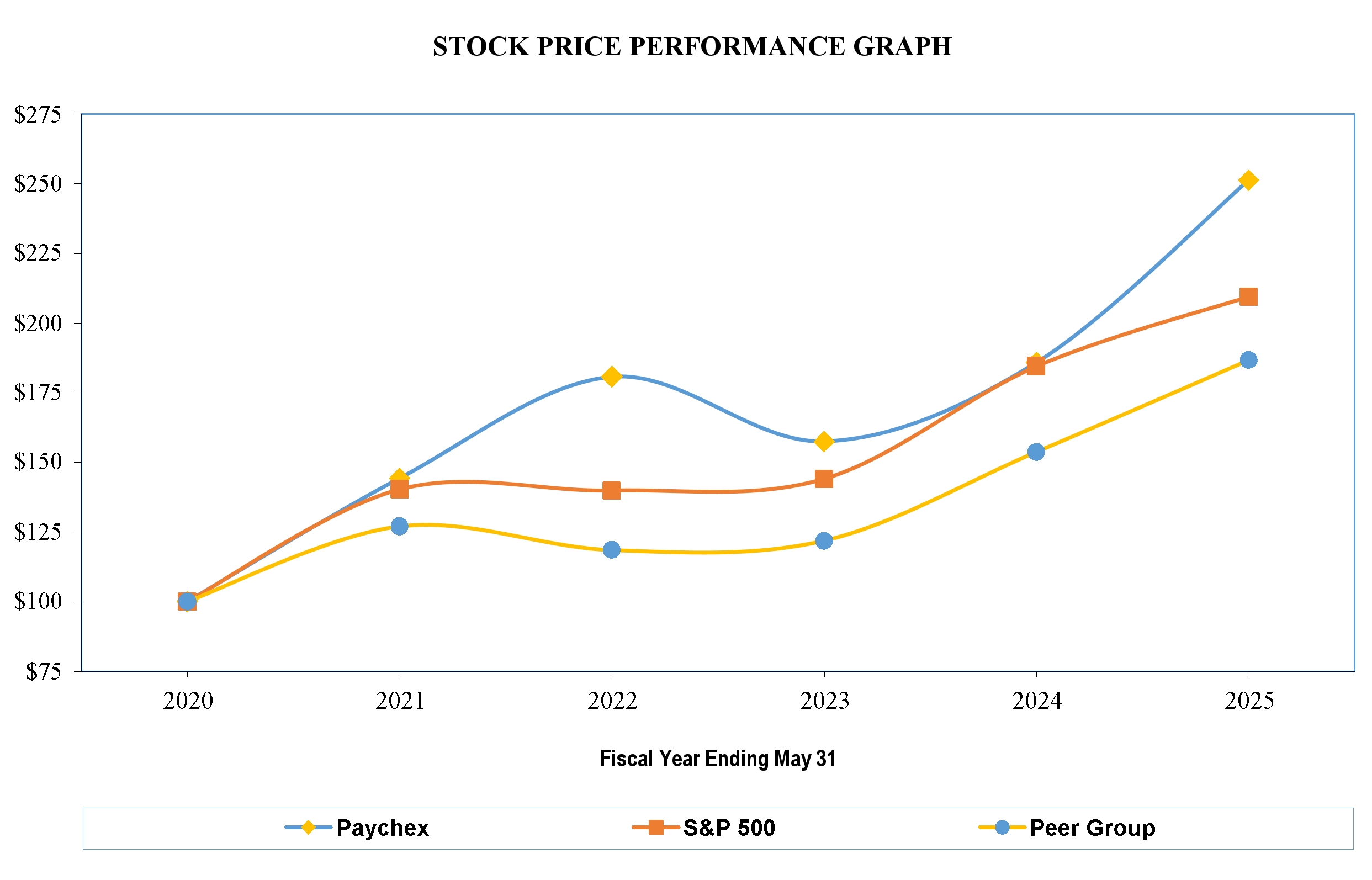
|
|
|
|
|
|
|
|
|
|
|
|
|
|
|
|
|
|
|
|
|
|
|
|
|
May 31, |
|
2020 |
|
|
2021 |
|
|
2022 |
|
|
2023 |
|
|
2024 |
|
|
2025 |
|
Paychex |
|
$ |
100.00 |
|
|
$ |
144.16 |
|
|
$ |
180.70 |
|
|
$ |
157.41 |
|
|
$ |
185.79 |
|
|
$ |
251.16 |
|
S&P 500 |
|
$ |
100.00 |
|
|
$ |
140.30 |
|
|
$ |
139.86 |
|
|
$ |
143.91 |
|
|
$ |
184.45 |
|
|
$ |
209.35 |
|
Peer Group |
|
$ |
100.00 |
|
|
$ |
127.00 |
|
|
$ |
118.53 |
|
|
$ |
121.82 |
|
|
$ |
153.68 |
|
|
$ |
186.69 |
|
There can be no assurance that our stock performance will continue with the same or similar trends depicted in the graph above. We neither make nor endorse any predictions as to future stock performance.
The Compensation and Leadership Committee of our Board annually reviews and approves the selection of Peer Group companies, adjusting the group from year to year based upon our business and changes in the Peer Group companies’ business or the comparability of their metrics. The Peer Group may also be adjusted in the event of mergers, acquisitions, or other significant economic changes. The Peer Group was not adjusted for fiscal 2025.
Our Peer Group for fiscal 2025 is comprised of the following companies:
|
|
|
Automatic Data Processing, Inc. (direct competitor) |
|
Global Payments, Inc. |
Broadridge Financial Solutions, Inc. |
|
Intuit, Inc. |
Corpay, Inc. |
|
Jack Henry & Associates, Inc. |
Equifax, Inc. |
|
Moody's Corporation |
Euronet Worldwide, Inc. |
|
SS&C Technologies Holdings, Inc. |
Fair Isaac Corporation |
|
TransUnion |
Fiserv, Inc. |
|
Verisk Analytics, Inc. |
Gartner, Inc. |
|
WEX, Inc. |
Item 7. Management’s Discussion and Analysis of Financial Condition and Results of Operations
Management’s Discussion and Analysis of Financial Condition and Results of Operations reviews the operating results of Paychex, Inc. and its wholly owned subsidiaries (“Paychex,” the “Company,” “we,” “our,” or “us”) for our fiscal year ended May 31, 2025 (“fiscal 2025” or the “fiscal year”), as compared to our fiscal year ended May 31, 2024 (“fiscal 2024”), and our financial condition as of May 31, 2025. A detailed review of our fiscal 2024 performance compared to our fiscal year ended May 31, 2023 performance and our financial condition as of May 31, 2024 is set forth in Part II, Item 7 of our Annual Report on Form 10-K (“Form 10-K”) for fiscal 2024. This review should be read in conjunction with the accompanying consolidated financial statements and the related Notes to Consolidated Financial Statements contained in Item 8 of this Form 10-K and the “Risk Factors” discussed in Item 1A of this Form 10-K. Forward-looking statements in this review are qualified by the cautionary statement under the heading “Cautionary Note Regarding Forward-Looking Statements” contained at the beginning of Part I of this Form 10-K.
Overview
We are an industry-leading human capital management (“HCM”) company delivering a full suite of technology and advisory solutions in human resources (“HR”), employee benefits, insurance, and payroll for businesses and their employees across the United States (“U.S.”) and parts of Europe.
We offer a full range of integrated HCM solutions covering the employee life cycle for businesses and their employees. Clients may choose from a breadth of solutions that also allow integration with some of the most popular HR, accounting, ERP, and point-of-sale applications on the market today.
We support our clients through our proprietary, robust, SurePayroll® SaaS-based solutions, Paychex Flex® and Paycor. Our larger clients generally have more complex payroll and employee benefit needs, though with the environment of increasing regulations, we believe the need for HR outsourcing solutions has been moving down-market. Any of our clients on Paychex Flex or Paycor can opt for the integrated suite of HCM solutions, which enables clients to choose the service and software solutions that will meet the needs of their business.
Our portfolio of technology, HR advisory, and employee benefits-related solutions is disaggregated into two categories, (1) Management Solutions and (2) professional employer organization (“PEO”) and Insurance Solutions, as discussed in Part I, Item 1 of this Form 10-K.
Our mission is to be the leading provider of HR, employee benefits, insurance, and payroll solutions by being an essential partner to businesses across the U.S. and parts of Europe. Our strategy focuses on providing industry-leading, integrated technology; growing our client base; expanding our share of wallet; driving technology innovation; and pursuing strategic acquisitions. We believe that successfully executing this strategy will lead to strong, long-term financial performance.
We maintain industry-leading margins by managing our personnel costs and expenses while continuing to invest in our business, particularly in sales and marketing and leading-edge technology. We believe these investments are critical to our success. Looking to the future, we believe that investing in our solutions, people, and digital capabilities will position us to capitalize on opportunities for long-term growth.
We closely monitor the evolving challenges and needs of our clients, and proactively aid our clients in navigating macroeconomic challenges, legislative changes, and other complexities they may face. Through our unique blend of innovative technology solutions, backed by our extensive compliance and HR expertise, we help clients more effectively hire, develop, and retain top talent in this challenging workforce environment. Our ongoing investments in our platforms have prepared us well for the demands of the current business and regulatory environments, allowing us to adapt while maintaining strong solutions and support delivery, resulting in high levels of client satisfaction and retention.
On April 14, 2025, we completed our acquisition of Paycor HCM, Inc. ("Paycor"), a leading provider of HCM, payroll and talent software. This acquisition extends our upmarket position and expands our suite of HR technology and advisory solutions. Refer to the “Liquidity and Capital Resources” section of this Item 7 for additional information.
Fiscal 2025 Business Highlights
Highlights compared to fiscal 2024 are as follows:
|
|
|
|
|
|
|
|
|
|
|
|
|
|
|
|
|
|
Fiscal Year |
|
|
|
|
|
In millions, except per share amounts |
|
2025 |
|
|
2024 |
|
|
Change(3) |
Total revenue |
|
$ |
|
5,571.7 |
|
|
$ |
|
5,278.3 |
|
|
|
6 |
|
% |
Operating income |
|
$ |
|
2,207.7 |
|
|
$ |
|
2,174.1 |
|
|
|
2 |
|
% |
Adjusted operating income(1) |
|
$ |
|
2,370.0 |
|
|
$ |
|
2,213.6 |
|
|
|
7 |
|
% |
Net income |
|
$ |
|
1,657.3 |
|
|
$ |
|
1,690.4 |
|
|
|
(2 |
) |
% |
Adjusted net income(1) |
|
$ |
|
1,802.9 |
|
|
$ |
|
1,709.1 |
|
|
|
5 |
|
% |
Diluted earnings per share |
|
$ |
|
4.58 |
|
|
$ |
|
4.67 |
|
|
|
(2 |
) |
% |
Adjusted diluted earnings per share(1) |
|
$ |
|
4.98 |
|
|
$ |
|
4.72 |
|
|
|
6 |
|
% |
Dividends paid to stockholders(2) |
|
$ |
|
1,448.5 |
|
|
$ |
|
1,315.3 |
|
|
|
10 |
|
% |
(1)
Adjusted operating income, adjusted net income, and adjusted diluted earnings per share are not U.S. generally accepted accounting principle (“GAAP”) measures. Adjusted net income and adjusted diluted earnings per share in all periods include an adjustment for net tax windfall benefits related to employee stock-based compensation payments. Adjusted operating income, adjusted net income and adjusted diluted earnings per share also include adjustments for acquisition-related costs in fiscal 2025 and cost optimization initiatives in fiscal 2024. Refer to the “Non-GAAP Financial Measures” section of this Item 7 for a discussion of non-GAAP measures and a reconciliation to the U.S. GAAP measures of operating income, net income and diluted earnings per share.
(2)
Dividends paid to stockholders represented approximately 87% of net income for fiscal 2025 compared to approximately 78% of net income for fiscal 2024.
(3)
Percentage changes are calculated based on unrounded numbers.
For further analysis of our results of operations for fiscal years 2025 and 2024, and our financial position as of May 31, 2025, refer to the tables and analysis in the “Results of Operations” and “Liquidity and Capital Resources” sections of this Item 7.
Business Outlook
Our payroll and PEO client base, including clients added through the acquisition of Paycor, was approximately 800,000 clients as of May 31, 2025 and approximately 745,000 clients as of May 31, 2024. Client retention remained high in the range of 82% to 83% of our beginning client base for both fiscal 2025 and fiscal 2024 and we have sustained high revenue retention.
We continue to increase penetration of our integrated solutions beyond payroll processing, including our HR outsourcing (ASO and PEO) and retirement solutions. The following table illustrates selected HR solutions client metrics:
|
|
|
|
|
|
|
|
|
|
|
|
|
|
|
|
As of May 31, |
|
2025 |
|
|
2024 |
|
|
Change(1) |
Paychex HR solutions (ASO and PEO) client worksite employees |
|
|
|
2,460,000 |
|
|
|
|
2,332,000 |
|
|
|
5 |
|
% |
Retirement solutions plans |
|
|
|
124,000 |
|
|
|
|
121,000 |
|
|
|
3 |
|
% |
Asset value of retirement solutions participants’ funds |
|
$ |
|
55.7 |
|
|
$ |
|
51.8 |
|
|
|
8 |
|
% |
(1)
Percentage changes are calculated based on unrounded numbers.
In fiscal 2025, we continued to make investments in technology a priority as companies look to leverage technology solutions to maintain operations, stay connected to employees, and increase productivity. We implemented enhancements to our Paychex Flex, Paycor, and SurePayroll platforms designed to improve the client and client employee experiences from hiring and onboarding through employee retention. We also continue to focus on AI and related technology to leverage innovative technology and advanced analytics to gain deeper insights into prospects and clients regarding their behavior, preferences, and evolving needs. In fiscal 2025, we successfully implemented several additional innovative AI models that significantly improved results for Paychex and our clients.
We have further strengthened our position in the industry by serving as a source of education and information to clients, businesses of all sizes, and other interested parties. We provide free webinars, white papers, and other information on our website (www.paychex.com) to aid existing and prospective clients with the impact of regulatory changes. The Paychex Insurance Agency, Inc. website, www.paychex.com/group-health-insurance, helps small-business owners navigate the area of insurance coverage.
Results of Operations
Summary of Results of Operations for Fiscal Years:
|
|
|
|
|
|
|
|
|
|
|
|
|
|
|
|
|
|
In millions, except per share amounts |
|
2025 |
|
2024 |
|
Change(1) |
Revenue: |
|
|
|
|
|
|
|
|
|
|
|
|
|
|
Management Solutions |
|
$ |
|
4,067.1 |
|
|
|
$ |
|
3,866.4 |
|
|
|
|
5 |
|
% |
PEO and Insurance Solutions |
|
|
|
1,342.9 |
|
|
|
|
|
1,265.6 |
|
|
|
|
6 |
|
% |
Total service revenue |
|
|
|
5,410.0 |
|
|
|
|
|
5,132.0 |
|
|
|
|
5 |
|
% |
Interest on funds held for clients |
|
|
|
161.7 |
|
|
|
|
|
146.3 |
|
|
|
|
10 |
|
% |
Total revenue |
|
|
|
5,571.7 |
|
|
|
|
|
5,278.3 |
|
|
|
|
6 |
|
% |
Total expenses |
|
|
|
3,364.0 |
|
|
|
|
|
3,104.2 |
|
|
|
|
8 |
|
% |
Operating income |
|
|
|
2,207.7 |
|
|
|
|
|
2,174.1 |
|
|
|
|
2 |
|
% |
Interest expense |
|
|
|
(105.4 |
) |
|
|
|
|
(37.3 |
) |
|
|
n/m |
|
|
Other income, net |
|
|
|
73.6 |
|
|
|
|
|
81.2 |
|
|
|
|
(9 |
) |
% |
Income before income taxes |
|
|
|
2,175.9 |
|
|
|
|
|
2,218.0 |
|
|
|
|
(2 |
) |
% |
Income taxes |
|
|
|
518.6 |
|
|
|
|
|
527.6 |
|
|
|
|
(2 |
) |
% |
Effective income tax rate |
|
|
|
23.8 |
|
% |
|
|
|
23.8 |
|
% |
|
|
|
|
Net income |
|
$ |
|
1,657.3 |
|
|
|
$ |
|
1,690.4 |
|
|
|
|
(2 |
) |
% |
Diluted earnings per share |
|
$ |
|
4.58 |
|
|
|
$ |
|
4.67 |
|
|
|
|
(2 |
) |
% |
(1)
Percentage changes are calculated based on unrounded numbers.
n/m – not meaningful
Total revenue increased to $5.6 billion for fiscal 2025, reflecting an increase of 6% compared to the prior year. The changes in revenue as compared to the prior year were primarily driven by the following factors:
•
Management Solutions revenue: $4.1 billion for fiscal 2025, reflecting an increase of 5%:
o
Continued growth in the number of HCM solution clients and HR outsourcing solutions worksite employees;
o
Higher revenue per client resulting from price realization and product penetration, including HR solutions and retirement;
o
The acquisition of Paycor; offset by
o
Lower revenue from ancillary services, primarily due to the expiration of our Employee Retention Tax Credit ("ERTC") program.
Excluding the acquisition of Paycor, Management Solutions revenue increased by 3% compared to the prior year.
•
PEO and Insurance Solutions revenue: $1.3 billion for fiscal 2025, reflecting an increase of 6%:
o
Growth in the number of average PEO worksite employees; and
o
Increase in PEO insurance revenues.
•
Interest on funds held for clients: $161.7 million for fiscal 2025, reflecting an increase of 10%:
o
Higher average interest rates;
o
Higher average investment balances; and
o
The acquisition of Paycor.
Excluding the acquisition of Paycor, interest on funds held for clients increased by 7% compared to the prior year.
We invest in highly liquid, investment-grade fixed income securities. As of May 31, 2025, we had no exposure to high-risk or non-liquid investments. Details regarding our combined funds held for clients and corporate cash equivalents and investment portfolios are as follows:
|
|
|
|
|
|
|
|
|
|
|
|
|
|
|
Year ended May 31, |
$ in millions |
|
2025 |
|
2024 |
Average investment balances: |
|
|
|
|
|
|
|
|
|
|
Funds held for clients |
|
$ |
|
4,699.5 |
|
|
|
$ |
|
4,462.0 |
|
|
Corporate cash equivalents and investments |
|
|
|
1,649.2 |
|
|
|
|
|
1,605.3 |
|
|
Total |
|
$ |
|
6,348.7 |
|
|
|
$ |
|
6,067.3 |
|
|
|
|
|
|
|
|
|
|
|
|
|
Average interest rates earned (exclusive of net realized gains/(losses)): |
Funds held for clients |
|
|
|
3.4 |
|
% |
|
|
|
3.3 |
|
% |
Corporate cash equivalents and investments |
|
|
|
4.4 |
|
% |
|
|
|
5.2 |
|
% |
Combined funds held for clients and corporate cash equivalents and investments |
|
|
|
3.7 |
|
% |
|
|
|
3.8 |
|
% |
|
|
|
|
|
|
|
|
|
|
|
Total net realized losses |
|
$ |
|
(0.4 |
) |
|
|
$ |
|
(2.6 |
) |
|
|
|
|
|
|
|
|
|
|
|
|
|
|
$ in millions |
|
|
|
|
|
|
|
|
|
|
As of May 31, |
|
2025 |
|
2024 |
Net unrealized losses on available-for-sale ("AFS") securities(1) |
|
$ |
|
(53.6 |
) |
|
|
$ |
|
(162.5 |
) |
|
Federal Funds rate(2) |
|
|
|
4.50 |
|
% |
|
|
|
5.50 |
|
% |
Total fair value of AFS securities |
|
$ |
|
3,755.5 |
|
|
|
$ |
|
3,329.6 |
|
|
Weighted-average duration of AFS securities in years(3) |
|
|
|
2.2 |
|
|
|
|
|
2.7 |
|
|
Weighted-average yield-to-maturity of AFS securities(3) |
|
|
|
3.3 |
|
% |
|
|
|
3.0 |
|
% |
(1)
The net unrealized loss on our investment portfolios was approximately $49.6 million as of July 8, 2025.
(2)
The Federal Funds rate was in the range of 4.25% to 4.50% as of May 31, 2025 and in the range of 5.25% to 5.50% as of May 31, 2024.
(3)
These items exclude the impact of variable rate demand notes (“VRDNs”), as they are tied to short-term interest rates. Refer to the “Market Risk Factors” section contained in Item 7A of this Form 10-K for more information on changing interest rates.
Total expenses: Total expenses, which reflects the total combined cost of service revenue and selling, general and administrative expenses, increased 8% to $3.4 billion compared to the prior year. The following table summarizes the components of total expenses:
|
|
|
|
|
|
|
|
|
|
|
|
|
|
|
|
In millions |
|
2025 |
|
|
2024 |
|
|
Change(1) |
Core business operations: |
|
|
|
|
|
|
|
|
|
|
|
|
Compensation-related expenses |
|
$ |
|
1,853.0 |
|
|
$ |
|
1,810.4 |
|
|
|
2 |
|
% |
PEO direct insurance costs |
|
|
|
520.1 |
|
|
|
|
471.3 |
|
|
|
10 |
|
% |
Depreciation and amortization |
|
|
|
168.8 |
|
|
|
|
176.5 |
|
|
|
(4 |
) |
% |
Other expenses |
|
|
|
659.8 |
|
|
|
|
606.5 |
|
|
|
9 |
|
% |
Non-core business operations: |
|
|
|
|
|
|
|
|
|
|
|
|
Acquisition-related costs |
|
|
|
162.3 |
|
|
|
|
— |
|
|
n/m |
|
|
Cost optimization initiatives |
|
|
|
— |
|
|
|
|
39.5 |
|
|
n/m |
|
|
Total expenses |
|
$ |
|
3,364.0 |
|
|
$ |
|
3,104.2 |
|
|
|
8 |
|
% |
(1)
Percentage changes are calculated based on unrounded numbers.
n/m - not meaningful
The changes in total expenses as compared to the prior year were primarily driven by the following factors:
•
Compensation-related expenses: $1.9 billion for fiscal 2025, reflecting a 2% increase:
o
The acquisition of Paycor. Excluding the impact of the acquisition of Paycor, compensation-related expenses were relatively flat compared to the prior year.
•
PEO insurance costs: $520.1 million in fiscal 2025, reflecting a 10% increase:
o
Increase in PEO direct insurance costs related to growth in average worksite employees and wages, and PEO insurance revenues.
•
Other expenses: $659.8 million in fiscal 2025, reflecting a 9% increase:
o
Continued investment in technology; and
o
The acquisition of Paycor.
•
Acquisition-related costs: $162.3 million in fiscal 2025:
o
Acquisition-related costs include the amortization of intangibles acquired in the acquisition of Paycor, compensation costs related to the acquisition and integration of Paycor, including replacement awards, severance, and retention and transaction bonuses, and other acquisition-related costs, primarily reflecting professional service fees.
•
Cost optimization initiatives: $39.5 million in fiscal 2024:
o
Cost optimization initiatives taken during the fourth quarter of 2024, included reductions to our geographic footprint, reprioritization of certain technology investments, and headcount optimization.
Excluding the acquisition of Paycor and the prior year period cost optimization initiatives noted above, total expenses increased approximately 2% compared to the prior year.
Operating income: Fiscal 2025 operating income was $2.2 billion, an increase of 2% compared to fiscal 2024. Adjusted operating income(1) of $2.4 billion, which excludes the acquisition related costs and cost optimization initiatives noted above, reflects an increase of 7%. Operating income for fiscal 2025 was impacted by the acquisition of Paycor and the expiration of the ERTC program.
Operating margin (operating income as a percentage of total revenue) and adjusted operating margin(1) (adjusted operating income(1) as a percentage of total revenue) were as follows:
|
|
|
|
|
|
|
|
|
|
|
|
|
|
|
Fiscal Year |
|
|
2025 |
|
2024 |
Operating margin |
|
|
|
39.6 |
|
% |
|
|
|
41.2 |
|
% |
Adjusted operating margin(1) |
|
|
|
42.5 |
|
% |
|
|
|
41.9 |
|
% |
Interest expense: Interest expense increased $68.1 million to $105.4 million in fiscal 2025, primarily due to the issuance of incremental debt to finance the acquisition of Paycor and acquisition-related costs included in interest expense.
Other income, net: Other income, net decreased 9% to $73.6 million in fiscal 2025, as a result of lower average interest rates earned on our corporate investments, partially offset by higher average investment balances.
Income taxes: Our effective income tax rate was 23.8% for fiscal 2025 and 2024. The effective income tax rates in both periods were affected by the recognition of discrete tax impacts related to employee stock-based compensation payments. Refer to Note L of the Notes to Consolidated Financial Statements contained in Item 8 of this Form 10-K for additional disclosures on income taxes.
Net income and diluted earnings per share: Net income was $1.7 billion for fiscal 2025 and 2024. Diluted earnings per share was $4.58 per diluted share for fiscal 2025 and $4.67 per diluted share for fiscal 2024. Refer to Note C of the Notes to Consolidated Financial Statements contained in Item 8 of this Form 10-K for information on dilutive shares outstanding.
Adjusted net income(1) was $1.8 billion and $1.7 billion for fiscal 2025 and 2024, respectively, reflecting an increase of 5%. Adjusted diluted earnings per share(1) was $4.98 per diluted share and $4.72 per diluted share for fiscal 2025 and fiscal 2024, respectively, reflecting an increase of 6%.
(1)
Adjusted operating income, adjusted operating margin, adjusted net income, and adjusted diluted earnings per share are not U.S. GAAP measures. Refer to the “Non-GAAP Financial Measures” section below for a discussion of these non-GAAP measures and a reconciliation to the most comparable GAAP measure of operating income, operating margin, net income and diluted earnings per share.
Non-GAAP Financial Measures: Adjusted operating income, adjusted operating margin, adjusted net income, adjusted diluted earnings per share, earnings before interest, taxes, depreciation, and amortization (“EBITDA”), and adjusted EBITDA are summarized as follows:
|
|
|
|
|
|
|
|
|
|
|
|
|
|
|
|
$ in millions, except per share amounts |
|
2025 |
|
|
2024 |
|
|
Change(1) |
Operating income |
|
$ |
|
2,207.7 |
|
|
$ |
|
2,174.1 |
|
|
|
2 |
|
% |
Non-GAAP adjustments: |
|
|
|
|
|
|
|
|
|
|
|
|
Acquisition-related costs(2) |
|
|
|
162.3 |
|
|
|
|
— |
|
|
|
|
|
Cost optimization initiatives(3) |
|
|
|
— |
|
|
|
|
39.5 |
|
|
|
|
|
Adjusted operating income |
|
$ |
|
2,370.0 |
|
|
$ |
|
2,213.6 |
|
|
|
7 |
|
% |
Adjusted operating margin |
|
|
|
42.5 |
% |
|
|
|
41.9 |
% |
|
|
|
|
|
|
|
|
|
|
|
|
|
|
|
|
|
Net income |
|
$ |
|
1,657.3 |
|
|
$ |
|
1,690.4 |
|
|
|
(2 |
) |
% |
Non-GAAP adjustments: |
|
|
|
|
|
|
|
|
|
|
|
|
Acquisition-related costs(2) |
|
|
|
196.3 |
|
|
|
|
— |
|
|
|
|
|
Cost optimization initiatives(3) |
|
|
|
— |
|
|
|
|
39.5 |
|
|
|
|
|
Tax impact of above adjustments |
|
|
|
(40.6 |
) |
|
|
|
(9.6 |
) |
|
|
|
|
Excess tax benefit related to employee stock-based compensation payments(4) |
|
|
|
(10.1 |
) |
|
|
|
(11.2 |
) |
|
|
|
|
Adjusted net income |
|
$ |
|
1,802.9 |
|
|
$ |
|
1,709.1 |
|
|
|
5 |
|
% |
|
|
|
|
|
|
|
|
|
|
|
|
|
Diluted earnings per share(5) |
|
$ |
|
4.58 |
|
|
$ |
|
4.67 |
|
|
|
(2 |
) |
% |
Non-GAAP adjustments: |
|
|
|
|
|
|
|
|
|
|
|
|
Acquisition-related costs(2) |
|
|
|
0.54 |
|
|
|
|
— |
|
|
|
|
|
Cost optimization initiatives(3) |
|
|
|
— |
|
|
|
|
0.11 |
|
|
|
|
|
Tax impact of above adjustments |
|
|
|
(0.11 |
) |
|
|
|
(0.03 |
) |
|
|
|
|
Excess tax benefit related to employee stock-based compensation payments(4) |
|
|
|
(0.03 |
) |
|
|
|
(0.03 |
) |
|
|
|
|
Adjusted diluted earnings per share |
|
$ |
|
4.98 |
|
|
$ |
|
4.72 |
|
|
|
6 |
|
% |
|
|
|
|
|
|
|
|
|
Net income |
|
$ |
|
1,657.3 |
|
|
$ |
|
1,690.4 |
|
|
|
(2 |
) |
% |
Non-GAAP adjustments: |
|
|
|
|
|
|
|
|
|
|
|
|
Interest expense/(income), net |
|
|
|
32.6 |
|
|
|
|
(45.4 |
) |
|
|
|
|
Income taxes |
|
|
|
518.6 |
|
|
|
|
527.6 |
|
|
|
|
|
Depreciation and amortization expense |
|
|
|
209.5 |
|
|
|
|
176.5 |
|
|
|
|
|
EBITDA |
|
$ |
|
2,418.0 |
|
|
$ |
|
2,349.1 |
|
|
|
3 |
|
% |
Non-GAAP adjustments: |
|
|
|
|
|
|
|
|
|
|
|
|
Acquisition-related costs(2) |
|
|
|
121.6 |
|
|
|
|
— |
|
|
|
|
|
Cost optimization initiatives(3) |
|
|
|
— |
|
|
|
|
39.5 |
|
|
|
|
|
Adjusted EBITDA |
|
$ |
|
2,539.6 |
|
|
$ |
|
2,388.6 |
|
|
|
6 |
|
% |
(1)
Percentage changes are calculated based on unrounded numbers.
(2)
Acquisition-related costs included in selling, general and administrative expenses include $40.7 million in amortization of intangibles acquired in the acquisition of Paycor, $70.8 million in compensation costs related to the acquisition and integration of Paycor, including replacement awards, severance, and retention and transaction bonuses, and $50.8 million in other acquisition-related costs, primarily reflecting professional service fees. Acquisition-related costs included in interest expense includes $34.0 million reflecting the amortization of financing fees related to debt instruments associated with the financing of the Paycor acquisition and the excluded component of the initial fair value of the interest rate swaption contracts ("Swaption Contracts").
(3)
Cost optimization initiatives recognized in fiscal 2024 include further reductions to our geographic footprint, reprioritization of certain technology investments, and headcount optimization.
(4)
Net tax windfall related to employee stock-based compensation payments recognized in income taxes. This item is subject to volatility and will vary based on employee decisions on exercising employee stock options and fluctuations in our stock price, neither of which is within the control of management.
(5)
The calculation of the impact of non-GAAP adjustments on diluted earnings per share is performed on each line independently. The table may not add down by +/- $0.01 due to rounding.
In addition to reporting operating income, operating margin, net income and diluted earnings per share, which are U.S. GAAP measures, we present adjusted operating income, adjusted operating margin, adjusted net income, adjusted diluted earnings per share, EBITDA and adjusted EBITDA, which are non-GAAP measures. We believe these additional measures are indicators of the performance of our core business operations period over period. Adjusted operating income, adjusted operating margin, adjusted net income, adjusted diluted earnings per share, EBITDA and adjusted EBITDA, are not calculated through the application of U.S. GAAP and are not required forms of disclosure by the Securities and Exchange Commission (“SEC”). As such, they should not be considered a substitute for the U.S. GAAP measures of operating income, operating margin, net income, and diluted earnings per share, and, therefore, they should not be used in isolation but in conjunction with the U.S. GAAP measures. The use of any non-GAAP measure may produce results that vary from the U.S. GAAP measure and may not be comparable to a similarly defined non-GAAP measure used by other companies.
Liquidity and Capital Resources
Our financial position as of May 31, 2025 remained strong with cash, restricted cash, and total corporate investments of $1.7 billion. Short-term borrowings of $18.6 million and long-term borrowings of $5.0 billion were outstanding as of May 31, 2025. Our unused capacity under our unsecured credit facilities was $2.0 billion as of May 31, 2025. Our primary source of cash is our ongoing operations, which was $1.9 billion for fiscal 2025. Our positive cash flows have allowed us to support our business, and pay dividends. We currently anticipate that corporate cash, corporate restricted cash, and total corporate investments as of May 31, 2025, along with projected operating cash flows and available short-term financing, will support our business operations, capital purchases, primarily investments in our technology solutions, share repurchases, dividend payments, acquisitions and debt service for the foreseeable future.
For client funds liquidity, we have the ability to borrow on our unsecured credit facilities or use corporate liquidity when necessary to meet short-term funding needs related to client fund obligations. Historically, we have borrowed, typically on an overnight basis, to settle short-term client fund obligations, rather than liquidate previously collected client funds invested in our long-term AFS portfolio. We believe that our investments in an unrealized loss position as of May 31, 2025 were not impaired due to increased credit risk or other valuation concerns, nor has any event occurred subsequent to that date to indicate any change in our assessment. We do not intend to sell these investments until recovery of their amortized cost basis or maturity and further believe that it is not more-than-likely that we would be required to sell these investments prior to that time.
Financing
Short-term financing: We maintain committed and unsecured credit facilities and irrevocable letters of credit as part of our normal and recurring business operations. The purpose of these credit facilities is to meet short-term funding requirements, finance working capital needs, and for general corporate purposes. We typically borrow on an overnight or short-term basis on our credit facilities. Refer to Note M of the Notes to Consolidated Financial Statements contained in Item 8 of this Form 10-K for further discussion on our credit facilities.
Details of our credit facilities are as follows:
|
|
|
|
|
|
|
|
|
|
|
|
|
|
|
|
|
|
|
|
|
|
Maximum |
|
|
May 31, 2025 |
|
|
|
|
|
Amount |
|
|
Outstanding |
|
|
Available |
|
$ in millions |
|
Expiration Date |
|
Available |
|
|
Amount |
|
|
Amount |
|
Credit facilities: |
|
|
|
|
|
|
|
|
|
|
|
|
|
|
JP Morgan Chase Bank, N.A. (“JPM”) |
|
April 12, 2029 |
|
$ |
|
1,000.0 |
|
|
$ |
|
— |
|
|
$ |
|
1,000.0 |
|
JPM |
|
September 17, 2026 |
|
$ |
|
750.0 |
|
|
|
|
— |
|
|
|
|
750.0 |
|
PNC Bank, National Association (“PNC”) |
|
February 6, 2026 |
|
$ |
|
250.0 |
|
|
|
|
18.6 |
|
|
|
|
231.4 |
|
Total Lines of Credit Outstanding and Available |
|
|
|
|
|
|
|
$ |
|
18.6 |
|
|
$ |
|
1,981.4 |
|
|
|
|
|
|
|
|
|
|
|
|
|
|
|
|
Amounts outstanding under the PNC credit facility as of May 31, 2025 remain outstanding as of the date of this report.
Details of borrowings under each credit facility during fiscal 2025 were as follows:
|
|
|
|
|
|
|
|
|
|
|
|
|
|
|
|
|
|
|
|
|
Year ended May 31, 2025 |
|
|
Credit Facility |
|
|
$1 Billion |
|
$750 Million |
|
$250 Million |
$ in millions |
|
JPM |
|
JPM |
|
PNC |
Number of days borrowed |
|
|
|
3 |
|
|
|
|
|
— |
|
|
|
|
365 |
|
|
Maximum amount borrowed |
|
$ |
|
201.5 |
|
|
|
$ |
|
— |
|
|
|
$ |
|
243.9 |
|
|
Weighted-average amount borrowed |
|
$ |
|
104.3 |
|
|
|
$ |
|
— |
|
|
|
$ |
|
20.1 |
|
|
Weighted-average interest rate |
|
|
|
8.22 |
|
% |
|
|
|
— |
|
% |
|
|
|
5.12 |
|
% |
We primarily use short-term borrowings to settle client fund obligations, rather than liquidating previously collected client funds invested in our long-term AFS investment portfolio.
Subsequent to May 31, 2025, there were no additional overnight borrowings under our PNC and JPM credit facilities.
We expect to have access to the amounts available under our current credit facilities to meet our ongoing financial needs. However, if we experience reductions in our operating cash flows due to any of the risk factors outlined in, but not limited to, Item 1A in this Form 10-K and other SEC filings, we may need to adjust our capital, operating, and other discretionary spending to realign our working capital requirements with the capital resources available to us. Furthermore, if we determine the need for additional short-term liquidity, there is no assurance that such financing, if pursued and obtained, would be adequate or on terms acceptable to us.
Letters of credit: As of May 31, 2025, we had irrevocable standby letters of credit available totaling $165.0 million, required to secure commitments for certain insurance policies. The letters of credit expire at various dates between June 1, 2025 and February 27, 2027. No amounts were outstanding on these letters of credit during fiscal 2025 or fiscal 2024, or as of May 31, 2025 and May 31, 2024. Subsequent to May 31, 2025, eight letters of credit expired and were renewed for one year terms.
Long-term financing: We have borrowed $4.2 billion through the issuance of three fixed rate corporate bonds ("Corporate Bonds") and $0.8 billion through the issuance of long-term private placement debt (“Senior Notes”). Refer to Note N of the Notes to Consolidated Financial Statements contained in Item 8 of this Form 10-K for further discussion on our long-term financing.
Bridge Loan Commitment: On January 7, 2025, we and our subsidiary, Paychex of New York, LLC, entered into a bridge loan commitment with JPM, pursuant to which JPM committed to provide a 364-day senior unsecured credit facility not to exceed $3.5 billion for the acquisition of Paycor, including related fees and expenses. We incurred $14.9 million in debt financing fees, including structuring and commitment fees, which were capitalized as Prepaid expenses and other current assets on our Consolidated Balance Sheets and recognized as interest expense on a straight-line basis through the issuance date of our Corporate Bonds. The bridge loan commitment expired upon the issuance our Corporate Bonds. Refer to Note N of the Notes to Consolidated Financial Statements contained in Item 8 of this Form 10-K for further discussion on our long-term financing.
Interest Rate Swaption Contracts: On January 31, 2025, we executed three Swaption Contracts with JPM. The Swaption Contracts qualified as cash flow hedges, had an aggregate notional amount of $3.0 billion, and were utilized to manage exposure to fluctuations in benchmark interest rates associated with the issuance of Corporate Bonds to fund our acquisition of Paycor. At inception, we recorded Swaption Contract assets related to paid premiums of $19.2 million. The fair value of the Swaption Contract assets were classified as Prepaid expenses and other current assets on the Company’s Consolidated Balance Sheets. Upon issuance of our Corporate Bonds, the Swaption Contracts expired unexercised.
Other commitments: The Company has various long-term contractual obligations as of May 31, 2025, which include:
•
operating leases for $84.1 million;
•
purchase obligations for $384.1 million;
•
workers’ compensation estimated obligations for $236.8 million; and
•
long-term Corporate Bonds and Senior Notes for $5.0 billion, plus interest payments of $1.7 billion.
Refer to Notes A, I, N, and Q of the Notes to Consolidated Financial Statements contained in Item 8 of this Form 10-K for more information on these commitments.
The liability for uncertain tax positions, including interest and net of federal benefits, was approximately $108.6 million as of May 31, 2025. Refer to Note L of the Notes to Consolidated Financial Statements contained in Item 8 of this Form 10-K for more information on income taxes. We are not able to reasonably estimate the timing of future cash flows related to this liability.
We are a limited partner in five limited partnership arrangements to contribute a maximum of $37.0 million to venture capital funds. As of May 31, 2025, we have contributed $29.0 million of the total funding commitment. The timing of future contributions to be made to these venture capital funds cannot be specifically or reasonably determined. Our investments in these venture capital funds are not considered part of our ongoing operations, are accounted for under the equity method, and represented less than one percent of our total assets as of May 31, 2025.
In the normal course of business, we make representations and warranties that guarantee the performance of services under service arrangements with clients. Historically, there have been no material losses related to such commitment. We have also entered into indemnification agreements with our officers, directors, and non-officer fiduciaries of our pooled employer plan retirement offering, which require us to defend and, if necessary, indemnify these individuals for certain pending or future legal claims as they relate to their services provided to us.
We currently self-insure the deductible portion of various insured exposures under certain corporate and PEO employee health, medical, and workers' compensation benefit plans. Our estimated loss exposure under these insurance arrangements is recorded in other current liabilities on our Consolidated Balance Sheets. Historically, the amounts accrued have not been material and were not material as of May 31, 2025. We also maintain corporate insurance coverage in addition to our purchased primary insurance policies for gap coverage for employment practices liability, errors and omissions, warranty liability, theft and embezzlement, cyber threats, and acts of terrorism; and capacity for deductibles and self-insured retention through our captive insurance company.
Operating, Investing, and Financing Cash Flow Activities
Primary sources of cash, restricted cash, and equivalents are through collections for services rendered to our customers and interest earned on funds held for clients and corporate investments. Primary uses of cash include employee compensation and contractual obligations related to business operations, cash dividends paid, share repurchases, purchases of property and equipment, servicing our long term debt, and acquisitions.
Our investment portfolio incorporates both corporate cash and funds held for clients. Interest rates, market conditions, and our variable cash flows are among several factors influencing our investment strategy directing the mix between long-term and VRDN AFS securities vs. short-term restricted cash and cash equivalents held in the portfolio. A portfolio strategy that favors larger balances held in restricted cash and cash equivalents may impact our investing activities due to the offsetting activity in the purchases and sales/maturities of AFS investments.
Our cash flows include certain activities that are short-term in nature and have an impact on short-term cash flows due to timing of collection and settlement of obligations as follows:
•
PEO receivables and worksite-employee ("WSE") accrued compensation: PEO receivables and WSE accrued compensation fluctuate based on either/both: (1) the timing of the payroll cut-off date and the Company’s month-end close, and (2) the timing of when cash is collected from the customer, and it is remitted to either the WSE for wages earned or applicable tax or regulatory agencies for payroll taxes. PEO accounts receivable collections and compensation payments to WSEs and applicable tax or regulatory agencies are settled through our corporate cash and the fluctuations impact our operating activities.
•
Client fund obligations: Client fund obligations liability will vary based on the timing of when cash is collected from the clients and when it is remitted to employees of the clients utilizing employee payment services or applicable tax or regulatory agencies for payroll tax administration services. Collections from clients are typically remitted from one to 30 days after receipt, with some items extending to 90 days. Fluctuations in client fund obligations impact financing activities.
Summarized cash operating, investing, and financing cash flow information is as follows for fiscal 2025 and fiscal 2024:
|
|
|
|
|
|
|
|
|
|
|
|
|
|
|
|
|
|
Year ended May 31, |
|
In millions |
|
2025 |
|
|
2024 |
|
|
|
Change |
|
Net cash provided by operating activities |
|
$ |
|
1,900.9 |
|
|
$ |
|
1,897.7 |
|
|
$ |
|
3.2 |
|
Net cash used in investing activities |
|
|
|
(3,356.8 |
) |
|
|
|
(260.9 |
) |
|
|
|
(3,095.9 |
) |
Net cash provided by/(used in) financing activities |
|
|
|
2,293.2 |
|
|
|
|
(1,874.7 |
) |
|
|
|
4,167.9 |
|
Net change in cash, restricted cash, and equivalents |
|
$ |
|
837.3 |
|
|
$ |
|
(237.9 |
) |
|
$ |
|
1,075.2 |
|
|
|
|
|
|
|
|
|
|
|
|
|
|
Cash dividends per common share |
|
$ |
|
4.02 |
|
|
$ |
|
3.65 |
|
|
|
|
|
The changes in our cash flows for fiscal 2025 and fiscal 2024 were primarily the result of the following key drivers:
Operating Cash Flow Activities
Fiscal 2025
•
Net income attributable to the reasons discussed in the “Results of Operations” section of this Item 7; and
•
An increase in accrued interest related to our Corporate Bonds; offset by
•
A net decrease in refunds owed to our PEO clients related to tax benefits allowed under the Coronavirus Aid, Relief, and Economic Security Act.
Fiscal 2024
•
Net income attributable to the reasons discussed in the “Results of Operations” section of this Item 7;
•
Net changes in PEO assets and liabilities as a result of the timing of cash collected and the settlement of payroll taxes;
•
Net realized losses on the disposal of assets primarily due to our cost optimization initiatives; and
•
Increase in income tax reserves related to unrecognized tax positions taken for years still subject to audit by regulatory bodies; offset by
•
Decrease in accrued corporate compensation primarily due to a decrease in incentive compensation tied to performance measures and the timing of payroll payments at month-end.
Investing Cash Flow Activities
Fiscal 2025
•
Cash used primarily for the acquisition of Paycor. We financed the acquisition of Paycor by issuing fixed-rate corporate bonds Refer to Note D and Note N of the Notes to the Consolidated Financial Statements for additional discussion on these transactions;
•
Net purchases of short-term accounts receivable due to an increase in our client base, and funding to existing client base, and the timing of net cash collections; and
•
Cash used to develop and enhance our client-facing internal-use software and the acquisition of third-party customer lists.
Fiscal 2024
•
Cash used for the acquisition of Alterna Capital Solutions, LLC and settlement of its outstanding debt at closing. Refer to Note D of the Notes to the Consolidated Financial Statements for additional discussion on this transaction;
•
Cash used to develop and enhance our client-facing internal-use software and the acquisition of third-party customer lists;
•
Net purchases of short-term accounts receivable due to an increase in our client base, and funding to existing client base, and the timing of net cash collections; and
•
Net sales from AFS securities primarily due to a shift from investing in VRDNs to reinvesting in cash and cash equivalents due to more favorable interest rates. We had no VRDN holdings at May 31, 2024 compared to $344.1 million at May 31, 2023.
Financing Cash Flow Activities
Fiscal 2025
•
Proceeds received from the issuance of Corporate Bonds. The proceeds received were used to acquire Paycor;
•
Cumulative dividends paid at $4.02 per share for fiscal 2025. The payment of future dividends is dependent on our future earnings and cash flow and is subject to the discretion of our Board; and
•
Repurchases of 0.8 million shares of our common stock at a weighted-average price of $125.50. These shares were retired immediately upon purchase.
Fiscal 2024
•
Cumulative dividends paid at $3.65 per share for fiscal 2024. The payment of future dividends is dependent on our future earnings and cash flow and is subject to the discretion of our Board;
•
Decrease in client fund obligations related to the timing of collections and remittances of semi-weekly tax payments that were deferred at the end of fiscal 2023 as a result of the Memorial Day holiday; and
•
Repurchases of 1.5 million shares of our common stock at a weighted-average price of $115.37. These shares were retired immediately upon purchase; offset by
•
Cash activity related to equity-based plans.
Other
Recently issued accounting pronouncements: Refer to Note A of the Notes to Consolidated Financial Statements contained in Item 8 of this Form 10-K for a discussion of recently issued accounting pronouncements.
Critical Accounting Policies and Estimates
Note A of the Notes to Consolidated Financial Statements contained in Item 8 of this Form 10-K discusses the significant accounting policies of Paychex. Our discussion and analysis of our financial condition and results of operations are based upon our consolidated financial statements, which have been prepared in accordance with U.S. GAAP. The preparation of these financial statements requires us to make estimates, judgments, and assumptions that affect reported amounts of assets, liabilities, revenue, and expenses. On an ongoing basis, we evaluate the accounting policies and estimates used to prepare the consolidated financial statements. We base our estimates on historical experience, future expectations, and assumptions believed to be reasonable under current facts and circumstances. Actual amounts and results could differ from these estimates. Certain accounting policies that are deemed critical to our results of operations or financial position are discussed below.
Revenue recognition: Revenues are primarily attributable to fees for providing services as well as investment income earned on funds held for clients. Fees associated with services are recognized when control of the contracted services is transferred to our clients, in an amount that reflects the consideration we expect to receive in exchange for such services. Our service revenue is largely attributable to processing services where the fee is based on a fixed amount per processing period or a fixed amount per processing period plus a fee per employee or transaction processed. Insurance Solutions revenues are recognized when commissions are earned on premiums billed and collected. Fees earned for the purchase of client's accounts receivable under non-recourse arrangements are based on a percentage of funding amounts as specified in the client contract. These fees are then recognized over the average collection period of 35 to 50 days for clients in the temporary staffing agency market and approximately 5 to 15 days for other clients. The revenue earned from delivery service for the distribution of certain client payroll checks and reports is included in service revenue, and the costs for the delivery are included in cost of service revenue on the Consolidated Statements of Income and Comprehensive Income.
We receive advance payments for set-up fees from our clients. Advance payments received for certain of our service offerings for set-up fees are considered a material right. Therefore, we defer the revenue associated with these advance payments, recognizing the revenue and related expenses over the expected period to which the material right exists.
PEO Solutions revenue is included in service revenue and is reported net of certain pass-through costs billed and incurred, which include payroll wages, payroll taxes, including federal and state unemployment insurance, and certain health insurance benefit premiums, primarily costs related to our guaranteed cost benefit plans. Direct costs related to workers’ compensation and certain benefit plans where we retain risk are recognized as cost of service revenue rather than as a reduction in service revenue.
Interest on funds held for clients is earned primarily on funds that are collected from clients before due dates for payroll tax administration services and for employee payment services and invested until remittance to the applicable tax or regulatory agencies or client employees. These collections from clients are typically remitted from one to 30 days after receipt, with some items extending to 90 days. The interest earned on these funds is included in total revenue on the Consolidated Statements of Income and Comprehensive Income because the collecting, holding, and remitting of these funds are components of providing these services.
Assets Recognized from the Costs to Obtain and Fulfill Contracts: We recognize an asset for the incremental costs of obtaining a contract with a client if it is expected that the economic benefit and amortization period will be longer than one year. Incremental costs of obtaining a contract include only those costs that are directly related to the acquisition of new contracts and that would not have been incurred if the contract had not been obtained. We do not incur incremental costs to obtain a contract renewal. We determined that certain sales commissions and bonuses, including related fringe benefits, meet the capitalization criteria under Accounting Standards Codification (“ASC”) Subtopic 340-40, “Other Assets and Deferred Costs: Contracts with Customers” (“ASC 340-40”). We also recognize an asset for the costs to fulfill a contract with a client if the costs are specifically identifiable, generate or enhance resources used to satisfy future performance obligations, and are expected to be recovered. We determined that substantially all costs related to implementation activities are administrative in nature and meet the capitalization criteria under ASC 340-40. These capitalized costs to fulfill a contract principally relate to upfront direct costs that are expected to be recovered and enhance our ability to satisfy future performance obligations.
The assets related to both costs to obtain and costs to fulfill contracts with clients are capitalized and amortized using an accelerated method over an eight-year life to closely align with the pattern of client attrition over the estimated life of the client relationship. We regularly review our deferred costs for potential impairment and did not recognize an impairment loss during fiscal 2025 or 2024.
PEO insurance reserves: As part of our PEO solution, we offer workers’ compensation insurance and health insurance to clients for the benefit of client employees. Workers’ compensation insurance is primarily provided under fully insured high deductible workers’ compensation insurance policies. Workers’ compensation insurance reserves are established to provide for the estimated costs of paying claims up to per occurrence liability limits. These reserves include estimates of certain expenses associated with processing and settling these claims. In establishing the PEO workers’ compensation insurance reserves, we use an independent actuarial estimate of undiscounted future cash payments that would be made to settle claims. The determination of estimated ultimate losses by our independent actuary are based on accepted actuarial methods and assumptions. The estimated ultimate losses are primarily based upon loss development factors, and other factors such as the nature of employees’ job responsibilities, the historical frequency and severity of workers’ compensation claims, and an estimate of future cost trends. Each reporting period, changes in actuarial assumptions resulting from changes in actual claims experience and other trends are incorporated into our workers’ compensation claims cost estimates.
With respect to our PEO health insurance, we offer various health insurance plans that take the form of either fully insured guaranteed cost plans or fully insured insurance arrangements where we retain risk. A reserve for insurance arrangements where we retain risk is established to provide for the payment of claims in accordance with our service contract with the carrier. The claims liability includes estimates for reported losses, plus amounts for those claims incurred but not reported, and estimates of certain expenses associated with processing and settling the claims.
Estimating the ultimate cost of future claims is an uncertain and complex process based upon historical loss experience and accepted actuarial methods and assumptions, and is subject to change due to multiple factors, including economic trends, changes in legal liability law, and damage awards, all of which could materially impact the reserves as reported in the consolidated financial statements. Accordingly, final claim settlements may vary from the present estimates, particularly with workers’ compensation insurance where those payments may not occur until well into the future. We regularly review the adequacy of our estimated insurance reserves. Adjustments to previously established reserves are reflected in the results of operations for the period in which the adjustment is identified. Such adjustments could possibly be significant, reflecting any combination of new and adverse or favorable trends. Adjustments to previously established reserves were not material for fiscal 2025 or 2024.
Goodwill and other intangible assets: Goodwill is not amortized, but instead is tested for impairment on an annual basis and between annual tests if an event occurs or circumstances change in a way to indicate that there has been a potential decline in the fair value of a reporting unit. We perform our annual impairment testing in our fiscal fourth quarter. During fiscal 2025 and 2024, a qualitative analysis was performed for all reporting units. The qualitative assessment considered various financial, macroeconomic, industry, and reporting unit specific qualitative factors. Based on the results of our testing, no impairment loss was recognized in the results of operations for fiscal 2025 or 2024. Subsequent to the latest review, there have been no events or circumstances that indicate any potential impairment of the Company’s goodwill balance.
We also test intangible assets with indefinite useful lives for potential impairment on an annual basis and between annual tests if events or changes in circumstances change in a way that indicate that the carrying value may not be recoverable. We have determined that there is no impairment of intangible assets with indefinite useful lives for fiscal 2025 or 2024 as a result of the qualitative analyses performed.
Impairment of Long-Lived Assets: Long-lived assets, including intangible assets with finite lives and operating lease right-of-use assets, are reviewed for impairment when events or changes in circumstances indicate that the carrying amount of an asset may not be recoverable. Recoverability of assets to be held and used is measured by a comparison of the carrying amount of an asset to estimated undiscounted future cash flows expected to be generated by the asset. If the carrying amount of an asset exceeds its estimated future cash flows, an impairment charge is recognized for the amount by which the carrying amount of the asset exceeds the estimated fair value of the asset. We have determined that there is no impairment of long-lived assets for fiscal 2025 or as of May 31, 2025.
Stock-based compensation costs: All stock-based awards to employees are recognized as compensation costs in our consolidated financial statements based on their fair values measured as of the date of grant. We estimate the fair value of stock option grants using a Black-Scholes option pricing model. This model requires various assumptions as inputs including expected volatility of the Paychex stock price and expected option life. Volatility is estimated based on a combination of historical volatility using stock prices over a period equal to the expected option life and implied market volatility. Expected option life is estimated based on historical exercise behavior. We periodically reassess our assumptions as well as our choice of valuation model. We will reconsider use of this model if additional information becomes available in the future indicating that another model would provide a more accurate estimate of fair value, or if characteristics of future grants would warrant such a change.
The fair value of time-based stock awards is determined based on the stock price at the date of grant. For grants that do not accrue dividends or dividend equivalents, the fair value is the stock price reduced by the present value of estimated dividends over the vesting period or performance period.
The fair value of performance-based stock awards that include a market condition is estimated based on a Monte Carlo simulation. The Monte Carlo simulation requires various assumptions as inputs including the expected volatility of the Paychex stock price and the stock prices of the companies that comprise the designated peer group. Stock price volatility of the Company and the designated peer group is estimated based on historical volatility, using stock prices over a period equal to the measurement period of the award.
We estimate forfeitures and only record compensation costs for those awards that are expected to vest. Our assumptions for forfeitures were determined based on type of award and historical experience. Forfeiture assumptions are adjusted at the point in time a significant change is identified, with any adjustment recorded in the period of change, and the final adjustment at the end of the requisite service period to equal actual forfeitures.
The assumptions of volatility, expected option life, and forfeitures all require significant judgment and are subject to change in the future due to factors such as employee exercise behavior, stock price trends, and changes to type or provisions of stock-based awards. Any material change in one or more of these assumptions could have a material impact on the estimated fair value of a future award. The Company periodically reassesses its assumptions as well as its choice of valuation models. The Company will reconsider use of its valuation models if additional information becomes available in the future indicating that another model would provide a more accurate estimate of fair value or if characteristics of future grants would warrant such a change.
Refer to Note F of the Notes to Consolidated Financial Statements contained in Item 8 of this Form 10-K for further discussion of our stock-based compensation plans.
Business combinations: We account for acquisitions in accordance with the guidance in Financial Accounting Standards Board ASC 805, Business Combinations (ASC 805), using the acquisition method of accounting. We allocate the purchase price consideration associated with its acquisitions to the fair values of assets acquired and liabilities assumed at their respective acquisition dates, with the excess recorded to goodwill. This allocation involves a number of assumptions, estimates, and judgments in determining fair value of the following:
•
Intangible assets, including valuation methodology, estimations of future cash flows, discount rates, market segment growth rates, and our assumed market share, as well as the estimated useful life of intangible assets;
•
Deferred tax assets and liabilities, uncertain tax positions, and tax-related valuation allowances, which are initially estimated as of the acquisition date;
•
Goodwill as measured as the excess of consideration transferred over the net of the acquisition date fair values of the assets acquired and liabilities assumed; and
•
Pre-existing liabilities and legal claims, and contingent consideration, each as may be applicable.
Our assumptions and estimates are based upon comparable market data and information obtained from management and the management of the acquired companies. These assumptions and estimates are used to value assets acquired and liabilities assumed, and to allocate goodwill to the reporting units of the business that are expected to benefit from the business combination. Adjustments to the fair values of assets acquired and liabilities assumed may be recorded during the measurement period, which may be up to one year from the acquisition date, with the corresponding offset to goodwill. We may engage valuation specialists to assist in the fair value measurement of assets acquired and liabilities assumed for each acquisition.
Income taxes: We account for deferred taxes by recognizing deferred tax assets and liabilities for the expected future tax consequences of events that have been included in the consolidated financial statements or tax returns. Under this method, deferred tax assets and liabilities are determined based on the difference between the financial statement and tax basis of assets and liabilities using enacted tax rates in effect for the fiscal year in which the differences are expected to reverse. We record a deferred tax asset related to the stock-based compensation costs recognized for certain stock-based awards. At the time of the exercise of non-qualified stock options or vesting of stock awards, we recognize any excess tax benefit within income taxes in the Consolidated Statements of Income and Comprehensive Income.
We maintain a reserve for uncertain tax positions. We evaluate tax positions taken or expected to be taken in a tax return for recognition in our consolidated financial statements. Prior to recording the related tax benefit in our consolidated financial statements, we must conclude that tax positions are more-likely-than-not to be sustained, assuming those positions will be examined by taxing authorities with full knowledge of all relevant information. The benefit recognized in our consolidated financial statements is the amount we expect to realize after examination by taxing authorities. If a tax position drops below the more-likely-than-not standard, the benefit can no longer be recognized. Assumptions, judgment, and the use of estimates are required in determining if the more-likely-than-not standard has been met when developing the provision for income taxes and in determining the expected benefit. A change in the assessment of the more-likely-than-not standard could materially impact our results of operations or financial position. Refer to Note L of the Notes to Consolidated Financial Statements contained in Item 8 of this Form 10-K for further discussion of our reserve for uncertain tax positions.
Item 7A. Quantitative and Qualitative Disclosures About Market Risk
Market Risk Factors
Changes in interest rates and interest rate risk: Funds held for clients are primarily comprised of short-term funds and AFS securities. Corporate investments are primarily comprised of AFS securities. As a result of our investing activities, we are exposed to changes in interest rates that may materially affect our results of operations and financial position. Changes in interest rates will impact the earnings potential of future investments and will cause fluctuations in the fair value of our long-term AFS securities. We follow an investment strategy of protecting principal and optimizing liquidity. A substantial portion of our portfolios are invested in high credit quality securities with ratings of AA or higher, and A-1/P-1 ratings on short-term securities. We invest predominately in corporate bonds; municipal bonds; U.S. government agency securities; and VRDNs when available in the market. We limit the amounts that can be invested in any single issuer and invest primarily in short- to intermediate-term instruments whose fair value is less sensitive to interest rate changes. We manage the AFS securities to a benchmark duration of two to three and one-quarter years.
During fiscal 2025, our primary short-term investment vehicles were U.S. government agency discount notes and bank demand deposit accounts. We have no exposure to high-risk or non-liquid investments. We have insignificant exposure to European investments.
During fiscal 2025, the average interest rate earned on our combined funds held for clients and corporate cash equivalents and investment portfolios was 3.7%, compared to 3.8% for fiscal 2024. When interest rates are falling, the full impact of lower interest rates will not immediately be reflected in net income due to the interaction of short- and long-term interest rate changes. During a falling interest rate environment, earnings will decrease from our short-term investments, and over time, will decrease from our longer-term AFS securities. Earnings from the AFS securities, which as of May 31, 2025 had an average duration of 2.2 years, would not reflect decreases in interest rates until the investments are sold or mature and the proceeds are reinvested at lower rates.
The amortized cost and fair value of AFS securities that had stated maturities as of May 31, 2025 are shown below by expected maturity.
|
|
|
|
|
|
|
|
|
|
|
|
|
May 31, 2025 |
|
|
|
Amortized |
|
|
Fair |
|
In millions |
|
cost |
|
|
value |
|
Maturity date: |
|
|
|
|
|
|
|
|
Due in one year or less |
|
$ |
|
624.4 |
|
|
$ |
|
618.6 |
|
Due after one year through three years |
|
|
|
2,128.2 |
|
|
|
|
2,086.2 |
|
Due after three years through five years |
|
|
|
770.7 |
|
|
|
|
762.9 |
|
Due after five years |
|
|
|
285.8 |
|
|
|
|
287.8 |
|
Total |
|
$ |
|
3,809.1 |
|
|
$ |
|
3,755.5 |
|
VRDNs, when held by us, are primarily categorized as due after five years in the table above as the contractual maturities on these securities are typically 20 to 30 years. Although these securities are issued as long-term securities, they are priced and traded as short-term instruments because of the liquidity provided through the tender feature.
As of May 31, 2025 and 2024, the Federal Funds rate was in the range of 4.25% to 4.50% and in the range of 5.25% to 5.50%, respectively. There continues to be uncertainty in the changing market and economic conditions, including the possibility of additional measures that could be taken by the U.S. President, the Federal Reserve and other government agencies related to the overall macroeconomic environment. We will continue to monitor the market and economic conditions.
Calculating the future effects of changing interest rates involves many factors. These factors include, but are not limited to:
•
governmental action to address inflation and/or intervene to support financial markets;
•
daily interest rate changes;
•
seasonal variations in investment balances;
•
actual duration of short-term and AFS securities;
•
the proportion of taxable and tax-exempt investments;
•
changes in tax-exempt municipal rates versus taxable investment rates, which are not synchronized or simultaneous; and
•
financial market volatility and the resulting effect on benchmark and other indexing interest rates.
Subject to these factors and under normal financial market conditions, a 25-basis-point change in taxable interest rates generally affects our tax-exempt interest rates by approximately 19 basis points. Under normal financial market conditions, the impact to earnings from a 25-basis-point change in short-term interest rates would be approximately $6.0 million to $6.5 million, after taxes, for a twelve-month period. Such a basis point change may or may not be tied to changes in the Federal Funds rate.
Our total investment portfolio (funds held for clients and corporate cash equivalents and investments) averaged approximately $6.3 billion for fiscal 2025. Our anticipated allocation is approximately 45% invested in short-term securities and VRDNs with an average duration of less than 30 days, and 55% invested in available-for-sale securities with an average duration of two to three and one-quarter years.
The combined funds held for clients and corporate available-for-sale securities reflected net unrealized losses of $53.6 million and $162.5 million as of May 31, 2025 and 2024, respectively. Refer to Note H of the Notes to Consolidated Financial Statements contained in Item 8 of this Form 10-K for additional disclosures on fair value measurements.
During fiscal 2025, the net unrealized loss on our investment portfolios ranged from $41.8 million to $162.5 million. During fiscal 2024, the net unrealized loss on our investment portfolios ranged from $127.5 million to $259.6 million. The net unrealized loss on our investment portfolios was approximately $49.6 million as of July 8, 2025.
As of May 31, 2025 and 2024, we had $3.8 billion and $3.3 billion, respectively, invested in AFS securities at fair value. The weighted-average yield-to-maturity was 3.3% and 3.0% as of May 31, 2025 and 2024, respectively. The weighted-average yield-to-maturity excludes AFS securities tied to short-term interest rates, such as VRDNs, when held. Assuming a hypothetical decrease in longer-term interest rates of 25 basis points, the resulting potential increase in fair value for our portfolio of AFS securities as of May 31, 2025, would be in a range of approximately $20.0 million to $25.0 million. Conversely, a corresponding increase in interest rates would result in a comparable decrease in fair value. This hypothetical decrease or increase in the fair value of the portfolio would be recorded as an adjustment to the portfolio’s recorded value, with an offsetting amount recorded in stockholders’ equity. These fluctuations in fair value would have no related or immediate impact on our results of operations unless any declines in fair value are due to credit related concerns and an impairment loss recognized.
We are also exposed to interest rate risk through the use of our credit facilities as outlined in Liquidity and Capital Resources section of this Form 10-K. If interest rates were to increase, or we increase the frequency or amounts borrowed under these credit facilities, we could experience additional interest expense and a corresponding decrease in earnings.
Credit risk: We are exposed to credit risk in connection with these investments through the possible inability of the borrowers to meet the terms of their bonds. We regularly review our investment portfolios to determine if any investment is impaired due to increased credit risk or other valuation concerns and we believe that the investments we held as of May 31, 2025 were not impaired as a result of the previously discussed reasons. While $2.0 billion of our AFS securities had fair values that were below amortized cost, we believe that it is probable that the principal and interest will be collected in accordance with the contractual terms, and that the gross unrealized losses of $68.0 million were due to changes in interest rates and were not due to increased credit risk or other valuation concerns. Most of the AFS securities in an unrealized loss position as of May 31, 2025 and 2024 held an AA rating or better. We do not intend to sell these investments until the recovery of their amortized cost basis or maturity, and further believe that it is not more-likely-than-not that we will be required to sell these investments prior to that time. Our assessment that an investment is not impaired due to increased credit risk or other valuation concerns could change in the future due to new developments, including changes in our strategies or assumptions related to any particular investment.
We have some credit risk exposure relating to our purchase of client accounts receivable under non-recourse arrangements. There is also credit risk exposure relating to our trade accounts receivable. These credit risk exposures are diversified among multiple client arrangements and all such arrangements are regularly reviewed for potential write-off. No single client is material in respect to total accounts receivable, service revenue, or results of operations.
Market risk: We have an ongoing monitoring system for financial institutions we conduct business with and maintain cash balances at large well-capitalized (as defined by their regulators) financial institutions. We closely monitor market conditions and take appropriate measures, when necessary, to minimize potential risk exposure to our client’s and our cash and investment balances.
Item 8. Financial Statements and Supplementary Data
TABLE OF CONTENTS
|
|
|
|
|
|
Description |
Page |
Report on Management’s Assessment of Internal Control Over Financial Reporting |
38 |
|
Report of Independent Registered Public Accounting Firm (PCAOB ID 238) |
39 |
|
Consolidated Statements of Income and Comprehensive Income for the Years Ended May 31, 2025, 2024, and 2023 |
42 |
|
Consolidated Balance Sheets as of May 31, 2025 and 2024 |
43 |
|
Consolidated Statements of Stockholders’ Equity for the Years Ended May 31, 2025, 2024, and 2023 |
44 |
|
Consolidated Statements of Cash Flows for the Years Ended May 31, 2025, 2024, and 2023 |
45 |
|
Notes to Consolidated Financial Statements |
46 |
|
Schedule II — Valuation and Qualifying Accounts for the Years Ended May 31, 2025, 2024, and 2023 |
78 |
|
REPORT ON MANAGEMENT’S ASSESSMENT OF
INTERNAL CONTROL OVER FINANCIAL REPORTING
Management of Paychex, Inc. (the “Company”) is responsible for establishing and maintaining adequate internal control over financial reporting as such term is defined in Rules 13a-15(f) and 15d-15(f) under the Securities Exchange Act of 1934, as amended. The Company’s internal control over financial reporting is designed to provide reasonable assurance regarding the reliability of financial reporting and the preparation of the financial statements for external purposes in accordance with generally accepted accounting principles.
Because of its inherent limitations, internal control over financial reporting may not prevent or detect misstatements. Also, projections of any evaluation of effectiveness to future periods are subject to the risk that controls may become inadequate because of changes in conditions, or that the degree of compliance with the policies or procedures may deteriorate.
Management assessed the effectiveness of the Company’s internal control over financial reporting as of May 31, 2025. In making this assessment, management used the criteria set forth by the Committee of Sponsoring Organizations of the Treadway Commission in “Internal Control — Integrated Framework” (2013). Based on our assessment, management determined that the Company maintained effective internal control over financial reporting as of May 31, 2025.
On April 14, 2025, we completed our acquisition of Paycor HCM, Inc. (“Paycor”). We are in the process of evaluating the existing controls and procedures of and integrating Paycor into our internal control over financial reporting. In accordance with Securities and Exchange Commission Staff guidance, permitting a company to exclude an acquired business from management’s assessment of the effectiveness of internal control over financial reporting for the year in which the acquisition is completed, we have excluded Paycor from our assessment of the effectiveness of internal control over financial reporting as of May 31, 2025. Paycor represented approximately 8% of the Company’s total assets as of May 31, 2025 and approximately 2% of the Company’s revenues for the year ended May 31, 2025.
The Company’s independent registered public accounting firm, PricewaterhouseCoopers LLP, is appointed by the Company’s Audit Committee. PricewaterhouseCoopers LLP has audited the Consolidated Financial Statements included in this Annual Report on Form 10-K and the effectiveness of the Company’s internal control over financial reporting as of May 31, 2025, and as a part of their integrated audit, has issued their report, included herein, on the effectiveness of the Company’s internal control over financial reporting.
|
|
|
|
/s/ John B. Gibson
John B. Gibson
President and Chief Executive Officer
|
|
/s/ Robert L. Schrader
Robert L. Schrader
Senior Vice President and Chief Financial Officer
|
Report of Independent Registered Public Accounting Firm
To the Board of Directors and Stockholders of Paychex, Inc.
Opinions on the Financial Statements and Internal Control over Financial Reporting
We have audited the accompanying consolidated balance sheets of Paychex, Inc. and its subsidiaries (the "Company") as of May 31, 2025 and 2024, and the related consolidated statements of income and comprehensive income, of stockholders’ equity and of cash flows for each of the three years in the period ended May 31, 2025, including the related notes and financial statement schedule listed in the accompanying index (collectively referred to as the "consolidated financial statements"). We also have audited the Company's internal control over financial reporting as of May 31, 2025, based on criteria established in Internal Control - Integrated Framework (2013) issued by the Committee of Sponsoring Organizations of the Treadway Commission (COSO).
In our opinion, the consolidated financial statements referred to above present fairly, in all material respects, the financial position of the Company as of May 31, 2025 and 2024, and the results of its operations and its cash flows for each of the three years in the period ended May 31, 2025 in conformity with accounting principles generally accepted in the United States of America. Also in our opinion, the Company maintained, in all material respects, effective internal control over financial reporting as of May 31, 2025, based on criteria established in Internal Control - Integrated Framework (2013) issued by the COSO.
Basis for Opinions
The Company's management is responsible for these consolidated financial statements, for maintaining effective internal control over financial reporting, and for its assessment of the effectiveness of internal control over financial reporting, included in the accompanying Report on Management's Assessment of Internal Control Over Financial Reporting. Our responsibility is to express opinions on the Company’s consolidated financial statements and on the Company's internal control over financial reporting based on our audits. We are a public accounting firm registered with the Public Company Accounting Oversight Board (United States) (PCAOB) and are required to be independent with respect to the Company in accordance with the U.S. federal securities laws and the applicable rules and regulations of the Securities and Exchange Commission and the PCAOB.
We conducted our audits in accordance with the standards of the PCAOB. Those standards require that we plan and perform the audits to obtain reasonable assurance about whether the consolidated financial statements are free of material misstatement, whether due to error or fraud, and whether effective internal control over financial reporting was maintained in all material respects.
Our audits of the consolidated financial statements included performing procedures to assess the risks of material misstatement of the consolidated financial statements, whether due to error or fraud, and performing procedures that respond to those risks. Such procedures included examining, on a test basis, evidence regarding the amounts and disclosures in the consolidated financial statements. Our audits also included evaluating the accounting principles used and significant estimates made by management, as well as evaluating the overall presentation of the consolidated financial statements. Our audit of internal control over financial reporting included obtaining an understanding of internal control over financial reporting, assessing the risk that a material weakness exists, and testing and evaluating the design and operating effectiveness of internal control based on the assessed risk. Our audits also included performing such other procedures as we considered necessary in the circumstances. We believe that our audits provide a reasonable basis for our opinions.
As described in the Report on Management’s Assessment of Internal Control Over Financial Reporting, management has excluded Paycor HCM, Inc. from its assessment of internal control over financial reporting as of May 31, 2025, because it was acquired by the Company in a purchase business combination during 2025. We have also excluded Paycor HCM, Inc. from our audit of internal control over financial reporting. Paycor HCM, Inc. is a wholly-owned subsidiary whose total assets and total revenues excluded from management’s assessment and our audit of internal control over financial reporting represent approximately 8% and 2%, respectively, of the related consolidated financial statement amounts as of and for the year ended May 31, 2025.
Definition and Limitations of Internal Control over Financial Reporting
A company’s internal control over financial reporting is a process designed to provide reasonable assurance regarding the reliability of financial reporting and the preparation of financial statements for external purposes in accordance with generally accepted accounting principles. A company’s internal control over financial reporting includes those policies and procedures that (i) pertain to the maintenance of records that, in reasonable detail, accurately and fairly reflect the transactions and dispositions of the assets of the company; (ii) provide reasonable assurance that transactions are recorded as necessary to permit preparation of financial statements in accordance with generally accepted accounting principles, and that receipts and expenditures of the company are being made only in accordance with authorizations of management and directors of the company; and (iii) provide reasonable assurance regarding prevention or timely detection of unauthorized acquisition, use, or disposition of the company’s assets that could have a material effect on the financial statements.
Because of its inherent limitations, internal control over financial reporting may not prevent or detect misstatements. Also, projections of any evaluation of effectiveness to future periods are subject to the risk that controls may become inadequate because of changes in conditions, or that the degree of compliance with the policies or procedures may deteriorate.
Critical Audit Matters
The critical audit matters communicated below are matters arising from the current period audit of the consolidated financial statements that were communicated or required to be communicated to the audit committee and that (i) relate to accounts or disclosures that are material to the consolidated financial statements and (ii) involved our especially challenging, subjective, or complex judgments. The communication of critical audit matters does not alter in any way our opinion on the consolidated financial statements, taken as a whole, and we are not, by communicating the critical audit matters below, providing separate opinions on the critical audit matters or on the accounts or disclosures to which they relate.
Professional Employer Organization (PEO) Workers’ Compensation Insurance Reserves
As described in Note A to the consolidated financial statements, the Company offers workers’ compensation insurance to clients for the benefit of client employees. Workers’ compensation insurance is primarily provided under fully insured high deductible workers’ compensation insurance policies. Workers’ compensation insurance reserves are established to provide for the estimated costs of paying claims up to per occurrence liability limits. As of May 31, 2025, the total liability for workers’ compensation insurance reserves is $236.8 million. In establishing the PEO workers' compensation insurance reserves, management uses an independent actuarial estimate of undiscounted future cash payments that would be made to settle the claims. The determination of estimated ultimate losses by the Company’s independent actuary are based on accepted actuarial methods and assumptions. The estimated ultimate losses are primarily based upon loss development factors, and other factors such as the nature of employees’ job responsibilities, the historical frequency and severity of workers’ compensation claims, and an estimate of future cost trends.
The principal considerations for our determination that performing procedures relating to PEO workers’ compensation insurance reserves is a critical audit matter are (i) the significant judgment by management when developing the PEO workers’ compensation insurance reserves; (ii) a high degree of auditor judgment, subjectivity and effort in performing procedures and evaluating audit evidence related to management’s significant assumptions and actuarial estimates related to the loss development factors; and (iii) the audit effort involved the use of professionals with specialized skill and knowledge.
Addressing the matter involved performing procedures and evaluating audit evidence in connection with forming our overall opinion on the consolidated financial statements. These procedures included testing the effectiveness of controls relating to the Company’s PEO workers’ compensation insurance reserves, including controls over the development of management’s assumptions and actuarial estimates related to the loss development factors. These procedures also included, among others (i) testing the completeness and accuracy of the underlying data used in management’s estimate of the PEO workers’ compensation insurance reserves and (ii) the involvement of professionals with specialized skill and knowledge to assist in (a) developing an independent estimate of the PEO workers’ compensation insurance reserves and comparing the independent estimate to management’s estimate and (b) evaluating the appropriateness of management’s model and the reasonableness of management’s assumptions and actuarial estimates related to the loss development factors.
Acquisition of Paycor HCM, Inc. – Valuation of Customer Relationships
As described in Note D to the consolidated financial statements, on April 14, 2025, the Company completed its acquisition of Paycor for total purchase consideration of $4.1 billion. The acquired intangible assets included $1.12 billion of customer relationships. The fair value of the customer relationships intangible asset was estimated by management using a multi-period excess earnings method. Management’s cash flow projections for the acquired Paycor customer relationships reflected significant judgments and assumptions including the revenue growth rate, customer attrition rate, and discount rate.
The principal considerations for our determination that performing procedures relating to the valuation of customer relationships recorded in connection with the acquisition of Paycor is a critical audit matter are (i) the significant judgment by management when developing the fair value estimate of the acquired customer relationships; (ii) a high degree of auditor judgment, subjectivity, and effort in performing procedures and evaluating management’s significant assumptions related to the revenue growth rate, customer attrition rate, and discount rate; and (iii) the audit effort involved the use of professionals with specialized skill and knowledge.
Addressing the matter involved performing procedures and evaluating audit evidence in connection with forming our overall opinion on the consolidated financial statements. These procedures included testing the effectiveness of controls relating to the acquisition accounting, including controls over management’s valuation of the acquired customer relationships. These procedures also included, among others (i) reading the purchase agreement; (ii) testing management’s process for developing the fair value estimate of the acquired customer relationships; (iii) evaluating the appropriateness of the multi-period excess earnings method used by management; (iv) testing the completeness and accuracy of the underlying data used in the multi-period excess earnings method; and (v) evaluating the reasonableness of the significant assumptions used by management related to the revenue growth rate, customer attrition rate, and discount rate. Evaluating management’s assumption related to the revenue growth rate involved considering (i) the current and past performance of the Paycor business; (ii) the consistency with external market and industry data; and (iii) whether the assumption was consistent with evidence obtained in other areas of the audit. Professionals with specialized skill and knowledge were used to assist in evaluating (i) the appropriateness of the multi-period excess earnings method and (ii) the reasonableness of the customer attrition rate and discount rate assumptions.
/s/ PricewaterhouseCoopers LLP
Fairport, New York
July 11, 2025
We have served as the Company’s auditor since 2013.
PAYCHEX, INC.
CONSOLIDATED STATEMENTS OF INCOME AND COMPREHENSIVE INCOME
In millions, except per share amounts
|
|
|
|
|
|
|
|
|
|
|
|
|
|
|
|
Year ended May 31, |
|
|
2025 |
|
|
|
2024 |
|
|
|
2023 |
|
Revenue: |
|
|
|
|
|
|
|
|
|
|
|
|
Management Solutions |
|
$ |
|
4,067.1 |
|
|
$ |
|
3,866.4 |
|
|
$ |
|
3,730.5 |
|
PEO and Insurance Solutions |
|
|
|
1,342.9 |
|
|
|
|
1,265.6 |
|
|
|
|
1,176.8 |
|
Total service revenue |
|
|
|
5,410.0 |
|
|
|
|
5,132.0 |
|
|
|
|
4,907.3 |
|
Interest on funds held for clients |
|
|
|
161.7 |
|
|
|
|
146.3 |
|
|
|
|
99.8 |
|
Total revenue |
|
|
|
5,571.7 |
|
|
|
|
5,278.3 |
|
|
|
|
5,007.1 |
|
Expenses: |
|
|
|
|
|
|
|
|
|
|
|
|
Cost of service revenue |
|
|
|
1,540.4 |
|
|
|
|
1,479.3 |
|
|
|
|
1,453.0 |
|
Selling, general and administrative expenses |
|
|
|
1,823.6 |
|
|
|
|
1,624.9 |
|
|
|
|
1,521.0 |
|
Total expenses |
|
|
|
3,364.0 |
|
|
|
|
3,104.2 |
|
|
|
|
2,974.0 |
|
Operating income |
|
|
|
2,207.7 |
|
|
|
|
2,174.1 |
|
|
|
|
2,033.1 |
|
Interest expense |
|
|
|
(105.4 |
) |
|
|
|
(37.3 |
) |
|
|
|
(36.7 |
) |
Other income, net |
|
|
|
73.6 |
|
|
|
|
81.2 |
|
|
|
|
51.8 |
|
Income before income taxes |
|
|
|
2,175.9 |
|
|
|
|
2,218.0 |
|
|
|
|
2,048.2 |
|
Income taxes |
|
|
|
518.6 |
|
|
|
|
527.6 |
|
|
|
|
490.9 |
|
Net income |
|
$ |
|
1,657.3 |
|
|
$ |
|
1,690.4 |
|
|
$ |
|
1,557.3 |
|
|
|
|
|
|
|
|
|
|
|
|
|
|
Other comprehensive income/(loss), net of tax |
|
|
|
91.4 |
|
|
|
|
14.8 |
|
|
|
|
(26.0 |
) |
Comprehensive income |
|
$ |
|
1,748.7 |
|
|
$ |
|
1,705.2 |
|
|
$ |
|
1,531.3 |
|
|
|
|
|
|
|
|
|
|
|
|
|
|
Basic earnings per share |
|
$ |
|
4.60 |
|
|
$ |
|
4.69 |
|
|
$ |
|
4.32 |
|
Diluted earnings per share |
|
$ |
|
4.58 |
|
|
$ |
|
4.67 |
|
|
$ |
|
4.30 |
|
Weighted-average common shares outstanding |
|
|
|
360.2 |
|
|
|
|
360.3 |
|
|
|
|
360.4 |
|
Weighted-average common shares outstanding, assuming
dilution |
|
|
|
362.0 |
|
|
|
|
362.1 |
|
|
|
|
362.3 |
|
See Notes to Consolidated Financial Statements.
PAYCHEX, INC.
CONSOLIDATED BALANCE SHEETS
In millions, except per share amounts
|
|
|
|
|
|
|
|
|
|
|
As of May 31, |
|
2025 |
|
|
2024 |
|
Assets |
|
|
|
|
|
|
|
|
Cash and cash equivalents |
|
$ |
|
1,628.6 |
|
|
$ |
|
1,468.9 |
|
Restricted cash |
|
|
|
47.9 |
|
|
|
|
47.8 |
|
Corporate investments |
|
|
|
34.5 |
|
|
|
|
33.9 |
|
Interest receivable |
|
|
|
27.9 |
|
|
|
|
23.3 |
|
Accounts receivable, net of allowance for credit losses |
|
|
|
1,330.5 |
|
|
|
|
1,059.6 |
|
PEO unbilled receivables, net of advance collections |
|
|
|
616.6 |
|
|
|
|
542.4 |
|
Prepaid income taxes |
|
|
|
38.9 |
|
|
|
|
47.5 |
|
Prepaid expenses and other current assets |
|
|
|
378.3 |
|
|
|
|
321.9 |
|
Current assets before funds held for clients |
|
|
|
4,103.2 |
|
|
|
|
3,545.3 |
|
Funds held for clients |
|
|
|
4,813.3 |
|
|
|
|
3,706.2 |
|
Total current assets |
|
|
|
8,916.5 |
|
|
|
|
7,251.5 |
|
Long-term corporate investments |
|
|
|
— |
|
|
|
|
3.7 |
|
Property and equipment, net of accumulated depreciation |
|
|
|
511.5 |
|
|
|
|
411.7 |
|
Operating lease right-of-use assets, net of accumulated amortization |
|
|
|
63.8 |
|
|
|
|
46.9 |
|
Intangible assets, net of accumulated amortization |
|
|
|
1,947.3 |
|
|
|
|
194.5 |
|
Goodwill |
|
|
|
4,514.1 |
|
|
|
|
1,882.7 |
|
Long-term deferred costs |
|
|
|
482.4 |
|
|
|
|
477.1 |
|
Other long-term assets |
|
|
|
128.5 |
|
|
|
|
115.0 |
|
Total assets |
|
$ |
|
16,564.1 |
|
|
$ |
|
10,383.1 |
|
Liabilities |
|
|
|
|
|
|
|
|
Accounts payable |
|
$ |
|
129.8 |
|
|
$ |
|
104.3 |
|
Accrued corporate compensation and related items |
|
|
|
183.9 |
|
|
|
|
135.0 |
|
Accrued worksite employee compensation and related items |
|
|
|
735.8 |
|
|
|
|
662.4 |
|
Short-term debt |
|
|
|
18.6 |
|
|
|
|
18.7 |
|
Long-term debt, net, current portion |
|
|
|
399.8 |
|
|
|
|
— |
|
Deferred revenue |
|
|
|
69.4 |
|
|
|
|
50.2 |
|
Other current liabilities |
|
|
|
552.0 |
|
|
|
|
469.8 |
|
Current liabilities before client fund obligations |
|
|
|
2,089.3 |
|
|
|
|
1,440.4 |
|
Client fund obligations |
|
|
|
4,867.0 |
|
|
|
|
3,868.7 |
|
Total current liabilities |
|
|
|
6,956.3 |
|
|
|
|
5,309.1 |
|
Accrued income taxes |
|
|
|
119.0 |
|
|
|
|
102.6 |
|
Deferred income taxes |
|
|
|
444.7 |
|
|
|
|
86.0 |
|
Long-term debt, net of debt issuance costs |
|
|
|
4,548.4 |
|
|
|
|
798.6 |
|
Operating lease liabilities |
|
|
|
55.5 |
|
|
|
|
49.0 |
|
Other long-term liabilities |
|
|
|
312.2 |
|
|
|
|
236.8 |
|
Total liabilities |
|
|
|
12,436.1 |
|
|
|
|
6,582.1 |
|
Commitments and contingencies — Note Q |
|
|
|
|
|
|
|
|
Stockholders’ equity |
|
|
|
|
|
|
|
|
Common stock, $0.01 par value; Authorized: 600.0 shares;
Issued and outstanding: 360.5 shares as of May 31, 2025
and 360.1 shares as of May 31, 2024 |
|
|
|
3.6 |
|
|
|
|
3.6 |
|
Additional paid-in capital |
|
|
|
1,901.1 |
|
|
|
|
1,729.5 |
|
Retained earnings |
|
|
|
2,277.0 |
|
|
|
|
2,213.0 |
|
Accumulated other comprehensive loss |
|
|
|
(53.7 |
) |
|
|
|
(145.1 |
) |
Total stockholders’ equity |
|
|
|
4,128.0 |
|
|
|
|
3,801.0 |
|
Total liabilities and stockholders’ equity |
|
$ |
|
16,564.1 |
|
|
$ |
|
10,383.1 |
|
See Notes to Consolidated Financial Statements.
PAYCHEX, INC.
CONSOLIDATED STATEMENTS OF STOCKHOLDERS’ EQUITY
In millions, except per share amounts
|
|
|
|
|
|
|
|
|
|
|
|
|
|
|
|
|
|
|
|
|
|
|
|
|
|
|
|
|
|
|
|
|
|
|
|
|
|
|
|
|
|
|
|
|
|
|
|
|
|
|
|
|
|
|
|
|
|
|
|
|
|
Accumulated other comprehensive loss |
|
|
|
|
|
|
|
|
|
|
|
|
|
|
|
|
|
|
|
|
|
|
|
|
|
|
|
|
|
|
|
|
|
|
Total |
|
|
|
|
|
|
|
|
|
|
|
|
|
|
|
|
|
|
|
|
|
|
Net |
|
|
|
|
|
|
|
|
|
|
accumulated |
|
|
|
|
|
|
|
|
|
|
|
|
|
|
Additional |
|
|
|
|
|
|
unrealized |
|
|
Cash |
|
|
Foreign |
|
|
other |
|
|
|
|
|
|
|
Common stock |
|
|
paid-in |
|
|
Retained |
|
|
loss on AFS |
|
|
flow |
|
|
currency |
|
|
comprehensive |
|
|
|
|
|
|
|
Shares |
|
|
Amount |
|
|
capital |
|
|
earnings |
|
|
securities |
|
|
hedges |
|
|
translation |
|
|
income/(loss) |
|
|
Total |
|
Balance as of May 31, 2022 |
|
|
359.9 |
|
|
$ |
|
3.6 |
|
|
$ |
|
1,545.9 |
|
|
$ |
|
1,669.6 |
|
|
$ |
|
(101.1 |
) |
|
$ |
|
— |
|
|
$ |
|
(32.8 |
) |
|
$ |
|
(133.9 |
) |
|
$ |
|
3,085.2 |
|
Net income |
|
|
— |
|
|
|
|
— |
|
|
|
|
— |
|
|
|
|
1,557.3 |
|
|
|
|
— |
|
|
|
|
— |
|
|
|
|
— |
|
|
|
|
— |
|
|
|
|
1,557.3 |
|
Unrealized losses on securities, net of $12.2 million in tax benefit |
|
|
— |
|
|
|
|
— |
|
|
|
|
— |
|
|
|
|
— |
|
|
|
|
(36.6 |
) |
|
|
|
— |
|
|
|
|
— |
|
|
|
|
(36.6 |
) |
|
|
|
(36.6 |
) |
Reclassification adjustment for realized gains on securities, net of $2.5
million in tax benefit (1) |
|
|
— |
|
|
|
|
— |
|
|
|
|
— |
|
|
|
|
— |
|
|
|
|
7.4 |
|
|
|
|
— |
|
|
|
|
— |
|
|
|
|
7.4 |
|
|
|
|
7.4 |
|
Dividends declared ($3.26 per share) |
|
|
— |
|
|
|
|
— |
|
|
|
|
— |
|
|
|
|
(1,175.5 |
) |
|
|
|
— |
|
|
|
|
— |
|
|
|
|
— |
|
|
|
|
— |
|
|
|
|
(1,175.5 |
) |
Repurchases of common shares (2) |
|
|
— |
|
|
|
|
— |
|
|
|
|
— |
|
|
|
|
— |
|
|
|
|
— |
|
|
|
|
— |
|
|
|
|
— |
|
|
|
|
— |
|
|
|
|
— |
|
Stock-based compensation |
|
|
— |
|
|
|
|
— |
|
|
|
|
62.6 |
|
|
|
|
— |
|
|
|
|
— |
|
|
|
|
— |
|
|
|
|
— |
|
|
|
|
— |
|
|
|
|
62.6 |
|
Foreign currency translation adjustment |
|
|
— |
|
|
|
|
— |
|
|
|
|
— |
|
|
|
|
— |
|
|
|
|
— |
|
|
|
|
— |
|
|
|
|
3.2 |
|
|
|
|
3.2 |
|
|
|
|
3.2 |
|
Activity related to equity-based plans |
|
|
0.6 |
|
|
|
|
0.0 |
|
|
|
|
17.9 |
|
|
|
|
(28.3 |
) |
|
|
|
— |
|
|
|
|
— |
|
|
|
|
— |
|
|
|
|
— |
|
|
|
|
(10.4 |
) |
Balance as of May 31, 2023 |
|
|
360.5 |
|
|
|
|
3.6 |
|
|
|
|
1,626.4 |
|
|
|
|
2,023.1 |
|
|
|
|
(130.3 |
) |
|
|
|
— |
|
|
|
|
(29.6 |
) |
|
|
|
(159.9 |
) |
|
|
|
3,493.2 |
|
Net income |
|
|
— |
|
|
|
|
— |
|
|
|
|
— |
|
|
|
|
1,690.4 |
|
|
|
|
— |
|
|
|
|
— |
|
|
|
|
— |
|
|
|
|
— |
|
|
|
|
1,690.4 |
|
Unrealized gains on securities, net of $2.6 million in tax expense |
|
|
— |
|
|
|
|
— |
|
|
|
|
— |
|
|
|
|
— |
|
|
|
|
7.6 |
|
|
|
|
— |
|
|
|
|
— |
|
|
|
|
7.6 |
|
|
|
|
7.6 |
|
Reclassification adjustment for realized losses on securities, net of $0.7
million in tax benefit (1) |
|
|
— |
|
|
|
|
— |
|
|
|
|
— |
|
|
|
|
— |
|
|
|
|
2.0 |
|
|
|
|
— |
|
|
|
|
— |
|
|
|
|
2.0 |
|
|
|
|
2.0 |
|
Dividends declared ($3.65 per share) |
|
|
— |
|
|
|
|
— |
|
|
|
|
— |
|
|
|
|
(1,315.4 |
) |
|
|
|
— |
|
|
|
|
— |
|
|
|
|
— |
|
|
|
|
— |
|
|
|
|
(1,315.4 |
) |
Repurchases of common shares (2) |
|
|
(1.5 |
) |
|
|
|
(0.0 |
) |
|
|
|
(6.2 |
) |
|
|
|
(163.0 |
) |
|
|
|
— |
|
|
|
|
— |
|
|
|
|
— |
|
|
|
|
— |
|
|
|
|
(169.2 |
) |
Stock-based compensation |
|
|
— |
|
|
|
|
— |
|
|
|
|
61.1 |
|
|
|
|
— |
|
|
|
|
— |
|
|
|
|
— |
|
|
|
|
— |
|
|
|
|
— |
|
|
|
|
61.1 |
|
Foreign currency translation adjustment |
|
|
— |
|
|
|
|
— |
|
|
|
|
— |
|
|
|
|
— |
|
|
|
|
— |
|
|
|
|
— |
|
|
|
|
5.2 |
|
|
|
|
5.2 |
|
|
|
|
5.2 |
|
Activity related to equity-based plans |
|
|
1.1 |
|
|
|
|
0.0 |
|
|
|
|
48.2 |
|
|
|
|
(22.1 |
) |
|
|
|
— |
|
|
|
|
— |
|
|
|
|
— |
|
|
|
|
— |
|
|
|
|
26.1 |
|
Balance as of May 31, 2024 |
|
|
360.1 |
|
|
|
|
3.6 |
|
|
|
|
1,729.5 |
|
|
|
|
2,213.0 |
|
|
|
|
(120.7 |
) |
|
|
|
— |
|
|
|
|
(24.4 |
) |
|
|
|
(145.1 |
) |
|
|
|
3,801.0 |
|
Net income |
|
|
— |
|
|
|
|
— |
|
|
|
|
— |
|
|
|
|
1,657.3 |
|
|
|
|
— |
|
|
|
|
— |
|
|
|
|
— |
|
|
|
|
— |
|
|
|
|
1,657.3 |
|
Unrealized gains/(losses), net of $26.4 million in tax expense |
|
|
— |
|
|
|
|
— |
|
|
|
|
— |
|
|
|
|
— |
|
|
|
|
81.9 |
|
|
|
|
(19.2 |
) |
|
|
|
— |
|
|
|
|
62.7 |
|
|
|
|
62.7 |
|
Reclassification adjustment to earnings, net of
$0.1 million in tax benefit (1) |
|
|
— |
|
|
|
|
— |
|
|
|
|
— |
|
|
|
|
— |
|
|
|
|
0.3 |
|
|
|
|
19.2 |
|
|
|
|
— |
|
|
|
|
19.5 |
|
|
|
|
19.5 |
|
Dividends declared ($4.02 per share) |
|
|
— |
|
|
|
|
— |
|
|
|
|
— |
|
|
|
|
(1,448.7 |
) |
|
|
|
— |
|
|
|
|
— |
|
|
|
|
— |
|
|
|
|
— |
|
|
|
|
(1,448.7 |
) |
Repurchases of common shares (2) |
|
|
(0.8 |
) |
|
|
|
(0.0 |
) |
|
|
|
(4.0 |
) |
|
|
|
(100.5 |
) |
|
|
|
— |
|
|
|
|
— |
|
|
|
|
— |
|
|
|
|
— |
|
|
|
|
(104.5 |
) |
Stock-based compensation |
|
|
— |
|
|
|
|
— |
|
|
|
|
111.8 |
|
|
|
|
— |
|
|
|
|
— |
|
|
|
|
— |
|
|
|
|
— |
|
|
|
|
— |
|
|
|
|
111.8 |
|
Fair value of awards included in transaction consideration |
|
|
— |
|
|
|
|
— |
|
|
|
|
15.9 |
|
|
|
|
— |
|
|
|
|
— |
|
|
|
|
— |
|
|
|
|
— |
|
|
|
|
— |
|
|
|
|
15.9 |
|
Foreign currency translation adjustment |
|
|
— |
|
|
|
|
— |
|
|
|
|
— |
|
|
|
|
— |
|
|
|
|
— |
|
|
|
|
— |
|
|
|
|
9.2 |
|
|
|
|
9.2 |
|
|
|
|
9.2 |
|
Activity related to equity-based plans |
|
|
1.2 |
|
|
|
|
0.0 |
|
|
|
|
47.9 |
|
|
|
|
(44.1 |
) |
|
|
|
— |
|
|
|
|
— |
|
|
|
|
— |
|
|
|
|
— |
|
|
|
|
3.8 |
|
Balance as of May 31, 2025 |
|
|
360.5 |
|
|
$ |
|
3.6 |
|
|
$ |
|
1,901.1 |
|
|
$ |
|
2,277.0 |
|
|
$ |
|
(38.5 |
) |
|
$ |
|
— |
|
|
$ |
|
(15.2 |
) |
|
$ |
|
(53.7 |
) |
|
$ |
|
4,128.0 |
|
(1)
Reclassification adjustments out of accumulated other comprehensive income/(loss) for realized (losses)/gains, net of tax, on the sale of available-for-sale (“AFS”) securities are reflected in interest on funds held for clients and other income/(expense), net on the Consolidated Statements of Income and Comprehensive Income.
(2)
The Company maintains a program to repurchase up to $400.0 million of its common stock, with authorization expiring May 31, 2027. The Company maintained a separate program to repurchase up to $400.0 million of its common stock which expired on January 31, 2024. The purpose of these programs is to manage common stock dilution. All shares of common stock repurchased were retired.
See Notes to Consolidated Financial Statements.
PAYCHEX, INC.
CONSOLIDATED STATEMENTS OF CASH FLOWS
In millions
|
|
|
|
|
|
|
|
|
|
|
|
|
|
|
|
Year ended May 31, |
|
2025 |
|
|
2024 |
|
|
2023 |
|
Operating activities |
|
|
|
|
|
|
|
|
|
|
|
|
Net income |
|
$ |
|
1,657.3 |
|
|
$ |
|
1,690.4 |
|
|
$ |
|
1,557.3 |
|
Adjustments to reconcile net income to net cash provided by operating
activities: |
|
|
|
|
|
|
|
|
|
|
|
|
Depreciation and amortization |
|
|
|
209.5 |
|
|
|
|
176.5 |
|
|
|
|
176.6 |
|
Amortization of premiums and discounts on AFS securities, net |
|
|
|
23.4 |
|
|
|
|
(7.0 |
) |
|
|
|
18.2 |
|
Amortization of deferred contract costs |
|
|
|
236.5 |
|
|
|
|
231.7 |
|
|
|
|
219.1 |
|
Stock-based compensation costs |
|
|
|
111.8 |
|
|
|
|
61.1 |
|
|
|
|
62.6 |
|
Benefit from deferred income taxes |
|
|
|
(15.8 |
) |
|
|
|
(29.8 |
) |
|
|
|
(44.0 |
) |
Provision for credit losses |
|
|
|
24.2 |
|
|
|
|
19.8 |
|
|
|
|
17.7 |
|
Net realized losses on sales of AFS securities |
|
|
|
0.4 |
|
|
|
|
2.6 |
|
|
|
|
9.8 |
|
Net realized losses on disposal of assets |
|
|
|
3.7 |
|
|
|
|
32.8 |
|
|
|
|
1.3 |
|
Premium paid on cash flow hedges |
|
|
|
(19.2 |
) |
|
|
|
— |
|
|
|
|
— |
|
Changes in operating assets and liabilities: |
|
|
|
|
|
|
|
|
|
|
|
|
Interest receivable |
|
|
|
(3.8 |
) |
|
|
|
1.1 |
|
|
|
|
(2.1 |
) |
Accounts receivable and PEO unbilled receivables, net |
|
|
|
(130.7 |
) |
|
|
|
113.0 |
|
|
|
|
(135.7 |
) |
Prepaid expenses and other current assets |
|
|
|
(12.0 |
) |
|
|
|
(25.2 |
) |
|
|
|
(17.8 |
) |
Accounts payable and other current liabilities |
|
|
|
42.3 |
|
|
|
|
(127.0 |
) |
|
|
|
86.3 |
|
Deferred costs |
|
|
|
(246.5 |
) |
|
|
|
(244.9 |
) |
|
|
|
(269.4 |
) |
Net change in other long-term assets and liabilities |
|
|
|
21.9 |
|
|
|
|
6.1 |
|
|
|
|
30.6 |
|
Net change in operating lease right-of-use assets and liabilities |
|
|
|
(2.1 |
) |
|
|
|
(3.5 |
) |
|
|
|
(4.3 |
) |
Net cash provided by operating activities |
|
|
|
1,900.9 |
|
|
|
|
1,897.7 |
|
|
|
|
1,706.2 |
|
Investing activities |
|
|
|
|
|
|
|
|
|
|
|
|
Purchases of AFS securities |
|
|
|
(14,302.9 |
) |
|
|
|
(6,868.5 |
) |
|
|
|
(14,585.3 |
) |
Proceeds from sales and maturities of AFS securities |
|
|
|
14,292.5 |
|
|
|
|
7,161.2 |
|
|
|
|
14,943.2 |
|
Net change in purchased receivables |
|
|
|
(157.3 |
) |
|
|
|
(153.8 |
) |
|
|
|
(6.8 |
) |
Purchases of property and equipment |
|
|
|
(191.8 |
) |
|
|
|
(161.4 |
) |
|
|
|
(143.0 |
) |
Proceeds from sale of property and equipment |
|
|
|
— |
|
|
|
|
— |
|
|
|
|
16.7 |
|
Acquisition of businesses, net of cash acquired |
|
|
|
(2,967.5 |
) |
|
|
|
(208.3 |
) |
|
|
|
(2.7 |
) |
Purchases of other assets |
|
|
|
(29.8 |
) |
|
|
|
(30.1 |
) |
|
|
|
(10.4 |
) |
Net cash (used in)/provided by investing activities |
|
|
|
(3,356.8 |
) |
|
|
|
(260.9 |
) |
|
|
|
211.7 |
|
Financing activities |
|
|
|
|
|
|
|
|
|
|
|
|
Net change in client fund obligations |
|
|
|
(290.7 |
) |
|
|
|
(425.3 |
) |
|
|
|
474.8 |
|
Net proceeds from short-term borrowings |
|
|
|
— |
|
|
|
|
9.0 |
|
|
|
|
2.0 |
|
Proceeds from issuance of corporate bonds |
|
|
|
4,180.9 |
|
|
|
|
— |
|
|
|
|
— |
|
Dividends paid |
|
|
|
(1,448.5 |
) |
|
|
|
(1,315.3 |
) |
|
|
|
(1,175.0 |
) |
Repurchases of common shares |
|
|
|
(104.5 |
) |
|
|
|
(169.2 |
) |
|
|
|
— |
|
Debt issuance costs |
|
|
|
(47.8 |
) |
|
|
|
— |
|
|
|
|
— |
|
Contingent consideration paid for acquisitions |
|
|
|
— |
|
|
|
|
— |
|
|
|
|
(2.8 |
) |
Activity related to equity-based plans |
|
|
|
3.8 |
|
|
|
|
26.1 |
|
|
|
|
(10.4 |
) |
Net cash provided by/(used in) financing activities |
|
|
|
2,293.2 |
|
|
|
|
(1,874.7 |
) |
|
|
|
(711.4 |
) |
Net change in cash, restricted cash, and equivalents |
|
|
|
837.3 |
|
|
|
|
(237.9 |
) |
|
|
|
1,206.5 |
|
Cash, restricted cash, and equivalents, beginning of fiscal year |
|
|
|
1,897.0 |
|
|
|
|
2,134.9 |
|
|
|
|
928.4 |
|
Cash, restricted cash, and equivalents, end of fiscal year |
|
$ |
|
2,734.3 |
|
|
$ |
|
1,897.0 |
|
|
$ |
|
2,134.9 |
|
|
|
|
|
|
|
|
|
|
|
|
|
|
Reconciliation of cash, restricted cash, and equivalents |
|
|
|
|
|
|
|
|
|
|
|
|
Cash and cash equivalents |
|
$ |
|
1,628.6 |
|
|
$ |
|
1,468.9 |
|
|
$ |
|
1,222.0 |
|
Restricted cash |
|
|
|
47.9 |
|
|
|
|
47.8 |
|
|
|
|
49.8 |
|
Restricted cash and restricted cash equivalents included in funds held for clients |
|
|
|
1,057.8 |
|
|
|
|
380.3 |
|
|
|
|
863.1 |
|
Total cash, restricted cash, and equivalents |
|
$ |
|
2,734.3 |
|
|
$ |
|
1,897.0 |
|
|
$ |
|
2,134.9 |
|
See Notes to Consolidated Financial Statements.
PAYCHEX, INC.
NOTES TO CONSOLIDATED FINANCIAL STATEMENTS
Note A — Description of Business, Basis of Presentation, and Significant Accounting Policies
Description of business: Paychex, Inc. and its wholly owned subsidiaries (collectively, the “Company” or “Paychex”) is an industry-leading human capital management (“HCM”) company delivering a full suite of technology and advisory solutions in human resources (“HR”), employee benefit solutions, insurance and payroll for clients and their employees in the United States (“U.S.”) and parts of Europe. The Company also has operations in India.
Paychex, a Delaware corporation formed in 1979, reports as a single segment. Refer to Note R of this Item 8 for further discussion of the Company’s segment reporting for each of the fiscal years ended May 31, 2025 (“fiscal 2025”), May 31, 2024 (“fiscal 2024”), and May 31, 2023 (“fiscal 2023”) and as of May 31, 2025 and 2024.
The Company offers a full range of integrated HCM solutions covering the employee life cycle for businesses and their employees. Clients may choose from a breadth of solutions that also allow integration with some of the most popular HR, accounting, point-of-sale, and productivity applications on the market today. Paychex’s offerings often leverage the information gathered in its base payroll processing service, allowing the Company to provide comprehensive outsourcing services covering the HCM spectrum.
Paychex supports its clients through its proprietary, robust Paychex Flex® platform, Paycor and the Company’s SurePayroll® SaaS-based solutions. Both solutions allow users to process payroll when they want, how they want, and on any type of device (desktop, tablet, and mobile phone). Paychex’s larger clients generally have more complex payroll and employee benefit needs and can opt for an integrated suite of HCM solutions, which allows them to choose the service and software solutions that will meet the needs of their businesses.
Total revenue is comprised of service revenue and interest on funds held for clients. Service revenue is comprised primarily of the fees earned on the portfolio of HCM services, which include payroll processing, complementary HR management and administration services, professional employer organization (“PEO”) solutions, and insurance agency commissions. Refer to Note B of this Item 8 for further discussion of the Company’s service revenue.
Basis of presentation: The consolidated financial statements include the accounts of the Company and its wholly owned subsidiaries. All intercompany accounts and transactions have been eliminated in consolidation. Certain disclosures are reported as zero balances due to rounding.
Reclassifications: Certain prior year amounts have been reclassified to conform to the current period presentation. These reclassifications had no effect on reported consolidated earnings.
Cash and cash equivalents: Cash and cash equivalents consist of available cash, money market securities, and other investments with a maturity of 90 days or less at acquisition. Cash and cash equivalents include funds collected from the Company’s PEO clients for the payment of worksite employee payrolls and associated payroll taxes. $179.8 million and $171.7 million collected from PEO clients are included in cash and cash equivalents on the Company’s Consolidated Balance Sheets as of May 31, 2025 and 2024, respectively.
Restricted cash and restricted cash equivalents: Restricted cash and restricted cash equivalents are recorded at fair value, and consist of cash and cash equivalents, primarily money market securities, included in funds held for clients and cash that is restricted in use to secure commitments for certain workers’ compensation insurance policies.
Accounts receivable, net of allowance for credit losses: Accounts receivable balances are shown on the Consolidated Balance Sheets net of the allowance for credit losses as follows:
|
|
|
|
|
|
|
|
|
|
|
|
|
May 31, |
|
|
May 31, |
|
In millions |
|
2025 |
|
|
2024 |
|
Trade receivables |
|
$ |
|
205.4 |
|
|
$ |
|
141.3 |
|
Purchased receivables |
|
|
|
1,151.1 |
|
|
|
|
939.6 |
|
Total accounts receivable, gross |
|
|
|
1,356.5 |
|
|
|
|
1,080.9 |
|
Less: Allowance for credit losses |
|
|
|
26.0 |
|
|
|
|
21.3 |
|
Accounts receivable, net of allowance for credit losses |
|
$ |
|
1,330.5 |
|
|
$ |
|
1,059.6 |
|
Trade receivables are for services provided to clients in the normal course of business and purchased receivables are acquired from the Company's clients under non-recourse arrangements.
The Company is exposed to credit losses through the sale of its solutions and support services, payment of client obligations, and collection of purchased receivables. To mitigate this credit risk, the Company has multiple programs in place to assess and continuously monitor each client’s ability to pay for these solutions and support services. Credit monitoring programs include, but are not limited to, new client credit reviews, establishing appropriate credit limits, monitoring of credit distressed clients, and early electronic wire and collection procedures. The Company also considers contract terms and conditions, client business type or strategy and may require collateralized asset support or prepayment to mitigate credit risk.
Accounts receivable are written off and charged against the allowance for credit losses when the Company has exhausted all collection efforts without success. The Company estimates its allowance for credit losses based on historical loss activity adjusted for current economic conditions and reasonable and supportable forecast factors, when applicable.
Allowance for credit losses activity related to accounts receivables are as follows:
|
|
|
|
|
|
|
|
|
|
|
|
|
|
|
|
|
|
Year ended May 31, |
|
In millions |
|
|
2025 |
|
|
|
2024 |
|
|
|
2023 |
|
Balance, beginning of period |
|
$ |
|
21.3 |
|
|
$ |
|
20.5 |
|
|
$ |
|
18.2 |
|
Provision for credit losses |
|
|
|
24.2 |
|
|
|
|
19.8 |
|
|
|
|
17.7 |
|
Write-offs and recoveries |
|
|
|
(19.5 |
) |
|
|
|
(19.0 |
) |
|
|
|
(15.4 |
) |
Balance, end of period |
|
$ |
|
26.0 |
|
|
$ |
|
21.3 |
|
|
$ |
|
20.5 |
|
No single client had a material impact on total accounts receivable as of May 31, 2025 or 2024. No single client had a material impact on service revenue or results of operations for the fiscal years ended May 31, 2025, 2024 and 2023.
PEO unbilled receivables, net of advance collections: The Company recognizes a liability for worksite employee gross wages and related payroll tax liabilities at the end of the period in which the worksite employee performs work, and where it assumes, under applicable federal and state regulations, the obligation for the payment of payroll and payroll tax liabilities. The estimated payroll and payroll tax liabilities are recorded in accrued worksite employee compensation and related items on the Company’s Consolidated Balance Sheets. The associated unbilled receivables, including estimated revenues, offset by advance collections from clients, are recorded as PEO unbilled receivables, net of advance collections on the Company’s Consolidated Balance Sheets. As of May 31, 2025 and 2024, advance collections were $1.8 million and $0.7 million, respectively.
Funds held for clients and corporate investments: Marketable securities included in funds held for clients and corporate investments consist primarily of securities classified as AFS and are recorded at fair value obtained from an independent pricing service. The funds held for clients portfolio also includes cash and cash equivalents such as money market securities. Unrealized gains and losses, net of applicable income taxes, are reported as other comprehensive income or loss in the Consolidated Statements of Income and Comprehensive Income. Realized gains and losses on the sale of AFS securities are determined by specific identification of the cost basis of each security. On the Consolidated Statements of Income and Comprehensive Income, realized gains and losses from the funds held for clients portfolio and corporate investments portfolio are included in interest on funds held for clients and other income/(expense), net, respectively.
Concentrations: Substantially all the Company’s deposited cash is maintained at large well-capitalized (as defined by their regulators) financial institutions. These deposits may exceed the amount of any insurance provided. All the Company’s deliverable securities are held in custody with certain of the aforementioned financial institutions, for which that institution bears the risk of custodial loss. Non-deliverable securities are primarily time deposits and money market funds.
Property and equipment, net of accumulated depreciation: Property and equipment is stated at cost, less accumulated depreciation. Depreciation is based on the estimated useful lives of property and equipment using the straight-line method. The estimated useful lives of depreciable assets are generally as follows:
|
|
|
Category |
|
Depreciable life |
Buildings and improvements |
|
10 to 35 years or the remaining life, whichever is shorter |
Data processing equipment |
|
3 to 5 years |
Furniture, fixtures, and equipment |
|
2 to 7 years |
Leasehold improvements |
|
10 years or the life of the lease, whichever is shorter |
Software |
|
3 to 12 years |
Normal and recurring repairs and maintenance costs are charged to expense as incurred. The Company reviews the carrying value of property and equipment for impairment when events or changes in circumstances indicate that the carrying value of such assets may not be recoverable.
Software development and enhancements: Expenditures for software purchases and software developed for internal use are capitalized and depreciated on a straight-line basis over the estimated useful lives, which are generally 3 to 5 years. Software developed as part of the Company’s main processing platform is depreciated over 12 years. For software developed for internal use, certain costs are capitalized, including external direct costs of materials and services associated with developing or obtaining the software, and payroll and payroll-related costs for employees who are directly associated with internal-use software projects. Capitalization of these costs ceases no later than the point at which the project is substantially complete and ready for its intended use. Costs associated with preliminary project stage activities, training, maintenance, and other post-implementation stage activities are expensed as incurred. The carrying value of software and development costs is reviewed for impairment when events or changes in circumstances indicate that the carrying value of such assets may not be recoverable.
Goodwill and other intangible assets, net of accumulated amortization: Goodwill is not amortized, but instead is tested for impairment on an annual basis and between annual tests if an event occurs or circumstances change in a way to indicate that there has been a potential decline in the fair value of a reporting unit. The Company performs its annual impairment testing in its fiscal fourth quarter. During fiscal 2025 and fiscal 2024, a qualitative analysis was performed on all reporting units to determine if it is more-likely-than-not that the fair value of the reporting units had declined below their carrying values. During fiscal 2023, a qualitative assessment was performed for the Company's Paychex, Inc., excluding Purchased Receivables, reporting unit, and a quantitative assessment was performed on the Purchased Receivable reporting unit. The qualitative assessment considered various financial, macroeconomic, industry, and reporting unit specific qualitative factors. Based on the results of the Company’s testing, no impairment loss was recognized in the results of operations for fiscal 2025, fiscal 2024, or fiscal 2023. Subsequent to the latest review, there have been no events or circumstances that indicate any potential impairment of the Company’s goodwill balance.
Intangible assets are reported net of accumulated amortization on the Consolidated Balance Sheets. Amortization is based on the estimated useful lives of asset using either an accelerated method or straight-line method. The estimated useful lives of amortizable assets are generally as follows:
|
|
|
Category |
|
Amortizable life |
Client lists |
|
3 to 12 years |
Acquired developed software |
|
5 to 7 years |
Other intangibles: |
|
|
Finite-lived trade names and trademarks |
|
3 to 15 years |
Naming rights |
|
Over remaining term of underlying agreement |
In addition, the Company has intangible assets with indefinite useful lives, which are tested for impairment on an annual basis and between annual tests if an event occurs or circumstances change in a way to indicate that the carrying value may not be recoverable. The Company has determined, using qualitative assessments, there is no impairment of intangible assets with indefinite useful lives for fiscal 2025, fiscal 2024, or fiscal 2023.
Impairment of Long-Lived Assets: Long-lived assets, including intangible assets with finite lives and operating lease right-of-use (“ROU”) assets, are reviewed for impairment when events or changes in circumstances indicate that the carrying amount of an asset group may not be recoverable. The recoverability of asset groups to be held and used is measured by a comparison of the carrying amount of an asset to estimated undiscounted future cash flows expected to be generated by the asset. If the carrying amount of an asset group exceeds its estimated future cash flows, an impairment charge is recognized for the amount by which the carrying amount of the asset group exceeds its estimated fair value. The Company has determined that there was no impairment of long-lived assets for fiscal 2025, fiscal 2024, or fiscal 2023.
Derivative Instruments: At inception, a derivative asset is recorded for the fair value of the premiums paid. Changes to the fair value of these cash flow hedges are temporarily reported in Accumulated other comprehensive loss on the Company’s Consolidated Balance Sheets and reclassified to earnings as the hedged item affects earnings. The Company formally assesses, both at inception and at least quarterly, whether the financial instruments used in hedging transactions are effective at offsetting changes in cash flows of the related underlying exposure. Interest rate swaption contracts (“Swaption Contracts”), qualifying as cash flow hedges of interest payments, were used to hedge a portion of the Company's long-term fixed rate debt in fiscal 2025. Refer to Note M Short-term Financing for additional information on the Company's Swaption Contracts.
Foreign Currency: The financial statements of the Company’s foreign subsidiaries have been translated into U.S. dollars. Assets and liabilities are translated into U.S. dollars at period-end exchange rates. Income and expenses are translated at the average exchange rate for the reporting period. The resulting non-cash foreign currency translation adjustments, representing unrealized gains or losses, are included in the Consolidated Statements of Stockholders’ Equity as a component of accumulated other comprehensive income/(loss), net of tax. The Company did not have any material realized gains or losses resulting from foreign exchange transactions during fiscal 2025, fiscal 2024, or fiscal 2023.
Revenue recognition: Revenues are primarily attributable to fees for providing services as well as investment income earned on funds held for clients. Fees associated with services are recognized when control of the contracted services is transferred to the Company's clients, in an amount that reflects the consideration it expects to receive in exchange for such services. The Company’s service revenue is largely attributable to processing services where the fee is based on a fixed amount per processing period or a fixed amount per processing period plus a fee per employee or transaction processed. Insurance Solutions revenues are recognized when commissions are earned on premiums billed and collected. Fees earned for the purchase of client's accounts receivable under non-recourse arrangements are based on a percentage of funding amounts as specified in the client contract. These fees are then recognized over the average collection period of 35 to 50 days for clients in the temporary staffing agency market and approximately 5 to 15 days for other clients. The revenue earned from delivery service for the distribution of certain client payroll checks and reports is included in service revenue, and the costs for the delivery are included in cost of service revenue on the Consolidated Statements of Income and Comprehensive Income.
The Company receives advance payments for set-up fees from its clients. Advance payments received for certain service offerings for set-up fees are considered a material right. Therefore, the Company defers the revenue associated with these advance payments, recognizing the revenue and related expenses over the expected period to which the material right exists.
PEO Solutions revenue is included in service revenue and is reported net of certain pass-through costs billed and incurred, which include payroll wages, payroll taxes, including federal and state unemployment insurance, and certain health insurance benefit premiums, primarily costs related to the Company’s guaranteed cost benefit plans. Direct costs related to workers’ compensation and certain benefit plans where the Company retains risk are recognized as cost of service revenue rather than as a reduction in service revenue. Refer to Note B of this Item 8 for further discussion of the Company's PEO pass-through costs.
Interest on funds held for clients is earned primarily on funds that are collected from clients before due dates for payroll tax administration and employee payment services and invested until remittance to the applicable tax or regulatory agencies or client employees. The interest earned on these funds is included in total revenue on the Consolidated Statements of Income and Comprehensive Income because the collecting, holding, and remitting of these funds are components of providing these services.
Assets Recognized from the Costs to Obtain and Fulfill Contracts: The Company recognizes an asset for the incremental costs of obtaining a contract with a client if it is expected that the economic benefit and amortization period will be longer than one year. Incremental costs of obtaining a contract include only those costs that are directly related to the acquisition of new contracts and that would not have been incurred if the contract had not been obtained. The Company does not incur incremental costs to obtain a contract renewal. The Company determined that certain sales commissions and bonuses, including related fringe benefits, meet the capitalization criteria under Accounting Standards Codification (“ASC”) Subtopic 340-40, “Other Assets and Deferred Costs: Contracts with Customers” (“ASC 340-40”). The Company also recognizes an asset for the costs to fulfill a contract with a client if the costs are specifically identifiable, generate or enhance resources used to satisfy future performance obligations, and are expected to be recovered. The Company has determined that substantially all costs related to implementation activities are administrative in nature and meet the capitalization criteria under ASC 340-40. These capitalized costs to fulfill a contract principally relate to upfront direct costs that are expected to be recovered and enhance the Company’s ability to satisfy future performance obligations.
The assets related to both costs to obtain and costs to fulfill contracts with clients are capitalized and amortized using an accelerated method over an eight-year life to closely align with the pattern of client attrition over the estimated life of the client relationship. The Company regularly reviews its deferred costs for potential impairment and did not recognize an impairment loss during fiscal 2025, fiscal 2024, or fiscal 2023.
Cost of service revenue: The Company’s costs and expenses applicable to total service revenue represent direct costs associated with providing HR, payroll, benefits, and insurance services. This includes labor-related costs, direct costs related to certain PEO solutions, postage and delivery costs, facility costs, professional services, and depreciation and amortization of property and equipment, including internally developed software.
Selling, general and administrative expenses: The Company’s selling, general and administrative expenses represent labor-related costs, including amortization of deferred sales commissions and bonuses, corporate asset depreciation and amortization, marketing, and other general and administrative expenses incurred by the Company.
PEO insurance reserves: As part of its PEO solution, the Company offers workers’ compensation insurance and health insurance to clients for the benefit of client employees. Workers’ compensation insurance is primarily provided under fully insured high deductible workers’ compensation insurance policies. Workers’ compensation insurance reserves are established to provide for the estimated costs of paying claims up to per occurrence liability limits. These reserves include estimates of certain expenses associated with processing and settling these claims. In establishing the PEO workers’ compensation insurance reserves, the Company uses an independent actuarial estimate of undiscounted future cash payments that would be made to settle claims. The determination of estimated ultimate losses by the Company’s independent actuary are based on accepted actuarial methods and assumptions. The estimated ultimate losses are primarily based upon loss development factors, and other factors such as the nature of employees’ job responsibilities, the historical frequency and severity of workers’ compensation claims, and an estimate of future cost trends. Each reporting period, changes in actuarial assumptions resulting from changes in actual claims experience and other trends are incorporated into the Company's workers’ compensation claims cost estimates. For fiscal 2025 and fiscal 2024, the Company has an aggregate maximum liability of $1.0 million for claims exceeding $1.0 million, and once met, the maximum individual claims liability is $1.0 million.
As of May 31, 2025 and 2024, the Company had recorded current liabilities of $80.4 million and $74.1 million, respectively, and long-term liabilities of $156.4 million and $144.5 million, respectively, on its Consolidated Balance Sheets for workers’ compensation insurance reserves. The amounts were recorded in the other current liabilities and other long-term liabilities sections, respectively, of the Consolidated Balance Sheets.
With respect to PEO health insurance, the Company offers various health insurance plans that take the form of either fully insured guaranteed cost plans or fully insured insurance arrangements where the Company retains risk. A reserve for insurance arrangements where the Company retains risk is established to provide for the payment of claims in accordance with the Company’s service contract with the carrier. The claims reserve includes estimates for reported losses, plus amounts for those claims incurred but not reported, and estimates of certain expenses associated with processing and settling the claims. The Company’s maximum individual claims liability was $0.5 million under its policies during both fiscal 2025 and fiscal 2024. Amounts accrued related to the health insurance and dental and vision plan reserves were $48.2 million and $50.6 million as of May 31, 2025 and 2024, respectively. These amounts are included in other current liabilities on the Consolidated Balance Sheets.
Estimating the ultimate cost of future claims is an uncertain and complex process based upon historical loss experience and accepted actuarial methods and assumptions. These reserves are subject to change due to multiple factors, including economic trends, changes in legal liability law, and damage awards, all of which could materially impact the reserves as reported in the consolidated financial statements. Accordingly, final claim settlements may vary from the present estimates, particularly with workers’ compensation insurance where those payments may not occur until well into the future. The Company regularly reviews the adequacy of its estimated insurance reserves. Adjustments to previously established reserves are reflected in the results of operations for the period in which the adjustment is identified. Such adjustments could be significant, reflecting any combination of new and adverse or favorable trends. Adjustments to previously established reserves were not material for fiscal 2025, fiscal 2024, or fiscal 2023.
Leases: The Company accounts for its leases under ASC Topic 842, "Leases". At contract inception, the Company determines if the new contractual arrangement is a lease or contains a leasing arrangement. If a contract contains a lease with a term greater than one year, the Company evaluates whether it should be classified as an operating or a finance lease. Currently, all the Company’s leases have been classified as operating leases. Upon modification of a contract, the Company will reassess to determine if a contract is or contains a leasing arrangement.
The Company records lease liabilities based on the future estimated cash payments discounted over the lease term, defined as the non-cancellable time period of the lease, together with all the following:
•
periods covered by an option to extend the lease if the Company is reasonably certain to exercise the extension option; and
•
periods covered by an option to terminate the lease if the Company is reasonably certain not to exercise the termination option.
Leases may also include options to terminate the arrangement or options to purchase the underlying lease property. The Company does not separate lease and non-lease components of contracts. Lease components provide the Company with the right to use an identified asset, which consist of the Company’s real estate properties and office equipment. Non-lease components consist primarily of maintenance services.
As an implicit discount rate is typically not readily determinable in the Company’s lease agreements, the Company uses its estimated secured incremental borrowing rate based on the information available at the lease commencement date in determining the present value of future lease payments. The incremental borrowing rate is determined using a portfolio approach utilizing publicly available information related to our unsecured borrowing rates. For certain leases with original terms of 12 months or less, the Company recognizes lease expense as incurred and does not recognize any lease liabilities. Short-term and long-term portions of operating lease liabilities are classified as other current liabilities and operating lease liabilities, respectively, on the Company’s Consolidated Balance Sheets.
An ROU asset is measured as the amount of the lease liability with adjustments, if applicable, for lease incentives, initial direct costs incurred by the Company, and lease prepayments made prior to or at lease commencement. ROU assets are classified as operating lease ROU assets, net of accumulated amortization, on the Company’s Consolidated Balance Sheets. The Company evaluates the carrying value of ROU assets if there are indicators of potential impairment and performs the analysis concurrent with the review of the recoverability of the related asset group. If the carrying value of the asset group is determined to not be fully recoverable and is in excess of its estimated fair value, the Company will record an impairment loss in its Consolidated Statements of Income and Comprehensive Income. The Company did not recognize an impairment loss during fiscal 2025, fiscal 2024 or fiscal 2023.
Fixed lease expense payments are recognized on a straight-line basis over the lease term. Variable lease payments vary because of changes in facts or circumstances occurring after the commencement date, other than the passage of time, and are often due to changes in an external market rate or the value of an index (e.g. Consumer Price Index). Variable lease payments are expensed as incurred in the Company’s Consolidated Statements of Income and Comprehensive Income.
Stock-based compensation costs: All stock-based awards to employees are recognized as compensation costs in the consolidated financial statements based on their fair values measured as of the date of grant. For stock options, the Company estimates the fair value of grants using a Black-Scholes option pricing model. This model requires various assumptions as inputs including the expected volatility of the Paychex stock price and expected option life. Volatility is estimated based on a combination of historical volatility, using stock prices over a period equal to the expected option life, and implied market volatility. Expected option life is estimated based on historical exercise behavior.
The fair value of time-based stock awards is determined based on the stock price at the date of grant. For grants that do not accrue dividends or dividend equivalents, the fair value is the stock price reduced by the present value of estimated dividends over the vesting period or performance period.
The fair value of performance-based stock awards that include a market condition is estimated based on a Monte Carlo simulation. The Monte Carlo simulation requires various assumptions as inputs including the expected volatility of the Paychex stock price and the stock prices of the companies that comprise the designated peer group. Stock price volatility of the Company and the designated peer group is estimated based on historical volatility, using stock prices over a period equal to the measurement period of the award.
The Company’s policy is to estimate forfeitures and only record compensation costs for those awards that are expected to vest. The assumptions for forfeitures are determined based on type of award and historical experience. Forfeiture assumptions are adjusted at the point in time a significant change is identified, with any adjustment recorded in the period of change, and the final adjustment at the end of the requisite service period to equal actual forfeitures.
The assumptions of volatility, expected option life, and forfeitures all require significant judgment and are subject to change in the future due to factors such as employee exercise behavior, stock price trends, and changes to type or provisions of stock-based awards. Any material change in one or more of these assumptions could have an impact on the estimated fair value of a future award. The Company periodically reassesses its assumptions as well as its choice of valuation models. The Company will reconsider use of its valuation models if additional information becomes available in the future indicating that another model would provide a more accurate estimate of fair value or if characteristics of future grants would warrant such a change.
Refer to Note F of this Item 8 for further discussion of the Company’s stock-based compensation plans.
Income taxes: The Company accounts for deferred taxes by recognizing deferred tax assets and liabilities for the expected future tax consequences of events that have been included in the consolidated financial statements or tax returns. Under this method, deferred tax assets and liabilities are determined based on the difference between the financial statement and tax basis of assets and liabilities, using enacted tax rates in effect for the fiscal year in which the differences are expected to reverse.
The Company also maintains a reserve for uncertain tax positions. The Company evaluates tax positions taken or expected to be taken in a tax return for recognition in its consolidated financial statements. Prior to recording the related tax benefit in the consolidated financial statements, the Company must conclude that tax positions will be more-likely-than-not to be sustained, assuming those positions will be examined by taxing authorities with full knowledge of all relevant information. The benefit recognized in the consolidated financial statements is the amount the Company expects to realize after examination by taxing authorities. If a tax position drops below the more-likely-than-not standard, the benefit can no longer be recognized. Assumptions, judgment, and the use of estimates are required in determining if the more-likely-than-not standard has been met when developing the provision for income taxes and in determining the expected benefit. A change in the assessment of the more-likely-than-not standard could materially impact the Company’s results of operations or financial position. Refer to Note L of this Item 8 for further discussion of the Company’s reserve for uncertain tax positions.
Business combinations: The Company accounts for acquisitions in accordance with the guidance in Financial Accounting Standards Board ("FASB") ASC 805, Business Combinations (ASC 805), using the acquisition method of accounting. The Company allocates the purchase price consideration associated with its acquisitions to the fair values of assets acquired and liabilities assumed at their respective acquisition dates, with the excess recorded to goodwill. This allocation involves a number of assumptions, estimates, and judgments in determining fair value of the following:
•
Intangible assets, including valuation methodology, estimations of future cash flows, discount rates, market segment growth rates, and our assumed market share, as well as the estimated useful life of intangible assets;
•
Deferred tax assets and liabilities, uncertain tax positions, and tax-related valuation allowances, which are initially estimated as of the acquisition date;
•
Goodwill as measured as the excess of consideration transferred over the net of the acquisition date fair values of the assets acquired and liabilities assumed; and
•
Pre-existing liabilities and legal claims, and contingent consideration, each as may be applicable.
The Company's assumptions and estimates are based upon comparable market data and information obtained from our management and the management of the acquired companies. These assumptions and estimates are used to value assets acquired and liabilities assumed, and to allocate goodwill to the reporting units of the business that are expected to benefit from the business combination. Adjustments to the fair values of assets acquired and liabilities assumed may be recorded during the measurement period, which may be up to one year from the acquisition date, with the corresponding offset to goodwill.
The Company may engage a valuation specialist to assist in the fair value measurement of assets acquired and liabilities assumed for each acquisition.
Use of estimates: The preparation of financial statements in conformity with U.S. generally accepted accounting principles requires management to make estimates, judgments, and assumptions that affect reported amounts of assets, liabilities, revenue, and expenses during the reporting period. Actual amounts and results could differ from these estimates.
Recently adopted accounting pronouncements: Effective for the Company's Annual Report on Form 10-K for fiscal 2025, the Company adopted Accounting Standards Update (“ASU”) No. 2023-07 “Segment Reporting (Topic 280): Improvements to Reportable Segment Disclosures.” The requirements of this ASU are disclosure-related and did not have an impact on the Company’s financial condition, results of operations, or cash flows. Refer to Note R of this Item 8 for further discussion of the Company’s segment reporting.
Recently issued accounting pronouncements: In December 2023, the FASB issued ASU No. 2023-09 “Income Taxes (Topic 740): Improvements to Income Tax Disclosures.” This ASU updates income tax disclosure requirements primarily by requiring specific categories and greater disaggregation within the rate reconciliation and disaggregation of income taxes paid by jurisdiction. This ASU is effective for annual periods beginning after December 15, 2024, and is applicable to the Company’s fiscal year beginning June 1, 2025, with early application permitted. The transition method is prospective with the retrospective method permitted. The requirements of this ASU are disclosure-related and will not have an impact on the Company’s financial condition, results of operations, or cash flows. The Company is currently evaluating the impact of adopting this ASU on its income tax disclosures.
In November 2024, the FASB issued ASU No. 2024-03 “Income Statement – Reporting Comprehensive Income – Expense Disaggregation Disclosures (Subtopic 220-40): Disaggregation of Income Statement Expenses.” ASU 2024-03 as amended by subsequent ASUs on the topic requires public business entities to disclose, for interim and annual reporting periods, additional information about certain income statement expense categories. The requirements are effective for annual reporting periods beginning after December 15, 2026, and for interim periods within annual reporting periods beginning after December 15, 2027. Entities are permitted to apply either the prospective or retrospective transition methods. This ASU is applicable to the Company’s Annual Report on Form 10-K for the fiscal year ending May 31, 2028, and subsequent interim periods, with early application permitted. The requirements of this ASU are disclosure-related and will not have an impact on the Company’s financial condition, results of operations, or cash flows. The Company is currently evaluating the impact of adopting this ASU on its disclosures.
Note B — Service Revenue
Service revenue is primarily attributable to fees for providing services to the Company’s clients and is recognized when control of the contracted services is transferred to its clients, in an amount that reflects the consideration it expects to receive in exchange for such services. Insurance Solutions revenue is commissions earned on premiums collected and remitted to insurance carriers. The Company’s contracts generally do not contain specified contract periods and may be terminated by either party with 30-days notice of termination. Sales and other applicable non-payroll related taxes are excluded from service revenue.
Based upon similar operational and economic characteristics, the Company’s service revenue is disaggregated by Management Solutions and PEO and Insurance Solutions as reported in the Company’s Consolidated Statements of Income and Comprehensive Income. The Company believes these revenue categories depict how the nature, amount, timing, and uncertainty of its revenue and cash flows are affected by economic factors.
Management Solutions Revenue
Management Solutions revenue is primarily derived from the Company’s integrated HCM and HR outsourcing solutions. Clients can select services on an á la carte basis or as part of various solution bundles. The Company’s offerings often leverage the information gathered in its base payroll processing service, allowing it to provide comprehensive outsourcing services covering the HCM spectrum. Management Solutions revenue is generally recognized over time as services are performed and the customer simultaneously receives and controls the benefits from these services.
Revenue earned from delivery service for the distribution of certain client payroll checks and reports is also included in Management Solutions revenue in the Company’s Consolidated Statements of Income and Comprehensive Income. Delivery service revenue is recognized at a point in time following the delivery of payroll checks, reports, quarter-end packages, and tax returns to the Company’s clients.
PEO and Insurance Solutions Revenue
PEO solutions are sold through the Company’s registered and licensed subsidiaries and offer businesses HCM and HR outsourcing solutions. The Company serves as a co-employer of its clients’ employees, offers health insurance coverage to client employees, and assumes the risks and rewards of workers’ compensation insurance and certain health insurance offerings. PEO Solutions revenue is recognized over time as the services are performed and the customer simultaneously receives and controls the benefits from these services. PEO Solutions revenue is reported net of certain pass-through costs billed and incurred, which include payroll wages, payroll taxes, including federal and state unemployment insurance, and health insurance premiums on guaranteed cost benefit plans. For workers’ compensation and health insurance plans where the Company retains risk, revenues and costs are recorded on a gross basis.
PEO pass-through costs netted within the PEO and Insurance Solutions revenue are as follows:
|
|
|
|
|
|
|
|
|
|
|
|
|
|
|
|
|
|
Year ended May 31, |
|
In millions |
|
2025 |
|
|
2024 |
|
|
2023 |
|
Payroll wages and payroll taxes |
|
$ |
|
29,280.0 |
|
|
$ |
|
27,381.5 |
|
|
$ |
|
26,025.3 |
|
State unemployment insurance (included in payroll wages and payroll taxes) |
|
$ |
|
167.4 |
|
|
$ |
|
151.8 |
|
|
$ |
|
138.2 |
|
Guaranteed cost benefit plans |
|
$ |
|
681.6 |
|
|
$ |
|
660.3 |
|
|
$ |
|
656.3 |
|
Insurance solutions are sold through the Company’s licensed insurance agency, Paychex Insurance Agency, Inc., which provides insurance through a variety of carriers, allowing companies to expand their employee benefit offerings at an affordable cost. Insurance offerings include property and casualty coverage such as workers’ compensation, business-owner policies, commercial auto, cybersecurity, and health and benefits coverage, including health, dental, vision, and life. Insurance Solutions revenue reflects commissions earned on remitted insurance services premiums billed and is recognized over time as services are performed and the customer simultaneously receives and controls the benefits from these services.
Contract Balances
The timing of revenue recognition for Management Solutions and PEO and Insurance Solutions is consistent with the invoicing of clients as they both occur during the respective client payroll period for which the services are provided. Therefore, the Company does not recognize a contract asset or liability resulting from the timing of revenue recognition and invoicing.
Payments received for certain of the Company’s service offerings for set-up fees are considered a material right. Therefore, the Company defers revenue associated with these performance obligations, which exceed one year, and subsequently recognizes them as future services are provided, over approximately two years to four years.
Changes in deferred revenue related to material rights that exceed one year were as follows:
|
|
|
|
|
|
|
|
|
|
|
|
|
Year ended May 31, |
|
In millions |
|
2025 |
|
|
2024 |
|
Balance, beginning of period |
|
$ |
|
74.9 |
|
|
$ |
|
62.0 |
|
Deferred revenue acquired |
|
|
|
19.0 |
|
|
|
|
— |
|
Deferral of revenue |
|
|
|
39.0 |
|
|
|
|
46.7 |
|
Recognition of unearned revenue |
|
|
|
(40.5 |
) |
|
|
|
(33.8 |
) |
Balance, end of period |
|
$ |
|
92.4 |
|
|
$ |
|
74.9 |
|
Deferred revenue related to material rights is reported in the deferred revenue and other long-term liabilities line items on the Company’s Consolidated Balance Sheets. As of May 31, 2025, the Company expects to recognize $47.3 million of deferred revenue related to material rights during its fiscal year ending May 31, 2026 and $45.1 million of deferred revenue thereafter.
Assets Recognized from the Costs to Obtain and Fulfill Contracts
The Company recognizes an asset for the incremental costs of obtaining a contract with a client if it is expected that the economic benefit and amortization period will be longer than one year. The Company also recognizes an asset for the costs to fulfill a contract with a client if the costs are specifically identifiable, generate or enhance resources used to satisfy future performance obligations, and are expected to be recovered.
Deferred costs to obtain and fulfill contracts are reported in the prepaid expenses and other current assets and long-term deferred costs line items on the Company’s Consolidated Balance Sheets. Amortization expense related to costs to obtain and fulfill a contract are included in cost of service revenue and selling, general and administrative expenses in the Company’s Consolidated Statements of Income and Comprehensive Income. Refer to Note A of this Item 8 for additional disclosures on our policies for assets recognized from the costs to obtain and fulfill contracts.
The Company regularly reviews its deferred costs for potential impairment and did not recognize an impairment loss during fiscal 2025, fiscal 2024, or fiscal 2023.
Changes in deferred costs to obtain and fulfill contracts were as follows:
|
|
|
|
|
|
|
|
|
|
|
Costs to fulfill contracts: |
|
|
|
|
|
|
|
|
|
|
Year ended May 31, |
|
In millions |
|
2025 |
|
|
2024 |
|
Balance, beginning of period |
|
$ |
|
76.6 |
|
|
$ |
|
75.3 |
|
Capitalization of costs |
|
|
|
37.8 |
|
|
|
|
27.8 |
|
Amortization |
|
|
|
(27.4 |
) |
|
|
|
(26.5 |
) |
Balance, end of period |
|
$ |
|
87.0 |
|
|
$ |
|
76.6 |
|
|
|
|
|
|
|
|
|
|
|
|
Costs to obtain contracts: |
|
|
|
|
|
|
|
|
|
|
Year ended May 31, |
|
In millions |
|
2025 |
|
|
2024 |
|
Balance, beginning of period |
|
$ |
|
609.4 |
|
|
$ |
|
597.5 |
|
Capitalization of costs |
|
|
|
208.7 |
|
|
|
|
217.1 |
|
Amortization |
|
|
|
(209.1 |
) |
|
|
|
(205.2 |
) |
Balance, end of period |
|
$ |
|
609.0 |
|
|
$ |
|
609.4 |
|
Note C — Basic and Diluted Earnings Per Share
Basic and diluted earnings per share were calculated as follows:
|
|
|
|
|
|
|
|
|
|
|
|
|
|
|
|
|
|
Year ended May 31, |
|
In millions, except per share amounts |
|
2025 |
|
|
2024 |
|
|
2023 |
|
Basic earnings per share: |
|
|
|
|
|
|
|
|
|
|
|
|
Net income |
|
$ |
|
1,657.3 |
|
|
$ |
|
1,690.4 |
|
|
$ |
|
1,557.3 |
|
Weighted-average common shares outstanding |
|
|
|
360.2 |
|
|
|
|
360.3 |
|
|
|
|
360.4 |
|
Basic earnings per share |
|
$ |
|
4.60 |
|
|
$ |
|
4.69 |
|
|
$ |
|
4.32 |
|
Diluted earnings per share: |
|
|
|
|
|
|
|
|
|
|
|
|
Net income |
|
$ |
|
1,657.3 |
|
|
$ |
|
1,690.4 |
|
|
$ |
|
1,557.3 |
|
Weighted-average common shares outstanding |
|
|
|
360.2 |
|
|
|
|
360.3 |
|
|
|
|
360.4 |
|
Dilutive effect of common share equivalents |
|
|
|
1.8 |
|
|
|
|
1.8 |
|
|
|
|
1.9 |
|
Weighted-average common shares outstanding, assuming dilution |
|
|
|
362.0 |
|
|
|
|
362.1 |
|
|
|
|
362.3 |
|
Diluted earnings per share |
|
$ |
|
4.58 |
|
|
$ |
|
4.67 |
|
|
$ |
|
4.30 |
|
Weighted-average anti-dilutive common share equivalents |
|
|
|
0.2 |
|
|
|
|
0.6 |
|
|
|
|
0.7 |
|
Weighted-average common share equivalents that had an anti-dilutive impact are excluded from the computation of diluted earnings per share.
Note D — Business Combinations
The Company accounts for acquisitions in accordance with the guidance in FASB ASC 805, Business Combinations (ASC 805). This guidance requires disclosure of consideration transferred, including any contingent consideration, assets acquired, and liabilities assumed to be measured at their fair values as of the acquisition date. This guidance further provides that: (1) acquisition costs will generally be expensed as incurred, (2) restructuring costs associated with a business combination will generally be expensed subsequent to the acquisition date; and (3) changes in deferred tax asset valuation allowances and income tax uncertainties after the acquisition date generally will affect income tax expense. ASC 805 requires that any excess of the purchase price over the fair values of the net assets acquired, including identifiable intangibles and liabilities assumed, be recognized as goodwill.
Paycor HCM, Inc.
On April 14, 2025, the Company completed its acquisition of Paycor HCM, Inc. (“Paycor”) for total purchase consideration of approximately $4.1 billion, of which $4.06 billion was paid in cash and $25.1 million was paid in the form of replacement awards. To finance the purchase consideration, Paychex issued a $4.2 billion aggregate principal amount of fixed-rate corporate bonds. Refer to Note N for further details on the issued fixed rate corporate bonds. Paycor is a leading Software-as-a-Service (“SaaS”) provider of HCM solutions for small and medium-sized businesses across all 50 states within the U.S.
Each unvested award of time-based restricted stock units ("RSUs") and restricted stock awards ("RSAs") granted under the Paycor 2021 Omnibus Incentive Plan held by employees at the Director and above level was replaced with either Paychex RSUs or Paychex RSAs subject to the original vesting conditions. These replaced awards represent $15.9 million of the $25.1 million of fair value attributable to pre-combination services. Refer to Note F for further details on the replaced RSUs and RSAs. For unvested RSUs held by employees below the level of Director or each unvested phantom award held by Serbia-based Paycor employees at any level, these awards were converted into a cash award for the right to receive $22.50 in cash per share, subject to the original vesting conditions. These cash awards represent $9.2 million of the $25.1 million of fair value attributable to pre-combination services.
The amount of Paycor revenue and net loss included in the Company’s condensed Consolidated Statements of Income and Comprehensive Income from the acquisition date through May 31, 2025, was $92.5 million and $75.9 million, respectively. Paycor's financial results include acquisition-related costs of $84.5 million, net of tax. Refer to Note R for additional discussion on these acquisition-related costs.
Acquisition related costs consist of miscellaneous professional service fees and expenses for our recent acquisitions. The Company recognized $49.2 million of acquisition-related costs that were expensed in the current fiscal year. These costs are shown as part of selling, general and administrative expenses in the accompanying condensed consolidated statements of operations.
The transaction aims to enhance the Company’s capabilities in the upmarket segment and expand its suite of AI-driven HCM solutions.
Purchase Consideration and Allocation
The Company accounted for the Paycor acquisition as a business combination using the acquisition method of accounting in accordance with ASC 805. The assets acquired and liabilities assumed in the acquisition of Paycor were recorded at their respective fair values as of the acquisition date. Estimates of fair value represent management’s best estimate and require a complex series of judgments about future events and uncertainties. Third-party valuation specialists were engaged to assist in the valuation of certain assets and liabilities. The purchase price allocation as of the acquisition date is subject to change as additional information about the fair values of assets acquired and liabilities assumed becomes available. These adjustments will be finalized no later than one year from the acquisition date. During the year ended May 31, 2025, purchase price allocation adjustments were immaterial.
The following table summarizes the components of the purchase consideration:
|
|
|
|
|
|
In millions, except per share amounts |
|
|
|
|
Number of shares of Paycor common stock outstanding (1) |
|
|
|
180.5 |
|
Cash consideration (per share of common stock) |
|
$ |
|
22.50 |
|
Total cash consideration |
|
$ |
|
4,060.6 |
|
|
|
|
|
|
Fair value of Paycor equity awards replaced by Paychex for pre-combination services (2) |
|
$ |
|
25.1 |
|
Total equity consideration |
|
$ |
|
25.1 |
|
Total purchase consideration |
|
$ |
|
4,085.7 |
|
(1)
Represents outstanding shares of Paycor common stock as of April 11, 2025.
(2)
Represents the fair value of Paycor's stock-based compensation awards attributable to pre-combination services. ASC 805 requires that the fair value of replacements awards attributable to pre-combination service be included in consideration transferred.
Purchase Price Allocation
|
|
|
|
|
|
In millions |
|
|
|
|
Total purchase price |
|
$ |
|
4,085.7 |
|
Assets Acquired |
|
|
|
|
Cash and cash equivalents |
|
$ |
|
168.8 |
|
Restricted cash |
|
|
|
0.0 |
|
Interest receivable |
|
|
|
0.7 |
|
Accounts receivable |
|
|
|
26.5 |
|
Prepaid income taxes |
|
|
|
1.0 |
|
Prepaid expenses and other current assets |
|
|
|
30.0 |
|
Funds held for clients |
|
|
|
1,288.4 |
|
Property and equipment |
|
|
|
34.4 |
|
Operating lease right-of-use assets |
|
|
|
9.1 |
|
Intangible assets (new fair value) |
|
|
|
1,776.5 |
|
Other long-term assets |
|
|
|
1.9 |
|
Total assets |
|
$ |
|
3,337.3 |
|
Liabilities Assumed |
|
|
|
|
Current liabilities |
|
$ |
|
136.3 |
|
Client funds obligation |
|
|
|
1,288.9 |
|
Deferred income taxes |
|
|
|
344.3 |
|
Other long-term liabilities |
|
|
|
69.7 |
|
Total Liabilities |
|
$ |
|
1,839.2 |
|
Fair value of purchase consideration |
|
|
|
4,085.7 |
|
Less: fair value of net assets |
|
|
|
1,498.1 |
|
Goodwill |
|
$ |
|
2,587.6 |
|
Customer relationships were the most significant of the acquired identifiable intangible assets. The fair value of the customer relationship intangible asset was estimated using a multi-period excess earnings method. The cash flow projections for the acquired Paycor customer relationships reflected significant judgments and assumptions including the revenue growth rate, customer attrition rate, and discount rate. The Company amortizes its intangible assets assuming no residual value over periods in which the economic benefit of these assets is consumed (the useful life). The preliminary fair values allocated to the identifiable intangible assets and their preliminary estimated useful lives are as follows:
|
|
|
|
|
|
|
|
|
In millions |
|
|
|
|
|
|
|
Identifiable Intangible Assets |
|
|
Estimated
useful life (years) |
|
Estimated
fair value |
|
Developed technology |
|
|
7 years |
|
$ |
|
367.0 |
|
Customer relationships |
|
|
12 years |
|
|
|
1,118.0 |
|
Trade name and trademarks |
|
|
15 years |
|
|
|
234.0 |
|
Naming rights |
|
|
13.4 years(1) |
|
|
|
57.5 |
|
Total |
|
|
|
|
$ |
|
1,776.5 |
|
(1)
Naming rights are amortized over the remaining term of the underlying contract.
The goodwill is attributable primarily to the expected revenue synergies expected from combining the operations of both entities, and intangible assets that do not qualify for separate recognition, including assembled workforce acquired through the acquisition. None of the goodwill is expected to be deductible for income tax purposes.
Unaudited Pro Forma Financial Information
The following unaudited pro forma consolidated results of operations are provided for illustrative purposes only and present the estimated unaudited pro forma combined results of Paychex and Paycor for years ended May 31, 2025 and 2024, as if the acquisition had occurred on June 1, 2023:
|
|
|
|
|
|
|
|
|
|
|
|
|
Year ended May, |
|
In millions |
|
2025 |
|
|
2024 |
|
Revenues |
|
$ |
|
6,206.7 |
|
|
$ |
|
5,933.2 |
|
Net income |
|
$ |
|
1,580.2 |
|
|
$ |
|
1,405.4 |
|
The supplemental pro forma financial information has been prepared using the acquisition method of accounting and is based on the historical financial information of Paychex and Paycor. The supplemental pro forma financial information does not necessarily represent what the combined companies’ revenue or results of operations would have been had the Paycor Acquisition been completed on June 1, 2023, nor is it intended to be a projection of future operating results of the combined company. It also does not reflect any operating efficiencies or potential cost savings that might be achieved from synergies of combining Paychex and Paycor.
The unaudited supplemental pro forma financial information reflects primarily pro forma adjustments related to removal of seller's amortization of cost to obtain and fulfill contracts, elimination of seller's stock-based compensation expense offset by compensation expense related to replacement awards and settlement of seller awards, amortization expense for step-up in fair value estimates of intangible assets, and interest expense and deferred financing cost amortization related to the fixed rate-corporate bonds issued to finance the Paycor Acquisition. The unaudited supplemental pro forma financial information includes transaction charges associated with the Paycor Acquisition. There are no material, nonrecurring pro forma adjustments directly attributable to the Paycor Acquisition included in the reported pro forma revenue and loss from continuing operations before income taxes.
Paycor’s fiscal year end is June 30th. Since Paycor and the Company had different fiscal year end dates, the unaudited pro forma operating results were prepared based on comparable periods. The pro forma financial information does not purport to be indicative of the results that would have been obtained had the transactions been completed as of June 1, 2023, for the periods presented and are not intended to be a projection of future results or trends.
Alterna Capital Solutions LLC
Effective July 31, 2023, substantially all of the net assets of Alterna Capital Solutions LLC (“Alterna”), were acquired by a wholly owned subsidiary of the Company. Alterna purchases outstanding accounts receivable of their customers under non-recourse arrangements. This acquisition allows the Company to increase and diversify its portfolio of solutions and support serving small- to medium-sized businesses. The acquisition consideration was comprised of a base purchase price of $95.1 million plus immediate settlement of debt totaling $128.9 million, net of $15.7 million in cash and restricted cash acquired. Accounts receivable balances acquired, net of allowance for doubtful accounts, and less amounts due to clients related to funding arrangements, totaled $146.1 million. Management determined that intangible assets related to the client list were $18.9 million to be amortized utilizing an accelerated method of amortization over a weighted average of 8 years. Goodwill in the amount of $46.7 million was recorded as a result of the acquisition, which is tax-deductible. The Company finalized the purchase price allocation for the acquisition of Alterna as of November 30, 2023. The financial results of Alterna are included in the Company’s consolidated financial statements from its respective date of acquisition. This acquisition was not material to the Company’s results of operations, financial position, or cash flows.
Note E — Other Income, Net
Other income, net, consisted of the following items:
|
|
|
|
|
|
|
|
|
|
|
|
|
|
|
|
|
|
Year ended May 31, |
|
In millions |
|
2025 |
|
|
2024 |
|
|
2023 |
|
Interest income on corporate investments |
|
$ |
|
72.8 |
|
|
$ |
|
82.7 |
|
|
$ |
|
49.1 |
|
Other |
|
|
|
0.8 |
|
|
|
|
(1.5 |
) |
|
|
|
2.7 |
|
Other income, net |
|
$ |
|
73.6 |
|
|
$ |
|
81.2 |
|
|
$ |
|
51.8 |
|
Note F — Stock-Based Compensation Plans
The Paychex, Inc. 2002 Stock Incentive Plan, as last amended and restated effective October 15, 2020 (the “2002 Plan”), authorizes grants of up to 46.5 million shares of the Company’s common stock. As of May 31, 2025, there were 12.0 million shares available for future grants under the 2002 Plan. The Company issues new shares of common stock to satisfy stock option exercises, issuances under the Company’s employee stock purchase plan, and stock awards.
All stock-based awards to employees are recognized as compensation costs in the consolidated financial statements based on their fair values measured as of the date of grant. These costs are recognized as an expense in the Consolidated Statements of Income and Comprehensive Income on a straight-line basis over the requisite service period and an increase in additional paid-in capital.
Stock-based compensation expense was $111.8 million, $61.1 million, and $62.6 million for fiscal years 2025, 2024, and 2023, respectively. Related income tax benefits recognized were $17.7 million, $12.7 million, and $12.1 million for the respective fiscal years.
As of May 31, 2025, the total unrecognized compensation cost related to all unvested stock-based awards was $136.2 million and is expected to be recognized over a weighted-average period of 2.4 years.
Stock options: Stock options entitle the holder to purchase, at the end of the vesting term, a specified number of shares of the Company’s common stock at an exercise price per share equal to the closing market price of the Company’s common stock on the date of grant. All stock options have a contractual life of ten years from the date of grant and vest one-third per annum for executives and after one year for outside directors. Vesting is generally achieved with active employment or participation as a member of the Board on the date of vesting.
The following table summarizes stock option activity for fiscal 2025:
|
|
|
|
|
|
|
|
|
|
|
|
|
|
|
|
|
|
|
|
|
|
|
|
|
|
|
|
Weighted- |
|
|
|
|
|
|
|
|
|
|
Weighted- |
|
|
average |
|
|
|
|
|
|
|
Shares |
|
|
average |
|
|
remaining |
|
|
Aggregate |
|
|
|
subject |
|
|
exercise price |
|
|
contractual |
|
|
intrinsic |
|
In millions, except per share amounts |
|
to options(1) |
|
|
per share |
|
|
term (years) |
|
|
value(2) |
|
Outstanding as of May 31, 2024 |
|
|
3.3 |
|
|
$ |
|
78.05 |
|
|
|
|
|
|
|
|
Granted |
|
|
0.3 |
|
|
$ |
|
122.56 |
|
|
|
|
|
|
|
|
Exercised |
|
|
(0.6 |
) |
|
$ |
|
68.54 |
|
|
|
|
|
|
|
|
Forfeited |
|
|
(0.0 |
) |
|
$ |
|
120.11 |
|
|
|
|
|
|
|
|
Outstanding as of May 31, 2025 |
|
|
3.0 |
|
|
$ |
|
84.33 |
|
|
|
4.4 |
|
|
$ |
|
217.8 |
|
Exercisable as of May 31, 2025 |
|
|
2.5 |
|
|
$ |
|
76.81 |
|
|
|
3.6 |
|
|
$ |
|
199.4 |
|
(1)
Includes the activity related to long-term incentive plan stock options granted in July 2016, which vested in fiscal 2021.
(2)
Total shares valued at the market price of the underlying stock as of May 31, 2025 less the exercise price.
Other information pertaining to stock option grants is as follows:
|
|
|
|
|
|
|
|
|
|
|
|
|
|
|
|
Year ended May 31, |
|
In millions, except per share amounts |
|
2025 |
|
2024 |
|
2023 |
|
Weighted-average grant-date fair value per share of stock options granted |
|
$ |
|
27.54 |
|
$ |
|
27.21 |
|
$ |
|
27.58 |
|
Total intrinsic value of stock options exercised |
|
$ |
|
42.0 |
|
$ |
|
40.3 |
|
$ |
|
11.0 |
|
Black-Scholes fair value assumptions: The fair value of stock option grants was estimated at the date of grant using a Black-Scholes option pricing model. The weighted-average assumptions used for valuation are as follows:
|
|
|
|
|
|
|
|
|
|
|
|
|
|
|
|
|
|
|
Year ended May 31, |
|
2025 |
|
2024 |
|
2023 |
Risk-free interest rate |
|
|
4.2 |
|
% |
|
|
|
4.1 |
|
% |
|
|
|
3.2 |
|
% |
Dividend yield |
|
|
3.2 |
|
% |
|
|
|
3.1 |
|
% |
|
|
|
2.6 |
|
% |
Volatility factor |
|
|
0.25 |
|
|
|
|
|
0.25 |
|
|
|
|
|
0.27 |
|
|
Expected option life in years |
|
|
6.5 |
|
|
|
|
|
6.6 |
|
|
|
|
|
6.6 |
|
|
Risk-free interest rates are yields for zero coupon U.S. Treasury notes maturing approximately at the end of the expected option life. The estimated volatility factor is based on a combination of historical volatility, using stock prices over a period equal to the expected option life, and implied market volatility. The expected option life is based on historical exercise behavior.
Restricted Stock Units and Restricted Stock Awards: An RSU is an agreement to issue shares at the time of vesting with no associated exercise cost for the recipient. For each unit granted, the holder will receive one share of Paychex common stock at the time of vesting. Prior to fiscal 2023, the Company also granted RSAs to certain executives and outside directors. All shares underlying RSAs are restricted in that they are not transferable until they vest. If the recipient does not vest in the awards, due to leaving Paychex, all shares or units, and any dividends accrued thereon, when applicable, will be forfeited and returned to the Company.
Time-Based RSUs and RSAs: Time-based RSUs and RSAs granted to executives vest one-third per annum over three years. Time-based RSUs and RSAs granted to non-executive employees vest on a graded basis over a four- or five-year period. Time-based RSUs and RSAs granted to outside directors vest on the one-year anniversary of the grant date. Vesting is generally achieved on these dates with active employment or participation as a member of the Board on the date of vesting.
Paycor Replacement Awards: In connection with the acquisition of Paycor, the Company exchanged certain unvested Paycor employee equity awards for Paychex RSUs or RSAs based on an exchange ratio of approximately 1 to 0.15 calculated in accordance with the Merger Agreement (the "Replacement Awards"). The fair value of the Replacement Awards was $105.2 million as of the date of acquisition, of which $15.9 million was related to pre-combination expense and was included in the purchase price. The remaining portion of $89.3 million relates to post-combination expense, of which $39.1 million was expensed due to the acceleration of awards as of May 31, 2025.
As of May 31, 2025, the total unrecognized compensation cost related to the Replacement Awards was approximately $42.5 million and is expected to be recognized over a weighted-average period of 1.9 years. Refer to Note D of this Item 8 for further information related to the Company’s acquisition of Paycor.
The following table summarizes time-based RSU and RSA activity for fiscal 2025:
|
|
|
|
|
|
|
|
|
|
|
|
|
|
|
|
|
|
|
|
|
|
|
|
|
|
|
|
|
Weighted- |
|
|
|
|
|
|
|
|
|
|
|
|
average |
|
|
|
|
|
|
|
|
|
Total |
|
|
grant-date |
|
|
|
|
|
|
|
|
|
RSUs and |
|
|
fair value |
|
In millions, except per share amounts |
|
RSUs |
|
|
RSAs |
|
|
RSAs |
|
|
per share |
|
Nonvested as of May 31, 2024 |
|
|
1.3 |
|
|
|
0.0 |
|
|
|
1.3 |
|
|
$ |
|
110.54 |
|
Granted (1) |
|
|
0.8 |
|
|
|
0.1 |
|
|
|
0.9 |
|
|
$ |
|
116.67 |
|
Vested |
|
|
(0.4 |
) |
|
|
(0.0 |
) |
|
|
(0.4 |
) |
|
$ |
|
102.12 |
|
Forfeited |
|
|
(0.2 |
) |
|
|
— |
|
|
|
(0.2 |
) |
|
$ |
|
114.64 |
|
Nonvested as of May 31, 2025 |
|
|
1.5 |
|
|
|
0.1 |
|
|
|
1.6 |
|
|
$ |
|
123.30 |
|
(1)
Grant number includes Replacement Awards of 0.3 million RSUs and 0.1 million RSAs granted in connection with the Paycor acquisition.
Other information pertaining to time-based RSUs and RSAs is as follows:
|
|
|
|
|
|
|
|
|
|
|
|
|
|
|
|
|
|
Year ended May 31, |
|
In millions, except per share amounts |
|
2025 |
|
|
2024 |
|
|
2023 |
|
Weighted-average grant-date fair value per share of RSUs/RSAs granted |
|
$ |
|
116.67 |
|
|
$ |
|
114.95 |
|
|
$ |
|
127.75 |
|
Total fair value of RSUs/RSAs vested |
|
$ |
|
54.7 |
|
|
$ |
|
60.1 |
|
|
$ |
|
63.7 |
|
The grant date fair value of time-based RSUs and RSAs is equal to the closing market price of the underlying common stock as of the date of grant, adjusted for the present value of expected dividends over the vesting period. Time-based RSUs and RSAs may, or may not, earn dividends or dividend equivalents depending on the terms of the specific grant.
Performance-Based RSUs and RSAs: Performance-based RSUs granted in fiscal 2025 primarily include awards that have a three-year performance period, after which the number of underlying RSUs earned will be determined based on achievement against pre-established performance targets and a market-based condition. Performance-based RSUs and RSAs granted prior to fiscal 2025 have a two-year performance period, after which the number of underlying RSUs earned will be determined based on achievement against pre-established performance targets and are then subject to a one-year service period. Performance-based RSUs and RSAs do not earn dividends or dividend equivalents during the performance period.
The following table summarizes performance-based RSU and RSA activity for fiscal 2025:
|
|
|
|
|
|
|
|
|
|
|
|
|
|
|
|
|
|
|
|
|
|
|
|
|
|
|
|
|
Weighted- |
|
|
|
|
|
|
|
|
|
|
|
|
average |
|
|
|
|
|
|
|
|
|
Total |
|
|
grant-date |
|
|
|
|
|
|
|
|
|
RSUs and |
|
|
fair value |
|
In millions, except per share amounts |
|
RSUs |
|
|
RSAs |
|
|
RSAs |
|
|
per share |
|
Nonvested as of May 31, 2024 |
|
|
0.3 |
|
|
|
0.1 |
|
|
|
0.4 |
|
|
$ |
|
109.87 |
|
Granted (1) |
|
|
0.2 |
|
|
|
— |
|
|
|
0.2 |
|
|
$ |
|
125.17 |
|
Vested |
|
|
(0.1 |
) |
|
|
(0.1 |
) |
|
|
(0.2 |
) |
|
$ |
|
107.73 |
|
Forfeited |
|
|
(0.1 |
) |
|
|
— |
|
|
|
(0.1 |
) |
|
$ |
|
113.37 |
|
Nonvested as of May 31, 2025 |
|
|
0.3 |
|
|
|
— |
|
|
|
0.3 |
|
|
$ |
|
118.49 |
|
(1)
Granted number assumes achievement of performance goals at target. Actual number of shares to be earned may differ from this amount.
Other information pertaining to performance-based RSUs and RSAs is as follows:
|
|
|
|
|
|
|
|
|
|
|
|
|
|
|
|
|
|
Year ended May 31, |
|
In millions, except per share amounts |
|
2025 |
|
|
2024 |
|
|
2023 |
|
Weighted-average grant-date fair value per share of RSUs/RSAs granted |
|
$ |
|
125.17 |
|
|
$ |
|
114.23 |
|
|
$ |
|
108.31 |
|
Total fair value of RSUs/RSAs vested |
|
$ |
|
14.6 |
|
|
$ |
|
0.4 |
|
|
$ |
|
13.1 |
|
Monte Carlo simulation fair value assumptions: The fair value of performance-based RSUs, that include a market condition, was estimated at the date of grant using a Monte Carlo simulation. The weighted-average assumptions used for valuation are as follows:
|
|
|
|
|
|
|
|
|
|
|
|
|
|
|
|
Year ended May 31, |
|
|
|
|
|
|
|
|
|
2025 |
Risk-free interest rate |
|
|
|
|
|
|
|
|
|
|
4.2 |
|
% |
Dividend yield |
|
|
|
|
|
|
|
|
|
|
3.3 |
|
% |
Volatility factor |
|
|
|
|
|
|
|
|
|
|
0.24 |
|
|
Measurement period in years |
|
|
|
|
|
|
|
|
|
|
2.9 |
|
|
Risk-free interest rates are yields based on the U.S. Treasury Constant Maturity Treasury Yield Curve as of the grant date, based on the award measurement period. The estimated volatility factor is estimated based on historical volatility, using stock prices over a period equal to the measurement period. The measurement period is based on the remaining term from the date of grant to the end of the performance period.
The fair value of performance-based RSUs and RSAs with a performance condition and no market condition is equal to the closing market price of the underlying common stock as of the date of grant, adjusted for the present value of expected dividends over the performance period.
Non-compensatory employee benefit plan: The Company offers a qualified Employee Stock Purchase Plan (“ESPP”) to all employees. The Company’s common stock can be purchased through a payroll deduction at a discount to the market price. The qualified ESPP allows for a discount of up to 15% based on the sole discretion of the committee established to administer the plan. For offering periods during fiscal years 2025, 2024, and 2023 the discount was set at 5% of the market price. Transactions under the qualified ESPP occur through the Company’s third-party stock plan administrator. The plans have been deemed non-compensatory and therefore, no stock-based compensation costs have been recognized for fiscal years 2025, 2024, or 2023 related to the plan.
Note G — Funds Held for Clients and Corporate Investments
Funds held for clients and corporate investments are as follows:
|
|
|
|
|
|
|
|
|
|
|
|
|
|
|
|
|
|
|
|
|
|
|
May 31, 2025 |
|
|
|
|
|
|
|
Gross |
|
|
Gross |
|
|
|
|
|
|
|
Amortized |
|
|
unrealized |
|
|
unrealized |
|
|
Fair |
|
In millions |
|
cost |
|
|
gains |
|
|
losses |
|
|
value |
|
Type of issue: |
|
|
|
|
|
|
|
|
|
|
|
|
|
|
|
|
Funds held for clients' money market securities and other
restricted cash equivalents |
|
$ |
|
1,057.8 |
|
|
$ |
|
— |
|
|
$ |
|
— |
|
|
$ |
|
1,057.8 |
|
AFS securities: |
|
|
|
|
|
|
|
|
|
|
|
|
|
|
|
|
Asset-backed securities |
|
|
|
158.3 |
|
|
|
|
0.9 |
|
|
|
|
(0.0 |
) |
|
|
|
159.2 |
|
Corporate bonds |
|
|
|
1,640.3 |
|
|
|
|
10.7 |
|
|
|
|
(7.0 |
) |
|
|
|
1,644.0 |
|
Municipal bonds |
|
|
|
1,017.3 |
|
|
|
|
0.5 |
|
|
|
|
(44.3 |
) |
|
|
|
973.5 |
|
U.S. government agency and treasury securities |
|
|
|
993.2 |
|
|
|
|
2.3 |
|
|
|
|
(16.7 |
) |
|
|
|
978.8 |
|
Total AFS securities |
|
|
|
3,809.1 |
|
|
|
|
14.4 |
|
|
|
|
(68.0 |
) |
|
|
|
3,755.5 |
|
Other |
|
|
|
33.1 |
|
|
|
|
2.3 |
|
|
|
|
(0.9 |
) |
|
|
|
34.5 |
|
Total funds held for clients and corporate investments |
|
$ |
|
4,900.0 |
|
|
$ |
|
16.7 |
|
|
$ |
|
(68.9 |
) |
|
$ |
|
4,847.8 |
|
|
|
|
|
|
|
|
|
|
|
|
|
|
|
|
|
|
|
|
|
|
|
|
May 31, 2024 |
|
|
|
|
|
|
|
Gross |
|
|
Gross |
|
|
|
|
|
|
|
Amortized |
|
|
unrealized |
|
|
unrealized |
|
|
Fair |
|
In millions |
|
cost |
|
|
gains |
|
|
losses |
|
|
value |
|
Type of issue: |
|
|
|
|
|
|
|
|
|
|
|
|
|
|
|
|
Funds held for clients' money market securities and other
restricted cash equivalents |
|
$ |
|
380.3 |
|
|
$ |
|
— |
|
|
$ |
|
— |
|
|
$ |
|
380.3 |
|
AFS securities: |
|
|
|
|
|
|
|
|
|
|
|
|
|
|
|
|
Asset-backed securities |
|
|
|
135.7 |
|
|
|
|
0.1 |
|
|
|
|
(1.1 |
) |
|
|
|
134.7 |
|
Corporate bonds |
|
|
|
1,400.3 |
|
|
|
|
1.3 |
|
|
|
|
(32.8 |
) |
|
|
|
1,368.8 |
|
Municipal bonds |
|
|
|
1,060.1 |
|
|
|
|
0.2 |
|
|
|
|
(86.9 |
) |
|
|
|
973.4 |
|
U.S. government agency and treasury securities |
|
|
|
896.0 |
|
|
|
|
0.1 |
|
|
|
|
(43.4 |
) |
|
|
|
852.7 |
|
Total AFS securities |
|
|
|
3,492.1 |
|
|
|
|
1.7 |
|
|
|
|
(164.2 |
) |
|
|
|
3,329.6 |
|
Other |
|
|
|
32.3 |
|
|
|
|
3.2 |
|
|
|
|
(1.6 |
) |
|
|
|
33.9 |
|
Total funds held for clients and corporate investments |
|
$ |
|
3,904.7 |
|
|
$ |
|
4.9 |
|
|
$ |
|
(165.8 |
) |
|
$ |
|
3,743.8 |
|
Included in funds held for clients’ money market securities and other restricted cash equivalents as of May 31, 2025 were corporate bonds, municipal bonds, U.S. government agency and treasury securities, bank demand deposit accounts, and money market funds with maturities of 90 days or less.
Included in asset-backed securities as of May 31, 2025 were investment-grade securities primarily collateralized by fixed-rate auto loans and credit card receivables and all have credit ratings of AAA. The primary risk associated with these securities is the collection of the underlying receivables. Collateral on these asset-backed securities has performed as expected through May 31, 2025.
Included in corporate bonds as of May 31, 2025 were investment-grade securities covering a wide range of issuers, industries, and sectors and primarily carry credit ratings of A or better and having maturities ranging from June 1, 2025 through May 12, 2032.
Included in municipal bonds as of May 31, 2025 were general obligation bonds and revenue bonds and primarily carry credit ratings of AA or better and have maturities ranging from June 1, 2025 through August 1, 2032.
A substantial portion of our portfolios are invested in high credit quality securities with ratings of AA or higher, and A-1/P-1 ratings on short-term securities.
The classification of funds held for clients and corporate investments on the Consolidated Balance Sheets is as follows:
|
|
|
|
|
|
|
|
|
|
|
|
|
May 31, |
|
In millions |
|
2025 |
|
|
2024 |
|
Funds held for clients |
|
$ |
|
4,813.3 |
|
|
$ |
|
3,706.2 |
|
Corporate investments |
|
|
|
34.5 |
|
|
|
|
33.9 |
|
Long-term corporate investments |
|
|
|
— |
|
|
|
|
3.7 |
|
Total funds held for clients and corporate investments |
|
$ |
|
4,847.8 |
|
|
$ |
|
3,743.8 |
|
Funds held for clients’ money market securities and other restricted cash equivalents is collected from clients before due dates for payroll tax administration services and employee payment services and is invested until remitted to the applicable tax or regulatory agencies or client employees. Based upon the Company’s intent and its contractual obligation to clients, these funds are considered restricted until they are remitted to fund these client obligations.
The Company’s AFS securities reflected net unrealized losses of $53.6 million and $162.5 million as of May 31, 2025 and May 31, 2024. Included in the net unrealized losses as of May 31, 2025 and May 31, 2024 were 600 and 957 AFS securities in an unrealized loss position, representing approximately 50% and 95% of the total securities held, respectively. AFS securities in an unrealized loss position for which a credit loss has not been recognized were as follows:
|
|
|
|
|
|
|
|
|
|
|
|
|
|
|
|
|
|
|
|
|
|
|
|
|
|
May 31, 2025 |
|
|
Securities in an unrealized
loss position for less than
twelve months |
|
Securities in an unrealized
loss position for more than
twelve months |
|
Total |
|
|
Gross |
|
|
|
|
Gross |
|
|
|
|
Gross |
|
|
|
|
|
unrealized |
|
Fair |
|
unrealized |
|
Fair |
|
unrealized |
|
Fair |
|
In millions |
losses |
|
value |
|
losses |
|
value |
|
losses |
|
value |
|
Type of issue: |
|
|
|
|
|
|
|
|
|
|
|
|
|
|
|
|
|
|
Asset-backed securities |
$ |
|
(0.0 |
) |
$ |
|
16.4 |
|
$ |
|
(0.0 |
) |
$ |
|
2.8 |
|
$ |
|
(0.0 |
) |
$ |
|
19.2 |
|
Corporate bonds |
|
|
(0.1 |
) |
|
|
83.2 |
|
|
|
(6.9 |
) |
|
|
236.7 |
|
|
|
(7.0 |
) |
|
|
319.9 |
|
Municipal bonds |
|
|
(2.2 |
) |
|
|
48.5 |
|
|
|
(42.1 |
) |
|
|
880.1 |
|
|
|
(44.3 |
) |
|
|
928.6 |
|
U.S. government agency and treasury securities |
|
|
(0.7 |
) |
|
|
152.0 |
|
|
|
(16.0 |
) |
|
|
531.8 |
|
|
|
(16.7 |
) |
|
|
683.8 |
|
Total |
$ |
|
(3.0 |
) |
$ |
|
300.1 |
|
$ |
|
(65.0 |
) |
$ |
|
1,651.4 |
|
$ |
|
(68.0 |
) |
$ |
|
1,951.5 |
|
|
|
|
|
|
|
|
|
|
|
|
|
|
|
|
|
|
|
|
|
|
|
|
|
|
|
May 31, 2024 |
|
|
Securities in an unrealized
loss position for less than
twelve months |
|
Securities in an unrealized
loss position for more than
twelve months |
|
Total |
|
|
Gross |
|
|
|
|
Gross |
|
|
|
|
Gross |
|
|
|
|
|
unrealized |
|
Fair |
|
unrealized |
|
Fair |
|
unrealized |
|
Fair |
|
In millions |
losses |
|
value |
|
losses |
|
value |
|
losses |
|
value |
|
Type of issue: |
|
|
|
|
|
|
|
|
|
|
|
|
|
|
|
|
|
|
Asset-backed securities |
$ |
|
(0.4 |
) |
$ |
|
77.4 |
|
$ |
|
(0.7 |
) |
$ |
|
43.0 |
|
$ |
|
(1.1 |
) |
|
|
120.4 |
|
Corporate bonds |
|
|
(8.4 |
) |
|
|
620.8 |
|
|
|
(24.4 |
) |
|
|
647.8 |
|
|
|
(32.8 |
) |
|
|
1,268.6 |
|
Municipal bonds |
|
|
(8.0 |
) |
|
|
102.5 |
|
|
|
(78.9 |
) |
|
|
864.7 |
|
|
|
(86.9 |
) |
|
|
967.2 |
|
U.S. government agency and treasury securities |
|
|
(6.2 |
) |
|
|
268.2 |
|
|
|
(37.2 |
) |
|
|
547.2 |
|
|
|
(43.4 |
) |
|
|
815.4 |
|
Total |
$ |
|
(23.0 |
) |
$ |
|
1,068.9 |
|
$ |
|
(141.2 |
) |
$ |
|
2,102.7 |
|
$ |
|
(164.2 |
) |
$ |
|
3,171.6 |
|
The Company regularly reviews its investment portfolios to determine if any investment is impaired due to changes in credit risk or other potential valuation concerns. The Company believes the investments held as of May 31, 2025 that had gross unrealized losses of $68.0 million were not impaired due to credit risk or other valuation concerns and was not required to record a credit loss or an allowance for credit losses on its AFS securities. The Company believes it is probable that the principal and interest will be collected in accordance with contractual terms and that the unrealized losses on these securities were due to changes in interest rates and were not due to increased credit risk or other valuation concerns. A substantial portion of the securities in an unrealized loss position as of May 31, 2025 and 2024 held an AA rating or better. The Company does not intend to sell these investments until the recovery of their amortized cost basis or maturity and further believes that it is not more-likely-than-not that it will be required to sell these investments prior to that time. The Company’s assessment that an investment is not impaired due to credit risk or other valuation concerns could change in the future due to new developments or changes in the Company’s strategies or assumptions related to any particular investment.
Realized gains and losses from the sale of AFS securities were as follows:
|
|
|
|
|
|
|
|
|
|
|
|
|
|
|
|
|
|
Year ended May 31, |
|
In millions |
|
2025 |
|
|
2024 |
|
|
2023 |
|
Gross realized gains |
|
$ |
|
0.0 |
|
|
$ |
|
— |
|
|
$ |
|
0.1 |
|
Gross realized losses |
|
|
|
(0.4 |
) |
|
|
|
(2.6 |
) |
|
|
|
(9.9 |
) |
Net realized (losses)/gains |
|
$ |
|
(0.4 |
) |
|
$ |
|
(2.6 |
) |
|
$ |
|
(9.8 |
) |
The amortized cost and fair value of AFS securities that had stated maturities as of May 31, 2025 are shown below by expected maturity.
|
|
|
|
|
|
|
|
|
|
|
|
|
May 31, 2025 |
|
|
|
Amortized |
|
|
Fair |
|
In millions |
|
cost |
|
|
value |
|
Maturity date: |
|
|
|
|
|
|
|
|
Due in one year or less |
|
$ |
|
624.4 |
|
|
$ |
|
618.6 |
|
Due after one year through three years |
|
|
|
2,128.2 |
|
|
|
|
2,086.2 |
|
Due after three years through five years |
|
|
|
770.7 |
|
|
|
|
762.9 |
|
Due after five years |
|
|
|
285.8 |
|
|
|
|
287.8 |
|
Total |
|
$ |
|
3,809.1 |
|
|
$ |
|
3,755.5 |
|
Variable rate demand notes (“VRDNs”) are primarily categorized as due after five years in the table above as the contractual maturities on these securities are typically 20 to 30 years. Although these securities are issued as long-term securities, they are priced and traded as short-term instruments because of the liquidity provided through the tender feature.
Note H — Fair Value Measurements
Fair value is defined as the price that would be received to sell an asset or paid to transfer a liability (an exit price) in an orderly transaction between market participants at the measurement date. The accounting standards related to fair value measurements include a hierarchy for information and valuations used in measuring fair value that is broken down into three levels based on reliability, as follows:
•
Level 1 valuations are based on quoted prices in active markets for identical instruments that the Company can access at the measurement date.
•
Level 2 valuations are based on inputs other than quoted prices included in Level 1 that are observable for the instrument, either directly or indirectly, for substantially the full term of the asset or liability including the following:
o
quoted prices for similar, but not identical, instruments in active markets;
o
quoted prices for identical or similar instruments in markets that are not active;
o
inputs other than quoted prices that are observable for the instrument; or
o
inputs that are derived principally from or corroborated by observable market data by correlation or other means.
•
Level 3 valuations are based on information that is unobservable and significant to the overall fair value measurement.
The carrying values of cash and cash equivalents, restricted cash and restricted cash equivalents, accounts receivable, net of allowance for credit losses, PEO unbilled receivables, net of advance collections, accounts payable and short-term borrowings, when used by the Company, approximate fair value due to the short maturities of these instruments. Marketable securities included in funds held for clients and corporate investments consist primarily of securities classified as AFS and are recorded at fair value on a recurring basis.
The Company’s financial assets and liabilities measured at fair value on a recurring basis were as follows:
|
|
|
|
|
|
|
|
|
|
|
|
|
|
|
|
|
|
|
|
|
|
|
May 31, 2025 |
|
|
|
|
|
|
|
Quoted |
|
|
Significant |
|
|
|
|
|
|
|
|
|
|
|
prices in |
|
|
other |
|
|
Significant |
|
|
|
Carrying |
|
|
active |
|
|
observable |
|
|
unobservable |
|
|
|
value |
|
|
markets |
|
|
inputs |
|
|
inputs |
|
In millions |
|
(Fair value) |
|
|
(Level 1) |
|
|
(Level 2) |
|
|
(Level 3) |
|
Assets: |
|
|
|
|
|
|
|
|
|
|
|
|
|
|
|
|
Restricted and unrestricted cash equivalents: |
|
|
|
|
|
|
|
|
|
|
|
|
|
|
|
|
Corporate bonds |
|
$ |
|
4.7 |
|
|
$ |
|
— |
|
|
$ |
|
4.7 |
|
|
$ |
|
— |
|
Municipal bonds |
|
|
|
0.4 |
|
|
|
|
— |
|
|
|
|
0.4 |
|
|
|
|
— |
|
U.S. government agency and treasury securities |
|
|
|
615.5 |
|
|
|
|
— |
|
|
|
|
615.5 |
|
|
|
|
— |
|
Money market securities |
|
|
|
42.8 |
|
|
|
|
42.8 |
|
|
|
|
— |
|
|
|
|
— |
|
Total restricted and unrestricted cash equivalents |
|
$ |
|
663.4 |
|
|
$ |
|
42.8 |
|
|
$ |
|
620.6 |
|
|
$ |
|
— |
|
AFS securities: |
|
|
|
|
|
|
|
|
|
|
|
|
|
|
|
|
Asset-backed securities |
|
$ |
|
159.2 |
|
|
$ |
|
— |
|
|
$ |
|
159.2 |
|
|
$ |
|
— |
|
Corporate bonds |
|
|
|
1,644.0 |
|
|
|
|
— |
|
|
|
|
1,644.0 |
|
|
|
|
— |
|
Municipal bonds |
|
|
|
973.5 |
|
|
|
|
— |
|
|
|
|
973.5 |
|
|
|
|
— |
|
U.S. government agency and treasury securities |
|
|
|
978.8 |
|
|
|
|
— |
|
|
|
|
978.8 |
|
|
|
|
— |
|
Total AFS securities |
|
$ |
|
3,755.5 |
|
|
$ |
|
— |
|
|
$ |
|
3,755.5 |
|
|
$ |
|
— |
|
Other |
|
$ |
|
34.5 |
|
|
$ |
|
34.5 |
|
|
$ |
|
— |
|
|
$ |
|
— |
|
Liabilities: |
|
|
|
|
|
|
|
|
|
|
|
|
|
|
|
|
Other long-term liabilities |
|
$ |
|
34.5 |
|
|
$ |
|
34.5 |
|
|
$ |
|
— |
|
|
$ |
|
— |
|
|
|
|
|
|
|
|
|
|
|
|
|
|
|
|
|
|
|
|
|
|
|
|
May 31, 2024 |
|
|
|
|
|
|
|
Quoted |
|
|
Significant |
|
|
|
|
|
|
|
|
|
|
|
prices in |
|
|
other |
|
|
Significant |
|
|
|
Carrying |
|
|
active |
|
|
observable |
|
|
unobservable |
|
|
|
value |
|
|
markets |
|
|
inputs |
|
|
inputs |
|
In millions |
|
(Fair value) |
|
|
(Level 1) |
|
|
(Level 2) |
|
|
(Level 3) |
|
Assets: |
|
|
|
|
|
|
|
|
|
|
|
|
|
|
|
|
Restricted and unrestricted cash equivalents: |
|
|
|
|
|
|
|
|
|
|
|
|
|
|
|
|
U.S. government agency and treasury securities |
|
$ |
|
386.4 |
|
|
$ |
|
— |
|
|
$ |
|
386.4 |
|
|
$ |
|
— |
|
Money market securities |
|
|
|
31.4 |
|
|
|
|
31.4 |
|
|
|
|
— |
|
|
|
|
— |
|
Total restricted and unrestricted cash equivalents |
|
$ |
|
417.8 |
|
|
$ |
|
31.4 |
|
|
$ |
|
386.4 |
|
|
$ |
|
— |
|
AFS securities: |
|
|
|
|
|
|
|
|
|
|
|
|
|
|
|
|
Asset-backed securities |
|
$ |
|
134.7 |
|
|
$ |
|
— |
|
|
$ |
|
134.7 |
|
|
$ |
|
— |
|
Corporate bonds |
|
|
|
1,368.8 |
|
|
|
|
— |
|
|
|
|
1,368.8 |
|
|
|
|
— |
|
Municipal bonds |
|
|
|
973.4 |
|
|
|
|
— |
|
|
|
|
973.4 |
|
|
|
|
— |
|
U.S. government agency and treasury securities |
|
|
|
852.7 |
|
|
|
|
— |
|
|
|
|
852.7 |
|
|
|
|
— |
|
Total AFS securities |
|
$ |
|
3,329.6 |
|
|
$ |
|
— |
|
|
$ |
|
3,329.6 |
|
|
$ |
|
— |
|
Other |
|
$ |
|
33.9 |
|
|
$ |
|
33.9 |
|
|
$ |
|
— |
|
|
$ |
|
— |
|
Liabilities: |
|
|
|
|
|
|
|
|
|
|
|
|
|
|
|
|
Other long-term liabilities |
|
$ |
|
33.9 |
|
|
$ |
|
33.9 |
|
|
$ |
|
— |
|
|
$ |
|
— |
|
In determining the fair value of its assets and liabilities, the Company predominately uses the market approach. Money market securities, which are cash equivalents, are considered Level 1 investments as they are valued based on quoted market prices in active markets. Cash equivalents also include corporate bonds, municipal bonds, and U.S. government agency and treasury securities with original maturities of 90 days or less which are considered Level 2 investments as they are valued based on similar, but not identical, instruments in active markets. AFS securities, including asset-backed securities, corporate bonds, municipal bonds, U.S. government agency securities, and VRDNs, when held by the Company, are included in Level 2 and are valued utilizing inputs obtained from an independent pricing service. To determine the fair value of the Company’s Level 2 AFS securities, the independent pricing service uses a variety of inputs, including benchmark yields, reported trades, non-binding broker/dealer quotes, issuer spreads, two-sided markets, benchmark securities, bids, offers, reference data, new issue data, and monthly payment information. The Company has not adjusted the prices obtained from the independent pricing service because it believes that they are appropriately valued.
Assets included as other are mutual fund investments, consisting of participants’ eligible deferral contributions under the Company’s non-qualified and unfunded deferred compensation plans. The related liability is reported as other long-term liabilities. The mutual funds are considered Level 1 investments as they are valued based on quoted market prices in active markets.
The Company’s long-term borrowings are accounted for on a historical cost basis. The amortized cost and fair value of these borrowings were as follows:
|
|
|
|
|
|
|
|
|
|
|
|
|
|
|
|
|
|
|
|
|
|
|
May 31, 2025 |
|
|
May 31, 2024 |
|
|
|
Amortized |
|
|
Fair |
|
|
Amortized |
|
|
Fair |
|
In millions |
|
cost |
|
|
value |
|
|
cost |
|
|
value |
|
Senior Notes, Series A |
|
$ |
|
399.8 |
|
|
$ |
|
398.3 |
|
|
$ |
|
399.5 |
|
|
$ |
|
391.8 |
|
Senior Notes, Series B |
|
|
|
399.3 |
|
|
|
|
395.5 |
|
|
|
|
399.1 |
|
|
|
|
386.0 |
|
5-Year Fixed Rate Bonds |
|
|
|
1,484.8 |
|
|
|
|
1,505.1 |
|
|
|
|
— |
|
|
|
|
— |
|
7-Year Fixed Rate Bonds |
|
|
|
1,482.7 |
|
|
|
|
1,504.9 |
|
|
|
|
— |
|
|
|
|
— |
|
10-Year Fixed Rate Bonds |
|
|
|
1,181.6 |
|
|
|
|
1,201.9 |
|
|
|
|
— |
|
|
|
|
— |
|
Total long-term borrowings, net of debt issuance costs |
|
$ |
|
4,948.2 |
|
|
$ |
|
5,005.7 |
|
|
$ |
|
798.6 |
|
|
$ |
|
777.8 |
|
The Company’s Senior Notes, Series A and Senior Notes, Series B borrowings are not traded in active markets, and as a result, its fair values were estimated using a market approach employing Level 2 valuation inputs, including borrowing rates the Company believes are currently available based on loans with similar terms and maturities.
The Company's fixed-rate corporate bonds ("Corporate Bonds") are not traded on active markets. The fair value of Corporate Bonds was estimated using a market approach employing Level 2 valuation inputs obtained from an independent pricing service. The Company reviews the values generated by the independent pricing service for reasonableness and has not adjusted the prices obtained because it believes that they are appropriately valued.
The preceding methods described may produce a fair value calculation that may not be indicative of net realizable value or reflective of future fair values. Furthermore, although the Company believes its valuation methods are appropriate and consistent with other market participants, the use of different methodologies or assumptions to determine the fair value of certain financial instruments could result in a different fair value measurement at the reporting date.
Note I — Leases
The Company’s lease portfolio consists primarily of operating leases for office space and has remaining terms from less than one year up to ten years, with contractual terms expiring from 2025 to 2032. Lease contracts may include one or more renewal options that allow the Company to extend the lease term, typically from one year to five years per renewal option. The exercise of lease options is generally at the discretion of the Company. None of the Company’s leases contain residual value guarantees, substantial restrictions, or covenants.
Supplemental balance sheet information related to the Company’s leases were as follows:
|
|
|
|
|
|
|
|
|
|
|
|
|
May 31, |
|
$ in millions |
|
2025 |
|
|
2024 |
|
Operating lease ROU assets, net of accumulated amortization |
|
$ |
|
63.8 |
|
|
$ |
|
46.9 |
|
Operating lease liabilities, current(1) |
|
|
|
22.5 |
|
|
|
|
19.2 |
|
Operating lease liabilities, non-current |
|
|
|
55.5 |
|
|
|
|
49.0 |
|
|
|
|
|
|
|
|
|
|
Weighted average remaining lease term (in years) |
|
|
|
4.0 |
|
|
|
|
4.3 |
|
Weighted average discount rate |
|
|
|
3.73 |
% |
|
|
|
3.23 |
% |
(1)
The current portion of operating lease liabilities is reported in the other current liabilities line item on the Company’s Consolidated Balance Sheets.
The components of lease expense were as follows:
|
|
|
|
|
|
|
|
|
|
|
|
|
|
|
|
|
|
Year ended May 31, |
|
In millions |
|
2025 |
|
|
2024 |
|
|
|
2023 |
|
Fixed payment operating lease expense |
|
$ |
|
27.7 |
|
|
$ |
|
28.7 |
|
|
$ |
|
20.8 |
|
Variable payment operating lease expense |
|
|
|
4.8 |
|
|
|
|
5.8 |
|
|
|
|
6.2 |
|
Short-term lease expense |
|
|
|
0.0 |
|
|
|
|
0.0 |
|
|
|
|
0.0 |
|
During the fiscal fourth quarter ended May 31, 2024, the Company focused on cost optimization initiatives, including further reductions to the Company's geographic footprint. As part of this initiative the Company ceased the use of certain leased property and accelerated the amortization of certain ROU assets, resulting in an additional $9.7 million of expense. This expense is included in cost of service revenue and selling, general and administrative expenses on the Consolidated Statements of Income and Comprehensive Income. The related lease liabilities will be satisfied under the original terms of the lease arrangements, unless buy-outs can be negotiated.
Supplemental cash flow information related to the Company’s leases were as follows:
|
|
|
|
|
|
|
|
|
|
|
|
|
|
|
|
|
|
Year ended May 31, |
|
In millions |
|
2025 |
|
|
2024 |
|
|
|
2023 |
|
Cash paid for amounts included in the measurement of lease liabilities |
|
$ |
|
24.9 |
|
|
$ |
|
20.9 |
|
|
$ |
|
21.7 |
|
Amortization of ROU assets |
|
|
|
14.0 |
|
|
|
|
25.8 |
|
|
|
|
17.6 |
|
ROU assets obtained in exchange for new operating lease liabilities |
|
|
|
32.0 |
|
|
|
|
7.2 |
|
|
|
|
1.3 |
|
Lease incentives received in the form of tenant allowances and free rent |
|
|
|
0.6 |
|
|
|
|
0.8 |
|
|
|
|
0.8 |
|
Future lease payments are as follows:
|
|
|
|
|
|
|
|
May 31, |
|
In millions |
|
2025 |
|
2026 |
|
$ |
|
24.6 |
|
2027 |
|
|
|
21.3 |
|
2028 |
|
|
|
14.6 |
|
2029 |
|
|
|
11.9 |
|
2030 |
|
|
|
7.5 |
|
Thereafter |
|
|
|
4.2 |
|
Total future lease payments |
|
|
|
84.1 |
|
Less: imputed interest |
|
|
|
6.1 |
|
Total operating lease liabilities |
|
$ |
|
78.0 |
|
Current portion |
|
$ |
|
22.5 |
|
Non-current portion |
|
$ |
|
55.5 |
|
As of May 31, 2025, the Company has entered into one lease agreement that had not yet commenced for a term of 10.25 years. This lease will require lease payments over the term of approximately $12.4 million.
Note J — Property and Equipment, Net of Accumulated Depreciation
The components of property and equipment, at cost, consisted of the following:
|
|
|
|
|
|
|
|
|
|
|
|
|
May 31, |
|
In millions |
|
2025 |
|
|
2024 |
|
Land and improvements |
|
$ |
|
13.0 |
|
|
$ |
|
9.0 |
|
Buildings and improvements |
|
|
|
152.3 |
|
|
|
|
131.4 |
|
Data processing equipment |
|
|
|
242.8 |
|
|
|
|
213.3 |
|
Software (1) |
|
|
|
1,129.7 |
|
|
|
|
1,010.1 |
|
Furniture, fixtures, and equipment |
|
|
|
69.8 |
|
|
|
|
71.9 |
|
Leasehold improvements |
|
|
|
51.6 |
|
|
|
|
47.6 |
|
Construction in progress (1) |
|
|
|
67.5 |
|
|
|
|
60.7 |
|
Total property and equipment, gross |
|
|
|
1,726.7 |
|
|
|
|
1,544.0 |
|
Less: Accumulated depreciation |
|
|
|
1,215.2 |
|
|
|
|
1,132.3 |
|
Property and equipment, net of accumulated depreciation |
|
$ |
|
511.5 |
|
|
$ |
|
411.7 |
|
(1)
Software includes both purchased software and costs capitalized related to internally developed software placed in service. Capitalized costs related to internally developed software that has not yet been placed in service is included in construction in progress.
Depreciation expense was $118.8 million, $127.5 million, and $128.4 million for fiscal 2025, 2024, and 2023, respectively.
During the fourth quarter of fiscal 2024, the Company reprioritized certain technology investments and disposed of certain leasehold improvements, furniture, and fixtures associated with abandoned leased properties and recorded losses on disposal of $17.1 million and $4.1 million, respectively. The losses are included in selling, general and administrative expenses on the Consolidated Statements of Income and Comprehensive Income.
Note K — Goodwill and Intangible Assets, Net of Accumulated Amortization
Goodwill and changes in goodwill as of and for the years ended May 31, 2025 and May 31, 2024 were as follows:
|
|
|
|
|
|
|
|
|
|
|
|
|
May 31, |
|
In millions |
|
2025 |
|
|
2024 |
|
Balance, beginning of fiscal year |
|
$ |
|
1,882.7 |
|
|
$ |
|
1,834.0 |
|
Changes during the period: |
|
|
|
|
|
|
|
|
Goodwill acquired |
|
|
|
2,626.5 |
|
|
|
|
46.7 |
|
Currency translation adjustment |
|
|
|
4.9 |
|
|
|
|
2.0 |
|
Balance, end of fiscal year |
|
$ |
|
4,514.1 |
|
|
$ |
|
1,882.7 |
|
Acquired goodwill for fiscal 2025 primarily relates to the Company's acquisition of Paycor, and the acquisition of Alterna for fiscal 2024. Refer to Note D for more information related to the Company's acquisitions.
The Company had certain intangible assets on its Consolidated Balance Sheets. The components of intangible assets, at cost, consisted of the following:
|
|
|
|
|
|
|
|
|
|
|
|
|
May 31, |
|
In millions |
|
2025 |
|
|
2024 |
|
Client lists |
|
$ |
|
1,797.9 |
|
|
$ |
|
675.1 |
|
Acquired developed software |
|
|
|
410.5 |
|
|
|
|
— |
|
Other intangible assets |
|
|
|
314.7 |
|
|
|
|
23.1 |
|
Total intangible assets, gross |
|
|
|
2,523.1 |
|
|
|
|
698.2 |
|
Less: Accumulated amortization |
|
|
|
575.8 |
|
|
|
|
503.7 |
|
Intangible assets, net of accumulated amortization |
|
$ |
|
1,947.3 |
|
|
$ |
|
194.5 |
|
During fiscal 2025, the Company acquired customer lists, excluding business acquisitions, with a weighted-average amortization period of 8.0 years. Refer to Note D for information related to the useful lives of intangible assets valued for our acquisitions.
Amortization expense relating to intangible assets was $90.7 million, $49.0 million, and $48.2 million for fiscal 2025, 2024, and 2023, respectively.
The Company did not recognize an impairment loss as it relates to its goodwill or intangible assets during fiscal 2025, 2024, or 2023.
The estimated amortization expense for the next five fiscal years relating to intangible asset balances is as follows:
|
|
|
|
|
|
In millions |
|
|
Estimated
amortization |
|
Year ending May 31, |
|
expense |
|
2026 |
|
$ |
|
295.7 |
|
2027 |
|
|
|
274.1 |
|
2028 |
|
|
|
255.4 |
|
2029 |
|
|
|
225.9 |
|
2030 |
|
|
|
196.5 |
|
Note L — Income Taxes
The components of deferred tax assets and liabilities are as follows:
|
|
|
|
|
|
|
|
|
|
|
|
|
May 31, |
|
In millions |
|
2025 |
|
|
2024 |
|
Deferred tax assets: |
|
|
|
|
|
|
|
|
Compensation and employee benefit liabilities |
|
$ |
|
69.2 |
|
|
$ |
|
60.3 |
|
Other current liabilities |
|
|
|
15.8 |
|
|
|
|
12.4 |
|
Tax credit carry forward |
|
|
|
10.4 |
|
|
|
|
0.2 |
|
Stock-based compensation |
|
|
|
24.4 |
|
|
|
|
16.5 |
|
Unrealized losses on available-for-sale securities |
|
|
|
13.6 |
|
|
|
|
40.1 |
|
Capitalization of research and development |
|
|
|
133.4 |
|
|
|
|
68.6 |
|
Leases |
|
|
|
15.6 |
|
|
|
|
13.9 |
|
Net operating loss (“NOL”) carry forwards |
|
|
|
28.9 |
|
|
|
|
5.0 |
|
Tax benefit of uncertain tax positions |
|
|
|
18.3 |
|
|
|
|
16.2 |
|
Gross deferred tax assets |
|
|
|
329.6 |
|
|
|
|
233.2 |
|
Deferred tax liabilities: |
|
|
|
|
|
|
|
|
Deferred contract costs |
|
|
|
149.7 |
|
|
|
|
151.2 |
|
Capitalized software |
|
|
|
167.7 |
|
|
|
|
58.2 |
|
Depreciation |
|
|
|
2.0 |
|
|
|
|
0.3 |
|
Goodwill and intangible assets |
|
|
|
429.8 |
|
|
|
|
91.8 |
|
Operating lease right-of-use assets |
|
|
|
12.7 |
|
|
|
|
9.5 |
|
Other |
|
|
|
6.6 |
|
|
|
|
7.7 |
|
Gross deferred tax liabilities |
|
|
|
768.5 |
|
|
|
|
318.7 |
|
Net deferred tax liability |
|
$ |
|
(438.9 |
) |
|
$ |
|
(85.5 |
) |
The deferred tax asset related to NOL carry forwards is comprised of $16.0 million of federal NOL carry forwards, $11.7 million of state NOL carry forwards, and $5.3 million of foreign NOL carry forwards. The federal NOL carry forwards were acquired through various acquisitions. Certain federal NOL carry forwards have indefinite lives, while others expire between the fiscal years ending May 31, 2028 and May 31, 2037. The state NOL carry forwards expire between the fiscal years ending May 31, 2026 through May 31, 2044.
The components of the provision for income taxes are as follows:
|
|
|
|
|
|
|
|
|
|
|
|
|
|
|
|
|
|
Year ended May 31, |
|
In millions |
|
2025 |
|
|
2024 |
|
|
2023 |
|
Current: |
|
|
|
|
|
|
|
|
|
|
|
|
Federal |
|
$ |
|
418.8 |
|
|
$ |
|
433.5 |
|
|
$ |
|
418.1 |
|
State |
|
|
|
118.4 |
|
|
|
|
117.4 |
|
|
|
|
117.1 |
|
Non-U.S. |
|
|
|
(2.8 |
) |
|
|
|
6.5 |
|
|
|
|
(0.3 |
) |
Total current |
|
|
|
534.4 |
|
|
|
|
557.4 |
|
|
|
|
534.9 |
|
Deferred: |
|
|
|
|
|
|
|
|
|
|
|
|
Federal |
|
|
|
(9.9 |
) |
|
|
|
(18.6 |
) |
|
|
|
(34.2 |
) |
State |
|
|
|
(2.7 |
) |
|
|
|
(4.6 |
) |
|
|
|
(7.4 |
) |
Non-U.S. |
|
|
|
(3.2 |
) |
|
|
|
(6.6 |
) |
|
|
|
(2.4 |
) |
Total deferred |
|
|
|
(15.8 |
) |
|
|
|
(29.8 |
) |
|
|
|
(44.0 |
) |
Income taxes |
|
$ |
|
518.6 |
|
|
$ |
|
527.6 |
|
|
$ |
|
490.9 |
|
A reconciliation of the U.S. federal statutory tax rate to the Company’s effective income tax rate is as follows:
|
|
|
|
|
|
|
|
|
|
|
|
|
|
|
|
|
|
Year ended May 31, |
|
|
2025 |
|
2024 |
|
2023 |
Federal statutory tax rate |
|
|
21.0 |
|
% |
|
|
21.0 |
|
% |
|
|
21.0 |
|
% |
Increase/(decrease) resulting from: |
|
|
|
|
|
|
|
|
|
|
|
|
State income taxes, net of federal tax benefit |
|
|
4.2 |
|
% |
|
|
4.0 |
|
% |
|
|
4.2 |
|
% |
Stock option windfall benefit |
|
|
(0.4 |
) |
% |
|
|
(0.4 |
) |
% |
|
|
(0.4 |
) |
% |
Tax credits |
|
|
(1.1 |
) |
% |
|
|
(0.8 |
) |
% |
|
|
(0.7 |
) |
% |
Other items |
|
|
0.1 |
|
% |
|
|
— |
|
% |
|
|
(0.1 |
) |
% |
Effective income tax rate |
|
|
23.8 |
|
% |
|
|
23.8 |
|
% |
|
|
24.0 |
|
% |
The effective income tax rates in all periods were impacted by recognition of net discrete tax benefits related to employee stock-based compensation payments.
Uncertain income tax positions: The Company is subject to U.S. federal income tax, numerous local and state tax jurisdictions within the U.S., and taxes in Europe. The Company maintains a reserve for uncertain tax positions. As of May 31, 2025, the reserve for uncertain tax positions, including interest and net of benefits, was $108.6 million, of which $100.6 million was included in long-term liabilities and $8.0 million was netted in the deferred tax on the Consolidated Balance Sheets. As of May 31, 2024, the total reserve for uncertain tax positions, including interest and net of federal benefits, was $86.4 million and was included in long-term liabilities on the Consolidated Balance Sheets.
A reconciliation of the beginning and ending amounts of the Company’s gross unrecognized tax benefits, not including interest or other potential offsetting effects, is as follows:
|
|
|
|
|
|
|
|
|
|
|
|
|
|
|
|
|
|
Year ended May 31, |
|
In millions |
|
2025 |
|
|
2024 |
|
|
2023 |
|
Balance as of beginning of fiscal year |
|
$ |
|
87.2 |
|
|
$ |
|
72.0 |
|
|
$ |
|
50.2 |
|
Additions for tax positions of the current year |
|
|
|
20.1 |
|
|
|
|
20.6 |
|
|
|
|
20.6 |
|
Additions for tax positions of prior years |
|
|
|
9.8 |
|
|
|
|
0.8 |
|
|
|
|
4.6 |
|
Reductions for tax positions of prior years |
|
|
|
(5.5 |
) |
|
|
|
(3.8 |
) |
|
|
|
(2.1 |
) |
Settlements with tax authorities |
|
|
|
(0.0 |
) |
|
|
|
(0.3 |
) |
|
|
|
(0.4 |
) |
Expiration of the statute of limitations |
|
|
|
(5.6 |
) |
|
|
|
(2.1 |
) |
|
|
|
(0.9 |
) |
Balance as of end of fiscal year |
|
$ |
|
106.0 |
|
|
$ |
|
87.2 |
|
|
$ |
|
72.0 |
|
The reserve as of May 31, 2025 substantially relates to the Company’s uncertain tax positions for certain U.S. federal and state income tax matters. The Company believes the reserve for uncertain tax positions, including interest and net of federal benefits, of $108.6 million as of May 31, 2025 adequately covers open tax years and uncertain tax positions up to and including fiscal 2025 for major taxing jurisdictions. As of May 31, 2025 and 2024, the $100.6 million and $86.4 million, respectively, of unrecognized tax benefits, including interest and net of federal benefit, if recognized, would impact the Company’s effective income tax rate.
The Company has concluded all U.S. federal income tax matters through fiscal 2017. Fiscal years 2018 and 2020 are currently under audit by the IRS. With limited exception, state income tax audits by taxing authorities are closed through fiscal 2021, primarily due to expiration of the statute of limitations.
The Company continues to follow its policy of recognizing interest and penalties accrued on tax positions as a component of income taxes on the Consolidated Statements of Income and Comprehensive Income. The amount of accrued interest and penalties associated with the Company’s tax positions is immaterial to the Consolidated Balance Sheets. The amount of interest and penalties recognized for fiscal years 2025, 2024, and 2023 was immaterial to the Company’s results of operations.
Note M — Short-term Financing
The Company maintains committed and unsecured credit facilities and irrevocable letters of credit as part of its normal and recurring business operations. The purpose of these credit facilities is to meet short-term funding requirements, finance working capital needs, and for general corporate purposes. The Company typically borrows on an overnight or short-term basis on its credit facilities.
Details of the Company’s credit facilities as of May 31, 2025 are as follows:
|
|
|
|
|
|
|
|
|
|
|
|
|
|
|
|
|
|
|
|
|
|
Maximum |
|
|
Amount Outstanding |
|
|
|
|
|
Amount |
|
|
May 31, |
|
$ in millions |
|
Expiration Date |
|
Available |
|
|
2025 |
|
|
2024 |
|
Credit facilities: |
|
|
|
|
|
|
|
|
|
|
|
|
|
|
JP Morgan Chase Bank, N.A. (“JPM”)(1) |
|
April 12, 2029 |
|
$ |
|
1,000.0 |
|
|
$ |
|
— |
|
|
$ |
|
— |
|
JPM (1) |
|
September 17, 2026 |
|
$ |
|
750.0 |
|
|
|
|
— |
|
|
|
|
— |
|
PNC Bank, National Association (“PNC”) (weighted-average interest
rate of 3.87% at May 31, 2025 and 6.14% at May 31, 2024) |
|
February 6, 2026 |
|
$ |
|
250.0 |
|
|
|
|
18.6 |
|
|
|
|
18.7 |
|
Outstanding short-term financing (2) |
|
|
|
|
|
|
|
$ |
|
18.6 |
|
|
$ |
|
18.7 |
|
(1)
JPM acts as the administrative agent for this syndicated credit facility.
(2)
The total amount available under these credit facilities as of May 31, 2025 was approximately $2.0 billion. Amounts borrowed under the PNC credit facility remain outstanding as of the date of this report.
Upon the expiration date of any credit facility, any borrowings outstanding under that facility will mature and be payable.
Interest rates on each of the Company’s credit facilities can be based upon (1) an alternate base rate that is established by the lending institution at the highest of several publicly available interest rates, plus an applicable interest rate margin, or (2) at our election, the Securitized Overnight Financing Rate (“SOFR”) or an alternate interest rate as determined by the administrative agent, plus an applicable interest rate margin. The Company is also required to pay a commitment fee, ranging from 0.05% to 0.15%, related to the unutilized portion of each credit facility. The commitment fee is determined on a sliding-scale basis based upon the Company’s consolidated leverage ratio.
On April 12, 2024, the Company and Paychex of New York LLC, a Delaware limited liability company (“PoNY”), entered into an amendment (the “2019 Credit Facility Amendment”) to its $1.0 billion, five-year, unsecured, revolving credit facility (the “2019 Credit Facility”), for which JPM acts as Administrative Agent. The 2019 Credit Facility Amendment, among other things, (a) extended the maturity date of the 2019 Credit Facility from July 31, 2024 to April 12, 2029, (b) amended the interest rate provisions under the 2019 Credit Facility, (c) amended the lenders under the syndication and (d) made other ministerial changes to the 2019 Credit Facility.
On April 12, 2024, the Company and PoNY entered into an amendment (the “2017 Credit Facility Amendment”) to its $750.0 million, five-year, unsecured, revolving credit facility (the “2017 Credit Facility”), for which JPM acts as Administrative Agent. The 2017 Credit Facility Amendment, among other things, (a) amended the interest rate provisions under the 2017 Credit Facility, and (b) made other ministerial changes to the 2017 Credit Facility.
Obligations under the credit facilities are guaranteed by the Company and certain of its subsidiaries. The credit facilities contain financial and operational covenants with which the Company must maintain compliance. The Company’s ability to borrow under the credit facilities may be restricted in the event of certain covenant breaches or events of default. In addition, the terms of the credit facilities could restrict the Company’s ability to engage in certain business transactions. The Company was in compliance with all these covenants as of May 31, 2025.
Certain lenders under these credit facilities, and their respective affiliates, have performed, and may in the future perform for the Company, various commercial banking, investment banking, underwriting, and other financial advisory services, for which they have received, and will continue to receive in the future, customary fees and expenses.
Bridge Loan Commitment: On January 7, 2025, the Company and a Company subsidiary, Paychex of New York, LLC, entered into a bridge loan commitment with JPM, pursuant to which JPM committed to provide a 364-day senior unsecured credit facility of up to $3.5 billion for the acquisition of Paycor, including related fees and expenses. The Company incurred $14.9 million in debt financing fees, including structuring and commitment fees, which were capitalized as Prepaid expenses and other current assets on the Company’s Consolidated Balance Sheets and were recognized as interest expense on a straight-line basis. On April 10, 2025, the Company obtained alternative financing through the issuance of its Corporate Bonds, effectively canceling the bridge loan commitment. Refer to Note N for further discussion of the Corporate Bonds issued.
Interest Rate Swaption Contracts: On January 31, 2025, the Company executed three Swaption Contracts with JPM. The Swaption Contracts qualified as cash flow hedges, had an aggregate notional amount of $3.0 billion, and were utilized to manage exposure to fluctuations in benchmark interest rates associated with the issuance of the Corporate Bonds to fund the acquisition of Paycor. At inception, the Company recorded Swaption Contract assets related to paid premiums of $19.2 million. Upon issuing the Corporate Bonds, the Company elected not to exercise the Swaption Contracts, and wrote-off the hedge asset when it expired.
Letters of credit: The Company had irrevocable standby letters of credit outstanding totaling $165.0 million and $168.5 million as of May 31, 2025 and May 31, 2024, respectively, required to secure commitments for certain insurance policies. The letters of credit expire at various dates between June 1, 2025 and February 28, 2027. No amounts were outstanding on these letters of credit during fiscal 2025 or fiscal 2024, or as of May 31, 2025 and May 31, 2024, respectively. Subsequent to May 31, 2025, eight letters of credit which expired were renewed for one year terms.
Note N — Long-term Financing
Long-term debt, at amortized cost, consisted of the following as of:
|
|
|
|
|
|
|
|
|
|
|
|
|
|
|
Effective |
May 31, |
|
In millions |
|
interest rate |
|
2025 |
|
|
2024 |
|
Senior Notes Series A, fixed rate 4.07% - due March 13, 2026 |
|
4.14% |
|
$ |
|
400.0 |
|
|
$ |
|
400.0 |
|
Senior Notes Series B, fixed rate 4.25% - due March 13, 2029 |
|
4.30% |
|
|
|
400.0 |
|
|
|
|
400.0 |
|
5-year Corporate Bonds, fixed rate 5.10% - due April 15, 2030 |
|
5.36% |
|
|
|
1,500.0 |
|
|
|
|
— |
|
7-year Corporate Bonds, fixed rate 5.35% - due April 15, 2032 |
|
5.58% |
|
|
|
1,500.0 |
|
|
|
|
— |
|
10-year Corporate Bonds, fixed rate 5.60% - due April 15, 2035 |
|
5.84% |
|
|
|
1,200.0 |
|
|
|
|
— |
|
Total long-term debt |
|
|
|
|
|
5,000.0 |
|
|
|
|
800.0 |
|
Less: current portion, net of debt issuance costs |
|
|
|
|
|
(399.8 |
) |
|
|
|
— |
|
Less: unamortized discount and debt issuance costs |
|
|
|
|
|
(51.8 |
) |
|
|
|
(1.4 |
) |
Long-term debt, net |
|
|
$ |
|
|
4,548.4 |
|
|
$ |
|
798.6 |
|
The Senior Notes, Series A and Senior Notes, Series B (collectively the “Notes”), and Corporate Bonds are senior unsecured obligations, with interest paid semi-annually in arrears. The effective interest rate for the Notes and Corporate Bonds includes the interest on the debt and amortization of debt discount and debt issuance costs.
The Notes are issued pursuant to the Note Purchase and Guarantee Agreement (the “Agreement”) may be prepaid, all or in part, at any time by the Company subject to certain conditions as described in the Agreement. Payment of all amounts due with respect to the Notes and performance under the Agreement is guaranteed by the Company, Paychex of New York LLC, and certain other subsidiaries of the Company. The Corporate Bonds are issued pursuant to an indenture dated as of April 10, 2025, by and between the Company and The Bank of New York Mellon Trust Company, N.A., as trustee (the “Trustee”), as supplemented by the First Supplemental Indenture, dated as of April 10, 2025, by and between the Company and the Trustee
The Agreement and Corporate Bonds contain customary representations, warranties, affirmative and negative covenants, including financial covenants that are usual and customary for such arrangements. The Company was in compliance with all these covenants as of May 31, 2025.
Note O — Supplemental Cash Flow Information
Cash
Income taxes paid were $512.4 million, $539.5 million, and $525.8 million for fiscal 2025, fiscal 2024, and fiscal 2023, respectively.
Interest expense paid was $37.5 million, $36.2 million, and $35.7 million for fiscal 2025, fiscal 2024, and fiscal 2023, respectively.
Non-Cash
In fiscal 2025, there was non-cash consideration of $15.9 million for pre-acquisition stock-based compensation and $9.2 million for deferred compensation related to the Company's acquisition of Paycor, and $11.6 million for the fair value of contingent consideration related to an earn-out for an immaterial acquisition. See Note D for further discussion of the Company's acquisition of Paycor.
Refer to Note I of this Item 8 for supplemental cash flow information pertaining to the Company's leasing activities.
Note P — Employee Benefit Plans
401(k) plan: The Company maintains a contributory savings plan that qualifies under section 401(k) of the Internal Revenue Code. The Paychex, Inc. 401(k) Incentive Retirement Plan (the “Plan”) allows all employees to immediately participate in the salary deferral portion of the Plan, contributing up to a maximum of 50% of their salary, subject to Internal Revenue Service limitations. Employees who have completed one year of service and a minimum of 1,000 hours worked are eligible to receive a Company matching contribution, when such contribution is in effect. The Company provides a matching contribution of 100% of the first 3% and 50% on the next 2% of eligible pay for a total matching contribution of 4%. Company contributions to the Plan for fiscal 2025, 2024, and 2023 were $37.0 million, $37.5 million, and $36.6 million, respectively.
The Plan is 100% participant directed. Plan participants can fully diversify their portfolios by choosing from any or all investment fund choices in the Plan. Transfers in and out of investment funds, including the Paychex, Inc. Employee Stock Ownership Plan Stock Fund, are not restricted, except for certain restricted trading periods for individuals designated as insiders as specified in the Company’s Insider Trading Policy. The Company matching contribution, when in effect, follows the same fund elections as the employee compensation deferrals.
Deferred compensation plans: The Company and certain subsidiaries offer non-qualified and unfunded deferred compensation plans to a select group of key employees, executive officers, and outside directors. Eligible employees are provided with the opportunity to defer up to 50% of their annual base salary and bonus and outside directors may defer 100% of their Board cash compensation. Gains and losses are credited based on the participant’s election of a variety of investment choices. The Company does not match any participant deferral or guarantee its return. Distributions are paid at one of the following dates selected by the participant: the participant’s termination date, the date the participant retires from any active employment, or a designated specific date. The amounts accrued under these plans were $34.5 million and $33.9 million as of May 31, 2025 and 2024, respectively, and are reflected in other long-term liabilities on the accompanying Consolidated Balance Sheets.
Note Q — Commitments and Contingencies
Contingencies: The Company is subject to various claims and legal matters that arise in the normal course of its business. These include disputes or potential disputes related to breach of contract, tort, employment-related claims, tax claims, statutory, and other matters.
The Company’s management currently believes that resolution of any outstanding legal matters will not have a material adverse effect on the Company’s financial position or results of operations. However, legal matters are subject to inherent uncertainties and there exists the possibility that the ultimate resolution of these matters could have a material adverse impact on the Company’s financial position and the results of operations in the period in which any such effect is recorded.
Other commitments: As of May 31, 2025, the Company had outstanding commitments under existing workers’ compensation insurance agreements and legally binding contractual arrangements with minimum future payment obligations of approximately $620.9 million. The Company also enters into various purchase commitments with vendors in the ordinary course of business and had outstanding commitments to purchase approximately $4.9 million of capital assets. These minimum future payment obligations relate to the following fiscal years:
|
|
|
|
|
|
|
|
|
|
|
|
|
|
|
|
|
|
|
|
|
|
|
|
|
|
|
|
|
|
|
|
|
Payments due by period |
|
In millions |
|
2026 |
|
|
2027 |
|
|
2028 |
|
|
2029 |
|
|
2030 |
|
|
Thereafter |
|
Workers' compensation estimated obligations |
|
$ |
|
80.4 |
|
|
$ |
|
41.8 |
|
|
$ |
|
26.8 |
|
|
$ |
|
18.3 |
|
|
$ |
|
12.9 |
|
|
$ |
|
56.6 |
|
Purchase obligations |
|
$ |
|
213.2 |
|
|
$ |
|
47.7 |
|
|
$ |
|
34.0 |
|
|
$ |
|
11.5 |
|
|
$ |
|
8.1 |
|
|
$ |
|
69.6 |
|
In the normal course of business, the Company makes representations and warranties that guarantee the performance of services under service arrangements with clients. Historically, there have been no material losses related to such guarantees. The Company has also entered into indemnification agreements with its officers, directors, and non-officer fiduciaries of our pooled employer plan retirement offering, which require the Company to defend and, if necessary, indemnify these individuals for certain pending or future claims as they relate to their services provided to the Company.
The Company currently self-insures the deductible portion of various insured exposures under certain corporate employee and PEO employee health, medical, and workers' compensation benefit plans. The Company’s estimated loss exposure under these insurance arrangements is recorded in other current liabilities on the Consolidated Balance Sheets. Historically, the amounts accrued have not been material and were not material as of May 31, 2025. The Company also maintains insurance coverage in addition to its purchased primary insurance policies for gap coverage for employment practices liability, errors and omissions, warranty liability, theft and embezzlement, cyber threats, and acts of terrorism; and capacity for deductibles and self-insured retentions through its captive insurance company.
Note R — Segment Reporting
The Company has determined that it operates as a single operating segment at the consolidated level. Operating segments for the Company are determined based on the information used by the chief operating decision maker ("CODM") in assessing performance and allocating resources. The Company's Chief Executive Officer is the CODM and reviews the Company's financial information on a consolidated basis. Accordingly, the CODM primarily uses consolidated net income as the measure of segment profit or loss and to assess performance and allocate resources, primarily through the annual budgeting and forecasting process. Budget-to-actual variances are reviewed regularly, with consideration given to the impact of certain expenses that are not considered part of the Company's core business operations.
Total revenue, net income, and significant expenses used by the CODM for the purpose of allocating resources and evaluating the Company's financial performance were as follows:
|
|
|
|
|
|
|
|
|
|
|
|
|
|
|
|
|
|
Year ended May 31, |
|
In millions |
|
2025 |
|
|
2024 |
|
|
2023 |
|
Total revenue |
|
$ |
|
5,571.7 |
|
|
$ |
|
5,278.3 |
|
|
$ |
|
5,007.1 |
|
|
|
|
|
|
|
|
|
|
|
|
|
|
Core business operations: |
|
|
|
|
|
|
|
|
|
|
|
|
Compensation-related expenses |
|
|
|
1,853.0 |
|
|
|
|
1,810.4 |
|
|
|
|
1,782.6 |
|
PEO direct insurance costs |
|
|
|
520.1 |
|
|
|
|
471.3 |
|
|
|
|
416.8 |
|
Depreciation and amortization |
|
|
|
168.8 |
|
|
|
|
176.5 |
|
|
|
|
176.6 |
|
Other segment items(1) |
|
|
|
659.8 |
|
|
|
|
606.5 |
|
|
|
|
598.0 |
|
Non-core business operations: |
|
|
|
|
|
|
|
|
|
|
|
|
Acquisition-related costs(2) |
|
|
|
162.3 |
|
|
|
|
— |
|
|
|
|
— |
|
Cost optimization initiatives(3) |
|
|
|
— |
|
|
|
|
39.5 |
|
|
|
|
— |
|
Total expenses |
|
|
|
3,364.0 |
|
|
|
|
3,104.2 |
|
|
|
|
2,974.0 |
|
Interest expense, excluding Paycor acquisition-related costs |
|
|
|
(71.4 |
) |
|
|
|
(37.3 |
) |
|
|
|
(36.7 |
) |
Acquisition-related costs(2) |
|
|
|
(34.0 |
) |
|
|
|
— |
|
|
|
|
— |
|
Other income, net |
|
|
|
73.6 |
|
|
|
|
81.2 |
|
|
|
|
51.8 |
|
Income before income taxes |
|
|
|
2,175.9 |
|
|
|
|
2,218.0 |
|
|
|
|
2,048.2 |
|
Income tax expense |
|
|
|
518.6 |
|
|
|
|
527.6 |
|
|
|
|
490.9 |
|
Net income |
|
$ |
|
1,657.3 |
|
|
$ |
|
1,690.4 |
|
|
$ |
|
1,557.3 |
|
(1)
Other segment items include professional service expense, marketing and advertising expenses, and other overhead expense.
(2)
Acquisition-related costs included in total expenses include the amortization of intangibles acquired in the acquisition of Paycor, compensation costs related to the acquisition and integration of Paycor, including replacement awards, severance, and retention and transaction bonuses, and other acquisition-related costs, primarily reflecting third-party professional service fees. Acquisition-related costs included in interest expense include the amortization of financing fees related to debt instruments associated with the financing of the Paycor acquisition and the excluded components of the initial fair value of the interest rate swaption contracts.
(3)
Cost optimization initiatives include further reductions to our geographic footprint, reprioritization of certain technology investments, and headcount optimization.
Geographic information: Substantially all of the Company's revenue is generated within the U.S. Approximately 1% of the Company's total revenue was generated within Europe for fiscal 2025, 2024, and 2023. Long-lived assets in European countries and other foreign countries were approximately 2% and less than 1% of total long-lived assets of the Company, respectively, as of May 31, 2025. Long-lived assets in European countries and other foreign countries were approximately 6% and less than 1% of total long-lived assets of the Company, respectively as of May 31, 2024.
Schedule II — Valuation and Qualifying Accounts
PAYCHEX, INC.
CONSOLIDATED FINANCIAL STATEMENT SCHEDULE
FOR THE YEAR ENDED MAY 31,
(In millions)
|
|
|
|
|
|
|
|
|
|
|
|
|
|
|
|
|
|
|
|
|
|
|
|
|
|
|
|
|
|
|
|
|
|
|
|
Additions to/ |
|
|
|
|
|
|
|
|
|
|
|
Balance as of |
|
|
Additions |
|
|
(deductions |
|
|
|
|
|
|
Balance as |
|
|
|
beginning |
|
|
charged to |
|
|
from) other |
|
|
Costs and |
|
|
of end |
|
Description |
|
of fiscal year |
|
|
expenses |
|
|
accounts |
|
|
deductions(1) |
|
|
of fiscal year |
|
2025 |
|
|
|
|
|
|
|
|
|
|
|
|
|
|
|
|
|
|
|
|
Allowance for credit losses |
|
$ |
|
21.3 |
|
|
$ |
|
24.2 |
|
|
$ |
|
— |
|
|
$ |
|
19.5 |
|
|
$ |
|
26.0 |
|
2024 |
|
|
|
|
|
|
|
|
|
|
|
|
|
|
|
|
|
|
|
|
Allowance for credit losses |
|
$ |
|
20.5 |
|
|
$ |
|
19.8 |
|
|
$ |
|
— |
|
|
$ |
|
19.0 |
|
|
$ |
|
21.3 |
|
2023 |
|
|
|
|
|
|
|
|
|
|
|
|
|
|
|
|
|
|
|
|
Allowance for credit losses |
|
$ |
|
18.2 |
|
|
$ |
|
17.7 |
|
|
$ |
|
— |
|
|
$ |
|
15.4 |
|
|
$ |
|
20.5 |
|
(1)
Uncollectible amounts written off, net of recoveries, and other adjustments.
Item 9. Changes in and Disagreements with Accountants on Accounting and Financial Disclosure
None.
Item 9A. Controls and Procedures
Disclosure Controls and Procedures: Disclosure controls and procedures are designed with the objective of ensuring that information required to be disclosed in the Company’s reports filed under the Exchange Act, such as this report, is recorded, processed, summarized, and reported within the time periods specified in the SEC’s rules and forms. Disclosure controls and procedures are also designed with the objective of ensuring that such information is accumulated and communicated to the Company’s management, including the Company’s principal executive officer and principal financial officer, as appropriate, to allow timely decisions regarding required disclosure.
Conclusion Regarding the Effectiveness of Disclosure Controls and Procedures: As of the end of the period covered by this report, the Company carried out an evaluation, under the supervision and with the participation of the Company’s principal executive officer and principal financial officer, of the effectiveness of disclosure controls and procedures as defined in Rules 13a-15(e) and 15d-15(e) of the Exchange Act. Based on such evaluation, the Company’s principal executive officer and principal financial officer have concluded that as of May 31, 2025, the end of the period covered by this report, the Company’s disclosure controls and procedures were effective.
Changes in Internal Control Over Financial Reporting: The Company also carried out an evaluation of the internal control over financial reporting to determine whether any changes occurred during the fiscal quarter ended May 31, 2025. Based on such evaluation, there have been no changes in the Company’s internal control over financial reporting that occurred during the Company’s most recently completed fiscal quarter ended May 31, 2025, that materially affected, or are reasonably likely to materially affect, the Company’s internal control over financial reporting.
Internal Control Over Financial Reporting: The Report on Management’s Assessment of Internal Control Over Financial Reporting and the Report of Independent Registered Public Accounting Firm are included in Part II, Item 8 of this Form 10-K.
Item 9B. Other Information
During the three months ended May 31, 2025, none of our directors or officers (as defined by Rule 16a-1 under the Exchange Act), adopted or terminated any contract, instruction or written plan for the purchase or sale of our securities that was intended to satisfy the affirmative defense conditions of Rule 10b5-1(c) of the Exchange Act or any “non-Rule 10b5-1 trading arrangement” (as defined by Item 408(c) of Regulation S-K).
Item 9C. Disclosure Regarding Foreign Jurisdictions that Prevent Inspections Item 10.
Not Applicable.
PART III
Directors, Executive Officers and Corporate Governance
The following table shows the executive officers of the Company as of May 31, 2025, and information regarding their positions and business experience.
|
|
|
|
|
Name |
|
Age |
|
Position and business experience |
John B. Gibson |
|
59 |
|
Mr. Gibson has served as President and CEO of the Company since October 2022. Prior to serving as President and CEO, Mr. Gibson was promoted to the role of President and Chief Operating Officer in December 2021, leading the daily operations of the company, including sales, service, marketing, and management. Mr. Gibson joined Paychex as Senior Vice President of Service in May 2013, bringing with him more than 20 years of experience in HR solutions, technology, and business services. Prior to Paychex, Mr. Gibson served in senior executive positions at HR outsourcing and technology companies, including Ameritech (now AT&T) and Convergys, where he served as president of the HR management division providing comprehensive global HR solutions to clients in 68 countries. |
Robert L. Schrader |
|
53 |
|
Mr. Schrader has served as Chief Financial Officer since October 2023 and is a member of the Executive Committee. He joined the Company in December 2014 and previously held roles as Vice President, Finance and Investor Relations, Vice President and Controller, Senior Director of Financial Planning and Analysis and Director of Internal Audit. Prior to joining Paychex, he served as a Chief Financial Officer for Unither Manufacturing, LLC, and held various senior management positions during his ten-year career at Bausch & Lomb, including Vice President of Finance and Controller of Global Quality and Operations. Previously in his career, he held leadership roles with a public accounting firm. |
Mason Argiropoulos |
|
47 |
|
Mr. Argiropoulos joined the Company as Chief Human Resources Officer in April 2024 and is a member of the Executive Committee. From 2018 to 2024, Mr. Argiropoulos served as Chief Human Resources Officer for UnitedLex, a global legal services provider. Prior to his time at UnitedLex, Mr. Argiropoulos held various senior management positions at iQor, a global business process outsourcing firm, including serving as Chief Human Resources Officer from 2012 to 2018. |
Sipi Bhandari |
|
54 |
|
Ms. Bhandari joined the Company as Chief Legal Officer, Chief Ethics Officer and Secretary in May 2024 and is a member of the Executive Committee. Before joining the Company, Ms. Bhandari served as SVP, Deputy General Counsel and Corporate Secretary at AIG from 2022 to 2024. Prior to joining AIG, Ms. Bhandari held a number of senior leadership roles at FreddieMac from 2020 to 2022, Deutsche Bank from 2007 to 2020, and Viacom (now Paramount Global). Previously, Ms. Bhandari was an associate at Davis Polk & Wardwell after beginning her legal career as a law clerk for the Hon. John M. Duhé, Jr. of the Fifth Circuit Court of Appeals. |
Adam Ante |
|
44 |
|
Mr. Ante joined the Company as Senior Vice President, Paycor and a member of the Executive Committee following the close of the Paychex acquisition of Paycor in April 2025. Mr. Ante had various roles at Paycor from April 2017 through the transition, most recently serving as CFO since September 2019. |
Ryan Bergstrom |
|
46 |
|
Mr. Bergstrom joined the Company as Chief Product Officer and a member of the Executive Committee following the close of the Paychex acquisition of Paycor in April 2025. He served as Paycor's Chief Product & Technology Officer from January 2024 through April 2025. Mr. Bergstrom served as Chief Product Officer of Paycor from February 2018 through January 2024. Prior to Paycor Mr. Bergstrom held leadership positions with Ultimate Software, Epicor, and Spectrum Human Resource Systems.
|
|
|
|
|
|
Name |
|
Age |
|
Position and business experience |
Mark A. Bottini |
|
64 |
|
Mr. Bottini joined Paychex in October 2011 as Senior Vice President of Sales and is a member of the Executive Committee. From 2008 to 2011, Mr. Bottini served as Vice President of Sales for Ricoh, North America, a provider of advanced office technology and innovative document imaging products, services, and software. He assumed his most recent position with Ricoh when Ricoh acquired IKON Office Solutions, Inc. During his nearly 20 years with IKON, Mr. Bottini served in a variety of sales leadership and field management roles. |
Michael E. Gioja |
|
67 |
|
Mr. Gioja was named Senior Vice President of Product Development and Information Technology in July 2011 and is a member of the Executive Committee. Mr. Gioja has been with the Company since November 2008 and previously served as Senior Vice President of Information, Technology, Product Management, and Development and Vice President of Product Management. Previously, he was Chief Information Officer and Executive Vice President of Products and Services for Workstream, Inc., a provider of on-demand enterprise talent management solutions and services. |
Chad Parodi |
|
53 |
|
Mr. Parodi was named Senior Vice President of HCM, PEO, and Insurance in February 2025 and is a member of the Executive Committee. He joined the Company in January 2024 as Managing Director, Insurance and PEO. Prior to joining Paychex, Mr. Parodi served as CEO of ClearStar from August 2021 to January 2024. From May 2018 to January 2021, he spent time at XMI. |
Elizabeth Roaldsen |
|
53 |
|
Ms. Roaldsen joined the Company in May 2023 as Senior Vice President of Operations and Customer Experience and is a member of the Executive Committee. Prior to joining the Company, she served as Managing Director, head of enterprise business services, and wholesale banking at HSBC from 2021 through 2023. Previously, Ms. Roaldsen served in various roles of increasing responsibility at State Street Corporation from 2010 to 2021, most recently as Executive Vice President Head of Global Operations and Asset Servicing. |
Jason Rose |
|
49 |
|
Mr. Rose joined the Company in August 2024 as Senior Vice President of Digital Sales and Marketing and is a member of the Executive Committee. Most recently, he served as Chief Marketing Officer at Pure Storage from August 2020 to March 2023. Prior to that, Mr. Rose held a variety of positions at SAP including Chief Marketing Officer for SAP Customer Experience, Senior Vice President of Global Programs and Digital Marketing and SVP Marketing for Gigya a startup that was acquired by SAP in 2017. |
Beaumont Vance |
|
56 |
|
Mr. Vance joined the Company as Senior Vice President of Data, Analytics, and Artificial Intelligence in March 2024 and is a member of the Executive Committee. From 2021 to 2024, Mr. Vance served as Managing Director of AI and Investments at WestCap Management, a private equity firm. Prior to WestCap, he spent time at TD Ameritrade from 2017 to 2021, Fidelity, Sun Microsystems, and Vicorp Restaurants primarily in Data Science, Risk Management, and AI leadership roles. |
Christopher Simmons |
|
56 |
|
Mr. Simmons was named Vice President, Controller and Treasurer in October 2023. Mr. Simmons joined the Company in 2014 and has held various leadership roles within the corporate finance department, most recently as Vice President and Treasurer. Prior to joining the Company, Mr. Simmons held various senior management positions, including Global Vice President of Corporate Taxes and Director of External Tax Reporting at Bausch & Lomb. Before joining Bausch & Lomb, he held leadership roles with the tax consulting practice of a global public accounting firm. |
Insider Trading Policy: The Company has adopted an insider trading policy, for all employees, designed to promote compliance with insider trading laws, rules and regulations, and any listing standards applicable to the Company. Insiders , who include our directors, executive officers, and certain employees whose duties involve access to material non-public information, may buy and sell the Company’s stock within an open “window period”, which begins on the second business day after earnings are announced and ends the last day of the last month of each quarter. Insiders are prohibited from purchasing or selling the Company’s stock if they are in possession of material non-public information, even if it is within the open “window period.” The Company reserves the right to impose an “event-specific blackout period” if it deems insiders to have “insider information,” regardless if it is an open “window period” and it may do so with little or no notice. Employees subject to the “event-specific black-out period” will be notified by the Chief Financial Officer or Chief Legal Officer.
The additional information required by this item is set forth in the Company’s Definitive Proxy Statement for its 2025 Annual Meeting of Stockholders, anticipated to be held on or about October 9, 2025, in the sections “PROPOSAL 1: ELECTION OF DIRECTORS FOR A ONE-YEAR TERM,” “CORPORATE GOVERNANCE,” “DELINQUENT SECTION 16(A) REPORTS” and “CODE OF BUSINESS ETHICS AND CONDUCT” and is incorporated herein by reference.
Item 11. Executive Compensation
The information required by this item is set forth in the Company’s Definitive Proxy Statement for its 2025 Annual Meeting of Stockholders, anticipated to be held on or about October 9, 2025, in the sections “COMPENSATION DISCUSSION AND ANALYSIS,” “NAMED EXECUTIVE OFFICER COMPENSATION,” “DIRECTOR COMPENSATION FOR THE FISCAL YEAR ENDED MAY 31, 2025,” “THE COMPENSATION AND LEADERSHIP COMMITTEE REPORT” and the sub-heading “Compensation and Leadership Committee Interlocks and Insider Participation” within the section “CORPORATE GOVERNANCE” and is incorporated herein by reference.
Item 12. Security Ownership of Certain Beneficial Owners and Management and Related Stockholder Matters
The information required by this item is set forth below and in the Company’s Definitive Proxy Statement for its 2025 Annual Meeting of Stockholders, anticipated to be held on or about October 9, 2025, under the section “BENEFICIAL OWNERSHIP OF PAYCHEX COMMON STOCK,” and is incorporated herein by reference.
The Company maintains an equity compensation plan in the form of a stock incentive plan. Under the Paychex, Inc. 2002 Stock Incentive Plan, as last amended and restated effective October 15, 2020 (the “2002 Plan”), non-qualified or incentive stock options, restricted stock, restricted stock units, performance shares, and performance stock options have been awarded to employees and the Board. The 2002 Plan was adopted on July 9, 2020 by the Board and became effective upon stockholder approval at the Company’s Annual Meeting of Stockholders held on October 15, 2020. Refer to Note F of the Notes to Consolidated Financial Statements, contained in Item 8 of this Form 10-K, for more information on the Company’s stock incentive plan.
The following table details information on securities authorized for issuance upon the exercise of outstanding options under the Company’s equity compensation plan as of May 31, 2025:
|
|
|
|
|
|
|
|
|
|
|
|
|
|
|
|
In millions, except per share amounts |
|
Number of securities to be issued upon exercise of outstanding options |
|
|
Weighted-average exercise price of outstanding options |
|
|
Number of securities remaining available for future issuance under equity compensation plans(1) |
|
Equity compensation plan approved by security holders |
|
|
|
3.0 |
|
|
$ |
|
84.33 |
|
|
|
|
12.0 |
|
(1)
Includes shares available for future issuance through equity award grants under our 2002 Plan. Refer to Note F of the Notes to Consolidated Financial Statements, contained in Item 8 of this Form 10-K, for more information on the Company’s stock incentive plan.
Item 13. Certain Relationships and Related Transactions, and Director Independence
The information required by this item is set forth in the Company’s Definitive Proxy Statement for its 2025 Annual Meeting of Stockholders, anticipated to be held on or about October 9, 2025, under the sub-headings “Board Meetings and Committees,” “Policy on Transactions with Related Persons,” and “Transactions with Related Persons” within the section “CORPORATE GOVERNANCE,” and is incorporated herein by reference.
Item 14. Principal Accounting Fees and Services
The information required by this item is set forth in the Company’s Definitive Proxy Statement for its 2025 Annual Meeting of Stockholders, anticipated to be held on or about October 9, 2025, under the section “PROPOSAL 3: RATIFICATION OF THE SELECTION OF OUR INDEPENDENT REGISTERED PUBLIC ACCOUNTING FIRM,” and is incorporated herein by reference.
PART IV
Item 15. Exhibits and Financial Statement Schedules
|
|
|
|
|
|
|
|
|
|
|
|
|
|
|
|
|
|
(a) |
|
|
Financial Statements, Financial Statement Schedules, and Exhibits |
1. |
|
|
Financial Statements
See Financial Statements and Supplementary Data Table of Contents at page 37.
|
2. |
|
|
Financial Statement Schedules |
|
|
|
Financial statement schedules required to be filed by Item 8 of this Form 10-K include Schedule II — Valuation and Qualifying Accounts. See Financial Statements and Supplementary Data Table of Contents at page 37. All other schedules are omitted as the required matter is not present, the amounts are not significant, or the information is shown in the financial statements or the notes thereto. |
3. |
|
|
Exhibits |
|
|
|
|
|
|
+ |
|
|
(2.1) |
|
Agreement and Plan of Merger, dated as of January 7, 2025, by and among Paychex, Inc., Skyline Merger Sub, Inc. and Paycor HCM, Inc., incorporated herein by reference from Exhibit 2.1 to the Company’s Form 8-K filed with the Commission on January 7, 2025. |
|
|
|
(3)(a) |
|
Restated Certificate of Incorporation, incorporated herein by reference from Exhibit 3(a) to the Company’s Form 10-K filed with the Commission on July 20, 2004. |
* |
|
|
(3.1) |
|
Amended and Restated By-Laws of Paychex, Inc., as of January 19, 2023. |
|
|
|
(4.1) |
|
Form of 4.07% Senior Notes, Series A, of Paychex of New York LLC, due March 13, 2026, incorporated herein by reference from Exhibit 4.1 to the Company’s Form 8-K filed with the Commission on January 11, 2019. |
|
|
|
(4.2) |
|
Form of 4.25% Senior Notes, Series B, of Paychex of New York LLC, due March 13, 2029, incorporated herein by reference from Exhibit 4.2 to the Company’s Form 8-K filed with the Commission on January 11, 2019. |
|
|
|
(4.3) |
|
Indenture between Paychex, Inc. and The Bank of New York Mellon Trust Company, N.A., as trustee, dated April 10, 2025, incorporated herein by reference from Exhibit 4.1 to the Company’s Form 8-K filed with the Commission on April 10, 2025. |
|
|
|
(4.4) |
|
First Supplemental Indenture between Paychex, Inc. and The Bank of New York Mellon Trust Company, N.A., as trustee, dated April 10, 2025, incorporated herein by reference from Exhibit 4.2 to the Company’s Form 8-K filed with the Commission on April 10, 2025 |
|
|
|
(4.5) |
|
Form of Global Note representing the Company’s 5.100% Senior Notes due 2030 (included in Exhibit 4.4), incorporated herein by reference from Exhibit 4.3 to the Company’s Form 8-K filed with the Commission on April 10, 2025 |
|
|
|
(4.6) |
|
Form of Global Note representing the Company’s 5.350% Senior Notes due 2032 (included in Exhibit 4.4), incorporated herein by reference from Exhibit 4.4 to the Company’s Form 8-K filed with the Commission on April 10, 2025 |
|
|
|
(4.7) |
|
Form of Global Note representing the Company’s 5.600% Senior Notes due 2035 (included in Exhibit 4.4), incorporated herein by reference from Exhibit 4.5 to the Company’s Form 8-K filed with the Commission on April 10, 2025 |
|
|
|
(4.8) |
|
Description of Registrant’s Securities, incorporated herein by reference from Exhibit 4.3 to the Company’s Form 10-K filed with the Commission on July 24, 2019. |
# |
|
|
(10.1) |
|
Paychex, Inc. 2015 Qualified Employee Stock Purchase Plan, incorporated herein by reference from Exhibit 4.3 to the Company’s Registration Statement on Form S-8, No. 333-207594. |
# |
|
|
(10.2) |
|
Paychex, Inc. Change In Control Plan, incorporated herein by reference from Exhibit 10.24 to the Company’s Form 10-K filed with the Commission on July 15, 2011. |
|
|
|
(10.3) |
|
Form of Indemnity Agreement for Directors and Officers, incorporated herein by reference from Exhibit 10.1 to the Company’s Form 10-Q filed with the Commission on March 28, 2012. |
# |
|
|
(10.4) |
|
Paychex, Inc. Board Deferred Compensation Plan, incorporated herein by reference from Exhibit 10.29 to the Company’s Form 10-K filed with the Commission on July 20, 2009. |
# |
|
|
(10.5) |
|
Paychex, Inc. Employee Deferred Compensation Plan, incorporated herein by reference from Exhibit 10.30 to the Company’s Form 10-K filed with the Commission on July 20, 2009. |
# |
|
|
(10.6) |
|
Paychex, Inc. 2002 Stock Incentive Plan (as amended and restated effective October 14, 2015) Amendment to Award Agreements, incorporated herein by reference from Exhibit 10.2 to the Company’s Form 8-K filed with the Commission on September 8, 2017. |
|
|
|
|
|
|
|
|
|
(10.7) |
|
Note Purchase and Guarantee Agreement, dated as of January 9, 2019, by and among the Company, the Parent, and the respective purchasers thereto, incorporated herein by reference from Exhibit 10.1 to the Company’s Form 8-K filed with the Commission on January 11, 2019. |
# |
|
|
(10.8) |
|
Paychex, Inc. 2002 Stock Incentive Plan (as amended and restated effective October 14, 2015) Amended Form of Restricted Stock Unit Award Agreement, incorporated herein by reference from Exhibit 10.1 to the Company’s Form 10-Q filed with the Commission on October 4, 2019. |
|
|
|
(10.9) |
|
2017 Credit Agreement, dated as of August 17, 2017, by and among Paychex of New York, the Company, the lender parties thereto, JPMorgan Chase Bank, N.A., as administrative agent, and others, as amended by Amendment No. 1 as of November 21, 2018, Amendment No. 2 as of July 31, 2019, Amendment No. 3 as of September 17, 2021, and Amendment No. 5 as of April 12, 2024, incorporated herein by reference to Exhibit 10.2 to the Company's Form 8-K filed with the Commission on April 16, 2024. |
|
|
|
(10.10) |
|
2019 Credit Agreement, dated as of July 31, 2019, by and among Paychex of New York, the Company, the lender parties thereto, JPMorgan Chase Bank, N.A., as administrative agent, and others, as amended by Amendment No. 1 as of September 17, 2021, and Amendment No. 3 as of April 12, 2024, incorporated herein by reference to Exhibit 10.1 to the Company's Form 8-K filed with the Commission on April 16, 2024 |
|
|
|
(10.11) |
|
Three-Year Credit Agreement, dated as of February 6, 2020, by and among Paychex Advance LLC, Paychex Inc., and the lender party thereto, incorporate herein by reference from Exhibit 10.1 to the Company’s Form 8-K filed with the Commission on February 11, 2020. |
|
|
|
(10.12) |
|
Amendment No. 2 to Credit Agreement, dated as of February 3, 2023, by and among the Company, the parent, the lender parties thereto, PNC Bank, N.A. as administrative agent and others, incorporated herein by reference from Exhibit 10.1 to the Company’s Form 8-K filed with the Commission on February 7, 2023. |
|
|
|
(10.13) |
|
Form of Pooled Plan Provider Indemnification Agreement, incorporated herein by reference from Exhibit 10.1 to the Company's Form 8-K filed with the Commission on February 23, 2021. |
# |
|
|
(10.14) |
|
Paychex, Inc. 2002 Stock Incentive Plan (as amended and restated effective October 15, 2020), incorporated herein by reference from Exhibit 10.23 to the Company's Form 10-K filed with the Commission on July 16, 2021. |
|
|
|
(10.15) |
|
Amendment No. 1 to Paychex, Inc. 2002 Stock Incentive Plan (as amended and restated effective October 15, 2020), dated July 14, 2022, incorporated herein by reference from Exhibit 10.1 to the Company’s Form 10-Q filed with the Commission on December 22, 2022. |
# |
|
|
(10.16) |
|
Paychex, Inc. 2002 Stock Incentive Plan (as amended and restated effective October 15, 2020) Amended Form of Restricted Stock Unit Award Agreement (Board), incorporated herein by reference to Exhibit 10.1 to the Company's Form 10-Q filed with the Commission on September 29, 2022. |
# |
|
|
(10.17) |
|
Paychex, Inc. 2002 Stock Incentive Plan (as amended and restated effective October 15, 2020) Amended Form of Restricted Stock Unit Award Agreement (Officer), incorporated herein by reference to Exhibit 10.2 to the Company's Form 10-Q filed with the Commission on September 29, 2022. |
# |
|
|
(10.18) |
|
Paychex, Inc. 2002 Stock Incentive Plan (as amended and restated effective October 15, 2020) Amended Form of Restricted Stock Unit Award Agreement (Senior Management), incorporated herein by reference to Exhibit 10.3 to the Company's Form 10-Q filed with the Commission on September 29, 2022. |
# |
|
|
(10.19) |
|
Paychex, Inc. 2002 Stock Incentive Plan (as amended and restated effective October 15, 2020) Amended Form of Restricted Stock Unit Award Agreement (Special Award), incorporated herein by reference to Exhibit 10.5 to the Company's Form 10-Q filed with the Commission on September 29, 2022. |
# |
|
|
(10.20) |
|
Paychex, Inc. 2002 Stock Incentive Plan (as amended and restated effective October 15, 2020) Amended Form of 2022-2024 Performance Restricted Stock Unit Award Agreement, incorporated herein by reference to Exhibit 10.6 to the Company's Form 10-Q filed with the Commission on September 29, 2022. |
# |
|
|
(10.21) |
|
Paychex, Inc. 2002 Stock Incentive Plan (as amended and restated effective October 15, 2020) Amended Form of Non-Qualified Stock Option Award Agreement (Board), incorporated herein by reference to Exhibit 10.7 to the Company's Form 10-Q filed with the Commission on September 29, 2022. |
# |
|
|
(10.22) |
|
Paychex, Inc. 2002 Stock Incentive Plan (as amended and restated effective October 15, 2020) Amended Form of Non-Qualified Stock Option Award Agreement (Board), incorporated herein by reference to Exhibit 10.8 to the Company's Form 10-Q filed with the Commission on September 29, 2022. |
# |
|
|
(10.23) |
|
Amendment to Award Agreements of Martin Mucci under the Amended and Restated 2002 Stock Incentive Plan (as amended and restated effective October 15, 2020), dated as of October 14, 2022, incorporated by reference to Exhibit 10.2 to the Company’s Form 10-Q filed with the Commission on December 22, 2022. |
|
|
|
|
|
|
# |
|
|
(10.24) |
|
Paychex, Inc. 2002 Stock Incentive Plan (as amended and restated effective October 15, 2020) Form of Performance Restricted Stock Unit Award Agreement, incorporated herein by reference to Exhibit 10.1 to the Company’s Form 10-Q filed with the Commission on September 28, 2023. |
# |
|
|
(10.25) |
|
Paychex, Inc. 2002 Stock Incentive Plan (as amended and restated effective October 15, 2020) Form of Performance Restricted Stock Unit Award Agreement, incorporated herein by reference to Exhibit 10.1 to the Company’s Form 10-Q filed with the Commission on October 1, 2024. |
#* |
|
|
(10.26) |
|
Paychex, Inc. 2002 Stock Incentive Plan (as amended and restated effective October 15, 2020) Form of Non-Qualified Stock Option Award Agreement (Board). |
|
#*
|
|
|
(10.27)
|
|
Paychex, Inc. 2002 Stock Incentive Plan (as amended and restated effective October 15, 2020) Form of Non-Qualified Stock Option Award Agreement (Officer). |
|
#*
|
|
|
(10.28)
|
|
Paychex, Inc. 2002 Stock Incentive Plan (as amended and restated effective October 15, 2020) Form of Performance Restricted Stock Unit Award (Officer). |
|
#*
|
|
|
(10.29)
|
|
Paychex, Inc. 2002 Stock Incentive Plan (as amended and restated effective October 15, 2020) Form of Performance Restricted Stock Unit Award (Officer SVP). |
|
#*
|
|
|
(10.30)
|
|
Paychex, Inc. 2002 Stock Incentive Plan (as amended and restated effective October 15, 2020) Form of Restricted Stock Unit Award (Board). |
|
#*
|
|
|
(10.31)
|
|
Paychex, Inc. 2002 Stock Incentive Plan (as amended and restated effective October 15, 2020) Form of Restricted Stock Unit Award (Officer). |
|
|
|
(19.1) |
|
Insider Trading Policy, incorporated herein by reference to Exhibit 19.1 to the Company’s Form 10-K filed with the Commission on July 11, 2024 |
* |
|
|
(21.1) |
|
Subsidiaries of the Registrant. |
* |
|
|
(23.1) |
|
Consent of Independent Registered Public Accounting Firm, PricewaterhouseCoopers LLP. |
* |
|
|
(24.1) |
|
Power of Attorney. |
* |
|
|
(31.1) |
|
Certification Pursuant to Section 302 of the Sarbanes-Oxley Act of 2002. |
* |
|
|
(31.2) |
|
Certification Pursuant to Section 302 of the Sarbanes-Oxley Act of 2002. |
* |
|
|
(32.1) |
|
Certification Pursuant to 18 U.S.C. Section 1350, as Adopted Pursuant to Section 906 of the Sarbanes-Oxley Act of 2002. |
* |
|
|
(32.2) |
|
Certification Pursuant to 18 U.S.C. Section 1350, as Adopted Pursuant to Section 906 of the Sarbanes-Oxley Act of 2002. |
|
|
|
(97.1) |
|
Policy For The Recovery Of Erroneously Awarded Compensation, incorporated herein by reference to Exhibit 97.1 to the Company’s Form 10-K filed with the Commission on July 11, 2024. |
* |
|
|
101.INS |
|
Inline XBRL Instance Document – the instance document does not appear in the Interactive Data File because XBRL tags are embedded within the XBRL Document. |
* |
|
|
101.SCH |
|
Inline XBRL Taxonomy Extension Schema Document. |
* |
|
|
104 |
|
Cover Page Interactive Data File (embedded within the Inline XBRL document). |
|
|
|
|
* |
Exhibit filed or furnished with this report. |
# |
Management contract or compensatory plan. |
+ |
Pursuant to Item 601(a)(5) of Regulation S-K, certain schedules and similar attachments have been omitted. The registrant hereby agrees to furnish supplementally a copy of any omitted schedule or similar attachment to the SEC upon request. |
Item 16.
None.
SIGNATURES
Form 10-K Summary Pursuant to the requirements of Section 13 or 15(d) of the Securities Exchange Act of 1934, the registrant has duly caused this report to be signed on its behalf by the undersigned, thereunto duly authorized, on July 11, 2025.
PAYCHEX, INC.
By: /s/ John B. Gibson
John B. Gibson
President and Chief Executive Officer
Pursuant to the requirements of the Securities Exchange Act of 1934, this report has been signed below by the following persons on behalf of the registrant and in the capacities indicated on July 11, 2025.
|
|
/s/ John B. Gibson |
|
John B. Gibson, President, Chief Executive Officer, and Director |
|
(Principal Executive Officer) |
|
|
|
/s/ Robert L. Schrader |
|
Robert L. Schrader, Senior Vice President and Chief Financial Officer |
|
(Principal Financial Officer) |
|
|
|
/s/ Christopher Simmons |
|
Christopher Simmons, Vice President, Controller and Treasurer |
|
(Principal Accounting Officer) |
|
Martin Mucci*, Director
Thomas F. Bonadio*, Director
Joseph G. Doody*, Director
Pamela A. Joseph*, Director
Theresa M. Payton*, Director
Kevin A. Price*, Director
Joseph M. Tucci*, Director
Joseph M. Velli*, Director
Kara Wilson*, Director
|
|
*By: /s/ John B. Gibson |
|
John B. Gibson, as Attorney-in-Fact |
|
EX-3.1
2
payx-ex3_1.htm
EX-3.1
EX-3.1
AMENDED AND RESTATED BY-LAWS
OF
PAYCHEX, INC.
ARTICLE I
OFFICES
SECTION 1. The registered office of Paychex, Inc., a Delaware corporation (hereinafter referred to as the “Corporation”), shall be located within the State of Delaware.
SECTION 2. The Corporation may also have offices at such places, either within or without the State of Delaware and either within or without the United States of America, as the board of directors may from time to time designate or the business of the Corporation may require.
ARTICLE II
MEETINGS OF STOCKHOLDERS
SECTION 1. All meetings of the stockholders for the election of directors or for any other purpose shall be held at such time and place, either within or without the State of Delaware and either within or without the United States of America, as determined by the board of directors and stated in the notice of meeting or in a duly executed waiver thereof. The board of directors may, in its sole discretion, determine that any meeting of stockholders shall not be held at any place, but will instead be held solely by means of remote communication as provided by Section 211 of the Delaware General Corporation Law (“DGCL”) or any successor provision.
SECTION 2. The annual meeting of stockholders shall be held on such date and at such hour as shall be designated each year by the board of directors. At such annual meeting, the stockholders shall elect a board of directors and transact such other business as may be properly brought before the meeting. For nominations to be properly made at an annual meeting, and proposals of other business to be properly brought before an annual meeting, nominations and proposals of other business must be: (a) specified in the Corporation’s notice of meeting (or any supplement thereto) given by or at the direction of the board of directors, (b) otherwise properly made at the annual meeting, by or at the direction of the board of directors or (c) otherwise properly requested to be brought before the annual meeting by a stockholder of the Corporation in accordance with these by-laws. For nominations of individuals for election to the board of directors or proposals of other business to be properly requested by a stockholder to be made at an annual meeting, a stockholder must (i) be a stockholder of record at the time of giving of notice of such annual meeting by or at the direction of the board of directors and at the time of the annual meeting, (ii) be entitled to vote at such annual meeting and (iii) comply with the procedures set forth in these by-laws as to such business or nomination. The immediately preceding sentence shall be the exclusive means for a stockholder to make nominations or other business proposals (other than matters properly brought under Rule 14a-8 under the Securities Exchange Act of 1934, as amended (the “Exchange Act”), and included in the Corporation’s notice of meeting) before an annual meeting of stockholders.
SECTION 3.
(a) Special meetings of stockholders for any purpose or purposes, unless otherwise prescribed by statute or by the Corporation’s certificate of incorporation, (i) may be called by the Chairman of the Board or the President and shall be called by the Chairman of the Board, the President or the Secretary at the request in writing of a majority of the board of directors, or at the request in writing of stockholders owning a majority in amount of the entire capital stock of the Corporation issued and outstanding and entitled to vote. Such request shall state the purpose or purposes of the proposed meeting and include the information required by these by-laws.
(b) Any record stockholder (whether acting for him, her or itself, or at the direction of a beneficial owner) may, by written notice to the Secretary, demand that the board of directors fix a record date to determine the stockholders who are entitled to deliver a written request to call a special meeting (such record date, the “Ownership Record Date”). A written demand to fix an Ownership Record Date shall include all of the information that must be included in a written request to call a special meeting, as set forth in paragraph (d) of this Section 3. The board of directors may fix the Ownership Record Date within 10 days of the Secretary’s receipt of a valid demand to fix the Ownership Record Date. The Ownership Record Date shall not precede, and shall not be more than 10 days after, the date upon which the resolution fixing the Ownership Record Date is adopted by the board of directors. If an Ownership Record Date is not fixed by the board of directors within the period set forth above, the Ownership Record Date shall be the date that the first written request to call a special meeting is received by the Secretary with respect to the proposed business to be submitted for stockholder approval at a special meeting.
(c) A beneficial owner who wishes to deliver a written request to call a special meeting must cause the nominee or other person who serves as the record stockholder of such beneficial owner’s stock to sign the written request to call a special meeting. If a record stockholder is the nominee for more than one beneficial owner of stock, the record stockholder may deliver a written request to call a special meeting solely with respect to the capital stock of the Corporation beneficially owned by the beneficial owner who is directing the record stockholder to sign such written request to call a special meeting.
(d) Each written request to call a special meeting shall include the following and shall be delivered to the Secretary of the Corporation: (1) the signature of the record stockholder submitting such request and the date such request was signed, (2) the text of each business proposal desired to be submitted for stockholder approval at the special meeting, and (3) as to the beneficial owner, if any, directing such record stockholder to sign the written request to call a special meeting and as to such record stockholder (unless such record stockholder is acting solely as a nominee for a beneficial owner) (each such beneficial owner and each record stockholder who is not acting solely as a nominee, a “Disclosing Party”):
(i) all of the information required to be disclosed pursuant to Section 13(a) of these by-laws (which information shall be supplemented (by delivery to the Secretary) by each Disclosing Party who is soliciting stockholders in respect of calling or taking action at a special meeting, (A) not later than 10 days after the record date for determining the record stockholders entitled to notice of the special meeting (such record date, the “Meeting Record Date”), to disclose the foregoing information as of the Meeting Record Date and (B) not later than the 5th day before the special meeting, to disclose the foregoing information as of the date that is 10 days prior to the special meeting or any adjournment or postponement thereof);
(ii) with respect to each business proposal to be submitted for stockholder approval at the special meeting, a statement whether or not any Disclosing Party will deliver a proxy statement and form of proxy to holders of at least the percentage of voting power of all of the shares of capital stock of the Corporation issued and outstanding and entitled to vote that is required under applicable law to carry such proposal; and
(iii) any additional information reasonably requested by the board of directors to verify the number of shares of capital stock of the Corporation issued and outstanding and entitled to vote (“Voting Stock”) that is owned by such Disclosing Party (such ownership position as to any person, a person’s “Voting Stock Ownership”).
Each time the Disclosing Party’s Voting Stock Ownership position decreases following the delivery of the foregoing information to the Secretary, such Disclosing Party shall notify the Corporation of its decreased Voting Stock Ownership position, together with any information reasonably requested by the board of directors to verify such position, within 10 days of such decrease or as of the 5th day before the special meeting, whichever is earlier.
(e) For the avoidance of doubt, the board of directors may submit its own proposal or proposals for consideration at a special meeting called at the request of one or more stockholders. The board of directors shall fix the Meeting Record Date and the place, if any, date and time of any special meeting pursuant to these by-laws.
SECTION 4. Whenever stockholders are required or permitted to take any action at a meeting, a written or electronic notice of the meeting shall be given which shall state the place, if any, date and hour of the meeting, the means of remote communications, if any, by which stockholders and proxy holders may be deemed to be present in person and vote at such meeting, and, in the case of a special meeting, the purpose or purposes for which the meeting is called. Unless otherwise provided by law, the notice of any meeting shall be given not less than ten (10) nor more than sixty (60) days before the date of the meeting to each stockholder entitled to vote at such meeting. Notice by mail shall be deemed given when deposited in the United States mail, postage prepaid, addressed to the stockholder of record entitled to vote at such stockholder’s address as it appears on the records of the Corporation, or if electronically transmitted as provided in Article VIII of these by-laws. An affidavit of the Secretary or an Assistant Secretary, the transfer agent or other agent of the Corporation that the notice has been given shall, in the absence of fraud, be prima facie evidence of the facts stated therein. Attendance of a person at a meeting shall constitute a waiver of notice of such meeting, except when such person attends the meeting in person or by proxy for the express purpose of objecting, at the beginning of the meeting, to the transaction of any business because the meeting is not lawfully called or convened.
A written waiver of notice signed by the person entitled to notice, or a waiver by electronic transmission by the person entitled to notice, whether before or after the time stated therein, shall be deemed equivalent to notice. Neither the business to be transacted at, nor the purpose of, an annual or special meeting of stockholders need be specified in any written waiver of notice or any waiver by electronic transmission. Business transacted at any special meeting of stockholders shall be limited to the purposes stated in the Corporation’s notice of meeting.
SECTION 5. The officer who has charge of the stock transfer books of the Corporation shall prepare and make, at the time and in the manner required by applicable law, a list of stockholders entitled to vote and shall make such list available for such purposes, at such places, including on an electronic network, at such times and to such persons as required by applicable law. The stock transfer books shall be the only evidence as to the identity of the stockholders entitled to examine the stock transfer books or to vote in person or by proxy at any meeting of stockholders.
SECTION 6.
(a) The holders of a majority of the voting power of the issued and outstanding stock of the Corporation entitled to vote thereat, present in person or represented by proxy, shall constitute a quorum for the transaction of business at any meeting of stockholders, except as otherwise provided by statute or by the Corporation’s certificate of incorporation. The stockholders present and entitled to vote at a duly called or held meeting at which a quorum is present may continue to do business until adjournment, notwithstanding the withdrawal of enough stockholders entitled to vote to leave less than a quorum then present and represented provided that the action taken (other than an adjournment) is approved by at least a majority of the holders of stock required to constitute a quorum.
(b) Any stockholders’ meeting, annual or special, whether or not a quorum is present or represented, may be adjourned from time to time by the vote of the holders of a majority of the stock entitled to vote thereat, the holders of which are either present in person or represented by proxy, or the chairman of the meeting, but in the absence of a quorum no other business may be transacted at such meeting. When a meeting is adjourned to another time or place, notice need not be given of the adjourned meeting if the time, place, if any, and the means of remote communications, if any, by which stockholders and proxy holders may be deemed to be present in person and vote at such adjourned meeting are announced at the meeting at which the adjournment is taken. At any adjourned meeting, at which a quorum shall be present or represented, any business may be transacted which might have been transacted at the meeting as originally notified, except for such business as was duly transacted at any earlier meeting. If the adjournment is for more than thirty (30) days, or if after adjournment a new record date is set, a notice of the adjourned meeting shall be given as in the case of an original meeting to each stockholder of record entitled to vote at the meeting.
SECTION 7. At each meeting of stockholders, the Chairman of the Board or, in the Chairman’s absence or inability to act, such other person as the board of directors may have designated shall call to order and act as chairman of the meeting. The Secretary or, in the Secretary’s absence or inability to act, the person whom the chairman of the meeting shall appoint secretary of the meeting shall act as secretary of the meeting and keep the minutes thereof.
SECTION 8. The order of business and the procedure at all meetings of the stockholders shall be as determined by the chairman of the meeting, unless otherwise prescribed by law or regulation. Except as otherwise provided by law, the chairman of any annual or special meeting shall have the power to determine whether a nomination or any other business proposed to be brought before the meeting was made or proposed, as the case may be, in accordance with these by-laws and, if any proposed nomination or other business is not in compliance with these by-laws, to declare that no action shall be taken on such nomination or other proposal and such nomination or other proposal shall be disregarded.
SECTION 9. Except as otherwise provided by statute or the Corporation’s certificate of incorporation, each holder of common stock of the Corporation shall be entitled at each meeting of stockholders to one (1) vote for each share of such stock standing in the stockholder’s name on the record of stockholders of the Corporation:
(a) on the date fixed pursuant to the provisions of Section 7 of Article V of these by-laws as the record date for the determination of the stockholders who shall be entitled to notice of and to vote at such meeting; or
(b) if no such record date shall have been so fixed, then at the close of business on the day next preceding the day on which notice thereof shall be given, or, if notice is waived, at the close of business on the day next preceding the day on which the meeting is held.
Each stockholder entitled to vote at any meeting of stockholders may authorize another person or persons to act for the stockholder by proxy, provided that such proxy shall comply with the requirements of Delaware law. No proxy shall be voted after three (3) years from its date, unless the proxy provides for a longer period. Any such proxy shall be delivered to the secretary of the meeting at or prior to the time designated in the order of business for so delivering such proxies. When a quorum is present at any meeting, the vote of the holders of a majority of the voting power of the issued and outstanding stock of the Corporation entitled to vote thereon, present in person or represented by proxy, shall decide any question brought before such meeting, unless the question is one upon which, by express provision of statute or of the Corporation’s certificate of incorporation or of these by-laws, a different vote is required, in which case such express provision shall govern and control the decision of such question. On a vote by ballot, each ballot shall be signed by the stockholder voting, or by the stockholder’s proxy, if represented by proxy, and shall state the number of shares voted.
SECTION 10. The board of directors may, in advance of any meeting of stockholders, appoint one or more inspectors to act at, and make a written report of, such meeting or any adjournment thereof. If any of the inspectors so appointed shall fail to appear or act, the chairman of the meeting shall, or, if inspectors shall not have been appointed, the chairman of the meeting may, appoint one or more inspectors. Each inspector, before entering upon the discharge of his or her duties, shall take and sign an oath faithfully to execute the duties of inspector at such meeting with strict impartiality and according to the best of his or her ability.
The inspectors shall determine the number of shares of capital stock of the Corporation outstanding and the voting power thereof, the number of shares represented at the meeting, the existence of a quorum and the authenticity, validity and effect of proxies, certify their determination of the number of shares represented at the meeting and shall receive votes or ballots, hear, determine and retain for a reasonable period a record of the disposition of, all challenges and questions arising in connection with the right to vote, count and tabulate all votes or ballots, determine the results and perform such acts as are proper to conduct the election or vote with fairness to all stockholders. If more than one inspector has been appointed, the decision, act or certificate of a majority of the inspectors is effective in all respects as the decision, act or certificate of all of the inspectors. On request of the chairman of the meeting, the inspector shall make a report in writing of any challenge, request or matter determined by them and shall execute a certificate of any fact found by them. No director or candidate for the office of director shall act as an inspector of election with respect to an election of directors. Inspectors need not be stockholders.
SECTION 11.
(a) Any action required or permitted to be taken at any annual or special meeting of the stockholders may be taken without a meeting, without prior notice other than as required by law and a vote, if, pursuant to applicable law, a consent or consents in writing, setting forth the action so taken, shall be signed by the holders of outstanding stock having not less than the minimum number of votes that would be necessary to authorize or take such action at a meeting at which all shares entitled to vote thereon were present and voted and shall be delivered to the Corporation by delivery to its registered office in Delaware, its principal place of business, or an officer or agent of the Corporation having custody of the book in which proceedings of meetings of stockholders are recorded. Delivery made to the Corporation’s registered office shall be by hand or by certified or registered mail, return receipt requested. Where corporate action is taken in such manner by less than unanimous written consent, prompt written notice of the taking of such action shall be given to all stockholders who have not consented in writing thereto.
(b) Every written consent shall bear the date of signature of each stockholder who signs the consent and shall set forth the name and address, as they appear in the Corporation’s books, of each stockholder signing such consent and the class and number of shares of the Corporation which are owned of record and beneficially by each such stockholder. No written consent shall be effective to take the corporate action referred to therein unless, within sixty days of the earliest dated consent delivered in the manner required by statute to the Corporation, written consents signed by a sufficient number of holders to take action are delivered to the Corporation by delivery to its registered office in Delaware, its principal place of business, or an officer or agent of the Corporation having custody of the book in which proceedings of meetings of stockholders are recorded. Delivery made to the Corporation’s registered office shall be by hand or by certified or registered mail, return receipt requested.
(c) In order that the Corporation may determine the stockholders entitled to consent to corporate action in writing without a meeting, the Board of Directors may fix a record date, which record date shall not precede the date upon which the resolution fixing the record date is adopted by the Board of Directors, and which date shall not be more than ten (10) days after the date upon which the resolution fixing the record date is adopted by the Board of Directors.
Any stockholder of record seeking to have the stockholders authorize or take corporate action by written consent shall, by written notice to the Secretary, request the Board of Directors to fix a record date. The Board of Directors shall promptly, but in all events within ten (10) days after the date on which such a request is received, adopt a resolution fixing the record date (unless a record date has previously been fixed by the Board of Directors pursuant to the first sentence of this Section). If no record date has been fixed by the Board of Directors pursuant to the first sentence of this Section or otherwise within ten (10) days of the date on which such a request is received, the record date for determining stockholders entitled to consent to corporate action in writing without a meeting, when no prior action by the Board of Directors is required by applicable law, shall be the first date on which a signed written consent setting forth the action taken or proposed to be taken is delivered to the Corporation by delivery to its registered office in Delaware, its principal place of business, or to any officer or agent of the Corporation having custody of the book in which proceedings of meetings of stockholders are recorded. Delivery shall be by hand or by certified or registered mail, return receipt requested. If no record date has been fixed by the Board of Directors and prior action by the Board of Directors is required by applicable law, the record date for determining stockholders entitled to consent to corporate action in writing without a meeting shall be at the close of business on the date on which the Board of Directors adopts the resolution taking such prior action.
(d) In the event of the delivery, in the manner provided by Section 11 of these by-laws, to the Corporation of the requisite written consent or consents to take corporate action and/or any related revocation or revocations, the Corporation shall engage nationally recognized independent inspectors of elections for the purpose of promptly performing a ministerial review of the validity of the consents and revocations. For the purpose of permitting the inspectors to perform such review, no action by written consent without a meeting shall be effective until such date as the independent inspectors certify to the Corporation that the consents delivered to the Corporation in accordance with Section 11 of these by-laws represent at least the minimum number of votes that would be necessary to take the corporate action. Nothing contained in this paragraph shall in any way be construed to suggest or imply that the Corporation or any stockholder shall not be entitled to contest the validity of any consent or revocation thereof, whether before or after such certification by the independent inspectors, or to take any other action (including, without limitation, the commencement, prosecution or defense of any litigation with respect thereto, and the seeking of injunctive relief in such litigation).
SECTION 12.
(a) No person or entity, other than the board of directors, may bring any director nomination or other business before an annual meeting of stockholders, except that a person or entity that is, at the time of such notice through the date of such annual meeting of stockholders, a stockholder of the Corporation, may do so if and only if (i) such stockholder has provided timely notice thereof in accordance with this Section 12 and these by-laws, including timely updates and supplements thereof, in each case in proper form in writing to the Secretary, (ii) such stockholder and any director nominee, if applicable, has provided, or caused to be provided, the information and disclosures required by this Section 12 and these by-laws, (iii) if applicable, any such business is a proper matter for stockholder action.
(b) To be timely, a stockholder’s notice shall be delivered to the Secretary at the principal executive offices of the Corporation not earlier than the close of business on the one hundred and twentieth (120th) day and not later than the close of business on the ninetieth (90th) day prior to the first anniversary of the preceding year’s annual meeting; provided, however, that in the event that the date of the annual meeting is more than thirty (30) days before or more than sixty (60) days after such anniversary date, notice by the stockholder must be so delivered not earlier than the close of business on the one hundred and twentieth (120th) day prior to the date of such annual meeting and not later than the close of business on the later of the ninetieth (90th) day prior to the date of such annual meeting or, if the first public announcement of the date of such annual meeting is less than one hundred (100) days prior to the date of such annual meeting, the tenth (10th) day following the day on which public announcement of the date of such meeting is first made by the Corporation. In no event shall any adjournment or postponement of an annual meeting, or the public announcement thereof, commence a new time period for the giving of a stockholder’s notice as described above.
(c) Notwithstanding anything in the immediately preceding paragraph to the contrary, in the event that the number of directors to be elected to the board of directors is increased by the board of directors, and there is no public announcement by the Corporation naming all of the nominees for director or specifying the size of the increased board of directors at least one hundred (100) days prior to the first anniversary of the preceding year’s annual meeting, a stockholder’s notice required by this Section 12 shall also be considered timely, but only with respect to nominees for any new positions created by such increase, if it shall be delivered to the Secretary at the principal executive offices of the Corporation not later than the close of business on the tenth (10th) day following the day on which such public announcement is first made by the Corporation.
(d) In addition, to be considered timely, a stockholder’s notice shall further be updated and supplemented, if necessary, so that the information provided or required to be provided in such notice shall be true and correct as of the record date for the meeting and as of the date that is ten business days prior to the meeting or any adjournment or postponement thereof, and such update and supplement shall be delivered to the Secretary at the principal executive offices of the Corporation not later than five business days after the record date for the meeting in the case of the update and supplement required to be made as of the record date, and not later than eight business days prior to the date for the meeting or any adjournment or postponement thereof in the case of the update and supplement required to be made as of ten business days prior to the meeting or any adjournment or postponement thereof. For the avoidance of doubt, the obligation to update and supplement as set forth in this paragraph or any other Section of these by-laws shall not limit the Corporation’s rights with respect to any deficiencies in any notice provided by a stockholder, extend any applicable deadlines hereunder or under any other provision of these by-laws or enable or be deemed to permit a stockholder who has previously submitted notice hereunder or under any other provision of these by-laws to amend or update any proposal or to submit any new proposal, including by changing or adding nominees, matters, business and or resolutions proposed to be brought before a meeting of the stockholders.
SECTION 13.
(a) A stockholder’s notice pursuant to Section 2, Section 3, Section 12 or this Section 13 must include the following, as applicable.
(i) As to the stockholder giving the notice and the beneficial owner, if any, on whose behalf the nomination or proposal, as applicable, is made, a stockholder’s notice must set forth: (A) the name and address of such stockholder, as they appear on the Corporation’s books, of such beneficial owner, if any, and of their respective affiliates or associates or others acting in concert therewith, (B) (1) the class or series and number of shares of the Corporation which are, directly or indirectly, owned beneficially and of record by such stockholder, such beneficial owner and their respective affiliates or associates or others acting in concert therewith, (2) any option, warrant, convertible security, stock appreciation right, or similar right with an exercise or conversion privilege or a settlement payment or mechanism at a price related to any class or series of shares of the Corporation or with a value derived in whole or in part from the value of any class or series of shares of the Corporation, or any derivative or synthetic arrangement having the characteristics of a long position in any class or series of shares of the Corporation, or any contract, derivative, swap or other transaction or series of transactions designed to produce economic benefits and risks that correspond substantially to the ownership of any class or series of shares of the Corporation, including due to the fact that the value of such contract, derivative, swap or other transaction or series of transactions is determined by reference to the price, value or volatility of any class or series of shares of the Corporation, whether or not such instrument, contract or right shall be subject to settlement in the underlying class or series of shares of the Corporation, through the delivery of cash or other property, or otherwise, and without regard to whether the stockholder of record, the beneficial owner, if any, or any affiliates or associates or others acting in concert therewith, may have entered into transactions that hedge or mitigate the economic effect of such instrument, contract or right, or any other direct or indirect opportunity to profit or share in any profit derived from any increase or decrease in the value of shares of the Corporation (any of the foregoing, a “Derivative Instrument”) directly or indirectly owned beneficially by such stockholder, the beneficial owner, if any, or any affiliates or associates or others acting in concert therewith, (3) any proxy, contract, arrangement, understanding, or relationship pursuant to which such stockholder, such beneficial owner or any of their respective affiliates or associates or others acting in concert therewith has any right to vote any class or series of shares of the Corporation, (4) any agreement, arrangement, understanding, relationship or otherwise, including any repurchase or similar so-called “stock borrowing” agreement or arrangement, involving such stockholder, such beneficial owner or any of their respective affiliates or associates or others acting in concert therewith, directly or indirectly, the purpose or effect of which is to mitigate loss to, reduce the economic risk (of ownership or otherwise) of any class or series of the shares of the Corporation by, manage the risk of share price changes for, or increase or decrease the voting power of, such stockholder, such beneficial owner or any of their respective affiliates or associates or others acting in concert therewith with respect to any class or series of the shares of the Corporation, or which provides, directly or indirectly, the opportunity to profit or share in any profit derived from any decrease in the price or value of any class or series of the shares of the Corporation (any of the foregoing, a “Short Interest”), (5) any rights to dividends on the shares of the Corporation owned beneficially by such stockholder, such beneficial owner or any of their respective affiliates or associates or others acting in concert therewith that are separated or separable from the underlying shares of the Corporation, (6) any proportionate interest in shares of the Corporation or Derivative Instruments held, directly or indirectly, by a general or limited partnership in which such stockholder, such beneficial owner or any of their respective affiliates or associates or others acting in concert therewith is a general partner or, directly or indirectly, beneficially owns an interest in a general partner of such general or limited partnership, (7) any performance-related fees (other than an asset-based fee) that such stockholder, such beneficial owner or any of their respective affiliates or associates or others acting in concert therewith is entitled to based on any increase or decrease in the value of shares of the Corporation or Derivative Instruments, if any, including without limitation any such interests held by members of the immediate family sharing the same household of such stockholder, such beneficial owner and their respective affiliates or associates or others acting in concert therewith, (8) any significant equity interests or any Derivative Instruments or Short Interests in any competitor of the Corporation held by such stockholder, such beneficial owner or any of their respective affiliates or associates or others acting in concert therewith and (9) any direct or indirect interest of such stockholder, such beneficial owner and their respective affiliates or associates or others acting in concert therewith in any contract with the Corporation, any affiliate of the Corporation or any competitor of the Corporation (including, in any such case, any employment agreement, collective bargaining agreement or consulting agreement), (C) the information that would be required to be set forth in a Schedule 13D filed pursuant to Rule 13d-1(a) or an amendment pursuant to Rule 13d-2(a) if such a statement were required to be filed under the Exchange Act and the rules and regulations promulgated thereunder by such stockholder, such beneficial owner and their respective affiliates or associates or others acting in concert therewith, if any, and (D) any other information relating to such stockholder, such beneficial owner or any of their respective affiliates or associates or others acting in concert therewith, if any, that would be required to be disclosed in a proxy statement and form or proxy or other filings required to be made in connection with solicitations of proxies for, as applicable, the proposal and/or for the election of directors in a contested election pursuant to Section 14 of the Exchange Act and the rules and regulations promulgated thereunder;
(ii) If the notice relates to any business other than a nomination of a director or directors that the stockholder proposes to bring before the meeting, a stockholder’s notice must, in addition to the matters set forth in paragraph (a) above, also set forth: (A) a brief description of the business desired to be brought before the meeting, the reasons for conducting such business at the meeting and any material interest of such stockholder, such beneficial owner and each of their respective affiliates or associates or others acting in concert therewith, if any, in such business, (B) the text of the proposal or business (including the text of any resolutions proposed for consideration and, in the event that such proposal or business includes a proposal to amend the by-laws of the Corporation, the text of the proposed amendment), and (C) a description of all agreements, arrangements and understandings between such stockholder, such beneficial owner and each of their respective affiliates or associates or others acting in concert therewith, if any, and any other person or persons (including their names) in connection with the proposal of such business by such stockholder;
(iii) As to each individual, if any, whom the stockholder proposes to nominate for election or reelection to the board of directors, a stockholder’s notice must, in addition to the matters set forth in paragraph (i) above, also set forth: (A) all information relating to such individual that would be required to be disclosed in a proxy statement or other filings required to be made in connection with solicitations of proxies for election of directors in a contested election pursuant to Section 14 of the Exchange Act and the rules and regulations promulgated thereunder (including such individual’s written consent to being named in the proxy statement as a nominee and to serving as a director if elected) and (B) a description of all direct and indirect compensation and other material monetary agreements, arrangements and understandings during the past three years, and any other material relationships, between or among such stockholder and beneficial owner, if any, and their respective affiliates and associates, or others acting in concert therewith, on the one hand, and each proposed nominee, and his or her respective affiliates and associates, or others acting in concert therewith, on the other hand, including, without limitation all information that would be required to be disclosed pursuant to Rule 404 promulgated under Regulation S-K if the stockholder making the nomination and any beneficial owner on whose behalf the nomination is made, if any, or any affiliate or associate thereof or person acting in concert therewith, were the “registrant” for purposes of such rule and the nominee were a director or executive officer of such registrant; and
(iv) With respect to each individual, if any, whom the stockholder proposes to nominate for election or reelection to the board of directors, a stockholder’s notice must, in addition to the matters set forth in paragraphs (i) and (iii) above, also include a completed and signed questionnaire, representation and agreement required by Section 14 of Article II of these by-laws. The Corporation may require any proposed nominee to furnish such other information as may reasonably be required by the Corporation to determine the eligibility of such proposed nominee to serve as an independent director of the Corporation or that could be material to a reasonable stockholder’s understanding of the independence, or lack thereof, of such nominee. Notwithstanding anything to the contrary, only persons who are nominated in accordance with the procedures set forth in these by-laws shall be eligible for election as stockholder nominees for directors.
(b) For purposes of these by-laws, “public announcement” shall mean disclosure in a press release reported by a national news service or in a document publicly filed by the Corporation with the Securities and Exchange Commission pursuant to Section 13, 14 or 15(d) of the Exchange Act and the rules and regulations promulgated thereunder.
(c) Notwithstanding the provisions of these by-laws, a stockholder shall also comply with all applicable requirements of the Exchange Act and the rules and regulations thereunder with respect to the matters set forth in this by-law; provided, however, that any references in these by-laws to the Exchange Act or the rules promulgated thereunder are not intended to and shall not limit the separate and additional requirements set forth in these by-laws with respect to nominations or proposals as to any other business to be considered.
(d) Nothing in these by-laws shall be deemed to affect any rights (i) of stockholders to request inclusion of proposals in the Corporation’s proxy statement pursuant to Rule 14a-8 under the Exchange Act or (ii) of the holders of any series of preferred stock if and to the extent provided for under law, the Corporation’s certificate of incorporation or these by-laws. Subject to Rule 14a-8 under the Exchange Act, nothing in these by-laws shall be construed to permit any stockholder, or give any stockholder the right, to include or have disseminated or described in the Corporation’s proxy statement any nomination of director or directors or any other business proposal.
SECTION 14. To be eligible to be a nominee of any stockholder for election or reelection as a director of the Corporation, a person must deliver (in accordance with the time periods prescribed for delivery of notice under Sections 12, 13 and 14 of Article II of these by-laws) to the Secretary at the principal executive offices of the Corporation a written questionnaire with respect to the background and qualification of such individual and the background of any other person or entity on whose behalf, directly or indirectly, the nomination is being made (which questionnaire shall be provided to the requesting stockholder by the Secretary following written request), and a written representation and agreement (in the form provided by the Secretary upon written request) that such individual (a) is not and will not become a party to (i) any agreement, arrangement or understanding with, and has not given any commitment or assurance to, any person or entity as to how such person, if elected as a director of the Corporation, will act or vote on any issue or question (a “Voting Commitment”) that has not been disclosed to the Corporation, and (ii) any Voting Commitment that could limit or interfere with such individual’s ability to comply, if elected as a director of the Corporation, with such individual’s fiduciary duties under applicable law, (b) is not and will not become a party to any agreement, arrangement or understanding with any person or entity other than the Corporation with respect to any direct or indirect compensation, reimbursement or indemnification in connection with service or action as a director that has not been disclosed therein, (c) beneficially owns, or agrees to purchase within the applicable period of time prescribed by the Corporation’s Director Stock Ownership Guidelines as set forth in the Corporation’s Corporate Governance Guidelines if elected as a director of the Corporation, not less than that number of common shares of the Corporation which is required by such guidelines (the “Qualifying Shares”), will not dispose of such minimum number of Qualifying Shares so long as such individual is a director, and has disclosed therein whether all or any portion of the Qualifying Shares were purchased with any financial assistance provided by any other person and whether any other person has any interest in the Qualifying Shares, and (d) in such individual’s personal capacity and on behalf of any person or entity on whose behalf, directly or indirectly, the nomination is being made, would be in compliance, if elected as a director of the Corporation, and will comply, with all applicable corporate governance, conflict of interest, confidentiality and stock ownership and trading policies and guidelines of the Corporation publicly disclosed from time to time, and (e) consents to being named as a nominee in the Corporation’s proxy statement pursuant to Rule 14a-4(d) under the Exchange Act and any associated proxy card of the Corporation and agrees to serve if elected as a director and (f) will abide by the requirements of Article III of these by-laws.
ARTICLE III
BOARD OF DIRECTORS
SECTION 1. The number of directors which shall constitute the whole Board of Directors shall consist of one or more members, the exact number to be fixed from time to time by the board of directors. Except as provided in Sections 9 and 10 of this Article, each director shall be elected by the vote of the majority of the votes cast with respect to the director at any meeting for the election of directors at which a quorum is present, provided that if the number of nominees exceeds the number of directors to be elected, the directors shall be elected by the vote of a plurality of the shares represented in person or by proxy at any such meeting and entitled to vote on the election of directors. For purposes of this Section, a majority of the votes cast means that the number of shares voted “for” the election of a director nominee must exceed the number of votes cast “against” the nominee.
If a nominee that is an incumbent director does not receive a required majority of the votes cast, the director shall offer to tender his or her resignation to the Board. The Nominating and ESG Committee shall consider such offer and will make a recommendation to the Board on whether to accept or reject the resignation, or whether other action should be taken. The Board will consider the Committee’s recommendation and will determine whether to accept such offer. In making their determinations, the Board and the Committee may consider any factors deemed relevant. The Board shall publicly disclose its decision and the rationale behind it within 90 days from the date of the certification of the election results. The director who tenders his or her resignation will not participate in the Board’s or the Committee’s decisions with respect to his or her resignation. In the event that no nominees for election to the Board receive a required majority of the votes cast, at an annual meeting, a special meeting of stockholders shall be called for an election of directors in the manner provided in these by-laws. Each director shall hold office until such director’s successor is elected and qualified or until such director’s earlier resignation or removal.
SECTION 2. The business and affairs of the Corporation shall be managed by or under the direction of the board of directors. The board of directors may exercise all such authority and powers of the Corporation and do all such lawful acts and things as are not, by statute, the Corporation’s certificate of incorporation or these by-laws, directed or required to be exercised or done by the stockholders.
SECTION 3. Meetings of the board of directors shall be held at such place or places, within or without the State of Delaware and either within or without the United States of America, as the board of directors may from time to time determine or as shall be specified in the notice of any such meeting. Unless otherwise restricted by the certificate of incorporation or these by-laws, members of the board of directors, or any committee designated by the board of directors, may participate in a meeting of the board of directors, or any committee, by means of conference telephone or other communications equipment by means of which all persons participating in the meeting can hear each other, and such participation in a meeting shall constitute presence in person at the meeting.
SECTION 4. The board of directors shall meet for the purpose of organization, the election of officers and the transaction of other business, as soon as practicable after each annual meeting of stockholders. Notice of such meeting need not be given. In the event such annual meeting is not so held, the annual meeting of the board of directors may be held at such other time, within or without the State of Delaware and either within or without the United States of America, as shall be specified in a notice thereof given as provided in Section 7 of this Article III.
SECTION 5. Regular meetings of the board of directors shall be held at such time and place as the board of directors may fix. If any day fixed for a regular meeting shall be a legal holiday at the place where the meeting is to be held, then the meeting which would otherwise be held on that day shall be held at the same hour on the next succeeding business day. Notice of regular meetings of the board of directors need not be given.
SECTION 6. Special meetings of the board of directors may be called by the Chairman of the Board or the President and shall be called by the Secretary on the written request of a majority of the members of the Board of Directors.
SECTION 7. Notice of each special meeting of the board of directors shall be given by the President or the Secretary as hereinafter provided in this Section 7, in which notice shall be stated the time and place of the meeting. Except as otherwise required by these by-laws, such notice need not state the purpose or purposes of such meeting. Notice of each special meeting shall be given to each director by first class mail, postage prepaid, addressed to each director at the director’s last known residence or usual place of business, at least two (2) days before the time of the meeting, by telephone, electronic transmission or personal delivery to each director at the director’s last known residence or usual place of business at least twelve (12) hours before the time of the meeting. A written waiver of notice signed by a director, or a waiver by electronic transmission by the director, whether before or after the time stated therein, shall be deemed equivalent to notice to such director. Attendance of a director at the meeting shall constitute a waiver of notice of such meeting by such director, except when such director attends a meeting for the express purpose of objecting, at the beginning of the meeting, to the transaction of any business because the meeting is not lawfully called or convened.
SECTION 8. At all meetings of the board of directors, a majority of the total number of directors shall be necessary and sufficient to constitute a quorum for the transaction of business and, except as otherwise expressly required by statute or the Corporation’s certificate of incorporation or these by-laws, the act of a majority of the directors present at any meeting at which a quorum is present shall be the act of the board of directors. In the absence of a quorum at any meeting of the board of directors, a majority of the directors present thereat may adjourn such meeting to another time and place. Notice of the time and place of any such adjourned meeting shall be given to all of the directors unless such time and place were announced at the meeting at which the adjournment was taken, in which case such notice shall only be given to the directors who were not present thereat. At any adjourned meeting at which a quorum is present, any business may be transacted which might have been transacted at the meeting as originally called. The directors shall act only as a board and the individual directors shall have no power as such.
SECTION 9. Any director of the Corporation may resign at any time by giving written notice of his or her resignation to the Corporation. Any such resignation shall take effect at the time specified therein or, if the time when it shall become effective shall not be specified therein, immediately upon its tender. Unless otherwise specified therein, the acceptance of such resignation shall not be necessary to make it effective. Any vacancy in the board of directors caused by such resignation may be filled by a majority vote of the board of directors for the unexpired portion of the term.
SECTION 10. Any director of the Corporation may be removed, at any time, with or without cause, by the affirmative vote of the holders of record of a majority of the outstanding shares of stock entitled to vote at a meeting of stockholders, and any vacancy in the board of directors caused by any such removal may be filled by the stockholders at said meeting in which the vacancy is created or, if not so filled, by a majority vote of the Board of Directors for the unexpired portion of the term.
SECTION 11. Unless restricted by the Corporation’s certificate of incorporation, the board of directors may, by resolution passed by a majority of the entire board of directors, designate one or more committees, including an executive committee, each committee to consist of one or more of the directors of the Corporation. The board of directors may designate one or more directors as alternate members of any committee, who may replace any absent or disqualified member at any meeting of the committee. In the absence or disqualification of a member of a committee, a member or members thereof present at any meeting and not disqualified from voting, whether or not constituting a quorum, may unanimously appoint another member of the board of directors to act at the meeting in the place or any such absent or disqualified member. Except to the extent restricted by statute or the Corporation’s certificate of incorporation, each such committee, to the extent provided in the resolution creating it, shall have and may exercise all of the powers and authority of the board of directors, including, if such resolution so provides, the power to declare a dividend, to authorize the issuance of stock or to adopt a certificate of ownership and merger pursuant to section 253 of Title 8 of the Delaware Code, and may authorize the seal of the Corporation to be affixed to all papers which require it. Each such committee shall serve at the pleasure of the board of directors and have such name as may be determined from time to time by resolution adopted by the board of directors. Each committee shall keep regular minutes of its meetings and report the same to the board of directors.
SECTION 12. Any action required or permitted to be taken by the board of directors or any committee thereof may be taken without a meeting if all members of the board of directors or such committee, as the case may be, consent thereto in writing, and the writing or writings are filed with the minutes of the proceedings of the board of directors or such committee, as the case may be.
SECTION 13. Any one or more members of the board of directors or any committee of the board of directors may participate in a meeting of the board of directors or such committee by means of a conference telephone or similar communications equipment by means of which all persons participating in the meeting can hear each other. Participation by such means shall constitute presence in person at a meeting.
SECTION 14. A director of the Corporation who is present at a meeting of the board of directors or any committee thereof at which action is taken shall be presumed to have assented to the action taken unless the director’s dissent or abstention therefrom shall be entered in the minutes of the meeting or unless the director shall file a written dissent from such action with the person acting as the secretary of the meeting before the adjournment thereof or shall forward such dissent by registered mail to the Secretary of the Corporation within five days after the date a copy of the minutes of the meeting is received. Such right to dissent shall not apply to a director who voted in favor of such action.
SECTION 15. The Board of Directors shall have the authority to fix the compensation of directors for services in any capacity.
ARTICLE IV
OFFICERS
SECTION 1. The officers of the Corporation shall be elected annually by the board of directors at the first meeting of the board held after each annual meeting of stockholders, or as soon thereafter as possible. The board of directors shall elect from among its number a Chairman of the Board. The board of directors shall also elect a President, a Secretary and a Treasurer, who need not be directors. If the board of directors wishes, it may also elect such other officers (including, without limitation, one or more Vice Presidents, one or more Assistant Treasurers and one or more Assistant Secretaries) as may be necessary or desirable for the business of the Corporation. Any two or more offices may be held by the same person. Each officer shall hold office until the officer’s successor shall have been duly elected and qualified, or until the officer’s death, resignation or removal, as hereinafter provided. A vacancy in any office because of death, resignation, removal, disqualification or otherwise, shall be filled only by a majority vote of the board of directors for the unexpired portion of the term.
SECTION 2. Any officer of the Corporation may resign at any time by giving written notice of his or her resignation to the Corporation. Any such resignation shall take effect at the time specified therein or, if the time when it shall become effective shall not be specified therein, immediately upon its tender. Unless otherwise specified therein, the acceptance of any such registration shall not be necessary to make it effective.
SECTION 3. Any officer of the Corporation may be removed, either with or without cause, at any time, by the board of directors at any meeting thereof, but such removal shall be without prejudice to the contract rights, if any, of the person so removed.
SECTION 4. The Chairman of the Board of Directors, if there be one, shall preside at all meetings of the stockholders and of the Board of Directors. During the absence or disability of the President, the Chairman of the Board of Directors shall exercise all the powers and discharge all the duties of the President. The Chairman of the Board of Directors shall also perform such other duties and may exercise such other powers as from time to time may be assigned by these by-laws or by the Board of Directors.
SECTION 5. The President shall, subject to the control of the Board of Directors and, if there be one, the Chairman of the Board of Directors, have general supervision of the business of the Corporation and shall see that all orders and resolutions of the Board of Directors are carried into effect. The President shall execute all bonds, mortgages, contracts and other instruments of the Corporation requiring a seal, under the seal of the Corporation, except where required or permitted by law to be otherwise signed and executed and except that the other officers of the Corporation may sign and execute documents when so authorized by these by-laws, the Board of Directors or the President. In the absence or disability of the Chairman of the Board of Directors, or if there be none, the President shall preside at all meetings of the stockholders and the Board of Directors, the President shall be the chief executive and operating officer of the Corporation. The President shall perform all duties incident to the office of chief executive and operating officer and such other duties as may from time to time be assigned by the Board of directors.
SECTION 6. Each Vice President, if any, shall perform all duties incident to the office and such other duties as from time to time may be assigned to the Vice President by the board of directors, the Chairman of the Board or the President.
SECTION 7. The Treasurer shall:
(a) be the principal financial officer and principal accounting officer of the Corporation;
(b) have charge and custody of, and be responsible for, all the funds and securities of the Corporation;
(c) keep full and accurate accounts of receipts and disbursements in books belonging to the Corporation;
(d) deposit all moneys and other valuables to the credit of the Corporation in such depositories as may be designated by the board of directors or pursuant to its direction;
(e) receive, and give receipts for, moneys due and payable to the Corporation from any source whatsoever;
(f) disburse the funds of the Corporation and supervise the investment of its funds, taking proper vouchers therefore;
(g) render to the board of directors, whenever the board of directors may require, an accounting of the financial condition of the Corporation; and
(h) in general, perform all other duties incident to the office of Treasurer and such other duties as from time to time may be assigned by the board of directors or the President.
SECTION 8. Secretary. The Secretary shall:
(a) keep or cause to be kept, in one or more books provided for the purpose, the minutes of all meetings of the board of directors, the committees of the board of directors and the stockholders;
(b) see that all notices are duly given in accordance with the provisions of these by-laws and as required by law;
(c) see that the books, reports, statements certificates and other documents and records required by law to be kept and filed are properly kept and filed; and
(d) in general, perform all other duties incident to the office of Secretary and such other duties as from time to time may be assigned by the board of directors or the President.
SECTION 9. The Assistant Treasurer, if any, or if there shall be more than one, the Assistant Treasurers in the order determined by the board of directors (or, if there be no such determination, then in the order of their election), shall, at the request of the President or the Treasurer or in the absence of the Treasurer or in the event of the Treasurer’s inability or refusal to act, perform the duties of the Treasurer (and when so acting, shall have the powers of and be subject to the restrictions placed upon the Treasurer in respect of the performance of such duties) and shall perform such other duties as from time to time may be assigned by the board of directors or the President.
SECTION 10. The Assistant Secretary, if any, or if there be more than one, the Assistant Secretaries in the order determined by the board of directors (of, if there be no such determination, then in the order of their election), shall, at the request of the President or the Secretary or in the absence of the Secretary or in the event of the Secretary’s inability or refusal to act, perform the duties of the Secretary (and when so acting, shall have the powers of and be subject to the restrictions placed upon the Secretary in respect of the performance of such duties) and shall perform such other duties as from time to time may be assigned by the board of directors or the President.
SECTION 11. If required by the board of directors, any officer of the Corporation shall give a bond or other security for the faithful performance of the officer’s duties, in such amount and with such surety as the board of directors may require.
SECTION 12. The compensation of the officers of the Corporation for their services as such officers shall be fixed from time to time by the board of directors. An officer of the Corporation shall not be prevented from receiving compensation by reason of the fact that the officer is also a director of the Corporation.
ARTICLE V
STOCK CERTIFICATES AND THEIR TRANSFER
SECTION 1. Every holder of stock in the Corporation shall be entitled to have a certificate signed by, or in the name of the Corporation by the Chairman of the Board, the President or a Vice President and by the Treasurer or an Assistant Treasurer or the Secretary or an Assistant Secretary of the Corporation certifying the number of shares owned by the stockholder in the Corporation. If the Corporation shall be authorized to issue more than one class of stock or more than one series of any class, the designations, preferences and relative, participating, optional or other special rights of each class of stock or series thereof and the qualifications, limitations or restrictions of such preference and/or rights shall be set forth in full or summarized on the face or back of the certificate which the Corporation shall issue to represent such class or series of stock, provided that, except as otherwise provided in Section 202 of the DGCL, in lieu of the foregoing requirements, there may be set forth, on the face or back of the certificate which the Corporation shall issue to represent such class or series of stock, a statement that the Corporation will furnish without charge to each stockholder who so requests the designations, preferences and relative, participating, optional or other special rights of each class of stock or series thereof and the qualifications, limitations or restrictions of such preferences and/or rights.
SECTION 2. Any or all of the signatures on a certificate may be a facsimile. In case any officer, transfer agent or registrar who has signed or whose facsimile signature has been placed upon a certificate shall have ceased to be such officer, transfer agent or registrar before such certificate is issued, it may be issued by the Corporation with the same effect as if the person were such officer, transfer agent or registrar at the date of issuance.
SECTION 3. The board of directors may direct that a new certificate or certificates be issued in place of any certificate or certificates theretofore issued by the Corporation alleged to have been lost, stolen or destroyed. When authorizing the issuance of a new certificate or certificates, the board of directors may, in its discretion and as a condition precedent to the issuance thereof, require the owner of such lost, stolen or destroyed certificate or certificates, or the owner’s legal representative, to give the Corporation a bond or other indemnity in such amount as it may direct sufficient to indemnify it against any claim that may be made against the Corporation on account of the alleged loss, theft or destruction of any such certificate or the issuance of such new certificate.
SECTION 4. Upon surrender to the Corporation or the transfer agent of the Corporation of a certificate for shares duly endorsed or accompanied by proper evidence of succession, assignment or authority to transfer, it shall be the duty of the Corporation to issue a new certificate to the person entitled thereto, cancel the old certificate and record the transaction upon its records; provided, however, that the Corporation shall be entitled to recognize and enforce any lawful restriction on transfer. Whenever any transfer of stock shall be made for collateral security, and not absolutely, it shall be so expressed in the entry of transfer if, when the certificates are presented to the Corporation for transfer, both the transferor and the transferee request the Corporation to do so. Persons whose stock is pledged shall be entitled to vote, unless in the transfer by the pledgor on the books of the Corporation the pledgor has expressly empowered the pledgee to vote thereon, in which case only the pledgee, or the pledgee’s proxy, may represent and vote such stock.
SECTION 5. The board of directors may appoint, or authorize any officer or officers to appoint, one or more transfer agents and one or more registrars.
SECTION 6. The board of directors may make such additional rules and regulations, not inconsistent with these by-laws, as it may deem expedient concerning the issuance, transfer and registration of certificates for shares of stock of the Corporation.
SECTION 7. In order that the Corporation may determine the stockholders entitled to notice of or to vote at any meeting of stockholders or any adjournment thereof, or entitled to receive payment of any dividend or other distribution or any allotment of rights, or entitled to take any action by written consent, or entitled to exercise any rights in respect of any change, conversion or exchange of stock or for the purpose of any other lawful action, the board of directors may fix, in advance, a record date, which shall not be more than sixty (60) nor less than ten (10) days before the date of such meeting, nor more than sixty (60) days prior to any other action. A determination of stockholders of record entitled to notice of or to vote at a meeting of stockholders shall apply to any adjournment of the meeting; provided, however, that the board of directors fix a new record date for the adjourned meeting.
SECTION 8. The Corporation shall be entitled to recognize the exclusive right of a person registered on its records as the owner of shares of stock to receive dividends and to vote as such owner, shall be entitled to hold liable for calls and assessments a person registered on its records as the owner of shares of stock, and shall not be bound to recognize any equitable or other claim to or interest in such share or shares of stock on the part of any other person, whether or not it shall have express or other notice thereof, except as otherwise provided by the laws of Delaware.
ARTICLE VI
INDEMNIFICATION
SECTION 1. To the full extent authorized by law, the Corporation shall indemnify any person made, or threatened to be made, a party in any threatened, pending or completed action, suit or proceeding, whether civil, criminal, administrative or investigative, by reason of the fact that the person is or was a director or officer of the Corporation, or is serving or served any other corporation, or any partnership, joint venture, trust, employee benefit plan or other enterprise, in any such capacity at the request of the Corporation (“indemnitee”) against expenses (including attorneys’ and other fees), judgments, fines and amounts paid in settlement actually and reasonably incurred by the indemnitee in connection therewith.
SECTION 2. Expenses actually and reasonably incurred by an indemnitee in defending a civil or criminal action, suit or proceeding shall be paid by the Corporation in advance of the final disposition of such action, suit or proceeding upon an undertaking by or on behalf of such indemnitee to repay such amount if it shall ultimately be determined, by final judicial decision from which there is no further right of appeal, that the person is not entitled to be indemnified by the Corporation. To be entitled to such advancement of expenses, the indemnitee shall cooperate in good faith with any request by the Corporation that common counsel be used by parties to such action or proceeding who are similarly situated unless it would be inappropriate to do so because of actual or potential conflicts between the interests of such parties.
SECTION 3. The Corporation may, to the extent authorized by the board of directors, grant rights of indemnification and advancement of expenses to any employee or agent of the Corporation to the full extent of the provisions of this Article with respect to indemnification and advancement of expenses of directors and officers of the Corporation.
SECTION 4. The indemnification provided by this Article shall not be deemed exclusive of any other rights to which any person covered hereby may be entitled other than pursuant to this Article.
ARTICLE VII
GENERAL PROVISIONS
SECTION 1. Subject to the provisions of law and the Corporation’s certificate of incorporation, dividends upon the shares of capital stock of the Corporation may be declared by the board of directors at any regular or special meeting. Dividends may be paid in cash, in property or in shares of stock of the Corporation, unless otherwise provided by law or the Corporation’s certificate of incorporation.
SECTION 2. The seal of the Corporation shall be in such form as shall be approved by the board of directors.
SECTION 3. The fiscal year of the Corporation shall begin the first day of June in each year and end on the next succeeding 31st day of May, or otherwise as the board of directors shall determine.
SECTION 4. All checks, notes, drafts or other orders for the payment of money of the Corporation shall be signed, endorsed or accepted in the name of the Corporation by such officer, officers, person or persons as from time to time may be designated by the board of directors or by an officer or officers authorized by the board of directors to make such designation.
SECTION 5. The board of directors may authorize any officer or officers, agent or agents, in the name and on behalf of the Corporation to enter into or execute and deliver any and all deeds, bonds, mortgages, contracts and other obligations or instruments, and such authority may be general or confined to specific instances.
SECTION 6. Unless otherwise provided by resolution of the board of directors, the Chairman of the Board or the President, from time to time, may (or may appoint one or more attorneys or agents to) cast the votes which the Corporation may be entitled to cast as a stockholder or otherwise in any other corporation, any of whose shares or securities may be held by the corporation, at meetings of the holders of the shares or other securities of such other corporation. In the event one or more attorneys or agents are appointed, the Chairman of the Board or the President, may instruct the person or persons so appointed as to the manner of casting such votes or giving such consent. The Chairman of the Board or the President may, or may instruct the attorneys or agents appointed to, execute or cause to be executed in the name and on behalf of the Corporation and under its seal or otherwise, such written proxies, consents, waivers or other instruments as may be necessary or proper in the circumstances.
SECTION 7. All nouns and pronouns and any variations thereof used herein shall be deemed to refer to the masculine, feminine or neuter, singular or plural, as the context may require.
ARTICLE VIII
NOTICE BY ELECTRONIC TRANSMISSION
SECTION 1. Without limiting the manner by which notice otherwise may be given effectively to stockholders, any notice to stockholders given by the Corporation under any provision of the DGCL, the certificate of incorporation, or the by-laws shall be effective if given by a form of electronic transmission consented to by the stockholder to whom the notice is given. Any such consent shall be revocable by the stockholder by written notice or electronic transmission to the Corporation. Notwithstanding the foregoing, a notice may not be given by an electronic transmission from and after the time that:
(a) the Corporation is unable to deliver by electronic transmission two consecutive notices given by the Corporation; and (b) such inability becomes known to the Secretary or an Assistant Secretary of the Corporation or to the transfer agent, or other person responsible for the giving of notice.
However, the inadvertent failure to treat such inability as a revocation shall not invalidate any meeting or other action.
SECTION 2. Any notice given pursuant to Section 1 of this Article shall be deemed given:
(a) if by facsimile telecommunication, when directed to a number at which the stockholder has consented to receive notice;
(b) if by a posting on an electronic network together with separate notice to the stockholder of such specific posting, upon the later of (A) such posting and (B) the giving of such separate notice; and
(c) if by any other form of electronic transmission, when directed to the stockholder.
An affidavit of the Secretary or an Assistant Secretary or of the transfer agent or other agent of the Corporation that the notice has been given by a form of electronic transmission shall, in the absence of fraud, be prima facie evidence of the facts stated therein.
SECTION 3. An “electronic transmission” means any form of communication, not directly involving the physical transmission of paper, that creates a record that may be retained, retrieved, and reviewed by a recipient thereof, and that may be directly reproduced in paper form by such a recipient through an automated process.
SECTION 4. Notice by a form of electronic transmission shall not apply to Sections 164, 296, 311, 312 or 324 of the DGCL.
ARTICLE IX
AMENDMENTS
SECTION 1. These by-laws may be amended, altered or repealed by the stockholders or by the board of directors.
EX-10.26
3
payx-ex10_26.htm
EX-10.26
EX-10.26
PAYCHEX, INC.
2002 STOCK INCENTIVE PLAN
(as amended and restated effective October 15, 2020)
NON-QUALIFIED STOCK OPTION AWARD NOTICE
|
|
Participant: |
[ ] |
Type of Award: |
Non-Qualified Stock Options |
Number of Shares: |
[ ] |
Exercise Price: |
$[ ] |
Date of Grant: |
[ ] |
Expiration Date: |
[ ] |
This Award Notice serves to notify you that the Board of Directors (the “Board”) of Paychex, Inc. (the “Company”) hereby grants to you, under the Company’s 2002 Stock Incentive Plan, as amended and restated effective October 15, 2020 (the “Plan”), a non-qualified stock option award (the “Award” or the “Option”), on the terms and conditions set forth in the attached Non-Qualified Stock Option Award Agreement and the Plan, of the number of options to purchase shares of the Company’s $.01 par value common stock (the “Common Stock”) set forth above.
PAYCHEX, INC.
PAYCHEX, INC.
2002 STOCK INCENTIVE PLAN
(as amended and restated effective October 15, 2020)
NON-QUALIFIED STOCK OPTION AWARD AGREEMENT
1. Grant of Option. This Non-Qualified Stock Option Award Agreement (this “Award Agreement”) sets forth the terms and conditions of the Non-Qualified Stock Option Award (the “Award” or the “Option”) granted to you by the Board of Directors (the “Board”) of Paychex, Inc. (the “Company”) under the Company’s 2002 Stock Incentive Plan, as amended and restated effective October 15, 2020 (the “Plan”), as described on your Award Notice. The Award is subject to all of the provisions of the Plan, which is hereby incorporated by reference and made a part of this Award Agreement. You may obtain a copy of the Plan from the Office of the Corporate Secretary. The capitalized terms used in this Award Agreement, and not otherwise defined herein, are defined in the Plan.
2. Term. Unless the Option is previously terminated pursuant to the terms of this Award Agreement or the Plan, the Option will expire at the close of business on the “Expiration Date” set forth in the Award Notice.
3. Vesting. Subject to the terms set forth in this Award Agreement and the Plan, the Option will vest and become exercisable on the first anniversary of the Date of Grant. Vesting is contingent on your continued Board service through the vesting date.
4. Exercise.
(a) Method.
(i) In General. To the extent exercisable under Section 3 of this Award Agreement, the Option may be exercised in whole or in part, provided that the Option may not be exercised for less than one share of Common Stock in any single transaction. The Option may be exercised using a method specified by the Company.
(ii) Automatic Exercise. On the last trading day prior to the date on which any Option is scheduled to expire in accordance with the terms and conditions of this Award Agreement and the Plan, any vested and unexercised portion of such Option shall be automatically exercised on such date if such Option satisfies the following conditions:
(A) you have not affirmatively opted out of the automatic exercise of the Option in accordance with any procedure established by the Committee;
(B) there is an effective registration on file for the Shares subject to the Option on such date; and
(C) the last reported sale price of a Share on the principal exchange on which Shares are listed on such date exceeds the Exercise Price per Share by such amount as may be determined by management (but not less than any anticipated transaction costs).
In the event of an automatic exercise of the Option pursuant to this Section 4(a)(ii), the payment of the Exercise Price, the amount of withholding taxes and any applicable transaction costs shall be made by the Company retaining the number of the Shares that would otherwise be delivered to you upon the automatic exercise that have an aggregate Fair Market Value (at the time retained by the Company) equal to the sum of the aggregate Exercise Price payable, the amount of withholding taxes (using your minimum required tax withholding rate or such other rate that the Company determines will not trigger a negative accounting impact to the Company) required to be withheld and any applicable transaction costs, based on the last reported sale price of such Shares on the principal exchange on which Shares are listed on such date. The automatic exercise is provided as a convenience and as a protection against inadvertent expiration of the Option; because the exercise of the Option is normally your responsibility, you hereby waive any claims against the Company or any of its employees or agents if an automatic exercise does not occur for any reason and the Option expires.
(b) Payment of Exercise Price. The exercise of the Option is conditioned upon your payment to the Company of the Exercise Price for the number of shares of Common Stock that you elect to purchase. The Exercise Price may be paid in cash or by check, (ii) in accordance with any guidelines established by the Committee, by the Company retaining the number of the Shares that would otherwise be delivered to you upon exercise that have an aggregate Fair Market Value (at the time retained by the Company) equal to the aggregate Exercise Price payable and any applicable transaction costs, or (iii) by way of a broker-assisted stock option exercise program, if such a program is made available by the Company at the time of the exercise of the Option.
(c) Withholding. The exercise of the Option is conditioned upon your making arrangements satisfactory to the Company for the payment to the Company of the amount of all taxes required by any governmental authority to be withheld and paid over by the Company or any Affiliate to the governmental authority on account of the exercise. The payment of such withholding taxes to the Company may be made (i) by you in cash or by check, (ii) in accordance with any guidelines established by the Committee, by the Company retaining the number of the Shares that would otherwise be delivered to you upon exercise that have an aggregate Fair Market Value (at the time retained by the Company) equal to the amount of withholding taxes (using your minimum required tax withholding rate or such other rate that the Company determines will not trigger a negative accounting impact to the Company) required to be withheld and any applicable transaction costs, or (iii) by the Company or any Affiliate withholding such taxes from any other compensation owed to you by the Company or any Affiliate. Withholding of shares of Common Stock for payment of tax withholdings is not permitted for any reason.
(d) Issuance of Shares. Upon determining that compliance with this Award Agreement has occurred, including compliance with such reasonable requirements as the Company may impose pursuant to the Plan, the Company shall issue to you a certificate for the shares of Common Stock purchased, less any Shares retained by the Company to cover the sum of the aggregate Exercise Price payable, the amount of any tax withholding and any applicable transaction costs, if applicable, on the earliest practicable date (as determined by the Company) thereafter. If the Company retains Shares that would otherwise be delivered to you upon exercise to cover the payment of the Exercise Price, the amount of tax withholding and/or the amount of any applicable transaction costs, and that would not result in the issuance of a whole number of Shares to you, the Company shall pay you cash in lieu of any excess fractional Share retained.
5. Effect of Death and Disability. In the event of your death or Disability prior to the complete exercise of the Option, any unvested portion of the Option will vest in full immediately and the remaining portion of the Option may be exercised in whole or in part, subject to all of the conditions on exercise imposed by the Plan and this Award Agreement, within three years after the date of your death or Disability, but only (i) by you, or in the event of your death, by your estate or the person or persons to whom the Option passes under your will or the laws of descent and distribution, and (ii) prior to the close of business on the Expiration Date of the Option.
6. Effect of Retirement. Upon your Retirement prior to the complete exercise of the Option, the unvested portion of the Option will be canceled as of your last day of service, and the remaining portion of the Option may be exercised in whole or in part, subject to all of the conditions on exercise imposed by the Plan and this Award Agreement, within three years after the date of such termination, but only (i) to the extent that the Option was vested and exercisable on the date such termination, and (ii) prior to the close of business on the Expiration Date of the Option. The term “Retirement” means retirement from the Company at age fifty-five (55) or later with ten or more years of service with the Company.
7. Effect of Other Termination. Upon your termination of Board service for a reason other than death, Disability or Retirement prior to the complete exercise of the Option, the unvested portion of the Option will be canceled as of your last day of Board service, and the remaining portion of the Option may be exercised in whole or in part, subject to all of the conditions on exercise imposed by the Plan and this Award Agreement, within one year after the date of such termination, but only (i) to the extent that the Option was vested and exercisable on the date of such termination, and (ii) prior to the close of business on the Expiration Date of the Option. Notwithstanding the foregoing, if your service is terminated by reason of conduct that is determined by the Board to have been knowingly fraudulent, deliberately dishonest, disloyal or willful misconduct, or if you engage in such conduct after termination of your board service, you will forfeit all rights under the Option, both unvested and vested.
8. Transfer of Option. Except as otherwise determined by the Board, the Option may not be transferred, assigned or pledged (except by will or the laws of descent and distribution, or pursuant to a domestic relations order) and the Option is only exercisable by you during your lifetime.
9. Limitation of Rights. You will not have any rights as a stockholder with respect to the shares of Common Stock covered by the Option until you become the holder of record of such shares by exercising the Option. Neither the Plan, the granting of the Option nor this Award Agreement gives you any right to remain in the service of the Company or any Affiliate.
10. Rights of Company and Affiliates. This Award Agreement does not affect the right of the Company or any Affiliate to take any corporate action whatsoever, including without limitation its right to recapitalize, reorganize or make other changes in its capital structure or business, merge or consolidate, issue bonds, notes, shares of Common Stock or other securities, including preferred stock, or options therefor, dissolve or liquidate, or sell or transfer any part of its assets or business.
11. Restrictions on Issuance of Shares. If at any time the Company determines that the listing, registration or qualification of the shares covered by the Option upon any securities exchange or under any state or federal law, or the approval of any governmental agency, is necessary or advisable as a condition to the exercise of the Option, the Option may not be exercised in whole or in part unless and until such listing, registration, qualification or approval shall have been effected or obtained free of any conditions not acceptable to the Company.
12. Plan Controls. The Option is subject to all of the provisions of the Plan, which is hereby incorporated by reference, and is further subject to all the interpretations, amendments, rules and regulations that may from time to time be promulgated and adopted by the Company pursuant to the Plan. In the event of any conflict among the provisions of the Plan and this Award Agreement, the provisions of the Plan will be controlling and determinative.
13. Amendment. Except as otherwise provided by the Plan, the Company may only alter, amend or terminate the Option with your consent.
14. Governing Law. This Award Agreement shall be governed by and construed in accordance with the laws of the State of New York, except as superseded by applicable federal law, without giving effect to its conflicts of law provisions. All parties consent to exclusive personal jurisdiction in New York courts and agree that venue shall be New York State Supreme Court, Monroe County.
15. Section 409A. The Option is intended to qualify for an exemption from the requirements of Section 409A of the Internal Revenue Code of 1986, as amended, and the treasury regulations promulgated and other official guidance issued thereunder, and the Plan and this Award Agreement shall be administered and interpreted consistent with such intention.
* * *
EX-10.27
4
payx-ex10_27.htm
EX-10.27
EX-10.27
PAYCHEX, INC.
2002 STOCK INCENTIVE PLAN
(as amended and restated effective October 15, 2020)
NON-QUALIFIED STOCK OPTION AWARD NOTICE
|
|
Participant: |
[ ] |
Type of Award: |
Non-Qualified Stock Options |
Number of Shares: |
[ ] |
Exercise Price: |
$[ ] |
Date of Grant: |
[ ] |
Expiration Date: |
[ ] |
This Award Notice serves to notify you that the Compensation & Leadership Committee (the “Committee”) of the Board of Directors of Paychex, Inc. (the “Company”) hereby grants to you, under the Company’s 2002 Stock Incentive Plan, as amended and restated effective October 15, 2020 (the “Plan”), a non-qualified stock option award (the “Award” or the “Option”), on the terms and conditions set forth in the attached Non-Qualified Stock Option Award Agreement and the Plan, of the number of options to purchase shares of the Company’s $.01 par value common stock (the “Common Stock”) set forth above.
PAYCHEX, INC.
PAYCHEX, INC.
2002 STOCK INCENTIVE PLAN
(as amended and restated effective October 15, 2020)
NON-QUALIFIED STOCK OPTION AWARD AGREEMENT
1. Grant of Option. This Non-Qualified Stock Option Award Agreement (this “Award Agreement”) sets forth the terms and conditions of the Non-Qualified Stock Option Award (the “Award” or the “Option”) granted to you by the Compensation & Leadership Committee (the “Committee”) of the Board of Directors of Paychex, Inc. (the “Company”) under the Company’s 2002 Stock Incentive Plan, as amended and restated effective October 15, 2020 (the “Plan”), as described on your Award Notice. The Award is subject to all of the provisions of the Plan, which is hereby incorporated by reference and made a part of this Award Agreement. The capitalized terms used in this Award Agreement, and not otherwise defined herein, are defined in the Plan.
2. Term. Unless the Option is previously terminated pursuant to the terms of this Award Agreement or the Plan, the Option will expire at the close of business on the “Expiration Date” set forth in the Award Notice.
3. Vesting. Subject to the terms set forth in this Award Agreement and the Plan, the Option will vest and become exercisable pro rata with respect to one-third of the shares subject to such Option on the first, second, and third anniversaries of the Date of Grant, with any fractional share resulting from such pro-ration vesting on the third anniversary. Vesting is contingent on your continued employment with the Company or one of its affiliates through the vesting dates.
4. Exercise.
(a) Method.
(i) In General. To the extent exercisable under Section 3 of this Award Agreement, the Option may be exercised in whole or in part, provided that the Option may not be exercised for less than one share of Common Stock in any single transaction. The Option may be exercised using a method specified by the Company.
(ii) Automatic Exercise. On the last trading day prior to the date on which any Option is scheduled to expire in accordance with the terms and conditions of this Award Agreement and the Plan, any vested and unexercised portion of such Option shall be automatically exercised on such date if such Option satisfies the following conditions:
(A) you have not affirmatively opted out of the automatic exercise of the Option in accordance with any procedure established by the Committee;
(B) there is an effective registration on file for the Shares subject to the Option on such date; and
2023 NQSO - Officer (Revised Nov 2023)
(C) the last reported sale price of a Share on the principal exchange on which Shares are listed on such date exceeds the Exercise Price per Share by such amount as may be determined by management (but not less than any anticipated transaction costs).
In the event of an automatic exercise of the Option pursuant to this Section 4(a)(ii), the payment of the Exercise Price, the amount of withholding taxes and any applicable transaction costs shall be made by the Company retaining the number of the Shares that would otherwise be delivered to you upon the automatic exercise that have an aggregate Fair Market Value (at the time retained by the Company) equal to the sum of the aggregate Exercise Price payable, the amount of withholding taxes (using your minimum required tax withholding rate or such other rate that the Company determines will not trigger a negative accounting impact to the Company) required to be withheld and any applicable transaction costs, based on the last reported sale price of such Shares on the principal exchange on which Shares are listed on such date. The automatic exercise is provided as a convenience and as a protection against inadvertent expiration of the Option; because the exercise of the Option is normally your responsibility, you hereby waive any claims against the Company or any of its employees or agents if an automatic exercise does not occur for any reason and the Option expires.
(b) Payment of Exercise Price. The exercise of the Option pursuant to Section 4(a)(i) is conditioned upon your payment to the Company of the Exercise Price for the number of shares of Common Stock that you elect to purchase. The Exercise Price may be paid (i) in cash or by check, (ii) in accordance with any guidelines established by the Committee, by the Company retaining the number of the Shares that would otherwise be delivered to you upon exercise that have an aggregate Fair Market Value (at the time retained by the Company) equal to the aggregate Exercise Price payable and any applicable transaction costs, or (iii) by way of a broker-assisted stock option exercise program, if such a program is made available by the Company at the time of the exercise of the Option.
(c) Withholding. The exercise of the Option pursuant to Section 4(a)(i) is conditioned upon your making arrangements satisfactory to the Company for the payment to the Company of the amount of all taxes required by any governmental authority to be withheld and paid over by the Company or any Affiliate to the governmental authority on account of the exercise. The payment of such withholding taxes to the Company may be made (i) by you in cash or by check, (ii) in accordance with any guidelines established by the Committee, by the Company retaining the number of the Shares that would otherwise be delivered to you upon exercise that have an aggregate Fair Market Value (at the time retained by the Company) equal to the amount of withholding taxes (using your minimum required tax withholding rate or such other rate that the Company determines will not trigger a negative accounting impact to the Company) required to be withheld and any applicable transaction costs, or (iii) by the Company or any Affiliate withholding such taxes from any other compensation owed to you by the Company or any Affiliate. Unless you make arrangements prior to vesting to pay withholdings taxes in cash or by check, or to have such withholding taxes withheld from other compensation owed to you by the Company or any Affiliate, then at the time of vesting, the Company shall have the right to retain the number of the Shares that would otherwise be delivered to you upon vesting that have an aggregate Fair Market Value (at the time retained by the Company) equal to the amount of withholding taxes (using your minimum required tax withholding rate or such other rate that the Company determines will not trigger a negative accounting impact to the Company) required to be paid and any applicable transaction costs.
(d) Issuance of Shares. Upon determining that compliance with this Award Agreement has occurred, including compliance with such reasonable requirements as the Company may impose pursuant to the Plan, the Company shall issue to you a certificate for the shares of Common Stock purchased, less any Shares retained by the Company to cover the sum of the aggregate Exercise Price payable, the amount of any tax withholding and any applicable transaction costs, if applicable, on the earliest practicable date (as determined by the Company) thereafter. If the Company retains Shares that would otherwise be delivered to you upon exercise to cover the payment of the Exercise Price, the amount of tax withholding and/or the amount of any applicable transaction costs, and that would not result in the issuance of a whole number of Shares to you, the Company shall pay you cash in lieu of any excess fractional Share retained.
5. Effect of Death and Disability. In the event of your death or Disability prior to the complete exercise of the Option, any unvested portion of the Option will vest in full immediately and the remaining portion of the Option may be exercised in whole or in part, subject to all of the conditions on exercise imposed by the Plan and this Award Agreement, within three years after the date of your death or Disability, but only (i) by you, or in the event of your death, by your estate or the person or persons to whom the Option passes under your will or the laws of descent and distribution, and (ii) prior to the close of business on the Expiration Date of the Option.
6. Effect of Retirement On or After One-Year Anniversary. Upon your Retirement (as defined below) on or after the one-year anniversary of the Date of Grant and prior to the complete exercise of the Option:
(a) the unvested portion of the Option that would otherwise vest during the two-year period following your Retirement shall remain outstanding and continue to vest in accordance with the terms of this Award Agreement on its scheduled vesting date;
(b) except as otherwise provided by Section 6(a) of this Award Agreement, the unvested portion of the Option will be canceled as of your last day worked; and
(c) the remaining portion of the Option may be exercised in whole or in part, subject to all of the conditions on exercise imposed by the Plan and this Award Agreement, within five years after the date of such termination, but only (i) to the extent that the Option was vested and exercisable on the date of such termination or becomes vested and exercisable after the date of such termination in accordance with Sections 3 and 6(a) of this Award Agreement, and (ii) prior to the close of business on the Expiration Date of the Option. Notwithstanding the terms of the Plan, for purposes of this Award Agreement, the term “Retirement” means retirement from the Company at age sixty (60) or later with ten (10) or more years of employment (full-time or part-time) with the Company.
7. Effect of Other Termination. Upon your termination for a reason other than death, Disability or Retirement on or after the one-year anniversary of the Date of Grant and prior to the complete exercise of the Option, the unvested portion of the Option will be canceled as of your last day worked, and the remaining portion of the Option may be exercised in whole or in part, subject to all of the conditions on exercise imposed by the Plan and this Award Agreement, within one year after the date of such termination, but only (i) to the extent that the Option was vested and exercisable on the date of such termination, and (ii) prior to the close of business on the Expiration Date of the Option. Notwithstanding the foregoing, if your employment is terminated by reason of conduct that is determined by the Company to have been detrimental to the Company, including violation of the Company’s Code of Business Ethics, or conduct which is criminal, fraudulent, deliberately dishonest, disloyal or willful misconduct, you will forfeit all rights under the Option (both unvested and vested) as of your last day worked.
8. Non-competition, Non-solicitation, Confidentiality, and Detrimental Conduct. In consideration for the Award, you agree that during your employment and for a period of twelve (12) months following termination of employment for any reason, you will not, directly or indirectly, either as an employee, employer, consultant, agent, principal, partner, stockholder, corporate officer, board member, director, or in any other individual or representative capacity, engage or attempt to engage in any activity that is competitive to the business of the Company and would involve, or is likely to involve, the use or disclosure of Paychex’s Trade Secrets (as defined below) within the geographic and substantive area or areas of responsibility assigned to the you during the last twenty-four (24) months of employment. In addition, you agree that for a period of eighteen (18) months following the termination of employment for any reason, you will not directly or indirectly, solicit Company clients, prospects or referral resources, including but not limited to accountants, banks, and consultants, with which you had substantial personal involvement during your employment; nor will you recruit or hire, or attempt to recruit or hire, any other employee of Company or its affiliates, or induce or attempt to induce any employee of Company to terminate employment with Company. You also agree and acknowledge that during the course of your employment with the Company, you will obtain, have access and be privy to nonpublic, confidential, and proprietary information important to the Company’s business solely as a result of your employment with the Company, including but not limited to, sales and marketing strategies, price lists, client lists, client confidential information, referral sources, and goodwill (“Trade Secrets”). You hereby recognize and agree that Paychex’s Trade Secrets are confidential, proprietary and highly valued protectable interests. You agree that during and after employment, you shall not divulge or make use of any Trade Secrets, directly or indirectly, personally or on behalf of any other person, business, corporation, or entity without prior written consent of the Company. This Agreement does not, however, limit your ability to communicate with any federal governmental agency or otherwise participate in any investigation or proceeding that may be conducted by any federal governmental agency, including providing documents or other information, without notice to the Company. You further agree that you will not, during your employment, engage in conduct which is detrimental to the Company, including violation of the Company’s Code of Business Ethics and Conduct, criminal conduct, fraud, or willful misconduct. These covenants are not intended to, and do not, limit in any way the rights and remedies provided to the Company under the Plan, other agreements with you, or under common or statutory law. If on the Date of Grant, you primarily work from a US state in which any of the terms of the non-competition or non-solicitation restrictions set forth in this Section 8 are deemed to be illegal or invalid, then such terms are hereby deemed void to the extent required by such applicable state law and shall not be considered part of this Award Agreement so long as you primarily work in any such state, but the remaining terms set forth in this Section 8 which are not deemed illegal or invalid shall continue to apply.
9. Repayment of Financial Gain.
(a) If you fail to comply with Section 8 of this Award Agreement, the Company may cancel any unexercised portion of this Option and recover from you the gross amount, before deduction of applicable taxes or other amounts, of any gain realized on the exercise of stock options pursuant to this Option during the twenty-four (24)-month period preceding your breach of any covenant in Section 8 of this Award Agreement.
(b) If you fail to comply with Section 8 of this Award Agreement, upon demand by the Company, you will repay the Company in accordance with the terms of Section 9(a), and the Company shall be entitled to offset the amount of any such repayment obligation against any amount owed to you by the Company. The remedies set forth in this Section are in addition to any other remedies the Company may have, at law or equity, for your violation of the terms of this Award Agreement.
10. Transfer of Option. Except as otherwise determined by the Committee, the Option may not be transferred, assigned or pledged (except by will or the laws of descent and distribution, or pursuant to a domestic relations order).
11. Limitation of Rights. You will not have any rights as a stockholder with respect to the shares of Common Stock covered by the Option until you become the holder of record of such shares by exercising the Option. Neither the Plan, the granting of the Option nor this Award Agreement gives you any right to remain in the employment of the Company or any Affiliate.
12. Rights of Company and Affiliates. This Award Agreement does not affect the right of the Company or any Affiliate to take any corporate action whatsoever, including without limitation its right to recapitalize, reorganize or make other changes in its capital structure or business, merge or consolidate, issue bonds, notes, shares of Common Stock or other securities, including preferred stock, or options therefor, dissolve or liquidate, or sell or transfer any part of its assets or business.
13. Restrictions on Issuance of Shares. If at any time the Company determines that the listing, registration or qualification of the shares covered by the Option upon any securities exchange or under any state or federal law, or the approval of any governmental agency, is necessary or advisable as a condition to the exercise of the Option, the Option may not be exercised in whole or in part unless and until such listing, registration, qualification or approval shall have been effected or obtained free of any conditions not acceptable to the Company.
14. Plan Controls. The Option is subject to all of the provisions of the Plan, which is hereby incorporated by reference, and is further subject to all the interpretations, amendments, rules and regulations that may from time to time be promulgated and adopted by the Committee pursuant to the Plan. In the event of any conflict among the provisions of the Plan and this Award Agreement, the provisions of the Plan will be controlling and determinative.
15. Amendment. Except as otherwise provided by the Plan, the Company may only alter, amend or terminate the Option with your consent.
16. Governing Law. This Award Agreement shall be governed by and construed in accordance with the laws of the State of Florida, except as superseded by applicable federal law, without giving effect to its conflicts of law provisions. All parties consent to exclusive personal jurisdiction in Florida courts and agree that venue shall be Pinellas County (St. Pete).
17. Section 409A. The Option is intended to qualify for an exemption from the requirements of Section 409A of the Internal Revenue Code of 1986, as amended, and the treasury regulations promulgated and other official guidance issued thereunder, and the Plan and this Award Agreement shall be administered and interpreted consistent with such intention.
18. Clawback. Notwithstanding any provision of this Award Agreement to the contrary, this Award Agreement (and any shares of Stock or other amounts payable hereunder) are subject to reduction, cancellation, repayment, forfeiture or recoupment in accordance with any clawback policy adopted by the Company, including, but not limited to, the Paychex, Inc. Policy for the Recovery of Erroneously Awarded Compensation, each as in effect or as may be adopted and/or modified from time to time by the Company in its discretion, and any clawback requirements imposed under applicable laws, rules and regulations (including Section 10D of the Exchange Act, Rule 10D-1 under the Exchange Act and Rule 5608 of The Nasdaq Stock Market Listing Rules).
* * *
EX-10.28
5
payx-ex10_28.htm
EX-10.28
EX-10.28
PAYCHEX, INC.
2002 STOCK INCENTIVE PLAN
(as amended and restated effective October 15, 2020)
PERFORMANCE RESTRICTED STOCK UNIT AWARD NOTICE
|
|
Participant: |
[_] |
Type of Award: |
Performance Restricted Stock Units |
Target Number of Performance Restricted Stock Units: |
[_] |
Date of Grant: |
[_] |
Performance Period: |
[_], 20__ through [_], 20__ |
Vesting Date: |
[_] |
Retention Multiple: |
[_]x |
This Award Notice serves to notify you that the Compensation & Leadership Committee (the “Committee”) of the Board of Directors of Paychex, Inc. (the “Company”) hereby grants to you, under the Company’s 2002 Stock Incentive Plan, as amended and restated effective October 15, 2020 (the “Plan”), an award (the “Award”) of Performance Restricted Stock Units (the “Units”), on the terms and conditions set forth in the attached Performance Restricted Stock Unit Award Agreement and the Plan, covering the number of shares of the Company’s $.01 par value common stock (the “Common Stock”) at the target level of performance equal to the Target Number of Performance Restricted Stock Units set forth above.
Stock Retention Requirement. For purposes of the Award, during the term of your employment by the Company, the Committee has established a target of ownership of Common Stock with a value of your annual base salary times the Retention Multiple set forth above. Stock that counts toward satisfaction of this target includes, but is not limited to, stock purchased by you on the open market, stock obtained through stock option exercise, restricted shares (other than restricted shares the vesting of which has some type of performance metric), restricted stock units (other than restricted stock units the vesting of which has some type of performance metric), stock obtained through grants of restricted stock or restricted stock units, stock owned (indirectly) through a qualified retirement plan maintained by the Company, stock owned jointly with your spouse, and stock beneficially owned by a trust for the benefit of you, your spouse and/or your children. Notwithstanding the terms of the Performance Restricted Stock Unit Award Agreement, until you reach the established stock ownership target, you will be required to retain the shares of Common Stock that you receive when the shares represented by this Award vest, except that you may sell
sufficient shares to satisfy your tax obligations as set forth in Section 10 of the Award Agreement. Once you have achieved the target ownership, the number of shares of Common Stock associated with your target ownership amount will be determined based on the stock price at that time, and unless otherwise prohibited by agreement, policy, law or otherwise, you may thereafter sell, gift or otherwise transfer any vested shares of Common Stock received under the Award so long as after such sale, gift or other transfer you will continue to own the number of shares of Common Stock associated with your target ownership amount. The Company shall be authorized to add a legend regarding this restriction on transfer to any certificate representing the shares of Common Stock under the Award.
PAYCHEX, INC.
PAYCHEX, INC.
2002 STOCK INCENTIVE PLAN
(as amended and restated effective October 15, 2020)
PERFORMANCE RESTRICTED STOCK UNIT AWARD AGREEMENT
1.
Grant of Performance Restricted Stock Units. This Performance Restricted Stock Unit Award Agreement (the “Award Agreement”) sets forth the terms and conditions of the award (the “Award”) of Performance Restricted Stock Units (the “Units”) granted to you by the Compensation & Leadership Committee (the “Committee”) of the Board of Directors of Paychex, Inc. (the “Company”) under the Company’s 2002 Stock Incentive Plan, as amended and restated effective October 15, 2020 (the “Plan”), as described on your Award Notice. The Award is subject to all of the provisions of the Plan, which is hereby incorporated by reference and made a part of this Award Agreement. The capitalized terms used in this Award Agreement, and not otherwise defined herein, are defined in the Plan.
2.
Components, Target Number of Performance Restricted Stock Units and rTSR Modifier. The Award consists of two components: (a) the Service Revenue Growth component; and (b) the Operating Income Growth component, each of which shall represent fifty percent (50%) of the Target Number of Performance Restricted Stock Units. The Award also includes a Relative Total Shareholder Return (“rTSR”) Modifier.
3.
Determination of Number of Units.
(a)
Service Revenue Growth and Operating Income Growth Components. As soon as practicable after the last day of the Performance Period, the Committee shall determine the number of Units that have become eligible to vest, if any, each as of the last day of the Performance Period, as follows:
(i)
the Units eligible to vest under the Service Revenue Growth metric shall be determined based upon the Company’s Service Revenue Growth for each fiscal year included in the Performance Period, as determined by the Committee, and the Service Revenue Growth matrix and description attached hereto as Exhibit A; and
(ii)
the Units eligible to vest under the Operating Income Growth metric shall be determined based upon the Company’s Operating Income Growth for each fiscal year included in the Performance Period, as determined by the Committee, and the Operating Income Growth matrix and description attached hereto as Exhibit A.
(b)
rTSR Modifier. As soon as practicable after the last day of the Performance Period, the Committee shall determine the rTSR Modifier as of the last day of the Performance Period based upon the TSR of the Company and the Peer Group, and the rTSR Modifier matrix and description attached hereto as Exhibit A.
(c)
Number of Units. The Number of Units will be equal to the sum of the Units eligible to vest under the Service Revenue Growth metric and the Units eligible to vest under the Operating Income Growth metric determined under Section 3(a), multiplied by the rTSR Modifier determined under Section 3(b); provided, however, the Number of Units may not exceed two hundred percent (200%) of the Target Number of Performance Restricted Stock Units.
(d)
Committee’s Determinations Final. The Committee’s determination of the Service Revenue Growth, the Operating Income Growth, rTSR Modifier, the Number of Units pursuant to this Award Agreement shall be final, binding and conclusive upon you and all persons claiming under or through you.
4.
Vesting of Number of Units.
(a)
Continued Employment Required. Subject to the terms set forth in this Award Agreement and the Plan, the Number of Units will vest based on your continuous full-time employment with the Company through the Vesting Date as set forth on your Award Notice. Whether and as of what date your full-time employment with the Company shall terminate if you are granted a leave of absence or commence any other break in employment intended by your employer to be temporary, shall be determined by the Committee in its sole discretion. Except as otherwise provided by Section 4(b), 4(c) or 4(d), if your continuous full-time employment with the Company terminates before the Vesting Date for any reason, then the Award shall be forfeited and cancelled immediately.
(b)
Termination Due to Death or Disability. If your employment terminates before the Vesting Date due to death or Disability, then you or your estate shall be entitled to receive payment of the Target Number of Performance Restricted Stock Units, which will be paid to you pursuant to Section 6(b). Notwithstanding the terms of the Plan, for purposes of this Award Agreement, the term “Disability” means a condition whereby you are unable to perform the essential functions of your position with reasonable accommodations by reason of any medically determinable physical or mental impairment which can be expected to result in death or which has lasted for a continuous period of not less than six months, all as verified by a physician acceptable to, or selected by, the Company.
(c)
Retirement On or After One-Year Anniversary. If your employment terminates before the Vesting Date due to Retirement on or after the one-year anniversary of the Date of Grant, then you shall be entitled to receive payment of the Number of Units, as determined after the end of the Performance Period, which will be paid to you pursuant to Section 6(c). Notwithstanding the terms of the Plan, for purposes of this Award, the term “Retirement” means retirement from the Company at age sixty (60) or later with ten (10) or more years of employment (full-time or part-time) with the Company.
(d)
Change in Control Termination. Notwithstanding the terms of the Paychex, Inc. Change in Control Plan (the “CIC Plan”), if your employment is terminated before the Vesting Date without Cause during the twelve (12)-month period following a Change in Control, and you execute (and do not subsequently revoke) a general release of all claims in favor of the Company, its subsidiaries, affiliates, officers, directors, successors and assigns in the form attached to the CIC Plan as Exhibit A within twenty-one (21) days following your receipt of notice that such
release shall be required, then you shall be entitled to receive payment of the Target Number of Performance Restricted Stock Units, which will be paid to you pursuant to Section 6(d). Notwithstanding the terms of the Plan, for purposes of this Section 4(d), the term “Cause” and “Change in Control” have the meanings given such terms by the CIC Plan.
5.
Nature of Units. The Units represent book-keeping entries only and constitute the Company’s unfunded and unsecured promise to issue Shares to you on a future date. As a holder of Units, you have no rights other than the rights of a general creditor of the Company.
(a)
Ordinary Course. Except as otherwise provided by Section 6(b) or (c), the Company shall issue a certificate or certificates representing a number of Shares equal to the Number of Units that have vested, less any Shares retained by the Company to cover the amount of any tax withholding and any applicable transaction costs, if applicable, as promptly as practicable following the Vesting Date, but in no event later than March 15th of the calendar year immediately following the calendar year in which the Performance Period ends.
(b)
Death or Disability. If your employment terminates due to death or Disability before the Vesting Date, the Company will issue a certificate or certificates representing the Target Number of Performance Restricted Stock Units that have vested, less any Shares retained by the Company to cover the amount of any tax withholding and any applicable transaction costs, if applicable, as promptly as practicable following the date of your termination of employment due to death or Disability, but in no event later than March 15th of the calendar year immediately following the calendar year that includes the date of your termination of employment due to death or Disability.
(c)
Retirement On or After One-Year Anniversary. If your employment terminates due to Retirement on or after the one-year anniversary of the Date of Grant and before the Vesting Date, the Company will issue a certificate or certificates representing a number of Shares equal to the Number of Units that have vested, less any Shares retained by the Company to cover the amount of any tax withholding and any applicable transaction costs, if applicable, as promptly as practicable following the Vesting Date, but in no event later than March 15th of the calendar year immediately following the calendar year in which the Performance Period ends.
(d)
Change of Control Termination. If your employment is terminated before the Vesting Date without Cause within the twelve (12)-month period following a Change of Control, and you execute the general release required by Section 4(d), the Company will issue a certificate or certificates representing the Target Number of Performance Restricted Stock Units that have vested, less any Shares retained by the Company to cover the amount of any tax withholding and any applicable transaction costs, if applicable, as promptly as practicable following the date of your termination of employment, but in no event later than March 15th of the calendar year immediately following the calendar year that includes the date of your termination of employment.
(e)
Cash in Lieu of Fractional Share. If the Company retains Shares that would otherwise be delivered to you to cover the amount of any tax withholding and any applicable transaction costs, and that would not result in the issuance of a whole number of Shares to you, the Company shall pay you cash in lieu of any excess fractional Share retained.
If the Company retains Shares that would otherwise be delivered to you to cover any tax withholding, and that would not result in the issuance of a whole number of Shares to you, the Company shall pay you cash in lieu of any excess fractional Share retained.
7.
Rights as a Stockholder. Prior to the issuance of Shares to you pursuant to Section 6, you will not have any of the rights of a stockholder with respect to the Shares to be issued on vesting of the Units, including, but not limited to, the right to vote (in person or by proxy) such Shares at any meeting of stockholders of the Company.
8.
Restrictions on Transfer of Units. Units may not, except as otherwise provided in the Plan, be sold, assigned, transferred, pledged or encumbered in any way, whether by operation of law or otherwise, except by will or the laws of descent and distribution. The Shares may be issued during your lifetime only to you, or after your death to your designated beneficiary, or, in the absence of such beneficiary, to your duly qualified personal representative.
9.
Restrictions on Issuance of Shares. If at any time the Company determines that listing, registration or qualification of the Shares covered by the Award upon any securities exchange or under any state or federal law, or the approval of any governmental agency, is necessary or advisable as a condition to the Award or the issuance of certificate(s) for Shares hereunder, such Award or issuance may not be made in whole or in part unless and until such listing, registration, qualification or approval shall have been effected or obtained free of any conditions not acceptable to the Company.
10.
Withholding. The vesting of the Award is conditioned upon your making arrangements satisfactory to the Company for the payment to the Company of the amount of all taxes required by any governmental authority to be withheld and paid over by the Company or any Affiliate to the governmental authority on account of such vesting. The payment of such withholding taxes to the Company may be made (i) by you in cash or by check, (ii) in accordance with any guidelines established by the Committee, by the Company retaining the number of the Shares that would otherwise be delivered to you upon vesting that have an aggregate Fair Market Value (at the time retained by the Company) equal to the amount of withholding taxes (using your minimum required tax withholding rate or such other rate that the Company determines will not trigger a negative accounting impact to the Company) required to be paid and any applicable transaction costs, or (iii) by the Company or any Affiliate withholding such taxes from any other compensation owed to you by the Company or any Affiliate. Unless you make arrangements prior to vesting to pay withholding taxes in cash or by check, or to have such withholding taxes withheld from other compensation owed to you by the Company or any Affiliate, then at the time of vesting, the Company shall have the right to retain the number of the Shares that would otherwise be delivered to you upon vesting that have an aggregate Fair Market Value (at the time retained by the Company) equal to the amount of withholding taxes (using your minimum required tax withholding rate or such other rate that the Company determines will not trigger a negative accounting impact to the Company) required to be paid and any applicable transaction costs.
11.
Limitation of Rights. Neither the Plan, the granting of the Award, the Award Notice nor this Award Agreement gives you any right to remain in the employment of the Company or any Affiliate.
12.
Non-competition, Non-solicitation, Confidentiality, and Detrimental Conduct. In consideration for the Award, you agree that during your employment and for a period of twelve (12) months following termination of employment for any reason, you will not, directly or indirectly, either as an employee, employer, consultant, agent, principal, partner, stockholder, corporate officer, board member, director, or in any other individual or representative capacity, engage or attempt to engage in any activity that is competitive to the business of the Company and would involve, or is likely to involve, the use or disclosure of Paychex’s Trade Secrets (as defined below) within the geographic and substantive area or areas of responsibility assigned to you during the last twenty-four (24) months of employment. In addition, you agree that for a period of eighteen (18) months following the termination of employment for any reason, you will not directly or indirectly, solicit Company clients, prospects or referral resources, including but not limited to accountants, banks, and consultants, with which you had substantial personal involvement during your employment; nor will you recruit or hire, or attempt to recruit or hire, any other employee of Company or its affiliates, or induce or attempt to induce any employee of Company to terminate employment with Company. You also agree and acknowledge that during the course of your employment with the Company, you will obtain, have access and be privy to nonpublic, confidential, and proprietary information important to the Company’s business solely as a result of your employment with the Company, including but not limited to, sales and marketing strategies, price lists, client lists, client confidential information, referral sources, and goodwill (“Trade Secrets”). You hereby recognize and agree that Paychex’s Trade Secrets are confidential, proprietary and highly valued protectable interests. You agree that during and after employment, you shall not divulge or make use of any Trade Secrets, directly or indirectly, personally or on behalf of any other person, business, corporation, or entity without prior written consent of the Company. This Agreement does not, however, limit your ability to communicate with any federal governmental agency or otherwise participate in any investigation or proceeding that may be conducted by any federal governmental agency, including providing documents or other information, without notice to the Company. You further agree that you will not, during your employment, engage in conduct which is detrimental to the Company, including violation of the Company’s Code of Business Ethics and Conduct, criminal conduct, fraud, or willful misconduct. These covenants are not intended to, and do not, limit in any way the rights and remedies provided to the Company under the Plan, other agreements with you, or under common or statutory law. If on the Date of Grant, you primarily work from a US state in which any of the terms of the non-competition or non-solicitation restrictions set forth in this Section 12 are deemed to be illegal or invalid, then such terms are hereby deemed void to the extent required by such applicable state law and shall not be considered part of this Award Agreement so long as you primarily work in any such state, but the remaining terms set forth in this Section 12 which are not deemed illegal or invalid shall continue to apply.
13.
Repayment of Financial Gain.
(a)
If you fail to comply with Section 12 of this Award Agreement, the Company may cancel any unvested portion of this Award and recover from you the total number or vesting date value of Shares whose vesting date occurred pursuant to this Award during the
24-month period preceding your breach of any covenant in Section 12 of this Award Agreement. The total number or value of the vested Shares shall include the amount of any dividends paid to you during the twenty-four (24)-month period specified above and shall not be reduced for the payment of applicable taxes or other amounts.
(b)
If you fail to comply with Section 12 of this Award Agreement, upon demand by the Company, you will repay the Company in accordance with the terms of Section 13(a), and the Company shall be entitled to offset the amount of any such repayment obligation against any amount owed to you by the Company. The remedies set forth in this Section are in addition to any other remedies the Company may have, at law or equity, for your violation of the terms of this Award Agreement.
14.
Rights of Company and Affiliates. This Award Agreement does not affect the right of the Company or any Affiliate to take any corporate action whatsoever, including without limitation its right to recapitalize, reorganize or make other changes in its capital structure or business, merge or consolidate, issue bonds, notes, Shares or other securities, including preferred stock, or options therefor, dissolve or liquidate, or sell or transfer any part of its assets or business.
15.
Plan Controls. In the event of any conflict among the provisions of the Plan and this Award Agreement, the provisions of the Plan will be controlling and determinative.
16.
Amendment. Except as otherwise provided by the Plan, the Company may only alter, amend or terminate the Award with your consent.
17.
Governing Law. This Award Agreement shall be governed by and construed in accordance with the laws of the State of Florida, except as superseded by applicable federal law, without giving effect to its conflicts of law provisions. All parties consent to exclusive personal jurisdiction in Florida courts and agree that venue shall be Pinellas County (St. Pete).
18.
Section 409A. The Award is intended to be exempt from Section 409A of the Internal Revenue Code of 1986, as amended, and the treasury regulations promulgated and other official guidance issued thereunder (collectively, “Section 409A”), under the short-term deferral exception described in Section 1.409A-1(b)(4) of the Treasury Regulations, and the Plan and this Award Agreement shall be interpreted and administered consistent with such intention.
19.
Dodd-Frank Clawback. Notwithstanding any provision of this Award Agreement to the contrary, this Award Agreement (and any shares of Stock or other amounts payable hereunder) are subject to reduction, cancellation, repayment, forfeiture or recoupment in accordance with any clawback policy adopted by the Company, including, but not limited to, the Paychex, Inc. Policy for the Recovery of Erroneously Awarded Compensation, each as in effect or as may be adopted and/or modified from time to time by the Company in its discretion, and any clawback requirements imposed under applicable laws, rules and regulations (including Section 10D of the Exchange Act, Rule 10D-1 under the Exchange Act and Rule 5608 of The Nasdaq Stock Market Listing Rules).
* * *
EXHIBIT A
Service Revenue Growth Matrix
|
|
|
|
|
|
Fiscal Year |
Threshold |
Target |
Maximum |
Service Revenue Growth for Fiscal Year |
20__ |
[_]% |
[_]% |
[_]% |
20__ |
[_]% |
[_]% |
[_]% |
20__ |
[_]% |
[_]% |
[_]% |
Service Revenue Growth Funding Credit* |
|
50% |
100% |
200% |
* If Service Revenue Growth for a fiscal year is less than Threshold, the Service Revenue Growth Funding Credit for such fiscal year will be 0%, and if Service Revenue Growth for a fiscal year is greater than Maximum, the Service Revenue Growth Funding Credit for such fiscal year will be the Maximum %. If Service Revenue Growth for a fiscal year is greater than Threshold and less than Target, or greater than Target and less than Maximum, the Service Revenue Growth Funding Credit for such fiscal year will be determined based on linear interpolation.
The Number of Units eligible to vest for the Performance Period under the Service Revenue Growth Component will be the average of the Service Revenue Growth Funding Credit achieved for each of the fiscal years included in the Performance Period multiplied by the Target Number of Performance Restricted Stock Units and multiplied by 50%.
Operating Income Growth Matrix
|
|
|
|
|
|
Fiscal Year |
Threshold |
Target |
Maximum |
Operating Income Growth for Fiscal Year |
20__ |
[_]% |
[_]% |
[_]% |
20__ |
[_]% |
[_]% |
[_]% |
20__ |
[_]% |
[_]% |
[_]% |
Operating Income Growth Funding Credit* |
|
50% |
100% |
200% |
* If Operating Income Growth for a fiscal year is less than Threshold, the Operating Income Growth Funding Credit for such fiscal year will be 0%, and if Operating Income Growth for a fiscal year is greater than Maximum, the Operating Income Growth Funding Credit for such fiscal year will be the Maximum %. If Operating Income Growth for a fiscal year is greater than Threshold and less than Target, or greater than Target and less than Maximum, the Operating Income Growth Funding Credit for such fiscal year will be determined based on linear interpolation.
The Number of Units eligible to vest for the Performance Period under the Operating Income Growth Component will be the average of the Operating Income Growth Funding Credit achieved for each of the fiscal years included in the Performance Period multiplied by the Target Number of Performance Restricted Stock Units and multiplied by 50%.
rTSR Modifier Matrix
|
|
|
|
|
Threshold |
Target |
Maximum |
rTSR Percentile |
[_] |
[_] |
[_] |
rTSR Modifier* |
75% |
100% |
125% |
* If rTSR Percentile is greater than Threshold and less than Target, or greater than Target and less than Maximum, the rTSR Modifier will be determined based on linear interpolation.
Definitions
•
“Operating Income Growth” means the Year-Over-Year Operating Income Growth for each of the fiscal years in the Performance Period.
•
“Service Revenue Growth” means the Year-Over-Year Service Revenue Growth for each of the fiscal years in the Performance Period.
•
“Peer Group” shall mean the companies comprising the S&P 500 Index as of the start of the Performance Period. Any company comprising the S&P 500 Index as of the start of the Performance Period shall be removed if it (a) is acquired during the Performance Period (whether by another company in the Peer Group or otherwise, but not including internal reorganizations) or has sold all or substantially all of its assets, (b) has gone private, (c) ceases to be a domestically domiciled publicly traded company on a national stock exchange or market system, unless such cessation of such listing is due to bankruptcy, or (d) has reincorporated in a non-U.S. jurisdiction, regardless of whether it is a reporting company in that or another jurisdiction. A company that is removed from the Peer Group before the end of the Performance Period will be excluded from the calculation of the Peer Group TSR.
•
“rTSR Percentile” means the Company’s TSR relative to the TSR of the members of the Peer Group, expressed as a percentile rank within the Peer Group and rounded to the nearest whole percentile. rTSR Percentile rank is determined by ordering the Peer Group members and the Company from highest to lowest based on TSR for the Performance Period and counting down from the company with the highest TSR (ranked first) to the Company’s position on the list. If two companies are ranked equally, the ranking of the next company shall account for the tie (e.g., if one company is ranked first, and two companies are tied for second, the next company is ranked fourth). In determining the rTSR Percentile rank for the Performance Period, in the event that the Company’s TSR for the Performance Period is equal to the TSR(s) of one or more other Peer Group members for that same period, the Company’s TSR Percentile Rank ranking will be determined by ranking the
Company’s TSR for that period as being greater than such other Peer Group members. After this ranking, the rTSR Percentile rank will be calculated using the following formula, rounded to the nearest whole percentile by application of regular rounding:
|
|
|
|
|
rTSR Percentile |
= |
(N - R) |
* |
100 |
(N - 1) |
Where:
o
“N” is the number of Peer Group members for the Performance Period including the Company.
o
“R” is the Company’s ranking among the Peer Group members including the Company.
•
“Operating Income” for a fiscal year means the Operating Income reported in the Company’s annual audited financial statements for such fiscal year, excluding the following (each, an “Exclusion Item”): interest on funds held for clients, asset write-downs or impairments; litigation or claim judgments or settlements; changes in tax law, accounting principles or other such laws or provisions affecting reported results; severance, contract termination and other costs related to entering or exiting certain business activities; and gains, earnings or losses from the acquisition or disposition of businesses or assets, from discontinued operations, or from the early extinguishment of debt.
•
“Service Revenue” for a fiscal year means the Service Revenue reported in the Company’s annual audited financial statements for such fiscal year, excluding the Exclusion Items. Notwithstanding the Exclusion Items, “Service Revenue” shall include cumulative Service Revenue attributable to a business acquisition (acquisition revenue), not to exceed 2% of the prior year Service Revenue reported in the Company’s financial statements. Revenue attributable to a business acquisition will be considered acquisition revenue until 12 months following the closing of the acquisition.
•
“TSR” of the Company (or a member of the Peer Group) for the Performance Period means the compound annual growth rate, expressed as a percentage with one decimal point, in the value of a share of common stock in the Company (or a member of the Peer Group) due to stock appreciation and dividends, assuming dividends are reinvested, during the Performance Period. The TSR of the Company (or a member of the Peer Group) is calculated as follows:
|
|
|
|
( |
Ending Stock Price x (1 + Z) Beginning Stock Price
|
)1/3 |
-1 |
Where:
o
“Beginning Stock Price” is the average closing sales prices of the common stock in the Company (or a member of the Peer Group) for the 20-trading day period beginning on [__], 20__.
o
“Ending Stock Price” is the average closing sales prices of the common stock in the Company (or a member of the Peer Group) for the 20-trading day period ending on the last day of the Performance Period.
o
“Z” is the number of fractional shares of common stock resulting from the deemed reinvestment of dividends paid during the Performance Period. For purposes of calculating “TSR,” dividends are assumed to be reinvested as of the ex-dividend date (i.e., the date for which dividend recipients become entitled to the declared dividend).
To ensure comparability among the Company and the Peer Group, TSR of the Company (or a member of the Peer Group) will be determined based on publicly available data (i) as published by a leading financial data provider, or (ii) if not published by a leading financial data provider, as reported by the company.
If a company comprising the S&P 500 Index as of the start of the Performance Period files for bankruptcy at any point during the Performance Period will be assigned a TSR of negative 100% for the Performance Period, even if it emerges from bankruptcy and its equity is listed on a U.S. exchange by the end of the Performance Period.
•
“Year-Over-Year Operating Income Growth” for a fiscal year means the Operating Income for such fiscal year over the Operating Income for the immediately preceding fiscal year.
•
“Year-Over-Year Service Revenue Growth” for a fiscal year means the Service Revenue for such fiscal year over the Service Revenue for the immediately preceding fiscal year.
EX-10.29
6
payx-ex10_29.htm
EX-10.29
EX-10.29
PAYCHEX, INC.
2002 STOCK INCENTIVE PLAN
(as amended and restated effective October 15, 2020)
PERFORMANCE RESTRICTED STOCK UNIT AWARD NOTICE
|
|
Participant: |
[_] |
Type of Award: |
Performance Restricted Stock Units |
Target Number of Performance Restricted Stock Units: |
[_] |
Date of Grant: |
[_] |
Performance Period: |
[_], 20__ through [_], 20__ |
Vesting Date: |
[_] |
Retention Multiple: |
[_]x |
This Award Notice serves to notify you that the Compensation & Leadership Committee (the “Committee”) of the Board of Directors of Paychex, Inc. (the “Company”) hereby grants to you, under the Company’s 2002 Stock Incentive Plan, as amended and restated effective October 15, 2020 (the “Plan”), an award (the “Award”) of Performance Restricted Stock Units (the “Units”), on the terms and conditions set forth in the attached Performance Restricted Stock Unit Award Agreement and the Plan, covering the number of shares of the Company’s $.01 par value common stock (the “Common Stock”) at the target level of performance equal to the Target Number of Performance Restricted Stock Units set forth above.
Stock Retention Requirement. For purposes of the Award, during the term of your employment by the Company, the Committee has established a target of ownership of Common Stock with a value of your annual base salary times the Retention Multiple set forth above. Stock that counts toward satisfaction of this target includes, but is not limited to, stock purchased by you on the open market, stock obtained through stock option exercise, restricted shares (other than restricted shares the vesting of which has some type of performance metric), restricted stock units (other than restricted stock units the vesting of which has some type of performance metric), stock obtained through grants of restricted stock or restricted stock units, stock owned (indirectly) through a qualified retirement plan maintained by the Company, stock owned jointly with your spouse, and stock beneficially owned by a trust for the benefit of you, your spouse and/or your children. Notwithstanding the terms of the Performance Restricted Stock Unit Award Agreement, until you reach the established stock ownership target, you will be required to retain the shares of Common Stock that you receive when the shares represented by this Award vest, except that you may sell
sufficient shares to satisfy your tax obligations as set forth in Section 10 of the Award Agreement. Once you have achieved the target ownership, the number of shares of Common Stock associated with your target ownership amount will be determined based on the stock price at that time, and unless otherwise prohibited by agreement, policy, law or otherwise, you may thereafter sell, gift or otherwise transfer any vested shares of Common Stock received under the Award so long as after such sale, gift or other transfer you will continue to own the number of shares of Common Stock associated with your target ownership amount. The Company shall be authorized to add a legend regarding this restriction on transfer to any certificate representing the shares of Common Stock under the Award.
PAYCHEX, INC.
PAYCHEX, INC.
2002 STOCK INCENTIVE PLAN
(as amended and restated effective October 15, 2020)
PERFORMANCE RESTRICTED STOCK UNIT AWARD AGREEMENT
1.
Grant of Performance Restricted Stock Units. This Performance Restricted Stock Unit Award Agreement (the “Award Agreement”) sets forth the terms and conditions of the award (the “Award”) of Performance Restricted Stock Units (the “Units”) granted to you by the Compensation & Leadership Committee (the “Committee”) of the Board of Directors of Paychex, Inc. (the “Company”) under the Company’s 2002 Stock Incentive Plan, as amended and restated effective October 15, 2020 (the “Plan”), as described on your Award Notice. The Award is subject to all of the provisions of the Plan, which is hereby incorporated by reference and made a part of this Award Agreement. The capitalized terms used in this Award Agreement, and not otherwise defined herein, are defined in the Plan.
2.
Components, Target Number of Performance Restricted Stock Units and rTSR Modifier. The Award consists of two components: (a) the Service Revenue Growth component; and (b) the Operating Income Growth component, each of which shall represent fifty percent (50%) of the Target Number of Performance Restricted Stock Units. The Award also includes a Relative Total Shareholder Return (“rTSR”) Modifier.
3.
Determination of Number of Units.
(a)
Service Revenue Growth and Operating Income Growth Components. As soon as practicable after the last day of the Performance Period, the Committee shall determine the number of Units that have become eligible to vest, if any, each as of the last day of the Performance Period, as follows:
(i)
the Units eligible to vest under the Service Revenue Growth metric shall be determined based upon the Company’s Service Revenue Growth for each fiscal year included in the Performance Period, as determined by the Committee, and the Service Revenue Growth matrix and description attached hereto as Exhibit A; and
(ii)
the Units eligible to vest under the Operating Income Growth metric shall be determined based upon the Company’s Operating Income Growth for each fiscal year included in the Performance Period, as determined by the Committee, and the Operating Income Growth matrix and description attached hereto as Exhibit A.
(b)
rTSR Modifier. As soon as practicable after the last day of the Performance Period, the Committee shall determine the rTSR Modifier as of the last day of the Performance Period based upon the TSR of the Company and the Peer Group, and the rTSR Modifier matrix and description attached hereto as Exhibit A.
(c)
Number of Units. The Number of Units will be equal to the sum of the Units eligible to vest under the Service Revenue Growth metric and the Units eligible to vest under the Operating Income Growth metric determined under Section 3(a), multiplied by the rTSR Modifier determined under Section 3(b); provided, however, the Number of Units may not exceed two hundred percent (200%) of the Target Number of Performance Restricted Stock Units.
(d)
Committee’s Determinations Final. The Committee’s determination of the Service Revenue Growth, the Operating Income Growth, rTSR Modifier, the Number of Units pursuant to this Award Agreement shall be final, binding and conclusive upon you and all persons claiming under or through you.
4.
Vesting of Number of Units.
(a)
Continued Employment Required. Subject to the terms set forth in this Award Agreement and the Plan, the Number of Units will vest based on your continuous full-time employment with the Company through the Vesting Date as set forth on your Award Notice. Whether and as of what date your full-time employment with the Company shall terminate if you are granted a leave of absence or commence any other break in employment intended by your employer to be temporary, shall be determined by the Committee in its sole discretion. Except as otherwise provided by Section 4(b), 4(c) or 4(d), if your continuous full-time employment with the Company terminates before the Vesting Date for any reason, then the Award shall be forfeited and cancelled immediately.
(b)
Termination Due to Death or Disability. If your employment terminates before the Vesting Date due to death or Disability, then you or your estate shall be entitled to receive payment of the Target Number of Performance Restricted Stock Units, which will be paid to you pursuant to Section 6(b). Notwithstanding the terms of the Plan, for purposes of this Award Agreement, the term “Disability” means a condition whereby you are unable to perform the essential functions of your position with reasonable accommodations by reason of any medically determinable physical or mental impairment which can be expected to result in death or which has lasted for a continuous period of not less than six months, all as verified by a physician acceptable to, or selected by, the Company.
(c)
Retirement On or After One-Year Anniversary. If your employment terminates before the Vesting Date due to Retirement on or after the one-year anniversary of the Date of Grant, then you shall be entitled to receive payment of the Number of Units, as determined after the end of the Performance Period, which will be paid to you pursuant to Section 6(c). Notwithstanding the terms of the Plan, for purposes of this Award, the term “Retirement” means retirement from the Company at age sixty (60) or later with ten (10) or more years of employment (full-time or part-time) with the Company.
(d)
Change in Control Termination. Notwithstanding the terms of the Paychex, Inc. Change in Control Plan (the “CIC Plan”), if your employment is terminated before the Vesting Date without Cause during the twelve (12)-month period following a Change in Control, and you execute (and do not subsequently revoke) a general release of all claims in favor of the Company, its subsidiaries, affiliates, officers, directors, successors and assigns in the form attached to the CIC Plan as Exhibit A within twenty-one (21) days following your receipt of notice that such
release shall be required, then you shall be entitled to receive payment of the Target Number of Performance Restricted Stock Units, which will be paid to you pursuant to Section 6(d). Notwithstanding the terms of the Plan, for purposes of this Section 4(d), the term “Cause” and “Change in Control” have the meanings given such terms by the CIC Plan.
5.
Nature of Units. The Units represent book-keeping entries only and constitute the Company’s unfunded and unsecured promise to issue Shares to you on a future date. As a holder of Units, you have no rights other than the rights of a general creditor of the Company.
(a)
Ordinary Course. Except as otherwise provided by Section 6(b) or (c), the Company shall issue a certificate or certificates representing a number of Shares equal to the Number of Units that have vested, less any Shares retained by the Company to cover the amount of any tax withholding and the amount of any applicable transaction costs, if applicable, as promptly as practicable following the Vesting Date, but in no event later than March 15th of the calendar year immediately following the calendar year in which the Performance Period ends.
(b)
Death or Disability. If your employment terminates due to death or Disability before the Vesting Date, the Company will issue a certificate or certificates representing the Target Number of Performance Restricted Stock Units that have vested, less any Shares retained by the Company to cover the amount of any tax withholding and the amount of any applicable transaction costs, if applicable, as promptly as practicable following the date of your termination of employment due to death or Disability, but in no event later than March 15th of the calendar year immediately following the calendar year that includes the date of your termination of employment due to death or Disability.
(c)
Retirement On or After One-Year Anniversary. If your employment terminates due to Retirement on or after the one-year anniversary of the Date of Grant and before the Vesting Date, the Company will issue a certificate or certificates representing a number of Shares equal to the Number of Units that have vested, less any Shares retained by the Company to cover the amount of any tax withholding and the amount of any applicable transaction costs, if applicable, as promptly as practicable following the Vesting Date, but in no event later than March 15th of the calendar year immediately following the calendar year in which the Performance Period ends.
(d)
Change of Control Termination. If your employment is terminated before the Vesting Date without Cause within the twelve (12)-month period following a Change of Control, and you execute the general release required by Section 4(d), the Company will issue a certificate or certificates representing the Target Number of Performance Restricted Stock Units that have vested, less any Shares retained by the Company to cover the amount of any tax withholding and the amount of any applicable transaction costs, if applicable, as promptly as practicable following the date of your termination of employment, but in no event later than March 15th of the calendar year immediately following the calendar year that includes the date of your termination of employment.
(e)
Cash in Lieu of Fractional Share. If the Company retains Shares that would otherwise be delivered to you to cover the amount of any tax withholding and the amount of applicable transaction costs, and that would not result in the issuance of a whole number of Shares to you, the Company shall pay you cash in lieu of any excess fractional Share retained.
7.
Rights as a Stockholder. Prior to the issuance of Shares to you pursuant to Section 6, you will not have any of the rights of a stockholder with respect to the Shares to be issued on vesting of the Units, including, but not limited to, the right to vote (in person or by proxy) such Shares at any meeting of stockholders of the Company.
8.
Restrictions on Transfer of Units. Units may not, except as otherwise provided in the Plan, be sold, assigned, transferred, pledged or encumbered in any way, whether by operation of law or otherwise, except by will or the laws of descent and distribution. The Shares may be issued during your lifetime only to you, or after your death to your designated beneficiary, or, in the absence of such beneficiary, to your duly qualified personal representative.
9.
Restrictions on Issuance of Shares. If at any time the Company determines that listing, registration or qualification of the Shares covered by the Award upon any securities exchange or under any state or federal law, or the approval of any governmental agency, is necessary or advisable as a condition to the Award or the issuance of certificate(s) for Shares hereunder, such Award or issuance may not be made in whole or in part unless and until such listing, registration, qualification or approval shall have been effected or obtained free of any conditions not acceptable to the Company.
10.
Withholding. The vesting of the Award is conditioned upon your making arrangements satisfactory to the Company for the payment to the Company of the amount of all taxes required by any governmental authority to be withheld and paid over by the Company or any Affiliate to the governmental authority on account of such vesting. The payment of such withholding taxes to the Company may be made (i) by you in cash or by check, (ii) subject to the consent of the Company and in accordance with any guidelines established by the Committee, by the Company retaining the number of the Shares that would otherwise be delivered to you upon vesting that have an aggregate Fair Market Value (at the time retained by the Company) equal to the amount of withholding taxes (using your minimum required tax withholding rate or such other rate that the Company determines will not trigger a negative accounting impact to the Company) required to be paid and any applicable transaction costs, or (iii) by the Company or any Affiliate withholding such taxes from any other compensation owed to you by the Company or any Affiliate. Unless you make arrangements prior to vesting to pay withholding taxes in cash or by check, or to have such withholding taxes withheld from other compensation owed to you by the Company or any Affiliate, then at the time of vesting, the Company shall have the right to retain the number of the Shares that would otherwise be delivered to you upon vesting that have an aggregate Fair Market Value (at the time retained by the Company) equal to the amount of withholding taxes (using your minimum required tax withholding rate or such other rate that the Company determines will not trigger a negative accounting impact to the Company) required to be paid and any applicable transaction costs.
11.
Limitation of Rights. Neither the Plan, the granting of the Award, the Award Notice nor this Award Agreement gives you any right to remain in the employment of the Company or any Affiliate.
12.
Non-competition, Non-solicitation, Confidentiality, and Detrimental Conduct. In consideration for the Award, you agree that during your employment and for a period of twelve (12) months following termination of employment for any reason, you will not, directly or indirectly, either as an employee, employer, consultant, agent, principal, partner, stockholder, corporate officer, board member, director, or in any other individual or representative capacity, engage or attempt to engage in any activity that is competitive to the business of the Company and would involve, or is likely to involve, the use or disclosure of Paychex’s Trade Secrets (as defined below) within the geographic and substantive area or areas of responsibility assigned to you during the last twenty-four (24) months of employment. In addition, you agree that for a period of eighteen (18) months following the termination of employment for any reason, you will not directly or indirectly, solicit Company clients, prospects or referral resources, including but not limited to accountants, banks, and consultants, with which you had substantial personal involvement during your employment; nor will you recruit or hire, or attempt to recruit or hire, any other employee of Company or its affiliates, or induce or attempt to induce any employee of Company to terminate employment with Company. You also agree and acknowledge that during the course of your employment with the Company, you will obtain, have access and be privy to nonpublic, confidential, and proprietary information important to the Company’s business solely as a result of your employment with the Company, including but not limited to, sales and marketing strategies, price lists, client lists, client confidential information, referral sources, and goodwill (“Trade Secrets”). You hereby recognize and agree that Paychex’s Trade Secrets are confidential, proprietary and highly valued protectable interests. You agree that during and after employment, you shall not divulge or make use of any Trade Secrets, directly or indirectly, personally or on behalf of any other person, business, corporation, or entity without prior written consent of the Company. This Agreement does not, however, limit your ability to communicate with any federal governmental agency or otherwise participate in any investigation or proceeding that may be conducted by any federal governmental agency, including providing documents or other information, without notice to the Company. You further agree that you will not, during your employment, engage in conduct which is detrimental to the Company, including violation of the Company’s Code of Business Ethics and Conduct, criminal conduct, fraud, or willful misconduct. These covenants are not intended to, and do not, limit in any way the rights and remedies provided to the Company under the Plan, other agreements with you, or under common or statutory law. If on the Date of Grant, you primarily work from a US state in which any of the terms of the non-competition or non-solicitation restrictions set forth in this Section 12 are deemed to be illegal or invalid, then such terms are hereby deemed void to the extent required by such applicable state law and shall not be considered part of this Award Agreement so long as you primarily work in any such state, but the remaining terms set forth in this Section 12 which are not deemed illegal or invalid shall continue to apply.
13.
Repayment of Financial Gain.
(a)
If you fail to comply with Section 12 of this Award Agreement, the Company may cancel any unvested portion of this Award and recover from you the total number or vesting date value of Shares whose vesting date occurred pursuant to this Award during the
24-month period preceding your breach of any covenant in Section 12 of this Award Agreement. The total number or value of the vested Shares shall include the amount of any dividends paid to you during the twenty-four (24)-month period specified above and shall not be reduced for the payment of applicable taxes or other amounts.
(b)
If you fail to comply with Section 12 of this Award Agreement, upon demand by the Company, you will repay the Company in accordance with the terms of Section 13(a), and the Company shall be entitled to offset the amount of any such repayment obligation against any amount owed to you by the Company. The remedies set forth in this Section are in addition to any other remedies the Company may have, at law or equity, for your violation of the terms of this Award Agreement.
14.
Rights of Company and Affiliates. This Award Agreement does not affect the right of the Company or any Affiliate to take any corporate action whatsoever, including without limitation its right to recapitalize, reorganize or make other changes in its capital structure or business, merge or consolidate, issue bonds, notes, Shares or other securities, including preferred stock, or options therefor, dissolve or liquidate, or sell or transfer any part of its assets or business.
15.
Plan Controls. In the event of any conflict among the provisions of the Plan and this Award Agreement, the provisions of the Plan will be controlling and determinative.
16.
Amendment. Except as otherwise provided by the Plan, the Company may only alter, amend or terminate the Award with your consent.
17.
Governing Law. This Award Agreement shall be governed by and construed in accordance with the laws of the State of Florida, except as superseded by applicable federal law, without giving effect to its conflicts of law provisions. All parties consent to exclusive personal jurisdiction in Florida courts and agree that venue shall be Pinellas County (St. Pete).
18.
Section 409A. The Award is intended to be exempt from Section 409A of the Internal Revenue Code of 1986, as amended, and the treasury regulations promulgated and other official guidance issued thereunder (collectively, “Section 409A”), under the short-term deferral exception described in Section 1.409A-1(b)(4) of the Treasury Regulations, and the Plan and this Award Agreement shall be interpreted and administered consistent with such intention.
19.
Dodd-Frank Clawback. Notwithstanding any provision of this Award Agreement to the contrary, this Award Agreement (and any shares of Stock or other amounts payable hereunder) are subject to reduction, cancellation, repayment, forfeiture or recoupment in accordance with any clawback policy adopted by the Company, including, but not limited to, the Paychex, Inc. Policy for the Recovery of Erroneously Awarded Compensation, each as in effect or as may be adopted and/or modified from time to time by the Company in its discretion, and any clawback requirements imposed under applicable laws, rules and regulations (including Section 10D of the Exchange Act, Rule 10D-1 under the Exchange Act and Rule 5608 of The Nasdaq Stock Market Listing Rules).
* * *
EXHIBIT A
Service Revenue Growth Matrix
|
|
|
|
|
|
Fiscal Year |
Threshold |
Target |
Maximum |
Service Revenue Growth for Fiscal Year |
20__ |
[_]% |
[_]% |
[_]% |
20__ |
[_]% |
[_]% |
[_]% |
20__ |
[_]% |
[_]% |
[_]% |
Service Revenue Growth Funding Credit* |
|
50% |
100% |
200% |
* If Service Revenue Growth for a fiscal year is less than Threshold, the Service Revenue Growth Funding Credit for such fiscal year will be 0%, and if Service Revenue Growth for a fiscal year is greater than Maximum, the Service Revenue Growth Funding Credit for such fiscal year will be the Maximum %. If Service Revenue Growth for a fiscal year is greater than Threshold and less than Target, or greater than Target and less than Maximum, the Service Revenue Growth Funding Credit for such fiscal year will be determined based on linear interpolation.
The Number of Units eligible to vest for the Performance Period under the Service Revenue Growth Component will be the average of the Service Revenue Growth Funding Credit achieved for each of the fiscal years included in the Performance Period multiplied by the Target Number of Performance Restricted Stock Units and multiplied by 50%.
Operating Income Growth Matrix
|
|
|
|
|
|
Fiscal Year |
Threshold |
Target |
Maximum |
Operating Income Growth for Fiscal Year |
20__ |
[_]% |
[_]% |
[_]% |
20__ |
[_]% |
[_]% |
[_]% |
20__ |
[_]% |
[_]% |
[_]% |
Operating Income Growth Funding Credit* |
|
50% |
100% |
200% |
* If Operating Income Growth for a fiscal year is less than Threshold, the Operating Income Growth Funding Credit for such fiscal year will be 0%, and if Operating Income Growth for a fiscal year is greater than Maximum, the Operating Income Growth Funding Credit for such fiscal year will be the Maximum %. If Operating Income Growth for a fiscal year is greater than Threshold and less than Target, or greater than Target and less than Maximum, the Operating Income Growth Funding Credit for such fiscal year will be determined based on linear interpolation.
The Number of Units eligible to vest for the Performance Period under the Operating Income Growth Component will be the average of the Operating Income Growth Funding Credit achieved for each of the fiscal years included in the Performance Period multiplied by the Target Number of Performance Restricted Stock Units and multiplied by 50%.
rTSR Modifier Matrix
|
|
|
|
|
Threshold |
Target |
Maximum |
rTSR Percentile |
[_] |
[_] |
[_] |
rTSR Modifier* |
75% |
100% |
125% |
* If rTSR Percentile is greater than Threshold and less than Target, or greater than Target and less than Maximum, the rTSR Modifier will be determined based on linear interpolation.
Definitions
•
“Operating Income Growth” means the Year-Over-Year Operating Income Growth for each of the fiscal years in the Performance Period.
•
“Service Revenue Growth” means the Year-Over-Year Service Revenue Growth for each of the fiscal years in the Performance Period.
•
“Peer Group” shall mean the companies comprising the S&P 500 Index as of the start of the Performance Period. Any company comprising the S&P 500 Index as of the start of the Performance Period shall be removed if it (a) is acquired during the Performance Period (whether by another company in the Peer Group or otherwise, but not including internal reorganizations) or has sold all or substantially all of its assets, (b) has gone private, (c) ceases to be a domestically domiciled publicly traded company on a national stock exchange or market system, unless such cessation of such listing is due to bankruptcy, or (d) has reincorporated in a non-U.S. jurisdiction, regardless of whether it is a reporting company in that or another jurisdiction. A company that is removed from the Peer Group before the end of the Performance Period will be excluded from the calculation of the Peer Group TSR.
•
“rTSR Percentile” means the Company’s TSR relative to the TSR of the members of the Peer Group, expressed as a percentile rank within the Peer Group and rounded to the nearest whole percentile. rTSR Percentile rank is determined by ordering the Peer Group members and the Company from highest to lowest based on TSR for the Performance Period and counting down from the company with the highest TSR (ranked first) to the Company’s position on the list. If two companies are ranked equally, the ranking of the next company shall account for the tie (e.g., if one company is ranked first, and two companies are tied for second, the next company is ranked fourth). In determining the rTSR Percentile rank for the Performance Period, in the event that the Company’s TSR for the Performance Period is equal to the TSR(s) of one or more other Peer Group members for that same period, the Company’s TSR Percentile Rank ranking will be determined by ranking the
Company’s TSR for that period as being greater than such other Peer Group members. After this ranking, the rTSR Percentile rank will be calculated using the following formula, rounded to the nearest whole percentile by application of regular rounding:
|
|
|
|
|
rTSR Percentile |
= |
(N - R) |
* |
100 |
(N - 1) |
Where:
o
“N” is the number of Peer Group members for the Performance Period including the Company.
o
“R” is the Company’s ranking among the Peer Group members including the Company.
•
“Operating Income” for a fiscal year means the Operating Income reported in the Company’s annual audited financial statements for such fiscal year, excluding the following (each, an “Exclusion Item”): interest on funds held for clients, asset write-downs or impairments; litigation or claim judgments or settlements; changes in tax law, accounting principles or other such laws or provisions affecting reported results; severance, contract termination and other costs related to entering or exiting certain business activities; and gains, earnings or losses from the acquisition or disposition of businesses or assets, from discontinued operations, or from the early extinguishment of debt.
•
“Service Revenue” for a fiscal year means the Service Revenue reported in the Company’s annual audited financial statements for such fiscal year, excluding the Exclusion Items. Notwithstanding the Exclusion Items, “Service Revenue” shall include cumulative Service Revenue attributable to a business acquisition (acquisition revenue), not to exceed 2% of the prior year Service Revenue reported in the Company’s financial statements. Revenue attributable to a business acquisition will be considered acquisition revenue until 12 months following the closing of the acquisition.
•
“TSR” of the Company (or a member of the Peer Group) for the Performance Period means the compound annual growth rate, expressed as a percentage with one decimal point, in the value of a share of common stock in the Company (or a member of the Peer Group) due to stock appreciation and dividends, assuming dividends are reinvested, during the Performance Period. The TSR of the Company (or a member of the Peer Group) is calculated as follows:
|
|
|
|
( |
Ending Stock Price x (1 + Z) Beginning Stock Price
|
)1/3 |
-1 |
Where:
o
“Beginning Stock Price” is the average closing sales prices of the common stock in the Company (or a member of the Peer Group) for the 20-trading day period beginning on [_], 20__.
o
“Ending Stock Price” is the average closing sales prices of the common stock in the Company (or a member of the Peer Group) for the 20-trading day period ending on the last day of the Performance Period.
o
“Z” is the number of fractional shares of common stock resulting from the deemed reinvestment of dividends paid during the Performance Period. For purposes of calculating “TSR,” dividends are assumed to be reinvested as of the ex-dividend date (i.e., the date for which dividend recipients become entitled to the declared dividend).
To ensure comparability among the Company and the Peer Group, TSR of the Company (or a member of the Peer Group) will be determined based on publicly available data (i) as published by a leading financial data provider, or (ii) if not published by a leading financial data provider, as reported by the company.
If a company comprising the S&P 500 Index as of the start of the Performance Period files for bankruptcy at any point during the Performance Period will be assigned a TSR of negative 100% for the Performance Period, even if it emerges from bankruptcy and its equity is listed on a U.S. exchange by the end of the Performance Period.
•
“Year-Over-Year Operating Income Growth” for a fiscal year means the Operating Income for such fiscal year over the Operating Income for the immediately preceding fiscal year.
•
“Year-Over-Year Service Revenue Growth” for a fiscal year means the Service Revenue for such fiscal year over the Service Revenue for the immediately preceding fiscal year.
EX-10.30
7
payx-ex10_30.htm
EX-10.30
EX-10.30
PAYCHEX, INC.
2002 STOCK INCENTIVE PLAN
(as amended and restated effective October 15, 2020)
RESTRICTED STOCK UNIT AWARD NOTICE
|
|
Participant: |
[ ] |
Type of Award: |
Restricted Stock Units |
Number of Restricted Stock Units: |
[ ] |
Date of Grant: |
[ ] |
This Award Notice serves to notify you that the Board of Directors (the “Board”) of Paychex, Inc. (the “Company”) hereby grants to you, under the Company’s 2002 Stock Incentive Plan, as amended and restated effective October 15, 2020 (the “Plan”), an award (the “Award”) of Restricted Stock Units (the “Units”), on the terms and conditions set forth in the attached Restricted Stock Unit Award Agreement and the Plan, covering the number of shares of the Company’s $.01 par value common stock (the “Common Stock”) equal to the Number of Restricted Stock Units set forth above.
PAYCHEX, INC.
PAYCHEX, INC.
2002 STOCK INCENTIVE PLAN
(as amended and restated effective October 15, 2020)
RESTRICTED STOCK UNIT AWARD AGREEMENT
1.
Grant of Restricted Stock Units. This Restricted Stock Unit Award Agreement (the “Award Agreement”) sets forth the terms and conditions of the award (the “Award”) of Restricted Stock Units (the “Units”) granted to you by the Board of Directors (the “Board”) of Paychex, Inc. (the “Company”) under the Company’s 2002 Stock Incentive Plan, as amended and restated effective October 15, 2020 (the “Plan”), as described on your Award Notice. The Award is subject to all of the provisions of the Plan, which is hereby incorporated by reference and made a part of this Award Agreement. The capitalized terms used in this Award Agreement, and not otherwise defined herein, are defined in the Plan.
2.
Restriction and Vesting.
(a)
Subject to the terms set forth in this Award Agreement and the Plan, unless earlier vested under or otherwise subject to Section 2(b) of this Award Agreement, provided you are still a member of the Board, the Number of Restricted Stock Units represented by the Award shall vest on the first anniversary of the Date of Grant as set forth on your Award Notice (the “Vesting Date”).
(b)
Except in the event of your death or Disability before the Vesting Date, the unvested Shares underlying the Award shall be forfeited and cancelled immediately; provided, however, the Board shall have discretion to accelerate vesting in whole or in part for events including but not limited to Retirement from Board service. If your Board tenure terminates due to death or Disability, your award shall immediately become 100% vested. The term “Retirement” means retirement from the Board at age fifty-five (55) or later with ten or more years of service with the Company.
3.
Nature of Units. The Units represent book-keeping entries only and constitute the Company’s unfunded and unsecured promise to issue Shares to you on a future date. As a holder of Units, you have no rights other than the rights of a general creditor of the Company.
4.
Issuance of Shares. If your service terminates due to death or Disability, or the Board otherwise vests your Award before the Vesting Date, the Company will issue a certificate or certificates representing the Shares underlying the Award that have vested as promptly as practicable following the date of your termination of service due to death or Disability or the date that the Board vests your Award, but no later than March 15th of the calendar year following the calendar year that includes such date. Otherwise, the Company shall, when the conditions to vesting specified in Section 2 of this Award Agreement are satisfied, issue a certificate or certificates representing the Shares underlying the Award that have vested as promptly as practicable following the Vesting Date, but no later than March 15 of the calendar year following the calendar year that includes the Vesting Date.
5.
Rights as a Stockholder. Prior to the issuance of Shares to you pursuant to Section 4, you will not have any of the rights of a stockholder with respect to the Shares to be issued on vesting of the Units, including, but not limited to, the right to vote (in person or by proxy) such Shares at any meeting of stockholders of the Company.
6.
Dividend Equivalents. Prior to the vesting or forfeiture of the Award, there shall be accrued on the Units an amount equivalent to the regular cash dividends paid, if any, on the Shares underlying the Units. In the event of the vesting and payment of any Units, the dividend equivalents accrued on such Units, less any withholding that the Company determines is required to be withheld therefrom, shall be paid at the time that such Units are paid to you. In the event of the forfeiture or cancellation of any Units, the dividend equivalents accrued on the Units that are forfeited shall also be forfeited.
7.
Restrictions on Transfer of Units. Units, may not, except as otherwise provided in the Plan, be sold, assigned, transferred, pledged or encumbered in any way, whether by operation of law or otherwise, except by will or the laws of descent and distribution. The Shares may be issued during your lifetime only to you, or after your death to your designated beneficiary, or, in the absence of such beneficiary, to your duly qualified personal representative.
8.
Restrictions on Issuance of Shares. If at any time the Company determines that listing, registration or qualification of the Shares covered by the Award upon any securities exchange or under any state or federal law, or the approval of any governmental agency, is necessary or advisable as a condition to the Award or the issuance of certificate(s) for Shares hereunder, such Award or issuance may not be made in whole or in part unless and until such listing, registration, qualification or approval shall have been effected or obtained free of any conditions not acceptable to the Company.
9.
Restrictions on Transfer of Shares. You shall not be permitted to sell the Shares received under the Award during your period of tenure as a member of the Board, except as necessary to satisfy any tax obligations. The Company shall be authorized to add a legend regarding this restriction on transfer to any certificate representing the Shares.
10.
Limitation of Rights. Neither the Plan, the granting of the Award, the Award Notice nor this Award Agreement gives you any right to remain a member of the Board.
11.
Rights of Company and Affiliates. This Award Agreement does not affect the right of the Company or any Affiliate to take any corporate action whatsoever, including without limitation its right to recapitalize, reorganize or make other changes in its capital structure or business, merge or consolidate, issue bonds, notes, Shares or other securities, including preferred stock, or options therefor, dissolve or liquidate, or sell or transfer any part of its assets or business.
12.
Plan Controls. The Award is subject to all of the provisions of the Plan, which is hereby incorporated by reference, and is further subject to all the interpretations, amendments, rules and regulations that may from time to time be promulgated and adopted by the Company pursuant to the Plan.
In the event of any conflict among the provisions of the Plan and this Award Agreement, the provisions of the Plan will be controlling and determinative.
13.
Amendment. Except as otherwise provided by the Plan, the Company may only alter, amend or terminate the Award with your consent.
14.
Governing Law. This Award Agreement shall be governed by and construed in accordance with the laws of the State of New York, except as superseded by applicable federal law, without giving effect to its conflicts of law provisions. All parties consent to exclusive personal jurisdiction in New York courts and agree that venue shall be New York State Supreme Court, Monroe County.
15.
Section 409A. The Award is intended to qualify for an exemption from the requirements of Section 409A of the Internal Revenue Code of 1986, as amended, and the treasury regulations promulgated and other official guidance issued thereunder, and the Plan and this Award Agreement shall be interpreted and administered consistent with such intention.
* * *
EX-10.31
8
payx-ex10_31.htm
EX-10.31
EX-10.31
PAYCHEX, INC.
2002 STOCK INCENTIVE PLAN
(as amended and restated effective October 15, 2020)
RESTRICTED STOCK UNIT AWARD NOTICE
|
|
Participant: |
[ ] |
Type of Award: |
Restricted Stock Units |
Number of Restricted Stock Units: |
[ ] |
Date of Grant: |
[ ] |
Retention Multiple: |
[Fill-in 6x for CEO, 4x for President; 3x for SVPs; 2x for VPs] |
This Award Notice serves to notify you that the Compensation & Leadership Committee (the “Committee”) of the Board of Directors of Paychex, Inc. (the “Company”) hereby grants to you, under the Company’s 2002 Stock Incentive Plan, as amended and restated effective October 15, 2020 (the “Plan”), an award (the “Award”) of Restricted Stock Units (the “Units”), on the terms and conditions set forth in the attached Restricted Stock Unit Award Agreement and the Plan, covering the number of shares of the Company’s $.01 par value common stock (the “Common Stock”) equal to the Number of Restricted Stock Units set forth above.
Stock Retention Requirement. For purposes of the Award, during the term of your employment by the Company, the Committee has established a target of ownership of Common Stock with a value of your annual base salary times the Retention Multiple set forth above. Stock that counts toward satisfaction of this target includes, but is not limited to, stock purchased by you on the open market, stock obtained through stock option exercise, restricted shares, restricted stock units, stock obtained through grants of restricted stock or restricted stock units, stock owned (indirectly) through a qualified retirement plan maintained by the Company, stock owned jointly with your spouse, and stock beneficially owned by a trust for the benefit of you, your spouse and/or your children. Notwithstanding the terms of the Restricted Stock Unit Award Agreement, until you reach the established stock ownership target, you will be required to retain the shares of Common Stock that you receive when the shares represented by this Award vest, except that you may sell sufficient shares to satisfy your tax obligations as set forth in Section 9 of the Award Agreement. Once you have achieved the target ownership, the number of shares of Common Stock associated with your target ownership amount will be determined based on the stock price at that time, and unless otherwise prohibited by agreement, policy, law or otherwise, you may thereafter sell, gift or otherwise transfer any vested shares of Common Stock received under the Award so long as after such sale, gift or other transfer you will continue to own the number of shares of Common Stock associated with your target ownership amount.
The Company shall be authorized to add a legend regarding this restriction on transfer to any certificate representing the shares of Common Stock under the Award.
PAYCHEX, INC.
PAYCHEX, INC.
2002 STOCK INCENTIVE PLAN
(as amended and restated effective October 15, 2020)
RESTRICTED STOCK UNIT AWARD AGREEMENT
1.
Grant of Restricted Stock Units. This Restricted Stock Unit Award Agreement (the “Award Agreement”) sets forth the terms and conditions of the award (the “Award”) of Restricted Stock Units (the “Units”) granted to you by the Compensation & Leadership Committee (the “Committee”) of the Board of Directors of Paychex, Inc. (the “Company”) under the Company’s 2002 Stock Incentive Plan, as amended and restated effective October 15, 2020 (the “Plan”), as described on your Award Notice. The Award is subject to all of the provisions of the Plan, which is hereby incorporated by reference and made a part of this Award Agreement. The capitalized terms used in this Award Agreement, and not otherwise defined herein, are defined in the Plan.
2.
Restriction and Vesting.
(a)
Subject to the terms set forth in this Award Agreement and the Plan, unless earlier vested under or otherwise subject to Section 2(b) of this Award Agreement, provided you are still a full-time employee of the Company at that time, the Units will vest pro rata with respect to one-third of the Number of Restricted Stock Units on the first, second, and third anniversaries of the Date of Grant, with any fractional Unit resulting from such pro-ration vesting on the third anniversary of the Date of Grant as set forth on your Award Notice (each, a “Vesting Date”).
(b)
Except in the event of your death or Disability or your Retirement (as defined below) on or after the one-year anniversary of the Date of Grant, if your employment terminates before a Vesting Date for any reason, then the unvested portion of the Award shall be forfeited and cancelled immediately. If your employment terminates due to death or Disability, your Award shall immediately become one hundred percent (100%) vested. If your employment terminates due to Retirement on or after the one-year anniversary of the Date of Grant, the unvested portion of the Award that would otherwise vest during the two-year period following your Retirement, if any, shall remain outstanding and continue to vest in accordance with the terms of this Award Agreement on its scheduled Vesting Date, and the remaining unvested portion of the Award shall be forfeited and cancelled as of your last day worked. Notwithstanding the terms of the Plan, for purposes of this Award Agreement the term “Retirement” means retirement from the Company at age sixty (60) or later with ten (10) or more years of employment (full-time or part-time) with the Company.
3.
Nature of Units. The Units represent book-keeping entries only and constitute the Company’s unfunded and unsecured promise to issue Shares to you on a future date. As a holder of Units, you have no rights other than the rights of a general creditor of the Company.
4.
Issuance of Shares. If your employment terminates due to death or Disability, the Company will issue a certificate or certificates representing the Shares underlying the Award that have vested, less any Shares retained by the Company to cover the amount any tax withholding and any applicable transaction costs, if applicable, as promptly as practicable following the date of your termination of employment due to death or Disability, but no later than ninety (90) days following such date. Otherwise, the Company shall, when the conditions to vesting specified in Section 2 of this Award Agreement are satisfied, issue a certificate or certificates representing the Shares underlying the Award that have vested, less any Shares retained by the Company to cover the amount of any tax withholding and any applicable transaction costs, if applicable, as promptly as practicable following each Vesting Date, but no later than ninety (90) days following such Vesting Date. If the Company retains Shares that would otherwise be delivered to you to cover the amount of any tax withholding and any applicable transaction costs, and that would not result in the issuance of a whole number of Shares to you, the Company shall pay you cash in lieu of any excess fractional Share retained.
5.
Rights as a Stockholder. Prior to the issuance of Shares to you pursuant to Section 4, you will not have any of the rights of a stockholder with respect to the Shares to be issued on vesting of the Units, including, but not limited to, the right to vote (in person or by proxy) such Shares at any meeting of stockholders of the Company.
6.
Dividend Equivalents. Prior to the vesting or forfeiture of the Award, there shall be accrued on the Units an amount equivalent to the regular cash dividends paid, if any, on the Shares underlying the Units. In the event of the vesting and payment of any Units, the dividend equivalents accrued on such Units, less any withholding that the Company determines is required to be withheld therefrom, shall be paid at the time that such Units are paid to you. In the event of the forfeiture or cancellation of any Units, the dividend equivalents accrued on the Units that are forfeited shall also be forfeited.
7.
Restrictions on Transfer of Units. Units may not, except as otherwise provided in the Plan, be sold, assigned, transferred, pledged or encumbered in any way, whether by operation of law or otherwise, except by will or the laws of descent and distribution. The Shares may be issued during your lifetime only to you, or after your death to your designated beneficiary, or, in the absence of such beneficiary, to your duly qualified personal representative.
8.
Restrictions on Issuance of Shares. If at any time the Company determines that listing, registration or qualification of the Shares covered by the Award upon any securities exchange or under any state or federal law, or the approval of any governmental agency, is necessary or advisable as a condition to the Award or the issuance of certificate(s) for Shares hereunder, such Award or issuance may not be made in whole or in part unless and until such listing, registration, qualification or approval shall have been effected or obtained free of any conditions not acceptable to the Company.
9.
Withholding. The vesting of the Award is conditioned upon your making arrangements satisfactory to the Company for the payment to the Company of the amount of all taxes required by any governmental authority to be withheld and paid over by the Company or any Affiliate to the governmental authority on account of such vesting.
The payment of such withholding taxes to the Company may be made (i) by you in cash or by check, (ii) in accordance with any guidelines established by the Committee, by the Company retaining the number of the Shares that would otherwise be delivered to you upon vesting that have an aggregate Fair Market Value (at the time retained by the Company) equal to the amount of withholding taxes (using your minimum required tax withholding rate or such other rate that the Company determines will not trigger a negative accounting impact to the Company) required to be paid and any applicable transaction costs, or (iii) by the Company or any Affiliate withholding such taxes from any other compensation owed to you by the Company or any Affiliate. Unless you make arrangements prior to vesting to pay withholdings taxes in cash or by check, or to have such withholding taxes withheld from other compensation owed to you by the Company or any Affiliate, then at the time of vesting, the Company shall have the right to retain the number of the Shares that would otherwise be delivered to you upon vesting that have an aggregate Fair Market Value (at the time retained by the Company) equal to the amount of withholding taxes (using your minimum required tax withholding rate or such other rate that the Company determines will not trigger a negative accounting impact to the Company) required to be paid and any applicable transaction costs.
10.
Limitation of Rights. Neither the Plan, the granting of the Award, the Award Notice nor this Award Agreement gives you any right to remain in the employment of the Company or any Affiliate.
11.
Non-competition, Non-solicitation, Confidentiality, and Detrimental Conduct. In consideration for the Award, you agree that during your employment and for a period of twelve (12) months following termination of employment for any reason, you will not, directly or indirectly, either as an employee, employer, consultant, agent, principal, partner, stockholder, corporate officer, board member, director, or in any other individual or representative capacity, engage or attempt to engage in any activity that is competitive to the business of the Company and would involve, or is likely to involve, the use or disclosure of Paychex’s Trade Secrets (as defined below) within the geographic and substantive area or areas of responsibility assigned to the you during the last twenty-four (24) months of employment. In addition, you agree that for a period of eighteen (18) months following the termination of employment for any reason, you will not directly or indirectly, solicit Company clients, prospects or referral resources, including but not limited to accountants, banks, and consultants, with which you had substantial personal involvement during your employment; nor will you recruit or hire, or attempt to recruit or hire, any other employee of Company or its affiliates, or induce or attempt to induce any employee of Company to terminate employment with Company. You also agree and acknowledge that during the course of your employment with the Company, you will obtain, have access and be privy to nonpublic, confidential, and proprietary information important to the Company’s business solely as a result of your employment with the Company, including but not limited to, sales and marketing strategies, price lists, client lists, client confidential information, referral sources, and goodwill (“Trade Secrets”). You hereby recognize and agree that Paychex’s Trade Secrets are confidential, proprietary and highly valued protectable interests. You agree that during and after employment, you shall not divulge or make use of any Trade Secrets, directly or indirectly, personally or on behalf of any other person, business, corporation, or entity without prior written consent of the Company. This Agreement does not, however, limit your ability to communicate with any federal governmental agency or otherwise participate in any investigation or proceeding that may be conducted by any federal governmental agency, including providing documents or other information, without notice to the Company. You further agree that you will not, during your employment, engage in conduct which is detrimental to the Company, including violation of the Company’s Code of Business Ethics and Conduct, criminal conduct, fraud, or willful misconduct.
These covenants are not intended to, and do not, limit in any way the rights and remedies provided to the Company under the Plan, other agreements with you, or under common or statutory law. If on the Date of Grant, you primarily work from a US state in which any of the terms of the non-competition or non-solicitation restrictions set forth in this Section 11 are deemed to be illegal or invalid, then such terms are hereby deemed void to the extent required by such applicable state law and shall not be considered part of this Award Agreement so long as you primarily work in any such state, but the remaining terms set forth in this Section 11 which are not deemed illegal or invalid shall continue to apply.
12.
Repayment of Financial Gain.
(a)
If you fail to comply with Section 11 of this Award Agreement, the Company may cancel any unvested portion of this Award and recover from you the total number or vesting date value of Shares whose vesting date occurred pursuant to this Award during the 24-month period preceding your breach of any covenant in Section 11 of this Award Agreement. The total number or value of the vested Shares shall include the amount of any dividends paid to you during the twenty-four (24)-month period specified above and shall not be reduced for the payment of applicable taxes or other amounts.
(b)
If you fail to comply with Section 11 of this Award Agreement, upon demand by the Company, you will repay the Company in accordance with the terms of Section 12(a), and the Company shall be entitled to offset the amount of any such repayment obligation against any amount owed to you by the Company. The remedies set forth in this Section are in addition to any other remedies the Company may have, at law or equity, for your violation of the terms of this Award Agreement.
13.
Rights of Company and Affiliates. This Award Agreement does not affect the right of the Company or any Affiliate to take any corporate action whatsoever, including without limitation its right to recapitalize, reorganize or make other changes in its capital structure or business, merge or consolidate, issue bonds, notes, Shares or other securities, including preferred stock, or options therefor, dissolve or liquidate, or sell or transfer any part of its assets or business.
14.
Plan Controls. In the event of any conflict among the provisions of the Plan and this Award Agreement, the provisions of the Plan will be controlling and determinative.
15.
Amendment. Except as otherwise provided by the Plan, the Company may only alter, amend or terminate the Award with your consent.
16.
Governing Law. This Award Agreement shall be governed by and construed in accordance with the laws of the State of Florida, except as superseded by applicable federal law, without giving effect to its conflicts of law provisions. All parties consent to exclusive personal jurisdiction in Florida courts and agree that venue shall be Pinellas County (St. Pete).
17.
Section 409A. The Award is intended to comply with the requirements of Section 409A of the Internal Revenue Code of 1986, as amended, and the treasury regulations promulgated and other official guidance issued thereunder (collectively, “Section 409A”), and the Plan and this Award Agreement shall be interpreted and administered consistent with such intention.
References to “termination of employment,” “Retirement” and similar terms used in this Award Agreement mean, to the extent necessary to comply with Section 409A, the date that you incur a “separation from service” within the meaning of Section 409A. Notwithstanding anything in this Award Agreement to the contrary, if at the time of your separation from service, you are a “specified employee” for purposes of Section 409A, and payment under this Award Agreement as a result of such separation from service is required by Section 409A to be delayed by six months, then the Company shall make such payment on the day following the six-month anniversary of your separation from service to the extent required to comply with Section 409A. The Company’s right to offset pursuant to Section 12(b) of this Award Agreement is limited to the extent that and until the application of an offset at a given time would not result in a violation of Section 409A.
18.
Clawback. Notwithstanding any provision of this Award Agreement to the contrary, this Award Agreement (and any shares of Stock or other amounts payable hereunder) are subject to reduction, cancellation, repayment, forfeiture or recoupment in accordance with any clawback policy adopted by the Company, including, but not limited to, the Paychex, Inc. Policy for the Recovery of Erroneously Awarded Compensation, each as in effect or as may be adopted and/or modified from time to time by the Company in its discretion, and any clawback requirements imposed under applicable laws, rules and regulations (including Section 10D of the Exchange Act, Rule 10D-1 under the Exchange Act and Rule 5608 of The Nasdaq Stock Market Listing Rules).
* * *
EX-21.1
9
payx-ex21_1.htm
EX-21.1
EX-21.1
EXHIBIT 21.1
SUBSIDIARIES OF THE REGISTRANT
SUBSIDIARIES OF PAYCHEX, INC. AS OF MAY 31, 2025
|
|
|
|
|
|
|
|
Name of Subsidiaries |
|
Jurisdiction of Incorporation |
|
|
|
|
|
ACH Insurance, LLC |
|
Florida |
|
Alterna Capital Solutions, LLC |
|
Florida |
|
Advantage Payroll Services, Inc. |
|
Delaware |
|
ESG Insurance, LLC |
|
Utah |
|
Fast 401k, Inc. d/b/a ePlan Services |
|
Delaware |
|
Lessor A/S (DK) |
|
Denmark |
|
Oasis Advisory Services, LLC |
|
Florida |
|
Oasis HR Solutions III, LLC |
|
Florida |
|
Oasis Outsourcing Acquisition Corporation |
|
Delaware |
|
Oasis Outsourcing Holdings, Inc. |
|
Florida |
|
Oasis Outsourcing, LLC |
|
Florida |
|
Paychex Administrative Services, LLC |
|
Florida |
|
Paychex Advance, LLC |
|
New York |
|
Paychex Deutschland, GmbH (GM) |
|
Germany |
|
Paychex Holdings, LLC |
|
New York |
|
Paychex Insurance Agency, Inc. |
|
New York |
|
Paychex Insurance Concepts, Inc. |
|
New York |
|
Paychex Investment, LLC |
|
Delaware |
|
Paychex Management, LLC |
|
Delaware |
|
Paychex North America, Inc. |
|
Delaware |
|
Paychex of New York, LLC |
|
Delaware |
|
Paychex PEO VI, LLC |
|
Florida |
|
Paychex PEO VII, LLC |
|
Florida |
|
Paychex Retirement, LLC |
|
New York |
|
Paychex Securities Corporation |
|
New York |
|
Paycor HCM, Inc. |
|
Delaware |
|
PXC, Inc. |
|
New York |
|
SurePayroll, Inc. |
|
Delaware |
|
Certain subsidiaries, which considered in the aggregate as a single subsidiary, would not constitute a significant subsidiary, per Regulation S-X, Article 1, as of May 31, 2025, have been omitted from this exhibit.
EX-23.1
10
payx-ex23_1.htm
EX-23.1
EX-23.1
EXHIBIT 23.1
CONSENT OF INDEPENDENT REGISTERED PUBLIC ACCOUNTING FIRM
We hereby consent to the incorporation by reference in the Registration Statements on Form S-3 (No. 333-286249) and Form S-8 (Nos. 333-84055, 333-207592, 333-207594, and 333-286518) of Paychex, Inc. of our report dated July 11, 2025 relating to the financial statements, financial statement schedule, and the effectiveness of internal control over financial reporting, which appears in this Form 10-K.
/s/ PricewaterhouseCoopers LLP
Fairport, New York
July 11, 2025
EX-24.1
11
payx-ex24_1.htm
EX-24.1
EX-24.1
EXHIBIT 24.1
POWER OF ATTORNEY
The undersigned Directors of Paychex, Inc., do hereby constitute and appoint John B. Gibson their true and lawful attorney and agent, to execute the Paychex, Inc., Annual Report on Form 10-K for the fiscal year ended May 31, 2025, for us and in our names as Directors, to comply with the Securities Exchange Act of 1934, as amended, and the rules, regulations and requirements of the Securities and Exchange Commission in connection therewith.
|
|
|
|
|
|
|
|
|
|
Dated: |
July 11, 2025 |
|
/s/ Martin Mucci |
|
|
|
|
Martin Mucci |
|
|
|
|
|
|
Dated: |
July 11, 2025 |
|
/s/ Thomas F. Bonadio |
|
|
|
|
Thomas F. Bonadio |
|
|
|
|
|
|
Dated: |
July 11, 2025 |
|
/s/ Joseph G. Doody |
|
|
|
|
Joseph G. Doody |
|
|
|
|
|
|
Dated: |
July 11, 2025 |
|
/s/ Pamela A. Joseph |
|
|
|
|
Pamela A. Joseph |
|
|
|
|
|
|
Dated: |
July 11, 2025 |
|
/s/ Theresa M. Payton |
|
|
|
|
Theresa M. Payton |
|
|
|
|
|
|
Dated: |
July 11, 2025 |
|
/s/ Kevin A. Price |
|
|
|
|
Kevin A. Price |
|
|
|
|
|
|
Dated: |
July 11, 2025 |
|
/s/ Joseph M. Tucci |
|
|
|
|
Joseph M. Tucci |
|
|
|
|
|
|
Dated: |
July 11, 2025 |
|
/s/ Joseph M. Velli |
|
|
|
|
Joseph M. Velli |
|
|
|
|
|
|
Dated: |
July 11, 2025 |
|
/s/ Kara Wilson |
|
|
|
|
Kara Wilson |
|
|
|
|
|
|
|
|
|
|
|
|
|
|
|
|
EX-31.1
12
payx-ex31_1.htm
EX-31.1
EX-31.1
EXHIBIT 31.1
CERTIFICATION PURSUANT TO
SECTION 302
OF THE SARBANES-OXLEY ACT OF 2002
I, JOHN B. GIBSON, certify that:
1.
I have reviewed this Annual Report on Form 10-K of Paychex, Inc.;
2.
Based on my knowledge, this report does not contain any untrue statement of a material fact or omit to state a material fact necessary to make the statements made, in light of the circumstances under which such statements were made, not misleading with respect to the period covered by this report;
3.
Based on my knowledge, the financial statements, and other financial information included in this report, fairly present in all material respects the financial condition, results of operations and cash flows of the registrant as of, and for, the periods presented in this report;
4.
The registrant's other certifying officer(s) and I are responsible for establishing and maintaining disclosure controls and procedures (as defined in Exchange Act Rules 13a-15(e) and 15d-15(e)) and internal control over financial reporting (as defined in Exchange Act Rules 13a-15(f) and 15d-15(f)) for the registrant and have:
a)
Designed such disclosure controls and procedures, or caused such disclosure controls and procedures to be designed under our supervision, to ensure that material information relating to the registrant, including its consolidated subsidiaries, is made known to us by others within those entities, particularly during the period in which this report is being prepared;
b)
Designed such internal control over financial reporting, or caused such internal control over financial reporting to be designed under our supervision, to provide reasonable assurance regarding the reliability of financial reporting and the preparation of financial statements for external purposes in accordance with generally accepted accounting principles;
c)
Evaluated the effectiveness of the registrant's disclosure controls and procedures and presented in this report our conclusions about the effectiveness of the disclosure controls and procedures, as of the end of the period covered by this report based on such evaluation; and
d)
Disclosed in this report any change in the registrant’s internal control over financial reporting that occurred during the registrant’s most recent fiscal quarter (the registrant’s fourth fiscal quarter in the case of an annual report) that has materially affected, or is reasonably likely to materially affect, the registrant’s internal control over financial reporting; and
5.
The registrant's other certifying officer(s) and I have disclosed, based on our most recent evaluation of internal control over financial reporting, to the registrant's auditors and the audit committee of the registrant's board of directors (or persons performing the equivalent functions):
a)
All significant deficiencies and material weaknesses in the design or operation of internal control over financial reporting which are reasonably likely to adversely affect the registrant's ability to record, process, summarize and report financial information; and
b)
Any fraud, whether or not material, that involves management or other employees who have a significant role in the registrant's internal control over financial reporting.
|
|
|
|
|
|
|
|
|
|
Date: |
July 11, 2025 |
|
/s/ John B. Gibson |
|
|
|
|
President and Chief Executive Officer
(Principal Executive Officer)
|
|
EX-31.2
13
payx-ex31_2.htm
EX-31.2
EX-31.2
EXHIBIT 31.2
CERTIFICATION PURSUANT TO
SECTION 302
OF THE SARBANES-OXLEY ACT OF 2002
I, ROBERT L. SCHRADER, certify that:
1.
I have reviewed this Annual Report on Form 10-K of Paychex, Inc.;
2.
Based on my knowledge, this report does not contain any untrue statement of a material fact or omit to state a material fact necessary to make the statements made, in light of the circumstances under which such statements were made, not misleading with respect to the period covered by this report;
3.
Based on my knowledge, the financial statements, and other financial information included in this report, fairly present in all material respects the financial condition, results of operations and cash flows of the registrant as of, and for, the periods presented in this report;
4.
The registrant's other certifying officer(s) and I are responsible for establishing and maintaining disclosure controls and procedures (as defined in Exchange Act Rules 13a-15(e) and 15d-15(e)) and internal control over financial reporting (as defined in Exchange Act Rules 13a-15(f) and 15d-15(f)) for the registrant and have:
a)
Designed such disclosure controls and procedures, or caused such disclosure controls and procedures to be designed under our supervision, to ensure that material information relating to the registrant, including its consolidated subsidiaries, is made known to us by others within those entities, particularly during the period in which this report is being prepared;
b)
Designed such internal control over financial reporting, or caused such internal control over financial reporting to be designed under our supervision, to provide reasonable assurance regarding the reliability of financial reporting and the preparation of financial statements for external purposes in accordance with generally accepted accounting principles;
c)
Evaluated the effectiveness of the registrant's disclosure controls and procedures and presented in this report our conclusions about the effectiveness of the disclosure controls and procedures, as of the end of the period covered by this report based on such evaluation; and
d)
Disclosed in this report any change in the registrant’s internal control over financial reporting that occurred during the registrant’s most recent fiscal quarter (the registrant’s fourth fiscal quarter in the case of an annual report) that has materially affected, or is reasonably likely to materially affect, the registrant’s internal control over financial reporting; and
5.
The registrant's other certifying officer(s) and I have disclosed, based on our most recent evaluation of internal control over financial reporting, to the registrant's auditors and the audit committee of the registrant's board of directors (or persons performing the equivalent functions):
a)
All significant deficiencies and material weaknesses in the design or operation of internal control over financial reporting which are reasonably likely to adversely affect the registrant's ability to record, process, summarize and report financial information; and
b)
Any fraud, whether or not material, that involves management or other employees who have a significant role in the registrant's internal control over financial reporting.
|
|
|
|
|
|
|
|
|
|
Date: |
July 11, 2025 |
|
/s/ Robert L. Schrader |
|
|
|
|
Senior Vice President and Chief Financial Officer
(Principal Financial Officer)
|
|
EX-32.1
14
payx-ex32_1.htm
EX-32.1
EX-32.1
EXHIBIT 32.1
CERTIFICATION PURSUANT TO
18 U.S.C. SECTION 1350,
AS ADOPTED PURSUANT TO
SECTION 906 OF THE SARBANES-OXLEY ACT OF 2002
In connection with the Annual Report of Paychex, Inc. (the “Company”) on Form 10-K for the fiscal year ended May 31, 2025 as filed with the Securities and Exchange Commission (“SEC”) on the date hereof (the “Report”), I, JOHN B. GIBSON, Chief Executive Officer (principal executive officer) of the Company, certify, pursuant to 18 U.S.C. section 1350, as adopted pursuant to section 906 of the Sarbanes-Oxley Act of 2002, that:
(1) The Report fully complies with the requirements of section 13(a) or 15(d) of the Securities Exchange Act of 1934, as amended; and
(2) The information contained in the Report fairly presents, in all material respects, the financial condition and results of operations of the Company.
A signed original of this written statement has been provided to the Company and will be retained by the Company and furnished to the SEC upon request.
|
|
|
|
|
|
|
|
|
|
Date: |
July 11, 2025 |
|
|
|
|
|
|
|
|
/s/ John B. Gibson |
|
|
|
John B. Gibson |
|
|
|
President and Chief Executive Officer |
|
|
|
EX-32.2
15
payx-ex32_2.htm
EX-32.2
EX-32.2
EXHIBIT 32.2
CERTIFICATION PURSUANT TO
18 U.S.C. SECTION 1350,
AS ADOPTED PURSUANT TO
SECTION 906 OF THE SARBANES-OXLEY ACT OF 2002
In connection with the Annual Report of Paychex, Inc. (the “Company”) on Form 10-K for the fiscal year ended May 31, 2025 as filed with the Securities and Exchange Commission (“SEC”) on the date hereof (the “Report”), I, ROBERT L. SCHRADER, Chief Financial Officer (principal financial officer) of the Company, certify, pursuant to 18 U.S.C. section 1350, as adopted pursuant to section 906 of the Sarbanes-Oxley Act of 2002, that:
(1) The Report fully complies with the requirements of section 13(a) or 15(d) of the Securities Exchange Act of 1934, as amended; and
(2) The information contained in the Report fairly presents, in all material respects, the financial condition and results of operations of the Company.
A signed original of this written statement has been provided to the Company and will be retained by the Company and furnished to the SEC upon request.
|
|
|
|
|
|
|
|
|
|
Date: |
July 11, 2025 |
|
|
|
|
|
|
|
|
/s/ Robert L. Schrader |
|
|
|
Robert L. Schrader |
|
|
|
Senior Vice President and Chief Financial Officer |
|
|
|
