Investor day 2025
Senior Vice President, Investor Relations Bill Marshall
DISCLAIMER 2025 P F G / I N V E STO R D AY This communication contains forward-looking statements within the meaning of Section 27A of the Securities Act of 1933, as amended, and Section 21E of the Securities Exchange Act of 1934, as amended. These statements include, but are not limited to, statements related to our expectations regarding the performance of our business, our financial results, our liquidity and capital resources and other non-historical statements. You can identify these forward-looking statements by the use of words such as “outlook,” “believes,” “expects,” “potential,” “continues,” “may,” “will,” “should,” “could,” “seeks,” “projects,” “predicts,” “intends,” “plans,” “estimates,” “anticipates” or the negative version of these words or other comparable words. Such forward-looking statements are subject to various risks and uncertainties. The following factors, in addition to those discussed under the section entitled I tem 1A. Risk Factors in our Annual Report on Form 10-K for the fiscal year ended June 29, 2024 filed with the Securities and Exchange Commission (the “SEC”) on August 14, 2024, as such factors may be updated from time to time in our periodic filings with the SEC, which are accessible on the SEC’s website at www.sec.gov, could cause actual future results to differ materially from those expressed in any forward-looking statements: economic factors, including inflation or other adverse changes such as a downturn in economic conditions, tariff increases, or a public health crisis, negatively affecting consumer confidence and discretionary spending; our reliance on third-party suppliers; labor relations and cost risks and availability of qualified labor; costs and risks associated with a potential cybersecurity incident or other technology disruption; our reliance on technology and risks associated with disruption or delay in implementation of new technology; competition in our industry is intense, and we may not be able to compete successfully; we operate in a low margin industry, which could increase the volatility of our results of operations; we may not realize anticipated benefits from our operating cost reduction and productivity improvement efforts; our profitability is directly affected by cost inflation and deflation, commodity volatility, and other factors; we do not have long-term contracts with certain customers; group purchasing organizations may become more active in our industry and increase their efforts to add our customers as members of these organizations; changes in eating habits of consumers; extreme weather conditions, including hurricane, earthquake and natural disaster damage; volatility of fuel and other transportation costs; our inability to adjust cost structure where one or more of our competitors successfully implement lower costs; our inability to increase our sales in the highest margin portion of our business; changes in pricing practices of our suppliers; our growth strategy may not achieve the anticipated results; risks relating to acquisitions, including the risk that we are not able to realize benefits of acquisitions or successfully integrate the businesses we acquire; environmental, health, and safety costs, including compliance with current and future environmental laws and regulations relating to carbon emissions and climate change and related legal or market measures; our inability to comply with requirements imposed by applicable law or government regulations, including increased regulation of e-vapor products and other alternative nicotine products; a portion of our sales volume is dependent upon the distribution of cigarettes and other tobacco products, sales of which are generally declining; the potential impact of product recalls and product liability claims relating to the products we distribute and other litigation; adverse judgments or settlements or unexpected outcomes in legal proceedings; negative media exposure and other events that damage our reputation; impact of uncollectibility of accounts receivable; increase in excise taxes or reduction in credit terms by taxing jurisdictions; the cost and adequacy of insurance coverage and increases in the number or severity of insurance and claims expenses; risks relating to our outstanding indebtedness, including the impact of interest rate increases on our variable rate debt; our ability to raise additional capital on commercially reasonable terms or at all; and the following risks related to the Cheney Brothers Acquisition: uncertainty as to the expected financial performance of the combined company as a result of the Cheney Brothers Acquisition; the possibility that the expected synergies and value creation from the Cheney Brothers Acquisition will not be realized or will not be realized within the expected time period; the risk that unexpected costs will be incurred in connection with the integration of the Cheney Brothers Acquisition or that the integration of Cheney Brothers’ foodservice business will be more difficult or time consuming than expected; the inability to retain key personnel; and disruption from the Cheney Brothers Acquisition, including potential adverse reactions or changes to business relationships with customers, employees, suppliers, other business partners or regulators, making it more difficult to maintain business and operational relationships. Accordingly, there are or will be important factors that could cause actual outcomes or results to differ materially from those indicated in these statements. These factors should not be construed as exhaustive and should be read in conjunction with the other cautionary statements that are included in this presentation and in our filings with the SEC. any forward-looking statement, including any contained herein, speaks only as of the time of this presentation or as of the date they were made and we do not undertake to update or revise them as more information becomes available or to disclose any facts, events or circumstances after the date of this presentation or our statement, as applicable, that may affect the accuracy of any forward-looking statement, except as required by law.

Agenda 1 Welcome & Introduction | Bill Marshall | SVP, Investor Relations 2 Strategic Roadmap to Success | George Holm | Chairman & CEO 4 Differentiated Value Proposition| Scott McPherson | President & COO 6 Operational Excellence | Scott McPherson | President & COO 7 Financial Overview | Patrick Hatcher | EVP & CFO 3 Strategy and M&A | Liz Mountjoy | SVP, Strategy & M&A 5 People & Culture | Erika Davis | EVP & CHRO 8 Q&A Session

Feeding America

Chairman & Chief Executive Officer George Holm

DIVERSIFIED BUSINESS MODEL One of the largest broadline distributors by net sales in the United States A leading distributor to independent pizzerias in the United States A leading distributor to the family and casual dining channel One of the top distributors of convenience retail products in North America The leading distributor of independent convenience stores in North America A leader in Food & Fresh products distribution to the convenience store industry A leading distributor of candy, snacks, and other items: Vending Retail & E-Comm Office coffee Theater Campus & Concessions Value Hospitality & Travel Corrections Net SalesTTM 20251 Adjusted EBIDTATTM 20251 1. Trailing 12-months through Fiscal 3Q25 and excludes Corporate, All Other and Intersegment Eliminations. 52% 8% 40% 61% 21% 18% Foodservice Convenience Specialty
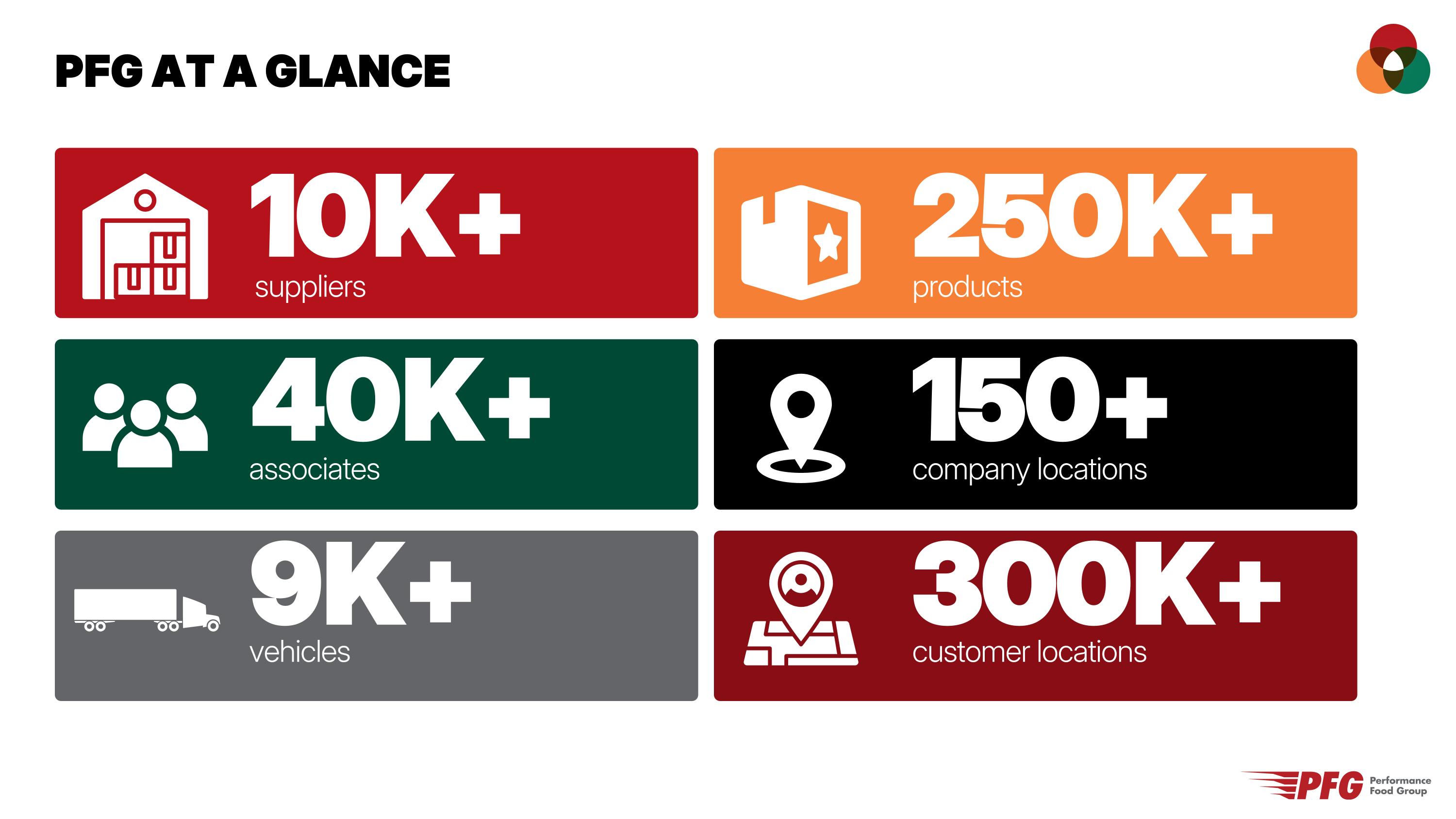
PFG AT A GLANCE 10 K+ suppliers 40 K+ associates 9 K+ vehicles 250 K+ products 150+ company locations 300 K+ customer locations

Geographic Reach Key PFG Headquarters Foodservice Convenience Specialty
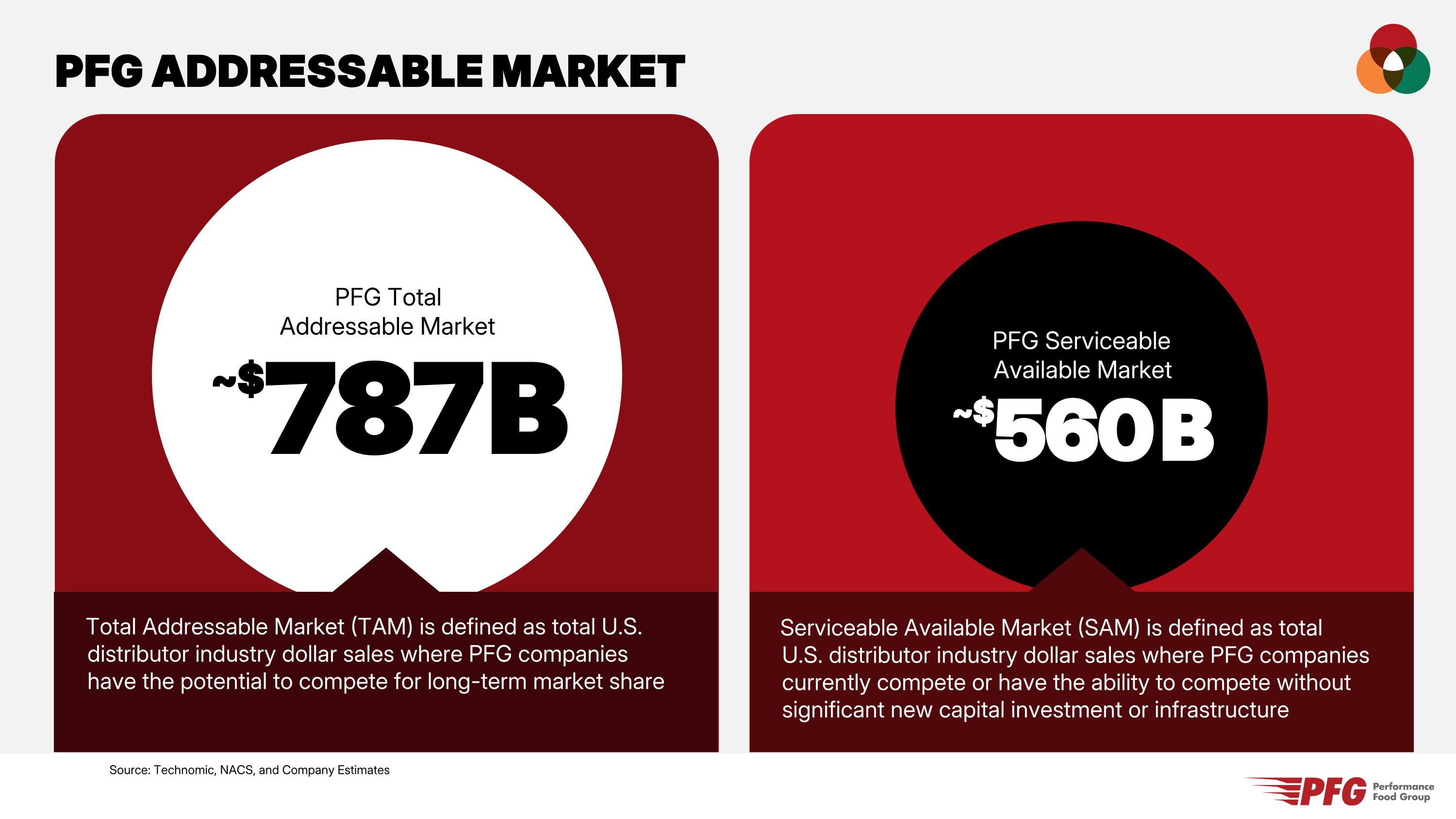
PFG Addressable Market Serviceable Available Market (SAM) is defined as total U.S. distributor industry dollar sales where PFG companies currently compete or have the ability to compete without significant new capital investment or infrastructure Total Addressable Market (TAM) is defined as total U.S. distributor industry dollar sales where PFG companies have the potential to compete for long-term market share PFG Serviceable Available Market ~$560 B PFG Total Addressable Market ~$787 B Source: Technomic, NACS, and Company Estimates

PFG Addressable Market by Segment PFG Total Addressable Market ~$787 billion $ BILLIONS $ BILLIONS PFG Serviceable Available Market ~$560 billion Source: Technomic, NACS, and Company Estimates
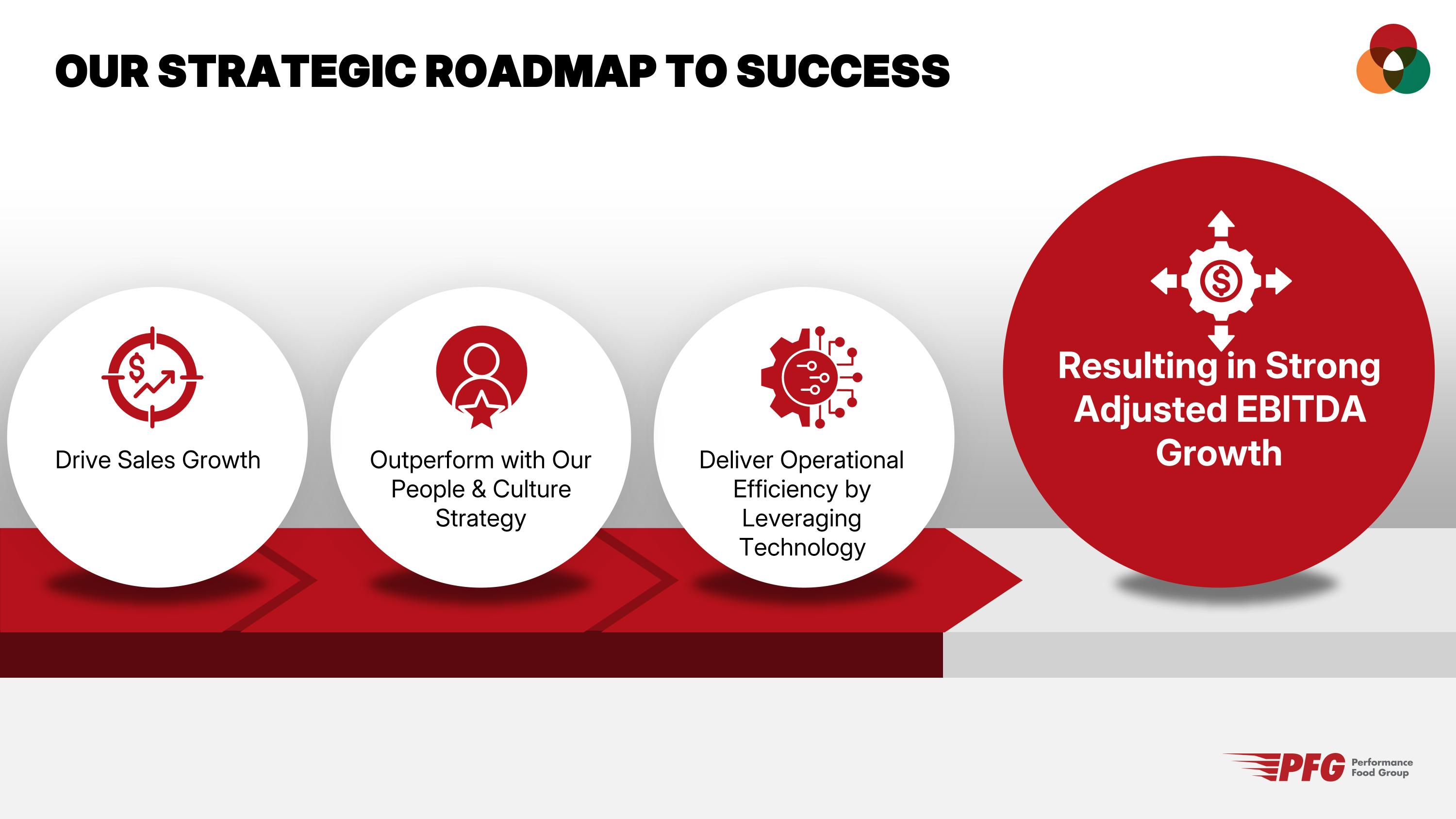
Our strategic roadmap to success Resulting in Strong Adjusted EBITDA Growth Drive Sales Growth Outperform with Our People & Culture Strategy Deliver Operational Efficiency by Leveraging Technology

Senior Vice President, Strategy & M&A Liz Mountjoy

M&A Strategy - resilience & sustainable growth

M&A Priorities support this strategy Grow and protect core Foodservice business Ensure preparedness for longer-term, ongoing growth platforms Expand West Fill in white space inkey markets Protect existing market and platform strengths Margin expansion High-growth channels Tuck-ins Close-in adjacencies New markets 1 Opportunistically pursue deals that support operational needs or financial aspirations 2 3
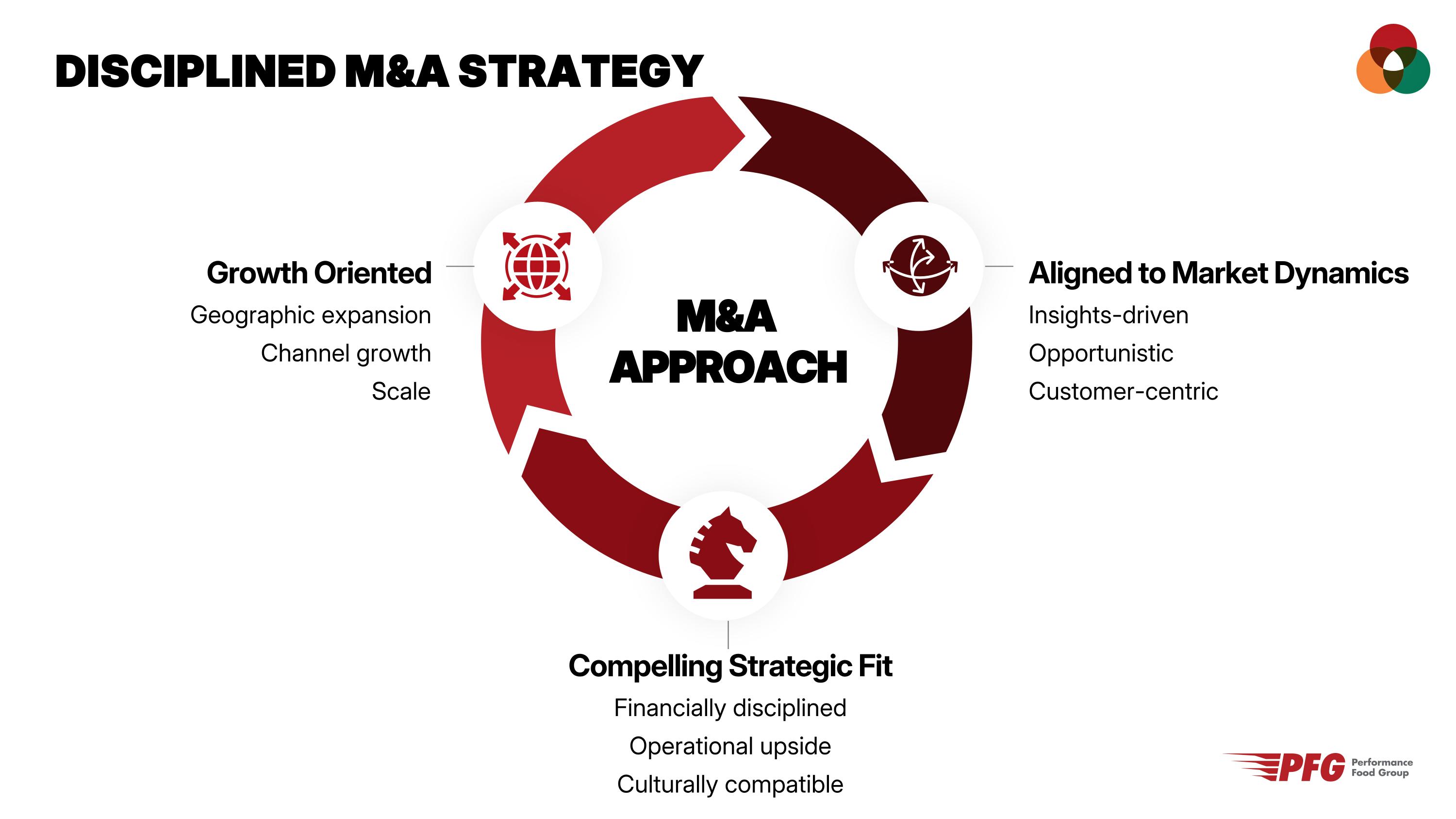
DISCIPLINED M&A STRATEGY Growth Oriented Geographic expansion Channel growth Scale Aligned to Market Dynamics Insights-driven Opportunistic Customer-centric Compelling Strategic Fit Financially disciplined Operational upside Culturally compatible M&AAPPROACH

Differentiated Strengths Proven Process Integration Balance Deal Sourcing

Recent ACQUISITIONS BENEFITS SALES MIX BY END MARKET 1 4 BACKGROUND José Santiago, Inc. is headquartered at its facility in Bayamon, Puerto Rico José Santiago is a leading independent broadline foodservice distributor with ~5,800 customers in Puerto Rico Employs ~530 employees, all based in Puerto Rico BENEFITS Unlocks New Geography to Expand into New Markets Growth Opportunities for PFG Brand Penetration Strong Presence In One Of The Fastest Growing Markets In The Country Complementary Customer-Centric Operating Models & Brand Penetration Opportunities SALES MIX BY END MARKET 1 BACKGROUND One of the most distinguished privately held foodservice distributors in the U.S. with over $3 billion in net sales State of the art facilities with excess capacity A leading private distributor serving independent restaurants and multi-unit establishments Offerings include frozen foods, dry goods, refrigerated commodities, boxed meats, and more 1. Source: Company Estimates

M&a Success proof points 108 New Locations 2.6 M Trending annualized volume for FY25 (Manufacturing division cases) 19.5% CAGR in dollars for Foodservice cases into Convenience & Retail since 2020 <3 YRS Synergy capture proven when announcing public targets 40% Procurement synergies already captured for José Santiago
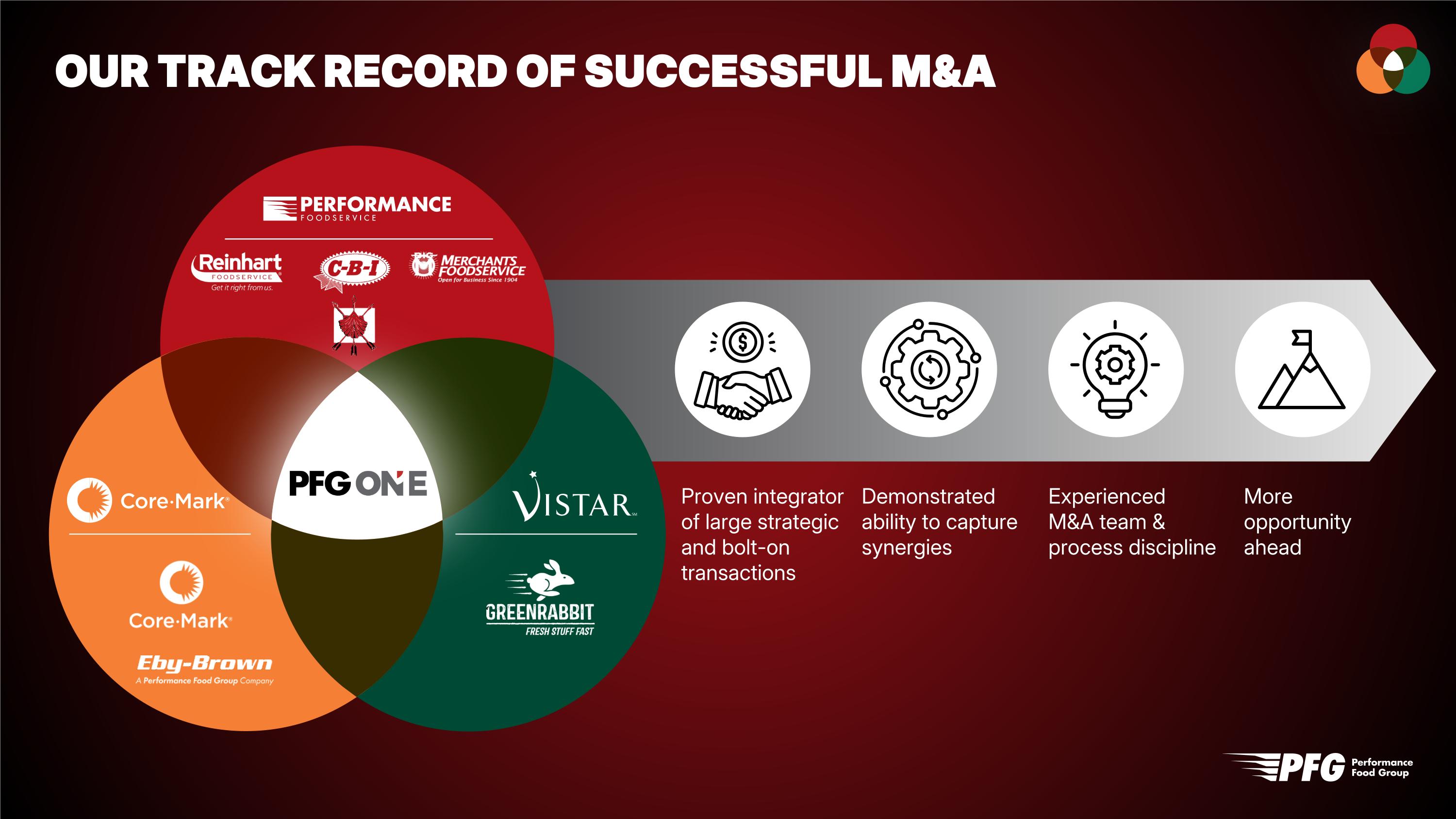
OUR TRACK RECORD OF SUCCESSFUL M&A Proven integrator of large strategic and bolt-on transactions Demonstrated ability to capture synergies Experienced M&A team & process discipline More opportunity ahead
President & Chief Operating Officer Scott Mcpherson
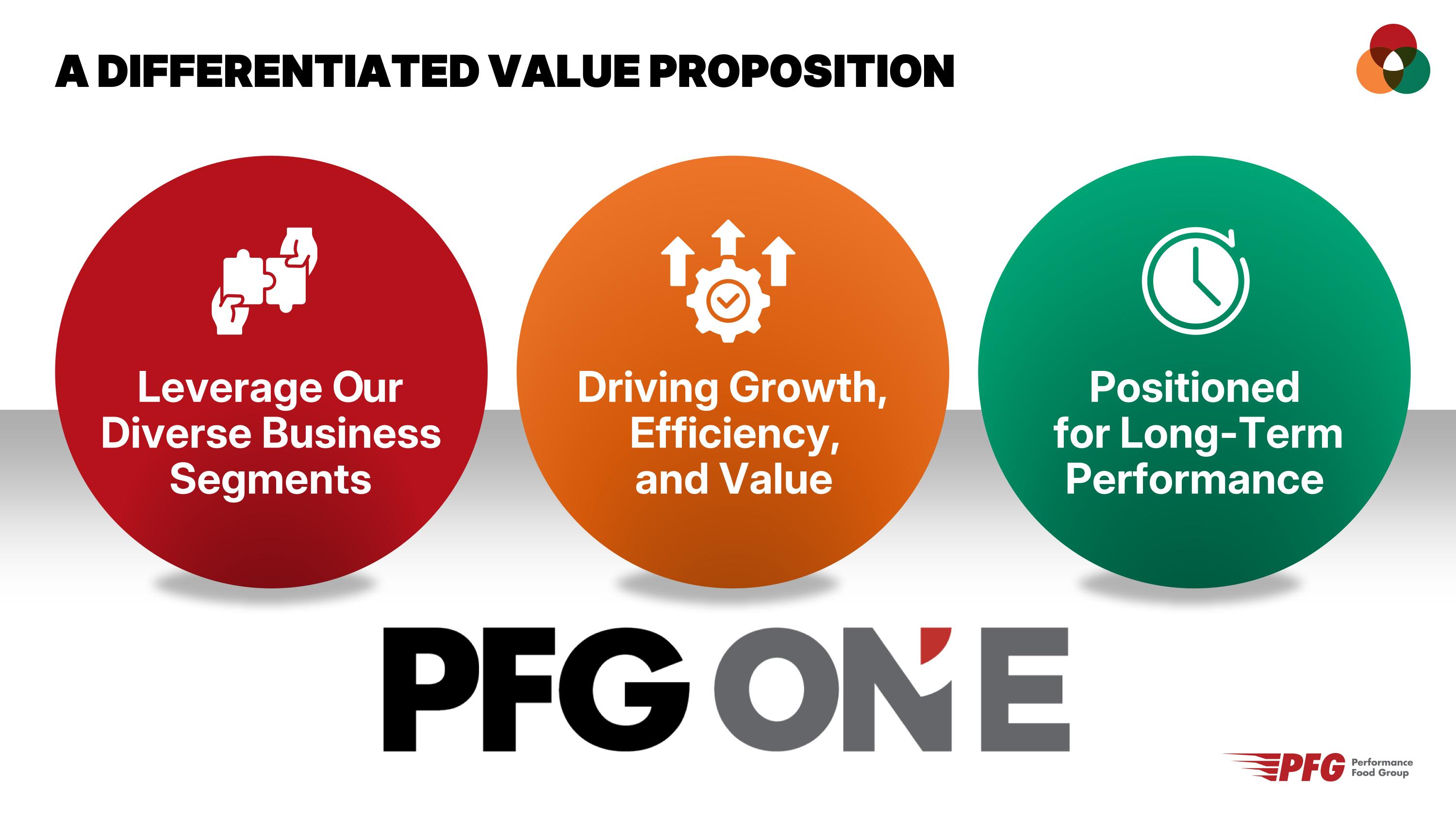
A Differentiated Value Proposition Driving Growth, Efficiency, and Value Positioned for Long-Term Performance Leverage Our Diverse Business Segments
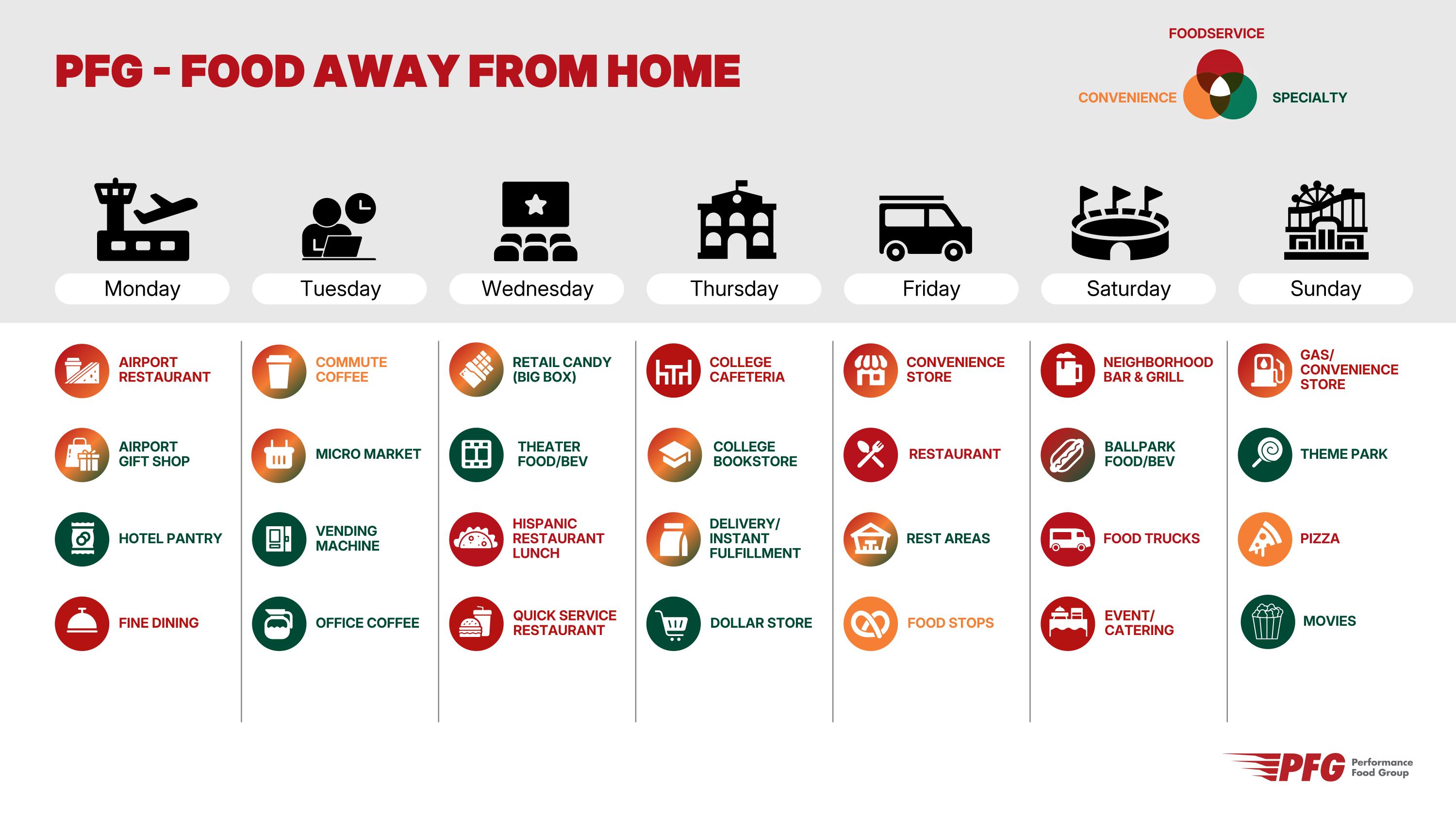
Monday Tuesday Wednesday Thursday Friday Saturday Sunday Fine dining Office coffee Quick service restaurant Dollar store FOOD STOPS EVENT/CATERING AIRPORT RESTAURANT Commute coffee Retail candy (big box) College cafeteria CONVENIENCE STORE NEIGHBORHOOD BAR & GRILL GAS/CONVENIENCE STORE Airportgift shop Micro market Theater food/BEV College bookstore RESTAURANT BALLPARK FOOD/BEV THEME PARK Hotel pantry Vending machine Hispanic restaurant lunch Delivery/instant fulfillment REST AREAS FOOD TRUCKS PIZZA Specialty convenience FOODSERVICE Movies Pfg - Food away from home

FOODSERVICE SEGMENTSnapshot 1 Customer Mix Independent Restaurant Customer Mix Chain Independent $32.1 B TTM FY 2025 Sales 175 K Customer locations 82 % Sales came from restaurants $7.4B+ TTM FY 2025 Sales of proprietary Performance Brands Independent Share Growth Leader Continuous Investment in Sales Organization Expanding Portfolio of Industry’s Chain Growth Leaders 41% 59% Family/Casual Convenience Recreation Retail Sandwich Seafood Hispanic Bar & Grill Pizza/Italian 1. Represents TTM FY2025 segment sales. Independent customers consist of less than five locations. Chain customers are multi-unit with five or more locations.

Foodservice Strategic pathways Growth focused sales organization with consistent commission structure Highly trained salespeople with close connections to our customers Local decision making on products, pricing & services Over 25,000 proprietary brand SKUs Over 27K valued associates dedicated to making PFS a great place to work Acceleration of technology levers across our sales & operations teams

CONVENIENCE SEGMENT Snapshot 1 $24.3 B TTM FY 2025 Sales 51 K Customer locations 68 % Gross profit from Food, Foodservice, and Related Products Largest Convenience Distributor in North America Differentiated Foodservice Product Offering Expanding Portfolio of Industry’s Best In Class Retailers 32 % Gross profit from nicotine Customer Mix Chain Independent Product Mix 53% 47% Combustibles Other Nicotine Products Food Foodservice Candy HBC & General Beverage 1. Represents TTM FY2025 segment sales. Independent customers consist of less than fifty locations. Chain customers are multi-unit with fifty locations or more.

Convenience strategic pathways Consistent share growth across all customer segments Largest street sales organization in the industry with uncapped commission structure Turnkey foodservice solutions & unmatched food sourcing capabilities Best in class customer operational performance metrics Growing portfolio of customer focused proprietary brands Cutting edge customer facing technology solution suite
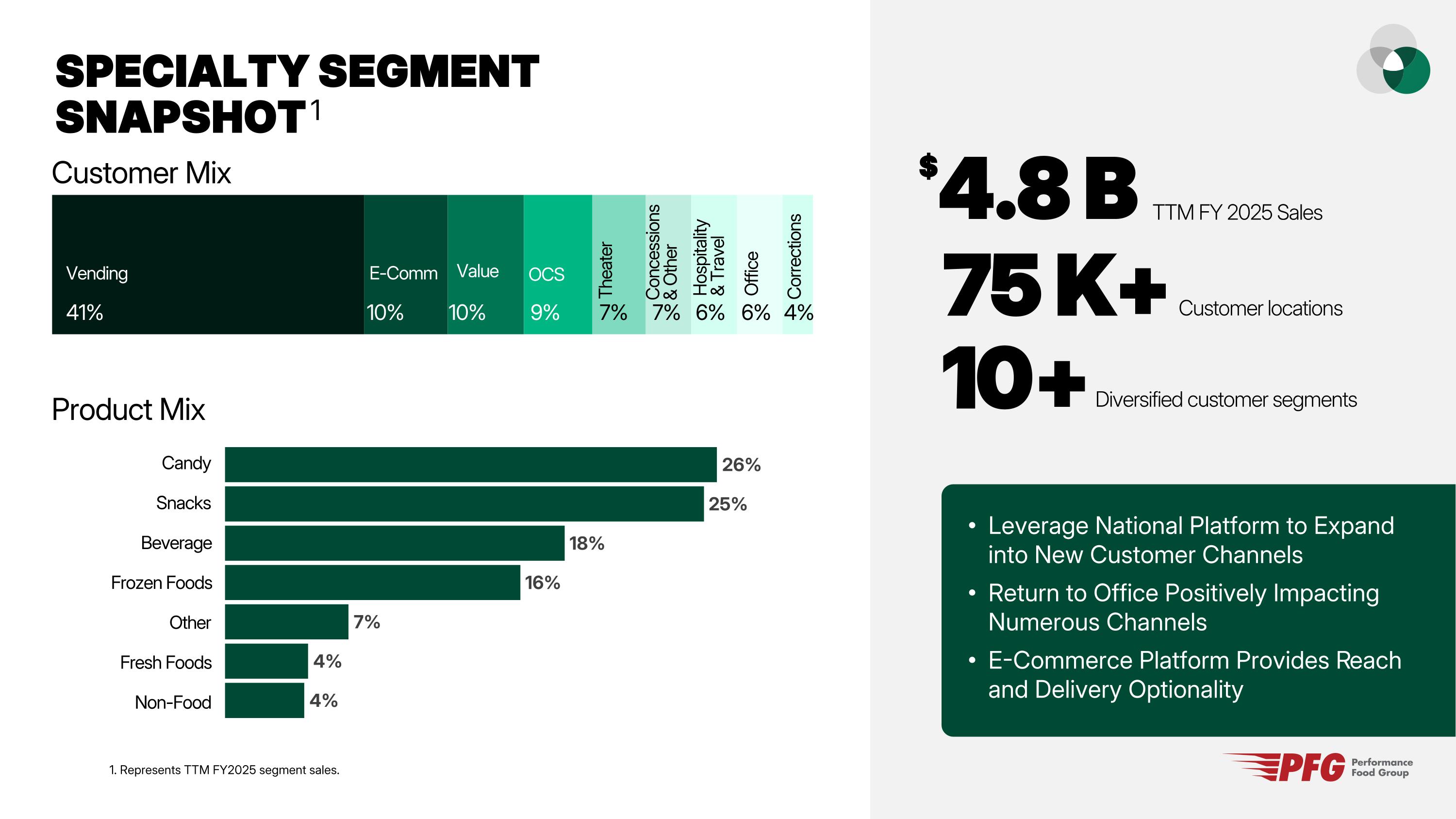
Specialty SEGMENT Snapshot 1 Customer Mix Product Mix Vending Theater Value E-Comm OCS Concessions & Other Hospitality & Travel Office $4.8 B TTM FY 2025 Sales 75 K+ Customer locations 41% 10% 10% 9% 7% 7% 6% 4% Candy Snacks Beverage Frozen Foods Other Fresh Foods Non-Food 6% Corrections Leverage National Platform to Expand into New Customer Channels Return to Office Positively Impacting Numerous Channels E-Commerce Platform Provides Reach and Delivery Optionality 10 + Diversified customer segments 1. Represents TTM FY2025 segment sales.
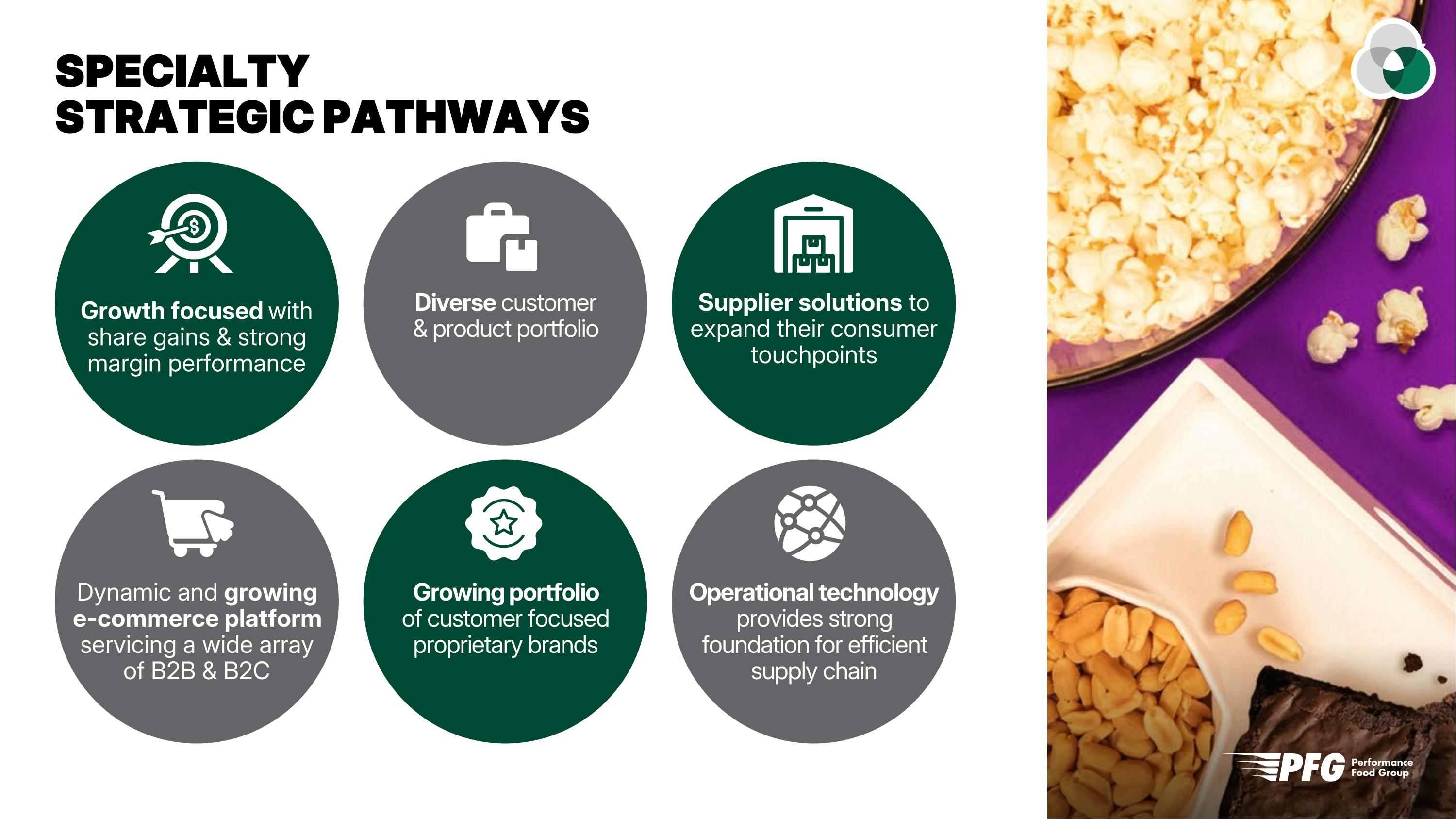
Specialty strategic pathways Diverse customer & product portfolio Growth focused with share gains & strong margin performance Supplier solutions to expand their consumer touchpoints Dynamic and growing e-commerce platform servicing a wide array of B2B & B2C Growing portfolio of customer focused proprietary brands Operational technology provides strong foundation for efficient supply chain

E-Commerce NETWORK 1 DAY TRANSIT 2 DAYS 3 DAYS 4 DAYS 1.1 M 9 M+ 99.9 % 1.5 Sq/ft of temperature-controlled space Parcel packages shipped in FY 2024 On-time shipment Average shipping days 1 DAY Population shipping coverage 2 DAYs Population shipping coverage 54 % 96 %

Prominent Convenience Customer Expanding Their Foodservice Offerings SITUATION Rutter’s, a prominent convenience store operator, sought a comprehensive turnkey solution that seamlessly integrates robust traditional convenience supply with an exceptional foodservice offering. RESULT Over the past three years, PFG has achieved a 7% growth rate. In 2023, PFG secured a multi-year agreement to exclusively service all of Rutter’s convenience needs through Core-Mark and their foodservice requirements through Performance Foodservice. 5-year extension signed for PFG segment Collaboration PFG’s TASK Forge a streamlined partnership with Rutter’s, leveraging the combined strengths of our convenience and foodservice segments. 7.5 % 3-Year Sales CAGR Foodservice 6.9 % 3-Year Sales CAGR 0.9% Cig Growth 19.8% Non-Cig Growth 7.0 % 3-Year Sales CAGR 0.9% Cig Growth 14.4% Non-Cig Growth ACTION Conducted a thorough evaluation and analysis of their entire portfolio, identifying the optimal synergies and complementary benefits to enable a strategic partnership that maximizes mutual value.

Leveraging Our Manufacturing Capabilities to Deliver Unique Customer Solutions SITUATION PFG’s convenience segment identified the need for a high-quality, value-priced pizza and breakfast sandwich offering. RESULT The branded solution was launched in February 2024 and successfully reached the target of 2 million pizzas sold, as set by the leading retailer. The proprietary solution, launched in mid Q1 2025, has been gaining traction with over 1,700 participating retailers. MANUFACTURING collaboration OBJECTIVE OLM, part of PFG’s manufacturing division, was tasked with developing a proprietary branded pizza offering for a key convenience customer and a breakfast sandwich offering to be sold across our convenience and foodservice segments. 2 M + Proprietary Brand Pizzas Sold to Customer in Year 1 1 M + Proprietary Breakfast Sandwiches Sold to Customers in Year 1

PFG one - creating differentiation Diversified Business Model Segment collaboration driving revenue growth Adoption of sales compensation models and training on a broad scale Complementary vendor portfolio across segments creating synergy opportunities Logistics footprint provides powerful network to move product and service customers Customer connectivity across segments through a common digital ordering platform Leverage technology to provide better outcomes for customers and employees Competitive Advantage Decentralized business model focused on staying close to our customers Growth focused sales organization dedicated to share growth and customer value E-commerce platform with potential to span across our segments Redistribution network expands product availabilityand a gateway to brands Manufacturing capabilities to create enterprise and customer brand solutions Operational execution attracting chain and independent customers to our organization

Executive Vice President & Chief Human Resources Officer Erika Davis

Key Messages Unparalleled IndustryReputation Customer-Centric and Empowered Culture Robust Talent Pipeline and Development High-Performing Teams Delivering Growth 1 2 3 4

Unparalleled industry reputation CUSTOMERS They tell others about us. TALENT They want to work for us. ACQUISITIONS They choose us.

Leading with a strong and performance-driven team 11K+ trailers Generationally Balanced Baby Boomers Gen X Millennials Gen Z 40 K + associates ~6.5 YRS average tenure 30 + languages spoken

PFG has successfully integrated approximately 22,000 associates through acquisitions since 2020 of people leaders have been with PFG 5+ years 63 % Customer-centric and Empowered Culture Focus on strengths and expertise Autonomous ownership mentality Unwavering commitment to deliver to our customer 22 K

Track record of supporting our people Robust Talent Pipeline and Development We attract top talent because: We attract people that are entrepreneurial: We leverage our expertise to develop talent: We invest in a sustainable future: Purpose-driven, essential work Exemplify PFG inaction values Agile, goal-oriented,and competitiveteam players Leadership Development Program Immersive Sales Training Cross-segment assignments Succession planning across all segments PurposefulTalent Brand Identifying theBest Talent Growth & Development Robust Leadership Pipeline

High-Performing Teams Delivering Growth Balance margin and volume goals to drive a unified strategy Align associates on performance metrics to foster collective success Update associates on compensation details and performance expectations High associate participation in equity and stock purchase programs Our business model encourages autonomy and locally based decision making Compensation aligns with pay for performance Competitive compensation rewards top talent and exceptional performance Philosophy Performance Metrics Ownership Mentality

1 2 3 4 Key Takeaways Unparalleled Industry Reputation Customer-Centric and Empowered Culture Robust Talent Pipeline and Development High-Performing Teams Delivering Growth

President & Chief Operating Officer Scott Mcpherson

Fueling success – Key Strategic Levers Sales Approach Proprietary Brands Technology Redistribution Operational Excellence

Salesforce Differentiation Growth Focus Training Compensation Technology Expanding sales organization to drive growth across segments Diverse customer base creates insulation Bringing foodservice to our Specialty segment Dedicated e-commerce platform and sales effort Full transition to PFS style sales compensation structure in FY 2025 Adopted PFS Sales Academy structure and content Industry leading sales & customer technology platform Turnkey foodservice programs and product selection Consistent investment in salesforce Leading training curriculum Stable compensation program for over two decades Bifurcated effort on independent and chain growth

foodservice Investment in growth - Post Covid Performance Brand Independent Case Growth CAGR 10 % Independent Foodservice Account Growth CAGR 7 % Salesforce Headcount Growth CAGR 8 % Salesforce Headcount Independent Accounts Independent Brand Cases
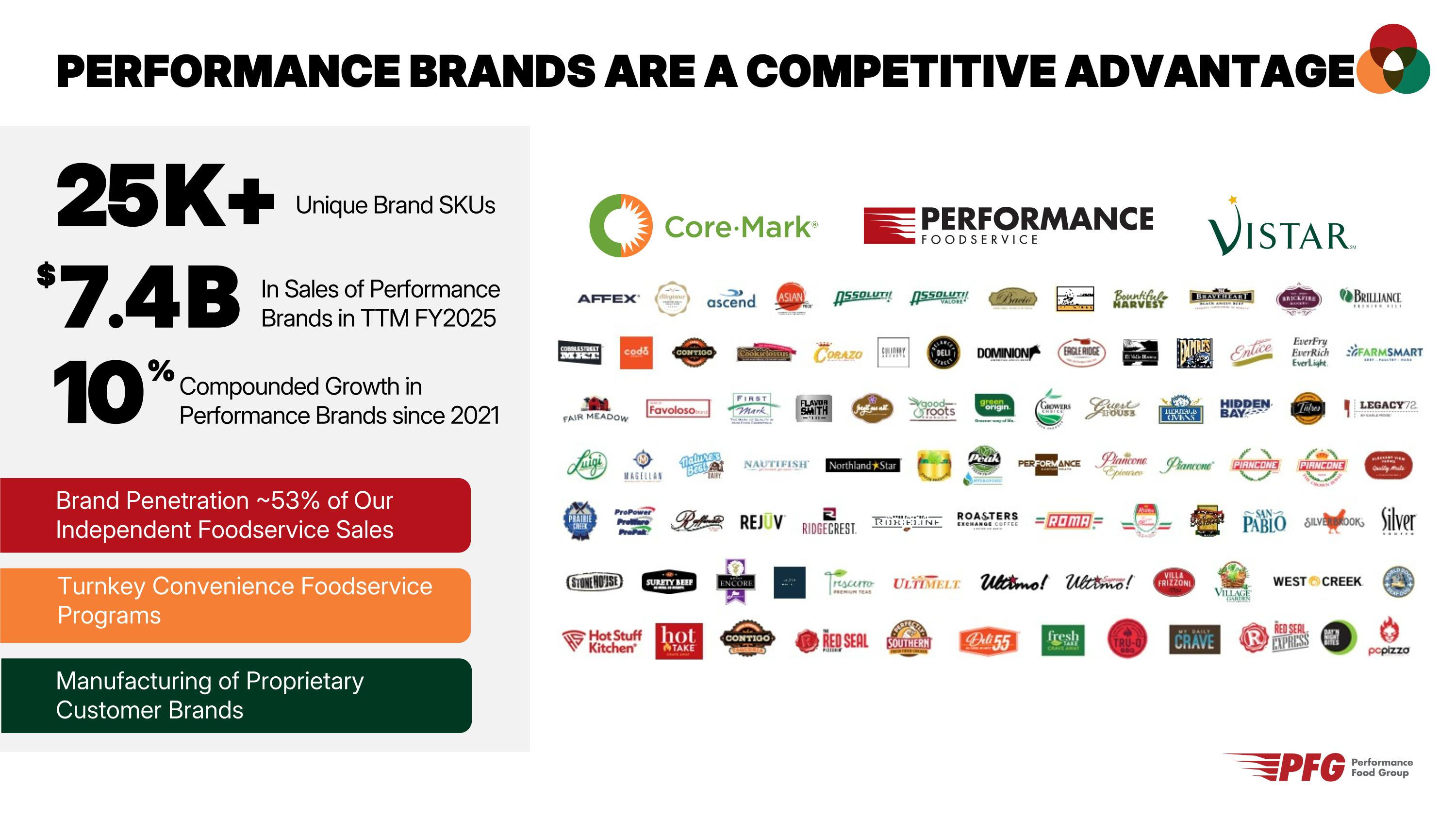
25 K+ Unique Brand SKUs $ 7.4 B In Sales of Performance Brands in TTM FY2025 Brand Penetration ~53% of Our Independent Foodservice Sales PERFORMANCE BRANDS ARE A COMPETITIVE ADVANTAGE Turnkey Convenience Foodservice Programs Manufacturing of Proprietary Customer Brands 10 % Compounded Growth in Performance Brands since 2021
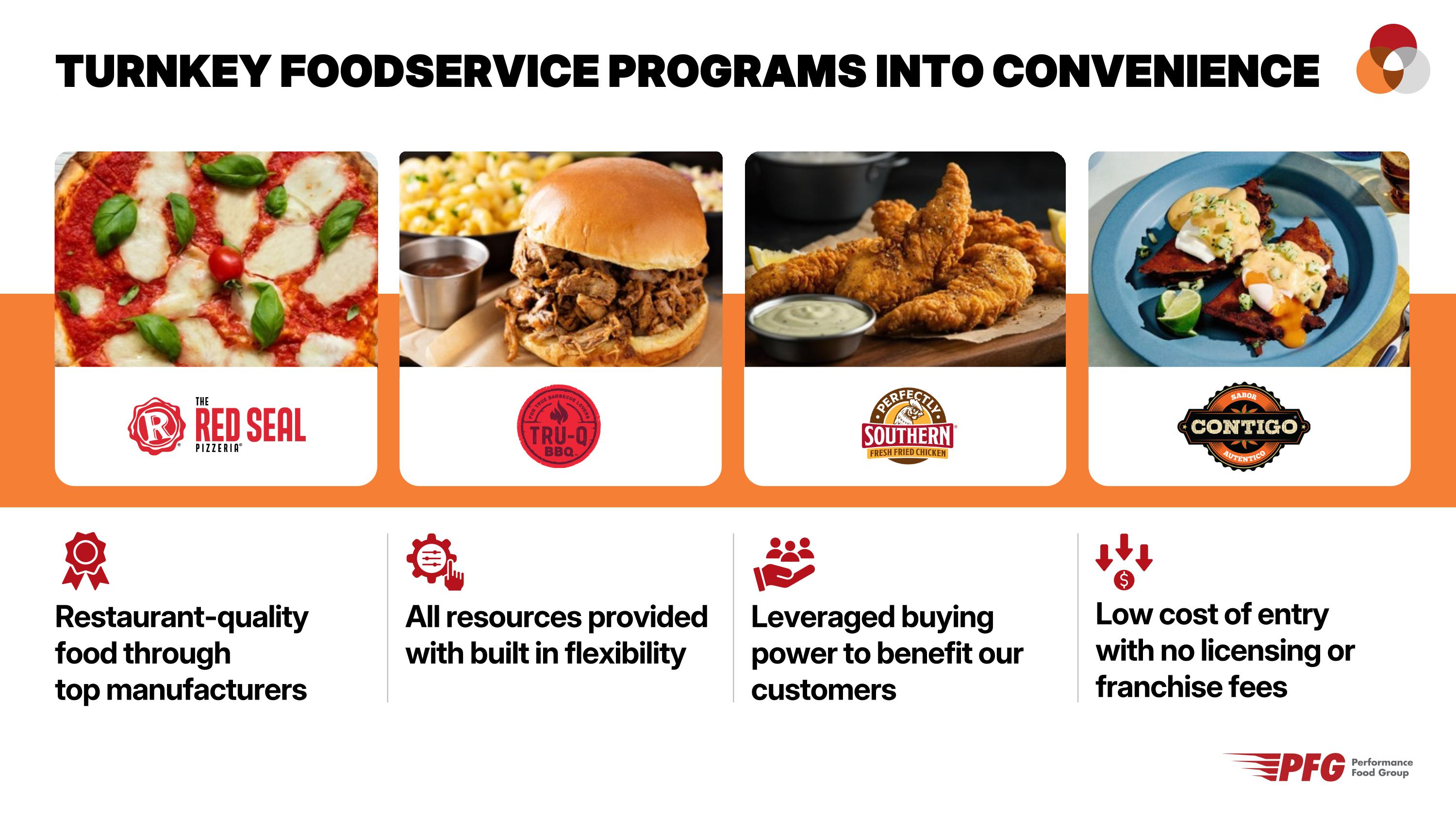
TURNKEY Foodservice PROGRAMS into Convenience All resources provided with built in flexibility Leveraged buying power to benefit our customers Low cost of entry with no licensing or franchise fees Restaurant-quality food through top manufacturers

Serving up ResultsCross-segment collaboration 17 % 10 + $400 m 1,500 30 % Performance Foodservice Share of Cases Sold into Convenience Channel 1 Cross-Segment Customers Bids Foodservice Cross-Segment Sales Turnkey Foodservice Programs Across PFG Convenience Segment Foodservice Sales as a % of Non-Nicotine Sales 12 % Foodservice into Convenience Case Growth 5 Year CAGR Source: Company Reports, Circana.

Digital Ordering Platform SIMPLIFY: Align our segments and customers to a shared digital platform 1 2 3 MODERNIZE: State-of-the-art architecture and interface, providing a digital foundation for the future GROW: Complement our salesforce to increase customers and sales A digital platform meeting customers where they are:

Connecting our Segments, Salesforce and Customers Platform for partnership 67% of customers across all segments connecting to PFG’s digital ordering platform 76% of our total order volume is placed using our digital platform 15% of customers add cases based on our AI generated items missed or suggested* +8% case growth differential between customers who engage with both a sales representative and digital tools compared to customers that exclusively use digital tools* lines per customer differential between customers who engage with both a sales representative and digital tools compared to customers that exclusively use digital tools* +8% Impact Of Hybrid Customer Engagement* 5% higher case volume from customers with a digital interface vs. no digital interface* *Foodservice segment only
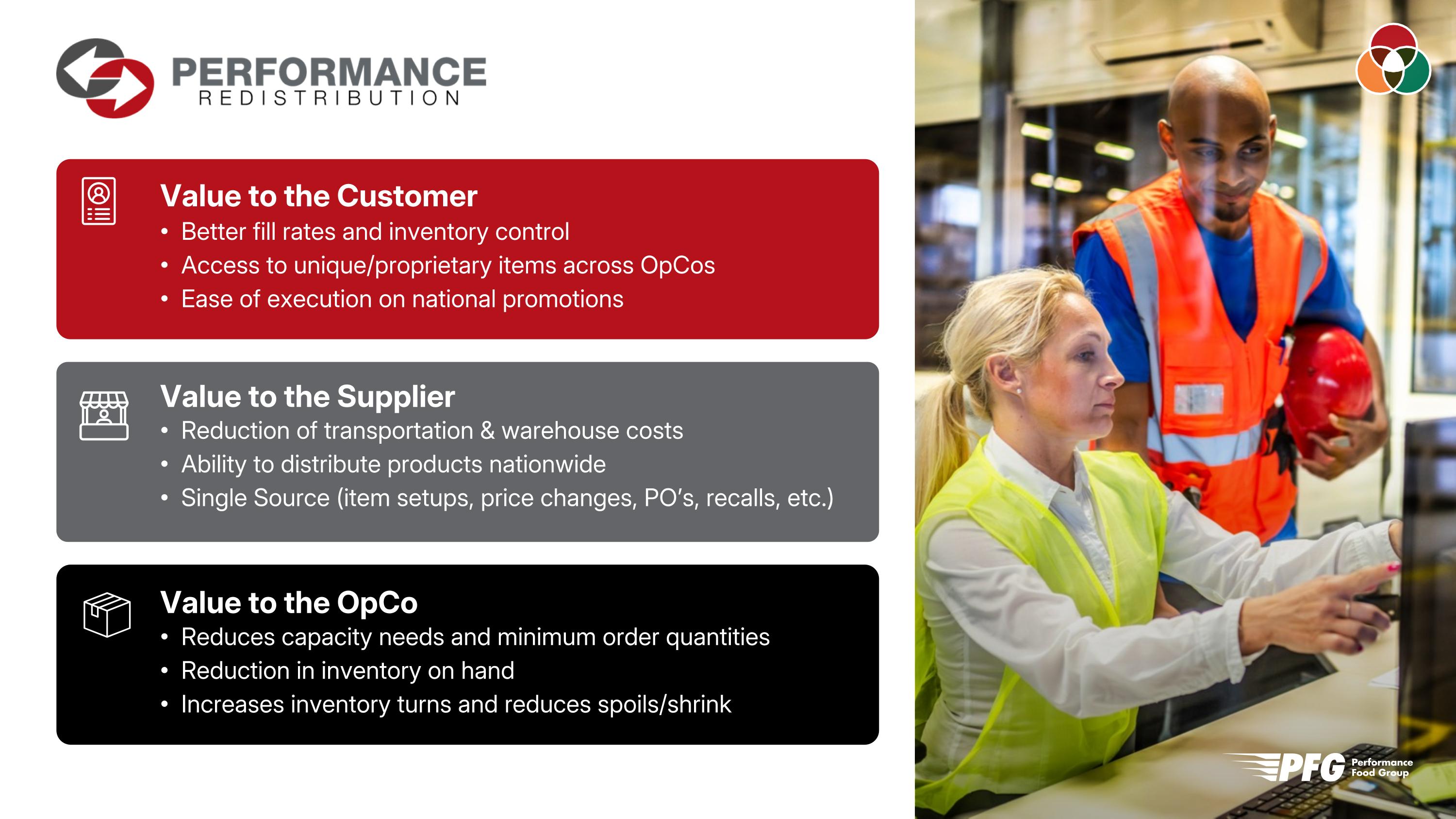
Value to the Customer Better fill rates and inventory control Access to unique/proprietary items across OpCos Ease of execution on national promotions Value to the OpCo Reduces capacity needs and minimum order quantities Reduction in inventory on hand Increases inventory turns and reduces spoils/shrink Value to the Supplier Reduction of transportation & warehouse costs Ability to distribute products nationwide Single Source (item setups, price changes, PO’s, recalls, etc.)

BEFORE REDISTRIBUTION: FRAGMENTED SUPPLY CHAIN SUPPLIER C SUPPLIER B SUPPLIER A SUPPLIERFORWARD WH SUPPLIERFORWARD WH SUPPLIERFORWARD WH DC4 DC3 DC2 DC1 SUPPLIER C SUPPLIER B SUPPLIER A SUPPLIERFORWARD WH SUPPLIERFORWARD WH SUPPLIERFORWARD WH

AFTER REDISTRIBUTION: EFFICIENT MODEL $4B shipped across all segments and product categories in 2025 10,500 Deliveries made to PFG OpCos Expansion planned in California to support western foodservice distribution SUPPLIERFORWARD WAREHOUSE SUPPLIER C SUPPLIER B SUPPLIER A SUPPLIER C SUPPLIER B SUPPLIER A DC1 DC2 DC3 DC4

Transportation Excellence Fleet, Technology & Performance TRANSPORTATION TECHNOLOGY Dynamic routing (Descartes/Roadnet) Samsara Integrated Camara Crossbow Logistics Solution DELIVERY SOLUTIONS PACE Defensive Driving Electronic VehicleInspection Reports ACAT Driver training Proof of Delivery Sustainability (EVs) REAL-TIME DELIVERY ALERTS Temperature Monitoring Track My Order Delivery Monitoring Data Visualization 90 +% Of all deliveries are made within the scheduled delivery window 18 % YOY reduction in accidents per million miles below the industry standard of two 95 % Of PFG’s fleet is equipped with Samsara road and driver facing cameras REFRIGERATED FROZEN AMBIENT MULTI-TEMP TRAILER Truck Builder Solera Territory Planner
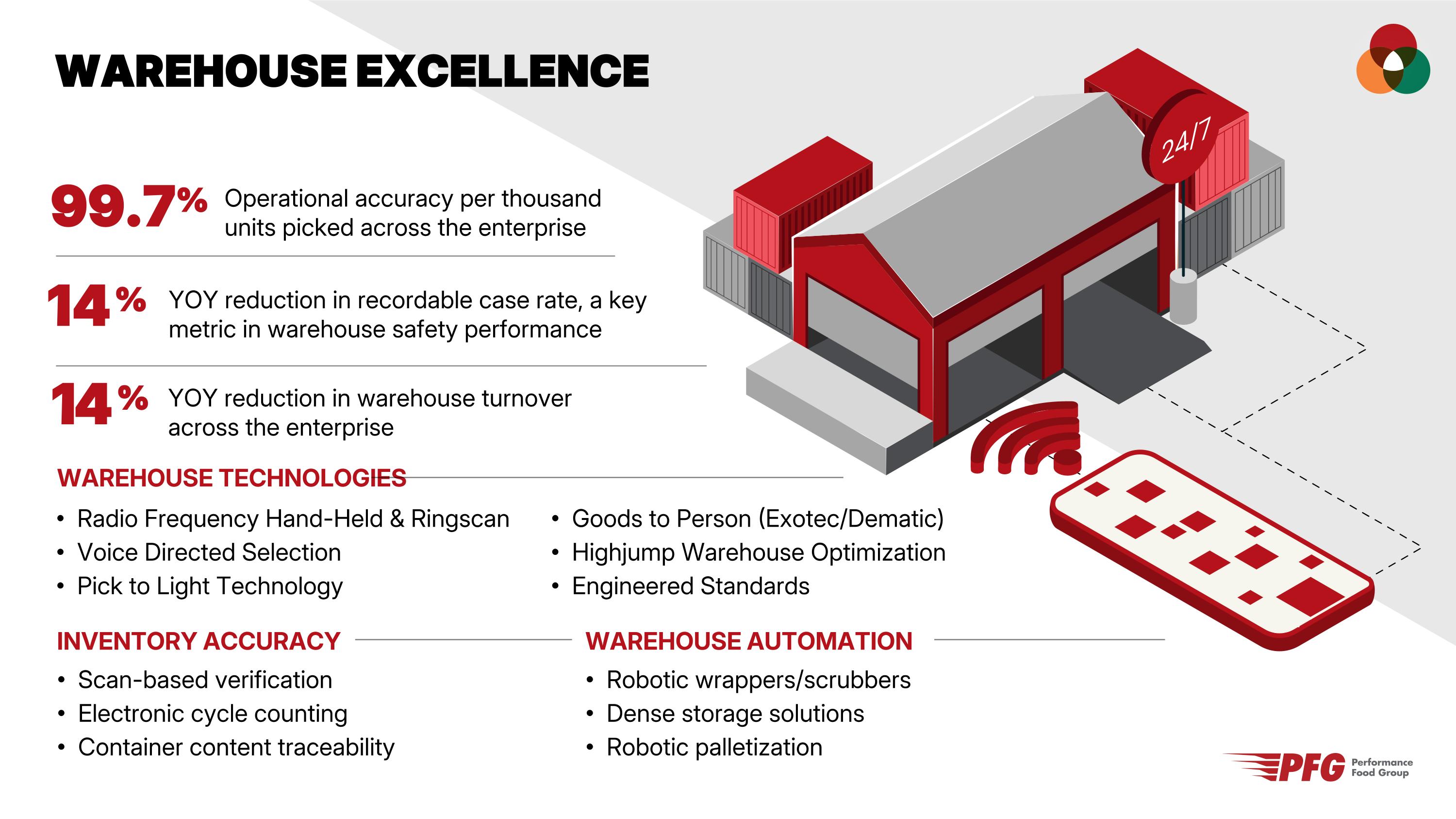
Warehouse Excellence WAREHOUSE TECHNOLOGIES Radio Frequency Hand-Held & Ringscan Voice Directed Selection Pick to Light Technology INVENTORY ACCURACY Scan-based verification Electronic cycle counting Container content traceability WAREHOUSE AUTOMATION Robotic wrappers/scrubbers Dense storage solutions Robotic palletization Operational accuracy per thousand units picked across the enterprise 14 % YOY reduction in warehouse turnover across the enterprise 14 % YOY reduction in recordable case rate, a key metric in warehouse safety performance Goods to Person (Exotec/Dematic) Highjump Warehouse Optimization Engineered Standards 99.7 %

1 2 3 4 Key Takeaways Sales Organization Brands Technology Redistribution 5 Operating Efficiency

Executive Vice President & Chief Financial Officer Patrick hatcher

Our strategic roadmap to success Resulting in Strong Adjusted EBITDA Growth Drive Sales Growth Outperform with Our People & Culture Strategy Deliver Operational Efficiency by Leveraging Technology

PFG Strategies & Priorities Consistent OrganicSales Growth AdjustedEBITDA MarginExpansion Capital Allocationto Drive ShareholderValue
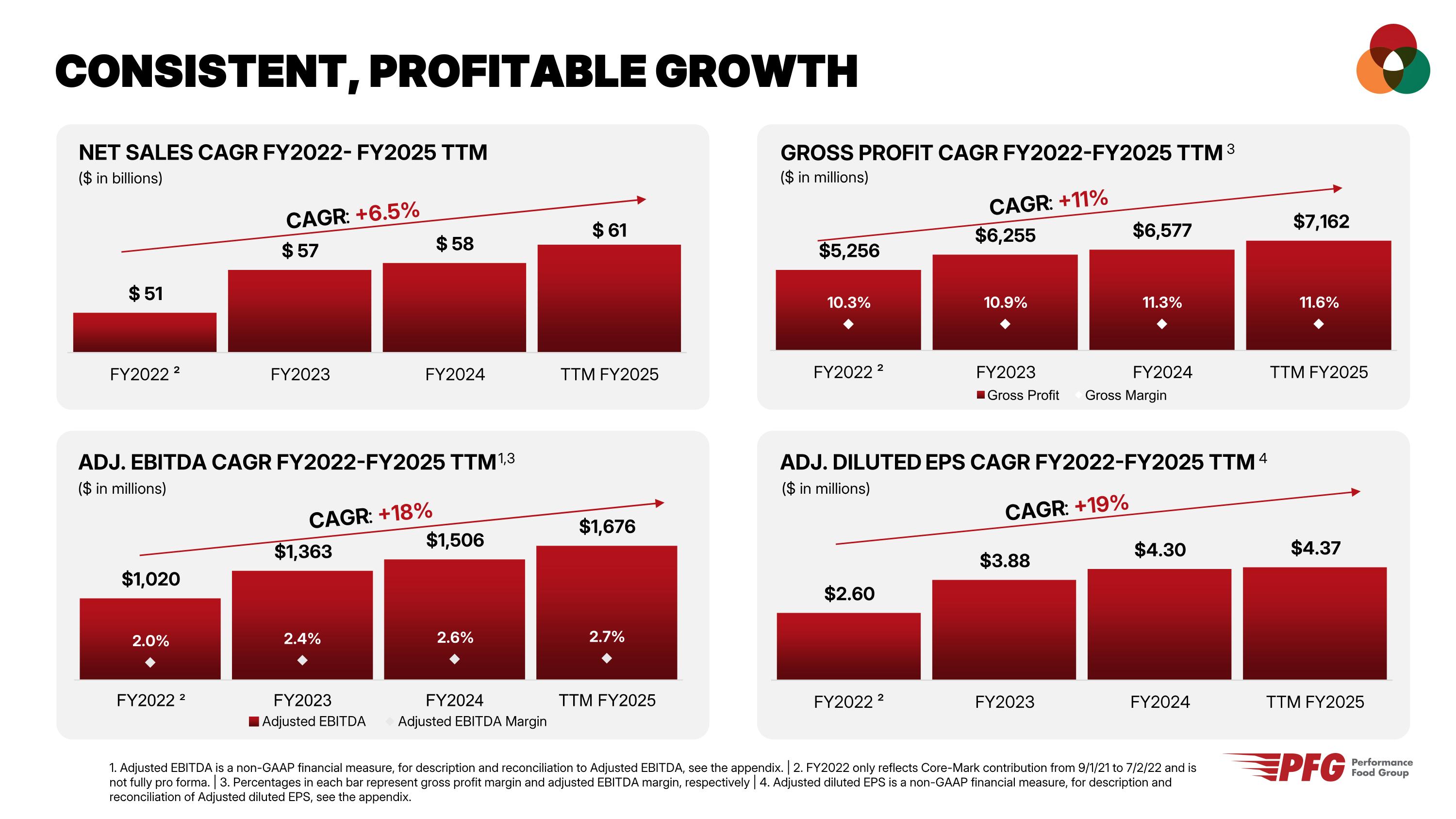
Consistent, Profitable Growth CAGR: +6.5% ($ in billions) NET SALES CAGR FY2022- FY2025 TTM ($ in millions) GROSS PROFIT CAGR FY2022-FY2025 TTM 3 ADJ. EBITDA CAGR FY2022-FY2025 TTM 1,3 ADJ. DILUTED EPS CAGR FY2022-FY2025 TTM 4 CAGR: +11% ($ in millions) ($ in millions) CAGR: +18% CAGR: +19% 1. Adjusted EBITDA is a non-GAAP financial measure, for description and reconciliation to Adjusted EBITDA, see the appendix. | 2. FY2022 only reflects Core-Mark contribution from 9/1/21 to 7/2/22 and is not fully pro forma. | 3. Percentages in each bar represent gross profit margin and adjusted EBITDA margin, respectively | 4. Adjusted diluted EPS is a non-GAAP financial measure, for description and reconciliation of Adjusted diluted EPS, see the appendix.

margin opportunities Procurement Savings Target $ 100 - $ 125 M Margin Expansion Drivers Segment Cross-Selling & Redistribution Procurement Efficiencies Strategic Acquisitions Mix & Brand Penetration

2.7% Adjusted ebitda margin expansion drivers Adj. EBITDA CAGR FY2022- FY2025 1 CAGR:+18% Margin Expansion 2025-2028 Target +50-60 bps Adjusted EBITDA margin is a non-GAAP financial measure, for description and reconciliation to Adjusted EBITDA, see the appendix. FY2022 only reflects Core-Mark contribution from 9/1/21 to 7/2/22 and is not fully pro forma. 2.6% 2.4% 2.0%

PFG Financial Priorities Robust operating cash flow supports deleveraging to our modest long-term leverage target of 2.5-3.5x Leverage CapEx Support capacity expansion and fleet investment, driving organic top and bottom-line growth and generating attractive ROI Target accretive and synergistic acquisitions that align with PFG’s strategic vision M&A Share Repurchases Authorization of new $500 million repurchase program; repurchases under program depend upon marketplace conditions and other factors
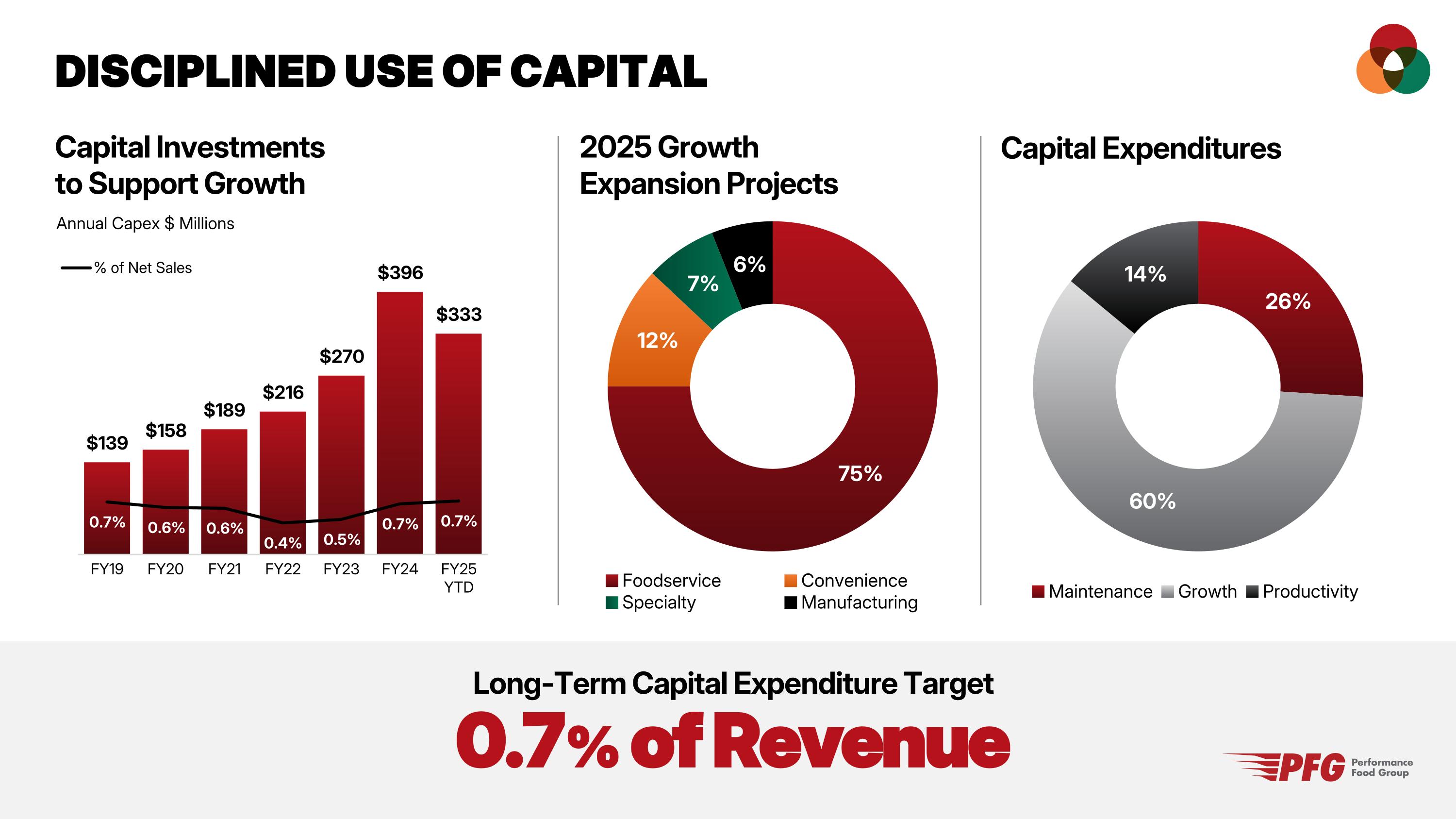
Disciplined Use of Capital Capital Investments to Support Growth 2025 Growth Expansion Projects Annual Capex $ Millions Capital Expenditures Long-Term Capital Expenditure Target 0.7 % of Revenue

Leverage Reduction PFG Total Leverage* *Defined as Net Debt/Pro Forma Adjusted EBITDA. 4.5x 4.1x 4.0x 2.9x 2.7x 3.8x Long-Term Target Net Debt / Adjusted EBITDA 2.5x-3.5x

Share repurchase authorization $500m

DISCIPLINED M&A STRATEGY Growth Oriented Geographic expansion Channel growth Scale Aligned to Market Dynamics Insights-driven Opportunistic Customer-centric Compelling Strategic Fit Financially disciplined Operational upside Culturally compatible M&AAPPROACH

2022 Long range plan vs. FY 2025 Guidance $62B $63B $1.5B $1.725B $64B $63.5B $1.7B $1.75B Source: 2022 LRP represents targets announced at June 2022 Investor Day. FY2025 E represents current FY2025 guidance. 1. Adjusted EBITDA is a non-GAAP financial measure, for description and reconciliation to Adjusted EBITDA, see the appendix.

Three Year Targets 3-Year Sales 3-Year Adj EBITDA $73 B $75 B Annual net revenue in fiscal 2028 Annual Adj EBITDA in fiscal 2028 $2.3 B $2.5 B

Q&A Session

Appendix
STATEMENT REGARDING NON-GAAP FINANCIAL MEASURES This presentation includes certain non-GAAP financial measures, including Adjusted EBI TDA and Adjusted Diluted Earnings Per Share. These metrics have important limitations and should not be considered in isolation or as a substitute for measures of our financial performance or liquidity prepared in accordance with GAAP. In addition, these metrics, as presented by us may not be comparable to similarly titled measures of other companies due to varying methods of calculations. Our Adjusted EBI TDA outlook excludes the impact of certain income and expense items that management believes are not part of underlying operations. These items may include, but are not limited to, loss on early extinguishment of debt, restructuring charges, certain tax items, and charges associated with non-recurring professional and legal fees associated with acquisitions. Management cannot estimate on a forward-looking basis the impact of these income and expense items on our reported Net income, which could be significant, are difficult to predict and may be highly variable. As a result, we do not prov ide a reconciliation to the closest corresponding GAAP financial measure for our Adjusted EBI TDA outlook. Management uses Adjusted EBI TDA, defined as net income before interest expense, interest income, income and franchise taxes, and depreciation and amortization, further adjusted to exclude certain items we do not consider part of our core operating results. Such adjustments include certain unusual, non-cash, non-recurring, cost reduction, and other adjustment items permitted in calculating covenant compliance under the Company’s credit agreement and indenture (other than certain pro forma adjustments permitted under our credit agreement and indenture relating to the Adjusted EBI TDA contribution of acquired entities or businesses prior to the acquisition date). Under PFG’s credit agreement and indenture, the Company’s ability to engage in certain activ ities such as incurring certain additional indebtedness, making certain investments, and making restricted payments is tied to ratios based on Adjusted EBI TDA (as defined in the credit agreement and indenture). Management also uses Adjusted Diluted EPS, which is calculated by adjusting the most directly comparable GAAP financial measure by excluding the same items excluded in PFG’s calculation of Adjusted EBITDA, as well as amortization of intangible assets, to the extent that each such item was included in the applicable GAAP financial measure. For business combinations, the Company generally allocates a portion of the purchase price to intangible assets and such intangible assets contribute to revenue generation. The amount of the allocation is based on estimates and assumptions made by management and is subject to amortization over the useful lives of the intangible assets. The amount of the purchase price from an acquisition allocated to intangible assets and the term of its related amortization can vary significantly and are unique to each acquisition, and thus the Company does not believe it is reflective of ongoing operations. Intangible asset amortization excluded from Adjusted Diluted EPS represents the entire amount recorded within the Company’s GAAP financial statements; whereas, the revenue generated by the associated intangible assets has not been excluded from Adjusted Diluted EPS. Intangible asset amortization is excluded from Adjusted Diluted EPS because the amortization, unlike the related revenue, is not affected by operations of any particular period unless an intangible asset becomes impaired, or the estimated useful life of an intangible asset is revised. PFG believes that the presentation of Adjusted EBI TDA and Adjusted Diluted EPS is useful to investors because these metrics prov ide insight into underlying business trends and year-over-year results and are frequently used by securities analysts, investors, and other interested parties in their evaluation of the operating performance of companies in PFG’s industry. The following tables include a reconciliation of non-GAAP financial measures to the applicable most comparable U.S. GAAP financial measures.

NON-GAAP FINANCIAL MEASURES ADJUSTED EBITDA RECONCILIATION ($ in millions) March 29, 2025 TTM Fiscal year ended June 29, 2024 Fiscal year ended July 1,2023 Fiscal year ended July 2,2022 Fiscal year ended July 3,2021 Fiscal year ended June 27,2020 Net income (loss) (GAAP) $ 375.2 $ 435.9 $ 397.2 $ 112.5 $ 40.7 $ (114.1 ) Interest expense, net 321.5 232.2 218.0 182.9 152.4 116.9 Income tax expense (benefit) 131.9 160.9 146.8 54.6 14.0 (108.1 ) Depreciation 423.5 355.2 315.7 279.7 213.9 178.5 Amortization of intangible assets 243.6 201.5 181.0 183.1 125.0 97.8 Change in LIFO reserve 50.7 62.3 39.2 122.9 36.4 3.9 Stock-based compensation expense 45.8 41.9 43.3 44.0 25.4 17.9 (Gain) loss on fuel derivatives 0.9 (1.8 ) 5.7 (20.7 ) (6.4 ) 6.5 Acquisition, integration & reorganization expenses 80.8 23.7 10.6 49.9 16.2 182.8 Other adjustments 2.3 (5.7 ) 5.9 10.9 7.7 23.4 Adjusted EBITDA (Non-GAAP) $ 1,676.2 $ 1,506.1 $ 1,363.4 $ 1,019.8 $ 625.3 $ 405.5 A B C Includes increases (decreases) in the last-in-first-out (“LIFO”) reserve of $5.4 million, $3.8 million, $(19.2) million, $31.9 million, $11.8 million, and $0.8 million for Foodservice for the March 29, 2025 trailing twelve months (“TTM”), fiscal 2024, fiscal 2023, fiscal 2022, fiscal 2021, and fiscal 2020, respectively and $45.3 million, $58.5 million, $58.4 million, $91.0 million, $24.6 million, and $3.1 million for Convenience for the March 29, 2025 TTM, fiscal 2024, fiscal 2023, fiscal 2022, fiscal 2021, and fiscal 2020, respectively. Includes professional fees and other costs related to in-progress, completed, and abandoned acquisitions, costs of integrating certain of our facilities, and facility closing costs. Fiscal 2020 includes $108.6 million of contingent consideration accretion expense related to the acquisition of Eby-Brown and $9.3 million of costs related to information technology projects the Company is no longer pursuing as a result of the Reinhart acquisition. Includes asset impairments, gains and losses on disposal of fixed assets, amounts related to favorable and unfavorable leases, foreign currency transaction gains and losses, franchise tax expense, and other adjustments permitted by our credit agreement. This line item also includes a $3.8 million gain on the sale of a Foodservice warehouse facility for the March 29, 2025 TTM, an $8.1 million gain on the sale of a Foodservice warehouse facility for fiscal 2024, and development costs of $5.8 million for fiscal 2020 related to certain productivity initiatives the Company is no longer pursuing. A B C

NON-GAAP FINANCIAL MEASURES ADJUSTED DILUTED EARNINGS PER SHARE RECONCILIATION March 29, 2025 TTM Fiscal year ended June 29, 2024 Fiscal year ended July 1,2023 Fiscal year ended July 2,2022 Fiscal year ended July 3,2021 Fiscal year ended June 27,2020 Diluted earnings per share (GAAP) $ 2.40 $ 2.79 $ 2.54 $ 0.74 $ 0.30 $ (1.01 ) Adjustment for dilutive shares — — — — — 0.01 Impact of amortization of intangible assets 1.56 1.29 1.16 1.21 0.94 0.86 Impact of change in LIFO reserve 0.33 0.40 0.25 0.81 0.27 0.03 Impact of stock-based compensation expense 0.29 0.27 0.28 0.29 0.19 0.16 Impact of (gain) loss on fuel derivatives 0.01 (0.01 ) 0.03 (0.14 ) (0.05 ) 0.06 Impact of acquisition, integration & reorganization charges 0.52 0.15 0.07 0.33 0.12 1.60 Impact of other adjustment items 0.01 (0.03 ) 0.04 0.08 0.06 0.21 Tax impact of above adjustments (0.75 ) (0.56 ) (0.49 ) (0.72 ) (0.48 ) (0.81 ) Impact of net operating loss carryback tax benefit — — — — — (0.41 ) Adjusted Diluted Earnings per Share (Non-GAAP) $ 4.37 $ 4.30 $ 3.88 $ 2.60 $ 1.35 $ 0.70

