 エドガーで原本を確認する
UNITED STATES
SECURITIES AND EXCHANGE COMMISSION
Washington, D.C. 20549
FORM 10-K
(Mark one)
[X] ANNUAL REPORT PURSUANT TO SECTION 13 OR 15(d) OF THE SECURITIES EXCHANGE ACT OF 1934
For the fiscal year ended December 31, 2024
or
[ ] TRANSITION REPORT PURSUANT TO SECTION 13 OR 15(d) OF THE SECURITIES EXCHANGE ACT OF 1934
For the transition period from _______________ to _______________
Commission file number 001-39747
SEER, INC.
(Exact name of Registrant as specified in its charter)
Delaware |
|
82-1153150 |
(State or other jurisdiction of incorporation or organization) |
|
(I.R.S. Employer Identification Number) |
3800 Bridge Parkway, Suite 102
Redwood City, California 94065
650-453-0000
(Address, including zip code and telephone number, including area code, of Registrant’s principal executive offices)
Securities registered pursuant to section 12(b) of the Act:
Copies to:
Title of each class |
|
Trading Symbol(s) |
|
Name of Exchange on which registered |
Common Stock, par value $0.00001 |
|
SEER |
|
Nasdaq Global Select Market |
Securities registered pursuant to section 12(g) of the Act: None
Indicate by check mark if the registrant is a well-known seasoned issuer, as defined in Rule 405 of the Securities Act. Yes ☐ No ☒
Indicate by check mark if the registrant is not required to file reports pursuant to Section 13 or Section 15(d) of the Act. Yes ☐ No ☒
Indicate by check mark whether the registrant (1) has filed all reports required to be filed by Section 13 or 15(d) of the Securities Exchange Act of 1934 during the preceding 12 months (or for such shorter period that the registrant was required to file such reports), and (2) has been subject to such filing requirements for the past 90 days. Yes ☒ No ☐
Indicate by check mark whether the registrant has submitted electronically every Interactive Data File required to be submitted pursuant to Rule 405 of Regulation S-T (§ 232.405 of this chapter) during the preceding 12 months (or for such shorter period that the registrant was required to submit such files). Yes ☒ No ☐
Indicate by check mark whether the registrant is a large accelerated filer, an accelerated filer, a non-accelerated filer, a smaller reporting company, or an emerging growth company. See the definitions of “large accelerated filer,” “accelerated filer,” “smaller reporting company,” and "emerging growth company" in Rule 12b-2 of the Exchange Act.
Large accelerated filer |
☐ |
|
Accelerated filer |
☐ |
|
|
|
|
|
|
|
|
Smaller reporting company |
☒ |
|
|
|
|
|
Non-accelerated filer |
☒ |
|
Emerging growth company |
☐ |
If an emerging growth company, indicate by check mark if the registrant has elected not to use the extended transition period for complying with any new or revised financial accounting standards provided pursuant to Section 7(a)(2)(B) of the Securities Act. ☐
Indicate by check mark whether the registrant has filed a report on and attestation to its management’s assessment of the effectiveness of its internal control over financial reporting under Section 404(b) of the Sarbanes-Oxley Act (15 U.S.C. 7262(b)) by the registered public accounting firm that prepared or issued its audit report. ☐
If securities are registered pursuant to Section 12(b) of the Act, indicate by check mark whether the financial statements of the registrant included in the filing reflect the correction of an error to previously issued financial statements. ☐
Indicate by check mark whether any of those error corrections are restatements that required a recovery analysis of incentive-based compensation received by any of the registrant’s executive officers during the relevant recovery period pursuant to §240.10D-1(b). ☐
Indicate by check mark whether the registrant is a shell company (as defined in Rule 12b-2 of the Exchange Act). Yes ☐ No ☒
The aggregate market value of the voting and non-voting common equity held by non-affiliates of the Registrant, based on the closing price of the shares of common stock on The Nasdaq Stock Market on June 28, 2024, was approximately $95.8 million.
As of February 26, 2025, the registrant had 55,737,066 shares of Class A common stock, $0.00001 par value per share, and 4,044,969 of Class B common stock, $0.00001 par value per share, outstanding.
DOCUMENTS INCORPORATED BY REFERENCE
Portions of the registrant’s definitive Proxy Statement relating to the 2025 Annual Meeting of Stockholders are incorporated herein by reference in Part III of this Annual Report on Form 10-K to the extent stated herein. The proxy statement will be filed with the Securities and Exchange Commission within 120 days of the registrant’s fiscal year ended December 31, 2024.
TABLE OF CONTENTS
Item 1. |
||
Item 1A. |
||
Item 1B. |
||
Item 1C. |
||
Item 2. |
||
Item 3. |
||
Item 4. |
||
Item 5. |
||
Item 6. |
||
Item 7. |
Management’s Discussion and Analysis of Financial Condition and Results of Operations |
|
Item 7A. |
||
Item 8. |
||
Item 9. |
Changes in and Disagreements With Accountants on Accounting and Financial Disclosure |
|
Item 9A. |
||
Item 9B. |
||
Item 9C. |
Disclosure Regarding Foreign Jurisdictions that Prevent Inspections |
|
Item 10. |
||
Item 11. |
||
Item 12. |
Security Ownership of Certain Beneficial Owners and Management and Related Stockholder Matters |
|
Item 13. |
Certain Relationships and Related Transactions, and Director Independence |
|
Item 14. |
||
Item 15. |
||
Item 16. |
||
|
||
SPECIAL NOTE REGARDING FORWARD-LOOKING STATEMENTS
This Annual Report on Form 10-K (Annual Report) contains forward-looking statements. All statements other than statements of historical facts contained in this Annual Report, including statements regarding our future results of operations and financial position, business strategy, commercial activities and costs, research and development costs, timing and likelihood of success, as well as plans and objectives of management for future operations, are forward-looking statements. These statements involve known and unknown risks, uncertainties and other important factors that are in some cases beyond our control and may cause our actual results, performance or achievements to be materially different from any future results, performance or achievements expressed or implied by the forward-looking statements.
In some cases, you can identify forward-looking statements by terms such as “may,” “will,” “should,” “would,” “expect,” “plan,” “anticipate,” “could,” “intend,” “target,” “project,” “believe,” “estimate,” “predict,” “potential,” or “continue” or the negative of these terms or other similar expressions. Forward-looking statements contained in this Annual Report include, but are not limited to, statements about:
We have based these forward-looking statements largely on our current expectations and projections about our business, the industry in which we operate and financial trends that we believe may affect our business, financial condition, results of operations and prospects, and these forward-looking statements are not guarantees of future performance or development. These forward-looking statements speak only as of the date of this Annual Report and are subject to a number of risks, uncertainties and assumptions described in the section titled “Risk Factors” and elsewhere in this Annual Report. Because forward-looking statements are inherently subject to risks and uncertainties, some of which cannot be predicted or quantified, you should not rely on these forward-looking statements as predictions of future events. The events and circumstances reflected in our forward-looking statements may not be achieved or occur and actual results could differ materially from those projected in the forward-looking statements. Except as required by applicable law, we undertake no obligation to update or revise any forward-looking statements contained herein to reflect events or circumstances after the date of this Annual Report, whether as a result of any new information, future events or otherwise.
In addition, statements that “we believe” and similar statements reflect our beliefs and opinions on the relevant subject. These statements are based upon information available to us as of the date of this Annual Report, and while we believe such information forms a reasonable basis for such statements, such information may be limited or incomplete, and our statements should not be read to indicate that we have conducted an exhaustive inquiry into, or review of, all potentially available relevant information. These statements are inherently uncertain, and you are cautioned not to unduly rely upon these statements.
PART I.
Item 1. Business
Overview
Our mission is to imagine and pioneer new ways to decode the biology of the proteome to improve human health. Through our product, the ProteographTM Product Suite (Proteograph), we provide researchers with unbiased, deep, rapid and large-scale access to the proteome. With our pioneering development of the Proteograph, its unique capabilities and growing body of scientific evidence, we believe researchers view us as their trusted partner in unlocking novel biological insights that were previously beyond reach. Since our commercial launch in 2021, we have served more than 135 customers in over 20 countries to enable them to drive scientific discoveries and innovation.
The Proteograph is a comprehensive solution that includes consumables, an automation instrument and data analysis software. It leverages our proprietary engineered nanoparticle (NP) technology to provide unprecedented unbiased access to the proteome at scale. The Proteograph has detected over 36,000 proteins across multiple species, and its performance and capabilities have been demonstrated in over 33 peer-reviewed publications, preprints and reviews. With this growing body of third-party validation, a broad range of new customers, including biobanks, biopharmaceutical companies, and academic institutions, are adopting the Proteograph for large-scale proteomic studies, advancing breakthrough discoveries and multi-omics driven precision medicine.
Prior to the Proteograph, interrogating the human proteome was historically challenging due to its complexity, as multiple protein variants can arise from each gene. This complexity stems from various biological processes that contribute to the functional proteome, including transcription, translation, post-translational modifications (PTMs) and protein interactions.
To unravel this complexity, researchers require deep, unbiased population-scale studies. Before the introduction of the Proteograph, the largest published deep unbiased plasma proteomics study, which measured at least 600 proteins, was limited to just 48 samples.
Additionally, traditional proteomic approaches have struggled to provide both depth and scale in studying samples with high dynamic range. Traditional methods fall into two broad categories: (i) unbiased but not scalable; or (ii) scalable but targeted. Traditional deep, unbiased approaches require complex, lengthy, labor- and capital-intensive workflows, restricting their application to small, under-powered studies. Targeted methods, while scalable, are limited to predetermined proteins and lack the peptide-level resolution to accurately differentiate between protein variants within the same biological sample. These limitations have historically forced researchers to choose between study scale and protein coverage depth.
Today, the Proteograph eliminates this trade-off, enabling researchers to conduct deep, unbiased, population-scale studies over time, allowing them to catalog the proteome, explore protein variants, and understand the intricate relationships between the proteome and disease. Our customers have successfully completed deep, unbiased plasma proteomics studies at scale, quantifying thousands of proteins and hundreds of thousands of peptides across thousands of samples. This deeper level of analysis is driving novel insights into disease mechanisms, biomarker discovery, and potential therapeutic targets.
1
Researchers in both the proteomics and genomics markets are increasingly adopting the Proteograph to bridge the gap between genome, proteome, and disease. The Proteograph facilitates unprecedented unbiased, deep, large-scale studies, complementing genomics research by adding essential functional context to genetic variation. Advances in next-generation sequencing have enabled the sequencing of millions of human genomes and exomes, identifying more than 1.1 billion individual genetic variants, according to the dbSNP database. However, less than 0.3% of these variants have been cataloged in the ClinVar database with a known relationship to phenotype. This lack of functional annotation is partly due to the imbalance between access to genomic and proteomic data. We believe the Proteograph Product Suite is helping to close this gap.
Just as large-scale genomic access has transformed that field, large-scale proteomic access is beginning to do the same—revealing new biological insights, mapping novel protein variants, and advancing disease research, diagnostics, and treatment development. By aligning unbiased genomic data at the nucleotide level with proteomic data at the peptide and amino acid level, researchers can better connect genotype to phenotype. We believe our customers are developing more accurate disease biomarkers for diagnostics and therapeutics, accelerating multi-omics driven precision medicine.
The Importance of Proteomics
Detailed and complex biological information resides within the proteome. Nearly all functions of an organism depend on the interactions between proteins and other biological molecules. Proteins serve as dynamic indicators of health status, disease progression and therapeutic response. As depicted in Figure 1 below, the genome is a static indicator of an individual’s baseline physiology, while the proteome reveals the current physiological state. Despite its importance, the human proteome is relatively unexplored compared to the human genome.
Understanding the functional context of proteins is essential for linking genomic information with phenotypes. However, this connection remains limited, as the vast majority of genetic variants lack functional context at the protein level. We believe that enabling researchers to generate large-scale, integrated proteomic and genomic data will enhance their understanding of the relationship between variation, function and biology.

Figure 1: Utility of genomic vs. proteomic information. Over one million human genomes have been highly characterized with over 1.1 billion variants, but they have low utility and represent a static indicator of risk. The human proteome is far less characterized, but has a much higher utility as a dynamic indicator of health status.
2
Complexity of the Proteome
The human proteome is dynamic, diverse and complex, with approximately 23,000 genes giving rise to over one million protein variants. As shown in Figure 2 below, these variants arise from various mechanisms, including alternative splicing of RNA transcripts, genetic variations that alter the amino acid sequence of the protein, and post-translational modifications such as phosphorylation and glycosylation. It is estimated that our approximately 23,000 genes give rise to approximately 70,000 protein isoforms through alternative splicing. At a population level, a much larger number of protein isoforms exist because of genetic variants and somatic variants that alter RNA processing. Protein variants can have vastly different biological functions and be expressed in different tissues within the same individual. For example, two isoforms of the protein encoded by CD99L2 have different interacting proteins and those two proteins’ networks are related to distinct diseases (Yang et al.). An example of a protein that has tissue-specific isoform abundance is FOX1, which has differential isoform presence in muscle and brain tissue (Nakahata and Kawamoto). Therefore, it is essential to study and understand proteins at the level of protein variants in the appropriate biosample, and this can be achieved only through large-scale analysis of the proteome at the peptide level.
A study by Backman et al. published in Nature revealed the genomic variation identified in a cohort of approximately 455,000 participants of the UK Biobank exome sequencing study. The study identified a vast amount of protein variation, including almost nine million protein variants, of which more than six million are potentially deleterious and 915,289 are protein loss-of-function variants. On the individual level, each participant had on average 9,506 protein variants, of which 2,945 were potentially deleterious and 214 were loss-of-function variants. However, these variants were only identified at the genomic level and did not account for alternative splicing or post-translational modifications. Considering these additional sources of protein variants, the actual number of protein variants at both individual and population-wide levels is significantly higher.
These findings emphasize the unmet need to understand protein variants at the peptide level and underscore how little is currently known about the complexity of the proteome. We believe understanding protein variation at this level could revolutionize how we diagnose, treat, and monitor diseases.

Figure 2: Functional diversity exists through modifications and interactions of different molecules, from static indicators like the genome to increasingly numerous and complex indicators like the proteome and interactome. Modified from Bludau et al.
3
The Importance of Unbiased, Peptide-level Resolution Proteomics
Importance of an Unbiased Approach in the Discovery of Novel Content
The ability to perform unbiased sampling at scale has transformed biological analysis. In genomics, unbiased sequencing of the genome enabled discovery of novel content, creating new end-market opportunities in basic research and discovery, translational research and clinical applications, including early cancer detection, recurrence monitoring and non-invasive prenatal testing.
Similar to genomics, we believe that peptide-level resolution is crucial to the discovery of novel content and new biological insights. One example is alternative protein isoforms arising from the same gene locus. At the transcriptome level, these alternative transcripts are known as spliceforms. Most human genes can produce more than one protein spliceform and, according to the Ensembl genome database project, as many as 70,000 protein spliceforms are generated by more than 23,000 human genes through alternative splicing. If we account for additional spliceforms at the population level, arising from genetic variants and somatic variants including those responsible for cancers (which affect RNA processing), the number is much larger. Affinity-based approaches generally cannot differentiate between spliceforms, whereas unbiased MS-based approaches survey proteins at the peptide level, enabling differentiation between spliceforms.
Peptide-level resolution is critical for identifying biologically important novel cancer biomarkers, as we demonstrated in our Nature Communications paper (Blume et al.). Using data from that paper, we identified several biomarkers at the peptide level that would have been missed if we had only focused on overall protein expression, including bone morphogenic protein 1 (BMP1). In PLOS One, Donovan et al. find that the known spliceforms of BMP1 exhibit differential abundance in cases and controls; the single short form is more abundant in cancer cases, while the long forms are more abundant in controls. In that paper, we propose a mechanism to explain the differential abundance based on lack of domains in the short form. This highlights the importance of generating data at the peptide level, which is made possible by the Proteograph Product Suite.

Figure 3: Identification of peptide-level variants of BMP1 enabled by an unbiased approach. Peptide-level identification reveals individual BMP1 variants, showing an opposite pattern of differential expression in the short vs. long variants of BMP1 in individuals with non-small-cell lung cancer (NSCLC) compared to normal controls.
4
Peptide-level resolution is especially important in proteogenomic analyses, where the presence of allelic variants within proteins confounds affinity-based proteomics methods. In recent work, Karsten Suhre and colleagues in collaboration with our team conducted the first deep, large-scale mass spectrometry (MS)-based genome-wide association search (GWAS) for protein quantitative trait loci (pQTLs) (Suhre et al.). In addition to discovering 252 pQTLs across a discovery cohort of 1,260 American participants and a replication in 325 individuals from Asia with diverse ethnic backgrounds, Suhre et al. investigated 200 of the strongest cis-pQTLs previously identified using two separate leading affinity-based technologies, which were applied to a cohort of 36,000 Icelandic participants and a cohort of 55,000 UK participants, respectively. Suhre et al. found that up to one third of the affinity proteomics pQTLs may be affected by epitope effects and, therefore, be false positive identifications due to the presence of protein allelic variants that disrupt or alter the binding of the affinity reagent to the protein surface. Another third of the 200 analyzed pQTLs were confirmed by Seer-based MS proteomics. These findings are consistent with the hypothesis that genetic variants induce changes in protein expression. This study demonstrated the ability of peptide-level resolution in distinguishing between true pQTLs and putatively false identifications of affinity-based proteomics technologies, suggesting that many more pQTLs remain to be discovered using MS-based platforms.
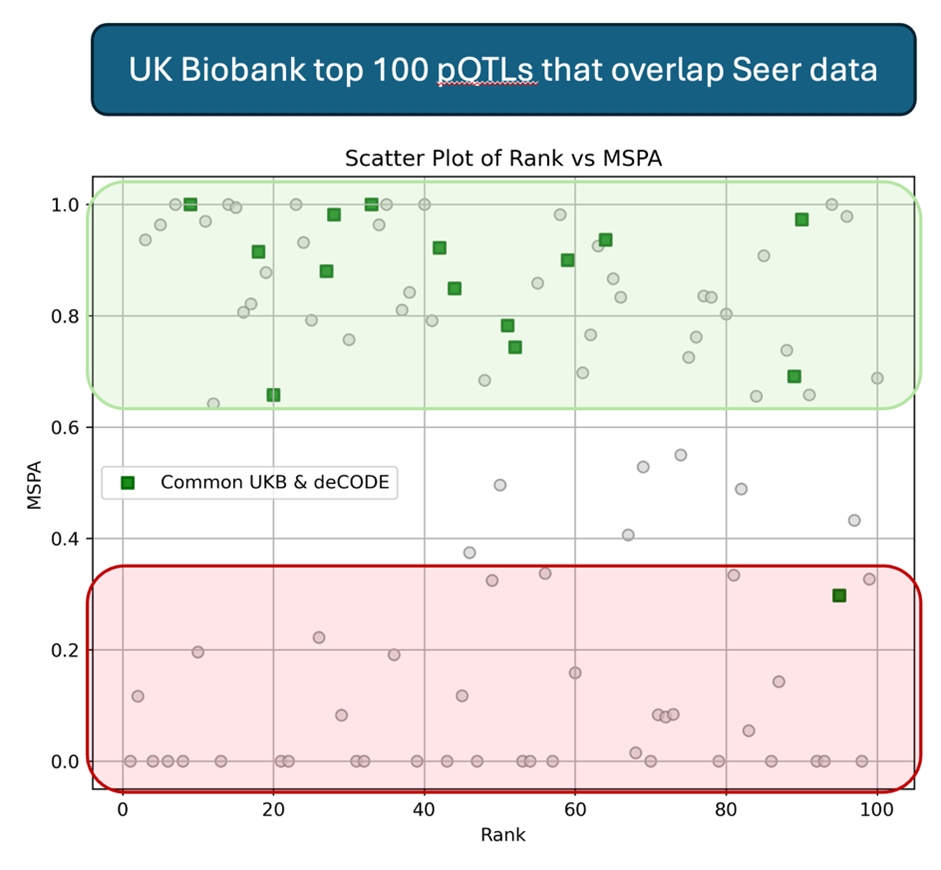
Figure 4: The ability of peptide-level resolution to validate affinity-based pQTL identifications. The 100 strongest pQTLs identified in a cohort of 55,000 participants in UK Biobank are scored by Seer MS data obtained in a discovery cohort of 1,260 American participants and a replication cohort of 325 Asian participants. In the x-axis, each of the 100 pQTLs is sorted by statistical significance in UK Biobank, left being the most significant; in the y-axis, each pQTL is scored according to peptide-level evidence in Seer data, with 1.0 being the highest level of evidence. The pQTLs marked green were found by another affinity-based platform performed in a cohort of 36,000 Icelandic participants; such pQTLs are highly reliable, being independently discovered in two cohorts by two technologies. Almost all highly reliable pQTLs are scored highly by Seer data; conversely, pQTLs that are scored low are likely to be false discoveries, potentially due to epitope effects induced by the presence of protein allelic variants that alter the binding of the affinity reagent to the protein surface.
5
Our Proprietary Engineered Nanoparticle Technology
The Proteograph Product Suite leverages our proprietary engineered NP technology to overcome the limitations of existing methods, and enable an easy-to-use workflow for unbiased, deep, rapid and scalable proteomic analysis. Our proprietary engineered NPs provide unbiased sampling of intact proteins across the dynamic range of the proteome, capturing molecular information at the peptide-level, including protein variants. The NPs eliminate the need for complex workflows required by other unbiased approaches, which we believe will make proteomics more accessible to the broader scientific community.
Typically, nanoparticles have a diameter in the tens to hundreds of nanometers, much smaller than a human hair, which has a diameter of 80,000 nanometers. When nanoparticles come into contact with a biological sample, a thin layer of intact proteins rapidly, selectively and reproducibly adsorbs onto their surface, forming what is called a protein “corona.” Additional intact proteins can also bind directly to proteins already attached to the nanoparticle through protein-protein interactions (PPIs), and intact protein complexes may also attach to the nanoparticle directly. Our engineered NPs capture intact proteins across the dynamic range without requiring prior knowledge of proteome composition or designing the assay for specific protein targets. In combination with an unbiased MS readout, they reveal molecular information at the peptide level revealing protein variants. At binding equilibrium, which occurs within minutes after our NPs encounter a biosample, the selective sampling of proteins by our NPs is robust and highly reproducible.
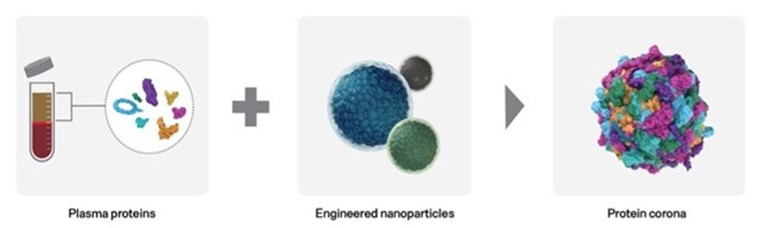
Figure 5: Nanoparticles allow unbiased interrogation of proteoform diversity. Our nanoparticle technology leverages engineered physicochemical properties to reproducibly bind to proteins without prior knowledge, forming a protein corona.
The binding of proteins to the nanoparticle surface and protein sampling are primarily driven by three factors: (i) the affinity of a particular protein for the physicochemical surface of a specific nanoparticle; (ii) the concentration of a specific protein in a biological sample; and (iii) the affinity of the proteins for other proteins on the surface of the nanoparticle, forming PPIs. A variety of materials and methods are used to create different nanoparticles with distinct physicochemical properties, which generate a unique protein corona pattern and a unique proteomic fingerprint. As the amount of proteomic data increases, we will continue to refine the unique physicochemical properties of our NPs with advanced machine learning.
6
By incorporating our nanoparticles in an assay, we achieve a representative and thorough sampling across the dynamic range of the proteome, from high- to low-abundance proteins. In this way, we have successfully replaced complex laboratory workflows for the enrichment of samples for deep, unbiased MS, enabling the capture of thousands of proteins from biofluids for large-scale proteomics studies. Nanoparticles can interrogate almost any solubilized biological sample, including cell or tissue homogenates, blood or blood components (such as plasma or serum), urine, saliva, cerebrospinal fluid and synovial fluid. This versatility, we believe, strongly suggests that a vast universe of different nanoparticles with different physicochemical properties could be employed across a broad range of sample types, to selectively, reproducibly and deeply sample the proteome in an unbiased way.
We have validated our NP technology and the principle of protein corona formation as a robust and reproducible method to deeply and broadly profile the proteome in a high-throughput manner. We have characterized our technology and its performance in three peer-reviewed publications: Nature Communications (Blume et al.), PNAS (Ferdosi et al.), and Advanced Materials (Ferdosi et al.).
The Proteograph Product Suite
The Proteograph Product Suite is an integrated solution consisting of consumables, an automation instrument, and data analysis software to perform unbiased, deep proteomic analysis at scale in a matter of hours. We designed the Proteograph workflow to be efficient and easy-to-use, and to leverage common laboratory instrumentation to enable adoption in both centralized and decentralized settings, making deep, unbiased proteomics accessible to nearly any lab.
The Proteograph consumables consist of our NPs and all other consumables necessary to assay samples in an automated workflow on our SP100 automation instrument. Our automated workflow is custom configured for researchers to assay samples in approximately eight hours, which includes approximately 30 minutes of hands-on time and seven and a half hours of automated instrument time. The output from the Proteograph workflow consists of peptides ready to be processed and evaluated on an MS instrument. The Proteograph Product Suite is detector agnostic and, we believe, will be adaptable to other protein detection instruments in the future. The MS component of the Proteograph workflow is either provided by the researcher’s laboratory, can be outsourced to a third-party provider, or be run through the Seer Technology Access Center (STAC), which is our in-house service program. The Proteograph Analysis Suite, a data analytics software suite, provides quality control and allows researchers to analyze and interpret the output from the system to gain insights from their data.

Figure 6: Proteograph Product Suite comprises consumables, an automation instrument, and software.
7
Prior to the Proteograph, conducting deep, unbiased proteomic studies at scale was not possible due to three primary bottlenecks:
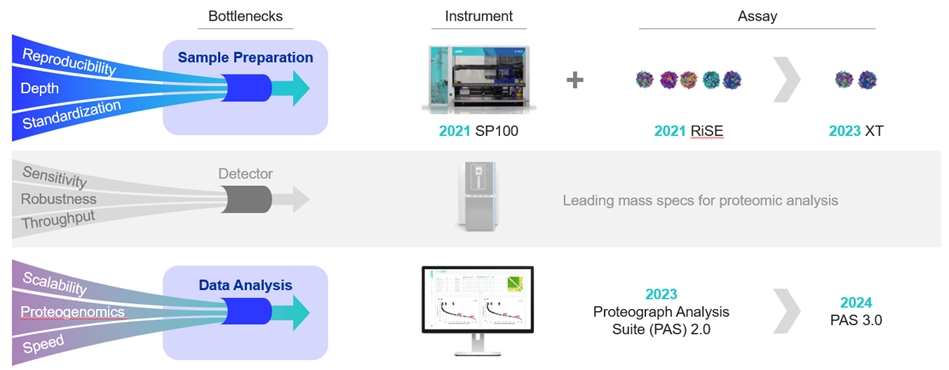
Figure 7: Seer is continuously innovating to address bottlenecks across the MS proteomics workflow and enhancing products to improve performance.
Consumables
We launched our second assay, Proteograph XT, in June 2023, which significantly enhanced the sample throughput of the Proteograph Product Suite and MS instrument, while also improving performance as measured by protein group identification.
The Proteograph XT assay employs two wells of NPs, assay buffers and reagents for protein lysis and digestion, peptide purification, peptide quantification and the reconstitution of lyophilized materials. The current product allows for the interrogation and processing of up to 40 samples in parallel on a single 96-well plate in approximately eight hours. Each sample incubates separately in two wells, yielding 80 wells of peptides in a 96-well plate. The remaining 16 wells are reserved for integrated quality control samples to ensure consistent process performance and to aid in troubleshooting.
The ready availability of non-particle reagents, combined with our ability to efficiently design and fabricate different NPs with different physicochemical properties, greatly facilitates the development and production of future iterations or additional versions of the Proteograph assays to address potential customer needs, such as expanded protein coverage or specialized assays, including potential assays that can be used with clinical products.
8
In the first quarter of 2025, we announced a new supported application on Proteograph XT for cell lysate proteomics, bringing the power of the Proteograph to intracellular proteomics. High-value and difficult-to-characterize protein compartments can now be studied more extensively. With Proteograph XT Cell Lysate, we see substantial increase in protein coverage compared to conventional MS-based cell lysate analysis across a range of protein types including cell membrane proteins, DNA binding proteins, transmembrane proteins, and receptor proteins.
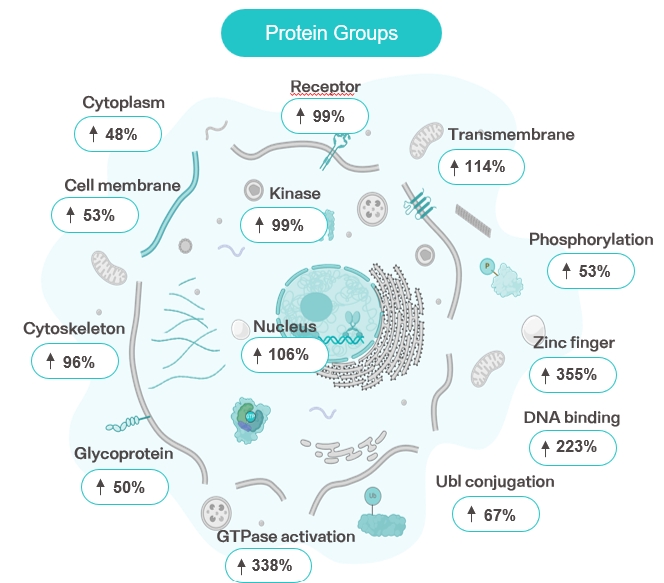
Figure 8: Proteograph XT Cell Lysate enables customers to move beyond plasma proteomics and delve deeper into the intracellular proteome. Proteograph XT Cell Lysate more deeply interrogates and identifies proteins across several intracellular compartments compared to conventional MS-based cell lysate analysis.
Automation Instrument
We designed the Proteograph assay to be run in a robust and automated manner on our SP100 automation instrument, which is a custom-configured, industry-standard, liquid handling workstation. Our SP100 instrument is designed to enable studies of hundreds to thousands of samples, with an automated workflow that allows for rapid, highly-parallel sample processing with approximately 30 minutes of set-up time.
The Proteograph workflow is driven by the Instrument Control Software (ICS) on the SP100 automation instrument. The workflow has been configured to process one full 96-well plate at a time, in just eight hours, processing 40 samples in parallel. The output of the Proteograph workflow consists of peptides that are quantified, dried, and can be reconstituted when ready for injection into a MS. MS provides quantitative unbiased detection, either on an instrument provided by the user, or sent out for MS analysis to a third-party provider.
9
Software
The Proteograph Analysis Suite (PAS) is designed for ease-of-use and efficiency to help users arrive at insights quickly. To accommodate varying customer needs and scalability, we have designed the PAS to be cloud-based and, in the future, to be available via more localized solutions that accommodate different customer types and geographies. The PAS offers a predefined workflow for data management and analysis, leveraging publicly available MS data analysis tools as well as our own proprietary analysis tools. Without the PAS, proteomics analysis requires expert knowledge and a scalable high-performance computer infrastructure. We believe that the PAS can accelerate adoption of the Proteograph among non-experts by providing an intuitive user interface that automates data handling, simplifies processing and analysis and provides access to a scalable infrastructure that can be used by any lab.
The PAS also includes a dedicated proteogenomics workflow that maps peptide-level data to genomic data to identify sample-specific variant peptides not captured in canonical reference databases. The workflow provides interactive tables and plots, enables visualization of identified peptides’ relationship to gene structure, protein domain information and functional regions, and creates amino acid-level browsable peptide data maps.
Currently, one potential roadblock for researchers is understanding and evaluating the quality of their results. The Proteograph Assay Kit incorporates a series of controls for monitoring assay performance, and an integrated view of the results of these control runs via the PAS. Customers can evaluate trends over time and implement performance boundaries around the expected values that flag unexpected outcomes in the data. We believe providing a simple, consistent interface to evaluate the control data and generate a quality control (QC) report will help customers understand our approach to QC in the Proteograph workflow, simplifying support.
In 2024, the latest version of the PAS introduced a completely updated user interface, offering a more intuitive and professional experience for users. The update includes a completely revamped interface for the cohort analysis tools that expands functionality and makes it easier for users to generate biologically relevant information from their datasets. As we continue to improve and extend our product portfolio, we expect to continue to expand the capabilities and features in the PAS as well.
Proteograph Product Suite Performance
The Proteograph Product Suite provides five essential capabilities: (i) broad protein sampling with peptide-level resolution; (ii) deep coverage; (iii) accurate and precise measurement; (iv) reproducibility and (v) scalability for high-throughput studies. We believe that our integrated solution is the only product in the market that combines all these technical and operational capabilities. Furthermore, we rigorously measure and evaluate each of these technical attributes, as we describe below.
10
In a head-to-head experiment, Thermo ScientificTM directly compared the breadth of the Proteograph Product Suite to other unbiased proteomics methods using the same biological sample. Neat plasma, which represents the simplest form of unbiased proteomic analysis requiring minimal processing time using another method, resulted in a depth of coverage of 767 proteins. Using the Proteograph Product Suite, Thermo ScientificTM detected 6,033 proteins in plasma, representing 8.0x expansion in depth of protein coverage.
In another study performed by PrognomiQ, a 2021 spinout of Seer, across a set of 2,840 plasma samples, approximately 13,000 proteins were identified.

Figure 9: Proteograph XT demonstrates an 8.0x expansion in depth of coverage compared to neat plasma. In a study performed by PrognomiQ across 2,840 plasma samples, approximately 13,000 proteins were identified.
The Proteograph is not limited to a defined set of proteins, and samples across the dynamic range of proteins and protein variants that may be present in biosamples. We have exemplified the utility of the Proteograph in studying secreted proteins across several different sample types, including cell or tissue homogenates, blood or blood components (such as plasma or serum), urine, saliva, cerebrospinal fluid, synovial fluid and conditioned media. Importantly, the Proteograph protein data is obtained using an MS detector, which is the gold standard for proteomics, and data is conventionally reported with a less than one percent False Discovery Rate (FDR). This means that the reported proteins are identified with over 99% confidence.
11
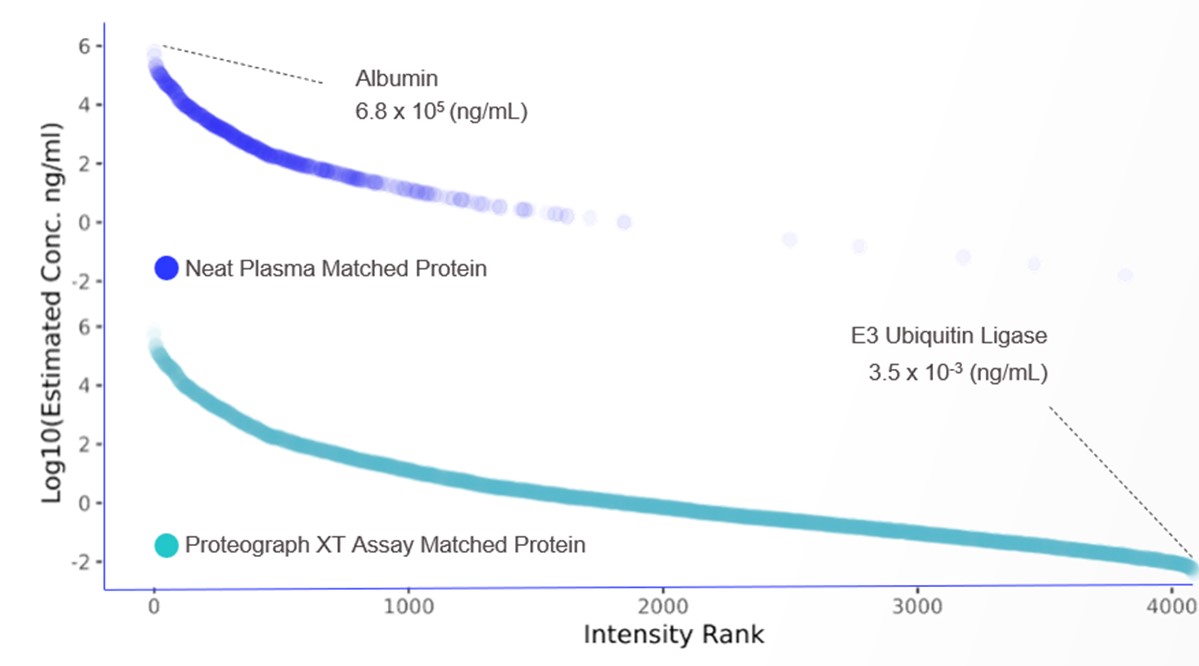
Figure 10: The Proteograph identifies more proteomic content. The Proteograph workflow identifies protein across the dynamic range of the plasma proteome whereas neat plasma is limited to the most abundant proteins.
12
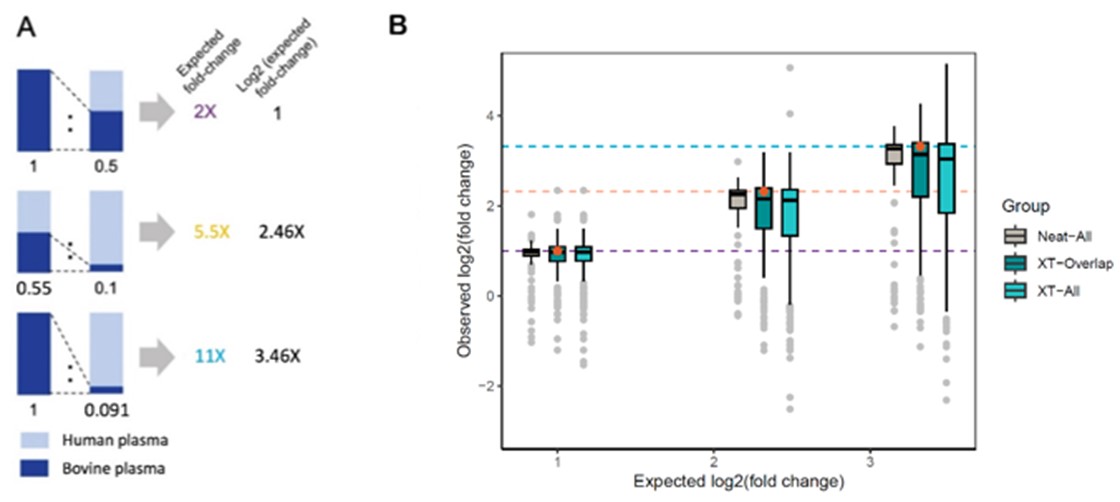
Figure 11: The Proteograph offers a high-degree of accuracy. (A) Three representative pairs of spiked-in samples and the expected fold changes of bovine proteins concentration in these pairs. (B) Distribution of observed fold changes of bovine proteins for three selected comparisons of spiked-in samples. The color indicates the data source: (i) neat digestion (gray), or (ii) Proteograph workflow constrained to proteins also identified in neat (dark blue) or (iii) Proteograph workflow all proteins (teal). The horizontal dashed lines indicate the expected fold changes.
13
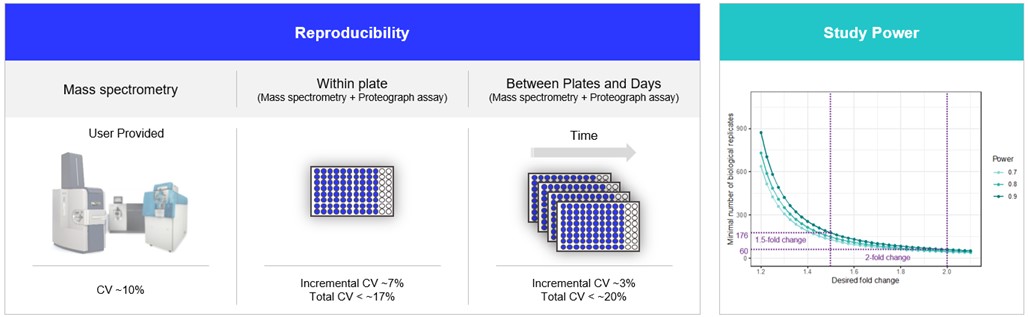
Figure 12: (A) contributors to CV; (B) smaller fold changes can be detected with increased power with larger study sizes.
14
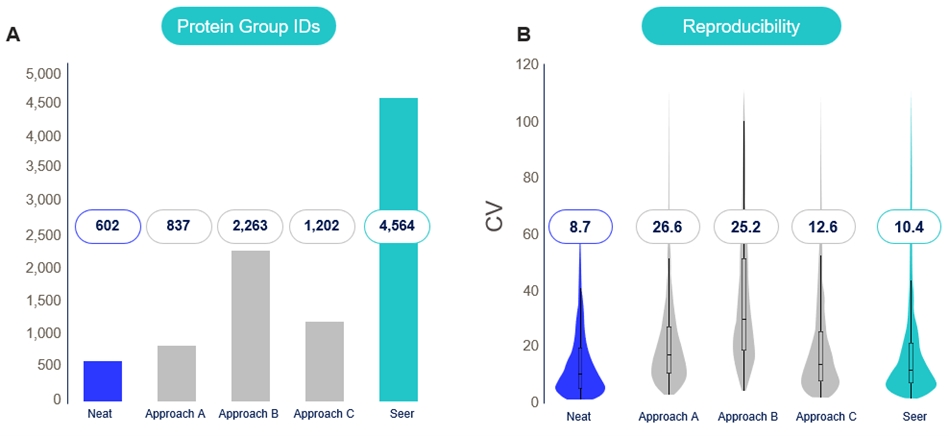
Figure 13: (A) Across six technologies and methods tested, the Proteograph provides the highest performance in protein identification across all replicates and within each replicate. (B) Demonstrates the reproducibility performance of each method by evaluating the median coefficient of variation (CV) values for proteins detected across all methods. A lower CV value indicates a higher degree of reproducibility.
The Advantages of the Proteograph Product Suite
We believe the Proteograph Product Suite and its underlying NP technology have unique advantages:
15
The Applications of the Proteograph Product Suite
We believe the ability to generate unbiased, deep, proteomic data at scale, with rich content at the protein variant level, has a wide range of applications in proteomics, including basic research and discovery, translational research, diagnostics and applied markets. This data can be used in many of the same application areas as genomics data, as well as proteomics applications that are uniquely possible with unbiased proteomic data, and in new applications that the field will develop in the future.
In addition, the Proteograph Product Suite’s versatility allows it to analyze not only plasma and serum, but also other biofluids across humans and model organisms. For example, when we compared the performance of the Proteograph Product Suite workflow with that of neat biological samples across model organism plasma, urine, cerebral spinal fluid, and conditioned media, we noted superior protein group identification by the Proteograph of 4x, 1.5x, 1.5x, and 8.6x, respectively. Importantly, in each sample, we measured tens of thousands of data points at the peptide level, providing information on thousands of proteins. We believe this extensibility offers researchers a powerful and flexible tool to utilize across a variety of applications and sample types.
Basic Research and Discovery Applications
We believe that the Proteograph is a valuable tool for researchers across a wide range of basic research and discovery applications, including cataloging protein diversity, proteogenomics and exploring the interactome. Studies in these areas are currently limited in scale by the complexity of unbiased methods or the limited set of affinity-based reagents available for biased methods. The Proteograph Product Suite is designed to enable the use of unbiased proteomic data at scale, which we believe will greatly accelerate these areas of basic research and discovery.
16
Cataloging protein diversity
The Proteograph Product Suite is designed to enable researchers to explore the complexity and diversity of the proteome with peptide level resolution. We anticipate that researchers will use the Proteograph solution to catalog protein variants in a manner similar to the cataloging of genetic variants over the past 15 years, providing functional context at a scale that is not currently accessible with other proteomics methods. We believe that identifying protein variants, including those resulting from PTMs such as glycosylation and phosphorylation, can significantly transform the life sciences field.
In 2024, we launched the Protein Discovery Catalog on our website with the goals to remove barriers to access, empower researchers, and drive new lead generation. The Protein Discovery Catalog is a fully-accessible, searchable catalog with over 36,000 proteins across multiple species and over 10,000 human proteins across 1,900 Reactome biological pathways. This catalog is our first published index of the unprecedented depth of empirically observed proteins captured by the Proteograph to date.
Proteogenomics
Proteogenomics is a rapidly growing field of research that integrates genomic and transcriptomic information with proteomic information, using personalized protein sequence databases to identify novel peptides. The Proteograph generates large-scale unbiased proteomic data at peptide-level resolution, enabling researchers to map protein variants to genomic variants, advancing the field of proteogenomics. Researchers are conducting large-scale proteogenomic studies with the Proteograph to provide functional information to existing genomics and gene expression information.
Translational Research Applications
Researchers can use the Proteograph for translational research applications aimed at shortening the time from early discovery research to clinical application. The Proteograph Product Suite allows clinical and translational researchers an opportunity to perform unbiased, deep and large-scale proteomics studies in therapeutic and diagnostic research and clinical trials, which can allow for significant advances in biomarker discovery, target identification and exploration and clinical trial applications.
Biomarker Discovery
Currently, de novo biomarker discovery research is limited by the size of unbiased studies or is targeted in nature. These approaches have yet to uncover the large number of potential single biomarkers or combinations of markers for a range of clinical applications. The Proteograph is enabling the discovery of biomarkers through large-scale, unbiased and deep proteomics studies.
Utilizing a $2 million Small Business Innovation Research grant to the Company and Massachusetts General Hospital (MGH) from the National Institute on Aging (NIA), researchers from the Company and MGH conducted a study that analyzed 1,800 plasma samples comprising both controls and individuals diagnosed with cognitive decline, including Alzheimer’s Disease (AD) (Lacar et al.). The samples were collected over a 10-year period, allowing the researchers to investigate proteins associated with the progression of, or protection against, cognitive decline. When comparing the AD affected individuals with controls, researchers identified 138 proteins that were up or down regulated in AD individuals. Of these 138 proteins, only 44 have been previously associated with AD. The remaining 94 represent putative biomarkers of AD, potentially highlighting new biological insight.
17
Researchers used clinical information to identify the point of significant cognitive decline and determined proteins that separated the population into fast and slow decliners. Researchers identified eight such significant proteins and are now investigating how these results may be advanced to develop a score indicating the likelihood of cognitive decline in a particular timeframe. One such example is shown in Figure 14 below. Higher abundance of this protein is associated with greater probability of cognitive decline.
We believe such studies are uniquely made possible using deep, unbiased proteomics at scale using the Proteograph Product Suite because 55% of these 138 proteins are not present on a commercially available high-plex affinity based panel and there is no other practical way to do a deep unbiased proteomics study on 1,800 plasma samples other than leveraging the Proteograph Product Suite.
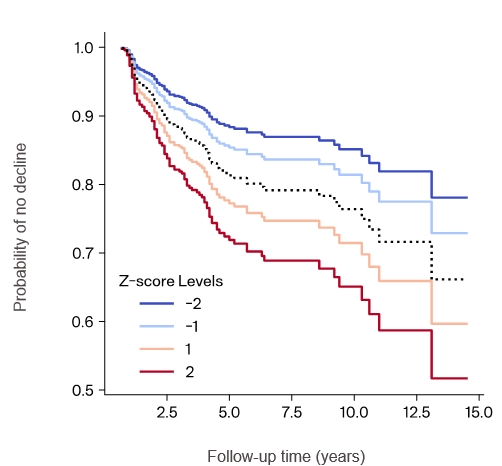
Figure 14: Shows the probability of no decline as a function of follow up time. Higher levels of the protein are associated with higher probability of decline.
Diagnostic Applications
We believe that the Proteograph Product Suite also holds significant diagnostic potential. The unbiased, deep and scalable proteomic data generated by the Proteograph has the potential to create ecosystems, similar to the way in which next-generation sequencing (NGS) enabled genomics-based diagnostics for cancer and rare genetic diseases. We expect that companies in the healthcare testing space, including our spin-out PrognomiQ, will utilize the Proteograph solution, and we are committed to supporting all of our customers as the ecosystem grows, not only in their basic research and translational research applications but also as they develop their own diagnostic applications.
As an example, scientists at PrognomiQ conducted a large case/control study that included those at high risk for lung cancer, using deep, unbiased proteomics as part of their development work for multi-omics-based blood test for early-stage lung cancer detection.
The current recommendation for patients at high risk for lung cancer is an annual low dose CT scan. The compliance rate for current low dose CT cancer screening is only 5-10%. PrognomiQ is developing a blood test to help close this compliance gap to identify patients at risk for lung cancer and subsequent evaluation.
18
Researchers from PrognomiQ used the Proteograph to measure over 8,300 proteins from samples from 2,513 individuals, which was then combined with over 200,000 RNA transcripts and 1,000 metabolite measurements to drive a multi-omics classifier.
As illustrated in Figure 15 below, the proteomics data performs extremely well with an AUC of 0.91. Adding the other multi-omics data increased AUC to 0.96. PrognomiQ believes this classifier represents a potentially best-in-class performance by achieving a sensitivity of 80% for stage 1 and 89% for all stages of lung cancer at 89% specificity.
Figure 15 below shows the top features contributing to the classifier ranked by their importance. The top features are heavily enriched for those derived from unbiased proteomics utilizing the Proteograph assay. Figure 15 indicates where these proteins fall in the standard plasma concentration curve, and indicates that they are across the entire dynamic range. Therefore, we believe that the capabilities of the Photograph platform to provide deep, unbiased, proteomics at scale could be used to develop this classifier.

Figure 15. Shows results from a study performed by scientists at PrognomiQ, using deep, unbiased proteomics as part of a multi-omics based blood test for early-stage lunch cancer detection.
Target Identification and Exploration
We believe that large-scale access to protein variant information that map to different states of health and disease, as enabled by the Proteograph and concurrent advances in proteogenomics, could lead to the discovery of personalized drug targets that could number in the hundreds of thousands. We believe that the translational application of the Proteograph for potential biomarker development may also be applied to the identification of novel targets for therapeutic development. Components of classifiers may themselves become targets for drug development, or they may point to new knowledge with respect to disease mechanisms, which could then aid in the exploration of additional targets and/or help to elucidate the function of potential targets, particularly if these targets are discovered with genomics approaches, but lack protein functional context.
Clinical Trial Applications
The Proteograph Product Suite provides clinical researchers with the opportunity to perform deep and broad proteomic profiling of subjects in therapeutic clinical trials, enabling the real-time monitoring of protein-related drug effects, distribution and metabolism. These attributes are essential in virtually all clinical drug trials. Current methods use biased or targeted panels of proteins. It is currently impractical to do this type of monitoring with unbiased proteomic methods, given the inability of these methods to scale to the hundreds or thousands of samples that are evaluated in clinical trials.
19
The Proteograph Product Suite may also enable patient selection and grouping based on patients’ proteomics profiles, leading to improved ability to confirm efficacy for novel therapies in complex diseases that involve multiple physiological systems. While genomic approaches are widely used to select patients in cancer and rare genetic disease clinical trials, their use in other indications has been limited by a lack of genetic understanding of these diseases. We believe that the Proteograph has the potential to generate useful proteomic signatures that can complement genomic and other patient selection criteria, improving patient selection and segmentation for clinical trials, particularly for indications outside of cancer and rare genetic diseases.
Applied Applications in Agriculture, Animal Health, and Bioprocessing
We see significant opportunities for the Proteograph solution to be applied in areas beyond human health, including areas where broad-scale genomics is being widely applied today, and applications where proteomics can uniquely enable the creation of end-markets. We believe that unbiased, deep and large-scale proteomic information, which can be enabled by the Proteograph, can complement and extend the value of genomics, transcriptomics and metabolomics information in fields such as agriculture, animal health and bioprocessing.
Given the robustness of the Proteograph Product Suite and its ability to work across species, we have seen significant interest and customer adoption of the Proteograph Product Suite for use in model organisms for research and the animal health markets to pursue opportunities in diagnostic and therapeutic development. We have already demonstrated the application of the Proteograph Product Suite in projects and studies that include mouse, monkey, pig, feline, chicken, canine, baboon and bovine plasmas.
In addition, we have seen increasing interest in utilizing the Proteograph in bioprocessing applications. We have certain customers who have run pilot studies with the Proteograph to enhance their liquid chromatography-mass spectrometry (LC-MS) techniques for comprehensive host cell protein (HCP) analysis. While conventional LC-MS is emerging as a versatile technique to identify and quantify HCPs, it is challenged by the inherently large dynamic range of HCPs compared to biologics. By coupling LC-MS with the standard Proteograph XT workflow, researchers identified 4-6x more HCPs for NIST monoclonal antibody (NIST 8671) without the need for additional sample pre-processing steps, providing consistent reproducibility and enhanced sensitivity without sacrificing precision.
Limitations of Other Approaches to Proteomics
Limitations of Transcriptomics to Infer Proteomics
RNA sequencing (RNAseq) has been the established method for studying transcriptomics over the last decade. It is often assumed that transcript and protein abundance levels are highly correlated because of the central dogma of molecular biology describing how transcripts are translated into proteins. However, several studies have repeatedly demonstrated a poor correlation between transcript and protein levels (Buccitelli and Selbach). This discrepancy can arise from technical factors, such as noise and bias in methods for assessing both transcripts and proteins, and biological mechanisms such as mRNA translation and degradation. Although both transcriptomics and proteomics measurements have their uses, proteins are more closely linked to phenotype, making them more useful than transcripts for understanding function. Therefore, we believe that direct analysis of the proteome via at-scale proteomics studies will provide unique biological insights for research, discovery and clinical applications.
20
Limitations of Affinity-Based Approaches to Proteomics
Proteins are highly variable in structure, chemistry, and concentration, presenting technological challenges for their identification at low concentration levels. Because of the lack of a common amplification mechanism, researchers often use ligands to measure proteins. However, because ligands such as antibodies or aptamers were designed to bind to specific areas of proteins, approaches utilizing them are considered targeted, or biased. The average length of a human protein is approximately 470 amino acids, whereas the average binding site of a ligand is an epitope five to eight amino acids long. Panels of ligands used for protein interrogation have several shortcomings, including: (i) they do not recognize differences in protein structure outside of the epitope binding site, so that all variants appear the same and cannot be differentiated from one another, (ii) conformational changes of the protein can affect epitope and ligand binding; for example, those induced by protein-protein interactions or post-translational modifications, and (iii) certain protein isoforms may exclude entire protein domains and remove the epitope binding site, yielding false negative results.
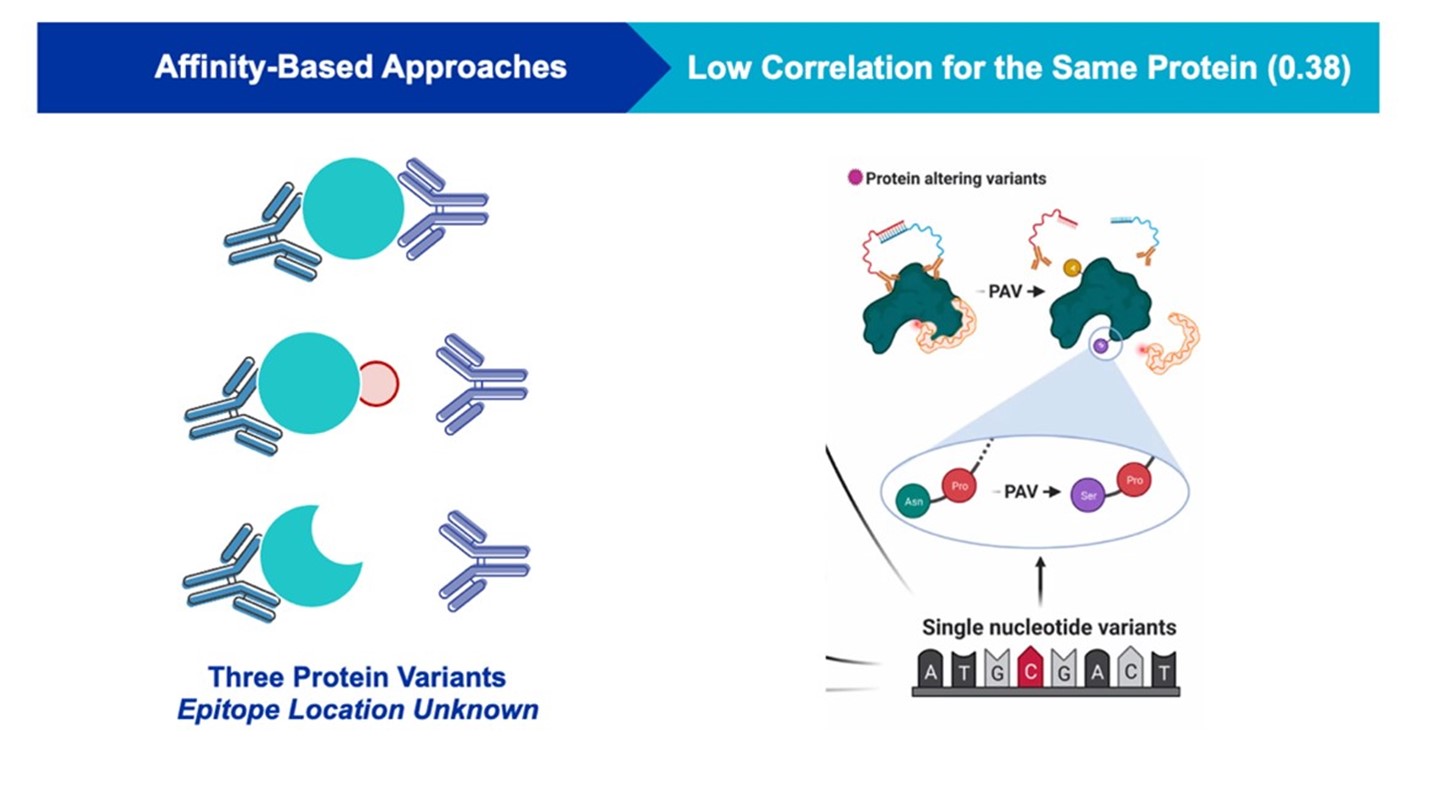
Figure 16: Sources of variation. Left panel is a graphical summary of factors contributing to variation in the affinity-based discovery of the plasma proteome. Right panel schematically describes reasons for differences in binding profile of aptamer and antibody-based proteomic profiling (PAV protein altering variant; SNV single-nucleotide variant). Adapted from Pietzner et al.
In a paper published in Nature Communications, Pietzner et al. from the University of Cambridge experimentally demonstrated the limitations of two distinct commercially-available affinity-based approaches. Specifically, the authors show that protein-altering variants can affect ligand binding, that is, each affinity-based platform interacts differently with the same protein, depending on the epitopes to which its ligands are binding. On average, the correlation between the two commercially-available affinity-based methods was 0.38. The distribution of correlations across all proteins is bimodal, with some proteins having a very good correlation, and others have a correlation close to zero (as shown in Figure 17 below). The authors attribute this poor correlation to differences in epitope binding between platforms and interference from protein-altering variants. These limitations underscore the importance of studying proteins with peptide-level resolution using a technology that is quantitatively robust in identifying protein variants.
21
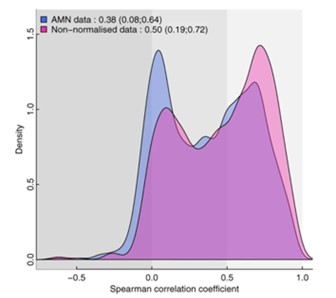
Figure 17: Distribution of correlation coefficients across 937 mapping aptamer–antibody pairs (n = 871 unique protein targets). Adapted from Pietzner et al.
Affinity-based approaches are effective when a known target and a specific epitope measurement is desired but cannot cover the vast complexity of the proteome. We believe they are analogous to microarrays in genomics, where a specific DNA fragment is used in a targeted or biased manner to confirm the presence of a specific mutation or a single nucleotide polymorphism (SNP). The fundamental limitation of affinity-based approaches is their inability to differentiate between protein variants and accurately survey the complexity of the proteome.
Limitations of Traditional Unbiased Approaches to Proteomics
Rather than relying on predefined epitopes, unbiased approaches can interrogate proteins at the peptide level, providing amino-acid level resolution to protein variants. However, traditional, deep, unbiased proteomic approaches rely on complex workflows that do not scale because of the wide range of protein concentrations in biological samples with high dynamic range. In human plasma, for example, the 22 most abundant plasma proteins account for 99% of the total protein mass, while many thousands of less abundant proteins comprise the remaining one percent. Given the important biological role of both high- and low-abundance proteins, it is critical to detect proteins accurately, precisely, and reproducibly across the dynamic range.
MS is a widely used technique for unbiased discovery, basic research and clinical applications, and is considered the gold standard for protein identification. However, the wide dynamic range of protein concentrations in plasma and other biological samples has previously required complex, upfront sample preparation workflows prior to MS analysis, involving depletion of abundant proteins and fractionation of the remaining proteins and peptides. Deep unbiased proteomics analysis of complex biosamples at scale has not been feasible for wide adoption by researchers due to the high complexity, cost and time requirements. For example, in a state-of-the-art deep unbiased plasma proteomics study in 2017 prior to commercial availability of the Proteograph Product Suite, Keshishian et al.depleted the most abundant proteins with immuno-affinity columns and then separated remaining peptides by multiple and complex chromatographic steps and MS injections. The study identified 4,500 different proteins across 16 samples but took months to complete.
22
Prior to the commercial availability of the Proteograph Product Suite, we believe the critical unmet need in proteomic analysis was how to collect unbiased proteomic data on thousands of proteins in a sample spanning more than ten orders of magnitude in concentration (dynamic range) and to repeat this across thousands of samples in a reasonable amount of time and cost. Genomics faced a similar unmet need before the advent of NGS, which allowed for massively parallel sampling.
Markets
We believe that the Proteograph Product Suite has two primary near-term markets: the approximately $27 billion global proteomics market, and the $28 billion global genomics market, as reported by Allied Market Research and Technavio, respectively. The proteomics market is estimated by Allied Market Research to have spent approximately $21 billion on reagents, $4.5 billion on instruments, and $1.5 billion on services in 2022. We are competing in the proteomics reagent and instrument markets, while our STAC and Centers of Excellence (COEs) service providers address the services opportunity. Similarly in the genomics market, we are attracting spend on both products and services as genomic customers link genotype to phenotype by supplementing existing genomic data with proteomics data.
We currently sell and market the Proteograph Product Suite for research use only (RUO). However, we believe that the capabilities of the Proteograph Product Suite may enable other applications in the future, including clinical and applied applications. Like the commercial impact of broadened access to genomics products, we believe the Proteograph will enable novel applications and insights, leading to new end-markets. For example, non-invasive prenatal testing and precision oncology currently make up a significant part of the current genomics market, which would have been difficult to predict a decade ago. We anticipate that the same dynamic of new market creation will occur in proteomics, with one such application for proteomics being early disease detection.
Our Growth Strategy
Our mission is to imagine and pioneer new ways to decode the biology of the proteome to improve human health. Our growth strategy is to:
Moving forward, in order to expand and accelerate demand for our products, we are investing in market development activities to educate prospective customers, funding bodies, commercial entities, government-sponsored multi-omics programs, and other stakeholders of the importance of large-scale unbiased and deep proteomic data. This effort includes collaborations with key opinion leaders (KOL) to generate scientific data, presentations, and peer-reviewed publications. Additionally, we are strategically investing in market development activities such as sponsorship of targeted projects, joint publications and seminars, and industry partnerships.
23
In 2024, we doubled the size of our commercial team across Marketing, Sales, and Customer Experience to support growing demand, with the goal of expanding our direct sales efforts and delivering an exceptional customer experience. We believe these efforts will allow us to deliver substantial value to our customers, build long-term customer loyalty, enhance our competitive differentiation and, importantly, use our customer relationships to gain insights that inform our product development to grow our offerings in ways that will benefit our customers.
Additionally, to reduce customer capital investment barriers, we launched the Strategic Instrument Placement Program (SIPP) in 2023 to enable customer access to our Proteograph without the need for an upfront capital investment. With an upfront purchase of consumable kits, we loan the instrument for a defined period of time with an option to purchase at the end of the loan term. This is allowing customers to utilize available operating budget without the need to access capital budget in the short term.
24
Suppliers and Manufacturing
Our overall manufacturing strategy is to continuously develop and refine our processes to achieve our objectives of continuity of supply, quality of supply and margin enhancement. Over time, this may lead to in-sourcing or outsourcing certain functions, including manufacturing, in various geographic locations in order to achieve our objectives.
Consumables
We leverage well-established unit operations to formulate and manufacture our NPs at our facilities in Redwood City, California. We procure certain components of our consumables from third-party manufacturers, which includes the commonly-available raw materials needed for manufacturing our proprietary engineered NPs. We are currently manufacturing using our production-scale and pilot lines and continue to build out our manufacturing capabilities to support the broad commercial availability of our products. We obtain some of the reagents and components used in the Proteograph workflow from third-party suppliers. While some of these reagents and components are currently sourced from a single supplier, these products are readily available from numerous suppliers. While we currently perform some filling and packaging of the Proteograph assay and the related consumables, we may eventually have our filling and packaging outsourced to a third party. We conduct vendor and component qualification for components provided by third-party suppliers and quality control tests on our NPs.
25
Automation Instrument
We designed the SP100 automation instrument and have outsourced its manufacturing to Hamilton Company, a leading manufacturer of automated liquid handling workstations. We entered a non-exclusive agreement with Hamilton that covers the manufacturing of the SP100 automation instrument and its continued supply on a purchase order basis. Starting in January 2025, we renewed the agreement under an extended term through December 2027. Following this extended term, the agreement will automatically renew annually for a maximum of two one-year renewal periods. Hamilton has represented to us that it maintains ISO 9001 and ISO 13485 certification.
Competition
The life sciences technology industry is highly dynamic, marked by rapidly advancing technologies, intense competition and a strong focus on intellectual property. In the proteomics market, companies offer a range of analytical instruments, such as chromatography and MS instruments, and associated reagents. Competition in the proteomics market is based on proprietary technologies, rapid product development capabilities, applications and intellectual property. We believe that no currently commercially available products offer the capability to conduct unbiased, deep proteomics studies of high dynamic range samples at the same scale and throughput as the Proteograph Product Suite. However, given the potential market opportunity and scientific promise of proteomics, we expect the competition to increase and, as a result, one or more competing products to emerge. Competing products may emerge from various sources, including life sciences tools, diagnostics, pharmaceutical and biotechnology companies, third-party service providers, academic research institutions, governmental agencies, and public and private research institutions.
Current companies that provide proteomics products include Agilent Technologies, Bio-Techne, Bruker, Danaher, DiaSorin and Thermo Fisher Scientific. There are also a number of companies that provide proteomic analysis services. In addition, multiple emerging growth companies have developed, or are developing, proteomics products, services and solutions, such as Alamar Biosciences, Nautilus Biotechnology, Quanterix, Quantum-Si and Standard BioTools.
Government Regulation
The development, testing, manufacturing, marketing, post-market surveillance, distribution, advertising and labeling of certain of medical devices are subject to regulation in the United States by the Center for Devices and Radiological Health of the U.S. Food and Drug Administration (FDA) under the Federal Food, Drug, and Cosmetic Act (FDC Act) and comparable state and international agencies. FDA defines a medical device as an instrument, apparatus, implement, machine, contrivance, implant, in vitro reagent or other similar or related article, including any component part or accessory, which is (i) intended for use in the diagnosis of disease or other conditions, or in the cure, mitigation, treatment, or prevention of disease, in man or other animals, or (ii) intended to affect the structure or any function of the body of man or other animals and which does not achieve any of its primary intended purposes through chemical action within or on the body of man or other animals and which is not dependent upon being metabolized for the achievement of any of its primary intended purposes. Medical devices to be commercially distributed in the United States must receive from the FDA either clearance of a premarket notification, known as 510(k), or premarket approval pursuant to the FDC Act prior to marketing, unless subject to an exemption.
26
We label and sell our products for RUO and expect to sell them to academic institutions, life sciences and research laboratories that conduct research, and biopharmaceutical and biotechnology companies for non-diagnostic and non-clinical purposes. Our products are not intended or promoted for use in clinical practice in the diagnosis of disease or other conditions, and they are labeled for research use only, not for use in diagnostic procedures. Accordingly, we believe our products, as we intend to market them, are not subject to regulation by FDA. Rather, while FDA regulations require that research use only products be labeled with – “For Research Use Only. Not for use in diagnostic procedures.” – the regulations do not subject such products to the FDA’s jurisdiction or the broader pre- and post-market controls for medical devices.
In November 2013, the FDA issued a final guidance on products labeled RUO, which, among other things, reaffirmed that a company may not make any clinical or diagnostic claims about an RUO product, stating that merely including a labeling statement that the product is for research purposes only will not necessarily render the device exempt from the FDA’s clearance, approval, or other regulatory requirements if the totality of circumstances surrounding the distribution of the product indicates that the manufacturer knows its product is being used by customers for diagnostic uses or the manufacturer intends such a use. These circumstances may include, among other things, written or verbal marketing claims regarding a product’s performance in clinical diagnostic applications and a manufacturer’s provision of technical support for such activities. If FDA were to determine, based on the totality of circumstances, that our products labeled and marketed for RUO are intended for diagnostic purposes, they would be considered medical devices that will require clearance or approval prior to commercialization. Further, sales of devices for diagnostic purposes may subject us to additional healthcare regulation. We continue to monitor the changing legal and regulatory landscape to ensure our compliance with any applicable rules, laws and regulations.
In the future, certain of our products or related applications could become subject to regulation as medical devices by the FDA. If we wish to label and expand product lines to address the diagnosis of disease, regulation by governmental authorities in the United States and other countries will become an increasingly significant factor in development, testing, production, and marketing. Products that we may develop in the molecular diagnostic markets, depending on their intended use, may be regulated as medical devices or in vitro diagnostic products (IVDs) by the FDA and comparable agencies in other countries. In the U.S., if we market our products for use in performing clinical diagnostics, such products would be subject to regulation by the FDA under pre-market and post-market control as medical devices, unless an exemption applies, we would be required to obtain either prior 510(k) clearance or prior premarket approval from the FDA before commercializing the product.
The FDA classifies medical devices into one of three classes. Devices deemed to pose lower risk to the patient are placed in either class I or II, which, unless an exemption applies, requires the manufacturer to submit a pre-market notification requesting FDA clearance for commercial distribution pursuant to Section 510(k) of the FDC Act. This process, known as 510(k) clearance, requires that the manufacturer demonstrate that the device is substantially equivalent to a previously cleared and legally marketed 510(k) device or a “pre-amendment” class III device for which pre-market approval applications (PMAs) have not been required by the FDA. This FDA review process typically takes from four to twelve months, although it can take longer. Most class I devices are exempted from this 510(k) premarket submission requirement. If no legally marketed predicate can be identified for a new device to enable the use of the 510(k) pathway, the device is automatically classified under the FDC Act as class III, which generally requires PMA approval. However, FDA can reclassify or use “de novo classification” for a device that meets the FDC Act standards for a class II device, permitting the device to be marketed without PMA approval. To grant such a reclassification, FDA must determine that the FDC Act’s general controls alone, or general controls and special controls together, are sufficient to provide a reasonable assurance of the device’s safety and effectiveness. The de novo classification route is generally less burdensome than the PMA approval process.
27
Devices deemed by the FDA to pose the greatest risk, such as life-sustaining, life-supporting, or implantable devices, or those deemed not substantially equivalent to a legally marketed predicate device, are placed in class III. Class III devices typically require PMA approval. To obtain PMA approval, an applicant must demonstrate the reasonable safety and effectiveness of the device based, in part, on data obtained in clinical studies. All clinical studies of investigational medical devices to determine safety and effectiveness must be conducted in accordance with FDA’s investigational device exemption (IDE) regulations, including the requirement for the study sponsor to submit an IDE application to FDA, unless exempt, which must become effective prior to commencing human clinical studies. PMA reviews generally last between one and two years, although they can take longer. Both the 510(k) and the PMA processes can be expensive and lengthy and may not result in clearance or approval. If we are required to submit our products for pre-market review by the FDA, we may be required to delay marketing and commercialization while we obtain premarket clearance or approval from the FDA. There would be no assurance that we could ever obtain such clearance or approval. In January 2024, FDA announced its plans to reclassify certain high-risk in vitro diagnostics, including companion diagnostics, as Class II devices.
All medical devices, including IVDs, that are regulated by the FDA are also subject to the quality system regulation. The FDA issued a final rule in February 2024 replacing the QSR with Quality Management System Regulation (QMSR), which incorporates by reference the quality management system requirements of ISO 13485:2016. The FDA has stated that the standards contained in ISO 13485:2016 are substantially similar to those set forth in the existing QSR. The FDA will begin to enforce the QMSR requirements upon the effective date, February 2, 2026. Obtaining the requisite regulatory approvals, including the FDA quality system inspections that are required for PMA approval, can be expensive and may involve considerable delay. The regulatory approval process for such products may be significantly delayed, may be significantly more expensive than anticipated, and may conclude without such products being approved by the FDA. Without timely regulatory approval, we will not be able to launch or successfully commercialize such diagnostic products. Changes to the current regulatory framework, including the imposition of additional or new regulations, could arise at any time during the development or marketing of our products. This may negatively affect our ability to obtain or maintain FDA or comparable regulatory clearance or approval of our products in the future. In addition, regulatory agencies may introduce new requirements that may change the regulatory requirements for us or our customers, or both.
As noted above, although our products are currently labeled and sold for research purposes only, the regulatory requirements related to marketing, selling, and supporting such products could be uncertain and depend on the totality of circumstances. This uncertainty exists even if such use by our customers occurs without our consent. If the FDA or other regulatory authorities assert that any of our RUO products are subject to regulatory clearance or approval, our business, financial condition, or results of operations could be adversely affected.
28
For example, in some cases, our customers may use our RUO products in their own laboratory-developed tests (LDTs) or in other FDA-regulated products for clinical diagnostic use. The FDA has historically exercised enforcement discretion in not enforcing the medical device regulations against LDTs and LDT manufacturers. In August 2020, the Department of Health and Human Services (HHS) announced rescission of guidance and other informal issuances of the FDA regarding premarket review of LDT absent notice-and-comment rulemaking, stating that, absent notice-and-comment rulemaking, those seeking approval or clearance of, or an emergency use authorization, for an LDT may nonetheless voluntarily submit a premarket approval application, premarket notification or an Emergency Use Authorization request, respectively, but are not required to do so. In November 2021, HHS under the Biden administration issued a statement that withdrew the August 2020 policy announcement stating that HHS does not have a policy on LDTs that is separate from FDA’s longstanding approach. In May 2024, the FDA issued a final rule that phases out its enforcement discretion for most laboratory-developed tests (LDTs) and amends the FDA’s regulations to make explicit that in vitro diagnostics are medical devices under the Federal Food, Drug, and Cosmetic Act, including when the manufacturer of the diagnostic product is a laboratory. This final rule is being challenged in federal courts. In June 2024, the U.S. Supreme Court overruled the Chevron doctrine, which gives deference to regulatory agencies’ statutory interpretations in litigation against federal government agencies, such as the FDA, where the law is ambiguous. This landmark Supreme Court decision may invite various stakeholders to bring lawsuits against the FDA to challenge longstanding decisions and policies of the FDA, including this LDT final rule. Further, the new presidential administration, including new leadership at the FDA, may issue new policies and regulations that can impact the compliance status of our products or that of our customers.
If our products become subject to FDA regulation as medical devices, we would need to invest significant time and resources to ensure ongoing compliance with FDA quality system regulations and other post-market regulatory requirements. It is unclear how future legislation by federal and state governments and FDA regulation will impact the industry, including our business and that of our customers. Any restrictions or heightened regulatory requirements on LDTs, IVDs, or RUO products by the FDA, HHS, Congress, or state regulatory authorities may decrease the demand for our products, increase our compliance costs, and negatively impact our business and profitability. We will continue to monitor and assess the impact of changing regulatory landscape on our business.
International sales of medical devices are subject to foreign government regulations, which vary substantially from country to country. In the future, if we decide to distribute or market our diagnostic products as IVDs in Europe, such products will be subject to regulation under the IVD Medical Device Regulation (IVDR) European Union (EU) 2017/746, which replaced the IVD Directive, is significantly more extensive than the IVD Directive, including requirements on performance data and quality system, and went into application in May 2022. Recently, the European Parliament voted to extend the transition timelines for IVDR. Outside of the EU, regulatory approval needs to be sought on a country-by-country basis in order to market medical devices. Although there is a trend towards harmonization of quality system, standards and regulations in each country may vary substantially which can affect timelines of introduction.
29
In the future, to the extent we or our partners develop any medical devices subject to FDA regulation, failure to comply with applicable regulatory requirements can result in enforcement action by FDA, which may include warning letters, untitled letters, fines, injunctions, consent decrees, and civil penalties; withdrawal, administrative detention, refunds, recall or seizure of products; operating restrictions, partial suspension or total shutdown of production; refusing or delaying requests for 510(k) clearance, de novo authorization, or PMA approval of new products or modified products; withdrawing 510(k) clearance, de novo authorization, or PMA approvals already granted; refusal to grant export approvals; or criminal prosecution. Further, manufacturing, sales, promotion and other activities following medical device clearance or approval are subject to regulation by numerous regulatory authorities in the United States in addition to the FDA, including the CMS, other divisions of the Department of Health and Human Services, the Department of Justice, the Consumer Product Safety Commission, the Federal Trade Commission, the Occupational Safety & Health Administration, the Environmental Protection Agency, and state and local governments. A medical device may be marketed only for the indications for use for which it was approved or cleared. In addition to FDA restrictions on marketing of devices, several other types of state and federal laws have been applied to restrict certain marketing practices in the device industry. These laws include the federal Anti-Kickback Statute, False Claims Act, Civil Monetary Penalties, and CMS Open Payments, among others.
In the future, if we or our partners develop any clinical diagnostic assays, we may pursue payment for such products through a diverse and broad range of channels and seek coverage and reimbursement by government health insurance programs and commercial third-party payors for such products. In the United States, there is no uniform coverage for clinical laboratory tests. The extent of coverage and rate of payment for covered services or items vary from payor to payor. Obtaining coverage and reimbursement for such products can be uncertain, time-consuming, and expensive, and, even if favorable coverage and reimbursement status were attained for our tests, to the extent applicable, less favorable coverage policies and reimbursement rates may be implemented in the future. Changes in healthcare regulatory policies could also increase our costs and subject us to additional regulatory requirements that may interrupt commercialization of our products, decrease our revenue and adversely impact sales of, and pricing of and reimbursement for, our products.
The federal Health Insurance Portability and Accountability Act of 1996 (HIPAA), as amended by the Health Information Technology for Economic and Clinical Health Act of 2009 (HITECH), and their implementing regulations, which impose obligations, including mandatory contractual terms, with respect to safeguarding the transmission, security and privacy of protected health information by covered entities subject to HIPAA, such as health plans, health care clearinghouses and healthcare providers, and their respective business associates that access protected health information. HITECH also created new tiers of civil monetary penalties, amended HIPAA to make civil and criminal penalties directly applicable to business associates in some cases, and gave state attorneys general new authority to file civil actions for damages or injunctions in federal courts to enforce the federal HIPAA laws and seek attorneys’ fees and costs associated with pursuing federal civil actions.
In addition, in the U.S., numerous federal and state laws and regulations, including state data breach notification laws, state health information privacy laws, and federal and state consumer protection laws, govern the collection, use, disclosure, and protection of health-related and other personal information. For example, in June 2018, the State of California enacted the CCPA, which came into effect on January 1, 2020 and provides new data privacy rights for consumers and new operational requirements for companies. While we are not currently subject to the CCPA, we may in the future be required to comply with the CCPA, which may increase our compliance costs and potential liability. Furthermore, the CCPA could mark the beginning of a trend toward more stringent state privacy legislation in the U.S., which could increase our potential liability and adversely affect our business.
30
Furthermore, the collection, use, storage, disclosure, transfer, or other processing of personal data regarding individuals in the European Economic Area (EEA), including personal health data, is subject to the GDPR, which became effective on May 25, 2018. The GDPR is wide-ranging in scope and imposes numerous requirements on companies that process personal data, including requirements relating to processing health and other sensitive data, obtaining consent of the individuals to whom the personal data relates, providing information to individuals regarding data processing activities, implementing safeguards to protect the security and confidentiality of personal data, providing notification of data breaches, and taking certain measures when engaging third-party processors. The GDPR also imposes strict rules on the transfer of personal data to countries outside the EEA, including the United States, and permits data protection authorities to impose large penalties for violations of the GDPR, including potential fines of up to €20 million or 4% of annual global revenues, whichever is greater. The GDPR also confers a private right of action on data subjects and consumer associations to lodge complaints with supervisory authorities, seek judicial remedies, and obtain compensation for damages resulting from violations of the GDPR. In addition, the GDPR includes restrictions on cross-border data transfers. The GDPR may increase our responsibility and liability in relation to personal data that we process where such processing is subject to the GDPR, and we may be required to put in place additional mechanisms to ensure compliance with the GDPR, including as implemented by individual countries. Compliance with the GDPR will be a rigorous and time-intensive process that may increase our cost of doing business or require us to change our business practices, and despite those efforts, there is a risk that we may be subject to fines and penalties, litigation, and reputational harm in connection with our European activities. Further, the United Kingdom’s decision to leave the EU, often referred to as Brexit, has created uncertainty with regard to data protection regulation in the United Kingdom. As of January 1, 2021, and the expiry of transitional arrangements agreed to between the United Kingdom and EU, data processing in the United Kingdom is governed by a United Kingdom version of the GDPR (combining the GDPR and the Data Protection Act 2018), exposing us to two parallel regimes, each of which potentially authorizes similar fines and other potentially divergent enforcement actions for certain violations. Pursuant to the Trade and Cooperation Agreement, which went into effect on January 1, 2021, the United Kingdom and EU agreed to a specified period during which the United Kingdom will be treated like an EU member state in relation to processing and transfers of personal data for four months from January 1, 2021. This period may be extended by two further months. Furthermore, following the expiration of the specified period, there will be increasing scope for divergence in application, interpretation and enforcement of the data protection law as between the United Kingdom and EEA.
For further discussion of the risks we face relating to regulation, see the section titled “Risk factors—Risks related to our business and industry.”
Intellectual Property
Our success depends in part on our ability to obtain and maintain intellectual property protection for our products and technology. We use a variety of intellectual property protection strategies, including patents, trademarks, trade secrets and other methods of protecting proprietary information.
As of December 31, 2024, we owned or exclusively licensed over 200 issued patents and patent applications worldwide. Our intellectual property portfolio includes patents and patent applications directed to proteomic assays, nanoparticle chemistry, data analysis and automation instruments. Our owned or exclusively licensed patents and patent applications, if issued, are expected to expire between 2023 and 2045, in each case without taking into account any possible patent term adjustments or extensions and assuming payment of all appropriate maintenance, renewal, annuity or other governmental fees.
31
We exclusively license U.S. patents and patent applications, as well as ex-U.S. patents and pending patent applications from The Brigham and Women’s Hospital (BWH). These patents and patent applications are directed to methods for identifying a biological state, including classification and early detection of cancers and other diseases, using nanoparticle and biosensor compositions, as well as other nanoparticle compositions. Our in-licensed patents and patent applications, if issued, are expected to expire between 2034 and 2037, in each case without taking into account any possible patent term adjustments or extensions and assuming payment of all appropriate maintenance, renewal, annuity, or other governmental fees.
In addition to licensing patents and patent applications from BWH, we have also non-exclusively licensed certain of our patents and patent applications to PrognomiQ for use in the field of human diagnostics. Pursuant to our agreement with PrognomiQ, we also assigned a patent application related to lung cancer biomarkers to PrognomiQ. In connection with our agreement with PrognomiQ, we have granted PrognomiQ a non-exclusive sublicense to certain patents and patent applications that we license from BWH under our license agreement with BWH for use in the field of human diagnostics. For further information on the intellectual property transfer and license agreement with PrognomiQ and the license agreement with BWH, see the section titled “Business —Collaboration and License Agreements.”
We intend to pursue additional intellectual property protection to the extent we believe it would be beneficial and cost-effective. Our ability to stop third parties from making, using, selling, offering to sell, importing or otherwise commercializing any of our patented inventions, either directly or indirectly, will depend in part on our success in obtaining, defending and enforcing patent claims that cover our technology, inventions, and improvements. With respect to both our owned and in-licensed intellectual property, we cannot provide any assurance that any of our current or future patent applications will result in the issuance of patents in any particular jurisdiction, or that any of our current or future issued patents will effectively protect any of our products or technology from infringement or prevent others from commercializing infringing products or technology. Even if our pending patent applications are granted as issued patents, those patents may be challenged, circumvented or invalidated by third parties. Consequently, we may not obtain or maintain adequate patent protection for any of our products or technologies.
In addition to our reliance on patent protection for our inventions, products and technologies, we also rely on trade secrets, know-how, confidentiality agreements and continuing technological innovation to develop and maintain our competitive position. For example, some elements of manufacturing processes, analytics techniques and processes, as well as computational-biological algorithms, and related processes and software, are based on unpatented trade secrets and know-how that are not publicly disclosed. Although we take steps to protect our proprietary information and trade secrets, including through contractual means with our employees, advisors and consultants, these agreements may be breached or may be unenforceable and we may not have adequate remedies. In addition, third parties may independently develop substantially equivalent proprietary information and techniques or otherwise gain access to our trade secrets or disclose our technology. As a result, we may not be able to meaningfully protect our trade secrets. For further discussion of the risks relating to intellectual property, see the section titled “Risk factors—Risks Related to our Intellectual Property.”
32
Collaboration and License Agreements
The Brigham and Women’s Hospital
In December 2017, we entered into an exclusive patent license agreement with BWH, pursuant to which we obtained an exclusive, royalty-bearing, sub-licensable (with approval from BWH) license to certain U.S. and foreign patents and patent applications in one patent family related to methods for identifying a biological state using nanoparticle and biosensor compositions and other nanoparticle compositions to develop, manufacture, use and commercialize products and processes in all fields, including but not limited to therapeutic, diagnostic, or other uses, on a worldwide basis. In addition, we were also granted an exclusive, royalty-bearing, sub-licensable (with approval from BWH) license to certain U.S. pending patent applications in another patent family to develop, manufacture, use and commercialize products and processes in all fields, including but not limited to therapeutic, diagnostic, or other uses, other than for the treatment of cancer through antigen-specific immune stimulation or the treatment of disease through immune tolerance or immune switching of lymphocyte subclasses. We may sublicense the patent rights licensed under the agreement subject to certain conditions, including obtaining the review and approval by BWH of such sublicense and any such sublicense must be consistent with and subject to the terms of the agreement.
In consideration for the licenses granted under the agreement, we must pay BWH annual license fees and a low single digit royalty on net sales of licensed products in any country during the term of the agreement, which is credited against the annual license fees. In the event we commercialize a product in the therapeutic space, we are also required to make certain drug-approval regulatory and commercialization milestone payments to BWH of up to a mid-seven digit figure in the aggregate for licensed products. In the event we sublicense any of the licensed intellectual property, we must pay BWH a percentage of any sublicense income received by us, which on a going-forward basis will be in the high single digits.
Under the terms of the agreement, we are required to use commercially reasonable efforts to develop and commercialize the licensed products, including in accordance to certain developmental, funding, regulatory and commercialization milestones. BWH controls the prosecution, maintenance and enforcement of all licensed patents and patent applications under the agreement.
Unless earlier terminated, the agreement continues until the expiration of the last to expire patent right licensed under the agreement. Subject to an applicable cure period, BWH may terminate the agreement if we fail to comply with applicable payments or diligence obligations or upon a breach of our obligation under the agreement, or for certain insolvency-related events.
33
PrognomiQ
In August 2020, we entered into an intellectual property transfer and license agreement and, in October 2020, we entered into an intellectual property sublicense agreement, in each case with PrognomiQ in connection with the spin-out of PrognomiQ. Under the intellectual property transfer and license agreement, we granted PrognomiQ a non-exclusive, perpetual, irrevocable (subject to termination for breach) license to certain patents and patent applications that we own and, under the intellectual property sublicense agreement, we granted a non-exclusive sublicense to certain patent applications exclusively licensed from BWH, in each case, relating to our core technology to develop, manufacture and commercialize licensed products for the field of human diagnostics on a worldwide basis. In addition, we assigned a patent application relating to lung cancer biomarkers, and transferred certain clinical samples, contracts and other related assets to PrognomiQ. PrognomiQ may extend such licensed and sublicensed rights to customers of licensed products. PrognomiQ is not required to pay us any royalties or fees pursuant to the intellectual property transfer and license agreement. In consideration of the non-exclusive sublicense to certain patent applications licensed from BWH, PrognomiQ paid us a low-five digit figure, and would pay a low single digit royalty, in an amount equivalent to what we would have to pay under our license with BWH, on net sales of sublicensed products beginning with the first commercial sale of a sublicensed product during the term of the intellectual property sublicense agreement.
In the event we elect to grant an exclusive license to a third party in the field of human diagnostics for any of the patents and patent applications licensed or sublicensed, as applicable, to PrognomiQ under the respective agreements, we are required to first negotiate with PrognomiQ for a period of sixty days for a license or sublicense, as applicable, to such rights on reasonable terms. Furthermore, for a period of two years after the effective date, we are required to negotiate in good faith with PrognomiQ for a license or sublicense, as applicable, to any improvements to the patents and patent applications assigned or licensed or sublicensed, as applicable, under the intellectual property transfer and license agreement and the intellectual property sublicense agreement.
Neither party may assign the intellectual property transfer and license agreement nor any rights or obligations under the agreement without the other party’s prior written consent, other than to an affiliate or pursuant to an acquisition. PrognomiQ may not assign the intellectual property sublicense agreement or any rights or obligations under the agreement without our prior written consent, other than to an affiliate or pursuant to an acquisition, and in any event only with BWH’s prior written consent. Our right to assign the intellectual property sublicense agreement and any rights or obligations under the agreement is subject to the terms and conditions of our license with BWH. Unless terminated earlier, the terms of both agreements continue until the expiration of the last to expire intellectual property right granted under such agreement. Either party may terminate either agreement for an uncured breach of the other party, upon which all licenses granted under such agreement to the breaching party will terminate.
Scientific Advisory Board
We have assembled a highly-qualified scientific advisory board composed of advisors who have deep expertise in the fields of nanotechnology, proteomics, genomics, medicine, regulatory compliance and data science. Our scientific advisory board is composed of Robert Langer, Sc.D., Charles Cantor, Ph.D., Steven Carr, Ph.D., Joshua Coon, Ph.D., Luis Diaz, M.D., Vivek Farias, Ph.D., Chris Mason, Ph.D., Mark McClellan, Ph.D., Gary Patti, Ph.D., Jennifer Van Eyk, Ph.D., M.D., and Bruce Wilcox, Ph.D.
34
Employees
Our employees are guided by our mission to imagine and pioneer news ways to decode the biology of the proteome to improve human health. Our core values Better Together, Customer Centric, Difference Makers, People First and Trailblazers guide us toward achieving our mission. Our core values set the foundation for how we conduct business, interact with each other and our customers and evaluate employee performance.
As of December 31, 2024, we had 134 employees based in North America, the European Union and the United Kingdom. Many of our employees are highly educated, holding masters and doctorate degrees. None of our employees is represented by a labor union or covered under a collective bargaining agreement.
Diversity, equality and inclusion awareness were a part of our 2024 human capital strategy. As of December 31, 2024, 57% of our employees were women and/or people of color.
Our human capital resources objectives include identifying, recruiting, retaining, incentivizing and integrating our existing and new employees, advisors and consultants. The principal purposes of our equity and cash incentive plans are to attract, retain and reward personnel through the granting of stock-based and cash-based compensation awards to increase stockholder value and the success of our company by motivating such individuals to perform to the best of their abilities and achieve our objectives.
Corporate Information and History
We were incorporated in Delaware on March 16, 2017, under the name Seer Biosciences, Inc., and changed our name to Seer, Inc. on July 16, 2018. Our principal executive offices are located at 3800 Bridge Parkway, Suite 102, Redwood City, California 94065. Our telephone number is 650-543-0000. Our website address is http://seer.bio. Information contained on, or that can be accessed through, our website should not be considered to be part of this Annual Report.
We use Seer and Proteograph as trademarks in the United States and other countries. This Annual Report contains references to our trademarks and service marks and to those belonging to other entities. Solely for convenience, trademarks and trade names referred to in this Annual Report, including logos, artwork and other visual displays, may appear without the ® or TM symbols, but such references are not intended to indicate in any way that we will not assert, to the fullest extent under applicable law, our rights or the rights of the applicable licensor to these trademarks and trade names. We do not intend our use or display of other entities’ trade names, trademarks or service marks to imply a relationship with, or endorsement or sponsorship of us by, any other entity.
References
Published studies referenced throughout this Annual Report are cited below. These studies are not a part of this prospectus and are not incorporated by reference in this Annual Report.
Backman, J.D. et al. Exome sequencing and analysis of 454,787 UK Biobank participants. Nature 599, 628–634 (2021).
Beimers W, Overmyer K, et al. A Technical Evaluation of Plasma Proteomics Technologies. (bioRxiv).
Bludau, I. et al. Proteomic and interactomic insights into the molecular basis of cell functional diversity. Nat Rev Molec Cell Biol 21, 327–340 (2020).
Blume, J.E. et al. Rapid, deep and precise profiling of the plasma proteome with multi-nanoparticle protein corona. Nat. Commun. 11 (2020).
35
Buccitelli C. and Selbach M. mRNAs, proteins and the emerging principles of gene expression control. Nat Rev Genet. 21(10):630-644 (2020).
Donovan M. et al. Functionally distinct BMP1 isoforms show an opposite pattern of abundance in plasma from non-small cell lung cancer subjects and controls. PLOS One. 18(3): e0282821 (2023).
Ferdosi, S. et al. Engineered nanoparticles enable deep proteomic studies at scale by leveraging tunable nano-bio interactions. PNAS. 119(11) (2022).
Ferdosi, S. et al. Enhanced competition at the nano-bio interface enables comprehensive characterization of protein corona dynamics and deep coverage of proteomes. Advanced Materials. 34, 2206008 (2022).
Keshishian, H. et al. Quantitative, multiplexed workflow for deep analysis of human blood plasma and biomarker discovery by mass spectrometry. Nat. Proc. 12 1683-1701 (2017).
Lacar, B et al. Identification of Novel Biomarkers for Alzheimer’s Disease and Related Dementias Using Unbiased Plasma Proteomics (bioRxiv).
Nakahata and Kawamoto. Tissue-dependent isoforms of mammalian Fox-1 homologs are associated with tissue-specific splicing activities. Nucleic Acid Research 33(7) 2078-2089 (2005).
Pietzner, M. et al. Synergistic insights into human health from aptamer- and antibody-based proteomic profiling. Nat Commun. 12, 6822 (2021).
Schwenk, J.M. et al. The Human Plasma Proteome Draft of 2017: Building on the Human Plasma Peptide Atlas from Mass Spectrometry and Complementary Assays. J. Proteome Res. 16, 4299-4310 (2017).
Suhre, K. et al. Nanoparticle enrichment mass-spectrometry proteomics identifies protein-altering variants for precise pQTL mapping. Nat Commun, 15, 989 (2024).
Suhre, K. et al. A genome-wide association study of mass spectrometry proteomics using the Seer Proteograph platform (bioRxiv).
Yang X. et al. Widespread Expansion of Protein Interaction Capabilities by Alternative Splicing. Cell. 164(4):805-17 (2016).
Available Information
We make our Annual Reports on Form 10-K, Quarterly Reports on Form 10-Q, Current Reports on Form 8-K, and amendments to those reports, available free of charge at our website as soon as reasonably practicable after they have been filed with the SEC. Our website address is http://seer.bio. Information on our website is not part of this report. The SEC maintains a website that contains the materials we file with the SEC at www.sec.gov.
36
Item 1A. Risk Factors
Investing in our Class A common stock involves a high degree of risk. You should carefully consider the risks described below, as well as the other information in this Annual Report, including our consolidated financial statements and the related notes and the section titled “Management’s Discussion and Analysis of Financial Condition and Results of Operations” in this Annual Report, before deciding whether to invest in our Class A common stock. The occurrence of any of the events or developments described below could harm our business, financial condition, results of operations and prospects. In such an event, the market price of our Class A common stock could decline, and you may lose all or part of your investment. Additional risks and uncertainties not presently known to us or that we currently deem immaterial also may impair our business operations and the market price of our Class A common stock.
Summary Risk Factor
Our business is subject to numerous risks and uncertainties that you should consider before investing in our company, as more fully described below. The principal factors and uncertainties that make investing in our company risky include, among others:
37
Risks Related to Our Business and Industry
We are an early-stage life sciences technology company with a history of net losses, which we expect to continue, and we may not be able to generate meaningful revenues or achieve and sustain profitability in the future.
We are an early-stage life sciences technology company, and we have incurred significant losses since we were formed in 2017, and expect to continue to incur losses in the future. We incurred net losses of $86.6 million and $86.3 million in 2024 and 2023, respectively. As of December 31, 2024, we had an accumulated deficit of $392.4 million. These losses and accumulated deficit were primarily due to the substantial investments we have made to develop and improve our technology and the Proteograph Product Suite. Over the next several years, we expect to continue to devote substantially all of our resources towards continuing development and commercialization of the Proteograph Product Suite and related products and services, including sales and marketing, manufacturing and operations costs, and research and development efforts for products and services. These efforts may prove more costly than we currently anticipate. While we have generated product and service revenue, we may never generate revenue sufficient to offset our expenses. In addition, as a public company, we incur significant legal, accounting, administrative, insurance and other expenses. Accordingly, we cannot assure you that we will achieve profitability in the future or that, if we do become profitable, we will sustain profitability.
We have a limited operating history, which may make it difficult to evaluate our current business and the prospects for our future viability, and to predict our future performance.
We are in the early stages of commercialization of the Proteograph Product Suite and related products and services. Our operations to date have been primarily focused on developing our technology, products and services. Our prospects must be considered in light of the uncertainties, risks, expenses, and difficulties frequently encountered by companies in their early stages of operations. Consequently, predictions about our future success or viability are highly uncertain and may not be as accurate as they could be if we had a longer operating history or a company history of successfully developing and commercializing products and services.
In addition, as a business with a limited operating history, we may encounter unforeseen expenses, difficulties, complications, delays and other known and unknown obstacles. As we continue to transition from a company with a focus on research and development to a company capable of supporting broad commercial activities as well, we may not be successful in such a transition. We have encountered in the past, and will encounter in the future, risks and uncertainties frequently experienced by growing companies with limited operating histories in emerging and rapidly changing industries. If our assumptions regarding these risks and uncertainties, which we use to plan and operate our business, are incorrect or change, or if we do not address these risks successfully, our results of operations could differ materially from our expectations, and our business, financial condition and results of operations could be adversely affected.
38
Our operating results may fluctuate significantly in the future, which makes our future operating results difficult to predict and could cause our operating results to fall below expectations of investors or security analysts or any guidance we may provide, and which may cause the price of our Class A common stock to fluctuate or decline substantially.
Our quarterly and annual operating results may fluctuate significantly, which makes it difficult for us to predict our future operating results. These fluctuations may occur due to a variety of factors, many of which are outside of our control, including, but not limited to:
39
The cumulative effects of the factors discussed above could result in large fluctuations and unpredictability in our quarterly and annual operating results. As a result, comparing our operating results on a period-to-period basis may not be meaningful. Investors should not rely on our past results as an indication of our future performance.
This variability and unpredictability could also result in our failing to meet expectations of industry or financial analysts, or investors, for any period. If we are unable to commercialize products or generate sufficient revenue, or if our operating results fall below the expectations of analysts or investors or below any guidance we may provide, or if the guidance we provide is below the expectations of analysts or investors, it could cause the market price of our Class A common stock to fluctuate or decline substantially.
40
The size of the markets for the Proteograph Product Suite may be smaller or different from estimated, and new market opportunities may not develop as quickly as we expect, or at all, limiting our ability to successfully sell our products.
The market for proteomics and genomics technologies and products is evolving, making it difficult to predict with any accuracy the size of the markets for our current and future products, including the Proteograph Product Suite. Our estimates of the total addressable market for our current and future products are based on a number of internal and third-party estimates and assumptions. In particular, our estimates are based on our expectations that researchers in the market for certain life sciences research tools and technologies will view our products as competitive alternatives to, or better options than, existing tools and technologies. We also expect researchers will recognize the ability of our products to complement, enhance and enable new applications of their current tools and technologies. We expect them to recognize the value proposition offered by our products, enough to purchase our products in addition to the tools and technologies they already own. Underlying each of these expectations are a number of estimates and assumptions that may be incorrect, including the assumptions that government or other sources of funding will continue to be available to life sciences researchers at times and in amounts necessary to allow them to purchase our products and that researchers have sufficient samples and an unmet need for performing proteomics studies at scale across thousands of samples. In addition, sales of new products and services into new market opportunities may take years to develop and mature and we cannot be certain that these market opportunities will develop as we expect. New life sciences technology may not be adopted until the consistency and accuracy of such technology, method or device has been proven. As a result, the sizes of the annual total addressable market for new markets and new products and services are even more difficult to predict. Our product is an innovative new product, and while we draw comparisons between the evolution and growth of the genomics and proteomics markets, the proteomics market may develop more slowly or differently. In addition, the Proteograph Product Suite may not impact the field of proteomics in the same manner or degree, or within the same time frame, that NGS technologies have impacted the field of genomics, or at all. While we believe our assumptions and the data underlying our estimates of the total addressable market for our products are reasonable, these assumptions and estimates may not be correct and the conditions supporting our assumptions or estimates, or those underlying the third-party data we have used, may change at any time, thereby reducing the accuracy of our estimates. As a result, our estimates of the total addressable market for our products may be incorrect.
The future growth of the market for our current and future products depends on many factors beyond our control, including recognition and acceptance of our products by the scientific community and the growth, prevalence and costs of competing products and solutions. Such recognition and acceptance may not occur in the near term, or at all. If the markets for our current and future products are smaller than estimated or do not develop as we expect, our growth may be limited and our business, financial condition and operational results of operations could be adversely affected.
We are in the early stages of commercialization, and we may not be able to commercialize the Proteograph Product Suite as planned.
We have only recently initiated the broad commercialization of the Proteograph Product Suite and related products and services, and we may not be able to successfully execute on this phase as planned due to:
41
To the extent our broad commercial release phase is unsuccessful, our financial results will be adversely impacted.
Even if we are able to execute on our commercialization plan, our success depends on broad scientific and market acceptance of the Proteograph Product Suite, which we may fail to achieve.
Our ability to achieve and maintain scientific and commercial market acceptance of the Proteograph Product Suite will depend on a number of factors. We expect that the Proteograph will be subject to the market forces and adoption curves common to other new technologies. The market for proteomics and genomics technologies and products is in its early stages of development. If widespread adoption of the Proteograph takes longer than anticipated, or broad scientific and market acceptance does not occur, we will continue to experience operating losses.
The success of life sciences products is due, in large part, to acceptance by the scientific community and their adoption of certain products in the applicable field of research. The life sciences scientific community is often led by a small number of early adopters and key opinion leaders who significantly influence the rest of the community through publications, including peer-reviewed journals. In such journal publications, the researchers will describe not only their discoveries, but also the methods, and typically the products used, to fuel such discoveries. Mentions in publications, including peer-reviewed journal publications, are a driver for the general acceptance of life sciences products, such as the Proteograph Product Suite. We have and continue to collaborate with a small number of key opinion leaders who are highly skilled at evaluating novel technologies and whose feedback helped us solidify our commercialization plans and processes. Ensuring that early adopters and key opinion leaders publish research involving the use of our products is critical to ensuring our products gain widespread scientific acceptance. In addition, continuing collaborative relationships with key opinion leaders is vital to maintaining any market acceptance we achieve. If too few researchers describe the use of our products, too many researchers utilize or shift to a competing product and publish research outlining their use of that product or too many researchers negatively describe the use of our products in publications, it may drive customers away from our products and it may delay market acceptance and adoption of the Proteograph during broad commercialization.
Other factors in achieving commercial market acceptance, include:
42
We cannot assure you that we will be successful in addressing each of these criteria or other criteria that might affect the market acceptance of any products we commercialize, particularly the Proteograph Product Suite. If we are unsuccessful in achieving and maintaining market acceptance of the Proteograph, our business, financial condition and results of operations would be adversely affected.
If our sales force is less successful than anticipated, we may not be successful in commercializing the Proteograph Product Suite.
We have limited experience as a company in sales and marketing and our ability to successfully commercialize depends on our being able to attract customers for the Proteograph Product Suite. Although members of our management team have considerable industry experience, we need to expand our sales, marketing, distribution and customer service and support capabilities with the appropriate technical expertise during the commercialization of the Proteograph Product Suite and related products and services. To perform sales, marketing, distribution, and customer service and support successfully, we will face a number of risks, including:
We have enlisted and may seek to enlist additional third parties to assist with sales, distribution and customer service and support globally or in certain regions of the world. There is no guarantee that we have attracted or will be successful in attracting desirable or experienced sales or distribution partners or that we have entered or will be able to enter into such arrangements on favorable terms. In addition, we rely on commercial carriers to transport our products, including consumables that are temperature controlled, to customers in a timely and cost-efficient manner, and if these services are delayed or disrupted, our business may be harmed. If our sales and marketing efforts, and logistics capability, or those of any third-party sales and distribution partners, are not successful, the Proteograph may not gain market acceptance, which could materially impact our business operations.
43
Even if the Proteograph Product Suite is successfully commercialized and achieves broad scientific and market acceptance, if we fail to improve it or introduce compelling new products and services, our revenues and our prospects could be harmed.
Even if we are able to broadly commercialize the Proteograph Product Suite and achieve broad scientific and market acceptance, our ability to attract new customers and increase revenue from existing customers will depend in large part on our ability to enhance and improve the Proteograph solution and to introduce compelling new products and services. The success of any enhancement to the Proteograph Product Suite or introduction of new products depends on several factors, including timely completion and delivery, competitive pricing, adequate quality testing, integration with existing technologies, appropriately timed and staged introduction and overall market acceptance. Any new product or enhancement to the Proteograph that we develop may not be introduced in a timely or cost-effective manner, may contain defects, errors, vulnerabilities or bugs, or may not achieve the market acceptance necessary to generate significant revenue.
The typical development cycle of new life sciences products can be lengthy and complicated, and may require new scientific discoveries or advancements, considerable resources and complex technology and engineering. Such developments may involve external suppliers and service providers, making the management of development projects complex and subject to risks and uncertainties regarding timing, timely delivery of required components or services and satisfactory technical performance of such components or assembled products. If we do not achieve the required technical specifications or successfully manage new product development processes, or if development work is not performed according to schedule, then such new technologies or products may be adversely impacted. If we are unable to successfully develop new products and services, enhance the Proteograph Product Suite to meet customer requirements, compete with alternative products, or otherwise gain and maintain market acceptance, our business, results of operations and financial condition could be harmed.
Health epidemics could adversely impact our business and operations.
Our ability to drive the adoption of the Proteograph Product Suite, including our instruments and associated consumables by academic, research and commercial customers depends on our ability to visit customer sites, the ability of our customers to access laboratories, and the ability to install and train on the Proteograph Product Suite and conduct research in light of any health epidemic. These considerations are impacted by factors beyond our control, such as:
The future impact of any health epidemic is highly uncertain and subject to sudden change, including changes in FDA and other regulatory policies that can materially impact our business or that of our customers and partners. This impact could have a material, adverse impact on our liquidity, capital resources, operations and business and those of the third parties on which we rely, such as the manufacturer of our SP100 automation instrument, Hamilton Company, and could worsen over time. Any of these occurrences, and any new epidemics, could significantly harm our business, results of operations and financial condition.
44
Unfavorable U.S. or global economic conditions could adversely affect our ability to raise capital and our business, results of operations and financial condition.
Volatility and disruptions in the capital and credit markets could have an adverse effect on our ability to raise additional capital through equity, equity-linked or debt financings, which could negatively impact our short-term and long-term liquidity and our ability to operate in accordance with our operating plan, or at all. Additionally, our results of operations could be adversely affected by general conditions in the global economy and financial markets. A severe or prolonged economic downturn could result in a variety of risks to our business, including weakened demand for the Proteograph Product Suite and our ability to raise additional capital when needed on favorable terms, if at all. A weak or declining economy, rising inflation, rising interest rates, or bank failures could strain our customers’ budgets or cause delays in their payments to us. Additionally, there is ongoing uncertainty regarding the new U.S. presidential administration’s economic and other policies and priorities, such as potential changes in trade restrictions or relationships, tariffs and exchange controls, and potential retaliatory tariffs by other countries. Any of the foregoing could harm our business, and we cannot anticipate all of the ways in which the current economic climate and financial market conditions could adversely impact our ability to raise capital, business, results of operations, and financial condition, and cause the stock price of our Class A common stock to decline.
Adverse developments affecting the financial services industry could impair our ability to access our cash, cash equivalents and investments and to timely meet our financial obligations to our vendors and others.
Adverse developments affecting the financial services industry, many of which may be beyond our control, could impair our ability to access our cash, cash equivalents and investments and to timely meet our financial obligations to our vendors and others. If banks and financial institutions with whom we have relationships experience liquidity issues, become insolvent, or enter receivership, we may be unable to access, and we may lose, some of or all our cash, cash equivalents and investments to the extent those funds are not protected by Federal Deposit Insurance Corporation or Securities Investor Protection Corporation insurance. We regularly maintain cash, cash equivalents and investments that exceed insurance limits or are not insured, and the factors above or other related or similar factors not described above could have a material adverse effect on our financial statements and our vendor and other relationships, and cause the price of our Class A common stock to decline.
If we do not sustain or successfully manage our growth or financial resources, our business and prospects will be harmed.
Growing our business will place significant strains on our management, operational and manufacturing systems and processes, sales and marketing team, financial resources, systems and internal controls, and other aspects of our business. Developing and commercializing the Proteograph Product Suite will require us to hire and retain scientific, sales and marketing, software, manufacturing, customer service, distribution, quality assurance and other personnel. In addition, we will need to hire additional accounting, finance and other personnel in connection with our efforts to comply with the requirements of being a public company. As a public company, our management and other personnel will need to devote a substantial amount of time towards maintaining compliance with these requirements and effectively manage these activities. We may face challenges integrating, developing and motivating our rapidly growing employee base. To effectively manage our growth, we must continue to improve our operational and manufacturing systems and processes, our financial systems and internal controls and other aspects of our business and continue to effectively expand, train and manage our personnel. As our organization continues to grow, we will be required to implement more complex organizational management structures, and may find it increasingly difficult to maintain the benefits of our corporate culture, including our ability to quickly develop and launch new and innovative products. If we do not successfully manage our growth or financial resources, our business, results of operations, financial condition and prospects will be harmed.
45
We depend on our key personnel and other highly qualified personnel, and if we are unable to recruit, train and retain our personnel, we may not achieve our goals.
Our future success depends upon our ability to recruit, train, retain and motivate key personnel. Our senior management team, including Omid Farokhzad, one of our founders and our Chief Executive Officer, and David Horn, our President and Chief Financial Officer, are critical to our vision, strategic direction, product development and commercialization efforts.
The departure of one or more of our executive officers, senior management team members, or other key employees could be disruptive to our business until we are able to hire qualified successors. We do not maintain “key person” life insurance on our senior management team.
Our continued growth and ability to successfully transition from a company primarily focused on development to commercialization depends, in part, on attracting, retaining and motivating qualified personnel, including highly-trained sales personnel with the necessary scientific background and ability to understand our systems at a technical level to effectively identify and sell to potential new customers. New hires typically require significant training and, in many cases, take significant time before they achieve full productivity. Our failure to successfully integrate these key personnel into our business could adversely affect our business. In addition, competition for qualified personnel is intense, particularly in the San Francisco Bay Area and San Diego. We compete for qualified scientific and information technology personnel with other life science and information technology companies as well as academic institutions and research institutions. Some of our scientific personnel are qualified foreign nationals whose ability to live and work in the United States is contingent upon the continued availability of appropriate visas. Due to the competition for qualified personnel in the San Francisco Bay Area and San Diego, we expect to continue to utilize foreign nationals to fill part of our recruiting needs. As a result, changes to United States immigration policies could restrain the flow of technical and professional talent into the United States and may inhibit our ability to hire qualified personnel.
We have previously announced reductions in force impacting a number of our full-time employees and may announce additional reductions in force from time to time. In addition, we are taking measures to reduce our non-personnel expenses. These measures are part of our broader strategic effort to realign our expense base with our revenue growth as we continue to build the market and drive customer adoption of the Proteograph. The reduction in force and our other restructuring and cost-saving activities may yield unintended consequences and costs and we may not achieve the anticipated benefits of these measures. For example, the reduction in workforce could make it difficult for us to pursue, or prevent us from pursuing, new opportunities and initiatives due to insufficient personnel, or require us to incur additional and unanticipated costs to hire new personnel to pursue such opportunities or initiatives. We also may be required to take additional cost-saving measures in the future, including those involving personnel, and we may incur severance and other related costs. If we are unable to realize the anticipated benefits from the reduction in force and our other cost-saving measures, or if we experience significant adverse consequences from these measures, our business, financial condition, and results of operations may be materially adversely affected.
We do not maintain fixed term employment contracts with any of our employees. As a result, our employees could leave our company with little or no prior notice and could be free to work for a competitor. Due to the complex and technical nature of our products and technology and the dynamic market in which we compete, any failure to attract, train, retain and motivate qualified personnel could materially harm our business, results of operations, financial condition and prospects.
46
We expect to be dependent upon revenue generated from the sale of the Proteograph Product Suite and related services for the foreseeable future.
We expect that we will generate substantially all of our revenue from the sale of the Proteograph Product Suite and associated consumables and services for the foreseeable future. There can be no assurance that we will be able to successfully broadly commercialize the Proteograph solution, design other products that will meet the expectations of our customers or that any of our future products will become commercially viable. As technologies change in the future for life sciences research tools, generally, and in proteomics and genomics technologies, specifically, we will be expected to upgrade or adapt the Proteograph solution to keep up with the latest technology. To date, we have limited experience simultaneously designing, testing, manufacturing and selling products and there can be no assurance we will be able to do so. Our sales expectations are based in part on the assumption that the Proteograph Product Suite will increase study sizes for our future customers and their associated purchases of our consumables. If sales of our instruments fail to materialize, or our assumptions about study sizes or customer purchases of our consumables, so will the related consumable sales and associated revenue.
In our development and commercialization plans for the Proteograph Product Suite, we may forego other opportunities that may provide greater revenue or be more profitable. If our research and product development efforts do not result in commercially viable products or services within anticipated timelines, or at all, our business and results of operations will be adversely affected. Any delay or failure by us to develop and release the Proteograph Product Suite or new products or product enhancements would have a substantial adverse effect on our business and results of operations.
Our sales have been concentrated in a small number of customers.
We are in the early stages of our commercialization plan and our revenues have been concentrated in a relatively small number of customers, including a related party, PrognomiQ. For the years ended December 31, 2024 and 2023, PrognomiQ accounted for 17% and 28% of our revenue, respectively. If one or more customers, including PrognomiQ, terminate all or any portion of their agreements, delay installations or fail to order the anticipated amount of consumables or services, there could be a material adverse effect on our business, financial condition and results of operations. See Note 5 - Revenue and Deferred Revenue and Note 11 - Related Party Transactions to our notes to financial statements included in Part I, Item 1, herein for further information regarding our relationship with PrognomiQ.
Our business depends significantly on research and development spending by academic and other research institutions, and other third parties, including commercial organizations, and any reduction in spending could limit demand for our products and adversely affect our business, results of operations, financial condition and prospects.
Substantially all of our sales revenue in the near term will be generated from sales to commercial companies, academic institutions and other research institutions. Certain of these customers’ funding is provided by various state, federal and international government agencies. As a result, the demand for the Proteograph Product Suite and related services depends upon the research and development budgets of these customers, which are impacted by factors beyond our control, such as:
47
In addition, various state, federal and international agencies that provide grants and other funding may be subject to stringent budgetary constraints that could result in spending reductions, reduced grant making, reduced allocations or budget cutbacks, which could jeopardize the ability of these customers, or the customers to whom they provide funding, to purchase our products. Recently, budget cuts and layoffs at various federal agencies and programs, including at the National Institute of Health (NIH), have created uncertainty and budget cuts at various research organizations and institutes that rely on NIH funding. There is no guarantee that NIH appropriations will not decrease in the future. A decrease in the amount of, or delay in the approval of, appropriations to NIH or other similar United States or international organizations, such as the Medical Research Council in the United Kingdom, could result in fewer grants benefiting life sciences research. These reductions or delays could also result in a decrease in the aggregate amount of grants awarded for life sciences research or the redirection of existing funding to other projects or priorities, any of which in turn could cause our customers and potential customers to reduce or delay purchases of our products. Our operating results may fluctuate substantially due to any such reductions and delays. Any decrease in our customers’ budgets or expenditures, or in the size, scope or frequency of their capital or operating expenditures, could materially and adversely affect our business, results of operations, financial condition and prospects.
We rely on single suppliers for some of the components of the Proteograph Product Suite, including a single contract manufacturer to manufacture and supply our instruments. If these suppliers or manufacturers should fail or not perform satisfactorily, our ability to meet demand and supply the Proteograph Product Suite would be adversely affected.
We rely on a single contract manufacturer, Hamilton Company, a manufacturer of precision measurement devices, automated liquid handling workstations, and sample management systems located in Nevada and other locations, to manufacture and supply our instruments. Since our contract with Hamilton does not commit them to carry inventory or make available any particular quantities, Hamilton may give other customers' needs higher priority than ours, we may not be able to obtain adequate supplies in a timely manner or on commercially reasonable terms, and we may incur price increases from Hamilton Company. Further, if Hamilton is unable to obtain critical components used in the Proteograph solution or supply our instruments on the timelines we require, our business and commercialization efforts would be harmed.
48
In the event it becomes necessary to utilize one or more different contract manufacturers for automated liquid handling workstations, reagents or other product components associated with the Proteograph Product Suite, we would experience additional costs, delays and difficulties in doing so as a result of identifying and entering into new agreements with new suppliers or manufacturers. In addition, we would have to prepare such new suppliers or manufacturers to meet the logistical requirements associated with supplying and manufacturing the Proteograph Product Suite, and our business would suffer.
In addition, certain components used in our products are sourced from limited or sole suppliers. If we were to lose such suppliers, there can be no assurance that we will be able to identify or enter into agreements with alternative suppliers on a timely basis on acceptable terms, if at all. An interruption in our ability to sell and deliver instruments to customers could occur if we encounter delays or difficulties in securing these components, or if the quality of the components supplied does not meet specifications, or if we cannot then obtain an acceptable substitute.
We have limited experience producing and supplying our products, and we may be unable to consistently manufacture or source our SP100 automation instruments and consumables to the necessary specifications or in quantities necessary to meet demand on a timely basis and at acceptable performance and cost levels.
The Proteograph Product Suite is an integrated solution with many different components that work together. As such, a quality defect in a single component can compromise the performance of the entire solution. In order to successfully generate revenue from the Proteograph Product Suite, we need to supply our customers with products that meet their expectations for quality and functionality in accordance with established specifications on a timely basis. Our instruments are manufactured by Hamilton Company at their facility using complex processes, sophisticated equipment and strict adherence to specifications and quality systems procedures. Given the complexity of this automation instrumentation, individual units may occasionally require additional installation and service time prior to becoming available for customer use.
We leverage well-established unit operations to formulate and manufacture our NPs at our facilities in Redwood City, California. We procure certain components of our consumables from third-party manufacturers, which includes the commonly available raw materials needed for manufacturing our proprietary engineered NPs. These manufacturing processes are complex. As we increase the commercial scale formulation and manufacturing of our NP panels, if we are not able to repeatably produce our NPs at commercial scale or source them from third-party suppliers, encounter unexpected difficulties in packaging our consumables, fail to comply with regulations relating to laboratory safety, the handling of human samples, the use and transportation of certain hazardous substances or chemicals, including in commercial products, or the collection, reuse, and recycling of waste from products we manufacture, our business will be adversely impacted.
49
As we continue to scale commercially and develop new products, and as our products incorporate increasingly sophisticated technology, it will be increasingly difficult to ensure our products are produced in the necessary quantities without sacrificing quality. There is no assurance that we or our third-party manufacturer will be able to continue to manufacture our SP100 automation instrument so that it consistently achieves the product specifications and produces results with acceptable quality. Our NPs and other consumables have a limited shelf life, after which their performance is not ensured. Shipment of defective instruments or consumables to customers may result in recalls and warranty replacements, which would increase our costs, and depending upon current inventory levels and the availability and lead time for additional inventory, could lead to availability issues. Any future design issues, unforeseen manufacturing problems, such as contamination of or cyber attacks on our or our manufacturers’ facilities, equipment malfunctions, aging components, quality issues with components and materials sourced from third-party suppliers, or failures to strictly follow procedures or meet specifications, may have a material adverse effect on our brand, business, results of operations and financial condition and could result in us or our third-party manufacturers losing International Organization for Standardization (ISO) quality management certifications. If we or our third-party manufacturers fail to obtain or maintain applicable ISO quality management certifications, customers might choose not to purchase products from us.
In addition, as we commercialize the Proteograph Product Suite, we will also need to make corresponding improvements to other operational functions, such as our customer support, service and billing systems, compliance programs and our internal quality assurance programs. We cannot assure you that any increases in scale, related improvements and quality assurance will be successfully implemented or that appropriate personnel will be available. As we develop additional products, we may need to bring new equipment online, implement new systems, technology, controls and procedures and hire personnel with different qualifications.
An inability to manufacture products and components that consistently meet specifications, in necessary quantities, at commercially acceptable costs and without significant delays, may have a material adverse effect on our business, results of operations, financial condition and prospects.
Our products could have defects or errors, which may give rise to claims against us, adversely affect market adoption of the Proteograph Product Suite, damage our reputation, and adversely affect our business, financial condition, and results of operations.
The Proteograph Product Suite utilizes novel and complex technology, including hardware, consumables and software, and may develop or contain defects, errors or material performance problems. We cannot assure you that material performance problems, defects, or errors will not arise, and as we commercialize the Proteograph, these risks may increase. We provide warranties that our products will meet performance expectations and will be free from material defects. The costs incurred in correcting any defects or errors may be substantial and could adversely affect our operating margins.
In manufacturing the Proteograph Product Suite, we depend upon third parties for the supply of our instruments and various components, many of which require a significant degree of technical expertise to produce. If our suppliers fail to produce our SP100 automation instrument and components to specification or provide defective products to us and our quality control tests and procedures fail to detect such errors or defects, or if we or our suppliers use defective materials or workmanship in the manufacturing process, the reliability and performance of our products will be compromised.
50
If the Proteograph Product Suite contains defects, we may experience:
In addition, we expect that the Proteograph Product Suite will be used with our potential customers’ own mass spectrometry (MS) instruments or the MS instrument of a third-party service provider and the performance of these MS instruments is outside of our control. If such third-party products are not produced to specification, are produced in accordance with modified specifications, are defective, or are not used with recommended equipment, they may not be compatible or perform as intended with the Proteograph. In such case, the reliability, results and performance of the Proteograph may be compromised. The occurrence of any one or more of the foregoing may have a material adverse effect on our business, results of operations, financial condition and prospects.
We face potential risks related to using, handling, storing, importing, exporting, and transferring of biological samples, hazardous materials and substances or chemicals such as reagents in commercial products; the collection, reuse and recycling of waste from products we manufacture and services we provide; and compliance with environmental health and safety regulations.
At our facilities in Redwood City, including our Biohazards Safety Level 2 laboratory, we leverage unit operations to formulate and manufacture our NPs, assemble our consumables, conduct assays and perform mass spectrometer analyses. As we increase the commercial scale, formulation and manufacture of our products using, handling, storing, importing, exporting, and transferring biological samples, hazardous materials and substances or chemicals such as reagents, or if we are unable to repeatably produce our products or perform our services, in compliance with applicable health and safety, and environmental laws, rules and regulations, our operations, including our sales, could be negatively affected. In addition, if we encounter issues in packaging and labeling our consumables, complying with regulations relating to laboratory safety, safety data sheets, handling human samples such as inactive COVID-19 samples, using certain hazardous substances or chemicals such as reagents in commercial products, collecting, reusing and recycling of waste from products we manufacture, or complying with environmental health and safety regulations, our business could be adversely impacted.
51
If we do not successfully deploy and implement enhancements of the Instrument Control Software and Proteograph Analysis Suite, our commercialization efforts and, therefore, business and results of operations could suffer.
The success of the Proteograph Product Suite depends, in part, on our ability to design and deploy our Instrument Control Software and Proteograph Analysis Suite in a manner that enables the integration with our potential customers’ systems and accommodates our customers’ needs. Without the Instrument Control Software, the Proteograph may become inoperable. Without the Proteograph Analysis Suite software, quality control of the workflow and data analysis is less accessible and robust, and it may be difficult for our customers to understand and evaluate the quality of their results.
We have and will continue to spend significant amounts of effort continuing to develop our software to meet our customers’ and potential customers’ evolving needs. There is no assurance that the development or deployment of our software will be compelling to our customers or function correctly. In addition, we may experience delays in our release dates of our software, and there can be no assurance that our software will be released according to schedule. If our software development and deployment plan, which may include participation from third party vendors and licensors, does not accurately anticipate customer demands, or if we fail to develop our software in a manner that satisfies customer preferences in a timely and cost-effective manner, the Proteograph Product Suite may fail to gain market acceptance or function correctly. The occurrence of any one or more of the foregoing could negatively affect our business, financial condition, and results of operations.
As we commercialize the Proteograph Product Suite outside of the United States, our international business could expose us to business, regulatory, legal, political, operational, financial, and economic risks associated with doing business outside of the United States.
Engaging in international business inherently involves a number of difficulties and risks, including:
52
The collection and transfer of personal data and human samples is subject to increasing regulatory authority around the world. For example, Europe and China have adopted or are in the process of adopting data protections laws, regulations, and practice standards covering personal data, medical samples and data, and their potential transfer across national borders. In some cases, consent from individuals and the opportunity for revocation of consent, handling by local entities, and approvals from regulatory bodies may be required, and enforcement may include suspension of the ability to conduct business in the regulated jurisdiction along with civil fines and criminal penalties. This could increase our compliance costs and subject us to significant risks of doing business in these jurisdictions, and any failure to comply with these laws, rules, and regulations could materially and adversely affect our revenue and business operations.
In particular, there is currently significant uncertainty about the future relationship between the United States and various other countries, most significantly China, with respect to trade policies, treaties, tariffs, taxes, and other limitations on cross-border operations. The U.S. government has made and continues to make significant additional changes in U.S. trade policy and may continue to take future actions that could negatively impact U.S. trade. For example, legislation has been introduced in Congress to limit certain U.S. biotechnology companies from using equipment or services produced or provided by select Chinese biotechnology companies, and others in Congress have advocated for the use of existing executive branch authorities to limit those Chinese service providers’ ability to engage in business in the U.S. We cannot predict what actions may ultimately be taken with respect to trade relations between the United States and China or other countries, what products and services may be subject to such actions or what actions may be taken by the other countries in retaliation. If we are unable to obtain or use services from existing service providers or become unable to export or sell our products to any of our customers or service providers, our business, liquidity, financial condition, and/or results of operations would be materially and adversely affected.
If one or more of these risks occurs, it could require us to dedicate significant resources to remedy such occurrence, and if we are unsuccessful in finding a solution, our financial results will suffer.
A portion of our international sales is and will be conducted through third-party distributors, and we will not control their efforts to sell our products. If our relationships with these third-party distributors cannot be established or deteriorate, or if these third-party distributors fail to sell our products, or engage in activities that harm our reputation, our results of operations and business may be negatively affected.
Our current commercial model includes direct sales in the United States and elsewhere, and we have built and are building relationships with third party distributors and channel partners in various countries, to enable us to enter additional markets more efficiently. If we are unable to enter or maintain such distribution arrangements on acceptable terms, or at all, we may not be able to successfully commercialize our products in certain countries.
53
Furthermore, distributors can choose the level of effort that they apply to selling our products relative to others in their portfolio. Our distributors may not commit the necessary resources to market our products or may favor the products of other companies. The selection, training, and compensation of distributors’ sales personnel are within their control rather than our own and may vary significantly in quality from distributor to distributor. They may experience their own financial difficulties, or distribution relationships may be terminated or allowed to expire, which could increase the cost of or impede commercialization of our products in applicable countries. Disputes may also arise between us and our distributors that result in the delay or termination of commercialization or that result in costly litigation or arbitration that diverts management’s attention and resources. Distributors may not properly maintain or defend our intellectual property rights or may use our intellectual property, and our confidential or proprietary information in such a way as to invite litigation that could jeopardize or invalidate our intellectual property rights, and confidential or proprietary information, and expose us to potential litigation. Distributors could move forward with competing products developed either independently or in collaboration with others, including our competitors.
In addition, although we intend to require contract terms obligating our distributors to comply with all applicable laws regarding the sale of our products, including regulatory labeling, protection of personal data, U.S. export regulations and the FCPA, we may not be able to ensure proper compliance. If our distributors fail to effectively market and sell our products in full compliance with applicable laws and regulations, our results of operations and business may suffer.
The life sciences technology market is highly competitive. If we fail to compete effectively, our business and results of operations will suffer.
We face significant competition in the life sciences technology market. We currently compete with life sciences technology and the diagnostic companies that are supplying components, products and services that serve customers engaged in proteomics analysis. These companies include Agilent Technologies, Bio-Techne, Bruker, Danaher, DiaSorin, and Thermo Fisher Scientific. We also compete with a number of companies that have developed, or are developing, proteomic products and solutions, such as Alamar Biosciences, Nautilus Biotechnology, Quanterix, Quantum-Si and Standard BioTools.
Some of our current competitors are large publicly-traded companies, or are divisions of large publicly-traded companies, and may enjoy a number of competitive advantages over us, including:
54
We also face competition from researchers developing their own products. The area in which we compete involves rapid innovation and some of our customers have in the past, and more may in the future, elect to create their own assays rather than rely on a third-party supplier such as ourselves. This is particularly true for the largest research centers and laboratories who are continually testing and trying new technologies, whether from a third-party vendor or developed internally. We will also compete for the resources our customers allocate for purchasing a wide range of products used to analyze the proteome, some of which may be additive to or complementary with our own but not directly competitive.
We cannot assure you that our products will compete favorably or that we will be successful in the face of increasing competition from products and technologies introduced by our existing or future competitors, companies entering our markets or developed by our customers internally. In addition, we cannot assure you that our competitors do not have or will not develop products or technologies that currently or in the future will enable them to produce competitive products with greater capabilities or at lower costs than ours or that are able to run comparable experiments at a lower total experiment cost. Any failure to compete effectively could materially and adversely affect our business, financial condition and operating results.
We may need to raise additional capital to fund commercialization plans for the Proteograph Product Suite, including manufacturing, sales and marketing activities, expand our investments in research, and develop and commercialize new products and applications.
Based on our current plans, we believe that our current cash, cash equivalents and investments will be sufficient to meet our anticipated cash flow requirements for at least twelve months from the date of this Annual Report. If our available cash resources and anticipated cash flow from operations are insufficient to satisfy our liquidity requirements including because of lower demand for our products or the realization of other risks described in this Annual Report, we may be required to raise additional capital prior to such time through issuances of equity or convertible debt securities, entrance into a credit facility or another form of third-party funding or seek other debt financing.
We will consider raising additional capital in the future to expand our business, to pursue strategic investments, to take advantage of financing opportunities or for other reasons, including:
55
Our present and future funding requirements will depend on many factors, including:
The various ways we could raise additional capital carry potential risks. If we raise funds by issuing equity securities, dilution to our stockholders could result. If we raise funds by issuing debt securities, those debt securities would have rights, preferences and privileges senior to those of holders of our Class A common stock. The terms of debt securities issued or borrowings pursuant to a credit agreement could impose significant restrictions on our operations. If we borrow funds from or deposit funds in banks or other financial institutions, we might encounter increasingly restrictive requirements and be subject to their solvency risk. If we raise funds through collaborations or licensing arrangements, we might be required to relinquish significant rights to our technologies or products or grant licenses on terms that are not favorable to us.
If we are unable to obtain adequate financing or financing on terms satisfactory to us, if we require it, our ability to continue to pursue our business objectives and to respond to business opportunities, challenges, or unforeseen circumstances could be significantly limited, and could have a material adverse effect on our business, financial condition, results of operations and prospects.
We may acquire other companies, or their assets or technologies, enter into joint ventures, or make other strategic investments in companies, which could divert our management’s attention, result in additional dilution to our stockholders and otherwise disrupt our operations and harm our operating results.
We may in the future seek to acquire businesses, applications or technologies that we believe could complement or expand the Proteograph Product Suite or future products or services, enhance our technical capabilities or otherwise offer growth opportunities. The pursuit of potential acquisitions may divert the attention of management and cause us to incur various costs and expenses in identifying, investigating and pursuing suitable acquisitions, whether or not they are consummated. We may not be able to identify desirable acquisition targets or be successful in entering into an agreement with any particular target or obtain the expected benefits of any acquisition or investment.
To date, the growth of our operations has been organic, and we have limited experience in acquiring other businesses or technologies. We may not be able to successfully integrate acquired personnel, operations and technologies, or effectively manage the combined business following an acquisition. Acquisitions could also result in dilutive issuances of equity securities, the use of our available cash, or the incurrence of debt, which could harm our operating results. In addition, if an acquired business fails to meet our expectations, our operating results, business and financial condition may suffer.
56
We also may make investments in early-stage companies that we believe are advancing or developing new technologies applicable to our businesses. These investments are generally illiquid at the time of investment. We have and expect to continue to recognize gains or losses attributable to adjustments of the investments’ fair value, including impairments up to and including the full value of the investment, which events are generally outside of our control such as the success or failure of the company and market volatility. In some cases, we may also enter into separate commercial arrangements with these companies, whether before, concurrently with, or after making an investment. In certain cases, the commercial arrangement may be a driving factor behind our investment. We cannot assure you that the commercial arrangement will further our business strategy as we expected. We may not realize all the economic benefits expected from the commercial agreement or realize the expected return on our investments.
We may not realize the benefits of PrognomiQ as a separate healthcare company in the area of disease testing.
In August 2020, we transferred certain assets to PrognomiQ, as a separate healthcare company to help enable the growth of ecosystems around new applications that leverage the Proteograph solution for unbiased, deep and large-scale proteomic information. In August 2024, the Company entered into a preferred stock purchase agreement with PrognomiQ, pursuant to which the Company purchased $10.0 million of PrognomiQ's Series D Preferred Stock.
As of December 31, 2024, we held approximately 25% of the outstanding capital stock of PrognomiQ. We may not realize the potential benefits of forming PrognomiQ for a variety of reasons, including:
Further, PrognomiQ is a separate entity, and as such, may decide over time to pursue a different business model, decide to do business with our competitors in addition to or instead of with us, be acquired by a competitor or take other actions that may not be beneficial to us.
Risks Related to Financial Reporting
We are required by Section 404 of the Sarbanes-Oxley Act to evaluate the effectiveness of our internal control over financial reporting. If we are unable to achieve and maintain effective internal controls, our operating results and financial condition could be harmed and the market price of our Class A common stock may be negatively affected.
As a public company with SEC reporting obligations, we are required to document and test our internal control procedures to satisfy the requirements of Section 404(a) of the Sarbanes-Oxley Act (SOX), which requires annual assessments by management of the effectiveness of our internal control over financial reporting. Because we re-qualified as a smaller reporting company, as of December 31, 2024, we are a non-accelerated filer and are no longer required to comply with the auditor attestation requirements regarding the effectiveness of our internal control over financial reporting under Section 404(b) of the Sarbanes-Oxley Act until we become an accelerated filer or large accelerated filer.
57
During our assessments, we may identify deficiencies that we are unable to remediate in a timely manner. Testing and maintaining our internal control over financial reporting may also divert management’s attention from other matters that are important to the operation of our business. We may not be able to conclude on an ongoing basis that we have effective internal control over financial reporting in accordance with Section 404(a) of SOX. If we conclude that our internal control over financial reporting is not effective, the cost and scope of remediation actions and their effect on our operations may be significant. Moreover, any material weaknesses or other deficiencies in our internal control over financial reporting may impede our ability to file timely and accurate reports with the SEC, and there could be a failure to meet exchange listing requirements. Any of the above could cause investors to lose confidence in our reported financial information or our Class A common stock listing on Nasdaq to be suspended or terminated, which could have a negative effect on the trading price of our common stock.
If we fail to maintain an effective system of internal controls, or otherwise fail to comply with the Sarbanes-Oxley Act of 2002, we may not be able to accurately and timely report our financial results, which may adversely affect our business and investor confidence in us and, as a result, the value of our Class A common stock.
If we are unable to successfully maintain internal control over financial reporting, or identify any material weaknesses, the accuracy and timing of our financial reporting may be adversely affected. Any failure to implement and maintain effective internal control over financial reporting could cause investors to lose confidence in our reported financial and other information, adversely impact our stock price, cause us to incur increased costs to remediate any deficiencies, and attract regulatory scrutiny or lawsuits that could be costly to resolve and distract management’s attention, limit our ability to access the capital markets or cause our stock to be delisted from The Nasdaq Global Select Market or any other securities exchange on which it is then listed. Failure to remedy any material weakness in our internal control over financial reporting, or to implement or maintain other effective control systems required of public companies, could also restrict our future access to the capital markets.
If we fail to maintain an effective system of internal control over financial reporting, we may not be able to accurately report our financial results in a timely manner or prevent fraud, which would harm our business.
Effective internal controls over financial reporting are necessary for us to provide reliable financial reports and, together with adequate disclosure controls and procedures, are designed to prevent fraud. Any failure to implement required new or improved controls, or difficulties encountered in their implementation, could cause us to fail to meet our reporting obligations in a timely manner, or at all. In addition, any testing by us conducted in connection with Section 404(a) of SOX or any subsequent testing by our independent registered public accounting firm in connection with Section 404(b) of SOX, may reveal deficiencies in our internal controls over financial reporting that are deemed to be significant deficiencies or material weaknesses or that may require prospective or retroactive changes to our consolidated financial statements or identify other areas for further attention or improvement. We are also required to disclose material changes made in our internal controls over financing reporting and procedures on a quarterly basis and our management is required to assess the effectiveness of these controls annually. Remediation of previous material weaknesses may not be effective or prevent any future deficiency in our internal control over financial reporting. Ineffective internal controls could also cause investors to lose confidence in our reported financial information, which could have a negative effect on the trading price of our Class A common stock.
To achieve compliance with Section 404(a) within the prescribed period, we have engaged in a process to document and evaluate our internal control over financial reporting, which is both costly and challenging. In this regard, we will need to continue to dedicate internal resources, potentially engage outside consultants and adopt a plan to assess and document the adequacy of our internal control over financial reporting, continue steps to improve control processes as appropriate, validate through testing that controls are designed and operating effectively and implement a continuous reporting and improvement process for internal control over financial reporting.
58
An independent assessment of the effectiveness of our internal controls could detect problems that our management’s assessment might not identify. Undetected material weaknesses in our internal controls could lead to financial statement restatements and require us to incur the expense of remediation.
Changes in, or evolving interpretations of, financial accounting rules, regulations, standards or practices could result in unfavorable accounting changes, require us to, for example, change our compensation policies or restate our financial statements, or cause adverse, unexpected fluctuations in our operating results, resulting in a decline in the market price of our Class A common stock.
The preparation of consolidated financial statements in conformity with U.S. GAAP requires management to make estimates and assumptions that affect the amounts reported in our consolidated financial statements and accompanying notes. We base our estimates on historical experience and estimates and on various other assumptions that we believe to be reasonable under the circumstances, the results of which form the basis for making judgments about the carrying values of assets, liabilities, equity, revenue and expenses that are not readily apparent from other sources. However, we have a limited operating history. It is possible that interpretation, industry practice and guidance may evolve as we apply the new standard. If our assumptions underlying our estimates and judgments relating to our critical accounting policies change or if actual circumstances differ from our assumptions, estimates or judgments, or if accounting rules, regulations, standards or practices change, our compensation practices may need to change or our financial statements may need to be restated, and our operating results may be adversely affected and could fall below our publicly announced guidance or the expectations of securities analysts and investors, resulting in a decline in the market price of our Class A common stock.
Risks Related to Regulatory Compliance
If we elect to label and promote any of our products as clinical diagnostics tests or medical devices, we would be required to obtain prior approval or clearance by the FDA, which would take significant time and expense and could fail to result in FDA clearance or approval for the intended uses we believe are commercially attractive.
Our products are labeled, promoted, and sold as research use only (RUO) products, primarily to academic and research institutions and research companies, and are not designed or intended to be used for diagnostic procedures, clinical diagnostic tests or as medical devices. If we elect to label and market our products for use as, or in the performance of, clinical diagnostics in the United States, thereby subjecting them to U.S. Food and Drug Administration (FDA) regulation as medical devices, we would be required to obtain premarket 510(k) clearance or premarket approval from the FDA, unless an exception applies.
We may in the future register with the FDA as a medical device manufacturer and list some of our products with the FDA pursuant to an FDA Class I listing for general purpose laboratory equipment. While this regulatory classification is exempt from certain FDA requirements, such as the need to submit a premarket notification commonly known as a 510(k), and some of the requirements of the FDA’s Quality System Regulations (QSRs), we would be subject to ongoing FDA “general controls,” which include compliance with FDA regulations for labeling, inspections by the FDA, complaint evaluation, corrections and removals reporting, promotional restrictions, reporting adverse events or malfunctions for our products, and general prohibitions against misbranding and adulteration. The FDA issued a final rule in February 2024 replacing the QSR with Quality Management System Regulation (QMSR), which incorporates by reference the quality management system requirements of ISO 13485:2016. The FDA has stated that the standards contained in ISO 13485:2016 are substantially similar to those set forth in the existing QSR. FDA will begin to enforce the QMSR requirements upon the effective date, February 2, 2026.
59
In January 2024, FDA announced its plans to reclassify certain high-risk in vitro diagnostics, including companion diagnostics, as Class II devices. In addition, we may in the future submit 510(k) premarket notifications to the FDA to obtain FDA clearance of certain of our products on a selective basis. It is possible, in the event we elect to submit 510(k) applications for certain of our products, that the FDA would take the position that a more burdensome premarket application, such as a premarket approval application (PMA) or a de novo application is required for some of our products. If such applications were required, greater time and investment would be required to obtain FDA approval. Even if the FDA agreed that a 510(k) was appropriate, FDA clearance can be expensive and time consuming. It generally takes a significant amount of time to prepare a 510(k), including conducting appropriate testing on our products, and several months to years for the FDA to review a submission. Notwithstanding the effort and expense, FDA clearance or approval could be denied for some or all of our products for which we choose to market as a medical device or a clinical diagnostic device. Even if we were to seek and obtain regulatory approval or clearance, it may not be for the intended uses we request or that we believe are important or commercially attractive. There can be no assurance that future products for which we may seek premarket clearance or approval will be approved or cleared by FDA or a comparable foreign regulatory authority on a timely basis, if at all, nor can there be assurance that labeling claims will be consistent with our anticipated claims or adequate to support continued adoption of such products. Compliance with FDA or comparable foreign regulatory authority regulations will require substantial costs, and subject us to heightened scrutiny by regulators and substantial penalties for failure to comply with such requirements or the inability to market our products. The lengthy and unpredictable premarket clearance or approval process, as well as the unpredictability of the results of any required clinical studies, may result in our failing to obtain regulatory clearance or approval to market such products, which would significantly harm our business, results of operations, reputation, and prospects.
If we sought and received regulatory clearance or approval for certain of our products, we would be subject to ongoing FDA obligations and continued regulatory oversight and review, including the general controls listed above and the FDA’s QSRs for our development and manufacturing operations. In addition, we would be required to obtain a new 510(k) clearance before we could introduce subsequent modifications or improvements to such products. We could also be subject to additional FDA post-marketing obligations for such products, any or all of which would increase our costs and divert resources away from other projects. If we sought and received regulatory clearance or approval and are not able to maintain regulatory compliance with applicable laws, we could be prohibited from marketing our products for use as, or in the performance of, clinical diagnostics and/or could be subject to enforcement actions, including warning letters and adverse publicity, fines, injunctions, and civil penalties; recall or seizure of products; operating restrictions; and criminal prosecution.
In addition, we could decide to seek regulatory clearance or approval for certain of our products in countries outside of the United States. Sales of such products outside the United States will likely be subject to foreign regulatory requirements, which can vary greatly from country to country. As a result, the time required to obtain clearances or approvals outside the United States may differ from that required to obtain FDA clearance or approval and we may not be able to obtain foreign regulatory approvals on a timely basis or at all. In Europe, we would need to comply with the new Medical Device Regulation 2017/745 and In Vitro Diagnostic Regulation 2017/746, which became effective on May 26, 2021 (postponed from 2020) and May 26, 2022 respectively. In 2023, the European Parliament voted to extend the transition timelines for MDR and IVDR. These regulations increase the clinical requirements and will increase the difficulty of regulatory approvals in Europe. In addition, the FDA regulates exports of medical devices. Failure to comply with these regulatory requirements or obtain and maintain required approvals, clearances and certifications could impair our ability to commercialize our products for diagnostic use outside of the United States.
60
Our products could become subject to government regulation as medical devices by the FDA and other regulatory agencies even if we do not elect to seek regulatory clearance or approval to market our products for diagnostic purposes, which would adversely impact our ability to market and sell our products and harm our business. If our products become subject to FDA regulation, the regulatory clearance or approval and the maintenance of continued and post-market regulatory compliance for such products will be expensive, time-consuming, and uncertain both in timing and in outcome.
We do not currently expect the Proteograph Product Suite to be subject to the clearance or approval of the FDA, as it is not intended to be used for the diagnosis, treatment or prevention of disease. However, as we expand our product line and the applications and uses of our current or products into new fields, certain of our future products could become subject to regulation by the FDA, or comparable international agencies, including requirements for regulatory clearance or approval of such products before they can be marketed. Also, even as our products are labeled, promoted, and intended as RUO, the FDA or comparable agencies of other countries could disagree with our conclusion that our products are intended for research use only or deem our sales, marketing and promotional efforts as being inconsistent with RUO products. For example, our customers may independently elect to use our RUO labeled products in their own laboratory developed tests (LDTs) for clinical diagnostic use, which could subject our products to government regulation, and the regulatory clearance or approval and maintenance process for such products may be uncertain, expensive, and time-consuming. Regulatory requirements related to marketing, selling, and distribution of RUO products could change or be uncertain, even if clinical uses of our RUO products by our customers were done without our consent. If the FDA or other regulatory authorities assert that any of our RUO products are subject to regulatory clearance or approval, our business, financial condition, or results of operations could be adversely affected.
Legislative and administrative proposals to amend the FDA's oversight of LDTs have been introduced in recent years, including the Verifying Accurate Leading-edge IVCT Development Act of 2021 (VALID Act). In May 2024, the FDA published a final rule to regulate LDTs, which may impact the sales of our products and how customers use our products, and may require us to change our business model in order to maintain compliance with these laws. There is ongoing litigation against FDA regarding its implementation of the LTD final rule. In June 2024, the U.S. Supreme Court overruled the case that established the Chevron doctrine, which gives deference to regulatory agencies’ statutory interpretations in litigation against federal government agencies, such as the FDA, where the law is ambiguous. This landmark Supreme Court decision may invite more companies and other stakeholders to bring lawsuits against the FDA to challenge the LDT final rule and other rules and policies of the FDA. We cannot predict the outcome of these judicial challenges or how Congress or the FDA will regulate LDTs in the future, or how that regulatory system will impact our business. Changes to the current regulatory framework, including the imposition of additional or new regulations, including regulation of our products, could arise at any time during the development or marketing of our products, which may negatively affect our ability to obtain or maintain FDA or comparable regulatory approval of our products, if required. Further, sales of devices for diagnostic purposes may subject us to additional healthcare regulation and enforcement by the applicable government agencies. Such laws include, without limitation, state and federal anti-kickback or anti-referral laws, healthcare fraud and abuse laws, false claims laws, privacy and security laws, Physician Payments Sunshine Act and related transparency and manufacturer reporting laws, and other laws and regulations applicable to medical device manufacturers.
61
Additionally, on November 25, 2013, the FDA issued Final Guidance “Distribution of In Vitro Diagnostic Products Labeled for Research Use Only.” The guidance emphasizes that the FDA will review the totality of the circumstances when it comes to evaluating whether equipment and testing components are properly labeled as RUO. The final guidance states that merely including a labeling statement that the product is for research purposes only will not necessarily render the device exempt from the FDA’s clearance, approval, and other regulatory requirements if the circumstances surrounding the distribution, marketing and promotional practices indicate that the manufacturer knows its products are, or intends for its products to be, used for clinical diagnostic purposes. These circumstances may include written or verbal sales and marketing claims or links to articles regarding a product’s performance in clinical applications and a manufacturer’s provision of technical support for clinical applications.
It is unclear how future legislation, executive orders, new regulations, and other actions by federal and state governments, including changes in the leadership of FDA and other federal agencies, will impact the industry, including our business and that of our customers. Budget cuts, layoffs at federal agencies, hiring freezes, return-to-office policies, and other measures taken by the new presidential administration, including measures by the Department of Government Efficiency, can have a material impact on our industry, including the business of our customers and our operations. In the future, to the extent we or our partners develop any medical devices subject to FDA regulation, failure to comply with applicable regulatory requirements can result in enforcement action by the government, which may include warning letters, untitled letters, fines, injunctions, civil penalties, recall or seizure of products, among others.
Risks Related to our Intellectual Property
If we are unable to obtain, maintain and enforce sufficient intellectual property protection for our products, services and technology, or if the scope of the intellectual property protection obtained is not sufficiently broad, our competitors could develop and commercialize products similar or identical to ours, and our ability to successfully commercialize our products may be impaired.
We rely on patent protection as well as trademark, copyright, trade secret and other intellectual property rights protection and contractual restrictions to protect our proprietary products, services and technologies, all of which provide limited protection and may not adequately protect our rights or permit us to gain or keep any competitive advantage. If we fail to obtain, maintain, enforce and protect our intellectual property, third parties may be able to compete more effectively against us. In addition, we may incur substantial litigation costs in our attempts to recover or restrict use of our intellectual property.
To the extent our intellectual property offers inadequate protection, or is found to be invalid or unenforceable, we would be exposed to a greater risk of direct competition. If our intellectual property does not provide adequate coverage of our competitors’ products or services, our competitive position could be adversely affected, as could our business, financial condition, results of operations and prospects. Both the patent application process and the process of managing patent and other intellectual property disputes can be time-consuming, expensive and unpredictable.
62
Our success depends in large part on our and our licensor’s ability to obtain and maintain protection of the intellectual property we may own solely and jointly with, or license from, third parties, particularly patents, in the United States and other countries with respect to our products and technologies. We apply for patents covering our products and technologies and uses thereof, as we deem appropriate. However, obtaining and enforcing patents is costly, time-consuming and complex, and we may fail to apply for patents on important products, services and technologies in a timely fashion or at all, or we may fail to apply for patents in potentially relevant jurisdictions. We may not be able to file and prosecute all necessary or desirable patent applications, or maintain, enforce and license any patents that may issue from such patent applications, at a reasonable cost or in a timely manner or in all jurisdictions. It is also possible that we will fail to identify patentable aspects of our research and development output before it is too late to obtain patent protection. Moreover, we may not develop additional proprietary products, services and technologies that are patentable. We may not have the right to control the preparation, filing and prosecution of patent applications, or to maintain the rights to patents licensed from or to third parties. Therefore, these patents and applications may not be prosecuted and enforced by such third parties in a manner consistent with the best interests of our business.
In addition, the patent position of life sciences technology companies generally is highly uncertain, involves complex legal and factual questions, and has been the subject of much litigation in recent years. Changes in either the patent laws or in interpretations of patent laws in the United States or other countries or regions may diminish the value of our intellectual property. As a result, the issuance, scope, validity, enforceability, and commercial value of our patent rights are highly uncertain. It is possible that none of our pending patent applications will result in issued patents in a timely fashion or at all, and even if patents are granted, they may not provide a basis for intellectual property protection of commercially viable products or services, may not provide us with any competitive advantages, or may be challenged, narrowed and invalidated by third parties. We cannot predict the breadth of claims that may be allowed or enforced in our patents or in third-party patents. It is possible that third parties will design around our current or future patents such that we cannot prevent such third parties from using similar technologies and commercializing similar products or services to compete with us. Some of our owned or licensed patents or patent applications may be challenged at a future point in time and we may not be successful in defending any such challenges made against our patents or patent applications. Any successful third-party challenge to our patents could result in the narrowing, unenforceability or invalidity of such patents and increased competition to our business. The outcome of patent litigation or other proceeding can be uncertain, and any attempt by us to enforce our patent rights against others or to challenge the patent rights of others may not be successful, or, regardless of success, may take substantial time and result in substantial cost, and may divert our efforts and attention from other aspects of our business. Any of the foregoing events could have a material adverse effect on our business, financial condition and results of operations.
63
The U.S. law relating to the patentability of certain inventions in the life sciences technology industry is uncertain and rapidly changing, which may adversely impact our existing patents or our ability to obtain patents in the future.
Changes in either the patent laws or interpretation of the patent laws in the United States or in other jurisdictions could increase the uncertainties and costs surrounding the prosecution of patent applications and the enforcement or defense of issued patents. For instance, under the Leahy-Smith America Invents Act, or the America Invents Act, enacted in September 2011, the United States transitioned to a first inventor to file system in which, assuming that other requirements for patentability are met, the first inventor to file a patent application is entitled to the patent on an invention regardless of whether a third party was the first to invent the claimed invention. These changes include allowing third-party submission of prior art to the United States Patent and Trademark Office (USPTO) during patent prosecution and additional procedures to challenge the validity of a patent by USPTO administered post-grant proceedings, including post-grant review, inter partes review and derivation proceedings. The America Invents Act and its implementation could increase the uncertainties and costs surrounding the prosecution of our patent applications and future patent applications, and the enforcement or defense of our issued patents, all of which could have a material adverse effect on our business, financial condition, results of operations and prospects.
Various courts, including the U.S. Supreme Court, have rendered decisions that impact the scope of patentability of certain inventions or discoveries relating to the life sciences technology. Specifically, these decisions stand for the proposition that patent claims that recite laws of nature or abstract ideas are not themselves patentable unless those patent claims have sufficient additional features that provide practical assurance that the processes are genuine inventive applications of those laws rather than patent drafting efforts designed to monopolize the law of nature itself. What constitutes a “sufficient” additional feature is uncertain. Furthermore, in view of these decisions, since December 2014, the USPTO has published and continues to publish revised guidelines for patent examiners to apply when examining process claims for patent eligibility.
In addition, U.S. Supreme Court rulings have narrowed the scope of patent protection available in certain circumstances and weakened the rights of patent owners in certain situations. In addition to increasing uncertainty with regard to our ability to obtain patents in the future, this combination of events has created uncertainty with respect to the value of patents, once obtained. Depending on decisions by the U.S. Congress, the federal courts and the USPTO, the laws and regulations governing patents could change in unpredictable ways that may have a material adverse effect on our ability to obtain new patents and to defend and enforce our existing patents and patents that we might obtain in the future.
We cannot assure you that our patent portfolio will not be negatively impacted by the current uncertain state of the law, new court rulings or changes in guidance or procedures issued by the USPTO or other similar patent offices around the world. From time to time, the U.S. Supreme Court, other federal courts, the U.S. Congress or the USPTO may change the standards of patentability, scope and validity of patents within the life sciences technology and any such changes, or any similar adverse changes in the patent laws of other jurisdictions, could have a material and negative impact on our business, financial condition, prospects and results of operations.
64
We may not be able to protect our intellectual property rights throughout the world.
Filing, prosecuting and defending patents on our technology, services and products, including the Proteograph Product Suite, in all countries throughout the world would be prohibitively expensive, and our intellectual property rights in some countries outside the United States can be less extensive than those in the United States.
The laws of some foreign countries do not protect intellectual property rights to the same extent as the laws of the United States, and we and our licensor may encounter difficulties in protecting and defending such rights in foreign jurisdictions. Obtaining granted patents in foreign jurisdictions is time-consuming and expensive, the outcome is unpredictable, and some countries are unable to prosecute and grant patents in a timely manner. Consequently, we and our licensor(s) may not be able to prevent third parties from practicing our inventions in some or all countries outside the United States, or from selling or importing products made using our or our licensor’s inventions in and into the United States or other jurisdictions. It is unknown whether we will be successful in obtaining patents with sufficient claim scope in certain jurisdictions to block third parties, in a cost effective or in a timely manner, and if we are unable to do so it could have a material adverse effect on our business, financial condition, results of operations and prospects in various geographies.
Moreover, European applications now have the option, upon grant of a patent, of becoming a Unitary Patent which will be subject to the jurisdiction of the Unitary Patent Court (UPC). This is a significant change in European patent practice. As the UPC is a new court system, there is limited precedent for the court, increasing the uncertainty of any patent litigation in Europe.
Competitors and other third parties may also use our technologies in jurisdictions where we have not obtained patent protection to develop their own products, services and technologies and may also export infringing products to territories where we have patent protection, but enforcement is not as strong as that in the United States. These products may compete with our products. Our and our licensor’s patents or other intellectual property rights may not be effective or sufficient to prevent them from competing. In addition, certain countries have compulsory licensing laws under which a patent owner may be compelled to grant licenses to other parties. Furthermore, many countries limit the enforceability of patents against other parties, including government agencies or government contractors. In these countries, the patent owner may have limited remedies, which could materially diminish the value of any patents.
Many companies have encountered significant problems in protecting and defending intellectual property rights in foreign jurisdictions. The legal systems of many other countries do not favor the enforcement of patents and other intellectual property protection, which could make it difficult for us to stop the misappropriation or other violations of our intellectual property rights including infringement of our patents in such countries. The legal systems in certain countries may also favor state-sponsored or companies headquartered in particular jurisdictions over our first-in-time patents and other intellectual property protection. Geopolitical actions worldwide could increase the uncertainties and costs surrounding the prosecution or maintenance of our patent applications or those of any current or future licensors and the maintenance, enforcement or defense of our issued patents or those of any current or future licensors. The absence of harmonized intellectual property protection laws and effective enforcement makes it difficult to ensure consistent respect for patent, trade secret, and other intellectual property rights on a worldwide basis. As a result, it is possible that we will not be able to enforce our rights against third parties that misappropriate our proprietary technology in those countries.
65
Proceedings to enforce our or our licensor’s patent rights in foreign jurisdictions could result in substantial cost and divert our efforts and attention from other aspects of our business, could put our and our licensor’s patents at risk of being invalidated or interpreted narrowly and our and our licensor’s patent applications at risk of not issuing, and could provoke third parties to assert claims against us. We and our licensors may not prevail in any lawsuits that we or our licensor initiate, or that are initiated against us or our licensor, and the damages or other remedies awarded, if any, may not be commercially meaningful. In addition, changes in the law and legal decisions by courts in the United States and foreign countries may affect our ability to obtain adequate protection for our products, services and other technologies and the enforcement of intellectual property. Accordingly, our efforts to enforce our intellectual property rights around the world may be inadequate to obtain a significant commercial advantage from the intellectual property that we develop or license. Any of the foregoing events could have a material adverse effect on our business, financial condition, results of operations and prospects.
Issued patents covering our products or services could be found invalid or unenforceable if challenged.
Our owned and licensed patents and patent applications may be subject to validity, enforceability and priority disputes. The issuance of a patent is not conclusive as to its inventorship, scope, validity or enforceability. Some of our patents or patent applications (including licensed patents and patent applications) have been, and may be challenged at a future point in time in third-party observations, opposition, revocation, nullification, derivation, reexamination, inter partes review, post-grant review or interference or other similar proceedings. Any successful third-party challenge to our patents in this or any other proceeding could result in the unenforceability or invalidity of such patents, which may lead to increased competition to our business, which could have a material adverse effect on our business, financial condition, results of operations and prospects. In addition, if we or our licensor initiate legal proceedings against a third party to enforce a patent covering our products or services, the defendant could counterclaim that such patent covering our products or services, as applicable, is invalid and/or unenforceable. In patent litigation in the United States, defendant counterclaims alleging invalidity or unenforceability are commonplace. There are numerous grounds upon which a third party can assert invalidity or unenforceability of a patent. Grounds for a validity challenge could be an alleged failure to meet any of several statutory requirements, including lack of novelty, obviousness, lack of written description or non-enablement. Grounds for an unenforceability assertion could be an allegation that someone connected with prosecution of the patent withheld relevant information from the relevant patent office, or made a misleading statement, during prosecution. Third parties may also raise similar claims before administrative bodies in the United States or abroad, even outside the context of litigation. Such mechanisms include ex parte re-examination, inter partes review, post-grant review, derivation and equivalent proceedings in non-U.S. jurisdictions, such as opposition proceedings. For example, on October 7, 2024, PreOmics GmbH and Biognosys AG filed a petition for Inter Partes Review before the USPTO (Case No. IPR2024-01473) challenging the validity of U.S. Patent No. 11,435,360, which is exclusively licensed from The Brigham and Women’s Hospital, Inc. The petition alleges, among other things, that the claims of 11,435,360 are invalid for anticipation and obviousness over the prior art. These proceedings could result in revocation of or amendment to our patents in such a way that they no longer cover and protect our products, or exclude our competitor’s products. With respect to the validity of our patents, for example, we cannot be certain that there is no invalidating prior art of which we, our licensor, our or its patent counsel and the patent examiner were unaware during prosecution. The outcome following legal assertions of invalidity and unenforceability during patent litigation is unpredictable. If a defendant or other third party were to prevail on a legal assertion of invalidity or unenforceability, we would lose at least part, and perhaps all, of the patent protection on certain aspects of our products, services and technologies, which could have a material adverse effect on our business, financial condition, results of operations and prospects. In addition, if the breadth or strength of protection provided by our patents and patent applications is threatened, regardless of the outcome, it could dissuade companies from collaborating with us to license intellectual property, or develop or commercialize current or future products.
66
We may not be aware of all third-party intellectual property rights potentially relating to our products or services. Publications of discoveries in the scientific literature often lag behind the actual discoveries, and patent applications in the United States and other jurisdictions are typically not published until approximately 18 months after filing or, in some cases, not until such patent applications issue as patents. We might not have been the first to make the inventions covered by each of our pending patent applications and we might not have been the first to file patent applications for these inventions. To determine the priority of these inventions, we may have to participate in interference proceedings, derivation proceedings or other post-grant proceedings declared by the USPTO, or other similar proceedings in non-U.S. jurisdictions, that could result in substantial cost to us and the loss of valuable patent protection. The outcome of such proceedings is uncertain. No assurance can be given that other patent applications will not have priority over our patent applications. In addition, changes to the patent laws of the United States allow for various post-grant opposition proceedings that have not been extensively tested, and their outcome is therefore uncertain. Furthermore, if third parties bring these proceedings against our patents, regardless of the merit of such proceedings and regardless of whether we are successful, we could experience significant costs and our management may be distracted. Any of the foregoing events could have a material adverse effect on our business, financial condition, results of operations and prospects.
If we are unable to protect the confidentiality of our trade secrets, the value of our technology could be materially adversely affected and our business could be harmed.
We have relied and expect to rely heavily on trade secrets and confidentiality agreements to protect our unpatented know-how, technology and other proprietary and confidential information, including parts of the Proteograph Product Suite and related services, and to maintain our competitive position. However, trade secrets and know-how can be difficult to protect. In particular, we anticipate that with respect to our technologies, these trade secrets and know how will over time be disseminated within the industry through independent development, the publication of journal articles describing the methodology, and the movement of personnel between academia and industry.
In addition to pursuing patents on our technology, we take steps to protect our intellectual property and proprietary technology by entering into agreements, including confidentiality agreements, non-disclosure agreements and intellectual property assignment agreements, with our employees, consultants, academic institutions, corporate partners and, when needed, our advisers. However, we cannot be certain that such agreements have been entered into with all relevant parties, and we cannot be certain that our trade secrets and other confidential proprietary information will not be disclosed or that competitors or other third parties will not otherwise gain access to our trade secrets or independently develop substantially equivalent information and techniques. For example, any of these parties may breach the agreements and disclose our proprietary information, including our trade secrets, and we may not be able to obtain adequate remedies for such breaches. Such agreements may not be enforceable or may not provide meaningful protection for our trade secrets or other proprietary information in the event of unauthorized use or disclosure or other breaches of the agreements, and we may not be able to prevent such unauthorized disclosure, which could have a material and adverse impact on our ability to establish or maintain a competitive advantage in the market and our business, financial condition, results of operations and prospects.
Monitoring unauthorized disclosure is difficult, and we do not know whether the steps we have taken to prevent such disclosure are, or will be, adequate. If we were to enforce a claim that a third party had wrongfully obtained and was using our trade secrets, it would be expensive and time-consuming, it could distract our personnel, and the outcome would be unpredictable. In addition, courts outside the United States may be less willing to protect trade secrets.
67
We also seek to preserve the integrity and confidentiality of our confidential proprietary information by maintaining physical security of our premises and physical and electronic security of our information technology systems, but it is possible that these security measures could be breached. If any of our confidential proprietary information were to be lawfully obtained or independently developed by a competitor or other third party, absent patent protection, we would have no right to prevent such competitor from using that technology or information to compete with us, which could harm our competitive position. Competitors or third parties could obtain our products and attempt to replicate some or all of the competitive advantages we derive from our development efforts, design around our protected technology, develop their own competitive technologies that fall outside the scope of our intellectual property rights or independently develop our technologies without reference to our trade secrets. If any of our trade secrets were to be disclosed to or independently discovered by a competitor or other third party, it could materially and adversely affect our business, financial condition, results of operations and prospects.
We may be subject to claims challenging the inventorship of our patents and other intellectual property.
We or our licensor have been, and may be, subject to claims that former employees, collaborators or other third parties have an interest in our owned or in-licensed patents, trade secrets or other intellectual property as an inventor or co-inventor. For example, on December 28, 2023, Giulio Caracciolo (Caracciolo) and Dipartimento di Medicina Molecolare Sapienza Universita di Roma filed a lawsuit against us, BWH, and other inventors, alleging, among other things, that Caracciolo was wrongfully excluded as an inventor on certain patents that we have exclusively licensed from BWH. That lawsuit was dismissed with prejudice on October 25, 2024, pursuant to a stipulation of dismissal. The outcome of any claims or litigation, regardless of the merits, is inherently uncertain. Moreover, we or our licensor may have inventorship disputes arise from conflicting obligations of employees, consultants or others who are involved in developing our products. In addition, counterparties to our consulting, sponsored research, software development and other agreements may assert that they have an ownership interest in intellectual property developed under such arrangements. In particular, certain software development agreements pursuant to which certain third parties have developed parts of our proprietary software may not include provisions that expressly assign to us ownership of all intellectual property developed for us by such third parties. Furthermore, certain of our sponsored research agreements pursuant to which we provide certain research services for third parties do not assign to us all intellectual property developed under such agreements. As such, we may not have the right to use all such developed intellectual property under such agreements, we may be required to obtain licenses from third parties and such licenses may not be available on commercially reasonable terms or at all, or may be non-exclusive. If we are unable to obtain such licenses and such licenses are necessary for the development, manufacture and commercialization of our products and technologies, we may need to cease the development, manufacture and commercialization of our products and technologies.
Litigation has been, and may be, necessary to defend against these and other claims challenging inventorship of our or our licensor’s ownership of our owned or in-licensed patents, trade secrets or other intellectual property. If we or our licensor fail in defending any such claims, in addition to paying monetary damages, we may lose valuable intellectual property rights, such as exclusive ownership of, or right to use, intellectual property that is important to our technologies and products, including the Proteograph Product Suite, including our software, workflows, consumables, reagent kits, and related services. In such an event, we may be required to obtain licenses from third parties and such licenses may not be available on commercially reasonable terms or at all, or may be non-exclusive. If we are unable to obtain and maintain such licenses, we may need to cease the development, manufacture and commercialization of our products, services and technologies. Even if we are successful in defending against such claims, litigation could result in substantial costs and be a distraction to management and other employees, and certain customers or partners may defer engaging with us until the particular dispute is resolved. Any of the foregoing could have a material adverse effect on our business, financial condition, results of operations and prospects.
68
We may not be able to protect and enforce our trademarks and trade names, or build name recognition in our markets of interest thereby harming our competitive position.
The registered or unregistered trademarks or trade names that we own may be challenged, infringed, circumvented, declared generic, lapsed or determined to be infringing on or dilutive of other marks. We may not be able to protect our rights in these trademarks and trade names, which we need in order to build name recognition. In addition, third parties have filed, and may in the future file, for registration of trademarks similar or identical to our trademarks, thereby impacting our ability to build brand identity and possibly leading to market confusion. In addition, there could be potential trade name or trademark infringement claims, or other challenges to our trademarks, brought by owners of trademarks that incorporate variations of our registered or unregistered trademarks or trade names. Further, from time to time, we enter into agreements with owners of such third party trade names or trademarks to avoid potential trademark litigation which may impact our ability to use our trade names or trademarks in certain fields of business. Over the long term, if we are unable to establish name recognition based on our trademarks and trade names, then we may suffer a competitive disadvantage, and our business, financial condition, results of operations and prospects may be adversely affected. Our efforts to enforce or protect our proprietary rights related to trademarks, trade secrets, domain names, copyrights or other intellectual property may be ineffective and could result in substantial costs and diversion of resources. Any of the foregoing events could have a material adverse effect on our business, financial condition and results of operations.
Patent terms may be inadequate to protect our competitive position on our products, services and technologies, including the Proteograph Product Suite for an adequate amount of time.
Patents have a limited lifespan. In the United States, if all maintenance fees are timely paid, the natural expiration of a patent is generally 20 years from its earliest U.S. non-provisional filing date. While extensions may be available, the life of a patent, and the protection it affords, is limited. In the United States, a patent’s term may, in certain cases, be lengthened by patent term adjustment, which compensates a patentee for administrative delays by the USPTO in examining and granting a patent, or may be shortened if a patent is terminally disclaimed over a commonly owned patent or a patent naming a common inventor and having an earlier expiration date. Even if patents covering our products or services are obtained, once the patent life has expired, we may be open to competition from competitive products. If one of our products requires extended development, testing and/or regulatory review, patents protecting such products might expire before or shortly after such products are commercialized. As a result, our owned and licensed patent portfolio may not provide us with sufficient rights to exclude others from commercializing products similar or identical to ours, which could have a material adverse effect on our business, financial condition and results of operations.
69
We may become involved in lawsuits to defend against third-party claims of infringement, misappropriation or other violations of intellectual property or to protect or enforce our intellectual property, any of which could be expensive, time consuming and unsuccessful, and may prevent or delay our development and commercialization efforts.
Our commercial success depends in part on our ability and the ability of future collaborators to develop, manufacture, market and sell our product and use our products and technologies without infringing, misappropriating or otherwise violating the intellectual property rights of third parties. There is a substantial amount of litigation involving patents and other intellectual property rights in the life sciences technology sector, as well as administrative proceedings for challenging patents, including interference, derivation, inter partes review, post grant review, and reexamination proceedings before the USPTO, or oppositions and other comparable proceedings in foreign jurisdictions. We may be exposed to, or threatened with, future litigation by third parties having patent or other intellectual property rights alleging that our products, services, manufacturing methods, software and/or technologies infringe, misappropriate or otherwise violate their intellectual property rights. Numerous issued patents and pending patent applications that are owned by third parties exist in the fields in which we are developing our products and technologies. It is not always clear to industry participants, including us, the claim scope that may issue from pending patent applications owned by third parties or which patents cover various types of products, services, technologies or their methods of use or manufacture. Thus, because of the large number of patents issued and patent applications filed in our fields, there may be a risk that third parties, including our competitors, may allege they have patent rights encompassing our products, technologies or methods and that we are employing their proprietary technology without authorization.
If third parties, including our competitors, believe that our products or technologies infringe, misappropriate or otherwise violate their intellectual property, such third parties may seek to enforce their intellectual property, including patents, by filing an intellectual property-related lawsuit, including patent infringement lawsuit, against us. Even if we believe the third-party intellectual property claims are without merit, there is no assurance that a court would find in our favor on questions of infringement, validity, enforceability, or priority. For example, we are aware of a U.S. issued patent owned by a third party that is directed to a method for diagnosing a biological condition by analyzing certain types of proteins, including through the use of nanoparticles. Such patent is expected to expire in 2026, without taking into account any possible patent term adjustments or extensions. We are also aware of an issued patent and pending patent application in Europe owned by a third party directed to a method of identifying biomarkers in biofluids using nanoparticles, which is projected to expire in 2037 without taking into account any possible patent term extensions. Such patents and patent application could be construed or claim scope obtained to cover certain aspects of our current or future products, services or technologies, including the Proteograph Product Suite. If any of these third parties, or any other third parties, were to assert these or any other patents against us and we are unable to successfully defend against any such assertion, we may be required, including by court order, to cease the development and commercialization of the infringing products, services or technologies and we may be required to redesign such products, services or technologies so they do not infringe such patents, which may not be possible or may require substantial monetary expenditures and time. We could also be required to pay damages, which could be significant, including treble damages and attorneys’ fees if we are found to have willfully infringed such patents. We could also be required to obtain a license to such patents in order to continue the development and commercialization of the infringing product or technology, however such a license may not be available on commercially reasonable terms or at all, including because certain of these patents are held by or may be licensed to our competitors. Even if such license were available, it may require substantial payments or cross-licenses under our intellectual property rights, and it may only be available on a nonexclusive basis, in which case third parties, including our competitors, could use the same licensed intellectual property to compete with us. Any of the foregoing could have a material adverse effect on our business, financial condition, results of operations or prospects.
70
We have, and may in the future, choose to challenge, including in connection with any allegation of patent infringement by a third party, the patentability, validity or enforceability of any third-party patent that we believe may have applicability in our field, and any other third-party patent that may be asserted against us. Such challenges may be brought either in court or by requesting that the USPTO, European Patent Office (EPO), or other foreign patent offices review the patent claims, such as in an ex-parte reexamination, inter partes review, post-grant review proceeding, opposition or other comparable proceeding. However, there can be no assurance that any such challenge by us or any third party will be successful. Even if such proceedings are successful, these proceedings are expensive and may consume our time or other resources, distract our management and technical personnel, and the costs of these proceedings could be substantial. There can be no assurance that our defenses of non-infringement, invalidity or unenforceability in a court of law will succeed.
Third parties, including our competitors, could be infringing, misappropriating or otherwise violating our owned and in-licensed intellectual property rights. Monitoring unauthorized use of our intellectual property is difficult and costly. We may not be able to detect unauthorized use of, or take appropriate steps to enforce, our intellectual property rights. From time to time, we seek to analyze our competitors’ products and services, and may in the future seek to enforce our rights against potential infringement, misappropriation or violation of our intellectual property. However, the steps we have taken to protect our intellectual property rights may not be adequate to enforce our rights as against such infringement, misappropriation or violation of our intellectual property. Any inability to meaningfully enforce our intellectual property rights could harm our ability to compete and reduce demand for our products and technologies.
Litigation proceedings may be necessary for us to enforce our patent and other intellectual property rights. In any such proceedings, a court may refuse to stop the other party from using the technology at issue on the grounds that our owned and in-licensed patents do not cover the technology in question. Further, in such proceedings, the defendant could counterclaim that our intellectual property is invalid or unenforceable and the court may agree, in which case we could lose valuable intellectual property rights, which could allow third parties to commercialize technology, services or products similar to ours and compete directly with us, without payment to us, or could require us to obtain license rights from the prevailing party in order to be able to manufacture or commercialize our products without infringing such party’s intellectual property rights, and if we are unable to obtain such a license, we may be required to cease commercialization of our products, services and technologies, any of which could have a material adverse effect on our business, financial condition, results of operations and prospects. The outcome in any such proceedings is unpredictable.
Regardless of whether we are defending against or asserting any intellectual property-related proceeding, any such intellectual property-related proceeding, regardless of outcome, could result in substantial costs and diversion of resources and could have a material adverse effect on our business, financial condition, results of operations and prospects. Furthermore, because of the substantial amount of discovery that may be required in connection with intellectual property litigation, there is a risk that some of our confidential information could be compromised by disclosure during this type of litigation. In addition, there could be public announcements of the results of hearings, motions, or other interim proceedings or developments, and if securities analysts or investors perceive these results to be negative, it could have a substantial adverse effect on the price of our Class A common stock. Some of our competitors and other third parties may be able to sustain the costs of such litigation or proceedings more effectively than we can because of their greater financial resources and more mature and developed intellectual property portfolios. We may not have sufficient financial or other resources to adequately conduct these types of litigation or proceedings. Any of the foregoing, or any uncertainties resulting from the initiation and continuation of any litigation, could have a material adverse effect on our ability to raise the funds necessary to continue our operations or could otherwise have a material adverse effect on our business, financial condition, results of operations and prospects. Claims that we have misappropriated the confidential information or trade secrets of third parties could have a similar material adverse effect on our business, financial condition, results of operations and prospects.
71
Obtaining and maintaining our patent protection depends on compliance with various required procedures, document submissions, fee payments and other requirements imposed by governmental patent agencies, and our patent protection could be reduced or eliminated for non-compliance with these requirements.
Periodic maintenance fees, renewal fees, annuity fees and various other governmental fees on patents and/or applications will be due to be paid to the USPTO and various governmental patent agencies outside of the United States at several stages over the lifetime of the patents and/or applications. The USPTO and various non-U.S. governmental patent agencies require compliance with a number of procedural, documentary, fee payment and other similar provisions during the patent application process. In certain circumstances, we rely on our licensor to pay these fees due to the U.S. and non-U.S. patent agencies and to take the necessary action to comply with these requirements with respect to our licensed intellectual property. In many cases, an inadvertent lapse can be cured by payment of a late fee or by other means in accordance with the applicable rules. However, there are situations in which non-compliance can result in abandonment or lapse of the patent or patent application, resulting in partial or complete loss of patent rights in the relevant jurisdiction. In such an event, our competitors may be able to enter the market without infringing our patents and this circumstance would have a material adverse effect on our business, financial condition, results of operations and prospects.
Our employees, consultants, advisors or independent contractors may have wrongfully used or disclosed, or may in the future wrongfully use or disclose, confidential information or alleged trade secrets of ours, third parties or former employers of theirs.
We have employed and expect to employ individuals, and engaged and expect to engage consultants, who were previously employed, or consulted, at academic institutions and other companies and entities, including our competitors or potential competitors. Although we try to ensure that our employees, consultants, advisors and independent contractors do not use confidential or proprietary information or know-how of others in their work for us, we may be subject to claims that our employees, advisors, consultants or independent contractors have inadvertently or otherwise used or disclosed intellectual property, including trade secrets or other confidential or proprietary information of their former employers or other third parties, or to claims that we have improperly used or obtained such trade secrets. Domestic or international litigation may be necessary to defend against these claims. If we fail in defending such claims, in addition to paying monetary damages, we may lose valuable intellectual property rights and face increased competition to our business. Any such litigation or the threat thereof may adversely affect our ability to hire employees or contract with advisors, contractors and consultants. A loss of key research personnel work product could hamper or prevent our ability to commercialize potential products, which could harm our business. Even if we are successful in defending against these claims, litigation could result in substantial costs and be a distraction to management. This type of litigation or proceeding could substantially increase our operating losses and reduce our resources available for development activities. Some of our competitors may be able to sustain the costs of this type of litigation or proceedings more effectively than we can because of their substantially greater financial resources.
In addition, while it is our policy to require our employees and contractors who may be involved in the conception or development of intellectual property to execute agreements assigning such intellectual property to us, we may be unsuccessful in executing such an agreement with each party who, in fact, conceives or develops intellectual property that we regard as our own. The assignment of intellectual property rights may not be self-executing, or the assignment agreements may be breached, and we may be forced to bring claims against third parties, or defend claims that they may bring against us, to determine the ownership of what we regard as our intellectual property. Furthermore, individuals executing agreements with us may have pre-existing or competing obligations to a third party, such as an academic institution, and thus an agreement with us may be ineffective in perfecting ownership of inventions developed by that individual, which could have a material adverse effect on our business, financial condition, results of operations, and prospects.
72
Furthermore, we or our licensor have been, or may be, subject to claims by former employees, consultants or other third parties asserting an ownership right in our owned or licensed patents or patent applications. For example, as discussed above, a lawsuit was filed relating to inventorship for certain patents that we have exclusively licensed from BWH. An adverse determination in any such proceeding may result in loss of exclusivity or freedom to operate or in patent claims being narrowed, invalidated or held unenforceable, in whole or in part, which could limit our ability to stop others from using or commercializing similar technology, without payment to us, or could limit the duration of the patent protection covering our technology and products. Such challenges may also result in our inability to develop, manufacture or commercialize our products or services without infringing third-party patent rights. Any of the foregoing could harm our business, financial condition, results of operations and prospects.
We currently rely on a license from a third party, and in the future may rely on additional licenses from other third parties, in relation to our technologies, services and products, including the Proteograph Product Suite and related services, and if we lose any of these licenses, then we may be subjected to future litigation.
We are, and may in the future become, a party to license agreements that grant us rights to use certain intellectual property, including patents and patent applications, typically in certain specified fields of use. Currently, we rely on an in-license from BWH, for patents, for example, relating to methods of using nanoparticles to measure the proteome, including the methods used in the Proteograph Product Suite and may in the future rely on licenses from other third parties with respect to our products, including the Proteograph Product Suite, or other technology. Our rights to use licensed technology in our business are subject to the continuation of and compliance with the terms of the BWH license and any licenses we may enter into in the future. Some of these licensed rights provide us with freedom to operate for aspects of our products and technologies. As a result, any termination of this license could result in the loss of significant rights and could harm our ability to develop, manufacture and commercialize our products, including the Proteograph Product Suite. We may need to obtain additional licenses from others to advance our research, development and commercialization activities. For instance, under our license agreement with BWH, we currently in-license a patent family which includes methods used in the Proteograph Product Suite and related services, and to the extent any additional intellectual property developed by BWH that are not included in such licensed patent families are necessary or useful for the Proteograph Product Suite or any other product, services or technology, we would need to negotiate for additional licenses to such additional intellectual property. Such licenses may not be available on commercially reasonable terms or at all, or may be non-exclusive, in which case third parties, including our competitors, could use the same licensed intellectual property to compete with us. Any of the foregoing could have a material adverse effect on our business, financial condition, results of operations or prospects.
Our success may depend in part on the ability of our licensor and any future licensors to obtain, maintain and enforce patent protection for our licensed intellectual property. Under our license agreement with BWH and under any licenses we may enter into in the future, BWH controls, and future licensors may control, the prosecution, maintenance and enforcement of patents and patent applications that are licensed to us. BWH or any future licensors may not successfully prosecute the patent applications we license or prosecute such patent applications in our best interest. Even if patents issue in respect of these patent applications, BWH and any future licensors may fail to maintain these patents, may determine not to pursue litigation against other companies that are infringing these patents or may pursue such litigation less aggressively than we would. Without protection for the intellectual property we license, other companies might be able to offer substantially identical products and technologies for sale, which could materially adversely affect our competitive business position and harm our business prospects, financial condition or results of operations.
73
If we fail to comply with our obligations under any license, collaboration or other agreements, we may be required to pay damages and could lose intellectual property rights necessary for developing and protecting our technologies, services and products, including the Proteograph Product Suite and related services, or we could lose certain rights to grant sublicenses.
Future agreements may impose, and our current license agreement imposes, various diligence, commercialization, funding, milestone payment, royalty, sublicensing, insurance, patent prosecution and enforcement and other obligations on us and require us to meet development timelines, or to exercise commercially reasonable efforts to develop and commercialize licensed products, in order to maintain the licenses. If we fail to comply with any of these obligations, a licensor(s) may have the right to terminate our license and/or we may be required to pay damages, in which event we would not be able to develop or market products or technology covered by the licensed intellectual property. In addition, while we cannot currently determine the amount of any future royalty obligations we would be required to pay on future sales of a licensed product, the amount may be significant. The amount of our future royalty obligations will depend on the technology and intellectual property we use in products we commercialize, if at all. Therefore, even if we successfully develop and commercialize existing or future products, we may be unable to achieve or maintain profitability. Any of the foregoing could have a material adverse effect on our competitive position, business, financial conditions, results of operations and prospects.
Moreover, disputes may also arise between us and our licensor regarding intellectual property subject to a license agreement, including:
If we do not prevail in such disputes, we may lose any or all of our rights under such license agreements, experience significant delays in the development and commercialization of our products and technologies, or incur liability for damages, any of which could have a material adverse effect on our business, financial condition, results of operations, and prospects. In addition, we may seek to obtain additional licenses from our licensor(s) and, in connection with obtaining such licenses, we may agree to amend our existing licenses in a manner that may be more favorable to the licensor(s), including by agreeing to terms that could enable third parties, including our competitors, to receive licenses to a portion of the intellectual property that is subject to our existing licenses and to compete with our products.
74
In addition, the agreements under which we currently and in the future license intellectual property or technology from third parties are complex and certain provisions in such agreements may be susceptible to multiple interpretations. The resolution of any contract interpretation disagreement that may arise could narrow what we believe to be the scope of our rights to the relevant intellectual property or technology, or increase what we believe to be our financial or other obligations under the relevant agreement, either of which could have a material adverse effect on our business, financial condition, results of operations and prospects. Moreover, if disputes over intellectual property that we have licensed prevent or impair our ability to maintain our current licensing arrangements on commercially acceptable terms, we may be unable to successfully develop and commercialize any affected products or services, which could have a material adverse effect on our business, financial condition, results of operations and prospects.
Absent the license agreements, we may infringe patents subject to those agreements, and if the license agreements are terminated, we may be subject to litigation by the licensor. Litigation could result in substantial costs to us and distract our management. If we do not prevail, we may be required to pay damages, including treble damages, attorneys’ fees, costs and expenses and royalties or be enjoined from selling our products or services, including the Proteograph Product Suite and related services, which could adversely affect our ability to offer products or services, our ability to continue operations and our business, financial condition, results of operations and prospects. Any of the foregoing could have a material adverse effect on our competitive position, business, financial conditions, results of operations and prospects.
If we cannot license rights to use technologies on reasonable terms, we may not be able to commercialize new products or services in the future.
We may identify third-party technology that we may need to license or acquire in order to develop or commercialize our products, services or technologies, including the Proteograph Product Suite and related services. However, we may be unable to secure such licenses or acquisitions. The licensing or acquisition of third-party intellectual property rights is a competitive area, and more established companies may pursue strategies to license or acquire third-party intellectual property rights that we may consider attractive or necessary. These established companies may have a competitive advantage over us due to their size, capital resources and greater clinical development and commercialization capabilities. In addition, companies that perceive us to be a competitor may be unwilling to assign or license rights to us.
We also may be unable to license or acquire third-party intellectual property rights on terms that would allow us to make an appropriate return on our investment or at all. In return for the use of a third party’s technology, we may agree to pay the licensor royalties based on sales of our products or services. Royalties are a component of cost of products or technologies and affect the margins on our products. We may also need to negotiate licenses to patents or patent applications before or after introducing a commercial product. We may not be able to obtain necessary licenses to patents or patent applications, and our business may suffer if we are unable to enter into the necessary licenses on acceptable terms or at all, if any necessary licenses are subsequently terminated, if the licensor fails to abide by the terms of the license or fails to prevent infringement by third parties, or if the licensed intellectual property rights are found to be invalid or unenforceable. Any of the foregoing could have a material adverse effect on our competitive position, business, financial conditions, results of operations and prospects.
75
Certain of our in-licensed patents are, and our future owned and in-licensed patents may be, subject to a reservation of rights by one or more third parties, including government march-in rights, that may limit our ability to exclude third parties from commercializing products similar or identical to ours.
In addition, our owned and in-licensed patents have been, or may be, subject to a reservation of rights by one or more third parties. For example, the U.S. government has certain rights, including march-in rights, to patent rights and technology funded by the U.S. government and licensed to us from BWH. When new technologies are developed with government funding, in order to secure ownership of such patent rights, the recipient of such funding is required to comply with certain government regulations, including timely disclosing the inventions claimed in such patent rights to the U.S. government and timely electing title to such inventions, including as set forth in the Bayh-Dole Act of 1980. Any failure to timely elect title to such inventions may provide the U.S. government to, at any time, take title in such inventions. Additionally, the U.S. government generally obtains certain rights in any resulting patents, including a non-exclusive license authorizing the government to use the invention or to have others use the invention on its behalf. If the government decides to exercise these rights, it is not required to engage us as its contractor in connection with doing so. These rights may permit the U.S. government to disclose our confidential and proprietary information to third parties and to exercise march-in rights to use or allow third parties to use our licensed technology. The U.S. government can exercise its march-in rights if it determines that action is necessary because we fail to achieve practical application of the government-funded technology, because action is necessary to alleviate health or safety needs, to meet requirements of federal regulations, or to give preference to U.S. industry. In addition, our rights in such inventions may be subject to certain requirements to manufacture products embodying such inventions in the United States. Any exercise by the government of any of the foregoing rights could have a material adverse effect on our business, financial condition, results of operations and prospects.
Our products contain, and our services use, third-party open source software components and failure to comply with the terms of the underlying open source software licenses could restrict our ability to sell our products and service our customers, or require disclosure of our proprietary software.
Our products contain software licensed by third parties under open source software licenses. Use and distribution of open source software may entail different or greater risks than use of third-party commercial software, as open source software licensors generally do not provide warranties or other contractual protections regarding infringement claims or the quality of the code. Some open source software licenses contain requirements that the licensee make its source code publicly available if the licensee creates combined works, modifications or derivative works using the open source software, depending on the type of open source software the licensee uses and how the licensee uses it. If we combine our proprietary software with open source software in a certain manner, we could, under certain open source software licenses, be required to release the source code of our proprietary software to the public for free. This would allow our competitors and other third parties to create similar products with less development effort and time and ultimately could result in a loss of our product sales and revenue, which could have a material adverse effect on our business, financial condition, results of operations and prospects. In addition, some companies that use third-party open source software have faced claims challenging their use of such open source software and their compliance with the terms of the applicable open source license. We may be subject to suits by third parties claiming ownership of what we believe to be open source software, or claiming non-compliance with the applicable open source licensing terms. Use of open source software may also present additional security risks because the public availability of such software may make it easier for hackers and other third parties to compromise or attempt to compromise our technology platform and systems.
76
Although we review our use of open source software to avoid subjecting our proprietary software to conditions we do not intend, the terms of many open source software licenses have not been interpreted by United States courts, and there is a risk that these licenses could be construed in a way that could impose unanticipated conditions or restrictions on our ability to commercialize our products, services and proprietary software. Moreover, we cannot assure investors that our processes for monitoring and controlling our use of open source software in our products will be effective. If we are held to have breached the terms of an open source software license, we could be subject to damages, required to seek licenses from third parties to continue offering our products on terms that are not economically feasible, to re-engineer our products, to discontinue the sale of our products or services if re-engineering could not be accomplished on a timely basis, or to make generally available, in source code form, our proprietary code, any of which could materially adversely affect our business, financial condition, results of operations and prospects.
Intellectual property rights do not necessarily address all potential threats.
The degree of future protection afforded by our intellectual property rights is uncertain because intellectual property rights have limitations, and may not adequately protect our business or permit us to maintain our competitive advantage. For example:
Should any of these events occur, they could materially adversely affect our business, financial condition, results of operations and prospects.
77
Risks Related to Ownership of Our Class A Common Stock
An active trading market for our Class A common stock may not be sustained.
Although our Class A common stock is traded on the Nasdaq Global Select Market under the symbol “SEER,” an active trading market for our Class A common stock may not be sustained. Accordingly, we cannot assure you of your ability to sell your shares of Class A common stock when desired or the prices that you may obtain for your shares. If an active market for our Class A common stock with meaningful trading volume is not sustained, the market price of our Class A common stock may decline materially and you may not be able to sell your shares.
If we fail to maintain compliance with the listing requirements of the Nasdaq Global Select Market, we may be delisted and the price of our Class A common stock and our ability to access the capital markets could be negatively impacted.
To maintain the listing of our Class A common stock on the Nasdaq Global Select Market, we are required to meet certain listing requirements, including, among others, either: (i) a minimum closing bid price of $1.00 per share, a market value of publicly held shares (excluding shares held by our executive officers, directors and 10% or more stockholders) of at least $5 million and stockholders’ equity of at least $10 million; or (ii) a minimum closing bid price of $1.00 per share, a market value of publicly held shares (excluding shares held by our executive officers, directors, affiliates and 10% or more stockholders) of at least $15 million and a total market value of listed securities of at least $50.0 million.
We may fail to satisfy one or more of the Nasdaq Global Select Market requirements for continued listing of our Class A common stock in the future. For example, on July 11, 2024, we notified The Nasdaq Stock Market LLC (Nasdaq) that upon the effectiveness of the resignation of Rachel Haurwitz, Ph.D., we would no longer be in compliance with the Nasdaq Listing Rule 5605(c)(2)(A), which requires that (i) the Audit Committee of the Board be composed of at least three members, and (ii) that one member of the Audit Committee qualifies as an “audit committee financial expert” under Item 407(d)(5)(iii) of Regulation S-K. During such period of noncompliance, we relied on the cure period provided by the Nasdaq Listing Rule 5605(c)(4)(B). On July 19, 2024, the Board appointed David Hallal to serve on the Audit Committee and determined that he met the requirements to qualify as the “audit committee financial expert” under Item 407(d)(5)(iii) of Regulation S-K. We believe that Mr. Hallal’s appointment resolved any potential non-compliance with the applicable Nasdaq Listing Rules. There can be no assurance that we will be successful in maintaining the listing of our Class A common stock on the Nasdaq Global Select Market, or, if transferred, on the Nasdaq Capital Market. The delisting of our Class A common stock from a national exchange could impair the liquidity and market price of our Class A common stock. It could also materially, adversely affect our access to the capital markets, and any limitation on market liquidity or reduction in the price of our Class A common stock as a result of that delisting could adversely affect our ability to raise capital on terms acceptable to us, or at all.
The market price of our Class A common stock has been and may continue to be volatile.
Some of the factors that may cause the market price of our Class A common stock to fluctuate include, but are not limited to:
78
79
Stock markets in general, and the market for life sciences technology companies in particular, have experienced significant price and volume fluctuations that have often been unrelated or disproportionate to changes in the operating performance, financial condition, or tangible asset value of the companies whose stock is experiencing those price and volume fluctuations. Broad market and industry factors may seriously affect the market price of our Class A common stock, regardless of our actual operating performance, financial condition, or tangible asset value. Following periods of such volatility or decline in the market price of a company’s securities, securities class action litigation or shareholder activism has often been initiated against that company. Because of the potential volatility or decline of our stock price, we may become the target of securities litigation or shareholder activism in the future which could result in substantial costs and divert management’s attention and resources from our business.
The multi-class structure of our common stock will have the effect of concentrating voting control with certain stockholders and it may depress the trading price of our Class A common stock.
Our Class A common stock, which is our publicly-traded class of stock, has one vote per share, and our Class B common stock has ten votes per share, except as otherwise required by law. Our Class B common stock is held by our founders and early investors. As of February 26, 2025, the holders of our Class B common stock hold in the aggregate 42.1 % of the voting power of our capital stock, which may increase from time to time.
As a result, the holders of our Class B common stock collectively will continue to control a significant amount of the combined voting power of our common stock and therefore may be able to control matters submitted to our stockholders for approval. This control will limit to the stockholders’ influence over corporate matters for approximately five years following our initial public offering, including the election of directors, amendments of our organizational documents and any sale of the company or other major corporate transaction requiring stockholder approval. This may prevent or discourage unsolicited proposals to acquire the company. Future transfers by holders of Class B common stock will generally result in those shares converting to Class A common stock, subject to limited exceptions, such as certain transfers effected for estate planning purposes where sole dispositive power and exclusive voting control with respect to the shares of Class B common stock is retained by the transferring holder. The Class B common stock will also automatically convert into Class A common stock on December 9, 2025. The conversion of Class B common stock to Class A common stock will have the effect, over time, of increasing the relative voting power of those individual holders of Class B common stock who retain their shares over the long term.
In July 2017, S&P Dow Jones announced that it would no longer admit companies with multiple-class share structures to certain of its indices. Affected indices include the S&P 500, S&P MidCap 400, and S&P SmallCap 600, which together make up the S&P Composite 1500. Our multi-class capital structure may make us ineligible for inclusion in certain indices, and as a result, mutual funds, exchange-traded funds and other investment vehicles that attempt to passively track these indices may not be investing in our stock. It is unclear what effect, if any, exclusion from any indices has had on the valuations of the affected publicly traded companies. It is possible that such policies could depress the valuations of public companies excluded from such indices compared to those of other companies that are included.
If industry analysts, including securities analysts do not publish research or reports about our business or if they publish negative evaluations of our Class A common stock, the price of our Class A common stock could decline.
The trading market for our Class A common stock relies in part on the research and reports that industry or securities analysts publish about us or our business. If no or few analysts commence or continue coverage of us, the trading price of our Class A common stock could decrease. If one or more of the analysts covering our business downgrade their evaluations of our Class A common stock, the price of our Class A common stock could decline. If one or more of these analysts cease to cover our Class A common stock, we could lose visibility in the market for our Class A common stock, which in turn could cause the price of our Class A common stock to decline.
80
Sales of a substantial number of shares of our Class A common stock by our existing stockholders could cause the price of our Class A common stock to decline.
Sales of a substantial number of shares of our Class A common stock in the public market could occur at any time and the perception in the market that the holders of a large number of shares of Class A common stock intend to sell shares could reduce the market price of our Class A common stock. Shares issued upon the exercise of stock options outstanding under our equity incentive plans or pursuant to future awards granted under those plans will become available for sale in the public market to the extent permitted by the provisions of applicable vesting schedules, any applicable market standoff and lock-up agreements, and Rule 144 and Rule 701 under the Securities Act of 1933, as amended, or the Securities Act.
There can be no assurance that we will repurchase shares of our Class A common stock or that we will repurchase shares at favorable prices.
In May 2024, our Board of Directors approved a share repurchase program (the Share Repurchase Program) pursuant to which we are authorized to repurchase up to $25.0 million of our Class A common stock from time to time through open market transactions. The amount and timing of our share repurchases, if any, are subject to the availability of capital and our determination that the share repurchases are in the best interest of the Company and our stockholders. Our Share Repurchase Program does not obligate us to repurchase any specific number of shares and may be suspended at any time at our discretion.
Our ability to make share repurchases, if any, will depend upon market conditions, cash balances and future capital requirements, results of operations, financial condition, compliance with applicable legal requirements and other factors that we may deem relevant and which may be beyond our control. In addition, we can provide no assurance that we will repurchase stock at favorable prices, if at all. As a result, there can be no guarantee around the timing of our share repurchases. Any failure to repurchase stock after we have announced our intention to do so, a reduction in the frequency of repurchases, or the completion of our Share Repurchase Program could have a negative effect on our reputation, investor confidence in us and our stock price.
The existence of our Share Repurchase Program could cause our stock price to be higher than it otherwise would be and could potentially reduce the market liquidity for our stock. Although our Share Repurchase Program is intended to enhance long-term stockholder value, there is no assurance that it will do so because the market price of our Class A common stock may decline below the levels at which we repurchase shares, and short-term stock price fluctuations could reduce the effectiveness of the program.
Repurchasing our Class A common stock reduces the amount of cash we have available, and we may fail to realize the anticipated long-term stockholder value of any share repurchase program.
81
We have not paid dividends in the past and do not expect to pay dividends in the future, and, as a result, any return on investment may be limited to the value of our stock.
You should not rely on an investment in our Class A common stock to provide dividend income. We do not anticipate that we will pay any dividends to holders of our Class A common stock in the foreseeable future. Instead, we plan to retain any earnings to maintain and expand our existing operations, fund our research and development programs and continue to invest in our commercial infrastructure. In addition, any future credit facility or financing we obtain may contain terms prohibiting or limiting the amount of dividends that may be declared or paid on our Class A common stock. Accordingly, investors must rely on sales of their Class A common stock after price appreciation, which may never occur, as the only way to realize any return on their investment. As a result, investors seeking cash dividends should not purchase our Class A common stock.
Our amended and restated bylaws designate a state or federal court located within the State of Delaware as the exclusive forum for substantially all disputes between us and our stockholders, and also provide that the federal district courts will be the exclusive forum for resolving any complaint asserting a cause of action arising under the Securities Act of 1933, as amended, each of which could limit our stockholders’ ability to choose the judicial forum for disputes with us or our directors, officers, stockholders, or employees.
Our amended and restated certificate of incorporation specifies that, unless we consent in writing to the selection of an alternative forum, the sole and exclusive forum for (a) any derivative action or proceeding brought on our behalf, (b) any action asserting a claim of breach of a fiduciary duty owed by any of our current or former directors, stockholders, officers, or other employees to us or our stockholders, (c) any action or proceeding asserting a claim arising pursuant to, or seeking to enforce any right, obligation or remedy under, any provision of the Delaware General Corporation Law, our amended and restated certificate of incorporation, or our amended and restated bylaws, (d) any action or proceeding as to which the Delaware General Corporation Law confers jurisdiction on the Court of Chancery of the State of Delaware, or (e) any action or proceeding asserting a claim that is governed by the internal affairs doctrine shall be the Court of Chancery of the State of Delaware (or, if the Court of Chancery does not have jurisdiction, another state court in Delaware or, if no state court in Delaware has jurisdiction, the federal district court for the District of Delaware) and any appellate court therefrom, in all cases subject to the court having jurisdiction over the claims at issue and the indispensable parties; provided that the exclusive forum provision will not apply to suits brought to enforce any liability or duty created by the Exchange Act.
Section 22 of the Securities Act of 1933, as amended (the Securities Act), creates concurrent jurisdiction for federal and state courts over all such Securities Act actions. Accordingly, both state and federal courts have jurisdiction to entertain such claims. To prevent having to litigate claims in multiple jurisdictions and the threat of inconsistent or contrary rulings by different courts, among other considerations, our amended and restated bylaws also provide that the federal district courts of the United States of America will be the exclusive forum for resolving any complaint asserting a cause of action arising under the Securities Act.
82
Any person or entity purchasing or otherwise acquiring or holding or owning (or continuing to hold or own) any interest in any of our securities shall be deemed to have notice of and consented to the foregoing bylaw provisions. Although we believe these exclusive forum provisions benefit us by providing increased consistency in the application of Delaware law and federal securities laws in the types of lawsuits to which each applies, the exclusive forum provisions may limit a stockholder’s ability to bring a claim in a judicial forum of its choosing for disputes with us or any of our directors, officers, stockholders, or other employees, which may discourage lawsuits with respect to such claims against us and our current and former directors, officers, stockholders, or other employees. Our stockholders will not be deemed to have waived our compliance with the federal securities laws and the rules and regulations thereunder as a result of our exclusive forum provisions. Further, in the event a court finds either exclusive forum provision contained in our amended and restated bylaws to be unenforceable or inapplicable in an action, we may incur additional costs associated with resolving such action in other jurisdictions, which could harm our results of operations.
Delaware law and provisions in our amended and restated certificate of incorporation and amended and restated bylaws might discourage, delay or prevent a change in control of our company or changes in our management and, therefore, depress the trading price of our Class A common stock.
Our status as a Delaware corporation and the anti-takeover provisions of the Delaware General Corporation Law may discourage, delay or prevent a change in control by prohibiting us from engaging in a business combination with an interested stockholder for a period of three years after the person becomes an interested stockholder, even if a change of control would be beneficial to our existing stockholders. In addition, our restated certificate of incorporation and restated bylaws contain provisions that may make the acquisition of our company more difficult, including the following:
83
These anti-takeover defenses could discourage, delay, or prevent a transaction involving a change in control of our company. These provisions could also discourage proxy contests and make it more difficult for stockholders to elect directors of their choosing and to cause us to take other corporate actions they desire, any of which, under certain circumstances, could limit the opportunity for our stockholders to receive a premium for their shares of our capital stock and could also affect the price that some investors are willing to pay for our Class A common stock.
Our ability to use net operating losses to offset future taxable income may be subject to certain limitations, and changes to U.S. tax laws may cause us to make adjustments to our financial statements.
As of December 31, 2024, we had U.S. federal and state net operating loss carryforwards (NOLs) of $182.3 million and $185.7 million, respectively, which if not utilized will expire in 2035 for state purposes. We may use these NOLs to offset against taxable income for U.S. federal and state income tax purposes.
However, Section 382 of the Internal Revenue Code of 1986, as amended, may limit the NOLs we may use in any year for U.S. federal income tax purposes in the event of certain changes in ownership of our company. A Section 382 “ownership change” generally occurs if one or more stockholders or groups of stockholders who own at least 5% of a company’s stock increase their ownership by more than 50 percentage points over their lowest ownership percentage within a rolling three-year period. Similar rules may apply under state tax laws. We have previously undergone multiple ownership changes. In addition, future issuances or sales of our stock, including certain transactions involving our stock that are outside of our control, could result in future ownership changes. Ownership changes that have occurred in the past or that may occur in the future could result in the imposition of an annual limit on the amount of pre-ownership change NOLs and other tax attributes we can use to reduce our taxable income, potentially increasing and accelerating our liability for U.S. federal income taxes, and also potentially causing those tax attributes to expire unused. States may impose other limitations on the use of our NOLs.
Any changes in U.S. tax laws or limitations on using NOLs could, depending on the extent of such limitation and the NOLs previously used, result in our retaining less cash after payment of U.S. federal and state income taxes during any year in which we have taxable income, rather than losses, than we would be entitled to retain if such NOLs were available as an offset against such income for U.S. federal and state income tax reporting purposes, which could adversely impact our operating results. For example, recently enacted California legislation limits the use of state NOLs for tax years beginning on or after January 1, 2024 and before January 1, 2027. As a result of this legislation or other unforeseen reasons, we may not be able to utilize some or all of our NOLs, even if we attain profitability.
We continue to incur significant increased costs and management resources as a result of operating as a public company.
As a public company, we continue to incur significant legal, accounting, compliance, insurance and other expenses that we did not incur as a private company. Our management and other personnel need to devote a substantial amount of time and incur significant expense in connection with compliance initiatives. As a public company, we continue to bear all of the internal and external costs of preparing and distributing periodic public reports in compliance with our obligations under the securities laws.
84
In addition, regulations and standards relating to corporate governance and public disclosure, including SOX, and the related rules and regulations implemented by the SEC and Nasdaq have increased legal and financial compliance costs and make some compliance activities more time-consuming. We intend to invest resources to comply with evolving laws, regulations and standards, and this investment will result in increased general and administrative expenses and may divert management’s time and attention from our other business activities. If our efforts to comply with new laws, regulations and standards differ from the activities intended by regulatory or governing bodies due to ambiguities related to practice, regulatory authorities may initiate legal proceedings against us, and our business may be harmed. In the future, it may be more expensive or more difficult for us to obtain director and officer liability insurance, and we may be required to accept reduced coverage and/or incur substantially higher costs to obtain coverage. These factors could also make it more difficult for us to attract and retain qualified members of our board of directors, particularly to serve on our audit committee and compensation committee, and qualified executive officers.
General Risks
Environmental, social, and governance (ESG) matters are subject to evolving expectations from customers, regulators, investors and other stakeholders and may expose us to reputational, cost and other risks.
Companies across all industries are subject to evolving expectations regarding ESG matters. In particular, customers, regulators, investors and other stakeholders are increasingly focusing on environmental issues, including climate change, energy use, industrial waste, and other sustainability concerns. Failure to implement sufficient standards and practices for responsible corporate citizenship, support for local communities, employee diversity and human capital management, health and safety practices, supply chain management, and corporate governance can increase our costs of production, decrease our revenue, and negatively affect our reputation, employee retention, and the general willingness of customers and suppliers to do business with us and investors to invest in us. If we do not adapt to or comply with evolving ESG standards and regulations, the resulting consequences could have a material adverse effect on our reputation, business and financial condition.
If our facilities or our third-party manufacturers’ facilities become unavailable or inoperable, our research and development program and commercialization plan could be adversely impacted and manufacturing of our instruments and consumables could be interrupted.
Our Redwood City, California, facilities house our operations, including research and development, NP manufacturing and quality assurance teams. Our instruments are manufactured at our third-party manufacturer’s facilities in Nevada, and our consumables are manufactured at various locations in the United States and internationally.
85
Our facilities in Redwood City and those of our third-party manufacturers are vulnerable to natural disasters, public health crises, including the impact of health epidemics such as the COVID-19 pandemic, climate change and catastrophic events. For example, our Redwood City facilities are located near earthquake fault zones and are vulnerable to damage from earthquakes as well as other types of disasters, including fires, wildfires, floods, power loss, communications failures and similar events. If any disaster, public health crisis or catastrophic event were to occur, our ability to operate our business would be seriously, or potentially completely, impaired. If our facilities or our third-party manufacturer’s facilities become unavailable for any reason, we cannot provide assurances that we will be able to secure alternative manufacturing facilities with the necessary capabilities and equipment on acceptable terms, if at all. We may encounter particular difficulties in replacing our Redwood City facilities given the specialized equipment housed within it. The inability to manufacture our instruments or consumables, combined with our limited inventory of manufactured instruments and consumables, may result in the loss of future customers or harm our reputation, and we may be unable to re-establish relationships with those customers in the future. Because some of our NPs are perishable and must be kept in temperature controlled storage, the loss of power to our facilities, mechanical or other issues with our storage facilities or other events that impact our temperature controlled storage could result in the loss of some or all of such NPs, and we may not be able to replace them without disruption to our customers or at all.
If our research and development program or commercialization program were disrupted by a disaster or catastrophe, the launch of new products, including the Proteograph Product Suite, and the timing of improvements to our products could be significantly delayed and could adversely impact our ability to compete with other available products and solutions. If our or our third-party manufacturer’s capabilities are impaired, we may not be able to manufacture and ship our products in a timely manner, which would adversely impact our business. Although we possess insurance for damage to our property and the disruption of our business, and self-insure for earthquake risk, this insurance may not be sufficient to cover all of our potential losses and may not continue to be available to us on acceptable terms, or at all.
86
If we, or our vendors, partners or customers, experience a significant disruption in our information technology systems or breaches of data security, our business could be adversely affected.
We rely, or will rely, on information technology systems to keep financial records, facilitate our research and development initiatives, manage our manufacturing operations, provide services, maintain quality control, fulfill customer orders, maintain corporate records, communicate with staff and external parties and operate other critical functions. Our information technology systems and those of our vendors, partners and customers are potentially vulnerable to disruption due to breakdown, malicious intrusion and computer viruses or other disruptive events, including, but not limited to, software bugs and technical errors, and natural disasters and catastrophes. Cyberattacks (including denial of service, ransomware, and other attacks) and other malicious internet-based activity continue to increase and cloud-based platform providers of services have been and are expected to continue to be targeted. Methods of attacks on information technology systems and data security breaches change frequently, are increasingly complex and sophisticated, including social engineering and phishing scams, and can originate from a wide variety of sources. In addition to traditional computer “hackers,” malicious code, such as viruses and worms, employee theft or misuse, denial-of-service attacks and sophisticated nation-state and nation-state supported actors now engage in attacks, including advanced persistent threat intrusions. Despite our efforts to create security barriers to such threats, it is virtually impossible for us to entirely mitigate these risks. In addition, we have not finalized our information technology and data security procedures and therefore, our information technology systems may be more susceptible to technical errors and cybersecurity attacks than if such security procedures were finalized. Despite any of our current or future efforts to protect against technical errors, cybersecurity attacks and data security breaches, there is no guarantee that our efforts are adequate to safeguard against all such errors, attacks and breaches. Moreover, it is possible that we may not be able to anticipate, detect, appropriately react and respond to, or implement effective preventative measures against, all cybersecurity incidents. In addition, our information technology strategy encompasses multi-vendor, multi-cloud infrastructure, systems and applications. We have a shared responsibility model with our information technology vendors and rely on their security measures and controls. We have not conducted a comprehensive evaluation of all vendors to understand their security postures.
If our security measures, or those of our vendors, partners and customers, are compromised due to any technical errors, cybersecurity attacks or data security breaches, including as a result of third-party action, employee or customer error, malfeasance, stolen or fraudulently obtained log-in credentials or otherwise, our reputation could be damaged, our business and reputation may be harmed, we could become subject to litigation and we could incur significant liability. If we were to lose data or experience a prolonged system disruption in our information technology systems or those of certain of our vendors and partners, it could negatively impact our ability to serve our customers, which could adversely impact our business, financial condition, results of operations and prospects. If operations at our facilities were disrupted, it may cause a material disruption in our business if we are not capable of restoring functionality on an acceptable timeframe.
87
In addition, our information technology systems, and those of our vendors, partners and customers, are potentially vulnerable to data security breaches, whether by internal bad actors, such as employees or other third parties with legitimate access to our or our third-party providers’ systems, or external bad actors, which could lead to the loss or exposure of personal data, sensitive data and confidential information to unauthorized persons. Any such data security breaches could lead to the loss of trade secrets or other intellectual property, the exposure of personal information, including sensitive personal information, of our employees, customers and others, or could prevent us from accessing critical information, any of which could expose us to liability and have a material adverse effect on our business, reputation, financial condition and results of operations. Moreover, due to the inherent features and technical limitations of information technology systems and infrastructure, our products and services may be impacted by technical errors, cyberattacks or other disruptions, including efforts to penetrate our customers’ network security, sabotage or otherwise disable our instruments and services, including instruments at our customers’ sites, misappropriate our customers’ proprietary information, or cause interruptions of our or our customers’ internal operations, systems and services. Any such incidents could compromise our customers’ networks and the information stored there could be accessed, publicly disclosed, lost or stolen.
In addition, any such access, disclosure or other loss or unauthorized use of information or data could result in legal claims or proceedings, regulatory investigations or actions, and other types of liability under laws that protect the privacy and security of personal information, including federal, state and foreign data protection and privacy regulations, violations of which could result in significant penalties and fines. Additionally, a new privacy law, the California Privacy Rights Act (CPRA), went into effect on January 1, 2023. The CPRA modifies the California Consumer Privacy Act (CCPA) significantly, potentially resulting in further uncertainty and requiring us to incur additional costs and expenses in an effort to comply. The CPRA restricts use of certain categories of sensitive personal information that we may handle, establish restrictions on the retention of personal information, expand the types of data breaches subject to the private right of action, and establish the California Privacy Protection Agency to implement and enforce the new law and impose administrative fines. Additional compliance investment and potential business process changes will likely be required. Similar laws have been proposed in other states and at the federal level, reflecting a trend toward more stringent data privacy and security legislation in the United States. For example, on March 2, 2021, Virginia enacted the Virginia Consumer Data Protection Act, or CDPA, which took effect on January 1, 2023, on June 8, 2021, Colorado enacted the Colorado Privacy Act, or CPA, which took effect on July 1, 2023, and on March 24, 2022, Utah enacted the Utah Consumer Privacy Act, or UCPA, which took effect on December 31, 2023; and on May 10, 2022, Connecticut enacted the Connecticut Data Privacy Act, or CTDPA, which took effect on July 1, 2023. The CPA, CDPA, UCPA, and CTDPA share similarities with and differences from the CPRA and legislation proposed in other states. Aspects of these state privacy statutes remain unclear, resulting in further uncertainty and potentially requiring us to modify our data practices and policies and to incur substantial additional costs and expenses in an effort to comply. In addition, U.S. and international laws and regulations that have been applied to protect user privacy (including laws regarding unfair and deceptive practices in the U.S. and GDPR in the EU) may be subject to evolving interpretations or applications. Furthermore, defending a suit, regardless of its merit, could be costly, divert management’s attention and harm our reputation. In addition, although we seek to detect and investigate all data security incidents, security breaches and other incidents of unauthorized access to our information technology systems and data can be difficult to detect and any delay in identifying such breaches or incidents may lead to increased harm and legal exposure of the type described above. Moreover, there could be public announcements regarding any cybersecurity incidents and any steps we take to respond to or remediate such incidents, and if securities analysts or investors perceive these announcements to be negative, it could, among other things, have a material adverse effect on the price of our Class A common stock.
88
The cost of protecting against, investigating, mitigating and responding to potential breaches of our information technology systems and data security breaches and complying with applicable breach notification obligations to individuals, regulators, partners and others can be significant. As cybersecurity incidents continue to evolve, we may be required to expend significant additional resources to continue to modify or enhance our protective measures or to investigate and remediate any information security vulnerabilities. The inability to implement, maintain and upgrade adequate safeguards could have a material adverse effect on our business, financial condition, results of operations and prospects. Our insurance policies may not be adequate to compensate us for the potential costs and other losses arising from such disruptions, failures or security breaches. In addition, such insurance may not be available to us in the future on economically reasonable terms, or at all, or that any insurer will not deny coverage as to any future claim. The successful assertion of one or more large claims against us that exceed available insurance coverage, or the occurrence of changes in our insurance policies, including premium increases or the imposition of large deductible or co-insurance requirements, could have a material adverse effect on our business, financial condition, results of operations and prospects.
We are currently subject to, and may in the future become subject to additional international and U.S. federal and state laws and regulations imposing obligations on how we collect, store and process personal information. Our actual or perceived failure to comply with such obligations could harm our business. Ensuring compliance with such laws could also impair our efforts to maintain and expand our future customer base, and thereby decrease our revenue.
In the ordinary course of our business, we currently, and in the future will, collect, store, transfer, use or process sensitive data, including personally identifiable information of employees, and intellectual property and proprietary business information owned or controlled by ourselves and other parties. The secure processing, storage, maintenance, and transmission of this critical information are vital to our operations and business strategy. We are, and may increasingly become, subject to various international and domestic laws and regulation relating to data privacy and security in the jurisdictions in which we operate. We also may be subject to contractual obligations and may be, or may be asserted to be, subject to industry standards relating to privacy and data security. The regulatory environment related to data privacy and security is increasingly rigorous, with new and constantly changing requirements applicable to our business, and enforcement practices are likely to remain uncertain for the foreseeable future. These laws and regulations may be interpreted and applied differently over time and from jurisdiction to jurisdiction, and it is possible that they will be interpreted and applied in ways that may have a material adverse effect on our business, financial condition, results of operations and prospects.
In the United States, various federal and state regulators, including governmental agencies like the Consumer Financial Protection Bureau and the Federal Trade Commission, have adopted, or are considering adopting, laws and regulations concerning personal information and data security. Certain state laws may be more stringent or broader in scope, or offer greater individual rights, with respect to personal information than federal, international or other state laws, and such laws may differ from each other, all of which may complicate compliance efforts. For example, the CCPA, which increases privacy rights for California residents and imposes obligations on companies that process their personal information, came into effect on January 1, 2020, and the CPRA, which increases such rights and responsibilities, came into effect on January 1, 2023. Among other things, the CCPA requires covered companies to provide new disclosures to California consumers and provide such consumers new data protection and privacy rights, including the ability to opt-out of certain sales of personal information. The CCPA provides for civil penalties for violations, as well as a private right of action for certain data breaches that result in the loss of personal information. This private right of action may increase the likelihood of, and risks associated with, data breach litigation. In addition, laws in all 50 U.S. states require businesses to provide notice to consumers whose personal information has been disclosed as a result of a data breach. State laws are changing rapidly and there is discussion in the U.S. Congress of a new comprehensive federal data privacy law to which we would become subject if it is enacted.
89
Furthermore, regulations promulgated pursuant to the Health Insurance Portability and Accountability Act of 1996 (HIPAA), establish privacy and security standards that limit the use and disclosure of individually identifiable health information (known as “protected health information”) and require the implementation of administrative, physical and technological safeguards to protect the privacy of protected health information and ensure the confidentiality, integrity and availability of electronic protected health information. Determining whether protected health information has been handled in compliance with applicable privacy standards and our contractual obligations can require complex factual and statistical analyses and may be subject to changing interpretation. Although we take measures to protect sensitive data from unauthorized access, use or disclosure, our information technology and infrastructure may be vulnerable to attacks by hackers or viruses or breached due to employee error, malfeasance or other malicious or inadvertent disruptions. Any such breach or interruption could compromise our networks and the information stored there could be accessed by unauthorized parties, manipulated, publicly disclosed, lost or stolen. Any such access, breach or other loss of information could result in legal claims or proceedings, and liability under federal or state laws that protect the privacy of personal information, such as the HIPAA, the Health Information Technology for Economic and Clinical Health Act (HITECH), and regulatory penalties. Notice of breaches must be made to affected individuals, the Secretary of the Department of Health and Human Services, and for extensive breaches, notice may need to be made to the media or State Attorneys General. Such a notice could harm our reputation and our ability to compete.
We have adopted and train our employees and applicable consultants on our policies related to the collection, processing, and storage of information, including personal data of employees and scientific data of customers. From time to time, we have and may conduct internal and external audits to assess our ability, and comment on our vendors’ ability, to comply with evolving compliance and operational requirements, which could impose significant costs, such as costs related to organizational changes, implementing additional protection technologies, training employees and engaging consultants, which are likely to increase over time. In addition, such requirements may require us to modify our data processing practices and policies, distract management or divert resources from other initiatives and projects, all of which could have a material adverse effect on our business, financial condition, results of operations and prospects. Any failure or perceived failure by us or our third-party vendors, collaborators, contractors and consultants to comply with any applicable federal, state or similar foreign laws and regulations relating to data privacy and security, including GDPR, could result in damage to our reputation, as well as proceedings or litigation by governmental agencies or other third parties, including class action privacy litigation in certain jurisdictions, which would subject us to significant fines, sanctions, awards, penalties or judgments, all of which could have a material adverse effect on our business, financial condition, results of operations and prospects.
Item 1B. Unresolved Staff Comments
None.
Item 1C. Cybersecurity
Cybersecurity Risk Management and Strategy
We recognize the importance of identifying, assessing, and managing material risks associated with cybersecurity threats. We have developed and implemented a cybersecurity risk management program intended to protect the confidentiality, integrity, and availability of our critical systems and information. We regularly assess risks from cybersecurity threats; monitor our information systems for potential vulnerabilities; and test those systems pursuant to our cybersecurity policies, processes, and practices, which are integrated into our overall risk management program. Our cybersecurity risk management program includes a cybersecurity incident response plan.
90
We design and assess our program based on recommendations from trusted sources, such as the National Institute of Standards and Technology and the Center for Internet Security, as well as information security standards issued by the International Organization for Standardization, including ISO 27001. In 2024, our cybersecurity systems and processes achieved ISO 27001 certification. We use these cybersecurity frameworks and information security standards as a guide to help us identify, assess, and manage cybersecurity risks relevant to our business. Our cybersecurity risk management program is integrated into our overall enterprise risk management program and shares common methodologies, reporting channels, and governance processes that apply across the enterprise risk management program to other legal, compliance, strategic, operational, and financial risk areas.
Our cybersecurity risk management program includes:
We have not identified any risks from known cybersecurity threats, including as a result of any prior cybersecurity incidents, that have materially affected or are reasonably likely to materially affect us, including our operations, business strategy, results of operations, or financial condition. We face certain ongoing risks from cybersecurity threats that, if realized, are reasonably likely to materially affect us, including our operations, business strategy, results of operations, or financial condition. See “Risk Factors - If we, or our vendors, partners or customers, experience a significant disruption in our information technology systems or breaches of data security, our business could be adversely affected.”
Cybersecurity Governance
Our Board considers cybersecurity risk as part of its risk oversight function and has delegated oversight of cybersecurity and other information technology risks to the Audit Committee. The Audit Committee oversees management’s implementation of the cybersecurity risk management program. The Audit Committee reports to the full Board regarding its activities, including those related to cybersecurity. The full Board also receives periodic briefings from the Audit Committee on our cybersecurity risk management program.
The Audit Committee receives regular reports from our VP of Information Technology on our cybersecurity risks. In addition, our VP of Information Technology updates the Audit Committee, as necessary, regarding any material cybersecurity incidents, as well as any incidents with lesser potential impact.
91
We have established an internal cross-functional Steering Committee and a leadership committee with the objective of overseeing the cyber security program, incidents, risks and initiatives. The Steering Committee is chaired by our VP of Information Technology and is comprised of leaders from Software Development, Research and Development and Data teams. The Steering Committee oversees the cybersecurity program relevance and effectiveness through various means, which may include briefings from internal security personnel, threat intelligence and other information obtained from governmental, public, or private sources, including external consultants engaged by us, and alerts and reports produced by security tools deployed in the information technology environment. Updates from the Steering Committee are provided quarterly to an executive leadership committee, which is chaired by our VP of Information Technology and is comprised of the President and Chief Financial Officer, Chief People Officer, Chief Data Officer, Chief Operations and Product Development Officer and the SVP of Product Development.
The IT management team has primary responsibility for our overall cybersecurity risk management program and supervises both our internal cybersecurity personnel and our retained external cybersecurity consultants. Our VP of Information Technology has over 20 years of experience managing global IT operations, including strategy, information security, applications, infrastructure, support and execution.
Item 2. Properties
Our corporate headquarters, research and development facilities, and manufacturing and distribution centers are located at 3800 Bridge Parkway, Redwood City, CA 94065. The facility is approximately 51,000 square feet and is compliant with all relevant state and federal requirements. Our lease on this facility runs through September 2032. In addition, we lease approximately 3,500 square feet of office space in San Diego, California under a lease that runs through July 2025. We do not own any real property and believe that our current facilities are sufficient to meet our ongoing needs and that, if we require additional space, we will be able to obtain additional facilities on commercially reasonable terms.
Item 3. Legal Proceedings
We are not currently a party to any material legal proceedings. From time to time we may be involved in legal proceedings or investigations, which could have an adverse impact on our reputation, business and financial condition and divert the attention of our management from the operation of our business.
Item 4. Mine Safety Disclosures PART II.
Not applicable.
92
Item 5. Market for Registrant’s Common Equity, Related Stockholder Matters and Issuer Purchases of Equity Securities
Market Information
Our Class A common stock has been listed on the Nasdaq Global Select Market under the symbol “SEER” since December 4, 2020. Prior to that date, there was no public trading market for our Class A common stock.
Our Class B common stock is not listed or traded on any stock exchange.
Holders of Common Stock
As of February 26, 2025, there were 21 holders of record of our Class A common stock and 11 holders of record of our Class B common stock. The actual number of stockholders is greater than this number of record holders and includes stockholders who are beneficial owners but whose shares are held in street name by brokers and other nominees.
Dividend Policy
We have not declared or paid any cash dividends on our capital stock since our inception. We intend to retain future earnings, if any, to finance the operation and expansion of our business and do not anticipate paying any cash dividends in the foreseeable future. Payment of future cash dividends, if any, will be at the discretion of our board of directors after taking into account various factors, including our financial condition, operating results, current and anticipated cash needs, the requirements and contractual restrictions of then-existing debt instruments and other factors that our board of directors deems relevant.
Issuer Purchases of Equity Securities
The following table represents a month-to-month summary of information with respect to purchases of common stock made during the three months ended December 31, 2024:
Period |
|
Total Number of Shares Purchased (1) |
|
|
Average Price Paid per Share (2) |
|
|
Total Number of Shares Purchased as Part of Publicly Announced Plans or Programs (3) |
|
|
Approximate Dollar Value (in thousands) of Shares that May Yet Be Purchased Under the Plans or Programs (3) |
|
||||
October 1 - October 31 |
|
|
730,493 |
|
|
$ |
1.95 |
|
|
|
730,493 |
|
|
$ |
13,249 |
|
November 1 - November 30 |
|
|
— |
|
|
$ |
— |
|
|
|
— |
|
|
$ |
13,249 |
|
December 1 - December 31 |
|
|
— |
|
|
$ |
— |
|
|
|
— |
|
|
$ |
13,249 |
|
Total |
|
|
730,493 |
|
|
$ |
1.95 |
|
|
|
730,493 |
|
|
|
|
|
Item 6. [Reserved]
93
Item 7. Management’s Discussion and Analysis of Financial Condition and Results of Operations
You should read the following discussion and analysis of our financial condition and results of operations together with our audited consolidated financial statements and related notes included elsewhere in this Annual Report. This discussion contains forward-looking statements that involve risks and uncertainties, including those described in the section titled “Special Note Regarding Forward Looking Statements.” Our actual results and the timing of selected events could differ materially from those discussed below. Factors that could cause or contribute to such differences include, but are not limited to, those identified below and those set forth under the section titled “Risk Factors.”
Overview
Our mission is to imagine and pioneer new ways to decode the biology of the proteome to improve human health. Our product, the Proteograph Product Suite (Proteograph), leverages our proprietary engineered nanoparticle (NP) technology to provide unbiased, deep, rapid and large-scale access to the proteome. The Proteograph Product Suite is an integrated solution that includes consumables, an automation instrument and software. We believe that broader access to the proteome is essential, not only to understanding its complexity and accelerating biological insights, but also to expanding end-markets. These markets may include basic research and discovery, translational research, diagnostics and applied applications. To comprehend the complexity and dynamic nature of the proteome, researchers must perform population-scale, deep, unbiased interrogation of biological samples over time. We believe that this level of interrogation was not previously feasible and that the Proteograph can enable researchers to perform these types of proteomics studies.
Since we were incorporated in 2017, we have devoted substantially all of our resources to research and development activities, including with respect to the Proteograph Product Suite, building our commercial infrastructure including manufacturing, operations, sales and marketing and service and support functions, establishing and maintaining our intellectual property portfolio, hiring personnel, raising capital, becoming and being a publicly-traded company, and providing general and administrative support for these activities.
Our ability to generate product and service revenue sufficient to achieve profitability, if ever, will depend on the successful commercialization of the Proteograph Product Suite and related products and services. We are commercializing the Proteograph Product Suite as an integrated solution comprised of consumables, our SP100 automation instrument and software. Our commercial strategy is focused on growing adoption by the research community of the Proteograph, expanding the installed base, increasing utilization to generate revenue from the purchase of Proteograph consumables and growing our service offering through the STAC. We expect a highly efficient sales model because our workflow integrates with most existing proteomics laboratories’ workflows and also complements large-scale genomics research. We are focused on removing barriers to access to the Proteograph, including through the STAC service offering.
We are broadly commercializing the Proteograph Product Suite through a direct sales channel in the United States, and through both direct and distributor sales channels in regions outside the United States. Since we are in the early stages of commercialization, we have built, and will continue to build our sales, marketing, support and product distribution capabilities. In addition, we will continue to build the necessary infrastructure for these activities in the United States, European Union, the United Kingdom, and other countries and regions, including Asia-Pacific, as we execute on our commercialization strategy for the Proteograph.
94
We leverage well-established unit operations to formulate and manufacture our NPs at our facilities in Redwood City, California. We procure certain components of our consumables from third-party manufacturers, which includes the commonly-available raw materials needed for manufacturing our proprietary engineered NPs. We are currently manufacturing using our production-scale and pilot lines and continue to build out our manufacturing capabilities to support broad commercial availability of our products. We obtain some of the reagents and components used in the Proteograph workflow from third-party suppliers. While some of these reagents and components are currently sourced from a single supplier, these products are readily available from numerous suppliers. While we currently perform some filling and packaging of the Proteograph assay and the related consumables, we may eventually have our filling and packaging outsourced to a third party. We conduct vendor and component qualification for components provided by third-party suppliers and quality control tests on our NPs.
We designed the SP100 automation instrument and have outsourced its manufacturing to Hamilton Company, a leading manufacturer of automated liquid handling workstations. We have entered into a non-exclusive agreement with Hamilton that covers the manufacturing of the SP100 automation instrument and its continued supply on a purchase order basis. Starting in January 2025, we renewed the agreement under an extended term through December 2027. Following this extended term, the agreement will automatically renew annually for a maximum of two one-year renewal periods. Hamilton has represented to us that it maintains ISO 9001 and ISO 13485 certifications.
During the years ended December 31, 2024 and 2023, we incurred a net loss of $86.6 million and $86.3 million and used $46.1 million and $59.1 million of cash in operations, respectively. As of December 31, 2024, we had an accumulated deficit of $392.4 million and cash, cash equivalents, and investments of $299.5 million. We expect to continue to incur significant losses and do not expect positive cash flows from operations for the foreseeable future.
Our expenses may increase in connection with our ongoing activities, as we:
95
Components of Results of Operations
Revenue
Our product revenue consists of an instrument with embedded software essential to the instrument’s functionality and consumables. Our service revenue primarily consists of revenue received from the generation and analysis of proteomic data on behalf of customers. Our related party revenue is comprised of both product sales and services performed for related parties. Our grant and other revenue consists of research-related grants, lease arrangements, and shipping revenue. Our revenue is primarily generated domestically. We intend to focus our commercial efforts in the United States and expect to grow our international presence.
Cost of Revenue
We utilize third-party manufacturers for production of our SP100 instrument and we manufacture our NPs and assemble our assay kits internally. Cost of revenue consists primarily of costs of the components of the Proteograph Product Suite, including the SP100 instrument and consumables, cost of services related to the generation and analysis of proteomic data on behalf of our customers, and distribution-related expenses such as logistics and shipping costs. In addition, cost of revenue includes employee compensation, such as stock-based compensation and employee benefits, amortization of capitalized internal-use software, allocated overhead, including depreciation, and charges related to inventory reserves.
Research and Development Expenses
Research and development (R&D) expenses include costs associated with R&D of our technology and product candidates. R&D expenses consist primarily of employee compensation, including stock-based compensation and employee benefits, laboratory supplies used for in-house research, consulting costs, and allocated costs, including rent, depreciation, information technology and utilities.
Selling, General and Administrative Expenses
Selling, general and administrative expenses consist primarily of employee compensation, including stock-based compensation, and benefits for executive management, sales and marketing, customer support, finance, administrative, human resources, legal functions, allocated costs, including depreciation, professional service fees and other general overhead costs to support our operations.
Other Income (Expense)
Other income (expense) consists primarily of interest income earned on cash, cash equivalents and investments, asset disposals, realized and unrealized gains and losses on foreign currency transactions, and loss in the equity method investment.
Provision for Income Taxes
Income tax expense results from our wholly-owned foreign subsidiaries. We maintain a full valuation allowance on our domestic deferred tax assets as we have concluded that it is more likely than not that the deferred assets will not be realized.
96
Results of Operations
Comparisons of the Years Ended December 31, 2024 and 2023
The following table summarizes our results of operations for the periods presented:
|
|
Year ended December 31, |
|
|
Change |
|
||||||||||
|
|
2024 |
|
|
2023 |
|
|
Amount |
|
|
% |
|
||||
|
|
(dollars in thousands) |
|
|||||||||||||
Revenue: |
|
|
|
|
|
|
|
|
|
|
|
|
||||
Product |
|
$ |
8,695 |
|
|
$ |
8,506 |
|
|
$ |
189 |
|
|
|
2 |
% |
Service |
|
|
2,960 |
|
|
|
2,016 |
|
|
|
944 |
|
|
|
47 |
% |
Related party |
|
|
2,292 |
|
|
|
4,660 |
|
|
|
(2,368 |
) |
|
|
(51 |
)% |
Grant and other |
|
|
223 |
|
|
|
1,479 |
|
|
|
(1,256 |
) |
|
|
(85 |
)% |
Total revenue |
|
|
14,170 |
|
|
|
16,661 |
|
|
|
(2,491 |
) |
|
|
(15 |
)% |
Cost of revenue: |
|
|
|
|
|
|
|
|
|
|
|
|
||||
Product |
|
|
4,402 |
|
|
|
5,398 |
|
|
|
(996 |
) |
|
|
(18 |
)% |
Service |
|
|
1,465 |
|
|
|
685 |
|
|
|
780 |
|
|
|
114 |
% |
Related party |
|
|
712 |
|
|
|
1,430 |
|
|
|
(718 |
) |
|
|
(50 |
)% |
Grant and other |
|
|
536 |
|
|
|
642 |
|
|
|
(106 |
) |
|
|
(17 |
)% |
Total cost of revenue |
|
|
7,115 |
|
|
|
8,155 |
|
|
|
(1,040 |
) |
|
|
(13 |
)% |
Gross profit |
|
|
7,055 |
|
|
|
8,506 |
|
|
|
(1,451 |
) |
|
|
(17 |
)% |
Operating expenses: |
|
|
|
|
|
|
|
|
|
|
|
|
||||
Research and development |
|
|
50,585 |
|
|
|
53,019 |
|
|
|
(2,434 |
) |
|
|
(5 |
)% |
Selling, general and administrative |
|
|
56,571 |
|
|
|
58,950 |
|
|
|
(2,379 |
) |
|
|
(4 |
)% |
Total operating expenses |
|
|
107,156 |
|
|
|
111,969 |
|
|
|
(4,813 |
) |
|
|
(4 |
)% |
Loss from operations |
|
|
(100,101 |
) |
|
|
(103,463 |
) |
|
|
3,362 |
|
|
|
(3 |
)% |
Other income (expense): |
|
|
|
|
|
|
|
|
|
|
|
|
||||
Interest income |
|
|
16,666 |
|
|
|
17,764 |
|
|
|
(1,098 |
) |
|
|
(6 |
)% |
Loss on equity method investment |
|
|
(2,649 |
) |
|
|
— |
|
|
|
(2,649 |
) |
|
|
100 |
% |
Other expense |
|
|
(417 |
) |
|
|
(578 |
) |
|
|
161 |
|
|
|
(28 |
)% |
Total other income |
|
|
13,600 |
|
|
|
17,186 |
|
|
|
(3,586 |
) |
|
|
(21 |
)% |
Loss before provision for income taxes |
|
|
(86,501 |
) |
|
|
(86,277 |
) |
|
|
(224 |
) |
|
|
0 |
% |
Provision for income taxes |
|
|
98 |
|
|
|
— |
|
|
|
98 |
|
|
|
100 |
% |
Net loss |
|
$ |
(86,599 |
) |
|
$ |
(86,277 |
) |
|
$ |
(322 |
) |
|
|
0 |
% |
Revenue
|
|
Year ended December 31, |
|
|
Change |
|
||||||||||
|
|
2024 |
|
|
2023 |
|
|
Amount |
|
|
% |
|
||||
|
|
(dollars in thousands) |
|
|||||||||||||
Revenue |
|
$ |
14,170 |
|
|
$ |
16,661 |
|
|
$ |
(2,491 |
) |
|
|
(15 |
)% |
Revenue in fiscal year 2024 decreased by $2.5 million, or 15% as compared to the prior year. The decrease was primarily due to lower related party product sales and no grant revenue being recognized during the period. The decrease was partially offset by an increase in service revenue.
Cost of Revenue
|
|
Year ended December 31, |
|
|
Change |
|
||||||||||
|
|
2024 |
|
|
2023 |
|
|
Amount |
|
|
% |
|
||||
|
|
(dollars in thousands) |
|
|||||||||||||
Cost of revenue |
|
$ |
7,115 |
|
|
$ |
8,155 |
|
|
$ |
(1,040 |
) |
|
|
(13 |
)% |
97
Cost of revenue in fiscal year 2024 decreased by $1.0 million, or 13% as compared to the prior year. The decrease was primarily due to lower product revenue from fewer instrument sales, which has a higher cost of revenue.
Research and Development
|
|
Year ended December 31, |
|
|
Change |
|
||||||||||
|
|
2024 |
|
|
2023 |
|
|
Amount |
|
|
% |
|
||||
|
|
(dollars in thousands) |
|
|||||||||||||
Research and development |
|
$ |
50,585 |
|
|
$ |
53,019 |
|
|
$ |
(2,434 |
) |
|
|
(5 |
)% |
Research and development expenses in fiscal year 2024 decreased by $2.4 million, or 5% as compared to the prior year. The decrease was primarily due to lower headcount which resulted in a decrease in employee compensation costs of $2.3 million and a decrease of $1.2 million in stock-based compensation. The decrease was offset by a $1.1 million increase in laboratory expenses.
Selling, General and Administrative
|
|
Year ended December 31, |
|
|
Change |
|
||||||||||
|
|
2024 |
|
|
2023 |
|
|
Amount |
|
|
% |
|
||||
|
|
(dollars in thousands) |
|
|||||||||||||
Selling, general and administrative |
|
$ |
56,571 |
|
|
$ |
58,950 |
|
|
$ |
(2,379 |
) |
|
|
(4 |
)% |
Selling, general and administrative expenses in fiscal year 2024 decreased by $2.4 million, or 4% as compared to the prior year. The decrease was primarily due to a $5.1 million decrease in stock-based compensation and a $2.3 million decrease in employee compensation costs. The decrease was offset by a $4.2 million increase in professional services and a $0.9 million increase in facility expenses.
Total Other Income
|
|
Year ended December 31, |
|
|
Change |
|
||||||||||
|
|
2024 |
|
|
2023 |
|
|
Amount |
|
|
% |
|
||||
|
|
(dollars in thousands) |
|
|||||||||||||
Total other income |
|
$ |
13,600 |
|
|
$ |
17,186 |
|
|
$ |
(3,586 |
) |
|
|
(21 |
)% |
Total other income in fiscal year 2024 decreased by $3.6 million, or 21% as compared to the prior year. The decrease was primarily due to the loss in the equity method investment and lower rates of interest earned on cash invested in money market funds, U.S. Treasury securities, commercial paper, and corporate debt securities.
Liquidity and Capital Resources
Since the date of our incorporation, we have incurred significant operating losses and negative cash flows from operations. Our operations have been funded primarily through the sale and issuance of equity securities since inception. We anticipate that we will continue to incur net losses and do not expect positive cash flows from operations for the foreseeable future. However, based on our cash, cash equivalents and investments, we believe we will have adequate liquidity over the next twelve months following the date of this Annual Report to operate our business and to meet our cash requirements. If our available cash, cash equivalents and investments and anticipated cash flows from operations are insufficient to satisfy our liquidity requirements, we may consider raising additional capital to expand our business, pursue strategic investments, take advantage of financing opportunities or for other reasons.
We enter into agreements as part of the normal course of business with various vendors, which are generally cancellable without material penalty upon written notice. Payments associated with these agreements are not included in this discussion of contractual obligations.
98
Our operating lease obligations reflect our lease obligations for our office and laboratory space in Redwood City, California and office space in San Diego, California. We lease approximately 51,000 square feet of office and laboratory space in Redwood City, California, and the lease is set to end on September 30, 2032 with an option to renew for an additional five-year term at then-current market rates. We maintain a letter of credit issued to the lessor in the amount of $0.5 million as of each of December 31, 2024 and 2023, which is secured by restricted cash and is presented as noncurrent at each date based on the term of the underlying lease. We lease approximately 3,500 square feet of office space in San Diego, California under a lease that runs through July 2025.
We have certain purchase commitments related to our inventory management with certain manufacturing suppliers wherein we are required to purchase the amounts forecasted in a blanket purchase order within a certain time period. The Company also has certain contractual obligations for third-party technology used as part of its normal operations. The contractual obligations represent future cash commitments and liabilities under agreements with third parties and exclude orders for goods and services entered into in the normal course of business that are not enforceable or subject to change. These outstanding commitments amounted to $4.5 million as of December 31, 2024.
We take a long-term view in growing and scaling our business and regularly review opportunities that meet our long-term growth objectives. Our future capital requirements will depend on many factors including our revenue growth rate, investments in continued commercialization efforts, acquisitions of complementary or enhancing technologies or businesses, including intellectual property rights, the timing and extent of additional capital expenditures to invest in existing and new facilities, the expansion of sales and marketing and international activities and the extent and magnitude of our ongoing research and development programs.
Cash Flows
The following table summarizes our cash flows for the periods indicated:
|
|
Year ended December 31, |
|
|||||
|
|
2024 |
|
|
2023 |
|
||
|
|
(in thousands) |
|
|||||
Net cash used in operating activities |
|
$ |
(46,109 |
) |
|
$ |
(59,065 |
) |
Net cash provided by investing activities |
|
|
65,858 |
|
|
|
37,904 |
|
Net cash (used in) provided by financing activities |
|
|
(11,495 |
) |
|
|
452 |
|
Net increase (decrease) in cash, cash equivalents and restricted cash |
|
$ |
8,254 |
|
|
$ |
(20,709 |
) |
Operating Activities
In 2024, cash used in operating activities was $46.1 million, attributable to a net loss of $86.6 million and a net change in our net operating assets and liabilities of $0.1 million, partially offset by non-cash charges of $40.6 million. Non-cash charges primarily consisted of $28.2 million of stock-based compensation, $6.2 million of depreciation and amortization, $3.1 million of net amortization of premium on available-for-sale securities, $2.6 million of loss on equity method investment, and $0.3 million of loss on disposal of property and equipment. The change in our net operating assets and liabilities was primarily due to an increase in inventory levels of $2.7 million, a decrease in accrued liabilities and other liabilities of $1.4 million, and an increase of $0.1 million in prepaid expenses and other assets, which was partially offset by an increase in accounts payable of $3.4 million, a decrease in accounts receivable of $0.5 million, and an increase in deferred revenue of $0.2 million.
99
In 2023, cash used in operating activities was $59.1 million, attributable to a net loss of $86.3 million, partially offset by a net change in our net operating assets and liabilities of $2.7 million and non-cash charges of $29.9 million. Non-cash charges primarily consisted of stock-based compensation of $34.4 million, $5.6 million of depreciation and amortization, $0.8 million of provision for inventory excess and obsolescence, $0.4 million of loss on disposal of property and equipment, and $0.2 million of non-cash operating lease expense, offset by $11.5 million of net accretion of premiums on available-for-sale securities. The change in our net operating assets and liabilities was primarily due to an increase in inventory levels of $1.9 million for anticipated revenue growth and a $1.3 million increase in prepaid expenses and other current assets, which was partially offset by a decrease in accounts receivable of $0.3 million.
Investing Activities
In 2024, cash provided by investing activities was $65.9 million, which was attributable to the proceeds from maturities of available-for-sale securities of $342.0 million and proceeds from disposal of property and equipment of $0.3 million. This was offset by the purchases of available-for-sale securities of $262.9 million, purchase of investment in equity security of $10.0 million, and purchases of property and equipment of $3.5 million, which was primarily for laboratory equipment.
In 2023, cash provided by investing activities was $37.9 million, which related to the proceeds from maturities of available-for-sale securities of $445.3 million and proceeds from sale of available-for-sale securities of $3.0 million. This was offset by the purchases of available-for-sale securities of $403.1 million and purchases of property and equipment, primarily for laboratory equipment, of $7.3 million.
Financing Activities
In 2024, cash used in financing activities was $11.5 million, which was primarily attributable to the repurchases of Class A common stock under our share repurchase program of $11.8 million. This partially was offset by the proceeds of $0.3 million from the issuance of Class A common stock in connection with our employee stock purchase plan.
In 2023, cash provided by financing activities was $0.5 million, which was primarily attributable to proceeds of $0.4 million from the issuance of Class A common stock in connection with our employee stock purchase plan and net proceeds of $0.1 million from the exercise of stock options.
Critical Accounting Policies, Significant Judgments and Use of Estimates
The discussion and analysis of our financial condition and results of operations is based on our consolidated financial statements, which have been prepared in accordance with United States generally accepted accounting principles. The preparation of these consolidated financial statements requires us to make estimates and assumptions that affect the reported amounts of assets, liabilities, and the disclosure of contingent assets and liabilities at the date of the consolidated financial statements, as well as revenue and expenses incurred during the reporting periods. Our estimates are based on our historical experience and on various other factors that we believe are reasonable under the circumstances, the results of which form the basis for making judgments about the carrying value of assets and liabilities that are not readily apparent from other sources. Actual results may differ from these estimates under different assumptions or conditions. We believe that the accounting policies discussed below are critical to understanding our historical and future performance, as these policies relate to the more significant areas involving management’s judgments and estimates.
While our significant accounting policies are described in the notes to our consolidated financial statements, we believe that the following critical accounting policies are most important to understanding and evaluating our reported financial results.
100
Revenue Recognition
Our revenue is generated primarily from sales of products and services. Product revenue consists of sales of an instrument with embedded software essential to the instrument’s functionality and consumables. Service revenue primarily consists of revenue received from the generation and analysis of proteomic data on behalf of our customers.
We recognize revenue when control of our products and services is transferred to our customers in an amount that reflects the consideration we expect to receive from our customers in exchange for those products and services. This process involves identifying the contract with a customer, determining the performance obligations in the contract, determining the transaction price, allocating the transaction price to the distinct performance obligations in the contract, and recognizing revenue when the performance obligations have been satisfied. A performance obligation is considered distinct from other obligations in a contract when it provides a benefit to the customer either on its own or together with other resources that are readily available to the customer and is separately identified in the contract. We consider a performance obligation satisfied once we have transferred control of a good or service to the customer, meaning the customer has the ability to use and obtain the benefit of the good or service.
Revenue from product sales is recognized when control of the product is transferred, which is generally upon shipment to the customer. Revenue from services is recognized once the report is delivered to a customer, which is when the customer obtains benefit of the service.
Revenue is recorded net of discounts and sales taxes collected on behalf of governmental authorities. Customers are invoiced generally upon shipment, or upon delivery of services, and payment is typically due within 30 or 60 days. Cash received from customers in advance of product shipment or providing services is recorded as a contract liability. Our contracts with our customer generally do not include rights of return.
At times, we may enter into arrangements with payment terms which exceed one year from the transfer of control of the product or service. In such cases, we assess whether the arrangement contains a significant financing component. If a significant financing component exists, the transaction price is adjusted for the financing portion of the arrangement, which is recorded as interest income over the payment term using the effective interest method. We do not assess whether a significant financing component exists when, at contract inception, the period between the transfer of control to a customer and final payment is one year or less.
We have elected the practical expedient to account for shipping and handling activities that occur after the customer has obtained control as a fulfillment activity. We expense incremental costs of obtaining a contract as and when incurred if the expected amortization period is one year or less or the amount is immaterial. We exclude from the transaction price all taxes assessed by a governmental authority on revenue-producing transactions that are collected by us from a customer.
We regularly enter into contracts that include various combinations of products and services which are generally distinct and accounted for as separate performance obligations. The transaction price is allocated to each performance obligation in proportion to its standalone selling price. We determine standalone selling price using average selling prices with consideration of current market conditions. If the product or service has no history of sales or if the sales volume is not sufficient, we rely upon prices set by management, adjusted for applicable discounts.
101
A portion of our revenue relates to lease arrangements. Standalone lease arrangements are outside the scope of Accounting Standards Codification (ASC) 606, Revenue Contracts with Customer and are therefore accounted for in accordance with ASC 842, Leases. The total consideration in a lease arrangement is allocated between lease and non-lease components on their relative standalone selling prices. The standalone selling price is based on the price we would separately sell that promised good or service to a customer. If a standalone price is not available for a component, it is estimated using the best information available.
In determining whether a transaction should be classified as a sales-type or operating lease, the Company considered the following criteria at lease commencement: (1) whether title of the instrument transfers automatically or for a nominal fee by the end of the lease term, (2) whether the present value of the minimum lease payments equals or exceeds substantially all of the fair value of the leased instrument, (3) whether the lease term is for the major part of the remaining economic life of the leased instrument, (4) whether the lease grants the lessee an option to purchase the leased instrument that the lessee is reasonably certain to exercise, and (5) whether the underlying instrument is of such a specialized nature that it is expected to have no alternative use to the Company at the end of the lease term. If any of these criteria were met, the lease was classified as a sales-type lease. If none of these criteria are met, the lease was classified as an operating lease.
Shipping revenue is recognized when control of the product is transferred to the customer, and the related shipping and handling costs are included in the cost of revenue.
Stock-Based Compensation
Stock-based compensation expense relates to stock options with service-based vesting conditions, stock options with market-based vesting conditions, stock purchase rights under our employee stock purchase plan (ESPP), restricted common stock awards (RSAs) and restricted stock units (RSUs). All awards are measured at fair value on grant date and forfeitures are recognized as they occur.
We estimate the fair value of stock options with service conditions and stock purchase rights under our ESPP on the grant date using the Black-Scholes option pricing model. We use the straight-line method to allocate compensation cost to reporting periods over the requisite service period in which the awards are expected to vest.
The Black-Scholes option pricing model considers several variables and assumptions in estimating the fair value of service-based stock options and stock purchase rights under our ESPP. These variables include the per share fair value of the underlying common stock, expected term, expected volatility, risk-free interest rate and expected dividend yield over the expected term. For all service-based stock options granted, we calculate the expected term using the simplified method for “plain vanilla” stock option awards. For the expected volatility, we use a blended rate based on the historical volatility of the stock price of our Class A common stock and average volatility of our comparable publicly traded peer companies. The comparable companies were chosen based on their similar size, life cycle stage, or area of specialty. The risk-free interest rate is based on the yield available on U.S. Treasury zero-coupon issues in effect at the time of grant for periods corresponding with the expected term of the options. The expected dividend yield is assumed to be zero as we have never paid dividends and have no current plans to pay dividends on our common stock.
For stock options with market-based vesting conditions, stock-based compensation expense is recognized using an accelerated attribution method based on the derived service periods and not reversed if the achievement of the market condition does not occur. The fair value of these stock options is estimated using the Monte Carlo simulation model.
We value RSAs based on the difference between the fair value of the underlying stock at the measurement date and the purchase price. We value RSUs based on the fair value of the underlying stock at the measurement date.
102
We will continue to use judgment in evaluating the expected volatility, expected terms, and interest rates utilized for our stock-based compensation calculations on a prospective basis. Assumptions we used in applying the Black-Scholes option pricing model to determine the estimated fair value of our stock options granted involve inherent uncertainties and the application of significant judgment. As a result, if factors or expected outcomes change and we use significantly different assumptions or estimates, our equity-based compensation could be materially different.
Recent Accounting Pronouncements
See Note 2 to our consolidated financial statements included elsewhere in this Annual Report for more information about recent accounting pronouncements, the timing of their adoption, and our assessment, to the extent we have made one yet, of their potential impact on our financial condition of results of operations.
Item 7A. Quantitative and Qualitative Disclosures About Market Risk
Interest Rate Risk
We have exposure to interest rate risk that relates to our cash and cash equivalents and investments held in money market funds, U.S. Treasury securities, commercial paper, corporate debt securities and government agency debt. The goals of our investment policy are liquidity and capital preservation. We believe that we do not have material exposure to changes in the fair value of these assets as a result of changes in interest rates due to the short-term nature of our cash and cash equivalents and investments.
Item 8. Financial Statements and Supplementary Data
|
Page |
Report of Independent Registered Public Accounting Firm (PCAOB ID 34) |
|
Consolidated Statements of Operations and Comprehensive Loss |
|
103
REPORT OF INDEPENDENT REGISTERED PUBLIC ACCOUNTING FIRM
To the shareholders and the Board of Directors of Seer, Inc.
Opinion on the Financial Statements
We have audited the accompanying consolidated balance sheets of Seer, Inc. and subsidiaries (the "Company") as of December 31, 2024 and 2023, the related consolidated statements of operations and comprehensive loss, changes in stockholders’ equity, and cash flows, for each of the two years in the period ended December 31, 2024, and the related notes (collectively referred to as the "financial statements"). In our opinion, the financial statements present fairly, in all material respects, the financial position of the Company as of December 31, 2024 and 2023, and the results of its operations and its cash flows for each of the two years in the period ended December 31, 2024, in conformity with accounting principles generally accepted in the United States of America.
Basis for Opinion
These financial statements are the responsibility of the Company's management. Our responsibility is to express an opinion on the Company's financial statements based on our audits. We are a public accounting firm registered with the Public Company Accounting Oversight Board (United States) (PCAOB) and are required to be independent with respect to the Company in accordance with the U.S. federal securities laws and the applicable rules and regulations of the Securities and Exchange Commission and the PCAOB.
We conducted our audits in accordance with the standards of the PCAOB. Those standards require that we plan and perform the audit to obtain reasonable assurance about whether the financial statements are free of material misstatement, whether due to error or fraud. The Company is not required to have, nor were we engaged to perform, an audit of its internal control over financial reporting. As part of our audits, we are required to obtain an understanding of internal control over financial reporting but not for the purpose of expressing an opinion on the effectiveness of the Company’s internal control over financial reporting. Accordingly, we express no such opinion.
Our audits included performing procedures to assess the risks of material misstatement of the financial statements, whether due to error or fraud, and performing procedures that respond to those risks. Such procedures included examining, on a test basis, evidence regarding the amounts and disclosures in the financial statements. Our audits also included evaluating the accounting principles used and significant estimates made by management, as well as evaluating the overall presentation of the financial statements. We believe that our audits provide a reasonable basis for our opinion.
Critical Audit Matter
The critical audit matter communicated below is a matter arising from the current-period audit of the financial statements that was communicated or required to be communicated to the audit committee and that (1) relates to accounts or disclosures that are material to the financial statements and (2) involved our especially challenging, subjective, or complex judgments. The communication of critical audit matters does not alter in any way our opinion on the financial statements, taken as a whole, and we are not, by communicating the critical audit matter below, providing a separate opinion on the critical audit matter or on the accounts or disclosures to which it relates.
104
Revenue Recognition for Products, Services, and Related Parties - Refer to Notes 2, 5 and 11 to the Financial Statements
Critical Audit Matter Description
The Company generates revenue from sales of products and services. The Company’s product, the Proteograph Product Suite, consists of an instrument with embedded software essential to the instrument’s functionality and consumables. The Company’s service revenue primarily consists of revenue received from the generation and analysis of proteomic data. The Company recognizes revenue when control of the products and services are transferred to its customers in an amount that reflects the consideration it expects to be entitled to receive from its customers in exchange for those products and services.
The Company regularly enters into contracts that include multiple performance obligations requiring management to evaluate whether these multiple performance obligations are capable of being distinct and accounted for as separate performance obligations.
We identified the evaluation of performance obligations as a critical audit matter because of the significant judgment management makes in evaluating distinct performance obligations and the impact of such judgment on the amount of revenue recognized in a particular period. This required a high degree of auditor judgment and an increased extent of testing.
How the Critical Audit Matter Was Addressed in the Audit
Our audit procedures related to the Company’s identification and evaluation of performance obligations included the following, among others:
/s/ Deloitte & Touche LLP
San Francisco, California
March 3, 2025
We have served as the Company's auditor since 2018.
105
SEER, INC.
Consolidated Balance Sheets
(in thousands, except share and per share amounts)
|
|
December 31, |
|
|||||
|
|
2024 |
|
|
2023 |
|
||
ASSETS |
|
|
|
|
|
|
||
Current assets: |
|
|
|
|
|
|
||
Cash and cash equivalents |
|
$ |
40,753 |
|
|
$ |
32,499 |
|
Short-term investments |
|
|
195,657 |
|
|
|
283,725 |
|
Accounts receivable, net |
|
|
3,997 |
|
|
|
4,831 |
|
Related party receivables |
|
|
379 |
|
|
|
559 |
|
Other receivables |
|
|
1,853 |
|
|
|
1,326 |
|
Inventory |
|
|
7,436 |
|
|
|
4,491 |
|
Prepaid expenses and other current assets |
|
|
3,248 |
|
|
|
3,082 |
|
Total current assets |
|
|
253,323 |
|
|
|
330,513 |
|
Long-term investments |
|
|
63,103 |
|
|
|
56,858 |
|
Operating lease right-of-use assets |
|
|
22,791 |
|
|
|
25,177 |
|
Property and equipment, net |
|
|
18,575 |
|
|
|
22,193 |
|
Restricted cash |
|
|
524 |
|
|
|
524 |
|
Other assets |
|
|
8,281 |
|
|
|
1,004 |
|
Total assets |
|
$ |
366,597 |
|
|
$ |
436,269 |
|
LIABILITIES AND STOCKHOLDERS’ EQUITY |
|
|
|
|
|
|
||
Current liabilities: |
|
|
|
|
|
|
||
Accounts payable |
|
$ |
4,621 |
|
|
$ |
1,370 |
|
Accrued expenses |
|
|
7,937 |
|
|
|
9,212 |
|
Deferred revenue |
|
|
408 |
|
|
|
206 |
|
Operating lease liabilities, current |
|
|
2,312 |
|
|
|
2,295 |
|
Other current liabilities |
|
|
50 |
|
|
|
139 |
|
Total current liabilities |
|
|
15,328 |
|
|
|
13,222 |
|
Operating lease liabilities, net of current portion |
|
|
23,652 |
|
|
|
25,964 |
|
Other noncurrent liabilities |
|
|
48 |
|
|
|
179 |
|
Total liabilities |
|
|
39,028 |
|
|
|
39,365 |
|
Commitments and contingencies (Note 10) |
|
|
|
|
|
|
||
Stockholders’ equity: |
|
|
|
|
|
|
||
Preferred stock, $0.00001 par value; 5,000,000 shares authorized as of |
|
|
— |
|
|
|
— |
|
Class A common stock, $0.00001 par value; 94,000,000 shares authorized |
|
|
1 |
|
|
|
1 |
|
Class B common stock, $0.00001 par value; 6,000,000 shares authorized |
|
|
— |
|
|
|
— |
|
Additional paid-in capital |
|
|
719,804 |
|
|
|
702,868 |
|
Accumulated other comprehensive gain (loss) |
|
|
136 |
|
|
|
(192 |
) |
Accumulated deficit |
|
|
(392,372 |
) |
|
|
(305,773 |
) |
Total stockholders’ equity |
|
|
327,569 |
|
|
|
396,904 |
|
Total liabilities and stockholders’ equity |
|
$ |
366,597 |
|
|
$ |
436,269 |
|
The accompanying notes are an integral part of these consolidated financial statements.
106
SEER, INC.
Consolidated Statements of Operations and Comprehensive Loss
(in thousands, except share and per share amounts)
|
Year Ended December 31, |
|
|||||
|
2024 |
|
|
2023 |
|
||
Revenue: |
|
|
|
|
|
||
Product |
$ |
8,695 |
|
|
$ |
8,506 |
|
Service |
|
2,960 |
|
|
|
2,016 |
|
Related party |
|
2,292 |
|
|
|
4,660 |
|
Grant and other |
|
223 |
|
|
|
1,479 |
|
Total revenue |
|
14,170 |
|
|
|
16,661 |
|
Cost of revenue: |
|
|
|
|
|
||
Product |
|
4,402 |
|
|
|
5,398 |
|
Service |
|
1,465 |
|
|
|
685 |
|
Related party |
|
712 |
|
|
|
1,430 |
|
Grant and other |
|
536 |
|
|
|
642 |
|
Total cost of revenue |
|
7,115 |
|
|
|
8,155 |
|
Gross profit |
|
7,055 |
|
|
|
8,506 |
|
Operating expenses: |
|
|
|
|
|
||
Research and development |
|
50,585 |
|
|
|
53,019 |
|
Selling, general and administrative |
|
56,571 |
|
|
|
58,950 |
|
Total operating expenses |
|
107,156 |
|
|
|
111,969 |
|
Loss from operations |
|
(100,101 |
) |
|
|
(103,463 |
) |
Other income (expense): |
|
|
|
|
|
||
Interest income |
|
16,666 |
|
|
|
17,764 |
|
Loss on equity method investment |
|
(2,649 |
) |
|
|
— |
|
Other expense |
|
(417 |
) |
|
|
(578 |
) |
Total other income |
|
13,600 |
|
|
|
17,186 |
|
Loss before provision for income taxes |
|
(86,501 |
) |
|
|
(86,277 |
) |
Provision for income taxes |
|
98 |
|
|
|
— |
|
Net loss |
$ |
(86,599 |
) |
|
$ |
(86,277 |
) |
Other comprehensive loss: |
|
|
|
|
|
||
Unrealized gain on available-for-sale securities |
|
328 |
|
|
|
1,059 |
|
Comprehensive loss |
$ |
(86,271 |
) |
|
$ |
(85,218 |
) |
Net loss per share attributable to Class A and Class B common stockholders, |
$ |
(1.39 |
) |
|
$ |
(1.35 |
) |
Weighted-average shares used in computing net loss per share attributable to |
|
62,348,012 |
|
|
|
63,850,490 |
|
The accompanying notes are an integral part of these consolidated financial statements.
107
SEER, INC.
Consolidated Statements of Changes in Stockholders’ Equity
(in thousands, except share amounts)
|
|
Class A and Class B |
|
|
Additional Paid-in |
|
|
Accumulated |
|
|
Accumulated Other Comprehensive |
|
|
|
|
|||||||||
|
|
Shares |
|
|
Amount |
|
|
Capital |
|
|
Deficit |
|
|
Gain (Loss) |
|
|
Total |
|
||||||
Balance at December 31, 2022 |
|
|
63,411,046 |
|
|
$ |
1 |
|
|
$ |
667,739 |
|
|
$ |
(219,496 |
) |
|
$ |
(1,251 |
) |
|
$ |
446,993 |
|
Issuance of Class A common stock from exercise of options and |
|
|
699,536 |
|
|
|
— |
|
|
|
97 |
|
|
|
— |
|
|
|
— |
|
|
|
97 |
|
Repurchase of Class A common stock |
|
|
(5,063 |
) |
|
|
— |
|
|
|
— |
|
|
|
— |
|
|
|
— |
|
|
|
— |
|
Vesting of early exercised stock options and restricted |
|
|
— |
|
|
|
— |
|
|
|
240 |
|
|
|
— |
|
|
|
— |
|
|
|
240 |
|
Issuance of Class A common stock in connection with employee |
|
|
193,157 |
|
|
|
— |
|
|
|
368 |
|
|
|
— |
|
|
|
— |
|
|
|
368 |
|
Stock-based compensation |
|
|
— |
|
|
|
— |
|
|
|
34,424 |
|
|
|
— |
|
|
|
— |
|
|
|
34,424 |
|
Other comprehensive gain |
|
|
— |
|
|
|
— |
|
|
|
— |
|
|
|
— |
|
|
|
1,059 |
|
|
|
1,059 |
|
Net loss |
|
|
— |
|
|
|
— |
|
|
|
— |
|
|
|
(86,277 |
) |
|
|
— |
|
|
|
(86,277 |
) |
Balance at December 31, 2023 |
|
|
64,298,676 |
|
|
|
1 |
|
|
|
702,868 |
|
|
|
(305,773 |
) |
|
|
(192 |
) |
|
|
396,904 |
|
Issuance of Class A common stock from exercise of options and |
|
|
1,085,291 |
|
|
|
— |
|
|
|
— |
|
|
|
— |
|
|
|
— |
|
|
|
— |
|
Vesting of early exercised stock options and restricted |
|
|
— |
|
|
|
— |
|
|
|
4 |
|
|
|
— |
|
|
|
— |
|
|
|
4 |
|
Issuance of Class A common stock in connection with employee |
|
|
214,227 |
|
|
|
— |
|
|
|
321 |
|
|
|
— |
|
|
|
— |
|
|
|
321 |
|
Repurchases of Class A common stock under share repurchase |
|
|
(6,470,102 |
) |
|
|
— |
|
|
|
(11,816 |
) |
|
|
— |
|
|
|
— |
|
|
|
(11,816 |
) |
Stock-based compensation |
|
|
— |
|
|
|
— |
|
|
|
28,427 |
|
|
|
— |
|
|
|
— |
|
|
|
28,427 |
|
Other comprehensive gain |
|
|
— |
|
|
|
— |
|
|
|
— |
|
|
|
— |
|
|
|
328 |
|
|
|
328 |
|
Net loss |
|
|
— |
|
|
|
— |
|
|
|
— |
|
|
|
(86,599 |
) |
|
|
— |
|
|
|
(86,599 |
) |
Balance at December 31, 2024 |
|
|
59,128,092 |
|
|
$ |
1 |
|
|
$ |
719,804 |
|
|
$ |
(392,372 |
) |
|
$ |
136 |
|
|
$ |
327,569 |
|
The accompanying notes are an integral part of these consolidated financial statements.
108
SEER, INC.
Consolidated Statements of Cash Flows
(in thousands)
|
|
Year Ended December 31, |
|
|||||
|
|
2024 |
|
|
2023 |
|
||
OPERATING ACTIVITIES |
|
|
|
|
|
|
||
Net loss |
|
$ |
(86,599 |
) |
|
$ |
(86,277 |
) |
Adjustments to reconcile net loss to net cash used in operating activities: |
|
|
|
|
|
|
||
Stock-based compensation |
|
|
28,207 |
|
|
|
34,424 |
|
Depreciation and amortization |
|
|
6,176 |
|
|
|
5,578 |
|
Loss on disposal of property and equipment |
|
|
279 |
|
|
|
399 |
|
Net amortization (accretion) of premium (discount) on available-for-sale securities |
|
|
3,053 |
|
|
|
(11,548 |
) |
Provision for inventory excess and obsolescence |
|
|
179 |
|
|
|
872 |
|
Non-cash operating lease expense |
|
|
91 |
|
|
|
211 |
|
Loss on equity method investment |
|
|
2,649 |
|
|
|
— |
|
Changes in operating assets and liabilities: |
|
|
|
|
|
|
||
Accounts receivable, net |
|
|
487 |
|
|
|
302 |
|
Prepaid expenses and other assets |
|
|
(92 |
) |
|
|
(1,313 |
) |
Inventory |
|
|
(2,668 |
) |
|
|
(1,948 |
) |
Accounts payable |
|
|
3,355 |
|
|
|
(987 |
) |
Deferred revenue |
|
|
202 |
|
|
|
73 |
|
Accrued liabilities and other liabilities |
|
|
(1,428 |
) |
|
|
1,149 |
|
Net cash used in operating activities |
|
|
(46,109 |
) |
|
|
(59,065 |
) |
INVESTING ACTIVITIES |
|
|
|
|
|
|
||
Purchases of property and equipment |
|
|
(3,584 |
) |
|
|
(7,309 |
) |
Proceeds from disposal of property and equipment |
|
|
343 |
|
|
|
— |
|
Purchases of available-for-sale securities |
|
|
(262,926 |
) |
|
|
(403,092 |
) |
Proceeds from sale of available-for-sale securities |
|
|
— |
|
|
|
2,990 |
|
Proceeds from maturities of available-for-sale securities |
|
|
342,025 |
|
|
|
445,315 |
|
Purchase of equity security |
|
|
(10,000 |
) |
|
|
— |
|
Net cash provided by investing activities |
|
|
65,858 |
|
|
|
37,904 |
|
FINANCING ACTIVITIES |
|
|
|
|
|
|
||
Repurchase of Class A common stock |
|
|
— |
|
|
|
(13 |
) |
Proceeds from exercise of Class A common stock options |
|
|
— |
|
|
|
97 |
|
Repurchases of Class A common stock under share repurchase program |
|
|
(11,816 |
) |
|
|
— |
|
Proceeds from issuance of Class A common stock in connection with |
|
|
321 |
|
|
|
368 |
|
Net cash (used in) provided by financing activities |
|
|
(11,495 |
) |
|
|
452 |
|
Net increase (decrease) in cash, cash equivalents and restricted cash |
|
|
8,254 |
|
|
|
(20,709 |
) |
Cash, cash equivalents and restricted cash, beginning of period |
|
|
33,023 |
|
|
|
53,732 |
|
Cash, cash equivalents and restricted cash, end of period |
|
$ |
41,277 |
|
|
$ |
33,023 |
|
|
|
|
|
|
|
|
||
SUPPLEMENTAL DISCLOSURE OF CASH FLOW INFORMATION |
|
|
|
|
|
|
||
Cash paid for income taxes |
|
$ |
154 |
|
|
$ |
— |
|
|
|
|
|
|
|
|
||
SUPPLEMENTAL DISCLOSURE OF NON-CASH ACTIVITIES |
|
|
|
|
|
|
||
Capitalized stock-based compensation related to internal-use software development |
|
$ |
220 |
|
|
$ |
— |
|
Property and equipment purchases included in accounts payable and accrued expenses |
|
$ |
248 |
|
|
$ |
415 |
|
Property and equipment transferred to inventory |
|
$ |
699 |
|
|
$ |
121 |
|
Inventory transferred to property and equipment |
|
$ |
242 |
|
|
$ |
1,332 |
|
Prepaid expenses and other assets transferred to fixed asset |
|
$ |
— |
|
|
$ |
181 |
|
The accompanying notes are an integral part of these consolidated financial statements.
109
SEER, INC.
Notes to Consolidated Financial Statements
Seer, Inc. (the Company) was incorporated in Delaware on March 16, 2017, and is headquartered in Redwood City, California. The Company is a life sciences company focused on capturing deep molecular insights from the proteome to enable novel insights and breakthroughs in the understanding of biology and disease.
Liquidity
As of December 31, 2024, the Company has incurred significant losses and has had negative cash flows from operations. As of December 31, 2024, the Company had cash and cash equivalents and investments of $299.5 million and an accumulated deficit of $392.4 million. Management expects to continue to incur significant expenses for the foreseeable future and to incur operating losses in the near term while the Company makes investments to support its anticipated growth. The Company believes that its cash and cash equivalents and investments as of December 31, 2024 provide sufficient capital resources to continue its operations for at least twelve months from the issuance date of the accompanying consolidated financial statements.
Basis of Presentation and Principles of Consolidation
The consolidated financial statements have been prepared in accordance with accounting principles generally accepted in the United States of America (U.S. GAAP). The consolidated financial statements include the accounts of Seer, Inc. and its wholly-owned subsidiaries. All intercompany transactions and balances have been eliminated.
Use of Estimates
The preparation of consolidated financial statements in conformity with U.S. GAAP requires management to make estimates and assumptions that affect the reported amounts of assets, liabilities, and the disclosure of contingent assets and liabilities at the date of the consolidated financial statements and the reported amounts of expenses during the reporting period. On an ongoing basis, the Company evaluates its estimates and assumptions, including, but not limited to, those related to the determination of standalone selling price for revenue recognition, stock-based compensation, allowance for credit losses, inventory valuation, operating lease right-of-use assets and liabilities, useful lives and valuation of property and equipment, capitalization and useful life of capitalized internal-use software, income tax uncertainties, and tax valuation allowances.
Management bases its estimates on historical experience and on various other assumptions that are believed to be reasonable under the circumstances, the results of which form the basis for making judgments about the carrying values of assets and liabilities that are not readily apparent from other sources. Actual results may differ materially from those estimates.
Concentration of Credit Risk and Other Risks and Uncertainties
Financial instruments that potentially subject the Company to significant concentrations of credit risk consist primarily of cash, cash equivalents, and investments. The Company maintains bank deposits in federally insured financial institutions, and these deposits may exceed federally insured limits. The Company is exposed to credit risk in the event of default by the financial institutions holding its cash and cash equivalents and issuers of investments to the extent account balances exceed the amount insured by the Federal Deposit Insurance Corporation.
110
In fiscal year 2024 and 2023, the Company recognized revenue from a related party that represented 17% and 28%, respectively, of the Company’s total revenue.
In fiscal year 2024 and 2023, 33% and 30%, respectively, of the total revenue was generated outside of the United States, primarily from countries in Asia and Europe.
As of December 31, 2024, no single customer accounted for 10% or more of the total accounts receivable balance, including related party receivables. As of December 31, 2023, there were two customers which represented 14% and 10% of the total accounts receivable balance, including related party receivables.
Equity Method Investments
The Company utilizes the equity method to account for investments when it possesses the ability to exercise significant influence, but not control, over the operating and financial decisions of the investee.
In applying the equity method, the Company records the investment at cost and subsequently increases or decreases the carrying amount of the investment by its proportionate share of the net earnings or losses and other comprehensive income of the investee based on its percentage of common stock ownership during the respective reporting period. Payments to investees such as additional investments and payments from investees such as dividends are recorded as adjustments to the carrying value of the investment. In the event that net losses of the investee reduce the carrying amount to zero, no additional net losses are recorded unless the Company makes additional investment in the investee, has guaranteed obligations of the investee, or is otherwise committed to provide further financial support for the investee.
As of December 31, 2024, the Company has an equity method investment in PrognomiQ. Refer to Note 11 for additional information.
Cash, Cash Equivalents and Restricted Cash
The Company considers all highly liquid investments with an original maturity of three months or less at the date of purchase to be cash equivalents. As of December 31, 2024, all amounts recorded as cash and cash equivalents consist of money market funds and commercial paper are stated at fair value. As of December 31, 2023, all amounts recorded as cash and cash equivalents consist of cash, money market funds, corporate debt securities, and U.S. Treasury securities are stated at fair value.
Restricted cash as of December 31, 2024 and 2023 represents cash held by a financial institution as security for a letter of credit issued to the lessor for one of the Company’s operating leases and is classified as noncurrent.
The following table provides a reconciliation of cash, cash equivalents, and restricted cash reported within the consolidated balance sheets that sum to the total of the same amounts shown in the consolidated statements of cash flows (in thousands):
|
|
December 31, |
|
|||||
|
|
2024 |
|
|
2023 |
|
||
Cash and cash equivalents |
|
$ |
40,753 |
|
|
$ |
32,499 |
|
Restricted cash |
|
|
524 |
|
|
|
524 |
|
Total cash, cash equivalents and restricted cash |
|
$ |
41,277 |
|
|
$ |
33,023 |
|
111
Investments
The Company has designated all investments, which include U.S. Treasury securities, U.S. Non-Treasury securities, commercial paper, and corporate debt securities as available-for-sale, and therefore, such investments are reported at fair value, with unrealized gains and losses excluded from earnings and reported as a component of other comprehensive loss. The cost of available-for-sale securities is adjusted for the amortization of premiums and accretion of discounts to expected maturity. Such amortization and accretion are included in other income (expense) on the consolidated statements of operations and comprehensive loss. Realized gains and losses and interest income on available-for-sale securities are also included in other income (expense). The cost of securities sold is based on the specific identification method. The Company determines the appropriate classification of its investments in debt securities at the time of purchase and reevaluates such designation at each balance sheet date. As of December 31, 2024, the Company classifies its available-for-sale securities as short-term investments or long-term investments based on the remaining contractual maturity of the securities.
All of the Company’s investments are subject to a periodic impairment review. The Company recognizes an impairment charge when a decline in the fair value of its investments below the cost basis is judged to be other than temporary. Factors considered in determining whether a loss is temporary include the length of time and extent to which an investment’s fair value has been less than its cost basis, the financial condition and near-term prospects of the investee, extent of the loss related to credit of the issuer, the expected cash flows from the security, the Company’s intent to sell the security and whether or not the Company will be required to sell the security before the recovery of its amortized cost. During the year ended December 31, 2024, the Company did not recognize any impairment charges on its investments.
Any unrealized losses on available-for-sale debt securities that are attributed to credit risk are recorded to the consolidated statements of operations and comprehensive loss through an allowance for credit losses.
Investment in Equity Security
Equity investments without readily determinable fair values are non-marketable equity securities. These are investments in certain equity securities of privately-held companies that do not provide the Company the ability to exercise significant influence. Such investments are accounted for under the measurement alternative in accordance with Accounting Standards Codification (ASC) 321, Investments - Equity Securities. Under the measurement alternative, equity investment is accounted for at cost, adjusted for impairment and changes resulting from observable price fluctuations in orderly transactions for the identical or a similar investment of the same issuer. The election is reassessed each reporting period to determine whether investment under the measurement alternative has readily determinable fair values, in which case it would no longer be eligible for this election.
At each reporting period, the Company makes a qualitative assessment considering impairment indicators to evaluate whether the investment is impaired. If a qualitative assessment indicates the investment is impaired, the Company estimates the investment’s fair value in accordance with ASC 820, Fair Value Measurement. If the fair value is less than the investment’s carrying value, an impairment charge is recorded in the consolidated statements of operations and comprehensive loss equal to the difference between the carrying value and fair value.
112
Accounts Receivable, Net
Accounts receivable consist of amounts due from customers for the sales of products and services, net of any allowance for credit losses. The Company’s expected loss allowance methodology for receivables is developed using its historical collection experience, current and future economic market conditions and a review of the current aging status and financial condition of its customers. Balances are written off when they are ultimately determined to be uncollectible. As of December 31, 2024 and 2023, there were $0.1 million and $4,000 allowances for credit losses related to accounts receivable, respectively.
Inventory
Inventory is recorded at the lower of cost or net realizable value using standard cost, which approximates actual cost on a first-in, first-out basis. Provisions for slow-moving, excess or obsolete inventories are recorded when required to reduce inventory values to their estimated net realizable values based on product expiration, development plans, or quality issues. The Company writes down specifically identified unusable, obsolete, slow-moving or known unsalable inventory in the period that it is first recognized by using a number of factors, including product expiration dates, open and unfulfilled orders and sales forecasts. Any write-down of its inventory to net realizable value establishes a new cost basis and will be maintained even if certain circumstances suggest that the inventory is recoverable in subsequent periods. Costs associated with the write-down of inventory are recorded to cost of revenue on the Company’s consolidated statements of operations and comprehensive loss.
Property and Equipment
Property and equipment are recorded at cost less accumulated depreciation and amortization. Depreciation is recorded using the straight-line method over the estimated useful lives of the assets. Estimated useful lives are as follows: laboratory equipment and furniture and fixtures - five years, and computer equipment and software - three years. Leasehold improvements are capitalized and amortized over the shorter of the lease term or the estimated useful life of the related asset. Major replacements and improvements are capitalized, while general repairs and maintenance are expensed as incurred. When assets are retired or otherwise disposed of, the cost and related accumulated depreciation and amortization are removed from the consolidated balance sheet and any resulting gain or loss is included as a part of other expense within the consolidated statements of operations and comprehensive loss.
The Company capitalizes certain internal and external costs incurred to develop internal-use software. The costs incurred in the preliminary stages of development are expensed as incurred. Once an application has reached the development stage, costs incurred are capitalized. Capitalized costs include external consulting fees, payroll and payroll-related costs and stock-based compensation for employees who are directly associated with, and who devote time to, the Company’s internal-use software project. Maintenance and enhancement costs, including those costs in the post-implementation stages, are typically expensed as incurred, unless such costs relate to substantial upgrades and enhancements to the software that result in added functionality, in which case the costs are capitalized. The Company amortizes capitalized internal-use software costs using the straight-line method over the estimated useful life of three years. Amortization of capitalized internal-use software is recorded in cost of revenue in the consolidated statements of operations and comprehensive loss.
113
Impairment of Long-Lived Assets
The Company evaluates the carrying amount of its long-lived assets whenever events or changes in circumstances indicate that the assets may not be recoverable. If indicators of impairment exist and the undiscounted future net cash flows expected to be generated by such assets are less than the carrying amount of the asset, an impairment loss is recorded to write the asset down to its estimated fair value based on a discounted future cash flow approach or quoted market values. There have been no such impairment losses for the periods presented.
Leases
The Company determines if an arrangement is or contains a lease at contract inception and classifies each lease as operating, sales-type or finance lease.
Operating lease right-of-use (ROU) assets represent the Company’s right to use an underlying asset for the lease term and lease liabilities represent the Company’s obligation to make lease payments arising from the lease. Operating lease ROU assets and liabilities are recognized based on the present value of lease payments over the lease term at the commencement date of the lease. ROU assets also include any initial direct costs incurred and any lease payments made at or before the lease commencement date, less any lease incentive received. The Company uses its incremental borrowing rate in determining the present value of lease payments based on the information available at the date of lease commencement. The incremental borrowing rate reflects the rate of interest that a lessee would have to pay to borrow, on a collateralized basis over a similar term, an amount equal to the lease payments in a similar economic environment. Lease expense for an operating lease is recognized on a straight-line basis over the lease term.
The Company elected to not separate non-lease components from the associated lease components and to not recognize ROU assets and lease liabilities for leases with a term of twelve months or less. Variable lease payments are primarily related to common area maintenance, and are recognized as lease costs when incurred.
Revenue Recognition
The Company generates revenue primarily from sales of products and services. The Company’s product, the Proteograph Product Suite, consists of an instrument with embedded software essential to the instrument's functionality and consumables. The service revenue primarily consists of revenue received from the generation and analysis of proteomic data on behalf of customers.
The Company recognizes revenue when control of the products and services is transferred to its customers in an amount that reflects the consideration it expects to be entitled to receive from its customers in exchange for those products and services. This process involves identifying the contract with a customer, determining the performance obligations in the contract, determining the transaction price, allocating the transaction price to the distinct performance obligations in the contract, and recognizing revenue when the performance obligations have been satisfied. A performance obligation is considered distinct from other obligations in a contract when it provides a benefit to the customer either on its own or together with other resources that are readily available to the customer and is distinct within the context of the contract. The Company considers a performance obligation satisfied once it has transferred control of a good or service to the customer, meaning the customer has the ability to direct the use and obtain substantially all the economic benefits from the good or service.
114
Revenue from product sales is recognized when control of the product is transferred, which is generally upon shipment to the customer. Revenue from services is recognized once the report is delivered to a customer, which is when the customer obtains the benefit of the service.
Revenue is recorded net of discounts and sales taxes collected on behalf of governmental authorities. Customers are invoiced generally upon shipment, or upon delivery of services, and payment is typically due within 30 or 60 days. Cash received from customers in advance of product shipment or providing services is recorded as a contract liability. The Company’s contracts with its customers generally do not include rights of return.
At times, the Company may enter into arrangements with payment terms which exceed one year from the transfer of control of the product or service. In such cases, the Company assesses whether the arrangement contains a significant financing component. If a significant financing component exists, the transaction price is adjusted for the financing portion of the arrangement, which is recorded as interest income over the payment term using the effective interest method. The Company does not assess whether a significant financing component exists when, at contract inception, the period between the transfer of control to a customer and final payment is one year or less.
The Company elected the practical expedient to account for shipping and handling activities that occur after the customer has obtained control as a fulfillment activity and not a separate performance obligation. The Company expenses incremental costs of obtaining a contract as and when incurred if the expected amortization period is one year or less or the amount is immaterial. The Company excludes from the transaction price all taxes assessed by a governmental authority on revenue-producing transactions that are collected by the Company from a customer.
The Company regularly enters into contracts that include various combinations of products and services, which are generally distinct and accounted for as separate performance obligations. The transaction price is allocated to each performance obligation in proportion to its standalone selling price. The Company determines the standalone selling price using average selling prices with consideration of current market conditions. If the product or service has no history of sales or if the sales volume is not sufficient, the Company relies upon prices set by management, adjusted for applicable discounts.
Grant and Other Revenue
Grant revenue represents funding under cost reimbursement programs from federal foundation sources for qualified research and development activities performed by the Company and are not based on estimates that are subject to change. Grants received are assessed to determine if the agreement should be accounted for as an exchange transaction or a contribution. An agreement is accounted for as a contribution if the resource provider does not receive commensurate value in return for the assets transferred. Such amounts are recorded as revenue as grant-funded activities are performed up to the amount of expenses incurred. Any advance funding payments are recorded as deferred revenue until the activities are performed.
A portion of the Company’s revenue relates to lease arrangements. Standalone lease arrangements are outside the scope of ASC 606, Revenue From Contracts With Customers, and are therefore accounted for in accordance with ASC 842, Leases. The total consideration in a lease arrangement is allocated between lease and non-lease components on their relative standalone selling prices. The standalone selling price is based on the price the Company would separately sell that promised good or service to a customer. If a standalone price is not available for a component, it is estimated using the best information available.
115
In determining whether a transaction should be classified as a sales-type or operating lease, the Company considered the following criteria at lease commencement: (1) whether title of the instrument transfers automatically or for a nominal fee by the end of the lease term, (2) whether the present value of the minimum lease payments equals or exceeds substantially all of the fair value of the leased instrument, (3) whether the lease term is for the major part of the remaining economic life of the leased instrument, (4) whether the lease grants the lessee an option to purchase the leased instrument that the lessee is reasonably certain to exercise, and (5) whether the underlying instrument is of such a specialized nature that it is expected to have no alternative use to the Company at the end of the lease term. If any of these criteria were met, the lease was classified as a sales-type lease. If none of these criteria are met the lease was classified as an operating lease.
Shipping revenue is recognized when control of the product is transferred to the customer. The related shipping and handling costs are included in the cost of revenue.
Cost of Revenue
The Company utilizes third-party manufacturers for production of SP100 instrument and it manufactures the nanoparticles and assembles the assay kits internally. Cost of revenue consists primarily of costs of the components of the Proteograph Product Suite, including the SP100 instrument and consumables, cost of services related to the generation and analysis of proteomic data on behalf of customers, and distribution-related expenses such as logistics and shipping costs. In addition, cost of revenue includes employee compensation, such as stock-based compensation and employee benefits, amortization of capitalized internal-use software, allocated overhead, including depreciation, and charges related to inventory reserves.
Research and Development Expenses
Research and development expenses include costs associated with research and development of the Company’s technology and product candidates. Research and development expenses primarily consist of employee compensation, including stock-based compensation and employee benefits, laboratory supplies used for in-house research, consulting costs, and allocated costs, including rent, depreciation, information technology and utilities.
Selling, General and Administrative Expenses
Selling, general and administrative expenses primarily consist of employee compensation, including stock-based compensation, and benefits for executive management, sales and marketing, finance, administrative, human resources, legal functions, allocated costs, professional service fees and other general overhead costs to support the Company's operations.
Stock-Based Compensation
Stock-based compensation expense relates to stock options with service-based vesting conditions, stock options with market-based vesting conditions, stock purchase rights under the employee stock purchase plan (ESPP), restricted common stock awards (RSAs) and restricted stock units (RSUs). All awards are measured at fair value on grant date and forfeitures are recognized as they occur.
The fair value of stock options with service conditions and stock purchase rights under our ESPP on the grant date is determined using the Black-Scholes option pricing model. The fair value of the awards is recognized as expense on a straight-line basis over the requisite service period in which the awards are expected to vest.
116
The Black-Scholes option pricing model considers several variables and assumptions in estimating the fair value of service-based stock options and stock purchase rights under the ESPP. These variables include the per share fair value of the underlying common stock, expected term, expected volatility, risk-free interest rate and expected dividend yield over the expected term. For all service-based stock options granted, the Company calculates the expected term using the simplified method for “plain vanilla” stock option awards. For the expected volatility, the Company uses a blended rate based on the historical volatility of the stock price of its Class A common stock and average volatility of comparable publicly traded peer companies. The comparable companies were chosen based on their similar size, life cycle stage, or area of specialty. The risk-free interest rate is based on the yield available on U.S. Treasury zero-coupon issues in effect at the time of grant for periods corresponding with the expected term of the options. The expected dividend yield is assumed to be zero as the Company has never paid dividends and has no current plans to pay dividends on its common stock.
For stock options with market-based vesting conditions, stock-based compensation expense is recognized using an accelerated attribution method based on the derived service periods and not reversed if the achievement of the market condition does not occur. The fair value of these stock options is estimated using the Monte Carlo simulation model.
The fair value of RSAs is the difference between the fair value of the underlying stock at the measurement date and the purchase price. The fair value of RSUs is the fair value of the underlying stock at the measurement date.
Repurchases of Class A Common Stock
On May 3, 2024, the Company’s Board of Directors approved a share repurchase program (the Share Repurchase Program) under which the Company is authorized to purchase (in the aggregate) up to $25.0 million of its issued and outstanding Class A common stock. Under the Share Repurchase Program, shares may be repurchased from time to time in open market transactions at prevailing market prices (including through Rule 10b5-1 plans), privately negotiated transactions, a combination thereof, or through other transactions. The actual timing, number, manner, and value of shares repurchased under the Share Repurchase Program will depend on the market price of its common stock, trading volume, general market conditions and other corporate and economic considerations. The Share Repurchase Program does not obligate the Company to repurchase any specific number of shares and may be modified, suspended or terminated at any time.
The Company records the share repurchase at cost based on the settlement date of the transaction. The shares repurchased are retired immediately and included in the category of authorized but unissued shares. The par value of the shares retired is charged against Class A common stock and the remaining purchase price is charged to additional paid-in capital. The total cost of the broker commissions is charged directly to additional paid-in capital.
The U.S. recently enacted the Inflation Reduction Act of 2022, which, among other changes, implements a 1% excise tax on certain stock buybacks, which would generally apply to net repurchases of stock by U.S. corporations. For the year ended December 31, 2024, the Company recorded $0.1 million for excise tax on net repurchases.
Income Taxes
The Company accounts for income taxes using the asset and liability method. The Company recognizes deferred tax assets and liabilities for the expected future tax consequences of events that have been included in the consolidated financial statements or tax returns. Deferred tax assets and liabilities are determined based on the difference between the financial statement and tax basis of assets and liabilities using enacted tax rates in effect for the year in which the differences are expected to reverse.
117
A valuation allowance is recorded for deferred tax assets if it is more likely than not that some portion or all of the deferred tax assets will not be realized. In evaluating the ability to recover its deferred income tax assets, the Company considers all available positive and negative evidence, including its operating results, ongoing tax planning, and forecasts of future taxable income on a jurisdiction-by-jurisdiction basis. In the event the Company determines that it would be able to realize its deferred income tax assets in the future in excess of their net recorded amount, it would make an adjustment to the valuation allowance that would reduce the provision for income taxes. Conversely, in the event that all or part of the net deferred tax assets are determined not to be realizable in the future, an adjustment to the valuation allowance would increase the provision for income taxes in the period when such determination is made.
The Company records uncertain tax positions in accordance with ASC 740, Income Taxes on the basis of a two-step process in which (1) we determine whether it is more likely than not that the tax positions will be sustained on the basis of the technical merits of the position and (2) for those tax positions that meet the more-likely-than-not recognition threshold, we recognize the largest amount of tax liability that is more likely than 50 percent to be realized. Interest and penalties related to unrecognized tax benefits are included within the provision for income tax. For the years ended December 31, 2024 and 2023, there were no interest and penalties.
Net Loss Per Share Attributable to Common Stockholders
Net loss per share of common stock is computed using the two-class method required for multiple classes of common stock and participating securities based upon their respective rights to receive dividends as if all income for the period has been distributed. The rights, including the liquidation and dividend rights and sharing of losses, of the Class A and Class B common stock are identical, other than voting rights. As the liquidation and dividend rights and sharing of losses are identical, the undistributed earnings are allocated on a proportionate basis and the resulting net loss per share attributed to common stockholders is therefore the same for Class A and Class B common stock on an individual or combined basis.
The Company also considers any shares issued on the early exercise of stock options subject to repurchase to be participating securities because holders of such shares have non-forfeitable dividend rights in the event a dividend is paid on common stock. The holders of early exercised shares subject to repurchase do not have a contractual obligation to share in losses.
Basic net loss per share attributable to common stockholders is calculated by dividing the net loss attributable to common stockholders by the weighted-average number of shares of common stock outstanding during the period, adjusted for outstanding shares that are subject to repurchase.
Diluted net loss per share is computed by giving effect to all potentially dilutive securities outstanding for the period using the treasury stock method or the if-converted method based on the nature of such securities. For periods in which the Company reports net losses, diluted net loss per common share attributable to common stockholders is the same as basic net loss per common share attributable to common stockholders, because potentially dilutive common shares are not assumed to have been issued if their effect is anti-dilutive.
Commitments and Contingencies
Liabilities for loss contingencies arising from claims, assessments, litigation, fines, penalties, and other sources are recorded when it is probable that a liability has been incurred and the amount can be reasonably estimated. Legal costs incurred in connection with loss contingencies are expensed as incurred.
118
Fair Value Measurement
Fair value is defined as the exchange price that would be received for an asset or paid to transfer a liability, or an exit price, in the principal or most advantageous market for that asset or liability in an orderly transaction between market participants on the measurement date. Fair value measurement establishes a fair value hierarchy that requires an entity to maximize the use of observable inputs, where available, and minimize the use of unobservable inputs when measuring fair value.
The Company determined the fair value of financial assets and liabilities using the fair value hierarchy that describes three levels of inputs that may be used to measure fair value, as follows:
Level 1 - Quoted prices in active markets for identical assets and liabilities;
Level 2 - Inputs other than Level 1 that are observable, either directly or indirectly, such as quoted prices for similar assets or liabilities, quoted prices in markets that are not active, or other inputs that are observable or can be corroborated by observable market data for substantially the full term of the assets or liabilities; and
Level 3 - Unobservable inputs that are supported by little or no market activity and that are significant to the fair value of the assets or liabilities.
To the extent that the valuation is based on models or inputs that are less observable or unobservable in the market, the determination of fair value requires more judgment. Accordingly, the degree of judgment exercised by the Company in determining fair value is greatest for instruments categorized in Level 3. A financial instrument’s level within the fair value hierarchy is based on the lowest level of any input that is significant to the fair value measurement.
Recently Adopted Accounting Pronouncements
In November 2023, the Financial Accounting Standards Board (FASB) issued Accounting Standards Update (ASU) 2023-07, Segment Reporting (Topic 280): Improvements to Reportable Segment Disclosures, which requires all public entities, including public entities with a single reportable segment, to provide in interim and annual periods one or more measures of segment profit or loss used by the chief operating decision maker to allocate resources and assess performance. Additionally, the standard requires disclosures of significant segment expenses and other segment items as well as incremental qualitative disclosures.
The Company adopted ASU 2023-07 effective December 31, 2024, on a retrospective basis. Refer to Note 14 for further information on the Company's reportable segment.
Recently Issued Accounting Pronouncements Not Yet Adopted
In December 2023, the FASB issued ASU No. 2023-09, Improvements to Income Tax Disclosures (ASU 2023-09), which requires that an entity disclose specific categories in the effective tax rate reconciliation as well as provide additional information for reconciling items that meet a quantitative threshold. Further, the ASU requires certain disclosures of state versus federal income tax expense and taxes paid. The requirements of the ASU are effective for annual periods beginning after December 15, 2024, with early adoption permitted. The Company is currently in the process of evaluating the impact of this pronouncement on its consolidated financial statements and related disclosures.
119
In November 2024, the FASB issued ASU No. 2024-03, Income statement - Reporting Comprehensive Income - Expense Disaggregation Disclosures (Subtopic 220-40), which requires public business entities to disclose in the notes to the financial statements, among other things, specific information about certain costs and expenses including purchases of inventory; employee compensation; and depreciation and amortization expense for each caption on the income statement where such expenses are included. The update is effective for annual reporting periods beginning after December 15, 2026, and interim reporting periods beginning after December 15, 2027. Early adoption is permitted, and the amendments may be applied prospectively to reporting periods after the effective date or retrospectively to all periods presented in the financial statements. The Company is currently evaluating the impact the new accounting standard will have on its expense disclosures in the notes to the consolidated financial statements and related disclosures.
The Company continues to monitor new accounting pronouncements issued by the FASB and does not believe any accounting pronouncements issued through the date of this report will have a material impact on the Company’s consolidated financial statements.
The following tables set forth the fair value of the Company’s financial assets that were measured at fair value on a recurring basis by level within the fair value hierarchy (in thousands):
|
|
December 31, 2024 |
|
|||||||||||||
|
|
Level 1 |
|
|
Level 2 |
|
|
Level 3 |
|
|
Total |
|
||||
Assets: |
|
|
|
|
|
|
|
|
|
|
|
|
||||
Cash equivalents: |
|
|
|
|
|
|
|
|
|
|
|
|
||||
Money market funds |
|
$ |
36,097 |
|
|
$ |
— |
|
|
$ |
— |
|
|
$ |
36,097 |
|
Commercial paper |
|
|
— |
|
|
|
4,191 |
|
|
|
— |
|
|
|
4,191 |
|
Total cash equivalents |
|
|
36,097 |
|
|
|
4,191 |
|
|
|
— |
|
|
|
40,288 |
|
Investments: |
|
|
|
|
|
|
|
|
|
|
|
|
||||
U.S. Treasury securities |
|
|
— |
|
|
|
150,116 |
|
|
|
— |
|
|
|
150,116 |
|
Commercial paper |
|
|
— |
|
|
|
12,239 |
|
|
|
— |
|
|
|
12,239 |
|
Corporate debt securities |
|
|
— |
|
|
|
96,405 |
|
|
|
— |
|
|
|
96,405 |
|
Total investments |
|
|
— |
|
|
|
258,760 |
|
|
|
— |
|
|
|
258,760 |
|
Total assets measured at fair value |
|
$ |
36,097 |
|
|
$ |
262,951 |
|
|
$ |
— |
|
|
$ |
299,048 |
|
|
|
December 31, 2023 |
|
|||||||||||||
|
|
Level 1 |
|
|
Level 2 |
|
|
Level 3 |
|
|
Total |
|
||||
Assets: |
|
|
|
|
|
|
|
|
|
|
|
|
||||
Cash equivalents: |
|
|
|
|
|
|
|
|
|
|
|
|
||||
Money market funds |
|
$ |
22,646 |
|
|
$ |
— |
|
|
$ |
— |
|
|
$ |
22,646 |
|
Corporate debt securities |
|
|
— |
|
|
|
1,550 |
|
|
|
— |
|
|
|
1,550 |
|
U.S. Treasury securities |
|
|
— |
|
|
|
4,985 |
|
|
|
— |
|
|
|
4,985 |
|
Total cash equivalents |
|
|
22,646 |
|
|
|
6,535 |
|
|
|
— |
|
|
|
29,181 |
|
Investments: |
|
|
|
|
|
|
|
|
|
|
|
|
||||
U.S. Treasury securities |
|
|
— |
|
|
|
225,180 |
|
|
|
— |
|
|
|
225,180 |
|
U.S. Non-Treasury securities |
|
|
— |
|
|
|
11,901 |
|
|
|
— |
|
|
|
11,901 |
|
Commercial paper |
|
|
— |
|
|
|
18,186 |
|
|
|
— |
|
|
|
18,186 |
|
Corporate debt securities |
|
|
— |
|
|
|
85,316 |
|
|
|
— |
|
|
|
85,316 |
|
Total investments |
|
|
— |
|
|
|
340,583 |
|
|
|
— |
|
|
|
340,583 |
|
Total assets measured at fair value |
|
$ |
22,646 |
|
|
$ |
347,118 |
|
|
$ |
— |
|
|
$ |
369,764 |
|
120
There were no financial liabilities measured at fair value. The Company classifies money market funds within Level 1 of the fair value hierarchy because they are valued using quoted market prices. The Company classifies its investments in U.S. Treasury securities (Treasury bills, Treasury notes, and Treasury bonds), U.S. Non-Treasury securities (government agency debt), commercial paper, and corporate debt securities as Level 2 instruments and obtains fair value from an independent pricing service, which may use quoted market prices for identical or comparable instruments or model-driven valuations using observable market data or inputs corroborated by observable market data.
The carrying amount of the Company’s accounts receivable, other receivables, prepaid expenses and other current assets, accounts payable and accrued expenses approximate fair value due to their short maturities.
The following is a summary of the Company’s cash equivalents and investments and the gross unrealized holding gains and losses (in thousands):
|
|
December 31, 2024 |
|
|||||||||||||
|
|
Amortized Cost Basis |
|
|
Unrealized Gains |
|
|
Unrealized Losses |
|
|
Fair Value |
|
||||
Assets: |
|
|
|
|
|
|
|
|
|
|
|
|
||||
Cash equivalents: |
|
|
|
|
|
|
|
|
|
|
|
|
||||
Money market funds |
|
$ |
36,097 |
|
|
$ |
— |
|
|
$ |
— |
|
|
$ |
36,097 |
|
Commercial paper |
|
|
4,191 |
|
|
|
— |
|
|
|
— |
|
|
|
4,191 |
|
Total cash equivalents |
|
|
40,288 |
|
|
|
— |
|
|
|
— |
|
|
|
40,288 |
|
Investments: |
|
|
|
|
|
|
|
|
|
|
|
|
||||
U.S. Treasury securities |
|
|
150,095 |
|
|
|
121 |
|
|
|
(100 |
) |
|
|
150,116 |
|
Commercial paper |
|
|
12,227 |
|
|
|
12 |
|
|
|
— |
|
|
|
12,239 |
|
Corporate debt securities |
|
|
96,302 |
|
|
|
209 |
|
|
|
(106 |
) |
|
|
96,405 |
|
Total investments |
|
|
258,624 |
|
|
|
342 |
|
|
|
(206 |
) |
|
|
258,760 |
|
Total assets measured at fair value |
|
$ |
298,912 |
|
|
$ |
342 |
|
|
$ |
(206 |
) |
|
$ |
299,048 |
|
|
|
December 31, 2023 |
|
|||||||||||||
|
|
Amortized Cost Basis |
|
|
Unrealized Gains |
|
|
Unrealized Losses |
|
|
Fair Value |
|
||||
Assets: |
|
|
|
|
|
|
|
|
|
|
|
|
||||
Cash equivalents: |
|
|
|
|
|
|
|
|
|
|
|
|
||||
Money market funds |
|
$ |
22,646 |
|
|
$ |
— |
|
|
$ |
— |
|
|
$ |
22,646 |
|
Corporate debt securities |
|
|
1,549 |
|
|
|
1 |
|
|
|
— |
|
|
|
1,550 |
|
U.S. Treasury securities |
|
|
4,984 |
|
|
|
1 |
|
|
|
— |
|
|
|
4,985 |
|
Total cash equivalents |
|
|
29,179 |
|
|
|
2 |
|
|
|
— |
|
|
|
29,181 |
|
Investments: |
|
|
|
|
|
|
|
|
|
|
|
|
||||
U.S. Treasury securities |
|
|
225,517 |
|
|
|
55 |
|
|
|
(392 |
) |
|
|
225,180 |
|
U.S. Non-Treasury securities |
|
|
11,904 |
|
|
|
2 |
|
|
|
(5 |
) |
|
|
11,901 |
|
Commercial paper |
|
|
18,166 |
|
|
|
26 |
|
|
|
(6 |
) |
|
|
18,186 |
|
Corporate debt securities |
|
|
85,190 |
|
|
|
142 |
|
|
|
(16 |
) |
|
|
85,316 |
|
Total investments |
|
|
340,777 |
|
|
|
225 |
|
|
|
(419 |
) |
|
|
340,583 |
|
Total assets measured at fair value |
|
$ |
369,956 |
|
|
$ |
227 |
|
|
$ |
(419 |
) |
|
$ |
369,764 |
|
121
As of December 31, 2024 and 2023, unrealized losses on available-for-sale investments are not attributable to credit risk and are considered to be temporary. As of December 31, 2024, approximately $29.6 million of the Company's investments have been in a continuous unrealized loss position for twelve months or longer. The Company believes it is more likely than not that investments in an unrealized loss position will be held until maturity or the recovery of the cost basis of the investment. To date, the Company has not recorded any impairment charges on marketable securities related to other-than-temporary declines in market value. As of December 31, 2024, $63.1 million of available-for-sale investments had remaining maturities between one and two years. The remainder of the available-for-sale investments have a remaining maturity of one year or less. As of December 31, 2024 and 2023, the Company recorded $1.9 million and $1.3 million of accrued interest, respectively, related to its available-for-sale investments and is presented as other receivables on the consolidated balance sheets.
Inventory
Inventory consists of the following (in thousands):
|
|
December 31, |
|
|||||
|
|
2024 |
|
|
2023 |
|
||
Raw materials |
|
$ |
3,164 |
|
|
$ |
2,118 |
|
Work-in-progress |
|
|
76 |
|
|
|
163 |
|
Finished goods |
|
|
4,196 |
|
|
|
2,210 |
|
Total inventory |
|
$ |
7,436 |
|
|
$ |
4,491 |
|
Property and Equipment, Net
Property and equipment, net consists of the following (in thousands):
|
|
December 31, |
|
|||||
|
|
2024 |
|
|
2023 |
|
||
Laboratory equipment |
|
$ |
28,723 |
|
|
$ |
28,563 |
|
Computer equipment and software |
|
|
1,984 |
|
|
|
868 |
|
Furniture and fixtures |
|
|
681 |
|
|
|
672 |
|
Leasehold improvements |
|
|
3,577 |
|
|
|
3,520 |
|
Construction-in-progress |
|
|
424 |
|
|
|
1,109 |
|
Property and equipment |
|
|
35,389 |
|
|
|
34,732 |
|
Less: accumulated depreciation and amortization |
|
|
(16,814 |
) |
|
|
(12,539 |
) |
Total property and equipment, net |
|
$ |
18,575 |
|
|
$ |
22,193 |
|
For the years ended December 31, 2024 and 2023, the Company recognized depreciation and amortization expense of $6.2 million and $5.6 million, respectively.
122
Accrued Expenses
Accrued expenses consist of the following (in thousands):
|
|
December 31, |
|
|||||
|
|
2024 |
|
|
2023 |
|
||
Accrued compensation |
|
$ |
5,972 |
|
|
$ |
6,123 |
|
Accrued taxes |
|
|
471 |
|
|
|
501 |
|
Accrued professional services |
|
|
320 |
|
|
|
242 |
|
Other |
|
|
1,174 |
|
|
|
2,346 |
|
Total accrued expenses |
|
$ |
7,937 |
|
|
$ |
9,212 |
|
Product revenue consists of instruments with embedded software essential to the instrument's functionality and consumables. Service revenue primarily consists of revenue received from the generation and analysis of proteomic data on behalf of customers. Related party revenue is comprised of both the sale of products and services performed for related parties, as further discussed in Note 11. Grant and other revenue consists of grant revenue from services performed specifically for the reimbursement of research-related expenses and other revenue which relates to shipping revenue and lease arrangements, as further discussed below.
Deferred revenue activity for the years ended December 31, 2024 and 2023 is as follows (in thousands):
|
|
December 31, |
|
|||||
|
|
2024 |
|
|
2023 |
|
||
Deferred revenue, current and noncurrent, as of the beginning of period |
|
$ |
270 |
|
|
$ |
133 |
|
Additions |
|
|
763 |
|
|
|
879 |
|
Revenue recognized |
|
|
(577 |
) |
|
|
(742 |
) |
Deferred revenue, current and noncurrent, as of the end of period |
|
$ |
456 |
|
|
$ |
270 |
|
Transaction price allocated to remaining performance obligations represents contracted revenue that has not yet been recognized, which includes deferred revenue and non-cancelable amounts that will be invoiced and recognized as revenue in future periods. As of December 31, 2024, $0.5 million of revenue is expected to be recognized from the remaining performance obligations, of which 96% is expected to be recognized within twelve months.
Grant and Other Revenue
Since August 2019, the Company received total funding of $2.0 million from a Small Business Innovation Research grant award from the National Institutes of Health for its development of research applications. For the years ended December 31, 2024 and 2023, the Company recognized nil and $1.1 million of grant revenue, respectively, with respect to the award.
6. CAPITAL STOCK AND STOCKHOLDERS’ EQUITY
As of December 31, 2024, the Company is authorized to issue 105,000,000 shares of capital stock consisting of 94,000,000 shares of Class A common stock, 6,000,000 shares of Class B common stock, and 5,000,000 shares of preferred stock.
123
Class A and Class B common stock have a par value of $0.00001 per share. Holders of Class A common stock are entitled to one vote per share and holders of Class B common stock are entitled to 10 votes per share. Class B common shares are convertible to Class A common shares at any time at the option of the holder on a one-for-one basis. The Class B common stock will also automatically convert into Class A common stock on December 9, 2025. Holders of common stock are entitled to dividends as declared by the Board of Directors, subject to rights of holders of all classes of stock outstanding having priority rights as to dividends. There have been no dividends declared to date.
Common stock issued and outstanding on the consolidated balance sheets and consolidated statements of changes in stockholders' equity includes shares related to early exercised options and restricted stock that are subject to repurchase.
Share Repurchase Program
The following table summarizes the Company's share repurchase activity under the Share Repurchase Program for the fiscal year 2024 (in thousands except per share data):
|
|
2024 |
|
|
Number of shares repurchased |
|
|
6,470,102 |
|
Total cost (1) |
|
$ |
11,816 |
|
Average per share cost (2) |
|
$ |
1.82 |
|
As of December 31, 2024, the Company has a total of $13.2 million, excluding broker commissions and excise tax, available under the current authorization for additional share repurchases.
In 2017, the Company adopted the 2017 Stock Incentive Plan (2017 Plan), which provided for the granting of awards to employees, directors, and consultants of the Company. Awards issuable under the 2017 Plan included incentive stock options (ISOs), nonqualified stock options (NSOs), and restricted stock awards. In 2020, the Company adopted the 2020 RSU Equity Incentive Plan (2020 RSU Plan), which provided for the granting of RSUs to employees and consultants of the Company and any parent or subsidiary of the Company and members of our board of directors.
In 2020, the Company adopted the 2020 Equity Incentive Plan (2020 Plan), which became effective in connection with the IPO. Awards issuable under the 2020 Plan include ISOs, NSOs, restricted stock awards, RSUs, stock appreciation rights and performance awards, to employees and consultants of the Company or any parent or subsidiary of the Company and members of our board of directors. The Company’s 2017 Plan and 2020 RSU Plan were terminated in connection with the IPO and no further grants will be made under the 2017 Plan and 2020 RSU Plan from the date that the 2020 Plan became effective.
124
Option Repricing
On October 4, 2024 (the Effective Date), the Board of Directors approved an option repricing. The repricing applied to nonstatutory stock options to purchase shares of the Company’s Class A common stock that (i) were granted to employees under the Company’s 2020 Plan or the 2017 Plan (together with the 2020 Plan, the Plans) and applicable award agreements thereunder; (ii) as of the Effective Date, were held by continuing employees; and (iii) had an exercise price per share greater than $2.00.
The new exercise price for repriced options is $2.00 per share, the closing price of the Company’s Class A common stock on the Effective Date. However, if an employee exercises a repriced option before the end of the Retention Period, the period that begins on the Effective Date and ends on the earliest of the following: (i) April 4, 2026; (ii) a Change in Control (as defined in the 2020 Plan); and (iii) the optionholder’s death or Disability (as defined in the 2020 Plan), such employee will be required to pay a premium exercise price that is equal to the original exercise price per share of such repriced option. In addition, certain option awards granted in 2023 with market conditions were amended to have an exercise price of $2.00 and stock price hurdle amount of $3.00 per share. There was no change to the expiration dates or service-based vesting criteria, or number of shares, and such options remain subject to the terms of the applicable Plans and award agreements.
For the service-based stock options, the repricing resulted in a total incremental stock-based compensation expense of $2.5 million, which was calculated using the Black-Scholes option pricing model, of which $2.1 million is associated with vested repriced options and will be recognized on a straight-line basis through the Retention Period. The remaining $0.4 million of the incremental stock-based compensation expense is associated with unvested repriced options and will be recognized as follows: (a) if the Retention Period is greater than the remaining original vesting period of the repriced option, the incremental cost will be amortized on a straight-line basis through the Retention Period or (b) if the Retention Period is less than the remaining original vesting term of the repriced option, the incremental costs will be amortized on a straight-line basis over the remaining original vesting period.
For the year ended December 31, 2024, the Company recorded $0.4 million of incremental stock-based compensation expense.
For the 2023 market condition options, the repricing resulted in a total incremental compensation expense of $0.2 million, which was calculated using a lattice-binomial option pricing model based on a Monte Carlo simulation.
125
Stock Options
Stock options to purchase the Company’s Class A common stock may be granted at a per share exercise price not less than the fair market value of a share of the Company’s Class A common stock at the date of grant in the case of both NSOs and ISOs, except for grants of ISOs to an employee who owns more than 10% of the voting power of all classes of stock of the Company or any parent or subsidiary of the Company, in which case the per share exercise price shall be no less than 110% of the fair market value per Class A common stock on the grant date. Stock options granted under the 2017 Plan and 2020 Plan generally vest over four years and expire no later than 10 years from the date of grant. 5,336,569 shares of Class A common stock were initially reserved for issuance under the 2020 Plan, which includes 516,710 shares that remained available for issuance under the 2017 Plan. Additional shares subject to certain equity awards that otherwise would have returned to the 2017 Plan or the 2020 RSU Plan may become available for issuance under the 2020 Plan. The 2020 Plan also provides for an annual, automatic increase in the number of shares of the Company’s Class A common stock reserved for issuance under the 2020 Plan as of the first day of each fiscal year of the Company beginning with the Company’s 2021 fiscal year, in an amount equal to the least of (a) 9,037,149 shares, (b) a number of shares equal to 5% of the total number of shares of all classes of common stock of the Company outstanding on the last day of the immediately preceding fiscal year, or (c) such number of shares determined by the administrator of the 2020 Plan prior to the date of such share increase. As of December 31, 2024, there are 17,785,881 shares of Class A common stock reserved for issuance under the 2020 Plan, 4,472,288 shares of which are available for issuance in connection with grants of future awards.
Stock option activity for the year ended December 31, 2024 is as follows:
|
|
Options Outstanding |
|
|
Weighted-Average Exercise Price |
|
|
Weighted-Average Remaining Term (Years) |
|
|
Aggregate Intrinsic Value (in thousands) |
|
||||
Balance at December 31, 2023 |
|
|
11,945,032 |
|
|
$ |
11.89 |
|
|
|
6.9 |
|
|
$ |
454 |
|
Options granted |
|
|
3,632,057 |
|
|
|
1.81 |
|
|
|
|
|
|
|
||
Options exercised |
|
|
(6,502 |
) |
|
|
— |
|
|
|
|
|
|
|
||
Options forfeited |
|
|
(2,372,355 |
) |
|
|
8.13 |
|
|
|
|
|
|
|
||
Balance at December 31, 2024 |
|
|
13,198,232 |
|
|
$ |
2.86 |
|
|
|
6.3 |
|
|
$ |
4,573 |
|
Vested and exercisable, December 31, 2024 |
|
|
7,654,143 |
|
|
$ |
3.34 |
|
|
|
5.8 |
|
|
$ |
2,239 |
|
The weighted-average grant date fair value of stock options granted to employees during the years ended December 31, 2024 and 2023, was $1.37 and $4.19 per share, respectively. The total intrinsic value of stock options exercised during the years ended December 31, 2024 and 2023, was $11,000 and $0.5 million, respectively. As of December 31, 2024, the total unrecognized stock-based compensation related to unvested stock options, excluding incremental expense from repricing, was $7.9 million, which the Company expects to recognize over a remaining weighted-average period of 1.3 years.
The fair value of stock options granted to employees, directors, and non-employees that are calculated using the Black-Scholes option pricing model using the following assumptions:
|
|
Year Ended December 31, |
|
|||||
|
|
2024 |
|
|
2023 |
|
||
Risk-free interest rate |
|
3.5% - 4.7% |
|
|
3.4% - 4.7% |
|
||
Expected volatility |
|
82.0% - 88.8% |
|
|
76.0% - 83.5% |
|
||
Expected term (in years) |
|
5.77 - 6.08 |
|
|
5.77 - 6.08 |
|
||
Expected dividend yield |
|
|
— |
|
|
|
— |
|
126
Market Condition Options
In February 2024, the Company granted options to certain Company executives to purchase an aggregate of 1,896,901 shares of the Company’s Class A common stock, with vesting subject to market conditions (Market Condition Options). The granted options are further divided into 1,032,901 shares granted to the Chief Executive Officer (the CEO Award) and 864,000 shares of executive awards. The Market Condition Options become eligible to vest if the average of the closing sales prices of a share of Class A common stock over a trailing twenty trading day period within seven years from the date of grant reaches a stock price of $5.31 per share (the Market Price Milestone) for the CEO Award and $3.54 per share (a Market Price Milestone) for the executive awards, respectively.
In February 2023, the Company granted options to certain Company executives to purchase an aggregate of 1,794,000 shares of the Company’s Class A common stock, with vesting subject to market conditions. These Market Condition Options become eligible to vest if the average of the closing sales prices of a share of Class A common stock over a trailing twenty trading day period within seven years from the date of grant reaches a stock price of $6.89 per share (also a Market Price Milestone). After the repricing, the modified stock price hurdle is $3.00 per share.
Under each of the above Market Condition Options, if the Market Price Milestone is achieved, 25% of each Market Condition Option will vest upon certification of such achievement, subject to the recipient’s continued service through the Market Price Milestone achievement date, and an additional 25% of each Market Condition Option will then vest on each of the one-, two- or three-year anniversaries of the Market Price Milestone achievement date, respectively, subject to the recipient’s continued service through the applicable anniversary date. In the event of the Company’s change in control during the seven-year performance period, the performance period will be shortened, achievement of the Market Price Milestone will be assessed based on the per share value of consideration that stockholders receive in the transaction (the change in control price), and if the Market Price Milestone is achieved on that basis, each Market Condition Option will vest in full as of immediately prior to the change in control, subject to the recipient’s continued service as of immediately prior to the change in control.
Compensation expense is recognized using an accelerated attribution method based on the derived service periods for each of the Market Condition Options. Failure to meet the Market Price Milestone for an award does not result in reversal of previously recognized expense, so long as the service is provided for the duration of the respective derived service period.
For 2024 Market Condition Options, the following assumptions were used to determine the grant date fair value:
Risk-free interest rate |
|
|
4.07 |
% |
Expected volatility |
|
|
84.80 |
% |
Expected dividend yield |
|
|
— |
|
Strike price |
|
$ |
1.77 |
|
Weighted-average grant date fair value |
|
$ |
1.22 |
|
127
For 2023 Market Condition Options, the following assumptions were used to determine the grant date fair value:
|
|
Original Assumptions |
|
|
Modified Assumptions |
|
||
Risk-free interest rate |
|
|
3.94 |
% |
|
|
3.89 |
% |
Expected volatility |
|
|
83.10 |
% |
|
|
81.92 |
% |
Expected dividend yield |
|
|
— |
|
|
|
— |
|
Strike price |
|
$ |
4.59 |
|
|
$ |
2.00 |
|
Stock price hurdle |
|
$ |
6.89 |
|
|
$ |
3.00 |
|
Weighted-average grant date fair value |
|
$ |
2.91 |
|
|
$ |
1.40 |
|
For the years ended December 31, 2024 and 2023, the Company recognized compensation expense of $1.8 million and $2.4 million, respectively.
As of December 31, 2024, $1.4 million of unrecognized compensation cost related to unvested 2024 Market Condition Options is expected to be recognized as expense over a remaining weighted-average period of 2.4 years.
As of December 31, 2024, $1.0 million of unrecognized compensation cost related to unvested 2023 Market Condition Options is expected to be recognized as expense over a remaining weighted-average period of 2.8 years.
Restricted Stock Awards
Certain stock options granted under the 2017 Plan provide stock option holders the right to exercise unvested stock options in exchange for restricted shares of Class A common stock. The Company has also issued restricted shares of Class A common stock under the 2020 Plan to employees and directors. There were no shares and 1,023 shares of restricted stock that were unvested and subject to repurchase as of December 31, 2024 and 2023, respectively.
Restricted Stock Units
The Company has granted RSUs under the 2020 RSU Plan and the 2020 Plan. Restricted stock units (RSUs) are share awards that entitle the holder to receive freely tradable shares of the Company’s common stock upon vesting. The RSUs cannot be transferred and the awards are subject to forfeiture if the holder’s employment terminates prior to the release of the vesting restrictions. The fair value of the RSUs is equal to the closing price of the Company’s common stock on the grant date. The RSUs generally vest over four years from the vesting start date.
RSU activity for the year ended December 31, 2024 is as follows:
|
|
Number of Shares |
|
|
Weighted-Average |
|
||
Balance at December 31, 2023 |
|
|
3,680,076 |
|
|
$ |
7.49 |
|
Granted |
|
|
3,012,793 |
|
|
|
1.80 |
|
Vested |
|
|
(1,078,789 |
) |
|
|
8.67 |
|
Forfeited |
|
|
(1,163,639 |
) |
|
|
4.05 |
|
Balance at December 31, 2024 |
|
|
4,450,441 |
|
|
$ |
4.26 |
|
As of December 31, 2024, the total unrecognized stock-based compensation related to RSUs was $11.7 million, which the Company expects to recognize over a remaining weighted-average period of 2.5 years.
128
Employee Stock Purchase Plan
In November 2020, the Company’s board of directors adopted the 2020 Employee Stock Purchase Plan (ESPP), which was subsequently approved by the Company’s stockholders and became effective in connection with the IPO. The ESPP permits participants to purchase common stock through payroll deductions of up to 15% of their eligible compensation.
A total of 602,570 shares of Class A common stock initially were reserved for issuance under the ESPP. The ESPP provides for an annual, automatic increase in the number of shares of the Company’s Class A common stock reserved for issuance under the ESPP as of the first day of each fiscal year of the Company beginning with the Company’s 2021 fiscal year, in an amount equal to the least of (a) 1,807,476 shares, (b) a number of shares equal to 1% of the total number of shares of all classes of common stock of the Company outstanding on the last day of the immediately preceding fiscal year, or (c) such number of shares determined by the administrator of the ESPP prior to the date of such share increase.
A total of 2,258,196 shares of Class A common stock are reserved for issuance under the ESPP as of December 31, 2024. During the year ended December 31, 2024, 214,227 shares of Class A common stock were issued under the ESPP. As of December 31, 2024, the total unrecognized stock-based compensation related to the ESPP was $0.1 million, which the Company expects to recognize over a remaining weighted-average period of 0.4 years.
The fair value of the ESPP shares is estimated using the Black-Scholes option pricing model, based on the following assumptions:
|
|
Year Ended December 31, |
|
|||||
|
|
2024 |
|
|
2023 |
|
||
Risk-free interest rate |
|
4.4% - 5.4% |
|
|
5.3% - 5.4% |
|
||
Expected volatility |
|
48.6% - 66.3% |
|
|
85.7% - 97.3% |
|
||
Expected term (in years) |
|
|
0.5 |
|
|
|
0.5 |
|
Expected dividend yield |
|
|
— |
|
|
|
— |
|
Stock-Based Compensation
The following table summarizes the components of stock-based compensation recognized in the Company’s consolidated statements of operations and comprehensive loss (in thousands):
|
|
Year Ended December 31, |
|
|||||
|
|
2024 |
|
|
2023 |
|
||
Cost of revenue |
|
$ |
1,594 |
|
|
$ |
1,490 |
|
Research and development |
|
|
8,533 |
|
|
|
9,709 |
|
Selling, general and administrative |
|
|
18,080 |
|
|
|
23,225 |
|
Total stock-based compensation |
|
$ |
28,207 |
|
|
$ |
34,424 |
|
The Company sponsors a qualified 401(k) defined contribution plan covering eligible employees. Participants may contribute a portion of their annual compensation limited to a maximum annual amount set by the Internal Revenue Service. In 2022, the Company implemented a 401(k) match program. For the fiscal years ended 2024 and 2023, the Company contributed $0.6 million and $0.4 million to the 401(k) plan, respectively.
129
As a lessee, the Company leases approximately 51,000 square feet of office and laboratory space in Redwood City, California with a lease term that is set to end in September 2032. The Company has an option to renew all leased space for an additional five-year term at then-current market rates. In connection with the lease, the Company maintains a letter of credit issued to the lessor in the amount of $0.5 million as of each of December 31, 2024 and 2023, which is secured by restricted cash and is presented as noncurrent at each date based on the term of the underlying lease. In addition, the Company leases approximately 6,000 square of office space in San Diego, California under a lease that runs through September 2024. The Company entered into a lease for approximately 3,500 square of office space in San Diego, California that runs from October 2024 through July 2025.
The components of lease expense and supplemental information were as follows (in thousands):
|
|
Year Ended December 31, |
|
|||||
|
|
2024 |
|
|
2023 |
|
||
Operating lease costs |
|
$ |
4,061 |
|
|
$ |
4,153 |
|
Variable lease costs |
|
|
976 |
|
|
|
397 |
|
Short-term lease costs |
|
|
67 |
|
|
|
22 |
|
Total lease costs |
|
$ |
5,104 |
|
|
$ |
4,572 |
|
|
|
Year Ended December 31, |
|
|||||
|
|
2024 |
|
|
2023 |
|
||
Weighted-average remaining lease term (in years) |
|
|
7.8 |
|
|
|
8.7 |
|
Weighted-average incremental borrowing rate |
|
|
6.2 |
% |
|
|
6.2 |
% |
Variable lease costs primarily consist of common area maintenance.
Supplemental cash flow information related to leases are as follows (in thousands):
|
|
Year Ended December 31, |
|
|||||
|
|
2024 |
|
|
2023 |
|
||
Cash paid for amounts included in the measurement of lease liabilities |
|
$ |
3,969 |
|
|
$ |
3,941 |
|
Lease liability obtained in exchange for right-of-use assets |
|
$ |
— |
|
|
$ |
514 |
|
As of December 31, 2024, future minimum commitments under the Company’s non-cancelable facility operating leases are as follows:
Years ending December 31, |
|
(in thousands) |
|
|
2025 |
|
$ |
3,846 |
|
2026 |
|
|
3,957 |
|
2027 |
|
|
4,072 |
|
2028 |
|
|
4,191 |
|
2029 |
|
|
4,312 |
|
Thereafter |
|
|
12,562 |
|
Total undiscounted future minimum lease payments |
|
|
32,940 |
|
Present value adjustment for minimum lease commitments |
|
|
(6,976 |
) |
Total operating lease liabilities |
|
$ |
25,964 |
|
As a lessor, the Company has contracts for equipment leased to customers. The Company accounts for the non-lease component under the revenue recognition ASC 606 guidance and the lease component under ASC 842 guidance.
130
For an arrangement that has been classified as a sales-type lease, revenue is recognized when the transfer of control of the underlying leased asset has occurred and the net investment lease recorded, which is calculated at the present value of the remaining lease payments due from the lessee. For an arrangement that has been classified as an operating lease, revenue is recognized on a straight-line basis over the lease term.
Purchase Commitments and Obligations
The Company has certain purchase commitments related to its inventory management with certain manufacturing suppliers wherein the Company is required to purchase the amounts forecasted in a blanket purchase order within a certain time period. The Company also has certain contractual obligations for third-party technology used as part of the normal operations. The contractual obligations represent future cash commitments and liabilities under agreements with third parties and exclude orders for goods and services entered into in the normal course of business that are not enforceable or are subject to change. These outstanding commitments amounted to $4.5 million and $6.3 million as of December 31, 2024 and 2023, respectively.
Guarantees and Indemnifications
In the normal course of business, the Company enters into agreements that contain a variety of representations and provide for general indemnification. The Company’s exposure under these agreements is unknown because it involves claims that may be made against the Company in the future. The Company has entered into indemnification agreements with certain directors and officers that require the Company, among other things, to indemnify them against certain liabilities that may arise by reason of the status or service as directors or officers. To date, the Company has not paid any claims or been required to defend any action related to its indemnification obligations. As of December 31, 2024 and 2023, the Company does not have any material indemnification claims that were probable or reasonably possible and consequently has not recorded related liabilities.
Contingencies
From time to time, the Company may become involved in legal proceedings arising in the ordinary course of business. The Company is not currently a party to any material legal proceedings.
In August 2020, the Company formed a new entity, PrognomiQ, Inc. (PrognomiQ), and entered into a stock purchase agreement with PrognomiQ, pursuant to which the Company transferred to PrognomiQ certain assets that comprise the Company’s human diagnostics activities in exchange for all the outstanding equity interests of PrognomiQ. The Company subsequently completed a pro-rata distribution to its stockholders of most of the shares of capital stock of PrognomiQ.
The Company has concluded that PrognomiQ is a variable interest entities (VIE) due to its reliance on future financing and insufficient equity investment at risk. However, the Company is not the primary beneficiary of the VIE as it does not have the power to direct the activities that most significantly impact the economic performance of PrognomiQ and does not have control over the PrognomiQ board of directors. The Company has determined that it has the ability to exercise significant influence over PrognomiQ and therefore has accounted for its investment in PrognomiQ using the equity method. During the year ended December 31, 2020, the carrying value of the Company’s investment in PrognomiQ was reduced to nil after recognizing net losses based on its percentage of ownership in PrognomiQ.
131
PrognomiQ constitutes a related party and, as of December 31, 2024 and 2023, the Company recorded $0.4 million and $0.6 million in related party receivables, respectively, on the consolidated balance sheets mainly due from product sales and service revenue. For the years ended December 31, 2024 and 2023, the Company recognized revenue of $2.5 million, of which $1.6 million was from product sales, and $4.7 million, of which $4.4 million was from product sales, respectively, from PrognomiQ and is presented as related party revenue on the consolidated statements of operations and comprehensive loss.
On August 12, 2024, the Company entered into a preferred stock purchase agreement with PrognomiQ, pursuant to which the Company purchased $10.0 million of PrognomiQ's Series D Preferred Stock. The investment is accounted for as an equity security in accordance with ASC 321.
As of December 31, 2024, the carrying value of the investment was $7.4 million and is included in other assets on the consolidated balance sheets. The carrying value is adjusted by the Company's share in loss in the equity method investment. There were no impairment and recognized gains or losses to the carrying value for the year ended December 31, 2024.
During 2022, a member of the Company’s Board of Directors served as a board member and an executive officer at a company that is a customer of the Company. There was no revenue recognized for each of the year ended December 31, 2024 and 2023. The Company has a contract for equipment leased to this customer that has been classified as a sales-type lease. As of December 31, 2024 and 2023, the lease receivables related to the sales-type lease is nil and $0.2 million, respectively. The lease receivables are presented as prepaid expenses and other current assets on the consolidated balance sheets.
The following table shows the computation of basic and diluted net loss per share (in thousands, except share and per share data):
|
|
Year Ended December 31, |
|
|||||
|
|
2024 |
|
|
2023 |
|
||
Numerator: |
|
|
|
|
|
|
||
Net loss attributable to Class A and Class B common stockholders |
|
$ |
(86,599 |
) |
|
$ |
(86,277 |
) |
Denominator: |
|
|
|
|
|
|
||
Weighted-average shares used in computing net loss per share |
|
|
62,348,012 |
|
|
|
63,850,490 |
|
Net loss per share attributable to Class A and Class B common |
|
$ |
(1.39 |
) |
|
$ |
(1.35 |
) |
The following outstanding shares of potentially dilutive securities were excluded from the computation of diluted net loss per share attributable to common stockholders for the periods presented, because including them would have been anti-dilutive (on an as-converted basis):
|
|
December 31, |
|
|||||
|
|
2024 |
|
|
2023 |
|
||
Class A common stock options issued and outstanding |
|
|
13,198,232 |
|
|
|
11,945,032 |
|
Restricted common stock subject to future vesting |
|
|
— |
|
|
|
1,023 |
|
Restricted stock units |
|
|
4,450,441 |
|
|
|
3,680,076 |
|
Estimated ESPP shares to be issued |
|
|
121,348 |
|
|
|
254,385 |
|
Total |
|
|
17,770,021 |
|
|
|
15,880,516 |
|
132
The components of the provision for income taxes are summarized as follows (in thousands):
|
|
Year ended December 31, |
|
|||||
|
|
2024 |
|
|
2023 |
|
||
Current: |
|
|
|
|
|
|
||
Federal |
|
$ |
— |
|
|
$ |
— |
|
State |
|
|
— |
|
|
|
— |
|
Foreign |
|
|
346 |
|
|
|
— |
|
Total current |
|
|
346 |
|
|
|
— |
|
|
|
|
|
|
|
|
||
Deferred: |
|
|
|
|
|
|
||
Federal |
|
|
— |
|
|
|
— |
|
State |
|
|
— |
|
|
|
— |
|
Foreign |
|
|
(248 |
) |
|
|
— |
|
Total deferred |
|
|
(248 |
) |
|
|
— |
|
|
|
|
|
|
|
|
||
Provision for income taxes |
|
$ |
98 |
|
|
$ |
— |
|
A reconciliation of the provision for income taxes to the actual income tax expense is as follows (in thousands):
|
|
Year Ended December 31, |
|
|||||
|
|
2024 |
|
|
2023 |
|
||
Federal tax benefit at statutory rate |
|
$ |
(18,166 |
) |
|
$ |
(18,118 |
) |
State taxes, net of federal benefit |
|
|
(2,492 |
) |
|
|
(2,491 |
) |
Change in valuation allowance |
|
|
17,136 |
|
|
|
19,112 |
|
Stock-based compensation tax deduction over book expense |
|
|
4,730 |
|
|
|
4,012 |
|
Permanent differences |
|
|
33 |
|
|
|
79 |
|
Research and development credits |
|
|
(2,123 |
) |
|
|
(2,323 |
) |
Executive compensation limitation |
|
|
1,926 |
|
|
|
384 |
|
Other |
|
|
(946 |
) |
|
|
(655 |
) |
Provision for income taxes |
|
$ |
98 |
|
|
$ |
— |
|
133
Deferred income tax reflects the tax effects of temporary differences between the carrying amounts of assets and liabilities for financial reporting purposes and the amounts used for income tax purposes. The categories that give rise to significant components of the deferred tax assets as of December 31, 2024 and 2023, are as follows (in thousands):
|
|
December 31, |
|
|||||
|
|
2024 |
|
|
2023 |
|
||
Deferred tax assets: |
|
|
|
|
|
|
||
Net operating loss carryforwards |
|
$ |
50,602 |
|
|
$ |
41,212 |
|
Accruals and reserves |
|
|
1,259 |
|
|
|
1,296 |
|
Research and development credits |
|
|
8,538 |
|
|
|
6,415 |
|
Stock-based compensation |
|
|
11,408 |
|
|
|
11,348 |
|
Lease liabilities |
|
|
6,664 |
|
|
|
7,212 |
|
Capitalized research and experimentation |
|
|
17,879 |
|
|
|
13,502 |
|
Fixed assets |
|
|
269 |
|
|
|
— |
|
Other |
|
|
641 |
|
|
|
— |
|
Gross deferred tax assets |
|
|
97,260 |
|
|
|
80,985 |
|
Valuation allowance |
|
|
(91,163 |
) |
|
|
(74,026 |
) |
|
|
|
|
|
|
|
||
Deferred tax liabilities: |
|
|
|
|
|
|
||
Fixed assets |
|
|
— |
|
|
|
(411 |
) |
Right-of-use assets |
|
|
(5,849 |
) |
|
|
(6,426 |
) |
Other |
|
|
— |
|
|
|
(122 |
) |
Gross deferred tax liabilities |
|
|
(5,849 |
) |
|
|
(6,959 |
) |
Total net deferred tax assets: |
|
$ |
248 |
|
|
$ |
— |
|
The tax benefit of net operating losses, temporary differences, and credit carryforwards are recorded as an asset to the extent that management assesses that realization is more likely than not. Management assesses the available positive and negative evidence to estimate whether sufficient future taxable income will be generated to permit use of existing deferred. In the U.S, a significant piece of objective negative evidence evaluated was the cumulative loss incurred since the Company’s incorporation in 2017. Such objective evidence limits the ability to recognize the domestic net deferred tax assets. The amount of the net deferred tax assets considered realizable, could be adjusted as estimates of future taxable income during the carryforward period are reduced or increased or if objective negative evidence in the form of cumulative losses is no longer present and additional weight is given to subjective evidence, such as the Company’s projections for growth. For the years ended December 31, 2024 and 2023, the net changes in the net valuation allowance were an increase of $17.1 million and an increase of $19.0 million, respectively.
As of December 31, 2024 and 2023, the Company had federal net operating loss carryforwards of approximately $182.3 million and $148.1 million, respectively, which will carryforward indefinitely for federal tax purposes. At December 31, 2024 and 2023, the Company had state net operating loss carryforwards of approximately $185.7 million and $151.8 million, respectively, which will begin to expire in 2035 for state tax purposes.
As of December 31, 2024 and 2023, the Company had federal research and development credit carryforwards of approximately $7.0 million and $5.1 million, respectively, which begin to expire in 2039 and state research and development credit carryforwards of approximately $5.5 million and $4.3 million, respectively, which will carry forward indefinitely.
134
Utilization of the Company’s federal and state net operating loss and tax credit carryforwards may be subject to an annual limitation in the event that there is a change in ownership as provided by Section 382 of the Internal Revenue Code and similar state codes. Such limitation could result in a deferral or expiration of the utilization of the net operating loss and tax credit carryforwards. The Company concluded that while ownership changes occurred in 2018, 2020, and 2022, no tax attributes are expected to expire unutilized as a result of the Section 382 limitation.
As of December 31, 2024 and 2023, the Company had unrecognized tax benefits of approximately $3.1 million and $2.4 million, respectively. The amount of unrecognized tax benefits is not expected to significantly change over the next twelve months. No amounts, outside of valuation allowance, would impact the effective tax rate on the continuing operations. The beginning and ending unrecognized tax benefits amounts are as follows (in thousands):
|
|
December 31, |
|
|||||
|
|
2024 |
|
|
2023 |
|
||
Beginning balance |
|
$ |
2,364 |
|
|
$ |
1,586 |
|
Change related to prior year positions |
|
|
— |
|
|
|
26 |
|
Change related to current year positions |
|
|
772 |
|
|
|
752 |
|
Ending balance |
|
$ |
3,136 |
|
|
$ |
2,364 |
|
It is the Company’s policy to include penalties and interest expense related to income taxes as a component of other expense and interest expense, respectively, as necessary. Management determined that no accrual for interest and penalties was required as of December 31, 2024.
The Company files tax returns in the U.S., United Kingdom, and Germany. Domestic tax returns will remain open for examination by the federal and state taxing authorities for three and four years, respectively, from the date of utilization of any net operating loss carryforwards or research and development credits.
The Company manages its business activities on a consolidated basis and operates in one reportable segment.
The Company’s chief operating decision maker (CODM) is the chief executive officer. The CODM makes decisions on resource allocation, assesses performance of the business, and monitors budget versus actual results using net loss. The CODM does not evaluate operating segment using asset or liability information.
135
The following table sets forth information on segment net loss, including significant segment expenses (in thousands):
|
|
Year Ended December 31, |
|
|||||
|
|
2024 |
|
|
2023 |
|
||
Revenue |
|
$ |
14,170 |
|
|
$ |
16,661 |
|
Cost of revenue |
|
|
7,115 |
|
|
|
8,155 |
|
Gross profit |
|
|
7,055 |
|
|
|
8,506 |
|
Operating expenses: |
|
|
|
|
|
|
||
Compensation expenses |
|
|
36,774 |
|
|
|
41,278 |
|
Stock-based compensation |
|
|
28,207 |
|
|
|
34,425 |
|
Professional expenses |
|
|
15,032 |
|
|
|
9,423 |
|
Business expenses |
|
|
9,852 |
|
|
|
11,997 |
|
Facility expenses |
|
|
6,379 |
|
|
|
5,500 |
|
Depreciation and amortization |
|
|
5,836 |
|
|
|
5,352 |
|
Other (1) |
|
|
5,076 |
|
|
|
3,994 |
|
Total operating expenses |
|
|
107,156 |
|
|
|
111,969 |
|
|
|
|
|
|
|
|
||
Interest income |
|
|
16,666 |
|
|
|
17,764 |
|
Loss on equity method investment |
|
|
(2,649 |
) |
|
|
— |
|
Other expense |
|
|
(417 |
) |
|
|
(578 |
) |
Provision for income taxes |
|
|
98 |
|
|
|
— |
|
Net loss |
|
$ |
(86,599 |
) |
|
$ |
(86,277 |
) |
As of December 31, 2024, long-lived assets were primarily located in the United States.
15. SUBSEQUENT EVENTS
The Company evaluated subsequent events from December 31, 2024, the date of these consolidated financial statements, through March 3, 2025, which represents the date the consolidated financial statements were available to be issued for events requiring recording or disclosure in the consolidated financial statements for the year ended December 31, 2024. The Company concluded that no events have occurred that would require recognition or disclosure in the consolidated financial statements.
136
Item 9. Changes in and Disagreements With Accountants on Accounting and Financial Disclosure
None.
Item 9A. Controls and Procedures
Evaluation of Disclosure Controls and Procedures
Under the supervision and with the participation of our management, including our Chief Executive Officer (CEO), and Chief Financial Officer (CFO), we evaluated the effectiveness of the design and operation of our disclosure controls and procedures pursuant to Rule 13a-15(e) and 15d-15(e) under the Securities Exchange Act of 1934, as amended (the Exchange Act) as of the end of the period covered by this report. Our disclosure controls and procedures are designed to ensure that information required to be disclosed in the reports we file or submit under the Exchange Act is recorded, processed, summarized and reported within the time periods specified in the SEC’s rules and forms, and that such information is accumulated and communicated to our management, including the CEO and the CFO, to allow timely decisions regarding required disclosures. Any controls and procedures, no matter how well designed and operated, can provide only reasonable assurance of achieving the desired control objective and management necessarily applies its judgment in evaluating the cost-benefit relationship of possible controls and procedures. Based on that evaluation, our CEO and CFO have concluded, as of December 31, 2024, our disclosure controls and procedures were effective to provide reasonable assurance that information required to be disclosed in the reports that we file or submit under the Exchange Act is recorded, processed, summarized and reported within the time periods specified in the SEC’s rules and forms, and that such information is accumulated and communicated to our management, including our CEO and CFO, as appropriate, to allow timely decisions regarding required disclosures.
Management’s Annual Report on Internal Control over Financial Reporting
Our management is responsible for establishing and maintaining adequate internal control over financial reporting (as defined in Rules 13a-15(f) and 15d-15(f) under the Exchange Act). Our internal control system is designed to provide reasonable assurance regarding the preparation and fair presentation of externally-reported consolidated financial statements in accordance with generally accepted accounting principles in the United States (U.S. GAAP). As discussed above, internal control systems, no matter how well designed, have inherent limitations and can provide only reasonable assurance that their objectives have been met.
As of December 31, 2024, our management conducted an evaluation, under the supervision and with the participation of our CEO and CFO, of the effectiveness of our internal control over financial reporting based upon the framework in the Internal Control - Integrated Framework (2013), issued by the Committee of Sponsoring Organizations of the Treadway Commission. Based upon that evaluation, our CEO and CFO concluded that our internal control over financial reporting was effective as of December 31, 2024.
We are a smaller reporting company, and therefore our independent registered public accounting firm has not issued a report on the effectiveness of internal control over financial reporting.
137
Inherent Limitations on Effectiveness of Controls
Our management, including our CEO and CFO, does not expect that our disclosure controls and procedures or our internal control over financial reporting will prevent or detect all errors and all fraud. A control system, no matter how well designed and operated, can provide only reasonable, not absolute, assurance that the control system’s objectives will be met. The design of a control system must reflect the fact that there are resource constraints, and the benefits of controls must be considered relative to their costs. Further, because of the inherent limitations in all control systems, no evaluation of controls can provide absolute assurance that misstatements due to error or fraud will not occur or that all control issues and instances of fraud, if any, within a company have been detected. These inherent limitations include the realities that judgments in decision-making can be faulty and that breakdowns can occur because of simple error or mistake. Controls can also be circumvented by the individual acts of some persons, by collusion of two or more people or by management override of the controls. The design of any system of controls is based in part on certain assumptions about the likelihood of future events, and there can be no assurance that any design will succeed in achieving its stated goals under all potential future conditions. Projections of any evaluation of controls effectiveness to future periods are subject to risks. Over time, controls may become inadequate because of changes in conditions or deterioration in the degree of compliance with policies or procedures.
Changes in Internal Control over Financial Reporting
There have been no changes in our internal control over financial reporting that occurred during the year ended December 31, 2024 that have materially affected, or are reasonably likely to materially affect, our internal control over financial reporting.
Item 9B. Other Information
Insider Trading Arrangements
No officers or directors, as defined in Rule 16a-1(f) under the Exchange Act, adopted or terminated a “Rule 10b5-1 trading arrangement” or “non-Rule 10b5-1 trading arrangement,” each as defined in Regulation S-K Item 408, during the last fiscal quarter.
Item 9C. Disclosure Regarding Foreign Jurisdictions that Prevent Inspections PART III.
None.
138
Item 10. Directors, Executive Officers and Corporate Governance
We have adopted a written code of business conduct and ethics that applies to our directors, officers and employees, including our principal executive officer, principal financial officer, principal accounting officer or controller or, persons performing similar functions. The code of business conduct and ethics is available on our website at http://seer.bio. We intend to disclose future amendments to such code, or any waivers of its requirements, applicable to any principal executive officer, principal financial officer, principal accounting officer or controller or persons performing similar functions, or our directors on our website identified above or in a Current Report on Form 8-K. Information contained on the website is not incorporated by reference into this Annual Report.
The remaining information required under this item is incorporated herein by reference to our definitive proxy statement (the “Proxy Statement”) pursuant to Regulation 14A under the Securities Exchange Act of 1934, as amended, which Proxy Statement is expected to be filed with Securities and Exchange Commission not later than 120 days after the close of our fiscal year ended December 31, 2024.
Item 11. Executive Compensation
The information required by this item will be set forth in the Proxy Statement and is incorporated herein by reference.
Item 12. Security Ownership of Certain Beneficial Owners and Management and Related Stockholder Matters
The information required by this item will be set forth in the Proxy Statement and is incorporated herein by reference.
Item 13. Certain Relationships and Related Transactions, and Director Independence
The information required by this item will be set forth in the Proxy Statement and is incorporated herein by reference.
Item 14. Principal Accounting Fees and Services PART IV.
The information required by this item will be set forth in the Proxy Statement and is incorporated herein by reference.
139
Item 15. Exhibits and Financial Statement Schedules
The following documents are filed as part of this Annual Report:
Exhibit Number |
|
Description |
Form |
|
File No. |
|
Exhibit |
|
Filing Date |
|
|
|
|
|
|
|
|
|
|
3.1 |
|
Amended and Restated Certificate of Incorporation of the Registrant. |
8-K |
|
001-39747 |
|
3.1 |
|
12/8/2020 |
|
|
|
|
|
|
|
|
|
|
3.2 |
|
Amendment to the Amended and Restatement Certificate of Incorporation of the Company. |
8-K |
|
001-39747 |
|
3.1 |
|
6/16/2023 |
|
|
|
|
|
|
|
|
|
|
3.3 |
|
8-K |
|
001-39747 |
|
3.2 |
|
6/16/2023 |
|
|
|
|
|
|
|
|
|
|
|
4.1 |
|
S-1 |
|
333-250035 |
|
4.1 |
|
11/12/2020 |
|
|
|
|
|
|
|
|
|
|
|
4.2 |
|
|
|
|
|
|
|
* |
|
|
|
|
|
|
|
|
|
|
|
10.1+ |
|
S-1 |
|
333-250035 |
|
10.1 |
|
11/12/2020 |
|
|
|
|
|
|
|
|
|
|
|
10.2+ |
|
S-1/A |
|
333-250035 |
|
10.2 |
|
11/30/2020 |
|
|
|
|
|
|
|
|
|
|
|
10.3+ |
|
|
|
|
|
|
|
* |
|
|
|
|
|
|
|
|
|
|
|
10.4+ |
|
S-1/A |
|
333-250035 |
|
10.4 |
|
11/30/2020 |
|
|
|
|
|
|
|
|
|
|
|
10.5+ |
|
Amended and Restated 2020 Employee Stock Purchase Plan and related form agreements. |
S-8 |
|
333-270351 |
|
4.3 |
|
3/8/2023 |
|
|
|
|
|
|
|
|
|
|
10.6+ |
|
Confirmatory Offer Letter between the Registrant and Dr. Omid Farokhzad, dated November 30, 2020. |
S-1/A |
|
333-250035 |
|
10.7 |
|
11/30/2020 |
|
|
|
|
|
|
|
|
|
|
140
10.7+ |
|
Confirmatory Offer Letter between the Registrant and David Horn, dated November 30, 2020. |
S-1/A |
|
333-250035 |
|
10.9 |
|
11/30/2020 |
|
|
|
|
|
|
|
|
|
|
10.8+ |
|
S-1/A |
|
333-250035 |
|
10.10 |
|
11/30/2020 |
|
|
|
|
|
|
|
|
|
|
|
10.9+ |
|
S-1/A |
|
333-250035 |
|
10.11 |
|
11/30/2020 |
|
|
|
|
|
|
|
|
|
|
|
10.10# |
|
S-1 |
|
333-250035 |
|
10.14 |
|
11/12/2020 |
|
|
|
|
|
|
|
|
|
|
|
10.11# |
|
S-1 |
|
333-250035 |
|
10.15 |
|
11/12/2020 |
|
|
|
|
|
|
|
|
|
|
|
10.12+ |
|
Outside Director Compensation Policy (as amended on February 26, 2025). |
|
|
|
|
|
|
* |
|
|
|
|
|
|
|
|
|
|
10.13+ |
|
Key Executive Change in Control and Severance Plan, and form of Participation Agreement thereunder. |
10-Q |
|
001-39747 |
|
10.1 |
|
11/7/2023 |
|
|
|
|
|
|
|
|
|
|
19.1 |
|
10-K |
|
001-39747 |
|
19.1 |
|
3/4/2024 |
|
|
|
|
|
|
|
|
|
|
|
21.1 |
|
|
|
|
|
|
|
* |
|
|
|
|
|
|
|
|
|
|
|
23.1 |
|
Consent of Deloitte & Touche LLP, independent registered public accounting firm. |
|
|
|
|
|
|
* |
|
|
|
|
|
|
|
|
|
|
31.1 |
|
|
|
|
|
|
|
* |
|
|
|
|
|
|
|
|
|
|
|
31.2 |
|
|
|
|
|
|
|
* |
|
|
|
|
|
|
|
|
|
|
|
32.1† |
|
|
|
|
|
|
|
* |
|
|
|
|
|
|
|
|
|
|
|
32.2† |
|
|
|
|
|
|
|
* |
|
|
|
|
|
|
|
|
|
|
|
97.1 |
|
10-K |
|
001-39747 |
|
97.1 |
|
3/4/2024 |
|
|
|
|
|
|
|
|
|
|
|
101.INS |
|
Inline XBRL Instance Document |
|
|
|
|
|
|
|
|
|
|
|
|
|
|
|
|
|
141
101.SCH |
|
Inline XBRL Taxonomy Extension Schema Document With Embedded Linkbase Documents |
|
|
|
|
|
|
|
|
|
|
|
|
|
|
|
|
|
104 |
|
Cover Page Interactive Data File - the Cover Page Interactive Data File does not appear in the Interactive Data File because its XBRL tags are embedded within the Inline XBRL document. |
|
|
|
|
|
|
|
+ Indicates management contract or compensatory plan.
† The certifications attached as Exhibit 32.1 that accompany this Annual Report on Form 10-K, are deemed furnished and not filed with the Securities and Exchange Commission and are not to be incorporated by reference into any filing of the Registrant under the Securities Act of 1933, as amended, or the Securities Exchange Act of 1934, as amended, whether made before or after the date of this Annual Report on Form 10-K, irrespective of any general incorporation language contained in such filing.
# Confidential treatment has been requested for portions of this exhibit. These portions have been omitted and have been filed separately with the Securities and Exchange Commission.
* Filed herewith
Item 16.
None.
142
SIGNATURES
Form 10-K Summary Pursuant to the requirements of Section 13 or 15(d) of the Securities Exchange Act of 1934, as amended, the Registrant has duly caused this Report to be signed on its behalf by the undersigned, thereunto duly authorized.
Date: March 3, 2025
SEER, INC. |
|
|
|
By: |
/s/ Omid Farokhzad, M.D. |
|
Omid Farokhzad, M.D. |
|
Chief Executive Officer |
Pursuant to the requirements of the Securities Exchange Act of 1934, as amended, this Report has been signed below by the following persons on behalf of the Registrant in the capacities and on the dates indicated.
SIGNATURE |
|
TITLE |
|
DATE |
|
|
|
|
|
/s/ Omid Farokhzad, M.D. |
|
Chief Executive Officer and Chair of the Board of Directors (Principal Executive Officer) |
|
March 3, 2025 |
Omid Farokhzad, M.D. |
|
|
||
|
|
|
|
|
/s/ David R. Horn |
|
Chief Financial Officer and President (Principal Financial Officer and Accounting Officer) |
|
March 3, 2025 |
David R. Horn |
|
|
||
|
|
|
|
|
/s/ Nicolas Roelofs |
|
Lead Independent Director |
|
March 3, 2025 |
Nicolas Roelofs, Ph.D. |
|
|
||
|
|
|
|
|
/s/ David Hallal |
|
Director |
|
March 3, 2025 |
David Hallal |
|
|
||
|
|
|
|
|
/s/ Meeta Gulyani |
|
Director |
|
March 3, 2025 |
Meeta Gulyani |
|
|
||
|
|
|
|
|
/s/ Robert Langer, Sc.D. |
|
Director |
|
March 3, 2025 |
Robert Langer, Sc.D. |
|
|
||
|
|
|
|
|
/s/ Terrance McGuire |
|
Director |
|
March 3, 2025 |
Terrance McGuire |
|
|
||
|
|
|
|
|
/s/ Deep Nishar |
|
Director |
|
March 3, 2025 |
Deep Nishar |
|
|
||
|
|
|
|
|
143
Exhibit 4.2
DESCRIPTION OF THE REGISTRANT’S SECURITIES
REGISTERED PURSUANT TO SECTION 12 OF THE SECURITIES
EXCHANGE ACT OF 1934
Seer, Inc. (the “Company”) has one class of securities registered under Section 12 of the Securities Exchange Act of 1934, as amended: our Class A common stock, par value $0.00001 per share.
As used in this summary, the terms “Seer,” “the Company,” “we,” “our” and “us” refer to Seer, Inc.
The following is a description of the material terms and provisions relating to our capital stock. The following description is a summary that is not complete and is subject to and qualified in its entirety by reference to our amended and restated certificate of incorporation and our amended and restated bylaws, and to provisions of the Delaware General Corporation Law. Copies of our amended and restated certificate of incorporation and our amended and restated bylaws, each of which may be amended from time to time, are included as exhibits to the Annual Report on Form 10-K to which this description is an Exhibit.
General
The following description summarizes certain important terms of our capital stock. Because it is only a summary, it does not contain all the information that may be important to you. For a complete description of the matters set forth herein, you should refer to our amended and restated certificate of incorporation and amended and restated bylaws, which are included as exhibits to the Annual Report on Form 10-K to which this description is an Exhibit, and to the applicable provisions of Delaware law. Our authorized capital stock consists of 105,000,000 shares of capital stock, $0.00001 par value per share, of which:
a. 94,000,000 shares are designated as Class A common stock;
b. 6,000,000 shares are designated as Class B common stock; and
c. 5,000,000 shares are designated as preferred stock.
Pursuant to our amended and restated certificate of incorporation, our board of directors has the authority, without stockholder approval except as required by the listing standards of Nasdaq, to issue additional shares of our Class A common stock.
Common Stock
We have two classes of authorized common stock, Class A common stock and Class B common stock. The rights of the holders of Class A common stock and Class B common stock are identical, except with respect to voting and conversion.
Dividend Rights
Subject to preferences that may apply to any shares of preferred stock outstanding at the time, the holders of our common stock are entitled to receive dividends out of funds legally available if our board of directors, in its discretion, determines to issue dividends and then only at the times and in the amounts that our board of directors may determine.
Voting Rights
Holders of Class A common stock are entitled to one vote for each share held on all matters submitted to a vote of stockholders and holders of our Class B common stock are entitled to ten votes for each share held, except as otherwise required by law. The holders of our Class A common stock and Class B common stock vote together as a single class, unless otherwise required by law.
Delaware law could require either holders of our Class A common stock and our Class B common stock to vote separately as a single class in the following circumstances:
a. if we were to seek to amend our amended and restated certificate of incorporation to increase or decrease the par value of a class of stock, then that class would be required to vote separately to approve the proposed amendment; and
b. if we were to seek to amend our amended and restated certificate of incorporation in a manner that alters or changes the powers, preferences, or special rights of a class of stock in a manner that affected its holders adversely, then that class would be required to vote separately to approve the proposed amendment.
Stockholders do not have the ability to cumulate votes for the election of directors. Beginning with the 2023 annual meeting of stockholders, directors are elected for a full term of one year expiring at the following annual meeting of stockholders or, if earlier, their death or resignation.
No Preemptive or Similar Rights
Our common stock is not entitled to preemptive rights, and is not subject to conversion, redemption or sinking fund provisions.
Right to Receive Liquidation Distributions
If we become subject to a liquidation, dissolution or winding-up, the assets legally available for distribution to our stockholders would be distributable ratably among the holders of our common stock and any participating preferred stock outstanding at that time, subject to prior satisfaction of all outstanding debt and liabilities and the preferential rights of and the payment of liquidation preferences, if any, on any outstanding shares of preferred stock.
Conversion of Class B Common Stock
Each share of Class B common stock is convertible at any time at the option of the holder into one share of Class A common stock. Shares of Class B common stock will automatically convert into shares of Class A common stock upon sale or transfer of such shares, excluding certain transfers permitted by our amended and restated certificate of incorporation. The Class B common stock will also automatically convert into shares of Class A common stock on December 9, 2025.
Preferred Stock
No shares of our preferred stock are outstanding. Pursuant to our amended and restated certificate of incorporation, our board of directors has the authority, subject to limitations prescribed by Delaware law, to issue preferred stock in one or more series, to establish from time to time the number of shares to be included in each series and to fix the designation, powers, preferences and rights of the shares of each series and any of its qualifications, limitations or restrictions, in each case without further vote or action by our stockholders. Our board of directors can also increase or decrease the number of shares of any series of preferred stock, but not below the number of shares of that series then outstanding, without any further vote or action by our stockholders. Our board of directors may authorize the issuance of preferred stock with voting or conversion rights that could adversely affect the voting power or other rights of the holders of our common stock. The issuance of preferred stock, while providing flexibility in connection with possible acquisitions and other corporate purposes, could, among other things, have the effect of delaying, deferring or preventing a change in control of our company and might adversely affect the market price of our common stock and the voting and other rights of the holders of our common stock. We have no current plan to issue any shares of preferred stock.
Anti-Takeover Provisions
Certain provisions of Delaware law, our amended and restated certificate of incorporation and our amended and restated bylaws, which are summarized below, may have the effect of delaying, deferring or discouraging another person from acquiring control of us. They are also designed, in part, to encourage persons seeking to acquire control of us to negotiate first with our board of directors. We believe that the benefits of increased protection of our potential ability to negotiate with an unfriendly or unsolicited acquirer outweigh the disadvantages of discouraging a proposal to acquire us because negotiation of these proposals could result in an improvement of their terms.
Delaware Law
We are governed by the provisions of Section 203 of the Delaware General Corporation Law. In general, Section 203 prohibits a public Delaware corporation from engaging in a “business combination” with an “interested stockholder” for a period of three years after the date of the transaction in which the person became an interested stockholder, unless:
a. the transaction was approved by the board of directors prior to the time that the stockholder became an interested stockholder;
b. upon consummation of the transaction which resulted in the stockholder becoming an interested stockholder, the interested stockholder owned at least 85% of the voting stock of the corporation outstanding at the time the transaction commenced, excluding shares owned by directors who are also officers of the corporation and shares owned by employee stock plans in which employee participants do not have the right to determine confidentially whether shares held subject to the plan will be tendered in a tender or exchange offer; or
c. at or subsequent to the time the stockholder became an interested stockholder, the business combination was approved by the board of directors and authorized at an annual or special meeting of the stockholders, and not by written consent, by the affirmative vote of at least two-thirds of the outstanding voting stock which is not owned by the interested stockholder.
In general, Section 203 defines a “business combination” to include mergers, asset sales and other transactions resulting in financial benefit to a stockholder and an “interested stockholder” as a person who, together with affiliates and associates, owns, or within three years did own, 15% or more of the corporation’s outstanding voting stock. These provisions may have the effect of delaying, deferring or preventing changes in control of our company.
Amended and Restated Certificate of Incorporation and Amended and Restated Bylaw Provisions
Our amended and restated certificate of incorporation and our amended and restated bylaws include a number of provisions that could deter hostile takeovers or delay or prevent changes in control of our board of directors or management team, including the following:
Board of Directors Vacancies. Our amended and restated certificate of incorporation and amended and restated bylaws authorize only our board of directors to fill vacant directorships, including newly created seats. In addition, the number of directors constituting our board of directors are permitted to be set only by a resolution adopted by a majority vote of our entire board of directors. These provisions would prevent a stockholder from increasing the size of our board of directors and then gaining control of our board of directors by filling the resulting vacancies with its own nominees. This will make it more difficult to change the composition of our board of directors and will promote continuity of management.
Stockholder Action; Special Meeting of Stockholders. Our amended and restated certificate of incorporation provide that our stockholders may not take action by written consent, but may only take action at annual or special meetings of our stockholders. As a result, a holder controlling a majority of our capital stock would not be able to amend our amended and restated bylaws or remove directors without holding a meeting of our stockholders called in accordance with our amended and restated bylaws. Our amended and restated bylaws further provide that special meetings of our stockholders may be called only by a majority of our board of directors, the chairperson of our board of directors, our Chief Executive Officer or our President, thus prohibiting a stockholder from calling a special meeting. These provisions might delay the ability of our stockholders to force consideration of a proposal or for stockholders controlling a majority of our capital stock to take any action, including the removal of directors.
Advance Notice Requirements for Stockholder Proposals and Director Nominations. Our amended and restated bylaws provide advance notice procedures for stockholders seeking to bring business before our annual meeting of stockholders or to nominate candidates for election as directors at our annual meeting of stockholders. Our amended and restated bylaws also specify certain requirements regarding the form and content of a stockholder’s notice. These provisions might preclude our stockholders from bringing matters before our annual meeting of stockholders or from making nominations for directors at our annual meeting of stockholders if the proper procedures are not followed. We expect that these provisions may also discourage or deter a potential acquirer from conducting a solicitation of proxies to elect the acquirer’s own slate of directors or otherwise attempting to obtain control of our company.
No Cumulative Voting. The Delaware General Corporation Law provides that stockholders are not entitled to cumulate votes in the election of directors unless a corporation’s certificate of incorporation provides otherwise. Our amended and restated certificate of incorporation does not provide for cumulative voting.
Directors Removed Only for Cause. Our amended and restated certificate of incorporation provide that stockholders may remove directors only for cause.
Amendment of Charter Provisions. Any amendment of the above provisions in our amended and restated certificate of incorporation would require approval by holders of at least a two thirds majority of our then outstanding capital stock.
Issuance of Undesignated Preferred Stock. Our board of directors has the authority, without further action by our stockholders, to issue up to 5,000,000 shares of undesignated preferred stock with rights and preferences, including voting rights, designated from time to time by our board of directors. The existence of authorized but unissued shares of preferred stock would enable our board of directors to render more difficult or to discourage an attempt to obtain control of us by means of a merger, tender offer, proxy contest or other means.
Exclusive Forum. Our amended and restated bylaws provide that, unless we consent to the selection of an alternative forum, the Court of Chancery of the State of Delaware (or, if the Court of Chancery does not have jurisdiction, another State court in Delaware or the federal district court for the District of Delaware) shall be the sole and exclusive forum for (i) any derivative action or proceeding under Delaware statutory or common law brought on our behalf, (ii) any action asserting a claim of breach of fiduciary duty, (iii) any action asserting a claim arising pursuant to the Delaware General Corporation Law, (iv) any action regarding our amended and restated certificate of incorporation or amended and restated bylaws, or (v) any action asserting a claim against us that is governed by the internal affairs doctrine, except, in each case, any claim (A) as to which such court determines that there is an indispensable party not subject to the jurisdiction of such court (and the indispensable party does not consent to the personal jurisdiction of such court within 10 days following such determination), (B) which is vested in the exclusive jurisdiction of a court or forum other than such court, or (C) for which such court does not have subject matter jurisdiction. Section 22 of the Securities Act creates concurrent jurisdiction for federal and state courts over all Securities Act actions. Accordingly, both state and federal courts have jurisdiction to entertain such claims. To prevent having to litigate claims in multiple jurisdictions and the threat of inconsistent or contrary rulings by different courts, among other considerations, our amended and restated bylaws also provide that the federal district courts of the United States will be the exclusive forum for resolving any complaint asserting a cause of action arising under the Securities Act. Section 27 of the Exchange Act creates exclusive federal jurisdiction over all suits brought to enforce any duty or liability created by the Exchange Act or the rules and regulations thereunder. As a result, the exclusive forum provision will not apply to actions arising under the Exchange Act or the rules and regulations thereunder. Although our amended and restated bylaws contain the exclusive forum provision described above, to the extent the exclusive forum provision restricts the courts in which claims arising under the Securities Act may be brought, there is uncertainty as to whether a court would enforce such a provision, and the enforceability of similar choice of forum provisions in other companies’ charter documents has been challenged in legal proceedings. We note that investors cannot waive compliance with the federal securities laws and the rules and regulations thereunder.
Any person or entity purchasing or otherwise acquiring any interest in our securities shall be deemed to have notice of and consented to this provision. Although we believe these provisions benefit us by providing increased consistency in the application of Delaware law for the specified types of actions and proceedings, the provisions may have the effect of discouraging lawsuits against us or our directors and officers.
Transfer Agent and Registrar
The transfer agent and registrar for our Class A common stock is Computershare Trust Company, N.A. The transfer agent and registrar’s address is 250 Royal Street, Canton, Massachusetts 02021.
Limitations of Liability and Indemnification
Our amended and restated certificate of incorporation contains provisions that limit the liability of our directors for monetary damages to the fullest extent permitted by the Delaware General Corporation Law. Consequently, our directors will not be personally liable to us or our stockholders for monetary damages for any breach of fiduciary duties as directors, except liability for the following:
a. any breach of their duty of loyalty to our company or our stockholders;
b. any act or omission not in good faith or that involves intentional misconduct or a knowing violation of law;
c. unlawful payments of dividends or unlawful stock repurchases or redemptions as provided in Section 174 of the Delaware General Corporation Law; or
d. any transaction from which they derived an improper personal benefit.
Any amendment to, or repeal of, these provisions will not eliminate or reduce the effect of these provisions in respect of any act, omission or claim that occurred or arose prior to that amendment or repeal. If the Delaware General Corporation Law is amended to provide for further limitations on the personal liability of directors of corporations, then the personal liability of our directors will be further limited to the greatest extent permitted by the Delaware General Corporation Law.
In addition, our amended and restated bylaws provide that we will indemnify, to the fullest extent permitted by law, any person who is or was a party or is threatened to be made a party to any action, suit or proceeding by reason of the fact that they are or were one of our directors or officers or is or was serving at our request as a director or officer of another corporation, partnership, joint venture, trust or other enterprise. Our amended and restated bylaws provide that we may indemnify to the fullest extent permitted by law any person who is or was a party or is threatened to be made a party to any action, suit or proceeding by reason of the fact that they are or were one of our employees or agents or is or was serving at our request as an employee or agent of another corporation, partnership, joint venture, trust or other enterprise. Our amended and restated bylaws also provide that we must advance expenses incurred by or on behalf of a director or officer in advance of the final disposition of any action or proceeding, subject to limited exceptions.
Further, we have entered into or will enter into indemnification agreements with each of our directors and executive officers that may be broader than the specific indemnification provisions contained in the Delaware General Corporation Law. These indemnification agreements require us, among other things, to indemnify our directors and executive officers against liabilities that may arise by reason of their status or service. These indemnification agreements also require us to advance all expenses incurred by the directors and executive officers in investigating or defending any such action, suit or proceeding. We believe that these agreements are necessary to attract and retain qualified individuals to serve as directors and executive officers.
The limitation of liability and indemnification provisions that are included in our amended and restated certificate of incorporation, amended and restated bylaws and in indemnification agreements that we have entered into or will enter into with our directors and executive officers may discourage stockholders from bringing a lawsuit against our directors and executive officers for breach of their fiduciary duties. They may also reduce the likelihood of derivative litigation against our directors and executive officers, even though an action, if successful, might benefit us and other stockholders. Further, a stockholder’s investment may be adversely affected to the extent that we pay the costs of settlement and damage awards against directors and executive officers as required by these indemnification provisions. At present, we are not aware of any pending litigation or proceeding involving any person who is or was one of our directors, officers, employees or other agents or is or was serving at our request as a director, officer, employee or agent of another corporation, partnership, joint venture, trust or other enterprise, for which indemnification is sought, and we are not aware of any threatened litigation that may result in claims for indemnification.
We have obtained insurance policies under which, subject to the limitations of the policies, coverage is provided to our directors and executive officers against loss arising from claims made by reason of breach of fiduciary duty or other wrongful acts as a director or executive officer, including claims relating to public securities matters, and to us with respect to payments that may be made by us to these directors and executive officers pursuant to our indemnification obligations or otherwise as a matter of law.
Certain of our non-employee directors may, through their relationships with their employers, be insured or indemnified against certain liabilities incurred in their capacity as members of our board of directors.
The underwriting agreement will provide for indemnification by the underwriters of us and our officers and directors for certain liabilities arising under the Securities Act or otherwise.
Insofar as indemnification for liabilities arising under the Securities Act may be permitted to directors, officers or persons controlling our company pursuant to the foregoing provisions, we have been informed that, in the opinion of the SEC, such indemnification is against public policy as expressed in the Securities Act and is therefore unenforceable.
Listing
Our Class A common stock is listed on the Nasdaq Global Select Market under the symbol “SEER.”
Exhibit 10.3
SEER, INC.
2017 Stock Incentive Plan
(As Amended and Restated November 18, 2020)
1. Purpose.
The purpose of this plan (the “Plan”) is to secure for Seer, Inc., a Delaware corporation, or any successor thereto (the “Company”) and its shareholders the benefits arising from capital stock ownership by employees, officers and directors of, and consultants or advisors to, the Company and its parent and subsidiary corporations who are expected to contribute to the Company’s future growth and success. Under the Plan recipients may be awarded both (i) Options (as defined in Section 2.1) to purchase the Company’s Class A Common Stock, par value $0.00001 per share (“Class A Common Stock”), and (ii) shares of Class A Common Stock (“Restricted Stock Awards”). Except where the context otherwise requires, the term “Company” shall include any parent and all present and future subsidiaries of the Company as defined in Sections 424(e) and 424(f) of the Internal Revenue Code of 1986, as amended or replaced from time to time (the “Code”). Those provisions of the Plan which make express reference to Section 422 of the Code shall apply only to Incentive Stock Options (as that term is defined below).
2. Types of Awards and Administration.
2.1 Options. Options granted pursuant to the Plan (“Options”) shall be authorized by action of the Board of Directors of the Company (the “Board” or “Board of Directors”) and may be either incentive stock options (“Incentive Stock Options”) meeting the requirements of Section 422 of the Code or non-statutory Options which are not intended to meet the requirements of Section 422. All Options when granted are intended to be non-statutory Options, unless the applicable Option Agreement (as defined in Section 5.1) explicitly states that the Option is intended to be an Incentive Stock Option. The vesting of Options may be conditioned upon the completion of a specified period of employment with the Company and/or such other conditions or events as the Board may determine. The Board may also provide that Options are immediately exercisable subject to certain repurchase rights in the Company dependent upon the continued employment of the optionee and/or such other conditions or events as the Board may determine.
2.1.1 Incentive Stock Options. Incentive Stock Options may only be granted to employees of the Company. For so long as the Code shall so provide, Options granted to any employee under the Plan (and any other incentive stock option plans of the Company) which are intended to constitute Incentive Stock Options shall not constitute Incentive Stock Options to the extent that such Options, in the aggregate, become exercisable for the first time in any one calendar year for shares of Class A Common Stock with an aggregate fair market value (determined as of the respective date or dates of grant) of more than $100,000. If an Option is intended to be an Incentive Stock Option, and if for any reason such Option (or any portion thereof) shall not qualify as an Incentive Stock Option, then, to the extent of such nonqualification, such Option (or portion thereof) shall be regarded as a non-statutory Option appropriately granted under the Plan provided that such Option (or portion thereof) otherwise meets the Plan’s requirements relating to non-statutory Options.
2.2 Restricted Stock Awards. The Board in its discretion may grant Restricted Stock Awards, entitling the recipient to acquire, for a purchase price determined by the Board, shares of Class A Common Stock subject to such restrictions and conditions as the Board may determine at the time of grant (“Restricted Stock”), including continued employment and/or achievement of pre-established performance goals and objectives.
2.3 Administration. The Plan shall be administered by the Board, whose construction and interpretation of the terms and provisions of the Plan shall be final and conclusive. The Board may in its sole discretion authorize issuance of Restricted Stock, the grant of Options and the issuance of shares upon exercise of such Options as provided in the Plan. The Board shall have authority, subject to the express provisions of the Plan, to construe Restricted Stock Agreements, Option Agreements and the Plan, to prescribe, amend and rescind rules and regulations relating to the Plan, to determine the terms and provisions of Restricted Stock Agreements and Option Agreements, and to make all other determinations in the judgment of the Board necessary or desirable for the administration of the Plan. The Board may correct any defect or supply any omission or reconcile any inconsistency in the Plan or in any Restricted Stock Agreement or Option Agreement in the manner and to the extent it shall deem expedient to carry the Plan into effect and it shall be the sole and final judge of such expediency. Subject to the consent of any adversely affected optionee or recipient of Restricted Stock, the Board may unilaterally institute and determine the terms of a program under which (i) outstanding Options or Restricted Stock Awards are surrendered or cancelled in exchange for awards of the same type (which may have higher or lower exercise prices and different terms), awards of a different type, and/or cash, (ii) optionees or recipients of Restricted Stock would have the opportunity to transfer any outstanding options or Restricted Stock Awards to a financial institution or other person or entity selected by the Board, and/or (iii) the exercise price of an outstanding Option is reduced or increased (each, an “Exchange Program”). The Board will determine the terms and conditions of any Exchange Program in its sole discretion. No director or person acting pursuant to authority delegated by the Board shall be liable for any action or determination under the Plan made in good faith. The Board may, to the full extent permitted by or consistent with applicable laws or regulations, delegate any or all of its powers under the Plan to a committee (the “Committee”) appointed by the Board, and if the Committee is so appointed, to the extent of such delegation, all references to the Board in the Plan shall mean and relate to such Committee, other than references to the Board in this sentence and in Section 18 (as to amendment or termination of the Plan) and Section 22.
3. Eligibility.
Options may be granted, and Restricted Stock may be issued, to persons who are, at the time of such grant or issuance, employees, officers or directors of, or consultants or advisors to, the Company; provided, that the class of persons to whom Incentive Stock Options may be granted shall be limited to employees of the Company.
3.1 10% Shareholder. If any employee to whom an Incentive Stock Option is to be granted is, at the time of the grant of such Option, the owner of stock possessing more than 10% of the total combined voting power of all classes of stock of the Company (after taking into account the attribution of stock ownership rules of Section 424(d) of the Code) (a “Greater Than 10% Shareholder”), any Incentive Stock Option granted to such individual must: (i) have an exercise price per share of not less than 110% of the fair market value of one share of Class A Common Stock at the time of grant; and (ii) expire by its terms not more than five years from the date of grant.
4. Stock Subject to Plan.
Subject to adjustment as provided in Section 14.2 below, the maximum number of shares of Class A Common Stock which may be issued under the Plan is 5,000,000 shares, all of which may be issued with respect to Incentive Stock Options. If an Option shall expire or terminate for any reason without having been exercised in full, the unpurchased shares subject to such Option shall again be available for subsequent Option grants or Restricted Stock Awards under the Plan. If shares of Restricted Stock shall be forfeited to, or otherwise repurchased by, the Company pursuant to a Restricted Stock Agreement, such repurchased shares shall again be available for subsequent Option grants or Restricted Stock Awards under the Plan. If shares otherwise issuable upon exercise of an Option are withheld by the Company in payment of the exercise price of an Option or to satisfy tax withholding obligations with respect to such exercise, such withheld shares shall again be available for subsequent Option grants or Restricted Stock Awards under the Plan.
5. Forms of Restricted Stock Agreements and Option Agreements.
5.1 Option Agreement. Each recipient of an Option shall execute an option agreement (“Option Agreement”) in such form not inconsistent with the Plan as may be approved by the Board of Directors. Such Option Agreements may differ among recipients.
5.2 Restricted Stock Agreement. Each recipient of a grant of Restricted Stock shall execute an agreement (“Restricted Stock Agreement”) in such form not inconsistent with the Plan as may be approved by the Board of Directors. Such Restricted Stock Agreements may differ among recipients.
5.3 “Lock-Up” Agreement. Unless the Board specifies otherwise, each Restricted Stock Agreement and Option Agreement shall provide that upon the request of the Company or the managing underwriter(s) of any offering of securities of the Company that is the subject of a registration statement filed under the United States Securities Act of 1933, as amended from time to time (the “Act”), the holder of any Option or the purchaser of any Restricted Stock shall, in connection therewith, agree in writing (in such form as the Company or such managing underwriter(s) shall request) to the general effect that for a period of time (not to exceed 180 days) from the effective date of the registration statement under the Act for such offering, the holder or purchaser will not sell, make any short sale of, loan, grant any option for the purchase of, or otherwise dispose of any shares of the common stock of the Company owned or controlled by him or her.
6. Purchase Price.
6.1 General. The purchase price per share of Restricted Stock and per share of stock deliverable upon the exercise of an Option shall be determined by the Board, provided, however, that in the case of any Option, the exercise price shall not be less than 100% of the fair market value of such stock, as determined by the Board, at the time of grant of such Option, or less than 110% of such fair market value in the case of any Incentive Stock Option granted to a Greater Than 10% Shareholder.
6.2 Payment of Purchase Price. Option Agreements may provide for the payment of the exercise price by delivery of cash or a check to the order of the Company in an amount equal to the exercise price of such Options, or, to the extent provided in the applicable Option Agreement, by one of the following methods:
(i) with the consent of the Board, by delivery to the Company of shares of the Company’s common stock; such surrendered shares shall have a fair market value equal in amount to the exercise price of the Options being exercised,
(ii) with the consent of the Board, a personal recourse note issued by the optionee to the Company in a principal amount equal to such aggregate exercise price and with such other terms, including interest rate and maturity, as the Company may determine in its discretion; provided, however, that the interest rate borne by such note shall not be less than the lowest applicable federal rate, as defined in Section 1274(d) of the Code,
(iii) with the consent of the Board, if the Class A Common Stock is registered under the Securities Exchange Act of 1934 at such time, subject to rules as may be established by the Board, by delivery to the Company of a properly executed exercise notice along with irrevocable instructions to a broker to promptly deliver to the Company cash or a check payable and acceptable to the Company for the purchase price,
(iv) with the consent of the Board, by reducing the number of Option shares otherwise issuable to the optionee upon exercise of the Option by a number of shares of Class A Common Stock having a fair market value equal to such aggregate exercise price, (v) with the consent of the Board, by any combination of such methods of payment.
The fair market value of any shares of Class A Common Stock or other non-cash consideration which may be delivered upon exercise of an Option shall be determined by the Board of Directors. Restricted Stock Agreements may provide for the payment of any purchase price in any manner approved by the Board of Directors at the time of authorizing the issuance thereof.
7. Option Period.
Notwithstanding any other provision of the Plan or any Option Agreement, each Option and all rights thereunder shall expire on the date specified in the applicable Option Agreement, provided that such date shall not be later than ten years after the date on which the Option is granted (or five years in the case of an Incentive Stock Option granted to a Greater Than 10% Shareholder), and in either case, shall be subject to earlier termination as provided in the Plan or Option Agreement.
8. Exercise of Options.
8.1 General. Each Option shall be exercisable either in full or in installments at such time or times and during such period as shall be set forth in the Option Agreement evidencing such Option, subject to the provisions of the Plan. To the extent not exercised, installments shall accumulate and be exercisable, in whole or in part, at any time after becoming exercisable, but not later than the date the Option expires.
8.2 Notice of Exercise. An Option may be exercised by the optionee by delivering to the Company on any business day a written notice specifying the number of shares of Class A Common Stock the optionee then desires to purchase and specifying the address to which the certificates for such shares are to be mailed (the “Notice”), accompanied by payment for such shares. In addition, the Company may require any individual to whom an Option is granted, as a condition of exercising such Option, to give written assurances (the “Investment Letter”) in a substance and form satisfactory to the Company to the effect that such individual is acquiring the Class A Common Stock subject to the Option for his or her own account for investment and not with a view to the resale or distribution thereof, and to such other effects as the Company deems necessary or advisable in order to comply with any securities law(s).
8.3 Delivery. As promptly as practicable after receipt of the Notice, the Investment Letter (if required) and payment, the Company shall deliver or cause to be delivered to the optionee certificates for the number of shares with respect to which such Option has been so exercised, issued in the optionee’s name; provided, however, that such delivery shall be deemed effected for all purposes when the Company or a stock transfer agent shall have deposited such certificates in the United States mail, addressed to the optionee, at the address specified in the Notice.
9. Nontransferability of Options.
No Option shall be assignable or transferable by the person to whom it is granted, either voluntarily or by operation of law, except by will or the laws of descent and distribution. During the life of an optionee, an Option shall be exercisable only by the optionee.
10. Termination of Employment; Disability; Death. Except as may be otherwise expressly provided in the terms and conditions of the Option Agreement, Options shall terminate on the earliest to occur of:
(i) the date of expiration thereof;
(ii) immediately upon termination of the optionee’s employment with, or provision of services to, the Company by the Company for Cause (as hereinafter defined);
(iii) 90 days after the date of voluntary termination of the optionee’s employment with, or provision of services to, the Company by the optionee (other than for death or permanent disability as defined below); or
(iv) 90 days after the date of termination of the optionee’s employment with, or provision of services to, the Company by the Company without Cause (other than for death or permanent disability as defined below).
Until the date on which the Option so expires, the optionee may exercise that portion of his or her Option which is exercisable at the time of termination of the employment or service relationship.
An employment or service relationship between the Company and the optionee shall be deemed to exist during any period during which the optionee is employed by or providing services to the Company. Whether an authorized leave of absence or an absence due to military or government service shall constitute termination of the employment relationship between the Company and the optionee shall be determined by the Board at the time thereof.
For purposes of this Section 10, the term “Cause” shall mean (a) any material breach by the optionee of any agreement to which the optionee and the Company are both parties, (b) any act (other than retirement) or omission to act by the optionee which may have a material and adverse effect on the Company’s business or on the optionee’s ability to perform services for the Company, including, without limitation, the commission of any crime (other than minor traffic violations), or (c) any material misconduct or material neglect of duties by the optionee in connection with the business or affairs of the Company. An optionee’s employment shall be deemed to have been terminated for Cause if the Company determines within thirty (30) days of the termination of employment (whether such termination was voluntary or involuntary) that termination for Cause was warranted.
In the event of the permanent and total disability or death of an optionee while in an employment or other relationship with the Company, any Option held by such optionee shall terminate on the earlier of the date of expiration of the Option or 180 days following the date of such disability or death. After disability or death, the optionee (or in the case of death, his or her executor, administrator or any person or persons to whom this option may be transferred by will or by laws of descent and distribution) shall have the right, at any time prior to such termination of an Option , to exercise the Option to the extent the optionee was entitled to exercise such Option as of the date of his or her disability or death. An optionee is permanently and totally disabled if he or she is unable to engage in any substantial gainful activity by reason of any medically determinable physical or mental impairment which can be expected to last for a continuous period of not less than 12 months; permanent and total disability shall be determined in accordance with Section 22(e)(3) of the Code and the regulations issued thereunder.
11. Rights as a Shareholder. The holder of an Option shall have no rights as a shareholder with respect to any shares covered by the Option (including, without limitation, any rights to receive dividends or non-cash distributions with respect to such shares) until the date of issue of a stock certificate to him or her for such shares. No adjustment shall be made for dividends or other rights for which the record date is prior to the date such stock certificate is issued.
12. Additional Provisions. The Board of Directors may, in its sole discretion, include additional provisions in Restricted Stock Agreements and Option Agreements, including, without limitation, restrictions on transfer, rights of the Company to repurchase shares of Restricted Stock or shares of Class A Common Stock acquired upon exercise of Options, commitments to pay cash bonuses, to make, arrange for or guaranty loans or to transfer other property to optionees upon exercise of Options, or such other provisions as shall be determined by the Board of Directors; provided that such additional provisions shall not be inconsistent with any other term or condition of the Plan and such additional provisions shall not be such as to cause any Incentive Stock Option to fail to qualify as an Incentive Stock Option within the meaning of Section 422 of the Code.
13. Acceleration, Extension, Etc. The Board of Directors may, in its sole discretion, (i) accelerate the date or dates on which all or any particular Option or Options may be exercised or (ii) extend the period or periods of time during which all, or any particular, Option or Options may be exercised.
14. Adjustment Upon Changes in Capitalization
14.1 No Effect of Options upon Certain Corporate Transactions. The existence of outstanding Options shall not affect in any way the right or power of the Company to make or authorize any or all adjustments, recapitalizations, reorganizations or other changes in the Company’s capital structure or its business, or any merger or consolidation, or any issue of Class A Common Stock, or any issue of bonds, debentures, preferred or prior preference stock ahead of or affecting the Class A Common Stock or the rights thereof, or the dissolution or liquidation of the Company, or any sale or transfer of all or any part of its assets or business, or any other corporate act or proceeding, whether of a similar character or otherwise.
14.2 Adjustment Provisions. If, through or as a result of any merger, consolidation, sale of all or substantially all of the assets of the Company, reorganization, recapitalization, reclassification, stock dividend, stock split, reverse stock split or other similar transaction, (i) the outstanding shares of Class A Common Stock are increased, decreased or exchanged for a different number or kind of shares or other securities of the Company, or (ii) additional shares or new or different shares or other securities of the Company or other non-cash assets are distributed with respect to such shares of Class A Common Stock or other securities, an appropriate and proportionate adjustment shall be made in (x) the maximum number and kind of shares reserved for issuance under the Plan, (y) the number and kind of shares or other securities subject to any then outstanding Options, and (z) the price for each share or other security subject to any then outstanding Options, so that upon exercise of such Options, in lieu of the shares of Class A Common Stock for which such Options were then exercisable, the relevant optionee shall be entitled to receive, for the same aggregate consideration, the same total number and kind of shares or other securities, cash or property that the owner of an equal number of outstanding shares of Class A Common Stock immediately prior to the event requiring adjustment would own as a result of the event. If any such event shall occur, appropriate adjustment shall also be made in the application of the provisions of this Section 14 and Section 15 with respect to Options and the rights of optionees after the event so that the provisions of such Sections shall be applicable after the event and be as nearly equivalent as practicable in operation after the event as they were before the event.
14.3 No Adjustment in Certain Cases. Except as hereinbefore expressly provided, the issue by the Company of shares of stock of any class, or securities convertible into shares of stock of any class, for cash or property or for labor or services, either upon direct sale or upon the exercise of rights or warrants to subscribe therefor, or upon conversion of shares or obligations of the Company convertible into such shares or other securities, shall not affect, and no adjustment by reason thereof shall be made with respect to, the number or price of shares of Class A Common Stock then subject to outstanding options.
14.4 Board Authority to Make Adjustments. Any adjustments under this Section 14 will be made by the Board of Directors, whose determination as to what adjustments, if any, will be made and the extent thereof will be final, binding and conclusive. No fractional shares will be issued under the Plan on account of any such adjustments.
15. Effect of Certain Transactions
15.1 General. Except as provided in any Option Agreement or Restricted Stock Agreement to the contrary, if the Company is merged with or into or consolidated with another corporation under circumstances where the stockholders of the Company immediately prior to such merger or consolidation do not own after such merger or consolidation shares representing at least fifty percent (50%) of the voting power of the Company or the surviving or resulting corporation, as the case may be, or if shares representing fifty percent (50%) or more of the voting power of the Company are transferred to an Unrelated Third Party, as hereinafter defined, or if the Company is liquidated, or sells or otherwise disposes of all or substantially all its assets (each such transaction is referred to herein as a “Change in Control Transaction”), the Board, or the board of directors of any corporation assuming the obligations of the Company, may, in its discretion, take any one or more of the following actions, as to some or all outstanding Options or Restricted Stock Awards (and need not take the same action as to each such Option or Restricted Stock Award): (i) provide that such Options shall be assumed, or equivalent Options shall be substituted, by the acquiring or succeeding corporation (or an affiliate thereof), provided that any such Options substituted for Incentive Stock Options shall meet the requirements of Section 424(a) of the Code, (ii) upon written notice to the optionees, provide that all unexercised Options (whether vested or unvested) will terminate immediately prior to the consummation of the Change in Control Transaction unless exercised by the optionee to the extent otherwise then exercisable within a specified period following the date of such notice, (iii) upon written notice to the grantees, provide that all unvested shares of Restricted Stock shall be repurchased at cost, (iv) make or provide for a cash payment to the optionees equal to the difference between (A) the fair market value of the per share consideration (whether cash, securities or other property or any combination of the above) the holder of a share of Class A Common Stock will receive upon consummation of the Change in Control Transaction (the “Per Share Transaction Price”) times the number of shares of Class A Common Stock subject to outstanding vested Options (to the extent then exercisable at prices not equal to or in excess of the Per Share Transaction Price) and (B) the aggregate exercise price of such outstanding vested Options, in exchange for the termination of such Options, or (v) provide that all or any outstanding Options shall become exercisable and all or any outstanding Restricted Stock Awards shall vest in part or in full immediately prior to such event. To the extent that any Options are exercisable at a price equal to or in excess of the Per Share Transaction Price, the Board may provide that such Options shall terminate immediately upon the consummation of the Change in Control Transaction without any payment being made to the holders of such Options. “Unrelated Third Party” shall mean any person who is not, on the date of adoption of this Plan by the Board, a holder of stock of any class or preference or any stock option of the Company.
In the event that the successor corporation does not assume or substitute for Options or Restricted Stock Awards (or portion thereof), optionees or holders of Restricted Stock will fully vest in and have the right to exercise outstanding Options (or portions thereof) not assumed or substituted for, including shares of Class A Common Stock as to which such Options would not otherwise be vested or exercisable, all restrictions on Awards of Restricted Stock (or portions thereof) not assumed or substituted for will lapse, and, with respect to Awards with performance-based vesting (or portions thereof) not assumed or substituted for, all performance goals or other vesting criteria will be deemed achieved at one hundred percent (100%) of target levels and all other terms and conditions met, in each case, unless specifically provided otherwise under the applicable Option Agreement or Restricted Stock Agreement or other written agreement authorized by the Board between an optionee or holder of Restricted Stock and the Company or any of its subsidiaries or parents, as applicable.
In addition, unless specifically provided otherwise under the applicable Option Agreement or other written agreement authorized by the Board between the optionee and the Company or any of its subsidiaries or parents, as applicable, if an Option (or portion thereof) is not assumed or substituted in the event of a Change in Control Transaction, the Board will notify affected optionees in writing or electronically that the Option (or its applicable portion) will be exercisable for a period of time determined by the Board in its sole discretion, and the Option (or its applicable portion) will terminate upon the expiration of such period.
15.2 Substitute Options. The Company may grant Options in substitution for options held by employees, officers or directors of, or consultants or advisors to, another corporation who become employees, officers or directors of, or consultants or advisors to, the Company, as the result of a merger or consolidation of the employing corporation with the Company or as a result of the acquisition by the Company of property or stock of the employing corporation. The Company may direct that substitute Options be granted on such terms and conditions as the Board considers appropriate in the circumstances.
15.3 Restricted Stock. In the event of a business combination or other transaction of the type detailed in Section 15.1, any securities, cash or other property received in exchange for shares of Restricted Stock shall continue to be governed by the provisions of any Restricted Stock Agreement pursuant to which they were issued, including any provision regarding vesting, and such securities, cash, or other property may be held in escrow on such terms as the Board of Directors may direct, to insure compliance with the terms of any such Restricted Stock Agreement.
16. No Special Employment Rights. Nothing contained in the Plan or in any Option Agreement or Restricted Stock Agreement shall confer upon any optionee or holder of Restricted Stock any right with respect to the continuation of his or her employment by the Company or interfere in any way with the right of the Company at any time to terminate such employment or to increase or decrease his or her compensation.
17. Other Employee Benefits. The amount of any compensation deemed to be received by an employee as a result of the issuance of shares of Restricted Stock or the grant or exercise of an Option or the sale of shares received upon issuance of a Restricted Stock Award or exercise of an Option will not constitute compensation with respect to which any other employee benefits of such employee are determined, including, without limitation, benefits under any bonus, pension, profit-sharing, life insurance or salary continuation plan, except as otherwise specifically determined by the Board of Directors.
18. Amendment of the Plan.
18.1 The Board may at any time, and from time to time, modify or amend in any respect or terminate the Plan. If shareholder approval is not obtained within twelve months after any amendment increasing the number of shares authorized under the Plan or changing the class of persons eligible to receive Options under the Plan, no Options granted pursuant to such amendments shall be deemed to be Incentive Stock Options and no Incentive Stock Options shall be issued pursuant to such amendments thereafter.
18.2 The termination or any modification or amendment of the Plan shall not, without the consent of an optionee or the holder of Restricted Stock, adversely affect his or her rights under an Option or Restricted Stock Award previously granted to him or her. With the consent of the recipient of Restricted Stock or optionee affected, the Board may amend outstanding Restricted Stock Agreements or Option Agreements in a manner not inconsistent with the Plan.
19. Withholding. The Company shall have the right to deduct from payments of any kind otherwise due to the optionee or recipient of Restricted Stock, any U.S. federal, state, local, non-U.S., and other taxes of any kind required by law to be withheld with respect to issuance of any shares of Restricted Stock or shares issued upon exercise of Options (“Withholding Obligations”). Prior to delivery of any Class A Common Stock pursuant to the terms of this Plan and any procedures as it may specify from time to time, the Board may permit an optionee or recipient of Restricted Stock to satisfy any applicable Withholding Obligations, in whole or in part by such methods as the Board shall determine, including without limitation: (i) paying cash, (ii) electing to have the Company withhold otherwise deliverable cash or shares of Class A Common Stock having a fair market value equal to the minimum statutory amount required to be withheld or such greater amount as the Board may determine if such amount would not have adverse accounting consequences, as the Board determines in its sole discretion, (iii) delivering to the Company already-owned shares of Class A Common Stock having a fair market value equal to the minimum statutory amount required to be withheld or such greater amount as the Board may determine, in each case, provided the delivery of such shares of Class A Common Stock will not result in any adverse accounting consequences, as the Board determines in its sole discretion, (iv) selling a sufficient number of shares of Class A Common Stock otherwise deliverable to the optionee or recipient of Restricted Stock through such means as the Board may determine in its sole discretion (whether through a broker or otherwise) equal to the amount required to be withheld or paid, (v) such other consideration and method of payment for the meeting of tax liabilities or Withholding Obligations as the Board may determine to the extent permitted by applicable laws, or (vi) any combination of the foregoing methods of payment. The amount of the Withholding Obligations will be deemed to include any amount which the Board agrees may be withheld at the time the election is made, not to exceed the amount determined by using the maximum federal, state or local marginal income tax rates applicable to the optionee or recipient of Restricted Stock with respect to the Option or Restricted Stock Award on the date that the amount of tax to be withheld is to be determined or such greater amount as the Board may determine if such amount would not have adverse accounting consequences, as the Board determines in its sole discretion. The fair market value of the shares of Class A Common Stock to be withheld or delivered will be determined as of the date that the taxes are required to be withheld. A person who has made an election pursuant to this Section 19 may only satisfy his or her withholding obligation with shares of Class A Common Stock which are not subject to any repurchase, forfeiture, unfulfilled vesting or other similar restrictions.
20. Effective Date and Duration of the Plan.
20.1 Effective Date. The Plan shall become effective when adopted by the Board of Directors. If shareholder approval is not obtained within twelve months after the date of the Board’s adoption of the Plan, no Options previously granted under the Plan shall be deemed to be Incentive Stock Options and no Incentive Stock Options shall be granted thereafter. Amendments to the Plan not requiring shareholder approval shall become effective when adopted by the Board. Amendments requiring shareholder approval shall become effective when adopted by the Board, but if shareholder approval is not obtained within twelve months of the Board’s adoption of such amendment, any Incentive Stock Options granted pursuant to such amendment shall be deemed to be non-statutory Options provided that such Options are authorized by the Plan. Subject to this limitation, Options may be granted under the Plan at any time after the effective date and before the date fixed for termination of the Plan.
20.2 Termination. Unless sooner terminated by action of the Board of Directors, the Plan shall terminate upon the close of business on the day next preceding the tenth anniversary of the date of its adoption by the Board of Directors.
21. Provision for Foreign Participants. The Board of Directors may, without amending the Plan, modify the terms of Option Agreements or Restricted Stock Agreements to differ from those specified in the Plan with respect to participants who are foreign nationals or employed outside the United States to recognize differences in laws, rules, regulations or customs of such foreign jurisdictions with respect to tax, securities, currency, employee benefit or other matters.
22. Requirements of Law. The Company shall not be required to sell or issue any shares under any Option or Restricted Stock Award if the issuance of such shares shall constitute a violation by the optionee, the Restricted Stock Award recipient, or by the Company of any provision of any law or regulation of any governmental authority. In addition, in connection with the Act, the Company shall not be required to issue any shares upon exercise of any Option unless the Company has received evidence satisfactory to it to the effect that the holder of such Option will not transfer such shares except pursuant to a registration statement in effect under the Act or unless an opinion of counsel satisfactory to the Company has been received by the Company to the effect that such registration is not required in connection with any such transfer. Any determination in this connection by the Board shall be final, binding and conclusive. In the event the shares issuable on exercise of an Option are not registered under the Act or under the securities laws of each relevant state or other jurisdiction, the Company may imprint on the certificate(s) appropriate legends that counsel for the Company considers necessary or advisable to comply with the Act or any such state or other securities law. The Company may register, but in no event shall be obligated to register, any securities covered by the Plan pursuant to the Act; and in the event any shares are so registered the Company may remove any legend on certificates representing such shares. The Company shall not be obligated to take any affirmative action in order to cause the exercise of an Option, the grant of any Restricted Stock Award or the issuance of shares pursuant thereto to comply with any law or regulation of any governmental authority.
23. Conversion of Incentive Stock Options into Non-Qualified Options; Termination. The Board of Directors, with the consent of any optionee, may in its discretion take such actions as may be necessary to convert such optionee’s Incentive Stock Options (or any installments or portions of installments thereof) that have not been exercised on the date of conversion into non-statutory Options at any time prior to the expiration of such Incentive Stock Options, regardless of whether the optionee is an employee of the Company or a parent or subsidiary of the Company at the time of such conversion. At the time of such conversion, the Board of Directors (with the consent of the optionee) may impose such conditions on the exercise of the resulting non-statutory Options as the Board of Directors in its discretion may determine, provided that such conditions shall not be inconsistent with this Plan. Nothing in this Plan shall be deemed to give any optionee the right to have such optionee’s Incentive Stock Options converted into non-statutory Options, and no such conversion shall occur until and unless the Board of Directors takes appropriate action. The Board of Directors, with the consent of the optionee, may also terminate any portion of any Incentive Stock Option that has not been exercised at the time of such termination.
24. Non-Exclusivity of this Plan; Non-Uniform Determinations. Neither the adoption of this Plan by the Board of Directors nor the approval of this Plan by the stockholders of the Company shall be construed as creating any limitations on the power of the Board of Directors to adopt such other incentive arrangements as it may deem desirable, including, without limitation, the granting of stock options otherwise than under this Plan, and such arrangements may be either applicable generally or only in specific cases.
The determinations of the Board of Directors under this Plan need not be uniform and may be made by it selectively among persons who receive or are eligible to receive Options or Restricted Stock Awards under this Plan (whether or not such persons are similarly situated). Without limiting the generality of the foregoing, the Board of Directors shall be entitled, among other things, to make non-uniform and selective determinations, and to enter into non-uniform and selective Option Agreements and Restricted Stock Agreements, as to (a) the persons to receive Options or Restricted Stock Awards under this Plan, (b) the terms and provisions of Options or Restricted Stock Awards, (c) the exercise by the Board of Directors of its discretion in respect of the exercise of Options pursuant to the terms of this Plan, and (d) the treatment of leaves of absence pursuant to Section 10 hereof.
25. Governing Law. This Plan and each Option or Restricted Stock Award shall be governed by the laws of the Commonwealth of Massachusetts, without regard to its principles of conflicts of law.
SEER, INC.
NOTICE OF EXERCISE OF OPTION
To: Seer, Inc.
This is to notify Seer, Inc., a Delaware corporation (the “Company”), that I hereby irrevocably elect to exercise the right to purchase the number of shares of the Company’s Class A common stock, $0.00001 par value per share, indicated below (the “Shares”).
The Shares are being purchased pursuant to my exercise of an option granted to me under the Company’s 2017 Stock Incentive Plan (the “Plan”) and pursuant to [an Incentive][a Non-Statutory] Stock Option Agreement dated [__________] (the “Option Agreement”).
Option and Exercise:
|
Per Share Exercise Price |
Number of Shares Purchased |
Total Exercise Price |
Vested Shares |
$[____] |
[____] |
$[____] |
Unvested Shares |
--- |
--- |
--- |
Totals: |
--- |
[____] |
$[____] |
As payment for the Shares, enclosed is a certified or bank check payable to the order of “Seer, Inc.” in the sum of $[____].
If any of the Shares are vested shares as of the date hereof (in accordance with the vesting schedule provided in the Option Agreement), enclosed is an executed and dated copy of an investment letter that shall apply with respect to such vested shares. I hereby confirm that I have read and I fully understand the terms and conditions (including representations and warranties) of such letter and the Plan.
If any of the Shares are unvested shares as of the date hereof (in accordance with the vesting schedule provided in the Option Agreement), I acknowledge that the sale of such unvested shares shall be conditioned upon my execution of the Company’s standard form of restricted stock purchase agreement (the “RSPA”). I hereby confirm that I have read and I fully understand the terms and conditions (including representations and warranties) of the RSPA and the Plan.
(Signature) (Street Address)
(Print Name) (City, State, Zip Code)
(Date) (E-mail Address)
SEER, INC
INVESTMENT LETTER
To: Seer, Inc.
Re: Purchase of Class A Common Stock
Ladies and Gentlemen:
This investment letter is executed and delivered to Seer, Inc., a Delaware corporation (the “Company”), in connection with my purchase of [number of vested shares purchased] shares of Class A common stock of the Company, $0.00001 par value per share (the “Shares”).
The Shares are being purchased pursuant to my exercise of an option granted to me under the Company’s 2017 Stock Incentive Plan (the “Plan”) and pursuant to [an Incentive][a Non-Statutory] Stock Option Agreement dated [__________] (the “Option Agreement”). I hereby acknowledge that all of the Shares hereunder have vested as of the date hereof in accordance with the vesting schedule provided in the Option Agreement.
I understand that the Shares have not been registered under the Securities Act of 1933, as amended (the “Securities Act”), or registered or qualified under the securities or “blue sky” laws of any state or jurisdiction, and are being sold to me pursuant to exemptions contained in the Securities Act and exemptions contained in other applicable securities or “blue sky” laws. I represent and warrant that the offer and sale of the Shares was made solely in the state shown in the address set forth below. I hereby represent to the Company, and agree that the Company is entitled to rely on such representations, (i) that no one else has any beneficial ownership in the Shares and (ii) that the Shares are not subject to any pledge or other lien. The nature and amount of my investment in the Shares are consistent with my investment objectives, abilities and resources. I understand that the Shares are an illiquid investment, which will not become freely transferable by reason of any “change of circumstances” whatsoever. I have adequate means of providing for my current needs and possible contingencies and have no need for liquidity in my investment.
I understand that the Shares will constitute “restricted securities” within the meaning of Rule l44 promulgated under the Securities Act and that, as such, the Shares must be held indefinitely unless they are subsequently registered under the Securities Act or unless an exemption from the registration requirements thereof is available.
I hereby acknowledge and agree that (i) the Shares shall continue to be bound by the terms and conditions of the Option Agreement and the terms of the Plan, and (ii) in addition to any restrictions on transfer pursuant to any applicable law, the Shares are and will remain subject to restrictions on transfer imposed pursuant to the Plan and the Option Agreement. Without limiting the generality of the foregoing, I acknowledge that the Shares shall be subject to that certain right of first refusal in favor of the Company and that certain repurchase right in favor of the Company, which are described in the Option Agreement.
I acknowledge and agree that in addition to legends required or permitted pursuant to the Plan and the Option Agreement, the certificate representing the Shares will bear a legend in substantially the following form:
17
THE SHARES OF STOCK REPRESENTED BY THIS CERTIFICATE HAVE NOT BEEN REGISTERED UNDER THE SECURITIES ACT OF 1933 OR UNDER THE SECURITIES LAWS OF ANY STATE AND MAY NOT BE PLEDGED, HYPOTHECATED, SOLD OR OTHERWISE TRANSFERRED UNLESS SUCH SHARES HAVE BEEN REGISTERED UNDER THE ACT OR UNLESS THE COMPANY HAS RECEIVED AN OPINION OF COUNSEL SATISFACTORY TO THE COMPANY, IN FORM AND SUBSTANCE SATISFACTORY TO THE COMPANY, THAT SUCH REGISTRATION IS NOT REQUIRED.
ANY DISPOSITION OF ANY INTEREST IN THE SECURITIES REPRESENTED BY THIS CERTIFICATE IS SUBJECT TO RESTRICTIONS, AND THE SECURITIES REPRESENTED BY THIS CERTIFICATE ARE SUBJECT TO CERTAIN OPTIONS, CONTAINED IN A CERTAIN AGREEMENT BETWEEN THE RECORD HOLDER HEREOF AND THE COMPANY, A COPY OF WHICH WILL BE MAILED TO ANY HOLDER OF THIS CERTIFICATE WITHOUT CHARGE UPON RECEIPT BY THE COMPANY OF A WRITTEN REQUEST THEREFOR.
I acknowledge and agree that the Company may place a stop order pertaining to the certificates evidencing the Shares with any transfer agent of the Company, to the same effect as the above legend. The legend and stop transfer notice referred to above shall be removed only upon my furnishing to the Company an opinion of counsel to the effect that such legend may lawfully be removed and if such counsel and such opinion are satisfactory to the Company.
I have consulted my attorney or my accountant with respect to my purchase of the Shares. My representatives and I have fully investigated the Company and its business and financial conditions and have knowledge of the Company’s current corporate activities and financial condition. I acknowledge that the Company has granted me and my attorney or accountant access to all information about the Company which I have requested and has offered each of us access to all further information which I deemed relevant to an investment decision with respect to the Shares. My attorney or accountant and I have had the opportunity to ask questions of, and receive answers from, representatives of the Company concerning such information and the Company’s financial condition and prospects.
Very truly yours,
(Signature) (Street Address)
(Print Name) (City, State, Zip Code)
(Date) (E-mail Address)
18
INCENTIVE STOCK OPTION
Granted by
Seer, Inc. (the “Company”)
Under the 2017 Stock Incentive Plan
This Option is and shall be subject in every respect to the provisions of the Company’s 2017 Stock Incentive Plan, as amended from time to time (the “Plan”), which is incorporated herein by reference and made a part hereof. The holder of this Option (the “Holder”) hereby accepts this Option subject to all the terms and provisions of the Plan and agrees that (a) in the event of any conflict between the terms hereof and those of the Plan, the latter shall prevail, and (b) all decisions under and interpretations of the Plan by the Board or the Committee shall be final, binding and conclusive upon the Holder and his or her heirs and legal representatives. Capitalized terms used but not otherwise defined in this Option shall have the respective meanings ascribed to such terms in the Plan.
which this Option is exercisable:
cash or a personal, certified or bank check or postal money order payable to the order of the Company for an amount equal to the exercise price of the shares being purchased; or
with the consent of the Company, any of the other methods set forth in the Plan.
As an additional condition to exercise of this Option:
(i) if and to the extent the Holder is purchasing any unvested shares, the terms and conditions of such purchase shall be as set forth in a restricted stock purchase agreement signed by the Holder and the Company; and
19
(ii) if and to the extent the Holder is purchasing any vested shares, the Holder shall deliver to the Company an investment letter in form and substance satisfactory to the Company and its counsel. No such investment letter shall be required as a condition to such exercise at any time when there shall be an effective registration statement under the Securities Act of 1933, as amended (the “Act”) covering the vested shares for which this Option may be exercised.
[Note: for ISO, cannot be longer than 10 years from date of grant, or 5 years in case of a Greater Than 10% Shareholder]
In addition to the foregoing, upon the Holder’s election at any time after the Date of Grant of this Option, the Holder shall be entitled to exercise this Option immediately and in full for the maximum number of shares as set forth herein, whether or not fully vested, provided that, upon such exercise, the Holder shall execute a restricted stock purchase agreement containing a “reverse vesting” schedule effectively equivalent to the Vesting Schedule set forth herein, pursuant to which the Holder agrees to sell back any unvested shares at the exercise price paid for such shares should he or she cease to perform services for the Company prior to full vesting. The Holder understands that he or she may make an election under Section 83(b) of the Code (an “83(b) Election”) with respect to the unvested shares to be issued, and that if he or she chooses to make such election, it must be made within 30 days of the date of execution of such restricted stock agreement, and such filing will be solely the Holder’s responsibility. If this option is an incentive stock option at the time of exercise, however, an 83(b) Election will be effective only with respect to the “alternative minimum tax” and not with respect to income tax. The Holder is advised to consult a personal tax adviser with respect to the tax consequences of early exercise of an ISO, including filing or not filing an 83(b) Election.
(i) the date of expiration hereof;
(ii) immediately upon termination of the Holder’s employment with the Company by the Company for Cause (as defined in the Plan);
(iii) 90 days after the date of voluntary termination of employment by the Holder (other than for death or permanent and total disability as defined in the Plan);
(iv) 90 days after the date of termination of the Holder’s employment with the Company by the Company without Cause (other than for death or permanent and total disability as defined in the Plan); or (v) 180 days after the “permanent and total disability”(as defined at Section 10 of the Plan) or death of the Holder.
20
Any notice to be given to the Holder hereunder shall be deemed sufficient if addressed to and delivered in person to the Holder at his or her address furnished to the Company or when deposited in the mail, postage prepaid, addressed to the Holder at such address.
21
IN WITNESS WHEREOF, the parties have executed this Option, or caused this Option to be executed, as of the Date of Grant.
SEER, INC.
By: ___________________________
The undersigned Holder hereby acknowledges receipt of a copy of the Plan and this Option (including Appendix A hereto), and agrees to the terms of this Option and the Plan.
______________________________
Holder
APPENDIX A
Right of First Refusal
1. General. Prior to the effective date of a registration statement under the Securities Act of 1933, as amended (the “Act”), covering any shares of the Company’s Class A Common Stock and until such time as the Company shall have effected a public offering of its Class A Common Stock registered under the Act, in the event that, at any time when the Holder (which term for purposes of this section shall mean the Holder and his or her executors, administrators and any other person to whom this Option may be transferred by will or the laws of descent and distribution) is permitted to do so, the Holder desires to sell, assign or otherwise transfer any of the shares issued upon the exercise of this Option, the Holder shall first offer such shares to the Company by giving written notice of the Holder’s desire so to sell, assign or transfer such shares.
2. Notice of Intended Transfer. The notice shall state the number of shares offered, the name of the person or persons to whom it is proposed to sell, assign or transfer such shares and the price at which such shares are intended to be sold, assigned or transferred. Such notice shall constitute an offer to the Company for the Company to purchase the number of shares set forth in the notice at a price per share equal to the price stated therein.
3. Company to Accept or Decline Within 30 Days. The Company may accept the offer as to all, but not less than all, such shares by notifying the Holder in writing within 30 days after receipt of such notice of its acceptance of the offer. If the offer is accepted, the Company shall have 60 days after such acceptance within which to purchase the offered shares at a price per share as aforesaid. If within the applicable time periods the Holder does not receive notice of the Company’s intention to purchase the offered shares, or if payment in full of the purchase price is not made by the Company, the offer shall be deemed to have been rejected and the Holder may transfer title to such shares within 90 days from the date of the Holder’s written notice to the Company of the Holder’s intention to sell, but such transfer shall be made only to the proposed transferee and at the proposed price as stated in such notice and after compliance with any other provisions of this Option applicable to the transfer of such shares.
4. Transferred Shares to Remain Subject to Right of First Refusal. Shares that are so transferred to such transferee shall remain subject to the rights of the Company set forth in this Appendix A. As a condition to such transfer, such transferee shall execute and deliver all such documents as the Company may require to evidence the binding agreement of such transferee so to remain subject to the rights of the Company.
5. Remedies of Company. No sale, assignment, pledge or other transfer of any of the shares covered by this Option shall be effective or given effect on the books of the Company unless all of the applicable provisions of this Appendix A have been duly complied with, and the Company may inscribe on the face of any certificate representing any of such shares a legend referring to the provisions of this Appendix A. If any transfer of shares is made or attempted in violation of the foregoing restrictions, or if shares are not offered to the Company as required hereby, the Company shall have the right to purchase such shares from the owner thereof or his transferee at any time before or after the transfer, as herein provided. In addition to any other legal or equitable remedies which it may have, the Company may enforce its rights by actions for specific performance (to the extent permitted by law) and may refuse to recognize any transferee as one of its stockholders for any purpose, including, without limitation, for purposes of dividend and voting rights, until all applicable provisions hereof have been complied with.
6. Shares Subject to Right of First Refusal. For purposes of the Right of First Refusal pursuant to this Appendix A, the term “shares” shall mean any and all new, substituted or additional securities or other property issued to the Holder, by reason of his or her ownership of Class A Common Stock pursuant to the exercise of this Option, in connection with any stock dividend, liquidating dividend, stock split or other change in the character or amount of any of the outstanding securities of the Company, or any consolidation, merger or sale of all or substantially all of the assets of the Company.
7. Legends on Stock Certificates. Any certificate representing shares of stock subject to the provisions of this Appendix A may have endorsed thereon one or more legends, substantially as follows:
(i) “Any disposition of any interest in the securities represented by this certificate is subject to restrictions, and the securities represented by this certificate are subject to certain options, contained in a certain agreement between the record holder hereof and the Company, a copy of which will be mailed to any holder of this certificate without charge upon receipt by the Company of a written request therefor.”
(ii) “The shares of stock represented by this certificate have not been registered under the Securities Act of 1933 or under the securities laws of any state and may not be pledged, hypothecated, sold or otherwise transferred unless such shares have been registered under the Act or unless the Company has received an opinion of counsel satisfactory to the Company, in form and substance satisfactory to the Company, that such registration is not required.”
8. Right of First Refusal to Lapse Upon Registration. The restrictions imposed by this Appendix A shall terminate in all respects upon the effective date of a registration statement under the Act covering any of the Company’s Class A Common Stock.
NON-STATUTORY STOCK OPTION
Granted by
Seer, Inc. (the “Company”)
Under the 2017 Stock Incentive Plan
This Option is and shall be subject in every respect to the provisions of the Company’s 2017 Stock Incentive Plan, as amended from time to time (the “Plan”), which is incorporated herein by reference and made a part hereof. The holder of this Option (the “Holder”) hereby accepts this Option subject to all the terms and provisions of the Plan and agrees that (a) in the event of any conflict between the terms hereof and those of the Plan, the latter shall prevail, and (b) all decisions under and interpretations of the Plan by the Board or the Committee shall be final, binding and conclusive upon the Holder and his or her heirs and legal representatives. Capitalized terms used but not otherwise defined in this Option shall have the respective meanings ascribed to such terms in the Plan.
which this Option is exercisable:
cash or a personal, certified or bank check or postal money order payable to the order of the Company for an amount equal to the exercise price of the shares being purchased; or
with the consent of the Company, any of the other methods set forth in the Plan.
As an additional condition to exercise of this Option:
(i) if and to the extent the Holder is purchasing any unvested shares, the terms and conditions of such purchase shall be as set forth in a restricted stock purchase agreement signed by the Holder and the Company; and
(ii) if and to the extent the Holder is purchasing any vested shares, the Holder shall deliver to the Company an investment letter in form and substance satisfactory to the Company and its counsel. No such investment letter shall be required as a condition to such exercise at any time when there shall be an effective registration statement under the Securities Act of 1933, as amended (the “Act”) covering the vested shares for which this Option may be exercised.
In addition to the foregoing, upon the Holder’s election at any time after the Date of Grant of this Option, the Holder shall be entitled to exercise this Option immediately and in full for the maximum number of shares as set forth herein, whether or not fully vested, provided that, upon such exercise, the Holder shall execute a restricted stock purchase containing a “reverse vesting” schedule effectively equivalent to the Vesting Schedule set forth herein, pursuant to which the Holder agrees to sell back any unvested shares at the exercise price paid for such shares should he or she cease to perform services for the Company prior to full vesting. The Holder understands that he or she may make an election under Section 83(b) of the Code (an “83(b) Election”) with respect to the unvested shares to be issued, and that if he or she chooses to make such election, it must be made within 30 days of the date of execution of such restricted stock agreement. The Holder is advised to consult a personal tax adviser with respect to the tax consequences of filing or not filing an 83(b) Election, and understands that such filing is solely the Holder’s responsibility.
(i) the date of expiration hereof;
(ii) immediately upon termination of the Holder’s employment with or services to the Company by the Company for Cause (as defined in the Plan);
(iii) 90 days after the date of voluntary termination of employment or services by the Holder (other than for death or permanent and total disability as defined in the Plan);
(iv) 90 days after the date of termination of the Holder’s employment with or services to the Company by the Company without Cause (other than for death or permanent and total disability as defined in the Plan); or
(v) 180 days after the “permanent and total disability” (as defined at Section 10 of the Plan) or death of the Holder.
Any notice to be given to the Holder hereunder shall be deemed sufficient if addressed to and delivered in person to the Holder at his or her address furnished to the Company or when deposited in the mail, postage prepaid, addressed to the Holder at such address.
IN WITNESS WHEREOF, the parties have executed this Option, or caused this Option to be executed, as of the Date of Grant.
SEER, INC.
By: ___________________________
The undersigned Holder hereby acknowledges receipt of a copy of the Plan and this Option (including Appendix A hereto), and agrees to the terms of this Option and the Plan.
______________________________
Holder
APPENDIX A
Right of First Refusal
1. General. Prior to the effective date of a registration statement under the Securities Act of 1933, as amended (the “Act”), covering any shares of the Company’s Class A Common Stock and until such time as the Company shall have effected a public offering of its Class A Common Stock registered under the Act, in the event that, at any time when the Holder (which term for purposes of this section shall mean the Holder and his or her executors, administrators and any other person to whom this Option may be transferred by will or the laws of descent and distribution) is permitted to do so, the Holder desires to sell, assign or otherwise transfer any of the shares issued upon the exercise of this Option, the Holder shall first offer such shares to the Company by giving written notice of the Holder’s desire so to sell, assign or transfer such shares.
2. Notice of Intended Transfer. The notice shall state the number of shares offered, the name of the person or persons to whom it is proposed to sell, assign or transfer such shares and the price at which such shares are intended to be sold, assigned or transferred. Such notice shall constitute an offer to the Company for the Company to purchase the number of shares set forth in the notice at a price per share equal to the price stated therein.
3. Company to Accept or Decline Within 30 Days. The Company may accept the offer as to all, but not less than all, such shares by notifying the Holder in writing within 30 days after receipt of such notice of its acceptance of the offer. If the offer is accepted, the Company shall have 60 days after such acceptance within which to purchase the offered shares at a price per share as aforesaid. If within the applicable time periods the Holder does not receive notice of the Company’s intention to purchase the offered shares, or if payment in full of the purchase price is not made by the Company, the offer shall be deemed to have been rejected and the Holder may transfer title to such shares within 90 days from the date of the Holder’s written notice to the Company of the Holder’s intention to sell, but such transfer shall be made only to the proposed transferee and at the proposed price as stated in such notice and after compliance with any other provisions of this Option applicable to the transfer of such shares.
4. Transferred Shares to Remain Subject to Right of First Refusal. Shares that are so transferred to such transferee shall remain subject to the rights of the Company set forth in this Appendix A. As a condition to such transfer, such transferee shall execute and deliver all such documents as the Company may require to evidence the binding agreement of such transferee so to remain subject to the rights of the Company.
5. Remedies of Company. No sale, assignment, pledge or other transfer of any of the shares covered by this Option shall be effective or given effect on the books of the Company unless all of the applicable provisions of this Appendix A have been duly complied with, and the Company may inscribe on the face of any certificate representing any of such shares a legend referring to the provisions of this Appendix A. If any transfer of shares is made or attempted in violation of the foregoing restrictions, or if shares are not offered to the Company as required hereby, the Company shall have the right to purchase such shares from the owner thereof or his transferee at any time before or after the transfer, as herein provided. In addition to any other legal or equitable remedies which it may have, the Company may enforce its rights by actions for specific performance (to the extent permitted by law) and may refuse to recognize any transferee as one of its stockholders for any purpose, including, without limitation, for purposes of dividend and voting rights, until all applicable provisions hereof have been complied with.
6. Shares Subject to Right of First Refusal. For purposes of the Right of First Refusal pursuant to this Appendix A, the term “shares” shall mean any and all new, substituted or additional securities or other property issued to the Holder, by reason of his or her ownership of Class A Common Stock pursuant to the exercise of this Option, in connection with any stock dividend, liquidating dividend, stock split or other change in the character or amount of any of the outstanding securities of the Company, or any consolidation, merger or sale of all or substantially all of the assets of the Company.
7. Legends on Stock Certificates. Any certificate representing shares of stock subject to the provisions of this Appendix A may have endorsed thereon one or more legends, substantially as follows:
(i) “Any disposition of any interest in the securities represented by this certificate is subject to restrictions, and the securities represented by this certificate are subject to certain options, contained in a certain agreement between the record holder hereof and the Company, a copy of which will be mailed to any holder of this certificate without charge upon receipt by the Company of a written request therefor.”
(ii) “The shares of stock represented by this certificate have not been registered under the Securities Act of 1933 or under the securities laws of any state and may not be pledged, hypothecated, sold or otherwise transferred unless such shares have been registered under the Act or unless the Company has received an opinion of counsel satisfactory to the Company, in form and substance satisfactory to the Company, that such registration is not required.”
8. Right of First Refusal to Lapse Upon Registration. The restrictions imposed by this Appendix A shall terminate in all respects upon the effective date of a registration statement under the Act covering any of the Company’s Class A Common Stock.
SEER, INC.
RESTRICTED STOCK PURCHASE AGREEMENT
(Pursuant to Seer, Inc. 2017 Stock Incentive Plan)
This Restricted Stock Purchase Agreement (this “Agreement”) is made by and between Seer, Inc., a Delaware corporation (the “Company”), and the undersigned Purchaser (the “Purchaser”). In consideration of the mutual promises and covenants contained in this Agreement, and for other good and valuable consideration, the receipt and sufficiency of which are hereby acknowledged, the parties hereto agree as follows in connection with the issuance of shares of Class A Common Stock, par value $0.00001 per share, of the Company specified below (the “Shares”), subject to the terms and conditions stated below and those attached hereto, all of which terms and conditions are incorporated herein and made a part hereof. The Shares are being purchased pursuant to the Purchaser’s exercise of an option granted under the Company’s 2017 Stock Incentive Plan, as amended from time to time (the “Plan”) and pursuant to __________ Stock Option Agreement dated __________ (the “Option Agreement”).
Name of Purchaser: |
|
|
|
Address of Purchaser: |
|
|
|
Date of this Agreement: |
|
|
|
Number of Shares: |
|
Purchase Price per Share: |
|
Aggregate Purchase Price: |
|
|
|
Repurchase Price per Share: |
|
|
|
Number of Shares that are Vested Shares on the Vesting Start Date: |
|
|
|
Number of Shares that are Unvested Shares on the Vesting Start Date: |
|
|
|
Vesting Start Date: |
|
Vesting Schedule:
|
The Unvested Shares shall vest as follows:
|
All vesting is dependent on the Purchaser serving the Company in one or more Qualified Positions (as hereafter defined) continuously from the date hereof through such vesting date, as provided herein. Unvested Shares and Vested Shares are subject to certain transfer restrictions set forth herein. |
|
|
Acknowledgement
The Purchaser acknowledges having read the terms and conditions set forth above and in the Incorporated Terms and Conditions attached hereto, including the subsection entitled “Section 83(b) Election,” and having had an opportunity to discuss them with counsel of the Purchaser’s choosing. The Purchaser further acknowledges that if the Option Agreement is an incentive stock option as of the date hereof, an 83(b) Election will be effective only with respect to the “alternative minimum tax” and not with respect to income tax. The Purchaser has consulted has or her tax adviser with respect to the tax consequences of early exercise of an ISO, including filing or not filing an 83(b) Election.
By signing below, the Purchaser agrees to purchase the Number of Shares set forth above for the Aggregate Purchase Price set forth above, and further agrees to and accepts the terms and conditions set forth above and attached hereto.
Signed as an agreement under seal as of the Date of this Agreement. |
Purchaser: |
Seer, Inc. |
|
|
By: Name: Title: |
|
Address:
E-mail:
|
|
SEER, INC.
Restricted Stock Purchase Agreement – Incorporated Terms and Conditions
1. Agreement Subject to Stock Incentive Plan.
This Agreement is and shall be subject in every respect to the provisions of the Plan, which is incorporated herein by reference and made a part hereof. The Purchaser acknowledges that this Agreement shall be subject to all the terms and provisions of the Plan and agrees that (a) in the event of any conflict between the terms hereof and those of the Plan, the latter shall prevail, and (b) decisions under and interpretations of the Plan by the Board of Directors of the Company (or any committee thereof) shall be final, binding and conclusive upon the Purchaser and the Purchaser’s heirs and legal representatives.
2. Purchase and Sale of Shares.
(a) Simultaneously with the execution and delivery of this Agreement, the Purchaser is purchasing from the Company the Number of Shares listed on the signature page hereto for the Aggregate Purchase Price listed on the signature page hereto, subject to the Purchaser’s delivery obligations set forth in this Section 2(a). The Purchaser shall deliver to the Company: (a) the Aggregate Purchase Price by check payable to the order of the Company; and (b) a stock power, duly executed by the Purchaser in blank as described in Section 6 below. The Company will hold the executed stock certificate representing the Stock pursuant to Section 6.
(b) The term “Shares” (as defined on the signature page hereto) shall also include any shares of capital stock of the Company issued to the Purchaser by virtue of his or her ownership of the Shares, by stock dividend, stock split, recapitalization, merger, combination, reorganization or otherwise. Shares that are subject to the Company’s repurchase right as described in Section 5 of this Agreement are referred to as “Unvested Shares,” and Shares that are not subject to such repurchase right, or as to which such repurchase right has lapsed, are referred to as “Vested Shares.”
3. Representations of Purchaser. The Purchaser represents and warrants to the Company as follows:
(a) The Purchaser understands that the Shares have not been registered under the Securities Act of 1933, as amended (the “Act”), or registered or qualified under the securities or “Blue Sky” laws of any jurisdiction, and are being sold pursuant to exemptions contained in the Act and exemptions contained in other applicable securities or “Blue Sky” laws. The Purchaser understands further that the Company’s reliance on these exemptions is based in part on the representations made by the Purchaser in this Agreement. The offer and sale of the Shares is being made to the Purchaser solely in the state shown in the address set forth below the Purchaser’s name on the signature page hereto.
-33-
(b) The Purchaser is acquiring the Shares for the Purchaser’s own account for investment, and not for, with a view to, or in connection with the resale or distribution thereof. The Purchaser has no present intention to sell, hypothecate, distribute or otherwise transfer (hereafter, “Transfer”) any of the Shares or any interest therein. The nature and amount of the Purchaser’s investment in the Shares are consistent with the Purchaser’s investment objectives, abilities and resources. The Purchaser understands that the Shares are an illiquid investment, which will not become freely transferable by reason of any change of circumstances whatsoever. The Purchaser has adequate means of providing for the Purchaser’s current needs and possible contingencies and has no need for liquidity in the Purchaser’s investment.
(c) The Purchaser understands that the Shares will constitute “restricted securities” within the meaning of Rule 144 promulgated under the Act and that, as such, the Shares must be held indefinitely unless they are subsequently registered under the Act or unless an exemption from the registration requirements thereof is available. The Purchaser has been advised that Rule 144, which permits the resale, subject to various terms and conditions, of such “restricted securities” after they have been held for specified periods of time does not now apply to the Company, because the Company is not now required to file, and does not file, periodic reports under the Securities Exchange Act of 1934, as amended, and because information concerning the Company substantially equivalent to that which would be available if the Company were required to file such reports is not now publicly available. The Company may become a reporting entity at some future date, but no assurance can be given that it will do so.
(d) The Purchaser accepts the condition that the Company will maintain stop transfer orders with respect to the Shares and that each certificate or other document evidencing the Shares will bear a conspicuous legend in substantially the form set forth in Section 7 of this Agreement.
(e) The Purchaser has consulted the Purchaser’s attorney or the Purchaser’s accountant with respect to the Purchaser’s purchase of the Shares. The Purchaser and such attorney or accountant have fully investigated the Company and its business and financial condition and have knowledge of the Company’s current activities. The Company has granted the Purchaser and the Purchaser’s attorney or accountant access to all information about the Company which they have requested and has offered each of them access to all further information which they deemed relevant to an investment decision with respect to the Shares. The Purchaser and the Purchaser’s attorney or accountant have had the opportunity to ask questions of, and receive answers from, representatives of the Company concerning such information and the Company’s financial condition and prospects.
-34-
4. Restrictions on Transfer. The terms and conditions of this Section 4 shall apply to any Transfer or proposed transfer of the Shares and such terms and conditions shall govern to the extent of any conflict with any provision of the Option Agreement.
(a) No Shares, or any interest therein, may be Transferred at any time or under any circumstances unless (i) the Shares proposed to be Transferred have been registered under the Act and registered or qualified under applicable state securities laws, or (ii) the Company has received an opinion of counsel acceptable to the Company to the effect that such Transfer may be effected without registration under the Act and registration or qualification under the securities laws of relevant states and the proposed transferee has made such representations and agreements as the Company shall require to assure compliance with the Act and such laws.
(b) No Unvested Share, and no interest in an Unvested Share, may be Transferred except to the Company pursuant to Section 5 of this Agreement.
(c) Right of First Refusal.
(i) Offer of Sale; Notice of Proposed Sale or Transfer. In the event that at any time the Purchaser desires to Transfer any Vested Shares or any interest therein, the Purchaser shall first deliver written notice of the Purchaser’s desire to do so (the “Notice”) to the Company. The Notice must specify the number of Vested Shares proposed to be Transferred, the name of the person or persons to whom the Purchaser proposes to Transfer such Shares, the price at which such Shares are intended to be Transferred and all other terms of the transaction, which must be bona fide. The Notice shall constitute an offer by the Purchaser to the Company for the Company to purchase such Shares on such terms and at a price per share equal to the price stated in the Notice.
(ii) Company’s Option to Purchase. The Company shall have the option to purchase all or any part of the Shares offered in the Notice for the price and on the terms specified in such Notice. The Company must exercise such option by giving written notice to the Purchaser no later than fifteen (15) business days after receipt of such Notice.
(iii) Closing of Purchase by Company. In the event the Company duly exercises its option to purchase all or a portion of the Shares, the closing of such purchase shall take place at the offices of the Company on the fifth business day after the expiration of the fifteen-day period. Upon the occurrence of the closing, the Purchaser shall transfer to the Company the number of Shares specified in the Company’s notice, free of all liens, encumbrances and rights of others, and shall deliver the certificate(s) representing the number of Shares that the Company has elected to repurchase, as well as the duly executed stock powers accompanying such certificate(s).
-35-
(iv) Failure to Fully Exercise Option to Purchase. If within the applicable time period, the Purchaser does not receive notice of the Company’s intention to purchase the offered Shares, the offer shall be deemed to have been rejected. In such event, the Purchaser may Transfer title to the offered Shares within ninety (90) days from the date of the Notice, but such Transfer shall be made only to the proposed transferee or transferees and at the proposed price and on such other terms as stated in such Notice. Shares that are so Transferred shall remain subject to this Agreement and, as a condition to any Transfer, the Purchaser shall obtain a written agreement from the transferee by which the transferee agrees to be bound by this Agreement.
(d) Subject to the restrictions set forth in the Plan, if the Purchaser is a natural person, all, or any portion of, the Shares may, without compliance with the provisions of this Section 4, be Transferred by the Purchaser for bona fide estate planning purposes to a member of the Purchaser’s immediate family, to a family partnership or to a family trust or, on the Purchaser’s death, may be Transferred to the Purchaser’s estate or to those entitled to a distribution of the Shares under the laws of descent and distribution; provided, that Shares that are so Transferred shall remain subject to this Agreement and, as a condition to any Transfer, the Purchaser or the Purchaser’s legal representative shall obtain a written agreement from the proposed transferee or transferees by which such transferee agrees or transferees agree to be bound by this Agreement.
(e) No Transfer of Shares shall be effective or given effect on the books of the Company unless all of the applicable provisions of this Section 4 have been duly complied with. The Company shall not be required to recognize as one of its stockholders any purported transferee of Shares which have been attempted to have been Transferred in violation of this Agreement, including, without limitation, for purposes of dividend and voting rights. The restrictions on transfer imposed by this Agreement shall apply not only to voluntary transfers but also to involuntary transfers, by operation of law or otherwise. The Purchaser shall pay all legal fees and expenses of the Company arising out of or relating to any purported sale, assignment or transfer of any Shares in violation of this Agreement.
(f) Lock-Up. The Purchaser agrees that, for a period of up to 180 days from the effective date of any registration of securities of the Company, the Purchaser will not Transfer any Shares held by the Purchaser without the prior written consent of the Company or such underwriters, as the case may be, all as fully provided in Section 5.3 of the Plan. The Purchaser further agrees to execute such agreements as may be reasonably requested by the underwriters that are consistent with this Section 4(f) or that are necessary to give further effect thereto.
(g) The rights of the Company and the obligations of the Purchaser under this Section 4 are in addition to all rights and obligations which the Purchaser may have under other Sections of this Agreement or under other agreements between the Company and the Purchaser regarding the Shares (the “Other Agreements”), and this Section 4 shall not give the Purchaser any right to make any Transfer of any Shares which is otherwise prohibited by any other Section of this Agreement or the Other Agreements. In addition, any failure by the Company to exercise its repurchase right under this Section 4 shall in no way affect any rights, including repurchase rights, the Company may have under any of the Other Agreements.
-36-
(h) Notwithstanding anything contained herein to the contrary, at no time shall the Purchaser Transfer any Shares or any interest therein to a competitor of the Company without the approval of the Board of Directors.
5. Vesting of Shares; Repurchase of Unvested Shares.
(a) If the Purchaser has served the Company in one or more Qualified Positions (as hereafter defined) continuously from the date hereof through the vesting dates specified on the signature page hereto, Unvested Shares shall become Vested Shares (or shall “vest”) on such dates and in such amounts as are specified on the signature page hereto. The term “Qualified Position” shall mean a Company-approved position as an employee, consultant, advisor, officer or member of the Board of Directors of the Company or one of its subsidiaries, if any. For the avoidance of doubt, the Board of Directors of the Company, in its discretion, may accelerate any vesting dates or waive any of the requirements for vesting.
b) In the event that the Purchaser ceases for any reason to provide services to the Company in one or more Qualified Positions before all of the Shares have become Vested Shares (a “Termination Event”), then the Company shall have the right to purchase (the “Repurchase Option”) for a period of ninety (90) days from the date of such Termination Event (the “Termination Date”) any or all of the Shares that are Unvested Shares at the Termination Date (after giving effect to the look-forward vesting provisions of this Agreement). The purchase of each Unvested Share pursuant to this Section 5(b) shall be effected at the Repurchase Price Per Share set forth on the signature page hereto, appropriately adjusted in the event of a stock dividend, stock split, recapitalization, merger, combination, reorganization or exchange of shares or other similar event occurring subsequent to the date of this Agreement.
-37-
(c) Unless the Company notifies the Purchaser within ninety (90) days from the Termination Date that it does not intend to exercise its Repurchase Option with respect to some or all of the Unvested Shares, the Repurchase Option shall be deemed automatically exercised by the Company as of the 90th day following the Termination Date, provided, that the Company may notify the Purchaser that it is exercising its Repurchase Option as of a date prior to such 90th day. Unless the Purchaser is otherwise notified by the Company pursuant to the preceding sentence that the Company does not intend to exercise its Repurchase Option as to some or all of the Unvested Shares to which it applies as of the Termination Date, execution of this Agreement by the Purchaser constitutes written notice to the Purchaser of the Company’s intention to exercise its Repurchase Option with respect to all Unvested Shares to which such Repurchase Option applies. The Company, at its choice, may satisfy its payment obligation to the Purchaser with respect to exercise of the Repurchase Option by any of (1) delivering a check to the Purchaser in the amount of the purchase price for the Unvested Shares being repurchased, (2) in the event the Purchaser is indebted to the Company, canceling an amount of such indebtedness equal to the purchase price for the Unvested Shares being repurchased, and (3) by a combination of (1) and (2) so that the combined payment and cancellation of indebtedness equals such purchase price. The Company shall use good faith efforts to satisfy its payment obligation to the Purchaser within fifteen (15) days after Company’s notice of exercise of the Repurchase Option (or deemed exercise). In the event of any deemed automatic exercise of the Repurchase Option pursuant to this Section 5(c), at such time as the Purchaser is indebted to the Company, the portion of such indebtedness equal to the purchase price of the Unvested Shares being repurchased shall be deemed automatically canceled as of the date of Company’s notice of exercise of the Repurchase Option (or deemed exercise). As a result of any repurchase of Unvested Shares pursuant to this Section 5, the Company shall become the legal and beneficial owner of the Unvested Shares being repurchased and shall have all rights and interest therein or related thereto, and the Company shall have the right to Transfer to its own name the number of Unvested Shares being repurchased by the Company, without further action by the Purchaser.
(d) The Company shall, after termination or exercise of all repurchase rights hereunder, deliver to the Purchaser a certificate or certificates representing the Shares, if any, as to which the Purchaser is entitled to ownership free and clear of such repurchase rights.
(e) Fractional Shares. No fractional shares shall vest under this Agreement. Any calculation of Shares scheduled to vest on any date except for the last date on which vesting is contemplated under this Agreement (the “Final Vesting Date”) that results in a fractional share shall be rounded down to the nearest whole Share. On the Final Vesting Date, all remaining Unvested Shares shall vest and become Vested Shares.
-38-
6. Custody of Certificates.
(a) In order to facilitate the exercise of the Company’s repurchase rights under Section 5 of this Agreement, simultaneously with the execution of this Agreement, the Purchaser shall deposit with the Company’s counsel the certificate or certificates representing in whole or in part Unvested Shares and shall promptly upon acquisition of any additional Unvested Shares, deposit with the Company’s counsel the certificate or certificates for such additional shares. To all certificates deposited by the Purchaser with the Company’s counsel, there shall be attached a stock power or stock powers, duly executed by the Purchaser in blank, constituting and appointing the Company or its designee the Purchaser’s attorney to transfer such stock on the books of the Company. The Purchaser shall continue to be the owner of the Shares, despite such deposit and stock powers, and shall be entitled to exercise all rights of ownership in such Shares, subject, however, to the provisions of this Agreement.
(b) In the event that a dispute should arise with respect to the delivery, right to possession, and/or ownership of the certificates representing the Shares, the Company’s counsel is authorized to retain such certificates and evidences in its possession, or any portion thereof, without liability to anyone, until such dispute shall have been settled either by mutual written agreement of the parties concerned or by final order, decree or judgment of a court of competent jurisdiction after the time for appeal has expired and no appeal has been perfected, but neither the Company nor its counsel shall be under any duty whatsoever hereunder to institute or defend any such proceedings.
(c) The Company shall have the right to cause Transfers of Unvested Shares to be effected pursuant to Section 5 notwithstanding any failure of the Purchaser to take the action required of the Purchaser pursuant to this Agreement; provided, however, that no Transfer of Unvested Shares shall be effected hereunder unless payment therefor has been made or tendered to the Purchaser or the Purchaser’s executor or other legal representative. The Purchaser hereby appoints each of the President, Treasurer and Secretary of the Company as the Purchaser’s attorney-in-fact for purposes of effecting any such Transfer.
7. Legends. Each certificate representing Shares shall prominently bear legends to the following effect:
“The shares represented by this certificate have been acquired for investment and have not been registered under the Securities Act of 1933, as amended. Such shares may not be sold, transferred, pledged or hypothecated unless the registration provisions of said Act have been complied with or unless the Company has received an opinion of its counsel that such registration is not required.
“The shares represented by this certificate are subject to restrictions on transfer and repurchase rights pursuant to the terms of the Company’s 2017 Stock Incentive Plan and a Restricted Stock Purchase Agreement, a copy of which will be furnished to the holder hereof without charge upon written request.”
-39-
8. Adjustments for Stock Splits, Stock Dividends, etc. The Shares issued pursuant to this Agreement shall be subject to adjustment upon changes in capitalization pursuant to the provisions of Section 14 of the Plan.
9. Miscellaneous.
(a) Entire Agreement. This Agreement, including the signature page hereto and these Incorporated Terms and Conditions, constitutes the entire agreement between the parties with respect to the subject matter hereof, and supersedes all prior agreements, negotiations, representations and proposals, written or oral, relating to such subject matter.
(b) Amendments. Neither this Agreement nor any provision hereof may be changed or modified except by an agreement in writing executed by the Purchaser and on behalf of the Company.
(c) Binding Effect of the Agreement. This Agreement shall inure to the benefit of, and be binding upon, the Company, the Purchaser and their respective estates, heirs, executors, transferees, successors, assigns and legal representatives.
(d) Notices. All notices to any party under this Agreement shall be contained in a written instrument addressed to such party at the address set forth below or such other address as may hereafter be designated in writing by the addressee to the addressor and shall be deemed given (i) when delivered in person or duly sent by e-mail or fax, with confirmation of receipt, (ii) three days after being duly sent by first class mail postage prepaid (other than in the case of notices to or from any non-U.S. resident, which notices must be sent in the manner specified in clause (i) or (iii)), or (iii) two days after being duly sent by UPS, Federal Express or other recognized express international courier service:
(i) if to the Purchaser, to the Address or E-Mail Address of Purchaser set forth on the signature page hereto; and
(ii) if to the Company, to:
Seer, Inc.
c/o Wilson Sonsini Goodrich & Rosati
650 Page Mill Road
Palo Alto, CA 94304
Attention: Tony Jeffries
(e) Consent to Electronic Notices. The Purchaser hereby agrees and consents that the Company may provide the Purchaser, at the Company’s option, all notices which are required to be delivered, whether under this Agreement, pursuant to the General Corporation Law of the State of Delaware or other applicable law or regulation, or otherwise, in electronic form to the E-Mail Address set forth on the signature page of this Agreement.
-40-
(f) Relationship with Company. The Company is not by reason of this Agreement or the issuance of any Shares obligated to continue the Purchaser’s relationship with the Company as an employee, consultant, advisor, officer, director, or in any other capacity (other than as a stockholder).
(g) Section 83(b) Election. The Purchaser understands that it shall be his or her decision whether to make an election under Section 83(b) of the Internal Revenue Code of 1986, as amended (an “83(b) Election”) with respect to the Shares, and that if he or she chooses to make such election, it must be made within 30 days of the date of execution of this Agreement, and a copy of such election provided to the Company. The Purchaser represents that he or she understands the tax consequences of filing or not filing an 83(b) Election, and understands that such filing is solely the Purchaser’s responsibility.
Remedies. The Purchaser acknowledges that money damages alone will not adequately compensate the Company for breach of any of the Purchaser's covenants and agreements herein and, therefore, agrees that in the event of the breach or threatened breach of any such covenant or agreement, in addition to all other remedies available to the Company, at law, in equity or otherwise, the Company shall be entitled to injunctive relief compelling specific performance of, or other compliance with, the terms hereof. The rights and remedies of the Company hereunder shall be cumulative and in addition to all other rights and remedies the Company may have, at law, in equity, by contract or otherwise.
(i) Reliance; Liability. In performing its duties under this Agreement, the Company shall be entitled to rely upon any statement, notice, or other writing which it shall in good faith believe to be genuine and to be signed or presented by a proper party or parties or on other evidence or information deemed by the Purchaser to be reliable. In no event shall the Company be liable for any action taken or omitted in good faith. The Company may consult with its counsel or counsel of any of the other parties hereto and, without limiting the generality of the preceding sentence, shall not be held liable for any action taken or omitted in good faith on advice of such counsel.
(j) Awaiting Final Settlement. If any controversy arises between the parties hereto or with any third person with respect to the Shares, this Agreement or its subject matter, the Company shall not be required to take any actions in the premises, but may await the settlement of any such controversy by final appropriate legal proceedings or otherwise as it may require, notwithstanding anything in this Agreement to the contrary, and, in such event, the Company shall not be liable for interest or damages.
(k) Construction. The headings and subheadings of this Agreement have been inserted for convenience only, and shall not affect the construction of the provisions hereof. All references to sections of this Agreement shall be deemed to refer as well to all subsections which form a part of such section. The words “include,” “includes” and “including” when used herein shall be deemed in each case to be followed by the words “without limitation.”
-41-
(l) Severability. In the event that any one or more of the provisions contained herein shall, for any reason, be held to be invalid, illegal, or unenforceable in any respect, such invalidity, illegality, or unenforceability shall not affect any other provisions of this Agreement and all other provisions shall remain in full force and effect. If any provision of this Agreement is held to be excessively broad, it shall be reformed and construed by limiting and reducing it so as to be enforceable to the maximum extent permitted by law.
(m) No Waiver. No modification, renewal, extension, waiver or termination of this Agreement or any of the provisions herein contained shall be binding upon the Company unless made in writing and signed by a duly authorized officer of the Company.
(n) Further Assurances. The parties agree to execute such further instruments and to take such further actions as may reasonably be necessary to carry out the intent of this Agreement.
(o) Counterparts. This Agreement may be executed in counterparts, each such counterpart shall be deemed to be an original instrument, and all of which together shall for all purposes constitute one Agreement, binding on each of the parties hereto notwithstanding that each such party shall not have signed the same counterpart. A signature of any party to this Agreement transmitted by facsimile, electronic mail (including pdf) or other electronic means shall be deemed to have been duly and validly delivered and be valid and effective for all purposes.
(p) Applicable Law. This Agreement shall be construed and enforced in accordance with the laws of The State of Delaware, without regard to its principles of conflicts of laws. All litigation arising from or relating to this Agreement shall be filed and prosecuted before any court of competent subject matter jurisdiction located in The State of Delaware. The Purchaser consents to service of process in any such action by certified or registered mail, return receipt requested. The Purchaser consents to the jurisdiction of such courts over the Purchaser, stipulates to the convenience, efficiency and fairness of proceeding in such courts, and covenants not to allege or assert the inconvenience, inefficiency or unfairness of proceeding in such courts.
(q) Disposition of Shares; Purchase by Nominee or Designee. Any Shares that the Company elects to purchase hereunder may be disposed of by it in such manner as it deems appropriate with or without restrictions on the transfer thereof, and the Company may require their transfer to a nominee or designee as part of any purchase of Shares from the Purchaser.
-42-
(r) Withholding Taxes. The Purchaser agrees that the Purchaser shall be fully liable for any income and employment taxes owed by the Purchaser with regard to issuance of the Shares, whether owed at the time of transfer pursuant to the Purchaser having made an 83(b) Election, or at the time that the Shares vest pursuant to the vesting schedule set forth above. The Purchaser acknowledges and agrees that the Company has the right to deduct from payments of any kind otherwise due to the Purchaser any federal, state or local taxes of any kind required by law to be withheld with respect to the purchase of the Shares by the Purchaser. The Purchaser further agrees that, if the Company does not withhold an amount sufficient to satisfy the withholding obligation of the Company with respect to the issuance of the Shares, the Purchaser will make reimbursement on demand, in cash, for the amount underwithheld, provided that the Company has provided the Purchaser with written detail concerning the basis for and amount of the withholding obligation of the Company.
* * * * *
-43-
STOCK POWER
FOR VALUE RECEIVED, ____________, hereby sells, assigns and transfers to Seer, Inc., a Delaware corporation (the “Company”), a total of ___________ shares of Class A Common Stock of the Company standing in the name of the stockholder named above on the books of the Company represented by stock certificate number ___ to be delivered herewith, and does hereby irrevocably constitute and appoint Wilson Sonsini Goodrich & Rosati as attorney to transfer said shares on the books of the Company with full power of substitution in the premises.
Dated:
______________________________
-44-
Exhibit 10.12
SEER, INC.
OUTSIDE DIRECTOR COMPENSATION POLICY
(as most recently amended and restated effective as of
February 26, 2025 (the “Restatement Date”))
Seer, Inc. (the “Company”) believes that the granting of equity and cash compensation to members of the Company’s Board of Directors (the “Board,” and members of the Board, “Directors”) represents an effective tool to attract, retain and reward Directors who are not employees of the Company (“Outside Directors”). This Outside Director Compensation Policy (the “Policy”) is intended to formalize the Company’s policy regarding cash compensation and grants of equity awards to its Outside Directors. Unless otherwise defined herein, capitalized terms used in this Policy will have the meaning given such term in the Company’s 2020 Equity Incentive Plan, as amended from time to time, or if such plan no longer is in use at the time of the grant of an equity award, the meaning given such term or similar term in the equity plan then in place under which the equity award is granted (the “Plan”). Each Outside Director will be solely responsible for any tax obligations incurred by such Outside Director as a result of the equity awards and cash and other compensation such Outside Director receives under this Policy.
1. Effective Date. This Policy, as initially adopted and prior to any subsequent amendments and restatements, became effective as of the day immediately prior to the effective date of the first registration statement that is filed by the Company and declared effective pursuant to Section 12(b) of the U.S. Securities Exchange Act of 1934, as amended, with respect to any class of the Company’s securities (the effective date of such registration statement, the “Registration Date,” and the effective date of this Policy, the “Effective Date”). This Policy, as most recently amended and restated, is effective as of the Restatement Date.
2. Cash Compensation.
2.1 Board Member Annual Cash Retainer. Each Outside Director will be paid an annual cash retainer of $42,500. There are no per meeting attendance fees for attending Board meetings or meetings of any committee of the Board.
2.2 Additional Annual Cash Retainers. Each Outside Director who serves as the Lead Independent Director, or the chair or a member of a committee of the Board, will be eligible to earn additional annual fees as follows:
Lead Independent Director: |
$25,000 |
Audit Committee Chair: |
$20,000 |
Audit Committee Member: |
$10,000 |
Talent and Compensation Committee Chair: |
$15,000 |
Talent and Compensation Committee Member: |
$7,500 |
Corporate Governance and Nominating Committee Chair: |
$10,000 |
Corporate Governance and Nominating Committee Member: |
$5,000 |
Science and Technology Committee Chair: |
$10,000 |
Science and Technology Committee Member: |
$5,000 |
For clarity, each Outside Director who serves as the chair of a committee will receive only the additional annual fee as the chair of the committee and not the additional annual fee as a member of such committee while serving as such chair, provided, that the Outside Director who serves as the Lead Independent Director will receive the annual fee for services provided in such role as well as the annual fee as an Outside Director.
2.3 Payment Timing and Proration. Each annual cash retainer under this Policy will be paid quarterly in arrears on a prorated basis to each Outside Director who has served in the relevant capacity at any time during the immediately preceding fiscal quarter of the Company (“Fiscal Quarter”), and such payment will be made no later than thirty (30) days following the end of such immediately preceding Fiscal Quarter. For clarity, an Outside Director who has served as an Outside Director, as a member of an applicable committee (or chair thereof), or as Lead Independent Director during only a portion of the relevant Fiscal Quarter will receive a prorated payment of the quarterly installment of the applicable annual cash retainer(s), calculated based on the number of days during such Fiscal Quarter such Outside Director has served in the relevant capacities.
3. Equity Compensation. Outside Directors will be eligible to receive all types of Awards (except Incentive Stock Options) under the Plan, including discretionary Awards not covered under this Policy. All grants of Awards to Outside Directors pursuant to Sections 3.2 and 3.3 of this Policy will be automatic and nondiscretionary, except as otherwise provided herein, and will be made in accordance with the following provisions:
3.1 No Discretion. No person will have any discretion to select which Outside Directors will be granted Awards under this Policy or to determine the number of Shares to be covered by such Awards (except as provided in Sections 3.5.4 and 10 below).
2
3.2 Initial Awards. Each individual who first becomes an Outside Director on or following the Restatement Date automatically will be granted an award of Options (an “Initial Option Award”) to purchase 61,000 Shares and an award of Restricted Stock Units covering 41,000 Shares (an “Initial RSU Award” and together with the Initial Option Award, the “Initial Awards”). The grant date of the Initial Awards will be the first Trading Day on or after the date on which such individual first becomes an Outside Director (such first date as an Outside Director, the “Initial Start Date”), whether through election by the stockholders of the Company or appointment by the Board to fill a vacancy. If an individual was an Inside Director, becoming an Outside Director due to termination of the individual’s status as an Employee will not entitle the Outside Director to any Initial Awards. Each Initial Award will be scheduled to vest as to one-third (1/3rd) of the Shares subject to the Initial Award on each of the one (1), two (2) and three (3) year anniversaries of the Initial Start Date, subject to the Outside Director remaining a Service Provider through the applicable vesting date.
3.3 Annual Awards. On the date of each Annual Meeting of the Company’s stockholders (an “Annual Meeting”) that occurs on or after the Restatement Date, each Outside Director automatically will be granted an award of Options (an “Annual Option Award”) to purchase 30,500 Shares and an award of Restricted Stock Units covering 20,500 Shares (an “Annual RSU Award” and together with the Annual Option Award, the “Annual Awards”); provided that any Outside Director who is not continuing as an Outside Director following the applicable Annual Meeting will not receive any Annual Award with respect to such Annual Meeting; provided, further, however, that if an individual commenced service as an Outside Director after the date of the Annual Meeting that occurred immediately prior to such Annual Meeting, then each Annual Award granted to such Outside Director on the date of such Annual Meeting will be prorated based on the number of whole months that the individual served as an Outside Director prior to the Annual Award’s grant date during the twelve (12) month period immediately preceding such Annual Meeting (with any resulting fractional Share rounded down to the nearest whole Share). Each Annual Award will be scheduled to vest as to all of the Shares subject to the Annual Award on the earlier of (i) the one (1) year anniversary of the date the Annual Award is granted or (ii) the day immediately before the date of the next Annual Meeting that occurs after the Annual Award’s grant date, subject to the Outside Director remaining a Service Provider through the applicable vesting date.
3.4 Additional Terms of Initial Awards and Annual Awards. The terms and conditions of each Initial Option Award and Annual Option Award (each, an “Option Award”), and each Initial RSU Award and Annual RSU Award (each, an “RSU Award”) will be as follows.
3.4.1 The term of each Option Award will be ten (10) years, subject to earlier termination as provided in the Plan.
3.4.2 The per Share exercise price of each Option Award will be equal to one hundred percent (100%) of the Fair Market Value per Share on such Option Award’s grant date.
3
3.4.3 Each Option Award and RSU Award will be granted under and subject to the terms and conditions of the Plan and the applicable form of Award Agreement previously approved by the Board or its Committee (as defined below), as applicable, for use thereunder.
3.4.4 The Board or its Committee, as applicable and in its discretion, may change and otherwise revise the terms of Option Awards and RSU Awards to be granted in the future pursuant to this Policy, including without limitation the number of Shares subject thereto and type of Award.
4. Change in Control. In the event of a Change in Control, each Outside Director will fully vest in his or her outstanding Company equity awards that were granted to him or her while an Outside Director, as of immediately prior to the Change in Control, including any Option Award and RSU Award, provided that the Outside Director continues to be an Outside Director through the date of such Change in Control.
5. Annual Compensation Limit. No Outside Director may be granted, in any Fiscal Year, Awards with values (based on their grant date fair value determined in accordance with U.S. generally accepted accounting principles (“GAAP”)) and be provided any other compensation (including without limitation any cash retainers or fees) in amounts that, in any Fiscal Year, in the aggregate, exceed $750,000, provided that such amount is increased to $1,000,000 in the Fiscal Year of his or her initial service as an Outside Director. Any Awards or other compensation provided to an individual (a) for his or her services as an Employee, or for his or her services as a Consultant other than as an Outside Director, or (b) prior to the Registration Date, will be excluded for purposes of this Section 5. If a reduction in any Awards and/or other compensation provided or to be provided to an Outside Director in a given Fiscal Year is necessary so that the aggregate compensation provided to such Outside Director in such Fiscal Year does not exceed the applicable limit provided in the first sentence of this Section 5, the Awards and/or other compensation to the Outside Director will be reduced in reverse chronological order, such that the latest Award granted or to be granted or other compensation paid or to be paid will be reduced first. If more than one Award is granted on the same date or other compensation is paid on the same date, all such Awards and other compensation paid on the same date will be reduced pro rata (with the value of any Awards being based on their grant date fair value determined in accordance with GAAP). In no event will an Outside Director have any discretion with respect to the ordering of payment reductions.
6. Travel Expenses. Each Outside Director’s reasonable, customary and properly documented travel expenses to meetings of the Board and any of its committees, as applicable, will be reimbursed by the Company.
4
7. Adjustments. In the event that any dividend or other distribution (whether in the form of cash, Shares, other securities or other property), recapitalization, stock split, reverse stock split, reorganization, merger, consolidation, split-up, spin-off, combination, reclassification, repurchase, or exchange of Shares or other securities of the Company, or other change in the corporate structure of the Company affecting the Shares occurs (other than any ordinary dividends or other ordinary distributions), the Administrator, in order to prevent diminution or enlargement of the benefits or potential benefits intended to be made available under this Policy, will adjust the number and class of shares of stock that may be delivered pursuant to Option Awards and RSU Awards and/or the number, class, and price of shares of stock covered by each outstanding Option Award and RSU Award.
8. Section 409A. In no event will cash compensation or expense reimbursement payments under this Policy be paid after the later of (a) the fifteenth (15th) day of the third (3rd) month following the end of the Company’s taxable year in which the compensation is earned or expenses are incurred, as applicable, or (b) the fifteenth (15th) day of the third (3rd) month following the end of the calendar year in which the compensation is earned or expenses are incurred, as applicable, in compliance with the “short-term deferral” exception under Section 409A. It is the intent of this Policy that this Policy and all payments hereunder be exempt from or otherwise comply with the requirements of Section 409A so that none of the compensation to be provided hereunder will be subject to the additional tax imposed under Section 409A, and any ambiguities or ambiguous terms herein will be interpreted to be so exempt or comply. In no event will the Company or any of its Parents or Subsidiaries have any responsibility, liability, or obligation to reimburse, indemnify, or hold harmless an Outside Director (or any other person) for any taxes imposed, or other costs incurred, as a result of Section 409A.
9. Stockholder Approval. This Policy as initially adopted was approved by the Company’s stockholders prior to its initial effective date. Unless otherwise required by applicable law, following such approval, this Policy will not be subject to approval by the Company’s stockholders, including, for clarity, as a result of or in connection with any action taken with respect to this Policy as contemplated in Section 10.
10. Revisions. The Board or any committee of the Board that has been designated appropriate authority with respect to Outside Director compensation (or with respect to any applicable element or elements thereof, authority with respect to such element or elements) (the “Committee”) may amend, alter, suspend or terminate this Policy at any time and for any reason. Further, the Board may provide for cash, equity, or other compensation to Outside Directors in addition to the compensation provided under this Policy. No amendment, alteration, suspension or termination of this Policy will materially impair the rights of an Outside Director with respect to compensation that already has been paid or awarded, unless otherwise mutually agreed between the Outside Director and the Company. Termination of this Policy will not affect the Board’s or the Committee’s ability to exercise the powers granted to it with respect to Awards granted under the Plan pursuant to this Policy before the date of such termination, including without limitation such applicable powers set forth in the Plan.
* * *
5
Exhibit 21.1
List of Subsidiaries:
1. Seer Bio UK Limited (United Kingdom)
2. Seer Bio GmbH (Germany)
Exhibit 23.1
CONSENT OF INDEPENDENT REGISTERED PUBLIC ACCOUNTING FIRM
We consent to the incorporation by reference in Registration Statements No. 333-277700, 333-270351, 333-263268, 333-252534, and 333-251158 on Form S-8 of our report dated March 3, 2025, relating to the financial statements of Seer, Inc. appearing in this Annual Report on Form 10-K for the year ended December 31, 2024.
/s/ Deloitte & Touche LLP
San Francisco, California
March 3, 2025
Exhibit 31.1
CERTIFICATION PURSUANT TO RULES 13a-14(a) AND 15d-14(a) UNDER THE SECURITIES EXCHANGE ACT OF 1934, AS ADOPTED PURSUANT TO SECTION 302 OF THE SARBANES-OXLEY ACT OF 2002
I, Omid Farokhzad, certify that:
Date: March 3, 2025 |
By: /s/ Omid Farokhzad |
|
Omid Farokhzad |
|
Chief Executive Officer and Chair of the Board of Directors |
|
(Principal Executive Officer) |
Exhibit 31.2
CERTIFICATION PURSUANT TO RULES 13a-14(a) AND 15d-14(a) UNDER THE SECURITIES EXCHANGE ACT OF 1934, AS ADOPTED PURSUANT TO SECTION 302 OF THE SARBANES-OXLEY ACT OF 2002
I, David Horn, certify that:
Date: March 3, 2025 |
By: /s/ David Horn |
|
David Horn |
|
Chief Financial Officer and President |
|
(Principal Financial and Accounting Officer) |
Exhibit 32.1
CERTIFICATION OF PRINCIPAL EXECUTIVE OFFICER PURSUANT TO 18 U.S.C. SECTION 1350, AS ADOPTED PURSUANT TO SECTION 906 OF THE SARBANES-OXLEY ACT OF 2002
In connection with the Annual Report of Seer, Inc. (the “Company”) on Form 10-K for the period ended December 31, 2024 as filed with the Securities and Exchange Commission on the date hereof (the “Report”), I, Omid Farokhzad, hereby certify, pursuant to 18 U.S.C. § 1350, as adopted pursuant to § 906 of the Sarbanes-Oxley Act of 2002, that:
Date: March 3, 2025 |
|
By: /s/ Omid Farokhzad |
|
|
Omid Farokhzad |
|
|
Chief Executive Officer and Chair of the Board of Directors |
|
|
(Principal Executive Officer) |
Exhibit 32.2
CERTIFICATION OF PRINCIPAL FINANCIAL OFFICER PURSUANT TO 18 U.S.C. SECTION 1350, AS ADOPTED PURSUANT TO SECTION 906 OF THE SARBANES-OXLEY ACT OF 2002
In connection with the Annual Report of Seer, Inc. (the “Company”) on Form 10-K for the period ended December 31, 2024 as filed with the Securities and Exchange Commission on the date hereof (the “Report”), I, David Horn, hereby certify, pursuant to 18 U.S.C. § 1350, as adopted pursuant to § 906 of the Sarbanes-Oxley Act of 2002, that:
Date: March 3, 2025 |
|
By: /s/ David Horn |
|
|
David Horn |
|
|
Chief Financial Officer and President |
|
|
(Principal Financial Officer and Accounting Officer) |
|
|
|