 エドガーで原本を確認する
UNITED STATES
SECURITIES AND EXCHANGE COMMISSION
Washington, D.C. 20549
o
FORM 10-K
(Mark One)
☒ |
ANNUAL REPORT PURSUANT TO SECTION 13 OR 15(d) OF THE SECURITIES EXCHANGE ACT OF 1934 |
For the fiscal year ended December 31, 2024
OR
☐ |
TRANSITION REPORT PURSUANT TO SECTION 13 OR 15(d) OF THE SECURITIES EXCHANGE ACT OF 1934 FOR THE TRANSITION PERIOD FROM TO |
Commission File Number 001-40054
Bumble Inc.
(Exact name of Registrant as specified in its Charter)
Delaware |
85-3604367 |
|
(State or other jurisdiction of incorporation or organization) |
(I.R.S. Employer Identification No.) |
|
1105 West 41st Street Austin, Texas |
78756 |
(Address of principal executive offices) |
(Zip Code) |
Registrant’s telephone number, including area code: (512) 696-1409
Securities registered pursuant to Section 12(b) of the Act:
Title of each class |
|
Trading Symbol(s) |
|
Name of each exchange on which registered |
Class A common stock, par value $0.01 per share |
|
BMBL |
|
The Nasdaq Stock Market LLC |
Securities registered pursuant to Section 12(g) of the Act: None
Indicate by check mark if the Registrant is a well-known seasoned issuer, as defined in Rule 405 of the Securities Act. YES ☒ NO ☐
Indicate by check mark if the Registrant is not required to file reports pursuant to Section 13 or 15(d) of the Act. YES ☐ NO ☒
Indicate by check mark whether the Registrant: (1) has filed all reports required to be filed by Section 13 or 15(d) of the Securities Exchange Act of 1934 during the preceding 12 months (or for such shorter period that the Registrant was required to file such reports), and (2) has been subject to such filing requirements for the past 90 days. YES ☒ NO ☐
Indicate by check mark whether the Registrant has submitted electronically every Interactive Data File required to be submitted pursuant to Rule 405 of Regulation S-T (§232.405 of this chapter) during the preceding 12 months (or for such shorter period that the Registrant was required to submit such files). YES ☒ NO ☐
Indicate by check mark whether the registrant is a large accelerated filer, an accelerated filer, a non-accelerated filer, smaller reporting company, or an emerging growth company. See the definitions of “large accelerated filer,” “accelerated filer,” “smaller reporting company,” and “emerging growth company” in Rule 12b-2 of the Exchange Act.
Large accelerated filer |
|
☒ |
|
Accelerated filer |
|
☐ |
|
|
|
|
|||
Non-accelerated filer |
|
☐ |
|
Smaller reporting company |
|
☐ |
|
|
|
|
|
|
|
Emerging growth company |
|
☐ |
|
|
|
|
If an emerging growth company, indicate by check mark if the registrant has elected not to use the extended transition period for complying with any new or revised financial accounting standards provided pursuant to Section 13(a) of the Exchange Act. ☐
Indicate by check mark whether the registrant has filed a report on and attestation to its management’s assessment of the effectiveness of its internal control over financial reporting under Section 404(b) of the Sarbanes-Oxley Act (15 U.S.C. 7262(b)) by the registered public accounting firm that prepared or issued its audit report. ☒
If securities are registered pursuant to Section 12(b) of the Act, indicate by check mark whether the financial statements of the registrant included in the filing reflect the correction of an error to previously issued financial statements. ☐
Indicate by check mark whether any of those error corrections are restatements that required a recovery analysis of incentive-based compensation received by any of the registrant’s executive officers during the relevant recovery period pursuant to §240.10D-1(b). ☐
Indicate by check mark whether the Registrant is a shell company (as defined in Rule 12b-2 of the Exchange Act). YES ☐ NO ☒
As of June 30, 2024, which was the last business day of the registrant’s most recently completed second fiscal quarter, the market value of the shares of the registrant’s Class A common stock held by non-affiliates of the registrant was approximately $1,002,420,886 based upon the closing price of $10.51 per share as reported by The Nasdaq Stock Market LLC on that date.
As of January 31, 2025, Bumble Inc. had 105,545,584 shares of Class A common stock, par value $0.01 per share, outstanding and 20 shares of Class B common stock, par value $0.01 per share, outstanding.
Auditor Firm Id: |
42 |
Auditor Name: |
Ernst & Young LLP |
Auditor Location: |
New York, NY, USA |
DOCUMENTS INCORPORATED BY REFERENCE
Portions of the registrant’s definitive proxy statement relating to its 2025 Annual Meeting of Stockholders, or Proxy Statement, to be filed hereafter are incorporated by reference into Part III of this Annual Report on Form 10-K. Except with respect to information specifically incorporated by reference into this Annual Report, the Proxy Statement shall not be deemed to be filed as part hereof.
Table of Contents
|
|
|
Page |
PART I |
|
|
|
Item 1. |
|
7 |
|
Item 1A. |
|
14 |
|
Item 1B. |
|
45 |
|
Item 1C |
|
45 |
|
Item 2. |
|
47 |
|
Item 3. |
|
47 |
|
Item 4. |
|
47 |
|
|
|
|
|
PART II |
|
|
|
Item 5. |
|
48 |
|
Item 6. |
|
50 |
|
Item 7. |
Management’s Discussion and Analysis of Financial Condition and Results of Operations |
|
51 |
Item 7A. |
|
71 |
|
Item 8. |
|
72 |
|
Item 9. |
Changes in and Disagreements With Accountants on Accounting and Financial Disclosure |
|
118 |
Item 9A. |
|
118 |
|
Item 9B. |
|
119 |
|
Item 9C. |
Disclosure Regarding Foreign Jurisdictions that Prevent Inspections |
|
119 |
|
|
|
|
PART III |
|
|
|
Item 10. |
|
120 |
|
Item 11. |
|
120 |
|
Item 12. |
Security Ownership of Certain Beneficial Owners and Management and Related Stockholder Matters |
|
120 |
Item 13. |
Certain Relationships and Related Transactions, and Director Independence |
|
120 |
Item 14. |
|
120 |
|
|
|
|
|
PART IV |
|
|
|
Item 15. |
|
121 |
|
Item 16. |
|
124 |
|
|
|
125 |
1
CAUTIONARY STATEMENT REGARDING FORWARD-LOOKING STATEMENTS
This Annual Report on Form 10-K, or this Annual Report, contains “forward-looking statements” within the meaning of the Private Securities Litigation Reform Act of 1995. These forward-looking statements reflect the current views of management of Bumble Inc. with respect to, among other things, its operations, its financial performance, its industry and its business. Forward-looking statements include all statements that are not historical facts. In some cases, you can identify these forward-looking statements by the use of words such as “outlook,” “believe(s),” “expect(s),” “potential,” “continue(s),” “may,” “will,” “should,” “could,” “would,” “seek(s),” “predict(s),” “intend(s),” “trend(s),” “plan(s),” “estimate(s),” “anticipate(s),” “projection,” “will likely result” and or the negative version of these words or other comparable words of a future or forward-looking nature. Such forward-looking statements are subject to various risks and uncertainties. Accordingly, there are or will be important factors that could cause actual outcomes or results to differ materially from those indicated in these statements. These factors include but are not limited to those described in Part I, “Item 1A—Risk Factors”. These factors should not be construed as exhaustive and should be read in conjunction with the other cautionary statements that are included in this Annual Report. Bumble Inc. undertakes no obligation to publicly update or review any forward-looking statements, whether as a result of new information, future developments or otherwise, except as required by law.
ABOUT THIS ANNUAL REPORT
Financial Statement Presentation
This Annual Report includes certain consolidated financial and other data for Buzz Holdings L.P., a Delaware limited partnership (“Bumble Holdings”). Bumble Holdings was formed primarily as a vehicle to finance the acquisition (the “Sponsor Acquisition”) on January 29, 2020 of a majority stake in Worldwide Vision Limited by a group of investment funds managed by Blackstone Inc. (“Blackstone”). As Bumble Holdings did not have any previous operations, Worldwide Vision Limited, a Bermuda exempted limited company, and its subsidiaries is viewed as the predecessor to Bumble Holdings and its consolidated subsidiaries.
Bumble Inc. was incorporated as a Delaware corporation on October 5, 2020. Prior to the completion of its initial public offering (the “IPO”) on February 16, 2021, Bumble Inc. undertook certain reorganization transactions (the “Reorganization Transactions”) such that Bumble Inc. is now a holding company, and its sole material asset is a controlling equity interest in Bumble Holdings. As the general partner of Bumble Holdings, Bumble Inc. now operates and controls all of the business and affairs of Bumble Holdings, has the obligation to absorb losses and receive benefits from Bumble Holdings and, through Bumble Holdings and its subsidiaries, conduct its business. As a result, the consolidated financial statements of Bumble Inc. will recognize the assets and liabilities received in the Reorganization Transactions at their historical carrying amounts, as reflected in the historical financial statements of Bumble Holdings. Bumble Inc. will consolidate Bumble Holdings on its consolidated financial statements and record a non-controlling interest, related to the Common Units (as defined below) and the Incentive Units (as defined below) held by its pre-IPO owners, on its consolidated balance sheets and statements of operations.
CERTAIN DEFINITIONS
As used in this Annual Report, unless otherwise noted or the context requires otherwise, the following terms have the following meanings. Our key metrics (Bumble App Paying Users, Badoo App and Other Paying Users, Total Paying Users, Bumble App Average Revenue per Paying User, Badoo App and Other Average Revenue per Paying User, and Total Average Revenue per Paying User) were calculated excluding paying users and revenue generated from Official, advertising and partnerships or affiliates and, for periods prior to the fourth quarter of 2023, excluding paying users and revenue generated from Fruitz. Beginning in the fourth quarter of 2023, paying users and revenue generated from Fruitz are included in our key operating metrics. As of December 31, 2024, Geneva has not generated any revenue, and therefore, is excluded from our key operating metrics.
2
3
RISK FACTOR SUMMARY
An investment in shares of our Class A common stock involves substantial risks and uncertainties that may materially adversely affect our business, financial condition and results of operations and cash flows. Some of the more significant challenges and risks relating to an investment in our Company are summarized below. The following is only a summary of the principal risks that may materially adversely affect our business, financial condition, results of operations and cash flows. The following should be read in conjunction with the more complete discussion of the risk factors we face, which are set forth in Part I, “Item 1A— Risk Factors” in this Annual Report.
4
TRADEMARKS, SERVICE MARKS AND COPYRIGHTS
We own or have rights to trademarks, service marks or trade names that we use in connection with the operation of our brands including, but not limited to, Bumble, Bumble For Friends, Badoo, Fruitz and Official. In addition, our names, logos, website domain names and addresses are our service marks or trademarks. Trademarks, service marks, trade names and copyrighted materials appearing in this Annual Report that are not owned by or licensed to us are the property of their respective owners. We do not intend our use or display of other companies’ trademarks, service marks, trade names, or copyrighted materials to imply a relationship with, endorsement or sponsorship of us by, any other companies.
5
Solely for convenience, certain trademarks, service marks, trade names and copyrights referred to in this Annual Report are listed without the ©, ® or ™ symbols, but such references are not intended to indicate, in any way, that we will not assert, to the fullest extent under applicable law, our rights or the rights of the applicable licensors to these trademarks, service marks, trade names and copyrights.
6
PART I
Item 1. Business
Who We Are
Bumble’s mission is to create a world where all relationships are healthy and equitable, through Kind Connections. Our platform enables people to connect and build healthy and equitable relationships on their own terms. We focus on building authenticity and safety in the online space, which is marked at times by isolation and toxicity. We also have extended our platform beyond online dating into healthy relationships in other areas of life, such as friendships.
The Bumble brand was built with women at the center. Our platform is designed to be safe and empowering for women, and, in turn, provides a better environment for everyone. We are leveraging innovative technology solutions to create a more inclusive, safe and accountable way to connect online for all users regardless of gender.
In 2024, we operated a family of apps, including Bumble app, Bumble For Friends app, Badoo app, Geneva app, Fruitz app and Official app, where during 2024, on average, over 42 million users came on a monthly basis to discover new people and connect with each other in a safe, secure and empowering environment. Our apps monetize via a freemium model, where the use of the service is free and a subset of the users pay for subscriptions or in-app purchases to access premium features. We are a leader in the online dating space, which has become increasingly popular over the last decade and has been cited as the most common way for new couples to meet in the United States.
Bumble app, launched in 2014, is one of the first dating apps built with women at the center, where women make the first move. Bumble app is a leader in the online dating sector across several countries, including the United States, the United Kingdom, Australia and Canada. We had approximately 2.8 million Bumble App Paying Users during the year ended December 31, 2024.
Badoo app, launched in 2006, was one of the pioneers of web and mobile free-to-use dating products. Badoo app’s focus is to make finding meaningful connections easy, fun and accessible for a mainstream global audience. Badoo app continues to be a market leader in several countries in Europe and Latin America. We had approximately 1.3 million Badoo App and Other Paying Users during the year ended December 31, 2024.
Building on the BFF mode in Bumble app, in July 2023 we officially launched a standalone Bumble For Friends app. Bumble For Friends app is a friendship app where people in all stages of life can meet people nearby and create meaningful platonic connections. In July 2024, we acquired Geneva, a group and community app for people to connect based on shared interests. In February 2025, the Company announced its decision to discontinue the Fruitz and Official apps (which the Company acquired in 2022 and 2023, respectively), which the Company expects to be completed in the first half of 2025.
Bumble is more than our apps—we are powering a movement. Our mission-first strategy ensures that values guide our business decisions and our business performance enables us to drive impact. Our strategy is anchored by our powerful brand, product leadership, operational excellence, and public policy and social impact initiatives. Examples of how our mission drives our business include:
We believe that the best way to compete in a world where people have multiple ways to connect is through product innovation. We uniquely design our products to facilitate engagement prioritizing safety and accountability across the user experience. We continuously collect user feedback, which informs our product development roadmap. The more we know about our community’s interests, the better we can innovate products that maximize their chances of making connections most likely to turn into the relationships they are seeking.
Our apps share some common infrastructure, which allows insights to be shared between apps and is critical to providing our users with personalized and superior experiences. Our team has a strong track record of product leadership in online dating. We were the first company in the dating app industry to develop technology to proactively blur lewd photos shared within a chat, which we open-sourced in 2022 for the technology community as part of a larger effort to help rid the internet of “cyberflashing,” the sharing of unsolicited lewd photos online. We are also continuously introducing new artificial intelligence capabilities to enhance our users' experience and safety, such as a new algorithm that allows Bumble app users to see the most relevant potential matches, and the detection of inauthentic profiles and usage. In addition, the insights we have gained from our community have encouraged us to extend Bumble app into many more areas of life, such as platonic friendships and business networking, and we have built our platform with the flexibility to pursue these opportunities.
7
Our Technology Has Transformed Online Dating
Technology is at the core of what differentiates our platform. We have a global team of software engineers and product managers who drive the development of our platform. We release live updates rapidly, often once a week to our mobile app and twice a day to our server backend, allowing us to run dozens of tests simultaneously across the entire audience. The rapid nature of our testing framework allows us to optimize the user experience. Our technology and product teams work hand in hand from ideation to product launch, and this has allowed us to be at the forefront of releasing features geared towards improving the safety of our community.
Our technology platform is fueled by:
Bumble App
On Bumble app, users can input information about themselves and set up a profile, which can be customized in many ways, such as by adding a Badge to prominently display certain values or characteristics. We use a matching algorithm combined with the preferences provided by users to recommend potential connections. Users can opt to use one of our filters to be more specific in the types of matches they see. A user can swipe right to vote “yes” to a potential match, or left to go to the next profile, or, in most of our markets, leave a compliment on a bio, specific photo or profile prompt on someone’s profile ("Compliment"). When both users vote yes, a connection is made. After an initial match is formed, users on Bumble app must initiate a chat within 24 hours or the connection disappears. Opening Moves gives users the option to set a question that their matches can respond to, adding more ways to open a conversation. They can also choose to use a photo and caption as their Opening Move, or write their own Opening Move.
In addition to prioritizing verification of user photos and offering communication like voice and video chat tools to allow interactions before or in lieu of in-person meeting without exchanging sensitive personal information, we have also engineered other safety features such as our proactive safety monitoring. This feature uses machine learning to identify harassment and identity-based hate, which is then flagged to moderators to review and action appropriately according to our Community Guidelines, which are available on our website.
Our subscription offerings, Bumble Boost and Bumble Premium, provide users with additional features to increase their success in making a meaningful connection. The most popular features in the subscription plans include: Unlimited Rematch, where subscribers have an unlimited number of opportunities to rematch with prior matches that have already expired after a 24-hour period; and Unlimited Extends, where subscribers have an unlimited number of 24-hour extensions on conversations. There are also additional, in-app purchases that subscribers and non-subscribing users can purchase, such as SuperSwipe (to inform potential matches that the user is confidently interested in them) and Spotlight (to advance the user's profile to the top of the list of potential matches so it is viewable by more potential matches instantly). In 2023, we introduced a new subscription tier, Bumble Premium Plus. The Premium Plus tier offers expanded benefits, including Compliments and providing subscribers with insights into how their profile is performing, starting with photos.
8
Badoo App
On Badoo app, users’ profiles can be customized in many ways, such as by using the “Moods” feature to share what's on their minds, either based around their current emotions or what kind of date they want to pursue. Badoo app has a similar matching algorithm to Bumble app and the same vote “yes” or “no” methodology by swiping right and left, respectively. It also allows users the option to directly message anyone who is of interest without having to mutually vote yes.
On Badoo app, we have engineered safety features such as Rude Message Detector, which uses machine learning to detect any text that could be perceived as rude, abusive, homophobic or discriminatory and gives the user the control to dismiss the message if they are not comfortable with the language used.
Our subscription offerings on Badoo app, Badoo Premium and Badoo Extra, allow additional features such as: Liked You, which allows users to find out who has already liked them; and Invisible Mode, which allows users to browse the app without being shown to other users. Badoo app also offers Badoo Credits, which can be purchased in bundles and used to acquire in-app features such as one-off popularity boosts.
Bumble BFF and Bumble Bizz Modes
In addition to dating, in Bumble app we also provide products that enable social connection, offering users the opportunity to develop platonic connections through the BFF mode for friendships and through the Bizz mode for professional networking and mentorship. The BFF and Bizz modes have a format similar to the Date mode, requiring users to set up profiles and matching users through “yes” and “no” votes, similar to the dating platform.
Bumble For Friends App
Bumble For Friends app works in a similar way to the Date and BFF modes on Bumble app. When two users vote “yes” by swiping right on a profile, a connection is made. Either user can initiate a chat. On Bumble For Friends app, we help users start conversations using icebreaker questions based on users’ public profile information, with the help of generative artificial intelligence. Unlike in the BFF mode on Bumble app, on Bumble For Friends app any user with two or more connections can create a group chat, and using the Plans feature, users can easily organize an in-person meetup.
Geneva App
Geneva app is a group and community app for people to connect based on shared interests. Users can create and join chat rooms, forum rooms, audio rooms, video rooms and broadcast rooms. Other features include: built-in event invites and a centralized calendar, which facilitates the sharing of information, and built-in questionnaires, which help to learn more about new members of a group.
Other Apps
In February 2025, the Company announced its decision to discontinue the Fruitz and Official apps, which the Company expects to be completed in the first half of 2025.
How We Grow Our Community
We are investing in growing our community by building our apps as distinct brands with complementary but unique user value propositions. For example, for Bumble app, we educate audiences on how women making the first move creates healthier relationships. Badoo app is about helping people overcome the self-doubt they might feel, to open themselves up to others, embrace the journey of meeting people to figure out what they want. Bumble For Friends app is about recognizing, creating and celebrating meaningful local friendship and community for people in all stages of life. Geneva app is about helping people discover and become involved in local clubs and communities to make connections and feel a sense of belonging.
Each of our apps has a specific brand and marketing approach that is appropriate for its business model, stage of maturity and local market nuances. For example, our Bumble app marketing uses hyperlocal messaging brought to life through large-scale campaigns alongside grassroots community building based on our core audience's location.
Our brands’ marketing strategies are especially effective due to our centralized performance marketing, partnership, and creative functions. These centralized functions enable us to share marketing learnings across our apps and geographies, allowing for the broadest application of successful strategies.
Our Impact
9
Since the founding of Bumble app, we have established, engaged in, and supported a wide range of public policy and social impact efforts to further our mission, primarily focused on women’s empowerment, healthy relationship education, and the reduction in toxicity on our platform and society at large. These include:
Human Capital
Our company culture and people practices are critical to achieving our mission of creating a world where all relationships are healthy and equitable, through Kind Connections, and our values are rooted in growth, kindness, equity, accountability and honesty.
Belonging
We believe that the diversity of our management team and workforce and our commitment to create an inclusive workplace are key to our success and reflects our mission and values. We strongly encourage people of color, lesbian, gay, bisexual, transgender, queer and non-binary people, veterans, parents, people with disabilities, and neurodivergent people to apply to work with us. We seek to be fully reflective of the communities we serve around the world. As of December 31, 2024, 73% of our Board and more than 50% of our management team were women. As of December 31, 2024, approximately 75% of our workforce resides in Europe, with 24% and 1% in the Americas and Asia-Pacific, respectively. Our employee population spans 14 countries and represents a wide range of cultures, backgrounds, experiences, ages, genders, gender identities and expressions, sexual orientations, nationalities and ethnicities.
We are committed to ensuring a level playing field in hiring and promotions, fostering an inclusive culture and maintaining a diverse workforce through a wide range of company initiatives in compliance with all applicable laws. Central to this effort is the establishment and growth of our Employee Resource Groups (“ERG”s), which serve as vital hubs for connection, learning, and community-building. Through these groups, we encourage collaboration, mentorship, and networking, while also providing a platform for employees to influence and shape our organizational culture.
In 2024, we continued this commitment by relaunching several ERGs with a refined structure and leadership model. This included appointing Executive Sponsors to guide and champion each ERG, underscoring our dedication to driving cultural initiatives, supporting personal and professional development, and influencing positive change within the organization and beyond.
As part of our broader Belonging strategy, we also administered a voluntary self-identification campaign in 2024 to help us gain a more complete picture of our multi-dimensional workforce. Improved representation data across our workforce helps us shape programs that reflect our employees’ unique experiences, identify gaps in support, and strengthen our global Belonging efforts.
Talent Acquisition, Development & Retention
We continue to compete to attract and retain highly talented individuals, particularly people with expertise in computer science, software engineering, product development, data science and engineering and machine learning. Our ability to recruit top talent is driven by our mission-first orientation, meaningful and impactful work, commitment to employee development, health and wellbeing and our brands’ reputation.
We invest in development to help employees grow and build their careers. We sponsor training, education and leadership development opportunities for our employees designed to provide them with the knowledge, skills and habits necessary to succeed in their jobs and careers. Additionally in 2024, we introduced a more tailored performance evaluation framework to support and sustain the growth of the organization.
10
To build an organization where employees feel engaged, valued and heard, we gather and respond to employees’ feedback in a variety of ways, including through periodic employee engagement surveys, new joiner surveys, one-on-one interactions, and regular “All Hands” meetings that bring the entire company together. Participation in our most recent employee engagement survey was active, with approximately eight in ten employees completing the survey. We maintain open lines of communication to help us understand our employees’ needs so that we can continuously improve as an employer of choice for our current and future employees.
Benefits, Safety & Wellbeing
The success of our business is fundamentally connected to the wellbeing of our people. We continue to invest in benefits that help our employees and their families, support the Bumble mission, and align with market practice across five key health pillars: physical, mental, financial, family, and social.
We offer a competitive benefits package, which includes: access to private healthcare coverage for employees and their families; paid six-month leave for parents regardless of gender; path to parenthood support and reproductive health benefits, which include a reimbursement of up to $10,000 for family planning and reproductive health services not fully covered by our insurance programs; unlimited paid time off; and paid leave for survivors of domestic violence or violent crimes.
All employees have access to a wellbeing portal where we provide a wide range of mental health support services to assist employees when they need it. These services include 24/7 confidential employee assistance programs and, as of early 2024, paid therapy and personal coaching sessions for employees and their dependents. Alongside this, we also help prepare our employees for a secure future by investing in initiatives for financial and retirement planning.
The safety of our employees remains among our top priorities. We regularly engage a mental health liaison to work with our internal safety team, host benefit sessions on topics of safety, and offer targeted mental healthcare resources to our internal safety team employees, providing an additional layer of care for their wellbeing.
Competition
The online dating industry is growing and highly competitive. We compete with a number of companies that provide dating products and services for the same markets in which we operate, including other online dating platforms and social media platforms. In addition, we compete with offline dating services, such as in-person matchmakers, as well as more traditional forms of dating that involve people meeting offline without the use of dating products or services altogether. Because of the extensibility of the Bumble app platform beyond dating, we also compete with social media and networking platforms in that context.
Intellectual Property
We believe that our rights in our intellectual property, including but not limited to patents, designs, copyrights, trademarks and domain names, as well as contractual provisions and restrictions on access to our proprietary technology, are important to our marketing efforts to develop brand recognition and differentiate our brand from our competitors. We own a number of trademarks that have been registered, or for which registration applications are pending, in the U.S. as well as in certain foreign jurisdictions. These trademarks include, among others, BUMBLE, BUMBLE FOR FRIENDS, BADOO, FRUITZ and OFFICIAL. The current registrations of these trademarks are effective for varying periods of time and may be renewed periodically, provided that we, as the registered owner, or our licensees where applicable, comply with all applicable renewal requirements including, where necessary, the continued use of the trademarks in connection with similar services and goods. We expect to pursue additional trademark registrations to the extent we believe they would be beneficial and cost-effective.
In addition to trademark protection, we own numerous domain names, including www.bumble.com, and patents and designs for various product features. We also enter into, and rely on, confidentiality and proprietary rights agreements with our employees, consultants, contractors and business partners to protect our inventions, trade secrets, proprietary technology and other confidential information. We further protect the use of our proprietary technology and intellectual property through provisions in both our customer terms of use on our website and in our vendor terms and conditions. For information regarding risks related to our intellectual property, please see “Item 1A—Risk Factors—Risks Related to Intellectual Property.”
Licensing and Regulation
We are subject to a variety of laws and regulations in the United States and around the world that involve matters central to our business. Many of these laws and regulations are still evolving and being tested in courts, and could be interpreted in ways that could harm our business. These laws may relate to privacy and data protection, online safety, rights of publicity, content, intellectual property, advertising, marketing, distribution, data security, electronic contracts and other communications, artificial intelligence, competition, protection of minors, consumer protection, telecommunications, taxation, economic or other trade prohibitions or sanctions, anti-corruption law compliance, securities law compliance, online payment services, and labor and employment. We currently, and from time to time, may not be in technical compliance with all such laws.
11
Foreign data protection, privacy, content, competition, and other laws and regulations can impose different obligations or be more restrictive than those in the United States. U.S. federal and state and foreign laws and regulations, which in some cases can be enforced by private parties in addition to government entities, are constantly evolving and can be subject to significant change. As a result, the application, interpretation, and enforcement of these laws and regulations are often uncertain and difficult to predict, particularly in the rapidly evolving industry in which we operate, and may be interpreted and applied inconsistently from country to country and inconsistently with our current policies and practices.
Proposed, new and evolving legislation and regulations, as well as evolving interpretations of and practices around certain regulations, could also significantly affect our business. For example, the implications of GDPR and UK GDPR, which apply to our processing of personal data in connection with certain products and services, are far-reaching and responses to these continue to develop. In addition to these laws, there are a number of legislative proposals in the EU as well as other jurisdictions that could impose new obligations or limitations in areas affecting our business. There are other privacy and data protection laws and regulations that impact the products and services we offer to users in different countries. In the United States, there are a number of existing state laws, such as those in California, Virginia, Colorado, Connecticut, Utah and Illinois, as well as others that are to come into force in the coming years, in addition to a potential comprehensive federal privacy statute. Agencies such as the Federal Trade Commission are increasing their enforcement efforts and considering adopting new privacy rules. New privacy laws or regulations are likely to grant enhanced privacy rights to individuals and impose obligations on us as a business operating in those jurisdictions. In addition, some countries are considering or have passed legislation requiring local storage and processing of data or similar requirements that could increase the cost and complexity of delivering our services. For information regarding risks related to these compliance requirements, please see “Item 1A—Risk Factors—Risks Related to Regulation and Litigation—We must monitor and, where applicable, comply with rapidly evolving laws and regulations relating to privacy, data protection and/or artificial intelligence across jurisdictions, and the failure to do so could result in claims, changes to our business practices, monetary penalties, increased cost of operations, or declines in user growth or engagement, or otherwise harm our business.”
In addition to privacy laws, there are new and emerging online safety laws globally such as the EU Digital Services Act, the UK Online Safety Act and U.S. laws targeting companies that operate online dating services , which include significant penalties for non-compliance. There is also a developing trend for online safety codes to target specific industries such as the online dating industry (for example, in Australia, the Relevant Electronic Services Code has come into effect). Such online safety laws and codes may require us, in the future, to change our products, business practices or operations, which could adversely affect user growth and engagement and increase compliance costs for our business.
The foregoing description does not include an exhaustive list of the laws and regulations governing or impacting our business. See the discussion contained in the “Risk Factors” section of this Annual Report for information regarding how actions by regulatory authorities or changes in legislation and regulation in the jurisdictions in which we operate may have a material adverse effect on our business.
Additional Information
Bumble Inc. was incorporated in Delaware on October 5, 2020. Our principal executive offices are located at 1105 West 41st Street, Austin, Texas 78756, and our telephone number is (512) 696-1409.
Our website address is www.bumble.com and our investor relations website is located at https://ir.bumble.com. The information posted on our website is not incorporated into this Annual Report. The Company files electronically with the U.S. Securities and Exchange Commission (“SEC”) required reports on Form 8-K, Form 10-Q, and Form 10-K; proxy materials; ownership reports for insiders as required by Section 16 of the Securities Exchange Act of 1934, as amended (the “Exchange Act”); registration statements on Forms S-3 and S-8, as necessary; and other forms or reports as required. Our Annual Report on Form 10-K, Quarterly Reports on Form 10-Q, Current Reports on Form 8-K and amendments to reports filed or furnished pursuant to Sections 13(a) and 15(d) of the Exchange Act are available free of charge on our investor relations website as soon as reasonably practicable after we electronically file such material with, or furnish it to, the SEC.
We webcast our earnings calls and certain events we participate in or host with members of the investment community on our investor relations website. Additionally, we provide notifications of news or announcements regarding our financial performance, including SEC filings, investor events, press and earnings releases, as part of our investor relations website. The contents of these websites are not intended to be incorporated by reference into this report or in any other report or document we file.
Website and Social Media Disclosure
We use our websites (www.bumble.com and ir.bumble.com) and at times our corporate X account (formerly known as Twitter) (@bumble) and LinkedIn (www.linkedin.com/company/bumble) to distribute company information. The information we post through these channels may be deemed material. Accordingly, investors should monitor these channels, in addition to following our press releases, SEC filings and public conference calls and webcasts.
12
In addition, you may automatically receive e-mail alerts and other information about Bumble when you enroll your e-mail address by visiting the “E-mail Alerts” section of our website at ir.bumble.com. The contents of our website and social media channels are not, however, a part of this Annual Report.
13
Item 1A. Risk Factors
You should carefully consider the following risks and all of the other information set forth in this Annual Report, including without limitation “Item 7—Management's Discussion and Analysis of Financial Condition and Results of Operations” and our consolidated financial statements and related notes in “Item 8—Financial Statements and Supplementary Data.” The following risk factors have been organized by category for ease of use; however, many of the risks may have impacts in more than one category.
Risks Related to Our Brands, Products and Operations
If we fail to retain existing users or add new users, or if our users decrease their level of engagement with our products or do not convert to paying users, our revenue, financial results and business may be significantly harmed.
The size of our user base and our users’ level of engagement are critical to our success. Our apps monetize via a freemium model where the use of our service is free and a subset of our users pay for subscriptions or in-app purchases to access premium features. Our financial performance has thus been and will continue to be significantly determined by our success in adding, retaining and engaging users of our products and converting users into paying subscribers or in-app purchasers. We expect that the size of our user base will fluctuate or decline in one or more markets from time to time, including if users find meaningful relationships on our platforms and no longer need to engage with our products. Furthermore, if people do not perceive our products to be useful, reliable, and/or trustworthy, we may not be able to attract or retain users or otherwise maintain or increase the frequency and duration of their engagement. A number of other online dating companies that achieved early popularity have since experienced slower growth or declines in their user bases or levels of engagement. There is no guarantee that we will not experience a similar erosion of our user base or engagement levels. User engagement can be difficult to measure, particularly as we introduce new and different products and services. Any number of factors can negatively affect user retention, growth, and engagement, including if:
14
From time to time, certain of these factors have negatively affected user retention, growth, and engagement to varying degrees. See “—Access to our products depends on mobile app stores and other third parties such as data center service providers, as well as third-party cloud infrastructure and service providers, payment aggregators, computer systems, internet transit providers and other communications systems and service providers, and such third-parties may take actions that limit, prohibit or eliminate our ability to distribute or update our applications, or increase the costs to do so.” If we are unable to maintain or increase our user base and user engagement, our revenue and financial results may be materially adversely affected. In addition, we may not experience rapid user growth or engagement in countries where, even though mobile device penetration is high, due to the lack of sufficient cellular based data networks, consumers rely heavily on Wi-Fi and may not access our products regularly throughout the day. Any decrease in user retention, growth or engagement could render our products less attractive to users, which is likely to have a material adverse impact on our revenue, business, financial condition and results of operations. If our user growth rate slows or declines, we will become increasingly dependent on our ability to maintain or increase levels of user engagement and monetization in order to drive revenue growth.
The dating industry is highly competitive, with low switching costs and a consistent stream of new products and entrants, and innovation by our competitors, such as the use of artificial intelligence, may disrupt our business.
The dating industry is highly competitive, with a consistent stream of new products and entrants. Some of our competitors may enjoy better competitive positions in certain geographical regions, user demographics or other key areas that we currently serve or may serve in the future. These advantages could enable these competitors to offer products that are more appealing to users and potential users than our products, or to respond more quickly and/or cost-effectively than us to new or changing opportunities.
In addition, within the dating industry generally, costs for consumers to switch between products are low, and consumers have a propensity to try new approaches to connecting with people and to use multiple dating products at the same time. As a result, new products, entrants and business models are likely to continue to emerge. It is possible that a new product could gain rapid scale at the expense of existing brands through harnessing a new technology (such as artificial intelligence), or a new or existing distribution channel, creating a new or different approach to connecting people or some other means.
Potential competitors include larger companies that could devote greater resources to the promotion or marketing of their products and services, take advantage of acquisition or other opportunities more readily or develop and expand their products and services more quickly than we do. Potential competitors also include established social media companies that may develop products, features, or services that may compete with ours or operators of mobile operating systems and app stores. For example, Facebook has maintained a dating feature on its platform, which it has rolled out in North America, Europe and other markets around the globe. These social media and mobile platform competitors could use strong or dominant positions in one or more markets, and ready access to existing large pools of potential users and personal information regarding those users, to gain competitive advantages over us.
15
These may include offering different product features, services or pricing models that users may prefer or offering their products and services to users at no charge, which may enable them to acquire and engage users at the expense of our user growth or engagement.
If we are not able to compete effectively against our current or future competitors and products that may emerge, the size and level of engagement of our user base may decrease, which could materially adversely affect our business, financial condition and results of operations.
Distribution and marketing of, and access to, our products depends, in significant part, on a variety of third-party publishers and platforms. If these third parties limit, prohibit or otherwise interfere with or change the terms of the distribution, use or marketing of our products in any material way, it could materially adversely affect our business, financial condition and results of operations.
We market and distribute our products (including related mobile applications) through a variety of third-party publishers and distribution channels. Our ability to market our brands on any given property or channel is subject to the policies of the relevant third party. There is no guarantee that popular mobile platforms will continue to feature our products. We are dependent on the interoperability of our products with popular mobile operating systems, networks, technologies, products, and standards that we do not control, such as the Android and iOS operating systems. Any changes, bugs, or technical issues in such systems, or changes in our relationships with mobile operating system partners, handset manufacturers, or mobile carriers, or in their terms of service or policies that degrade our products’ functionality, reduce or eliminate our ability to update or distribute our products, give preferential treatment to competitive products, limit our ability to deliver, target, or measure the effectiveness of ads, or charge fees related to the distribution of our products or our delivery of ads could materially adversely affect the usage of our products on mobile devices.
Some of the third-party publishers and distribution channels through which we market and distribute our products have rolled out or may in the future roll out their own dating products, such as Facebook. If these third-party publishers and distribution channels limit our ability to reach their users, our business, financial condition and results of operations may be materially adversely affected.
We also rely on large tech platforms for targeted advertisement and performance marketing. In 2022, Google announced a multi-year initiative with the goal of strengthening privacy on Android, which may include the abolishment of Advertising IDs (Google's unique user IDs for advertising) and limitations on sharing user data with third parties. In the event that our ability to accurately target, track and measure our advertising campaigns at the user level becomes more limited due to such large tech platforms’ policy changes or regulatory changes, or we are no longer able to conduct targeted advertisement and performance marketing through such platforms because of increased costs of advertising on these platforms, or we choose not to conduct targeted advertisement and performance marketing through such platforms due to, for example, brand safety concerns, our user acquisition and revenue stream may be materially adversely affected.
There is no assurance that we will not be limited or prohibited from using certain current or prospective marketing channels in the future. If this were to happen in the case of a significant marketing channel and/or for a significant period of time, our business, financial condition and results of operations could be materially adversely affected. For example, before President Trump issued an executive order on January 20, 2025, delaying for 75 days its enforcement, there was set to be a ban on TikTok in the U.S. on national security grounds, which would have made it illegal for U.S. internet hosting services and app stores to distribute or support the operations of TikTok. Historically, we have used TikTok as a critical marketing channel, and the inability to use TikTok as a marketing channel could materially negatively impact our user registration volume and efficiency. If we lose access to any of our large marketing channels, such as TikTok, even for a few hours, or if we are unable to shift to alternative marketing channels effectively and/or in a timely manner, we may not be able to reach as many audiences and our business, financial condition and results of operations could be materially adversely affected. Furthermore, certain publishers and channels have, from time to time, limited or prohibited advertisements for dating products for a variety of reasons, including as a result of poor behavior by other industry participants.
Finally, many users historically registered for (and logged into) our applications through their Facebook profiles or their Apple IDs. While we have other methods that allow users to register for (and log into) our products, no assurances can be provided that users will use these other methods. Facebook, Apple and other platforms such as Google have broad discretion to change their terms and conditions in ways that could limit, eliminate or otherwise interfere with our ability to use them as a registration method or to allow them to use such data to gain a competitive advantage. Such changes in terms and conditions could materially adversely affect our business, financial condition and results of operations. Additionally, if security on any of these platforms is compromised, if our users are locked out from their accounts on any of these platforms, or if any of these platforms experiences an outage, our users may be unable to access our products. As a result, user growth and engagement on our service could be materially adversely affected, even if for a temporary period.
Access to our products depends on mobile app stores and other third parties such as data center service providers, as well as third-party cloud infrastructure and service providers, payment aggregators, computer systems, internet transit providers and other
16
communications systems and service providers, and such third-parties may take actions that limit, prohibit or eliminate our ability to distribute or update our applications, or increase the costs to do so.
Our products depend on mobile app stores and other third parties such as data center service providers, as well as third-party cloud infrastructure and service providers, payment aggregators, computer systems, internet transit providers and other communications systems and service providers. Our mobile applications are almost exclusively accessed through and depend on the Apple App Store and the Google Play Store. While our mobile applications are generally free to download from these stores, we offer our users the opportunity to purchase subscriptions and certain à la carte features through these applications. We determine the prices at which these subscriptions and features are sold, subject to approval by Apple or Google, as relevant. Purchases of these subscriptions and features via our mobile applications are mainly processed through the in-app payment systems provided by Apple and Google. We pay Apple and Google, as applicable, a meaningful share (up to an equivalent of 30%) of the revenue we receive from transactions processed through in-app payment systems (Google reduced its in-app purchase fees for subscription payments to 15% as of January 1, 2022 and, in January 2025, we opted into Apple's EU terms which restructure our payments to Apple into a combination of in-app purchase fees and first install fees for some of our brands). If the Apple App Store or the Google Play Store were to experience an outage, or if either decided to exit a market, many of our users may be unable to access our apps, which could materially adversely affect our business, financial condition and results of operations.
Furthermore, both Apple and Google have broad discretion to make changes to their operating systems or payment services or change the manner in which their mobile operating systems function and their respective terms and conditions applicable to the distribution of our applications, including the amount of, and requirement to pay, certain fees associated with purchases required to be facilitated by Apple and Google through our applications, and to interpret their respective terms and conditions in ways that may limit, eliminate or otherwise interfere with our products, our ability to distribute our applications through their stores, our ability to update our applications, including to make bug fixes or other feature updates or upgrades, the features we provide, the manner in which we market our in-app products, our ability to access native functionality or other aspects of mobile devices, and our ability to access information about our users that they collect. To the extent either or both of them do so, our business, financial condition and results of operations could be materially adversely affected. For example, pursuant to Google’s policy whereby only Google Play’s in-app billing system could be used for transactions in its store, we were mandated to stop the provision of non-native payment options to our users on Android during 2021, which caused disruptions for users and led to a decline in Paying Users. Following industry pushback and country-specific regulations, Google has since introduced in certain markets the option for developers to offer users an alternative to Google Play’s billing system. Similarly, Apple has introduced country-specific billing policies following industry pushback and country-specific regulations. We actively explore billing options on a country-by-country basis. However, as these options may evolve following subsequent regulatory mandates or organically at Google’s or Apple’s behest, we need to be ready to continuously adapt to such changes. We may need to devote more resources and time in creating and managing separate app bundles for each country in which we want to offer alternative billing options, which could become burdensome, and/or we could become subject to higher commissions by major app store operators overall. Furthermore, changes to billing options may cause a disruption to the user journey, which could cause a decrease in Paying User conversion rates. Alternatively, choosing not to explore the various billing options could present a risk of missed opportunity. Any of the foregoing could materially adversely affect our business, financial condition and results of operations.
Our future success depends on the continuing efforts of our key employees and our ability to attract and retain highly skilled personnel and senior management and maintain our culture, including as a result of our recent restructuring.
We depend on the continued services and performance of our key personnel. If one or more of our executive officers or key employees were unable or unwilling to continue their employment with us, we might not be able to replace them easily, in a timely manner, or at all. The risk that competitors or other companies may poach our talent increases as we continue to build our brands and become more well-known. Our key personnel have been, and may continue to be, subject to poaching efforts by our competitors and other internet companies, including well-capitalized players in the social media and consumer internet space.
We recently announced that Lidiane Jones, our Chief Executive Officer, will transition out of her role and be replaced by Whitney Wolfe Herd, our Founder and Executive Chair, effective March 17, 2025. We also announced that Anu Subramanian, our Chief Financial Officer, is resigning effective March 14, 2025 and that Ronald J. Fior, who is currently serving as a consultant to the Company, will become our Interim Chief Financial Officer, effective March 15, 2025 (and remain a consultant, not an employee, of the Company as we continue our search for a permanent Chief Financial Officer). Additionally, our Chief Business Officer will depart the Company on March 28, 2025 and our Chief Technology Officer has indicated his intention to depart on June 30, 2025. More generally, during 2024 we experienced other significant changes in senior management and reduced our global workforce by approximately 30%. The loss of key personnel, including members of management as well as key engineering, product development, and marketing personnel, coupled with our reduction in workforce (and any potential future reductions in workforce), could disrupt our operations and negatively impact our ability to attract, integrate, retain and motivate employees, and have a material adverse effect on our business. In particular, it could adversely impact our internal control environment, distract employees and management, divert management attention from ongoing business activities and strategic objectives, negatively affect employee morale and damage the company culture.
17
There can be no assurance that any of our other key personnel will remain with us, that the costs associated with retaining current key personnel and hiring new key personnel will be favorable or acceptable to us, or that new key personnel will be as successful as their predecessors.
Our future success will depend upon our continued ability to identify, hire, develop, motivate and retain highly skilled individuals across the globe, with the continued contributions of our senior management being especially critical to our success. There is strong competition for well-qualified, highly skilled employees, and from time to time we may not be able to fill positions in desired geographic areas or at all, or may experience increased labor costs in order to do so. While we have established programs to attract new employees and provide incentives to retain existing employees, particularly our senior management, we cannot guarantee that we will be able to attract new employees or retain the services of our senior management or any other key employees in the future. As we continue to mature, the incentives to attract, retain, and motivate employees provided by our equity awards or by future arrangements may not be as effective as in the past, and if we issue significant equity to attract additional employees or to retain our existing employees, we would incur substantial additional share-based compensation expense and tax expense and the ownership of our existing stockholders would be further diluted. Proposed and final state and federal laws, rules and regulations intended to limit or curtail the enforceability of non-competition, employee non-solicitation, confidentiality and similar restrictive covenant clauses could make it more difficult to retain qualified personnel. Further, our ability to attract, retain, and motivate employees may also be adversely affected by stock price volatility. In particular, declines in our stock price, or lower stock price performance relative to competitors have been reducing the retention value of our share-based awards, which can impact the competitiveness of our compensation.
Additionally, we believe that our culture and core values have been, and will continue to be, a key contributor to our success and our ability to foster the innovation, creativity and teamwork we believe we need to support our operations. If we fail to effectively manage our hiring needs and successfully integrate our new hires, or if we fail to effectively manage remote work arrangements, our efficiency and ability to meet our forecasts and our ability to maintain our culture, employee morale, productivity and retention could suffer, and our business, financial condition and results of operations could be materially adversely affected. Employee retention could also suffer if the company discontinued or curtailed its policy of allowing remote work arrangements.
Finally, effective succession planning is also important to our future success. If we fail to ensure the effective transfer of senior management knowledge and smooth transitions involving senior management across our various businesses, our ability to execute short and long term strategic, financial and operating goals, as well as our business, financial condition and results of operations generally, could be materially adversely affected.
If we are not able to maintain the value and reputation of our brands, our ability to expand our base of users may be impaired, and our business and financial results may be harmed.
We believe that our brands have significantly contributed to the success of our business. We also believe that maintaining, protecting and enhancing our brands is critical to expanding our base of users and, if we fail to do so, our business, financial condition and results of operations could be materially adversely affected. We believe that the importance of brand recognition will continue to increase, given the growing number of online dating and social connection sites and applications, or “apps,” and the low barriers to entry for companies offering online dating, social connection and other types of personal services. Many of our new users are referred by existing users. Maintaining our brands will depend largely on our ability to continue to provide useful, reliable, trustworthy and innovative products, which we may not do successfully.
Further, we may experience media, legislative, or regulatory scrutiny of our actions or decisions regarding user privacy, encryption, content, advertising and other issues, which may materially adversely affect our reputation and brands. In addition, we may fail to respond expeditiously or appropriately to objectionable practices by users, or to otherwise address user concerns, which could erode confidence in our brands. Maintaining and enhancing our brands will require us to make substantial investments and these investments may not be successful.
Changes to our existing brands and products, or the introduction or acquisition of new brands or products, could fail to attract or retain users or generate revenue and profits.
Our ability to retain, increase, and engage our user base and to increase our revenue depends heavily on our ability to continue to evolve our existing brands and products and to create successful new brands and products, both independently and in conjunction with developers or other third parties. We may introduce significant changes to our existing brands and products, or acquire or introduce new and unproven brands, products and product extensions, including using technologies with which we have little or no prior development or operating experience. We have also invested, and expect to continue to invest, significant resources in growing our products to support increasing usage as well as new lines of business, new products, new product extensions and other initiatives to generate revenue. There is no guarantee that investing in new lines of business, new products, new product extensions and other initiatives will succeed. If our new or enhanced brands, products or product extensions fail to engage users, marketers, or developers, or if our business plans are unsuccessful, we may fail to attract or retain users or to generate sufficient revenue, operating margin, or other value to justify our investments, and our business may be materially adversely affected.
18
We may also introduce new products, features or terms of service or policies, and seek to find new, effective ways to show our community new and existing products and alert them to events and meaningful opportunities to connect, that users do not like, which may negatively affect our brands. New products may provide temporary increases in engagement that may ultimately fail to attract and retain users such that they may not produce the long-term benefits that we expect.
We operate in various international markets, including certain markets in which we have limited experience, and some of our brands continue to seek to increase their international scope. As a result, we face additional risks in connection with certain of our international operations.
Our apps are available in many different languages, all over the world. Operating internationally, particularly in countries in which we have limited experience, exposes us to a number of additional risks, including:
19
The occurrence or impact of any or all of the events described above could materially adversely affect our international operations, which could in turn materially adversely affect our business, financial condition and results of operations.
Our growth and profitability rely, in part, on our ability to attract and retain users through cost-effective marketing efforts, including through our social media presence and use of sponsorships, brand ambassadors, spokespersons and social media influencers. Any failure in these efforts could materially adversely affect our business, financial condition and results of operations.
Attracting and retaining users for our products involve considerable expenditures for online and offline marketing. Historically, we have had to increase our marketing expenditures over time in order to attract and retain users and sustain our growth. Evolving consumer behavior can affect the availability of profitable marketing opportunities. For example, as consumers communicate more via messaging apps and other virtual means, to continue to reach potential users and grow our businesses, we must identify and devote more of our overall marketing expenditures to newer advertising channels, such as mobile and online video platforms as well as targeted campaigns in which we communicate directly with potential, former and current users via new virtual means. Generally, the opportunities in and sophistication of newer advertising channels are relatively undeveloped and unproven, and there can be no assurance that we will be able to continue to appropriately manage and fine-tune our marketing efforts in response to these and other trends in the advertising industry. Any failure to do so could materially adversely affect our business, financial condition and results of operations.
In addition, from time to time, we use the success stories of our users, and utilize sponsorships, Bumble app brand ambassadors, spokespersons and social media influencers, including in some cases celebrities, in our advertising and marketing programs to communicate on a personal level with consumers. If these individuals act in a way that is contrary to our women-first mission or that harms their personal reputation or image, or if they stop using our services and products, it could have an adverse impact on the advertising and marketing campaigns in which they are featured and on our brand. We and our brand ambassadors, spokespersons and social media influencers also use social media channels as a means of communicating with consumers. Unauthorized or inappropriate use of these channels could result in harmful publicity or negative consumer experiences, which could have an adverse impact on the effectiveness of our marketing in these channels. In addition, substantial negative commentary by others on social media platforms could have an adverse impact on our reputation and ability to attract and retain users. If our advertising and marketing campaigns do not generate a sufficient number of users, our business, financial condition and results of operations will be materially adversely affected.
We are subject to certain risks as a mission-based company.
The mission of Bumble app is a significant part of our business strategy and who we are as a company. We believe that Bumble app users value our commitment to our mission. However, because we hold ourselves to such high standards, and because we believe our users have come to have high expectations of us, we may be more severely affected by negative reports or publicity if we fail, or are perceived to have failed, to live up to Bumble app’s mission. For example, providing a safe online community for users to build new relationships and to empower women is central to Bumble app’s mission. As a result, our brands and reputation may be negatively affected by the actions of users that are deemed to be hostile or inappropriate to other users or disempowering to women or by the actions of users acting under false or inauthentic identities. Similarly, any negative publicity about activity in the business that is perceived to be disempowering to women would negatively affect our brands and reputation. If any of our employees were to engage in or be accused of misconduct, or if we were to fail to properly address misconduct, particularly behavior or actions that are inconsistent with our mission-driven culture, we could be exposed to regulatory scrutiny or legal liability, and our business and reputation could be materially adversely affected. The damage to our reputation may be greater than other companies that do not have similar values as us, and it may take us longer to recover from such an incident and gain back the trust of our users.
In addition, we may make decisions regarding our business and products in accordance with Bumble app’s mission and values that may reduce our short- or medium-term operating results if we believe those decisions are consistent with the mission and will improve the aggregate user experience. Although we expect that our commitment to Bumble app’s mission will, accordingly, improve our financial performance over the long term, these decisions may not be consistent with the expectations of investors and any longer-term benefits may not materialize within the time frame we expect or at all, which could harm our business, revenue and financial results.
Finally, we have in the past and may in the future be subjected to litigation by those that disagree with aspects of Bumble app’s mission or features of our platform that we have developed in support of our mission.
20
Inappropriate actions by certain of our users could be attributed to us and damage our brands’ reputations, which in turn could materially adversely affect our business.
Users of our products have been, and may in the future be, physically, financially, emotionally or otherwise harmed by other individuals that such users have met or may meet through the use of one of our products. When one or more of our users suffers or alleges to have suffered any such harm either on our platform or in person after meeting on our products, we have in the past, and could in the future, experience negative publicity or legal action that could damage our brands and our brands’ reputation. Similar events affecting users of our competitors’ products have resulted in the past, and could result in the future, in negative publicity for the dating industry generally, which could in turn negatively affect our business, particularly if such objectionable events are widely reported.
In addition, the reputations of our brands may be materially adversely affected by the actions of our users that are deemed to be hostile, offensive, defamatory, inappropriate or unlawful. Furthermore, users have in the past and may in the future use our products for illegal or harmful purposes rather than for their intended purposes, such as romance scams, promotion of false or inaccurate information, financial fraud, drug trafficking, sex-trafficking, and recruitment to terrorist groups. While we have systems and processes in place that aim to monitor and review the appropriateness of the content accessible through our products, which include, in particular, reporting tools through which users can inform us of such behavior on the platform, and have adopted policies regarding illegal, offensive or inappropriate use of our products, our users have in the past, and could in the future, nonetheless engage in activities that violate our policies, and/or the systems and processes that we have in place to monitor and review the appropriateness of content may fail. Additionally, while our policies attempt to address illegal, offensive or inappropriate use of our products, we cannot control how our users engage if and when they meet in person after meeting on our products. These safeguards may not be sufficient to avoid harm to our reputation and brands, especially if such hostile, offensive or inappropriate use is well-publicized. Furthermore, to the extent that our users, particularly women, do not feel safe using our products, our reputation and Bumble app's “women-first” brand would be negatively affected, which may in turn materially adversely affect our business, financial condition and results of operations.
Spam and fake accounts could diminish the experience on our platform, which could damage our reputation and deter people from using our products and services.
Our terms and conditions of use prohibit “spam” content, which refers to a range of abusive activities that is generally defined as unsolicited, repeated actions that negatively impact other people with the general goal of drawing attention to a given account, site, product or idea. In addition, our terms and conditions of use prohibit the creation of fake accounts. Although we continue to invest resources to reduce spam and fake accounts on our platform, we expect that spammers will continue to seek ways to act inappropriately on our platform. Moreover, we expect that increases in the number of accounts on our platform will result in increased efforts by spammers to misuse our platform. We continuously combat spam and fake accounts, including by suspending or terminating accounts we believe to be spammers and launching algorithmic changes focused on detecting and curbing abusive activities. However, our actions to combat spam and fake accounts require significant resources and time. If spam and fake accounts increase on our platform, this could hurt our reputation, result in legal liability or continuing operational cost to us and deter people from using our products and services.
Our user metrics and other estimates are subject to inherent challenges in measurement, and real or perceived inaccuracies in those metrics may seriously harm and negatively affect our reputation and our business.
We regularly review metrics, including our Bumble App Paying Users, Badoo App and Other Paying Users, Total Paying Users, Bumble App Average Revenue per Paying User, Badoo App and Other Average Revenue per Paying User and Total Average Revenue per Paying User metrics, to evaluate growth trends, measure our performance, and make strategic decisions. These metrics are calculated using internal company data gathered on an analytics platform that we developed and operate and have not been validated by an independent third party. While these metrics are based on what we believe to be reasonable estimates of our user base for the applicable period of measurement, there are inherent challenges in measuring how our products are used across large populations globally. Our user metrics are also affected by technology on certain mobile devices that automatically runs in the background of our application when another phone function is used, and this activity can cause our system to miscount the user metrics associated with such account. The methodologies used to measure these metrics require significant judgment and are also susceptible to algorithm or other technical errors. In addition, we are continually seeking to improve our estimates of our user base, and such estimates may change due to improvements or changes in our methodology, which could result in adjustments to our historical metrics. Our ability to recalculate our historical metrics may be impacted by data limitations or other factors. Moreover, when we make an acquisition, the methodologies that were historically used by the acquired company to calculate certain metrics may be different from our methodologies in calculating those metrics, and it may take time to align the methodologies. Conversely, we may face difficulties in calculating these metrics over time in the event we determine to cease developing and/or offering an application.
21
Errors or inaccuracies in our metrics or data could also result in incorrect business decisions and inefficiencies. For instance, if a significant understatement or overstatement of active users were to occur, we may expend resources to implement unnecessary business measures or fail to take required actions to attract a sufficient number of users to satisfy our growth strategies. We continually seek to address technical issues in our ability to record such data and improve our accuracy, but given the complexity of the systems involved and the rapidly changing nature of mobile devices and systems, we expect these issues to continue, particularly if we continue to expand in parts of the world where mobile data systems and connections are less stable. If partners or investors do not perceive our user, geographic, or other demographic metrics to be accurate representations of our user base, or if we discover material inaccuracies in our user, geographic, or other demographic metrics, our business, results of operations and reputation may be materially adversely impacted.
Risks Related to Information Technology Systems
Security breaches, improper access to or disclosure of our data or user data, other hacking and phishing attacks on our systems, or other cyber incidents could compromise the confidentiality and/or availability of sensitive information related to our business and/or personal data processed by us or on our behalf and expose us to liability, which could harm our reputation and materially adversely affect our business.
Our products and services and the operation of our business involve the collection, storage, processing, and transmission of data, including personal data. The information systems that store and process such data are susceptible to increasing threats of continually evolving cybersecurity risks. In particular, our industry is prone to cyber-attacks by third parties seeking unauthorized access to confidential or sensitive data, including user personal data, or to disrupt our ability to provide services. We face an ever-increasing number of threats to our information systems from a broad range of threat actors, including foreign governments, criminals, competitors, computer hackers, cyber terrorists and politically motivated groups or individuals, and we have previously experienced various attempts to access our information systems. These threats include physical or electronic break-ins, security breaches from inadvertent or intentional actions by our employees, contractors, consultants, and/or other third parties with otherwise legitimate access to our systems, website or facilities, or from cyber-attacks by malicious third parties which could breach our security controls and disrupt our systems. The motivations of such actors may vary, but breaches that compromise our information technology systems can cause interruptions, delays or operational malfunctions, which in turn could have a material adverse effect on our business, results of operations, financial condition and prospects.
In addition, the risks related to a security breach or disruption, including through a distributed denial-of-service (DDoS) attack, computer malware, ransomware, viruses, social engineering (predominantly spear phishing attacks), data scraping and general hacking, have become more prevalent in our industry and have generally increased as the number, intensity, and sophistication of attempted attacks and intrusions from around the world have increased. Such security breaches or disruptions have occurred on our systems in the past and will occur on our systems in the future. We also regularly encounter attempts to create false or undesirable user accounts and advertisements or to take other actions on our platform for objectionable ends. As a result of our prominence, the size of our user base, the types and volume of personal data on our systems, and the evolving nature of our products and services (including our efforts involving new and emerging technologies), we may be a particularly attractive target for such attacks, including from highly sophisticated, state-sponsored, or otherwise well-funded actors. In order to address the increasing frequency and sophistication of such attacks and safeguard our systems, we may need to expend additional time and resources, as well as recruit people with specific expertise.
Our efforts to address undesirable activity on our platform also increase the risk of retaliatory attacks. Such breaches and attacks on us or our third-party service providers may cause interruptions to the services we provide, degrade the user experience, cause users or marketers to lose confidence and trust in our products and decrease the use of our products or stop using our products in their entirety, impair our internal systems, or result in financial harm to us. Any failure to prevent or mitigate security breaches and unauthorized access to or disclosure of our data or user data, including personal information, content, or payment information from users, or information from marketers, could result in the loss, modification, disclosure, destruction, or other misuse of such data, which could subject us to legal liability, harm our business and reputation and diminish our competitive position. We may incur significant costs in protecting against or remediating such incidents and as cybersecurity incidents continue to evolve, we may be required to expend significant additional resources to continue to modify or enhance our protective measures or to investigate and remediate any information security vulnerabilities. Our efforts to protect our confidential and sensitive data, the data of our users or other personal information we receive, and to minimize undesirable activities on our platform, may also be unsuccessful due to software bugs or other technical malfunctions; employee, contractor, or vendor error or malfeasance, including defects or vulnerabilities in our service providers’ information technology systems or offerings; government surveillance; breaches of physical security of our facilities or technical infrastructure; our or our third-party vendors’ implementation or use of artificial intelligence; or other threats that may surface or evolve.
Moreover, third parties may attempt to fraudulently induce employees or users to disclose information in order to gain access to our data or our users’ data. Cyber-attacks continue to evolve in sophistication and volume, and may be difficult to detect for long periods of time. As artificial intelligence capabilities improve and are increasingly adopted, we may also see cyber-attacks created through artificial intelligence.
22
At any given time, we face known and unknown cybersecurity risks and threats that are not fully mitigated, and we discover vulnerabilities in our security efforts. Our business and operations span numerous geographies around the world, involve hundreds of employees, contractors, vendors, developers, partners, and other third parties, and rely on software and hardware that is highly technical and complex. For example, while our technology has supported remote work, such working environments may be less secure and more susceptible to attack, including phishing and social engineering attempts. Although we have developed technology and processes that are designed to protect our data and user data, to prevent data loss, to disable undesirable accounts and activities on our platform, and to prevent or detect security breaches, we cannot assure you that such measures will be successful, that we will be able to anticipate or detect all cyber-attacks or other breaches, that we will be able to react to cyber-attacks or other breaches in a timely manner, or that our remediation efforts will be successful. We may also incur significant legal and financial exposure, including legal claims, higher transaction fees and regulatory fines and penalties as a result of any compromise or breach of our systems or data security, or the systems and data security of our third-party providers. Any of the foregoing could have a material adverse effect on our business, financial condition and results of operations.
While our insurance policies include liability coverage for certain of these matters, if we experience a significant security incident, we could be subject to liability or other damages that exceed our insurance coverage and we cannot be certain that such insurance policies will continue to be available to us on economically reasonable terms, or at all, or that any insurer will not deny coverage as to any future claim. The successful assertion of one or more large claims against us that exceed available insurance coverage, or the occurrence of changes in our insurance policies, including premium increases or the imposition of larger deductibles or co-insurance requirements, could have a material adverse effect on our results of operations, financial condition and cash flows.
If the security of personal and confidential or sensitive user information that we or some of our partners maintain and store is breached, or otherwise accessed by unauthorized persons, it may be costly to remediate such a breach and our reputation could be harmed.
We receive, process, store, and transmit a significant amount of personal user and other confidential or sensitive information, including user-to-user communications, payment card information and other personal information of our users and employees, and enable our users to share their personal information with each other. We continuously develop and maintain systems to protect the security, integrity and confidentiality of this information, but we have experienced past incidents and cannot guarantee that inadvertent or unauthorized use or disclosure of such information will not occur in the future or that third parties will not gain unauthorized access to such information despite our efforts. When such incidents occur, we may not be able to remedy them, we may be required by law to notify regulators and individuals whose personal information was used or disclosed without authorization, we may be subject to claims against us, including government enforcement actions or investigations, fines and litigation, and we may have to expend significant capital and other resources to mitigate the impact of such events, including developing and implementing protections to prevent future events of this nature from occurring. When unauthorized access to any of the confidential, sensitive or other personal information we collect or process occurs, the perception of the effectiveness of our security measures and our reputation may be harmed, we may lose current and potential users and the recognition of our various brands and such brands’ competitive positions may be diminished, any or all of which might materially adversely affect our business, financial condition and results of operations. See “—We must monitor and, where applicable, comply with rapidly evolving laws and regulations relating to privacy, data protection and/or artificial intelligence across jurisdictions, and the failure to do so could result in claims, changes to our business practices, monetary penalties, increased cost of operations, or declines in user growth or engagement, or otherwise harm our business.”
Furthermore, some of our third-party service providers may receive or store information provided by us or by our users through mobile or web applications integrated with our applications and we may use third-party service providers to store, transmit and otherwise process certain confidential, sensitive or other personal information on our behalf. If these third parties fail to adopt or adhere to adequate data security practices, to comply with applicable legislation, to transfer data with the required adequate measures for the transfer, or in the event of a breach of their networks, our data or our users’ data may be improperly accessed, used, or disclosed, which could subject us to legal liability. We cannot control such third parties and cannot guarantee that a security breach will not occur on their systems. Although we may have contractual protections with our third-party service providers, contractors and consultants, any actual or perceived security breach could harm our reputation and brand, expose us to potential liability or require us to expend significant resources on data security and in responding to any such actual or perceived breach. Contractual protections we may have from our third-party service providers, contractors or consultants alone may not be sufficient to adequately protect us from any such liabilities and losses, and we may be unable to enforce any such contractual protections.
We use and intend to further use AI in our business, and challenges with properly managing its use could result in reputational harm, competitive harm, legal liability and other material adverse effects on our business, financial condition and results of operations.
We use artificial intelligence technologies, machine learning, data analytics and similar tools (collectively, “AI”) in our products and services, and the integration of AI may become more important to our operations over time. For example, we have introduced new artificial intelligence capabilities to enhance our users' experience and safety, such as a new algorithm that allows Bumble app users to see the most relevant potential matches, and the detection of inauthentic profiles and usage.
23
Our competitors may incorporate AI into their services more quickly or more successfully than us, which could impair our ability to compete effectively and use of AI by our service providers, counterparties and other third parties, whether or not known to us, could also expose us to risks, all of which could adversely affect the results of our operations. Certain AI technologies may also compete with, or contribute to the obsolescence of, other products and services including certain other AI technologies. Additionally, if the content or recommendations that AI applications assist in producing are or are alleged to be illegal, infringing third-party rights, deficient, inaccurate, offensive, biased or otherwise harmful, we may face reputational consequences or legal liability, and our business, financial condition and results of operations may be adversely affected. AI also presents emerging ethical issues. If our use of AI becomes controversial, we may experience loss of user trust, as well as brand or reputational harm, competitive harm or legal liability. The use of AI technologies could also expose us to further potential risks, such as an increased risk of cybersecurity threats and incidents and claims or otherwise adverse effects from infringements or violations of intellectual property (including claims related to AI technologies being considered to have similarities to other AI technologies), whether or not such risks are apparent. The use of AI where the AI technologies could also increase the risk of exposure of our or others’ proprietary confidential information, or other confidential or sensitive information, to unauthorized recipients, including inadvertent disclosure of confidential or sensitive information into publicly available third-party training sets, may impact our ability to realize the benefit of, or adequately maintain, protect and enforce our intellectual property or confidential information. Such risks related to the use of AI could, whether directly or indirectly, harm our results of operations, our competitive position and wider business.
AI is the subject of evolving review by various governmental and regulatory agencies around the globe, including the SEC and the FTC, and laws, rules, directives and regulations governing the use of AI are changing and evolving rapidly, such as the EU Artificial Intelligence Act (“EU AI Act”). We may not always be able to anticipate how to respond to these frameworks and we may have to expend resources to adjust or audit our products and services in certain jurisdictions, especially if the legal frameworks on AI are not consistent across jurisdictions. In particular, use of personal data in foundational models and intellectual property ownership and license rights, including copyright, of generative and other AI output, have not been fully interpreted by courts or regulations. Any failure or perceived failure by us to comply with laws, rules, directives and regulations governing the use of AI could have an adverse impact on our business, and we may not be able to claim intellectual property ownership and license rights on any content or source code that we create using AI.
The rapid evolution of AI, including potential regulation, makes the risks of using AI impossible to predict, and will require the dedication of significant resources to develop, test and maintain AI technologies, including to implement AI ethically in order to minimize unintended harmful impact.
We are subject to a number of risks related to payment card transactions, including data security breaches and fraud that we or third parties experience or additional regulation, any of which could materially adversely affect our business, financial condition and results of operations.
In addition to purchases through the Apple App Store and the Google Play Store, we accept a number of direct payment options from our users, which are facilitated by online payment service providers, including credit and debit cards, mobile and internet provider billing, online wallet-based payments, bank transfers, and ticket- and voucher-based payments. The ability to access payment information on a real-time basis without having to proactively reach out to the consumer each time we process an auto-renewal payment or a payment for the purchase of a premium feature on any of our dating products is critical to our success and a seamless experience for our users.
When we or a third party experiences a data security breach involving payment card information, affected cardholders will often cancel their payment cards. In the case of a breach experienced by a third party, the more sizable the third party’s customer base and the greater the number of payment card accounts impacted, the more likely it is that our users would be impacted by such a breach. To the extent our users are ever affected by such a breach experienced by us or a third party, affected users would need to be contacted to obtain new payment card information and process any pending transactions. It is likely that we would not be able to reach all affected users, and even if we could, some users’ new payment card information may not be obtained and some pending transactions may not be processed, which could materially adversely affect our business, financial condition and results of operations.
We work with our payment service providers to utilize tokenization tools to replace sensitive cardholder information with a stand-in token to help secure individual cardholder bank account details in payment card transactions and to reduce the number of systems that have access to our customers’ payment card information. While these tokenization tools can help limit the data security risks associated with payment card transactions, it does not eliminate those risks altogether.
Even if our users are not directly impacted by a given data security breach, they may lose confidence in the ability of service providers to protect their personal information generally, which could cause them to stop using their payment cards online and choose alternative payment methods that are not as convenient for us or restrict our ability to process payments without significant cost or user effort.
24
Additionally, if we fail to adequately prevent fraudulent payment card transactions, we may face litigation, fines, governmental enforcement action, civil liability, diminished public perception of our security measures, significantly higher payment card-related costs and substantial remediation costs, or refusal by payment card processors to continue to process payments on our behalf, any of which could materially adversely affect our business, financial condition and results of operations.
Finally, the passage or adoption of any legislation or regulation affecting the ability of service providers to periodically charge consumers for, among other things, recurring subscription payments may materially adversely affect our business, financial condition and results of operations. For example, under the Payment Services Regulation 2017, banks and other payment services providers must develop and implement strong customer authentication to check that the person requesting access to an account or trying to make a payment is permitted to do so. Such regulations have impacted and could materially adversely affect our payment authorization rate, user journey, paying user conversion rates, and could also in the future affect our payment reversal rates. Legislation or regulation regarding the foregoing, or changes to existing legislation or regulation governing subscription payments, have been enacted or are being considered globally, including in many U.S. states and by the Federal Trade Commission, as well as in certain EU countries and the UK (for example, the Digital Markets, Competition and Consumers Act 2024 in the UK, which grants new consumer enforcement powers and sets out new rules for subscription contracts). While we monitor and attempt to comply with these legal developments, we have been in the past, and may be in the future, subject to claims under such legislation or regulation.
Our success depends, in part, on the integrity of third-party systems and infrastructure and on continued and unimpeded access to our products and services on the internet.
We rely on third parties, primarily data center service providers (such as colocation providers), as well as third-party cloud infrastructure and service providers, payment aggregators, computer systems, internet transit providers, other communications systems and service providers, and system management service providers, in connection with the provision of our products generally, as well as to facilitate and process certain transactions with our users. We have no control over any of these third parties, and we cannot guarantee that such third-party providers will not experience system interruptions, outages or delays, deterioration in their performance, or cyber attacks or other cyber incidents.
Problems or insolvency experienced by third-party data center service providers (such as colocation providers), cloud infrastructure and service providers, and payment aggregators, upon whom we rely, the telecommunications network providers with whom we or they contract or with the systems through which telecommunications providers allocate capacity among their customers could also materially adversely affect us. Any changes in service levels at our data centers, cloud infrastructure and service providers, or payment aggregators, or any interruptions, outages or delays in our systems or those of our third-party providers, or deterioration in the performance of these systems, could impair our ability to provide our products or process transactions with our users, which could materially adversely impact our business, financial condition and results of operations. Additionally, if we need to migrate our business to different third-party data center service providers, cloud infrastructure and service providers, or payment aggregators, as a result of any such problems or insolvency, it could delay our ability to process transactions with our users. See “—Security breaches, improper access to or disclosure of our data or user data, other hacking and phishing attacks on our systems, or other cyber incidents could compromise the confidentiality and/or availability of sensitive information related to our business and/or personal data processed by us or on our behalf and expose us to liability, which could harm our reputation and materially adversely affect our business.”
Global climate change could result in certain types of natural disasters occurring more frequently or with more intense effects. Any such events may result in users being subject to service disruptions or outages and we may not be able to recover our technical infrastructure and user data in a timely manner to restart or provide our services, which may adversely affect our financial results. We also have been, and may in the future be, subject to increased energy or other costs to maintain the availability or performance of our products in connection with any such events.
In addition, we depend on the ability of our users to access the internet. Currently, this access is provided by companies that have significant market power in the broadband and internet access marketplace, including incumbent telephone companies, cable companies, mobile communications companies, government-owned service providers, device manufacturers and operating system providers, any of whom could take actions that degrade, disrupt or increase the cost of user access to our products or services, which would, in turn, negatively impact our business. The adoption or repeal of any laws or regulations that adversely affect the growth, popularity or use of the internet, including laws or practices limiting internet neutrality, could decrease the demand for, or the usage of, our products and services, increase our cost of doing business and adversely affect our results of operations.
Moreover, government-initiated internet shutdowns or internet outages due to cyber-attacks in a geographical market in which we operate could also negatively impact our business. For example, a cyber-attack by Russia targeting Ukraine and any associated internet outage may affect the performance and operation of our independent contract moderators based in Ukraine, which could, in turn, materially adversely affect our business. While we believe our exposure from the recent conflicts in Eastern Europe and the Middle East is limited, we could experience unanticipated disruptions to our business as a result of current or future regional and global conflicts, including sanctions or other laws and regulations prohibiting or limiting operations in certain jurisdictions, increased risks of potential cyber attacks, related impacts to our customers, or micro- or macro-economic effects on the global economy.
25
Further, third-party system management service providers that we rely on could experience cyber attacks or other cyber incidents, in which case we could lose intellectual property and/or experience destruction of our infrastructure and disruption to our services, the restoration of which could take a long time. If such an incident were to occur, our reputation, business, financial condition and results of operations could be adversely affected.
Our success depends, in part, on the integrity of our information technology systems and infrastructure and on our ability to enhance, expand and adapt these systems and infrastructure in a timely and cost-effective manner.
In order for us to succeed, our information technology systems and infrastructure must perform well on a consistent basis. Our products and systems rely on software and hardware that is highly technical and complex, and depend on the ability of such software and hardware to store, retrieve, process and manage immense amounts of data. Despite internal testing, particularly when first introduced or when new versions or enhancements are released, our software may contain serious errors or defects, security vulnerabilities, or software bugs that are difficult to detect and correct, which we may be unable to successfully correct in a timely manner or at all. This could result in lost revenue, significant expenditures of capital, a delay or loss in market acceptance, and damage to our reputation and brands.
We have in the past experienced, and we may from time to time in the future experience, system interruptions that make some or all of our systems or data temporarily unavailable and prevent our products from functioning properly for our users; any such interruption could arise for any number of reasons, including human errors and as a result of our recent reduction in workforce. Further, our systems and infrastructure are vulnerable to damage from fire, power loss, hardware errors, cyber-attacks, computer viruses, software bugs, technical limitations, telecommunications failures, acts of God and similar events. While we have backup systems in place for certain aspects of our operations, not all of our systems and infrastructure are fully redundant. Disaster recovery planning can never account for all possible eventualities and our property and business interruption insurance coverage may not be adequate to compensate us fully for any losses that we may suffer. Any interruptions or outages, regardless of the cause, could negatively impact our users’ experiences with our products, tarnish our brands’ reputations and decrease demand for our products, any or all of which could materially adversely affect our business, financial condition and results of operations. Moreover, even if detected, the resolution of such interruptions may take a long time, during which customers may not be able to access, or may have limited access to, the service. See “—Security breaches, improper access to or disclosure of our data or user data, other hacking and phishing attacks on our systems, or other cyber incidents could compromise the confidentiality and/or availability of sensitive information related to our business and/or personal data processed by us or on our behalf and expose us to liability, which could harm our reputation and materially adversely affect our business.”
We also continually work to update and enhance our software and systems and expand the efficiency and scalability of our technology and network systems to improve the experience of our users, accommodate substantial increases in the volume of traffic to our various products, ensure acceptable load times for our products and keep up with changes in technology and user preferences, as well as to respond to regulatory changes and evolving security risks and industry standards. Implementation of changes in our technology may cost more or take longer than originally expected and may require more testing than initially anticipated. Any failure to update and enhance our technology in a timely and cost-effective manner could materially adversely affect our users’ experience with our various products and thereby negatively impact the demand for our products, and could increase our costs, either of which could materially adversely affect our business, financial condition and results of operations. Furthermore, our future success will depend on our ability to adapt to emerging technologies such as tokenization, new authentication technologies, such as blockchain technologies, artificial intelligence, virtual and augmented reality, and cloud technologies. However, our efforts to adapt to emerging technologies may not always be successful and we may not make appropriate investments in new technologies, which could materially adversely affect our business, financial condition and results of operations.
As we increase our reliance on cloud-based applications and platforms to operate and deliver our products and services, any disruption or interference with these platforms could adversely affect our financial condition and results of operations.
We continue to migrate a portion of our computing infrastructure to third party-hosted, cloud-based computing platforms. These migrations can be risky and may cause disruptions to the availability of our products due to service outages, downtime or other unforeseen issues that could increase our costs. We also may be subject to additional risk of cybersecurity breaches or other improper access to our data or confidential information during or following migrations to cloud-based computing platforms. In addition, cloud computing services may operate differently than anticipated when introduced or when new versions or enhancements are released. As we increase our reliance on cloud-based computing services, our exposure to damage from service interruptions may increase. In the event any such issues arise, it may be difficult for us to switch our operations from our primary cloud-based providers to alternative providers. Further, any such transition could involve significant time and expense and could negatively impact our ability to deliver our products and services, which could harm our financial condition and results of operations. In addition, hosting costs will increase as user engagement grows, which could harm our business if we are unable to grow our revenue faster than the cost of using these services or the services of similar providers.
26
Risks Related to Intellectual Property
If we are unable to obtain, maintain, protect and enforce intellectual property rights and successfully defend against claims of infringement, misappropriation or other violations of third-party intellectual property, it could materially adversely impact our business, financial condition and results of operations.
Our commercial success depends in part on avoiding infringement, misappropriation or other violations of the intellectual property rights of third parties. However, we may become party to disputes from time to time over rights and obligations concerning intellectual property held by third parties, and we may not prevail in these disputes. Companies in the internet, technology and social media industries are subject to frequent litigation based on allegations of infringement, misappropriation or other violations of intellectual property rights. Many companies in these industries, including many of our competitors, have substantially larger intellectual property portfolios than we do, which could make us a target for litigation as we may not be able to assert counterclaims against parties that sue us for infringement, misappropriation or other violations of patent or other intellectual property rights. In addition, various “non-practicing entities” that own patents and other intellectual property rights often attempt to assert claims in order to extract value from technology companies and, given that these patent holding companies or other adverse intellectual property rights holders typically have no relevant product revenue, our own issued or pending patents and other intellectual property rights may provide little or no deterrence to these rights holders in bringing intellectual property rights claims against us. From time to time we receive claims from third parties which allege that we have infringed upon their intellectual property rights, including but not limited to patent and trademark infringement. Further, from time to time we may introduce new products, product features and services, including in areas where we currently do not have an offering, which could increase our exposure to patent and other intellectual property claims from competitors and non-practicing entities. In addition, some of our agreements with third-party partners require us to indemnify them for certain intellectual property claims against them, which could require us to incur considerable costs in defending such claims, and may require us to pay significant damages in the event of an adverse ruling. Such third-party partners may also discontinue their relationships with us as a result of injunctions or otherwise, which could result in loss of revenue and adversely impact our business operations.
Although we try to ensure that our employees and consultants do not use the proprietary information or know-how of others without the relevant licenses or permissions in their work for us, we may be subject to claims that we or our employees or consultants have inadvertently or otherwise used or disclosed intellectual property, including inventions, trade secrets, software code or other proprietary information, of a former employer or other third parties. Litigation may be necessary to defend against these claims and if we fail in defending any such claims, in addition to paying monetary damages, we may lose valuable intellectual property rights or personnel. Further, while it is our policy to require our employees and contractors who may be involved in the conception or development of intellectual property to execute agreements assigning such intellectual property to us, we may be unsuccessful in executing such an agreement with each party who, in fact, conceives or develops intellectual property that we regard as our own. Additionally, any such assignment of intellectual property rights may not be self-executing, or the assignment agreements may be breached, and we may be forced to bring claims against third parties, or defend claims that they may bring against us, to determine the ownership of what we regard as our intellectual property.
As we face increasing competition and develop new products, we expect the number of patent and other intellectual property claims against us may grow. There may be intellectual property or other rights held by others, including issued or pending patents, that cover significant aspects of our products and services, and we cannot be sure that we are not infringing or violating, and have not infringed or violated, any third-party intellectual property rights or that we will not be held to have done so or be accused of doing so in the future.
Any claim or litigation alleging that we have infringed or otherwise violated intellectual property or other rights of third parties, with or without merit, and whether or not settled out of court or determined in our favor, could be time-consuming and costly to address and resolve, and could divert the time and attention of our management and technical personnel. Some of our competitors have substantially greater resources than we do and are able to sustain the costs of complex intellectual property litigation to a greater degree and for longer periods of time than we could. The outcome of any litigation is inherently uncertain, and there can be no assurances that favorable final outcomes will be obtained in all cases. In addition, third parties may seek, and we may become subject to, preliminary or provisional rulings in the course of any such litigation, including potential preliminary injunctions requiring us to cease some or all of our operations. We may decide to settle such lawsuits and disputes on terms that are unfavorable to us. Similarly, if any litigation to which we are a party is resolved adversely, we may be subject to an unfavorable judgment that may not be reversed upon appeal, including being subject to a permanent injunction and being required to pay substantial monetary damages, including treble damages and attorneys’ fees, if we are found to have willfully infringed a party’s intellectual property rights. The terms of such a settlement or judgment may require us to cease some or all of our operations or pay substantial amounts to the other party. In addition, we may have to seek a license to continue practices found to be in violation of a third-party’s rights. If we are required, or choose to enter into royalty or licensing arrangements, such arrangements may not be available on reasonable terms, or at all, and may significantly increase our operating costs and expenses.
27
Such arrangements may also only be available on a non-exclusive basis such that third parties, including our competitors, could have access to the same licensed technology to compete with us. As a result, we may also be required to develop or procure alternative non-infringing technology, which could require significant effort, time and expense, or discontinue use of the technology. There also can be no assurance that we would be able to develop or license suitable alternative technology to permit us to continue offering the affected products or services. If we cannot develop or license alternative technology for any allegedly infringing aspect of our business, we would be forced to limit our products and services and may be unable to compete effectively. Furthermore, because of the substantial amount of discovery required in connection with intellectual property litigation, there is a risk that some of our confidential information could be compromised by disclosure during this type of litigation. Any of the foregoing, and any unfavorable resolution of such disputes and litigation, would materially adversely impact our business, financial condition and results of operations.
We may fail to adequately obtain, protect and maintain our intellectual property rights or prevent third parties from making unauthorized use of such rights.
Our intellectual property is a material asset of our business and our success depends in part on our ability to protect our proprietary rights and intellectual property. For example, we rely heavily upon our trademarks, designs, copyrights, related domain names, social media handles and logos to market our brands and to build and maintain brand loyalty and recognition. We also rely upon patents, proprietary technologies and trade secrets, as well as a combination of laws, and contractual restrictions, including confidentiality agreements with employees, customers, suppliers, affiliates and others, to establish, protect and enforce our various intellectual property rights. For example, we have generally registered and continue to apply to register and renew, or secure by contract where appropriate, trademarks and service marks as they are developed and used, and reserve, register and renew domain names and social media handles as we deem appropriate. If our trademarks and trade names are not adequately protected, then we may not be able to build and maintain name recognition in our markets of interest and our business may be adversely affected. Effective trademark protection may not be available or may not be sought in every country in which our products are made available, in every class of goods and services in which we operate, and contractual disputes may affect the use of marks governed by private contract. Our registered or unregistered trademarks or trade names may be challenged, infringed, circumvented or declared generic or determined to be infringing on other marks. For example, third parties have challenged our “BUMBLE” trademarks in the past, and if such types of challenges are successful, we could lose valuable trademark rights. Further, at times, competitors may adopt trade names or trademarks similar to ours, thereby impeding our ability to build brand identity and possibly leading to market confusion. Similarly, not every variation of a domain name or social media handle may be available or be registered by us, even if available. The occurrence of any of these events could result in the erosion of our brands and limit our ability to market our brands using our various domain names and social media handles, as well as impede our ability to effectively compete against competitors with similar technologies or products, any of which could materially adversely affect our business, financial condition and results of operations.
We cannot guarantee that our efforts to obtain and maintain intellectual property rights are adequate, or that we have secured, or will be able to secure, appropriate permissions or protections for all of the intellectual property rights we use or rely on. Furthermore, even if we are able to obtain intellectual property rights, any challenge to our intellectual property rights could result in them being narrowed in scope or declared invalid or unenforceable. In addition, other parties may also independently develop technologies that are substantially similar or superior to ours and we may not be able to stop such parties from using such independently developed technologies and from competing with us.
We also rely upon unpatented proprietary information and other trade secrets to protect intellectual property that may not be registrable, or that we believe is best protected by means that do not require public disclosure. While it is our policy to enter into confidentiality agreements with employees and third parties to protect our proprietary expertise and other trade secrets, we cannot guarantee that we have entered into such agreements with each party that has or may have had access to our proprietary information or trade secrets and, even if entered into, these agreements may otherwise fail to effectively prevent disclosure of proprietary information, may be limited as to their term and may not provide an adequate remedy in the event of unauthorized disclosure or use of proprietary information. Monitoring unauthorized uses and disclosures is difficult, and we do not know whether the steps we have taken to protect our proprietary technologies will be effective. Enforcing a claim that a party illegally disclosed or misappropriated a trade secret can be difficult, expensive and time-consuming, and the outcome is unpredictable. Some courts inside and outside the United States are less willing or unwilling to protect trade secrets. In addition, trade secrets may be independently developed by others in a manner that could prevent legal recourse by us. If any of our confidential or proprietary information, such as our trade secrets, were to be disclosed or misappropriated, or if any such information was independently developed by a competitor, our competitive position would be materially adversely harmed.
Our intellectual property rights and the enforcement or defense of such rights may be affected by developments or uncertainty in laws and regulations relating to intellectual property rights. Moreover, many companies have encountered significant problems in protecting and defending intellectual property rights in foreign jurisdictions. The legal systems of certain countries, particularly certain developing countries, do not favor the enforcement of patents, trade secrets and other intellectual property protection, which could make it difficult for us to stop the infringement, misappropriation or other violation of our intellectual property or marketing of competing products in violation of our intellectual property rights generally.
28
We also may be forced to bring claims against third parties to determine the ownership of what we regard as our intellectual property or to enforce our intellectual property against its infringement, misappropriation or other violations by third parties. However, the measures we take to protect our intellectual property from unauthorized use by others may not be effective and there can be no assurance that our intellectual property rights will be sufficient to protect against others offering products or services that are substantially similar or superior to ours and that compete with our business. We may not prevail in any intellectual property-related proceedings that we initiate against third parties. Further, in such proceedings or in proceedings before patent, trademark and copyright agencies, our asserted intellectual property could be found to be invalid or unenforceable, in which case we could lose valuable intellectual property rights. In addition, even if we are successful in enforcing our intellectual property against third parties, the damages or other remedies awarded, if any, may not be commercially meaningful. Regardless of whether any such proceedings are resolved in our favor, such proceedings could cause us to incur significant expenses and could distract our personnel from their normal responsibilities. Accordingly, our efforts to enforce our intellectual property rights around the world may be inadequate to obtain a significant commercial advantage from the intellectual property that we develop or license.
Despite the measures we take to protect our intellectual property rights, our intellectual property rights may still not be adequate and protected in a meaningful manner, challenges to contractual rights could arise, third parties could copy or otherwise obtain and use our intellectual property without authorization, or laws and interpretations of laws regarding the enforceability of existing intellectual property rights may change over time in a manner that provides less protection. The occurrence of any of these events could impede our ability to effectively compete against competitors with similar technologies, any of which could materially adversely affect our business, financial condition and results of operations. See “—If we are unable to obtain, maintain, protect and enforce intellectual property rights and successfully defend against claims of infringement, misappropriation or other violations of third-party intellectual property, it could materially adversely impact our business, financial condition and results of operations.”
Our use of “open source” software could subject our proprietary software to general release, adversely affect our ability to sell our products and services and subject us to possible litigation, and third parties may utilize technology that we developed and made available via open source for improper purposes.
We use open source software in connection with a portion of our proprietary software and expect to continue to use open source software in the future. Under certain circumstances, some open source licenses require users of the licensed code to provide the user’s own proprietary source code to third parties upon request, or prohibit users from charging a fee to third parties in connection with the use of the user’s proprietary code. While we try to insulate our proprietary code from the effects of such open source license provisions, we cannot guarantee that we will be successful, that all open source software is reviewed prior to use in our products, that our developers have not incorporated open source software into our products, or that they will not do so in the future. Accordingly, we may face claims from others challenging our use of open source software, claiming ownership of, or seeking to enforce the license terms applicable to such open source software, including by demanding release of the open source software, derivative works or our proprietary source code that was developed or distributed with such software. Such claims could also require us to purchase a commercial license or require us to devote additional research and development resources to change our software, any of which would have a negative effect on our business and results of operations. In addition, if the license terms for the open source code change, we may be forced to re-engineer our software or incur additional costs. Additionally, the terms of many open source licenses to which we are subject have not been interpreted by U.S. or foreign courts. There is a risk that open source software licenses could be construed in a manner that imposes unanticipated conditions or restrictions on our ability to market or provide our products.
We also develop technology (including AI technology) that we make available via open source to third parties that can use this technology for use in their own products and services. We may not have insight into, or control over, the practices of third parties who may utilize such technologies. As such, we cannot guarantee that third parties will not use such technologies for improper purposes, including through the dissemination of illegal, inaccurate, defamatory or harmful content, intellectual property infringement or misappropriation, furthering bias or discrimination, cybersecurity attacks, data privacy violations, other activities that threaten people’s safety or well-being on- or offline, or to develop competing technologies. Such improper use by any third party could adversely affect our reputation, business, financial condition or results of operations, or subject us to legal liability.
Risks Related to Regulation and Litigation
Our business is subject to complex and evolving U.S. and international laws and regulations. Many of these laws and regulations are subject to change and uncertain interpretation, and could result in claims, changes to our business practices, monetary penalties, increased cost of operations, or declines in user growth or engagement, or otherwise harm our business.
We are subject to a variety of laws and regulations in the United States and abroad that involve matters that are important to or may otherwise impact our business, including, among others, broadband internet access, online commerce, online safety, advertising, user privacy, data protection, cybersecurity, artificial intelligence, intermediary liability, protection of minors, consumer protection, general safety, sex-trafficking, labor and employment, taxation and securities law compliance.
29
These U.S. federal, state, and municipal and foreign laws and regulations, which in some cases can be enforced by private parties in addition to government entities, are constantly evolving and can be subject to significant change. In addition, foreign laws and regulations can impose different obligations or be more restrictive than those in the United States.
The introduction of new brands and products or changes to existing brands and products, expansion of our activities in certain jurisdictions, or other actions that we may take may result in new or enhanced governmental or regulatory scrutiny. As a result, the application, interpretation, and enforcement of these laws and regulations are often uncertain and difficult to predict, particularly in the new and rapidly evolving industry in which we operate, and may be interpreted and applied inconsistently from state to state and country to country and inconsistently with our current policies and practices. These laws and regulations, as well as any associated inquiries or investigations or any other government actions, may be costly to comply with and may delay or impede the development of new products, require that we change or cease certain business practices, result in negative publicity, increase our operating costs, require significant management time and attention, and subject us to remedies that may harm our business, including fines, demands or orders that require us to modify or cease existing business practices. For example, a variety of laws and regulations govern the ability of users to cancel subscriptions and auto-payment renewals. We have in the past and may in the future be subject to claims under such laws and regulations that could materially adversely affect our business.
The promulgation of new laws or regulations, or the new interpretation of existing laws and regulations, in each case, that restrict or otherwise unfavorably impact our business, or our ability to provide or the manner in which we provide our services, could require us to change certain aspects of our business and operations to ensure compliance, which could decrease demand for services, reduce revenues, increase costs and subject us to additional liabilities. For example, U.S. courts have frequently interpreted Title III of the Americans with Disabilities Act (the “ADA”) to require websites and web-based applications to be made fully accessible to individuals with disabilities. Though we have made enhancements to our products to improve accessibility, we may still become subject to claims that our apps are not fully compliant with the ADA, which may require us to make additional modifications to our products to provide enhanced or accessible services to, or make reasonable accommodations for, individuals, and could result in litigation, including class action lawsuits.
In addition, we are subject to various laws with regard to content moderation, such as the EU Digital Services Act, which may affect our business and operations and subject us to significant fines if such laws are interpreted and applied in a manner inconsistent with our practices. Other countries such as the United Kingdom have implemented similar legislation that impose penalties for failure to remove certain types of content. Similarly, content moderation laws are being considered in some U.S. states. Moreover, in the United States, there are laws targeting companies that operate online dating services, such as the Colorado SB11 Online-Facilitated Misconduct and Remote Tracking Law, which include significant penalties for non-compliance. There is also a developing trend for online safety codes to target specific industries such as the online dating industry (for example, in Australia, the Relevant Electronic Code has come into effect). Such online safety laws and codes may require us, in the future, to change our products, business practices or operations, which could adversely affect user growth and engagement and increase compliance costs for our business.
The adoption of any laws or regulations that adversely affect the popularity or growth in use of the internet or our services, including laws or regulations that undermine open and neutrally administered internet access, could decrease user demand for our service offerings and increase our cost of doing business.
Furthermore, we are subject to rules and regulations of the United States and abroad relating to export controls and economic sanctions, including, but not limited to, trade sanctions administered by the Office of Foreign Assets Control within the U.S. Department of the Treasury, as well as the Export Administration Regulations administered by the Department of Commerce. These regulations may limit our ability to market, sell, distribute or otherwise transfer our products or technology to prohibited countries or persons. While we have taken steps to comply with these rules and regulations, a determination that we have failed to comply, whether knowingly or inadvertently, may result in substantial penalties, including fines, enforcement actions, civil and/or criminal sanctions, the disgorgement of profits, and may materially adversely affect our business, results of operations and financial condition. See “—We operate in various international markets, including certain markets in which we have limited experience, and some of our brands continue to seek to increase their international scope. As a result, we face additional risks in connection with certain of our international operations.”
We must monitor and, where applicable, comply with rapidly evolving laws and regulations relating to privacy, data protection and/or artificial intelligence across jurisdictions, and the failure to do so could result in claims, changes to our business practices, monetary penalties, increased cost of operations, or declines in user growth or engagement, or otherwise harm our business.
Our success depends, in part, on our ability to access, collect, and use personal data about our users, payers and employees in a responsible way, and to comply with applicable data privacy laws. We process a significant volume of personal data and other regulated information both about our users and employees. There are numerous laws and related regulator guidance in the countries in which we operate regarding privacy, data protection and/or artificial intelligence and numerous laws that stipulate detailed requirements for the storage, sharing, use, processing, disclosure and protection of personal data, the scope of which are constantly changing, and in some cases, these laws are inconsistent and conflicting and subject to differing interpretations.
30
As new laws of this nature are proposed and adopted across the world, we currently, and from time to time, may not be in technical compliance with all such laws. Such laws also are becoming increasingly rigorous and could be interpreted and applied in ways that may have a material adverse effect on our business, financial condition and results of operations. In addition, enforcement practices are likely to remain unpredictable for the foreseeable future.
Amongst other laws and regulations, we are and will continue to be subject to:
Elsewhere internationally, we are subject to additional and in some cases more stringent legal obligations concerning our treatment of user, employee and other personal data, such as laws regarding data localization and/or restrictions on data export, and legal requirements relating to the transfer of personal data across international borders that continue to evolve. Furthermore, new laws and regulations continue to develop and evolve. For example, the Office of The Privacy Commissioner of Canada recently commissioned a joint statement with several key data protection authorities, stating that data scraping protection measures should be taken by all social media companies and those hosting publicly available data, regardless of their size. If we do not successfully protect the personal data that we host from unlawful data scraping, or if we ourselves fail to comply with privacy and AI laws when using scraped data sets from our own platform to train artificial intelligence, we may be subject to fines and regulatory actions, and there could be a materially adverse impact on our reputation and business.
The GDPR and the UK GDPR, respectively, prohibit transfers of personal data from the EEA or the UK to most other countries including the United States, unless a particular compliance mechanism (and, if necessary, certain safeguards) are implemented. One such mechanism is the use of “standard contractual clauses” published by the European Commission (and/or similar or related clauses published pursuant to the UK GDPR). Following the invalidation of a prior U.S. transfer program by the Court of Justice of the European Union, the recently established EU-US Data Privacy Framework and the UK extension thereto (“DPF”) now provide another such mechanism for transfers of personal data from the EEA and/or the UK to U.S. companies participating in the DPF program. However, the operational costs and complexities of conducting business in respect of selecting and then implementing or adhering to a particular compliance mechanism (and additional safeguards, if required) to allow for such transfers of personal data can be significant and may increase as requirements and practice in this area continue to evolve. For example, legal challenges to the DPF are anticipated, so if we or related entities were to adhere to these programs and they are deemed inadequate in the future, operational costs could increase further.
31
If any other change in lawful transfer mechanisms occurs, additional costs may need to be incurred to implement necessary safeguards to comply with the GDPR and/or the UK GDPR. Moreover, recent and potential new rules and restrictions on the flow of data across borders under other global data protection laws, if applicable, or more stringent privacy laws which impact the legal basis for which we can use personal data, could increase the cost and complexity of conducting business in some markets.
Additionally, federal regulators such as the Federal Trade Commission (“FTC”) continue to increase their focus on privacy and data security practices at technology and other companies. For example, in 2022, the FTC released an Advanced Notice of Proposed Rulemaking to consider data security practices that harm consumers.
The myriad international and U.S. privacy and data breach laws are not consistent, and compliance in the event of a widespread data breach is difficult and may be costly. In addition to government regulation, privacy advocates and industry groups have and may in the future propose self-regulatory standards from time to time. These and other industry standards may legally or contractually apply to us, or we may elect to comply with such standards. Failure to comply with evolving privacy laws and standards could result in claims, changes to our business practices, monetary penalties, increased cost of operations, or declines in user growth or engagement, or otherwise harm our business or our reputation, and to the extent that we need to alter our business model or practices to adapt to these obligations, we could incur additional expenses, which may in turn materially adversely affect our business, financial condition, and results of operations.
We are subject to litigation and adverse outcomes in such litigation could have a material adverse effect on our financial condition.
We are, and from time to time may become, subject to litigation and various legal proceedings, including litigation and proceedings related to intellectual property matters, privacy, data protection and consumer protection laws, as well as stockholder derivative suits, class action lawsuits, mass arbitrations, actions from former employees and other matters, that involve claims for substantial amounts of money or for other relief, results in significant costs for legal representation, arbitration fees, or other legal or related services, or that might necessitate changes to our business or operations. Further, because we strive for gender equality in relationships and empower women to make the first move on our platforms, we have been, and may continue to be, subject to discrimination lawsuits. Moreover, we have been, and may in the future be, subject to legacy claims or liabilities arising from systems, product features or controls in earlier periods of our development. The defense of these actions is time consuming and expensive and may subject us to remedies that may require us to modify or cease existing business. We evaluate these litigation claims and legal proceedings to assess the likelihood of unfavorable outcomes and to estimate, if possible, the amount of potential losses. Based on these assessments and estimates, we may establish reserves and/or disclose the relevant litigation claims or legal proceedings, as and when required or appropriate. These assessments and estimates are based on information available to management at the time of such assessment or estimation and involve a significant amount of judgment. As a result, actual outcomes or losses could differ materially from those envisioned by our current assessments and estimates. Our failure to successfully defend or settle any of these litigations or legal proceedings could result in liability that, to the extent not covered by our insurance, could have a material adverse effect on our business, financial condition and results of operations. See Part I, “Item 3— Legal Proceedings” and Note 19, Commitments and Contingencies, to the audited consolidated financial statements included in “Item 8―Financial Statements and Supplementary Data.”
Online applications are subject to various laws and regulations relating to children’s privacy and protection, which if violated, could subject us to an increased risk of litigation and regulatory actions.
There are a variety of laws and regulations, some of which have been adopted in recent years, aimed at protecting children using the internet, such as Article 8 of the GDPR/UK GDPR, the EU Digital Services Act, the UK Online Safety Act, the Australia Social Media Ban and the California Age-Appropriate Design Code Act. Although our products and services are intended for and targeted to adults only and we implement a combination of measures designed to prevent minors from gaining access to our application, no assurances can be given that such measures will be sufficient to completely avoid allegations of violations of such laws and regulations, any of which could expose us to significant liability, penalties, reputational harm and loss of revenue, among other things. Moreover, new regulations, or changes to existing regulations, could increase the cost of our operations and materially adversely affect our business, financial condition and results of operations.
We are subject to taxation related risks in multiple jurisdictions.
We are a U.S.-based multinational company subject to tax in multiple U.S. and foreign tax jurisdictions. Significant judgment is required in determining our global provision for income taxes, deferred tax assets or liabilities and in evaluating our tax positions on a worldwide basis. While we believe our tax positions are consistent with the tax laws in the jurisdictions in which we conduct our business, it is possible that these positions may be challenged by jurisdictional tax authorities, which may have a significant impact on our global provision for income taxes.
32
Tax laws are being re-examined and evaluated globally. New laws and interpretations of the law are taken into account for financial statement purposes in the quarter or year that they become applicable. Tax authorities are increasingly scrutinizing the tax positions of companies. Many countries in the European Union, as well as a number of other countries and organizations such as the Organization for Economic Cooperation and Development and the European Commission, are actively considering changes to existing tax laws that, if enacted, could increase our tax obligations in countries where we do business. These proposals include changes to the existing framework to calculate income tax, as well as proposals to change or impose new types of non-income taxes, including taxes based on a percentage of revenue. For example, the Organization for Economic Cooperation and Development has released proposals to create an agreed set of international rules for fighting base erosion and profit shifting, including Pillar One and Pillar Two, such that tax laws in countries in which we do business could change on a prospective or retroactive basis, and any such changes could adversely impact us. In addition, several countries in the European Union have proposed or enacted taxes applicable to digital services, which includes business activities on social media platforms and online marketplaces, and would likely apply to our business. Many questions remain about the enactment, form and application of these digital services taxes. The interpretation and implementation of the various digital services taxes (especially if there is inconsistency in the application of these taxes across tax jurisdictions) could have a materially adverse impact on our business, results of operations and cash flows. Moreover, if the U.S. or other foreign tax authorities change applicable tax laws, our overall taxes could increase, and our business, financial condition or results of operations may be adversely impacted. In addition, in January 2025, the United States issued an executive order announcing opposition to aspects of these rules. Accordingly, we are still evaluating the potential consequences of Pillar Two on our longer-term financial position.
Action by governments to restrict access to Bumble app or our other products in their countries could substantially harm our business and financial results.
Governments from time to time seek to censor content available on Bumble app or our other products in their country, restrict access to our products from their country entirely, or impose other restrictions (including on third-party platforms that market and distribute our products) that may affect the accessibility of our products in their country for an extended period of time or indefinitely. For example, user access to Bumble app and certain of our other products may be restricted in China. In addition, government authorities in other countries may seek to restrict user access to our products if they consider us to be in violation of their laws or a threat to public safety or for other reasons, such as considering the content on our platforms, or online dating and social connection services generally, immoral. In the event that content shown on Bumble app or our other products is subject to censorship, access to our products is restricted, in whole or in part, in one or more countries, we are required to or elect to make changes to our operations, or other restrictions are imposed on our products, or our competitors are able to successfully penetrate new geographic markets or capture a greater share of existing geographic markets that we cannot access or where we face other restrictions, our ability to retain or increase our user base, user engagement, or the level of advertising by marketers may be adversely affected, we may not be able to maintain or grow our revenue as anticipated, and our financial results could be materially adversely affected.
Our business is subject to evolving corporate governance and public disclosure regulations and expectations, including with respect to sustainability and environmental, social and governance matters, and increasing scrutiny of sustainability commitments and initiatives that could expose us to numerous risks.
We are subject to rules and regulations promulgated by a number of governmental and self-regulatory organizations, including the SEC, Nasdaq and the Financial Accounting Standards Board. Further, new and emerging regulatory initiatives, particularly in the European Union, the United Kingdom and at the U.S. state level related to climate change and sustainability matters, could adversely affect our business. These and other legal regulatory requirements continue to evolve in scope and complexity, making compliance more difficult and uncertain. In particular, regulators, customers, investors, employees and other stakeholders are increasingly focusing on sustainability and environmental, social and governance (“ESG”) matters and related disclosures. These changing rules, regulations and stakeholder expectations have resulted in, and are likely to continue to result in, increased general and administrative expenses and increased management time and attention spent complying with such regulations or meeting such expectations.
Developing and acting on initiatives and new legal imperatives within the scope of ESG, and collecting, measuring and reporting ESG-related information and metrics under evolving reporting standards can be costly, difficult and time-consuming. In particular, California’s recently-enacted Climate Corporate Data Accountability Act, Climate-Related Financial Risk Act and Voluntary Carbon Market Disclosures Act will require new reporting relating to greenhouse gas (“GHG”) emissions, climate-related financial risk, and involvement in the voluntary carbon market or regarding certain claims about carbon or GHG emissions, respectively. Similarly, in the UK, certain large companies are subject to requirements to report energy usage and GHG emissions data on an annual basis under both the Streamlined Energy and Carbon Reporting Framework and the Energy Savings Opportunity Scheme, as well as information relating to climate change-related risks and opportunities under the UK’s Companies (Strategic Report) (Climate-related Financial Disclosure) Regulations 2022. We may also communicate certain initiatives and goals regarding environmental matters, diversity, responsible sourcing, social investments and other ESG-related matters in our SEC filings or in other public disclosures. These ESG-related initiatives and goals could be difficult and expensive to implement, the technologies needed to implement them may not be cost-effective and may not advance at a sufficient pace, and we could be criticized for the inaccuracy, inadequacy or incompleteness of the disclosure.
33
Further, statements about our ESG-related initiatives and goals, and progress against those goals, may be based on standards for measuring progress that are still developing, internal controls and processes that continue to evolve, and assumptions that are subject to change in the future. In addition, we could be criticized for the scope or nature of such initiatives or goals, for steps taken or not taken to achieve the goals, or for any revisions to these goals. If our ESG-related data, processes and reporting are incomplete or inaccurate, or if we fail to achieve or disclose adequate progress with respect to our goals within the scope of ESG on a timely basis, or at all, our reputation, business, financial condition or results of operations could be adversely affected. At the same time, regulators have increasingly expressed or pursued opposing views, legislation and investment expectations with respect to sustainability initiatives. In recent years anti-ESG and anti-DEI sentiment has gained momentum across the United States, with several dozen states, Congress and the Executive Branch having proposed or enacted “anti-ESG” and “anti-DEI” policies, legislation, executive orders or initiatives or issued related legal opinions. Conflicting regulations and a lack of harmonization of ESG legal and regulatory environments across the jurisdictions in which we operate may create enhanced compliance risks and costs. Failure to prepare for and meet evolving standards and expectations could result in regulatory penalties, investor backlash and diminished shareholder confidence.
Risks Related to Our Indebtedness
Our substantial indebtedness could materially adversely affect our financial condition, our ability to raise additional capital to fund our operations, our ability to operate our business, our ability to react to changes in the economy or our industry, our ability to meet our obligations under our outstanding indebtedness and could divert our cash flow from operations for debt payments.
We have a substantial amount of debt, which requires significant interest and principal payments. As of December 31, 2024, we had $621.3 million of indebtedness outstanding. Subject to the limits contained in the Credit Agreement (as defined herein) that governs our credit facilities, we may be able to incur substantial additional debt from time to time to finance working capital, capital expenditures, investments or acquisitions, or for other purposes. If we do so, the risks related to our high level of debt could increase. Specifically, our high level of debt could have important consequences, including the following:
We are a holding company, and our consolidated assets are owned by, and our business is conducted through, our subsidiaries. Revenue from these subsidiaries is our primary source of funds for debt payments and operating expenses. If our subsidiaries are restricted from making distributions to us, our ability to meet our debt service obligations or otherwise fund our operations may be impaired. Moreover, there may be restrictions on payments by subsidiaries to their parent companies under applicable laws, including laws that require companies to maintain minimum amounts of capital and to make payments to stockholders only from profits. As a result, although a subsidiary of ours may have cash, we may not be able to obtain that cash to satisfy our obligation to service our outstanding debt or fund our operations.
Our ability to make scheduled payments on and to refinance our indebtedness depends on and is subject to our financial and operating performance, which in turn is affected by general and regional economic, financial, competitive, business and other factors and reimbursement actions of governmental and commercial payers, all of which are beyond our control, including the availability of financing in the international banking and capital markets. We cannot assure you that our business will generate sufficient cash flow from operations or that future borrowings will be available to us in an amount sufficient to enable us to service our debt, to refinance our debt or to fund our other liquidity needs. Any refinancing or restructuring of our indebtedness could be at higher interest rates and may require us to comply with more onerous covenants that could further restrict our business operations. Moreover, in the event of a default, the holders of our indebtedness could elect to declare such indebtedness to be due and payable and/or elect to exercise other rights, such as the lenders under our Revolving Credit Facility terminating their commitments thereunder and ceasing to make further loans or the lenders under our Senior Secured Credit Facilities instituting foreclosure proceedings against their collateral, any of which could materially adversely affect our results of operations and financial condition.
34
Furthermore, all of the debt under our credit facilities bears interest at variable rates. We have recently experienced higher interest expense on our credit facilities due to interest rate increases and, if interest rates continue to increase, our debt service obligations on our credit facilities would further increase even though the amount borrowed remained the same, especially if our hedging strategies do not effectively mitigate the effects of these increases, and our net income and cash flows, including cash available for servicing our indebtedness, would correspondingly decrease.
Certain of our debt agreements impose significant operating and financial restrictions on us and our subsidiaries, which may prevent us from capitalizing on business opportunities.
The Credit Agreement that governs our Senior Secured Credit Facilities imposes significant operating and financial restrictions on us. These restrictions will limit our ability and/or the ability of our subsidiaries to, among other things: incur or guarantee additional debt or issue disqualified stock or preferred stock; pay dividends and make other distributions on, or redeem or repurchase, capital stock; make certain investments; incur certain liens; enter into transactions with affiliates; and merge or consolidate.
Furthermore, if our borrowings under the Revolving Credit Facility exceed certain thresholds, the Credit Agreement requires one of our subsidiaries to maintain, as of the last day of each four fiscal quarter periods, a maximum consolidated first lien net leverage ratio of 5.75 to 1.00 (subject to customary equity cure rights). As a result of these restrictions, we are limited as to how we conduct our business and we may be unable to raise additional debt or equity financing to compete effectively or to take advantage of new business opportunities. The terms of any future indebtedness we may incur could include similar or more restrictive covenants. We cannot assure you that we will be able to maintain compliance with these covenants in the future and, if we fail to do so, that we will be able to obtain waivers from the lenders and/or amend the covenants. Our failure to comply with the restrictive or financial covenants described above as well as the terms of any future indebtedness could result in an event of default, which, if not cured or waived, could result in us being required to repay these borrowings before their due date. If we are forced to refinance these borrowings on less favorable terms or are unable to refinance these borrowings, our results of operations and financial condition could be materially adversely affected.
Risks Related to Our Organizational Structure
Bumble Inc. is a holding company and its only material asset is its interest in Bumble Holdings, and it is accordingly dependent upon distributions from Bumble Holdings to pay taxes, make payments under the tax receivable agreement and pay dividends.
Bumble Inc. is a holding company and has no material assets other than its ownership of Common Units. Bumble Inc. has no independent means of generating revenue. Bumble Inc. has caused and intends to continue to cause Bumble Holdings to make distributions to holders of its Common Units, including Bumble Inc. and our Pre-IPO Common Unitholders, and Incentive Units in an amount sufficient to cover all applicable taxes at assumed tax rates, payments under the tax receivable agreement and dividends, if any, declared by it. Deterioration in the financial condition, earnings or cash flow of Bumble Holdings and its subsidiaries for any reason could limit or impair their ability to pay such distributions. Additionally, to the extent that Bumble Inc. needs funds, and Bumble Holdings is restricted from making such distributions under applicable law or regulation or under the terms of our financing arrangements, or is otherwise unable to provide such funds, such restriction could materially adversely affect our liquidity and financial condition.
We anticipate that Bumble Holdings will continue to be treated as a partnership for U.S. federal income tax purposes and, as such, generally will not be subject to any entity-level U.S. federal income tax. Instead, taxable income or loss is allocated to holders of Common Units, including us, and Incentive Units. Accordingly, we are required to pay income taxes on our allocable share of any net taxable income of Bumble Holdings. Legislation that is effective for taxable years beginning after December 31, 2017 may impute liability for adjustments to a partnership’s tax return to the partnership itself in certain circumstances, absent an election to the contrary. Bumble Holdings may be subject to material liabilities pursuant to this legislation and related guidance if, for example, its calculations of taxable income are incorrect. In addition, the income taxes on our allocable share of Bumble Holding’s net taxable income will increase over time as our Pre-IPO Common Unitholders and/or Incentive Unitholders exchange their Common Units (including Common Units issued upon conversion of vested Incentive Units) for shares of our Class A common stock. Such increase in our tax expenses may have a material adverse effect on our business, results of operations, and financial condition.
Under the terms of the amended and restated limited partnership agreement, Bumble Holdings is obligated to make tax distributions to holders of Common Units, including us, and Incentive Units at certain assumed tax rates. These tax distributions may in certain periods exceed our tax liabilities and obligations to make payments under the tax receivable agreement. Our Board of Directors, in its sole discretion, will make any determination from time to time with respect to the use of any such excess cash so accumulated, which may include, among other uses, funding repurchases of Class A common stock; acquiring additional newly issued Common Units from Bumble Holdings at a per unit price determined by reference to the market value of the Class A common stock; paying dividends, which may include special dividends, on its Class A common stock; or any combination of the foregoing.
35
We will have no obligation to distribute such cash (or other available cash other than any declared dividend) to our stockholders. To the extent that we do not distribute such excess cash as dividends on our Class A common stock or otherwise undertake ameliorative actions between Common Units, Incentive Units and shares of Class A common stock and instead, for example, hold such cash balances, holders of our Common Units (other than Bumble Inc.) and Incentive Units may benefit from any value attributable to such cash balances as a result of their ownership of Class A common stock following a redemption or exchange of their Common Units, notwithstanding that such holders of our Common Units (other than Bumble Inc.) and Incentive Units may previously have participated as holders of Common Units and Incentive Units in distributions by Bumble Holdings that resulted in such excess cash balances at Bumble Inc.
Payments of dividends, if any, will be at the discretion of our Board of Directors after taking into account various factors, including our business, operating results and financial condition, current and anticipated cash needs, plans for expansion and any legal or contractual limitations on our ability to pay dividends. Our existing Senior Secured Credit Facilities include, and any financing arrangement that we enter into in the future may include, restrictive covenants that limit our ability to pay dividends. In addition, Bumble Holdings is generally prohibited under Delaware law from making a distribution to a limited partner to the extent that, at the time of the distribution, after giving effect to the distribution, liabilities of Bumble Holdings (with certain exceptions) exceed the fair value of its assets. Subsidiaries of Bumble Holdings are generally subject to similar legal limitations on their ability to make distributions to Bumble Holdings.
Bumble Inc. will be required to pay certain of our pre-IPO owners for most of the benefits relating to tax depreciation or amortization deductions that we may claim as a result of Bumble Inc.’s allocable share of existing tax basis acquired in the IPO, Bumble Inc.’s increase in its allocable share of existing tax basis and anticipated tax basis adjustments we receive in connection with sales or exchanges of Common Units (including Common Units issued upon conversion of vested Incentive Units) in connection with or after the IPO and our utilization of certain tax attributes of the Blocker Companies.
We entered into a tax receivable agreement with certain of our pre-IPO owners that provides for the payment by Bumble Inc. to such pre-IPO owners of 85% of the benefits, if any, that Bumble Inc. realizes, or is deemed to realize (calculated using certain assumptions), as a result of (i) Bumble Inc.’s allocable share of existing tax basis acquired in the IPO, (ii) increases in Bumble Inc.’s allocable share of existing tax basis and adjustments to the tax basis of the tangible and intangible assets of Bumble Holdings as a result of sales or exchanges of Common Units (including Common Units issued upon conversion of vested Incentive Units) for shares of Class A common stock in connection with or after the IPO and (iii) Bumble Inc.’s utilization of certain tax attributes of the Blocker Companies (including the Blocker Companies’ allocable share of existing tax basis), and (iv) certain other tax benefits related to entering into the tax receivable agreement, including tax benefits attributable to payments under the tax receivable agreement. The existing tax basis, increases in existing tax basis and tax basis adjustments generated over time may increase (for tax purposes) the depreciation and amortization deductions available to Bumble Inc. and, therefore, may reduce the amount of tax that Bumble Inc. would otherwise be required to pay in the future, although the U.S. Internal Revenue Service (“IRS”) may challenge all or part of the validity of that tax basis, and a court could sustain such a challenge. Actual tax benefits realized by Bumble Inc. may differ from tax benefits calculated under the tax receivable agreement as a result of the use of certain assumptions in the tax receivable agreement, including the use of an assumed weighted-average state and local income tax rate to calculate tax benefits.
The payment obligation under the tax receivable agreement is an obligation of Bumble Inc. and not of Bumble Holdings. While the amount of existing tax basis and anticipated tax basis adjustments and utilization of tax attributes, as well as the amount and timing of any payments under the tax receivable agreement, will vary depending upon a number of factors, we expect the payments that Bumble Inc. may make under the tax receivable agreement will be substantial. The actual amounts payable will depend upon, among other things, the timing of purchases or exchanges, the price of shares of our Class A common stock at the time of such purchases or exchanges, the extent to which such purchases or exchanges are taxable and the amount and timing of our taxable income. The payments under the tax receivable agreement are not conditioned upon continued ownership of us by the pre-IPO owners. For additional information see “—In certain cases, payments under the tax receivable agreement may be accelerated and/or significantly exceed the actual benefits Bumble Inc. realizes in respect of the tax attributes subject to the tax receivable agreement.”, “Item 7—Management’s Discussion and Analysis of Financial Condition and Results of Operations—Contractual Obligations and Contingencies” and Note 5, Payable to Related Parties Pursuant to a Tax Receivable Agreement, to our consolidated financial statements included in Part II, “Item 8—Financial Statements and Supplementary Data” of this Annual Report.
In certain cases, payments under the tax receivable agreement may be accelerated and/or significantly exceed the actual benefits Bumble Inc. realizes in respect of the tax attributes subject to the tax receivable agreement.
Bumble Inc.’s payment obligations under the tax receivable agreement will be accelerated in the event of certain changes of control, upon a breach by Bumble Inc. of a material obligation under the tax receivable agreement or if Bumble Inc. elects to terminate the tax receivable agreement early (in full or in part).
36
The accelerated payments required in such circumstances will be calculated by reference to the present value (at a discount rate equal to the lesser of (i) 6.5% per annum and (ii) the Secured Overnight Financing Rate plus 100 basis points) of all future payments that holders of Common Units or other recipients would have been entitled to receive under the tax receivable agreement (or a portion of such future payments in the case of a partial termination), and such accelerated payments and any other future payments under the tax receivable agreement will utilize certain valuation assumptions, including that Bumble Inc. will have sufficient taxable income to fully utilize the deductions arising from the increased tax deductions and tax basis and other benefits related to entering into the tax receivable agreement and sufficient taxable income to fully utilize any remaining net operating losses subject to the tax receivable agreement on a straight line basis over the shorter of the statutory expiration period for such net operating losses or the five-year period after the early termination or change of control. In addition, recipients of payments under the tax receivable agreement will not reimburse us for any payments previously made under the tax receivable agreement if the tax attributes or Bumble Inc.’s utilization of tax attributes underlying the relevant tax receivable agreement payment are successfully challenged by the IRS (although any such detriment would be taken into account as an offset against future payments due to the relevant recipient under the tax receivable agreement). Bumble Inc.’s ability to achieve benefits from any existing tax basis, tax basis adjustments or other tax attributes, and the payments to be made under the tax receivable agreement will depend upon a number of factors, including the timing and amount of our future income. As a result, even in the absence of a change of control or an election to terminate the tax receivable agreement early (in full or in part), payments under the tax receivable agreement could be in excess of 85% of Bumble Inc.’s actual cash tax benefits.
Accordingly, it is possible that the actual cash tax benefits realized by Bumble Inc. may be significantly less than the corresponding tax receivable agreement payments. It is also possible that payments under the tax receivable agreement may be made years in advance of the actual realization, if any, of the anticipated future tax benefits. There may be a material negative effect on our liquidity if the payments under the tax receivable agreement exceed the actual cash tax benefits that Bumble Inc. realizes in respect of the tax attributes subject to the tax receivable agreement and/or if distributions to Bumble Inc. by Bumble Holdings are not sufficient to permit Bumble Inc. to make payments under the tax receivable agreement after it has paid taxes and other expenses. Based upon certain assumptions, we estimate that if Bumble Inc. had exercised its termination right as of December 31, 2024, the aggregate amount of the early termination payments before application of the discount rate required under the tax receivable agreement would have been approximately $775.4 million. The foregoing number is merely an estimate and the actual payments could differ materially. We may need to incur additional indebtedness to finance payments under the tax receivable agreement to the extent our cash resources are insufficient to meet our obligations under the tax receivable agreement as a result of timing discrepancies or otherwise (including related to early termination of the tax receivable agreement in full or in part), and these obligations could have the effect of delaying, deferring or preventing certain mergers, asset sales, other forms of business combinations or other changes of control.
The acceleration of payments under the tax receivable agreement in the case of certain changes of control may impair our ability to consummate change of control transactions or negatively impact the value received by owners of our Class A common stock.
In the case of certain changes of control, payments under the tax receivable agreement will be accelerated and may significantly exceed the actual benefits Bumble Inc. realizes in respect of the tax attributes subject to the tax receivable agreement. We expect that the payments that we may make under the tax receivable agreement in the event of a change of control will be substantial. As a result, our accelerated payment obligations and/or the assumptions adopted under the tax receivable agreement in the case of a change of control may impair our ability to consummate change of control transactions or negatively impact the value received by owners of our Class A common stock in a change of control transaction. In addition, parties to our tax receivable agreement are generally permitted to transfer and assign their interest without the Company’s consent. In the event of any such transfer or assignment, a third-party transferee may have interests in the context of a change of control transaction that diverge from those of the Company and its stockholders, which could impair our ability to consummate such a transaction or negatively impact the value received by owners of our Class A common stock.
Risks Related to Ownership of our Class A Common Stock
Our Principal Stockholders control us and their interests may conflict with ours or yours in the future.
As of the date of this Annual Report, our Principal Stockholders beneficially own approximately 91% of the combined voting power of our Class A and Class B common stock. Moreover, we nominate to our Board individuals designated by our Principal Stockholders in accordance with the stockholders agreement. Our Principal Stockholders have the right to designate directors subject to the maintenance of certain ownership requirements in us. Even when our Principal Stockholders cease to own shares of our stock representing a majority of the total voting power, for so long as our Principal Stockholders continue to own a significant percentage of our stock, they will still be able to significantly influence or effectively control the composition of our Board of Directors and the approval of actions requiring stockholder approval through their voting power. Accordingly, for such period of time, our Principal Stockholders will have significant influence with respect to our management, business plans and policies, including the appointment and removal of our officers. In particular, for so long as our Sponsor continues to own a significant percentage of our stock, our Sponsor will be able to cause or prevent a change of control of our company or a change in the composition of our Board of Directors and could preclude any unsolicited acquisition of our company. The concentration of ownership could deprive you of an opportunity to receive a premium for your shares of Class A common stock as part of a sale of our company and ultimately might affect the market price of our Class A common stock.
37
In addition, as of the date of this Annual Report, the Pre-IPO Common Unitholders (which include our Sponsor and our Founder) own approximately 30% of the Common Units. Because they hold their ownership interest in our business directly in Bumble Holdings, rather than through Bumble Inc., the Pre-IPO Common Unitholders may have conflicting interests with holders of shares of our Class A common stock. For example, if Bumble Holdings makes distributions to Bumble Inc., the Pre-IPO Common Unitholders and participating Incentive Unitholders (as described below) will also be entitled to receive such distributions pro rata in accordance with the percentages of their respective Common Units or Incentive Units, as applicable, in Bumble Holdings and their preferences as to the timing and amount of any such distributions may differ from those of our public stockholders. Incentive Units are not entitled to receive distributions (other than tax distributions) until holders of Common Units have received a minimum return as provided in the amended and restated limited partnership agreement of Bumble Holdings. However, Incentive Units have the benefit of adjustment provisions that will reduce the participation threshold for distributions in respect of which they do not participate until there is no participation threshold, at which time the Incentive Units would participate pro rata with distributions on Common Units. Our pre-IPO owners may also have different tax positions from us which could influence their decisions regarding whether and when to dispose of assets, especially in light of the tax receivable agreement, whether and when to incur new or refinance existing indebtedness, and whether and when Bumble Inc. should terminate the tax receivable agreement and accelerate its obligations thereunder. In addition, the structuring of future transactions may take into consideration our pre-IPO owners’ tax or other considerations even where no similar benefit would accrue to us.
Our amended and restated certificate of incorporation does not limit the ability of our Principal Stockholders to compete with us and they may have investments in businesses whose interests conflict with ours.
Our Principal Stockholders and their respective affiliates engage in a broad spectrum of activities, including investments in businesses that may compete with us. In the ordinary course of their business activities, our Principal Stockholders and their respective affiliates may engage in activities where their interests conflict with our interests or those of our stockholders. Our amended and restated certificate of incorporation provides that none of our Principal Stockholders or any of their respective affiliates or any of our directors who are not employed by us (including any non-employee director who serves as one of our officers in both his or her director and officer capacities) or his or her affiliates will have any duty to refrain from engaging, directly or indirectly, in the same business activities or similar business activities or lines of business in which we operate. Our Principal Stockholders and their respective affiliates also may pursue acquisition opportunities that may be complementary to our business, and, as a result, those acquisition opportunities may not be available to us. In addition, our Principal Stockholders may have an interest in our pursuing acquisitions, divestitures and other transactions that, in their judgment, could enhance their investment, even though such transactions might involve risks to us and our stockholders.
We are a “controlled company” within the meaning of Nasdaq rules and, as a result, we qualify for exemptions from certain corporate governance requirements. If we rely on such exemptions in the future, you will not have the same protections afforded to stockholders of companies that are subject to such requirements.
Our Principal Stockholders are parties to a stockholders agreement and, as of the date of this Annual Report, beneficially own approximately 91% of the combined voting power of our Class A and Class B common stock. As a result, we are a “controlled company” within the meaning of the Nasdaq corporate governance standards. Under these corporate governance standards, a company of which more than 50% of the voting power in the election of directors is held by an individual, group or another company is a “controlled company” and may elect not to comply with certain corporate governance requirements. For example, controlled companies:
Although we do not currently rely on the exemptions from these corporate governance requirements, if we do rely on such exemptions in the future, you will not have the same protections afforded to stockholders of companies that are subject to all of the corporate governance requirements of Nasdaq.
38
If we fail to maintain effective internal control over financial reporting, our ability to produce timely and accurate financial statements or comply with applicable laws and regulations could be impaired.
As a public company, we are subject to rules and regulations established by the SEC and Nasdaq. These rules and regulations require, among other things, that we establish and periodically evaluate procedures with respect to our internal control over financial reporting pursuant to Section 404 of the Sarbanes-Oxley Act.
In order to maintain and improve the effectiveness of our internal control over financial reporting, we have expended, and anticipate that we will continue to expend, significant resources, including accounting-related costs and significant management oversight.
As described in Part II, “Item 9A—Controls and Procedures” of this Annual Report, management identified a material weakness as of December 31, 2024 in the design of controls related to foreign currency translation resulting from certain intercompany loan transactions. This material weakness did not result in any material misstatements to the consolidated financial statements for the year ended December 31, 2024 and there were no changes to previously released financial statements.
While management has made progress towards remediating the material weakness, we cannot assure you that the measures we have taken will be sufficient to prevent future material weaknesses. Our current controls and any new controls that we develop may become inadequate because of changes in conditions in our business and we may discover weaknesses in our disclosure controls and procedures and internal control over financial reporting in the future.
If we identify deficiencies in our internal control over financial reporting or if we are unable to comply with the requirements applicable to us as a public company, in a timely manner or at all, we may not be able to accurately report our financial results, we may fail to meet our reporting obligations within the timeframes required by the SEC, we may have to restate our financial statements for prior periods, and/or our independent registered public accounting firm may not be able to issue an unqualified opinion regarding the effectiveness of our internal control over financial reporting in the event that they are not satisfied with the level at which our internal control over financial reporting is documented, designed, or operating. If this occurs, we could become subject to sanctions or investigations by the SEC or other regulatory authorities, or we may not be able to remain listed on Nasdaq.
In addition, if we determine or our independent registered public accounting firm determines we have a future material weakness in our internal control over financial reporting, this could have a material adverse effect on our business and operating results, investors may lose confidence in the accuracy and completeness of our financial reports, we may face restricted access to capital markets, and the market price for our Class A common stock may be adversely affected.
Our dual class structure may have an impact on the market price of our Class A common stock.
Our dual class structure may result in a lower or more volatile market price of our Class A common stock, in adverse publicity or other adverse consequences. Certain index providers have in the past announced restrictions on including companies with multiple class share structures in certain of their indices. Given the sustained flow of investment funds into passive strategies that seek to track certain indices, exclusion from stock indices would likely preclude investment by many of these funds and could make our Class A common stock less attractive to other investors. As a result, the market price of our Class A common stock could be materially adversely affected.
The outsized voting rights of our Principal Stockholders have the effect of concentrating voting control with our Principal Stockholders, limit or preclude your ability to influence corporate matters and may have a potential adverse effect on the price of our Class A common stock.
In general, each share of our Class A common stock entitles its holder to one vote on all matters on which stockholders of Bumble Inc. are entitled to vote generally. Shares of Class B common stock have no economic rights but each share generally entitles each holder, without regard to the number of shares of Class B common stock held by such holder, to a number of votes that is equal to the aggregate number of Common Units held by such holder on all matters on which stockholders of Bumble Inc. are entitled to vote generally. Holders of shares of our Class B common stock vote together with holders of our Class A common stock as a single class on all matters on which stockholders are entitled to vote generally, except as otherwise required by law. Notwithstanding the foregoing, unless they elect otherwise, each of our Principal Stockholders is entitled to outsized voting rights as follows. Until the High Vote Termination Date, each share of Class A common stock held by a Principal Stockholder entitles such Principal Stockholder to ten votes and each Principal Stockholder that holds Class B common stock is entitled, without regard to the number of shares of Class B common stock held by such Principal Stockholder, to a number of votes equal to 10 times the aggregate number of Common Units (including Common Units issued upon conversion of vested Incentive Units) of Bumble Holdings held by such Principal Stockholder. In addition, if, at any time, our Founder is neither an employee nor a director, any Class A common stock or Class B common stock held by our Founder will be entitled to one vote per share (in the case of the Class A common stock) or a number of votes that is equal to the aggregate number of Common Units (including Common Units issued upon conversion of vested Incentive Units) of Bumble Holdings held by our Founder (in the case of the Class B common stock), in each case on all matters on which stockholders of Bumble Inc. are entitled to vote generally. The difference in voting rights subject us to numerous risks that could adversely affect the value of our Class A common stock by, for example, delaying or deferring a change of control or if investors view, or any potential future purchaser of our company views, the superior voting rights of our Principal Stockholders to have value.
39
Because of the ten-to-one voting ratio between our Class A and Class B common stock held by our Principal Stockholders, on the one hand, and Class A and Class B common stock held by individuals other than our Principal Stockholders, on the other hand, the Principal Stockholders collectively control a majority of the combined voting power of our common stock and therefore are able to control all matters submitted to our shareholders. This concentrated control limits or precludes the ability of other holders of Class A common stock to influence corporate matters for the foreseeable future, which, in turn increases the risk of divergent views over strategy or business combination and an increased risk of conflict or litigation caused by such divergent views.
In addition, any shares of Class A common stock or Common Units purchased or otherwise acquired by the Principal Stockholders after the IPO would also entitle the Principal Stockholders to outsized voting rights until the High Vote Termination Date. Consequently, the voting power of our Principal Stockholders, and the disparity between the voting power held by our Principal Stockholders and the level of their economic interest, would increase if they acquired additional shares of Class A common stock or Common Units after the IPO. Moreover, our Principal Stockholders would retain this disparate voting power even if they have engaged in hedging or other transactions that have offset their economic exposure. Further, our voting structure poses a risk that even if our Principal Stockholders hold relatively small economic interests, prior to the High Vote Termination Date they could potentially use their outsized voting control to approve further changes in governance to the detriment of non-controlling holders of Class A common stock, which could result in delisting under Nasdaq listing requirements, resulting in reduced liquidity and loss of value for investors. Finally, until the High Vote Termination Date, open market sales or other transfers by a Principal Stockholder that have the effect of reducing the aggregate number of shares that have the high vote privilege can increase the relative voting power of high vote shares retained by other Principal Stockholders. In addition, our Sponsor is generally permitted to assign its rights under the stockholders’ agreement to a transferee of its shares, in which event such transferee could become entitled to board designation rights as a “Principal Stockholder” under the stockholders’ agreement and outsized voting rights in respect of such transferred shares.
You may be diluted by the future issuance of additional Class A common stock or Common Units in connection with our incentive plans, acquisitions or otherwise.
As of January 31, 2025, we have 5,892,654,416 shares of Class A common stock authorized but unissued, including 46,209,720 shares of Class A common stock issuable upon exchange of Common Units that are held by the Pre-IPO Common Unitholders. Our certificate of incorporation authorizes us to issue these shares of Class A common stock and options, rights, warrants and appreciation rights relating to Class A common stock for the consideration and on the terms and conditions established by our Board of Directors in its sole discretion, whether in connection with acquisitions or otherwise. Similarly, the amended and restated limited partnership agreement of Bumble Holdings permits Bumble Holdings to issue an unlimited number of additional limited partnership interests of Bumble Holdings with designations, preferences, rights, powers and duties that are different from, and may be senior to, those applicable to the Common Units, and which may be exchangeable for shares of our Class A common stock. Additionally, we have reserved an aggregate of 39,120,300 shares of Class A common stock or Common Units for issuance under our Omnibus Incentive Plan, including shares of Class A common stock issuable following vesting and upon exchange for 8,151,833 as-converted Incentive Units held by the Incentive Unitholders with a weighted average participation threshold of $13.25 per unit. There are also 4,500,000 shares of Class A common stock reserved for issuance under our 2021 Employee Stock Purchase Plan (“ESPP”). Any Class A common stock that we issue, including under our Omnibus Incentive Plan, our ESPP or other equity incentive plans that we may adopt in the future, would dilute the percentage ownership held by investors who purchase Class A common stock.
We may issue preferred stock whose terms could materially adversely affect the voting power or value of our Class A common stock.
Our amended and restated certificate of incorporation authorizes us to issue, without the approval of our stockholders, one or more classes or series of preferred stock having such designations, preferences, limitations and relative rights, including preferences over our Class A common stock respecting dividends and distributions, as our Board of Directors may determine. The terms of one or more classes or series of preferred stock could adversely impact the voting power or value of our Class A common stock. For example, we might grant holders of preferred stock the right to elect some number of our directors in all events or on the happening of specified events or the right to veto specified transactions. Similarly, the repurchase or redemption rights or liquidation preferences we might assign to holders of preferred stock could affect the residual value of the Class A common stock.
If we or our pre-IPO owners sell additional shares of our Class A common stock or are perceived by the public markets as intending to sell them, the market price of our Class A common stock could decline.
The sale of substantial amounts of shares of our Class A common stock in the public market, or the perception that such sales could occur, could harm the prevailing market price of shares of our Class A common stock. These sales, or the possibility that these sales may occur, also might make it more difficult for us to sell shares of our Class A common stock in the future at a time and at a price that we deem appropriate.
40
In addition, our Sponsor has pledged substantially all of the shares of our Class A common stock held by it pursuant to a margin loan agreement and any foreclosure upon those shares could result in sales of a substantial number of shares of our Class A common stock in the public market, which could substantially decrease the market price of our Class A common stock.
In addition, we and the holders of our Common Units have entered into an exchange agreement under which they (or certain permitted transferees) have the right to exchange their Common Units (including Common Units issued upon conversion of vested Incentive Units) for shares of our Class A common stock on a one-for-one basis, subject to customary conversion rate adjustments.
Subject to certain limitations and exceptions, pursuant to the terms of the amended and restated limited partnership agreement of Bumble Holdings, the Incentive Unitholders will have the right to convert their vested Incentive Units into Common Units of Bumble Holdings. Common Units received upon conversion will be exchangeable on a one-for-one basis for shares of Class A common stock of Bumble Inc. in accordance with the terms of the exchange agreement. The delivery of shares of Class A common stock upon exchange of Common Units received in conversion of Incentive Units has been registered pursuant to a registration statement on Form S-8.
All of such shares will be eligible for resale in the public market, subject, in the case of shares held by our affiliates, to volume, manner of sale and other limitations under Rule 144. We expect that our Sponsor will continue to be considered an affiliate based on its expected share ownership and its board nomination rights. Certain other of our stockholders may also be considered affiliates at the time of their sale of shares of our Class A common stock. However, the holders of these shares of Class A common stock will have the right, subject to certain exceptions and conditions, to require us to register their shares of Class A common stock under the Securities Act of 1933, as amended (the "Securities Act"), and they will have the right to participate in future registrations of securities by us. Registration of any of these outstanding shares of Class A common stock would result in such shares becoming freely tradable without compliance with Rule 144 upon effectiveness of the registration statement.
We have filed a registration statement on Form S-8 under the Securities Act to register shares of our Class A common stock or securities convertible into or exchangeable for shares of our Class A common stock issued pursuant to our Omnibus Incentive Plan and our ESPP. Accordingly, shares registered under such registration statements will be available for sale in the open market.
In the future, we may also issue our securities in connection with investments or acquisitions. The amount of shares of our Class A common stock issued in connection with an investment or acquisition could constitute a material portion of our then outstanding shares of Class A common stock. As restrictions on resale end, the market price of our shares of common stock could drop significantly if the holders of these restricted shares sell them or are perceived by the market as intending to sell them. These factors could also make it more difficult for us to raise additional funds through future offerings of our Class A common stock or other securities or to use our Class A common stock as consideration for acquisitions of other businesses, investments or other corporate purposes.
Anti-takeover provisions in our organizational documents and Delaware law might discourage or delay acquisition attempts for us that you might consider favorable.
Our amended and restated certificate of incorporation and amended and restated bylaws contain provisions that may make the merger or acquisition of our company more difficult without the approval of our Board of Directors. Among other things, these provisions:
41
Further, as a Delaware corporation, we are also subject to provisions of Delaware law, which may impede or discourage a takeover attempt that our stockholders may find beneficial. These anti-takeover provisions and other provisions under Delaware law could discourage, delay or prevent a transaction involving a change in control of our company, including actions that our stockholders may deem advantageous, or negatively affect the trading price of our Class A common stock. These provisions could also discourage proxy contests and make it more difficult for you and other stockholders to elect directors of your choosing and to cause us to take other corporate actions you desire.
Our amended and restated certificate of incorporation designates the Court of Chancery of the State of Delaware or the federal district courts of the United States of America, as applicable, as the sole and exclusive forum for certain types of actions and proceedings that may be initiated by our stockholders, which could limit our stockholders’ ability to obtain a favorable judicial forum for disputes with the Company or the Company’s directors, officers or other employees.
Our amended and restated certificate of incorporation provides that, unless we consent to the selection of an alternative forum, the Court of Chancery of the State of Delaware will, to the fullest extent permitted by law, be the sole and exclusive forum for: (i) any derivative action or proceeding brought on our behalf; (ii) any action asserting a breach of fiduciary duty owed by any current or former director, officer, stockholder or employee of the Company to the Company or our stockholders; (iii) any action asserting a claim against us arising under the Delaware General Corporation Law (the “DGCL”), our certificate of incorporation or our bylaws or as to which the DGCL confers jurisdiction on the Court of Chancery of the State of Delaware; or (iv) any action asserting a claim against us that is governed by the internal affairs doctrine.
Our amended and restated certificate of incorporation further provides that, unless we consent in writing to the selection of an alternative forum, to the fullest extent permitted by law, the federal district courts of the United States of America will be the exclusive forum for the resolution of any complaint asserting a cause of action arising under the federal securities laws of the United States, including, in each case, the applicable rules and regulations promulgated thereunder.
Any person or entity purchasing or otherwise acquiring any interest in any shares of our capital stock shall be deemed to have notice of and to have consented to the forum provision in our amended and restated certificate of incorporation. This choice-of-forum provision may limit a stockholder’s ability to bring a claim in a different judicial forum, including one that it may find favorable or convenient for a specified class of disputes with the Company or the Company’s directors, officers, other stockholders or employees, which may discourage such lawsuits. Alternatively, if a court were to find this provision of our amended and restated certificate of incorporation inapplicable or unenforceable with respect to one or more of the specified types of actions or proceedings, we may incur additional costs associated with resolving such matters in other jurisdictions, which could materially adversely affect our business, financial condition and results of operations and result in a diversion of the time and resources of our management and Board of Directors.
42
General Risk Factors
Our quarterly operating results and other operating metrics may fluctuate from quarter to quarter, which makes these metrics difficult to predict.
Our quarterly operating results and other operating metrics have fluctuated in the past and may continue to fluctuate from quarter to quarter, which makes them difficult to predict. Our financial condition and operating results in any given quarter can be influenced by numerous factors, many of which we are unable to predict or are outside of our control, including, for example:
Any one of the factors above or the cumulative effect of some of the factors above may result in significant fluctuations in our results of operations.
The variability and unpredictability of our quarterly operating results or other operating metrics could result in our failure to meet our expectations or those of analysts that cover us or investors with respect to revenue or other operating results for a particular period. If we fail to meet or exceed such expectations, the market price of our Class A common stock could fall substantially, and we could face costly lawsuits, including securities class action suits.
43
We are exposed to changes in the global macroeconomic environment beyond our control, which may adversely affect consumer discretionary spending, demand for our products and services, our expenses, and our ability to execute strategic plans.
Our products and services may be considered discretionary items for consumers. Factors affecting the level of consumer spending for such discretionary items include general economic conditions, and other factors, such as consumer confidence in future economic conditions, fears of recession, the availability and cost of consumer credit, costs of living, levels of unemployment, tax rates, interest rates and inflationary pressure, including as a result of U.S. imposed tariffs and any resulting trade war. In recent years, the United States, the United Kingdom and other significant economic markets have experienced cyclical downturns and worldwide economic conditions remain uncertain. As global economic conditions continue to be volatile or economic uncertainty remains, trends in consumer discretionary spending also remain unpredictable and subject to reductions. Unfavorable economic conditions may lead consumers to delay or reduce purchases of our products and consumer demand for our products may not grow as we expect.
Fluctuations in inflation have negatively affected and may continue to negatively affect our business, financial condition and results of operations by affecting our expenses, including, but not limited to, employee compensation expenses. If the inflation rate increases, our expenses may also increase. Any attempts to offset cost increases with price increases may result in a decrease in the number of Paying Users, increased user dissatisfaction or otherwise harm our reputation. Our sensitivity to economic cycles and any related fluctuation in consumer demand for our products and services could materially adversely affect our business, financial condition, and results of operations.
In addition, our business could be materially adversely affected by the outbreak of a widespread health epidemic or pandemic. A widespread epidemic, pandemic or other health crisis could also cause significant volatility in global markets, reduce our ability to access capital and thereby negatively impact our liquidity, and disrupt labor markets and global supply chains, and these effects may have lingering macroeconomic impacts. If our business and the markets in which we operate experience a prolonged occurrence of adverse public health conditions, it could materially adversely affect our ability to execute strategic plans, and materially adversely affect our business, financial condition, and results of operations.
Foreign currency exchange rate fluctuations could materially adversely affect our results of operations.
We operate in various international markets. During the year ended December 31, 2024, 51.8% of our total revenues were from outside of the United States. We translate international revenues into U.S. dollar-denominated operating results and during periods of a strengthening U.S. dollar, our international revenues will be reduced when translated into U.S. dollars. In addition, as foreign currency exchange rates fluctuate, the translation of our international revenues into U.S. dollar-denominated operating results affects the period-over-period comparability of such results and can result in foreign currency exchange gains and losses. Furthermore, a portion of our costs and expenses have been, and we anticipate will continue to be, denominated in foreign currencies, including the British pound (“GBP”) and Euro. If the value of the U.S. dollar depreciates significantly against these currencies and our revenues translated into U.S. dollars stay the same or decrease, our costs as measured in U.S. dollars as a percent of our revenues will correspondingly increase and our margins will suffer. We have exposure to foreign currency exchange risk related to transactions carried out in any currency other than the U.S. dollar, and investments in foreign subsidiaries with a functional currency other than the U.S. dollar. See “Item 7A―Quantitative and Qualitative Disclosures About Market Risk—Foreign Currency Exchange Risk.”
Geopolitical and macroeconomic events have caused, and may continue to cause, volatility in currency exchange rates between the U.S. dollar and other currencies, such as the GBP and the Euro. To the extent that the U.S. dollar strengthens relative to other currencies such as the GBP, the translation of our international revenues into U.S. dollars will reduce our U.S. dollar denominated operating results and will affect their period-over-period comparability.
Significant foreign exchange rate fluctuations, in the case of one currency or collectively with other currencies, could materially adversely affect our business, financial condition and results of operations.
We may experience operational and financial risks in connection with acquisitions.
We have made and may continue to seek potential acquisition candidates to add complementary companies, products or technologies. The identification of suitable acquisition candidates can be difficult, time-consuming and costly, and we may not be able to successfully complete identified acquisitions. We may experience operational and financial risks in connection with historical and future acquisitions if we are unable to:
44
Furthermore, we may not be successful in addressing other challenges encountered in connection with our acquisitions. The anticipated benefits of one or more of our acquisitions may not be realized or the value of goodwill and other intangible assets acquired could be impacted by one or more continuing unfavorable events or trends, including, for example, a further decline in our stock price and market capitalization, economic downturns, reduced demand for our products, slower growth rates in our industry, and changes in market-based interest rates. A decision to decrease development for, or shut down entirely, an application could also lead to goodwill impairments. During the third quarter of 2024, we recorded $892.2 million of impairment charge for our indefinite-lived intangible assets, the Fruitz asset group, and goodwill due to our revised 2024 outlook and a decrease in our stock price and market capitalization that was sustained during the third quarter of 2024. In February 2025, we announced our decision to discontinue the Fruitz and Official apps, which we expect to be completed in the first half of 2025. Please refer to “Item 7—Management's Discussion and Analysis of Financial Condition and Results of Operations” and Note 20, Subsequent Events, to the audited consolidated financial statements included in “Item 8—Financial Statements and Supplementary Data.” Continuing unfavorable events or trends could result in further significant impairment charges. Any acquisitions or other strategic transactions we announce could be viewed negatively by users, marketers, developers, or investors, which may adversely affect our business or the price of our Class A common stock. The occurrence of any of these events could have a material adverse effect on our business, financial condition and results of operations.
Additionally, the integration of acquisitions requires significant time and resources, and we may not manage these processes successfully. Our ability to successfully integrate complex acquisitions is unproven, particularly with respect to companies that have significant operations or that develop products with which we do not have prior experience. We may make substantial investments of resources to support our acquisitions, which would result in significant ongoing operating expenses and may divert resources and management attention from other areas of our business. We cannot assure you that these investments will be successful. If we fail to successfully integrate the companies we acquire, we may not realize the benefits expected from the transactions and our business may be harmed.
Item 1B. Unresolved Staff Comments
None.
Item 1C. Cybersecurity
As required by Item 106 of Regulation S-K, the following sets forth certain information regarding our cybersecurity strategy, risk management and governance.
Risk management and strategy
Cybersecurity risk management is an important and rapidly evolving part of our overall risk management efforts. We believe we are a particularly attractive target as a result of the types and volume of personal data and content on our systems and the evolving nature of our products and services. Our products and services reach millions of users and involve the collection, storage, processing, and transmission of large amounts of data. In addition, our business and operations span numerous geographies around the world, involve hundreds of employees, contractors, vendors, developers, partners, and other third parties, and rely on software and hardware that is highly technical and complex. We maintain an information security program that is comprised of policies and controls designed to mitigate cybersecurity risk. However, at any given time, we face known and unknown cybersecurity risks and threats that are not fully mitigated, and we discover vulnerabilities in our program. We continuously work to enhance our information security program and risk management efforts.
Our Information Security Management System (“ISMS”), the foundation of our security framework, is designed to protect critical assets (including our users’ personal information) and assess, identify, manage and mitigate material risks from cybersecurity threats.
45
The ISMS is applicable to all individuals and third parties providing services to the Company and is informed by multiple industry-recognized standards and frameworks, including the International Organization for Standardization (“ISO”) standards for information security management systems, the U.S. National Institute of Standards and Technology (“NIST”) Cybersecurity Framework, and the Payment Card Industry (“PCI”) Data Security Standard (“PCI-DSS”). It leverages the guidance of ISO 27001 in its design and operation, with policies intended to align to the requirements of ISO 27001 and follow the technical guidance of the appropriate NIST SP 800-53 Security and Privacy Controls standards where applicable. We review our security policies and procedures at least once annually, as well as in connection with significant enterprise-wide changes, such as technical or structural changes in our business or regulatory changes, and our policy content is continuously updated to account for a shifting threat landscape and to incorporate emerging best practices. We are a PCI-DSS Level 1 Merchant and are independently assessed against the PCI-DSS standard annually by an external PCI Qualified Security Assessor.
Pursuant to the ISMS, we continuously monitor cybersecurity threats and strive to preemptively identify vulnerabilities. Our vulnerability management program operates on multiple layers of vulnerability discovery, such as third-party software component analysis, static and dynamic security testing, continuous infrastructure vulnerability scanning, cloud infrastructure scanning, independent third-party penetration testing, and a public bug bounty scheme. Our threat detection capabilities include automated 24/7 detection and alerting with automated response protocols designed to support rapid analysis and enrichment for security analysts who are guided by a formally documented Incident Response Plan in the event of a breach, as more fully described below.
The ISMS also provides for ongoing processes, tools and methods to bolster our cybersecurity defenses. We provide training to all of our employees, which includes annual information security awareness education, delivery of monthly cybersecurity updates, and simulated phishing exercises. We also host a live, third-party tabletop exercise annually for information security incident response for key individuals, including senior management and other senior leaders of the Company. Additional security features that we have in place that are intended to protect our systems and data from cyber-attacks include: physical and digital access controls, multifactor authentication for domain sign-on, corporate mobile device management, and tools to detect malicious emails and other suspicious activity.
Finally, the ISMS incorporates an Incident Response Plan, which outlines the procedures that we use to investigate and respond to cybersecurity events and alerts, an Incident Response Policy, which sets out high-level principles and requirements that apply to cybersecurity incident response, and a Business Continuity Plan, which sets out high-level steps in protecting the services, assets and employees of the Company during an event that disrupts business continuity. The Incident Response Plan includes clearly defined roles and responsibilities, including guidance for reporting up the chain to senior management and, where appropriate, to the Audit Committee and the Board. We consult with outside counsel as appropriate, including on materiality analysis and disclosure matters, and our senior management makes the final materiality determinations and disclosure and other compliance decisions. The Incident Response Plan comprises four high-level phases: identification and investigation of a cybersecurity incident (including suspected personal data breaches); containment to lessen any ongoing harm; eradication of the root cause; and, post-recovery, supplementation of the cybersecurity incident record with lessons learned in order to improve our incident response capabilities. The Business Continuity Plan defines the procedures to be followed if there is a critical failure that results in operations at one of our corporate offices being suspended, as well as the procedures to be followed if there is a critical failure of our services or underlying hosting infrastructure that results in significant degradation of a service provided, with an aim to operate at existing service levels throughout the duration of the incident.
When engaging third-party critical service providers, we conduct security assessments before engagement and require them to implement comprehensive cybersecurity practices consistent with applicable legal standards and industry best practices. As part of such security assessment, we ask the third-party service provider to complete a privacy and security questionnaire, through which we can assess the service provider’s security capabilities and maturity, and to provide us with evidence of penetration testing and reports.
While we do not believe that, as of the date of this Form 10-K, we have experienced a cybersecurity threat or incident, including as a result of any previous cybersecurity incident, that has materially adversely affected our business strategy, results of operations or financial condition, the sophistication of cyber threats continues to increase, and the preventative actions we take to reduce the risk of cybersecurity incidents and protect our systems and information may be insufficient. Accordingly, no matter how well designed or implemented our controls are, we will not be able to anticipate all security incidents of these types, and we may not be able to implement effective preventive measures against such security incidents in a timely manner. For more information on risks to us from cybersecurity threats, see Part I, “Item 1A—Risk Factors—Risks Related to Information Technology Systems.”
Governance
We have integrated the process of cybersecurity risk management, including oversight of the ISMS, into our broader risk management framework. The Board has broad oversight of risk management related to us and our business while delegating certain specific risk oversight responsibilities to its committees. The Board oversees our risk management activities through a combination of processes, including direct engagement with management.
46
The Board has determined that the Audit and Risk Committee shall review our compliance with legal and regulatory requirements as well as the effectiveness of our risk management processes. As part of this oversight, the Audit and Risk Committee reviews the guidelines, policies, and practices that govern how senior management handles our exposure to cyber- and privacy-related risks.
Our Chief Information Security & Trust Officer (“CISO”) leads our cybersecurity program across the Company and oversees the ISMS. He is supported by our Information Security team, which includes the first responders to cybersecurity incidents. Our CISO provides quarterly updates to the Audit and Risk Committee, as well as an annual report to the Board, regarding the Company’s cybersecurity program, including cybersecurity risks, incidents, and mitigation strategies, while maintaining the confidentiality, integrity, and availability of information, including user information under our custody. There are also scheduled monthly meetings where, among others, our CISO, Head of Privacy and a representative of the Sponsor attend, in order to discuss our cybersecurity program, including evaluating the implementation of additional controls, processes, policies, and procedures, as appropriate, as well as any notable security incidents, if any. Our CISO joined the Company in April 2024, and has over 20 years of experience in the field of cybersecurity.
Item 2. Properties
Our corporate headquarters is located in leased office space in Austin, Texas and consists of approximately 7,400 square feet. In addition, we lease properties located outside of the United States, including office space in London and Paris and work space in Mexico City and Berlin.
We also lease a number of operations, data centers and other facilities in several states and in international locations. Our material data centers include those in Miami, Prague, Frankfurt and Amsterdam. We believe that our facilities are generally adequate for our current anticipated and future use, although we may from time to time lease additional facilities or vacate existing facilities as our operations require.
Item 3. Legal Proceedings
The information required with respect to this item can be found in Note 19, Commitments and Contingencies, to the audited consolidated financial statements included in “Item 8—Financial Statements and Supplementary Data” and is incorporated by reference into this Item 3.
Item 4. Mine Safety Disclosures Item 5.
Not applicable.
47
PART II
Market for Registrant’s Common Equity, Related Stockholder Matters and Issuer Purchases of Equity Securities
Market Information
Our Class A common stock began trading on the Nasdaq Global Select Market under the symbol “BMBL” on February 11, 2021. Prior to that date, there was no public trading market for our Class A common stock.
There is no established public trading market for our Class B common stock.
Holders of Record
As of January 31, 2025, there were 45 registered holders of our Class A common stock and 20 registered holders of our Class B common stock. Because many of our shares of Class A common stock are held by brokers and other institutions on behalf of stockholders, we are unable to estimate the total number of stockholders represented by these record holders.
Dividend Policy
The declaration, amount and payment of any future dividends on shares of our capital stock will be at the sole discretion of our Board of Directors and we may reduce or discontinue entirely the payment of such dividends at any time. Our Board of Directors may take into account general and economic conditions, our financial condition and operating results, our available cash and current and anticipated cash needs, capital requirements, contractual, legal, tax and regulatory restrictions and implications on the payment of dividends by us to our stockholders or by our subsidiaries to us, and such other factors as our Board of Directors may deem relevant.
Recent Sales of Unregistered Securities
None.
Issuer Purchases of Equity Securities
In May 2023, we announced that our Board of Directors had approved a share repurchase program of up to $150.0 million of our outstanding Class A common stock with repurchases under the program to be made on a discretionary basis from time to time, subject to general business and market conditions and other investment opportunities, through open market purchases or other means, including privately negotiated transactions. We announced increases in the share repurchase program authorized amount from $150.0 million to $300.0 million in November 2023 and from $300.0 million to $450.0 million in May 2024. As of December 31, 2024, a total of $78.8 million remained available for repurchase under the program.
48
The following table sets forth purchases by the Company of its Class A common stock during the three months ended December 31, 2024 under this publicly announced share repurchase program.
Period |
|
Total Number of Shares Purchased |
|
|
Average Price Paid Per Share(1) |
|
|
Total Number of Shares Purchased as Part of Publicly Announced Plans or Programs |
|
|
Maximum Approximate Dollar Value of Shares That May Yet Be Purchased Under Publicly Announced Plans or Programs(2) |
|
||||
October 1 - October 31, 2024 |
|
|
4,444,058 |
|
|
$ |
6.75 |
|
|
|
4,444,058 |
|
|
$ |
89,035,905 |
|
November 1 - November 30, 2024 |
|
|
— |
|
|
|
— |
|
|
|
— |
|
|
|
89,035,905 |
|
December 1 - December 31, 2024 |
|
|
1,207,856 |
|
|
|
8.50 |
|
|
|
1,207,856 |
|
|
|
78,772,438 |
|
Total |
|
|
5,651,914 |
|
|
$ |
7.13 |
|
|
|
5,651,914 |
|
|
$ |
78,772,438 |
|
In January 2025, we repurchased 1.8 million shares for approximately $14.1 million, excluding excise tax obligations, pursuant to a Rule 10b5-1 trading plan. As of January 31, 2025, a total of $64.7 million remained available for repurchase under the program.
(1) Average price paid per share includes costs associated with the repurchases (i.e. broker commissions, etc.) but excludes the 1% excise tax accrued on our share repurchases as a result of the Inflation Reduction Act of 2022.
(2) Represents the approximate dollar value of shares of Class A common stock that remained available for repurchase as of the end of each monthly period reflected in the applicable row. Amount includes broker commissions but excludes the impact of other costs and expenses related to the repurchase of shares, such as excise taxes or other transaction costs.
49
Performance Graph
The following performance graph shall not be deemed soliciting material or to be filed with the SEC for purposes of Section 18 of the Exchange Act, nor shall such information be incorporated by reference into any of our other filings under the Exchange Act or the Securities Act.
The graph below compares the cumulative total stockholder return on our Class A common stock with the cumulative total return on the Nasdaq Composite Index (COMP) and the Nasdaq CTA Internet Index (QNET) through December 31, 2024. The graph assumes an initial investment of $100 in our common stock at the market close on February 11, 2021, which was our initial trading day. Data for the Nasdaq Composite Index and the Nasdaq CTA Internet Index assume an initial investment of $100 at market close on February 11, 2021 and the reinvestment of dividends.
The comparisons in the graph below are based upon historical data and are not indicative of, nor intended to forecast, future performance of our Class A common stock.
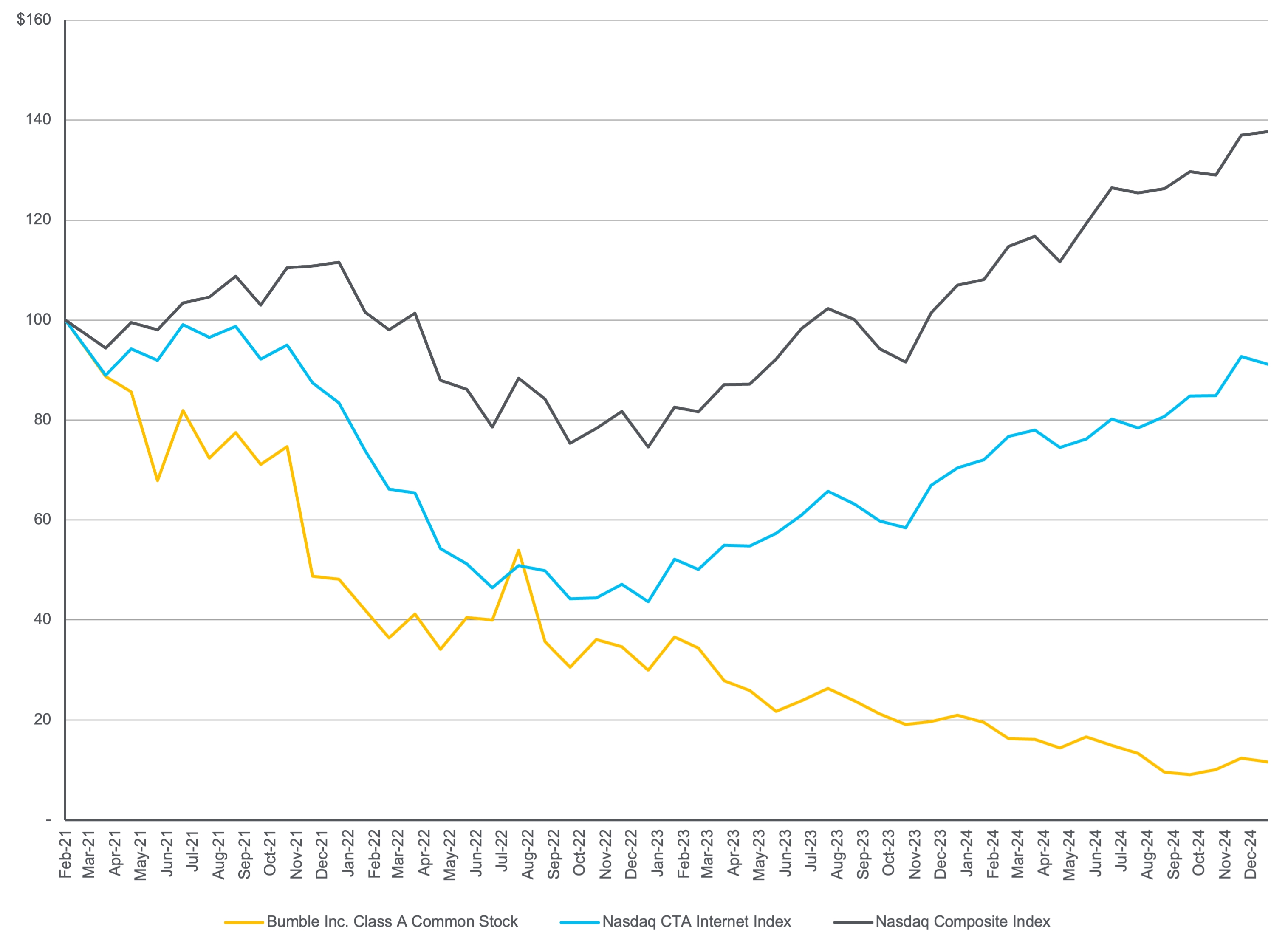
Item 6. Reserved
50
Item 7. Management’s Discussion and Analysis of Financial Condition and Results of Operations
You should read the following discussion and analysis of the financial condition and results of operations of Bumble Inc. in conjunction with our consolidated financial statements and the related notes included in Part II, “Item 8—Financial Statements and Supplementary Data” of this Annual Report on Form 10-K. This discussion contains forward-looking statements that involve risks and uncertainties about our business and operations. Our actual results could differ materially from those discussed in the forward-looking statements. Factors that could cause or contribute to these differences include without limitation those discussed in this Management’s Discussion and Analysis of Financial Condition and Results of Operations and those identified in Part I, “Item 1A—Risk Factors” of this Annual Report on Form 10-K.
Overview
We provide online dating and social networking applications through free subscription and in-app purchases of products servicing North America, Europe and various other countries around the world. In 2024, Bumble operated a family of apps, including Bumble, Bumble For Friends, Badoo, Geneva, Fruitz and Official. Bumble app, launched in 2014, is one of the first dating apps built with women at the center, where women make the first move. Bumble app is a leader in the online dating sector across several countries, including the United States, the United Kingdom, Australia and Canada. Badoo app, launched in 2006, was one of the pioneers of web and mobile free-to-use dating products. Badoo app’s focus is to make finding meaningful connections easy, fun and accessible for a mainstream global audience. Badoo app continues to be a market leader in several countries in Europe and Latin America. Building on the BFF mode in Bumble app, in July 2023 we officially launched a standalone Bumble For Friends app. Bumble For Friends app is a friendship app where people in all stages of life can meet people nearby and create meaningful platonic connections. In July 2024, we acquired Geneva, through which we aim to expand the Bumble For Friends experience from one-to-one connections to groups and communities to serve the many ways people seek friendships. As part of our strategic priorities, we decided to discontinue the Fruitz and Official apps, which we expect to be completed in the first half of 2025.
Overview of Financial Results
For the years ended December 31, 2024, 2023 and 2022, we generated:
For a reconciliation of Adjusted EBITDA, Adjusted EBITDA margin, Free Cash Flow and Free Cash Flow Conversion, which are all non-GAAP measures, to the most directly comparable GAAP financial measures, information about why we consider Adjusted EBITDA, Adjusted EBITDA margin, free cash flow and free cash flow conversion useful and a discussion of the material risks and limitations of these measures, please see “—Non-GAAP Financial Measures.”
Key Operating Metrics
We regularly review a number of metrics, including the following key operating metrics, to evaluate our business, measure our performance, identify trends in our business, prepare financial projections and make strategic decisions. We believe these operational measures are useful in evaluating our performance, in addition to our financial results prepared in accordance with GAAP. Refer to the section “Certain Definitions” at the beginning of this Annual Report for the definitions of our Key Operating Metrics.
51
The following metrics were calculated excluding paying users and revenue generated from Official, advertising and partnerships or affiliates and, for periods prior to the fourth quarter of 2023, excluding paying users and revenue generated from Fruitz. Beginning in the fourth quarter of 2023, paying users and revenue generated from Fruitz are included in our key operating metrics. Prior period information and key operating metrics have not been recast to include paying users and revenue generated from Fruitz. As of December 31, 2024, Geneva has not generated any revenue, and therefore, is excluded from our key operating metrics.
(in thousands, except ARPPU) |
|
Year Ended December 31, 2024 |
|
|
Year Ended December 31, 2023 |
|
|
Year Ended December 31, 2022 |
|
|||
Bumble App Paying Users |
|
|
2,807.3 |
|
|
|
2,517.4 |
|
|
|
2,002.2 |
|
Badoo App and Other Paying Users |
|
|
1,342.0 |
|
|
|
1,203.3 |
|
|
|
1,179.7 |
|
Total Paying Users |
|
|
4,149.3 |
|
|
|
3,720.7 |
|
|
|
3,181.9 |
|
Bumble App Average Revenue per Paying User |
|
$ |
25.72 |
|
|
$ |
27.97 |
|
|
$ |
28.90 |
|
Badoo App and Other Average Revenue per Paying User |
|
$ |
11.85 |
|
|
$ |
12.70 |
|
|
$ |
13.06 |
|
Total Average Revenue per Paying User |
|
$ |
21.23 |
|
|
$ |
23.03 |
|
|
$ |
23.03 |
|
Key Factors Affecting our Performance
Our results of operations and financial condition have been, and will continue to be, affected by a number of factors that present significant opportunities for us but also pose risks and challenges, including those discussed below and elsewhere in this Annual Report on Form 10-K, particularly in Part I, “Item 1A—Risk Factors.”
Growth Strategy
As previously disclosed, we are in the process of implementing a new strategy and transformation plan intended to deliver durable customer value and drive long-term sustainable revenue. As part of this new strategy, we are focusing on fostering a vibrant and healthy customer ecosystem, improving the customer experience through product innovation and optimization of operations, and evolving our revenue strategy to ensure we deliver value at every step of our customers’ journey through a rebalancing of Bumble app subscription tiers, among other things. As we address these areas of focus, our user growth and success in attracting new users, user engagement and monetization may be negatively impacted. In addition, efforts to improve the health of our ecosystem, including the removal of bad actors from our apps and changes to our user acquisition strategy, may adversely affect revenue and paying users in the short term. Furthermore, if we do not successfully implement our new strategy, our business, financial condition and results of operations could be materially adversely affected.
See also “If we fail to retain existing users or add new users, or if our users decrease their level of engagement with our products or do not convert to paying users, our revenue, financial results and business may be significantly harmed” and “We are subject to certain risks as a mission-based company” in Part I, “Item 1A—Risk Factors—Risks Related to Our Brands, Products and Operations” in this Annual Report on Form 10-K.
Growth in Monetization
Our apps monetize via a freemium model where the use of our service is free and a subset of our users pay for subscriptions or in-app purchases to access premium features. We acquire new users through investments in marketing and brand as well as through word of mouth from existing users and others. We convert these users to Paying Users by introducing premium features which maximize the probability of developing meaningful connections and improving their experience.
Our revenue growth primarily depends on Paying Users and ARPPU. We continually develop new monetization features and improve existing features in order to increase adoption of in-app purchases and our subscription programs striking a balance between the number of Paying Users and ARPPU. We also test new pricing strategies, including different pricing tiers and user segmentation and share those insights across our apps to optimize monetization.
While we see opportunity for growth in our core online dating market driven by the steady growth of the global singles population, increasing adoption of online dating both in the United States and globally and increasing propensity to pay for online dating, we may also face challenges increasing our Paying Users. These challenges may include the prevailing global economic climate, competition from alternative products, lack of appealing product features, enforcement of restrictive payment policies from in-app payment systems provided by Apple and Google, and slower rates of growth in the online dating market.
Many variables will impact our ARPPU, including the number of Paying Users and mix of monetization offerings on our platform, as well as the effect of demographic shifts and geographic differences on all of these variables. Our pricing is in local currency and may vary between markets.
52
As foreign currency exchange rates change, translation of the statements of operations into U.S. dollars could negatively impact revenue and distort year-over-year comparability of operating results.
To the extent our ARPPU declines, our revenue growth will become increasingly dependent on our ability to increase our Paying Users.
Expansion into New Geographic Markets
We are focused on growing our platform globally, including through entering new markets and investing in under-penetrated markets. As we introduce Bumble app to new markets throughout Europe, Asia, and Latin America we can leverage the local insights, scale, and infrastructure of Badoo app’s existing global footprint to efficiently enter new markets. Badoo app can also leverage Bumble’s marketing expertise and strength in North America to support growth in that market.
Expanding into new geographies will require increased costs related to marketing, as well as localization of product features and services. Potential risks to our expansion into new geographies will include competition and compliance with foreign laws and regulations.
As we expand into certain new geographies, we may see an increase in users who prefer to access premium features through our in-app purchase options rather than through our subscription packages which could impact our ARPPU. We may also see a lower propensity to pay as we enter certain new markets.
Investing in Growth While Driving Long-Term Profitability
Our mission-driven strategy ensures that values guide our business decisions and our business performance enables us to drive impact through investment in technology, marketing and product innovation, balancing growth with long-term margins.
We expect to continue to invest in technology, marketing and product innovation to drive growth while improving margins over the long term. Key investment areas for our platform include artificial intelligence capabilities, including improving our matching and content moderation technologies; features that enhance trust and safety on our platform; new offerings that enhance user engagement and retention; marketing, and personalization capabilities; and new subscription and consumable offerings to drive incremental value to Paying Users.
Attracting and Retaining Talent
Our business relies on our ability to attract and retain our talent, including engineers, data scientists, product designers and product developers. We believe that people want to work at a company that has purpose and aligns with their personal values, and therefore our ability to recruit talent is aided by our mission and brand reputation. We compete for talent within the technology industry.
Seasonality
We experience seasonality in user growth, user engagement, Paying User growth, and monetization on our platform. Historically, we have seen an increase in all of these metrics in January due in part to seasonal demand in the lead up to Valentine’s Day, and during the Northern Hemisphere summer.
Macroeconomic Conditions
Macroeconomic conditions, including the conflicts in Eastern Europe and the Middle East, slower growth or economic recession, changes to fiscal, monetary and trade policy, including the newly introduced tariffs by the current presidential administration in the U.S., and fluctuations in foreign currency exchange rates have impacted and may continue to impact our results of operations, as well as our consumers who face greater pressure on disposable income. We continuously monitor the direct and indirect impacts of these circumstances on our business and financial results.
For additional information, see Part I, “Item 1A―Risk Factors—General Risk Factors—We are exposed to changes in the global macroeconomic environment beyond our control, which may adversely affect consumer discretionary spending, demand for our products and services, our expenses and our ability to execute strategic plans” of this Annual Report on Form 10-K.
2024 Restructuring Plan
On February 27, 2024, the Company announced that it adopted a restructuring plan (the “2024 Restructuring Plan”) to reduce its global workforce by approximately 350 roles to better align its operating model with future strategic priorities and to drive stronger operating leverage. The 2024 Restructuring Plan was completed in the third quarter of 2024, and we incurred approximately $20.4 million of total non-recurring charges, consisting primarily of employee severance, benefits, and related charges for impacted employees.
53
For additional information, see Note 9, Restructuring Charges, included in Part II, “Item 8 – Financial Statements and Supplementary Data” of this Annual Report on Form 10-K.
Factors Affecting the Comparability of Our Results of Operations
As a result of a number of factors, our historical results of operations may not be comparable from period to period or going forward. Set forth below is a brief discussion of the key factors impacting the comparability of our results of operations.
Secondary Offerings
On March 8, 2023, the Company completed a secondary offering of 13.75 million shares of Class A common stock on behalf of the Blackstone Selling Stockholders and the Founder at a price of $22.80 per share. This transaction resulted in the issuance of 7.2 million Class A shares of common stock for the period ended March 31, 2023, which were issued in exchange for Common Units held by the selling stockholders.
Bumble did not sell any shares of Class A common stock in these offerings and did not receive any of the proceeds from the sales. Bumble paid the costs associated with the sales of shares by the selling stockholders, net of the underwriting discounts.
Share Repurchase Program
In May 2023, we announced that our Board of Directors approved a share repurchase program of up to $150.0 million of our outstanding Class A common stock with repurchases under the program to be made on a discretionary basis from time to time, subject to general business and market conditions and other investment opportunities, through open market purchases or other means, including privately negotiated transactions. We announced increases in the share repurchase program authorized amount from $150.0 million to $300.0 million in November 2023 and from $300.0 million to $450.0 million in May 2024. During the year ended December 31, 2024, we repurchased 25.1 million shares of Class A common stock and 2.0 million Common Units for $214.4 million, excluding excise tax obligations. During the year ended December 31, 2023, the Company repurchased 7.8 million shares of Class A common stock and 3.2 million Common Units for $157.1 million. As of December 31, 2024, a total of $78.8 million remained available for repurchase under the repurchase program.
For additional information, see Note 2, Summary of Selected Significant Accounting Policies—Share Repurchase Program, Note 13, Shareholders' Equity—Share Repurchase Program and Note 17, Related Party Transactions—Share Repurchase, included in Part II, “Item 8 – Financial Statements and Supplementary Data” of this Annual Report on Form 10-K.
Tax Receivable Agreement
In connection with certain reorganization transactions and our IPO, we entered into a tax receivable agreement with certain of our pre-IPO owners that provides for the payment by the Company to such pre-IPO owners of 85% of the benefits that the Company realizes, or is deemed to realize, as a result of the Company's allocable share of existing tax basis acquired in our IPO and other tax benefits related to entering into the tax receivable agreement. The payments that we may be required to make under the tax receivable agreement to the pre-IPO owners may be significant and are dependent upon future taxable income. We have recorded a tax receivable agreement liability to related parties of $416.7 million related to these benefits as of December 31, 2024 of which $15.8 million was included in “Accrued expenses and other current liabilities.” To the extent that we determine that we are able to realize the tax benefits associated with the basis adjustments and net operating loss carryforwards, we would record an additional liability of $286.3 million for a total liability of $703.0 million. If, in the future, we are not able to utilize the Common Basis, we would record a reduction in the tax receivable agreement liability to related parties that would result in a benefit recorded within our consolidated statements of operations. During the year ended December 31, 2024, our tax receivable agreement liability decreased by a net $13.5 million due to the following: (1) a $23.1 million decrease from tax receivable agreement payments made during the first quarter of 2024, (2) an increase of $3.4 million, primarily due to the effects of the repurchase of Common Units in Bumble Holdings from Blackstone entities completed in the first quarter of 2024 and the effects of the repurchase of Common Units in Bumble Holdings from Bumble during 2024, the proceeds from which were used to fund Class A common stock repurchases during 2024 and (3) an increase of $6.2 million for amounts recorded in “Accrued expenses and other current liabilities” for the partial realization of tax benefits related to basis adjustments and net operating loss carryforwards.
For additional information, see Part I, “Item 1A―Risk Factors—Bumble Inc. will be required to pay certain of our pre-IPO owners for most of the benefits relating to tax depreciation or amortization deductions that we may claim as a result of Bumble Inc.’s allocable share of existing tax basis acquired in the IPO, Bumble Inc.’s increase in its allocable share of existing tax basis and anticipated tax basis adjustments we receive in connection with sales or exchanges of Common Units (including Common Units issued upon conversion of vested Incentive Units) in connection with or after the IPO and our utilization of certain tax attributes of the Blocker Companies” and “Item 1A―Risk Factors—In certain cases, payments under the tax receivable agreement may be accelerated and/or significantly exceed the actual benefits Bumble Inc. realizes in respect of the tax attributes subject to the tax receivable agreement” of this Annual Report on Form 10-K.
54
Also see Note 5, Payable to Related Parties Pursuant to a Tax Receivable Agreement, to our consolidated financial statements included in Part II, “Item 8 – Financial Statements and Supplementary Data” of this Annual Report on Form 10-K.
Impairment Charges
During the year ended December 31, 2024, we identified potential impairment triggering events related to our indefinite-lived assets, long-lived assets and definite-lived intangible assets, and goodwill. These triggering events included our revised 2024 outlook and a decrease in our stock price and market capitalization that was sustained during the third quarter of 2024. As a result, we performed an interim impairment test. Based on the results of the test, we recognized impairment charges of $670.3 million for indefinite-lived intangible assets, $24.7 million for the Fruitz asset group and $197.2 million for goodwill during the year ended December 31, 2024. There were no impairment charges recorded for the year end December 31, 2023. For the year ended December 31, 2022, we recorded a $141.0 million Badoo brand impairment and a $4.4 million right-of-use asset impairment related to our Moscow office.
Given the aforementioned impairment charges recorded in 2024 and 2022, it is reasonably possible that changes in judgments, assumptions and estimates we made in assessing the fair values of these assets could cause us to consider some portion, or all of the remaining carrying values of these assets, to become impaired. A further decline in our stock price, economic downturns, a decline in market conditions and/or unfavorable industry trends could potentially trigger impairment tests in the future. In addition, reduced demand for our products, slower growth rates in our industry, and changes in market-based interest rates could negatively impact the estimated future cash flows and discount rates used in the income approach to determine the fair values of these assets and could result in an impairment charge in the future.
For additional information, see Note 2, Summary of Selected Significant Accounting Policies—Goodwill,—Indefinite-lived Intangible Assets and —Long-lived Assets and Definite-lived Intangible Assets and Note 8, Goodwill and Intangible Assets, Net included in Part II, “Item 8 – Financial Statements and Supplementary Data” of this Annual Report on Form 10-K.
Acquisition
On July 1, 2024, we completed the acquisition of Geneva Technologies Inc.(“Geneva”) for total cash consideration of $17.5 million, net of cash acquired, of which $17.2 million was allocated to developed technology and $0.3 million was allocated to other assets and liabilities. For additional information, see Note 8, Goodwill and Intangible Assets, Net included in Part II, “Item 8 – Financial Statements and Supplementary Data” of this Annual Report on Form 10-K.
Statements of Operations Reclassification
To conform to current year presentation, we have reclassified $145.4 million related to the impairment charges of the Badoo brand and a right-of-use asset related to our Moscow office for the year ended December 31, 2022, from “General and administrative expense” to “Impairment Loss”.
Components of Results of Operations
Our business is organized into a single reportable segment.
Revenue
We monetize the Bumble, Bumble For Friends, Badoo, Fruitz and Official apps via a freemium model where the use of our service is free and a subset of our users pay for subscriptions or in-app purchases to access premium features. Subscription revenue is presented net of taxes, refunds and credit card chargebacks. This revenue is initially deferred and is recognized using the straight-line method over the term of the applicable subscription period. Revenue from lifetime subscriptions is deferred over the average estimated expected period of the subscriber relationship, which is currently estimated to be twelve months. Revenue from the purchase of in-app features is recognized based on usage and estimated breakage revenue associated with unused in-app purchases.
We also earn revenue from online advertising and partnerships, which are not a significant part of our business. Online advertising revenue is recognized when an advertisement is displayed. Revenue from partnerships is recognized according to the contractual terms of the partnership.
55
Cost of revenue
Cost of revenue consists primarily of in-app purchase fees due on payments processed through the Apple App Store and Google Play Store. Purchases on Android, mobile web and desktop may have additional payment methods, such as credit card or via telecom providers. These purchases incur fees which vary depending on payment method. Purchase fees are deferred and expensed over the same period as revenue.
Cost of revenue also includes data center expenses such as rent, power and bandwidth for running servers, cloud hosting costs, employee compensation (including stock-based compensation) and other employee related costs, impairment of capitalized aggregator costs associated with breakage revenue and restructuring charges. Expenses relating to customer care functions such as customer service, moderators and other auxiliary costs associated with providing services to customers such as fraud prevention are also included within cost of revenue.
Selling and marketing expense
Selling and marketing expense consists primarily of brand marketing, digital and social media spend, field marketing, restructuring charges, compensation expense (including stock-based compensation) and other employee-related costs for personnel engaged in sales and marketing functions.
General and administrative expense
General and administrative expense consists primarily of compensation (including stock-based compensation) and other employee-related costs for personnel engaged in executive management, finance, legal, tax and human resources. General and administrative expense also consists of transaction costs, changes in fair value of contingent earn-out liability, expenses associated with facilities, information technology, external professional services, legal costs, settlement of legal claims and accruals for future legal obligations that are deemed probable and estimable, restructuring charges and other administrative expenses.
Product development expense
Product development expense consists primarily of compensation (including stock-based compensation) and other employee-related costs for personnel engaged in the design, development, testing and enhancement of product offerings and related technology, as well as restructuring charges.
Depreciation and amortization expense
Depreciation and amortization expense is primarily related to computer equipment, leasehold improvements, furniture and fixtures, developed technology, user base, white label contracts, trademarks and other definite-lived intangible assets.
Impairment loss
Impairment loss relates to impairment charges to indefinite-lived intangible assets, long-lived assets and definite-lived intangible assets, and goodwill as applicable.
Interest income (expense), net
Interest income (expense), net consists of interest income received on money market funds and interest rate swaps, fair value changes in interest rate swaps, and interest expense incurred in connection with our long-term debt.
Other income (expense), net
Other income (expense), net consists of insurance reimbursement proceeds, impacts from foreign exchange transactions, tax receivable agreement liability remeasurement (benefit) expense, loss on debt extinguishment, sub-lease income and investments in equity securities.
Income tax benefit (provision)
Income tax benefit (provision) represents the income tax benefit or expense associated with our operations based on the tax laws of the jurisdictions in which we operate. These foreign jurisdictions have different statutory tax rates than the United States. Our effective tax rates will vary depending on the relative proportion of foreign to domestic income, changes in the valuation of our deferred tax assets and liabilities, and changes in tax laws.
56
Results of Operations
The following table sets forth our consolidated statements of operations information for the periods presented:
|
|
|
|
|
|
|
|
|
|
|||
(in thousands) |
|
Year Ended December 31, 2024 |
|
|
Year Ended December 31, 2023 |
|
|
Year Ended December 31, 2022 |
|
|||
Revenue |
|
$ |
1,071,643 |
|
|
$ |
1,051,830 |
|
|
$ |
903,503 |
|
Operating costs and expenses: |
|
|
|
|
|
|
|
|
|
|||
Cost of revenue |
|
|
318,835 |
|
|
|
307,835 |
|
|
|
249,490 |
|
Selling and marketing expense |
|
|
261,172 |
|
|
|
270,380 |
|
|
|
249,269 |
|
General and administrative expense |
|
|
128,521 |
|
|
|
221,649 |
|
|
|
163,467 |
|
Product development expense |
|
|
100,725 |
|
|
|
130,565 |
|
|
|
109,020 |
|
Depreciation and amortization expense |
|
|
70,616 |
|
|
|
68,028 |
|
|
|
89,713 |
|
Impairment loss |
|
|
892,248 |
|
|
|
— |
|
|
|
145,388 |
|
Total operating costs and expenses |
|
|
1,772,117 |
|
|
|
998,457 |
|
|
|
1,006,347 |
|
Operating earnings (loss) |
|
|
(700,474 |
) |
|
|
53,373 |
|
|
|
(102,844 |
) |
Interest expense, net |
|
|
(39,945 |
) |
|
|
(21,534 |
) |
|
|
(24,063 |
) |
Other income (expense), net |
|
|
(4,827 |
) |
|
|
(26,537 |
) |
|
|
16,189 |
|
Income (loss) before income tax |
|
|
(745,246 |
) |
|
|
5,302 |
|
|
|
(110,718 |
) |
Income tax provision |
|
|
(23,128 |
) |
|
|
(7,170 |
) |
|
|
(3,406 |
) |
Net loss |
|
|
(768,374 |
) |
|
|
(1,868 |
) |
|
|
(114,124 |
) |
Net earnings (loss) attributable to noncontrolling interests |
|
|
(211,366 |
) |
|
|
2,345 |
|
|
|
(34,378 |
) |
Net loss attributable to Bumble Inc. shareholders |
|
$ |
(557,008 |
) |
|
$ |
(4,213 |
) |
|
$ |
(79,746 |
) |
The following table sets forth our consolidated statements of operations information as a percentage of revenue for the periods presented:
|
|
|
|
|
|
|
|
|
|
|||
|
|
|
|
|
|
|
|
|
|
|||
|
|
Year Ended December 31, 2024 |
|
|
Year Ended December 31, 2023 |
|
|
Year Ended December 31, 2022 |
|
|||
Revenue |
|
|
100.0 |
% |
|
|
100.0 |
% |
|
|
100.0 |
% |
Operating costs and expenses: |
|
|
|
|
|
|
|
|
|
|||
Cost of revenue |
|
|
29.8 |
% |
|
|
29.3 |
% |
|
|
27.6 |
% |
Selling and marketing expense |
|
|
24.4 |
% |
|
|
25.7 |
% |
|
|
27.6 |
% |
General and administrative expense |
|
|
12.0 |
% |
|
|
21.1 |
% |
|
|
18.1 |
% |
Product development expense |
|
|
9.4 |
% |
|
|
12.4 |
% |
|
|
12.1 |
% |
Depreciation and amortization expense |
|
|
6.6 |
% |
|
|
6.5 |
% |
|
|
9.9 |
% |
Impairment loss |
|
|
83.3 |
% |
|
|
0.0 |
% |
|
|
16.1 |
% |
Total operating costs and expenses |
|
|
165.4 |
% |
|
|
94.9 |
% |
|
|
111.4 |
% |
Operating earnings (loss) |
|
|
(65.4 |
)% |
|
|
5.1 |
% |
|
|
(11.4 |
)% |
Interest expense, net |
|
|
(3.7 |
)% |
|
|
(2.0 |
)% |
|
|
(2.7 |
)% |
Other income (expense), net |
|
|
(0.5 |
)% |
|
|
(2.5 |
)% |
|
|
1.8 |
% |
Income (loss) before income tax |
|
|
(69.5 |
)% |
|
|
0.5 |
% |
|
|
(12.3 |
)% |
Income tax provision |
|
|
(2.2 |
)% |
|
|
(0.7 |
)% |
|
|
(0.4 |
)% |
Net loss |
|
|
(71.7 |
)% |
|
|
(0.2 |
)% |
|
|
(12.6 |
)% |
Net earnings (loss) attributable to noncontrolling interests |
|
|
(19.7 |
)% |
|
|
0.2 |
% |
|
|
(3.8 |
)% |
Net loss attributable to Bumble Inc. shareholders |
|
|
(52.0 |
)% |
|
|
(0.4 |
)% |
|
|
(8.8 |
)% |
57
The following table sets forth the stock-based compensation expense included in operating costs and expenses:
|
|
|
|
|
|
|
|
|
|
|||
(in thousands) |
|
Year Ended December 31, 2024 |
|
|
Year Ended December 31, 2023 |
|
|
Year Ended December 31, 2022 |
|
|||
Cost of revenue |
|
$ |
690 |
|
|
$ |
4,054 |
|
|
$ |
3,819 |
|
Selling and marketing expense |
|
|
(1,296 |
) |
|
|
9,803 |
|
|
|
8,064 |
|
General and administrative expense |
|
|
22,673 |
|
|
|
52,008 |
|
|
|
63,575 |
|
Product development expense |
|
|
4,178 |
|
|
|
38,473 |
|
|
|
35,550 |
|
Total stock-based compensation expense |
|
$ |
26,245 |
|
|
$ |
104,338 |
|
|
$ |
111,008 |
|
During the year ended December 31, 2024, stock-based compensation expense decreased from the same periods in 2023 and 2022, primarily due to forfeitures and headcount reductions.
The following table sets forth our revenue across apps for the periods presented:
|
|
|
|
|
|
|
|
|
|
|||
(in thousands) |
|
Year Ended December 31, 2024 |
|
|
Year Ended December 31, 2023 |
|
|
Year Ended December 31, 2022 |
|
|||
Bumble App |
|
$ |
866,289 |
|
|
$ |
844,774 |
|
|
$ |
694,329 |
|
Badoo App and Other |
|
|
205,354 |
|
|
|
207,056 |
|
|
|
209,174 |
|
Total Revenue |
|
$ |
1,071,643 |
|
|
$ |
1,051,830 |
|
|
$ |
903,503 |
|
Total revenue was $1,071.6 million for the year ended December 31, 2024, compared to $1,051.8 million for the same period in 2023. The increase was primarily driven by growth in Total Paying Users, partially offset by a decline in Total ARPPU and unfavorable fluctuations in foreign currency exchange rates.
Bumble App Revenue was $866.3 million for the year ended December 31, 2024, compared to $844.8 million for the same period in 2023. This increase was primarily driven by an 11.5% increase in Bumble App Paying Users to 2.8 million, partially offset by an 8.0% decline in Bumble App ARPPU to $25.72 and unfavorable fluctuations in foreign currency exchange rates.
Badoo App and Other Revenue was $205.4 million for the year ended December 31, 2024, compared to $207.1 million for the same period in 2023. This decrease was primarily driven by a 6.7% decrease in Badoo App and Other ARPPU to $11.85 and unfavorable fluctuations in foreign currency exchange rates, partially offset by a 11.5% increase in Badoo App and Other Paying Users to 1.3 million. We began to include paying users and revenue generated from Fruitz in our key operating metrics in the fourth quarter of 2023 and prior period key operating metrics have not been recast.
Total revenue was $1,051.8 million for the year ended December 31, 2023, compared to $903.5 million for the same period in 2022. The increase was primarily driven by growth in Total Paying Users.
Bumble App Revenue was $844.8 million for the year ended December 31, 2023, compared to $694.3 million for the same period in 2022. This increase was primarily driven by a 25.7% increase in Bumble App Paying Users to 2.5 million, partially offset by a 3.2% decline in Bumble App ARPPU to $27.97. The increase in Bumble App Revenue was due to growth in core markets and international expansion.
Badoo App and Other Revenue was $207.1 million for the year ended December 31, 2023, compared to $209.2 million for the same period in 2022. This decrease was primarily driven by a 2.8% decrease in Badoo App and Other ARPPU to $12.70, partially offset by a 2.0% increase in Badoo App and Other Paying Users to 1.2 million. Results for the year ended December 31, 2023 reflect the full impact of the Company’s decision to remove all of its apps from the Apple App Store and Google Play Store in Russia and Belarus in March 2022, as well as other global macroeconomic conditions. In addition, other revenue of $23.7 million for the year ended December 31, 2023, decreased by $0.6 million, or 2.6%, compared to the same period in 2022.
Cost of revenue
58
|
|
|
|
|
|
|
|
|
|
|||
(in thousands, except percentages) |
|
Year Ended December 31, 2024 |
|
|
Year Ended December 31, 2023 |
|
|
Year Ended December 31, 2022 |
|
|||
Cost of revenue |
|
$ |
318,835 |
|
|
$ |
307,835 |
|
|
$ |
249,490 |
|
Percentage of revenue |
|
|
29.8 |
% |
|
|
29.3 |
% |
|
|
27.6 |
% |
Cost of revenue for the year ended December 31, 2024 increased by $11.0 million, or 3.6%, as compared to the same period in 2023, driven primarily by growth in in-app purchase fees due to increasing revenue. As a percentage of revenue, cost of revenue for the year ended December 31, 2024 was 29.8%, compared to 29.3% for the same period in 2023, primarily due to the adoption of Google Play and user choice billing in many of our markets and to a lesser extent an increase in subscription costs, partially offset by a decrease in stock-based compensation due to forfeitures and headcount reductions.
Cost of revenue for the year ended December 31, 2023 increased by $58.3 million, or 23.4%, as compared to the same period in 2022, driven primarily by growth in in-app purchase fees due to increasing revenue. As a percentage of revenue, cost of revenue for the year ended December 31, 2023 was 29.3%, compared to 27.6% for the same period in 2022, primarily due to the adoption of Google Play billing in many of our markets and to a lesser extent an increase in cloud hosting, bulk messaging and content moderation costs.
Selling and marketing expense
|
|
|
|
|
|
|
|
|
|
|||
(in thousands, except percentages) |
|
Year Ended December 31, 2024 |
|
|
Year Ended December 31, 2023 |
|
|
Year Ended December 31, 2022 |
|
|||
Selling and marketing expense |
|
$ |
261,172 |
|
|
$ |
270,380 |
|
|
$ |
249,269 |
|
Percentage of revenue |
|
|
24.4 |
% |
|
|
25.7 |
% |
|
|
27.6 |
% |
Selling and marketing expense for the year ended December 31, 2024, decreased by $9.2 million, or 3.4%, as compared to the same period in 2023. The change was primarily due to a $11.1 million decrease in stock-based compensation driven by forfeitures and headcount reductions, and a $6.7 million decrease in personnel-related costs associated with our 2024 Restructuring Plan, partially offset by a $8.6 million increase in marketing costs.
Selling and marketing expense for the year ended December 31, 2023, increased by $21.1 million, or 8.5%, as compared to the same period in 2022. This change was primarily due to a $14.0 million increase in digital and social media marketing costs and a $6.5 million increase in personnel-related expenses.
General and administrative expense
|
|
|
|
|
|
|
|
|
|
|||
(in thousands, except percentages) |
|
Year Ended December 31, 2024 |
|
|
Year Ended December 31, 2023 |
|
|
Year Ended December 31, 2022 |
|
|||
General and administrative expense |
|
$ |
128,521 |
|
|
$ |
221,649 |
|
|
$ |
163,467 |
|
Percentage of revenue |
|
|
12.0 |
% |
|
|
21.1 |
% |
|
|
18.1 |
% |
General and administrative expense for the year ended December 31, 2024, decreased by $93.1 million, or 42.0%, as compared to the same period in 2023. The change was primarily driven by a $67.8 million decrease in legal and professional fees, a $29.3 million decrease in stock-based compensation due to forfeitures and headcount reductions, a $4.7 million decrease in insurance expenses, and a $1.5 million decrease in personnel-related costs associated with our 2024 Restructuring Plan, partially offset by a $9.4 million increase associated with the change in fair value of the contingent earn-out liabilities.
General and administrative expense for the year ended December 31, 2023 increased by $58.2 million, or 35.6%, as compared to the same period in 2022. The change was primarily driven a $46.4 million increase in professional and transaction costs and a $17.5 million increase associated with the change in the fair value of the contingent earn-out liabilities, partially offset by a $3.6 million decrease in personnel-related expenses.
59
Product development expense
|
|
|
|
|
|
|
|
|
|
|||
(in thousands, except percentages) |
|
Year Ended December 31, 2024 |
|
|
Year Ended December 31, 2023 |
|
|
Year Ended December 31, 2022 |
|
|||
Product development expense |
|
$ |
100,725 |
|
|
$ |
130,565 |
|
|
$ |
109,020 |
|
Percentage of revenue |
|
|
9.4 |
% |
|
|
12.4 |
% |
|
|
12.1 |
% |
Product development expense for the year ended December 31, 2024, decreased by $29.8 million, or 22.9%, as compared to the same period in 2023. The change was primarily driven by a $34.0 million decrease in stock-based compensation due to forfeitures and headcount reductions.
Product development expense for the year ended December 31, 2023, increased by $21.5 million, or 19.8%, as compared to the same period in 2022, primarily driven by a $19.6 million increase in personnel-related expenses.
Depreciation and amortization expense
|
|
|
|
|
|
|
|
|
|
|||
(in thousands, except percentages) |
|
Year Ended December 31, 2024 |
|
|
Year Ended December 31, 2023 |
|
|
Year Ended December 31, 2022 |
|
|||
Depreciation and amortization expense |
|
$ |
70,616 |
|
|
$ |
68,028 |
|
|
$ |
89,713 |
|
Percentage of revenue |
|
|
6.6 |
% |
|
|
6.5 |
% |
|
|
9.9 |
% |
Depreciation and amortization expense for the year ended December 31, 2024, increased by $2.6 million, or 3.8%, as compared to the same period in 2023. The increase in depreciation and amortization was due to the increased amortization of intangible assets, driven by the acquisition of Geneva developed technology in July 2024.
Depreciation and amortization expense for the year ended December 31, 2023, decreased by $21.7 million, or 24.2%, as compared to the same period in 2022. The decrease in depreciation and amortization expense was primarily due to the full amortization of the legacy Badoo user base in July 2022. These decreases were partially offset by increases in the amortization of intangibles acquired from the Official acquisition in April 2023.
Impairment loss
|
|
|
|
|
|
|
|
|
|
|||
(In thousands, except percentages) |
|
Year Ended December 31, 2024 |
|
|
Year Ended December 31, 2023 |
|
|
Year Ended December 31, 2022 |
|
|||
Impairment loss |
|
$ |
892,248 |
|
|
$ |
— |
|
|
$ |
145,388 |
|
Percentage of revenue |
|
|
83.3 |
% |
|
|
— |
|
|
|
16.1 |
% |
During the year ended December 31, 2024, we recognized an impairment charge of $670.3 million for our indefinite-lived intangible assets, $24.7 million for the Fruitz asset group, and $197.2 million for goodwill. There were no impairment charges recorded for the same period in 2023. For the year ended December 31, 2022, we recorded a $141.0 million Badoo brand impairment and a $4.4 million right-of-use asset impairment related to our Moscow office.
For additional information, see Note 2, Summary of Selected Significant Accounting Policies—Goodwill,—Indefinite-lived Intangible Assets and —Long-lived Assets and Definite-lived Intangible Assets and Note 8, Goodwill and Intangible Assets, Net included in Part II, “Item 8 – Financial Statements and Supplementary Data” of this Annual Report on Form 10-K.
Interest expense, net
|
|
|
|
|
|
|
|
|
|
|||
(in thousands, except percentages) |
|
Year Ended December 31, 2024 |
|
|
Year Ended December 31, 2023 |
|
|
Year Ended December 31, 2022 |
|
|||
Interest expense, net |
|
$ |
(39,945 |
) |
|
$ |
(21,534 |
) |
|
$ |
(24,063 |
) |
Percentage of revenue |
|
|
(3.7 |
)% |
|
|
(2.0 |
)% |
|
|
(2.7 |
)% |
60
Interest expense, net for the year ended December 31, 2024, increased $18.4 million, or 85.5%, compared to the same period in 2023. The change was due to a decrease in interest income on our interest rate swaps and a decrease in investments in money market funds.
Interest expense, net for the year ended December 31, 2023, decreased $2.5 million, or 10.5%, as compared to the same period in 2022. The change was due to the investing surplus funds in money market funds since the fourth quarter of 2022, partially offset by an increase in interest rates on our outstanding debt under the Credit Agreement.
Other income (expense), net
|
|
|
|
|
|
|
|
|
|
|||
(in thousands, except percentages) |
|
Year Ended December 31, 2024 |
|
|
Year Ended December 31, 2023 |
|
|
Year Ended December 31, 2022 |
|
|||
Other income (expense), net |
|
$ |
(4,827 |
) |
|
$ |
(26,537 |
) |
|
$ |
16,189 |
|
Percentage of revenue |
|
|
(0.5 |
)% |
|
|
(2.5 |
)% |
|
|
1.8 |
% |
Other income (expense), net for the year ended December 31, 2024, decreased by $21.7 million, compared to the same period in 2023. The change was primarily due to $13.8 million net loss on interest rate swaps in 2023, a $6.0 million increase in net foreign currency exchange gains, and a 2.0 million favorable impact related to tax receivable agreement liability remeasurement.
Other income (expense), net for the year ended December 31, 2023, decreased by $42.7 million, compared to the same period in 2022. The change was primarily due to a $30.9 million decrease in net gains on interest rate swaps, a $5.9 million decrease in net foreign currency exchange gains, a $5.0 million unfavorable impact related to tax receivable agreement liability remeasurement, and an $0.8 million decrease in fair value of investments in equity securities.
Income tax provision
|
|
|
|
|
|
|
|
|
|
|||
(in thousands, except percentages) |
|
Year Ended December 31, 2024 |
|
|
Year Ended December 31, 2023 |
|
|
Year Ended December 31, 2022 |
|
|||
Income tax provision |
|
$ |
(23,128 |
) |
|
$ |
(7,170 |
) |
|
$ |
(3,406 |
) |
Effective income tax rate |
|
|
(3.1 |
)% |
|
|
135.2 |
% |
|
|
(3.1 |
)% |
Income tax provision was $23.1 million for the year ended December 31, 2024, compared to $7.2 million for the year ended December 31, 2023, primarily due to the accrual of Pillar Two minimum taxes in certain foreign jurisdictions in 2024.
Income tax provision was $7.2 million for the year ended December 31, 2023, compared to $3.4 million for the year ended December 31, 2022, primarily due to the impact of income tax rate changes on our deferred tax balances recorded in 2022. In addition, the income tax provision for the years ended December 31, 2022 and December 31, 2023 reflect the impact of our assessment that we will not be able to realize the benefit of certain deferred tax assets arising in the current year for which a valuation allowance has been recorded.
For further detail of income tax matters, see Note 4, Income Taxes, to our consolidated financial statements included in Part II, “Item 8 – Financial Statements and Supplementary Data” of this Annual Report on Form 10-K.
Pillar Two Minimum Tax
On December 20, 2021, the Organization for Economic Cooperation and Development released the Pillar Two model rules providing a framework for implementing a 15% minimum tax, also referred to as the Global Anti-Base Erosion ("GloBE") rules, on earnings of multinational companies with consolidated annual revenue exceeding €750 million. Pillar Two legislation has been enacted in certain jurisdictions where the Company operates, including the UK and certain EU member states, and is effective for the Company's financial year beginning January 1, 2024. We have performed an assessment of our exposure to Pillar Two income taxes, including our ability to qualify for transitional safe harbor relief under the GloBE rules. While we expect to qualify for transitional safe harbor relief in most jurisdictions in which we operate, there are a limited number of jurisdictions where the transitional safe harbor is not available, including for certain entities classified as “stateless” constituent entities under the Pillar Two model rules. Our income tax provision for the year ended December 31, 2024 includes $12.6 million in accrued minimum taxes under Pillar Two, which is based on currently enacted legislation and guidance. These accrued minimum taxes are included in Other long-term liabilities in our consolidated balance sheet and are payable in June 2026 with the filing of our initial GloBE return. We are monitoring the implementation of Pillar Two legislation (both proposed and enacted) by individual countries, including the release of administrative guidance on the application of the GloBE rules, and will continue to evaluate the potential impact to the Company’s financial position.
61
In addition, in January 2025, the United States issued an executive order announcing opposition to aspects of these rules. Accordingly, we are still evaluating the potential consequences of Pillar Two on our longer-term financial position.
Non-GAAP Financial Measures
We report our financial results in accordance with GAAP, however, management believes that certain non-GAAP financial measures provide users of our financial information with useful supplemental information that enables a better comparison of our performance across periods. We believe Adjusted EBITDA provides visibility to the underlying continuing operating performance by excluding the impact of certain expenses, including income tax (benefit) provision, interest and derivative (gains) losses, net, depreciation and amortization expense, stock-based compensation expenses, employer costs related to stock-based compensation, foreign exchange (gain) loss, changes in fair value of contingent earn-out liability, investments in equity securities, transaction and other costs, litigation costs net of insurance reimbursements that arise outside of the ordinary course of business, tax receivable agreement liability remeasurement (benefit) expense, impairment loss, and costs associated with our restructuring plans, as management does not believe these expenses are representative of our core earnings.
We also provide Adjusted EBITDA margin, which is calculated as Adjusted EBITDA divided by revenue. In addition to Adjusted EBITDA and Adjusted EBITDA margin, we believe free cash flow and free cash flow conversion provide useful information regarding how cash provided by (used in) operating activities compares to the capital expenditures required to maintain and grow our business, and our available liquidity, after funding such capital expenditures, to service our debt, fund strategic initiatives, effectuate discretionary share repurchases and strengthen our balance sheet, as well as our ability to convert our earnings to cash. Additionally, we believe such metrics are widely used by investors, securities analysts, ratings agencies and other parties in evaluating liquidity and debt-service capabilities. We calculate free cash flow and free cash flow conversion using methodologies that we believe can provide useful supplemental information to help investors better understand underlying trends in our business.
Our non-GAAP financial measures may not be comparable to similarly titled measures used by other companies, have limitations as analytical tools and should not be considered in isolation, or as substitutes for analysis of our operating results as reported under GAAP. Additionally, we do not consider our non-GAAP financial measures as superior to, or a substitute for, the equivalent measures calculated and presented in accordance with GAAP. Some of the limitations are:
Adjusted EBITDA is not a liquidity measure and should not be considered as discretionary cash available to us to reinvest in the growth of our business or to distribute to stockholders or as a measure of cash that will be available to us to meet our obligations.
To properly and prudently evaluate our business, we encourage investors to review the financial statements included elsewhere in this Annual Report, and not rely on a single financial measure to evaluate our business. We also strongly urge investors to review the reconciliation of net earnings (loss) to Adjusted EBITDA, the computation of Adjusted EBITDA margin as compared to net earnings (loss) margin which is net earnings (loss) as a percentage of revenue, the reconciliation of net cash provided by (used in) operating activities to free cash flow, and the computation of free cash flow conversion as compared to operating cash flow conversion, which is net cash provided by (used in) operating activities as a percentage of net earnings (loss) in each case set forth below.
62
We define Adjusted EBITDA as net earnings (loss) excluding income tax (benefit) provision, interest and derivative (gains) losses, net, depreciation and amortization expense, stock-based compensation expense, employer costs related to stock-based compensation, foreign exchange (gain) loss, changes in fair value of contingent earn-out liability, investments in equity securities, transaction and other costs, litigation costs net of insurance reimbursements that arise outside of the ordinary course of business, tax receivable agreement liability remeasurement (benefit) expense, impairment loss, and restructuring costs. Adjusted EBITDA margin represents Adjusted EBITDA as a percentage of revenue.
We define free cash flow as net cash provided by (used in) operating activities less capital expenditures. Free cash flow conversion represents free cash flow as a percentage of Adjusted EBITDA. Operating cash flow conversion represents net cash provided by (used in) operating activities as a percentage of net earnings (loss).
63
The following table reconciles our non-GAAP financial measures to the most comparable GAAP financial measures for the periods presented:
|
|
|
|
|
|
|
|
|
|
|||
(in thousands, except percentages) |
|
Year Ended December 31, 2024 |
|
|
Year Ended December 31, 2023 |
|
|
Year Ended December 31, 2022 |
|
|||
Net loss |
|
$ |
(768,374 |
) |
|
$ |
(1,868 |
) |
|
$ |
(114,124 |
) |
Add back: |
|
|
|
|
|
|
|
|
|
|||
Income tax provision |
|
|
23,128 |
|
|
|
7,170 |
|
|
|
3,406 |
|
Interest and derivative (gains) losses, net(1) |
|
|
39,945 |
|
|
|
35,340 |
|
|
|
6,977 |
|
Depreciation and amortization expense |
|
|
70,616 |
|
|
|
68,028 |
|
|
|
89,713 |
|
Stock-based compensation expense |
|
|
26,245 |
|
|
|
104,338 |
|
|
|
111,008 |
|
Employer costs related to stock-based compensation(2) |
|
|
2,638 |
|
|
|
4,535 |
|
|
|
2,054 |
|
Litigation costs, net of insurance reimbursements(3) |
|
|
10,730 |
|
|
|
71,918 |
|
|
|
22,734 |
|
Foreign exchange (gain) loss (4) |
|
|
(3,777 |
) |
|
|
2,185 |
|
|
|
(3,679 |
) |
Restructuring costs(5) |
|
|
20,355 |
|
|
|
— |
|
|
|
1,463 |
|
Transaction and other costs(6) |
|
|
1,672 |
|
|
|
2,309 |
|
|
|
3,763 |
|
Changes in fair value of contingent earn-out liability |
|
|
(20,208 |
) |
|
|
(29,569 |
) |
|
|
(47,134 |
) |
Changes in fair value of investments in equity securities |
|
|
543 |
|
|
|
843 |
|
|
|
18 |
|
Tax receivable agreement liability remeasurement expense(7) |
|
|
8,341 |
|
|
|
10,341 |
|
|
|
5,332 |
|
Impairment loss(8) |
|
|
892,248 |
|
|
|
— |
|
|
|
145,388 |
|
Adjusted EBITDA |
|
$ |
304,102 |
|
|
$ |
275,570 |
|
|
$ |
226,919 |
|
Net loss margin |
|
|
(71.7 |
)% |
|
|
(0.2 |
)% |
|
|
(12.6 |
)% |
Adjusted EBITDA margin |
|
|
28.4 |
% |
|
|
26.2 |
% |
|
|
25.1 |
% |
|
|
|
|
|
|
|
|
|
|
|||
Net cash provided by operating activities |
|
$ |
123,441 |
|
|
$ |
182,086 |
|
|
$ |
132,941 |
|
Less: |
|
|
|
|
|
|
|
|
|
|||
Capital expenditures |
|
|
(9,319 |
) |
|
|
(14,935 |
) |
|
|
(16,333 |
) |
Free cash flow |
|
$ |
114,122 |
|
|
$ |
167,151 |
|
|
$ |
116,608 |
|
Operating cash flow conversion |
|
* |
|
|
* |
|
|
* |
|
|||
Free cash flow conversion |
|
|
37.5 |
% |
|
|
60.7 |
% |
|
|
51.4 |
% |
* Not meaningful
Liquidity and Capital Resources
Overview
As of December 31, 2024, we had $204.3 million of cash and cash equivalents, a decrease of $151.3 million from December 31, 2023, primarily due to share repurchases, and the acquisition of Geneva, partially offset by cash generated from operations. Our principal sources of liquidity are our cash and cash equivalents and cash generated from operations. Our primary uses of liquidity are operating expenses and capital expenditures, acquisition of businesses, funding of our debt obligations, partnership tax distributions, paying income taxes and obligations under our tax receivable agreement and effectuating share repurchases as discussed below. Based on current conditions, we believe that we have sufficient financial resources to fund our activities and execute our business plans during the next twelve months.
64
In May 2023, we announced that our Board of Directors approved a share repurchase program of up to $150.0 million of our outstanding Class A common stock with repurchases under the program to be made on a discretionary basis from time to time, subject to general business and market conditions and other investment opportunities, through open market purchases or other means, including privately negotiated transactions. We announced increases in the share repurchase program authorized amount from $150.0 million to $300.0 million in November 2023 and from $300.0 million to $450.0 million in May 2024. This repurchase program may be commenced, suspended or discontinued at any time. During the year ended December 31, 2024, we repurchased 25.1 million shares of Class A common stock and 2.0 million of Common Units for $214.4 million, excluding excise tax obligations. During the year ended December 31, 2023, we repurchased 7.8 million shares of Class A common stock and 3.2 million Common Units for $157.1 million. In addition, in January 2025, we repurchased an additional 1.8 million shares of Class A common stock pursuant to a trading plan under Rule 10b5-1 of the Exchange Act, in the amount of $14.1 million, excluding excise tax obligations. As of January 31, 2025, a total of $64.7 million remained available for repurchase under the program.
On February 27, 2024, we announced that the Company adopted the 2024 Restructuring Plan to reduce its global workforce. The 2024 Restructuring Plan was completed in the third quarter of 2024, and we incurred approximately $20.4 million of total non-recurring charges through the third quarter of 2024. During the year ended December 31, 2024, we made $19.9 million of cash payments in connection with the 2024 Restructuring Plan.
On July 1, 2024, we completed the acquisition of Geneva for a total cash consideration of $17.5 million, net of cash acquired.
Cash Flow Information
The following table summarizes our consolidated cash flow information for the periods presented:
|
|
|
|
|
|
|
|
|
|
|||
(in thousands) |
|
Year Ended December 31, 2024 |
|
|
Year Ended December 31, 2023 |
|
|
Year Ended December 31, 2022 |
|
|||
Net cash provided by (used in): |
|
|
|
|
|
|
|
|
|
|||
Operating activities |
|
$ |
123,441 |
|
|
$ |
182,086 |
|
|
$ |
132,941 |
|
Investing activities |
|
|
(26,754 |
) |
|
|
(24,755 |
) |
|
|
(86,053 |
) |
Financing activities |
|
|
(250,828 |
) |
|
|
(198,891 |
) |
|
|
(14,954 |
) |
Operating activities
Net cash provided by operating activities was $123.4 million, $182.1 million and $132.9 million for the years ended December 31, 2024, 2023 and 2022, respectively. Net losses of $768.4 million, $1.9 million, and $114.1 million for the years ended December 31, 2024, 2023, and 2022, respectively, were offset by non-cash adjustments of $979.2 million, $175.3 million, and $282.0 million, respectively. Additionally, assets and liabilities for the years ended December 31, 2024, 2023, and 2022 changed by $(87.4) million, $8.7 million, and $(34.9) million, respectively, primarily due to changes in legal liabilities of $(65.8) million, $45.2 million, and $12.0 million, respectively, driven by litigation accruals and settlement payments; changes in accrued expenses and other current liabilities of $(19.0) million, $1.5 million, and $(35.0) million, respectively, driven by changes in taxes payable, tax receivable agreement liability, bonus accruals, and marketing accruals; and changes in accounts receivables of $5.8 million, $(36.0) million, and $(20.7) million, respectively, driven by timing of cash receipts.
Investing activities
Net cash used in investing activities was $26.8 million, $24.8 million and $86.1 million for the years ended December 31, 2024, 2023, and 2022, respectively. For the year ended December 31, 2024, we paid $17.4 million to acquire intangible assets from Geneva, net of deferred tax liabilities of $0.5 million. We used $9.8 million (net of cash acquired) for the acquisition of Official for the year ended December 31, 2023 and $69.7 million (net of cash acquired) for the acquisition of Fruitz for the year ended December 31, 2022. Capital expenditures were $9.3 million, $14.9 million, $16.3 million in the years ended December 31, 2024, 2023, and 2022, respectively.
65
Financing activities
Net cash used in financing activities was $250.8 million, $198.9 million, and $15.0 million for the years ended December 31, 2024, 2023, and 2022, respectively. For the year ended December 31, 2024, we used $192.1 million for share repurchases of our Class A common stock and Bumble Holdings used $22.2 million for the repurchase of Common Units and $7.9 million for cash distributions to noncontrolling interest holders. For the year ended December 31, 2023, we used $112.8 million for share repurchases of our Class A common stock and Bumble Holding used $44.3 million for the repurchase of Common Units and $19.3 million for cash distributions to noncontrolling interest holders. During the year ended December 31, 2024, we used $11.9 million for tax receivable agreement payments. For the years ended December 31, 2024, 2023 and 2022, we used $10.7 million, $16.7 million and $9.2 million, respectively, for shares withheld to satisfy employee tax withholding requirements upon vesting of restricted stock units. During each of the years ended December 31, 2024, 2023 and 2022, we used $5.8 million to repay a portion of the outstanding indebtedness under our Original Term Loan.
Indebtedness
Senior Secured Credit Facilities
In January 2020, we entered into a credit agreement (the “Credit Agreement”) providing for (i) a term loan facility in an original aggregate principal amount of $575.0 million (the “Original Term Loan Facility”) and (ii) a revolving facility in an aggregate principal amount of up to $50.0 million (the “Revolving Credit Facility”). In addition, in October 2020, we entered into an Incremental term loan facility (the “Incremental Term Loan Facility” and together with the Original Term Loan Facility, the “Senior Secured Credit Facilities”) in an original aggregate principal amount of $275.0 million. The Incremental Term Loan Facility provides for additional senior secured term loans with substantially identical terms as the Original Term Loan Facility (other than the applicable margin). A portion of the net proceeds from the IPO was used to repay $200.0 million aggregate principal amount of our outstanding indebtedness under our Term Loan Facility in the three months ended March 31, 2021. The Credit Agreement was further amended in March 2023, pursuant to which the interest rate benchmark referenced to LIBOR was transitioned to Term SOFR. On December 17, 2024, the Company entered into Amendment No. 3 to the Credit Agreement, which extended the maturity of the Revolving Credit Facility to June 17, 2026 with no changes to the other terms of the Revolving Credit Facility. The borrower under the Credit Agreement is a wholly owned subsidiary of Bumble Holdings, Buzz Finco L.L.C. (the “Borrower”). The Credit Agreement contains affirmative and negative covenants and customary events of default.
Borrowings under the Credit Agreement bear interest at a rate equal to, at the Borrower’s option, either (i) LIBOR prior to March 31, 2023 and Adjusted Term SOFR beginning March 31, 2023 for the relevant interest period, adjusted for statutory reserve requirements (subject to a floor of 0.0% on the Original Term Loan and loans under the Revolving Credit Facility and 0.50% on the Incremental Term Loan), plus an applicable margin or (ii) a base rate equal to the highest of (a) the rate of interest in effect as last quoted by the Wall Street Journal as the “Prime Rate” in the United States, (b) the federal funds effective rate plus 0.50% and (c) adjusted LIBOR prior to April 1, 2023 and Adjusted Term SOFR beginning April 1, 2023, for an interest period of one month plus 1.00% (subject to a floor of 0.00% per annum), in each case, plus an applicable margin. The applicable margin for loans under the Revolving Credit Facility is subject to adjustment based upon the consolidated first lien net leverage ratio of the Borrower and its restricted subsidiaries and is subject to reduction after the consummation of our IPO.
In addition to paying interest on the outstanding principal under the Credit Agreement, the Borrower is required to pay a commitment fee of 0.50% per annum (which is subject to a decrease to 0.375% per annum based upon the consolidated first lien net leverage ratio of the Borrower and its restricted subsidiaries) to the lenders under the Revolving Credit Facility in respect of the unutilized commitments thereunder. The Borrower must also pay customary letter of credit fees and an annual administrative agency fee.
The Original Term Loan Facility amortizes in equal quarterly installments in aggregate annual amounts equal to 1.00% of the principal amount of the Original Term Loan Facility outstanding as of the date of the closing of the Original Term Loan Facility, with the balance being payable at maturity on January 29, 2027. The Incremental Term Loan Facility amortizes in equal quarterly installments in aggregate annual amounts equal to 1.00% of the principal amount of the Incremental Term Loan Facility outstanding as of the date of the closing of the Incremental Term Loan Facility, with the balance being payable at maturity on January 29, 2027. Following the $200.0 million aggregate principal payment of outstanding indebtedness during the three months ended March 31, 2021, quarterly installment payments on the Incremental Term Loan Facility are no longer required for the remaining term of the facility. Principal amounts outstanding under the Revolving Credit Facility, as amended, are due and payable in full at maturity on June 17, 2026.
66
Contractual Obligations and Contingencies
The following table summarizes our contractual obligations as of December 31, 2024 (in thousands):
|
|
Payments due |
|
|||||||||
(In thousands) |
|
Total |
|
|
Less than 1 year |
|
|
More than 1 year |
|
|||
Long-term debt, including interest |
|
$ |
621,313 |
|
|
$ |
5,750 |
|
|
$ |
615,563 |
|
Operating lease liabilities, including imputed interest |
|
|
13,543 |
|
|
|
3,579 |
|
|
|
9,964 |
|
Other (1) |
|
|
24,353 |
|
|
|
17,572 |
|
|
|
6,781 |
|
Total |
|
$ |
659,209 |
|
|
$ |
26,901 |
|
|
$ |
632,308 |
|
(1) We have contractual obligations with various third parties. In November 2024, we amended an agreement with one of our third-parties related to cloud services, which superseded and replaced the May 2023 agreement. Under the amended terms, we are committed to pay a minimum of $9.5 million over a period of 12 months from November 2024. If at the end of the 12 months, or upon early termination, we have not reached the $9.5 million in spend, we will be required to pay for the difference between the sum of fees already incurred and the minimum commitment. As of December 31, 2024, our minimum commitment remaining with this third-party was $8.9 million. In October 2024, we amended an agreement with another third-party related to cloud services, which superseded and replaced the April 2021 agreement. Under the amended terms, we are committed to pay a total of approximately $12.4 million over a period of 36 months from October 2024. At the end of the 36 months, or upon early termination, any unused consumption capacity will expire unless we enter into a renewal agreement. As of December 31, 2024, our total commitment fee remaining with this third-party was $8.2 million.
Additionally, we have the following contractual obligations not reflected in the table set forth above:
In connection with the IPO, in February 2021, we entered into a tax receivable agreement with certain of our pre-IPO owners that provides for the payment by the Company to such pre-IPO owners of 85% of the benefits that the Company realizes, or is deemed to realize, as a result of the Company’s allocable share of existing tax basis acquired in our IPO and other tax benefits related to entering into the tax receivable agreement. The payments under the tax receivable agreement are not conditioned upon continued ownership of the Company by the pre-IPO owners. The payments that we may be required to make under the tax receivable agreement to the pre-IPO owners may be significant and are not reflected in the contractual obligations table set forth above as they are dependent upon future taxable income. Assuming no material changes in the relevant tax law, and that we earn sufficient taxable income to realize all tax benefits that are subject to the tax receivable agreement, we expect future payments under the tax receivable agreement related to the Offering Transactions and subsequent activity through December 31, 2024 to aggregate to $703.0 million and to range over the next 15 years from approximately $5.2 million to $71.1 million per year and decline thereafter. In determining these estimated future payments, we have given retrospective effect to certain exchanges of Common Units for Class A shares that occurred after the IPO but were contemplated to have occurred pursuant to the Blocker Restructuring. The foregoing numbers are merely estimates, and the actual payments could differ materially. See Note 5, Payable to Related Parties Pursuant to a Tax Receivable Agreement, to our consolidated financial statements included in Part II, “Item 8 – Financial Statements and Supplementary Data” of this Annual Report on Form 10-K, for additional information.
In connection with the Sponsor Acquisition in January 2020, we entered into a contingent consideration arrangement, consisting of an earn-out payment to the former shareholders of Worldwide Vision Limited of up to $150.0 million. The timing and amount of such payments, that we may be required to make, is not reflected in the contractual obligations table set forth above as the payment to the former shareholders of Worldwide Vision Limited is dependent upon the achievement of a specified return on invested capital by our Sponsor. See Note 11, Fair Value Measurements, to our consolidated financial statements included in Part II, “Item 8 – Financial Statements and Supplementary Data” of this Annual Report on Form 10-K, for additional information.
Critical Accounting Policies and Estimates
Our consolidated financial statements have been prepared in accordance with GAAP, which often require us to make estimates and assumptions that affect the reported amounts of assets, liabilities, revenue, expenses, and related disclosures. Our estimates are based on historical experience, current conditions and various other assumptions that we believe to be reasonable under the circumstances. We evaluate our critical estimates and assumptions on an ongoing basis. Actual results may differ from these estimates under different assumptions or conditions.
The critical accounting estimates, assumptions, and judgments that we believe to have the most significant impact on our consolidated financial statements are described below. This discussion is provided to supplement the descriptions of our accounting policies contained in Note 2, Summary of Selected Significant Accounting Policies, to our consolidated financial statements included in Part II, “Item 8 – Financial Statements and Supplementary Data” of this Annual Report on Form 10-K.
67
Goodwill
Goodwill represents the excess of the purchase price of an acquired business over the fair value of net assets acquired. We test for goodwill impairment annually as of October 1 or more frequently when events or circumstances indicate that it is more likely than not that the fair value of a reporting unit is less than its carrying amount.
During each annual impairment test, we have the option to first assess qualitatively whether it is more likely than not that the fair value of a reporting unit is less than its carrying amount. The qualitative assessment includes, but is not limited to: (i) deterioration in macroeconomic conditions or changes in market competitiveness; (ii) significant changes in cash flows and cost factors; (iii) changes in planned use of the assets; (iv) a significant decline in the Company’s stock price for a sustained period; and (v) a significant change in the Company’s market capitalization relative to its net book value.
As a result of the qualitative assessment, if we determine that it is more likely than not (i.e., greater than 50% likelihood) that the fair value of a reporting unit is less than its carrying amount, we will perform a quantitative test by estimating the fair value of the reporting unit. If the carrying value of a reporting unit exceeds its fair value, we record a goodwill impairment loss equal to the excess of the carrying value of the reporting unit over its fair value, not to exceed the carrying amount of goodwill. Alternatively, we are permitted to bypass the qualitative assessment and proceed directly to performing the quantitative assessment.
We consider both the income and market approaches to estimate the fair value of a reporting unit. The income approach utilizes a discounted cash flow analysis. The market approach utilizes comparable public company information and key valuation multiples and considers a market control premium and guideline transactions, when applicable. The estimated fair value of a reporting unit is highly sensitive to changes in management’s estimates and assumptions including, but not limited to, the revenue growth rate, discount rate and valuation multiples.
During the third quarter of 2024, we identified potential impairment triggering events related to our goodwill, and as a result, we performed an interim impairment test. Based on the results of the test, we recognized an impairment charge of $197.2 million for goodwill during the third quarter of 2024. There were no impairment charges to goodwill for the same periods in 2023 or 2022.
Given the aforementioned impairment recorded in 2024, it is reasonably possible that changes in judgments, assumptions and estimates we made in assessing the fair values of these assets could cause us to consider some portion, or all of the remaining carrying values of these assets, to become impaired. A further decline in our stock price, economic downturns, a decline in market conditions and/or unfavorable industry trends could potentially trigger impairment tests in the future. In addition, reduced demand for our products, slower growth rates in our industry, and changes in market-based interest rates could negatively impact the estimated future cash flows and discount rates used in the income approach to determine the fair values of these assets and could result in an impairment charge in the future.
For additional information, see Note 2, Summary of Selected Significant Accounting Policies—Impairment of Goodwill and Note 8, Goodwill and Intangible Assets, Net included in Part II, “Item 8 – Financial Statements and Supplementary Data” of this Annual Report on Form 10-K.
Indefinite-Lived Intangible Assets
We test intangible assets that are not amortized (i.e., indefinite-lived brands) for impairment at the asset level. Indefinite-lived intangibles are tested for impairment annually as of October 1 or more frequently if certain circumstances indicate a possible impairment may exist. We perform a qualitative assessment to determine whether it is more likely than not that the fair value of the asset is less than its carrying value. If we determine that it is more likely than not that the intangible asset is impaired, we perform a quantitative assessment by comparing the fair value of the asset with its carrying amount. If the fair value, which is based on expected future cash flows, exceeds the carrying value, the asset is not considered impaired. If the carrying amount exceeds the fair value, an impairment loss would be recognized in an amount equal to the excess of the carrying amount of the asset over the fair value of the asset.
During the third quarter of 2024, we identified potential impairment triggering events related to our indefinite-lived intangible assets, and as a result, we performed an interim impairment test. Based on the results of the test, we recognized an impairment charge of $670.3 million for indefinite-lived intangible assets during the third quarter of 2024. No impairment charge was recorded for indefinite-lived intangible assets for 2023. During our annual impairment testing for the year ended December 31, 2022, we determined that an indefinite long-lived asset related to our Badoo brand was impaired and recognized an impairment charge of $141.0 million.
Given the aforementioned impairment recorded in 2024, it is reasonably possible that changes in judgments, assumptions and estimates we made in assessing the fair values of these assets could cause us to consider some portion, or all of the remaining carrying values of these assets, to become impaired.
68
A further decline in our stock price, economic downturns, a decline in market conditions and/or unfavorable industry trends could potentially trigger impairment tests in the future. In addition, reduced demand for our products, slower growth rates in our industry, and changes in market-based interest rates could negatively impact the estimated future cash flows and discount rates used in the income approach to determine the fair values of these assets and could result in an impairment charge in the future.
For additional information, see Note 2, Summary of Selected Significant Accounting Policies—Impairment of Indefinite-lived Intangible Assets and Note 8, Goodwill and Intangible Assets, Net included in Part II, “Item 8 – Financial Statements and Supplementary Data” of this Annual Report on Form 10-K.
Recoverability of Intangible Assets with Definite Lives
We evaluate definite-lived intangible assets whenever events or changes of circumstance indicate that the carrying amounts may not be recoverable. Recoverability is measured by comparing the carrying amount of an asset group to future undiscounted net cash flows expected to be generated. We group assets for purposes of such review at the lowest level for which identifiable cash flows of the asset group are largely independent of the cash flows of the other groups of assets and liabilities. If this comparison indicates impairment, the amount of impairment to be recognized is calculated as the difference between the carrying value and the fair value of the asset group.
Unforeseen events, changes in circumstances and market conditions and material differences in estimates of future cash flows could adversely affect the fair value of our assets and could result in an impairment charge. Fair value can be estimated utilizing a number of techniques including quoted market prices, prices for comparable assets, or other valuation processes involving estimates of cash flows, multiples of earnings or revenues, and we may make various assumptions and estimates when performing our impairment assessments, particularly as it relates to cash flow projections. Cash flow estimates are by their nature subjective and include assumptions regarding factors such as recent and forecasted operating performance, revenue trends and operating margins. These estimates could also be adversely impacted by changes in federal, state, or local regulations, economic downturns or developments, or other market conditions affecting our industry.
During the third quarter of 2024, we identified potential impairment triggering events related to our long-lived assets and definite-lived intangible assets, and as a result, we performed an interim impairment test. Based on the results of the test, we recognized an impairment charge of $24.7 million for the Fruitz asset group during the third quarter of 2024. There were no impairment charges to long-lived assets and definite-lived intangible assets for 2023. During the year ended December 31, 2022, we determined that the right-of-use asset related to our Moscow office was fully impaired and recorded an impairment charge of $4.4 million.
Given the aforementioned impairment recorded in 2024, it is reasonably possible that changes in judgments, assumptions and estimates we made in assessing the fair values of these assets could cause us to consider some portion, or all of the remaining carrying values of these assets, to become impaired. A further decline in our stock price, economic downturns, a decline in market conditions and/or unfavorable industry trends could potentially trigger impairment tests in the future. In addition, reduced demand for our products, slower growth rates in our industry, and changes in market-based interest rates could negatively impact the estimated future cash flows and discount rates used in the income approach to determine the fair values of these assets and could result in an impairment charge in the future.
For additional information, see Note 2, Summary of Selected Significant Accounting Policies—Impairment of Long-lived Assets and Definite-lived Intangible Assets and Note 8, Goodwill and Intangible Assets, Net included in Part II, “Item 8 – Financial Statements and Supplementary Data” of this Annual Report on Form 10-K.
Stock-based Compensation
The Company issues stock-based awards to employees that are generally in the form of stock options, restricted shares, incentive units, or restricted stock units (“RSUs”). Compensation cost for equity awards is measured at their grant-date fair value, and in the case of restricted shares and RSUs is estimated based on the fair value of the Company’s underlying common stock. The grant date fair value of stock options is estimated using the Black-Scholes option pricing model for time-vesting awards or a Monte Carlo simulation approach in an option pricing framework for exit-vesting awards. These require management to make assumptions with respect to the fair value of the Company’s equity award on the grant date, including the expected term of the award, the expected volatility of the Company’s stock calculated based on a period of time generally commensurate with the expected term of the award, risk-free interest rates and expected dividend yields of the Company’s stock. For time-vesting awards, compensation cost is recognized over the requisite service period, which is generally the vesting period, using the graded attribution method.
At the IPO date, the Company concluded that our public offering represented a qualifying liquidity event that would cause the performance conditions to be probable of occurring. As such, compensation expense for performance-based stock awards was recognized over the requisite service period on a straight-line basis as achievement was probable.
69
On July 15, 2022, the Exit-Vesting awards, with vesting based on certain performance conditions, were modified to also provide for time-based vesting in 36 equal installments and we began to recognize incremental stock-based compensation associated with the modification of these awards using the graded attribution method.
For additional information, see Note 15, Stock-based Compensation, included in Part II, “Item 8 – Financial Statements and Supplementary Data” of this Annual Report on Form 10-K.
Income Taxes
We are subject to income tax in most of the jurisdictions in which we operate. Management is required to exercise judgment in determining our provision for income taxes. The provision for income taxes is determined by taking into account guidance related to uncertain tax positions. Judgment is required in assessing the timing and amounts of deductible and taxable items. Deferred tax assets are amounts available to reduce income taxes payable on taxable income in future years and are initially recognized at enacted tax rates. To the extent deferred tax assets are not expected to be realized, we record a valuation allowance. Recognized income tax positions are measured at the largest amount that has a greater than 50% likelihood of being realized upon settlement. Changes in recognition or measurement are reflected in the period in which the change in judgment occurs.
Although we believe that we have adequately reserved for our uncertain tax positions, we can provide no assurance that the final tax outcome of these matters will not be materially different. We make adjustments to these reserves when facts and circumstances change, such as the closing of a tax audit or the refinement of an estimate. To the extent that the final tax outcome of these matters is different than the amounts recorded, such differences may affect the provision for income taxes in the period in which such determination is made and could have a material impact on our financial condition and results of operations.
Tax Receivable Agreement
Pursuant to the tax receivable agreement (“TRA”), we are required to make cash payments to the TRA parties equal to 85% of the tax benefits, if any, that we realize, or in some circumstances are deemed to realize, as a result of the Company’s allocable share of existing tax basis acquired in our IPO, increases in our share of existing tax basis and adjustments to the tax basis of the assets of Bumble Holdings as a result of sales or exchanges of Common Units (including Common Units issued upon conversion of vested Incentive Units), and our utilization of certain tax attributes of the Blocker Companies (including the Blocker Companies’ allocable share of existing tax basis) and certain other tax benefits related to entering into the TRA. Actual tax benefits realized by the Company may differ from tax benefits calculated under the TRA as a result of the use of certain assumptions in the TRA, including the use of an assumed weighted-average state and local income tax rate to calculate tax benefits. Payments to be made under the TRA will depend upon a number of factors, including the timing and amount of our future income. If we do not generate sufficient taxable income in the aggregate over the term of the TRA to utilize the tax benefits, then we would not be required to make the related TRA Payments. Therefore, we only recognize a liability for TRA payments if we determine that it is probable that we will generate sufficient future taxable income over the term of the TRA to utilize the related tax benefits. Estimating future taxable income is inherently uncertain and requires judgment. In projecting future taxable income, we consider our historical results and incorporate certain assumptions, including projected revenue growth, and operating margins, among others. There is no maximum term for the TRA and the TRA will continue until all such tax benefits have been utilized or expired unless we exercise our right to terminate the TRA for an agreed-upon amount equal to the estimated present value of the remaining payments to be made under the agreement (calculated with certain assumptions, including as to utilization of the tax attributes).
Upon redemption or exchange of common units in Bumble Holdings, we record a liability relating to the obligation if we believe that it is probable that we would have sufficient future taxable income to utilize the related tax benefits. If we determine in the future that we will not be able to fully utilize all or part of the related tax benefits, we would derecognize any portion of the liability related to the benefits not expected to be utilized. Additionally, we estimate the amount of TRA Payments expected to be paid within the next 12 months and classify this amount as current on our consolidated balance sheets. To the extent our estimate differs from actual results, we may be required to reclassify portions of our liabilities under the TRA between current and non-current.
For additional information around the Tax Receivable Agreement, see Note 5, Payable to Related Parties Pursuant to a Tax Receivable Agreement, included in Part II, “Item 8 – Financial Statements and Supplementary Data” of this Annual Report on Form 10-K.
Accounting Pronouncements Not Yet Adopted
Recently-issued accounting pronouncements that may be relevant to our operations but have not yet been adopted are outlined in Note 2, Summary of Selected Significant Accounting Policies, included in Part II, “Item 8 – Financial Statements and Supplementary Data” of this Annual Report on Form 10-K.
70
Item 7A. Quantitative and Qualitative Disclosures About Market Risk
Foreign Currency Exchange Risk
We conduct business in certain foreign markets, primarily in the United Kingdom and the European Union. For the years ended December 31, 2024, 2023 and 2022, revenue outside of the United States accounted for 51.8%, 47.1% and 43.6% of consolidated revenue, respectively. Our primary exposure to foreign currency exchange risk is the underlying user’s functional currency other than the U.S. Dollar, primarily the British Pound and Euro. As foreign currency exchange rates change, translation of the statements of operations of our international businesses into U.S. dollars affects year-over-year comparability of operating results. The average Euro and British Pound versus the U.S. Dollar exchange rate was 0.1% and 2.5% higher, respectively, in the year ended December 31, 2024 compared to the year ended December 31, 2023.
Historically, we have not hedged any foreign currency exposures. We have performed a sensitivity analysis as of December 31, 2024 and 2023. A hypothetical 10% change in British Pound and Euro, relative to the U.S. Dollar, would have changed revenue by $25.4 million and $22.5 million for the years ended December 31, 2024 and 2023, respectively, with all other variables held constant. This accounts for 2% of total revenue for both years ended December 31, 2024 and 2023. Our continued international expansion increases our exposure to exchange rate fluctuations and as a result such fluctuations could have a significant impact on our future results of operations.
Interest Rate Risk
At December 31, 2024, we had debt outstanding with a carrying value of $617.1 million. With consideration of the financial impact of our interest rate swaps, a hypothetical interest rate increase of 1% would have increased interest expense for the year ended December 31, 2024 by $2.8 million, based upon the outstanding debt balances and interest rates in effect during that period. See Note 12, Debt, included in Part II, “Item 8 – Financial Statements and Supplementary Data” of this Annual Report on Form 10-K.
Borrowings under our Senior Secured Credit Facilities bear interest at a variable market rate. In order to reduce the financial impact of increases in interest rates, the Company entered into two interest rate swaps for a total notional amount of $350.0 million on June 22, 2020, which were set to expire on June 30, 2024. In January 2024, we replaced these interest rate swaps and entered into new interest rate swaps for the same notional value of $350.0 million to extend the expiration from June 2024 to January 2027. The financial impact of the interest rate swaps is to fix the variable interest rate element on $350.0 million of the long-term debt at a rate of 3.18%.
71
Item 8. Financial Statements and Supplementary Data
Report of Independent Registered Public Accounting Firm
To the Shareholders and the Board of Directors of Bumble Inc.
Opinion on the Financial Statements
We have audited the accompanying consolidated balance sheets of Bumble Inc. (the Company) as of December 31, 2024 and 2023, the related consolidated statements of operations, comprehensive operations, changes in equity and cash flows for each of the three years in the period ended December 31, 2024, and the related notes (collectively referred to as the “consolidated financial statements”). In our opinion, the consolidated financial statements present fairly, in all material respects, the financial position of the Company at December 31, 2024 and 2023, and the results of its operations and its cash flows for each of the three years in the period ended December 31, 2024, in conformity with U.S. generally accepted accounting principles.
We also have audited, in accordance with the standards of the Public Company Accounting Oversight Board (United States) (PCAOB), the Company's internal control over financial reporting as of December 31, 2024, based on criteria established in Internal Control—Integrated Framework issued by the Committee of Sponsoring Organizations of the Treadway Commission (2013 framework), and our report dated February 28, 2025 expressed an adverse opinion thereon.
Basis for Opinion
These financial statements are the responsibility of the Company's management. Our responsibility is to express an opinion on the Company’s financial statements based on our audits. We are a public accounting firm registered with the PCAOB and are required to be independent with respect to the Company in accordance with the U.S. federal securities laws and the applicable rules and regulations of the Securities and Exchange Commission and the PCAOB.
We conducted our audits in accordance with the standards of the PCAOB. Those standards require that we plan and perform the audit to obtain reasonable assurance about whether the financial statements are free of material misstatement, whether due to error or fraud. Our audits included performing procedures to assess the risks of material misstatement of the financial statements, whether due to error or fraud, and performing procedures that respond to those risks. Such procedures included examining, on a test basis, evidence regarding the amounts and disclosures in the financial statements. Our audits also included evaluating the accounting principles used and significant estimates made by management, as well as evaluating the overall presentation of the financial statements. We believe that our audits provide a reasonable basis for our opinion.
Critical Audit Matters
The critical audit matters communicated below are matters arising from the current period audit of the financial statements that were communicated or required to be communicated to the audit committee and that: (1) relate to accounts or disclosures that are material to the financial statements and (2) involved our especially challenging, subjective or complex judgments. The communication of critical audit matters does not alter in any way our opinion on the consolidated financial statements, taken as a whole, and we are not, by communicating the critical audit matters below, providing separate opinions on the critical audit matters or on the accounts or disclosures to which they relate.
|
|
Measurement of the Tax Receivable Agreement Liability |
|
|
Description of the Matter
|
|
As discussed in Note 5 of the consolidated financial statements, the Company has a Tax Receivable Agreement (“TRA”) with certain current and historical holders of Limited Partnership (“LP”) interests, which is a contractual commitment to pay 85% of any tax benefits, realized or deemed to be realized by the Company, to the parties to the TRA. The TRA payments are contingent upon, among other things, the generation of future taxable income by the Company over the term of the TRA. The TRA is also impacted by exchanges of LP interests for shares of the Company’s Class A Common Stock. At December 31, 2024, the Company’s liability due to the holders of LP interests under the TRA was $416.7 million, based on management’s assessment of the probability of achieving sufficient future taxable income to realize the benefit. Auditing management’s accounting for the TRA liability is especially complex as the Company’s calculation of the TRA liability requires the Company to timely identify all basis differences and subsequent adjustments related to exchanges and TRA payments. |
|
How We Addressed the |
|
We obtained an understanding, evaluated the design and tested the operating effectiveness of internal controls over management’s calculation of the TRA liability. For example, we tested controls over |
|
72
Matter in Our Audit |
|
management’s inputs and audit of such inputs utilized in the TRA liability calculation, including exchanges and tax basis. We tested the measurement of the Company’s TRA liability by performing audit procedures that included, among others, recalculating the Company’s share of the tax basis in the net assets of the LP and testing the calculation of the outside basis adjustments as a result of exchanges and TRA payments given that they impact the TRA liability. We recalculated the TRA liability and compared the calculation of the TRA liability to the terms set out in the TRA. |
|
|
Impairment of Goodwill and Indefinite-Lived Intangibles |
|
|
Description of the Matter
|
|
As of December 31, 2024, the Company’s goodwill and indefinite-lived intangibles assets balances were $1,386.2 million and $700 million, respectively. As disclosed in Note 2 of the consolidated financial statements, goodwill and indefinite-lived intangible assets are tested for impairment annually, or more frequently if events or circumstances indicate the fair value of the reporting units or the intangible assets may be below its carrying value. If the carrying value exceeds the fair value, an impairment charge is recognized equal to the difference between the carrying value of the reporting unit and its fair value for goodwill, or the difference between the carrying value of the intangible assets and its fair value for indefinite-lived intangible assets. During the fiscal year ended December 31, 2024, the Company recorded goodwill and indefinite-lived intangible assets impairment charges of $197.2 million and $670.3 million, respectively. Auditing management’s impairment test of goodwill and indefinite-lived intangible assets was complex and highly judgmental due to the significant measurement uncertainty in determining the fair values of the reporting unit and intangible assets. In particular, the fair value estimates of the reporting unit were sensitive to changes in significant assumptions such as projected revenue growth rates, projected earnings before interest, taxes, depreciation, and amortization (“EBITDA”) margins, and discount rate. The fair value estimates for indefinite-lived intangible assets were sensitive to significant assumptions such as projected revenue growth rates and discount rates. The projected financial assumptions are forward looking and could be affected by future market and economic conditions. |
|
How We Addressed the Matter in Our Audit |
|
We obtained an understanding, evaluated the design, and tested the operating effectiveness of controls over the Company’s goodwill and indefinite-lived intangible assets impairment assessment process. We tested controls over management’s review of the significant assumptions and methodologies used in estimating the fair values of the reporting unit and indefinite-lived intangible assets. We also tested controls over the Company’s forecasting process used to develop the projected revenue growth rates and projected EBITDA margins. To test the estimated fair values of the reporting units and indefinite-lived intangible assets, our audit procedures included, among others, evaluating the Company’s valuation methodology and significant assumptions used by management, and testing the completeness and accuracy of the underlying data supporting the significant assumptions mentioned above. We assessed the historical accuracy of management’s estimates by comparing past projections to actual performance and performed sensitivity analyses of significant assumptions to evaluate the changes in the fair value of the reporting unit and indefinite-lived intangible assets resulting from changes in the assumptions. We involved our internal valuation specialists to assist in evaluating the Company’s models, valuation methodology, and significant assumptions used in the fair value estimates. In addition, for goodwill we also tested management’s reconciliation of the fair value of the reporting unit to the market capitalization of the Company. |
|
/s/ Ernst & Young LLP
We have served as the Company’s auditor since 2020.
73
Austin, Texas
February 28, 2025
74
Report of Independent Registered Public Accounting Firm
To the Shareholders and the Board of Directors of Bumble Inc.
Opinion on Internal Control Over Financial Reporting
We have audited Bumble Inc.’s internal control over financial reporting as of December 31, 2024, based on criteria established in Internal Control—Integrated Framework issued by the Committee of Sponsoring Organizations of the Treadway Commission (2013 framework) (the COSO criteria). In our opinion, because of the effect of the material weakness described below on the achievement of the objectives of the control criteria, Bumble Inc. (the Company) has not maintained effective internal control over financial reporting as of December 31, 2024, based on the COSO criteria. A material weakness is a deficiency, or combination of deficiencies, in internal control over financial reporting, such that there is a reasonable possibility that a material misstatement of the company’s annual or interim financial statements will not be prevented or detected on a timely basis. The following material weakness has been identified and included in management’s assessment. Management has identified a material weakness in the design of controls related to foreign currency translation resulting from certain intercompany loan transactions.
We also have audited, in accordance with the standards of the Public Company Accounting Oversight Board (United States) (PCAOB), the consolidated balance sheets of the Company as of December 31, 2024 and 2023, the related consolidated statements of operations, comprehensive operations, changes in equity and cash flows for each of the three years in the period ended December 31, 2024, and the related notes. This material weakness was considered in determining the nature, timing and extent of audit tests applied in our audit of the 2024 consolidated financial statements, and this report does not affect our report dated February 28, 2025, which expressed an unqualified opinion thereon.
Basis for Opinion
The Company’s management is responsible for maintaining effective internal control over financial reporting and for its assessment of the effectiveness of internal control over financial reporting included in the accompanying Management’s Report on Internal Control Over Financial Reporting. Our responsibility is to express an opinion on the Company’s internal control over financial reporting based on our audit. We are a public accounting firm registered with the PCAOB and are required to be independent with respect to the Company in accordance with the U.S. federal securities laws and the applicable rules and regulations of the Securities and Exchange Commission and the PCAOB.
We conducted our audit in accordance with the standards of the PCAOB. Those standards require that we plan and perform the audit to obtain reasonable assurance about whether effective internal control over financial reporting was maintained in all material respects.
Our audit included obtaining an understanding of internal control over financial reporting, assessing the risk that a material weakness exists, testing and evaluating the design and operating effectiveness of internal control based on the assessed risk, and performing such other procedures as we considered necessary in the circumstances. We believe that our audit provides a reasonable basis for our opinion.
Definition and Limitations of Internal Control Over Financial Reporting
A company’s internal control over financial reporting is a process designed to provide reasonable assurance regarding the reliability of financial reporting and the preparation of financial statements for external purposes in accordance with generally accepted accounting principles. A company’s internal control over financial reporting includes those policies and procedures that (1) pertain to the maintenance of records that, in reasonable detail, accurately and fairly reflect the transactions and dispositions of the assets of the company; (2) provide reasonable assurance that transactions are recorded as necessary to permit preparation of financial statements in accordance with generally accepted accounting principles, and that receipts and expenditures of the company are being made only in accordance with authorizations of management and directors of the company; and (3) provide reasonable assurance regarding prevention or timely detection of unauthorized acquisition, use, or disposition of the company’s assets that could have a material effect on the financial statements.
Because of its inherent limitations, internal control over financial reporting may not prevent or detect misstatements. Also, projections of any evaluation of effectiveness to future periods are subject to the risk that controls may become inadequate because of changes in conditions, or that the degree of compliance with the policies or procedures may deteriorate.
/s/ Ernst & Young LLP
Austin, Texas
February 28, 2025
75
Bumble Inc.
Consolidated Balance Sheets
(in thousands, except share and per share information)
|
|
December 31, |
|
|
December 31, |
|
||
ASSETS |
|
|
|
|
|
|
||
Cash and cash equivalents |
|
$ |
204,319 |
|
|
$ |
355,642 |
|
Accounts receivable (net of allowance of $103 and $648, respectively) |
|
|
99,687 |
|
|
|
102,677 |
|
Other current assets |
|
|
38,236 |
|
|
|
34,732 |
|
Total current assets |
|
|
342,242 |
|
|
|
493,051 |
|
Right-of-use assets |
|
|
11,232 |
|
|
|
15,425 |
|
Property and equipment (net of accumulated depreciation of $21,811 and $15,831, respectively) |
|
|
8,495 |
|
|
|
12,462 |
|
Goodwill |
|
|
1,386,229 |
|
|
|
1,585,750 |
|
Intangible assets, net |
|
|
748,906 |
|
|
|
1,484,290 |
|
Deferred tax assets, net |
|
|
16,300 |
|
|
|
27,029 |
|
Other noncurrent assets |
|
|
11,483 |
|
|
|
7,120 |
|
Total assets |
|
$ |
2,524,887 |
|
|
$ |
3,625,127 |
|
LIABILITIES AND SHAREHOLDERS' EQUITY |
|
|
|
|
|
|
||
Accounts payable |
|
$ |
6,609 |
|
|
$ |
4,611 |
|
Deferred revenue |
|
|
43,411 |
|
|
|
48,749 |
|
Accrued expenses and other current liabilities |
|
|
82,800 |
|
|
|
185,799 |
|
Current portion of long-term debt, net |
|
|
5,750 |
|
|
|
5,750 |
|
Total current liabilities |
|
|
138,570 |
|
|
|
244,909 |
|
Long-term debt, net |
|
|
611,346 |
|
|
|
615,176 |
|
Deferred tax liabilities, net |
|
|
777 |
|
|
|
5,673 |
|
Payable to related parties pursuant to a tax receivable agreement |
|
|
400,926 |
|
|
|
407,389 |
|
Other long-term liabilities |
|
|
24,214 |
|
|
|
14,707 |
|
Total liabilities |
|
$ |
1,175,833 |
|
|
$ |
1,287,854 |
|
Commitments and contingencies (Note 19) |
|
|
|
|
|
|
||
Shareholders’ equity: |
|
|
|
|
|
|
||
Class A common stock (par value $0.01 per share, 6,000,000,000 shares authorized; 107,107,632 shares issued and outstanding as of December 31, 2024; 138,520,102 shares issued and 130,687,629 shares outstanding as of December 31, 2023) |
|
|
1,071 |
|
|
|
1,385 |
|
Class B common stock (par value $0.01 per share, 1,000,000 shares authorized; 20 shares issued and outstanding as of December 31, 2024 and December 31, 2023, respectively) |
|
|
— |
|
|
|
— |
|
Preferred stock (par value $0.01; 600,000,000 shares authorized; no shares issued and outstanding as of December 31, 2024 and December 31, 2023, respectively) |
|
|
— |
|
|
|
— |
|
Treasury stock (nil and 7,832,473 shares as of December 31, 2024 and December 31, 2023, respectively) |
|
|
— |
|
|
|
(73,764 |
) |
Additional paid-in capital |
|
|
1,453,483 |
|
|
|
1,772,449 |
|
Accumulated deficit |
|
|
(701,092 |
) |
|
|
(144,084 |
) |
Accumulated other comprehensive income |
|
|
71,073 |
|
|
|
79,029 |
|
Total Bumble Inc. shareholders’ equity |
|
|
824,535 |
|
|
|
1,635,015 |
|
Noncontrolling interests |
|
|
524,519 |
|
|
|
702,258 |
|
Total shareholders’ equity |
|
|
1,349,054 |
|
|
|
2,337,273 |
|
Total liabilities and shareholders’ equity |
|
$ |
2,524,887 |
|
|
$ |
3,625,127 |
|
The accompanying notes are an integral part of these consolidated financial statements.
76
Bumble Inc.
Consolidated Statements of Operations
(in thousands, except per share data)
|
|
|
|
|
|
|
|
|
|
|||
|
|
Year Ended December 31, 2024 |
|
|
Year Ended December 31, 2023 |
|
|
Year Ended December 31, 2022 |
|
|||
Revenue |
|
$ |
1,071,643 |
|
|
$ |
1,051,830 |
|
|
$ |
903,503 |
|
Operating costs and expenses: |
|
|
|
|
|
|
|
|
|
|||
Cost of revenue |
|
|
318,835 |
|
|
|
307,835 |
|
|
|
249,490 |
|
Selling and marketing expense |
|
|
261,172 |
|
|
|
270,380 |
|
|
|
249,269 |
|
General and administrative expense |
|
|
128,521 |
|
|
|
221,649 |
|
|
|
163,467 |
|
Product development expense |
|
|
100,725 |
|
|
|
130,565 |
|
|
|
109,020 |
|
Depreciation and amortization expense |
|
|
70,616 |
|
|
|
68,028 |
|
|
|
89,713 |
|
Impairment loss |
|
|
892,248 |
|
|
|
— |
|
|
|
145,388 |
|
Total operating costs and expenses |
|
|
1,772,117 |
|
|
|
998,457 |
|
|
|
1,006,347 |
|
Operating earnings (loss) |
|
|
(700,474 |
) |
|
|
53,373 |
|
|
|
(102,844 |
) |
Interest expense, net |
|
|
(39,945 |
) |
|
|
(21,534 |
) |
|
|
(24,063 |
) |
Other income (expense), net |
|
|
(4,827 |
) |
|
|
(26,537 |
) |
|
|
16,189 |
|
Income (loss) before income taxes |
|
|
(745,246 |
) |
|
|
5,302 |
|
|
|
(110,718 |
) |
Income tax provision |
|
|
(23,128 |
) |
|
|
(7,170 |
) |
|
|
(3,406 |
) |
Net loss |
|
|
(768,374 |
) |
|
|
(1,868 |
) |
|
|
(114,124 |
) |
Net earnings (loss) attributable to noncontrolling interests |
|
|
(211,366 |
) |
|
|
2,345 |
|
|
|
(34,378 |
) |
Net loss attributable to Bumble Inc. shareholders |
|
$ |
(557,008 |
) |
|
$ |
(4,213 |
) |
|
$ |
(79,746 |
) |
Net loss per share attributable to Bumble Inc. shareholders |
|
|
|
|
|
|
|
|
|
|||
Basic and diluted loss per share |
|
$ |
(4.61 |
) |
|
$ |
(0.03 |
) |
|
$ |
(0.62 |
) |
|
|
|
|
|
|
|
|
|
|
|||
The accompanying notes are an integral part of these consolidated financial statements.
77
Bumble Inc.
Consolidated Statements of Comprehensive Operations
(in thousands)
|
|
|
|
|
|
|
|
|
|
|||
|
|
Year Ended December 31, 2024 |
|
|
Year Ended December 31, 2023 |
|
|
Year Ended December 31, 2022 |
|
|||
Net loss |
|
$ |
(768,374 |
) |
|
$ |
(1,868 |
) |
|
$ |
(114,124 |
) |
Other comprehensive income (loss), net of tax: |
|
|
|
|
|
|
|
|
|
|||
Change in foreign currency translation adjustment |
|
|
(11,177 |
) |
|
|
6,230 |
|
|
|
(6,262 |
) |
Total other comprehensive income (loss), net of tax |
|
|
(11,177 |
) |
|
|
6,230 |
|
|
|
(6,262 |
) |
Comprehensive income (loss) |
|
|
(779,551 |
) |
|
|
4,362 |
|
|
|
(120,386 |
) |
Comprehensive income (loss) attributable to noncontrolling |
|
|
(214,587 |
) |
|
|
4,023 |
|
|
|
(36,514 |
) |
Comprehensive income (loss) attributable to Bumble Inc. shareholders |
|
$ |
(564,964 |
) |
|
$ |
339 |
|
|
$ |
(83,872 |
) |
The accompanying notes are an integral part of these consolidated financial statements.
78
Bumble Inc.
Consolidated Statements of Changes in Equity
(in thousands, except share amounts)
|
Class A |
|
Class B |
|
Additional |
|
Treasury |
|
Accumulated |
|
Accumulated |
|
Total Bumble Inc. |
|
Noncontrolling |
|
Total |
|
||||||||||||||||||
|
Shares |
|
Amount |
|
Shares |
|
Amount |
|
Capital |
|
Shares |
|
Amount |
|
Deficit |
|
Income |
|
Equity |
|
Interests |
|
Equity |
|
||||||||||||
Balance as of December 31, 2023 |
|
138,520,102 |
|
$ |
1,385 |
|
|
20 |
|
$ |
— |
|
$ |
1,772,449 |
|
|
7,832,473 |
|
$ |
(73,764 |
) |
$ |
(144,084 |
) |
$ |
79,029 |
|
$ |
1,635,015 |
|
$ |
702,258 |
|
$ |
2,337,273 |
|
Net loss |
|
— |
|
|
— |
|
|
— |
|
|
— |
|
|
— |
|
|
— |
|
|
— |
|
|
(557,008 |
) |
|
— |
|
|
(557,008 |
) |
|
(211,366 |
) |
|
(768,374 |
) |
Stock-based compensation expense |
|
— |
|
|
— |
|
|
— |
|
|
— |
|
|
18,991 |
|
|
— |
|
|
— |
|
|
— |
|
|
— |
|
|
18,991 |
|
|
7,919 |
|
|
26,910 |
|
Impact of Tax Receivable Agreement due to exchanges of Common Units |
|
— |
|
|
— |
|
|
— |
|
|
— |
|
|
(1,299 |
) |
|
— |
|
|
— |
|
|
— |
|
|
— |
|
|
(1,299 |
) |
|
— |
|
|
(1,299 |
) |
Cancellation of restricted shares |
|
(24,938 |
) |
|
— |
|
|
— |
|
|
— |
|
|
(116 |
) |
|
— |
|
|
— |
|
|
— |
|
|
— |
|
|
(116 |
) |
|
116 |
|
|
— |
|
Restricted stock units issued, net of shares withheld for taxes |
|
1,520,400 |
|
|
15 |
|
|
— |
|
|
— |
|
|
8,810 |
|
|
— |
|
|
— |
|
|
— |
|
|
— |
|
|
8,825 |
|
|
(19,129 |
) |
|
(10,304 |
) |
Exchange of Common Units for Class A common stock |
|
38,285 |
|
|
— |
|
|
— |
|
|
— |
|
|
678 |
|
|
— |
|
|
— |
|
|
— |
|
|
— |
|
|
678 |
|
|
(678 |
) |
|
— |
|
Purchase of common stock |
|
— |
|
|
— |
|
|
— |
|
|
— |
|
|
9,013 |
|
|
25,113,744 |
|
|
(232,939 |
) |
|
— |
|
|
— |
|
|
(223,926 |
) |
|
55,176 |
|
|
(168,750 |
) |
Purchase of Common Units |
|
— |
|
|
— |
|
|
— |
|
|
— |
|
|
(48,669 |
) |
|
— |
|
|
— |
|
|
— |
|
|
— |
|
|
(48,669 |
) |
|
1,362 |
|
|
(47,307 |
) |
Partnership tax distributions |
|
— |
|
|
— |
|
|
— |
|
|
— |
|
|
— |
|
|
— |
|
|
— |
|
|
— |
|
|
— |
|
|
— |
|
|
(7,918 |
) |
|
(7,918 |
) |
Retirement of treasury stock |
|
(32,946,217 |
) |
|
(329 |
) |
|
— |
|
|
— |
|
|
(306,374 |
) |
|
(32,946,217 |
) |
|
306,703 |
|
|
— |
|
|
— |
|
|
— |
|
|
— |
|
|
— |
|
Other comprehensive loss, net of tax |
|
— |
|
|
— |
|
|
— |
|
|
— |
|
|
— |
|
|
— |
|
|
— |
|
|
— |
|
|
(7,956 |
) |
|
(7,956 |
) |
|
(3,221 |
) |
|
(11,177 |
) |
Balance as of December 31, 2024 |
|
107,107,632 |
|
$ |
1,071 |
|
|
20 |
|
$ |
— |
|
$ |
1,453,483 |
|
|
— |
|
$ |
— |
|
$ |
(701,092 |
) |
$ |
71,073 |
|
$ |
824,535 |
|
$ |
524,519 |
|
$ |
1,349,054 |
|
79
Bumble Inc.
Consolidated Statements of Changes in Equity
(in thousands, except share amounts)
|
Class A |
|
Class B |
|
Additional |
|
Treasury |
|
Accumulated |
|
Accumulated |
|
Total Bumble Inc. |
|
Noncontrolling |
|
Total |
|
||||||||||||||||||
|
Shares |
|
Amount |
|
Shares |
|
Amount |
|
Capital |
|
Shares |
|
Amount |
|
Deficit |
|
Income |
|
Equity |
|
Interests |
|
Equity |
|
||||||||||||
Balance as of December 31, 2022 |
|
129,774,299 |
|
$ |
1,298 |
|
|
20 |
|
$ |
— |
|
$ |
1,691,911 |
|
|
— |
|
$ |
— |
|
$ |
(139,871 |
) |
$ |
74,477 |
|
$ |
1,627,815 |
|
$ |
825,764 |
|
$ |
2,453,579 |
|
Net earnings (loss) |
|
— |
|
|
— |
|
|
— |
|
|
— |
|
|
— |
|
|
— |
|
|
— |
|
|
(4,213 |
) |
|
— |
|
|
(4,213 |
) |
|
2,345 |
|
|
(1,868 |
) |
Stock-based compensation expense |
|
— |
|
|
— |
|
|
— |
|
|
— |
|
|
10,128 |
|
|
— |
|
|
— |
|
|
— |
|
|
— |
|
|
10,128 |
|
|
97,057 |
|
|
107,185 |
|
Impact of Tax Receivable Agreement due to exchanges of Common Units |
|
— |
|
|
— |
|
|
— |
|
|
— |
|
|
(32,733 |
) |
|
— |
|
|
— |
|
|
— |
|
|
— |
|
|
(32,733 |
) |
|
(1,757 |
) |
|
(34,490 |
) |
Cancellation of restricted shares |
|
(13,935 |
) |
|
— |
|
|
— |
|
|
— |
|
|
(51 |
) |
|
— |
|
|
— |
|
|
— |
|
|
— |
|
|
(51 |
) |
|
51 |
|
|
— |
|
Restricted stock units issued, net of shares withheld for taxes |
|
1,251,201 |
|
|
13 |
|
|
— |
|
|
— |
|
|
(6,236 |
) |
|
— |
|
|
— |
|
|
— |
|
|
— |
|
|
(6,223 |
) |
|
(10,691 |
) |
|
(16,914 |
) |
Exchange of Common Units for Class A common stock |
|
7,508,537 |
|
|
74 |
|
|
— |
|
|
— |
|
|
109,430 |
|
|
— |
|
|
— |
|
|
— |
|
|
— |
|
|
109,504 |
|
|
(109,504 |
) |
|
— |
|
Distribution to noncontrolling interest holders |
|
— |
|
|
— |
|
|
— |
|
|
— |
|
|
— |
|
|
— |
|
|
— |
|
|
— |
|
|
— |
|
|
— |
|
|
(19,310 |
) |
|
(19,310 |
) |
Share repurchases |
|
— |
|
|
— |
|
|
— |
|
|
— |
|
|
— |
|
|
7,832,473 |
|
|
(73,764 |
) |
|
— |
|
|
— |
|
|
(73,764 |
) |
|
291 |
|
|
(73,473 |
) |
Purchase of Common Units |
|
— |
|
|
— |
|
|
— |
|
|
— |
|
|
— |
|
|
— |
|
|
— |
|
|
— |
|
|
— |
|
|
— |
|
|
(83,666 |
) |
|
(83,666 |
) |
Other comprehensive income, net of tax |
|
— |
|
|
— |
|
|
— |
|
|
— |
|
|
— |
|
|
— |
|
|
— |
|
|
— |
|
|
4,552 |
|
|
4,552 |
|
|
1,678 |
|
|
6,230 |
|
Balance as of December 31, 2023 |
|
138,520,102 |
|
$ |
1,385 |
|
|
20 |
|
$ |
— |
|
$ |
1,772,449 |
|
|
7,832,473 |
|
$ |
(73,764 |
) |
$ |
(144,084 |
) |
$ |
79,029 |
|
$ |
1,635,015 |
|
$ |
702,258 |
|
$ |
2,337,273 |
|
80
Bumble Inc.
Consolidated Statements of Changes in Equity
(in thousands, except share amounts)
|
|
|
|
|
|
|
|
|
|
|
|
|
|
|
|
|
|
|
|
|
|
|
|
|
||||||||||||
|
Class A |
|
Class B |
|
Additional |
|
Treasury |
|
Accumulated |
|
Accumulated |
|
Total Bumble Inc. |
|
Noncontrolling |
|
Total |
|
||||||||||||||||||
|
Shares |
|
Amount |
|
Shares |
|
Amount |
|
Capital |
|
Shares |
|
Amount |
|
Deficit |
|
Income |
|
Equity |
|
Interests |
|
Equity |
|
||||||||||||
Balance as of December 31, 2021 |
|
129,212,949 |
|
$ |
1,292 |
|
|
20 |
|
$ |
— |
|
$ |
1,588,426 |
|
|
— |
|
$ |
— |
|
$ |
(60,125 |
) |
$ |
78,603 |
|
$ |
1,608,196 |
|
$ |
861,573 |
|
$ |
2,469,769 |
|
Net loss |
|
— |
|
|
— |
|
|
— |
|
|
— |
|
|
— |
|
|
— |
|
|
— |
|
|
(79,746 |
) |
|
— |
|
|
(79,746 |
) |
|
(34,378 |
) |
|
(114,124 |
) |
Stock-based compensation expense |
|
— |
|
|
— |
|
|
— |
|
|
— |
|
|
113,994 |
|
|
— |
|
|
— |
|
|
— |
|
|
— |
|
|
113,994 |
|
|
— |
|
|
113,994 |
|
Impact of Tax Receivable Agreement due to exchanges of Common Units |
|
— |
|
|
— |
|
|
— |
|
|
— |
|
|
(200 |
) |
|
— |
|
|
— |
|
|
— |
|
|
— |
|
|
(200 |
) |
|
— |
|
|
(200 |
) |
Cancellation of restricted shares |
|
(33,272 |
) |
|
— |
|
|
— |
|
|
— |
|
|
(292 |
) |
|
— |
|
|
— |
|
|
— |
|
|
— |
|
|
(292 |
) |
|
292 |
|
|
— |
|
Restricted stock units issued, net of shares withheld for taxes |
|
509,742 |
|
|
5 |
|
|
— |
|
|
— |
|
|
(10,932 |
) |
|
— |
|
|
— |
|
|
— |
|
|
— |
|
|
(10,927 |
) |
|
1,329 |
|
|
(9,598 |
) |
Exchange of Common Units for Class A common stock |
|
84,880 |
|
|
1 |
|
|
— |
|
|
— |
|
|
915 |
|
|
— |
|
|
— |
|
|
— |
|
|
— |
|
|
916 |
|
|
(916 |
) |
|
— |
|
Other comprehensive loss, net of tax |
|
— |
|
|
— |
|
|
— |
|
|
— |
|
|
— |
|
|
— |
|
|
— |
|
|
— |
|
|
(4,126 |
) |
|
(4,126 |
) |
|
(2,136 |
) |
|
(6,262 |
) |
Balance as of December 31, 2022 |
|
129,774,299 |
|
$ |
1,298 |
|
|
20 |
|
$ |
— |
|
$ |
1,691,911 |
|
|
— |
|
$ |
— |
|
$ |
(139,871 |
) |
$ |
74,477 |
|
$ |
1,627,815 |
|
$ |
825,764 |
|
$ |
2,453,579 |
|
The accompanying notes are an integral part of these consolidated financial statements.
81
Bumble Inc.
Consolidated Statements of Cash Flows
(in thousands)
|
|
|
|
|
|
|
|
|
|
|||
|
|
Year Ended December 31, 2024 |
|
|
Year Ended December 31, 2023 |
|
|
Year Ended December 31, 2022 |
|
|||
Cash flows from operating activities: |
|
|
|
|
|
|
|
|
|
|||
Net loss |
|
$ |
(768,374 |
) |
|
$ |
(1,868 |
) |
|
$ |
(114,124 |
) |
Adjustments to reconcile net loss to net cash provided |
|
|
|
|
|
|
|
|
|
|||
Impairment loss |
|
|
892,248 |
|
|
|
— |
|
|
|
145,388 |
|
Depreciation and amortization expense |
|
|
70,616 |
|
|
|
68,028 |
|
|
|
89,713 |
|
Gain on settlement of lease liabilities |
|
|
— |
|
|
|
— |
|
|
|
(2,140 |
) |
Changes in fair value of interest rate swap |
|
|
2,436 |
|
|
|
13,806 |
|
|
|
(17,086 |
) |
Changes in fair value of contingent earn-out liability |
|
|
(20,208 |
) |
|
|
(29,569 |
) |
|
|
(47,134 |
) |
Non-cash lease expense |
|
|
3,402 |
|
|
|
3,518 |
|
|
|
4,539 |
|
Tax receivable agreement liability remeasurement expense |
|
|
8,341 |
|
|
|
10,341 |
|
|
|
5,332 |
|
Deferred income tax |
|
|
5,022 |
|
|
|
(7,166 |
) |
|
|
(5,454 |
) |
Stock-based compensation expense |
|
|
26,245 |
|
|
|
104,338 |
|
|
|
111,008 |
|
Net foreign exchange difference |
|
|
(12,645 |
) |
|
|
923 |
|
|
|
(3,362 |
) |
Other, net |
|
|
3,746 |
|
|
|
11,065 |
|
|
|
1,189 |
|
Changes in assets and liabilities: |
|
|
|
|
|
|
|
|
|
|||
Accounts receivable |
|
|
5,788 |
|
|
|
(36,031 |
) |
|
|
(20,723 |
) |
Other current assets |
|
|
(4,732 |
) |
|
|
(2,920 |
) |
|
|
22,964 |
|
Accounts payable |
|
|
1,932 |
|
|
|
1,775 |
|
|
|
(13,997 |
) |
Deferred revenue |
|
|
(5,338 |
) |
|
|
2,593 |
|
|
|
5,889 |
|
Legal liabilities |
|
|
(65,763 |
) |
|
|
45,240 |
|
|
|
11,995 |
|
Lease liabilities |
|
|
(1,213 |
) |
|
|
(3,930 |
) |
|
|
(5,984 |
) |
Accrued expenses and other current liabilities |
|
|
(19,011 |
) |
|
|
1,485 |
|
|
|
(34,991 |
) |
Other, net |
|
|
949 |
|
|
|
458 |
|
|
|
(81 |
) |
Net cash provided by operating activities |
|
|
123,441 |
|
|
|
182,086 |
|
|
|
132,941 |
|
Cash flows from investing activities: |
|
|
|
|
|
|
|
|
|
|||
Capital expenditures |
|
|
(9,319 |
) |
|
|
(14,935 |
) |
|
|
(16,333 |
) |
Acquisition of business, net of cash acquired |
|
|
— |
|
|
|
(9,820 |
) |
|
|
(69,720 |
) |
Acquisition of intangible assets |
|
|
(17,435 |
) |
|
|
— |
|
|
|
— |
|
Net cash used in investing activities |
|
|
(26,754 |
) |
|
|
(24,755 |
) |
|
|
(86,053 |
) |
Cash flows from financing activities: |
|
|
|
|
|
|
|
|
|
|||
Repayment of term loan |
|
|
(5,750 |
) |
|
|
(5,750 |
) |
|
|
(5,750 |
) |
Debt issuance costs |
|
|
(189 |
) |
|
|
— |
|
|
|
— |
|
Distributions paid to noncontrolling interest holders |
|
|
(7,918 |
) |
|
|
(19,310 |
) |
|
|
— |
|
Share repurchases |
|
|
(192,113 |
) |
|
|
(112,830 |
) |
|
|
— |
|
Purchase of Common Units |
|
|
(22,184 |
) |
|
|
(44,309 |
) |
|
|
— |
|
Withholding tax paid on behalf of employees on stock-based awards |
|
|
(10,732 |
) |
|
|
(16,692 |
) |
|
|
(9,204 |
) |
Payments on tax receivable agreement |
|
|
(11,942 |
) |
|
|
— |
|
|
|
— |
|
Net cash used in financing activities |
|
|
(250,828 |
) |
|
|
(198,891 |
) |
|
|
(14,954 |
) |
Effects of exchange rate changes on cash and cash equivalents |
|
|
2,001 |
|
|
|
(6,280 |
) |
|
|
5,933 |
|
Net increase (decrease) in cash and cash equivalents and restricted cash |
|
|
(152,140 |
) |
|
|
(47,840 |
) |
|
|
37,867 |
|
Cash and cash equivalents and restricted cash, beginning of the period |
|
|
359,202 |
|
|
|
407,042 |
|
|
|
369,175 |
|
Cash and cash equivalents and restricted cash, end of the period |
|
$ |
207,062 |
|
|
$ |
359,202 |
|
|
$ |
407,042 |
|
Less restricted cash |
|
|
(2,743 |
) |
|
|
(3,560 |
) |
|
|
(4,483 |
) |
Cash and cash equivalents, end of the period |
|
$ |
204,319 |
|
|
$ |
355,642 |
|
|
$ |
402,559 |
|
The accompanying notes are an integral part of these consolidated financial statements.
82
Bumble Inc.
Notes to the Consolidated Financial Statements
Note 1 - Organization and Basis of Presentation
Company Overview
Bumble Inc.’s main operations are providing online dating and social networking applications through subscription and in-app purchases of products servicing North America, Europe and various other countries around the world. Bumble Inc. provides these services through websites and applications that it owns and operates. Bumble Inc. (the “Company” or “Bumble”) was incorporated as a Delaware corporation on October 5, 2020 for the purpose of facilitating an initial public offering (“IPO”) and other related transactions in order to operate the business of Buzz Holdings L.P. (“Bumble Holdings”) and its subsidiaries.
Prior to the IPO and the Reorganization Transactions, Bumble Holdings L.P. (“Bumble Holdings”), a Delaware limited partnership, was formed primarily as a vehicle to finance the acquisition (the “Sponsor Acquisition”) of a majority stake in Worldwide Vision Limited by a group of investment funds managed by Blackstone Inc. (“Blackstone” or our “Sponsor”). As Bumble Holdings did not have any previous operations, Worldwide Vision Limited, a Bermuda exempted limited company, is viewed as the predecessor to Bumble Holdings and its consolidated subsidiaries.
On February 16, 2021, the Company completed its IPO and used the proceeds from the issuance to redeem shares of Class A common stock and purchase limited partnership interests of Bumble Holdings (“Common Units”) from entities affiliated with our Sponsor.
In connection with the IPO, the organizational structure was converted to an umbrella partnership-C-Corporation with Bumble Inc. becoming the general partner of Bumble Holdings. The Reorganization Transactions were accounted for as a transaction between entities under common control. As the general partner, Bumble Inc. operates and controls all of the business and affairs, and through Bumble Holdings and its subsidiaries, conducts the business. Bumble Inc. consolidates Bumble Holdings in its consolidated financial statements and reports a noncontrolling interest related to the Common Units held by the pre-IPO owners that hold Common Units following the Reclassification and the incentive units held by the Continuing Incentive Unitholders in the consolidated financial statements.
Assuming the exchange of all outstanding Common Units for shares of Class A common stock on a one-for-one basis under the exchange agreement entered into by holders of Common Units, there would be 153,317,352 shares of Class A common stock outstanding (which does not reflect any shares of Class A common stock issuable in exchange for as-converted Incentive Units or upon settlement of certain other interests) as of December 31, 2024.
All references to the “Company”, “we”, “our” or “us” in this report are to Bumble Inc.
Secondary Offering
On March 8, 2023, the Company completed a secondary offering of 13.75 million shares of Class A common stock on behalf of certain selling stockholders affiliated with Blackstone (the “Blackstone Selling Stockholders”) and the Founder at a price of $22.80 per share. This transaction resulted in the issuance of 7.2 million shares of Class A common stock for the period ended March 31, 2023, which were issued in exchange for Common Units held by the selling stockholders.
Bumble did not sell any shares of Class A common stock in the secondary offerings and did not receive any of the proceeds from the sales. Bumble paid the costs associated with the sales of shares by the Blackstone Selling Stockholders and the Founder, net of the underwriting discounts.
Basis of Presentation and Consolidation
The Company prepares the consolidated financial statements in accordance with U.S. generally accepted accounting principles (“GAAP”). The consolidated financial statements include the financial statements of the Company, all entities that are wholly-owned by the Company and all entities in which the Company has a controlling financial interest. All intercompany transactions and balances have been eliminated.
A noncontrolling interest in a consolidated subsidiary represents the portion of the equity (net assets) in a subsidiary not attributable, directly or indirectly, to the Company. Noncontrolling interests are presented as a separate component of equity in the consolidated balance sheets and the presentation of net earnings (loss) is modified to present earnings and other comprehensive income (loss) attributed to controlling and noncontrolling interests. The Company’s noncontrolling interest represents substantive profit-sharing arrangements and profit and losses are attributable to controlling and noncontrolling interests using an attribution method.
83
The consolidated statement of changes in equity for the year ended December 31, 2024 includes adjustments to correct non-controlling interest, additional paid-in capital and treasury stock related to repurchases of common stock and common units during the year ended December 31, 2023. The consolidated statement of operations for the year ended December 31, 2024 includes adjustment to correct foreign exchange gain (loss) on certain intercompany loan transactions recorded during the three and nine months ended September 30, 2024. The Company concluded the adjustments to be immaterial to the consolidated financial statements.
Statements of Operations Reclassification
To conform to current year presentation, the Company has reclassified $145.4 million related to the impairment charges of the Badoo brand and a right-of-use asset related to our Moscow office for the year ended December 31, 2022 from “General and administrative expense” to “Impairment loss”.
Certain prior year amounts have been reclassified to conform to the current year presentation.
Note 2 - Summary of Selected Significant Accounting Policies
Use of Estimates
The preparation of financial statements in conformity with GAAP requires management to make certain judgments, estimates and assumptions that affect the reported amounts of assets and liabilities, revenues and expenses. The Company’s significant estimates relate to business combinations, asset impairments, potential obligations associated with legal contingencies, the fair value of contingent consideration, the fair value of derivatives, stock-based compensation, tax receivable agreements, and income taxes.
These estimates are based on management’s best estimates and judgment. Actual results may differ from these estimates. Estimates, judgments and assumptions are continuously evaluated and are based on management’s experience and other factors, including expectations of future events that are believed to be reasonable under the circumstances. Uncertainty about these assumptions, judgments and estimates could result in outcomes that require a material adjustment to the carrying amount of assets or liabilities affected in future periods.
Cash, Cash Equivalents and Restricted Cash
Cash and cash equivalents include cash in banks, cash on hand, cash in electronic money accounts, overnight deposits and investments in money market funds.
As of December 31, 2024 and December 31, 2023, the Company has classified the cash held in Russia as restricted cash due to the sanctions imposed by the Russia-Ukraine Conflict, which was included in “Other noncurrent assets” within the accompanying consolidated balance sheets.
Accounts Receivable
Accounts receivable are recorded net of an allowance for credit losses, potential chargebacks and refunds issued to users. The amount of this allowance is primarily based upon historical experience and future economic expectations. The Company maintains an allowance for expected credit losses to provide for the estimated amount of accounts receivable that will not be collected. The Company determines if an allowance is needed by considering a number of factors, including the Company’s previous loss history, the length of time accounts receivable are past due, the specific customer’s ability to pay the obligation to the Company, reasonable and supportable forecasts of future economic conditions, and the current economic condition of the general economy. As of December 31, 2024 and 2023, the Company had an allowance for credit losses of $0.1 million and $0.6 million, respectively.
Concentration of Credit Risk
Financial instruments, which potentially subject the Company to concentration of credit risk, consist primarily of cash and cash equivalents and accounts receivable. Cash and cash equivalents are principally maintained with major financial institutions, which management assesses to be of high credit quality, in order to limit exposure of investments. The Company has not experienced any losses on these deposits.
The Company’s accounts receivable balances are predominantly with third-party aggregators and these are subject to normal credit risks which management believes to be not significant. Two third-party aggregators accounted for approximately 94% of the Company’s gross accounts receivable as of both years ended December 31, 2024 and December 31, 2023.
Leases
Company as a lessee
84
Under Financial Accounting Standards Board (“FASB”) ASC Topic 842, Leases, (“ASC 842”), the Company determines whether an arrangement is or contains a lease at contract inception. Right-of-use assets and lease liabilities, which are disclosed on the consolidated balance sheets, are recognized at the commencement date of the lease based on the present value of the lease payments over the lease term using the Company’s incremental borrowing rate on the lease commencement date. If the lease contains an option to extend the lease term, the renewal option is considered in the lease term if it is reasonably certain that the Company will exercise the option. Operating lease expense is recognized on a straight-line basis over the term of the lease. Variable lease payments consist primarily of service charges, operating expenses, and taxes, which are expensed as incurred and not included in the recognition of ROU assets and related lease liabilities. Short-term leases, defined as leases with an initial term of twelve months or less, are not recorded on the consolidated balance sheets.
Company as a lessor
Amounts due from lessees under finance leases are recorded as receivables at the amount of the Company’s lease receivable. Finance lease income is allocated to accounting periods so as to reflect a constant periodic rate of return on the Company’s lease receivable.
Amounts due from lessees under operating leases are recorded as receivables at the amount of the Company’s lease receivable.
Rental income from operating leases is recognized on a straight-line basis over the term of the lease.
Business Combination
The Company assesses whether an acquisition is a business combination or an asset acquisition. If substantially all of the gross assets acquired are concentrated in a single asset or group of similar assets, then the acquisition is accounted for as an asset acquisition, where the purchase consideration is allocated on a relative fair value basis to the assets acquired. Goodwill is not recorded in an asset acquisition. If the gross assets are not concentrated in a single asset or group of similar assets, then the Company determines if the set of assets acquired represents a business. A business is an integrated set of activities and assets capable of being conducted and managed for the purpose of providing a return.
The Company accounts for business combinations using the acquisition method of accounting. The purchase price is allocated to the assets acquired and liabilities assumed, including identifiable intangible assets, based on their fair values at the date of acquisition, with the exception of contract assets and contract liabilities from contracts with customers. On January 1, 2022, the Company adopted ASU 2021-08, Business Combinations (Topic 805): Accounting for Contract Assets and Contract Liabilities from Contracts with Customers, under which the Company recognizes and measures revenue contract assets and contract liabilities (including deferred revenue) acquired in a business combination on the acquisition date as if the revenue contracts were originated by the Company in accordance with ASC 606, Revenue from Contracts with Customers. The adoption of ASU 2021-08 did not have a material impact to the Company's consolidated financial position, results of operations and cash flows. Any excess of the amount paid over the fair values of the identifiable net assets acquired is allocated to goodwill. These fair value determinations require judgment and involve the use of significant estimates and assumptions, including assumptions with respect to future cash inflows and outflows, discount rates, asset lives and market multiples, among other items.
The Company has entered into contingent earn-out arrangements that were determined to be part of the purchase consideration in connection with business acquisitions. The Company classified the arrangements as a liability at the time of the relevant acquisition, as it will be settled in cash, and reflected the change in the liability at its current fair value for each subsequent reporting period thereafter until settled. The changes in the remeasured fair value of the relevant contingent earn-out liabilities during each reporting period is recognized in “General and administrative expense” in the accompanying consolidated statements of operations. See Note 6, Business Combination, for additional information.
Transaction costs associated with business combinations are expensed as incurred.
Goodwill
Goodwill represents the excess of the purchase price of an acquired business over the fair value of net assets acquired. The Company tests for goodwill impairment annually as of October 1 or more frequently when events or circumstances indicate that it is more likely than not that the fair value of a reporting unit is less than its carrying amount.
During each annual impairment test, the Company has the option to first assess qualitatively whether it is more likely than not that the fair value of a reporting unit is less than its carrying amount. The qualitative assessment includes, but is not limited to: (i) deterioration in macroeconomic conditions or changes in market competitiveness; (ii) significant changes in cash flows and cost factors; (iii) changes in planned use of the assets; (iv) a significant decline in the Company’s stock price for a sustained period; and (v) a significant change in the Company’s market capitalization relative to its net book value.
85
As a result of the qualitative assessment, if the Company determines that it is more likely than not (i.e., greater than 50% likelihood) that the fair value of a reporting unit is less than its carrying amount, it will perform a quantitative test by estimating the fair value of the reporting unit. If the carrying value of a reporting unit exceeds its fair value, the Company records a goodwill impairment loss equal to the excess of the carrying value of the reporting unit over its fair value, not to exceed the carrying amount of goodwill. Alternatively, the Company is permitted to bypass the qualitative assessment and proceed directly to performing the quantitative assessment.
The Company considers both the income and market approaches to estimate the fair value of a reporting unit. The income approach utilizes a discounted cash flow analysis. The market approach utilizes comparable public company information and key valuation multiples and considers a market control premium and guideline transactions, when applicable. The estimated fair value of a reporting unit is highly sensitive to changes in management’s estimates and assumptions including, but not limited to, the revenue growth rate, discount rate and valuation multiples.
See Note 8, Goodwill and Intangible Assets, Net.
Indefinite-lived Intangible Assets
The Company tests intangible assets that are not amortized (i.e., indefinite-lived brands) for impairment at the asset level. Indefinite-lived intangibles are tested for impairment annually as of October 1 or more frequently if certain circumstances indicate a possible impairment may exist. The Company performs a qualitative assessment to determine whether it is more likely than not that the fair value of the asset is less than its carrying value. If the Company determines that it is more likely than not that the intangible asset is impaired, it performs a quantitative assessment by comparing the fair value of the asset with its carrying amount. If the fair value, which is based on expected future cash flows, exceeds the carrying value, the asset is not considered impaired. If the carrying amount exceeds the fair value, an impairment loss would be recognized in an amount equal to the excess of the carrying amount of the asset over the fair value of the asset.
See Note 8, Goodwill and Intangible Assets, Net.
Long-lived Assets and Definite-lived Intangible Assets
Definite-lived intangible assets are stated at cost less accumulated amortization and accumulated impairment, if any. Amortization is calculated on a straight-line basis over the estimated useful lives of the definite-lived intangible assets, as follows:
Brand |
|
7 - 8 years |
Trademark |
|
10 years |
White label contracts |
|
8 years |
Developed technology |
|
4 - 6 years |
User base |
|
2.5 - 4 years |
Domain |
|
3 years |
Property and equipment, net is stated /at cost less accumulated depreciation and accumulated impairment, if any. Cost of maintenance and repairs that do not improve or extend the lives of the respective assets are expensed as incurred.
Depreciation is calculated on a straight-line basis over the estimated useful lives of the assets, as follows:
Leasehold improvements |
|
Lesser of lease term or useful life |
Furniture and fixtures |
|
4 years |
Computer equipment |
|
3 years |
Long-lived assets, which primarily consist of property and equipment and right-of-use assets, and definite-lived intangible assets, which primarily consist of developed technology and definite-lived brands, are reviewed for impairment whenever events or circumstances indicate that the carrying value of such assets or asset group may not be recoverable. An asset group is the lowest level for which identifiable cash flows are largely independent of the cash flows of other assets and liabilities. The carrying value of such assets or asset groups is not recoverable if it exceeds the sum of the undiscounted cash flows expected to result from the use and eventual disposition of the asset or asset group. If the carrying value is deemed not to be recoverable, an impairment loss is recorded equal to the amount by which the carrying value of the assets or asset group exceeds its fair value. The remaining estimated useful lives of long-lived assets and definite-lived intangible assets are routinely reviewed and, if the estimate is revised, the remaining unamortized balance is amortized or depreciated over the revised estimated useful life.
See Note 8, Goodwill and Intangible Assets, Net.
Internal-Use Software
86
The Company incurs costs to develop software to be used solely to meet internal needs and applications used to deliver its services. These software development costs meet the criteria for capitalization once the preliminary project stage is complete and it is probable that the project will be completed, and the software will be used to perform the function intended. Costs capitalized during the application development stage include salaries, benefits, bonus, stock-based compensation, and taxes for employees who are directly involved in the development of new products or features, direct costs of materials and services incurred in developing or obtaining internal-use software and interest costs incurred, if applicable. Costs associated with post implementation activities are expensed as incurred.
Capitalized software development costs are included in “Intangibles, net” in the accompanying consolidated balance sheets. The cost of internal-use software is amortized on a straight-line method over the estimated useful life of the applicable software, which is typically three years. During the years ended December 31, 2024, 2023 and 2022, the Company recorded $6.4 million, $4.7 million and $1.9 million of internal-use software amortization, respectively.
The Company has software applications that utilize cloud-based hosting arrangements with service contracts. The Company accounts for costs incurred in connection with the implementation of these various software systems under ASU 2018-15, Intangibles—Goodwill and Other-Internal Use Software (Subtopic 350-40): Customer’s Accounting for Implementation Costs Incurred in a Cloud Computing Arrangement That is a Service Contract. Costs that are incurred in the planning and post-implementation operation stages are expensed as incurred. Capitalized costs are amortized on a straight-line basis over the contract terms. The Company starts amortizing capitalized implementation costs when the systems are placed in production and ready for their intended use.
Investments
The Company has certain investments in privately held companies and limited partnerships. These investments are carried at cost, less any impairments, and are adjusted for subsequent observable price changes obtained from orderly transactions for identical or similar investments issued by the same investee in accordance with the measurement alternative in ASC 321, Certain investment in Debt and Equity Securities. The investments are included in “Other noncurrent assets” in the accompanying consolidated balance sheets. Any gains or losses are recorded to “Other income (expense), net” on the accompanying consolidated statements of operations.
Fair Value Measurements
The Company follows ASC 820, Fair Value Measurement, for financial assets and liabilities measured at fair value on a recurring basis. The Company uses the fair value hierarchy to categorize the financial instruments measured at fair value based on the available inputs to the valuation and the degree to which they are observable or not observable in the market.
The three levels of the fair value hierarchy are as follows:
See Note 11, Fair Value Measurements, for additional information.
Derivatives
The Company uses interest rate derivative instruments to manage the risk related to fluctuating cash flows from interest rate changes on the debt. These instruments are not designated as hedges for accounting purposes and are recorded in “Other current assets,” “Other noncurrent assets,” “Accrued expense and other current liabilities” or “Other long-term liabilities,” with changes in fair value recognized in “Interest income (expense), net.”
Share Repurchase Program
Shares repurchased pursuant to the Company's share repurchase program are held as treasury stock until retirement and reflected as a reduction of stockholders' equity within the accompanying consolidated balance sheets. Upon retirement, the share repurchases will reduce Class A common stock based on the par value of the shares and reduce its capital surplus for the excess of the repurchase price over the par value. In the event the Company still has an accumulated deficit balance, the excess over the par value will be applied to “Additional paid-in capital.” Once the Company has retained earnings, the excess will be charged entirely to retained earnings.
87
Direct costs and excise tax obligations will be included in the cost of the repurchased shares in the Company’s consolidated financial statements. Reduction to the excise tax obligation associated with subsequent issuance of shares will be reflected as an adjustment to the excise tax previously recorded.
See Note 13, Shareholders' Equity, for additional information on share repurchase.
Revenue Recognition
The Company recognizes revenue from services in accordance with FASB ASC Topic 606, Revenue from Contracts with Customers (“ASC 606”). Under ASC 606, the Company recognizes revenue when or as the Company’s performance obligations are satisfied by transferring control of the promised services to customers in an amount that reflects the consideration to which the Company expects to be entitled in exchange for those services. To determine revenue recognition for arrangements that an entity determines are within the scope of ASC 606, the Company performs the following five steps as prescribed by ASC 606:
The Company only applies the five-step model to contracts when it is probable that it will collect the consideration it is entitled to in exchange for the goods or services it transfers to the customer. At contract inception, once the contract is determined to be within the scope of ASC 606, the Company assesses the goods or services promised within each contract and determines those that are performance obligations and assess whether each promised good or service is distinct. The Company then recognizes as revenue the amount of the transaction price that is allocated to the respective performance obligation when (or as) the performance obligation is satisfied.
Revenue is primarily derived in the form of recurring subscriptions and in-app purchases. Subscription revenue is presented net of taxes, refunds and credit card chargebacks. This revenue is initially deferred and is recognized using the straight-line method over the term of the applicable subscription period. Revenue from lifetime subscriptions is deferred over the average estimated expected period of the subscriber relationship, which is currently estimated to be twelve months. Revenue from the purchase of in-app features is recognized based on usage and estimated breakage revenue associated with unused in-app purchases. Unused in-app purchase fees expire based on the terms of the underlying agreement and are recognized as revenue when it is probable that a significant revenue reversal would not occur. The Company also earns revenue from online advertising and partnerships. Online advertising revenue is recognized when an advertisement is displayed. Revenue from partnerships is recognized according to the contractual terms of the partnership.
As permitted under the practical expedient available under ASC 606, the Company does not disclose the value of unsatisfied performance obligations for (i) contracts with an original expected length of one year or less, and (ii) contracts for which the Company recognizes revenue at the amount which it has the right to invoice for services performed.
During the years ended December 31, 2024, 2023 and 2022, there were no customers representing greater than 10% of total revenue.
For the periods presented, revenue across apps was as follows:
|
|
|
|
|
|
|
|
|
|
|||
(in thousands) |
|
Year Ended December 31, 2024 |
|
|
Year Ended December 31, 2023 |
|
|
Year Ended December 31, 2022 |
|
|||
Bumble App |
|
$ |
866,289 |
|
|
$ |
844,774 |
|
|
$ |
694,329 |
|
Badoo App and Other |
|
|
205,354 |
|
|
|
207,056 |
|
|
|
209,174 |
|
Total Revenue |
|
$ |
1,071,643 |
|
|
$ |
1,051,830 |
|
|
$ |
903,503 |
|
Assets Recognized from the Costs to Obtain a Contract with a Customer
The Company has determined that certain costs paid to third party aggregators, primarily mobile app store fees, meet the requirements to be capitalized as a cost of obtaining a contract. These costs are capitalized and amortized over the period of contract performance, typically over the term of the applicable subscription period. Capitalized costs of obtaining contracts were $11.0 million and $12.4 million as of December 31, 2024 and 2023, respectively, which was included in “Other current assets” in the accompanying consolidated balance sheets. During the years ended December 31, 2024, 2023 and 2022, the Company recorded cost of revenue of $271.4 million, $260.7 million and $210.2 million, respectively, related to the amortization of capitalized costs of obtaining contracts in the accompanying consolidated statements of operations.
88
Deferred Revenue
Deferred revenue consists of advance payments that are received or are contractually due in advance of the Company’s performance. The Company’s deferred revenue is reported on a contract by contract basis at the end of each reporting period. The Company classifies deferred revenue as current when the term of the applicable subscription period or expected completion of the performance obligation is one year or less. The deferred revenue balance is $43.4 million and $48.7 million as of December 31, 2024 and 2023, respectively, all of which is classified as a current liability. During the years ended December 31, 2024, 2023 and 2022, the Company recognized revenue of $48.7 million, $46.1 million, and $39.6 million, respectively, that was included in the deferred revenue balance at the beginning of each respective period.
Advertising Costs
Advertising costs are expensed in the period in which the services are first delivered to the Company. Where media space is purchased in advance, expense is deferred until the advertising service has been received by the Company. Advertising costs represent online marketing, including fees paid to search engines and social media sites, brand marketing such as out of home and television advertising, field marketing and partner-related payments to those who direct traffic to the Company’s platforms. Advertising expense was $227.0 million, $221.0 million and $207.7 million for the years ended December 31, 2024, 2023 and 2022, respectively.
Debt Issuance Costs
Costs incurred in connection with obtaining new debt financing are deferred and amortized over the life of the related financing. If such financing is settled or replaced prior to maturity with debt instruments that have substantially different terms, the settlement is treated as an extinguishment and the unamortized costs are charged to gain or loss on extinguishment of debt. If such financing is settled or replaced with debt instruments from the same lender that do not have substantially different terms, the new debt agreement is accounted for as a modification for the prior debt agreement and the unamortized costs remain capitalized, the new original issuance discount costs are capitalized. The new lenders pro-rata portion of third-party fees are deducted from the carrying value of the loans as additional discounts. For existing lenders, the pro-rata portion of third-party fees are expensed as incurred. Deferred costs are recognized as a direct reduction in the carrying amount of the debt instrument on the consolidated balance sheets and are amortized to interest expense over the term of the related debt using the effective interest method.
Income Taxes
The Company accounts for income taxes under the liability method, and deferred tax assets and liabilities are recognized for the future tax consequences attributable to differences between the financial statement carrying values of existing assets and liabilities and their respective tax bases. Deferred tax assets and liabilities are measured using enacted tax rates in effect for the year in which those temporary differences are expected to be recovered or settled. A valuation allowance is provided if it is determined that it is more likely than not that the deferred tax asset will not be realized. The Company records interest (and penalties where applicable), net of any applicable related income tax benefit, on potential income tax contingencies as a component of income tax provision.
The Company evaluates and accounts for uncertain tax positions using a two-step approach. Recognition (step one) occurs when the Company concludes that a tax position, based solely on its technical merits, is more-likely-than-not to be sustainable upon examination. Measurement (step two) determines the amount of benefit that is greater than 50% likely to be realized upon ultimate settlement with a taxing authority that has full knowledge of all relevant information. Derecognition of a tax position that was previously recognized would occur when the Company subsequently determines that a tax position no longer meets the more likely-than-not threshold of being sustained. See Note 4, Income Taxes, for additional information.
Tax Receivable Agreement
In connection with the Reorganization Transactions and the IPO, the Company entered into a tax receivable agreement with certain pre-IPO owners whereby the Company agreed to pay to such pre-IPO owners 85% of the benefits, that the Company realizes, or is deemed to realize, as a result of the Company's allocable share of existing tax basis acquired in the IPO, increases in our share of existing tax basis and adjustments to the tax basis of the assets of Bumble Holdings as a result of sales or exchanges of Common Units (including Common Units issued upon conversion of vested Incentive Units), and our utilization of certain tax attributes of the Blocker Companies (including the Blocker Companies’ allocable share of existing tax basis) and certain other tax benefits related to entering into the tax receivable agreement.
Actual tax benefits realized by the Company may differ from tax benefits calculated under the tax receivable agreement as a result of the use of certain assumptions in the tax receivable agreement, including the use of an assumed weighted-average state and local income tax rate to calculate tax benefits.
89
Payments to be made under the tax receivable agreement will depend upon a number of factors, including the timing and amount of our future income.
The Company accounts for amounts payable under the tax receivable agreement in accordance with ASC 450, Contingencies. As such, subsequent changes in the fair value of the tax receivable agreement liability between reporting periods are recognized in the consolidated statements of operations.
See Note 5, Payable to Related Parties Pursuant to a Tax Receivable Agreement, for additional information on the tax receivable agreement.
Foreign Currencies
The Company’s consolidated financial statements are presented in U.S. dollars, which is the Company’s functional currency. The financial position and operating results of foreign entities whose primary economic environment is based on their local currency are consolidated using the local currency as the functional currency. These local currency assets and liabilities are translated into U.S. dollars at the rates of exchange as of the balance sheet date, and local currency revenue and expenses of these operations are translated at average rates of exchange during the period. Translation gains and losses are included in accumulated other comprehensive income as a component of shareholders’ equity. Transaction gains and losses resulting from assets and liabilities denominated in a currency other than the functional currency are included in “Other income (expense), net” in the accompanying consolidated statements of operations. For the years ended December 31, 2024, 2023 and 2022, the Company recorded a gain (loss) of $3.8 million, $(2.2) million and $3.7 million, respectively.
Restructuring Charges
Restructuring charges, associated with improving operating leverage, office closure or exiting a market, consist primarily of severance, relocation, right-of-use asset impairment and other related costs. The Company evaluates the nature of these costs to determine if they relate to ongoing benefit arrangements which are accounted for under ASC 712, Compensation - Nonretirement Postemployment Benefits, or one-time benefit arrangements which are accounted for under ASC 420, Exit or Disposal Cost Obligations. The Company records a liability for ongoing employee termination benefits when it is probable that an employee is entitled to them and the amount of the benefits can be reasonably estimated. One-time employee termination costs are recognized when management has communicated the termination plan to employees, unless future service is required, in which case the costs are recognized ratably over the future service period. All other related costs are recognized when incurred.
Restructuring charges are recognized as an operating expense within the consolidated statements of operations and are classified based on each employee’s respective function.
See Note 9, Restructuring, for additional information on restructuring charges.
Earnings (Loss) per Share
The Company computes earnings (loss) per share (“EPS”) of Class A common stock using the two-class method required for participating securities. The Company considers unvested restricted shares to be participating securities because holders are entitled to be credited with dividend equivalent payments, upon the payment by the Company of dividends on shares of Common Stock.
Undistributed earnings allocated to participating securities are subtracted from net earnings (loss) attributable to Bumble Inc. in determining net earnings (loss) attributable to common stockholders. Basic EPS is computed by dividing net earnings (loss) attributable to common stockholders by the weighted-average number of shares of our Class A common stock outstanding during the period.
For the calculation of diluted EPS, net earnings (loss) attributable to common stockholders for basic EPS is adjusted by the effect of dilutive securities. Diluted EPS attributable to common stockholders is computed by dividing the resulting net earnings (loss) attributable to common stockholders by the weighted-average number of common shares outstanding, adjusted to give effect to dilutive elements including restricted shares, restricted stock units ("RSUs"), and options to the extent these are dilutive.
See Note 14, Loss per Share, for additional information on dilutive securities.
Stock-Based Compensation
The Company issues stock-based awards to employees that are generally in the form of stock options, restricted shares, incentive units, or RSUs. Compensation cost for equity awards is measured at their grant-date fair value, and in the case of restricted shares and RSUs is estimated based on the fair value of the Company’s underlying common stock. The grant date fair value of stock options is estimated using the Black-Scholes option pricing model for time-vesting awards or a Monte Carlo simulation approach in an option pricing framework for exit-vesting awards.
90
These require management to make assumptions with respect to the fair value of the Company’s equity award on the grant date, including the expected term of the award, the expected volatility of the Company’s stock calculated based on a period of time generally commensurate with the expected term of the award, risk-free interest rates and expected dividend yields of the Company’s stock. For time-vesting awards, compensation cost is recognized over the requisite service period, which is generally the vesting period, using the graded attribution method. For performance-based stock awards, compensation expense is recognized over the requisite service period on a straight-line basis when achievement is probable. At the IPO date, the Company concluded that our public offering represented a qualifying liquidity event that would cause the performance conditions to be probable of occurring. As such, compensation expense for performance-based stock awards was recognized over the requisite service period on a straight-line basis as achievement was probable. On July 15, 2022, the Exit-Vesting awards, with vesting based on certain performance conditions, were modified to also provide for time-based vesting in 36 equal installments and we began to recognize incremental stock-based compensation associated with the modification of these awards using the graded attribution method.
See Note 15, Stock-based Compensation, for a discussion of the Company’s stock-based compensation plans and awards.
Recently Adopted Accounting Pronouncement
In November 2023, the FASB issued ASU 2023-07, Segment Reporting (Topic 280): Improvements to Reportable Segment Disclosures. The ASU expands public entities’ segment disclosures by requiring disclosure of significant segment expenses that are regularly provided to the chief operating decision maker (“CODM”) and included within each reported measure of segment profit or loss, an amount and description of its composition for other segment items, and interim disclosures of a reportable segment’s profit or loss and assets. The Company adopted this standard effective for the fiscal year 2024. Adoption of this new standard did not have a material impact on the Company's consolidated financial statements.
See Note 18, Segment and Geographic Information, for further detail.
Recently Issued Accounting Pronouncement Not Yet Adopted
In December 2023, the FASB issued ASU 2023-09, Income Taxes (Topic 740): Improvements to Income Taxes Disclosures. The ASU requires entities to provide disaggregated income tax disclosures on the rate reconciliation and income taxes paid on an annual basis. ASU 2023-09 is effective for the Company beginning in fiscal year 2025. Early adoption is permitted. The Company will adopt this ASU in connection with the annual financial statements for the fiscal year ending December 31, 2025 and is currently evaluating the impact of adopting this ASU on its consolidated financial statement disclosures.
In March 2024, the FASB issued ASU 2024-01, Compensation - Stock Compensation (Topic 718): Scope Application of Profits Interest and Similar Awards. The ASU clarifies how an entity determines whether a profits interest or similar award is within the scope of Topic 718 or is not a share-based payment arrangement and therefore within the scope of other guidance. Entities can apply the amendments either retrospectively to all prior periods presented in the financial statements or prospectively to profits interest and similar awards granted or modified on or after the date of adoption. If prospective application is elected, an entity must disclose the nature of and reason for the change in accounting principle. ASU 2024-01 is effective for the Company beginning in the first quarter of 2025. The Company will adopt this ASU prospectively and does not expect the impact of adopting this ASU to be material on its consolidated financial statements and disclosures.
In November 2024, the FASB issued ASU 2024-03, Income Statement - Reporting Comprehensive Income - Expense Disaggregation Disclosures (Subtopic 220-40): Disaggregation of Income Statement Expenses, which is intended to improve the disclosures of expenses by providing more detailed information about the types of expenses in commonly presented expense captions. Additionally, in January 2025, the FASB issued ASU 2025-01, Income Statement - Reporting Comprehensive Income—Expense Disaggregation Disclosures (Subtopic 220-40): Clarifying the Effective Date, to clarify the effective date of ASU 2024-03. The standard requires breaking down expenses into specific categories, such as employee compensation and costs related to depreciation and amortization, as well as a qualitative description of the amounts remaining in relevant expense captions that are not separately disaggregated quantitatively. This ASU also requires disclosure of the total amount of selling expense and, in annual reporting periods, an entity’s definition of selling expenses. ASU 2024-03 is effective for the Company beginning in fiscal year 2027 and interim periods beginning in fiscal year 2028, either prospectively to financial statements issued for reporting periods after the effective date or retrospectively to all prior periods presented in the financial statements. Early adoption is permitted. The Company is currently evaluating the impact of adopting this ASU on its consolidated financial statement disclosures.
91
Note 3 - Leases
Company as a lessee
The Company has operating leases for office space, data centers and other facilities in several states and international locations. Lease terms are negotiated on an individual basis and contain a wide range of different terms and conditions. Generally, the leases have initial terms ranging from one to nine years. Renewal options that are reasonably certain to be exercised to extend the lease terms are recognized as part of the right of use assets and lease liabilities at the lease commencement date.
The Company elected certain practical expedients under ASC 842 which allow us to combine lease and non-lease components of lease payments in determining right-of-use assets and related lease liabilities. We also elected the short-term lease exception. Leases with an initial term of twelve-months or less that do not include an option to purchase the underlying asset are not recorded on the consolidated balance sheets and are expensed on a straight-line basis over the lease term.
Components of lease cost included in general and administrative expenses on the consolidated statements of operations are as follows (in thousands):
|
|
|
|
|
|
|
|
|
|
|||
|
|
Year Ended December 31, 2024 |
|
|
Year Ended December 31, 2023 |
|
|
Year Ended December 31, 2022 |
|
|||
Operating lease cost |
|
$ |
3,402 |
|
|
$ |
3,518 |
|
|
$ |
4,539 |
|
Expense relating to short-term leases |
|
|
1,022 |
|
|
|
795 |
|
|
|
314 |
|
Variable lease costs |
|
|
122 |
|
|
|
115 |
|
|
|
— |
|
Total lease cost |
|
$ |
4,546 |
|
|
$ |
4,428 |
|
|
$ |
4,853 |
|
Supplemental cash flow information related to leases is as follows (in thousands):
|
|
|
|
|
|
|
|
|
|
|||
|
|
Year Ended December 31, 2024 |
|
|
Year Ended December 31, 2023 |
|
|
Year Ended December 31, 2022 |
|
|||
Cash paid for amounts included in the measurement of operating lease liabilities |
|
$ |
1,213 |
|
|
$ |
3,930 |
|
|
$ |
5,984 |
|
Right-of-use assets obtained in exchange for operating lease liabilities |
|
|
— |
|
|
|
— |
|
|
|
1,954 |
|
During the year ended December 31, 2024 and December 31, 2023, the Company did not enter into any new lease agreements.
During the year ended December 31, 2022, the Company entered into two new leases on properties in Europe resulting in an increase of $2.0 million in right-of-use assets and a corresponding increase in lease liabilities.
Supplemental balance sheet information related to leases is as follows (in thousands, except lease term and discount rate):
|
|
|
|
|
|
|
||
|
|
|
|
|
|
|
||
|
|
December 31, |
|
|
December 31, |
|
||
Assets: |
|
|
|
|
|
|
||
Right-of-use assets |
|
$ |
11,232 |
|
|
$ |
15,425 |
|
Liabilities: |
|
|
|
|
|
|
||
Accrued expenses and other current liabilities |
|
$ |
3,099 |
|
|
$ |
1,171 |
|
Other long-term liabilities |
|
|
9,321 |
|
|
|
13,273 |
|
Total operating lease liabilities |
|
$ |
12,420 |
|
|
$ |
14,444 |
|
Weighted average remaining operating lease term (years) |
|
|
4.1 |
|
|
|
5.1 |
|
Weighted average operating lease discount rate |
|
|
4.3 |
% |
|
|
4.4 |
% |
The Company’s leases do not provide a readily determinable implicit discount rate. The Company estimates its incremental borrowing rate as the discount rate based on the information available at lease commencement. As the Company enters into operating leases in multiple jurisdictions and denominated in currencies other than the U.S. dollar, judgment is used to determine the Company’s incremental borrowing rate including (1) conversion of the subordinated borrowing rate (using published yield curves) to an unsubordinated and collateralized rate, (2) adjusting the rate to align with the term of each lease, and (3) adjusting the rate to incorporate the effects of the currency in which the lease is denominated.
92
Future maturities on lease liabilities as of December 31, 2024, are as follows (in thousands):
Years Ended December 31, |
|
Future Minimum Payments |
|
|
2025 |
|
$ |
3,579 |
|
2026 |
|
|
3,530 |
|
2027 |
|
|
3,327 |
|
2028 |
|
|
3,041 |
|
2029 |
|
|
66 |
|
Thereafter |
|
|
— |
|
Total lease payments |
|
|
13,543 |
|
Less: imputed interest |
|
|
(1,123 |
) |
Total lease liabilities |
|
$ |
12,420 |
|
There were no leases with residual value guarantees or executed leases that had not yet commenced as of December 31, 2024 and 2023.
Sublease considerations
The Company was also a sublessor on one operating lease that was terminated as of December 31, 2024. The Company recorded $0.4 million, $0.6 million and $0.6 million of sublease income in “Other expense, net” during the years ended December 31, 2024, 2023 and 2022, respectively.
Note 4 - Income Taxes
U.S. and foreign (loss) earnings before income taxes and noncontrolling interests are as follows (in thousands):
|
|
|
|
|
|
|
|
|
|
|||
|
|
Year Ended December 31, 2024 |
|
|
Year Ended December 31, 2023 |
|
|
Year Ended December 31, 2022 |
|
|||
U.S. |
|
$ |
(835,757 |
) |
|
$ |
(51,629 |
) |
|
$ |
(177,415 |
) |
Foreign |
|
|
90,511 |
|
|
|
56,931 |
|
|
|
66,697 |
|
Total |
|
$ |
(745,246 |
) |
|
$ |
5,302 |
|
|
$ |
(110,718 |
) |
The components of the income tax (benefit) provision are as follows (in thousands):
|
|
|
|
|
|
|
|
|
|
|||
|
|
Year Ended December 31, 2024 |
|
|
Year Ended December 31, 2023 |
|
|
Year Ended December 31, 2022 |
|
|||
Current income tax (benefit) provision: |
|
|
|
|
|
|
|
|
|
|||
Federal |
|
$ |
(164 |
) |
|
$ |
426 |
|
|
$ |
598 |
|
State |
|
|
571 |
|
|
|
285 |
|
|
|
542 |
|
Foreign |
|
|
17,699 |
|
|
|
13,632 |
|
|
|
7,708 |
|
Current income tax provision |
|
$ |
18,106 |
|
|
$ |
14,343 |
|
|
$ |
8,848 |
|
Deferred income tax (benefit) provision: |
|
|
|
|
|
|
|
|
|
|||
Federal |
|
$ |
(528 |
) |
|
$ |
(344 |
) |
|
$ |
(65 |
) |
State |
|
|
20 |
|
|
|
— |
|
|
|
— |
|
Foreign |
|
|
5,530 |
|
|
|
(6,829 |
) |
|
|
(5,377 |
) |
Deferred income tax (benefit) provision |
|
$ |
5,022 |
|
|
$ |
(7,173 |
) |
|
$ |
(5,442 |
) |
Income tax provision |
|
$ |
23,128 |
|
|
$ |
7,170 |
|
|
$ |
3,406 |
|
The Company recorded income tax expense of $23.1 million for the year ended December 31, 2024 compared to income tax expense of $7.2 million recorded for the year ended December 31, 2023. The increase in tax expense in the current year compared to 2023 is primarily attributable to the accrual of Pillar Two minimum taxes in certain foreign jurisdictions in 2024. In addition, the income tax expense for the current and prior years reported above, reflect the impact of the Company's assessment that it will not be able to realize the benefit of certain deferred tax assets for which a valuation allowance has been recorded.
93
Pillar Two Minimum Tax
On December 20, 2021, the Organization for Economic Cooperation and Development released the Pillar Two model rules providing a framework for implementing a 15% minimum tax, also referred to as the Global Anti-Base Erosion ("GloBE") rules, on earnings of multinational companies with consolidated annual revenue exceeding €750 million. Pillar Two legislation has been enacted in certain jurisdictions where the Company operates, including the UK and certain EU member states, and is effective for the Company's financial year beginning January 1, 2024. The Company has performed an assessment of its exposure to Pillar Two income taxes, including its ability to qualify for transitional safe harbor relief under the GloBE rules. While the Company expects to qualify for transitional safe harbor relief in most jurisdictions in which it operates, there are a limited number of jurisdictions where the transitional safe harbor is not available, including for certain entities classified as “stateless” constituent entities under the Pillar Two model rules. The Company’s income tax provision for the year ended December 31, 2024 includes $12.6 million in accrued minimum taxes under Pillar Two, which is based on currently enacted legislation and guidance. These accrued minimum taxes are included in “Other long-term liabilities” in the accompanying consolidated balance sheet and are payable in June 2026 with the filing of our initial GloBE return. The Company is monitoring the implementation of Pillar Two legislation (both proposed and enacted) by individual countries, including the release of administrative guidance on the application of the GloBE rules, and will continue to evaluate the potential impact to the Company’s financial position. In addition, in January 2025, the United States issued an executive order announcing opposition to aspects of these rules. Accordingly, the Company is still evaluating the potential consequences of Pillar Two on its longer-term financial position.
The tax effects of cumulative temporary differences that give rise to significant deferred tax assets and deferred tax liabilities are presented below (in thousands):
|
|
December 31, |
|
|
December 31, |
|
||
|
|
2024 |
|
|
2023 |
|
||
Deferred tax assets: |
|
|
|
|
|
|
||
Investment in partnership |
|
$ |
282,594 |
|
|
$ |
114,550 |
|
Depreciation |
|
|
122 |
|
|
|
30 |
|
Net operating loss carryforward |
|
|
116,609 |
|
|
|
78,073 |
|
Interest expense carryforward |
|
|
17,130 |
|
|
|
10,434 |
|
Tax receivable agreement |
|
|
47,193 |
|
|
|
45,281 |
|
Share-based compensation |
|
|
12,314 |
|
|
|
25,559 |
|
Foreign tax credit carryforward |
|
|
19,700 |
|
|
|
11,032 |
|
Other |
|
|
2,954 |
|
|
|
4,001 |
|
Total deferred tax assets |
|
|
498,616 |
|
|
|
288,960 |
|
Less: Valuation allowance |
|
|
(477,612 |
) |
|
|
(256,928 |
) |
Deferred tax assets, net of valuation allowance |
|
$ |
21,004 |
|
|
$ |
32,032 |
|
Deferred tax liabilities: |
|
|
|
|
|
|
||
Amortization |
|
|
5,481 |
|
|
|
10,676 |
|
Total deferred tax liabilities |
|
|
5,481 |
|
|
|
10,676 |
|
Deferred tax (liabilities) assets, net |
|
$ |
15,523 |
|
|
$ |
21,356 |
|
As of December 31, 2024, the Company had deferred tax assets related to federal, state and foreign net operating loss carryforwards of $101.9 million, $10.8 million and $3.9 million, respectively. Both the federal and foreign net operating losses can be carried forward indefinitely.
The Company recognizes deferred tax assets to the extent it believes these assets are more likely than not to be realized. In making such a determination, the Company considers all positive and negative evidence, including future reversals of existing taxable temporary differences, projected future taxable income, tax planning strategies and recent results of operations. A valuation allowance is provided if it is determined that it is more likely than not that the deferred tax asset will not be realized. After consideration of all positive and negative evidence, the Company recorded a valuation allowance with respect to its U.S. federal and state deferred tax assets relating to the investment in partnership, net operating loss carryforwards, interest expense carryforwards and the tax receivable agreement liability. The Company also recorded a valuation allowance against net operating loss carryforwards in certain foreign jurisdictions which are not expected to be realized. During 2024, the Company's valuation allowance increased by $220.7 million due primarily to an increase in U.S. federal and state deferred tax assets generated during the year. At December 31, 2023, our valuation allowance increased by $14.8 million due to an increase in U.S. federal and state deferred tax assets generated during the year to a total of $256.9 million. At December 31, 2022, the Company's valuation allowance increased by $4.4 million to a total of $242.2 million from the valuation allowance of $237.8 million that was recorded as of December 31, 2021.
94
A reconciliation of the statutory federal tax rate to the effective tax rate is as follows:
|
|
|
|
|
|
|
|
|
|
|||
|
|
Year Ended December 31, 2024 |
|
|
Year Ended December 31, 2023 |
|
|
Year Ended December 31, 2022 |
|
|||
Income tax provision at the federal statutory tax rate |
|
|
21 |
% |
|
|
21 |
% |
|
|
21 |
% |
Nondeductible expenses |
|
|
— |
|
|
|
42 |
% |
|
|
(1 |
)% |
State taxes, net of federal benefit |
|
|
2 |
% |
|
|
16 |
% |
|
|
1 |
% |
Non-controlling interest |
|
|
(6 |
)% |
|
|
6 |
% |
|
|
7 |
% |
Effect of foreign taxes |
|
|
(3 |
)% |
|
|
123 |
% |
|
|
(2 |
)% |
Share-based compensation |
|
|
(1 |
)% |
|
|
108 |
% |
|
|
(6 |
)% |
Change in valuation allowance |
|
|
(15 |
)% |
|
|
(186 |
)% |
|
|
(22 |
)% |
Other |
|
|
(1 |
)% |
|
|
5 |
% |
|
|
(1 |
)% |
Income tax provision at effective tax rate |
|
|
(3 |
)% |
|
|
135 |
% |
|
|
(3 |
)% |
Uncertain Tax Positions
The Company files income tax returns in each jurisdiction in which it operates, both domestically and internationally. Due to the complexity involved with certain tax matters, the Company has considered all relevant facts and circumstances for the financial statement recognition, measurement, presentation and disclosure of uncertain tax positions taken or expected to be taken in income tax returns. The Company believes that there are no other jurisdictions in which the outcome of uncertain tax matters is likely to be material to its results of operations, financial position or cash flows. The Company further believes that it has made adequate provision for all income tax uncertainties.
A rollforward of unrecognized tax benefits, excluding accrued penalties and interest is as follows:
|
|
|
|
|
|
|
|
|
|
|||
(in thousands) |
|
Year Ended December 31, 2024 |
|
|
Year Ended December 31, 2023 |
|
|
Year Ended December 31, 2022 |
|
|||
Balance, beginning of the period |
|
$ |
14,892 |
|
|
$ |
14,601 |
|
|
$ |
1,500 |
|
Additions based on tax positions related to the current year |
|
|
10 |
|
|
|
— |
|
|
|
13,101 |
|
Additions based on tax positions related to the prior year |
|
|
538 |
|
|
|
291 |
|
|
|
— |
|
Balance, end of the period |
|
$ |
15,440 |
|
|
$ |
14,892 |
|
|
$ |
14,601 |
|
Of the total amount of unrecognized tax benefits as of December 31, 2024, 2023 and 2022, $2.9 million, $2.4 million and $2.1 million, respectively, would favorably impact the Company's effective tax rate if recognized. The Company believes that the amount of unrecognized tax benefits disclosed above is reasonably possible to change significantly over the next 12 months.
Interest and penalties related to income tax matters are recorded within the “Income tax benefit (provision)” on our consolidated statements of operations. The total amount of unrecognized tax benefits, including accrued interest and penalties, at December 31, 2024, 2023 and 2022 was $15.4 million, $14.9 million and $14.6 million, respectively, of which $2.9 million, $2.4 million and $2.1 million is included in “Accrued expenses and other current liabilities”; and $12.5 million, $12.5 million and $12.5 million is a reduction of the Company’s deferred tax assets.
The Company currently files income tax returns in the U.S. and all foreign jurisdictions in which it has entities, which are periodically under audit by federal, state, and foreign tax authorities. These audits can involve complex matters that may require an extended period of time for resolution. The Company remains subject to U.S. federal and state income tax examinations for the tax years 2021 through 2024 and in the foreign jurisdictions in which it operates for varying periods from 2018 through 2024. The Company currently has income tax examinations open for the United Kingdom for 2019, 2020 and 2021. Additionally, Buzz Holdings L.P. and Bumble Inc. are under examination by the U.S. Internal Revenue Service for Tax Years 2021 and 2022.
Although the outcome of open tax audits is uncertain, in management’s opinion, adequate provisions for income taxes have been made. If actual outcomes differ materially from these estimates, they could have a material impact on our financial condition and results of operations. Differences between actual results and assumptions or changes in assumptions in future periods are recorded in the period they become known. To the extent additional information becomes available prior to resolution, such accruals are adjusted to reflect probable outcomes.
95
Note 5 - Payable to Related Parties Pursuant to a Tax Receivable Agreement
In connection with the Reorganization Transactions and IPO, the Company entered into a tax receivable agreement with certain of its pre-IPO owners that provides for the payment by the Company to such pre-IPO owners of 85% of the benefits, that the Company realizes, or is deemed to realize, as a result of the Company's allocable share of existing tax basis acquired in its IPO and other tax benefits related to entering into the tax receivable agreement. The payments under the tax receivable agreement are not conditioned upon continued ownership of the Company by the pre-IPO owners.
The Company has determined that it is more likely than not that it will be unable to realize tax benefits related to certain basis adjustments and acquired net operating loss carryforwards that were received in connection with the Reorganization Transactions and its IPO. As a result of this determination, the Company has not recorded the benefit of these deferred tax assets as of December 31, 2024. The realizability of deferred tax assets is evaluated based on all positive and negative evidence, including future reversals of existing taxable temporary differences, projected future taxable income, tax planning strategies and recent results of operations. The Company assess the realizability of its deferred tax assets at each reporting period, and a change in its estimate of liability associated with the tax receivable agreement may result as additional information becomes available, including results of operations in future periods. At the time of the Sponsor Acquisition, the assets and liabilities of Bumble Holdings were adjusted to fair value on the closing date of the business combination for both financial reporting and income tax purposes. As a result of the IPO, the Company inherited certain tax benefits associated with this stepped-up basis (“Common Basis”) created when certain pre-IPO owners acquired their interests in Bumble Holdings in the Sponsor Acquisition. This Common Basis entitles the Company to the depreciation and amortization deductions previously allocable to the pre-IPO owners. Based on current projections, the Company anticipates having sufficient taxable income to realize the benefit of this Common Basis and has recorded a tax receivable agreement liability to related parties of $416.7 million related to these benefits as of December 31, 2024, of which $15.8 million is included in “Accrued expenses and other current liabilities.” To the extent that the Company determines that it is able to realize the tax benefits associated with the basis adjustments and net operating loss carryforwards, it would record an additional liability of $286.3 million for a total liability of $703.0 million. If, in the future, the Company is not able to utilize the Common Basis, it would record a reduction in the tax receivable agreement liability to related parties that would result in a benefit recorded within its consolidated statements of operations. During the year ended December 31, 2024, the Company's tax receivable agreement liability decreased by a net $13.5 million due to the following: (1) a $23.1 million decrease from tax receivable agreement payments made during the first quarter of 2024, (2) an increase of $3.4 million, primarily due to the effects of the repurchase of Common Units in Bumble Holdings from Blackstone entities completed in the first quarter of 2024 and the effects of the repurchase of Common Units in Bumble Holdings from Bumble during 2024, the proceeds from which were used to fund Class A common stock repurchases during 2024 and (3) an increase of $6.2 million for amounts recorded in “Accrued expenses and other current liabilities” for the partial realization of tax benefits related to basis adjustments and net operating loss carryforwards.
Note 6 - Business Combination
Official Acquisition
On April 26, 2023, the Company entered into a definitive agreement to purchase all the outstanding shares of Newel Corporation (“Newel”) for a purchase price of approximately $10.0 million in cash. Newel (popularly known as Official) is an app that facilitates personal communication between partners. The Company acquired approximately $5.4 million in identifiable net assets and recognized goodwill of $4.6 million during the year ended December 31, 2023. The goodwill is not tax deductible.
Fruitz Acquisition
On January 31, 2022, the Company entered into a definitive agreement to purchase all of the outstanding shares of Flashgap SAS (“Flashgap”), pursuant to a Share Purchase Agreement dated January 31, 2022 (“Purchase Agreement”), by and among Bumble, Flashgap, and the company’s selling shareholders, for a purchase price of approximately $75.4 million. The Company acquired Flashgap (popularly known as Fruitz), a dating app with a Gen Z focus, to expand its product offerings. The acquisition of Fruitz was accounted for using the acquisition method of accounting which required that the assets acquired and liabilities assumed be recognized at their estimated fair values as of the acquisition date (based on Level 3 measurements). As detailed below, the Company entered into a contingent earn-out arrangement that was determined to be part of the purchase consideration. See Note 11, Fair Value Measurements, for further discussion.
96
The following tables summarize the purchase consideration and the purchase price allocation to estimated fair values of the identifiable assets acquired and liabilities assumed (in thousands):
Cash consideration |
|
$ |
72,275 |
|
Fair value of contingent earn-out liability |
|
|
3,100 |
|
Total purchase price |
|
$ |
75,375 |
|
|
|
|
|
|
Purchase price allocation |
|
$ |
75,375 |
|
Less fair value of net assets acquired: |
|
|
|
|
Cash and cash equivalents |
|
|
2,555 |
|
Accounts receivable |
|
|
799 |
|
Other current assets |
|
|
57 |
|
Property and equipment |
|
|
17 |
|
Intangible assets |
|
|
42,930 |
|
Deferred revenue |
|
|
(650 |
) |
Accounts payable |
|
|
(1,045 |
) |
Deferred tax liabilities |
|
|
(10,819 |
) |
Net assets acquired |
|
|
33,844 |
|
Goodwill |
|
$ |
41,531 |
|
Goodwill, which is not expected to be tax deductible, is primarily attributable to assembled workforce, expected synergies and other factors.
The fair values of the identifiable intangible assets acquired at the date of acquisition are as follows (in thousands):
|
|
Acquisition |
|
|
Weighted- |
|
||
Brand |
|
$ |
38,000 |
|
|
|
15 |
|
Developed technology |
|
|
4,100 |
|
|
|
4 |
|
User base |
|
|
830 |
|
|
|
4 |
|
Total identifiable intangible assets acquired |
|
$ |
42,930 |
|
|
|
|
|
The fair values of the acquired brand and developed technology were determined using a relief from royalty methodology. The fair value of the user base was determined using an excess earnings methodology. The valuations of intangible assets incorporates significant unobservable inputs and require significant judgment and estimates, including the amount and timing of future cash flows.
During the year ended December 31, 2024, the Company recorded $24.7 million of impairment charges associated with the Fruitz asset group. See Note 8, Goodwill and Intangible Assets, Net for additional information.
For the years ended December 31, 2024, 2023 and 2022, the Company recognized transaction costs related to acquisitions of $0.2 million, $0.5 million and $1.1 million, respectively. These costs are recorded in “General and administrative expense” in the consolidated statements of operations.
Note 7 - Property and Equipment, net
A summary of the Company’s property and equipment, net is as follows (in thousands):
|
|
|
|
|
|
|
||
|
|
December 31, |
|
|
December 31, |
|
||
Computer equipment |
|
$ |
24,701 |
|
|
$ |
22,819 |
|
Leasehold improvements |
|
|
4,906 |
|
|
|
4,765 |
|
Furniture and fixtures |
|
|
699 |
|
|
|
709 |
|
Total property and equipment, gross |
|
|
30,306 |
|
|
|
28,293 |
|
Accumulated depreciation |
|
|
(21,811 |
) |
|
|
(15,831 |
) |
Total property and equipment, net |
|
$ |
8,495 |
|
|
$ |
12,462 |
|
97
Depreciation expense related to property and equipment, net for the years ended December 31, 2024, 2023 and 2022 was $7.2 million, $9.1 million and $8.6 million, respectively.
Note 8 - Goodwill and Intangible Assets, net
Goodwill
The changes in the carrying amount of goodwill for the periods presented is as follows (in thousands):
|
|
Gross Carrying Amount |
|
|
Accumulated Impairment Losses |
|
|
Net Carrying Amount |
|
|||
Balance as of December 31, 2022 |
|
$ |
1,579,770 |
|
|
$ |
— |
|
|
$ |
1,579,770 |
|
Acquisition |
|
|
4,636 |
|
|
|
— |
|
|
|
4,636 |
|
Foreign currency translation adjustment |
|
|
1,344 |
|
|
|
— |
|
|
|
1,344 |
|
Balance as of December 31, 2023 |
|
|
1,585,750 |
|
|
|
— |
|
|
|
1,585,750 |
|
Impairment charge |
|
|
— |
|
|
|
(197,214 |
) |
|
|
(197,214 |
) |
Foreign currency translation adjustment |
|
|
(2,307 |
) |
|
|
— |
|
|
|
(2,307 |
) |
Balance as of December 31, 2024 |
|
$ |
1,583,443 |
|
|
$ |
(197,214 |
) |
|
$ |
1,386,229 |
|
During the third quarter of 2024, the Company identified potential impairment triggering events indicating that the fair value of its reporting unit was more likely than not less than its carrying value. These triggering events included the Company’s revised 2024 outlook and a decrease in the Company’s stock price and market capitalization that was sustained during the third quarter of 2024. In accordance with ASC 350, Intangibles – Goodwill and Other, the Company performed a quantitative goodwill impairment test. The fair value of the reporting unit was estimated using a combination of two approaches, an income approach, employing a discounted cash flow model, and a market approach, employing a guideline public company approach. These valuation approaches require the Company to make various assumptions regarding the timing and amount of expected cash flows, including, but not limited to, the revenue growth rate, the discount rate and valuation multiples. As a result of this impairment test, the Company recognized a goodwill impairment charge of $197.2 million during the third quarter of 2024. The fair value of the Company’s reporting unit was impacted by its revised forecast, as well as adverse macroeconomic factors, including but not limited to, slower economic growth, a higher cost of borrowing, inflationary pressures, and fluctuations in foreign currency exchange rates. There were no impairment charges recorded for the year ended December 31, 2023 and 2022, respectively.
Intangible Assets, Net
A summary of the Company’s intangible assets, net is as follows (in thousands):
|
|
December 31, 2024 |
|
|||||||||||||||||
|
|
Gross |
|
|
Accumulated |
|
|
Accumulated |
|
|
Net Carrying |
|
|
Weighted- |
|
|||||
Brands - indefinite-lived |
|
$ |
1,511,269 |
|
|
$ |
— |
|
|
$ |
(811,269 |
) |
|
$ |
700,000 |
|
|
Indefinite |
|
|
Brands - definite-lived |
|
|
41,199 |
|
|
|
(7,938 |
) |
|
|
(22,258 |
) |
|
|
11,003 |
|
|
|
4.8 |
|
Developed technology |
|
|
266,440 |
|
|
|
(245,654 |
) |
|
|
(974 |
) |
|
|
19,812 |
|
|
|
2.8 |
|
User base |
|
|
113,714 |
|
|
|
(113,424 |
) |
|
|
— |
|
|
|
290 |
|
|
|
0.2 |
|
White label contracts |
|
|
33,384 |
|
|
|
(6,953 |
) |
|
|
(26,431 |
) |
|
|
— |
|
|
|
— |
|
Other |
|
|
34,129 |
|
|
|
(16,328 |
) |
|
|
— |
|
|
|
17,801 |
|
|
|
3.7 |
|
Total intangible assets, net |
|
$ |
2,000,135 |
|
|
$ |
(390,297 |
) |
|
$ |
(860,932 |
) |
|
$ |
748,906 |
|
|
|
|
|
98
|
|
December 31, 2023 |
|
|||||||||||||||||
|
|
Gross |
|
|
Accumulated |
|
|
Accumulated |
|
|
Net Carrying |
|
|
Weighted- |
|
|||||
Brands - indefinite-lived |
|
$ |
1,511,269 |
|
|
$ |
— |
|
|
$ |
(141,000 |
) |
|
$ |
1,370,269 |
|
|
Indefinite |
|
|
Brands - definite-lived |
|
|
43,309 |
|
|
|
(5,301 |
) |
|
|
— |
|
|
|
38,008 |
|
|
|
12.3 |
|
Developed technology |
|
|
249,470 |
|
|
|
(193,777 |
) |
|
|
— |
|
|
|
55,693 |
|
|
|
1.1 |
|
User base |
|
|
113,760 |
|
|
|
(113,154 |
) |
|
|
— |
|
|
|
606 |
|
|
|
0.5 |
|
White label contracts |
|
|
33,384 |
|
|
|
(6,953 |
) |
|
|
(26,431 |
) |
|
|
— |
|
|
|
— |
|
Other |
|
|
28,549 |
|
|
|
(8,835 |
) |
|
|
— |
|
|
|
19,714 |
|
|
|
3.9 |
|
Total intangible assets, net |
|
$ |
1,979,741 |
|
|
$ |
(328,020 |
) |
|
$ |
(167,431 |
) |
|
$ |
1,484,290 |
|
|
|
|
|
During the third quarter of 2024, the decline in the Company's stock price and market capitalization indicated that the fair value of the Company's indefinite-lived assets was more likely than not less than its carrying value. The Company evaluated the fair value of its indefinite-lived assets by using the relief from royalty methodology based on management’s assumptions. This valuation approach requires the Company to make various assumptions regarding the timing and amount of expected cash flows, including, but not limited to, the revenue growth rate, royalty rate, and discount rate. As a result, the Company recognized an impairment charge of $670.3 million associated with the indefinite-lived assets during the third quarter of 2024, representing the difference between the carrying value and the fair value of the Company's indefinite-lived intangible assets.
Additionally, the Company assessed the recoverability of our long-lived assets and definite-lived intangible assets at the asset group level and determined that the carrying value of the Fruitz asset group was not recoverable. The Company then evaluated the fair value of the Fruitz asset group using a discounted cash flow method, which required the Company to make various assumptions, including, but not limited to, the revenue growth rate and discount rate. As a result of this impairment test, the Company recognized $24.7 million of impairment charges during the third quarter of 2024. The impairment charges were allocated to the Fruitz asset group on a pro-rata basis based on the carrying amounts of the long-lived assets and definite-lived intangible assets. Additionally, the Company revised the remaining useful life of certain definite-lived intangible assets of Fruitz.
There were no impairment charges recorded in the year ended December 31, 2023. During the fourth quarter of 2022, the Company determined that the fair value of the Badoo brand was more likely than not less than its carrying value based on a review of qualitative factors and proceeded to compare the fair value with its carrying amount. We evaluated the fair value of Badoo brand by using the relief from royalty methodology based on management’s assumptions. As such, the Company recognized an impairment charge of $141.0 million in “Impairment loss” in the accompanying consolidated statements of operations. The valuation of intangible assets incorporates significant unobservable inputs and requires significant judgment and estimates, including the amount and timing of future cash flows. See Note 11, Fair Value Measurements, for additional information.
On July 1, 2024, the Company completed the acquisition of Geneva Technologies, Inc. (“Geneva”) for total cash consideration of $17.5 million, net of cash acquired. The principal assets of Geneva, which is a pre-revenue company, are a social networking and communications platform for building friendship and community and related intellectual property rights. As substantially all of the fair value of the acquired assets was concentrated in Geneva’s developed technology, the transaction did not meet the definition of a business combination. As such, the Company accounted for this transaction as an asset acquisition in accordance with ASC 805, Business Combinations. The Purchase Consideration was allocated to the acquired assets and liabilities based on their relative fair values, with $17.2 million allocated to developed technology, which will be amortized on a straight-line basis over four years, and $0.3 million allocated to other assets and liabilities.
Amortization expense related to intangible assets, net for the years ended December 31, 2024, 2023 and 2022 was $63.4 million, $59.0 million and $81.1 million, respectively.
99
As of December 31, 2024, amortization of intangible assets with definite lives is estimated to be as follows (in thousands):
Year ending December 31, |
|
|
|
|
2025 |
|
$ |
20,220 |
|
2026 |
|
|
10,914 |
|
2027 |
|
|
9,025 |
|
2028 |
|
|
4,541 |
|
2029 and thereafter |
|
|
2,919 |
|
Total |
|
$ |
47,619 |
|
Note 9 - Restructuring
2024 Restructuring Plan
On February 27, 2024, the Company announced that it adopted a restructuring plan (the “2024 Restructuring Plan”) to reduce its global workforce by approximately 350 roles to better align its operating model with future strategic priorities and to drive stronger operating leverage. The 2024 Restructuring Plan was completed in the third quarter of 2024, and the Company incurred approximately $20.4 million in total non-recurring charges during the year ended December 31, 2024, consisting primarily of employee severance, benefits, and related charges for impacted employees.
2022 Restructuring Plan
On March 8, 2022, the Company announced that it adopted a restructuring plan (the “2022 Restructuring Plan”) to discontinue its existing operations in Russia and remove its apps from the Apple App Store and Google Play Store in Russia and Belarus. In connection with the 2022 Restructuring Plan, approximately 120 employees were impacted. The Company has substantially completed its exit from Russian operations as of December 31, 2022. Restructuring charges primarily consisted of right-of-use asset impairment, lease termination gain, severance benefits, relocation and other related costs.
During the year ended December 31, 2022, the Company determined that Moscow office was fully impaired and recorded an impairment charge of $4.4 million, which was included in “Impairment loss” in the accompanying consolidated statements of operations.
On October 28, 2022, the Company entered into a lease termination agreement for its Moscow office (“Lease Termination Agreement”). The Lease Termination Agreement provided that the Lease Agreement, dated as of December 28, 2011, would terminate effective October 31, 2022. As consideration for Landlord’s agreement to enter into the Lease Termination Agreement, the Company was required to pay approximately $1.8 million during the fourth quarter of 2022. Upon termination of the lease, the Company recognized a gain of approximately $2.2 million, representing the write off of the lease liability of approximately $4.0 million, net of the termination compensation to the Landlord of approximately $1.8 million.
The Company did not record any restructuring charges during the year ended December 31, 2023.
The following table presents the total non-recurring restructuring charges by function for the periods indicated (in thousands):
|
|
Year Ended |
|
|
Year Ended |
|
|
Year Ended |
|
|||
Cost of revenue |
|
$ |
971 |
|
|
$ |
— |
|
|
$ |
119 |
|
Selling and marketing |
|
|
3,244 |
|
|
|
— |
|
|
|
34 |
|
General and administrative |
|
|
6,094 |
|
|
|
— |
|
|
|
292 |
|
Product development |
|
|
10,046 |
|
|
|
— |
|
|
|
1,018 |
|
Total |
|
$ |
20,355 |
|
|
$ |
— |
|
|
$ |
1,463 |
|
100
The following table summarizes the restructuring related liabilities (in thousands):
|
|
Employee Related Benefits |
|
|
Other |
|
|
Total |
|
|||
Balance as of December 31, 2022 |
|
$ |
499 |
|
|
$ |
— |
|
|
$ |
499 |
|
Reversal of restructuring charges |
|
|
(499 |
) |
|
|
— |
|
|
|
(499 |
) |
Balance as of December 31, 2023 |
|
$ |
— |
|
|
$ |
— |
|
|
$ |
— |
|
Restructuring charges |
|
|
19,032 |
|
|
|
1,323 |
|
|
|
20,355 |
|
Cash payments |
|
|
(18,572 |
) |
|
|
(1,323 |
) |
|
|
(19,895 |
) |
Balance as of December 31, 2024 |
|
$ |
460 |
|
|
$ |
— |
|
|
$ |
460 |
|
Note 10 - Other Financial Data
Consolidated Balance Sheets Information
Other current assets are comprised of the following balances (in thousands):
|
|
|
|
|
|
|
||
|
|
December 31, 2024 |
|
|
December 31, 2023 |
|
||
Capitalized aggregator fees |
|
$ |
10,979 |
|
|
$ |
12,390 |
|
Prepayments |
|
|
17,079 |
|
|
|
9,831 |
|
Other current assets |
|
|
10,178 |
|
|
|
12,511 |
|
Total other current assets |
|
$ |
38,236 |
|
|
$ |
34,732 |
|
Accrued expenses and other current liabilities are comprised of the following balances (in thousands):
|
|
|
|
|
|
|
||
|
|
December 31, 2024 |
|
|
December 31, 2023 |
|
||
Legal liabilities |
|
$ |
— |
|
|
$ |
65,761 |
|
Payroll and related expenses |
|
|
23,443 |
|
|
|
29,355 |
|
Marketing expenses |
|
|
23,155 |
|
|
|
22,622 |
|
Professional fees |
|
|
5,480 |
|
|
|
8,724 |
|
Lease liabilities |
|
|
3,099 |
|
|
|
1,171 |
|
Income tax payable |
|
|
2,794 |
|
|
|
958 |
|
Contingent earn-out liability |
|
|
2,550 |
|
|
|
22,758 |
|
Payable to related parties pursuant to a tax receivable agreement |
|
|
15,806 |
|
|
|
22,807 |
|
Other accrued expenses and other payables |
|
|
6,473 |
|
|
|
11,643 |
|
Total accrued expenses and other current liabilities |
|
$ |
82,800 |
|
|
$ |
185,799 |
|
Other long-term liabilities are comprised of the following balances (in thousands):
|
|
December 31, 2024 |
|
|
December 31, 2023 |
|
||
Lease liabilities |
|
$ |
9,321 |
|
|
$ |
13,273 |
|
Other liabilities |
|
|
14,893 |
|
|
|
1,434 |
|
Total other long-term liabilities |
|
$ |
24,214 |
|
|
$ |
14,707 |
|
Consolidated Statement of Cash Flows Information
Supplemental cash flow information is as follows (in thousands):
|
|
|
|
|
|
|
|
|
|
|||
|
|
Year Ended December 31, 2024 |
|
|
Year Ended December 31, 2023 |
|
|
Year Ended December 31, 2022 |
|
|||
Taxes paid |
|
$ |
7,248 |
|
|
$ |
7,592 |
|
|
$ |
46,850 |
|
Interest paid |
|
|
51,601 |
|
|
|
34,052 |
|
|
|
26,154 |
|
101
Note 11 - Fair Value Measurements
The following tables present the Company’s financial instruments that are measured at fair value on a recurring basis (in thousands):
|
|
|
|
|||||||||||||
|
|
December 31, 2024 |
|
|||||||||||||
|
|
Level 1 |
|
|
Level 2 |
|
|
Level 3 |
|
|
Total Fair |
|
||||
Assets: |
|
|
|
|
|
|
|
|
|
|
|
|
||||
Cash equivalent - money market funds |
|
$ |
102,309 |
|
|
$ |
— |
|
|
$ |
— |
|
|
$ |
102,309 |
|
Derivative asset |
|
|
— |
|
|
|
5,852 |
|
|
|
— |
|
|
|
5,852 |
|
Investments in equity securities |
|
|
— |
|
|
|
— |
|
|
|
1,150 |
|
|
|
1,150 |
|
|
|
$ |
102,309 |
|
|
$ |
5,852 |
|
|
$ |
1,150 |
|
|
$ |
109,311 |
|
Liabilities: |
|
|
|
|
|
|
|
|
|
|
|
|
||||
Contingent earn-out liability |
|
|
— |
|
|
|
— |
|
|
|
2,550 |
|
|
|
2,550 |
|
|
|
$ |
— |
|
|
$ |
— |
|
|
$ |
2,550 |
|
|
$ |
2,550 |
|
|
|
|
|
|||||||||||||
|
|
December 31, 2023 |
|
|||||||||||||
|
|
Level 1 |
|
|
Level 2 |
|
|
Level 3 |
|
|
Total Fair |
|
||||
Assets: |
|
|
|
|
|
|
|
|
|
|
|
|
||||
Cash equivalent - money market funds |
|
$ |
237,087 |
|
|
$ |
— |
|
|
$ |
— |
|
|
$ |
237,087 |
|
Derivative asset |
|
|
— |
|
|
|
8,288 |
|
|
|
— |
|
|
|
8,288 |
|
Investments in equity securities |
|
|
— |
|
|
|
— |
|
|
|
1,735 |
|
|
|
1,735 |
|
|
|
$ |
237,087 |
|
|
$ |
8,288 |
|
|
$ |
1,735 |
|
|
$ |
247,110 |
|
Liabilities: |
|
|
|
|
|
|
|
|
|
|
|
|
||||
Contingent earn-out liability |
|
|
— |
|
|
|
— |
|
|
|
22,758 |
|
|
|
22,758 |
|
|
|
$ |
— |
|
|
$ |
— |
|
|
$ |
22,758 |
|
|
$ |
22,758 |
|
There were no transfers between levels between December 31, 2023 and December 31, 2024.
The carrying value of accounts receivable, accounts payable, income tax payable, accrued expenses and other payables approximate their fair values due to the short-term maturities of these instruments.
The Company uses interest rate derivative instruments to manage the risk related to fluctuating cash flows from interest rate changes on the debt. These instruments are not designated as hedges for accounting purposes and are recorded in “Other current assets,” “Other noncurrent assets,” “Accrued expense and other current liabilities” or “Other long-term liabilities,” with changes in fair value recognized in “Interest income (expense), net.” The Company's derivative asset, which consists of interest rate swaps, is measured at fair value on a recurring basis using observable market data (Level 2) and totaled $5.9 million and $8.3 million as of December 31, 2024 and 2023, with the total fair value movement of $(2.4) million and $(13.8) million, respectively. The fair value of interest rate swaps is estimated using a combined income and market-based valuation methodology based on Level 2 inputs, including forward interest rate yield curves obtained from independent pricing services. Derivative assets are included in “Other noncurrent assets” as of December 31, 2024 and “Other current assets” as of December 31, 2023 in the accompanying consolidated balance sheets.
As of December 31, 2024, there is a contingent consideration arrangement, consisting of an earn-out payment to former shareholders of Worldwide Vision Limited of up to $150.0 million. The Company determined the fair value of the contingent earn-out liability by using a probability-weighted analysis, and, if the arrangement is long-term in nature, applying a discount rate that captures the risks associated with the duration of the obligation. The number of scenarios in the probability-weighted analyses vary; generally, more scenarios are prepared for longer duration and more complex arrangements. As of December 31, 2024 and 2023, the fair value of the contingent earn-out liability reflects a risk-free rate of 4.2% and 5.0%, respectively. The Company’s contingent earn-out liability is measured at fair value on a recurring basis using significant unobservable inputs (Level 3). As of December 31, 2024 and 2023, the contingent earn-out liability was $2.6 million and $22.8 million, respectively, which was included in “Accrued expenses and other current liabilities” in the accompanying consolidated balance sheets.
In addition, there is a contingent consideration arrangement, consisting of an earn-out payment of up to $10.0 million in connection with the acquisition of Fruitz in January 2022. The Company determined the fair value of the contingent earn-out liability using a probability-weighted analysis and applied a discount rate that captures the risks associated with the obligation that is long-term in nature.
102
As of December 31, 2023, the contingent consideration arrangement expired and the balance of the contingent earn-out liability was nil.
The Company classified contingent earn-out arrangements as liabilities at the time of the acquisition, as they will be settled in cash, and remeasures the fair values of the contingent earn-out liabilities each reporting period thereafter until settled. The fair value of the contingent earn-out liabilities are sensitive to changes in the stock price, discount rates and the timing of the future payments, which are based upon estimates of future achievement of the performance metrics. Changes in fair values of contingent earn-out liabilities are recognized in “General and administrative expense” in the accompanying consolidated statements of operations. The change in fair value of the contingent earn-out liability for the years ended December 31, 2024, 2023 and 2022 was $(20.2) million, $(29.6) million and $(47.1) million, respectively.
Assets and liabilities that are measured at fair value on a non-recurring basis include indefinite-lived intangible assets, long-lived assets, definite-lived intangible assets and goodwill. During the year ended December 31, 2024, the Company recorded impairment charges of $670.3 million for indefinite-lived intangible assets, $24.7 million for the Fruitz asset group and $197.2 million for goodwill. The Company determined the fair value of indefinite-lived intangible assets, Fruitz long-lived assets and definite-lived intangible assets and its reporting unit for goodwill impairment using unobservable inputs (Level 3). Refer to Note 2, Summary of Selected Significant Accounting Policies and Note 8, Goodwill and Intangible Assets, Net.
Note 12 - Debt
Total debt is comprised of the following (in thousands):
|
|
|
|
|
|
|
||
|
|
December 31, |
|
|
December 31, |
|
||
Term Loan due January 29, 2027 |
|
$ |
621,313 |
|
|
$ |
627,063 |
|
Less: unamortized debt issuance costs |
|
|
4,217 |
|
|
|
6,137 |
|
Less: current portion of debt, net |
|
|
5,750 |
|
|
|
5,750 |
|
Total long-term debt, net |
|
$ |
611,346 |
|
|
$ |
615,176 |
|
Credit Agreements
On January 29, 2020, the Company and the wholly-owned subsidiaries, Buzz Bidco LLC, Buzz Merger Sub Limited, and Buzz Finco LLC (the “Borrower”) entered into a credit agreement (the “Original Credit Agreement”). The Original Credit Agreement permitted the Company to borrow up to $625.0 million through a seven-year $575.0 million term loan (“Original Term Loan”), as well as a five-year senior secured revolving credit facility of $50.0 million (the “Revolving Credit Facility”) and $25.0 million available through letters of credit. In connection with the Original Credit Agreement, the Company incurred and paid debt issuance costs of $16.3 million during the year ended December 31, 2020.
On October 19, 2020, the Company entered into the Amendment No. 1 to the Credit Agreement, which provides for incremental borrowing of an aggregate principal amount of $275.0 million (the “Incremental Term Loan”, and collectively with the Original Term Loan, the “Term Loans”). The terms of the Amendment No. 1 to the Credit Agreement were unchanged from the Original Credit Agreement, and the sole purpose of the amendment was to increase the principal available to the Company. In connection with the Amendment No. 1 to the Credit Agreement, the Company incurred and paid debt issuance costs of $4.8 million during the year ended December 31, 2020, of which approximately $1.6 million was capitalized as debt issuance costs.
On March 31, 2021, the Company used proceeds from the IPO to repay outstanding indebtedness on the Incremental Term Loan Facility in an aggregate principal amount of $200.0 million, which has prepaid our obligated principal repayments until maturity on the Incremental Term Loan and, as a result, has reduced our contractual obligations. In connection with the repayment, the Company recognized a $3.4 million loss on extinguishment of long-term debt.
On March 20, 2023, in connection with a Benchmark Discontinuation Event, the Company entered into Amendment No. 2 to the Original Credit Agreement (“Amendment No. 2”), which provided for the transition of the benchmark interest rate from LIBOR to the Secured Overnight Financing Rate (“SOFR”) pursuant to benchmark replacement provisions set forth in the Original Credit Agreement. Pursuant to the terms of Amendment No. 2, effective with the interest period beginning March 31, 2023, LIBOR was replaced with Term SOFR, a forward-looking term rate based on SOFR, plus a credit spread adjustment of 0.10% with respect to the Term Loans and 0.00% with respect to loans under the Revolving Credit Facility (Term SOFR plus such credit spread adjustment, “Adjusted Term SOFR”). All other terms of the Original Credit Agreement unrelated to the benchmark replacement and its incorporation were unchanged by Amendment No.
103
2. Effective March 31, 2023 all Term Loans outstanding are bearing interest based on Adjusted Term SOFR and there were no Revolving Credit Loans outstanding.
On December 17, 2024, the Company entered into Amendment No. 3 to the Credit Agreement, which extended the maturity of the Revolving Credit Facility to June 17, 2026 with no changes to the other terms of the Revolving Credit Facility.
Based on the calculation of the applicable consolidated first lien net leverage ratio, the applicable margin for borrowings under the Revolving Credit Facility is between 1.00% to 1.50% with respect to base rate borrowings and between 2.00% and 2.50% with respect to (i) prior to March 31, 2023, LIBOR rate borrowings and (ii) on or after April 1, 2023, Adjusted Term SOFR borrowings. The applicable commitment fee under the revolving credit facility is between 0.375% and 0.500% per annum based upon the consolidated first lien net leverage ratio. The Borrower must also pay customary letter of credit fees and an annual administrative agency fee.
The interest rates in effect for the Original Term Loan and the Incremental Term Loan as of December 31, 2024 were 7.42% and 7.92%, respectively. Interest expense, including the amortization of debt issuance costs, was $53.4 million, $52.3 million, and $30.9 million for the years ended December 31, 2024, 2023, and 2022, respectively. The Original Term Loan Facility amortizes in equal quarterly installments in aggregate annual amounts equal to 1.00% of the principal amount of the Original Term Loan Facility outstanding as of the date of the closing of the Original Term Loan Facility, with the balance being payable at maturity on January 29, 2027. The Incremental Term Loan Facility amortizes in equal quarterly installments in aggregate annual amounts equal to 1.00% of the principal amount of the Incremental Term Loan Facility outstanding as of the date of the closing of the Incremental Term Loan Facility, with the balance being payable at maturity on January 29, 2027. Following the $200.0 million aggregate principal payment of amount of outstanding indebtedness during the three months ended March 31, 2021 quarterly installment payments on the Incremental Term Loan Facility are no longer required for the remaining term of the facility. Principal amounts outstanding under the Revolving Credit Facility, as amended, are due and payable in full at maturity on June 17, 2026. As of December 31, 2024, and at all times during the year ended December 31, 2024, the Company was in compliance with the financial debt covenants.
As the loans are issued with a floating rate of interest, the Company believes that the fair value of the obligations is approximated by the principal amount of the loans as of December 31, 2024. The carrying value of the Term Loans includes the outstanding principal amount, less unamortized debt issuance costs. Therefore, the Company assumes the carrying value of the debt, before any transaction costs, would closely approximate the fair value of the loan obligation based on Level 2 inputs since the term loans carry variable interest rates that are based on the SOFR.
Future maturities of long-term debt as of December 31, 2024, were as follows (in thousands):
2025 |
|
$ |
5,750 |
|
2026 |
|
|
5,750 |
|
2027 |
|
|
609,813 |
|
2028 and thereafter |
|
|
— |
|
Total |
|
$ |
621,313 |
|
Note 13 - Shareholders' Equity
Reorganization
Prior to the IPO, on February 10, 2021 the limited partnership agreement of Bumble Holdings was amended and restated, resulting in the following:
104
As part of the Reorganization Transactions, the Blocker Companies entered into certain restructuring transactions that resulted in the Pre-IPO Shareholders acquiring newly issued shares of Class A common stock in exchange for their ownership interests in the Blocker Companies and the Company acquiring an equal number of outstanding Common Units.
Additionally, Bumble Inc. and the holders of all Common Units entered into an exchange agreement in which the holders of the Common Units will have the right on a quarterly basis to exchange their Common Units for shares of Class A common stock of the Company on a one-for-one basis, subject to customary conversion rate adjustments for stock splits, stock dividends and reclassifications.
Noncontrolling Interests
The Company’s noncontrolling interests represent a reserve related to the Common Units held by the pre-IPO Common Unitholders and the Common Units to which continuing incentive unitholders would be entitled to following exchange of their Vested Incentive Units.
Amended and Restated Certificate of Incorporation
The Company’s amended and restated certificate of incorporation has three classes of ownership interests: 6,000,000,000 shares of Class A common stock, par value $0.01 per share, 1,000,000 shares of Class B common stock, par value $0.01 per share, and 600,000,000 shares of preferred stock, par value $0.01 per share.
Class A Common Stock
Shares of Class A common stock have both voting and economic rights. Holders of Class A common stock are entitled to one vote for each share of Class A common stock held. Notwithstanding the foregoing, unless they elect otherwise, our Founder and affiliates of Blackstone (collectively, the “Principal Stockholders”) are entitled to outsized voting rights. Until the High Vote Termination Date (as defined below), each share of Class A common stock held by a Principal Stockholder is entitled to ten votes. “High Vote Termination Date” means the earlier to occur of (i) seven years from the closing of the IPO and (ii) the date the parties to the stockholders agreement cease to own in the aggregate 7.5% of the outstanding shares of Class A common stock, assuming exchange of all Common Units. Shares of Class A common stock are entitled to dividends and pro rata distribution of remaining available assets upon liquidation. Shares of Class A common stock do not have preemptive, subscription, redemption or conversion rights.
As of December 31, 2024 and 2023, there were 107,107,632 shares and 130,687,629 shares of Class A common stock outstanding, respectively.
Class B Common Stock
Shares of Class B common stock have voting but no economic rights. Holders of Class B common stock generally are entitled, without regard to the number of shares of Class B common stock held by such holder, to one vote for each Common Unit of Bumble Holdings held by such holder. Notwithstanding the foregoing, unless they elect otherwise, each Principal Stockholder that holds Class B common stock is entitled to outsized voting rights. Until the High Vote Termination Date, each Principal Stockholder that holds Class B common stock is entitled, without regard to the number of shares of Class B common stock held by such Principal Stockholder, to a number of votes equal to 10 times the aggregate number of Common Units of Bumble Holdings held by such Principal Stockholder. Shares of Class B common stock do not have any right to receive dividends or distribution upon liquidation.
As of each of December 31, 2024 and 2023, there were 20 shares of Class B common stock outstanding.
Preferred Stock
The Company is authorized to issue, without the approval of its stockholders, one or more series of preferred stock. The Board may determine, with respect to any series of preferred stock, the powers (including voting powers), preferences and relative, participating, optional or other special rights.
As of each of December 31, 2024 and 2023, no preferred stock had been issued.
Secondary Offering
On March 8, 2023, the Company completed a secondary offering of 13.75 million shares of Class A common stock on behalf of certain selling stockholders affiliated with Blackstone (the “Blackstone Selling Stockholders”) and the Founder at a price of $22.80 per share.
105
This transaction resulted in the issuance of 7.2 million shares of Class A common stock for the period ended March 31, 2023.
Bumble did not sell any shares of Class A common stock in this offering and did not receive any of the proceeds from the sales. Bumble paid the costs associated with the sales of shares by the Blackstone Selling Stockholders and the Founder, net of the underwriting discounts.
Share Repurchase Program
In May 2023, the Board of Directors approved a share repurchase program of up to $150.0 million of its outstanding Class A common stock with repurchases under the program to be made on a discretionary basis from time to time, subject to general business and market conditions and other investment opportunities, through open market purchases or other means, including privately negotiated transactions. The Company announced increases in the share repurchase program authorized amount from $150.0 million to $300.0 million in November 2023 and from $300.0 million to $450.0 million in May 2024. During the year ended December 31, 2024, the Company repurchased 25.1 million shares of Class A common stock and 2.0 million Common Units for $214.4 million, excluding excise tax obligations. During the year ended December 31, 2023, the Company repurchased 7.8 million shares of Class A common stock and 3.2 million Common Units for $157.1 million. As of December 31, 2024, the 32.9 million treasury shares were retired. As of December 31, 2024, a total of $78.8 million remains available for repurchase under the repurchase program. See Note 17, Related Party Transactions, for additional information on share repurchases from Blackstone.
Distributions
No dividends were paid in the years ended December 31, 2024, 2023 and 2022. No dividends were outstanding at December 31, 2024 and 2023.
Note 14 - Loss per Share
The following table sets forth a reconciliation of the numerators used to compute the Company's basic and diluted loss per share (in thousands).
|
|
Year Ended December 31, 2024 |
|
|
Year Ended December 31, 2023 |
|
|
Year Ended December 31, 2022 |
|
|||
Numerator: |
|
|
|
|
|
|
|
|
|
|||
Net loss |
|
$ |
(768,374 |
) |
|
$ |
(1,868 |
) |
|
$ |
(114,124 |
) |
Net earnings (loss) attributable to noncontrolling interests |
|
|
(211,366 |
) |
|
|
2,345 |
|
|
|
(34,378 |
) |
Net loss attributable to Bumble Inc. shareholders |
|
$ |
(557,008 |
) |
|
$ |
(4,213 |
) |
|
$ |
(79,746 |
) |
106
The following table sets forth the computation of the Company's basic and diluted loss per share (in thousands, except share amounts, and per share amounts).
|
|
Year Ended December 31, 2024 |
|
|
Year Ended December 31, 2023 |
|
|
Year Ended December 31, 2022 |
|
|||
Basic loss per share attributable to common stockholders |
|
|
|
|
|
|
|
|
|
|||
Numerator |
|
|
|
|
|
|
|
|
|
|||
Allocation of net loss attributable to Bumble Inc. shareholders |
|
$ |
(557,267 |
) |
|
$ |
(4,286 |
) |
|
$ |
(79,691 |
) |
Less: net loss attributable to participating securities |
|
|
— |
|
|
|
— |
|
|
|
— |
|
Net loss attributable to common stockholders |
|
$ |
(557,267 |
) |
|
$ |
(4,286 |
) |
|
$ |
(79,691 |
) |
Denominator |
|
|
|
|
|
|
|
|
|
|||
Weighted average number of shares of Class A common stock outstanding |
|
|
120,824,549 |
|
|
|
134,936,824 |
|
|
|
129,421,157 |
|
Basic loss per share attributable to common stockholders |
|
$ |
(4.61 |
) |
|
$ |
(0.03 |
) |
|
$ |
(0.62 |
) |
|
|
|
|
|
|
|
|
|
|
|||
Diluted loss per share attributable to common stockholders |
|
|
|
|
|
|
|
|
|
|||
Numerator |
|
|
|
|
|
|
|
|
|
|||
Allocation of net loss attributable to Bumble Inc. shareholders |
|
$ |
(557,267 |
) |
|
$ |
(4,315 |
) |
|
$ |
(79,691 |
) |
Increase in net loss attributable to common shareholders upon conversion of potentially dilutive Common Units |
|
|
— |
|
|
|
— |
|
|
|
— |
|
Less: net loss attributable to participating securities |
|
|
— |
|
|
|
— |
|
|
|
— |
|
Net loss attributable to common stockholders |
|
$ |
(557,267 |
) |
|
$ |
(4,315 |
) |
|
$ |
(79,691 |
) |
Denominator |
|
|
|
|
|
|
|
|
|
|||
Number of shares used in basic computation |
|
|
120,824,549 |
|
|
|
134,936,824 |
|
|
|
129,421,157 |
|
Add: weighted-average effect of dilutive securities |
|
|
— |
|
|
|
— |
|
|
|
— |
|
Weighted average shares of Class A common stock outstanding used to calculate diluted loss per share |
|
|
120,824,549 |
|
|
|
134,936,824 |
|
|
|
129,421,157 |
|
Diluted loss per share attributable to common stockholders |
|
$ |
(4.61 |
) |
|
$ |
(0.03 |
) |
|
$ |
(0.62 |
) |
The following table sets forth potentially dilutive securities that were excluded from the diluted loss per share computation because the effect would be anti-dilutive, or issuance of such shares is contingent upon the satisfaction of certain conditions which were not satisfied by the end of the periods:
|
|
Year Ended December 31, 2024 |
|
|
Year Ended December 31, 2023 |
|
|
Year Ended December 31, 2022 |
|
|||
Time-vesting awards: |
|
|
|
|
|
|
|
|
|
|||
Options |
|
|
4,936,095 |
|
|
|
3,528,145 |
|
|
|
2,946,118 |
|
Restricted shares |
|
|
6,366 |
|
|
|
32,255 |
|
|
|
58,247 |
|
RSUs |
|
|
7,198,957 |
|
|
|
6,557,643 |
|
|
|
4,845,852 |
|
Incentive units |
|
|
935,078 |
|
|
|
462,301 |
|
|
|
3,857,248 |
|
Total time-vesting awards |
|
|
13,076,496 |
|
|
|
10,580,344 |
|
|
|
11,707,465 |
|
|
|
|
|
|
|
|
|
|
|
|||
Exit-vesting awards: |
|
|
|
|
|
|
|
|
|
|||
Options |
|
|
58,062 |
|
|
|
79,908 |
|
|
|
164,362 |
|
Restricted shares |
|
|
3,690 |
|
|
|
28,386 |
|
|
|
55,744 |
|
RSUs |
|
|
84,065 |
|
|
|
333,296 |
|
|
|
761,473 |
|
Incentive units |
|
|
619,036 |
|
|
|
843,551 |
|
|
|
3,724,214 |
|
Total exit-vesting awards |
|
|
764,853 |
|
|
|
1,285,141 |
|
|
|
4,705,793 |
|
Total |
|
|
13,841,349 |
|
|
|
11,865,485 |
|
|
|
16,413,258 |
|
107
Note 15 - Stock-based Compensation
Total stock-based compensation cost, net of forfeitures was as follows:
|
|
|
|
|
|
|
|
|
|
|||
(in thousands) |
|
Year Ended December 31, 2024 |
|
|
Year Ended December 31, 2023 |
|
|
Year Ended December 31, 2022 |
|
|||
Cost of revenue |
|
$ |
690 |
|
|
$ |
4,054 |
|
|
$ |
3,819 |
|
Selling and marketing expense |
|
|
(1,296 |
) |
|
|
9,803 |
|
|
|
8,064 |
|
General and administrative expense |
|
|
22,673 |
|
|
|
52,008 |
|
|
|
63,575 |
|
Product development expense |
|
|
4,178 |
|
|
|
38,473 |
|
|
|
35,550 |
|
Total stock-based compensation expense |
|
$ |
26,245 |
|
|
$ |
104,338 |
|
|
$ |
111,008 |
|
During the year ended December 31, 2024, stock-based compensation expense decreased from the same periods in 2023 and 2022, primarily due to forfeitures and headcount reductions.
2021 Omnibus Plan Adoption
In connection with the IPO, the Company adopted the 2021 Omnibus Plan, which became effective on the date immediately prior to the effective date of the IPO. The Company initially reserved 30,000,000 shares of Class A common stock for the issuance of awards under the 2021 Omnibus Plan. The number of shares available for issuance under the 2021 Omnibus Plan will be increased automatically on January 1 of each fiscal year, by a number of shares of our Class A common stock equal to the least of (i) 12,000,000 shares of Class A common stock; (ii) 5% of the total number of shares of Class A common stock outstanding on the last day of the immediately preceding fiscal year, and (iii) a lower number of shares as may be determined by the Board. For each of 2022 and 2023, the Board affirmed that the number of shares available for issuance under the 2021 Omnibus Plan did not increase pursuant to the automatic adjustment provision. For 2024 and 2025, the Board approved increases of 6,534,381 shares and 5,355,382 shares, respectively, available for issuance under the 2021 Omnibus Plan, which represents, in each case, 5% of the total number of shares of Class A common stock outstanding on the last day of the immediately preceding fiscal year.
Post-IPO Award Reclassification
Prior to the IPO, awards were granted to employees under the Employee Incentive Plan (“Non-U.S. Plan”) and the Equity Incentive Plan (“U.S. Plan”). The participants of the Non-U.S. Plan and U.S. Plan were selected employees of the Company and the subsidiaries. In addition, awards were granted to our founder, Whitney Wolfe Herd under a separate incentive plan (the “Founder Plan”).
In connection with the Company’s IPO, awards under the Founder Plan, U.S. Plan, and Non-U.S. Plan were reclassified as follows:
108
In each of the above reclassifications, the Post-IPO awards retained the same terms and conditions (including applicable vesting requirement). Each Post-IPO award was converted to reflect the $43.00 share price contemplated in the Company’s IPO while retaining the same economic value in the Company.
At the IPO date, the Company concluded that our public offering represented a qualifying liquidity event that would cause the Exit-Vesting awards’ performance conditions to be probable. As such, the Company has begun to recognize stock-based compensation expense in relation to the Exit-Vesting awards.
Post-IPO Modification of Exit Vesting Awards
On July 15, 2022, the Exit-Vesting awards granted to 386 participants were modified to also provide for time-based vesting in 36 equal installments, with the first installment vesting on August 29, 2022 and subsequent installments vesting on each of the next 35 monthly anniversaries of August 29, 2022, subject to the award holder's continued employment through each applicable vesting date and subject to other terms and conditions of the award. Incremental expense associated with the modification of the Exit-Vesting awards was $35.8 million, which is expected to be recognized over a period of 3.0 years. If the performance conditions are met prior to their respective time-vesting schedules, vesting of these Exit-Vesting awards and the associated stock-based compensation will be accelerated pursuant to the terms of the award agreements.
Incremental expense for the modified Exit-Vesting awards was based on the modification date fair value of modified Exit-Vesting Awards. The modification date fair value was measured using a Monte Carlo model, which incorporates various assumptions noted in the following table. Use of a valuation model requires management to make certain assumptions with respect to selected model inputs. Expected volatility was calculated based on the observed equity volatility for comparable companies. The expected time to liquidity event was based on management’s estimate of time to an expected liquidity event. The dividend yield was based on the Company’s expected dividend rate. The risk-free interest rate was based on U.S. Treasury zero-coupon issues. Forfeitures are accounted for as they occur.
The weighted-average assumptions the Company used in the Monte Carlo model for the modified Exit-Vesting awards in 2022 were as follows:
Dividend yield |
|
|
— |
|
Expected volatility |
|
|
60 |
% |
Risk-free interest rate |
|
2.1% to 3.1% |
|
|
Expected time to liquidity event (years) |
|
|
1.0 |
|
Compensation cost related to the Exit-Vesting awards for the years ended December 31, 2024, 2023 and 2022 was $2.3 million, $13.2 million and $31.3 million, respectively.
On February 25, 2023, the Board of Directors approved amendments to outstanding Exit-Vesting awards with respect to change in control provisions. The Company reviewed the amendments to the change of control provisions in accordance with ASC 718, Compensation—Stock Compensation, and determined that the modification does not impact the existing expense recognition and financial statement presentation.
Independent Director Compensation Policy
Under the Company’s Non-Employee Director Compensation Policy, as amended, non-employee directors of the Company (other than directors employed by Blackstone), are eligible to be granted initial and annual RSUs.
Stock-Based Compensation Awards
Shares issued for the exercise of stock options or vesting of restricted shares, incentive units, or restricted stock units are issued from authorized but unissued Class A common stock or Common Units.
Incentive Units in Bumble Holdings
The Time-Vesting Incentive Units generally vest over a five-year service period and for which expense is recognized under a graded expense attribution model. As described above in the section headed “Post-IPO Modification of Exit Vesting Awards”, the Exit-Vesting Incentive Units vest in 36 equal monthly installments, beginning on August 29, 2022. If the performance conditions under which Blackstone and its affiliates receive cash proceeds in respect of certain MOIC and IRR hurdles are met prior to their respective time-vesting schedules, vesting of these Exit-Vesting awards will be accelerated.
109
The following table summarizes information around Incentive Units in Bumble Holdings. These include grants of Class B Units that were reclassified into Incentive Units as described above, as well as Incentive Units issued to new recipients:
|
|
|
|
|||||||||||||
|
|
Time-Vesting Incentive Units |
|
|
Exit-Vesting Incentive Units |
|
||||||||||
|
|
Number of |
|
|
Weighted- |
|
|
Number of |
|
|
Weighted- |
|
||||
Unvested as of December 31, 2023 |
|
|
2,014,042 |
|
|
$ |
13.11 |
|
|
|
1,817,295 |
|
|
$ |
12.89 |
|
Granted |
|
|
— |
|
|
|
— |
|
|
|
— |
|
|
|
— |
|
Vested |
|
|
(935,103 |
) |
|
|
12.44 |
|
|
|
(1,075,043 |
) |
|
|
12.46 |
|
Forfeited |
|
|
(143,861 |
) |
|
|
19.15 |
|
|
|
(123,216 |
) |
|
|
18.94 |
|
Unvested as of December 31, 2024 |
|
|
935,078 |
|
|
$ |
12.85 |
|
|
|
619,036 |
|
|
$ |
12.43 |
|
As of December 31, 2024, total unrecognized compensation cost related to the Time-Vesting Incentive Units is $0.3 million, which is expected to be recognized over a weighted-average period of 0.2 years. Total unrecognized compensation cost related to the Exit-Vesting Incentive Units is $0.6 million, which is expected to be recognized over a weighted average period of 0.6 years.
Restricted Shares of Class A Common Stock in Bumble Inc.
The Time-Vesting restricted shares of Class A common stock generally vest over a five-year service period and for which expense is recognized under a graded expense attribution model. As described above in the section headed “Post-IPO Modification of Exit Vesting Awards”, the Exit-Vesting restricted shares of Class A common stock vest in 36 equal monthly installments, beginning on August 29, 2022. If the performance conditions under which Blackstone and its affiliates receive cash proceeds in respect of certain MOIC and IRR hurdles are met prior to their respective time-vesting schedules, vesting of these Exit-Vesting awards will be accelerated.
The following table summarizes information around restricted shares in the Company:
|
|
|
|
|
|
|
||
|
|
Time-Vesting Restricted Shares of Class A Common Stock |
|
Exit-Vesting Restricted Shares of Class A Common Stock |
||||
|
|
Number of |
|
Weighted- |
|
Number of |
|
Weighted- |
Unvested as of December 31, 2023 |
|
32,255 |
|
$6.87 |
|
28,386 |
|
$17.13 |
Granted |
|
— |
|
— |
|
— |
|
— |
Vested |
|
(15,824) |
|
6.87 |
|
(9,823) |
|
17.20 |
Forfeited |
|
(10,065) |
|
6.81 |
|
(14,873) |
|
17.05 |
Unvested as of December 31, 2024 |
|
6,366 |
|
$6.96 |
|
3,690 |
|
$17.25 |
As of December 31, 2024, total unrecognized compensation cost related to the Time-Vesting restricted shares is $1.0 thousand, which is expected to be recognized over a weighted-average period of 0.1 years. Total unrecognized compensation cost related to the Exit-Vesting restricted shares is $6.4 thousand, which is expected to be recognized over a weighted average period of 0.5 years.
RSUs in Bumble Inc.
Time-Vesting RSUs that were granted as a result of the Reclassification generally vest in equal annual installments over a five-year period. Time-Vesting RSUs granted since the Company’s IPO generally vest over a four-year period, with 25% vesting on the first anniversary of the date of grant, or other vesting commencement date, and the remaining 75% of the award vests in equal installments on each monthly, quarterly or annual anniversary thereafter. In 2023, Time-Vesting RSUs granted to independent directors vest on the earlier of (i) immediately prior to the first annual meeting of the shareholders of the Company following the grant date, or (ii) the first anniversary of the current year annual meeting of the shareholders of the Company. Beginning in January 2024, annual Time-Vesting RSUs granted under the Non-Employee Director Compensation Policy vest on the earlier of (i) immediately prior to the first annual meeting of the shareholders of the Company following the grant date, or (ii) the first anniversary of grant date. Initial Time-Vesting RSUs granted to non-employee directors vest over a three-year period.
110
The expense for Time-Vesting RSUs is recognized under a graded expense attribution model. As described above in the section headed “Post-IPO Modification of Exit Vesting Awards”, the Exit-Vesting RSUs vest in 36 equal monthly installments, beginning on August 29, 2022. If the performance conditions under which Blackstone and its affiliates receive cash proceeds in respect of certain MOIC and IRR hurdles are met prior to their respective time-vesting schedules, vesting of these Exit-Vesting awards will be accelerated.
The following table summarizes information around RSUs in the Company, which includes grants of Phantom Class B Units that were reclassified into RSUs in conjunction with the IPO, as well as RSUs issued to new recipients and non-employee directors:
|
|
|
|
|||||||||||||
|
|
Time-Vesting RSUs |
|
|
Exit-Vesting RSUs |
|
||||||||||
|
|
Number of |
|
|
Weighted- |
|
|
Number of |
|
|
Weighted- |
|
||||
Unvested as of December 31, 2023 |
|
|
6,557,643 |
|
|
$ |
25.41 |
|
|
|
333,296 |
|
|
$ |
42.79 |
|
Granted |
|
|
5,720,521 |
|
|
|
10.41 |
|
|
|
— |
|
|
|
— |
|
Vested |
|
|
(2,322,852 |
) |
|
|
25.84 |
|
|
|
(172,541 |
) |
|
|
42.79 |
|
Forfeited |
|
|
(2,756,355 |
) |
|
|
23.77 |
|
|
|
(76,690 |
) |
|
|
42.79 |
|
Unvested as of December 31, 2024 |
|
|
7,198,957 |
|
|
$ |
13.97 |
|
|
|
84,065 |
|
|
$ |
42.79 |
|
The total fair value of RSUs as of the respective vesting dates during the years ended December 31, 2024, 2023, and 2022 was $27.4 million, $42.1 million, and $23.5 million, respectively. As of December 31, 2024, total unrecognized compensation cost related to the Time-Vesting RSUs is $48.6 million, which is expected to be recognized over a weighted-average period of 2.7 years. Total unrecognized compensation cost related to the Exit-Vesting RSUs is $0.3 million, which is expected to be recognized over a weighted average period of 0.6 years.
Options
Options have a maximum contractual term of 10 years. Time-Vesting stock options either vest over a four or a five-year period. The expense for Time-Vesting stock options is recognized under a graded expense attribution model. As described above in the section headed “Post-IPO Modification of Exit Vesting Awards”, the Exit-Vesting stock options vest in 36 equal monthly installments, beginning on August 29, 2022. If the performance conditions based on a liquidity event are met prior to their respective time-vesting schedules, vesting of these Exit-Vesting awards will be accelerated.
We estimate the fair value of stock options on the date of grant using a Black-Scholes option-pricing valuation model, which uses the expected option term, stock price volatility, and the risk-free interest rate. The expected option term assumption reflects the period for which we believe the option will remain outstanding. We elected to use the simplified method to determine the expected option term, which is the average of the option’s vesting and contractual term, as we do not have sufficient historical exercise data to provide a reasonable basis upon which to estimate expected term due to the limited period of time our shares have been publicly traded. Our computation of expected volatility is based on the historical volatility of selected comparable publicly-traded companies over a period equal to the expected term of the option. The risk-free interest rate reflects the U.S. Treasury yield curve for a similar instrument with the same expected term in effect at the time of the grant. The following assumptions were utilized to calculate the fair value of Time-Vesting Options granted during the year ended December 31, 2024, 2023 and 2022:
|
|
Year Ended December 31, 2024 |
|
|
Year Ended December 31, 2023 |
|
|
Year Ended December 31, 2022 |
|
|||
Volatility |
|
57%-58% |
|
|
60%-80% |
|
|
56%-70% |
|
|||
Expected Life |
|
7 years |
|
|
7 years |
|
|
7 years |
|
|||
Risk-free rate |
|
4.0% - 4.6% |
|
|
3.7% - 4.4% |
|
|
1.7% - 3.9% |
|
|||
Fair value per unit |
|
$5.26 - $8.95 |
|
|
$10.00 - $15.30 |
|
|
$13.94 - $17.66 |
|
|||
Dividend yield |
|
|
0.0 |
% |
|
|
0.0 |
% |
|
|
0.0 |
% |
111
The following table summarizes the Company’s option activity as it relates to Time-Vesting stock options as of December 31, 2024:
|
|
|
|
|
|
|
|
|
|
|
|
|
|
|
|
|||||
|
|
Number of |
|
|
Weighted- |
|
|
Weighted- |
|
|
Weighted- |
|
|
Aggregate |
|
|||||
Outstanding as of December 31, 2023 |
|
|
3,528,145 |
|
|
$ |
30.87 |
|
|
$ |
17.75 |
|
|
|
|
|
|
|
||
Granted |
|
|
3,973,562 |
|
|
|
12.02 |
|
|
|
7.46 |
|
|
|
|
|
|
|
||
Exercised |
|
|
— |
|
|
|
— |
|
|
|
— |
|
|
|
|
|
|
|
||
Forfeited |
|
|
(1,556,287 |
) |
|
|
23.45 |
|
|
|
14.24 |
|
|
|
|
|
|
|
||
Expired |
|
|
(1,009,325 |
) |
|
$ |
33.40 |
|
|
$ |
19.29 |
|
|
|
|
|
|
|
||
Outstanding as of December 31, 2024 |
|
|
4,936,095 |
|
|
$ |
17.52 |
|
|
$ |
10.23 |
|
|
|
8.5 |
|
|
$ |
— |
|
Exercisable as of December 31, 2024 |
|
|
880,319 |
|
|
$ |
34.12 |
|
|
$ |
18.41 |
|
|
|
6.0 |
|
|
$ |
— |
|
The following table summarizes the Company’s option activity as it relates to Exit-Vesting stock options as of December 31, 2024:
|
|
|
|
|
|
|
|
|
|
|
|
|
|
|
|
|||||
|
|
Number of |
|
|
Weighted- |
|
|
Weighted- |
|
|
Weighted- |
|
|
Aggregate |
|
|||||
Outstanding as of December 31, 2023 |
|
|
79,908 |
|
|
$ |
43.00 |
|
|
$ |
22.21 |
|
|
|
|
|
|
|
||
Granted |
|
|
— |
|
|
|
— |
|
|
|
— |
|
|
|
|
|
|
|
||
Exercised |
|
|
— |
|
|
|
— |
|
|
|
— |
|
|
|
|
|
|
|
||
Forfeited |
|
|
(10,318 |
) |
|
|
43.00 |
|
|
|
22.21 |
|
|
|
|
|
|
|
||
Expired |
|
|
(11,528 |
) |
|
$ |
43.00 |
|
|
$ |
22.21 |
|
|
|
|
|
|
|
||
Outstanding as of December 31, 2024 |
|
|
58,062 |
|
|
$ |
43.00 |
|
|
$ |
22.21 |
|
|
|
6.1 |
|
|
$ |
— |
|
Exercisable as of December 31, 2024 |
|
|
46,768 |
|
|
$ |
43.00 |
|
|
$ |
22.21 |
|
|
|
6.1 |
|
|
$ |
— |
|
As of December 31, 2024, total unrecognized compensation cost related to the Time-Vesting options is $16.3 million, which is expected to be recognized over a weighted-average period of 3.0 years. Total unrecognized compensation cost related to the Exit-Vesting options is $16.9 thousand, which is expected to be recognized over a weighted-average period of 0.6 years.
The weighted-average exercise price exceeded the market price as of December 31, 2024, and as such, resulted in the aggregate intrinsic value to be negative for all of the Company’s stock options (referred to as “out-of-the money”).
Employee Stock Purchase Plan
In connection with the IPO, on February 10, 2021, Bumble Inc. adopted the 2021 Employee Stock Purchase Plan (the “ESPP”). The ESPP allows the Company to make one or more offerings to its employees to purchase shares under the ESPP. The first offering will begin and end on dates to be determined by the plan administrator. The ESPP allows participants to purchase Class A common stock through contributions of up to 15% of their total compensation. The purchase price of the Class A common stock will be 85% of the lesser of the fair market value of our Class A common stock as determined on the applicable grant date or the applicable purchase period end date (provided that, in no event may the purchase price be less than the par value per share of our Class A common stock). The Company has initially reserved 4,500,000 shares of Class A common stock for issuance under the ESPP. The number of shares available for issuance under the ESPP will be increased automatically on January 1 of each fiscal year beginning in 2022 by a number of shares of our Class A common stock equal to the lesser of (i) the positive difference between 1% of the shares outstanding on the final day of the immediately preceding fiscal year and the ESPP share reserve on the final day of the immediately preceding fiscal year; and (ii) a lower number of shares as may be determined by the Board. Since the adoption of the ESPP, the Board has elected not to approve an increase to the number of shares available for issuance under the ESPP on January 1 of each fiscal year. As of December 31, 2024, the ESPP has not been activated and there were no offering periods during 2024.
112
Note 16 - Benefit Plans
Long-Term Incentive Plan
The Company established a long-term cash incentive plan (the “LTIP”) on June 1, 2018 with an estimated performance measurement period of three to four years. Performance was measured based on the Company’s performance against the following pre-established targets: (i) the target monthly average users; (ii) revenue, and (iii) profits. The Company recorded expense for the LTIP of $1.1 million, nil and nil in the years ended December 31, 2024, 2023 and 2022, respectively. As of December 31, 2024 and December 31, 2023, the Company had an accrued balance of $1.0 million and nil for the LTIP, respectively.
Defined Contribution Plan
The Company participates in various benefit plans, principally defined contribution plans. The Company’s contributions for these plans for the year ended December 31, 2024, 2023 and 2022, are $6.1 million, $6.2 million and $5.4 million, respectively.
Note 17 - Related Party Transactions
In the ordinary course of operations, the Company enters into transactions with related parties, as discussed below. The following table summarizes balances with related parties (in thousands):
|
|
|
|
|
|
|
|
|
|
|
|
|
|
|||
Related Party relationship |
|
Type of Transaction |
|
Financial Statement Line |
|
Year Ended December 31, 2024 |
|
|
Year Ended December 31, 2023 |
|
|
Year Ended December 31, 2022 |
|
|||
Other |
|
Moderator costs |
|
Cost of revenue |
|
$ |
7,086 |
|
|
$ |
5,489 |
|
|
$ |
1,753 |
|
Other |
|
Advertising revenue |
|
Revenue |
|
|
1,131 |
|
|
|
788 |
|
|
|
501 |
|
Other |
|
Marketing costs |
|
Selling and marketing expense |
|
|
5,706 |
|
|
|
5,573 |
|
|
|
3,292 |
|
Other |
|
Tax receivable agreement liability remeasurement expense |
|
Other income (expense), net |
|
|
8,341 |
|
|
|
10,341 |
|
|
|
5,332 |
|
Shareholder |
|
Consulting expenses |
|
General and administrative expense |
|
|
— |
|
|
|
425 |
|
|
|
— |
|
Related Party relationship |
|
Type of Transaction |
|
Financial Statement Line |
|
December 31, |
|
|
December 31, |
|
||
Other |
|
Tax receivable agreement |
|
Payable to related parities pursuant to a tax receivable agreement and Accrued expenses and other current liabilities |
|
$ |
416,732 |
|
|
$ |
430,196 |
|
Share Repurchase
In December 2023, the Company and Bumble Holdings entered into an agreement with certain entities affiliated with Blackstone in a private transaction under the Company’s existing share repurchase program, under which the Company agreed to repurchase approximately 4.0 million shares of its Class A common stock beneficially owned by Blackstone and Bumble Holdings agreed to repurchase from Blackstone approximately 3.2 million Common Units, which are exchangeable for shares of Class A common stock on a one-for-one basis, for an aggregate purchase price of $100 million. In March 2024, the Company and Bumble Holdings entered into an agreement with certain entities affiliated with Blackstone in a private transaction under the Company’s existing share repurchase program, under which the Company agreed to repurchase approximately 2.5 million shares of its Class A common stock beneficially owned by Blackstone and Bumble Holdings agreed to repurchase from Blackstone approximately 2.0 million Common Units, which are exchangeable for shares of Class A common stock on a one-for-one basis, for an aggregate purchase price of $50 million.
Payable to related parties pursuant to a tax receivable agreement
Concurrent with the completion of the IPO, the Company entered into a tax receivable agreement with pre-IPO owners including our Founder, our Sponsor, an affiliate of Accel Partners LP and management and other equity holders (see Note 5, Payable to Related Parties Pursuant to a Tax Receivable Agreement).
113
Other
The Company recognizes advertising revenues and incurs marketing expenses from Liftoff Mobile Inc. ("Liftoff"), a company in which Blackstone affiliated funds hold a controlling interest. The Company uses TaskUs Inc. ("TaskUs"), a company in which Blackstone affiliated funds hold a controlling interest, for moderator services. In addition, the Company incurred consulting expenses from Blackstone.
Note 18 - Segment and Geographic Information
The Company operates as one operating segment with revenue primarily derived in the form of recurring subscriptions and in-app purchases. The Company’s CODM is the Chief Executive Officer. The CODM assesses performance of the operating segment and decides how to allocate resources based on revenue, operating earnings (loss), and net earnings (loss) presented on a consolidated basis. Furthermore, the CODM reviews and utilizes functional expenses (cost of revenue, sales and marketing, general and administrative, and product development) at the consolidated level to manage the Company's operations. There are no segment managers who are held accountable for operations and operating results below the consolidated level. Accordingly, the Company reports as one segment and all required segment financial information can be found in the consolidated statements of operations.
Revenue by major geographic region is based upon the location of the customers who receive the Company's services. The information below summarizes revenue by geographic area, based on customer location (in thousands):
|
|
|
|
|
|
|
|
|
|
|
|
|
|
|
|
|
|
|
||||||
|
|
Year Ended December 31, 2024 |
|
|
Year Ended December 31, 2023 |
|
|
Year Ended December 31, 2022 |
|
|||||||||||||||
United States |
|
$ |
516,932 |
|
|
|
48 |
% |
|
$ |
556,139 |
|
|
|
53 |
% |
|
$ |
509,937 |
|
|
|
56 |
% |
Rest of the world |
|
|
554,711 |
|
|
|
52 |
% |
|
|
495,691 |
|
|
|
47 |
% |
|
|
393,566 |
|
|
|
44 |
% |
Total |
|
$ |
1,071,643 |
|
|
|
100 |
% |
|
$ |
1,051,830 |
|
|
|
100 |
% |
|
$ |
903,503 |
|
|
|
100 |
% |
The United States is the only country with revenues of 10% or more of the Company’s total revenue.
As the Company operates its business under one segment, there is no difference between its segment assets and the total consolidated assets. The information below summarizes property and equipment, net by geographic area (in thousands):
|
|
|
|
|
|
|
||
|
|
December 31, |
|
|
December 31, |
|
||
|
|
2024 |
|
|
2023 |
|
||
United Kingdom |
|
$ |
3,472 |
|
|
$ |
4,522 |
|
United States |
|
|
2,021 |
|
|
|
2,836 |
|
Czech Republic |
|
|
2,030 |
|
|
|
2,952 |
|
Rest of the world |
|
|
972 |
|
|
|
2,152 |
|
Total |
|
$ |
8,495 |
|
|
$ |
12,462 |
|
United Kingdom, United States and Czech Republic are the only countries with property and equipment of 10% or more of the Company’s total property and equipment, net.
Note 19 - Commitments and Contingencies
The Company has entered into indemnification agreements with the Company’s officers and directors for certain events or occurrences. The Company maintains a directors and officers insurance policy to provide coverage in the event of a claim against an officer or director.
Litigation
We are subject to various legal proceedings, claims, and governmental inspections, audits or investigations arising out of our business which cover matters such as general commercial, consumer protection, governmental regulations, product liability, privacy, safety, environmental, intellectual property, employment and other actions that are incidental to our business, including a number of trademark proceedings, both offensive and defensive, regarding the BUMBLE, BADOO and FRUITZ marks.
These actions frequently seek putative damages that may significantly exceed our assessment of any reasonably possible loss from the resolution of such actions. We record a liability for legal claims when the Company determines that a loss is probable and the amount can be reasonably estimated, and, if the liability is material, we disclose the amount of the liability reserved. Except as otherwise disclosed below, while it is reasonably possible that a loss for a particular matter may be incurred in excess of recorded amounts as of December 31, 2024, a reasonable estimate of the amount or range of possible loss in excess of amounts already accrued cannot be made at this time.
114
These matters are subject to inherent uncertainties and it is possible that an unfavorable outcome of one or more of these legal proceedings or other contingencies could have a material impact on the business, financial condition, or results of operations of the Company.
Litigation Related to the Illinois Biometric Information Privacy Act (the “BIPA”)
In late 2021 and early 2022, four putative class action lawsuits were filed against the Company alleging that certain features of the Badoo or Bumble apps violate the Illinois BIPA. Each of these lawsuits allege that the apps used facial geometry scans in violation of BIPA’s authorization, consent, and data retention policy provisions. Plaintiffs in these lawsuits seek statutory damages, compensatory damages, attorneys’ fees, injunctive relief, and (in one action) punitive damages. The parties reached a proposed class action settlement in these lawsuits, which were consolidated on May 30, 2024. The settlement was preliminarily approved on June 6, 2024, and the Court entered a final approval order as to the settlement on October 23, 2024.
Between September 2023 and March 2024, the Company received approximately 29,000 pre-arbitration demands regarding Bumble’s alleged violation of BIPA. The parties reached settlements to resolve all of these individual demands, and the settlements have been fully paid as of August 1, 2024.
For the year ended December 31, 2024, we recorded $2.5 million in costs in connection with the aforementioned class and individual matters.
In February 2024, an additional class action lawsuit was filed in Illinois alleging that certain features of Bumble app violate BIPA. The case was voluntarily dismissed on December 5, 2024.
Proceedings Related to the September 2021 Secondary Public Stock Offering (the “SPO”)
Six shareholder derivative complaints were filed in the United States District Court for the Southern District of New York, United States District Court for the District of Delaware and Delaware Court of Chancery against the Company and certain directors and officers alleging that the Registration Statement and prospectus used for the SPO contained false and misleading statements or omissions by failing to disclose certain information concerning Bumble and Badoo app paying users and related trends and issues with the Badoo app payment platform, and that as a result of the foregoing, Bumble’s business metrics and financial prospects were not as strong as represented in the SPO Registration Statement and prospectus. The Glover-Mott shareholder derivative complaint was filed in April 2022 in federal court. The Michael Schirano shareholder derivative complaint was filed in May 2023 in federal court. The United States District Court for the District of Delaware ordered the two actions consolidated in August 2023 under the caption In Re Bumble Inc. Stockholder Derivative Litigation. An amended consolidated complaint was filed in August 2023 alleging violations of Section 14(a) of the Exchange Act, Section 10(b) of the Exchange Act and Rule 10b-5 promulgated thereunder, and Section 29(b) of the Exchange Act, as well as for breach of fiduciary duty, waste, and unjust enrichment against, among others, management, our Board of Directors and Blackstone. The complaint seeks unspecified damages; rescission of certain employment agreements between the individual defendants and the Company, disgorgement from defendants of any improperly or unjustly obtained profits or benefits; an award of costs and disbursements, including reasonable attorneys’ fees; punitive damages; pre- and post-judgment interest; and an order that the Company be directed to take action to reform its corporate governance and internal procedures.
Two federal court shareholder derivative complaints were voluntarily dismissed in July 2023.
In January 2023 and February 2023, purported shareholders Alberto Sanchez and City of Vero Beach Police Officers’ Retirement Trust Fund, respectively, filed shareholder derivative complaints in the Delaware Court of Chancery. In March 2023, the Delaware Court of Chancery consolidated those actions under the caption In re Bumble Inc. Stockholder Derivative Litigation. In April 2023, the plaintiffs filed a consolidated complaint that asserts claims for breach of fiduciary duty and unjust enrichment against, among others, management, our Board of Directors, and Blackstone. The complaint seeks unspecified damages; a finding that the individual defendants breached their fiduciary duties; disgorgement from defendants of any unjustly obtained profits or benefits; and an award of costs and disbursement, including attorneys’ fees, accountants’ fees, and experts’ fees. In October 2023, the court denied defendants’ motion to dismiss the consolidated complaint.
In August 2023, Bumble received litigation demands from (i) counsel representing the purported Bumble shareholder who filed the voluntarily dismissed William B. Federman Irrevocable Trust derivative action in the U.S. District Court for the District of Delaware and (ii) counsel representing the purported Bumble shareholder who filed the voluntarily dismissed Dana Messana derivative action in the U.S. District Court for the District of Delaware. Both litigation demands were directed to the Bumble Board and contain factual allegations involving the September 2021 SPO that are generally consistent with those in the derivative litigation filed in state and federal court. The letters demand, among other things, that Bumble’s Board undertake an independent investigation into alleged legal violations, and that Bumble commence a civil action to pursue related claims against any individuals who allegedly harmed Bumble.
115
In November 2023, Bumble formed a Special Litigation Committee (“SLC”) to investigate the claims at-issue in the In Re Bumble Inc. Stockholder Derivative Litigation pending in the United States District Court for the District of Delaware and Delaware Court of Chancery, as well as the William B. Federman Irrevocable Trust and Dana Messana litigation demands. In January 2024, the Delaware Court of Chancery entered an order staying the litigation for 180 days to allow the SLC to conduct its investigation, and the United States District Court for the District of Delaware so-ordered a stipulation similarly staying the litigation. On July 25, 2024, the SLC submitted a report of its factual findings and legal analysis. The SLC determined that terminating and dismissing the litigation would best serve the interests of the Company and its stockholders. The SLC moved to terminate and dismiss with prejudice the litigation pending in the Delaware Court of Chancery. The SLC also informed counsel for the shareholders who brought litigation demands (William B. Federman Irrevocable Trust and Dana Messana) of its findings. In October 2024, the SLC filed a motion in the Delaware Court of Chancery to terminate the action, which motion remains pending, and the United States Court for the District of Delaware granted a stay of the litigation pending a decision on the SLC’s motion to terminate the Delaware Court of Chancery action. Management is unable to determine a range of potential losses that is reasonably possible of occurring.
The Company has also received an inquiry from the SEC relating to the disclosures that were at issue in the SPO class action that has since been settled by the Company. The Company cannot predict at this point the length of time that the inquiry will be ongoing, the outcome or the liability, if any, that may arise therefrom.
Proceedings Related to the California Unruh Civil Rights Act (the "Unruh Act")
On April 9, 2024, a putative class action complaint was filed against the Company in the United States District Court for the Central District of California, also alleging that Bumble’s “women message first” feature violates the Unruh Act. Plaintiffs in these lawsuits sought declaratory and injunctive relief, statutory damages, and attorneys’ fees and costs. On July 8, 2024, the named plaintiffs filed a notice voluntarily dismissing the action without prejudice.
On August 16, 2024, the named plaintiffs refiled their Unruh Act claims in the Superior Court of the State of California for the County of Riverside, this time naming as defendants both the Company and its founder, Executive Chair and former CEO Whitney Wolfe Herd. Similar to the action filed on April 9, 2024, the litigation is a putative class action in which the named plaintiffs allege that the “women message first” feature violates the Unruh Act. Plaintiffs seek declaratory and injunctive relief, statutory damages, and attorneys’ fees and costs. On October 9, 2024, the action was removed to the United States District Court for the Central District of California, where it is currently pending.
Proceedings Related to 2024 Financial Results
On September 24, 2024, a purported securities class action complaint was filed in the United States District Court for the Western District of Texas, naming the Company and certain of its current executives and directors as defendants. The complaint asserts claims under Sections 10(b) and 20(a) of the Exchange Act, alleging that the defendants made or disseminated materially false and misleading statements and/or concealed material adverse facts concerning Bumble’s relaunch strategy announced in 2024. The class action complaint seeks unspecified damages and an award of costs and expenses, including reasonable attorneys’ fees, as well as equitable relief. On December 19, 2024, the court appointed a lead plaintiff in the matter. Pursuant to the court’s scheduling order, entered on January 7, 2025, the lead plaintiff is required to file an amended complaint by March 24, 2025, and the Company is required to file a response to the amended complaint by May 23, 2025.
Additionally, between October and December 2024, three shareholder derivative complaints were filed in the United States District Court for the Western District of Texas (the Gavin, Mayo, and Harnum matters, respectively), naming as defendants certain of our current and former executives and directors, as well as the Company as a nominal defendant. The complaints assert state and federal claims based on the same alleged misstatements as the securities class action complaint. The complaints seek unspecified damages, attorneys’ fees, and other costs. The Company’s deadline to respond in the Gavin and Mayo matters is April 11 and April 14, 2025, respectively. The Company has not yet been served in the Harnum matter.
The Company intends to vigorously defend against the claims asserted in the lawsuits. However, any litigation is inherently uncertain, and any judgment or injunctive relief entered against the Company, or any adverse settlement, could materially and adversely impact the business, results of operations, financial condition and prospects of the Company.
Other Proceedings
From time to time, the Company is subject to patent litigations asserted by non-practicing entities.
As of December 31, 2024 and December 31, 2023, the Company determined that provisions of nil and $65.8 million, respectively, reflect our best estimate of any probable future obligation for the Company’s litigations. During the year ended December 31, 2024, the Company paid $66.1 million to settle litigation matters, which amount is accordingly no longer reflected in the provision as of December 31, 2024. Legal expenses are included in “General and administrative expense” in the accompanying consolidated statements of operations.
116
Purchase Commitments
In November 2024, the Company amended an agreement with one of our third-parties related to cloud services, which superseded and replaced the May 2023 agreement. Under the amended terms, the Company is committed to pay a minimum of $9.5 million over a period of 12 months. If at the end of the 12 months, or upon early termination, the Company has not reached the $9.5 million in spend, the Company will be required to pay for the difference between the sum of fees already incurred and the minimum commitment. As of December 31, 2024, the minimum commitment remaining with this third-party was $8.9 million. In October 2024, the Company amended an agreement with another third-party related to cloud services, which superseded and replaced the April 2021 agreement. Under the amended terms, the Company is committed to pay a total of approximately $12.4 million over a period of 36 months from October 2024. At the end of the 36 months, or upon early termination, any unused consumption capacity will expire unless a renewal agreement is executed. As of December 31, 2024, the total commitment fee remaining with this third-party was $8.2 million.
Note 20 - Subsequent Events
In January 2025, the Company repurchased 1.8 million shares of Class A common stock pursuant to a trading plan under Rule 10b5-1 of the Exchange Act, in the amount of $14.1 million, excluding excise tax obligations. As of January 31, 2025, a total of $64.7 million remained available for repurchase under the program.
In February 2025, the Company announced its decision to discontinue the Fruitz and Official apps, which the Company expects to be completed in the first half of 2025. As of December 31, 2024, assets of Fruitz and Official subsidiaries were less than 1% of the total consolidated assets. For the year ended December 31, 2024, revenue from Fruitz and Official were less than 2% of the total consolidated revenue. The Company will incur a one-time charge in the first half of 2025 primarily related to severance costs and other costs associated with discontinuing the apps, which are not expected to be material.
117
Item 9. Changes in and Disagreements with Accountants on Accounting and Financial Disclosure
None.
Item 9A. Controls and Procedures
Evaluation of Disclosure Controls and Procedures
Bumble’s management conducted an evaluation, under the supervision and with the participation of its Chief Executive Officer (“CEO”) and Chief Financial Officer (“CFO”), of the effectiveness of the design and our disclosure controls and procedures (as defined by Rule 14a-15(e) and 15d-15(e) of the Exchange Act) at December 31, 2024. Our disclosure controls and procedures are designed to ensure that information required to be disclosed by the Company in reports that it files or submits under the Exchange Act is recorded, processed, summarized, and reported within the time period specified in the rules and forms of the SEC, and that such information is accumulated and communicated to management, including the CEO and CFO, as appropriate to allow timely decisions regarding required disclosure. Based upon the evaluation, the CEO and CFO concluded that the Company’s disclosure controls and procedures were not effective at December 31, 2024 due to a material weakness in our internal control over financial reporting described below.
Notwithstanding this material weakness noted above, our management, including our CEO and CFO, has concluded that our financial statements included in this Annual Report present fairly, in all material respects, our financial position, results of operations, and cash flows for the periods presented in accordance with GAAP.
Management's Report on Internal Control Over Financial Reporting
Management is responsible for establishing and maintaining adequate internal control over financial reporting, as such term is defined in Exchange Act Rules 13a-15(f). Internal control over financial reporting is a process designed to provide reasonable assurance regarding the reliability of financial reporting and the preparation of the financial statements for external purposes in accordance with generally accepted accounting principles in the United States of America.
Because of its inherent limitations, internal control over financial reporting may not prevent or detect misstatements. Also, projections of any evaluation of effectiveness to future periods are subject to the risk that controls may become inadequate because of changes in conditions, or that the degree of compliance with the policies or procedures may deteriorate.
Management, including our CEO and CFO, has assessed the effectiveness of our internal control over financial reporting as of December 31, 2024, based on the framework set forth in Internal Control-Integrated Framework(2013), issued by the Committee of Sponsoring Organizations of the Treadway Commission (COSO).
Management identified a material weakness in the design of controls related to foreign currency translation resulting from certain intercompany loan transactions. This resulted in immaterial errors impacting Other income (expense), net and Change in foreign currency translation adjustment for the three and nine months ended September 30, 2024. The errors were corrected for the annual financial statements for the year ended December 31, 2024 and there were no changes to previously released financial statements. However, the control deficiency could have resulted in material misstatements to the consolidated financial statements that would not have been prevented or detected. Accordingly, management has concluded that this control deficiency constitutes a material weakness.
This material weakness did not result in any material misstatements to the consolidated financial statements and there were no changes to previously released financial statements. Notwithstanding the material weakness, we have concluded that the financial statements and other financial information included in this Annual Report fairly present in all material respects our financial condition, results of operations, and cash flows for the periods presented in conformity with GAAP.
Management is committed to remediating the material weakness in a timely manner through implementation of the following measures:
While management has made progress towards the remediation plan, the material weakness will not be considered remediated until the enhanced controls operate for a sufficient period of time and management has concluded, through testing, that the related controls are effective. We will continue to monitor the effectiveness of this remediation plan and refine it as appropriate.
118
The effectiveness of our internal control over financial reporting as of December 31, 2024 has been audited by Ernst & Young LLP, an independent registered public accounting firm, as stated in their report which is included herein.
Changes in Internal Control over Financial Reporting
As disclosed in our interim financial statements for period ended September 30, 2024, the Company completed its implementation of a new enterprise resource planning (“ERP”) system. The new ERP system integrates various financial and operational processes to enhance accuracy, efficiency, and internal controls.
A standardized internal control framework was used during implementation and monitoring controls have been established. Management will continue to assess and monitor the new ERP system to ensure the ongoing effectiveness of internal controls.
Other than the ERP system implementation and material weakness discussed above, there have been no other material changes in the Company's internal control over financial reporting during the most recent fiscal quarter that have materially affected, or are reasonably likely to materially affect, the Company's internal control over financial reporting. Our plans for remediating the material weakness, described above, will constitute changes in our internal control over financial reporting, prospectively, when such remediation plans are effectively implemented.
Item 9B. Other Information
Section 13(r) Disclosure
Pursuant to Section 219 of the Iran Threat Reduction and Syria Human Rights Act of 2012 (“ITRSHRA”), which added Section 13(r) of the Exchange Act, the Company hereby incorporates by reference herein Exhibit 99.1 of this report, which includes disclosures made to Blackstone by Atlantia S.p.A, which may be considered our affiliate.
Item 9C. Disclosure Regarding Foreign Jurisdictions that Prevent Inspections Item 10.
Not applicable.
119
PART III
Directors, Executive Officers and Corporate Governance
The information required by this item will be included in our Proxy Statement for the 2025 Annual Meeting of Stockholders to be filed with the SEC, within 120 days of the fiscal year ended December 31, 2024, and is incorporated herein by reference.
Item 11. Executive Compensation
The information required by this item will be included in our Proxy Statement for the 2025 Annual Meeting of Stockholders to be filed with the SEC, within 120 days of the fiscal year ended December 31, 2024, and is incorporated herein by reference.
Item 12. Security Ownership of Certain Beneficial Owners and Management and Related Stockholder Matters
The information required by this item will be included in our Proxy Statement for the 2025 Annual Meeting of Stockholders to be filed with the SEC, within 120 days of the fiscal year ended December 31, 2024, and is incorporated herein by reference.
The information required by this item will be included in our Proxy Statement for the 2025 Annual Meeting of Stockholders to be filed with the SEC, within 120 days of the fiscal year ended December 31, 2024, and is incorporated herein by reference.
Item 14. Principal Accountant Fees and Services Item 15.
The information required by this item will be included in our Proxy Statement for the 2025 Annual Meeting of Stockholders to be filed with the SEC, within 120 days of the fiscal year ended December 31, 2024, and is incorporated herein by reference.
120
PART IV
Exhibits, Financial Statement Schedules
The following documents are filed, furnished or incorporated by reference as part of this Annual Report on Form 10-K:
|
Exhibit No. |
|
Description |
|
|
|
2.1 |
|
|
|
|
|
3.1 |
|
|
|
|
|
3.2 |
|
|
|
|
|
4.1 |
|
|
|
|
|
10.1 |
|
|
|
|
|
10.2 |
|
|
|
|
|
10.3 |
|
|
|
|
|
10.4 |
|
|
|
|
|
10.5 |
|
|
|
|
|
10.6 |
|
|
|
|
|
10.7 |
|
|
|
|
|
10.8 |
|
|
|
|
|
10.9 |
|
|
|
|
|
121
10.10 |
|
|
|
|
|
10.11 |
|
|
|
|
|
10.12 |
|
|
|
|
|
10.13 |
|
|
|
|
|
10.14* |
|
|
|
|
|
10.15 |
|
|
|
|
|
10.16 |
|
|
|
|
|
10.17 |
|
|
|
|
|
10.18 |
|
|
|
|
|
10.19 |
|
|
|
|
|
10.20* |
|
|
|
|
|
10.21* |
|
|
|
|
|
10.22* |
|
Form of Vesting Adjustment Letter relating to Performance-Based Awards† |
|
|
|
10.23* |
|
|
|
|
|
10.24 |
|
|
|
|
|
10.25 |
|
|
|
|
|
10.26 |
|
|
|
|
|
10.27 |
|
|
|
|
|
10.28 |
|
|
|
|
|
10.29 |
|
|
|
|
|
122
10.30 |
|
|
|
|
|
10.31 |
|
|
|
|
|
10.32 |
|
|
|
|
|
10.33 |
|
|
|
|
|
10.34 |
|
|
|
|
|
10.35 |
|
|
|
|
|
10.36 |
|
|
|
|
|
10.37 |
|
|
|
|
|
10.38 |
|
|
|
|
|
10.39* |
|
|
|
|
|
10.40 |
|
|
|
|
|
10.41 |
|
|
|
|
|
10.42 |
|
|
|
|
|
10.43 |
|
|
|
|
|
10.44 |
|
|
|
|
|
19.1* |
|
|
|
|
|
21.1* |
|
|
|
|
|
23.1* |
|
|
|
|
|
24.1 |
|
Power of Attorney (included in signature pages of this Report) |
|
|
|
123
31.1* |
|
|
|
|
|
31.2* |
|
|
|
|
|
32.1* |
|
|
|
|
|
32.2* |
|
|
|
|
|
97.1 |
|
|
|
|
|
99.1* |
|
|
|
|
|
101.INS |
|
Inline XBRL Instance Document – the instance document does not appear in the Interactive Data File because XBRL tags are embedded within the Inline XBRL document. |
|
|
|
101.SCH |
|
Inline XBRL Taxonomy Extension Schema Document |
|
|
|
104 |
|
Cover Page Interactive Data File (embedded within the Inline XBRL document) |
* Filed herewith.
† Management contract or compensatory plan or arrangement.
The agreements and other documents filed as exhibits to this report are not intended to provide factual information or other disclosure other than with respect to the terms of the agreements or other documents themselves, and investors should not rely on them for that purpose. In particular, any representations and warranties made by us in these agreements or other documents were made solely within the specific context of the relevant agreement or document and may not describe the actual state of affairs as of the date they were made or at any other time.
Item 16. Form 10-K Summary Pursuant to the requirements of Section 13 or 15(d) of the Securities Exchange Act of 1934, the registrant has duly caused this report to be signed on its behalf by the undersigned, thereunto duly authorized.
None.
124
SIGNATURES
Date: February 28, 2025 |
|
BUMBLE INC. |
|
|
|
By: |
/s/ Anuradha B. Subramanian |
|
|
Name: |
Anuradha B. Subramanian |
|
|
Title: |
Chief Financial Officer |
POWER OF ATTORNEY
Each person whose signature appears below hereby constitutes and appoints Whitney Wolfe Herd and Elizabeth Monteleone, and each of them, any of whom may act without joinder of the other, the individual’s true and lawful attorneys-in-fact and agents, with full power of substitution and resubstitution, for the person and in his or her name, place and stead, in any and all capacities, to sign this Annual Report on Form 10-K and any or all amendments thereto, and all other documents in connection therewith to be filed with the Securities and Exchange Commission, granting unto said attorneys-in-fact and agents, and each of them, full power and authority to do and perform each and every act and thing requisite and necessary to be done in and about the premises, as fully to all intents and purposes as he or she might or could do in person, hereby ratifying and confirming all that said attorneys-in-fact as agents or any of them, or their substitute or substitutes, may lawfully do or cause to be done by virtue hereof.
Pursuant to the requirements of the Securities Exchange Act of 1934, this report and Power of Attorney have been signed by the following persons on behalf of the registrant and in the capacities and on the dates indicated:
Signature |
|
Title |
|
Date |
|
|
|
|
|
|
/s/ Lidiane S. Jones
Lidiane S. Jones |
|
Chief Executive Officer and Director (principal executive officer) |
|
February 28, 2025 |
|
|
|
|
|
/s/ Anuradha B. Subramanian |
|
Chief Financial Officer (principal financial officer and |
|
February 28, 2025 |
Anuradha B. Subramanian |
|
principal accounting officer) |
|
|
|
|
|
|
|
/s/ Whitney Wolfe Herd |
|
Executive Chair of the Board of Directors |
|
February 28, 2025 |
Whitney Wolfe Herd |
|
|
||
|
|
|
|
|
|
/s/ Ann Mather
Ann Mather |
|
Lead Director of the Board of Directors |
|
February 28, 2025 |
|
|
|
|
|
|
/s/ R. Lynn Atchison
R. Lynn Atchison |
|
Director |
|
February 28, 2025 |
|
|
|
|
|
|
/s/ Martin Brand
Martin Brand |
|
Director |
|
February 28, 2025 |
|
|
|
|
|
|
/s/ Matthew S. Bromberg
Matthew S. Bromberg |
|
Director |
|
February 28, 2025 |
|
|
|
|
|
/s/ Amy M. Griffin |
|
Director |
|
February 28, 2025 |
Amy M. Griffin |
|
|
|
|
125
|
|
|
|
|
|
/s/ Sissie L. Hsiao
Sissie L. Hsiao |
|
Director |
|
February 28, 2025 |
|
|
|
|
|
|
/s/ Jonathan C. Korngold
Jonathan C. Korngold |
|
Director |
|
February 28, 2025 |
|
|
|
|
|
|
/s/ Elisa A. Steele
Elisa A. Steele |
|
Director |
|
February 28, 2025 |
|
|
|
|
|
|
/s/ Pamela A. Thomas-Graham
Pamela A. Thomas-Graham |
|
Director |
|
February 28, 2025 |
126
Exhibit 10.14
EMPLOYMENT AGREEMENT
This EMPLOYMENT AGREEMENT (the “Agreement”) dated June 10, 2024, effective as of June 12, 2024 (the “Effective Date”) by and between Bumble Trading LLC, a Delaware limited liability company (the “Company”), and Elizabeth Monteleone (“Executive”).
RECITALS:
WHEREAS, the Company desires to employ Executive, with Executive serving as Chief Legal Officer of the Company, and to enter into this Agreement, which will embody the terms of Executive’s employment;
WHEREAS, the Company is a controlled subsidiary of Bumble Inc., a Delaware corporation (“Bumble”);
WHEREAS, Executive desires to accept such employment, effective as of the date hereof; and
WHEREAS, the Company and Executive desire to enter into this Agreement, which embodies the terms of such employment.
NOW, THEREFORE, in consideration of the premises and mutual covenants contained herein and for other good and valuable consideration, the receipt and sufficiency of which is hereby acknowledged, the parties, intending to be legally bound, agree as follows:
Beginning in fiscal year 2024, Executive shall be eligible to earn a cash bonus award (the “Bonus”), subject to the terms and conditions of the bonus plan established by the Company, as may be amended, updated or replaced from time to time, and based on the achievement of certain corporate performance objectives as approved by the Company in its sole discretion. Executive’s target bonus (the “Target Bonus”) for each fiscal year will be equal to 70% of the Base Salary for such year if target performance objectives are achieved for such year. In the event that the Company exceeds or fails to meet the corporate performance objectives in a given year, the Bonus shall be subject to increase or decrease as reasonably determined by the Company. Any Bonus earned under this Section 3(b) shall be paid prior to March 15 of the year following the year to which the applicable performance period relates. No Bonus shall be payable in respect of any fiscal year (or other performance period) in which Executive’s employment is terminated, except to the extent provided in Section 5. Notwithstanding the above, for the 2024 fiscal year, your Target Bonus will be determined on a pro-rata basis, according to your target bonus percentage and base salary for the portion of the year prior to the Effective Date and your Target Bonus and Base Salary as stated herein for the portion of the fiscal year beginning on the Effective Date. Notwithstanding this adjustment, your 2024 bonus payout will be determined applying the same standards and procedures as other similarly-situated Bumble executives.
2
3
4
For purposes of this Section 5(b)(ii), an act or failure to act shall be considered "“willful” only if done or omitted to be done without a good faith reasonable belief that such act or failure to act was in the best interest of the Company.
Following such termination of Executive’s employment by the Company for Cause, except as set forth in this Section 5(b)(iii), Executive shall have no further rights to any compensation or any other benefits under this Agreement.
5
6
Following such termination of Executive’s employment hereunder as a result of Executive’s death or by the Company at a time when Executive has a Disability, except as set forth in this Section 5(c), Executive shall have no further rights to any compensation or any other benefits under this Agreement.
Following such termination of employment without Cause by the Company or a resignation by Executive for Good Reason, except as set forth in this Section 5(d)(i), Executive shall have no further rights to any compensation or any other benefits under this Agreement.
7
8
9
10
11
12
13
whichever of the foregoing amounts, taking into account the applicable federal, state and local income taxes and the excise tax imposed by Section 4999 of the Code, results in the receipt by Executive on an after-tax basis, of the greatest amount of such payments and benefits, notwithstanding that all or some portion of such payments and benefits may be taxable under Section 4999 of the Code.
If a reduction in payments and benefits constituting “parachute payments” is necessary so that payments and benefits are delivered to a lesser extent, reduction will occur in the following order: (i) reduction of cash payments; (ii) cancellation of awards granted “contingent on a change in ownership or control” (within the meaning of Section 280G of the Code), (iii) cancellation of accelerated vesting of equity awards, and (iv) reduction of employee benefits. Within any such category of payments and benefits (that is, (i), (ii), (iii) or (iv)), a reduction shall occur first with respect to amounts that are not Deferred Payments and then with respect to amounts that are. In the event that acceleration of vesting of equity award compensation is to be reduced, such acceleration of vesting will be cancelled in the reverse order of the date of grant of Executive’s equity awards.
Any determination required under this Section 7(k) will be made in writing by the Company’s independent public accountants engaged by the Company for general audit purposes immediately prior to the change in ownership or control (the “Accountants”), whose good faith determination will be conclusive and binding upon Executive and the Company for all purposes. If the independent registered public accounting firm so engaged by the Company is serving as accountant or auditor for the individual, entity or group effecting the change in ownership or control, or if such firm otherwise cannot perform the calculations, the Company shall appoint a nationally recognized independent registered public accounting firm to make the determinations required hereunder. For purposes of making the calculations required by this Section 7(k), the Accountants may make reasonable assumptions and approximations concerning applicable taxes and may rely on reasonable, good faith interpretations concerning the application of Sections 280G and 4999 of the Code. The Company and Executive will furnish to the Accountants such information and documents as the Accountants may reasonably request in order to make a determination under this Section. The Company will bear all costs the Accountants may reasonably incur in connection with any calculations contemplated by this section.
If to the Company:
Bumble Trading LLC
14
1105 W. 41st Street, Suite A
Austin, TX 78756
Attention: |
Lidiane Jones, Chief Executive Officer |
Email: |
lidiane.jones@team.bumble.com |
with a copy (which shall not constitute notice) to:
Simpson Thacher & Bartlett LLP
425 Lexington Avenue
New York, NY 10017
Attention: |
Gregory T. Grogan, Esq. |
If to Executive:
To the most recent address of Executive set forth in the personnel records of the Company.
15
[Signatures Follow]
16
IN WITNESS WHEREOF, the parties hereto have duly executed this Agreement as of the day and year first above written.
|
BUMBLE TRADING LLC |
||
|
|
|
|
|
|
/s/ Lidiane Jones |
|
|
By: |
Lidiane Jones |
|
|
Title: |
Chief Executive Officer |
|
IN WITNESS WHEREOF, the parties hereto have duly executed this Agreement as of the day and year first above written.
|
EXECUTIVE |
||
|
|
|
|
|
/s/ Elizabeth Monteleone |
|
|
|
Elizabeth Monteleone |
|
|
|
|
|
|
2
Exhibit I
RELEASE AND WAIVER OF CLAIMS
This Release and Waiver of Claims (“Release”) is entered into and delivered to Bumble Trading LLC (the “Company”) as of this ___ day of _________, 20__, by Elizabeth Monteleone (the “Executive”). Executive agrees as follows:
3
4
The Executive has executed this Release as of the day and year first written above.
|
EXECUTIVE |
||
|
|
|
|
|
/s/ Elizabeth Monteleone |
|
|
|
Elizabeth Monteleone |
|
|
|
|
|
|
5
Exhibit II
Employee Restrictive Covenant, Arbitration, and Class Action Waiver Agreement
EMPLOYEE RESTRICTIVE COVENANT, ARBITRATION, AND CLASS ACTION WAIVER AGREEMENT
In consideration of my employment by Bumble Trading LLC, its subsidiaries, parents, affiliates, successors and assigns (together, the “Company”), my receipt of Company confidential information and my involvement in customer relationships, my receipt of shares and equity-based awards in the Company, and other valuable consideration described herein, I hereby enter into this Employee Restrictive Covenant, Arbitration, and Class Action Waiver Agreement (the “Agreement”), and agree as follows:
6
7
8
9
10
11
I agree that during the term of my employment with the Company, and continuing for all time after my employment ends for any reason, I shall not make, publish, or communicate, publicly or privately, verbally or in writing, directly or indirectly, any (a) false remarks, comments, or statements concerning the Company or its business, products, officers, directors, managers, founders, contractors, consultants, agents, or employees or (b) defamatory, derogatory or disparaging remarks, comments, or statements concerning the Company, or any of its products, officers, directors, managers, founders, contractors, consultants, agents, or employees. Nothing in this provision shall prevent me from responding accurately and fully to any request for information to which I am required to respond by legal process or in connection with any administrative, investigatory, or other proceedings conducted by a governmental or regulatory agency. Additionally, nothing in this provision shall prevent, restrict or impede me from (x) exercising protected rights to the extent that such rights cannot be waived by agreement, (y) making any statements as reasonably required in connection with my employment or as part of my job duties and responsibilities, or (z) interfering with, restraining, or preventing employee communications regarding wages, hours or other terms and conditions of employment as expressly permitted pursuant to the National Labor Relations Act.
12
Nothing in this agreement prevents me from discussing or disclosing information about unlawful acts in the workplace, such as harassment or discrimination. Conduct permitted by Section 1.5 shall not be deemed to violate this section.
After any termination of your employment with the Company, the Company will instruct the executive officers of the Company not to make, publish, or communicate, publicly or privately, verbally or in writing, directly or indirectly, any (a) false remarks, comments, or statements concerning you or (b) defamatory, derogatory or disparaging remarks, comments, or statements concerning you. The Company shall have no further obligations pursuant to this Section 4.2 other than to provide such instruction.
13
solicit, induce, encourage, influence, or attempt to solicit, induce, encourage, or influence, any customer and/or potential customer, contractors, consultants, agents, vendors, or suppliers of the Company, including influencers, talent agencies, and talent performing services for the Company (the “Restricted Persons or Entities”) to terminate, diminish, reduce, or alter in any manner that negatively impacts the Company or its relationship with the Company; The parties agree that for purposes of this Agreement, a “Restricted Person or Entity” is any person or entity (a) who or which, at any time during the one (1) year prior to the date my employment with the Company ends, contracted for or in connection with, was billed for or in connection with, or received from the Company any product, service, or process, or was solicited by the Company to contract or bill for or in connection with or receive any product, service, or process, and (b) with whom or which I interacted directly or indirectly during my employment with or work for the Company for purposes of transacting business or about whom or which I had access to Proprietary Information during my employment with or work for the Company.
For purposes of this Agreement, “Conflicting Services” means any product, service, or process, or the research and development thereof, of any person or organization other than the Company, that is substantially similar to or competitive with a product, service, or process, including the research and development thereof, of the Company with which I worked directly or indirectly during my employment with or work for the Company or about which I acquired Proprietary Information during my employment with or work for the Company.
For purposes of this Agreement, “Competitor” means any business activities, including any product, service or process or the research and development thereof in (A) the business of online, web-based or mobile-based matchmaking for dating or romance; (B) online, web-based or mobile-based interpersonal matchmaking, including but not limited to professional networking and friendship-making; or (C) any other line of business in which any the Company or any of its subsidiaries is engaged during my employment with the Company or in which any of the Company or its subsidiaries had demonstrable plans to engage while I was employed by the Company and of which I was aware. Notwithstanding the foregoing, this restriction under Section 6 shall not apply if my duties at any Competitor do not relate to the development, marketing or sale (or related strategies) of any product or service offered or provided by the Company or being actively developed by the Company; provided that I have delivered to the Company a written statement, confirmed by my prospective employer or consulting client, as the case may be, describing my duties and stating that such duties are consistent with my obligations under this Agreement.
14
15
16
17
18
19
20
I AGREE THAT, EXCEPT AS OTHERWISE PROVIDED HEREIN OR PROHIBITED BY LAW, DISPUTES, GRIEVANCES, CLAIMS OR CAUSES OF ACTION (COLLECTIVELY, “CLAIMS”) THAT COULD OTHERWISE BE BROUGHT IN A FEDERAL, STATE, OR LOCAL COURT OR AGENCY UNDER APPLICABLE FEDERAL, STATE OR LOCAL LAWS, ARISING FROM MY EMPLOYMENT WITH THE COMPANY WILL BE RESOLVED THROUGH BINDING ARBITRATION. INCLUDED WITHIN THIS ARBITRATION PROVISION ARE CLAIMS UNDER TITLE VII OF THE CIVIL RIGHTS ACT OF 1964, THE AGE DISCRIMINATION IN EMPLOYMENT ACT OF 1967, THE AMERICANS WITH DISABILITIES ACT, ANY STATE OR LOCAL LAW PROHIBITING DISCRIMINATION IN EMPLOYMENT, THE EMPLOYEE POLYGRAPH PROTECTION ACT, THE OCCUPATIONAL SAFETY AND HEALTH ACT, THE FAMILY AND MEDICAL LEAVE ACT, THE FAIR LABOR STANDARDS ACT, THE EQUAL PAY ACT, THE EMPLOYEE RETIREMENT INCOME SECURITY ACT, THE CIVIL RIGHTS ACT OF 1991, THE WORKER ADJUSTMENT AND RETRAINING NOTIFICATION ACT, THE UNIFORM SERVICES EMPLOYMENT AND REEMPLOYMENT RIGHTS ACT, THE GENETIC INFORMATION NONDISCRIMINATION ACT, THE TEXAS COMMISSION ON HUMAN RIGHTS ACT AND THE TEXAS LABOR CODE, ANY FEDERAL CIVIL RIGHTS ACT (ALL AS AMENDED AND WITH ALL OF THEIR RESPECTIVE IMPLEMENTING REGULATIONS), AS WELL AS CLAIMS FOR RETALIATION FOR FILING A WAGE CLAIM OR A WORKER’S COMPENSATION CLAIM, WRONGFUL FAILURE OR REFUSAL TO HIRE OR PROMOTE, WRONGFUL TERMINATION, BREACH OF CONTRACT, SLANDER, LIBEL, INVASION OF PRIVACY, INTENTIONAL INFLICTION OF EMOTIONAL DISTRESS, TORTIOUS INTERFERENCE WITH CONTRACTUAL OR OTHER RELATIONS, ASSAULT, OR ANY OTHER CAUSE OF ACTION. THIS PROVISION APPLIES TO COMPLAINTS CONCERNING HIRING, DISCHARGE, PROMOTION, TRANSFER, LAY-OFF, WAGES, HARASSMENT, RETALIATION (BUT NOT INCLUDING CLAIMS FOR SEXUAL HARASSMENT), WORK ASSIGNMENTS, REASONABLE ACCOMMODATIONS REQUIRED BY LAW, BREACH OF CONTRACT, OR ANY OTHER TERM OR CONDITION OF EMPLOYMENT. THESE PROVISIONS APPLY TO CLAIMS WHETHER MADE AGAINST THE COMPANY, OR AGAINST ANY OF ITS AFFILIATES, AGENTS, REPRESENTATIVES AND/OR EMPLOYEES. THIS AGREEMENT TO ARBITRATE DOES NOT APPLY TO CLAIMS FOR WORKER’S COMPENSATION OR UNEMPLOYMENT BENEFITS. ARBITRATION IS GOVERNED BY THE FEDERAL ARBITRATION ACT, 9 U.S.C. §§
IF FOR ANY REASON THESE ARBITRATION PROVISIONS ARE DEEMED BY A COURT TO NOT BE ENFORCEABLE UNDER THE FEDERAL ACT, THEY WILL BE ENFORCED UNDER THE RULES OF THE TEXAS CIVIL PROCEDURE LAW AND RULES. ARBITRATION SHALL BE CONDUCTED IN TEXAS, TEXAS AND TEXAS LAW SHALL APPLY WITHOUT REGARD TO THE CONFLICT OF LAWS PROVISIONS OF ANY STATE OR JURISDICTION. FOR THE AVOIDANCE OF DOUBT, THIS SECTION DOES NOT REQUIRE ARBITRATION FOR CLAIMS FOR SEXUAL HARASSMENT.
21
I ACKNOWLEDGE THAT, IN EXECUTING THIS AGREEMENT, I HAVE HAD THE OPPORTUNITY TO SEEK THE ADVICE OF INDEPENDENT LEGAL COUNSEL, AND I HAVE READ AND UNDERSTOOD ALL OF THE TERMS AND PROVISIONS OF THIS AGREEMENT. THIS AGREEMENT SHALL NOT BE CONSTRUED AGAINST ANY PARTY BY REASON OF THE DRAFTING OR PREPARATION HEREOF.
The arbitrator shall have the power to award compensatory and punitive damages, to award preliminary and injunctive relief, and to make any other award the arbitrator deems necessary to a just and efficient resolution of any dispute. The decision of the arbitrator shall be final and binding, and neither party shall have the right to appeal the substantive findings of the arbitrator. This Section shall not prevent the party prevailing in the arbitration from submitting the arbitration award to a court for the purpose of enforcing the award, subject to confidentiality protections accorded by court rules which the parties agree jointly to request; and further provided that the foregoing shall not prohibit disclosure to the minimum extent reasonably necessary to comply with applicable law (or requirement having the force of law), court order, judgment or decree.
22
____EM___ (Employee initial here to acknowledge understanding of Sections 15 and 16, and agreement to the arbitration and collective and class action waivers set forth herein)
Signature page follows.
23
IN WITNESS WHEREOF, this Agreement has been executed by the Employer and the Employee as of the date set forth below.
EMPLOYER: |
|
||
|
|
|
|
Bumble Trading LLC |
|
||
|
|
|
|
A Delaware limited liability company |
|
||
|
|
|
|
|
|
|
|
By: |
/s/ Lidiane Jones |
|
|
Name: |
Lidiane Jones |
|
|
Title: |
Chief Executive Officer |
|
|
EMPLOYEE:
I have read this agreement carefully and understand its terms. I have completely filled out Exhibit A to this Agreement.
/s/ Elizabeth Monteleone |
|
(Signature) |
|
Elizabeth Monteleone |
|
Accepted and Agreed to as of This 10 Day of June, 2024:
Signature Page to Employee Restrictive Covenant, Arbitration, and Class Action Waiver Agreement
Exhibit A
Prior Inventions
TO: |
Bumble Trading LLC |
|
FROM: |
Elizabeth Monteleone |
|
DATE: |
June 10, 2024 |
|
SUBJECT: |
Prior Inventions |
|
☐ |
|
No inventions or improvements. |
|
|
|
|
|
☐ |
|
See below: |
|
|
|
|
|
|
|
|
|
|
|
|
|
|
|
|
|
|
|
|
|
|
|
|
|
☐ Additional sheets attached.
|
|
Invention or Improvement |
|
Party(ies) |
|
Relationship |
|
|
|
|
|
|
|
1. |
|
|
|
|
|
|
|
|
|
|
|
|
|
2. |
|
|
|
|
|
|
|
|
|
|
|
|
|
3. |
|
|
|
|
|
|
|
|
|
|
|
|
|
|
|
|
|
|
|
|
|
|
|
|
|
|
|
|
|
|
|
|
|
|
☐ Additional sheets attached.
Exhibit B
Termination Certification
I certify that I do not have in my possession, nor have I failed to return, any devices, Content (as defined in the Agreement, as defined below), records, data, notes, reports, proposals, lists, correspondence, specifications, drawings, blueprints, sketches, materials, equipment, other documents or property, or reproductions of any aforementioned items belonging to Bumble Trading LLC, its subsidiaries, affiliates, successors, or assigns (together, the “Company”).
I further certify that I have complied with, and will continue to comply with, all the terms of the Employee Restrictive Covenant, Arbitration, and Class Action Waiver Agreement (the “Agreement”) signed by me.
I confirm my agreements and obligations contained in the Agreement, including, without limitation, those related to protection of the Company’s proprietary information, nondisparagement, non-competition, and non-solicitation.
|
|
|
|
(Employee’s Signature) |
|
|
|
|
|
|
|
(Employee’s Printed Name) |
|
|
|
|
|
|
|
Date: |
|
|
|
Exhibit 10.20
RESTRICTED STOCK UNIT GRANT NOTICE
UNDER THE
BUMBLE INC.
2021 OMNIBUS INCENTIVE PLAN
(RSU Grant – Section 16 Officer)
Bumble Inc., a Delaware corporation (the “Company”), pursuant to its 2021 Omnibus Incentive Plan (as amended and/or restated from time to time, the “Plan”), hereby grants to the Participant set forth below the number of Restricted Stock Units set forth below. The Restricted Stock Units are subject to all of the terms and conditions as set forth herein, in the Restricted Stock Unit Agreement including any provisions for the Participant’s country set forth in any exhibit to the Restricted Stock Unit Agreement (the “Exhibit”) (together, the “Restricted Stock Unit Agreement”) (attached hereto), and in the Plan, all of which are incorporated herein in their entirety. Capitalized terms not otherwise defined herein shall have the meaning set forth in the Plan.
Participant: |
|
<first_name> <last_name> |
|
|
|
Date of Grant: |
|
<award_date> |
|
|
|
Vesting Reference Date: |
|
<Vest_Start_Date> |
|
|
|
Number of Restricted Stock Units: |
|
<shares_awarded> |
|
|
|
Vesting Schedule: |
|
Provided that the Participant has not undergone a Termination at the time of the applicable vesting date, [one quarter (1/4) of the Restricted Stock Units will vest on each of the first four annual anniversaries of the Vesting Reference Date (with each installment rounded down to the nearest whole share of Common Stock)][one quarter (1/4) of the Restricted Stock Units (rounded down to the nearest whole share of Common Stock) will vest on the first anniversary of the Vesting Reference Date and the remaining three-quarters (3/4) of the Restricted Stock Units will vest in substantially equal installments (with each installment rounded down to the nearest whole share of Common Stock) on each quarterly anniversary thereafter such that the Restricted Stock Units will be fully vested on the fourth anniversary of the Vesting Reference Date][6.25% of the Restricted Stock Units will vest on each quarterly anniversary of the Vesting Reference Date (with each installment rounded down to the nearest whole share of Common Stock), such that the award is fully vested on the four year anniversary of the Vesting Reference Date][25% of the Restricted Stock Units will vest on each quarterly anniversary of the Vesting Reference Date (with each installment rounded down to the nearest whole share of Common Stock), such that the award is fully vested on the one year anniversary of the Vesting Reference Date]; provided, that on the fourth anniversary of the Vesting Reference Date, any Restricted Stock Units that have not otherwise vested due to rounding will also vest in full. |
|
|
Notwithstanding the foregoing, if the Participant’s employment or service, as applicable, is terminated without Cause by the Company or its then-Affiliates or if the Participant resigns for Good Reason (as such term is defined in any employment agreement (or similar agreement) between the Participant and the Company in effect at the time of such resignation), in each case in the two-year period following a Change in Control, then all then-outstanding Restricted Stock Units (or substitute equity or consideration of purchaser or its Affiliates, as applicable) shall vest upon the Participant’s Termination. |
|
|
|
Settlement: |
|
Any Restricted Stock Units that become vested pursuant to the Vesting Schedule set forth above shall be settled in accordance with Section 3 of the Restricted Stock Unit Agreement. |
* * *
THE PARTICIPANT ACKNOWLEDGES RECEIPT OF THIS RESTRICTED STOCK UNIT GRANT NOTICE, THE RESTRICTED STOCK UNIT AGREEMENT AND THE PLAN, AND, AS AN EXPRESS CONDITION TO THE GRANT OF RESTRICTED STOCK UNITS HEREUNDER, AGREES TO BE BOUND BY THE TERMS OF THIS RESTRICTED STOCK UNIT GRANT NOTICE, THE RESTRICTED STOCK UNIT AGREEMENT AND THE PLAN.IF THE PARTICIPANT DOES NOT ACCEPT THE RESTRICTED STOCK UNIT AGREEMENT THROUGH THE ONLINE ACCEPTANCE PROCESS BY THIRTY CALENDAR DAYS FOLLOWING THE GRANT DATE, OR SUCH OTHER DATE THAT MAY BE COMMUNICATED, THE COMPANY WILL AUTOMATICALLY ACCEPT THE RESTRICTED STOCK UNIT AGREEMENT ON THE PARTICIPANT’S BEHALF. IF THE PARTICIPANT DECLINES THE RESTRICTED STOCK UNIT AGREEMENT, THE PARTICIPANT’S RESTRICTED STOCK UNIT AWARD WILL BE CANCELED AND THE PARTICIPANT WILL NOT BE ENTITLED TO ANY BENEFITS FROM THE AWARD NOR ANY COMPENSATION OR BENEFITS IN LIEU OF THE CANCELED AWARD.
RESTRICTED STOCK UNIT AGREEMENT
UNDER THE
BUMBLE INC.
2021 OMNIBUS INCENTIVE PLAN
Pursuant to the Restricted Stock Units Grant Notice (the “Grant Notice”) delivered to the Participant (as defined in the Grant Notice), and subject to the terms of this Restricted Stock Unit Agreement including any provisions for the Participant’s country in any exhibit hereto (this “Restricted Stock Unit Agreement”) and the Bumble Inc. 2021 Omnibus Incentive Plan, as it may be amended and/or restated from time to time (the “Plan”), Bumble Inc., a Delaware corporation (the “Company”), and the Participant agree as follows. Capitalized terms not otherwise defined herein shall have the same meaning as set forth in the Plan.
1
2
3
4
EXHIBIT A
TO THE RESTRICTED STOCK UNIT AGREEMENT
UNDER THE
BUMBLE INC.
2021 OMNIBUS INCENTIVE PLAN
Capitalized terms used but not otherwise defined herein will have the meaning given to such terms in the Plan and the Restricted Stock Unit Agreement. For the avoidance of doubt, all provisions of the Restricted Stock Unit Agreement and the Restricted Stock Unit Grant Notice apply to non-U.S. Participants except to the extent supplemented or modified by this Exhibit A.
PART I -ADDITIONAL TERMS AND CONDITIONS FOR PARTICIPANTS SUBJECT TO LAWS OUTSIDE THE U.S.
B-5
withholding in shares of Common Stock; provided, however, that if the Participant is subject to Section 16 of the Exchange Act, then the Company will withhold in shares of Common Stock upon the relevant taxable or tax withholding event, as applicable, unless the use of such withholding method is problematic under applicable law or has materially adverse accounting consequences, in which case, the obligation for Tax-Related Items may be satisfied by one or a combination of methods (i), (ii) and (iii) above.
By accepting the grant of the Restricted Stock Units, the Participant acknowledges, understands and agrees that:
B-6
B-7
B-8
PART II -COUNTRY-SPECIFIC TERMS AND CONDITIONS
This Part II of this Exhibit A includes additional terms and conditions that govern the Restricted Stock Units if the Participant resides and/or works in one of the countries listed below. If the Participant is a citizen or resident of a country (or is considered as such for local law purposes) other than the one in which the Participant is currently residing and/or working or if the Participant moves to another country after receiving the grant of the Restricted Stock Units, the Company will, in its discretion, determine the extent to which the terms and conditions herein will be applicable to the Participant.
This Part II of this Exhibit A also includes information regarding exchange controls and certain other issues of which the Participant should be aware with respect to the Participant’s participation in the Plan. The information is based on the securities, exchange control and other laws in effect in the respective countries as of January 2023. Such laws are often complex and change frequently. As a result, the Company strongly recommends that the Participant not rely on the information in Exhibit A as the only source of information relating to the consequences of the Participant’s participation in the Plan because the information may be out of date at the time that the Restricted Stock Units vest or the Participant sells shares of Common Stock acquired under the Plan.
In addition, the information contained herein is general in nature and may not apply to the Participant’s particular situation and the Company is not in a position to assure the Participant of a particular result. Accordingly, the Participant should seek appropriate professional advice as to how the relevant laws in the Participant’s country may apply to the Participant’s situation.
If the Participant is a citizen or resident of a country other than the one in which the Participant is currently residing and/or working (or if the Participant is considered as such for local law purposes) or if the Participant moves to another country after receiving the grant of the Restricted Stock Units, the information contained herein may not be applicable to the Participant in the same manner.
Australia
Securities Law Notification. This offer of the Restricted Stock Units is being made under Division 1A, Part 7.12 of the Australian Corporations Act 2001 (Cth). If the Participant acquires shares of Common Stock under the Plan and subsequently offers the shares of Common Stock for sale to a person or entity resident in Australia, such an offer may be subject to disclosure requirements under Australian law. The Participant should obtain legal advice regarding any applicable disclosure requirements prior to making any such offer.
Tax Information. The Plan is a plan which subdivision 83A-C of the Income Tax Assessment Act 1997 (Cth) applies (subject to conditions in the Act).
Exchange Control Notification. Exchange control reporting is required for cash transactions exceeding A$10,000 and international fund transfers of any amount. The Australian bank assisting with the transaction will file the report for the Participant. If there is no Australian bank involved in the transfer, the Participant will have to file the report independently.
B-9
Brazil
Labor Law Policy and Acknowledgment. The following provision supplements Section 2 in Part I of this Exhibit A:
By accepting the Restricted Stock Units, the Participant agrees that he or she is (i) making a personal investment decision and (ii) the value of the underlying shares of Common Stock is not fixed and may increase or decrease in value over the vesting period without compensation to the Participant.
Compliance with Law. By accepting the Restricted Stock Units, the Participant acknowledges that he or she agrees to comply with applicable Brazilian laws and to pay any and all applicable taxes associated with the vesting of the Restricted Stock Units, and the sale of shares of Common Stock acquired under the Plan and the receipt of any dividends.
Foreign Asset/Account Reporting Notification. If the Participant is resident or domiciled in Brazil, he or she will be required to submit a declaration of assets and rights held outside Brazil to the Central Bank of Brazil if the aggregate value of such assets and rights exceeds US$1,000,000. Quarterly reporting is required if such amount is equal to or greater than US$100,000,000. Shares of Common Stock acquired under the Plan are included in the assets and rights that must be reported.
Tax on Financial Transaction (IOF). Repatriation of funds (e.g., the proceeds from the sale of shares of Common Stock) into Brazil and the conversion of USD into BRL associated with such fund transfers may be subject to the Tax on Financial Transactions. It is the Participant’s responsibility to comply with any applicable Tax on Financial Transactions arising from his or her participation in the Plan. The Participant should consult with his or her personal tax advisor for additional details.
Canada
Settlement of Restricted Stock Units. Notwithstanding any terms or conditions of the Plan or the Restricted Stock Unit Agreement to the contrary, Restricted Stock Units will be settled in Shares only, not cash.
Securities Law Notification. The Participant may not be permitted to sell within Canada shares of Common Stock acquired under the Plan. The Participant may only be permitted to sell or dispose of any shares of Common Stock acquired under the Plan if such sale or disposal takes place outside of Canada through the facilities of a stock exchange on which the shares of Common Stock are listed (i.e., the Nasdaq Global Select Market).
Foreign Asset/Account Reporting Notification. Specified foreign property, including Restricted Stock Units, shares of Common Stock acquired under the Plan and other rights to receive shares of a non-Canadian company held by a Canadian resident must generally be reported annually on a Form T1135 (Foreign Income Verification Statement) if the total cost of the specified foreign property exceeds C$100,000 at any time during the year. Thus, such Restricted Stock Units must be reported – generally at a nil cost – if the C$100,000 cost threshold is exceeded because other specified foreign property is held by you. When shares of Common Stock are acquired, their cost generally is the adjusted cost base (“ACB”) of the shares. The ACB would ordinarily equal the fair market value of the shares at the time of acquisition, but if the Participant owns other shares of the same company, this ACB may have to be averaged with the ACB of the other shares. The Participant should consult with his or her personal tax advisor to determine the applicable reporting requirements.
B-10
The following provisions apply to Participants in Quebec:
French Language Documents. A French translation of the Plan and the Restricted Stock Unit Agreement will be made available to the Participant as soon as reasonably practicable. The Participant understands that, from time to time, additional information related to the offering of the Plan might be provided in English and such information may not be immediately available in French. Notwithstanding anything to the contrary in the Restricted Stock Unit Agreement, and unless the Participant indicates otherwise, the French translation of the Plan and the Restricted Stock Unit Agreement will govern the Participant’s Restricted Stock Unit and the Participant’s participation in the Plan.
Documents en français. Une traduction en français du Plan et du Contrat relatif au Droit sur des Actions Assujetti à Restrictions sera mise à la disposition du Participant dès que raisonnablement possible. Le Participant comprend que, de temps à autre, des informations supplémentaires liées à l'offre du Plan peuvent être fournies en anglais et que ces informations peuvent ne pas être immédiatement disponibles en français. Nonobstant toute disposition contraire dans le Contrat relatif au Droit sur des Actions Assujetti à Restrictions, et à sauf indication contraire de la part du Participant, la traduction française du Plan et du Contrat relatif au Droit sur des Actions Assujetti à Restrictions régira le Droit sur des Actions Assujetti à Restrictions et participation au Plan du Participant.
Data Privacy. The Participant hereby authorizes the Company and the Company’s representatives to discuss and obtain all relevant information regarding the Participant's Restricted Stock Unit and the Participant's participation in the Plan from all personnel, professional or non-professional, involved with the administration of the Plan. The Participant further authorizes the Company, the Company's subsidiaries and affiliates, the administrator of the Plan and any third party brokers/administrators that are assisting the Company with the operation and administration of the Plan to disclose and discuss the Plan and the Participant's participation in the Plan with their advisors. The Participant further authorizes the Company and the Company's subsidiaries and affiliates to record information regarding the Participant's Restricted Stock Unit and the Participant's participation in the Plan and to keep such information in the Participant's file. The Participant acknowledges and agree that the Participant's personal information, including any sensitive personal information, may be transferred or disclosed outside the province of Quebec, including to the U.S. If applicable, the Participant also acknowledges and authorizes the Company, the Company's subsidiaries and affiliates, the administrator of the Plan and any third party brokers/administrators that are assisting the Company with the operation and administration of the Plan to use technology for profiling purposes and to make automated decisions that may have an impact on the Participant or the administration of the Plan.
France
Nature of the Award. The Restricted Stock Units are not granted under the French specific regime provided by Articles L. 225-197-1 and seq. or L. 22-10-59 and L. 22-10-60 of the French Commercial Code, as amended.
Consent to Receive Information in English. The parties acknowledge that it is their express wish that this Restricted Stock Unit Agreement, as well as all documents, notices and legal proceedings entered into, given or instituted pursuant hereto or relating directly or indirectly hereto, be drawn up in English.
Les parties reconnaissent avoir exigé la rédaction en anglais du Contrat, ainsi que de tous documents exécutés, avis donnés et procédures judiciaires intentées en vertu du, ou liés directement ou indirectement au, présent Contrat.
B-11
Foreign Asset/Account Reporting Notification. If the Participant is a French resident, the Participant will be required to report all foreign accounts (whether open or closed) to the French tax authorities when filing his or her annual tax return. The Participant should consult with his or her personal advisor to ensure proper compliance with applicable reporting requirements in France.
Germany
Exchange Control Notification. Cross-border payments in excess of €12,500 must be reported to the German Federal Bank (Bundesbank). If the Participant makes or receives a payment in excess of this amount (including if you acquire shares of Common Stock with a value in excess of this amount under the Plan or sell shares of Common Stock via a foreign broker, bank or service provider and receive proceeds in excess of this amount), the Participant must report the payment to Bundesbank, either electronically using the “General Statistics Reporting Portal” (“Allgemeines Meldeportal Statistik”) available on the Bundesbank website (www.bundesbank.de) or via such other method (e.g., by email or telephone) as is permitted or required by Bundesbank. The report must be submitted monthly or within other such timing as is permitted or required by Bundesbank. The Participant should consult with the Participant’s personal advisor(s) regarding any personal legal, regulatory or foreign exchange obligations the Participant may have in connection with the Participant’s participation in the Plan.
India
Exchange Control Notification. The Participant is required to repatriate any proceeds from the sale of shares of Common Stock acquired under the Plan and any dividends paid on such shares of Common Stock (if any) within such time as prescribed under applicable India exchange control laws as may be amended from time to time. The Participant must maintain the foreign inward remittance certificate received from the bank where the foreign currency is deposited in the event that the Reserve Bank of India or the employer requests proof of repatriation. It is the Participant’s responsibility to comply with applicable exchange control laws in India.
Foreign Asset/Account Reporting Notification. The Participant is required to declare any bank accounts or any financial assets (including shares of Common Stock) that the Participant holds outside India in his or her annual tax return. It is the Participant’s responsibility to comply with this reporting obligation and the Participant should consult with his or her personal tax advisor in this regard.
Isle of Man
There are no country-specific provisions.
Israel
Immediate Sale Restriction. The Participant understands and agrees that any shares of Common Stock acquired upon the vesting and settlement of Restricted Stock Units will be immediately sold. The Participant agrees that the Company is authorized to instruct the broker designated by the Company to assist with the mandatory sale of such shares of Common Stock (on the Participant’s behalf pursuant to this authorization and without further consent), and the Participant expressly authorizes the broker designated by the Company to complete the sale of such shares of Common Stock. Upon the sale of the shares of Common Stock, the Participant will receive the cash proceeds from the sale (less any applicable Tax-Related Items, brokerage fees, or commissions).
Securities Law Notification. The grant of the Restricted Stock Units does not constitute a public offering under the Securities Law, 1968.
B-12
Malta
Securities Law Notification. The Plan, the Restricted Stock Unit Agreement, including this Exhibit A, and all other materials the Participant may receive regarding participation in the Plan do not constitute advertising of securities in Malta and are deemed accepted by the Participant upon receipt of the Participant’s electronic or written acceptance in the United States.
Mexico
Labor Law Acknowledgement. The following provision supplements Section 2 in Part I of this Exhibit A.
By accepting the Restricted Stock Units, the Participant acknowledges that he or she understands and agrees that: (i) the Restricted Stock Units are not related to the salary and other contractual benefits granted to the Participant by the Employer; and (ii) any modification of the Plan or its termination shall not constitute a change or impairment of the terms and conditions of employment.
Policy Statement. The grant of the Restricted Stock Units the Company is making under the Plan is unilateral and discretionary and, therefore, the Company reserves the absolute right to amend it and discontinue it at any time without any liability.
The Company, with registered offices at 1105 West 41st Street, Austin, Texas 78756, United States of America, is solely responsible for the administration of the Plan. Participation in the Plan and the acquisition of shares of Common Stock under the Plan does not, in any way establish an employment relationship between the Participant and the Company since the Participant is participating in the Plan on a wholly commercial basis and the Participant’s sole employer is the Subsidiary employing the Participant, as applicable, nor does it establish any rights between the Participant and the Employer.
Plan Document Acknowledgment. By participating in the Plan, Participant acknowledges that he or she has received copies of the Plan and the Restricted Stock Unit Agreement, has reviewed the Plan and the Restricted Stock Unit Agreement in their entirety and fully understands and accept all provisions of the Plan and the Restricted Stock Unit Agreement.
In addition, by participating in the Plan, the Participant further acknowledges that he or she has read and specifically and expressly approves the terms and conditions in Section 2 in Part I of this Exhibit A, in which the following is clearly described and established: (i) participation in the Plan does not constitute an acquired right; (ii) the Plan and participation in the Plan is offered by the Company on a wholly discretionary basis; (iii) participation in the Plan is voluntary; and (iv) the Company and its Subsidiaries are not responsible for any decrease in the value of the shares of Common Stock underlying the Restricted Stock Units.
Finally, the Participant hereby declares that he or she does not reserve any action or right to bring any claim against the Company for any compensation or damages as a result of participation in the Plan and therefore grants a full and broad release to the Employer and the Company and its Subsidiaries with respect to any claim that may arise under the Plan.
B-13
Spanish Translation
Reconocimiento de la Legislación Laboral. Esta disposición complementa el Apartado 2 de la Parte I de la Adenda.
Al aceptar las Restricted Stock Units, el Partícipe reconoce y acepta (i) que las Restrictred Stock Units no están vinculadas al salario ni a otras prestaciones contractuales concedidas al Partícipe por el Empleador; y (ii) que ni la modificación del Plan ni su cancelación alterarán o empeorarán sus condiciones laborales.
Declaración de Política. La concesión de Restricted Stock Units que la Compañía realiza con arreglo al Plan es unilateral y discrecional y, por lo tanto, la Compañía se reserva el derecho absoluto de modificarla y retirarla en cualquier momento, sin ninguna responsabilidad.
La Compañía, cuyo domicilio social está situado en 1105 West 41st Street, Austin, Texas 7875, Estados Unidos de América, es enteramente responsable de la administración del Plan. La participación en el Plan y la adquisición de Acciones Ordinarias con arreglo al mismo no suponen en modo alguno la creación de una relación laboral entre el Partícipe y la Compañía, ya que la participación en el Plan por parte del Participante es de carácter puramente mercantil y el único empleador del Partícipe es la Filial que le ha contratado, en su caso, ni establecen ningún derecho entre el Partícipe y el Empleador.
Aceptación de la Documentación del Plan. Al participar en el Plan, el Partícipe reconoce que ha recibido sendas copias del Plan y del Acuerdo de Concesión de Restricted Stock Units, que ha leído el Plan y el Acuerdo de Concesión de Restricted Stock Units en su totalidad y que entiende y acepta completamente las disposiciones contenidas en los mismos.
Adicionalmente, al participar en el Plan, el Partícipe reconoce que ha leído y aprueba específica y expresamente los términos y condiciones contenidos del Apartado 2 de la Parte I de la Adenda, en el que se describe y establece claramente lo siguiente: (i) la participación en el Plan no constituye un derecho adquirido; (ii) el Plan y la participación en el mismo son ofrecidos por la Compañía de forma enteramente discrecional; (iii) la participación en el Plan es voluntaria; y (iv) ni la Compañía ni sus Filiales serán responsables de ninguna reducción del valor de las Acciones Ordinarias subyacentes en las Restricted Stock Units.
Finalmente, el Partícipe declara que no se reserva ninguna acción ni el derecho a interponer una demanda contra la Compañía para exigir el pago de una indemnización por daños y perjuicios como consecuencia de su participación en el Plan y, por consiguiente, exonera de toda responsabilidad, en los términos más amplios, tanto a la Compañía como a sus Filiales en relación con cualquier demanda que pudiera derivarse del Plan.
Netherlands
There are no country-specific provisions.
Russia
Data Privacy. The Participant understands and agrees that the Company may require the Participant to complete and return a Consent to Processing of Personal Data form (the “Consent”) to the Company. If a Consent is required by the Company but the Participant fails to provide such Consent to the Company, the Participant understands and agrees that the Company will not be able to administer or maintain the Restricted Stock Units or any other awards. Therefore, the Participant understands that refusing to complete any required Consent or withdrawing his or her consent may affect the Participant’s ability to participate in the Plan.
B-14
For more information on any required Consent or withdrawal of consent, the Participant understands he or she may contact the Bumble Equity Team at equity@team.bumble.com.
U.S. Transaction. The Participant understands that his or her acceptance of the grant of Restricted Stock Units results in a contract between the Participant and the Company completed in the United States and that the Restricted Stock Unit Agreement is governed by the laws of the State of Delaware, U.S.A., without giving effect to the conflict of law principles thereof.
Securities Law Notification. The Participant acknowledges that the Restricted Stock Units, the Restricted Stock Unit Agreement, the Plan and all other materials the Participant may receive regarding participation in the Plan do not constitute advertising or an offering of securities in Russia. The issuance of securities pursuant to the Plan has not and will not be registered in Russia and therefore, the securities described in any Plan-related documents may not be used for offering or public circulation in Russia.
Anti-Corruption Notification. Certain individuals who hold public office in Russia, as well as their spouses and dependent children, are prohibited from opening or maintaining foreign brokerage or bank accounts and holding any securities, whether acquired directly or indirectly, in a foreign company (including shares of Common Stock acquired under the Plan).
Singapore
Sale Restriction. In the event the Restricted Stock Units vest and shares of Common Stock are issued to the Participant (or the Participant's heirs) within six months of the Date of Grant, the Participant (or the Participant's heirs) agrees that the shares of Common Stock will not be offered to the public or otherwise disposed of prior to the six-month anniversary of the Date of Grant, unless such sale or offer to sell in Singapore is made pursuant to the exemptions under Part XIII Division (1) Subdivision (4) (other than section 280) of the Singapore Securities and Futures Act (Chapter 289, 2006 Ed.) (“SFA”) or pursuant to, and in accordance with the conditions of, any other applicable provisions of the SFA.
Securities Law Notification. The grant of the Restricted Stock Units is being made pursuant to the “Qualifying Person” exemption under section 273(1)(f) of the SFA under which it is exempt from the prospectus and registration requirements and is not made with a view to the underlying shares of Common Stock being subsequently offered for sale to any other party. The Plan has not been lodged or registered as a prospectus with the Monetary Authority of Singapore.
Director Notification Requirement. The directors of a Singapore Affiliate are subject to certain notification requirements under the Singapore Companies Act. The directors must notify the Singapore Affiliate in writing of an interest (e.g., Restricted Stock Units, shares of Common Stock, etc.) in the Company or any related company within two business days of (i) its acquisition or disposal, (ii) any change in a previously-disclosed interest (e.g., upon vesting of the Restricted Stock Units or when shares of Common Stock acquired under the Plan are subsequently sold), or (iii) becoming a director.
Spain
No Entitlement for Claims or Compensation. This provision supplements the terms of the Restricted Stock Unit Agreement:
By accepting the Restricted Stock Units, the Participant consents to participation in the Plan and acknowledges that the Participant has received a copy of the Plan document.
B-15
The Participant understands that the Company has unilaterally, gratuitously and in its sole discretion decided to make grants of Restricted Stock Units under the Plan to individuals who may be employees of the Company or its subsidiaries or affiliates throughout the world. The decision is limited and entered into based upon the express assumption and condition that any Restricted Stock Units will not economically or otherwise bind the Company or any of its subsidiaries or affiliates, including the Employer, on an ongoing basis, other than as expressly set forth in the Restricted Stock Unit Agreement. Consequently, the Participant understands that the Restricted Stock Units are given on the assumption and condition that the Restricted Stock Units shall not become part of any employment contract (whether with the Company or any of its subsidiaries or affiliates, including the Employer) and shall not be considered a mandatory benefit, salary for any purpose (including severance compensation) or any other right whatsoever. Furthermore, the Participant understands and freely accepts that there is no guarantee that any benefit whatsoever shall arise from the grant of the Restricted Stock Units, which is gratuitous and discretionary, since the future value of the Restricted Stock Units is unknown and unpredictable.
The Participant understands and agrees that, unless otherwise expressly set forth in the Restricted Stock Unit Agreement, the Participant’s termination of employment for any reason (including for the reasons listed below) will automatically result in the cancellation and loss of any Restricted Stock Units that may have been granted to the Participant and that were not fully vested on the date of termination of employment. In particular, the Participant understands and agrees that, unless otherwise expressly set forth in the Restricted Stock Unit Agreement, the Restricted Stock Units will be cancelled without entitlement to the cash proceeds or to any amount as indemnification if the Participant terminates employment by reason of, including, but not limited to: resignation, death, disability, retirement, disciplinary dismissal adjudged to be with cause, disciplinary dismissal adjudged or recognized to be without cause, individual or collective layoff on objective grounds, whether adjudged to be with cause or adjudged or recognized to be without cause, material modification of the terms of employment under Article 41 of the Workers’ Statute, relocation under Article 40 of the Workers’ Statute, Article 50 of the Workers’ Statute, unilateral withdrawal by the Employer, and under Article 10.3 of Royal Decree 1382/1985.
The Participant also understands that the grant of Restricted Stock Units would not be made but for the assumptions and conditions set forth hereinabove; thus, the Participant understands, acknowledges and freely accepts that, should any or all of the assumptions be mistaken or any of the conditions not be met for any reason, the grant of the Restricted Stock Units shall be null and void.
Securities Law Notification. The Restricted Stock Units described in the Plan and the Restricted Stock Unit Agreement, including this Exhibit A, do not qualify under Spanish regulations as a security. No “offer of securities to the public,” as defined under Spanish law, has taken place or will take place in the Spanish territory. The Plan and the Restricted Stock Units Agreement, including Exhibit A, have not been nor will they be registered with the Comisión Nacional del Mercado de Valores (Spanish Securities Exchange Commission), and they do not constitute a public offering prospectus.
United Arab Emirates
Additional Acknowledgments. The Participant acknowledges that the Restricted Stock Units and related benefits do not constitute a component of the Participant’s “wages” for any legal purpose. Therefore, the Restricted Stock Units and related benefits will not be included and/or considered for purposes of calculating any and all labor benefits, such as social insurance contributions and/or any other labor-related amounts that may be payable.
B-16
Securities Law Notification. The offer of the Restricted Stock Units is available only for select employees of the Company and its Affiliates and is in the nature of providing employee incentives in the United Arab Emirates. The Plan, the Restricted Stock Unit Agreement, and any other grant materials are intended for distribution only to such employees and must not be delivered to, or relied on by, any other person. Prospective purchasers of the securities offered (i.e., the Restricted Stock Units) should conduct their own due diligence on the securities.
The Emirates Securities and Commodities Authority has no responsibility for reviewing or verifying any documents in connection with this statement, including the Plan and the Restricted Stock Unit Agreement or any other grant materials distributed in connection with the Units. Further, neither the Ministry of Economy nor the Dubai Department of Economic Development has approved this statement nor taken steps to verify the information set out in it, and has no responsibility for it. If the Participant has any questions regarding the contents of the Plan, the Restricted Stock Unit Agreement, and any other grant materials, the Participant should consult an authorized financial advisor.
United Kingdom
Responsibility for Taxes. The following supplements the “Responsibility for Taxes” section of Part I of Exhibit A:
Without limitation to the “Responsibility for Taxes” section of Part I of Exhibit A, the Participant agree that he or she is liable for all Tax-Related Items and hereby covenant to pay all such Tax-Related Items, as and when requested by the Company or, if different, the Employer or by Her Majesty’s Revenue & Customs (“HMRC”) (or any other tax authority or any other relevant authority). The Participant also agrees to indemnify and keep indemnified the Company and, if different, the Employer against any Tax-Related Items that they are required to pay or withhold or have paid or will pay to HMRC on the Participant’s behalf (or any other tax authority or any other relevant authority).
Notwithstanding the foregoing, if the Participant is a director or executive officer of the Company (within the meaning of Section 13(k) of the Exchange Act), the Participant understands that he or she may not be able to indemnify the Company for the amount of any Tax-Related Items as it may be considered to be a loan. In this case, any income tax not collected from or paid by the Participant within ninety (90) days of the end of the U.K. tax year in which the event giving rise to the Tax-Related Items occurs may constitute a benefit to the Participant on which additional income tax and National Insurance contributions (“NICs”) may be payable. The Participant understands that he or she will be responsible for reporting and paying any income tax due on this additional benefit directly to HMRC under the self-assessment regime and for paying to the Company and/or the Employer (as appropriate) the amount of any NICs due on this additional benefit, which may also be recovered from the Participant by any of the means referred to in the “Responsibility for Taxes” section of Part I of this Exhibit A.
B-17
Exhibit 10.21
BUMBLE INC.
RESTRICTED STOCK GRANT AND ACKNOWLEDGMENT
(Replacement Award for Class B Units (U.S. Holders))
THIS RESTRICTED STOCK GRANT AND ACKNOWLEDGEMENT (the “Agreement”), is made effective as of the date set forth on Exhibit A hereto the attached hereto between Bumble Inc. (together with its successors and assigns, the “Company”), the participant identified on the Participant signature page attached hereto (the “Participant”) and each of Buzz Holdings L.P. (“Bumble Holdings”).
R E C I T A L S:
WHEREAS, the Participant held a number of Class B Units (the “Aggregator Class B Units”) in Buzz Management Aggregator L.P. (“Bumble Aggregator”), which Aggregator Class B Units were issued in exchange for a contribution by the Participant of an equal number of Class B Units of Bumble Holdings (the “Units”), as specified on Exhibit A, attached hereto;
WHEREAS, a redemption of Bumble Aggregator was effected on or about the pricing of the initial public offering (the “IPO”), pursuant to which Bumble Aggregator redeemed the Aggregator Class B Units and, in exchange, distribute to the Participant the Units relating to the Aggregator Class B Units held by the Participant in Bumble Aggregator (the “Redemption”);
WHEREAS, following the Redemption, a reorganization of the various classes of units of Bumble Holdings, including the Units (the “Reclassification”), was effected on or about the pricing of the IPO of the shares of Common Stock (the “Shares”) par value $0.01 of the Company (the date of such Reclassification, the “Contribution Date”);
WHEREAS, in connection with the Reclassification, the Units held by the Participant were contributed by the Participant to the Company and, in exchange therefor, the Company shall issue Shares to the Participant with an equivalent intrinsic value based on the IPO Price (as defined below) (the “Contribution”), as described herein and otherwise subject to the terms of the Plan (as defined below);
WHEREAS, the Aggregator Class B Units were issued pursuant to and are governed by an Incentive Unit Award Agreement (the “Award Agreement”); and
WHEREAS, the Company has adopted the Bumble Inc. 2021 Omnibus Incentive Plan (as amended and/or restated from time to time, the “Plan”), the terms of which Plan are incorporated herein by reference and made a part of this Agreement, and capitalized terms not otherwise defined herein shall have the same meanings as in the Plan.
NOW THEREFORE, in consideration of the mutual covenants hereinafter set forth, the parties agree as follows:
2
3
4
5
[Signatures on next page.]
6
IN WITNESS WHEREOF, the Participant acknowledges and accepts the terms of this Agreement which shall be effective as of the date set forth on the Exhibit A.
PARTICIPANT |
|
|
|
/s/ Elizabeth Monteleone |
|
|
|
Name: |
Elizabeth Monteleone |
[Signature Page - Replacement Award for Units of the Buzz Partnerships]
Agreement acknowledged and confirmed:
BUZZ HOLDINGS L.P. |
|
BUMBLE INC. |
||||
|
|
|
|
|
|
|
By: |
/s/ Whitney Wolfe Herd |
|
By: |
/s/ Whitney Wolfe Herd |
||
|
Name: |
Whitney Wolfe Herd |
|
|
Name: |
Whitney Wolfe Herd |
|
Title: |
Authorized Signatory |
|
|
Title: |
Authorized Signatory |
[Signature Page - Replacement Award for Units of the Buzz Partnerships]
Exhibit A
Name: Elizabeth Monteleone
Date of Grant: February 10, 2021
Class B Units |
||||||
|
|
Units |
Shares |
|||
|
Date of Acquisition of Class B Units |
Vesting Reference Date |
Number of Vested Class B Units |
Number of Unvested Class B Units |
Number of Vested Shares |
Number of Unvested Restricted Shares |
Time-Based Units |
June 19, 2020 |
January 29, 2020 |
45,794 |
183,175 |
2,448 |
9,792 |
Performance-Based Units |
— |
152,645 |
— |
8,160 |
||
Total |
|
45,794 |
335,820 |
2,448 |
17,952 |
|
The numbers of Shares set forth above assumes that the number of Shares issued in respect of Units is calculated based on the total number of Units (rounded down to the nearest whole share), and designated a Vested Share or an Unvested Restricted Share based on the vesting schedule set forth in Exhibit B.
A-1
Exhibit B
Vesting Terms
Time-Vesting Unvested Restricted Shares.
60% of the Restricted Shares granted hereunder shall be the “Time-Vesting Unvested Restricted Shares” and shall become, or became, as applicable, Vested Shares as to 20% of such Time-Vesting Unvested Restricted Shares on each of the first, second, third, fourth and fifth anniversaries of the Vesting Reference Date (as set forth on Exhibit A), subject to Participant’s continued employment or service through each applicable vesting date.
Notwithstanding the foregoing, if the Participant’s employment or service, as applicable, is terminated without Cause by the Company or its then-Affiliates in the two-year period following a Change in Control, then all then-outstanding Time-Vesting Unvested Restricted Shares (or substitute equity or consideration of purchaser or its Affiliates, as applicable) shall vest upon the Participant’s Termination.
Performance-Based Unvested Restricted Shares.
40% of the Restricted Shares granted hereunder shall be the “Performance-Based Unvested Restricted Shares” and shall become Vested Shares at such time, prior to a Termination that The Blackstone Group Inc. and its Affiliates (“Sponsor”) shall have received cash proceeds (excluding tax distributions (as defined in the Bumble Holdings’ organizational documents) to Sponsor up to Sponsor’s pro rata share of Bumble Holdings’ net taxable income multiplied by a 30% combined U.S. federal and state tax rate) in respect of Sponsor’s investment in Class A Units of Bumble Holdings, Common Units of Bumble Holdings and Shares held from time to time by Sponsor in an amount necessary to ensure both (x) a specified return on Sponsor’s cumulative invested capital in the Company and Bumble Holdings (the “MOIC Hurdle”) and (y) a specified annual internal rate of return on Sponsor’s cumulative invested capital in the Company and Bumble Holdings (the “IRR Hurdle”), as follows:
Portion of Performance-Based Unvested Restricted Shares |
MOIC Hurdle |
IRR Hurdle |
33.3% |
2.5x MOIC |
17.5% IRR |
33.3% |
3.0x MOIC |
17.5% IRR |
33.4% |
3.5x MOIC |
17.5% IRR |
For purposes of determining whether the applicable MOIC Hurdle and/or IRR Hurdle has been satisfied, as applicable:
B-1
Upon the occurrence of a Change in Control, the Performance-Based Unvested Restricted Shares that would not become Vested Shares upon the occurrence of such Change in Control shall be forfeited immediately prior to the occurrence of such Change in Control.
B-2
Exhibit C
ELECTION TO INCLUDE SHARES IN GROSS
INCOME PURSUANT TO SECTION 83(b) OF THE
INTERNAL REVENUE CODE
The undersigned acquired shares of Class A common stock (the “Shares”) of Bumble Inc. (the “Company”) on February 10, 2021 (the “Transfer Date”).
The undersigned desires to make an election to have the Shares taxed under the provision of Section 83(b) of the Internal Revenue Code of 1986, as amended (“Code §83(b)”), at the time the undersigned acquired the Shares.
Therefore, pursuant to Code §83(b) and Treasury Regulation §1.83-2 promulgated thereunder, the undersigned hereby makes an election, with respect to the Shares (described below), to report as taxable income for calendar year 2021 the excess, if any, of the fair market value of the Shares on the Transfer Date over the acquisition price thereof.
The following information is supplied in accordance with Treasury Regulation §1.83-2(e):
The name, address and social security number of the undersigned:
Name: |
|
Elizabeth Monteleone |
Address: |
|
|
|
|
|
|
|
|
SSN: |
|
___________-_______-_____________ |
A description of the property with respect to which the election is being made: [ ] Shares of the Company
The date on which the property was transferred: the Transfer Date. The taxable year for which such election is made: calendar year 2021.
The restrictions to which the property is subject: The Shares are subject to time- and/or performance-based vesting conditions. If the undersigned ceases to be employed by the Company and its subsidiaries under certain circumstances, all or a portion of the Shares may be subject to forfeiture. The Shares are also subject to transfer restrictions.
The aggregate fair market value on the Transfer Date of the property with respect to which the election is being made, determined without regard to any lapse restrictions: $[ ]
The aggregate amount paid for such property: $[ ]
A copy of this election has been furnished to the Secretary of the Company pursuant to Treasury Regulations §1.83-2(e)(7).
Dated: |
|
|
|
|
, 2021 |
|
|
||
|
|
Name: |
|
Elizabeth Monteleone |
|||||
C-1
Exhibit 10.22
[Bumble Letterhead]
August 22, 2022
Re: Additional Vesting Opportunity for Performance-Based Awards
Dear Award Holder,
You are receiving this letter (this “Letter”) because you hold one or more awards (each, an “Award”) under the Bumble Inc. 2021 Omnibus Incentive Plan. A portion of your Award (or Awards) is eligible to vest upon achievement of performance conditions (the “Performance Award”). Specifically, the Performance Award is eligible to vest (and, in the case of stock options, become exercisable) upon the attainment by affiliates of Blackstone Inc. of specified cash returns on their investment in Bumble Inc. (“Bumble”) and its subsidiaries and a specified cash internal rate of return on their investment in Bumble and its subsidiaries (the “Existing Performance‑Vesting Terms”), subject to your continued employment or service with Bumble and its subsidiaries through the applicable vesting date. For additional information regarding the Existing Performance-Vesting Terms, please refer to your Charles Schwab account and your award agreement(s).
We are pleased to inform you that Bumble’s Board of Directors approved an additional, service‑based vesting opportunity for your Performance Award. That is, in addition to the Existing Performance-Vesting Terms, the Performance Award will vest (and, in the case of stock options, become exercisable), subject to your continued employment or service with Bumble and its subsidiaries through the applicable vesting date, in thirty-six (36) equal installments, with the first installment vesting on August 29, 2022 and subsequent installments vesting on each of the next thirty-five (35) monthly anniversaries of August 29, 2022. This means that, even if the Existing Performance-Vesting Terms are not achieved (or are only partially achieved), you will become vested in the full Performance Award no later than July 29, 2025, subject to your continued employment or service with Bumble and its subsidiaries through the applicable vesting date.
For the avoidance of doubt, no changes were made to the service-based vesting schedule for the portion of your Award(s) that is already subject to service-based vesting criteria and, except as provided in this Letter, your Award(s) remains unchanged and will continue in full force and effect.
If you have any questions, please reach out to equity@team.bumble.com. We thank you for your continued hard work and dedication to Bumble!
Sincerely, |
Bumble Inc. |
|
/s/ Tariq Shaukat |
Tariq Shaukat |
President |
Exhibit 10.23
[Bumble Letterhead]
March 10, 2023
Re: Double-Trigger Vesting Amendment
Dear Award Holder,
You are receiving this letter (this “Letter”) because you hold one or more awards (each, an “Award”) under the Bumble Inc. 2021 Omnibus Incentive Plan (the “Plan”). For additional information regarding your Award(s), please refer to your Schwab account and your award agreement(s) (each, an “Award Agreement”).
We are pleased to inform you that the Board of Directors (the “Board”) of Bumble Inc. (“Bumble”) approved the following amendments to the portion of your Award that is subject to vesting on the earlier of (x) achievement of specified exit-vesting terms and (y) a time-vesting schedule (the “Modified Award”):1
For purposes of the Modified Award, “double-trigger” vesting treatment means that, if your employment or service is terminated by Bumble or one of its subsidiaries without “Cause” (as defined in your Award Agreement(s)) or by you for “Good Reason” (or similar concept) (as defined in your employment or service agreement, but only if such agreement contains a definition of “Good Reason” or similar concept), in either case, in the two-year period following a CIC (a “CIC Qualifying Termination”), your Modified Award will accelerate and vest and become exercisable (if applicable) in full upon such termination.
For the avoidance of doubt, except as provided in this Letter, your Award(s) remains unchanged and will continue in full force and effect in accordance with your Award Agreement(s) and the underlying Plan documents.
If you have any questions, please reach out to the Equity Administration Team at equity@team.bumble.com. We thank you for your continued hard work and dedication to Bumble!
Sincerely, |
Bumble Inc. |
|
/s/ Tariq Shaukat |
Tariq Shaukat |
President |
1 For more information, see the August 22, 2022 letter regarding Additional Vesting Opportunity for Performance-Based Awards.
Exhibit 10.39
AMENDMENT NO. 3 TO CREDIT AGREEMENT
AMENDMENT NO. 3, dated as of December 17, 2024 (this “Amendment”) to the Credit Agreement, dated as of January 29, 2020, among Buzz BidCo L.L.C., a Delaware limited liability company (“Holdings”), Buzz Finco L.L.C., a Delaware limited liability company (and successor by merger to Worldwide Vision Limited, the “Borrower”), the other Guarantors party thereto from time to time, the lenders party thereto from time to time and Citibank, N.A., as Administrative Agent (in such capacity, the “Administrative Agent”), Collateral Agent, Swing Line Lender and an L/C Issuer (as amended by Amendment No. 1, dated as of October 19, 2020, Amendment No. 2, dated as of March 20, 2023, and as further amended, restated, amended and restated, modified and supplemented from time to time prior to the date hereof, the “Credit Agreement”); capitalized terms used and not otherwise defined herein shall have the meanings assigned to such terms in the Credit Agreement.
WHEREAS, in accordance with Section 10.01 of the Credit Agreement, the Borrowers have requested, and the Lenders party hereto, constituting all “Revolving Credit Lenders” have agreed, to amend the Credit Agreement as set forth in Article I hereof;
NOW, THEREFORE, in consideration of the mutual agreements herein contained and other good and valuable consideration, the sufficiency and receipt of which are hereby acknowledged, and subject to the conditions set forth herein, the parties hereto hereby agree as follows:
ARTICLE I
Amendment
The Credit Agreement is, effective as of the Amendment No. 3 Effective Date (as defined below), and subject to the satisfaction of the conditions precedent set forth in Article III hereof, hereby amended as follows:
“(ii) with respect to the Revolving Credit Commitments, the date that is eighteen (18) months after the Amendment No. 3 Effective Date,”
““Amendment No. 3 Effective Date” means December 17, 2024.”
ARTICLE II
Representations and Warranties
Each Loan Party represents and warrants, as of the Amendment No. 3 Effective Date, to the Administrative Agent and each of the Lenders party hereto that:
ARTICLE III
Conditions to Effectiveness
This Amendment shall become effective on the date (the “Amendment No. 3 Effective Date”) on which each of the following conditions is satisfied:
-2-
ARTICLE IV
Further Acknowledgments
Each Guarantor acknowledges and agrees to each of the provisions of this Amendment. Each Guarantor acknowledges and agrees that the Guaranty and the Collateral Documents continue to be in full force and effect and affirms and confirms its guarantee of the Obligations and the pledge of and/or grant of security interest in its assets as Collateral to secure the Obligations, which continue in full force and effect.
ARTICLE V
Miscellaneous
-3-
-4-
[Signature Pages Follow]
-5-
IN WITNESS WHEREOF, the parties hereto have caused this Amendment to be duly executed by their respective authorized officers as of the day and year first written above.
BUZZ FINCO L.L.C., |
|
By: |
/s/ Anuradha Subramanian |
|
Name: Anuradha Subramanian |
|
Title: Chief Financial Officer
|
BUZZ BIDCO L.L.C., |
|
By: |
/s/ Anuradha Subramanian |
|
Name: Anuradha Subramanian |
|
Title: Chief Financial Officer
|
[Signature Page – Amendment No. 3]
|
AMI HOLDINGS LIMITED, as a Guarantor
|
|
By: |
/s/ Richard Cohen |
|
Name: Richard Cohen |
|
Title: Director
|
|
BADOO LIMITED,as a Guarantor
|
|
By: |
/s/ Richard Cohen |
|
Name: Richard Cohen |
|
Title: Director
|
|
BADOO PARTNERCO LLC, as a Guarantor
|
|
By: |
/s/ Anuradha Subramanian |
|
Name: Anuradha Subramanian |
|
Title: Chief Financial Officer
|
|
BADOO TRADING LIMITED, as a Guarantor
|
|
By: |
/s/ Richard Cohen |
|
Name: Richard Cohen |
|
Title: Director
|
|
BUMBLE HOLDING LIMITED, as a Guarantor
|
|
By: |
/s/ Richard Cohen |
|
Name: Richard Cohen |
|
Title: Director
|
[Signature Page – Amendment No. 3]
|
BUMBLE IP HOLDCO LLC, as a Guarantor
|
|
|
|
By: |
/s/ Anuradha Subramanian |
|
Name: Anuradha Subramanian |
|
Title: Chief Financial Officer
|
|
BUMBLE MARKETING HOLDCO LIMITED, as a Guarantor
|
|
By: |
/s/ Richard Cohen |
|
Name: Richard Cohen |
|
Title: Director
|
|
BUMBLE TRADING LLC, as a Guarantor
|
|
By: |
/s/ Anuradha Subramanian |
|
Name: Anuradha Subramanian |
|
Title: Chief Financial Officer
|
|
CHAPPY LIMITED, as a Guarantor
|
|
By: |
/s/ Richard Cohen |
|
Name: Richard Cohen |
|
Title: Director
|
|
OR NOT LIMITED, as a Guarantor
|
|
By: |
/s/ Richard Cohen |
|
Name: Richard Cohen |
|
Title: Director
|
[Signature Page – Amendment No. 3]
|
SOCIAL ONLINE PAYMENTS INTERNATIONAL LIMITED, as a Guarantor
|
|
By: |
/s/ Richard Cohen |
|
Name: Richard Cohen |
|
Title: Director
|
|
SOCIAL ONLINE PAYMENTS LLC, as a Guarantor
|
|
/s/ Richard Cohen |
|
Name: Richard Cohen |
|
|
Title: Manager
|
|
|
STUDIO PROJECTS LLC, as a Guarantor
|
|
/s/ Anuradha Subramanian |
|
Name: Anuradha Subramanian |
|
|
Title: Chief Financial Officer
|
|
|
WETREND MEDIA LTD, as a Guarantor
|
|
/s/ Richard Cohen |
|
Name: Richard Cohen |
|
|
Title: Director
|
|
[Signature Page – Amendment No. 3]
CITIBANK N.A., as Administrative Agent, Revolving Credit Lender, Swing Line Lender and an L/C Issuer |
|
By: |
/s/ Carmen-Christina Kelleher |
|
Name: Carmen-Christina Kelleher |
|
Title: Vice President
|
|
|
|
|
|
|
|
|
|
|
|
|
|
[Signature Page – Amendment No. 3]
BARCLAYS BANK PLC, as a Revolving Credit Lender |
|
By: |
/s/ Sean Duggan |
|
Name: Sean Duggan |
|
Title: Director
|
HSBC BANK PLC, as a Revolving Credit Lender |
|
By: |
/s/ James Steele |
|
Name: James Steele |
|
Title: Relationship Manager
|
ROYAL BANK OF CANADA, as a Revolving Credit Lender |
|
By: |
/s/ Theodore Brown |
|
Name: Theodore Brown |
|
Title: Authorized Signatory
|
SUMITOMO MITSUI BANKING CORPORATION, as a Revolving Credit Lender |
|
By: |
/s/ Paul Dellova |
|
Name: Paul Dellova |
|
Title: Managing Director
|
GOLDMAN SACHS BANK USA, as a Revolving Credit Lender |
|
By: |
/s/ Dan Starr |
|
Name: Dan Starr |
|
Title: Authorized Signatory
|
[Signature Page – Amendment No. 3]
Exhibit 19.1
BUMBLE INC.
SECURITIES TRADING POLICY
This Securities Trading Policy (“Policy”) contains the following sections:
1.0 General
2.0 Definitions
3.0 Statement of Policy
4.0 Other Prohibited Transactions
5.0 Certain Limited Exceptions
6.0 Pre-clearance of Trades and Other Procedures
7.0 10b5-1 and Other Trading Plans
8.0 Potential Criminal and Civil Liability and/or Disciplinary Action
9.0 Broker Requirements for Section 16 Persons
10.0 Confidentiality
11.0 Legal Effect of this Policy
Examples of Material information may include, but are not limited to:
2
Information that something is likely to happen or even just that it may happen can be Material. Courts often resolve close cases in favor of finding the information Material. Therefore, Insiders should err on the side of caution. Insiders should keep in mind that the rules and regulations of the Securities and Exchange Commission’s (“SEC”) provide that the mere fact that a person is aware of the information is a bar to trading. It is no excuse that such person’s reasons for trading were unrelated to the information.
Before determining whether specific information may be deemed Material, please contact the Chief Legal Officer or their designee.
First, the information must have been widely disseminated by the Company. Generally, Insiders should assume that information has NOT been widely disseminated unless it has been disclosed by the Company in (i) a press release distributed through a widely disseminated news or wire service; (ii) a publicly available filing made with the SEC; or (iii) another manner compliant with Regulation FD (Fair Disclosure).
3
For additional information regarding disclosures made in compliance with Regulation FD, please see the Company’s Policy and Procedures for Compliance with Regulation FD.
Second, the information disseminated must be some form of “official” announcement or disclosure, which, in the case of information about the Company, must be made by the Company. In other words, the fact that rumors, speculation, or statements attributed to unidentified sources are public is insufficient to be considered widely disseminated even when the rumors, speculation, or statements are accurate.
Third, after the information has been disseminated, a period of time must pass sufficient for the information to be absorbed by the general public. As a general rule, information should not be considered fully absorbed until after at least one full trading session has elapsed on the Nasdaq Stock Market (“Nasdaq”) after the information is disseminated in a national news medium or publicly disclosed in a filing with the SEC (or in another manner compliant with Regulation FD).
4
5
Securities purchased on margin may be sold by the broker without the customer’s consent if the customer fails to meet a margin call. Similarly, securities held in an account which may be borrowed against or are otherwise pledged (or hypothecated) as collateral for a loan may be sold in foreclosure if the borrower defaults on the loan. Accordingly, if you purchase securities on margin or pledge them as collateral for a loan, a margin sale or foreclosure sale may occur at a time when you are aware of Material Non-Public Information or otherwise are not permitted to trade in our securities. Any such sale, even though not initiated at your request, would still constitute a sale for your benefit and may subject you to liability under the insider trading rules if made at a time when you are aware of Material Non-Public Information. Similar concerns apply to a bank or other loans for which you have pledged stock as collateral. For these reasons, purchases of the Company’s securities on margin, borrowing against any account in which the Company’s securities are held, and pledging of the Company’s securities as collateral for a loan are not permitted.
The prohibition on trading in the Company’s securities set forth in Section 3.0 above does not apply to:
6
7
8
Announcement on Tuesday |
|
First Day of Trading |
|
|
|
Before market opens |
|
Wednesday |
While market is open |
|
Thursday |
After market closes |
|
Thursday |
That same Window Period will generally close at the close of trading on the 15th day of the last month of the then current fiscal quarter. After the close of the Window Period, except as set forth in Section 5.0 above, Restricted Persons and other persons notified that they are subject to Window Periods may not trade in any of the Company’s securities at least until the start of the next Window Period. The prohibition against trading while aware of, or tipping of, Material Non-Public Information applies even during a Window Period. For example, if during a Window Period, a material acquisition or divestiture is pending or a forthcoming publication in the financial press may affect the relevant securities market, you may not trade in the Company’s securities. You must consult the Chief Legal Officer or their designee whenever you are in doubt.
9
A 10b5-1 trading plan must not permit you (the beneficial share owner) to exercise any subsequent influence over how, when, or whether the purchases or sales are made; provided, in addition, that any other person who, pursuant to the 10b5-1 trading plan, did exercise such influence must not have been aware of the Material Non-Public Information when doing so. In addition, a 10b5-1trading plan must not permit any trades to occur until a cooling off period of at least 30 days have elapsed from adoption or modification of such plan, unless a longer period of time is required in the case of Section 16 Persons (for whom the cooling off period will be at least 90 days and in some cases longer pursuant to SEC requirements).
A 10b5-1 trading plan must also be entered into in good faith and without any purpose of evading the prohibitions of the SEC’s rules and the person who entered into such plan must act in good faith with respect to the plan. In some circumstances, terminating a 10b5-1 trading plan that is in place could call into question whether it was entered into in good faith.
Unless such requirement is waived or modified by the Chief Legal Officer or their designee in their sole discretion, a 10b5-1 trading plan should have a duration of at least six months and no more than two years. In addition, you should not trade in the Company’s securities outside of a 10b5-1 trading plan while such 10b5-1 trading plan is in effect.
10
11
You also should bear in mind that any proceeding alleging improper trading will necessarily occur after the trade has been completed and is particularly susceptible to second-guessing with the benefit of hindsight. Therefore, as a practical matter, before engaging in any transaction you should carefully consider how enforcement authorities and others might view the transaction in hindsight. Further, whether or not you possess Material Non-Public Information, it is advisable that if you invest in the Company’s securities or the securities of any company that has a substantial relationship with the Company, then you do so from the perspective of a long-term investor who would like to participate over time in the Company’s or such company’s earnings growth and with the knowledge that you may be prohibited from disposing of such securities in the future.
12
The timely reporting of transactions requires tight interface with brokers handling transactions for our Section 16 Persons. A knowledgeable, alert broker can also serve as a gatekeeper, helping to ensure compliance with our pre-clearance procedures and helping prevent inadvertent violations. Therefore, in order to facilitate timely compliance by the directors and executive officers of the Company with the requirements of Section 16 of the Exchange Act, brokers of Section 16 Persons must comply with the following requirements:
13
Because it is the legal obligation of the trading person to cause any filings on Form 3, Form 4, Form 5 or Form 144 (or as may otherwise be required), to be made, you are strongly encouraged to confirm following any transaction that your broker has immediately telephoned and e-mailed the required information to the Company.
No Bumble Personnel should disclose any Non-Public Information to non-Bumble Personnel (including to family members that are non-Bumble Personnel), except when such disclosure is needed to carry out the Company’s business and then only when the Bumble Personnel disclosing the information has no reason to believe that the recipient will misuse the information (for example, when such disclosures are authorized as necessary to facilitate negotiations with vendors, suppliers or customers or when such persons are subject to contractual confidentiality restrictions). When such information is disclosed, the recipient must be told that such information may be used only for the business purpose related to its disclosure and that the information must be held in confidence. Bumble Personnel should disclose Non-Public Information to other Bumble Personnel only in the ordinary course of business, for legitimate business purposes and in the absence of reasons to believe that the information will be misused or improperly disclosed by the recipient. Non-Public Information should be appropriately safeguarded and should not be left where it may be seen by persons not entitled to the information or otherwise accessible by persons not entitled to the information, and Non-Public Information should not be discussed with any person within the Company under circumstances where it could be overheard. If you have specific questions regarding which disclosures, if any, about the Company may be appropriate to disclose to non-Bumble Personnel (including to family members), please contact the Chief Legal Officer. See also, Controlling Persons, Section 8.2.
In addition to other circumstances where it may be applicable, this confidentiality policy must be strictly adhered to in responding to inquiries about the Company that may be made by the press, securities analysts or other members of the financial community. It is important that responses to any such inquiries be made on behalf of the Company by a duly designated officer. Accordingly, Bumble Personnel should not respond to any such inquiries and should refer all such inquiries to the Company’s Chief Financial Officer, the head of Investor Relations, the Chief Communications Officer or the Chief Legal Officer or their respective designees. See also, Statement of Policy, Sections 3.4 and 3.5.
Neither this Policy nor any provision in the Code of Conduct or any other agreement with the Company or policy of the Company, shall be deemed to prohibit any current or former director, officer, or employee of the Company from communicating, cooperating or filing a charge or complaint with the SEC or any other governmental or law enforcement entity concerning possible violations of any legal or regulatory requirement, or making disclosures, including providing documents or other information to a governmental entity that are protected under the whistleblower provisions of any applicable law or regulation without notice to or approval of the Company, so long as (i) such communications and disclosures are consistent with applicable law and (ii) the information disclosed was not obtained through a communication that was subject to the attorney-client privilege (unless disclosure of that information would otherwise be permitted by an attorney pursuant to the applicable federal law, attorney conduct rules or otherwise).
14
The Company will not limit the right of any current or former director, officer, or employee to receive an award for providing information pursuant to the whistleblower provisions of any applicable law or regulation to the SEC or any other government agency. Any provisions of any agreement between the Company and any current or former director, officer, or employee that is inconsistent with the above language or that may limit the ability of any person to receive an award under the whistleblowing provisions of applicable law is hereby deemed invalid and will not be enforced by the Company.
The Company’s Policy with respect to securities trading and the disclosure of confidential information, and the procedures that implement this Policy, are not intended to serve as precise recitations of the legal prohibitions against insider trading and tipping which are highly complex, fact specific and evolving. Certain of the procedures are designed to prevent even the appearance of impropriety and in some respects may be more restrictive than the securities laws. Therefore, these procedures are not intended to serve as a basis for establishing civil or criminal liability that would not otherwise exist.
Adopted by the Board of Directors
Effective Date: February 6, 2025
15
ACKNOWLEDGMENT CONCERNING SECURITIES TRADING POLICY
If you are a Restricted Person and have been notified by us that you are subject to the pre-clearance requirements as described in the Securities Trading Policy, we ask that you acknowledge that you have received, read and agree to abide by this Securities Trading Policy. Bumble Inc. may ask you to re-submit this acknowledgement on an annual basis or whenever the Securities Trading Policy is significantly updated.
If you are not a Restricted Person and have not been notified by us that you are subject to the pre-clearance requirements as described in the Securities Trading Policy, you do not have to sign the acknowledgement below.
By my signature below, I acknowledge that I have received, read and agree to abide by Bumble Inc.’s Securities Trading Policy.
Signature: |
|
|
Name (printed): |
|
Date: |
|
16
Exhibit 21.1
LIST OF SUBSIDIARIES
The following entities are subsidiaries of Bumble Inc. as of the date of this Annual Report
Name |
Jurisdiction of Organization or Incorporation |
AMI Holdings Limited |
Bermuda |
Badoo Development LLC |
Russian Federation |
Badoo Holding Limited |
Cyprus |
Badoo Limited |
UK |
Badoo Media Limited |
Cyprus |
Badoo PartnerCo LLC |
Delaware |
Badoo Software Limited |
Cyprus |
Badoo Technologies Limited |
Cyprus |
Badoo Trading Limited |
UK |
Badoo Worldwide Limited |
Belize |
Bumble AU Pty Ltd |
Australia |
Bumble Canada Enterprises Ltd. |
Alberta |
Bumble Germany Enterprises GmbH |
Germany |
Bumble Holding Limited |
UK |
Bumble India Enterprises LLP |
India |
Bumble IP Holdco LLC |
Delaware |
Bumble Marketing HoldCo Limited |
UK |
Bumble Spain Enterprises, S.L.U. |
Spain |
Bumble Sub L.L.C. |
Delaware |
Bumble Trading LLC |
Delaware |
Buzz BidCo L.L.C. |
Delaware |
Buzz Finco L.L.C. |
Delaware |
Buzz Holdings L.P. |
Delaware |
Buzz Intermediate L.L.C. |
Delaware |
Chappy Limited |
UK |
FlashGap SAS |
France |
Geneva Technologies, Inc. |
Delaware |
Greysom Limited |
Cyprus |
Huggle App (UK) Limited |
UK |
Lumen App Ltd |
UK |
Newel Corp. |
Delaware |
Or Not Limited |
UK |
Social Online Payments International Limited |
UK |
Social Online Payments Limited |
Ireland |
Social Online Payments LLC |
Delaware |
Studio Projects LLC |
Delaware |
Wetrend Media Ltd |
UK |
Exhibit 23.1
CONSENT OF INDEPENDENT REGISTERED PUBLIC ACCOUNTING FIRM
We consent to the incorporation by reference in the Registration Statement (Form S-8 No. 333-252965) pertaining to the Bumble Inc. 2021 Omnibus Incentive Plan and the Bumble Inc. 2021 Employee Stock Purchase Plan of our reports dated February 28, 2025, with respect to the consolidated financial statements of Bumble Inc., and the effectiveness of internal control over financial reporting of Bumble Inc., included in this Annual Report (Form 10-K) for the year ended December 31, 2024.
/s/ Ernst & Young LLP
Austin, Texas
February 28, 2025
Exhibit 31.1
CERTIFICATION
PURSUANT TO 17 CFR 240.13a-14
PROMULGATED UNDER
SECTION 302 OF THE SARBANES-OXLEY ACT OF 2002
I, Lidiane S. Jones, certify that:
Date: February 28, 2025 |
|
/s/ Lidiane S. Jones |
|
|
Lidiane S. Jones |
|
|
Chief Executive Officer |
|
|
(principal executive officer) |
Exhibit 31.2
CERTIFICATION
PURSUANT TO 17 CFR 240.13a-14
PROMULGATED UNDER
SECTION 302 OF THE SARBANES-OXLEY ACT OF 2002
I, Anuradha B. Subramanian, certify that:
Date: February 28, 2025 |
|
/s/ Anuradha B. Subramanian |
|
|
Anuradha B. Subramanian |
|
|
Chief Financial Officer |
|
|
(principal financial officer) |
Exhibit 32.1
CERTIFICATION PURSUANT TO
18 U.S.C. SECTION 1350,
AS ADOPTED PURSUANT TO
SECTION 906 OF THE SARBANES-OXLEY ACT OF 2002
In connection with the Annual Report of Bumble Inc. (the “Company”) on Form 10-K for the year ended December 31, 2024 as filed with the Securities and Exchange Commission on the date hereof (the “Report”), I, Lidiane S. Jones, Chief Executive Officer of the Company, certify, pursuant to 18 U.S.C. Section 1350, as adopted pursuant to Section 906 of the Sarbanes-Oxley Act of 2002, that, to my knowledge:
|
Date: February 28, 2025 |
|
|
|
|
/s/ Lidiane S. Jones |
|
|
|
Lidiane S. Jones |
|
|
|
Chief Executive Officer |
|
|
|
(principal executive officer) |
|
This certification accompanies each Report pursuant to Section 906 of the Sarbanes-Oxley Act of 2002 and shall not, except to the extent required by the Sarbanes-Oxley Act of 2002, be deemed filed by the Company for purposes of Section 18 of the Securities Exchange Act of 1934, as amended.
A signed original of this written statement required by Section 906 has been provided by the Company and will be retained by the Company and furnished to the Securities and Exchange Commission or its staff upon request.
Exhibit 32.2
CERTIFICATION PURSUANT TO
18 U.S.C. SECTION 1350,
AS ADOPTED PURSUANT TO
SECTION 906 OF THE SARBANES-OXLEY ACT OF 2002
In connection with the Annual Report of Bumble Inc. (the “Company”) on Form 10-K for the year ended December 31, 2024 as filed with the Securities and Exchange Commission on the date hereof (the “Report”), I, Anuradha B. Subramanian, Chief Financial Officer of the Company, certify, pursuant to 18 U.S.C. Section 1350, as adopted pursuant to Section 906 of the Sarbanes-Oxley Act of 2002, that, to my knowledge:
|
Date: February 28, 2025 |
|
|
|
|
/s/ Anuradha B. Subramanian |
|
|
|
Anuradha B. Subramanian |
|
|
|
Chief Financial Officer |
|
|
|
(principal financial officer) |
|
This certification accompanies each Report pursuant to Section 906 of the Sarbanes-Oxley Act of 2002 and shall not, except to the extent required by the Sarbanes-Oxley Act of 2002, be deemed filed by the Company for purposes of Section 18 of the Securities Exchange Act of 1934, as amended.
A signed original of this written statement required by Section 906 has been provided by the Company and will be retained by the Company and furnished to the Securities and Exchange Commission or its staff upon request.
Exhibit 99.1
Section 13(r) Disclosure
The disclosures reproduced below were initially included in periodic reports filed with the Securities and Exchange Commission by Blackstone Inc. (“Blackstone”) with respect to the fiscal quarters ended March 31, 2024, June 30, 2024 and September 30, 2024, in accordance with Section 13(r) of the Securities Exchange Act of 1934, as amended, in regard to Mundys S.p.A. (formerly, “Atlantia S.p.A.”). Mundys S.p.A. may be, or may have been at the time considered to be, an affiliate of Blackstone, and therefore an affiliate of Bumble Inc. (“Bumble”). As of the date Bumble filed its Form 10-K for the year ended December 31, 2024 with the SEC, Blackstone had not yet filed its Form 10-K for its year ended December 31, 2024. Therefore, the disclosure reproduced below does not include any information for the quarter ended December 31, 2024. Bumble did not independently verify or participate in the preparation of the disclosure reproduced below.
Blackstone included the following disclosure in its Form 10-Q for the period ended March 31, 2024:
Mundys S.p.A. (formerly “Atlantia S.p.A.”) provided the disclosure reproduced below in connection with activities during the quarter ended March 31, 2024. We have not independently verified or participated in the preparation of this disclosure.
“Disclosure pursuant to Section 13(r) of the Securities Exchange Act of 1934. Funds affiliated with Blackstone first invested in Mundys S.p.A. on November 18, 2022 in connection with the voluntary public tender offer by Schema Alfa S.p.A. for all of the shares of Mundys S.p.A., pursuant to which such funds obtained a minority non-controlling interest in Mundys S.p.A. Mundys S.p.A. owns and controls Aeroporti di Roma S.p.A. (“ADR”), an operator of airports in Italy including Leonardo da Vinci-Fiumicino Airport. Iran Air has historically operated periodic flights to and from Leonardo da Vinci-Fiumicino Airport as authorized, from time to time, by an aviation-related bilateral agreement between Italy and Iran, scheduled in compliance with European Regulation 95/93, and approved by the Italian Civil Aviation Authority. ADR, as airport operator, is under a mandatory obligation to provide airport services to all air carriers (including Iran Air) authorized by the applicable Italian authority. The relevant turnover attributable to these activities (whose consideration is calculated on the basis of general tariffs determined by such independent Italian authority) in the quarter ended March 31, 2024 was less than €70,000. Mundys S.p.A. does not track profits specifically attributable to these activities.”
Blackstone included the following disclosure in its Form 10-Q for the period ended June 30, 2024:
Mundys S.p.A. (formerly “Atlantia S.p.A.”) provided the disclosure reproduced below in connection with activities during the quarter ended June 30, 2024. We have not independently verified or participated in the preparation of this disclosure.
“Disclosure pursuant to Section 13(r) of the Securities Exchange Act of 1934. Funds affiliated with Blackstone first invested in Mundys S.p.A. on November 18, 2022 in connection with the voluntary public tender offer by Schema Alfa S.p.A. for all of the shares of Mundys S.p.A., pursuant to which such funds obtained a minority non-controlling interest in Mundys S.p.A. Mundys S.p.A. owns and controls Aeroporti di Roma S.p.A. (“ADR”), an operator of airports in Italy including Leonardo da Vinci-Fiumicino Airport. Iran Air has historically operated periodic flights to and from Leonardo da Vinci-Fiumicino Airport as authorized, from time to time, by an aviation-related bilateral agreement between Italy and Iran, scheduled in compliance with European Regulation 95/93, and approved by the Italian Civil Aviation Authority. ADR, as airport operator, is under a mandatory obligation to provide airport services to all air carriers (including Iran Air) authorized by the applicable Italian authority. The relevant turnover attributable to these activities (whose consideration is calculated on the basis of general tariffs determined by such independent Italian authority) in the quarter ended June 30, 2024 was less than €50,000.
2
Mundys S.p.A. does not track profits specifically attributable to these activities.”
Blackstone included the following disclosure in its Form 10-Q for the period ended September 30, 2024:
Mundys S.p.A. (formerly “Atlantia S.p.A.”) provided the disclosure reproduced below in connection with activities during the quarter ended September 30, 2024. We have not independently verified or participated in the preparation of this disclosure.
“Disclosure pursuant to Section 13(r) of the Securities Exchange Act of 1934. Funds affiliated with Blackstone first invested in Mundys S.p.A. on November 18, 2022 in connection with the voluntary public tender offer by Schema Alfa S.p.A. for all of the shares of Mundys S.p.A., pursuant to which such funds obtained a minority non-controlling interest in Mundys S.p.A. Mundys S.p.A. owns and controls Aeroporti di Roma S.p.A. (“ADR”), an operator of airports in Italy including Leonardo da Vinci-Fiumicino Airport. Iran Air has historically operated periodic flights to and from Leonardo da Vinci-Fiumicino Airport as authorized, from time to time, by an aviation-related bilateral agreement between Italy and Iran, scheduled in compliance with European Regulation 95/93, and approved by the Italian Civil Aviation Authority. ADR, as airport operator, is under a mandatory obligation to provide airport services to all air carriers (including Iran Air) authorized by the applicable Italian authority. The relevant turnover attributable to these activities (whose consideration is calculated on the basis of general tariffs determined by such independent Italian authority) in the quarter ended September 30, 2024 was less than €100,000. Mundys S.p.A. does not track profits specifically attributable to these activities.”