 エドガーで原本を確認する
6
UNITED STATES
SECURITIES AND EXCHANGE COMMISSION
Washington, D.C. 20549
FORM 10-K
(Mark One)
☒ |
ANNUAL REPORT PURSUANT TO SECTION 13 OR 15(d) OF THE SECURITIES EXCHANGE ACT OF 1934 |
For the fiscal year ended December 31, 2024
OR
☐ |
TRANSITION REPORT PURSUANT TO SECTION 13 OR 15(d) OF THE SECURITIES EXCHANGE ACT OF 1934 FOR THE TRANSITION PERIOD FROM TO |
Commission File Number 001-40546
Xometry, Inc.
(Exact name of Registrant as specified in its Charter)
Delaware |
32-0415449 |
|
(State or other jurisdiction of incorporation or organization) |
(I.R.S. Employer Identification No.) |
|
6116 Executive Blvd Suite 800 North Bethesda, MD |
20852 |
(Address of principal executive offices) |
(Zip Code) |
Registrant’s telephone number, including area code: (240) 252-1138
Securities registered pursuant to Section 12(b) of the Act:
Title of each class |
|
Trading Symbol(s) |
|
Name of each exchange on which registered |
Class A common stock, par value $0.000001 per share |
|
XMTR |
|
The Nasdaq Global Select Market |
Securities registered pursuant to Section 12(g) of the Act: None
Indicate by check mark if the Registrant is a well-known seasoned issuer, as defined in Rule 405 of the Securities Act. YES ☑ NO ☐
Indicate by check mark if the Registrant is not required to file reports pursuant to Section 13 or 15(d) of the Act. YES ☐ NO ☑
Indicate by check mark whether the Registrant: (1) has filed all reports required to be filed by Section 13 or 15(d) of the Securities Exchange Act of 1934 during the preceding 12 months (or for such shorter period that the Registrant was required to file such reports), and (2) has been subject to such filing requirements for the past 90 days. YES ☑ NO ☐
Indicate by check mark whether the Registrant has submitted electronically every Interactive Data File required to be submitted pursuant to Rule 405 of Regulation S-T (§232.405 of this chapter) during the preceding 12 months (or for such shorter period that the Registrant was required to submit such files). YES ☑ NO ☐
Indicate by check mark whether the registrant is a large accelerated filer, an accelerated filer, a non-accelerated filer, smaller reporting company, or an emerging growth company. See the definitions of “large accelerated filer,” “accelerated filer,” “smaller reporting company,” and “emerging growth company” in Rule 12b-2 of the Exchange Act.
Large accelerated filer |
|
☑ |
|
Accelerated filer |
|
☐ |
|
|
|
|
|||
Non-accelerated filer |
|
☐ |
|
Smaller reporting company |
|
☐ |
|
|
|
|
|
|
|
Emerging growth company |
|
☐ |
|
|
|
|
If an emerging growth company, indicate by check mark if the registrant has elected not to use the extended transition period for complying with any new or revised financial accounting standards provided pursuant to Section 13(a) of the Exchange Act. ☐
Indicate by check mark whether the registrant has filed a report on and attestation to its management’s assessment of the effectiveness of its internal control over financial reporting under Section 404(b) of the Sarbanes-Oxley Act (15 U.S.C. 7262(b)) by the registered public accounting firm that prepared or issued its audit report. ☑
If securities are registered pursuant to Section 12(b) of the Act, indicate by check mark whether the financial statements of the registrant included in the filing reflect the correction of an error to previously issued financial statements. ☐
Indicate by check mark whether any of those error corrections are restatements that required a recovery analysis of incentive-based compensation received by any of the registrant’s executive officers during the relevant recovery period pursuant to § 240.10D-1(b). ☐
Indicate by check mark whether the Registrant is a shell company (as defined in Rule 12b-2 of the Exchange Act). YES ☐ NO ☑
The aggregate market value of the voting and non-voting common equity held by non-affiliates of the Registrant, based on the closing price of the shares of common stock as reported by The Nasdaq Global Select Market on June 30, 2024 was $496 million.
The number of shares of Registrant’s Class A common stock outstanding as of February 10, 2025 was 48,826,041 and the number of shares of the registrant’s Class B common stock outstanding as of February 10, 2025 was 1,475,311.
DOCUMENTS INCORPORATED BY REFERENCE
Portions of the Registrant’s definitive proxy statement for the Registrant’s 2025 annual meeting of stockholders, to be filed within 120 days after the close of the Registrant’s fiscal year, are incorporated by reference into Part III of this Annual Report.
Auditor Firm Id: |
185 |
Auditor Name: |
KPMG LLP |
Auditor Location: |
McLean, VA |
Table of Contents
|
|
Page |
|
|
|
Item 1. |
1 |
|
Item 1A. |
10 |
|
Item 1B. |
40 |
|
Item 1C. |
40 |
|
Item 2. |
42 |
|
Item 3. |
42 |
|
Item 4. |
42 |
|
|
|
|
|
|
|
Item 5. |
43 |
|
Item 6. |
45 |
|
Item 7. |
Management’s Discussion and Analysis of Financial Condition and Results of Operations |
46 |
Item 7A. |
62 |
|
Item 8. |
63 |
|
Item 9. |
Changes in and Disagreements With Accountants on Accounting and Financial Disclosure |
95 |
Item 9A. |
95 |
|
Item 9B. |
96 |
|
Item 9C. |
Disclosure Regarding Foreign Jurisdictions that Prevent Inspections |
96 |
|
|
|
|
|
|
Item 10. |
97 |
|
Item 11. |
97 |
|
Item 12. |
Security Ownership of Certain Beneficial Owners and Management and Related Stockholder Matters |
97 |
Item 13. |
Certain Relationships and Related Transactions, and Director Independence |
97 |
Item 14. |
97 |
|
|
|
|
|
|
|
Item 15. |
98 |
|
Item 16. |
100 |
|
|
|
|
|
102 |
i
SPECIAL NOTE REGARDING FORWARD-LOOKING STATEMENTS
This Annual Report on Form 10-K contains forward-looking statements within the meaning of Section 27A of the Securities Act of 1933, as amended (the “Securities Act”), and Section 21E of the Securities Exchange Act of 1934, as amended (the “Exchange Act”), which statements involve substantial risks and uncertainties. Forward-looking statements generally relate to future events or our future financial or operating performance. In some cases, you can identify forward-looking statements because they contain words such as “may,” “can,” “will,” “would,” “should,” “expects,” “plans,” “anticipates,” “could,” “intends,” “target,” “projects,” “contemplates,” “believes,” “estimates,” “predicts,” “forecasts,” “potential,” or “continue” or the negative of these words or other similar terms or expressions that concern our expectations, strategy, plans or intentions. Forward-looking statements contained in this Annual Report on Form 10-K include, but are not limited to, statements about:
You should not rely on forward-looking statements as predictions of future events. We have based the forward-looking statements contained in this Form 10-K primarily on our current expectations and projections about future events and trends that we believe may affect our business, financial condition and operating results. The outcome of the events described in these forward-looking statements is subject to risks, uncertainties and other factors described in the section titled Risk Factors Part I, Item 1A, and elsewhere in this Form 10-K. Moreover, we operate in a very competitive and rapidly changing environment. New risks and uncertainties emerge from time to time, and it is not possible for us to predict all risks and uncertainties that could have an impact on the forward-looking statements contained in this Form 10-K. The results, events and circumstances reflected in the forward-looking statements may not be achieved or occur, and actual results, events or circumstances could differ materially from those described in the forward-looking statements.
In addition, statements that “we believe” and similar statements reflect our beliefs and opinions on the relevant subject. These statements are based on information available to us as of the date of this Form 10-K. And while we believe that information provides a reasonable basis for these statements, that information may be limited or incomplete. Our statements should not be read to indicate that we have conducted an exhaustive inquiry into, or review of, all relevant information. These statements are inherently uncertain, and investors are cautioned not to unduly rely on these statements.
The forward-looking statements made in this Form 10-K relate only to events as of the date on which the statements are made. We undertake no obligation to update any forward-looking statements made in this Form 10-K to reflect events or circumstances after the date of this Form 10-K or to reflect new information or the occurrence of unanticipated events, except as required by law. We may not actually achieve the plans, intentions or expectations disclosed in our forward-looking statements, and you should not place undue reliance on our forward-looking statements. Our forward-looking statements do not reflect the potential impact of any future acquisitions, mergers, dispositions, joint ventures or investments.
i
PART I
Item 1. Business.
Xometry, Inc. (Xometry, the “Company”, “our”, or “we”) operates a global artificial intelligence (“AI”) powered online manufacturing marketplace and a suite of cloud-based services including Workcenter and Teamspace that are rapidly digitizing the manufacturing industry. Xometry also operates Thomasnet®, a leading North American industrial sourcing platform. Together, these platforms provide manufacturers the critical resources they need to grow their business and makes it easy for buyers to create locally resilient supply chains. Xometry's marketplace uses proprietary AI to assist buyers to efficiently source custom-manufactured parts and assemblies and attain instant pricing and lead times. The AI helps our rapidly growing network of manufacturers by selecting optimal jobs to fill their capacity. Our Thomasnet industrial sourcing platform enables buyers to connect with over 500,000 North American manufacturers and industrial service providers. Our suite of cloud-based services empowers manufacturers and industrial services providers grow their businesses using our advertising, marketing and financial services.
Xometry’s AI-enabled marketplace, which is available in 18 local languages, is powered by proprietary machine learning algorithms and datasets. Our two-sided marketplace is rapidly digitizing the manufacturing industry, helping customers strengthen their supply chains. Buyers can procure the products they want on demand, and suppliers can reach new customers throughout the world. Our rapidly growing active supplier base enables companies to accelerate their product development and go-to-market strategies. Each interaction on our marketplace provides rich data insights that allow us to continuously improve our AI models and create new products and services, fueling powerful network effects as we scale.
We define “buyers” as individuals who have placed an order to purchase custom-manufactured, on-demand parts or assemblies on our marketplace. Our buyers include engineers, product designers, procurement and supply chain personnel, entrepreneurs, technicians and business owners from small businesses to Fortune 500 companies. We define “accounts” as an individual entity, such as a sole proprietor with a single buyer or corporate entities with multiple buyers, having purchased at least one part on our marketplace. We define “suppliers” as individuals or businesses who have been approved by us to either manufacture a product on our marketplace for a buyer or have utilized our supplier services, including our financial services or the purchase of tools and materials.
Manufacturing is one of the largest industries globally and is in the early stages of digitization. Buyers looking to source manufacturing processes are faced with a highly fragmented and regionalized base of suppliers that are prone to supply chain disruptions and are difficult to efficiently manage. Opaque pricing structures, long lead times and a lack of quality controls contribute to a procurement process that is inefficient, unpredictable and unreliable. Conversely, suppliers of specialized and custom manufacturing services are faced with limited ability to source customers, inconsistent demand, volatile operating costs and resource constraints that put their businesses under significant financial pressure. For supply chains around the world to become more reliable and resilient, buyers and suppliers need a more efficient, agile way to transact.
We enable buyers across industries to source a broad array of manufacturing processes to meet their needs. We generate a majority of our revenue from marketplace orders on our platform. Buyers begin by uploading an engineering schematic that contains 3D design specifications, typically a computer-aided design (“CAD”) file. Then, our proprietary AI-enabled Xometry Instant Quoting Engine® prices transactions based on factors such as volume, manufacturing process, material and location. We continue to add new processes to our Xometry Instant Quoting Engine. The convenience and transparency of our model leads to increasing buyer loyalty and spend over time. We offer Teamspace, a collaborative workspace embedded within the Xometry tech platform that enhances team collaboration within enterprise environments and expedites order management on the Xometry marketplace. Teamspace provides engineers, project managers, and procurement personnel quick and easy access to quotes, order placements, part statuses, tracking information, and more, all in one unified space. In addition, we offer buyers the ability to purchase carbon credits to offset the carbon used to make and ship their parts. Revenue from our marketplace was approximately 89% of our total revenue for the year ended December 31, 2024.
We empower suppliers to grow their manufacturing businesses and improve machine utilization by providing access to an extensive, diverse base of buyers. We also offer suppliers supporting products and services to meet their unique needs. The Thomasnet product sourcing and supplier discovery platform provides access to in-depth profiles of 500,000 North American suppliers. Thomas’ suite of advertising services provides suppliers with tailored marketing campaigns to maximize their visibility and enhance engagement with potential buyers. Thomas’ in-house digital marketing agency, Thomas Marketing Services, offers a range of essential digital marketing services, including search engine optimization (“SEO”), to generate leads and boost the awareness and reach of suppliers. In addition, our supplier services include financial service products to facilitate faster payments and a cloud-based manufacturing execution system (“Workcenter”) to help suppliers optimize their productivity. Workcenter is a cloud-based system that digitally enables qualifying and on-boarding suppliers. Workcenter allows suppliers to manage all their Xometry and non-Xometry work and provides for expedited payment terms in support of their business. Revenue from our supplier services was approximately 11% of our total revenue for the year ended December 31, 2024.
1
Industry Overview
Our Opportunity
We believe the unique challenges that companies and manufacturers face, supporting macro trends, and innovations in technology have brought the manufacturing industry to an inflection point for digital transformation. We provide the solution—a marketplace to unlock access and make capacity available, drive business efficiency, and improve the sustainability of manufacturing worldwide.
We estimate our addressable market is approximately $275 billion based on the estimated size of the market for key manufacturing processes offered on our platform, including CNC machining, injection molding, 3D printing, sheet forming and cutting, die casting, urethane casting, tube cutting and tube bending. Our Thomasnet industrial sourcing platform which offers over 80,000 industrial processes further expands our total addressable market.
Our Platforms
Xometry Marketplace
The Xometry marketplace is an AI powered online marketplace connecting buyers with suppliers of manufacturing services, driving the digital transformation of one of the largest industries in the world. We are accelerating innovation by providing real-time, access to global manufacturing demand and capacity. Our AI-driven instant quoting engine provides instant pricing, lead times, and design-for-manufacturing feedback, simplifying the decision-making process. With a rapidly growing network of 4,375 active suppliers, Xometry offers significant production capacity and flexibility, ensuring that clients receive the highest quality results while meeting tight timelines.
We provide sourcing and pricing across a network of buyers and suppliers, offer access to a wide and growing range of manufacturing processes through our diverse rapidly expanding supplier network, and enable business success through additional products and services that serve the unique needs of each side of our marketplace.
The Xometry marketplace is powered by proprietary AI machine learning which continuously learns from millions of data inputs from marketplace interactions, providing rich insights and analytics that allow us to further improve the efficiency of our ecosystem and the products and services we offer.
2
The data we generate enables us to become a preferred collaboration, workflow, and transaction platform for both buyers and suppliers.
The Xometry marketplace is extensible, with an expansive set of traditional and emerging manufacturing processes, a growing selection of materials and comprehensive quality assurance options offered by our supplier network. Because of our platform’s extensibility, we are well positioned to scale and rapidly capture new processes brought to the platform by our suppliers, further enabling buyers to access customized, relevant manufacturing solutions that are suited to their industry needs and buyer preferences.
The Xometry marketplace provides buyers rigorous quality and certification standards designed to ensure parts are manufactured to meet industry-specific compliance and quality benchmarks. We believe this commitment to quality gives customers confidence in the reliability and durability of the parts they receive.
We offer these tailored processes through a user-centric platform that is reliable and flexible, leveraging additional products and services to increase buyer and seller engagement over time.
Thomasnet Platform
Thomasnet is a leading platform connecting industrial buyers and suppliers in North America. Operating at the intersection of digital marketing, industrial sourcing, and supply chain management, Thomasnet provides manufacturers, distributors, and service providers with tools and resources to enhance visibility, drive qualified leads, and streamline procurement processes.
The Thomasnet digital marketplace features an extensive online directory of industrial suppliers, products, and services. The platform allows buyers to identify and connect with vetted suppliers, compare offerings, and request quotes directly. Thomas is also a full service digital marketing agency, offering a suite of digital marketing services and insights tailored to manufacturers and industrial services providers, including SEO, content creation, data-driven advertising, analytics and insights. These solutions help industrial companies increase online visibility and drive business growth.
Reducing Manufacturing's Carbon Footprint
We are committed to helping reduce the manufacturing industry’s overall carbon footprint while promoting sustainable energy solutions.
Marketplace customers can calculate the carbon footprint of the different solutions to their manufacturing needs and use that data to make carbon-reducing decisions. In 2022, we integrated Gravity Climate’s API into our marketplace. Gravity Climate’s API calculates carbon emissions estimates for Xometry order requests, using climate science and data related to product material, manufacturing processes, mass, and geography.
We have a carbon offset program, which gives buyers an integrated option to offset up to 100% of the carbon footprint of the entire manufacturing process for their orders from raw material extraction and processing, to the transportation of materials and goods along the supply chain, to the energy consumed in fabrication and the operations of the manufacturer. Additionally, we purchase carbon credits to offset 100% of the estimated impact of the shipment of parts to buyers from sellers and we offer green technologies like additive manufacturing, which help to reduce the carbon footprint of the manufacturing industry globally.
Why Buyers Win
3
Why Suppliers Win
4
Why We Win
Our Growth Strategy
5
Government Regulation
Our business activities are subject to various federal, state, local and foreign laws, rules, and regulations. Compliance with these laws, rules, and regulations has not had, and is not expected to have, a material effect on our capital expenditures, results of operations, and competitive position as compared to prior periods. Nevertheless, compliance with existing or future governmental regulations, including, but not limited to, those pertaining to privacy, data protection, taxation, sanctions, tariffs, intellectual property, advertising, environmental, labor and employment, consumer protection and unsolicited email and text messages, and cybersecurity, could have a material impact on our business in subsequent periods. For more information on the potential impacts of government regulations affecting our business, see “Item 1A - Risk Factors.”
Data Privacy and Security Laws
We are subject to numerous data privacy and security obligations in various jurisdictions, including laws, regulations, guidance, industry standards, external and internal privacy and security policies, contractual requirements, and other obligations relating to data privacy and security. Most U.S. states have enacted laws and regulations requiring notification to users when there is a security breach of personal data, or requiring the adoption of certain information security standards that are often vaguely defined and difficult to practically implement. The costs of compliance with these laws and regulations may increase in the future as a result of amendments or changes in interpretation. Furthermore, any failure on our part to comply with these laws and regulations may subject us to significant liabilities.
We are also subject to federal, state, and foreign laws and regulations regarding privacy and protection of data. Our privacy policies describe our practices concerning the use, storage, transmission and disclosure of personal information, including visitor and user data. Any failure by us to comply with these terms or privacy-related laws and regulations could result in proceedings against us by governmental authorities or others. In addition, the interpretation of privacy and data protection laws and regulations and their application to online services are quickly changing, becoming increasingly stringent, and creating regulatory uncertainty. Preparing for and complying with these obligations requires us to devote significant resources, which may necessitate changes to our services, information technologies, systems, and practices and to those of any third parties that process personal data on our behalf.
In addition, outside the U.S., an increasing number of laws, regulations, and industry standards govern data privacy and security. Complying with these varying domestic and foreign requirements could cause us to incur additional costs and change our business practices. Further, any failure by us to adequately protect our users’ privacy and data could result in a loss of user confidence in our services and ultimately in a loss of users.
Human Capital
We strive to recruit, develop, and engage diverse, highly talented and driven employees who connect to our mission and model our core values. We believe that our strong, mission-driven culture and our continued investment in our employees’ growth and development are key to our collective success. As of December 31, 2024, we had 1,088 employees.
6
Xometry Culture and Engagement
Our global team is unified by our mission, and we are passionate about delivering every day for our buyers, suppliers and partners. Our core values, which are rooted in the spirit of entrepreneurism, guide how we connect with our industry, our community and each other. We take pride and celebrate our focus on the customer, whether external or internal, our inclusive collaboration, our desire to deliver exceptional solutions and service, and our creativity and innovation.
All of us at Xometry come to work with one mission in mind, to champion the manufacturers who build the big ideas that move our world forward.
Employee Learning and Development
We are committed to cultivating ongoing learning throughout each employee’s unique career journey at Xometry. We strive to continuously develop capabilities across our global teams and to ensure there are plentiful opportunities where our employees can showcase their expanding accomplishments. We seek to ensure our employees have the tools and resources they need to achieve their career goals covering a range of priority topics, through a variety of learning formats, and in close partnership and alignment with leaders.
We believe career growth occurs by building a broad-based portfolio of capabilities and not just in a linear path, and we eagerly encourage and celebrate mobility throughout the organization.
We are committed to growing and empowering communities in our company, our industry, and the neighborhoods in which we live. We know that a diverse and thriving workforce is critical to attract and retain the talent necessary to grow our business. Our success depends on ideas. We can foster more productive ideas if we amplify all voices and provide the tools and resources to those who need them.
We drive diversity and inclusion forward through programs, investments and initiatives including:
Compensation and Benefits
Our compensation philosophy is to promote a pay-for-performance culture to attract, incentivize, and retain talented employees who can develop, implement, and drive long-term value creation strategies. We’ve designed our compensation program so that many of our employees have a component of their compensation that is performance or incentive driven.
We designed our total rewards approach to include a range of offerings to reward, engage and support our employees. This includes market-competitive pay, including equity compensation, along with a comprehensive offering of benefits and programs to support health, mental, social and financial well-being. While the philosophy around our benefits is the same worldwide, specific benefits vary regionally due to local regulations and preferences.
Social Impact
We take pride in giving back to the communities that have supported us as an organization and as individuals. In addition to our donor advised fund, we also sponsor and encourage our employees to volunteer and/or donate to a variety of charitable organizations, whether to non-profits local to the communities in which we operate, for causes near to our employees’ hearts or as part of our ERGs’ missions to advocate, educate and/or support partner non-profit organizations.
7
Environment
We are committed to making it easy to access manufacturing services while reducing carbon emissions and promoting sustainable energy solutions. We purchase carbon credits to offset 100% of the estimated impact of the shipment of parts, and offer buyers the ability to instantly see the price to purchase carbon credits to offset the carbon used to make and ship their parts. We also promote technologies like additive manufacturing that reduce the carbon footprint.
Non-Profit Organizations
We want to help non-profits that are making a difference addressing crucial problems facing our world. We created a donor advised fund (see www.xometry.org which is part of our company and not a separate entity) to fund non-profit entities leading the fight against urgent problems such as education and climate change. We have a moral obligation to share some of our good fortune with others and protect our planet for future generations. We integrate this work into our culture and we use our commitment to ideas beyond just building the company to attract, retain and motivate our employees. We do not see this work as a side-project or distraction. To the contrary it is core to the culture we are building at Xometry and ultimately we believe the support we provide through our donor advised fund makes our business stronger and more successful.
We have embraced the Pledge 1% movement, and are committed to donating 1% of our equity over time, to fund and support the operations of the donor advised fund. We initially reserved 402,658 shares of Class A common stock, representing 1% of our fully diluted capitalization as of the date of approval by our board of directors, for issuance over the initial five years for this purpose, in an amount not to exceed 20% of the initial reserve amount per calendar year. Through our donor advised fund, Xometry has pledged more than $900,000 to provide eight scholarships through the 2026 academic year to students enrolled in the Department of Mechanical Engineering at the Howard University College of Engineering and Architecture. Xometry is also providing scholarships for 250 students at community colleges in six manufacturing states: Maryland, Kentucky, Wisconsin, South Carolina, Connecticut and New York.
Competition
The domestic and global on-demand manufacturing industry is localized and highly fragmented and we compete for both buyers and suppliers.
We compete for buyers with service bureaus and brokers who may not be digitally enabled and do not provide online instant quote capabilities and lead times. Our competitors include vertically integrated service bureaus, the service bureau divisions of the additive original equipment manufacturing companies, independent machine shops and 3D printing service bureaus and digital manufacturing service companies. For buyers, we compete on the basis of competitive pricing, user experience, and superior customer service.
For suppliers, we compete with brokers and listing services. Suppliers will pay independent brokers commissions to connect with buyers as well as list their services in offline trade publications and online listing services. We also compete with companies that sell software and services to suppliers, enabling them to sell from their own website or otherwise run their business independently of our platform. We are able to compete for suppliers on the basis of providing real-time access to orders, cash flow stability, global access to customers and supplier services and financial products.
Intellectual Property
Our commercial success depends in part on our ability to obtain, maintain and protect intellectual property and other proprietary rights for our current and future technologies and services. We rely on a combination of patent, trademark, copyright and trade secret laws in the United States and other jurisdictions, as well as license agreements, confidentiality procedures, non-disclosure agreements, and other contractual protections, to establish, maintain and protect our intellectual property and proprietary rights, including our proprietary technology, software, know-how, and brand. However, these laws, agreements, and procedures provide only limited protection.
As of December 31, 2024, we own eleven issued United States patents directed to the use of machine learning for generating fabrication and manufacturing predictions, such as price, manufacturability and suitable materials and three pending patents applications (two in the United States and one in Europe) directed to similar technologies. Our issued patents in the U.S. will expire between 2036 and 2037, excluding any extension of patent terms that may be available.
As of December 31, 2024, we have approximately 45 registered U.S. trademarks and more than 100 registered foreign trademarks internationally for our name and certain words and phrases that we use in our business, and we rely on copyright laws and licenses to use and protect software and certain other elements of our proprietary technologies.
8
We enter into confidentiality and invention assignment agreements with our employees and consultants and confidentiality agreements with other third parties, and we actively monitor access to our proprietary technologies. In addition, we license third-party software, open source software and other technologies that are used in the provision of or incorporated into some elements of our services. Many parts of our business are significantly reliant on proprietary technology and/or licensed technology, including open source software.
Although we take steps to protect our intellectual property and proprietary rights, we cannot be certain that the steps we have taken will be sufficient or effective to prevent the unauthorized access, use, copying or the reverse engineering of our technology and other proprietary information, including by third parties who may use our technology or other proprietary information to develop services that compete with ours. Moreover, others may independently develop technologies or services that are competitive with ours or that infringe on, misappropriate, or otherwise violate our intellectual property and proprietary rights. Policing the unauthorized use of our intellectual property and proprietary rights can be difficult. The enforcement of our intellectual property and proprietary rights also depends on any legal actions we may bring against any such parties being successful, but these actions are costly, time-consuming, and may not be successful, even when our rights have been infringed, misappropriated, or otherwise violated. In addition, aspects of our platform and services include software covered by open source licenses. The terms of various open source licenses have not been interpreted by United States courts, and there is a risk that such licenses could be construed in a manner that imposes unanticipated conditions or restrictions on our services.
Although we rely on intellectual property and proprietary rights, including patents, trademarks, copyrights and trade secrets, as well as contractual protections, in our business, we also seek to preserve the integrity and confidentiality of our intellectual property and proprietary rights through appropriate technological restrictions, such as physical and electronic security measures.
See the section titled “Risk Factors—Risks Related to Our Business” for a more comprehensive description of risks related to our intellectual property and proprietary rights.
Corporate Information
We were founded in 2013 and incorporated in Delaware on May 29, 2013 under the name NextLine Manufacturing Corp. We changed our name to Xometry, Inc. on June 29, 2015. Our principal executive offices are located at 6116 Executive Boulevard, Suite 800, North Bethesda, MD 20852, and our telephone number is (240) 252-1138. We also maintain websites at www.xometry.com and www.thomasnet.com. Information contained in, or accessible through, our website is not a part of this Annual Report on Form 10-K, and the inclusion of our website address in this Annual Report on Form 10-K is only as an inactive textual reference. We make available on our website, free of charge, our Annual Report on Form 10-K, our Quarterly Reports on Form 10-Q and our Current Reports on Form 8-K and any amendments to those reports filed or furnished pursuant to Section 13(a) or 15(d) of the Securities Exchange Act of 1934, as amended (the “Exchange Act”), as soon as reasonably practicable after we electronically file such material with, or furnish it to, the SEC. The SEC maintains a website that contains reports, proxy and information statements and other information regarding our filings at www.sec.gov.
9
Item 1A. Risk Factors.
Investing in our Class A common stock involves a high degree of risk. You should carefully consider the risks and uncertainties described below, together with all of the other information in this Annual Report on Form 10-K, including the sections titled “Management’s Discussion and Analysis of Financial Condition and Results of Operations” and our consolidated financial statements and related notes, before making a decision to invest in our Class A common stock. Our business, financial condition, results of operations, or prospects could also be harmed by risks and uncertainties not currently known to us or that we currently do not believe are material. If any of the risks actually occur, our business, financial condition, results of operations, and prospects could be adversely affected. In that event, the market price of our Class A common stock could decline, and you could lose part or all of your investment.
Risk Factors Summary
Our business is subject to numerous risks and uncertainties, including those outside our control, that could cause our actual results to be harmed.
10
Risks Related to Our Business
We have incurred net losses in the past, expect to incur net losses in the future and may never achieve or sustain profitability.
We have incurred net losses since our inception in 2013. We incurred a net loss available to common stockholders of $50.4 million in 2024 and, as a result of these losses, we had an accumulated deficit of $370.3 million as of December 31, 2024. We expect to continue the development and expansion of our business. If our revenue declines or fails to grow at a rate sufficient to offset increases in our operating expenses, we will not be able to achieve profitability in future periods or, if we do become profitable, sustain profitability. As a result, we may continue to generate net losses. We cannot ensure that we will achieve profitability in the future or that, if we do become profitable, we will be able to sustain profitability.
We may not continue to grow on pace with historical rates.
We have grown rapidly over the last several years, but our recent revenue growth rate and financial performance should not be considered indicative of our future performance. During the years ended December 31, 2024, 2023, and 2022, our revenue was $545.5 million, $463.4 million and $380.9 million, respectively. We have in the past and may in the future experience declines in our revenue growth rate as a result of a number of factors, including slowing demand for our platform, insufficient growth in the number of buyers and suppliers who transact on our marketplace, increasing competition, a decrease in the growth of our overall market, our failure to continue to capitalize on growth opportunities, failure to realize anticipated revenue growth from our supplier services and the maturation of our business, among others. You should not rely on our revenue or key operational and business metrics for any previous quarterly or annual period as any indication of our revenue, revenue growth, key business metrics, or key operational and business metrics growth in future periods. In particular, our revenue growth rate has fluctuated in prior periods. We expect our revenue growth rate to continue to fluctuate over the short term and decline in the long term. We also expect to continue to make investments in the development and expansion of our business, which may not result in increased revenue or growth. If our revenue growth rate declines, investors’ perceptions of our business and the trading price of our Class A common stock could be adversely affected.
If we are unable to manage the anticipated growth of our business, our future revenue and operating results may be adversely affected.
We have experienced substantial growth in our operations, and we expect to experience continued substantial growth in our business. This growth has placed, and will continue to place, significant demands on our management and our operational infrastructure. Any growth that we experience in the future could require us to expand our sales and marketing personnel and general and administrative infrastructure. In addition to the need to scale our organization, future growth will impose significant added responsibilities on management, including the need to identify, recruit, train and integrate additional employees. We cannot assure you that any increases in scale, related improvements and quality assurance will be successfully implemented or that appropriate personnel will be available to facilitate the growth of our business. Rapid and significant growth may strain our administrative and operational infrastructure and could require significant capital expenditures that may divert financial resources from other projects, such as product development. Our ability to manage our business and growth will require us to continue to improve our operational, financial and management controls, and reporting systems and procedures. If we do not effectively manage our growth, such as by failing to implement necessary procedures, transition to new processes or hire necessary personnel, it may be difficult for us to execute our business strategy and our business could be adversely affected.
Our operating results may fluctuate from quarter to quarter, which makes our future results difficult to predict.
Our quarterly operating results have fluctuated in the past and may fluctuate in the future. As a result, you should not rely upon our past quarterly operating results as indicators of future performance. We have encountered, and will continue to encounter, risks and uncertainties frequently experienced by growing companies in rapidly evolving markets, such as the risks and uncertainties described herein. You should take into account these risks and uncertainties frequently encountered by companies in rapidly evolving markets.
11
Our operating results in any given quarter can be influenced by numerous factors, many of which are unpredictable or are outside of our control, including:
The impact of one or more of the foregoing and other factors may cause our operating results to vary significantly. As such, we believe that quarter-to-quarter comparisons of our operating results may not be meaningful and should not be relied upon as an indication of future performance. If we fail to meet or exceed the expectations of investors or securities analysts, the trading price of our Class A common stock could fall substantially, and we could face costly lawsuits, including securities class action suits.
12
Our growth depends on our ability to attract and retain a large community of buyers and suppliers, and the loss of our buyers and suppliers, or failure to attract new buyers and suppliers, could materially and adversely affect our business, financial condition, and results of operations.
We derive a majority of our revenue from sales to buyers transacting on our marketplace seeking sophisticated manufacturing solutions. The size and diversity of our community of buyers and suppliers is critical to our success. Over the past few years, we have experienced strong growth in the number of buyers and suppliers transacting on our marketplace, including the number of active buyers, but we do not know whether we will be able to achieve similar growth rates in the future. Suppliers have alternative ways of marketing their services and finding buyers, including meeting and contacting prospective buyers through other platforms or marketplaces, advertising to prospective buyers online or offline through other methods, or interacting directly with a business. Buyers also have other ways to find suppliers, such as engaging suppliers directly, finding suppliers through other online or offline platforms or marketplaces. Buyers and suppliers may also source connections through our Thomasnet platform. Additionally, buyers may use in-house manufacturing processes. Use of these other options available to buyers and suppliers may make our marketplace less attractive to them and could lead to decreased use of our marketplace, which could result in a decrease in revenue. In addition, a decrease in engagement from buyers, including due to a general decrease in spending, could diminish the network effects that results from expanding the number of buyers within a particular account, or decrease the attractiveness of our marketplace to suppliers. If we fail to attract new buyers and suppliers or our existing buyers or suppliers decrease their use of or cease using our marketplace, the breadth and diversity of manufacturing processes offered on our marketplace may be reduced, or the quality of products manufactured by suppliers transacting on our marketplace is not satisfactory to buyers, buyers and suppliers may decrease their use of our marketplace.
Key factors in attracting and retaining buyers include our ability to grow our brand awareness, attract and retain high-quality suppliers and increase the quantity, quality and diversity of manufacturing processes, including with respect to technique and materials, offered on our marketplace. In addition, our AI-enabled instant quoting engine provides price quotes for buyers and offers the opportunity to fill buyer orders at a different price to suppliers. The prices quoted must appeal to both buyers and suppliers; if the quoted prices are unattractive to either buyers or suppliers, we could incur losses on certain orders, or buyers or suppliers could decrease their activity or stop transacting on our marketplace. A key factor in attracting and retaining suppliers, in turn, is maintaining and increasing the number and diversity of buyers transacting on our marketplace. Achieving growth in our community of buyers and suppliers may require us to increasingly engage in sophisticated and costly sales and marketing efforts that may not result in growth in our community of buyers and suppliers.
Buyers or suppliers can stop transacting on our marketplace at any time. Buyers or suppliers may stop transacting on our marketplace if the quality of their experience on our platform, including our support capabilities in the event of a problem, or the quality of the manufactured product, does not meet expectations or keep pace with the quality of the user experience generally offered by competitors or manufactured parts sourced through other means. Buyers or suppliers may also stop transacting on our marketplace if they perceive that our pricing is not in line with competitors. In addition, expenditures by buyers may be cyclical and be affected by adverse changes in overall economic conditions or budgeting patterns. If we fail to attract new buyers or new suppliers or fail to maintain existing buyers and existing suppliers, our revenue may grow more slowly than expected, or decline, and our business, financial condition, and results of operations could be materially and adversely affected.
Our success depends on our ability to deliver products and manufacturing processes that meet the demand of buyers transacting on our marketplace and our ability to adapt to technological changes and improvements.
Our business may be affected by changes in buyer requirements and preferences, including as a result of decreased consumer demand for products, supplier manufacturing processes, availability of manufacturing materials and machinery, rapid technological change, and the emergence of new standards and practices, any of which could render our marketplace less attractive, uneconomical or obsolete. To the extent that our buyers’ demand for manufacturing decreases significantly for any reason, including because of shifting consumer preferences, it would likely have a material adverse effect on our business, financial condition, and results of operations and harm our competitive position. In addition, computer-aided design simulation and other technologies may reduce the demand for physical parts. Therefore, we believe that to remain competitive, we must continually expend resources to enhance and improve our technology and ability to provide buyers with traditional and emerging manufacturing processes.
In particular, we plan to expand the network of suppliers transacting on our marketplace to increase the number of suppliers available to fulfill orders, ensure production quality, expand upon the manufacturing processes, techniques and materials available to buyers, and continue to develop industry playbooks to offer increasingly customized solutions and serve additional industries over time. We believe successful execution of this part of our business plan is critical for our ability to grow our business and differentiate ourselves from our competition, and there are no guarantees we will be able to do so in a timely fashion, or at all. There are no guarantees that the resources devoted to executing on this aspect of our business plan will improve our business and operating results or result in increased demand for our offerings. Failures in this area could adversely impact our operating results and harm our reputation and brand. Even if we are successful in executing in these areas, our industry is subject to rapid and significant technological change, and our competitors may develop new technologies, processes and capabilities that are superior to ours.
13
Any failure to properly meet the needs of buyers and suppliers or respond to changes in our industry on a cost-effective and timely basis, or at all, would likely have a material adverse effect on our business, financial condition, and results of operations and harm our competitive position.
If we fail to maintain and improve the quality of our platform, customer support and ancillary services available through our platform, we may not be able to attract and retain buyers and suppliers.
To satisfy both buyers and suppliers, we need to continue to improve their user experience as well as innovate and introduce features and services that users find useful and that cause them to use our platform and transact on our marketplace more frequently. This includes improving our technology to optimize pricing and lead-time tools, improving upon and introducing new supplier products and services, like our Thomasnet.com® platform, Xometry Pay and Workcenter, improving upon and introducing new design guides, expanding the availability of suppliers to additional geographic and industry segments and improving the user-friendliness of our platform and our ability to provide high-quality support. Our buyers and suppliers depend on our support organization to resolve issues relating to our platform. Our ability to provide effective support is largely dependent on our ability to attract and retain employees who are well versed in our platform and the needs of buyers and suppliers transacting on our marketplace. As we continue to grow our international user base, our support organization will face additional challenges, including those associated with continuing to deliver support in languages other than English. Any failure to maintain high-quality support, or a market perception that we do not maintain high-quality support, could harm our reputation or adversely affect our ability to market the benefits of our platform and marketplace to existing and prospective users.
In addition, we need to continue to adapt, expand and improve our platform and user interfaces to keep up with changing user preferences. We invest substantial resources in researching and developing new supplier products and services and enhancing our platform by incorporating these new features, improving functionality and adding other improvements to meet our users’ evolving demands. The success of any enhancements or improvements to our platform or any new features depends on several factors, including timely completion, adequate quality testing, integration with technologies on our platform and third-party partners’ technologies and overall market acceptance. Because further development of our platform is complex, challenging and dependent upon an array of factors, the timetable for the release of new features and enhancements to our platform is difficult to predict, and we may not offer new features as rapidly as users of our platform require or expect. Additionally, the time, money, energy and other resources we dedicate to developing new features or enhancements to our platform may be greater than the short-term, and potentially the total, returns from these new offerings.
It is difficult to predict the problems we may encounter in introducing new features to our platform, and we may need to devote significant resources to the creation, support and maintenance of these features. We provide no assurances that our initiatives to improve our user experience will be successful. We also cannot predict whether any new features will be well received by users, or whether improving our platform will be successful or sufficient to offset the costs incurred to offer these new features. If we are unable to improve or maintain the quality of our platform, our business, financial condition and results of operations could be materially and adversely affected.
Our platform is dependent on our AI-enabled instant quoting engine. If pricing, lead time or other aspects of a quote to buyers either do not meet such buyer’s expectations or prove to be incorrect, our business, financial condition and results of operations could be materially and adversely affected.
We provide quality assurance to buyers even when a supplier manufactures the ordered part(s), which could subject us to liability for poor quality parts.
Our customer agreement with buyers provides that we will manufacture their order in accordance with their specifications. Whether or not the order is ultimately supplied by a supplier, in the event that a buyer deems that an order does not conform to its specifications, we agree to replace the order. Our standard customer terms allow buyers three days to specify non-conformance; however, the duration of our warranty varies by contract, and in some cases, we may be responsible for replacing non-conforming orders for longer periods. While we require suppliers to meet certain quality standards before offering their services on our marketplace and provide operational support to our buyers and suppliers, such efforts may not prevent us from losses due to poor quality of parts manufactured for our buyers. To the extent we face a significant number of claims of non-conformance, our financial condition and results of operations could be adversely affected.
14
Our business model involves our agreeing to pricing with a buyer in advance of sourcing the opportunity to a seller. We are at risk that the price a buyer pays us may be less than the cost we ultimately pay a supplier.
Buyers transacting on our marketplace enter into our customer agreement, which provides that we will manufacture their order in accordance with their specifications. In addition, our AI-enabled instant quoting engine provides a prospective buyer with pricing, design feedback and proposed shipping dates prior to our sourcing the manufacturing opportunity to a supplier with requisite manufacturing process. From time to time, we may quote buyers prices that are lower than the cost we agree with a supplier. If our platform is unable to find a supplier to source a manufacturing opportunity from a particular buyer at below the price we quote such buyer, or at all, our results of operations may be materially and adversely affected.
It may be difficult for us to comply with non-standard contract terms with our customers.
Customers, including large customers with substantial negotiating and purchasing power, may require that we use their internally-prepared purchase order forms or agree to terms and conditions for purchases that include terms that affect the amount or timing of or our ability to recognize revenue, increase our costs, increase our liability or are otherwise inconsistent with our standard documentation. If we are required to agree to these terms in order to do business with such customers, it may increase our cost to comply with such terms or we may not be able to comply with such terms at all, in which case our relationship with the affected customer may be negatively impacted and our liability may be significantly increased.
If our information technology systems or those of our third-party partners or service providers or our data are or were compromised, we may experience adverse consequences resulting from such compromise, including but not limited to regulatory investigations or actions, litigation, fines and penalties, disruption to our business, harm to our reputation and brand, and exposure to liability.
Our business involves the collection, storage, processing, transmission and other use of proprietary, confidential and personal data of buyers and suppliers and other parties, as well as the use of third-party partners and service providers who collect, store, process, transmit and otherwise use such data. In particular, our platform stores and transmits to suppliers confidential buyer information, including the intellectual property in their part designs and other sensitive data. We also maintain certain other proprietary and confidential data relating to our business and personal data of our personnel and job applicants. We refer to the aforementioned data and other proprietary, confidential, or sensitive data as “sensitive information.”
Cyber-attacks, malicious internet-based activity, online and offline fraud, and other similar activities threaten the confidentiality, integrity, and availability of our sensitive information and information technology systems, and those of the third parties with whom we work. Such threats are prevalent and continue to rise, are increasingly difficult to detect, and come from a variety of sources, including traditional computer “hackers,” threat actors, “hacktivists,” organized criminal threat actors, personnel (such as through theft or misuse), sophisticated nation states, and nation-state-supported actors. Some actors now engage and are expected to continue to engage in cyber-attacks, including without limitation nation-state actors for geopolitical reasons and in conjunction with military conflicts and defense activities. During times of war and other major conflicts, we, the third parties with whom we work and our customers may be vulnerable to a heightened risk of these attacks, including retaliatory cyber-attacks, that could materially disrupt our systems and operations, supply chain, and ability to produce, sell and distribute our goods and services.
We and the third parties with whom we work are subject to a variety of evolving threats, including but not limited to social-engineering attacks (including through deep fakes, which may be increasingly more difficult to identify as fake, and phishing attacks), malicious code (such as viruses and worms), malware (including as a result of advanced persistent threat intrusions), denial-of-service attacks, credential stuffing attacks, credential harvesting, personnel misconduct or error, ransomware attacks, supply-chain attacks, software bugs, server malfunctions, software or hardware failures, loss of data or other information technology assets, adware, telecommunications failures, earthquakes, fires, floods, attacks enhanced or facilitated by AI, Internet of Things attacks, operational technology attacks, and other similar threats. In particular, severe ransomware attacks are becoming increasingly prevalent (particularly for companies engaged in critical manufacturing). Such attacks could lead to significant interruptions in our operations, loss of sensitive information, loss of revenue, reputational harm, and diversion of funds. Extortion payments may alleviate the negative impact of a ransomware attack, but we may be unwilling or unable to make such payments due to, for example, applicable laws or regulations prohibiting such payments. Because the techniques used to obtain unauthorized access, disable or degrade service, or sabotage systems change frequently and often are not foreseeable or recognized until launched against a target, we and our third-party partners and service providers may be unable to anticipate these techniques or implement adequate preventative measures. Further, we may need to expend significant resources to protect against, and to address issues created by, security breaches and other incidents.
Remote work has increased risks to our information technology systems and data, as more of our employees utilize network connections, computers and devices outside our premises or network, including working at home, while in transit and in public locations. Future or past business transactions such as acquisitions or integrations, could also expose us to additional cybersecurity risks and vulnerabilities, as our systems could be negatively affected by vulnerabilities present in acquired or integrated entities’ systems and technologies.
15
Furthermore, we may discover security issues that were not found during due diligence of such acquired or integrated entities, and it may be difficult to integrate companies into our information technology environments and security programs.
We rely on third-party service providers and technologies to operate critical business systems to process sensitive information in a variety of contexts, including, without limitation, cloud-based infrastructure, data center facilities, encryption and authentication technology, employee email, content delivery to customers, and other functions. Our ability to monitor these third parties’ information security practices is limited, and these third parties may not have adequate information security measures in place. If our third-party service providers experience a security incident or other interruption, we could experience adverse consequences. While we may be entitled to damages if our third-party service providers fail to satisfy their privacy or security-related obligations to us, any award may be insufficient to cover our damages, or we may be unable to recover such award. In addition, supply-chain attacks have increased in frequency and severity, and we cannot guarantee that third parties’ infrastructure in our supply chain or our third-party partners’ supply chains have not been compromised.
A security breach or incident that we or our third-party partners or service providers experience could result in unauthorized, unlawful, or accidental access to, misuse of, or acquisition of our and our third-party service providers’ sensitive information, the loss, corruption, or alteration of such data, interruptions in our operations, damage to our computers or systems or those of our platform’s users, or the loss of access to our systems by us, our buyers or our suppliers.
If an actual or perceived breach of security of our networks or systems or those of any of our third-party partners’ or service providers’ security occurs, our ability to provide our platform could be disrupted, public perception of the effectiveness of our security measures and brand could be severely harmed, and we could lose buyers, suppliers or third-party partners. Data security breaches and other cybersecurity incidents may also result from non-technical means, for example, intentional, accidental or negligent actions by employees or contractors. Any compromise of our or our third-party partners’ or service providers’ security could result in a violation of applicable security, privacy or data protection, consumer and other laws, regulatory or other governmental investigations, enforcement actions, additional reporting requirements or oversight, restrictions on processing sensitive information (including personal data), negative publicity, monetary fund diversions, and legal and financial exposure, including potential contractual liability (such as indemnification obligations), in all cases that may not always be covered by our insurance, in whole or in part. Any such compromise could also result in damage to our brand and a loss of confidence in our security and privacy or data protection measures, and any significant unavailability of our platforms due to attacks could cause buyers and suppliers to stop using our platforms and transacting on our marketplace. Further, we may need to expend significant resources to protect against, and to address issues created by, security breaches and other incidents, including, potentially, payments for investigations, forensic analyses, regulatory compliance, breach notification, legal advice, public relations advice, system repair or replacement, or other services. Certain data privacy and security obligations may require us to implement and maintain specific security measures or industry-standard or reasonable security measures to protect our information technology systems and sensitive information. Security breaches and other security incidents, including any breaches of our security measures or those of parties with which we have commercial relationships (e.g., third-party service providers who provide development or other services to us) that result in the unauthorized access of sensitive information, or the belief that any of these have occurred, could damage our reputation and expose us to a risk of loss or litigation and possible liability. Furthermore, applicable data privacy and security obligations may require us, or we may voluntarily choose, to notify relevant stakeholders, including affected individuals, customers, regulators, and investors, of security incidents, or to take other actions, such as providing credit monitoring and identity theft protection services. Such disclosures and related actions can be costly, and the disclosure or the failure to comply with such applicable requirements could lead to adverse consequences.
While we have implemented security measures designed to protect against security incidents, we cannot provide assurances that such measures will be effective in all cases. We take steps designed to detect and remediate vulnerabilities in our information systems (such as our hardware and/or software, including that of third parties with whom we work). We may not, however, detect and remediate all such vulnerabilities on a timely basis. Further, we may experience delays in developing and deploying remedial measures and patches designed to address identified vulnerabilities. Vulnerabilities could be exploited and result in a security incident.
We employ a shared responsibility model where our customers are responsible for using, configuring and implementing security measures related to our platform, services and products in a manner that meets applicable cybersecurity standards, complies with laws, and addresses their information security risk. As part of this shared responsibility security model, we make certain security features available to our customers that can be implemented at our customers’ discretion, or identify security areas or measures for which our customers are responsible. For example, we support Multi-Factor Authentication (“MFA”) for users of the Xometry platform, but it is the customer's responsibility to enable it. In certain cases where our customers choose not to implement, or incorrectly implement, those features or measures, misuse our services, or otherwise experience their own vulnerabilities, policy violations, credential exposure or security incidents, even if we are not the cause of a resulting customer security issue or incident, our customer relationships reputation, and revenue may in the future may be adversely impacted.
16
Our contracts may not contain limitations of liability, and even where they do, there can be no assurance that such limitations are sufficient to protect us from liabilities, damages, or claims related to our data privacy and security obligations. Although we maintain cybersecurity liability insurance, we cannot be certain our coverage will be adequate to protect us from or mitigate expenses or liabilities actually incurred, that such coverage will continue to be available to us on commercially reasonable terms or at all, or that such coverage will pay future claims. Any of the foregoing could materially and adversely affect our business, prospects, financial condition and results of operations.
In addition to experiencing a security incident, third parties may gather, collect, or infer sensitive information about us from public sources, data brokers, or other means that reveals competitively sensitive details about our organization and could be used to undermine our competitive advantage or market position. Additionally, sensitive information of the Company or our customers could be leaked, disclosed, or revealed as a result of or in connection with our employees', personnel’s, or vendors' use of generative AI technologies. Any sensitive information that we input into a third-party generative AI/ML platform could be leaked or disclosed to others, including if sensitive information is used to train the third parties’ AI/ML model. Additionally, where an AI/ML model ingests personal data and makes connections using such data, those technologies may reveal other personal or sensitive information generated by the model. Moreover, AI/ML models may create flawed, incomplete, or inaccurate outputs, some of which may appear correct. This may happen if the inputs that the model relied on were inaccurate, incomplete or flawed (including if a bad actor “poisons” the AI/ML with bad inputs or logic), or if the logic of the AI/ML is flawed (a so-called “hallucination”). We may use AI/ML outputs to make certain decisions. Due to these potential inaccuracies or flaws, the model could be biased and could lead us to make decisions that could bias certain individuals (or classes of individuals), and adversely impact their rights, employment, and ability to obtain certain pricing, products, services, or benefits including exposure to reputational and competitive harm, customer loss, and legal liability.
Failure to deal effectively with bad actors engaging on our marketplace or platform could harm our business.
We have adopted policies and procedures that are intended to ensure compliance with law, including, for example anti-corruption, anti-money laundering, export control, and trade sanctions requirements, and we have measures in place to detect and limit the occurrence of illegal activity on our marketplace. However, those policies, procedures, and measures may not always be effective. Further, the measures that we use to detect and limit the occurrence of illegal activity will require significant investment and resources, particularly as our marketplace increases in public visibility and we increase the number of buyers and suppliers engaging on our marketplace. Regulations requiring marketplaces to detect and limit illegal activities are increasing. Our measures may not always keep up with these changes.
We may suffer reputational harm for actual or perceived bad acts or actual or perceived illegal activities of buyers and suppliers on our marketplaces, particularly related to factory or other workplace conditions. Failure to limit the impact of actual or perceived illegal activity on our marketplace, could subject us to penalties, fines, other enforcement actions and expenses, significant reputation harm and our business, financial condition, and results of operations could be adversely affected.
We rely upon third-party service providers to perform certain compliance services. If we or our service providers do not perform adequately, our compliance tools may not be effective, which could increase our expenses, lead to potential legal liability, and negatively impact our business.
We may be subject to disputes between buyers and suppliers on our platform.
Our business model involves, in part, connecting buyers to suppliers who fulfill orders on our marketplace. It is possible that disputes may arise between buyers and suppliers with regard to the terms of orders, payment, confidentiality, work product and intellectual property ownership and infringement, misappropriation or other violation. While we are not parties to such contracts, we cannot guarantee that we will not be involved in disputes among buyers and the suppliers with whom we pair. If these disputes are not resolved amicably, the parties might escalate to formal proceedings, such as by filing claims with a court or arbitral authority. Given our role in facilitating and supporting the relationships between buyers and such suppliers, claims may be brought against us directly as a result of these disputes, or the parties may involve us in claims filed against each other. Even if these claims do not result in litigation or are resolved expediently, these claims, and the time and resources necessary to resolve them, could divert the resources of our management and result in unexpected expenses.
We rely on a third-party payment processor to process payments made by buyers and payments made to suppliers, and if we cannot manage our relationship with such third party and other payment-related risks, our business, financial condition, and results of operations could be adversely affected.
We rely on a third-party payment processor, Stripe, to process payments made by buyers and payments made to suppliers. We also rely on Stripe for certain financial service offerings, an integrated payment processing tool for suppliers available through our platform. Under our commercial agreements with Stripe, Stripe may terminate the relationship with 120 days’ advance notice. If Stripe terminates its relationship with us or refuses to renew its agreements with us on commercially reasonable terms, or at all, we would be required to find an alternate payment processor and may not be able to secure similar terms or replace such payment processor in an acceptable timeframe.
17
Further, the software and services provided by Stripe may not meet our expectations, may contain errors or vulnerabilities, and could be compromised or experience outages. Any of these risks could cause us to lose our ability to accept online payments or other payment transactions, make timely payments to suppliers, or decrease the use of Xometry Pay, any of which could disrupt our business for an extended period of time, make our platform less convenient, trustworthy and attractive to users, and adversely affect our ability to attract and retain qualified buyers and suppliers.
Most payments by our buyers are made by credit card or debit card or through third-party payment services, which subjects us to certain regulations and to the risk of fraud. We may in the future offer new payment options to buyers who may be subject to additional regulations and risks. We also receive payments in the form of bank checks, Fed wires or ACH. As a result, we are also subject to a number of other laws and regulations relating to the payments we accept from our buyers, including with respect to money laundering, money transfers, privacy, and information security. If we fail to, or are alleged to fail to, comply with applicable rules and regulations, we may be subject to claims and litigation, regulatory investigations and proceedings, civil or criminal penalties, fines and/or higher transaction fees and may lose the ability to accept online payments or other payment card transactions, which could make our platform less convenient and attractive to users. We also rely on data provided by Stripe for financial statement reporting, and there could be inaccuracies and other errors in such data. If any of these events were to occur, our business, financial condition, and results of operations could be materially adversely affected.
Further, if we are deemed to be a money transmitter as defined by applicable law, we could become subject to certain laws, rules, and regulations enforced by multiple authorities and governing bodies in the United States and numerous state and local agencies that may define money transmitter differently. For example, certain states may have a more expansive view of who qualifies as a money transmitter. Additionally, outside of the United States, we could be subject to additional laws, rules, and regulations related to the provision of payments and financial services, and if we expand into new jurisdictions, the foreign regulations governing our business that we are subject to will expand as well. If we are found to be a money transmitter under any applicable regulation and we are not in compliance with such regulations, we may be subject to fines or other penalties in one or more jurisdictions levied by federal or state or local regulators. In addition to fines, penalties for failing to comply with applicable rules and regulations could include criminal and civil proceedings, forfeiture of significant assets, or other enforcement actions. We could also be required to make changes to our business practices or compliance programs as a result of regulatory scrutiny.
Additionally, our third-party payment processor requires us to comply with payment card network operating rules, which are set and interpreted by the payment card networks. The payment card networks could adopt new operating rules or interpret or re-interpret existing rules in ways that might prohibit us from providing certain services to some users, be costly to implement, or difficult to follow. If we fail to comply with these rules or regulations, we may be subject to fines and higher transaction fees and lose our ability to accept credit and debit card payments from consumers or facilitate other types of online payments, and our business, financial condition, and results of operations could be adversely affected. We have also agreed to reimburse our third-party payment processor for any reversals, chargebacks, and fines they are assessed by payment card networks if we violate these rules. Any of the foregoing risks could adversely affect our business, financial condition, and results of operations.
We are required to comply with payment card network operating rules.
Payment networks, such as Visa, MasterCard and American Express, establish their own rules and standards that allocate liabilities and responsibilities among the payment networks and their participants. These rules and standards, including the Payment Card Industry Data Security Standards (“PCI DSS”), govern a variety of areas, including how consumers and customers may use their cards, the security features of cards, security standards for processing, data security and allocation of liability for certain acts or omissions, including liability in the event of a data breach. For example, PCI DSS requires companies to adopt certain measures to ensure the security of cardholder information, including using and maintaining firewalls, adopting proper password protections for certain devices and software, and restricting data access. Noncompliance with PCI-DSS can result in penalties from credit card companies ranging from $5,000 to $100,000 per month, litigation, damage to our reputation, and revenue losses.
The payment networks may change these rules and standards from time to time as they may determine in their sole discretion and with or without advance notice to their participants. These changes may be made for any number of reasons, including as a result of changes in the regulatory environment, to maintain or attract new participants, or to serve the strategic initiatives of the networks, and may impose additional costs and expenses on or be disadvantageous to certain participants. Participants are subject to audit by the payment networks to ensure compliance with applicable rules and standards. The networks may fine, penalize or suspend the registration of participants for certain acts or omissions or the failure of the participants to comply with applicable rules and standards. Our removal from networks’ lists of PCI DSS compliant service providers could mean that existing merchants, customers, sales partners or other third parties may cease using or referring our services. Also, prospective merchants, customers, sales partners or other third parties may choose to terminate negotiations with us, or delay or choose not to consider us for their processing needs. In addition, the card networks could refuse to allow us to process through their networks. Any of the foregoing could materially adversely impact our business, financial condition or results of operations.
18
Changes to these network rules or how they are interpreted could have a significant impact on our business and financial results. For example, changes in the payment card network rules regarding chargebacks may affect our ability to dispute chargebacks and the amount of losses we incur from chargebacks. Changes to and interpretations of the network rules that were inconsistent with the way we operated has in the past required us to make changes to our business, and any future changes to or interpretations of the network rules that are inconsistent with the way we currently operate may require us to make changes to our business that could be costly or difficult to implement. If we fail to make such changes or otherwise resolve the issue with the payment card networks, the networks could pass on fines and assessments in respect of fraud or chargebacks related to our merchants or disqualify us from processing transactions if satisfactory controls are not maintained, which could have a material adverse effect on our business, financial condition and results of operations.
We rely on third parties to deliver buyer orders.
We rely on continued and unimpeded access to postal services and shipping carriers for us or our suppliers to deliver manufactured parts reliably and timely to buyers. From time to time, the postal services and shipping carriers have experienced increased delays in delivery of their goods, due to economic, geopolitical and other factors. If shipping delays or interruptions occur, or if shipping rates increase significantly, our suppliers may have increased costs, and/or our buyers may have a poor purchasing experience and may lose trust in our marketplace, which could negatively impact our business, financial condition, and results of operations.
We face significant competition and expect to face increasing competition in many aspects of our business, which could cause our operating results to suffer.
The manufacturing market is localized and highly fragmented and we compete for both buyers and suppliers. We compete for buyers with a wide variety of manufacturers. We compete for customers with vertically integrated service bureaus, the service bureau divisions of the additive original equipment manufacturing companies, independent machine shops and 3D printing service bureaus and digital manufacturing service companies. We compete for suppliers with brokers and listing services, as well as companies that sell software and services to suppliers, enabling them to sell from their own website or otherwise run their business independently of our platform. Some of our existing and potential competitors are researching, designing, developing and marketing new manufacturing technologies and capabilities that may compete with or provide alternatives to our platform or our marketplace. We also expect that future competition may arise from the development of technologies that are not encompassed by our patents, from the issuance of patents to other companies that may inhibit our ability to develop our capabilities and from improvements to existing technologies. Furthermore, our competitors may attempt to adopt and improve upon key aspects of our business model, such as development of technology that automates much of the manual labor conventionally required to quote and manufacture parts, implementation of interactive web-based and automated user interface and quoting systems and/or building scalable operating models specifically designed for efficient production. We may, from time to time, establish alliances or relationships with other competitors or potential competitors, and our competitors may also be suppliers transacting on our marketplace. To the extent companies terminate such relationships and establish alliances and relationships with our competitors, our business could be harmed.
Existing and potential competitors may have substantially greater financial, technical, marketing and sales, manufacturing, distribution and other resources and name recognition than us, as well as more substantial intellectual property portfolios and experience and expertise in intellectual property rights and operating within certain international locations, any of which may enable them to compete effectively against us.
Though we plan to expend resources to develop new technologies, processes and capabilities, we cannot assure you that we will be able to maintain our current position or continue to compete successfully against current and future sources of competition. Our challenge in developing new manufacturing processes is finding capabilities for which our marketplace offers an attractive value proposition. If we do not keep pace with technological change and introduce new technologies, processes and capabilities, the demand for our platform and transacting on our marketplace may decline and our business, financial condition, and results of operations may suffer.
Expansion into markets outside the United States is important to the growth of our business, and if we do not manage the business and economic risks of international expansion effectively, it could materially and adversely affect our business and results of operations.
We have expanded and expect to continue to expand our international operations, which may include opening offices in new jurisdictions, adding buyers in additional countries, and providing our platform in additional languages. Expansion into new markets or countries may not be successful. In addition, our legal, accounting, financial compliance and other administrative costs will increase as we expand internationally. In addition, our ability to manage our business and conduct our operations internationally requires considerable management attention and resources, and is subject to the particular challenges of supporting a rapidly growing business in an environment of multiple languages, cultures, customs, legal and regulatory systems, alternative dispute systems and commercial markets.
19
International expansion requires investment of significant funds and other resources. Operating internationally subjects us to new risks and may increase risks that we currently face, including risks associated with:
Contractors outside of the U.S. performing business functions may be subject to agreements that require them to follow our standards, processes and procedures. Notwithstanding their contractual obligations, from time-to-time contractors may not comply with such standards, processes or procedures. Significant or continuing noncompliance with such standards, processes and procedures could harm our reputation and, as a result, could have an adverse effect on our sales and financial condition.
We may be unable to keep current with changes in laws and regulations. Although we strive to comply with all applicable laws and regulations and are in the process of implementing policies and procedures designed to support compliance with such laws and regulations, there can be no assurance that we will always be in full compliance or that all of our employees, contractors, partners and agents will comply at all times. Any violations could result in enforcement actions, fines, civil and criminal penalties, damages, injunctions, or reputational harm. If we are unable to comply with these laws and regulations or manage the complexity of our global operations successfully, our business, results of operations and financial condition could be materially and adversely affected.
Geopolitical instability outside of the U.S. may adversely impact the U.S. and global economies.
In February 2022, Russia invaded Ukraine and the ensuing conflict has continued into 2025. In response, the U.S. government and other countries have imposed punishing sanctions against Russia, including significant restrictions on most companies’ ability to do business in Russia. The invasion of Ukraine and any retaliatory measures taken by the United States and other countries could threaten global security and result in further regional conflict and otherwise have a lasting impact on regional and global economies, any or all of which could adversely affect our business and the price of our Class A common stock.
We have contractors in Ukraine, Belarus and Russia. To the extent there are losses of life, disruptions to internet connectivity, or interruptions to banking payment systems, we and our contractors could be adversely impacted.
It is not possible to predict the broader or longer-term consequences of the conflict in Ukraine, which could include further sanctions, embargoes, regional instability, geopolitical shifts and adverse effects on macroeconomic conditions, security conditions, currency exchange rates, the price and availability of energy and financial markets. Such geopolitical instability and uncertainty could have a negative impact on our ability to continue expanding our operations internationally and to otherwise generate revenues and attract buyers and suppliers internationally. In addition, a significant escalation or expansion of economic disruption or the conflict’s current scope could have a material adverse effect on our business, results of operation, financial condition and growth prospects.
20
Unstable market and economic conditions, including a global or domestic recession or the fear of a recession, may have serious adverse consequences on our business, financial condition and share price.
The global economy, including credit and financial markets, has experienced volatility and disruptions, including diminished liquidity and credit availability, declines in consumer confidence, declines in economic growth, fluctuations in inflation rates and interest rates and uncertainty about economic stability. For example, the conflict between Russia and Ukraine and the conflict in the Middle East have created volatility in the global capital markets and is expected to have further global economic consequences, including disruptions of the global supply chain and energy markets. In addition, rising inflation and other macroeconomic pressures in the United States and the global economy could exacerbate volatility in the global capital markets and heighten unstable market conditions. Any such volatility and disruptions may have adverse consequences on us or the third parties on whom we rely. If the equity and credit markets continue to deteriorate, including as a result of political unrest, war or a global or domestic recession or the fear thereof, it may make any necessary debt or equity financing more difficult to obtain in a timely manner or on favorable terms, more costly or more dilutive. Increased inflation rates can adversely affect us by increasing our costs, including labor and employee benefit costs. In addition, higher inflation also could increase our customers’ operating costs, which could result in reduced marketing budgets for our customers and potentially less demand for our platform. Any significant increases in inflation and related increase in interest rates could have a material adverse effect on our business, results of operations and financial condition.
Changes in U.S. and international trade policies could adversely impact our business, results of operations and financial condition.
We derive the majority of our revenue from the sale of parts and assemblies to our customers on our marketplace. Our business is therefore dependent upon the availability and price of raw materials, tools and components for assembly in various countries around the world. To the extent that significant tariffs, sanctions or similar restrictions are placed on certain goods imported into the United States or tariffs and similar measures, including retaliatory measures, are imposed by foreign governments, we could also face significant challenges in maintaining our cost-effectiveness, and we and our network of suppliers may be required to raise prices, thereby making our marketplace less attractive to buyers. As our AI technology leverages its knowledge of buyer needs and preferences to provide competitive pricing and matching, an increase in our prices could result in the loss of customers and a decrease in buyer engagement on the platform. To the extent suppliers increase their costs and we are unable to sufficiently pass such price increases on to our customers, or if the level of demand for the products and services we offer decreases as a result of any price increases, we may not be able to achieve or maintain profitability. Furthermore, the imposition of such tariffs or sanctions could significantly reduce global trade and make it less attractive for our international suppliers to engage with U.S. businesses, further limiting our sourcing options and increasing our dependency on domestic suppliers. As a result of the foregoing factors, our business, financial condition and results of operations could be materially and adversely affected.
Our business could be adversely impacted by changes in the Internet and mobile device accessibility of users.
Our business depends on users’ access to our platform via a personal computer or mobile device and the Internet. We enable suppliers to access our platform via a mobile browser, which we believe is important to the growth of our business by adding suppliers to our marketplace and enabling faster supplier response times to orders. We may operate in jurisdictions that provide limited Internet connectivity, particularly as we expand internationally. Internet access and access to a mobile device or personal computer are frequently provided by companies with significant market power that could take actions that degrade, disrupt, or increase the cost of users’ ability to access our platform. In addition, the Internet infrastructure that we and users of our platform rely on in any particular geographic area may be unable to support the demands placed upon it and could interfere with the speed and availability of our platform. Any such failure in Internet or mobile device or computer accessibility, even for a short period of time, could adversely affect our results of operations.
Interruptions to or other problems with our website and platform, information technology systems, manufacturing processes or other operations could damage our reputation and brand and substantially harm our business and results of operations.
The satisfactory performance, reliability, consistency, integrity, security and availability of our websites, marketplace and platform, information technology systems, and other operations are critical to our reputation and brand, and to our ability to effectively service buyers and suppliers. Any interruptions or other problems that cause any of our websites, marketplace, platform or information technology systems to malfunction or be unavailable, or negatively impact our operations, may damage our reputation and brand, result in lost revenue, cause us to incur significant costs seeking to remedy the problem and otherwise substantially harm our business and results of operations.
A number of factors or events could cause such interruptions or problems, including: human and software errors, design faults, challenges associated with upgrades, changes or new facets of our business, power loss, telecommunication failures, fire, flood, extreme weather, political instability, acts of terrorism, war, break-ins and security breaches, supply chain attacks, exploitation of vulnerabilities in our network or platform, contract disputes, labor strikes and other workforce-related issues, capacity constraints due to an unusually large number of users accessing our websites or ordering parts at the same time, and other similar events. Our buyers come to us in part for our instant pricing capabilities and that feature is often of critical importance to these buyers.
21
We are dependent upon our facilities, in which we house computer hardware necessary to operate our websites and systems as well as managerial, customer service, sales, marketing and other similar functions, and we have not identified alternatives to these facilities or established fully redundant systems in multiple locations. We also utilize cloud computing and server capabilities with respect to each of our operations. In addition, we are dependent in part on third parties for the implementation and maintenance of certain aspects of our communications and production systems, and therefore preventing, identifying and rectifying problems with these aspects of our systems is to a large extent outside of our control.
Moreover, the business interruption insurance that we carry may not be sufficient to compensate us for the potentially significant losses, including the potential harm to the future growth of our business that may result from interruptions in the use of our marketplace or platform and delivery of parts as a result of system failures. Any of the foregoing could materially and adversely affect our business, prospects, financial condition and results of operations.
We and the third parties with whom we work are subject to stringent and evolving U.S. and foreign laws, regulations, and rules, contractual obligations, industry standards, policies and other obligations related to data privacy and data protection, and any actual or perceived failure by us (or the third parties with whom we work) to comply with such obligations could materially and adversely affect our business.
We receive, collect, store, process, transfer and otherwise use (collectively, process) sensitive information (defined above), including personal data. The effectiveness of our technology, including our AI and platforms, and our ability to offer our platform to users rely on the processing of this data. Our processing of this data subjects us to numerous data privacy and security obligations, including federal, state, local and foreign laws, regulations, guidance, industry standards, internal and external privacy and security policies, contractual requirements, and other obligations regarding privacy, data protection, information security and the processing of personal data and other sensitive information. We strive to comply with applicable laws, regulations, policies and other legal obligations relating to privacy, data protection and information security to the extent possible. However, the regulatory framework for privacy and data protection worldwide is, and is likely to remain for the foreseeable future, uncertain and complex, and it is possible that these or other actual or alleged obligations may be interpreted and applied in a manner that we do not anticipate or that is inconsistent from one jurisdiction to another and may conflict with other rules or our practices. Further, any significant change to applicable laws, regulations or industry practices regarding the processing of personal data, or their interpretation, or any changes regarding the manner in which the consent of users or other data subjects for the processing of such data must be obtained, could increase our costs and require us to modify our services and features, possibly in a material manner, which we may be unable to complete, and may limit our ability to store and process user data or develop new services and features.
We expect that there will continue to be new laws, regulations and industry standards concerning privacy, data protection and information security proposed and enacted in various jurisdictions. For example, the EU’s General Data Protection Regulation (”EU GDPR”), the United Kingdom’s GDPR (“UK GDPR”) (collectively, EU and UK GDPR, “GDPR”), Canada’s Personal Information Protection and Electronic Documents Act, and China’s Personal Information Protection Law impose strict requirements for processing personal data. The GDPR created new compliance obligations applicable to our business and users, including obligations and restrictions concerning the consent and rights of individuals to whom the personal data relates, security breach notifications and the security and confidentiality of personal data. Under the GDPR, companies may face temporary or definitive bans on data processing and other corrective actions; significant financial penalties for noncompliance (including possible fines of up to €20 million under the EU GDPR, 17.5 million pounds sterling under the UK GDPR, or, in each case, 4% of global annual turnover for the preceding financial year for the most serious violations (whichever is greater), as well as the right to compensation for financial or non-financial damages claimed by any individuals. If our efforts to comply with GDPR are not successful, or are perceived to be unsuccessful, it could adversely affect our business. We also target customers in Asia and have operations in China and may be subject to new and emerging data privacy regimes in Asia, including China’s Personal Information Protection Law.
In the United States, federal, state, and local governments have enacted numerous data privacy and security laws, including data breach notification laws, personal data privacy laws, consumer protection laws (e.g., Section 5 of the Federal Trade Commission Act), and other similar laws (e.g., wiretapping laws). For example, the Controlling the Assault of Non-Solicited Pornography and Marketing Act of 2003 and the Telephone Consumer Protection Act of 1991 (“TCPA”) impose specific requirements on communications with customers. To illustrate, the TCPA imposes various consumer consent requirements and other restrictions on certain telemarketing activity and other communications with consumers by phone, fax or text message. TCPA violations can result in significant financial penalties, including penalties or criminal fines imposed by the Federal Communications Commission or fines of up to $1,500 per violation imposed through private litigation or by state authorities. We may also be subject to the Fair Credit Reporting Act, which imposes specific obligations on certain data processing activities.
Numerous U.S. states have enacted comprehensive privacy laws that impose certain obligations on covered businesses, including providing specific disclosures in privacy notices and affording residents with certain rights concerning their personal data. As applicable, such rights may include the right to access, correct, or delete certain personal data, and to opt-out of certain data processing activities, such as targeted advertising, profiling, and automated decision-making. The exercise of these rights may impact our business and ability to provide our products and services.
22
Certain states also impose stricter requirements for processing certain personal data, including sensitive information, such as conducting data privacy impact assessments. These state laws allow for statutory fines for noncompliance. For example, the California Consumer Privacy Act of 2018, as amended by the California Privacy Rights Act of 2020 (collectively, “CCPA”) applies to personal information of consumers, business representatives, and employees who are California residents, and mandates that covered companies provide specific disclosures to California residents and honor requests of such residents to exercise certain privacy rights. The CCPA provides for fines of up to $7,500 per intentional violation and a private right of action for certain data breaches. Similar laws are being considered in several other states, as well as at the federal and local levels, and we expect more states to pass similar laws in the future. Additionally, U.S. state comprehensive privacy laws and other legal and regulatory changes are making it easier for certain individuals to opt out of having their personal data processed and disclosed to third parties through various opt-out mechanisms, which could result in an increase to our operational costs to ensure compliance with such legal and regulatory changes. In recent years, there has also been an increase in attention to and regulation of data protection and data privacy across the globe, including in the United States with the increasingly active approach of the Federal Trade Commission (“FTC”) and other agencies with respect to data privacy issues, including under Section 5 of the FTC Act’s unfair and deceptive acts framework, as well as contemplated data privacy statutes and regulations in many states as well as at the federal level. Current pending or future proposed legislation may result in changes to the current regulatory landscape, including enforcement measures and sanctions.
Our employees and personnel use generative AI technologies to perform their work, and the disclosure and use of personal information in generative AI technologies is subject to various privacy laws and other privacy obligations. Governments have passed and are likely to pass additional laws regulating generative AI. Our use of this technology could result in additional compliance costs, regulatory investigations and actions, and consumer lawsuits. If we are unable to use generative AI, it could make our business less efficient and result in competitive disadvantages. We also use AI and machine learning (“ML”) technologies in our platform services (collectively, “AI/ML” technologies). The development and use of AI/ML present various privacy and security risks that may impact our business. AI/ML are subject to privacy and data security laws, as well as increasing regulation and scrutiny. Several jurisdictions around the globe, including Europe and certain U.S. states, have proposed or enacted laws governing AI/ML, such as the EU’s Artificial Intelligence Act. We expect other jurisdictions will adopt similar laws. Additionally, in the United Kingdom, the government has published a White Paper calling for existing regulators to implement certain specific principles to guide and inform the responsible development and use of AI/ML. Moreover, certain privacy laws extend rights to consumers (such as the right to delete certain personal data) and regulate automated decision making, which may be incompatible with our use of AI/ML. These obligations may make it harder for us to conduct our business using AI/ML, lead to regulatory fines or penalties, require us to change our business practices, retrain our AI/ML, or prevent or limit our use of AI/ML. For example, the FTC has required other companies to turn over (or disgorge) valuable insights or trainings generated through the use of AI/ML where they allege the company has violated privacy and consumer protection laws. If we cannot use AI/ML or that use is restricted, our business may be less efficient, or we may be at a competitive disadvantage.
In the ordinary course of business, we transfer personal data from Europe and other jurisdictions to the U.S or other countries. Europe and other jurisdictions have enacted laws requiring data to be localized or limiting the transfer of personal data to other countries. In particular, the European Economic Area (“EEA”) and the United Kingdom (“UK”) have significantly restricted the transfer of personal data to the U.S. and other countries whose privacy laws it generally believes are inadequate. Other jurisdictions may adopt similarly stringent interpretations of their data localization and cross-border data transfer laws. Although there are currently various mechanisms that may be used to transfer personal data from the EEA and UK to the United States in compliance with law, such as the EEA standard contractual clauses, the UK’s International Data Transfer Agreement/Addendum, and the EU-U.S. Data Privacy Framework (which allows for transfers for relevant U.S.-based organizations who self-certify compliance and participate in the Framework), these mechanisms are subject to legal challenges, and there is no assurance that we can satisfy or rely on these measures to lawfully transfer personal data to the United States. If there is no lawful manner for us to transfer personal data from the EEA, the UK or other jurisdictions to the United States, or if the requirements for a legally-compliant transfer are too onerous, we could face significant adverse consequences, including the interruption or degradation of our operations, the need to relocate part of or all of our business or data processing activities to other jurisdictions (such as Europe) at significant expense, increased exposure to regulatory actions, substantial fines and penalties, the inability to transfer data and work with partners, vendors and other third parties, and injunctions against our processing or transferring of personal data necessary to operate our business. Some European regulators have ordered certain companies to suspend or permanently cease certain transfers out of Europe for allegedly violating the GDPR’s cross-border data transfer limitations. Additionally, companies that transfer personal data out of the EEA and UK to other jurisdictions, particularly to the U.S., are subject to increased scrutiny from regulators, individual litigants, and activist groups.
Additionally, under various privacy laws and other obligations, we may be required to obtain certain consents to process personal data. For example, some of our data processing practices have and may in the future be challenged under wiretapping laws, if we obtain consumer information from third parties through various methods, including chatbot and session replay providers, or via third-party marketing pixels. These practices may be subject to increased challenges by class action plaintiffs. Our inability or failure to obtain consent for these practices could result in adverse consequences, including class action litigation and mass arbitration demands.
23
In addition to data privacy and security laws, we are contractually subject to industry standards adopted by industry groups and, we are, or may become subject to such obligations in the future. We are also bound by contractual obligations related to data privacy and security, and our efforts to comply with such obligations may not be successful. For example, certain privacy laws, such as the GDPR and the CCPA, require our customers to impose specific contractual restrictions on their service providers. We also publish privacy policies, marketing materials, whitepapers, and other statements concerning data privacy and security. Regulators in the United States are increasingly scrutinizing these statements, and if these policies, materials or statements are found to be deficient, lacking in transparency, deceptive, unfair, misleading, or misrepresentative of our practices, we may be subject to investigation, enforcement actions by regulators or other adverse consequences.
Our business is materially reliant on revenue from behavioral, interest-based, or tailored advertising (collectively, “targeted advertising”), but delivering targeted advertisements is becoming increasingly difficult due to changes to our ability to gather information about user behavior through third party platforms, new laws and regulations, and consumer resistance. Major technology platforms on which we rely to gather information about consumers have adopted or proposed measures to provide consumers with additional control over the collection, use, and sharing of their personal data for targeted advertising purposes. In addition, legislative proposals and present laws and regulations regulate the use of cookies and other tracking technologies, electronic communications, and marketing. For example, in the EEA and the UK, regulators are increasingly focusing on compliance with requirements related to the targeted advertising ecosystem. European regulators have issued significant fines in certain circumstances where the regulators alleged that appropriate consent was not obtained in connection with targeted advertising activities. It is anticipated that the ePrivacy Regulation and national implementing laws will replace the current national laws implementing the ePrivacy Directive, which may require us to make significant operational changes. In the United States, the CCPA, for example, grants California residents the right to opt-out of a company’s sharing of personal data for targeted advertising purposes and other disclosures of personal data for advertising purposes in exchange for money or other valuable consideration, and requires covered businesses to honor user-enabled browser signals from the Global Privacy Control.
Partially as a result of these developments, individuals are becoming increasingly resistant to the collection, use, and sharing of personal data to deliver targeted advertising. Individuals are now more aware of options related to consent, “do not track” mechanisms (such as browser signals from the Global Privacy Control), and “ad-blocking” software to prevent the collection of their personal data for targeted advertising purposes. As a result, we may be required to change the way we market our products, and any of these developments or changes could materially impair our ability to reach new or existing customers or otherwise negatively affect our operations.
We may at times fail (or are perceived to have failed) in our efforts to comply with our data privacy and security obligations. Moreover, despite our efforts, our personnel or third parties with whom we work may fail to comply with such obligations, which could negatively impact our business operations. If we or the third parties with whom we work fail, or are perceived to have failed, to address or comply with applicable data privacy and security obligations, we could face significant consequences, including but not limited to governmental enforcement actions (e.g., investigations, fines, penalties, audits, inspections, and similar), litigation, claims (including class-action claims) and mass arbitration demands; additional reporting requirements and/or oversight; bans on processing personal data; orders to destroy or not use personal data; or public statements against us by consumer advocacy groups or others. In particular, plaintiffs have become increasingly more active in bringing privacy-related claims against companies, including class claims and mass arbitration demands. Some of these claims allow for the recovery of statutory damages on a per violation basis, and, if viable, carry the potential for monumental statutory damages, depending on the volume of data and the number of violations. Any of these events could result in a material adverse effect on our reputation, business, or financial condition, including but not limited to: loss of customers; inability to process personal data or to operate in certain jurisdictions; limited ability to develop or commercialize our products; expenditure of time and resources to defend any claim or inquiry; adverse publicity; or substantial changes to our business model or operations.
Furthermore, the costs of compliance with, and other burdens imposed by the privacy and security obligations that are applicable to the businesses of our users may limit the adoption and use of, and reduce the overall demand for, our marketplace and platform. Additionally, if third parties we work with violate applicable laws, regulations or agreements, such violations may put our users’ data at risk, and could result in similar material adverse effects on our business. Further, public scrutiny of, or complaints about, technology companies or their data handling or data protection practices, even if unrelated to our business, industry or operations, may lead to increased scrutiny of technology companies, including us, and may cause government agencies to enact additional regulatory requirements, or to modify their enforcement or investigation activities, which may increase our costs and risks.
Additionally, certain actions of our users that are deemed to be a misuse of or unauthorized disclosure of another user’s personal data could negatively affect our reputation and brand and impose liability on us. While we have adopted policies regarding the misuse or unauthorized disclosure of personal data obtained through our services by our users and retain authority to put a hold on or permanently disable user accounts, users could nonetheless misuse or disclose another user’s personal data. The safeguards we have in place may not be sufficient to avoid liability on our part or avoid harm to our reputation and brand, especially if such misuse or unauthorized disclosure of personal data was high profile, which could adversely affect our ability to expand our user base, and our business and financial results.
24
Any court ruling or other governmental action that imposes liability on providers of online services for the activities of their users and other third parties could harm our business. In such circumstances, we may also be subject to liability under applicable law in a way which may not be fully mitigated by the user terms of service we require our users to agree to. Any of the foregoing could materially and adversely affect our business, prospects, financial condition and results of operations.
Government regulation of the Internet and e-commerce is evolving, and unfavorable changes could adversely affect our business, financial condition, and results of operations.
We are subject to general business regulations and laws as well as federal and state regulations and laws specifically governing the Internet and e-commerce that are frequently evolving. Existing and future laws and regulations, or changes thereto, may impede the growth of the Internet and e-commerce, or other online services, and increase the cost of operating our platform or operating our marketplace online, require us to change our business practices, or raise compliance costs or other costs of doing business. These regulations and laws, which continue to evolve, may cover taxation, tariffs, user privacy, data protection, pricing and commissions, content, copyrights, distribution, social media marketing, advertising practices, sweepstakes, mobile, electronic contracts and other communications, consumer protection, broadband residential Internet access, and the characteristics and quality of services. It is not clear how existing laws governing issues such as property ownership, sales, use, and other taxes, libel, and personal privacy apply to the Internet and e-commerce. In addition, as we continue to expand internationally, it is possible that foreign government entities may seek to censor content available on our website or mobile application or may even attempt to block access to our website or mobile application. Any failure, or perceived failure, by us to comply with any of these laws or regulations could result in damage to our reputation and brand, a loss in business, and proceedings or actions against us by governmental entities or others, which could adversely affect our business, financial condition, and results of operations.
Growth of our business will depend on a strong reputation and brand and any failure to maintain, protect, and enhance our brand would hurt our ability to retain or expand our base of buyers and suppliers and our ability to increase their level of engagement.
We believe that building a strong reputation, identity and brand are critical to our ability to attract and retain buyers and suppliers and increase their engagement with our platform and transactions on our marketplace, and will only become more important as competition in our industry intensifies. Successfully obtaining, maintaining, protecting, and enhancing our reputation and brand and increasing network effects of engagement on our platform and transactions on our marketplace will depend on the success of our sales and marketing efforts, our ability to provide consistent, high-quality services and support, and our ability to successfully secure, maintain, defend and enforce our intellectual property or other proprietary rights to use the “Xometry” mark, our logo, and other trademarks important to our brand, as well as a number of other factors, many of which are outside our control. We believe that our sales and marketing initiatives have been critical in promoting awareness of the products and services available to suppliers on our platform and buyers organically expanding their accounts by adding more users and service, but future marketing efforts may not be successful or cost-effective. Our buyers’ preferences may change from time to time. In addition, to expand our buyer base, we must appeal to new buyers who may have historically used other manufacturing methods.
Our reputation, brand, and ability to build trust with existing and new buyers and suppliers may be adversely affected by complaints and negative publicity about us, our buyers or our suppliers, even if factually incorrect or based on isolated incidents. Negative perception of our platform, marketplace or company may harm our reputation, brand, and network effects, including as a result of:
25
Our company culture and values have contributed to our success and if we cannot maintain and evolve our culture as we grow, our business could be adversely affected.
We believe that our company culture has been critical to our success. We face a number of challenges that may affect our ability to sustain our corporate culture, including:
If we are not able to maintain and evolve our culture, our business, financial condition, and results of operations could be adversely affected.
Any failure to offer high-quality support may harm our relationships with buyers and suppliers and could adversely affect our business, financial condition, and results of operations.
Our ability to attract and retain buyers and suppliers is dependent in part on our ability to provide high-quality support. Buyers and suppliers depend on our support organization to resolve any issues relating to our platform or transactions on our marketplace. In particular, our operational support team is critical to delivering manufactured parts to buyers timely and in accordance with their orders. We rely on third parties to provide some support services and our ability to provide effective support is partially dependent on our ability to attract and retain third-party software to enable and optimize our support functions. As we continue to grow our business and improve our offerings, we will face challenges related to providing high-quality support services at scale. Additionally, as we continue to grow our international business and the number of international users on our platform and transacting on our marketplace, our support organization will face additional challenges, including those associated with delivering support in languages other than English. Any failure to maintain high-quality support, or a market perception that we do not maintain high-quality support, could harm our reputation and adversely affect our ability to scale our platform, marketplace and business, our financial condition, and results of operations.
26
Our business is subject to a variety of laws and regulations, both in the United States and internationally, many of which are evolving.
We are subject to a wide variety of laws and regulations. Laws, regulations and standards governing issues such as worker classification, employment, payments, worker confidentiality obligations, intellectual property, consumer protection, taxation, import and export controls, privacy and data security are often complex and subject to varying interpretations, in many cases due to their lack of specificity and, as a result, their application in practice may change or develop over time through judicial decisions or as new guidance or interpretations are provided by regulatory and governing bodies, such as federal and state administrative agencies. Many of these laws were adopted prior to the advent of the internet and related technologies and, as a result, do not contemplate or address the unique issues of the internet and related technologies. Other laws and regulations may be adopted in response to internet and related technologies. New and existing laws and regulations (or changes in interpretation of existing laws and regulations) may also be adopted, implemented, or interpreted to apply to us and other online marketplaces. As our marketplace’s geographical scope expands, regulatory agencies or courts may claim that we, or our buyers or suppliers, are subject to additional requirements or that we are prohibited from conducting our business in or with certain jurisdictions. It is also possible that certain provisions in agreements with our service providers or between buyers and suppliers may be found to be unenforceable or not compliant with applicable law.
Recent financial, political and other events may increase the level of regulatory scrutiny on larger companies, technology companies in general and, in particular, companies engaged in dealings with independent contractors or payments. Regulatory agencies may enact new laws or promulgate new regulations that are adverse to our business, or they may view matters or interpret laws and regulations differently than they have in the past or in a manner adverse to our business. Such regulatory scrutiny or action may create different or conflicting obligations on us from one jurisdiction to another. In the past, we have received letters from certain jurisdictions indicating that we are required to pay taxes based on having certain minimum contacts in such jurisdictions. We may become subject to taxation in additional jurisdictions in the future.
We are subject to U.S. and other anti-corruption laws, trade controls, economic sanctions and similar laws and regulations. Our failure to comply with these laws and regulations could subject us to civil, criminal and administrative penalties and harm our reputation.
We do business worldwide, which requires us to comply with the laws and regulations of the U.S. government and various foreign jurisdictions. These laws and regulations place restrictions on our operations, trade practices, partners and investments.
In particular, our operations are subject to U.S. and foreign anti-corruption and trade control laws and regulations, such as the Foreign Corrupt Practices Act (“FCPA”), export controls and economic sanctions programs, including those administered by the U.S. Treasury Department’s Office of Foreign Assets Control (“OFAC”), the State Department’s Directorate of Defense Trade Controls (“DDTC”), and the Bureau of Industry and Security (“BIS”), of the Department of Commerce. As a result of doing business in foreign countries and with foreign customers, we are exposed to a heightened risk of violating anti-corruption and trade control laws and sanctions regulations.
As part of our business, we may deal with state-owned business enterprises, the employees of which are considered foreign officials for purposes of the FCPA’s prohibition on providing anything of value to foreign officials for the purposes of obtaining or retaining business or securing any improper business advantage. In addition, the provisions of anti-bribery and anti-corruption laws in some jurisdictions extend beyond bribery of foreign public officials and also apply to transactions with individuals that a government does not employ. Some of the international locations in which we may operate lack a developed legal system and have higher than normal levels of corruption. Our continued expansion outside the U.S. could increase the risk of FCPA, OFAC or other similar violations in the future.
As an exporter, we must comply with various laws and regulations relating to the export of products and technology from the U.S. and other countries having jurisdiction over our operations. In the U.S., these laws include the International Traffic in Arms Regulations (“ITAR”), administered by the DDTC, the Export Administration Regulations (“EAR”), administered by the BIS and trade sanctions against embargoed countries and destinations administered by OFAC. The EAR governs products, parts, technology and software which present military or weapons proliferation concerns, so-called “dual use” items, and ITAR governs military items listed on the United States Munitions List. Prior to shipping certain items, we must obtain an export license or verify that license exemptions are available. Any failures to comply with these laws and regulations could result in fines, adverse publicity, debarment from doing business with certain buyers, and restrictions on our ability to export our parts, and repeat failures could carry more significant penalties.
We are subject to various federal, state, local and non-U.S. laws and regulations relating to environmental protection.
We are subject to various federal, state, local and non-U.S. laws and regulations relating to environmental protection, including the discharge, treatment, storage, disposal and remediation of hazardous substances and wastes. We continually assess our compliance status and management of environmental matters to ensure our operations are in material compliance with applicable environmental laws and regulations; however, there is no guarantee that we comply with all applicable environmental laws and regulations, and as a result, we may incur costs associated with noncompliance, investigation, remediation, and operation and maintenance costs associated with environmental compliance.
27
The cost of such compliance may increase over time, particularly as we expand our business into new jurisdictions.
Our intellectual property and proprietary rights are valuable, and any inability to obtain, maintain, protect or enforce them could substantially harm our business, products, services and brand.
Our trade secrets, trademarks, copyrights, patents, and other intellectual property and proprietary rights are critical to our success. We rely on, and expect to continue to rely on, a combination of confidentiality, invention assignment, and license agreements with our employees, consultants, and third parties with whom we have relationships, as well as trademark, trade dress, domain name, copyright, trade secret, and patent rights, to protect our brand, proprietary technology and other intellectual property rights. If we do not adequately protect our intellectual property, our brand and reputation could be harmed and competitors may be able to use our technologies and erode or negate any competitive advantage we may have, which could harm our business, negatively affect our position in the marketplace, limit our ability to commercialize our technology and delay or render impossible our achievement of profitability. A failure to protect our intellectual property in a cost-effective and meaningful manner could have a material adverse effect on our ability to compete. We regard the protection of our current or future trade secrets, copyrights, trademarks, trade dress, databases, domain names and patents as critical to our success.
We strive to protect our intellectual property and proprietary rights by relying on federal, state and common law rights and other rights provided under foreign laws. These laws are subject to change at any time and could further restrict our ability to obtain, maintain, protect or enforce our intellectual property rights. In addition, the existing laws of certain foreign countries in which we operate may not protect our intellectual property rights to the same extent as do the laws of the United States.
Effective protection of intellectual property rights is expensive and difficult to maintain, both in terms of application and maintenance costs, as well as the costs of monitoring, defending and enforcing those rights. We routinely apply for patents in the U.S. and internationally to protect innovative ideas embodied in our technology, but we may not always be successful in obtaining patent grants from these applications. Moreover, there is no assurance that any resulting patent rights will adequately protect our intellectual property or provide us with any competitive advantages. We also pursue registration of trademarks and domain names in the United States and in certain jurisdictions outside of the United States and may pursue registrations of copyrights in the future, but doing so may not always be successful or cost-effective. We may be unable to prevent third parties from acquiring trademarks and domain names that are similar to, infringe upon, dilute or diminish the value of our trademarks and other proprietary rights. Additionally, our trademarks may be challenged, circumvented, declared generic, lapsed or determined to be infringing on or dilutive of other marks. We may not be able to protect our rights in our trademarks, which we need in order to build name recognition with customers. If third parties succeed in registering or developing common law rights in our trademarks and we are not successful in challenging such third-party rights, or if our trademark rights are otherwise damaged, we may not be able to use our trademarks to commercialize our products and services in certain relevant jurisdictions.
Even where we have intellectual property rights, they may later be found to be unenforceable or have a limited scope of enforceability. In addition, we may not seek to pursue such protection in every jurisdiction. In particular, we believe it is important to maintain, protect and enhance our brands. Accordingly, we pursue the registration of domain names and our trademarks and service marks in the United States. Third parties may challenge our use of our trademarks, oppose our trademark applications or otherwise impede our efforts to protect our intellectual property in certain jurisdictions. We may encounter similar challenges in other international jurisdictions as we expand our business. In the event that we are unable to register our trademarks in certain jurisdictions, we could be forced to rebrand our products, which could result in loss of brand recognition and could require us to devote resources to advertising and marketing new brands.
Our competitors and others could attempt to capitalize on our brand recognition by using domain names or business names similar to ours. Domain names similar to ours have been registered in the United States and elsewhere. We may be unable to prevent third parties from acquiring or using domain names and other trademarks that infringe on, are similar to, or otherwise decrease the value of our brands, trademarks or service marks. Effective trade secret, copyright, trademark, domain name and patent protection are expensive to develop and maintain, both in terms of initial and ongoing registration requirements and the costs of defending our rights. We may be required to protect our intellectual property in an increasing number of jurisdictions, a process that is expensive and may not be successful or which we may not pursue in every location. We may, over time, increase our investment in protecting our intellectual property through additional patent filings that could be expensive and time-consuming.
Our intellectual property rights may be infringed, misappropriated, violated or challenged, which could result in them being narrowed in scope or declared invalid or unenforceable. In order to protect our intellectual property rights, we may be required to spend significant resources to monitor and protect these rights. We may not be able to detect infringement, misappropriation or unauthorized use of our intellectual property rights, and defending or enforcing our intellectual property rights, even if successfully detected, prosecuted, enjoined or remedied, could result in the expenditure of significant financial and managerial resources. Litigation may be necessary to enforce our intellectual property rights, protect our proprietary rights or determine the validity and scope of proprietary rights claimed by others.
28
Any litigation of this nature, regardless of outcome or merit, could result in substantial costs and diversion of management and technical resources, any of which could adversely affect our business and results of operations. We may also incur significant costs in enforcing our trademarks against those who attempt to imitate our brand and other valuable trademarks and service marks. Furthermore, our efforts to enforce our intellectual property rights may be met with defenses, counterclaims, countersuits and adversarial proceedings, such as oppositions, inter partes review, post-grant review, re-examination or other post-issuance proceedings, that attack the validity and enforceability of our intellectual property rights. An adverse determination of any litigation proceedings could put our patents at risk of being invalidated or interpreted narrowly and could put our related pending patent applications at risk of not issuing. Further, because of the substantial amount of discovery required in connection with intellectual property litigation, there is a risk that some of our confidential or sensitive information could be compromised by disclosure in the event of litigation. In addition, during the course of litigation there could be public announcements of the results of hearings, motions or other interim proceedings or developments. If securities analysts or investors perceive these results to be negative, it could have a substantial adverse effect on the price of our Class A common stock. If we fail to maintain, protect and enhance our intellectual property rights, our business may be harmed, and the market price of our Class A common stock could decline.
Similarly, our reliance on unpatented proprietary information and technology, such as trade secrets and confidential information, depends in part on agreements we have in place with employees and third parties that place restrictions on the use and disclosure of this intellectual property. However, we cannot guarantee that we have entered into such agreements with each party that may have or has had access to our trade secrets or proprietary technology and processes. Despite these efforts, any of these parties may breach the agreements and disclose our proprietary information, including our trade secrets, and we may not be able to obtain adequate remedies for such breaches. There can be no assurance that these agreements will be self-executing or otherwise provide meaningful protection for our trade secrets or other intellectual property or proprietary information. Further, our competitors could independently develop technology similar to our unpatented proprietary information and technology, which could cause us to lose any competitive advantage resulting from this intellectual property. Agreements restricting the use and disclosure of unpatented proprietary information may be insufficient or may be breached, or we may not enter into sufficient agreements with such individuals in the first instance, in either case potentially resulting in the unauthorized use or disclosure of our trade secrets and other intellectual property, including to our competitors, which could cause us to lose any competitive advantage resulting from this intellectual property. Individuals not subject to invention assignment agreements may make adverse ownership claims to our current and future intellectual property. There can be no assurance that our intellectual property rights will be sufficient to protect against others offering a platform, products or services that are substantially similar to ours and that compete with our business.
Our competitors may also independently develop similar technology that does not infringe on or misappropriate our intellectual property rights. The laws of some foreign countries do not protect, or may not be as protective, of intellectual property rights as those in the United States, and mechanisms for enforcement of intellectual property rights may be inadequate. Effective patent, trademark, copyright and trade secret protection may not be available to us in every country in which our solutions or technology are hosted or available. Further, legal standards relating to the validity, enforceability and scope of protection of intellectual property rights are uncertain. The laws in the United States and elsewhere change rapidly, and any future changes could adversely affect us and our intellectual property. Our intellectual property rights may be contested, circumvented or found unenforceable or invalid, in whole or in part, and we may not be able to prevent third parties from infringing, misappropriating, diluting or otherwise violating them. Our failure to meaningfully protect our intellectual property could result in competitors offering solutions that incorporate our most technologically advanced features, which could seriously reduce demand for our products and services.
Additionally, our intellectual property rights and other confidential business information are subject to risks of compromise or unauthorized disclosure if our security measures or those of our third-party service providers are unable to prevent cyber-attacks. Significant impairments of our intellectual property rights, and limitations on our ability to assert our intellectual property rights against others, could have a material and adverse effect on our business.
In order to protect and monitor for infringement, misappropriation or other violation of our intellectual property and proprietary rights, we may be required to spend significant resources. Litigation may be necessary to enforce and protect our trade secrets and other intellectual property and proprietary rights, which could be costly, time-consuming, and distracting to management, and could result in the impairment or loss of portions of our intellectual property. Further, our efforts to enforce our intellectual property and proprietary rights may be met with defenses, counterclaims, and countersuits attacking the ownership, scope, validity and enforceability of such rights. Our inability to protect our proprietary technology against unauthorized copying or use, as well as any costly litigation or diversion of our management’s attention and resources, could delay further sales or the implementation of our offerings or impair their functionality, delay introductions of new offerings, result in our substituting inferior or more costly technologies into our offerings, or injure our reputation. Any of the foregoing could materially and adversely affect our business, prospects, financial condition and results of operations.
29
We could incur substantial costs and other harms as a result of any claim of infringement, misappropriation or other violation of another party’s intellectual property or proprietary rights.
Whether merited or not, we may face intellectual property infringement allegations and claims from individuals or companies, including such parties who have acquired or developed patents in the fields of injection molding, CNC machining, 3D printing, sheet metal fabrication, or other manufacturing processes for products manufactured by suppliers transacting on our marketplace, or technologies for automatically calculating pricing information for products manufactured according to such techniques. We may also be subject to claims from individuals or companies asserting that we are liable for alleged violations of intellectual property rights associated with parts created for buyers. Any claims that such products, processes or parts infringe, misappropriate or otherwise violate the intellectual property rights of others, regardless of the merit or resolution of such claims, could cause us to incur significant costs in responding to, defending and resolving such claims, and as a result, could have a material and adverse effect on our business.
Additionally, in recent years, individuals and groups have begun purchasing intellectual property assets for the purpose of making claims of infringement, misappropriation or other violations and attempting to extract settlements from companies like ours. We may also face allegations that our employees have infringed, misappropriated or otherwise violated the intellectual property or proprietary rights of their former employers or other third parties. It may be necessary for us to initiate litigation to defend ourselves in order to determine the scope, enforceability and validity of third-party intellectual property or proprietary rights, or to establish our respective rights. Regardless of whether claims that we are infringing, misappropriating or otherwise violating patents or other intellectual property or proprietary rights have merit, such claims can be time-consuming, divert management’s attention and financial resources and can be costly to evaluate and defend. Results of any such litigation are difficult to predict and may require us to stop commercializing or using our products or technology, obtain licenses, modify our services and technology while we develop non-infringing substitutes or incur substantial damages, settlement costs or face a temporary or permanent injunction prohibiting us from marketing or providing the affected products and services. If we require a third-party license, it may not be available on reasonable terms or at all, and we may have to pay substantial royalties, upfront fees or grant cross-licenses to intellectual property rights for our products and services. We may also have to redesign our products or services so they do not infringe, misappropriate or otherwise violate third-party intellectual property or other proprietary rights, which may not be possible or may require substantial monetary expenditures and time, during which our technology and products may not be available for commercialization or use. Even if we have an agreement to indemnify us against such costs, the indemnifying party may be unable to uphold its contractual obligations. If we cannot or do not obtain a third-party license to the infringed, misappropriated or otherwise violated technology, license the technology on reasonable terms or obtain similar technology from another source, our revenue and earnings could be adversely impacted.
From time to time, we may be subject to legal proceedings and claims in the ordinary course of business with respect to intellectual property. Some third parties may be able to sustain the costs of complex litigation more effectively than we can because they have substantially greater resources. Even if resolved in our favor, litigation or other legal proceedings relating to intellectual property claims may cause us to incur significant expenses and could distract our technical and management personnel from their normal responsibilities. In addition, there could be public announcements of the results of hearings, motions or other interim proceedings or developments, and if securities analysts or investors perceive these results to be negative, it could have a material adverse effect on the price of our Class A common stock. Moreover, any uncertainties resulting from the initiation and continuation of any legal proceedings could have a material adverse effect on our ability to raise the funds necessary to continue our operations. Assertions by third parties that we violate their intellectual property rights could therefore harm our business.
Any intellectual property litigation to which we might become a party, or for which we are required to provide indemnification, may require us to do one or more of the following:
Any of the foregoing could materially and adversely affect our business, prospects, financial condition and results of operations.
30
We may not be able to successfully execute future acquisitions or efficiently manage any acquired businesses.
We have acquired, and may in the future seek to acquire or invest in, additional businesses, products or technologies that we believe could complement or expand our marketplace, enhance the technical capabilities, products and services available on our platform, or otherwise offer growth opportunities. The success of any acquisition will depend upon several factors, including our ability to: identify and cost-effectively structure and acquire businesses; integrate acquired user data, operations, products and technologies into our organization effectively; and retain and motivate key personnel.
The process of integrating an acquired company, business or technology may create unforeseen operating challenges, risks and expenditures, including that the acquisitions do not advance our corporate strategy, that we get an unsatisfactory return on our investment, that the acquisitions distract management, or that we may have difficulty: (i) integrating an acquired company’s accounting, financial reporting, management information and information security, human resource and other administrative systems to permit effective management; (ii) integrating the controls, procedures and policies at companies we acquire into our internal control over financial reporting; and (iii) transitioning the acquired company’s operations, suppliers and customers to us. It may take longer than expected to realize the full benefits from these acquisitions, such as increased revenue, enhanced efficiencies or increased market share, or the benefit may ultimately be smaller than we expected. Moreover, if any of our acquisitions or investments increase our international operations, it would expose us to additional risks relating to operating outside the United States, including increased operational and regulatory risks. Our failure to address these risks or other problems encountered in connection with our past or future acquisitions and investments could cause us to fail to realize the anticipated benefits of such acquisitions or investments, incur unanticipated liabilities and harm our business generally. If an acquired business, product or technology fails to meet our expectations or results in unanticipated costs and expenses, our business, financial condition and results of operations may suffer.
In addition, we cannot be certain that any acquisition, if completed, will be successfully integrated into our existing operations. If we are unable to effectively integrate an acquired business, our business, financial condition, and results of operations may be materially and adversely affected. The pursuit of potential acquisitions may divert the attention of management and cause us to incur various costs and expenses in identifying, investigating and pursuing suitable acquisitions, whether or not they are consummated. We may not be able to identify desirable acquisition targets or be successful in entering into an agreement with any particular target or obtain the expected benefits of any acquisition or investment.
Acquisitions could also result in dilutive issuances of equity or equity-linked securities, the use of our available cash, or involve us taking on debt or give rise to new liabilities, whether to fund the upfront purchase price of the transaction or deferred or contingent payments we agree to as part of the transaction.
Natural or man-made disasters affecting the manufacturing facilities of our suppliers or of our facilities could materially and adversely affect our business, financial condition, and results of operations.
Suppliers manufacture orders in a number of geographic locations; however, these facilities and the manufacturing equipment used would be costly to replace and could require substantial lead time to repair or replace. Such facilities and manufacturing equipment may be harmed by natural or man-made disasters, including, without limitation, earthquakes, floods, tornadoes, fires, hurricanes, tsunamis and nuclear disasters.
In the event any of our suppliers’ facilities or manufacturing equipment are affected by a disaster, suppliers may:
In the event of any of our facilities are affected by a disaster, we may:
Any disruption as a result of natural or man-made disaster strikes of the manufacturing facilities of our suppliers or of our facilities, we may lose buyers, damage our brand and reputation, and we may be unable to regain those buyers or fail to attract new buyers.
31
Although we possess insurance for damage to our property and the disruption of our business from casualties, this insurance may not be sufficient to cover all of our potential losses and may not continue to be available to us on acceptable terms, or at all, nor will it address the impact that a disruption of suppliers’ facilities or manufacturing equipment may cause. Furthermore, certain of our manufacturing partners may not possess adequate insurance coverage for damage incurred at their facilities which affects parts for our buyers.
We depend upon talented employees to grow, operate and improve our business, and if we are unable to retain and motivate our personnel and attract new talent, we may not be able to grow effectively.
We believe our success has depended, and our future success depends, in part on the efforts and talents of our senior management, including Randolph Altschuler, our Co-Founder and Chief Executive Officer. There can be no assurance that the services of any employee will continue to be available to us in the future.
To maintain and grow our business, we will need to continue to identify, attract, hire, develop, motivate, and retain highly skilled employees. This requires significant time, expense, and attention. In addition, from time to time, there may be changes in our management team that may be disruptive to our business. If our management team fails to work together effectively and to execute our plans and strategies on a timely basis, our business could be harmed. Competition for highly skilled personnel in our business sector is intense, particularly in the Washington D.C. metropolitan area where our headquarters is located. We may need to invest significant amounts of cash and equity to attract and retain new employees, and we may never realize returns on these investments. Additionally, potential changes in U.S. immigration policy may make it difficult to renew or obtain visas for any highly skilled foreign personnel that we have hired or are actively recruiting. Furthermore, our international expansion and our business in general may be materially adversely affected if legislative or administrative changes to applicable immigration or visa laws and regulations impair our hiring processes or projects involving personnel who are not citizens of the country where the work is to be performed. If we cannot add and retain employees effectively, our ability to achieve our strategic objectives will be adversely affected, and our business and growth prospects may be harmed.
Changes in, or in the interpretation of, tax rules and regulations may impact our effective tax rate and future profitability.
We are a multinational company based in the United States and subject to tax in multiple tax jurisdictions, both domestic and abroad. Our future effective tax rates could be adversely affected by changes in statutory tax rates or in the interpretation of tax rules and regulations in jurisdictions in which we do business, changes in the amount of revenue or earnings in countries with varying statutory tax rates, obligations to pay sales, use, value-added, goods and services and similar taxes in jurisdictions in which we do not currently pay such taxes, or changes in the valuation of our deferred tax assets and liabilities.
In addition, we may be subject to audits and examinations of previously filed tax returns by the Internal Revenue Service, or IRS, and other domestic and foreign tax authorities. We regularly assess the potential impact of such examinations to determine the adequacy of our provision for income and other taxes. We believe such estimate to be reasonable, but there is no guarantee that will be the case.
Our ability to use our net operating loss carryforwards and certain other tax attributes may be limited.
As of December 31, 2024, we have net operating loss (“NOL”) carryforwards for U.S. federal income tax purposes, and similar state amounts, of approximately $250.8 million available to reduce future income subject to income taxes before limitations. Of the total loss carryforward available, approximately $57.2 million of net operating losses were attributable to the acquisition of Thomas. Under Section 382 and Section 383 of the Internal Revenue Code of 1986, as amended, or the Code, if a corporation undergoes an “ownership change,” the corporation’s ability to use its pre-change NOLs and other tax attributes, including R&D tax credits, to offset its post-change income may be limited. In general, an “ownership change” will occur if there is a 50% change, by value, in our ownership over a three-year period. Similar rules may apply under state tax laws. Similar rules may apply under state tax laws.
Under current law, U.S. federal net operating losses incurred in taxable years beginning after December 31, 2017 may be carried forward indefinitely, but the deductibility of such net operating losses is limited. It is uncertain whether various states will conform to federal tax laws. For state income tax purposes, there may be periods during which the use of net operating loss carryforwards is limited, which could accelerate or permanently increase state taxes owed.
For these reasons, we may not be able to realize a tax benefit from the use of our NOLs and tax credits.
32
Earnings for future periods may be impacted by impairment charges for goodwill and intangible assets.
We carry a significant amount of goodwill and identifiable intangible assets on our Consolidated Balance Sheets. Goodwill is the excess of purchase price over the fair value of the net assets of acquired businesses. We assess goodwill, indefinite-lived and definite-lived intangible assets for impairment each year, or more frequently if circumstances suggest an impairment may have occurred. We have concluded that there were no impairments of goodwill, indefinite-lived or definite-lived intangibles in 2024. If we determine that a significant impairment has occurred in the value of our intangible assets, right of use assets or fixed assets in 2025 or beyond, we could be required to write off a portion of our assets, which could adversely affect our consolidated financial condition or our reported results of operations.
Our use of “open source” software could adversely affect our ability to offer our services and subject us to possible litigation.
We use open source software in connection with our products and services, and we expect to continue to incorporate open source software in our offerings in the future. Some open source software licenses contain certain requirements, including requirements that we make available source code for modifications or derivative works we create based upon, incorporating, linking to or using the open source software (which could include valuable proprietary code), and that we license such modifications or derivative works under the terms of a particular open source license or other license granting third-parties certain rights of further use. By the terms of certain open source licenses, we could be required to release the source code of our proprietary software, and to make our proprietary software available under open source licenses, if we combine and/or distribute our proprietary software with open source software in certain manners, for reduced or no cost. Although we monitor our use of open source software, we do not have a formal open source policy and we cannot be sure that all open source software is reviewed prior to use in our proprietary software, that our programmers have not incorporated open source software into our proprietary software, or that they will not do so in the future. Additionally, the terms of many open source licenses to which we are subject have not been interpreted by U.S. or foreign courts. There is a risk that open source software licenses could be construed in a manner that imposes unanticipated conditions or restrictions on our ability to provide our solutions to our clients. In addition, the terms of open source software licenses may require us to provide software that we develop, using such open source software, to others, including our competitors, on unfavorable license terms.
As a result of our current or future use of open source software, we may face claims or litigation, be required to release our proprietary source code, pay damages for breach of contract, re-engineer our technology, discontinue sales in the event re-engineering cannot be accomplished on a timely basis or at all, or take other remedial action that may divert resources away from our development efforts, any of which could adversely affect our business, financial condition or operating results. If an author or other third party that distributes such open source software were to allege that we had not complied with the conditions of one or more of these licenses, we could incur significant legal expenses defending against such allegations and could be subject to significant damages, enjoined from the sale of our offerings that contain the open source software and required to comply with onerous conditions or restrictions on these offerings, which could disrupt the distribution and sale of these offerings. In addition, the licensors of such open source software may provide no warranties or indemnities with respect to such claims. In any of these events, we and our buyers could be required to seek licenses from third parties in order to continue offering or utilizing our platform, products and solutions, which may not be available on reasonable terms or at all. We and our buyers may also be subject to suits by parties claiming infringement, misappropriation or other violation of third-party intellectual property or proprietary rights due to the reliance by our solutions on certain open source software, and such litigation could be costly for us to defend and subject us to injunctions, payments for damages and other liabilities and obligations. Some open source projects provided on an “as-is” basis have known or unknown vulnerabilities and architectural instabilities which, if not properly addressed, could negatively affect the performance of any offering incorporating the relevant software. Any of the foregoing could result in lost revenue, require us to devote additional research and development resources to re-engineer our solutions, cause us to incur additional costs and expenses, and result in customer dissatisfaction and damage to our reputation, any of which could materially and adversely affect our business, prospects, financial condition and results of operations.
We rely on Amazon Web Services to operate our platform, and any disruption of service from Amazon Web Services or material change to our arrangement with Amazon Web Services could adversely affect our business.
The operation of our platform depends on certain third-party service providers. In particular, we currently host our platform, serve our users and support our operations using Amazon Web Services (“AWS”), a provider of cloud infrastructure services. We do not have control over the operations of the facilities of AWS that we use. AWS’ facilities are vulnerable to damage or interruption from earthquakes, hurricanes, floods, fires, cybersecurity attacks, terrorist attacks, power losses, telecommunications failures and similar events. In the event that AWS’ or any other third-party provider’s systems or service abilities are hindered by any of the events discussed above, our ability to operate our platform may be impaired, resulting in missing financial targets for a particular period. A decision to close the facilities without adequate notice, or other unanticipated problems, could result in lengthy interruptions to our platform. All of the aforementioned risks may be augmented if our or our partners’ business continuity and disaster recovery plans prove to be inadequate. The facilities also could be subject to break-ins, computer viruses, sabotage, intentional acts of vandalism and other misconduct. Our platform’s continuing and uninterrupted performance is critical to our success. Users may become dissatisfied by any system failure that interrupts our ability to provide our platform to them. We may not be able to easily switch our AWS operations to another cloud or other data center provider if there are disruptions or interference with our use of or relationship with AWS, and, even if we do switch our operations, other cloud and data center providers are subject to the same risks. Sustained or repeated system failures would reduce the attractiveness of our platform to users, thereby reducing revenue.
33
Moreover, negative publicity arising from these types of disruptions could damage our reputation and may adversely impact use of our platform. We may not carry sufficient business interruption insurance to compensate us for losses that may occur as a result of any events that cause interruptions in our service.
Our failure to meet our buyers’ price expectations would adversely affect our business and results of operations.
Demand for manufactured products is sensitive to price. We believe our algorithmic pricing tool has been an important factor in our results to date. Therefore, changes in our pricing strategies could have a significant impact on our business and ability to generate revenue. If we fail to meet our buyers’ price expectations with respect to any given order, demand for our platform could be negatively impacted and our business and results of operations could suffer.
Our business depends in part on our ability to process a large volume of new part designs from a diverse group of buyers and successfully identify significant opportunities for our business based on those submissions.
We believe the volume and variety of designs and manufacturing processes we process, and the size and diversity of our buyers give us valuable insight into the needs of our prospective buyers and the ability of our community of suppliers to meet those needs. We utilize this industry knowledge to better match buyers and suppliers and to improve pricing. If the number and diversity of designs and manufacturing processes we process, or the size and diversity of our buyer or supplier bases decrease, our ability to expand our business and improve pricing could be negatively impacted. In addition, even if we do continue to process a large number and variety of designs and manufacturing processes and work with significant and diverse buyer and supplier bases, there are no guarantees that we will successfully identify significant business opportunities, improve the products and services available on our platform or increase the number of transactions on our platform as a result.
If our present single or limited source suppliers become unavailable or inadequate, our buyer relationships, results of operations and financial condition may be adversely affected.
While most manufacturing equipment and materials for our buyers’ orders are available from multiple suppliers, certain of those items are only available from single or limited sources. Should any of our present single or limited source suppliers for manufacturing equipment or materials become unavailable or inadequate, or impose terms unacceptable to us such as increased pricing terms, we may fail to procure alternate sources of supply, and we may not be successful in doing so on terms acceptable to us, or at all. As a result, the loss of a single or limited source supplier could adversely affect our relationship with our buyers and our results of operations and financial condition.
The impact of economic conditions, including the resulting effect on consumer spending, may adversely affect our business, financial condition, and results of operations.
Our performance is in part subject to economic conditions and their impact on levels of consumer spending, as consumer spending impacts buyers and suppliers transacting on our marketplace. Some of the factors having an impact on consumer spending include general economic conditions, unemployment, consumer debt, reductions in net worth, residential real estate and mortgage markets, taxation, energy prices, interest rates, consumer confidence, and other macroeconomic factors. Consumer purchases generally decline during recessionary periods and other periods in which disposable income is adversely affected, contributing to small business closures. Economic conditions in certain regions may also be affected by natural disasters, such as earthquakes, hurricanes, wildfires, and public health pandemics or other health crises. Further, small businesses that do not have substantial resources, like some of the buyers and suppliers transacting on our marketplace, tend to be more adversely affected by poor economic conditions than large businesses. If buyers or suppliers on our platform were to cease operations, temporarily or permanently, or face financial distress or other business disruption, our business, financial condition, and results of operation may be materially and adversely affected.
Currency exchange rate fluctuations affect our results of operations, as reported in our financial statements.
We report our financial results in U.S. dollars. We collect our revenue primarily in U.S. dollars. A portion of our revenue, cost of revenue, sales and marketing, operations and support, product development and general and administrative expenses are in jurisdictions outside the United States and are incurred in foreign currencies. As a result, we are exposed to exchange rate risks that may materially and adversely affect our financial results. If the foreign currency appreciates against the U.S. dollar or if the value of the foreign currency declines against the U.S. dollar at a time when the rate of inflation in the cost of goods and services in such jurisdictions exceeds the rate of decline in the relative value of the applicable foreign currency, then the U.S. dollar cost of our operations in non-U.S. jurisdictions would increase and our results of operations could be materially and adversely affected. For example, there has been and may continue to be volatility in currency exchange rates as a result of the conflict in Ukraine. We do not currently enter into hedging transactions and our business, financial condition and results of operations could be materially and adversely affected if we are unable to effectively hedge against currency fluctuations in the future.
34
Risks Related to Ownership of Our Class A Common Stock
Our stock price may be volatile, and the value of our Class A common stock may decline.
The market price of our Class A common stock may be highly volatile and may fluctuate or decline substantially as a result of a variety of factors, some of which are beyond our control, and may not be related to our operating performance including:
The market for technology stocks and the stock market in general have recently experienced significant price and volume fluctuations that have affected and continue to affect the market prices of equity securities of many companies, including our own. These fluctuations have often been unrelated or disproportionate to the operating performance of these companies. Broad market and industry fluctuations, as well as general economic, political, regulatory and market conditions, may continue to negatively impact investor confidence and the market price of equity securities, including our Class A common stock. Broad market and industry fluctuations, as well as general economic, political, regulatory, and market conditions, may also negatively impact the market price of our Class A common stock. In addition, technology stocks have historically experienced high levels of volatility. In the past, companies that have experienced volatility in the market price of their securities have been subject to securities class action litigation. We may be the target of this type of litigation in the future, which could result in substantial expenses and divert our management’s attention.
Our issuance of additional capital stock in connection with financings, acquisitions, investments, our equity incentive plans, or otherwise will dilute all other stockholders.
We expect to issue additional capital stock in the future that will result in dilution to all other stockholders. We expect to grant equity awards to employees, directors, and consultants under our equity incentive plans. We may also raise capital through equity financings in the future. As part of our business strategy, we may acquire or make investments in companies, products, or technologies and issue equity securities to pay for any such acquisition or investment. Any such issuances of additional capital stock may cause stockholders to experience significant dilution of their ownership interests and the per share value of our Class A common stock to decline.
35
If our operating and financial performance in any given period does not meet the guidance that we provide to the public or the expectations of investment analysts, the market price of our Class A common stock may decline.
We may, but are not obligated to, provide public guidance on our expected operating and financial results for future periods. Any such guidance will comprise forward-looking statements, subject to the risks and uncertainties described in this filing and in our other public filings and public statements. We have in the past failed to meet publicly announced guidance, and our actual results in the future may not always be in line with or exceed any guidance we have provided, especially in times of economic uncertainty, such as the effects of public health crises or other macroeconomic factors and geopolitical tension, which may lead to periods of global economic uncertainty. If, in the future, our operating or financial results for a particular period do not meet any guidance we provide or the expectations of investment analysts, or if we reduce our guidance for future periods, the market price of our Class A common stock may decline as well. Even if we do issue public guidance, there can be no assurance that we will continue to do so in the future.
If securities or industry analysts do not publish research or publish unfavorable or inaccurate research about our business, our stock price and trading volume could decline.
Our stock price and trading volume is heavily influenced by the way analysts and investors interpret our financial information and other disclosures. We do not have control over these analysts. If securities or industry analysts cease coverage of us, downgrade our Class A common stock, or publish negative reports about our business, our stock price would likely decline. If one or more of these analysts cease coverage of us or fail to publish reports on us regularly, demand for our Class A common stock could decrease, which might cause our stock price to decline and could decrease the trading volume of our Class A common stock.
We may require additional capital to support the growth of our business, and this capital might not be available on acceptable terms, if at all.
We have funded our operations since inception primarily through equity and convertible debt financings. We cannot be certain when or if our operations will generate sufficient cash to fully fund our ongoing operations or the growth of our business. We intend to continue to make investments to support our business, which may require us to engage in equity or debt financings to secure additional funds. In addition, we may require increasing amounts of working capital or other sources of liquidity to support our financial service offerings as they become more widely used by suppliers. Additional financing may not be available on terms favorable to us, or at all. If adequate funds are not available on acceptable terms, we may be unable to invest in future growth opportunities, which could harm our business, operating results, and financial condition. If we incur additional debt, the debt holders would have rights senior to holders of common stock to make claims on our assets, and the terms of any debt could restrict our operations, including our ability to pay dividends on our Class A common stock.
Furthermore, if we issue additional equity securities, stockholders will experience dilution, and the new equity securities could have rights senior to those of our Class A common stock. Because our decision to issue securities in the future will depend on numerous considerations, including factors beyond our control, we cannot predict or estimate the amount, timing, or nature of any future issuances of debt or equity securities. As a result, our stockholders bear the risk of future issuances of debt or equity securities reducing the value of our Class A common stock and diluting their interests.
As of December 31, 2024, we had $239.8 million in cash and cash equivalents and marketable securities. While we believe our existing cash and cash equivalents and marketable securities will be sufficient to meet our anticipated cash needs for at least twelve months, we cannot assure you that we will be able to generate sufficient liquidity as and when needed, or that our revenue will be adequate to fund our operating needs or achieve or sustain profitability. We have based this estimate on assumptions that may prove to be wrong, and we could use our capital resources sooner than we currently expect. Changing circumstances, some of which may be beyond our control, could cause us to consume capital significantly faster than we currently anticipate, and we may need to seek additional funds sooner than planned.
The dual-class structure of our common stock may allow Randolph Altschuler, our co-founder and Chief Executive Officer, to significantly influence matters requiring stockholder approval which may limit your ability to influence the outcome of important transactions and to influence corporate governance matters, such as electing directors, and to approve material mergers, acquisitions, or other business combination transactions that may not be aligned with your interests.
Our Class B common stock has twenty votes per share, whereas our Class A common stock has one vote per share. Randolph Altschuler, our co-founder and Chief Executive Officer, owns Class B common stock representing approximately 37.9% of the voting power of our outstanding capital stock, based on the number of shares outstanding as of December 31, 2024.
As a result, Mr. Altschuler will have the ability to significantly influence the outcome of most matters requiring stockholder approval for the foreseeable future, including the election of directors and approval of significant corporate transactions, such as a merger or other sale of our company or our assets, even if his stock holdings represent less than a majority of the outstanding shares of our capital stock. This concentration of ownership will limit the ability of other stockholders to influence corporate matters and may cause us to make strategic decisions that could involve risks to you or that may not be aligned with your interests. This control may adversely affect the market price of our Class A common stock.
36
In addition, this may prevent or discourage unsolicited acquisition proposals or offers for our capital stock that you may feel are in your best interest as one of our stockholders.
Our Class B common stock will convert automatically into Class A common stock, on a one-to-one basis, upon: (1) the sale or transfer of such shares of Class B common stock (except for certain transfers described in our amended and restated certificate of incorporation, including transfers for tax and estate planning purposes, so long as the transferring holder continues to hold sole voting and dispositive power with respect to the shares transferred); (2) the death or incapacity of the Class B common stockholder; (3) such holder’s departure from our board of directors; and (4) on the final conversion date, defined as the earlier of (a) the seventh anniversary of our initial public offering; or (b) the date specified by vote of the holders of a majority of the outstanding shares of Class B common stock.
In addition, while we do not expect to issue any additional shares of Class B common stock following the listing of our Class A common stock on The Nasdaq Global Select Market, any future issuances of Class B common stock would be dilutive to holders of Class A common stock. Such issuances would also reduce the voting power of our Class A common stock as compared to Class B common stock and could further concentrate the voting power of holders of our Class B common stock relative to holders of our Class A common stock.
Anti-takeover provisions in our charter documents and under Delaware law could make an acquisition of our company more difficult, limit attempts by our stockholders to replace or remove our current management and limit the market price of our Class A common stock.
Provisions in our amended and restated certificate of incorporation and amended and restated bylaws may have the effect of delaying or preventing a change of control or changes in our management. Our amended and restated certificate of incorporation and amended and restated bylaws include provisions that:
These provisions may frustrate or prevent any attempts by our stockholders to replace or remove our current management by making it more difficult for stockholders to replace members of our board of directors, which is responsible for appointing the members of our management. In addition, because we are incorporated in Delaware, we are governed by the provisions of Section 203 of the Delaware General Corporation Law, which generally, subject to certain exceptions, prohibits a Delaware corporation from engaging in any of a broad range of business combinations with any “interested” stockholder for a period of three years following the date on which the stockholder became an “interested” stockholder. Any of the foregoing provisions could limit the price that investors might be willing to pay in the future for shares of our Class A common stock, and they could deter potential acquirers of our company, thereby reducing the likelihood that you would receive a premium for your shares of our Class A common stock in an acquisition.
37
Our amended and restated certificate of incorporation designate the Court of Chancery of the State of Delaware and, to the extent enforceable, the federal district courts of the United States of America as the exclusive forums for substantially all disputes between us and our stockholders, which restricts our stockholders’ ability to choose the judicial forum for disputes with us or our directors, officers, or employees.
Our amended and restated certificate of incorporation provides that the Court of Chancery of the State of Delaware (or, if and only if the Court of Chancery of the State of Delaware lacks subject matter jurisdiction, any state court located within the State of Delaware or, if and only if all such state courts lack subject matter jurisdiction, the federal district court for the District of Delaware) is the exclusive forum for actions or proceedings brought under Delaware statutory or common law: (1) any derivative action or proceeding brought on our behalf; (2) any action asserting a breach of fiduciary duty; (3) any action asserting a claim against us arising under the Delaware General Corporation Law; (4) any action regarding our amended and restated certificate of incorporation or our amended and restated bylaws; (5) any action as to which the Delaware General Corporation Law confers jurisdiction to the Court of Chancery of the State of Delaware; or (6) any action asserting a claim against us that is governed by the internal affairs doctrine. This provision does not apply to suits brought to enforce a duty or liability created by the Exchange Act or any other claim for which the U.S. federal courts have exclusive jurisdiction.
In addition, our amended and restated certificate of incorporation provides that the federal district courts of the United States of America is the exclusive forum for resolving any complaint asserting a cause or causes of action arising under the Securities Act, including all causes of action asserted against any defendant to such complaint. For the avoidance of doubt, this provision is intended to benefit and may be enforced by us, our officers and directors, the underwriters to any offering giving rise to such complaint, and any other professional entity whose profession gives authority to a statement made by that person or entity and who has prepared or certified any part of the documents underlying the offering.
These exclusive-forum provisions may limit a stockholder’s ability to bring a claim in a judicial forum that it finds favorable for disputes with us or our directors, officers or other employees, which may discourage lawsuits against us and our directors, officers and other employees. Any person or entity purchasing or otherwise acquiring any interest in any of our securities shall be deemed to have notice of and consented to these provisions. There is uncertainty as to whether a court would enforce such provisions, and the enforceability of similar choice of forum provisions in other companies’ charter documents has been challenged in legal proceedings. It is possible that a court could find these types of provisions to be inapplicable or unenforceable, and if a court were to find either exclusive-forum provision in our amended and restated certificate of incorporation to be inapplicable or unenforceable in an action, we may incur additional costs associated with resolving the dispute in other jurisdictions, which could seriously harm our business. For example, under the Securities Act, federal courts have concurrent jurisdiction over all suits brought to enforce any duty or liability created by the Securities Act, and investors cannot waive compliance with the federal securities laws and the rules and regulations thereunder.
Risks Related to our Convertible Notes
Servicing our debt requires a significant amount of cash, and we may not have sufficient cash flow from our business to pay our substantial debt.
Our ability to make scheduled payments of the principal of, to pay interest on, or to refinance our indebtedness, including the $287.5 million aggregate principal amount of 1.00% Convertible Senior Notes due 2027 (the " 2027 Notes") that we issued in February 2022, depends on our future performance, which is subject to economic, financial, competitive and other factors beyond our control. If the assumptions underlying our cash flow guidance are incorrect, our business may not continue to generate cash flow from operations in the future sufficient to service our debt, including the 2027 Notes, and make necessary capital expenditures. If we are unable to generate such cash flow, we may be required to adopt one or more alternatives, such as selling assets, restructuring debt or issuing additional equity, equity-linked or debt instruments on terms that may be onerous or highly dilutive. Our ability to refinance our indebtedness will depend on the capital markets and our financial condition at such time. If we are unable to engage in any of these activities or engage in these activities on desirable terms, we may be unable to meet our debt obligations, including the 2027 Notes, which would materially and adversely impact our business, financial condition and operating results.
Conversion of the 2027 Notes may dilute the ownership interest of our stockholders to the extent we elect to satisfy our conversion obligation by delivering shares of our Class A common stock. It may also otherwise depress the price of our Class A common stock.
The conversion of some or all of the 2027 Notes may dilute the ownership interests of our stockholders to the extent we elect to settle our conversion obligation in shares of our Class A common stock or a combination of cash and shares of our Class A common stock. Any sales in the public market of our Class A common stock issuable upon such conversion could also adversely affect prevailing market prices of our Class A common stock. In addition, the existence of the 2027 Notes may encourage short selling by market participants because the conversion of the 2027 Notes could be used to satisfy short positions, or anticipated conversion of the 2027 Notes into shares of our Class A common stock could depress the price of our Class A common stock.
38
Certain provisions in the indenture governing the 2027 Notes may delay or prevent an otherwise beneficial takeover attempt of us.
Certain provisions in the indenture governing the 2027 Notes may make it more difficult or expensive for a third party to acquire us. For example, the indenture governing the 2027 Notes will require us, except as described in the indenture, to repurchase the notes for cash upon the occurrence of a "fundamental change" (as defined in the indenture) and, in certain circumstances, to increase the conversion rate for a holder that converts its 2027 Notes in connection with a "make-whole fundamental change" (as defined in the indenture). A takeover of us may trigger the requirement that we repurchase the 2027 Notes and/or increase the conversion rate, which could make it costlier for a potential acquirer to engage in such takeover. Such additional costs may have the effect of delaying or preventing a takeover of us that would otherwise be beneficial to investors.
General Risk Factors
If we fail to retain and motivate members of our management team or other key personnel, our business and future growth prospects would be harmed.
Our success and future growth depend largely upon the continued services of our executive officers as well as other key personnel. These executives and key personnel have been primarily responsible for determining the strategic direction of the business and executing our growth strategy and are integral to our brand, culture and reputation with buyers and suppliers. From time to time, there may be changes in our executive management team or other key personnel resulting from the hiring or departure of these personnel. The loss of one or more of executive officers, or the failure by the executive team to effectively work with employees and lead the company, could harm our business.
Litigation or legal proceedings could expose us to significant liabilities and have a negative impact on our reputation or business.
From time to time, we may be party to various claims and litigation proceedings. We evaluate these claims and litigation proceedings to assess the likelihood of unfavorable outcomes and to estimate, if possible, the amount of potential losses. Based on these assessments and estimates, we may establish reserves, as appropriate. These assessments and estimates are based on the information available to management at the time and involve a significant amount of management judgment. Actual outcomes or losses may differ materially from our assessments and estimates. We are not currently party to any material litigation.
In the past, securities class action litigation often has been brought against a company following a decline in the market price of its securities. In addition, stockholder activism, which could take many forms and arise in a variety of situations, has been increasing recently, and new universal proxy rules could significantly lower the cost and further increase the ease and likelihood of stockholder activism. This risk is especially relevant for us because technology companies have experienced significant stock price volatility in recent years. Volatility in our stock price or other reasons may in the future cause us to become the target of securities litigation or stockholder activism. Securities litigation and stockholder activism, including potential proxy contests, could result in substantial costs, including significant legal fees and other expenses, and divert our management and board of directors’ attention and resources from our business. Additionally, securities litigation and stockholder activism could give rise to perceived uncertainties as to our future, adversely affect our relationships with customers and business partners, adversely affect our reputation, and make it more difficult to attract and retain qualified personnel. Our stock price could also be subject to significant fluctuation or otherwise be adversely affected by the events, risks and uncertainties of any securities litigation and stockholder activism.
Even when not merited, the defense of these lawsuits may divert management’s attention, and we may incur significant expenses in defending these lawsuits. The results of litigation and other legal proceedings are inherently uncertain, and adverse judgments or settlements in some of these legal disputes may result in adverse monetary damages, penalties or injunctive relief against us, which could negatively impact our financial position, cash flows or results of operations. Any claims or litigation, even if fully indemnified or insured, could damage our reputation and make it more difficult to compete effectively or to obtain adequate insurance in the future.
Furthermore, while we maintain insurance for certain potential liabilities, such insurance does not cover all types and amounts of potential liabilities and is subject to various exclusions as well as caps on amounts recoverable. Even if we believe a claim is covered by insurance, insurers may dispute our entitlement to recovery for a variety of potential reasons, which may affect the timing and, if the insurers prevail, the amount of our recovery.
Changes in tax laws may materially adversely affect our business, prospects, financial condition and operating results.
New income, sales, use or other tax laws, statutes, rules, regulations or ordinances could be enacted at any time, which could adversely affect our business, prospects, financial condition and operating results. Further, existing tax laws, statutes, rules, regulations or ordinances could be interpreted, changed, modified or applied adversely to us. For example, the Tax Act enacted many significant changes to the U.S. tax laws. Future guidance from the U.S. Internal Revenue Service (“IRS”), with respect to the Tax Act may affect us, and certain aspects of the Tax Act could be repealed or modified in future legislation. The Coronavirus Aid, Relief, and Economic Security Act (“CARES Act”) has already modified certain provisions of the Tax Act.
39
In addition, it is uncertain if and to what extent various states will conform to the Tax Act, the CARES Act or any newly enacted federal tax legislation.
If we fail to maintain an effective system of disclosure controls and internal control over financial reporting, our ability to produce timely and accurate financial statements or comply with applicable regulations could be impaired.
As a public company, we are subject to the reporting requirements of the Exchange Act, the Sarbanes-Oxley Act, and the listing standards of The Nasdaq Global Select Market. We expect that the requirements of these rules and regulations will continue to increase our legal, accounting, and financial compliance costs, make some activities more difficult, time-consuming, and costly, and place significant strain on our personnel, systems, and resources. The Sarbanes-Oxley Act requires, among other things, that we maintain effective disclosure controls and procedures and internal control over financial reporting. In addition, pursuant to Section 404 of the Sarbanes Oxley-Act, we are required to perform system and process evaluation and testing of our internal control over financial reporting to allow our management to furnish a report on, among other things, the effectiveness of our internal control over financial reporting for the fiscal year covered by this Annual Report, and we are also required to have our independent registered public accounting firm issue an opinion on the effectiveness of our internal control over financial reporting on an annual basis.
In order to maintain and improve the effectiveness of our disclosure controls and procedures and internal control over financial reporting, we have expended, and anticipate that we will continue to expend, significant resources, including accounting-related costs and significant management oversight. If any of these new or improved controls and systems do not perform as expected, we may experience deficiencies in our controls.
During the evaluation and testing process of our internal controls in future years, if we identify one or more material weaknesses in our internal control over financial reporting, we will be unable to certify that our internal control over financial reporting is effective. We have experienced a material weakness in our internal control over financial reporting in the past. Although the material weakness was remediated, we cannot assure you that there will not be material weaknesses in our internal control over financial reporting in the future, and our testing, or the subsequent testing by our independent public accounting firm, may reveal deficiencies in our internal control over financial reporting that are deemed to be material weaknesses.
Our current controls and any new controls that we develop may become inadequate because of changes in conditions in our business. Further, weaknesses in our disclosure controls and internal control over financial reporting may be discovered in the future. Any failure to develop or maintain effective controls or any difficulties encountered in their implementation or improvement could harm our results of operations or cause us to fail to meet our reporting obligations and may result in a restatement of our financial statements for prior periods. Any failure to implement and maintain effective internal control over financial reporting also could adversely affect the results of periodic management evaluations and annual independent registered public accounting firm attestation reports regarding the effectiveness of our internal control over financial reporting that we are required to include in our periodic reports that will be filed with the SEC. Ineffective disclosure controls and procedures and internal control over financial reporting could also cause investors to lose confidence in our reported financial and other information, which would likely have a negative effect on the trading price of our Class A common stock. In addition, if we are unable to continue to meet these requirements, we may not be able to remain listed on The Nasdaq Global Select Market.
If we are unable to assert that our internal control over financial reporting is effective, or if our independent registered public accounting firm is unable to express an opinion on the effectiveness of our internal control over financial reporting, investors could lose confidence in the reliability of our financial statements, the market price of our Class A common stock could decline and we could be subject to sanctions or investigations by The Nasdaq Global Select Market, the SEC or other regulatory authorities. Any failure to maintain effective disclosure controls and internal control over financial reporting could have an adverse effect on our business, results of operations and financial condition and could cause a decline in the market price of our Class A common stock.
Item 1B. Unresolved Staff Comments.
Not applicable.
Item 1C. Cybersecurity.
Risk Management and Strategy
We have implemented and maintain various information security processes designed to identify, assess and manage material risks from cybersecurity threats to our critical computer networks, third party hosted services, communications systems, hardware and software, and our critical data, including intellectual property, confidential information that is proprietary, strategic or competitive in nature, and our customers’ confidential information (“Information Systems and Data”).
Our information security function, which is led by our Chief Technology Officer (“CTO”), helps identify, assess, and manage our cybersecurity threats and risks. We identify and assess risks from cybersecurity threats by monitoring and evaluating our threat environment using various methods including using manual and automated tools, analyzing reports of threats and actors, evaluating our risk profile, conducting audits, conducting threat and vulnerability assessments, and performing tabletop incident response exercises.
40
Depending on the environment and system, we implement and maintain various technical, physical, and organizational measures, processes, standards, and policies designed to manage and mitigate material risks from cybersecurity threats to our Information Systems and Data, including incident detection and response, a vulnerability management policy, business continuity plans, risk assessments, encryption of certain data, access controls, employee training, penetration testing, cybersecurity insurance, systems monitoring and dedicated cybersecurity staff.
Our assessment and management of material risks from cybersecurity threats are integrated into our overall risk management processes. Certain information about our assessment and management of material risks from cybersecurity threats is included in risk management reports, as applicable, to senior leadership and the Audit Committee.
We use third-party service providers to assist us from time to time to identify, assess, and manage material risks from cybersecurity threats, including for example, professional services firms, cybersecurity consultants and software providers, managed cybersecurity service providers, penetration testing firms, and forensic investigators.
We use third-party service providers to perform a variety of functions throughout our business, such as application providers, hosting companies, and third-party manufacturing organizations. Depending on the nature of the services provided, the sensitivity of the Information Systems and Data at issue, and the identity of the provider, our vendor management process may involve different levels of assessment designed to help identify cybersecurity risks associated with a provider (such as by reviewing certain vendor’s security assessments or reports) and impose contractual obligations related to cybersecurity on the provider.
For a description of the risks from cybersecurity threats that may materially affect us and how they may do so, see our risk factors under Part 1. Item 1A. Risk Factors in this Annual Report on Form 10-K, including the risk factor titled “If our information technology systems or those of our third-party partners or service providers or our data are or were compromised, we may experience adverse consequences resulting from such compromise, including but not limited to regulatory investigations or actions, litigation, fines and penalties, disruption to our business, harm to our reputation and brand, and exposure to liability.”
Governance
Our board of directors addresses our cybersecurity risk management as part of its general oversight function. The Audit Committee of our board of directors is responsible for overseeing our cybersecurity risk management processes, including oversight and mitigation of risks from cybersecurity threats.
Our cybersecurity risk assessment and management processes are implemented and maintained by certain members of management, including (i) our CTO, Vaidyanathan Raghavan, who previously served as the General Manager of Technology at Wayfair and holds a Master of Science in Electrical Engineering degree from the University of Minnesota; and (ii) our Vice President of Information Technology and Security, Mr. Brendan Hamilton, who has previously worked as a Vice President at an international bank with supervisory responsibility for cybersecurity issues and is a Certified Information Systems Security Professional.
Our Chief People Officer, CTO and recruiting personnel are responsible for hiring appropriate personnel, helping to integrate cybersecurity risk considerations into our overall risk management strategy, and communicating key priorities to relevant personnel. Our management, including our CTO and Chief Financial Officer, is responsible for approving budgets, helping prepare for cybersecurity incidents, approving cybersecurity processes, and reviewing security assessments and other security-related reports.
Our cybersecurity incident response processes are designed to escalate certain cybersecurity incidents to members of management depending on the circumstances, including our Chief Executive Officer, CTO, Chief Financial Officer, and General Counsel, who works with our incident response team to help mitigate and remediate cybersecurity incidents of which they are notified. In addition, our incident response processes include reporting to the Audit Committee of the board of directors for certain cybersecurity incidents.
The Audit Committee receives periodic reports from the CTO concerning our significant cybersecurity threats and risk and the processes we have implemented to address them. Our board of directors receives such reports periodically from the Audit Committee and from our CTO. The board of directors also receive various reports, summaries or presentations related to cybersecurity threats, risk, and mitigation.
41
Item 2. Properties.
We believe that our facilities are well maintained and are generally suitable to meet our needs. All of our offices are leased and we do not own any real property. Our operating leases range in expiration from 2025 to 2029. We have leased offices and/or facilities in the following locations:
U.S. Operating Leases |
|
|
||
City, State |
Square Footage |
|||
North Bethesda, MD |
|
28,068 |
|
|
New York, NY |
|
93,072 |
|
(1)(2) |
Horsham, PA |
|
24,377 |
|
(2) |
Gaithersburg, MD |
|
21,529 |
|
|
Lexington, KY |
|
10,109 |
|
|
Culver City, CA |
|
5,838 |
|
(2) |
|
|
|
|
|
International Operating Leases |
|
|
||
City, Country |
Square Footage |
|||
Ottobrunn, Germany |
|
21,129 |
|
|
Istanbul, Turkey |
|
11,840 |
|
|
Chelmsford, England |
|
3,304 |
|
|
Lyon, France |
|
1,172 |
|
|
Shenzhen, China |
|
3,983 |
|
|
Shanghai, China |
|
2,085 |
|
|
(1) 50,478 square feet of this office has been sublet.
(2) All or a portion of these offices are not used by the Company.
Item 3. Legal Proceedings.
From time to time, we are involved in various claims and legal actions that arise in the ordinary course of business. We are not a party to any legal proceedings, that individually or in the aggregate, are reasonably expected to have a material adverse effect on our consolidated results of operations, financial condition or cash flows. However, the results of these matters cannot be predicted with certainty, and an unfavorable resolution of one or more matters could have a material adverse effect on our consolidated results of operations, financial condition or cash flows.
Item 4. Mine Safety Disclosures.
Not applicable.
42
PART II
Item 5. Market for Registrant’s Common Equity, Related Stockholder Matters and Issuer Purchases of Equity Securities.
Market Information for Common Stock
Our Class A common stock has been listed on the NASDAQ Global Select Market under the symbol “XMTR” since June 30, 2021. Prior to that date, there was no public trading market for our Class A common stock.
Our Class B common stock is neither listed nor traded, but each share of Class B common stock is convertible at any time at the option of the holder into one share of Class A common stock and is automatically converted upon sale or transfer into one share of Class A common stock.
Holders of Record
As of February 10, 2025, there were 87 holders of record of our Class A common stock. The actual number of stockholders is greater than this number of record holders and includes stockholders who are beneficial owners but whose shares are held in street name by brokers and other nominees.
As of February 10, 2025, there was one holder of record of our Class B common stock.
Dividend Policy
We have never declared or paid cash dividends on our capital stock. We currently intend to retain all available funds and future earnings, if any, to fund the development and expansion of our business, and we do not anticipate paying any cash dividends in the foreseeable future. Any future determination regarding the declaration and payment of dividends, if any, will be at the discretion of our board of directors and will depend on then-existing conditions, including our financial condition, operating results, contractual restrictions, capital requirements, business prospects and other factors our board of directors may deem relevant.
43
Performance Graph
The following performance graph shows a comparison from June 30, 2021 (the date our Class A common stock commenced trading on the Nasdaq Global Select Market) through December 31, 2024, of the cumulative total return for our Class A common stock, the Nasdaq Composite Index, and the Russell 2000 Index.
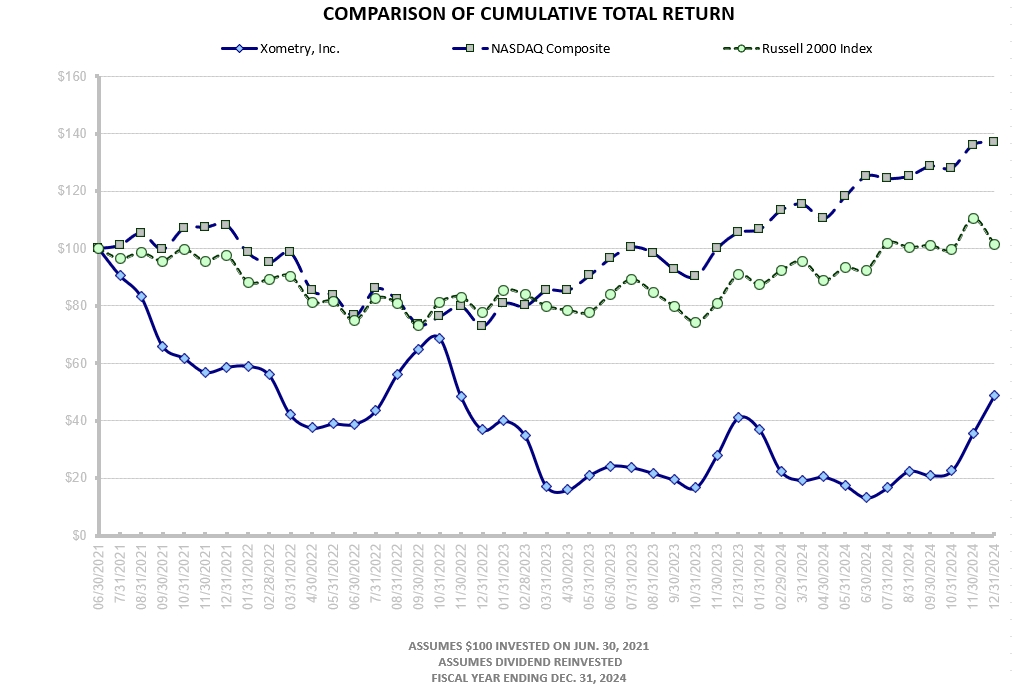
The graph assumes an initial investment of $100 on June 30, 2021. The comparisons in the graph are not intended to forecast or be indicative of possible future performance of our common stock. The performance graph and related information shall not be deemed “soliciting material” or to be “filed” with the SEC, nor shall such information be incorporated by reference into any future filing under the Securities Act or Exchange Act.
44
Recent Sales of Unregistered Securities
None.
Item 6. [Reserved].
45
Item 7. Management’s Discussion and Analysis of Financial Condition and Results of Operations.
The following discussion and analysis of our financial condition and results of operations should be read in conjunction with the consolidated financial statements and related notes thereto included elsewhere in this Annual Report on Form 10-K. This discussion contains forward-looking statements that involve risks and uncertainties. Factors that could cause or contribute to such differences include those identified below and those discussed in the section titled “Risk Factors” and other sections of this Annual Report on Form 10-K. Our historical results are not necessarily indicative of the results that may be expected for any period in the future.
This section of our Annual Report on Form 10-K includes a discussion regarding our financial condition and results of operations for the fiscal years ended December 31, 2024 and 2023, and year-to-year comparisons between fiscal years ended December 31, 2024 and 2023. A discussion regarding our financial condition and results of operations for the fiscal year ended December 31, 2022, and year-to-year comparisons between fiscal years ended December 31, 2023 and 2022 that are not included in this Annual Report on Form 10-K can be found in “Management's Discussion and Analysis of Financial Condition and Results of Operations” in Part II, Item 7 of our Annual Report on Form 10-K for the fiscal year ended December 31, 2023, filed with the SEC on February 29, 2024.
Overview
Xometry Inc. (“Xometry”, “Company”, “our” or “we”) was incorporated in the State of Delaware in May 2013. Xometry operates a global artificial intelligence (“AI”) powered online manufacturing marketplace and a suite of cloud-based services including Workcenter and Teamspace that are rapidly digitizing the manufacturing industry. Xometry also operates Thomasnet®, a leading North American industrial sourcing platform. Together, these platforms provide manufacturers the critical resources they need to grow their business and makes it easy for buyers to create locally resilient supply chains. Xometry's marketplace uses proprietary AI to assist buyers to efficiently source custom-manufactured parts and assemblies and attain instant pricing and lead times. The AI helps our rapidly growing network of manufacturers by selecting optimal jobs to fill their capacity. Our Thomasnet industrial sourcing platform enables buyers to connect with over 500,000 North American manufacturers and industrial services providers. Our suite of cloud-based services empowers manufacturers and industrial service providers grow their businesses using our advertising, marketing and financial services. Xometry’s corporate headquarters is located in North Bethesda, Maryland.
Xometry’s AI-enabled marketplace, which is available in 18 local languages, is powered by proprietary machine learning algorithms and datasets. Our two-sided marketplace is rapidly digitizing the manufacturing industry, helping customers strengthen their supply chains. Buyers can procure the products they want on demand, and suppliers can reach new customers throughout the world. Our rapidly growing active supplier base enables companies to accelerate their product development and go-to-market strategies. Each interaction on our marketplace provides rich data insights that allow us to continuously improve our AI models and create new products and services, fueling powerful network effects as we scale.
We use proprietary technology to enable product designers, engineers, buyers, and supply chain professionals to instantly access the capacity of a global network of manufacturing facilities. The Company’s platform makes it possible for buyers to quickly receive pricing, expected lead times, manufacturability feedback and place orders on the Company’s platform. The network allows the Company to provide high volumes of unique parts, including custom components and assemblies for its buyers.
Our mission is to accelerate innovation by providing real time, equitable access to global manufacturing capacity and demand. Our vision is to drive efficiency, sustainability and innovation for industries worldwide by lowering the barriers to entry to the manufacturing ecosystem.
Our business benefits from a virtuous network effect, because adding buyers to our platform generates greater demand on our marketplace which in turn attracts more suppliers to the platform, allowing us to rapidly scale and increase the number of manufacturing processes offered on our platform. In order to continue to meet the needs of buyers and remain highly competitive, we expect to continue to add suppliers to our platform that have new and innovative manufacturing processes. Thus, our platform is unbounded by the in-house manufacturing capacity and processes of our current suppliers.
We define “buyers” as individuals who have placed an order to purchase custom-manufactured, on-demand parts or assemblies on our marketplace. Our buyers include engineers, product designers, procurement and supply chain personnel, entrepreneurs, technicians and business owners from small businesses to Fortune 500 companies. We define “accounts” as an individual entity, such as a sole proprietor with a single buyer or corporate entities with multiple buyers, having purchased at least one part on our marketplace. We define “suppliers” as individuals or businesses who have been approved by us to either manufacture a product on our marketplace for a buyer or have utilized our supplier services, including our financial services or the purchase of tools and materials.
The majority of our revenue is derived from the sale of part(s) and assemblies to our customers on our marketplace, which we refer to as marketplace revenue. The suppliers on our platform offer a diversified and expanding mix of manufacturing processes.
46
These manufacturing processes include computer numerical control (“CNC”) manufacturing, sheet metal forming, sheet cutting, 3D printing (including fused deposition modeling, direct metal laser sintering, PolyJet, stereolithography, selective laser sintering, binder jetting, carbon digital light synthesis, multi jet fusion and lubricant sublayer photo-curing), die casting, stamping, injection molding, urethane casting, tube cutting, tube bending, as well as finishing services, rapid prototyping and high-volume production. Xometry's extensible technology platform allows the Company to add new technologies and processes to gain more wallet share with our buyers. We enable buyers to source these processes to meet complex and specific design and order needs across several industries, including Aerospace, Industrial, Medical Devices, Automotive, Consumer Goods, Defense, Government, Energy, Education and Robotics.
We empower suppliers to grow their manufacturing businesses and improve machine utilization by providing access to an extensive, diverse base of buyers. We also offer suppliers supporting products and services to meet their unique needs. The Thomasnet product sourcing and supplier discovery platform provides access to in-depth profiles of 500,000 North American suppliers. Thomas’ suite of advertising services provides suppliers with tailored marketing campaigns to maximize their visibility and enhance engagement with potential buyers. Thomas’ in-house digital marketing agency, Thomas Marketing Services, offers a range of essential digital marketing services, including search engine optimization (“SEO”), to generate leads and boost the awareness and reach of suppliers. In addition, our supplier services include financial service products to facilitate faster payments and a cloud-based manufacturing execution system (“Workcenter”) to help suppliers optimize their productivity.
Factors Affecting Our Performance
Continued Growth in Active Buyers
We must maintain and grow our Active Buyer base and grow our wallet share with existing buyers. We define Active Buyers as the number of buyers who have made at least one purchase on our marketplace during the last twelve months. An increase or decrease in the number of Active Buyers is a key indicator of our ability to attract, retain and engage buyers on our platform. We intend to continue investing in acquiring new buyers through traditional paid sales and marketing techniques as well as leveraging our organic referral network to drive awareness and build trust. The number of Active Buyers on our platform reached 68,267 as of December 31, 2024, up 23% from 55,325 as of December 31, 2023. Once we acquire a buyer, we seek to expand the breadth and scale of the services sold to that buyer and leverage the relationship to gain additional buyers within an account through a combination of product offerings, customer relationship marketing, sales and account management. We remain focused on increasing wallet share with our existing buyers through a number of deliberate strategies. With each positive experience and the expansion of our manufacturing processes by acquiring new supplier capabilities we will continue building our buyers’ spend and opportunities on our marketplace.
Continued Growth in Our Broad Base of Suppliers
We must maintain and grow our broad selection of suppliers and add to our diverse array of manufacturing processes in order to continue to grow our business and maximize the efficiency of our network. We rely on our network of suppliers to provide the sophisticated manufacturing processes that we offer to our buyers. We believe the value proposition for suppliers, in particular increasing utilization of their manufacturing operations, is compelling. If we fail to attract new suppliers to our platform and retain existing suppliers, the attractiveness of our platform to buyers would decrease and we would not be able to grow our revenue. In order to increase our efficiency, we intend to continue to expand our large and growing network of suppliers. The number of active suppliers, which we define as suppliers that have used our platform at least once during the last twelve months to manufacture a product, has grown 28% from 3,429 for the year ended December 31, 2023 to 4,375 for the year ended December 31, 2024. As we add to our supplier base, our AI-driven pricing becomes more competitive, and therefore more attractive to buyers, leading to higher revenue and improved margins. However, if we do not efficiently price the manufacturing opportunities on our platform, our revenue and margins could be adversely impacted.
Investments in Technology and Expansion of Our Platform
We have invested, and intend to continue to invest, in developing technology, tools, features, and products that provide targeted and useful solutions for our buyers and suppliers. We intend to continue to invest in our AI and machine learning technologies in order to continuously improve the speed and accuracy of our pricing and placement activity. We also continue to invest in our services-oriented architecture and cloud infrastructure to support scalability. Any investments we make in these areas will occur before we recognize benefits, if any, from the investments. Further, the effectiveness of these efforts may be difficult to measure. If we are unable to continue to improve our platform, the efficiency of our platform may be impaired, and our revenue and gross profit may be adversely impacted.
Expansion of Our International Operations
In 2019, we launched Xometry in Europe, followed by Xometry Asia in 2022 and Xometry United Kingdom and Xometry Turkey in 2023. We believe there is significant opportunity in the global manufacturing ecosystem for our marketplace. With operations throughout the majority of the contiguous United States and customers in Europe and Asia, we have established footholds in major markets around the world.
47
As we have expanded our physical presence, we have also added new language functionality to our platforms to reach a wider customer base. As of December 31, 2024, customers can access our platforms in 18 languages. We will continue to dedicate sales and marketing resources to develop our supplier networks and attract buyers to our marketplace in other regions. We may not recognize benefits from these investments, and we may not effectively manage additional risks relating to operating outside the United States, including increased operational and regulatory risks.
Expansion of Our Supplier Services
In 2020, we launched financial services to help our suppliers manage their cash flow. These services help suppliers manage their business more efficiently, even on jobs that they source outside of our platform. In December 2021, we acquired Thomas Publishing Company and its subsidiaries (collectively, “Thomas”), which significantly expanded our supplier services to include digital advertising, marketing services and data solutions for our suppliers. Our suite of marketing and data services provided by Thomas help suppliers grow and more efficiently run their business. We offer suppliers a full slate of marketing services, including website building, SEO and targeted advertising to buyers, which are resources that will help them further grow their business. In November 2021, we acquired Fusiform, Inc. (d/b/a FactoryFour), a cloud-based manufacturing execution system. We provide this order management system to our supplier community which allows shops and shop owners to digitize and automate their operations so they can focus on growing their business. In addition to being able to manage existing orders, Workcenter is designed to integrate seamlessly with the AI-driven Xometry marketplace, giving suppliers a one-stop view into all of their orders.
We define Active Paying Suppliers as individuals or businesses who have purchased one or more of our supplier services, including digital marketing services, data services, financial services or tools and materials on our platforms during the last twelve months. An increase or decrease in the number of Active Paying Suppliers is a key indicator of our ability to engage suppliers on our platform. The number of Active Paying Suppliers on our platform was 6,582 as of December 31, 2024, down 9% from 7,271 as of December 31, 2023. The decline during the year ended December 31, 2024 is primarily due to our exit from the tools and materials business and the wind down of Thomas non-core services.
Macroeconomic Conditions
Unfavorable conditions in the economy both in the United States and abroad may negatively affect the growth of our business and our results of operations. For example, macroeconomic events, fluctuations in inflation, the Russia-Ukraine war, conflict in the Middle East and other geopolitical tensions, have led to economic uncertainty globally. Historically, during periods of economic uncertainty and downturns, businesses may slow spending on information technology and manufacturing, which may impact our business and our customers’ businesses.
The effect of macroeconomic conditions may not be fully reflected in our results of operations until future periods. If, however, economic uncertainty increases or the global economy worsens, our business, financial condition and results of operations may be harmed. For further discussion of the potential impacts of macroeconomic events on our business, financial condition, and operating results, see the section titled “Risk Factors.”
Restructurings
In May 2023 and December 2022, we initiated restructuring actions to help manage our operating expenses by reducing our workforce by approximately 10% in the aggregate. The workforce reduction focused on realigning our staffing levels to help us meet the current and future objectives of our business. For the years ended December 31, 2023 and 2022, we incurred $0.7 million and $1.5 million, respectively for employee termination costs related to our restructuring. Refer to Note 11, Debt and Commitments and Contingencies—Restructuring to of our consolidated financial statements included elsewhere in this Annual Report on Form 10-K.
48
Key Operational and Business Metrics
In addition to the measures presented in our consolidated financial statements included elsewhere in this Annual Report on Form 10-K, we use the following key operational and business metrics to help us evaluate our business, measure our performance, identify trends affecting our business, formulate business plans and develop forecasts, and make strategic decisions:
Active Buyers
We define Active Buyers as the number of buyers who have made at least one purchase on our marketplace during the last twelve months. An increase or decrease in the number of Active Buyers is a key indicator of our ability to attract, retain and engage buyers on our platform.
Active Buyers has consistently grown over time. The number of Active Buyers on our platform reached 68,267 as of December 31, 2024, up 23% from 55,325 as of December 31, 2023. The key drivers of Active Buyer growth are continued account and buyer engagement and the success of our strategy to attract new buyers.
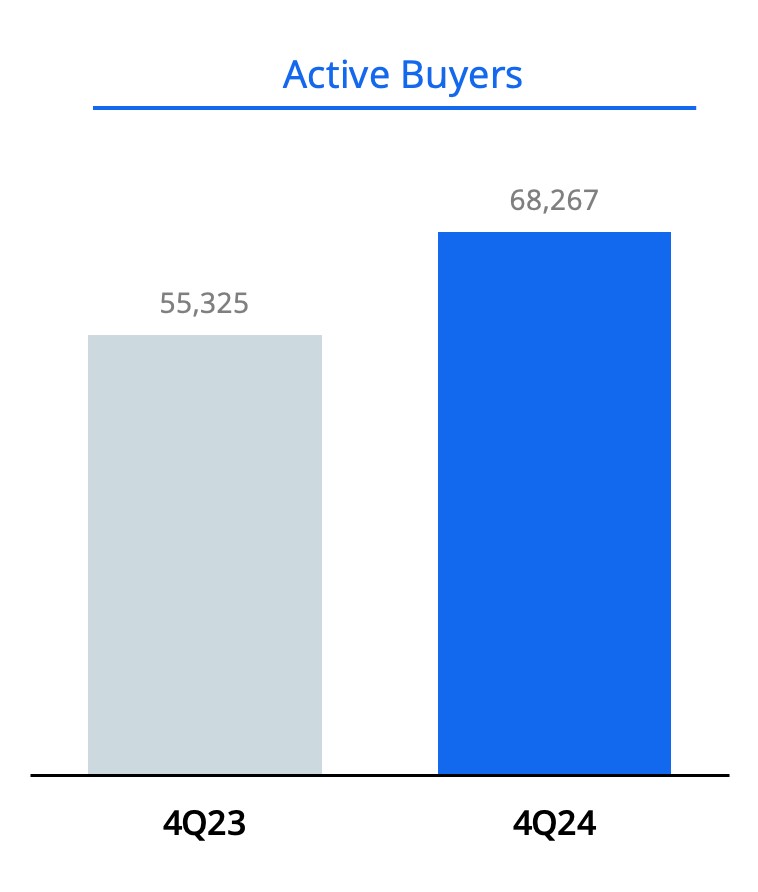
49
Percentage of Revenue from Existing Accounts
We define an existing account as an account where at least one buyer has made a purchase on our marketplace. We believe the efficiency and transparency of our business model leads to increasing account stickiness and spend over time. Buyers can utilize our marketplace for both one-off and recurring manufacturing opportunities. For example, a buyer may choose to utilize our marketplace’s CNC manufacturing processes to manufacture a discrete component for a prototype, and then may choose to later use our marketplace to mass produce that same component. A buyer may also recommend our marketplace to other engineers within their organizations who are designing other products and who may use an entirely different set of manufacturing processes, deepening our reach and stickiness with an account.
For the quarter ended December 31, 2024, 97% of our revenue was generated from existing accounts. We believe the repeat purchase activity from existing accounts reflects the underlying strength of our business and provides us with substantial revenue visibility and predictability.
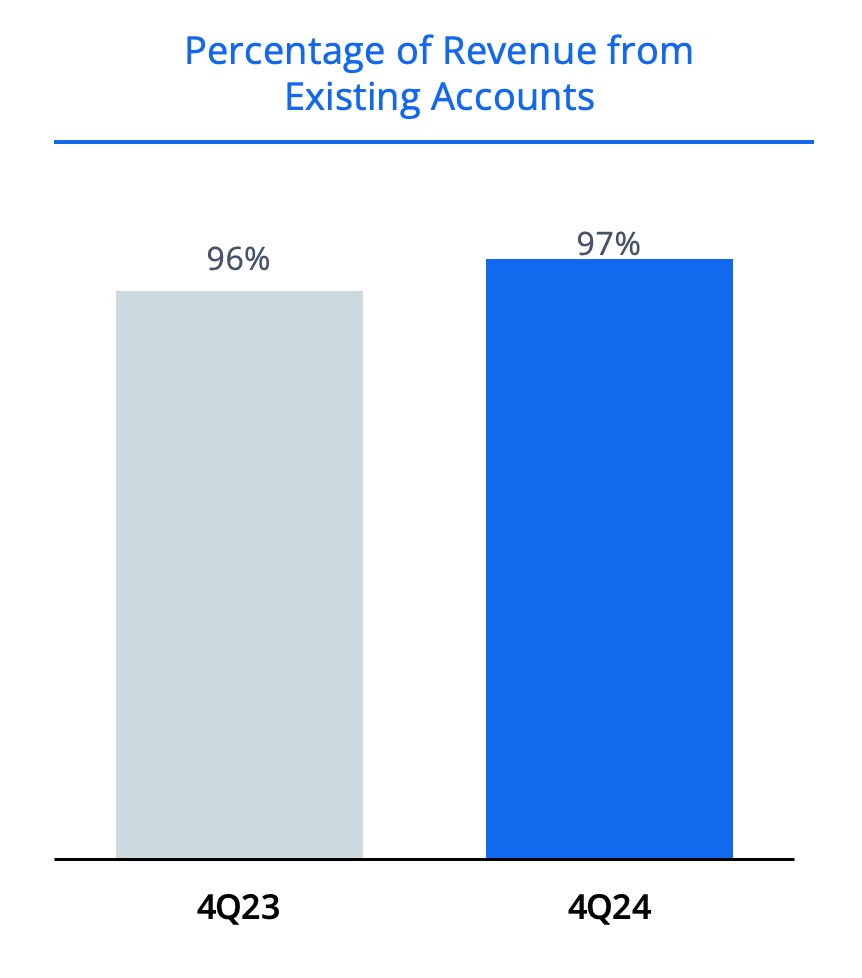
50
Accounts with Last Twelve-Month Spend of At Least $50,000
Accounts with Last Twelve-Month, or LTM, Spend of At Least $50,000 means an account that has spent at least $50,000 on our marketplace in the most recent twelve-month period. We view the acquisition of an account as a foundation for the addition of long-term buyers to our marketplace. Once an account joins our platform, we aim to expand the relationship and increase engagement and spending activities from that account over time. The number of accounts with LTM Spend of at least $50,000 on our platform reached 1,495 as of December 31, 2024, up 12% from 1,331 as of December 31, 2023.
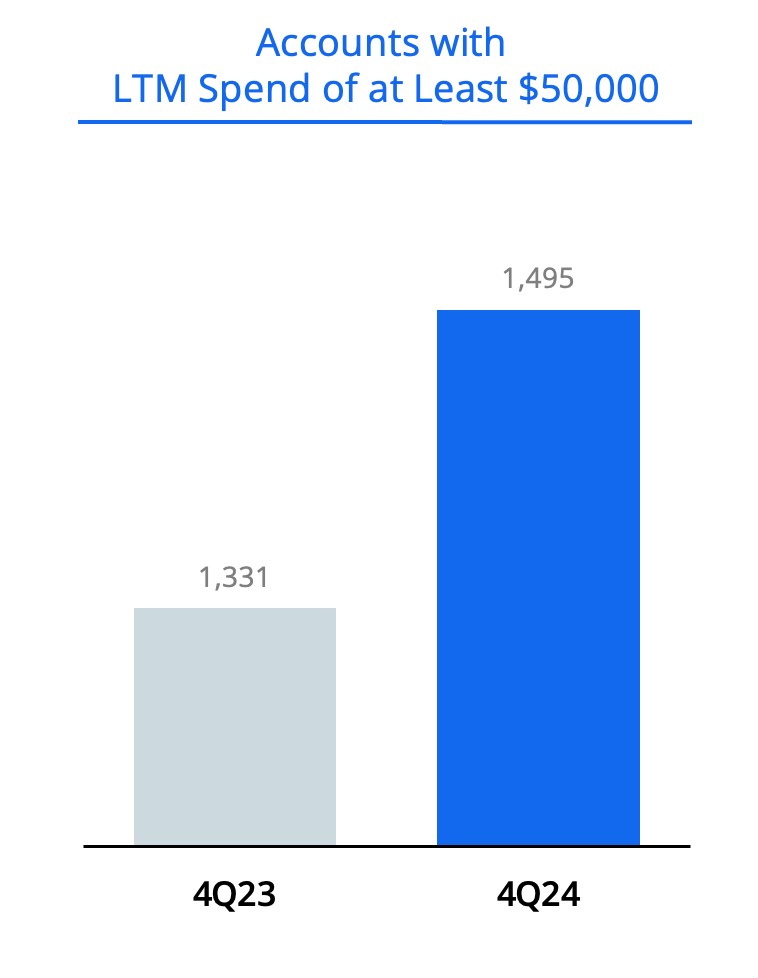
Active Paying Suppliers
We define Active Paying Suppliers as individuals or businesses who have purchased one or more of our supplier services, including digital marketing services, data services, financial services or tools and materials on our platforms during the last twelve months. An increase or decrease in the number of Active Paying Suppliers is a key indicator of our ability to engage suppliers on our platform.
Active Paying Suppliers has changed over time. The number of Active Paying Suppliers on our platform was 6,582 as of December 31, 2024, down 9% from 7,271 as of December 31, 2023. The key drivers of Active Paying Suppliers are continued supplier engagement and the success of our strategy to attract new suppliers. The decline during the year ended December 31, 2024 is primarily due to our exit from the tools and materials business and the wind down of Thomas non-core services.
51
Adjusted EBITDA
We define Adjusted EBITDA as net loss, adjusted for interest expense, interest and dividend income and other expenses, benefit for income taxes, and certain other non-cash or non-recurring items impacting net loss from time to time, principally comprised of depreciation and amortization, amortization of lease intangible, stock-based compensation, payroll tax expense related to stock-based compensation, lease abandonment, charitable contributions of common stock, income from an unconsolidated joint venture, impairment of assets, restructuring charges, costs to exit the tools and materials business and acquisition and other adjustments not reflective of our ongoing business, such as adjustments related to purchase accounting, the revaluation of contingent consideration, transaction costs and executive severance. Adjusted EBITDA is a performance measure that we use to assess our operating performance and the operating leverage in our business. Adjusted EBITDA Margin is calculated by dividing Adjusted EBITDA for a period by revenue for the same period.
|
|
Year Ended December 31, |
|
|||||
|
|
2024 |
|
|
2023 |
|
||
Net loss |
|
$ |
(50,403 |
) |
|
$ |
(67,465 |
) |
Add (deduct) |
|
|
|
|
|
|
||
Interest expense, interest and dividend income and other expenses |
|
|
(5,273 |
) |
|
|
(5,312 |
) |
Depreciation and amortization |
|
|
13,012 |
|
|
|
10,738 |
|
Amortization of lease intangible |
|
|
720 |
|
|
|
950 |
|
Benefit for income taxes |
|
|
(21 |
) |
|
|
(353 |
) |
Stock-based compensation |
|
|
29,322 |
|
|
|
22,118 |
|
Payroll tax expense related to stock-based compensation(1) |
|
|
965 |
|
|
|
— |
|
Lease abandonment |
|
|
— |
|
|
|
8,706 |
|
Acquisition and other |
|
|
686 |
|
|
|
824 |
|
Charitable contribution of common stock |
|
|
1,686 |
|
|
|
1,029 |
|
Income from unconsolidated joint venture |
|
|
(452 |
) |
|
|
(446 |
) |
Impairment of assets |
|
|
82 |
|
|
|
397 |
|
Restructuring charges |
|
|
— |
|
|
|
738 |
|
Costs to exit the tools and materials business |
|
|
— |
|
|
|
586 |
|
Adjusted EBITDA |
|
$ |
(9,676 |
) |
|
$ |
(27,490 |
) |
(1) During 2024, we changed the definition of Adjusted EBITDA to exclude payroll tax expense related to stock-based compensation. For prior years, this amount was considered de minimis and, accordingly, we have not adjusted the Adjusted EBITDA amounts for such periods.
For the year ended December 31, 2024, Adjusted EBITDA loss was $(9.7) million, compared to Adjusted EBITDA loss of $(27.5) million in 2023. For the year ended December 31, 2024, Adjusted EBITDA decreased to (1.8)% of revenue, as compared to (5.9)% of revenue in 2023, driven primarily by increased operating efficiencies as we continue to scale our business.
Non-GAAP Net Loss
We define Non-GAAP net loss, as net loss adjusted for depreciation and amortization, stock-based compensation, payroll tax expense related to stock-based compensation, amortization of lease intangible, amortization of deferred costs on convertible notes, loss on sale of property and equipment, charitable contributions of common stock, impairment of assets, lease abandonment and termination, restructuring charges, costs to exit the tools and materials business and acquisition and other adjustments not reflective of our ongoing business, such as adjustments related to purchase accounting, the revaluation of contingent consideration, transaction costs and executive severance.
52
|
|
For the Year |
|
|||||
|
|
2024 |
|
|
2023 |
|
||
Non-GAAP Net Loss: |
|
|
|
|
|
|
||
Net loss |
|
$ |
(50,403 |
) |
|
$ |
(67,465 |
) |
Add (deduct): |
|
|
|
|
|
|
||
Depreciation and amortization |
|
|
13,012 |
|
|
|
10,738 |
|
Stock-based compensation |
|
|
29,322 |
|
|
|
22,118 |
|
Payroll tax expense related to stock-based compensation(1) |
|
|
965 |
|
|
|
— |
|
Amortization of lease intangible |
|
|
720 |
|
|
|
950 |
|
Amortization of deferred costs on convertible notes |
|
|
1,859 |
|
|
|
1,860 |
|
Acquisition and other |
|
|
686 |
|
|
|
824 |
|
Loss on sale of property and equipment |
|
|
2 |
|
|
|
92 |
|
Charitable contribution of common stock |
|
|
1,686 |
|
|
|
1,029 |
|
Lease abandonment and termination |
|
|
— |
|
|
|
8,778 |
|
Impairment of assets |
|
|
82 |
|
|
|
397 |
|
Restructuring charges |
|
|
— |
|
|
|
738 |
|
Costs to exit the tools and materials business |
|
|
— |
|
|
|
586 |
|
Non-GAAP Net Loss |
|
$ |
(2,069 |
) |
|
$ |
(19,355 |
) |
(1) During 2024, we changed the definition of Non-GAAP Net Loss to exclude payroll tax expense related to stock-based compensation. For prior years, this amount was considered de minimis and, accordingly, we have not adjusted the Non-GAAP Net Loss amounts for such periods.
For the year ended December 31, 2024, Non-GAAP net loss was $(2.1) million, as compared to Non-GAAP net loss of $(19.4) million for the same period in 2023. For the year ended December 31, 2024, Non-GAAP net loss was (0.4)% of revenue, as compared to (4.2)% of revenue for the same period in 2023.
Adjusted EBITDA and Non-GAAP net loss are non-GAAP financial measures that we use, in addition to our GAAP financial measures, to evaluate our business. We have included Adjusted EBITDA and Non-GAAP net loss in this filing because they are key measures used by our management to evaluate our operating performance. Accordingly, we believe that Adjusted EBITDA and Non-GAAP net loss provide useful information to investors and others in understanding and evaluating our operating results in the same manner as our management team and board of directors. Our calculation of Adjusted EBITDA and Non-GAAP net loss may differ from similarly titled non-GAAP measures, if any, reported by our peer companies and therefore may not serve as an accurate basis of comparison among companies. Adjusted EBITDA and Non-GAAP net loss should not be considered in isolation from, or as a substitute for, financial information prepared in accordance with GAAP.
53
Components of Results of Operations
Revenue
Our marketplace revenue is primarily comprised of sales of parts and assemblies to customers through our platform. Buyers purchase specialized CNC manufacturing, sheet metal manufacturing, 3D printing, injection molding, urethane casting, tube cutting, tube bending and finishing services. Customer purchases range from rapid prototyping of single parts to high-volume production on our marketplace. These products are primarily manufactured by our network of suppliers.
Supplier services revenue includes the sale of marketing and advertising services, and to a lesser extent financial service products, SaaS-based solutions and the sale of tools and materials, which was discontinued during the second quarter of 2023.
Cost of Revenue
Marketplace cost of revenue primarily consists of the cost to us of the products that are manufactured or produced by us or our suppliers for delivery to buyers on our platform, internal and external production costs, shipping costs and certain internal depreciation. We expect cost of revenue to increase in absolute dollars to the extent our revenue increases and transaction volume increases. As we grow and add suppliers to our platform, we are able to improve our pricing efficiency, we expect cost of revenue to decline as a percentage of revenue over time.
Cost of revenue for supplier services primarily consists of internal and external production costs and website hosting.
Gross Profit
Gross profit, or revenue less cost of revenue, is primarily affected by the growth of our revenue. Our gross profit margin is primarily affected by liquidity of our suppliers’ network and the efficiency of our pricing and will be benefited by increasing the use of existing supplier services and the variety of supplier services offerings over time.
Operating Expenses
Our operating expenses consist of sales and marketing, operations and support, product development and general and administrative functions.
Sales and Marketing
Sales and marketing expenses are expensed as incurred and include the costs of our digital marketing strategies, branding costs and other advertising costs, certain depreciation and amortization expense, contract acquisition costs and compensation expenses, including stock-based compensation, to our sales and marketing employees. We intend to continue to invest in our sales and marketing capabilities in the future to continue to increase our brand awareness, add new accounts and further penetrate existing accounts. We expect sales and marketing expense to increase in absolute dollars in the future as we grow our business, though in the near-term sales and marketing expenses may fluctuate from period-to-period based on the timing of our investments in our sales and marketing functions as these investments may vary in scope and scale over future periods.
Operations and Support
Operations and support expenses are the costs we incur in support of the buyers and suppliers on our platform which are provided by phone, email and chat for purposes of resolving buyer and supplier-related matters. These costs primarily consist of compensation expenses of the support staff, including stock-based compensation, certain depreciation and amortization expense and software costs used in delivering buyer and suppliers services. We expect operations and support expense to increase in absolute dollars in the future, though in the near-term operations and support expenses may fluctuate from period-to-period based on total revenue levels and the timing of our investments in our operations and support functions as these investments may vary in scope and scale over future periods.
Product Development
Product development costs that are not eligible for capitalization are expensed as incurred. This account also includes compensation expenses, including stock-based compensation expenses to our employees performing routine improvements and maintenance on our platforms not related to a specific capitalizable project, software costs and certain depreciation and amortization expense. We expect product development expense to increase in absolute dollars in the future, though in the near-term product development expenses may fluctuate from period-to-period based on total revenue levels and the timing of our investments in our product development functions as these investments may vary in scope and scale over future periods.
54
General and Administrative
General and administrative expenses primarily consist of compensation expenses, including stock-based compensation expenses, for executive, finance, legal and other administrative personnel, professional service fees and certain depreciation and amortization expense.
Other Income (Expenses)
Interest Expense
Interest expense consists of interest incurred on our outstanding borrowings under our outstanding convertible notes or other borrowings. See “Management’s Discussion and Analysis of Financial Condition and Results of Operations—Liquidity and Capital Resources.”
Interest and Dividend Income
Interest and dividend income consists of interest and dividends on our cash, cash equivalents and marketable securities.
Other Expenses
Other expenses consist primarily of realized foreign exchange gains and/or losses, realized and/or unrealized losses on marketable securities, non-income based taxes, losses on the extinguishments of debt and other expenses.
Income from Unconsolidated Joint Venture
Income from unconsolidated joint venture consists of our share of the joint venture's income.
Results of Operations
The following is our discussion of the consolidated results of operations for the year ended December 31, 2024 as compared to the year ended December 31, 2023.
The following table sets forth our statement of operations data for the years indicated:
|
|
Year Ended December 31, |
|
|||||
|
|
2024 |
|
|
2023 |
|
||
|
|
(in thousands) |
|
|||||
Revenue |
|
$ |
545,529 |
|
|
$ |
463,406 |
|
Cost of revenue |
|
|
329,905 |
|
|
|
285,147 |
|
Gross profit |
|
|
215,624 |
|
|
|
178,259 |
|
Operating expenses: |
|
|
|
|
|
|
||
Sales and marketing |
|
|
108,437 |
|
|
|
93,688 |
|
Operations and support |
|
|
58,975 |
|
|
|
52,372 |
|
Product development |
|
|
39,322 |
|
|
|
34,462 |
|
General and administrative |
|
|
64,957 |
|
|
|
70,916 |
|
Impairment of assets |
|
|
82 |
|
|
|
397 |
|
Total operating expenses |
|
|
271,773 |
|
|
|
251,835 |
|
Loss from operations |
|
|
(56,149 |
) |
|
|
(73,576 |
) |
Other income (expenses): |
|
|
|
|
|
|
||
Interest expense |
|
|
(4,752 |
) |
|
|
(4,784 |
) |
Interest and dividend income |
|
|
10,782 |
|
|
|
11,607 |
|
Other expenses |
|
|
(757 |
) |
|
|
(1,511 |
) |
Income from unconsolidated joint venture |
|
|
452 |
|
|
|
446 |
|
Total other income |
|
|
5,725 |
|
|
|
5,758 |
|
Loss before income taxes |
|
|
(50,424 |
) |
|
|
(67,818 |
) |
Benefit for income taxes |
|
|
21 |
|
|
|
353 |
|
Net loss |
|
|
(50,403 |
) |
|
|
(67,465 |
) |
Net (loss) income attributable to noncontrolling interest |
|
|
(2 |
) |
|
|
7 |
|
Net loss attributable to common stockholders |
|
$ |
(50,401 |
) |
|
$ |
(67,472 |
) |
55
The following table sets forth our statement of operations data expressed as a percentage of total revenue for the years indicated:
|
|
Year Ended December 31, |
|
|||||
|
|
2024 |
|
|
2023 |
|
||
|
|
|
|
|||||
Revenue |
|
|
100.0 |
% |
|
|
100.0 |
% |
Cost of revenue |
|
|
60.5 |
% |
|
|
61.5 |
% |
Gross profit |
|
|
39.5 |
% |
|
|
38.5 |
% |
Operating expenses: |
|
|
|
|
|
|
||
Sales and marketing |
|
|
19.9 |
% |
|
|
20.2 |
% |
Operations and support |
|
|
10.8 |
% |
|
|
11.3 |
% |
Product development |
|
|
7.2 |
% |
|
|
7.4 |
% |
General and administrative |
|
|
11.9 |
% |
|
|
15.3 |
% |
Impairment of assets |
|
|
— |
% |
|
|
0.1 |
% |
Total operating expenses |
|
|
49.8 |
% |
|
|
54.3 |
% |
Loss from operations |
|
|
(10.3 |
)% |
|
|
(15.8 |
)% |
Other income (expenses): |
|
|
|
|
|
|
||
Interest expense |
|
|
(0.9 |
)% |
|
|
(1.0 |
)% |
Interest and dividend income |
|
|
2.0 |
% |
|
|
2.5 |
% |
Other expenses |
|
|
(0.1 |
)% |
|
|
(0.3 |
)% |
Income from unconsolidated joint venture |
|
|
0.1 |
% |
|
|
0.1 |
% |
Total other income |
|
|
1.1 |
% |
|
|
1.3 |
% |
Loss before income taxes |
|
|
(9.2 |
)% |
|
|
(14.5 |
)% |
Benefit for income taxes |
|
|
— |
% |
|
|
0.1 |
% |
Net loss |
|
|
(9.2 |
)% |
|
|
(14.4 |
)% |
Net (loss) income attributable to noncontrolling interest |
|
|
— |
% |
|
|
— |
% |
Net loss attributable to common stockholders |
|
|
(9.2 |
)% |
|
|
(14.4 |
)% |
The following tables present our disaggregated revenue and cost of revenue. Revenue from our marketplace primarily reflects the sales of parts and assemblies on our platform. Revenue from supplier services primarily includes the sale of advertising and to a lesser extent financial service products, SaaS products and tools and materials.
Revenue and cost of revenue is presented in the following tables for the years ended December 31, 2024 and 2023 (in thousands):
|
|
For the Year |
|
|||||
|
|
2024 |
|
|
2023 |
|
||
Marketplace |
|
|
|
|
|
|
||
Revenue |
|
$ |
485,946 |
|
|
$ |
394,754 |
|
Cost of revenue |
|
|
323,365 |
|
|
|
273,264 |
|
Gross Profit |
|
$ |
162,581 |
|
|
$ |
121,490 |
|
Gross Margin |
|
|
33.5 |
% |
|
|
30.8 |
% |
|
|
|
|
|
|
|
||
Supplier services |
|
|
|
|
|
|
||
Revenue |
|
$ |
59,583 |
|
|
$ |
68,652 |
|
Cost of revenue |
|
|
6,540 |
|
|
|
11,883 |
|
Gross Profit |
|
$ |
53,043 |
|
|
$ |
56,769 |
|
Gross Margin |
|
|
89.0 |
% |
|
|
82.7 |
% |
56
Comparison of the Years Ended December 31, 2024 and 2023
Revenue
Total revenue increased $82.1 million, or 18%, from $463.4 million for the year ended December 31, 2023 to $545.5 million for the year ended December 31, 2024. This growth was a result of an increase in marketplace revenue, partially offset by a decrease in supplier services revenue. Marketplace revenue increased $91.2 million, or 23%, from $394.8 million for the year ended December 31, 2023 to $485.9 million for the year ended December 31, 2024. The increase in marketplace revenue was primarily due to increased buyer activity on the platform for the year ended December 31, 2024, as compared to the prior year period.
Supplier services revenue decreased $9.1 million, or 13%, from $68.7 million for the year ended December 31, 2023 to $59.6 million for the year ended December 31, 2024. The decrease in revenue was primarily due to our exit from the tools and materials business in the U.S. during the second quarter of 2023, a decrease in Thomas non-core services and to a lesser extent a decrease in Thomas advertising and marketing service.
Total revenue for the year ended December 31, 2024 and 2023 was $456.7 million and $403.3 million, respectively, for the U.S. reportable segment, and $88.8 million and $60.1 million, respectively, for the International reportable segment.
Cost of Revenue
Total cost of revenue increased $44.8 million, or 16%, from $285.1 million for the year ended December 31, 2023 to $329.9 million for the year ended December 31, 2024. This increase was primarily the result of an increase in marketplace cost of revenue offset by a decrease in supplier services costs of revenue. Total cost of revenue from marketplace and supplier services for the year ended December 31, 2024 was $323.4 million and $6.5 million, respectively, as compared to $273.3 million and $11.9 million, respectively, for the year ended December 31, 2023.
Marketplace cost of revenue was driven by increased activity and growth on our marketplace which drove increased costs from our suppliers.
Total cost of revenue for the year ended December 31, 2024 and 2023 was $274.8 million and $247.5 million, respectively for the U.S. reportable segment, and $55.1 million and $37.6 million, respectively, for the International reportable segment.
Gross Profit and Margin
Gross profit increased $37.4 million, or 21%, from $178.3 million for the year ended December 31, 2023 to $215.6 million for the year ended December 31, 2024. The increase in gross profit was primarily due to increases in revenue from marketplace and improved marketplace gross margins as compared to the prior year period.
Gross margin for marketplace was 33.5% for the year ended December 31, 2024, as compared to 30.8% for the year ended December 31, 2023. The improvement over the prior year period was due largely to our AI-driven platform and expanding supplier network which optimizes pricing to buyers and suppliers. Gross margin for our supplier services increased to 89.0% for the year ended December 31, 2024 from 82.7% for the year ended December 31, 2023. The increase in gross margin for supplier services is primarily due to a higher mix of advertising and marketing services revenue and the exit from the lower margin tools and materials business.
Operating Expenses
Sales and Marketing
Sales and marketing expense increased $14.7 million, or 16%, from $93.7 million for the year ended December 31, 2023 to $108.4 million for the year ended December 31, 2024, primarily due to additional sales and marketing employees and their compensation costs, including stock-based compensation and to a lesser extent advertising expense. As a percent of total revenue, sales and marketing expenses decreased to 19.9% for the year ended December 31, 2024 from 20.2% for the year ended December 31, 2023.
Advertising expense increased 11%, from $31.7 million for the year ended December 31, 2023 to $35.1 million for the year ended December 31, 2024 due to increased supplier services and marketplace advertising.
Operations and Support
Operations and support expense increased $6.6 million, or 13%, from $52.4 million for the year ended December 31, 2023 to $59.0 million for the year ended December 31, 2024, primarily due to hiring of additional operations and support employees and their compensation costs including stock-based compensation.
57
As a percent of total revenue, operations and support expenses decreased to 10.8% for the year ended December 31, 2024 from 11.3% for the year ended December 31, 2023.
Product Development
Product development expense increased $4.9 million, or 14%, from $34.5 million for the year ended December 31, 2023 to $39.3 million for the year ended December 31, 2024, primarily as a result of increases in amortization expense related to developed software assets and additional software costs. As a percent of total revenue, product development expenses decreased to 7.2% for the year ended December 31, 2024 from 7.4% for the year ended December 31, 2023.
General and Administrative
General and administrative expense decreased $6.0 million, or 8%, from $70.9 million for the year ended December 31, 2023 to $65.0 million for the year ended December 31, 2024. The primary driver of the decrease was due to the abandonment of multiple company leases resulting in a one-time $8.7 million charge in operating lease expense in 2023 and a decrease in the facilities cost for the abandoned locations. These decreases were offset by increases in compensation cost for general and administrative employees including stock-based compensation. As a percent of total revenue, general and administrative expenses decreased to 11.9% for the year ended December 31, 2024 from 15.3% for the year ended December 31, 2023.
Impairment of assets
Impairment of assets decreased $0.3 million, or 79%, from $0.4 million for the year ended December 31, 2023 to $0.1 million for the year ended December 31, 2024.
Other (Expenses) Income
Interest Expense
Interest expense remained flat at $4.8 million for the year ended December 31, 2024 and 2023. Interest expense is primarily due to the interest on the 2027 Notes issued in February 2022.
Interest and dividend income
Interest and dividend income decreased by $0.8 million, or 7%, from $11.6 million for the year ended December 31, 2023 to $10.8 million for the year ended December 31, 2024. Interest and dividend income is primarily due to dividend income from our marketable securities.
Other Expenses
Other expenses decreased $0.7 million, or 50%, from $1.5 million for the year ended December 31, 2023 to $0.8 million for the year ended December 31, 2024 primarily due to a decrease in various non-income based taxes and the impact of foreign exchange.
Income from Unconsolidated Joint Venture
Income from unconsolidated joint venture remained flat at approximately $0.5 million for the year ended December 31, 2024 and 2023.
Additional Segment Considerations
Total segment Adjusted EBITDA from our U.S. reportable segment for the year ended December 31, 2024 and 2023 was $0.2 million and ($15.8) million, respectively. Total segment Adjusted EBITDA from our International reportable segment for the years ended December 31, 2024 and 2023 was $(9.8) million and $(11.7) million, respectively.
Refer to Note 13, Segments as we changed our measure of segment profit or loss in 2024 to segment Adjusted EBITDA and recast prior year data.
Liquidity and Capital Resources
We have financed our operations primarily through sales of our equity securities and borrowings under our convertible notes. As of December 31, 2024, our cash and cash equivalents and marketable securities totaled $239.8 million. We believe our existing cash and cash equivalents and marketable securities will be sufficient to support our working capital and capital expenditure requirements for at least the next twelve months. We believe we will meet our longer-term expected future cash requirements primarily from a combination of cash flow from operating activities and available cash and cash equivalents and marketable securities. We may also engage in equity or debt financings to secure additional funds. Our future capital requirements will depend on many factors, including our revenue growth rate, receivable and payable cycles, the timing and extent of investments in product development, sales and marketing, operations and support and general and administrative expenses.
58
Our capital expenditures consist primarily of internal-use software costs, manufacturing equipment, computers and peripheral equipment, furniture and fixtures and leasehold improvements and patents.
Convertible Notes due 2027
In February 2022, we issued $287.5 million aggregate principal amount of 2027 Notes pursuant to an indenture dated February 4, 2022. The 2027 Notes were issued in a private offering to qualified institutional buyers pursuant to Rule 144A under the Securities Act. The net proceeds from the issuance of the 2027 Notes were $278.2 million, net of debt issuance costs. The debt issuance costs are amortized to interest expense using the effective interest rate method.
The 2027 Notes are unsecured obligations and bear regular interest at 1% per annum, payable on February 1 and August 1 of each year. The 2027 Notes will mature on February 1, 2027 unless repurchased, redeemed, or converted in accordance with their terms prior to such date.
The 2027 Notes are convertible into cash, shares of our Class A common stock, or a combination of cash and shares of our Class A common stock, at our election, at an initial conversion rate of 17.8213 shares of Class A common stock per $1,000 principal amount of 2027 Notes, which is equivalent to an initial conversion price of approximately $56.11 per share of our Class A common stock. The conversion rate is subject to customary adjustments for certain events as described in the indenture governing the 2027 Notes. In addition, following certain corporate events that occur prior to the maturity date of the 2027 Notes or if we deliver a notice of redemption in respect of the 2027 Notes, we will, under certain circumstances, increase the conversion rate of the 2027 Notes for a holder who elects to convert its 2027 Notes in connection with such a corporate event or convert its 2027 Notes called (or deemed called) for redemption in connection with such notice of redemption, as the case may be.
We may redeem for cash all or any portion of the 2027 Notes, at our option, on or after February 5, 2025 if the last reported sale price of our Class A common stock has been at least 130% of the conversion price then in effect for at least 20 trading days (whether or not consecutive) during any 30 consecutive trading day period (including the last trading day of such period) ending on, and including, the trading day immediately preceding the date on which we provide notice of redemption, at a redemption price equal to 100% of the principal amount of the 2027 Notes to be redeemed, plus accrued and unpaid interest or additional interest, if any.
Holders of the 2027 Notes may convert all or a portion of their 2027 Notes at their option prior to November 1, 2026, in multiples of $1,000 principal amounts, only under the following circumstances:
On or after November 1, 2026, the 2027 Notes are convertible at any time until the close of business on the second scheduled trading day immediately preceding the maturity date.
In the event of a fundamental change (as defined in the indenture governing the 2027 Notes), subject to certain conditions and limited exceptions, holders of the 2027 Notes may require us to repurchase all or a portion of the 2027 Notes at a price equal to 100% of the principal amount of 2027 Notes, plus accrued and unpaid interest.
We accounted for the issuance of the 2027 Notes as a single liability measured at its amortized cost, as no other embedded features require bifurcation and recognition as derivatives.
As of December 31, 2024, the 2027 Notes have a carrying value of $283.6 million with an effective annual interest rate of 1.6%.
We may, from time to time, repurchase our convertible senior notes using cash on hand, either on the open market or in privately negotiated transactions.
59
Cash Flows
|
|
Year Ended December 31, |
|
|||||
|
|
2024 |
|
|
2023 |
|
||
|
|
(in thousands) |
|
|||||
Net cash used in operating activities |
|
$ |
(15,384 |
) |
|
$ |
(29,877 |
) |
Net cash (used in) provided by investing activities |
|
|
(20,179 |
) |
|
|
16,806 |
|
Net cash provided by financing activities |
|
|
4,639 |
|
|
|
1,067 |
|
Operating Activities
For the year ended December 31, 2024, net cash used in operating activities was $15.4 million, primarily due to a net loss of $(50.4) million adjusted for non-cash charges of $50.5 million and a net decrease in our operating assets and liabilities of $(15.5) million. The non-cash adjustments primarily relate to stock-based compensation of $29.3 million, depreciation and amortization of $13.0 million and a $4.5 million reduction to our right of use lease assets. The net decrease in operating assets and liabilities is primarily driven by changes in accounts payable and accrued cost of revenue of $8.7 million due to the timing of payments to vendors and suppliers, accounts receivable of $5.7 million resulting from our continued growth and a reduction in lease liabilities of $6.9 million, offset by changes in other assets of $4.2 million primarily due to a decrease in deferred commissions and other accrued expenses of $2.7 million.
For the year ended December 31, 2023, net cash used in operating activities was $29.9 million, primarily due to a net loss of $(67.5) million adjusted for non-cash charges of $51.2 million and a net decrease in our operating assets and liabilities of $(13.6) million. The non-cash adjustments primarily relate to stock-based compensation of $22.1 million, $14.4 million of reduction to our right of use lease assets and depreciation and amortization of $10.7 million. The net decrease in operating assets and liabilities is primarily driven by changes in accounts receivable of $20.6 million primarily due to our continued growth, lease liabilities of $5.5 million and contract liabilities of $1.4 million, offset by changes in accounts payable and accrued cost of revenue of $12.6 million, prepaid expenses of $1.7 million and other accrued expenses of $1.6 million.
Investing Activities
Cash used in investing activities was $20.2 million during the year ended December 31, 2024, primarily due to the purchase of equity securities of $18.8 million and the purchase of property and equipment (which includes internal-use software development costs) of $18.1 million, offset by the proceeds from the sale of marketable securities of $16.5 million.
Cash provided by investing activities was $16.8 million during the year ended December 31, 2023, primarily due to the proceeds from the sale of marketable securities of $50.0 million offset by the purchase of property and equipment (which includes internal-use software development costs) of $18.5 million, $11.6 million for the purchase of marketable securities, and $3.3 million for the acquisition of Tridi.
Financing Activities
Cash provided by financing activities was $4.6 million during the year ended December 31, 2024, primarily resulting from $5.1 million of proceeds from the exercise of stock options offset by the payment of contingent considerations related to an acquisition in 2021.
Cash provided by financing activities was $1.1 million during the year ended December 31, 2023, primarily resulting from $1.9 million of proceeds from the exercise of stock options offset by the payment of contingent considerations related to acquisitions in 2021.
Critical Accounting Estimates
Our discussion and analysis of financial condition and results of operations are based upon our financial statements included elsewhere in this Annual Report on Form 10-K. The preparation of our financial statements in accordance with GAAP requires us to make estimates and assumptions that affect the reported amounts of assets, liabilities, revenue, and expenses. We base our estimates on past experience and other assumptions that we believe are reasonable under the circumstances, and we evaluate these estimates on an ongoing basis. Actual results may differ from those estimates.
Our critical accounting estimates are those that materially affect our financial statements and involve difficult, subjective or complex judgments by management. A thorough understanding of these critical accounting estimates is essential when reviewing our financial statements. We believe that the critical accounting estimates listed below are the most difficult management decisions as they involve the use of significant estimates and assumptions as described above. Historically, our assumptions, judgments and estimates relative to our critical accounting estimates have not differed materially from actual results.
60
Valuation of Goodwill and Intangible Assets
Goodwill has indefinite useful life and is not amortized. Goodwill is tested for impairment at least annually on the first day of the fourth quarter, or more frequently if impairment indicators are present. Intangible assets with finite lives are amortized over their estimated useful lives and tested for impairment if indicators are present.
Goodwill
Our annual impairment assessment of goodwill is generally performed using a qualitative approach to determine whether it is more likely than not that the fair value of a reporting unit is less than its carrying amount. Performance of the qualitative impairment assessment requires judgment in identifying and considering the significance of relevant events and circumstances including external factors such as macroeconomic and industry conditions and the legal and regulatory environment, as well as entity-specific factors such as market capitalization, actual and planned financial performance, that could impact the fair value of our reporting units.
If the results of the annual qualitative assessment conclude that it is not more likely than not that the fair value of a reporting unit exceeds its carrying value, or if interim indicators of impairment are identified, a quantitative impairment test is performed. As permitted in the accounting standards, the Company has the unconditional option to bypass the qualitative assessment for any reporting unit and proceed directly to performing the quantitative assessment.
A quantitative impairment test involves comparing the fair value of a reporting unit with its carrying value. If the fair value is less than the carrying value, an impairment loss is recorded for an amount equal to the excess of the carrying value over the fair value. For goodwill, the impairment loss is limited to the amount of the respective reporting unit’s allocated goodwill. Determination of the fair value of a reporting unit is subjective in nature and involves the use of significant estimates and assumptions including consideration of external factors such as macroeconomic and industry conditions and the legal and regulatory environment, as well as entity-specific factors such as actual and planned financial performance. These estimates and assumptions could have a significant impact on whether an impairment charge is recognized and the amount of any such charge. Estimates of fair value are primarily determined using discounted cash flows and recent transactions. These approaches use significant estimates and assumptions, including projected future cash flows, growth rates, margins, discount rates, working capital requirements and capital expenditures. It is possible that our conclusions regarding impairment of goodwill could change in future periods if, for example, our businesses do not perform as projected or overall economic conditions in future periods vary from current assumptions.
For our U.S. reporting unit, our annual goodwill impairment test was performed as of October 1, 2024. We elected to bypass the qualitative assessment and performed a quantitative assessment to evaluate goodwill. The results of our quantitative assessment indicated that that the fair value of our U.S. reporting unit exceeded its carrying value.
For our International reporting unit, our annual goodwill impairment test was performed as of October 1, 2024. We performed a qualitative assessment, the results of which indicated that it is more likely than not that the fair value of our International reporting unit exceeded its carrying value. No goodwill asset impairment charges were recorded as a result of our annual impairment test during the year ended December 31, 2024.
Intangible assets
Most of our identifiable intangible assets were recognized as part of business combinations we executed in prior periods. Our identifiable intangible assets are considered definite life intangible assets and are primarily comprised of customer and vendor relationships, database, developed technology, trade names, and patents. Definite life intangible assets are amortized using the straight-line method over their estimated period of useful life.
Our determination of the fair value of the intangible assets acquired involves the use of significant estimates and assumptions. Refer to our “Business Combinations” disclosure below. We believe that the fair value assigned to the assets acquired and liabilities assumed are based on reasonable assumptions and estimates that a market participant would use. Should current conditions differ from management’s estimates at the time of the acquisition, including changes in future revenue, growth rates and margins, or changes in market factors outside of our control, such as discount rates, could result in a material write-downs of our intangible assets, which would adversely affect our operating results.
We monitor events and changes in circumstances that could indicate carrying amounts of intangible assets may not be recoverable. We review the carrying amounts of our intangible assets for potential impairment when events or changes in circumstances indicate that the carrying amount of an asset may not be recoverable. Impairment indicators may include any significant changes in the manner of our use of the assets or the strategy of our overall business, certain restructuring initiatives, significant negative industry or economic trends and significant decline in our share price for a sustained period.
61
When such events or changes in circumstances occur, we compare the carrying amounts of the asset or asset groups with their respective estimated undiscounted future cash flows. If the asset or assets group are determined to be impaired, an impairment charge is recorded in the amount by which the carrying amount of the asset or assets group exceed their fair value.
Recent Accounting Pronouncements
For information on recently issued accounting pronouncements, see Note 2 to our consolidated financial statements included elsewhere in this Annual Report on Form 10-K.
Item 7A. Quantitative and Qualitative Disclosures About Market Risk.
Quantitative and Qualitative Disclosures About Market Risk
We are exposed to market risks in the ordinary course of our business. Market risk represents the risk of loss that may impact our financial position due to adverse changes in financial market prices and rates. Our market risk exposure is primarily a result of exposure to potential changes in interest rates. We do not enter into investments for trading or speculative purposes and have not used any derivative financial instruments to manage our interest rate risk exposure.
Foreign Currency Exchange Risk
Our U.S. revenue and costs are principally denominated in U.S. dollars and are not subject to foreign currency exchange risk. Our International operating segment generates revenue outside of the United States that is denominated in currencies other than the U.S. dollar. Our results of operations are impacted by changes in exchange rates. Outside the U.S., our International operations generate approximately 16% of our revenues, of which a majority is generated in Euros. If the average exchange rate of Euros changed unfavorably by 10%, our revenues for the year ended December 31, 2024 would have decreased by 1.3%. During the year ended December 31, 2024, our revenues were not materially impacted as the average exchange rate remained consistent between the year period ended December 31, 2023 and December 31, 2024.
Inflation Risk
We do not believe that inflation has had a material effect on our business, results of operations, or financial condition. If our costs were to become subject to significant inflationary pressures such as those caused by geopolitical tensions, we may not be able to fully offset such higher costs through price increases. Our inability or failure to do so could harm our business, results of operations and financial condition.
62
Item 8. Financial Statements and Supplementary Data.
XOMETRY, INC. AND SUBSIDIARIES
Consolidated Financial Statements
Table of Contents
|
|
|
Page(s)
|
|
|
64 |
|
|
|
Consolidated Financial Statements: |
|
|
|
67 |
|
|
|
Consolidated Statements of Operations and Comprehensive Loss |
68 |
|
|
69 |
|
|
|
70 |
|
|
|
71 |
63
Report of Independent Registered Public Accounting Firm
To the Stockholders and the Board of Directors
Xometry, Inc.:
Opinion on the Consolidated Financial Statements
We have audited the accompanying consolidated balance sheets of Xometry, Inc. and subsidiaries (the Company) as of December 31, 2024 and 2023, the related consolidated statements of operations and comprehensive loss, changes in stockholders’ equity, and cash flows for each of the years in the three-year period ended December 31, 2024, and the related notes (collectively, the consolidated financial statements). In our opinion, the consolidated financial statements present fairly, in all material respects, the financial position of the Company as of December 31, 2024 and 2023, and the results of its operations and its cash flows for each of the years in the three-year period ended December 31, 2024, in conformity with U.S. generally accepted accounting principles.
We also have audited, in accordance with the standards of the Public Company Accounting Oversight Board (United States) (PCAOB), the Company’s internal control over financial reporting as of December 31, 2024, based on criteria established in Internal Control – Integrated Framework (2013) issued by the Committee of Sponsoring Organizations of the Treadway Commission, and our report dated February 25, 2025 expressed an unqualified opinion on the effectiveness of the Company’s internal control over financial reporting.
Basis for Opinion
These consolidated financial statements are the responsibility of the Company’s management. Our responsibility is to express an opinion on these consolidated financial statements based on our audits. We are a public accounting firm registered with the PCAOB and are required to be independent with respect to the Company in accordance with the U.S. federal securities laws and the applicable rules and regulations of the Securities and Exchange Commission and the PCAOB.
We conducted our audits in accordance with the standards of the PCAOB. Those standards require that we plan and perform the audit to obtain reasonable assurance about whether the consolidated financial statements are free of material misstatement, whether due to error or fraud. Our audits included performing procedures to assess the risks of material misstatement of the consolidated financial statements, whether due to error or fraud, and performing procedures that respond to those risks. Such procedures included examining, on a test basis, evidence regarding the amounts and disclosures in the consolidated financial statements. Our audits also included evaluating the accounting principles used and significant estimates made by management, as well as evaluating the overall presentation of the consolidated financial statements. We believe that our audits provide a reasonable basis for our opinion.
Critical Audit Matter
The critical audit matter communicated below is a matter arising from the current period audit of the consolidated financial statements that was communicated or required to be communicated to the audit committee and that: (1) relates to accounts or disclosures that are material to the consolidated financial statements and (2) involved our especially challenging, subjective, or complex judgments. The communication of a critical audit matter does not alter in any way our opinion on the consolidated financial statements, taken as a whole, and we are not, by communicating the critical audit matter below, providing a separate opinion on the critical audit matter or on the accounts or disclosures to which it relates.
Sufficiency of audit evidence over Marketplace revenue and cost of revenue
As discussed in Notes 2 and 14 to the consolidated financial statements, the Company generated $485.9 million of Marketplace revenue and recorded $323.4 million of Marketplace cost of revenue for the year ended December 31, 2024. The Company’s recognition of Marketplace revenue and cost of revenue is highly dependent upon the use of information technology (IT) systems.
We identified the evaluation of the sufficiency of audit evidence related to Marketplace revenue and cost of revenue as a critical audit matter. A high degree of auditor judgement was required in evaluating the sufficiency of audit evidence over Marketplace revenue and cost of revenue due to the highly automated nature of certain processes and multiple IT systems. The complexity of the IT systems required the involvement of IT professionals with specialized skills and knowledge.
The following are the primary procedures we performed to address this critical audit matter. We applied auditor judgment to determine the nature and extent of procedures to be performed over Marketplace revenue and cost of revenue. We evaluated the design and tested the operating effectiveness of certain internal controls related to Marketplace revenue and cost of revenue processes, including involving IT professionals with specialized skills and knowledge, who assisted in testing certain general IT, manual, and automated internal controls. We performed a software-assisted data analysis to test relationships among certain revenue transactions, and for a sample of transactions, we compared the revenue recognized to underlying documentation.
64
For a sample of transactions, we compared the cost of revenue recognized to underlying documentation. We evaluated the sufficiency of audit evidence obtained by assessing the results of procedures performed, including the appropriateness of the nature and extent of such evidence.
/s/ KPMG LLP
We have served as the Company’s auditor since 2015.
McLean, Virginia
February 25, 2025
65
Report of Independent Registered Public Accounting Firm
To the Stockholders and the Board of Directors
Xometry, Inc.:
Opinion on Internal Control Over Financial Reporting
We have audited Xometry, Inc. and subsidiaries' (the Company) internal control over financial reporting as of December 31, 2024, based on criteria established in Internal Control – Integrated Framework (2013) issued by the Committee of Sponsoring Organizations of the Treadway Commission. In our opinion, the Company maintained, in all material respects, effective internal control over financial reporting as of December 31, 2024, based on criteria established in Internal Control – Integrated Framework (2013) issued by the Committee of Sponsoring Organizations of the Treadway Commission.
We also have audited, in accordance with the standards of the Public Company Accounting Oversight Board (United States) (PCAOB), the consolidated balance sheets of the Company as of December 31, 2024 and 2023, the related consolidated statements of operations and comprehensive loss, changes in stockholders’ equity, and cash flows for each of the years in the three-year period ended December 31, 2024, and the related notes (collectively, the consolidated financial statements), and our report dated February 25, 2025 expressed an unqualified opinion on those consolidated financial statements.
Basis for Opinion
The Company’s management is responsible for maintaining effective internal control over financial reporting and for its assessment of the effectiveness of internal control over financial reporting, included in the accompanying Management's Report on Internal Control over Financial Reporting. Our responsibility is to express an opinion on the Company’s internal control over financial reporting based on our audit. We are a public accounting firm registered with the PCAOB and are required to be independent with respect to the Company in accordance with the U.S. federal securities laws and the applicable rules and regulations of the Securities and Exchange Commission and the PCAOB.
We conducted our audit in accordance with the standards of the PCAOB. Those standards require that we plan and perform the audit to obtain reasonable assurance about whether effective internal control over financial reporting was maintained in all material respects. Our audit of internal control over financial reporting included obtaining an understanding of internal control over financial reporting, assessing the risk that a material weakness exists, and testing and evaluating the design and operating effectiveness of internal control based on the assessed risk. Our audit also included performing such other procedures as we considered necessary in the circumstances. We believe that our audit provides a reasonable basis for our opinion.
Definition and Limitations of Internal Control Over Financial Reporting
A company’s internal control over financial reporting is a process designed to provide reasonable assurance regarding the reliability of financial reporting and the preparation of financial statements for external purposes in accordance with generally accepted accounting principles. A company’s internal control over financial reporting includes those policies and procedures that (1) pertain to the maintenance of records that, in reasonable detail, accurately and fairly reflect the transactions and dispositions of the assets of the company; (2) provide reasonable assurance that transactions are recorded as necessary to permit preparation of financial statements in accordance with generally accepted accounting principles, and that receipts and expenditures of the company are being made only in accordance with authorizations of management and directors of the company; and (3) provide reasonable assurance regarding prevention or timely detection of unauthorized acquisition, use, or disposition of the company’s assets that could have a material effect on the financial statements.
Because of its inherent limitations, internal control over financial reporting may not prevent or detect misstatements. Also, projections of any evaluation of effectiveness to future periods are subject to the risk that controls may become inadequate because of changes in conditions, or that the degree of compliance with the policies or procedures may deteriorate.
/s/ KPMG LLP
McLean, Virginia
February 25, 2025
66
XOMETRY, INC. AND SUBSIDIARIES
Consolidated Balance Sheets
(In thousands, except share and per share data)
|
|
December 31, |
|
|
December 31, |
|
||
|
|
2024 |
|
|
2023 |
|
||
|
|
|
|
|||||
Assets |
|
|
|
|
|
|
||
Current assets: |
|
|
|
|
|
|
||
Cash and cash equivalents |
|
$ |
22,232 |
|
|
$ |
53,424 |
|
Marketable securities |
|
|
217,603 |
|
|
|
215,352 |
|
Accounts receivable, less allowance for credit losses of $4.9 million and $2.4 million as of December 31, 2024 and December 31, 2023 |
|
|
73,962 |
|
|
|
70,102 |
|
Inventory |
|
|
3,915 |
|
|
|
2,885 |
|
Prepaid expenses |
|
|
4,954 |
|
|
|
5,571 |
|
Other current assets |
|
|
4,874 |
|
|
|
8,897 |
|
Total current assets |
|
|
327,540 |
|
|
|
356,231 |
|
Property and equipment, net |
|
|
44,825 |
|
|
|
35,637 |
|
Operating lease right-of-use assets |
|
|
8,462 |
|
|
|
12,251 |
|
Investment in unconsolidated joint venture |
|
|
4,065 |
|
|
|
4,114 |
|
Intangible assets, net |
|
|
32,139 |
|
|
|
35,768 |
|
Goodwill |
|
|
262,686 |
|
|
|
262,915 |
|
Other assets |
|
|
412 |
|
|
|
471 |
|
Total assets |
|
$ |
680,129 |
|
|
$ |
707,387 |
|
Liabilities and stockholders’ equity |
|
|
|
|
|
|
||
Current liabilities: |
|
|
|
|
|
|
||
Accounts payable and accrued cost of revenue |
|
$ |
35,023 |
|
|
$ |
43,878 |
|
Other accrued expenses |
|
|
24,401 |
|
|
|
22,677 |
|
Contract liabilities |
|
|
7,948 |
|
|
|
7,357 |
|
Income taxes payable |
|
|
979 |
|
|
|
2,484 |
|
Operating lease liabilities, current portion |
|
|
6,436 |
|
|
|
6,799 |
|
Total current liabilities |
|
|
74,787 |
|
|
|
83,195 |
|
Convertible notes |
|
|
283,628 |
|
|
|
281,769 |
|
Operating lease liabilities, net of current portion |
|
|
5,072 |
|
|
|
10,951 |
|
Deferred income taxes |
|
|
229 |
|
|
|
275 |
|
Other liabilities |
|
|
817 |
|
|
|
778 |
|
Total liabilities |
|
|
364,533 |
|
|
|
376,968 |
|
Commitments and contingencies (Note 11) |
|
|
|
|
|
|
||
Stockholders’ equity |
|
|
|
|
|
|
||
Preferred stock, $0.000001 par value. Authorized; 50,000,000 shares; zero shares issued and outstanding as of December 31, 2024 and December 31, 2023, respectively |
|
|
— |
|
|
|
— |
|
Class A Common stock, $0.000001 par value. Authorized; 750,000,000 shares; 48,289,274 shares and 45,489,379 shares issued and outstanding as of December 31, 2024 and December 31, 2023, respectively |
|
|
— |
|
|
|
— |
|
Class B Common stock, $0.000001 par value. Authorized; 5,000,000 shares; 1,475,311 shares and 2,676,154 shares issued and outstanding as of December 31, 2024 and December 31, 2023, respectively |
|
|
— |
|
|
|
— |
|
Additional paid-in capital |
|
|
685,054 |
|
|
|
648,317 |
|
Accumulated other comprehensive (loss) income |
|
|
(328 |
) |
|
|
855 |
|
Accumulated deficit |
|
|
(370,273 |
) |
|
|
(319,872 |
) |
Total stockholders’ equity |
|
|
314,453 |
|
|
|
329,300 |
|
Noncontrolling interest |
|
|
1,143 |
|
|
|
1,119 |
|
Total equity |
|
|
315,596 |
|
|
|
330,419 |
|
Total liabilities and stockholders’ equity |
|
$ |
680,129 |
|
|
$ |
707,387 |
|
See accompanying notes to the consolidated financial statements.
67
XOMETRY, INC. AND SUBSIDIARIES
Consolidated Statements of Operations and Comprehensive Loss
(In thousands, except share and per share data)
|
|
Year Ended |
|
|||||||||
|
|
2024 |
|
|
2023 |
|
|
2022 |
|
|||
|
|
|
|
|
|
|
||||||
Revenue |
|
$ |
545,529 |
|
|
$ |
463,406 |
|
|
$ |
380,921 |
|
Cost of revenue |
|
|
329,905 |
|
|
|
285,147 |
|
|
|
234,930 |
|
Gross profit |
|
|
215,624 |
|
|
|
178,259 |
|
|
|
145,991 |
|
Sales and marketing |
|
|
108,437 |
|
|
|
93,688 |
|
|
|
84,371 |
|
Operations and support |
|
|
58,975 |
|
|
|
52,372 |
|
|
|
48,628 |
|
Product development |
|
|
39,322 |
|
|
|
34,462 |
|
|
|
31,013 |
|
General and administrative |
|
|
64,957 |
|
|
|
70,916 |
|
|
|
58,246 |
|
Impairment of assets |
|
|
82 |
|
|
|
397 |
|
|
|
824 |
|
Total operating expenses |
|
|
271,773 |
|
|
|
251,835 |
|
|
|
223,082 |
|
Loss from operations |
|
|
(56,149 |
) |
|
|
(73,576 |
) |
|
|
(77,091 |
) |
Other income (expenses) |
|
|
|
|
|
|
|
|
|
|||
Interest expense |
|
|
(4,752 |
) |
|
|
(4,784 |
) |
|
|
(4,418 |
) |
Interest and dividend income |
|
|
10,782 |
|
|
|
11,607 |
|
|
|
4,115 |
|
Other expenses |
|
|
(757 |
) |
|
|
(1,511 |
) |
|
|
(2,183 |
) |
Income from unconsolidated joint venture |
|
|
452 |
|
|
|
446 |
|
|
|
570 |
|
Total other income (expenses) |
|
|
5,725 |
|
|
|
5,758 |
|
|
|
(1,916 |
) |
Loss before income taxes |
|
|
(50,424 |
) |
|
|
(67,818 |
) |
|
|
(79,007 |
) |
Benefit (provision) for income taxes |
|
|
21 |
|
|
|
353 |
|
|
|
(36 |
) |
Net loss |
|
|
(50,403 |
) |
|
|
(67,465 |
) |
|
|
(79,043 |
) |
Net (loss) income attributable to noncontrolling interest |
|
|
(2 |
) |
|
|
7 |
|
|
|
16 |
|
Net loss attributable to common stockholders |
|
$ |
(50,401 |
) |
|
$ |
(67,472 |
) |
|
$ |
(79,059 |
) |
Net loss per share, basic and diluted, of Class A and Class B common stock |
|
$ |
(1.03 |
) |
|
$ |
(1.41 |
) |
|
$ |
(1.68 |
) |
Weighted-average number of shares outstanding used to compute |
|
|
49,082,722 |
|
|
|
47,914,039 |
|
|
|
47,158,247 |
|
|
|
|
|
|
|
|
|
|
|
|||
|
|
|
|
|
|
|
|
|
|
|||
Net loss |
|
$ |
(50,403 |
) |
|
$ |
(67,465 |
) |
|
$ |
(79,043 |
) |
Comprehensive income: |
|
|
|
|
|
|
|
|
|
|||
Foreign currency translation |
|
|
(1,157 |
) |
|
|
849 |
|
|
|
(81 |
) |
Total other comprehensive (loss) income |
|
|
(1,157 |
) |
|
|
849 |
|
|
|
(81 |
) |
Comprehensive loss |
|
|
(51,560 |
) |
|
|
(66,616 |
) |
|
|
(79,124 |
) |
Comprehensive income attributable to noncontrolling interest |
|
|
24 |
|
|
|
29 |
|
|
|
56 |
|
Total comprehensive loss attributable to common stockholders |
|
$ |
(51,584 |
) |
|
$ |
(66,645 |
) |
|
$ |
(79,180 |
) |
See accompanying notes to the consolidated financial statements.
68
XOMETRY, INC. AND SUBSIDIARIES
Consolidated Statements of Changes in Stockholders’ Equity
(In thousands, except share data)
|
|
Class A - Common Stock |
|
|
Class B - Common Stock |
|
|
Additional Paid-In |
|
|
Accumulated Other Comprehensive |
|
|
Accumulated |
|
|
Total Stockholders' |
|
|
Noncontrolling |
|
|
Total |
|
||||||||||||||||
|
|
Shares |
|
|
Amount |
|
|
Shares |
|
|
Amount |
|
|
Capital |
|
|
Income (Loss) |
|
|
Deficit |
|
|
Equity |
|
|
Interest |
|
|
Equity |
|
||||||||||
|
|
|
|
|
|
|
|
|
|
|
|
|
|
|
|
|
|
|
|
|
|
|
|
|
|
|
|
|
|
|
||||||||||
Balance, December 31, 2021 |
|
|
43,998,404 |
|
|
|
— |
|
|
|
2,676,154 |
|
|
|
— |
|
|
|
597,641 |
|
|
|
149 |
|
|
|
(173,341 |
) |
|
|
424,449 |
|
|
|
1,034 |
|
|
|
425,483 |
|
Exercise of common stock options |
|
|
684,916 |
|
|
|
— |
|
|
|
— |
|
|
|
— |
|
|
|
3,715 |
|
|
|
— |
|
|
|
— |
|
|
|
3,715 |
|
|
|
— |
|
|
|
3,715 |
|
Vesting of restricted stock units |
|
|
72,968 |
|
|
|
— |
|
|
|
— |
|
|
|
— |
|
|
|
— |
|
|
|
— |
|
|
|
— |
|
|
|
— |
|
|
|
— |
|
|
|
— |
|
Other common stock issued |
|
|
5,577 |
|
|
|
— |
|
|
|
— |
|
|
|
— |
|
|
|
281 |
|
|
|
— |
|
|
|
— |
|
|
|
281 |
|
|
|
— |
|
|
|
281 |
|
Donated common stock |
|
|
60,399 |
|
|
|
— |
|
|
|
— |
|
|
|
— |
|
|
|
2,272 |
|
|
|
— |
|
|
|
— |
|
|
|
2,272 |
|
|
|
— |
|
|
|
2,272 |
|
Stock-based compensation |
|
|
— |
|
|
|
— |
|
|
|
— |
|
|
|
— |
|
|
|
19,172 |
|
|
|
— |
|
|
|
— |
|
|
|
19,172 |
|
|
|
— |
|
|
|
19,172 |
|
Comprehensive income |
|
|
|
|
|
|
|
|
|
|
|
|
|
|
|
|
|
|
|
|
|
|
|
|
|
|
|
|
|
|
||||||||||
Foreign currency translation |
|
|
— |
|
|
|
— |
|
|
|
— |
|
|
|
— |
|
|
|
— |
|
|
|
(121 |
) |
|
|
— |
|
|
|
(121 |
) |
|
|
40 |
|
|
|
(81 |
) |
Net (loss) income |
|
|
— |
|
|
|
— |
|
|
|
— |
|
|
|
— |
|
|
|
— |
|
|
|
— |
|
|
|
(79,059 |
) |
|
|
(79,059 |
) |
|
|
16 |
|
|
|
(79,043 |
) |
Total comprehensive (loss) income |
|
|
— |
|
|
|
— |
|
|
|
— |
|
|
|
— |
|
|
|
— |
|
|
|
(121 |
) |
|
|
(79,059 |
) |
|
|
(79,180 |
) |
|
|
56 |
|
|
|
(79,124 |
) |
Balance, December 31, 2022 |
|
|
44,822,264 |
|
|
$ |
— |
|
|
|
2,676,154 |
|
|
$ |
— |
|
|
$ |
623,081 |
|
|
$ |
28 |
|
|
$ |
(252,400 |
) |
|
$ |
370,709 |
|
|
$ |
1,090 |
|
|
$ |
371,799 |
|
Exercise of common stock options |
|
|
274,680 |
|
|
|
— |
|
|
|
— |
|
|
|
— |
|
|
|
1,909 |
|
|
|
— |
|
|
|
— |
|
|
|
1,909 |
|
|
|
— |
|
|
|
1,909 |
|
Vesting of restricted stock units |
|
|
328,474 |
|
|
|
— |
|
|
|
— |
|
|
|
— |
|
|
|
— |
|
|
|
— |
|
|
|
— |
|
|
|
— |
|
|
|
— |
|
|
|
— |
|
Shares issued in business combination |
|
|
3,562 |
|
|
|
— |
|
|
|
— |
|
|
|
— |
|
|
|
180 |
|
|
|
— |
|
|
|
— |
|
|
|
180 |
|
|
|
— |
|
|
|
180 |
|
Donated common stock |
|
|
60,399 |
|
|
|
— |
|
|
|
— |
|
|
|
— |
|
|
|
1,029 |
|
|
|
— |
|
|
|
— |
|
|
|
1,029 |
|
|
|
— |
|
|
|
1,029 |
|
Stock-based compensation |
|
|
— |
|
|
|
— |
|
|
|
— |
|
|
|
— |
|
|
|
22,118 |
|
|
|
— |
|
|
|
— |
|
|
|
22,118 |
|
|
|
— |
|
|
|
22,118 |
|
Comprehensive income |
|
|
|
|
|
|
|
|
|
|
|
|
|
|
|
|
|
|
|
|
|
|
|
|
|
|
|
|
|
— |
|
|||||||||
Foreign currency translation |
|
|
— |
|
|
|
— |
|
|
|
— |
|
|
|
— |
|
|
|
— |
|
|
|
827 |
|
|
|
— |
|
|
|
827 |
|
|
|
22 |
|
|
|
849 |
|
Net loss |
|
|
— |
|
|
|
— |
|
|
|
— |
|
|
|
— |
|
|
|
— |
|
|
|
— |
|
|
|
(67,472 |
) |
|
|
(67,472 |
) |
|
|
7 |
|
|
|
(67,465 |
) |
Total comprehensive (loss) income |
|
|
— |
|
|
|
— |
|
|
|
— |
|
|
|
— |
|
|
|
— |
|
|
|
827 |
|
|
|
(67,472 |
) |
|
|
(66,645 |
) |
|
|
29 |
|
|
|
(66,616 |
) |
Balance, December 31, 2023 |
|
|
45,489,379 |
|
|
$ |
— |
|
|
|
2,676,154 |
|
|
$ |
— |
|
|
$ |
648,317 |
|
|
$ |
855 |
|
|
$ |
(319,872 |
) |
|
$ |
329,300 |
|
|
$ |
1,119 |
|
|
$ |
330,419 |
|
Conversion of stock |
|
|
1,200,843 |
|
|
|
— |
|
|
|
(1,200,843 |
) |
|
|
— |
|
|
|
— |
|
|
|
— |
|
|
|
— |
|
|
|
— |
|
|
|
— |
|
|
|
— |
|
Exercise of common stock options |
|
|
691,550 |
|
|
|
— |
|
|
|
— |
|
|
|
— |
|
|
|
5,104 |
|
|
|
— |
|
|
|
— |
|
|
|
5,104 |
|
|
|
— |
|
|
|
5,104 |
|
Vesting of restricted stock units |
|
|
753,761 |
|
|
|
— |
|
|
|
— |
|
|
|
— |
|
|
|
— |
|
|
|
— |
|
|
|
— |
|
|
|
— |
|
|
|
— |
|
|
|
— |
|
Exercise of warrants |
|
|
52,126 |
|
|
|
— |
|
|
|
— |
|
|
|
— |
|
|
|
— |
|
|
|
— |
|
|
|
— |
|
|
|
— |
|
|
|
— |
|
|
|
— |
|
Shares issued in business combination |
|
|
21,083 |
|
|
|
— |
|
|
|
— |
|
|
|
— |
|
|
|
625 |
|
|
|
— |
|
|
|
— |
|
|
|
625 |
|
|
|
— |
|
|
|
625 |
|
Donated common stock |
|
|
80,532 |
|
|
|
— |
|
|
|
— |
|
|
|
— |
|
|
|
1,686 |
|
|
|
— |
|
|
|
— |
|
|
|
1,686 |
|
|
|
— |
|
|
|
1,686 |
|
Stock-based compensation |
|
|
— |
|
|
|
— |
|
|
|
— |
|
|
|
— |
|
|
|
29,322 |
|
|
|
— |
|
|
|
— |
|
|
|
29,322 |
|
|
|
— |
|
|
|
29,322 |
|
Comprehensive income |
|
|
|
|
|
|
|
|
|
|
|
|
|
|
|
|
|
|
|
|
|
|
|
|
|
|
|
|
|
— |
|
|||||||||
Foreign currency translation |
|
|
— |
|
|
|
— |
|
|
|
— |
|
|
|
— |
|
|
|
— |
|
|
|
(1,183 |
) |
|
|
— |
|
|
|
(1,183 |
) |
|
|
26 |
|
|
|
(1,157 |
) |
Net loss |
|
|
— |
|
|
|
— |
|
|
|
— |
|
|
|
— |
|
|
|
— |
|
|
|
— |
|
|
|
(50,401 |
) |
|
|
(50,401 |
) |
|
|
(2 |
) |
|
|
(50,403 |
) |
Total comprehensive (loss) income |
|
|
— |
|
|
|
— |
|
|
|
— |
|
|
|
— |
|
|
|
— |
|
|
|
— |
|
|
|
(50,401 |
) |
|
|
(51,584 |
) |
|
|
24 |
|
|
|
(51,560 |
) |
Balance, December 31, 2024 |
|
|
48,289,274 |
|
|
$ |
— |
|
|
|
1,475,311 |
|
|
$ |
— |
|
|
$ |
685,054 |
|
|
$ |
(328 |
) |
|
$ |
(370,273 |
) |
|
$ |
314,453 |
|
|
$ |
1,143 |
|
|
$ |
315,596 |
|
See accompanying notes to the consolidated financial statements.
69
XOMETRY, INC. AND SUBSIDIARIES
Consolidated Statements of Cash Flows
(In thousands)
|
|
Year Ended December 31, |
|
|||||||||
|
|
2024 |
|
|
2023 |
|
|
2022 |
|
|||
Cash flows from operating activities: |
|
|
|
|
|
|
|
|
|
|||
Net loss |
|
$ |
(50,403 |
) |
|
$ |
(67,465 |
) |
|
$ |
(79,043 |
) |
Adjustments to reconcile net loss to net cash used in operating activities: |
|
|
|
|
|
|
|
|
|
|||
Depreciation and amortization |
|
|
13,012 |
|
|
|
10,738 |
|
|
|
7,819 |
|
Impairment of assets |
|
|
82 |
|
|
|
397 |
|
|
|
824 |
|
Reduction in carrying amount of right-of-use asset |
|
|
4,458 |
|
|
|
14,355 |
|
|
|
7,236 |
|
Stock-based compensation |
|
|
29,322 |
|
|
|
22,118 |
|
|
|
19,172 |
|
Revaluation of contingent consideration |
|
|
137 |
|
|
|
571 |
|
|
|
817 |
|
(Income) loss from unconsolidated joint venture |
|
|
(42 |
) |
|
|
(46 |
) |
|
|
130 |
|
Donation of common stock |
|
|
1,686 |
|
|
|
1,029 |
|
|
|
2,272 |
|
Losses on marketable securities |
|
|
— |
|
|
|
— |
|
|
|
1,855 |
|
Loss on sale of property and equipment |
|
|
3 |
|
|
|
92 |
|
|
|
47 |
|
Inventory write-off |
|
|
— |
|
|
|
223 |
|
|
|
133 |
|
Amortization of deferred costs on convertible notes |
|
|
1,859 |
|
|
|
1,860 |
|
|
|
1,718 |
|
Deferred tax benefit |
|
|
(46 |
) |
|
|
(154 |
) |
|
|
(653 |
) |
Restructuring charges |
|
|
— |
|
|
|
— |
|
|
|
1,549 |
|
Changes in other assets and liabilities: |
|
|
|
|
|
|
|
|
|
|||
Accounts receivable, net |
|
|
(5,749 |
) |
|
|
(20,594 |
) |
|
|
(17,012 |
) |
Inventory |
|
|
(1,282 |
) |
|
|
(1,550 |
) |
|
|
351 |
|
Prepaid expenses |
|
|
599 |
|
|
|
1,669 |
|
|
|
(1,616 |
) |
Other assets |
|
|
4,213 |
|
|
|
(80 |
) |
|
|
(4,116 |
) |
Accounts payable and accrued cost of revenue |
|
|
(8,706 |
) |
|
|
12,593 |
|
|
|
(215 |
) |
Other accrued expenses |
|
|
2,681 |
|
|
|
1,603 |
|
|
|
406 |
|
Contract liabilities |
|
|
681 |
|
|
|
(1,404 |
) |
|
|
735 |
|
Lease liabilities |
|
|
(6,911 |
) |
|
|
(5,520 |
) |
|
|
(5,727 |
) |
Other liabilities |
|
|
527 |
|
|
|
— |
|
|
|
— |
|
Income taxes payable |
|
|
(1,505 |
) |
|
|
(312 |
) |
|
|
743 |
|
Net cash used in operating activities |
|
|
(15,384 |
) |
|
|
(29,877 |
) |
|
|
(62,575 |
) |
Cash flows from investing activities: |
|
|
|
|
|
|
|
|
|
|||
Purchases of marketable securities |
|
|
(18,751 |
) |
|
|
(11,582 |
) |
|
|
(284,096 |
) |
Proceeds from sale of marketable securities |
|
|
16,500 |
|
|
|
50,000 |
|
|
|
58,927 |
|
Purchases of property and equipment |
|
|
(18,097 |
) |
|
|
(18,486 |
) |
|
|
(13,650 |
) |
Distributions in excess of earnings |
|
|
90 |
|
|
|
— |
|
|
|
— |
|
Proceeds from sale of property and equipment |
|
|
79 |
|
|
|
223 |
|
|
|
189 |
|
Cash paid for business combination, net of cash acquired |
|
|
— |
|
|
|
(3,349 |
) |
|
|
— |
|
Net cash (used in) provided by investing activities |
|
|
(20,179 |
) |
|
|
16,806 |
|
|
|
(238,630 |
) |
Cash flows from financing activities: |
|
|
|
|
|
|
|
|
|
|||
Proceeds from stock options exercised |
|
|
5,104 |
|
|
|
1,909 |
|
|
|
3,715 |
|
Proceeds from issuance of convertible notes |
|
|
— |
|
|
|
— |
|
|
|
287,500 |
|
Costs incurred in connection with issuance of convertible notes |
|
|
— |
|
|
|
— |
|
|
|
(9,309 |
) |
Payment of contingent consideration |
|
|
(465 |
) |
|
|
(842 |
) |
|
|
(932 |
) |
Payments on finance lease obligations |
|
|
— |
|
|
|
— |
|
|
|
(2 |
) |
Net cash provided by financing activities |
|
|
4,639 |
|
|
|
1,067 |
|
|
|
280,972 |
|
Effect of foreign currency translation on cash and cash equivalents |
|
|
(268 |
) |
|
|
(234 |
) |
|
|
(367 |
) |
Net decrease in cash and cash equivalents |
|
|
(31,192 |
) |
|
|
(12,238 |
) |
|
|
(20,600 |
) |
Cash and cash equivalents at beginning of the year |
|
|
53,424 |
|
|
|
65,662 |
|
|
|
86,262 |
|
Cash and cash equivalents at end of the year |
|
$ |
22,232 |
|
|
$ |
53,424 |
|
|
$ |
65,662 |
|
Supplemental cash flow information: |
|
|
|
|
|
|
|
|
|
|||
Cash paid for interest |
|
$ |
2,875 |
|
|
$ |
2,875 |
|
|
$ |
1,414 |
|
Non-cash investing and financing activities: |
|
|
|
|
|
|
|
|
|
|||
Non-cash purchase of property and equipment |
|
|
1,059 |
|
|
|
5,353 |
|
|
|
279 |
|
Non-cash consideration in connection with business combination |
|
|
625 |
|
|
|
1,593 |
|
|
|
(518 |
) |
See accompanying notes to the consolidated financial statements.
70
XOMETRY, INC. AND SUBSIDIARIES
Notes to Consolidated Financial Statements
Xometry, Inc. (“Xometry”, the “Company”, “we”, or “our”) was incorporated in the State of Delaware in May 2013. Xometry operates a global artificial intelligence (“AI”) powered online manufacturing marketplace and a suite of cloud-based services including Workcenter and Teamspace that are rapidly digitizing the manufacturing industry. Xometry also operates Thomasnet®, a leading North American industrial sourcing platform. Together, these platforms provide manufacturers the critical resources they need to grow their business and makes it easy for buyers to create locally resilient supply chains. Xometry's marketplace uses proprietary AI to assist buyers to efficiently source custom-manufactured parts and assemblies and attain instant pricing and lead times. The AI helps our rapidly growing network of manufacturers by selecting optimal jobs to fill their capacity. Our Thomasnet industrial sourcing platform enables buyers to connect with North American manufacturers and industrial services providers. Our suite of cloud-based services empowers manufacturers and industrial service providers grow their businesses using our advertising, marketing and financial services. Xometry’s corporate headquarters is located in North Bethesda, Maryland.
Xometry’s AI-enabled marketplace, which is available in multiple local languages, is powered by proprietary machine learning algorithms and datasets. Our two-sided marketplace is rapidly digitizing the manufacturing industry, helping customers strengthen their supply chains. Buyers can procure the products they want on demand, and suppliers can reach new customers throughout the world. Our rapidly growing active supplier base enables companies to accelerate their product development and go-to-market strategies. Each interaction on our marketplace provides rich data insights that allow us to continuously improve our AI models and create new products and services, fueling powerful network effects as we scale.
We use proprietary technology to enable product designers, engineers, buyers, and supply chain professionals to instantly access the capacity of a global network of manufacturing facilities. The Company’s platform makes it possible for buyers to quickly receive pricing, expected lead times, manufacturability feedback and place orders on the Company’s platform. The network allows the Company to provide high volumes of unique parts, including custom components and assemblies for its buyers.
Xometry’s suppliers’ capabilities include computer numerical control manufacturing, sheet metal forming, sheet cutting, 3D printing (including fused deposition modeling, direct metal laser sintering, PolyJet, stereolithography, selective laser sintering, binder jetting, carbon digital light synthesis, multi jet fusion and lubricant sublayer photo-curing), die casting, stamping, injection molding, urethane casting, tube cutting, tube bending, as well as finishing services, rapid prototyping and high-volume production. Xometry's extensible technology platform allows the Company to add new technologies and processes to gain more wallet share with our buyers.
We empower suppliers to grow their manufacturing businesses and improve machine utilization by providing access to an extensive, diverse base of buyers. We also offer suppliers supporting products and services to meet their unique needs. The Thomasnet product sourcing and supplier discovery platform provides access to in-depth profiles of 500,000 North American suppliers. Thomas’ suite of advertising services provides suppliers with tailored marketing campaigns to maximize their visibility and enhance engagement with potential buyers. Thomas’ in-house digital marketing agency, Thomas Marketing Services, offers a range of essential digital marketing services, including search engine optimization (“SEO”), to generate leads and boost the awareness and reach of suppliers. In addition, our supplier services include financial service products to facilitate faster payments and a cloud-based manufacturing execution system (“Workcenter”) to help suppliers optimize their productivity. Workcenter digitally enables qualifying and on-boarding suppliers and allows suppliers to manage all their Xometry and non-Xometry work and provides for expedited payment terms in support of their business.
The consolidated financial statements include the accounts of Xometry and its subsidiaries. All intercompany transactions and balances have been eliminated. The accompanying consolidated financial statements and related disclosures are presented in accordance with U.S. generally accepted accounting principles ("GAAP"). The Company has two reportable segments which are referred to as: (1) the United States (“U.S.”) and (2) International.
71
Foreign Operations and Comprehensive Loss
The U.S. dollar (“USD”) is the functional currency for Xometry’s consolidated subsidiary operating in the U.S. The primary functional currency for the Company's consolidated subsidiaries operating in Germany and to a lesser extent, United Kingdom, Turkey, China and Japan, is the Euro, British Pound Sterling, Turkish Lira, Yuan and the Yen, respectively. For the Company’s consolidated subsidiaries whose functional currencies are not the USD, the Company translates their financial statements into USD. The Company translates assets and liabilities at the exchange rate in effect as of the financial statement date. Revenue and expense accounts are translated using an average exchange rate for the period. Gains and losses resulting from translation are included in accumulated other comprehensive income (loss), as a separate component of equity.
Noncontrolling Interest
We have a 66.67% ownership in Incom Co., LTD. As we have a controlling interest in Incom Co., LTD, we have consolidated Incom Co., LTD into our consolidated financial statements. The portion of equity in Incom Co., LTD not owned by the Company is accounted for as a noncontrolling interest. We present the portion of any equity that we do not own in a consolidated entity as noncontrolling interest and classify their interest as a component of total equity, separate from total stockholders’ equity on our Consolidated Balance Sheets. We include net (loss) income attributable to the noncontrolling interests in net loss in our Consolidated Statements of Operations and Comprehensive Loss.
The preparation of the Company’s consolidated financial statements in conformity with GAAP requires management to make estimates and assumptions, which affect the reported amounts in the financial statements and accompanying notes. Actual results could differ from those estimates.
The Company accounts for business combinations using the acquisition method of accounting, which requires, among other things, allocation of the fair value of purchase consideration to the tangible and intangible assets acquired and liabilities assumed at their estimated fair values on the acquisition date. The excess of the fair value of purchase consideration over the values of these identifiable assets and liabilities is recorded as goodwill. When determining the fair value of assets acquired and liabilities assumed, management makes significant estimates and assumptions, especially with respect to the valuation of intangible assets. Management’s estimates of fair value are based upon assumptions believed to be reasonable, but which are inherently uncertain and unpredictable and, as a result, actual results may differ from estimates. During the measurement period, not to exceed one year from the date of acquisition, the Company may record adjustments to the assets acquired and liabilities assumed, with a corresponding offset to goodwill if new information is obtained related to facts and circumstances that existed as of the acquisition date. Upon the conclusion of the measurement period or final determination of the fair value of assets acquired or liabilities assumed, whichever comes first, any subsequent adjustments are reflected in the consolidated statements of operations. Acquisition costs, such as legal and consulting fees, are expensed as incurred.
The Company measures certain assets and liabilities at fair value on a recurring basis based on an expected exit price, which represents the amount that would be received on the sale of an asset or paid to transfer a liability in an orderly transaction between market participants. As such, fair value may be based on assumptions that market participants would use in pricing an asset or liability.
The authoritative guidance on fair value measurements establishes a consistent framework for measuring fair value on either a recurring or nonrecurring basis, whereby inputs used in valuation techniques are assigned a hierarchical level. The following are the hierarchical levels of inputs to measure fair value:
Level 1 - Observable inputs that reflect quoted prices (unadjusted) for identical assets or liabilities in active markets.
Level 2 - Inputs reflect quoted prices for identical assets or liabilities in markets that are not active; quoted prices for similar assets or liabilities in active markets; inputs other than quoted prices that are observable for the assets or liabilities; or inputs that are derived principally from or corroborated by observable market data by correlation or other means.
Level 3 - Unobservable inputs reflecting the Company’s own assumptions incorporated in valuation techniques used to determine fair value. These assumptions are required to be consistent with market participant assumptions that are reasonably available.
72
The carrying amounts of certain of the Company’s financial instruments, which include cash and cash equivalents, accounts receivable, prepaid expenses and other assets, accounts payable, accrued expenses and contract liabilities approximate their fair values due to their short maturities. The Company's marketable securities are recorded at fair value.
Cash and cash equivalents consist of cash on hand with various financial institutions. These accounts are stated at cost, which approximates fair value.
The Company measures its marketable securities at fair value and recognizes any changes in fair value in other expenses on the Consolidated Statements of Operations and Comprehensive Loss. Our marketable securities represent our investments in a short term money market fund and/or short term bond fund. These marketable securities have maturities of three months or less. As of December 31, 2024 and 2023, the Company's marketable securities of $217.6 million and $215.4 million respectively, were recorded at fair value, within Level 1 of the fair value hierarchy. The fair value of the Company’s Level 1 financial instruments is based on quoted prices in active markets, total fair value is the published market price per unit multiplied by the number of units held without consideration of transaction costs, discounts or blockage factors. No losses or gains were recorded during the years ended December 31, 2024 and 2023. During the years ended December 31, 2022, the Company recorded losses of $1.9 million related to these securities which is recorded in other expenses on the Consolidated Statements of Operations and Comprehensive Loss.
Accounts receivable are stated at the amount the Company expects to collect from outstanding balances. The Company's accounts receivable do not bear interest. Amounts collected on accounts receivable are included in net cash used in operating activities in the Consolidated Statements of Cash Flows. For buyers for which the Company provides credit, the Company performs credit inquiries, including reference checks, and queries credit ratings services and other publicly available information. Management provides for probable uncollectible amounts through a provision for bad debt expense and an adjustment to a valuation allowance based on the age of the outstanding amounts, each customer’s expected ability to pay and collection history, current market conditions, and reasonable and supportable forecasts of future economic conditions to determine whether the allowance is appropriate. The Company reviews its valuation allowance monthly. Past due balances over 90 days and over a specified amount are reviewed individually for collectability. Balances that are still outstanding after management has used reasonable collection efforts are written off through a charge to the valuation allowance and a credit to accounts receivable.
Allowance for Credit Losses
The allowance for credit losses related to accounts receivable and changes were as follows (in thousands):
|
|
|
|
|
|
|
|
|
|
|||
|
|
2024 |
|
|
2023 |
|
|
2022 |
|
|||
|
|
|
|
|
|
|
|
|
|
|||
Allowance for credit losses |
|
|
|
|
|
|
|
|
|
|||
Balance at beginning of year, January 1 |
|
$ |
2,444 |
|
|
$ |
1,988 |
|
|
$ |
809 |
|
Charge to provision accounts |
|
|
4,024 |
|
|
|
2,186 |
|
|
|
1,324 |
|
Write-offs or other |
|
|
(1,556 |
) |
|
|
(1,730 |
) |
|
|
(145 |
) |
Balance at year end, December 31, respectively |
|
$ |
4,912 |
|
|
$ |
2,444 |
|
|
$ |
1,988 |
|
Inventory consists primarily of work-in-progress, raw materials and finished goods. Inventory is stated at the lower of cost or net realizable value. Cost is determined using the first-in, first-out (“FIFO”) method. The Company periodically reviews its inventory for slow-moving, damaged and discontinued items and provides allowances to reduce such items identified to their recoverable amounts, if needed.
Property and equipment are stated at cost. Depreciation is calculated on the straight-line method over the estimated useful life of the assets, which range from two to ten years, or in the case of leasehold improvements, over the shorter of the remaining lease term or the useful life of the asset.
73
Property and equipment and intangible assets subject to amortization are reviewed for impairment whenever events or changes in circumstances indicate that the carrying amount of an asset may not be recoverable. If circumstances require a long-lived asset or asset group to be tested for possible impairment, the Company first compares undiscounted cash flows expected to be generated by that asset or asset group to its carrying amount. If the carrying amount of the long-lived asset or asset group is not recoverable on an undiscounted cash flow basis, an impairment is recognized to the extent that the carrying amount exceeds its fair value. Fair value is determined through various valuation techniques including discounted cash flow models, quoted market values and third-party independent appraisals, as considered necessary.
Property and equipment includes capitalized internal-use software development costs. Eligible internal-use software development costs are capitalized subsequent to the completion of the preliminary project stage. Such costs include internal and external direct development costs totaling $17.0 million and $19.7 million for the years ended December 31, 2024 and 2023, respectively. After all substantial testing and deployment is completed and the software is ready for its intended use, capitalization is discontinued and the internal-use software costs are placed in service and amortized using the straight-line method over the estimated useful life of the software, generally three years.
We account for our investment in unconsolidated joint venture using the equity method of accounting as we exercise significant influence, but do not control the entity. Under the equity method of accounting, the net equity investments of the Company are reflected in the accompanying Consolidated Balance Sheets and the Company’s share of net income from the joint venture is included in the accompanying Consolidated Statements of Operations and Comprehensive Loss.
On a periodic basis, management assesses whether there are any indicators that the value of the Company’s investment in the unconsolidated joint venture may be other-than-temporarily-impaired. An investment is impaired only if management’s estimate of the value of the investment is less than the carrying value of the investment, and such a decline in value is deemed to be other than-temporary. To the extent impairment has occurred, the loss is measured as the excess of the carrying amount of the investment over the estimated fair value of the investment. Evidence of a loss in value might include, but would not necessarily be limited to, absence of an ability to recover the carrying amount of the investment or inability of the investee to sustain an earnings capacity that would justify the carrying amount of the investment. This evaluation consists of several qualitative and quantitative factors including recent financial results and operating trends of the investee and available information that may affect the value of our investment.
No impairment loss on our investment in unconsolidated joint venture was recognized during the years ended December 31, 2024, 2023 and 2022.
The Company derives the majority of its U.S. and International marketplace revenue from the sale of parts and assemblies fulfilled using a vast network of suppliers. The Company recognizes revenue from the sales to our customers pursuant to Financial Accounting Standard Board’s (“FASB”) Accounting Standards Codification (“ASC”) Topic 606, Revenue from Contracts with Customers (“ASC 606”).
The Company determines that a contract exists between the Company and the customer when the customer accepts the quote and places the order, all of which are governed by the Company’s standard terms and conditions or other agreed terms with Xometry’s buyers. Upon completion of an order through Xometry’s platform, the Company identifies the performance obligation(s) within that order to complete the sale of the manufactured part(s) or assembly. Using Xometry’s in-house technology, the Company determines the price for the manufactured part(s) or assembly on a stand-alone basis at order initiation. The Company recognizes revenue from sales to Xometry’s customers upon shipment, at which point control over the part(s) or assembly has transferred.
The Company has concluded that the Company is principal in the sale of part(s) and assemblies that use the Company’s network of third-party manufacturers because the Company controls the manufacturing by obtaining a right to direct a third-party manufacturer to fulfill the performance obligation Xometry has with the Company’s customers on Xometry’s behalf. The Company has considered the following conditions of the sale: (i) the Company has the obligation of providing the specified product to the customer, (ii) the Company has discretion with respect to establishing the price of the product and the price the Company pays the suppliers and the Company has margin risk on all of Xometry’s sales, (iii) the Company has discretion in determining how to fulfill each order, including selecting the supplier and (iv) Xometry bears certain risk for product quality to the extent the customer is not satisfied with the final product.
Xometry also derives revenue from its supplier services which is a suite of services offered to our suppliers. Revenue also includes the sale of marketing services which includes advertising. This revenue is generally recognized as control is transferred to the customer, in an amount reflecting the consideration we expect to be entitled to in exchange for such product or service.
74
From time to time, a purchase order with a customer may involve multiple performance obligations, including a combination of some or all of our products. Judgment may be required in determining whether products are considered distinct performance obligations that should be accounted for separately or as one combined performance obligation. Revenue is recognized over the period or at the point in time in which the performance obligations are satisfied. Consideration is typically determined based on a fixed unit price for the quantity of product transferred. For purchase orders involving multiple performance obligations, the transaction price is allocated to each performance obligation based on relative standalone selling price, and recognized as revenue when each individual product or service is transferred to the customer.
Revenue is shown net of estimated returns, refunds, and allowances. At December 31, 2024 and 2023, the Company has a provision for estimated returns, refunds or allowances of $0.1 million and $0.1 million, respectively.
Sales tax collected from customers and remitted to governmental authorities is excluded from revenue.
Contract Liabilities
Contract liabilities are derived from payments received at the time an order is placed, for which the associated performance obligations have not been satisfied and revenue has not been recognized based on the Company’s revenue recognition criteria described above.
The following table is a summary of the contract liabilities (in thousands):
Rollforward of contract liabilities: |
|
|
|
|
Contract liabilities at December 31, 2022 |
|
$ |
8,729 |
|
Revenue recognized |
|
|
(203,118 |
) |
Payments received in advance |
|
|
201,725 |
|
Acquired contract liabilities |
|
|
21 |
|
Contract liabilities at December 31, 2023 |
|
$ |
7,357 |
|
Revenue recognized |
|
|
(201,163 |
) |
Payments received in advance |
|
|
201,754 |
|
Contract liabilities at December 31, 2024 |
|
$ |
7,948 |
|
Sales Contract Acquisition Costs
The Company’s incremental costs to obtain a contract may include a sales commission which is generally determined on a per order basis. For marketplace contracts, the Company recognizes costs over a period of one year or less. For supplier service contracts in excess of one year, the Company amortizes such costs on a straight-line basis over the average customer life of two years for new customers and over the renewal period for existing customers which is generally one year. Sales commissions are included in sales and marketing expenses in the Consolidated Statements of Operations and Comprehensive Loss. For the years ended December 31, 2024, 2023 and 2022, we recognized approximately $6.3 million, $8.1 million and $6.1 million, respectively of amortization related to deferred sales commissions. As of December 31, 2024 and 2023, the Company had deferred sales contract acquisition costs of $0.4 million and $3.1 million, respectively which is classified in other current assets on the Consolidated Balance Sheets.
Cost of revenue for marketplace primarily consists of the cost of the products that are manufactured or produced by the Company’s suppliers for delivery to buyers on the Company's platform, internal and external production costs, shipping costs, and certain internal depreciation.
Cost of revenue for supplier services primarily consists of internal and external production costs and website hosting.
The Company determines if an arrangement contains a lease and the classification of that lease, if applicable, at its inception. Operating leases are included in operating lease right-of-use ("ROU") assets, operating lease liabilities and operating lease liabilities (net of current portion) in the Consolidated Balance Sheets. For leases with terms of twelve months or less, the Company does not recognize ROU assets or lease liabilities on the Consolidated Balance Sheets. Additionally, the Company elected to use the practical expedient to not separate lease and non-lease components for leases of real estate, meaning that for these leases, the non-lease components are included in the associated ROU asset and lease liability balances on the Company’s Consolidated Balance Sheets.
75
ROU assets represent the Company’s right to use an underlying asset for the lease term and lease liabilities represent the Company’s obligation to make lease payments under the lease. Operating lease ROU assets and lease liabilities are recognized at the lease commencement date based on the present value of lease payments over the lease term. The implicit rate within the Company’s operating leases is generally not determinable, as such the Company uses its incremental borrowing rate at lease commencement to determine the present value of lease payments. The operating lease ROU asset also includes any lease prepayments, offset by lease incentives. Certain of the Company’s leases include options to extend or terminate the lease. The expected lease term includes options to extend or terminate the lease when it is reasonably certain the Company will exercise such option.
Lease expense for lease payments is recognized on a straight-line basis over the term of the lease.
Sales and marketing expenses are expensed as incurred and include the costs of digital marketing strategies, branding costs and other advertising costs, certain depreciation and amortization expense, contract acquisition costs and compensation expenses, including stock-based compensation, to the Company’s sales and marketing employees. For the years ended December 31, 2024, 2023 and 2022, the Company’s advertising costs were $35.1 million, $31.7 million and $33.5 million, respectively.
Operations and support expenses are the costs the Company incurs in support of the customers and suppliers on Xometry’s platforms which are provided by phone, email and chat for purposes of resolving customer and supplier related matters. These costs primarily consist of compensation expenses of the support staff, including stock-based compensation, certain depreciation and amortization expense and software costs used in delivering customer and supplier services.
Product development costs which are not eligible for capitalization are expensed as incurred. This account also includes compensation expenses, including stock-based compensation to the Company’s employees performing routine improvements and maintenance on our platforms not related to a specific capitalizable project, software costs and certain depreciation and amortization expense.
General and administrative expenses primarily consist of compensation expenses, including stock-based compensation expenses, for executive, finance, legal and other administrative personnel, professional service fees and certain depreciation and amortization expense.
All stock-based compensation, including stock options, restricted stock units and performance restricted stock units (“PRSUs”), are measured at the grant date fair value of the award. The fair value of the restricted stock units and PRSUs is determined using the fair value of the Company's Class A common stock on the date of grant. The Company estimates grant date fair value of stock options using the Black-Scholes option-pricing model. The fair value of stock options, PRSUs and restricted stock units is recognized as compensation expense on a straight-line basis over the requisite service period, which is typically three to four years. Forfeitures are recorded in the period in which they occur.
The Black-Scholes model considers several variables and assumptions in estimating the fair value of stock-based awards. These variables include:
76
The risk-free interest rate is based on the yield available on U.S. Treasury issuances similar in duration to the expected term of the stock-based award. The Company estimates its expected share price volatility based on the historical volatility of publicly traded peer companies and/or its own volatility and expects to continue to do so until such time as it has adequate historical data regarding the volatility of its own traded share price. The Company utilized a dividend yield of zero, as it had no history or plan of declaring dividends on its common stock.
The fair value for PRSUs is recognized on a ratable basis over the requisite service period of three years when it is probable the performance conditions of the awards will be met. The Company reassesses the probability of vesting at each reporting period and adjusts the total compensation expense of the award based on this probability assessment.
The Company computes net loss per share using the two-class method required for multiple classes of common stock and participating securities. The two-class method requires income available to common stockholders for the year to be allocated between common stock and participating securities based upon their respective rights to receive dividends as if all income for the year had been distributed. Certain unvested share-based payment awards that contain nonforfeitable rights to dividends are treated as participating securities and therefore included in computing net income per share using the two-class method. The rights, including the liquidation and dividend rights, of the Class A common stock and Class B common stock are substantially identical, other than voting rights. Accordingly, the Class A common stock and Class B common stock share proportionately in the Company’s net losses.
Income taxes are accounted for under the asset and liability method. Deferred tax assets and liabilities are recognized for the future tax consequences attributable to differences between the financial statement carrying amounts of existing assets and liabilities and their respective tax bases and operating loss and tax credit carryforwards. Deferred tax assets and liabilities are measured using enacted tax rates expected to apply to taxable income in the years in which those temporary differences are expected to be recovered or settled. The effect on deferred tax assets and liabilities of a change in tax rates is recognized in income in the period that includes the enactment date.
To the extent that it is not considered to be more likely than not that a deferred tax asset will be realized, a valuation allowance is established.
The Company recognizes the effect of income tax positions only if those positions are more likely than not of being sustained and are measured at the largest amount that is greater than 50% likely of being realized. The Company’s policy is to recognize interest and penalties related to income tax matters in income tax expense. Changes in recognition or measurement are reflected in the year in which the change in judgment occurs.
Liabilities for loss contingencies arising from claims, assessments, litigation, fines, and penalties and other sources are recorded when it is probable that a liability has been incurred and the amount can be reasonably estimated. Legal costs incurred in connection with loss contingencies are expensed as incurred.
Intangible assets are carried at cost and amortized on a straight-line basis over their estimated useful lives, which range from one to 17 years. Xometry reviews definite-lived intangible assets for impairment under the long-lived asset model described in Property and Equipment and Long-Lived Assets above.
Goodwill represents the excess purchase price over the estimated fair value of net assets acquired in a business combination. Goodwill is not amortized. The Company tests goodwill for impairment annually in the fourth quarter, or more frequently, if events or changes in circumstances indicate that the carrying value of a reporting unit, including goodwill, might be impaired.
In testing for goodwill impairment, we first assess qualitative factors to determine whether the existence of events or circumstances leads to a determination that it is more likely than not that the fair value of a reporting unit is less than its carrying amount. These qualitative factors assessed may include the following: (i) significant changes in the manner of our use of the assets or the strategy of our overall business, (ii) certain restructuring initiatives, (iii) significant negative industry or economic trends and (iv) significant decline in our share price for a sustained period. If, after assessing the totality of events or circumstances, we determine it is not more likely than not that the fair value of a reporting unit is less than its carrying amount, then additional impairment testing is not required. However, if we conclude otherwise, we proceed to the quantitative assessment.
77
When impairment indicators are identified, the Company compares each reporting unit’s fair value to its carrying amount, including goodwill. An impairment loss is recognized as the difference, if any, between each reporting unit’s carrying amount and its fair value to the extent the difference does not exceed the total amount of goodwill allocated to the reporting unit.
Xometry determines the fair value of each reporting unit using a weighted income-based and market-based approach.
Under the income approach, the Company based its fair value on estimated discounted future cash flows of each reporting unit. Determining the fair value of each reporting unit is judgmental in nature and requires the use of significant estimates and assumptions, including projected future cash flows, growth rates, margins, discount rates, working capital requirements and capital expenditures, among others (Level 3).
Under the market-based approach, the value of a reporting unit using the market-based approach is estimated by comparing the reporting unit to other publicly-traded companies and/or to publicly-disclosed business mergers and acquisitions in similar lines of business. The value of a reporting unit is based on pricing multiples of certain financial parameters observed in the comparable companies. We also make estimates and assumptions for market values to determine a reporting unit’s estimated fair value. Changes in these estimates and assumptions could materially affect the determination of fair value and the goodwill impairment test result.
During the year ended December 31, 2024, we elected to bypass the qualitative assessment and performed a quantitative assessment to evaluate the goodwill of the U.S. reporting unit. The results of our quantitative assessment indicated that the fair value of our U.S. reporting unit exceeded its carrying value.
During the year ended December 31, 2024, we performed a qualitative assessment to evaluate the goodwill of the International reporting unit, the results of which indicated that it is more likely than not that the fair value of our International reporting unit exceeded its carrying value.
During the years ended December 31, 2023 and 2022, the Company performed its qualitative assessment and determined that it was more likely than not that the fair value of our reporting units exceeded their carrying values.
The Company reclassified accrued cost of revenue from accrued expenses to accounts payable and accrued cost of revenue on the Company’s Consolidated Balance Sheets to conform to the current period presentation. This reclassification did not change the results of operations of prior periods.
In November 2023, the Financial Accounting Standards Board (“FASB”) issued Accounting Standard Update (“ASU”) No. 2023-07, Segment Reporting (Topic 280): Improvements to Reportable Segment Disclosures, which requires a public entity to disclose significant segment expenses and other segment items on an annual and interim basis and provide in interim periods all disclosures about a reportable segment’s profit or loss and assets that are currently required annually. Additionally, it requires a public entity to disclose the title and position of the Chief Operating Decision Maker (“CODM”). The ASU did not change how a public entity identifies its operating segments, aggregates them, or applies the quantitative thresholds to determine its reportable segments. The new standard became effective for Xometry in December 2024. Xometry applied the amendments in this ASU retrospectively to all prior periods presented in the financial statements. We have reflected the adoption of this ASU in Note 13 - Segments.
In December 2023, the FASB issued ASU No. 2023-09, Income Taxes (Topic 740): Improvements to Income Tax Disclosures, which focuses on the rate reconciliation and income taxes paid. ASU No. 2023-09 requires a public business entity (“PBE”) to disclose, on an annual basis, a tabular rate reconciliation using both percentages and currency amounts, broken out into specified categories with certain reconciling items further broken out by nature and jurisdiction to the extent those items exceed a specified threshold. In addition, all entities are required to disclose income taxes paid, net of refunds received disaggregated by federal, state/local, and foreign and by jurisdiction if the amount is at least 5% of total income tax payments, net of refunds received. For PBEs, the new standard is effective for annual periods beginning after December 15, 2024, with early adoption permitted. An entity may apply the amendments in this ASU prospectively by providing the revised disclosures for the period ending December 31, 2025, and continuing to provide the pre-ASU disclosures for the prior periods, or may apply the amendments retrospectively by providing the revised disclosures for all periods presented. We expect this ASU to only impact our disclosures with no impacts to our results of operations, cash flows, and financial condition.
78
In November 2024, FASB issued ASU No. 2024-03, Income Statement—Reporting Comprehensive Income—Expense Disaggregation Disclosures (Subtopic 220-40): Disaggregation of Income Statement Expenses (“ASU 2024-03”). Under ASU 2024-03, a PBE would be required to disclose information about purchases of inventory, employee compensation, depreciation, intangible asset amortization, and depletion for each income statement line item that contains those expenses. ASU 2024-03 is effective for annual reporting periods beginning after December 15, 2026 and interim reporting periods beginning after December 15, 2027. ASU 2024-03 allows for early adoption and requires either prospective adoption to financial statements issued for reporting periods after the effective date of ASU 2024-03 or retrospectively to any or all prior periods presented in the financial statements. The Company is currently assessing the impact of ASU 2024-03 on the Company’s consolidated financial statements and related disclosures.
In November 2024, FASB issued ASU No. 2024-04, Debt with Conversion and Other Options (Subtopic 470-20): Induced Conversions of Convertible Debt Instruments which clarifies the assessment of whether certain settlements of convertible debt instruments should be accounted for as an inducement conversion or extinguishment of convertible debt. The new guidance is effective for annual reporting periods beginning after December 15, 2025, and interim periods within those annual periods. We are currently evaluating the impact of the standard on our consolidated financial statements and related disclosures.
There are currently no other accounting standards that have been issued, but not yet adopted, that are expected to have a significant impact on the Company’s consolidated financial position, results of operations or cash flows upon adoption.
Financial instruments which potentially subject the Company to concentrations of credit risk consist primarily of cash and accounts receivable. The Company maintains its cash, which at times may exceed federally insured limits, in deposit accounts at major financial institutions. Most of the Company’s customers are located in the United States.
For 2024, 2023, and 2022, no one customer accounted for more than 10% of the Company's revenues. As of December 31, 2024 and 2023, no single customer accounted for more than 10% of the Company’s accounts receivable.
Inventory consists of raw materials, work-in-process, tools inventory and finished goods. Raw materials (plastics and metals) become manufactured products in the additive and subtractive manufacturing processes. Work-in-progress represents manufacturing costs associated with customer orders that are not yet complete. Finished goods represents product awaiting shipment. Inventory consists of the following as of December 31, 2024 and 2023 (in thousands):
|
|
December 31, |
|
|
December 31, |
|
||
|
|
2024 |
|
|
2023 |
|
||
|
|
|
|
|
|
|
||
Raw materials |
|
$ |
794 |
|
|
$ |
1,129 |
|
Work-in-progress |
|
|
1,589 |
|
|
|
696 |
|
Finished goods |
|
|
1,532 |
|
|
|
1,060 |
|
Total |
|
$ |
3,915 |
|
|
$ |
2,885 |
|
79
Property and equipment, net consist of the following as of December 31, 2024 and 2023 (in thousands):
|
|
|
|
December 31, |
|
|
December 31, |
|
||
|
|
Useful Life |
|
2024 |
|
|
2023 |
|
||
|
|
|
|
|
|
|
|
|
||
Technology hardware |
|
3 years |
|
$ |
3,884 |
|
|
$ |
3,355 |
|
Manufacturing equipment |
|
2 - 10 years |
|
|
6,572 |
|
|
|
5,482 |
|
Capitalized software development |
|
3 years |
|
|
60,480 |
|
|
|
44,004 |
|
Leasehold improvements |
|
Shorter of useful |
|
|
1,761 |
|
|
|
1,365 |
|
Furniture and fixtures |
|
7 years |
|
|
2,549 |
|
|
|
2,630 |
|
Total |
|
|
|
|
75,246 |
|
|
|
56,836 |
|
Less accumulated depreciation |
|
|
|
|
(30,421 |
) |
|
|
(21,199 |
) |
Property and Equipment, net |
|
|
|
$ |
44,825 |
|
|
$ |
35,637 |
|
Depreciation expense for the years ended December 31, 2024, 2023 and 2022 was as follows (in thousands):
|
Year Ended December 31, |
|
|||||||||
|
2024 |
|
|
2023 |
|
|
2022 |
|
|||
Cost of revenue |
$ |
731 |
|
|
$ |
172 |
|
|
$ |
82 |
|
Sales and marketing |
|
103 |
|
|
|
43 |
|
|
|
- |
|
Operations and support |
|
139 |
|
|
|
174 |
|
|
|
57 |
|
Product development |
|
7,919 |
|
|
|
5,763 |
|
|
|
3,158 |
|
General and administrative |
|
500 |
|
|
|
878 |
|
|
|
700 |
|
Total depreciation and amortization expense |
$ |
9,392 |
|
|
$ |
7,030 |
|
|
$ |
3,997 |
|
The Company leases its offices under non-cancelable lease agreements which expire between 2025 and 2029. Certain of these arrangements have free rent, escalating rent payment provisions, lease renewal options, and tenant allowances. Because the Company is not reasonably certain to exercise these renewal options, the options are not considered in determining the lease term, and the associated potential option payments are excluded from the lease payments. Under such arrangements, the Company recognizes an ROU asset and lease liability on the Consolidated Balance Sheets. Variable rent may include items such as common area maintenance and real estate taxes.
The Company subleases a portion of its office in New York City to three other companies (the “Sublessees”). The Sublessees pay the Company a portion of the rent under the existing lease with the landlord (the “Head Lease”), the Company was not relieved from its legal obligation to the landlord under the Head Lease. Accordingly, an operating lease liability and an operating lease ROU asset is reflected on the Company’s Consolidated Balance Sheets related to the Head Lease.
During 2023, the Company assessed its lease portfolio. As a result, the Company abandoned certain leases and/or portions of its leases in New York, NY, Horsham, PA, Culver City, CA, Doraville, GA and Gaithersburg, MD. As a result of abandoning these leases, the Company ceased its use of these locations and accelerated the amortization of the ROU assets to reduce the ROU assets carrying values to zero. The Company recognized a one-time charge of $8.7 million of additional operating lease expense during 2023 in general and administrative on our Consolidated Statements of Operations and Comprehensive Loss. The Company will continue to pay the rent owed under the existing lease agreements.
80
Operating lease expense for the years ended December 31, 2024, 2023 and 2022 was as follows (in thousands):
|
|
Year Ended December 31, |
|
|||||||||
|
|
2024 |
|
|
2023 |
|
|
2022 |
|
|||
|
|
|
|
|
|
|
||||||
Cost of revenue |
|
$ |
72 |
|
|
$ |
72 |
|
|
$ |
82 |
|
General and administrative |
|
|
5,120 |
|
|
|
15,008 |
|
|
|
7,706 |
|
Total operating lease expense |
|
$ |
5,192 |
|
|
$ |
15,080 |
|
|
$ |
7,788 |
|
Our lease costs for the years ended December 31, 2024, 2023 and 2022 are presented below (in thousands):
|
|
Year Ended December 31, |
|
||||||||
|
|
2024 |
|
|
2023 |
|
2022 |
|
|||
Lease costs: |
|
|
|
|
|
|
|
|
|||
Operating lease costs |
|
$ |
4,536 |
|
|
$ |
5,725 |
|
$ |
6,805 |
|
Variable lease costs |
|
|
1,501 |
|
|
|
1,315 |
|
|
1,083 |
|
Short-term lease costs |
|
|
212 |
|
|
|
133 |
|
|
160 |
|
Amortization of in-place lease intangible assets |
|
|
365 |
|
|
|
364 |
|
|
386 |
|
Amortization of in place lease asset - below market |
|
|
720 |
|
|
|
949 |
|
|
1,332 |
|
Lease abandonment cost |
|
|
- |
|
|
|
8,706 |
|
|
- |
|
Sublease income |
|
|
(2,142 |
) |
|
|
(2,112 |
) |
|
(1,978 |
) |
Total operating lease cost |
|
$ |
5,192 |
|
|
$ |
15,080 |
|
$ |
7,788 |
|
The following table includes supplemental cash and non-cash information related to Xometry’s leases during 2024, 2023 and 2022 (in thousands):
|
|
Year Ended December 31, |
|
|||||||||
|
|
2024 |
|
|
2023 |
|
|
2022 |
|
|||
Cash paid for amounts included in the measurement of lease liabilities: |
|
|
|
|
|
|
|
|
|
|||
Operating cash flows from operating leases |
|
$ |
7,512 |
|
|
$ |
6,460 |
|
|
|
6,472 |
|
Financing cash flows from financing leases |
|
|
— |
|
|
|
— |
|
|
|
2 |
|
Right of use assets obtained in exchange for lease obligations: |
|
|
673 |
|
|
|
852 |
|
|
|
5,730 |
|
Reduction to right of use assets resulting from reductions to lease obligations: |
|
|
— |
|
|
|
(69 |
) |
|
|
(67 |
) |
Xometry’s aggregate annual lease obligations at December 31, 2024 are as follows (in thousands):
|
|
Operating Leases |
|
|
2025 |
|
$ |
6,938 |
|
2026 |
|
|
1,905 |
|
2027 |
|
|
1,646 |
|
2028 |
|
|
1,098 |
|
2029 |
|
|
1,090 |
|
Thereafter |
|
|
— |
|
Total undiscounted lease obligations |
|
|
12,677 |
|
Less imputed interest |
|
|
(1,169 |
) |
Net lease obligations |
|
$ |
11,508 |
|
The following are the remaining weighted average lease terms and discount rates for Xometry’s leases as of December 31, 2024 and 2023:
|
|
Year Ended December 31, |
|
|||||
|
|
2024 |
|
|
2023 |
|
||
Weighted average remaining lease term (in years) |
|
|
2.81 |
|
|
|
3.25 |
|
Weighted average discount rate |
|
|
5.77 |
% |
|
|
5.20 |
% |
81
The Company's amended and restated its certificate of incorporation to provide for two classes of common stock: Class A common stock and Class B common stock. The Company's authorized capital stock consists of 805 million shares, all with a par value of $0.000001 per share, of which:
Shares of Class A common stock and Class B common stock have the same rights and privileges and rank equally, share ratably and are identical in all respects, including but not limited to dividends and distributions, liquidation rights, change of control transactions, subdivisions and combinations, no preemptive or similar rights, and conversion. Class B common stock may be converted to Class A common stock, at any time or from time to time as provided for in the certificate of incorporation. During 2024, 1,200,843 shares of Class B common stock were converted to Class A common stock. No Class B common stock was converted to Class A common stock during 2023 and 2022.
Holders of our Class A common stock are entitled to one vote per share on any matter that is submitted to a vote of our stockholders. Holders of our Class B common stock are entitled to 20 votes per share on any matter submitted to a vote of our stockholders.
The Company reserved 402,658 shares of its Class A common stock, representing 1% of the Company's fully diluted capitalization as of the date of approval by our board of directors, for charitable contributions to non-profit organizations. These shares will be issued over a five year period which began in July 2021, in an amount not to exceed 20% of the initial reserve amount per calendar year. During 2024, 2023 and 2022, the Company donated 80,532, 60,399 and 60,399 shares of its Class A common stock, respectively, to a donor advised fund and recognized an expense associated with the charitable contribution of approximately $1.7 million, $1.0 million and $2.3 million which is recorded in general and administrative expense in the Consolidated Statements of Operations and Comprehensive Loss.
In 2014, the Company adopted a stock compensation plan (the “2014 Equity Incentive Plan”) pursuant to which the Company may grant stock options, stock purchase rights, restricted stock awards, or stock awards to employees, directors and consultants (including prospective employees, directors, and consultants). This plan was terminated in February 2016. No additional awards may be granted under the 2014 Equity Incentive Plan, however, outstanding awards continue in full effect in accordance with their existing terms.
In 2016, the Company adopted a stock compensation plan (the “2016 Equity Incentive Plan”) pursuant to which the Company may grant stock options, stock purchase rights, restricted stock awards, or stock awards to employees, directors and consultants (including prospective employees, directors, and consultants). No additional awards may be granted under the 2016 Equity Incentive Plan, however, outstanding awards continue in full effect in accordance with their existing terms.
In July 2021, the Company's board of directors adopted the 2021 Equity Incentive Plan (the “2021 Equity Incentive Plan”). The 2021 Equity Incentive Plan provides for the grant of incentive stock options (“ISOs”), non-statutory stock options (“NSOs”), stock appreciation rights, restricted stock awards, restricted stock unit awards, performance-based awards and other awards, or collectively, awards. Awards may be granted to Xometry employees, Xometry’s non-employee directors and consultants/contractors and the employees and consultants/contractors of Xometry affiliates. ISOs may be granted only to Xometry employees and the employees of Xometry affiliates.
As of December 31, 2024, there were 6,634,948 shares available for the Company to grant under the 2021 Equity Incentive Plan.
82
Stock Options
The weighted average assumptions for the year ended December 31, 2023 are provided in the following table. No stock options were granted during 2024.
|
|
Year Ended December 31, |
|
|
|
|
2023 |
|
|
Valuation assumptions: |
|
|
|
|
Expected dividend yield |
|
—% |
|
|
Expected volatility |
|
|
81 |
% |
Expected term (years) |
|
|
6.3 |
|
Risk-free interest rate |
|
|
3.8 |
% |
Fair value of share |
|
$ |
15.97 |
|
A summary of the status of the Company’s stock option activity and the changes during the years then ended are as follows (in millions, except share, per share amounts and contractual term):
|
|
Number of |
|
|
Weighted |
|
|
Average |
|
|
Aggregate |
|
||||
Exercisable at December 31, 2021 |
|
|
987,622 |
|
|
|
3.35 |
|
|
|
7.5 |
|
|
|
— |
|
Balance at December 31, 2021 |
|
|
3,286,870 |
|
|
|
6.98 |
|
|
|
8.4 |
|
|
|
— |
|
Granted |
|
|
377,253 |
|
|
|
37.60 |
|
|
|
— |
|
|
|
— |
|
Exercised |
|
|
(682,958 |
) |
|
|
5.53 |
|
|
|
— |
|
|
|
— |
|
Forfeited |
|
|
(137,413 |
) |
|
|
8.18 |
|
|
|
— |
|
|
|
— |
|
Expired |
|
|
(2,333 |
) |
|
|
7.57 |
|
|
|
— |
|
|
|
— |
|
Balance at December 31, 2022 |
|
|
2,841,419 |
|
|
|
11.33 |
|
|
|
7.7 |
|
|
|
— |
|
|
|
|
|
|
|
|
|
|
|
|
|
|
||||
Exercisable at December 31, 2022 |
|
|
1,391,047 |
|
|
|
6.09 |
|
|
|
7.2 |
|
|
|
— |
|
Balance at December 31, 2022 |
|
|
2,841,419 |
|
|
|
11.33 |
|
|
|
7.7 |
|
|
|
— |
|
Granted |
|
|
474,237 |
|
|
|
15.97 |
|
|
|
— |
|
|
|
— |
|
Exercised |
|
|
(264,445 |
) |
|
|
7.04 |
|
|
|
— |
|
|
|
— |
|
Forfeited |
|
|
(152,418 |
) |
|
|
18.20 |
|
|
|
— |
|
|
|
— |
|
Expired |
|
|
(17,585 |
) |
|
|
28.50 |
|
|
|
— |
|
|
|
— |
|
Balance at December 31, 2023 |
|
|
2,881,208 |
|
|
|
12.02 |
|
|
|
7.0 |
|
|
|
— |
|
|
|
|
|
|
|
|
|
|
|
|
|
|
||||
Exercisable at December 31, 2023 |
|
|
1,859,740 |
|
|
|
8.78 |
|
|
|
6.4 |
|
|
$ |
50.7 |
|
Balance at December 31, 2023 |
|
|
2,881,208 |
|
|
|
12.02 |
|
|
|
7.0 |
|
|
$ |
69.6 |
|
Granted |
|
|
— |
|
|
|
— |
|
|
|
— |
|
|
|
— |
|
Exercised |
|
|
(689,928 |
) |
|
|
7.38 |
|
|
|
— |
|
|
|
— |
|
Forfeited |
|
|
(201,941 |
) |
|
|
22.99 |
|
|
|
— |
|
|
|
— |
|
Expired |
|
|
(82,856 |
) |
|
|
35.87 |
|
|
|
— |
|
|
|
— |
|
Balance at December 31, 2024 |
|
|
1,906,483 |
|
|
|
11.51 |
|
|
|
6.0 |
|
|
$ |
59.4 |
|
Exercisable at December 31, 2024 |
|
|
1,640,638 |
|
|
|
10.12 |
|
|
|
5.7 |
|
|
$ |
53.4 |
|
The weighted average grant date fair value of options granted during the years ended December 31, 2023 and 2022 was $11.55 and $22.94, respectively. The total intrinsic value of options exercised during the years ended December 31, 2024, 2023 and 2022 was $10.1 million, $3.9 million and $25.1 million, respectively.
At December 31, 2024, there was $4.4 million of total unrecognized compensation cost related to unvested stock options granted under the 2021 and 2016 Equity Incentive Plans. That cost is expected to be recognized over a weighted average period of approximately two years as of December 31, 2024.
The Company currently uses authorized and unissued shares to satisfy share award exercises.
83
Restricted Stock Units
A summary of the status of the Company’s restricted stock unit activity and the changes during the year ended are as follows (in millions, except share and per share amounts):
|
|
Number of |
|
|
Weighted |
|
|
Aggregate |
|
|||
Unvested RSUs as of December 31, 2021 |
|
|
186,480 |
|
|
|
63.94 |
|
|
|
— |
|
Granted |
|
|
917,661 |
|
|
|
42.54 |
|
|
|
— |
|
Vested |
|
|
(73,018 |
) |
|
|
59.02 |
|
|
|
— |
|
Forfeited and cancelled |
|
|
(155,221 |
) |
|
|
50.15 |
|
|
|
— |
|
Unvested RSUs as of December 31, 2022 |
|
|
875,902 |
|
|
|
44.37 |
|
|
|
— |
|
Granted |
|
|
1,563,404 |
|
|
|
16.57 |
|
|
|
— |
|
Vested |
|
|
(340,595 |
) |
|
|
42.18 |
|
|
|
— |
|
Forfeited and cancelled |
|
|
(328,837 |
) |
|
|
32.19 |
|
|
|
— |
|
Unvested RSUs as of December 31, 2023 |
|
|
1,769,874 |
|
|
|
22.50 |
|
|
$ |
63.6 |
|
Granted |
|
|
2,133,242 |
|
|
|
18.39 |
|
|
|
— |
|
Vested |
|
|
(755,825 |
) |
|
|
22.65 |
|
|
|
— |
|
Forfeited and cancelled |
|
|
(616,933 |
) |
|
|
21.84 |
|
|
|
— |
|
Unvested RSUs as of December 31, 2024 |
|
|
2,530,358 |
|
|
|
19.15 |
|
|
$ |
107.9 |
|
At December 31, 2024, there was approximately $37.3 million of total unrecognized compensation cost related to unvested restricted stock units granted under the 2021 Equity Incentive Plan. That cost is expected to be recognized over a weighted average period of approximately three years as of December 31, 2024.
Performance Restricted Stock Units
A summary of the status of the Company's performance restricted stock unit activity and the changes during the year ended December 31, 2024 are as follows (in millions, except share and per share amounts):
|
|
Number of |
|
|
Weighted |
|
|
Aggregate |
|
|||
Unvested PRSUs as of December 31, 2023 |
|
|
— |
|
|
|
— |
|
|
|
— |
|
Granted |
|
|
336,118 |
|
|
|
17.35 |
|
|
|
— |
|
Vested |
|
|
— |
|
|
|
— |
|
|
|
— |
|
Forfeited and cancelled |
|
|
(63,603 |
) |
|
|
17.48 |
|
|
|
— |
|
Unvested PRSUs as of December 31, 2024 |
|
|
272,515 |
|
|
|
17.32 |
|
|
$ |
11.6 |
|
At December 31, 2024, there was approximately $3.5 million of total unrecognized compensation cost related to unvested performance restricted stock units granted under the 2021 Equity Incentive Plan. That cost is expected to be recognized over a weighted average period of approximately two years as of December 31, 2024.
Total stock-based compensation cost for the years ended December 31, 2024, 2023 and 2022 were as follows (in thousands):
|
|
Year Ended December 31, |
|
|||||||||
|
|
2024 |
|
|
2023 |
|
|
2022 |
|
|||
|
|
|
|
|
|
|
||||||
Sales and marketing |
|
$ |
8,028 |
|
|
$ |
4,909 |
|
|
$ |
3,875 |
|
Operations and support |
|
|
9,280 |
|
|
|
7,719 |
|
|
|
6,886 |
|
Product development |
|
|
6,583 |
|
|
|
5,345 |
|
|
|
4,300 |
|
General and administrative |
|
|
5,431 |
|
|
|
4,145 |
|
|
|
4,111 |
|
Total stock compensation expense |
|
$ |
29,322 |
|
|
$ |
22,118 |
|
|
$ |
19,172 |
|
During 2024, the Company modified certain RSU awards to accelerate the vesting dates for 517 grantees. As a result of this acceleration, the Company recognized additional stock-based compensation expense of $0.7 million during 2024.
84
For the year ended December 31, 2024, 2023 and 2022, the Company has income tax benefit (provision) of $0.1 million, $0.4 million and $(0.1) million, respectively. The Company's tax benefit is comprised of a current and deferred state tax (benefit) of $0.1 million and $(0.1) million, respectively for the year ended December 31, 2024 and a current and deferred state tax (benefit) of $(0.2) million and $(0.2) million, respectively for the year ended December 31, 2023. This estimated annual effective tax rate of 0% differs from the U.S. federal statutory rate primarily due to the effects of certain permanent items, foreign tax rate differences, and increases in the valuation allowance against deferred tax assets.
The reconciliation of the statutory federal income tax rate to the Company’s effective tax rate was as follows:
|
|
Year Ended December 31, |
|
|||||||||
|
|
2024 |
|
|
2023 |
|
|
2022 |
|
|||
Federal tax statutory rate |
|
|
21 |
% |
|
|
21 |
% |
|
|
21 |
% |
State tax rate, net of federal benefit |
|
|
2 |
|
|
|
2 |
|
|
|
— |
|
Foreign rate difference |
|
|
3 |
|
|
|
2 |
|
|
|
2 |
|
Permanent difference: stock based compensation |
|
|
2 |
|
|
|
(2 |
) |
|
|
3 |
|
Other |
|
|
(4 |
) |
|
|
(5 |
) |
|
|
(2 |
) |
Change in state tax rate |
|
|
(1 |
) |
|
|
5 |
|
|
|
— |
|
Valuation allowance |
|
|
(23 |
) |
|
|
(22 |
) |
|
|
(24 |
) |
|
|
|
— |
% |
|
|
1 |
% |
|
|
— |
% |
Under GAAP, changes in tax rates and tax law are accounted for in the period of enactment and deferred tax assets and liabilities are measured at the enacted tax rate. The tax effects of temporary differences that give rise to significant portions of the deferred tax assets and deferred tax liabilities at December 31, 2024 and 2023 are presented below (in thousands):
|
|
December 31, |
|
|||||
|
|
2024 |
|
|
2023 |
|
||
Deferred tax assets: |
|
|
|
|
|
|
||
Deferred compensation |
|
$ |
5,133 |
|
|
$ |
3,783 |
|
Leases |
|
|
2,625 |
|
|
|
4,070 |
|
Sec. 163(j) interest limitation carryforward |
|
|
3,742 |
|
|
|
2,778 |
|
Allowance for doubtful accounts |
|
|
993 |
|
|
|
553 |
|
Fixed assets |
|
|
1,592 |
|
|
|
998 |
|
Charitable contributions |
|
|
1,763 |
|
|
|
1,365 |
|
Unrealized losses |
|
|
453 |
|
|
|
457 |
|
Other |
|
|
1,192 |
|
|
|
1,354 |
|
Net operating loss |
|
|
80,354 |
|
|
|
71,077 |
|
Total deferred tax assets |
|
|
97,847 |
|
|
|
86,435 |
|
Less valuation allowance |
|
|
(85,184 |
) |
|
|
(73,412 |
) |
Total deferred tax assets, net |
|
$ |
12,663 |
|
|
$ |
13,023 |
|
Deferred tax liabilities: |
|
|
|
|
|
|
||
Leases |
|
$ |
(1,934 |
) |
|
$ |
(2,826 |
) |
Deferred sales commissions |
|
|
- |
|
|
|
5 |
|
Acquisition costs and intangibles |
|
|
(9,839 |
) |
|
|
(10,036 |
) |
Other |
|
|
(1,119 |
) |
|
|
(441 |
) |
Total deferred tax liabilities |
|
|
(12,892 |
) |
|
|
(13,298 |
) |
Net deferred tax liability |
|
$ |
(229 |
) |
|
$ |
(275 |
) |
Tax Valuation Allowance
In assessing the realizability of deferred tax assets, management considers whether it is more likely than not that some portion or all of the deferred tax assets will be realized. The ultimate realization of deferred tax assets is dependent upon the generation of future taxable income during the periods in which temporary differences become deductible. Management considers scheduled reversals of deferred tax liabilities, projecting future taxable income, and tax planning strategies that can be implemented by the Company in making the assessment.
As of December 31, 2024, and 2023, the Company had a valuation allowance of $85.2 million and $73.4 million, respectively, against certain deferred tax assets.
85
The valuation allowance relates to the deferred tax assets of the Company’s U.S. entities, including federal and state tax attributes and timing differences, as well as the deferred tax assets of its foreign subsidiaries. The increase in the valuation allowance during 2024 is primarily related to the pre-tax losses generated in the U.S. and non-U.S. operations.
Net Operating Loss and Credit Carryforwards
As of December 31, 2024, the Company has net operating loss (“NOL”) carryforwards for U.S. federal income tax purposes, and similar state amounts, of approximately $250.8 million available to reduce future income subject to income taxes before limitations. As of December 31, 2024, the Company had a net operating loss carryforward for tax purposes related to its foreign subsidiaries of $64.4 million. U.S. federal net operating carryforwards generated prior to 2018 in the approximate amount of $61.5 million will begin to expire, if not utilized, in 2025. Our non-U.S. net operating loss and U.S. federal net operating losses post 2017 have an indefinite life. Under the provisions of U.S. Internal Revenue Code Section 382, certain substantial changes in the Company’s ownership may result in a limitation in the amount of U.S. net operating loss carryforwards that can be utilized annually to offset future taxable income.
Of the total loss carryforward available, approximately $57.2 million of net operating losses were attributable to the acquisition of Thomas Publishing Company and its subsidiaries (collectively, “Thomas”). During 2022, management completed its evaluation of any limitations on the ability of the Company to utilize the Thomas net operating loss carryforward. As a result of this evaluation, management has determined that the annual limitation, as determined under Section 382 of the Internal Revenue Code, would not prevent the Company from utilizing the net operating losses before expiration to the extent the Company is able to generate sufficient future taxable income.
Uncertain Tax Positions
For uncertain tax positions, the Company uses a more-likely-than-not recognition threshold based on the technical merits of the tax position taken. Tax positions that meet the more-likely-than-not recognition threshold are measured as the largest amount of tax benefits determined on a cumulative probability basis, which are more-likely-than-not to be realized upon ultimate settlement in the financial statements. Our gross unrecognized tax benefits related to uncertain tax positions were not material to the Company's financial position or operations for all periods presented.
The Company’s federal and state income tax returns are subject to examination by income taxing authorities, generally for three years after the returns are filed. However, tax attribute carryforwards may still be adjusted upon examination by tax authorities. The Company is not currently under examination by any tax jurisdiction for federal or state income taxation.
The Company computes net loss per share of Class A common stock, Class B common stock and participating securities using the two-class method. Basic and diluted EPS are the same for each class of common stock and participating securities because they are entitled to the same liquidation and dividend rights. The following table sets forth the computation of basic and diluted net loss per share attributable to common stockholders (in thousands, except share and per share data):
|
|
Year Ended December 31, |
|
|||||||||
|
|
2024 |
|
|
2023 |
|
|
2022 |
|
|||
Net loss |
|
$ |
(50,403 |
) |
|
$ |
(67,465 |
) |
|
$ |
(79,043 |
) |
Net (loss) income attributable to noncontrolling interest |
|
|
(2 |
) |
|
|
7 |
|
|
|
16 |
|
Net loss attributable to common stockholders |
|
$ |
(50,401 |
) |
|
$ |
(67,472 |
) |
|
$ |
(79,059 |
) |
|
|
|
|
|
|
|
|
|
|
|||
Weighted-average number of shares outstanding used to compute net loss per share attributable to common stockholders, basic and diluted, of Class A and Class B common stock |
|
|
49,082,722 |
|
|
|
47,914,039 |
|
|
|
47,158,247 |
|
Net loss per share attributable to common stockholders, basic and diluted, of Class A and Class B common stock |
|
$ |
(1.03 |
) |
|
$ |
(1.41 |
) |
|
$ |
(1.68 |
) |
86
The following outstanding shares of potentially dilutive securities were excluded from the computation of diluted net loss per share because including them would have had an anti-dilutive effect, or issuance of such shares is contingent upon the occurrence of an event:
|
|
December 31, |
|
|||||
|
|
2024 |
|
|
2023 |
|
||
Stock options outstanding |
|
|
1,906,483 |
|
|
|
2,881,208 |
|
Unvested restricted stock units |
|
|
2,530,358 |
|
|
|
1,769,874 |
|
Unvested performance restricted stock units |
|
|
272,515 |
|
|
|
— |
|
Warrants outstanding |
|
|
— |
|
|
|
87,784 |
|
Shares reserved for charitable contribution |
|
|
161,062 |
|
|
|
241,594 |
|
Convertible notes |
|
|
5,123,624 |
|
|
|
5,123,624 |
|
Total shares |
|
|
9,994,042 |
|
|
|
10,104,084 |
|
2027 Convertible Notes
In February 2022, we issued $287.5 million aggregate principal amount of convertible senior notes due in 2027 (the “2027 Notes”) pursuant to an indenture dated February 4, 2022. The 2027 Notes were sold in a private offering to qualified institutional buyers pursuant to Rule 144A under the Securities Act. The net proceeds from the issuance of the 2027 Notes were $278.2 million, net of debt issuance costs. The debt issuance costs are amortized to interest expense using the effective interest rate method.
The 2027 Notes are unsecured obligations and bear regular interest at 1% per annum, payable on February 1 and August 1 of each year. The 2027 Notes will mature on February 1, 2027 unless repurchased, redeemed, or converted in accordance with their terms prior to such date.
The 2027 Notes are convertible into cash, shares of our Class A common stock, or a combination of cash and shares of our Class A common stock, at our election, at an initial conversion rate of 17.8213 shares of Class A common stock per $1,000 principal amount of 2027 Notes, which is equivalent to an initial conversion price of approximately $56.11 per share of our Class A common stock. The conversion rate is subject to customary adjustments for certain events as described in the indenture governing the 2027 Notes. In addition, following certain corporate events that occur prior to the maturity date of the 2027 Notes or if we deliver a notice of redemption in respect of the 2027 Notes, we will, under certain circumstances, increase the conversion rate of the 2027 Notes for a holder who elects to convert its 2027 Notes in connection with such a corporate event or convert its 2027 Notes called (or deemed called) for redemption in connection with such notice of redemption, as the case may be.
We may redeem for cash all or any portion of the 2027 Notes, at our option, on or after February 5, 2025 if the last reported sale price of our Class A common stock has been at least 130% of the conversion price then in effect for at least 20 trading days (whether or not consecutive) during any 30 consecutive trading day period (including the last trading day of such period) ending on, and including, the trading day immediately preceding the date on which we provide notice of redemption, at a redemption price equal to 100% of the principal amount of the 2027 Notes to be redeemed, plus accrued and unpaid interest.
Holders of the 2027 Notes may convert all or a portion of their 2027 Notes at their option prior to November 1, 2026, in multiples of $1,000 principal amounts, only under the following circumstances:
87
On or after November 1, 2026, the 2027 Notes are convertible at any time until the close of business on the second scheduled trading day immediately preceding the maturity date.
In the event of a fundamental change (as defined in the indenture governing the 2027 Notes), subject to certain conditions and limited exceptions, holders of the 2027 Notes may require us to repurchase all or a portion of the 2027 Notes at a price equal to 100% of the principal amount of 2027 Notes, plus accrued and unpaid interest.
We accounted for the issuance of the 2027 Notes as a single liability measured at its amortized cost, as no other embedded features require bifurcation and recognition as derivatives.
|
|
December 31, |
|
|
December 31, |
|
||
|
|
2024 |
|
|
2023 |
|
||
Principal |
|
$ |
287,500 |
|
|
|
287,500 |
|
Unamortized debt discount |
|
|
(3,594 |
) |
|
|
(5,319 |
) |
Unamortized debt issuance costs |
|
|
(278 |
) |
|
|
(412 |
) |
Net carrying value |
|
$ |
283,628 |
|
|
|
281,769 |
|
The annual effective interest rate for the 2027 Notes was approximately 1.6%. Interest expense related to the 2027 Notes for the periods presented below was as follows (in thousands):
|
|
Year Ended |
|
|||||||||
|
|
2024 |
|
|
2023 |
|
|
2022 |
|
|||
Coupon interest |
|
$ |
2,875 |
|
|
$ |
2,875 |
|
|
$ |
2,606 |
|
Amortization of debt discount |
|
|
1,725 |
|
|
|
1,725 |
|
|
|
1,582 |
|
Amortization of transaction costs |
|
|
134 |
|
|
|
135 |
|
|
|
136 |
|
Total interest expense |
|
$ |
4,734 |
|
|
$ |
4,735 |
|
|
$ |
4,324 |
|
|
|
|
|
|
|
|
|
|
|
|||
The Company estimates the fair value of the 2027 Notes with inputs that are unobservable. The following table presents the carrying value and estimated fair value of the 2027 Notes as of the date indicated (in thousands):
|
|
December 31, 2024 |
|
|
December 31, 2023 |
|
||||||||||
|
|
Carrying Value |
|
|
Fair Value |
|
|
Carrying Value |
|
|
Fair Value |
|
||||
2027 Notes(1) |
|
$ |
283,628 |
|
|
$ |
311,621 |
|
|
$ |
281,769 |
|
|
$ |
268,554 |
|
(1) As of December 31, 2024 and 2023, the fair value of the 2027 Notes was measured using Level 2 inputs based on the frequency of trading on our debt at the end of the year.
Contingencies
The Company may, from time to time, be subject to various claims and legal proceedings covering a range of matters that arise in the ordinary course of its business activities. In the opinion of the Company, although the outcome of any legal proceedings cannot be predicted with certainty, the ultimate liability of the Company in connection with its legal proceedings is not expected to have a material adverse effect on the Company’s financial position or operations.
Restructuring
In May 2023 and December 2022, we initiated restructuring actions to help manage our operating expenses by reducing our workforce. For the year ended December 31, 2023 and 2022, we incurred $0.7 million and $1.5 million, respectively, for employee termination costs related to this restructuring. As of December 31, 2023, the Company had less than $100,000 of accrued and unpaid restructuring costs recorded in other accrued expenses in the Consolidated Balance Sheet. No amounts were payable as of December 31, 2024.
The following table shows the total restructuring costs incurred during the year ended December 31, 2023 and 2022 (in thousands):
88
|
|
For the Year Ended December 31, |
|
|||||
|
|
2023 |
|
|
2022 |
|
||
|
|
|
|
|
|
|
||
Sales and marketing |
|
$ |
224 |
|
|
$ |
506 |
|
Operations and support |
|
|
230 |
|
|
|
432 |
|
Product development |
|
|
117 |
|
|
|
458 |
|
General and administrative |
|
|
167 |
|
|
|
153 |
|
Total restructuring charges |
|
$ |
738 |
|
|
$ |
1,549 |
|
Exit from the Tools and Materials Business
The Company previously provided suppliers with access to competitively priced tools and material and supplies in the U.S. As a result of exiting the tools and materials business (our "tools and materials business", which we previously referred to as our "supplies business”) during 2023, the Company recognized $0.6 million of costs associated with its closure, of which $0.2 million is recognized in cost of revenue and $0.4 million is recognized in operations and support on the Consolidated Statements of Operations and Comprehensive Loss.
Defined Contribution Plans
We sponsor a defined contribution plan for qualifying employees, including a 401(k) Plan in the United States to which we make matching contributions of 50% of participating employee contributions up to 6% of eligible income. Our total matching contribution to the 401(k) Plan was $2.2 million, $2.1 million and $1.6 million for the years ending December 31, 2024, 2023 and 2022, respectively.
Tridi
On January 2, 2023, the Company acquired Tridi Teknoloj A.S. (“Tridi”) located in Istanbul, Türkiye pursuant to a Share Purchase Agreement. The acquisition of Tridi extends the Company's marketplace capabilities in Europe and provides the Company with access to the Turkish market. The Company accounted for the acquisition as a business combination. The goodwill of $4.8 million arising from the acquisition of Tridi related to expected synergies including access to the Turkish market and an established supplier network. The goodwill is included in our International reporting segment and is not deductible for tax purposes. The aggregate non-contingent portion of the purchase price was approximately $3.8 million in cash, of which approximately $0.4 million was withheld and paid during 2024. In addition, the purchase price included a contingent consideration arrangement to the former owner of Tridi up to a maximum amount of $1.25 million (undiscounted) in shares of the Company’s Class A common stock in two installments on the first and second anniversary of the acquisition. The contingent consideration arrangement is tied to the achievement of revenue thresholds. The initial fair value of the contingent consideration of $0.9 million was estimated by applying an income valuation approach. The measurement is based on inputs that are not observable in the market (Level 3 inputs). Key assumptions made include (a) discount rate and (b) probability weighted assumptions about achieving revenue thresholds. As of December 31, 2024 and 2023, the total contingent consideration had a fair value of $0.6 million and $1.1 million, respectively. During the year ended December 31, 2024 and 2023, the Company recorded an approximate $0.1 million and $0.3 million increase to the contingent consideration liability with a corresponding expense recognized in general and administrative expense on our Consolidated Statements of Operations and Comprehensive Loss. In January 2024 and January 2025, the Company issued 21,083 and 16,716 shares, respectively of Class A common stock with a value of $0.6 million to the former owners of Tridi with respect to the first and second installments.
89
The following table (in thousands) summarizes the consideration paid for Tridi and the final fair value of the assets acquired and liabilities assumed on the acquisition date:
Consideration: |
|
|
|
|
Cash |
|
$ |
3,824 |
|
Settlement of preexisting relationship |
|
|
357 |
|
Fair value of contingent consideration |
|
|
860 |
|
Fair value of consideration |
|
|
5,041 |
|
|
|
|
|
|
Recognized amounts of identifiable assets acquired and liabilities assumed: |
|
|
|
|
Current assets |
|
|
460 |
|
Property and equipment |
|
|
22 |
|
Intangible asset |
|
|
96 |
|
Current liabilities |
|
|
(373 |
) |
Total identifiable net assets assumed |
|
|
205 |
|
Goodwill |
|
|
4,836 |
|
Total |
|
$ |
5,041 |
|
The estimated fair value of the intangible asset acquired was determined by the Company. The Company engaged a third‑party expert to assist with the valuation analysis. The Company used a cost method to estimate the fair value of the vendor relationship using Level 3 inputs. The useful life of the vendor relationship is 10 years.
Tridi’s results of operations were included in the Company's consolidated financial statements from the date of acquisition, January 2, 2023. The acquisition of Tridi was not considered material to the Company for the years presented, and therefore, proforma information has not been presented.
Xometry is organized in two segments referred to as: (1) the U.S. and (2) International. Xometry’s operating segments are also the Company’s reportable segments. Xometry’s reportable segments are managed separately based on geography. The Company’s U.S. revenues primarily result from the sales of parts and assemblies and the sale of advertising and marketing services. The Company's International revenues primarily result from the sale of parts and assemblies. Xometry’s two segments are defined based on the reporting and review process used by the chief operating decision maker (“CODM”), the Chief Executive Officer.
The Company evaluates the performance of the operating segments primarily based on revenue and segment Adjusted EBITDA. The CODM uses actual results compared to budgeted or forecasted segment Adjusted EBITDA to determine if the reporting units are making progress toward profitability and when making decisions about the allocation of resources and the assessment of performance. In 2023 and 2022, the Company had determined that revenue and segment profit before income taxes was its measures of segment performance. In 2024, the Company changed its segment profit or loss measure to segment Adjusted EBITDA based on a reassessment of the information currently provided to the CODM. The Company has recast segment Adjusted EBITDA for the prior years.
Segment Adjusted EBITDA excludes interest expense, interest and dividend income, other expenses, benefit (provision) for income taxes, and certain other non-cash or non-recurring items impacting net loss from time to time, principally comprised of depreciation and amortization, amortization of lease intangible, stock-based compensation, payroll tax expense related to stock-based compensation, lease abandonment, charitable contributions of common stock, income from an unconsolidated joint venture, impairment of assets, restructuring charges, costs to exit the tools and materials business and acquisition and other adjustments not reflective of our ongoing business, such as adjustments related to purchase accounting, the revaluation of contingent consideration, transaction costs and executive severance.
The Company’s CODM monitors assets of the consolidated Company, but does not use assets, by operating segment when assessing performance or making operating segment resource decisions.
90
The following tables reflect certain segment information for the years ended December 31, 2024, 2023 and 2022 (in thousands):
|
Year Ended December 31, |
|
|||||||||
|
2024 |
|
|
2023 |
|
|
2022 |
|
|||
Segment Revenue |
|
|
|
|
|
|
|
|
|||
U.S. |
$ |
456,727 |
|
|
$ |
403,289 |
|
|
$ |
347,710 |
|
International |
|
88,802 |
|
|
|
60,117 |
|
|
|
33,211 |
|
Total |
$ |
545,529 |
|
|
$ |
463,406 |
|
|
$ |
380,921 |
|
|
|
|
|
|
|
|
|
|
|||
Segment Cost of Revenue |
|
|
|
|
|
|
|
|
|||
U.S. |
$ |
274,838 |
|
|
$ |
247,519 |
|
|
$ |
211,181 |
|
International |
|
55,067 |
|
|
|
37,628 |
|
|
|
23,749 |
|
Total |
$ |
329,905 |
|
|
$ |
285,147 |
|
|
$ |
234,930 |
|
|
|
|
|
|
|
|
|
|
|||
Segment Operating Expense(1) |
|
|
|
|
|
|
|
|
|||
U.S. |
$ |
182,453 |
|
|
$ |
171,957 |
|
|
$ |
166,129 |
|
International |
|
43,578 |
|
|
|
34,169 |
|
|
|
24,743 |
|
Total |
$ |
226,031 |
|
|
$ |
206,126 |
|
|
$ |
190,872 |
|
|
|
|
|
|
|
|
|
|
|||
Other Segment Items(2) |
|
|
|
|
|
|
|
|
|||
U.S. |
$ |
731 |
|
|
$ |
377 |
|
|
$ |
82 |
|
International |
|
— |
|
|
|
— |
|
|
|
— |
|
Total |
$ |
731 |
|
|
$ |
377 |
|
|
$ |
82 |
|
|
|
|
|
|
|
|
|
|
|||
Segment Adjusted EBITDA |
|
|
|
|
|
|
|
|
|||
U.S. |
$ |
167 |
|
|
$ |
(15,810 |
) |
|
$ |
(29,518 |
) |
International |
|
(9,843 |
) |
|
|
(11,680 |
) |
|
|
(15,281 |
) |
Total Adjusted EBITDA |
$ |
(9,676 |
) |
|
$ |
(27,490 |
) |
|
$ |
(44,799 |
) |
(Add) deduct: |
|
|
|
|
|
|
|
|
|||
Interest expense, interest and dividend income and other expenses |
|
5,273 |
|
|
|
5,312 |
|
|
|
(2,486 |
) |
Depreciation and amortization |
|
(13,012 |
) |
|
|
(10,738 |
) |
|
|
(7,819 |
) |
Amortization of lease intangible |
|
(720 |
) |
|
|
(950 |
) |
|
|
(1,332 |
) |
(Benefit) Provision for income taxes |
|
21 |
|
|
|
353 |
|
|
|
(36 |
) |
Stock-based compensation |
|
(29,322 |
) |
|
|
(22,118 |
) |
|
|
(19,172 |
) |
Payroll tax expense related to stock-based compensation |
|
(965 |
) |
|
|
- |
|
|
|
- |
|
Lease abandonment |
|
- |
|
|
|
(8,706 |
) |
|
|
- |
|
Acquisition and other |
|
(686 |
) |
|
|
(824 |
) |
|
|
676 |
|
Charitable contribution of common stock |
|
(1,686 |
) |
|
|
(1,029 |
) |
|
|
(2,272 |
) |
Income from unconsolidated joint venture |
|
452 |
|
|
|
446 |
|
|
|
570 |
|
Impairment of assets |
|
(82 |
) |
|
|
(397 |
) |
|
|
(824 |
) |
Restructuring charges |
|
- |
|
|
|
(738 |
) |
|
|
(1,549 |
) |
Costs to exit the tools and materials business |
|
- |
|
|
|
(586 |
) |
|
|
- |
|
Net Loss |
$ |
(50,403 |
) |
|
$ |
(67,465 |
) |
|
$ |
(79,043 |
) |
(1) Amount excludes stock-based compensation and the related payroll taxes, depreciation and amortization, restructuring charges, acquisition and other costs, amortization of lease intangible, lease abandonment, charitable contributions of common stock, and costs to exit the tools and materials business.
(2)Addback to Segment Cost of Revenue to calculate Segment Adjusted EBITDA.
The Company's International revenues are primarily generated in Germany. The Company's revenues from Germany for the years ended December 31, 2024 and 2023 were approximately $73.2 million and $52.4 million, respectively.
The following tables reflect long-lived asset information for the years ended December 31, 2024 and 2023 (in thousands):
|
|
Year Ended December 31, |
|
|||||
|
|
2024 |
|
|
2023 |
|
||
Segment Property and equipment, net |
|
|
|
|
|
|
||
U.S. |
|
$ |
37,370 |
|
|
$ |
30,085 |
|
International |
|
|
7,455 |
|
|
|
5,552 |
|
Total |
|
$ |
44,825 |
|
|
$ |
35,637 |
|
|
|
|
|
|
|
|
||
Operating lease right-of-use assets |
|
|
|
|
|
|
||
U.S. |
|
$ |
7,728 |
|
|
$ |
11,058 |
|
International |
|
|
734 |
|
|
|
1,193 |
|
Total |
|
$ |
8,462 |
|
|
$ |
12,251 |
|
The majority of the Company's International property and equipment, net assets are located in Germany.
91
The following tables present our revenues disaggregated by line of business. Revenue from our marketplace primarily reflects the sales of parts and assemblies on our platform. Revenue from supplier services primarily includes the sale of digital advertising and marketing services, and to a lesser extent financial service products, SaaS products and tools and materials.
Revenue and cost of revenue is presented in the following tables for the years ended December 31, 2024, 2023 and 2022 (in thousands):
|
|
Year Ended December 31, |
|
|||||||||
Marketplace |
|
2024 |
|
|
2023 |
|
|
2022 |
|
|||
Revenue |
|
$ |
485,946 |
|
|
$ |
394,754 |
|
|
$ |
303,223 |
|
Cost of revenue |
|
|
323,365 |
|
|
|
273,264 |
|
|
|
217,779 |
|
Gross Profit |
|
$ |
162,581 |
|
|
$ |
121,490 |
|
|
$ |
85,444 |
|
|
|
|
|
|
|
|
|
|
|
|||
Supplier Services |
|
|
|
|
|
|
|
|
|
|||
Revenue |
|
$ |
59,583 |
|
|
$ |
68,652 |
|
|
$ |
77,698 |
|
Cost of revenue |
|
|
6,540 |
|
|
|
11,883 |
|
|
|
17,151 |
|
Gross Profit |
|
$ |
53,043 |
|
|
$ |
56,769 |
|
|
$ |
60,547 |
|
The following tables summarize the Company’s intangible assets (dollars in thousands):
|
|
December 31, 2024 |
|
|||||||||||||
|
|
Weighted |
|
|
Gross |
|
|
Accumulated |
|
|
Net |
|
||||
|
|
|
|
|||||||||||||
Intangible Assets |
|
|
|
|
|
|
|
|
|
|
|
|
||||
Amortizing intangible assets: |
|
|
|
|
|
|
|
|
|
|
|
|
||||
Customer Relationships |
|
|
15 |
|
|
$ |
36,600 |
|
|
$ |
7,471 |
|
|
$ |
29,129 |
|
Trade Names |
|
|
10 |
|
|
|
800 |
|
|
|
245 |
|
|
|
555 |
|
Developed Technology |
|
|
5 |
|
|
|
739 |
|
|
|
507 |
|
|
|
232 |
|
Vendor Relationships |
|
|
15 |
|
|
|
1,263 |
|
|
|
420 |
|
|
|
843 |
|
Database |
|
|
5 |
|
|
|
2,400 |
|
|
|
1,470 |
|
|
|
930 |
|
Patents |
|
|
17 |
|
|
|
157 |
|
|
|
61 |
|
|
|
96 |
|
Subtotal intangible assets |
|
|
|
|
|
41,959 |
|
|
|
10,174 |
|
|
|
31,785 |
|
|
In-place Lease Intangible Asset |
|
|
4 |
|
|
|
568 |
|
|
|
433 |
|
|
|
135 |
|
Above Market Lease Intangible Asset |
|
|
4 |
|
|
|
896 |
|
|
|
677 |
|
|
|
219 |
|
Total intangible assets |
|
|
|
|
$ |
43,423 |
|
|
$ |
11,284 |
|
|
$ |
32,139 |
|
|
92
|
|
December 31, 2023 |
|
|||||||||||||
|
|
Weighted |
|
|
Gross |
|
|
Accumulated |
|
|
Net |
|
||||
Intangible Assets |
|
|
|
|
|
|
|
|
|
|
|
|
||||
Amortizing intangible assets: |
|
|
|
|
|
|
|
|
|
|
|
|
||||
Customer Relationships |
|
|
15 |
|
|
$ |
36,600 |
|
|
$ |
5,030 |
|
|
$ |
31,570 |
|
Trade Names |
|
|
10 |
|
|
|
800 |
|
|
|
165 |
|
|
|
635 |
|
Developed Technology |
|
|
5 |
|
|
|
739 |
|
|
|
349 |
|
|
|
390 |
|
Vendor Relationships |
|
|
15 |
|
|
|
1,273 |
|
|
|
336 |
|
|
|
937 |
|
Database |
|
|
5 |
|
|
|
2,400 |
|
|
|
990 |
|
|
|
1,410 |
|
Patents |
|
|
17 |
|
|
|
157 |
|
|
|
51 |
|
|
|
106 |
|
Subtotal intangible assets |
|
|
|
|
|
41,969 |
|
|
|
6,921 |
|
|
|
35,048 |
|
|
In-place Lease Intangible Asset |
|
|
4 |
|
|
|
568 |
|
|
|
287 |
|
|
|
281 |
|
Above Market Lease Intangible Asset |
|
|
4 |
|
|
|
896 |
|
|
|
457 |
|
|
|
439 |
|
Total intangible assets |
|
|
|
|
$ |
43,433 |
|
|
$ |
7,665 |
|
|
$ |
35,768 |
|
|
During 2024, 2023 and 2022, no impairments were recorded on our intangible long-lived assets.
The following tables provide a roll forward of the carrying amount of goodwill (in thousands):
|
|
|
|
|
|
|
||
|
|
2024 |
|
|
2023 |
|
||
|
|
|
|
|
|
|
||
Balance as of January 1: |
|
|
|
|
|
|
||
Gross goodwill |
|
$ |
265,989 |
|
|
$ |
261,110 |
|
Accumulated impairments |
|
|
(3,074 |
) |
|
|
(3,074 |
) |
Net goodwill as of January 1 |
|
|
262,915 |
|
|
|
258,036 |
|
Goodwill acquired during the year(1) |
|
|
— |
|
|
|
4,836 |
|
Impact of foreign exchange |
|
|
(229 |
) |
|
|
43 |
|
Net goodwill as of December 31, 2024 and December 31, 2023: |
|
$ |
262,686 |
|
|
$ |
262,915 |
|
(1) See Note 12 - Acquisitions.
As of December 31, 2024 and 2023, Xometry had $262.7 million and $262.9 million, respectively of goodwill. As of December 31, 2024 and 2023, $258.0 million is part of Xometry’s U.S. reporting unit, and $4.7 million and $4.9 million, respectively, is part of Xometry’s International reporting unit.
As of December 31, 2024, estimated amortization expense for intangible assets and lease intangible assets for the next five years is: $3.6 million in 2025, $3.2 million in 2026, $2.6 million in 2027, $2.6 million in 2028, and $2.6 million in 2029 and $17.5 million thereafter.
Amortization expense for the year ended December 31, 2024, 2023 and 2022 was as follows (in thousands):
|
|
Year Ended December 31, |
|
|||||||||
|
|
2024 |
|
|
2023 |
|
|
2022 |
|
|||
Sales and marketing |
|
$ |
3,082 |
|
|
|
3,119 |
|
|
|
3,102 |
|
Product development |
|
|
159 |
|
|
|
211 |
|
|
|
325 |
|
General and administrative (1) |
|
|
14 |
|
|
|
14 |
|
|
|
9 |
|
Total |
|
$ |
3,255 |
|
|
$ |
3,344 |
|
|
$ |
3,436 |
|
(1) Amortization of the lease related intangible assets is recorded as operating lease expense in general and administrative.
The Company has a 50% interest in Industrial Media, LLC ("IM, LLC") with the other 50% owned by Rich Media Group, LLC. IM, LLC primarily manages content creation, advertising sales, and marketing initiatives for the Industrial Engineering News brand, certain magazines, videos, website and associated electronic media products for industrial engineers.
93
The Company’s initial ownership interest in the net assets of IM, LLC approximated $5.2 million. We estimated the fair value of the net assets using market approach which considered, market multiples and revenue assumptions based on historical operating results (Level 3 inputs). The Company estimated a basis difference of approximately $4.2 million which is accounted for as equity method goodwill which is not subject to amortization.
During the years ended December 31, 2024 and 2023, the Company received dividends from IM, LLC of $0.5 million and $0.4 million, respectively, which were recorded as a reduction to our investment in unconsolidated joint venture on our Consolidated Balance Sheets. During the years ended December 31, 2024 and 2023 and 2022, the Company paid IM, LLC $0.2 million each year.
94
Item 9. Changes in and Disagreements With Accountants on Accounting and Financial Disclosure.
None.
Item 9A. Controls and Procedures.
Evaluation of Disclosure Controls and Procedures
We maintain “disclosure controls and procedures,” as defined in Rules 13a-15(e) and 15d-15(e) under the Securities Exchange Act of 1934, as amended (the “Exchange Act”), that are designed to ensure that information required to be disclosed in the reports that we file or submit under the Exchange Act is (i) recorded, processed, summarized and reported, within the time periods specified in the SEC's rules and forms and (ii) accumulated and communicated to our management, including our principal executive officer and principal financial officer, as appropriate, to allow timely decisions regarding required disclosure. Management recognizes that any controls and procedures, no matter how well designed and operated, can provide only reasonable assurance of achieving their objectives and management necessarily applies its judgment in evaluating the cost-benefit relationship of possible controls and procedures.
Pursuant to Rules 13a-15(e) and 15d-15(e) under the Exchange Act, our management, with the participation of our Chief Executive Officer and Chief Financial Officer, performed an evaluation of the effectiveness of our disclosure controls and procedures as of December 31, 2024. Based on such evaluation, our Chief Executive Officer and Chief Financial Officer concluded that our disclosure controls and procedures were effective at a reasonable assurance level as of December 31, 2024.
Management's Report on Internal Control over Financial Reporting
Our management is responsible for establishing and maintaining adequate “internal control over financial reporting,” as defined in Rule 13a-15(f) and Rule 15d-15(f) under the Exchange Act. Our internal control over financial reporting is a process designed under the supervision of our principal executive officer and principal financial officer to provide reasonable assurance regarding the reliability of financial reporting and the preparation of our consolidated financial statements for external purposes in accordance with U.S. generally accepted accounting principles. Our management conducted an evaluation of the effectiveness of our internal control over financial reporting as of December 31, 2024 based on the criteria established in Internal Control - Integrated Framework (2013) issued by the Committee of Sponsoring Organizations of the Treadway Commission, and has concluded that our internal control over financial reporting was effective as of December 31, 2024.
Attestation Report of the Registered Public Accounting Firm
Our independent registered public accounting firm, KPMG LLP, has issued an audit report with respect to our internal control over financial reporting, which appears in Part II, Item 8 of this Form 10-K.
Changes in Internal Control over Financial Reporting
There was no change in our internal control over financial reporting (as defined in Rules 13a-15(d) and 15d-15(d) under the Exchange Act) that occurred during the three months ended December 31, 2024 that has materially affected, or is reasonably likely to materially affect, our internal control over financial reporting.
Inherent Limitations on Effectiveness of Controls
Our management, including our Chief Executive Officer and Chief Financial Officer, believes that our disclosure controls and procedures and internal control over financial reporting are designed to provide reasonable assurance of achieving their objectives and are effective at the reasonable assurance level. However, our management does not expect that our disclosure controls and procedures or our internal control over financial reporting will prevent all errors and all fraud. A control system, no matter how well conceived and operated, can provide only reasonable, not absolute, assurance that the objectives of the control system are met. Further, the design of a control system must reflect the fact that there are resource constraints, and the benefits of controls must be considered relative to their costs. Because of the inherent limitations in all control systems, no evaluation of controls can provide absolute assurance that all control issues and instances of fraud, if any, have been detected. These inherent limitations include the realities that judgments in decision making can be faulty, and that breakdowns can occur because of a simple error or mistake. Additionally, controls can be circumvented by the individual acts of some persons, by collusion of two or more people or by management override of the controls. The design of any system of controls also is based in part upon certain assumptions about the likelihood of future events, and there can be no assurance that any design will succeed in achieving its stated goals under all potential future conditions; over time, controls may become inadequate because of changes in conditions, or the degree of compliance with policies or procedures may deteriorate.
95
Because of the inherent limitations in a cost-effective control system, misstatements due to error or fraud may occur and not be detected.
Item 9B. Other Information.
During our last fiscal quarter, our directors and officers (as defined in Rule 16a-1(f) under the Securities and Exchange Act of 1934, as amended) adopted or terminated the contracts, instructions or written plans for the purchase or sale of the Company’s securities set forth in the table below.
|
|
|
|
|
|
Type of Trading Arrangement |
|
|
|
|
|
|
|
|
|
||||
Name and Position |
|
Action |
|
Adoption/Termination Date |
|
Rule 10b5-1* |
Non-Rule 10b5-1** |
|
|
Total Shares of Class A Common Stock to be Sold |
|
|
Total Shares of Class A Common Stock to be Purchased |
|
|
Expiration Date |
|||
Randolph Altschuler, CEO |
|
Adopted |
|
11/21/2024 |
|
X |
|
- |
|
|
|
55,350 |
|
|
|
- |
|
|
10/10/2025 |
* Contract, instruction or written plan intended to satisfy the affirmative defense conditions of Rule 10b5-1(c) under the Exchange Act.
** “Non-Rule 10b5-1 trading arrangement” as defined in Item 408(c) of Regulation S-K under the Exchange Act.
Item 9C. Disclosure Regarding Foreign Jurisdictions that Prevent Inspections.
Not applicable.
96
PART III
Item 10. Directors, Executive Officers and Corporate Governance.
The information required by this item, including information about our directors, executive officers and audit committee, is incorporated by reference to the definitive Proxy Statement for our 2025 Annual Meeting of Stockholders under the captions “Information about our Director Nominees and Current Directors”, “Executive Officers,” “Information Regarding the Board and Corporate Governance” and “Delinquent Section 16(a) Reports”, which will be filed with the SEC, no later than 120 days after December 31, 2024.
We have adopted a Code of Business Conduct and Ethics that applies to all our employees, officers and directors. This includes our principal executive officer, principal financial officer and principal accounting officer or controller, or persons performing similar functions. The full text of our Code of Business Conduct and Ethics is posted on the “Investors–Corporate Governance” section of our website at www.xometry.com. We intend to disclose on our website any future amendments of our Code of Business Conduct and Ethics or waivers that exempt any principal executive officer, principal financial officer, principal accounting officer or controller, persons performing similar functions or our directors from provisions in the Code of Business Conduct and Ethics. Information contained on, or that can be accessed through, our website is not incorporated by reference into this Annual Report on Form 10-K.
Item 11. Executive Compensation.
The information required by this item is incorporated by reference to the definitive Proxy Statement for our 2025 Annual Meeting of Stockholders under the captions “Executive Compensation” and “Non-Employee Director Compensation”, which will be filed with the SEC no later than 120 days after December 31, 2024.
Item 12. Security Ownership of Certain Beneficial Owners and Management and Related Stockholder Matters.
The information required by this item is incorporated by reference to the definitive Proxy Statement for our 2025 Annual Meeting of Stockholders under the captions “Security Ownership of Certain Beneficial Owners and Management” and “Equity Compensation Plan Information”, which will be filed with the SEC no later than 120 days after December 31, 2024.
Item 13. Certain Relationships and Related Transactions, and Director Independence.
The information required by this item is incorporated by reference to the definitive Proxy Statement for our 2025 Annual Meeting of Stockholders under the caption “Transactions with Related Persons”, which will be filed with the SEC no later than 120 days after December 31, 2024.
Item 14. Principal Accounting Fees and Services.
The information required by this item is incorporated by reference to the definitive Proxy Statement for our 2025 Annual Meeting of Stockholders under the caption “Ratification of the Selection of KPMG as our Independent Registered Public Accounting Firm”, which will be filed with the SEC no later than 120 days after December 31, 2024.
97
PART IV
Item 15. Exhibits, Financial Statement Schedules.
The following documents are filed as a part of this Annual Report on Form 10-K:
(a) Financial Statements
Our Consolidated Financial Statements are listed in the “Index to Consolidated Financial Statements” under Part II, Item 8 of this Annual Report on Form 10-K.
(b) Financial Statement Schedules
All financial statement schedules are omitted because the information called for is not required or is shown either in the consolidated financial statements or in the notes thereto.
(c) Exhibits
The exhibits listed below are filed as part of this Annual Report on Form 10-K, or are incorporated herein by reference, in each case as indicated below.
98
Exhibit Index
|
Exhibit Number |
|
Description |
|
|
|
3.1 |
|
|
3.2 |
|
|
4.1 |
|
|
4.2 |
|
|
4.3 |
|
|
4.4 |
|
|
10.1+ |
|
|
10.2+ |
|
|
10.3+ |
|
|
10.4+ |
|
|
10.5+ |
|
|
10.6+ |
|
|
10.7+ |
|
|
10.8 |
|
|
10.9+ |
|
|
10.10+ |
|
|
10.11+ |
|
|
10.12+ |
|
|
10.13+ |
|
99
10.14+ |
|
|
10.15+ |
|
|
10.16+ |
|
|
10.17+ |
|
|
10.18+ |
|
|
10.19+ |
|
|
10.20+ |
|
|
10.21+ |
|
|
10.22+* |
|
Employment Agreement by and between Xometry, Inc. and Sanjeev Singh Sahni. |
10.23+* |
|
Employment Agreement by and between Xometry, Inc. and Vaidyanathan Raghavan. |
10.24+* |
|
|
19.1* |
|
|
21.1* |
|
|
23.1* |
|
Consent of KPMG LLP, independent registered public accounting firm. |
31.1* |
|
|
31.2* |
|
|
32.1** |
|
|
32.2** |
|
|
97.1 |
|
|
101.INS |
|
Inline XBRL Instance Document – the instance document does not appear in the Interactive Data File because XBRL tags are embedded within the Inline XBRL document. |
101.SCH |
|
Inline XBRL Taxonomy Extension Schema With Embedded Linkbase Documents |
104 |
|
Cover Page Interactive Data File (embedded within the Inline XBRL document) |
* Filed herewith.
** This certification is deemed not filed for purposes of Section 18 of the Securities Exchange Act of 1934, as amended, or otherwise subject to the liability of that section, nor shall it be deemed incorporated by reference into any filing under the Securities Act of 1933, as amended, or the Securities Exchange Act of 1934, as amended.
+ Management contract or compensatory plan, contract or arrangement.
† We have omitted the schedules to this Exhibit in accordance with Regulation S-K Item 601(b)(2). A copy of any omitted schedule and/or exhibit will be furnished to the Securities and Exchange Commission upon its request.
Item 16.
None.
100
101
SIGNATURES
Form 10-K Summary Pursuant to the requirements of Section 13 or 15(d) the Securities Exchange Act of 1934, as amended, the registrant has duly caused this Annual Report on Form 10-K to be signed on its behalf by the undersigned, thereunto duly authorized, in the City of North Bethesda, State of Maryland, on February 25, 2025.
|
|
Xometry, Inc. |
|
|
|
|
|
Date: February 25, 2025 |
|
By: |
/s/ Randolph Altschuler |
|
|
|
Name: Randolph Altschuler |
|
|
|
Title: Chief Executive Officer and Director |
Pursuant to the requirements of the Securities Exchange Act of 1934, as amended, this Report has been signed below by the following persons on behalf of the Registrant in the capacities and on the dates indicated.
Name |
|
Title |
|
Date |
|
|
|
|
|
/s/ Randolph Altschuler |
|
Chief Executive Officer and Director (Principal Executive Officer) |
|
February 25, 2025 |
Randolph Altschuler |
|
|
|
|
|
|
|
|
|
/s/ James Miln |
|
Chief Financial Officer (Principal Financial and Accounting Officer) |
|
February 25, 2025 |
James Miln |
|
|
|
|
|
|
|
|
|
/s/ Fabio Rosati |
|
Chairman of the Board and Director |
|
February 25, 2025 |
Fabio Rosati |
|
|
|
|
|
|
|
|
|
/s/ Emily Rollins |
|
Director |
|
February 25, 2025 |
Emily Rollins |
|
|
|
|
|
|
|
|
|
/s/ Deborah Bial |
|
Director |
|
February 25, 2025 |
Deborah Bial |
|
|
|
|
|
|
|
|
|
/s/ Katharine Weymouth |
|
Director |
|
February 25, 2025 |
|
Katharine Weymouth
/s/ Ranjana Clark |
|
Director |
|
February 25, 2025 |
Ranjana Clark |
|
|
|
|
|
|
|
|
|
/s/ Roy Azevedo |
|
Director |
|
February 25, 2025 |
Roy Azevedo |
|
|
|
|
|
|
|
|
|
102
Exhibit 10.22
EMPLOYMENT AGREEMENT
This Employment Agreement (the “Agreement”) is entered into effective as of November 5, 2024 (the “Effective Date”), by and between Xometry, Inc. (the “Company”) and Sanjeev Singh Sahni (“Executive”).
The Company desires to employ Executive, in the capacity of full-time President with an anticipated start date of January 6, 2025 (the “Start Date”), pursuant to the terms of this Agreement and, in connection therewith, to compensate Executive for Executive’s personal services to the Company; and
Executive wishes to be employed by the Company and provide personal services to the Company in return for certain compensation.
Accordingly, in consideration of the mutual promises and covenants contained herein, the parties agree to the following:
The Company reserves the right to change, alter, or terminate any benefit plan in its sole discretion. Notwithstanding the foregoing, in the event that the terms of this Agreement differ from or are in conflict with the Company’s general employment policies or practices, this Agreement shall control.
6.1 and 6.2, Executive must be an employee in good standing on the Annual Bonus payment date to be eligible to receive an Annual Bonus and no partial or prorated bonuses will be provided. Executive’s eligibility for an Annual Bonus is subject to change in the discretion of the Board (or any authorized committee thereof). Executive’s Annual Bonus, if any, will begin in 2025.
2
COMPETITION OBLIGATIONS. In connection with Executive’s continued employment with the Company, Executive will continue to receive and continue to have access to the Company’s confidential information and trade secrets. Accordingly, and in consideration of the benefits that Executive is eligible to receive under this Agreement, Executive agrees to sign the Company’s Employee Confidential Information and Inventions Assignment Agreement (the “Confidential Information Agreement”) attached hereto as Exhibit A. The Confidential Information Agreement may be amended by the parties from time to time in the form of a signed writing without regard to this Agreement. The Confidential Information Agreement contains provisions that are intended by the parties to survive and do survive termination or expiration of this Agreement. Nothing in this Agreement or the Confidential Information Agreement prevents you from discussing or disclosing information about unlawful acts in the workplace, such as harassment or discrimination or any other conduct that you have reason to believe is unlawful.
3
4
(i) Executive’s accrued but unpaid salary through the date of termination, (ii) any unreimbursed business expenses incurred by Executive payable in accordance with the Company’s standard expense reimbursement policies, (iii) Executive’s earned but unpaid Annual Bonus for the fiscal year immediately preceding the fiscal year in which the Separation of Service occurs, and (iv) benefits owed to Executive under any qualified retirement plan or health and welfare benefit plan in which Executive was a participant in accordance with applicable law and the provisions of such plan.
5
6
Subject to Section 6.3(b) below, the Company shall have the right to terminate Executive’s employment with the Company at any time for Cause by giving notice as described in Section 6.7 of this Agreement.
7
8
9
(a) the date that is six months and one day after Executive’s Separation from Service, and (b) the date of Executive’s death, the Company will: (i) pay to Executive a lump sum amount equal to the sum of the severance benefits that Executive would otherwise have received if the commencement of the payment of the severance benefits had not been delayed pursuant to this Section 6.10(c); and (ii) commence paying the balance of the severance benefits in accordance with the applicable payment schedule set forth in Sections 6.1 and 6.2. No interest shall be due on any amounts deferred pursuant to this Section 6.10(c).
(B) as a second priority, Payments that are contingent on future events (e.g., being terminated without Cause), shall be reduced (or eliminated) before Payments that are not contingent on future events; and (C)
10
as a third priority, Payments that are “deferred compensation” within the meaning of Section 409A shall be reduced (or eliminated) before Payments that are not deferred compensation within the meaning of Section 409A.
11
In Witness Whereof, the parties have executed this Employment Agreement on the day and year first written above.
Xometry, Inc.
By:____________________________________
Name: Sophia MacDonald
Title: Chief People Officer
12
Executive:
________________________________________
Sanjeev Singh Sahni
13
Exhibit A
EMPLOYEE CONFIDENTIAL INFORMATION AND INVENTIONS AGREEMENT
Exhibit 10.23
EMPLOYMENT AGREEMENT
This Employment Agreement (the “Agreement”), is entered into effective as of January 21, 2025 (the “Effective Date”), by and between Xometry, Inc. (the “Company”) and Vaidyanathan Raghavan (“Executive”).
The Company desires to employ Executive, in the capacity of full-time Chief Technology Officer with an anticipated start date of February 5, 2025 (the “Start Date”), pursuant to the terms of this Agreement and, in connection therewith, to compensate Executive for Executive’s personal services to the Company; and
Executive wishes to be employed by the Company and provide personal services to the Company in return for certain compensation.
Accordingly, in consideration of the mutual promises and covenants contained herein, the parties agree to the following:
2
3
4
5
6
7
8
Subject to Section 6.3(b) below, the Company shall have the right to terminate Executive’s employment with the Company at any time for Cause by giving notice as described in Section 6.6 of this Agreement.
9
10
11
12
13
In Witness Whereof, the parties have executed this Employment Agreement on the day and year first written above.
[signatures to follow on next page]
14
Xometry, Inc.
By:
Name: Sophia MacDonald
Title: Chief People Officer
Executive:
Vaidyanathan Raghavan
Date:
15
Exhibit A
EMPLOYEE CONFIDENTIAL INFORMATION AND INVENTIONS ASSIGNMENTS AGREEMENT
A-1
Exhibit 10.24
Xometry, Inc.
PRSU Award Grant Notice
Performance Restricted Stock Unit Award
(2021 Equity Incentive Plan)
Xometry, Inc. (the “Company”) has awarded to you (the “Participant”) up to the number of performance-based restricted stock units (“PRSUs” or “Performance Restricted Stock Units”) specified and on the terms set forth below in consideration of your services (the “PRSU Award”). Your PRSU Award is subject to all of the terms and conditions as set forth herein and in the Company’s 2021 Equity Incentive Plan (the “Plan”) and the Award Agreement (the “Agreement”), which are attached hereto and incorporated herein in their entirety. Capitalized terms not explicitly defined herein but defined in the Plan or the Agreement shall have the meanings set forth in the Plan or the Agreement.
Participant: _________________________________
Date of Grant: _________________________________
Target # of Performance Restricted Stock Units: ____________________________
Award: Subject to, and in accordance with, the Vesting Conditions set forth on Exhibit A attached hereto, you will be eligible to earn up to [ ]% of the target number of PRSUs indicated in this Grant Notice.
Vesting Schedule: As set forth in Exhibit A attached hereto.
Issuance Schedule: If any PRSUs become vested according to the Vesting Conditions set forth in Exhibit A attached hereto, one share of Common Stock will be issued for each PRSU which vests at the time set forth in Section 6 of the Agreement.
Participant Acknowledgements: By your signature below or by electronic acceptance or authentication in a form authorized by the Company, you understand and agree that:
Xometry, Inc. Participant:
By: _________________
Signature Signature
Title:
Xometry, Inc.
2021 Equity Incentive Plan
Award Agreement (PRSU Award)
Attachments: PRSU Award Agreement, 2021 Equity Incentive Plan As reflected by your Performance Restricted Stock Unit Grant Notice (“Grant Notice”) Xometry, Inc. (the “Company”) has granted you a PRSU Award for up to the numbers of PRSUs as indicated in the Grant Notice (the “PRSU Award”) under its 2021 Equity Incentive Plan (the “Plan”) subject to the Vesting Conditions of Exhibit A being satisfied. The terms of your PRSU Award as specified in this Award Agreement for your PRSU Award (the “Agreement”) and the Grant Notice constitute your “PRSU Award Agreement”. Defined terms not explicitly defined in this Agreement but defined in the Grant Notice or the Plan shall have the same definitions as in the Grant Notice or Plan, as applicable.
The general terms applicable to your PRSU Award are as follows:
Your PRSU Award is further subject to all interpretations, amendments, rules and regulations, which may from time to time be promulgated and adopted pursuant to the Plan. In the event of any conflict between the PRSU Award Agreement and the provisions of the Plan, the provisions of the Plan shall control.
Xometry, Inc.
PRSU Award Grant Notice
Performance Restricted Stock Unit Award – International
(2021 Equity Incentive Plan)
Xometry, Inc. (the “Company”) has awarded to you (the “Participant”) up to the number of performance-based restricted stock units (“PRSUs” or “Performance Restricted Stock Units”) specified and on the terms set forth below in consideration of your services (the “PRSU Award”). Your PRSU Award is subject to all of the terms and conditions as set forth herein and in the Company’s 2021 Equity Incentive Plan (the “Plan”) and the Award Agreement (the “Agreement”) (the definition of which shall include any special terms and conditions for the Participant’s country set out in the attached appendix (the “Appendix”)), which are attached hereto and incorporated herein in their entirety. Capitalized terms not explicitly defined herein but defined in the Plan or the Agreement shall have the meanings set forth in the Plan or the Agreement.
Participant: _________________________________
Date of Grant: _________________________________
Target # of Performance Restricted Stock Units: ____________________________
Award: Subject to, and in accordance with, the Vesting Conditions set forth on Exhibit A attached hereto, you will be eligible to earn up to [ ]% of the target number of PRSUs indicated in this Grant Notice.
Vesting Schedule: As set forth in Exhibit A attached hereto.
Issuance Schedule: If any PRSUs become vested according to the Vesting Conditions set forth in Exhibit A attached hereto, one share of Common Stock will be issued for each PRSU which vests at the time set forth in Section 6 of the Agreement.
Participant Acknowledgements: By your signature below or by electronic acceptance or authentication in a form authorized by the Company, you understand and agree that:
Xometry, Inc. Participant:
By: Signature Signature
Title:
Xometry, Inc.
2021 Equity Incentive Plan
Award Agreement (PRSU Award) - International
Attachments: PRSU Award Agreement (including the Appendix), 2021 Equity Incentive Plan As reflected by your Performance Restricted Stock Unit Grant Notice (“Grant Notice”) Xometry, Inc. (the “Company”) has granted you a PRSU Award for up to the numbers of PRSUs as indicated in the Grant Notice (the “PRSU Award”) under its 2021 Equity Incentive Plan (the “Plan”) subject to the Vesting Conditions of Exhibit A being satisfied. The terms of your PRSU Award as specified in this Award Agreement for your PRSU Award (the “Agreement”), the definition of which shall include any special terms and conditions for Participant’s country set out in the attached appendix (the “Appendix”) and the Grant Notice constitute your “PRSU Award Agreement”. Defined terms not explicitly defined in this Agreement but defined in the Grant Notice or the Plan shall have the same definitions as in the Grant Notice or Plan, as applicable.
The general terms applicable to your PRSU Award are as follows:
Your PRSU Award is further subject to all interpretations, amendments, rules and regulations, which may from time to time be promulgated and adopted pursuant to the Plan. In the event of any conflict between the PRSU Award Agreement and the provisions of the Plan, the provisions of the Plan shall control.
1.
2.
3.
4.
5.
6.
APPENDIX
This Appendix includes special terms and conditions that govern the Award granted to you under the Plan if you reside and/or work in any country listed below.
The information contained herein is general in nature and may not apply to your situation, and you are advised to seek appropriate professional advice as to how the relevant laws in your country may apply to your situation. If you are a citizen or resident of a country other than the one in which you are currently working and/or residing, transfer employment and/or residency to another country after the date of grant, are a consultant, changes employment status to a consultant position, or are considered a resident of another country for local law purposes, the Company shall, in its discretion, determine the extent to which the special terms and conditions contained herein shall be applicable to you. References to your “employer” shall include any entity that engages your services.
Germany
Securities Disclaimer. Participation in the Plan is exempt or excluded from the requirement to publish a prospectus under the EU Prospectus Directive as implemented in Germany.
7.
Exchange Control Information. Cross-border payments in excess of €12,500 must be reported monthly to the German Federal Bank (Bundesbank). In the event that you make or receive a payment in excess of this amount, you are required to report the payment to Bundesbank electronically using the “General Statistics Reporting Portal” (“Allgemeines Meldeportal Statistik”) available via Bundesbank’s website (www.bundesbank.de).
Tax Reporting. You must report and pay any capital gains tax liability that arises in connection with the sale of shares acquired under the Plan. In general, the statutory deadline for filing annual income tax returns for taxpayers is 31 July of the calendar year following the respective fiscal year. Payment periods of due tax amounts are determined in view of the competent tax office. You should consult with your personal tax advisor to ensure that you are properly complying with applicable reporting requirements in Germany.
Exhibit A
Vesting Conditions
Vesting Conditions
The PRSU Award will vest, if at all, upon the achievement of both a performance-based requirement (the “Performance Requirement”) (the actual number of shares that become eligible to vest based upon achievement of the Performance Requirement, the “Eligible Shares”) and a service-based requirement (the “Service Based Requirement”) (the actual number of shares awarded to you based upon satisfaction of both the Service Based Requirement and the Performance Requirement (the “Awarded Shares”)), each as described below. The PRSU Award will only vest and become Awarded Shares if both of the Performance Requirement and the Service Based Requirement are satisfied as set forth below. Once the Performance Requirement has been satisfied, the applicable number of Eligible Shares will be eligible to vest and become Awarded Shares in accordance with the Service Based Requirement. Terms used but otherwise not defined herein will have the meaning as set forth in the PRSU Award Agreement, to which this Exhibit A is attached.
Performance Requirement: Subject to your Continuous Service through the Determination Date, the Performance Requirement may be achieved as to a percentage of the target number of PRSUs to the extent the Board certifies that the Company has achieved or exceeded the threshold for the following two (2) equally weighted performance goals: (i) “Revenue,” and (ii) “Adjusted EBITDA,” (each as defined below, and collectively referred to herein as the “Performance Goals”) during the Performance Period, as set forth in the table below.
The number of shares that may become Eligible Shares shall range from 0% to 150% of the target number of shares subject to the PRSU Award based on actual achievement of the Performance Goals during the Performance Period.
Revenue
Achievement Level |
Revenue |
% of Target |
8.
Threshold |
$484,200,000 |
50% |
Target |
$538,000,000 |
100% |
Maximum |
$591,800,000 |
150% |
If, for the Performance Period, Revenue is greater than the “threshold” achievement level set forth above but less than the “target” achievement level set forth above, or is greater than the “target” achievement level set forth above but less than the “maximum” achievement level set forth above, then the percentage of the PRSU Award eligible to become Eligible Shares shall be determined using straight line interpolation. For the avoidance of doubt, if the achievement level is below “threshold” the “% of Target” in the Revenue table above will be equal to zero.
Adjusted EBITDA
Achievement Level |
Adjusted EBITDA |
% of Target |
Threshold |
-$19,000,000 |
20% |
Target |
-$9,000,000 |
100% |
Maximum |
$1,000,000 |
150% |
If, for the Performance Period, Adjusted EBITDA is greater than the “threshold” achievement level set forth above but less than the “target” achievement level set forth above, or is greater than the “target” achievement level set forth above but less than the "maximum” achievement level set forth above, then the percentage of the PRSU Award eligible to become Eligible Shares shall be determined using straight line interpolation. For the avoidance of doubt, if the achievement level is below “threshold” the “% of Target” in the Adjusted EBITDA table above will be equal to zero.
The Board shall have the right to adjust or modify the calculation of the Performance Goals as permitted under the Plan or contemplated herein. For instance, adjustments shall be made as the Board deems necessary or appropriate in its sole discretion to take account of any (i) acquisitions, divestitures, reorganization, restructuring, or any other specific unusual or nonrecurring events or conditions that occur during the Performance Period, and/or (ii) changes in tax laws, accounting principles, or other laws or regulatory rules affecting reported results, including such changes that result in gains, losses or expenses determined to be extraordinary or unusual in nature or infrequent in occurrence, in each case, affecting the Company or any of its subsidiaries or the financial statements of the Company or any of its subsidiaries (each, a “Permitted Adjustment”).
As soon as practicable following completion of the Company’s annual report on Form 10-K for the Performance Period, the Board will determine and certify the number of PRSUs, if any, that shall be Eligible Shares, based on achievement against the Performance Goals during the Performance Period (the date of such determination, the “Determination Date”).
Service Based Requirement: Subject to your Continuous Service on each such date, 1/3 of the Eligible Shares will vest immediately on the Determination Date, 1/3 will vest upon the one-year anniversary of the Determination Date, and 1/3 will vest on the two-year anniversary of the Determination Date. No portion of the PRSU Award will be eligible to vest as to the Service Based Requirement unless and until the Performance Requirement has been achieved. If the Performance Requirement is not achieved at any achievement level during the Performance Period, the PRSU Award shall be forfeited without consideration.
9.
Clawback and Recoupment Policies
You agree that the PRSU Award shall be subject to any applicable clawback or recoupment policies, share trading policies and other policies that may be implemented by the Company from time to time. You further agree that, subject to the requirements of applicable law, if you breach any restrictive covenant agreement between you and the Company or otherwise engage in activities that constitute Cause either while employed by, or providing service to, the Company may require that you forfeit any unvested PRSUs and/or return to the Company all, or such portion of the shares of Company common stock issued or cash paid hereunder, in each case as the Board may determine and, in the event that you no longer own the shares of Company common stock, you shall pay to the Company the amount of any gain realized or payment received as a result of any sale or other disposition of the shares (or, in the event you transfer the shares by gift or otherwise without consideration, the Fair Market Value of the shares on the date of the breach of any restrictive covenant agreement or activity constituting Cause). You agree that payment by you shall be made in such manner and on such terms and conditions as may be required by the Board and the Company shall be entitled to set off against the amount of any such payment any amounts otherwise owed to you.
Certain Definitions
“Adjusted EBITDA” means net loss, adjusted for interest expense, interest and dividend income and other expenses, income tax provision (benefit), and certain other non-cash or non-recurring items impacting net loss from time to time, principally comprised of depreciation and amortization, amortization of lease intangible, stock-based compensation, charitable contributions of common stock, income from unconsolidated joint venture, impairment of assets, lease abandonment, restructuring charges, costs to exit the supplies business and acquisition and other adjustments not reflective of the Company’s ongoing business, such as adjustments related to purchase accounting, the revaluation of contingent consideration and transaction costs or other Permitted Adjustments.
“Performance Period” means the one-year period beginning on January 1, 2024 and ending on December 31, 2024.
“Revenue” means the Company’s consolidated revenue (determined in a manner consistent with the US GAAP methodology used for reporting in the Company’s Consolidated Statements of Operations as of the Date of Grant), as may be adjusted by the Administrator in its discretion to reflect any Permitted Adjustments.
10.
Exhibit 19.1
Xometry, Inc.
Insider Trading Policy
This Insider Trading Policy (this “Policy”) is a supplement to the Company’s Code of Business Conduct and Ethics (the “Code”) and should be read in conjunction with the Code. After carefully reviewing this Policy, you must sign the acknowledgment attached as Exhibit A hereto, indicating that you have received, read, understand and agree to comply with this Policy. The acknowledgment must be returned either electronically in a manner provided for by the Company or to the person designated as the Company’s Compliance Officer (the “Compliance Officer”) or such Compliance Officer’s designee within ten (10) business days of your receipt of the Code and on an annual basis as the Company may require.
Policy Principles
Policy Q&A
Policy Scope and Purpose
Q: Why do we have an insider trading policy?
A: During the course of your relationship with the Company, you may receive material information that is not yet publicly available (“material nonpublic information”) about the Company or other publicly traded companies with which the Company has business relationships. Material nonpublic information may give you, or someone to whom you pass that information, a leg up over others when deciding whether to buy, sell or otherwise transact in the Company’s securities or the securities of another publicly traded company.
This Policy sets forth guidelines with respect to transactions in Company securities by persons subject to this Policy.
Q: Who is subject to this Policy?
A: This Policy applies to you and all other Covered Persons. This Policy also applies to members of your immediate family, persons with whom you share a household, persons who are your economic dependents, and, unless otherwise determined by the Company, any other individuals or entities whose transactions in securities you influence, direct, or control (including, e.g., a venture or other investment fund, if you influence, direct, or control transactions by the fund). However, this Policy does not apply to any entity that invests in securities in the ordinary course of its business (e.g., a venture or other investment fund) if (and only if) such entity has established its own insider trading controls and procedures in compliance with applicable securities laws with respect to trading in the Company’s securities. The foregoing persons who are deemed subject to this Policy are referred to in this Policy as “Related Persons.” You are responsible for making sure that your Related Persons comply with this Policy.
In addition, if you are an officer or director of the Company, an employee or designated consultant of the Company described on Appendix A or are otherwise designated by the Compliance Officer or the CEO (“Specified Persons”), you and your Related Persons are subject to the quarterly trading blackout periods described below.
Q: Whose responsibility is it to comply with this Policy?
A: Covered Persons subject to this Policy have ethical and legal obligations to maintain the confidentiality of information about the Company and to not engage in transactions in the Company’s securities while aware of material nonpublic information. Each individual is responsible for making sure that he or she and his or her Related Persons comply with this Policy. In all cases, the responsibility for determining whether an individual is aware of material nonpublic information rests with that individual, and any action on the part of the Company or any Covered Persons pursuant to this Policy (or otherwise) does not in any way constitute legal advice or insulate an individual from liability under applicable securities laws. You could be subject to severe legal penalties as well as disciplinary action by the Company for any conduct prohibited by this Policy or applicable securities laws.
Q: What transactions are subject to this Policy?
A: This Policy applies to all transactions in securities issued by the Company, as well as derivative securities that are not issued by the Company, such as exchange-traded put or call options or swaps relating to the Company’s securities. Accordingly, for purposes of this policy, the terms “trade,” “trading,” and “transactions” include not only purchases and sales of the Company’s common stock in the public market but also any other purchases, sales, transfers or other acquisitions and dispositions of common or preferred equity, options, warrants and other securities (including debt securities) and other arrangements or transactions that affect economic exposure to changes in the prices of these securities.
Insider Trading and Material Nonpublic Information
Q: What is insider trading?
A: Generally speaking, insider trading is the buying or selling of stocks, bonds, futures or other securities by someone who possesses or is otherwise aware of material nonpublic information about the securities or the issuer of the securities.
2
Insider trading also includes trading in derivatives (such as put or call options) where the price is linked to the underlying price of a company’s stock. It does not matter whether the decision to buy or sell was influenced by the material nonpublic information, how many shares you buy or sell, or whether it has an effect on the stock price. Bottom line: If you are aware of material nonpublic information about the Company or another publicly traded company that the Company has business relationships with and you trade in the Company’s or such other company’s securities, you have broken the law.
Q: Why is insider trading illegal?
A: If company insiders are able to use their confidential knowledge to their financial advantage, other investors would not have confidence in the fairness and integrity of the market. This ensures that there is an even playing field by requiring those who are aware of material nonpublic information to refrain from trading.
Q: What is material information?
A: It is not always easy to figure out whether you are aware of material nonpublic information. But there is one important factor to determine whether nonpublic information you know about a public company is material: whether the information could be expected to affect the market price of that company’s securities or to be considered important by investors who are considering trading that company’s securities. If the information makes you want to trade, it would probably have the same effect on others. Keep in mind that both positive and negative information can be material.
Q: What are examples of material information?
A: There is no bright-line standard for assessing materiality; rather, materiality is based on an assessment of all of the facts and circumstances, and is often evaluated by relevant enforcement authorities with the benefit of hindsight. Depending on the specific details, the following items may be considered material nonpublic information until publicly disclosed within the meaning of this policy. There may be other types of information that would qualify as material information as well; use this list merely as a non-exhaustive guide:
3
Q: When is information considered public?
A: The prohibition on trading when you have material nonpublic information lifts once that information becomes publicly disseminated. But for information to be considered publicly disseminated, it must be widely disseminated through a press release, a filing with the SEC or other widely disseminated announcement. Once information is publicly disseminated, it is still necessary to afford the investing public with sufficient time to absorb the information. Generally speaking, information will be considered publicly disseminated for purposes of this policy only after two full trading days have elapsed since the information was publicly disclosed. For example, if we announce material nonpublic information before trading begins on Wednesday, then information would be considered to be publicly disseminated by the time trading begins on Friday; if we announce material nonpublic information after trading ends on Wednesday, then information would be considered to be publicly disseminated by the time trading ends on Friday. Depending on the particular circumstances, the Company may determine that a longer or shorter waiting period should apply to the release of specific material nonpublic information. Any disclosure of nonpublic information, material or otherwise, must be done in accordance with the Company’s Corporate Disclosure Policy.
Q: Who can be guilty of insider trading?
A: Anyone who buys or sells a security while aware of material nonpublic information, or provides material nonpublic information that someone else uses to buy or sell a security, may be guilty of insider trading. This applies to all individuals, including officers, directors, and others who don’t even work at the Company. Regardless of who you are, if you know something material about the value of a security that not everyone knows and you trade (or convince someone else to trade) in that security, you may be found guilty of insider trading.
Q: What if I am aware of material nonpublic information when I trade, but the reason I trade is because of something else, like to pay medical bills?
A: The prohibition against insider trading is absolute. It applies even if the decision to trade is not based on such material nonpublic information. It also applies to transactions that may be necessary or justifiable for independent reasons (such as the need to raise money for an emergency expenditure) and also to very small transactions. All that matters is whether you are aware of any material nonpublic information relating to the Company at the time of the transaction.
Q: Do the U.S. securities laws take into account mitigating circumstance, like avoiding a loss or planning a transaction before I had material nonpublic information?
4
A: No. The U.S. federal securities laws do not recognize any mitigating circumstances to insider trading. In addition, even the appearance of an improper transaction must be avoided to preserve the Company’s reputation for adhering to the highest standards of conduct. In some circumstances, you may need to forgo a planned transaction even if you planned it before becoming aware of the material nonpublic information. So, even if you believe you may suffer an economic loss or sacrifice an anticipated profit by waiting to trade, you must wait.
Q: What if I don’t buy or sell anything, but I tell someone else material nonpublic information and he or she buys or sells?
A: That is called “tipping.” You are the “tipper” and the other person is called the “tippee.” If the tippee buys or sells based on that material nonpublic information, both you and the “tippee” could be found guilty of insider trading. In fact, if you tell family members who tell others and those people then trade on the information, those family members and the “tippee” might be found guilty of insider trading too. To prevent this, you may not discuss material nonpublic information about the company with anyone outside the Company, including spouses, family members, friends, or business associates (unless the disclosure is made in accordance with the Company’s policies regarding the protection or authorized external disclosure of information regarding the Company). This includes anonymous discussions on the internet about the Company or companies with which the Company does business.
You can be held liable for your own transactions, as well as the transactions by a tippee and even the transactions of a tippee’s tippee. For these and other reasons, no employee, director or consultant of the Company (or any other person subject to this Policy) may either (a) recommend to another person that they buy, hold or sell the Company’s securities at any time or (b) disclose material nonpublic information to persons within the Company whose jobs do not require them to have that material nonpublic information, or outside of the Company to other persons (unless the disclosure is made in accordance with the Company’s policies regarding the protection or authorized external disclosure of information regarding the Company).
Q: What if I don’t tell someone inside information itself; I just tell him or her whether to buy or sell?
A: That is still tipping, and you can still be responsible for insider trading. You may never recommend to another person that they buy, hold or sell the Company’s common stock or any derivative security related to the Company’s common stock, since that could be a form of tipping.
Q: Does this Policy or the insider trading laws apply to me if I work outside the U.S.?
A: Yes. The same rules apply to U.S. and foreign employees and consultants. The SEC (the U.S. government agency in charge of investor protection) and the Financial Industry Regulatory Authority (a private regulator that oversees U.S. securities exchanges) routinely investigate trading in a company’s securities conducted by individuals and firms based abroad. In addition, as a director, employee or consultant of the Company, our policies apply to you no matter where you work.
Q: Am I restricted from trading securities of any companies other than the Company, for example a customer or competitor of the Company?
A: Possibly. U.S. insider trading laws generally restrict everyone aware of material nonpublic information about a company from trading in that company’s securities, regardless of whether the person is directly connected with that company, except in limited circumstances. Therefore, if you have material nonpublic information about another company, you should not trade in that company’s securities.
5
You should be particularly conscious of this restriction if, through your position at the Company, you sometimes obtain sensitive, material information about other companies and their business dealings with the Company.
Q: So, when can I buy or sell my Company securities?
A: If you are aware of material nonpublic information, you may not buy or sell common stock of the Company until two (2) full trading days have elapsed since the information was publicly disclosed. At that point, the information is considered publicly disseminated for purposes of this Policy. For example, if we announce material nonpublic information before trading begins on Wednesday, then you may execute a transaction in securities of the Company on Friday; if we announce material nonpublic information after trading ends on Wednesday, then you may execute a transaction in securities of the Company on Monday. As discussed further below, even if you are not aware of any material nonpublic information, you may not trade common stock of the Company during any trading “blackout” period that applies to you. This Policy describes the quarterly trading blackout period, and additional event-driven trading blackout periods (which may apply to you even if the quarterly trading blackout periods do not) may be announced by email.
Blackout Periods
Q: What is a quarterly trading blackout period?
A: To minimize the appearance of insider trading by the Company’s officers, directors, Specified Persons, and their Related Persons, we have established “quarterly trading blackout periods” during which they—regardless of whether they are aware of material nonpublic information or not—may not conduct any trades in Company securities. That means that, except as described in this Policy, all officers, directors, Specified Personnel, and their Related Persons will be able to trade in Company securities only during limited open trading window periods that generally will begin after two (2) full trading days have has elapsed since the public dissemination of the Company’s annual or quarterly financial results and end at the beginning of the next quarterly trading blackout period. Of course, even during an open trading window period, you may not (unless an exception applies) conduct any trades in Company securities if you are otherwise in possession of material nonpublic information.
Q: What are the Company’s quarterly trading blackout periods?
A: Each “quarterly trading blackout period” will generally begin at the end of the 15th day of the third month of each fiscal quarter and end after two (2) full trading days have elapsed since the public dissemination of the Company’s financial results for that quarter.
Q: Can the Company’s quarterly trading blackout periods change?
A. The quarterly trading blackout period may commence early or may be extended if, in the judgment of the Chief Executive Officer, Chief Financial Officer or General Counsel, there exists undisclosed information that would make trades by Company officers, directors, Specified Personnel or their Related Persons inappropriate. It is important to note that the fact that the quarterly trading blackout period has commenced early or has been extended should be considered material nonpublic information that should not be communicated to any other person.
Q: Does the Company have blackout periods other than quarterly trading blackout periods?
6
A: Yes. From time to time, an event may occur that is material to the Company and is known by only a few officers, directors and/or employees. So long as the event remains material and nonpublic, the persons designated by the Chief Executive Officer, Chief Financial Officer or General Counsel may not trade in the Company’s securities. In that situation, the Company will notify the designated individuals that neither they nor their Related Persons may trade in the Company’s securities. The existence of an event-specific trading blackout should also be considered material nonpublic information and should not be communicated to any other person.
Q: If I am subject to a blackout period and I have an open order to buy or sell Company securities on the date a blackout period commences, can I leave it to my broker to cancel the open order and avoid executing the trade?
A: No, unless it is in connection with a 10b5-1 Trading Plan (as defined below). If you have any open orders when a blackout period commences other than in connection with a 10b5-1 Trading Plan, it is your responsibility to cancel these orders with your broker. If you have an open order and it executes after a blackout period commences not in connection with a 10b5-1 Trading Plan, you will have violated this Policy and may also have violated insider trading laws.
Q: Am I subject to trading blackout periods if I am no longer an employee, director or consultant of the Company?
A: It depends. If your employment with the Company ends during a trading blackout period, you will be subject to the remainder of that trading blackout period. If your employment with the Company ends on a day that the trading window is open, you will not be subject to the next trading blackout period. However, even if you are not subject to the trading blackout period after you leave the Company, you should not trade in Company securities if you are aware of material nonpublic information. That restriction stays with you as long as the information you possess is material and not publicly disseminated within the meaning of this Policy.
Q: Are there any exceptions to this policy?
A: There are no exceptions to this Policy, except as specifically noted below.
Q: Can I exercise options granted to me by the Company, or participate in a Company employee stock purchase plan, during a trading blackout period or when I possess material nonpublic information?
A: Yes. You may purchase shares by exercising your options or participating in a Company employee stock purchase plan, but you may not sell the shares (even to pay the exercise price or any taxes due) during a trading blackout period or any time that you are aware of material nonpublic information. To be clear, you may not effect a broker-assisted cashless exercise (because these cashless exercise transactions include a market sale) during a trading blackout period or any time that you are aware of material nonpublic information.
Q: What tax withholding transactions are not restricted by this Policy?
A: This Policy does not apply to the surrender of shares directly to the Company to satisfy tax withholding obligations as a result of the issuance of shares upon exercise of options or settlement of restricted stock units issued by the Company. Of course, any market sale of the stock received upon exercise or settlement of any such equity awards remains subject to all provisions of this Policy whether or not for the purpose of generating the cash needed to pay the exercise price or pay taxes.
7
Q: Are mutual funds holding Company common stock subject to the trading blackout periods?
A: No. You may trade in mutual funds holding Company stock at any time.
Q: What are the rules that apply to 10b5-1 Automatic Trading Programs?
A: Under Rule 10b5-1 of the Securities Exchange Act of 1934, as amended (the “Exchange Act”), any person may establish a trading plan under which a broker is instructed to buy and sell Company securities based on pre-determined criteria (a “Trading Plan”). So long as a Trading Plan is properly established, purchases and sales of Company securities pursuant to that Trading Plan are not subject to this Policy. To be properly established, a person’s Trading Plan must be established in compliance with the requirements of Rule 10b5-1 of the Exchange Act and any applicable 10b5-1 trading plan guidelines of the Company at a time when they were unaware of any material nonpublic information relating to the Company and when you were not otherwise subject to a trading blackout period. Please see the requirements set forth in our current Rule 10b5-1 trading plan guidelines attached as Appendix B hereto for further information.
Moreover, all Trading Plans to be adopted by officers, directors, Specified Personnel and their Related Persons must be reviewed and approved by the Company before being established to confirm that the Trading Plan complies with all pertinent company policies and applicable securities laws. See “Pre-Clearance of Transactions in Company Stock” below.
Q: Can I gift stock while I possess material nonpublic information or during a trading blackout period?
A: Because of the potential for the appearance of impropriety, as a general matter gifts should only be made when you are not in possession of material nonpublic information and not subject to a trading blackout period. For example, charities that receive gifted stock typically immediately sell the stock into the public market, potentially subjecting you to “tipper” liability if you were in possession of material nonpublic information at the time of the gift. At such time when you are aware of material nonpublic information or during a trading blackout period applicable to you, you may only make bona fide gifts of Company stock if the gift has been pre-cleared by the Compliance Coordinator identified in the Company’s Section 16 Compliance Program (the “Compliance Coordinator”). Pre-clearance must be obtained at least two (2) business days in advance of the proposed gift, and pre-cleared gifts not completed within five (5) business days will require new pre-clearance. The Company may choose to shorten this period.
Q: Are purchases of Company stock in a 401(k) plan allowed by this Policy?
A: This Policy does not apply to purchases of the Company’s securities in the Company’s 401(k) plan resulting from your periodic contribution of money to the plan pursuant to your payroll deduction election. This Policy does apply, however, to certain elections you may make under the 401(k) plan, including: (a) an election to increase or decrease the percentage of your periodic contributions that will be allocated to the Company stock fund; (b) an election to make an intra-plan transfer of an existing account balance into or out of the Company stock fund; (c) an election to borrow money against your 401(k) plan account if the loan will result in a liquidation of some or all of the balance of your Company stock fund; and (d) an election to pre-pay a plan loan if the pre-payment will result in allocation of loan proceeds to the Company stock fund.
Margin Accounts, Pledging Shares, Hedging and Other Speculation in Company Stock
8
Q: Can I purchase Company securities on margin or hold them in a margin account?
A: No. “Purchasing on margin” is the use of borrowed money from a brokerage firm to purchase Company securities. Holding the Company’s securities in a margin account includes holding the securities in an account in which the shares can be sold to pay a loan to the brokerage firm. You may not purchase Company common stock on margin or hold it in a margin account at any time.
Q: Can I pledge my Company shares as collateral for a loan?
A: No. Pledging your shares as collateral for a loan could cause the pledgee to transfer your shares during a trading blackout period or when you are otherwise aware of material nonpublic information. As a result, you may not pledge your shares as collateral for a loan.
Q: What is problematic about margin accounts and pledged securities?
A: Securities held in a margin account as collateral for a margin loan may be sold by the broker without the customer’s consent if the customer fails to meet a margin call. Similarly, securities pledged (or hypothecated) as collateral for a loan may be sold in foreclosure if the borrower defaults on the loan. Because a margin sale or foreclosure sale may occur at a time when the pledgor is aware of material nonpublic information or otherwise is not permitted to trade in the Company’s securities, Covered Persons are prohibited from holding Company securities in a margin account or otherwise pledging Company securities as collateral for a loan.
Q: Can I hedge my ownership position in the Company?
A: No. Hedging or monetization transactions, including through the use of financial instruments such as prepaid variable forwards, equity swaps, collars and exchange funds are prohibited by this Policy.
Q: Why are hedging transactions prohibited?
A: Such transactions may permit a person subject to this Policy to continue to own Company securities obtained through employee benefit plans or otherwise, but without the full risks and rewards of ownership. When that occurs, the person may no longer have the same objectives as the Company’s other stockholders. Therefore, all persons subject to this Policy are prohibited from engaging in any such transactions.
Q: Am I allowed to trade derivative securities of Company common stock?
A: No. You may not trade in derivative securities related to Company common stock, which include publicly traded call and put options. In addition, you may not engage in short selling of Company common stock at any time.
Q: What are derivative securities?
A: “Derivative securities” are securities other than common stock that are speculative in nature because they permit a person to leverage their investment using a relatively small amount of money. Examples of derivative securities include “put options” and “call options.” These are different from employee options and other equity awards granted under the Company’s equity compensation plans, which are not derivative securities for purposes of this Policy.
Q: What is short selling?
9
A: “Short selling” is profiting when you expect the price of the stock to decline, and includes transactions in which you borrow stock from a broker, sell it, and eventually buy it back on the market to return the borrowed shares to the broker. Profit is realized if the stock price decreases during the period of borrowing.
Q: Why does the Company prohibit trading in derivative securities and short selling?
A: Many companies with volatile stock prices have adopted similar policies because of the temptation it represents to try to benefit from a relatively low-cost method of trading on short-term swings in stock prices, without actually holding the underlying common stock, and encourages speculative trading. The Company is dedicated to building stockholder value; short selling the Company’s common stock conflicts with its values and would not be well-received by its stockholders.
Q: What if I purchased publicly traded options or other derivative securities before I became subject to this Policy?
A: The same rules apply as for employee stock options. You may exercise the publicly traded options at any time, but you may not sell the securities during a trading blackout period or at any time that you are aware of material nonpublic information.
Q: What are the concerns about standing and limit orders?
A: Standing and limit orders (except standing and limit orders under approved Trading Plans, as discussed above) create heightened risks for insider trading violations similar to the use of margin accounts. There is no control over the timing of purchases or sales that result from standing instructions to a broker, and as a result the broker could execute a transaction when a Covered Person is in possession of material nonpublic information. The Company therefore discourages placing standing or limit orders on the Company’s securities. If a person subject to this Policy determines that they must use a standing order or limit order (other than under an approved Trading Plan as discussed above), the order should be limited to short duration and the person using such standing order or limit order is required to cancel such instructions immediately in the event restrictions are imposed on their ability to trade pursuant to the “Quarterly Trading Blackouts” and “Event-Specific Trading Blackouts” provisions above.
Pre-Clearance of Transactions in Company Stock
Q: Who is required to pre-clear and provide advance notice of transactions?
A: In addition to the requirements above, the Specified Persons face a further restriction: Even during an open trading window, they may not engage in any transaction in the Company’s securities without first obtaining pre-clearance of the transaction from the Compliance Coordinator at least one (1) business day in advance of the proposed transaction. The Compliance Coordinator will determine whether the transaction may proceed and, if so, will help comply with any required reporting requirements under Section 16(a) of the Exchange Act. Pre-cleared transactions (other than gifts) not completed within two (2) business days will require new pre-clearance. The Company may choose to shorten this period.
In addition, all Trading Plans to be adopted by Covered Persons and their Related Persons must be reviewed and approved pursuant to the terms of the Company’s Rule 10b5-1 Trading Plan Guidelines before being established to confirm that the Trading Plan complies with all pertinent company policies and applicable securities laws. Please see the Company’s Rule 10b5-1 Trading Plan Guidelines attached hereto as Appendix B for information on Trading Plan requirements and when and how to seek such approval.
10
Q: Are individuals subject to pre-clearance required to provide advanced notice of stock option exercises?
A: Yes. Persons subject to pre-clearance must also give advance notice of their plans to exercise an outstanding stock option to the Compliance Coordinator. Once any transaction takes place, the officer, director or applicable member of management must immediately notify the Compliance Coordinator so that the Company may assist in any Section 16 reporting obligations.
Q: What additional requirements apply to individuals subject to Section 16?
A: Officers and directors, who are subject to the reporting obligations under Section 16 of the Exchange Act, should take care to avoid short-swing transactions (within the meaning of Section 16(b) of the Exchange Act) and the restrictions on sales by control persons (Rule 144 under the Securities Act of 1933, as amended), and should file all appropriate Section 16(a) reports (Forms 3, 4, and 5), which are described in the Company’s Section 16 Compliance Program, and any notices of sale required by Rule 144.
Sanctions and Other Information
Q: What happens if I violate this Policy?
A: Violating the Company’s policies may result in disciplinary action, which may include termination of your employment or other relationship with the Company.
Q: What are the sanctions if I trade on material nonpublic information or tip off someone else?
A: In addition to disciplinary action by the Company—which may include termination of employment—you may be liable for civil sanctions for trading on material nonpublic information. The sanctions may include return of any profit made or loss avoided as well as penalties of up to three times any profit made or any loss avoided. Persons found liable for tipping material nonpublic information, even if they did not trade themselves, may be liable for the amount of any profit gained or loss avoided by everyone in the chain of tippees as well as a penalty of up to three times that amount. In addition, anyone convicted of criminal insider trading could face prison and additional fines.
Q: What is “loss avoided”?
A: If you sell common stock or a related derivative security before negative news is publicly announced, and as a result of the announcement the stock price declines, you have avoided the loss caused by the negative news.
Q: Who should I contact if I have questions about this Policy or specific trades?
A: You should email the Compliance Coordinator at legalcompliance@xometry.com.
11
Q: Do changes to this Policy require approval by the Board?
A: Yes. Changes to this Policy require approval by the Board or a duly appointed committee of the Board.
Approved by the Board of Directors: June 17, 2021
Effective: June 29, 2021
Amended: August 7, 2023
12
Appendix A
Specified Personnel
Subject to Quarterly Trading Blackout Periods
All directors
All executive officers
General Counsel
Chief Product Officer
Chief Marketing Officer
Chief People Officer or Chief Human Resources Officer
SVP Marketing
SVP or VP Finance
Controller
Assistant Controller
SVP or VP SEC/Financial Reporting
A-1
Appendix B
Xometry, Inc.
Rule 10b5-1 Trading Plan Guidelines
Managing Director Xometry Europe and similar roles in other locations These guidelines apply to any Rule 10b5-1 trading plan covering publicly traded stock of Xometry, Inc. (the “Company”) proposed to be adopted by any of the Company’s directors, officers (within the meaning of Rule 16a-1 promulgated under the Exchange Act) (each, a “Section 16 Officer”) or employees. In addition to honoring these guidelines, all Rule 10b5-1 trading plans adopted by directors, Section 16 Officers or employees, along with any amendments or modifications to those plans, must comply with Rule 10b5-1 of the Securities Exchange Act of 1934, as amended (the “Exchange Act”).
B-1
B-2
B-3
B-4
Exhibit A
XOMETRY, INC.
INSIDER TRADER POLICY ACKNOWLEDGMENT
I hereby acknowledge that I have received, read, understand and will comply with Xometry, Inc.’s Insider Trading Policy (the “Policy”).
I will seek guidance from and raise concerns about possible violations of this Policy with my supervisor, management and the Compliance Officer.
I understand that my agreement to comply with this Policy does not constitute a contract of employment.
Please sign here: _________________________
Print Name: _____________________________
Date: __________________________________
This signed and completed form must be returned to the Compliance Officer within ten (10) business days of receiving this Policy.
A-1
List of Subsidiaries Exhibit 21.1
Name |
|
Jurisdiction |
Thomas Publishing Company |
|
NY, United States |
Xometry UK Ltd. |
|
United Kingdom |
Xometry Europe GmbH |
|
Germany |
Xometry TR Teknoloji AS |
|
Turkey |
Xometry (Shanghai) Technology Co., Ltd. |
|
China |
Thomas Publishing Company LLC |
|
DE, United States |
Thomas Industrial Network, Inc. |
|
DE, United States |
Thomas Marketing Services, Inc. |
|
DE, United States |
Thomas Global Register, LLC |
|
DE, United States |
Tarkmomas European Publishing Co, Inc. |
|
DE, United States |
Tarkpapas European Publishing Co, Inc. |
|
DE, United States |
Thomas International Publishing Co., Europe – V.O.F. |
|
Belgium |
Thomas International Publishing Co. de Mexico – CV |
|
Mexico |
Product Information Network, Inc. |
|
DE, United States |
ThomComp, Inc. |
|
DE, United States |
Thomas International Publishing Company, Inc. |
|
DE, United States |
Incom Co., Ltd.(1) |
|
Japan |
Incom/TIPCo Inc. |
|
DE, United States |
Industrial Media, LLC(2) |
|
DE, United States |
|
|
|
|
|
|
|
|
|
|
|
|
|
|
|
(1) The Company holds a 66.67% ownership interest.
(2) The Company holds a 50% ownership interest.
Exhibit 23.1
Consent of Independent Registered Public Accounting Firm
We consent to the incorporation by reference in the registration statements (No. 333-257671, No. 333-258432, No. 333-263716, No. 333-270663, and 333-277546) on Form S-8 of our reports dated February 25, 2025, with respect to the consolidated financial statements of Xometry, Inc. and subsidiaries and the effectiveness of internal control over financial reporting.
/s/ KPMG LLP
McLean,Virginia
February 25, 2025
Exhibit 31.1
CERTIFICATION PURSUANT TO
RULES 13a-14(a) AND 15d-14(a) UNDER THE SECURITIES EXCHANGE ACT OF 1934,
AS ADOPTED PURSUANT TO SECTION 302 OF THE SARBANES-OXLEY ACT OF 2002
I, Randolph Altschuler, certify that:
(a) Designed such disclosure controls and procedures, or caused such disclosure controls and procedures to be designed under our supervision, to ensure that material information relating to the registrant, including its consolidated subsidiaries, is made known to us by others within those entities, particularly during the period in which this report is being prepared;
(b) Designed such internal control over financial reporting, or caused such internal control over financial reporting to be designed under our supervision, to provide reasonable assurance regarding the reliability of financial reporting and the preparation of financial statements for external purposes in accordance with generally accepted accounting principles;
(c) Evaluated the effectiveness of the registrant's disclosure controls and procedures and presented in this report our conclusions about the effectiveness of the disclosure controls and procedures, as of the end of the period covered by this report based on such evaluation; and
(d) Disclosed in this report any change in the registrant's internal control over financial reporting that occurred during the registrant's most recent fiscal quarter (the registrant's fourth fiscal quarter in the case of an annual report) that has materially affected, or is reasonably likely to materially affect, the registrant's internal control over financial reporting; and
(a) All significant deficiencies and material weaknesses in the design or operation of internal control over financial reporting which are reasonably likely to adversely affect the registrant's ability to record, process, summarize and report financial information; and
(b) Any fraud, whether or not material, that involves management or other employees who have a significant role in the registrant's internal control over financial reporting.
Date: February 25, 2025 |
|
By: |
/s/ Randolph Altschuler |
|
|
|
Randolph Altschuler |
|
|
|
Chief Executive Officer and Director |
|
|
|
(Principal Executive Officer) |
Exhibit 31.2
CERTIFICATION PURSUANT TO
RULES 13a-14(a) AND 15d-14(a) UNDER THE SECURITIES EXCHANGE ACT OF 1934,
AS ADOPTED PURSUANT TO SECTION 302 OF THE SARBANES-OXLEY ACT OF 2002
I, James Miln, certify that:
(a) Designed such disclosure controls and procedures, or caused such disclosure controls and procedures to be designed under our supervision, to ensure that material information relating to the registrant, including its consolidated subsidiaries, is made known to us by others within those entities, particularly during the period in which this report is being prepared;
(b) Designed such internal control over financial reporting, or caused such internal control over financial reporting to be designed under our supervision, to provide reasonable assurance regarding the reliability of financial reporting and the preparation of financial statements for external purposes in accordance with generally accepted accounting principles;
(c) Evaluated the effectiveness of the registrant's disclosure controls and procedures and presented in this report our conclusions about the effectiveness of the disclosure controls and procedures, as of the end of the period covered by this report based on such evaluation; and
(d) Disclosed in this report any change in the registrant's internal control over financial reporting that occurred during the registrant's most recent fiscal quarter (the registrant's fourth fiscal quarter in the case of an annual report) that has materially affected, or is reasonably likely to materially affect, the registrant's internal control over financial reporting; and
(a) All significant deficiencies and material weaknesses in the design or operation of internal control over financial reporting which are reasonably likely to adversely affect the registrant's ability to record, process, summarize and report financial information; and
(b) Any fraud, whether or not material, that involves management or other employees who have a significant role in the registrant's internal control over financial reporting.
Date: February 25, 2025 |
|
By: |
/s/ James Miln |
|
|
|
James Miln |
|
|
|
Chief Financial Officer |
|
|
|
(Principal Financial and Accounting Officer) |
Exhibit 32.1
CERTIFICATION PURSUANT TO
18 U.S.C. SECTION 1350, AS ADOPTED PURSUANT TO
SECTION 906 OF THE SARBANES-OXLEY ACT OF 2002
In connection with the Annual Report of Xometry, Inc. (the “Company”) on Form 10-K for the year ended December 31, 2024 as filed with the Securities and Exchange Commission on the date hereof (the “Report”), I certify, pursuant to 18 U.S.C. § 1350, as adopted pursuant to § 906 of the Sarbanes-Oxley Act of 2002, that:
(1) The Report fully complies with the requirements of section 13(a) or 15(d) of the Securities Exchange Act of 1934; and
(2) The information contained in the Report fairly presents, in all material respects, the financial condition and result of operations of the Company.
Date: February 25, 2025 |
|
By: |
/s/ Randolph Altschuler |
|
|
|
Randolph Altschuler |
|
|
|
Chief Executive Officer and Director |
|
|
|
(Principal Executive Officer) |
Exhibit 32.2
CERTIFICATION PURSUANT TO
18 U.S.C. SECTION 1350, AS ADOPTED PURSUANT TO
SECTION 906 OF THE SARBANES-OXLEY ACT OF 2002
In connection with the Annual Report of Xometry, Inc. (the “Company”) on Form 10-K for the year ended December 31, 2024 as filed with the Securities and Exchange Commission on the date hereof (the “Report”), I certify, pursuant to 18 U.S.C. § 1350, as adopted pursuant to § 906 of the Sarbanes-Oxley Act of 2002, that:
(1) The Report fully complies with the requirements of section 13(a) or 15(d) of the Securities Exchange Act of 1934; and
(2) The information contained in the Report fairly presents, in all material respects, the financial condition and result of operations of the Company.
Date: February 25, 2025 |
|
By: |
/s/ James Miln |
|
|
|
James Miln |
|
|
|
Chief Financial Officer |
|
|
|
(Principal Financial and Accounting Officer) |